Sarah Hill Shows Birth Control Alters Female Mating Choices, Health Risks
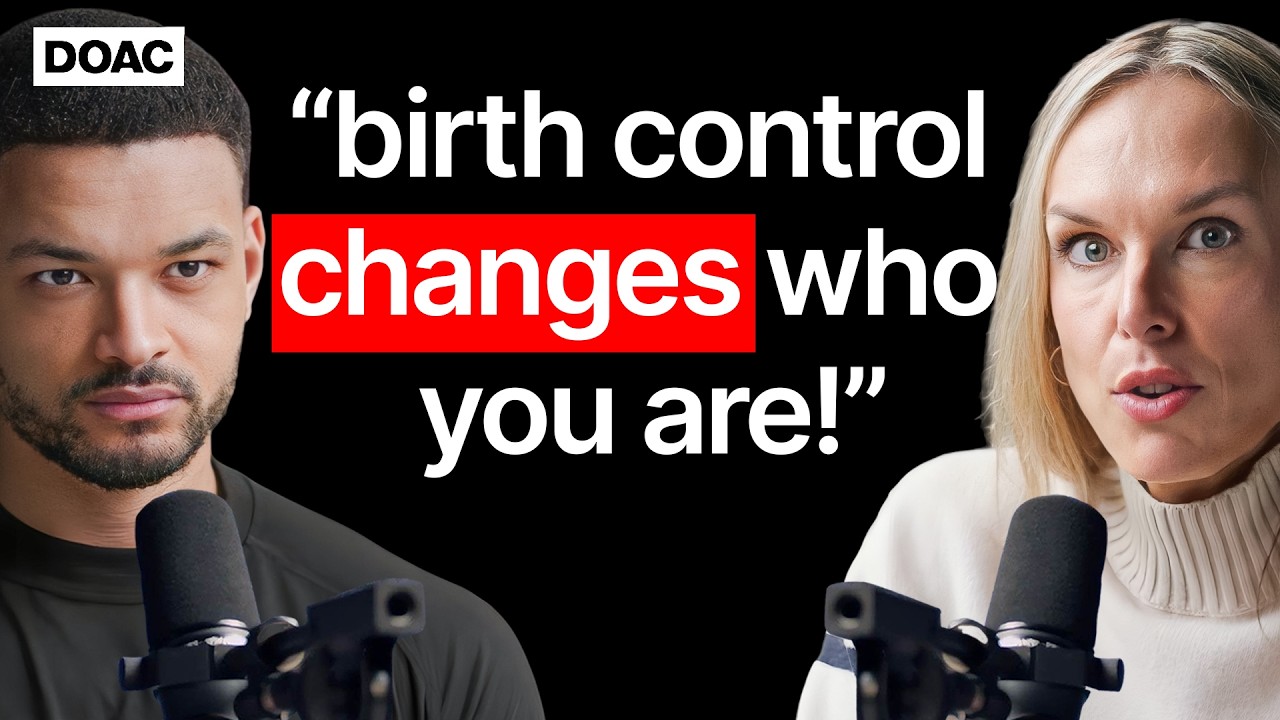
Women Health Expert: Birth Control Changes Who You Are & How You Feel About Your Partner! — The Diary Of A CEO

The Diary Of A CEO

Synthetic hormones in birth control pills lower free testosterone by 60 percent, altering female mate preferences, suppressing sexual desire, and doubling suicide attempt risks.

AI-assisted summary of Women Health Expert: Birth Control Changes Who You Are & How You Feel About Your Partner! — original source. Check the original for full context.

Source published:

Detailed notes

## Background This interview was published on YouTube by The Diary Of A CEO on November 25, 2024. According to the page description, renowned evolutionary social psychologist Dr. Sarah Hill discusses how the birth control pill alters a woman's brain, sexual desires, stress response, and relationship dynamics based on research from her book, 'How the Pill Changes Everything: Your Brain on Birth Control'.

## TL;DR Dr. Sarah Hill explores the profound psychological and physiological impacts of hormonal birth control, explaining how synthetic progestins suppress natural cycle shifts, blunt stress responses, and lower free testosterone by up to 60%. The discussion examines how these hormonal changes alter partner preferences, muscle growth, and overall mental health, including heightened risks of depression and suicide. Beyond contraception, the conversation covers evolutionary mating psychology, exploring how ancestral survival demands, testosterone levels, and resource dynamics shape attraction and modern relationship behavior.

## Atmosphere & style The conversation feels deeply intimate, intellectually rigorous, and candidly unfiltered as host Steven Bartlett and Dr. Sarah Hill dismantle long-standing taboos surrounding women's hormonal health. Dr. Hill delivers complex evolutionary science with accessible, grounded empathy, sharing personal epiphanies alongside sobering medical data. The dynamic maintains an intriguing rhythm that balances biological realities with modern relationship anxieties, leaving the listener feeling both enlightened and fundamentally challenged in their understanding of human attraction.

## Key takeaways - [00:00](https://www.youtube.com/watch?v=MGposaKNJKQ&t=0s) The birth control pill fundamentally alters a woman's sense of self, baseline personality, emotional regulation, and stress response. - [05:13](https://www.youtube.com/watch?v=MGposaKNJKQ&t=313s) Female mating psychology remains evolutionary and hypergamous, creating a modern dating mismatch as women achieve higher education and income levels than men. - [22:46](https://www.youtube.com/watch?v=MGposaKNJKQ&t=1366s) Monogamy and committed fatherhood evolved because paternal resource investment dramatically increased child survival rates in ancestral hunter-gatherer environments. - [25:22](https://www.youtube.com/watch?v=MGposaKNJKQ&t=1522s) Natural hormonal fluctuations during the high-estrogen phase of ovulation heighten female desire for high-testosterone traits and genetic compatibility cues. - [57:05](https://www.youtube.com/watch?v=MGposaKNJKQ&t=3425s) Synthetic progestins in birth control flatten estrogen spikes and trigger high SHBG production, dropping women's free testosterone by approximately 60% and suppressing libido. - [59:19](https://www.youtube.com/watch?v=MGposaKNJKQ&t=3559s) Hormonal contraceptives shift female mate preferences toward softer facial features, and stopping the pill can alter attraction toward a long-term partner depending on his perceived baseline attractiveness. - [01:02:05](https://www.youtube.com/watch?v=MGposaKNJKQ&t=3725s) Men unconsciously detect female ovulation through subtle visual, movement, and scent cues, which naturally elevate male testosterone levels. - [01:29:36](https://www.youtube.com/watch?v=MGposaKNJKQ&t=5376s) Hormonal birth control blunts the body's acute cortisol response to stress in a pattern similar to PTSD and is linked to elevated risks of depression and suicide. - [01:34:16](https://www.youtube.com/watch?v=MGposaKNJKQ&t=5656s) Women taking synthetic contraceptives gain significantly less muscle mass during resistance training due to lower free testosterone and reduced AMPK activity. - [01:43:09](https://www.youtube.com/watch?v=MGposaKNJKQ&t=6189s) Discontinuing hormonal contraceptives restores free testosterone, mood baseline, and natural libido in adult women over time.

## Detailed walkthrough ### [00:00](https://www.youtube.com/watch?v=MGposaKNJKQ&t=0s) The Pill's Unintended Impacts and the Show's Mission

Dr. Sarah Hill, an evolutionary social psychologist and author of *How the Pill Changes Everything*, outlines the core mission of her research: helping women—and the men who love them—understand how female biology and hormonal birth control shape human behavior. While the birth control pill has been single-handedly responsible for unlocking female independence and educational attainment over the past several decades, Dr. Hill points out that society and medical professionals take a "cavalier" approach to prescribing it. Doctors frequently brush off major risk factors, even though research shows the pill alters a woman's fundamental sense of self and relationship dynamics.

Dr. Hill identifies five major ways the pill changes women, ranging from elevated risks of anxiety and depression to impaired muscle mass development and suppressed libido due to the absence of natural estrogen surges. Furthermore, the pill alters mate preferences in subtle, shocking ways: studies demonstrate that when women partnered with attractive men stop taking hormonal contraceptives, their attraction to their partners increases; conversely, women partnered with less attractive men experience a sharp drop in attraction and sexual satisfaction upon going off the pill. Host Steven Bartlett opens the episode with a call for listeners to subscribe, emphasizing that understanding evolutionary psychology provides vital clarity on partner dynamics, testosterone, and attraction for both sexes.

- Research shows the birth control pill changes emotional states, muscle mass production, sexual desire, and partner selection. - 53% of regular listeners to *The Diary Of A CEO* are not yet subscribed, prompting a direct pledge from the host to continuously improve the show in exchange for subscriptions. - Dr. Hill highlights that historical medical research has predominantly focused on male physiology, leaving female-specific health poorly understood.

[05:13](https://www.youtube.com/watch?v=MGposaKNJKQ&t=313s) The Modern Mating Crisis and Female Hypergamy

The widespread adoption of birth control allowed women to plan their reproductive lives with unprecedented certainty, leading to higher educational attainment and a complete demographic shift in higher education. However, this success has inadvertently created a modern "mating crisis." Evolutionary psychologist David Buss and other researchers note that while women now earn a higher proportion of college degrees than men, female mating psychology remains fundamentally "hypergamous"—meaning women naturally prefer to partner with men of equal or higher educational and resource status.

With US college campuses averaging a 60/40 female-to-male ratio, educated women face a shrinking pool of suitable partners. Rather than "dating down" or settling for partners with fewer resources, an increasing number of women are choosing to remain single and opt out of long-term relationships altogether—a phenomenon documented in books like *All the Single Ladies*.

- **Hypergamy:** The evolutionary tendency for women to seek partners who hold equal or superior status, education, and financial resources. - **Sex trends:** Overall sexual activity is trending downward across populations; young adults are having sex later in life, and higher percentages of students remain virgins through high school and college despite easy access to contraception. - Women who are unable to find partners matching their socioeconomic preferences increasingly choose singlehood over compromising their standards.

[10:23](https://www.youtube.com/watch?v=MGposaKNJKQ&t=623s) Evolutionary Origins of Resource Preference and "The Patriarchy"

Responding to why high-earning, independent women do not simply date men with fewer financial means, Dr. Hill explains that modern mate preferences are rooted in thousands of years of ancestral survival needs. For the vast majority of human evolutionary history, women spent large portions of their lives pregnant, lactating, or nursing infants—states that severely constrained their ability to hunt or gather resources independently.

> "I don't know if you've ever gone hunting before or met a two-year-old, but the two things don't mix. Children are loud; they're not going to allow you to sneak up on a buffalo."

Because an ancestral woman's survival and her children's survival depended directly on a partner's ability to provide food and protection, women evolved a strong psychological preference for high-resource mates. This evolved brain persists today, regardless of modern financial independence. Addresssing societal concepts like "the patriarchy," Dr. Hill argues that male control over resources is not primarily a coordinated conspiracy to suppress women, but rather an *epiphenomenon* driven by intense male-male competition to meet female demands for high-status partners. Quoting Aristotle Onassis—*"Without women, all the power and money in the world would be completely meaningless"*—she notes that men are naturally wired to take immense career and physical risks because high status historically yielded better mating opportunities.

- Female risk aversion evolved because an ancestral mother's injury or death directly threatened the survival of dependent offspring. - Men display higher rates of risk-taking, entrepreneurship, and gambling addictions, stemming from evolutionary incentives to acquire resources and outcompete rivals. - High male representation in demanding corporate roles (such as CEOs) is largely driven by a willingness to make lifestyle trade-offs in exchange for status that attracts mates.

[15:43](https://www.youtube.com/watch?v=MGposaKNJKQ&t=943s) Risk-Taking, Entrepreneurship, and Gender Differences

Dr. Sarah Hill explains that women are generally more risk-averse than men, a dynamic clearly observed in behaviors like gambling, where men overwhelmingly make up the majority of addicts. However, risk plays a dual role in society; it is also essential for constructive endeavors like entrepreneurship. Starting a business involves a volatile "boom and bust" nature, and female psychology tends to be less tolerant of the potential downside of a total collapse compared to male psychology. Steven Bartlett offers an insider perspective as an investor and entrepreneur, noting that while data may show men are more likely to start businesses, it does not mean they are inherently better at running them. In his experience, female business leaders are significantly more accurate and realistic with their forecasting and what their company can achieve, whereas men tend to aggressively over-forecast.

Bartlett cites a conversation with *Shark Tank* investor Kevin O'Leary, who revealed that the best-performing investments across his entire portfolio were women-led companies because they excel at calculated risk-taking and grounded financial projections. Dr. Hill agrees, calling this observation spot-on and attributing male overconfidence to evolutionary mating psychology. Men often display hubris and an exaggerated belief in their own success because they are essentially "buying their own story." Historically, taking massive risks offered evolutionary "carrots"—huge rewards that directly translated into increased mating opportunities and genetic legacy. Conversely, a woman's maximum reproductive output is biologically constrained by pregnancy, regardless of how many partners or resources she acquires.

* The **Bateman Principle** in evolutionary biology illustrates that a male's reproductive fitness can continuously scale up with every additional partner he secures, whereas a female's fitness tops out after a single partner during a given reproductive cycle. * In polygynous historical cultures, high-status men with abundant resources frequently took multiple wives and fathered significantly more offspring, passing down risk-seeking traits to modern descendants. * Bartlett shares a personal story about his grandfather in Nigeria, who had 10 to 14 wives and fathered enough children that Bartlett has roughly 30 to 40 cousins in Nigeria, illustrating how recently these reproductive patterns occurred in human families.

> "A woman with access to 10 partners can only pass down the same number of genes as a woman with access to one, whereas the same hasn't been true for men... for men who have access to 10 partners, this can lead to 10 times as many offspring."

---

[22:46](https://www.youtube.com/watch?v=MGposaKNJKQ&t=1366s) Monogamy, Investing Fathers, and Mate Value Dynamics

Dr. Hill explains why most men in modern societies do not pursue an infinite number of mates despite evolutionary incentives. In human evolutionary history, child survival depended heavily on the presence of an investing father. Studies on contemporary hunter-gatherer societies show that children with active, resource-providing fathers have vastly higher survival rates than those without. Furthermore, high-value women naturally refuse to share partners. To secure a high-quality female partner who demands exclusivity, a man must voluntarily restrict his own "reproductive value"—the total number of potential future children he could father—and commit to a long-term pair bond.

To illustrate how commitment alters attraction, Dr. Hill walks through a hypothetical "mate value" scenario on a 1-to-10 scale. If a man possesses great resources, good looks, and status but refuses to commit, his overall mate value to a woman seeking a long-term partner might hover around a 7. However, if that same man meets an incredible, high-value woman (a 9 or 10) and chooses to offer exclusive commitment and investment, his effective mate value instantly jumps to a 9 or 10 in her eyes. Willingness to stick around and invest resources in one partner is a primary trait women prioritize.

---

[25:22](https://www.youtube.com/watch?v=MGposaKNJKQ&t=1522s) How the Menstrual Cycle Alters Female Partner Preferences

The conversation shifts to how a woman's mate preferences fluctuate across her 28-day menstrual cycle. Dr. Hill breaks down the hormonal timeline, noting that both estrogen and progesterone start low at the beginning of the cycle (Day 1 being the first day of menstruation). Around Day 9, as eggs mature in the ovaries and release estrogen, estrogen levels begin a steep rise. This surge reaches its peak around Day 14 or 15 during ovulation, framing the female "fertile window." During this high-estrogen phase, a woman's sexual psychology shifts dramatically: her sexual desire peaks, frequency of intercourse and masturbation increases, and her criteria for potential partners become far more exacting.

During high fertility, women show a heightened preference for cues indicating high genetic quality and immunocompetence—most notably traits driven by high testosterone. Because testosterone is a known immunosuppressant, displaying strong testosterone-fueled physical and behavioral traits signals that a man's immune system is robust enough to handle the burden of testosterone. Consequently, high-estrogen women naturally gravitate toward masculinized male faces, deeper vocal pitches, and socially dominant behaviors.

* **Research Methodology:** In a seminal study on cycle preferences, researchers tracked women across two full cycles by analyzing daily saliva samples to measure hormone levels while having the women rate the attractiveness of male faces. * **Study Findings:** Unbeknownst to the female participants, the researchers had pre-measured the baseline morning testosterone levels of the men pictured. The results showed a direct statistical overlap: as women's estrogen peaked, their preference for high-testosterone male faces surged in tandem, demonstrating that "estrogen loves testosterone." * Men with higher baseline testosterone levels are statistically more likely to be in a committed relationship a year later compared to men with lower testosterone levels, reflecting female preference for these biological markers.

> "During this estrogenic phase in the cycle, women have a heightened preference for cues related to facial masculinity, vocal masculinity, and social dominance... estrogen loves testosterone."

[32:27](https://www.youtube.com/watch?v=MGposaKNJKQ&t=1947s) How Testosterone Levels Influence Partner Choice and Long-Term Relationships

Dr. Sarah Hill explains that women evolutionary select for men with higher baseline testosterone when looking for a long-term partner. Studies tracking men over time demonstrate that individuals with higher testosterone levels at an initial time point are significantly more likely to be married at a later follow-up date. This indicates that men with higher testosterone are generally chosen as partners more frequently than those with lower levels.

However, Steven Bartlett raises a paradox he discovered in Dr. Hill’s work: a man’s testosterone levels plummet dramatically once he has a baby. Dr. Hill emphasizes how remarkable the brain-body connection is in detecting major life milestones. While western culture often promotes a "more is better" narrative around testosterone—leading to the rise of specialized low-T clinics—a decrease in testosterone is not inherently a medical issue. In fact, testosterone drops slightly when a man enters a committed relationship, and it drops further when he becomes an active caregiver to children. Evolutionary logic dictates that it is inefficient for a family man to keep his "foot on the gas pedal of sexual desire," constantly eyeing neighbors, when that reproductive energy is far better redirected toward caring for his partner and offspring.

* **Longitudinal Marriage Data:** Men with higher initial testosterone levels are statistically more likely to be married years later. * **Biological Recalibration:** Testosterone naturally drops upon entering a committed long-term relationship and decreases even further when actively parenting young children. * **Cultural Misconception:** Low testosterone in fathers is an adaptive evolutionary feature to encourage investment and caregiving rather than a biological deficit requiring clinic interventions.

---

[34:44](https://www.youtube.com/watch?v=MGposaKNJKQ&t=2084s) High Testosterone vs. Investment: Do "Nice Guys" Finish Last?

When asked directly whether "nice guys don't get laid as much," Dr. Hill notes that men with high testosterone are indisputably more successful in casual, short-term sexual strategies. However, for men seeking long-term relationships, demonstrating a willingness to commit and invest in a partner serves as a powerful equalizer. Even if a man lacks high testosterone or ideal genetic markers, offering high relationship investment makes him immensely appealing to women seeking long-term security.

Dr. Hill also points out that during peak fertility in their menstrual cycle, women unconsciously pick up on genetic compatibility markers, such as differences in immune system genes (MHC/HLA profiles). A man who may lack those specific high-fertility genetic cues can still boost his overall mate value by showcasing high relational commitment, which women consistently value.

---

[35:56](https://www.youtube.com/watch?v=MGposaKNJKQ&t=2156s) The Evolutionary Preferences Underlying Human Attraction

Steven reflects on how attraction feels like a delicate, subconscious matrix of "a thousand tiny micro-expressions" and wonders if general advice on being attractive is largely futile. Dr. Hill agrees that attraction contains a highly finicky and idiosyncratic component—what one person finds irresistible, another might find average. These unique preferences may be anchored in subconscious biological compatibility cues tailored to that specific pairing.

Despite these individual quirks, broad evolutionary themes reliably predict partner preferences across the sexes:

* **Physical Attractiveness & Estrogen Cues:** Men place a heavier emphasis on physical attractiveness, which acts as a proxy for fertility. The classic hourglass figure is regulated by sex hormones; higher estrogen levels deposit fat on the hips, thighs, and buttocks rather than the waist. As women age and estrogen declines, body shapes become more linear. * **Facial Maturity vs. Youthfulness:** Women frequently prefer cues of facial maturity in men—such as finding a 50-year-old George Clooney more attractive than his 25-year-old self—because age historically correlates with wisdom, high status, and accumulated resources. * **Men's Evolutionary Penalty for Age Preference:** Men who inherited a preference for older, highly mature women would have faced a evolutionary dead-end by mating with females approaching menopause. Consequently, men evolved a robust, cross-cultural preference for facial youthfulness.

---

[39:54](https://www.youtube.com/watch?v=MGposaKNJKQ&t=2394s) Female Career Success, Socioeconomic Status, and Male Attraction

Addressing whether men are intimidated by or less attracted to successful women, Dr. Hill explains that men do not penalize women for high achievement, but they simply do not prioritize it the way women do. Research demonstrates this disparity clearly: showing a man a photograph of an attractive woman dressed as a CEO versus the same woman dressed in a fast-food uniform yields nearly identical ratings of physical attractiveness. For men, a woman's outfit or profession does not alter her baseline physical appeal.

Conversely, when women rate men, their ratings of physical attractiveness fluctuate dramatically based on whether his clothing communicates high status and resource access. Dr. Hill notes that while men find high-powered, attractive women just as attractive as any other woman, they may sometimes hesitate to enter long-term relationships with them if complex power dynamics or lifestyle mismatches arise.

---

[41:28](https://www.youtube.com/watch?v=MGposaKNJKQ&t=2488s) Intra-Sexual Competition, Social Mobility, and Attractiveness

Examining how women compete with one another, Dr. Hill highlights the impact of skewed sex ratios, such as those found on modern college campuses where women outnumber men. In these environments, intense competition forces women to adapt to male relationship preferences. Because men are generally more inclined toward casual sex, college hookup culture expands as women yield to short-term arrangements to secure access to available mates.

In female-female competition, women compete most fiercely against conventionally beautiful women, as physical appeal remains the primary dimension men prioritize.

> "One of the biggest predictors of a woman's upward social mobility in the US is how physically attractive a woman is... that's a bigger predictor of a woman's upward mobility than her education level or even her socioeconomic status of origin."

To undermine rivals, women frequently resort to indirect aggression and derogation. Rather than engaging in physical fights, they attempt to lower a rival’s value in the eyes of others by claiming "she’s had a lot of work done" or downplaying her natural beauty. Dr. Hill references themes from the *Barbie* movie, observing that while modern culture often attempts to minimize the role of female physical competition, it remains an enduring evolutionary reality.

---

[45:49](https://www.youtube.com/watch?v=MGposaKNJKQ&t=2749s) The Unique Dynamic Between Straight Women and Gay Men

Drawing on research conducted alongside a former student, Dr. Hill discusses the widespread, cross-cultural prevalence of close friendships between straight women and gay men. Highly attractive women—who often face heightened competition and hostility from other women—frequently seek out gay male friends for unbiased mating feedback.

Unlike female peers who might offer sabotage through backhanded compliments, or straight men whose advice might be driven by sexual motives, gay men offer a safe, trusted perspective. A gay male friend can answer questions like "do these pants make me look fat?" with completely honest, tactical advice, creating a relationship dynamic entirely free of intra-sexual competition or hidden sexual agendas.

---

[47:45](https://www.youtube.com/watch?v=MGposaKNJKQ&t=2865s) Dr. Sarah Hill’s Personal Awakening Off the Birth Control Pill

Dr. Hill reveals the personal catalyst behind her book *How the Pill Changes Everything: Your Brain on Birth Control*. Despite spending over a decade on hormonal birth control while actively researching evolutionary social psychology, she had no idea how deeply the pill was altering her brain chemistry and perception.

Approximately three months after voluntarily stopping the pill, Dr. Hill experienced a profound psychological shift, describing it as "waking up." She suddenly noticed that she was feeling emotions far more deeply, experiencing a renewed sexual appetite, re-engaging with regular exercise, and downloading new music to her iPod for the first time in years. This stark realization that synthetic hormones had subtly dampened her cognitive and emotional reality drove her to investigate the full scope of how birth control alters women's lives.

[48:42](https://www.youtube.com/watch?v=MGposaKNJKQ&t=2922s) The Awakening: Realizing How the Pill Shapes Identity

Dr. Sarah Hill recounts her personal epiphany after stopping hormonal birth control, describing an unexpected awakening of her senses and energy. She recalls feeling as though she had been living with outdated mental software—likening her prior state to an archaic early-model iPhone or loading music onto an iPod. Upon coming off the pill, she suddenly felt an increased desire for pleasure, higher energy levels, and a significantly deeper emotional capacity, leading her to wonder what had caused such a dramatic shift. Surprisingly, Dr. Hill had never suffered from obvious side effects like negative mood swings while taking birth control; she had assumed it had no effect on her whatsoever.

It was only after stepping away from the pill and feeling "more alive" that Dr. Hill turned her academic lens toward the existing literature. As an evolutionary social psychologist who had published research on how natural cycle hormones influence female behavior, she was stunned to discover three decades of research detailing how synthetic hormones alter women's thoughts, emotions, and worldview. She realized that if someone with a PhD studying the female brain was completely blind to how birth control was quietly changing her own mind and personality, the general public was almost certainly in the dark as well.

- Dr. Hill notes that she experienced no obvious adverse mood symptoms while on the pill, making her realization post-discontinuation all the more surprising. - The research body demonstrating that hormonal birth control changes female psychology and behavior spans roughly 30 years of scientific literature. - "I was cooking, it was like I was just interested in pleasure, I had more energy, I was feeling things more deeply... and it never even occurred to me that my birth control was changing me."

---

[50:19](https://www.youtube.com/watch?v=MGposaKNJKQ&t=3019s) A Taboo Subject: Balancing Freedom and Trade-Offs

Addressing host Steven Bartlett’s observation that criticizing birth control is a touchy subject, Dr. Hill acknowledges the political and social sensitivity surrounding the topic. Reliable contraception has been "by far the biggest game changer that women have ever experienced in history," serving as the cornerstone for female economic, personal, and political independence from men. Consequently, raising questions about the pill can trigger immediate panic that such warnings might be weaponized to restrict women's bodily autonomy or eliminate their options.

However, Dr. Hill emphasizes that her goal is not to abolish the pill, but to provide full transparency regarding its psychological and physiological trade-offs. Because the brain-altering side effects impact women differently, choices about contraception must be deeply individualized. A woman's decision to stay on or come off the pill will naturally change depending on her life stage, relationship status, and personal goals. True empowerment requires having all the facts to make informed choices about who one wants to be.

> "There's been nothing that has been more instrumental to women's ability to be able to achieve political and economic independence from men than the birth control pill... but this book was really important to me to present to women all of the different ways that hormones influence us."

---

[52:23](https://www.youtube.com/watch?v=MGposaKNJKQ&t=3143s) Five Key Ways the Pill Changes Who You Are

When asked what advice she would give her younger self when handed her first prescription packet, Dr. Hill boils her message down to a core principle: "your hormones make you who you are, and when you change your hormones, you change who you are." She explains that synthetic hormones alter the baseline version of the self generated by the brain, and outlines five distinct areas where birth control alters female biology and psychology:

* **Sexual Desire & Mate Attraction:** Alters libido levels, frequency of sexual desire, and the physical/behavioral traits preferred in a partner. * **Emotional Regulation & Mood:** Impacts daily emotional processing, baseline mood stability, and susceptibility to affective shifts. * **Stress Response System:** Modifies the biological and psychological capacity to handle and regulate stress. * **Body Composition & Physical Performance:** Impairs the physiological ability to build lean muscle mass, altering response to fitness training and nutrition. * **Mental Health & Libido Risks:** Heightens susceptibility to psychiatric side effects, ranging from blunted drive to clinical depression.

Dr. Hill stresses that taking synthetic hormones when contraceptive protection is unnecessary imposes unneeded risks, as there is no reason to alter one's core self without clear benefits.

---

[54:20](https://www.youtube.com/watch?v=MGposaKNJKQ&t=3260s) The Biological Engine: How Synthetic Progestins Suppress Ovulation

To explain how birth control alters attraction and behavior, Dr. Hill walks through the underlying biological mechanism. Naturally cycling women experience fluctuations driven by the brain's communication with the ovaries. Hormonal birth control works by halting this process: it delivers a daily dose of synthetic progesterone—known as a **progestin**—which acts on the brain's hypothalamus. The hypothalamus interprets this signal as a sign to shut down chemical communication with the ovaries, preventing egg development and ovulation.

``` [Synthetic Progestin] ──> [Hypothalamus] ──> [Signals Ovaries to Stop] ──> [Estrogen Flatlines] ```

Because ovary stimulation is disabled, the body's natural estrogen production plummets. While combination birth control pills include a small amount of synthetic estrogen alongside progestin, overall estrogen levels remain low, stable, and flat throughout the month. This replaces a dynamic, cycling hormonal landscape with a static, progestin-dominated daily signal, eliminating the natural pre-ovulatory estrogen surge that drives mating psychology.

- **Progestin:** Present in every form of hormonal birth control; communicates directly with the hypothalamus to suppress ovarian stimulation. - **Combination Pills:** Contain progestin along with low, fixed doses of synthetic estrogen to maintain stable hormone levels. - **Estrogen Suppression:** Prevents the natural spike in estrogen that occurs prior to ovulation in naturally cycling women.

---

[57:05](https://www.youtube.com/watch?v=MGposaKNJKQ&t=3425s) The Double Hit to Libido: Low Estrogen and SHBG

Dr. Hill explains that the loss of the pre-ovulatory estrogen spike fundamentally alters sexual psychology. In naturally cycling women, rising estrogen signals that conception is possible, acting as a biological trigger that heightens sexual desire, improves sexual function, and increases interest in high-testosterone mates. Flatlining these hormones eliminates natural peaks in desire. While women on birth control still engage in and enjoy sex, they experience fewer hormonal drives and generally report lower overall libido compared to naturally cycling women.

In addition to suppressed estrogen, birth control hits libido through a second biological pathway involving **sex hormone-binding globulin (SHBG)**. Synthetic hormones trigger the liver to produce high amounts of SHBG, a protein that binds to free testosterone in the bloodstream and renders it inactive. Although testosterone is often viewed as a male hormone, it plays a vital role in fueling female sexual desire.

- Women on hormonal birth control have approximately **60% lower levels of free testosterone** than naturally cycling women. - Low estrogen coupled with severely diminished free testosterone creates a dual mechanism that dampens overall libido. - Natural cycles feature distinct peaks and valleys in sexual desire, whereas birth control creates a flattened, constant baseline.

> "Testosterone, even though we tend to think of it as a guy thing... is actually really important in terms of promoting women's sexual desire. And women who are on hormonal birth control have levels of free testosterone that are about 60% lower than that of their naturally cycling peers."

---

[59:19](https://www.youtube.com/watch?v=MGposaKNJKQ&t=3559s) Changing Preferences: How the Pill Shifts Partner Preference

Because natural estrogen spikes drive an evolutionary preference for high-testosterone traits during fertile windows, researchers investigated what happens when women take synthetic hormones that keep estrogen suppressed. Studies show that women on birth control demonstrate a dampened preference for masculine features and testosterone cues in male partners compared to naturally cycling women.

Specifically, women on the pill tend to favor men with less masculinized facial and physical characteristics. Instead of preferring strong testosterone markers—such as deep-set eyes, a wide jaw, a low waist-to-shoulder ratio, a deep voice, and dominant behavioral traits—women on birth control show a preference for softer, more nurturant facial features and calmer temperaments.

- **High-Testosterone Traits:** Deep-set eyes, wide jawlines, broad shoulders with narrow waists, deep voice pitch, and high social dominance. - **Pill-Induced Preference:** Shift toward less masculinized facial structures and lower testosterone behavioral markers.

---

[01:01:00](https://www.youtube.com/watch?v=MGposaKNJKQ&t=3660s) What Happens When She Comes Off the Pill?

Addressing Steven Bartlett’s concern about what happens to a relationship if a woman stops taking the pill, Dr. Hill points to landmark longitudinal research on married couples. Researchers tracked women who met their partners while using birth control and observed changes in relationship dynamics after they discontinued the medication. The results showed that stopping birth control frequently altered partner attraction, but the outcome depended heavily on the male partner's physical attractiveness:

* **When Partnered with Highly Attractive Men:** Women who went off the pill became *more* physically and sexually attracted to their partners, reporting higher sexual satisfaction within the relationship than before. * **When Partnered with Less Attractive Men:** Women who went off the pill experienced the opposite effect; their physical attraction to their partner declined, and they reported lower sexual satisfaction.

Dr. Hill reassures listeners that stopping birth control does not automatically disrupt most relationships. Hormones provide subtle psychological "nudges" rather than driving total shifts in personality. However, for relationships where physical attraction was already marginal, coming off the pill can shift a woman's preferences enough to alter her romantic interest in her partner.

> "Women who were partnered to attractive men when they went off hormonal birth control, they were more attracted to their partner and were more sexually attracted... but for women who were partnered with less attractive partners, they had the opposite effect."

- Hormonal shifts can also influence broader expressions of sexual orientation; Dr. Hill notes anecdotes of women shifting along the spectrum of attraction after discontinuing birth control. - For most couples, stopping the pill does not cause a drastic shift, as daily relationship dynamics and shared bonds outweigh subtle hormonal nudges.

---

[01:04:34](https://www.youtube.com/watch?v=MGposaKNJKQ&t=3874s) Male Attraction and the Natural Cycle

Turning to how men react when a female partner stops taking birth control, Dr. Hill cites research demonstrating that naturally cycling women are perceived as more attractive by men than women on birth control. Evolutionary research shows that men unconsciously pick up on subtle vocal, scent, and visual cues associated with high fertility.

When a woman stops taking birth control and resumes natural hormonal fluctuations, her partner often finds her more appealing. Studies demonstrate that men consistently rate naturally cycling women near ovulation as smelling better, looking more attractive, and even earning higher tips in service-industry settings compared to when their hormones are synthetically flattened.

- Men unconsciously detect fertility cues, finding naturally cycling women more attractive during high-estrogen cycle phases. - Women coming off the pill often experience an increase in physical appeal to male partners due to restored natural hormonal signals.

[01:05:13](https://www.youtube.com/watch?v=MGposaKNJKQ&t=3913s) Cues of High Fertility and Estrogen Detection

Dr. Sarah Hill explains how men's brains are evolutionarily wired to pick up on subtle cues of female fertility and estrogen. Research shows that men pick up on these signals across multiple senses—including scent, visual appearance, and movement. For instance, in classic studies conducted in strip clubs, dancers made significantly more tips during the high-fertility phase of their menstrual cycles compared to their low-fertility phases. In other experiments, researchers showed men shadowed silhouettes of women walking or dancing behind a sheet. Even with only a moving outline visible, men consistently rated the silhouettes as more attractive when the women were at peak fertility.

From an evolutionary standpoint, this subconscious sensitivity provided a massive reproductive advantage. Ancestral men who were finely tuned to high estrogen levels were more likely to mate with fertile partners and successfully pass down their genes. Because of this, when a woman stops taking hormonal birth control and resumes her natural cycle, her partner will likely experience a surge in physical attraction toward her—particularly during her fertile window—as his brain responds to the influx of natural estrogen cues.

* **Strip Club Tip Study:** Dancers earn significantly higher tips when they are in their fertile window compared to non-fertile phases. * **Silhouette Experiment:** Men found female silhouettes more attractive based purely on motion when the women were at peak fertility. * **Evolutionary Advantage:** Men attuned to estrogen cues historically maximized their genetic success due to estrogen's direct linkage to lifetime and cycle fertility.

---

[01:06:50](https://www.youtube.com/watch?v=MGposaKNJKQ&t=4010s) Hormonal Birth Control and the Broader Male Testosterone Crisis

The conversation shifts to a compelling, under-researched question: could widespread birth control use among women be contributing to lower testosterone levels in men? Dr. Hill shares recent discussions she had with her graduate students regarding how men's testosterone levels dynamically spike in response to fertile female scents. Experiments show that when men smell t-shirts worn by women at peak fertility—or even breathe air passed through a nebulizer containing a woman's used panty liner from her fertile window—their testosterone levels rise significantly in response to those vaginal secretions.

Given that exposure to natural estrogen cues boosts testosterone, Dr. Hill raises the possibility that the widespread lack of cycle-related estrogen signals in the female population might be an unexamined contributor to today's male testosterone crisis. Over the past 50 years, male testosterone levels have dropped dramatically across the globe. While microplastics, environmental toxins, and poor diets are well-known culprits, Dr. Hill points out two potential behavioral and biological factors:

1. **Suppression of Natural Chemical Signals:** With millions of women using hormonal birth control, men are far less frequently exposed to natural, high-fertility estrogen cues that trigger testosterone production. 2. **Shift in Caregiving Roles:** As more women excel in the workforce, men are taking on larger caregiving roles and domestic duties than ever before. Since male biology naturally downregulates testosterone during active caregiving and long-term partnership, this social shift may also be reflected biologically.

---

[01:09:45](https://www.youtube.com/watch?v=MGposaKNJKQ&t=4185s) Concerns Over Global Population Decline

When asked about the looming threat of global population collapse, Dr. Hill expresses genuine uncertainty and concern over dropping birth rates. She approaches the subject cautiously, emphasizing that acknowledging demographic declines should not be misinterpreted as suggesting women have an "obligation to reproduce." However, she acknowledges that as more individuals elect not to have children, the resulting societal impact remains completely uncharted territory, adding, "I don't think it's necessarily going to be good."

---

[01:10:38](https://www.youtube.com/watch?v=MGposaKNJKQ&t=4238s) Sponsor Interludes: Zoe & Bon Charge

**Zoe Health:** Steven Bartlett shares his personal experience as both a user and investor in Zoe, a personalized nutrition program backed by scientific clinical research (the METHOD study). He offers listeners a 10% discount using the code `STEVEN10`.

**Bon Charge:** Bartlett highlights the Bon Charge Infrared Sauna Blanket, a portable device designed to mimic the circulation, recovery, and skin benefits of traditional saunas. Listeners receive a 25% discount, free shipping, and a one-year warranty using the promo code `DIARY`.

---

[01:12:40](https://www.youtube.com/watch?v=MGposaKNJKQ&t=4360s) Navigating Modern Masculinity, Consent, and Seduction

Returning to the podcast, Steven asks Dr. Hill what advice she offers her 15-year-old son about being a "good man" in a culture marked by rising male depression, loneliness, and confusion around healthy masculinity. Dr. Hill firmly asserts that "there's room for masculinity," adding that "sex demands it." In the evolutionary psychology course she teaches—*Evolution, Sex, and the Brain*—she spends significant time exploring how modern sexual dynamics have become increasingly complicated.

Dr. Hill notes that while society rightly condemns invasive or non-consensual behavior, the art of seduction historically relies on an erotic push-and-pull between masculine and feminine energy. Navigating this line is extraordinarily difficult for young men today:

> "It's a really tricky world to be in. Being a male is hard... you don't want to do something that's obviously going to be detrimental or hurtful to a woman or violate her in some way, but on the other hand, you know, you can go too far with the permissions in a way that can be really bad for sex."

She reflects on how clinical or overly mechanical requests for permission during intimate moments can disrupt the natural flow of sexual desire and attraction, leaving young men walking a difficult tightrope between respect and romantic initiative.

---

[01:15:38](https://www.youtube.com/watch?v=MGposaKNJKQ&t=4538s) Sexual Opportunism and the Florida Campus Study

Steven brings up the stark double standards in modern dating, pointing out that the top tier of high-status men command most of the attention while lower-status men struggle to find partners. He highlights how much easier it is for a woman to secure casual sex compared to a man. To illustrate this fundamental difference in sexual strategies, Dr. Hill recounts a famous landmark social psychology experiment conducted at the University of Florida.

In the study, attractive male and female research confederates approached strangers on a college campus, paid them a polite compliment ("I find you very attractive"), and asked one of three direct questions: 1. "Would you go on a date with me?" 2. "Would you go back to my apartment with me?" 3. "Would you go and have sex with me?"

The results revealed a massive biological and behavioral divergence between the genders:

| Request | Women's Agreement Rate | Men's Agreement Rate | |:--- |:--- |:--- | | **Go on a Date** | 50% | 50% | | **Go to Apartment** | ~0% | High (Higher than date) | | **Have Sex** | 0% | ~80% |

Dr. Hill explains that the few men who refused casual sex typically cited external reasons, such as being in a committed relationship or having their parents visiting in town.

From an evolutionary standpoint, this stark contrast comes down to asymmetric reproductive costs. For a woman, casual sex historically carried the immense biological risk of a nine-month pregnancy followed by years of lactation without guaranteed support. For a man, short-term opportunistic mating carried almost no direct physical cost while offering a massive genetic payoff.

---

[01:19:10](https://www.youtube.com/watch?v=MGposaKNJKQ&t=4750s) The Appeal of the "Bad Boy" vs. "Nice Guys"

When Steven asks what practical advice a mother should give a struggling young man who can't get a date, Dr. Hill suggests focusing on genuine connection and long-term investment. While Steven jokes about telling a son to "go to the gym and be a nice guy," Dr. Hill clarifies that being a reliable, supportive partner is a highly successful strategy for securing a committed relationship—provided a man isn't so passive that he radiates low-testosterone signals.

Addressing why "bad boys" attract so much romantic interest despite their poor behavior, Dr. Hill explains that women aren't attracted to bad behavior itself, but rather to the biological traits associated with it. Traits like high risk tolerance, confidence, and swagger are subtle signals of high status and high testosterone. Women evolved to find these biological indicators attractive, giving risk-tolerant men a natural advantage in short-term mating dynamics.

[01:20:50](https://www.youtube.com/watch?v=MGposaKNJKQ&t=4850s) Dating Advice for Young Men: Muscle, Anxiety, and Status Hierarchy

Dr. Sarah Hill transitions to practical dating advice for young men, linking evolutionary biology to self-improvement. When host Steven Bartlett asks why she would advise a son to go to the gym, Dr. Hill explains that weight training directly triggers natural testosterone production. Beyond hormones, building muscle mass acts as a powerful psychological defense mechanism against anxiety. In evolutionary history, a larger physical footprint signaled an ability to protect oneself; when a man gains muscle, his brain makes a subconscious cognitive adjustment, decreasing anxiety and elevating confidence.

Beyond physical fitness, Dr. Hill stresses the importance of working hard to accumulate resources and achieve social status. Men who successfully climb the financial and status hierarchies consistently perform better in the mating market because women are evolutionarily wired to seek out resource-capable partners.

* **Testosterone Boost:** Resistance training and building muscle mass naturally increase testosterone levels. * **Anxiety Reduction:** Increased muscle mass signals protective capacity to the brain, directly reducing social anxiety and instilling confidence. * **Resource Acquisition:** Hard work, education, and ascending status hierarchies remain the most reliable strategies for men to increase their appeal in the mating market.

---

[01:22:02](https://www.youtube.com/watch?v=MGposaKNJKQ&t=4922s) Navigating the Mating Pool: Advice for Daughters and the 35-Year-Old Dilemma

When the conversation shifts to what advice Dr. Hill would give her 17-year-old daughter if she struggled in dating, her immediate response is tactical: "You are probably in the wrong mating pool." Unlike men, whose attractiveness relies heavily on malleable factors like wealth, status, and physical strength, women face a harsher biological reality. The traits men predominantly desire—youth, reproductive value, and markers of fertility—are largely outside a woman's direct control. While she might suggest getting a haircut or stopping birth control to restore natural chemical signaling, telling a woman to simply "be more beautiful" is impractical.

Steven presses further, asking what advice Dr. Hill would offer a 35-year-old single woman actively looking for a partner. Dr. Hill candidly admits that an unfiltered, purely biological guide for a 35-year-old woman would contain harsh, unsavory suggestions. Such a pamphlet would advise considering cosmetic interventions like Botox or a Brazilian Butt Lift (BBL) to mimic youthful physical traits and spending extensive effort on hair and makeup. However, Dr. Hill clarifies that while these physical modifications align with male evolutionary preferences, they are not the holistic life advice she would personally endorse.

---

[01:24:28](https://www.youtube.com/watch?v=MGposaKNJKQ&t=5068s) Confidence, Dominance, and the Double Standard for Powerful Women

Steven asks whether men find confidence in women attractive, drawing a parallel to how men benefit from standing tall and exuding high status. Dr. Hill explains that while general self-assurance is appealing across both genders, the degree to which it is prioritized differs dramatically. When a woman exudes strong cues of social dominance and high status, it does not enhance her mating value in the way it does for a man—and in many cases, it actively detracts from it.

Dr. Hill points out a pervasive societal double standard where powerful, direct, and assertive women are judged far more harshly than their male counterparts. Men showing leadership are praised, whereas assertive women are often labeled "bossy" or "cold." From an evolutionary perspective, women benefited from choosing high-status, dominant men because it conferred direct survival and resource benefits to offspring. Men choosing dominant, high-status women experienced no equivalent evolutionary advantage in terms of reproductive success.

> "There's nobody more polarizing in the world than powerful women... Women who are confident and direct and assertive are seen as being cold... we call girls bossy right when they have these kinds of qualities, whereas if it's a boy or men, it's like leadership potential."

* **Polarization:** Female political figures and leaders (such as Kamala Harris) experience extreme polarization due to deep-seated biases against female social dominance. * **Asymmetric Mating Preferences:** Male status translates directly to female mate selection, but female status does not translate to male mate selection.

---

[01:27:24](https://www.youtube.com/watch?v=MGposaKNJKQ&t=5244s) The Science of "Daddy Issues": Paternal Absence and Female Development

Addressing the colloquial term "daddy issues," Dr. Hill confirms that evolutionary psychology strongly validates the real-world phenomenon behind the phrase. When a girl grows up without an invested or present father, her developmental and reproductive trajectory shifts dramatically compared to girls raised in stable, two-parent homes with involved fathers.

The biological mechanisms triggered by an absent or uninvested father alter a young girl's physiological timeline and sexual behavior:

* **Precocious Puberty:** Girls in father-absent households enter puberty significantly earlier than those raised with investing fathers. * **Early Sexual Debut:** Paternal absence triggers earlier sexual initiation. * **Increased Sexual Partners:** Women who grow up without a present father tend to have a higher number of lifetime sexual partners and exhibit more unrestricted sexual strategies. * **Partner Similarity:** Research indicates women frequently choose romantic partners who share striking physical or psychological similarities with their fathers. * **Ovarian Reserve:** Emerging research suggests paternal absence and early developmental stress may be linked to a faster decline in ovarian reserve (the total number of viable eggs in the ovaries).

---

[01:29:36](https://www.youtube.com/watch?v=MGposaKNJKQ&t=5376s) How Birth Control Blunts the Stress Response and Triggers Trauma Pathways

Dr. Hill explains how synthetic hormones alter a woman’s physiological stress mechanism. Under normal conditions, the body releases dynamic spikes of cortisol in response to acute stressors. While chronic cortisol elevation is harmful—leading to visceral belly fat, elevated triglycerides, and cardiovascular risk—short-term cortisol spikes are an essential, adaptive mechanism that enables the body to regulate, manage, and recover from stress.

Research demonstrates that women taking synthetic birth control pills exhibit a severely blunted or entirely absent cortisol response to acute stress. Dr. Hill draws a striking comparison: this flattened stress response is identical to the hormonal profile seen in individuals suffering from Post-Traumatic Stress Disorder (PTSD) or severe trauma. In PTSD patients, the body's stress machinery shuts down cortisol release after being overwhelmed by prolonged overload. The pill artificially induces this same shutdown.

* **Immune Dysregulation:** Cortisol regulates the body's inflammatory response to injury and stress; blunting it disrupts immune function. * **Emotional Instability:** Disrupted cortisol mechanics directly impair a woman's ability to regulate mood, dramatically increasing susceptibility to severe anxiety and depression.

> "Women who are on hormonal birth control... have a blunted cortisol response to stress... this is the sort of thing that we tend to see in people who've experienced PTSD or trauma because people who've experienced PTSD in trauma, their stress responses get shut down by their bodies."

---

[01:32:21](https://www.youtube.com/watch?v=MGposaKNJKQ&t=5541s) Depression, Suicide Risk, and the Developing Adolescent Brain

Dr. Hill highlights alarming data regarding the mental health risks associated with oral contraceptives, pointing to a landmark Danish study. The research revealed that women on the birth control pill were **50% more likely to be diagnosed with depression** within six months of starting the medication compared to naturally cycling women. Even more devastatingly, women on the pill were **two times as likely to attempt suicide**.

These risks are disproportionately borne by teenage girls. Dr. Hill emphasizes that the adolescent brain undergoes radical structural remodeling during puberty—transitioning from its child structure into its adult architecture. This delicate neural development is natively orchestrated by fluctuating sex hormones (estrogen and progesterone). Administering synthetic steroids that shut down natural ovarian hormone production during this critical window alters brain development in ways science does not yet fully understand, with potentially irreversible consequences.

---

[01:34:16](https://www.youtube.com/watch?v=MGposaKNJKQ&t=5656s) Birth Control Options for Teens: The Copper IUD Alternative

When Steven asks how Dr. Hill managed these decisions with her own 17-year-old daughter, Ellie, Dr. Hill shares her practical approach as both a scientist and a mother. For any young woman, the decision to use contraception must balance pregnancy prevention against mental health and developmental risks. If a teenager is not sexually active, putting her on hormonal birth control for acne or cycle regulation unnecessarily exposes her brain to synthetic steroids.

For sexually active teenagers, Dr. Hill strongly advocate for non-hormonal alternatives like the **copper IUD (the copper coil)**.

* **Mechanism:** Inserted through the cervix into the uterus, the copper IUD prevents pregnancy mechanically without suppressing endogenous hormone production or interfering with brain development. * **Longevity & Reliability:** It can remain safely in place for up to 5 years, offering high efficacy without relying on daily compliance from teenagers whose underdeveloped frontal lobes make consistent habit execution challenging. * **Superiority to Barrier Methods:** Unlike condoms—which require perfect usage in the moment—or the fertility awareness method, the copper coil provides reliable protection without synthetic hormonal disruption.

[01:36:21](https://www.youtube.com/watch?v=MGposaKNJKQ&t=5781s) The Arm Implant, Hormones, and Physical Impact on Muscle Growth

Dr. Sarah Hill and Steven Bartlett explore alternative birth control methods, starting with non-hormonal fertility tracking, which Dr. Hill notes requires a high level of vigilance that teenagers often struggle to maintain. Steven asks about "the little thing in their arm" that many girls got in secondary school. Dr. Hill identifies this as the birth control implant, known in the US as Nexplanon. The implant delivers a steady daily dose of synthetic progesterone (progestin), which halts ovulation by flattening natural hormone fluctuations. While praised for being "brainless" and highly effective because users do not have to remember a daily pill, it triggers the same systemic effects as oral contraceptives—altering partner attraction, sex drive, mood, stress regulation, and even athletic performance.

To illustrate the physical impacts, Dr. Hill highlights recent research examining women doing identical exercise routines over a 12-week period. Women using hormonal birth control gained significantly less muscle mass compared to naturally cycling women. This disparity stems from birth control suppressing free testosterone, a critical driver of muscle synthesis, as well as lowering AMPK levels—an enzyme typically elevated alongside natural estrogen that promotes muscle growth and tissue adaptation. Dr. Hill emphasizes that while hormonal birth control must remain accessible to anyone who needs it, society errs in treating it as the sole or ideal solution for fertility management rather than pushing for superior alternatives.

- **Implant Brand / Mechanism:** Nexplanon delivers a continuous daily dose of progestin, keeping brain signaling to the ovaries flatlined to prevent ovulation. - **12-Week Study Findings:** Naturally cycling women built more muscle mass than those on hormonal birth control under identical workout protocols due to higher baseline testosterone and AMPK activity. - **Systemic Alterations:** Synthetic progestins can affect mood, partner preference, stress response, and muscle development alongside suppressing fertility.

[01:39:40](https://www.youtube.com/watch?v=MGposaKNJKQ&t=5980s) Male Contraception and the Gender Disparity in Birth Control Burden

The conversation shifts to the development of male birth control and why progress has been slow or flawed. Dr. Hill points out that current research into male hormonal contraceptives focuses on suppressing male hormone production to the point where men stop producing viable sperm—a concept she views as fundamentally flawed and illogical. When Steven asks whether men would actually take a daily pill that artificially replaces their hormones and alters their physiology, both agree that the vast majority of men would emphatically refuse it, with Steven admitting, "I wouldn't take it... I don't know any men who'd say yeah, sign me up for that."

This stark double standard highlights why women overwhelmingly bear the physical and psychological burden of birth control. Because the biological and social costs of an unintended pregnancy fall disproportionately on women, they are forced to accept side effects that men would likely reject. As Dr. Hill observes, women carry the burden because "we're always the ones who end up ultimately having to pay the largest cost."

- **Male Hormonal Contraception:** Current clinical trials attempt to suppress male testosterone production enough to shut down sperm production, creating similar hormonal flatlining to female contraceptives. - **Burden Asymmetry:** Women tolerate hormonal side effects primarily because the personal, financial, and physiological stakes of pregnancy are infinitely higher for them.

[01:41:57](https://www.youtube.com/watch?v=MGposaKNJKQ&t=6117s) Teenage Brain Development, Poverty Risks, and the "Waking Up" Effect

Steven brings up Dr. Hill's 17-year-old daughter, asking how Dr. Hill would feel if her daughter decided to go on the pill, given Dr. Hill's personal experience of "waking up" after coming off birth control. Dr. Hill explains her deep concern regarding adolescent usage: during teenage years, the brain undergoes critical structural development. Introducing synthetic sex hormones during this window carries documented long-term risks, including a heightened vulnerability to major depressive disorder that can persist long after discontinuing the medication.

However, Dr. Hill candidly acknowledges the pragmatic dilemma facing parents and young women. If her daughter could not tolerate a non-hormonal option like the copper IUD, Dr. Hill would still choose birth control over an unwanted pregnancy. She points out that teenage pregnancy is one of the strongest statistical predictors of a woman falling into lifelong poverty—a risk far more devastating than the transient cognitive fog or emotional flattening of the pill. She stresses that society must stop assuming birth control is a "solved issue" and demand options that protect fertility without sacrificing neurological health.

- **Adolescent Risk:** Synthetic sex hormones given during active adolescent brain development are linked to long-term increased risk for major depressive disorder. - **Socioeconomic Reality:** Teenage pregnancy remains one of the largest statistical predictors of a woman ending up in poverty. - **Non-Hormonal Alternative:** The copper IUD provides effective contraception without altering baseline hormone levels or mood.

[01:43:09](https://www.youtube.com/watch?v=MGposaKNJKQ&t=6189s) Reader Feedback and Steven's Personal Relationship Story

When asked about the most common emails she receives from readers of her book, Dr. Hill reveals that women overwhelmingly write to express gratitude, saying, "Thank you, I knew that this was going on, I had absolutely no language to describe it, you nailed it." She notes that medical professionals frequently prescribe the pill casually for minor symptoms like acne or irregular spotting without informing women that altering their hormone profile fundamentally changes how their brain experiences reality.

Steven shares a deeply personal anecdote that validates Dr. Hill's thesis. Years prior while staying in Jamaica, his partner turned to him in bed and confessed that she had completely lost her sexual desire, suggesting that "loads of women aren't interested in sex." Steven describes feeling deeply emasculated and confused at the time. After they broke up, his ex-partner spent a year in Bali, stopped taking the birth control pill, and focused on her well-being. When they eventually reconnected and got back together, she was a transformed person with a vibrant libido—to the point where Steven playfully jokes, "She probably has a higher sex drive than me now, I'm just trying to keep up!" Dr. Hill reassures listeners that for adult women, the libido loss and mood alterations caused by the pill are fully reversible once the synthetic hormones are stopped.

- **Prescription Casualness:** Oral contraceptives are frequently prescribed for cosmetic or minor issues like mild acne and irregular spotting without disclosing psychological side effects. - **Reversibility in Adults:** Unlike potential developmental shifts in teenagers, adults who discontinue hormonal birth control typically recover their natural baseline personality, mood, and libido.

[01:46:36](https://www.youtube.com/watch?v=MGposaKNJKQ&t=6396s) Legacy, Male Empathy, and Understanding Women's Health

Following the podcast's tradition, Steven asks Dr. Hill the question left behind by the previous guest: "What is the legacy that you want to leave behind?" Dr. Hill replies that her mission is to "make the world a place where women understand themselves and that women are understood as themselves and not as being some sort of a malfunctioning male." Steven thanks her, reflecting on how learning about the female hormonal cycle fosters profound empathy in men. He notes that understanding reproductive health allows men to be far better sons, brothers, partners, and future fathers, preventing them from making hasty, uneducated assumptions when a partner's libido or mood shifts.

- **Dr. Sarah Hill's Core Legacy:** Reframing female biology so women are understood on their own biological terms rather than measured against male baselines. - **Impact on Relationships:** Male education on the menstrual cycle and birth control builds empathy, reduces misunderstanding, and helps preserve romantic relationships.

[01:48:54](https://www.youtube.com/watch?v=MGposaKNJKQ&t=6534s) Male Hormone Fluctuations and Concluding Book Titles

Addressing a widespread cultural myth, Dr. Hill and Steven dismantle the idea that only women experience fluctuating hormones while men remain completely steady. Dr. Hill explains that men's testosterone levels fluctuate dynamically throughout the day, peaking in the morning and declining toward the evening. Furthermore, male hormones react rapidly to immediate environmental cues—rising or dropping in response to the presence of attractive women, the win or loss of a favorite sports team or political candidate, or even the visual presence of a weapon.

In contrast, while female hormones undergo substantial shifts, they do so on a highly predictable monthly cycle. Dr. Hill notes that given a woman's age and the start date of her last period, a scientist can predict her exact primary sex hormone levels with high certainty—something impossible to do for men due to their context-driven fluctuations. The segment concludes with Steven clarifying the title of Dr. Hill's book—published as *How the Pill Changes Everything* in the UK and *This Is Your Brain on Birth Control* in the US—and recommending both to viewers.

- **Male Testosterone Triggers:** Male hormone levels fluctuate based on diurnal cycles (higher in the morning) and social triggers like competition wins, political outcomes, weapons, and attractive partners. - **Predictability vs. Reactivity:** Female hormonal cycles follow a predictable calendar pattern based on the menstrual cycle, whereas male hormone shifts are highly reactive and environment-dependent. - **Book Titles:** *This Is Your Brain on Birth Control: How the Pill Changes Everything* by Dr. Sarah Hill.

<ElicitationsGroup message="Where would you like to go next?"> <Elicitation label="Summarize Part 8 of this transcript" query="Please provide a detailed, faithful walkthrough of Part 8 of this transcript."/> <Elicitation label="Explore the physiological effects of hormonal birth control" query="Can you detail all the biological and psychological effects of hormonal birth control mentioned across this episode?"/> </ElicitationsGroup>

[01:50:56](https://www.youtube.com/watch?v=MGposaKNJKQ&t=6656s) Where to Find Dr. Sarah Hill

Here's my take: the closing segment highlights where listeners can learn more about Dr. Sarah Hill's research and connect with her online work before transitioning into the host's closing thoughts.

Dr. Sarah Hill shares that listeners can access her work on her official website, sarahhill.com (spelled with an H). She mentions that her primary and most active social media presence is on Instagram, where she posts under the handle `@sarahehillphd`. Host Steven Bartlett expresses his sincere gratitude to Dr. Hill for sharing her evolutionary psychology insights and research on how birth control impacts female biology and relationships, to which she warmly responds that the discussion was a pleasure.

- Website: sarahhill.com - Main social platform: Instagram (`@sarahehillphd`)

[01:51:14](https://www.youtube.com/watch?v=MGposaKNJKQ&t=6674s) The Power of 1% Improvements and The Diary Announcement

Steven Bartlett shifts to a personal behind-the-scenes revelation about *The Diary Of A CEO* team's obsessive culture regarding small details. He admits it might sound a bit weird, but explains that the production team actively monitors environmental conditions inside the studio during recordings. For instance, they track $CO_2$ levels in real time to ensure they do not exceed 1,000 parts per million, noting that scientific data shows cognitive performance dips beyond that threshold. This obsession with marginal gains reflects their core philosophy that compounding 1% improvements creates extraordinary long-term outcomes rather than relying on drastic transformations or quick fixes.

Building on this philosophy, Bartlett introduces "The 1% Diary," a physical product two years in the making designed to help individuals track their daily habits and maintain consistency. He describes the diary as a visually inspiring, interactive tool meant to keep people focused on the small, daily 1% actions that compound to transform personal and professional outcomes. He notes that the diary is being released in a strictly limited run and directs interested viewers to obtain a copy via the provided link.

- Studio $CO_2$ threshold monitored: kept below 1,000 ppm to prevent cognitive decline during podcast recordings. - Product feature: "The 1% Diary" is built to build daily focus, accountability, and compounding habit growth.

Which aspect of Dr. Sarah Hill's research on evolutionary psychology or birth control would you like to explore next?

## Notable quotes > [10:23](https://www.youtube.com/watch?v=MGposaKNJKQ&t=623s) I don't know if you've ever gone hunting before or met a two-year-old, but the two things don't mix. Children are loud; they're not going to allow you to sneak up on a buffalo. — Dr. Sarah Hill

> [10:23](https://www.youtube.com/watch?v=MGposaKNJKQ&t=623s) Without women, all the power and money in the world would be completely meaningless — Aristotle Onassis

> [15:43](https://www.youtube.com/watch?v=MGposaKNJKQ&t=943s) A woman with access to 10 partners can only pass down the same number of genes as a woman with access to one, whereas the same hasn't been true for men... for men who have access to 10 partners, this can lead to 10 times as many offspring. — Dr. Sarah Hill

> [25:22](https://www.youtube.com/watch?v=MGposaKNJKQ&t=1522s) During this estrogenic phase in the cycle, women have a heightened preference for cues related to facial masculinity, vocal masculinity, and social dominance... estrogen loves testosterone. — Dr. Sarah Hill

> [41:28](https://www.youtube.com/watch?v=MGposaKNJKQ&t=2488s) One of the biggest predictors of a woman's upward social mobility in the US is how physically attractive a woman is... that's a bigger predictor of a woman's upward mobility than her education level or even her socioeconomic status of origin. — Dr. Sarah Hill

> [48:42](https://www.youtube.com/watch?v=MGposaKNJKQ&t=2922s) I was cooking, it was like I was just interested in pleasure, I had more energy, I was feeling things more deeply... and it never even occurred to me that my birth control was changing me. — Dr. Sarah Hill

> [50:19](https://www.youtube.com/watch?v=MGposaKNJKQ&t=3019s) There's been nothing that has been more instrumental to women's ability to be able to achieve political and economic independence from men than the birth control pill... but this book was really important to me to present to women all of the different ways that hormones influence us. — Dr. Sarah Hill

> [57:05](https://www.youtube.com/watch?v=MGposaKNJKQ&t=3425s) Testosterone, even though we tend to think of it as a guy thing... is actually really important in terms of promoting women's sexual desire. And women who are on hormonal birth control have levels of free testosterone that are about 60% lower than that of their naturally cycling peers. — Dr. Sarah Hill

> [01:00:00](https://www.youtube.com/watch?v=MGposaKNJKQ&t=3600s) Women who were partnered to attractive men when they went off hormonal birth control, they were more attracted to their partner and were more sexually attracted... but for women who were partnered with less attractive partners, they had the opposite effect. — Dr. Sarah Hill

> [01:12:40](https://www.youtube.com/watch?v=MGposaKNJKQ&t=4360s) It's a really tricky world to be in. Being a male is hard... you don't want to do something that's obviously going to be detrimental or hurtful to a woman or violate her in some way, but on the other hand, you know, you can go too far with the permissions in a way that can be really bad for sex. — Dr. Sarah Hill

> [01:24:28](https://www.youtube.com/watch?v=MGposaKNJKQ&t=5068s) There's nobody more polarizing in the world than powerful women... Women who are confident and direct and assertive are seen as being cold... we call girls bossy right when they have these kinds of qualities, whereas if it's a boy or men, it's like leadership potential. — Dr. Sarah Hill

> [01:29:36](https://www.youtube.com/watch?v=MGposaKNJKQ&t=5376s) Women who are on hormonal birth control... have a blunted cortisol response to stress... this is the sort of thing that we tend to see in people who've experienced PTSD or trauma because people who've experienced PTSD in trauma, their stress responses get shut down by their bodies. — Dr. Sarah Hill

## Mentioned Dr. Sarah Hill, Steven Bartlett, The Diary Of A CEO, How the Pill Changes Everything: Your Brain on Birth Control, David Buss, All the Single Ladies, Aristotle Onassis, Kevin O'Leary, Shark Tank, Barbie, Zoe, Bon Charge, University of Florida, Kamala Harris, Nexplanon, Ellie, How the Pill Changes Everything, This Is Your Brain on Birth Control, sarahhill.com, @sarahehillphd, The 1% Diary

[Source](https://www.youtube.com/watch?v=MGposaKNJKQ)

中文简报

Sarah Hill研究显示避孕药会改变女性择偶选择与健康风险 避孕药中的合成激素会使游离睾酮降低60%,从而改变女性的择偶偏好、抑制性欲,并使自杀未遂风险增加一倍。 Sarah Hill博士深入探讨了激素避孕药对心理和生理的深远影响,解释了合成孕激素如何抑制自然周期变化、迟钝应激反应,并将游离睾酮水平降低高达60%。讨论审视了这些激素变化如何改变伴侣偏好、肌肉生长以及包括抑郁和自杀风险增加在内的整体心理健康。除避孕之外,对话还涉及进化择偶心理学,探讨了祖先的生存需求、睾酮水平和资源动态如何塑造吸引力与现代两性关系行为。 避孕药从根本上改变了女性的自我认知、基础性格、情绪调节和应激反应。 (0:00) 女性择偶心理仍保留着进化特征且倾向于向上择偶,随着女性获得比男性更高的学历和收入水平,现代婚恋市场出现了错位。 (5:13) 一夫一妻制和尽职的父职得以进化,是因为在祖先的狩猎采集环境中,父亲的资源投入显著提高了子女的生存率。 (22:46) 排卵期高雌激素阶段的自然激素波动,会增强女性对高睾酮特征和基因兼容性线索的渴望。 (25:22) 避孕药中的合成孕激素会抚平雌激素峰值并引发高SHBG生成,使女性的游离睾酮下降约60%并抑制性欲。 (57:05)

Reading summary

Evolutionary social psychologist Dr. Sarah Hill argues that while hormonal birth control enabled vital educational and socioeconomic independence for women, synthetic hormones fundamentally alter female brain chemistry, stress regulation, and partner selection by suppressing natural hormonal cycles. Biological Mechanics of Libido and Hormone Flatlining (54:20) Hormonal birth control introduces synthetic progestins that signal the hypothalamus to halt chemical communication with the ovaries, preventing ovulation and eliminating natural pre-ovulatory estrogen surges. This process replaces monthly hormonal fluctuations with a static, progestin-dominated baseline. In addition to low estrogen, synthetic hormones trigger the liver to elevate sex hormone-binding globulin (SHBG), which binds circulating testosterone and leaves women on oral contraceptives with roughly 60% lower levels of free testosterone compared to naturally cycling women. Dr. Hill explains that because both estrogen and testosterone regulate female sexual motivation, this dual suppression dampens spontaneous libido and flattens cyclical peaks in sexual desire. While women on the pill still engage in and enjoy sex, they generally experience fewer biological drivers of desire than their naturally cycling peers. Shifts in Mate Preference and Relationship Stability (59:19) During natural cycles, high pre-ovulatory estrogen drives female preferences toward cues of high testosterone and genetic fitness, such as masculine facial structures, lower vocal pitch, and social dominance. By synthetically eliminating this peak, hormonal contraceptives shift female preferences toward less masculinized features and softer, more nurturant temperaments. Dr. Hill notes that discontinuing birth control can subsequently disrupt or alter existing romantic partnerships. In longitudinal studies tracking couples who met while the woman used birth control, stopping the pill produced divergent outcomes depending on male appearance: women partnered with conventionally attractive men experienced an increase in physical attraction and sexual satisfaction, whereas those partnered with less physically attractive men reported marked declines in attraction and satisfaction. Neurobiological Stress Blunting and Adolescent Mental Health (89:36) Synthetic contraceptives alter the body's acute stress machinery, producing a blunted or absent cortisol response to acute stressors that mirrors the endocrine profile observed in post-traumatic stress disorder. This deregulation impairs inflammatory management and emotional processing. Dr. Hill references a landmark Danish cohort study showing that women using oral contraceptives were 50% more likely to be diagnosed with depression within six months and twice as likely to attempt suicide compared to non-users. These neurological vulnerabilities are especially pronounced during adolescence, when fluctuating endogenous sex hormones direct structural brain remodeling. Introducing synthetic steroids during this window risks lasting depressive vulnerability. While Dr. Hill advises considering non-hormonal alternatives like the copper IUD, she emphasizes the pragmatic calculus facing parents, noting that avoiding teenage pregnancy—a leading statistical driver of lifelong poverty—must be weighed against neurological risks. Evolutionary Drivers of Hypergamy and Mating Crises (5:13) Dr. Hill frames modern relationship friction through ancestral survival demands, where prolonged female investment in pregnancy and child-rearing favored hypergamy—the psychological preference for partners with equal or greater status and resources. With women earning a higher proportion of college degrees and outnumbering men on US campuses roughly 60 to 40, educated women face a shrinking pool of acceptable partners, prompting many to opt out of dating rather than marry down. Concurrently, male and female sexual strategies diverge sharply due to asymmetrical reproductive costs. Citing a landmark University of Florida field experiment, Dr. Hill highlights that 0% of female students agreed to propositioned casual sex from attractive strangers, compared to approximately 80% of male students. While male status-seeking and risk-taking evolved largely to satisfy female partner criteria, modern shifts in demographic attainment and chemical signaling have compounded relationship mismatches across populations. Dr. Hill emphasizes that her research aims not to abolish hormonal contraception, but to ensure women receive transparent medical guidance rather than dismissive care when evaluating physiological trade-offs. Broader societal implications remain unresolved, including whether widespread oral contraceptive use contributes to declining male testosterone levels by suppressing natural fertility cues, and how persistent changes in mating choices will alter long-term demographic and relationship trends.

精炼阅读摘要

进化社会心理学家Sarah Hill博士指出,口服激素避孕药在赋予女性社会独立与教育机会的同时,通过合成激素重构了女性的大脑生理机制,进而对情绪调节、心理健康和伴侣吸引力产生未被充分认知的深远影响。她强调避孕方案必须透明权衡生理与心理代价,呼吁临床医学与公众打破将避孕药视为对身心无害的传统认知。 抑制激素波动与神经心理健康风险 (54:20) 口服避孕药通过摄入合成孕激素(progestin)向大脑下丘脑传递信号,抑制下丘脑与卵巢间的化学通讯,进而阻止排卵并使自然雌激素水平整体处于平缓低位。与此同时,避孕药促使肝脏产生大量性激素结合球蛋白(SHBG),与血液中的游离睾酮结合,导致服药女性的游离睾酮水平相比自然周期女性下降约60%。排卵期雌激素高峰的消失与有效游离睾酮的显著减少构成双重打击,直接钝化了女性的日常性冲动与基础性欲。 在应激反应与精神健康层面,研究显示服药女性在面对急性应激时,其皮质醇升高的保护性反应严重钝化甚至缺失,这种生理表征与创伤后应激障碍(PTSD)患者体内的应激机制高度相似,进而干扰免疫系统与情绪调节。引述的一项丹麦大规模纵向研究表明,女性在开始服用口服避孕药后的6个月内,确诊抑郁症的概率较自然周期女性高出50%,自杀未遂风险更是增加至两倍。Dr. Hill特别警告,青少年的大脑在青春期正处于关键的结构重塑期,在此阶段人为切断卵巢内源激素对神经发育的协调,可能埋下长期的重度抑郁隐患。 伴侣偏好重构与停药吸引力反转 (59:19) 在自然月经周期中,女性的择偶偏好会随荷尔蒙波动发生动态调整。排卵期前后(约第14至15天),激增的雌激素会促使女性对高睾酮雄性特征表现出强烈的进化偏好。高睾酮通常对机体免疫具有抑制作用,因此深颌角、低沉嗓音、倒三角体态以及具备社会支配力的行为,在进化视角下被视为抵抗病原体的健康遗传信号。然而,口服避孕药人为平抑了雌激素高峰,导致服药女性转而更青睐面部线条柔和、更具滋养气质和性格平稳的男性。 这一药物引发的偏好偏移对长期伴侣关系带来了潜在冲击。一项追踪已婚夫妇的纵向研究发现,在服药期间结识伴侣的女性,若在婚后停止服用避孕药,其对伴侣的吸引力评价会出现两极分化:如果男方本身的身体吸引力较高,女性在停药后对其性满意度与身体吸引力评价均有提升;反之,若男方的身体吸引力较低,女性停药后往往会经历吸引力与性满意度的急剧下滑。Dr. Hill指出,尽管激素并不会颠覆整个人格,但对于身体吸引力本就处于临界边缘的亲密关系,停药所恢复的天然潜意识偏好足以动摇关系的稳固。 向上择偶本能与现代社会配对危机 (5:13) 避孕药的普及赋予女性自主掌控生育规划的权利,推动女性在高等教育领域反超男性。然而,进化心理学家David Buss等人的研究指出,现代女性在心理层面上依然保留着进化形成的“过度择偶(hypergamy)”本能,即天生偏好与教育背景和资源地位等于或高于自身的男性结合。Dr. Hill解释称,这源于漫长人类演化史中女性在孕期和哺乳期极度依赖伴侣提供生存保障的生理现实,这一远古脑部机制并未因现代经济独立而消失。 这种演化心理机制与当代人口现实产生了结构性冲突。在美国大学校园男女比例达到40:60的背景下,高学历女性可选择的对等伴侣池持续缩减。由于多数受过良好教育的女性抗拒向下兼容,越来越多的女性主动选择独身或退出长期关系。此外,Dr. Hill对男权结构提出了进化心理学视角的重新审视,认为男性对社会地位和财富的狂热争夺并非单纯源自压制女性的共谋,其核心驱动力在进化上是为了迎合女性对高资源伴侣的择偶偏好而展开的同性博弈。 临床选择权衡与避孕负担不对称 (94:16) 鉴于避孕药对神经系统的潜在代价,Dr. Hill主张依据个体生命阶段进行精细化评估。对于尚未开始性生活的年轻女性,仅为了缓解面部痤疮或经期波动而常规开具激素避孕药属于不必要的神经系统暴露;而针对已有性生活且大脑处于发育关键期的少女,她明确推荐使用非激素类的含铜宫内节育器(铜环)。铜环通过宫内物理机制长效防孕达5年,完全不干扰内源性激素分泌与神经重塑,且避免了青少年因日常依从性不足而造成的避孕失败。 与此同时,对话揭示了避孕领域深层的性别负担不对称。由于意外怀孕的生物学与社会学代价几乎完全由女性承担——青少年怀孕是导致女性深陷终身贫困的最强统计指标之一——女性不得不被迫忍受激素药带来的情绪与性欲损害。与之相对,当前的男性激素避孕药研发试图通过抑制自身睾酮以终止精子生成,但多数男性出于对激素波动的排斥而明确拒绝使用。Dr. Hill呼吁医学界不应将现有避孕方案视为已解决的问题,而必须加速开发不以损伤脑健康为代价的新型避孕科技。 Dr. Hill指出,成年女性在停药后其性欲减退与情绪钝化通常完全可逆,但医学界与社会舆论长期以来对激素避孕药的神经与心理影响采取了轻视态度。当前的核心挑战在于,如何在不削弱女性生育自主权与经济地位的前提下,消除围绕避孕药讨论的政治化禁忌,建立对女性天然内分泌节律的客观认知,并为下一代提供既能有效避孕又无需牺牲大脑认知与心理健康的科学选择。

Detailed notes — zh

## Background 本期视频由 YouTube 知名播客频道《The Diary Of A CEO》于 2024 年 11 月 25 日发布,主持人史蒂芬·巴特利特(Steven Bartlett)对话了演化社会心理学家、《避孕药改变一切》(How the Pill Changes Everything)作者萨拉·希尔博士(Dr. Sarah Hill)。节目简介指出,最新研究表明口服避孕药对女性性欲压制、择偶吸引力感知以及大脑认知产生着意想不到的颠覆性重塑。 ## TL;DR 希尔博士系统拆解了激素避孕药如何通过抹平自然排卵期的雌激素与睾酮峰值,从根源上弱化女性性欲、钝化急性皮质醇压力应答,并潜移默化地改写女性对男性气质与伴侣吸引力的偏好。访谈不仅从演化生物学视角剖析了女性“向上择偶”本能与现代社会两性地位错配、高校约会池失衡及性生活频率下降的深层关联,还揭示了停药后伴侣吸引力两极分化、男性睾酮受伴侣生理信号调节等反直觉现象。最后,对话强调女性并非“有缺陷的男性”,呼吁医学界与大众打破对避孕药副作用的忽视,在保障女性知情选择权的同时重塑两性间的同理与理解。 ## Atmosphere & style 整场对话在严谨的演化生物学论证与极其坦诚的个人经验剖析之间自如切换,兼具学术深度与直击人心的共鸣感。主持人史蒂芬毫不掩饰自身作为男性的困惑,甚至公开分享了过往感情中因伴侣丧失性欲而产生的自尊受挫经历,使得希尔博士的科学洞见有了落地的温度。现场氛围既有揭示残酷演化现实与医疗盲区时的凝重警醒,又有两性博弈探讨中的机智幽默,听者能深刻体会到一种“被点透真相”的顿悟感与对生命本能的由衷敬畏。 ## Bulletin - [00:00](https://www.youtube.com/watch?v=MGposaKNJKQ&t=0s) 口服激素避孕药通过切断排卵期雌激素峰值并降低约60%的游离睾酮,不仅显著抑制性欲,还会弱化女性对高睾酮男性气质的偏好;停药后,女性对英俊伴侣的吸引力往往提升,但对长相平庸伴侣的吸引力与性满意度可能出现断崖式下跌。 - [05:13](https://www.youtube.com/watch?v=MGposaKNJKQ&t=313s) 演化心理学表明,两性择偶存在深层不对称性:女性受母职抚育成本驱使保留着向上择偶本能,而男性外貌吸引力高度受社会经济地位与长期承诺杠杆加成;相反,男性的择偶机制主要锚定女性的年轻外貌与生育力线索,并不直接奖励女性的职业地位。 - [01:32:21](https://www.youtube.com/watch?v=MGposaKNJKQ&t=5541s) 丹麦全国性大规模追踪数据揭示,女性在服用避孕药6个月内被诊断为抑郁症的几率增加50%,自杀未遂率翻倍;其生理机制源于外源性激素抹平了机体面对急性压力时的皮质醇动态峰值,诱发了类似创伤后应激障碍(PTSD)的应激钝化。 - [01:36:14](https://www.youtube.com/watch?v=MGposaKNJKQ&t=5774s) 在严格对照实验中,服用激素避孕药的女性在经历12周力量训练后,肌肉增长量显著少于自然月经周期的女性;而对于性活跃期的青少年,为保护发育中的大脑免受外源激素干扰,非激素类的铜制宫内节育器被视为兼具高避孕率与低神经内分泌干扰的现实替代方案。 ## Key takeaways - [01:31](https://www.youtube.com/watch?v=MGposaKNJKQ&t=91s) 现代医学长期以男性生理为默认标准,未能充分认识到合成激素对女性认知、情感和神经系统的深远重塑作用。 - [05:13](https://www.youtube.com/watch?v=MGposaKNJKQ&t=313s) 避孕药是赋予女性教育与职业独立的基石,但女性天然的向上择偶偏好与高校中女性比例上升相冲突,加剧了现代两性匹配失衡与约会频率下滑。 - [18:56](https://www.youtube.com/watch?v=MGposaKNJKQ&t=1136s) 贝特曼原理揭示了两性生殖回报的生物学不对称:男性的潜在繁衍收益随着伴侣数增加而攀升,驱动了男性的极端冒险与资源争夺;而女性受限于孕哺极限,演化出天然的风险厌恶。 - [22:46](https://www.youtube.com/watch?v=MGposaKNJKQ&t=1366s) 长期承诺是男性提升综合配偶价值的最强杠杆,女性借由排他性抚育投入的要求,推动了人类社会从多偶竞争走向长效单偶纽带。 - [25:32](https://www.youtube.com/watch?v=MGposaKNJKQ&t=1532s) 睾酮是天然的免疫抑制剂,只有机体极其健康的雄性才能支撑高睾酮水平,因此在排卵期雌激素处于峰值时,女性会本能偏好高睾酮男性面孔与低沉嗓音。 - [32:20](https://www.youtube.com/watch?v=MGposaKNJKQ&t=1940s) 男性步入婚姻及成为父亲后,睾酮水平会适应性骤降,这是身体主动下调求偶竞争冲动、转而投入家庭照料与亲代抚育的生理调节。 - [39:54](https://www.youtube.com/watch?v=MGposaKNJKQ&t=2394s) 两性吸引力评估维度截然不同:无论女性穿着CEO正装还是快餐店工服,男性对其吸引力打分均无差异;但男性的职业地位与资源线索能大幅提升其在女性眼中的吸引力。 - [43:11](https://www.youtube.com/watch?v=MGposaKNJKQ&t=2591s) 外貌吸引力是预测美国女性实现跨阶层向上流动的最强单一指标,这种对男性配偶偏好的顺应导致女性群体内部围绕容貌展开隐蔽且激烈的同性竞争。 - [45:49](https://www.youtube.com/watch?v=MGposaKNJKQ&t=2749s) 高吸引力女性倾向于与男同性恋建立深厚友谊,因该关系同时排除了同性竞争的恶意嫉妒与异性恋男性的潜在性图谋,提供了极高的安全感与客观反馈。 - [54:20](https://www.youtube.com/watch?v=MGposaKNJKQ&t=3260s) 避孕药通过抑制排卵拉平了周期性雌激素洪峰,并促使肝脏分泌过量性激素结合球蛋白(SHBG)锁死游离睾酮,导致女性性欲与性感受力双重滑坡。 - [01:04:34](https://www.youtube.com/watch?v=MGposaKNJKQ&t=3874s) 女伴停服避孕药后对男性的性吸引力通常会显著提升,男性大脑在演化中能敏锐通过体味与步态捕捉女性高生育期的雌激素信号。 - [01:17:26](https://www.youtube.com/watch?v=MGposaKNJKQ&t=4646s) 大学校园陌生搭讪实验证实,面对陌生异性的性邀约,绝大多数男性欣然接受,而女性同意率为零,反映了繁衍投资成本差异对两性性机会主义门槛的塑造。 - [01:21:08](https://www.youtube.com/watch?v=MGposaKNJKQ&t=4868s) 力量训练能通过增加肌肉量直接调节神经内分泌,强健的体格为大脑提供安全感输入,显著降低男性的社交与生存焦虑。 - [01:24:28](https://www.youtube.com/watch?v=MGposaKNJKQ&t=5068s) 强势的社会主导性与职场权力在男性身上被视为魅力标签,但在女性身上往往会极化公众评价并削弱异性择偶吸引力,呈现深刻的双重标准。 - [01:27:26](https://www.youtube.com/watch?v=MGposaKNJKQ&t=5246s) 童年期父亲缺位会促使女孩采取加速生命史策略,诱发初潮提前、青春期早熟,并在成年后表现出更早的首次性行为和更多的性伴侣数量。 - [01:32:21](https://www.youtube.com/watch?v=MGposaKNJKQ&t=5541s) 青春期是大脑前额叶皮层等核心结构重塑的黄金窗口,依赖内源性激素指导;过早摄入外源合成激素可能对年轻女性的神经发育造成终身难以逆转的精神健康风险。 - [01:49:02](https://www.youtube.com/watch?v=MGposaKNJKQ&t=6542s) 男性荷尔蒙并非平稳直线,而是每天随昼夜节律剧烈起伏且极易受外界竞争、比赛胜负等环境刺激干扰;相比之下,女性天然的激素周期具备更高的规律性与可预测性。 ## Detailed walkthrough ### [00:00](https://www.youtube.com/watch?v=MGposaKNJKQ&t=0s) 口服避孕药与伴侣吸引力的震撼反转 访谈一开始便抛出了一个直击人心的问题:如果一个女性正在寻找长期伴侣,她是否应该停服避孕药?进化社会心理学教授萨拉·希尔博士(Dr. Sarah Hill)给出了令人震惊的科学证据。研究发现,当原本服用激素避孕药的女性停药后,如果她们的伴侣客观上长相英俊、具有吸引力,她们会对伴侣更加着迷;但如果伴侣的外貌吸引力平平,女性停药后反而会觉得伴侣越来越缺乏吸引力,并且在性生活中的满意度出现断崖式下跌。这种生理激素对心理感知的操纵令人不寒而栗。 作为探讨避孕药对大脑与行为深远影响的顶尖学者,希尔博士指出,复方口服避孕药毫无疑问是人类历史上让女性获得独立地位最关键的发明。正因如此,当今社会对待口服避孕药的态度极其草率与轻浮——长痘了吃避孕药、经期紊乱也吃避孕药,处方医生往往将其副作用轻描淡写地“扫到地毯之下”。然而,激素避孕药至少在五个不同维度彻底重塑了女性的自我认同与生理机能:它引发焦虑和抑郁的情绪状态、抑制女性增肌塑形的能力,更致命的是,它通过切断排卵期雌激素的高峰脉冲,压抑了让女性感到自己性感且渴望性爱的生理冲动。更甚者,避孕药还会以两种截然不同的方式悄然改变男性荷尔蒙与行为,进而对整个社会的两性关系结构产生连锁震荡。 ### [01:31](https://www.youtube.com/watch?v=MGposaKNJKQ&t=91s) 破除男性视角的医学局限:为何这不仅是女性话题 在节目开场常规的互动呼吁中,主持人史蒂芬·巴特利特(Steven Bartlett)分享了一个让他颇感意外的数据:长期收听节目的听众中竟然有 53% 尚未点击订阅,他以此恳请观众顺手关注以支持团队持续挖掘高质量嘉宾。随后话题回归正轨,史蒂芬向希尔博士抛出核心发问:如果用几句话概括,她毕生追求的科学使命到底是什么?这对于男性、伴侣乃至整个家庭有何意义? 希尔博士直言,她的终极使命是“帮助女性真正理解她们自己”。长期以来,现代医学的研究范式与临床试验基本都以男性为绝对中心,大部分关于人体健康、器官机能以及大脑运作的公认常识,实质上全部建立在针对男性的研究数据之上。希尔博士的工作就是通过严格的进化生物学与社会心理学实验,把属于女性的生理真相夺回来。史蒂芬对此深有共鸣并追问,这场对话是否仅针对女性?希尔博士斩钉截铁地否定:“这绝不仅是女性的对话,更是属于女性伴侣和深爱女性之人的对话。”史蒂芬感慨道,作为男性,在通读希尔博士的著作与理论后,他不仅理解了伴侣,更从进化心理学的视角彻底看懂了自己的睾酮波动、择偶偏好以及男性行为机制。 ### [03:47](https://www.youtube.com/watch?v=MGposaKNJKQ&t=227s) 避孕药改变了一切:生理激素对人生轨迹的重塑 谈及投身该研究的初心,希尔博士坦言,荷尔蒙对人类身份认同的深刻塑造让她彻底着迷。几乎绝大多数女性在一生中的某个阶段都曾服用过避孕药,而这种外源性激素会从根本上扰乱甚至改写女性的内分泌底色,进而决定了她们在现实生活中会被哪类伴侣吸引、做出怎样的配偶选择,并直接左右其心理健康。 从宏观历史来看,避孕药是改变世界的革命性药物。它赋予了女性对生育近乎百分之百的确定性掌控,让女性能够自主规划人生、追求高等学府深造并攻读硕博学位。如今欧美高校课堂中女性比例已稳居多数,这种社会进步的底层推动力正是避孕药赋予女性的远大抱负与规划能力。正如希尔博士在其著作《避孕药改变一切》(*How the Pill Changes Everything*)中所言:“通过改变女性,避孕药彻底改变了整个世界。”然而,随之而来的深层心理学代价与两性匹配异化,却成为现代社会不得不面对的全新阵痛。 ```mermaid flowchart TD accTitle: 口服避孕药对女性与社会的深远影响链条 accDescr: 展示避孕药如何从个体荷尔蒙层面引发社会层面的两性博弈与择偶困境 subgraph Hormonal_Level ["微观内分泌变化"] A["口服外源性激素避孕药"] --> B["抑制自然排卵与雌激素峰值"] B --> C1["情绪状态改变: 焦虑与抑郁风险增加"] B --> C2["生理机能改变: 增肌变难、性欲压抑"] B --> C3["择偶偏好偏移: 改变对男性特征的感知"] end subgraph Macro_Level ["宏观社会与现实困境"] A --> D["生育风险归零与确定性掌控"] D --> E["女性受教育水平与职场资源大幅提升"] E --> F["向上择偶本能遭遇现实匹配失衡"] F --> G["主动选择单身或退出长期婚恋市场"] end ``` ### [05:13](https://www.youtube.com/watch?v=MGposaKNJKQ&t=313s) 向上择偶本能与现代择偶危机的碰撞 随着女性在教育与经济地位上的全面崛起,一个不可调和的进化冲突浮出水面。史蒂芬援引希尔博士书中的数据指出:尽管现代女性拥有的资源和受教育程度已经超越不少男性,但在心理择偶机制中,女性依然根深蒂固地偏好拥有比自己更多资源、更高地位的伴侣。这种供需错位必然会导致婚恋体系的根本性失灵。 希尔博士对此深表赞同,并提到了她的导师——进化心理学奠基人戴维·巴斯(David Buss)——关于“择偶危机”(mating crisis)的深刻洞察。女性在进化心理学上具有先天的“向上择偶”(hypergamy)倾向,即渴望在经济成就、社会地位和受教育程度上与高于自己的男性结合。然而现实情况是: - 在美国等发达国家,女性平均受教育程度已全面超过男性; - 拥有高等学位的独立女性若坚持寻找学历与收入至少持平或更高的男性,其可选择的“有效配偶池”会被极度压缩; - 这一择偶偏好并非美国独有,而是在全球跨文化研究中普遍存在的本能反应。 尽管现代社会中女性对“女高男低”的婚姻容忍度有所提高,但进化心理机制依然牢不可破。面对严苛的现实约束,许多女性拒绝向下迁就或降低标准,而是毅然选择“彻底退出长期婚恋市场”,这一趋势正如畅销书《所有单身女人》(*All the Single Ladies*)所生动记录的现象。当史蒂芬追问女性选择单身究竟是“主动意愿”还是“无可奈何的匮乏”时,希尔博士明确表示这是“二者交织的必然结果”:由于市面上符合期待的优质伴侣资源极度稀缺,当代女性宁愿保持高尊严的单身状态,也不愿在一段缺乏吸引力与资源的平庸关系中妥协。而在这种择偶困境的阴影下,两性发生性关系的频率也在以肉眼可见的速度全面滑坡。 ### [09:15](https://www.youtube.com/watch?v=MGposaKNJKQ&t=555s) 性行为频率下降与大学校园的择偶错配 关于年轻人性生活的讨论中,一个引人注目的反常现象是:高中和大学毕业时仍然是处女或处男的人数,相比过去不降反升。按常理推断,现代社会普及了口服避孕药等高效避孕手段,男女双方本可以摆脱对意外怀孕的恐惧,自由享受性生活,但现实中人们的性行为频率却在持续下降。这是一个极其复杂的系统性议题,其中一个关键驱动因素是教育与择偶池的人口结构错配。 当一名大学适龄女性希望寻找一位受教育程度至少与自己相当的伴侣时,她面临着严峻的概率壁垒。如今大部分大学校园中,女性占比已经达到约 60%。单纯从概率学来看,女性在自身所处的人群池中能够匹配到的适龄男性数量严重不足。这种池内资源的失衡直接导致部分女性减少了约会,伴随而来的便是性行为发生率的整体萎缩。 ```mermaid flowchart TD accTitle: 大学人口结构失衡导致约会与性行为减少机制 accDescr: 展示了高校男女比例失衡如何导致女性择偶困难并最终引发整体性行为频率下滑的因果链路。 A["高校男女比例失衡<br/>(女性占比达 ~60%)"] --> B["同等教育水平适龄男性短缺"] B --> C["女性择偶门槛未降<br/>(倾向寻找同等或更高阶伴侣)"] C --> D["约会机会显著减少"] D --> E["性行为频率整体下降<br/>(处女/处男比例上升)"] ``` ### [10:23](https://www.youtube.com/watch?v=MGposaKNJKQ&t=623s) 女性为什么不愿“下嫁”贫穷男性? 针对女性在资源和独立性提升后依然难以脱单的现象,史蒂文·巴特利特提出了一个直击本质的疑问:既然现代女性拥有更多财富、成功和受教育机会,为什么她们不能“向下兼容”(date down),去约会那些身无分文(broke)的男性? 莎拉·希尔博士从进化心理学角度剖析,人类继承了来自远古祖先的择偶心理机制。在漫长的演化史中,女性的生活常态是频繁怀孕、哺乳以及哺育幼崽,对伴侣提供资源和人身保护的依赖性极高。一位挺着大肚或带着幼儿的女性,根本无法独立完成高难度的捕食任务——“你如果去打过猎或者见过两岁大的小孩就会明白,这两件事根本无法共存;小孩子吵闹不休,你根本不可能悄悄接近一头野牛”。 在漫长的自然选择中,那些偏好选择具备资源获取能力伴侣的女性,其后代成活率显著更高。这一偏好通过代际基因遗传,深深刻印在现代女性的大脑中。即便现代女性早已具备自主获取财富和资源的能力,她们依然保留着祖先留下的古老择偶算法。 - **母职生理代价**:漫长演化史中频繁的妊娠、泌乳与育儿期,决定了女性无法脱离外部资源供给而独自存活。 - **自然选择的筛选效应**:重视伴侣资源属性的远古女性繁衍成功率更高,将这种心理偏好代代相传至现代女性。 ### [12:09](https://www.youtube.com/watch?v=MGposaKNJKQ&t=729s) “父权制”真相:是男性合谋,还是女性需求的产物? 社会上普遍将男性掌握多数资源归咎于父权制(patriarchy)或纯粹的社会文化建构。希尔博士对此提出了尖锐的逆向观点:所谓父权制——即男性对社会资源的集中掌控——如果脱离了女性对伴侣资源的渴求,根本就不可能存在。 男性之所以疯狂追求并控制资源,核心驱动力恰恰在于女性择偶时的需求。如果女性对此毫不在意,男性便不会付出如此高昂的代价去争夺控制权。正如希腊船王亚里士多德·奥纳西斯(Aristotle Onassis)的一句名言:“如果没有女人,世界上所有的金钱与权力都将变得毫无意义”(Without women all the power and money in the world would be completely meaningless)。 男性垄断高阶职位的社会表象并非男性群体暗中联合、刻意排挤女性的阴谋,而是一种附带现象(epiphenomenon)。在自然选择的压力下,男性必须在同性竞争中胜出以赢取女性的青睐。以担任企业首席执行官(CEO)为例,男性往往更愿意为了爬上权力顶峰而承受极其严苛的个人牺牲和取舍,因为这种追逐高位与资源的倾向在演化中能够带来更多伴侣选择和更高的后代存活优势。 ### [14:35](https://www.youtube.com/watch?v=MGposaKNJKQ&t=875s) 风险偏好差异与创业心理:赌徒还是开拓者? 男性对资源的渴望直接投射在他们的冒险偏好上。统计数据显示,赌博成瘾者绝大多数都是男性。这种高风险倾向是一把双刃剑:在负面表现为病态赌博,在正面则体现为创业冒险精神。 从演化机制来看,女性的生理机制天生与生育挂钩,漫长的孕期和护幼需求促使女性心理进化出极高的“风险敏感性”与“风险厌恶”(risk-averse)。面对具有大起大落(boom and bust)特征的创业冒险,一旦遭遇彻底破产,对于承担抚育责任的女性而言往往是毁灭性的,因此女性对潜在崩溃风险的耐受度天然低于男性。 史蒂文基于投资人和创业者的经历补充指出,虽然数据显示男性更容易创办企业,但绝不代表男性“更擅长”经商。他在商业观察中发现: - **男性创业者**:往往伴随着盲目自信(hubris),倾向于过度乐观地预测业务表现(over-forecast),容易沉溺于自我编织的宏大叙事中。 - **女性创业者**:财务与业务预测更为诚实、精确,对企业实际能力的评估更偏务实。 - **投资实证**:美国商业真人秀《创智赢家》(Shark Tank)的明星投资人凯文·奥利里(Kevin O'Leary)曾公开表示,在其投资组合中,回报表现最佳的项目普遍由女性掌舵,核心原因正是女性在精打细算、权衡评估后所承担的“算计过的风险”(calculated risks)胜率更高。 希尔博士指出,男性表现出的这种夸大自身成功的认知偏差(buying their own story),在择偶演化中具有适应性:它能强化男性对外展示的魅力,从而争取到更多繁衍机会。对于男性而言,高风险带来的巨大回报能够直接转化为基因繁衍规模的爆炸性增长;然而对于女性,即使通过冒险获得再多配偶,其后代数量始终严格受限于自身的生殖生理极限,使得高风险行为在女性演化账本上极不划算。 ### [18:56](https://www.youtube.com/watch?v=MGposaKNJKQ&t=1136s) 贝特曼原理与男性冒险动机的演化根源 男性与女性在演化适应度(Fitness benefits)上的不对称性,深刻地塑造了两性的心理差异。对于女性而言,拥有1个伴侣或10个伴侣,其潜在生育后代的上限几乎没有区别——在漫长的怀孕期(每9到12个月只能生产一次)限制下,生殖回报很快就会封顶;但对于男性来说,拥有10个伴侣可能意味着能够繁衍出10倍于单一伴侣的后代。这种现象在演化生物学中被称为“贝特曼原理”(Bateman's Principle),即男性的生殖收益会随着伴侣数量的增加而持续攀升,而女性在获得一个伴侣后收益便基本触及天花板。这种不对称性诱导男性的脑部演化出一种“冒险叙事机制”:即使一件事情风险极高,大脑也会描绘出巨大成功的虚幻前景作为胡萝卜,驱使男性去追求极端成就。史蒂文调侃道,如果一个男人成了亿万富翁,潜意识里便觉得自己有能力吸引成千上万的伴侣并抚养大量后代;而女性即便成了亿万富翁,其生理生育节奏也无法因此翻倍。 在历史上,尤其是实行一夫多妻制(Polygyny)的文化中,资源和地位最高的男性往往会娶多位妻子并拥有庞大的子嗣群体,我们今天所有人都是这些成功繁衍决策者的后代。因此,男性获取地位与财富的成就动机被演化深度编程,因为资源能直接转化为跨越式的生殖适应度。史蒂文随后分享了一个极为贴近的个人家族故事:他的祖父生活在尼日利亚,娶了10到14位妻子,使得史蒂文拥有30到40个堂表亲。史蒂文打趣说,虽然自己目前经济状况不错,但也完全没有财力去认识并联络所有的亲戚。然而令他感到脊背发凉的是,仅仅在父辈之上的一代人身上,这种通过累积资源来供养庞大家族的演化倾向就如此直观地存在,甚至可能潜移默化地遗传到了自己的基因中。 - **贝特曼原理(Bateman's Principle)**:雄性的生殖成效直接受限于交配伴侣的数量,而雌性的生殖成效主要受限于自身产生卵细胞与孕育后代的能力。 - **一夫多妻与资源转化**:在人类历史的大多数时期,高地位男性的资源优势能够不对称地放大其基因传递效率,塑造了现代男性的高风险追逐心理。 - **两代人的跨度**:史蒂文的祖父拥有多达14位妻子和数十名子嗣,证明这种多偶生殖策略在现代社会的前几代人中仍广泛存在。 --- ### [22:46](https://www.youtube.com/watch?v=MGposaKNJKQ&t=1366s) 为什么现代人走向一夫一妻制与承诺的溢价 既然男性从多伴侣中获得的潜在生物适应度如此诱人,为何在当代大部分社会(如欧美文化)中,人类却演化成了以长期配偶纽带(Pair bonds)为主的单偶制物种?莎拉·希尔博士指出,理解我们继承的原始本能,反而能让我们更加珍视现代人所做出的文明抉择。首先,从现代狩猎采集部落的研究可以发现,如果有一位持续投入资源的父亲在身边,孩子的生存概率会远远高于仅由母亲单独抚育的后代。其次,极为关键的博弈因素在于“女性通常不愿意与他人分享伴侣”。如果一个女性自身具备极高的配偶价值(Mate Value),她就会在择偶时极度挑剔,坚决拒绝多女共事一夫的安排。 这就促成了一种基于“承诺”的演化交易:男性通过主动限制自身的潜在繁殖价值(放弃寻找其他伴侣的权利),可以大幅提高自己能够吸引到的伴侣质量。希尔博士用通俗的“1到10分择偶打分制”打了个生动比方:假设一位男性在资源、外貌、基因甚至播客事业上都极为优渥,但由于他不愿做出长期承诺,他在高价值女性眼中的综合配偶价值可能只有“7分”;此时他遇到了一位各方面堪称完美的“9分”女神,只要他明确表态愿意专一投入、将全部资源倾注在她与未来的孩子身上,他的实际配偶吸引力便能瞬间从7分跃升至9分甚至10分。承诺本身,正是男性撬动高价值配偶的最强杠杆。 ```mermaid flowchart TD accTitle: 择偶价值与承诺杠杆模型 accDescr: 展示男性如何通过投入承诺在女性眼中提升综合配偶吸引力 subgraph MaleTraits ["男性自身属性"] A["高地位 / 充裕资源 / 优良基因"] --> B["初始评估分值 (约 7 分)"] end subgraph FemalePrio ["女性演化核心诉求"] C["排他性独占资源 (不愿分享)"] D["父亲共同抚育 (提升后代存活率)"] end subgraph StrategicShift ["承诺杠杆转化"] B --> E{"是否愿意提供长期专一承诺?"} E -- "否: 散播资源 / 游离不定" --> F["高价值女性拒绝 / 评分为 7 分"] E -- "是: 专一承诺 / 限制自身外遇" --> G["价值跃升至 9-10 分 / 匹配顶级伴侣"] C & D -.-> E end ``` --- ### [25:32](https://www.youtube.com/watch?v=MGposaKNJKQ&t=1532s) 月经周期中的荷尔蒙波动与女性择偶偏好逆转 当史蒂文追问女性如何察觉男性的地位信号、以及男性是否能通过健身、古龙水或帅气T恤来释放信号时,话题自然延伸至希尔博士在书中所揭示的核心领域:女性的择偶偏好并不是一成不变的,而是随着28天月经周期的荷尔蒙消长发生剧烈波动。在月经周期的前半段,雌激素(Estrogen)和孕激素(Progesterone)都处于低位;但随着卵巢内的卵泡逐渐成熟,卵泡会开始分泌雌激素。大约从月经周期的第9天(以月经来潮第一天为第1天计算)开始,雌激素分泌量急剧攀升,并在第14天排卵日前后达到顶峰。从第9天到第15天的这一区间,构成了女性生物学上的“易孕窗口期”(Fertile window)。 在易孕窗口期内,伴随着雌激素的高峰,女性的性心理会发生翻天覆地的转变:她们对性相关的一切刺激变得极为敏感,性冲动显著增强,性行为频率和自慰频率同步增加。更重要的是,女性的择偶标准会变得异常挑剔,她们会本能地被那些在演化史上暗示着“高遗传品质”或“良好基因相容性”的线索所吸引。其中最显著的变化,就是对高睾酮(Testosterone)特征和极端男性气质(Masculinity)偏好的大幅激增。希尔博士解释,睾酮在生理学上具有广为人知的免疫抑制作用(Immunosuppressive effect),唯有那些拥有极其强悍免疫系统的男性个体,才能够承受体内高浓度睾酮带来的生理损耗,并同时维持深沉的嗓音、坚毅的面部轮廓与强健的体格——这种生理特征在排卵期女性眼中,便成了无法抗拒的优质基因生物名片。 - **易孕窗口期的时间节点**:从月经周期的第9天起雌激素开始剧烈飙升,并在第14天(排卵期)达到峰值,第9至15天是女性受孕概率最高的黄金窗口。 - **性心理的全面调动**:在易孕期,女性不仅性欲增强、自慰与性生活频率提高,其择偶雷达也会迅速收窄,对基因潜质较差的男性容忍度降至最低。 - **睾酮作为免疫力试金石**:睾酮会抑制免疫功能,因此外表所展露的男性化与高睾酮特征,在演化生物学中是向排卵期女性宣示自身“具备强大抗病免疫基因”的诚实信号(Honest signal)。 ### [28:58](https://www.youtube.com/watch?v=MGposaKNJKQ&t=1738s) 雌激素与睾酮的共鸣:排卵期女性对男性化特质的偏好 从进化免疫学角度来看,睾酮是一种天然的免疫抑制剂。男性若能维持高水平的睾酮,其身体无异于在向外界释放一个强有力的信号:他的身体素质极其优越,免疫系统强大健壮到足以承受睾酮带来的抑制负担。因此,在进化生物学中,高睾酮往往代表着更出色的免疫健全性(immunocompetence)。Dr. Sarah Hill 指出,研究中显现出一个耐人寻味的现象:在女性月经周期的高生育力窗口期(通常是周期的第 9 天至第 15 天),体内雌激素水平急剧攀升并达到峰值,而此时女性对男性身上与睾酮相关的线索表现出极高的偏好——雌激素在生理与心理上深爱着睾酮。 为了验证这一假设,研究人员曾进行过一项严谨的设计:他们让一组女性带回一整袋冷冻储存管,在跨越两个月经周期的每一天,早晨都向小管中吐入唾液样本,并评估一组男性面孔的吸引力。参与实验的女性完全不知情的是,研究人员早已提前对这些男性面孔的“睾酮底细”了如指掌——他们在数天里持续采集这些男性的清晨睾酮均值。最终,研究人员将女性的唾液激素化验结果与面孔评分交叉比对,得出了惊人重合的曲线:当女性体内雌激素在排卵前夕飙升时,她们对具有高睾酮特征面孔的偏爱程度也达到顶点。不仅是面孔骨骼轮廓的男性化,女性在高受孕几率期间对低沉雄浑的嗓音、富有社交主导性(social dominance)的行为也展现出明显的渴望。听到这里,Steven Bartlett 随即故意压低嗓音开起了玩笑:“所以如果我用这种低音炮说话,是不是更容易交到桃花运?”Sarah Hill 顺势打趣道:“没错,就是你刚才那种声音,今晚去酒吧试试看,绝对能迷倒全场女孩。” - **免疫能力假说**:睾酮会削弱免疫应答,只有生理机能极其优异的雄性才能在不致病的前提下支撑高睾酮水平,因此高睾酮构成了优质基因的外显指标。 - **雌激素与性征偏好重合**:月经周期第 9 至 15 天(高生育力窗口),女性偏向更具阳刚特质的面孔、更深沉低沉的声线以及展现主导地位的行为举止。 --- ### [32:20](https://www.youtube.com/watch?v=MGposaKNJKQ&t=1940s) 睾酮与伴侣选择:为什么成为父亲后男性的睾酮会“暴跌”? 女性对睾酮线索的青睐并不只停留在实验室的打分纸上,它直接转化为了现实的择偶结果。纵向追踪研究显示,测定同一群男性的基线睾酮后,经过一段时间追踪回访,高睾酮男性步入婚姻或锁定伴侣关系的概率明显高于低睾酮者,表明高睾酮男性更容易被女性选为伴侣。然而,紧接着出现了一个看似反常的生物学机制:当男人一旦进入稳定的长期亲密关系,其睾酮水平就会小幅下降;而当有了孩子、承担起育儿职责时,男性的睾酮水平更会出现“断崖式暴跌”。 对于身体究竟如何“得知”自己当了父亲这一奇妙机理,Sarah Hill 感慨脑身连接的感知力深不可测。现代文化总在大肆贩卖“睾酮多多益善”的焦虑,街头巷尾充斥着各式各样的补睾诊所,似乎睾酮偏低就是病态。但从进化适应的角度看,睾酮是推动性欲和求偶侵略性的“油门”,让一个已经确立家庭的男性始终把脚焊在性冲动的油门上,整天东张西望惦记邻居的短裤,反而是毁灭性的生存劣势。男人的身体智能地选择关闭部分求偶动力,主动“松开油门”,将有限的精力与神经资源从四处寻欢转移到养育后代、守护伴侣的照料行为中。 ```mermaid flowchart TD accTitle: 男性生命阶段与睾酮动态调节机制 accDescr: 展示男性从单身求偶到长期伴侣再到成为父亲后睾酮水平和行为重心的转变过程 subgraph Phase1["求偶与竞争期"] A["单身雄性 / 高睾酮水平"] --> B["面部与声音男性化、竞争驱动"] B --> C["获得女性青睐 / 锁定伴侣"] end subgraph Phase2["稳定关系与育儿期"] C --> D["进入长期稳定关系: 睾酮轻度回落"] D --> E["孩子出生并参与照料: 睾酮深度下降"] E --> F["压制外向性冲动,转向家庭投入与亲代抚育"] end ``` --- ### [34:43](https://www.youtube.com/watch?v=MGposaKNJKQ&t=2083s) “好男人”没有市场?短期性吸引力与长期承诺投资的博弈 听到睾酮水平与性吸引力的强关联,Steven 忍不住发问:“那‘老实人/好男人’(Nice guys)是不是就更难发生性关系了?”Sarah Hill 坦言,如果单看短期随性的露水情缘(casual sex),高睾酮、充满攻击性雄性特质的男性的确占据了绝对的上风。但这并不意味着好男人在进化择偶市场中被判了死刑。 对于无法依靠高睾酮线索(如刚毅面孔或完美免疫基因标记)胜出的男性而言,进化赋予了他们另一条极具杀伤力的途径:提供长期承诺与资源投入的意愿。女性在高生育期固然会潜意识嗅探免疫基因(如组织相容性复合体 MHC)的差异性与基因优势,但在长线婚姻中,能够全心全意投资亲代抚育的男性对女性同样具有无可替代的吸引力。只要展现出真诚投入、共同抚养后代的决心,任何男性都能迅速拔高自己在伴侣市场上的综合价值。 - **短期 vs 长期择偶策略**:高睾酮男性在短期偶遇中优势显著;而在长期配对中,女性极度看重男性的稳定陪伴与投入意愿。 - **基因相容性感知**:女性在受孕几率最高时能凭借本能觉察出与自身免疫基因互补的男性特质,以期繁衍免疫系统更具多样性的下一代。 --- ### [35:54](https://www.youtube.com/watch?v=MGposaKNJKQ&t=2154s) 吸引力的隐秘法则:特异性偏好与进化的普遍印记 谈及吸引力,Steven 分享了自己近年来的感悟:年岁渐长后,他越发觉得人与人之间的相互吸引是一件幽微到难以言说的玄学。它绝非简单套用“某种脸型或某个器官尺寸”的公式,而是由空气中的气息、上千个转瞬即逝的微表情(micro-expressions)与深层潜意识共同编织的,正因如此,市面上大多数教人“如何变性感”的教程往往显得苍白而徒劳。 Sarah Hill 对此深表赞同,并指出人类吸引力存在两重并存的维度:一方面是高度特异化(idiosyncratic)且多变的个人品味,某人眼中的倾城尤物在旁人看来可能平淡无奇,这种独特的吸引反应往往折射出潜在的配偶相容性线索;另一方面则是跨越个体、普遍共有的进化硬编码规律: - **体型与雌激素线索**:男性普遍对女性的“沙漏型身材”(腰臀比)持有根深蒂固的偏好。雌激素促使脂肪优先囤积在臀部与大腿而非腰腹部;随着年龄增长或进入绝经期,女性雌激素滑落,体型逐渐趋于直筒状。因此沙漏曲线在进化史中直接映射着健康的荷尔蒙状态与旺盛的生育力。 - **面部年轻度与成熟度**:男性在择偶线索中给予女性“面部年轻度”极高的权重,这对应着漫长的潜在生育周期;而女性反倒偏爱男性面孔中所携带的成熟、阅历与年龄感,因其象征着地位累积与生存资源的保障。 ### [38:32](https://www.youtube.com/watch?v=MGposaKNJKQ&t=2312s) 进化偏好与择偶线索:为何熟男与年轻女性更受青睐 人类大脑在漫长的演化历程中继承了一套深刻的择偶偏好机制。举例来说,绝大多数女性往往觉得50岁时的乔治·克鲁尼(George Clooney)比25岁时的他更加迷人。这背后的演化逻辑在于,熟龄面孔所传递出的智慧、社会地位以及获取资源的能力,在远古环境中能够直接为女性及其后代提供生存与抚育优势,因此演化机制犒赏了偏好成熟男性的女性。相反,如果男性演化出偏好成熟或显老面孔的倾向,他们就很可能会选中接近绝经期的女性,这将导致基因传递链条直接断裂并遭受巨大的演化惩罚。因此,男性本能地对代表生育力的年轻面容线索展现出高度敏感与偏好。尽管个体之间存在差异和独特的择偶偏好,但两性在择偶核心维度上依然存在极强且可预测的演化规律。 ### [39:54](https://www.youtube.com/watch?v=MGposaKNJKQ&t=2394s) 男性真的会被成功的女性“劝退”吗? 针对“男性是否不太容易被成功女性吸引”这一疑问,研究表明,男性并非有意去“惩罚”或排斥成功女性,而是他们根本不像女性那样将社会经济地位置于择偶标准的优先位置。实验研究揭示了极具反差的现象:给男性展示同一位绝美女性的照片,无论她身着高端干练的 CEO 正装,还是穿着汉堡王(Burger King)快餐店的员工制服,男性对其吸引力的打分几乎完全相同,其评分纯粹取决于外貌本身,与职业地位毫无关联。 然而,女性对男性的吸引力评估机制截然不同。当女性评估不同着装的男性时,其吸引力评分高度依赖于着装所暗示的资源获取能力与供养潜力。对于身居高位的优秀女性,男性同样会觉得她们外表迷人,但在考虑长期伴侣时可能会有所顾虑——这往往并非出于外貌偏好的削弱,而是为了规避权力动态失衡(power dynamics)可能带来的冲突。 ```mermaid flowchart TD accTitle: 两性择偶吸引力线索差异 accDescr: 对比男性与女性在评估潜在伴侣吸引力时的核心驱动因素 subgraph FemaleEval["女性对男性的评估"] A["观察男性"] --> B{"是否有资源/地位线索?"} B -- "高地位/优质资源" --> C["大幅上调外貌与综合吸引力"] B -- "缺乏资源线索" --> D["吸引力评价显著受限"] end subgraph MaleEval["男性对女性的评估"] E["观察女性"] --> F{"外貌与年轻线索"} F -- "外表高吸引力" --> G["无论职业身份如何均具极高吸引力"] F -- "外表普通" --> H["CEO身份亦难大幅提升性吸引力"] end ``` ### [41:28](https://www.youtube.com/watch?v=MGposaKNJKQ&t=2488s) 性别比例失衡与大学校园里的同性竞争 当环境中出现失衡的性别比时,同性竞争(intrasexual competition)的形态会发生显著变化。例如在许多大学校园中,男女比例可能达到3:7甚至更悬殊的程度,面临稀缺的适龄男性资源,女性之间会产生激烈的择偶竞争。这种竞争往往表现为女性不得不顺应男性的偏好模式,以此争取被选中的机会。由于男性在演化策略上通常比女性更倾向于短期性行为和无承诺的关系,大学校园中随之盛行“约炮文化”(hookup culture)与短期关系;即使女性内心更渴望建立稳定的长期伴侣关系,在男性资源极为紧俏的残酷市场中,她们也常常被迫妥协于男性的短期规则。 ### [43:11](https://www.youtube.com/watch?v=MGposaKNJKQ&t=2591s) 容貌资本与女性向上流动的残酷现实 在女性群体内部,竞争最激烈的对象往往是外表最具吸引力的女性。因为外貌是男性挑选伴侣的核心指标,所以它直接演化成了女性之间争夺伴侣的核心维度。令人震撼且难以接受的研究事实是:在美国,预测女性实现阶层跨越(upward social mobility,即超越出生原生家庭阶层)的最强单一指标正是其外貌吸引力,其预测力甚至超过了女性自身的受教育程度和原生家庭的社会经济背景。 为了削弱竞争对手的吸引力,女性之间的同性竞争常采用“贬损对手”(derogating competitors)的隐蔽策略。例如在背后或向男性散布负面评论:“她整容痕迹太明显了”("she's had a lot of work done"),以此操控他人对其价值的认知。尽管现代社会文化或诸如电影《芭比》(Barbie)等作品试图淡化这一现象,让人们假装外貌竞争并不重要,但在现实中,这种围绕外貌的同性较量从未消退。 - **阶层跨越的核心杠杆**:外貌吸引力比学历和原生阶层更能强力预测女性的向上社会流动。 - **竞争武器**:通过质疑对方美貌的自然度(如指责整容)来隐蔽贬低对手的择偶价值。 ### [45:49](https://www.youtube.com/watch?v=MGposaKNJKQ&t=2749s) 为什么直女往往最信任男同性恋闺蜜? 研究进一步探讨了女性对不同同性的信任机制,并聚焦于一种跨文化中极其普遍的社会联结——男同性恋与异性恋女性之间的深厚友谊。研究发现,最倾向于同男同性恋建立紧密友谊的往往是容貌出众的女性,因为这类女性感知到的同性恶意与竞争压力最为严峻。 这种跨性取向友谊的核心基石在于“零利益冲突的高信任度”: 1. **免于同性竞争的恶意破坏**:当女性询问“我穿这条裤子显胖吗?”时,女闺蜜可能会出于同性竞争嫉妒而故意隐瞒真实看法,但男同性恋好友能够给出绝对诚实、客观且毫无恶意的时尚反馈。 2. **免除异性恋男性的性图谋**:女性无需提防对方是否只是为了借机与自己上床。这种剥离了同性嫉妒和异性性冲动的独特关系,为高吸引力女性提供了无可替代的心理安全感与择偶市场信息智囊。 ### [47:45](https://www.youtube.com/watch?v=MGposaKNJKQ&t=2865s) 萨拉·希尔与《避孕药如何改变一切》的契机 当话题转入萨拉·希尔博士的开创性著作《避孕药如何改变一切》(*How the Pill Changes Everything*,曾用名 *This Is Your Brain on Birth Control*)时,她袒露了写作该书的真实个人契机。作为一名专门研究女性大脑与行为的进化心理学学者,她自己曾连续服用复方口服避孕药长达十余年。然而在服药期间,她对这些合成激素对自己大脑、情绪和认知的深层改变完全一无所知。 直到停药大约三个月后,她经历了一场犹如“猛然醒来”("woke up")的心理剧变。她惊讶地发现,自己对周遭事物的感受力骤然加深,重新体会到了久违的强烈情感波动;长期处于低迷状态的性欲重燃,生活热情被重新唤醒,甚至再次充满动力去健身房锻炼。正是这种自身生理与心理层面的剧烈苏醒,促使她下定决心揭开激素类避孕药对女性大脑全面塑造的隐藏真相。 ### [48:37](https://www.youtube.com/watch?v=MGposaKNJKQ&t=2917s) 停药后的觉醒:重获感知与撰写科普的契机 萨拉·希尔博士(Dr. Sarah Hill)分享了自己停用避孕药后恍如新生的亲身经历。她回忆道,停药后不久,她开始往当时流行的 iPod 里下载新音乐(她笑着打趣那简直就是“古董版 iPhone”),重新爱上下厨,整个人突然变得对生活中的各种愉悦充满渴望——精力更加充沛,情绪感知也变得深刻鲜活。此前服药期间,她从未出现过严重的负面情绪副反应,甚至觉得自己适应得很好;直到停药后切身体会到“重获新生”般的生机,她才猛然意识到避孕药在悄无声息中改变了自己。 这一转变促使她深入挖掘相关科研文献。她惊讶地发现,关于激素类避孕药如何重塑女性的思维、情绪与世界感知方式,学界实际上已经研究了整整三十年。作为一名专门研究女性大脑、甚至发表过多篇月经周期激素波动论文的演化心理学学者,她此前竟然从未意识到避孕药对自己心智的深远影响。她深知,如果连身为专家的自己都长期被蒙在鼓里,绝大多数普通女性更不可能知晓这些事实。正是这种使命感促使她深入钻研激素与避孕药的生理机制,并最终写成了《避孕药改变一切》(*How the Pill Changes Everything*)一书。 ### [50:19](https://www.youtube.com/watch?v=MGposaKNJKQ&t=3019s) 避孕药议题的敏感性与女性知情选择权 主持人提出,公开审视或批评避孕药在舆论场上似乎是一个“相当危险”的议题。希尔博士完全赞同这种警惕背后的历史原因:可靠的避孕方式是人类历史上赋予女性地位最大的“规则改变者”,它让女性能够自主掌控生育,是女性脱离对男性的依附、实现经济与政治独立的绝对基石。正因如此,任何针对避孕药潜在负面效应的批评,都容易引发女性群体对“生育权利被剥夺”或“失去自主手段”的强烈恐慌。 然而,希尔博士强调,揭示这些真相并非为了否定避孕药的价值,而是为了给女性提供全面透明的信息权。激素避孕药并非免费的午餐,它伴随着深刻的权衡(trade-offs)。每位女性的生活情境与人生阶段截然不同:某些女性在权衡利弊后仍会为了避孕或职业发展坚定选择服药,而另一些女性了解真相后则可能不愿承担其代价。唯有掌握全部科学事实,女性才能真正自主决定“自己想要成为怎样的自己”以及“通过何种方式调控自身生育力”。 ```mermaid flowchart TD accTitle: 激素避孕药的知情决策逻辑 accDescr: 展示避孕药的历史价值与科学知情权之间的平衡关系,倡导基于权衡的个体化选择。 subgraph HistoricalContext["历史基石与社会担忧"] A["可靠避孕手段"] --> B["女性经济与政治独立"] B --> C["对批评声音的恐慌情绪<br/>('避孕权可能被剥夺')"] end subgraph ScientificReality["科学真相与权衡"] D["改变大脑认知与生理状态"] --> E["情绪、性欲、压力系统重塑"] end subgraph InformedEmpowerment["知情权与自主决策"] C & E --> F["全面披露身心代价与权衡"] F --> G["个体化选择:<br/>依据人生阶段自主决定用药"] end ``` ### [52:23](https://www.youtube.com/watch?v=MGposaKNJKQ&t=3143s) 改变激素就是改变自我:避孕药重塑身心的五大维度 当被问及如果能穿越时空回到最初领到避孕药的那一天,最希望对年轻的自己说些什么时,希尔博士给出了一个核心结论:“你的激素造就了你是谁;当你改变了体内的激素,你就改变了自己。”避孕药直接改变了大脑构建自我的生理版本,若非出于不可替代的避孕或医疗需求,完全没有理由随意改变自己的本真特质。 希尔博士概括指出,激素避孕药至少从五个关键维度全面重塑了女性的身心系统: - **性欲与择偶偏好**:改变女性的性驱动力以及她们被哪类特质的男性所吸引。 - **情绪状态与心境**:直接影响日常情绪的起伏体验与感受深度。 - **压力管理与调节系统**:削弱机体感知与应对压力的生理调节回路。 - **性生理功能**:影响生殖系统局部的生理反应与性唤起体验。 - **肌肉生长与健身代谢**:阻碍肌纤维合成,改变女性实现营养与体能目标的能力。 ### [54:20](https://www.youtube.com/watch?v=MGposaKNJKQ&t=3260s) 作用机制:排卵抑制与雌激素“被拉平” 探讨避孕药如何改变性欲与吸引力,必须首先理解其深层内分泌机制。激素避孕药的核心原理在于抑制排卵。外源摄入的合成孕激素(progestin)作用于下丘脑,向大脑发送错误信号,误以为机体处于黄体期或怀孕状态,从而中断大脑向卵巢发送促进卵泡成熟与排卵的指令。 在卵巢停止排卵的同时,体内原本伴随卵泡成熟而激增的天然雌激素(estrogen)生产被彻底压制。虽然复方口服避孕药通常会添加少量的合成雌激素,但整体水平极低,且每日以完全恒定的剂量供给。这种机制抹平了自然周期中高低起伏的节律: - **峰值消失**:自然周期中,排卵前夕伴随着显著的雌激素洪峰,在演化上专门用于唤醒女性的高峰性欲、改善性功能,并提升对雄性特征(如高睾酮面孔、体味)的敏锐偏好。避孕药使这一峰值荡然无存。 - **低平稳态**:女性体内的性冲动失去了周期性的波峰与波谷,性驱动力不仅被拉平成一条毫无起伏的直线,整体水平也普遍出现显著滑坡。 此外,合成激素进入人体后,还会刺激肝脏合成并分泌大量的**性激素结合球蛋白(Sex Hormone-Binding Globulin, SHBG)**。SHBG 就像一块海绵,会紧紧吸附并“锁死”血液中游离的活性睾酮(testosterone)。尽管睾酮常被视作雄性激素,但它同样是驱动女性性冲动与欲望火花至关重要的内分泌引擎,游离睾酮的大幅灭活是导致服药女性性冷淡的另一大关键罪魁祸首。 ### [58:48](https://www.youtube.com/watch?v=MGposaKNJKQ&t=3528s) 避孕药对女性性欲的打击与择偶偏好的改变 激素类避孕药对女性性欲构成了双重打击。研究发现,服用激素类避孕药的女性,其体内的游离睾酮(Free Testosterone)水平比自然拥有月经周期的女性低了大约 60%。低雌激素水平与大幅降低的游离睾酮相互作用,极大地抑制了女性原本的性冲动与欲望。不仅如此,激素水平的改变还会重塑女性的吸引力偏好。在自然周期中,女性接近排卵期时雌激素会升高,这往往会让她们对带有明显睾酮特征的男性更感兴趣;而近期研究进一步提出疑问:如果避孕药长期将雌激素维持在极低水平,女性的选择会发生什么?结果表明,服用避孕药的女性对男性气质和睾酮线索的偏好明显被弱化。 具体而言,服药期间的女性不太容易被具有高度男性化外貌特征(Highly Masculinized Features)的男性吸引。高睾酮男性的典型特征包括深陷的眼窝、宽阔的下颌轮廓、宽肩窄腰的倒三角身材、低沉雄浑的嗓音,以及展现社会支配地位(Social Dominance)的行为举止。数据显示,正在使用激素避孕药的女性反而更偏好外貌线条更柔和、缺乏明显雄性化特征的面孔。 ```mermaid flowchart TD accTitle: 激素避孕药对女性生理与偏好的影响路径 accDescr: 展示服用激素避孕药如何降低雌激素和游离睾酮,进而压抑性欲并弱化对男性化外貌的偏好。 subgraph HormonalChanges["激素水平变化"] Pill["服用激素避孕药"] LowEstrogen["雌激素长期处于低位"] LowTestosterone["游离睾酮降低约 60%"] Pill --> LowEstrogen Pill --> LowTestosterone end subgraph BehavioralOutcomes["心理与行为表现"] SuppressedLibido["性欲与性冲动受到双重抑制"] ShiftedPreference["对高睾酮男性特征偏好减弱<br/>(更青睐柔和、少雄性化的面孔)"] LowEstrogen --> SuppressedLibido LowTestosterone --> SuppressedLibido LowEstrogen --> ShiftedPreference end ``` - 服用激素避孕药的女性游离睾酮水平比自然周期女性平均降低约 60%。 - 自然排卵期雌激素高峰促使女性寻找高睾酮、男子气概鲜明的伴侣;避孕药压低雌激素后,该择偶偏好被显著压制。 --- ### [01:00:51](https://www.youtube.com/watch?v=MGposaKNJKQ&t=3651s) 停药之后:伴侣吸引力两极分化与激素的微调效应 男性主持人敏锐且带着担忧地指出,这对于男性而言相当可怕:“如果我的伴侣在服药期间爱上我,一旦停药,她是不是就可能不再喜欢我了?”Sarah Hill 博士坦言这是一个非常敏锐且引人深思的核心议题。一项针对已婚夫妇的长期追踪研究(Longitudinal Study)专门考察了这一现象:研究人员跟踪了一批在认识伴侣时正服用避孕药的女性,记录她们在停药后对伴侣吸引力评价的变化。结果表明,女性停药后的吸引力变化呈现出戏剧性的两极分化,而分水岭完全取决于伴侣本身的客观外貌吸引力。 对于那些伴侣本身外表出众、极具吸引力的女性,一旦停药并恢复自然周期,她们对伴侣的性吸引力感受和在关系中的性满意度反而显著提升;然而,对于那些当初选择的外貌较为平庸甚至不具吸引力伴侣的女性,停药则引发了相反的恶果:她们开始觉得伴侣不再具有吸引力,关系中的性满意度也出现断崖式下跌。面对主持人的打趣(“要是长得不够帅,是不是得让她一辈子吃药,或者赶紧跑路?”),Sarah Hill 安抚道大家不必过度恐慌。性激素对人类择偶与性取向的影响通常并非翻天覆地的“扯下眼罩”,而是一种轻微的倾向性“微推”(Nudge)。对绝大多数人而言,停药并不会摧毁关系,但如果某人原本就徘徊在“觉得伴侣不够吸引人”的边缘,激素水平的改变确实可能成为压垮吸引力的最后一根稻草。甚至有女性反映在服药或停药后,其同性恋、双性恋的性取向认同也发生了微妙转变。 | 伴侣类型 | 停服避孕药后的变化 | 伴侣关系中的性满意度 | |:--- |:--- |:--- | | **客观外表英俊/具吸引力的伴侣** | 吸引力感知显著增强,对男性的性渴望增加 | 相比服药时明显提高 | | **外表普通/缺乏男性魅力的伴侣** | 吸引力感知骤降,发现对方缺乏性魅力 | 相比服药时出现负面下滑 | --- ### [01:04:34](https://www.youtube.com/watch?v=MGposaKNJKQ&t=3874s) 女方停药会让男性更着迷吗? 讨论转向了男性的感受:当女伴停止服用避孕药、恢复自然生理周期后,男方的吸引力是否会随之改变?Sarah Hill 给出了肯定的答复,并指出大量的科学实证都表明:自然行经的女性对男性而言更具诱惑力。从进化心理学的角度来看,男性的大脑在漫长演化中已被精密设定为能够敏锐捕捉雌激素信号。在女性整个生命历程与每一个生理周期中,雌激素始终是生育力(Fertility)最核心的生物标记,那些对雌激素线索高度敏感的远古男性自然能留下更多后代。 这种吸引力的提升体现在感官与行为的方方面面: - **气味感知**:男性普遍认为自然排卵期(高生育力期)的女性体味更好闻、更性感。 - **视觉与体态吸引**:研究显示,即便仅让男性观看拉上床单后的女性动作剪影(Silhouette),仅凭其行走或跳舞的身体轮廓摆动,男性也会一致认为处于周期高生育力阶段的女性更具魅力。 - **现实行为反馈**:在脱衣舞俱乐部进行的经济学研究表明,脱衣舞娘在处于月经周期的高生育力窗口期时,获得的顾客小费显著高于低生育力阶段;而服用避孕药的女性则抹平了这种收入高峰。 因此,如果一位女性在停药后重新开始规律的自然周期,她的伴侣大概率会体验到对其吸引力的明显攀升,尤其是在每个月女性处于受孕几率最高的排卵期时。 --- ### [01:06:50](https://www.youtube.com/watch?v=MGposaKNJKQ&t=4010s) 伴侣吃避孕药,是否会拉低男性的睾酮水平? 主持人提出了一个发人深省的大胆推论:“如果我的伴侣长期服用避孕药,我的睾酮水平会不会因此变低?”Sarah Hill 对这个假设感到格外兴奋,表示自己不久前才在实验室与研究生们热烈探讨过同一个问题。 已有诸多严格的生物实验证实,男性的睾酮水平会因为接触高生育力女性的气味而迅速上升。例如,让男性嗅闻处于高生育力阶段女性穿过的 T 恤,或者在实验中通过雾化器(Nebulizer)将吸附了女性排卵期阴道分泌物的护垫气味传送给受试者,实验结果均记录到了男性体内睾酮浓度的激增。这说明高生育力线索本身就是刺激男性睾酮分泌的触发器。由此反推:若现代男性长期与处于避孕药激素压制状态(缺乏周期性高雌激素波动与高生育力信号)的女性生活在一起,缺乏了这种来自伴侣的生理性气味刺激,是否会导致男性的平均睾酮水平整体受挫?Sarah Hill 指出,尽管科学界目前尚未得出绝对严谨的研究定论,但在当下全球男性睾酮水平普遍下滑的时代背景下,这无疑是一个极具开创性且令人着迷的演化医学课题。 ### [01:08:17](https://www.youtube.com/watch?v=MGposaKNJKQ&t=4097s) 睾酮危机与看护角色转变 当前社会正面临一场前所未有的“睾酮危机”,男性的睾酮水平与半个世纪前相比出现了极其显著的下降。针对这一现象,Dr. Sarah Hill 探讨了潜在的生理与社会学成因。一方面,大量育龄女性服用复方避孕药,导致人群中整体雌激素感知与信号水平降低,这是否可能连带抑制了男性的睾酮分泌?尽管目前科学界尚无确切定论,但这无疑是一个极具启发性的假设。 另一方面,男性的生物学反应与其在社会及家庭中的角色演变息息相关。早有研究证实,男性在建立长期稳定伴侣关系时,睾酮水平会出现下滑;而在拥有孩子并承担抚养工作后,睾酮水平还会进一步下降。Dr. Sarah Hill 指出,抛开环境中的化学残留与水体污染等外在毒素不谈,当代男性承担了人类有史以来最多的日常照料与育儿职责。随着女性广泛步入职场,男性必须在家庭中分担更多家务和陪伴责任,男性身体为了适应这一转变,可能会自主下调睾酮分泌以提供更温和、更有耐心的照护行为。 紧接着,Steven Bartlett 提出了关于全球生育率走低与“人口崩溃”隐忧的提问。Dr. Sarah Hill 承认自己确实思考过这一严重趋势,因为不愿生育甚至选择终身无孩的人群比例正在激增。不过,她也谨慎地补充声明,讨论人口问题并不意味着要倒退到将繁衍视为女性的强制性道德义务。人类当前的生育现状已彻底脱离了过去的模式,而这一人口结构转变对未来的影响“绝不会是什么好事”。 ```mermaid flowchart TD accTitle: 现代男性睾酮下降的多重驱动机制 accDescr: 图表展示生理化学影响与社会角色变迁共同导致男性睾酮水平降低的过程。 subgraph External["环境与生物影响"] A["化学品及水质污染暴露"] B["避孕药普及导致女性荷尔蒙信号变化"] end subgraph Lifestyle["角色与行为转变"] C["进入长期稳定亲密关系"] D["女性进入职场,家务分工重组"] E["男性承担更多育儿与日常看护工作"] end subgraph Outcome["生理适应反应"] F["男性睾酮分泌显著下调"] end External --> F C --> F D --> E --> F ``` ### [01:10:38](https://www.youtube.com/watch?v=MGposaKNJKQ&t=4238s) 节目赞助插播:ZOE 营养方案与 Bon Charge 红外线桑拿毯 在进入下一阶段的深度探讨之前,Steven Bartlett 插入了赞助商的品牌分享。首先是他作为投资人并长期使用的个性化营养科技品牌 ZOE。Steven 分享道,每一次进食都是改善健康的机会,ZOE 结合个人健康检测数据与顶级科学算法,能够指导用户作出最适宜自身代谢的饮食决策,帮助他获得更充沛的精力、更高质量的睡眠、更平稳的情绪并有效控制饥饿感。该方案背后有发表的临床试验 Method Study 作为黄金科学标准支撑,听众可以使用折扣码 STEVEN10 享受首单专属优惠。 随后,Steven 推荐了他与伴侣都十分热衷的健康设备——Bon Charge 红外线便携桑拿毯。与健身房或水疗中心笨重的传统桑拿房不同,这款桑拿毯轻巧便携、易于收纳收放,能在居家或差旅时直接对人体深层进行加热而非仅加热周围空气。Steven 提到,睡前使用该红外线桑拿毯显著提升了他的睡眠评分与身体恢复速度,能有效缓解肌肉酸痛与关节僵硬,并改善皮肤状态。节目听众可凭借专属代码 DIARY 获得全额折扣、免运费福利及为期一年的质保服务。 ### [01:13:53](https://www.youtube.com/watch?v=MGposaKNJKQ&t=4433s) 现代男性的处境、诱惑的艺术与大学校园经典搭讪实验 回归正题后,Steven 谈及当代男性面临的精神危机:抑郁症比例攀升、自杀率高企以及广泛蔓延的“无性化”(sexlessness)困境。他询问 Dr. Sarah Hill 作为一名拥有 15 岁儿子的母亲,在当今社会如何指导正处于确立男性身份关键阶段的儿子“如何做一个好男人”,以及在当代文化中男子气概(masculinity)是否仍有立足之地。Dr. Sarah Hill 坚定地回答道:“是的,社会中依然需要男子气概,而且实话实说,性爱更是需要它。” 在大学讲授《进化、性与大脑》(Evolution, Sex and the Brain)课程的 Dr. Sarah Hill 剖析指出,当下的两性互动已经变得如履薄冰。男性行为越界的定义大家都心知肚明——在未获允许时动手动脚、言语骚扰都属于不可逾越的红线。然而,诱惑(seduction)本质上要求男性能够主动带领女性进入性欲氛围,充满着男性气质与女性气质之间的拉扯与张力。如果在两性亲昵的过程中,男性每走一步都生硬地语言确认“我能摸你的胸部吗?”,这种将同意机制机械化的极端做法会彻底扼杀性张力。男性目前正处在一条极其狭窄的钢丝上:一边是绝对不可侵犯女性的边界,另一边则是不能因过度拘谨而让两性吸引力荡然无存。 Steven 随后从自身经历展开讨论:他在 18 岁刚起步时也是典型的“低地位男性”,在呼叫中心拿微薄薪水、没有存款也没有人脉,连自己都养不活更无法提供资源。在如今约会市场的残酷动态中,顶部 10% 的男性享受着绝大多数的青睐,而底部 50% 的男性可能整年都无法拥有性生活。 为了印证两性获取性资源的巨大非对称性,Dr. Sarah Hill 引用了佛罗里达大学(University of Florida)由 Russell Clark 和 Elaine Hatfield 进行的经典社会心理学实验: - **实验设计**:研究团队派出外表极具吸引力的男女专业模特,在大学校园内随机拦住路过的异性陌生人。 - **开场白**:统一上前打招呼:“我一直在校园里注意到你,觉得你非常迷人。”随后提出三种逐步升级的要求之一: 1. “你愿意今晚和我出去约会吗?” 2. “你愿意现在跟我回我的公寓吗?” 3. “你愿意现在和我去上床做爱吗?” - **实验结果**: - 在“普通约会”请求上,男女反应高度一致,各有约 **50%** 的受试者给出了肯定回答。 - 一旦要求升级为“回公寓”或“直接发生性关系”,两性数据发生了断崖式的戏剧性分流:极少数甚至接近 **0%** 的女性愿意去陌生人家中,而在提出直接发生性行为时,女性的同意率为绝对的 **0%**。与之形成鲜明对比的是,绝大多数男性面对极具吸引力的女性提出即刻发生性关系的邀请时,都欣然接受。这充分证明了在任何时刻,女性若仅寻求性接触,几乎随时都能在市场上找到愿意配合的对象,而底层男性则面临截然不同的困境。 ### [01:17:26](https://www.youtube.com/watch?v=MGposaKNJKQ&t=4646s) 性机会主义与两性繁衍投资的进化不对称 在这项著名的两性社会心理学实验中,研究人员观察到了男女在面对突如其来的性邀约时截然不同的反应。实验中,近80%的男性毫不犹豫地同意了陌生女性提出的发生性关系的请求,甚至纷纷表示“我很乐意”。那些极少数拒绝的男性,原因也往往非常具体且被动——要么他们正处于一段稳定的恋爱关系中,要么是因为“父母正好进城探访”,导致无法带人回自己的公寓。这种强烈的对比清晰揭示了两性在“性机会主义”(sexual opportunism)倾向上深植于生物进化的根本差异。 ```mermaid flowchart TD accTitle: 两性短期性行为的进化收益与成本对比 accDescr: 展示男性与女性在面对无承诺短期性行为时截然不同的生物繁衍成本与进化收益 subgraph 雌性生物繁衍机制 F1["短期无承诺性接触"] --> F2["高昂生物投资风险"] F2 --> F3["9个月妊娠期 + 长期哺乳与抚育"] F3 --> F4["若无伴侣共同投资:面临生存惩罚"] end subgraph 雄性生物繁衍机制 M1["短期无承诺性接触"] --> M2["极低生理与时间成本"] M2 --> M3["低成本基因传递机会"] M3 --> M4["繁衍适应度净收益(Evolutionary Win)"] end ``` 从人类漫长的进化历史来看,女性在繁衍后代上的最低生物投资是巨大的:至少经历整整9个月的漫长妊娠,随后是数年耗费心力的母乳喂养与养育期。对于远古时期的女性而言,如果在缺乏承诺和资源投资的情况下贸然同意发生性行为,其代价往往是灾难性的——这意味着她可能怀上孩子,却没有任何伴侣协助共同投资与抚养。相反,对男性而言,在无需承担长期承诺的前提下进行性接触,在进化生物学上几乎是一笔纯收益的“进化胜利”(evolutionary win),是一次成本极低却能传递基因的宝贵机会。正是这种深嵌于身体机制中的成本收益悬殊,塑造了两性面对短期艳遇时天差地别的心理模式。 - 实验数据表明:男性更倾向于答应陌生异性直接去其公寓或发生性行为,其同意比例(近80%)远高于同意单纯出去约会的比例。 - 拒绝短期性邀约的男性绝大多数受限于外界现实阻碍(已有伴侣在身、亲友在场),而非出于对性行为本身的排斥。 - 繁殖生物学成本的不平等直接决定了两性对无承诺随意性行为(casual sex)的不同接纳门槛。 --- ### [01:19:10](https://www.youtube.com/watch?v=MGposaKNJKQ&t=4750s) 给儿子的择偶建议:去健身房、做个愿意投入的好男人 当主持人史蒂文·巴特利特(Steven Bartlett)问及如果萨拉·希尔(Sarah Hill)的儿子回家向母亲哭诉“我已经尽力了,但似乎就是没有女孩愿意给我机会”时,萨拉脱口而出的第一条建议是:“去健身房,并且做一个好男人(be a nice guy)。”面对史蒂文对“好男人真的有市场吗”的半信半疑,萨拉认真解释道,追求一段长期的伴侣关系与寻找露水情缘完全是两码事。想要建立一段正式恋爱关系,男性最核心的吸引力之一就是表现出“愿意为女性投入情感与资源”的态度。即便一个男人长得再帅,如果他是个自私透顶的混蛋(jerk),他在长期择偶市场上依然会举步维艰;反之,一个既有吸引力又体贴真诚的“优质好男人”,其择偶成功率其实非常高——前提是绝不能“过度顺从”(too nice),否则容易释放出睾酮水平低下的软弱信号。 针对大众普遍观察到的“坏男孩(bad boys)似乎总是能吸引大量女性注意”的社会现象,萨拉从进化心理学角度拆解了其背后的本质逻辑。女性被坏男孩吸引,并不是因为他们身上恶劣的人品本身,而是因为这类男性常常展现出高睾酮水平的外在线索:例如极高的风险承受能力(risk tolerance)、敢于冒险的魄力,以及一种坚信自己必将成功的自信乃至些许傲慢。在进化环境中,这些特质往往与极高的社会地位以及优良的基因质量挂钩,从而本能地引发女性的性吸引力。然而,高睾酮和雄性魄力并不等同于傲慢无礼;一个男人完全可以既充满雄心、敢于拼搏,又保持教养与尊重,而这样高社会地位且非混蛋的男性,往往才是择偶市场中的终极赢家。 --- ### [01:21:08](https://www.youtube.com/watch?v=MGposaKNJKQ&t=4868s) 为何要去健身房:肌肉量对男性焦虑与自信的神经调节 对于为何给儿子的第一建议是“去健身房”,萨拉从神经内分泌学和进化适应的角度做出了极具深度的科学剖析。首先,抗阻力量训练是自然提升机体睾酮水平的最有效手段之一;其次更关键的是,男性的肌肉质量与心理焦虑水平之间存在着直接的神经生物学负相关。在远古生存竞争中,魁梧强健的体格意味着更强的自卫能力和战胜捕食者或同类威胁的资本。当大脑感知到身体拥有充足的肌肉量时,神经系统会自动做出认知与情绪层面的调节: > “如果你的体格足够强壮,意味着你拥有保护自己的能力;你的大脑会据此做出校准,让你变得更加自信,焦虑感也会显著下降。” 除了身体层面的强化,萨拉建议年轻男性的另一项核心功课是提升获取社会资源与地位的能力。努力学习、勤勉工作,在现实的社会等级结构中积极向上攀升,不仅能改善现实经济状况,更是男性在择偶市场中取得竞争优势的最根本筹码。 - 增肌能通过改善神经激素分泌与强化躯体控制感,直接帮助男性缓解社交与生存焦虑。 - 男性心理自信的建立与身体防御能力密切相关,体格的强化是大脑产生心理安全感的重要物理输入。 - 努力工作、追求经济地位与个人成就,是男性在异性择偶市场中增强核心吸引力不可替代的基石。 --- ### [01:22:02](https://www.youtube.com/watch?v=MGposaKNJKQ&t=4922s) 给女儿的择偶建议:更换择偶池与残酷的生物学现实 当对话转向萨拉的女儿时,史蒂文追问:“如果你的女儿某天回家倾诉说自己已经用尽全力,却没有任何男人对自己感兴趣,你会怎么说?”萨拉的回答与给儿子的建议截然相反:“我会告诉她,你现在只需要耐心等待,你大概率是进错了择偶池(mating pool)。”萨拉直言,她绝不会像打发儿子去健身房那样,对女儿提出去染个头发、化个浓妆这种表面化的建议,因为在择偶博弈中,男女双方渴望的特质存在着根本的不对称性。男性对女性的择偶偏好中,绝大多数核心特质——诸如年轻容貌、生育力价值(reproductive value)以及与健康繁殖相关的生物学标志——是女性个体主观上极难轻易改变或掌控的,这绝非单纯靠“努力变美”就能轻松解决。 史蒂文紧接着提出了一个尖锐的假设情境:“如果你的女儿已经35岁了呢?”萨拉坦言,这是一个极度复杂而敏感的现实困境。在理论层面上,如果必须编写一本名为《35岁单身女性寻偶指南》的手册,从纯粹迎合男性原始本能的角度来看,里面充斥的将全是一些令人不适、甚至政治不正确的冷酷处方: - 考虑注射肉毒杆菌(Botox)等医美手段,以抹平皱纹、模拟年轻状态和旺盛生育力特征; - 考虑进行巴西提臀术(BBL),通过塑造极端腰臀比来刺激男性对繁殖能力的原始渴望; - 在发型、妆容和外在修饰上投入巨额的时间与金钱资本。 然而,萨拉神情严肃地指出,这绝不是她作为一位母亲或学者真正会给予女性的人生建议。在现实生活中,女性不能被退化为迎合男性荷尔蒙偏好的医美符号,真正的破局之道依然是抽身离开那些不珍惜自身价值的狭隘圈子,去寻找真正懂得欣赏自身内在特质与成熟魅力的全新社交群体与择偶池。 --- ### [01:24:28](https://www.youtube.com/watch?v=MGposaKNJKQ&t=5068s) 男性会被自信的女性吸引吗?权力与自信的双重标准 针对35岁以上单身女性的现实境遇,史蒂文提出了一个广泛存在的社会观察:许多年近40岁的女性容貌出众,且极度渴望步入亲密关系,但依然长期处于单身状态;这种现象往往不是由于外貌缺陷,而是源于自身自信心与自尊心(self-esteem)的问题。史蒂文提出疑问:男性昂首挺胸、展示主导地位与自信时被普遍视为高魅力,那么自信本身对女性来说是否具有同样的吸引力法则? 萨拉对此给出了一个复杂的回答:“是,也不是。”不可否认,一个举止得体、充满自我确信(self-assurance)的女性,比起萎靡自卑的人无疑更具个人魅力,这种基础的从容感对男女两性都具有普适的吸引力。然而,自信与主导特质在两性择偶优先排序中的权重有着天壤之别。如果一位女性在社交中展现出强大的“社会主导性”(social dominance)和崇高的职场权力,这种强势自信不仅无法像在男性身上那样为她赢来异性的倾慕,反而常常在择偶市场中削弱其性吸引力。 > “在全世界范围内,没有任何一个群体比‘手握权力的女性’更具极化效应(polarizing)。” 萨拉举例指出,无论是像卡玛拉·哈里斯(Kamala Harris)这样角逐国家最高职位的女性政治家,还是任何参与竞选公职的女性领导者,社会对她们的态度总是极端分裂,要么极度狂热地支持,要么极度强烈地憎恨。这种深固的性别双重标准在日常生活中随处可见:当一个男性果断、直接、掌控全场时,大众将其赞誉为具备出色的“领导潜质”;而一旦女性展现出同样的决断力和控制欲,便往往被贴上冷漠(cold)、专横霸道(bossy)的负面标签。从漫长的进化历程来看,女性选择高社会地位、强势主导的男性,能切实为自身和后代争取到赖以生存的物质资源;然而,男性的进化繁殖机制却从未演化出从强势权力的伴侣身上获得同等繁殖利益的心理偏好,这最终导致了社会两性在权力、自信与性吸引力评判上的深刻脱节。 ### [01:27:26](https://www.youtube.com/watch?v=MGposaKNJKQ&t=5246s) 科学视角下的“父亲缺失”:早熟、性行为与择偶印记 在讨论完男性择偶时对女性社会地位的偏好并不能直接转化为繁殖优势后,主持人将话题引向了流行文化中常被提及的“恋父情结”或“父亲缺失问题”(Daddy Issues)。史蒂芬提问,成长过程中如果父亲长期缺位,是否真的会对一个女性的性格与行为产生根本性的改变。莎拉·希尔博士斩钉截铁地证实,演化心理学和发育生物学中确实存在强有力的实证支持:当父亲在女孩的童年期缺席,或者虽然人在家中但名存实亡、情感与资源毫不投入时,女孩在生理发育和性行为模式上会表现出显著的“超前与不受限”特征。 演化生物学的大量跨样本研究显示,缺乏父亲有效投入的女孩,其初潮与青春期启动的时间显著早于在双亲健全、父亲积极投入家庭中长大的同龄女孩。不仅如此,这类女孩初次发生性行为的年龄明显提前,且一生中拥有的性伴侣数量也显著更多。当史蒂芬追问“既然青春期更早到来,她们是否也会更早经历更年期”时,莎拉指出这是一个极其敏锐的假说,目前确实有初步证据表明此类女性的卵巢储备功能(Ovarian Reserve,即卵巢内储备的卵子总量)可能存在下降趋势,但学界目前尚未确切建立起父亲缺失与更年期提前之间的因果对应。至于择偶偏好本身,现有研究发现女性在择偶时确实倾向于选择性格与外貌特征与自己父亲相似的伴侣;然而关于父亲的择偶偏好是否会被儿子模仿,目前学术界尚无充分的数据定论。 - **性早熟与初潮提前**:家庭中缺乏父亲投入的女孩,身体会演化出加速生命史策略(Life History Strategy),生理发育明显早于双亲家庭女孩。 - **性行为模式改变**:父亲缺位的女性初次性行为年龄更小,长期来看倾向于拥有更多的性伴侣。 - **择偶相似性**:女性在寻找长期伴侣时,往往在潜意识中寻找带有自己父亲某些特质的人。 --- ### [01:29:36](https://www.youtube.com/watch?v=MGposaKNJKQ&t=5376s) 避孕药与压力系统:皮质醇钝化如何模拟 PTSD 当话题转入激素避孕药对女性压力体验的重塑时,莎拉·希尔揭示了一个反直觉的神经内分泌机制。大众舆论往往将皮质醇(Cortisol)视为百害而无一利的“坏家伙”,因为长期的慢性高皮质醇确实具有致命破坏力——它会促使内脏脂肪堆积、在血液中倾倒甘油三酯并大幅拉高心血管疾病风险。然而,面对急性压力事件时迅速激增、随后自然回落的动态皮质醇峰值,其实是一种极其精密的演化适应机制,它是大脑和身体调度能量、调节情绪以及渡过危机所必需的核心工具。 然而临床研究发现,长期服用复方口服避孕药的女性,面对外界压力时的皮质醇反应几乎被完全“抹平”或处于缺失状态。莎拉严肃地指出,这种原本充满弹性的压力轴被强行关停的生理表征,在临床上几乎只在经历过严重创伤或被确诊为创伤后应激障碍(PTSD)的患者身上才能观察到。创伤患者的大脑因长期承受过载压力,身体为了自我保护而彻底关闭了皮质醇释放通路;而服用避孕药的健康女性,其神经内分泌系统却被人为诱导出了极为相似的钝化状态。这种压力系统的功能紊乱会产生滚雪球式的多米诺骨牌效应:不仅削弱免疫系统调节炎症与伤口愈合的能力,更直接剥夺了女性有效调节自身情绪反应的生物基础,大幅增加了罹患焦虑与抑郁症的易感性。 ```mermaid flowchart TD accTitle: 激素避孕药对皮质醇与身心健康的破坏机制 accDescr: 展示服用激素避孕药如何导致皮质醇动态峰值缺失,进而引发类似创伤后应激障碍的生理与情绪失调。 subgraph Hormonal_Intervention["外源性激素干预"] Pill["长期服用激素避孕药"] end subgraph Neuro_Response["内分泌失调(类似 PTSD 状态)"] Blunted["皮质醇动态应激峰值被完全钝化/缺位"] end subgraph Downstream_Effects["生理与心理层面的下游危机"] Immune["免疫调节紊乱<br/>炎症与组织修复失控"] Emotion["情绪应对机制瘫痪<br/>焦虑与抑郁风险骤增"] end Pill --> Blunted Blunted --> Immune Blunted --> Emotion ``` - **动态皮质醇的适应性**:急剧上升而后回落的急性皮质醇峰值是人类应对压力、保护机体的健康防御机制。 - **PTSD 样神经改变**:避孕药导致机体在面对突发压力时无法释放适量皮质醇,身体反应与遭受重度创伤者的应激抑制高度吻合。 - **免疫与情绪双重崩塌**:皮质醇反应钝化直接瓦解了人体调节应激炎症的通道,破坏情绪神经回路的稳定性。 --- ### [01:32:21](https://www.youtube.com/watch?v=MGposaKNJKQ&t=5541s) 令人震惊的心理健康代价:抑郁、自杀风险与青少年大脑重塑 史蒂芬援引了莎拉书中引用的丹麦全国性大规模流行病学追踪数据:使用口服避孕药的女性在用药后短短6个月内,被正式诊断为临床抑郁症的几率比自然排卵周期的女性高出整整50%;更为触目惊心的是,服用避孕药女性的自杀未遂率是自然周期女性的两倍。面对这组冰冷的数据,莎拉坦言现实情况极为严峻,然而开药的临床医生却往往对这些严重的精神健康风险避而不谈、轻描淡写地扫到地毯之下。 莎拉格外强调,这种风险负担具有极其严重的不对称性,青少年少女首当其冲成为了最大的受害者。青春期是大脑从“儿童版本”向“成年版本”进行全面结构重塑(Remodeling)的关键窗口期,而这场精密的脑神经结构升级正是由体内自然的性激素周期波动所协同引导的。如果在前额叶皮层等核心认知区域尚在全力发育的黄金阶段,人为强行抑制内源性激素的周期节律,换成外源性的合成激素,医学界至今根本无法预测这会对少女尚未定型的大脑造成何种不可逆的结构性改变。轻率地认为合成化学物质不会干扰大脑发育,在演化与神经科学逻辑上是极其天真且不切实际的。 - **丹麦研究的残酷实证**:服药后半年内抑郁诊断率增加50%,自杀未遂风险翻倍,揭开了激素干预精神层面的真实代价。 - **处方忽视**:主流医疗体系在为年轻女性开具避孕药时,极少充分告知潜在的精神疾患发病几率。 - **未定型的少女大脑**:青春期脑发育依赖自然性激素的精准指挥,外源合成激素可能对神经重塑造成终身性且不可逆的未知后果。 --- ### [01:34:16](https://www.youtube.com/watch?v=MGposaKNJKQ&t=5656s) 面对17岁女儿的抉择:权衡利弊与铜制节育器的现实意义 在探讨了避孕药对青少年的深层危害后,对话转向了莎拉自身作为母亲的现实生活。史蒂芬询问莎拉,面对如今刚好17岁、正面临避孕决策的女儿艾莉(Ellie),她是如何帮助孩子权衡与应对的。莎拉分享了她的核心原则——“利弊权衡”。首要考量是是否存在实际的怀孕风险:如果女儿当前并未身处性关系中,那么答案不言自明,"绝对不需要承担任何健康风险去使用激素避孕药"。 ```mermaid flowchart LR accTitle: 青少年避孕决策的分流与权衡逻辑 accDescr: 根据是否活跃在性关系中,提供避免外源激素干扰大脑发育的避孕决策路径。 A["是否有发生意外怀孕的现实风险?"] -->|否| B["坚决不使用激素避孕药<br/>保护自然激素节律"] A -->|是| C{"能否避免外源合成激素?"} C -->|首选非激素物理方案| D["铜制宫内节育器 (铜环)<br/>有效期长达5年,不干扰内分泌"] C -->|高依从性要求方案| E["避孕套等屏障法<br/>受制于前额叶未发育完全的冲动性"] ``` 然而,如果青少年已经有了活跃的性生活,首要任务就是寻找一种既能可靠防孕,又不会引入外源合成激素从而压制自身激素分泌、破坏大脑发育的保护方式。莎拉极力推荐了非激素类的“铜制宫内节育器”(Copper IUD,即俗称的铜环/避孕环)。虽然这种置入子宫颈内部的装置并非毫无瑕疵、也并非适合每一个人,但它能提供长达5年的一劳永逸式长效保护,期间完全不需要每天费心去打理。莎拉幽默而现实地指出,青少年大脑的前额叶皮层(Frontal Lobes)远未发育成熟,冲动控制与前瞻规划能力严重不足,寄希望于他们在荷尔蒙冲昏头脑的关键时刻每一次都能按部就班、百分之百正确地使用避孕套等屏障式避孕工具,往往是极其不现实的。在这种生理发育现实下,长效且不干预体内神经激素轴的铜环,成为了保护性活跃少女大脑与身体健康的理想防线。 ### [01:36:14](https://www.youtube.com/watch?v=MGposaKNJKQ&t=5774s) 皮下埋植避孕与肌肉合成受阻:激素避孕改变的不只是排卵 在讨论到自然周期避孕法(Fertility Awareness Method,即通过监测月经周期,在受孕窗口期禁欲或使用屏障避孕,低受孕期则无需过多顾虑)时,Sarah Hill 博士坦言,她并不特别向青少年推荐这种方法。原因在于该方法需要大量的细致思考和严谨计算,而青少年往往不擅长周全地权衡和规划。此时 Steven 提到,自己在中学时很多女同学都会在手臂里植入一个小装置。Sarah 解释,这正是皮下埋植避孕剂(在美国家喻户晓的品牌如 Nexplanon)。它的运作机制非常直接:每日恒定释放合成孕激素(progestin),阻断大脑向下丘脑-垂体-卵巢轴发送刺激信号,从而完全抑制排卵,使女性体内的激素水平维持在一条水平线上。 皮下埋植的避孕效率确实极高,而且几乎“无需费脑”,符合“最好的避孕就是让人完全不用操心的避孕”这一原则。然而,由于它本质上依然是持续摄入人工合成激素,使用它的女性必然会经历与口服避孕药完全相同的广泛影响:它会改变你被何种男性吸引、削弱性欲、影响情绪调节和皮质醇压力反应。 更令人震惊的是近期一项关于肌肉生长的新研究:在长达 12 周的严格对照实验中,进行了完全相同力量训练的两组女性,使用激素类避孕药的一组相比于自然月经周期的女性,**长出的肌肉量明显更少,且体内的睾酮水平显著更低**。睾酮是人体刺激肌肉合成的关键激素之一,而激素避孕药持续压制了卵巢分泌睾酮的能力;与此同时,自然周期中随雌激素升高而高表达的 AMPK 等促肌肉生长信号通路,在服药女性体内也维持在低水平。Sarah 感叹,激素避孕的影响几乎无孔不入,社会长期将激素避孕视作解决女性生育控制的终极方案,但它绝不应该是唯一或完美的方案。 ```mermaid flowchart TD accTitle: 激素避孕对女性身体与生理机制的影响路径 accDescr: 展示合成孕激素如何通过抑制脑垂体与卵巢,导致激素水平被压低,进而产生全身性生理与心理效应。 subgraph HormoneSuppression["激素干预与抑制"] A["外源性合成孕激素<br/>(口服药 / Nexplanon 皮埋)"] --> B["抑制脑垂体向卵巢发出信号"] B --> C["排卵全面停止<br/>内源性激素水平归零拉平"] end subgraph SystemicImpacts["全身多维度影响"] C --> D["神经与心理层面:<br/>择偶偏好转变、性欲骤降、压力轴失调"] C --> E["代谢与肌肉层面:<br/>睾酮被压制、促合成信号降低"] E --> F["力量训练 12 周后:<br/>肌肉合成量明显少于自然周期组"] end ``` --- ### [01:39:40](https://www.youtube.com/watch?v=MGposaKNJKQ&t=5980s) 如果换成男人吃避孕药?两性承担生育代价的残酷不对称 当谈到男性避孕药研发时,Sarah 明确指出,目前许多研发方向仍试图采用“大剂量抑制男性激素分泌,直至不再产生有活力精子”的思路,这不仅极度粗暴,而且只是把同样的激素灾难平移到男性身上。Steven 随即抛出一个尖锐的假设性问题:“如果立场对调,让男人每天吃一片会打乱激素平衡的避孕药,男人会吃吗?” Sarah 毫不犹豫地回答:“绝不可能!大部分男人绝对不会吃,门儿都没有(No way Jose)。”Steven 也坦承自己绝对不会碰。那为什么女性过去几十年都在默默承受?Sarah 指出,核心现实在于**女性根本别无选择**: - 怀孕对女性而言所造成的身体、心理和生活成本过于惨烈,最终买单的永远是女性。 - 如果男性拒绝吃药,其伴侣大概率会主动去服药;而如果女性自己不采取措施,一旦意外怀孕,承担毁灭性后果的直接是她本人。 这种生物学上的不对称,迫使女性不得不吞下激素药物的巨大代价。随后 Steven 谈到 Sarah 已经 17 岁的女儿,并提起 Sarah 在书中形容自己停药后如同“大梦初醒(woke up)”,反过来在服药期间整个人像是被“深度催眠”。面对女儿,Sarah 表达了极大的焦虑与保护欲。她强调,青少年时期大脑正处于快速发育重塑的关键窗口期,而目前几乎没有任何严肃研究跟进“在大脑发育期摄入大量人工合成性激素到底会造成什么长期后果”。现存仅有的少量文献提示,青春期接触激素避孕,可能会让女性在未来整个人生阶段患上重度抑郁症(Major Depressive Disorder)的长期风险成倍增加,甚至停药后风险依然存在。 然而,当 Steven 问她:“如果你的女儿现在发短信说‘妈妈,我打算开始吃避孕药了’,你会怎么做?”Sarah 的回答充满了身为母亲与学者的沉重妥协:如果女儿身体无法耐受没有激素副作用的含铜节育环(Copper IUD),她依然会赞同女儿吃药。因为在残酷的现实面前,**青少年意外怀孕是导致女性终身陷入贫困的最大预测指标之一**。比起陷入贫困的深渊,情绪是否敏锐、是否“处于半睡半醒”只能退居其次。这正是眼下最令人悲哀的困境:社会误以为避孕问题在几十年前就已经被彻底攻克,从而停止了探索更好技术的步伐,导致几代女性依然在“改变自我认知”与“承担意外妊娠风险”的夹缝中被迫抉择。 --- ### [01:43:12](https://www.youtube.com/watch?v=MGposaKNJKQ&t=6192s) “感谢你让我找回了自己”:来自全球女性的共鸣与诊室盲区 当 Steven 询问 Sarah 收到过最多的读者来信是什么内容时,Sarah 动容地表示,绝大多数来信的主题高度一致: > “谢谢你,我一直清楚自己身上发生了某种不对劲的变化,但在读到你的书之前,我根本找不到任何词汇去描述它;是你一针见血地点透了这一切,谢谢你让我重新找回了我自己。” Sarah 感慨道,整个现代医学和大众文化对避孕药存在巨大的认知盲区。性激素原本就是大脑赖以构建“我是谁”的核心化学原材料之一,但医疗体系却极为轻浮随便地将其作为万灵药分发给年轻女孩: - 脸上长了痤疮青春痘?去开避孕药吧。 - 月经周期有点不规律或出现排卵期点滴出血?吃避孕药调理吧。 医生和患者往往完全忽视了:在强行扭曲这些激素浓度的同时,女性的自我认知、性格底色以及感知世界的方式正在被不可逆地改写。 Steven 对此深有同感。他提到自己身边有太多年近三十的朋友,原本感情甚笃,但女方的性欲突然断崖式暴跌,甚至对伴侣直言“我再也不想做爱了”,最终导致感情破裂、黯然分手。在缺乏科学认知的环境中,男人们往往归咎于“她是不是坏掉了”或者“女人本来就不喜欢性爱”,却从不知道背后正是激素避孕药在作祟。紧接着,Steven 回忆起多年前自己伴侣在床边对自己坦白彻底失去性欲的那一幕,两人当时身处牙买加鲍勃·马利(Bob Marley)故居中,那一刻的无助与困惑至今历历在目。 - **肌肉合成受损**:研究表明,在完全相同强度的 12 周力量训练下,服用激素避孕药的女性相比自然周期女性,肌肉维度增长显著偏低,且体内睾酮水平被深度抑制。 - **脑发育隐患**:青春期开始摄入合成激素的女性,即使日后停药,成年后罹患重度抑郁症(MDD)的终身风险依然明显高于未服药者。 - **贫困风险制约**:青少年怀孕是导致女性阶层滑落并陷入贫困的关键因素,这成为许多母亲在权衡避孕药神经副作用与意外怀孕时不得不承受的悲剧性妥协。 ### [01:44:57](https://www.youtube.com/watch?v=MGposaKNJKQ&t=6297s) 性欲丧失、伴侣经历与停药后的可逆性 史蒂芬·巴特利特(Steven Bartlett)分享了一段非常私人的过往感情经历。他回忆起当年和女友在一家据称是鲍勃·马利(Bob Marley)故居的酒店度假,女友在床上转过头对他说,自己对性完全不感兴趣,并且辩解说很多女性都这样,自己身边的女性朋友也都不想过性生活。听到这番话时,史蒂芬感到极度受挫与男子气概受损(emasculated),内心不自觉地认为问题肯定出在自己身上。两人后来分手,女方独自前往巴厘岛生活了一年,专注于自我提升与休养。正是在那段时间里,她停止服用了避孕药,并重新思考了许多事情。当她回到英国时,整个人焕然一新,宛如脱胎换骨。两人最终复合,而如今她的性欲甚至比史蒂芬还要旺盛,史蒂芬开玩笑说自己现在反倒成了“拼命赶上她节奏”的那一方。史蒂芬分享这个故事是为了告诉大家:当伴侣性欲低谷或完全丧失时,千万不要过早放弃或判定感情死刑。 萨拉·希尔博士(Dr. Sarah Hill)对此深表认同。她指出,许多女性在服用避孕药后会产生一种强烈的恐惧,担心避孕药对自己造成的负面改变是永久性的,害怕自己被避孕药“彻底毁了”或“坏掉了”。但科学研究表明事实并非如此。除了一种特殊情况——青少年时期服药,因为目前尚不清楚青春期抑制激素对大脑长期发育的具体影响——成年女性在停药后,身体和认知状态都可以完全恢复到服药前的自己。即使曾经觉得性欲已经彻底消失,一旦停止服药,原本的性欲望也会随之恢复。 ```mermaid flowchart TD accTitle: 停药与性欲恢复机制 accDescr: 展示成人女性停用避孕药后性欲与生理状态恢复的循环路径 subgraph 服药期与误区 A["长期服用复方避孕药"] --> B["性欲压制 / 丧失对伴侣的性冲动"] B --> C["伴侣产生挫败感与沟通危机"] C --> D["女性担忧:改变是永久性的?"] end subgraph 停药与恢复 D --> E["停止服用口服避孕药"] E --> F["成年期下丘脑-垂体-性腺轴重新激活"] F --> G["天然激素节律与性欲望完全恢复"] G --> H["伴侣关系与自我认知重塑"] end ``` ### [01:46:40](https://www.youtube.com/watch?v=MGposaKNJKQ&t=6400s) 遗愿与使命:女性并非“有缺陷的男性” 按照《CEO日记》(The Diary Of A CEO)的闭幕传统,上一位未具名嘉宾给萨拉·希尔留了一个盲盒问题:“你希望给世界留下怎样的精神遗产(Legacy)?” 萨拉·希尔博士坚定地回答:“我想让这个世界成为一个女性能够理解自己、并且女性本身能够被真正理解的地方——而不是把女性当成某种‘运转失常的男性’(malfunctioning male)。” 这番话引发了史蒂芬的强烈共鸣。他真诚地感谢萨拉的研究与工作,并强调男性也非常需要理解这些知识: - 男性生命中充满重要的女性角色:母亲、姐妹、妻子、女友以及未来的女儿。 - 理解女性生殖健康、性健康与激素波动,能让男性成为更好的儿子、兄弟、丈夫与父亲。 - 缺乏对月经周期和更年期等激素机制的科学认知时,男性极易跳进预设的偏见与误解中;而科学认知能够催生真正的同理心(empathy)与尊重。 - 史蒂芬直言,如果自己早点读到萨拉的著作,过去的很多生活抉择和情感经历都会截然不同;这也为他未来如何做一个懂女儿的好父亲提供了方向。 ### [01:49:02](https://www.youtube.com/watch?v=MGposaKNJKQ&t=6542s) 荷尔蒙的神话:男性与女性的激素波动真相 针对两性情绪与激素的社会偏见,史蒂芬坦言男性群体中常有一种流行笑话,认为男人心智平稳如一条直线,而女人的荷尔蒙和情绪则像过山车一样不可捉摸。 萨拉·希尔博士立刻纠正了这一重大误区。她指出,男性的荷尔蒙绝非一成不变,而是每天都在剧烈且动态地波动: - **昼夜节律**:男性的睾酮水平在清晨达到顶峰,而在下午和傍晚则显著下降。 - **环境驱动与不可预测性**:男性的睾酮水平对外界环境线索反应极其敏锐。偶遇美丽女性、支持的球队赢球或输球、支持的政治候选人胜选或败选、甚至身旁出现一把武器,都能瞬间引起男性体内睾酮水平的剧烈起伏。 - **可预测性对比**:女性体内的荷尔蒙虽然在月经周期中有高低起伏,但它是极其规律且具备高度可预测性的。只要知道一个女性的年龄以及她上一次月经的第一天,内分泌学家就能以极高的确定性推测出她此时主要的性激素水平;相反,没有任何人能够准确预判男性下一刻的激素状态,因为男性的激素完全被不可控的外界事件实时牵引。 ### [01:50:13](https://www.youtube.com/watch?v=MGposaKNJKQ&t=6613s) 著作版本、联络渠道与节目尾声 史蒂芬与萨拉·希尔确认了她著作的书名和不同版本: - 英国版与平装版主副标题互换,目前全名为《This Is Your Brain on Birth Control: How the Pill Changes Everything》(避孕药如何改变一切:避孕药对大脑的影响)。史蒂芬表示会在视频下方附上购买链接,并盛赞这是该领域不可或缺的开创性著作。 - 想要关注萨拉·希尔研究并与她互动的观众,可以通过她的个人网站 SarahHill.com(注意 Sarah 带字母 h)以及 Instagram 账号 `@sarahehillphd` 联系她。 播客正片结束后,史蒂芬向听众分享了制作团队对于微小细节的执着追求。例如在录音室录制播客时,团队会实时监控室内的二氧化碳浓度,一旦超过 1000 ppm(百万分比浓度),认知能力就会下滑,团队会立刻处理以确保大脑处于最佳状态。正是这种对“1%持续复利改进”的偏执追求,促使他们耗时两年研发了专属的《The 1% Diary》手帐日记本,旨在通过微小而持续的日常行动,帮助读者聚焦并实现人生的长期变革。 ## Notable quotes > [01:31](https://www.youtube.com/watch?v=MGposaKNJKQ&t=91s) 帮助女性真正理解她们自己 — Dr. Sarah Hill > [01:31](https://www.youtube.com/watch?v=MGposaKNJKQ&t=91s) 这绝不仅是女性的对话,更是属于女性伴侣和深爱女性之人的对话。 — Dr. Sarah Hill > [03:47](https://www.youtube.com/watch?v=MGposaKNJKQ&t=227s) 通过改变女性,避孕药彻底改变了整个世界。 — Dr. Sarah Hill > [12:09](https://www.youtube.com/watch?v=MGposaKNJKQ&t=729s) Without women all the power and money in the world would be completely meaningless — Aristotle Onassis > [52:23](https://www.youtube.com/watch?v=MGposaKNJKQ&t=3143s) 你的激素造就了你是谁;当你改变了体内的激素,你就改变了自己。 — Dr. Sarah Hill > [01:13:53](https://www.youtube.com/watch?v=MGposaKNJKQ&t=4433s) 是的,社会中依然需要男子气概,而且实话实说,性爱更是需要它。 — Dr. Sarah Hill > [01:21:08](https://www.youtube.com/watch?v=MGposaKNJKQ&t=4868s) 如果你的体格足够强壮,意味着你拥有保护自己的能力;你的大脑会据此做出校准,让你变得更加自信,焦虑感也会显著下降。 — Dr. Sarah Hill > [01:24:28](https://www.youtube.com/watch?v=MGposaKNJKQ&t=5068s) 在全世界范围内,没有任何一个群体比‘手握权力的女性’更具极化效应(polarizing)。 — Dr. Sarah Hill > [01:39:40](https://www.youtube.com/watch?v=MGposaKNJKQ&t=5980s) 绝不可能!大部分男人绝对不会吃,门儿都没有(No way Jose)。 — Dr. Sarah Hill > [01:43:12](https://www.youtube.com/watch?v=MGposaKNJKQ&t=6192s) 谢谢你,我一直清楚自己身上发生了某种不对劲的变化,但在读到你的书之前,我根本找不到任何词汇去描述它;是你一针见血地点透了这一切,谢谢你让我重新找回了我自己。 — Dr. Sarah Hill > [01:46:40](https://www.youtube.com/watch?v=MGposaKNJKQ&t=6400s) 我想让这个世界成为一个女性能够理解自己、并且女性本身能够被真正理解的地方——而不是把女性当成某种‘运转失常的男性’(malfunctioning male)。 — Dr. Sarah Hill ## Mentioned Sarah Hill, Steven Bartlett, David Buss, Aristotle Onassis, Kevin O'Leary, George Clooney, Russell Clark, Elaine Hatfield, Kamala Harris, Bob Marley, How the Pill Changes Everything: Your Brain on Birth Control, All the Single Ladies, Shark Tank, Barbie, Nexplanon, ZOE, Bon Charge, The Diary Of A CEO, The 1% Diary ## Video description From sabotaging sex to axing attraction, new research is showing that the birth control pill can have impacts you never imagined Dr Sarah Hill is a renowned evolutionary social psychologist whose work focuses on women and health. She is also the author of the book, ‘How the Pill Changes Everything: Your Brain on Birth Control’. 00:00 Intro 02:04 What Is the Mission You Are On? 02:58 Is This Conversation Only for Women? 03:47 Why Does Sarah Hill Do This Work? 05:13 Is There a Problem in Dating When Women Have More Resources? 09:00 Is Sex Trending Down? 10:23 Why Don’t Women Date Broke Men? 12:09 Is This Patriarchy? 14:35 Why Do Men Take More Risks? 16:22 Are Men Better at Business Than Women? 22:46 Why Don’t We Live Like Our Biology Intended? 25:22 Signs of a High-Status Male 27:05 How Women’s Preferences Change During Their Cycle 33:17 High Testosterone and Relationship Status 34:12 Do Men’s Testosterone Levels Plummet After Having a Baby? 35:58 Do Nice Guys Get Laid? 37:08 What Makes Us Attracted to Someone? 41:07 Are Men Less Attracted to Successful Women? 42:40 Jealousy Among the Sexes 47:03 Why Do Women Have Gay Best Friends? 48:58 Why Did Sarah Write Her Book on Birth Control? 53:35 What Does Sarah Wish She Was Told About the Pill? 55:34 How the Pill Changes Your Sexual Desires 01:02:05 If My Partner Is on the Pill, Will She Like Me If She Comes Off? 01:05:47 Would a Man’s Attraction Change If a Woman Is Off the Pill? 01:08:04 Will My Testosterone Be Lower If My Partner Is on Birth Control? 01:11:00 Is There a Population Crash Coming? 01:11:51 Advertisements 01:13:53 What Is a Good Man? 01:17:05 Sex Appetite Across Genders and Why 01:20:24 Advice for Young Men Struggling to Get a Woman 01:23:15 Advice for Daughters on Attracting a Man 01:25:41 Are Men Attracted to Confident Women? 01:28:36 What Are Daddy Issues? 01:30:16 What Role Does a Father Play in a Woman’s Sexual Partner? 01:30:51 What Impact Does the Birth Control Pill Have on Stress? 01:33:35 Depression and Suicide Linked to the Pill 01:35:29 How Did Sarah Feel About Her Daughter’s Decision on Birth Control? 01:40:34 What If Men Had to Take the Pill? 01:44:24 What’s the Most Popular Email Sarah Gets? 01:47:51 Guest’s Last Question 🚀 The 1% Diary is live - and it won’t be around for long, so act fast! https://bit.ly/1-Diary-YT-ad-reads Follow Dr Sarah: Instagram - https://g2ul0.app.link/KjuJon93HOb Twitter - https://g2ul0.app.link/UFHinMb4HOb Website - https://g2ul0.app.link/f3JSWDd4HOb You can purchase Dr Sarah’s book, here: https://g2ul0.app.link/oEjQpGOwJOb Studies mentioned - https://beacons.ai/thediaryofaceo Get access to exclusive Diary of a CEO content: https://www.youtube.com/channel/UCGq-a57w-aPwyi3pW7XLiHw/join You can purchase Dr Sarah’s book, here: https://amzn.to/4fVNRXh Follow me: https://g2ul0.app.link/gnGqL4IsKKb Sponsors: Bon Charge - http://boncharge.com/diary with code DIARY for 25% off ZOE - http://joinzoe.com with code STEVEN10 for 10% off [Source](https://www.youtube.com/watch?v=MGposaKNJKQ)

Source quotes

[1:31] Dr. Sarah Hill: 帮助女性真正理解她们自己 [1:31] Dr. Sarah Hill: 这绝不仅是女性的对话,更是属于女性伴侣和深爱女性之人的对话。 [3:47] Dr. Sarah Hill: 通过改变女性,避孕药彻底改变了整个世界。 [12:09] Aristotle Onassis: Without women all the power and money in the world would be completely meaningless [52:23] Dr. Sarah Hill: 你的激素造就了你是谁;当你改变了体内的激素,你就改变了自己。 [73:53] Dr. Sarah Hill: 是的,社会中依然需要男子气概,而且实话实说,性爱更是需要它。 [81:08] Dr. Sarah Hill: 如果你的体格足够强壮,意味着你拥有保护自己的能力;你的大脑会据此做出校准,让你变得更加自信,焦虑感也会显著下降。 [84:28] Dr. Sarah Hill: 在全世界范围内,没有任何一个群体比‘手握权力的女性’更具极化效应(polarizing)。 [99:40] Dr. Sarah Hill: 绝不可能!大部分男人绝对不会吃,门儿都没有(No way Jose)。 [103:12] Dr. Sarah Hill: 谢谢你,我一直清楚自己身上发生了某种不对劲的变化,但在读到你的书之前,我根本找不到任何词汇去描述它;是你一针见血地点透了这一切,谢谢你让我重新找回了我自己。 [106:40] Dr. Sarah Hill: 我想让这个世界成为一个女性能够理解自己、并且女性本身能够被真正理解的地方——而不是把女性当成某种‘运转失常的男性’(malfunctioning male)。

Source quotes

[10:23] Dr. Sarah Hill: I don't know if you've ever gone hunting before or met a two-year-old, but the two things don't mix. Children are loud; they're not going to allow you to sneak up on a buffalo. [10:23] Aristotle Onassis: Without women, all the power and money in the world would be completely meaningless [15:43] Dr. Sarah Hill: A woman with access to 10 partners can only pass down the same number of genes as a woman with access to one, whereas the same hasn't been true for men... for men who have access to 10 partners, this can lead to 10 times as many offspring. [25:22] Dr. Sarah Hill: During this estrogenic phase in the cycle, women have a heightened preference for cues related to facial masculinity, vocal masculinity, and social dominance... estrogen loves testosterone. [41:28] Dr. Sarah Hill: One of the biggest predictors of a woman's upward social mobility in the US is how physically attractive a woman is... that's a bigger predictor of a woman's upward mobility than her education level or even her socioeconomic status of origin. [48:42] Dr. Sarah Hill: I was cooking, it was like I was just interested in pleasure, I had more energy, I was feeling things more deeply... and it never even occurred to me that my birth control was changing me. [50:19] Dr. Sarah Hill: There's been nothing that has been more instrumental to women's ability to be able to achieve political and economic independence from men than the birth control pill... but this book was really important to me to present to women all of the different ways that hormones influence us. [57:05] Dr. Sarah Hill: Testosterone, even though we tend to think of it as a guy thing... is actually really important in terms of promoting women's sexual desire. And women who are on hormonal birth control have levels of free testosterone that are about 60% lower than that of their naturally cycling peers. [60:00] Dr. Sarah Hill: Women who were partnered to attractive men when they went off hormonal birth control, they were more attracted to their partner and were more sexually attracted... but for women who were partnered with less attractive partners, they had the opposite effect. [72:40] Dr. Sarah Hill: It's a really tricky world to be in. Being a male is hard... you don't want to do something that's obviously going to be detrimental or hurtful to a woman or violate her in some way, but on the other hand, you know, you can go too far with the permissions in a way that can be really bad for sex. [84:28] Dr. Sarah Hill: There's nobody more polarizing in the world than powerful women... Women who are confident and direct and assertive are seen as being cold... we call girls bossy right when they have these kinds of qualities, whereas if it's a boy or men, it's like leadership potential. [89:36] Dr. Sarah Hill: Women who are on hormonal birth control... have a blunted cortisol response to stress... this is the sort of thing that we tend to see in people who've experienced PTSD or trauma because people who've experienced PTSD in trauma, their stress responses get shut down by their bodies.

Original transcript

[0:00] are you saying that you recommend that a [0:02] woman looking for a partner gets off the [0:04] birth control pill until they find one [0:05] yeah I mean researchers found when women [0:07] who were partnered to attractive men [0:09] went off hormonal birth control they [0:11] were more attracted to their partner but [0:12] for women who were partnered with less [0:14] attractive Partners they became less [0:16] attracted to their partners and reported [0:18] being less sexually [0:20] satisfied it's quite frightening Dr [0:23] Sarah Hill is a leading research [0:24] psychologist and Professor uncovering [0:26] the shocking effects the contraceptive [0:27] pill has had on women relationships and [0:30] society and what we can do about it [0:32] there's been nothing more instrumental [0:34] to women's ability to be able to achieve [0:36] independence than the birth control pill [0:38] and so we're very Cavalier and just [0:40] giving it to people oh well you should [0:41] go on it for this and you should go on [0:42] it for that but it has huge costs and [0:45] when I started to dig into the research [0:48] I found there's at least five different [0:50] things the birth control pill does to [0:51] change who we are and these risk factors [0:54] they're swept under the rug by their [0:55] doctors who are prescribing it first it [0:57] changes our emotional states with [0:59] increased risk for developing anxiety [1:01] and depression and then it influences [1:03] our ability to put on muscle mass and it [1:06] can also affect our sexual function [1:08] because it turns off that estrogen surge [1:10] that makes us feel sexier and makes us [1:12] want to have sex and there's more but we [1:15] also know that it affects men in two [1:17] different ways and this has implications [1:19] for society around us I'll tell you why [1:22] so so what are the alternatives for [1:25] women let's dive down into that first [1:31] this has always blown my mind a little [1:32] bit 53% of you that listen to the show [1:35] regularly haven't yet subscribed to the [1:37] show so could I ask you for a favor [1:39] before we start if you like the show and [1:40] you like what we do here and you want to [1:41] support us the free simple way that you [1:43] can do just that is by hitting the [1:45] Subscribe button and my commitment to [1:47] you is if you do that then I'll do [1:48] everything in my power me and my team to [1:50] make sure that this show is better for [1:51] you every single week we'll listen to [1:53] your feedback we'll find the guest that [1:55] you want me to speak to and we'll [1:57] continue to do what we do thank you so [1:58] much [2:02] Dr Sarah [2:04] Hill what is the mission that you're on [2:07] if you had to sort of encapsulate it [2:09] into a couple of sentences all of the [2:12] work you're doing into a couple of [2:13] sentences and the impact it has on [2:16] people like me but also my partners my [2:18] mother my sisters um who read and [2:21] understand your work what is that [2:22] mission um is to help women understand [2:25] themselves and I think that you know [2:28] part of that is doing the science that [2:29] helps to uncover the insights that help [2:31] women understand themselves and then [2:33] also being able to communicate that to [2:35] women um I think that you know for a [2:37] very long time because of the way that [2:39] medicine has been set up um the the [2:42] focus has been primarily on men um and [2:45] most of the things that we think that we [2:46] know about health and functioning in the [2:48] human body and brain is based on [2:51] Research conducted in men and so it's [2:54] taking that back and helping women [2:55] actually understand themselves as [2:57] themselves so would you say that this [2:59] conversation is is just for women no [3:01] absolutely not no this is a conversation [3:03] for women for women's partners and those [3:05] who love women right and so I think that [3:07] it's a conversation for everyone I have [3:09] these conversations because I'm [3:10] interested in the subject matter and as [3:11] I read through your work at the top of [3:13] your work I saw that you know you really [3:15] have a focus towards Women's Health and [3:16] women's issues but I can't explain how [3:19] unbelievably fascinating and [3:20] enlightening it was for me as someone [3:22] who is a boyfriend and a partner to a [3:24] woman um but also when when we talk [3:28] about the evolutionary psychology that [3:31] sort of is intertwined throughout your [3:32] work I was able to understand so much [3:35] about me as a man and the way I I am and [3:38] the way that I develop and my [3:40] testosterone and all those kinds of [3:42] things and also attraction and mating [3:44] preferences and all these things from [3:45] looking through your [3:47] work why why are you so focused on this [3:49] subject matter what is it what's the [3:51] sort of in your heart I mean for me it's [3:54] really fascinating to consider the way [3:56] that hormones influence who we are and [3:59] then to T think about something like the [4:01] birth control pill which almost all [4:04] women are on at some point in their life [4:06] and understanding that this actually by [4:08] changing women's hormones has the impact [4:11] of kind of fundamentally changing some [4:12] really important things about themselves [4:15] I mean this is really huge and this has [4:17] consequences for everything ranging from [4:19] who women are attracted to and might be [4:21] choosing as partners to women's mental [4:24] health right and it could end up having [4:26] consequences on the shape of the world [4:28] around us like we already know know that [4:30] birth control has had an impact on [4:32] women's ability to do things like go to [4:35] school and get Advanced degrees and we [4:37] see this played out when we look at [4:38] College classrooms that are becoming [4:40] inre increasingly female and one of the [4:43] big reasons for this is the birth [4:44] control pill it's like by allowing women [4:47] to know with almost perfect certainty [4:49] that they're not going to get pregnant [4:52] this has allowed women to make plans [4:54] which means that they can dream bigger [4:56] and achieve more than most of us would [4:57] have ever dreamed possible like 50 or [5:00] 100 years ago right and so the pill [5:02] changes everything right by changing [5:04] women we change the world this has [5:07] implications for women this has [5:08] implications for their partners and this [5:10] has implications for society around us [5:13] we're seeing some of the downstream [5:15] positive impacts of this and then [5:17] there's also some other sort of [5:18] Downstream consequences which I think [5:20] society's now trying to understand and [5:21] contend with and I think one of them you [5:23] mentioned there is that more women in in [5:25] classrooms I think more women are [5:26] college educated now in the US or [5:28] becoming college educated and they're [5:30] running more and more and more um and [5:32] it's interesting because there's a study [5:35] which you site in your work I think it [5:36] was in your book where I read it that [5:38] shows women still have a preference for [5:40] men who have more resources and I was [5:43] wondering isn't this doesn't this create [5:44] a little bit of a a fundamental issue [5:47] because if more and more women have more [5:49] and more resources in many cases much [5:51] more than men but they have a preference [5:53] for men that have more resources isn't [5:57] there isn't there an issue here yeah no [5:59] there's actually there is an issue there [6:01] and in fact there have been people [6:03] including my former uh Mentor David bus [6:06] who who have talked about this idea that [6:08] there's a mating crisis going on and [6:11] that women who are becoming increasingly [6:14] college educated and you know getting [6:16] access to resources of their own that [6:18] they do continue to exhibit an increased [6:21] preference for partners with resources [6:23] women are what we call hypergamous right [6:26] which means that we like to mate up in [6:28] terms of achieve [6:30] and educational attainment and when you [6:32] have a populace like we do in the US of [6:36] women who are now on average more [6:39] educated than men it makes it more [6:41] difficult to find a a suitable partner [6:44] if you're a woman with an advanced [6:46] degree and you want somebody who has at [6:48] least as much education for you that's [6:50] going to lead to a more narrow pool of [6:51] mates and in fact what we see is that [6:54] there are an increasingly like large [6:56] number of women who are just choosing [6:58] not to get married and are choosing to [7:00] stay single and in fact there's a [7:01] wonderful um book called all the single [7:04] ladies that is about this very [7:06] phenomenon and um women are increasingly [7:08] choosing to opt out of long-term mating [7:11] if they're not able to find the [7:12] relationship that they want so two [7:14] questions there on the first point is [7:15] how do we know that women are dating [7:17] upwards and to the right right we know [7:20] that women are dating upwards because [7:21] that's what women Express a preference [7:23] for and it's also who women tend to [7:25] marry so when you look at um for example [7:28] uh you know data looking at um the [7:31] education levels of people who get [7:32] married and the age of of people when [7:34] they get married women generally will [7:36] marry somebody who's older and generally [7:38] earns more money than they do themselves [7:41] um and you know this is something that [7:43] isn't specific to the US this is [7:45] something that we tend to find um [7:46] cross-culturally that women tend to [7:48] express a preference for this and yes it [7:50] has become more common for women to be [7:54] open to partnering with people who earn [7:56] less money than themselves for example [7:58] or have less education in themselves [8:00] than what it used to be um but it's [8:02] still not what it would be if women were [8:04] actually more willing to make that [8:06] tradeoff what we see is that instead of [8:09] choosing to marry down what many women [8:11] are choosing to do is simply not get [8:13] married at all are they making that [8:16] choice or is it just a lack of good [8:19] options I think yes and yes right I [8:22] think that they're making that choice [8:23] because there isn't there aren't good [8:25] options so I think that many women feel [8:28] um the the constraint of the fact that [8:30] there's not as many partners available [8:32] as you know that have the qualities that [8:34] they're looking for and a long-term [8:35] partner and as a result of that they're [8:37] just making the choice when it's between [8:39] that like you know just staying single [8:42] and not partnering with somebody that [8:44] they desire or partnering with somebody [8:46] who has fewer resources than they do or [8:48] less education than they do themselves [8:50] they're choosing the former they're [8:52] instead choosing to be single instead of [8:54] um having to partner with somebody who [8:56] doesn't you know sort of meet what their [8:58] exacting standards are are are they [9:00] still having sex yeah you know that's a [9:02] good so sex is down like like sex is [9:05] trending downward um what we tend to see [9:08] is that people are having a lot less sex [9:10] than they used to they're having sex [9:11] later um they're having less they fewer [9:15] uh people are not virgins and that's a [9:17] double negative more people are virgins [9:20] when they're graduating high school and [9:21] college than there were in the past this [9:23] is becoming increasingly common it's [9:25] also really interesting when you [9:27] consider that in face of the fact that [9:29] we have something like hormonal birth [9:31] control where we have birth control [9:33] where you have you know an opportunity [9:36] for men and women to be able to have sex [9:38] without the having to have the fear of [9:41] pregnancy and yet people are having less [9:43] sex and that's a very complicated issue [9:46] that requires a lot of untangling to get [9:48] to the bottom of but one of those [9:50] factors is the fact that it's harder for [9:54] um you know imagine that you're a [9:55] college aged woman and you were looking [9:58] for somebody who at least is you know on [10:02] par with you in terms of their [10:03] educational attainment um most college [10:06] campuses are like 60% female and just [10:09] simply playing the odds I mean women are [10:12] going to have a harder time finding [10:13] somebody within their pool that they can [10:15] get together with and this is going to [10:17] mean less less dating for some of these [10:20] women and and less sex if women have [10:23] more money and more Independence as a [10:26] result of that money and success and [10:28] education why don't they just date down [10:31] as in why don't they date men that are [10:33] broke right yeah well you know we have [10:35] inherited this mating Psychology from [10:38] our distant ancestors who are very much [10:41] more reliant on men for things like [10:43] provisioning resource access and even [10:46] protection than what contemporary women [10:48] need and this is because throughout most [10:50] of our evolutionary history um we spent [10:53] our lives you know having to be pregnant [10:56] regularly lactating caring for young [10:58] children um and we're very heavily [11:01] dependent on the ability um of our [11:04] partner to gain access to things like [11:06] food and the other resources that we're [11:09] not able to get access to when we are [11:11] you know very pregnant or dealing with [11:13] young children like I don't know if [11:15] you've ever gone hunting before or met a [11:18] 2-year-old but like the two things don't [11:20] mix right the children are loud they're [11:22] not going to allow you to sneak up on a [11:24] buffalo um it's not an ideal situation [11:27] for women so women historically have [11:29] been very dependent on men for resources [11:31] and we've inherited that that brain [11:33] because over the course of evolutionary [11:35] history women who would have placed an [11:37] emphasis on you know choosing Partners [11:39] who have these kinds of qualities they [11:42] would have been more likely to have [11:43] surviving Offspring who then passed that [11:45] tendency or that preference onto their [11:47] offspring who'd pass that preference [11:49] down to their offspring and so human you [11:51] know contemporary human women even [11:54] though we're able to gain access to [11:55] resources of our own we still have that [11:58] preference right we've inherited that [12:00] preference from our successful ancestors [12:03] because women who had that preference [12:04] would have performed better than women [12:06] who didn't pay attention to that sort of [12:08] thing so oftentimes people think things [12:12] are the way they are because of a [12:14] patriarchy or because of sort of social [12:16] factors yeah but you're saying that [12:18] there are sort of innate biological [12:20] differences and evolutionary differences [12:21] in men and women that go beyond our sort [12:25] of sexual organs and stuff oh yeah no [12:27] absolutely yeah you know in fact the [12:29] patriarchy which just refers to you know [12:31] male control of [12:33] resources wouldn't really exist if women [12:37] didn't desire resources and their [12:38] Partners um because the reason that men [12:41] tend to control a lot of resources is [12:43] because women demand resource access on [12:46] the part of their partners and if women [12:48] didn't care then men wouldn't work so [12:51] hard to get access to them you know [12:53] there's this really great quote by [12:54] Aristotle Onasis where he once said [12:56] without women all the power and money in [12:59] the world would be completely [13:01] meaningless and I think that there's a [13:03] lot of wisdom in that men work so hard [13:06] to control the resources not because men [13:08] together are banding you know together [13:10] and trying to hoard the resources and [13:11] keep them from women I don't think that [13:14] that's really how the world works and I [13:16] think if you have a look around we'd see [13:17] that that's not really how the world [13:19] Works instead it's an epiphenomenon of [13:22] the fact that men are competing amongst [13:24] you know amongst whoever else has access [13:26] to resources to get resources of Their [13:28] Own right and because women value this [13:30] in their choice of Partners oftentimes [13:32] men will go to Greater lengths to get [13:34] them right one of the reasons not the [13:36] only reason but certainly one of the [13:38] reasons that we see that more men tend [13:40] to be in um you know positions of being [13:43] a CEO for example is because oftentimes [13:46] men are more willing to make the [13:47] tradeoffs that you have to make to get [13:49] into those positions because men are [13:51] wired that way right and the reason that [13:53] they're wired that way is because [13:54] they've inherited these Tendencies to [13:57] want this despite the costs [13:59] because it would have paid off in terms [14:01] of being able to attract better Partners [14:04] a greater number of Partners right and [14:06] then being able to have your children do [14:07] better right and so you know the [14:10] patriarchy yes that is something that [14:12] exists right we do tend to see that men [14:14] tend to control resources more [14:16] frequently than women in most societies [14:18] around the world um but this isn't [14:20] because men are banding together and [14:22] trying to keep exclude women instead [14:24] this is just a product of men's evolved [14:27] psychology um trying to work as hard as [14:30] they can to get access to resources in [14:32] part because women require them and men [14:35] are much more likely to take risks [14:36] aren't they as you say so I was as you [14:38] were speaking I was thinking about the [14:40] the gambling statistics that I read that [14:41] said the vast majority of gambling [14:43] addicts are are men so so I was just [14:46] thinking about that in the context of [14:47] like entrepreneurship and these kinds of [14:51] things is that to say that men are going [14:53] to be more [14:54] entrepreneurial yeah yeah you know I [14:56] would think so yes and and the reason [14:58] being that that it is about risk right [15:00] and women often times um again you know [15:04] a lot of this has to do with this this [15:05] the psychology that we've inherited and [15:08] and throughout most of our history women [15:11] were caring for young children I mean [15:12] this was you know kind of what our [15:14] bodies made us just have to do it's like [15:17] our our bodies are wired for having [15:21] babies right and this doesn't mean that [15:22] this is what women should do right or [15:25] what women need to do or that you know [15:27] that that this is somehow destining [15:28] women to do one you know this set of [15:30] activities but instead throughout most [15:32] of our history we spend a lot of our [15:34] time pregnant and caring for young [15:35] children and that has selected for our [15:38] psychology to be very risk sensitive and [15:41] risk averse and what we tend to see is [15:43] that women are more risk averse than our [15:46] men and we can see this play out in [15:49] terms of things like um gambling right [15:51] we know that overwhelmingly men tend to [15:54] be the ones who are gambling addicts [15:56] relative to women but also in terms of [15:58] good risks right because you do see [16:00] something like being a being an [16:02] entrepreneur for example which is [16:04] something that does come with a pretty [16:05] big risk attached to it meaning that you [16:08] know there's a big boom and bust um but [16:11] it the the risk associated with the [16:14] possibility of a bust um is something [16:16] that women's uh psychology is a is a [16:19] little bit less tolerant of relative to [16:21] men's I think one of the interesting [16:23] observations I've had as a investor but [16:26] also as an entrepreneur myself is that [16:28] there may be data to support the fact [16:30] that more men are likely to start [16:32] businesses but it doesn't necessarily [16:33] mean they're better at it and part of [16:36] that links what you said about this [16:38] relationship with risk because being [16:40] prone to risk in business doesn't [16:42] necessarily mean you're going to be good [16:44] at entrepreneurship and I often tend to [16:47] find that when you have a woman leading [16:49] a business they're much more accurate [16:51] and honest with their forecasting and [16:53] much more um yeah realistic about what [16:56] the business is actually capable of and [16:58] men tend to over [17:00] forecast um in terms of business [17:02] performance they tend so but then also I [17:04] think it's interesting because I had [17:06] Kevin o who's the shark on Shark Tank in [17:08] the USA say that in his portfolio of [17:09] investments from Shark Tank the best [17:11] performing Investments that he had were [17:13] women and I think again I think from [17:15] memory what he was saying was when it [17:18] comes to forecasting and um taking C [17:22] more calculated risks wom women tend to [17:24] be better at that than men right which [17:27] is an interesting it's interesting yeah [17:29] no I think that it's totally spoton um [17:32] that you know men tend to be riskier and [17:35] and they tend to have a little bit more [17:36] hubris I mean there there's a tendency [17:39] um to assume that they're going to and [17:42] have an exaggerated belief about how [17:44] successful they're going to be because [17:46] in part you know I think it It [17:48] ultimately boils down the to the [17:49] differences in our mating psychology and [17:52] then also the psychology of of parenting [17:55] compared to provisioning and I think [17:57] that for men um you know seeing the [18:00] world in a way that's distorted in terms [18:02] of assuming that things are going to be [18:04] better than they are is going to allow [18:06] them to be able to better attract mates [18:08] for example because they're buying their [18:10] own story you know it's like they're [18:11] buying their own story about how great [18:13] everything is going to be even if it's [18:15] not necessarily all that great um this [18:17] leads people to take risks and and with [18:20] big risks come big rewards and [18:22] historically evolutionarily for men [18:25] those rewards could potentially [18:27] translate into additional mating [18:28] opportunities that have a direct impact [18:31] on men's ability to pass down genes for [18:34] women it's not so much you know because [18:36] even if you have the best idea ever [18:38] that's going to get you access to the [18:40] greatest number of mates possible the [18:43] number of offspring that a woman can [18:44] potentially have into the future is [18:46] dependent completely on the limits of [18:48] her own reproductive biology so a woman [18:51] with access to 10 Partners can only pass [18:54] down the same number of genes as a woman [18:56] with access to one whereas the same [18:58] hasn't been true for men right for men [19:00] who have access to 10 Partners this can [19:02] lead to 10 times as many offspring as [19:04] what they can have if they have access [19:06] to one and this creates an asymmetry in [19:09] the potential benefits um Fitness [19:12] benefits related to men and women um [19:15] from winning big right and so men's [19:17] psychology is geared toward wanting to [19:20] do things that are and and having their [19:22] brain tell themselves stories about how [19:24] successful things are going to be to act [19:26] as a carrot that then leads them to want [19:28] to pursue those types of things even [19:31] when it's highly risky so if I become a [19:33] billionaire yeah then I can afford to [19:35] and I will [19:37] attract potentially hundreds of [19:39] thousands of Partners and then I can [19:40] have hundreds of thousands of kids [19:42] because I can afford to and I'm going to [19:44] have so much interest because I'm a high [19:45] resource High status male whereas a [19:47] woman if she becomes a billionaire she [19:50] can only have one kid every nine months [19:52] or 12 months whatever it is yeah yeah [19:55] and that's actually there's in [19:56] evolutionary biology there's a principle [19:58] behind that it's called the baitman [20:00] principle it refers to the fact that [20:02] men's fitness can increase with each [20:05] partner they have access to and for [20:07] women it tops out after one right so the [20:10] potential reproductive returns from [20:13] having access to novel Partners is [20:14] greater for men than it is for women [20:17] right and this does not mean that this [20:19] is what most men do right most men don't [20:21] translate their increased uh their [20:23] increased status and their increased [20:25] access to Resources by gaining access to [20:28] an AS astronomical number of Partners um [20:30] but historically that's something that [20:33] men sometimes do right if we look at [20:35] history um you'll see in particularly in [20:38] polygynous cultures where you have men [20:40] who are able to have access to multiple [20:42] partners at the same time those men who [20:44] have the most resources and have the [20:46] highest status tend to have multiple [20:48] wives right they tend to have a greater [20:50] number of children right and we are the [20:52] descendence of people who would [20:53] sometimes make that decision right and [20:55] so what we tend to see is that that has [20:57] shaped men's mating psychology and [20:59] shaped men's achievement motivation [21:01] psychology in ways that helps to promote [21:05] um you know gaining access to resources [21:08] in part because gaining access to [21:09] resources leads to a greater Fitness [21:12] return than what gets um is available to [21:14] women from doing the exact same thing [21:16] this wasn't a long time ago in human [21:18] history either because my granddad in [21:21] Nigeria mhm I I've never met the guy um [21:26] I don't believe he's still alive I've [21:27] never been close to to him um but I was [21:29] told that he had 10 or 14 wives right [21:32] and so I was told that I have 30 40 [21:35] cousins in Nigeria right yeah I mean I'm [21:38] doing okay financially but I probably [21:40] don't have the means the means to meet [21:42] them all and become friends with all of [21:44] them um but uh yeah I uh that's pretty [21:48] pretty striking that just sort of one [21:49] generation above my dad was this a man [21:53] that had multiple wives and so when you [21:57] say that that's him that could be part [21:58] of passed down to me in some way yeah [22:00] that sort of proclivity to have to want [22:03] to acquire more resources so that I can [22:05] support more people it's quite [22:07] frightening I don't think that it's [22:09] something to be frightened of I think [22:11] that you know when we understand the the [22:13] tendencies that we've inherited I [22:15] actually think that it gives us greater [22:17] appreciation for the kinds of decisions [22:19] that we actually end up making why is it [22:21] that you know especially in um cultures [22:24] like the US and I think about in [22:26] European culture we're monogamous ly [22:28] mating you know species we we form these [22:31] long-term pair bonds and so then we also [22:33] have to ask ourselves you know given [22:35] that this is something that is possible [22:37] for men right to increase their um their [22:40] reproductive output simply by gaining [22:42] access to new partners why is it that [22:45] most men don't do this like what are the [22:46] benefits when you look at contemporary [22:49] hunter gatherer groups where humans are [22:51] living in ways that are more similar to [22:54] um the way that our ancestors likely [22:55] lived than what we do currently what you [22:57] tend to see is that those children who [23:00] have an investing father around their [23:03] probability of survival is vastly higher [23:06] than that of the children of women who [23:09] do not have an investing partner around [23:12] one of the other parts of the answer is [23:14] that women generally don't want to share [23:17] right and so what you get is um by men [23:19] being willing to restrict their own what [23:22] we call reproductive value which just [23:25] refers to the number of potential [23:26] children that they can have into the [23:28] future [23:29] that increases the quality of partner [23:30] they're going to be able to have because [23:33] most women don't want to share and so if [23:36] you are a woman who's of high value [23:38] meaning that you have a lot of the [23:40] qualities that men desire in their [23:41] Partners you can be really picky and say [23:44] no I'm not going to share and so if you [23:46] want to mate with me then that means [23:48] that you're going to have to make some [23:50] decisions because you know imagine that [23:52] you're a man and just based on all the [23:55] qualities that you have let's say that [23:56] your mate value is and let's assume that [23:58] mate value has a 1 to 10 scale okay so [24:01] there's a 1 to 10 scale and you're a [24:02] seven right all the qualities I'm just [24:05] I'm I'm not talking about you I'm [24:06] talking the Royal you and what if I to [24:08] do to be an eight well the reason the [24:10] reason the reason I'm making you and [24:12] again I'm saying the Royal you of seven [24:15] is because so just bear with me here [24:18] your value of seven is because you are [24:20] not really willing to commit to a [24:22] long-term relationship right so you're [24:24] you have all these resources and you [24:26] have you know and you've got your [24:28] attractiveness you've got your good [24:29] jeans and all the other things a dog [24:32] right yeah but you're not yeah exactly [24:34] you've got a podcast you got all this [24:36] like great stuff going for you but [24:39] you're not willing you're not going to [24:40] just you know commit your resources and [24:42] to to one person um and you meet [24:45] somebody who's just you know she's [24:46] amazing and she she also has a podcast [24:49] and she's gorgeous and and she's a nine [24:52] you can increase your value to her just [24:54] by Will being willing to invest by being [24:57] willing because women desire that [24:59] because women generally place a priority [25:01] on somebody's willingness to stick [25:03] around and continue invest to continue [25:05] to invest resources in just her you can [25:08] increase your value from a seven to a [25:10] nine or a 10 just by virtue of being [25:12] willing to commit how does a woman know [25:15] if I am high status or not like AR there [25:18] ways that I can just like signal that I [25:19] am if I go to the gym and then I don't [25:21] know I got nice after shaven perfume and [25:24] I'm wearing I don't know a cool t-shirt [25:26] what are what are the cues how does the [25:27] brain know that I'm a good reproductive [25:29] partner right yeah no that's a really [25:31] great question it's really interesting [25:32] because um a lot of the qualities that [25:34] men value in their Partners like for [25:36] women are things that are immediately [25:38] available just based on physical [25:40] appearance because we know that men have [25:42] um placed a priority on cues related to [25:45] fertility and reproductive value and [25:48] reproductive value is just essentially a [25:50] person's reproductive shelf life I mean [25:52] I was reading in your book about how [25:55] mating and attraction preferences change [25:58] for woman throughout her cycle yeah so [26:00] throughout a woman's 28 day cycle does [26:04] she always want a nice guy no so women's [26:07] partner preferences and the types of [26:09] qualities that women tend to prioritize [26:11] in their choice of Partners do change [26:13] across the menstrual cycle um and this [26:16] changes with our sex hormones so during [26:19] uh the early part of the menstrual cycle [26:21] both sets of sex hormones so our our [26:23] estrogen and progesterone which is our [26:25] second uh primary sex hormone they are [26:28] low and then as estrogen begins to [26:31] increase which is something that happens [26:33] as eggs start to mature in the ovary and [26:37] as the eggs are maturing they release [26:39] estrogen and as an egg as a dominant egg [26:42] is chosen and um begins to fully mature [26:45] so that way it will be released at [26:47] ovulation which is how many days into [26:49] the cycle um usually estrogen really [26:52] starts to Surge right around day nine of [26:54] the cycle but it really hits its like [26:57] High Point usually right around day 14 [27:00] which is when ovulation occurs so [27:02] estrogen begins Rising sharply around [27:04] day nine of the cycle and again the [27:07] first day of the menstrual cycle is the [27:08] day that um is the day that your period [27:11] arrives so that's day one about day nine [27:14] so about a week and a half after your [27:15] period started most women will start to [27:18] have a pretty dramatic increase in [27:20] estrogen estrogen will climb climb climb [27:22] climb climb it will Peak around day 14 [27:25] which um is when ovulation occurs and [27:28] this is when an egg of course is [27:30] released and pregnancy is possible from [27:32] sex so from day nine till day 15 till [27:36] day yeah till day 15 day N9 to day 15 [27:38] are are usually like that's usually when [27:41] we sort of bookend the fertile window [27:44] and during this time not surprisingly um [27:47] women experience a change in their [27:50] sexual psychology right so women become [27:53] increasingly attuned to All Things sex [27:57] so what we tend to see is that women's [27:59] sexual desire increases right around [28:01] that time in the cycle women have more [28:03] sex during that time in the cycle women [28:06] masturbate more during that time in the [28:08] cycle and women become more exacting [28:11] about who it is that they desire as a [28:13] romantic partner or a sex partner and in [28:16] particular what we tend to see is that [28:19] as estrogen is increasing across the [28:21] cycle so too does women's interest in [28:24] cues that historically have been related [28:27] to high genetic quality or genetic [28:29] compatibility within their choice of [28:31] Partners so two of the traits that we [28:34] know to be particularly pronounced um in [28:36] terms of women's interest um near high [28:39] fertility in the cycle are cues related [28:42] to testosterone and masculinity and the [28:45] reason for this one is because [28:47] testosterone is a known imuno supressive [28:51] meaning that it has the effect of [28:53] suppressing the immune system and so [28:56] people who have relatively High levels [28:58] of testosterone this is a cue that their [29:01] bodies are in such good physical [29:04] condition right their immune system is [29:06] so strong and robust that it can handle [29:09] being suppressed by testosterone so [29:12] people who have higher testosterone are [29:14] believed to have greater [29:16] immunocompetence relative to people with [29:18] lower levels of testosterone and what we [29:20] tend to see is that low and behold um [29:24] during that Peak fertility time in the [29:26] menstrual cycle when estrogen is high [29:29] that women exhibit a greater preference [29:31] for cues related to testosterone in men [29:34] so we find for example that women desire [29:36] a more masculinized male faces voices [29:40] and behavior at high fertility in the [29:43] cycle compared to low fertility in the [29:45] cycle how do you test this you test this [29:47] by looking at what it is that women are [29:49] looking for and you look at it over time [29:52] so just to give you an example of one of [29:54] the sort of most robust studies that's [29:56] been done looking at this phenomenon [29:58] researchers had a group of women bring [30:01] home a bunch of little plastic tubes um [30:04] in a freezer bag and they had them spit [30:07] into these little um saliva collection [30:10] tubes every day of the cycle across two [30:13] menstrual cycles on those same days when [30:16] women were taking a saliva sample they [30:18] were also evaluating the attractiveness [30:20] of male faces and the thing that the [30:22] women didn't know is that the [30:24] researchers knew the testosterone levels [30:27] of the faces of the men that they had [30:28] them looking at because the researchers [30:31] had men come into the research lab [30:32] beforehand and took their morning [30:35] testosterone levels over the course of [30:37] several days to get an average morning [30:39] testosterone level for these men and so [30:43] when they got all the saliva samples [30:44] from the women they assayed all of their [30:46] saliva and they were able to look at [30:48] Women's estrogen changes across the [30:50] cycle and then how it related to their [30:53] facial preferences for men and what they [30:56] found was first that of course estrogen [30:59] tended to increase and Peak during this [31:02] fertile window so days n nine or so to [31:05] day 15 women's estrogen levels were high [31:08] and during this time what they also [31:10] found is that women's preference for for [31:13] testosterone levels in the faces of the [31:15] men they preferred also increased and so [31:18] there was this really beautiful overlap [31:20] between women's estrogen levels and [31:22] their preference for testosterone going [31:24] to show that estrogen loves testosterone [31:28] right so women during this estrogenic [31:30] phase in the cycle have a heightened [31:31] preference for cues related to facial [31:34] masculin masculinity they also have a [31:37] greater preference for vocal masculinity [31:39] so women at high fertility in the cycle [31:41] also like the sound of more masculinized [31:44] male voices they tend to like more [31:46] social dominance in terms of behavior um [31:48] relative to what we tend to see when [31:50] women are at low fertility in the cycle [31:53] so I'm more likely to get laid if I yeah [31:56] there you go I think that voice right [31:57] there that you did I think it's going to [31:59] get you all the girls think I do I do I [32:02] would I would try that one out at the [32:03] bar tonight they must then find that and [32:05] I think I read this in your work well I [32:06] did read it in your work I'm just [32:07] pretending I knew it um they also found [32:10] that men who have high testosterone [32:13] levels are more likely to be in a [32:16] relationship um the next year than men [32:18] that don't have high testosterone levels [32:20] yeah so we know that um we know from [32:23] research that not only you know do women [32:25] desire testosterone in their partners [32:27] women choose men with higher levels of [32:30] testosterone as their Partners so [32:32] they've done studies looking at whether [32:34] or not men are partnered over time right [32:37] based on what their testosterone levels [32:39] are at time one and then looking at [32:41] whether or not they're married at time [32:42] two and what we tend to find is that low [32:45] and behold men with higher levels of [32:47] testosterone are more likely to be [32:48] married at time too suggesting that men [32:51] are probably more likely to be chosen as [32:53] partners when they have higher levels of [32:55] testosterone relative to when they do [32:57] not [32:59] and something that I found really [33:00] bizarre and no one's ever explained to [33:01] me is I also read I believe it was in [33:04] your book or might been in a in a video [33:06] I watched of yours um they found that [33:08] men who had a [33:10] baby had plummeting testosterone levels [33:13] yeah like how does the how does the my [33:15] body know that I have a baby isn't that [33:17] fascinating like the exact mechanisms I [33:19] don't know exactly what they are but the [33:22] connection between the brain and the [33:24] rest of the body I mean it's it's it it [33:26] knows everything I mean it knows [33:28] everything and what the research finds [33:29] is that yes when men get into a [33:32] long-term relationship for example a [33:34] men's testosterone decreases a little [33:36] bit right and we tend to you know [33:38] culturally we have this narrative about [33:40] testosterone where it's like more is [33:42] better right and it's always seen as [33:44] something that men should have a lot of [33:46] and you see there's testosterone clinics [33:48] on all these different Corners um [33:51] because you know this idea that men need [33:53] lots of testosterone and to have low [33:54] testosterone means that you have a [33:56] problem but it doesn't always mean that [33:58] at all and what we tend to see is that [33:59] when men are get into a long-term [34:01] relationship testosterone takes a little [34:03] dip and when men have children that [34:06] they're caring for testosterone takes [34:08] another dip and the reason for this is [34:10] that it's not always in a man's best [34:13] interest to have their foot on the gas [34:15] pedal of sexual desire and attraction [34:18] all the time it's just not necessarily [34:20] the best thing to do if you're a man [34:23] engaged in a long-term relationship or [34:25] you're a man who's caring for young [34:26] children it would be better to take some [34:29] of that effort they'd be spend you know [34:31] looking at the next door neighbor and [34:33] you know looking at her shorts or [34:35] whatever it is that you're looking at [34:36] and instead using that effort to channel [34:39] it toward caring for your children [34:41] caring for your [34:43] partner so nice guys don't get laid as [34:46] much so nice guys might not get laid as [34:50] much and and when you look at short-term [34:52] casual sexual behavior in particular we [34:54] tend to find that the ones who are more [34:56] successful with that a mating strategy [34:58] tend to be men with higher levels of [35:00] testosterone there's just no question [35:02] about that nonetheless um being somebody [35:06] who's willing to invest and willing to [35:08] have long-term relationships with women [35:10] generally is going to get you in a good [35:13] position um to be able to find a partner [35:16] and this is something that anybody can [35:18] do to increase their value to women um [35:20] and so you could be somebody who has low [35:22] testosterone right you're lacking these [35:25] cues to um High genetic quality or even [35:28] genetic compatibility right like let's [35:30] say that your immune genes which is one [35:32] thing that women also pick up on at high [35:34] fertility is they tend to pick up on [35:37] qualities related to somebody having [35:39] different immune genes than themselves [35:41] men who are lacking these things [35:43] completely um Can can make themselves [35:46] desirable to women simply by virtue of [35:48] being the type of person who's willing [35:50] to in invest in a committed relationship [35:52] because it is something that women value [35:54] this is a bit of a side point and I [35:56] haven't seen this in na work but it just [35:58] came to mind cuz I was just thinking of [35:59] a conversation I had with one of my [36:01] friends attraction for me is such a [36:03] delicate thing it's almost it's almost [36:05] un it's well it is unconscious and I I [36:08] we often think of attractiveness as [36:10] maybe you know this body part on the [36:12] person is a certain shape or their face [36:13] looks like this but the older I've [36:16] gotten and the more I look back on my [36:17] life The more I've come to believe that [36:19] there's almost like a thousand tiny [36:21] little micro expressions or something in [36:24] the air which makes us attracted to [36:25] someone else and so when we're giving [36:26] people advice on how to be attract Ive I [36:28] wonder if most most of the advice is [36:29] pretty futile because it's deeper than [36:32] that right it's so much deeper than that [36:34] yeah so I and and you're totally right [36:36] about that I mean the fact is attraction [36:38] is idiosyncratic and finicky right so [36:41] all of us when we think about the things [36:42] that we find sexy and attractive um [36:45] there's going to be a lot of ways that [36:46] that you're going to disagree with other [36:48] people right like you're going to think [36:49] that somebody like is so sexy to you and [36:52] other people might say yeah you know [36:53] she's all right but it doesn't really do [36:55] it for them um and there's a there is an [36:58] element to our attraction that is very [37:00] person specific and idiosyncratic right [37:03] and may might there be some evolutionary [37:05] Roots behind all of that may be right so [37:09] it could be for example that the kinds [37:11] of qualities that you find you know just [37:13] really attractive in another person that [37:15] that make you feel so attracted to them [37:17] might be cued that they are a really [37:18] compatible mate for you and maybe that's [37:20] why you have a very sort of you specific [37:22] response to that person but there are [37:24] also Dimensions that are shared right so [37:26] we know for example that men tend to [37:29] place a greater emphasis relative to [37:31] women on cues related to physical [37:33] attractiveness and that physical [37:35] attractiveness tends to be related to [37:37] things that have historically been [37:39] related to fertility right so for [37:41] example having an hourglass body shape [37:43] we know that this is something that's [37:45] related to a woman's level of sex [37:47] hormones and that women with higher [37:49] levels of estrogen for example are more [37:51] likely to put on fat around their butt [37:53] and their thighs and less likely to put [37:55] on fat around their waist um relative to [37:57] women with higher or lower levels of [38:00] estrogen right as estrogen levels [38:02] decline when women age their bodies [38:04] become more straight up and down than [38:06] they do hourglass and this has to do [38:08] with changes in estrogen and um and so [38:11] we know that that's something that men [38:12] generally desire to a greater extent [38:14] than women right we also know that men [38:16] tend to PR place a greater emphasis on [38:19] cues related to youthfulness right so [38:21] the cues that are related to H maturity [38:24] in a face that's something that women [38:26] tend to have aen preference for so if [38:27] somebody has sort of an older you know [38:30] an older face um they they tend to be [38:32] seen as more attractive like so like [38:35] 50-year-old George Clooney seems more [38:37] attractive most women think that that [38:39] looks more attractive than you know [38:41] 25-year-old um George Clooney and and we [38:44] see that because our brains have [38:46] inherited this tendency to find cues [38:49] related to wisdom and status and [38:53] resource acquisition all of which come [38:56] with greater age um women have in have [38:59] inherited that preference for those [39:00] kinds of qualities because that would [39:02] have given them a mating related [39:04] Advantage relative to preferring a more [39:06] youthful face conversely for men they [39:10] would have been penalized if they had a [39:12] preference for maturity in the face of a [39:15] potential partner because if you like [39:17] women who have signs of maturity and [39:19] wisdom and resource acquisition ability [39:22] you'd probably choose somebody who's [39:23] approaching menopause right and that's [39:26] not going to lead to any Gene [39:27] transmission at all right and so we tend [39:29] to see that men have a heightened [39:31] preference for cues related to [39:32] youthfulness and faces and so even [39:35] though yes there are differen or there [39:37] are differences between individuals and [39:39] there is some idiosyncrasy that tends to [39:41] characterize human mate Choice there are [39:43] a lot of things that we can actually [39:44] make some pretty strong predictions [39:46] about too so there are some overall [39:48] themes that tend to characterize men's [39:51] and women's partner preferences is it [39:54] true that men are less attractive to [39:57] successful women is there any sort of [39:59] evolutionary basis for that I do know [40:02] that research finds that men don't place [40:04] as much of a priority on that that [40:06] compared to [40:08] women but I don't know that they [40:10] penalize them exactly right if you had [40:12] somebody if you show a man a photograph [40:15] of a woman who's dressed like a CEO and [40:18] she's gorgeous and you show a man a [40:20] picture of a woman who's dressed like a [40:22] Burger King service you know person and [40:25] she's drop dead gorgeous men are going [40:27] to find her similarly attractive in both [40:30] conditions it doesn't matter the woman [40:32] can be doing it doesn't matter what the [40:33] woman is doing and there's been research [40:35] that shows this they'll show men and [40:37] women photographs of people in different [40:38] types of outfits and the men's ratings [40:42] of how attractive the women are has just [40:44] everything to do with how attractive the [40:46] women are um for women rating men it all [40:49] depends on what they're wearing right do [40:51] they show cues to Resource access do [40:53] they not show cues to Resource access [40:56] and women tend to modulate how [40:58] physically attractive they find men [41:01] based on whether or not they have these [41:02] cues related to provisioning Ability so [41:05] I don't know if there was a really [41:06] attractive and there are a lot of really [41:08] attractive uh females in positions of [41:11] power um men will find them just as [41:13] attractive as they do somebody who's not [41:15] in a position of power although they may [41:17] be you know potentially less likely to [41:19] choose them as a long-term mate um you [41:22] know if there's issues related to power [41:25] dynamics and that sort of thing that [41:26] they don't want to mess with with what [41:28] about jealousy and [41:30] specifically is the term interex women [41:33] being jealous of women men being jealous [41:35] of men you mentioned a second ago that [41:38] if you know 60% of the college educated [41:41] or college attendees or 70% of them are [41:43] women and there's only a pool of 30% [41:46] which are men isn't there going to be a [41:48] ton of competition amongst women and [41:51] what direction does that competition [41:52] travel in is it low status women having [41:56] competition with high status women or is [41:57] it what is it I mean the competition [42:00] when you have cases where there's an [42:01] asymmetrical sex ratio and like we do on [42:04] college campuses I mean women are very [42:07] competitive amongst one another for [42:09] access to the men that are available and [42:11] oftentimes the way that this like the [42:13] form that this tends to take is that [42:15] women become increasingly likely to be [42:18] willing to do whatever men want of them [42:20] in order to be chosen as a mate and what [42:23] we've tended to see on college campuses [42:25] is because men are more or oriented [42:28] toward casual sex and non-committed [42:30] relationships than women are what we [42:33] tend to see is that short-term hookups [42:35] and Casual Sex tend to be very common on [42:39] college campuses and in part this is the [42:41] result of the fact that women are [42:43] competing for access to mates and one of [42:46] the ways that they can compete for [42:47] access to Mates is to be willing to do [42:50] whatever it is that men want in terms of [42:52] um providing you know the structure of [42:55] the relationship and if men are only [42:57] looking for casual sex even though women [42:59] are tend to be more oriented toward [43:01] long-term relationships they're going to [43:03] be um more inclined to just give in to [43:06] whatever it is that the men desire um as [43:09] a means to be able to get a partner are [43:11] women more competitive with beautiful [43:13] women or women that are [43:16] less stereotypically and socially [43:19] considered beautiful oh women are more [43:21] competitive with beautiful women I mean [43:22] there's just no question about that and [43:24] the reason for this is that given that [43:25] this is something that men desire and [43:27] their Partners um this is the primary [43:30] Dimension by which women compete for [43:32] access to Partners right and so this is [43:34] the big this is the big one um given men [43:38] place a really pretty strong priority on [43:41] physical attractiveness in their choice [43:42] of Partners and in fact one of the [43:44] biggest predictors of a woman's upward [43:46] social mobility in the US is how [43:49] physically attractive a woman is and in [43:51] fact that's a bigger predictor of a [43:52] woman's upward Mobility than her [43:54] education level or even her [43:57] socioeconomic status of origin when you [43:59] say upward social Mobility what do you [44:01] mean I mean the ability to transcend the [44:03] social class in which you were born okay [44:05] so if you're somebody who was uh you [44:06] know working class or middle class or [44:08] upper class your ability to transcend [44:11] those ranks of um of you know [44:13] socioeconomic status is um more strongly [44:16] predicted by physical attractiveness [44:18] than a woman's education level and [44:20] that's like a tough thing to have to [44:22] that's a tough nut to you know a tough [44:23] nut to crack tough pill to swallow [44:27] so women are more competitive [44:31] against beautiful women in the lens of [44:34] society and stereotypically yes and and [44:37] one of the ways that women compete [44:39] against one another is by derogating [44:42] their competitors right and derogating [44:44] their competitors just meaning saying [44:46] mean things about them or saying mean [44:48] things to them and a lot of times those [44:51] mean things that they have to say have [44:53] to do with a woman's attractiveness [44:55] right they'll try to downplay how [44:56] attractive she is to other people by [44:58] saying things like um you know oh she's [45:01] had a lot of work done right that's the [45:03] thing that you'll hear women say um [45:05] about each other or to men about other [45:08] women and and this is something that's [45:10] done to try to manipulate other people's [45:13] perceptions of that woman's value but [45:15] because attractiveness plays such an [45:17] important role in terms of a woman's [45:19] ability to successfully attract a [45:21] romantic partner um this is a dimension [45:24] in which women are fiercely competitive [45:26] even when they don't want to say that [45:28] they are and want to pretend that [45:29] they're not right I think that the [45:30] Barbie movie was you know sort of got at [45:33] some of these kinds of issues and just [45:35] this idea that women want to pretend [45:37] like none of this stuff matters right [45:39] that it's not that important and that we [45:40] don't value this stuff but nonetheless [45:43] um this is still a very important domain [45:45] of competition for women always has been [45:48] I think it probably always will be are [45:49] women more likely to trust a beautiful [45:52] woman or a woman that is less [45:55] stereotypically Beautiful cuz I was [45:56] thinking about this um this thing about [45:59] gay male shopping sales associates uhhuh [46:02] it was a test that you did right yeah so [46:05] this was I have um one of my former this [46:09] is digging deep so um this one of my [46:11] former students um who was really into [46:15] and so he's a gay man um and just to set [46:17] the stage for all of this he became [46:19] really interested in the friendship that [46:23] tends to form between gay men and [46:25] straight women which is actually [46:26] actually you know it there's a this is [46:29] something that happens everywhere so [46:31] having like the the gay man and the [46:33] straight woman friendship is something [46:34] that's not just you know something that [46:36] we see in Europe and the US it is sort [46:37] of cross-culturally ubiquitous and he [46:40] was trying to understand this [46:41] relationship and one of the things that [46:43] he noted in his research is that um the [46:47] people who tend to form friendships most [46:49] frequently with gay men are beautiful [46:52] women um it's like attractive women who [46:55] who are more competitive and potentially [46:57] May perceive more competition on the [47:01] part of other women and they form these [47:03] friendships because gay men can provide [47:06] them with really important information [47:10] um that's relevant on the mating Market [47:12] that is not colored by one intersexual [47:15] competition right so if you say do these [47:17] pants make me look fat right your um [47:20] your gay man friend isn't going to tell [47:22] you no they look great even though they [47:25] make you look terrible because they're [47:26] trying to send you out and look terrible [47:28] right so there's no like there's no [47:31] thread of competition in that [47:33] relationship and there's also not the [47:35] fear that this person's just trying to [47:36] get you in bed right and so there's this [47:39] there's this really nice trust um that [47:42] women can have with um with gay men this [47:45] is your brain on birth control yes why [47:48] did you choose to write this book I [47:51] chose to write this book because I was [47:52] on hormonal birth control for more than [47:54] a decade of my life and I'm a [47:57] psychologist who studies women and [48:00] women's [48:01] Brains and I had absolutely no idea that [48:04] any of the things that the birth control [48:06] pill does to the brain were happening to [48:08] me and so I went off of hormonal birth [48:11] control after being on it for more than [48:13] a decade [48:14] straight and when I went off it I felt [48:16] like I woke up it was like I had this [48:19] moment it was about 3 months after I [48:22] discontinued it where all of a sudden I [48:25] realized that over the last three months [48:27] like I'd been feeling things more deeply [48:30] I'd been interested in sex in a way that [48:32] I hadn't been in a long time I was [48:34] exercising and going to the gym again I [48:37] was downloading new music onto my what [48:39] was then an iPod um for the first time I [48:42] know and yeah it's like it's like a it's [48:45] like an archaic iPhone people I was like [48:47] downloading new music onto my phone and [48:49] my iPod I was cooking it was like I was [48:53] just interested in pleasure I had more [48:55] energy I was feeling things more deeply [48:58] and I thought what is this and I was on [49:02] it you know during the time that I was [49:04] on birth control I never had any issues [49:07] with it like I wasn't one of those [49:08] people who had uh negative mood related [49:11] side effects and I didn't know that I [49:13] was experiencing any side effects at all [49:16] and it was only after I went off of it [49:18] and started to realize how much more [49:20] alive I felt that I started to dig into [49:23] the research behind the way that [49:25] hormonal birth control changed changes [49:27] women and it was then that I learned [49:29] that people had been studying this in [49:31] some cases for 30 years on the way that [49:34] hormonal birth control changes the way [49:35] that women think feel and experience the [49:38] world and it was then that I knew that I [49:40] had to share this information with other [49:41] women because here I was as somebody [49:43] who's on the pill studies women studies [49:47] women's Brains I'd even published papers [49:49] on the effects of women's changing [49:52] hormones over the cycle and the way that [49:54] they influence women and it never even [49:57] occurred to me that my birth control was [49:59] changing me and I knew that if I didn't [50:02] know that the birth control pill was [50:03] changing me that nobody else knew it [50:05] either and so that led me to dig into [50:08] the science behind hormones hormonal [50:10] birth control um and how that changes [50:13] women um and I put together that book to [50:16] tell everybody the things that I learned [50:19] pretty dangerous subject matter to take [50:20] on it can seem like a dangerous subject [50:23] matter to take on and and you know and [50:25] for good reason uh hormonal birth [50:27] control and having a reliable way to [50:30] prevent pregnancy has been by far the [50:33] biggest game Cher that women have ever [50:35] experienced you know in history um [50:38] there's been nothing that has been more [50:40] instrumental to women's ability to be [50:42] able to achieve political and economic [50:45] independence for men than the birth [50:47] control pill um and because of this [50:49] saying anything that is critical of the [50:52] birth control pill um can be seen very [50:54] dangerous right because it's like um oh [50:57] no don't say that too loudly or else [50:59] they're going to take our birth control [51:00] away or oh no don't say that too loudly [51:03] like what else are we going to do um but [51:06] this book was really important to me to [51:08] be able to present to women all of the [51:11] different ways that hormones influence [51:13] us and the surprising ways that hormonal [51:16] birth control can change who we are in [51:18] the way that we experience the world and [51:20] then give that information to women so [51:22] that way when they're making decisions [51:24] about whether to be on or off of [51:26] hormonal birth control they have all the [51:29] information about the trade-offs that [51:30] they're making and this will allow them [51:32] then to make decisions about whether or [51:34] not to be on it depending on what's [51:36] going on in their own lives because [51:38] everything that I've learned about the [51:40] way that the birth control pill changes [51:42] women means that the answer that you [51:45] come to when you're asking yourself the [51:47] question do I go on this or do I not go [51:49] on this is going to be very woman [51:51] specific right for some women the [51:53] decision is still going to be yes I I'm [51:55] willing to make these trade-offs and for [51:57] other women the answer is going to be no [51:59] I am not willing to make these [52:00] trade-offs and whether or not we make [52:03] those sort of where we land on that is [52:04] going to differ depending on where we [52:06] are in our life and and so on and so [52:08] forth and so it was really important to [52:10] me to present this information as a way [52:12] to really Empower women to be able to [52:14] make informed decisions about who they [52:17] want to be right and how they want to [52:20] regulate their fertility what do you [52:23] wish you were told on that day when [52:25] you've first given that little packet of [52:26] pill pills what what do you think they [52:28] if they were been completely honest with [52:29] you and they knew what you know now what [52:32] is the sort of the list of things you [52:33] would have said to a young Sarah about [52:36] this decision to me the the one thing [52:40] and then we can kind of dive down into [52:41] what this all means but the thing that [52:44] would have really made a difference to [52:46] me is that your hormones make you who [52:49] you are and when you change your [52:51] hormones you change who you are right so [52:54] the birth control pill is going to [52:56] change you it changes the version of [52:58] yourself that your brain creates and so [53:00] if you're going to be going on this you [53:02] need to understand what that does so [53:04] this of course begs the question what [53:07] does it do right and there are several [53:10] things that the birth control pill does [53:12] right and there's at least five [53:14] different things that the birth control [53:16] B does to change who we are right it [53:19] changes our sexual desire and who we are [53:22] attracted to it changes our emotional [53:25] states right it can affect our moods it [53:27] can affect our ability to regulate and [53:31] to manage stress right it [53:35] influences sexual desire and sexual [53:38] function it influences our ability to be [53:41] able to put on muscle mass and affects [53:45] our like nutrition and fitness goals [53:47] right it affects all of us and not [53:51] knowing all of that and not knowing the [53:53] potential risks of having side effects [53:56] related related to mental health and [53:58] libido all the way to everything you [54:00] know to like who a person is attracted [54:03] to I wish I would have known that that [54:06] probably would have you know impacted [54:08] again um decisions that I would have [54:10] made about staying on it when I didn't [54:13] need to because there was there's no [54:15] reason to change who you are um if you [54:18] don't need the contraceptive benefits so [54:20] on that first point then it changes who [54:22] you're attracted to your sexual desire [54:25] how well so mechanistically the way that [54:28] this happens has everything to do with [54:29] the hormonal changes that are initiated [54:31] by the birth control pill and so just to [54:34] talk about the mechanics of this first [54:36] and then talking about the downstream [54:37] effects of it next um mechanically what [54:40] goes on when you take hormonal birth [54:42] control is you are suppressing ovulation [54:46] right and the way that that that birth [54:47] control does this is it does this by [54:50] giving you a combination of hormones or [54:52] a single hormone that tells your brain [54:55] not to stimulate the ovaries and not to [54:58] ovulate right and it does this by way of [55:01] a synthetic progesterone called a [55:03] progestin and progestin which are in all [55:07] forms of hormonal birth control when [55:09] they get picked up in the hypothalamus [55:11] in the brain that sends a signal that [55:14] the brain should not stimulate the [55:16] ovaries and should not lead to egg [55:18] maturation and egg development and when [55:21] this happens when the brain is not [55:23] stimulating the ovaries this means the [55:25] body is not producing estrogen right so [55:27] estrogen levels are kept really low and [55:30] instead you get this daily dose of a [55:32] synthetic progesterone or progestin that [55:35] is supplanting that right many forms of [55:38] hormonal birth control in addition to [55:40] having that synthetic progesterone or [55:43] progestin that's that turns off the [55:46] brain's communication with the ovaries [55:48] it also has a relatively low level of [55:50] estrogen that is also added so [55:52] combination hormonal birth control pills [55:55] contain progestin and a little bit of [55:57] estrogen but the estrogen levels are [55:59] kept really low and the progesterone [56:01] levels or the progestin levels are the [56:04] the dominant hormone and you get that [56:06] same hormonal message every day right [56:09] when you do that what happens when you [56:12] Flatline a woman's own production of [56:14] hormones and replace them with a daily [56:17] dose of synthetic progesterone this does [56:19] a few things to sexual like women's [56:22] sexual psychology the first thing that [56:24] it does is it turns off that estrogen [56:27] surge that you get right prior to [56:29] ovulation that's related to a heightened [56:31] preference for sex you know it Inc like [56:35] that estrogen surge is related to um an [56:37] increased preference for testosterone [56:39] markers and mates right it's related to [56:42] women's interest in sex it's related to [56:44] sexual function all of those things that [56:46] increase right prior to ovulation that [56:49] help to promote reproduction sexual [56:51] reproduction all of those things are [56:53] turned off on women on hormonal birth [56:56] control control because instead they're [56:58] getting the same daily message in which [57:00] progestin is the dominant hormonal [57:02] message and estrogen levels are really [57:03] low so that's the first thing that [57:05] happens but they they're still horny [57:07] right they're still uh yes I mean they [57:10] still will have sex and they still want [57:12] sex but many women report experiencing a [57:16] a real decrease in their libido when [57:18] they're on hormonal birth control that's [57:20] a very common response um and the reason [57:22] for this is twofold one one of the [57:25] things that's a big factor in promoting [57:27] women's sexual desire and um and libido [57:31] is estrogen and as estrogen is rising in [57:34] the cycle because when estrogen is [57:36] rising this is a time in the cycle when [57:38] sex can lead to conception this is [57:40] something that's known to fuel the [57:42] female sexual response so women's sexual [57:45] response and and their sexual desire um [57:48] all increases with estrogen levels [57:50] across the cycle so when you take [57:52] hormonal birth control and that's [57:53] flatlined which is what it does this [57:56] means that sexual desire is kept more [57:59] constant across the cycle so you do tend [58:02] to find that women who are using [58:03] hormonal birth control tend to have [58:05] fewer Peaks and valleys in sexual desire [58:07] than naturally cycling women do but on [58:10] the whole it tends to be lower the other [58:13] thing that happens on hormonal birth [58:14] control that can lead to a decrease in [58:16] libido is that all of those synthetic [58:18] hormones that are in hormonal birth [58:20] control they tend to lead to an increase [58:23] in what's known as sex hormone binding [58:26] globulin which is a real mouthful but [58:28] what it does is that this is a this is [58:30] something that's released by the liver [58:32] and it binds up free testosterone right [58:35] so it binds up testosterone and makes it [58:38] inactive in the body and testosterone [58:41] even though we tend to think of it as [58:42] like a guy thing and like this is a male [58:44] hormone um it's actually really [58:46] important in terms of promoting women's [58:48] sexual desire and women who are on [58:51] hormonal birth control have levels of [58:52] free testosterone that are about 60% [58:55] lower than that of their naturally [58:57] cycling peers and so what this means [59:00] again is that you have another you know [59:02] blow to women's sexual desire when [59:05] they're on hormonal birth control those [59:07] low levels of estrogen and then really [59:10] low levels of free testosterone those [59:13] two things work together to suppress [59:15] sexual desire in women and it can also [59:19] change attraction because as we noted [59:22] when women are approaching you know [59:24] ovulation their estrogen levels increase [59:27] and this is something that research [59:29] finds to be related to women's interest [59:31] in testosterone markers in men [59:35] researchers more recently said if that's [59:38] true you know what happens when you put [59:40] women on hormonal birth control and [59:42] estrogen levels are kept really low and [59:45] what they find is that low and behold [59:47] women who are using hormonal birth [59:49] control do seem to have a dampened [59:52] preference for cues related to [59:54] masculinity and testosterone [59:56] in Partners relative to what's observed [59:59] in naturally cycling women which [60:01] specifically means that a woman on birth [60:04] control is less likely to be interested [60:07] in a guy who is what a guy who has um [60:11] really masculinized features so for [60:14] example if you see a face um that has [60:17] high levels of testosterone generally [60:19] men um will have like more deep set eyes [60:22] they tend to have a wider jaw in in the [60:26] IES they tend to have broader shoulders [60:27] in a more narrow Waist Deep men with [60:30] more deep voices men who have um cues to [60:35] like behavioral cues to social dominance [60:37] that's also something related to [60:39] testosterone and what the research finds [60:41] is that women who are using hormonal [60:43] birth control do prefer a less [60:45] masculinized male face relative to what [60:48] is observed in naturally recycling women [60:51] I mean this is slightly concerning if [60:52] you're a man right because if my [60:54] partner's on the pill and and then she [60:56] comes off the pill she might not like me [60:58] right yeah no and that's like a that's a [61:00] real important question I mean it's very [61:02] provocative cuz what does that mean and [61:05] there have been some research studies [61:07] that have looked at that exact question [61:09] and one of the best studies that's [61:11] looked at this question is one that was [61:13] a longitudinal study of married couples [61:16] they followed women who were using [61:18] hormonal birth control at the time that [61:20] they met their partner and then they [61:22] just followed them over time to see what [61:25] would happen when women discontinued the [61:27] pill what happened when they [61:29] discontinued was that there were real [61:31] significant changes in how attracted [61:34] women were to their partner um depending [61:38] on whether they chose them using [61:40] hormonal birth control but what was [61:42] interesting about it is whether the [61:44] women became more or less attracted to [61:47] their partner depends on how attractive [61:49] their partner was and so what the [61:51] researchers found is that women who were [61:53] partnered to attractive men when they [61:56] went off hormonal birth control they [61:58] were more attracted to their partner and [62:00] were more sexually attracted to their [62:02] partner and more sexually satisfied [62:04] within their relationship relative to [62:06] where they were beforehand but for women [62:09] who were partnered with less attractive [62:11] Partners they had the opposite effect so [62:14] when they went off hormonal birth [62:15] control they became less attracted to [62:17] their partners and reported being less [62:19] sexually satisfied with their Partners [62:21] than where they were beforehand and so [62:23] this suggests that yes it is a very real [62:26] possibility that if you um have a [62:28] partner who chose you when you're using [62:31] hormonal birth control that this can [62:32] change attraction within the context of [62:35] the relationship but whether that's good [62:37] or bad probably depends on a bunch of [62:40] other dimensions that you need to take [62:42] into effect including partner's [62:44] attractiveness so if you're not a very [62:46] good-look guy you probably want have to [62:47] stay on it run for the hills no I mean [62:50] honestly you know it's one of these [62:51] things where you know this is you can [62:53] really quickly become alarmed with this [62:56] right the good news is this and that is [63:00] most women who are who choose their [63:02] Partners when they're on hormonal birth [63:04] control go off of hormonal birth control [63:07] and then there's really not a huge [63:09] shakeup in their relationship right and [63:11] the reason for this is the way that [63:12] hormones influence us is they kind of [63:15] nudge us a little bit one way or the [63:17] other right they kind of nudge us toward [63:19] preferring this type of mate or that [63:20] type of mate it's generally not these [63:22] big sweeping changes where all of a [63:24] sudden it's like the w off your eyes and [63:26] you're like what in the world was I [63:27] thinking right these are little nudges [63:30] it's just that for some people who were [63:32] teetering on the edge of not necessarily [63:35] being attracted to their partner going [63:37] off hormonal birth control can tilt them [63:40] out of Attraction right the same is true [63:42] for i' I've talked to people who've had [63:43] the experience of feeling like they were [63:46] lesbian and all of a sudden they feel [63:48] like they're bisexual or women who are [63:50] bisexual and then they go off of the [63:52] pill and all of a sudden they realize [63:54] that they're not interested in women [63:55] anymore I mean it's like sexual [63:57] orientation attraction of All Sorts [63:59] whether it's you know who you're [64:01] attracted to in terms of the sex you're [64:03] attracted to or who you're attracted to [64:05] in terms of the specific partners that [64:07] you're attracted to all of those things [64:09] are influenced by sex hormones and you [64:11] know when sex hormones kind of nudge you [64:13] this way or the other way depending on [64:15] where you fall in that distribution of [64:17] you know sort of where you are in terms [64:19] of sexual orientation or am I attracted [64:21] to this mate or that mate those people [64:23] who are on the Tails can get nudged into [64:26] a place that puts them into the [64:28] uncomfortable situation where they [64:30] realize that they're no longer attracted [64:32] to the person they chose on the pill as [64:34] a man is my attraction going to change [64:37] if my partner comes off the pill um so [64:39] there is evidence that suggests that [64:42] women are more attractive to men when [64:45] they're naturally cycling relative to [64:47] when they're on hormonal birth control [64:49] and so chances are if you have a partner [64:52] um that you are attracted to when she's [64:54] on hormonal birth control when she goes [64:56] off of it it's actually going to lead to [64:57] an increase in attraction so there's a [64:59] ton of research that finds that men find [65:02] women sexiest they think that they smell [65:05] better they think that they you know [65:07] that they look more [65:09] attractive men will tip women more um at [65:13] you know at strip clubs when the women [65:16] are at high fertility across the cycle [65:18] relative to low fertility across the [65:20] cycle meaning that men are cued into [65:23] estrogen levels and scent V phys you [65:27] know visual appearance and even just the [65:29] way that women act and move so they've [65:31] done studies where they have um men [65:34] looking at women moving um seeing just [65:36] seeing their Silhouettes move like [65:38] behind a sheet right so they'll see [65:40] women walking or dancing and they have [65:43] them walking or dancing at high or low [65:45] fertility across the cycle and men find [65:47] the women more attractive when they just [65:50] see their outlines moving at high [65:53] fertility compared to low fertility so [65:55] men's brains are wired to pick up on [65:57] estrogen cues and this makes perfect [65:59] sense when we consider the evolutionary [66:01] process that designed us right because [66:04] over the course of evolutionary history [66:06] men who were really dialed into women's [66:08] estrogen levels they would have passed [66:11] down more genes than men who didn't [66:13] really pay attention to those cues [66:15] because estrogen across the lifespan is [66:17] linked with fertility and estrogen [66:19] across the cycle is linked with [66:20] fertility right it's a it's linked with [66:22] fertility no matter which way you look [66:24] at it and so men who are really queued [66:27] into um estrogen levels they would have [66:29] done really well um and so if you are a [66:32] man your partner chose you when she was [66:34] using hormonal birth control and now all [66:36] of a sudden she starts cycling again my [66:38] guess is that most men will experience [66:40] an increase in attraction to their [66:42] partner particularly at high fertility [66:44] in the cycle because there's so much [66:46] research that suggests that this is [66:48] exactly what should go on here's a [66:50] here's one where I've put a few dots [66:52] together if my partner is on the birth [66:54] control pill [66:57] are my testosterone levels going to be [66:58] lower that's a fascinating question and [67:01] it's one I'm super interested in so I [67:03] actually was just I just had this [67:05] conversation not that long ago with my [67:08] my graduate students in my lab there is [67:10] research that suggest that men's [67:12] testosterone levels increase in response [67:14] to the scent of fertile women right so [67:17] when women are at high fertility if men [67:20] sniff t-shirts that they were wearing or [67:22] in one study they actually had men [67:24] sniffing the [67:26] air that was being uh piped through a [67:28] nebulizer that had a woman's panty liner [67:30] in it that was either worn at high or [67:33] low fertility so smelling um women's [67:35] vaginal secretions both of those things [67:38] have been shown in research to be [67:40] related um to an increase in [67:42] testosterone levels in men so it [67:44] increases men's testosterone levels to [67:46] be around these cues to high fertility [67:49] so what happens then when men are [67:52] spending their time or are partnered [67:55] with some some who's on hormonal birth [67:56] control right so given that um estrogen [67:59] levels can increase testosterone does a [68:02] lack of estrogen presence lead to lower [68:05] levels of testosterone on average and [68:08] this is a question that we do not have a [68:10] research answer to but it's one that's [68:12] incredibly fascinating because here we [68:14] are right 2024 almost [68:17] 2025 and we have a testosterone crisis [68:20] on our hands right men's testosterone [68:22] levels are much lower um than what they [68:25] used to be 50 year even 50 years ago and [68:28] it's possible that one contributor to [68:30] this is the fact that so many women are [68:32] using hormonal birth control and when [68:35] you have on average lower levels of [68:37] estrogen in the population might this [68:40] then also predict lower levels of [68:43] testosterone in men and the answer to [68:45] that is we don't know and another [68:48] possibility with that by the way and one [68:50] that I I think is so interesting is you [68:53] know we talked about kids and we talked [68:55] about the fact that men's testosterone [68:56] levels um will decrease when men are in [68:59] long-term relationships and then they'll [69:01] decrease a little bit more when men uh [69:02] have children that they're caring for [69:05] and another possibility for men's [69:06] lowered levels of testosterone I mean in [69:09] addition to all the you know trash [69:11] that's in the water and you know all the [69:13] chemicals that were um that were exposed [69:15] to is the fact that men are now [69:17] responsible for more caregiving and you [69:19] know than than they ever have been in [69:21] history right with many women you know [69:23] being in the workforce men are having to [69:26] also do more in the home than they ever [69:28] did before and so it's also possible [69:31] that some of the differences that we see [69:32] in testosterone levels that have changed [69:34] over time may be the result of men um [69:37] their bodies actually decreasing [69:38] testosterone uh production in response [69:41] to their changing roles in the home [69:44] which is also sort of a fascinating [69:45] possibility are you all concerned that [69:47] there'll be a bit of a population [69:50] collapse if we don't start having more [69:51] kids gosh you know I have thought about [69:55] I don't I I can't spend you know it's [69:58] like if you talk about something like [69:59] that it almost sounds like like you can [70:01] take the next step and say that it's [70:03] everybody's you know obligation to [70:05] reproduce that women need to be having [70:06] more babies and so I I hasten [70:10] like if if if I say yes I do think about [70:14] that I hasten to add that um that it's [70:16] you know not women's responsibility to [70:18] make sure that they're having babies but [70:20] I do wonder what's going to happen you [70:23] know because people are not reproducing [70:25] the way that they used to and um and [70:27] there's a lot of people now who are [70:28] choosing not to have children at all and [70:31] so what is that going to do I I have no [70:34] idea but I I don't think it's [70:36] necessarily going to be good every [70:38] single time you eat you have an [70:40] opportunity to improve your health [70:41] that's why I love Zoe because it helps [70:43] me to make the smartest food choices for [70:46] my body as you guys probably know Zoe is [70:48] a sponsor of my podcast I'm also an [70:50] investor in the company which is [70:51] important to say I invested in the [70:53] company because Zoe combines My Health [70:54] Data with their worldclass science using [70:57] these two things Zoe guides me to Better [71:00] Health every single time I make a food [71:01] choice and eat which means I have more [71:03] energy better sleep better mood and I'm [71:06] less hungry and the best part about Zoe [71:08] is that it's backed by their recent [71:10] clinical trial something called the [71:11] method study which is the gold standard [71:13] of scientific research I started Zoe [71:15] just over a year ago now and I've been [71:17] able to track my progress week after [71:19] week so I can learn how to be even [71:21] smarter the week after and if you [71:23] haven't joined Zoe yet I'm going to give [71:24] you 10% off when you joined Zoey today [71:27] just use the code Steven 10 at checkout [71:30] so many of you have asked me for a [71:31] bloody code for Zoe and here is your [71:33] opportunity stevenh turn at checkout [71:35] there may not be another one quick one I [71:37] want to tell you about a new health [71:39] product/ Gadget that's had a big impact [71:41] on my life but also my partner's life [71:43] they are a sponsor of this podcast and [71:44] me and my partner are both quite [71:45] obsessed with it now it is the Bon [71:47] charge infrared SAA blanket have you [71:50] ever heard of an infrared sauna blanket [71:52] before infrared sauna blankets are [71:53] designed to give you the exact same same [71:55] benefits of infrared saers that you find [71:57] at gyms and spas and health clubs but [71:59] they're portable you can use them at [72:00] home you can use them when you travel [72:02] and anywhere in between it heats the [72:04] body directly rather than the air around [72:06] you and for me when I use the bond [72:07] charge infrared sa a blanket before I [72:09] sleep my sleep scores go up I'm better [72:11] recovered the next day when I go to the [72:13] gym because it helps with circulation [72:14] and stiffness and muscle soreness but [72:16] also infrared is associated with really [72:18] improving your skin they are a sponsor [72:20] of this podcast and because of that [72:22] they've offered all of you listeners a25 [72:25] % discount when you try Bond charges [72:28] infrared SAA blankets today to get that [72:30] discount use the code diary at checkout [72:31] and you'll also get free shipping and a [72:33] year-long warranty head to bonch [72:35] charge.com diary and get started on your [72:38] in Fred SAA Journey today just for a [72:40] second because I've had so many [72:41] conversations on this podcast about [72:44] men's issues and the state of the the [72:46] world for men right now it's quite an [72:48] interesting moment with like the [72:50] depression statistics and suicidality [72:53] and sexlessness and all these [72:56] things and I don't know if you you've [72:58] even got an answer to this question but [73:01] what advice would have you got a son I [73:04] do what advice do you give to a young [73:07] man how old is he he's he's 15 he's 15 [73:11] perfect he's like right at the age where [73:13] he's just about to figure out what it is [73:15] to be a man right what advice are you [73:17] giving to him about like what is a good [73:19] man in the modern world right I mean is [73:21] it okay to be masculine like yeah yeah [73:23] no I yes I think I think that there's I [73:25] think there's room for masculinity like [73:28] I and [73:29] honestly sex demands it I mean I I so I [73:33] teach a class called Evolution sex in [73:35] the brain and one of the things that we [73:37] talk about is just how problematic um [73:42] you know sex has become because there's [73:45] so much of a a dance with like seduction [73:49] you know it's like everybody knows when [73:52] um sort of you know masculinity has gone [73:55] too far it's like you know it when you [73:56] see it when somebody is you know like [73:59] touching a woman when she's asking not [74:01] to be her or is harassing somebody it's [74:03] like we all know what that looks like [74:05] but then there's also you know seduction [74:08] requires like Ian the whole idea of [74:11] Seduction is this idea that men um can [74:14] lead women into sexuality and so trying [74:18] to have a conversation with my son about [74:21] you know it's like everything has to you [74:23] know he has to make sure that if he's um [74:25] interacting with girls that there is [74:27] consent and that that it's consensual [74:29] any sort of a physical touch that goes [74:31] on but at the same time you know like I [74:35] would never at the you I can [74:40] imagine thinking you know is it okay if [74:43] I touch your breast you know like like I [74:45] can't imagine that I can't imagine [74:47] living in that world I mean it's it's a [74:50] really tricky world to be in being a [74:52] male is hard I mean that's like a hard [74:55] hard line to toe because on the one hand [74:57] you're you know you don't want to do [75:00] something that's obviously going to be [75:01] detrimental or hurtful to a woman or [75:04] violate her in some way but on the other [75:07] hand you know you can go too far with [75:09] the permissions in a way that can be [75:11] really bad for sex and um because [75:14] attraction and sexual desire is all [75:17] about sort of the pushing the pull of [75:18] the masculine and The Feminine but also [75:20] if you're if you're a low status male [75:23] like I was at the start of my career [75:25] when I'm 18 no money like working in a [75:28] call center you know not really any [75:31] friends can't Pro can barely well [75:34] couldn't provide for myself let alone [75:35] anybody else right and in terms of [75:38] dating Dynamics I often hear that the [75:39] like top 10% of men are pretty much [75:41] having all the fun right yeah that's [75:43] probably true and then the bottom 50% of [75:45] men haven't had sex for like a year or [75:47] something crazy like that so if you're [75:49] in that bottom 50% and but that's not [75:51] the case going the other way is it [75:52] because it's much easier for a woman to [75:55] acquire sex if she sort sort it I mean [75:57] you did studies on this right right well [75:59] yeah I mean if a woman is looking for [76:00] sex it's not hard to find like any woman [76:04] who is um listening to this right now if [76:06] she decided to go and have sex tonight [76:09] she'd probably be able to find a taker [76:11] what was the study of the actor the [76:13] beautiful actor on a campus oh yes no [76:15] that's a wonderful study so that's a [76:17] classic social psychology study that was [76:19] done at the University of Florida a [76:21] number of years ago what the researchers [76:23] did is they had a male and female model [76:26] so an really attractive person [76:28] approached strangers on campus and they [76:32] would introduce themselves they would [76:33] just say hello I've been noticing you [76:36] around campus and find you very [76:38] attractive and after they made this [76:40] introduction they would then follow this [76:42] with one of three requests it would [76:44] either be would you like to go on a date [76:46] with me would you like to go back to my [76:48] apartment with me or would you like to [76:51] go and have sex with me right and then [76:53] they simply made note of what the said [76:55] right did they say yes or did they say [76:57] no and what they found was that for both [77:00] men and women 50% agreed to the date [77:03] right so I've been noticing around [77:05] campus I find you very attractive would [77:06] you go on a date with me 50% of men 50% [77:09] of women said yes after that the sexes [77:12] diverged in pretty pretty marked ways [77:15] right what they found is that very few [77:17] women almost zero women said yes to go [77:20] back to the apartment with the person [77:22] and a full 0% of women said that they [77:25] would go back and have sex with the [77:26] person this isn't what they found for [77:29] men right for men what they found was [77:31] that men were more likely to agree to go [77:34] back to somebody's apartment with them [77:35] than they were to the date and men were [77:38] most likely to agree to just have sex [77:41] almost 80% of men agreed yeah I would [77:43] love to go and have sex with you and the [77:45] men who said No usually were in a [77:48] relationship right or noted that like [77:50] their parents were in town and they [77:51] wouldn't be able to go back to their [77:53] apartment and so so this goes to show [77:57] some real differences when it comes to [77:59] men's and women's sort of tendency [78:02] towards sexual opportunism and the fact [78:05] is you know historically women have had [78:09] huge costs related to sexual behavior [78:11] just simply because women to reproduce [78:14] have a minimum investment of 9 months [78:16] time in pregnancy and then subsequent [78:19] time spent breastfeeding right and so [78:21] for women who were sexually [78:23] opportunistic in other was willingness [78:25] to con willing to consent to sex without [78:28] strings or investment women would have [78:30] been penalized for that right because [78:32] throughout most of our evolutionary [78:33] history that could result in a pregnancy [78:36] and it could result in a pregnancy for [78:38] which you have no one to help co-invest [78:41] for men on the other hand being willing [78:43] to consent to sex without commitment [78:47] that's an evolutionary win right that's [78:49] a potential Gene transmission [78:51] opportunity because short-term sex of [78:53] course can lead to pregnancy and if [78:56] there is no expectation of further [78:58] investment it's very low cost right so [79:01] the costs and benefits related to [79:03] short-term casual sex are vastly [79:06] different depending on whether or not [79:08] you have a male or female body so if [79:10] your son comes home one day and says mom [79:12] listen I've tried my best um I can't [79:15] seem to persuade a woman to give me a [79:18] chance right then I would say go to the [79:20] gym and be a nice guy well I mean [79:22] honestly be a nice guy [79:26] well no but nice guys can can form [79:28] relationships right if he's looking for [79:30] a girlfriend I think one of the ways [79:31] that you can get a girlfriend is by [79:33] being willing to being willing to invest [79:36] in a woman like if you're a jerk you [79:39] know you're going to have a harder time [79:41] um even if you're an attractive jerk if [79:43] you were like an attractive nice guy [79:46] you'd probably do better as long as [79:47] you're not too nice right because that [79:48] might give off like low testosterone [79:50] cues I'm not really sure but these like [79:52] bad boys they seem to [79:55] get a lot of the sort of sexual [79:57] attention right what is that about but [79:59] that's but that's like despite the fact [80:01] that they're bad boy I mean so so it [80:02] depends on how we're defining Bad Boys [80:04] okay so little bit yeah yeah so a lot of [80:07] those are cues related to testosterone [80:09] right so having you know being risk [80:12] tolerant so being willing to do things [80:14] that are really risky um and you know [80:18] and and being a little bit arrogant [80:19] because you know you're always going to [80:21] succeed I mean those are cues related to [80:24] status and related to sometimes uh [80:26] testosterone levels right and so we know [80:29] that women like both of these things in [80:31] their partners and so because of that [80:33] those men will tend to do pretty well on [80:35] the mating market for for men who um you [80:38] know don't have those quality so so men [80:42] who are not you [80:44] know risk seeking and are not arrogant [80:48] um that's not necessarily going to not [80:50] do them favors unless that also is you [80:54] know an indicator that they [80:56] have other qualities that aren't working [80:59] for them you can have somebody who's [81:01] very [81:01] successful right and has high [81:03] testosterone who's not a jerk right and [81:06] that guy will do pretty well why would [81:08] you tell your son to go to the gym I [81:10] would tell my son to go to the gym [81:11] because um it's like one way that you [81:13] can naturally increase your testosterone [81:15] levels is by building muscle and also [81:17] another thing that that does um is that [81:20] muscle mass is related to reductions in [81:23] anxiety and the reason for this is [81:25] because if you're a big dude it means [81:27] that you're going to be able to protect [81:29] yourself and so your brain makes the [81:31] adjustment and it makes you more [81:33] confident and less anxious when you have [81:36] um when you have some muscle mass and so [81:38] I would say go and do those things and [81:40] then also doing the things that you can [81:42] to get access to resources and Status [81:44] right so study and work hard um because [81:48] ultimately people who do that tend to do [81:51] well and people um who do well [81:53] financially and do well in terms of you [81:56] know ascending the status hierarchy they [81:58] tend to also do well in the mating [82:00] Market if they're men have you got a [82:02] daughter I sure do your daughter comes [82:04] home mom I've tried my best and no one's [82:08] interested right yeah no so for my [82:11] daughter then I would say then you just [82:13] need you need to wait right you are [82:15] probably you are probably in the wrong [82:18] you are probably in the wrong mating [82:20] pool um would be my would be my advice [82:23] to her why uh my advice are well because [82:26] so a few things so many of the things [82:30] that women um sort of possess that men [82:33] desire in their choice of Partners um [82:36] are things that women don't have that [82:38] much control over right it's like a [82:40] woman's like Youth and and reproductive [82:43] value and these things related to [82:45] fertility you would tell her to hate the [82:47] gym I I mean I guess I might tell her to [82:49] hit the I might tell her to hit the gym [82:50] it probably make her feel better but I [82:52] don't think that I would tell her like [82:53] you know should probably go and get your [82:56] hair done and you know um I'm trying to [83:00] think oh well go off the birth control [83:01] pill so that if if she was on the birth [83:03] control pill which she is not um but I'm [83:06] just thinking in an abstract way like [83:09] what I would what I would tell her like [83:10] things that women can do to increase [83:12] their attractiveness to men I mean it's [83:15] like okay go be more beautiful like what [83:17] are you going to say um and so like I [83:20] said my real advice if my daughter said [83:22] this would I would say you [83:25] like probably need a different pool of [83:27] mates what if she was 35 if she was 35 [83:30] hm good question so if she was 35 what [83:33] would I recommend like is this like what [83:36] I would actually recommend to my [83:37] daughter or do you are you trying to get [83:39] at like what should a woman do because [83:43] here's here's I I have two different [83:45] answers right so if a woman is just like [83:47] looking for if you want me to write a [83:50] pamphlet called 35-year-old woman here [83:53] are the things you need to do to find a [83:54] partner I mean it would have a whole [83:56] list of unsavory like things that you [83:59] know I mean it would be like consider [84:01] Botox men are attracted to women who [84:04] have features related to Youth and [84:07] fertility consider having a Brazilian [84:11] buttlift because men are also interested [84:13] in this why don't you also consider you [84:16] know um spending time on your hair and [84:20] makeup but I don't think I would write [84:22] that book you know that's not the advice [84:24] that's not the advice that I would I [84:26] would give do men find confidence [84:29] attractive in women cuz this is I was [84:31] thinking about this as you're speaking [84:33] because I I can think of many people [84:35] that I know many women and men but many [84:37] women that I know that are um you know [84:40] maybe you know approaching their 40s and [84:42] they're [84:43] beautiful but they're single and they [84:46] don't want to be single and it's not [84:48] necessarily it's not necessarily a [84:50] physical thing it appears but it seems [84:51] to be more of like a self-esteem [84:53] confidence thing and I can see how in [84:55] men confidence matters like if they're [84:57] stood up straight and they exert those [84:59] like those signals of dominance or not [85:02] dominance but like a high status right [85:04] that' be attractive is it the same in [85:05] women are men attracted to like [85:06] confident women yes and no so women who [85:09] are seen as more confident like that is [85:11] seen as more attractive for example like [85:14] somebody who has some self assurance of [85:17] themselves instead of you know sort of [85:18] like kicking their toe on the ground [85:20] generally um people find that attractive [85:22] both men and women but the degree to [85:24] which that is prioritized is hugely [85:26] different between the Sexes and if you [85:28] are a woman and you sort of go out and [85:31] exude those cues related to like social [85:34] dominance for example and social [85:37] status that's not going to necessarily [85:40] get you a mate and in some cases it [85:42] might actually detract from your [85:44] attractiveness as a mate because people [85:47] seem to view women who are in positions [85:50] of power more negatively than how they [85:53] perceive men men and women who are in [85:56] positions of power there's sort of [85:59] a there's a there's definitely a double [86:02] standard there and there and this is [86:04] something that has been fairly well [86:06] studied where they find that there's [86:08] nobody more [86:09] polarizing in the world than powerful [86:12] women so for example you know somebody [86:14] like KLA Harris who is running for [86:15] president um people seem to either [86:18] really love her or really hate her um so [86:21] there's this polarization that happens [86:23] with powerful women this happens for [86:25] anybody who's run for any political [86:26] office that is a female you get these [86:29] sorts of issues and women who are [86:32] confident and um and uh direct and [86:36] assertive are seen as being cold and and [86:40] you know like we call girls bossy right [86:43] when they have these kinds of qualities [86:44] whereas if it's a boy or men it's like [86:47] leadership potential and so there is a [86:50] double standard in how we tend to [86:51] perceive this and and it's not you know [86:53] over over the course of evolutionary [86:55] history women did well when they chose [86:58] um High status men right that would have [87:00] prefer that would have given them [87:01] preferential access to resources for [87:03] themselves and their children we don't [87:05] get that same kind of a pattern for men [87:08] choosing women right men who chose women [87:11] who were you know high in status and um [87:15] you know socially dominant that doesn't [87:18] necessarily translate into anything [87:20] that's going to correspond to increased [87:21] reproductive success bit of a [87:24] sort of correlated but uncorrelated [87:26] Point people talk about daddy issues and [87:30] in your work I've I've kind of seen [87:31] hints of an explanation for daddy issues [87:34] I if my father isn't around that has a [87:37] big impact on who I am is there any [87:39] truth to this idea that people can have [87:41] Daddy Issues yeah no there absolutely is [87:43] and so and when I when I say this you [87:46] know Daddy Issues just simply referring [87:48] to the fact that women whose fathers are [87:50] not invested in them or absent during [87:52] childhood that these women women will [87:54] tend to have more unrestricted or [87:56] precocious sexual development and sexual [87:58] behavior relative to what we see in [88:01] women who grow up with investing dads so [88:03] just to give you an example of some [88:05] research that's been done looking at [88:06] this research finds that women who grow [88:09] up in a household without an investing [88:11] dad so Dad is either gone or dad is [88:14] there but you know in name only so he's [88:17] not really investing and and um in in [88:19] the family those women go into puberty [88:22] significantly earlier they undo girls [88:25] who grow up in two parent homes with [88:27] investing fathers they also tend to have [88:29] an earlier age at which they begin [88:31] having sex relative to women who have [88:33] two dads in the home um and they tend to [88:36] have um a greater number of sexual [88:37] partners sort of overtime relative to [88:40] girls who grow up with two parents in [88:41] the home wouldn't they then also go into [88:43] menopause area that's a really great [88:45] question and um there is some evidence [88:47] that suggests that there may be a [88:49] decrease in ovarian reserve that might [88:52] go on but there hasn't been anything [88:53] linking that to [88:54] just yet which is the the amount of eggs [88:56] they have in their ovies what role does [88:59] the father play on our sexual [89:00] preferences and decision- making so if [89:02] my if my dad am I taking as a woman do I [89:06] take cues on what a good partner is from [89:09] looking at my [89:10] dad I have not seen any research that [89:12] has looked at that I've seen some [89:14] research looking at whether women prefer [89:17] Partners who are kind of similar to [89:18] their dads do they um and they they do [89:21] seem to um and which is interesting in [89:24] its own right um but I do not know [89:27] anything about men like and their [89:31] preferences and whether or not their [89:33] sons then tend to emulate those [89:35] preferences that's an interesting [89:36] question so on the on the subject of [89:39] stress what is the impact that the birth [89:41] control pill has on how woman [89:43] experiences stress well the research [89:46] finds that when women are on hormonal [89:48] birth control that they have a blunted [89:50] cortisol response to stress and cortisol [89:52] is a stress hormone right and we all [89:55] know it as this bad guy right this idea [89:57] like oh no high cortisol and that's you [90:00] know seen as something that's bad [90:02] because when you experience high levels [90:04] of cortisol for a long period of time it [90:06] actually is bad right so chronic stress [90:08] causes all kinds of problems right it [90:11] makes you put on visceral fat so it [90:12] makes you put on belly fat it um dumps [90:15] fat and blood into your bloodstream um [90:18] in ways that can raise your [90:19] triglycerides and put you at a greater [90:21] risk for heart and cardiovascular [90:22] problems it's not good um but having [90:27] Dynamic spikes in cortisol in response [90:30] to stressful events is actually [90:32] incredibly adaptive um and it's [90:34] something that allows us to be able to [90:36] regulate manage and cope with stress [90:39] right there's a reason we experience [90:41] cortisol in response to stress and what [90:43] what research finds is that for women [90:45] who are using hormonal birth control [90:47] that you get a no you know a blunted or [90:51] absent cortisol response to stress and [90:54] this is the sort of thing that we tend [90:55] to see in people who've experienced PTSD [90:58] or trauma because people who've [91:00] experienced PTSD in trauma their stress [91:03] responses um get shut down by their [91:06] bodies because they've experienced so [91:07] much stress that their body is like no [91:09] more cortisol released for you because [91:11] cortisol in the long term is not good [91:14] right it is it is detrimental to the [91:16] body and so what research finds is that [91:20] people with PTSD and people who've had [91:22] trauma they have a blunted or absent [91:24] cortisol response to stress because [91:25] their body just doesn't allow them to [91:27] release it anymore because it's [91:29] chronically being released and we see [91:31] the same thing in women who are using [91:32] hormonal birth control so they [91:34] experience a blunted or absent cortisol [91:36] response to stress and this is something [91:38] that can lead to disregulated responses [91:41] and everything ranging from their immune [91:42] system which um is regulated in part by [91:46] cortisol because that helps to regulate [91:48] the inflammatory response that we have [91:49] both to stress and also injury and it [91:52] can lead to things like our ility to [91:54] regulate our emotional responses because [91:56] we know that cortisol has something to [91:57] do with that as well and we know from so [92:01] much research now that women who are on [92:03] hormonal birth control that they have um [92:06] dysregulations in um in emotional [92:08] responses oftentimes with these women [92:10] being at an increased risk for [92:11] developing um things like uh anxiety and [92:15] depression right and this may in part [92:17] have something to do with the [92:18] differences that we have in uh cortisol [92:21] in your book you mentioned that in a [92:23] study in DeMont women on the pill were [92:25] 50% more likely to be diagnosed with [92:27] depression within 6 months of starting [92:29] the pill compared to naturally cycling [92:31] women and researchers showed that women [92:33] who were on the pill were two times as [92:35] likely to have attempted suicide than [92:38] naturally cycling women yeah it's pretty [92:41] Stark I mean there are some real risk [92:43] factors that come up when women are [92:45] using hormonal birth control and these [92:47] are things that often times are swept [92:49] under the rug by their doctors who are [92:51] prescribing it right the fact is [92:53] especially especially for teenage girlss [92:55] going on hormonal birth control can [92:58] significantly increase your risk of [93:00] developing a mental health disorder and [93:02] significantly increase your risk of [93:04] attempting or being successful at [93:06] suicide and this is something that's [93:09] absolutely necessary especially for [93:12] mothers of young girls and young girls [93:14] who are being put on these pills because [93:16] they're the ones who asymmetrically bear [93:19] the burden of the increased risk of [93:21] mental health related problems and the [93:23] about these girls is that we don't know [93:25] whether or not these patterns are [93:27] reversible because the teenage brain is [93:30] still developing and to go into a [93:32] teenage brain that's still developing [93:35] and suppress normal hormonal variation [93:38] that occurs across the cycle and instead [93:40] replace it with synthetic hormones we [93:43] have no idea what this does to brain [93:45] development and this is an important [93:47] question because brain development that [93:49] occurs during the puberal transition [93:52] that is when the brain is remodeling [93:53] itself from its child version of itself [93:56] into the grown-up version of itself that [93:58] remodeling job is being coordinated by [94:01] sex hormones and so the idea that we're [94:03] going to replace that you know these nor [94:05] these naturally occurring variation in [94:07] sex hormones and replace it with [94:09] synthetics and that is not going to have [94:11] any impact on brain development doesn't [94:13] seem realistic how old is your daughter [94:16] she's 17 17 so she's right she's she's [94:19] at the age now where she's making the [94:20] decision you mentioned Ellie she's not [94:21] on birth control yes how did you feel [94:23] feel when it came time to make that [94:26] decision I mean for me it's all about [94:28] like what you know weighing the risks [94:31] and the benefits and so for me the first [94:33] you know risk and benefit question is is [94:36] there a risk that this person is going [94:38] to get pregnant right and so if she's [94:40] not in a sexual relationship I don't [94:42] have to worry about it it's a no-brainer [94:44] you're not going on hormonal birth [94:45] control if she is sexually active then [94:48] the question becomes is there a way that [94:50] we can protect her from pregnancy that [94:53] doesn't introduce these exogenous [94:55] hormones these synthetic hormones that [94:57] are going to shut down her own hormone [95:00] production and potentially impact brain [95:02] development thankfully there are options [95:04] um so there's not great right and [95:07] they're not for everyone but for example [95:10] um there's the copper IUD which is an [95:13] intrauterine device that um that [95:16] prevents pregnancy without changing [95:18] women's sex hormones and so I think [95:20] that's a really good option for sexually [95:22] active teenagers is that the coil it's [95:24] yes it's the coil it's the it's the um [95:27] it's the copper coil because there's two [95:28] different types of coils where does that [95:30] go it goes up in the vagina it goes up [95:32] um into the cervix okay and it sits [95:34] there for a long time sits there for a [95:35] long time sits there for like 5 years is [95:37] how long it can stay in there without [95:38] having to be replaced and it's a really [95:41] great option um for women to be able to [95:43] protect themselves without having to [95:45] think about it right and that's really [95:46] important when we're talking about [95:47] teenagers because a lot of times they [95:49] don't make the best decisions um their [95:51] frontal lobes are not done done to [95:53] developing and because of this they [95:55] don't always plan and they don't always [95:57] think things clearly you know think [95:59] think things through clearly um and so [96:02] for a teenager who's not necessarily [96:04] going to be all that on top of things [96:07] when it comes to using things like [96:08] condoms which is a barrier method that [96:10] requires that you actually use the [96:11] condom right you can't just have them um [96:14] and then protect yourself from pregnancy [96:16] or something like the fertility [96:18] awareness method which is where women [96:20] keep track of where they are in their [96:21] cycle and then um you know and then uh [96:25] use or abstain from sex or use a barrier [96:27] method when they're at high fertility um [96:30] and then they don't have to worry about [96:31] it at low fertility I don't necessarily [96:34] recommend those highly for teenagers if [96:36] possible just because it requires a lot [96:38] of thought and like I said teenagers [96:41] aren't always great at thinking through [96:42] things what about that thing that goes [96:44] in the arm a lot of the girls in my [96:46] school when I was in secondary school [96:48] were getting the little thing in their [96:49] arm yeah so that is the implant so [96:51] that's um here in the US the one that [96:54] people are on is called nexplanon and [96:56] that gives a same it gives a daily dose [96:58] of a um synthetic progesterone or a [97:01] progestin and that daily dose of that [97:03] hormone is of course keeping the brain [97:05] from stimulating the ovaries and so it's [97:07] keeping hormones flatlined and so that [97:10] is something that yes is incredibly [97:12] effective and yes it is brainless [97:14] because you don't have to think about it [97:15] which is great because the best birth [97:17] control is birth control that you don't [97:19] have to think about but you're getting a [97:22] daily dose of this hormone hormone [97:23] that's shutting off your ovulation and [97:25] so you're going to experience all of the [97:28] changes that women experience when using [97:30] hormonal birth control when you're using [97:32] that right it can change who you're [97:33] attracted to it can change your sex [97:35] drive it can change your mood it can [97:37] change your ability to regulate your [97:38] stress response it can change your [97:40] ability to put on muscle mass from [97:41] working out there's some new research [97:44] that finds that women who are using [97:47] hormonal birth control who are doing the [97:49] exact same exercises as women who are [97:51] naturally cycling over a 12we per period [97:54] right put on less mus muscle mass and [97:57] had lower levels of testosterone [97:59] relative to what you see in the women [98:00] who are naturally cycling and of course [98:02] that's what they find because women who [98:04] are using hormonal birth control their [98:06] testosterone levels are kept suppressed [98:08] and this is one of the big stimulators [98:10] that we know of muscle growth and same [98:13] with um ampk levels are tend to be high [98:16] when estrogen is high and that's also [98:18] something that promotes mus muscle [98:19] growth and that's lower in in women who [98:22] are using hormonal birth control [98:23] relative to Natural cyclers um and so [98:26] you know it also can influence that it [98:28] influences everything and so the idea [98:32] that you know um hormonal birth control [98:36] is the answer for women when it comes to [98:39] regulating fertility um I just don't [98:42] think that it is you know it's an answer [98:44] and it's one that we need to we need to [98:45] make sure all women have access to it [98:47] who need it but you know my whole [98:50] message with everything with my book and [98:52] everything else has always been and we [98:54] need more answers like we need better [98:57] answers and it seems like things might [98:58] be moving in that way there's more [99:00] research being done on things um that [99:03] you know male contraception and not just [99:05] male hormonal contraception I don't [99:07] think that's the answer either because [99:09] the idea of suppressing men's hormone [99:11] production to such an extent that they [99:13] no longer produce viable sperm which is [99:16] how they're looking at it by the way I [99:19] don't think that's the answer that's [99:20] just sh I think men would sign up is [99:22] that crazy no no I don't think men would [99:24] sign up either I'm like who would take [99:26] this I'm like who like this is madness [99:29] but that's what they're working on and [99:30] it just shifts the problem you know it [99:32] shifts it onto men but there are some [99:34] really interesting things that are [99:36] happening in terms of like for example [99:38] there's um can ask you a question on [99:40] that do you think that if the shoe was [99:42] on the other foot and men had to take [99:44] the pill so suddenly there was a thing [99:45] that came out and it's like oh you're a [99:46] man and you can take a pill it messes [99:48] with your hormones a little bit they're [99:49] going to be like artificially um [99:52] replaced with this pill do you think men [99:55] would take it [99:57] no no I don't I think some men would but [100:01] do I think most men would take that [100:02] absolutely not no way no way Jose I [100:05] wouldn't take it I'm just going to be [100:06] honest I would I don't know anybody I [100:09] honestly I don't know any men who' say [100:11] yeah sign me up for that I mean the fact [100:13] is like if you look anywhere so why do [100:15] women take it women take it because we [100:17] have no choice okay cuz you're going to [100:19] B yeah it's like we're the ones who get [100:21] stuck with the pregnancy you know for [100:23] for men their other option like if they [100:25] say no I'm not going to take this is [100:27] that their partner will be on the pill [100:29] but then if the partner's not on the [100:30] pill either you have the partner's not [100:32] on the pill then um you know then [100:34] they've got to figure something else out [100:36] but a lot of times what ends up [100:38] happening is the women end up going on [100:39] the pill and it's because for women [100:42] pregnancy is so costly yeah that it's [100:45] hard for us not to be the ones who are [100:46] bearing the the price of of birth [100:48] control because the fact is we're always [100:51] the one who who end up ultimately having [100:53] to pay the largest cost your daughter [100:55] she's 17 years old you said that when [100:58] you went on the birth control pill it [100:59] changed you and after you came off it [101:01] you quote unquote woke up uhhuh so of [101:04] course you're presumably you're scared [101:06] of your Lo changing your daughter right [101:09] and how how I mean under your analogy [101:12] she'd be asleep right yeah yeah no I [101:15] don't want I don't want that and I also [101:17] especially don't want that when she's [101:19] during this period in her life when her [101:20] brain is still developing because like I [101:22] said there has been hardly any research [101:25] that has looked at what happens to brain [101:27] development when you introduce synthetic [101:30] sex hormones to women when their brains [101:31] are [101:32] developing and the research that does [101:35] exist looking at this question doesn't [101:37] paint a very good picture of it it looks [101:39] like it can put women on a long-term [101:41] risk of developing major depressive [101:43] disorder over the course of their [101:45] lifetime even after they've gone off of [101:47] it and so no I don't you know I the idea [101:50] of having my daughter on hormonal birth [101:52] control is not [101:53] something that I want to have happen [101:55] especially when her brain is developing [101:57] she text you now and says I'm gonna [101:59] start taking the pill mom how do you [102:00] feel how would I feel I would feel like [102:02] if that was the best I mean if if if she [102:05] really couldn't tolerate the the iug the [102:07] the copper iug that doesn't have the [102:09] hormonal side effects then I would say [102:12] better that than [102:13] pregnant the fact is teenage pregnancy [102:16] is one of the biggest predictors of a [102:19] woman ending up in poverty and that's a [102:21] much bigger deal than whether or not a [102:23] woman feels like she's awake or asleep [102:25] and so sadly that's where we are and [102:28] it's my hope that as we move forward and [102:31] the more that we start to recognize that [102:32] birth control as an issue for women [102:35] hasn't been solved right and that we [102:37] need more options besides just changing [102:40] women's hormones it's my hope that [102:42] things are going to get better and that [102:43] we push for more options I mean I think [102:45] that it's so long been consider you know [102:49] we think that birth control is solved [102:52] and and it's not and so I'm I'm hoping [102:54] that there's going to be more options [102:56] and so that way you know later on my [102:58] daughter's daughters and her daughter's [103:00] daughter's daughters have more things to [103:02] choose from than [103:03] just change [103:05] me or you know come at risk of a teenage [103:09] pregnancy what kind of emails do you get [103:12] like what's the most popular email you [103:13] get from just the world the most popular [103:16] email I get is thank you I knew that [103:19] this was going on I had absolutely no [103:21] language to describe it you nailed it [103:24] that's what I get the most and it's not [103:26] like you nailed it Sarah while you wrote [103:28] such a great book but instead I knew [103:30] that this had to be happening to me you [103:32] know I knew that I didn't feel the same [103:35] and and this is it like of course of [103:37] course it happened I mean I think for a [103:39] lot of people we have a blind spot with [103:41] the birth control pill I mean it's like [103:44] almost everybody goes on it we don't [103:46] think about the fact that our hormones [103:47] are an important part of what our brain [103:49] uses to create the experience of being [103:51] who we are right and so we're very [103:53] Cavalier and just giving it to people [103:55] was like oh well you should go on it for [103:57] this and oh you've got some acne you [103:59] should go on it too and oh you're [104:01] periods sometimes you spot between your [104:02] periods you should go on the birth [104:04] control pill it's like we don't think [104:05] about the fact that when we're making [104:07] those changes that's changing who women [104:09] are and um yeah so the most frequent [104:13] thing that I get is like thank you for [104:15] making me myself again thank you for [104:18] helping identify what I knew was going [104:21] on when I was on it and I didn't have [104:23] the words to describe [104:25] it yeah and I I I I say this and I touch [104:28] on the subject in particular because [104:29] I've got so many friends who were in a [104:31] relationship where their partner in [104:32] their 20s turned around to them and said [104:34] I'm not interested in sex anymore or [104:36] just their libido fell off a cliff and [104:39] they ultimately broke up and they never [104:41] really had an answer for it they just [104:42] thought you know that person's broken or [104:44] that you know women just don't like sex [104:47] it's funny cuz when my partner turned [104:48] around to me that night in bed and said [104:49] to me I remember where I was was in [104:51] Jamaica this sounds super weird weird I [104:53] was in Bob Marley's old house oh my gosh [104:55] I love [104:57] it that's what they told me it was [104:58] anyway maybe that was just a sales [105:00] picture to pay extra for that hotel but [105:02] they told me I was in Bob Marley's old [105:03] house and [105:05] um yeah she turned around to me in bed [105:07] and she said I'm not interested in sex [105:10] but loads of women aren't don't aren't [105:13] interested in sex either I've spoke to [105:15] my friends they're not interested either [105:16] and that was like the the pitch of it [105:17] and I remember thinking as a man [105:19] obviously you just feel really [105:20] emasculated by it cuz you're like must [105:22] be something to do with [105:23] right um we ended up breaking up she [105:27] went off for a year and went to Barley [105:31] did her own thing worked on herself I [105:32] think around this time is when she [105:34] stopped the birth control pill started [105:36] thinking about a lot a lot of other [105:38] things and when she came back it was [105:39] just a totally different person like we [105:40] ended up getting back together just a [105:42] totally different person like and I say [105:44] this because I don't want people to give [105:46] up right when the libido gives up right [105:50] yeah no I no no I totally know what you [105:52] mean no and I think that that's I think [105:54] yes yes yes that she probably has a high [105:57] sex drive than Mina I'm just trying to [105:58] keep up at this point yeah no I love it [106:01] no I love it I think that um especially [106:03] with the birth control pill it's like [106:05] there's a tendency um to fear that [106:08] everything is permanent and like if you [106:10] go on it that it ruins you and that it's [106:12] going to break you um and the the [106:15] research just doesn't quite point in [106:16] that direction um unless you're a [106:18] teenager if you go on it as a teen we [106:20] don't yet know ultimately what that does [106:22] to brain development long term but if [106:24] you go on it as an adult and then you [106:26] discontinue it you can go back to being [106:29] the person that you were right and um [106:32] yeah and that can include the recovery [106:33] of your sexual desire even if you think [106:36] that it's lost Dr Sarah hill we have a [106:40] closing tradition on this podcast where [106:41] the last guest leaves a question for the [106:43] next guest not knowing who they're going [106:44] to be leaving it for okay and the [106:46] question left for you [106:50] is hm okay [106:54] what is the Legacy that you want to [106:57] leave [106:58] behind I want to make the world a place [107:01] where women understand themselves and [107:03] that women are understood as themselves [107:06] and not as being some sort of a [107:08] malfunctioning [107:10] male thank you thank you for all the [107:13] work you do it's so interesting for me [107:15] so interesting for me as a as a man um [107:17] but as men we have mothers we have [107:20] sisters we have Partners um so helping [107:23] us understand [107:25] women in all in every facet of the word [107:28] understanding their health their [107:29] reproductive Health their sexual health [107:31] why they are the way that they are helps [107:33] us be better Sons better Brothers better [107:37] husbands better boyfriends in a way that [107:40] I think is really really important for [107:43] both of us as Sexes to like get along [107:46] because otherwise you know before I [107:47] understood the menstrual cycle and I had [107:49] conversations about menopause and I've [107:50] had these conversations with you today [107:52] it's so so easy to jump to conclusions [107:54] about the opposite sex when you're a man [107:56] it's so easy to like misinterpret things [107:59] and understanding how pertinent hormones [108:02] are to how we feel and how we behave and [108:03] our mental health and our libido and all [108:05] of these things again I think it breeds [108:08] empathy it breeds empathy and [108:10] understanding and awareness which um I [108:12] think will allow us to have the [108:14] relationships we hope to have with the [108:16] people that are you know our mothers our [108:18] sisters and our partners and had I known [108:20] some of the things that I know now from [108:21] reading your book but also from learning [108:24] more broadly about the subject matter of [108:26] like women's sexual health and Women's [108:27] Health and women's reproductive Health [108:30] um a lot of my life would have been [108:31] different and that's coming from as man [108:34] right A lot of my life would have been [108:35] different and someday you know I'm going [108:36] to have a daughter I hope someday and I [108:38] think it's also informing me about how [108:40] to be a better father for my daughter [108:41] someday which I think is really really [108:43] important and sometimes I do hope that [108:45] men click these episodes and I hope they [108:47] I could probably look at the numbers but [108:49] I hope they they understand the [108:50] importance of of of all the subject [108:53] matter to them [108:54] because yeah I mean we we live in we [108:57] inhabit this world together and 50% of [108:58] our um the inhabitants of this planet [109:01] are women [109:02] and and also there's something which I [109:06] was quite Illuminating in your work [109:07] which is I think I used to be in the of [109:09] the opinion that only women had [109:12] fluctuations in their hormones and [109:16] feelings and I think I've joked before [109:17] with my male friends that like we're all [109:19] just like this me and my friends right [109:21] whereas our partners are like woo right [109:24] yeah but I've come to learn that that's [109:25] also not true no that's also not true no [109:27] men's hormones change dynamically across [109:29] the day and they're higher in the [109:31] morning than they are later on in the [109:32] afternoon and they change in response to [109:34] environmental cues so beautiful women [109:37] you know the wind or loss of your [109:39] favorite sports team the win or loss [109:41] your favorite political candidate the [109:42] presence of a weapon all of these things [109:45] can change men's testosterone levels and [109:47] so men's hormones change quite rap like [109:49] you know rapidly and in ways that are [109:52] more unpr predictable than women's cuz [109:54] women's hormones do cycle but they cycle [109:57] predictably and if you tell me a woman's [110:00] age and the first day of her last [110:02] menstrual cycle I can tell you with [110:04] almost really high degree of certainty [110:07] what's going on with her primary sex [110:08] hormones and the same is just not the [110:10] truth for men so how the pill changes [110:13] everything or this is your brain on [110:15] birth control I'll put them both below [110:18] I'll link them both below the UK and the [110:19] US version I guess the US version is [110:21] going to change to the UK title [110:23] well no it's now now it's called this is [110:25] your brain on birth control how the pill [110:27] changes everything [110:30] okay it's not on here I know that's [110:32] because we CH they they changed the [110:34] subtitle when we went to Paperback oh [110:37] okay I know it's all very confusing I'll [110:39] link it below anyway so everyone can um [110:41] have a reading thank you so much for [110:42] writing such a a preeminent book on this [110:44] subject because it's so so important and [110:46] I'm so excited to see the science and [110:47] the conversation involved on all of [110:48] these subject matters um where do people [110:50] find you if they want to ask you [110:51] questions or send youil emails or learn [110:53] more yeah well they can find me online [110:56] at Sarah hill.com and that's Sarah with [110:58] an H and I am on Instagram is my most [111:02] active platform and it's Sarah eill [111:06] PhD um and that's my [111:09] handle thank you so much Sarah thank you [111:14] pleasure I'm going to let you into a [111:16] little bit of a secret and you're [111:17] probably going to think that I'm a [111:18] little bit weird for saying this but our [111:20] team are our team because we absolutely [111:23] obsess about the smallest things even [111:25] with this podcast when we're recording [111:27] this podcast we measure the CO2 levels [111:29] in the studio because if it gets above a [111:30] th000 parts per million cognitive [111:32] performance dips this is the type of 1% [111:35] Improvement we make on our show and that [111:36] is why the show is the Way It Is by [111:39] understanding the power of compounding [111:41] 1% you can absolutely change your [111:44] outcomes in your life it isn't about [111:45] drastic Transformations or quick wins [111:48] it's about the small consistent actions [111:51] that have a last change on your outcomes [111:53] so 2 years ago we started the process of [111:56] creating this beautiful diary and it's [111:58] truly beautiful inside there's lots of [111:59] pictures lots of inspiration and [112:01] motivation as well some interactive [112:03] elements and the purpose of this diary [112:05] is to help you identify stay focused on [112:08] develop consistency with the 1% that [112:11] will ultimately change your life we're [112:13] only going to do a limited run of these [112:14] Diaries so if you want one for yourself [112:16] or for a friend or for a colleague or [112:17] for your team then head to the diary.com [112:20] right now I'll link it below oh [112:25] [Music]