Cosmologist Keating Allocates $200 Million to Test Cosmic Inflation Theory
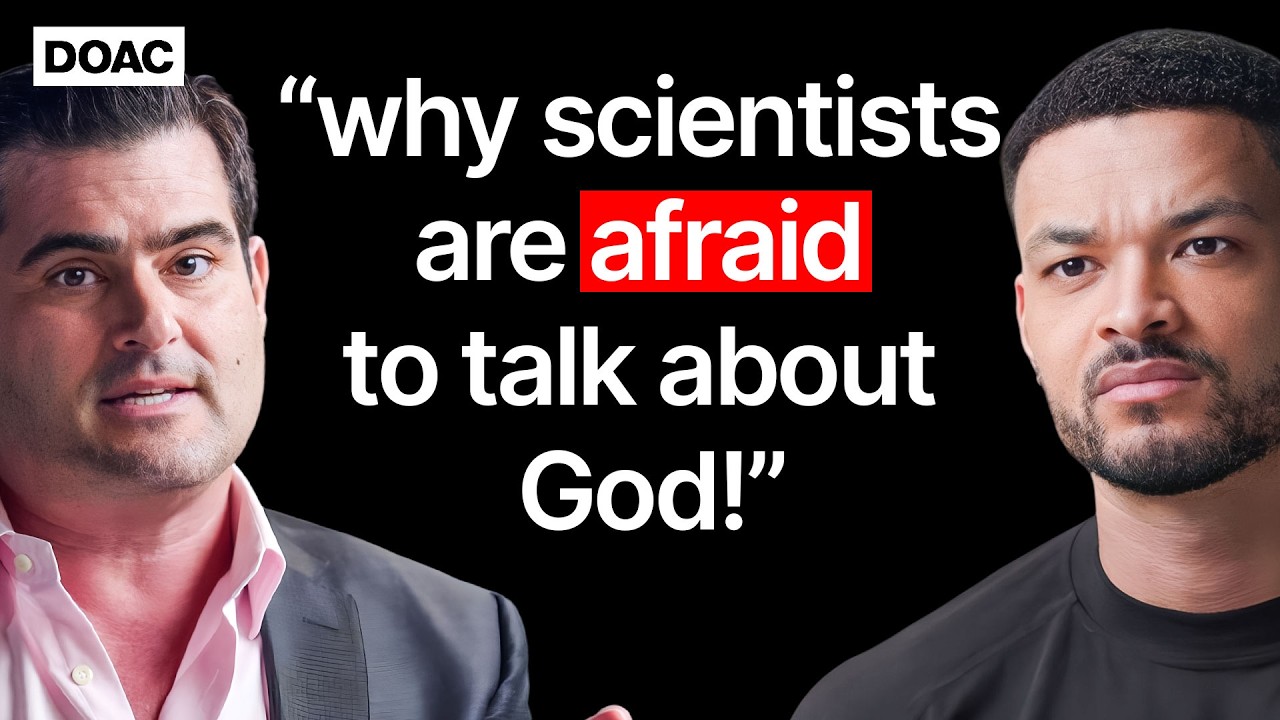
The Diary Of A CEO
Agnostic practices yield personal value while statistical odds make intelligent extraterrestrial life virtually impossible, according to cosmologist Brian Keating.
AI-assisted summary of Brian Keating: I’m Spending $200 Million To Explore Existence! How God Fits Into Science Explained! — original source. Check the original for full context.
Source published:
Detailed notes
## Background This video was published on YouTube by The Diary Of A CEO on December 2, 2024. The page description introduces Professor Brian Keating, a cosmologist and experimental physicist at UC San Diego, who discusses the origins of the universe, the intersection of God and science, extraterrestrial life, and the meaning of life.
## TL;DR Cosmologist Brian Keating joins host Stephen Bartlett to explore the cosmic origins of the universe, the $200 million Simons Observatory project, and how scientific inquiry intersects with faith and agnosticism. Keating breaks down complex scientific concepts, including the fine-tuning of physical constants, simulation theory, and the statistical improbability of intelligent alien life. Throughout the conversation, they delve into deep philosophical questions regarding morality, imposter syndrome among historical figures, and what gives human existence ultimate meaning.
## Atmosphere & style The podcast features an intellectually stimulating, grounded, and curious conversation between a reflective host and an engaging scientist. Keating balances rigorous, evidence-based physics with personal anecdotes and witty observational humor, making high-level cosmology accessible. The atmosphere feels like an intimate, contemplative dialogue that naturally transitions from cosmic awe to vulnerable reflection on purpose, family, and human humility.
## Key takeaways - [02:07](https://www.youtube.com/watch?v=LiIs5X56JMI&t=127s) Science is an infinite game focused on continuous discovery, whereas finite milestones like professorships or Nobel Prizes are just secondary checkpoints within it. - [01:08](https://www.youtube.com/watch?v=LiIs5X56JMI&t=68s) Brian Keating's initial South Pole discovery of primordial gravitational waves was retracted after realizing the signal was caused by galactic dust, leading to a new $200 million observatory project in Chile. - [04:37](https://www.youtube.com/watch?v=LiIs5X56JMI&t=277s) Keating identifies as a practicing agnostic, arguing that science deals with evidence-based knowledge while religious faith operates on belief. - [09:58](https://www.youtube.com/watch?v=LiIs5X56JMI&t=598s) Heavy elements necessary for life, such as iron in human hemoglobin, were forged inside exploding supernovas across cosmic history. - [30:41](https://www.youtube.com/watch?v=LiIs5X56JMI&t=1841s) Practical agnosticism should be reflected in behavioral actions, like moral effort and ethical commitments, rather than pure passive non-belief. - [53:37](https://www.youtube.com/watch?v=LiIs5X56JMI&t=3217s) Simulation theory remains unproven, with astrophysicists finding zero empirical evidence for space-time discretization when studying high-energy cosmic phenomena. - [01:02:31](https://www.youtube.com/watch?v=LiIs5X56JMI&t=3751s) The existence of 10^24 planets in the observable universe establishes astronomical possibility, but does not guarantee the probability of alien life or intelligence. - [01:17:34](https://www.youtube.com/watch?v=LiIs5X56JMI&t=4654s) The Rare Earth hypothesis suggests intelligent life is exceptionally rare due to the vast series of improbable cosmic, planetary, and statistical accidents required. - [01:26:14](https://www.youtube.com/watch?v=LiIs5X56JMI&t=5174s) Astrology lacks scientific backing through double-blind testing, as distant planetary gravitational forces are far too weak to influence human life. - [01:30:50](https://www.youtube.com/watch?v=LiIs5X56JMI&t=5450s) The meaning of life is found in taking on consequential bonds and responsibilities that give profound purpose to one's existence. - [01:34:00](https://www.youtube.com/watch?v=LiIs5X56JMI&t=5640s) Imposter syndrome affects even the greatest scientific minds in history, including Nobel laureates like Barry Barish, Albert Einstein, and Isaac Newton.
## Detailed walkthrough ### [00:00](https://www.youtube.com/watch?v=LiIs5X56JMI&t=0s) The Quest for the Beginning
Astrophysicist and professor Brian Keating introduces the core mission of his life's work by showcasing tangible remnants of the cosmos: the shrapnel of an exploded star and a dense meteorite dating back over 4 billion years. All of this, he explains, is to understand the fundamental question that humans have grappled with for centuries: "How did we get here and how does the question of God tie into all of this?" Keating notes that for the first time in human history, science might finally be capable of answering this existential question with hard, scientific data.
Reflecting on the history of cosmology, Keating traces this journey back 400 years to Galileo Galilei, the genius who looked through a telescope and permanently shifted human perspective by proving that Earth is not the center of the universe. To put the staggering scale of the cosmos into context, Keating explains that if the podcast table represented the galaxy, the Earth would not even be a single grain of sand. Yet, despite knowing the mind-boggling vastness of space, humanity still doesn't know exactly how it all began. Driven by this mystery, Keating previously led a high-stakes experiment at the South Pole—the very bottom of the planet—believing they had successfully discovered the creation of time and space itself.
- **Scale of the Earth:** On the scale of the galaxy, the Earth is less than a single grain of sand. - **Historic Precedent:** Galileo Galilei shifted humanity's understanding of its place in the universe 400 years ago. - **The Quest for Beginnings:** The fundamental mystery remains how the universe actually started.
[01:08](https://www.youtube.com/watch?v=LiIs5X56JMI&t=68s) The Heartbreak of Retraction and a $200 Million Resurgence
The thrill of discovery can turn to total devastation in the scientific community. Keating recalls how his South Pole experiment brought him and his team to the absolute brink of a Nobel Prize, landing them on the front page of every major newspaper worldwide. However, the initial euphoria evaporated when they realized their data was flawed. "What we saw was dust, and we were crushed," he admits. Though he tries not to get too emotional, he describes the painful necessity of having to publicly retract their monumental discoveries as the most crushing experience a scientist can endure.
Despite the profound disappointment, the drive to answer these fundamental questions keeps moving forward. Keating has since launched a massive, $200 million project to try again. This time, the experiment is yielding "exquisite" data, giving the team absolute certainty about the cosmic phenomena they are observing.
- **The Flaw in the Data:** The signal they originally believed was the dawn of the universe turned out to be space dust. - **The Cost of the New Experiment:** A $200 million project launched to pick up the search with vastly superior technology. - **Scientific Resilience:** Keating emphasizes that a scientist cannot stop doing experiments just because of a major setback.
[02:07](https://www.youtube.com/watch?v=LiIs5X56JMI&t=127s) The Ultimate Infinite Game
When asked about the personal mission he is on, Keating describes himself as "the luckiest man on earth," marveling at the fact that he gets paid to study the exact same cosmic questions that fascinated him as a "12-year-old pimple-face kid in Upstate New York." He notes that the origin of the universe is a profoundly unique mystery because it is the only event in existence for which absolutely no one was around to witness or ask questions. The universe contains everything—life, minds, consciousness, and everyday human experiences—making its origin the ultimate untold story.
Keating views science through the lens of a classic philosophical framework: the difference between finite and infinite games. Science itself is an infinite game—it has no final end state, and you can never truly "win" it. However, the journey is filled with highly competitive finite games, such as competing against hundreds of applicants for a single professorship at UC San Diego, securing tenure, or vying for a Nobel Prize. The most controversial and passionate debates within this infinite game center on whether the universe had a singular beginning, exists eternally, moves through cyclic patterns of destruction and creation, or mirrors a biblical creation narrative. Because the human mind sits in a "superposition" of having vast knowledge but few absolute answers, the true nature of the universe's origin remains an open question that can only be resolved through physical data.
- **The Childhood Dream:** Keating’s current research directly answers the questions he had at 12 years old. - **Finite vs. Infinite:** Science is an infinite game comprised of fiercely competitive finite games (like jobs, tenure, and Nobel Prizes). - **The Core Unsolved Question:** It is still not a settled fact whether the universe is eternal, cyclic, or had a definitive singular beginning.
[04:37](https://www.youtube.com/watch?v=LiIs5X56JMI&t=277s) What Happened the Tuesday Before the Big Bang?
Keating expresses a captivating, paradoxical desire: "I want to know what happened on the Tuesday before the Big Bang." He challenges the human mind to conceptualize a day before which there was literally no "yesterday." If the universe truly had a singular origin, then time itself is not just a passive background but something that came into existence at that exact moment. Defining time is notoriously difficult and highly subjective—whether we define it by what a watch measures, the graying of our hair, or the psychological relativity of sitting on a hot stove versus spending time with a beautiful girlfriend.
The intersection of science and the divine is a boundary most of Keating's colleagues actively avoid, viewing the contemplation of God as anathema or distasteful for a serious scientist. Keating, however, leans into it, describing himself as a "practicing, very devout agnostic." While he identifies as a practicing Jew, he maintains a strict boundary between faith and empirical knowledge. He points out that the word "Amen" shares its roots with the Hebrew word *emunah*, meaning faith or belief. In contrast, science translates literally to "knowledge." As Keating puts it, "I don't believe in gravity... I have evidence for it." Yet, integrating the concept of a Creator provides what he calls a luxurious, delightful "spice" to his rigorous, data-driven research.
- **The Paradox of Time:** If the universe had a definitive beginning, time itself was created at that moment, meaning there was no conceptual "before." - **The Linguistic Root of Faith:** The word *Amen* comes from the Hebrew word *emunah*, meaning faith. - **Science vs. Belief:** Science means knowledge, relying strictly on evidence rather than theological faith.
[07:53](https://www.youtube.com/watch?v=LiIs5X56JMI&t=473s) Reading the Red Shift
For nearly two millennia, the prevailing consensus among scientists was that the universe was eternal and unchanging. That baseline assumption shattered just north of Hollywood at Mount Wilson Observatory, home to a massive 100-inch diameter telescope. Using this instrument, astronomer Edwin Hubble made the revolutionary observation that every single galaxy he looked at—vast collections containing a hundred billion suns—was actively moving away from our own Milky Way Galaxy.
Hubble unlocked this discovery by tracking an effect known as "red shift," which operates on the exact same physical principles as the Doppler shift in sound. Keating illustrates this by mimicking the changing pitch of an ambulance siren: as it approaches, the sound waves compress into a higher frequency, and as it drives away, the waves stretch out into a lower frequency. With light, lower frequencies manifest as redder colors because red light has a longer wavelength than blue light. When Hubble observed that the light from distant galaxies was consistently shifted toward the red end of the spectrum, it proved they were rapidly receding.
- **Historical Stagnation:** For 2,500 years, the consensus was that the universe was static and eternal. - **Hubble's Tool:** The 100-inch telescope at Mount Wilson Observatory. - **The Scale of a Galaxy:** Each galaxy Hubble observed is a collection of roughly 100 billion suns. - **The Red Shift:** Light stretching into longer, redder wavelengths proves an object is moving away from the observer.
[09:58](https://www.youtube.com/watch?v=LiIs5X56JMI&t=598s) The Cosmic Deodorant and Our Supernova Ancestry
Joking about Hubble's puzzling discovery, Keating remarks that it seemed as though "we didn't put on our Cosmic deodorant and no one wants to be around us." The heavy implication of an expanding universe is profound: if the universe is expanding today, it means that yesterday it was smaller. By rewinding the cosmic movie backward through time, you eventually hit a mathematical singularity—a single, infinitely dense point where all the matter and energy that ever was, is, or will be was concentrated. This foundational moment is the Big Bang.
The Big Bang birthed the simplest elemental building blocks, like hydrogen, which gravity gradually compressed over billions of years to fuse into helium and progressively heavier elements inside the furnaces of ancient stars. When these massive stars exhaust their fuel, they die in violent, spectacular explosions known as supernovas. Before and during these death throes, they forge the heavy elements essential for life: calcium, oxygen, nitrogen, and iron. Echoing Carl Sagan's famous phrase, "we are star stuff," Keating highlights the deep chemical connection between human biology and dying stars. The hemoglobin molecule carrying oxygen through our veins relies on an iron atom at its core, utilizing an almost identical chemical matrix to the magnesium-centered chlorophyll found in plants. The very iron in our blood was cooked inside a exploding star billions of years ago.
- **The Singularity:** Playing the cosmic expansion backward leads to a single point containing all matter and energy. - **Star Stuff:** Heavy elements like calcium, iron, and oxygen are only created through stellar fusion and supernovas. - **Biological Matrix:** Hemoglobin in human blood is chemically structural to chlorophyll in plants, exchanging a core magnesium atom for an iron atom forged in stars.
[11:32](https://www.youtube.com/watch?v=LiIs5X56JMI&t=692s) Cosmic Relics on the Table
To ground these cosmic scales in reality, Keating displays an array of physical space specimens on the table. Among them is a pure carbon cube that looks identical to a black die, which Keating notes could be transformed into a diamond if compressed 100,000 times further, proving that "pressure is what turns dust into diamonds." He contrasts the feather-light carbon cube with a remarkably heavy, highly dense meteorite found in Namibia, which was originally discovered by indigenous populations centuries or perhaps a millennium ago. The meteorite feels impossibly heavy for its compact size because it is composed almost entirely of iron.
Keating explains the physics behind the birth of such an object: when a star attempts to fuse iron nuclei, the reaction suddenly requires more energy than it releases. Lacking the outward radiation pressure to support its own immense mass, the star catastrophically collapses under gravity and explodes. Keating demonstrates the meteorite's composition by snapping a powerful, rare-earth neodymium magnet onto it with a loud, metallic *ping*, illustrating the sheer volume of magnetic iron packed into the fragment.
<Carousel> {/* Reason: Visual demonstration of the diverse cosmic relics discussed in the text, illustrating their unique origins and compositions. */} <Image alt="A dense iron meteorite chunk displaying a dark, weathered fusion crust" caption="Namibian iron meteorite fragment" src="image_agent_tag_0"/> <Image alt="A perfectly square cube of pure carbon sitting on a reflective surface" caption="Pure carbon cube specimen" src="image_agent_tag_1"/> <Image alt="A piece of porous, dark gray volcanic rock collected from Antarctica" caption="Antarctic volcanic rock sample" src="image_agent_tag_2"/> </Carousel>
---
- **The Carbon Specimen:** A light, pure carbon cube that requires 100,000 times more pressure to become a diamond. - **The Namibian Meteorite:** A dense, ancient relic shaped curiously like a human foot, composed primarily of space-forged iron. - **Stellar Collapse:** Stars explode when they try to fuse iron, because iron fusion absorbs energy rather than producing it. - **Rare-Earth Test:** A neodymium magnet forcefully snaps onto the meteorite, proving its high iron concentration.
[15:26](https://www.youtube.com/watch?v=LiIs5X56JMI&t=926s) Catching the Smoking Gun of Creation
Returning to the overarching purpose of his $200 million endeavor, Keating uses the analogy of a gunshot. If you see a gun fired, you can witness the smoke and track the speeding bullet, but your ultimate goal is to see who actually pulled the trigger—whether it was God, Mother Nature, or a random quantum fluctuation in a vast multiverse. The goal of the project is to capture the earliest possible "baby picture" of the infant universe. Because human eyes cannot perceive the invisible microwave light carrying this ancient information, the team utilizes highly specialized sensors to look for a distinct pattern that could only exist if the universe underwent a massive, rapid rupture of spacetime known as Cosmic Inflation.
The logistics of building such an experiment required years of planning and led Keating's team to the South Pole, an extreme environment first reached by humans a mere 112 years prior. The ultimate enemy of detecting cosmic microwaves is atmospheric water vapor, which acts exactly like a domestic microwave oven by absorbing microwave energy to heat up liquid. Because the South Pole is a frozen desert with virtually zero atmospheric moisture, it provided the perfect clean window to space. Operating their custom telescope there, the team made an observation and proudly announced to the world that they had successfully captured the reverberations of the creation of time and space. The announcement was instantly heralded globally as one of the greatest scientific discoveries of all time. However, Keating hints, there was just one devastating problem.
- **The Scientific Goal:** Capturing the invisible microwave background to prove the universe underwent rapid Cosmic Inflation. - **The Enemy of Microwaves:** Atmospheric water vapor, which absorbs the precise cosmic signals the telescope is trying to detect. - **Why the South Pole:** The extreme cold locks away moisture, creating the driest, clearest atmosphere on Earth for microwave astronomy.
<ElicitationsGroup message="To continue exploring the cosmic journey:"> {/* Reason: The user is walking through a chronological narrative transcript; the natural next steps are to follow the timeline of the interview. */} <Topic label="Uncover the devastating mistake behind the South Pole experiment" query="Go to the next part of the transcript to explain the devastating problem with the South Pole discovery and what the team actually saw."/> <Topic label="Explore Brian Keating's views on the existence of God" query="Jump to the sections discussing the most compelling evidence of a God and how God ties into the universe through a scientific lens."/> </ElicitationsGroup>
[16:55](https://www.youtube.com/watch?v=LiIs5X56JMI&t=1015s) The Heartbreak of Cosmic Dust and the $200 Million Pivot
Continuing the story of searching for the primordial light of the universe, Brian Keating describes the immense psychological pressure and potential for self-deception inherent in high-stakes scientific discovery. When his team on the BICEP experiment made their initial measurements at the South Pole, they were hyper-aware that they could fool themselves into seeing what they desperately wanted to see because they knew the profound historical importance of the discovery. Despite their caution, they convinced themselves that they had detected the true "birth pangs" of the Big Bang—only to realize six months later, in early 2015, that they were wrong. What they had actually detected were trillions of tons of cosmic dust floating in our own galaxy, whose physical properties technically mimicked the exact polarization signal of the Big Bang. Keating recalls feeling utterly crushed by the realization that their historic signal was just the leftover byproduct of exploded stars.
Determined to find the true origin signal without being misled by galactic debris, Keating partnered with the late mathematician, billionaire, and legendary scientist Jim Simons. Simons assembled a scientific "dream team" that remains together to this day, funding a $200 million observatory in the high desert of Chile to achieve what BICEP could not do in Antarctica. Keating reveals that the Chilean observatory achieved "first light" just a month before Jim Simons passed away, allowing them to show him exquisite early data from the experiment. While Keating notes he cannot share the confidential data publicly yet, he emphasizes that the precision of this new observatory is unparalleled.
- **BICEP Experiment Error:** Misidentified galactic dust—the byproduct of exploded stars—for primordial gravitational waves from the Big Bang. - **Timeline of Correction:** The team formally admitted the mistake in early 2015, roughly six months after their initial announcement. - **Jim Simons Observatory:** Located in Chile (rather than the South Pole) to bypass interstellar dust interference with unprecedented instrumental precision.
---
[19:03](https://www.youtube.com/watch?v=LiIs5X56JMI&t=1143s) What Suspicions Remain About the Origin of the Universe?
When host Stephen Bartlett presses Keating on what he suspects the true origin of the universe actually is—whether it was an act of God or a cosmic reaction occurring out of nowhere—Keating explains the profound societal polarization that will occur no matter what science eventually proves. He highlights that when BICEP originally claimed to discover the Big Bang's expansion signal, the world split into two predictable, irreconcilable camps. On one side, prominent theologians and religious thinkers claimed the discovery proved God created the universe in a singular moment of creation ("Let there be light" / *Fiat Lux*). On the other side, prominent atheists like Richard Dawkins argued that a spontaneous Big Bang proved the universe originated from a meaningless quantum fluctuation with no need for a divine creator.
Keating reflects on how the human mind inherently hates ambiguity and struggles to remain neutral. He references an old Yiddish expression, "He who stands in the middle of the road gets hit by both sides of the traffic," to explain why people instinctively cleave to extreme positions on controversial issues rather than accepting uncertainty. Keating admits that his project might eventually prove a singular origin, or it might discover absolute non-detection (seeing "nothing"), which is the hardest result for the human psyche to process. For him, participating in the experiment isn't about claiming the final theological word, but rather appreciating the rare privilege of playing the game of discovery.
> "He who stands in the middle of the road gets hit by both sides of the traffic."
---
[21:35](https://www.youtube.com/watch?v=LiIs5X56JMI&t=1295s) Creation, Evolution, and the Problem of Suffering
Exploring the most compelling evidence for a higher power, Keating frames the concept of God through the Judeo-Christian view of a creator, organizer, and parental figure. He notes that while humans cannot truly emulate a divine entity, our ability to participate in the creation of human life offers a uniquely profound emotional connection to the concept of a creator—a reality felt deeply by parents, and particularly women who serve as literal vessels for new life. Bartlett counters by considering evolutionary history, noting that because single-celled organisms divided long before complex sexual reproduction evolved, human birth as we know it is a relatively recent phenomenon in the context of deep time.
``` Biological Evolution Timeline (Approximate): Single-Celled Organisms ---> Complex Reproduction ---> Homo Sapiens (~200,000 yrs ago) | | Simple Division Concept of God & Creation ```
This leads into a deeper debate over whether the natural unfolding of Darwinian evolution is itself the ultimate miracle. Keating asks which scenario is more miraculous: a God directly intervening at every step, or a God who encrypted into the initial code of nature the precise capacity for single-celled organisms to evolve over billions of years into conscious beings capable of conceptualizing their creator. However, both speakers grapple with the classic theological stumbling block: the problem of evil and unmerited suffering, such as childhood leukemia. Keating acknowledges that while determinists like Sam Harris argue Free Will is an illusion and everything is strictly pre-programmed, standard theology views chaos and randomness as necessary conditions for true human agency.
- **Human History Scale:** Anatomically modern *Homo sapiens* have existed for only about 200,000 years, meaning human conceptualization of God is very recent relative to Earth's history. - **The Problem of Evil:** The existence of childhood diseases like leukemia challenges the concept of a benevolent, all-powerful deity. - **Evolutionary Purpose:** Bartlett notes that intense feelings of love, protection, and jealousy make clear evolutionary sense for species survival, making them explainable without divine intervention.
---
[30:41](https://www.youtube.com/watch?v=LiIs5X56JMI&t=1841s) Agnosticism, Behaviorism, and God's "Common Sense"
As the conversation shifts to personal belief systems, Bartlett describes his journey from being a religious youth until age 18 to becoming an agnostic after reading thinkers like Richard Dawkins and Sam Harris. Though comfortable with scientific explanations of physical evolution, Bartlett admits that the core mystery of existence and consciousness still leaves a lingering question mark over his life. Keating challenges Bartlett's self-described agnosticism from a behavioral perspective, arguing that if someone is truly agnostic rather than an atheist, their day-to-day actions ought to reflect that openness by incorporating some religious or spiritual practices.
Keating proposes a practical "matrix" of belief versus action: whether God exists or not, how one actually *behaves* matters. He suggests that if a benevolent God does exist, that God would possess basic "common sense" and would judge individuals based on their earnest moral behavior and sincere search for truth, rather than penalizing them for accidentally picking the "wrong" specific denomination (whether Jainism, Latter-day Saints, or Hinduism). Bartlett strongly resonates with this perspective, revealing that this exact realization—that a just God wouldn't condemn good people simply for belonging to the wrong religion or asking honest questions—was what originally triggered his decision to step away from organized religion at age 18.
- **Behavioral Agnosticism:** Keating argues that true agnosticism should manifest in open-minded behavioral practices rather than living identically to a non-believing atheist. - **The "Common Sense" Deity:** The idea that a divine judge would value earnest moral effort over strict adherence to a specific religious label.
[33:23](https://www.youtube.com/watch?v=LiIs5X56JMI&t=2003s) Stephen Bartlett's Good Person Thesis & Brian Keating's Counterargument
Stephen Bartlett reflects on his shift from a childhood fear of hell to an agnostic approach to morality influenced by Richard Dawkins. He explains that if an omnipotent, omniscient God exists, such a being would possess common sense and recognize that living a good, kind, and non-harmful life should be enough to warrant entry into heaven. He describes his philosophy as a way of hedging his bets: as long as he remains a net positive on Earth, any deity worth supporting would accept that he lacked sufficient information to choose a specific religion.
``` [ Stephen's Pragmatic Approach ] Be a good person ➔ Live ethically ➔ Assume a reasonable God accepts you vs. [ Brian's Counter-Analogy ] "I want to get in shape" ➔ Eat junk food ➔ Expect metabolism to fix it ```
Brian Keating pushes back against this reasoning by offering a physical fitness analogy, pointing out that intending to be healthy while eating junk food without putting in the deliberate work rarely leads to results. Brian argues that if Stephen knew for certain that God existed, his behavior would radically change. Stephen admits that if he knew both that God existed and which specific doctrine was true, he would follow it, but without knowing which book is correct, maintaining his current lifestyle makes the most sense.
* "I basically concluded God would have common sense... as long as I live a good life and I'm not murdering people and I'm not mean to people... any God that I would want to support anyway would let me in." * "If you knew God exists, you would behave very radically differently, right?" * "If I knew for sure that he existed and a particular book and doctrine was correct, I would 100% behave in line with that book and doctrine."
[35:27](https://www.youtube.com/watch?v=LiIs5X56JMI&t=2127s) The Refracted Nature of God and the Value of Practice
Brian Keating suggests that human beings may be inherently inadequate to grasp the true nature of God, making it possible that various religious interpretations capture different angles of the same ultimate reality. As an observant Jew, Brian does not believe in Jesus's divinity, yet he respects his friend Jocko Willink's Christian faith as a meaningful path of worship. Brian rejects the rigid atheist depiction of God as an "omniscient friend in the sky" who magically prevents all suffering, arguing that divine reality is as far beyond human perception as showing a modern microwave telescope—like the BICEP or Simons Observatory setups—to a caveman living 200,000 years ago.
Brian highlights the inherent psychological and existential value of spiritual practice itself, comparing it to marriage. Even if a marriage ends in divorce, the experience changes a person and opens them up to a broader spectrum of human growth. He notes that the name *Israel* directly translates to "wrestle with God" or "fight with God," emphasizing that doubt and intellectual wrestling are fundamental to faith.
* "We are so frail, fragile, and inadequate to the task of understanding what the true nature of God is... it's like showing a microwave telescope... to Gog who lived in a cave 200,000 years ago." * "There's a value in practicing even if you don't believe, just like I say sometimes... even if you got divorced, you should still get married because it changes you." * "The word Israel, which is the central country of Judaic faith, means fight with God—it means wrestle with God."
[38:09](https://www.youtube.com/watch?v=LiIs5X56JMI&t=2289s) Evolution of Belief and Einstein's Insight
Stephen Bartlett shares how his perspective on faith has evolved over time. While he felt certain as a child that God was real and later felt equally certain in his agnosticism at age 18, he now finds himself returning to these questions with far more curiosity. He wonders if humanity's religious conditioning—picturing God as an old man with a white beard sitting in the sky—causes people to look for the wrong kind of evidence. Brian points out that Stephen's current search mirrors Albert Einstein's famous reflection on his own childhood. Einstein noted that had his father answered his early questions about light propagation with standard 19th-century answers, he might have accepted them and never developed the Theory of Relativity.
``` STEPHEN BARTLETT'S BELIEF TIMELINE
Childhood Age 18 Age 32 (Present) ┌──────────────┐ ┌─────────────┐ ┌───────────────────────┐ │ Certain God │ ───────► │ Agnostic │ ───────► │ Re-evaluating with │ │ was real │ │ & Certain │ │ maturity & questions │ └──────────────┘ └─────────────┘ └───────────────────────┘ ```
Brian expresses frustration with both scientific dogmatism and blind religious simplistic thinking. He recalls visiting children's classrooms where students attribute complex phenomena like rainbows solely to "God made it." Brian jokes that telling kids this is a form of "child abuse" because it shuts down scientific curiosity and diminishes the true complexity of physical laws. He argues that tracing physical phenomena—from water droplets and dielectric light refraction back to the Big Bang—is the proper way to explore where a higher power might fit.
* "I have more questions now than I ever have since I became agnostic at 18... I'm starting the research project again to figure out what actually is real." * "Einstein said... 'It was good I didn't ask those questions when I was five because my dad would have given me the standard answer of the 1800s... and I would have never gone on to create the Theory of Relativity.'" * "If you just say that God made it, you're A) completely ignorant about the science, but B) you're also diminishing God's power."
[41:19](https://www.youtube.com/watch?v=LiIs5X56JMI&t=2479s) Prayer, Gratitude, and the Search for Meaning
When Stephen asks whether God is a conscious force that listens to individual prayers, Brian candidly answers that he does not know, but he guarantees that the internal act of sincere reflection changes the individual. Brian describes an exercise of going alone to the Pacific Ocean to pour one's heart out, emphasizing that true transformation occurs in private isolation without digital distractions like the Waking Up meditation app. Referring to the film *Interstellar*, Brian illustrates how reaching out into the unknown—much like Murph communicating across dimensions with her father—can open a person up to receiving a connection.
``` [ Mechanical Prayer ] [ Purposeful Gratitude ] • Reciting set scripts • Acknowledging life's privileges • Expecting transactional results • Cultivating personal discipline • Superficial obligations • Connecting to the source of life ```
The conversation turns to prayer and transactional outcomes. Brian agrees with Stephen that prayer does not alter real-world statistical outcomes, pointing out that fans on both sides of a baseball game pray equally hard for their team to win. Instead, Brian frames prayer and blessings as structured practices of gratitude. In Jewish tradition, blessings are recited over food, meteor showers, and rainbows to prevent desensitization to life's wonders. Brian contends that intentional discipline elevates human experience above basic animal drives, while Stephen notes that practices like meditation and gratitude can be fully experienced without believing in a deity.
* "If you can go down to the Pacific Ocean and just be isolated and just pour yourself out for an hour, I guarantee it will change your life." * "Remember the movie Interstellar... the attribute of trying is what opened her up to that return signal, the communication that she eventually received." * "The more you express gratitude, you cannot be a happy person and be an ingrate... gratitude connects to the ultimate source." * "I can do all of those things without the need of a God, and I'll get all the benefits... so I'm trying to find where God fits in all of this."
Concrete Data Points & References
- **Scientific Instruments Mentioned:** BICEP (Background Imaging of Cosmic Extragalactic Polarization) and the Simons Observatory, used to measure cosmic microwave background radiation. - **Pop Culture & Media References:** The film *Interstellar* (directed by Christopher Nolan, starring Matthew McConaughey), Truman Show, and the *Waking Up* meditation app created by Sam Harris. - **Historical & Theoretical References:** Albert Einstein's thought experiments regarding the speed of light and the Theory of Relativity; ancient hominid timelines (~200,000 years ago). - **Biblical Figures Cited:** Sarah, Rebecca, and Rachel (matriarchs described in early scriptures dealing with infertility). - **Etymology:** The name *Israel* is derived from the Hebrew roots meaning "to wrestle/fight with God" (*Yisra* + *El*).
<FollowUp label="Want to continue with Part 4 of this transcript walkthrough?" query="Please write a detailed walkthrough for Part 4 of this transcript."/>
Here is a detailed, faithful walkthrough of this section of the interview between host Steven Bartlett and cosmologist Professor Brian Keating.
---
[48:03](https://www.youtube.com/watch?v=LiIs5X56JMI&t=2883s) Living as a Pragmatic Behaviorist vs. Finding Absolute Proof of God
Steven opens by asking whether humans invent God simply to make sense of overwhelmingly powerful emotional experiences—such as holding a newborn baby, feeling intense gratitude, or witnessing a solar eclipse or sunset—or whether God genuinely bestowed those experiences upon us.
Brian praises Steven’s thoughtful perspective, affirming that living a good life is entirely possible for an atheist. However, he reflects on how religious framework actively augments his own daily conduct. For instance, he admits he might not give 10% of his pre-tax income to charity if it were not an explicit commandment within Judaism, though he feels no shame in admitting that structure helps guide him. Brian explains that not knowing with 100% mathematical certainty that God exists—a certainty he considers impossible anyway—does not hinder him from practicing charity, belonging to a community, or raising his children with an appreciation of their history and heritage.
Steven pushes further: if Brian’s $200 million Simons Observatory project (or future lab experiments creating micro-universes from scratch, or proof of simulation theory) unequivocally proved God is not the creator, how would his life change?
``` "Because I'm a behaviorist... I really don't feel like my life would be better to act as if God doesn't exist... The benefits to my life are so substantive that I would not change my behavior." — Brian Keating ```
Brian replies that as a pragmatic behaviorist, his conduct would remain virtually unchanged. He has already run personal "experiments" by dismissing other ancient gods (like Ra or Zeus), yet the tangible psychological, familial, and social benefits of his religious practices are so substantive that he would continue them regardless.
Steven points out that this means Brian is guided primarily by behavior and its internal rewards, comparing it to his own reliance on breathwork, meditation, and fitness. When Steven notes he avoids short-term hedonism (like eating a donut that feels good for 5 seconds but ruins his gut for 12 hours), Brian challenges Steven with a hypothetical: if scientific data showed that every bench press or ab crunch reduced his lifespan by a few minutes, would Steven stop working out? Steven responds that he would willingly give up 10 years of total lifespan (dying at 90 instead of 100) to ensure high physical strength and health span during his living years.
Brian notes that Steven's choice proves his exact point: the auxiliary benefits of gratitude, structure, and moral discipline are so tangible that he would choose them every time. Brian illustrates this by sharing the emotional experience of burying his father, noting that in Judaism, caring for the deceased is considered the highest *mitzvah* (commandment) because the recipient can never repay or reciprocate the favor. Doing things strictly because they are commanded—without a transactional contract—has exposed him to selflessness he could never otherwise achieve.
* **Tithing:** Brian practices giving 10% of pre-tax income to charity as a religious commandment. * **The Workout Trade-off:** Steven explicitly states he would trade living to 100 in exchange for living to 90 with strength, fitness, and high health span. * **Highest Mitzvah:** In Jewish tradition, burying and caring for the dead is deemed the ultimate selfless act, as the deceased cannot reciprocate.
---
[53:37](https://www.youtube.com/watch?v=LiIs5X56JMI&t=3217s) Simulation Theory, Infinite Regress, and Irreducible Complexity
The conversation shifts to simulation theory. Brian attributes the modern formulation of the concept primarily to Swedish philosopher Nick Bostrom.
``` "Compute is getting so phenomenally powerful in just our recent time Horizon... compute will be effectively free and it'll be infinite, it'll be completely democratized... almost too cheap to measure." — Brian Keating ```
Bostrom’s premise relies on extrapolating compute power into the future: if technological development continues, computing capability will become essentially free, unlimited, and demonetized. Given that devices like smartphones and iPads would have looked like magical witchcraft just 80 years ago, ultra-advanced future civilizations will easily possess the computing power required to simulate entire planets, ecosystems, and conscious beings.
To explain how a brain could be tricked, Brian detours into visual physics and biology: 1. Photons (packets of light energy traveling at light speed) enter the eye and are bent by the cornea and lens. 2. They hit the retina—which neuroscientist Andrew Huberman notes is the only portion of the human brain sitting outside the cranium. 3. Photons are detected by millions of photoreceptors (cone cells for color, rod cells for light intensity) and transduced into electrical impulses. 4. These electrical signals travel down the optic nerve to the brain's neural pathways to synthesize an image.
Because perception is purely an electrochemical conversion process, one could theoretically bypass external reality by directly injecting electrical signals into the brain—similar to a hyper-advanced, direct-neural version of the Apple Vision Pro headset. Taken to its logical conclusion, we could all be "brains in a vat" receiving synthetic electrical inputs.
However, Brian points out two major philosophical and scientific flaws with simulation theory:
1. **Infinite Regress:** If we live in a simulation, someone built the master computer. But who created the simulators? And who created their creators? This logical recursion requires an ultimate "base reality" or first cause, which ends up resembling the concept of a Deity or God anyway. 2. **Complexity Theory & Discretization:** Brian contrasts *complicated* systems with *complex* ones. Building an Airbus A320 is complicated, but with instructions and parts, it can be assembled from smaller components. Earth's weather system, by contrast, is **irreducibly complex**—you cannot simplify it. To perfectly simulate Earth's weather, you would need a simulator the size of another actual planet.
Furthermore, digital computers rely on discrete binary code ($0$s and $1$s, voxels in space), whereas physical continuous phenomena (like smooth temperature gradients) require infinite computational power to render continuously without micro-jumps. Cosmologists look for signatures of computational discretization using distant astrophysical phenomena like gamma-ray bursts. To date, there is zero empirical evidence supporting simulation theory.
* **Philosophical Origin:** Simulation hypothesis formalized by Nick Bostrom. * **Retinal Anatomy:** The retina functions as an external extension of the brain, converting light into electrical signals via rod cells (intensity) and cone cells (color). * **Irreducible Complexity:** Complicated tasks (building an Airbus A320) can be broken into steps; complex dynamic systems (Earth's weather) cannot be reduced without losing fidelity. * **Observational Testing:** Astrophysicists test space-time discretization limits using high-energy gamma-ray bursts from the early universe.
---
[01:02:31](https://www.youtube.com/watch?v=LiIs5X56JMI&t=3751s) The Search for Extraterrestrial Life: Possibility vs. Probability
Steven asks point-blank whether aliens exist. Brian breaks into humor, cracking classic jokes about "Hungarians" being the true aliens, making a *Star Trek* joke about "Klingons around Uranus," and handing Steven a tongue-in-cheek gift of "Uranus Soap" to keep things clean.
Turning back to serious science, Brian emphasizes that there is currently **zero direct evidence** for extraterrestrial life. He warns against confusing astronomical scale with high probability:
``` "Possibility does not equal probability... We're talking a one with 24 zeros after it—that's how many planets there are in the observable universe... People say that means that it's got to be life in the universe. No, it doesn't mean anything." — Brian Keating ```
While astronomical observations confirm that almost every star harbors planets—yielding approximately 100 billion planets in our Milky Way galaxy and $10^{24}$ (1 septillion) planets across the observable universe—this massive number does not guarantee life elsewhere.
Brian explains that the chain of evolutionary hurdles required for non-living chemical matter to form self-replicating life (abiogenesis), transition to complex cellular structures, and eventually evolve into intelligent, technology-producing organisms may be so extraordinary that humanity could genuinely be alone in the observable cosmos.
* **Planetary Scale:** Estimated $10^{24}$ (1 septillion, or 1 followed by 24 zeros) planets exist within the observable universe. * **Milky Way Statistics:** Average of 10 planets per star across 100 billion stars in our galaxy alone. * **The Fermi Dynamic:** Huge physical numbers (possibility) do not automatically equate to a high likelihood of abiogenesis and technological intelligence (probability).
---
<ElicitationsGroup message="Where would you like to explore next?"> <Elicitation label="Explore Brian Keating's view on the Fermi Paradox" query="Summarize Brian Keating's views on the Fermi Paradox and why intelligent life might be extremely rare."/> <Elicitation label="Examine Nick Bostrom's Simulation Argument" query="Explain Nick Bostrom's Simulation Argument and the trilemma proposed in his original paper."/> </ElicitationsGroup>
[01:03:48](https://www.youtube.com/watch?v=LiIs5X56JMI&t=3828s) The Incomprehensible Scale of the Cosmos and Panspermia
Brian Keating emphasizes that there is currently "0.00% evidence that life exists beyond the earth." Addressing government whistleblowers and UFO claims like those made by Lue Elizondo, Keating clarifies that while he doesn't dismiss personal experiences, such government claims are not scientific or persuasive because they fail to address the fundamental physics of the cosmos. The universe is vastly larger than human minds can comprehend: if our solar system were scaled down to a small room, the nearest star would still be as distant as San Diego. While telescopes can see deep into space, most of what is visible dates back to an era before molecules even formed, making life there impossible. Confining the discussion to the Milky Way—the only galaxy humanity could realistically explore—illustrates these massive distances:
``` Spacecraft Travel Times & Distances: 1977 Voyager Launch ----> 1 Light Day Traveled (took ~50 years) Nearest Star (4 Light Years away) ----> ~1,200x Farther (~60,000 years) ```
The fastest probe ever launched (Voyager 1, launched in 1977) has taken roughly 50 years to travel just one light-day away from Earth, moving at the speed of light—$186,000\text{ miles per second}$ ($300,000\text{ km/sec}$). The nearest star system is four light-years away—over 1,200 times farther—meaning it would take tens of thousands of years for present technology to reach it.
Transitioning from non-living matter like hydrogen, helium, and oxygen into a functioning biological cell remains one of the greatest unsolved challenges in synthetic organic chemistry. To bypass the extreme improbability of life spontaneously generating everywhere, some scientists—starting with Sir Fred Hoyle—proposed *panspermia*, the theory that life originated on one planet and was transported to others via meteorites. To bring this concept to life, Keating presents Bartlett with a rare, $1.524\text{-gram}$ genuine meteorite chunk of Mars found in Africa. A cosmic impact on Mars shattered its surface millions of years ago, launching rock fragments into space that eventually collided with Earth. Scientists confirmed its Martian origin by matching its chemical composition directly to data sent back by NASA landers.
* **Voyager 1 Distance:** Currently about 24 light-hours away from Earth (six times the radius of the planetary solar system out to Neptune). * **The Golden Record:** Compiled under Carl Sagan, Voyager carries a gold-plated copper disc with images, recipes, music, and spoken greetings from humanity. * **Scale Analogy:** If the Milky Way galaxy ($100,000\text{ light-years}$ across) were scaled to a 2.5-meter studio table, our entire solar system out to Neptune would be smaller than half a single grain of sand. * **Cosmic Abundance:** The observable universe contains over 100 billion galaxies ("tables"), each with 100 billion stars ("grains of sand")—meaning there are more stars in the universe than every grain of sand on every beach on Earth.
---
[01:11:04](https://www.youtube.com/watch?v=LiIs5X56JMI&t=4264s) Consciousness, Probability, and UFO Claims
Faced with these staggering numbers, Bartlett admits feeling an existential shift toward believing life must exist elsewhere. Keating counters that physical size and sheer numbers do not dictate importance or high probability. For instance, a virus or bacterium is trillions of times smaller than a human, yet it can easily kill us; Jupiter is 100 times larger than Earth, but Earth is far more meaningful as a sanctuary for life. Humans remain the only known conscious beings among all species, standing distinct from even our closest primate relatives.
To illustrate how raw physical space does not guarantee life, Keating shares his experience traveling to Antarctica for the BICEP telescope experiments. Antarctica represents roughly 12% to 13% of the world's landmass, possessing vast resources, shelter, and water. Yet out of Earth's 8 billion inhabitants, its permanent indigenous human population is zero. Probability is governed by strict prerequisites, not mere possibility or available room.
When evaluating claims of alien visitations or UFO encounters—such as those investigated by Harvard astronomer Avi Loeb or recounted by fighter pilots—Keating notes that proponents often claim craft "defy the laws of physics." However, when claims invoke general relativity, space-time manipulation, or biological radiation effects, they fall within known physics and must be held to scientific testing.
* **Antarctica Expeditions:** Keating has visited Antarctica twice to conduct cosmic microwave background research with the BICEP array. * **Origin of "Podcast":** The word traces back to Apple's iPod, which itself was named after the space pods in Stanley Kubrick's *2001: A Space Odyssey*. * **Scientific Distinction:** While God is an un-testable spiritual concept, physical craft and alien technology make empirical claims that must obey or be tested against the laws of physics.
---
[01:17:34](https://www.youtube.com/watch?v=LiIs5X56JMI&t=4654s) The Rare Earth and the Extreme Improbability of Alien Life
Asked point-blank about the probability of extraterrestrial life, Keating reveals he believes the chance that humanity is alone in the universe is "very high." To demonstrate why, he pulls out physical props: a globe representing Earth, a model of the Moon, and a beach ball representing the protoplanet Theia.
Earth's existence required a series of extraordinarily precise, catastrophic, and improbable events:
1. **Planetary Accretion:** Trillions of tons of meteoritic material condensed, sinking heavy elements like iron to form Earth's magnetic core, while lighter elements (carbon, nitrogen, oxygen) created the crust and atmosphere. 2. **The Giant Impact:** A Mars-sized planet named Theia collided with the early Earth in a cosmic smash-up. 3. **Moon Formation:** The debris blasted out from this collision condensed over millions of years to form the Moon.
Without this exact collision, Earth would not possess its stable axial tilt, tides, magnetic protection, or climate stability required for complex biological evolution to take place. When all these precarious steps are factored together, the likelihood of another planet replicating these conditions becomes extraordinarily slim.
* **Theia Collision:** The impact between early Earth and the protoplanet Theia ejected massive amounts of material that eventually coalesced into the Moon. * **Proportions:** The physical Moon model used in the demonstration accurately reflects the relative size ratio between the Moon and planet Earth.
[01:19:03](https://www.youtube.com/watch?v=LiIs5X56JMI&t=4743s) Cosmic Collisions and the Formation of Earth
Brian Keating explains how the Earth and Moon came to exist in their precise configuration. The Moon sits approximately 250,000 miles away, perfectly positioned and sized to generate ocean tides four times a day—two high tides and two low tides at right angles. This sloshing motion of water around the Earth is believed to have been a necessary ingredient for life to transition from oceans onto land. Getting to where humanity is today required a sequence of extraordinary extraterrestrial events: first, a massive collision by a protoplanet (Theia) created the Earth-Moon system.
Following that initial collision, giant icebergs known as comets bombarded the young planet over millions of years, delivering the hydration and minerals that built oceans covering roughly 70% of the surface. Finally, about 65 million years ago, a massive asteroid roughly six miles across slammed into the Yucatán Peninsula near modern-day Mexico at 250,000 mph. The impact threw up a cloud of atmospheric debris, creating a global nuclear winter that choked off sunlight, killed plant life, and drove the dinosaurs to extinction. This catastrophic loss cleared the way for small, rodent-like mammals to survive, adapt, and eventually evolve into whales, bats, and human beings.
- **Distance to the Moon:** ~250,000 miles. - **Tide Cycle:** High tides occur twice daily with low tides at right angles twice daily. - **Water Coverage:** Oceans cover ~70% of Earth's surface due to comet bombardment. - **Chicxulub Asteroid Impact:** ~65 million years ago, traveling at ~250,000 mph, hitting the Yucatán Peninsula.
---
[01:22:00](https://www.youtube.com/watch?v=LiIs5X56JMI&t=4920s) Probability of Complex Life and Cosmic Safeguards
Keating emphasizes that the precise sequence of these planetary events was critical. If the asteroid had hit before water arrived, or if the giant protoplanet impact had occurred after comets supplied the oceans, the water would have boiled off, preventing life entirely. If dinosaurs had possessed an advanced space program to deflect the incoming asteroid, humans likely wouldn't exist today. Furthermore, Earth benefits from massive "bodyguards" like Jupiter—whose immense gravitational pull shields the inner solar system—and the Moon, whose cratered surface bears visible scars of massive impacts that would have otherwise devastated Earth.
When combining these distinct factors—planetary collisions, ideal water delivery, asteroid impacts, protective gas giants, and the bio-chemical origin of cellular life—the probability of each step occurring in sequence is astronomically small. Even assigning a modest 1-in-10,000 chance to just six of these variables yields a cumulative probability far smaller than the total number of planets in the observable universe. For Keating, this extreme statistical improbability suggests humanity is likely alone in the universe, a realization that underscores our profound responsibility to cherish and protect life on Earth.
- **Jupiter as a Shield:** Protects inner terrestrial planets from deadly outer-system impacts. - **Statistical Calculation:** Combining just six independent 1-in-$10,000$ ($10^{-4}$) events yields $10^{-24}$, a probability lower than the estimated ratio of life-bearing conditions to total planets. - **Philosophical Takeaway:** Rarity implies an imperative to appreciate Earth and care for human life.
---
[01:24:20](https://www.youtube.com/watch?v=LiIs5X56JMI&t=5060s) Sponsor Segment: LinkedIn Jobs & NordVPN
Host Stephen Bartlett takes a brief break to highlight two show sponsors. First, he discusses LinkedIn Jobs, pointing out that an entrepreneur's core duty is assembling a team, noting that about 80% of his own staff was hired through LinkedIn. He offers listeners a free job posting link at `[linkedin.com/doac](https://linkedin.com/doac)`.
Second, Bartlett breaks down NordVPN, sharing that while 85% of internet users know what a VPN is, only 55% understand its functionality. He explains how changing one's digital location allows access to region-restricted content—like streaming sports abroad—or saving money on flights via dynamic pricing. He points listeners to `[nordvpn.com/doac](https://nordvpn.com/doac)` for a discount and bonus months.
---
[01:26:14](https://www.youtube.com/watch?v=LiIs5X56JMI&t=5174s) Astrology vs. Religion and Human Meaning
Stephen asks whether there is any scientific basis to astrology, star signs, or horoscopes influencing personal fortunes, relationships, or financial success. Keating firmly rejects the premise, explaining that astrology fails double-blind surveys, randomized controlled trials, and direct physical modeling. Gravitational forces from distant planets like Jupiter are far too weak to affect human bodies at birth. Keating notes that apparent patterns are mere correlation rather than causation—pointing out that his own birthdate on September 9th is the most common birthday on the calendar simply because it falls nine months after the winter holiday season.
> "There's no evidence for it in the sense that you can do randomized control trials or double-blind surveys... You have to be careful not to confuse correlation with causation."
When Stephen compares astrology to religion—noting that many people build their morals, choices, and sense of purpose around astrological guidance—Keating distinguishes their underlying views of time and progress. While ancient astrological views often conceptualize time as a flat, repeating circle where each generation merely repeats the past, Western civilization and scientific thought view time as a forward-moving spiral toward progress, discovery, and human flourishing.
- **September 9th Birthdays:** Highly frequent due to conception during New Year and holiday celebrations nine months prior. - **Gestation Differences:** Environmental seasonality during pregnancy accounts for subtle behavioral variations, not planetary alignments. - **Cyclical vs. Linear Time:** Astrological cycles repeat historical patterns, whereas science relies on linear, cumulative progress.
---
[01:30:50](https://www.youtube.com/watch?v=LiIs5X56JMI&t=5450s) The Meaning of Life and Evolving Ambitions
Asked directly about the meaning of life, Keating offers a deeply personal definition: it is about building bonds and undertaking endeavors so consequential that losing them would leave you utterly devastated. For him, that meaning centers on his wife and children. Reflecting on recent world events, including the impacts of October 7th on his friends and family in Israel, Keating shares that he has cried more in the past year than ever before. Yet, he views that emotional vulnerability as a necessary counterpart to the profound joy of love and connection. He notes that while he works on his physical health to stay present as long as possible, he feels no fear of death because he has built a life filled with meaningful relationships.
> "To me, the meaning of life is to do as many things that if taken away from you would be devastating to you. That which you do should be so consequential that to not have done it or not have it would literally destroy you to your core."
When Stephen asks what gave his life meaning before having children, Keating candidly admits it was a drive to win a Nobel Prize—partly motivated by a desire to outshine his late father, who was himself a distinguished scientist. Over time, that ambition transformed. Realizing there is no one left to prove himself to, Keating now believes that life should be lived to impress oneself rather than to chase external validation.
- **Core Meaning:** Creating deep human connections and taking on high-stakes, meaningful responsibilities. - **Perspective on Mortality:** Focus on health and longevity without fear of death due to a fulfilled life. - **Shift in Drive:** Transitioned from seeking a Nobel Prize to honor/rival his father to living authentically for himself and his family.
Here is a detailed, faithful walkthrough of the transcript segment:
[01:34:00](https://www.youtube.com/watch?v=LiIs5X56JMI&t=5640s) Why the World's Greatest Minds Suffer From Imposter Syndrome
Brian Keating reflects on how his perspective on the Nobel Prize has changed over time. When he was younger, winning a Nobel Prize was not just an aspiration—it was a godlike status, far surpassing an Oscar or an Olympic gold medal. He notes that with only around 200 or so winners in history, the list of laureates is like a small, exclusive book. However, an enlightening conversation with 2017 Nobel laureate Barry Barish shifted Keating's entire view. When Keating asked Barish what advice he would give his 20-year-old self to give him the courage to go "into the impossible," Barish replied that he would tell himself to stop having imposter syndrome. Stunned, Keating asked how a Nobel Prize winner could possibly suffer from imposter syndrome.
Barish explained that when you win the Nobel Prize, you travel to Stockholm, wear a formal white tie, dine with the King of Sweden, receive a solid gold medal, and get a million dollars. Before receiving the prize money, laureates must sign a historic ledger confirming receipt of the award. Barish recalled turning back the pages of that ledger to see the signatures of Richard Feynman, Marie Curie, and Albert Einstein. Looking at those names, Barish felt he did not deserve to be in the same book—let alone the same universe—as Einstein. Keating comforted Barish by pointing out that Einstein himself suffered from imposter syndrome, viewing Isaac Newton as an unreachable hero who did more for science and Western civilization than anyone before or since. Keating then took it a step further: Newton felt entirely unworthy of his own hero, Jesus Christ, and attempted a feat he felt equaled Christ's struggle—dying a virgin. Keating concludes that imposter syndrome is entirely normal and warns against turning awards or human figures into idols, noting that he would choose time at home with his family for Shabbat over any golden medal.
* Only about 200 people have ever won the Nobel Prize in Physics. * Barry Barish wrote the foreword to Brian Keating's second book, *Into the Impossible*. * Nobel Prize winners sign an official registry in Stockholm to confirm receipt of their award and prize money. * Isaac Newton invented calculus, discovered the laws of universal gravitation, laid down principles of optics, and invented the reflecting telescope.
[01:37:34](https://www.youtube.com/watch?v=LiIs5X56JMI&t=5854s) The Legacy of Content and the Duty of the Creator
Stephen Bartlett relates to the discussion on imposter syndrome, confessing that he feels it every single day. When hosts introduce him as an elite interviewer or podcaster, he finds it completely surreal because he never went to school for interviewing; he simply started asking people questions in his kitchen, and an audience grew. Keating reassures Stephen that his unique interviewing style is an elite, non-replicable talent, comparing Stephen's level of impact to a "Nobel Prize level" in his own field. Keating shares that he modeled the energetic, "hype" openings of his own podcast, *Into the Impossible*, after Stephen’s show.
Keating references Carl Sagan, who once marvelled at how books allow a long-dead author to speak directly into a reader's mind across centuries. Today, through podcasting and digital media, creators communicate directly into millions of ears across generations. Keating points out that Stephen's children and future grandchildren will be able to hear and see his work viscerally. Stephen admits that thinking about his content lasting across generations is mind-bending and slightly "creeps him out." They discuss how media has shifted, noting how podcasts played a central role in recent political elections. Keating emphasizes that he does not run his podcast for money or as a primary career, but as a passion project to give back to young people, just as Carl Sagan and Isaac Asimov inspired him through their books when he was young.
* Keating launched his podcast during the 2020 COVID lockdowns to give scientist friends and Nobel laureates a platform when book tours were canceled. * Carl Sagan described a book as proof that humans are capable of working magic by communicating across ages.
[01:40:56](https://www.youtube.com/watch?v=LiIs5X56JMI&t=6056s) The Driven Mind: Constantly Experimenting vs. Seeking Peace
Stephen questions how a creator should adjust their approach knowing that their work will endure for generations. His immediate instinct is to simply "crack on" and avoid overthinking it, warning that obsessing over legacy can ruin the raw essence of what makes content special. Keating agrees, observing that Stephen is already handling it naturally through continuous experimentation. Keating explains that in science, experimentation stems from being fundamentally dissatisfied with the status quo, even when a project is hugely successful. He teaches his students that there is no such thing as a "failed experiment" because every result teaches a lesson that brings one closer to the truth.
Turning the tables, Keating asks Stephen a question he previously put to podcasters Joe Rogan and Lex Fridman, drawing on an allegory from George Orwell's *Animal Farm*. In the story, a pig admires a donkey's long tail, saying it must be wonderful for swatting away flies, but the donkey replies that he would rather not have the flies in the first place. Keating asks Stephen if he would ever trade his fame, attention, and lack of privacy for a quiet, private life. Stephen responds that whenever he imagines stripping away the downside (the "flies"), the downsides turn out to be inextricably glued to the upsides.
Stephen shares a mental scenario he recently played out: if he were truly optimizing for peace, he could delete his podcasts, quit *Dragons' Den*, erase his social media, and move to Bali with his savings. However, he realized that within weeks of relaxing in Bali, he would naturally start writing, making videos about his writing, painting, and sharing his creations. Eventually, he would build a new brand and find himself right back where he started. Keating validates this, noting that humans are driven by their inherent gifts and curiosity. Quoting Sigmund Freud, Keating notes that life ultimately comes down to two things: work and love.
* Keating cites the conversation between Benjamin the donkey and the pig in George Orwell's *Animal Farm* to illustrate the trade-offs of fame. * Sigmund Freud's simple framework for a fulfilling life: "Work and love."
[01:44:08](https://www.youtube.com/watch?v=LiIs5X56JMI&t=6248s) The Final Question: A 10-Minute Warning for the End of the World
Stephen introduces the signature closing tradition of *The Diary Of A CEO*, where the preceding guest leaves a hidden question for the next guest. The question left for Keating is: *"If you found out that the world was ending in 10 minutes, who would you want to speak to and what would you tell them?"*
Keating answers without hesitation: after jokingly threatening to call his friends at NASA to redirect a giant space laser, he answers that he would call his wife. He reflects on the incredible improbability of how they met. Years ago, Keating was fired from his job at Stanford University—a devastating blow at the time that felt like a total failure. However, his wife was actually an undergraduate student at Stanford at the exact same time, living merely 100 feet away from him. Because Keating is eight and a half years older, they never interacted then. Getting fired forced him to leave Stanford and eventually move to San Diego to work on the BICEP experiment at the South Pole. San Diego happened to be his future wife's hometown, which is where they eventually met and built a family.
Had Keating not been fired, he would never have pursued his own laboratory, become his own "CEO," met his wife, or had his children. If the world were ending in ten minutes, Keating states he would call his wife to reminisce about their meeting, celebrate the life and children they brought into the world, and laugh and cry together.
Stephen expresses deep gratitude for the conversation, praising Keating’s rare ability to translate complex scientific concepts into inspiring, accessible ideas. Stephen compares Keating's communication talent to that of Neil deGrasse Tyson, noting that such a mix of elite scientific intellect and brilliant communication skills is as exceptionally rare as a cosmic collision.
* Keating was fired from Stanford University early in his career, which unexpectedly led him to San Diego. * His move to San Diego enabled his work on the BICEP (Background Imaging of Cosmic Extragalactic Polarization) experiment at the South Pole. * Keating gifted Stephen a piece of Mars meteorite and a custom piece of "Uranus soap."
<FollowUp label="Want me to break down how the BICEP experiment at the South Pole attempted to measure the birth of the universe?" query="Explain how the BICEP experiment at the South Pole worked and what it was trying to discover about the origin of the universe."/>
[01:48:09](https://www.youtube.com/watch?v=LiIs5X56JMI&t=6489s) Concluding Remarks and The 1% Diary Promo
Brian Keating and host Stephen Bartlett wrap up the interview, exchanging genuine gratitude for the conversation, with Keating expressing that it has been an absolute honor to be on the show. Stephen then transitions into a promotional closing segment introducing his custom productivity tool, "The 1% Diary."
Reflecting on personal philosophy, Stephen challenges popular wisdom by rejecting the idea that one shouldn't "sweat the small stuff." Instead, he argues that paying attention to small details is crucial because tasks that are simple to perform are equally effortless to neglect—whether saving a single dollar, brushing one's teeth, or making incremental self-improvements. The product was developed over two years to leverage the power of compounding small choices, offering interactive exercises, motivation, and imagery designed to help users build long-term consistency rather than chasing quick, drastic transformations.
- Stephen Bartlett emphasizes that "small things that are easy to do are also easy not to do." - The design process for "The 1% Diary" spanned two years prior to its limited-run release. - Viewers are directed to `thediary.com` to purchase copies for themselves or as gifts.
## Notable quotes > [01:08](https://www.youtube.com/watch?v=LiIs5X56JMI&t=68s) What we saw was dust, and we were crushed — Brian Keating
> [04:37](https://www.youtube.com/watch?v=LiIs5X56JMI&t=277s) I want to know what happened on the Tuesday before the Big Bang. — Brian Keating
> [04:37](https://www.youtube.com/watch?v=LiIs5X56JMI&t=277s) I don't believe in gravity... I have evidence for it. — Brian Keating
> [19:03](https://www.youtube.com/watch?v=LiIs5X56JMI&t=1143s) He who stands in the middle of the road gets hit by both sides of the traffic. — Brian Keating
> [33:23](https://www.youtube.com/watch?v=LiIs5X56JMI&t=2003s) I basically concluded God would have common sense... as long as I live a good life and I'm not murdering people and I'm not mean to people... any God that I would want to support anyway would let me in. — Stephen Bartlett
> [33:23](https://www.youtube.com/watch?v=LiIs5X56JMI&t=2003s) If you knew God exists, you would behave very radically differently, right? — Brian Keating
> [35:27](https://www.youtube.com/watch?v=LiIs5X56JMI&t=2127s) The word Israel, which is the central country of Judaic faith, means fight with God—it means wrestle with God. — Brian Keating
> [48:03](https://www.youtube.com/watch?v=LiIs5X56JMI&t=2883s) Because I'm a behaviorist... I really don't feel like my life would be better to act as if God doesn't exist... The benefits to my life are so substantive that I would not change my behavior. — Brian Keating
> [53:37](https://www.youtube.com/watch?v=LiIs5X56JMI&t=3217s) Compute is getting so phenomenally powerful in just our recent time Horizon... compute will be effectively free and it'll be infinite, it'll be completely democratized... almost too cheap to measure. — Brian Keating
> [01:02:31](https://www.youtube.com/watch?v=LiIs5X56JMI&t=3751s) Possibility does not equal probability... We're talking a one with 24 zeros after it—that's how many planets there are in the observable universe... People say that means that it's got to be life in the universe. No, it doesn't mean anything. — Brian Keating
> [01:26:14](https://www.youtube.com/watch?v=LiIs5X56JMI&t=5174s) There's no evidence for it in the sense that you can do randomized control trials or double-blind surveys... You have to be careful not to confuse correlation with causation. — Brian Keating
> [01:30:50](https://www.youtube.com/watch?v=LiIs5X56JMI&t=5450s) To me, the meaning of life is to do as many things that if taken away from you would be devastating to you. That which you do should be so consequential that to not have done it or not have it would literally destroy you to your core. — Brian Keating
> [01:40:56](https://www.youtube.com/watch?v=LiIs5X56JMI&t=6056s) Work and love. — Brian Keating
> [01:44:08](https://www.youtube.com/watch?v=LiIs5X56JMI&t=6248s) If you found out that the world was ending in 10 minutes, who would you want to speak to and what would you tell them? — Stephen Bartlett
> [01:48:09](https://www.youtube.com/watch?v=LiIs5X56JMI&t=6489s) small things that are easy to do are also easy not to do — Stephen Bartlett
## Mentioned Brian Keating, Galileo Galilei, South Pole, Edwin Hubble, Mount Wilson Observatory, Milky Way Galaxy, Carl Sagan, Namibia, BICEP, Jim Simons, Chile, Stephen Bartlett, Richard Dawkins, Sam Harris, Jocko Willink, Albert Einstein, Interstellar, Nick Bostrom, Andrew Huberman, Apple Vision Pro, Airbus A320, Voyager 1, Sir Fred Hoyle, Lue Elizondo, Avi Loeb, Stanley Kubrick, Simons Observatory, Theia, LinkedIn Jobs, NordVPN, Barry Barish, Richard Feynman, Marie Curie, Isaac Newton, Isaac Asimov, Joe Rogan, Lex Fridman, George Orwell, Animal Farm, Sigmund Freud, Stanford University, Neil deGrasse Tyson, The 1% Diary, Dragons' Den, NASA
[Source](https://www.youtube.com/watch?v=LiIs5X56JMI)