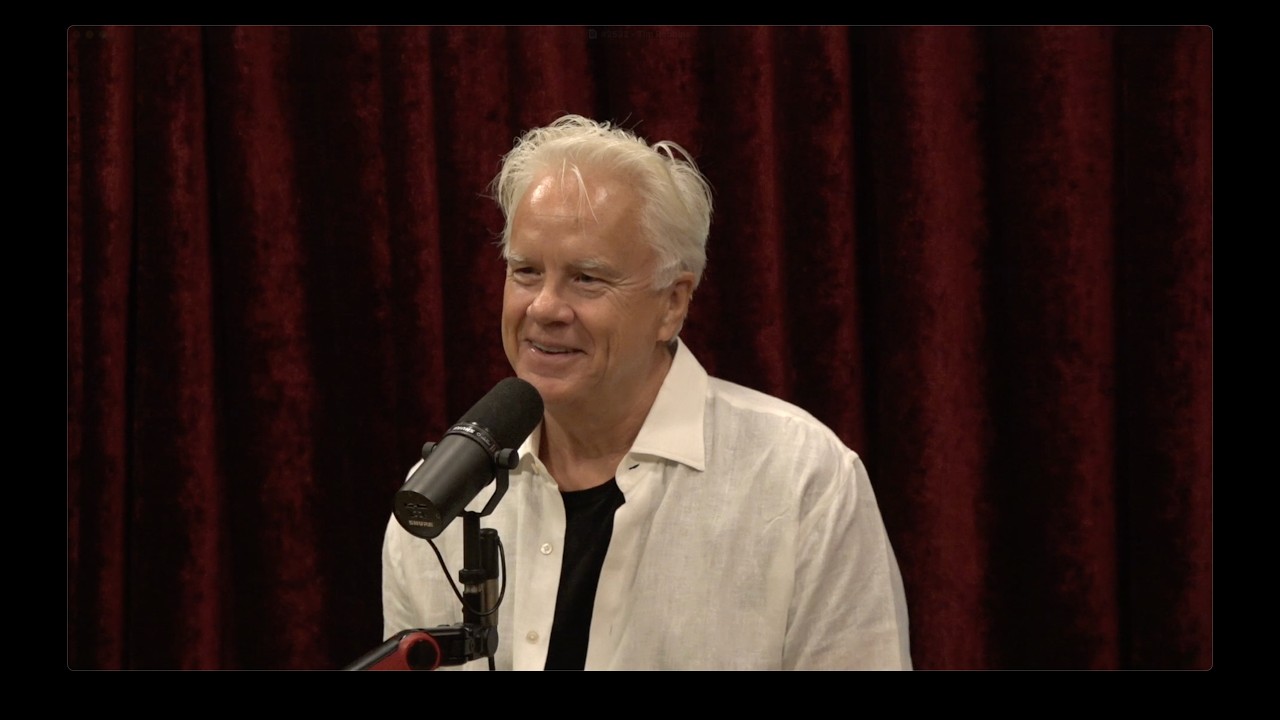
Actor Tim Robbins Outlines Prison Rehabilitation Success, AI Threats to Hollywood
PowerfulJRE
Robbins contends that human-driven storytelling and physical theater, rather than automated tools and digital isolation, foster true artistic value and social connection.
## Background
This episode of the Joe Rogan Experience was published by PowerfulJRE on YouTube on July 29, 2026. The video features Academy Award-winning actor, director, writer, and producer Tim Robbins, who is known for films like "The Shawshank Redemption" and stars in the Apple TV+ series "Silo."
## TL;DR
Tim Robbins and Joe Rogan reflect on the power of arts programs in maximum-security prisons, the evolution of stand-up comedy as philosophy, and personal behind-the-scenes stories from classic films like Howard the Duck and The Shawshank Redemption. They explore the decline of human-curated media in favor of algorithms, the creative threat of AI in Hollywood, and the importance of practical effects over modern CGI. Robbins also opens up about deep personal experiences, including his mother's holistic health journey, an Ayahuasca retreat, and practical ways to stay grounded through gardening, fasting, and unplugging from social media.
## Atmosphere & style
The conversation carries a warm, candid, and reflective mood, blending creative storytelling with deep personal philosophy. Rogan serves as an engaged, respectful host, giving Robbins space to transition seamlessly from hilarious film anecdotes to profound reflections on grief, mortality, and human connection. It feels intimate, grounded, and intensely genuine, offering listeners a contemplative journey through the highs and lows of art and life.
## Key takeaways
- [50:07](https://www.youtube.com/watch?v=ur_-7JONZlY&t=3007s) The Actors' Gang prison program uses Commedia dell'arte and physical improv in maximum-security facilities to help inmates break reactive cycles of anger and collaborate across rival gang and racial boundaries.
- [55:07](https://www.youtube.com/watch?v=ur_-7JONZlY&t=3307s) Stand-up comedy serves as a modern form of philosophy where performers like George Carlin and Bill Hicks challenge and shatter the audience's established worldviews.
- [01:01:25](https://www.youtube.com/watch?v=ur_-7JONZlY&t=3685s) Tim Robbins is completing a documentary featuring WWII veterans turned authors—Gore Vidal, Kurt Vonnegut, Norman Mailer, and Howard Zinn—while uncovering decades of unreleased material in his personal vault.
- [01:07:21](https://www.youtube.com/watch?v=ur_-7JONZlY&t=4041s) Early practical animatronics and imperfections in physical props provided a tactile realism that modern, overly polished CGI often lacks.
- [01:13:03](https://www.youtube.com/watch?v=ur_-7JONZlY&t=4383s) Analog formats such as vinyl records and cassette tapes offer a depth and warmth of sound that heavily compressed modern digital audio files fail to capture.
- [01:17:28](https://www.youtube.com/watch?v=ur_-7JONZlY&t=4648s) The shift from human curation in record shops and bookstores to automated algorithms has eliminated essential personal recommendations and discovery in media.
- [01:20:54](https://www.youtube.com/watch?v=ur_-7JONZlY&t=4854s) Despite initial box office struggles and title confusion in 1994, *The Shawshank Redemption* achieved legendary status through home video, television broadcasts, and long-term audience appreciation.
- [01:24:34](https://www.youtube.com/watch?v=ur_-7JONZlY&t=5074s) As feature film budgets shifted heavily toward superhero blockbusters, complex adult character storytelling transitioned into long-form seasonal television on streaming platforms.
- [01:29:34](https://www.youtube.com/watch?v=ur_-7JONZlY&t=5374s) Generative AI poses a significant threat to creative integrity in film, prompting proposals for human-created film certifications like an 'AI-Free' seal.
- [01:33:45](https://www.youtube.com/watch?v=ur_-7JONZlY&t=5625s) Independent film financing increasingly forces filmmakers to pre-sell foreign rights to mitigate risk, leaving little room for artistic experimentation without studio support.
- [01:47:07](https://www.youtube.com/watch?v=ur_-7JONZlY&t=6427s) Acting evolved from ancient outdoor amphitheaters requiring speech projection to early silent films and the naturalistic, subtext-driven method acting pioneered by Marlon Brando.
- [02:05:33](https://www.youtube.com/watch?v=ur_-7JONZlY&t=7533s) Holistic health approaches, dietary changes, and natural cleanses can serve as powerful alternatives to chemical treatments and medical malpractice.
- [02:09:47](https://www.youtube.com/watch?v=ur_-7JONZlY&t=7787s) Ayahuasca and spiritual experiences can offer deep emotional healing, personal absolution, and reconnections with departed family members.
- [02:14:21](https://www.youtube.com/watch?v=ur_-7JONZlY&t=8061s) The electromagnetic field generated by the human heart plays an essential role in biological bonding, underscoring why solitary confinement and forced isolation act as severe psychological torture.
- [02:16:24](https://www.youtube.com/watch?v=ur_-7JONZlY&t=8184s) Epicurean philosophy, as articulated by Lucretius, reminds individuals that life is built from transient atomic interactions and that happiness stems from seeking natural pleasures while minimizing self-inflicted harm.
- [02:20:19](https://www.youtube.com/watch?v=ur_-7JONZlY&t=8419s) True emotional maturity requires individuals to move past transactional relationships and learn how to receive unconditional care and love from others.
- [02:24:11](https://www.youtube.com/watch?v=ur_-7JONZlY&t=8651s) Unplugging from algorithmic outrage and social media toxicity is vital for mental health, as genuine community and real-world connection actively combat the crisis of chronic loneliness.
## Detailed walkthrough
### [00:01](https://www.youtube.com/watch?v=ur_-7JONZlY&t=1s) The Legacy of *The Shawshank Redemption* and Stephen King’s Mind
The episode kicks off with host Joe Rogan revealing how excited his producer, Young Jamie, was to meet guest Tim Robbins. Jamie considers *The Shawshank Redemption* his all-time favorite movie. Robbins expresses deep gratitude for the enduring love the film receives, noting that when fans approach him about it, the sentiment usually comes from a "pretty deep place." Rogan concurs, remarking that if someone doesn't like *Shawshank*, "there's something wrong with you."
They discuss Stephen King, the author of the original novella, marveling at his incredible prolixity and range. Rogan brings up King’s use of the pseudonym Richard Bachman, which he adopted because publishers wouldn't allow him to release as many books as he was churning out under his own name. Robbins recalls meeting King only once, around the time of the film's premiere.
Rogan reflects on King’s early career, which was notoriously fueled by heavy cocaine and alcohol use—to the point where King famously wrote entire classic novels that he barely remembers penning. Rogan highlights the story of how King’s wife, Tabitha, rescued the manuscript for *Carrie* (and nearly *Cujo*) out of the trash after King threw it away thinking it was terrible. Robbins mentions how reading *The Shining* as a young man working a nine-to-five job woke him up to the immense possibilities of creative writing.
* **Novella Origins:** Both *The Shawshank Redemption* (*Rita Hayworth and Shawshank Redemption*) and *Stand by Me* (*The Body*) were published in the same 1982 Stephen King collection, *Different Seasons*.
* **King on Kubrick's *The Shining*:** Rogan and Robbins chat about how Stephen King famously disliked Stanley Kubrick’s film adaptation because he felt Jack Nicholson’s character was unhinged right from the start, whereas the book portrayed a much slower rollout of his descent and possession by the hotel.
* **Humanity in Madness:** Robbins notes that despite the dark, insane nature of King’s stories—from demonic possession to *'Salem's Lot*—there is always a subtle tenderness and "great humanity" underneath, such as a prison library becoming the vehicle for ultimate liberation in *Shawshank*.
---
[04:24](https://www.youtube.com/watch?v=ur_-7JONZlY&t=264s) Distopian Echoes: *Silo* and the Ancient Underground City of Derinkuyu
The conversation turns to Robbins’ Apple TV+ sci-fi series *Silo*. Although Rogan was late to the party, he was instantly hooked by the first few episodes, praising its original, thought-provoking premise. Rogan compares the concept of thousands of humans living in a giant subterranean bunker to Derinkuyu, a massive ancient underground city in Cappadocia, Turkey.
Derinkuyu was rediscovered purely by accident in 1963 when a local homeowner knocked down a basement wall while chasing a missing chicken and discovered a hidden room leading to a vast subterranean complex. The city descends 18 levels (about 85 meters or 280 feet) deep into the earth and is estimated to have held around 20,000 people along with livestock, wine presses, oil presses, chapels, and schools.
> "I was in the middle of lockdown when I received those scripts and I was like, 'Oh, this is actually talking about right now.' This is about a controlled society where information is censored and where compliance is necessary, and if you don't comply, you get sent out into the hostile environment." — Tim Robbins
* **Derinkuyu Details:** Features massive half-ton circular stone doors designed to be rolled shut and locked solely from the inside, indicating the inhabitants were protecting themselves from severe external threats—whether hostile armies or environmental disasters.
* **Archaeological Mystery:** Rogan explains that organic materials inside ancient sites can be carbon dated, but that dates the artifacts rather than the structure itself, leaving the exact origins of Derinkuyu unclear. He speculates it may have been built during cataclysmic periods like the Younger Dryas (around 11,800 years ago) when comet/asteroid impacts forced human populations underground to survive.
* **Contemporary Resonance:** Robbins highlights how reading the *Silo* script during the COVID-19 lockdowns felt intensely metaphorical, reflecting a claustrophobic society governed by strict compliance and censorship.
---
[09:08](https://www.youtube.com/watch?v=ur_-7JONZlY&t=548s) Turning Down Millions and "Oligarchical Cinema"
Rogan asks Robbins how he has managed to maintain such a remarkably consistent and high-quality film career. Robbins attributes his longevity to having the discipline to say "no" at pivotal moments, even when facing financial pressure.
He shares a story from early in his career when he was broke and had just had his first child. He was offered $1 million to star in a silly comedy called *Folks!*. While in Los Angeles considering the offer, he sat down with veteran actor Alan Arkin, who was slated to play his father. Arkin bluntly asked him, "What the fuck are you doing this script for?" When Robbins admitted he needed the money, Arkin's hesitation confirmed Robbins' own gut feeling. Robbins turned down the million-dollar paycheck and held out for director Robert Altman's *The Player*, a decision that completely transformed his career trajectory.
Robbins goes on to outline a bizarre trend he noticed later in his career, which he calls "oligarchical cinema"—wealthy elites, corrupt institutions, or intelligence agencies funding polished feature films to rehabilitate their public image:
* **The CIA Chief:** Over a seven-month stretch around 10–15 years ago, Robbins was offered the role of the Director of the CIA in three different projects.
* **The Head of FIFA:** He was offered a lucrative role playing the head of FIFA in a film produced directly by FIFA itself, portraying the notoriously corrupt soccer governing body as benevolent heroes.
* **The Chilean Mining Company:** He was offered a role playing the executive of the Chilean mining operation after the 2010 mine collapse, with a script that whitewashed management negligence.
---
[13:08](https://www.youtube.com/watch?v=ur_-7JONZlY&t=788s) Media Narratives, Iran-Contra, and Independent Journalism
Robbins and Rogan discuss how public depictions of intelligence agencies and political power structures have shifted over time. In contrast to 1970s paranoia thrillers like *Three Days of the Condor* that questioned government power, modern media often portrays rogue CIA agents as virtuous heroes doing bad things for the greater good.
This leads them to recall the Iran-Contra scandal of the 1980s involving Lieutenant Colonel Oliver North, Ronald Reagan, and the illegal sale of weapons to Iran to fund Contra rebels in Nicaragua—a period that also saw drugs trafficked into American cities to fund covert operations. Robbins fondly recalls a joke by Boston comedian Jimmy Tingle mocking Reagan's memory lapses: *"Mr. President, did you ever sell arms to people who hate us? Put a Post-it on your refrigerator: 'Today I sold arms to Iran.'"*
Robbins points out the absurd cycle of accountability in politics and war: during the Iraq War, individuals who got every major intelligence assessment completely wrong were routinely rewarded with promotions, media contracts, and think-tank positions. Rogan notes that Oliver North himself eventually transitioned into a respected, high-profile military analyst on Fox News.
They close this section reflecting on how the current era is unique because decentralized platforms (Substack, X, podcasts, YouTube) allow independent journalists outside legacy corporate media to investigate and expose the historical overlap between intelligence agencies and mainstream media narratives.
[16:25](https://www.youtube.com/watch?v=ur_-7JONZlY&t=985s) The Mechanics of Public Backlash and the Iraq War
Tim Robbins and Joe Rogan begin by reflecting on how public figures face swift, organized backlash when challenging official narratives, often with zero apologies given later when those dissenters are proven right. Robbins recalls his own experience in 2003 as one of only a handful of high-profile celebrities to actively oppose the impending U.S. invasion of Iraq. After giving speeches and television interviews criticizing the war, his scheduled appearance celebrating the 15th anniversary of *Bull Durham* at the National Baseball Hall of Fame was abruptly canceled by its president, Dale Petrosky.
Robbins describes hiring a crisis PR strategist for the first time in his career to push back against claims that he was an anti-American traitor. The publicist strategically sent Robbins' response letter directly to sports journalists, who subsequently wrote articles defending Robbins' right to free speech. Around the same time, Robbins wrote and staged a satirical anti-war play titled *Embedded*. When the production moved to the Public Theater in New York and later toured London, it faced aggressive attacks from non-theater critics—including an article in *The New Republic* that labeled him a conspiracy theorist and anti-Semite without basis—in a calculated attempt to discredit the work before previews even ended.
- **Key Figure**: Dale Petrosky, then-head of the Baseball Hall of Fame who canceled the *Bull Durham* event.
- **Key Project**: *Embedded*, a play Robbins wrote in response to the war that debuted three weeks after President Bush's "Mission Accomplished" speech on an aircraft carrier.
- **Media Tactic**: Discrediting dissenters by attaching extreme labels regardless of whether they match the actual content.
---
[20:16](https://www.youtube.com/watch?v=ur_-7JONZlY&t=1216s) Reading Between the Lines and the Rhetoric of Division
Robbins explains that his opposition to the Iraq War stemmed from reading European and foreign press, which provided much more transparent reporting on the lack of actual evidence for weapons of mass destruction (WMD). He notes that when criticizing official policy yields a disproportionately vicious media attack, it acts like a "poker tell," signaling that the criticism is hitting directly over the target. Comparing the 1991 Gulf War to the 2003 invasion, Robbins points out that while the George H.W. Bush administration publicly acknowledged a citizen's democratic right to disagree, the George W. Bush era media landscape immediately vilified opponents as terrorist sympathizers and Saddam Hussein supporters.
Rogan notes how surreal it is looking back from 2026, where it is universally accepted as a historical fact that there were no WMDs and that the war was a tragic mistake. However, Robbins highlights that the goal of media-driven intimidation isn't necessarily to reflect genuine public opinion, but to scare others into silence. Robbins shares that despite media hostility in 2003, walking his kids to school in New York City or taking them to the NCAA Final Four in San Antonio yielded zero hostility from everyday Americans—only encouragement or polite respect for his right to speak out.
> "The reality on the ground was a lot different than the reality they were creating. The reality they were creating was to intimidate other people into silence."
---
[23:25](https://www.youtube.com/watch?v=ur_-7JONZlY&t=1405s) Media Narratives, Ivermectin, and Organized Propaganda
Robbins draws a direct line between the playbook used during the 2003 Iraq War and the media strategy during the COVID-19 pandemic, where questioning the consensus resulted in immediate deplatforming and marginalization. Robbins recalls catching COVID-19 early on, taking Ivermectin, and regaining his lost sense of smell within 24 hours, noting that in a medical emergency, exploring existing treatments makes practical sense. Rogan criticizes the media's deliberate characterization of Ivermectin as merely a "horse dewormer" or "veterinary drug," ignoring its well-documented human usage.
Rogan cites a infamous *Rolling Stone* article that claimed gunshot victims in Oklahoma were lined up outside emergency rooms because hospitals were overflowing with people overdosing on Ivermectin. The story was accompanied by a photograph of people standing in line wearing heavy winter coats—revealed later to be an old picture of people waiting for routine flu shots. Both hosts view these coordinated campaigns not merely as missteps, but as organized propaganda backed by massive funding designed to keep the populace divided, paranoid, and fighting amongst themselves rather than finding common ground.
- **Historical Medical Facts**: Ivermectin was awarded a Nobel Prize for human application and is on the World Health Organization’s List of Essential Medicines.
- **Propaganda Example**: The retracted *Rolling Stone* Oklahoma ER story using mismatched winter-coat photos to allege mass Ivermectin toxicity.
- **Core Tactic**: Orchestrated public panics used historically to maintain institutional power by fracturing public solidarity.
---
[26:46](https://www.youtube.com/watch?v=ur_-7JONZlY&t=1606s) Social Media Manipulation, Bots, and Mass Formation
The conversation shifts to modern mechanisms of public division, specifically how governments and private entities utilize armies of social media bots, fake accounts, and automated AI tools to engineer artificial outrage. Robbins shares an anecdote from his time in London during the COVID lockdowns: walking past a street protest near his hotel, he put on a mask and went to observe it firsthand. Though major news outlets depicted the crowd as right-wing National Front extremists, Robbins personally spoke with the protesters and found they were largely hippies, homeopaths, and free-speech advocates. When he tweeted that the protest wasn't a traditional "left vs. right" issue, his account was immediately inundated with hundreds of aggressive attacks from online accounts.
Rogan refers to this phenomenon as "mass formation psychosis"—a term popularized during the pandemic by Dr. Robert Malone—describing how fearful populations collectively adopt irrational behaviors, enforce state or corporate mandates on their peers, and form protective group identities. Robbins notes that while many people fall into fear-based behavior with good intentions, it ultimately stifles real dialogue and creates an environment where nuance is destroyed.
- **Disinformation Tools**: Automated right/left AI bots programmed to attack dissenting posts and manipulate online sentiment.
- **Eyewitness Reality**: London anti-lockdown protests labeled as "far-right" by media were actually composed of diverse alternative groups.
- **Psychological Phenomenon**: Mass formation psychosis driving citizens to police one another to gain a sense of control during crises.
---
[29:51](https://www.youtube.com/watch?v=ur_-7JONZlY&t=1791s) The Fallibility of Experts and the Need for Open Questioning
Reflecting on his life experiences, Robbins shares that true personal liberation comes from the willingness to say "I don't know" and "I may have been wrong." He expresses deep skepticism toward self-proclaimed "virtuous experts," arguing that once an individual views themselves as an absolute authority, they stop learning, listening, and challenging their own assumptions. He notes that blindly trusting institutional experts has repeatedly led society into catastrophic outcomes, from false intelligence regarding weapons of mass destruction to flawed domestic policies.
Rogan agrees with the necessity of specialized knowledge for technical fields—such as particle physics at the Large Hadron Collider—but warns against transforming "science" into an unquestionable dogma. He calls out Anthony Fauci’s famous declaration that "criticizing me is criticizing science" as a dangerous shift away from the scientific method, which relies entirely on continuously testing data, re-evaluating hypotheses, and encouraging open debate. Rogan points out that even credentialed epidemiologists and professors from top institutions like Harvard and MIT were censored or deplatformed simply for questioning the long-term impacts of broad lockdowns on children.
> "Science is supposed to be data... It's not supposed to be a brick... This is a fluid thing that exists only if you allow people to ask questions."
Here is a detailed walkthrough of the transcript segment:
[33:03](https://www.youtube.com/watch?v=ur_-7JONZlY&t=1983s) The Traumatic Toll of Lockdowns on Children and Society
The discussion centers on the social and emotional fallout of pandemic-era lockdowns, particularly regarding youth development. Tim Robbins highlights the work of his nonprofit, The Actors' Gang in Los Angeles, which has spent years dealing directly with the ramifications of these restrictions. He describes the heartbreaking reality of young people having two crucial years of socialization and education taken from them—whether during critical high school senior years or early childhood. Robbins recalls how disturbing it was when students first walked back into classes after lockdowns: they were desocialized, traumatized, unable to make eye contact, and constantly staring at the floor. Fortunately, through creative expression and emotional exercises, the program helps children regain their confidence and reconnect with their peers.
Joe Rogan adds how terrifying and confusing it must have been for toddlers forced to wear masks, unable to read human facial expressions during vital developmental stages. Robbins emphasizes that he approaches people who fell for the "sophisticated propaganda machine" with total compassion rather than blame. He hopes society develops the collective consciousness necessary to never repeat those mistakes. The conversation turns to the chilling nature of how quickly people ganged up on one another, revealing uncomfortable truths about human nature. Rogan notes that while many people stayed silent publicly to protect their jobs and standing in their communities, they would privately express deep dissent when speaking one-on-one behind closed doors.
- Robbins' nonprofit, The Actors' Gang, works in Los Angeles to provide education and emotional recovery programs for youth.
- Lockdowns deprived children of approximately two years of essential socialization and academic growth.
- Facial recognition and reading expressions are highlighted as fundamental components of child development that were disrupted by mandatory masking.
[36:26](https://www.youtube.com/watch?v=ur_-7JONZlY&t=2186s) The Loss of the "Water Cooler" and Free Speech Under Threat
Robbins questions whether true freedom of speech exists if voicing an opinion puts a person's livelihood and future at risk. He argues that disagreement and open dialogue are among the most essential human functions, as they expose people to new information before they lock into rigid opinions. In his view, one of the greatest tragedies of the lockdown era was the loss of the "water cooler conversation"—those accidental, everyday interactions at work or over a beer at a sports bar with people of differing viewpoints. Without those humanizing moments, people retreated into insulated "silos" and "algorithms of thought," where every piece of media merely affirmed existing biases rather than challenging them.
Robbins explains that live theater and sports serve as critical community gatherings because they unite diverse audiences under a shared emotional experience or common passion. He shares a personal story about his theater in Los Angeles, which was forced to close for two years. A year and a half into the shutdown, authorities stated the theater could reopen if they enforced vaccine passports at the door. Robbins and his team refused, recognizing that doing so would transform the theater from an open community gathering place into an institution reserved solely for people who agreed with government policy. They chose to remain closed for an additional six months until everyone, regardless of vaccination status, could attend.
- Robbins argues that losing the "water cooler" dynamic removed spontaneous, humanizing contact between people with opposing beliefs.
- The Actors' Gang theater opted to stay closed for an extra six months rather than enforce government-mandated vaccine passports at the door.
- Rogan shares that he performed a show at Madison Square Garden under a NYC loophole where audience members were required to show vaccine passports, but performers were exempt.
- A politician subsequently tried to pass legislation specifically aimed at closing that performer loophole because of Rogan's appearance.
[41:00](https://www.youtube.com/watch?v=ur_-7JONZlY&t=2460s) Cultural Differences in Compliance, Soviet Parallels, and Cancel Culture
Comparing international responses, Robbins notes how London's West End theater scene rebounded far faster than Broadway. London allowed patrons to present either a vaccine passport *or* a negative COVID test, avoiding the alienation of a massive segment of their audience. In contrast, Broadway excluded up to a third of its potential audience, crippling its recovery. Rogan criticizes the logic of ignoring natural immunity, pointing out that individuals who had recovered from the virus possessed robust immunity, yet mandates pushed one-size-fits-all pharmaceutical solutions regardless of science or common sense.
Robbins shares insights from touring Eastern Europe with his play *Topsy Turvy*, which addressed the lockdown experience. When performing in Romania, he asked locals why their vaccine uptake was only around 40%. They explained that having lived under the Soviet Union, they learned how to appear compliant while secretly disobeying. Furthermore, locals explicitly drew parallels between modern "cancel culture" and Soviet tactics: the Soviet regime kept personal dossiers on everyone, leaving citizens alone while they complied, but immediately unearthing decades-old scandals to destroy careers, families, and reputations the moment someone stepped out of line to make a public example of them.
- London's West End allowed negative COVID tests alongside vaccine passports, preventing the long-term audience loss suffered by Broadway.
- Natural immunity post-infection is noted as vastly superior to vaccine-induced immunity alone.
- *Topsy Turvy* is a play written and directed by Tim Robbins about the psychological and societal impacts of lockdown.
- Romanian citizens reported a ~40% vaccination rate, citing habits developed during Soviet rule to resist state mandates quietly.
[44:30](https://www.youtube.com/watch?v=ur_-7JONZlY&t=2670s) Media Smears, Orwellian Press Tactics, and Backlash Against Dissent
Rogan notes how the Soviet comparison mirrors the intense pressure Robbins experienced during the 2003 Iraq War, long before the age of social media. Robbins recalls how mainstream media outlets actively lied to discredit him when he publicly opposed the war. While he was directing his anti-war play *Embedded* at the Public Theater in New York, the *New York Post* published a fabricated story alleging he was making out with a woman under a palm tree at a club, causing serious strain on his marriage. Robbins stresses that when power structures decide someone is an enemy, they use whatever smear tactics necessary to ruin their credibility and intimidate others into silence.
The conversation turns to modern examples of public figures facing severe fallout for holding unpopular or controversial political stances. Robbins brings up his ex-partner, Academy Award-winning actress Susan Sarandon, who faced extreme backlash, lost her talent agency, and struggled to find acting work after speaking out against the military actions in Gaza. Rogan and Robbins condemn the destruction of a legendary actor's career as a calculated display meant to send a warning to the rest of the industry: "See, we could do that to her, so we could do it to you."
- During the run of his 2003 play *Embedded*, the *New York Post* ran a completely false tabloid story about Robbins to discredit his anti-war stance.
- Robbins highlights the severe industry backlash against Susan Sarandon, including being dropped by her agency for voicing opposition to Israeli military conduct in Gaza.
- Rogan notes that history often vindicates early dissenters, comparing those speaking out against civilian casualties in Gaza today to those who opposed the Iraq War two decades ago.
[49:04](https://www.youtube.com/watch?v=ur_-7JONZlY&t=2944s) Transforming Trauma into Rehabilitation: The Actors' Gang Prison Project
Reflecting on the fallout from his political stances 20 years ago, Robbins explains that he sought a constructive way to create tangible societal change. This led to the creation of The Actors' Gang Prison Project two decades ago. The program brings theatrical techniques into prisons to offer genuine rehabilitation. Rather than putting on traditional plays, the facilitators use commedia dell'arte techniques, asking incarcerated participants to express baseline emotions—such as joy, sadness, fear, and anger—through stylized stock characters and physical masks.
Robbins explains the profound psychological environment of a prison: the only acceptable emotion on the yard is anger, which functions as a "survival mask" and a defense mechanism. Showing fear or sadness in prison makes an inmate vulnerable and compromises their safety. By stepping into dramatic characters, participants are given permission to express deeply suppressed emotions like grief and fear without breaking the unwritten code of the prison yard, facilitating deep emotional healing and behavioral transformation.
- The Actors' Gang Prison Project has been running for over 20 years, providing emotional rehabilitation within the prison system.
- In prison environments, anger is used as the primary "survival face" or defensive mask to avoid appearing weak.
- The program uses character-based theater exercises to allow incarcerated individuals to safely express long-suppressed emotions like fear and grief.
Here is a detailed, faithful walkthrough of the provided transcript section.
---
[50:07](https://www.youtube.com/watch?v=ur_-7JONZlY&t=3007s) Prison Rehabilitation and The Actors' Gang Workshop
Tim Robbins describes the transformational work his theater group, The Actors' Gang, carries out inside maximum-security prisons. In environment settings where expressing genuine emotion or happiness is discouraged and often dangerous, the program introduces inmates to stock characters from *Commedia dell'arte*. Participants are required to express intense physical emotions and make spontaneous choices in improv exercises. When someone approaches an inmate with simulated anger in an improv, the facilitator guides them to respond with an emotion other than anger. This simple shift allows incarcerated individuals to realize that they are not trapped in automatic reactive cycles, giving them choices both on stage and in real life.
The program creates deep emotional breakthroughs and breaks down intense barriers. The group specifically requires rival gang members and people from different racial factions to participate in the same room. Robbins details an exercise where inmates pretend to place a flower on a grave while whispering a personal message to a deceased loved one. When the facilitator asks them to look up at one another, they lock eyes while experiencing shared grief, instantly realizing how much they have in common across gang lines. In one instance, a Black inmate and a White inmate approached Robbins to share a story from two weeks prior: when their respective "shot callers" ordered a yard fight, the two men—having bonded through the theater workshop—staged a fake fight by rolling around on the ground together, appearing to brawl without actually hurting each other.
* Robbins notes that The Actors' Gang prison program has expanded from a pilot project at California institutions in Chino and Norco to running in 18 California state prisons.
* The physical and humorous nature of the workshops serves as a non-threatening entry point, shifting consciousness for men accustomed to high-stress survival environments.
* When Robbins began, there was only one other theater program in the entire California prison system; the group successfully lobbied the state to secure broader funding for Arts in Corrections.
> "And what they come to understand is that they don't have to respond to anger with anger... they start to understand that they are more than the worst act that got them there."
---
[55:07](https://www.youtube.com/watch?v=ur_-7JONZlY&t=3307s) Stand-Up Comedy, Social Criticism, and Philosophy
The discussion shifts to how art alters human consciousness, comparing theater and film to high-level stand-up comedy. Joe Rogan points out how legendary comedians function as modern-day public intellectuals. He cites George Carlin as a primary example of someone who did not merely seek easy laughs, but directly targeted the audience's hypocrisies and forced them to re-examine their deeply held beliefs.
Rogan and Robbins explore how stand-up comedy inherited the role that public debates among philosophers held in the early 20th century. Rogan brings up Bill Hicks, highlighting him as a pivotal voice for his generation who would deliver raw, provocative statements that initially made audiences defensive before landing a thought-provoking insight. They agree that whether through stand-up, great cinema, or theater, the ultimate purpose of powerful art is to challenge worldviews and force people to think differently.
* The podcast episode features a promo spot for Visible Wireless, highlighting unlimited 5G data and hotspot plans powered by Verizon starting at $25 a month.
* Rogan recalls watching Bill Hicks and feeling that Hicks was operating on an entirely different level of artistic and philosophical intent compared to typical observational comics.
* The two emphasize that great stand-up acts as a mirror, exposing cultural contradictions through humor.
> "That's the whole great purpose and function of a philosopher or a stand-up comedian is to take your worldview, shatter it a little bit and make you rethink."
---
[59:16](https://www.youtube.com/watch?v=ur_-7JONZlY&t=3556s) Debates, Gore Vidal, and Unearthing Archived Projects
Robbins and Rogan discuss *Best of Enemies*, a documentary detailing the famous, heated televised 1968 debates between progressive intellectual Gore Vidal and conservative commentator William F. Buckley Jr. on NBC. Robbins shares that he was personal friends with Vidal, having cast him as political opponent Brickley Paiste in his 1992 directorial debut film *Bob Roberts*.
Robbins reveals that he is currently finishing a documentary he shot years ago featuring four prominent World War II veterans who became major American authors and thinkers: Gore Vidal, Kurt Vonnegut, Norman Mailer, and Howard Zinn. Preparing to launch a new website, Robbins has been digging through his storage units and opening sealed boxes filled with unreleased material accumulated across decades of continuous filmmaking.
* *Best of Enemies* highlights how NBC brought on Vidal and Buckley for unfiltered, long-form intellectual debates to boost failing network ratings.
* Vidal's appearance in *Bob Roberts* allowed him to play a politician, a role he had frequently flirted with in real life.
* Robbins' upcoming vault release includes behind-the-scenes short films he shot on movie sets using early home video cameras.
---
[01:01:25](https://www.youtube.com/watch?v=ur_-7JONZlY&t=3685s) The Chaos of *Howard the Duck* and Old-School Practical Effects
Among his vault finds, Robbins discovered short films he shot behind the scenes while starring in the notoriously troubled 1986 film *Howard the Duck*. He recalls walking onto the set on his very first day and instantly knowing the production was in serious trouble. The electronic animatronic duck puppet was frequently broken, incomplete, and far too cute compared to the cynical, cigar-chomping, borderline-obscene character from the original Marvel comic books.
Robbins recalls spending six full weeks shooting an ultralight aircraft chase sequence that ultimately amounted to only two or three minutes of screen time. Despite the film's failure, Robbins felt deep sympathy for the director and the hardworking puppeteers, noting that the technology of 1986 simply was not capable of pulling off a live-action, fully animatronic lead character.
* Robbins notes he was fortunate to have already filmed the acclaimed drama *Five Corners* alongside Jodie Foster and John Turturro before *Howard the Duck* came out, saving his acting career from the fallout.
* Producer George Lucas had just come off the massive success of *Star Wars*, leading everyone involved to trust that the team would figure out the technical issues along the way.
* Rogan and Robbins compare early practical animatronics to claymation and note that despite modern CGI's capabilities, over-polished digital visual effects often lack the charm and tangible texture of analog filmmaking.
> "I walked on the set the first day and knew we were in trouble... it was just betrayal by puppeteering."
---
<ElicitationsGroup message="To explore more aspects of this interview:">
<Elicitation label="Discuss Tim Robbins' work with The Actors' Gang and prison outreach" query="Tell me more about Tim Robbins' career, his directing work, and his involvement with The Actors' Gang."/>
<Elicitation label="Explore the making of Bob Roberts and its political satire" query="Can you detail the background, plot, and real-world political themes of Tim Robbins' film Bob Roberts?"/>
</ElicitationsGroup>
[01:07:21](https://www.youtube.com/watch?v=ur_-7JONZlY&t=4041s) Practical Effects, Imperfection in Music, and the Magic of Audio History
Comparing classic physical creature effects to modern digital work, Joe Rogan references legendary makeup and special effects artist Rick Baker—known for *Star Wars* and *An American Werewolf in London*—pointing out the hallway wolf prop kept in his own studio. When Baker later worked on *The Wolfman*, heavy reliance on CGI made transformation scenes lose tactile realism. "This part of it is just like your brain's like, 'This isn't really happening,'" Rogan notes. Tim Robbins agrees, comparing over-polished visual effects to modern music production where Auto-Tune strips away essential human element. Great music, Robbins argues, thrives on slight mistakes and danger, much like Jimi Hendrix performing "The Star-Spangled Banner" at Woodstock with raw, immediate vulnerability.
The discussion shifts to physical music formats and the tactile charm of vinyl. Robbins describes owning a hand-cranked 78 RPM record player with an amplifying horn from around 1910 or 1920. He imagines a family living on the prairie ordering it from Sears, Roebuck & Co. and hearing an amplified human voice emerge from an acetate disc for the first time—a experience that must have felt magical. Curious about the timeline of recording technology, Rogan searches using Perplexity to map out audio innovations:
* **1877 / Early 1900s:** Thomas Edison invents phonograph cylinders, leading to early shellac records.
* **1931:** RCA Victor presses the first 12-inch 33⅓ RPM vinyl-based Victrolac disc, though commercial success takes time.
* **June 21, 1948:** Columbia Records officially unveils the modern 33⅓ RPM microgroove long-playing (LP) vinyl record.
* **1949:** RCA Victor introduces the 45 RPM single disc.
Reflecting on how rapidly recording tech evolved, Rogan marvels that iconically complex 1960s tracks like Hendrix's "Voodoo Child" relied on vinyl format technology invented only two decades earlier. Inspecting microscopic magnified photos of record grooves showing raw sound waveforms, Rogan jokes about how alien the technology would look to an outside observer: "Imagine if you were like from another civilization... You could hear a harp, you could hear banjo, you could hear drums... Janice Joplin all in that!"
[01:13:03](https://www.youtube.com/watch?v=ur_-7JONZlY&t=4383s) Cassettes, Eight-Tracks, and "Robbins Radio"
Robbins shares that while archiving family audio, he was surprised by how incredible older analog cassette tapes sound compared to heavily compressed MP3 files. Cassettes preserved far more depth than heavily squashed digital formats. To honor his late father—a classical musician and folk singer who recorded five albums with the group The Highwaymen—Robbins has been digitizing old cassette tapes and handwritten sheet music scores. Within about six months, he plans to launch an archive on his website called **Robbins Radio**, featuring a continuous audio loop of music recorded across generations by his grandfather, his father, his brother, and himself.
This triggers a nostalgic reflection on home and car audio formats. Robbins recalls taking a road trip around 1977 with his friend Frank up to college in Plattsburgh, New York. While driving, an eight-track tape of the soft-rock group Bread was playing until Frank abruptly yanked it out, hurled it out the car window, and declared: "We're never listening to that again... it's punk rock from this point forward." The moment marked a permanent shift toward the Sex Pistols. Rogan shares his own introduction to eight-tracks in Florida when his friend Javier's mother played Pablo Cruz's single "Whistle Ahasta" ("Rio de Janeiro") in her car: "I was like, 'This lady's a wizard... She gets to pick what songs are on the radio in a car!'"
Both contrast the bulkiness and sun-warp issues of cassettes—which often required winding loose tape back into the casing using a pinky finger—with the major cultural leap that followed: VHS tapes and home video rental stores.
[01:17:28](https://www.youtube.com/watch?v=ur_-7JONZlY&t=4648s) The Loss of Human Curators vs. Curation Algorithms
Robbins mourns the death of video stores, record shops, and neighborhood bookstores, pointing out that human recommendation has been replaced by cold recommendation algorithms. In a video store, a passionate clerk could suggest obscure masterpieces like *The Battle of Algiers* based on a conversation. "You have access to everything, but you don't have the arbiter that is a person," Robbins explains. While online audience reviews, IMDb, and Rotten Tomatoes scores offer community feedback, Rogan warns that user ratings can be easily manipulated or review-bombed.
Mentioning that Robbins' Apple TV+ series *Silo* currently holds a near-100% Rotten Tomatoes rating, Rogan jokes: "Once you said that though, you put it out there... They're going to bomb it into oblivion!" Robbins laughs along, acknowledging the overwhelming flood of modern content. Rogan praises the espionage series *The Agency* starring Michael Fassbender on Paramount+, highlighting how rare top-tier writing and acting have become amid the sheer volume of media. Both agree that effortless access removes the intentionality of going out to a theater, where limited choices often forced audiences to take a chance on unexpected films.
[01:20:54](https://www.youtube.com/watch?v=ur_-7JONZlY&t=4854s) 1994 in Cinema and the Slow Burn of *The Shawshank Redemption*
The conversation turns to *The Shawshank Redemption* (1994) and its bizarre initial run at the box office. Despite earning seven Academy Award nominations, the film was a commercial disappointment upon initial release. Robbins recalls being in two major films that year with confusing titles that stumped casual moviegoers: *The Hudsucker Proxy* and *The Shawshank Redemption*. Fans would frequently approach him in public confusing the name, thanking him for his work in "Scrimshaw Reduction" or "Shrimp Strong."
Looking at the theatrical competition in 1994, Rogan and Robbins marvel at one of the strongest years in cinema history, which saw *Shawshank* going head-to-head against juggernauts like *Jurassic Park*, *Pulp Fiction*, and *Ace Ventura: Pet Detective*. *Shawshank* ultimately found its massive global audience through home video and cable television distribution. Ted Turner, who owned Turner Broadcasting System and acquired the film library from Warner Bros., sold the TV broadcast rights of *Shawshank* to his own networks (such as TNT) at an extremely low internal cost. As a result, the movie aired repeatedly on cable television throughout the late 1990s, slowly building its reputation into one of the most beloved films of all time.
[01:22:42](https://www.youtube.com/watch?v=ur_-7JONZlY&t=4962s) *The Shawshank Redemption* and the Slow-Burn Success Strategy
Tim Robbins explains that *The Shawshank Redemption* found its massive audience largely because Turner Broadcasting acquired the television rights cheap—"like it was beach blanket [shit]"—and put it on heavy rotation. Because it cost Ted Turner essentially nothing to air, the channel broadcast it repeatedly to rake in advertising dollars. This omnipresence gave audiences the chance to digest the film over time. What began as a modest box office outing transformed into a pop-culture juggernaut, ultimately holding the number one spot on IMDb for over 15 years. Robbins reflects on how corporate greed inadvertently created a beautiful legacy, noting that video rentals accelerated this second life once viewers could experience it at home.
The conversation turns to how this long-term success reshaped Robbins's view of his career, describing himself as "the turtle" who knows slow and steady can still win the race. Joe Rogan and Robbins contrast this enduring slow-burn model with the current cinema climate, noting how the pandemic severely disrupted moviegoing habits and made streaming the path of least resistance.
* *The Shawshank Redemption* has maintained the #1 top-rated movie position on IMDb for roughly 15 years.
* Robbins views his career performance like the fable of the tortoise and the hare: "I'm the turtle. I know the turtle can win the race."
---
[01:24:34](https://www.youtube.com/watch?v=ur_-7JONZlY&t=5074s) The Shift to Long-Form Streaming and the Power of TV Writers
Robbins laments that Hollywood studios lost faith in adult audiences long before the pandemic, pivoting heavily toward teenage-oriented blockbusters to drive immediate box office returns. However, both agree that adult storytelling hasn't disappeared—it has migrated to streaming platforms. Series formats offer creators a 10-hour canvas per season, enabling depth and character development that would have been impossible in traditional two-hour theatrical windows. Rogan compares series like *Stranger Things* and *Ozark* to extended, high-budget feature films delivered on a weekly basis.
Robbins shares his experience starring in the Apple TV+ series *Silo*, teasing that his character undergoes a profound narrative shift in Season 3 that subverts all expectations. He notes that while creators might not know if a show will be renewed initially, they map out multi-season arcs for the studio. The discussion takes a humorous turn as Robbins points out that actors must treat television writers with respect: "If you're an asshole, they'll fucking kill you." He recalls directing a show where three problematic actors were written off by getting shot in the exact anatomical regions corresponding to their off-screen issues.
> "Writers don't... if an actor is like trouble, they'll kill him. I've been told about one of the guys I worked with... there were three actors that were giving him a real hard time... Basically, they shot them all in the anatomy that was associated with what their problem was."
---
[01:29:34](https://www.youtube.com/watch?v=ur_-7JONZlY&t=5374s) AI Threats in Hollywood and the "AI-Free" Seal Solution
The discussion pivots to the anxiety gripping Hollywood regarding artificial intelligence replacing human writers and actors. Rogan illustrates how current AI models can generate screenplays in minutes by combining existing cinematic styles—prompting an engine to write "John Wick meets *Bullitt* meets *Heat*" with Quentin Tarantino dialogue and Stanley Kubrick Easter eggs. While this rapid synthesis mimics human inspiration, Rogan notes it feels like automated theft, leaving writers rightfully terrified about their livelihoods and legal recourse.
Robbins emphasizes his belief in the irreplaceable nature of individual human experience. He reveals he is currently writing a companion piece to his 1992 film *The Player*, exploring what the main character would be doing in today's Hollywood. Though confident that truly creative individuals will stand out, Robbins sharply criticizes the SAG-AFTRA and WGA union leadership for failing to establish an uncompromised "hard line" against AI substitution during contract negotiations. He highlights a solution proposed by his girlfriend, director Reed Morano: creating an official "AI-Free" certification seal for movies and TV shows, akin to organic or non-GMO labeling.
* **Project update:** Robbins is currently writing a modern companion piece to *The Player*.
* **Industry Proposal:** Director Reed Morano proposed an official "AI-Free" seal on human-created media projects to distinguish them from AI-generated content.
---
[01:33:45](https://www.youtube.com/watch?v=ur_-7JONZlY&t=5625s) The Risk-Averse Studio System vs. Raw Human Creativity
Rogan brings up recent indie horror hits like *Heretic* (referred to as *Obsession*), praising how a 25-year-old director with a YouTube background and unknown actors created something genuinely terrifying and original. Robbins agrees that audiences crave fresh ideas over predictable studio formulas. However, setting up a film in modern Hollywood is maddening because executives only want low-risk equations—such as securing a $20 million star for a $300,000 indie pay scale inside a $10 million budget.
Robbins reminisces about classic Hollywood risk-takers like Joe Roth, who handed a young Robbins the funding and final cut for *Bob Roberts* (referred to in transcript as "Cradle Rock") simply to back a fresh voice. He contrasts today's corporate landscape with legendary director Robert Altman, who boldly made distinctive films regardless of whether audiences would love or hate them. Rogan compares the thrill of creative filmmaking to trying unproven stand-up material on stage—gambling on an idea and watching it pay off.
* **Budget Contrasts:** Major Marvel/superhero tentpoles cost $200–$250 million, whereas proven independent filmmakers struggle to secure modest $4–$5 million budgets (around $14 million with marketing).
* **Historical Reference:** Studio executive Joe Roth backed Tim Robbins's directorial project *Bob Roberts*, granting him final cut privilege.
* **Philosophical stance:** "Only will the risk produce something genuine and new and fresh. If you don't gamble... it's going to—the audience going to know it."
[01:38:54](https://www.youtube.com/watch?v=ur_-7JONZlY&t=5934s) The Broken Financial Model of Modern Independent Film
Joe Rogan and Tim Robbins discuss how the economic model of modern film production has fundamentally changed. Tim explains that nowadays, independent film investors require foreign sales to be locked in before shooting even begins. The goal for financiers is to break even or make a profit upfront, eliminating financial risk or gamble. If a film takes off at a festival, they will put money into marketing; if it fails to generate critical buzz, they simply cut their losses and push it directly to home distribution. Joe calls it a "shitty environment to create something."
Tim admits that navigating this environment is incredibly difficult and heartbreaking, which is why he stepped away from that traditional machine. Instead, he has turned to self-producing, shooting, editing, and distributing his own unreleased material through his personal website. While self-funding offers independence, Tim acknowledges that nothing beats having a major studio behind a project—citing his experience with Warner Bros. on *Mystic River* and winning Best Actor at Cannes. He notes that despite winning an Oscar, three of the best films of his career—*The Secret Life of Words*, *Code 46*, and *Catch a Fire*—went largely unseen because distributors refused to take financial risks on advertising.
- **Pre-sold distribution:** Modern film investors rely on foreign pre-sales to cover budget costs before production starts.
- **Unreleased personal archive:** Tim is using his independent website to release self-shot and self-edited projects that bypassed traditional distribution.
- **Underappreciated career highlights:** Tim highlights *The Secret Life of Words* (2005), *Code 46* (2003), and *Catch a Fire* (2006) as three of his best post-Oscar films that suffered from a lack of distributor support.
---
[01:41:16](https://www.youtube.com/watch?v=ur_-7JONZlY&t=6076s) The Loss of Siskel & Ebert and the Need for Film Enthusiasts
Joe points out that in today's saturated media landscape, there is a massive void where influential film critics like Gene Siskel and Roger Ebert used to stand. Back then, Siskel and Ebert held tremendous power—their "two thumbs down" could crush a project, and their banter and competitive tension made their review show iconic. Joe emphasizes that beyond just being critics, they were genuine appreciators who spent up to 15 minutes deeply analyzing performance subtleties, directing choices, and musical scores.
With millions of streaming shows and movies available today, Joe and Tim agree that audiences desperately need a trusted source—not a cynical critic, but a passionate enthusiast—to curate hidden gems and overlooked classics. Tim shares that film critics often complained about having to watch "10 duds" for every great movie, making the job mind-numbingly painful. However, Joe argues that modern curators do not need to sit through misery; they could simply walk out or turn off bad films and focus entirely on sharing great art with the public.
- **The power of *At the Movies*:** Siskel and Ebert spent significant airtime dissecting single films, driving box office success through genuine passion and critical analysis.
- **Content overload:** The sheer volume of streaming content makes dedicated film curation more necessary than ever to rescue overlooked movies from obscurity.
---
[01:44:31](https://www.youtube.com/watch?v=ur_-7JONZlY&t=6271s) Culture Wars, Mythic Storytelling, and *The Odyssey*
The conversation turns to the modern moviegoing experience and the cultural noise surrounding major releases. Joe mentions the high anticipation surrounding *The Odyssey*, noting that despite various culture war debates and online controversies, everyone he knows who has actually watched the film calls it incredible. Tim expresses exhaustion with the constant partisan outrage surrounding art, stating, "I don't want to be in the middle of this fight constantly." Both agree that forcing art to be politically or ideologically "correct" has never been a requirement for great storytelling.
Joe brings up the absurdity of online outrage over casting choices in adaptations of ancient myth—such as outrage over casting choices in historical or mythological epics—reminding listeners that these narratives are inherently myths or legends. Joe points out that for centuries, people believed the city of Troy was entirely fictional until archaeologists actually discovered its ruins, illustrating how historical truth and mythic storytelling overlap over time.
- **Art vs. Ideology:** Both host and guest agree that political "correctness" in art is irrelevant compared to whether a film is compelling and well-crafted.
- **Historical Rediscovery of Troy:** Heinrich Schliemann's 19th-century excavation proved that the city of Troy from Homeric myth was a real physical place.
---
[01:47:07](https://www.youtube.com/watch?v=ur_-7JONZlY&t=6427s) The Evolution of Acting: From Roman Amphitheaters to Marlon Brando
Tim reflects on the physical history of performance, recalling an acoustic discovery he made while rehearsing in an ancient Roman amphitheater in Lyon, France. He realized that when two actors stand face-to-face and speak at a normal, intimate conversational volume, the sound does not carry to the audience. Actors in antiquity had to project outward toward the crowd rather than interact naturally with each other.
This acoustic reality shaped centuries of theater and early cinema. When sound films first emerged in the late 1920s, actors trained in stage projection brought an exaggerated, unnatural theatricality to the screen. Joe and Tim note that this style persisted until ground-breaking actors like Marlon Brando and Montgomery Clift revolutionized performance by acting like authentic, understated human beings on camera.
- **Acoustics of ancient theaters:** Early stage actors had to project out to the audience, preventing naturalistic dialogue between performers on stage.
- **The transition to cinema:** Early talkies featured overly dramatic theatrical performances until realistic method acting gained prominence in the mid-20th century.
---
[01:48:24](https://www.youtube.com/watch?v=ur_-7JONZlY&t=6504s) Silent Classics and German Expressionism
Reflecting on the short history of cinema, Joe and Tim marvel at how rapidly the art form evolved—moving from early silent films in the 1920s to masterpieces like *Citizen Kane*, *On the Waterfront*, and *The Hustler* just a few decades later. They discuss the unique artistic talent required during the silent era, where directors and actors had to tell rich emotional stories purely through visual movement, expressions, and live musical accompaniment.
Tim shares his childhood memory of watching the 1922 German Expressionist classic *Nosferatu* at a public library in San Francisco, calling it mind-blowing and praising its incredible lighting and atmospheric dread. They also discuss F.W. Murnau's mastery, Fritz Lang's sci-fi epic *Metropolis* (1927), and Peter Lorre’s chilling performance in the 1931 psychological thriller *M*. Tim notes that watching silent black-and-white films forces the viewer into an active mindset—partially reading intertitles and mentally creating the characters' voices.
- **First Talkies:** The transition from silent film to sound occurred in the late 1920s (beginning with *The Jazz Singer* in 1927).
- **Silent Era Classics:** Mentioned key works include *Nosferatu* (1922), *Metropolis* (1927), Charlie Chaplin's filmography, and Fritz Lang's *M* (1931) starring Peter Lorre.
---
[01:51:38](https://www.youtube.com/watch?v=ur_-7JONZlY&t=6698s) Active Participation vs. Instant Gratification in Culture
Joe compares the staggering technological acceleration of the last century to earlier historical eras. Being born in 1520 versus 1620 meant living virtually the exact same lifestyle, whereas being born in 1920 versus 2020 means inhabiting a completely different universe. Today, anyone can pull a smartphone out of their pocket and instantly stream 1922's *Nosferatu* or Robert Eggers' modern remake. However, both agree that instantaneous access strips away the specialness of going to a cinema or hunting through a local video store.
Tim ties this back to a broader realization he had when moving from New York City to Los Angeles in the late 1970s. In New York, culture and excitement drop directly into your lap as you walk down the street. In Los Angeles—and in modern digital life—you have to drive out and actively seek your entertainment. Tim argues that true fulfillment comes from choosing to be an "active participant" in one's own life rather than passively consuming whatever is piped through a screen.
- **Centuries of change:** Technological shifts between 1920 and 2020 vastly outpace any century-long transition in ancient or medieval history.
- **NY vs. LA cultural dynamic:** New York delivers spontaneous social interactions on the street, while Los Angeles requires deliberate effort and driving to seek out cultural experiences.
Here is the detailed walkthrough for Part 8 of the interview.
---
[01:53:43](https://www.youtube.com/watch?v=ur_-7JONZlY&t=6823s) Mobile Devices, Social Demands, and Digital Overload
Tim Robbins and Joe Rogan reflect on the shift from living in the physical world to being tethered to mobile devices. Robbins recalls his early days moving to Los Angeles, noting how frustratingly slow and empty life felt at first because there was no centralized street life, forcing him to make a deliberate effort—such as driving 30 minutes across town—to attend a punk rock show and actively participate in culture. Today, however, people expect constant stimulation delivered straight to their backyards. Rogan adds that smartphones act like needy puppies, constantly vibrating and demanding attention while interrupting movie watching or quiet moments.
While Rogan admits he cannot abandon his smartphone due to work emails and logistics, he maintains a strict boundary with writing by using a standalone Lenovo ThinkPad that is completely disconnected from the internet, using it only for offline writing or quick informational research. Despite periodic social media breaks, Rogan finds himself drawn back to apps like Instagram when friends text him funny videos. Both speakers express frustration with the social pressure surrounding texting. Putting a phone down for a single day often yields a wall of 70 unread messages; failing to send a heart or a quick emoji response is frequently misconstrued as hostile disinterest when it is simply a matter of limited time and mental bandwidth.
- **Writing setup:** Joe Rogan uses an offline Lenovo ThinkPad strictly for writing to avoid web-surfing distractions.
- **Attention economy:** Rogan notes that if a person has 100 base units of daily attention, group chats and text streams drain a disproportionate share.
---
[01:56:59](https://www.youtube.com/watch?v=ur_-7JONZlY&t=7019s) Gardening, Home Agriculture, and the Joy of Pickling
Robbins finds his ultimate escape from digital noise in his garden, which he views as a grounding, tangible space where real life grows from dirt. He describes the daily satisfaction of harvesting fresh herbs in Los Angeles to drop straight into an omelette, as well as planting a vegetable garden back east with his son, who keeps him updated on the exploding crop of tomatoes and cucumbers. Rogan points out that agriculture taps into an ancient, hardwired human reward system linked to survival and seasonal abundance.
The conversation turns to food preservation, with Robbins sharing how learning to pickle his surplus fall harvest has brought him immense joy. He reflects on the historic necessity of crop storage for winter survival and marvels at biting into a crisp pickle in December that was grown as a summer cucumber. Rogan highlights the health benefits of fermented foods for the gut microbiome and mentions that commercial pickle juice packets are now sold as probiotic beverages. Robbins jokes about keeping leftover pickle juice in his fridge to drink straight or use as a cocktail mixer for martinis.
- **Gardening spots:** Robbins maintains an herb garden in Los Angeles and a vegetable patch back east with his son.
- **Microbiome benefits:** Rogan and Robbins discuss how traditional fermentation and pickling naturally preserve crops while boosting gut health.
---
[02:00:13](https://www.youtube.com/watch?v=ur_-7JONZlY&t=7213s) The 14-Day Master Cleanse, Ketosis, and Dietary Poisons
Expanding on gut health and dietary toxins, Robbins details his experience completing a 14-day Master Cleanse, during which he consumed no solid food at all. His daily intake consisted strictly of a liquid mixture containing fresh lemon juice, cayenne pepper, and maple syrup, accompanied by a daily morning internal purge. He performs this routine a couple of times a year whenever he feels sluggish or overindulgent, reporting that he lost 25 pounds—roughly two pounds per day—and achieved total mental clarity, level energy, and a sudden urge to clean out his household closets. He cautions that re-entering solid food requires a week-long step-up process starting with clear broths and light soups before moving back to heavier meals.
Rogan compares Robbins' fasted state to his own experiences on ketogenic and carnivore diets, noting that burning fat and ketones eliminates energy spikes and crashes, reduces the need for sleep, and gives the digestive system a much-needed rest from constant snacking. Robbins identifies refined sugar as his personal main dietary toxin, admitting that while it once manifested in alcohol consumption, sugar itself remains the most addictive substance in modern diets. Rogan points out that high-fructose concoctions like a Baskin-Robbins ice cream treat deliver insane concentrations of sugar—sometimes over 100 grams—that trigger immediate sugar hangovers and headaches.
- **Master Cleanse formula:** A liquid blend of fresh lemon juice, cayenne pepper, maple syrup, and water.
- **Cleanse weight loss:** Robbins lost 25 pounds over a 14-day period.
- **Re-entry protocol:** Takes about one week, progressing from clear broth to light soups and cooked vegetables before resuming solid protein.
---
[02:05:33](https://www.youtube.com/watch?v=ur_-7JONZlY&t=7533s) Holistic Health, Medical Skepticism, and an Ayahuasca Experience
Robbins attributes his health philosophy to his mother, who introduced the family to natural foods back in 1967 after reading a book titled *Poisons in Our Food*, eliminating white bread and processed items from their home long before homeopathy became mainstream. After losing her father and brother to medical malpractice in the 1950s—an era when authority figures went unchallenged—she developed a deep distrust of conventional medicine. When she was later diagnosed with cancer and advised to undergo chemotherapy, she refused, changed her lifestyle and mental approach, and successfully beat the disease. She raised her children on the core belief that "the body is a temple" capable of healing itself, instilling a permanent mandate to seek second opinions and question medical advice.
The discussion shifts to plant medicine when Robbins shares details of an Ayahuasca ceremony he undertook to address his internal anger over global events. Setting an intention to release his bitterness, Robbins entered a deep visionary state where he encountered the presence of his late mother. Rather than hearing a literal physical voice, he received a clear, profound message from her: "You're injured. You're a warrior and you're injured and you need to rest, but the fight's not over."
- **Historical context:** Robbins' mother began removing processed foods and white bread from her household in 1967 after reading *Poisons in Our Food*.
- **Family history:** Her deep-seated medical skepticism stemmed from losing her father and brother to 1950s medical malpractice.
- **Quote:** "You're injured. You're a warrior and you're injured and you need to rest, but the fight's not over."
[02:09:47](https://www.youtube.com/watch?v=ur_-7JONZlY&t=7787s) Spiritual Journeys, Ayahuasca, and Final Farewells
Tim Robbins reflects on a profound spiritual journey he experienced, explaining that he was battling deep internal frustration over the dissolution of society, widespread social hostility, the destruction of long-standing friendships over petty disputes, and the culture of cancellation for expressing opinions. He wanted out of that cycle and sought absolution. During the experience—which he acknowledges skeptics might dismiss as "woowoo" or just a trip—he clearly felt his deceased mother's presence. He went through a deep journey revisiting moments from their lives together, including a specific curiosity he had carried since kindergarten, where her presence conveyed, "You were right about that. I'm sorry we didn't listen to you." He emerged feeling lighter, relieved, and deeply reconnected to her spirit.
Robbins shares the remarkable circumstances surrounding his mother's death. His father passed away at age 80, and his mother—78 at the time and not sick—was very stoic at the funeral in Mexico, singing his dad's favorite song without shedding a tear. The night before she passed away a few days later, she woke up after a disturbing dream about a stone figure in her childhood living room in Westwood, California, followed by a procession led by her childhood best friend alongside people from her work and choral society coming to her door. She realized they were the departed coming to reassure her. Right before dying, she told her caregiver that her late husband, Gil, was standing right there in the room looking healthy and strong to take her with him. Joe Rogan points out that whether viewed through a spiritual or neurological lens, it is a deeply moving human experience that defies cynical dismissal.
- **Mother's Final Words:** Told her caregiver that her late husband, Gil, was in the room to get her and looked strong (despite dying feeble).
- **Childhood Vision:** Dreamed of a procession led by her first life friend, featuring past colleagues and members of her choral society.
---
[02:15:00](https://www.youtube.com/watch?v=ur_-7JONZlY&t=8100s) Unexplained Connections and Maternal Intuition
Rogan and Robbins discuss the validity of experiences that cannot be measured with a ruler or scale, emphasizing that subjective, perspective-altering experiences carry genuine real-world value. They examine phenomena such as mothers waking up thousands of miles away with a sudden instinct that their child is in danger right before the phone rings, or the unique, unexplainable bond shared between twins.
Robbins recounts a vivid personal story involving his deceased grandfather, who had been dead for two months. Robbins woke up startled from a dream hearing his grandfather's voice clearly say, "Don't worry, I'll take care of it." Fifteen minutes later, he received a panicked phone call from Susan stating that his six-year-old son, Miles, had darted into the middle of 7th Avenue in traffic. She described how it seemed as if an invisible force suddenly stopped Miles right as cars zipped immediately in front of and behind him. Robbins is convinced his grandfather's energy heroically intervened to save his son's life.
- **Location of Incident:** 7th Avenue.
- **Key Figure Saved:** Robbins' son, Miles (6 years old at the time).
- **Grandfather's Message:** "Don't worry, I'll take care of it."
---
[02:17:41](https://www.youtube.com/watch?v=ur_-7JONZlY&t=8261s) The Heart’s Electromagnetic Field and Solitary Confinement
The conversation shifts to the unmapped frontiers of human connection and biology. Robbins brings up work by a cardiologist highlighting the electromagnetic field of the human heart, noting that parts of the heart contain high concentrations of neurons. Rather than viewing the heart as merely a mechanical "meat pump," this perspective suggests our hearts broadcast electromagnetic energy that binds communities together, keeps people healthier when living with partners or pets, and drives the natural human craving to gather in crowds.
They reflect on how isolating human beings directly attacks this vital need for connection. Solitary confinement in prisons is recognized as a form of extreme psychological torture because it cuts off all human interaction. Rogan and Robbins extend this logic to the societal damage caused by pandemic lockdowns, noting how cruel and devastating the enforced isolation was—especially for individuals already struggling with severe anxiety, depression, or social difficulties.
- **Biological Concept:** The heart's electromagnetic field and its role in human social interaction and health.
- **Societal Impact:** Lockdowns severely exacerbated pre-existing depression and anxiety due to prolonged isolation.
---
[02:20:04](https://www.youtube.com/watch?v=ur_-7JONZlY&t=8404s) Lucretius, Epicureanism, and Everyday Magic
Robbins discusses finding wonder in daily existence through the lens of ancient philosophy, citing *De Rerum Natura* (*On the Nature of Things*) written by the Roman poet Lucretius around 50 BCE (referencing Epicurean thought). He explains that while modern society associates Epicureanism strictly with food and wine, the core philosophy taught that every moment of life is a miraculous, unrepeatable collision of tiny particles (atoms) creating a unique experience. The goal of life is to seek the natural pleasure of existence while avoiding self-inflicted pain or numbness.
Rogan and Robbins note how easy it is for people to become desensitized and treat life as a routine doldrum instead of waking up to the "magic" of breathing or seeing a cactus bloom. Rogan points out that if a terminally ill patient were given a magic spell to return to health, they would possess an overwhelming appreciation for simply being alive and mobile. Robbins adds that living with this perspective requires deep humility, a willingness to forgive, and an openness to asking for forgiveness.
- **Philosophical Text:** *De Rerum Natura* by Lucretius (translating Epicurean philosophy).
- **Core Concept:** Life as a constant, miraculous collision of particles requiring active appreciation over cynical detachment.
---
[02:23:39](https://www.youtube.com/watch?v=ur_-7JONZlY&t=8619s) Unexpected Angels and Learning to Receive Love
Robbins shares an extraordinary story from one of his darkest personal periods when a Tibetan woman—a singer he had only met once prior—unpredictably showed up at his door. She told him directly, "You're in trouble. I'm going to take care of you." She performed Reiki healing, sang, and burned incense. That evening, after she prepared a meal, Robbins reflexively tried to clear the dishes, offering to clean since she had cooked. She immediately stopped him and said:
> "Sit down. That's the problem with you people in the West. It's all a business deal. I'm doing this for you. Can you just accept that I'm taking care of you?... You will never know how to give love until you know how to receive love."
This moment shattered Robbins' transactional view of relationships, teaching him that receiving care gracefully is essential to truly giving love without expecting a payback. When he asked her why she came, she replied, "You have done good things for the world. We need you," before leaving. Robbins reflects that human "angels" manifest in the world to offer pure compassion, but closed-minded, cynical people miss these moments because they are consumed by negative forces.
- **Key Figure:** A Tibetan singer who performed Reiki and cooked for Robbins during a crisis.
- **Core Lesson:** Overcoming transactional relationships by learning to receive love unconditionally.
[02:27:31](https://www.youtube.com/watch?v=ur_-7JONZlY&t=8851s) The Toxicity of Social Media and Reclaiming Focus
Joe Rogan and Tim Robbins explore how modern digital consumption affects everyday life. Rogan points out that diving into online negativity all day long actively poisons a person's mindset, distracting them from experiencing the actual life right in front of them. Robbins admits it is an ongoing personal struggle to resist the constant buzz of his phone, though he has made progress by forcing himself not to look at it first thing in the morning.
Comparing smartphones to historic media breakthroughs like film and vinyl records, Rogan stresses that mobile devices are still a "very new thing and very invasive." He laments that society hasn't yet figured out the correct boundaries or ramifications of misusing them, noting that schools fail to teach children about the mental health traps of digital interaction. He argues that unfiltered social media usage actively steals focus, joy, and appreciation of the present moment while driving people into endless friction.
- The constant buzz of smartphones creates an ongoing friction between virtual outrage and real-world presence.
- Robbins intentionally avoids checking his phone right after waking up to protect his daily mental state.
- Rogan advocates for formal education on the negative psychological impact of social media regarding focus, joy, and consciousness.
---
[02:29:01](https://www.youtube.com/watch?v=ur_-7JONZlY&t=8941s) Choosing Positivity, Community, and Health Over Isolation
The conversation turns to the deeper moral and psychological impact of where one directs their attention. Rogan describes the constant push toward digital conflict as "a force of evil," acknowledging it is a strong word, but arguing that concepts like good and evil simply reflect real positive and negative forces in human existence. He explains that if a person's mind is constantly inundated with bad things, it becomes impossible to live a loving life. Conversely, focusing on love, friendship, and community fosters positive energy that spreads outward through a "butterfly effect" to everyone else.
Robbins highlights the biological benefits of choosing real-world connection over digital outrage, noting that positive engagement is immensely beneficial for physical well-being. Reiterating a point made earlier in their talk, Robbins warns that one of the single worst things for human longevity and health is loneliness, stating candidly, "It'll kill you." Wrapping up the episode on a warm, appreciative note, Rogan praises Robbins, telling him, "Tim Robbins, you're a cool motherfucker," with Robbins thanking him for the hospitality as they bring the show to a close.
- Mental focus shapes daily reality: dwelling on outrage breeds negativity, while prioritizing real-world relationships cultivates health and vitality.
- Interacting with others positively creates a "butterfly effect" that influences surrounding social circles.
- Chronic loneliness remains one of the most severe biological risks to human health.
## Notable quotes
> [50:07](https://www.youtube.com/watch?v=ur_-7JONZlY&t=3007s) And what they come to understand is that they don't have to respond to anger with anger... they start to understand that they are more than the worst act that got them there. — Tim Robbins
> [55:07](https://www.youtube.com/watch?v=ur_-7JONZlY&t=3307s) That's the whole great purpose and function of a philosopher or a stand-up comedian is to take your worldview, shatter it a little bit and make you rethink. — Joe Rogan
> [01:01:25](https://www.youtube.com/watch?v=ur_-7JONZlY&t=3685s) I walked on the set the first day and knew we were in trouble... it was just betrayal by puppeteering. — Tim Robbins
> [01:07:21](https://www.youtube.com/watch?v=ur_-7JONZlY&t=4041s) This part of it is just like your brain's like, 'This isn't really happening,' — Joe Rogan
> [01:13:03](https://www.youtube.com/watch?v=ur_-7JONZlY&t=4383s) We're never listening to that again... it's punk rock from this point forward. — Frank
> [01:17:28](https://www.youtube.com/watch?v=ur_-7JONZlY&t=4648s) You have access to everything, but you don't have the arbiter that is a person — Tim Robbins
> [01:20:54](https://www.youtube.com/watch?v=ur_-7JONZlY&t=4854s) I'm the turtle. I know the turtle can win the race. — Tim Robbins
> [01:24:34](https://www.youtube.com/watch?v=ur_-7JONZlY&t=5074s) Writers don't... if an actor is like trouble, they'll kill him. I've been told about one of the guys I worked with... there were three actors that were giving him a real hard time... Basically, they shot them all in the anatomy that was associated with what their problem was. — Tim Robbins
> [01:33:45](https://www.youtube.com/watch?v=ur_-7JONZlY&t=5625s) Only will the risk produce something genuine and new and fresh. If you don't gamble... it's going to—the audience going to know it. — Tim Robbins
> [02:05:33](https://www.youtube.com/watch?v=ur_-7JONZlY&t=7533s) You're injured. You're a warrior and you're injured and you need to rest, but the fight's not over. — Tim Robbins
> [02:11:40](https://www.youtube.com/watch?v=ur_-7JONZlY&t=7900s) Don't worry, I'll take care of it. — Tim Robbins
> [02:20:19](https://www.youtube.com/watch?v=ur_-7JONZlY&t=8419s) Sit down. That's the problem with you people in the West. It's all a business deal. I'm doing this for you. Can you just accept that I'm taking care of you?... You will never know how to give love until you know how to receive love. — Tibetan singer
> [02:25:41](https://www.youtube.com/watch?v=ur_-7JONZlY&t=8741s) Tim Robbins, you're a cool motherfucker — Joe Rogan
## Mentioned
Ace Ventura: Pet Detective, An American Werewolf in London, Apple TV+, Arts in Corrections, At the Movies, Ayahuasca, Baskin-Robbins, Best of Enemies, Bill Hicks, Bob Roberts, Bread, Brickley Paiste, Bullitt, California state prisons, Cannes, Catch a Fire, Chino, Code 46, Columbia Records, Commedia dell'arte, De Rerum Natura, F.W. Murnau, Five Corners, Fritz Lang, Gene Siskel, George Carlin, George Lucas, Gil Robbins, Gore Vidal, Heat, Heinrich Schliemann, Heretic, Howard the Duck, Howard Zinn, IMDb, Instagram, Jimi Hendrix, Jodie Foster, Joe Rogan, Joe Roth, John Turturro, John Wick, Jurassic Park, Kurt Vonnegut, Lenovo ThinkPad, Lucretius, M, Marlon Brando, Master Cleanse, Metropolis, Michael Fassbender, Miles Robbins, Montgomery Clift, Mystic River, NBC, Norco, Norman Mailer, Nosferatu, Ozark, Pablo Cruz, Paramount+, Peter Lorre, Poisons in Our Food, Pulp Fiction, Quentin Tarantino, RCA Victor, Reed Morano, Rick Baker, Robbins Radio, Robert Altman, Robert Eggers, Roger Ebert, Rotten Tomatoes, SAG-AFTRA, Sears, Roebuck & Co., Sex Pistols, Silo, Star Wars, Stranger Things, Ted Turner, The Actors' Gang, The Agency, The Battle of Algiers, The Highwaymen, The Hudsucker Proxy, The Jazz Singer, The Odyssey, The Player, The Secret Life of Words, The Shawshank Redemption, The Wolfman, Thomas Edison, Tim Robbins, TNT, Troy, Turner Broadcasting System, Verizon, Visible Wireless, Warner Bros., WGA, William F. Buckley Jr., Woodstock
Actor and director Tim Robbins and host Joe Rogan argue that centralized institutions, corporate media, and digital algorithms systematically stifle independent thought and human connection, underscoring the urgent necessity of offline community, creative risk, and open inquiry.
Media Playbooks, Dissent, and Retaliatory Smears (16:25)
Robbins and Rogan trace a consistent institutional playbook used to punish figures who question official orthodoxies, drawing direct parallels between Robbins's experience opposing the 2003 Iraq War and the handling of the COVID-19 pandemic. In 2003, Robbins faced organized blacklisting—including the abrupt cancellation of his scheduled 15th-anniversary appearance for Bull Durham at the National Baseball Hall of Fame by its president, Dale Petrosky—as well as fabricated tabloid stories in the New York Post and attacks labeling his anti-war play Embedded as conspiratorial. Robbins observes that disproportionate media fury acts as a 'poker tell' indicating criticism has struck a core vulnerability.
Robbins argues this pattern resurfaced during COVID-19, where early inquiries into repurposed treatments like Ivermectin or critiques of school closures were met with media vilification, deplatforming, and coordinated misinformation. Drawing on conversations with locals while touring his play Topsy Turvy in Romania, Robbins notes that citizens who lived under the Soviet Union instantly recognized modern cancel culture: authorities stockpile dossiers and overlook compliance, only to unleash character assassinations the moment a person deviates from the state line to intimidate the broader public.
Oligarchical Cinema, Risk Aversion, and Generative AI (9:08)
Robbins details the decline of Hollywood’s creative independence, describing what he calls 'oligarchical cinema'—wealthy elites, corrupt institutions like FIFA, or intelligence agencies funding high-profile features to sanitize their public images. Robbins recalls turning down lucrative roles, including playing the Director of the CIA in three separate projects over a seven-month span. In modern production, independent financiers demand guaranteed foreign presales to eliminate financial risk upfront, leaving distinct mid-budget films abandoned while studios funnel $200–$250 million exclusively into formulaic blockbusters.
This commercial homogenization is now accelerated by artificial intelligence. Rogan and Robbins express concern that prompt-based script synthesis replicates automated theft rather than genuine human intuition. Robbins criticizes SAG-AFTRA and WGA union leadership for failing to enforce an unyielding hard line against AI substitution during contract negotiations. As an industry safeguard, Robbins highlights a proposal by director Reed Morano to introduce an official, certified 'AI-Free' label for films and television programs, preserving the premium on irreplaceable human artistry.
Emotional De-escalation Through Prison Theater (49:04)
To counter societal polarization with tangible rehabilitation, Robbins established The Actors' Gang Prison Project, an initiative active for more than two decades in maximum-security facilities. The program uses commedia dell'arte techniques, physical character masks, and spontaneous improvisation rather than standard play scripts. In prison environments where displays of grief or fear jeopardize safety and anger serves as the mandatory survival mask, stylized characters grant inmates permission to express suppressed emotions without violating the unwritten rules of the yard.
Facilitators mandate that rival gang factions and divided racial groups train within the same room. By guiding participants to respond to simulated hostility with non-reactive emotions like sadness or joy, the exercises interrupt automatic cycles of violence. Robbins recounts exercises where incarcerated men across gang lines confront shared grief together, actively recognizing their common humanity and de-escalating racial tension in real yard settings.
Digital Isolation, Biological Connection, and Grounded Presence (36:26)
Robbins and Rogan argue that replacing spontaneous physical interactions with mobile feeds and recommendation algorithms degrades social fabric and health. Robbins laments the loss of uncurated 'water cooler' interactions and neighborhood gathering spots like independent video stores, which exposed individuals to diverse viewpoints rather than self-reinforcing algorithmic silos. Citing the electromagnetic field generated by heart neurons, Robbins contends that humans are biologically wired to congregate in person, asserting that enforced social isolation and solitary confinement function as physiological and psychological torture.
To counteract pervasive digital overstimulation and outrage algorithms, both speakers advocate intentional boundaries. Robbins finds physical and mental equilibrium through routine fasting, home agriculture, and pickling harvests, while referencing Lucretius's Epicurean text De Rerum Natura as a reminder to appreciate daily existence. Ultimately, Robbins and Rogan warn that persistent digital hostility fuels pervasive loneliness—a condition Robbins warns can be fatal—while deliberate real-world relationships generate reciprocal health and resilience.
Robbins and Rogan leave unresolved whether decentralized media and grassroots initiatives can sufficiently offset centralized corporate consolidation and automated entertainment, but they emphasize that individual resilience hinges on resisting digital outrage and actively choosing face-to-face community.
[50:07] Tim Robbins: And what they come to understand is that they don't have to respond to anger with anger... they start to understand that they are more than the worst act that got them there.
[55:07] Joe Rogan: That's the whole great purpose and function of a philosopher or a stand-up comedian is to take your worldview, shatter it a little bit and make you rethink.
[61:25] Tim Robbins: I walked on the set the first day and knew we were in trouble... it was just betrayal by puppeteering.
[67:21] Joe Rogan: This part of it is just like your brain's like, 'This isn't really happening,'
[73:03] Frank: We're never listening to that again... it's punk rock from this point forward.
[77:28] Tim Robbins: You have access to everything, but you don't have the arbiter that is a person
[80:54] Tim Robbins: I'm the turtle. I know the turtle can win the race.
[84:34] Tim Robbins: Writers don't... if an actor is like trouble, they'll kill him. I've been told about one of the guys I worked with... there were three actors that were giving him a real hard time... Basically, they shot them all in the anatomy that was associated with what their problem was.
[93:45] Tim Robbins: Only will the risk produce something genuine and new and fresh. If you don't gamble... it's going to—the audience going to know it.
[125:33] Tim Robbins: You're injured. You're a warrior and you're injured and you need to rest, but the fight's not over.
[131:40] Tim Robbins: Don't worry, I'll take care of it.
[140:19] Tibetan singer: Sit down. That's the problem with you people in the West. It's all a business deal. I'm doing this for you. Can you just accept that I'm taking care of you?... You will never know how to give love until you know how to receive love.
[145:41] Joe Rogan: Tim Robbins, you're a cool motherfucker
Original transcript
[0:01] Joe Rogan podcast. Check it out.
[0:04] >> The Joe Rogan Experience.
[0:06] >> TRAIN BY DAY. JOE ROGAN PODCAST BY
[0:08] NIGHT. All day.
[0:12] >> All right. Jamie's very geeked out. I
[0:14] want to let you know. He didn't want to
[0:15] say it.
[0:16] >> Shank is his all-time favorite movie, so
[0:18] he was kind of freaking out when he met
[0:19] you.
[0:20] >> Thanks, Jamie.
[0:20] >> No problem.
[0:21] >> I mean,
[0:21] >> thank you. It's all time. I mean, you're
[0:23] you're a part of one of like easily one
[0:25] of the greatest movies in the history of
[0:27] people.
[0:28] >> I know. It's such a gift. I mean, when
[0:30] people come up and say something about
[0:32] it that it usually is coming from a
[0:35] pretty deep place, you know,
[0:37] >> if you didn't like that movie, there's
[0:39] something you should go to a doctor.
[0:40] There's you need medication. There's
[0:42] something wrong with you. It's amazing
[0:44] movie. And weird that it's a Stephen
[0:46] King movie, too. You know, he's that guy
[0:48] is arguably one of the most prolific
[0:51] guys in the history of fiction.
[0:52] >> Yeah. And in the same novella, there was
[0:55] uh Stand by Me, too.
[0:57] >> Oh, wow.
[0:57] >> Yeah. So
[0:58] >> that's amazing.
[1:00] >> So weird he writes so his stuff his
[1:02] stuff varies so much. He had to do like
[1:04] a pseudonym at one point in time.
[1:05] Remember he did Richard Bachmann cuz he
[1:07] was turning out so many books. So like
[1:08] hey we can't keep selling these [ __ ]
[1:10] Stephen King books and he's like well
[1:12] how would I come up with another another
[1:14] name like give me a fake name and he
[1:15] just started killing it under gota gota
[1:19] >> Yeah. Wild wild guy
[1:21] >> man.
[1:22] >> Yeah. Just a very unusual human. You
[1:24] know they exist.
[1:25] >> Yeah. I've only met him once.
[1:27] >> Really? Yeah.
[1:28] >> Did you meet him like when you were
[1:29] filming the movie?
[1:30] >> Uh around the premiere time. Yeah.
[1:32] >> Yeah. So, he's out there, man.
[1:34] >> Yeah.
[1:35] >> You know, during his early days, I'm I'm
[1:38] fascinated by his early days cuz his
[1:40] early days he was off the rails with
[1:43] cocaine and alcohol and some of the best
[1:45] [ __ ] that he made. He doesn't even
[1:47] remember read writing it.
[1:48] >> Wow.
[1:49] >> I think Coo I think is one of the books
[1:51] his wife took out of the garbage cuz he
[1:53] threw it away. He's like, "Fuck this
[1:55] book. This book sucks." It was it was
[1:56] Coojo or one of the classics.
[1:59] >> Yeah.
[1:59] >> And she was like, "Are you out of your
[2:01] [ __ ] mind?" Like, "This is
[2:02] incredible."
[2:03] >> And he was literally gonna throw it out
[2:05] cuz he was just out of his mind.
[2:06] >> He wrote The Shining, right?
[2:08] >> Yeah.
[2:08] >> So,
[2:09] >> was it Carrie?
[2:10] >> He threw Carrie away.
[2:12] >> Crazy. Crazy.
[2:14] >> Crazy.
[2:16] >> Yeah. Shining was a big movie for a
[2:18] book. Big book for me. I was, you know,
[2:20] working in a nineto-five job and, you
[2:23] know, in between colleges and it really
[2:25] like woke me up to
[2:27] >> Yeah.
[2:27] >> to all kinds of great possibilities in
[2:30] writing.
[2:31] >> Well, he hated the movie, which is so
[2:33] crazy cuz he felt like Jack Nicholson
[2:36] got insane too quickly.
[2:38] >> Really?
[2:39] >> Yeah. Cuz in the book, you know, I read
[2:41] the book, too. It's it's very different.
[2:43] similar, but it's more of a drawn out
[2:46] process of him becoming possessed by the
[2:49] property.
[2:50] >> A slower roll out.
[2:51] >> Yeah. He like Jack Nicholson was kind of
[2:53] kooky already, like right away, which
[2:56] you know,
[2:57] >> it's Jack Nicholson. Like it's also
[3:00] Stanley Cubri. It's like he's got to do
[3:02] his interpretation of it. You just got
[3:04] to accept that.
[3:05] >> Of course. Yeah. That's some scary [ __ ]
[3:07] in that.
[3:08] >> [ __ ] man. His books are insane. Yeah.
[3:11] It's like what is going on inside that
[3:13] guy's mind or was going on inside that
[3:14] guy's mind when he was writing that.
[3:16] >> God knows.
[3:17] >> I think once he got clean, he kind of
[3:18] changed and straightened out and
[3:21] different different human now.
[3:23] >> But boy, I'm I'm fascinated by the off
[3:25] the rails days cuz the books were so
[3:27] nuts.
[3:28] >> Was was Shawik during that time?
[3:31] >> I don't know. It must have been. It must
[3:34] have been because I I don't think he got
[3:36] sober until
[3:39] it was decades after his career began.
[3:42] >> Wow.
[3:43] >> Some of the great stuff like
[3:47] I think all the stand I think all that
[3:49] stuff he was out of his mind and he was
[3:50] writing all those.
[3:51] >> But in the midst of all that madness
[3:52] there's a tenderness, you know. Oh yeah.
[3:54] That's Oh, a great humanity to it all.
[3:57] Yeah. but also just a a true
[3:59] understanding of the darkest nature of
[4:02] humans and
[4:04] >> and how they're influenced and then of
[4:06] course you know demonic possession and
[4:09] Salem's lot and all that other crazy
[4:10] [ __ ] like it was just
[4:12] >> it was so good
[4:13] >> but then the idea that a library can be
[4:15] the uh you know in Shashik that the
[4:17] library can be the liberation.
[4:19] >> Yeah, you know.
[4:20] >> Yeah. No, it was it was amazing amazing
[4:22] movie. Um, we were talking about your
[4:25] new show, Silo, which I not new. Um,
[4:28] it's been around for three seasons. I
[4:30] just started watching it, so it's new to
[4:32] me. I watched the first two episodes
[4:33] last night. It was [ __ ] great and
[4:35] very original and interesting. And I was
[4:38] telling you before that it made me think
[4:40] of this place that they discovered
[4:42] fairly recently in Turkey called Darren
[4:45] Cuyu. And Darren Cuyu is this
[4:47] underground city that's massive. I think
[4:51] it I think it could I think it could
[4:54] hold 20,000 people.
[4:56] >> Wow.
[4:57] >> Something nutty like that.
[4:58] >> I've seen pictures of it. Yeah.
[5:00] >> Found completely by accident.
[5:02] >> Yeah.
[5:02] >> So, some guy lost one of his chickens,
[5:04] went through a hole in the wall and
[5:06] never came back and he was trying to
[5:08] figure out where this [ __ ] chicken
[5:09] went. So, he broke down the wall to see
[5:11] what was going on. And then they
[5:13] realized that there's this insane
[5:16] underground city.
[5:17] >> Oh my god.
[5:18] >> Yeah. underneath this town in Turkey and
[5:20] it's massive. Just absolutely massive.
[5:24] They have no idea who made it. There's
[5:26] no historical record of it.
[5:27] >> Any idea of when?
[5:29] >> Well, you know, they they make guesses
[5:32] based on stuff they find there, but it's
[5:34] when you carbon date an object, right?
[5:36] So, you could go visit the pyramids
[5:38] today, right? And you could leave behind
[5:40] some stuff, right? And then
[5:42] >> everybody dies. Humanity dies out in a
[5:44] cataclysm. And then a 100,000 years from
[5:47] now, people start looking through the
[5:49] the piles of some of these sites and the
[5:51] pyramids will probably still be there.
[5:53] And if there was any organic material
[5:54] left, like a book that you left or, you
[5:57] know, a leatherbound book or some piece
[5:59] of wood, they could carbon date that.
[6:01] And then that would say the time that
[6:03] you were there, but it wouldn't say the
[6:04] time the actual structure was made.
[6:06] >> All right.
[6:06] >> So, who knows how long people show me
[6:08] some more pictures of that, please.
[6:09] >> I was looking up when it was made.
[6:11] >> Do they know?
[6:11] >> No, definitely don't know. They they
[6:13] didn't even know it existed. I mean, it
[6:15] was When was it found?
[6:18] >> I feel like it was found in the 20th
[6:19] century.
[6:21] >> There must have been some kind of
[6:22] hostile force that they built it to.
[6:25] >> Exactly. Or something going on outside.
[6:29] And not not just hostile, but
[6:31] environmental.
[6:33] So 1963, rediscovered in 1963.
[6:37] >> Wow.
[6:39] >> That's crazy. is in his [ __ ] house.
[6:42] Even today, only 10% of it is accessible
[6:44] to tourists. The rest is still being
[6:46] explored. That's how nuts it is. So, how
[6:49] many people do they think it held at
[6:51] when it was operational? I think it's
[6:54] something like 20,000 people. I That's
[6:56] how big this place is.
[6:58] >> That's amazing.
[6:59] >> So, they don't know when or why. And
[7:03] depending on how around 20,000 people
[7:06] >> plus livestock
[7:07] >> plus livestock and food stores.
[7:10] >> Really? How they farmed down there?
[7:12] >> Who [ __ ] knows? I I don't know. But
[7:14] they had grain storage. They had all
[7:16] kinds of stuff down there.
[7:17] >> Oil presses.
[7:18] >> 18 levels reaching 85 m. So 280 ft deep
[7:23] into the ground with ventilation shafts,
[7:25] wells, stables, wine and oil presses,
[7:28] storage rooms, chapels, and school
[7:31] rooms, plus a halfton circular stone
[7:33] doors that could be rolled shut from the
[7:35] inside only. So they were obviously
[7:39] either fighting off some sort of an army
[7:41] or the outside air was hostile. There
[7:43] was something going on.
[7:44] >> Got too hot or something.
[7:45] >> Could have been.
[7:46] >> Yeah. Yeah.
[7:47] >> Well, there's been many moments in the
[7:49] the time that human beings were alive
[7:51] where there have been cataclysms. You
[7:53] know, there's this thing called the
[7:54] younger desty. That's around 11,800
[7:58] years ago. There's all this evidence
[8:00] that there was massive asteroid impacts
[8:02] all over the earth, comet impacts.
[8:04] Uh-huh.
[8:05] >> And they think that it was probably a
[8:07] reset of civilization. And so this could
[8:10] have been post that. It could have been
[8:12] how some people survived in in these
[8:15] areas.
[8:16] >> Human beings have this amazing ability
[8:19] to survive.
[8:20] >> Yeah.
[8:20] >> I mean, you know,
[8:21] >> which is silo. I mean, it's it's really
[8:23] a silo is a modern version of Darren
[8:25] Kuya.
[8:26] >> Yeah. Yeah. And here I was, you know,
[8:29] uh, in the middle of lockdown when I
[8:30] received those scripts and I was like,
[8:33] "Oh, this is this is actually talking
[8:35] about right now."
[8:36] >> Yeah.
[8:37] >> This is about a controlled society where
[8:40] information is censored and where um
[8:44] compliance is necessary and if you don't
[8:47] comply, you get sent out into the
[8:48] hostile environment. Uh, it was all too
[8:52] uh familiar metaphorically for me.
[8:54] >> It's perfect timing. Yeah. Perfect
[8:56] timing
[8:56] >> because you got to think that he must
[8:57] have written that before, right?
[8:59] >> Yeah. Many years ago.
[9:00] >> So, it was just got lucky.
[9:02] >> Yeah. Yeah.
[9:03] >> Perfect synchronicity.
[9:05] >> Yeah.
[9:05] >> Yeah.
[9:06] >> I've been blessed that way in my career.
[9:08] Yeah.
[9:08] >> What do you think that's about? Do you
[9:09] ever wonder why you're so lucky?
[9:12] >> Obviously, you're very talented, but
[9:14] it's also there's a lot of talented
[9:16] people that don't nothing ever happens
[9:18] for them.
[9:18] >> I think it comes down to the ability to
[9:20] say no.
[9:23] uh at crucial times when I was facing
[9:26] down either, you know, you know, when I
[9:29] remember when I first had my uh first
[9:32] child and I was broke and I got offered
[9:35] this comedy that was dumb and it was a
[9:39] million bucks and I needed the money and
[9:42] I also had an opportunity if I waited uh
[9:46] Robert Alman was trying to put together
[9:48] the player. Ah.
[9:50] >> So I threw caution in the wind and said,
[9:53] "No, I can't do that stupid comedy."
[9:55] >> What was the stupid comedy? Do you
[9:57] remember?
[9:57] >> Uh, yeah. It was called Folks.
[10:03] I remember flying out to LA to meet on
[10:06] it and uh I'm with Alan Arin
[10:09] and uh he was the guy that was going to
[10:11] play my father in this thing and he
[10:13] said, "What the [ __ ] are you doing this
[10:15] script for?" I said, "I need the money."
[10:18] He says, "I don't know. I'm not sure I
[10:20] want to do this thing.
[10:26] I was like, thank you Alan Arin for
[10:28] confirming what I was thinking. Wow.
[10:30] >> Yeah.
[10:31] >> And so I said no and and then player
[10:33] came through and shifted my whole
[10:36] career. So
[10:37] >> yeah, it's a matter of following that
[10:40] voice in your head, the instinct, the
[10:42] one that's telling you this is the right
[10:43] way to go.
[10:44] >> Yeah. even though there's all sorts of
[10:46] influence that want to lead you into the
[10:48] other direction.
[10:49] >> There was a period of time uh about 101
[10:52] 15 years ago when I got offered in the
[10:54] course of
[10:56] seven months I got offered to play the
[10:59] head of the CIA three times.
[11:03] >> Did you ever wonder what that's all
[11:05] about?
[11:05] >> I I couldn't even imagine. I mean, for
[11:08] some reason that was I don't know. I
[11:11] have no idea. And then a couple years
[11:13] after that and again, you know, you're
[11:15] you're looking down at your bills and
[11:18] your mortgages and stuff and you need
[11:20] the money and just have to I don't want
[11:22] to do that. Right? Then a few a few
[11:25] years after a couple years after that, I
[11:26] got offered in the course of a couple
[11:29] months one to play the head of FIFA
[11:33] >> uh which is a corrupt organization, but
[11:35] in the movie it was, you know, you know,
[11:36] they were the best people in the world,
[11:38] right?
[11:39] >> Propaganda. Not to mention that the head
[11:41] of FIFA was a Brazilian and I had, you
[11:43] know, but they were offering a ton of
[11:45] money and basically it was FIFA
[11:46] producing a movie about itself.
[11:49] >> Oh wow.
[11:49] >> And uh after that I got a offer to play
[11:52] the head of the Chilean mine that was uh
[11:55] had just had this huge disaster and it
[11:57] turns out the mining company was they
[11:59] were really nice people you know
[12:00] according to the script
[12:04] and it wasn't bad management or anything
[12:06] or you know that that made the disaster
[12:09] happen. So, I realized that that the
[12:11] oligarchs are starting to make movie
[12:13] about themselves. It's got oligarchical
[12:16] cinema. It's it's like they produce
[12:18] movies that make themselves look really
[12:20] good
[12:20] >> and you can get away with it.
[12:22] >> Oh, hell yeah. Nobody knows. Nobody
[12:23] cares. And they think they can buy
[12:25] anybody. And they almost bought me, but
[12:27] I just I have to at times I just have to
[12:30] look, you know, face it down and say,
[12:32] "Listen, it it's not right in my heart.
[12:34] I can't I can't do it."
[12:36] >> Yeah. Well, that's great. you've got
[12:38] that north star.
[12:39] >> It's great that I had the luxury to do
[12:41] that. You know, often times people don't
[12:43] have that luxury,
[12:44] >> right? And one bad decision can pigeon
[12:46] hole you right
[12:47] >> in a bad direction and then you'll never
[12:49] get the ones that you really want,
[12:50] right?
[12:51] >> Yeah. These movies about you playing CIA
[12:54] head, did they ever get made?
[12:55] >> Oh, yeah. Yeah, there were TV shows and
[12:58] movies. Yeah.
[12:59] >> Was any of it any good?
[13:01] >> No.
[13:08] I I remember the I remember when we were
[13:10] doing movies like uh you know the day of
[13:13] the condor you know which was like
[13:15] critical of the CIA and I think now we
[13:18] have the rogue CIA agents that are
[13:20] actually good guys and you know listen
[13:22] CIA you know whatever it does nobody
[13:25] really knows the extent of what they do
[13:28] but they do have a lot of good
[13:32] portrayals in in the media.
[13:35] >> I think there's good people that are in
[13:37] the CIA as well and I think that it's
[13:40] necessary. I just think that they
[13:42] obviously have unchecked power and
[13:43] they've done some really [ __ ] shady
[13:45] [ __ ]
[13:46] >> Yeah.
[13:46] >> You know, in in the name of this is the
[13:48] right thing to do right now, including
[13:50] selling drugs.
[13:51] >> Yeah. You know,
[13:51] >> I remember that. I ran Contra. I
[13:53] remember that.
[13:54] >> That's one of I mean, I remember that
[13:56] because I was gosh, I guess I was either
[13:59] right out of high school. It was like in
[14:01] that area where the whole Oliver Stone
[14:03] thing was on television all the time and
[14:05] it was just
[14:05] >> Oliver North.
[14:06] >> Oliver North, excuse me. Oliver North
[14:08] and Ronald Reagan and uh there was this
[14:10] guy uh Jimmy Tingle, hilarious Boston
[14:13] standup comedian
[14:14] >> who had a great joke about it
[14:16] >> where they're interviewing uh Ronald
[14:18] Reagan and they say, "Mr. President, did
[14:20] you ever sell arms to people who hate
[14:23] us?" And uh he he's like, "I don't
[14:26] remember." He goes, "Well, in the
[14:27] future, if you sell arms to people who
[14:29] hate us, jot it down."
[14:35] >> Make a note of it.
[14:37] >> He goes, "Put a postit on your
[14:38] refrigerator."
[14:40] >> Today I sold arms to Iran.
[14:43] >> I remember that. That was in the 80s. I
[14:45] I I did a play about it. I wrote a play
[14:47] about it. Really?
[14:48] >> And we performed it with the actors
[14:50] gang. Yeah. There was a meme that was on
[14:52] uh social media recently that was it
[14:55] showed Oliver North during the the whole
[14:58] Iran Contra trials when you know they
[15:00] got caught selling drugs in Los Angeles
[15:03] to fund the Contras versus the
[15:04] Santinistas in Nicaragua and then he
[15:07] goes to jail and then then the same guy
[15:09] you see later on Fox News as like a war
[15:12] analyst and it's like this hilarious
[15:15] meme like if you told me if you told me
[15:18] in 1980 whatever the [ __ ] it was where,
[15:20] you know, he got in trouble that he
[15:22] would eventually be the guy that they
[15:24] call upon for expert advice on what's
[15:27] going on overseas. Like,
[15:28] >> yeah, that's a it's a deep connection
[15:31] that goes back years. All the people
[15:33] that get it wrong, they get they got
[15:35] particularly Iraq war, they got anyone
[15:37] that got it wrong got promotions.
[15:38] >> Yeah. And no one got in trouble.
[15:40] >> No one got fired. You know, people in
[15:42] the media as well, you know, they they
[15:43] promoted it. They got, you know, better
[15:46] jobs. Well, this is kind of the only
[15:49] time in our lifetimes where there's
[15:51] actual real independent media, you know,
[15:53] where there's independent journalists
[15:55] that are not connected to any major
[15:57] corporations that are operating either
[15:58] on Substack or online or on YouTube or
[16:00] on X. It's fascinating because they
[16:04] they're the ones that are exposing all
[16:07] these connections that the media and the
[16:10] Central Intelligence Agency and all
[16:11] these other government organizations
[16:12] have had where they've all been working
[16:14] together forever spinning narratives on
[16:17] TV. And so like anytime something like
[16:19] the Iraq war happens where they go, "Oh,
[16:21] we've got weapons of mass destruction.
[16:22] We got to go in there." No weapons of
[16:24] mass destruction. No one no one goes
[16:25] away. No one gets in trouble. And the
[16:27] same people are on TV telling you about
[16:28] some new thing that you have to pay
[16:29] attention to. It's like this is nuts.
[16:32] This episode is brought to you by Chime.
[16:34] And I know people don't usually get
[16:36] excited about banking, but Chime is
[16:38] doing something different and it's worth
[16:40] paying attention to. In a recent survey,
[16:42] they ranked the number one choice for
[16:44] new checking accounts in America. That
[16:46] means real people, millions of them, are
[16:48] choosing this over traditional banks.
[16:51] That's because banking at Chime is fee
[16:53] free. No monthly fees, no overdraft
[16:56] fees, and thousands of feefree ATMs. But
[17:00] here's the real kicker. If you get their
[17:02] Chime card, it gives you 5% cash back on
[17:05] a category you actually pick yourself.
[17:07] Your savings rate, crazy high. It's nine
[17:10] times the national average. They're
[17:11] calling it the most rewarding way to
[17:13] bank. Go to chime.com/roganogen.
[17:16] Takes a few minutes to sign up. Chime is
[17:18] a fintech, not a bank, banking services.
[17:22] and Chime card provided by Chime's bank
[17:25] partners. Terms and limits apply. Go to
[17:27] chime.com/disclosures
[17:30] for more details.
[17:32] >> Well, some people get in trouble. People
[17:34] that come up out against it
[17:36] >> and there's never any apologies. I I I
[17:38] did I did I you know, I risked, you
[17:40] know, a lot to do it and uh you know,
[17:43] wound up being right, but no one ever
[17:46] said, "Hey, you were right." You know,
[17:47] and
[17:48] >> this was during the Iraq war.
[17:49] >> Yeah. Um, what did you say?
[17:52] >> I uh I I I was one of maybe five people
[17:56] that were famous that came out against
[18:00] that. Um went on, you know, in various
[18:03] television shows and made a couple
[18:04] speeches. I got my uh appearance at the
[18:08] Baseball Hall of Fame for Bull Durham
[18:10] 15th anniversary or something like
[18:11] cancelled uh by the head of the the
[18:14] Baseball Hall of Fame. It was
[18:16] >> real uh you you know it was funny
[18:18] because I was
[18:19] >> I was doing a show at the time and uh I
[18:22] heard about it and I had I started
[18:24] writing a response but uh it was already
[18:27] printed by the time I had my response.
[18:30] Right. So I got the next day I got a
[18:33] bunch of um people contacting me. I
[18:35] hired a crisis PR person for the first
[18:38] time in my life and uh wound up getting
[18:40] my letter to Dale Petroski, the head of
[18:43] the Hall of Fame out there with the uh
[18:47] with the press release. They were
[18:49] basically ambushed trying to, you know,
[18:51] to call me a traitor and all this stuff.
[18:53] >> Wow.
[18:53] >> And um so I pushed back and the the
[18:57] publicist that I had hired was very
[18:59] smart. He said, "We're going to send
[19:00] this to all the sports writers." And it
[19:02] was the sports writers that wrote the
[19:04] articles defending freedom of speech.
[19:06] >> Wow.
[19:07] >> At the time. So it was um
[19:09] >> what year was this? Is this is right
[19:11] after 911?
[19:12] >> This was uh right when we were cooking
[19:14] up the war, 2003.
[19:16] So um and I remember you know and I also
[19:20] wrote a piece about that called Embedded
[19:23] uh that we've performed for the first
[19:25] time three weeks after Bush landed on
[19:27] that aircraft carrier with a mission
[19:29] accomplished thing. So that wound up
[19:32] playing it uh across the country. We
[19:35] toured it and played the New York Public
[19:37] Theater and played in London. But it was
[19:40] attacked when we went to New York. you
[19:42] know, they sent someone uh from that
[19:45] wasn't a theater critic be while we were
[19:47] still in previews and published this
[19:49] thing in uh I think it was the New
[19:51] Republic uh basically calling me
[19:55] conspiracy theorist, anti-semite, all
[19:57] this stuff
[19:58] >> to try to discredit this play that was
[20:00] playing at the public.
[20:02] >> How did they connect anti-semite?
[20:03] >> You know that it that doesn't matter
[20:05] that that's what they throw at it. There
[20:07] was nothing anti-semitic about the play.
[20:08] Of course,
[20:09] >> it's it was just a it's it's one of the
[20:12] things they use to to discredit people.
[20:14] >> What did you know um about like So, what
[20:18] made you compelled to come out against
[20:20] the war? Like
[20:20] >> I was reading foreign press. I was
[20:22] reading uh stuff from Europe and um what
[20:26] they were writing about the weapons of
[20:28] mass destruction and that there that
[20:30] there wasn't any evidence and it wasn't
[20:32] being covered like it was uh here. It
[20:34] was more open, more
[20:37] >> transparent. the the reporting and so I
[20:39] was trusting that and I trusting sources
[20:41] that I had trusted in the past and uh
[20:44] realized that when I did question the
[20:48] attacks were viciferous. So that usually
[20:51] is a tell like in poker that's like a it
[20:54] usually means you're on to something.
[20:55] you're over the mark
[20:56] >> if they if if you if they when I came
[20:59] out against that first war in Iraq in '
[21:01] 91
[21:03] remember the Elder Bush said well you
[21:06] know this is a democracy people have the
[21:09] right to oppo you know oppose it and
[21:11] that that was their response but this
[21:12] one was like you're a traitor you're
[21:14] Saddam supporter terrorist sympathizer
[21:17] all that stuff they really attacked and
[21:20] that told me that uh was probably over
[21:22] the target you know so
[21:23] >> yeah that had to
[21:26] a very disturbing moment because look,
[21:28] it turns out you were right. And not
[21:30] only were you right, but now today in
[21:32] 2026, it's universally accepted that
[21:35] there were no weapons of mass
[21:36] destruction. That was a terrible war and
[21:38] it was not something that should have
[21:39] ever happened.
[21:40] >> Yeah.
[21:40] >> Universally. Like if you said it today,
[21:43] it's not even remotely controversial.
[21:45] >> Yeah. Well, that's the way it works.
[21:46] They finally they admit the truth later.
[21:49] You know, I think they're doing that now
[21:51] with co, you know, the Fouchi is going
[21:54] to do his thing tomorrow. I very curious
[21:56] to see what happens with that. So,
[21:59] >> well, they don't give you a universal
[22:01] pardon for 10 years
[22:03] if you didn't do something. I mean, you
[22:05] don't you don't campaign for that if
[22:07] there's not some
[22:08] >> some smoke. Yeah, that was a very scary
[22:11] time that, you know, it was, you know,
[22:13] to come out when when people when when
[22:16] the when the media is attacking you,
[22:18] it's a very scary thing. But the great
[22:21] good fortune I had uh in 2003, so living
[22:25] in New York at the time, right? So, I
[22:26] would have to walk my kids to school and
[22:30] uh I remember thinking, "Oh my god,
[22:32] what's going to happen?" You know, are
[22:33] there going to be people yelling at me,
[22:35] etc. And that wasn't the truth. The
[22:38] truth was that people if anything said
[22:41] you know way to go
[22:43] >> right
[22:44] >> uh thanks for speaking for us and if
[22:46] they disagreed they said you know you
[22:48] have the right to do it that's the way
[22:49] generally people are in this country
[22:52] >> and should be
[22:52] >> and and we I usually would take uh every
[22:55] year I would take my kids to um the
[22:58] final four and that year it was in San
[23:01] Antonio and I remember thinking oh my
[23:03] god I'm going down to Texas and they're
[23:05] going to yell at me down there and no
[23:06] one said a damn thing. So the reality on
[23:09] the ground was a lot different than the
[23:11] reality they were creating. The reality
[23:12] they were creating was to intimidate
[23:14] other people into silence.
[23:16] >> It wasn't based on any kind of real
[23:18] reality of people being angry at me. It
[23:21] was more uh them trying to intimidate
[23:24] others.
[23:25] >> And so that same thing kind of happened.
[23:27] And I I recognized that same smell uh
[23:31] when COVID was happening when people
[23:33] came out uh and started asking questions
[23:36] and were deplatformed or um marginalized
[23:39] or cancelled and uh you know I I I
[23:43] followed what you were going through
[23:45] with the the Ivormectin which was
[23:48] >> uh a drug that I had taken and you know
[23:51] I had lost my sense of smell and a day
[23:53] later it was back. So I I knew there was
[23:56] something going on with that. And and
[23:58] you know, in an emergency, why not find
[24:02] whatever you can treat until your magic
[24:04] potion arrives, you know?
[24:06] >> It wasn't just that. It was like the
[24:08] completely disingenuous characterization
[24:10] of it as a veterinary drug and calling
[24:13] it horse paste or horse dewormer, which
[24:17] is crazy. Yeah. It's crazy to because
[24:20] maybe that would have worked in 1980
[24:22] when people would have to go to the
[24:23] encyclopedia to find out what Imekin
[24:25] really was. But when you're trying to do
[24:28] that in 2020, it's just too easy to look
[24:30] up, oh look, it got a Nobel Prize for
[24:33] use in human beings. Oh, it's great for
[24:35] yellow fever and deni fever and river
[24:37] blindness and oh, this has been used
[24:39] billions of times. Oh, it's one of the
[24:41] safest. Oh, wait, wait a minute. It's in
[24:43] the World Health Organization's
[24:44] essential medicines list. Yeah, this is
[24:46] crazy. But yet on television it's horse
[24:48] dewormer. And even the Rolling Stone had
[24:51] an article where they showed people
[24:53] waiting in line. They said that people
[24:54] in Oklahoma were waiting in line at the
[24:57] emergency room with gunshot wounds
[24:59] because they couldn't get in there
[25:00] because so many people were overdosing
[25:02] from ivormectin,
[25:03] >> right?
[25:03] >> Which is just fake.
[25:05] >> Yeah.
[25:06] >> And it's in the Rolling Stone and you're
[25:08] like,
[25:08] >> "What is going on? This is this is
[25:10] insane." Even the photograph was fake.
[25:12] The photograph showed people wearing
[25:13] winter coats because really the line was
[25:16] people waiting for a flu shot. That was
[25:18] the actual line, right? And they were
[25:20] trying to say that these are people
[25:21] waiting in line to go to the emergency
[25:23] room for a gunshot wound. Like first of
[25:25] all, how many [ __ ] people are getting
[25:26] shot in Oklahoma? Like what what's going
[25:28] on over there? Are you having gunfights
[25:30] on the streets?
[25:31] >> Wild stuff going on at the time, you
[25:33] know, the disinformation and the
[25:35] >> Yeah. And just orchestrated propaganda.
[25:39] Orchestrated organized.
[25:41] >> Yeah. with big money behind it. Wild.
[25:44] Wild to watch.
[25:46] >> I I suspect that that whole period of
[25:48] time was another way to divide us, you
[25:51] know, in the in the in the in the larger
[25:53] picture. You know, the
[25:55] >> orchestrated chaos masquerading as a
[25:58] revolution. you know, it's it's it's
[26:01] there's been so many of those things
[26:03] over the past 5 years, you know, that
[26:05] have
[26:06] >> you know, alliances that you're building
[26:08] and then all of a sudden there's a new
[26:10] crisis and now you don't like those
[26:12] people that you were building alliances
[26:13] with. And it's just one after the other.
[26:15] And I ultimately at the end of the day,
[26:17] I think it's all about division. It's
[26:19] all about dividing us uh and making us
[26:23] argue with each other, not finding
[26:24] common ground. And uh that's ultimately
[26:28] the strategy that's been used from time
[26:32] and memorial, you know, for p the power
[26:34] to stay in power. How do you get people
[26:36] fighting with each other,
[26:37] >> right?
[26:39] >> Yeah. People don't like to hear that,
[26:40] but that's that's a strategy that's been
[26:42] used all throughout history. Yeah. And
[26:43] it's a good one. Yeah. It works. And
[26:46] especially in today's day and age when
[26:48] you have social media and then you have
[26:51] not just our government but many
[26:53] governments that have fake accounts and
[26:55] these people just get outraged about
[26:57] things or attack things or you know have
[26:59] a narrative that they push and you don't
[27:01] know if it's real people. You don't know
[27:03] what it is. It's just a bunch of
[27:04] accounts. You go to the accounts, a
[27:05] guy's face, you know it's a woman
[27:07] wearing a dress holding a book. She
[27:08] seems normal. Meanwhile, it's a man
[27:10] somewhere with a bank of computers that
[27:13] are all connected to the internet that's
[27:14] typing in these different responses with
[27:16] a bunch of different or now it's AI
[27:18] automated. Yeah. You know, you tell this
[27:20] bot to be a a right-wing nationalist
[27:23] that's like attacking anything that's
[27:25] >> Yeah, it's crazy, man. It's on both
[27:27] sides and it's nuts. It's I I was over
[27:29] in London doing a project and um I I
[27:33] noticed this was during their lockdown
[27:35] and I noticed by my hotel there was this
[27:38] protest and I I went down to check it
[27:41] out, put my mask on. I was very
[27:43] compliant at the start of all this and I
[27:46] uh I noticed, you know, what they were
[27:49] portraying as national front
[27:51] right-wingers was actually hippies and
[27:53] homeopaths and free speech activists.
[27:56] And I I talked to them and I tweeted uh
[28:00] hey I don't think it's a right left
[28:02] thing here and
[28:06] hundreds of attacks of is that whether
[28:09] they're bots or you know organized army
[28:12] of you know righteousness I have no idea
[28:15] but it was I just at that time at that
[28:17] point I was just like [ __ ] it I'm not
[28:18] going to not going to put my foot in
[28:20] this water. These people are nuts. This
[28:23] is a crazy crazy time. Yeah, it was
[28:26] crazy. Not just from the propaganda
[28:28] perspective, but from actual people that
[28:29] I knew that were really terrified that
[28:31] got caught up in it all. And it was, you
[28:34] know, mass formation psychosis is what
[28:37] some people called it. And I think
[28:38] that's a a good description of Robert
[28:40] Malone, I think, termed that or got that
[28:42] from somebody else. But that that's
[28:44] really what it was. Like everybody just
[28:46] kind of went nutty. And there was people
[28:47] that were doing the government's job for
[28:49] the government or the pharmaceutical
[28:51] drug company's job for them. They they
[28:53] were the the ones that were enforcing
[28:55] all these things. Yeah. And they they
[28:57] were doing it because they wanted to be
[28:59] they wanted a solution. They wanted to
[29:00] be correct. And unfortunately, there's a
[29:03] lot of people in this world that don't
[29:05] experience much real adversity. And when
[29:08] real adversity comes at them, they fall
[29:09] apart and they don't they don't know
[29:11] what to do and they get scared and they
[29:13] they lump up together in teams and then
[29:16] they reinforce each other and repeat the
[29:18] same things and and they all want to to
[29:22] be a part of the right side of history
[29:24] or the right side of whatever it is.
[29:25] >> And also they're being led to believe
[29:27] that that's the virtuous thing to do and
[29:29] and you know so it's not like they're
[29:32] you know their their intentions are
[29:33] good,
[29:34] >> right? Uh and um because of that, you
[29:37] know, I've I've had a similar experience
[29:39] where, you know, friends of mine and um
[29:41] people I love that, you know, fell into
[29:43] that as I did. I fell in into it for a
[29:46] while, you know, that kind of fearbased
[29:48] kind of
[29:49] >> behavior. And um
[29:51] >> I just uh I I've come to understand in
[29:55] my later years that one of the things
[29:58] that's truly liberating is the ability
[30:00] to say, "I don't know."
[30:02] >> Yeah. and I may have been wrong. That
[30:05] these are two things that have led to
[30:08] such great discovery for me. Um, it's
[30:11] it's I I really don't trust anymore. I
[30:15] don't trust virtuous experts. I don't I
[30:17] don't think uh I don't think experts are
[30:21] are or are
[30:23] I don't believe in experts. I I I think
[30:25] if you if you consider yourself an
[30:27] expert, you you're done learning. you're
[30:30] done speaking with others.
[30:32] >> You're done challenging yourself. And uh
[30:36] when we put our faith and trust in
[30:39] people that are deemed experts, it
[30:41] ultimately throughout my experience,
[30:44] it's it's led to bad things. Um the
[30:47] experts that talked about weapons of
[30:49] mass destruction, the experts that talk
[30:51] about, you know, various things that
[30:54] have led us to uh violent altercations
[30:57] throughout the world. I don't I don't
[30:59] trust them anymore. I I I trust the idea
[31:02] that there are many sides to a story and
[31:05] that there is very um there's a lot to
[31:08] be gained from having dialogue with
[31:11] people you disagree with.
[31:13] >> Absolutely. I mean, you know, there are
[31:15] experts in some fields and we do need
[31:17] them. It is important. Like if you want
[31:20] information about the Large Hadron
[31:22] Collider, you don't understand like what
[31:24] what are they what are you guys doing
[31:25] over there? like you need to talk to
[31:26] someone who actually understands it,
[31:27] who's an expert on particle colliders,
[31:30] you know, and it takes a long time to
[31:32] develop that sort of knowledge base and
[31:34] have an understanding of what they're
[31:36] actually trying to accomplish. What is
[31:37] the Higs Bosen? What was this particle
[31:39] that is a part of that? What is the
[31:41] early stages of the universe? Okay,
[31:44] >> you're going to measure it. I'll be in
[31:46] the bar.
[31:46] >> It exists for a quarter of a second or
[31:48] something like that. What what are you
[31:49] guys doing? Yeah, but the the problem is
[31:52] like to bring it back to co one of the
[31:54] things that Fouchy said that was so
[31:56] wild. He said when you are criticizing
[31:59] Anthony Fouchy, you're criticizing
[32:00] science.
[32:01] >> Yeah.
[32:02] >> Well, that is one that just the fact
[32:04] that he felt so confident that he could
[32:07] say that that is such a crazy thing to
[32:10] say and then science became like an
[32:12] object religion.
[32:14] >> Well, science is supposed to be data.
[32:17] It's supposed to be measuring data and
[32:20] it's supposed to never be settled. And
[32:22] it's always supposed to have a bunch of
[32:24] people from various various positions of
[32:27] viewing down on this thing, analyzing it
[32:29] with new new studies, new data, new
[32:32] tests, new hypothesis, working out and
[32:34] communicating with each other. It's not
[32:36] supposed to be a brick like, you know,
[32:38] like this is a brick. If you question
[32:39] the brick, like no, no, this is a
[32:41] [ __ ] fluid thing that exists only if
[32:44] you allow people to ask questions. The
[32:46] moment you stop questioning data then
[32:50] like and even real experts like guys
[32:53] from MIT and Harvard were getting
[32:55] deplatformed off of Twitter because they
[32:57] didn't believe it. They were saying look
[32:58] I don't think this lockdown idea is a
[33:00] good idea. I think it's bad for
[33:01] children. I think children aren't even
[33:03] really susceptible to this disease. Like
[33:06] why we why are we doing this? Like
[33:07] what's going on?
[33:08] >> It became a faith. It it became dogma.
[33:10] And if you question the dogma, you were
[33:12] a heretic.
[33:13] >> Yeah.
[33:13] >> You were kicked out of the religion.
[33:15] It's it's uh it's was a scary time and
[33:18] still is scary. You know, we deal uh the
[33:21] actors gang u my nonprofit in Los
[33:23] Angeles. We have education programs and
[33:26] um we've been dealing with the the
[33:29] ramifications of that lockdown for the
[33:31] last 5 years. You know, this kids are,
[33:34] you know, had two years robbed of them,
[33:37] right,
[33:37] >> from socialization and education.
[33:40] >> And imagine that was your senior year of
[33:41] high school, too.
[33:42] >> Oh my god. You know,
[33:43] >> [ __ ] And we're we're dealing with the
[33:45] the the the after effects of that. And
[33:48] uh gratefully uh the kind of work we do
[33:52] brings them out again. And you know get
[33:54] some expressing emotions, making eye
[33:56] contact, uh having experiences with
[33:59] other children and that are productive.
[34:01] And you know it you the good news is you
[34:04] can get out of that funk. But that was
[34:08] this it was really scary to see those
[34:10] kids walk in to classes uh after that
[34:14] lockdown cuz they wouldn't make eye
[34:16] contact looking at the floor, you know,
[34:18] kind of desocialized and traum
[34:21] traumatized and you know, it was really
[34:23] scary.
[34:24] >> Critical development time for them.
[34:26] >> Absolutely. Absolutely.
[34:27] >> Yeah. And all of a sudden they're
[34:28] wearing like imagine being a toddler and
[34:30] all a sudden everyone has a mask on and
[34:33] >> Yeah. It's weird.
[34:33] >> You you don't want to wear the mask.
[34:35] They keep trying to take it off and
[34:36] people yell at them, put it back on. And
[34:38] so it's like terror and anxiety and
[34:41] confusion. Also, you're not reading
[34:42] people's faces, which is like an
[34:44] important part of the developmental
[34:45] process. You get to know people, you
[34:47] read faces, you see how people talk. All
[34:50] of a sudden, everyone's wearing a mask,
[34:51] everyone's robbing a bank. Like, this is
[34:53] crazy.
[34:54] >> Yeah. Yeah. I mean, you know, I I I've
[34:58] tried to approach it all with uh just a
[35:01] openness and a compassion for people
[35:03] that went through that. You know, I I
[35:05] don't attach blame. I don't, you know,
[35:09] everyone there was a pretty
[35:10] sophisticated propaganda machine that
[35:13] was happening. And I I have great
[35:15] compassion for people that fell into
[35:17] that. And I I I I
[35:20] you know, I just want us to not do it
[35:23] again, you know. I want us to have the
[35:25] uh knowledge and the
[35:27] the consciousness to not fall for that
[35:30] again.
[35:31] >> Yeah. Hopefully. It's just it it was
[35:34] very eye opening that it was so easy to
[35:36] pull off, you know, that it was so easy
[35:40] to get people to just gang up like that.
[35:42] It was just
[35:45] >> it said it it was it said a lot about
[35:47] us.
[35:48] >> Yeah.
[35:48] >> Unfortunately. And um you know uh I I
[35:54] hold faith in humanity, but that was uh
[35:57] that was a um that was a tough one.
[35:59] >> I do as well. And I think it was a
[36:01] learning moment for a lot of people
[36:03] whether they admit to it or not, whether
[36:05] they're public about it or not, because
[36:06] I know a lot of people that just weren't
[36:07] public about their descent, but they
[36:10] really didn't like any of it. And they
[36:11] just didn't really have a position to
[36:14] talk about it. And you know, they wanted
[36:15] to keep their job and wanted to keep
[36:16] their place in the community or whatever
[36:19] it was that they were trying to protect
[36:20] and they kept their mouth shut. But
[36:21] you'd get a couple of drinks in them
[36:23] when they were alone, they would tell
[36:24] you. Well, that begs the larger question
[36:26] is, you know, is it freedom of speech?
[36:28] If when you freely speak, your job is
[36:33] threatened and your future is
[36:35] threatened. Is that are we living in a
[36:37] free society, you know?
[36:39] >> Right.
[36:40] >> Um
[36:41] it's uh and that that's still that's not
[36:44] just co that's a that's a lot of things.
[36:46] That's
[36:46] >> is a lot of things. It's almost
[36:48] everything. Yeah.
[36:49] >> And it it's one of the most important
[36:52] things that we do is we disagree. We we
[36:55] talk. You you have conversations and
[36:57] >> it's the only way to learn
[36:58] >> and you get exposed to information that
[37:00] maybe you didn't know before you
[37:02] establish this opinion that you're
[37:03] arguing.
[37:04] >> Do you know what was the big tragedy in
[37:08] my opinion uh during that time period is
[37:11] that we totally lost the water cooler
[37:14] conversation. that accidental
[37:16] conversation that happens at work with
[37:19] the a coworker who you don't necessarily
[37:21] agree with, but it's a human being
[37:23] expressing something to you in in in
[37:27] person and you have to deal with that
[37:30] person and their opposing viewpoint.
[37:33] >> Yeah. uh we got into our own silos of
[37:37] thought
[37:38] >> and algorithms of thought and everything
[37:42] we experienced during that period of
[37:44] time was an affirmation of what we
[37:46] believed
[37:47] >> rather than a challenge to it.
[37:49] >> Yeah.
[37:50] >> And so the water cooler was completely
[37:52] eliminated. the idea that the accidental
[37:55] conversation at a bar um where you're,
[37:59] you know, watching a game on the
[38:02] television and someone sits next to you
[38:04] that is not necessarily of your belief
[38:07] system, but you buy them a beer and you
[38:09] watch the game together. You know,
[38:11] >> all these moments of uh meeting up that
[38:15] were were eliminated.
[38:18] >> And uh you know, that's what I love
[38:20] about sports. I love that you can go
[38:22] watch a game and not think about
[38:24] politics or not think about your
[38:26] differences and think about the team
[38:28] that you like and
[38:30] >> and and support them together. Same
[38:32] thing with theater or any kind of
[38:35] gathering of of of individuals, music.
[38:38] Uh
[38:39] >> um you the what I love about the theater
[38:43] that we do is that we're able to take
[38:44] people to a common emotion and we never
[38:49] want to have a completely
[38:51] uh I don't we don't want audiences that
[38:54] think the same, right?
[38:57] uh you want a disperate amount of people
[39:00] uh different beliefs that you can get
[39:03] them to share a common emotion and get
[39:04] them to laugh together, get them to feel
[39:06] something and cry together. Uh that is a
[39:09] that's the community you're able to
[39:11] build when you're doing a show as you
[39:13] know. You know, you you what really
[39:17] pissed me off was that when we're we had
[39:19] a we have a theater in Los Angeles and
[39:21] it was two years we had to be closed.
[39:24] Uh, and a year and a half in, we were
[39:26] told we could open, but we'd have to
[39:29] check vaccine passports at the door.
[39:32] And, and I talked to some people at the
[39:34] theater, and we agreed there was, no, we
[39:36] can't do that. Because what that is
[39:39] doing is it's basically saying the only
[39:41] people allowed in our theater are people
[39:43] that agree with what the government
[39:45] wanted. And that for me is not a
[39:48] theater. that betrays the whole purpose
[39:51] and function of what a theater should
[39:53] be. It's a gathering place for the
[39:55] community that might think differently
[39:57] to bring them together.
[39:59] >> And this was saying basically if you
[40:01] agree you can come in
[40:03] >> and that so we waited another six months
[40:06] before we opened the theater until
[40:08] everyone could come in.
[40:11] >> Yeah. Um, there was a time where you had
[40:14] to have a vaccine passport in order to
[40:17] perform and uh I there was an exemption
[40:21] in New York and you had to have a
[40:24] vaccine uh passport if you wanted to go
[40:26] to a show, but you didn't have to have
[40:28] one if you were performing and I did
[40:31] Madison Square Garden. So, the whole
[40:32] audience had to have vaccine passports,
[40:35] but I didn't. M.
[40:37] >> And so there was a senator, I forget who
[40:39] it was, that was proposing a a a new law
[40:43] based on me sleep sneaking through the
[40:46] loophole that performers should have to
[40:49] be vaccinated as well. And he was upset
[40:51] that I didn't have a that I wasn't
[40:53] vaccinated and that I was performing.
[40:55] >> You could have infected the entire
[40:57] Madison Square.
[40:58] >> I could have been a super spreader.
[40:59] Yeah. But
[41:00] >> well, you know, in London, uh they spent
[41:03] a lot of time over there the last five
[41:04] years, but they their uh West End
[41:06] rebounded immediately
[41:09] uh unlike Broadway. Uh and the reason it
[41:12] did is because during that time period,
[41:14] you could show a vaccine passport, but
[41:16] you could also show a negative test. So,
[41:18] they didn't demand that you have a
[41:20] vaccine. So, they didn't lose their
[41:23] audience. Their audience came right
[41:25] back. And in Broadway, they basically
[41:28] told a third of their audience, "You're
[41:30] not welcome."
[41:31] And so, I can see why it might have been
[41:34] a struggle to get those people back into
[41:36] the theater.
[41:37] >> Well, it was it didn't make any sense.
[41:38] Like, if the people are negative,
[41:40] they're negative. What do you give a
[41:41] [ __ ] if they're vaccinated? Also, what
[41:43] about people that got COVID and then
[41:44] recovered from it who have far superior
[41:47] immunity, 7x superior immunity to people
[41:51] who were vaccinated? Like, what are you
[41:52] what are we doing here? Like this is you
[41:54] are you you're doing the pharmaceutical
[41:56] drug company's work for them.
[41:58] >> Yeah.
[41:58] >> You and you're making people follow
[42:00] along and in lock step and it's just
[42:03] nuts. It just didn't even make sense
[42:05] that people were going along with this.
[42:07] >> Yeah.
[42:09] Well, glad that's in the rear view
[42:12] mirror.
[42:12] >> Yeah. For now. But, you know, I feel
[42:15] like it's a case study in a lot of I
[42:17] mean, if if there are people that are
[42:19] man manipulating society and I think
[42:20] there are, there's a lot of lessons that
[42:22] they learned from how we behave and you
[42:26] know, relatively speaking without making
[42:28] light of the pandemic, relatively
[42:30] speaking, a fairly mild pandemic in
[42:33] terms of like, you know, the bubonic
[42:34] plague and all sorts of other things
[42:36] that have happened throughout history,
[42:37] the Spanish flu have killed way more
[42:39] people. Like, it could have been way
[42:42] worse, right? So just one that was just
[42:45] twice as bad as the flu got people to
[42:48] behave like that.
[42:49] >> Yeah. Yeah. Well, the good news is
[42:52] though um the uptake wasn't uh
[42:56] you know a lot of people took it because
[42:58] they had to. It wasn't like
[43:01] enthusiastically taking it. Uh we did a
[43:04] play called Topsy Turvy which was about
[43:07] lockdown and we performed that in
[43:09] Eastern Europe and um it was really
[43:11] interesting to see their response there
[43:13] because uh I would uh one of them said
[43:16] afterwards you know I asked uh you know
[43:18] what was the uptake on the vaccines in
[43:21] in Romania and they said something like
[43:23] 40%. And I said, 'Well, how do you
[43:25] explain that? And they said, 'Well, you
[43:28] know, we lived under the Soviet Union
[43:30] for many years, so we know how to look
[43:32] like we comply when we're not complying.
[43:36] And I said, "What else reminds you of
[43:38] the Soviet Union?" They said, "Without a
[43:40] doubt, cancel culture." I said, "Why?" I
[43:42] said, "Well, Soviet Union used to keep
[43:45] files on all of us, right? So, as long
[43:47] as you're a good party member, there
[43:48] wouldn't be a thing said."
[43:50] >> Yeah. But um once you stepped out of
[43:53] line, they brought out that old file.
[43:55] Now that affair with your secretary from
[43:57] 30 years ago is going to ruin your life.
[43:59] They're going to ruin your family.
[44:00] They're going to kill your career. And
[44:03] they're going to make a big public
[44:04] display of it to show other people to
[44:08] stay in line. And um they felt like
[44:11] cancel culture was basically operating
[44:13] in the same way as the Soviet Union did.
[44:16] And it was really interesting to see
[44:17] that perspective in Eastern Europe.
[44:20] people that have, you know, lived under
[44:23] that kind of oppressive
[44:25] situation and their perspective on
[44:28] modern day.
[44:29] >> That must have really made you think
[44:30] about what happened to you during the
[44:32] Iraq war.
[44:32] >> Yeah.
[44:33] >> Right.
[44:34] >> Yeah.
[44:34] >> Because that in particular because back
[44:36] then there's no real social media
[44:39] >> and there's no real way to get your
[44:41] message out.
[44:42] >> Oh man, they they lied. They made up
[44:44] they made up things. Yeah, they made up
[44:46] this I was I was doing this play
[44:48] embedded at the time at the Public
[44:50] Theater and we'd go out afterwards and
[44:53] uh the New York Post wrote that I was
[44:54] making out with a woman under a palm
[44:56] tree at this club and I it was it was
[45:00] just they just made it up and got me in
[45:03] you know didn't really help my marriage
[45:05] at the time and you know they just lie.
[45:08] They basically lie you know they'll
[45:10] attack you. They just decided you were
[45:12] an enemy and they were going to pull out
[45:14] whatever stops they can.
[45:15] >> Discredit you in whatever way they can.
[45:17] >> Wild.
[45:18] >> Yeah. That's a powerful thing when it
[45:20] hits you and and and you realize, oh my
[45:22] god, the the truth doesn't matter here.
[45:24] >> Yeah. Well, that's what's so scary about
[45:26] it is that in this country where freedom
[45:28] of speech is supposed to be one of the
[45:30] cornerstones of our society, it's one of
[45:32] the most important things we all
[45:33] recognize. It separates us from
[45:35] everywhere else in history. like this is
[45:37] the first country we're really it's
[45:39] written into the the doctrine of the
[45:41] country. You're supposed to have the
[45:44] freedom, the ability to express yourself
[45:46] and that this is being attacked and
[45:49] suppressed in all sorts of different
[45:50] ways. Not just stopping your ability to
[45:52] express yourself, but attacking you in a
[45:55] concerted effort and lying about you,
[45:58] just lying about you in order to scare
[46:00] other people. It's very Orwellian and
[46:02] it's very unamerican. And the fact that
[46:04] like the New York Post would do that to
[46:06] you or whoever it was from the New York
[46:08] Post would do that like what the [ __ ]
[46:10] man.
[46:10] >> Well, the good news is there's no
[46:12] goologs.
[46:13] >> Yeah.
[46:13] >> You know, they don't arrest you in the
[46:16] middle of the night and right
[46:17] >> force you to into some kind of prison
[46:21] thousands of miles away.
[46:22] >> Sure, it could be worse. Yeah. But it's
[46:24] not it's not along the line of the
[46:27] American way of life, you know. And if
[46:29] you if you are a person who really does
[46:32] appreciate what this experience in this
[46:36] this experiment in
[46:39] self-government, which was the United
[46:40] States, it's it's supposed to have free
[46:43] discourse. That's a big part of it. The
[46:45] founding fathers recognized that. You've
[46:47] got to have the ability to talk about
[46:49] things,
[46:49] >> right?
[46:50] >> And if you don't, we're [ __ ] Because
[46:52] if someone can tell you what you can and
[46:54] can't say, that's step one. And then
[46:57] everything else falls in line after that
[46:59] and next thing you know you've got a
[47:00] dictatorship,
[47:01] >> right? And that and there's people that
[47:03] have you know lost opportunities or you
[47:05] know uh in show business that uh
[47:08] recently that uh including my ex Susan
[47:11] Sandon who uh you know was against the
[47:14] what was happening in Israel and lost
[47:15] her agent and you know is having a hard
[47:18] time finding work. This is
[47:20] >> crazy.
[47:20] >> This is nuts. Yeah. And especially
[47:23] someone like Susan Sandon, like one of
[47:26] the most respected and established
[47:28] actors of many generations, like she's
[47:32] been around forever.
[47:33] >> The fact that a a take on something that
[47:36] if you're just looking at it like what
[47:39] what is what are how could you defend
[47:41] that? Like how could anybody defend
[47:42] that? I don't even know how many people
[47:44] are dead. You have a complete wipeout of
[47:47] a city. Like 90% of Gaza is gone or
[47:50] whatever the percentage is. You look at
[47:51] the buildings. You look at what it used
[47:52] to look like. You look at what it looks
[47:53] like now. Like this is defensible.
[47:56] >> Yeah. Yeah. And and the and I think the
[47:59] point of it is to make a show of it and
[48:01] to say, "See, we we could do that to
[48:03] her, so we could do it to you." So, shut
[48:04] the [ __ ] up.
[48:05] >> Yeah. You know.
[48:06] >> Yeah. Especially the timing of when you
[48:08] do it, right? If you're against Gaza
[48:11] now, it's uh safer than being against
[48:14] what happened uh a year and a half ago,
[48:16] say, you know, especially close to
[48:18] October 7th. If you were one of the
[48:20] early like Roger Waters, one of the
[48:22] early people talking about this is this
[48:24] is you're watching genocide in real time
[48:27] and
[48:29] >> they they came for that guy.
[48:31] >> Yeah.
[48:32] >> And you know, more people see it the way
[48:34] he sees it now. And just like what
[48:37] happened to you with the Iraq war,
[48:38] you're 20 years from now, it's going to
[48:40] be a universally accepted opinion, I
[48:42] bet.
[48:42] >> Yeah. Yeah.
[48:46] Well, that it's just
[48:49] it's crazy to go through something like
[48:50] that and for you to have gone through it
[48:52] like really early on, you know, for you
[48:54] to have gone through that in 2003.
[48:57] I guess it really does inform your
[48:59] opinions though, like when you see
[49:00] things that are happening today, you go,
[49:02] "Okay, I've seen this before."
[49:04] What I started looking for uh after that
[49:08] was a way to uh be someone that was more
[49:13] involved with uh something that could
[49:16] affect change. In other words, um I used
[49:18] my uh nonprofit. We started a prison
[49:21] program uh 20 years ago and we see the
[49:26] the change that happens. We we you know
[49:29] we have people that go in and basically
[49:31] offer rehabilitation
[49:33] uh in the form of uh theater and not
[49:37] doing plays or anything but getting
[49:38] people to uh play emotions through
[49:41] characters that we introduce to them.
[49:44] And in doing so uh unlocking uh emotions
[49:47] that have been suppressed for many many
[49:50] years. So in prison there there's one
[49:52] go-to emotion. It's it's anger. That's
[49:54] your survival face. That's your mask on
[49:57] the yard. You have to be a badass or
[49:59] you're going to die. But um uh sadness
[50:04] is compromising, fear is compromising,
[50:07] and happiness is genuinely not
[50:10] encouraged either. Uh so we get these
[50:13] guys in a room, we get introduce them to
[50:16] these stock characters from the Kameda
[50:18] Delerte, and then they have to express
[50:19] their emotions and make choices in with
[50:21] their emotions in improv. And what they
[50:24] find is that if uh someone approaches
[50:27] them in anger in an improv, the
[50:30] facilitator will encourage a different
[50:32] emotion in response to anger than anger,
[50:34] right? And what they come to understand
[50:37] is that they don't have to respond to
[50:40] anger with anger. There are other
[50:42] choices and in in fact in real life they
[50:45] can do that too if they can do it in an
[50:47] improv. And so what happens is these
[50:49] people tap into long dormant emotions
[50:52] and start to understand that they are
[50:54] more than the worst act that got them
[50:57] there. Um they they uh tend to um create
[51:02] bonds across gang ties, racial lines. Uh
[51:06] we when we're putting together a group,
[51:08] we ask that rival gangs are in the same
[51:11] room with each other.
[51:12] >> Oh wow. And um what happens is these
[51:16] bonds are made through the sharing of
[51:18] emotion. Like we get these guys into an
[51:20] improv where they're all putting a
[51:22] flower on a grave of someone and saying
[51:24] something under their breath about the
[51:26] person that's deceased. And then at some
[51:29] point the facilitator will say, "Now
[51:30] look at each other." And they're looking
[51:32] at each other with these eyes of
[51:34] sadness. And they realize they have a
[51:37] lot in common. you know, in that shared
[51:39] emotion. I had two guys come up to me,
[51:41] one black guy, one white guy. Uh they
[51:44] said, "We got to tell you what happened
[51:45] two weeks ago. We were our shot callers
[51:48] said, you know, we're going to have a
[51:50] fight on the yard." And so, you know,
[51:53] they never you never question the shot
[51:55] caller. And so, you know, this going to
[51:56] happen, you know, and so what they did
[51:58] was they found each other, these two
[52:00] guys, and they rolled around on the
[52:03] floor acting like they were killing each
[52:06] other.
[52:09] Wow, how convenient.
[52:11] >> Yeah.
[52:12] >> So, uh, it looked like they were
[52:15] participating, but they weren't hurting
[52:16] each other.
[52:17] >> Oh, wow.
[52:18] >> Yeah,
[52:18] >> that's a good solution.
[52:20] >> It's amazing what happens when you
[52:22] experience something that like that in
[52:24] person, when you see the transformation
[52:26] happen, and we see this in in our school
[52:29] children as well. That's something that
[52:32] is deeply inspiring. you you know that
[52:36] you've had something to do with some
[52:38] some a real change right uh whereas for
[52:41] years I was asked to you know attend
[52:44] fundraisers and you know various causes
[52:48] and uh I you know it's yeah it's great
[52:51] that they're doing that and it's great
[52:52] that they're raising money for these
[52:54] organizations that need it but at the
[52:57] end of the day you don't really feel
[52:58] like it did anything other than go to a
[53:00] dinner and uh this was a way to get my
[53:04] hands dirty and really, you know, get in
[53:06] the struggle of it. And I found it to be
[53:10] so um so much more satisfying as far as
[53:14] that whatever inclination I had towards
[53:16] activism was was really fed by this as
[53:20] opposed to hopping from fundraiser to
[53:23] fundraiser.
[53:25] >> It just felt more real. It felt like
[53:27] something that I could take that
[53:30] experience and then I could say to my
[53:31] group, "Let's expand. Let's get into
[53:33] more and more prisons." So now we're in
[53:35] 18 prisons in the state of California
[53:38] doing these programs.
[53:38] >> Did you have to develop a a curriculum
[53:41] like how how you begin to reach out to
[53:44] these guys and how you set it up like
[53:46] how you
[53:47] >> It took a couple years uh you know kind
[53:49] of pilot program in one prison uh in
[53:51] Chino in uh and Norcco in uh Southern
[53:55] California. Um trial and error you know
[53:59] uh what what's the way to do it? What's
[54:02] the way not to do it? Uh, of course you
[54:04] go through a training with the prison
[54:05] system of certain things to watch out
[54:07] for and you know um you develop these
[54:11] lines where you say you know we're here
[54:14] to do this not to talk about your case.
[54:16] You know there's all kinds of things you
[54:18] learn how to avoid the distractions that
[54:21] will derail the program. But uh
[54:24] essentially it's a very physical way of
[54:27] working and it's also uh there is a lot
[54:30] of fun in it. So those two things
[54:32] together um allow the entry for these
[54:36] guys that are you know they're in the
[54:39] room because they want to be there but
[54:40] it's weird stuff we're asking them to do
[54:43] >> and uh if they can have a laugh about it
[54:46] and then something about it shifts some
[54:49] kind of consciousness inside them that
[54:51] that that means something to people. You
[54:54] got to remember these people are, you
[54:56] know, when we started there was only one
[54:58] other
[55:00] uh program in the in the state of
[55:02] California that was offering
[55:04] rehabilitation through any theater. So
[55:07] uh there was a couple music programs and
[55:09] uh two two theater programs and now
[55:12] we've were able to lobby the state to
[55:15] get more funding for arts and
[55:16] corrections. Uh because arts art is a
[55:19] transformer, you know, it is something
[55:21] that can shift consciousness. I truly
[55:24] believe that. I've seen it with my own
[55:27] uh the work that I've done. You know,
[55:29] I've seen how uh people can think in a
[55:32] different way after they see something
[55:35] in the theater or in the movies or, you
[55:37] know,
[55:38] >> a good a good standup can do the same
[55:40] thing. You know, how George Carlin used
[55:42] to shift my consciousness every new
[55:44] special because he would always be
[55:46] challenging me.
[55:47] >> Sure.
[55:47] >> He he it wouldn't be like, "Hey, hey,
[55:50] you know, we're all in the same club."
[55:51] It would be, yeah, we you thought we
[55:53] were in the same club, but here's a
[55:55] here's a little thought. And you realize
[55:58] he's talking right at one of your
[56:00] hypocrisies.
[56:01] And that was his genius. It was his
[56:03] ability to really tap into we can be
[56:06] better,
[56:07] >> right?
[56:07] >> We can all be better. This episode is
[56:09] brought to you by Visible. It's
[56:11] officially summer, folks. And boy, what
[56:14] a summer we are having. It feels like
[56:15] one of those good oldfashioned summers
[56:17] where you just want to enjoy every
[56:19] moment and keep up with the action. Your
[56:21] best companion this summer, Visible
[56:24] Wireless. Visible gives you unlimited 5G
[56:27] data and unlimited hotspot powered by
[56:30] Verizon for just $25 a month. So you can
[56:34] make this the summer of fun and savings.
[56:37] Visible is more than just a wireless
[56:38] plan. It's unlimited wireless designed
[56:41] to always keep you connected with no
[56:44] contract to tie you down. Switch today
[56:46] at visible.com. Plan start at $25 a
[56:50] month or get our premium Visible Plus
[56:53] Pro plan and save $10 on your first
[56:56] month when you use promo code Rogan.
[56:59] Terms apply. See visible.com for plan
[57:02] features and network management details.
[57:05] Yeah, there's been a few guys like that
[57:06] throughout history that really have
[57:08] figured out a way to embed humor into
[57:11] social commentary.
[57:13] >> George Carlin's probably the most known
[57:15] for it. But do you know about Bill
[57:17] Hicks?
[57:18] >> Yeah, for sure.
[57:18] >> So, he was probably in my generation,
[57:21] he's the one that twisted people
[57:23] >> the most to like a lot of comics would
[57:25] watch him and go, I what am I doing? Why
[57:27] am I doing what I'm doing? This guy's
[57:29] doing something that's like so much more
[57:31] meaningful.
[57:31] >> Yeah. Who was it in Apatile's
[57:34] documentary about Carlin? There was a
[57:36] comedian that said
[57:39] uh George Carlin was basically in the in
[57:42] the early part of the century in the
[57:44] 1900s
[57:46] >> Phil philosophers debating used to be a
[57:48] huge deal, right? Like hundreds of
[57:50] people, thousands people come watch
[57:52] people debate to different points of
[57:54] view.
[57:54] >> Sure. He said that's that's what the
[57:58] current philosophers of our generation
[58:00] are the better stand-up comedians.
[58:03] >> The ones that test your belief system by
[58:06] saying something that you know might be
[58:08] controversial or you know challenges
[58:10] your worldview.
[58:12] >> That's the whole the great purpose and
[58:14] function of a philosopher or a stand-up
[58:18] comedian is to take your worldview,
[58:21] shatter it a little bit and make you
[58:22] rethink.
[58:23] >> Yeah. Yeah. Uh, and Hicks was sort of
[58:29] for our generation, he was like the
[58:31] first guy that really did that in a way
[58:33] that like some of the things that he
[58:35] said weren't even designed to be funny
[58:37] at all. It was just designed to make you
[58:38] think about things differently and then
[58:40] he would hit you with some funny things
[58:41] after that. Sort of keep you occupied.
[58:44] >> Yeah.
[58:45] >> Yeah.
[58:46] >> Prov provocative uh statements that you
[58:50] know the first reaction is [ __ ] that.
[58:52] No, that's not true. [ __ ] that. And then
[58:54] you realize, oh [ __ ] he's bringing me
[58:55] there. And it's like a a great play can
[58:58] do that, too. A great movie can do that,
[59:00] too. Provoke you and challenge you and
[59:03] then make you refocus, rethink.
[59:08] >> Yeah. It's just amazing how little of
[59:10] that we have today and how much content
[59:14] we have today. Do Did you ever see the
[59:16] documentary um God, what is it with the
[59:20] the documentary with William F. Buckley
[59:22] and uh the other
[59:24] >> Yeah. You know what I'm talking about.
[59:25] >> Gorvidal
[59:26] >> and Gorvidal. Yeah. Yeah. Where they had
[59:28] these It was I guess it was NBC I think
[59:31] it was and NBC was failing in the
[59:33] ratings.
[59:33] >> I was going to say Relentless Enemies,
[59:35] but that's the line.
[59:36] >> Best of enemies.
[59:37] >> Best of enemies.
[59:38] >> Best of enemies. Yeah.
[59:39] >> Great documentary. Yeah. So they had a
[59:41] series of these debates on television.
[59:44] Gorvidal being a progressive and William
[59:47] F. Buckley being a conservative. Very
[59:50] interesting because th this kind of
[59:52] hadn't happened before on television
[59:54] where you have these long- form
[59:56] discussions with these two guys just
[59:58] intellectually jabbing at each other.
[60:00] Yeah.
[60:00] >> And it was great. It's like the the
[60:02] documentary is really amazing.
[60:04] >> I uh I I was friends with Gore.
[60:06] >> Oh, really?
[60:07] >> Yeah. Uh he uh I he uh agreed to do my
[60:11] first film, Bob Roberts, which is about
[60:13] a a right-wing folk singing candidate
[60:16] for Senate in Pennsylvania. And um Gore
[60:21] agreed to play Brickley Paste, my uh
[60:23] Democratic opponent, right? And so he
[60:25] played a politician, which is something
[60:27] he always kind of flirted with in his
[60:29] real life. There he is.
[60:32] >> And so I got to be uh quite friendly
[60:35] with him. And um I actually did a
[60:37] documentary that I'm editing right now
[60:41] uh about four soldiers from World War II
[60:45] that became great writers. uh Gore, Kurt
[60:49] Vonagget, um Norman Mailor, and Howard
[60:52] Zinn are all in this uh documentary. I'm
[60:55] I'm I filmed it many years ago, shelved
[60:57] it, and now I'm uh in the final stages
[61:00] of putting it together. I'm opening a
[61:02] new website in uh uh September 1st and
[61:05] this is one of the many things that I
[61:06] have in my vault and my storage units
[61:09] that I've just been getting out over the
[61:10] past year and finding all this crazy
[61:13] stuff that I have that I've never
[61:14] finished because I've been going from
[61:16] project to project to project. So, I
[61:18] slowed down a little bit and just opened
[61:20] up some sealed boxes and uh it's it's
[61:23] been really fun. It's one of the things
[61:25] is uh also I used to [ __ ] around on film
[61:29] sets with this you know when I had
[61:32] enough money to buy a video camera for
[61:34] the first time and so I started making
[61:36] these little short films on on movie
[61:39] sets and uh one of them is uh there's
[61:42] two films from uh when I was doing
[61:43] Howard the Duck
[61:47] and you know one of those endless
[61:50] productions that just went on and on and
[61:52] on. So, I just started amusing myself by
[61:55] making my own little short films and one
[61:57] including, you know, I'm sure illegally
[61:59] using the duck itself, you know, um,
[62:02] which I made a character in one of the
[62:05] films.
[62:07] >> I forgot about Howard the Duck.
[62:09] >> Crazy. We walked on the set the
[62:11] >> What a [ __ ] weird movie that was.
[62:13] >> I know, right? We We walked on the set.
[62:16] I walked on the set the first day and
[62:19] knew we were in trouble.
[62:23] Why'd you know
[62:24] >> the puppet? It wasn't ready.
[62:27] >> And uh it was a little too cute. If you
[62:29] look at the comic book,
[62:30] >> right?
[62:31] >> Uh Howard the Duck was not that cute.
[62:35] >> No, he was a cigar smoking kind of
[62:37] shitty mean duck.
[62:39] >> Yeah. Kind of Fritz the Catish like, you
[62:42] know, like really kind of
[62:44] >> borderline obscene. And
[62:46] >> it was a Marvel comic, right?
[62:47] >> Yeah.
[62:47] >> Yeah. And so, um, do you have an image
[62:50] of the old Howard the duck from the
[62:52] comic? Yeah, that guy.
[62:55] >> Yeah.
[62:55] >> So, I walked on the set and I saw that
[62:58] cute duck. I was like, uhoh.
[63:00] >> Yeah. He was always with chicks. Look at
[63:01] >> Always with chicks. Yeah.
[63:04] Which was very weird. Like, hey lady,
[63:07] what are you doing? You're [ __ ] a
[63:08] duck. What's going on here? Beastiality.
[63:12] Like, what is this? What is his charm
[63:14] got you? Like, what is what's the
[63:16] message there?
[63:16] >> Yeah. Yeah. So,
[63:18] >> he's a strange character.
[63:19] >> Very strange. And I don't think they had
[63:22] the technology to pull it off.
[63:24] >> Um I remember
[63:25] >> you need to try again now.
[63:26] >> Yeah, it' be good. I could take the old
[63:28] film and animate it.
[63:31] But um you know, I I I spent six weeks
[63:34] on that film doing an ultralight chase
[63:37] that lasted maybe two minutes in the
[63:39] film.
[63:40] >> What's an ultralite plan?
[63:42] >> You know what the ultralight planes?
[63:44] Basically, it's you and the wings.
[63:46] >> Mhm. and a motor. And so there's a chase
[63:49] sequence at the end that's about 2 and a
[63:51] half minute, 3 minute long.
[63:52] >> Did you actually have to get in one of
[63:54] those things?
[63:55] >> No.
[63:56] >> I mean, I got in like a fake one.
[63:58] >> Good.
[63:58] >> Yeah, cuz No, you you have to be You
[64:01] have to fly it. The guy
[64:02] >> Yeah, you you have to That's fake, of
[64:05] course. Right.
[64:07] >> The duck's real
[64:09] >> looks so legit.
[64:14] Yeah. But
[64:16] >> was that one of those ones where your
[64:17] your little voice you didn't listen?
[64:20] >> No, not at all. Because that was early
[64:22] in my career, right? So it was George
[64:24] Lucas, remember? And he just done George
[64:26] Lucas.
[64:26] >> Yeah. And he just done Star Wars.
[64:28] >> Whoa.
[64:29] >> So it was it had to be good, right?
[64:31] >> He went from Star Wars to Howard the
[64:35] Duck.
[64:35] >> Well, he produced Howard the Duck.
[64:36] >> Okay.
[64:37] >> But he had just produced Star Wars. So,
[64:41] you know, it was like, hell yeah. Right.
[64:43] >> I don't know. It doesn't make sense on
[64:45] the page, but
[64:47] >> he'll figure it out. They'll figure it
[64:48] out.
[64:52] >> I was so lucky, too. Again, blessed
[64:55] because I got a movie called Five
[64:57] Corners that was with Jodie Foster and
[65:01] John Turo uh right around the same time.
[65:04] So, I was I'd already done that movie
[65:07] when Howard came out.
[65:09] >> So, it's kind of saved my ass. You
[65:12] already had one in the chamber.
[65:13] >> Yeah.
[65:13] >> You had a good one on the pipe.
[65:15] >> Yeah.
[65:17] >> Thank god.
[65:21] >> It just I wonder why George did it. Like
[65:23] it seems so odd to try to do a movie
[65:26] with a talking duck.
[65:28] >> Yeah. Well, maybe it made sense when
[65:30] they imagined it.
[65:32] >> Maybe they were on acid or something.
[65:34] It's like seems
[65:35] >> I just remember those poor puppeteers,
[65:37] man. And they were trying to make this
[65:38] thing work and it and just I don't think
[65:40] the technology really existed or what
[65:42] >> it was like 86 or something.
[65:44] >> Yeah. And it was they were they were
[65:46] trying so hard and
[65:48] >> it just it was it was you know I felt
[65:50] for everybody including the director. I
[65:52] I felt he would tried his damn best you
[65:54] know and it was just betrayal by
[65:57] puppeteering
[66:00] and it wasn't the puppeteers it was the
[66:03] actual
[66:04] >> machinery. Well, it's kind of if you
[66:06] think about Star Wars in particular,
[66:07] it's kind of amazing they were able to
[66:09] pull that off with the technology that
[66:12] was available at the time. Yeah. To have
[66:14] this crazy movie where like the cantina
[66:17] scene and
[66:19] >> you go in there's all these different
[66:21] [ __ ] creatures from different planets
[66:23] and like they did not have very good
[66:26] technology back then. Like if you watch
[66:28] that cantina scene now, like whoa, looks
[66:31] terrible,
[66:32] >> right?
[66:32] >> Looks so clunky. like the masks don't
[66:34] move like everyone's got their faces
[66:37] stuck.
[66:38] >> It's almost like, you know, looking at
[66:39] claymation around that time, you know?
[66:42] >> Yeah.
[66:42] >> Yeah. Um amazing what they can do. But I
[66:46] do like the old school. I do like the
[66:48] kind of analog uh version of because
[66:51] when with the CGI and everything, it's
[66:53] all so sophisticated and so
[66:57] >> they can do anything now and you almost
[66:59] want them not to be able to do
[67:01] everything, you know.
[67:02] >> Oh, 100%. Yeah, just want a little
[67:05] little roughness around the edges. It
[67:07] really helps.
[67:07] >> Well, there's also a thing about CGI
[67:10] where the part of your brain that is
[67:12] looking at it recognizes that this is
[67:14] not a real thing happening. Like as good
[67:16] as it looks, there's something about it.
[67:18] >> Yeah. Which is why uh a lot of the movie
[67:21] special effects guys like the monster
[67:23] guys like Rick Baker and along those
[67:25] lines who did Star Wars, American
[67:27] Wereolf in London, that thing outside,
[67:29] the wolf that you see in the hallway
[67:31] that um
[67:33] >> they wanted to make sure that it looked
[67:36] like a real thing, right? It was a
[67:38] physical object. So you had a phys so in
[67:41] order to make it a physical object and
[67:42] obviously CGI wasn't even available back
[67:44] then but you see it and you know it's a
[67:48] real thing whereas like later on he did
[67:50] they did the wolf man and Rick Baker did
[67:52] that as well and there's a lot of CGI in
[67:54] there and the transformation scenes and
[67:56] this part of it is just like your
[67:57] brain's like this isn't really
[67:59] happening. Yeah,
[68:00] >> I don't like it.
[68:01] >> Yeah. Yeah. It's kind of the same way in
[68:03] music too. like when they correct
[68:06] everything and make the autotune. You
[68:09] >> great music has a little bit of mistake
[68:10] in it. You know, they it has a little
[68:12] bit of like human error.
[68:15] >> Um when you're hitting a chord on a
[68:17] guitar,
[68:18] >> there's, you know, there's a way to play
[68:20] it perfectly, but there's also a way to
[68:22] play it a little messed up. Right.
[68:24] >> And I kind of prefer the little bit
[68:26] messed up.
[68:27] >> Like when Hendrickx did the Star
[68:28] Spangled Banner at Woodstock.
[68:30] >> Yeah.
[68:31] >> You know, there was something about it.
[68:32] It was like
[68:35] Yeah, it was immediate. It was at the It
[68:38] was being done at that moment with full
[68:41] danger,
[68:42] >> you know,
[68:43] >> which is a great thing to listen to.
[68:46] >> Yeah. This it's really happening. It's
[68:49] not polished and edited and sent through
[68:52] a machine.
[68:53] >> Then you get the feeling that that maybe
[68:54] that was the second or third time he'd
[68:56] played it,
[68:57] >> you know, ever. Or maybe the first,
[69:00] >> right?
[69:01] >> Which would have been even more insane.
[69:03] But uh you know
[69:05] Yeah.
[69:06] >> Well, that's why people like records.
[69:08] They love listening to the scratches and
[69:10] the pops and then you hear the the the
[69:13] voice like this just pure recorded
[69:16] voice. There's no autotune. There's no
[69:18] nothing messing with it.
[69:19] >> Y
[69:20] >> especially like an old record.
[69:22] >> I have one of those um 78s where you
[69:25] have to crank them up and
[69:27] >> Oh, wow.
[69:27] >> and uh they have the little uh you know
[69:29] cone that amplifies it, right? Oh wow.
[69:33] >> 1920 or 1910 or something like that. And
[69:37] I just imagine, you know, living on the
[69:39] prairie and ordering this from Sears
[69:42] Robuck, right? And getting your first,
[69:46] you know, record and putting it on and
[69:50] hearing this a voice coming from this
[69:53] acetate.
[69:54] It must have been magical. It must have
[69:56] been like, you know, transformative
[69:59] >> to, you know, this amplified song that
[70:02] you can dance to or fall in love to
[70:05] right in your living room.
[70:06] >> When did they first figure that out?
[70:08] >> I think it was early part of the 20th
[70:10] century.
[70:11] >> Thomas Edison.
[70:12] >> Thomas Edison.
[70:13] >> Yeah. They had like this little
[70:14] cylinder.
[70:15] >> But when they started mass-producing
[70:16] them in
[70:17] >> like just records.
[70:18] >> Yeah. When was the first I think in the
[70:20] 20s.
[70:20] >> I think they m they might have
[70:21] mass-produced those because people had
[70:22] them. just a way different player. Let's
[70:26] uh ask Perplexity. What was the first
[70:29] record? What was the first actual like
[70:32] record disc that you could play with a
[70:35] needle? Like a real record.
[70:42] >> I want to say like 1919.
[70:46] I'm just taking a wild guess
[70:48] >> because there's a famous viral video of
[70:49] a guy dropping that time set
[70:51] >> 1931
[70:53] 12inch 33 and a3 RPM disc was pressed in
[70:56] Victor's vinylbased Victrolac
[70:59] >> but that's 33 and a3
[71:02] >> uh what about the 78s or is it called
[71:04] say 78
[71:06] um 23 minutes versus roughly the shellac
[71:09] 78
[71:10] >> 48 vinyl LP arrived in June 21st 1948
[71:14] Columbia Records unveiled Oh, 33 and a
[71:16] third micro groove long playing record.
[71:18] So, was that it?
[71:20] >> But in the 20s and 30s there was a micro
[71:22] groove.
[71:24] >> 47 you got the 459.
[71:27] >> Oh, okay. So, the little
[71:28] >> 31 first first vinyl disc.
[71:31] >> Wow. So 31 for the first vinyl disc, 48
[71:35] for the first real album, which is
[71:37] really nuts because if you think about
[71:39] like all the amazing albums of the 60s,
[71:42] you're talking about a technology that
[71:43] didn't exist 20 years prior.
[71:45] >> Oh, that's weird.
[71:47] >> Nuts.
[71:47] >> Yeah.
[71:48] >> Nuts. Right. So like when you're
[71:50] listening to Voodoo Child,
[71:51] >> like that technology 20 years ago didn't
[71:54] exist.
[71:55] >> Do you remember the magic of watching it
[71:58] for the first time? Like when you put
[71:59] that thing down when you're a kid and
[72:01] you put it on the thing and this music
[72:03] starts coming out.
[72:04] >> Oh yeah. Well, I remember the ones where
[72:07] the Look at that. Look at the vinyl
[72:08] grooves around a thousandx
[72:10] magnification. You see the waveforms of
[72:12] the music itself. That's crazy
[72:16] >> that those little weird Imagine if you
[72:18] were like from another civilization and
[72:19] you saw these things. You'd be like,
[72:21] "What the [ __ ] is this?" Like what do
[72:23] they have here?
[72:24] >> How did they figure that out?
[72:25] >> You're right. What is this? You'd be
[72:26] like, "What? That's they figured out how
[72:28] to make music out of that. And you could
[72:30] hear a harp. You could hear banjo. You
[72:33] could hear drums.
[72:34] >> An orchestra.
[72:35] >> Yeah. You could hear Janice Joplin all
[72:37] in that.
[72:38] >> Yeah.
[72:38] >> How'd you do that? Like what?
[72:40] >> And if it scratches, it skips.
[72:44] >> I'm really encouraged that vinyl is
[72:45] making a comeback. I really excited
[72:48] about that.
[72:48] >> People love it.
[72:49] >> Yeah. It's all the difference.
[72:51] >> Like people love like wood tables, you
[72:53] know? people like as the world gets more
[72:55] digital, people want things that are
[72:58] >> organic, something that a person made,
[73:00] something that seems like it makes more
[73:02] sense.
[73:03] >> I've been finding uh you know, in my
[73:05] search for my archive and everything,
[73:07] cassette tapes that I put on. They sound
[73:10] amazing.
[73:10] >> Really?
[73:11] >> Yeah, they sound really good.
[73:14] because you know there's more there's
[73:16] more information in in a little cassette
[73:19] tape than on a you know whether it's MP3
[73:22] that's been compressed you know and
[73:24] compressed and compressed and compressed
[73:27] >> but uh you know I reals are obviously
[73:30] sound still great but the cassette tapes
[73:32] really survived. I've been digitizing
[73:35] everything, of course, you know, just
[73:36] just to make sure that they don't decay,
[73:39] >> but um it's been really interesting. my
[73:42] a lot of my dad's music uh he recorded
[73:44] on cassette tapes you know he was a a
[73:46] folk singer and they did five albums as
[73:49] the highwayman and you know but he he
[73:52] was a classical musician and did coral
[73:55] music and so he had a group then he
[73:57] would record on these cassette tapes and
[73:59] so we've been digitizing those because
[74:01] we're I'm going to put them all on my
[74:03] new website this thing called Robins
[74:06] Radio which will be my dad my granddad
[74:09] my brother and self the music that we've
[74:12] done over the years kind of on playing
[74:14] on a constant loop when you come on to
[74:16] the website.
[74:16] >> Oh wow.
[74:17] >> Yeah. So I was to honor my dad. I've
[74:20] been digitizing also his scores and um
[74:23] you know he he wrote music by hand and
[74:27] so I've got boxes and boxes of that that
[74:30] I've trying to transcribe and make
[74:33] available. Probably in about six months
[74:35] we'll have that archive up. But
[74:37] >> Oh, that's awesome.
[74:38] >> Yeah.
[74:39] >> Yeah. When did they figure out how to
[74:41] put things on cassette tapes?
[74:43] Because that that happened that was
[74:45] around when I was in high school. I
[74:47] remember I had a cassette deck on my
[74:49] car.
[74:50] >> Yeah. And there was pretty good
[74:51] technology. You could buy a really good
[74:54] microphones and plug them into a pretty
[74:57] good cassette player.
[74:59] >> Well, eight track was the first, right?
[75:01] >> I think so. But those were so
[75:03] impractical.
[75:04] >> Well, they were huge.
[75:05] >> Yeah. Plus, they'd stop in the middle of
[75:06] a song and then go to the next track and
[75:09] continue. Oh, really? Yeah.
[75:10] >> I remember driving with my friend Frank
[75:13] who lives in Austin right now. And we
[75:15] were driving back up to school, my first
[75:17] school, college, Platsburg, and uh there
[75:19] was a eight track uh of bread playing.
[75:22] You remember that band Bread?
[75:24] >> And and he this was around 1977. and he
[75:28] rips it out of the eight track, rolls
[75:30] down the window, throws it out of this
[75:32] is we're never listening to that again.
[75:35] He's this is it's punk rock from this
[75:37] point forward. And it was it was like a
[75:39] a defining moment in my musical life was
[75:42] like Frank saying no more bread.
[75:46] No more bread.
[75:47] >> He's going to put his
[75:48] >> sex pistols now.
[75:49] >> That's hilarious.
[75:51] >> Uh I remember my first introduction to a
[75:54] track. My friend Javier when I lived in
[75:56] Florida, his mom had an eight track
[75:58] player and uh she had what is that song?
[76:01] Who sings it? When my baby When my baby
[76:04] smiles at me, I go to Rio de Janeiro.
[76:07] Remember that song?
[76:08] >> I don't remember who sings it.
[76:10] >> Uh Pablo Cruz.
[76:11] >> Oh yeah.
[76:12] >> Okay. Yeah. And she had a Pablo Cruz
[76:15] eight track in her car. I'm like, "This
[76:16] lady's a wizard.
[76:18] >> She's got her own music." Cuz before
[76:20] then, I think I'd only seen people play
[76:22] stuff that was on the radio.
[76:23] >> Right. Right.
[76:24] >> And she put it in there and she pressed
[76:26] the button. I was like, "This is crazy.
[76:29] She gets to pick what songs are on the
[76:31] radio in a car."
[76:33] >> I thought it was the wildest thing I'd
[76:35] ever seen in my life.
[76:36] >> Yeah. Yeah. That was right. It was eight
[76:38] track first, then the cassette, and then
[76:40] the
[76:40] >> the cassette was so much better. And you
[76:43] had to flip it over though, pop it out.
[76:44] >> But those things are cooked in the sun,
[76:46] though. I mean,
[76:47] >> oh yeah. Oh, I lost a bunch. I used to
[76:49] have one of them big books, you know,
[76:51] the cassettes in it, these little vinyl
[76:52] things.
[76:53] >> You leave it in your car and they get
[76:55] [ __ ] and then it gets stuck in the in
[76:57] the tape machine and you had to do it
[76:59] with your finger. Well, you had to try
[77:00] to wind it back with your finger,
[77:03] >> which I did like a month ago with one of
[77:06] the old cassettes.
[77:06] >> You had to stick your pinky in there.
[77:08] >> I just I just did that last month trying
[77:10] to re respool it.
[77:13] >> Yeah. Nobody knows what the [ __ ] we're
[77:14] talking about today. Well, then you know
[77:17] VHS tapes was the next one because that
[77:19] was the first time where you could
[77:21] choose to watch a film at home.
[77:22] >> Yes.
[77:23] >> You know.
[77:24] >> Yes. And a huge deal too, you know. Um I
[77:28] I mourn the loss of video stores.
[77:31] >> Oh yeah.
[77:32] >> It was a great experience.
[77:33] >> Well, yeah, because you could go and you
[77:34] say, you know, I just saw this film and
[77:36] there was someone that really loved film
[77:38] there,
[77:38] >> right?
[77:39] >> And he could say, well, if you like that
[77:40] one, check this one out.
[77:42] >> Yeah. it that was that's now been
[77:44] replaced by an algorithm,
[77:46] >> right?
[77:46] >> And I'm not trusting that algorithm is
[77:48] going to find it's you know there going
[77:50] to show me the way to Battle of Alers or
[77:53] any kind of these great movies.
[77:55] >> I just if the the personal
[77:58] >> was lost same thing with record stores.
[78:01] You could go in and like what's what's
[78:03] new and hear what's playing and you know
[78:05] talk to the guy and get what what his
[78:07] opinion was. and bookstores too. You
[78:10] know, it's like
[78:11] >> uh if you told me 30 years ago that it
[78:13] would be, you know, it's very hard to
[78:15] find a bookstore, a record store, or a
[78:17] video store, I would say you're crazy.
[78:20] >> But now it's all like very convenient.
[78:22] You have access to everything, but you
[78:25] don't have uh the arbiter that is a
[78:28] person. You have the arbiter that's
[78:30] almost a machine,
[78:31] >> right? You get a little bit of that with
[78:33] people online recommending stuff. Yeah.
[78:36] Which is kind of cool.
[78:37] >> You know, someone says, "Hey, I just saw
[78:39] this show. It's [ __ ] incredible."
[78:40] >> That's true.
[78:41] >> You get a little bit of that.
[78:42] >> And then you get IMDb and Rotten Tomato
[78:46] scores, which I think that does
[78:48] something. You know, they're they're a
[78:50] little manipulated occasionally, but
[78:51] there's something to it where you get to
[78:53] see what people think about it.
[78:56] >> That helps.
[78:56] >> Yeah, that's nice. I think Silo's like
[78:59] 100% Rotten Tomato.
[79:00] >> Is it really? Yeah. Right now it is.
[79:02] That's nice.
[79:02] >> That's Once you said that though, you
[79:04] put it out there.
[79:04] >> I know. Now it's [ __ ]
[79:07] >> I just killed it.
[79:08] >> They're going to bomb it. They're going
[79:10] to bomb it into oblivion.
[79:11] >> 100%. We'll see about that.
[79:16] >> But there's there's almost too many
[79:18] shows, you know. There's just too much.
[79:20] I just got into The Agency. Um I just
[79:23] finished season two of The Agency,
[79:25] Michael Fastpender. Yeah,
[79:26] >> it's a a CIA um series that's on
[79:30] Paramount. It's [ __ ] incredible. It's
[79:33] so well written. It's so well acted that
[79:36] it makes so many other shows seem really
[79:38] clunky cuz it's just it's so good.
[79:41] >> He's got so many layers to it and it's
[79:43] subtle and it's brilliant and it's and
[79:45] Fastpender is one of my favorite actors.
[79:47] He's [ __ ] incredible. He's great.
[79:48] He's so good. He's so good in this.
[79:51] >> You know, he plays this CIA spook. So
[79:54] many things to choose from.
[79:56] >> Too many.
[79:57] >> Yeah.
[79:57] >> Almost.
[79:58] >> Yeah.
[79:58] >> I mean, you could essentially you could
[80:00] waste your whole life just being
[80:01] entertained.
[80:03] >> Like it used to be difficult to be
[80:04] entertained, which I think there's
[80:06] something to that. You had to go to a
[80:07] place, you had to pay, buy your popcorn,
[80:09] sit down. You got
[80:10] >> to make active choice in your life. Now
[80:12] it's just like,
[80:14] >> yeah, steps along the way, they've made
[80:16] it more convenient to be entertained.
[80:17] But then again, it's like there's
[80:19] something lost in that, you know, like,
[80:22] oh, the movie starts at 7:00. Come on,
[80:23] we got to get out of here. We got to go
[80:25] park. We got to get there. Got to get
[80:26] there in time.
[80:28] >> There was a lot to it.
[80:29] >> Or or the idea that, you know, if
[80:30] there's only three choices,
[80:32] >> you're going to st you might stumble
[80:34] into something you wouldn't have
[80:35] watched,
[80:36] >> right?
[80:36] >> And be surprised by
[80:37] >> Oh, all the time. You'd go, "What do
[80:39] they what do they have at the movie
[80:40] theater?" Like, "What's this?" All
[80:41] right. Well, there's no more Star Wars
[80:43] tickets left, so we could go see this.
[80:46] You want to see this? Like, what is it?
[80:47] I don't know. Yeah, this this guy's in
[80:49] it, though. I like him. Like, okay.
[80:51] >> Yeah, let's check out. We just take a
[80:53] >> take a guess. That's the crazy thing
[80:54] about Shaw Shank is that it wasn't a big
[80:57] hit in the movie theater initially.
[80:59] >> No.
[81:00] >> Which is really hard to believe now.
[81:02] >> Yeah. No, it was uh it was it was
[81:05] nominated for seven Academy Awards, but
[81:07] nobody went to see it.
[81:09] >> That's nuts.
[81:10] >> Yeah. Maybe it was a title they didn't
[81:12] understand or I don't know what it was.
[81:14] I was in two films that year. One
[81:17] Hudsucker Proxy and Shang Redemption.
[81:19] two really challenging titles, but like
[81:24] what's it about? Hudsucker? I don't
[81:26] know. What's it about? Uh Shaw, who
[81:28] know? I I had people coming up to me and
[81:30] said, "I really liked you in that um
[81:33] scrimshaw reduction."
[81:36] Like, um yeah, thank you.
[81:40] >> They don't plan on meeting you and they
[81:41] run into you at a restaurant like Tim
[81:43] Robins that movie. There's Shrimp Strong
[81:47] Shimshank.
[81:48] Shimshank Shashank.
[81:50] >> What did it come out against? What other
[81:53] films were out at the same time as Shaw
[81:54] Shank? Was there there other like big
[81:56] movies?
[81:57] >> Oh wow.
[81:59] >> Oh wow. Jurassic Park.
[82:02] >> Whatever.
[82:02] >> Puliction. Oh Jesus.
[82:04] >> Ace Ventura.
[82:05] >> Oh my god. Ace Ventura too.
[82:07] >> That's one of the best years for movies
[82:09] in history.
[82:09] >> Oh my god.
[82:10] >> Yeah. Pulp fiction. Oh my god. But um
[82:14] you know it it it it made its way
[82:19] interestingly enough because um so Ted
[82:22] Turner was running Warner Brothers at
[82:24] the time, right? And Warner Brothers
[82:26] produced Shaw Shank Redemption and um
[82:30] when he sold the rights to it for
[82:34] television, he sold it to himself at the
[82:37] lowest cost possible. So basically you
[82:39] had a a film nominated for seven Academy
[82:42] Awards that was getting sold like it was
[82:45] beach blanket [ __ ] right? And and
[82:50] so it didn't cost him anything to put it
[82:52] on his channel.
[82:54] >> Ah
[82:54] >> so he put it on again and again and
[82:57] again was getting all those advertising
[82:59] dollars that come with playing something
[83:01] on his his TV channel. And I think
[83:04] that's why it caught on because it was
[83:08] ubiquitous. It was always there. It was
[83:10] always something you could see.
[83:12] >> And so eventually people understood what
[83:14] kind of movie it was.
[83:16] >> Wow. Oh,
[83:17] >> and so that's a good example of where
[83:19] someone's business acumen or greed or
[83:24] whatever you want to call it, uh, w
[83:26] winds up producing something quite
[83:29] lovely, you know, something that
[83:31] actually I'm really grateful for, uh,
[83:33] because so many people know that film
[83:35] and it's been like number one on IMDb
[83:38] for the last 15 years. Isn't that crazy?
[83:40] >> Yeah, it's crazy.
[83:42] And that was one of those movies that
[83:43] also took off like wildfire once it got
[83:46] into video
[83:48] >> because once people could watch it at
[83:49] home.
[83:50] >> Yeah.
[83:50] >> That was even though if it didn't do as
[83:52] well in the theaters as it should have
[83:54] on video it did fantastic.
[83:57] >> Yeah. Which is why I I really I I always
[84:00] remember that when you know I'm in a
[84:02] movie and it doesn't quote unquote
[84:05] perform you know I I I I'm the I'm I'm
[84:08] the turtle.
[84:11] I know the turtle can win the race.
[84:14] >> Yeah. Yeah. It's uh that was something
[84:17] that was lost also during the pandemic
[84:19] and I was really worried about that that
[84:20] it wasn't going to come back. It seemed
[84:23] like it was so easy to stream films at
[84:25] home that people just for a while it was
[84:28] hard to get people to go out to movie
[84:29] theaters.
[84:30] >> Yeah.
[84:30] >> And the experience is very different.
[84:32] Yeah.
[84:32] >> It's very different.
[84:34] >> Yeah. It's been a struggle, you know.
[84:37] Um, and you know, I think also a lot of
[84:41] producers in Hollywood or studios lost
[84:44] faith in their adult audience even
[84:46] before the pandemic. I mean they've
[84:49] we're producing movies for
[84:53] teenagers and you know there's nothing
[84:55] wrong with that but uh because they can
[84:58] be that can drive an economic engine but
[85:01] at the same time you know films like
[85:03] Shaw Shank Redemption would not get made
[85:06] today because they're about something
[85:09] that isn't about the ex the whole huge
[85:14] multi-platform experience of a action
[85:17] movie and um that's unfortunate and
[85:20] that's kind of migrated into streamers.
[85:23] You know, the people that adults that
[85:25] like to watch stuff tend to watch these
[85:27] longer form things and that's a a nice
[85:31] thing in a way because it's allowing
[85:33] filmmakers to make 10-hour films. You
[85:36] know, when you think about it, uh a
[85:38] season of a of a a show is 10 hours. And
[85:41] so you can think in this like kind of
[85:43] long form of telling a story which is a
[85:47] which is a nice thing which would have
[85:48] been impossible in old Hollywood you
[85:50] know right
[85:51] >> got to keep it under two hours.
[85:53] >> So now you have the opportunity uh
[85:56] creators have the opportunity to create
[85:57] long form entertainment.
[85:59] >> Well that I think is one of the
[86:01] beautiful things about some of these
[86:02] Netflix series is that you you like
[86:06] things like Stranger Things you
[86:07] essentially have you know a 30-hour
[86:10] movie. Yeah. or however many episodes it
[86:12] is. And like Ozark is a great example of
[86:15] that. It's like [ __ ] amazing show and
[86:17] it's essentially like a movie every week
[86:20] and the story continues to progress and
[86:24] you get a chance to really stretch
[86:26] something out and but you get the
[86:28] quality of like a great film, but you
[86:32] get it extended, you know, with these
[86:34] huge budgets. the fact that they're able
[86:35] to do this like so because of streaming
[86:38] it has opened up this long form aspect
[86:42] of storytelling that I think is really
[86:44] difficult to do in a movie like Kill
[86:46] Bill kind of did it a little bit you
[86:48] have two episodes of it
[86:49] >> was nice also as an actor like with silo
[86:52] I've got I've had three seasons the
[86:54] first two seasons my character
[86:57] represented something which completely
[87:00] shifts in season 3
[87:01] >> oh spoiler alert don't tell
[87:03] >> no I'm not telling you what it is Bro,
[87:04] >> I can't believe you did it.
[87:05] >> I'm just telling you that.
[87:06] >> Lift it up for me. I know I'm going to
[87:07] be looking for that.
[87:10] >> You won't you won't even be able to
[87:12] guess.
[87:13] >> Okay, good.
[87:14] >> Good.
[87:15] >> It's It's such a profound uh It's And it
[87:17] was fun to play. It was like this kind
[87:19] of like and I was told about this at the
[87:21] beginning. The the creator said, you
[87:23] know, listen, uh
[87:25] wait till season three.
[87:27] >> That's interesting because I always
[87:28] wonder how far they map these things
[87:30] out. you know, didn't he have a Did they
[87:33] even know that they were going to be
[87:34] picked up for season 3 when he started?
[87:36] >> Um, no. But they knew at the end of
[87:39] season one
[87:41] what the trajectory of two and three
[87:43] was.
[87:44] >> So, if it got picked up, they have
[87:45] >> Well, if they were going to get picked
[87:46] up, they would have to tell you what
[87:48] they would have to tell the studio what
[87:49] two and three are,
[87:51] >> right? So, um, the other thing that you
[87:55] have to consider is that
[87:57] >> if you're an [ __ ] they'll [ __ ]
[88:00] kill you.
[88:01] >> It's true,
[88:02] >> right?
[88:03] >> Writers don't, you know, writers don't,
[88:05] you know, if an actor is like trouble,
[88:09] >> right? Right. Right.
[88:09] >> They'll kill him.
[88:11] >> They will. I've heard it. I've heard
[88:13] I've I've been told about uh you know,
[88:15] one of the one of the guys I worked with
[88:17] was uh I won't say his name, but you
[88:20] know, when I was directing for
[88:22] television, um uh I did a couple
[88:24] episodes on this show, and he told me
[88:26] about a a show that he was doing where
[88:29] there were three actors that were giving
[88:30] him a real hard time. And um one of them
[88:33] was uh getting in trouble because of,
[88:35] you know, uh sexual inappropriateness.
[88:38] One was getting in trouble because of,
[88:40] you know, they were too much in their
[88:41] head. And the other was, you know, uh
[88:44] something else, you know, something
[88:45] about um another Basically, they shot
[88:48] them all in the anatomy that was
[88:50] associated with what their problem was.
[88:52] So,
[88:54] all three of them were shot in the
[88:56] finale.
[88:57] >> Oh, no.
[88:58] >> They said, "Well, we allowed a couple of
[89:00] them to survive, but one we really
[89:01] killed off." It's like,
[89:03] >> so, you know, it it you don't mess with
[89:05] the writers. They're in television. They
[89:07] they uh they they wield a lot of power.
[89:09] And uh
[89:10] >> not only that, they're also looking for
[89:12] angles, different places to take the
[89:14] character. And if you're a douchebag,
[89:15] they're like, "Let's [ __ ] kill him."
[89:17] >> Yeah, that'll be a good show.
[89:18] >> Figure out a way to kill this guy.
[89:21] >> Let's turn him into a pedophile. And
[89:23] then we kill him.
[89:26] >> He can basically
[89:28] >> You can do whatever you want. Here's the
[89:29] twist. You didn't see this coming.
[89:31] >> Yeah.
[89:32] >> Yeah.
[89:32] >> Yeah. Watch out.
[89:34] >> Yeah.
[89:34] >> Be nice. Well, you know, there's a lot
[89:36] of fear in Hollywood when it comes to AI
[89:40] and replacing writers and replacing
[89:43] actors and just replacing this whole
[89:46] human created thing of storytelling. And
[89:50] I think writers in particular are really
[89:51] terrified because you could kind of, you
[89:55] know, with with AI engines today, you
[89:58] could kind of take a few films, right?
[90:00] Like you could kind of take like uh
[90:02] bullet and heat and a few and they say
[90:06] make me uh John Wick meets bullet meets
[90:09] heat and uh this is the protagonist.
[90:12] This is this is what he's facing. This
[90:14] these are the issues and AI can turn it
[90:18] out in a few minutes
[90:20] >> and then you could say uh make it more
[90:22] like Quinton Tarantino would do it and
[90:24] then it'll do that. It'll fix it in that
[90:25] way. That's crazy. And you say okay I
[90:27] want it more like cubric aspects to it.
[90:30] I want some weirdness to it, some some
[90:32] real thought, some Easter eggs, some
[90:35] hidden aspects to it that people connect
[90:37] later. And it'll do that. It'll it can
[90:40] do stuff instantaneously based on and
[90:43] it's kind of stealing, right? But it's
[90:46] not, right? It's it's making an original
[90:48] thing, but it's not because it's
[90:50] inspired by everything else that's
[90:51] already been made. But that's kind of
[90:53] what people do, but not in the same way.
[90:56] And we don't do it that quick either.
[90:58] And so for writers, it's [ __ ]
[91:00] terrifying.
[91:01] >> Yeah. And who do you sue? I mean, you
[91:03] can't sue AI.
[91:04] >> Well, artists are having a real problem
[91:05] with that.
[91:06] >> I have a real problem with it. Yeah.
[91:08] >> I don't I don't like it at all, but I
[91:10] also have faith in the individuality of
[91:13] the human um experience. And uh what I
[91:17] what you like I'm writing uh a um a
[91:22] companion piece to the player uh right
[91:24] now. uh and you know what would happen
[91:27] if that character was uh alive today
[91:31] >> and so um I have my perspective that
[91:35] only I'm going to bring to that right
[91:37] >> I don't think you could plug that into
[91:39] >> so I I I think talented people will
[91:42] figure out a way to be individual and
[91:45] apart from AI and
[91:46] >> but I but I also really don't like the
[91:51] uh the lack of protection that the
[91:54] guilds and the unions are offering their
[91:57] membership. Um, you know, there there
[92:00] should have been a hard line uh for the
[92:02] actors union and there wasn't. The hard
[92:05] line should have been, you know, you
[92:07] cannot use this to replace actors,
[92:09] >> right? Or writers,
[92:11] >> but there was compromise and or writers
[92:14] for the writers union. Uh, I don't think
[92:17] that that protection was held up at the
[92:20] last negotiations and I think that we're
[92:22] going to see the ramifications of that,
[92:24] you know, unfortunately. Well, that's
[92:26] what's scary is that ultimately
[92:28] economics has a major impact on the
[92:32] decisions that they make and it's way
[92:35] cheaper to do it that way. It's way
[92:37] cheaper to use AI to write things than
[92:40] >> screenwriters, especially really
[92:41] talented screenwriters, even though it's
[92:43] kind of drawing on the past creative
[92:45] work of really talented screenwriters,
[92:48] >> right?
[92:48] >> They don't get compensated for it. I
[92:50] think ultimately people are going to
[92:52] want and appreciate something that's
[92:54] made by a human being because it's one
[92:56] of the things this what we really like
[92:57] not just be entertained we really love
[92:59] the fact that someone made something.
[93:01] >> Well my girlfriend Reed Morano has been
[93:04] advocating for um a seal to be put on
[93:09] projects that are made without AI.
[93:11] >> That's a great idea. Yeah,
[93:12] >> that is a very good idea.
[93:13] >> I think that's a great idea.
[93:14] >> I like that a lot. I think I think Yeah.
[93:17] Instead of like the parental warning
[93:18] >> AI free. Yeah, AI free, right? No GMO
[93:21] foods, [ __ ]
[93:24] >> There's something to that. I think
[93:25] that's a great idea actually. That I
[93:27] think that might be the way. That might
[93:29] be the solution is a seal. Yeah, I like
[93:32] that a lot. Makes sense. The people, you
[93:36] know, there when you see a great
[93:38] something that someone made, what what
[93:41] one of the things that you really like
[93:42] about it is that it came from a human
[93:44] being's creativity. Yeah.
[93:45] >> Like, did you see Obsession?
[93:47] >> No. It's [ __ ] great. It's so good.
[93:51] It's so crazy and so creepy and so weird
[93:53] and and so brilliant and like no one in
[93:56] it is famous and it's phenomenal and it
[93:58] and it's really original and creepy. And
[94:01] one of the things I loved is like this
[94:03] is what is he like 25 or something like
[94:05] that.
[94:05] >> The director.
[94:06] >> Yeah, I think so.
[94:07] >> I think he's 25 years old.
[94:08] >> Yeah.
[94:08] >> Who who you know had done a bunch of
[94:11] YouTube stuff.
[94:11] >> I love it. is a a complete accident and
[94:14] huge hit.
[94:15] >> Has this amazing idea and you got these
[94:17] people who they're relatively unknown
[94:20] but really talented.
[94:21] >> Well, we're craving that.
[94:22] >> Yes. Yes.
[94:23] >> We don't want the formula. We never have
[94:26] what wanted the formula and it's so
[94:28] maddening to try to set a movie up right
[94:30] now in Hollywood cuz what they want is
[94:33] they want
[94:34] >> someone an actor that's worth $20
[94:37] million and they'll give you $10 million
[94:39] to do the film. You get the guy that
[94:41] that they normally would have to pay $20
[94:43] million
[94:45] >> and you get him to do your film for, you
[94:47] know, $300,000.
[94:49] >> You got a film.
[94:52] >> Good luck.
[94:52] >> There's no gamblers anymore.
[94:54] >> There's no risk takers. When I was
[94:55] coming up, you know, you had these guys
[94:57] like actually Joe, you know, Joe Roth
[94:59] gave me the money to do Cradle Rock this
[95:02] for, you know, and he says it was
[95:03] basically like here's the here you go,
[95:05] kid. Do it. I'm like, really? I get to
[95:09] do this, you know, wound up with, you
[95:11] know, Final Cut and everything. They
[95:14] used to do that. They used to
[95:16] >> invest in the risk, right? Because only
[95:20] in only will the risk produce something
[95:22] genuine and new and fresh. Uh if you
[95:26] don't gamble, you're and you're you're
[95:29] measured and you you're on a formula and
[95:32] you got your stars, it's going to the
[95:34] audience going to know it.
[95:35] >> Yep. They they they know it's oh this is
[95:38] prepackaged and pre-programmed for my
[95:40] demographic. Yeah.
[95:41] >> And I kind of resent it.
[95:42] >> Yeah.
[95:43] >> You know, and whereas something like
[95:46] that obsession is like coming out of
[95:48] left field. No one is predicting it,
[95:51] programming it. It's just an accident
[95:54] and people love it.
[95:56] >> Yeah. That's what is exciting about, you
[95:59] know, it's like when you're trying a new
[96:02] m material in a in a club and you're
[96:04] like, I don't know if it's going to
[96:06] work, but I'm [ __ ] do it. And it gets
[96:09] the laugh. That's that thrill is what
[96:12] it's all about, right? That's the that's
[96:14] the moment where you go, I gambled and
[96:17] it paid off,
[96:18] >> right? Yeah.
[96:19] >> That's that I don't know how much we
[96:22] have that experience anymore in in in
[96:24] Hollywood. Do you think it's just
[96:26] because of the extreme cost that's
[96:28] involved? I mean, just to promote a
[96:30] film, like if you have a film and it's
[96:32] got a budget, like especially I think is
[96:35] that it's probably why so many superhero
[96:37] movies get green lit, right? Because
[96:39] it's one of the only gamles like if
[96:41] you're gambling on an Avengers movie,
[96:42] like you can't miss.
[96:44] >> Get the Hulk to smash a bunch of [ __ ]
[96:46] Captain America comes in, you're good.
[96:48] Like this is you're good. You're going
[96:49] to make your money back. And so you you
[96:52] kind of have to, you know, like if
[96:55] you're a money person, if you're not a
[96:56] creative person, you're just a money
[96:58] person who happens to be in the movie
[96:59] business, which I'm sure a lot of them
[97:01] are. They're just looking at as a return
[97:03] on investment.
[97:04] >> Yeah. But I as you know, that's always
[97:08] been that way to some degree, but um I
[97:11] don't know. I don't know why it became
[97:14] such a risk to try new stuff. Um, I
[97:19] mean, because they're not putting that
[97:20] much money into it. You know, those
[97:22] Marvel movies, they're costing them $250
[97:24] million, $200 million to produce,
[97:27] >> right?
[97:27] >> There's independent filmmakers that are
[97:29] proven independent filmmakers that are
[97:31] asking for like5 million,4 million to do
[97:34] a film. So, if they put some
[97:36] advertisement in it, maybe it's going to
[97:38] cost them 14 million all told. And, you
[97:42] know, can they make that back? Is the
[97:45] marketplace going to support that? But
[97:47] who knows? I I wouldn't want to be an
[97:49] investor, but I also um you know I I I I
[97:54] have a a nostalgia for a time when
[97:58] Robert Alman could make a film, you
[98:01] know.
[98:01] >> Yeah.
[98:01] >> And uh it could just blow people's
[98:03] minds. And then the next film he made,
[98:06] you know, as he would gleefully tell
[98:07] you, they're going to hate this one, you
[98:09] know. And
[98:11] I I love that, you know, that and people
[98:14] would either love it or hate it, but he
[98:17] was making his own films. He was making
[98:19] distinctive films that were him. Yeah.
[98:23] >> Is it more difficult or easier to get a
[98:27] film released today if you make it
[98:29] yourself?
[98:32] >> Because you don't have distribution
[98:34] really. So, you know, um I suppose in
[98:37] the future there's going to be some form
[98:39] of distribution that uh will be more
[98:42] egalitarian, but I right now it it's a
[98:45] huge risk.
[98:45] >> What how does distribution work? Like
[98:47] say if you decided you're going to get a
[98:49] bunch of investors together and put
[98:50] together a film, do you have to get
[98:52] distribution before you even start
[98:54] producing?
[98:55] >> Yes, you you have to have foreign sales
[98:57] in place.
[98:58] >> Whoa.
[98:59] >> Um
[99:00] >> foreign sales.
[99:01] >> Yeah. like uh I think basically the the
[99:05] economic model right now is those the
[99:08] investors want to be paid and not be
[99:11] losing money by the time they start
[99:12] shooting. In other words, they're not
[99:14] going to lose money. They've already
[99:16] sold it for more than they've paid. And
[99:20] and so there's really no risk, no
[99:22] gamble. Um,
[99:25] then if the movie catches fire at a film
[99:29] festival, then they'll put the money
[99:30] into advertising it. If it doesn't catch
[99:32] fire at a film festival or with critics,
[99:35] they'll just, you know, okay, I already
[99:36] made my money, you know, we'll just sell
[99:38] it to, you know, DVDs, whatever.
[99:41] >> What a [ __ ] shitty environment to
[99:43] create something.
[99:43] >> It's hard. It's hard. Yeah. My my gal's
[99:46] struggling with that right now. I
[99:47] checked out of that hotel a while back,
[99:50] you know. I was like, I I don't want my
[99:52] heart broken like that. So, I've just
[99:54] been doing things on my own. I've been
[99:56] producing things on my own, shooting
[99:58] them, editing them. That's one of the
[100:01] reasons I wanted to do this uh website
[100:03] was because I've got all this stuff that
[100:05] is unreleased and uh just going to start
[100:08] releasing it slowly.
[100:10] >> Is that more satisfying to do it that
[100:11] way? Not
[100:13] >> It's more satisfying to go to can and
[100:14] win best actor. I mean, much more
[100:17] satisfying
[100:19] when you have a machine behind you
[100:21] that's supporting it. It's great. You
[100:22] know, you Mystic River, you know, that
[100:24] that kind of like you have Warner
[100:26] Brothers like, "We love this film. We're
[100:28] going to make sure that people see it."
[100:30] That's what you need. You need your your
[100:32] sponsors that that are that get it, that
[100:34] want people to see it, that see the
[100:36] value of it, and they'll put money into
[100:38] advertising, and that's a great
[100:41] experience to be in. The other thing is
[100:43] just, you know, pretty lonely. It's
[100:45] just, you know, you're trying your best.
[100:47] I was in three movies after um I won the
[100:50] Oscar for Mystic River that I've
[100:53] considered three of the best movies of
[100:55] my career, but nobody's seen them. This
[100:56] is the Secret Life of Words, Code 46,
[101:00] and Catch Catch Catch a Fire. And
[101:03] they're all excellent movies. Uh, but
[101:06] they came at a time that where, you
[101:07] know, the producers or the people that
[101:11] were distributing them didn't really
[101:13] want to risk the the money they would
[101:16] take.
[101:16] >> See, that's where there's a room for
[101:18] like a Cisco and Eert type character
[101:20] today that can find those films and say,
[101:23] "Hey, this one slipped under the radar,
[101:25] but this is really an actual person
[101:27] that's a giant movie buff that can go
[101:29] back and watch these
[101:31] >> and comment on them." And we don't
[101:34] really back then. Cisco and Eert were
[101:36] the guys. If they gave you two thumbs
[101:38] down, you were [ __ ]
[101:39] >> Yeah.
[101:40] >> You were [ __ ]
[101:40] >> Yeah.
[101:41] >> And you know, they were very catty with
[101:43] each other. It was like It was a fun
[101:45] thing. It's fun to watch the outtakes.
[101:47] How much those guys actually didn't get
[101:48] along.
[101:49] >> Yeah.
[101:50] >> Yep. But
[101:51] >> I was lucky with them. They they gave me
[101:53] great reviews.
[101:54] >> It was a good They had good taste.
[101:56] >> Yeah.
[101:56] >> You know,
[101:56] >> they did. And they loved film.
[101:58] >> Yes. They clearly loved film and they
[102:00] loved all aspects of it. They would talk
[102:02] about with great understanding and great
[102:05] passion the subtleties of the
[102:07] performances and what really and how it
[102:09] was put together. Even they talk about
[102:11] the score, you know, they
[102:13] >> spend like 15 minutes on each film too,
[102:16] which was
[102:18] >> never happen these days.
[102:19] >> And it was a hugely successful show,
[102:22] which is like really confusing why
[102:24] there's not something like that today.
[102:26] >> Yeah. because there's so much content
[102:28] today. If you were like, it's not like
[102:31] what's out in the movies right now. Like
[102:33] today, [ __ ] there's a million shows
[102:35] that are streaming. There's there's so
[102:37] much [ __ ] going on. There's so much
[102:39] content that if you had a trusted
[102:42] source, you know, a person who's like a
[102:45] a real good critic of stuff who really I
[102:48] mean, not even a critic, an appreciator
[102:49] is a better word. like someone who's a
[102:51] real passionate enthusiast of film and
[102:54] of, you know, different creative works.
[102:56] They could just talk about something and
[102:58] recommend stuff.
[102:59] >> Yeah. But then there's the burnout of
[103:02] that, too. Like, you know, I would talk
[103:04] to some of these guys and they'd be
[103:05] like, you know, for every one of those
[103:08] good films, we have to see like 10 dre,
[103:12] you know, and the time spent
[103:15] >> watching these things kind of
[103:18] mindnumbingly
[103:19] painful for some of these people,
[103:22] >> you know, imagine having to, you know,
[103:24] weed through the muck to get to the
[103:26] >> I guess. But can't you just walk out of
[103:28] the film like just like you walk out of
[103:30] a movie theater and you're like, "This
[103:31] movie sucks." I've done that a few
[103:33] times. Me, too.
[103:33] >> It's a boring It's a terrible place to
[103:35] be. You're like, I can't believe I'm
[103:36] leaving.
[103:37] >> Hard to do in the live theater, though,
[103:38] because when when they know you're
[103:40] there,
[103:40] >> right? That's different. Yeah.
[103:42] >> But if you're if you're watching it at
[103:44] home, I mean, it's really what you're
[103:46] trying to do. If you you want to be one
[103:47] of the person says, "This is the worst
[103:49] [ __ ] movie I've ever seen in my
[103:50] life." And that's what you're doing. But
[103:52] if you want to be a person who's just an
[103:53] enthusiast of great stuff and just keep
[103:55] it on the positive side, there's so much
[103:58] great stuff to review and so many great
[104:01] things from the past that people haven't
[104:02] seen before that you could you sort of
[104:05] turn people on to.
[104:07] >> Yeah. Yeah. Oh, that would be great.
[104:09] >> It's kind of weird that there's not
[104:10] someone like that right now.
[104:11] >> It is weird. It is weird. Um I think
[104:14] maybe you should uh you should do that.
[104:16] Produce that.
[104:17] >> Produce that.
[104:19] But I mean, it just doesn't even make
[104:21] sense that there's so many different
[104:25] like there's so much content, but yet
[104:27] there's not that one thing that was a
[104:29] really big part of the movie experience
[104:30] when we were younger.
[104:31] >> Yeah. And the Friday, you know, that
[104:34] idea that there's some exciting movie
[104:36] coming out on Friday and we're going to
[104:38] go to it.
[104:38] >> Yeah. It was huge. That was huge that a
[104:42] movie was coming out. Like I guess you
[104:44] have it right now with the Odyssey. Like
[104:45] a lot of people are that's like one of
[104:47] those movies that's so big people are
[104:49] scrambling to go see it in the movie
[104:51] theaters and it's getting people excited
[104:52] about it
[104:54] >> along with a lot of the culture war
[104:55] controversies that everybody that I know
[104:58] that's seen it I haven't seen it yet
[104:59] says [ __ ] throw all that away. The
[105:00] movie's amazing.
[105:01] >> That's what I hear.
[105:02] >> Yeah.
[105:02] >> Yeah.
[105:03] >> They just like it's almost like a good
[105:05] way to bait people into getting really
[105:07] uh you know
[105:09] >> confrontational. You getting tired of
[105:11] that though?
[105:11] >> Oh yeah. real sick, you know, like, oh,
[105:16] >> it's not correct, you know, and it's
[105:18] just I'm I'm tired of it from both
[105:20] sides. I don't want to I don't want to
[105:22] hear judgment and I just I I'm
[105:26] >> Help me. I I don't I don't I don't want
[105:29] to be in the middle of this fight
[105:30] constantly, you know?
[105:32] >> It's the only I I feel like this is
[105:35] again what we were talking about before,
[105:37] you know, it's the uh as long as we're
[105:39] fighting with each other.
[105:40] >> Yeah. And they were fighting about films
[105:42] that are coming out. I was like, "Come
[105:43] on, guys. Calm down. Calm down."
[105:45] >> Like, I don't care. It's just is it
[105:47] entertaining? Is it good? It doesn't
[105:49] have to be correct. That doesn't mean
[105:51] anything to me. There's never been a
[105:53] time in history where correct was
[105:54] important to me.
[105:55] >> Yeah. Or indicative of great art,
[105:58] >> right? It's just make it good. And by
[106:00] all accounts, everyone that I know
[106:01] that's seen the movie said it's [ __ ]
[106:02] incredible.
[106:03] >> Yeah.
[106:03] >> I'm going to try to see it soon. But the
[106:06] culture war part of it is like at the
[106:09] very least it got people excited to see
[106:10] it
[106:11] >> and either to hate it or but I know a
[106:13] lot of people that wanted to go hate it
[106:14] and because they were upset you know
[106:17] >> that Elliot Page played this person.
[106:20] >> I understand that. I just
[106:21] >> Helen of Troy is a black lady like uh
[106:23] >> who [ __ ] cares.
[106:24] >> This doesn't matter.
[106:25] >> Not that's a madeup story like
[106:29] >> Exactly. It's a myth to begin with.
[106:32] >> Yeah.
[106:34] It apparently might actually be based on
[106:36] a real place though. You know, they used
[106:37] to think that Troy was not a real place
[106:40] and then they discovered it.
[106:41] >> Um I think that was
[106:44] was in the 70s. When did they discover
[106:47] Troy? because they used to think that it
[106:49] was completely mythical, that it was
[106:51] just fiction, a work of fiction, and
[106:52] then they found the actual real city
[106:54] >> and they're like, "Oh, like that's the
[106:57] weird thing about really old stories is
[107:00] that like there's so it's so ambiguous
[107:02] as to what was the root, what was what
[107:04] was the origin of the story? Was this a
[107:06] real event? Real
[107:07] >> you ever stood on the stage of a old
[107:10] Roman amphitheater?"
[107:11] >> Yes.
[107:12] >> That's something else.
[107:13] >> Yeah. It's wild.
[107:14] >> Yeah.
[107:14] >> Yeah.
[107:15] >> There's history in those stones. Mhm.
[107:18] >> And um you know, we were doing a show
[107:20] over in Leon, France in one of those um
[107:24] theaters and um we found something out
[107:27] uh because we were doing rehearsal and
[107:29] when you're talking to the other actor
[107:31] like this, you can't hear it out there
[107:32] at all.
[107:33] >> Ah,
[107:34] >> and it's so it it told us that that what
[107:36] they were doing was this, you know, back
[107:39] in the old days.
[107:40] >> Yeah.
[107:40] >> They had to perform out because you
[107:42] wouldn't be able to hear if you were
[107:43] doing realistically talking to someone,
[107:45] making eye contact. That's what's weird
[107:47] about early film is that early film you
[107:50] have stage actors who are used to doing
[107:52] it with no microphones
[107:54] projecting now doing it on film. So it
[107:57] looks odd. Yeah.
[107:58] >> It's like there was this transitionary
[108:00] period and then Brando came along and
[108:03] Brando just did it real and everybody's
[108:05] like what the [ __ ] is he doing?
[108:07] >> Yeah.
[108:07] >> Like he's acting like a real person.
[108:09] This is crazy.
[108:10] >> Yeah. Him and Montgomery Cliff, too
[108:12] dude.
[108:12] >> Yeah.
[108:13] >> Yeah. that that was a you know huge step
[108:16] forward for uh all of us.
[108:18] >> Yeah. you know that uh to take the onus
[108:20] off the theatrical and get more into the
[108:22] real, you know.
[108:24] >> And again, if you really think about it,
[108:26] not a whole lot of time between
[108:29] like the invention of film and then
[108:32] movie stars and all these things
[108:34] happening like this is a completely new
[108:37] cultural thing like from the early like
[108:39] what was the first film like the first
[108:42] film with sound?
[108:45] >> What year was that? That was first
[108:47] >> 1920s 27 29 something like that.
[108:49] >> Wow. So think of that. So you have from
[108:52] 27 and then just a few decades later you
[108:55] have on the waterfront, you have the
[108:57] hustler, you have these these incredible
[108:59] movies that do they just have to figure
[109:03] out on the fly, you know, how to Citizen
[109:05] Canain and they have to figure out on
[109:07] the fly how to do this. But also the if
[109:11] you ever watched the the first films
[109:13] like the the silent films and the
[109:15] ability to tell a story without words
[109:18] >> which was a whole other you know talent.
[109:22] >> Uh I mean you watch those Chaplain films
[109:24] is like that man was insanely talented.
[109:27] >> Well Noserado
[109:28] >> the original Noserado. I love that film.
[109:31] >> I saw that at a public library in San
[109:32] Francisco when I was a kid. They they
[109:34] had a a night where they played it and I
[109:36] went to see it and I was like this is
[109:38] nuts. Incredible. Incredible.
[109:39] >> Think what year was that film?
[109:42] >> 1922.
[109:43] >> 1922.
[109:44] >> And then Metropolis was a crazy movie.
[109:48] >> Yeah.
[109:48] >> Yeah.
[109:49] >> Yeah. I love that old stuff.
[109:50] >> Oh, that's great. Those movies are
[109:51] great. And at the time, you got to
[109:53] imagine like the experience of going to
[109:56] see that where no one had seen movies
[109:57] before. This is like a new thing. Seeing
[109:59] things moving around on a giant screen
[110:02] like this is mad
[110:03] >> alchemy.
[110:04] >> Yeah.
[110:05] >> Crazy magic. Satan. And you had to read
[110:08] what they were saying to each other on
[110:10] the screen. Yeah. And then music would
[110:11] play. They had a guy with an organ that
[110:13] was playing music along with it. Like
[110:15] what?
[110:16] >> Yeah. Super cool.
[110:17] >> It is super cool.
[110:18] >> I would love to like if you could try
[110:20] time travel and go to one of those
[110:21] >> Oh, yeah.
[110:22] >> like movie theaters back there.
[110:24] >> Look at there's there is
[110:26] >> I mean one of the best vampire movies of
[110:29] all time, too. And so the lighting is
[110:31] just so good.
[110:33] >> German expressionist.
[110:35] Uh, do you ever see M? The uh Peter
[110:39] Lori.
[110:41] Um,
[110:42] >> it's just M.
[110:43] >> It's called M. Yeah.
[110:44] >> The letter M,
[110:45] >> isn't it? M
[110:46] >> 1931.
[110:47] >> Yeah. 1931. No, I never saw it. It's
[110:48] really good.
[110:49] >> What is it? What's it about?
[110:50] >> Uh about a murderer uh that's stalking a
[110:53] bunch of people.
[110:54] >> Um yeah, I I was uh a huge fan of that
[110:58] whole genre of film making. Well,
[111:01] there's something so exciting about it
[111:02] because it like when you limit the the
[111:05] sensory input like you have to read the
[111:07] words and you watch it's all black and
[111:09] white and there's music playing. It's
[111:11] like it's a totally different thing that
[111:13] you're taking in.
[111:14] >> Yeah.
[111:14] >> You know, it's like it's almost like
[111:16] half reading, half watching.
[111:18] >> Yeah. You know, like you're reading a
[111:20] like you don't hear their their voices.
[111:22] You have to create their voices in your
[111:23] head.
[111:23] >> Yeah. And you're feeling in a different
[111:25] way too because of the you know, it's
[111:27] black and white. It's not real, but it
[111:30] it is real. And so,
[111:32] >> yeah, it's it's uh it's a great great
[111:35] form. We should have more of those.
[111:38] Well,
[111:38] >> it's just hard to imagine that this is
[111:40] only a hundred years old. That that from
[111:42] there to now, this is a hundred years.
[111:44] That's a blink of an eye. Yeah.
[111:46] >> And when when you think about human
[111:47] history, like when we think about like
[111:49] the 1500s versus the 1600s, we kind of
[111:52] think it's basically the same. If you're
[111:53] born in 1520 or 1620, it's [ __ ]
[111:56] exactly the same,
[111:57] >> right? But you're born in 1920 or 2020 a
[112:00] [ __ ] completely different world
[112:01] you're living in. Huge.
[112:03] >> 1920 you have Nospherado.
[112:05] 2026 you have the Odyssey. You know you
[112:09] >> you have Dune. You have these insane
[112:11] films.
[112:12] >> Right. Not to mention the the technology
[112:14] you personally possess.
[112:16] >> Yes.
[112:16] >> Right in your pocket.
[112:18] >> Right. Any moment in time you could
[112:19] stream a movie.
[112:20] >> I could see Naseratu right now on here.
[112:23] >> Yeah. Or the Robert Edwards one, the new
[112:25] one which is [ __ ] fantastic. But it's
[112:27] just instantaneous. Everything's
[112:29] instantaneous and everything's right
[112:30] there for you. So, it's great in that
[112:33] sense that you will be entertain.
[112:35] There's something to watch no matter
[112:36] what. But you're there's you're missing
[112:40] something on the like the specialness of
[112:42] like having to go out and go to a place,
[112:45] even go to a video store and go get it,
[112:48] you know?
[112:49] >> Yeah.
[112:50] >> Yeah.
[112:50] >> There's something missing.
[112:52] I think I think that that's really at
[112:54] the core of it though is the you know
[112:57] I've decided this is what I'm going to
[113:00] do today whole thing you know like pre
[113:03] pre this
[113:04] >> like I am going to be an active
[113:06] participant in my life
[113:08] >> it's it's when I first moved to LA that
[113:10] I first understood this in the uh late
[113:13] 70s
[113:15] LA as opposed to New York where I grew
[113:17] up LA you have to make a choice to find
[113:21] your fun. New York, it'll drop in your
[113:24] lap, right? If you walk down the street,
[113:27] something will present itself. But in
[113:29] LA, when I first moved out there, I
[113:31] realized you got to drive there. You got
[113:34] to drive and find your fun. And and and
[113:36] you have to be an active participant in
[113:38] your in your cultural life. Um, and once
[113:42] I understood that about LA, I could
[113:43] understand how to live there. It was it
[113:46] was at first very frustrating because it
[113:47] was very boring, right? It wasn't
[113:50] happening, you know, when I walked out
[113:52] on the street. There was no street to
[113:53] walk out on. It was just too big. But um
[113:57] it's that kind of um I I have chosen
[114:02] this weekend to drive 30 minutes in that
[114:06] direction to see this punk rock band,
[114:09] right? That and I will be an active
[114:11] participant in that. And once you do
[114:13] that, you're liberated. Then then you
[114:16] then you know anything's possible. But
[114:18] now it's like I want it in my backyard.
[114:22] >> Not only that, now that thing interrupts
[114:25] you while you're taking something else
[114:26] in,
[114:27] >> right?
[114:27] >> It constantly wants your attention. It's
[114:29] like a puppy.
[114:30] >> It's like you're like, "Hey, hey, hey,
[114:33] watch the movie.
[114:33] >> I want to be fed."
[114:34] >> Yeah. It's constantly demanding your
[114:37] attention or at least enticing you to
[114:39] take a look at it.
[114:40] >> Vibrating in your pocket,
[114:42] >> you know?
[114:43] >> Yeah.
[114:44] Have you ever thought about trashing it?
[114:48] >> Uh, I've gotten off social media for
[114:51] weeks at a time. I've done that, but I
[114:53] need it for work too much. I need it for
[114:55] emails. I need to I can't always just be
[114:58] in front of a laptop.
[114:59] >> Do you have a uh like a flip flip phone?
[115:02] >> No. No.
[115:03] >> I'm thinking about getting one.
[115:05] >> I have a computer that I write on that's
[115:07] not connected to anything. My my writing
[115:09] computer is just a a Lenovo ThinkPad.
[115:12] it. I never use it for anything other
[115:14] than writing. It doesn't if I go online,
[115:17] it's just to research something like ask
[115:19] a question like, "What is this? How does
[115:20] this work?" Right?
[115:21] >> It's never I I never surf the web. I
[115:24] don't look at any websites. I don't do
[115:25] anything with it. Right?
[115:26] >> And that helps a lot for that. Uh but
[115:28] for phones,
[115:30] >> I have too many friends that are sending
[115:31] me funny things. There's always like
[115:33] some funny thing and I all right, I
[115:35] guess I'm back on Instagram. Check it
[115:36] out. Like, oh Jesus, this is crazy.
[115:38] There's too much coming at you. And the
[115:42] problem is if I put it down, which I do
[115:44] often for like the whole day, when I
[115:47] pick it up, I'll get 70 text messages to
[115:50] go through.
[115:50] >> I know. I know.
[115:51] >> And then I don't respond to some and
[115:52] some people get mad and then like, I'm
[115:54] sorry. It's like
[115:56] >> it's it's too much. It's too much coming
[115:58] in. And then there's so much, hey, look
[116:01] at this. Hey, check this out. Have you
[116:03] seen this? What do you think about that?
[116:05] You think this is real? you know,
[116:08] >> and then the people that you don't
[116:09] respond to can oftenimes take the lack
[116:13] of response as basically basically you
[116:16] saying [ __ ] you and it's not the case at
[116:18] all.
[116:18] >> Right?
[116:19] >> You just don't have the time to do it,
[116:21] right?
[116:22] >> And you read it and you liked it and you
[116:24] smiled, but you didn't put a smiley on
[116:25] it,
[116:26] >> right? You have to put a little heart.
[116:27] You got to double double click.
[116:28] >> It's a very strange social dynamic and
[116:31] it's it's I'm not sure I I uh I'm very
[116:34] good at it.
[116:35] >> No. No. probably a good sign.
[116:37] >> Yeah.
[116:38] >> Yeah. It demands too much. That's the
[116:40] problem. As much as it is interesting,
[116:42] if you have a wide social circle, it it
[116:45] demands too much of your if you have,
[116:48] you know, hundred units of attention
[116:49] that you have for use throughout the
[116:51] day, it demands too many units, right?
[116:53] >> There's just too much coming at you.
[116:55] >> Yeah.
[116:55] >> And it'll take away from other things
[116:56] that you do. And that that's that's a
[116:58] real problem.
[116:59] >> Yeah. Yeah. I like sitting in my garden.
[117:03] >> Is that your thing?
[117:04] >> Yeah.
[117:04] >> Yeah.
[117:05] >> Yeah. I have a really good I I I've I've
[117:07] been gardening. Yeah. That's that's the
[117:10] that's my peaceful place
[117:11] >> as a real thing. It's real. It's dirt.
[117:13] >> Yeah.
[117:14] >> Real plant grows out. Life comes from
[117:15] it.
[117:16] >> Yep. You can eat stuff from it.
[117:18] >> Yeah. You need stuff to do, right? You
[117:20] need a thing that can take you away from
[117:23] the other things.
[117:23] >> Something to make more beautiful every
[117:25] day.
[117:27] Something to, you know, something to
[117:29] care for. Um, it's, you know, whether
[117:34] it's the gu I have a garden in in Los
[117:36] Angeles that, you know, I grow herbs
[117:38] >> and, you know, the to walk down and put
[117:41] that those herbs, those fresh herbs in
[117:43] the omelette you're making,
[117:45] >> you know, it's a it's not it's a small
[117:47] thing, but it's huge.
[117:48] >> Yeah. And then uh I have back east I
[117:51] have I planted a garden with my son this
[117:53] year, you know, like vegetable garden
[117:55] and he's you I haven't been there but
[117:57] he's been saying the tomatoes are coming
[117:59] like crazy and the cucumbers and you
[118:01] know that's such a Yeah, there you go.
[118:03] It's this uh it's a I've really love
[118:07] this. I love the idea that we can you
[118:11] know the earth has so much to offer us.
[118:13] You know, all it needs is water and
[118:15] sunlight and it'll produce all these
[118:18] beautiful things. And
[118:20] >> well, there's built-in human rewards
[118:23] for growing things, too. It's like a
[118:25] human reward system that we have had in
[118:28] our DNA for thousands and thousands and
[118:31] thousands of years. When you grow things
[118:33] and they they produce fruit and they
[118:36] produce vegetables, like it's exciting.
[118:38] Yeah.
[118:38] >> Cuz you're going to eat. Yeah. You're
[118:39] going to survive.
[118:40] >> Yeah. And then when you when you're
[118:42] doing your harvest in the fall, you you
[118:45] have an abundance, right? And then I
[118:47] learned how to pickle.
[118:48] >> Ah,
[118:49] >> and that's a joy because now you're now
[118:51] you're set for the winter, right? Now
[118:53] you got a refrigerator full of pickled
[118:55] stuff.
[118:56] >> And um uh you know to be able to bite
[119:00] into a crisp pickle that you grew as a
[119:03] cucumber in the summer in December, it's
[119:06] just like you know this is how they
[119:08] survived. you know, this is those, you
[119:10] know, the storage of crops and h how you
[119:15] how you make them survive uh through the
[119:17] winter. It's a a skill that, you know,
[119:21] uh that Well, that's why we're still
[119:23] here.
[119:24] >> And then you find out that pickling and
[119:26] fermented foods and all these things are
[119:28] fantastic for your body.
[119:29] >> In a way that other foods just aren't.
[119:31] >> Yeah.
[119:31] >> And helps your microbiome and helps your
[119:34] gut.
[119:34] >> Yeah. And then you can, you know, use
[119:37] the extra pickle juice for a martini,
[119:39] right?
[119:39] >> And it's fantastic.
[119:40] >> Or you can just drink it.
[119:42] >> Buy pickle juice. I have a company that
[119:44] sells you these little packets of pickle
[119:47] juice and you drink it because it's a
[119:48] probiotic beverage.
[119:50] >> Yeah, I have I have many jars of uh
[119:52] pickles that are there's no more pickles
[119:54] in, but I keep the juice for uh for
[119:57] drinking. It's uh and you know fermented
[120:00] foods and uh you know I've learned you
[120:03] know so much about um the uh the gut
[120:07] biome and and and and how to make that
[120:09] healthier and uh uh all these challenges
[120:13] we're up against with all the poisons in
[120:16] our food and how to get around them and
[120:17] how to cle clean clean yourself out and
[120:21] I just did a a cleanse uh uh one of
[120:23] those master cleanses I just did 14 days
[120:26] on where you don't eat thing for 14 days
[120:28] and it's amazing how how great you feel
[120:31] at the end of it.
[120:32] >> 14 whole days. No food at all.
[120:34] >> No food at all. No.
[120:35] >> Wow. What What did you drink? Water.
[120:37] >> It's lemon juice, cayenne pepper, and uh
[120:40] and and maple syrup and that that'll get
[120:43] you through the day. And then but every
[120:44] morning you're doing a purge, right? So,
[120:47] you're cleaning out you're cleaning
[120:48] every all the poisons out. I do that a
[120:51] couple times a year.
[120:52] >> 14 days is a long time with no food.
[120:54] >> It is.
[120:55] >> What? But it's the first thing you eat
[120:56] when it was over.
[120:58] >> You got to ease your way back in. Like
[121:00] clear broth first, then soups, then
[121:03] vegetables, then you get to
[121:04] >> over how long?
[121:06] >> About a week re-entry. Yeah.
[121:08] >> Whoa.
[121:09] >> I mean, you're eating, but you're not
[121:10] going for the steak first.
[121:12] >> Right. Right. Right.
[121:13] >> You know, and so you have to kind of
[121:14] ease your system back into it.
[121:17] >> Do you experience mental clarity when
[121:19] you do that?
[121:19] >> Total mental clarity.
[121:20] >> Interesting.
[121:22] >> Yeah.
[121:22] >> I've never done it. The most I've done
[121:23] is a day. First three days are tough,
[121:26] but then once you get past the third
[121:28] day, it's it's pretty it's pretty the
[121:32] your energy level is like constant
[121:35] throughout the day and you can work you
[121:38] I play sports with it, you know. I it's
[121:41] it's around 10 days you should stop
[121:44] doing the physical stuff
[121:46] >> too much exertion.
[121:48] >> I can still take a bike ride and stuff
[121:49] but
[121:49] >> but you were working out three days of
[121:51] no food.
[121:52] >> Yeah. Wow.
[121:54] >> Um, you have to, you know, everyone's
[121:57] going to have their own reaction. So,
[121:58] you know, I'm not advocating even to do
[122:01] it because, you know,
[122:02] >> I don't want to be responsible for that.
[122:04] But for me personally, it's really
[122:05] helped
[122:06] >> because it also it restarts your system.
[122:08] It basically you get rid of the toxins.
[122:11] Uh, you're certainly not drinking.
[122:12] You're not doing any kind of abusive
[122:15] [ __ ] to yourself. And, uh, and basically
[122:18] your body is is thanking you by the
[122:21] clarity it gives you. like you you're
[122:23] really like and the other thing that
[122:26] happens is I'll just start cleaning
[122:28] [ __ ] right? So, you know, when I'm on a
[122:30] cleanse, I'm going to clean a closet
[122:33] >> because you're not only cleaning
[122:34] yourself, you're cleaning the your
[122:36] environment around you.
[122:38] >> And um it's uh I you know, I I just I
[122:42] just did it two weeks ago. So,
[122:44] >> yeah.
[122:45] >> How do you decide when to do it? Usually
[122:48] when you've been a little indulgent and
[122:50] you're not feeling too good
[122:53] and uh you know you put on a little
[122:55] weight and just like I got I don't feel
[122:58] good. I want to you know clean out.
[123:00] >> You must lose a ton of weight doing
[123:02] that.
[123:02] >> Yeah.
[123:03] >> How much have you lost doing 14 days?
[123:07] >> 25 pounds.
[123:08] >> Whoa.
[123:09] >> Yeah. About two a day.
[123:10] >> Wow.
[123:12] >> Yeah.
[123:13] >> And then so then your body's running
[123:14] completely on ketones, right? because
[123:16] your body's running on fat.
[123:18] >> Yeah.
[123:19] >> And so your body's burning fat and
[123:21] ketones when you run on I've I've been
[123:24] on ketogenic diets in the past and then
[123:26] I've been on the carnivore diet which
[123:27] does the exact same thing where your
[123:29] your mental clarity is just so much
[123:31] better. Like everything just runs
[123:33] smooth. It's just like you you're like
[123:35] you were saying you have the this level
[123:37] flat energy throughout the day. There's
[123:39] no highs and lows like crashing after a
[123:42] big meal
[123:43] >> or caffeine bumps or Yeah. All that
[123:46] stuff.
[123:46] >> Yeah.
[123:47] >> Yeah. But but staying up till you know
[123:50] midnight and fine. No, the energy is
[123:53] fine
[123:54] >> and you sleep less too. You need less
[123:57] sleep for some reason. I don't know why
[123:59] but
[123:59] >> also I think it's probably good to give
[124:01] your digestive system a little break
[124:03] too. Just Yeah.
[124:04] >> Let it relax. I mean, it's constantly
[124:06] work, especially if you eat all
[124:08] throughout the day. If you're a snacker
[124:10] and then you have late at night, you
[124:12] have a little bite to eat, you wake up
[124:13] in the morning, you have breakfast.
[124:14] Like, your digestive system is just
[124:16] constantly grinding out this food and
[124:18] digesting everything.
[124:19] >> Yeah. Yeah. The real the real poison for
[124:23] me is is sugar.
[124:25] >> You know, it it manifested in alcohol
[124:27] for a while, but I don't drink that much
[124:29] anymore. But sugar is the is the is the
[124:32] big
[124:34] >> for everybody.
[124:34] >> Yeah, it's a tough one. It's a it's a
[124:36] very addictive and and you know, you
[124:39] think, oh, it feels great when you Yeah.
[124:42] first have it, but then it makes you
[124:43] pay. So,
[124:45] >> well, it's also with modern diets like
[124:48] what the the kind of sugar that we have
[124:50] available today really never existed in
[124:52] the past before.
[124:53] >> That's true.
[124:53] >> You know, for most of human history, if
[124:55] you wanted something sweet, you had eat
[124:56] fruit,
[124:57] >> right? You know, and now all of a sudden
[124:59] you've you got candy bars. You have
[125:01] stuff that comes to you in this insane
[125:03] form where you have a hundred grams of
[125:06] sugar in something that you can eat,
[125:07] right?
[125:08] >> Like that's nuts. Yeah.
[125:09] >> You know, or a drink, you know, you get
[125:11] one of those. What is it? BaskinRobins
[125:13] blizzard. Is that the one that does
[125:14] >> Oh my god,
[125:15] >> that thing.
[125:16] >> Those things will mess you up.
[125:17] >> Oh, you get a headache after you're
[125:19] done.
[125:19] >> I know. It's like It's like alcohol.
[125:21] What's that expression? Uh
[125:23] >> uh candy's dandy, but liquor's quicker.
[125:25] >> Yeah.
[125:26] >> Yeah. It's just, you know, it's liquor
[125:28] is just concentrated sugar. It's just
[125:31] like, you know,
[125:33] >> um but uh you know, I I try not to be
[125:37] too
[125:39] much of a zealot about any of this
[125:41] stuff. Um but I I have like my mom uh
[125:45] was introducing us to natural food in
[125:48] late 60s. So she she she had read a book
[125:52] called Poisons on Our Food and started
[125:55] taking processed food out of our diet
[125:57] and
[125:57] >> Oh wow.
[125:58] >> White bread. This early on like 1967.
[126:01] Yeah.
[126:02] >> So she she was a real uh you know um
[126:07] she really was a a homeopath before it
[126:10] was called a homeopath.
[126:12] and uh wound up getting uh cancer and uh
[126:16] was told she had to have chemo and said
[126:19] no, I'm not doing it and kicked it
[126:21] herself, you know, with uh changing
[126:24] what she was putting in her body. And so
[126:26] I've always, you know, uh had had her as
[126:29] a kind of guidepost for my health. She
[126:32] used to always say the the body is a
[126:35] temple and uh that the body can heal
[126:39] anything. Um, and it a lot of it has to
[126:42] do with how you approach it in your
[126:44] mind. And if you believe that you can
[126:46] heal yourself, you can heal yourself.
[126:48] >> Is she getting this from books?
[126:50] >> I think she got it from um a combination
[126:53] of books and her faith in, you know, um,
[126:58] Catholicism. Uh, I think every every
[127:01] religion has a fasting day for some
[127:05] reason. Mhm.
[127:06] >> Uh that seems to be something that is
[127:09] common to all religion that there's a
[127:11] it's important that you not eat one day
[127:13] a week. Uh she wouldn't do that with us,
[127:16] you know, as kids. She wouldn't starve
[127:18] us for a day, but she did have a a whole
[127:21] uh holistic approach to the way that she
[127:24] viewed illness. And um I remember her
[127:28] drumming it into our heads that if you
[127:31] ever get told by a doctor anything, you
[127:34] have to challenge it. You go go to a
[127:36] different doctor and see if they say the
[127:38] same thing. Always. Always. Always. She
[127:41] lost her father and her brother within
[127:44] the course of a year to medical
[127:46] malpractice.
[127:47] >> Oh wow.
[127:47] >> In the 50s. And so she had a a serious
[127:50] distrust of the medical profession. And
[127:52] back then it was like you there was no
[127:55] one even thought about suing for
[127:57] malpractice. It was like that's the
[127:59] doctor. He's an authority figure. You
[128:00] can't mess with him. Right? So she she
[128:03] always approached it with a a healthy
[128:06] level of uh questioning whenever she was
[128:11] given advice by doctors.
[128:13] >> Wow.
[128:14] >> And um it's interesting. she, you know,
[128:17] she's always been, you know, I've always
[128:19] kind of wondered how she would have
[128:22] reacted to this recent thing and all
[128:25] that. Um,
[128:28] but uh I I I have Have you ever done
[128:31] Iaska?
[128:32] >> No.
[128:32] >> Yeah. I I
[128:34] >> But I've done DMT, which is the that's
[128:37] the actual compound that's active in
[128:39] Iawaska. Iaska is an orally active
[128:42] version of DMT.
[128:44] >> Yeah. Yeah. I was uh you know where they
[128:48] tell you to go in I when I did it they
[128:49] tell you to go in with an intention
[128:52] >> and my intention was to uh you know I
[128:55] was frustrated with feeling anger about
[128:58] what was going on in the world and I
[129:00] said I want to release that I don't want
[129:02] to be consumed by that anger
[129:06] and so uh I wound up in this you know
[129:10] the heavy duty you know um
[129:14] journey journey that Iaska is. And my
[129:17] mom showed up.
[129:19] >> Wow.
[129:20] >> Yeah. And um
[129:23] she's I It's not like you actually hear
[129:26] a voice, but you hear a voice, right?
[129:27] You basically she's there. You know it's
[129:30] her. She's saying something to you.
[129:33] And what she said was, "You're injured.
[129:38] You're a warrior and you're injured and
[129:42] you need to rest, but the fight's not
[129:44] over.
[129:47] >> That's That was what she That's what she
[129:52] told me in response to my intention.
[129:55] >> Whoa. What were you battling?
[130:00] I was battling my frustration with
[130:05] the
[130:07] dissolution of society, people being
[130:10] angry at each other over ridiculous
[130:12] things, long friendships being affected,
[130:17] um people being cancelled for expressing
[130:19] their opinion, all this stuff. And I I I
[130:23] wanted out, right? I I I wanted to be
[130:26] absolved of that. I didn't want to be
[130:28] engaged in it. And um what she told me
[130:32] in in the course of this thing, believe
[130:34] it or not, you know, I understand people
[130:35] will be, "Oh, that's woowoo and you're
[130:37] just tripping and whatever, but I but I
[130:40] definitely felt her presence there. It
[130:42] was no doubt it was her. I went through
[130:44] a whole journey with her. I saw things
[130:45] from our lives together. And um I I
[130:49] there was one moment where I was, you
[130:51] know, I was always been curious about
[130:55] something that happened in kindergarten
[130:58] or something. I don't remember. And she,
[131:01] you know, at at one point I I felt her
[131:04] presence and she said, "You were right
[131:05] about that. I'm sorry we didn't listen
[131:07] to you." You know, and this kind of
[131:09] really profoundly deep experience. And
[131:14] um but at the end of it I felt
[131:16] completely lighter and completely you
[131:19] know uh relieved to have been through
[131:22] the experience and a great great
[131:26] connection with my mom you know just
[131:28] like a beautiful like ah she she gets it
[131:32] she she's still around. I've had quite a
[131:35] few experiences in this realm. Um and my
[131:40] mom in fact uh you know uh she she my
[131:44] father died uh when he was 80 and my mom
[131:47] was 78 and um she wasn't sick but my dad
[131:52] had been dying for a while and uh we all
[131:54] got down to say goodbye to him. and they
[131:56] were living in Mexico at the time and we
[131:58] went to the funeral and my mom was very
[132:00] stoic and and sang very strongly my
[132:03] father's favorite song at the funeral
[132:05] and she didn't cry and we were all
[132:07] concerned about her and we hired a
[132:09] couple people for when we left to take
[132:11] care of her and uh she was really
[132:14] agitated the last night and she was um I
[132:17] was there and she said you know I I
[132:19] don't I don't trust these people. I
[132:20] don't know if they're going to talk
[132:21] about you or you know and you're famous
[132:23] and all that stuff. And I said, "Mom,
[132:25] don't worry about it. You know, they're
[132:27] just here to get you stuff if you need
[132:28] it. Don't worry about it." She I go off.
[132:31] She wakes up the next morning. She says
[132:33] to my sisters who are still in the house
[132:35] with her, uh, everything I said last
[132:37] night, "Don't worry about it."
[132:40] And they said, "What? What happened,
[132:42] Mom?" She said, "I had a dream." She
[132:44] said, "I was in my childhood home in
[132:46] Westwood, California,
[132:49] and there was something in my living
[132:50] room, and I couldn't look at it. It was
[132:51] this stone figure, and I couldn't look
[132:52] at it. and it was disturbing me. I
[132:54] didn't want to look at it. But then I
[132:56] look out the bay window and then coming
[132:58] down the street, I see, led by my first
[133:01] friend in life, a group of people coming
[133:04] towards the house and it didn't make any
[133:07] sense. There were people from my
[133:09] childhood, people from my coral society,
[133:11] people from my work, but they were all
[133:13] there and they all came to the door. And
[133:15] when they showed up, I realized
[133:16] everything was going to be fine. And I
[133:19] realized, oh my god, that was the
[133:21] departed that had come to say it's going
[133:23] to be okay.
[133:23] >> Wow.
[133:24] >> And um so my sisters left
[133:30] uh 3 days, 4 days later, we got a phone
[133:33] call. My mom has died.
[133:35] She wasn't sick. And then my sister
[133:38] talks to uh the woman that was taking
[133:41] care of her. And she said it was really
[133:44] strange. you know, the night before she
[133:46] died, she said, "He's here."
[133:49] And they said, "Who's here?" And she
[133:51] said, "Gil, my husband. He's here. He's
[133:54] come to get me." And they said, "No,
[133:57] Mary. He's not. He's not there." And she
[133:59] said, "Oh, no. He most certainly is. And
[134:01] he looks very strong because he died
[134:04] feeble."
[134:06] Goes to bed that night and passes.
[134:08] >> Whoa.
[134:10] So, even the most cynical person in the
[134:13] world that doesn't believe in afterlife
[134:15] or anything, how do you explain that?
[134:18] How do you explain whatever chemicals
[134:21] were going on in her brain to bring her
[134:22] to that passing where she was going to
[134:24] join the person that she loved for her
[134:26] entire life? That's a beautiful thing
[134:29] regardless of how you look at it. I
[134:31] don't think there's any value in being
[134:33] cynical about these experiences. And
[134:36] even the Iwasa experience, like this
[134:38] idea that you're hallucinating and that
[134:41] that's what this is,
[134:44] doesn't matter. It's the same
[134:45] experience. If you really did make
[134:48] contact with your mother in the
[134:49] afterlife and you really did have this
[134:52] communication versus whatever the [ __ ]
[134:55] hallucination means, I don't know what
[134:56] you what you mean by that. It's the same
[134:59] experience.
[135:00] >> Yeah. So like there's no value in being
[135:02] cynical about it. Like you get a you get
[135:06] there's something that you experience
[135:08] from it that's tangible. It's it's real.
[135:11] You feel it. It changes your
[135:13] perspective. It changes the way you feel
[135:15] about the world. Yeah. Like that's a
[135:17] real thing. Just because you can't put a
[135:20] measuring tape to it or you can't put it
[135:22] on a scale, don't say it's not real.
[135:24] There's so many ways of being that we
[135:26] haven't even studied or have no idea
[135:29] about how we how how people can
[135:31] communicate over 2,000 miles. Like a
[135:33] mother wakes up in the middle of the
[135:34] night knowing something's wrong with
[135:36] their child and five minutes later the
[135:38] [ __ ] phone rings.
[135:39] >> What the hell is that?
[135:41] >> Or twins. Twins who have some sort of
[135:43] very strange connection with each other.
[135:45] Yeah. when I was uh my grandfather who I
[135:48] was very close to he uh he was had been
[135:51] dead for two months and I had a dream
[135:53] about him and he and I woke up like
[135:57] startled and I heard his voice you know
[135:59] and he said basically don't worry I'll
[136:01] take care of it
[136:03] and I didn't know what the hell it meant
[136:05] but it was very clear it was like I'll
[136:07] take care of it
[136:10] 15 minutes later I get a phone call from
[136:12] Susan and my son Miles who was I 6 years
[136:16] old at the time had run out into the
[136:20] middle of 7th Avenue and she said it was
[136:22] the weirdest thing some it was like
[136:24] something stopped him like like that and
[136:27] a car goes behind him and a car goes in
[136:29] front of him
[136:31] and I was like I know exactly what just
[136:34] happened.
[136:36] He he was he whatever that is, whatever
[136:39] energy he could muster in in whatever
[136:42] phase of being he was, he [ __ ] saved
[136:46] my son's life
[136:48] heroically.
[136:50] I'm no doubt about that. Why would he
[136:52] show up and say that to me? He said,
[136:54] "Don't worry, I'll take care of it."
[136:56] >> Wow.
[136:57] >> So, I I I totally believe this stuff. I
[137:00] I believe that we
[137:03] that life, death, there's other plains
[137:05] of existence
[137:07] um that we can get to through various
[137:10] means. It doesn't have to be Iawaska. It
[137:13] doesn't there are if you're open to
[137:16] um listening in different ways. There
[137:20] are great things available for you. It's
[137:24] like the idea of an accident. Is it an
[137:26] accident that you run into that person
[137:28] that you've been wanting to talk to and
[137:30] all of a sudden now they're right in
[137:31] front of you,
[137:31] >> right?
[137:32] >> You know, that's not an accident. It's
[137:33] it's divine whatever,
[137:37] you know, whatever the divine is for
[137:38] you. It it it's there's there's another
[137:41] level of energy that is going around. Uh
[137:44] you know, the we haven't even studied
[137:46] what how the heart communicates.
[137:49] uh you know there's that uh Spanish or
[137:53] Portuguese uh cardiologist that talks
[137:56] about the realm of communication in in
[137:58] in the electromagnetic field of the
[138:00] heart and what that means and how the
[138:04] heart can communicate and has an parts
[138:07] of the heart have more neurons in parts
[138:09] of the brain and like what is that all
[138:12] about and it's such we don't we don't
[138:14] think that way you know we don't want to
[138:18] experience We we have a it's a heart is
[138:21] a meat pump and that's it just runs in
[138:23] your entire life.
[138:24] >> Yeah.
[138:25] >> Uh but it doesn't this guy is suggesting
[138:27] no it's electromagnetic energy. It's
[138:29] what makes us live longer if we're with
[138:31] someone else or with a pet. You know
[138:33] that some that people that are isolated
[138:37] and alone are hurting and they're not
[138:39] having that electromagnetic connection
[138:41] with other people. It's why we crave
[138:43] crowds. It's why we want to be in, you
[138:45] know, groups of people. It's a natural
[138:48] thing. It It keeps us alive. It keeps us
[138:51] activated in a community. Yeah.
[138:53] >> Um and but we don't study that. We don't
[138:56] study what that is. And I think it's
[138:58] kind of magical. And
[138:59] >> that's why solitary confinement is such
[139:00] a cruel posture.
[139:01] >> So cool. Yeah.
[139:02] >> Yeah. I mean, there's a lot of people
[139:04] that think it's actual torture.
[139:06] >> Of course it is. Yeah.
[139:07] >> Of course it is.
[139:08] >> You you've got nothing to interact with.
[139:11] And um it's why the you know it's why
[139:15] that lockdown was cruel. You know that
[139:17] we you know the just the scope of that
[139:20] loneliness was is just immense. You know
[139:23] that
[139:24] >> some people had to deal with
[139:25] >> especially people that were already
[139:26] struggling when some people were already
[139:28] filled with anxiety and they already had
[139:30] suffered from depression. They were
[139:32] already weird socially. Then all a
[139:34] sudden they're just completely isolated
[139:35] from everyone else for a year or a year
[139:38] and a half. Yeah. Depending on where you
[139:40] lived.
[139:41] So, it's weird this desire that people
[139:43] have to define things as real or not
[139:45] real and and also to let everyone know,
[139:48] oh, I'm not falling for that nonsense,
[139:51] you know, but God, I mean, at one point
[139:54] in time, do you have to say, well, all
[139:55] these stories, all these experiences
[139:57] that people have, maybe there's
[139:59] something to it, and maybe this
[140:00] closed-mindedness is not bene benefiting
[140:03] me in any way.
[140:04] >> Yeah. I mean, there's magic.
[140:07] >> There's magic in the world. I mean
[140:10] there's this old way of thinking I I
[140:13] became Do you know what the uh um uh
[140:17] there's a book called the the nature of
[140:19] things by a guy named Lucriccius written
[140:21] in 350 BC and it's Epicurianism and
[140:25] Epicurionism now is about you know you
[140:27] like food you like wine whatever back
[140:29] then it was like the whole purpose of
[140:31] this philosophy or religion whatever you
[140:34] want to call it was that the that all of
[140:38] Life is a miracle. All everything that
[140:40] you're seeing in front of you is the
[140:43] first time it's happening and will never
[140:44] happen again. It's a collision of atoms
[140:47] in a particular way. They don't call
[140:49] them atoms, but they call them the
[140:50] smallest particles that create unique
[140:54] experiences every moment of your life.
[140:57] And the whole purpose of life is to seek
[141:00] the pleasure of that and avoid pain. And
[141:04] the pain can be either living isolated
[141:08] or without the idea of magic or
[141:12] indulging in something where it creates
[141:14] pain. Too much pleasure creates pain.
[141:17] But this philosophy in this beautiful
[141:19] long form poem uh written by Lucriccius
[141:22] in 350 BC is all about magic. It's all
[141:26] about this idea that look how lucky we
[141:29] are to wake up in the morning and see
[141:30] that freaking cactus blooming. You know
[141:35] that's like when we get so
[141:39] inured from that so you know anisticized
[141:43] from the magic and it's all just the
[141:46] doldrum and every day is the same that
[141:49] that's robbing yourself of so much right
[141:52] that that the idea that what if you just
[141:54] woke up and said hey it's [ __ ] magic
[141:57] it's this is amazing first of all I'm
[141:59] breathing second of all look at that sun
[142:02] coming in the the window and this is
[142:05] going to be an amazing day
[142:08] instead of like ah [ __ ] I got to get up
[142:10] and you know
[142:11] >> do my [ __ ] thing you know like no
[142:15] >> that's also relative because if if you
[142:17] were dying in a hospital
[142:19] >> and you had this opportunity say okay
[142:22] I'm all you have to do is say these
[142:24] magic words and you'll be transported
[142:26] back to health in your home with a
[142:29] completely new perspective and a
[142:30] completely new appreciation for just
[142:33] being healthy and alive.
[142:35] >> Yeah, you just it's just hard for people
[142:38] to shift that perspective and think like
[142:39] that all the time. But if you could
[142:41] force yourself just as an exercise to
[142:43] say, I am so lucky to be above ground. I
[142:46] am so lucky to be healthy and mobile if
[142:49] I am and I could just go do what I want
[142:52] to do and live my life and and go say hi
[142:55] to people I love.
[142:57] >> Yeah. And appreciate it. And the idea
[142:59] that you can also even if things are bad
[143:02] that if you approach life that way then
[143:04] you there is a possibility of making
[143:06] everything better and it has to do with
[143:08] humility. It has to do with being able
[143:11] to say
[143:13] uh I can forgive somebody for something.
[143:15] I can also ask forgiveness for something
[143:18] I've done. These it's all about
[143:20] humility. It's all about a hu humility
[143:23] in the face of not only your own
[143:24] personal experience but in how you view
[143:26] the universe. Like um I we're either I'm
[143:31] lucky to be here or uh what a blessing
[143:35] to be able to have this life I've had.
[143:39] Um I want to give and I want to I had
[143:43] this beautiful experience when I was
[143:46] going through my you know one of my
[143:49] darkest periods. this woman showed up
[143:52] and
[143:54] I'd met her once in my life, this
[143:56] Tibetan woman. She's a great singer and
[143:59] she she uh I I I said, "Why are you
[144:02] here?" She said, "You're in trouble. I'm
[144:05] going to take care of you." And I didn't
[144:06] even know her. And I I said, "All right,
[144:09] okay." And so she
[144:12] she did this Reiki healing on me. She
[144:14] sang. She wrote incense. And
[144:17] >> I didn't understand it. I didn't
[144:19] understand why she was there.
[144:21] She makes me a a meal that evening, the
[144:23] first evening she's done all this
[144:25] healing on me. And she says, uh, you
[144:28] know, she makes the meal, I'm eating, I
[144:30] finish eating, I start taking the
[144:32] dishes, right? She says, "What are you
[144:35] doing?"
[144:36] I said, "Well, you cooked. I'll clean."
[144:39] She says, "Sit down." That's the problem
[144:42] with you people in the West. It's all a
[144:44] business deal.
[144:46] I'm doing this for you. Can you just
[144:47] accept that I'm taking care of you? Can
[144:50] you accept that? And she said, "You will
[144:53] never know how to give love until you
[144:55] know how to receive love." And it blew
[144:58] my mind. Because at the time I I
[145:01] realized
[145:03] I was engaged in that kind of
[145:06] transactional way of looking at
[145:08] relationships
[145:10] that the idea that giving completely is
[145:14] so
[145:16] much better. You actually get more out
[145:19] of it than you do receiving it. M
[145:23] >> and once I understood that it kind of
[145:26] transformed everything for me because
[145:28] and that was a person that was a total
[145:29] stranger and she showed up just out of
[145:32] nowhere and I said finally at the end of
[145:34] it I said why are you here and she said
[145:37] you have done good things for the world
[145:42] we need you
[145:44] and she left
[145:49] >> and you know that so I'm I I didn't plan
[145:54] that. I didn't There was I had no idea
[145:56] that was going to happen. But it made me
[145:59] realize
[146:01] there are angels in this world.
[146:04] They are manifested as human beings. But
[146:07] there are certain kinds of people that
[146:09] are there for you if you are open for
[146:12] it. If you are closed off and cynical,
[146:16] you will not see your angels.
[146:18] But if you are maybe sometimes just
[146:21] completely wiped and you you have no you
[146:24] know you just ready to receive it and
[146:28] maybe
[146:31] the fact that I was able to receive that
[146:32] I think really helped me and and helped
[146:34] me shift everything. It's always a
[146:37] struggle. Of course, it doesn't that
[146:39] lesson doesn't mean that I'm that way
[146:41] forever,
[146:42] >> right?
[146:42] >> But it's a reminder. It's a it's it's
[146:44] it's that there that there is another
[146:47] energy in the world that is actually a
[146:50] energy of good. We have consumed by the
[146:55] bad all the time. There's all these,
[146:58] >> you know, negative forces that are
[147:00] trying to bring us down. And I think
[147:02] that that sometimes we get so defeated
[147:06] by those things that we are not open to
[147:09] the energy of the angels, the the good.
[147:12] And when I say angels, I don't mean
[147:14] >> I know what you mean,
[147:14] >> you know.
[147:15] >> Yeah.
[147:16] >> Super positive people like something
[147:18] >> some pure expression of love and
[147:22] compassion and generosity.
[147:24] >> Yeah.
[147:24] >> Yeah. And that's this is the real
[147:26] problem that with social media and
[147:28] algorithms in particular is that it it
[147:31] really highlights the things that make
[147:33] you upset.
[147:34] >> It does.
[147:35] >> Yeah. And that kind of energy is like
[147:38] really is that is that affecting your
[147:40] everyday life? Well, it is if you dive
[147:42] into the negativity all day long and
[147:45] you're engrossed in social media and
[147:47] getting upset about things rather than
[147:49] experiencing the life that's actually in
[147:51] front of you and and doing it from a
[147:54] positive perspective and not
[147:56] concentrating on all these external
[147:58] things that could be making you angry or
[148:01] making you frustrated or filling you
[148:02] with anxiety. Well, you're actually
[148:05] poisoning yourself with that.
[148:06] >> Yeah, you are. and which I've and and
[148:09] it's a constant battle because that damn
[148:11] thing's buzzing all the time,
[148:13] >> but I have gotten better with it. I I
[148:16] will not look at it first thing in the
[148:17] morning anymore.
[148:18] >> Well, it's much like we were talking
[148:20] about like film and records being a new
[148:22] thing. This is a really new thing and
[148:24] this is very invasive. It's a very new
[148:26] thing and very invasive and it's going
[148:28] to take a while for people to figure out
[148:30] the right way and the wrong way to use
[148:32] it.
[148:32] >> Yeah. and what what are the
[148:34] ramifications and the consequences of
[148:36] using it incorrectly? You know, because
[148:38] this no one's teaching that, you know,
[148:41] they're not teaching children that in
[148:42] school. There should be a course on this
[148:44] is the negative aspect of social media.
[148:46] These are these are the negative aspects
[148:48] of interaction. This is what it's doing
[148:50] to your consciousness. This is what's
[148:52] doing to your focus. It's stealing your
[148:55] joy. It's stealing your your your
[148:59] appreciation of the moment,
[149:01] >> right? And it's leading you into
[149:02] conflict constantly.
[149:04] >> Constantly.
[149:05] >> And um you know that's a negative thing.
[149:09] That's a that's a force of evil.
[149:12] >> Yeah.
[149:12] >> Strong word, but you know
[149:13] >> it's the right word though. Yeah.
[149:14] >> You know it's again there's these words
[149:16] good, evil, angel, God. They [ __ ] with
[149:19] people because they're like, "Oh, what
[149:21] is that?" It's I think got to kind of
[149:24] abandon that way of thinking and just go
[149:26] well this there's certainly positive and
[149:28] negative and there's certainly love and
[149:30] and evil. Those are those are real
[149:32] things and there's good there's good in
[149:34] the world and also the more you
[149:37] concentrate on other things the more
[149:39] your life is defined by those other
[149:41] things whether it's good or bad. So if
[149:43] you're constantly thinking about bad
[149:45] things like well you can't have a very
[149:47] loving and amazing life if you're
[149:49] constantly inundated with thoughts about
[149:51] negative things and on the other side of
[149:53] it if you're thinking in a positive way
[149:55] and enjoying love and friendship and and
[149:58] community and just doing stuff that you
[150:00] actually find value in well that's got
[150:02] to give you better energy and life and
[150:05] also the way you interact with other
[150:07] people will be different so you'll
[150:08] affect the way they feel and that'll
[150:10] have that butterfly effect out to the
[150:12] rest of the people they come in contact
[150:14] with.
[150:14] >> Not to mention, it's really good for
[150:16] your health.
[150:16] >> Yes.
[150:17] >> Well, like you were saying before, one
[150:19] of the worst things for your health is
[150:20] loneliness.
[150:21] >> Yeah. Yeah. It'll kill you.
[150:24] >> Tim Robbins, you're a cool [ __ ]
[150:26] >> Thank you, man.
[150:26] >> I enjoyed talking to you.
[150:27] >> I appreciate it.
[150:28] >> Great. Thank you very much.
[150:29] >> Thanks for having me.
[150:30] >> My pleasure. Goodbye.