Martha Beck Leverages Neurobiology to Neutralize Chronic Anxiety
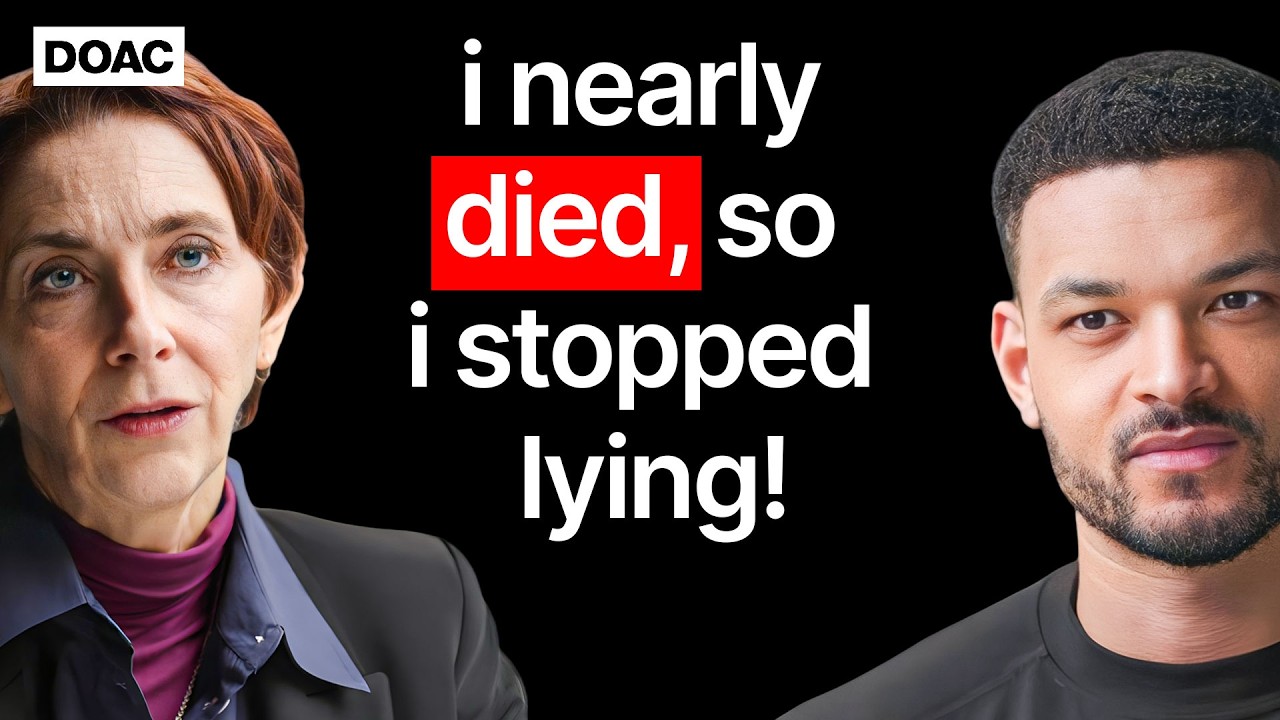
The Diary Of A CEO
Activating the right hemisphere through sensory imagination and creative output shuts down left-brain threat loops to alleviate psychological suffering.
AI-assisted summary of Dr. Martha Beck (Oprah's Life Coach): This Weird Trick Reduces Anxiety & Fixed My Childhood Trauma! — original source. Check the original for full context.
Source published:
Detailed notes
## Background Published on YouTube by The Diary Of A CEO on December 19, 2024, this episode features Dr. Martha Beck, a Harvard-educated sociologist, bestselling author, and life coach known for her work with Oprah Winfrey. According to the page description, Dr. Beck provides practical tools and strategies to resolve childhood trauma, fix anxiety, uncover deep desires, and live an authentic life.
## TL;DR Dr. Martha Beck explores the neurological mechanisms underlying anxiety, explaining how shifting from left-brain threat control to right-brain sensory curiosity and creativity can alleviate chronic fear. She shares her personal journey through childhood sexual abuse in a strict Mormon community, severe autoimmune disease, and a near-death experience during surgery that inspired a lifelong vow to absolute truth. Through practical exercises, including applied kinesiology demonstrations and the 'Imaginary Orange' visualization, she demonstrates how individuals can disarm internal anxiety spirals and access flow states. Ultimately, she offers actionable frameworks—such as the CAT model (Calm, Art, Transcendence) and KISST (Kind Internal Self-Talk)—to guide listeners toward self-compassion, authentic living, and fulfilling life purpose.
## Atmosphere & style The conversation carries an intimate, deeply reflective tone that balances rigorous psychological insight with vulnerable personal disclosure. Steven Bartlett provides an empathetic, grounded presence, engaging directly in live exercises that ground abstract neurological concepts in immediate physical experience. The emotional arc transitions from painful reckonings with intergenerational trauma and systemic indoctrination to a hopeful, serene exploration of spiritual awakening and creative transformation. Watching the episode feels like a quiet, transformative masterclass that blends academic authority with radical emotional honesty.
## Key takeaways - [00:00](https://www.youtube.com/watch?v=fajtQSCHfvE&t=0s) Dr. Martha Beck uses applied kinesiology to demonstrate that speaking a lie causes an immediate, measurable loss of physical strength in the body, reflecting how the human brain is pre-programmed for truth over falsehood. - [19:51](https://www.youtube.com/watch?v=fajtQSCHfvE&t=1191s) Anxiety is an evolutionary threat-response mechanism driven by the left hemisphere, which uses language to create abstract, terrifying narratives about the future in a attempt to maintain total control. - [21:09](https://www.youtube.com/watch?v=fajtQSCHfvE&t=1269s) Creativity and sensory awareness reside primarily in the right hemisphere; engaging right-brain activities directly triggers a neurological toggle that shuts down anxiety and releases neurochemicals like dopamine and serotonin. - [26:47](https://www.youtube.com/watch?v=fajtQSCHfvE&t=1607s) Simple sensory exercises, such as vividly imagining an orange using all five senses, can instantly shift the brain out of a left-brain anxiety state and restore calm. - [34:09](https://www.youtube.com/watch?v=fajtQSCHfvE&t=2049s) Conventional schooling conditions children to learn through fear, shame, and rigid right-or-wrong judgments, suppressing natural human creativity from 98% in early childhood down to 2% in adulthood. - [40:00](https://www.youtube.com/watch?v=fajtQSCHfvE&t=2400s) The CAT model (Calm, Art, and Transcendence) provides a practical three-step framework to alleviate anxiety by treating it with gentle presence rather than aggressive resistance. - [53:36](https://www.youtube.com/watch?v=fajtQSCHfvE&t=3216s) Modern societal structures lack traditional rites of passage, leaving young men isolated in adversarial, flight-or-flight mindsets that contribute to disproportionately high suicide rates. - [59:07](https://www.youtube.com/watch?v=fajtQSCHfvE&t=3547s) Reconnecting with nature and engaging in collaborative, non-verbal group challenges can help regulate dysregulated nervous systems and heal deep-seated psychological trauma. - [01:16:09](https://www.youtube.com/watch?v=fajtQSCHfvE&t=4569s) Trauma and social conditioning force people into living falsehoods, but committing to radical honesty—even at great personal and social cost—is essential for mental and physical healing. - [01:18:15](https://www.youtube.com/watch?v=fajtQSCHfvE&t=4695s) Making incremental adjustments, known as 'one-degree turns,' allows individuals to systematically align their daily actions with their core internal truth without causing catastrophic life disruption. - [01:45:30](https://www.youtube.com/watch?v=fajtQSCHfvE&t=6330s) Grief is a necessary, self-compassionate emotional process that processes trauma, whereas psychological suffering arises from internal resistance to reality. - [01:58:52](https://www.youtube.com/watch?v=fajtQSCHfvE&t=7132s) True life purpose is found at the intersection of one's personal joy and the world's deep needs, accessible by cultivating self-compassion and right-brain connection with others. - [02:13:32](https://www.youtube.com/watch?v=fajtQSCHfvE&t=8012s) To pivot out of anxiety into a creative state, one must shift from asking 'What am I going to do about this?' to asking 'What can I make from this?'
## Detailed walkthrough Here is a detailed, faithful walkthrough of Part 1 of the transcript.
---
[00:00](https://www.youtube.com/watch?v=fajtQSCHfvE&t=0s) Intro & The Kinesiology Demonstration
The episode opens with a dramatic demonstration of how truth and falsehood physically affect the human body. Dr. Martha Beck asks host Steven Bartlett to extend his arm and speak a statement of truth: "I love fresh air." She tests his physical resistance, and his arm remains strong. However, when she instructs him to lie and say, "I love to vomit," his arm instantly weakens and drops under slight pressure. Repeating the sequence—alternating between "I love fresh air" and "I love to vomit"—yields the exact same physiological result every time.
Dr. Beck explains that this response stems directly from how the human brain is structured. As a Harvard-trained sociologist, author, and world-renowned life coach whose clients include Oprah Winfrey, she uses neurological techniques to help individuals navigate an anxiety-addicted world.
``` ┌─────────────────────────────────────────┐ │ The Brain's Truth / Lie Response │ └────────────────────┬────────────────────┘ │ ┌──────────────────────────┴──────────────────────────┐ ▼ ▼ ┌───────────────────────┐ ┌───────────────────────┐ │ TRUE STATEMENT │ │ FALSE STATEMENT │ │ "I love fresh air" │ │ "I love to vomit" │ └───────────┬───────────┘ └───────────┬───────────┘ │ │ ▼ ▼ ┌───────────────────────┐ ┌───────────────────────┐ │ Neurological Harmony │ │ Physical Incongruence │ │ & Strong Resistance │ │ & Muscle Weakness │ └───────────────────────┘ └───────────────────────┘ ```
She outlines how human brains are biologically pre-programmed for anxiety, which is further exacerbated by two main forces: * **Socialization:** Internalizes lies like *"You're not good enough,"* *"You should try harder,"* or *"That was a bad choice."* * **Trauma:** Spreads hyper-vigilance with messages like *"Everything is dangerous all the time,"* fabricating terrifying future scenarios to keep us safe.
These forces trap individuals in an escalating anxiety spiral. Sharing her personal story, Dr. Beck reveals that she carries physical scarring and memories from sexual abuse that began at age five. By age 30, she was bedridden with severe autoimmune diseases, crippling anxiety, and depression, contemplating suicide. Yet, she asserts with complete certainty that it is possible to trick our brains and deactivate anxiety.
Before diving into the core discussion, Steven pauses to address the audience, noting that 53% of regular listeners have not yet subscribed to *The Diary Of A CEO*, and gently requests a subscribe to support the show's mission.
---
[02:01](https://www.youtube.com/watch?v=fajtQSCHfvE&t=121s) What Martha Beck Is Aiming to Do with Her Work
When Steven asks Dr. Martha Beck what she aims to accomplish with her lifelong work and who she is doing it for, she offers him a choice: the "normal answer" that goes down easily with most people, or the "truth," which sounds remarkably weird. Steven enthusiastically chooses the truth.
Dr. Beck reveals that from early childhood, she felt an overwhelming sense of urgency regarding a global mission. On the night before her fourth birthday, she lay awake in sheer panic, thinking she was supposed to help with something major on Earth and hadn't done enough yet. Throughout her youth, she constantly wrestled with what this mission was, receiving only a single internal response—a passage from T. S. Eliot’s poem *East Coker* (*Four Quartets*):
> "I said to my soul, be still, and wait without hope / For hope would be hope for the wrong thing; wait without love, / For love would be love of the wrong thing; there is yet faith / But the love and the hope and the faith are all in the waiting. / Wait without thought, for you are not ready for thought: / So the darkness shall be the light, and the stillness the dancing."
As she grew older and pursued advanced academic studies, she realized why her purpose could not be explained to her younger self: she was meant to facilitate a fundamental transformation in human perception and thought. Attempting to explain a shift in consciousness using existing modes of thought would inherently result in misunderstanding. Now unconcerned with public opinion, she explicitly states her conviction that a fundamental shift in human consciousness is imminent—one that will radically alter how humans relate to the planet, to each other, and to themselves.
---
[04:57](https://www.youtube.com/watch?v=fajtQSCHfvE&t=297s) The Shift in Human Consciousness and "Awakening"
Steven asks Dr. Beck to define the exact nature of this predicted consciousness shift. Drawing from her background in East Asian Studies—having lived in Asia and studied Chinese and Japanese—she points to the Eastern concept of "Awakening" (awakening out of the "dream of thought"). Acknowledging that skeptical listeners might temporarily view her as a "lunatic," she promises the concept yields practical benefits when understood.
Awakening represents a structural perceptual shift—deeply rooted in Buddhist, Hindu, and Taoist traditions across India, Tibet, and East Asia—where an individual steps outside the mental mechanisms that produce internal suffering. Dr. Beck hypothesizes that Awakening is an inherent, latent **epigenetic shift** built into every human brain. Throughout history, individuals across diverse cultures have undergone this transformation and described it using remarkably consistent language: * **The Awakened State:** One realizes that everyday life is "real" only in the sense that a dream feels real, whereas the awakened reality is infinitely more fundamental. * **Core Characteristics:** Absence of fear and suffering, boundless compassion, a deep urge to serve, love for all living beings, and an abiding foundational peace. * **Sanskrit Terminology:** Referred to as *Satcitananda* (*Sat-Chit-Ananda*)—the inherent "Bliss of Being"—which becomes one's permanent baseline.
Dr. Beck highlights figures like Nelson Mandela during his 27-year imprisonment on Robben Island as examples of individuals who reached this state. She asserts that if a critical mass of human beings undergoes this shift simultaneously, humanity could solve the systemic problems it has created over the last several thousand years.
---
[07:43](https://www.youtube.com/watch?v=fajtQSCHfvE&t=463s) Qualifications, Near-Death Experience, and Radical Honesty
When Steven asks Dr. Beck about her qualifications to teach these concepts, she describes herself first and foremost as someone who experienced decades of profound physical and psychological trauma. By age 30, she was a physical wreck, bedridden for ten years with severe autoimmune disorders alongside severe depression and anxiety.
The turning point occurred during a surgical procedure where she underwent a near-death experience (NDE). She describes witnessing a brilliant light and feeling an absolute, cellular connection to it—a profound sense of ultimate peace and "homecoming." Coming out of surgery radically transformed, she made a binding commitment never to tell another lie in any aspect of her speech or behavior.
This absolute commitment to radical truth triggered a complete collapse and rebuilding of her life over the following year: * **Religious Extraction:** She walked away from her family's religion (Mormonism), which resulted in losing her family of origin, her entire community, and every friend she had prior to age 17. * **Personal & Professional Upheaval:** She realized and accepted her sexuality as a lesbian, ending her marriage, leaving her home, and stepping away from her career path in academia.
``` ┌────────────────────────────┐ │ The Post-NDE Catalyst │ │ (Commitment to Total Truth)│ └──────────────┬─────────────┘ │ ┌───────────────────────────┼───────────────────────────┐ ▼ ▼ ▼ ┌─────────────────┐ ┌─────────────────┐ ┌─────────────────┐ │ Religious & │ │ Sexual Identity │ │ Career & │ │ Family Rupture │ │ & Marriage │ │ Home Shift │ │ Exited Mormonism│ │ Came out; ended │ │ Left academia │ │ & lost community│ │ marriage │ │ & origin home │ └─────────────────┘ └─────────────────┘ └─────────────────┘ ```
While she humorously advises listeners not to burn their lives down as drastically as she did—joking that she tested the extreme paths so others wouldn't have to—she explains that through this fiery transformation, she discovered an unshakeable inner safety and joy.
---
[10:09](https://www.youtube.com/watch?v=fajtQSCHfvE&t=609s) Working Across the Human Spectrum: From Addicts to Billionaires
Dr. Beck explains that her coaching background spans every stratum of human society—from unhoused heroin addicts living on the streets of Phoenix to global billionaires, as well as inmates in high-security prisons. As a sociologist, she refuses to endorse any psychological framework unless it proves universally effective regardless of wealth, culture, captivity, or freedom.
Her affinity for heroin addicts stemmed directly from her post-surgery NDE. Addicts described feeling unable to survive without their next hit; Dr. Beck felt that same intense longing for the transcendent light she witnessed in surgery. She would tell them: *"I believe you're meant to have that feeling you long for so much, but I also think you get to keep your teeth—there is another way."*
When working with billionaires, she observes that despite their vast resources, they suffer from the exact same core existential crisis as unhoused individuals: * **The Common Dilemma:** A desperate need to know their **purpose** and understand why they are here. * **Mortality Awareness:** Humans are the only animals that live with daily, explicit consciousness of their own impending death. * **Cultural Disconnect:** Modern society pulls individuals away from inherent self-knowledge, trapping them in endless loops of production, consumption, and material accumulation.
``` ┌─────────────────────────────────────────────────────────────────┐ │ Brain Hemisphere Split │ ├────────────────────────────────┤────────────────────────────────┤ │ LEFT HEMISPHERE │ RIGHT HEMISPHERE │ ├────────────────────────────────┼────────────────────────────────┤ │ • Obsessed with control & tags │ • Connects with meaning & purpose│ │ • Always grasping, always afraid│ • Deep relational connectivity │ │ • Mechanistic & hyper-focused │ • Experiential, holistic peace │ │ • Dominates modern culture │ • Suppressed in "WEIRD" setups │ └────────────────────────────────┴────────────────────────────────┘ ```
Dr. Beck references psychiatrist and neuroscientist Iain McGilchrist (author of *The Master and His Emissary*), who posits that modern society functions like a person who has suffered a severe right-hemisphere stroke. We live in what anthropologists call **WEIRD** societies (*Western, Educated, Industrialized, Rich, Democratic*).
Unlike our ancestors—who awoke to natural sounds, moved with the sun, and lived in direct relationship with plants, animals, and local communities—modern humans spend their days under artificial light, processing spreadsheets, and working beside strangers in factory-modeled corporate structures, disconnected from living meaning.
---
[14:48](https://www.youtube.com/watch?v=fajtQSCHfvE&t=888s) Why Write *Beyond Anxiety*? The Epidemic & Jeff Bezos
Steven asks Dr. Beck why, among all possible topics, she chose to focus her book *Beyond Anxiety: Curiosity, Creativity and Finding Your Life's Purpose* on anxiety.
She explains that after publishing her previous book, *The Way of Integrity*—which defines integrity structurally as being whole and undivided (body, heart, spirit, and mind in full alignment)—readers reported that even after bringing their lives into total structural integrity, they were still plagued by persistent fear. Investigating this led her to realize that anxiety is an escalating global crisis: * **Pre-Pandemic Baseline:** Approximately **284 million people** worldwide were clinically diagnosed with anxiety disorders. * **Pandemic Surge:** In 2020 alone, global anxiety rates spiked by an additional **25%**.
Anxiety operates like a spike strip on a road: once the brain enters an anxious state, internal mechanisms cause it to escalate continuously. When an entire population experiences this, it constructs a culture that actively glorifies and fosters anxiety.
Dr. Beck illustrates this by citing Amazon founder Jeff Bezos. In quarterly reports and public appearances, Bezos has openly stated that he wants his thousands of employees to wake up "terrified" every single morning and remain terrified all day, believing that terror drives productivity. Dr. Beck points out the deep systemic tragedy of this mindset: ordinary employees are kept in state of chronic fear to generate wealth for a system where the top **1% of the population owns roughly 50% of total global wealth**.
She contrasts healthy fear with chronic anxiety: * **Normal Fear:** Acts like being shot from a cannon. If a bear entered the room, both she and Steven would experience an immediate surge of adrenaline, take decisive action (fight, flee, or freeze), and once the threat resolved, their nervous systems would return to baseline. (She quips that she would feed Steven to the bear, but acknowledges his physical size advantage: *"I'm double your weight, you could totally take that bear!"*). * **Anxiety:** Acts like being haunted. Instead of discharging fear through action and returning to calm, humans transform the physiological jolt into an ongoing verbal narrative.
Referring to psychological studies from the 1990s investigating why humans are the only species that regularly commits suicide, Dr. Beck prepares to explain how verbal stories turn temporary fear into chronic, inescapable anxiety.
Here is a detailed, faithful walkthrough of the transcript provided, preserving all core arguments, examples, emotional nuances, and concrete facts.
---
[19:51](https://www.youtube.com/watch?v=fajtQSCHfvE&t=1191s) The Mechanics of the Left-Brain Anxiety Spiral
Humans possess a unique capacity to use language to construct abstract, terrifying visions of the future. Dr. Martha Beck observes that we often carry internal stories of fear so horrifying that we end up choosing death over continuing to live with them. The anxiety spiral begins with a sudden jolt of fear, followed immediately by a mental narrative about that fear. This narrative convinces us that we must exert total control—over the external world, over our loved ones, and over every unpredictable circumstance—to keep ourselves safe.
However, because humans can control very little in reality, our inability to manage these circumstances causes us to grow even more alarmed. This terror feeds back into primitive brain structures, generating an even bigger narrative and spurring further desperate attempts at control. This escalation moves continuously upward without naturally resetting. This happens because the primitive, left-leaning threat response system operates under a peculiar evolutionary quirk: it truly believes that nothing exists except itself.
[21:09](https://www.youtube.com/watch?v=fajtQSCHfvE&t=1269s) Brain Hemispheres: Fear Control vs. Sensory Curiosity
While acknowledging that left/right brain hemisphere distinctions are a vast oversimplification—since neuroscientists know the whole brain is active almost all the time—Dr. Beck explains that functional differences between the hemispheres are dramatic and useful to understand. She breaks down how the two sides process threats differently:
* **The Left Hemisphere:** Houses a primitive threat alarm system anchored by an amygdala (a structure found in nearly every vertebrate). When it spots something unfamiliar, it triggers an immediate drive to control the situation. As this signal reaches the outer layers of the left hemisphere—which process linear time and language—it constructs verbal stories to justify and defend those fearful feelings, creating the anxiety spiral. * **The Right Hemisphere:** Contains its own amygdala, which also registers unfamiliarity with a burst of alarm. Crucially, however, the right hemisphere responds with **curiosity rather than aversion**.
To illustrate this, Dr. Beck brings up "rubbernecking" at traffic accidents. While we often feel guilty or voyeuristic for slowing down to look, this behavior stems from an evolutionary drive: we step away from danger to stay physically safe, but we lean *toward* it visually to figure out what happened so we can prevent it from happening to us. This drive explains why true crime and murder stories are so compelling to the human psyche; we don't write bestsellers about petty robberies because murder represents the ultimate threat.
The right hemisphere acts like a detective. It makes original, non-verbal connections by assembling vivid images and sensory details. Calmly reducing anxiety is not enough on its own because it leaves a person feeling flat; tapping into the right hemisphere's creativity triggers a powerful toggle mechanism: just as anxiety shuts down creativity, **creativity actively shuts down anxiety**.
``` [ Primitive Fear Signal ] │ ┌───────┴───────┐ ▼ ▼ Left Hemisphere Right Hemisphere (Aversion/Control) (Curiosity/Senses) │ │ Language & Vivid Images & Horror Stories Creative Connections │ │ Anxiety Spiral Toggle: Shuts Down Anxiety ```
Dr. Beck validated this mechanism by testing creative exercises on her coaching clients and online groups, using her background as a sociologist to run informal experiments. She directly addresses the common objection that real-world problems justify constant fear: if you were injured in a terrible car accident, you would want your operating surgeon to be in a calm, creative mindset rather than a state of panic. Solving massive human problems requires accessing our highest creative capacity.
[26:47](https://www.youtube.com/watch?v=fajtQSCHfvE&t=1607s) Practical Exercise: The Imaginary Orange
When Steven asks how an anxious person can practically force their brain to switch from the left hemisphere into the right, Dr. Beck explains that the brain naturally defaults to fear due to evolutionary **negativity bias**. She compares this to receiving a box containing 15 puppies and 1 cobra: your attention immediately locks onto the snake because, historically, ignoring it meant death. Because modern society lacks constant immersion in nature to restore balance, we must actively trick our brains into a grounded state.
To demonstrate, Dr. Beck asks Steven to participate in an exercise:
1. **Focusing on the Anxiety Trigger:** She asks Steven to bring to mind a scenario that makes him anxious. Steven shares a relatable domestic trigger: being around his partner when he can sense from her vibe and facial expressions that she is unhappy, but she isn't telling him why. He describes how his body instantly reacts—his breath becomes short, his body tenses up, and he grows impatient and snappish because he feels driven to escape the situation (flight) while simultaneously demanding an answer (fight). 2. **Engaging the Right Hemisphere:** Dr. Beck guides Steven to close his eyes and vividly visualize an orange. She prompts him to imagine holding a heavy, ripe orange, smelling its citrus scent, biting into the peel, feeling the spray of citric acid, tasting the bitter rind followed by the sweet, tangy juice, and feeling the stringy texture of the fruit. 3. **The Biological Shift:** Upon completing the exercise, Steven reports that his anxiety completely disappeared. Dr. Beck notes that by anchoring his brain in **sensory imagination** (right hemisphere) rather than **verbal imagination** (left hemisphere), his physiology completely changed. The body stops producing fight-or-flight hormones (cortisol, adrenaline, glucocorticoids) and begins releasing dopamine, serotonin, and "tend-and-befriend" neurochemicals.
Dr. Beck notes that remaining in this grounded state changes how we handle interpersonal conflict. Citing former top FBI hostage negotiator Chris Voss, she points out that when dealing with violent, extreme high-stakes situations, Voss advocates using a soft, gentle voice, genuine curiosity, and deep empathy. The human amygdala functions like a frightened animal; running at it demanding answers only escalates fear. By remaining calm, you become a "field of peace" for an anxious person.
[34:09](https://www.youtube.com/watch?v=fajtQSCHfvE&t=2049s) Mirror-Writing and the Loss of Childhood Genius
Dr. Beck demonstrates another right-brain activation exercise that she learned while working as a teaching assistant for Harvard professor and artist William Ryman. She has Steven take his iPad stylus and perform a multi-step task:
* First, write his first name using his standard signature. * Next, attempt to replicate that exact signature directly to the left, but in **mirror writing (backwards)**.
Steven struggles with the physical task, expressing intense frustration and calling his attempt "terrible." Dr. Beck reassures him that the struggle itself is the point. The left hemisphere struggles to draw shapes because it constantly seeks to label things (e.g., drawing a conceptual "cup" rather than observing actual shapes and angles). Mirror-writing forces the brain into a state of deep learning, physically constructing new neural synapses on the spot—much like a child learning to write for the first time.
This state of open-ended learning connects directly to how human creativity changes over a lifetime:
* **The NASA Creativity Study:** A NASA study conducted in the 1960s designed to identify creative geniuses tested adults (college graduates) and found that only **2%** qualified as creative geniuses. When researchers later gave the exact same test to 4- and 5-year-old children, **98%** tested at the creative genius level. * **The Cause of the Decline:** The drastic decline in adult creativity occurs because traditional schooling forces children onto an assembly line. Education conditions individuals to learn through shame, fear, rigid right-or-wrong judgments, and artificial skills, causing their natural exploratory genius to go dark.
[38:53](https://www.youtube.com/watch?v=fajtQSCHfvE&t=2333s) Non-Verbal Teamwork in Nature
To break adults out of these rigid left-brain patterns, Dr. Beck conducts wilderness retreats with her clients. Guided by an experienced woodsman, she leads groups into the forest, hands them primitive tools (sticks and rocks), and instructs them to friction-start a fire as a team—with one strict rule: **no speaking allowed**.
Because language relies entirely on the left hemisphere, banning talk forces participants to operate entirely through right-brain observation, intuition, and trial-and-error. Groups often spend up to four hours silently testing different physical methods. Eventually, every single group succeeds. Dr. Beck describes the moment when a tiny spark takes hold in dry moss, begins to smoke, and suddenly bursts into a full flame: the participants experience a profound, "Promethean" realization of their own raw capability and collective power.
- **NASA Study Metric:** 98% of 4- and 5-year-olds scored as creative geniuses, compared to only 2% of adult college graduates. - **Key Figures Mentioned:** Chris Voss (former FBI hostage negotiator), William Ryman (artist and former Harvard professor). - **Physiological Shift:** Shifting from left-brain story-making to right-brain sensory imagination stops the release of cortisol, adrenaline, and glucocorticoids, and promotes serotonin, dopamine, and tend-and-befriend hormones.
[40:00](https://www.youtube.com/watch?v=fajtQSCHfvE&t=2400s) A Three-Step Process to Alleviate Anxiety
Dr. Martha Beck outlines a structured framework for overcoming anxiety, introducing a three-step model represented by the acronym **CAT**: **C**alm, **A**rt, and **T**ranscendence. She clarifies that anxiety is not a "broken machine" to be fought, but rather a "frightened animal." Attempting to aggressively battle or extinguish anxiety only intensifies it, much like yelling at or attacking a terrified creature. Drawing a stark historical parallel, she points out how psychiatry historically treated anxiety mechanically with crude lobotomies—putting a screwdriver through the eye socket into the brain—which exemplifies an aggressive, left-brain approach to mental distress.
Instead of fighting our internal fears or trying to control external triggers, the first step is to gently attend to the frightened part of ourselves. Demonstrating this concept, Dr. Beck guides Steven through a brief exercise where he tunes into a physical sensation of anxiety in his chest. By offering that internal part space, presence, and non-judgmental listening, Steven notes an immediate reduction in the "volume" of his distress.
Dr. Beck further emphasizes the therapeutic power of expressive writing, citing classic research by psychologist James Pennebaker. In his studies, students who wrote about traumatic or upsetting experiences for just 15 minutes experienced a temporary spike in emotional distress, but over subsequent weeks and years, they showed marked improvements: fewer doctor visits, lower anxiety, and healthier relationships. She compares this individual process of being heard to the macro-level healing of South Africa's Truth and Reconciliation Commission under Nelson Mandela, where allowing victims to share their stories publicly helped avert widespread violence.
* **CAT Model**: * **C**alm: Soothing the biological "frightened animal" using gentleness, space, and self-compassion. * **A**rt: Engaging in creative, three-dimensional making to quiet the left brain's grasping mechanics. * **T**ranscendence: Reaching states of flow where the ego dissolves into pure action. * **James Pennebaker's Research**: Expressive writing about emotional turmoil for 15 minutes leads to long-term reductions in physical illness and anxiety. * **South Africa's Truth and Reconciliation Commission**: A real-world example of how giving voice to deep trauma can heal collective hostility.
---
[47:08](https://www.youtube.com/watch?v=fajtQSCHfvE&t=2828s) The Anxiety Spiral and the Healing Power of Art
Dr. Beck addresses the "anxiety spiral" (or anxiety cycle) in the brain, comparing it to driving over a police spike strip that shreds tires. The initial step of calming the mind acts as getting out of the vehicle and disarming the spike strip, halting the cycle of physiological distress so the brain can safely navigate out of fear.
Once calm is established, the process moves to **Art**—which Dr. Beck defines broadly as making or creating objects, experiences, or projects. Engagement in creative work provides a direct psychological antidote to fear. When Steven shares a recent experience of going to a loft and spending three hours lost in spray-painting cardboard with his partner, Dr. Beck explains that this experience of getting "lost in it" shifts brain activity away from left-hemisphere anxiety toward right-hemisphere creation. Studies indicate that trauma survivors who engage in drawing or art making have an **80% lower chance of developing PTSD**.
> "Anxiety and creativity just can't work at the same time... the moment you begin to create, the toggle switches off in anxiety and on in creativity."
Creation is an indomitable aspect of the human spirit present across all eras and conditions—from 5,000-year-old Egyptian tombs and isolated Amazonian tribes making "precious, pointless" beaded bracelets, to the vibrant music and dance forms like reggae born out of brutal conditions in colonial Jamaica. When art making leads into **Transcendence**, people experience the state of flow described by psychologist Mihaly Csikszentmihalyi, where intense focus and the "rage to master" yield a blissful loss of self-consciousness.
---
[53:36](https://www.youtube.com/watch?v=fajtQSCHfvE&t=3216s) The Social and Cultural Roots of Modern Suffering
Addressing broader societal struggles, Dr. Beck reflects on the distinct ways young men and young women experience distress in modern society, comparing contemporary pressures to traditional rites of passage. Historically, indigenous societies guided adolescent males through intense group initiations led by elders—scaring them, stripping away their individual egos and old names, and forcing them into the wilderness. This broke down ego-driven individualism, teaching them humility, reverence for nature, and reliance on their peers.
Conversely, young females in traditional cultures were often given solitary space to individuate, as women are naturally socialized toward deep social integration. Modern culture lacks these structured rites of passage. The internet and social media isolate young men into defensive, adversarial mentalities without the grounding wisdom of elders, while trapping young women in toxic, hyper-connected social dynamics right when they need space to discover their independent identity.
``` Traditional Rites vs. Modern Digital Dynamics
Traditional Societies Modern Digital Age --------------------- ------------------ Males: Group initiation in nature Males: Hyper-individualistic, -> Teaches humility & unity defensive, lack elder guidance
Females: Solitary reflection/space Females: Trapped in toxic, hyper-connected -> Teaches independence social media dynamics ```
---
[57:54](https://www.youtube.com/watch?v=fajtQSCHfvE&t=3474s) Why Young Men Struggle with Suicide
The discussion turns to the alarming rates of male suicide, particularly noting that in the UK, suicide remains the single biggest killer of men under the age of 45. Dr. Beck explains that male conditioning heavily emphasizes combat and control as primary responses to fear and existential dread. Drawing on *Hamlet*'s soliloquy about taking arms against a sea of troubles, she explains how mindsets steeped in struggle can internalize violence as the ultimate mechanism of control.
Pop culture reinforces this pattern by portraying mastery through force—such as the iconic scene in *The Matrix* where the protagonist responds to unlimited mental power by asserting, "We're going to need a lot of guns." When trapped in an internal spiral of fear, this fight-or-flight conditioning leads to devastating self-directed violence rather than peaceful surrender or connection.
* **UK Statistic**: Suicide is the leading cause of death among men under 45. * **Cultural Conditioning**: Men are disproportionately taught that control must be achieved through combat or weaponry, compounding existential distress when life feels uncontrollable.
[59:07](https://www.youtube.com/watch?v=fajtQSCHfvE&t=3547s) Healing Young Men Through Nature and Community
Dr. Martha Beck explains that throughout history, toxic leaders have weaponized vulnerable, isolated young men by militarizing them against others. When young men lack mentors or community groups, they often turn that destructive energy inward. To solve this crisis, Beck advocates returning to ancestral practices. She shares the example of a tracker and wilderness coach named Michael Trotta—a disciple of the Odawa tribe—who wore a shirt reading "Listen to Grandfather." Trotta would take troubled young men into the woods to put them through traditional trials: starting fires, foraging, hunting, and building things together for the collective good. Watching him heal young men proved to her that reconnecting with human evolution provides a blueprint for psychological recovery.
Modern life, by contrast, is deeply alienating and unnatural. Gesturing to the state-of-the-art recording studio, Beck points out that human nervous systems evolved over millennia for natural environments like forests, beaches, and deserts—not for man-made spaces filled with artificial right angles, which rarely exist in nature outside of crystals. Host Steven Bartlett reflects that hearing this makes him want to run away to nature, though he acknowledges his drive to create would inevitably lead him to set up a new project anyway. Beck notes that his creative drive and balance are precisely why he appears physically healthy and calm, yet exuberant.
- **Ancestor-based rites of passage**: Young men build resilience by mastering survival skills, foraging, and supporting a community alongside elders. - **Natural vs. synthetic spaces**: Human nervous systems are ill-adapted to artificial environments full of sharp right angles and synthetic structures.
---
[01:02:14](https://www.youtube.com/watch?v=fajtQSCHfvE&t=3734s) Growing Up in Mormon Indoctrination
The conversation turns to Beck's childhood in a strict Mormon community where everyone referred to one another as "Brother" or "Sister" rather than "Mr." or "Mrs." Indoctrination began as early as 18 months old. As a toddler, she was taught that faithful Mormon men receive their own planet and as many wives as they want in the afterlife. She was also told that Jesus would return over the mountains, causing graves to burst open so literal, physical bodies could rise up to join him—which is why the church forbade cremation.
These vivid teachings caused Beck intense childhood trauma. She suffered from recurring nightmares where Jesus appeared over the mountains and graves opened up; as everyone around her floated skyward to be saved, she frantically tried to jump high enough to join them, only to keep falling back to earth. Living in constant terror, she struggled to discern what was real because nothing around her felt grounded in truth.
- **Early religious instruction**: Structured indoctrination started at 18 months old within an isolated Mormon subculture. - **Theological claims**: Included teachings on men ruling their own planets with multiple wives and physical resurrection requiring earth burial rather than cremation. - **Recurring nightmares**: A persistent fear of failing to rise with the saved during the Second Coming left her in constant psychological distress.
---
[01:04:20](https://www.youtube.com/watch?v=fajtQSCHfvE&t=3860s) Uncovering Childhood Abuse and "Lying for the Lord"
At age 28, buried memories of childhood sexual abuse erupted into Beck's consciousness through severe intrusive flashbacks. Though friends later told her she had mentioned the abuse back in high school, she had completely repressed it. Her father, Nibley, was a famous scholarly defender of Mormonism whose career involved academically validating church doctrine. To support his arguments, he worked with a team of researchers and would frequently fabricate citations in foreign languages—a practice known within certain circles as "lying for the Lord."
``` "It means you have a God who's fundamentally interested in helping people be like God by lying." — Dr. Martha Beck ```
The realization of her father's dishonesty, combined with the physical scarring left by his abuse, created immense internal conflict. Beck explains that the flashbacks hit her when her oldest child turned five—the exact age Beck was when the abuse began. Looking at her five-year-old daughter triggered violent, terrifyingly vivid sensory flashbacks that made the trauma feel as if it were happening all over again.
- **Repression and intrusive flashbacks**: Flashbacks spiked when her eldest child reached five years old, matching the age the trauma began. - **Scholarly fabrication**: Her father cited non-existent sources in foreign-language footnotes to defend church theology under the rationale of "lying for the Lord." - **Physical consequences**: Beck required surgery later in life to repair internal scar tissue and internal bleeding caused by early childhood physical trauma.
---
[01:07:41](https://www.youtube.com/watch?v=fajtQSCHfvE&t=4061s) The Confrontation, the Cake, and the Family Dynamic
When Beck called her mother to confront her about the abuse, her mother unexpectedly confirmed it, saying, "Well yes, that's what happened... I know him better than you." However, rather than offering comfort or protection, her mother instructed her that she needed to "protect the church" and suggested Beck make her father a cake to keep the peace. Following her mother's bizarre instructions, Beck baked the cake, served it to her father, and then severed contact with her family.
Years later, when her father was in his 90s (having been 52 when Beck was born), she attempted to meet with him after working through her own process of forgiveness. Her father was a deeply unhappy, disassociated World War II veteran who refused to take personal responsibility, deflecting the blame by attributing the abuse to "the evil one" (referencing the devil). Beck stresses to the audience that survivors are not required to forgive their perpetrators; rather, the true path to healing is standing firmly in one's own truth and personal integrity.
When Beck later confronted both parents together in her therapist's office, her mother retracted her previous admission, claiming she thought Beck had been joking. Beck never saw her mother again. She describes her mother as consumed by depression and rage, largely because Mormon doctrine taught that spirits choose their parents; having given birth to eight children (and suffering one stillbirth), her mother resented her younger children for forcing themselves upon her. Years later, during her mother's funeral—which Beck watched on a closed-circuit stream during the pandemic—her brother opened his eulogy by stating: "If you came here expecting to hear stories of motherly love, you are at the wrong funeral."
- **Mother's initial reaction**: Validated the claims initially, prioritized protecting the church's reputation, and advised Beck to bake her father a cake. - **Father's deflection**: Referred to his actions as the work of "the evil one" rather than admitting personal accountability. - **Intergenerational trauma**: Her father was sexually abused by his own mother (who used bee venom on his injuries), while her maternal grandmother had been a Swedish pro-Nazi sympathizer during World War II.
---
[01:16:09](https://www.youtube.com/watch?v=fajtQSCHfvE&t=4569s) Chronic Pain, Suicidality, and the Integrity Test
From age 13 through her teens and twenties, Beck suffered from near-constant suicidal ideation and debilitating psychogenic pain, which she attributes to the intense physical and emotional trauma of her upbringing. It was not until she reached age 32 that she experienced her first day without wanting to end her life—a shift that occurred as she began speaking the truth and aligning her life with her internal integrity.
To demonstrate how living in untruth physically weakens the body, Beck guides Steven through a manual muscle test (applied kinesiology). She asks him to hold his arm straight out and resist her pushing it down while stating two different sentences:
``` "When we lie, our bodies get very weak." — Dr. Martha Beck ```
When Steven says "I love fresh air," his arm remains completely rigid and strong under pressure. But when he repeats the lie "I love to vomit," his arm instantly collapses under minimal force despite his conscious effort to resist. Beck explains that this physiological weakness under stress and untruth is the same mechanism behind polygraph tests, showing the direct link between personal honesty, nervous system regulation, and physical strength.
- **Suicidal ideation duration**: Lasted almost daily from age 13 into her early thirties, subsiding around age 32. - **Psychogenic pain**: Trauma and self-deception manifested as severe physical illness and bodily weakness. - **Applied kinesiology demonstration**: Demonstrates that speaking a falsehood causes immediate, measurable muscle weakness in the body.
[01:18:15](https://www.youtube.com/watch?v=fajtQSCHfvE&t=4695s) Listening to the Body’s Truth and the Power of One-Degree Turns
Steven reflects on the muscle-testing demonstration Dr. Martha Beck performed on him, noting how strange it felt. When he claimed, "I love to vomit," he felt completely disconnected from his physical strength, as if trapped inside his own head, enabling Martha to push his arm down easily. Yet, when he said, "I love fresh air," his body naturally resisted. Martha explains that this happens because the body lives in reality and cannot lie; only the verbal mind can deceive us into believing untruths. She illustrates this with a story about speaking in hotel ballrooms. When she interrupts her own lectures to ask audiences if they are truly comfortable, everyone insists they are. However, when asked if anyone would sit in that exact position if they were home alone, not a single hand goes up. It reveals how rapidly the mind talks itself into tolerating discomfort in exchange for a benefit, ignoring the body’s quiet distress.
Martha points out that people often endure intense suffering—in careers, toxic relationships, or restrictive religions—without realizing they are physically sick or turning to addiction to numb unacknowledged pain. She views suffering as a "benevolent friend" providing accurate neurological data about what is and isn't working. Rather than making radical, destructive leaps—what she calls her own "run off a cliff method"—she advises making gentle, incremental "one-degree turns." Just as an airplane adjusting its course by one degree every half hour lands in a completely different destination after 10,000 miles, making small choices to honor one's comfort gradually shifts a person's entire life without catastrophic disruption.
* **The Ballroom Experiment:** Martha routinely asks lecture audiences if they are comfortable. Though all claim they are, zero attendees would maintain their posture if sitting home alone, demonstrating how quickly the mind overrules physical discomfort. * **The "One-Degree Turn" Metaphor:** Small adjustments in daily choices compound over time, leading to a completely transformed life without the severe costs associated with abrupt, chaotic changes. * **Cultural Disconnection:** Referencing Sir Ken Robinson, Martha notes society trains people to treat their bodies merely as mechanisms that transport their heads to meetings, ignoring evolutionary bodily wisdom.
---
[01:23:20](https://www.youtube.com/watch?v=fajtQSCHfvE&t=5000s) The Art of Quitting and Knowing When to Leave
Steven connects Martha’s ideas to his own life choices and the advice he gives on stage regarding meaning and purpose. For the past year, he has urged people to reconnect with the innate physical signals they were born with—signals that society and parental expectations systematically drown out. Steven shares that his own success stems not from making master plans, but from a natural willingness to quit things that feel wrong: leaving school early, dropping out of university after a single lecture, and walking away from established businesses after years of work without needing a safety net. Martha praises this instinct, describing it as a high-risk, high-reward approach that immediately cuts through illusions.
When Steven asks how to navigate situations where one feels forced to do things they dislike—such as attending an awkward work meeting or a baby shower—Martha offers a simple, candid rule for personal coaching: "If you don't really want to do something and you don't really have to do something, don't do it." While some obligations are unavoidable, distinguishing between true necessity and social compliance requires deep internal attention through practices like expressive writing, painting, or silent meditation.
* **Steven's History of Quitting:** Quit high school, left university after one lecture, abandoned a two-year-old business out of the blue, and stepped away from another business after six or seven years purely because it no longer felt right. * **The Core Coaching Rule:** If you don't want to do something and don't genuinely have to do it, stop doing it immediately to quickly discover what you actually desire.
---
[01:27:49](https://www.youtube.com/watch?v=fajtQSCHfvE&t=5269s) Defining True Freedom and Aligning with Flow
To distinguish between true obligations and social pressure, Martha references a teaching attributed to the Buddha: just as any body of water belonging to the sea can be identified because it tastes of salt, true enlightenment or self-alignment can always be recognized because it tastes of *freedom*. Freedom is not necessarily happiness, material benefit, or mania. To illustrate, Martha recalls confronting her parents in her therapist's office despite intense fear and the risk of ruin; she did it because avoiding it would have cost her freedom. That internal drive differs fundamentally from doing something just because a parent wants you to become a doctor.
Martha defines freedom as a state of flow and harmony where the rigid sense of self dissolves into a broader momentum. Drawing from her undergraduate background in Chinese studies, she links this to Daoism—the understanding that an energy flows through nature, and living authentically means ceasing to fight that current.
* **The Buddha's Salt Analogy:** Just as all ocean water tastes of salt, every genuine path toward truth tastes of freedom. * **Daoist Alignment:** Freedom is the surrender of resistance, allowing the underlying energy of nature to operate through an individual.
---
[01:29:49](https://www.youtube.com/watch?v=fajtQSCHfvE&t=5389s) Radical Transformation and the "KISST" Practice
Reflecting on her journey from a deeply troubled 19-year-old to her present self, Martha describes a recent visit to Cambridge, Massachusetts, with her wife—a reality that would have seemed impossible in her youth. If she could travel back in time, she would tap her younger self on the shoulder to assure her that living in a state of nearly continuous joy without dying is entirely achievable. The vital first step toward that joy is developing "kind internal self-talk" (which she abbreviates as *KISST*), a practice rooted in Tibetan Buddhist traditions of loving-kindness (*metta*).
Martha demonstrates the specific self-compassion phrases she offers her younger, suffering self, acknowledging that while suffering feels overwhelmingly real, it belongs to a "dream world." Beyond that dream lies an infinitely loving and intelligent reality. She quotes Shakespeare's *The Tempest* ("We are such stuff / As dreams are made on") and references Dante’s *Divine Comedy*, noting how Dante looks back from Paradise at Earth as a "little threshing floor that so incites our savagery," contrasting it with the unfolding, light-producing rose of divine love. For Martha, material existence and physical suffering are real only in the way a video game is real—a temporary projection of a far vaster, primary Consciousness.
> "I am from your future and I can tell you with 100% certainty that it is possible for you to live in a state of almost continuous joy and that you can get there without dying."
* **The KISST Method:** Kind Internal Self-Talk, derived from loving-kindness meditation, where one sits with their suffering self and offers compassionate intentions. * **The Four Loving-Kindness Phrases:** * "May you be happy." * "May you be free from suffering." * "May you feel safe and protected." * "May you live with ease." * **Consciousness as Primary:** Martha posits that matter does not generate consciousness; rather, consciousness projects matter and physical reality. She references René Descartes' original formulation (*Dubito, cogito, ergo sum*—"I doubt, therefore I think, therefore I am") to emphasize that authentic science must remain open to the vast mystery of existence.
[01:36:11](https://www.youtube.com/watch?v=fajtQSCHfvE&t=5771s) The Near-Death Experience During Surgery
During an operation, Martha Beck had an out-of-body experience where she suddenly sat up, looked down at her own body on the operating table, and realized how strange the situation was before lying back down. Looking up at the surgical lights, a small sphere of light—initially the size of a golf ball—appeared between them. Reflecting on how humans normally only perceive a tiny fraction of the light spectrum and existing colors, she felt as though she could suddenly see trillions of previously invisible colors in a mesmerizing display. As the light expanded and touched her body, an overwhelming sense of exquisite joy coursed through her, revealing a realm that felt far realer than her physical body.
This encounter brought pure relief and happiness, causing her to laugh aloud and weep. The surgical team misinterpreted her tears as a sign that the anesthesia was failing, causing the anesthesiologist to panic thinking she was in pain. When she woke up post-surgery, she wept uncontrollably for hours out of intense love for everyone around her, even telling a hospital janitor how much she loved him. Terrified he had committed medical malpractice, the anesthesiologist came to check on her and asked what she had experienced. He revealed that right as he was about to administer more anesthesia, an internal voice instructed him, "Don't do that, she's crying because she's happy." Surprised by his own obedience to the voice, he shared that in 33 years of practice, such a phenomenon had only happened to him once before, before kissing her on the forehead and walking away.
- Humans typically see only a fraction of the available light spectrum, but Martha experienced trillions of additional colors during her encounter. - The anesthesiologist had 33 years of professional experience and noted that hearing an intuitive voice intervene during surgery had only occurred once in his career.
---
[01:39:15](https://www.youtube.com/watch?v=fajtQSCHfvE&t=5955s) Vowing Never to Lie and Living in "Don't Know Mind"
The profound clarity of the light altered Martha's trajectory, leading her to vow never to lie again—neither through her words, actions, nor facial expressions. Having spent years studying religious and philosophical texts across wisdom traditions to find a reason to keep living, she frequently encountered the teaching that "the truth will set you free." While her upbringing in Mormonism had prescribed rigid, dogma-based definitions of truth that felt phony, the light communicated a deep non-verbal message: that she was meant to learn to live in that exact state of joy while alive, rather than seeking escape through suicide.
This realization turned into an absolute obsession with living in continuous awareness of that light. Whenever she uttered an untruth, she felt her connection to that presence diminish, prompting her to investigate and question any thought that pulled her away from peace. Drawing from Indian philosophy and Asian concepts of the "don't know mind," she adopted the perspective that the only absolute statement the human intellect can make is "I do not know." By surrendering the arrogant illusion of absolute human certainty, the mind unclinches and opens itself up to a vast, transcendent intelligence without mistaking human thought for godhood.
- The light imparted a non-verbal message that her purpose was to feel eternal joy while alive, resolving her long-standing suicidal ideation. - She incorporates the concept of "don't know mind," prioritizing intellectual humility over rigid ideological dogma.
---
[01:42:22](https://www.youtube.com/watch?v=fajtQSCHfvE&t=6142s) Countercultural Truth and the Cause of Psychological Suffering
Addressing the fear many people have regarding the social consequences of speaking their truth—such as losing a job or social status—Martha emphasizes filtering communication through three essential checks: "Is it kind? Is it true? Is it necessary?" However, aligning with one's true nature inevitably creates moments of friction with mainstream culture, whether that culture is a marriage, family unit, religion, or nation. When Martha formally left the Mormon Church, her community viewed her departure as a sin "worse than murder" that condemned her to "Outer Darkness," leading former friends to physically turn their backs on her in the street.
Martha defines one's true nature as the complete absence of psychological suffering. She asserts that psychological suffering arises from innocently internalizing lies introduced through two main sources: trauma (which wires the brain to perceive constant danger) and socialization (which instills perfectionism, guilt, and the pressure to please others). When personal nature aligns with culture, harmony exists; when they clash, forcing conformity creates deep pain. Martha shares her own regret as a young mother who forced her brilliant eldest child to conform to a standard school system that fundamentally contradicted the child's true nature.
- Social consequences of leaving her religious community included being shunned and believed to be destined for "Outer Darkness." - Psychological suffering stems from two main drivers: trauma (lodged safety fears) and socialization (cultural expectations and guilt).
---
[01:45:30](https://www.youtube.com/watch?v=fajtQSCHfvE&t=6330s) Grief versus Psychological Suffering
Reflecting on emotional pain, Martha distinguishes natural human grief from psychological suffering. While events like political upheavals or the loss of a loved one trigger profound sadness, she no longer experiences underlying fear or anxiety. She describes the grieving process—often classified by Elisabeth Kübler-Ross into structured stages like denial, anger, bargaining, and sadness—as feeling less like a neat list and more like being tossed inside a "cement mixer" where emotions collide simultaneously.
Recalling a Peruvian shaman who taught her that "compassion is the evolution of consciousness in the healing of trauma, and the healing of trauma is the grieving process," Martha views grief not as suffering to be eliminated, but as a necessary, compassionate experience. True psychological suffering, by contrast, is the anguished, resistant mindset of "I just don't want to be here." Pure grief deserves tenderness, warmth, and shared tears rather than resistance or panic.
- Elisabeth Kübler-Ross's stages of grief often occur dynamically and simultaneously, akin to a "cement mixer." - A Peruvian shaman's insight highlights that trauma heals through grief, which ultimately evolves consciousness into compassion.
---
[01:46:49](https://www.youtube.com/watch?v=fajtQSCHfvE&t=6409s) Sexuality, Leaving Mormonism, and Embracing a Triad Relationship
Martha's commitment to radical truth eventually transformed her personal life and marriage. Both she and her husband grew up together in the same Mormon community, were delivered by the same obstetrician, married at age 20, and attended Harvard University. However, her husband was struggling with suppressed homosexuality, while Martha was severely dissociated due to childhood sexual abuse. While pregnant with her son, Martha began experiencing verifiable intuitive and psychic flashes regarding loved ones, opening her awareness to the reality that her husband was gay and deserved to live authentically. After leaving Mormonism, she straightforwardly proposed that they both embrace their true sexualities, leading him to date men while she fell in love with a woman named Karen.
Years later, while living in a national forest, Martha and Karen met an Australian writer named Rowan. Unexpectedly, all three women fell deeply in love with one another, forming an eight-year triad relationship that Rowan playfully calls "Feeling Good by Looking Weird." Steven expresses admiration for her courage to ignore societal judgment, noting how fear of public backlash often keeps people from following their genuine desires. Far from feeling chaotic, Martha notes that their three-person relationship feels remarkably balanced and natural, lightheartedly comparing two-person relationships to an unstable "two-legged stool" that lacks the natural mediation of a third partner.
- Martha and her former husband shared deep biographical parallels: delivered by the same obstetrician, raised Mormon, married at 20, and educated at Harvard. - Martha has been in a committed three-way relationship (triad) with her partners Karen and Rowan for over eight years.
[01:54:04](https://www.youtube.com/watch?v=fajtQSCHfvE&t=6844s) The Concept of Ubuntu and the Truth About Purpose
Steven opens this segment by picking up on the topic of life's purpose, noting that many young people reach out to him in his DMs saying they cannot find their passion or purpose. Dr. Martha Beck reframes the entire concept of purpose away from individual achievement and toward human connection. Recalling the moment she learned her son would have Down syndrome and intellectual delays, she asked herself what his life's purpose would be, only to realize that the true meaning of life is not what happens *to* us, but what happens *between* us.
This leads to a discussion of the African philosophy of **Ubuntu**, which translates roughly to "I am because we are." Beck shares how she witnessed Ubuntu in action in South Africa when observing how communities seamlessly absorb orphaned children rather than leaving them to live on the street. Contrasting this with Western cultural individualism, she cites a Chinese proverb: "If you want to go fast, go alone; if you want to go far, go together."
To ground this conceptually, Beck guides Steven through a right-hemisphere grounding exercise. Instead of looking directly at each other, she asks him to soften his gaze and pay attention to the space and openness *between* them. Steven notes an immediate physical shift, sharing that his body went into a state of calm and his heart rate visibly dropped.
* **Ubuntu's core meaning:** "I am me because we are us"—our existence and meaning are fundamentally relational. * **Eye contact vs. soft gaze:** Hard, staring eyes represent the analytical left-brain/hunting instinct, whereas soft eyes reflect connection, love, and right-brain awareness. * **Chief Mountain Lake quote:** Carl Jung’s Pueblo Indian friend noted that white "anglos" appeared insane because they were always staring at objects while failing to see the space between people. * **Wilder:** Dr. Martha Beck's online community platform created to help people reconnect with their authentic, connective state.
---
[01:58:52](https://www.youtube.com/watch?v=fajtQSCHfvE&t=7132s) Advice for Finding Purpose: Where Gladness Meets World Hunger
When Steven asks what concrete advice he should give to a young person feeling lost about their purpose, Beck advises starting with self-compassion. The first step is to offer love to the stressed part of oneself that feels panicked. Pain and despair often drown out our true inner calling because of societal conditioning. She references the poet Mary Oliver's line, "Tell me about your despair, yours, and I will tell you mine," emphasizing that sharing pain within a trusted community restores a sense of belonging.
Quoting the theologian Frederick Buechner, Beck explains that one's true calling or mission is "where your deep gladness and the world's deep hunger meet." This "deep gladness" is not superficial happiness; it is a profound, visceral resonance felt deep in the body. It is the feeling of absolute peace and presence—similar to relaxing alongside a loved pet or an infant without any demand to perform.
* **Frederick Buechner's Definition:** "Your place in the world is where your deep gladness and the world's deep hunger meet." * **Mary Oliver's *Wild Geese*:** A reminder that you do not have to be good or suffer alone to have a place in the "family of things." * **Psalm 46:** Beck points to "Be still and know that I am God," describing stillness, being, and knowing as distinct facets of fundamental consciousness.
---
[02:03:30](https://www.youtube.com/watch?v=fajtQSCHfvE&t=7410s) How the Internet Shapes Consciousness and the Power of Selfless Love
The conversation shifts to how the internet impacts our state of mind. Beck observes that digital platforms exploit the left hemisphere's natural negativity bias ("what bleeds leads") to maximize attention and monetize outrage. This constant stream of threat-driven content divides societies and drives extreme polarization. However, she also views the internet as a powerful potential amplifier for collective awakening. Just as a single brain cell firing can trigger an epigenetic shift across the neocortex, an awakened individual today can instantly reach billions.
To illustrate the abundance of human goodness that media headlines often ignore, Beck shares a personal story from a trip to South Africa. While at the Johannesburg airport, her young stepdaughter became severely ill, vomiting continuously. Rather than turning away, airport workers from various backgrounds rushed to their aid—one person lit a fire to sterilize a spoon, while another ran down the concourse to get medication from a pharmacy.
* **Negativity Bias & Monetization:** Algorithms prioritize content that frightens or angers us because threat detection captures the left brain's attention. * **The Neocortex Analogy:** Just as the neocortex is a thin interactive layer on the brain's surface, humanity forms a thin, interconnected network around the earth where ideas and consciousness spread rapidly. * **Inspirational Figures:** Figures like Malala Yousafzai demonstrate how modern communication prevents powerful regimes from suppressing messages of hope.
---
[02:09:12](https://www.youtube.com/watch?v=fajtQSCHfvE&t=7752s) The Core Message of *Beyond Anxiety*
When Steven asks for the single most important message from her book, *Beyond Anxiety: Curiosity, Creativity and Finding Your Life’s Purpose*, Beck struggles to capture its magnitude before offering a direct promise to the listener. Citing Mary Oliver once again ("Whoever you are, no matter how lonely, the world offers itself to your imagination"), Beck speaks directly to the audience, delivering a reassuring core truth about their fundamental nature.
> "Whoever hears this, you specifically—in your essence, you are safe. No matter what it looks like, you are fundamentally going to be okay. I promise."
---
[02:10:33](https://www.youtube.com/watch?v=fajtQSCHfvE&t=7833s) Closing Question: What Separates a Good Story From a Great Story?
Concluding the interview, Steven asks the traditional closing question left behind by the previous podcast guest: *"What do you think separates a great story from just a good story?"*
Beck answers without hesitation: "In a good story, bad things happen to good people. In a great story, bad things happen to heroes." While suffering and conflict are present in every narrative, a great story transforms the victim into a creator who refuses to stay in fear and instead turns a potential tragedy into an adventure. She contrasts Shakespeare's four great tragedies with his late romances (like *The Tempest*), noting that while academia often dismissed his late work as sentimental, the true height of storytelling lies in alchemy—turning suffering into gold, forgiveness, and light.
* **Good vs. Great Stories:** Good stories feature passive good people suffering misfortune; great stories feature heroes who turn that suffering into a creative quest. * **The Power of Alchemy:** Transforming life's weight into gold through courage, invention, and radical self-kindness. * **Final Advice:** When facing overwhelming hardship, the heroic action begins simply by being gentle with yourself.
[02:13:32](https://www.youtube.com/watch?v=fajtQSCHfvE&t=8012s) Shifting into Creativity and the Reflection on Anxiety
Dr. Martha Beck explains that the ultimate shift out of anxiety happens when a person moves from asking "What am I going to do about this?" to asking "What can I make from this?" This mental pivot immediately transitions someone into a creative mode, allowing them to actively shape their situation and become part of creation itself. Dr. Beck frames this transformation as waking up from a nightmare, calling it "the best ending of any story."
The host responds with deep admiration, expressing that while he previously thought anxiety was something to actively attack, medicate, or "throw pills at," Dr. Beck’s perspective offers a completely fresh, accessible, and scientifically grounded framework. He praises her journey, describing her as a hero whose difficult personal experiences have yielded profound wisdom for others navigating an increasingly anxious world. He warmly recommends her book, *Beyond Anxiety*, highlighting its interactive sections where readers can write and process their thoughts as they embark on their own hero's journey.
* Dr. Beck highlights the core mindset transformation: shifting from reactive problem-solving to creative production. * The host notes that traditional societal responses to anxiety usually rely on medication or aggressive resistance. * Dr. Beck's interactive book, *Beyond Anxiety: Curiosity, Creativity and Finding Your Life’s Purpose*, is highlighted for its practical exercises and reflective prompts.
---
[02:15:28](https://www.youtube.com/watch?v=fajtQSCHfvE&t=8128s) The Diary Of A CEO Conversation Cards
To close out the episode, the host transitions to introducing a physical product tied to the podcast tradition: the updated version 2 of *The Diary Of A CEO Conversation Cards*. He explains that every guest leaves a handwritten question in the diary at the end of their interview, and these prompts have been compiled into a card deck for people to play at home with friends or family.
Each card features a specific question written by a past guest, along with a QR code on the back that allows players to scan and watch the actual video response from the guest who answered it on the show. The host notes that previous releases of these limited-edition card decks sold out twice almost instantaneously, encouraging interested listeners to visit the official website to secure a set.
* The card deck contains every question left behind by previous podcast guests. * Scanning the QR code on the back of each card reveals the video clip of the guest answering that specific question. * Version 2 of the conversation cards is available at theconversationcards.com.
## Notable quotes > [02:01](https://www.youtube.com/watch?v=fajtQSCHfvE&t=121s) I said to my soul, be still, and wait without hope / For hope would be hope for the wrong thing; wait without love, / For love would be love of the wrong thing; there is yet faith / But the love and the hope and the faith are all in the waiting. / Wait without thought, for you are not ready for thought: / So the darkness shall be the light, and the stillness the dancing. — Dr. Martha Beck
> [47:08](https://www.youtube.com/watch?v=fajtQSCHfvE&t=2828s) Anxiety and creativity just can't work at the same time... the moment you begin to create, the toggle switches off in anxiety and on in creativity. — Dr. Martha Beck
> [01:04:20](https://www.youtube.com/watch?v=fajtQSCHfvE&t=3860s) It means you have a God who's fundamentally interested in helping people be like God by lying. — Dr. Martha Beck
> [01:16:09](https://www.youtube.com/watch?v=fajtQSCHfvE&t=4569s) When we lie, our bodies get very weak. — Dr. Martha Beck
> [01:29:49](https://www.youtube.com/watch?v=fajtQSCHfvE&t=5389s) I am from your future and I can tell you with 100% certainty that it is possible for you to live in a state of almost continuous joy and that you can get there without dying. — Dr. Martha Beck
> [02:09:12](https://www.youtube.com/watch?v=fajtQSCHfvE&t=7752s) Whoever you are, no matter how lonely, the world offers itself to your imagination — Mary Oliver
> [02:09:12](https://www.youtube.com/watch?v=fajtQSCHfvE&t=7752s) Whoever hears this, you specifically—in your essence, you are safe. No matter what it looks like, you are fundamentally going to be okay. I promise. — Dr. Martha Beck
> [02:10:33](https://www.youtube.com/watch?v=fajtQSCHfvE&t=7833s) What do you think separates a great story from just a good story? — Steven Bartlett
> [02:10:33](https://www.youtube.com/watch?v=fajtQSCHfvE&t=7833s) In a good story, bad things happen to good people. In a great story, bad things happen to heroes. — Dr. Martha Beck
> [02:13:32](https://www.youtube.com/watch?v=fajtQSCHfvE&t=8012s) What am I going to do about this? — Dr. Martha Beck
> [02:13:32](https://www.youtube.com/watch?v=fajtQSCHfvE&t=8012s) What can I make from this? — Dr. Martha Beck
## Mentioned Dr. Martha Beck, Steven Bartlett, Oprah Winfrey, T. S. Eliot, Nelson Mandela, Iain McGilchrist, Jeff Bezos, Chris Voss, William Ryman, James Pennebaker, Mihaly Csikszentmihalyi, The Diary Of A CEO, Beyond Anxiety: Curiosity, Creativity and Finding Your Life's Purpose, The Way of Integrity, The Master and His Emissary, East Coker, Four Quartets, Hamlet, The Matrix, Truth and Reconciliation Commission, NASA, Michael Trotta, Odawa tribe, Sir Ken Robinson, Buddha, William Shakespeare, Dante, René Descartes, Elisabeth Kübler-Ross, Karen, Rowan, Carl Jung, Chief Mountain Lake, Wilder, Mary Oliver, Frederick Buechner, Beyond Anxiety, The Tempest, The Diary Of A CEO Conversation Cards
[Source](https://www.youtube.com/watch?v=fajtQSCHfvE)