Sethi, Galloway, and Housel Detail Wealth Strategies Beyond Wage Income
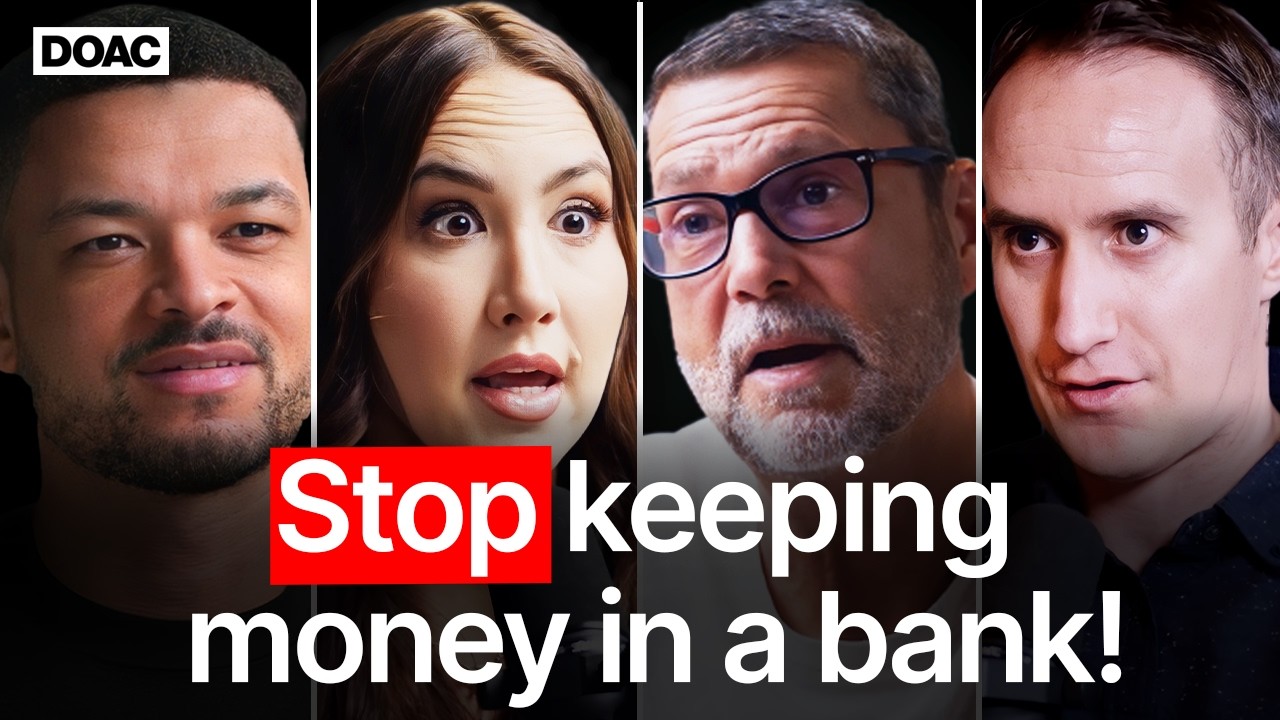
The Diary Of A CEO
Financial experts argue that long-term wealth requires transitioning from earned income to appreciating assets, index funds, and tax-efficient structures rather than chasing short-term market returns.
AI-assisted summary of How To Make Money.... 7 Hacks That Are PROVEN To Work! — original source. Check the original for full context.
Source published:
Detailed notes
## Background This episode was published by The Diary Of A CEO channel on YouTube on December 30, 2024. The page description presents this compiled episode as an expert knowledge guide featuring seven proven financial hacks to help viewers financially thrive in 2025 following a year of economic shocks.
## TL;DR The video breaks down key strategies for building wealth, starting with automated, long-term stock investing through low-cost index funds and Target Date Funds while avoiding emotional trading apps. It explores maximizing personal earnings by leveraging high-value skills into high-margin industries and mastering dealmaking. Additionally, the experts outline tax strategies utilized by the super-rich, such as borrowing against assets, and examine crypto and blockchain as decentralized equity tools. Ultimately, the guest experts urge viewers to break the paycheck-to-paycheck cycle by prioritizing endurance, logical discipline, and short-term sacrifice over social posturing.
## Atmosphere & style The show feels like an urgent yet empowering masterclass on financial literacy, blending practical advice with direct, unvarnished truth. The dynamic across the guest highlights—featuring figures like Ramit Sethi, Scott Galloway, Jaspreet Singh, and Morgan Housel—ranges from pragmatic financial breakdowns to raw personal anecdotes about sacrifice and wealth accumulation. The emotional arc moves from exposing the hidden costs of ignorance and lifestyle inflation to instilling a sense of clarity and tactical confidence for long-term independence.
## Key takeaways - [01:42](https://www.youtube.com/watch?v=jyCJeglqCe4&t=102s) True investing should be automated and boring, using diversified options like Target Date Funds or Index Funds rather than gamified trading apps. - [12:35](https://www.youtube.com/watch?v=jyCJeglqCe4&t=755s) A simple baseline return in index funds can build massive long-term wealth through compounding if held over decades. - [17:36](https://www.youtube.com/watch?v=jyCJeglqCe4&t=1056s) The greatest financial loss people face is the cost of ignorance—the gap between what they earn and what they could earn with better information. - [19:08](https://www.youtube.com/watch?v=jyCJeglqCe4&t=1148s) Income and perceived value depend heavily on environment, industry margins, and leveraging labor, media, capital, or tech. - [30:35](https://www.youtube.com/watch?v=jyCJeglqCe4&t=1835s) Transitioning from a generalist role into high-margin niches (like biotech or financial writing) dramatically increases earning power. - [32:33](https://www.youtube.com/watch?v=jyCJeglqCe4&t=1953s) Negotiating asymmetric equity or revenue-share deals creates significant long-term upside beyond standard salaries. - [37:06](https://www.youtube.com/watch?v=jyCJeglqCe4&t=2226s) High W-2 earners pay the highest tax rates, whereas the wealthy build wealth as asset owners utilizing legal tax strategies like QSBS or borrowing against equity. - [47:02](https://www.youtube.com/watch?v=jyCJeglqCe4&t=2822s) Maximizing investment endurance for decades outweighs trying to beat the market or taking unnecessary short-term risks. - [53:03](https://www.youtube.com/watch?v=jyCJeglqCe4&t=3183s) Primary real estate should be viewed as a lifestyle choice rather than a primary high-return investment vehicle. - [56:10](https://www.youtube.com/watch?v=jyCJeglqCe4&t=3370s) Blockchain and crypto provide decentralized, globally accessible assets that level the playing field for retail investors. - [01:04:46](https://www.youtube.com/watch?v=jyCJeglqCe4&t=3886s) True financial sovereignty in crypto requires taking self-custody of funds through hardware wallets rather than leaving them on centralized platforms. - [01:08:07](https://www.youtube.com/watch?v=jyCJeglqCe4&t=4087s) Escaping the paycheck-to-paycheck cycle requires stopping emotional spending, cutting non-essentials, and shifting focus toward long-term asset accumulation.
## Detailed walkthrough ### [00:00](https://www.youtube.com/watch?v=jyCJeglqCe4&t=0s) Intro: Building Wealth and Financial Freedom in 2025
With 53% of people planning to make a New Year's resolution around money, finance, and investing, this compilation brings together the most shared and replayed moments from expert discussions. The host highlights that the most expensive thing anyone pays for is "the information that we don't know." The collection covers fundamental topics including saving, spending, investing, taxes, cryptocurrency, real estate, and financial mindsets. By learning a few key basics, viewers can build long-term wealth, put themselves into the top 5% of investors, and work toward total financial security.
Before diving into the core advice, the host shares a quick 30-second note thanking the audience for tuning in week after week. He notes that while this level of success was never imagined, the team feels like they are only just getting started. He encourages the 24% of regular viewers who aren't yet subscribed to hit the subscribe button, promising in return to keep delivering the guests and quality content that viewers love.
[01:42](https://www.youtube.com/watch?v=jyCJeglqCe4&t=102s) Investing 101: Demystifying the Stock Market and Target Date Funds
Ramit Sethi breaks down the basics of investing, starting with how common it is for people to feel completely alienated by personal finance. Even among a 30-person production team, almost no one had ever been taught how to invest. Most people grow up believing that investing is only for rich individuals over 40 with a million dollars, or that buying a house is the only option available. Ramit expresses his deep frustration with this misconception, stressing that learning basic money principles allows people to live a "rich life"—whether that means traveling longer, staying at nicer hotels, or spending quality time with family.
When asked by family members how to start from absolute scratch, Ramit's simplest recommendation is a **Target Date Fund**. This strategy uses a single fund selected based on the year you expect to retire (for example, a 2065 fund if you turn 65 in 2050). Available through major brokers, a target date fund acts like a pie chart that automatically diversifies across hundreds of stocks and bonds. As the investor gets older, the fund automatically shifts to become more conservative, adjusting risk over time without requiring any manual rebalancing.
- **Brokers:** Major low-cost firms offering target date funds include Vanguard, Schwab, and Fidelity. - **Diversification:** A fund pools together hundreds of underlying assets (such as Microsoft, Google, or bonds) so investors do not have to manually pick individual stocks. - **Target Date Adjustment:** The asset mix automatically shifts from aggressive growth to conservative stability as the investor approaches retirement age.
[05:00](https://www.youtube.com/watch?v=jyCJeglqCe4&t=300s) Should I Use Investing Apps?
Addressing how to access these funds, Ramit strongly cautions against using flashy investment apps that gamify trading. He emphasizes that trading leads to lost money, whereas true investing should be fundamentally boring—comparing it to "watching paint dry" or letting a turkey cook in the oven for Thanksgiving. The goal is to set up automatic monthly transfers into a low-cost brokerage account on desktop and avoid checking it constantly on a phone.
The host shares his experience using Hargreaves Lansdown in the UK, noting that its plain desktop interface helped keep him from over-monitoring his portfolio. Ramit confirms he keeps zero investing apps on his smartphone. For the average individual, logging in once every three to six months via a desktop computer is more than sufficient.
> "Investors treat investing like watching paint dry... I'm not getting my entertainment from investing. Go watch a movie, go watch Netflix. Investing is boring and automatic—that's how it should be."
[06:41](https://www.youtube.com/watch?v=jyCJeglqCe4&t=401s) How to Invest With $100
Ramit and the host break down the exact mechanics of starting small, such as investing $100. Platforms like Hargreaves Lansdown or major US brokerages allow investors to start buying funds without high account minimums or per-trade fees that usually attach to individual stock purchases. When an investor deposits $100 into a fund, the platform splits that money across all the fund's holdings—allocating tiny fractions to companies like Facebook, Google, Shopify, Spotify, and Nvidia automatically.
Once the account is opened and an initial deposit is made, the final essential step is setting up an automated recurring transfer. Ramit recommends using his **Conscious Spending Plan** guideline, which suggests allocating **5% to 10% of take-home pay** toward investments. He challenges anyone who claims they cannot afford 5%, guaranteeing that reviewing their spending will easily reveal enough unaccounted cash to invest.
- **Conscious Spending Plan Rule:** Allocate 5% to 10% of your net income to investments every month. - **Automation:** Set up an automatic debit from checking to the investment account so wealth builds without needing active willpower or daily effort.
[09:28](https://www.youtube.com/watch?v=jyCJeglqCe4&t=568s) Common Mistakes With Investment Accounts
The host shares an anecdote about a friend who was advised to invest in a fund, only to withdraw the money two months later to pay off a credit card bill. Ramit clarifies that investments are meant strictly for accumulating long-term wealth, not to be treated as a secondary checking account.
To prevent this emotional or structural mistake, Ramit outlines his recommended account setup: 1. **Income Direct Deposit:** Income lands in a primary checking account. 2. **Sub-Savings Accounts:** Automated transfers move money into dedicated sub-savings accounts for specific short/medium-term goals (e.g., vacations, car down payments). 3. **Investment Accounts:** Automatic transfers push money directly into long-term investment funds, where it remains untouched to "cook." 4. **Guilt-Free Spending & Auto-Pay:** Remaining funds are used for discretionary spending, while credit card bills are set to auto-pay in full every month.
[11:15](https://www.youtube.com/watch?v=jyCJeglqCe4&t=675s) What's the Proof This Is Actually a Good Way to Build Wealth?
When asked to prove that fund investing beats high-risk alternative strategies like launching a business, winning the lottery, or buying cryptocurrency, Ramit points to roughly a century of historical stock market data. Over the long term, the US stock market has delivered average annual returns of **10% to 11%**, which translates to **7% to 8% after adjusting for inflation**.
To demonstrate the real-world impact of these numbers, Ramit leads the host through a live calculation using an online compound interest tool (MoneyChimp).
- **Historical Stock Market Return:** ~10%–11% annualized return (or ~7%–8% net of inflation). - **Benchmark Calculation Tool:** MoneyChimp compound interest calculator.
[12:35](https://www.youtube.com/watch?v=jyCJeglqCe4&t=755s) Compound Interest: Watch Your Money Grow
Using the host as an example starting from age 16 up to his current age of 30, they run the math on compound interest assuming a conservative 7% annual return.
* **Scenario 1 (Age 16 to 30 / 14 Years):** Starting with $5,000 at age 16 and adding $5,000 annually ($2,400 to $5,000 per year, or roughly $400/month) at a 7% return yields **$133,537** by age 30. * **Scenario 2 (Age 16 to 40 / 24 Years):** Maintaining that same modest $5,000 annual contribution for 24 years grows the balance to **$336,000**. * **Scenario 3 (Age 16 to 50 / 34 Years):** Continuing for 34 years yields **$736,000**. * **Scenario 4 (Age 16 to 65 / 49 Years):** Adjusting for career growth—where average annual contributions rise to $30,000 across a 49-year working lifetime—results in a massive balance of **$12,330,000**.
Ramit emphasizes that even starting with modest monthly amounts builds significant momentum, and as earnings rise in one's 30s and 40s, simply increasing the automatic contribution number accelerates compounding into multi-million dollar wealth over time.
[17:36](https://www.youtube.com/watch?v=jyCJeglqCe4&t=1056s) Compounding Returns, Conservatism, and the Cost of Ignorance
Continuing the discussion on long-term compound growth, the speakers debate conservative versus optimistic return rate projections. While securing an $8\%$ return over $7\%$ swells a portfolio from around $\$12$ million or $\$10$ million up to $\$17.4$ million over decades, attempting to chase $13\%$ yields by taking unnecessary risks is a fast track to losing capital. Sticking to a safe, conservative $7\%$ baseline allows investors to focus on the two variables within their direct control: starting early and consistently increasing the total amount invested.
Transitioning to broader wealth creation, the conversation pivots to a core philosophical framework: the single most expensive debt any person pays in life is the cost of ignorance. This point is illustrated through a story from a pitch event years prior:
> "This guy got on stage and he was like, 'Hey ma'am, how much do you make?' She was like, '$50,000.' So he wrote $50,000 on the whiteboard, and then he wrote a million dollars on top of the 50,000 and he subtracted it and said, '$950,000.' He said, 'You pay life $950,000 every single year for not knowing how to make a million dollars a year.'"
While used as a high-pressure sales tactic in that moment, the concept holds a profound truth. The price of missing information is steep, but realizing this is equally empowering because acquiring better information instantly unlocks higher-tier financial games.
- **The Price of Ignorance:** The financial gap between current earnings and potential income is the literal cost of lacking specific information. - **Conservative Baseline:** Base financial projections on a safe $7\%$ rate of return rather than chasing volatile double-digit yields.
---
[19:08](https://www.youtube.com/watch?v=jyCJeglqCe4&t=1148s) The Beat-Up Car Parable and Understanding Your True Value
To illustrate how environment dictates financial leverage, the speaker shares a classic parable about a father passing down an old beat-up car to his son:
The father tells his son to take the car to a local dealership to see what they will offer. The dealership inspects it and offers $\$1,000$. The father then sends him to an impound scrap yard, where the buyer evaluates the metal raw material and offers just $\$500$. Finally, the father directs the son to a specialized antique automotive lot down the street. The dealer there gets thrilled, explaining that it is a rare historic car—one of only ten left in existence—and offers $\$100,000$ for it.
The lesson is that a person's value is not solely determined by who they are, but by whether they are standing in front of people who truly appreciate their worth. In business terms, success requires fishing in the right ponds and seeking out "whales" rather than small fish. Selling a high-ticket product or service often takes the exact same effort—and is usually easier—than selling a cheap item, as low-paying clients tend to demand far more hands-on reassurance than high-value clients who simply send a wire transfer.
- **The Micro-Budget Client Dynamic:** Lower-paying clients (e.g., $\$50$) often demand extensive breakdowns and line-item hand-holding. - **The High-Ticket Client Dynamic:** Enterprise or high-value clients (e.g., $\$50,000$) simply request payment instructions and expect results without micromanagement. - **Agency Evolution Example:** In 2014, early pitch decks featured tiered packages—Bronze for $\$200$, Silver for $\$500$, and a Gold "everything included" offer for $\$1,000$. Elevating income came down to superior information rather than doing ten times the manual labor.
---
[21:40](https://www.youtube.com/watch?v=jyCJeglqCe4&t=1300s) Stepping Through the Secret Doors of Business
Reflecting on personal growth, the host compares advancing in business to a story comedian Kevin Hart told on Joe Rogan's podcast: you work hard to get into a room, only to realize there is a hidden door leading to a secret back room where people are playing an entirely different money game. You feel a sudden wave of irritation that nobody told you the room existed, only to discover a few years later that another hidden door exists, leading to billionaires calmly smoking cigars and playing even higher-leveraged games without breaking a sweat.
``` [ Income Escalation & Leverage Stair-Steps ]
Level 1: Employee ---> 4-figure monthly income Level 2: Self-Employed ---> 5-figure monthly income Level 3: Managing Labor ---> 6-figure monthly income Level 4: Media & IP ---> High digital leverage Level 5: Capital & Tech ---> Maximum scale (Public/Institutional) ```
The progression through income levels relies on unlocking distinct forms of leverage, defined as the ratio between input effort and output return:
* **Labor (Work):** Transitioning from employee to self-employed, then hiring staff to multiply output. * **Media (Content & IP):** Creating asset platforms, courses, or shows once and licensing or distributing them infinitely at near-zero marginal cost. * **Capital:** Deploying money directly into investments or ventures so yield is decoupled from personal hours worked. * **Technology (Code):** Building digital architecture or software once that millions of people can use concurrently.
By combining and stacking multiple forms of leverage simultaneously—as platforms like Facebook, Amazon, and media networks do—entrepreneurs can scale exponentially without burning out.
---
[26:01](https://www.youtube.com/watch?v=jyCJeglqCe4&t=1561s) Mapping Unfair Advantages: Skills vs. High-Value Sectors
To figure out how an individual can identify their own "unfair bet" to build massive wealth, the speaker lays out a practical whiteboard exercise. On one side, write down your specific core skills; on the other side, evaluate where those skills map to the highest monetary yield based on three variables: **industry sector**, **size of the business**, and **profitability margin**.
Using the host as a live subject, the speaker maps out his key skills—deep mastery of YouTube, short-form viral video dynamics, data-driven content strategy, charisma, networking, and asking probing questions. If those same media skills are deployed for a local trade or home-services business, the earning potential remains capped because those local businesses operate with modest revenues and tight margins. However, if those identical skills are applied to high-margin industries like biotech (where profit margins run between $50\%$ and $80\%$ on hundreds of millions in revenue), financial institutions, or Silicon Valley venture funds selling high-value attention, the financial return explodes.
- **The Scale Equation:** Financial potential is determined by the *size of the problem* multiplied by the *value of the solution*. - **Margin Disparities:** Low-margin retail businesses like Walmart operate on roughly $6\%$ margins, whereas specialized software, biotech, or finance sectors feature vast cash reserves and high profit margins.
---
[30:35](https://www.youtube.com/watch?v=jyCJeglqCe4&t=1835s) Practical Application: Pushing a Skill Stack into High-Income Niches
The host and speaker roleplay a scenario with a fundamental skill set: being a general writer who understands basic social platforms. Applying the negative-testing framework—asking what the *worst* possible application of that skill would be—highlights paths like writing local newspaper entries or fiction books, where compensation can bottom out around $\$14$ per hour.
``` [ The Writer's Skill-Mapping Matrix ]
Low Yield High Yield ----------------------------------------------------------------------- Local News / Fiction General Copywriting Medical / Financial (Approx. $14/hour) (Approx. $35,000/year) ($150,000+/year) ```
To maximize earning potential, a writer should combine general writing skills with specialized domain knowledge to target hyper-lucrative niches:
* **General Copywriting:** Base-level agency content writing yields entry-level salaries around £25,000 (roughly $35,000). * **Medical Writing:** Specialized writers who understand technical terms, clinical compounds, or psychedelic research can command $150,000 or more because specialized biotech companies struggle to find talent capable of translating complex science. * **Financial Writing:** Crafting investor updates, SEC disclosures, or shareholder reports targets the finance industry, where asset managers and funds willingly pay premium rates for clear, precise communications.
By intentionally combining a core skill like writing with a high-margin industry, anyone can dramatically raise their earning baseline without spending years learning an entirely new career from scratch.
Here is a detailed, faithful walkthrough of Part 3 of the transcript:
[32:33](https://www.youtube.com/watch?v=jyCJeglqCe4&t=1953s) Structuring Deals and Unlocking Massive Upside
Codie Sanchez breaks down how to increase earnings by getting smarter about deal structuring rather than accepting flat base salaries. She illustrates this with a hypothetical example: if she were a copywriter offered a $35,000 salary, she wouldn't just take the flat rate. Instead, she would ask for a low base (such as $10,000 just to cover basic living costs) in exchange for 10% of any upside revenue she generates above a set baseline goal. For instance, if a company's marketing funnel currently brings in $100,000 per month, she would take a percentage of everything driven beyond that $100,000 mark.
Steven Bartlett agrees completely, sharing a personal story from his move into the biotech sector that illustrates how transformational equity-based compensation can be. He helped build out the marketing team for a biotech company focused on psychedelics—a project he initially took out of personal fascination with the space. Rather than a standard fee, he structured his compensation to receive 400,000 stock options. When the company went public on the NASDAQ at a $3.2 billion valuation, his six months of work yielded an equity value close to $10 million—roughly a thousand times more than he would have made under traditional pay structures.
The experience was eye-opening for Steven, showing that anyone with high-value skills like social media expertise can change their life simply by negotiating for equity or stock in a growing venture. Codie emphasizes that learning how to structure deals is the single most valuable skill set in the world. People often get hung up on waiting to outright buy a business, but mastering dealmaking delivers immediate leverage. While financial terms and dealmaking used to be heavily gatekept behind closed doors in private equity, Codie points out that the information is now widely available, making it the individual's responsibility to learn it.
- Codie's hypothetical copywriter deal: Accept a $10,000 base + 10% of revenue generated above the $100,000/month baseline. - Steven's biotech deal: 6 months of work building a marketing team resulted in 400,000 shares. - Company IPO: Valued at $3.2 billion on the NASDAQ, turning Steven's position into ~$10 million in net return.
[35:05](https://www.youtube.com/watch?v=jyCJeglqCe4&t=2105s) The Power of Deals and Where to Learn Them
To illustrate how the world's wealthiest people use deals, Codie and Steven cite high-profile leaders like Donald Trump, whose core strength is "the art of the deal," and Elon Musk. They highlight how Tesla managed to survive and stay afloat during its first ten grueling years: Musk negotiated massive solar and zero-emission tax credits with the government, creating a vital revenue stream for the company.
When Steven asks where a 25-year-old listener should go to actually learn dealmaking, Codie introduces her book, *Main Street Millionaire*. Designed as a concise, practical guide, the book strips away fluff to teach the foundational mechanics of structuring deals. For those who want to go deeper after reading, she points to her platform, Contrarian Thinking, which provides courses, free newsletters, and a community dedicated to buying businesses and mastering deal structures.
> "You're never going to regret learning how to do deals... I think that is the most valuable skill set in the world." — Codie Sanchez
[36:18](https://www.youtube.com/watch?v=jyCJeglqCe4&t=2178s) The Tax Game: How Corporations and the Super-Rich Avoid Taxes
The conversation shifts to how wealthy individuals and massive corporations minimize their tax burdens. Scott Galloway asserts that tax avoidance is a critical skill for wealth building, comparing it to a prisoner of war's obligation to try to escape. He explains how corporations like Apple legally execute global tax avoidance schemes: Apple transfers its intellectual property (IP) to Apple Ireland, which then licenses that IP back to the US entity for tens of billions of dollars. This artificially inflates earnings in low-tax Ireland while slashing taxable income in the US, dramatically reducing Apple's overall global corporate tax rate.
Scott argues that while corporations and the 25 wealthiest Americans—who pay an effective tax rate of only 6% to 8%—utilize these legal loopholes to the hilt, everyday citizens should learn the rules too, even as he personally advocates for political policy changes like an alternative minimum tax to make corporations pay more.
- Apple's IP license strategy: Shifts billions in income to Apple Ireland (lower tax rate) from the US entity (higher tax rate). - Effective tax rate for the 25 wealthiest Americans: 6% to 8%.
[37:36](https://www.youtube.com/watch?v=jyCJeglqCe4&t=2256s) The "Buy, Borrow, Die" Strategy and State Arbitrage
Scott Galloway breaks down the exact mechanisms the super-rich use to pay almost no income tax, starting with the classic strategy known as "buy, borrow, die."
``` Buy Assets ➔ Hold & Let Appreciate ➔ Borrow Against Equity ➔ Pass to Heirs via Trust ```
Instead of selling stock to raise cash—which triggers long-term capital gains taxes on profits—wealthy investors borrow money against their portfolio. The stock continues to compound tax-free, while the investor lives off the loan proceeds and pays a relatively small interest fee. Eventually, assets are placed in a trust and passed down to heirs.
Beyond portfolio borrowing, Scott calls out "state tax arbitrage," using Jeff Bezos's move from Washington State to Florida as a prime example. While public relations might frame such moves as personal or family-focused, Scott notes that Bezos avoided an 8% to 10% state tax rate in Washington on his $160 billion wealth stack. Washington's public infrastructure—such as the University of Washington and Seattle-Tacoma International Airport—helped build that wealth, yet the US tax code permits individuals to relocate to zero-income-tax states like Florida or Texas just before realizing massive gains. He critiques wealthy individuals who cite political dissatisfaction with states like California or New York as a cover for what is fundamentally a tax dodge.
> "Show me someone who's all of a sudden can't handle San Francisco politics, I'm going to show you someone who needs to recognize a capital gain and has all of a sudden decided they like Texas politics." — Scott Galloway
[39:05](https://www.youtube.com/watch?v=jyCJeglqCe4&t=2345s) Tax Loopholes: Section 1202 and Qualified Small Business Stock
Scott shares a specific US tax code loophole he personally leveraged called Section 1202, which covers Qualified Small Business Stock (QSBS). When he started his analytics firm, L2, it was valued well under $50 million. Because he held his QSBS stock for longer than five years, when L2 was acquired, his first $10 million in gains (or 10 times the tax basis) was completely tax-free ($0 paid to the government). He shares another instance where he invested $2.5 million to pull a company out of bankruptcy, and upon its eventual sale, the first $25 million of returns came back tax-free under QSBS rules.
Scott notes that the US tax code has exploded from 400 pages to over 4,000 pages, with the extra 3,600 pages primarily consisting of specialized provisions that convert the rich into the super-rich.
- QSBS Rule (Section 1202): Hold small business stock (<$50M basis) for 5+ years to get the first $10 million (or 10x basis) in capital gains tax-free. - L2 result: First $10 million from sale was tax-free. - Turnaround deal result: $2.5 million investment yielded first $25 million tax-free.
[40:08](https://www.youtube.com/watch?v=jyCJeglqCe4&t=2408s) Super Earners vs. Super Owners: Why the "Workhorses" Get Taxed Most
Addressing common misconceptions, Scott explains that the "sort-of rich"—high-income earners whose money comes from salaries or traditional professional fees—actually pay the highest tax rates. He offers an example of a high-earning couple: a female law firm partner making $1,000,000 a year and a chiropractor husband earning $600,000 a year. Living in a major urban center in a high-tax state, this $1.6 million household gets taxed at marginal rates between 45% and 52% because ordinary income is hit hardest by tax laws.
The dynamic shifts completely when someone transitions from a high earner to a property or business owner. If the chiropractor takes out capital, buys a chain of chiropractic clinics, and sells them years later for $50 million, his effective tax rate plummets because capital gains are taxed far lower than salary. The bottom half of society pays minimal income tax (though significant consumption tax), while the middle-to-upper "super earners" act as the tax system's workhorses. To build true wealth, Scott advises jumping to "light speed" by converting earned income into asset ownership.
| Category | Primary Income Source | Tax Impact / Effective Rate | |:--- |:--- |:--- | | **Super Earners ("Workhorses")** | W-2 Salary, Professional Fees | Highest taxes (45%–52% in high-tax states) | | **Super Owners** | Assets, Equity, Capital Gains | Lowest taxes (Top 25 wealthiest pay ~8%) |
[41:27](https://www.youtube.com/watch?v=jyCJeglqCe4&t=2487s) The Mechanics of Borrowing Against Assets and Securing Top Advice
Steven breaks down how borrowing against investments works in practice for a regular investor. If an individual buys $10,000 in Amazon stock, they can take out a $5,000 bank loan against that equity completely tax-free. If the stock appreciates to $20,000, they can borrow an additional $5,000 to cover living expenses without ever triggering a taxable sale. If the stock crashes, the lending bank automatically liquidates a portion of the shares to cover the debt. Steven notes this is precisely how figures like Elon Musk finance their lifestyles—borrowing tax-free against equity and relocating states when forced to liquidate shares to repay loans.
Both Steven and Scott emphasize that acquiring top-tier tax advice is one of the greatest wealth-building advantages available. Steven reflects on seeing individuals with identical income trajectories achieve vastly different financial outcomes—ranging from bankruptcy to multi-billionaire status—based entirely on their tax strategy.
Scott praises his own tax advisor, Lucy Lee, who charges $1,800 an hour at a major law firm. He consults her *before* incorporating a company or taking a massive payout from his podcast distributor. The goal for young people is simple: earn money to quickly transition into an owner, building an "army of capital" that works around the clock. $500 invested at age 21 compounds to the equivalent of $10,000 later in life, so starting early is critical.
> "You're an earner, you want to bust a move out of earning and develop an army of capital that goes out and kills for you at night." — Scott Galloway
[45:11](https://www.youtube.com/watch?v=jyCJeglqCe4&t=2711s) Morgan Housel's Capital Allocation Strategy
Morgan Housel details his minimalist approach to personal investing. Despite being a widely recognized financial author, his entire net worth consists of just four elements: cash, his primary residence, index funds, and stock in Markel (where he serves on the board of directors). He keeps everything consolidated into a single bank account and one brokerage account.
When Steven asks why Morgan relies so heavily on index funds, Steven reveals that reading Morgan's book (*The Psychology of Money*) convinced him to stop attempting to pick individual stocks. Outside of funding his own software ventures and holding a long-term position in Ethereum—which he held for six years based on watching software developers favor Ethereum over other blockchains—Steven allocated all his remaining liquid capital into index funds. Steven jokes that his version of disciplined investing is literally forgetting his brokerage account passwords so he can't touch his money.
- Morgan's complete balance sheet: Cash + primary residence + index funds + Markel shares (single bank/brokerage account). - Steven's allocation: Direct business equity + 6-year Ethereum hold + index funds for all remaining liquid capital.
[47:02](https://www.youtube.com/watch?v=jyCJeglqCe4&t=2822s) Maximizing Endurance: Getting into the Top 5% of Investors
Morgan clarifies that he doesn't use index funds because he believes beating the market is impossible; rather, he knows beating the market requires extraordinary effort and skill that few possess. Instead of chasing outsized returns, Morgan's core strategy is to maximize **endurance**. Earning average market returns for an above-average duration builds massive wealth.
He shares the example of his parents, who had no background or interest in finance. By consistently dollar-cost averaging into index funds over a 40-year period without ever selling a single share, his parents achieved long-term returns that put them in the top 3% of all professional money managers.
Morgan breaks down the definition of **dollar-cost averaging**: buying a fixed dollar amount of an investment at regular intervals (such as the 1st of every month) regardless of market conditions, booms, or busts. This automatic, un-emotional execution—the same mechanism behind standard employer 401(k) plans—eliminates market-timing mistakes and guarantees long-term growth through compounding.
> "The variable that I want to maximize for in my investments is endurance. If I can just earn average returns for an above-average period of time, it's going to lead to an amount of success that will literally put you in the top 5% of investors." — Morgan Housel
<ElicitationsGroup message="Where would you like to explore next?"> <Elicitation label="Explore Part 4 of the transcript" query="Please provide a detailed, faithful walkthrough of Part 4 of this transcript."/> <Elicitation label="Deep dive into Section 1202 QSBS tax strategy" query="Explain how Qualified Small Business Stock (Section 1202 QSBS) works, including eligibility rules and tax tax benefits."/> </ElicitationsGroup>
[48:22](https://www.youtube.com/watch?v=jyCJeglqCe4&t=2902s) Index Funds: Owning a Slice of Capitalism
An index fund is essentially a single fund that holds hundreds or even thousands of individual stocks inside it, such as Tesla or Apple. When an investor buys a sufficiently large and diversified index fund, they are effectively buying a "slice of the global economy" or a slice of capitalism itself. This automated strategy stands in stark contrast to active trading, where people make emotional buy-and-sell decisions based on watching cable business news like CNBC and trading based on daily market moods.
To explain why this long-term approach beats trying to stock-pick companies or speculate on cryptocurrencies, the conversation highlights the mathematical reality of wealth creation: one-year or five-year performance has virtually no impact on lifetime wealth. What matters most is endurance and the ability to sustain returns over 50 years. Because the core compounding formula operates with time as an exponent, all the heavy lifting in wealth building comes directly from that exponent.
* **Definition:** An index fund aggregates hundreds or thousands of stocks into a single holding. * **The Compounding Exponent:** Time acts as the exponent in long-term wealth formulas, making duration far more impactful than short-term high returns.
---
[49:48](https://www.youtube.com/watch?v=jyCJeglqCe4&t=2988s) How Warren Buffett and Ronald Read Built Massive Wealth
A striking case study of compound interest in action is Warren Buffett. Roughly 99% of Buffett's entire net worth was accumulated after his 60th birthday. When he turned 60, he was worth roughly $3 billion; by his 90s, his wealth expanded past $100 billion, even after donating $100 billion to charity. If he had not given that money away, his net worth would have surged from $3 billion to $200 billion post-age 60. While Buffett is undoubtedly a skilled investor, his true secret is that he has been investing consistently for 80 years since he was 11 years old. Had he retired at 50 or 60, he would have been just another unknown multi-billionaire playing golf in Florida rather than a household name.
An even more radical example of endurance over genius stock picking is Ronald Read, a Vermont janitor and gas station attendant who mopped floors for a living. When Read passed away in 2014 at age 92, he left behind a fortune of over $8 million, leaving the vast majority to charity. He simply saved small amounts from his humble wages, put the money into stocks, and left it untouched for 70 years.
* **Warren Buffett:** Accumulated 99% of his wealth after age 60 purely due to decades of uninterrupted compounding. * **Ronald Read:** A gas station attendant and janitor who built an $8+ million estate by buying stocks and holding them for 70 years. * **Market Outperformance:** Outperforming the market by 1% per year for 10 years is legendary, but earning average returns for 20 to 30 years yields far superior overall wealth.
---
[53:03](https://www.youtube.com/watch?v=jyCJeglqCe4&t=3183s) The Financial Reality of Homeownership
When evaluating whether buying a primary residence is a good financial investment, the advice is clear: houses should be treated as pure lifestyle decisions, not wealth-building vehicles. Unless someone is playing a unique, asymmetric game that only they can access, buying real estate under the belief that it guarantees high returns is a mistake. Historically, adjusted for inflation, home prices in both the US and the UK have been "flat as a pancake." Nobel laureate Robert Shiller proved that across a 150-year period in the United States, real estate prices stayed flat, with only the last 20 to 30 years creating an anomalous spike that distorted public expectations.
Borrowing hundreds of thousands of dollars to leverage into an asset class that historically breaks even after inflation is a high-risk financial strategy. If someone is buying a home purely for financial gain, the straightforward advice is to "run for your life." Today, major cities offer abundant high-end luxury apartments for rent, eliminating the old dynamic where renting meant living in substandard housing.
* **Robert Shiller's Findings:** Over a 150-year historical span in the US, inflation-adjusted home prices showed virtually zero net real growth. * **Lifestyle vs. Investment:** Homeownership provides family stability, but renting maintains geographic mobility for career advancements without taking on immense debt.
---
[56:10](https://www.youtube.com/watch?v=jyCJeglqCe4&t=3370s) Understanding the Blockchain as a Source of Truth
At its core, the blockchain is a decentralized "database in the sky" checked continuously by every participating computer on the network. This setup eliminates the need for central governments or traditional banks to verify transactions and contracts. Instead of relying on centralized institutions, the network provides an immutable source of truth in a digital world where identity and ownership are often ambiguous.
Unlike previous global infrastructure waves—such as the public internet or privately built broadband infrastructure where early retail participants could not directly monetize the underlying network—the blockchain features a built-in economic reward system. Participants who run hardware, expend energy, and solve algorithms to mine or validate transactions are directly compensated with scarce tokens.
* **Bitcoin Scarcity:** Capped at a hard limit of 21 million Bitcoins that will ever exist. * **A Universal Source of Truth:** Blockchain technology solves fundamental trust and verification problems independent of traditional banking rails.
---
[01:00:14](https://www.youtube.com/watch?v=jyCJeglqCe4&t=3614s) The Equalizing Power of Crypto Investments
In traditional financial markets and venture capital—such as early-stage AI investing—99% of everyday people are locked out because they are not accredited investors. High-end real estate operates similarly; ordinary retail buyers cannot acquire a $50 million Manhattan apartment to renovate and flip for $250 million. Crypto completely inverted this structure by making participation fractional, allowing anyone to allocate small percentages of their paycheck into the exact same asset class accessed by institutions.
Crypto represents a "globally homogeneous asset," meaning a fraction of Bitcoin or Ethereum holds the exact same utility and value whether accessed from Nigeria, Brazil, London, Silicon Valley, India, or Papua New Guinea. It bypasses traditional brokerages and banking barriers, creating an incentive-driven model that fuels ecosystem development through behavioral economics.
> "We've got a playing field that's leveled in the fastest growing technology of all time... that is globally available to anybody."
---
[01:01:54](https://www.youtube.com/watch?v=jyCJeglqCe4&t=3714s) Real-World Crypto Use Cases and Getting Started
A concrete application of blockchain infrastructure is digital gaming. Companies like thirdweb (a Web3 infrastructure firm that raised roughly $30 million in capital) enable game developers to place in-game digital assets—such as a soccer player card in a sports game or a sword in a classic game like RuneScape—onto public blockchains like Ethereum. This allows players to truly own their digital property and trade those assets freely outside the game's proprietary ecosystem.
For individual investors holding network tokens like Ethereum, every new game, application, or business built on top of that chain increases overall network demand, driving up the underlying token value. Investing in these decentralized networks allows ordinary individuals to back technological shifts directly from a smartphone without needing corporate permission or institutional approval. To participate, retail users simply open an account with established global crypto exchanges such as Coinbase, Kraken, Crypto.com, or Gemini.
* **thirdweb:** Web3 infrastructure platform that raised $30 million to power blockchain development. * **Cross-Platform Ownership:** Assets held on Ethereum can be traded across open markets rather than remaining locked inside closed gaming servers. * **Major Exchanges:** Onramps to purchase digital assets include platforms like Coinbase, Kraken, Crypto.com, and Gemini.
### [01:04:46](https://www.youtube.com/watch?v=jyCJeglqCe4&t=3886s) Self-Custody and How to Actually Hold Your Crypto Steven Bartlett asks whether buying cryptocurrency through a traditional digital bank or apps like Revolut or PayPal is a good idea. Raoul Pal responds with an emphatic "yes" as a starting point. While it may be a basic entry route, everyone begins their journey somewhere, and getting hands-on experience with an asset that swings violently up and down—especially when it crashes and feels terrible—is essential for building emotional resilience. Over time, as a quality asset appreciates, investors naturally begin to recall that holding crypto on a bank app means the bank still owns it.
The real magic of cryptocurrency lies in self-custody. Unlike a bank, which can restrict withdrawals or cap daily limits at $10,000, self-custody allows an individual to hold all their assets on a hardware wallet such as a Ledger. A hardware device acts as a physical passkey for an address on the blockchain. Pal compares a public blockchain address to a mailbox or email address: anyone can send something to it, but only the person holding the private keys (the seed phrase stored on the device) can access or withdraw the contents. Although managing a 24-word seed phrase can feel complex today, security technology is rapidly moving toward biometric features like fingerprint and facial recognition.
``` +-----------------------------------------------------------------------+ | BLOCKCHAIN ADDRESS | | (Public "Mailbox": Anyone can view or send funds to this address) | +-----------------------------------------------------------------------+ ^ | Unlocked only by v +-----------------------------------------------------------------------+ | HARDWARE WALLET (LEDGER) | | Stores the private key / 24-word seed phrase safely offline | +-----------------------------------------------------------------------+ ```
Steven shares his personal setup, explaining that he keeps his Ethereum secured on a Ledger USB device, with the 24-word seed phrase written on physical pieces of paper stored across different international locations. This setup ensures that no matter where he is in the world or what political or financial chaos arises, his assets cannot be frozen or seized by a government or bank. Raoul draws a historical comparison to refugees fleeing Nazi Europe who struggled to transport gold and diamonds across borders; with blockchain technology, wealth can be safely transported across borders simply by memorizing a seed phrase.
- **Key concept**: Moving from an app "on-ramp" (Revolut, PayPal) to physical self-custody via a cold wallet (Ledger). - **Security mechanism**: A string of words (typically 12 to 24 seed phrase words) secures the private key offline. - **Freedom factor**: Immune to bank freezes, daily withdrawal caps, or physical border confiscation.
---
### [01:08:07](https://www.youtube.com/watch?v=jyCJeglqCe4&t=4087s) Breaking Out of the Paycheck-to-Paycheck Cycle Reflecting on his past spent working in a call center where he blew through his wages within two days of getting paid, Steven asks Jaspreet Singh how someone trapped in a paycheck-to-paycheck loop can break free. Jaspreet breaks down the stark reality of the system: people living paycheck to paycheck are the ultimate profit source for the economic machine. Banks love them because they generate income through high-interest credit cards, overdraft fees, and payday loans. Corporations love them because they impulsively buy luxury goods and vacations. Governments love them because W-2 employees face the highest tax rates without access to corporate write-offs.
To break out, Jaspreet argues that you must commit to making yourself rich before you make everyone else rich. He uses the metaphor of being in a sinking boat: before you can pump out water, you have to plug the leak by halting non-essential spending.
> "You are the prime customer for our economic system... When you're spending all your money, you are putting your money into their pockets and you have to stop that. You've got to keep that money for yourself." — **Jaspreet Singh**
- **The Financial Danger Zone**: Having less than $2,000 saved for emergencies while carrying high-interest credit card debt. - **Immediate cuts**: Stop dining at restaurants, pause vacations, cancel subscription services, and eliminate leisure spending. - **Reclaiming time**: Cutting out the average 2+ hours of daily TV/streaming frees up crucial hours to learn, take on extra shifts, or start a side hustle. - **Liquidating clutter**: Sell unused electronics, downgrade cars, or move to a smaller living space to free up immediate capital.
---
### [01:11:01](https://www.youtube.com/watch?v=jyCJeglqCe4&t=4261s) "Pick Your Hard": Sacrificing the Present for the Future Steven raises a common real-world dilemma: when he was 18, broke, and living in a tiny apartment in Moss Side, Manchester, cutting back on social spending felt nearly impossible because he wanted to date and build a social life. In society, young men especially feel intense pressure to pay for dates and look financially stable.
Jaspreet responds with a fundamental truth: "Pick your hard." Life is going to be difficult either right now while you make sacrifices, or for the rest of your life if you remain broke. While balance sounds ideal, dividing your focus across dating, spending, and health makes building wealth significantly harder. Jaspreet notes humorously that this pressure is precisely why Indian parents tell their kids to become doctors—so their sons can afford to get married.
``` PICK YOUR HARD | +--------------------+--------------------+ | | v v HARD NOW (Sacrifice) HARD LATER (Regret) • Strict budgeting • Trapped in debt forever • Pausing luxury & dating • Living paycheck to paycheck • 100% focus on income/skills • Working into old age ```
Steven agrees, reflecting that when he channeled all his energy into building his business rather than chasing social validation, his financial trajectory transformed. Focus acts as a magnet: chasing validation outwards drives success away, whereas focusing inward builds self-reliance and attraction over time. Jaspreet clarifies that the goal isn't to become a money-obsessed, greedy person, but to make a concentrated sacrifice for a distinct window of time so that you can enjoy financial freedom for the remainder of your life.
- **The Trade-off**: Short-term social sacrifice yields long-term financial sovereignty. - **The Magnet Paradox**: Pursuing outward status pushes wealth and relationships away; building internal capability pulls opportunities in.
---
### [01:13:49](https://www.youtube.com/watch?v=jyCJeglqCe4&t=4429s) Understanding the Seasons of Life Steven discusses viewing life in five-year "seasons." Between ages 20 and 25, he sacrificed everything to build his career; 25 to 30 was spent scaling and learning. Viewing life through distinct seasons makes temporary sacrifices manageable and allows for clearer communication with partners about current priorities.
Jaspreet highlights how difficult this mindset is today because social media constantly displays peers living luxurious lifestyles—driving sports cars, eating at fine restaurants, and vacationing in Cancún on credit. This creates immense pressure on partners and individuals who feel they are falling behind. Jaspreet shares a personal story from when he made his first million dollars in his 20s:
> "The first time I made a million dollars in a year... I was driving a car worth $500. It didn't have a bumper on it. It was not pretty. My wife sat in that car with me, and my employees drove better cars than I did." — **Jaspreet Singh**
To build real wealth, you need the internal confidence to prioritize long-term asset building over short-term flexes, and you need a partner who shares that vision.
- **Life Seasons**: Grouping years into dedicated focus blocks (e.g., 5-year hyper-growth phases). - **The Minority Mindset**: Intentionally swimming against the current of societal consumption and social media comparison.
---
### [01:16:27](https://www.youtube.com/watch?v=jyCJeglqCe4&t=4587s) The Trap of Looking Rich vs. Making Emotional Decisions The fear of looking broke drives people straight into debt. When someone lives a high-stress, low-income lifestyle—working late shifts at a call center and walking home alone because they can't afford bus fare—they crave quick dopamine hits. This emotional drain explains why gambling shops cluster in economically depressed areas, and why broke individuals often buy oversized TVs or expensive clothes to feel a fleeting sense of achievement.
Jaspreet emphasizes that you cannot solve emotional problems with logical formulas until you conquer your mindset. If you act on emotions—feeling entitled to nice things simply because you work hard—you become the prime target for get-rich-quick scams, fake laptop-lifestyle courses promising $10,000 a week for 5 hours of work, and predatory debt cycles.
``` +--------------------------------------------------------------------------+ | THE DOPAMINE TRAP | | | | Low Income / High Stress --> Craving Quick Dopamine Hit | | | | | v | | Financially Trapped <-- Emotional Spending & Scams | | (Credit Debt & Scams) (Oversized TVs, Luxury Goods, Courses) | +--------------------------------------------------------------------------+ ```
Building wealth requires stepping back, recognizing these emotional triggers, and sticking to a disciplined strategy—such as consistently investing 15% of your income into index funds or ETFs over decades—rather than chasing temporary dopamine hits.
- **Dopamine trap**: Using retail therapy, gambling, or luxury items to escape daily burnout. - **Scam vulnerability**: Desperation and emotional decision-making make people vulnerable to "get-rich-quick" schemes. - **The core shift**: Transition from emotional spending to cold, logical capital allocation.
<FollowUp label="Want me to break down Jaspreet Singh's step-by-step strategy for investing 15% of your income?" query="Explain Jaspreet Singh's step-by-step strategy for allocating and investing 15% of your income effectively."/>
[01:20:07](https://www.youtube.com/watch?v=jyCJeglqCe4&t=4807s) The Trap of Showing Off Wealth
The segment opens with a brief concluding thought on the superficial motivations that drive poor financial decisions, specifically the impulse to buy flashy things to "show it off to the girls." Falling into this trap creates a self-defeating cycle where the pursuit of external validation and perceived status actively sabotages long-term financial security.
[01:20:13](https://www.youtube.com/watch?v=jyCJeglqCe4&t=4813s) The Diary Of A CEO Conversation Cards
Host Steven Bartlett transitions to highlight a tangible product created directly from the show's signature tradition: asking every guest at the end of their interview to leave a handwritten question in the physical diary. The team has compiled these guest prompts into "The Diary Of A CEO Conversation Cards," designed for viewers to play at home. Each card presents a guest's question, and scanning the QR code on the back allows users "to watch the person who answered that question."
Bartlett enthusiastically unveils the newly released Version 2 deck, which for the first time reveals all the secret questions and the specific guests who answered them. Noting that previous runs "sold out twice instantaneously," he urges viewers interested in securing a deck of these limited-edition cards to act quickly before stock runs out.
- Features questions penned by every podcast guest in the original physical diary. - Includes a QR code on the back of each card that links directly to video footage of the guest answering the prompt. - Version 2 unveils all previously secret questions along with the guest responses. - Available at the official website (theconversationcards.com) after two prior sellouts.
## Notable quotes > [05:00](https://www.youtube.com/watch?v=jyCJeglqCe4&t=300s) Investors treat investing like watching paint dry... I'm not getting my entertainment from investing. Go watch a movie, go watch Netflix. Investing is boring and automatic—that's how it should be. — Ramit Sethi
> [17:36](https://www.youtube.com/watch?v=jyCJeglqCe4&t=1056s) This guy got on stage and he was like, 'Hey ma'am, how much do you make?' She was like, '$50,000.' So he wrote $50,000 on the whiteboard, and then he wrote a million dollars on top of the 50,000 and he subtracted it and said, '$950,000.' He said, 'You pay life $950,000 every single year for not knowing how to make a million dollars a year.'
> [35:05](https://www.youtube.com/watch?v=jyCJeglqCe4&t=2105s) You're never going to regret learning how to do deals... I think that is the most valuable skill set in the world. — Codie Sanchez
> [37:36](https://www.youtube.com/watch?v=jyCJeglqCe4&t=2256s) Show me someone who's all of a sudden can't handle San Francisco politics, I'm going to show you someone who needs to recognize a capital gain and has all of a sudden decided they like Texas politics. — Scott Galloway
> [41:27](https://www.youtube.com/watch?v=jyCJeglqCe4&t=2487s) You're an earner, you want to bust a move out of earning and develop an army of capital that goes out and kills for you at night. — Scott Galloway
> [47:02](https://www.youtube.com/watch?v=jyCJeglqCe4&t=2822s) The variable that I want to maximize for in my investments is endurance. If I can just earn average returns for an above-average period of time, it's going to lead to an amount of success that will literally put you in the top 5% of investors. — Morgan Housel
> [01:00:14](https://www.youtube.com/watch?v=jyCJeglqCe4&t=3614s) We've got a playing field that's leveled in the fastest growing technology of all time... that is globally available to anybody.
> [01:08:07](https://www.youtube.com/watch?v=jyCJeglqCe4&t=4087s) You are the prime customer for our economic system... When you're spending all your money, you are putting your money into their pockets and you have to stop that. You've got to keep that money for yourself. — Jaspreet Singh
> [01:13:49](https://www.youtube.com/watch?v=jyCJeglqCe4&t=4429s) The first time I made a million dollars in a year... I was driving a car worth $500. It didn't have a bumper on it. It was not pretty. My wife sat in that car with me, and my employees drove better cars than I did. — Jaspreet Singh
## Mentioned Ramit Sethi, Codie Sanchez, Scott Galloway, Morgan Housel, Steven Bartlett, Vanguard, Schwab, Fidelity, Hargreaves Lansdown, Facebook, Google, Shopify, Spotify, Nvidia, MoneyChimp, Kevin Hart, Joe Rogan, Walmart, Apple, Jeff Bezos, L2, Lucy Lee, Markel, Ethereum, Main Street Millionaire, Contrarian Thinking, The Psychology of Money, The Diary Of A CEO, Tesla, CNBC, Warren Buffett, Ronald Read, Robert Shiller, Bitcoin, thirdweb, RuneScape, Coinbase, Kraken, Crypto.com, Gemini, Revolut, PayPal, Raoul Pal, Ledger, Jaspreet Singh, The Diary Of A CEO Conversation Cards
[Source](https://www.youtube.com/watch?v=jyCJeglqCe4)