Stanford's Lembke Warns Artificial Dopamine Spikes Drive Severe Deficit State
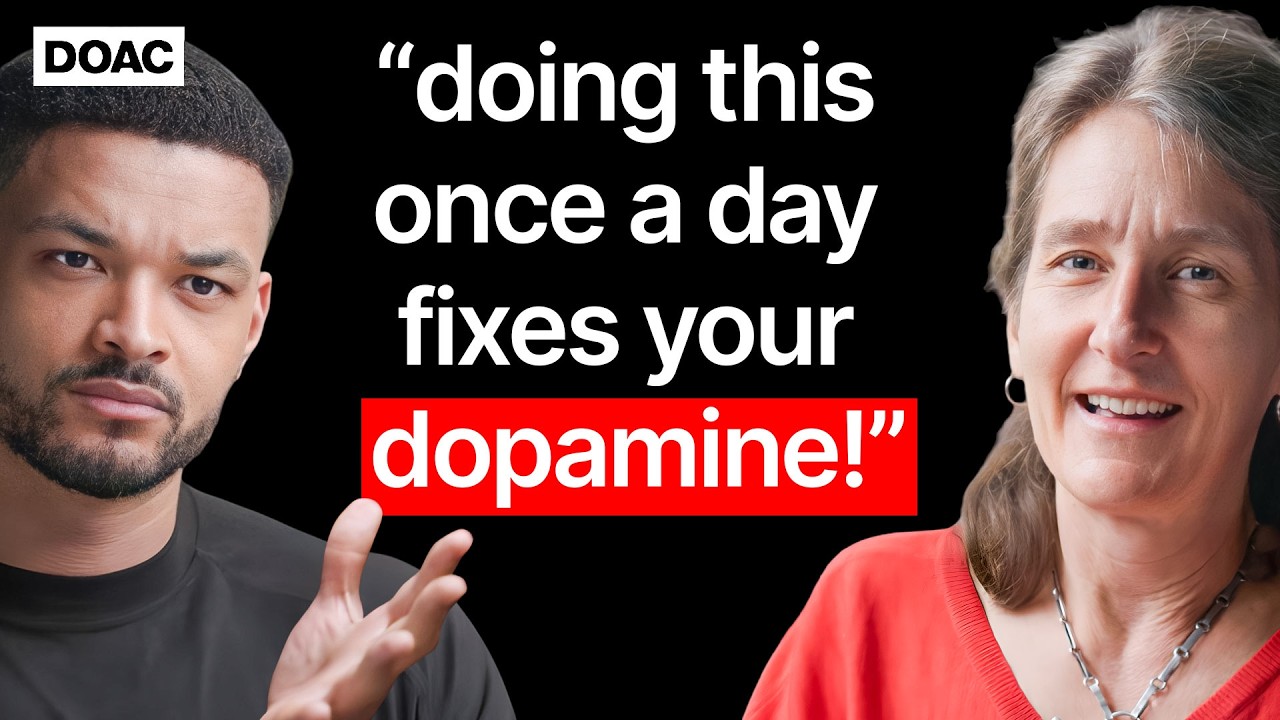
Dopamine Expert: Doing This Once A Day Fixes Your Dopamine! What Alcohol Is Doing To Your Brain! — The Diary Of A CEO

The Diary Of A CEO

Continuous pursuit of high-dopamine rewards resets the brain's pleasure-pain balance toward chronic pain and addiction, requiring at least 30 days of abstinence to restore natural baseline transmission.

AI-assisted summary of Dopamine Expert: Doing This Once A Day Fixes Your Dopamine! What Alcohol Is Doing To Your Brain! — original source. Check the original for full context.

Source published:

Detailed notes

## Background This episode was published by The Diary Of A CEO on YouTube on January 2, 2025. According to the page description, it features Dr. Anna Lembke, Professor of Psychiatry at Stanford University School of Medicine and author of 'Dopamine Nation', discussing how dopamine works, the impact of alcohol and digital media on the brain, and strategies to overcome addiction.

## TL;DR Dr. Anna Lembke breaks down how dopamine regulates pleasure and pain, explaining that modern overstimulation keeps the brain in a chronic dopamine-deficit state. She highlights how easy access to addictive behaviors—from pornography and digital media to sugar and drugs—warps human incentive structures and drives victimhood narratives. Through actionable tools like the 30-day dopamine fast, self-binding, and engaging in intentional discomfort, she illustrates how individuals can reset their reward pathways. Ultimately, the conversation stresses the importance of personal accountability, accepting life's inherent discomfort, and fostering genuine human connection.

## Atmosphere & style The dialogue strikes a deeply reflective, candid, and empathetic tone as Steven Bartlett and Dr. Anna Lembke balance rigorous neuroscience with vulnerable personal anecdotes. It feels like an intimate yet highly educational masterclass, seamlessly moving from clinical explanations of brain chemistry to poignant discussions on grief, shame, and modern isolation. The host's intense curiosity paired with Dr. Lembke's grounded, compassionate expertise creates a compelling emotional arc that shifts from sober reality checks to empowering paths toward recovery.

## Key takeaways - [52:05](https://www.youtube.com/watch?v=R6xbXOp7wDA&t=3125s) Soul-sucking jobs act as a major risk factor for addiction, with high-status professions like doctors and lawyers exhibiting alcoholism rates comparable to blue-collar workers due to stress and 'work hard, play hard' dynamics. - [58:59](https://www.youtube.com/watch?v=R6xbXOp7wDA&t=3539s) Dopamine surges vary wildly by activity: sex increases dopamine release by 100%, whereas amphetamines boost it by 1,000%, equivalent to ten orgasms in a single hit. - [58:59](https://www.youtube.com/watch?v=R6xbXOp7wDA&t=3539s) Addicted individuals exist in a severe dopamine deficit state because the brain down-regulates its own dopamine production, requiring roughly one month of complete abstinence for natural dopamine transmission to regenerate. - [58:59](https://www.youtube.com/watch?v=R6xbXOp7wDA&t=3539s) Pure dopamine cannot cross the blood-brain barrier to treat conditions like Parkinson's disease, so doctors prescribe L-Dopa, which causes roughly 25% of patients to develop newly onset compulsive behaviors. - [01:01:00](https://www.youtube.com/watch?v=R6xbXOp7wDA&t=3660s) Intentionally engaging in mild pain or discomfort, such as cold plunges or exercise, creates a slow, sustained dopamine rise that lasts for hours without triggering a dopamine crash. - [01:04:19](https://www.youtube.com/watch?v=R6xbXOp7wDA&t=3859s) True presence requires accepting discomfort and anxiety directly rather than constantly fleeing from pain or projecting into post-activity rewards. - [01:09:28](https://www.youtube.com/watch?v=R6xbXOp7wDA&t=4168s) Framing one's personal narrative entirely around victimhood guarantees future victimhood, whereas taking ownership breaks the cycle of external blame and drives lasting recovery. - [01:22:10](https://www.youtube.com/watch?v=R6xbXOp7wDA&t=4930s) Therapy that solely validates victimhood without encouraging self-examination can keep patients stuck, sometimes fostering an 'inverted narcissism' centered on being the worst of the worst. - [01:37:22](https://www.youtube.com/watch?v=R6xbXOp7wDA&t=5842s) Codependency in families often manifests as an addiction to saving or controlling the addicted individual, where propping them up delays the necessary rock-bottom consequences needed for recovery. - [01:44:49](https://www.youtube.com/watch?v=R6xbXOp7wDA&t=6289s) Pornography addiction is the most common addiction search query on Google, with male clinic patients outnumbering female patients 10 to 1, warping intimacy and sexual expectations. - [01:53:09](https://www.youtube.com/watch?v=R6xbXOp7wDA&t=6789s) Overcoming addiction through a 30-day dopamine fast requires pushing through an initial 14-day period of withdrawal and heightened suffering before reward pathways begin to reset. - [01:57:47](https://www.youtube.com/watch?v=R6xbXOp7wDA&t=7067s) Once an addiction is established, a single re-exposure immediately reactivates maximum consumption and craving patterns due to latent neural circuitry. - [02:02:49](https://www.youtube.com/watch?v=R6xbXOp7wDA&t=7369s) Substance or digital media addiction during childhood hardwires maladaptive coping mechanisms into adult brain scaffolding during crucial periods of neural pruning and myelination. - [02:04:43](https://www.youtube.com/watch?v=R6xbXOp7wDA&t=7483s) Abrupt cold-turkey cessation from substances like alcohol and benzodiazepines can cause life-threatening complications, requiring professional medical supervision rather than self-guided fasting. - [02:07:38](https://www.youtube.com/watch?v=R6xbXOp7wDA&t=7658s) Emerging human-machine integration and cybernetic technology risk isolating humans in digital environments, eroding the drive to engage with the real physical world.

## Detailed walkthrough ### [00:00](https://www.youtube.com/watch?v=R6xbXOp7wDA&t=0s) Intro & The Neuroscience of Survival

Dopamine is far more than just a chemical reward; it is a fundamental driver of basic survival. A iconic, classic neuroscience experiment illustrates this point vividly: when scientists genetically engineered lab rats to completely lack dopamine, the rodents would still eat if food was placed directly into their mouths—showing they could still register the basic sensation of eating. However, if the food was placed even a single body length away, the rats would literally sit there and starve to death. Without dopamine, the drive to exert effort and pursue life-sustaining resources disappears entirely.

Every rewarding activity—from eating sugar, playing video games, working, and consuming pornography to scrolling social media—triggers dopamine release. The greater and faster that release, the higher the risk of building an addiction. Genetics also play a massive role, accounting for roughly 50% to 60% of an individual's vulnerability to addiction. If a parent or grandparent suffered from addiction, that genetic predisposition is passed down, making delicate neurochemical balance essential for long-term health.

Dr. Anna Lembke—Professor of Psychiatry at Stanford University School of Medicine and chief of the Stanford Addiction Medicine Dual Diagnosis Clinic—explains that one of the most remarkable neuroscientific discoveries over the last 75 years is that pleasure and pain are co-located in the exact same regions of the brain. The brain operates like a see-saw or a pair of balance scales, constantly striving to stay level at homeostasis. In our modern hyper-abundant world, we are endlessly inundated with potent artificial pleasures. As our brains desperately adapt by slamming down on the pain side of the balance to compensate, we end up needing increasingly higher doses and stronger forms of our chosen substance or behavior just to feel normal—a cycle that leads directly into addiction.

* Genetics account for roughly 50%–60% of the risk of developing an addiction. * Pleasure and pain are processed in the exact same regions of the brain. * The brain's homeostatic mechanism naturally counterbalances pleasure by pushing toward pain.

---

[03:44](https://www.youtube.com/watch?v=R6xbXOp7wDA&t=224s) What Is Dopamine and Why Does It Matter?

When explaining dopamine in simple terms, Dr. Lembke describes it as a critical neurotransmitter produced in the brain that governs pleasure, reward, and above all, motivation. While people frequently associate dopamine solely with the feeling of pleasure itself, its true neurobiological duty lies in driving the **motivation** to go out and get the reward. It serves as the brain's "approach signal"—an evolutionary mechanism telling the organism that something in the environment is worth investigating, exploring, and pursuing for survival.

Understanding these mechanics is essential for navigating modern existence. For almost all of human history, obtaining high-value rewards required significant physical effort and overcoming hardship. Today, however, our environment is flooded with instant, friction-free rewards that bypass our evolutionary wiring, making modern humans universally susceptible to compulsive overconsumption and behavioral addictions.

> "Without dopamine, we're not motivated to seek out the things that we need for our basic survival."

---

[06:09](https://www.youtube.com/watch?v=R6xbXOp7wDA&t=369s) Common Misconceptions About Dopamine

A prevalent misconception in modern culture is the idea that people are "addicted to dopamine itself." Dr. Lembke clarifies that dopamine is neither intrinsically good nor bad, nor is it the substance of addiction. Rather, it acts as a internal currency and information vector that reflects relative reward value.

Dr. Lembke frames dopamine dynamics through what she playfully calls the "reward theory of relativity." How much dopamine is released depends heavily on expectations and relative comparisons between pleasure and pain. Furthermore, dopamine is indispensably involved in physical movement. In Parkinson's disease, the progressive depletion of dopamine-producing neurons in a specific region of the brain known as the *substantia nigra* leads to severe tremors, rigidity, and the loss of voluntary motor control.

* Dopamine is fundamentally required for physical movement, not just reward processing. * Parkinson's disease is caused by the loss of dopamine neurons in the *substantia nigra*. * Evolution linked motivation and movement together because organisms historically had to physically navigate their environments to claim rewards.

---

[07:30](https://www.youtube.com/watch?v=R6xbXOp7wDA&t=450s) Everyday Activities and Evolutionary Wire-Crossing

Nearly everything we encounter alters dopamine levels to some degree. Novelty, unexpected surprises, and even painful or aversive stimuli engage the dopamine system. In our ancestral environment, getting a hit of dopamine required substantial upfront energy expenditure—hunting, foraging, or trekking across harsh terrain.

In stark contrast, modern technology allows us to access intense dopamine spikes with zero physical output. With a simple swipe or tap of a finger on a glass screen, high-calorie food, sexual imagery, or endless social validation instantly appear. This sudden elimination of the effort requirement creates deep friction with our ancient neural circuitry, leaving our reward pathways chronically overstimulated and confused.

---

[09:36](https://www.youtube.com/watch?v=R6xbXOp7wDA&t=576s) Dopamine and the Balance of Pleasure and Pain

To visualize how the brain handles high-reward substances like alcohol, Dr. Lembke uses a physical set of balance scales. The brain's reward circuit involves a continuous dialogue between the **prefrontal cortex**—the large gray-matter area behind the forehead responsible for long-term planning, delay of gratification, and evaluating future consequences (acting as the "brakes")—and deep limbic structures like the **nucleus accumbens** and the **ventral tegmental area (VTA)**, which are rich in dopamine-releasing neurons (acting as the "accelerator").

In a healthy brain, there is a harmonious balance between the accelerator and the brakes. In an addicted brain, however, structural neural connections between these regions literally become degraded or disconnected. Additionally, individuals possess unique vulnerabilities known as a "drug of choice." A substance like whiskey may trigger a massive, rapid flood of dopamine in one person's brain, while producing only a mild effect in someone else's.

When a substance like alcohol is consumed, it acts on endogenous opioid and GABA systems, culminating in a sharp release of dopamine in the reward pathway. This weighs down the pleasure side of the scale. However, the brain's governing biological drive is to return to **homeostasis**—the baseline state compatible with healthy physiological function.

To bring the balance back to level, the brain immediately adapts to the surge of dopamine by down-regulating its own dopamine transmission. At the cellular level, neurons communicate across microscopic gaps called **synapses**, where presynaptic neurons release dopamine to bind to receptors on postsynaptic neurons. To counter excessive dopamine firing, the brain reduces the sensitivity and number of these postsynaptic receptors, effectively pulling down on the pain side of the scale to restore equilibrium.

* **Prefrontal Cortex:** Functions as the brain's cognitive "brakes," handling executive function, delayed gratification, and decision-making. * **Nucleus Accumbens & VTA:** Function as the brain's "accelerator," housing dense networks of dopamine-producing neurons. * **Synaptic Down-regulation:** The process by which postsynaptic receptors decrease in number or sensitivity to adapt to abnormally high neurotransmitter levels.

[16:46](https://www.youtube.com/watch?v=R6xbXOp7wDA&t=1006s) The Mechanism of Receptor Downregulation and the Hangovers of Life

Dr. Anna Lembke explains that when the brain experiences an artificial spike in dopamine from a substance like alcohol, it actively works to decrease dopamine transmission. It does this by involuting—or pulling inside the neuron—its post-synaptic dopamine receptors. Host Steven Bartlett accurately summarizes this process using a clear spatial analogy: "So it's like removing the docking station." With fewer available receptors, dopamine molecules released into the synaptic cleft have nowhere to bind.

To visually model this neuroadaptation process on their physical balance scale, Dr. Lembke compares the brain's homeostatic mechanisms to little "gremlins" that jump onto the pain side of the scale to level out the pleasure side. Placing a heavy stone onto the pain side of the balance scale physically demonstrates what happens next: the scale does not just return to a flat level position; it violently overshoots, slamming down hard on the pain side. Dr. Lembke confirms that this overshoot is precisely what creates a hangover, a comedown, "Blue Monday," or the immediate, sharp sensation of craving another drink or shot right after a high begins to fade.

- **Receptor Involution:** Post-synaptic dopamine receptors are internalized into the neuron so dopamine has nowhere to bind. - **Neuroadaptation Overshoot:** The brain's attempt to restore balance causes the pain side to weigh heavier than the initial pleasure. - **Subjective Experience:** The physiological overshoot manifests as withdrawal symptoms, comedowns, hangovers, and sudden intense cravings.

[18:26](https://www.youtube.com/watch?v=R6xbXOp7wDA&t=1106s) The Evolutionary "Just-So Story" of Scarcity and Seeking

When Bartlett asks why Mother Nature engineered our brains with such a cruel, overshooting mechanism instead of stopping precisely at baseline balance, Dr. Lembke offers an evolutionary "just-so story." In an ancestral environment defined by scarcity and ever-present danger, a mechanism that leaves an individual slightly dissatisfied immediately after a reward serves as a crucial evolutionary advantage. It ensures human beings never remain content for long and instead remain ultimate seekers.

After acquiring a temporary reward—such as eating food—the sudden deficit on the pain side of the balance acts as a biological motivator. It propels an early human to endure another physically demanding, hours-long hunt the following day rather than resting indefinitely. Bartlett points out a paradox: people currently experiencing massive hangovers do not look or act motivated at all. Dr. Lembke clarifies that modern substances like alcohol are products of human engineering that deliver unnaturally massive concentrations of dopamine all at once. The human brain was never evolved to process such intense, low-effort hits of pleasure, but rather to endure hunger, cold, and physical exertion first, followed by modest natural rewards that gently return the scale toward balance.

- **Evolutionary Purpose:** The neurochemical deficit drives continuous resource gathering and hunting in scarce environments. - **Natural Rewards vs. Engineered Substances:** Natural rewards require upfront pain/effort for small dopamine yields, whereas engineered substances flood the reward pathway without effort.

[20:31](https://www.youtube.com/watch?v=R6xbXOp7wDA&t=1231s) Mismatched Wiring and the Universal Scale of Addiction

Bartlett references a past quote from Dr. Lembke: "We are all wired to be addicted, and if you're not addicted yet, it's right around the corner... coming to a website near you." Dr. Lembke validates this premise, explaining that our brain chemistry is fundamentally mismatched with the modern world. Humans possess ancient neural wiring optimized for survival in an environment of extreme scarcity, yet we now live in an environment of overwhelming, engineered abundance. Synthetic chemicals, high-palatability foods, digital algorithms, and online media continuously bombard the brain's reward system.

Dr. Lembke demonstrates what happens when someone repeatedly engages in addictive behaviors over days, months, or years—layering alcohol, pornography, high-sugar foods, and cannabis. Demonstrating on the balance, she dumps a large cluster of stones onto the pain side to represent chronic consumption. The "gremlins" no longer hop off; they become permanently camped out on the pain side. This structural shift re-sets the individual's baseline hedonic set point to the pain side. At this stage, the individual no longer uses their drug of choice to get high or experience pleasure, but simply to pile enough substance into the pleasure side to level the scale and feel normal. When not actively consuming, they walk around in a persistent state of withdrawal characterized by five universal symptoms: anxiety, irritability, insomnia, depression, and craving.

``` [ HIGH-DOPAMINE CONSUMPTION ] │ ▼ Receptors Internalize (Downregulate) │ ▼ Gremlins Camp on Pain Side (Adaptation) │ ▼ Hedonic Set Point Shifts to Chronic Pain │ ▼ Universal Withdrawal: Anxiety, Irritability, Insomnia, Depression, and Craving ```

- **Universal Withdrawal Symptoms:** Anxiety, irritability, insomnia, depression, and intense craving. - **Hedonic Set Point Shift:** Chronic consumption alters baseline brain chemistry, requiring substance intake merely to achieve temporary normal function.

[24:42](https://www.youtube.com/watch?v=R6xbXOp7wDA&t=1482s) Empathy, Trauma, and the Limits of Self-Medication

Reflecting on the physical balance demonstration, Bartlett notes how visualizing the neurobiology inspires deep empathy for individuals struggling with addiction. Rather than viewing addictive behaviors as intentional self-harm or moral failure, the model proves that individuals are desperately attempting to manage severe neurochemical or emotional pain. Dr. Lembke strongly agrees, noting that empathy is essential for both clinicians and patients themselves, as the overwhelming neurological drive to level out a painful balance overrides rational thought regarding long-term consequences.

Dr. Lembke highlights that not everyone starts with a perfectly level balance at baseline. People suffering from psychiatric conditions, chronic stress, or early childhood trauma often begin with a balance already tilted toward pain. While using drugs or alcohol to self-medicate offers temporary emotional numbing or relief, it ultimately compounds the damage. Because of the brain's adaptive mechanisms, external substances inevitably drive the balance deeper into the pain zone over time, worsening the underlying psychiatric distress.

- **Baseline Disparities:** Pre-existing mental health conditions or traumatic experiences tilt the baseline balance toward pain prior to substance use. - **Self-Medication Trap:** Substances provide short-term numbing but accelerate long-term psychological damage through neuroadaptation.

[29:07](https://www.youtube.com/watch?v=R6xbXOp7wDA&t=1747s) Stress Triggers and the Rodent Cocaine Experiments

To illustrate how deeply stress links to addictive behavior, Dr. Lembke describes a classic series of rodent experiments. Laboratory rats will repeatedly press a lever to self-administer cocaine until they reach total exhaustion or death. If the experimenters disconnect the lever so cocaine is no longer delivered, the rats eventually undergo extinction—they stop pressing the lever and resume normal behaviors around the cage. However, if those same extincted rats are subsequently subjected to a single painful foot shock—a physical stressor representing a severe life crisis—they immediately sprint back to the inactive cocaine lever and begin pressing it compulsively again.

This experiment proves that once the brain learns that a specific substance or behavior produces a massive dopamine surge, it retains that neural memory indefinitely. When subjected to acute stress, the brain automatically directs the individual back to that historical source of dopamine for fast relief. Dr. Lembke notes that this mechanism explains why individuals in long-term recovery remain vulnerable to relapse during high-stress periods. She cites a foundational Alcoholics Anonymous acronym used to manage daily stressors: **HALT** (Hungry, Angry, Lonely, Tired).

- **Rodent Cocaine Paradigm:** Extincted cocaine-seeking behavior instantly reactivates following an unconditioned physical stressor (foot shock). - **HALT Acronym:** - **H**ungry - **A**ngry - **L**onely - **T**ired

[31:51](https://www.youtube.com/watch?v=R6xbXOp7wDA&t=1911s) Extreme Cases and the Misattribution of Trauma

When asked about unusual manifestations of addiction in her clinical practice at Stanford, Dr. Lembke shares the story of a patient who developed a severe addiction to water. After achieving sobriety from severe alcoholism, the patient discovered that drinking massive, compulsive quantities of water caused hyponatremia—dangerously diluting her bloodstream's sodium levels to induce delirium and escape reality. Tragically, despite clinical intervention, the patient eventually died by suicide.

While trauma—particularly severe early childhood abuse—is a major contributor to many addiction cases, Dr. Lembke cautions against over-attributing every addiction to deep trauma. She sees many patients who grew up with supportive families, stable childhoods, and strong social networks who nevertheless develop crippling addictions simply because human brains are hardwired to over-consume high-dopamine stimuli in a hyper-abundant world. She warns that clinicians and patients can fall into the trap of "manufacturing trauma" where none exists, and stresses that individuals in active addiction cannot effectively process complex emotional trauma until their neurochemistry is stabilized through sobriety.

- **Hyponatremia Case:** A patient utilized compulsive water consumption to lower blood sodium levels and achieve mental delirium as a substitute for alcohol. - **Over-Pathologizing Risk:** Addiction can develop purely through exposure to hyper-rewarding stimuli without underlying historical trauma.

<ElicitationsGroup message="Explore further insights from Dr. Anna Lembke's work on dopamine and addiction:"> <Elicitation label="Examine practical protocols for resetting dopamine baseline levels" query="What specific protocols and timelines does Dr. Anna Lembke recommend for resetting the brain's dopamine balance after chronic overconsumption?"/> <Elicitation label="Analyze the physiological differences between natural vs. artificial dopamine hits" query="How do natural dopamine-releasing activities differ from artificial stimulants in their impact on post-synaptic receptors and baseline set points?"/> </ElicitationsGroup>

[34:44](https://www.youtube.com/watch?v=R6xbXOp7wDA&t=2084s) The Spectrum of Addiction and Its Definition

Addressing the recovery process, Dr. Anna Lembke emphasizes that individuals trapped in the "vortex of addiction" must achieve a degree of recovery before attempting to tackle underlying early traumatic experiences. When asked about the prevalence of these issues, she explains that addiction exists on a wide spectrum—ranging from mild and moderate to severe, with a vast "pre-addiction state" where people engage in compulsive overconsumption. In fact, she estimates that roughly 90% to 95% of the population engages in some form of compulsive overconsumption.

Dr. Lembke highlights that diagnosing addiction is not as straightforward as turning on a light switch; there is no blood test or brain scan that provides a definitive biological measurement. Instead, clinicians rely on "phenomenology"—observing repeating patterns of behavior over time. The core definition of addiction remains the continued, compulsive use of a substance or behavior despite harm to oneself or others.

``` Addiction Definition: Continued Compulsive Use + Substance/Behavior + Persistent Harm ```

Recognizing this harm is often difficult because the human brain actively rationalizes choices when chasing dopamine. A person typically fails to see the true cause-and-effect relationship until they step away from the behavior for a sustained period.

* **Prevalence Estimate:** Approximately 90%–95% of people experience some degree of compulsive overconsumption. * **Diagnostic Basis:** Relies on phenomenology (patterns of behavior over time) rather than biological tests or imaging. * **Key Characteristic:** Chasing dopamine distorts self-awareness, making it difficult for an individual to evaluate the harm their behavior causes.

---

[36:45](https://www.youtube.com/watch?v=R6xbXOp7wDA&t=2205s) Dr. Lembke's Personal Battle with Romance Novel Addiction

Dr. Lembke shares a candid, personal story from her early 40s to illustrate how insidiously addiction develops. As her children reached adolescence and needed her less, she experienced a subtle grief reaction regarding her evolving maternal identity. A lifelong reader who used fiction as a soothing mechanism since childhood, she was introduced by another parent to the vampire romance series *Twilight*. The books unlocked a massive dopamine release in her brain's reward pathway. After reading the series repeatedly, her tolerance built up, prompting her to seek out increasingly graphic "bodice-ripper" romance novels to achieve the same pleasurable effect.

Her reading shifted into classic addiction behavior: keeping a secret double life, hiding graphic books behind intellectual titles when her family entered the room, and experiencing neuroadaptation where the brain's "gremlins" pushed down on the pain side of her balance. The ultimate tipping point came when she purchased an e-reader (Kindle). The anonymity and instant accessibility transformed her into a "chain reader" overnight, consuming romance books back-to-back whenever she wasn't occupied with mandatory tasks.

> "My focus narrowed, and the things that I used to enjoy were no longer pleasurable. Only this one thing had salience for me."

* **Consequences on Daily Life:** Staying up until 2:00–4:00 AM on weeknights, waking up exhausted two hours later, feeling detached from her husband and children, and suffering from growing irritability, anxiety, and insomnia. * **Isolation on Vacation:** During a joint family beach trip, she withdrew from social interactions and spent time hiding in a room reading on her device. * **Narrowing Focus:** An essential hallmark of addiction is that normal activities lose their appeal ("salience"), and daily life becomes organized around seeking, using, and hiding the source of dopamine.

---

[41:21](https://www.youtube.com/watch?v=R6xbXOp7wDA&t=2481s) Distinguishing High-Dopamine Behaviors and Navigating Digital Media

The discussion shifts to how modern digital devices act as potent drugs. Social activities like scrolling YouTube videos or messaging friends in WhatsApp group chats deliver quick hits of gratification. While people often rationalize these habits as educational or socially beneficial, digital platforms are explicitly engineered to keep users tapping and scrolling far beyond the point of actual pleasure. Dr. Lembke points out that using a medium past the point of enjoying it demonstrates its inherently reinforcing, cognitively adherent nature.

To evaluate whether a behavior has crossed the line into addictive territory, Dr. Lembke recommends a temporary elimination protocol—abstaining from the specific platform or behavior for long enough to go through withdrawal and reset the brain's reward pathways. Subtle indicators that consumption has crossed into addiction include unexplained depression, anxiety, restlessness, insomnia, and inattention.

``` Signs of Problematic Digital Consumption: - Chronic Inattention - Anxiety & Restlessness - Sleep Disturbances / Insomnia - Loss of Interest in Real-World Events ```

* **Digital Media Mechanics:** Lights up the exact same neurological reward pathways as alcohol and traditional drugs. * **Common Rationalizations:** Excusing excessive use by claiming it is necessary for work, staying connected, or gathering information. * **The 30-Day Reset:** Taking a full month off allows the brain's neuroadaptive "gremlins" to step off the pain side of the balance, restoring baseline homeostasis.

---

[44:49](https://www.youtube.com/watch?v=R6xbXOp7wDA&t=2689s) The Mechanics of Withdrawal and the Formula of Erotic Fiction

Recounting her own 30-day abstinence experiment with romance novels, Dr. Lembke details the harsh reality of acute withdrawal. During the first 24 hours without her e-reader, she experienced severe anxiety, extreme restlessness, and complete insomnia, realizing she had unlearned how to fall asleep naturally without a digital narrative. This acute withdrawal phase lasted 10 to 14 days—the exact timeframe required for the brain to clear the neuroadaptive response and begin restoring balance.

By weeks three and four, her baseline mood improved drastically. She re-engaged with her family, enjoyed her work again, and noticed that everyday life had regained its natural richness. Reflecting on why erotic romance novels are so addictive, she describes them as socially sanctioned pornography for women, leveraging narrative as the primary drug delivery mechanism.

> "If you take a physical copy of a romance novel and open it two-thirds of the way through, you will get to the climactic scene... It's engineered. I got to a point where I wouldn't even finish the book; I would go on to the next book just to get to that climax part."

* **Withdrawal Duration:** 10 to 14 days of neuroadaptive discomfort before homeostasis begins to stabilize. * **Engineered Content:** Novelists use formulas designed to optimize dopamine delivery, leading Dr. Lembke to skip character development, resolutions (*denouement*), and lower-quality writing just to chase the climax. * **The Ritual of the Hunt:** Searching through free Amazon samples functioned like a drug dealer offering free samples, making the search process itself part of the dopamine-seeking ritual.

---

[47:50](https://www.youtube.com/watch?v=R6xbXOp7wDA&t=2870s) Work Addiction and How Society "Drugifies" Labor

The conversation turns to workaholism and how modern society celebrates excessive labor. While compulsive overworking looks like a severe behavioral issue from an external perspective, society routinely praises, claps for, and awards individuals who work 18-hour days or sacrifice sleep. Dr. Lembke explains that work has been "drugified"—engineered to be more potent, novel, plentiful, and accessible than ever before.

``` How Work Has Been "Drugified": ┌──────────────────────────────────────────────────────────┐ │ 1. Potency -> Stock options, bonuses, fame │ │ 2. Novelty -> Novel projects & algorithmic tasks │ │ 3. Quantity -> No natural stopping points │ │ 4. Accessibility -> 24/7 access via digital devices │ └──────────────────────────────────────────────────────────┘ ```

Work potency is amplified by financial bonuses, stock options, social media validation, personal branding, and public accolades. Novelty is sustained as work environments present constantly evolving tasks, triggering the brain's treasure-seeking mechanisms. Unlike chemical substances that run out or cost money, work offers an unlimited supply with no natural stopping point, paired with 24/7 digital access. Easy access remains one of the single largest risk factors for developing an addiction to any substance or behavior.

* **Social Reinforcement:** Society rewards work addiction with trophies, promotions, LinkedIn likes, and prestige, reinforcing compulsive behavior through human connection and status. * **Unbounded Quantity:** Cocaine runs out when money or supply depletes, whereas work is virtually infinite and can be conducted anywhere at any time. * **Contrast in Work Types:** Highly reinforcing, status-driven white-collar work carries a high risk of addiction, standing in sharp contrast to alienating, mind-numbing labor that completely disconnects the worker from meaning.

Here is a detailed and faithful walkthrough of the transcript section.

---

[52:05](https://www.youtube.com/watch?v=R6xbXOp7wDA&t=3125s) Work, Novelty Chasing, and the Stress Response

Steven Bartlett and Dr. Anna Lembke dive into how modern careers interact with our brain's dopamine pathways. Steven observes that people often leave their jobs simply to chase novelty; work that once provided a dopamine hit becomes monotonous, forcing people to jump ship every two to three years. Dr. Lembke agrees, noting that the average lifespan of a business has plummeted from 50 years (half a century ago) down to around 15 years today, driven largely by continuous churn and the endless pursuit of something new. However, she points out the opposite side of the spectrum: jobs that are not intrinsically rewarding, but rather "soul-sucking," represent a massive risk factor for addiction. Individuals in these roles often spend their days waiting for the clock to run out so they can go home and use drugs, alcohol, or food to numb the stress of the workday.

``` [ WORKPLACE STRESS / MONOTONY ] │ ┌─────────────────────┴─────────────────────┐ ▼ ▼ Low-Pleasure Job Chasing Novelty (Numbing at day's end) (Job hopping every 2-3 yrs) │ │ └─────────────────────┬─────────────────────┘ ▼ [ STRESS RESPONSE TRIGGERED ] (Brain forced off neutrality) │ ▼ Dopamine Deficit / Craving ```

This dynamic leads Steven to ask if people in lower-pleasure, lower-class jobs are more prone to alcoholism and obesity, or whether they simply opt out of the workforce entirely—a trend currently visible in the United States, where large numbers of young men have completely dropped out to play video games. Dr. Lembke clarifies that high-status professions like doctors and lawyers actually show equal rates of alcoholism compared to blue-collar workers. The core issue across both ends of the spectrum is stress and the prevalence of a "work hard, play hard" mentality.

- **Biological Definition of Stress:** Dr. Lembke highlights that, biologically, stress is defined as *any deviation from neutrality*. Every time the brain is forced to work to restore a level baseline after extreme highs of pleasure or lows of pain, it triggers an adrenaline release and activates the body's stress response.

---

[54:18](https://www.youtube.com/watch?v=R6xbXOp7wDA&t=3258s) Relative Dopamine Hits and Brain Scans of Addiction

Steven brings up a finding from page 50 of Dr. Lembke's book *Dopamine Nation*, pointing out that in rodent studies, sex increases dopamine release by **100%**, whereas amphetamines boost it by an astounding **1,000%**—meaning a single hit of a methamphetamine pipe mathematically equates to 10 orgasms. Dr. Lembke explains that while potent intoxicants like meth, opioids, alcohol, nicotine, and cannabis generally cause massive dopamine spikes in the reward pathway, every individual has a specific "drug of choice" that hits them harder than others. She notes that scientists cannot measure absolute dopamine values in living human brains in real-time the way they do with laboratory rats; they can only measure relative values.

``` TYPICAL DOPAMINE RELEASE SPIKES (Relative to Baseline) ┌────────────────────────────────────────────────────────┐ │ Sex ████████ 100% │ │ Amphetamines / Meth ████████████████████████████ 1000% │ └────────────────────────────────────────────────────────┘ ```

Steven presents a set of brain scans comparing healthy control subjects against individuals addicted to cocaine, methamphetamine, alcohol, and heroin. Dr. Lembke breaks down what is visible in the imagery: - **Red Signals:** The red areas represent active dopamine transmission—dopamine being released from pre-synaptic neurons, crossing the synapse, and binding to receptors in the nucleus accumbens (the brain's reward center). - **Healthy Controls:** Show abundant red signaling, demonstrating healthy, normal dopamine transmission. - **Addicted Individuals:** Show virtually no red signaling. They exist in a chronic, severe **dopamine deficit state**. - **The Cause:** This deficit is the brain's attempt to compensate for excessive artificial dopamine surges by down-regulating its own natural production and receptor sensitivity far below baseline. - **The Two-Week Timeline:** These scans were taken **two weeks after** the individuals stopped using their drug of choice. This proves that the acute dopamine deficit persists through the first 10 to 14 days of abstinence, mapping directly onto acute withdrawal symptoms: physical discomfort, anxiety, irritability, insomnia, depression, and intense cravings. - **The One-Month Mark:** If patients can maintain complete abstinence for roughly a full month, clinical experience shows their brain begins regenerating natural dopamine transmission, allowing them to see "light at the end of the tunnel" and escape constant compulsive craving.

---

[58:59](https://www.youtube.com/watch?v=R6xbXOp7wDA&t=3539s) Why We Cannot Just Inject Dopamine: Parkinson's and L-Dopa

Steven asks why we cannot simply administer artificial dopamine—by drinking or injecting it—to restore normal levels in an addicted brain. Dr. Lembke points to a real-world medical example found in Parkinson's disease treatment. Parkinson's is caused by a depletion of dopamine in the substantia nigra, severely impairing motor control.

Directly consuming pure dopamine is ineffective because **dopamine cannot cross the blood-brain barrier**. To bypass this, doctors prescribe **L-Dopa**, a precursor chemical that crosses into the brain and converts into dopamine, binding diffusely to receptors in both movement and reward pathways.

- **The Parkinson's Paradox:** When Parkinson's patients are treated with L-Dopa, roughly **1 in 4 (25%)** develop *de novo* (newly onset) addictive disorders, such as compulsive gambling, shopping addictions, or hypersexuality. - Because the brain receives an exogenous, unearned flood of dopamine, it reacts by down-regulating its internal systems further, triggering the exact same compulsive "addiction vortex."

---

[01:01:00](https://www.youtube.com/watch?v=R6xbXOp7wDA&t=3660s) Pain-Induced Dopamine and the Modern "Hard Dopamine" Trend

Dr. Lembke explains that because artificial inputs trigger a downward reset, the healthiest way to reset our neurochemistry in a hyper-rewarding world is to intentionally introduce mild pain or hardship—such as cold water immersion, exercise, or intermittent fasting.

``` PLEASURE-FIRST VS. PAIN-FIRST DOPAMINE

[ Pleasure First ] (Drugs, Alcohol, Porn, Sugar) Step 1: Big Pleasure Spike Step 2: "Gremlins" hop on Pain side to compensate Result: Heavy Crash, Hangover, & Dopamine Deficit Below Baseline

[ Pain First ] (Exercise, Ice Baths, Fasting) Step 1: Intentional Mild Pain / Discomfort Step 2: "Gremlins" hop on Pleasure side to compensate Result: Slow, Sustained Dopamine Rise (Lasts Hours) with NO Deficit Crash ```

When we press on the pain side of the pleasure-pain balance, our brain's compensatory mechanisms ("neuroadaptation gremlins") are forced onto the pleasure side to restore equilibrium. Studies show that during exercise, human dopamine levels rise gradually over the second half of the workout and remain elevated for several hours afterward before gently returning to baseline without crashing into a deficit state. Because this dopamine is earned through physical exertion, it rarely leads to compulsive, destructive craving.

Steven shares impressive growth statistics showing a modern cultural movement toward seeking out "hard dopamine": - **Ultramarathons:** Participation increased by **1,676%** between 1996 and 2008. - **Ice Baths:** The cold plunge market is projected to grow from **$350 million in 2024** to nearly **half a billion dollars by 2030**. - **Obstacle Races:** Events like Tough Mudder and HYROX grew nearly **7-fold (7x)** between 2010 and 2017.

Dr. Lembke views this shift with mixed feelings. While moving our sedentary bodies is vital, she warns that humans excel at "drug-ifying" everything. By adding fitness trackers, leaderboards, app metrics, and social comparisons to physical exertion, we risk turning healthy hard work into another addictive, dopamine-chasing endeavor.

---

[01:04:19](https://www.youtube.com/watch?v=R6xbXOp7wDA&t=3859s) Mindfulness, Presence, and Embracing Discomfort

To close this portion of the discussion, Steven asks how someone can restructure their life to optimize happiness without falling into dopamine traps. Dr. Lembke reflects on how modern society organizes daily life almost entirely around post-activity rewards, causing people to constantly project their minds into the future rather than remaining present.

She shares a personal story from her drive to the podcast studio that morning. She realized she felt a mix of nervous anticipation and a subtle desire for the interview to already be over so she could return to a safe, comfortable state. She caught herself thinking: *"What if I knew I was going to die right after this conversation?"* That shift in perspective forced her to abandon the desire for a future outcome and focus completely on the present moment with Steven.

``` REACTION TO PRESENT DISCOMFORT │ ┌──────────────────────┴──────────────────────┐ ▼ ▼ Unhealthy Escape Mindful Acceptance - Run to future reward - "Be here now" - Numb with devices/substances - Accept restlessness/anxiety - Creates dopamine volatility - Calms the nervous system ```

Dr. Lembke recalls her college days trying to understand the Zen concept of "be here now." Early on, she hated being present because she felt uncomfortable in her own skin. Over time, she realized that true presence requires a fundamental mindset shift: - **Accepting Discomfort:** "Be here now" means being willing to sit with discomfort, restlessness, or anxiety without trying to control or flee the experience. - **Removing the Reward Mental Model:** By assuming there is no "sugar-coated reward" waiting at the end of an activity, you stop treating the present as a hurdle to clear. - **The Paradox of Acceptance:** Turning to face discomfort directly eliminates the anticipatory anxiety surrounding it, ultimately bringing genuine calm.

<ElicitationsGroup message="Explore more from this interview with Dr. Anna Lembke:"> <Elicitation label="Review the neuroscience of pleasure vs. pain" query="Explain Dr. Anna Lembke's concept of the pleasure-pain balance and how the brain maintains homeostasis."/> <Elicitation label="Analyze strategies for overcoming addiction" query="What are the clinical steps and timelines Dr. Anna Lembke recommends for recovering from a dopamine addiction?"/> <ElicitationsGroup/>

[01:09:28](https://www.youtube.com/watch?v=R6xbXOp7wDA&t=4168s) Being Comfortable With the Uncomfortable

Steven and Dr. Anna Lembke explore how confronting immediate discomfort removes the true source of ongoing suffering: the constant effort spent on avoidance, worry, and overthinking. Dr. Lembke challenges the modern cultural expectation that we ought to be happy all the time if we only manage our lives correctly or "aim true." Drawing a parallel to the Buddhist idea that life is suffering, she explains that existing in a human body is inherently restless and uncomfortable. Once she stopped fighting that baseline reality, she discovered a profound sense of liberation.

> "Fundamentally... it's uncomfortable to be alive and that it's a kind of a constant state of restlessness and discomfort if we're being really honest and tuning in. When I really let myself see that and feel that, all of a sudden I'm freed from some of that."

---

[01:10:34](https://www.youtube.com/watch?v=R6xbXOp7wDA&t=4234s) Personal Grief and the Power of Acceptance

Prompted by Steven's observation about her personal journey, Dr. Lembke shares the defining turning point in her life: the loss of her child. In the immediate aftermath, she tried relentlessly to "undo" the experience through psychotherapy and active resistance, attempting to banish the grief. True relief arrived only when she embraced total acceptance—acknowledging that she would carry this pain for the rest of her life.

She connects this personal revelation directly to her clinical work with addiction patients who hit rock bottom. Recovery begins the moment a person surrenders the illusion that they can outrun their suffering or control their pain.

> "It wasn't until I really just said, 'Oh, I'm going to feel this pain for the rest of my life, it's never going away,' that suddenly I felt some relief from that pain."

---

[01:12:43](https://www.youtube.com/watch?v=R6xbXOp7wDA&t=4363s) Living in a World Where It's Easy to Outrun Pain

Steven notes the biological irony of human nature: humans are wired to run from pain and seek pleasure, yet avoiding pain is precisely what prevents us from finding true peace. In the modern age, escaping discomfort has become effortless. Rather than fleeing physical predators like lions, people retreat from minor stressors—like a difficult email—by immediately opening a browser tab to doomscroll, play video games, or watch pornography.

When Steven asks how she bears the immense emotional weight of treating deeply suffering patients, Dr. Lembke explains that watching people recover from addiction is extraordinarily rewarding. Those who recover are often among the most tenacious and talented individuals, and their healing positively impacts families and whole communities. However, carrying the loss of patients who do not survive remains an enduring, painful burden filled with inevitable grief and guilt.

- **Dopamine trap:** Modern digital environments provide frictionless escape routes from emotional friction. - **Rewarding clinical work:** Recovering addicts exhibit exceptional tenacity, creating a wide ripple effect of healing. - **The weight of loss:** Clinicians retain lifelong guilt and grief over patients lost to addiction, regardless of age or circumstance.

---

[01:14:43](https://www.youtube.com/watch?v=R6xbXOp7wDA&t=4483s) Childhood Addiction and the Threat of Digital Drugs

The conversation turns to how early in life addiction can take root. Dr. Lembke highlights that some children are exposed to drugs and alcohol by age 5, 6, or 7 through parents or caregivers. However, when viewing digital media as a drug, the vulnerable age bracket becomes even younger. Kids can develop severe digital dependencies that lead to catastrophic real-world outcomes.

Dr. Lembke cites a tragic case featured in major news outlets involving a 14-year-old boy who fell in love with an AI chatbot. He isolated himself completely from friends and family, ultimately taking his own life under the belief that he would join the imaginary persona. Within her own clinic, the youngest patients she typically treats are around 14 or 15 years old, primarily struggling with cannabis, alcohol, and nicotine.

> "If we seriously conceptualize digital media as a drug... we've got even younger cohorts starting with that... kids can get addicted to digital media and as a result die from that."

- **Youngest substance exposures:** Ages 5–8 for alcohol and illicit drugs via home environments. - **Youngest clinical patients:** Ages 14–15 presenting for cannabis, nicotine, and alcohol abuse. - **AI/Digital media danger:** A documented case of a 14-year-old dying by suicide after developing an isolating addiction to an AI chatbot.

---

[01:17:07](https://www.youtube.com/watch?v=R6xbXOp7wDA&t=4627s) The Hidden Dangers and Addiction Potential of Cannabis

Dr. Lembke strongly dispels the common misconception that cannabis is harmless or non-addictive. She notes that the primary target organ damaged by heavy cannabis use is the brain. It frequently demotivates individuals, creating a false subjective sense of productivity or creativity while active functioning drops.

While users often point to the absence of physical shakes during cessation as proof that cannabis isn't addictive, Dr. Lembke emphasizes that universal addiction symptoms are psychological: severe anxiety, irritability, depression, insomnia, and intense cravings. Furthermore, heavy long-term use can cause neuroadaptation that flips its anti-nausea benefits into **cannabinoid hyperemesis syndrome**, leaving users trapped in severe cyclical vomiting episodes that land them in the emergency room.

- **Primary target organ:** Brain structure and cognitive function. - **Psychological withdrawal:** Severe anxiety, irritability, depression, insomnia, and intense cravings upon stopping. - **Cannabinoid Hyperemesis Syndrome:** A paradox where long-term chronic exposure converts an anti-nausea drug into a trigger for uncontrollable, cyclical vomiting.

---

[01:18:40](https://www.youtube.com/watch?v=R6xbXOp7wDA&t=4720s) Has Society Gone Soft? The Neuroscience of Resilience

Referencing page 40 of *Dopamine Nation*, Steven asks whether modern society has "gone soft," replacing genuine resilience with an overly sensitive trauma culture where minor inconveniences feel overwhelming compared to previous generations. Dr. Lembke agrees, clarifying that this shift is not a moral or character flaw, but a predictable physiological reaction to living in an over-abundant environment.

Because modern humans are constantly inundated with high-dopamine pleasures and shielded from physical hardship, the brain’s pleasure-pain balance resets toward the pain side. Oppositional "gremlins" pile onto the pain side of the balance to compensate for constant pleasure overload. Consequently, individuals require increasingly intense stimulation to feel pleasure, while even tiny daily discomforts register as agonizing pain.

> "We have individually and collectively reset our reward pathways to the side of pain... We need more and more pleasure to feel any pleasure at all, and the slightest little pain and we're experiencing excruciating pain."

- **Physiological shift:** Constant access to cheap pleasure lowers pain tolerance at the neurological level. - **Lack of "mental calluses":** Shielding people from discomfort prevents them from building emotional tolerance. - **Medicalizing distress:** Normal emotional suffering is increasingly framed as clinical illness requiring medical intervention rather than lifestyle adaptation.

---

[01:21:05](https://www.youtube.com/watch?v=R6xbXOp7wDA&t=4865s) Narratives, Victimhood, and Personal Responsibility

Dr. Lembke discusses how personal storytelling serves as both a diagnostic marker and a predictor of mental health. In her therapeutic practice, patients who frame their life stories entirely around being helpless victims of external circumstances consistently fare poorly. Because personal narratives serve as future roadmaps rather than mere historical records, holding onto a victim identity guarantees the creation of future victimhood.

When individuals with severe addictions enter true recovery, their narratives undergo a profound transformation. They shift from blaming others to examining their own choices, asking what they could have done better or how to correct self-destructive patterns. Taking ownership is exceptionally difficult because it triggers intense **shame**—a visceral, painful emotion tied to the evolutionary fear of social rejection and abandonment. As a defense mechanism, people often cover up shame with anger, resentment, and external blame.

> "If I see myself as a victim and that's my narrative, I will literally create victimhood for myself going forward... When people with severe addiction get into recovery, one of the most palpable changes that I see is the way that they narrate their lives."

---

[01:25:02](https://www.youtube.com/watch?v=R6xbXOp7wDA&t=5102s) How to Overcome a Victimhood Mentality

Steven notes that while some individuals thrive on taking high responsibility as a mark of strength, others react to calls for accountability with immediate anger and deflection ("what-about-ism"). He asks how to effectively reach those trapped in a victim mindset and guide them toward personal responsibility.

Dr. Lembke points to the wisdom of **Alcoholics Anonymous (AA)** and its 12-step framework. The process does not begin by dismissing real hardship; it starts with validating genuine trauma or unfair circumstances that the person suffered, especially as a child. Once that hurt is acknowledged, Step 4 invites the individual to examine those very situations and candidly identify their own contribution to the cycle, breaking the pattern of externalized blame.

- **Validation first:** Acknowledge real past trauma and unfair circumstances before demanding accountability. - **AA Step 4 framework:** Inventorying past conflicts specifically to locate one's own role and behavioral choices within them. - **Shame mitigation:** Moving from reactionary anger to constructive self-examination by reframing responsibility as self-empowerment.

[01:26:10](https://www.youtube.com/watch?v=R6xbXOp7wDA&t=5170s) Victimhood, Responsibility, and Self-Esteem

Dr. Anna Lembke emphasizes that overcoming a victim mindset requires a two-step process: first, validating and processing the real trauma or wrong that occurred, but then moving to the crucial next step of asking what part you played in the situation or how you might be perpetuating the problem. While a child in a traumatic environment cannot be held responsible, an adult who continues to perpetuate those harms—or who simply marinates in their own resentment—must take accountability. Dr. Lembke points out a major flaw in certain traditional psychotherapies, noting that when therapy stops at validating victimhood without prompting self-examination, it can keep people stuck in their illness.

``` "Your ruminating on your resentments is in a way your happy place, and maybe that's what you need to stop doing. That form of psychotherapy that stops there can help keep us sick." — Dr. Anna Lembke ```

Steven observes a Catch-22: the individuals who struggle the most with taking responsibility are often those with the lowest self-esteem. Dr. Lembke illustrates this with a former patient who famously declared, "Dr. Lembke, I'm the piece of crap around which the universe revolves." This patient possessed a unique form of narcissism—he wasn't the most successful, but he was the most successful at being the *least* successful, creating a deeply entrenched identity as "the worst of the worst."

* **Therapy Trap:** Stopping at validation in therapy without pushing patients toward personal accountability can unintentionally keep them trapped in their trauma. * **Inverted Narcissism:** Individuals with extremely low self-esteem can develop a self-centered identity around being the ultimate failure or victim. * **The Responsibility Paradox:** Lacking self-esteem makes taking responsibility feel impossible, which leads to mistakes and bad outcomes that lower self-esteem even further.

---

[01:29:50](https://www.youtube.com/watch?v=R6xbXOp7wDA&t=5390s) Personal Narratives, Identity Traps, and Public Projections

Steven breaks down his own personal narrative—moving from Botswana to Plymouth in the UK, experiencing racial abuse, shame, and absent parents, which ultimately drove his independence and motivation—and asks whether personal stories must have positive, heroic endings to foster health and success. Dr. Lembke cautions that whether one adopts a victim story or a hero's journey, getting rigidly stuck in *any* identity becomes a dangerous trap. Steven agrees, sharing how public hero narratives create intense internal dissonance, such as feeling like people praising him in public are lying to him, akin to being in *The Truman Show*.

``` "Recognize that you have become a kind of cipher or a vehicle for their projections... They're projecting positive feelings onto you... because you're now integrated in their mental tapestry as a totemic figure." — Dr. Anna Lembke ```

Dr. Lembke frames Steven's experience as a variation of impostor syndrome combined with being a canvas for other people's emotional projections. Because many people today live in isolation, watching a regular show makes the host feel like a familiar, comforting presence in their living room. Dr. Lembke reassures him that it is okay to let fans have their positive experience through him without taking on that heroic persona as his actual identity.

* **Identity Traps:** Fixating strictly on a "hero's journey" or a "victim's path" prevents people from staying grounded in their actual, authentic selves. * **Public Parasocial Dynamics:** Media hosts become "ciphers" or "symbols" onto whom audience members project their own emotional needs and aspirations. * **Impostor Dissonance:** A host's "prehistoric brain" struggles to bridge the gap between recording a podcast with just a couple of people in a studio and having thousands of strangers around the world act as if they know them intimately.

---

[01:37:24](https://www.youtube.com/watch?v=R6xbXOp7wDA&t=5844s) Sponsor Break: Zoe

Steven introduces a brief podcast sponsorship message for Zoe, a personalized nutrition company he invests in and uses. He points out how misleading food packaging and "healthy halos" can be, contrasting marketing claims on processed foods with raw fresh fruit. He encourages listeners to use Zoe's at-home gut health tests and personalized nutrition programs to make informed, science-backed dietary decisions.

* **Sponsor:** Zoe (personalized nutrition and microbiome testing). * **Discount Code:** `STEVEN10` for 10% off membership at zoe.com.

---

[01:38:22](https://www.youtube.com/watch?v=R6xbXOp7wDA&t=5902s) How "Helping" Can Enable Addiction: Codependency

Turning back to addiction and interpersonal relationships, Steven asks about the wrong ways people try to help loved ones who are struggling. Dr. Lembke introduces the concept of **codependency**, explaining how family members or friends often inadvertently enable and prolong an addiction under the guise of helping. Addiction functions as a family systems problem: the codependent person becomes unconsciously addicted to the addicted individual, relying on controlling or "saving" them to regulate their own emotional state.

``` "Even though they may say on the face of it they want this person to stop their addiction, on another level they really don't. They get to be the martyr, they get to be the savior." — Dr. Anna Lembke ```

Dr. Lembke highlights how parents often give money to adult children deep in addiction out of fear and emotional manipulation—such as threats that they will buy fentanyl-laced drugs on the street and die. Steven deeply resonates with this, recounting how he spent six to eight years propping up a struggling friend, letting him stay at his house and providing for him. It was only when Steven finally withdrew all help and allowed the hard boundary to exist that his friend actually began to recover.

* **Codependency Definition:** A pattern where a loved one enables or worsens an addiction because their own identity and emotional regulation become tied to playing the "savior" or "martyr." * **Family Systems Impact:** Addictive behaviors warp the dynamics of the entire household, making relatives susceptible to emotional hostage-taking and manipulation. * **Enabling vs. Helping:** Supplying money, shelter, or resources often acts as a safety net that props up compulsive behaviors, delaying necessary hit-bottom moments that trigger real recovery.

[01:41:38](https://www.youtube.com/watch?v=R6xbXOp7wDA&t=6098s) How Helping a Loved One Too Much Can Hurt Them

Steven Bartlett reflects on a personal realization about enabling behavior. He shares how he once had to kick out a 30-year-old friend who was living in his basement, forcing the friend to move back in with his parents and rebuild his life. Today, that friend is out of his compulsive behaviors, highly successful, rich, and living abroad—an outcome Steven realizes would never have happened if he had continued to shelter him. Similarly, Steven recalls recently telling a longtime friend, for whom he had previously paid for therapy and attempted every form of assistance, to completely stop talking or messaging him about their issues. To his surprise, cutting off that channel of discussion forced the person to finally get better.

Dr. Anna Lembke grounds Steven’s anecdotes in sociological theory, referencing Kai Erikson’s book *Wayward Puritans: A Study in the Sociology of Deviance*. Erikson demonstrated that human groups naturally establish hierarchies and social niches, including marginal or "deviant" roles. When one person steps out of a specific role—such as being the over-functioning hero or savior—it clears the necessary space for the other person to stop playing the sick victim.

Addressing how to handle these conversations without resorting to shame, frustration, or blame, Dr. Lembke emphasizes maintaining empathy while refusing to enable destructive behavior. In her 25-plus years of clinical practice, she notes that the vast majority of individuals with severe addiction only enter recovery when confronted with real-life negative consequences, such as losing a job, losing a partner, or facing legal trouble. While acknowledging that letting someone "hit rock bottom" is extremely difficult for families facing life-threatening situations (such as severe opioid addiction where living on the street could mean death), protecting adults from natural consequences often deprives them of the motivation required to change.

- Sociologist Kai Erikson studied Puritan societies to demonstrate how human groups inherently create marginal roles and hierarchies. - Dr. Lembke highlights that after 25+ years of clinical experience, real-life negative consequences remain the primary catalyst driving people with severe addiction into recovery. - Steven references a quote from ten years prior: "Change happens when the pain of staying the same becomes greater than the pain of making a change."

[01:44:49](https://www.youtube.com/watch?v=R6xbXOp7wDA&t=6289s) Overcoming Pornography Addiction

Shifting the conversation to digital consumption, Steven highlights that pornography addiction ranks as the most frequent search term on Google regarding addiction, with top queries focusing on how to stop, how to help a loved one, and how to rewire the brain. Addressing common gender misconceptions, Steven notes receiving feedback from female listeners who feel left out of the discussion, pointing out that women also battle pornography and digital erotica addictions. Dr. Lembke affirms this, explaining that while men outnumber women in her clinic for pornography addiction by roughly 10 to 1, women are particularly vulnerable to "love addiction"—a pathological, compulsive cycle of falling in love, creating intense emotional drama, falling out of love, and immediately seeking the next partner.

Dr. Lembke describes pornography addiction as one of the largest, most silent, and most deeply shameful addictions in the modern world. Patients frequently attend three or four clinical sessions for secondary issues before building the courage to confess their struggle with pornography and compulsive masturbation. She clarifies that these behaviors are rarely about sex itself; rather, they are rooted in a desperate search for human attachment, a desire to self-soothe, and an attempt to escape everyday suffering.

- Search queries regarding pornography addiction rank #1 and #4 on popular keyword tools under the topic of addiction. - In Dr. Lembke's clinical practice, male patients outnumber female patients for pornography addiction by roughly 10 to 1. - Both pornography and love addictions serve as mechanisms to trigger dopamine release along the reward pathway through rituals, anticipation, and high-arousal behaviors. - Dr. Lembke expresses deep concern for children who can now inadvertently access graphic sexual imagery at extremely young ages via modern devices like iPads.

[01:48:35](https://www.youtube.com/watch?v=R6xbXOp7wDA&t=6515s) Harms of Watching Porn

Discussing the concrete harms of pornography, Dr. Lembke explains that combining high-dopamine digital media with compulsive masturbation locks users into a repetitive, time-consuming loop that breeds severe comedowns and debility. Beyond the addictive cycle, it fundamentally warps a person’s understanding of intimacy, human connection, and real-life sexual expectations. When young people rely on pornography as their primary educational source for intimacy, it delivers a distorted picture of what actual sex and romantic relationships entail.

Steven connects this to broader societal trends, questioning whether the hyper-availability of digital dopamine explains why a growing number of men are withdrawing from life—staying in basements, playing video games, delaying sexual activity, avoiding college, and struggling to form real-world relationships. Dr. Lembke agrees wholeheartedly with this assessment, revealing that she often refers to the smartphone as a "masturbation machine." By relying on tech devices to satisfy physical, emotional, and intellectual needs independently, individuals bypass the hard work required to build genuine human connections. Furthermore, when individuals attempt to recover from pornography addiction, they often experience a period of hypo-sexuality or an inability to feel pleasure with real-life partners, as natural human intimacy cannot match the artificially inflated dopamine hits of online material.

- Early exposure to online pornography distorts expectations regarding real-life romantic relationships and sexual intimacy. - Over-reliance on digital devices for emotional and physical self-soothing diminishes the fundamental drive to engage in real-world human connection. - Resetting the brain's reward pathway after pornography abuse often results in a temporary period where real-life intimacy feels unfulfilling or uninteresting due to lowered baseline dopamine levels.

[01:53:05](https://www.youtube.com/watch?v=R6xbXOp7wDA&t=6785s) Turning Addictions Around

Outlining a concrete blueprint for individuals struggling with compulsive behaviors—whether involving pornography, gaming, food, or romantic novels—Dr. Lembke details the step-by-step recovery framework from her work:

1. **Acknowledgment:** Recognize that the behavior is problematic and requires active change. 2. **Honest Self-Reflection:** Examine why the behavior occurs, what benefits it initially provided, and how it is currently impacting personal goals, values, and relationships. 3. **Assessing Tolerance:** Identify how the behavior is no longer working as intended due to tolerance and escalating use. 4. **The 30-Day Dopamine Fast:** Commit to a 30-day period of total abstinence from the specific addictive substance or behavior.

Dr. Lembke explains that two weeks of abstinence is insufficient because brain imaging proves the brain remains in a heavy dopamine-deficit state during this window. However, clinical experience across various addictions shows that by day 30, the brain's reward system begins to reset. Craving tunnels subside, and individuals regain the cognitive clarity needed to evaluate their lives. She prepares patients with a crucial warning: withdrawal-mediated suffering guarantees that a person will feel significantly worse during the first 14 days before they begin to feel better.

To sustain this fast, Dr. Lembke advocates for "self-binding"—creating intentional physical, spatial, or metacognitive barriers between oneself and the target behavior rather than relying solely on willpower. Physical self-binding techniques include placing smartphones in timed kitchen safes, keeping devices out of the bedroom, removing junk food or alcohol from the home, and deleting contact information for suppliers. She notes that emotional states also serve as triggers, referencing the recovery acronym **HALT** (**H**ungry, **A**ngry, **L**onely, **T**ired). Steven resonates with this, acknowledging that late-night exhaustion and hunger represent his own most vulnerable moments for making poor health choices.

- Imaging studies demonstrate that the human brain remains in a dopamine deficit state two weeks after stopping an addictive behavior; 30 days is the recommended clinical threshold for baseline resetting. - Patients must anticipate that the first 14 days of a dopamine fast will involve heightened withdrawal discomfort. - Self-binding relies on pre-commitment strategies rather than raw willpower to block access to addiction cues. - The **HALT** acronym (**H**ungry, **A**ngry, **L**onely, **T**ired) identifies the primary vulnerable emotional states that trigger relapse.

Here is a detailed walkthrough of the final portion of the interview.

---

[01:57:47](https://www.youtube.com/watch?v=R6xbXOp7wDA&t=7067s) Sugar Cravings, Relapse, and the Rat Cocaine Experiment

Steven Bartlett shares a personal observation regarding his own relationship with sugar and dopamine. Whenever he gives in to eating sweets, he gets pulled into a two-week binging cycle. Conversely, when he abstain—such as during his current stay at an LA hotel where he hasn't touched the minibar chocolates or Oreos—his cravings disappear entirely. However, he senses that eating just one Oreo would make the next four weeks a complete "car crash." Dr. Anna Lembke agrees wholeheartedly, confirming that sugar triggers a significant release of dopamine in the nucleus accumbens, activating the exact same reward pathways as drugs and alcohol. When quitting sugar, individuals go through a withdrawal period lasting about two weeks, marked by intense cravings and a psychological illusion that the discomfort will last forever.

Dr. Lembke illustrates how easily we slip back into the "vortex of craving" by recounting a classic neuroscience study involving rats and cocaine. In the experiment, rats were injected with a fixed dose of cocaine daily for seven days. Over the week, their hyperactive behavior escalated from hiding in the corners to running in a frenzy, as measured by light beam cross-sections. After seven days, the injections ceased for a full year—equivalent to a rat's entire lifetime. When re-injected with just a single dose of cocaine a year later, the rats immediately reverted to the peak running frenzy observed on day seven. This demonstrates a permanent, latent "echo" written into the neural circuitry. Once an addiction is established, re-exposure to a substance instantly reactivates maximum consumption patterns without any gradual ramp-up phase.

- Sugar stimulates dopamine release directly within the brain's nucleus accumbens. - Sugar withdrawal typically lasts roughly two weeks, during which craving peaks before gradually subsiding. - In the rat study, seven days of cocaine exposure followed by a full year of abstinence (a rat lifetime) resulted in an immediate return to maximum hyperactive behavior upon receiving a single re-exposure dose. - Alcohol re-exposure can also trigger cross-sensitization through the endogenous opioid system, causing individuals to relapse into heavy drinking or opioid use after cross-substance exposure.

[02:02:49](https://www.youtube.com/watch?v=R6xbXOp7wDA&t=7369s) Early Substance Exposure and Neural Pruning in Children

Reflecting on the rat study, Steven raises concerns about children who binge on sugar or digital media at a young age, wondering if early exposure causes long-lasting structural vulnerabilities in the developing brain. Dr. Lembke validates his concern, explaining that early prevention is a core pillar of addiction medicine. At five years old, a child's brain contains approximately 50% more neurons and synaptic connections than an adult brain. This abundance makes children "totipotent sponges" capable of rapidly learning new languages and concepts, but it also leaves them vulnerable.

During adolescence and up through roughly age 25, the brain undergoes a process of neural pruning and myelination. Unused neural pathways are pruned away, while frequently used pathways are wrapped in myelin to make them faster and more efficient. By age 25, this process establishes the permanent neurological scaffolding that guides adult behavior. If a young person relies on addictive substances or behaviors (such as vapes, nicotine, sugar, video games, social media, or pornography) to cope with stress, those maladaptive coping loops become hardwired into their adult brain structure. However, Dr. Lembke highlights a hopeful counterpoint: because young brains possess immense neuroplasticity, early intervention can successfully rewire these pathways. In contrast, elderly patients in their 70s or 80s who develop late-life addictions have far less neuroplasticity, making recovery significantly harder once they abstain.

- Five-year-olds possess about 50% more neuronal connections than adults. - The brain prunes unused circuits and myelinates heavily used pathways up to approximately age 25. - Youth vaping has surged, with many adolescents taking 50+ puffs of nicotine daily. - Older adults who develop late-onset addiction after retirement face severe challenges due to diminished neuroplasticity and higher-potency modern substances (e.g., highly potent cannabis).

[02:04:43](https://www.youtube.com/watch?v=R6xbXOp7wDA&t=7483s) Crucial Caveats on Dopamine Fasting and Medical Safety

When asked if there are critical topics they haven't touched on, Dr. Lembke offers an essential clinical disclaimer regarding dopamine fasting and sudden abstinence. She emphasizes that a self-guided dopamine fast is an early, light-touch intervention intended for mild to moderate compulsive habits. It is not an appropriate standalone solution for individuals with severe, entrenched substance use disorders who have repeatedly failed to quit on their own; such individuals require professional clinical treatment or residential care.

Furthermore, Dr. Lembke warns strongly against abrupt cessation when dealing with substances that carry life-threatening withdrawal risks, specifically alcohol and benzodiazepines (such as Klonopin, Xanax, or Ativan). Halting these substances cold turkey can induce dangerous seizures or fatal complications. Anyone attempting to break a dependency on alcohol or sedatives must seek medical supervision for safe detoxification before committing to a period of abstinence.

- Self-guided dopamine fasting is designed as an early intervention, not a substitute for clinical addiction treatment. - Abrupt withdrawal from alcohol and benzodiazepines (Klonopin, Xanax, Ativan) can be life-threatening and requires professional medical detoxification.

[02:05:39](https://www.youtube.com/watch?v=R6xbXOp7wDA&t=7539s) Reflections, Gratitude, and Closing Thoughts

Steven expresses deep gratitude to Dr. Anna Lembke for her clarity and insight. He confesses that despite reading extensively on compulsive behaviors, understanding the "pleasure-pain balance scale" fundamentally shifted his perspective on his own struggles with sugar, motivation, and exercise consistency. He notes that without understanding neurotransmitters, humans become "puppets" driven by unseen brain chemistry. Praising her warmth, empathy, and ability to communicate complex science accessibly, Steven encourages Dr. Lembke to host her own podcast. Dr. Lembke thanks him for the platform and the opportunity to share actionable clinical science with the public.

- Steven credits Dr. Lembke's book *Dopamine Nation* and its balance-scale framework with transforming his view on habit management and neurobiology.

[02:07:38](https://www.youtube.com/watch?v=R6xbXOp7wDA&t=7658s) The Podcast Tradition: Cybernetic Futures and Human Isolation

Following the show's closing tradition, Steven asks Dr. Lembke the question left by the previous guest: *"What is the most recent piece of information that changed your life?"* Dr. Lembke takes a thoughtful pause before discussing her recent realization that humanity's integration with technology is rapidly moving toward a seamless, cybernetic future. She believes it is inevitable that humans will eventually interface with technology in invisible or under-the-skin ways, essentially becoming cyborgs.

While she sees potential good in these technological advancements, Dr. Lembke admits to feeling terrified about the long-term impact on human connection. Her primary fear is that seamless digital interfaces will eliminate the need to engage with the physical world, driving people into isolated "cubicles of our own making." Steven notes that direct neural interfacing disrupts fundamental human incentive structures; when all adventure, travel, and social connection can be simulated digitally, the intrinsic drive to physically get up and experience the real world erodes.

Dr. Lembke expresses her hope that this isolated future does not come to pass and thanks Steven again for the conversation. Steven concludes the episode by recommending both *Dopamine Nation* and *The Official Dopamine Nation Workbook*, before highlighting his team's 90-day journal, *The 1% Diary*.

- Dr. Lembke highlights seamless cybernetic technology and human-machine integration as the most impactful concept she has recently processed. - She expresses concern that full digital integration will lead to profound human isolation and alter natural reward pathways. - Steven reinforces the recommendation for Dr. Lembke's books, *Dopamine Nation* and *The Official Dopamine Nation Workbook*.

## Notable quotes > [01:09:28](https://www.youtube.com/watch?v=R6xbXOp7wDA&t=4168s) Fundamentally... it's uncomfortable to be alive and that it's a kind of a constant state of restlessness and discomfort if we're being really honest and tuning in. When I really let myself see that and feel that, all of a sudden I'm freed from some of that. — Dr. Anna Lembke

> [01:10:34](https://www.youtube.com/watch?v=R6xbXOp7wDA&t=4234s) It wasn't until I really just said, 'Oh, I'm going to feel this pain for the rest of my life, it's never going away,' that suddenly I felt some relief from that pain. — Dr. Anna Lembke

> [01:14:43](https://www.youtube.com/watch?v=R6xbXOp7wDA&t=4483s) If we seriously conceptualize digital media as a drug... we've got even younger cohorts starting with that... kids can get addicted to digital media and as a result die from that. — Dr. Anna Lembke

> [01:18:40](https://www.youtube.com/watch?v=R6xbXOp7wDA&t=4720s) We have individually and collectively reset our reward pathways to the side of pain... We need more and more pleasure to feel any pleasure at all, and the slightest little pain and we're experiencing excruciating pain. — Dr. Anna Lembke

> [01:21:05](https://www.youtube.com/watch?v=R6xbXOp7wDA&t=4865s) If I see myself as a victim and that's my narrative, I will literally create victimhood for myself going forward... When people with severe addiction get into recovery, one of the most palpable changes that I see is the way that they narrate their lives. — Dr. Anna Lembke

> [01:22:50](https://www.youtube.com/watch?v=R6xbXOp7wDA&t=4970s) Your ruminating on your resentments is in a way your happy place, and maybe that's what you need to stop doing. That form of psychotherapy that stops there can help keep us sick. — Dr. Anna Lembke

> [01:22:50](https://www.youtube.com/watch?v=R6xbXOp7wDA&t=4970s) Dr. Lembke, I'm the piece of crap around which the universe revolves. — Patient of Dr. Anna Lembke

> [01:26:30](https://www.youtube.com/watch?v=R6xbXOp7wDA&t=5190s) Recognize that you have become a kind of cipher or a vehicle for their projections... They're projecting positive feelings onto you... because you're now integrated in their mental tapestry as a totemic figure. — Dr. Anna Lembke

> [01:38:10](https://www.youtube.com/watch?v=R6xbXOp7wDA&t=5890s) Even though they may say on the face of it they want this person to stop their addiction, on another level they really don't. They get to be the martyr, they get to be the savior. — Dr. Anna Lembke

> [01:42:38](https://www.youtube.com/watch?v=R6xbXOp7wDA&t=6158s) Change happens when the pain of staying the same becomes greater than the pain of making a change. — Steven Bartlett

> [02:07:38](https://www.youtube.com/watch?v=R6xbXOp7wDA&t=7658s) What is the most recent piece of information that changed your life? — Steven Bartlett

## Mentioned Steven Bartlett, Dr. Anna Lembke, United States, Dopamine Nation, L-Dopa, Parkinson's disease, Tough Mudder, HYROX, Alcoholics Anonymous, Zoe, Kai Erikson, Wayward Puritans: A Study in the Sociology of Deviance, Dopamine Nation: Finding Balance in the Age of Indulgence, The Official Dopamine Nation Workbook, The 1% Diary, Stanford Addiction Medicine Dual Diagnosis Clinic, Klonopin, Xanax, Ativan, HALT

[Source](https://www.youtube.com/watch?v=R6xbXOp7wDA)

中文简报

斯坦福学者Lembke警告:人为多巴胺激增会引发严重匮乏状态 持续追逐高多巴胺奖赏会重置大脑的快感与痛苦平衡并偏向慢性痛苦与成瘾,需要至少30天的戒断才能恢复天然的基线传递。 Anna Lembke博士深入剖析了多巴胺如何调节快感与痛苦,并解释了现代过度刺激如何使大脑处于慢性多巴胺匮乏状态。她强调,色情、数字媒体、糖和毒品等容易获取的成瘾行为扭曲了人类的激励机制,并助长了受害者叙事。通过30天多巴胺断食、自我约束机制以及主动承受不适等实用工具,她展示了人们如何重置自身的奖赏回路。最后,谈话强调了个体问责、接纳生命中固有的不适以及建立真实人际联结的重要性。 枯燥乏味、消耗心神的工作是成瘾的主要风险因素,医生和律师等高地位职业由于压力和“拼命工作、痛快玩乐”的动态机制,其酗酒率与蓝领阶层相当。 (52:05) 不同活动引发的多巴胺激增差异巨大:性行为会使多巴胺释放增加100%,而安非他命则会使其激增1000%,相当于一次摄入就达到十次性高潮的效果。 (58:59) 成瘾者处于严重的多巴胺匮乏状态,因为大脑会下调自身的多巴胺生成,需要大约一个月的完全戒断才能让天然的多巴胺传递再生。 (58:59) 纯多巴胺无法穿过血脑屏障来治疗帕金森病等疾病,因此医生会开具左旋多巴(L-Dopa),而这会导致大约25%的患者出现新发强迫行为。 (58:59) 主动参与轻微的疼痛或不适(例如冷水浸泡或运动)会促使多巴胺缓慢且持续地上升数小时,而不会触发多巴胺断崖式下跌。 (61:00)

Reading summary

Addiction psychiatrist Dr. Anna Lembke argues that dopamine functions primarily as an evolutionary approach signal for motivation rather than a mere marker of pleasure. In modern environments flooded with friction-free rewards, constant overstimulation forces the brain's homeostatic pleasure-pain balance into a chronic deficit state. Neuroadaptation and the Pleasure-Pain Balance (9:36) Pleasure and pain are co-located in the brain's reward circuitry, governed by an ongoing dialogue between the prefrontal cortex and dopamine-rich limbic areas like the nucleus accumbens. When an individual consumes high-dopamine substances or engages in reinforcing behaviors, the brain actively works to restore homeostasis by internalizing post-synaptic dopamine receptors—an adaptive down-regulation Lembke illustrates as 'gremlins' hopping onto the pain side of a balance scale. Because this compensatory mechanism overshoots baseline, it produces immediate comedowns, cravings, and withdrawal hangovers. Under chronic and repeated stimulation, these compensatory adaptations fail to reset. The brain establishes a new baseline hedonic set point tilted permanently toward pain. At this stage, individuals no longer consume substances to achieve euphoria, but merely to elevate their neurochemistry back to neutral and escape persistent feelings of restlessness, anxiety, and anhedonia. Evolutionary Mismatch and Drugified Modern Behaviors (20:31) Human reward pathways evolved in conditions of severe scarcity, where acquiring sustenance or safety required heavy upfront physical energy. In contrast, modern society offers instant, effortless dopamine hits through digital algorithms, ultra-processed foods, and synthetic intoxicants. In rodent studies cited by Lembke, natural sexual activity elevates dopamine levels by 100% relative to baseline, whereas amphetamines cause an artificial surge of roughly 1,000%. Because living human brains cannot be measured for absolute real-time dopamine values, relative comparative spikes govern how rapidly addictions form. Lembke estimates that approximately 90% to 95% of the modern population engages in some degree of compulsive overconsumption. Modern labor has similarly been 'drugified' through smartphones, continuous novelty, bonuses, and around-the-clock access, stripping away natural stopping points and pushing workers between burnout, job hopping, and evening self-medication. Resetting the Reward System with Hard Dopamine (61:00) Because pursuing quick pleasure forces a compensatory crash into pain, Lembke advocates for generating 'hard dopamine' by pressing on the pain side first. Engaging in intentional, mild physical discomfort—such as cold water immersion, rigorous exercise, or intermittent fasting—causes the brain's homeostatic mechanisms to counter-balance onto the pleasure side. During exercise, dopamine levels rise gradually and remain elevated for several hours before returning to baseline without plunging into a deficit state. To break compulsive loops involving pornography, digital media, or sugar, Lembke prescribes a strict 30-day dopamine fast. Clinical observations and neuroimaging indicate that the brain remains in an acute neuroadaptive deficit during the first 10 to 14 days, during which individuals experience heightened anxiety, craving, and insomnia. By day 30, post-synaptic receptors begin to normalize, restoring baseline mood and sensitivity to everyday rewards. Developmental Vulnerability, Codependency, and Clinical Safeguards (122:49) Early substance and behavioral exposure poses long-term neurobiological hazards. Between early childhood and roughly age 25, the brain undergoes heavy synaptic pruning and myelination. Relying on high-dopamine habits like vaping, pornography, or digital gaming to manage emotional distress during this window permanently scaffolds those maladaptive coping strategies into adult brain architecture. In personal relationships, Lembke notes that codependency often perpetuates addiction; family members frequently assume savior or martyr roles, shielding individuals from consequences and inadvertently preventing recovery. Lembke emphasizes critical medical boundaries regarding dopamine fasting. While temporary abstinence is an effective self-guided intervention for mild-to-moderate behavioral compulsions, it is not a substitute for clinical care in severe substance use disorders. Furthermore, abrupt cessation of alcohol or benzodiazepines carries severe, life-threatening withdrawal complications, including seizures, and requires direct medical supervision. While deliberate exposure to physical discomfort and structured abstinence can reset overstimulated reward pathways, Lembke expresses concern regarding humanity's accelerating transition toward seamless cybernetic interfaces. She warns that if immersive digital simulations completely eliminate the physical effort required for travel, socialization, and adventure, human intrinsic motivation and real-world connection risk being permanently compromised.

精炼阅读摘要

斯坦福大学精神病学与成瘾医学专家 Anna Lembke 博士指出,多巴胺的核心功能在于驱动生命体探索与维持生存的“动机信号”,而人类在演化中形成的“快感-痛苦天平”神经机制,在充斥低阻力、高刺激奖励的现代环境中发生了系统性失衡。她认为,现代社会普遍的强迫性过度消费源于神经稳态机制的过度代偿,唯有理解多巴胺动态、接纳身心不适并采取针对性的行为节制与阶段性戒断,才能重建神经系统的基准平衡。 动机驱动与快感-痛苦天平的神经补偿 (9:36) Lembke 博士强调,多巴胺并非单纯制造愉悦,而是大脑的“趋近信号”,直接掌管追求奖赏的动机与身体运动。经典动物实验显示,被敲除多巴胺的实验鼠仍具备吞咽食物的生理快感反应,但即便食物放置于仅一个身体距离之外,也会因彻底丧失行动驱动力而活活饿死。在大脑神经结构中,负责长远规划、延迟满足与结果评估的前额叶皮层充当“刹车”,而富含多巴胺能神经元的伏隔核与腹侧被盖区(VTA)等边缘系统则充当“油门”。在健康状态下,二者维持协调运转,但在成瘾状态下,连接这些区域的神经通路会出现退化或脱节。 当酒精或高刺激性行为诱发多巴胺迅速激增时,大脑为维持生理稳态(homeostasis),会启动神经下调机制——即内吞突触后多巴胺受体,剥离分子结合的对接位点。Lembke 形象地将这一神经适应过程比作跳上痛苦端以压平快感端的“神经小怪物”。由于自然演化机制旨在防止远古人类在获取微薄资源后长期安于现状,这种神经补偿往往会出现剧烈“过冲”(overshoot),导致天平重重砸向痛苦一侧,由此催生了宿醉、快感消退后的断崖式失落以及不可遏止的强迫性渴求。 物质工程化与全谱系强迫性消费 (20:31) 人类古老的神经回路是为极度匮乏、必须耗费巨大体力方能获取奖励的环境所设计的,然而现代文明通过人工合成化学物、高适口性食物、算法媒体与即时数字设备,将高多巴胺刺激彻底去除了阻力与摩擦。Lembke 明确指出,成瘾在临床上并非非黑即白的二元划分,而是以“在明知造成持续损害的情况下仍强迫性使用”为核心特征的广泛谱系;她估计现代人群中有约 90% 至 95% 处于某种形式的过度消费或“成瘾前期”。 以工作成瘾为例,现代劳动力通过高额奖金、股权激励、算法任务和全天候无休的数字接入被系统性“药物化”(drugified)。当神经系统长期承受高频率、高强度的多巴胺冲击时(例如性行为可使多巴胺释放提升 100%,而甲基苯丙胺可激增 1000%),代偿机制便会在痛苦端长期安营扎寨,将享乐基线永久推向痛苦侧。此时,个体摄入成瘾物已不再是为了体验兴奋,而仅仅是为了把天平填平以维持正常;一旦停止,便会陷入焦虑、抑郁、失眠、注意力涣散等普遍的戒断状态。 创伤代偿、叙事认同与共依恋陷阱 (24:42) 成瘾易感性具有显著的个体差异,其中遗传因素约占 50% 至 60%,而早期精神创伤与慢性心理压力往往导致个体的初始平衡天平预先偏向痛苦端。啮齿动物实验表明,已经戒断可卡因的大鼠在遭受单次足部电击应激后,会立刻重新疯狂按压已无药剂供应的杠杆;这证明高多巴胺记忆会永久烙印在神经回路中,使人们在危机时刻自动退回历史途径寻求即时缓解。这种机制阐明了将药物或数字娱乐作为“自我药疗”的巨大陷阱,以及戒瘾中防范“HALT”(饥饿、愤怒、孤独、疲惫)状态的核心意义。 在心理机制与人际系统层面,Lembke 阐述了受害者叙事与家庭“共依恋”(codependency)的破坏性。她观察到,深陷成瘾者若将自身经历完全叙述为外在环境的无助受害者,往往会自我制造未来的受害循环;唯有在确认创伤后正视自身行为选择与责任,才能打破内耗。与此同时,亲友打着关怀旗号的无限度庇护、经济兜底或消极妥协,往往在潜意识中满足了自身扮演“救世主”或“殉道者”的情感调节需求,反向阻碍了成瘾者触底反弹的可能;设立严厉边界并撤出援助,反而是促成系统自我修复的关键前提。 神经重置路径:以苦求甘与三十天断食 (61:00) 由于多巴胺无法穿透血脑屏障,直接摄入人工多巴胺完全无效,而使用前体化学物 L-Dopa 进行医学治疗时,约有 25% 的帕金森病患者会新发病理性赌博、网购成瘾或性瘾等强迫症候,证明未经努力的外源性神经洪流必然导致系统进一步下调。相反,健康的神经修复依赖于主动施加轻度肉体痛苦或逆境——即“以苦求甘”(Pain-first dopamine)。诸如冷水浸泡、长距离耐力运动或间歇性断食,会迫使大脑代偿机制主动跳上快感端以恢复平稳,使多巴胺水平在运动后数小时内缓慢、持续上升,且完全不会诱发断崖式赤字崩溃。 对于需要扭转的数字媒介、色情制品、精制糖等强迫性习惯,Lembke 提出了包含自我约束(self-binding)与“30天多巴胺断食”的康复方案。临床经验表明,前 10 至 14 天大脑处于剧烈的神经适应匮乏期,个体必须忍受焦虑、失眠等戒断痛苦,但唯有坚持至第 30 天,神经受体才会完成下调向基线重置的转变。她同时发出严肃的医疗免责警示:自主多巴胺断食仅适用于轻中度强迫性习惯;对于酒精以及苯二氮䓬类镇静药物(如阿普唑仑、氯硝西泮),骤然断戒可能诱发致命性癫痫与并发症,必须在专业医疗监护下进行安全脱敏。 Anna Lembke 揭示了现代过度富足环境对人类古老神经生理机制的深刻错位,指出无休止地逃避痛苦恰恰是慢性神经痛苦与意义丧失的根源。在对未来的审视中,她对技术走向人机融合与无缝数字化表达了深切忧虑,担心现实生活体验的彻底拟真化将进一步瓦解人类踏入真实世界、构建深层联结的生存动机;而如何在人造丰裕的时代建立起主动承受不适的心理韧性与神经耐受力,构成了现代人维持精神健全的核心命题。

Detailed notes — zh

## Background 该视频由著名播客《The Diary Of A CEO》(主持人 Steven Bartlett)于 2025 年 1 月 2 日在 YouTube 平台发布。节目特邀斯坦福大学精神病学与成瘾医学专家、《多巴胺国度》作者安娜·伦布克博士(Dr. Anna Lembke)作客,深度探讨多巴胺在动机与快感中的底层机制,揭示现代社会中酒精、数字媒体及高糖等超常刺激如何劫持大脑奖赏回路,并提供重获身心平衡的科学解法。 ## TL;DR 多巴胺的核心生物学功能并非赋予快乐,而是驱动生命为生存付诸行动的动机罗盘;大脑中处理快乐与痛苦的区域完全重合,如同一座极力维持内稳态的天平。当现代人频繁享受零阻力的超常刺激(如酒精、色情、社交媒体与加工糖)时,神经适应机制会自动向痛苦端过度代偿,导致多巴胺基线持续跌落并锁死在成瘾与焦虑状态。走出恶性循环的关键在于停止逃避现实痛苦,通过为期 30 天的多巴胺禁食重置神经受体,建立物理阻隔的自我约束,并由衷放弃受害者叙事以承担个人责任。同时,遵循“先苦后甜”的逆向法则——主动通过高阻力的耐力运动、冷暴露与直面生活的不适,大脑反而能稳定而持久地释放内源性多巴胺,实现长久的内心秩序与宁静。 ## Atmosphere & style 整场对话的基调深沉、真挚且充满震撼的启迪感,演播室桌面上特制天平与石块的具象演示,将晦涩的神经生物学机制化为了令人屏息的直观视觉冲击。史蒂芬·巴特利特带着极大的反思与同理心层层递进追问,伦布克博士则毫不避讳地袒露自己深陷情色小说成瘾的隐秘过去与痛失爱子的至暗时刻,两位对谈者在坦诚相对中构建出极具安全感与救赎力的叙事场域。听众在整个倾听过程中,不仅会因看清自身手机依赖、拖延内耗的生理真相而经历强烈的精神震颤,更能在层层剥离虚妄快乐预期的同时,生出一种安然接纳当下不适的真实释怀与力量。 ## Bulletin - [09:36](https://www.youtube.com/watch?v=R6xbXOp7wDA&t=576s) 大脑处理快乐与痛苦的神经区域完全重合,如同一座追求稳态的天平;剧烈快感冲击会诱发神经代偿性反弹(超调),导致多巴胺受体内陷下调并跌入更深的痛苦与赤字状态。 - [02:00:45](https://www.youtube.com/watch?v=R6xbXOp7wDA&t=7245s) 现代社会零门槛、超常浓缩的多巴胺刺激与远古演化匮乏环境严重错配;而成瘾的大脑在单次微量重新接触刺激物后会瞬间重燃极限制敏反应,跳过渐进爬坡期直接滑入重度深渊。 - [01:53:05](https://www.youtube.com/watch?v=R6xbXOp7wDA&t=6785s) 临床脑成像与实验表明,戒断两周时大脑奖赏回路仍深陷多巴胺匮乏状态,通常需要连续禁食约30天,神经递质天平才能基本复位并重拾日常事物的吸引力。 - [01:41:32](https://www.youtube.com/watch?v=R6xbXOp7wDA&t=6092s) 亲友过度介入与兜底往往构成“共依赖”(相互依赖)陷阱,剥夺成瘾者直面现实恶果的触底反弹契机;唯有打破受害者叙事、直面羞耻感并承担个人责任,康复才会真正发生。 ## Key takeaways - [00:00](https://www.youtube.com/watch?v=R6xbXOp7wDA&t=0s) 多巴胺不仅是快感递质,更是驱动机体展开探索与生存行动的核心神经信号;无多巴胺的大鼠即便食物近在咫尺也会趴在原地活活饿死。 - [09:59](https://www.youtube.com/watch?v=R6xbXOp7wDA&t=599s) 大脑奖赏回路是前额叶皮层“刹车”与边缘系统“油门”的制衡博弈,成瘾本质上是深层情绪脑与负责延迟满足的前额叶之间神经通路的断联或失调。 - [14:11](https://www.youtube.com/watch?v=R6xbXOp7wDA&t=851s) 为了维持内稳态,大脑会在快感涌入后启动神经适应并撤走突触后膜受体(内陷受体),导致天平反向剧烈砸向痛苦端,引发断崖式戒断低谷与宿醉感。 - [34:52](https://www.youtube.com/watch?v=R6xbXOp7wDA&t=2092s) 成瘾是一种涵盖轻重程度的光谱障碍,核心医学定义是“尽管对自身或他人造成了明确伤害,依然强迫性地持续使用某种物质或行为”。 - [29:07](https://www.youtube.com/watch?v=R6xbXOp7wDA&t=1747s) 大鼠电击实验揭示,严重应激刺激会瞬间唤醒大脑对高释放刺激物的休眠记忆,解释了为何现实逆境与创伤是成瘾者复吸的最危险诱因。 - [30:59](https://www.youtube.com/watch?v=R6xbXOp7wDA&t=1859s) 康复期应严格遵循 HALT 原则(防范饥饿、愤怒、孤独与疲惫),避免在身心防御机制最弱的微小失衡时刻滑入强迫性冲动决策。 - [47:55](https://www.youtube.com/watch?v=R6xbXOp7wDA&t=2875s) 现代职场通过效力增强、持续新奇、体量无限与唾手可得这四大维度将工作彻底“药物化”,并在社会的广泛赞誉下演变为极具隐蔽性的高压成瘾。 - [55:54](https://www.youtube.com/watch?v=R6xbXOp7wDA&t=3354s) PET脑部扫描显示,成瘾者在停用两周后伏隔核多巴胺传递仍严重匮乏,呈现慢性多巴胺赤字,必须撑过最初两周阵痛期才能迎来受体缓慢修复。 - [01:00:45](https://www.youtube.com/watch?v=R6xbXOp7wDA&t=3645s) 顺向刺激(先爽后痛)会导致痛苦小怪兽反向压垮天平,而逆向刺激(主动通过剧烈运动、冷水浸泡等吃苦)会间接促使多巴胺平稳持久释放且无断崖式跌落。 - [01:05:17](https://www.youtube.com/watch?v=R6xbXOp7wDA&t=3917s) 现代社会将一切活动组织成“奖励导向”,导致精神始终投射于未来快感;摆脱焦虑的解脱起点在于接纳不适、对感到不适坦然处之,停止逃避痛苦。 - [01:17:06](https://www.youtube.com/watch?v=R6xbXOp7wDA&t=4626s) 大麻具有强烈的心理成瘾性与神经毒性,不仅系统性削弱内在行动力,其神经适应受体反应的病理性反转还可能引发周期性剧烈呕吐的大麻剧吐综合征。 - [01:23:03](https://www.youtube.com/watch?v=R6xbXOp7wDA&t=4983s) 深陷受害者叙事会剥夺个体复原力并将人锁死在恶性循环中;走出困境的关键在于接纳脆弱、直面直击内心的羞耻感,并诚实承担个人责任。 - [01:41:32](https://www.youtube.com/watch?v=R6xbXOp7wDA&t=6092s) 亲友的盲目救助往往演变为病态共依附(Codependency),只有设立硬性界限、让成瘾者直面现实惩罚并承受痛苦超过改变的痛苦时,改变才会真正启动。 - [01:51:07](https://www.youtube.com/watch?v=R6xbXOp7wDA&t=6667s) 色情制品与智能手机充当了超常虚拟刺激源,劫持人类依恋与多巴胺奖赏回路,不仅削弱年轻人现实行动力与职场竞争力,更系统性摧毁对现实伴侣的亲密感知。 - [02:00:45](https://www.youtube.com/watch?v=R6xbXOp7wDA&t=7245s) 大鼠可卡因敏化实验证实,成瘾物质会在大脑留下永久性神经回声,戒断数年后单次接触即可直接触发最巅峰状态的重度渴求。 - [02:01:54](https://www.youtube.com/watch?v=R6xbXOp7wDA&t=7314s) 儿童大脑在25岁前完成修剪与髓鞘化定型,早期高频接触糖分、数字媒介与化学物质会固化病态应对神经回路,具有极高的终身易感风险。 - [02:04:48](https://www.youtube.com/watch?v=R6xbXOp7wDA&t=7488s) 多巴胺禁食法仅适用于早期行为重置,对于酒精或苯二氮䓬类具有潜在致死性戒断综合征的物质滥用,绝不可私自骤停,必须接受专业医疗脱瘾监护。 ## Detailed walkthrough ### [00:00](https://www.youtube.com/watch?v=R6xbXOp7wDA&t=0s) 多巴胺与生存动力:缺少多巴胺的老鼠宁可饿死 在神经科学史上,有一项极其著名的动物实验:科学家通过基因改造使实验大鼠的大脑奖赏回路中完全没有多巴胺。研究人员发现,如果把食物直接塞进大鼠的嘴里,它依然会咀嚼下咽,并且看起来也能体验到进食带来的快感;然而,只要把食物移开仅仅一个身体的距离,甚至哪怕只有几厘米,大鼠就会趴在原地活活饿死。这个震撼的实验揭示了一个颠覆性的事实:多巴胺不仅仅关乎“快乐”,它更是驱动机体展开行动去获取基础生存所需的核心神经化学信号。 ```mermaid flowchart LR accTitle: 多巴胺在生存动机中的核心机制 accDescr: 展示多巴胺缺失如何导致动物即使有进食能力也会因缺乏动机而饿死 subgraph Normal["正常生理状态"] A["感知生存需求与欲望"] --> B["多巴胺释放 / 驱动动机"] B --> C["付出行动与体能努力"] C --> D["获取生存资源与奖赏"] end subgraph Deficient["多巴胺缺失状态"] E["感知需求与进食快感保留"] --> F["无法释放多巴胺"] F --> G["完全丧失探索与行动意愿"] G --> H["近在咫尺却活活饿死"] end ``` 在日常生活中,从糖分、电子游戏、工作、色情制品到社交媒体,任何能够带来愉悦感的事物都会促使多巴胺释放。释放的多巴胺量级越大、速度越快,该物质或行为引发成瘾的潜在风险就越高。成瘾具有极高的遗传易感性,其遗传概率大约在 50% 至 60% 之间,这意味着如果直系亲属(如父母或祖父母)患有成瘾症,个体后天患病的几率将大幅增加。作为斯坦福大学精神病学与成瘾医学专家,安娜·兰布克博士(Dr. Anna Lembke)指出,近 75 年来神经科学最重要的发现之一,就是大脑中处理快乐和处理痛苦的神经区域是完全重合的,它们如同一座想要保持水平的天平。但在诱惑无处不在的现代世界,我们本能地追逐快乐、逃避痛苦,导致大脑为了维持平衡而剧烈反向代偿,最终陷入必须依赖更大剂量、更强刺激才能维持常态的成瘾怪圈——就连兰布克博士自己,也曾一度深陷浪漫言情小说成瘾的泥潭中无法自拔。 - **多巴胺与基础行动力**:即使食物就放在几英寸外,缺乏多巴胺的动物也不会迈出一步去进食,证明多巴胺是激发“付出努力去获取”的原动力。 - **成瘾的生物与遗传基底**:任何成瘾性刺激都以多巴胺为共同神经货币,其遗传易感性高达 50%–60%。 - **快乐与痛苦的同一性**:大脑通过同一套神经回路处理愉悦与痛感,天平机制时刻试图恢复基线平衡。 --- ### [01:31](https://www.youtube.com/watch?v=R6xbXOp7wDA&t=91s) 主持人的极力推荐:一期直击拖延与羞耻感的对话 节目主持人史蒂芬·巴特利特(Steven Bartlett)在开场时展现出了罕见的激动与郑重。他坦言自己在录音室里静坐了整整二十分钟,反复思索该如何向观众开口推荐这期播客。在他主持该节目的近四年时间里,这是他第二次如此郑重其事地呼吁所有观众完整收听——上一次还是在畅销书作家莫·高达特(Mo Gawdat)首次作客播客的时候。自从一个月前录完这期节目,巴特利特的大脑就完全被这些理念所占据,不仅他本人的生活因此改变,整个制作团队的日常习惯也受到了深远冲击。 巴特利特直接向观众指出,现代人日常所经历的大多数精神内耗与行为困境——无论是放不下的手机依赖、严重的拖延症,还是那些反复发作、事后让人充满羞耻感与挫败感的恶性行为循环——其背后的底层神经机制都将在这一期对话中被彻底揭示。为此,他甚至立下保证:“如果我说错了,你们完全有权私信批评我。”在呼吁大家点击订阅以支持制作团队持续改进内容的同时,节目组还在视频中埋设了需要收集的彩蛋线索,力求让观众真正静下心来理解多巴胺对现代人类心智的重塑。 --- ### [03:34](https://www.youtube.com/watch?v=R6xbXOp7wDA&t=214s) 什么是多巴胺:它为什么比快乐本身更关乎“动机” 当被问及如果向一个 10 岁的孩子解释“多巴胺究竟是什么”时,兰布克博士给出了生动且清晰的定义:多巴胺是大脑中合成的一种神经递质,它具备多重神经调节功能,但最为关键的角色是参与快乐体验、奖赏机制以及动机的产生。更关键的是,在现代神经科学看来,多巴胺对“动机”(Motivation)的支配作用甚至远大于它在“享乐感”(Pleasure)本身中所占的权重。 兰布克博士再次强调了无多巴胺大鼠实验的深层启示:多巴胺本质上是大脑内置的“趋向信号”(Approach Signal)。它在神经元之间高声呼喊:“这是对生存有益的东西,赶快靠过去、探索它、弄清楚它!”当机体感知到奖励的线索时,多巴胺骤然升高,提供调动身体肌肉、承受辛苦与压力去追逐目标的心理驱动力。如果没有这份神经驱动,生命就会失去一切向外探索与维持生机的欲望,沦为彻底的行动瘫痪。 --- ### [05:43](https://www.youtube.com/watch?v=R6xbXOp7wDA&t=343s) 走出对多巴胺的误解:大脑中的“奖励相对论” 大众文化和网络用语中常常把多巴胺庸俗化,比如朋友圈或群聊里随处可见的“我需要来点多巴胺”或者“这个人多巴胺上瘾”。兰布克博士澄清,最普遍的误区就是认为人会“对多巴胺这种化学物质本身成瘾”。多巴胺本身不分好坏,它并非成瘾毒素,而是一个中性的信号媒介。它不仅反馈我们当前经历的快感,更在无时无刻地比对“现实体验”与“预期奖赏”之间的落差。 ```mermaid flowchart TD accTitle: 大脑奖赏相对论与快乐痛苦天平 accDescr: 说明多巴胺作为相对测量计如何在快乐与痛苦两端维持动态平衡 subgraph Scale["奖赏相对论天平"] P["快乐端 (Pleasure)"] <--> PA["痛苦端 (Pain)"] end Input["外在刺激 / 行为"] --> Rel["多巴胺动态读数"] Rel --> Scale Scale --> Adaptation["大脑神经适应 (恒常平衡机制)"] Adaptation --> Offset["向反方向过度代偿 (Overshoot)"] ``` 兰布克博士幽默地将这种机制称为大脑的“奖赏相对论”(Reward Theory of Relativity)。快乐与痛苦在大脑中从来不是独立的绝对值,而是彼此紧密锚定的相对状态: - **动态天平机制**:正如演播室桌上摆放的那架天平模型,如果在其中一端倒入分量,另一端就会翘起;多巴胺的浓度与波动,实则是大脑测量自身在这座“快感-痛苦相对标尺”上处于何种位置的动态读数。 - **由适应走向失衡**:正是因为这种相对性,机体在经历单向的剧烈快感冲击后,大脑会自动调动神经代偿机制压向痛苦端以恢复中线,久而久之导致日常耐受性上升与快感匮乏。 --- ### [07:35](https://www.youtube.com/watch?v=R6xbXOp7wDA&t=455s) 进化错配:从需要跋涉觅食到动动手指的现代奖励 深入探究多巴胺的生理学机制,会发现它不仅深度介入了奖赏与渴望,还受新奇感(Novelty)乃至厌恶性刺激(Aversive/Painful stimuli)的直接激活。更为巧合的是,多巴胺同时是控制人类肢体运动(Movement)的核心递质。临床上典型的帕金森病(Parkinson's disease),其核心病理就是大脑中脑黑质(Substantia Nigra)区域的多巴胺能神经元发生进行性退化坏死,导致多巴胺严重匮乏,患者进而出现严重的肢体僵硬、震颤及运动不能。 将“欲望”与“运动”绑定在同一个神经递质上,绝非大自然的偶然巧合,而是极其精密的进化生存策略: - **远古生存逻辑**:在资源极度匮乏的原始演化环境中,任何有机体想要获得欲望客体(食物、水源、配偶),都必须消耗可观的体能去跋涉、追逐、捕猎与采集,即必须先经历“前置痛苦与劳作”,才能换取极微小的一点多巴胺奖赏。 - **现代生活错配**:当今社会彻底打破了这种自然铁律。人们不再需要为了热量与刺激翻山越岭,只需手指在屏幕上向左滑、向右滑,外卖、高糖零食、短视频、甚至虚拟性刺激就会在瞬间唾手可得。 - **大脑的困惑与超载**:这种零前置成本、超高密度的即时满足彻底混淆了远古的大脑天平。看着眼前摆放的朗姆酒、威士忌和伏特加,巴特利特顺势向兰布克博士发问:现代人类摄入的这些高浓度刺激物,究竟是如何在这架天平上一步步操纵多巴胺、并将大脑拖入痛苦代偿深渊的? ### [09:59](https://www.youtube.com/watch?v=R6xbXOp7wDA&t=599s) 脑内天平与奖赏回路:“刹车”与“油门”的博弈 安娜·伦布克(Anna Lembke)医生在演播室桌上推过来一个特制的天平模型,用以具象化解释大脑神经生物学的关键运作机制。在过去75年间,神经科学领域最激动人心的发现之一,便是“快感与痛苦在脑中是同位共存的”(Pleasure and pain are collocated in the brain)——处理快感的大脑区域与处理痛苦的大脑区域完全重合。若用高度凝练的模型来概括,它们就像天平的两端彼此制约。 人类大脑深处存在一套专门演化而来的“奖赏回路”(Reward pathway)。该回路结构宏大,从广义上可分为两大核心中枢: - **前额叶皮层(Prefrontal Cortex, PFC)**:位于前额正后方的大片灰质区域。它负责长远规划、延迟满足以及权衡未来后果,在功能上相当于汽车的“刹车系统”(Brakes)。 - **深部边缘系统(Limbic areas / 情绪脑)**:包括腹侧被盖区(VTA)和伏隔核(Nucleus Accumbens),分布着极其丰富释放多巴胺的神经元。它如同汽车的“油门”(Accelerator)。 在一个运转健康的正常大脑中,“油门”提供恰到好处的多巴胺脉冲,而发育健全的前额叶皮层则能及时踩下刹车,抑制过量释放。然而,在成瘾者的大脑里,要么是前额叶刹车失灵,要么是深层边缘系统的油门失控踩死,抑或是两者兼而有之。前沿研究进一步揭示,成瘾本质上是一种“断联”:连接深层情绪脑结构与前额叶皮层之间庞大的神经网络通道,在严重成瘾状态下实际上遭到了切断或严重削弱。 ```mermaid flowchart LR accTitle: 奖赏回路的制衡机制 accDescr: 前额叶皮层扮演刹车角色控制冲动,边缘系统扮演油门角色释放多巴胺。 subgraph PFC["前额叶皮层 (PFC)"] direction TB Brakes["刹车系统<br/>• 延迟满足<br/>• 评估长远后果"] end subgraph Limbic["边缘系统 (VTA / 伏隔核)"] direction TB Accelerator["油门系统<br/>• 多巴胺释放神经元<br/>• 驱动即时奖赏与情绪"] end Brakes --"抑制与调节"--> Accelerator Accelerator --"成瘾时神经回路断联"-.-> Brakes ``` --- ### [12:00](https://www.youtube.com/watch?v=R6xbXOp7wDA&t=720s) 什么是“首选成瘾物”:多巴胺激增与成瘾敏感性 支配这个快感-痛苦天平的核心法则是:天平本能地渴望维持平衡,绝不容许长时间偏向任何一侧。无论最初施加何种刺激,大脑为了制衡,首先会激发出大小相等、方向相反的反向倾斜。 以饮用烈酒为例,酒精具有复合的药理学通路:它刺激人体内源性阿片系统(Endogenous Opioid System,产生镇痛与欣快感),激活内源性GABA系统(γ-氨基丁酸,大脑主要的镇静神经递质),并最终在奖赏回路中倾泻出多巴胺。任何具有成瘾潜力的物质或行为,其最终共同通路都是触发奖赏回路的多巴胺释放;释放的速度越快、浓度峰值越高,该物质对个体的成瘾性就越强。 这里引出了成瘾医学中的核心概念——“首选成瘾物”(Drug of choice)。不同个体的大脑对特定物质具有截然不同的神经敏感性: - 某种在甲的大脑中引爆海量多巴胺的物质,在乙的大脑中可能只激起极其微弱的神经涟漪;行为成瘾(如赌博、网络沉迷)同样遵循这套机制。 - 伦布克医生手持威士忌举例道,有些人的大脑对酒精天生钝化,怎么灌也不会诱发强烈的主观快感;但另一些特定敏感体质的人,初次接触便会产生不可逆的神经印记。 - 许多酒精成瘾患者在问诊时都会向伦布克医生回忆同一个转折瞬间:“从喝下第一口酒起,我就立刻意识到,自己要么大祸临头了,要么遇上了毕生挚友,或者两者兼具。” --- ### [14:11](https://www.youtube.com/watch?v=R6xbXOp7wDA&t=851s) 内稳态机制与“撤走停靠坞”:受体下调如何拉响警报 伦布克医生随后在天平的“快感端”倒入了一小杯威士忌,天平应声向快感侧倾斜,痛苦端随之翘起。此时多巴胺在奖赏回路大量迸发。但就在倾斜发生的瞬间,大脑的生理适应系统便开始疯狂反扑,试图将天平强行拉回水平位置。 神经科学家将这种天平水平的状态称为“内稳态”(Homeostasis)。内稳态是所有生命体最核心的生理驱动力,它划定了机体健康存活与适应环境的基准参数范围。正如体温一旦偏离稳态区间过高或过低,生命体就会崩溃瓦解;多巴胺在大脑中也是以恒定的基础基线(Tonic Baseline)持续释放的,伦布克将其形容为“大脑的心跳”。 为了对抗酒精涌入造成的异常多巴胺风暴,大脑启动神经适应(Neuroadaptation),以极其精密的生化手段下调多巴胺传导: - **突触间隙传导阻断**:大脑内部是由神经元构成的电信号网络,神经元彼此末端并不物理接触,中间存在名为“突触”(Synapse)的微小缝隙。当突触前膜脉冲释放多巴胺后,神经递质必须跨越突触,与突触后膜上的特异性受体结合,才能传递或终止电信号。 - **内陷受体(Involuting Receptors)**:为了抵抗超量多巴胺的轰炸,神经元会将突触后受体主动内陷、吞噬进细胞膜内部。主持人将其精妙地比喻为“强行撤走飞船的停靠坞”(Removing the docking station)。由于缺少了对接的受体,即便突触间隙漂浮着大量多巴胺,也无法继续触发快感电信号。 --- ### [17:04](https://www.youtube.com/watch?v=R6xbXOp7wDA&t=1024s) 痛苦侧的“小怪兽”:为何戒断反应与宿醉会矫枉过正? 为了形象阐述大脑恢复内稳态的过程,伦布克医生借用了“小怪兽”(Gremlins)的比喻:每当快感端被重重压下,一群神经适应小怪兽就会立刻跳上天平的痛苦端,用自身的重量把翘起的一端往下拉。 在演播室中,由于没有实体怪兽玩偶,伦布克在天平的痛苦端放置了一块石头作为替代。当石头落下的刹那,天平瞬间失去了平衡——不仅没有精准停在水平线上,反而“砰”的一声过度冲翻到了痛苦一侧,即“超调”(Overshoot)。 这就是大脑神经适应的残酷真相:那些跳上痛苦端的小怪兽在天平回到水平线时并不会主动跳下来,它们会一直赖在上面,直到把天平压向大小相等、方向相反的痛苦侧。 - **戒断反应的神经学本质**:药物或狂欢过后的“断崖式崩溃感”(Come-down)、宿醉(Hangover)、派对狂欢后的“忧郁星期一”(Blue Monday),乃至吸烟饮酒时脑中冒出的“再来一杯/再吸一口”的强烈抓挠感与渴求(Craving),本质上全都是神经适应小怪兽在痛苦端赖着不走、导致天平反向跌落痛苦谷底的直接生理反映。 --- ### [18:33](https://www.youtube.com/watch?v=R6xbXOp7wDA&t=1113s) 进化惩罚还是生存驱动:现代工业如何劫持原始渴望 面对天平反向砸向痛苦的残酷机制,主持人忍不住发问:“为什么大脑必须矫枉过正?它为什么就不能精准回到水平线,让我们安然无恙?大自然为什么对我们如此残忍?” 伦布克医生用进化心理学的“适得其所的故事”(Just-so story)做了解释。在远古自然选择中,人类祖先生活在一个资源极度匮乏、捕食危险时刻降临的严酷环境里。如果一顿饱餐或一次成功交配后,大脑能够长久保持满足与平静,个体就会丧失继续冒险觅食的驱动力: - **终极搜寻者(Ultimate Seekers)**:正是因为快感消退后紧接着出现痛苦亏空(Dopamine Deficit State),那种缺失感与焦躁不安才会迫使原始人在快感消失的次日,甘愿忍受饥寒与疲惫,再次展开长达四小时的高危狩猎去猎杀瞪羚。大自然正是通过“永不满足”的痛苦赤字,把人类锻造为不知疲倦的觅食机器。 针对主持人幽默的反驳——“可是那些宿醉难受的人,看起来完全没有任何去干活的动力啊!”——伦布克点出了现代文明与古老基因的根本错位: - 自然界中原本不存在高度浓缩的纯酒精、精炼糖或短视频算法。现代成瘾物全部是工业工程与商业设计的产物。 - 人造刺激物会在瞬间向奖赏回路砸入远超远古环境数百倍的多巴胺总量,导致我们的大脑在竭力自救与超调补偿时彻底陷入瘫痪与痉挛。 - 人类的神经系统从未演化出应对这种“毫无门槛、触手可及的超级快感”的防御机制;在原始设定中,多巴胺的犒赏必须以巨大的前期劳动、长期的饥饿、孤独与艰辛为代价才能换取。 ### [20:17](https://www.youtube.com/watch?v=R6xbXOp7wDA&t=1217s) 进化错配与现代成瘾机制 人类大脑的奖赏回路是在极度匮乏的史前环境中演化而来的。安娜·伦布克(Dr. Anna Lembke)指出,人类的生物学本能原本是在追求生存资料的过程中承担痛苦,当终于获得一口食物、一件衣物、一处遮风挡雨的庇护所或一个配偶时,大脑释放的一点点多巴胺奖赏会把向下倾斜的天平拉回水平位置(即稳态,homeostasis)。史蒂文·巴特利特(Steven Bartlett)由此提出一个令人深思的推论:人类本质上是否“天生就注定会上瘾”?因为我们的大脑结构天生渴望更多多巴胺,但在如今这个充斥着合成化学物质、高糖高脂食品以及无处不在的互联网世界中,高剂量的多巴胺变得极其唾手可得,这导致了古老的大脑神经机制与极度充裕的现代环境产生了严重的“进化错配(evolutionary mismatch)”。 伦布克对此进行了修正与补充。她在先前的访谈中曾开玩笑说:“我们的大脑生来就易成瘾,如果你现在还没上瘾,那只说明适合你的成瘾源还在某个网站的转角等着你。”但从严肃的科学角度来看,我们真正被设定的是“在匮乏环境中求生存”。远古时代需要付出大量艰辛劳动才能换取微薄的奖赏,而现代世界却被海量的人工刺激与强效奖赏所浸泡。面对如此压倒性的多巴胺冲击,大脑的奖赏系统陷入了恐慌与过载,只能拼命通过神经机制进行过度补偿,从而引发了系统性的失衡。 ```mermaid flowchart TD accTitle: 匮乏时代与过载时代的神经机制错配对比 accDescr: 展示远古匮乏环境下付出努力获得微量多巴胺维持平衡,与现代过载环境下极易获得超量多巴胺导致大脑奖赏系统失衡的对比。 subgraph Ancient ["远古进化环境(匮乏世界)"] A1["生存艰辛与痛苦付出"] -->|获得食物/庇护所| B1["释放少量多巴胺"] B1 --> C1["恢复基线稳态 (Homeostasis)"] end subgraph Modern ["现代工业环境(过载世界)"] A2["合成药物 / 网络 / 色情 / 加工食品"] -->|零门槛获取| B2["超高剂量多巴胺爆发"] B2 --> C2["大脑神经代偿性下调"] C2 --> D2["天平深度倒向痛苦端(成瘾形成)"] end ``` ### [22:04](https://www.youtube.com/watch?v=R6xbXOp7wDA&t=1324s) 享乐天平失衡与“成瘾大脑”的戒断体验 为了直观展示成瘾的形成,伦布克现场演示了天平与石块的物理实验。通常情况下,当我们体验到强烈的愉悦后,大脑会通过神经适应(neuroadaptation)产生等量且方向相反的代偿反弹——就像天平上的“小鬼(Gremlins)”跳到痛苦一侧压低天平,片刻后再回到原初的稳态水平。然而,如果一个人日复一日、周复一周地持续摄入成瘾物,甚至叠加多种行为(例如一边看色情片一边抽大麻,再狂吃甜甜圈),这些象征神经代偿机制的“小鬼”就会在痛苦一侧安营扎寨、拒绝离开。伦布克随手抓起一把把石块塞进痛苦侧的托盘中,天平瞬间重重砸在痛苦端。 此时,大脑已经彻底沦为“成瘾大脑(addicted brain)”,这意味着个体的享乐设定点(hedonic set point)被强行重置到了痛苦侧: * **耐受性演变**:患者需要越来越大剂量、纯度更高的物质,并非为了体会“快感(high)”,而仅仅是为了把被石块压垮的天平重新撬平,换取哪怕一刻的“正常感”。 * **恶性反弹死循环**:如果试图倒入海量伏特加、威士忌等烈酒去强行压倒痛苦侧的石块,天平固然会有一瞬间恢复平衡甚至微偏向愉悦,但大脑会立刻做出反击——进一步撤除并下调多巴胺受体(docking stations),在痛苦侧扔下更多石块。当刺激消退后,天平会以更暴烈的方式向痛苦侧砸落。 * **普遍戒断症状**:当脱离成瘾物或处于未吸食状态时,由于天平永久性倒向痛苦端,患者会陷入所有成瘾物质通用的五大核心戒断症状: - 焦虑(Anxiety) - 易怒(Irritability) - 失眠(Insomnia) - 抑郁(Depression) - 强烈渴求(Cravings) ### [24:33](https://www.youtube.com/watch?v=R6xbXOp7wDA&t=1473s) 重新理解成瘾:从道德评判到同理心 看到天平被痛苦侧的石头彻底压死的视觉冲击,巴特利特感叹这个实验彻底打破了他对成瘾者的固有偏见,让他体会到了强烈的同理心。大众叙事往往对成瘾者抱有一种苛责的评判——“你为什么非要这样自我摧残(self-harm)?”但天平揭示出的真相完全相反:成瘾者并不是想要自我伤害,他们自始至终只是在疯狂地“应对内在的痛苦”。 伦布克对此深表赞同,并强调这种认知不仅是社会大众建立包容与同理心的钥匙,也是成瘾者学会宽恕自我、接纳自我的必经之路。在某种生理层面上,成瘾后的行为早已脱离了单纯的意志力控制:当神经天平被痛苦重压到底时,那种急迫想要恢复平衡、减轻煎熬的本能驱动力,会以压倒性的力量碾碎一切理性思考与对长期后果的评估。“只要能恢复片刻的水平,我就能暂时好受一点”,正是这种绝望的减痛渴求,催生了毁灭性的恶性循环——他们试图用以止痛的手段,最终在大脑中堆叠了更厚重的痛苦。 ### [26:12](https://www.youtube.com/watch?v=R6xbXOp7wDA&t=1572s) 基础设定点差异与创伤的自疗陷阱 伦布克进一步指出,天平的比喻隐含了一个过于理想化的假设,即所有人的天平生来都是完全平等的。现实情况并非如此:由于基因遗传或早期经历,许多人天生在基线状态下就承受着更高的抑郁倾向、慢性焦虑或长期压力反应。这也是为什么患有共病性精神障碍(co-occurring psychiatric disorders)的人群成瘾风险极高——他们本能地抓取成瘾物质,试图自我医治(self-medicate)精神上的痛苦。 然而,成瘾物根本不是真正的药物。尽管它们在极短时间内能麻痹身心痛苦、让现实感抽离,但随之而来的受体下调和神经代偿只会让原有的精神疾病雪上加霜。巴特利特借此追问:童年创伤是否正是通过制造无法消解的压力与痛楚,驱动人们陷入成瘾?伦布克证实了这一点。古老的多巴胺系统原本是指引人类寻觅食物与繁殖伴侣的“生存罗盘”,如今却被人工超常刺激所绑架(hijacked)。成瘾者的大脑在无意识中将毒品、酒精或手机等同于赖以生存的水与空气,以至于在追逐这些物质的过程中,他们甚至会非理性地抛弃家人、家庭、工作和尊严。 ### [29:07](https://www.youtube.com/watch?v=R6xbXOp7wDA&t=1747s) 大鼠电击实验:压力重压下的复吸回路 为了阐明创伤、压力与成瘾记忆之间的深层关联,伦布克引用了一项经典的啮齿动物(小鼠与大鼠)可卡因成瘾实验: * **自发成瘾与行为消退**:实验大鼠极易对可卡因成瘾,甚至会疯狂压杆直到精疲力竭或死亡。但当研究人员切断毒品供应后,这种按压杠杆的行为最终会逐渐熄灭(extinction)——大鼠意识到再也得不到药物,便会放弃按压,转身在笼子里进行探索进食等正常行为。 * **极端应激刺激与记忆唤醒**:当这些已经“戒断”的大鼠遭遇极端疼痛的足部电击(这在实验中等同于人类遭遇严重的生命重大应激事件或急性创伤)时,令人震撼的一幕发生了——大鼠完全不顾其他,第一时间发疯似地飞奔回那个早已废弃的杠杆前,再次拼命按压寻求可卡因。 这一实验揭示了成瘾神经通路的致命特质:一旦大脑在奖赏回路中见识过某种能瞬间引发多巴胺海啸的超级物质,这一记忆痕迹便会永久铭刻。哪怕你已经戒断数月乃至数年,只要遭遇严峻的现实逆境或创伤性压力,大脑下达的第一个指令依然是:“快去重复那个能释放巨量多巴胺的动作,我们需要立刻从窒息的痛苦中解脱。”无论这一成瘾源是在少年时期发现的暴饮暴食、色情内容,还是成年后的酒精与毒品,它们都会沦为宿主在人生遭遇重创时无法自拔的避难所与复吸渊薮。 ### [30:59](https://www.youtube.com/watch?v=R6xbXOp7wDA&t=1859s) 压力、复发诱因与 HALT 原则 压力是成瘾康复者最常见且最危险的复发诱因。当一个人处于高压状态时,大脑渴望快速逃避痛苦的本能会被立刻激活。因此,处于康复期的人必须极其审慎地规划日常生活,尽可能规避容易诱发压力的环境与情境。然而,压力并不总是以巨大危机的方式降临,更多时候它隐藏在日常的微小失衡中。 在戒酒无名会(Alcoholics Anonymous,简称 AA)中,有一个非常经典且实用的首字母缩写词——**HALT**,分别代表饥饿(Hungry)、愤怒(Angry)、孤独(Lonely)和疲惫(Tired)。这些普通人每天都会经历的生理与情绪波动,对成瘾者而言却是强烈的渴求触发器。如果在康复过程中忽视了按时吃饭、情绪疏导、人际联结或充足睡眠,大脑就会在脆弱时刻重新转向过往的成瘾物质或行为来寻求即时抚慰。 - **H(Hungry,饥饿)**:低血糖与生理能量匮乏会大幅削弱大脑前额叶皮层的自控力。 - **A(Angry,愤怒)**:未化解的情绪挫折与冲突容易激化冲动性补偿行为。 - **L(Lonely,孤独)**:缺乏社交联结和被孤立感是促使人向虚拟或化学物质寻求陪伴的核心驱动力。 - **T(Tired,疲惫)**:睡眠不足会破坏多巴胺系统的神经平衡,加剧对快速刺激的渴望。 --- ### [31:57](https://www.youtube.com/watch?v=R6xbXOp7wDA&t=1917s) 罕见的成瘾案例与创伤迷思 作为斯坦福大学成瘾医学双重诊断诊所的主任,Anna Lembke 医生的整个职业生涯几乎都在直接面对各类极端且复杂的成瘾患者。当主持人询问她接诊过最不可思议的成瘾类型时,她分享了一位对“水”成瘾的女性患者。该患者此前患有极其严重的酒精成瘾,在历经艰辛戒除酒精后,她意外发现通过短时间内大量饮水,可以引发低钠血症(Hyponatremia),即血液中的钠离子浓度急剧稀释。这种状态会导致大脑谵妄(Delirium)、神志恍惚。出于极度渴望“脱离现实、自我麻木(Checked out)”的病态心理,她开始强迫性地过量饮水,以水代酒换取认知失神。令人心痛的是,这位患者最终并未战胜内心的痛苦,不幸结束了自己的生命。 针对主持人关于“此类极端行为上游是否存在早期创伤”的提问,Lembke 医生做出了辩证而深刻的剖析。不可否认,严重童年创伤确实是许多重度成瘾者的核心诱因;但成瘾医学界目前存在一种过度泛化的倾向——医生与患者本人过度执着于向深处挖掘,甚至在没有创伤的地方“人为制造创伤叙事(Manufacturing trauma)”。事实上,很多患者拥有幸福的童年、深爱他们的父母、良好的社交网络和热爱的事业,但他们依然沦为成瘾的俘虏。这是因为人类大脑的神经演化机制本就设定为尽可能多地获取多巴胺以求生存,而在当下这个万物皆可被“药物化(Drugified)”的富足社会中,任何普通人都具有生理脆弱性。更关键的是,当患者仍深陷成瘾漩涡、大脑神经递质紊乱时,他们根本不具备进行深度创伤心理加工的认知能力;首要任务必须是先脱离多巴胺失衡的泥潭,恢复基础神经机能,之后才能安全地处理早期心理创伤。 ```mermaid flowchart TD accTitle: 成瘾干预与创伤处理的优先次序 accDescr: 展示必须先戒断成瘾、恢复多巴胺平衡,再进行复杂创伤处理的科学路径。 subgraph Phase1 ["第一阶段:脱离成瘾泥潭"] A["停止强迫性滥用行为<br/>(戒除成瘾物/行为)"] --> B["神经重塑与多巴胺天平复位<br/>(恢复前额叶自控力)"] end subgraph Phase2 ["第二阶段:深层心理整合"] B --> C{"是否存在深层早期创伤?"} C -- 是 --> D["进行复杂的创伤情感加工与心理治疗"] C -- 否 --> E["避免人为制造创伤,专注于健康生活架构"] end ``` --- ### [34:52](https://www.youtube.com/watch?v=R6xbXOp7wDA&t=2092s) 成瘾的本质定义与“95%”的光谱 探讨究竟有多少人正在与成瘾作斗争时,Lembke 医生指出,应当将成瘾视为一种宽广的“光谱障碍(Spectrum disorder)”,它涵盖轻度、中度、重度,甚至包括绝大多数普通人所处的“成瘾前期(Pre-addiction state)”。在当今物质与数字娱乐极大丰富的环境中,高达 90% 到 95% 的现代人都在某种程度上参与着“强迫性过度消费(Compulsive overconsumption)”。 医学上并没有像血液化验或脑部扫描那样的绝对生物学分界线,开关一按就能判定“你成瘾了”。成瘾的诊断依赖于现象学(Phenomenology)——即跨时间重复出现的行为模式。成瘾的核心医学定义是:**尽管对自身或他人造成了明确伤害,依然持续且强迫性地使用某种物质或进行某种行为(The continued compulsive use of a substance or a behavior despite harm to self and/or others)**。 这种伤害往往极其隐蔽且渐进。处于多巴胺追逐状态下的人,是最糟糕的自我裁判员。多巴胺劫持了大脑的奖赏回路后,个体会发展出强大的自我合理化机制,坚称“这完全没影响我的生活”、“我随时能停”。人们往往无法看清行为与后果之间的真实因果关系,通常只有在彻底暂停该行为一段时间后,才能如梦初醒般看清其对身心健康、人际关系和专注力造成的真实破坏。 --- ### [36:45](https://www.youtube.com/watch?v=R6xbXOp7wDA&t=2205s) Lembke 医生的亲身经历:情色浪漫小说的成瘾漩涡 为了说明成瘾并非意志薄弱者的专属缺陷,Lembke 医生坦诚分享了自己在 40 岁出头时经历的一段隐秘成瘾史。当时她的孩子们步入青春期,不再像幼时那样时刻依赖母亲,这让她产生了强烈的空巢失落感与身份认同危机。从小习惯通过阅读虚构小说来自我安抚的她,偶然听一位学生家长推荐了吸血鬼题材小说《暮光之城》(Twilight)。这部小说像一把钥匙,精准扣动了她大脑中的奖赏开关,带来了前所未有的逃避感和多巴胺激增。 在反复刷了三四遍整套系列后,神经适应机制开始显现——小说的刺激感减弱了。正如天平上的神经适应小怪兽跳上了痛苦端,为了获得相同的快感,她开始在网上搜寻更为露骨、刺激的同类型爱情小说。从最初略带羞耻感的廉价言情(Bodice rippers),逐步滑向尺度更大、更露骨露骨的情色小说。当她买了一台 Kindle 电子阅读器后,情况彻底走向失控:电子书抹去了实体书封面的尴尬,赋予了她完全匿名的阅读便利,且上一本读完瞬间就能无缝下载下一本。 ```mermaid flowchart LR accTitle: Lembke医生情色小说成瘾演变路径 accDescr: 展示从偶尔阅读消遣到发展耐受性,最终走向严重隐瞒与功能受损的成瘾过程。 subgraph Tolerance ["耐受性与刺激升级"] A["阅读《暮光之城》<br/>(强烈多巴胺释放)"] --> B["反复重读快感递减<br/>(神经适应机制启动)"] B --> C["转向更露骨的情色小说<br/>(追求更高刺激强度)"] end subgraph Compulsion ["行为失控与功能恶化"] C --> D["引入Kindle匿名阅读<br/>(成为连环阅读者)"] D --> E["双重生活与隐瞒谎言<br/>(用严肃书籍遮挡掩饰)"] E --> F["严重身心受损<br/>(熬夜失眠、注意力狭窄、冷落家人)"] end ``` 这种行为很快演变成典型的强迫性成瘾: - **双重生活与欺瞒**:她开始对家人撒谎,当丈夫或孩子走进房间时,她会慌忙用一本严肃文学挡在情色读物外面,假装在进行高雅阅读。 - **注意力急剧狭窄**:生活中其他曾经热爱的事物全部失去光彩,唯独阅读情色小说具有突出的显著性(Salience)。在一次与好友家庭共同度过的海滨度假中,所有大人小孩都在海滩欢聚,而她却独自躲在房间里闭门看书。 - **身心机能全方位受损**:她经常在工作日熬夜阅读至凌晨两三点甚至四点,仅睡两个小时就得强撑着去斯坦福门诊接诊。精疲力竭的状态使她无法全身心倾听患者,工作满意度暴跌,取而代之的是持续的抑郁情绪、易怒、焦虑与长期失眠。 这番讲述让主持人深受触动,他坦言自己也常常陷入类似的行为模式中——比如在 YouTube 上一部接一部漫无目的地刷视频,或是在 WhatsApp 聊天群里花费海量时间毫无意义地吐槽朋友。这些行为同样在悄无声息地剥夺人的现实联结,让人难以厘清究竟何时消遣才算真正演变成了具有破坏性的成瘾。 ### [41:31](https://www.youtube.com/watch?v=R6xbXOp7wDA&t=2491s) 数字媒体的药物属性与隐性成瘾警号 当一种行为看似有益却在别处造成净伤害时,人们往往极难察觉自己已经跨越了成瘾的红线。史蒂文·巴特利特(Steven Bartlett)指出,人们总能为自己的习惯找到合理化的借口——比如阅读某种内容虽然疏远了现实人际,却让人感觉良好,甚至能辩称“至少我在学习新知识”。安娜·兰姆克医生(Dr. Anna Lembke)对此直言,数字设备既是强大的工具,也是极其烈性的“药物”。数字媒体在神经回路中点亮的多巴胺奖励通路,与酒精或毒品毫无二致。各类平台和设备在设计之初就注入了成瘾机制,旨在诱导用户无休止地滑动与点击,甚至远远超出用户原本的计划、意愿乃至快感阈值。很多人都会经历一种典型状态:明明已经不再享受屏幕上的内容,却无论如何也无法把视线移开,这正是该媒介高度强化与精神附着性的铁证。 要识破这种自我合理化的陷阱,唯一的有效手段是主动进行一段时间的“数字戒断”,彻底切断该媒介或行为,直至经历戒断反应并重置奖赏回路。兰姆克医生指出,成瘾行为在早期往往不会表现为剧烈的崩塌,而是以极其隐蔽的心理症状显现: - **早期隐性信号**:抑郁情绪、莫名焦虑、注意力涣散、失眠以及持续的烦躁不安(Restlessness)。 - **因果倒错**:人们往往将这些症状归咎于工作压力或生活琐事,却忽视了它们恰恰是数字过度消费引发的神经反弹。 - **合理化伪装**:“我这是为了工作联络”、“我需要跟上朋友的动态”、“我从中收获了知识”,这些最初的由头会沦为掩盖依赖症的幌子。 ### [44:00](https://www.youtube.com/watch?v=R6xbXOp7wDA&t=2640s) 安娜·兰姆克的 30 天言情小说戒断实验 为了践行自己向成瘾症患者提出的临床建议,兰姆克医生决定以身试药,戒断自己严重沉迷的言情小说(Romance novels)整整 30 天。在停止阅读的最初 24 小时内,戒断反应的剧烈程度令她震惊:她陷入了极度的焦虑、坐立难安以及彻夜难眠之中,甚至发现自己已经彻底丧失了“不借助数字叙事便无法自主入睡”的生理本能。这种急性戒断状态持续了大约 10 到 14 天,完美印证了神经生物学中耐受与戒断的周期——大脑中负责产生痛苦的反向调节“小鬼”(Neuroadaptation Gremlins)需要大约两周时间才能从天平的痛苦端跳下来,让神经递质稳态(Homeostasis)重新恢复基线。 熬过前两周后,转机在第三周和第四周全面显现。兰姆克医生感受到了久违的清明与愉悦:她重新感受到了陪伴孩子和丈夫的乐趣,注意力变得高度专注;更神奇的是,此前她曾一度对自己的职业产生厌倦,怀疑自己干了太久的临床工作是否该转行,而当多巴胺天平回归平衡后,她发现本职工作重新恢复了“显著性”(Salience)与吸引力。这生动展示了享乐通路的相对性原理:当大脑长期浸泡在超常刺激的高多巴胺行为中时,现实世界中的一切日常美好都会被动褪色、失去意义。 ```mermaid flowchart TD accTitle: 多巴胺戒断与平衡恢复周期 accDescr: 展示从过度刺激到戒断痛苦,再到神经稳态恢复的四个阶段机制。 subgraph S1["高多巴胺依赖期"] A["高频数字/行为刺激"] --> B["多巴胺阈值被动拔高<br/>现实生活丧失吸引力"] end subgraph S2["急性戒断阶段 (1-14 天)"] C["切断刺激来源"] --> D["痛苦小鬼下压天平<br/>焦虑、失眠、烦躁与空虚"] end subgraph S3["稳态重建阶段 (3-4 周)"] E["神经适应性小鬼撤离"] --> F["多巴胺天平恢复平衡<br/>日常事物重获显著性"] end B -.-> C D --> E ``` ### [45:55](https://www.youtube.com/watch?v=R6xbXOp7wDA&t=2755s) 叙事即毒药:被流水线公式精心设计的快感 针对巴特利特对于“人怎么会对一本书上瘾”的困惑,兰姆克医生给出了犀利剖析:对女性而言,言情小说本质上就是一种“获得社会许可的色情制品”(Socially sanctioned pornography)。叙事结构本身就是一种强效的精神药物,而现代出版业早已将其彻底工业化与生物工程化。商业言情小说有着严格的成瘾剂量公式:翻开任何一本实体书,只需精确翻到全书三分之二的位置,必定会出现情节或情欲的高潮段落(Climactic scene)。 随着耐受性加深,兰姆克医生的阅读行为退化为纯粹的“药物摄取模式”: - **跳过剧情与收尾**:她不再关心文学品质、人物深度或故事结局(Dénouement),而是直奔三分之二处的快感点,一旦“嗑到”便立刻弃书并转向下一本。 - **搜寻行为的成瘾化**:在亚马逊(Amazon)上疯狂翻找免费试读本的过程,本身就构成了成瘾仪式的一部分。“就像任何聪明的毒贩都知道用免费样品吊住顾客一样”,在海量书库中搜寻、试读、隐藏行为的这套前期操作,直接激活了人类古老的觅宝本能,使寻找药物的过程与药物本身融为一体。 ### [47:55](https://www.youtube.com/watch?v=R6xbXOp7wDA&t=2875s) 工作成瘾:当社会为过度消耗起立鼓掌 听完兰姆克医生的自白,巴特利特联想到自身的真实困境——“工作成瘾”。他坦承自己创办了数不清的企业、投资了大量项目,如果一个外星人客观俯视他的作息,一定会断定“这家伙病得不轻”。然而,工作成瘾最具欺骗性的一点在于社会的疯狂正向反馈:人们不睡觉、每天拼命工作 18 个小时,换来的不是戒毒所的干预,而是全社会的鼓掌喝彩、奖杯奖项、名誉地位以及领英(LinkedIn)上的铺天盖地赞美。 兰姆克医生指出,当代社会已经成功将工作彻底“药物化”(Drugified)。任何物质或行为要演变为烈性成瘾源,通常取决于四大核心维度的跃迁,而现代职场恰好完美契合: - **效力增强(Potency)**:现代脑力劳动与股票期权、绩效分红、个人品牌打造以及社交媒体名气深度绑定;由于人类是高度社会化的物种,公众赞誉与人际认可释放出极高浓度的多巴胺。 - **持续新奇(Novelty)**:大脑对单一刺激产生耐受后,需要略带差异的新奇感来刺激多巴胺。算法推荐、不断变换的新项目和商业动态,精准契合了这种“略有变化但不脱离偏好”的觅宝机制。 - **体量无限(Bountifulness)**:许多物质成瘾存在天然物理断点(如吸食可卡因会耗尽钱财或药物),但工作没有任何天然终止线,任务永远做不完,信息永远刷不尽。 - **唾手可得(Accessibility)**:成瘾最大的风险诱因就是触手可及。智能手机与移动办公让工作实现 7×24 小时随身无死角渗透,使大脑每时每刻都暴露在高强度刺激源之下。 兰姆克医生最后补充强调,必须将这种具有高度自我强化、伴随地位赞誉的工作,与流水线上那种枯燥异化、令人麻木的非强化型劳动严格区分开来,后者的精神折磨完全属于另一种心理病理范畴。 ### [52:03](https://www.youtube.com/watch?v=R6xbXOp7wDA&t=3123s) 职场倦怠、频繁跳槽与高压下的“努力工作,用力狂欢” 现代人在职场中不断追求新鲜感,频繁离职或换工作往往是因为原有的工作失去了最初的多巴胺刺激,变得单调乏味。数据显示,很多人每两到三年就会换一次工作;而企业的平均寿命也从五十年前的约 50 年暴跌至现在的 15 年左右,整个社会充斥着人员流失与对新鲜感的追逐。 更危险的则是那些缺乏内在奖励感、如同“吸干灵魂”般枯燥且压力巨大的工作。这类职业环境本身就是成瘾的高危温床,员工往往苦熬一天,下班后便迫不及待地借助酒精或药物来麻痹自己。还有许多人直接选择退出职场——例如美国许多年轻男性选择完全脱离劳动力市场,整天沉迷于电子游戏。 针对“底层劳动者更容易饮酒成瘾”的推论,安娜·伦布克(Anna Lembke)博士指出,医生、律师等精英高知群体的酗酒率同样居高不下。无论白领还是蓝领,其共同诱因在于极度高压的工作环境衍生出一种“拼命工作,疯狂玩乐(Work hard, play hard)”的补偿心理。白天承受巨大压力,晚上借由高刺激物质进行奖励,导致大脑在快乐与痛苦之间剧烈摆动。从生物学上讲,任何偏离平衡中立状态的波动都被定义为“压力”。大脑为了恢复天平的平衡,不得不持续调动去甲肾上腺素和应激系统,频繁往返于快乐与痛苦的极端之间本身就会对神经系统造成严重损耗。 - 现代企业平均寿命降至约 15 年,员工跳槽周期普遍缩短至 2-3 年。 - 无论从事蓝领体力劳动还是白领高压工作(如医生、律师),酗酒及物质成瘾的发生率基本相当。 - 生物学层面的“压力”定义为身体偏离中性平衡(Neutrality)的任何状态。 --- ### [54:18](https://www.youtube.com/watch?v=R6xbXOp7wDA&t=3258s) 不同行为与物质的多巴胺刺激差异 《多巴胺国度》书中提到一组对比:在小鼠实验中,性行为能使多巴胺释放量增加 100%,而甲基苯丙胺(冰毒)能使其暴增 1000%——换算下来,吸食一口冰毒在大脑多巴胺层面的冲击相当于 10 次性高潮。针对是否存在一个绝对的“多巴胺刺激排行榜”,伦布克博士解释称,成瘾倾向因人而异,必须结合每个人的“首选成瘾物(Drug of choice)”来看。 虽然强效药物(如甲基苯丙胺、阿片类、酒精、尼古丁、大麻等)普遍能在奖励通路中引发剧烈的多巴胺释放,但不同大脑对其敏感度大相径庭。此外,科学界目前可以通过微透析技术精确测量大鼠大脑中多巴胺的绝对数值,但在活体人类大脑中,尚无法直接测定多巴胺的绝对摩尔浓度,只能评估其相对变化与受体结合水平。 ```mermaid flowchart LR accTitle: 刺激类型对多巴胺释放幅度的对比 accDescr: 对比基线状态、性行为与甲基苯丙胺对多巴胺神经递质释放的不同倍数影响 subgraph S1["生理性奖赏"] A["基准水平 (Baseline)"] --> B["性行为 (+100%)"] end subgraph S2["外源性强毒品"] B -.-> C["甲基苯丙胺/冰毒 (+1000%)"] end ``` --- ### [55:54](https://www.youtube.com/watch?v=R6xbXOp7wDA&t=3354s) 脑成像揭示的真相:成瘾者的多巴胺匮乏陷阱与戒断周期 在展示可卡因、甲基苯丙胺、酒精与海洛因成瘾者与健康对照组的脑部扫描图像(PET 成像)时,图像中的红色区域代表伏隔核(Nucleus Accumbens)及奖赏通路中的多巴胺神经传递强度——即突触前神经元释放、穿过突触间隙并结合到突触后受体的多巴胺活跃程度。 健康的对照组脑区呈现大片鲜艳的红色,表明多巴胺传递极其充沛;而成瘾者的大脑中几乎看不到红色。这表明成瘾者长期处于一种“慢性多巴胺匮乏状态(Chronic dopamine deficit state)”。为了应对外源物质带来的超生理峰值,大脑通过下调自身多巴胺的合成与受体数量来进行神经代偿,这种下调不仅拉平了峰值,更将多巴胺功能拉到了正常基线以下。 最触目惊心的是,这些脑部扫描是在受试者停止使用成瘾物质整整两周后进行的。这证明多巴胺亏空状态在断瘾后仍会长期顽固存在,这也正是急性戒断反应(Acute withdrawal)的神经生物学机制: 1. 身体会表现出与所吸食药物功效截然相反的反跳生理反应。 2. 伴随成瘾通用的心理煎熬:严重焦虑、易怒、失眠、抑郁和强烈的心理渴求(Craving)。 3. 临床观察表明,只要能挺过最初的 10 到 14 天,急性戒断症状便会随着多巴胺系统的缓慢再生而逐步减轻;如果能坚持完全戒断达到一个月,大部分患者便能走出无休止的渴求泥潭,重新找回生活的平衡与希望。 --- ### [59:05](https://www.youtube.com/watch?v=R6xbXOp7wDA&t=3545s) 为何不能直接补充多巴胺?帕金森治疗中的成瘾警示 针对“能否直接注射或口服多巴胺来修复成瘾者大脑”的疑问,伦布克博士给出了坚决的否定回答。多巴胺本身分子无法穿透血脑屏障,直接吃一勺多巴胺没有任何中枢神经效果。而在医学实践中,给帕金森病患者(其黑质区域多巴胺神经元发生退行性病变)补充前体药物左旋多巴(L-DOPA)的过程,提供了一场天然的神经科学实验。 左旋多巴能顺利穿透血脑屏障,在大脑中转化生成多巴胺,不仅作用于控制运动的神经通路,也会广泛弥散并结合到奖赏通路的多巴胺受体上。临床数据显示,约有 25%(四分之一)接受左旋多巴治疗的帕金森患者会新发“从无到有”的严重冲动控制障碍与成瘾疾病,例如购物成瘾、性成瘾或赌博成瘾。这再次证明:任何试图通过外源性手段人为注入多巴胺来刺激奖赏通路的做法,都会立刻触发大脑的代偿机制,进一步下调内源性平衡,将患者卷入恶性循环的成瘾漩涡。 --- ### [01:00:45](https://www.youtube.com/watch?v=R6xbXOp7wDA&t=3645s) 快乐-痛苦天平的逆向法则:通过吃苦换取持久的多巴胺 生活在充满超常刺激的现代社会,维持平稳的身心内稳态(Homeostasis)变得异常困难。伦布克博士强调,为了在这种环境下保持大脑健康,我们不能一味追求舒适,反而必须主动、刻意地去吃苦,去做艰难的事。 其核心机制依然在于“快乐-痛苦天平”: - **顺向刺激(先爽后痛)**:当我们通过酒精、色情、言情爽文或大麻等直接向天平的“快乐”一端施压时,代表神经适应的“小恶魔(Gremlins)”会立刻跳上“痛苦”的一端以恢复平衡。但小恶魔不会在天平刚回平就离开,它们会持续赖在痛苦端,导致天平向痛苦侧严重倾斜——这就是药效退去后的虚脱感(Come down)与宿醉。 - **逆向刺激(先痛后爽)**:相反,如果我们主动向“痛苦”一端施压——例如剧烈运动、洗冰水浴(冷水浸泡)或间歇性断食——大脑为了补偿痛苦,小恶魔就会跳上“快乐”的一端。这种方式是在“预先支付代价”来间接换取内源性多巴胺。 人体实验研究充分印证了这一点:人在进行体育锻炼时,多巴胺水平会在运动过程的后半段逐渐平稳爬升;当运动完全停止后,多巴胺并不会骤降,而是会在接下来的数小时内持续保持高位,最后平缓自然地回落至初始基线,完全不会出现断崖式的痛苦跌落。 ### [01:02:31](https://www.youtube.com/watch?v=R6xbXOp7wDA&t=3751s) 运动的“多巴胺反弹”与耐力运动的成瘾化风险 当人们通过承受前期的身体痛苦来间接获取多巴胺时,并不会陷入直接奖赏带来的“多巴胺赤字状态”(dopamine deficit state)。这种机制大大降低了强迫性过度渴求的风险。史蒂文·巴特利特(Steven Bartlett)顺势发问:这是否意味着运动不会产生像药物或高糖饮食那样的“低谷期”(comedown)?安娜·伦布克博士(Dr. Anna Lembke)指出,运动确实存在产生下坠感的可能,极少数人也会对运动成瘾,但这在临床上非常罕见。因为运动有着高昂的“前期成本”(upfront cost)——一个人必须先付出劳力并忍受肌肉与心肺的痛苦。这种必须为多巴胺“竭力奋战”的门槛,天然筑起了一道防线,使其不同于轻轻拉动老虎机摇杆或点击色情网站那样垂手可得。 随后史蒂文列举了一组惊人的社会趋势数据:从 1996 年到 2008 年,超级马拉松的参与人数暴增了 1,676%;冰浴(ice bath)市场规模预计将从 2024 年的 3.5 亿美元增长至 2030 年的近 5 亿美元;而像 Tough Mudder、HYROX 这样的障碍越野赛参赛人数,在 2010 年至 2017 年间增长了近 7 倍。这表明整个现代社会正掀起一股“追逐痛苦以获取硬核多巴胺”(seeking hard dopamine / chasing pain)的逆向潮流。 伦布克博士对此趋势感到震撼,并表达了复杂的心态。一方面,在久坐不动、充斥被动便利的现代社会,“运动即良药”(movement as medicine),敦促患者离开沙发、绕着街区散步至关重要;但另一方面,人类极其擅长将一切行为“药物化”(drugifying)。如今耐力运动与极限挑战被科技深度改造,通过精确的数据监测、排行榜(leaderboards)和社交攀比,原本处于自然状态下不易成瘾的劳作与身体痛苦,正被赋予极高的成瘾性,走向极端化的极端主义(the ultra Ultra Ultra)。 - 超级马拉松(1996–2008):全球参与人数激增 1,676%。 - 冰浴设备市场:预计从 2024 年的 3.5 亿美元跃升至 2030 年的近 5 亿美元。 - 障碍越野赛(如 Tough Mudder、HYROX 等,2010–2017):参赛规模扩张近 7 倍。 ```mermaid flowchart TD accTitle: 两种获取多巴胺路径的机制对比 accDescr: 对比低阻力即时奖励导致的成瘾与赤字,以及高阻力耐力运动带来的稳定多巴胺提升及其被科技药物化的风险。 subgraph EasyDopamine["直接易得的多巴胺(易成瘾)"] E1["低前期阻力(如刷屏、老虎机)"] --> E2["多巴胺骤升与骤降"] E2 --> E3["陷入多巴胺赤字状态"] E3 --> E4["强迫性渴望与戒断低谷"] end subgraph HardDopamine["间接承受痛苦的多巴胺(有防护)"] H1["高前期成本(忍受肉体痛苦)"] --> H2["多巴胺缓慢爬升"] H2 --> H3["维持神经递质平衡"] H3 -.->|"科技追踪/排行榜/攀比"| H4["过度'药物化'风险"] end ``` --- ### [01:05:17](https://www.youtube.com/watch?v=R6xbXOp7wDA&t=3917s) 摆脱“奖励导向”与拥抱当下的不适感 面对现代人如何优化生活以维持多巴胺平衡、避免情绪崩塌的提问,伦布克博士指出,现代人最大的生活误区在于将一切活动组织成“奖励导向”(reward-driven)。人们做的每件事都以结束时能获得的“快感瞬间”(Feelgood moment)为前提,导致精神始终投射到未来的终点奖赏,完全错失了过程本身。 伦布克博士分享了自己当天前往录音棚时的真实心理:在开车过来的路上,她察觉到自己既紧张又期待,但同时又极其渴望访谈赶快结束——好让自己能躲回安全的个人空间,享受某种自我安抚的刺激。她反思这种心态十分悲哀,于是做了一个思想实验:“如果我知道自己录完这期节目后就会立刻死去呢?”这一设想瞬间颠覆了她的视角——如果眼前这场对话是人生的绝唱,那么唯一重要的就是全然沉浸在此时此刻,体验彼此在对话中碰撞出的点滴趣味,不再有未来的退路或所谓的奖励。 结合早年接触禅宗概念(Zen)的经历,伦布克博士坦言年轻时听到“活在当下”(Be here now)只感到痛苦,因为当时的她既讨厌自己,也讨厌身处的环境。直到历经人生沉浮,她才参透其真正奥义:**“活在当下意味着活在当下并承受不适,对感到不适坦然处之”**(be here now and be uncomfortable and be okay with being uncomfortable)。人应当放弃对快乐、痛苦或舒适度的绝对掌控欲,接纳内心的烦躁、不安或不快,而不是反射性地逃跑。当一个人设想未来根本没有任何奖励犒赏,同时彻底允许当下的不如意时,原先因焦虑、回避和过度思考所带来的煎熬反而会奇迹般消散,生出真实的宁静与微小的喜悦。现代文化灌输给大众一种“必须时刻快乐”的虚妄预期,但正如佛陀所言“人生皆苦”,活着本身在本质上就是一种永恒的躁动与不适,坦诚接纳这一点才是获得解脱的起点。 --- ### [01:10:34](https://www.youtube.com/watch?v=R6xbXOp7wDA&t=4234s) 痛失爱子的转折点与停止逃避痛苦的解脱 当史蒂文敏锐地追问伦布克博士个人生命中究竟经历了什么,才促成这种对焦虑与不适的深刻认知时,伦布克博士首度袒露了自己一生的重大转折——她失去了一个孩子。在孩子离世后的最初阶段,她执着于“逆转”这一创伤体验,试图通过高强度的心理治疗等一切手段,去抹杀和避开那份撕心裂肺的痛苦。直到某一刻,她终于彻底认清:“这种痛苦将伴随我的余生,它永远不会消失。”当她放弃抵抗并全盘接纳这一现实时,内心深处反而迎来了最初的释然。 伦布克博士解释道,这正是她为何如此热爱救治成瘾患者的原因。她对成瘾者“触底”(hitting bottom)的绝望状态产生强烈的共鸣——那种无论采取什么手段试图管控自身行为、让生活变好,结果却每况愈下的窒息感。真正的转机,正是发生在承认自己“无法跑赢痛苦”(cannot outrun this pain)的臣服时刻。 史蒂文深刻总结道,人类的本能天生就是为了逃避痛苦、追逐欢愉而设计的,但讽刺的是,正是这种拼命想甩掉痛苦的应激反应,将人推向了更深渊的痛苦。在当今数字化社会中,逃避痛苦变得前所未有的容易:远古时期追赶人类的是真正的猛兽,而如今哪怕只是一封让人心烦的电子邮件,人们就会立刻点开新标签页陷入无休止的“刷屏狂欢”(Doom scrolling)之中,以即时刺激来麻痹自己。 ### [01:13:01](https://www.youtube.com/watch?v=R6xbXOp7wDA&t=4381s) 逃避痛苦的数字避难所与面对苦难的心理重担 在现代社会中,只要打开一个浏览器标签页,人们就能轻而易举地沉浸在电子游戏、网络视频或色情内容之中。这种随时可得的即时多巴胺刺激,让逃避内心的痛苦与自我觉察变得前所未有的简单。安娜·伦布克医生(Dr Anna Lembke)坦言,处理过去的创伤与悲伤本身就像是一份“人生的馈赠”,它深刻地塑造了她的生命轨迹,让她领悟到了如果不经受这种痛苦就绝不可能学到的宝贵经验。 当主持人史蒂文·巴特利特(Steven Bartlett)问及长期置身于深陷痛苦的成瘾患者之中、背负这种心理重担究竟是何感受时,伦布克医生解释了这项工作令人振奋与沉重交织的复杂面向: - **康复带来的巨大奖赏**:成瘾患者一旦实现康复,其转变往往惊人地彻底。他们展现出非凡的韧性与才华,而他们的好转还会像涟漪一样波及家庭、朋友和同事,让整个支持网络重获新生,这赋予了医生极大的职业成就感。 - **无法挽救时的沉痛与内疚**:对于那些未能康复甚至失去生命的患者,医生内心会产生强烈的自责与责任感。哪怕在理性上清楚自己已经倾尽全力、别无他法,但这份生命的丧失依然会化作永久的印记,长久地伴随余生。 ### [01:15:37](https://www.youtube.com/watch?v=R6xbXOp7wDA&t=4537s) 极度低龄化的成瘾现象与数字媒体的致命陷阱 成瘾对人生的摧毁程度可以发生在令人难以置信的幼小年纪。伦布克医生指出,有些孩子早在五、六、七、八岁时就因父母或看护人的行为而接触到毒品与酒精。然而,如果我们把数字媒体严格视作一种新型“药物”,那么成瘾的年龄层甚至进一步下探到了更幼小的群体。 儿童与青少年对数字媒体成瘾的后果可能是灾难性的。伦布克医生提及《纽约时报》和《华尔街日报》报道过的一起令人心痛的真实案例:一名年仅 14 岁左右的少年深深迷恋上了一个人工智能聊天机器人(Chatbot),他逐渐切断了与现实中家人和朋友的所有联系,极度自我孤立,最终为了“与这个虚构的灵魂在一起”而选择了自杀。在伦布克医生接诊的临床案例中,最年轻的成瘾患者大约在十四五岁,通常涉及大麻、酒精和尼古丁滥用。 ### [01:17:06](https://www.youtube.com/watch?v=R6xbXOp7wDA&t=4626s) 大麻的隐蔽成瘾性与神经毒性真相 许多公众误以为大麻不会成瘾,但伦布克医生坚决打破了这一迷思。她直言大麻具有极强的成瘾性,而且其攻击与损害的核心靶器官正是人类的大脑。很多人之所以错误地认为大麻不具成瘾性,是因为他们停用时没有出现像酒精戒断那样剧烈的手抖或身体抽搐,然而成瘾的核心特征恰恰是心理层面的戒断症状:焦虑、易怒、抑郁、严重失眠以及无法克制的强迫性渴求(craving)。 ```mermaid flowchart TD accTitle: 大麻对身心与神经系统的多重危害 accDescr: 图表展示了大麻对动机、身体器官、戒断心理以及神经适应反转诱发剧吐的恶性循环 subgraph Motivation ["精神与认知影响"] A["慢性摄入大麻"] --> B["削弱内在动力 (Demotivation)"] B --> C["产生虚假的充实感或创造力假象\n实际上一事无成"] end subgraph Physical ["生理与反向适应"] A --> D["吸入途径损害肺部及其他器官"] A --> E["大脑发生神经适应 (Neuroadaptation)"] E --> F["原有的止吐效果彻底失效"] F --> G["大麻剧吐综合征 (CHS)\n诱发周期性无法停止的剧烈呕吐送医"] end subgraph Withdrawal ["停用后的戒断症状"] A --> H["心理戒断反应"] H --> I["极度焦虑、抑郁、易怒、失眠与强烈渴求"] end ``` 大麻对机体的危害在临床上主要表现为: - **动机被彻底剥夺**:大麻会让使用者产生一种虚假的满足感,误以为自己灵感迸发或富有成效,而实际上整个人陷入被动停滞、一事无成。 - **吸入性器官损伤**:绝大多数人通过吸食途径摄入,对肺部及呼吸系统造成直接且持久的损害。 - **大麻剧吐综合征(Cannabis Hyperemesis Syndrome)**:初期大麻常被用来抑制恶心和呕吐,但随着大脑发生神经适应,其受体反应发生病理性反转,最终演变为周期性剧烈呕吐。许多患者最终因“无法停止呕吐”被送进急诊室,而罪魁祸首正是他们当初用来止吐的大麻。 ### [01:18:45](https://www.youtube.com/watch?v=R6xbXOp7wDA&t=4725s) 现代社会变“软弱”了吗?多巴胺天平倒向痛苦端 主持人引用《多巴胺国度》(*Dopamine Nation*)第 40 页的观点——“我们已经失去了忍受哪怕极轻微不适的能力”,探讨当代社会是否整体变得过于脆弱。过去一两代人认为稀松平常的工作强度,在如今却被视为难以承受的痛苦与心理创伤,社会似乎集体演变成了一个缺乏心理复原力的“创伤社会”(trauma society)。 针对“现代人是否变软弱了”的疑问,伦布克医生给出了肯定的回答,但她强调这绝非道德滑坡或性格缺陷,而是一个纯粹的**神经生理学问题**: - **生理机制上的失衡**:人类生活在一个被极度舒适包裹、隔绝了真实身体痛苦的环境中,日常充斥着过载的即时快乐。这种长期的过度刺激促使大脑的稳态调节机制在天平的痛苦端堆积了大量“神经小鬼”(Gremlins),导致快乐-痛苦天平的基准线彻底沉向痛苦一侧。 - **感受阈值的剧烈转变**:天平长期偏向痛苦端的结果是,我们需要越来越高强度的快感才能感受到丝毫快乐,而任何微不足道的不适都会被主观放大为撕心裂肺的剧痛。 - **文化层面的病理化强化**:当代文化不断向大众灌输一种错误观念——“生活里不应该存在痛苦,一旦感到痛苦就说明生活、婚姻或工作出了大问题”。人们缺乏应对逆境的“心理老茧”(mental calluses),一旦感到难受就被告知是大脑生了病,必须求医服药,从而让整个社会在脆弱的泥潭中越陷越深。 ### [01:21:05](https://www.youtube.com/watch?v=R6xbXOp7wDA&t=4865s) 自我叙事的力量:受害者心态如何锁死人生道路 当社会将一切情绪波动和性格差异统统贴上精神疾病与缺陷的标签时,个人对待生活的方式也发生了危险的扭曲。伦布克医生在书中指出:“我们讲述个人故事的方式,既是衡量心理健康的指标,也是对其未来的预测。”作为精神科医生与心理治疗师,对患者生命叙事(narrative)的解构与重塑正是其诊疗的核心基石。 语言是人类觉察自我世界模型的窗口。临床经验表明,故事的讲述方式直接反映了人的心理健康水平: - **受害者叙事的危害**:那些在诊室里总是将自己描绘为他人、环境与外部世界纯粹受害者的人,眼下的处境往往非常糟糕;只要他们不改变这种叙事、不承认自己在问题中扮演的角色,他们的未来就绝对不可能变好。 - **叙事即未来的行动路线图**:人生的自我叙述绝不仅仅是对过去的被动记录,它构成了个体走向未来的行为地图。一旦一个人在潜意识中将自己完全定位于无能为力的受害者,他就会在未来的生活中不断亲手制造并重复这种受害者境遇。 ### [01:23:03](https://www.youtube.com/watch?v=R6xbXOp7wDA&t=4983s) 戒瘾的核心转变:从受害者叙事到直面羞耻感 在严重成瘾者的康复历程中,最显而易见、最具决定性的改变莫过于他们讲述自身经历的方式。安娜·伦布克(Dr. Anna Lembke)指出,深陷成瘾泥潭的人在叙述生活时,总是将一切不幸归咎于外部世界,仿佛所有过错都在他人;而一旦真正踏上康复之路,叙事方式便会发生根本性的逆转——他们开始反思:“在那种情况下,我其实可以做得更好”,或者“这是我反复出现、不断搞砸生活的旧模式,我必须想办法改变它”。 然而,主动承担个人责任极其艰难,因为直面责任意味着必须直接承受“羞耻感”(shame)。羞耻感是一种极具毁灭性的剧痛,就像腹部遭受了一记重拳("gut punch")。在演化心理学层面上,羞耻感与个体对“被部落抛弃、被群体孤立”的原初恐惧紧密相连。为了逃避这种被遗弃的极度痛苦,人类往往本能地选择用愤怒、怨恨来掩盖羞耻,将矛头指向他人。 对此,史蒂文·巴特利特(Steven Bartlett)观察到人群中截然不同的两种反应: - **高责任感群体**:这类人热衷并沉浸于承担责任,他们将“扛起所有指责并承受住它”视为自身强大的证明。承担的责任越多,自我感觉越良好、越自豪。 - **“那又怎么说”群体("What about" gang)**:另一端的人在听到责任论时会产生强烈的认知失调与愤怒,立刻反弹质问:“那戴夫(Dave)呢?明明是他先那样对我的!”他们迅速将责任推回外界,甚至愤而离场拒绝沟通。 ```mermaid flowchart TD accTitle: 责任承担与逃避的心理机制 accDescr: 对比直面羞耻感走向成长,与用愤怒掩盖羞耻走向受害者心态的心理循环。 subgraph Defense ["防御与逃避路径(受害者心态)"] A["遭遇挫折 / 产生过错"] --> B["体验到羞耻感 (Shame)"] B --> C["恐惧被部落抛弃"] C --> D["用愤怒与怨恨掩盖羞耻"] D --> E["外化归咎他人 / 受害者叙事"] E --> F["深陷恶性循环与成瘾复发"] end subgraph Growth ["健康责任路径(康复成长)"] B -.-> G["接纳脆弱并直面痛苦"] G --> H["承担个人责任 (Responsibility)"] H --> I["审视自身行为并做出修正"] I --> J["重建自我效能与内心韧性"] end ``` --- ### [01:25:02](https://www.youtube.com/watch?v=R6xbXOp7wDA&t=5102s) 如何走出受害者心态:戒酒互助社(AA)第四步的启示 面对深陷受害者心态、动辄怨天尤人的人群,如何才能引导他们认识到个人责任才是通往人生核心目标与“北极星”(North Star)的唯一道路?伦布克医生表示,这一难题最有效的解法源自戒酒互助社(Alcoholics Anonymous, 简称 AA)的经典智慧。改变受害者叙事绝不能简单粗暴地全盘否定对方的遭遇,而必须遵循一套循序渐进的心理重建路径: 1. **第一步:充分确认与共情其受害者经历(Validate)** 必须首先承认对方确实遭受过的伤害与不公。如果某人童年生活在极度恶劣、充满创伤的环境中,作为一个毫无选择能力的孩子,他们确实是无辜的受害者。跳过这一步直接谈责任,只会引发强烈的抗拒。 2. **第二步:宣泄并记录真实怨恨(Step 4 of AA)** 在 AA 十二步骤的第四步中,参与者被要求写下详尽的道德检视清单,记录下究竟是谁伤害了自己、对方具体做了什么,给予这些怨恨充分的审视空间。 3. **第三步:反思自身的推波助澜(Self-reflection)** 唯有在情绪得到确认后,才能进入最核心的转折提问:“在整件事情中,是否有任何一部分是由我造成的?是否有任何细节是我原本可以采取不同做法的?” 伦布克医生特别批判了某些流于表面的心理咨询流派。这些咨询往往停留在第一步,不断让患者倾诉创伤、反复咀嚼受害者身份,甚至让“沉溺于怨恨的反刍”变成了患者逃避现实的隐秘“舒适区”(happy place)。这种不推进一步探讨个人责任的心理治疗,非但无法疗愈患者,反而会使他们长期处于病态,让创伤成为他们终身逃避责任的挡箭牌。成年人或许无法选择童年的遭遇,但必须为自己作为成年人当下如何对待他人、如何回应世界负起全部责任。 --- ### [01:28:36](https://www.youtube.com/watch?v=R6xbXOp7wDA&t=5316s) 自尊与责任的悖论:“倒错的自恋” 针对史蒂文提出的“自尊心越低的人是否越难承担责任”这一疑问,伦布克医生予以高度认同,并将其阐释为一种深层的心理防御机制。那些自尊跌落谷底、深陷抑郁反刍的人,往往形成了一种死板而顽固的“逆向自恋”(inverted narcissism)。 伦布克医生分享了一位低自尊患者的原话: > “伦布克医生,我就是宇宙绕着旋转的那团狗屎(piece of crap)。” 这种自嘲表面上是极度自卑,实质上却是一种极端的自我中心主义:既然自己无法成为世界上最成功的人,那就索性成为“在扮演最失败角色上最登峰造极的人”。这位患者甚至会主动在生活中制造灾难和困境,以此不断巩固“我是最烂、最惨的受害者”这一身份标签。低自尊与推卸责任在此形成了互为因果的死循环: - 缺乏自尊导致心理防御机制极度脆弱,无法承受哪怕一丝一毫认错带来的羞耻感; - 习惯性推卸责任导致生活不断犯错、恶果频出; - 恶果的反噬反过来进一步打碎自尊,彻底将人封死在“受害者牢笼”中。 --- ### [01:30:13](https://www.youtube.com/watch?v=R6xbXOp7wDA&t=5413s) 自我叙事的力量:警惕“英雄剧本”的心理枷锁 谈及自我叙事(Self-Narrative)对人生的塑造,史蒂文以自己的成长经历进行了深入剖析: - **积极赋能叙事**:出生于非洲博茨瓦纳,后移居英国普利茅斯,童年经历种族歧视、缺乏父母关爱、心怀耻辱与不安 $\rightarrow$ 这些磨难逼迫自己极度独立,耻辱感化作了拼搏的原动力 $\rightarrow$ 最终闯出一番事业。 - **受害者自我局限叙事**:童年遭遇歧视、父母不在身边 $\rightarrow$ 得出“父母不爱我,世人都不在乎我”的结论并止步于此 $\rightarrow$ 沦为生活的牺牲品,终生抑郁自怜。 伦布克医生指出,叙事方式直接决定了人生走向,积极的英雄叙事显然优于消极的受害者叙事。然而,**任何一种固化的身份认同(Fixed Identity)都可能演变成心理陷阱**。即便是广受推崇的“英雄之旅”(Hero's Journey)叙事,如果一个人执念于必须时刻扮演坚不可摧的“英雄”,这种身份认同就会演变成一种沉重的心理包袱。 史蒂文坦承自己正面临这种“英雄枷锁”带来的巨大内心失调(internal dissonance): - **外部光环与内心真实的撕裂**:当他在健身房、会议中面对外界潮水般的赞誉时,内心常涌起强烈的荒谬感与困惑,常忍不住对团队说:“我完全听不懂他们在夸什么,就好像他们在合伙对我撒谎一样。” - **楚门的世界效应**:由于外界崇拜的“英雄化身”与他内心对自身脆弱的认知完全脱节,他甚至常常产生一种仿佛置身于电影《楚门的世界》(*The Truman Show*)般的虚幻感,深感外界的溢美之词是一场巨大的谎言。 ### [01:32:24](https://www.youtube.com/watch?v=R6xbXOp7wDA&t=5544s) 投射的叙事与冒充者综合征:如何保持真正的自我 史蒂芬·巴特利特(Steven Bartlett)分享了自己与团队成员杰克(Jack)谈论过的一段经历:当他远赴泰国举办粉丝见面会时,成千上万的人涌上前来对他表达极高的赞誉。在那一刻,他的大脑深处跳出一个念头——“这些人是在对我撒谎吧”。他意识到,人们非常容易顺着他人强加给自己的叙事一路滑下去,而要“留在家里”(并非物理意义上的待在家中,而是指保持脚踏实地、扎根于真实的自我)其实需要付出极大的努力。这种叙事陷阱对公众人物或普通人皆是如此:网络上随便一个人的评价就可能被你内化为自我认知;或者父母从小认定你该当医生,你便顺从地考入医学院成为医生,并自视为医生,最终却磨灭了最初塑造你的其他特质,例如音乐或曾经热爱的兴趣爱好。叙事固然令人感到舒适和被理解,但也是一把双刃剑,很容易让人偏离真实的自己。 安娜·伦布克医生(Dr. Anna Lembke)对此指出,史蒂芬感受到的“别人一定在撒谎”正是典型的“冒充者综合征”(Impostor Syndrome)。当外界投射过来的人格形象过于耀眼、近乎英雄主义时,人们不可避免地会在内心产生认知失调。面对赞美,无需陷入愤世嫉俗的猜忌,而是应当明白:公众人物往往成为了他人情感投射的“暗号”(cipher)或载体。受众收听播客获得了积极的体验或汲取了宝贵的知识,改变了自身的生活,而主持人恰好充当了这一体验的载体与象征符号,被整合进了听众的精神图腾之中。 当史蒂芬自嘲道“我根本不是那个聪明的人,我只是在采访这些聪明人”时,伦布克医生纠正了他的认知。她表示,史蒂芬展现出被严重低估的极高情商(EQ),具备出色的洞察力、直觉推理能力以及令人倍感真实的谦逊。在如今越来越多人独居、缺乏亲密人际连接的社会中,主持人日复一日地出现在听众的客厅里,陪伴他们度过日常时光,听众自然会产生深刻的熟悉感与信任感。伦布克建议,面对外界投射的符号与光环,不必全盘认同为自我本质,但可以坦然允许大众通过自己获得这种精神寄托。 --- ### [01:36:34](https://www.youtube.com/watch?v=R6xbXOp7wDA&t=5794s) 远古大脑与现代媒介的认知落差 史蒂芬坦言,即便听完伦布克医生的赞美,内心的冒充者综合征依旧在隐隐作痛。这种失调感很大程度上源于人类“远古大脑”对现代科技与传播范围的不适应:录制播客时,演播室坐落在洛杉矶的一间开阔影棚里,现场除了他和受访嘉宾,通常只有摄影师杰克一人。人类原始的大脑结构会本能地默认——此刻发生的这场对话,全世界只有在场的这三个人知晓。然而现实中,当他远行至科威特的一间健身房时,迎面走来一个陌生人对他说:“你们聊成瘾的那期对话太棒了!”这种巨大的反差让原始认知系统瞬间陷入混乱,大脑很难真正凭空理解镜头背后的庞大数字。 ```mermaid flowchart TD accTitle: 现代媒体传播与远古大脑的认知失调 accDescr: 对比演播室狭小现场感知与全球听众海量互动的巨大反差 subgraph StudioEnv["物理现场感知 (远古大脑)"] A["洛杉矶录音棚"] --> B["现场仅三人:主持、嘉宾与摄影 Jack"] B --> C["本能误判:只有眼前这几个人知晓对话"] end subgraph GlobalReach["数字媒介传播 (现代现实)"] D["全球广播与播客分发"] --> E["跨地域连接:听众在客厅深度共鸣"] E --> F["现实碰撞:远在科威特的陌生人前来致意"] end C -.->|"产生认知失调 (Cognitive Dissonance)"| F ``` 伦布克医生分析道,听众并不会觉得嘉宾是唯一的重心,他们之所以长期锁定节目,核心在于与主持人产生共情。史蒂芬所提出的问题,正是他在潜意识中预先捕捉并替听众问出的疑惑,他实质上是在为千千万万的大众发声。 *(播客中段插播了赞助商 Zoe 的商业广告:史蒂芬分享了自己在营养与肠道健康方面的理念,指出食品包装上诸如“低糖”或“无人工添加”等健康光环往往具有误导性,并推荐基于微生物数据库与居家肠道检测科学定制饮食方案的 Zoe 服务。)* --- ### [01:38:22](https://www.youtube.com/watch?v=R6xbXOp7wDA&t=5902s) 爱的陷阱:相互依赖与“破坏性帮助” 谈话转向成瘾患者身边的亲友:出于对受苦亲人的深爱,人们常常试图施以援手,但许多方式在现实中却演变成了反效果,好心反而加深了伤害。伦布克医生指出,成瘾医学领域有一个专门的课题称为“相互依赖”(Codependency,亦称依赖共生或附从依赖)。它描述了成瘾者的亲友在毫无恶意甚至充满爱意的情况下,如何无意识地纵容(enable)并加剧了成瘾行为。成瘾本质上是一种“家庭系统疾病”,当一个成员陷入成瘾时,整个家庭的互动机制都会发生畸变,陷入病态的代偿与适应之中。 许多家庭之所以深陷泥潭无法自拔,是因为亲友自身也对成瘾者产生了一种病态的“成瘾”——他们通过过度介入成瘾者的生活来调节自身的焦虑与情感。伦布克接诊过大量此类案例: - 成年子女深陷毒瘾,父母心知肚明给出的钱款绝大多数会被拿去购买毒品,却始终无法狠心切断经济资助。 - 成瘾者往往精通情感绑架与操纵,会威胁道:“如果你不给我钱买药,我就去街头买杂质毒品,吸到掺有芬太尼(fentanyl)的毒品死了,我的命就背在你手上。” - 在更微妙的心理层面上,这种纠缠让依赖共生者获得了“殉道者”(Martyr)或“拯救者”(Savior)的道德角色感;维持对方的成瘾状态反而在潜意识里为他们提供了一种可预测的生活剧本。 史蒂芬深有感触地印证了这一现象。他回忆道,在自己的亲身经历中,曾有长达六七甚至八年的时间竭力去扶持、接济一位挣扎中的好友,甚至腾出自己的住处供对方居住。然而事实证明,这种保护实际上是在无形中支撑着对方的强迫性沉沦。直到史蒂芬彻底撤回援助、彻底放手的一瞬间,那个人反而真正迎来了触底反弹并走向康复。爱与纵容的边界,往往就在这种痛苦的撤退中才得以廓清。 ### [01:41:32](https://www.youtube.com/watch?v=R6xbXOp7wDA&t=6092s) 停止拯救与打破病态角色:真实后果的力量 史蒂文分享了两个切身的个人经历。第一个发生在多年前,当时他 25 岁,一位 30 岁的挚友正深陷强迫性行为与人生低谷,住在史蒂文家由他全额资助生活。史蒂文一度以为自己在行善,直到最终忍无可忍展开了艰难的对质,果断对朋友下了逐客令:“你必须离开我的房子。”朋友不得不搬回父母家中、住进童年时的卧室,但正是这次被逐出舒适区,促使他重整旗鼓,彻底摆脱了强迫性恶习,如今不仅在海外定居,而且事业极为成功、身价斐然。史蒂文感慨道,若当年继续把地下室借给对方避难,朋友可能至今仍一事无成。类似的情况最近再次上演:面对一位相识多年的老友,史蒂文曾倾囊相助为其支付心理治疗和所有开销,但当他最终划清界限表示“我尽力了,别再跟我谈这件事,也不要再发消息抱怨”时,对方反而奇迹般地走上了好转之路。 安娜·伦布克医生对此深表认同,并引用了社会学家凯·埃里克森(Kai Erikson)研究清教徒社会越轨行为的著作。埃里克森发现,人类群体中必然存在层级与生态位分工,边缘群体与极端角色始终存在。在人际互动中,一旦一方占据了某种角色,另一方就会被动匹配;当史蒂文主动卸下“英雄与救世主”的身份时,对方也就失去了继续充当“患病受害者”的空间与土壤。针对如何面对身陷泥潭的亲友,伦布克医生指出,表达共情并不等于纵容与包庇其恶习。在她长达 25 年以上的临床生涯中,绝大多数重度成瘾者之所以能真正走向康复,全都是被“现实世界中的负面后果”所逼迫出来的——失去工作、伴侣离异或锒铛入狱。过度保护反而剥夺了他们“触底反弹”的契机。史蒂文随之引述了一句铭记多年的名言:“只有当维持现状的痛苦超越了做出改变的痛苦时,改变才会真正发生。” ```mermaid flowchart TD accTitle: 救助者与成瘾者的角色动态 accDescr: 展示从过度帮扶与共依赖转向设立边界与直面真实后果的过程 subgraph Trap["共依附陷阱 (Enabling Loop)"] A["救助者扮演'英雄/救世主'<br>(全额资助/提供避难所)"] --> B["成瘾者深陷'病态受害者'角色"] B --> C["现实负面后果被阻断,丧失自省"] C --> A end subgraph Shift["划定边界与触底康复 (Boundary Shift)"] D["救助者切断帮扶与共依附<br>('请离开我的家' / 设立硬性底线)"] --> E["成瘾者直接承受生活打击与后果"] E --> F["维持现状的痛苦 > 做出改变的痛苦"] F --> G["激发内在动机,重建自主人生"] end Trap -.->|"确立底线边界"| Shift ``` - **社会学机制**:凯·埃里克森在关于越轨行为的研究中表明,人类群体内部始终存在角色代偿机制,当拯救者退出戏剧三角,受害者被迫独自面对生存现实。 - **临床现实与两难**:对于重度阿片类药物成瘾者,放任流落街头可能面临致命风险,因此干预需视具体情况而定;但对多数成瘾行为而言,遮掩后果只会延长毁灭进程。 ### [01:44:49](https://www.youtube.com/watch?v=R6xbXOp7wDA&t=6289s) 隐秘的数字成瘾:色情成瘾与性别差异 史蒂文将话题转向了播客听众呼声极高的“数字毒品”(digital drugs)。搜索数据显示,在所有成瘾类搜索词中,与色情成瘾(pornography addiction)相关的查询常年高居前列,如“如何戒除色情成瘾”、“如何帮助色情成瘾者”以及“如何重塑我的大脑”。史蒂文提到,在之前举办的一场色情辩论节目后,一位女性好友发来长语音,直言大众往往忽视了女性同样会患上色情成瘾;这与播客评论区里大量女性听众的心声完全契合,正如伦布克医生早前坦承自己曾沉迷情色浪漫小说一样。 伦布克医生强调,色情成瘾是现代社会中规模最庞大、最为隐蔽且伴随最深羞耻感的成瘾之一。在她的门诊中,常有患者以其他心理困扰为幌子,往往要等到第三或第四次面诊时,才鼓起勇气坦白“我真正想求助的是色情成瘾”。这种羞耻感不仅关乎观看影像本身,更深植于随之而来的强迫性自慰以及在约会软件上寻找猎物的失控循环中。多巴胺的大量释放并不仅仅发生在达到高潮的瞬间,而是贯穿在搜索、浏览、仪式感和强烈的预期过程里。 - **性别分布特征**:在临床门诊中,男性与女性因视觉色情成瘾前来就诊的比例约为 10:1。 - **恋爱成瘾(Love Addiction)**:女性虽在露骨色情影像成瘾上的发病率较低,但更易患上病态强迫性的恋爱成瘾——沉溺于极具戏剧冲突的不健康恋情,在爱意消退后迅速寻找下一个目标以填补空虚。 - **本质动机**:无论是色情还是病态恋爱,其深层动力并非纯粹的性欲,而是对人类依恋的渴望、自我安抚的需求,以及逃避日常现实痛苦的退缩手段。 - **低龄化危机**:智能电子设备的普及使得幼童处于前所未有的暴露风险中,年仅 5 岁的孩子手持 iPad 就可能在无意间误入极其露骨的色情网站。 ### [01:48:35](https://www.youtube.com/watch?v=R6xbXOp7wDA&t=6515s) 色情对大脑、现实认知与男性驱动力的侵蚀 伦布克医生深入剖析了色情成瘾带来的多重危害。最直接的表现是强迫性恶性循环:当色情影像与高频自慰绑定时,使用者会迅速建立耐受性并陷入低谷期(come down),为了摆脱失落感而不断追加剂量,最终导致每天大量宝贵时间被吞噬。此外,过早或高频沉溺色情会彻底扭曲个体对真实性爱和亲密关系的认知。伦布克医生表明,她无意站在道德高度评判性是娱乐、运动还是神圣体验,但若年轻一代主要通过色情片来理解性,他们建立健康现实伴侣关系、进行真诚情感交流的能力将被严重摧毁。 史蒂文进一步将这一现象与此前探讨的多巴胺神经机制相联系:如果多巴胺是驱动生物探索外部世界的根本动机——如同缺乏多巴胺的大鼠即便食物近在咫尺也会活活饿死——那么通过屏幕毫不费力获取的超常多巴胺刺激,正在系统性抽干年轻男性的现实行动力。大量年轻男性选择蜷缩在父母的地下室里,沉溺于电子游戏与色情制品,导致他们越来越孤独、初次性经验推迟、现实性生活锐减,甚至大学入学率与职场竞争力全面下滑。无需克服任何现实阻力即可唾手可得的高浓度多巴胺,正让现代男性丧失走入社会、结交伴侣和追求事业的核心驱动力。 ### [01:51:07](https://www.youtube.com/watch?v=R6xbXOp7wDA&t=6667s) 智能手机时代的亲密关系危机与色情成瘾 当谈及行为成瘾对现代男性心理与生活动机的削弱时,安娜·伦布克(Dr. Anna Lembke)直言不讳地将智能手机形容为一台“自慰机器”(masturbation machine)。现代科技设备已经逐渐演变成人们满足生理、情感、性欲乃至智力需求的万能工具。当这种趋势走向极端,人类便不再需要依赖彼此来满足这些本能需求,而是完全将欲望的寄托转移到冰冷的屏幕与设备上。然而,人类从本质上是高度社会化的生物,人际连接不仅关乎生存,更是生活幸福繁荣的核心基石。 这种虚拟满足对现实中的亲密关系造成了严重的侵蚀。网络色情不仅替代了现实生活中的真正亲密,更彻底扭曲了人们对性与伴侣的合理预期。构建现实中的亲密关系往往需要付出艰苦的努力,然而高纯度、极具视听刺激的网络色情直接“劫持”了大脑的奖赏回路(reward pathway)。许多长期沉溺于色情内容或强迫性手淫的成瘾者在尝试戒断时,常会出现极端的反应:他们要么对性彻底失去兴趣,要么无法对现实中真实的伴侣产生欲望。面对一个具有真实生理需求、身体随着岁月衰老、不完美的伴侣,曾被超常刺激过度洗礼的大脑很难再从中体验到足够的愉悦感。 ```mermaid flowchart TD accTitle: 色情刺激与现实亲密感的神经代沟机制 accDescr: 展示高纯度虚拟刺激如何劫持大脑奖赏系统,导致现实亲密关系感知钝化与脱节 subgraph VirtualStimulus ["虚拟超常刺激"] A["智能手机与高频色情刺激"] --> B["超强多巴胺冲击<br/>劫持奖赏回路"] end subgraph NeuralAdaptation ["神经适应与现实脱节"] B --> C["对现实刺激严重耐受<br/>阈值大幅拔高"] C --> D["现实伴侣与复杂真实互动"] end subgraph RealConsequences ["现实体验溃败"] D --> E["性欲低迷 / 无法感知愉悦"] D --> F["逃避现实关系中的情感与付出"] end ``` --- ### [01:53:05](https://www.youtube.com/watch?v=R6xbXOp7wDA&t=6785s) 逆转成瘾的行动路径与30天多巴胺禁食法 针对那些深陷暴食、游戏、色情或强迫性阅读(例如沉迷于《暮光之城》等虚构小说)等成瘾行为的人群,伦布克医生梳理出了一套基于实证的循序渐进改变方案。改变成瘾的第一步是“诚实承认”(acknowledgment),坦然面对该行为已经产生的问题,并意识到生活需要改变;第二步是审视自己为何会被其吸引,探究自己从中获取了哪些积极的情绪体验;第三步是诚实地列出所有代价——它如何妨碍自身目标的实现、如何违背核心价值观,他人对此有何负面反馈,以及该行为是否已逐渐失效(产生耐受性,导致需要更大剂量却只能带来更糟的感受)。 在完成自我评估后,伦布克极力推荐进行为期30天的“多巴胺禁食”(dopamine fast)。虽然名为“禁食多巴胺”,但其实质是彻底远离那项特定的成瘾物质或行为。脑成像研究明确表明,两周(14天)的时间尚不足以让大脑脱离多巴胺赤字状态(dopamine deficit state),大脑奖赏回路在戒断两周时依然处于极度渴求与失衡中。然而临床经验表明,无论成瘾物质是什么、病情多么慢性且严重,当戒断推进到大约30天左右时,患者的神经回路往往能重新校准: - **黎明前的黑暗**:禁食初期患者会感到“先恶化后好转”,这种痛苦完全是由戒断反应介导的(withdrawal-mediated suffering)。 - **走出渴望隧道**:一旦熬过前14天的剧烈阵痛,渴望感便会逐步平复,患者在30天左右开始重新感受到久违的平和,并有能力构建摆脱依赖后的全新生活。 - **自我认知的科学实验**:30天的禁食并非成瘾的终极治愈方案,而是一场人生变量测试,让个体清晰洞察行为与情绪之间的真实因果关系。 --- ### [01:56:16](https://www.youtube.com/watch?v=R6xbXOp7wDA&t=6976s) 自我约束策略与“HALT”易损陷阱 单凭意志力在充斥着成瘾诱惑的现代社会中戒瘾几乎注定会失败。为此,伦布克提出了“自我约束”(self-binding)机制。这一理念强调必须在冲动与欲望爆发之前,提前建立物理屏障或元认知屏障,以此在自我与成瘾源之间拉开距离。 实用的自我约束手段包括:将手机锁入带定时锁的厨房保险盒(kitchen safe)、夜间将电子设备置于卧室之外、彻底清空家中的薯片、高糖食物、酒精与大麻,甚至是删除药贩或特定联系人的电话并明确告知对方不要再联络。除却外部诱因外,个体的内在生理状态同样是强烈的行为线索。成瘾康复领域著名的 **HALT 原则** 揭示了四种极易让人滑向冲动决策的脆弱状态: - **H (Hungry)**:处于饥饿状态; - **A (Angry)**:处于愤怒情绪; - **L (Lonely)**:感到孤立与孤独; - **T (Tired)**:身体或大脑处于深度疲劳。 在深夜疲惫、孤独且饥肠辘辘时,大脑的防御机制最弱,极易向高糖、高刺激等能快速释放多巴胺的事物妥协,做出令自己事后懊悔的错误抉择。 --- ### [01:57:53](https://www.youtube.com/watch?v=R6xbXOp7wDA&t=7073s) 糖瘾的神经机制与大鼠可卡因敏化实验 糖对大脑的刺激机制与毒品及酒精高度一致:它会引发大脑奖赏回路中伏隔核(nucleus accumbens)内多巴胺的猛烈释放。当戒断糖分时,人体同样会进入持续约两周的急性戒断阶段,伴随着极度强烈的渴求感。人类在面对戒断渴求时常会陷入一种认知悖论——直觉上感觉这种渴望会无限期加剧并永远持续下去;但事实证明,只要熬过最初的戒断期,神经系统就会重置,渴望便会彻底消退。 然而,成瘾的神经回路具有长久潜伏的记忆性。一旦大脑在彻底摆脱渴求后再次被哪怕极少量的糖分所接触,个体往往会瞬间坠回疯狂渴求的“龙卷风”之中。 为了解释这种神经可塑性带来的持久易感性,伦布克引用了一个经典的大鼠神经生物学实验: - **诱导期**:研究人员每天给大鼠注射等量的可卡因,连续注射7天。 - **行为敏化**:在前几天,大鼠在注射后大部分时间仍躲在笼子的阴影角落;但随着天数推移,大鼠的兴奋行为不断升级,穿过笼内红外光束的奔跑频率成倍激增,到了第7天甚至陷入了彻头彻尾的狂暴奔跑状态。 - **长期戒断期**:7天后,研究人员彻底停止注射可卡因,随后整整一年内(这几乎相当于大鼠漫长的一生),大鼠未再接触任何成瘾物质。这表明长期戒断固然能恢复外在平静,但神经通路的敏化印记在极长时间内仍然完好休眠,一旦被重新激活就会迅速暴发。 ### [02:00:45](https://www.youtube.com/watch?v=R6xbXOp7wDA&t=7245s) 神经印记与复吸的“瞬间重燃”现象 Dr. Anna Lembke 讲述了大鼠实验中揭示的成瘾神经机制:在经过戒断期使体内完全代谢掉毒品之后,给大鼠仅仅注射单次剂量的可卡因,它们会瞬间暴退回此前第7天那种疯狂奔跑的状态。这项研究传达了一个至关重要的信息:一旦大脑暴露于成瘾物质、尤其是形成成瘾后,大脑内部就会留下某种永久性的潜伏“回声”(latent echo)。这意味着哪怕戒断长达数年甚至数十年,只要再次接触该物质,成瘾者根本不会经历从轻度到重度的“爬坡期”,而是会直接跌入重度成瘾的深渊。 这种现象在临床戒酒者身上屡见不鲜,很多人一旦重新碰了一口酒,便会立刻恢复到历史上的最大饮酒量。甚至接触阿片类药物(opioids)也会触发酒瘾,因为酒精同样会作用于人体的内源性阿片系统,两者在大脑中具有相似的同源机制;接触阿片类药物引发阿片成瘾后,又会反向点燃他们原有的酗酒行为。 ```mermaid flowchart TD accTitle: 成瘾复吸与交叉敏化机制 accDescr: 描述成瘾物质如何在大脑留下永久印记并在重新暴露时迅速复发 subgraph Exposure ["首次接触与成瘾形成"] A["高频接触成瘾物质\n(如可卡因/酒精)"] --> B["大脑留下永久神经回声\n(Latent Echo)"] end subgraph Abstinence ["长期戒断期"] B --> C["完全戒断数年乃至数十年\n(无体内药物残留)"] end subgraph Relapse ["重新暴露触发"] C --> D["单次极小剂量重新暴露\n(或同源物质如阿片类)"] D --> E["跳过渐进爬坡期\n直接跌入重度成瘾深渊"] end ``` ### [02:01:54](https://www.youtube.com/watch?v=R6xbXOp7wDA&t=7314s) 早期接触与儿童大脑发育的重构风险 主持人由此联想到儿童:如果一个5岁的孩子长期沉溺于暴食高糖食品,是否意味着他在大脑尚未发育成熟的时期,就已经为未来一生埋下了极易滑入糖瘾的隐患?Dr. Lembke 证实了这一担忧完全属实,这也正是成瘾医学界将核心重心放在“预防”上的原因——必须保护未成年人的大脑免受糖分、数字媒体、电子游戏、色情内容、社交媒体以及尼古丁(如许多青少年每天吸食超过50口的电子烟)、大麻和酒精的侵害。 在5岁时,人类大脑拥有的神经元和神经突触连接数量大约比成年时期高出 50%,这使得幼童如同全能海绵一般具有极强的学习吸收能力。然而,随着年龄从青春期过渡到大约25岁,大脑会执行神经“修剪”(pruning),剔除那些未被使用的回路,同时对频繁使用的回路进行髓鞘化(myelination)以提高传输效率。到25岁时,支撑余生心智运作的神经脚手架便基本定型。如果孩子在幼年依靠成瘾性行为作为不良应对机制(maladaptive coping),他们的大脑就会围绕这些不良习惯搭建神经回路,从而为成瘾埋下终身隐患。 - **儿童神经连接数量**:5岁儿童的大脑神经突触连接比成年人多约 50%。 - **神经脚手架定型节点**:大脑的修剪与髓鞘化大约持续到 25 岁完成。 - **青少年可塑性的双刃剑**:虽然不良行为会固化回路,但极高的神经可塑性(neuroplasticity)也意味着只要及早干预,年轻大脑完全有希望被重新布线并恢复健康。 - **老年成瘾的治疗困境**:相比之下,那些六七十岁退休后由于大麻效力剧增而患上重度成瘾的七八十岁老人,由于大脑可塑性严重丧失,戒断后几乎无法再生出健康的替代神经通路,治疗极其困难。 ### [02:04:48](https://www.youtube.com/watch?v=R6xbXOp7wDA&t=7488s) 多巴胺戒断的适用界限与专业干预警告 针对公众对“多巴胺戒断”(dopamine fasting)的普遍疑问,Dr. Lembke 明确提出了至关重要的安全警告与适用范围: - **早期干预工具**:多巴胺戒断仅适用于成瘾早期的行为重置,绝不推荐给那些多次尝试自行戒断却屡屡失败的重度成瘾者。反复自行戒断失败的人需要的是专业的住院式医疗戒瘾(residential treatment)。 - **致命戒断综合征的防范**:对于酒精以及苯二氮䓬类药物(benzodiazepines,如氯硝西泮 Klonopin、阿普唑仑 Xanax、劳拉西泮 Ativan)等具有潜在致死性戒断反应的成瘾,绝对不能私自进行骤停式的断瘾或多巴胺戒断,必须寻求专业成瘾医学机构进行医疗监护下的脱瘾治疗(medical detoxification)。 - **寻求专业帮助**:所有自我戒断尝试的前提,都应以咨询身边的成瘾医学专家为安全底线。 ### [02:06:03](https://www.youtube.com/watch?v=R6xbXOp7wDA&t=7563s) 总结致谢与多巴胺“天平隐喻”的认知重塑 主持人深情总结了这场对话带来的认知颠覆,承认自己在阅读 Dr. Lembke 的著作《多巴胺国度》(*Dopamine Nation*)前,自以为完全通晓强迫性行为与多巴胺机制,实则存在巨大的认知盲区。他特别赞扬书中关于“快乐与痛苦天平”的隐喻,这个模型彻底理清了包括对糖分的渴望、去健身房动力的波动等诸多个人行为背后的神经逻辑。 人类往往在毫不知情的情况下沦为大脑神经递质操控的“木偶”,是这些神经递质在暗中决定了我们成为怎样的人、以及无法成为怎样的人。主持人极力盛赞 Dr. Lembke 具备卓越的沟通天赋,将极其复杂的学术知识以充满温度、同理心且通俗易懂的方式传达给受众,鼓励她务必开创自己的播客节目,继续启发数以百万计的听众。 ### [02:07:38](https://www.youtube.com/watch?v=R6xbXOp7wDA&t=7658s) 终极问题:人机共生、数字孤岛与人类动力的异化 按照节目的收尾传统,Dr. Lembke 回答了上一位嘉宾留下的盲盒问题:“最近有什么信息彻底改变了你的生活?”Dr. Lembke 坦言,最近对她冲击最大的认知是:人类在未来几乎不可避免地会通过控制论进行增强(cybernetically enhanced),并与科技展开完全无缝的交互,最终走向“半机械人”(cyborgs)或者被彻底隐形的集成技术所包围。这些技术可能直接植入皮肤之下,与肉体深度融合。 这项技术前景蕴含着巨大的机遇,但也令她感到极度恐惧。她最深的担忧在于,这种完全无缝的科技接入会导致人类走向终极的孤立,每个人都蜷缩在自己构筑的数字孤岛与独立隔间中,分散在地球各处。主持人补充指出,当人类心智与互联网实现深度直连时,肉体经验将变得无足轻重——人们坐在原地就能在虚拟现实中体会到旅行、探险与快感,但这将从根本上瓦解人类依靠多巴胺天平驱动的底层激励机制(incentive structures),摧毁人们在现实世界中“起身行动并付诸实践”的能力。节目在对人机交互未来深刻的警醒与反思中正式落下帷幕,主持人随后向听众推荐了 Dr. Lembke 的两部核心著作《多巴胺国度》(*Dopamine Nation*)及其配套的实践指南《多巴胺国度实操手册》(*The Dopamine Nation Workbook*)。 ### [02:10:16](https://www.youtube.com/watch?v=R6xbXOp7wDA&t=7816s) 访谈尾声与书籍推荐 对谈在极其真诚与相互致敬的氛围中迎来尾声。主持人对安娜·伦布克博士(Dr. Anna Lembke)表达了由衷的感激与赞赏,并在镜头前郑重呼吁所有人去阅读她的著作(包括《多巴胺国度》以及配套工作手册)。他深信这些书中所揭示的奖赏机制、痛觉平衡以及多巴胺戒断方法能够切实拯救许多陷入恶性循环的人,并坚信每位听众都会从中获得深远的启发。双方在热烈而温暖的互道感谢中结束了这场深度对话。 ### [02:10:22](https://www.youtube.com/watch?v=R6xbXOp7wDA&t=7822s) 告别“新年愿望”陷阱:1% 心态与每日微习惯 访谈结束后,主持人分享了一组发人深省的数据:高达 80% 的新年愿望(New Year's resolutions)会在每年 2 月前彻底破产宣告失败。究其根源,是因为人们往往把注意力全部倾注在庞大、遥远的“最终目标”上,却遗忘了真正推动生活发生质变的,其实是每天细微而坚定的行动。正如生活中“攒下一美元很容易,但忽视并花掉它同样轻而易举”一样,那些易于付诸实践的小事,往往也最容易被人抛诸脑后。然而,每天向前迈出一小步、实现微小的改善,伴随时间的复利效应,便会引发天翻地覆的蜕变,这正是所谓的“1% 心态”(1% mindset)。 为了践行这种稳步递进的哲学,团队设计打造了“1% 日记”(The 1% Diary)——这是一本为期 90 天的专注日志,旨在帮助用户维持日常自律,记录并聚焦微小的胜利,从而在漫长的时间跨度中积累实质性的进步。购买者还将获得进入“1% 社群”(1% Community)的权限,在同行者的相互监督、激励与陪伴下共同成长。“1% 日记”于 11 月首次发售即被迅速抢购一空,目前已开启第二轮预订发售,用户可通过官方网站加入候补名单,以便在补货时第一时间获得通知。 - **新年愿望的破灭率**:统计显示有 80% 的新年目标在进入 2 月后即被放弃,主因是过度聚焦结果而忽略每日微习惯。 - **1% 日记的核心定位**:以 90 天为一个周期,通过追踪细微的日常积累打破“容易做也容易不做”的惰性循环。 - **社群激励网络**:附带专属的“1% 社群”,为用户提供公开监督(accountability)与互助前行的空间。 ## Notable quotes > [03:34](https://www.youtube.com/watch?v=R6xbXOp7wDA&t=214s) 这是对生存有益的东西,赶快靠过去、探索它、弄清楚它! — 安娜·兰布克博士 > [12:00](https://www.youtube.com/watch?v=R6xbXOp7wDA&t=720s) 从喝下第一口酒起,我就立刻意识到,自己要么大祸临头了,要么遇上了毕生挚友,或者两者兼具。 — 成瘾患者 > [20:17](https://www.youtube.com/watch?v=R6xbXOp7wDA&t=1217s) 我们的大脑生来就易成瘾,如果你现在还没上瘾,那只说明适合你的成瘾源还在某个网站的转角等着你。 — 安娜·伦布克博士 > [34:52](https://www.youtube.com/watch?v=R6xbXOp7wDA&t=2092s) 尽管对自身或他人造成了明确伤害,依然持续且强迫性地使用某种物质或进行某种行为 — 安娜·伦布克医生 > [01:05:17](https://www.youtube.com/watch?v=R6xbXOp7wDA&t=3917s) 活在当下意味着活在当下并承受不适,对感到不适坦然处之 — 安娜·伦布克博士 > [01:10:34](https://www.youtube.com/watch?v=R6xbXOp7wDA&t=4234s) 这种痛苦将伴随我的余生,它永远不会消失。 — 安娜·伦布克博士 > [01:18:45](https://www.youtube.com/watch?v=R6xbXOp7wDA&t=4725s) 我们已经失去了忍受哪怕极轻微不适的能力 — 安娜·伦布克医生 > [01:21:05](https://www.youtube.com/watch?v=R6xbXOp7wDA&t=4865s) 我们讲述个人故事的方式,既是衡量心理健康的指标,也是对其未来的预测。 — 安娜·伦布克医生 > [01:28:36](https://www.youtube.com/watch?v=R6xbXOp7wDA&t=5316s) 伦布克医生,我就是宇宙绕着旋转的那团狗屎。 — 成瘾患者 > [01:41:32](https://www.youtube.com/watch?v=R6xbXOp7wDA&t=6092s) 只有当维持现状的痛苦超越了做出改变的痛苦时,改变才会真正发生。 — 史蒂文·巴特利特 ## Mentioned 安娜·伦布克(Dr. Anna Lembke), 史蒂文·巴特利特(Steven Bartlett), 莫·高达特(Mo Gawdat), 凯·埃里克森(Kai Erikson), 《多巴胺国度》(Dopamine Nation), 《多巴胺国度实操手册》(The Official Dopamine Nation Workbook), 《暮光之城》(Twilight), 《楚门的世界》(The Truman Show), 戒酒互助社(Alcoholics Anonymous / AA), 斯坦福大学(Stanford University), Zoe, Kindle, Amazon, LinkedIn, Tough Mudder, HYROX, 1% 日记(The 1% Diary) ## Video description Dr Anna Lembke is Professor of Psychiatry at Stanford University School of Medicine and chief of the Stanford Addiction Medicine Dual Diagnosis Clinic. She is the author of bestselling books such as, ‘Dopamine Nation: Finding Balance in the Age of Indulgence’. 00:00 Intro 03:44 Why Does Dopamine Matter? 04:08 What Is Dopamine? 05:35 How Understanding Dopamine Can Improve Your Life 06:09 Biggest Misconceptions About Dopamine 07:30 Everyday Activities That Impact Dopamine 09:36 Dopamine and Its Relationship to Pleasure and Pain 18:26 Why Do Our Brains Overshoot? 20:31 How Our Brains Are Wired for Addiction 25:22 Finding Ways to Deal With Pain 31:51 Stories of Addiction 34:52 How Many People Have Addiction Disorders? 40:14 Hiding Away From Friends and Family 41:21 Distinguishing Between Good and Bad Behaviors 45:50 How Addiction Makes You Feel 47:50 Is Work an Addiction? 54:18 What Activities Provide the Biggest Dopamine Hits? 58:59 Can We Inject or Drink Dopamine? 01:01:00 Why We Must Do Hard Things 01:02:37 Can You Get an Exercise Comedown? 01:04:19 How to Optimize for a Better Life 01:05:17 How Should We Be Living? 01:09:29 Being Comfortable With the Uncomfortable 01:10:34 Causes of Anxiety Throughout Life 01:12:43 Living in a World Where It's Easy to Outrun Pain 01:13:09 Where Are You Now in Your Grieving Journey? 01:14:43 Youngest Child Seen With Addictions 01:15:37 Youngest Age When Addiction Can Have an Effect 01:16:50 Youngest Patient With Addiction 01:18:40 Has Society Gone Soft? 01:21:05 Victimhood and Responsibility 01:25:02 How to Help Someone Overcome a Victimhood Mentality 01:28:36 Connection Between Responsibility and Self-Esteem 01:30:13 Importance of Our Self-Narrative 01:37:24 Ads 01:38:22 How Helping a Loved One Too Much Can Hurt Them 01:44:49 Overcoming Pornography Addiction 01:48:35 Harms of Watching Porn 01:51:04 Is Dopamine Responsible for Sugar Cravings? 01:53:05 Turning Addictions Around 01:58:25 Why We Bounce Back to Cravings After Relapsing 02:02:49 Effects of Early Exposure to Addictive Substances on Children 02:04:43 Final Thoughts on Overcoming Addiction 02:05:39 Closing Remarks 02:07:38 What Information Changed Your Life? Follow Dr Anna: Website - https://g2ul0.app.link/f0HLrXUTqPb Bonus content!!! 🤫 https://bit.ly/video-ep-418 ‘Dopamine Nation: Finding Balance in the Age of Indulgence’ - UK version: https://amzn.to/4gE6nDL ‘Dopamine Nation: Finding Balance in the Age of Indulgence’ - US version: https://g2ul0.app.link/jPIwbElUqPb ‘The Official Dopamine Nation Workbook’ - UK version: https://amzn.to/3OZYUmO The Official Dopamine Nation Workbook’ - US version: https://g2ul0.app.link/BEet3RnUqPb Independent fact check: https://annalembke.tiiny.co You can purchase the The Diary Of A CEO Conversation Cards: Second Edition, here: https://g2ul0.app.link/f31dsUttKKb Follow me: https://g2ul0.app.link/gnGqL4IsKKb Sponsors: ZOE - http://joinzoe.com with code STEVEN10 for 10% off [Source](https://www.youtube.com/watch?v=R6xbXOp7wDA)

Source quotes

[3:34] 安娜·兰布克博士: 这是对生存有益的东西,赶快靠过去、探索它、弄清楚它! [12:00] 成瘾患者: 从喝下第一口酒起,我就立刻意识到,自己要么大祸临头了,要么遇上了毕生挚友,或者两者兼具。 [20:17] 安娜·伦布克博士: 我们的大脑生来就易成瘾,如果你现在还没上瘾,那只说明适合你的成瘾源还在某个网站的转角等着你。 [34:52] 安娜·伦布克医生: 尽管对自身或他人造成了明确伤害,依然持续且强迫性地使用某种物质或进行某种行为 [65:17] 安娜·伦布克博士: 活在当下意味着活在当下并承受不适,对感到不适坦然处之 [70:34] 安娜·伦布克博士: 这种痛苦将伴随我的余生,它永远不会消失。 [78:45] 安娜·伦布克医生: 我们已经失去了忍受哪怕极轻微不适的能力 [81:05] 安娜·伦布克医生: 我们讲述个人故事的方式,既是衡量心理健康的指标,也是对其未来的预测。 [88:36] 成瘾患者: 伦布克医生,我就是宇宙绕着旋转的那团狗屎。 [101:32] 史蒂文·巴特利特: 只有当维持现状的痛苦超越了做出改变的痛苦时,改变才会真正发生。

Source quotes

[69:28] Dr. Anna Lembke: Fundamentally... it's uncomfortable to be alive and that it's a kind of a constant state of restlessness and discomfort if we're being really honest and tuning in. When I really let myself see that and feel that, all of a sudden I'm freed from some of that. [70:34] Dr. Anna Lembke: It wasn't until I really just said, 'Oh, I'm going to feel this pain for the rest of my life, it's never going away,' that suddenly I felt some relief from that pain. [74:43] Dr. Anna Lembke: If we seriously conceptualize digital media as a drug... we've got even younger cohorts starting with that... kids can get addicted to digital media and as a result die from that. [78:40] Dr. Anna Lembke: We have individually and collectively reset our reward pathways to the side of pain... We need more and more pleasure to feel any pleasure at all, and the slightest little pain and we're experiencing excruciating pain. [81:05] Dr. Anna Lembke: If I see myself as a victim and that's my narrative, I will literally create victimhood for myself going forward... When people with severe addiction get into recovery, one of the most palpable changes that I see is the way that they narrate their lives. [82:50] Dr. Anna Lembke: Your ruminating on your resentments is in a way your happy place, and maybe that's what you need to stop doing. That form of psychotherapy that stops there can help keep us sick. [82:50] Patient of Dr. Anna Lembke: Dr. Lembke, I'm the piece of crap around which the universe revolves. [86:30] Dr. Anna Lembke: Recognize that you have become a kind of cipher or a vehicle for their projections... They're projecting positive feelings onto you... because you're now integrated in their mental tapestry as a totemic figure. [98:10] Dr. Anna Lembke: Even though they may say on the face of it they want this person to stop their addiction, on another level they really don't. They get to be the martyr, they get to be the savior. [102:38] Steven Bartlett: Change happens when the pain of staying the same becomes greater than the pain of making a change. [127:38] Steven Bartlett: What is the most recent piece of information that changed your life?

Original transcript

[0:00] there's a very famous experiment in [0:02] which rats were engineered to have no [0:04] dopamine and the scientists discovered [0:06] that if they put food in the rat's mouth [0:07] the rat would eat but if you put the [0:09] food even a body length away the rat [0:11] will starve to death which tells us that [0:13] dopamine is fundamental to get the [0:15] things that we need for our basic [0:17] survival now every time we're doing [0:19] something that's pleasurable from sugar [0:21] to video games work pornography social [0:23] media that will affect dopamine and the [0:25] more dopamine that's released the more [0:27] likely that drug or behavior is to be [0:29] addictive but also the genetic risk of [0:31] addiction is about 50 to 60% so if you [0:34] have a biological parent or grandparent [0:36] with addiction you are more likely to [0:38] develop that addiction we have to keep [0:40] it in balance in order to stay healthy [0:42] Dr Anna lmy is Professor of Psychiatry [0:44] at Stanford chief of the Stanford [0:46] addiction clinic and a world leading [0:47] expert on the subject of doping she will [0:49] tell you how this one powerful chemical [0:51] is controlling your life and what to do [0:52] about it one of the most important [0:54] findings in Neuroscience in the past 75 [0:56] years is that the same parts of the [0:58] brain that process pleasure also process [1:00] pain and the balance wants to remain [1:02] level the problem is that we [1:04] automatically seek out pleasure and [1:06] avoid pain and we're exposed to all [1:07] kinds of Pleasures that we have in the [1:09] modern world and our brains are reeling [1:11] in response to try to compensate now I [1:13] need more of my drug and more potent [1:14] forms to get the same effect which then [1:16] leads to addiction and that's what [1:17] happened to me when I got addicted to [1:19] romance novels take me into that phase [1:21] of your life I was out of control and I [1:23] needed to restore a level balance and [1:25] take the advice I give my patients and [1:27] what is that advice [1:31] the Diary of a CEO is independently fact [1:34] checked for any studies or science [1:35] mentioned in this episode please check [1:37] the show notes this has always blown my [1:38] mind a little bit 53% of you that listen [1:41] to the show regularly haven't yet [1:43] subscribed to the show so could I ask [1:45] you for a favor before we start if you [1:46] like the show and you like what we do [1:48] here and you want to support us the free [1:49] simple way that you can do just that is [1:51] by hitting the Subscribe button and my [1:53] commitment to you is if you do that then [1:55] I'll do everything in my power me and my [1:56] team to make sure that this show is [1:58] better for you every single week we'll [2:00] listen to your feedback we'll find the [2:02] guest that you want me to speak to and [2:03] we'll continue to do what we do thank [2:05] you so [2:06] [Music] [2:11] much I've sat here for the last 20 [2:14] minutes trying to figure out how to say [2:15] this to you so I'm just going to say it [2:17] how it comes out my mouth and I [2:18] apologize if this is messy but if there [2:20] was ever an episode this year that you [2:22] should listen to it is this one I've [2:24] since this episode was recorded about a [2:26] month ago all I've been thinking about [2:28] is how on Earth I get you to watch this [2:30] and I don't say this often the last time [2:32] I said this was the first time Mo gordak [2:34] came on this podcast this is the second [2:36] time I've said this in almost four years [2:38] of recording this podcast on YouTube and [2:40] the reason for that is so many of the [2:42] things that I know you're struggling [2:43] with in your life that stand in the way [2:45] of the person you want to become that [2:47] relationship you have with your phone [2:49] the [2:50] procrastination the cycles of behavior [2:53] that make you feel embarrassed and full [2:54] of shame that you've just never been [2:56] able to crack all of them all of them I [2:59] genuinely believe for many of you are [3:01] going to be understood today if you [3:03] listen to this episode it has changed my [3:05] life and it has changed much of the [3:07] lives of my team if if I'm wrong here [3:11] you have the right to message me and [3:12] tell me that I was wrong please listen [3:15] to this episode really really I mean [3:17] that from the bottom of my heart and [3:18] just to make sure you do throughout this [3:20] episode there's going to be these popups [3:21] if you collect eight of these codes that [3:23] are going to pop up on the screen and [3:25] put them in the document link below [3:26] you'll unlock something very special [3:28] some additional content please listen to [3:30] this [3:34] episode Dr Anna [3:37] lmy you wrote one of the most iconic [3:39] well-known books about dopamine which [3:43] propelled the subject matter of dopamine [3:44] into the public [3:45] Consciousness but I guess the most [3:47] important question I should ask you [3:50] is why does dopamine matter ah good [3:54] question good good place to start I mean [3:57] dopamine matters because it [4:00] fundamental to our survival right so [4:03] it's the chemical that we make in our [4:04] brain that tells us this is something we [4:07] should approach explore investigate so [4:10] it's it's really almost the survival [4:13] chemical so what is dopamine if you had [4:15] to explain it to a 10-year-old how would [4:17] you go about explaining it so dopamine [4:19] is a chemical that we make in our brain [4:23] um it has many different functions but [4:27] one of its most important functions is [4:29] that it helps us experience pleasure [4:32] reward and [4:34] motivation um it may be even more [4:37] important for the motivation to do [4:39] things than it is for the pleasure [4:41] itself so for example there's a very [4:43] famous experiment in which rats were [4:46] engineered to have no dopamine in the [4:49] brain's reward pathway and the [4:51] scientists discovered that if they put [4:53] food in the rat's mouth the rat would [4:55] eat the food would seem to get some [4:57] pleasure from the food if you can deter [4:59] that from watching a rat eat which I [5:01] think they felt like they could uh but [5:04] if you put the food even a body length [5:06] away the rat will starve to death the [5:09] idea being that without dopamine we're [5:12] not motivated to seek out the things [5:15] that we need for our basic survival [5:18] that's crazy so you get a rat you put [5:20] the food an inch from its mouth and it [5:24] will starve to death because it doesn't [5:25] have dopamine the dopamine required to [5:27] just reach out and eat yeah essentially [5:29] maybe it's not an inch maybe it's a [5:31] little more than an inch but the idea [5:33] being that dopamine is necessary to be [5:36] motivated to do the work to get the [5:39] thing that we need and having an [5:43] understanding of dopamine how might that [5:45] improve my life having a basic [5:48] understanding of how dopamine Works how [5:51] we process Pleasure and Pain and also [5:54] what happens with dopamine as we go from [5:57] adaptive recreational use to Mal [5:59] adaptive addictive use is something that [6:02] is really useful especially for those of [6:04] us living in the modern world where now [6:07] we're exposed to so many reinforcing [6:09] substances and behaviors that we've all [6:12] become vulnerable to the problem of [6:13] addiction and what are the biggest [6:15] misconceptions of on the subject of [6:17] dopamine because it's kind of thrown [6:19] around in society I see it in my group [6:20] chats people saying I need more dopamine [6:22] or whatever or you know that person just [6:24] craves dopamine what what are the [6:26] biggest misconceptions you've come [6:28] across the main miscon conception is [6:30] that somehow we can get addicted to [6:32] dopamine we're not getting addicted to [6:34] dopamine itself dopamine is neither good [6:37] nor bad it's a signal to tell us whether [6:41] or not something that we're doing is [6:44] potentially useful for our survival and [6:47] also it's related to what we predicted [6:51] about how rewarding or pleasurable [6:53] something would be and so it's really um [6:56] you know I sort of sometimes I joke it's [6:58] like the um reward theory of relativity [7:02] DOP mean is in the sense that Pleasure [7:04] and Pain really are truly relative to [7:07] one another and so dopamine gives us [7:09] information about where we are in that [7:12] relativity scale between Pleasure and [7:14] Pain and when you say relative you mean [7:16] I mean it's it's quite fitting for [7:18] anyone that can't see we have a a set of [7:19] scales on the table and scales are [7:22] relative to each other because if you [7:23] pour in one end the other end goes up [7:26] and if you pour in the other end the [7:27] other end goes up and this end goes down [7:29] and when you say relative that's what [7:30] you're describing right yes that's what [7:32] that's what I'm describing yes okay and [7:35] what activities that I do every day have [7:38] an impact on my [7:39] dopamine well probably almost everything [7:43] you know in some ways um I mean every [7:45] time we are doing something that's [7:48] pleasurable reinforcing rewarding that [7:52] will affect dope mean it's it's really [7:54] the primary signal that lets us know [7:57] that this thing is potentially important [7:59] for our survival as I mentioned um but [8:02] you know even um aversive stimuli can [8:06] trigger dopamine what's oh something [8:09] that's painful or not pleasurable [8:11] dopamine gets involved in in that um [8:14] equation anything that's novel or new is [8:17] something that triggers our dopamine in [8:20] in our reward pathway dopamine is [8:23] fundamental for movement so not just [8:26] pleasure and reward but also movement so [8:28] for example Parkinson's disease which is [8:31] a disease related to stiffness and [8:34] Tremor is caused by a depletion of [8:37] dopamine in a part of the brain called [8:39] the substantia and as dopamine [8:42] gets depleted in that part of the brain [8:44] people lose the ability to move their [8:47] bodies and it's probably no coincidence [8:50] that the same neurotransmitter that is [8:52] so important for pleasure reward [8:54] motivation is also really important for [8:56] movement because most organisms have to [8:59] to locomote toward the object of their [9:02] desire we want that thing we have to [9:04] exert effort right we have to put in the [9:06] work to go get it but in the world today [9:09] we really don't have to do that right we [9:11] can swipe right we can swipe left and [9:13] all of a sudden it magically appears at [9:16] the touch of a finger and that's very [9:18] confusing for our brains because that's [9:20] not how we evolved we really evolved for [9:23] for having to do quite a bit of upfront [9:26] work for a tiny little bit of reward [9:29] I just want to before we move on talk [9:32] about this point you said because I [9:33] think it's quite foundational to [9:34] everything we're going to talk about [9:35] about dopamine being relative to pain [9:38] and I have this set of scales in front [9:39] of me and here I have some chemicals [9:43] that are likely to produce dopamine in [9:46] my brain I believe right so alcohol I [9:49] have some rum I have some whiskey I have [9:51] some vodka and can you explain to me [9:53] using this rum whiskey and vodka how [9:56] dopamine is relative to pain and what [9:59] going on in my brain sure okay I'll [10:01] slide this over to you oh [10:03] okay so one of the most exciting [10:06] findings in Neuroscience in the past 75 [10:09] years is that Pleasure and Pain are [10:12] collocated in the brain so the same [10:14] parts of the brain that process pleasure [10:17] also process pain and in a very simple [10:20] reductionist kind of way they work like [10:23] opposite sides of a balance so imagine [10:26] that deep in your brain's reward pathway [10:29] which is is another exciting Discovery [10:31] right that there's this dedicated reward [10:33] pathway of the brain that consists [10:35] broadly speaking of the prefrontal CeX [10:37] which is this large gray matter area [10:39] right behind our foreheads that's so [10:41] important for future planning for [10:43] delayed gratification for appreciating [10:45] future consequences you might think of [10:48] it as like the brakes on the car if [10:50] we're going to analogize to to a to an [10:52] engine and then deep you know in the [10:55] brain we've got what we call the limic [10:58] areas or the emotion brain and there you [11:01] have the nucleus accumbens and the [11:02] vental tegmental area that are rich in [11:06] dopamine releasing neurons right and [11:09] they act like the accelerator on the car [11:11] so when you've got a healthy functioning [11:13] brain you've got enough accelerator but [11:17] not too much right so enough dop Meine [11:19] being released but not too much and [11:20] youve got a healthy prefrontal cortex [11:23] putting the brakes on that dopamine [11:25] release when people um become addicted [11:29] there's either a problem with the brakes [11:32] the prefrontal cortex or the accelerator [11:35] the nucleus accumbens and vental [11:36] tegmental area or both right what we're [11:39] finding is that there's actually a [11:42] disconnect so there are large neuronal [11:45] circuits and Pathways between those deep [11:47] lyic structures and the prefrontal [11:48] cortex that literally get severed or [11:51] disconnected when people become addicted [11:54] as we think about Pleasure and Pain [11:57] being collocated in the same parts of [11:58] the brain working like opposite sides of [12:00] the [12:01] balance in order to understand what [12:04] happens in the addicted brain is to [12:06] appreciate that there are fundamental [12:08] rules governing this balance and one of [12:11] the most important rules is is that the [12:13] balance wants to remain level it does [12:15] not want to be tilted very long to the [12:17] side of either pleasure or pain and in [12:20] fact what our brain does is first tilt [12:22] an equal and opposite amount to whatever [12:25] the initial stimulus is so I'm going to [12:27] try to illustrate that here so let's say [12:28] our [12:29] initial stimulus is alcohol now alcohol [12:32] Works through its own chemical pathway [12:35] it works on our endogenous opioid system [12:37] the opioids that we make we have [12:39] receptors for opioids in our brains it [12:41] works on our endogenous Gaba system [12:43] which is our calming [12:44] neurotransmitter and at the end of the [12:46] day it releases dopamine in the reward [12:49] pathway so any potentially addictive [12:52] substance will release dopamine in the [12:54] reward pathway the more that's released [12:57] and the faster that's released in a [12:59] given individual the more likely that [13:01] substance is to be [13:03] addictive now another important concept [13:06] here is what we call drug of choice [13:08] which is to say what releases a lot of [13:10] dopamine in your brain may not release a [13:13] lot of dopamine in my brain and vice [13:14] versa right which is this idea that [13:16] people have predictions to different [13:18] kinds of drugs and by the way people can [13:20] get addicted to behaviors too I should [13:22] emphasize that when you say drug of [13:25] choice you mean the brain has a [13:28] particular sensitivity to that drug in [13:31] terms of dopamine yes okay the more [13:34] dopamine that's released the faster that [13:36] it's released the more likely that drug [13:38] is to be addictive for a given [13:39] individual so you're holding some [13:41] whiskey there I'm holding some whiskey [13:42] there could be a brain that is very [13:44] sensitive to Whiskey and there could be [13:46] a different brain that you could pull [13:48] all the whiskey and you like and the [13:49] dopamine response is sort of limited [13:52] exactly okay and for many of my patients [13:56] who become addicted to alcohol they will [13:58] tell you that from the first moment they [14:01] had alcohol they knew they were either [14:03] in trouble or had met their best friend [14:05] or some combination it was a very potent [14:09] experience for them all right so let's [14:11] let's go ahead and put this on the [14:13] pleasure side of the [14:14] balance dopamine is being released but [14:16] no sooner has that happened then my [14:19] brain will work very hard to restore a [14:22] level balance and by the way a level [14:24] balance is what neuroscientists call [14:26] homeostasis okay and one of the [14:29] overarching physiologic drives for all [14:31] living organisms is to return to [14:32] homeostasis homeostasis is that [14:35] parameter of what's often called called [14:38] affordances or states of being that are [14:41] adaptive and healthy for the organism [14:43] for example like we have a certain [14:45] homeostasis of body temperature and if [14:47] we go much too much beyond that either [14:50] too high or too low we will disintegrate [14:53] and die right so homeostasis is that [14:55] that states of being that are compatible [14:58] with existence [14:59] and and potentially advantageous too [15:01] sort of Baseline level that's right yeah [15:04] Baseline level and by the way we're [15:05] always releasing dopamine at a kind of [15:07] tonic Baseline level in our brains I [15:08] sometimes think of it as the heartbeat [15:10] of the brain so what's happened here for [15:11] people that can't see is you've poured a [15:13] little bit of whiskey into one end of [15:14] the scale the pleasure side of the scale [15:17] and the other side of the scale has [15:18] risen because now there's whiskey um in [15:21] the the pleasure side which I guess is [15:22] released dopamine exactly so now now we' [15:25] released dopamine in the reward pathway [15:27] okay because the pain side went up does [15:29] that mean there's now less pain in the [15:31] brain well I think you know again this [15:34] is a metaphor it's an oversimplification [15:36] the idea here is just when we press on [15:38] the pleasure side we're releasing [15:40] dopamine in the reward pathway and [15:42] experiencing pleasure okay okay but no [15:45] sooner has that happened then our brain [15:47] will try to compensate or adapt to [15:50] increased dopamine firing by down [15:52] regulating dopamine transmission for [15:54] example by involuting post synaptic [15:57] dopamine receptors that mean okay okay [16:00] so our brain is a bunch of wires you [16:04] know um that conduct these electrical [16:06] signals and and these long spindly cells [16:09] are called neurons and the thing about [16:11] neurons is that they don't actually [16:13] touch end to end there's a little Gap or [16:15] space between them and that Gap is [16:17] called the synapse and that Gap or [16:20] synapse is bridged by what we call [16:21] neurotransmitters and dopamine is one of [16:23] those neurotransmitters okay and when [16:27] the pre synaptic neuron pulses and [16:29] releases dopamine it crosses the synapse [16:32] and binds to a receptor on the post [16:35] synaptic neuron which either continues [16:38] or aborts that electrical signal does [16:40] that make sense yes okay so one of the [16:42] ways that our brain can decrease the [16:46] effects of dopamine decrease dopamine [16:48] transmission is by involuting or taking [16:51] inside the neuron the post synaptic [16:54] receptor that way when dopamine is [16:56] released it has nowhere to bind oh okay [16:58] so it's like removing the docking [17:00] station exactly very good it's removing [17:02] the docking station so essentially [17:04] getting back to our scale we've we've [17:06] you know ingested alcohol we've [17:08] increased dopamine firing in the reward [17:10] pathway but remember our pleasure pain [17:12] balance wants to return to the level [17:14] position level with the ground [17:16] homeostasis so it's going to decrease [17:19] dopamine transmission by for example [17:21] involuting those post synaptic dopamine [17:24] receptors but one thing about the brain [17:27] in its process of trying to get back to [17:29] homeostasis and again I like to think of [17:31] this neuro adaptation process as these [17:33] Gremlins hopping on the pain side of the [17:36] balance to bring it level again you [17:38] don't have Gremlins here you have these [17:39] little rocks but let's go ahead and put [17:41] a rock on the pain side of the balance [17:43] and the these rocks are are friends [17:45] right their job is to level the balance [17:47] because remember we got to go back to [17:48] homeostasis I'm going to put a rock on [17:50] and you're going to see oh my gosh it [17:53] overshot right it now I've got it [17:55] pressed down on the the pain side of the [17:57] balance but that's exactly what happens [18:00] in our brains in this process of neuro [18:02] adaptation those Gremlins hopping on the [18:04] pain side of the balance don't get off [18:07] as soon as the balance is level they [18:08] stay on until we're tilted and equal an [18:11] opposite amount so is that what a [18:13] hangover is or a cown as they would say [18:16] when people take drugs they say I have a [18:18] come down exactly that's exactly what it [18:21] is that's the hangover the come down the [18:23] Blue Monday or on a much smaller scale [18:26] just that moment of craving right that [18:29] moment of wanting to have one more shot [18:31] right why does it overshoot why can't it [18:33] just perfectly hit homeostasis such a [18:36] great question because then we'd feel [18:38] fine yeah why did Mother Nature do that [18:40] to us so cruel right yeah okay I'm going [18:45] to tell you an evolutionary just so [18:47] story what we mean by that is we don't [18:49] really know why you know this mechanism [18:51] exists but from an evolutionary [18:54] perspective if you're living in a world [18:56] of scarcity and everpresent danger this [19:00] is the perfect mechanism to make sure [19:03] that we're never satisfied with what we [19:05] have that we're always wanting more it's [19:08] made us the ultimate [19:10] Seekers okay because immediately after [19:12] getting something I'm now feeling a lack [19:15] of pleasure and I'm at a deficit you [19:17] know on the pain side of the scale which [19:19] means that I'm going to go seeking out [19:21] more dopamine and in a world where [19:23] everything is quite scarce that could [19:25] mean going on another 4-Hour hunt the [19:27] next day to go killer gazelle or [19:29] something perfect you got yeah you got [19:31] it interesting yeah okay so that's going [19:34] to motivate me because this get so Jesus [19:39] people that have hangovers don't seem [19:40] very [19:41] motivated right so now that's a so why [19:44] is that right it's because alcohol is a [19:49] product of human [19:51] engineering that releases so much [19:54] dopamine all at once in the reward [19:56] pathway that our brains are reeling to [20:00] compensate right we we really weren't [20:03] evolved for this much pleasure with this [20:06] much easy access as you said yourself we [20:09] were really evolved for to have to do [20:12] quite a lot of work upfront and to be [20:15] hungry and to be lonely and to be tired [20:17] and then get a little bit of reward that [20:20] would then bring us back up to [20:22] homostasis so really we were evolved to [20:25] be pressing on the pain side of the [20:26] balance in our effort to find pleasure [20:29] and then when we find it that little bit [20:31] of food or clothing or shelter or a mate [20:34] would bring us back to the level [20:35] position does that makes sense yeah so [20:37] you're you're telling me essentially [20:38] that we're all wired to be addicted [20:42] because if this is how our brain works [20:44] in a world it's designed to seek out [20:48] more dopamine but the problem we have [20:50] now is we have all the synthetic [20:51] dopamine effectively like this so [20:53] synthetic chemicals and synthetic things [20:55] and you know an Internet that is wiring [20:58] us to give us so much dopamine so easily [21:01] that that means that our brains are [21:02] effectively like mismatched to the world [21:05] that we live in and therefore wired to [21:06] be addicted yeah I think you actually [21:08] said that I found a quote you said in an [21:10] interview where you said we all wired to [21:12] be addicted and if you're not addicted [21:14] yet it's right around the corner right [21:17] coming to a website near you yes I I [21:19] guess I would I would qualify that a [21:21] little bit by saying we're wired for [21:24] survival in a world of scarcity that's [21:27] not the world live in now we live in a [21:29] world of overwhelming overabundance and [21:32] so there is a mismatch between this [21:34] ancient wiring that has us relentlessly [21:36] pursuing pleasure in order to survive [21:40] and a world that's so infused with [21:42] pleasure and so many rewarding stimuli [21:44] that now we're overwhelming our reward [21:47] system and our brains are reeling in [21:49] response to try to compensate so what [21:51] happens to this scale then in such a [21:53] world where I can get a big hit of [21:55] dopamine all the time using some of [21:57] these synthetic things or the internet [21:59] or pornography or whatever else what's [22:01] going on with this scale over and over [22:02] again okay great so let me get there let [22:04] me first say though that remember after [22:07] we do something that's highly [22:09] pleasurable our brain compensates with [22:11] neuro adaptation tilting an equal and [22:13] opposite amount to the side of pain and [22:16] then restoring our balance back to the [22:19] level position right or what we call [22:21] homeostasis so this doesn't last forever [22:23] right it's to pleasure then it's to pain [22:26] then it's back to the level position but [22:28] if we continue to consume our drug of [22:31] choice over days to weeks to months to [22:34] years and we add in a whole bunch of [22:36] other drugs and now we're consuming you [22:40] know pornography and smoking pot and [22:43] eating um donuts and you know you name [22:47] it all at the same time then essentially [22:50] what happens is those Gremlins on the [22:53] pain side of the balance end up camped [22:56] out there for anyone that see she put [22:59] all of the Rocks into the pain side to [23:01] represent All Of The Addictive behaviors [23:03] that this individual has now taken on [23:06] right and now we've entered addicted [23:10] brain by which I mean that we've changed [23:12] our honic or Joy set point to the side [23:17] of pain now we need more and more of our [23:21] drug in more potent forms not to get [23:24] high and feel good but just to level the [23:28] balance feel normal and this is not [23:29] going to be enough to level the balance [23:31] I would have to like keep filling this [23:34] much more than this container can hold [23:36] and that would be in Pursuit really of [23:38] just trying to level that balance so [23:40] that we can feel normal and when we're [23:42] not using we're walking around with a [23:44] balance tilted toward the side of pain [23:47] experiencing the universal symptoms of [23:49] withdrawal from any addictive substance [23:52] or behavior which are anxiety [23:55] irritability insomnia depression and [23:58] crav [23:59] so if I managed to get enough vodka [24:01] whiskey rum and pour it into the [24:03] pleasure side of the scale now that all [24:05] the rocks are in the pain side of the [24:06] scale I managed to outweigh [24:09] it it would it would what would then [24:11] happen more rocks more rocks would be [24:14] added yes more so momentarily yeah I [24:17] would maybe be in a little bit of [24:19] pleasure yes but then my brain would [24:21] remove those docking stations again [24:22] remove more of them and more rocks would [24:24] go in and I'd slam [24:26] down on the pain side again which means [24:28] I need more alcohol to try and get up to [24:30] pleasure SL okay so really you want to [24:33] you want to like dopamine fast you need [24:37] you need to just balance this and this [24:39] is so difficult because of the world we [24:40] live in it's almost it's it's it's funny [24:42] enough because this little scales [24:44] experiment um analogy here has given me [24:46] a huge amount of empathy for people that [24:48] are addicts oh gosh I'm so glad you said [24:50] that because I think that is the key to [24:53] empathy for the disease of addiction as [24:56] well as for people with the disease [24:57] having empathy for themselves is [25:00] recognizing that on some level it it's [25:04] it's out of their control right because [25:07] when we are tilted to the side of pain [25:09] the overwhelming drive to restore a [25:12] level balance or restore homeostasis as [25:14] quickly as possible overwhelms any other [25:18] rational thought about the consequences [25:20] of my drug use right it's just like get [25:22] back to the level position because if I [25:25] do that I'll at least feel temporarily [25:27] better [25:29] one of the things this analogy also [25:31] highlights for me is that people who are [25:34] addicted aren't trying to self harm [25:37] right and this is kind of the prevailing [25:39] narrative that if you're like why would [25:41] you do that to yourself right whereas [25:43] when I look at this analogy I go [25:45] actually what they're trying to do is [25:47] to deal with pain and we're all trying [25:50] to find ways to deal with our pain and [25:53] but in this analogy what ultimately [25:54] happens and I guess is what's happening [25:56] with addicts is the way they're choosing [25:58] to deal with their pain is becoming [26:00] self-destructive and that's creating [26:01] more pain right and it's this vicious [26:04] downward cycle yes and I think that sort [26:05] of reframing of what's going on there is [26:07] really critical because again it begets [26:09] more empathy absolutely I agree with you [26:12] and and I think you know we this this [26:15] metaphor it makes an assumption that we [26:18] all start with a pleasure pain balance [26:20] that's level with the ground but [26:21] actually that's probably not true right [26:24] some people at Baseline may actually be [26:26] more depressed or more anxious or may [26:29] have had life experiences that sets them [26:31] up for a kind of chronic stress reaction [26:34] and we know that people with [26:35] co-occurring psychiatric disorders for [26:37] example are at increased risk of [26:39] developing addiction probably because [26:41] they're reaching for that substance to [26:43] self medicate their psychiatric problem [26:47] the the issue with that is that it's not [26:50] medicinal right it's not healing [26:53] although in the short term substances [26:56] can help with those kinds of feelings [26:58] feelings of psychological and physical [27:00] pain over time because of the way the [27:03] brain adapts as we've [27:06] discussed substances and other addictive [27:09] behaviors just make psychiatric problems [27:11] worse right as we drive ourselves [27:13] further into the the kind of uh you know [27:16] the pain side of the balance so is this [27:18] why trauma often leads to addictive [27:20] behaviors because the trauma has caused [27:23] a a pain a stress and we're searching [27:26] for ways to [27:29] medicate that pain or stress yeah to [27:31] numb ourselves to not be present in our [27:33] reality and have to deal with what's [27:35] going on there is dopamine what role is [27:37] dopamine playing in it's all the same [27:39] dopamine [27:41] originally was to help us find those [27:43] things that we need to survive food [27:46] clothing shelter a mate we call those [27:48] Natural Rewards but [27:51] today that same reward pathway that [27:54] relies on dopamine has been hijacked by [27:57] all of these [27:58] artificial rewards that our brain [28:01] confuses as necessary for survival which [28:05] is why people with severe addiction will [28:07] be willing to lose you know not [28:10] consciously but unconsciously their [28:12] loved ones their homes their jobs [28:15] everything they have in pursuit of their [28:17] drug of choice it's because their brain [28:19] has been hijacked and they now confuse [28:23] the drug as necessary for survival the [28:26] other thing about drugs is that they're [28:28] incredibly potent they release a lot of [28:30] dopamine all at once which again is [28:32] confusing for our brain Natural Rewards [28:36] require upfront effort where we do a lot [28:38] of work and then we get a little bit of [28:41] dopamine and that's what our brains [28:43] evolved for I mean I can that makes [28:45] sense in my own life when I'm most [28:47] stressed or most challenged by something [28:50] professionally is when I I immediately [28:52] notice that my diet goes out the window [28:54] I start eating things that are bad I [28:56] actually stop going to the gym as much [28:58] um and it's it be can form a bit of a [29:01] downward spiral can't it I guess as [29:03] we've kind of seen from the dopamine [29:04] scale um can I can I get back to that [29:07] your question though about trauma and [29:09] stress so um there's a very series [29:13] there's a very interesting series of [29:14] experiments in rodents mice and rats [29:18] where they first of all rodents very [29:22] easily get addicted to cocaine they will [29:25] press a lever for cocaine until [29:27] exhaustion or death but if that cocaine [29:31] is then taken away that behavior will [29:34] extinguish which means that the mice [29:37] will eventually just stop pressing the [29:38] lever right because they're not getting [29:40] any cocaine totally makes sense and then [29:42] they'll go off and do something else in [29:43] the cage but if they're then exposed to [29:46] a very painful foot shock right so a [29:50] very extreme physical pain which you [29:52] could equate to a serious life stressor [29:55] the first thing the rat will do is run [29:58] over to the lever and start pressing for [30:02] cocaine which tells us that once our [30:06] brain has discovered a drug that [30:08] releases a lot of dopamine in our reward [30:12] pathway even after we stop using that [30:15] drug if we are exposed to an extreme [30:20] stressor our brain will tell us [30:23] immediately go and do that thing that [30:25] gives us a lot of dopamine because you [30:28] are under stress and I need to be [30:30] relieved of stress does that make sense [30:32] makes perfect sense yeah so if you [30:33] especially so if you discover your drug [30:35] of choice when you're younger and it's [30:36] food or it's pornography or if it's I [30:39] don't know anything that really made you [30:41] feel good for a moment a moment of [30:43] pleasure that will always become in the [30:46] case of these rodent [30:48] experiments the thing you run back to [30:51] when life gets hard right and we see [30:54] that again and again in people in [30:56] sustained recovery from addtion that [30:59] when they are under stress that is a [31:03] trigger potentially for them to relapse [31:06] so they have to be really thoughtful in [31:08] their lives for number one trying to [31:10] avoid stressful situations and and by [31:12] the way stress can come in many [31:14] different forms there's a great acronym [31:16] in in alcoholic synonymous called halt [31:19] hungry angry lonely tired those kinds of [31:23] stressors everyday stressors which we [31:26] all experience hungry angry lonely tired [31:29] can trigger us to want to use so people [31:31] in recovery have to be really thoughtful [31:33] about not getting too hungry not getting [31:35] too angry not getting too lonely and not [31:38] getting too tired at the end of this [31:40] conversation I want to go through all of [31:41] the sort of practical solutions that [31:43] someone struggling with an addiction to [31:44] social media pornography food whatever [31:47] it might be um Can Implement to try and [31:50] shift that cycle that they might be [31:53] going through especially when they're [31:54] halting hungry angry lonely or tired how [31:57] often have you worked with addicts have [31:59] you spent much time working with addicts [32:00] directly oh my gosh yeah so that's the [32:02] bulk of my career is working uh with [32:05] people with all different kinds of [32:07] addictions me an example of the most [32:09] obscure the most I had a patient who was [32:11] addicted to [32:13] water I know hard hard to imagine you [32:16] have to though understand her narrative [32:19] so she had a very severe alcohol [32:21] addiction she got into recovery from [32:24] that addiction and gave up alcohol but [32:26] she discovered that by drinking copious [32:29] amounts of water she could become [32:32] hyponic meaning that she could lower the [32:36] sodium levels in her bloodstream which [32:38] would then lead her to become delirious [32:40] and so in her desire to just be checked [32:42] out she would do that she would she [32:45] would drink a large amounts of water [32:48] she's doing okay no sadly she's not um [32:51] she she ended up taking her own life so [32:54] that was very sad [32:59] gosh in that situation was there was [33:02] there a root cause of that behavior [33:04] pattern further Upstream some kind of [33:06] trauma or experience that had set this [33:09] sort of cascade cascading set of issues [33:11] off yeah you know I'm just speaking [33:14] broadly um for for some patients with [33:17] severe addiction trauma is a huge Factor [33:21] um especially severe Early Childhood [33:24] trauma but there are also many folks we [33:27] see [33:28] who have kind of great parents and have [33:31] had happy childhoods and have great [33:34] social networks and and work that they [33:36] enjoy and yet they still become addicted [33:40] and that's because we again we are wired [33:44] to consume as much as possible of [33:47] whatever releases dopamine in our brains [33:50] to have survived Evolution to this date [33:53] and yet we're living in this world where [33:55] we have access to so many drug aied [33:58] substances and behaviors that we've all [34:00] become vulnerable to this problem and [34:02] the reason I highlight this is because [34:05] one of the things that I think has [34:06] happened in the field of addiction [34:08] medicine that maybe isn't the best is [34:12] that often times patients themselves as [34:14] well as their providers are digging [34:17] really deep to find the trauma or the [34:20] reason that someone has become addicted [34:23] and I think that that's important to do [34:25] in some cases but in in other other [34:28] cases it can lead to kind of [34:30] manufacturing trauma where there really [34:32] isn't any furthermore I would say that [34:35] when a person is in the throws of their [34:37] addiction they're not going to be able [34:39] to really do the complex emotional [34:42] processing of their trauma while they're [34:44] still using their drug of choice that [34:46] they really need to get out of that [34:48] Vortex of addiction and get into some [34:50] degree of recovery before you would even [34:53] want to go tackle some of those early [34:55] traumatic experiences how many people do [34:58] you think are struggling with some form [34:59] of [35:00] addiction well if you think of addiction [35:02] as a spectrum disorder right there's [35:04] mild moderate and severe um and there's [35:08] I would even say a kind of a pre- [35:09] addiction state where we're all sort of [35:11] dabbling in compulsive overc consumption [35:14] I would say the vast majority of us like [35:16] 90 probably [35:19] 95% have some degree of compulsive over [35:22] consumption and you know if and when it [35:25] tips over into what we would call [35:26] addiction there's not a brain scan or a [35:29] blood test to assess that it's not like [35:31] you know switching a light a light [35:32] switch and it's like oh yeah now you [35:33] have addiction um it's not like that [35:36] it's you know it's a gradual often a [35:37] gradual and Insidious thing and we don't [35:40] in fact have a biological measurement of [35:42] addiction we Bas it on what we call [35:45] phenomenology which is patterns of [35:47] behavior that re repeat themselves [35:49] across time and broadly speaking the [35:52] definition of addiction is the continued [35:54] compulsive use of a substance or a [35:57] behavior despite harm to self and or [36:00] others and so you know that harm can be [36:03] very subtle um or not right and it can [36:07] be a judgment call interesting because [36:10] we do throw the word Addiction around a [36:12] lot in society but but really the most [36:15] important part of that is to understand [36:17] if it's harming yourself or someone else [36:18] the behavior pattern yes that's right [36:20] and to also recognize that we're not [36:22] very good judges of that when we're [36:24] chasing dopamine okay so we sometimes [36:26] justify behaviors we have as being not [36:29] harmful and it's fine and it's not [36:30] impacting me at all and what do you mean [36:32] exactly and we don't we're not very good [36:34] at seeing true cause and effect honestly [36:36] when it comes to these behaviors which [36:38] is why often times people won't really [36:40] see the harm until they've stopped using [36:43] for a period of time in your book [36:45] dopamine Nation you talk about an [36:47] addiction that you had yes and it was [36:49] really surprising to me because I would [36:51] never have thought that being obsessed [36:53] with erotic [36:54] novels could be classified as an [36:57] addiction [36:59] what happened what was the behavior take [37:01] me into that that phase of your life so [37:04] I was in my early 40s um my kids were no [37:08] longer little um I got a lot of my [37:10] self-worth and identity from being a mom [37:14] and my kids were sort of entering [37:15] adolescence they were doing fine but [37:18] they didn't need me as much um so I had [37:20] kind of a grief reaction you know in [37:22] response to that was trying to figure [37:24] out you know how to navigate this next [37:26] phase of my life I'd always been a [37:28] reader and in particular a reader of [37:30] novels um in my own way that was how as [37:33] a child I self soothed was to escape [37:36] into uh the Fantasy Life of novels um [37:39] but I never had what what I would call a [37:42] problem with it and then one day I heard [37:44] another mother at school said that she [37:46] was reading this great book it was [37:48] called Twilight it was about these [37:50] vampires and she was going on and on [37:52] about it and I read it and I I can't [37:53] tell you what it was but it was just [37:55] like the the the key in my particular it [37:57] was completely [37:59] transporting it just released a lot of [38:01] dope mean is all I can imagine in my [38:03] brains reward pathway and so I read the [38:06] whole series and then I read the series [38:08] again and I read it again and of course [38:10] by the third or fourth time it wasn't as [38:13] you know reinforcing and I thought to [38:14] myself I wonder if there are any more [38:17] vampire romance novels and then for me [38:20] the real Tipping Point was I got an [38:22] e-reader I got a Kindle because what [38:24] happened was I I even before I got the [38:27] Kindle I started reading you know novels [38:30] that I would say I would be slightly [38:31] embarrassed to admit that I was reading [38:33] like kind of bodice Ripper novels as [38:36] time went on I I needed more and more [38:39] like graphic kinds of descriptions in [38:42] order to find it pleasurable and and by [38:45] the way that's classic for the addiction [38:48] narrative right where you start out with [38:50] a little bit and it goes a long way and [38:52] then over time you build up tolerance [38:54] that's neuro adaptation the Gremlins [38:57] pressing down on the pain side of [38:58] balance now I need more of my drug in [39:00] more potent forms to get the same effect [39:02] gradually over time I started um reading [39:06] you know more and more sort of graphic [39:09] erotic sexualized versions of this novel [39:12] and I would I was embarrassed so I would [39:14] hide that I was reading them and that [39:16] gets into the whole double life of [39:17] addiction where now we're lying about [39:19] our use we're we're using our drug over [39:21] here but pretending like we're not so my [39:24] kids or my husband would walk in the [39:25] room and I would be you know hiding [39:27] behind another book one book behind [39:30] another book so it looked like I was [39:32] reading something you know I don't know [39:34] more [39:36] sophisticated and then the Tipping Point [39:38] for me came really when I got a Kindle [39:40] or an e-reader and then my reading was [39:43] totally Anonymous I could read these [39:45] books anywhere any time no one knew what [39:47] I was reading and as soon as I finished [39:49] one um I could read another one and I [39:53] almost overnight became a chain reader [39:55] like literally when I was n doing [39:58] something else that I had to do I was [40:00] reading romance novels one after another [40:03] after another um which meant I was you [40:06] know less present for my kids less [40:08] present for my husband I would often [40:10] stay up till 2: 3 4 in the morning on a [40:12] week night reading romance novels have [40:15] to get up two hours later go to work [40:17] exhausted not able to be present for my [40:19] patience not enjoying my work gradually [40:22] getting more depressed more irritable [40:24] more anxious more insomnia we went on on [40:27] a a family vacation with an family [40:29] friends of ours everybody together at [40:31] this beach house all the kids playing I [40:33] was like hiding in a room reading [40:35] romance novels so and this is exactly [40:37] what happens with addiction is that our [40:40] Focus Narrows and the things that we [40:43] used to enjoy are no longer pleasurable [40:45] only this one thing has salience for us [40:48] we plan our whole whole day around [40:50] getting it using it hiding our use um [40:54] and that's what happened to me [40:58] it's so interesting because I was as you [41:00] were talking about that I was thinking [41:01] about all the behaviors that I have that [41:04] are maybe isolating me or you know I [41:08] just even things like spending a lot of [41:10] time on the internet just watching video [41:12] after video after video on YouTube or um [41:17] those kinds of things or just like [41:18] spending tons of time in my WhatsApp [41:20] group chat talking like roasting my [41:22] friends about nothing right how do you [41:24] know if like this is it's cuz on end of [41:27] the spectrum I could say okay well [41:28] that's harming my relationship with [41:31] people in the real world but [41:34] it's helping making me feel good and [41:38] it's you know maybe helping me in [41:40] another department because I'm learning [41:42] more about vampires or you know like so [41:46] like you know because there's there [41:47] might be net harm somewhere else but [41:50] then an upside over here which and then [41:52] I start rationalizing this Behavior like [41:55] how' you just distinguish between these [41:57] behaviors and know what's bad and what's [41:59] good you know what it's really hard um [42:03] these digital devices are powerful tools [42:07] but also very potent drugs there's no [42:09] doubt that digital media lights up the [42:13] same reward pathway as drugs and alcohol [42:16] these devices and platforms were [42:18] designed to be addictive that is to keep [42:20] us scrolling and tapping long beyond [42:23] what we plan for or what we want or even [42:26] what's pleasurable I think we can all [42:28] relate to using this [42:31] medium to a point where we don't even [42:35] like it anymore and yet have difficulty [42:37] getting ourselves off of it that really [42:39] speaks to the inherently reinforcing and [42:43] cognitively adherent nature of this [42:46] medium it is a drug and so you know if [42:51] and when and how we're crossing into [42:53] addictive [42:54] use I think we need to be very Vig [42:58] about whether that's happened in our [43:00] lives and one of the ways to do that is [43:03] actually to try cutting out that [43:05] particular digital medium that website [43:08] or that behavior for a period of time [43:11] long enough to experience withdrawal [43:14] potentially reset reward Pathways and [43:17] then re-evaluate because when we're in [43:19] the behavior as you yourself noted it's [43:22] very easy to rationalize oh I need to do [43:25] this for work oh I need need to do this [43:27] to stay in touch with my friends oh I'm [43:29] learning so much from this right and all [43:32] of that may have been true initially but [43:35] may not be that true anymore and what I [43:39] often point to is the subtler signs of [43:41] addiction which are things like [43:43] depression anxiety in attention insomnia [43:47] restlessness these can be early signals [43:51] for our consumption entering into that [43:54] addiction range but us not realizing it [43:57] because again we don't see cause and [44:00] effect which is why doing an experiment [44:03] like I did with my romance novels you [44:06] know following in the footsteps of my [44:09] patients and taking the advice I give [44:11] them and I gave my romance novels up for [44:15] 30 days right just to see like okay I [44:18] think this is a problematic Behavior can [44:20] I give it up how will I feel and the [44:23] very first day that I the very first 24 [44:26] hours hours that I did not read any [44:29] romance novel any novel at all I was [44:32] astounded at my level of anxiety [44:36] restlessness and utter insomnia I had [44:39] completely unlearned the art of putting [44:42] myself to sleep without this digital [44:46] narrative and that lasted a good 10 to [44:48] 14 days completely mapping on with the [44:50] amount of time it takes typically to get [44:53] out of acute withdrawal that is to say [44:55] for those neuro adapt PA Gremlins to hop [44:57] off the pain side of the balance and for [44:59] homeostasis to to begin to be re [45:03] restored um but by the time I got to [45:05] weeks three and four I felt not just [45:09] better than I had in the first two weeks [45:10] but actually better than I had felt in a [45:12] really long time I enjoyed my kids more [45:16] I was more present for them I enjoyed my [45:18] husband more my work seemed salian again [45:21] I had started to think oh maybe I should [45:22] do something else you know maybe maybe I [45:25] you know this work I've been doing it a [45:26] long long time I don't it's not that [45:28] interesting anymore all of a sudden it [45:30] was interesting again right so you see [45:33] the relativity of that honic pathway and [45:36] how when we're doing that behavior or [45:38] substance that's so reinforcing that [45:40] everything else loses its salience we [45:42] can really [45:44] misidentify what is causing our [45:47] irritability anxiety insomnia until we [45:51] stop that substance for long enough to [45:53] see its impact on our lives how is it [45:55] making you feel because I think a lot of [45:58] a lot of people can't understand how you [45:59] could get addicted to a book I'm sure [46:03] some people understand that but but for [46:04] me it's not something I've ever become [46:07] addicted to so how how did it feel was [46:09] it like exciting is it arousing is it [46:13] somewhere in [46:14] between I mean I think that romance [46:17] novels are essentially socially [46:19] sanctioned pornography for women okay [46:22] and the medium is narrative and if [46:24] you're a person for whom narrative is a [46:26] powerful drug as it is for me a story a [46:28] narrative a fiction um very potent since [46:32] I was a child then you know it was a [46:35] natural that that that would be the [46:37] thing that I would get addicted to and [46:39] basically just like we've hacked and [46:41] bioengineered everything to make it more [46:44] potent I mean people there's a formula [46:46] for writing romance novels like if you [46:48] take a physical copy if you go to a [46:50] store and you pick up a romance novel [46:52] and you literally physically open it to [46:54] 2third of the way through you will get [46:56] to the climactic scene pun intended [46:59] right it's it's like it's [47:01] engineered I mean I got to a point where [47:05] I wouldn't even read it read after I [47:06] wouldn't finish the book I would go on [47:08] to the next book just to get to the [47:10] climax part and then you'd move yeah and [47:12] I wouldn't even read the danum ma or [47:13] like what happens to the characters I [47:15] didn't care you didn't care about no and [47:17] also I didn't I got to point where I [47:19] didn't care about the quality of the [47:20] writing or the depth of the car it [47:22] didn't matter it was it was the drug it [47:24] was that moment I was looking for and [47:26] you know there are a lot of free books [47:28] on Amazon some some of which are high [47:30] quality and some of which are not but [47:32] like you know any good drug dealer knows [47:33] free samples that's the way you hook [47:35] people I would search for these free [47:37] samples and that's part of it too like [47:39] the searching for the drug so the [47:40] Working The Upfront work you do for the [47:43] drug is part of the drug right it's all [47:46] that you know the machinations and the [47:48] hiding and the this and the that that [47:51] gets to be part of like all of the [47:53] rituals surrounding it as you were [47:55] talking as well I thought about work and [47:57] work addiction yes because you earlier [47:59] used the term excessive consumption and [48:02] when I think about work even my work I [48:04] Think Jesus I excessively consume work I [48:08] start so many bloody businesses and [48:10] invest in so many things and if you look [48:12] to that behavior objectively if you're [48:13] like an alien looking down at me you'd [48:15] go this guy's got a problem do [48:17] you know what I mean you think you think [48:18] that's funny joking you [48:24] know I feel for you and it's funny cuz [48:27] in society we then those people are [48:29] reinforced we clap that's right we clap [48:32] we got this guy's not sleeping he's [48:33] working 18 hours a day clap clap clap [48:36] give him a trophy an award name a thing [48:39] after him or her or right you know um [48:42] and it's just really interesting that [48:44] that that addiction of work and you tell [48:46] me if it is it can be an addiction it's [48:48] certainly in the scale of one end being [48:50] sort of consumption excessive [48:52] consumption in the other hand being [48:53] addiction it's on there somewhere people [48:55] can get addicted to work [48:57] and part of the reason is that we've [48:59] drug aied work right when when I say [49:01] drug aied what do I mean we've made it [49:02] more potent and this is true for all all [49:04] these drugs we've made them more potent [49:06] more novel more Bountiful meaning [49:09] there's more of it and more accessible [49:11] so if we if we break that down with work [49:13] how is work more potent well certain [49:16] types of work are more reinforcing not [49:18] all types of work so for example Works [49:21] work White Collar work is often now [49:24] associated with stock options and [49:27] bonuses right um there's often like a [49:29] social media aspect to it or maybe even [49:32] a Fame aspect or as you point out those [49:35] are our cultural Heroes right so you get [49:37] all this you know agulation for being a [49:41] workaholic and that also because we're [49:43] such social creatures right and human [49:45] connection stimulates dope mean that [49:47] that also makes work more of a potent [49:50] drug personal brand right so you're [49:52] LinkedIn oh my God this person got a [49:54] promotion we all clap we the likes the [49:57] comments you're amazing the agulation [49:58] the a as you said the awards the [50:00] trophies and then you've got um the fact [50:04] the fact of novelty so once we've [50:06] exposed our brains enough times to a [50:09] certain drug as I said we develop [50:11] tolerance right and then we need more [50:13] potent forms or novel forms one of the [50:15] ways we overcome tolerance is by taking [50:18] our drug and then changing it slightly [50:20] like adding a little new molecule on [50:23] this chemical right or on the Internet [50:25] you know when we're searching videos we [50:27] want something similar to what we liked [50:29] before but just a little bit different [50:31] and that's what the algorithm does [50:32] automatically right it offers oh you [50:34] should check this out oh how about this [50:35] oh check that out right and that engages [50:37] our treasure seeking function we're [50:39] looking for that that novel thing but [50:41] that's not too novel right it has to be [50:43] in our category of things we like and I [50:45] think for work we have that too like [50:47] there are so many ways now that people [50:48] can engage in their work and it's not [50:50] all bad that it's novel but you know [50:52] certain types of work it makes it very [50:54] enticing then you have quantity [50:57] right I mean work never ends there's [50:59] like no natural stopping point for work [51:01] you know you do a line of cocaine you [51:04] run out of money you run out of cocaine [51:05] you're done right but that's not true [51:08] for work everywhere anytime and then [51:11] that gets to [51:12] accessibility one of the biggest risk [51:14] factors for addiction to any drug or [51:16] behavior is simple access we know that [51:19] if you grow up in a neighborhood where [51:21] drugs are sold on a street corner you're [51:22] more likely to try them more likely to [51:24] get addicted if you live in a world [51:27] where you have access to work [51:29] 24/7 you're more likely to expose your [51:32] brain to more work and more likely to [51:34] get addicted to work again especially if [51:36] it's got all those other reinforcing [51:38] qualities this is probably in part why [51:41] people quit their [51:42] jobs you mean if they just get [51:44] overwhelmed or it's it's partially why [51:46] people can never quit but I think it's [51:48] important to make a distinction between [51:49] work that's reinforcing in those ways [51:52] and then work that's completely not [51:55] reinforcing yeah [51:57] alienating mind-numbing work in which [52:00] the the actual task is separated from [52:03] the meaning of a task I mean they quit [52:05] their jobs either in search of more [52:07] dopamine so if I'm working in a job [52:09] where I don't know maybe it once gave me [52:11] dopamine and now it's become monotonous [52:13] and the same right I I need to quit to [52:15] go find but there's novelty for you [52:17] that's right yeah and that's true people [52:19] many people change jobs every two to [52:21] three years I I recently read that the [52:24] the average life of a business now is [52:26] like 15 years whereas you know 50 years [52:29] ago it was 50 years and there's all this [52:32] turnover all this churn chasing novelty [52:35] also you know I I do want to emphasize [52:36] that people who are in work that's not [52:38] like intrinsically rewarding but is the [52:41] opposite kind of soul sucking that's [52:44] also a risk factor for addiction because [52:46] people just wait till the end of the day [52:47] till they can go home and then use a [52:50] drug to numb themselves from the stress [52:52] of work so it's it's plausible that [52:55] people who are in lower pleasure jobs [52:57] are more likely to be overweight or [52:59] addicted or dependent on alcohol yeah or [53:02] simply opt out of the workforce as many [53:04] young men are doing now in the United [53:06] States and what we know from data that's [53:08] been collected is many of them are [53:09] playing video games right they've just [53:11] completely opted out of the workforce I [53:14] guess this in part explains why there's [53:15] a drinking culture that's associated [53:18] with people who are potentially lower [53:21] class um because they're doing um [53:25] potentially [53:27] less pleasurable work [53:30] and they're therefore they if we think [53:33] about the scale that they would then end [53:35] up in the pub after work you know maybe [53:38] that's partially true but even people [53:40] doing like doctors and lawyers they're [53:42] are oh okay yeah equal rates of [53:44] alcoholism among those groups I think [53:47] what's happening there though is that [53:49] the nature of the work is just so [53:51] stressful whether it's white collar or [53:53] blue collar that there's this kind of [53:55] work hard play hard right I'm going to [53:56] work all day and at the end of the day [53:58] I'm going to reward myself so now you've [53:59] got a pleasure pain balance that's going [54:01] pleasure pain pleasure pain and and [54:02] remember the biological definition of [54:04] stress is any deviation from [54:08] neutrality so that every time our brain [54:11] has to work to restore a level balance [54:14] we're actually triggering our stress [54:15] response triggering our own adrenaline [54:18] it's stressful to have to restore the [54:21] balance from those extremes of Pleasure [54:23] and Pain I read in um your book you were [54:25] talking about how different behaviors [54:27] and sort of chemicals and substances [54:29] have different impacts and I was on page [54:31] 50 of dopamin nation in a study of mice [54:34] sex increases the release of dopamine by [54:36] 100% And amphetamines which is like [54:39] drugs right hardcore drugs increases it [54:42] by 1,000% by this accounting one hit of [54:45] a meth pipe is equal to 10 orgasms yes [54:48] it's interesting to think about that the [54:50] different behaviors we have and how [54:52] they'll have a bigger impact on our [54:53] dopamine is there like any in an in in [54:58] typical order of things that are like [54:59] extremely dopamine inducing and things [55:01] that aren't what's it like the top and [55:03] bottom of the list but in your view you [55:06] know I really think that it depends on [55:09] the person and we've got to look at drug [55:11] of choice right I mean potent drugs like [55:15] methamphetamine like opioids like [55:17] alcohol like nicotine like cannabis um [55:21] are are going to be very reinforcing for [55:25] many people but not for all people and [55:28] most people do have their one drug that [55:30] they sort of prefer above all others so [55:33] although generally speaking intoxicants [55:36] release a lot of dopamine in the reward [55:37] pathway um I think every person is going [55:40] to be different and also we we don't [55:42] really have good ways of measuring [55:44] absolute values of dopamine in human [55:47] beings right we can do that in rats but [55:50] we can't really do that in humans it's [55:51] it's relative values I've got this um [55:54] picture here which shows what looks like [55:56] brain scans in uh normal person but then [56:00] in someone who's addicted to different [56:01] substances I'll put this on the screen [56:03] and I'll link it below in the [56:04] description for anyone that needs it and [56:06] wants to see it but it effectively shows [56:08] the impact that like cocaine has on the [56:10] brain meth um alcohol and heroin what is [56:13] what is going on here so the red in this [56:16] image represents dopamine transmission [56:19] okay so how much dope mean is being [56:21] released from the pr synaptic neuron [56:23] Crossing that synapse binding to [56:25] receptors on the Sy aptic neuron how [56:27] much dopamine is kind of swirling around [56:29] in the reward pathway part of the brain [56:32] and what this image shows is that on the [56:35] left hand side in healthy control [56:37] subjects who do not have addiction [56:40] there's plenty of red right so there's [56:43] plenty of dopamine Transmission in the [56:45] reward pathway specifically here in the [56:48] nucleus accumbens but if you look at the [56:50] right hand column you'll see that in [56:52] these individuals who have been using [56:55] cocaine meth amphetamine alcohol and [56:57] heroin in addictive ways there's almost [57:01] no red which means there's decreased or [57:05] below normal levels of dopamine [57:08] transmission they are in a chronic [57:11] dopamine deficit [57:14] State this is evidence of the brain [57:18] trying to [57:20] compensate for too much dopamine being [57:24] triggered by down regulating its own [57:27] dopamine production and transmission not [57:29] just to Baseline but below [57:31] Baseline and importantly these [57:34] individuals who are addicted to these [57:36] substances these brain scans were done [57:39] two weeks after they stopped [57:41] using oh wow yeah which tells us that [57:45] this dop dopamine deficit State persists [57:48] for some period of Time how long well it [57:51] depends on the person but we know at [57:53] least from this experiment that the [57:55] first two weeks are this persistent [57:58] dopamine deficit state which is [58:00] consistent with acute withdrawal right [58:03] people feel when they first stop their [58:05] drug of choice they feel terrible right [58:07] they experience all of the symptoms of [58:10] physical withdrawal that correspond with [58:12] that particular drug they were using [58:14] usually the opposite of what the drug [58:16] did plus the universal symptoms of [58:18] withdrawal from any addictive substance [58:20] or behavior anxiety irritability [58:22] insomnia depression and craving now if [58:25] they can get through the first 10 to 14 [58:28] days what we see clinically is those [58:31] acute withdrawal symptoms slowly start [58:34] to get better and we think that that is [58:37] mapping on to regenerating dopamine [58:40] Transmission in the reward pathway and [58:43] if they can make it to a month that's [58:46] usually the point for for on average in [58:48] based on clinical experience when people [58:51] really can start to get out of that [58:54] constant state of craving for their drug [58:56] of choice and begin to see some light at [58:58] the end of the tunnel for what their [59:00] lives might look like if they can [59:03] maintain abstinence from their drug and [59:05] we can't just inject or drink dopamine I [59:07] mean I guess that would be like drinking [59:09] alcohol we can't just artificially mess [59:11] with the the balances to try and restore [59:13] the dopamine levels in an addict can we [59:15] can't just add a little bit of dopamine [59:16] yeah it's it's a great question because [59:18] we have some natural experiments that [59:21] suggest what what might happen if we do [59:23] that so as I mentioned before people [59:25] with Parkinson's have depletion of DOP [59:27] mean in the substan That's What [59:29] Causes That that motor disease the [59:32] treatment for it is to give L Doopa [59:36] which is a dopamine precursor if I were [59:38] to give you a spoonful of dopamine it [59:39] would do absolutely nothing because it [59:41] doesn't cross into the bra the brain it [59:42] doesn't cross the blood brain barrier [59:44] but I could give you lopa which is a [59:46] precursor chemical that would cross your [59:48] blood brain barrier and get turned into [59:51] dopamine and then diffusely bind [59:54] dopamine receptors in your brain in the [59:56] reward pathway but also in the movement [59:58] Pathways when we give patients with [60:02] Parkinson's dopamine in this form that [60:06] can temporarily improve their movements [60:08] but in about one in four Parkinson's [60:11] patients they will develop a denovo [60:14] addictive disorder shopping addiction [60:17] sex addiction other types of addiction [60:20] because we have the same problem we are [60:23] stimulating [60:26] the reward pathway with dopamine that is [60:29] ingested exogenously from the [60:32] outside and our brain reads that as oh [60:35] boy got to compensate by downregulating [60:38] dopamine transmission to below Baseline [60:41] which then puts us in that addiction [60:43] Vortex does that make sense it does so [60:45] we have to I mean it tells me that we [60:47] have to live lives in a certain sense of [60:51] we have to live our lives in a certain [60:53] sort of [60:54] homeostasis and [60:56] it's so easy not to in the world we live [60:58] in it's like it's like impossible to [61:00] live in a perfect homeostasis balance in [61:04] the world we live in right even more [61:07] than having to try to live within this [61:09] sort of narrow range of homeostasis in [61:12] the world we live in today we probably [61:13] have to intentionally do things that are [61:16] painful do things that are hard pleasure [61:19] pain balance like we learn that when we [61:21] press on the pleasure side of the [61:23] balance like with alcohol or pornography [61:26] or romance novels or cannabis or [61:28] whatever it is right no sooner does that [61:31] happen than our brain adapts by those [61:35] neuro adaptation Gremlins hopping on the [61:36] pain side of the balance to bring it [61:38] level again but they like it on the [61:39] balance so they don't get off right when [61:41] it's level they stay on until we're [61:43] tilted an equal an opposite amount to [61:45] the side of pain that's the come down [61:46] the hangover Etc but it turns out the [61:49] opposite is also true if we [61:51] intentionally press on the pain side of [61:53] the balance for example with exercise or [61:56] an ice cold water bath or intermittent [61:58] fasting those Gremlins will hop on the [62:01] pleasure side of the balance and we will [62:03] get our dopamine indirectly by paying [62:05] for it up front and there are studies in [62:09] humans showing that when humans expose [62:12] themselves to exercise for [62:15] example dopamine levels gradually rise [62:18] over the latter half of the exercise and [62:20] then when the exercise stops dopamine [62:22] levels will remain elevated for hours [62:25] after afterwards before going back down [62:28] to the Baseline level position without [62:31] ever going into that dopamine deficit [62:33] state so it's a great way to get our [62:35] dopamine in directly because it's much [62:37] less vulnerable to that compulsive [62:41] craving phenomenon of overuse so you're [62:43] not going to get an exercise come down [62:46] you can butc and people can get addicted [62:49] to exercise right but typically it's [62:52] it's very unusual because The Upfront [62:55] cost [62:56] to to do the work and endure the pain of [62:59] exercise in the first place mitigates [63:02] our vulnerability to an exercise [63:04] addiction and in general H okay CU it's [63:06] so hard to do that it's going to be it's [63:09] not like pulling a lever on a slot [63:10] machine or clicking on a porn website is [63:13] difficult yes okay so fighting for the [63:16] dopamine [63:18] is insulates us against the chance of an [63:21] addiction having to really fight hard [63:22] for it okay yeah and this kind of [63:24] explains I guess in part why [63:26] I pulled out some stats ahead of our [63:28] conversation today that from 1996 to [63:31] 2008 participation in ultramarathons has [63:35] increased by [63:39] 1,676 the ice bath Market is expected to [63:42] rise from 350 million in 2024 to to [63:45] nearly half a billion by 2030 the number [63:49] of people taking part in obstacle course [63:51] races like tough mut or hrock etc etc [63:54] has increased by almost 7x from 2010 to [63:58] 2017 it seems like in society there's [64:00] this counter movement towards people [64:02] seeking out hard dopamine chasing pain [64:06] yeah those are amazing I didn't know [64:07] that those are amazing numbers um you [64:10] know in general there's a part of me [64:11] that wants to say well that's a good [64:13] thing um but there there's another part [64:15] of me that's wary also because we're so [64:18] good at drug aying everything that we do [64:21] that there's a way in which these types [64:23] of behaviors can also be drug aied right [64:26] made more potent with all of the [64:28] technology the way that we count [64:30] ourselves the leaderboards the social [64:32] comparisons all of that takes this thing [64:34] which is really in its natural state [64:38] kind of impervious to addiction like you [64:40] just typically wouldn't get addicted to [64:42] these types of painful physical [64:44] activities you would do what you needed [64:46] to do for survival but we've managed to [64:49] make them addictive in all these [64:51] different ways I still think it's a [64:53] better way to get your dopamine like I [64:55] really encourage exercise we always talk [64:57] about movement as medicine and in [65:00] general our our life is so convenient so [65:02] easy so passive so sedentary that I'm [65:05] telling patients all the time you know [65:07] get up off the couch move your body walk [65:10] around the block I think that's the [65:12] bigger obstacle right now is just [65:14] getting people to move but I do think we [65:16] need to be wary of not going too far in [65:19] the direction of like the ultra Ultra [65:21] Ultra whatever it is so what is a better [65:23] way to live if we're trying to optimize [65:25] happiness and to keep our dopamine in [65:27] balance and not have the crashes Etc and [65:29] come downs and hangover what is a [65:31] optimal way to live our lives do we have [65:33] to look back at our caveman ancestors [65:36] and live like them I think that part of [65:39] the problem is that we've [65:41] organized Our Lives now around [65:45] rewards almost everything that we do is [65:49] predicated on the Feelgood moment we'll [65:52] have at the end of it and because of [65:55] that that we [65:56] are missing out on the [65:59] process we're projecting our psyche [66:02] forward into the future toward the [66:04] reward and not able to really be here in [66:08] the moment okay this is going to be [66:10] sound weird I'm going to give you a [66:11] weird example so driving over here today [66:13] I found I was nervous for this interview [66:16] and in a way looking forward to it but [66:19] in a way wanting it to be over right and [66:22] and in seeing that in myself I thought [66:24] that's so sad like that's that's so sad [66:27] that we live our lives that way myself [66:29] included always this weird blend of [66:31] wanting whatever we're doing to be over [66:34] so that in a way we can just go hide and [66:35] do whatever that self- steem thing is [66:37] that we do where we're safe and we're [66:39] like you know stimulating ourselves in [66:41] some way and then I thought well what if [66:44] I knew that I was going to die right [66:47] after this going come off really weird [66:50] now but what if I knew that I was [66:52] actually going to die right after our [66:54] conversation today [66:56] that totally changes my perspective [66:58] doesn't it because this time you and I [67:00] have that's all I got it's over for me [67:02] when this so this this conversation is [67:04] it I really better be right here right [67:06] now and really taking joy in whatever [67:10] you and I can find together and and I [67:13] think the more we can do that the better [67:17] what's happening there you're removing [67:18] the thought of the outcome the rewards [67:20] the potential you know failure or [67:22] whatever and you're focusing on just [67:24] being present and in doing so what is [67:27] happening it's a great question and I've [67:29] actually given this quite a lot of [67:31] thought because I remember when I was in [67:32] college and I you know met some like Zen [67:36] people and they were like be here now be [67:39] here now and I thought well whenever I'm [67:42] here now I'm miserable like I I I don't [67:45] like me and I don't like being in the [67:48] world I I don't want to be here now I [67:50] want to be somewhere else so I didn't [67:53] really understand what they were getting [67:55] at [67:55] it really took me you know till I had [67:58] lived quite a lot of life and had some [68:00] you know some significant experiences [68:02] and given it some thought that I [68:04] realized oh be here now means be here [68:07] now and be [68:09] uncomfortable and be okay with being [68:12] uncomfortable and being okay with not [68:14] being able to [68:16] control my pleasure or my pain or my [68:19] comfort level but just being open to [68:21] whatever comes and I think that's a [68:24] really a key shift [68:26] that I'm not trying to control my [68:29] experience in the moment and that it's [68:31] okay to be unhappy or Restless or [68:35] uncomfortable and not trying to run away [68:37] from that but just really turn and face [68:39] it and embrace the discomfort which I [68:42] also think is quite Universal I don't [68:44] think I'm I'm alone in that and then the [68:48] key piece about not not anticipating the [68:50] reward is helps me be in the moment [68:54] right because I'm not just waiting for [68:56] the good thing to come after I'm saying [68:58] to myself imagine there's nothing good [69:00] coming after nothing at all right [69:02] there's just there aren't rewards this [69:04] is it and then also being able to say [69:07] and it's okay if in the moment like it's [69:10] not great like I I can Embrace that you [69:13] know I can be unhappy or Restless or [69:18] anxious or whatever it is and then when [69:20] I do that you know I feel like there's a [69:23] funny funny thing that happens and all [69:25] the sudden I I'm not as anxious right [69:28] and I am present and it there is some [69:32] Joy there interesting so when you allow [69:35] yourself to deal with being [69:36] uncomfortable in the moment it turns out [69:39] you it removes the thing that was making [69:41] you uncomfortable in the moment which is [69:43] like the avoidance or the worry or [69:45] overthinking whatever else yeah I I [69:48] think we have this and it's fed by [69:49] modern culture this kind of expectancy [69:52] that really we should be happy all the [69:54] time and if you know if we've arranged [69:56] things appropriately for our lives and [69:59] if we've done our work and you know [70:01] aimed true then we should just be like [70:04] life is great and I don't believe that [70:07] anymore I think that you know I mean [70:10] like Buddha said life is suffering but I [70:13] really think that [70:16] fundamentally like it's uncomfortable to [70:19] be [70:20] alive and that it's a kind of a constant [70:22] state of restlessness and discomfort if [70:25] we're being really honest and and tuning [70:27] in when I really let myself see that and [70:30] feel that all of a sudden I'm I'm freed [70:34] from from some of [70:38] that what has caused your anxiety [70:40] throughout your life in the moment you [70:42] you referenced earlier that some things [70:43] have happened that have led you to [70:46] understand this better and understand [70:47] yourself better what is what am I [70:49] missing from this jsaw puzzle yeah well [70:51] you're you're good you could have been a [70:53] psychiatrist oh really yeah it's always [70:55] time this doesn't work out there's still [70:57] time right it's not too late you get a [70:59] new profession yay um I think you know [71:01] for me the the big Turning Point um was [71:05] that we lost our we lost a child and um [71:10] in the immediate aftermath of our [71:12] child's death I was just determined to [71:16] like sort of undo the experience [71:19] and um you know get enough Psychotherapy [71:24] and enough whatever whatever it took to [71:28] sort of not feel that pain and it wasn't [71:31] until I really just said oh like I'm [71:33] going to feel this pain for the rest of [71:35] my life it's never going away that [71:36] suddenly I felt some relief from that [71:38] pain and that was a real window for [71:42] me so interesting that the [71:46] it's [71:49] acceptance yeah and and you know and and [71:52] I think you know one of the reasons I [71:53] love treating patients with addiction is [71:56] because I really relate to that hitting [71:59] bottom moment you know that moment when [72:01] it's like you just have the feeling that [72:05] like everything I try to do to manage [72:08] this Behavior or to make my life better [72:10] only makes it worse I felt like I had a [72:13] very similar [72:14] experience um and that it was only when [72:17] I kind of realized oh I yeah I I can't [72:22] run from this I cannot run this pain uh [72:25] that I I begin to have some the [72:27] beginnings of relief from that [72:29] experience I can't outrun this [72:32] pain it's all natural sort of [72:35] disposition to try and outrun pain isn't [72:37] it that's the irony right we're really [72:39] wired to outrun the pain we are like we [72:42] reflexively seek out pleasure and avoid [72:44] pain and yet that's the very thing thing [72:46] that doesn't get us to where we want to [72:48] go but we do now live in a world where [72:52] it's very easy to outrun the pain yes [72:54] this is a lion that's chasing me this [72:56] could be a bad email and then I open up [72:58] a tab and start Doom scrolling or open [73:01] up a tab and start watching video [73:03] playing video games or pornography or [73:05] whatever yeah that's exactly right there [73:07] are so many ways that we can now [73:09] distract ourselves from you know our own [73:12] suffering or our own [73:14] awareness and where do you find yourself [73:16] now with dealing with that grief and the [73:18] pain as we sit here yeah I mean I I feel [73:22] like in many ways it's been a real gift [73:24] in my life you know it's really informed [73:26] my life in in ways that um I mean I I've [73:31] learned things from that experience that [73:33] I think it would have been almost [73:35] impossible for me to learn otherwise you [73:38] deal with a lot of people that are in a [73:40] state of [73:42] suffering [73:44] I imagine that's a [73:47] weight because I um even hearing the [73:50] story of the lady that passed away after [73:51] that water addiction it was like a it [73:53] was like a weight on my shoulders just [73:54] to hear it [73:55] so if your profession puts you right at [73:58] the heart of this type of suffering how [74:00] do [74:01] you manage that to to hold that [74:05] weight a couple things um first of all a [74:09] lot of people get better and when people [74:11] with addiction get better [74:14] it's so much better that it's incredibly [74:17] rewarding to see and they're amazing [74:19] people Absolut like the most tenacious [74:22] talented people you'll ever meet and [74:25] when they get better it impacts so many [74:28] other people right their friends their [74:30] family the people they work with so it's [74:33] very rewarding work and and not at all [74:35] burdensome of course you know for [74:38] patients who don't don't get better or [74:41] patients who die it's a terrible feeling [74:44] and there is a sense of um [74:47] responsibility and and guilt even when I [74:49] feel like there was nothing that I could [74:51] have done otherwise um you know I carry [74:53] those losses with me so it's hard is [74:56] there any particular cases that have [74:58] stayed with you the most I mean every [75:00] patient I've had who's died while under [75:03] my care those are incredibly painful um [75:07] and I will never you know those are sort [75:10] of a those people will be with me as a [75:14] part of me for all of my life young and [75:17] old yeah young and old yeah it's [75:19] especially tragic to you to lose young [75:21] people and it always feels like their [75:24] second gu ing like oh if only I had done [75:26] that or if only we had intervened here [75:29] but I just think that's the nature of [75:31] death we we can't get away from the [75:33] feelings of guilt around it no matter [75:35] who we are and no matter the [75:37] circumstances how young can addiction [75:40] and the consequences of [75:42] addiction ruin someone's life like how [75:44] young can someone be when their life is [75:46] ruined from from the work you've done [75:47] and the the patients you've worked with [75:49] and what are those addictions typically [75:51] that seem to be most um susceptible to [75:54] those that are young [75:56] well I mean you know some some kids [75:59] start with drugs and alcohol you know [76:03] five six seven eight five six yeah I [76:06] mean it's you know some some some kids [76:08] use with their parents or their [76:09] caregivers they're exposed very early if [76:13] we seriously conceptualize digital media [76:16] as a drug I mean then we've got you know [76:18] even younger cohorts starting with that [76:20] and we do know that kids can get [76:23] addicted to digital media [76:25] and as a result um die from that I mean [76:29] there was just this tragic case of a [76:31] young man who essentially got addicted [76:34] to a chat box I think he was 14 not my [76:37] patient it was written up um in the New [76:39] York Times in the Wall Street Journal [76:41] and he fell in love with this chat box [76:43] started to isolate wasn't spending time [76:45] with his family or friends and then [76:47] eventually took his own life purportedly [76:50] so he could join this imaginary person [76:55] what's the youngest patient you've ever [76:57] seen the youngest I've seen is probably [76:59] around 15 14 15 and they had an [77:02] addiction yeah usually cannabis alcohol [77:06] nicotine can you get addicted to [77:07] cannabis oh yeah oh my gosh cannabis is [77:12] very addictive really oh yeah [77:15] yeah harmful very harmful the target [77:19] organ that it damages the most is the [77:22] brain um it's harmful in many ways I [77:25] mean it number one it demotivates people [77:29] often and so they can have the feeling [77:32] that they're getting stuff done or that [77:34] they're creative when in fact they're [77:35] not doing [77:37] anything um it most people smoke it and [77:41] so it can be damaging to the lungs and [77:43] and other other organs um a lot of [77:46] people say that well cannabis isn't [77:47] addictive because I don't have this [77:49] standard withdrawal phenomenon when I [77:51] stop like I don't have the shakes or [77:53] anything like that but keep in mind the [77:55] universal symptoms of addiction are [77:57] psychological symptoms anxiety [77:59] irritability depression insomnia craving [78:02] and people have that in Spades when they [78:04] try to stop using cannabis plus we often [78:07] see something called the hyperemesis [78:09] syndrome so cannabis can help with [78:12] nausea and vomiting it can help decrease [78:14] the feeling of wanting to vomit but [78:18] again as the brain continues to be [78:20] exposed to it there's this process of [78:22] neuro adaptation it stops working and it [78:25] can even turn on them and do the [78:27] opposite So eventually people can [78:29] actually have a cyclical vomiting [78:31] syndrome as a result of cannabis so [78:34] they'll show up in the emergency room [78:35] and say I can't stop I can't stop [78:37] vomiting and the reason is because of [78:39] the Cannabis that they maybe initially [78:41] started uh to stop feelings of [78:45] nausea on page 40 of dopamine Nation you [78:48] say we've lost the ability to tolerate [78:50] even minor forms of discomfort yeah and [78:52] as I was reading through this section of [78:54] your book I was thinking it sounds like [78:56] we've gone a little bit soft in society [78:59] um we've reset our pleasure pain [79:02] threshold to the side of pain that even [79:04] the slightest thing feels like trauma to [79:06] us even things that objectively speaking [79:08] a generation or two ago would not have [79:10] been considered traumatic are now trauma [79:13] we live in a bit of a trauma Society uh [79:15] one that doesn't appear to be very [79:16] resilient and the only measure of that [79:17] that I have is if I think about the work [79:19] that my grandfather had to do versus the [79:21] work that you know people maybe in my [79:23] generation do in complain about and seem [79:26] to be like objectively suffering over [79:28] and stressed about it seems like there's [79:29] been a shift in our threshold our [79:32] tolerance levels can this be explained [79:34] through dopamine what's going on here [79:35] and do you believe that's true have we [79:37] gone a bit soft I would say succinctly [79:40] yes I do believe we have gone a bit soft [79:43] but I don't think it's a moral problem [79:45] or a character problem I actually think [79:47] it's a physiological problem based on [79:49] the fact that we're insulated from Pain [79:52] and we're exposed to all kinds of [79:53] Pleasures so I really think that we have [79:56] individually and collectively reset our [79:58] reward Pathways to the side of pain [80:00] meaning that the Gremlins have now [80:02] accumulated on the pain side we've [80:03] tipped ourselves to the side of pain [80:06] because we've had so much pleasure [80:07] because we've had so much pleasure yes [80:08] thanks for having me clarify so that you [80:11] now we need more and more pleasure to [80:13] feel any pleasure at all and the [80:15] slightest little pain and we're you know [80:17] experiencing excruciating pain you add [80:21] to that the fact that we have a culture [80:22] that tells us we should never be in pain [80:25] and that if we are something's wrong [80:26] with our life or something's wrong with [80:27] our wife or something's wrong with our [80:30] job and so now you've got you know a [80:32] whole generation of folks who feels [80:35] like they're experiencing more pain [80:38] because they're literally don't do not [80:40] have the mental calluses to tolerate [80:42] pain and now they're being told and if [80:44] you have any pain at all you must have [80:47] you know something wrong with your brain [80:48] go see a doctor go take a pill and I [80:50] think this is really uh this is not a [80:52] direction we want to keep going in [80:55] we have a mental health culture where we [80:58] assume most things are mental health [81:00] illness um in page 186 of your book you [81:03] say I've become convinced that the way [81:05] we tell our personal stories is a marker [81:07] and predictor of mental health now if [81:09] you live in a society where everything [81:11] has a label and it's a it's a disease or [81:13] an illness or you know I I don't feel [81:15] good today so I've got this disorder and [81:17] therefore I need this [81:20] medication I guess there's two questions [81:22] is my assessment of this situation [81:23] correct and [81:25] be is this a bad place to be in a [81:28] society where we think everything every [81:29] feeling we have every you know we think [81:31] everything that makes us different is a [81:34] deficiency let me let me start let me [81:37] let me answer this by talking a little [81:38] bit about the role of language and [81:41] narrative because I think this is very [81:43] fascinating and you know as a [81:45] psychiatrist and a therapist that is my [81:47] bread and butter right is is narrative [81:50] how people tell their stories by by [81:52] giving language to our experience [81:55] we gain awareness of our conceptual [81:58] models of the world okay okay and what I [82:03] have learned over time is that the way [82:06] people tell their stories is a window [82:09] into their model of the world and that [82:11] there are healthy narratives and not so [82:14] healthy narratives and in general in my [82:17] clinical experience when people come [82:19] into the room and they tell their life [82:23] story in such a way that they're always [82:25] the victim of other people and [82:28] Circumstance in the world those are [82:30] people who are number one not doing well [82:36] and number two not going to do well [82:39] going forward unless they change that [82:41] narrative to acknowledge what they've [82:44] contributed to the problem and the [82:46] reason for that is because the way that [82:48] we narrate Our Lives is not just a way [82:52] to understand our past it actually is [82:55] our road map for the future so if I see [82:58] myself as a victim and that's my [83:01] narrative I will literally create [83:03] victimhood for myself going forward I [83:06] will literally change my sensed [83:09] experience so that whatever happens I'll [83:12] make sure I end up as a victim when [83:15] people with severe addiction get into [83:17] recovery one of the most palpable [83:19] changes that I see is the way that they [83:22] narrate their lives they go from in [83:25] addiction talking about their lives as [83:27] if it's always everybody else's fault to [83:30] in recovery talking about their lives in [83:33] a way that says oh you know what I could [83:36] have done better here or you know what [83:38] that's something that I keep doing that [83:41] really messes with my life that I want [83:43] to change and I'm going to figure out [83:44] how to change that why is it so hard to [83:46] take responsibility in such a way great [83:48] question we just hate to do it because [83:51] when we do it we feel shame and shame is [83:53] an incredible painful emotion it's like [83:55] a gut punch of an emotion that is [83:58] associated with fear of Abandonment fear [84:01] of being shunn by our tribe we'd much [84:04] rather paper that shame over with anger [84:07] and resentment toward others it's it's [84:08] interesting [84:10] because there'll be a different groups [84:13] of people listening to this now there'll [84:15] be the high responsibility group that [84:16] just love and revel and taking [84:17] responsibility because they think taking [84:19] responsibility means that they are [84:21] strong it means that I'm so strong I can [84:24] take the blame and withstand it and it's [84:26] funny cuz the more I've learned to take [84:28] responsibility for things in certain [84:29] areas of my life The more I've become [84:31] proud of myself and the more I think I'm [84:33] strong and I'm like oh look at me I can [84:34] take responsibility for anything and it [84:35] doesn't and then if you go down this [84:37] spectrum you'll eventually get to the [84:38] end of the spectrum where you've got [84:40] people who even as they heard you say [84:42] that will feel cognitive dis they'll [84:45] feel a sense like a little it'll [84:47] irritate them it'll piss them off and [84:49] they will be the whatab about gang [84:50] they'll be saying yes but what about [84:52] Dave he did this to me and you know [84:55] they'll immed like the immediate [84:57] reaction would be they they're pissed [84:59] off they've probably gone now they've [85:00] gone so we're not even talking to them [85:02] anymore but if you but it's fine we can [85:04] talk about them they're no longer here [85:06] but that group of people my question [85:07] really is how do you speak to that group [85:10] of people and convince them that [85:11] actually taking personal responsibility [85:13] is a good thing for them and if they're [85:15] focused on what their core values or [85:16] their North Star is in their life then [85:18] personal responsibility is the path [85:20] there not blame not victimhood you know [85:22] like how do you turn those people around [85:25] great question and I have to say what I [85:28] know about this I learned from Al [85:30] Alcoholics Anonymous and what they do [85:32] because they do something that's really [85:34] incredible first of all it's necessary [85:37] to validate somebody's victimhood so [85:42] this is to say you have been wrong if if [85:44] they really have been wronged to [85:46] validate that or you experience this [85:48] trauma or you were born into this crappy [85:50] situation and you were just a kid and [85:52] you had no choice about that and to [85:55] really acknowledge that but then the [85:59] fourth step of the 12 steps of Alcoholic [86:01] Anonymous talks about looking at each of [86:05] those [86:06] situations and after writing down like [86:09] this person wronged me and exactly what [86:10] they did so you know taking time to [86:13] focus on the resentment [86:16] right then only after that to say okay [86:21] but is there [86:22] anything that I did that contributed to [86:26] that problem is there anything at all [86:28] that I could have done differently and [86:30] for a little kid you know born into a [86:32] horrific situation you there's not much [86:36] right that that a kid could have you [86:38] know we don't we don't expect a child to [86:40] take responsibility but the adult who [86:44] was that child who continues to [86:46] perpetuate some of th the harms they [86:49] experienced on other people now we're [86:52] talking now you can begin to take [86:54] responsibility for your actions in the [86:57] world so I think starting with [87:00] validating you know the trauma or the [87:02] victimhood or the way in which we were [87:05] wronged processing it so giving it [87:08] airtime right but not stopping there [87:11] which is by the way which is by the way [87:14] often you know in therapy certain types [87:18] of therapy that's often where we stop we [87:21] don't then take it that very important [87:23] next up and say but you know let's go [87:26] and look at that again and like is there [87:29] anything at all that you're contributing [87:31] to this problem maybe it's just that you [87:34] continue to ruminate about it right that [87:37] like you're ruminating on your [87:39] resentments is in a way your happy place [87:42] and maybe that's what you need to stop [87:43] doing so that form of sort of [87:45] psychotherapy that stops there can help [87:47] keep us sick and make us sick it it it's [87:52] interesting because someone that's in [87:53] that therapy room who has ruminated [87:56] themselves all the way down to having a [87:57] low self-esteem being depressed or [87:59] whatever um it appears to me that people [88:01] who are at that sort of ground floor [88:03] State find it hardest to take [88:05] responsibility for some reason just [88:07] that's an observation in my life that [88:09] the the people that I have met that are [88:12] the worst or that struggle the most with [88:14] taking responsibility are those that [88:15] have a very low self-esteem so it's [88:17] almost this double-edged like Catch 22 [88:19] and then I I've also P pondered whether [88:22] you know someone that never takes [88:24] responsibility is more likely to have [88:25] bad things happen to them make mistakes [88:28] which are then going to further hurt [88:30] their self-esteem which are going to [88:31] make it even harder to take [88:32] responsibility so I guess the question [88:33] is is there this Rel is there a [88:35] relationship between my current [88:36] self-esteem and my ability or inability [88:38] to take responsibility for a situation [88:41] yeah great great question it brings to [88:43] mind a a patient of mine who um who said [88:46] to me that [88:48] um you know that and he had very very [88:51] low self-esteem and he said essentially [88:54] Dr ly I'm the piece of crap around which [88:57] the universe [89:00] revolves meaning that he had his own [89:04] brand of [89:06] narcissism in which he wasn't the most [89:08] successful person he was the most [89:10] successful at being the least successful [89:13] person and that became his identity [89:16] right that was sort of how he saw [89:20] himself and also how he saw the world [89:23] and it became very entrenched and it was [89:25] a kind of a narcissism [89:27] because he created then situations in [89:31] order to perpetuate like I'm the worst [89:33] of the worst so I think the ways in [89:37] which we get these sort of entrenched [89:39] ideas about ourselves and the world can [89:42] really hold us back from seeing clearly [89:45] Who We Are Who other people are and what [89:48] what the possibilities are does our [89:50] personal narrative need to be positive I [89:52] mean what do I guess what do you mean by [89:53] positive like ra I'm great almost like [89:56] have a have a positive ending because I [89:58] was thinking about the personal [89:59] narrative I've created in my life and my [90:00] personal narrative is like kid born in [90:02] Africa came to the UK little bit of [90:04] racial abuse here and there felt [90:06] different shame insecurity parents [90:08] weren't around this made me independent [90:10] the shame made me motivated and then I [90:12] did this this this and it went well [90:14] that's like my personal narrative um but [90:16] if my personal narrative was moved to [90:18] Plymouth from Botswana in Africa a [90:21] little bit of Shame little bit of pain [90:22] parents weren't around my parents didn't [90:24] love me people don't love me right right [90:28] if my personal narrative ended there [90:29] would it be you know would it be [90:32] detrimental to me ever becoming [90:33] successful happy healthy I'm just [90:36] wondering if because we all have a [90:37] personal narrative we have like a story [90:39] if we're up on stage and someone passes [90:40] a mic to us and says tell us your story [90:42] we'll narrate this version of events um [90:45] skewed towards victimhood to heroism to [90:48] you know yeah I mean as I said before [90:50] how we narrate Our Lives is important [90:53] right it's it's not trivial and there [90:57] are healthier narratives and there are [90:59] not healthy narratives and and I would [91:01] argue that the you know the victim [91:03] narrative where you know perpetuates [91:05] victimhood you could make the same [91:07] argument that the the hero's journey [91:09] narrative perpetuates hero good having [91:12] said that if we get too stuck in any [91:16] fixed Identity or any narrative I think [91:19] that can become its own trap right and [91:21] then we wall ourselves off feeling like [91:23] we have to show up in a certain way or [91:25] be a certain person and I wonder if you [91:28] have that experience like you know you [91:29] have this hero's journey and now you got [91:31] to be this hero and I mean I could [91:33] imagine that that would be burdensome at [91:35] times yeah I think it causes a lot of [91:37] like dissonance internally what I mean [91:39] like dis so when I say dissonance I mean [91:40] discomfort internally because people [91:43] meet a version of you that doesn't [91:45] reflect the version of you that you know [91:46] so like that the experience you have [91:48] when you go like I go to the gym or [91:49] something yes and I say this to my team [91:51] all the time anyone that knows me [91:53] personally his head me say this 50 times [91:55] I will say the phrase I just don't [91:56] understand what these people are talking [91:58] about like I just don't get it and I [92:00] said to my team the other day in the [92:01] office I went it's almost like I think [92:03] they're lying to me and I said I was in [92:05] this I was in this meeting group when [92:06] you say you don't understand you mean [92:07] when they when they praise you or okay [92:09] yeah yeah it's so yeah unbelievable what [92:13] they're saying to me that it [92:16] um that it feels like you're I've not [92:19] even watched the trumman show I just [92:20] know what it means but it feels like [92:22] this is these people are just all lying [92:24] to you yeah and I I was I think I was [92:27] talking to Jack and the team the other [92:28] day about going to Thailand and being so [92:29] far away from home and people coming up [92:31] to you like thousands of people we doing [92:33] this meet and greet thing and saying [92:34] these things to you and you and I said [92:36] to the team I was like I think it's like [92:37] it's part of my brain that's like these [92:38] people are lying to me and also [92:41] um yeah you can see how it can be a [92:45] slippery slope to slide in to their [92:47] Narrative of you right and you've got to [92:49] do quite a lot to just like stay at home [92:52] what I mean by stay at home I don't mean [92:54] like physical location I mean like [92:56] staying grounded in like who you [92:57] actually are right um and this goes for [93:00] people that obviously you know have a a [93:02] public platform or don't it's very easy [93:04] for one person on the internet to say [93:05] something to you and then you to start [93:07] to accept that as your narrative it's [93:08] easy for your parents to tell you that [93:10] you should be a doctor and then you go [93:12] to university and you study to be a [93:13] doctor and you become a doctor and then [93:15] you start thinking you're a doctor and [93:17] how that can sway you away from the full [93:20] array of things that make you who you [93:22] are the music you know the the whatever [93:24] Hobbies you had yeah narratives are [93:28] comfortable sometimes they make us feel [93:30] heard and understood they make us fit [93:32] yeah but they also are a double-edged [93:33] sword because they can take us away from [93:36] like who we actually are yes yeah so [93:39] when I think about you know your [93:41] experience of feeling like people must [93:43] be lying to you I mean sometimes we call [93:45] this something like the impostor [93:47] syndrome where you never thought of it [93:50] like that you know it yeah projected [93:53] personal [93:55] that is is you know true in a way but [93:58] also doesn't capture the fullness of who [94:00] you are or maybe is so extreme in terms [94:04] of um looking good that it's inevitable [94:08] that you'll feel some dissonance with [94:10] that kind of heroic figure and I think [94:13] the way to think about that and [94:16] also you know um not become like [94:19] cynically suspicious of people who who [94:22] who praise you when they meet you is [94:24] just to recognize that you have become a [94:27] kind of Cipher or a vehicle for their [94:29] projections so they've listened to you [94:31] they've had a very positive experience [94:33] or maybe they learned something and it [94:35] meant a lot in their lives and you were [94:37] the vehicle for that and so you're a [94:39] symbol for them and they're projecting [94:42] positive feelings onto you and because [94:45] you're now integrated in their mental [94:47] tapestry as kind of a you know a totemic [94:51] figure or a token something important Sy [94:54] interesting cuz part of what you just as [94:56] you were talking I was thinking you know [94:57] what's interesting I don't even I'm not [94:58] even the smart one in [94:59] this I'm interviewing these smart people [95:02] no and the smart people are changing [95:04] their lives and then someone comes up to [95:06] me in Thailand and says well you're [95:08] wrong about that so you're obviously [95:10] really smart and you also have you know [95:12] a really high emotion quotient right [95:15] which is its own kind of [95:17] underappreciated smarts where you read [95:19] people really well and you have [95:21] intuitive reasoning [95:23] and I mean I don't know you but you also [95:25] seem very humble and real and so all of [95:28] these things that people have a craving [95:30] for you know authenticity someone they [95:33] can relate to um someone familiar I mean [95:36] keep in mind too that more and more [95:38] people live alone and have maybe fewer [95:43] close contacts so a person like you with [95:46] a regular show that they tune into to [95:48] regularly you become you're in their [95:51] living room yeah you're not just some [95:55] distant celebrity like you are your [95:56] voice is there your face is there they [95:59] feel they know you because they've seen [96:01] you in all these different situations [96:03] and I think that's really natural and [96:05] normal and not a bad thing so you just [96:07] have to realize when you go out into the [96:11] world you know you You' become a symbol [96:14] for people they're projecting onto you [96:16] you don't have to necessarily identify [96:19] with that but it's okay to let them have [96:22] you know their experience through you if [96:24] that makes any sense it makes a lot of [96:26] sense okay yeah no it makes a lot of [96:28] sense I felt the same imposter syndrome [96:29] as you said everything there I was like [96:30] that's um very kind of you to say but [96:32] it's it's just very I think part of the [96:34] dissonance comes from the fact that I [96:35] sit here in a room with you and there's [96:37] only the person in this whole room we're [96:39] in this big Studio here in Los Angeles [96:41] is Jack yeah and so there's part of your [96:44] brain the like prehistoric brain that [96:45] thinks the three people that are aware [96:47] of what happened in this room are me you [96:49] and Jack that's it yeah and then you you [96:51] go to you go to Kuwait right [96:54] amazing and a comes up to you in the gym [96:56] and goes that conversation that you had [96:58] about addiction right and that that's [97:00] the dissonance like you went there yeah [97:03] but it's I don't know the preo brain [97:04] might might not be able to fully [97:05] comprehend the idea of cameras and [97:07] numbers you know people are listening at [97:08] the moment oh no they feel that they're [97:10] there and they and and again you you [97:12] know the guests are totally secondary [97:15] because they're watching because they're [97:17] identifying with you and the questions [97:20] that you ask as you yourself said are [97:22] questions that you anticipate they would [97:24] want to ask right you said that so you [97:26] are also channeling [97:28] them when it comes to food I trust my [97:31] gut and I trust Zoe a business I'm an [97:33] investor in and today's sponsor of this [97:35] podcast all the nutritionists I've [97:37] spoken to have highlighted just how [97:38] misleading information is out there when [97:40] it comes to food take healthy Halos the [97:42] claims you see on packaging that say [97:44] things like low sugar and nothing [97:46] artificial are often a sign of foods to [97:48] avoid have you ever noticed a health [97:50] claim on fresh fruit you probably get my [97:52] point understandably there's loads of [97:54] distrust out there who should you turn [97:56] to for accurate information I use Zoe [97:59] which is backed by one of the world's [98:00] largest microbiome databases and most [98:03] scientifically Advanced atome gut health [98:05] tests Zoe gives you proven science [98:07] whenever you need it as a Zoe member [98:09] you'll get an at-home test kit and [98:11] personalized nutrition program to help [98:13] you make smarter food choices that [98:14] support your gut to sign up visit [98:16] zoe.com and use my code stepen 10 for [98:20] 10% off your membership that's zoe.com [98:22] code Steven 10 trust your gut trust Zoe [98:27] on this point of how we help someone in [98:29] our lives who's suffering with some of [98:31] the things we've talked about [98:33] today what is a bad way to try and help [98:35] someone because we're in our in our love [98:38] for them sometimes we do things which [98:40] even in my own experience of people that [98:42] are struggling in my life I think [98:43] actually I think in my pursuit of [98:45] helping them I've actually hurt them in [98:46] some way yes well you know there's this [98:48] whole uh sort of area of the addiction [98:52] field called [98:54] codependency and codependency refers to [98:57] the ways in which a loved one of the [99:00] addicted person can actually enable or [99:03] make their addiction worse without [99:05] realizing it and without intending to [99:09] and the way that essentially happens is [99:11] that we can well number one addiction [99:14] can is very often a family systems [99:16] problem so the person who gets addicted [99:19] their addiction affects everybody in the [99:21] family and in order to cope and compens [99:23] say families can end up in these very [99:25] strange maladaptive places but they [99:28] often have difficulty seeing how to get [99:31] out of those situations or how their [99:33] behavior is harming their addicted loved [99:35] one because in a sense they themselves [99:38] get addicted to the addicted person and [99:41] then use that addicted person to [99:43] regulate the way that they feel so for [99:45] example I treat a lot of families where [99:47] like the adult child is deep in their [99:52] addiction the parents know that the [99:54] money they're giving the child is mostly [99:56] going to drugs and yet cannot bring [99:59] themselves to stop giving the money and [100:02] often they're manipulated by the child [100:04] the child saying well the adult child [100:06] saying something like well if you don't [100:07] give me money for drugs I'm going to go [100:08] get it off the streets and it's going to [100:10] be laced with fentel then I'll I'm going [100:11] to die and it's going to be on your [100:12] hands so this kind of like emotional [100:14] hostage taking but even when it's not [100:17] that blatant what can happen is just [100:19] this very [100:21] fascinating very twisted and meshed [100:24] relationship between the addicted person [100:27] and the codependent person where again [100:31] having the person engage in their [100:33] Addiction in a way is a predictable [100:36] scenario for the codependent person so [100:39] even though they may say on the face of [100:40] it they want this person to stop their [100:42] Addiction on another another level they [100:44] really don't they get to be the Martyr [100:46] they get to be the Savior or they even [100:48] just get [100:49] to [100:51] predict what that person is doing based [100:54] on their use I've had experiences in my [100:57] life and this is why I really wanted to [100:58] ask this question where I thought I was [101:01] helping someone yeah and then the minute [101:04] I withdrew the help and basically [101:05] completely gave up the person got better [101:07] yes but for six seven eight years this [101:11] person struggled and the minute I [101:12] stopped helping they got better I was [101:15] like so I I I said to my partner before [101:18] when I was talking about this I was like [101:19] it's possible to prop someone up in [101:21] their like compulsive behavior and not [101:23] realize you're doing it in fact there's [101:24] three examples which me and my friends [101:26] are aware of and one of my friends talks [101:27] openly about this where I was propping [101:30] him up yeah I was letting him stay at my [101:32] house I was providing for him while he [101:33] was in his struggles the minute I had a [101:35] difficult conversation with him when he [101:36] was I think I was 25 years old and he [101:38] was 30 and I said you got to go you got [101:41] to go you got to get out of my house he [101:43] went back moved in with his parents in [101:45] his childhood room he built up his whole [101:47] life again he's out of the compulsive [101:49] behaviors he's very successful very rich [101:51] living abroad now I was like God if I [101:53] hadn't have pushed him out my like [101:55] basement he probably would still be [101:57] there I thought I was doing him a favor [101:59] and there's another really poent example [102:00] to me quite recently where someone who [102:02] I've known for many many many years um [102:05] minute I said to them listen and this [102:07] sounds really harsh right because I [102:09] tried paying for their therapy tried [102:11] paying for everything for this person [102:12] and eventually I got to the point where [102:13] I said honestly I tried don't talk to me [102:16] about this anymore yeah stop talking to [102:18] me about it just don't message me about [102:19] it don't talk to me about it anymore [102:20] they got better yep yeah it's really F [102:23] so so there um Kai Erikson wrote this [102:26] book on deviants where he studied [102:28] Puritan societies and found that no [102:30] matter what group of humans you looked [102:33] at there was always there were always [102:35] going to be people who were on the [102:37] margins of the society he he use the [102:39] word deviant his point being [102:42] that groups of [102:44] humans we just have these roles and we [102:47] have these hierarchies and there's [102:48] always somebody on top and always [102:50] somebody below and when when we're [102:54] occupying a certain Niche or when we [102:56] stop occupying it we make room for [102:58] somebody else so when you stop being the [103:00] hero and the Savior that person had room [103:03] to stop being the sick victim [103:06] interesting yeah and my last question on [103:09] this then is how do you approach that [103:11] conversation with that person because so [103:13] often it's approached through [103:14] frustration or shame or blame um what's [103:17] the best way to approach someone who's [103:18] struggling with a behavior to express [103:20] that your concerned and to I don't know [103:22] offer your help if that's a good thing I [103:25] think we can always try to find our [103:28] empathy for them without [103:30] necessarily um doing things that would [103:33] perpetuate or enable that behavior and [103:36] we need to recognize that for many [103:39] people with severe addiction the the the [103:41] only thing that will get them into [103:44] recovery is real life [103:47] consequences real life negative [103:49] consequences and that our trying to [103:51] protect them from that is not protecting [103:53] them at all we've got to let them hit [103:55] the rock bottom I mean this is a hard [103:57] one because you have a lot of families [104:00] now dealing with children who are [104:01] severely addicted to opioids for whom [104:04] you know being out on the streets might [104:06] really result in their death so this is [104:09] not for every situation but I can tell [104:12] you in my clinical experience after 25 [104:14] plus [104:15] years the majority of people with severe [104:19] addiction who get into recovery get into [104:21] recovery as the result [104:23] of a real life negative consequences [104:26] lost their job lost their partner ended [104:28] up in jail what whatever it was until [104:31] there are those significant consequences [104:33] for some people they just won't be able [104:35] to have the motivation to make a change [104:38] guys back to a quote I had a long time [104:40] ago some 10 years ago that said change [104:42] happens when the pain of staying the [104:44] same becomes greater than than the pain [104:46] of making a change there you go that's a [104:48] good one I want to talk about digital [104:51] drugs one of the subjects that's been [104:53] recurring theme on this podcast inspired [104:55] initially I think it was mentioned in an [104:56] episode we had but then it was um such a [104:59] huge amount of the feedback we got in [105:01] the comment section that I thought we [105:02] need to talk about this more because [105:03] clearly there's a lot of people [105:04] suffering we also then used a tool um [105:07] which looks at what people are Googling [105:09] in searching a lot and one of the most [105:10] popular searches around the subject [105:12] matter of addiction is pornography [105:14] addiction yeah it's actually it was [105:16] number number one and four in the The [105:19] Search tool that we used and the phrases [105:21] people are using are how to stop [105:22] pornograph addiction how to help someone [105:24] with pornography addiction how to rewire [105:27] my brain which are sort of all sort of [105:29] correlated themes so pornography [105:31] addiction something you see a lot oh my [105:33] gosh I have to create a little bit of a [105:34] space actually before I ask this [105:35] question because I did a porn debate on [105:38] the show and I got a very long voice [105:41] note from a good friend of mine who said [105:43] just watch the porn debate there was two [105:44] women there and a guy and me stevenh um [105:48] but I just wish someone had mentioned [105:49] that women get addicted to addicted to [105:52] porn too yeah and then on the episode [105:54] one of the top three comments on the [105:56] episode is I'm a woman um it wasn't [105:59] mentioned but I also have a pornography [106:00] addiction and you've also kind of echoed [106:02] that with the erotic like novels that [106:04] you you mentioned romantic novels so [106:06] pornography addiction do you see that [106:08] often and I guess critically how does [106:10] one go about overcoming that and how do [106:13] you know it's a pornography addiction I [106:14] guess it goes back to the point of harm [106:16] but yeah yes yeah so um I do think that [106:20] pornography addiction is [106:23] one of the biggest addictions and the [106:27] most silent and the most shameful [106:29] addictions that we have now in the [106:30] modern [106:31] world um we will not infrequently have a [106:35] patient come in to the clinic who claims [106:38] to have other problems and it's not [106:40] until visit three or four that they [106:42] finally fess up I'm really here for a [106:43] pornography [106:45] addiction there's so much shame around [106:47] it it's so incredibly shameful for [106:50] people to admit that they are spending [106:53] their time looking at these images often [106:57] associated with compulsive [106:58] masturbation some people their addiction [107:02] manifests by actually pursuing Partners [107:04] so dating apps are highly addictive and [107:07] and meetups all of this is related to [107:10] sex an orgasm which releases dopamine in [107:13] the reward pathway but it's not just the [107:15] moment of orgasm it's all of the rituals [107:17] and the buildup and the searching um [107:20] that's related to it women can get [107:23] addicted to pornography as well as men [107:25] although I would say that men outnumber [107:27] women um probably you know in my [107:29] clinical experience um I don't know 10 [107:32] to one women however are much more [107:36] vulnerable to love addiction which is [107:39] also real right uh the pathological [107:43] compulsive falling in love with Partners [107:46] um and then getting into these [107:47] relationships that are really dramatic [107:49] and not healthy and then falling out of [107:51] love and then pursuing doing another [107:53] love partner so the these addictions are [107:56] real um they are very harmful for people [108:00] who get addicted ultimately they're not [108:03] even about sex they're about human [108:06] attachment and the desire for human [108:07] attachment and also just as a way to [108:10] self- soothe and Escape our own everyday [108:13] suffering [108:14] and I'm particularly concerned about [108:17] girls and boys who now have access to [108:20] all kinds of sexual images that would [108:24] not have been possible for them to get [108:27] access to a generation or two ago and [108:29] now you know a child with five with an [108:31] iPad can accidentally end up um on a [108:35] site that has very graphic uh sexual [108:38] images and videos so what's the harm of [108:42] pornography watching [108:43] pornography well there's a lot lot of [108:45] potential harms one of the harms [108:48] especially if combined with you know [108:50] compulsive masturbation is that just [108:52] simply addictive which means that the [108:54] more people do it the more they want to [108:56] do it then they have the come down where [108:58] they don't feel good and then pretty [109:00] soon it becomes like a a compulsive [109:02] repetitive Loop where they're spending [109:04] large amounts of their day uh engaging [109:07] in this activity and that that in itself [109:11] is highly [109:12] debilitating but other harms um I think [109:15] that are significant are it really does [109:17] change a person's conceptualization of [109:21] what sex is is and what sex is for and I [109:25] don't want to get into the whole thing [109:26] of like you know sex is exercise or sex [109:29] is recreational fun compared with sex [109:33] you know as something that's maybe more [109:35] sacred because I I I I'm not here to [109:37] judge any of that except to say that if [109:41] a main pathway for a young person to [109:44] learn about sex is through watching [109:46] pornography that's going to give them a [109:48] very distorted view of what you know [109:51] real sex uh is like not to mention what [109:55] relationships are like right and how sex [109:59] um becomes a part of um an intimate [110:02] relationship I've heard a few people say [110:04] that pornography lowers our motivation [110:08] to go out there in the world and to [110:09] pursue getting a job and getting a [110:11] career and going to the gym etc etc and [110:13] through the lens of what we've talked [110:15] about today where dopamine was this [110:17] motivating force for those rats to just [110:19] reach out and eat the food if you remove [110:21] the dopamine from the rat's and it [110:22] wouldn't even eat food in front of it [110:24] and it will starve to death when we [110:26] think about men you said roughly in your [110:29] practice about 90% of the people that [110:30] come in with a pornography addiction of [110:32] men this all kind of overlaps to create [110:35] this picture that in the modern world [110:37] when we think about why more men are [110:39] lonely why they're more often in their [110:42] basements playing video games now or [110:44] watching pornography than ever before [110:46] why they're having less sex and having [110:49] sex later um why they're struggling to [110:52] form Rel [110:53] relationships um why less men are [110:55] potentially in college at the moment um [110:58] maybe some of the answers are in the [111:01] fact of just like how men are wired [111:02] because if they've thinking this through [111:05] if men are more likely to have a [111:07] disposition to these kinds of behaviors [111:09] then these kinds of behaviors are more [111:11] likely to impact and demotivate and [111:14] destabilize men is that all like rough [111:16] broadly accurate I absolutely agree [111:19] which is why I've talked about the [111:21] smartphone as a masturbation machine [111:25] essentially these devices have become [111:28] the way that we meet our physical [111:30] emotional sexual intellectual needs and [111:34] taken to the extreme that would mean [111:36] that we're no longer relying on other [111:39] people to meet those needs we're meeting [111:42] the needs ourselves with with this [111:44] technology and with the devices and I [111:46] don't think that's a future that anybody [111:47] wants taken to the extreme right because [111:50] we are social creatures we need to [111:52] connect with each other human connection [111:55] is vital to a thriving life and survival [111:59] in general so yes I have a lot of [112:01] concerns that that pornography is now [112:05] replacing intimacy with people in real [112:08] life or disrupting our expectations of [112:11] intimacy with people in real life when [112:13] you say expectations do you mean like [112:15] hard work we have to do to create and [112:17] find intimacy that too and also just [112:20] expectations around sex [112:23] a lot of folks that I work with with sex [112:26] addiction as they try to give up [112:28] pornography compulsive masturbation or [112:30] whatever they Define as their uh sexual [112:33] adct sexually addictive [112:35] behaviors what they find is that they [112:37] almost go in the opposite direction and [112:39] they kind of have zero interest in sex [112:42] or they just don't have interest in sex [112:45] with their real life partner or they [112:46] can't enjoy sex with their real life [112:48] partner you know which all kind of makes [112:50] sense right when you hijack the reward [112:53] pathway with this incredibly potent [112:55] version of sex you come back down to [112:57] earth with your actual partner who's got [112:59] his or her own needs and you know aging [113:02] bodies or whatever it is um it's hard [113:07] to experience pleasure in that realm in [113:11] an attempt to offer people out there now [113:13] that are struggling with some kind of [113:14] form of compulsive Behavior or addiction [113:17] a pathway to turn this around what is [113:19] step one in your book I talk I've read [113:21] all these incredible ideas is around the [113:23] wisdom we can learn from addicts I [113:24] learned about dopamine fasting and I [113:27] also learned about radical honesty in [113:28] the role that that plays what is the [113:30] process so someone listening to this [113:31] right now they're struggling with one of [113:32] these addictions they've got a [113:33] pornography addiction they're addicted [113:34] to gaming maybe it's food maybe it's [113:36] erotic novels maybe they're on they [113:38] Twilight the reading Twilight at the [113:39] moment what what do you say to that [113:41] person at the step one [113:43] is step one is really just acknowledging [113:46] the behavior that it's problematic and [113:49] that it might require some changing in [113:51] our lives um um the next step is being [113:54] honest with ourselves and maybe another [113:56] person about why we do the behavior what [113:58] we get out of it what's positive uh step [114:02] three would be honestly making a list of [114:05] all of the problems with the behavior [114:06] how is it interfering with my goals and [114:09] as we talked about my values what do [114:11] other people say to me about how it's [114:13] problematic is one of the problems [114:15] potentially that it's just not working [114:17] anymore the way that it used to right [114:19] I'm developing tolerance I need more to [114:21] get the same effect it's doing the [114:23] opposite of what I want it to do and [114:25] after we've done all that really done a [114:27] really honest self [114:30] assessment about the [114:32] behavior I recommend a 30-day dopamine [114:35] fast now we're not really fasting from [114:37] dopamine right because we're not really [114:39] ingesting dop me what we're doing a fast [114:41] from is whatever that substance or [114:43] behavior is that is causing these kinds [114:46] of problems potentially maybe we aren't [114:48] even really sure but we think it might [114:50] be give it up for 30 days why 30 days [114:53] well we know that two weeks is not [114:55] enough right we know that from this [114:57] Imaging study right that people are [114:59] still in that dopamine deficit state two [115:02] weeks after stopping but 30 days based [115:05] on clinical experience not just mine but [115:08] that of many other people who do this [115:09] work that no for most people no matter [115:12] the drug and no matter sort of the [115:14] severity and chronicity once they get to [115:17] about 30 days they begin to feel better [115:21] they begin to come out of of that tunnel [115:23] of constant craving they begin to be [115:25] able to imagine a life in which they [115:29] would um you know not necessarily have [115:32] to rely on this substance or on this [115:34] Behavior what I always tell folks when [115:37] they're preparing for the dopamine fast [115:39] is just remember you will feel worse [115:41] before you feel better but that is [115:43] withdrawal mediated suffering once you [115:46] get through those first 14 days you'll [115:48] begin to feel better and potentially by [115:50] 30 days you'll feel much better than you [115:52] have in a really long time now this is [115:54] not to say that 30 days of fasting is [115:56] going to cure your addiction not at all [115:58] um but it's the beginning it's the [116:00] beginning of being able to see causality [116:02] getting some insight it's an experiment [116:05] right our lives are one big experiment [116:08] what better way to understand the [116:10] variables in our lives than to change [116:12] one thing one variable and see what [116:14] happens do we then need to you talk [116:16] about this concept of [116:18] self-binding yes self-binding right what [116:21] role not PL what this self-binding is a [116:25] way of acknowledging that if we rely on [116:27] Willpower alone we will not be [116:29] successful especially living in this [116:31] drug aied world and what we need to do [116:34] is anticipate desire before we're in the [116:37] throws of Desire by creating both [116:40] literal and metacognitive or thought you [116:43] know gunan experiment like barriers [116:46] between ourselves and our drug of choice [116:48] so these barriers can be actual physical [116:50] barriers like putting our [116:52] device into a kitchen safe and locking [116:55] it up over the night or leaving it [116:57] outside of our bedroom or getting the [116:59] potato chips the alcohol the Cannabis [117:01] out of the house deleting our contact [117:04] drug dealers information and telling our [117:06] drug dealer don't call me and I won't [117:08] call you um because these are all cues [117:11] these are all cues that's right and the [117:14] cues can be physical things so someone I [117:16] see can cues cues can also be basically [117:19] an emotion you talked about halt hungry [117:21] angry tired I eat well during the day [117:25] like now as I leave here there'll be a [117:27] salad I reckon in the in the Green Room [117:29] over there for me and the only time [117:31] where I'm susceptible to not eating well [117:33] is if it's late and so when you said the [117:36] hungry angry lonely tide thing that is [117:39] probably the state that I'm in sometimes [117:41] when I get home certainly hungry [117:44] certainly tired probably a little bit [117:47] lonely as well but certainly those two [117:49] things and that seems to be when I'm [117:50] most susceptible to making a regrettable [117:51] decision as it relates to my dopamine [117:53] I've also wondered if if dopamine is [117:56] responsible for what people almost call [117:58] like the sugar Cravings that we have so [118:01] what I've observed is in previous years [118:03] of my life when when I was eating lots [118:05] of sugar I would then go into about like [118:08] a two week cycle of like binging the [118:10] sugar and right now I'm in like a really [118:12] great cycle of with my food where I have [118:14] no cravings for the sugar I'm I'm in a [118:16] staying in a hotel here in La there's a [118:17] mini bar in the room with Oreos and [118:19] gummy all these chocolates and all these [118:21] things and I haven't touched them [118:23] because for some reason in this like [118:26] couple of weeks of my life or whatever I [118:28] just don't have the Cravings anymore but [118:29] I kind of suspect that if I start eating [118:32] them yes then the next four weeks will [118:35] be a car crash yes why does this happen [118:38] yeah it's so fascinating and and I think [118:40] this is sort of a universal experience [118:42] so first of all sugar is addictive it [118:46] lights up the same reward pathway as [118:48] drugs and alcohol clear dopamine release [118:51] in the nucleus bins part of the reward [118:53] pathway in response to sugar and when we [118:56] quit sugar we have a come down right we [118:59] go into withdrawal and it's manifested [119:01] in all the different ways that we've [119:03] talked about and it lasts for about two [119:05] weeks and one of the most Salient [119:06] symptoms is intense craving for sugar [119:09] and it's so amazing how intense it is [119:12] but if we can get through that period [119:14] and get out of that Vortex of addictive [119:17] craving the craving gradually gets [119:19] better and then eventually goes away [119:21] which is by the way very paradoxical [119:23] because whatever our drug is when we [119:26] first stop it we have intense cravings [119:29] and we have the feeling that the [119:30] Cravings will only get worse with time [119:34] even though we logically may have [119:36] experienced otherwise by giving it up [119:38] before we have the feeling this is going [119:40] to last forever it never does right with [119:44] time the craving goes away and once we [119:47] are in that Arena where we're not [119:50] constantly craving we might have [119:52] something that triggers the craving [119:53] right but like stress but generally [119:56] we're not dealing with a craving if we [119:58] were then to reexpose our brains to a [120:00] little bit of sugar immediately back in [120:03] the vortex of craving and there's an [120:05] experiment I love that illustrates this [120:07] it's an experiment in rats where rats [120:10] were injected with cocaine the same [120:13] amount of cocaine every day for seven [120:16] days and over the course of those seven [120:19] days the rats went from kind of hiding [120:21] in the shadows of the cage to [120:23] progressively running a little bit more [120:25] and a little bit more and by day seven [120:27] they were in a running frenzy right as [120:29] measured by these beams of light that [120:31] they were [120:32] crossing then there was no more cocaine [120:35] injected after seven days and no cocaine [120:38] or any addictive substance administered [120:40] to the rats for a year which is a rat [120:42] lifetime a really long time that would [120:45] make you think oh you know that there's [120:47] no more cocaine in the system no none of [120:50] that and then the rats were injected [120:53] with a single dose of cocaine and [120:54] immediately they were plunged back into [120:56] that running frenzy that you saw on day [120:59] seven really important information [121:02] because it tells us that there's some [121:04] kind of permanent latent [121:07] echo in our brains once we've been [121:10] exposed to and especially if we become [121:12] addicted to a particular substance such [121:15] that even with sustained abstinence on [121:17] the order of years and decades if we are [121:20] reexposed to that drug we can [121:22] immediately be plunged into the depths [121:25] of our addiction there's no ramp up [121:27] period that happens and of course we see [121:29] this all the time you know people with [121:31] alcohol addiction who are then exposed [121:34] to alcohol and right back to their Max [121:36] use or even exposed to something like [121:39] opioids and alcohol also works on our [121:42] endogenous opioid system so there's some [121:44] homology or similarity between alcohol [121:46] and opioids and then immediately being [121:49] plunged into opioid addiction which then [121:50] leads them back to their alcohol whole [121:52] addiction it made me think about [121:54] children it made me think about children [121:56] because if I'm a 5-year-old and I'm [121:59] binging on sugar yeah this sets me up [122:02] for a life where I'm going to be I mean [122:04] based on the analogy I just the [122:06] experiment I just had based on the [122:07] experiment I just heard there it sets me [122:09] up for a life where I'm going to so [122:11] easily slip right back into that [122:13] addiction for sugar um and also I know [122:16] that the brain isn't fully developed [122:17] when we're children so maybe the effect [122:19] is even more um lasting [122:24] significant is any of that true yeah [122:26] it's all true which is why a big focus [122:28] of the addiction medicine field is [122:30] prevention and trying to make sure that [122:34] we protect kids brains from the harms of [122:36] these addictive substances and behaviors [122:39] like what from sugar to digital media [122:43] video games pornography social media or [122:46] any other drug you know nicotine so many [122:48] kids are vaping now you know taking 50 [122:50] plus Puffs a day [122:52] on their nicotine Vape cannabis alcohol [122:55] what's going on in the brain if we if a [122:57] kid is exposed to those things so [123:00] essentially at age five we have more [123:03] neurons and neuronal [123:04] connections than we have in the rest of [123:07] our adult lives about 50% more neuronal [123:09] connections than we'll have it as adults [123:11] which is what makes us such good [123:12] Learners when we're kids kids can just [123:14] absorb anything because they're sort of [123:16] like these Tod potent sponges with all [123:18] these neurons and all these neuronal [123:20] connections but we age through [123:23] adolescence to about age 25 we cut back [123:26] or what's called [123:28] prune the neural circuits that we don't [123:31] use and we myelinate or make more [123:33] efficient the neural circuits that we [123:35] use most often such that by age 25 we [123:38] are left with the neurological [123:40] scaffolding that will serve us for the [123:42] rest of our adult lives that means that [123:44] if we're engaging in addictive [123:46] maladaptive coping at a young age we're [123:49] elaborating a neural circuitry based on [123:52] that maladaptive coping which is going [123:54] to set us up for addiction in adulthood [123:57] I always like to emphasize though that [124:00] because the Child and Adolescent brain [124:02] is so plastic or Tod potent or so [124:05] changeable that's also a very hopeful [124:07] message it means that even a young [124:09] person exposed at a young age to an [124:11] addictive substance if we can get in [124:13] there early enough while their brain is [124:15] still plastic enough we can rewire them [124:18] whereas when I treat people in their 70s [124:21] and ' 80s [124:22] who have been you know smoking pot their [124:24] whole lives or drinking [124:25] alcohol mainly it was manageable now all [124:28] of a sudden they retire they're in their [124:30] 60s all this time the pot's a lot more [124:32] potent they can develop these full-blown [124:35] addictive disorders late in life and [124:37] it's very hard to treat them because [124:40] they've lost a lot of that plasticity [124:42] that would allow them to regenerate new [124:44] neural Pathways once they [124:48] abstain what is the most important thing [124:50] that we didn't talk about that we should [124:52] have as it relates to dopamine oh my God [124:55] we talked about so much I I don't even [124:56] know it seems like it was a lot of stuff [125:00] I guess based on the questions you're [125:01] exposed to from the general public is [125:04] there anything that we missed that [125:06] someone at home right now is going to be [125:07] screaming at the screen um talk about [125:11] yeah well I mean I guess I would [125:12] emphasize that when I talk about the [125:15] dopamine fasting it's an early [125:17] intervention it's not an intervention [125:19] that I would recommend for someone who [125:20] had repeatedly tried to quit on their [125:22] own and been unable to you know clearly [125:24] that would be an exercise and futility [125:26] that person should go and get [125:27] professional help maybe they need to go [125:29] to a residential treatment center I also [125:32] wouldn't recommend dopamine fasting or [125:34] just quitting your drug of choice if [125:35] you're at risk for a lifethreatening [125:37] withdrawal so we can have [125:39] life-threatening withdrawal from alcohol [125:41] and benzo isipin like clopin Xanax [125:44] adaman again in those cases go see a [125:47] professional get help with a medical [125:49] detoxification before you try to you [125:52] know sustain absence for a period of [125:54] time so you know I would blanket the [125:57] whole thing with like the caveat go see [125:58] your addiction you go see the addiction [126:00] medicine specialist near you thank you [126:03] so much you're wel it's been so [126:04] unbelievably um [126:06] thought-provoking for for me in so many [126:08] ways I thought I knew what dopamine was [126:10] I thought I had covered all the ground [126:12] there was to cover on these subjects of [126:13] sort of compulsive behaviors but I was [126:15] so unbelievably wrong and it wasn't [126:17] until I got into your book and started [126:19] reading through your work that I was [126:20] like oh my God most people have a clue [126:22] about dopamine and the role it plays on [126:24] us and this scale analogy is [126:26] particularly memorable because that [126:28] helps me to Think Through um many of the [126:31] behaviors that I have in my life that [126:32] I've either struggled with or become [126:33] quite stubborn in various ways but also [126:35] has turned a couple of lights on to some [126:38] of the things I said about like my sugar [126:40] um eating sugar and um even like going [126:42] to the gym and why like my motivation [126:44] can seem to fluctuate with the gym [126:46] sometimes it's so unbelievably important [126:48] because this little neurotransmitter [126:50] seems to control so much of our lives um [126:53] and we never taught anything about it so [126:55] we become these kind of puppets and the [126:57] puppet master is this this brain which [126:59] is firing off all of these [127:00] neurotransmitters that are determining [127:02] who we are who we become and also who we [127:04] don't become um thank you so so so much [127:07] I I know you were nervous coming here [127:09] today but I have to tell you you are [127:10] very brilliant you're exceptionally [127:12] brilliant in so many ways you you that's [127:14] why I said you should start a podcast [127:15] because you're really Built For This [127:17] medium thank you you have a a certain [127:19] warmth and empathy to you while while [127:21] also being incredibly smart and [127:22] accessible in the way that you [127:24] communicate so please carry on because I [127:27] I don't think although you overcame that [127:29] the difficulty of those nerves I think [127:31] there's so many hundreds of thousands [127:33] and millions of people listening now [127:34] that are so thankful that you did oh [127:36] like really thankful that you did and if [127:38] youve just nudged their life a little [127:39] bit in a better Direction that's that's [127:41] worthwhile so thank you um we have a [127:44] closing tradition on this podcast where [127:45] the last guest leaves a question for the [127:48] next guest without knowing who they're [127:49] going to be leaving it for what is the [127:51] most recent piece of information that [127:54] changed your [127:58] life I think the most recent piece of [128:02] information that was very impactful for [128:04] me was the [128:07] realization [128:10] that we are probably going to [128:13] be cybernetically enhanced in the [128:17] future and interfacing with technology [128:21] in a way that's completely [128:26] seamless and that this is inevitable [128:29] we're going to become cyborgs or at [128:31] least we're going to be surrounded by [128:34] the technology in a way that's [128:37] invisible um and it's going it's going [128:40] to be just completely integrated into [128:44] our lives whether we'll it'll actually [128:45] be under the skin I think it will be um [128:50] but I can see in that so much potential [128:54] good and promise and and so much that's [128:57] really terrifying especially when I [128:59] think about the way it's going to change [129:01] us as humans and my big fear about it is [129:04] that we will become more and more [129:07] isolated and that we'll end up sort of [129:10] in these little cubicles of our own [129:12] making scattered alone all across you [129:16] know planet Earth I I hope it doesn't [129:19] lead to that but that's that's my word [129:23] it's interesting when we become [129:25] connected to the internet and we truly [129:26] interface with the internet we really [129:28] don't need to use our physical being [129:30] anymore because we can experience all [129:31] the joy and adventure and travel [129:34] digitally and that's I mean it just [129:36] messes with the incentive structures [129:38] like we've talked about with dopamine [129:40] yeah changes our ability to to get up [129:42] and go and to do [129:44] things I mean that's a lovely hopeful [129:46] ending for [129:49] us thank you so much [129:52] yeah thanks for the opportunity to you [129:54] know teach people about this information [129:56] I hope it's helpful for people super [129:57] helpful and I'm going to link both of [129:58] these books below I've got the dopamine [130:00] Nation book which was the original I [130:02] believe yes um and then following That [130:04] You released dopamine Nation workbook [130:06] which is a practical guide to find [130:07] balance in an age of indulgence I highly [130:10] recommend everybody reads these I'm [130:13] going to go and reread them on my [130:14] journey home back to London tonight so I [130:16] really really appreciate you read these [130:18] books and honestly everyone needs to go [130:19] read these books I'm sure they will so [130:21] thank you than you so much thank you so [130:22] much do you know that 80% of New Year's [130:25] resolutions fail by February it's [130:27] because we focus too much on the end [130:29] goal and we forget the small daily [130:31] actions that actually move us forward [130:33] those actions that are easy to do are [130:34] also easy not to do in life it's easy to [130:36] save a dollar so it's also easy not to [130:38] making one small Improvement each day [130:41] one tiny step in the right direction has [130:43] a big difference over time and that is [130:45] the 1% mindset which is why we created [130:48] the 1% diary a 90day journal designed to [130:51] help you stay consistent and focus on [130:53] the small wins and make real progress [130:55] over time it also gives you access to [130:57] the 1% Community a space where you can [130:59] stay accountable motivated inspired [131:01] along with many others on the same [131:03] Journey we launched the 1% diary in [131:05] November and it sold out so now we're [131:07] doing a second drop join the wait list [131:10] at the diary.com and you'll be the first [131:12] to know as soon as it's back in stock [131:13] I'll put the link below [131:15] [Music] [131:21] ah [131:25] [Music] [131:35] [Music]