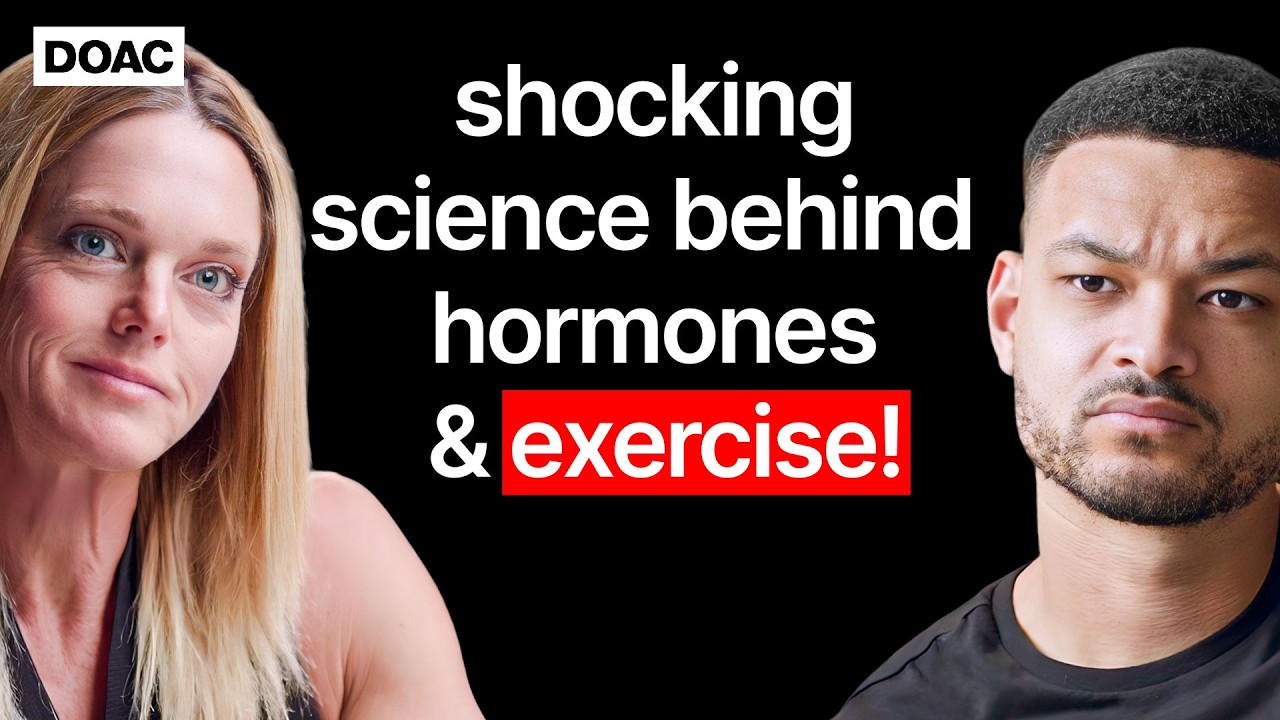
Sims Refutes Uniform Fitness Rules as Female Physiology Diverges
The Diary Of A CEO
Standard exercise and nutrition advice causes metabolic strain and muscle loss in women because medical and sports research historically relies almost exclusively on male subjects.
## Background
This episode of The Diary Of A CEO, hosted by Steven Bartlett and published on YouTube on January 6, 2025, features exercise physiologist and nutrition scientist Dr. Stacy Sims. According to the page description, the discussion explores science-backed exercise and nutrition secrets for female health, questioning whether mainstream fitness advice is inherently sexist.
## TL;DR
Dr. Stacy Sims explains how historical male bias in medical and sports science research has led to exercise and nutrition protocols that often backfire for women. She details key sex differences—ranging from brain architecture, metabolic responses, and baseline creatine levels to ACL injury risks and sleep dynamics—highlighting why women require distinct strategies like post-workout protein windows and cycle-aligned training. Additionally, Sims unpacks the metabolic impacts of perimenopause and menopause, emphasizing heavy resistance training, high-intensity interval training, and Menopause Hormone Therapy (MHT) to preserve lean mass and optimize lifelong performance.
## Atmosphere & style
The conversation is grounded, validating, and intensely practical, blending Dr. Sims's authoritative academic expertise with Steven Bartlett's energetic and empathetic interviewing style. The discussion moves from exposing systematic biases in medical research to delivering actionable, empowering solutions for female physiology across all life stages. Listening to the interview feels like a candid, eye-opening masterclass that dismantles common fitness myths while instilling deep confidence and clarity.
## Key takeaways
- [00:00](https://www.youtube.com/watch?v=It5_C6AF1pk&t=0s) Standard exercise and nutrition advice is historically based almost exclusively on young male research subjects, leading to protocols that can cause weight gain and metabolic strain when followed by women.
- [02:09](https://www.youtube.com/watch?v=It5_C6AF1pk&t=129s) Female subjects have historically been excluded from scientific research to avoid dealing with baseline data complications caused by menstrual hormonal fluctuations.
- [12:00](https://www.youtube.com/watch?v=It5_C6AF1pk&t=720s) Puberty causes widening hips and a distinct Q-angle in women, contributing to a 300% to 400% higher risk of ACL injuries compared to men, which can be mitigated through posterior chain and dynamic lateral training.
- [32:51](https://www.youtube.com/watch?v=It5_C6AF1pk&t=1971s) Women possess a higher density of kisspeptin neurons that sense nutrient availability, causing fasted exercise to trigger a protective metabolic slowdown, elevated cortisol, and muscle tissue breakdown.
- [42:36](https://www.youtube.com/watch?v=It5_C6AF1pk&t=2556s) Extended fasting protocols cause rapid thyroid suppression and elevated stress responses in women, whereas high-intensity exercise is a far superior driver of autophagy and cellular cleanup.
- [52:01](https://www.youtube.com/watch?v=It5_C6AF1pk&t=3121s) A woman's post-workout metabolic elevation returns to baseline within 30 to 40 minutes, making a post-workout intake of ~35g of protein critical during this narrow recovery window to drive muscle protein synthesis.
- [56:28](https://www.youtube.com/watch?v=It5_C6AF1pk&t=3388s) Female-specific cold exposure and sauna protocols require different parameters than male protocols due to sex differences in vasoconstriction mechanisms, thermoregulation, and sweat rates.
- [01:00:28](https://www.youtube.com/watch?v=It5_C6AF1pk&t=3628s) Creatine supplementation benefits female health by restoring naturally lower baseline stores, aiding gut mucosal repair, and significantly reducing symptoms of depression and anxiety when combined with treatment.
- [01:09:31](https://www.youtube.com/watch?v=It5_C6AF1pk&t=4171s) Optimal female iron regulation requires avoiding post-workout supplement intake due to elevated hepcidin levels blocking absorption for up to 24 hours.
- [01:11:18](https://www.youtube.com/watch?v=It5_C6AF1pk&t=4278s) High progesterone in the luteal phase increases insulin resistance and endometrial tissue buildup, while the follicular phase offers high insulin sensitivity and optimal carbohydrate utilization for high-intensity training.
- [01:23:00](https://www.youtube.com/watch?v=It5_C6AF1pk&t=4980s) Low Energy Availability (LEA) affects over 55% of recreational female athletes, leading to disrupted menstrual cycles, amenorrhea, and irreversible loss of bone density.
- [01:26:08](https://www.youtube.com/watch?v=It5_C6AF1pk&t=5168s) Sex-specific melatonin timing creates different circadian peaks between men and women, affecting sleep architecture and causing women to adapt better to eastward travel while men adapt better to westward travel.
- [01:42:02](https://www.youtube.com/watch?v=It5_C6AF1pk&t=6122s) Perimenopause functions as a 'reverse puberty' where declining estrogen promotes abdominal fat storage, loss of gut diversity, and increased cardiovascular risks.
- [01:46:36](https://www.youtube.com/watch?v=It5_C6AF1pk&t=6396s) Midlife female health requires heavy resistance training, plyometrics, and high-intensity interval training (HIIT) combined with higher individual protein intake to overcome age-related anabolic resistance.
- [01:50:42](https://www.youtube.com/watch?v=It5_C6AF1pk&t=6642s) Menopause Hormone Therapy (MHT) provides targeted physiological relief for severe perimenopausal symptoms and metabolic shifts, but it does not prevent age-related cognitive decline.
## Detailed walkthrough
### [00:00](https://www.youtube.com/watch?v=It5_C6AF1pk&t=0s) Intro & The Misguided Application of Male Data to Women
The conversation opens with a stark observation about how women are often left frustrated when trying to follow standard health and fitness routines. Dr. Stacy Sims notes that many women come to her alongside their male partners, baffled because both follow identical training and eating protocols, yet the man drops body fat and gains fitness while the woman gains weight and slows down. This disconnect stems from the distinct physiological realities women navigate throughout life—from puberty and the monthly menstrual cycle to perimenopause and postmenopause. Each phase brings a unique hormonal backdrop that dictates how a woman's body responds to stress, exercise, and nutrition. Despite these differences, standard recommendations remain overwhelmingly based on male data.
When looking closely at exercise physiology, the historic bias toward male test subjects is striking. Research recruitment language frequently uses aggressive, sport-centric terms that appeal primarily to young men, while budget constraints lead researchers to pick subjects who can show up week after week without monthly hormonal shifts complicating the baseline. Consequently, the default subject for decades of exercise science has been the 18- to 22-year-old college male.
* **Caffeine processing:** While men can easily use caffeine in a fasted state to boost performance, women clear blood sugar much faster; combining caffeine with exercise requires women to consume actual food alongside it to avoid metabolic strain.
* **Youth sports drop-out rate:** By age 14, over 60% of girls who were previously active drop out of sports because their changing biomechanics and widening hips are never properly explained to them.
Dr. Sims recounts the pivotal experiences that ignited her career as an exercise physiologist and nutrition scientist. Growing up in a military family where following rules was second nature, her first encounter with gender-based limits occurred when her father—an Army Colonel—told her she could not become a Navy SEAL or Army Ranger simply because she was female. Having spent her childhood playing and competing alongside boys without restriction, this revelation was her first exposure to artificial boundaries based on sex.
```
[Early Life] [2nd Year University] [Academic Career]
Told she couldn't join ───► Data discarded in metabolism ───► Over 100 studies on
Special Ops as a girl lab due to menstrual cycle female-specific physiology
```
The defining academic turning point came during her second year of university while participating in a two-week metabolism study. Despite following every protocol precisely, the researchers discarded her experimental results at the end of the study. When she asked why, she was told her numbers were an "anomaly" that did not align with the male participants' data. The lab director candidly admitted they avoided studying women altogether because the menstrual cycle introduced hormonal fluctuations that "interfered" with the research. Driven to fix this oversight, Dr. Sims built a career focused on women's health, leading to over 100 peer-reviewed studies and positions at Auckland University of Technology (AUT) and Stanford University.
* **Academic credentials:** Master's degree from Springfield College in exercise physiology and metabolism, PhD focusing on sex differences in heat performance and acclimatization.
* **Postdoctoral work:** Worked alongside Dr. Marcia Stefanick at Stanford on the Women's Health Initiative, bridging high-performance human biology with broader public health and longevity.
* **Practical heat acclimatization:** Men can adapt to heat training in a straight 7-day consecutive block. Women in a high-hormone phase require 9 consecutive days; if in a low-hormone phase, they must use split exposure (e.g., 5 minutes in a sauna, step out, then back in) over 9 days due to elevated baseline core temperatures.
---
[12:00](https://www.youtube.com/watch?v=It5_C6AF1pk&t=720s) Fundamental Physiological & Biomechanical Differences
The discussion pivots to the core biological differences between men and women, starting from early embryonic development through puberty. In utero, male fetuses show higher sensitivity to maternal stress, leading to a higher rate of miscarriage compared to female fetuses. In childhood, physical capabilities remain relatively balanced, though subtle muscle fiber differences exist from birth. Boys are born with a higher ratio of fast-twitch muscle fibers, lending themselves toward anaerobic power, while girls possess a higher proportion of slow-twitch, endurance-oriented fibers rich in mitochondria for oxidative capacity.
```
MALE DEVELOPMENT FEMALE DEVELOPMENT
┌────────────────────────┐ ┌────────────────────────┐
│ • More fast-twitch │ │ • More slow-twitch │
│ muscle fibers │ ONSET OF │ endurance fibers │
│ • Narrower hips │ PUBERTY │ • Hips & shoulders │
│ • Straight mechanical │ ───────────► │ widen (Q-angle) │
│ alignment │ │ • Center of gravity │
│ │ │ shifts downward │
└────────────────────────┘ └────────────────────────┘
```
The onset of puberty sharply diverges these paths. Driven by surges in testosterone, boys become leaner and gain explosive strength. For girls, estrogen shifts the body's structure to prepare for potential reproduction: hips and shoulders widen, and the center of gravity drops from the chest down to the lower abdomen.
* **The Q-Angle:** Widened hips increase the "Q-angle" (the angle formed between the hip and the knee), typically measuring around 15 degrees in women.
* **Biomechanical adjustments:** This increased angle alters running mechanics, jumping, and landing control, frequently causing teenage girls to become quad-dominant and struggle with movements like monkey bars or sprinting if they aren't coached on how to adapt to their new center of gravity.
<FollowUp label="Want me to summarize the next section on ACL injuries and fat metabolism?" query="Summarize the next section of the Stacy Sims interview covering ACL injuries, quad dominance, and fat/heart/lung differences between men and women."/>
[16:17](https://www.youtube.com/watch?v=It5_C6AF1pk&t=977s) Emotional Differences and Body Image
Dr. Stacy Sims highlights that adolescent girls tend to be more self-aware than boys, but this heightened awareness often turns inward in a negative fashion. While boys tend to express frustration physically ("you piss me off, I'm going to beat you up and we're going to get on with it") and move past conflicts quickly, girls frequently internalize negative emotions and hold onto them. This tendency drives mood swings and fosters negative body image, leaving young women feeling uncomfortable with their physical appearance and identity—a challenge further compounded by societal pressures. Dr. Sims emphasizes that these psychological patterns interact with sociocultural and biological shifts, directly impacting a woman's relationship with exercise.
[16:55](https://www.youtube.com/watch?v=It5_C6AF1pk&t=1015s) Fat, Heart, and Lung Differences Between Men and Women
The discussion transitions into essential biological differences between the sexes, starting with body composition and organ sizes. Essential body fat—the baseline level required for nerve protection and organ survival—is around 4% to 8% for men, whereas for women it sits around 12%. In terms of overall body composition, healthy baseline fat sits around 20% for women and 15% for men. Additionally, relative to body size, women have smaller hearts and lungs, as well as lower total blood volume.
Women also possess lower levels of hemoglobin and fewer red blood cells than men. Because red blood cell production is heavily driven by testosterone—with men possessing roughly 100% more aromatized testosterone—men have a significantly higher oxygen-carrying capacity. Dr. Sims clarifies that this disparity isn't about respiratory rate (breathing faster or slower), but rather the speed and volume at which oxygen transfers from the lungs to red blood cells and reaches working muscles to fuel contraction. Consequently, this creates a biological ceiling on power and speed development, explaining why performance gaps between men and women remain pronounced in sprint events even as endurance gaps gradually close.
- **Essential Body Fat:** 4%–8% in men versus ~12% in women.
- **Average Healthy Body Fat:** ~15% in men versus ~20% in women.
- **Lung Volume:** Women's lungs are typically 25% to 30% smaller than men's relative to body size.
- **Red Blood Cells & Oxygen:** Driven by higher testosterone, men carry more oxygen per unit of blood, giving them a distinct advantage in rapid power delivery and top-end speed.
[20:10](https://www.youtube.com/watch?v=It5_C6AF1pk&t=1210s) Muscle-Building Capacities and Upper vs. Lower Body Strength
Referencing a passage from her book *ROAR* (page 4), the host notes that untrained women possess approximately 52% of the upper-body strength and 66% of the lower-body strength of men. However, when women engage in structured resistance training, their relative lower-body strength can reach 70% to 80% of a man's capacity. Dr. Sims explains that relative to men, women adapt and build muscle just as effectively in the lower body, whereas upper-body strength gains remain somewhat more constrained due to baseline muscle morphology.
[20:38](https://www.youtube.com/watch?v=It5_C6AF1pk&t=1238s) The Q Angle, Quad Dominance, and ACL Injuries in Female Athletes
The conversation shifts to the alarming prevalence of ACL (anterior cruciate ligament) injuries among female athletes. The structural root of this issue lies largely in the "Q angle" (quadriceps angle)—the angle formed between the hip and the knee. Because men have narrower hips, their legs drop in a relatively straight line, allowing impact forces to distribute evenly through the knee joint during jumping or landing. Women, possessing wider hips for childbearing, have a sharper angle descending to the knee. This angular alignment creates uneven force distribution upon impact.
This structural vulnerability is further exacerbated by "quad dominance." Women naturally rely far more heavily on the front of their legs (quadriceps) than on their posterior chain (hamstrings and glutes). Because a woman's center of gravity is naturally lower and tends to shift forward, the quads automatically absorb the majority of movement work unless the posterior chain is intentionally trained to fire. When combined with improper jump-landing mechanics and cutting movements, this biomechanical imbalance subjects the knee joint to extreme torsional stress.
- **ACL Tear Ratio:** Research indicates women experience ACL tears at a rate 3 to 4 times higher than men (a 300% to 400% increased incidence).
- **2023 Women's World Cup:** 30 female professional football (soccer) players—including UK Lionesses Beth Mead and Leah Williamson—missed the tournament due to ACL injuries.
- **Grassroots vs. Professional:** While FIFA has implemented specific ACL-prevention warm-ups in elite football, grassroots and recreational female athletes suffer disproportionately higher tear rates due to a lack of targeted biomechanical training.
[25:11](https://www.youtube.com/watch?v=It5_C6AF1pk&t=1511s) Preventing ACL Tears: Strengthening the Posterior Chain
Dr. Sims details actionable preventative measures to mitigate ACL injury risk in active women, drawing on recent research from one of her PhD graduates who studied post-surgical rehabilitation. The solution hinges on rectifying the strength disparity between the quads and the hamstrings. By aggressively developing the posterior chain—specifically the hamstrings, glutes, and calves—the forces pulling the knee forward are balanced by posterior support, drawing stress back into a central, safer alignment.
Additionally, standard training and youth sports warm-ups rarely incorporate dynamic lateral movements. Effective prevention programs must train female athletes in explosive single-leg stability, jump landings, and lateral cutting mechanics. Incorporating these movement patterns teaches the body how to absorb lateral impact without placing catastrophic strain on the ligament.
[27:51](https://www.youtube.com/watch?v=It5_C6AF1pk&t=1671s) Historical Bias in Sports Science, Research, and Medicine
Dr. Sims addresses the pervasive historical oversight in viewing female bodies merely as "smaller versions of men." She recounts standing in a Washington, D.C. metro station listening to a second-year exercise physiology student describe her laboratory coursework; when asked if her curriculum addressed female-specific muscle morphology or biomechanical angles, the student replied, "No, what are you talking about?" Dr. Sims points out that even modern textbooks overwhelmingly feature male anatomy as the default standard, confining female physiology to small sidebars usually focused on anemia or Relative Energy Deficiency in Sport (REDs).
This bias stems from the historical evolution of medical science. Prior to modern institutional medicine, women acted as primary community caretakers and healers. However, as medicine and formal scientific research became institutionalized, women were systematically excluded from academic institutions. Consequently, foundational medical models, baseline physiological data, and modern AI healthcare algorithms were built almost exclusively on male subjects.
- **Key Turning Points in Sex-Specific Research:**
1. **Ambien (Zolpidem) Dosages:** It was discovered that women were involved in a high rate of morning car accidents after taking Ambien. Prescribers had issued identical dosages to 180-pound men and 120-pound women, ignoring major differences in body composition and metabolic clearance rates.
2. **COVID-19 and Long COVID:** Outcomes during the pandemic revealed stark sex differences: men suffered higher acute mortality rates, while women disproportionately developed Long COVID, forcing researchers to study sex-specific immune responses.
- **Hormones and Injury:** While popular belief holds that elevated estrogen during ovulation causes ACL tears due to increased ligament laxity, Dr. Sims notes the interaction is far more complex; progesterone simultaneously affects tendon stiffness, yet current athletic training protocols completely fail to account for these hormonal shifts.
[32:51](https://www.youtube.com/watch?v=It5_C6AF1pk&t=1971s) Why Standard Weight Loss Advice Fails Women
When asked if she would give different weight loss advice to a 200-pound man versus a 200-pound woman, Dr. Sims responds with an emphatic "Absolutely." She criticizes the ubiquitous social media mantra of "calories in, calories out," explaining that while a simple caloric deficit algorithm often yields predictable results for men, it frequently fails for women due to the sensitive signaling architecture of the female brain—specifically the hypothalamus.
---
<FollowUp label="Want me to walk through what happens in the female hypothalamus during a calorie deficit?" query="Yes, explain how the female hypothalamus reacts to fasting, calorie deficits, and exercise differently than men."/>
[33:29](https://www.youtube.com/watch?v=It5_C6AF1pk&t=2009s) Differences in Weight Loss Advice for Men and Women
Dr. Stacy Sims explains the fundamental biochemical differences in how men and women process nutrients, store glycogen, and manage baseline metabolic needs. Women possess a higher concentration of kisspeptin neurons in the brain—neurons that act as nutrient-density sensors. When nutrients enter the system, these neurons fire to signal whether enough energy is present to build muscle and shed body fat. Because female physiology is exceptionally sensitive to nutrient availability, even small amounts of food impact a woman's body differently than a man's.
For instance, when four grams of carbohydrates from whole foods like fruits or vegetables are consumed, a man's body primarily shifts those carbohydrates into blood glucose and efficiently stores them as glycogen in the liver and skeletal muscle. In women, storing liver and muscle glycogen requires specific enzymatic activations in both the liver and skeletal muscle. Without adequate signals, that glucose remains in the bloodstream longer. The brain evaluates this circulating glucose to decide whether it is safe to expend energy or if it must conserve resources to ensure survival.
```
+-----------------------------------------------------------------------------------+
| BASELINE CALORIC NEED THRESHOLDS |
| (Minimum calories needed to prevent endocrine & appetite dysfunction per kg FFM) |
+-----------------------------------------------------------------------------------+
| Men | [15 kcal / kg] |
| Women | [30 kcal / kg] |
+-----------------------------------------------------------------------------------+
```
- **Caloric Thresholds:** Men require a baseline of 15 calories per kilogram of fat-free mass (FFM) to avoid endocrine, hormonal, or appetite dysfunction, whereas women require double that amount—30 calories per kilogram of FFM.
- **Dietary Response:** Men thrive more easily on calorie restriction, low-carbohydrate diets, high-fat/high-protein regimens, or fasted training because their brain centers are far less sensitive to lower caloric intakes.
---
[35:54](https://www.youtube.com/watch?v=It5_C6AF1pk&t=2154s) What Is the Hypothalamus?
When Steven Bartlett asks for clarification on the hypothalamus, Dr. Sims describes it as the body's primary control center and thermostat. Located in the brain, the hypothalamus continuously samples circulating blood to monitor temperature, salt balance, and the availability of macronutrients like protein and carbohydrates to regulate appetite and metabolic output.
When a woman engages in fasted training—such as waking up, drinking black coffee, and heading straight to a heavy workout—the hypothalamus detects a total lack of blood glucose and sufficient carbohydrates. In response, it initiates a protective metabolic slowdown. To supply the immediate energy required for muscle contractions, the body begins breaking down its own lean muscle tissue while turning down other energy-dependent physiological systems.
> "If a woman comes to me... [and says] 'I get up, I have a black coffee, I go to the gym... I'm not that hungry... I'll hold off eating my first meal until noon,' I always turn to them and go, 'Well, why did you go to the gym? Because all you've effectively done is burn through your lean mass.'"
- **Pre-Workout Fuel for Women:** Dr. Sims advises women to consume approximately 15 grams of protein before strength training, or 15 grams of protein combined with 30 grams of carbohydrates prior to combined cardio and lifting. This small intake raises blood sugar just enough to reassure the hypothalamus, stimulate muscle mitochondria to burn free fatty acids, and prevent muscle tissue breakdown.
- **Male Fueling Dynamics:** Men can sustain fasted morning workouts followed by delayed meals because their longer post-exercise recovery window and lower hypothalamic sensitivity allow them to mobilize stored glycogen without immediately stripping lean mass.
---
[38:45](https://www.youtube.com/watch?v=It5_C6AF1pk&t=2325s) The Evolutionary Purpose of Female Nutrient Sensitivity
Steven summarizes the mechanism in plain terms: a woman's hyper-sensitive hypothalamus views a fasted state combined with high physical exertion as severe stress. Lacking circulating blood glucose, it turns on its own lean muscle mass for fuel. Conversely, a man's lower hypothalamic sensitivity allows his body to readily pull from stored muscle and liver glycogen without defaulting to muscle breakdown.
Dr. Sims confirms this summary and provides the evolutionary narrative behind the disparity. In ancestral times during periods of food scarcity, it was biologically disadvantageous for a woman to become pregnant or attempt to nurse an infant. Consequently, when caloric intake dropped, a woman's reproductive and endocrine systems would rapidly shut down—often causing amenorrhea—to conserve energy for survival.
For ancestral men, food scarcity signaled the urgent need to hunt and forage. A man's body adapted by leaning out and enhancing physical responsiveness so he could track and capture food. When food is abundant, a woman's body thrives: cognitive function sharpens, ovulation and egg maturation proceed smoothly, and daily endocrine pulses (including thyroid and sex hormones) operate robustly. But as soon as calories are severely restricted, her body senses an impending famine and curtails these energy-heavy processes.
---
[42:36](https://www.youtube.com/watch?v=It5_C6AF1pk&t=2556s) Fasting and Exercise Differences for Women vs. Men
Addressing popular dietary trends, Dr. Sims highlights how intermittent fasting originated in clinical settings to help severely obese, sedentary individuals shed weight rapidly before high-risk surgeries. Problems arise when these clinical interventions are applied wholesale to the general exercise population based on male-centric research. Women often attempt the exact same fasting routines as their male partners, only to find that while the man loses fat and gains fitness, the woman gains weight, feels sluggish, and experiences hormonal disruption.
```
+------------------------------------------------------------------------------------+
| WARRIOR FASTING (20:4 PROTOCOL) EFFECTS |
+------------------------------------------------------------------------------------+
| Feature | Men | Women |
+-----------------------------+---------------------------+--------------------------+
| Autonomic Nervous System | Parasympathetic drive | Sympathetic drive |
| Blood Glucose Control | Improved | Impaired (Higher resting)|
| Body Fat Response | Accelerated loss | Increased fat storage |
| Metabolic Flexibility | Enhanced | Reduced |
| Endocrine Function | Maintained | Down-turned thyroid |
+-----------------------------+---------------------------+--------------------------+
```
To gain the cellular cleanup benefits of autophagy without triggering metabolic distress, Dr. Sims advises women to align their eating with their circadian rhythm. This involves finishing dinner 2 to 3 hours before bed, completing a natural overnight fast, and consuming food within 30 minutes of waking to blunt the morning cortisol spike.
Furthermore, Dr. Sims stresses that exercise is a far more powerful stimulus for autophagy and longevity than caloric deprivation. Exercise naturally creates a fasting-like state during exertion by breaking down fat, glucose, and amino acids, followed by a surge in growth hormone and testosterone during recovery that drives cellular repair. She laments that modern sedentary conveniences—like automatic car openers or rideshare apps—have conditioned society to avoid physical exertion, referencing the animated film *Wall-E* where humans become entirely reliant on hovering chairs and lose the basic physical ability to support their own body weight.
- **Fasting Protocols:** While men can thrive on variations like 20-hour fasts with a 4-hour eating window (Warrior Fasting), women subjected to this protocol show thyroid suppression within just 4 days, elevated resting blood sugar, disrupted sleep, and heightened sympathetic stress.
- **Exercise vs. Diet Modalities:** High-intensity interval training, resistance training, and targeted cardio act as significantly stronger, healthier biological stressors than restrictive diets.
---
[48:13](https://www.youtube.com/watch?v=It5_C6AF1pk&t=2893s) Resistance Training for Women Across Life Stages
When asked how weight loss strategies should differ between sexes, Dr. Sims notes that men age in a relatively linear fashion, experiencing a slow, steady decline in testosterone starting in their late 50s. Women, by contrast, experience distinct physiological life stages—puberty, reproductive years, perimenopause, and postmenopause—each defined by unique hormonal profiles.
Regardless of age or life stage, resistance training combined with higher protein intake is the single most effective tool for female body composition change. Heavy lifting mobilizes abdominal fat, increases lean muscle mass, and stimulates the release of *myokines*—signaling proteins secreted by contracting skeletal muscles that cross-talk with fat tissue to accelerate metabolic remolding. Dr. Sims reflects on the cultural shift from the 1990s "heroic skinny" supermodel ideal that discouraged women from building muscle to modern evidence-based practices that prioritize strength.
- **12-Week Transformation:** Coupling progressive resistance training with elevated dietary protein leads to a complete body recomposition within 12 weeks in women of all ages.
- **Myokine Activation:** Muscle contractions during resistance exercise release myokines, establishing direct biochemical communication between skeletal muscle and stored body fat to promote fat oxidation.
Here is a detailed, faithful walkthrough of the provided transcript segment.
---
### [50:23](https://www.youtube.com/watch?v=It5_C6AF1pk&t=3023s) Ozempic, GLP-1s, and Muscle Loss
Dr. Stacy Sims expresses major concerns regarding how popular GLP-1 receptor agonists like Ozempic are currently prescribed. While acknowledging that Ozempic is an "absolutely brilliant tool" for mute-buttoning appetite, dampening cravings, and driving rapid weight loss, the core problem is that patients are rarely taught how to properly transition off the medication. The rapid weight dropped on GLP-1s consists heavily of lean body mass. Dr. Sims fears a societal scenario where individuals lose critical muscle—evoking a image of being unable to stand up due to a lack of functional muscle—because they were never guided through proper strength training, exercise modalities, and supportive nutrition during the protocol. Without integrating real behavioral changes, people remain terrified of coming off the medication and regaining weight.
When host Steven Bartlett asks if she recommends Ozempic to those seeking her advice, Dr. Sims gives a firm "no" for the general population. Most individuals consulting her are trying to lose what she calls "10 vanity pounds"—weight that creeps up over time and can be resolved through small, sustainable daily lifestyle modifications. However, she clarifies that GLP-1s *are* valuable for individuals with severe obesity, pre-diabetes, or complex medical conditions where exercise is in the "too hard basket" because simple movements like standing out of a chair cause breathlessness. In those clinical cases, initiating initial weight loss via medication is a necessary precursor to introducing the adaptive benefits of exercise.
- **Weight Loss Quality:** GLP-1 weight loss disproportionately strips lean muscle mass if unmanaged by strength training and high-protein intake.
- **Client Distinction:** "Vanity pounds" should be addressed via daily habit tweaks; GLP-1s are appropriate when severe obesity or breathlessness halts physical activity.
---
### [52:01](https://www.youtube.com/watch?v=It5_C6AF1pk&t=3121s) Post-Workout Nutrition and the Gender Recovery Window
The conversation shifts to post-exercise meal timing, where Dr. Sims outlines a fundamental physiological variance between men and women. After exercise, a woman’s metabolic rate and physiological systems return to baseline resting state within 30 to 40 minutes. For men, this post-workout recovery window remains elevated for anywhere from 2 to 18 hours, depending on session intensity.
Because a woman’s physiology snaps back to baseline so quickly, female athletes must consume high-quality protein rapidly after training to maximize resistance adaptations and signal muscle protein synthesis. For reproductive-age women, Dr. Sims recommends consuming **35 grams of protein within 45 minutes** post-workout to trigger muscle repair. Men, by contrast, only require about 20 grams of protein, and because their anabolic window remains open far longer, they can consume it hours later with similar effectiveness.
Carbohydrate requirements after exercise also differ. Because men tap more heavily into stored glycogen during training, they require higher post-workout carbohydrate replenishment. Women rely less on glycogen during exercise and therefore do not require the same high-volume carbohydrate reload immediately afterward.
- **Metabolic Baseline Return:** Women recover to resting baseline in 30–40 minutes; men take 2–18 hours.
- **Female Protein Target:** ~35g of protein within 45 minutes post-exercise to trigger muscle protein synthesis.
- **Male Protein Target:** ~20g of protein, with a significantly wider, multi-hour window of opportunity.
---
### [53:13](https://www.youtube.com/watch?v=It5_C6AF1pk&t=3193s) The Ketogenic Diet and Gut Microbiome Damage
Dr. Sims takes a firm "anti-keto" stance for both men and women, primarily due to its detrimental impact on the gut microbiome. Modern, city-dwelling humans already suffer from reduced gut bacterial diversity due to restricted food supply chains, and maintaining microbiome health is vital for synthesizing vitamins, producing serotonin, and supporting the gut-brain axis.
A true ketogenic diet requires 70% to 80% of total daily caloric intake to come from fats. This excessive fat saturation causes an overgrowth of fatty-acid-dependent bacteria, which starves and downregulates the beneficial bacteria that thrive on plant fiber. Furthermore, taking off-the-shelf probiotic pills is an unreliable fix: they primarily affect the upper intestine, and because a small handful of business-to-business (B2B) suppliers manufacture the vast majority of commercial probiotics, overusing them can trigger bacterial overgrowth and dysbiosis.
For women specifically, keto is counterproductive. Females are inherently metabolically flexible from birth due to possessing a higher ratio of endurance muscle fibers. Furthermore, women possess a specialized group of gut bacteria involved in sex hormone metabolism (sometimes referred to as the estrobolome). Sex hormones like estrogen and progesterone are released by the ovaries, processed by the liver, bound by sex hormone-binding globulin (SHBG), and excreted into the intestines via bile. Beneficial gut bugs then "unconjugate" or unpack these hormones so they can be reabsorbed into circulation to work optimally (a process known as the "second pass"). When keto destroys gut microbiome diversity, women lose the specific microbes required for sex hormone reactivation.
- **Microbiome Diversity Rule:** To maintain optimal gut diversity, individuals should aim to consume **30 different plant foods per week**—a quota virtually impossible to achieve on a strict keto macro split.
- **Macro Distribution on Keto:** 70–80% fat intake starves fiber-loving microbes and feeds dysbiotic fat-utilizing strains.
- **Hormonal Second Pass:** Intestinal bacteria break down conjugated sex hormones from liver bile, enabling optimal recirculating estrogen and progesterone levels.
---
### [56:28](https://www.youtube.com/watch?v=It5_C6AF1pk&t=3388s) Sex Differences in Cold Plunges and Saunas
When discussing popular recovery practices like cold water immersion and saunas, Dr. Sims points out stark differences in how male and female bodies respond to extreme temperatures. Cold plunging has gained widespread popularity for triggering parasympathetic tones, heightening focus, sharpening blood glucose regulation, and inducing autophagy—yet almost all of these compelling findings stem from male data.
For women, plunging into standard ice baths (0° to 4°C / 32° to 39°F) presents an excessive physiological threat. Females possess more subcutaneous fat and rely on a distinct thermoregulatory mechanism where peripheral blood vessels tightly vasoconstrict first before internal core adaptations take place. Extreme ice water induces such harsh vasoconstriction that it triggers a survival threat response rather than beneficial hormetic stress. To achieve the exact same autonomic, cognitive, and metabolic benefits that men experience in ice water, women should use water cooled to **15° to 16°C (around 55°F)**.
```
Cold Plunge Temperature Targets for Hormetic Benefit:
- Men: 0°C to 4°C (32°F - 39°F)
- Women: 15°C to 16°C (~55°F)
```
In saunas, the physiological dynamics reverse. Because women vasodiliate first before they begin sweating, it takes significantly longer for their internal core temperature to rise. Men start sweating profusely within minutes, whereas women often require 20 to 30 minutes in heat exposure to initiate the same cardiovascular adaptations, plasma volume expansions, and hormonal heat-shock responses. Dr. Sims shares a humorous personal example of sitting alongside her husband in the sauna: after 10 minutes, her husband is dripping sweat and declaring "I got to get out," while she hasn't even begun to sweat yet. Women require longer acute sauna sessions and more weeks of consistent exposure to build thermal acclimatization.
---
### [01:00:28](https://www.youtube.com/watch?v=It5_C6AF1pk&t=3628s) Demystifying Creatine for Female Health
Steven Bartlett shares an anecdote about introducing creatine to his partner on New Year's Eve, noting her initial resistance due to the widespread misconception that creatine is strictly a "bodybuilding supplement" that causes unwanted weight gain and bulky muscles. Dr. Sims confirms this is the single most pervasive myth surrounding the supplement, explaining that the negative side effects—such as rapid water retention—are caused by aggressive male bodybuilding protocols rather than the molecule itself.
In bodybuilding protocols, athletes complete a "loading phase" taking 5 grams of creatine four times a day (20g daily) combined with simple carbohydrates to saturate muscle glycogen and drive water into muscle cells. For female health and overall performance, however, loading is completely unnecessary. Women naturally possess about 70% of the baseline creatine stores that men have and consume fewer creatine-rich foods (like red meat).
```
Creatine Dosing Protocols:
- Bodybuilding / Male Loading: 5g x 4 times/day (20g total) + simple carbs
- Female Health & Daily Performance: 3g to 5g once daily (no carbs needed)
```
Consuming **3 to 5 grams once a day** saturates female tissues over three weeks without bloating or sudden weight gain. Furthermore, creatine serves essential "fast energetic" roles far beyond muscle contraction:
- **Gut Integrity:** Female runners experience gastrointestinal distress at a 5:1 ratio compared to men due to estrogen's impact on the intestinal mucosal lining. Creatine fuels mucosal cell repair, maintaining gut barrier integrity and preventing exercise-induced GI distress.
- **Brain Health & Mental Health:** Randomized controlled trials demonstrate that women supplementing with 3 to 5 grams of creatine daily experience significantly greater reductions in clinical depression and anxiety symptoms when paired with SSRIs than those taking SSRIs alone.
Dr. Sims notes that unless a female athlete is actively preparing for physique competitions, powerlifting, or events like HYROX that demand immediate, acute muscle buffer capacity, she should completely skip loading phases and stick to a steady 3–5g daily dose.
---
### [01:05:42](https://www.youtube.com/watch?v=It5_C6AF1pk&t=3942s) Essential Female Supplementation: Vitamin D3
When asked what other baseline supplements women should prioritize based on modern lifestyles, Dr. Sims highlights **Vitamin D3**.
She explains the vital functional distinction between Vitamin D forms: Vitamin D2 is primarily a storage precursor that requires multi-step enzymatic conversion, whereas **Vitamin D3** is the bioidentical, functional form that the body can immediately absorb and utilize across every physiological system.
Due to modern indoor working environments, geographical factors (living in high latitudes during winter), and public health warnings driving heavy sunscreen and protective clothing use ("slip, slap, slop"), women suffer widespread Vitamin D deficiencies. Because dietary sources are insufficient to bridge this gap, daily functional Vitamin D3 supplementation is critical for female hormonal, immune, and structural health.
[01:06:43](https://www.youtube.com/watch?v=It5_C6AF1pk&t=4003s) Vitamin D3, Omega-3s, and the Crisis of Shifting Blood Reference Ranges
Continuing her breakdown of core female supplementation, Dr. Stacy Sims emphasizes that modern diets typically lack natural, Vitamin D-rich foods such as mushrooms and fortified dairy. Boosting circulating Vitamin D3 levels produces wide-ranging improvements across every system, including accelerated muscular recovery, sharper cognitive function, and enhanced muscle performance. Turning to Omega-3 fatty acids, Dr. Sims explains their profound protective effect on cellular integrity. As women transition into perimenopause and postmenopause, falling estrogen levels deplete the body's native anti-inflammatory capacity. Supplementing with high-quality fish oils helps bridge this gap, stabilizing cell membranes and suppressing systemic inflammation. Rather than universally mandating it for everyone from youth, she recommends that women test their fatty acid profiles in their late 30s or early 40s to tailor their dosage.
```
NORMAL REFERENCE RANGES (FERRITIN)
Sedentary Population Shift High-Performance Target Range
[======================] [===========================]
26 ng/mL 50 ng/mL 100 ng/mL
(Modern "Normal") (Baseline Minimum) (Optimal)
```
The discussion turns sharply to iron deficiency and a troubling systemic shift in clinical diagnostics. Host Steven Bartlett notes that many women he knows suffer from low iron. Dr. Sims reveals that standard lab "reference ranges" are actively shifting downward because they are modeled on an increasingly sedentary, chronically ill population bell curve. Where a ferritin level under 50 ng/mL was once flagged as low iron, modern lab baselines have dropped to as low as 26 ng/mL for women. Active women presenting with ferritin levels of 26 ng/mL are routinely dismissed as "normal" despite feeling completely depleted. In her high-performance athletic groups, Dr. Sims targets a minimum ferritin level of 50 ng/mL, with an optimal zone closer to 100 ng/mL.
- **Systemic Vitamin D3 Impact:** Enhances brain health, muscle function, and total cellular recovery.
- **Omega-3 Strategy:** Replaces lost estrogenic anti-inflammatory cell support; requires lab testing before protocol design in late 30s/early 40s.
- **Lab Reference Range Inflation:** Standard ferritin baselines lowered from 50 ng/mL to 26 ng/mL; male testosterone baselines show an identical downward decay due to population-wide health decline.
- **High-Performance Ferritin Targets:** Baseline minimum of 50 ng/mL; optimal target of 100 ng/mL.
- **Iron Supplementation Protocol:** Administer highly bioavailable forms (carbonyl iron or iron glycinate) every other day rather than daily to maximize absorption.
[01:09:31](https://www.youtube.com/watch?v=It5_C6AF1pk&t=4171s) Iron Mechanics, Hepcidin Regulation, and Meal Planning Realities
Dr. Sims explains the biological mechanics of iron: it builds the heme groups inside red blood cells that capture and carry oxygen throughout the body. Iron deficiency starves tissue of oxygen, producing a profound "dead-ended fatigue" distinct from lifestyle stress or jet lag. It leaves individuals breathless after climbing a simple flight of stairs and causes severe dark under-eye circles. While red meat remains the most direct dietary source, plant-based options like leafy greens, nuts, and seeds can be leveraged when paired with Vitamin C, healthy fats (like olive oil), or cooked in cast-iron skillets.
*Optimal Iron Dosing Window: Before training OR at night away from workouts.*
```
Crucially, iron absorption is governed by **hepcidin** (or *hepcitin*), a liver-derived hormone that acts as the body's primary iron regulator. When systemic inflammation spikes—such as right after a workout—hepcidin levels surge and block iron absorption in the gut. In men and reproductive women, post-exercise hepcidin remains elevated for about 5 hours; in late perimenopausal and early postmenopausal women, this inflammatory block can persist for up to 24 hours. Consequently, taking iron supplements immediately after a workout completely wastes the dose.
- **Symptomatic Profile of Anemia:** Exhaustion unrelated to sleep, physical breathlessness on minor exertion, severe dark facial circles.
- **Plant-Based Iron Hacks:** Pair non-heme sources with Vitamin C and cast-iron cookware to improve elemental uptake.
- **Hepcidin Dynamics:** Liver enzyme that shuts down intestinal iron absorption in response to inflammatory cascades.
- **Timing Iron Intake:** Always supplement before exercise or at night before bed—never within the post-workout inflammatory window.
[01:11:18](https://www.youtube.com/watch?v=It5_C6AF1pk&t=4278s) Menstrual Hormones and Insulin Sensitivity Dynamics
The conversation shifts to household dynamics when Steven asks about sharing identical dinner portions with his female partner, noting previous glucose tests where she displayed higher blood sugar sensitivity. Dr. Sims explains that female insulin sensitivity fluctuates dramatically across the 28-day menstrual cycle. During the low-hormone follicular phase, women process carbohydrates efficiently. However, following ovulation, the luteal phase brings a massive rise in progesterone.
Progesterone fundamentally alters metabolic priorities: its biological mandate is to prepare a plush, nutrient-rich endometrial lining for potential egg implantation. To accomplish this, progesterone drives insulin resistance, keeping glucose and free amino acids circulating in the bloodstream rather than allowing skeletal muscle to quickly store them. This physiological shift triggers protein cravings and breaks down lean tissue to secure building blocks for the uterine lining. A similar state of chronic insulin resistance occurs during perimenopause due to erratic systemic signaling between the liver and cellular mitochondria.
```
28-DAY METABOLIC PHASE MAP
[ Follicular Phase: Days 1-13 ] [ Luteal Phase: Days 14-28 ]
- Low Hormones (Estrogen peak ~Day 12) - Progesterone Dominance
- High Insulin Sensitivity - Increased Insulin Resistance
- High Stress Resilience - Carbs Kept in Blood for Endometrium
- Peak Strength & Cognitive Drive - Protein Needs Rise ~12%
```
- **Insulin Resistance Cause:** Elevated progesterone intentionally prevents muscle glycogen uptake to divert nutrients to the endometrium.
- **Anovulatory Cycle Threat:** Rising societal stress, low energy availability, and restrictive diets cause women to miss ovulation while still experiencing a bleed; without ovulation, progesterone is not produced.
- **Perimenopausal Glucose Confusion:** Mitochondrial missteps and hepatic signaling errors lead to elevated baseline blood glucose.
[01:15:05](https://www.youtube.com/watch?v=It5_C6AF1pk&t=4505s) Adapting Exercise and Nutrition Across the 28-Day Cycle
Dr. Sims walks through the ideal workout and nutrition adjustments across a standard 28-day cycle:
```
28-DAY TRAINING & NUTRITION PROTOCOL
Days 1-6 Days 6-13 Day 14 Days 15-23 Days 24-28
[ Bleed ] [ Peak Estrogen ] [ Ovulation ] [ High Progesterone ] [ Pre-Menses ]
Low Hormones Max Strength Fuel Shift Tempo & Endurance Deload Phase
High Stress Hit PRs Add Carbs +12% Protein Needs Recovery Focus
Resilience
```
- **Early to Late Follicular Phase (Days 1–13):** Hormones remain low. The immune system is robust, stress resilience is high, and the body readily disposes of carbohydrates. Strength, power, and high-intensity interval training (HIIT) yield maximum training adaptations here.
- **Ovulation & Luteal Phase (Days 14–23):** As progesterone spikes, core body temperature rises by 0.5°C (~1°F), lowering heat tolerance and altering fuel utilization. High-intensity sessions require pre- and post-workout carbohydrates to keep blood sugar stable. Protein intake must increase by roughly 12% to offset elevated muscle breakdown.
- **Late Luteal / Pre-Menses (Days 24–28):** As both estrogen and progesterone drop precipitously, systemic inflammation spikes to trigger endometrial shedding. The immune system is compromised, making this the ideal window for a deliberate training **deload**, mobility work, and rest.
To navigate daily fluctuations without getting bogged down in rigid tracking, Dr. Sims advises using a **sessional Rating of Perceived Exertion (sRPE)** before every workout. Athletes score both their physical and mental readiness on a 1-to-10 scale:
| Physical Score | Mental Score | Prescribed Adjustment |
|:--- |:--- |:--- |
| **High (e.g., 8)** | **Low (e.g., 2)** | Execute a thorough warm-up. If mental drive stays low, skip complex technical lifts and heavy maxes; keep work light to avoid mental burnout. |
| **Low** | **Low** | Pivot immediately to a technique, mobility, and recovery day. Work slow under the bar without driving the heart rate up. |
| **High** | **High** | Full green light: push peak loads, high intensity, and attempt personal records (PRs). |
> "When you go to the gym, use what we call sessional rating of perceived exertion... If you go in and you're low on both, then it's going to be a technique and recovery day. You're not wasting time at the gym; you're going to make it work for you."
[01:21:37](https://www.youtube.com/watch?v=It5_C6AF1pk&t=4897s) Unasked Questions: Bleed Patterns as a Barometer for Systemic Stress
When asked what critical topics are omitted from standard health conversations, Dr. Sims stresses that the "textbook 28-day cycle" is exceptionally rare in practice. Normal, healthy cycles can range anywhere from 21 to 40 days. More importantly, she urges women to treat their individual **bleed pattern** as a vital sign.
Changes in menstrual length, sudden heavy days, unexpected spotting, or complete absence of a period (amenorrhea) are the body's earliest physical indicators of severe internal distress. This disruption is rarely just emotional stress; it is often driven by exercise-induced strain or **Low Energy Availability (LEA)**—where a woman simply does not consume enough total calories to support her baseline physiological functions alongside her exercise load.
- **Variability Realities:** A normal cycle spans 21 to 40 days, with unique individual bleed signatures.
- **Bleed Pattern as a Stress Barometer:** Sudden shifts in flow, length, or frequency signal under-fueling, systemic overtraining, or early perimenopause.
- **Anovulatory Warning:** Experiencing a monthly bleed does not guarantee ovulation; tracking metabolic indicators and physical symptoms reveals true underlying health.
<ElicitationsGroup message="Explore related female-specific performance topics:">
<Elicitation label="Deep-dive into Low Energy Availability (LEA) and RED-S" query="Explain Low Energy Availability (LEA) and Relative Energy Deficiency in Sport (RED-S) in detail, including physical symptoms and recovery steps."/>
<Elicitation label="Review Dr. Stacy Sims' complete perimenopause workout protocol" query="Summarize Dr. Stacy Sims' exercise recommendations specifically for perimenopause and menopause from her book Next Level."/>
</ElicitationsGroup>
[01:23:00](https://www.youtube.com/watch?v=It5_C6AF1pk&t=4980s) Low Energy Availability and Menstrual Health in Female Athletes
A critical issue facing active women is **low energy availability**—a state where the body does not receive enough calories to support both basic physiological functions and exercise demands. Dr. Stacy Sims emphasizes that stress isn't just about work emails; overtraining and inadequate nutrition (particularly cutting carbohydrates through trendy low-carb, high-fat, or ketogenic diets) directly disrupt the hypothalamus. Research on recreational female athletes—those training three or four times a week for overall fitness rather than a specific sport—reveals alarming statistics.
Upward of 55% of recreational female athletes operate in a clinical or subclinical low energy state. This energy deficit manifests quickly as changes in the bleed cycle or a missed period (amenorrhea). Dr. Sims advises women to track both their rating of perceived exertion (RPE) and their cycle length/bleed patterns. Any sudden alteration serves as an early warning sign that training intensity, poor sleep, or dietary restrictions are overwhelming the body's ability to adapt. Addressing this early prevents long-term consequences such as severe endocrine dysfunction, psychological distress, and irreversible loss of bone density.
* Over **55% of recreational female athletes** suffer from clinical or subclinical low energy availability.
* Primary dietary drivers include fasted training and extreme carbohydrate restriction.
* Disruption of the hypothalamus leads to altered menstrual cycles, amenorrhea, and compromised adaptation to exercise.
---
[01:24:39](https://www.youtube.com/watch?v=It5_C6AF1pk&t=5079s) Bone Health and Density Differences Between Sexes
Bone health in women is heavily governed by the intricate interplay between estrogen and progesterone. Peak bone mass is achieved around age 20, after which bone density begins to degrade if women do not subject their skeleton to multi-directional mechanical stress—such as jumping, plyometrics, and heavy resistance training. Without proper stimulus and nutritional support (including crucial micronutrients like Vitamin D), women face a heightened risk of osteopenia and osteoporosis, leaving bones fragile and prone to fractures.
Men inherently possess thicker, denser bones and do not experience the same level of age-related or cyclic bone degradation. Because men lack the monthly hormonal fluctuations of estrogen and progesterone, their bone signaling remains relatively stable. Conversely, female hormonal perturbations across the menstrual cycle alter bone remodeling. Furthermore, missing periods or using hormonal birth control like oral contraceptive pills alters estrogen signaling, further compromising long-term bone density.
* **Peak bone mass** is reached around 20 years of age.
* Multi-directional mechanical stress (jumping, resistance training) is mandatory to prevent bone loss.
* Hormonal perturbations in women cause fluctuations in bone signaling that men do not experience.
---
[01:26:08](https://www.youtube.com/watch?v=It5_C6AF1pk&t=5168s) Sleep Mechanics, Hormonal Shifts, and Chronobiology
Sleep serves as the primary window for parasympathetic drive, physical repair, memory consolidation, and brain restoration. However, women experience distinct fluctuations in sleep quality and architecture across their menstrual cycle. As women approach the luteal/bleed phase, rising progesterone elevates core body temperature while estrogen alters melatonin production. These hormonal shifts disrupt deep (slow-wave) sleep phases, leading to frequent night awakenings, particularly in women suffering from premenstrual syndrome (PMS) or hormonal imbalances.
Men do not contend with these monthly hormonal sleep disturbances. From a chronobiological perspective, men's circadian rhythms naturally skew later than women's. Men experience a later evening peak in melatonin, allowing them to stay up later and sleep in, while often requiring shorter total sleep durations. Women typically operate on a shorter circadian clock, with melatonin rising earlier to initiate sleep.
* **Progesterone** increases core body temperature, while **estrogen** influences the timing of melatonin pulses.
* Deep sleep phases are heavily disrupted right before the bleed phase.
* Men have a naturally delayed melatonin peak compared to women, reflecting innate sex differences in chronobiology.
---
[01:27:54](https://www.youtube.com/watch?v=It5_C6AF1pk&t=5274s) Jet Lag Variations and Circadian Rhythms
Because male and female circadian clocks operate on different lengths and schedules, jet lag impacts the sexes unequally depending on the direction of travel. Melatonin production for sleep onset peaks at approximately 9:00 PM for women, whereas for men, the average peak occurs between 10:00 PM and 11:00 PM.
This difference in circadian cycle length directly changes how the body adjusts to crossing time zones. Women adapt significantly better when traveling **east** because their shorter natural circadian rhythm aligns more easily with a shortened day. Conversely, traveling **west** is much harder on women. Men handle traveling west far better than traveling east, as extending the day matches their naturally longer chronobiological drive.
* Average female melatonin peak for sleep onset: **~9:00 PM**.
* Average male melatonin peak for sleep onset: **10:00 PM – 11:00 PM**.
* **Travel adaptation:** Women adjust better traveling **east**; men adjust better traveling **west**.
---
[01:31:06](https://www.youtube.com/watch?v=It5_C6AF1pk&t=5466s) Daily Hormonal Pulses and Meal Timing
Chronobiology governs the daily rhythmic pulsing of hormones throughout the body. Cortisol naturally spikes approximately 30 minutes after waking. For women, eating breakfast shortly after waking is essential to dampen this cortisol surge; without food, cortisol remains elevated, signaling a physiological stress state. Men, by contrast, naturally dampen this post-waking cortisol peak without requiring immediate calories.
Other hormones pulse in distinct daily patterns dictated by central and peripheral cellular clocks:
* **Luteinizing Hormone (LH):** Pulses in both sexes, but exhibits a much higher amplitude in women to drive follicular development and ovulation.
* **Estrogen:** Pulses at distinct intervals throughout the day and week leading up to ovulation.
Eating late at night severely disrupts this delicate system. Digestion forces the body to use parasympathetic bandwidth for breaking down food rather than executing deep physical and brain repair. In shift workers or chronic late-eaters, this circadian misalignment alters appetite hormones. Women experience heightened carbohydrate cravings and a loss of satiety signals, whereas men experience "hedonistic eating"—driven purely by reward and psychological cravings rather than hormonal appetite shifts.
---
[01:32:41](https://www.youtube.com/watch?v=It5_C6AF1pk&t=5561s) Practical Strategies for Meal Timing and Performance
To optimize circadian alignment, metabolic health, and sleep architecture, Dr. Sims outlines a practical framework for meal timing. Fueling should occur consistently throughout the active hours of the day, finishing dinner around 6:00 PM or 7:00 PM. Leaving a 2 to 3-hour window between the final meal and bedtime ensures that the digestive process is complete, allowing parasympathetic activity to focus entirely on sleep quality, insulin sensitivity, and cellular restoration.
During a candid moment in the interview, host Steven Bartlett shares an observation: whenever he wakes up exceptionally early (such as 4:00 AM for a flight), he feels ravenously hungry, whereas waking up at 9:00 AM does not trigger the same hunger. Dr. Sims explains that the brain perceives early disruptions as an acute environmental stressor (akin to "a lion waking you up"), triggering a surge in glucose demands.
Steven also reveals his practice of avoiding food before hosting podcasts, believing that blood flow shifting to digestion impairs his speech and cognitive articulation. Dr. Sims chuckles, debunking this as a myth. She advises that fasting before high-focus tasks is unnecessary and suggests light, highly digestible protein options—such as a protein shake, protein water, or hard-boiled eggs—to supply amino acids to the brain and hypothalamus without causing digestive heaviness.
* **Dinner Window:** Stop eating by 6:00 PM or 7:00 PM, allowing 2–3 hours before sleep.
* **Early Waking Hunger:** Sudden early wake-ups trigger a stress response that demands quick glucose.
* **Pre-Performance Fuel:** Light proteins (protein water, hard-boiled eggs) maintain cognitive sharpness without sluggishness.
---
[01:36:24](https://www.youtube.com/watch?v=It5_C6AF1pk&t=5784s) The Menopause Conversation Surge and Historical Medical Gaps
The conversation turns to menopause and perimenopause—a topic Dr. Sims approaches with immense enthusiasm. Just a few years ago, menopause was largely taboo in mainstream media. Dr. Sims notes that public awareness reached a turning point when major nightly news outlets began covering female hormonal transitions.
Steven highlights a remarkable statistic from Apple Podcasts: the single most shared podcast episode in the entire UK was his interview on menopause, while the most shared episode in the US was Mel Robbins' interview with the exact same expert on the identical topic. Dr. Sims is unsurprised by this viral demand. Generations of women grew up without education about midlife physiological changes. When women in their 40s present to physicians with extreme exhaustion, sleep disturbances, and altered body composition, their symptoms historically were dismissed as mere "lifestyle stress" from balancing careers, raising children, and caring for aging parents, leaving a massive void in actionable medical guidance.
* Menopause awareness has shifted from a tabood topic to the **#1 most shared podcast topic** across both the UK and US.
* Historically, medical professionals routinely dismissed women's 40s health complaints as general life stress.
* Dr. Sims highlights this cultural shift as an essential victory for female health education.
<ElicitationsGroup message="Explore related topics from Dr. Stacy Sims' interview:">
<Elicitation label="Review Dr. Sims' explicit training protocols across the 28-day cycle" query="What are Dr. Stacy Sims' specific training and nutrition recommendations across the different phases of the 28-day menstrual cycle?"/>
<Elicitation label="Examine perimenopause and HRT recommendations" query="What does Dr. Stacy Sims say about perimenopause symptoms, HRT (Hormone Replacement Therapy), and strength training for women in midlife?"/>
</ElicitationsGroup>
[01:38:31](https://www.youtube.com/watch?v=It5_C6AF1pk&t=5911s) Prescribing SSRIs vs. Validating Menopause in Medical Care
Dr. Stacy Sims addresses the long-standing issue of women in their 40s being misdiagnosed or dismissed by healthcare providers. Historically, women reporting symptoms like anxiety, poor sleep, or brain fog were frequently handed SSRIs and told their distress was merely stress from a busy life or career. Today, however, a cultural shift is underway. Women visiting their GPs are increasingly told that their symptoms are due to perimenopause, bringing immense relief because their lived experiences are finally validated instead of gaslit.
Dr. Sims compares perimenopause to "reverse puberty," explaining that just as surging sex hormones transform every system in the body during adolescence, downregulating hormones in midlife alter every biological system in reverse. Prominent advocates and advocates in media—such as Dr. Mary Claire Haver, Dr. Louise Newson in the UK, and Naomi Watts's *Swell* initiative—are helping demystify this transition. Because standard medical school curricula historically offered minimal instruction on female hormonal health, many physicians are now actively seeking out this information themselves to better support their patients.
```
┌─────────────────────────────────┐
│ Standard Medical Pitfalls │
└────────────────┬────────────────┘
│
┌──────────────────────────┴──────────────────────────┐
▼ ▼
┌───────────────────────────────┐ ┌───────────────────────────────┐
│ Perimenopause Phase │ │ Reproductive Years │
│ (Symptom Dismissal / SSRIs) │ │ (PCOS, Endometriosis) │
└───────────────────────────────┘ └───────────────┬───────────────┘
│
▼
┌───────────────────────────────┐
│ Prescribing Oral Contracept. │
│ ("Handed out like Skittles") │
└───────────────────────────────┘
```
Dr. Sims points out a similar pattern during a woman's reproductive years. Teenagers or young women presenting with irregular cycles, PCOS, or endometriosis are frequently handed oral contraceptives "like Skittles" rather than receiving a thorough investigation into the underlying root causes.
* Irregular menstrual cycles are completely normal up to **three years** post-menarche (the onset of a young woman's first period) and do not automatically require oral contraceptive pills.
* Heavy or abnormal bleeding should be investigated through lifestyle factors, targeted non-hormonal medications, or options like an IUD rather than using oral contraceptives as a blanket fix.
* Most healthcare systems put primary care doctors under extreme time constraints, making accessible public education via podcasts and expert-led platforms crucial for empowering patients.
---
[01:42:02](https://www.youtube.com/watch?v=It5_C6AF1pk&t=6122s) Metabolic and Physiological Changes During Perimenopause
The transition into perimenopause generally spans from around age **35** up to the average age of natural menopause, which is **52 years old**. During this 15- to 17-year window, shifting ratios of estrogen and progesterone induce distinct physiological changes. Early on, women often notice that their usual training regimens stop yielding results, their sleep deteriorates, their mood fluctuates, and they begin storing body fat differently, taking on a softer or "squishy" appearance.
| Biomarker / System | Physiological Shift in Perimenopause | Clinical & Health Impact |
|:--- |:--- |:--- |
| **Blood Lipids** | Shift in lipid transport, rise in LDL ("bad" cholesterol) | Elevated cardiovascular risk, even in women with no history of high cholesterol |
| **Blood Glucose & A1C** | Reduced peripheral insulin sensitivity | Increased risk of pre-diabetes or type 2 diabetes |
| **Gut Microbiome** | Decreased microbial diversity due to low sex hormones | Disrupted serotonin production, impaired nutrient/vitamin synthesis, reduced parasympathetic tone |
| **Fat Metabolism** | Decreased ability to shuttle free fatty acids into mitochondria | Fatty acids esterify in the liver and store as abdominal/visceral fat |
As estrogen levels wane, the body loses a primary anti-inflammatory driver that helps pull free fatty acids into the skeletal muscle mitochondria for fuel. Circulating free fatty acids are subsequently converted by the liver into esterified fatty acids, which are deposited as visceral fat around abdominal organs. Women frequently report gaining 10 pounds—or even "four stone"—in a matter of months despite making no changes to their diet or activity levels. Because there is no single, definitive blood test to diagnose perimenopause due to rapid daily hormonal fluctuations, clinical diagnosis relies on evaluating a patient's history and specific symptom patterns.
* **Hot Flashes & Body Composition:** Women with higher baseline body fat often experience a greater frequency and severity of vasomotor symptoms (hot flashes), whereas higher lean muscle mass protects against insulin resistance.
* **Genetic Factors:** A mother's experience with perimenopausal symptoms provides a strong genetic indicator for her daughter's potential predisposition, though lifestyle interventions can significantly alter the outcome.
* **Initial Interventions:** Non-hormonal strategies—specifically targeted exercise and nutritional adjustments—should serve as the first line of defense before adding Menopause Hormone Therapy (MHT).
---
[01:46:36](https://www.youtube.com/watch?v=It5_C6AF1pk&t=6396s) Training and Lifestyle Adaptations for Midlife Women
Because women can no longer rely on circulating estrogen to drive muscle protein synthesis or progesterone and estrogen to stimulate bone density, exercise must step in as the primary external stressor to trigger adaptation. To maintain insulin sensitivity and keep abdominal visceral fat at bay, training must focus on high intensity rather than long duration. High-intensity interval training (HIIT), sprint interval training (SIT), plyometrics, and heavy, power-based resistance training stimulate the central nervous system and skeletal muscle to release myokines. These myokines signal the liver to burn free fatty acids for fuel rather than storing them as visceral fat.
When structuring exercise programs for midlife women, the overarching strategy shifts to **less volume and higher quality**. Prolonged, low-to-moderate intensity sessions (such as long Zone 2 cardio) do not generate a sufficient neurological or metabolic stress signal to drive positive adaptations during this phase.
* **Cardio Protocol:** Short, sharp, high-intensity interval training (HIIT/SIT) or plyometrics **2 to 4 times per week**.
* **Resistance Protocol:** Heavy, power-based strength work **3 times per week**.
* **Sauna & Thermoregulation:** Frequent sauna use helps calibrate central and peripheral thermal regulation, significantly blunting the intensity of hot flashes.
* **Dietary Protein Requirements:** Midlife women develop anabolic resistance, requiring higher individual doses of protein distributed evenly across the day to stimulate muscle protein synthesis, bone remodeling, and neural repair. Standard RDA guidelines are inadequate as they were originally derived from data on sedentary elderly males.
* **Microbiome Support:** Consuming a diverse, colorful array of fruits and vegetables fosters a gut microbiome environment that supports lean tissue maintenance and glucose control while curbing fat-storing bacterial populations.
---
[01:50:42](https://www.youtube.com/watch?v=It5_C6AF1pk&t=6642s) Terminology: MHT vs. HRT and Societal Aging Myths
Dr. Stacy Sims deliberately utilizes the term **Menopause Hormone Therapy (MHT)** instead of the traditional **Hormone Replacement Therapy (HRT)**. She explains that the term "replacement" implies restoring sex hormones to the high physiological levels of a woman's 20s and 30s to reverse aging. In contrast, MHT delivers low, physiological doses designed specifically to manage severe symptoms—such as vasomotor instability, mood disruptions, and metabolic shifts—and improve daily quality of life.
```
MHT vs. HRT Terminology
┌───────────────────────────────────────────────┬───────────────────────────────────────────────┐
│ Menopause Hormone Therapy (MHT) │ Hormone Replacement Therapy (HRT) │
├───────────────────────────────────────────────┼───────────────────────────────────────────────┤
│ Low physiological dose to manage symptoms │ Implies replacing hormones back to youthful │
│ (hot flashes, mood, metabolic instability). │ levels to fight or reverse natural aging. │
│ Focuses on quality of life and attenuation │ Associated with societal anti-aging myths │
│ of rapid physiological declines. │ and unrealistic cosmetic expectations. │
└───────────────────────────────────────────────┴───────────────────────────────────────────────┘
```
Dr. Sims addresses the broader societal pressures surrounding female aging, referencing pop culture benchmarks like the cast of *Friends* to highlight how women in Western culture face disproportionate demands to maintain an unblemished, youthful appearance. While aging men are often celebrated as "distinguished" when they develop gray hair or wrinkles, women face intense societal pressure to resist aging altogether. This double standard leads many to view hormonal therapy as an anti-aging cure-all.
* **Dementia Prevention Claims:** Dr. Sims emphasizes that current scientific evidence does **not** support claims that hormone therapy prevents cognitive decline or dementia.
* **Core Goal of MHT:** The true purpose of MHT is to cushion the rapid hormonal drop during perimenopause, maintaining functional health, metabolic stability, and overall quality of life.
<FollowUp label="Would you like me to continue with Part 8 of the transcript?" query="Please provide the walkthrough for Part 8 of the transcript."/>
[01:54:22](https://www.youtube.com/watch?v=It5_C6AF1pk&t=6862s) Life After Perimenopause and Interventions for Endometriosis & PCOS
Dr. Stacy Sims offers a reassuring perspective on what happens when a woman makes it through perimenopause: "It gets better on the other side." While modern health discourse heavily focuses on perimenopause, the post-perimenopausal phase is rarely discussed. Sims explains that once the hormonal fluctuations settle, a new normal takes over without the acute pain, joint aches, and sleep disruptions—provided the right lifestyle and bone-health interventions were implemented along the way.
The discussion pivots to specific conditions like endometriosis and PCOS. Sims challenges the traditional assumption that endometriosis is purely an inflammatory issue, pointing out emerging evidence that suggests potential bacterial or viral triggers. To manage endometrial growth outside the uterus, she recommends environmental cues like cold water therapy (cold plunges) around ovulation to dampen the inflammatory response and limit extra lining growth. For PCOS, which is characterized by higher androgen levels and insulin resistance, training must focus on resistance workouts and high-intensity interval training (HIIT) to improve glucose control. Because women with PCOS often have irregular cycles, the menstrual cycle cannot be used as a marker for physiological stress; instead, monitoring tools like heart rate variability (HRV) are essential.
- **Post-perimenopause benefits:** Stabilization of hormones reduces systemic inflammation, joint pain, and sleep disruption.
- **Endometriosis strategy:** Cold water plunges post-ovulation help dampen systemic inflammation and suppress excessive endometrial tissue growth.
- **PCOS strategy:** High-intensity training and resistance workouts target insulin resistance, while HRV is used to monitor stress due to irregular menstrual cycles.
---
[01:56:58](https://www.youtube.com/watch?v=It5_C6AF1pk&t=7018s) Why Women's Health Knowledge Matters for Men
When asked what critical topic hasn't been addressed yet, Sims emphasizes that female physiology is not just a women's topic—it is a conversation for everyone. She praises male allies and hosts who openly discuss these topics, noting that normalizing women's health research elevates society as a whole. Steven Bartlett agrees wholeheartedly, sharing how tracking and discussing his partner's cycle has transformed their daily life, weekend planning, and family planning goals.
Bartlett candidly admits that despite being 32 years old, he knew almost nothing about the menstrual cycle or menopause until a year ago. He argues that men interact with women across every stage of life—as partners, mothers, sisters, and daughters—and understanding their physiology fosters better relationships. Sims shares a funny story about a male PhD student whose partner told her, "I know more about the menstrual cycle than she does," because his thermal regulation research required him to study female physiology in depth, inadvertently educating his partner in the process.
- **Broader impact:** Men understanding female physiology improves communication, family planning, and relationship dynamics.
- **Systemic educational gaps:** Health education programs covering female physiology have been widely cut in schools, leaving adults to seek out information independently through public talks and books.
---
[01:59:39](https://www.youtube.com/watch?v=It5_C6AF1pk&t=7179s) Educational Gaps, Book Recommendations, and Closing Advice
Sims and Bartlett highlight the alarming lack of basic health education provided in schools today. Due to budget and curriculum cuts, many health programs have been eliminated, leaving parents and young athletes seeking out fundamental physiological information at community talks (such as surf lifesaving events). Bartlett recommends Dr. Sims's two flagship books for anyone looking to bridge this knowledge gap: *Next Level* (focused on perimenopause, menopause, and beyond) and *ROAR* (focused on matching nutrition and fitness to female physiology).
Closing out the interview with the podcast's traditional final question left by the previous guest—*"If you have children, what is the most important message you would pass on to them?"*—Sims reflects on her relationship with her daughter. Her primary guidance is to foster empowerment and curiosity: encouraging her daughter to never be afraid to ask questions when she doesn't know something. Bartlett thanks Dr. Sims for her groundbreaking work, lightheartedly sharing that he sent research screenshots to his partner to encourage her to fuel properly before workouts, ending the episode on an insightful and humorous note.
> "The most important messaging that I keep giving to her is to be empowered, to ask questions and to be empowered... Don't be afraid to ask it because if you don't know, you don't know."
- **Featured books by Dr. Stacy Sims:**
* *ROAR: Match Your Food and Fitness to Your Unique Female Physiology for Optimal Performance, Great Health, and a Strong Body for Life*
* *Next Level: Your Guide to Kicking Ass, Feeling Great, and Crushing Goals Through Menopause and Beyond*
## Notable quotes
> [35:54](https://www.youtube.com/watch?v=It5_C6AF1pk&t=2154s) If a woman comes to me... [and says] 'I get up, I have a black coffee, I go to the gym... I'm not that hungry... I'll hold off eating my first meal until noon,' I always turn to them and go, 'Well, why did you go to the gym? Because all you've effectively done is burn through your lean mass.' — Dr Stacy Sims
> [01:15:05](https://www.youtube.com/watch?v=It5_C6AF1pk&t=4505s) When you go to the gym, use what we call sessional rating of perceived exertion... If you go in and you're low on both, then it's going to be a technique and recovery day. You're not wasting time at the gym; you're going to make it work for you. — Dr. Stacy Sims
> [01:54:22](https://www.youtube.com/watch?v=It5_C6AF1pk&t=6862s) It gets better on the other side. — Dr. Stacy Sims
> [01:56:58](https://www.youtube.com/watch?v=It5_C6AF1pk&t=7018s) I know more about the menstrual cycle than she does
> [01:59:39](https://www.youtube.com/watch?v=It5_C6AF1pk&t=7179s) The most important messaging that I keep giving to her is to be empowered, to ask questions and to be empowered... Don't be afraid to ask it because if you don't know, you don't know. — Dr. Stacy Sims
## Mentioned
Dr Stacy Sims, Steven Bartlett, The Diary Of A CEO, Stanford University, Auckland University of Technology, Springfield College, Women's Health Initiative, Dr. Marcia Stefanick, Beth Mead, Leah Williamson, FIFA, Ambien, Ozempic, ROAR, Next Level, Mel Robbins, HYROX, Apple Podcasts, SSRIs, Dr. Mary Claire Haver, Dr. Louise Newson, Naomi Watts, Swell, Friends
Exercise physiologist and nutrition scientist Dr. Stacy Sims argues that applying male-derived fitness, nutrition, and recovery guidelines to women undermines female health because it ignores distinct hormonal fluctuations, hypothalamic nutrient sensitivity, and structural biomechanics.
Nutrient Sensitivity and Post-Exercise Recovery Windows (32:51)
Female physiology features a high concentration of kisspeptin neurons in the brain that act as sensitive nutrient sensors. Dr. Sims explains that when women perform fasted workouts, the hypothalamus interprets the lack of circulating blood glucose as severe energy scarcity, triggering a protective metabolic slowdown that breaks down lean muscle tissue for fuel. Unlike men, who can tap liver and muscle glycogen without defaulting to muscle breakdown, women require baseline fueling before training—such as 15 grams of protein before lifting, or 15 grams of protein paired with 30 grams of carbohydrates before high-intensity sessions.
Post-exercise recovery also operates on starkly different timelines. A woman's metabolic baseline returns to resting levels within 30 to 40 minutes after exercise, whereas male metabolism remains elevated for 2 to 18 hours. To maximize muscle protein synthesis and tissue repair, Sims recommends that reproductive-age women consume roughly 35 grams of protein within 45 minutes post-workout, contrasting with men who require only 20 grams across a much broader recovery window.
Biomechanics, ACL Vulnerability, and Strength Training (20:38)
Biomechanical divergence widens after puberty when estrogen prompts pelvic expansion in women. This structural shift creates a wider quadriceps angle (Q angle) from the hip to the knee, leading to uneven joint loading during dynamic movements. Exacerbated by natural quad dominance and an under-recruited posterior chain, active women experience significantly higher rates of ACL injuries during cutting and landing maneuvers. Sims advises targeted development of the hamstrings, glutes, and calves alongside single-leg lateral stability drills to correct this imbalance.
In terms of force production, untrained women possess roughly 52% of the upper-body and 66% of the lower-body strength of men. However, structured resistance training enables women to reach 70% to 80% of male lower-body strength. Heavy lifting also stimulates skeletal muscles to release myokines, signaling proteins that actively communicate with adipose tissue to promote fat oxidation across all life stages.
Cycle-Driven Metabolism and Low Energy Availability (75:05)
Metabolic flexibility fluctuates across the 28-day menstrual cycle. In the follicular phase (days 1–13), low baseline hormones support high stress resilience, robust immune function, and effective carbohydrate disposal, creating an optimal window for high-intensity intervals and strength personal records. Following ovulation, the luteal phase (days 14–23) brings progesterone dominance, which induces temporary insulin resistance, elevates basal core temperature by 0.5°C, and raises baseline protein requirements by approximately 12% to offset increased muscle breakdown.
Sims emphasizes that menstrual bleed patterns function as an indispensable vital sign. Research indicates that over 55% of recreational female athletes experience clinical or subclinical Low Energy Availability (LEA), frequently driven by fasted workouts or extreme carbohydrate restriction. Insufficient caloric intake prompts the hypothalamus to curtail endocrine output, triggering cycle irregularities or amenorrhea that can cause irreversible long-term bone density loss.
Micronutrient Optimization and Thermal Recovery Adaptation (56:28)
Standard recovery modalities require female-specific adjustments. In cold water immersion, standard ice baths (0° to 4°C) cause severe peripheral vasoconstriction in women, triggering a survival threat response rather than hormetic benefit; Sims notes that water cooled to 15° to 16°C (~55°F) delivers the intended autonomic and metabolic adaptations safely. For daily supplementation, she dispels myths around creatine loading, recommending a steady 3 to 5 grams daily to support cellular hydration and gut integrity without water retention.
Sims also points to widespread deficiencies in Vitamin D3 and iron. Standard clinical ferritin references (frequently marking 26 ng/mL as normal) reflect a sedentary baseline rather than the 50 to 100 ng/mL required for optimal oxygen delivery. Furthermore, post-exercise inflammation elevates hepcidin—a liver hormone that blocks intestinal iron absorption—for 5 hours in young women and up to 24 hours in postmenopausal women, meaning iron supplements should be taken before workouts or at night.
Perimenopause Dynamics and Muscle-Centric Interventions (102:02)
Spanning roughly from age 35 to natural menopause around age 52, perimenopause functions as a physiological "reverse puberty." Declining estrogen removes a critical anti-inflammatory defense and impairs the shuttling of fatty acids into mitochondria, driving higher LDL cholesterol, blunted insulin sensitivity, and accelerated visceral fat accumulation. Sims distinguishes Menopause Hormone Therapy (MHT) from traditional Hormone Replacement Therapy (HRT), advocating low physiological dosing aimed at symptom stabilization rather than anti-aging cosmetic promises.
To substitute for declining internal hormonal cues, midlife women must rely on exercise as an external stimulus. Heavy resistance training, sprint intervals (SIT), and plyometrics stimulate GLUT4 glucose transporters and prompt myokine release. These high-intensity stimuli prevent metabolic downregulation and protect bone mineral density when endogenous estrogen and progesterone can no longer provide anabolic signals.
Sims emphasizes that overcoming structural biases in sports science requires establishing female baseline data rather than treating women as miniature men. While targeted fueling, resistance lifting, and cycle tracking mitigate endocrine and bone degradation, widespread deficits in medical training and school curricula leave most active women to navigate these physiological transitions without institutional guidance.
## Background
该视频由 YouTube 频道《The Diary Of A CEO》(主持人 Steven Bartlett)于 2025 年 1 月 6 日发布。节目邀请了运动生理学家与营养学家 Dr. Stacy Sims,深入探讨主流健身运动指南中长期存在的性别偏见,并基于前沿女性生理学揭示月经周期、围绝经期训练及营养补剂的科学真相。
## TL;DR
访谈系统性打破了“女性只是缩小版男性”的医学与运动科研误区,深入剖析了男女在下丘脑能量敏感性、骨骼力学(Q角与股四头肌主导)及代谢恢复窗口上的根本差异。Dr. Stacy Sims 指出,长期流行的空腹训练和严苛断食极易诱发女性皮质醇飙升、内分泌失调乃至肌肉分解,女性必须在运动前后有针对性地摄入蛋白质与优质碳水。节目还系统梳理了女性补充肌酸、维生素 D3、优质鱼油及科学补铁的临床实操,并结合 28 天月经周期与围绝经期生理机制,为女性定制了以抗阻力量训练、短时高强度刺激(HIIT)为核心的周期化饮食与训练方案。
## Atmosphere & style
整场对话兼具扎实的学术严谨性与强烈的启发感,气氛真诚而热烈。Dr. Stacy Sims 结合深耕数十年的科研数据与作为顶尖耐力选手的实战经历,将原本晦涩的内分泌机制拆解得直白有力;主持人 Steven Bartlett 则以坦率、好奇且极具共情力的提问层层推进,甚至频繁对照自身伴侣的真实习惯反思常见误区。访谈洋溢着冲破传统健康观念盲区的顿悟感,既充满对女性身心健康的深度关怀,又具备极强的可落地操作性与赋权力量。
## Bulletin
- [32:51](https://www.youtube.com/watch?v=It5_C6AF1pk&t=1971s) 主流运动科学长期默认“女性是缩小版男性”,但两性代谢存在根本鸿沟:女性维持正常内分泌的能量底线高达每公斤去脂体重30大卡(男性仅需15大卡),盲目执行空腹训练或间歇性断食极易诱发下丘脑警报,导致甲状腺功能下调与闭经。
- [20:38](https://www.youtube.com/watch?v=It5_C6AF1pk&t=1238s) 女性前交叉韧带(ACL)损伤率高出男性300%至400%,核心病理在于骨盆较宽导致Q角增大以及天生的“股四头肌主导”发力习惯;通过针对性强化腘绳肌与臀肌后链力量,能有效矫正受力平衡并大幅降低撕裂风险。
- [52:01](https://www.youtube.com/watch?v=It5_C6AF1pk&t=3121s) 女性运动后代谢率在30至40分钟内便迅速回落至基线,黄金营养摄入窗口仅有短短约45分钟(建议补充35克蛋白质以启动肌肉合成),而男性的代谢回落长达2至18小时,进食窗口期明显宽广得多。
- [01:00:39](https://www.youtube.com/watch?v=It5_C6AF1pk&t=3639s) 破解肌酸健美刻板印象:女性内源肌酸储备天生仅为男性的70%,日常维持仅需每日单次补充3至5克且无需高剂量冲击期,三周平稳饱和后不仅提升运动表现,还能显著增进大脑认知、缓解抑郁并修复肠道黏膜屏障。
## Key takeaways
- [32:51](https://www.youtube.com/watch?v=It5_C6AF1pk&t=1971s) 打破“卡路里进出论”的男性偏差:女性下丘脑吻素神经元对燃料匮乏高度敏感,能量可用性不足时身体会主动关闭排卵、下调代谢并囤积脂肪以求生存,与男性断食激发精瘦狩猎状态的进化机制截然相反。
- [35:54](https://www.youtube.com/watch?v=It5_C6AF1pk&t=2154s) 空腹训练陷阱与晨练加餐方案:晨间空腹运动且仅喝黑咖啡会迫使女性身体分解瘦肌肉供能,抗阻训练前补充15克蛋白质、高强度训练前加配30克碳水化合物,即可给下丘脑发送安全信号并保全肌肉组织。
- [20:38](https://www.youtube.com/watch?v=It5_C6AF1pk&t=1238s) 生物力学解剖差异诱发女性ACL高发危机:宽骨盆导致的Q角增大配合过度依赖股四头肌的发力模式,使膝关节在跑跳落地时承受不对称剪切应力;预防核心在于强化臀大肌与腘绳肌等后侧动力链。
- [52:01](https://www.youtube.com/watch?v=It5_C6AF1pk&t=3121s) 运动后恢复窗口的性别分化:女性运动后代谢回落极其迅速,需在45分钟内摄入约35克蛋白质启动肌蛋白合成;男性则拥有长达数小时的宽容窗口,且男性的糖原补充需求比例显著高于女性。
- [53:13](https://www.youtube.com/watch?v=It5_C6AF1pk&t=3193s) 生酮饮食对女性激素与微生态的破坏:极端高脂低碳饮食大幅削弱肠道菌群多样性,直接阻断性激素在肠道中的“二道循环”(无法解离并重吸收回血液循环),进而引发内分泌紊乱。
- [56:28](https://www.youtube.com/watch?v=It5_C6AF1pk&t=3388s) 冷疗与桑拿的生理温控阈值差异:男性适应0至4°C冰水,而女性血管收缩反应剧烈,最适冷浸水温为15至16°C;在桑拿中女性体表扩张先于出汗,单次暴露需持续20至30分钟方能达成与男性相当的心血管适应效果。
- [01:00:39](https://www.youtube.com/watch?v=It5_C6AF1pk&t=3639s) 女性肌酸补充的科学范式:无需经历健美界常见的水肿型“冲击期”,每日规律摄入3至5克温和饱和,不仅能增强肌肉缓冲,在临床上缓解抑郁焦虑的效果甚至显著快于单一抗抑郁药物,并能改善女性高发的运动肠道紊乱。
- [01:07:51](https://www.youtube.com/watch?v=It5_C6AF1pk&t=4071s) 铁蛋白标准的病态漂移与错峰补铁法则:受久坐人群拖累,临床化验参考下限被不合理下调,活跃女性血清铁蛋白应维持在50至100 µg/L;高强度训练后铁调素(Hepcidin)会持续升高阻碍铁吸收,补铁须隔天进行且完全与训练时段错开。
- [01:11:18](https://www.youtube.com/watch?v=It5_C6AF1pk&t=4278s) 黄体期孕酮激增诱发生理性胰岛素抵抗:排卵后孕酮升高会阻碍肌肉快速摄取血糖,转而将养分调配至子宫内膜;在此阶段进行高强度训练必须主动补足碳水化合物,并将全天蛋白质摄入量上调约12%以抵抗肌肉分解。
- [01:19:50](https://www.youtube.com/watch?v=It5_C6AF1pk&t=4790s) 月经周期的训练周期化规划:女性力量与认知峰值位于排卵前的卵泡晚期(第6至13天),适合冲刺突破与大负荷;经前4至5天全身炎症反应加剧,应主动规划为力量减量期(Deload),并通过主观疲劳打分(RPE)灵活调整训练。
- [01:21:37](https://www.youtube.com/watch?v=It5_C6AF1pk&t=4897s) 普通女性健身群体中高发的低能量可用性(LEA):盲目跟风断食与低碳导致高达55%的业余女性健身者陷入LEA,异常的出血模式与闭经是下丘脑承受复合压力的第一道报警信号。
- [01:42:02](https://www.youtube.com/watch?v=It5_C6AF1pk&t=6122s) 围绝经期(Perimenopause)是历时十余年的“逆向青春期”:35岁后雌激素剧烈波动引发线粒体代谢紊乱与腹部内脏脂肪(Meno-pot)堆积;诊断不应依赖单次验血,而须建立在系统性症状学追踪之上。
- [01:47:44](https://www.youtube.com/watch?v=It5_C6AF1pk&t=6464s) 更年期运动重塑机制:长时间低强度有氧无法打破代谢钝化,女性须用高强度间歇(HIIT)与爆发力抗阻训练施加优质外源压力,替代衰竭的内源激素信号,以逆转合成代谢抵抗并强化骨骼。
- [01:50:32](https://www.youtube.com/watch?v=It5_C6AF1pk&t=6632s) 正名更年期激素疗法(MHT)破除抗衰神话:绝经是正常的生理生命阶段而非激素缺乏病,MHT的核心功能在于使用极低生理剂量平抑严重的血管舒缩症状(潮热盗汗)与情绪风暴,而非逆转容颜衰老的万灵丹。
## Detailed walkthrough
### [00:00](https://www.youtube.com/watch?v=It5_C6AF1pk&t=0s) 被男性数据垄断的运动科学与女性的生理独特性
在日常训练与健身咨询中,经常会出现令人困惑的一幕:许多女性和伴侣采用完全相同的训练计划、吃一样的饮食,男方迅速减脂变精壮、体能飙升,女方不仅体重上升,身体反应反而变得越来越沉重迟缓。Dr. Stacy Sims 指出,这背后的核心根源在于女性在一生中要经历青春期、生育期、围绝经期(Perimenopause)和绝经后(Postmenopause),其间还伴随着每月的月经周期;每一个阶段都对应着截然不同的荷尔蒙特征,深刻影响着身体对运动刺激和营养摄入的代谢机制。遗憾的是,主流运动科学与营养学长期以来建立在以男性为样本的研究数据之上,并草率地将男性结论推及全体女性,导致“女性只是缩小版男性”的错误预设根深蒂固。
这种忽视女性独特生理结构的做法带来了广泛的负面后果。比如男性能在轻断食和极端热量限制中获得良好的代谢收益,但女性采取同样手段却往往引发内分泌失调;在青春期,女生的骨盆增宽、肩膀拓宽,导致大腿骨与胫骨之间的夹角——即“Q角”(Q-angle)增大,这会让她们在奔跑、跳跃或游泳时感到身体发沉、姿势别扭甚至剧烈不适。由于缺乏针对性的生理指导与科学支持,到14岁时,曾经热爱运动的女孩中有超过60%彻底放弃了体育运动。本期对话从这一痛点出发,深入探讨女性如何不再盲目套用男性训练范式,而是顺应月经周期、围绝经期变化、冷水浴、肌酸补充及睡眠节律,真正学会利用自身的生理优势掌控健康与表现。
- **男女减脂与训练差异**:同等训练与控食下,男性常表现为体脂下降,而女性可能因应激激素升高导致体重滞留、体能下滑。
- **青春期运动流失率**:因骨盆变宽导致Q角改变、缺乏科学引导,超过60%的运动少女在14岁前退出体育运动。
- **全生命周期荷尔蒙演变**:女性独特的生理路径涵盖青春期、育龄年月经周期、围绝经期与绝经期,各阶段均需定制化方案。
---
### [02:09](https://www.youtube.com/watch?v=It5_C6AF1pk&t=129s) 咖啡因的代谢差异与运动科学中的“男性偏差”
Dr. Stacy Sims 将自己的研究使命定义为“探寻运动与营养中的性别差异”。当今主流的运动方案、营养补给和疲劳恢复协议,几乎清一色来源于男性实验数据。这使得女运动员以及广大普通女性在追求潜能突破时,不得不依赖并不适配的信息。以大众极为熟悉的“咖啡因能否提升运动表现”为例,市面上几乎所有关于咖啡因增效的研究均以男性为受试群体。由于两性在运动中的能量供给路径完全不同,女性在运动时消耗血糖的速度更快,而咖啡因会加速血糖的清除与利用;因此,男性可以空腹摄入咖啡因去训练,但女性若在使用咖啡因时不补充食物,极易迅速陷入低血糖和透支状态。
```mermaid
flowchart TD
accTitle: 运动科学研究中的男性偏向闭环
accDescr: 展示运动科学从招募语言、招募对象到科研人员构成的男性主导恶性循环
subgraph Recruitment ["招募阶段的性别偏差"]
A["运动科学研究资金有限"] --> B["采用激进硬核的招募用语"]
B --> C["劝退女性潜在受试者"]
C --> D["主要受试者:18-22岁在校大学男生"]
end
subgraph ResearchDesign ["实验与设计闭环"]
D --> E["侵入性实验未充分沟通<br>(肌肉活检、频繁抽血)"]
E --> F["PI项目负责人与学术团队以男性为主"]
F --> G["研究假设与测试模型沿袭男性生理标准"]
end
G --> A
```
当被问及如何量化这种学术偏差时,Dr. Stacy 揭示了运动科研圈的深层现实:
1. **招募语境男性化**:体育科研的招募文案往往充斥着攻击性、极度硬核的词汇,在心理层面上直接劝退了大量女性。
2. **测试环节欠缺沟通**:实验往往涉及肌肉活检(Muscle biopsies)和高频抽血,由于实验人员事先未能做好充分的人文沟通与解释,让许多女性望而却步。
3. **样本同质化与资金受限**:实验室科研经费拮据,需要招募能随叫随到、连续数周测试的廉价劳动力,最终大量样本被锁定在18至22岁的大学男生身上。
4. **主导群体单一**:从首席科学家(PI)到一线青年学者,运动人体科学领域长年由男性主导,导致研究设计从一开始就缺乏女性视角。
---
### [04:50](https://www.youtube.com/watch?v=It5_C6AF1pk&t=290s) “你的数据是异常值”:学术界与生活中的两次觉醒时刻
Dr. Stacy 首次在学术层面上遭遇这种体系性偏见,发生在大学二年级的代谢实验室。作为当时实验室里极少数的女性受试者之一,军人家庭出身的她严格执行了所有标准规程,自律地完成了整整两周的严苛实验。然而在实验结束汇总数据时,研究团队却直接将她的所有数据当场剔除。当她追问原因时,对方的回答令她震惊:“你的结果跟我们预期的完全对不上,跟男性的代谢数据无法吻合,所以被判定为‘异常值’(Anomaly),不能纳入碳水化合物代谢的讨论中。”她反问:“我每一步都完全按照规程执行,凭什么认定我是异常值,而不是那些男生是异常值?”对方哑口无言。
后续深入追问揭开了荒谬的行业潜规则:她的数据出现波动,纯粹是因为两周实验期间她的月经周期发生了转换——前一周处于低荷尔蒙状态,后一周进入了荷尔蒙波动阶段。负责该实验室的教授直言不讳地告诉她:“我们之所以不研究女性,就是因为女性有月经周期。研究男性省事得多,我们根本不需要担心荷尔蒙波动来干扰实验结果。”这种将女性正常生理现象视为“噪音”和“干扰”的逻辑,彻底激怒了 Dr. Stacy,成为促使她深耕女性专属运动科学的关键转折点。
实际上,早在两年前,反抗性别限制的种子就已经在她心中埋下:
- **高三毕业的志愿冲突**:当她的父亲(一名陆军上校)询问她的未来规划时,她满怀憧憬地表示想成为一名陆战队游骑兵(Army Ranger)或海豹突击队(Navy SEAL)队员。
- **现实的冷水**:父亲直接告知她:“你不行,因为特种部队不招收女性。”
- **认知打破**:从小与男孩一同在泥地里摸爬滚打、在竞技场上平等竞争的她,人生中第一次听到“因为你是女孩,所以你受到了限制”。这两次接踵而至的人生经历,最终促使她在长达20余年的学术与竞技生涯中,誓要打破这一偏见壁垒。
---
### [07:41](https://www.youtube.com/watch?v=It5_C6AF1pk&t=461s) 从职业铁三选手到实验室:以女性生理周期打破通用训练法则
在学术研究之外,Dr. Stacy 本身也是一名顶尖的极限耐力运动员。她曾作为职业自行车手参赛,并征战过铁人三项(Ironman)和越野铁人三项(Xterra)。在严酷的竞技圈中,身边的女性队友常常向她抛出各种困惑:面对月经周期,究竟该如何科学补给能量?在特定周期内感觉虚脱乏力、耐热能力急剧下降时,又该如何保持运动表现?这些来自实战一线的真实痛点,被她源源不断地带回了科学实验室进行系统性验证。
她通过实验证实,在女性排卵之后,体内孕酮(Progesterone)水平会显著上升,这会直接导致女性的基础核心体温升高,从而大幅削弱身体在高温环境下的耐受力。这意味着,传统针对男性的耐热训练方案套用在女性身上必然失效。
| 训练情境与适应目标 | 男性耐热适应方案 | 女性耐热适应方案(分周期) |
|:--- |:--- |:--- |
| **模拟场景**:在气温仅 10°C 的新西兰冬季,备战夏威夷科纳(Kona)高达 40°C 的铁人三项世锦赛 | 采用桑拿房进行热适应训练,通常**连续进行 7 天**即可完成机体耐热重塑,直接参赛。 | 必须根据月经周期精准调整:<br>• **高荷尔蒙期**:身体核心温度已偏高,无需预热引导(Primer),直接**连续进行 9 天**桑拿适应。<br>• **低荷尔蒙期**:身体散热机制与耐受阈值不同,必须在进入正式热刺激前加入特定的前置准备流程。 |
### [09:20](https://www.youtube.com/watch?v=It5_C6AF1pk&t=560s) 桑拿热适应中的性别细微差异
在热适应训练中,女性并不能像男性那样直接照搬传统方案。女性在激素低谷期需要采用更精细的策略,例如进桑拿房蒸五分钟后出来短暂休息,再重新进去,连续进行九天,才能顺应身体对热负荷的调节机制。而男性则往往可以直接进桑拿房完成既定适应训练并准备好参赛。这种对热应激的反应和调节差异,正是女性生理复杂性的典型缩影。
### [09:42](https://www.youtube.com/watch?v=It5_C6AF1pk&t=582s) Stacy Sims 的学术求学历程与科研生涯
当主持人 Steven Bartlett 请 Stacy Sims 介绍她的学术简历时,她坦言自己的经历相当丰富多元。她最初在春田学院(Springfield College)攻读运动生理学与代谢学硕士,在此期间她爱上了超级马拉松,随后又转战大铁(Ironman)距离的耐力赛事。在全身心投入铁人三项训练的同时,她开始攻读博士学位,博士论文重点探索男女在热环境下的运动表现差异、身体如何进行热习服以及补水策略的不同,并深入研究了月经周期不同阶段以及口服复方避孕药对这些生理机制的直接影响。这些科研课题全部源于她自身以及运动队队友们亲身遭遇的切实疑问。
获得博士学位后,Stacy Sims 进入斯坦福大学的高性能运动实验室工作,随后师从美国“妇女健康倡议”(Women's Health Initiative, WHI)的主要研究负责人 Marcia Stefanic 展开博士后研究。在那段时期,她一方面研究绝经期女性的激素替代疗法(HRT)与运动干预,另一方面继续深入人类生物学的高水平表现科研。她巧妙地将顶尖竞技体育的成果与大众公共卫生结合起来,探究如何将精英运动员的睡眠、热暴露和冷暴露等经验简化调整,应用到普通人身上,帮助那些身兼高压工作、照料家庭同时还渴望提升年龄组比赛成绩的普通大众。迄今为止,她已在运动生理学领域发表了超过 100 篇同行评议论文,目前担任新西兰奥克兰理工大学(AUT)的研究员,并在斯坦福大学生活方式医学部担任兼职学者。
- 硕士学位:春田学院运动生理学与代谢学,期间涉足超马与超级铁人三项。
- 博士课题:男女热适应、补水机制、月经周期及避孕药对运动表现的影响。
- 博士后研究:斯坦福大学跟随 Marcia Stefanic,研究绝经期激素疗法与运动干预。
- 学术任职:奥克兰理工大学(AUT)指导博士生,兼任斯坦福大学生活方式医学研究。
- 学术产出:已发表超过 100 篇运动生理学同行评审学术论文。
### [12:00](https://www.youtube.com/watch?v=It5_C6AF1pk&t=720s) 从胚胎到青春期:被忽视的性别先天生理差异
男女之间的差异绝不仅仅源于月经周期,这种生理分化早在母体子宫内就已经确立。当母体遭遇严重生理或环境压力时,男胎发生自然流产的概率显著高于女胎,这直接根植于 XX 与 XY 染色体的根本区别。在出生后的童年早期,男女在外观上的差异看似并不明显,但肌纤维的微观形态学已经存在根本分歧:男童生来就拥有更多快肌纤维,这意味着他们随着年龄增长自然拥有更强的无氧代谢潜能和爆发力;而女童生来拥有更多耐力型慢肌纤维,含有更多用于氧利用和应对氧化应激的线粒体,具备更适宜长距离、低配速运动的先天禀赋。
到了青春期,性激素的大规模释放彻底放大了这些潜在差异。男孩在雄激素驱动下肌肉线条更分明、速度更快、更具攻击性;女孩的身体则经历了颠覆性剧变:为了在生物学层面适应未来的怀孕与分娩,女孩的骨盆开始显著加宽,双肩也随之变宽,使得身体的重心直接从胸部垂直下移到下腹部位置。
```mermaid
flowchart TD
accTitle: 男女从胚胎到青春期的生理发育分化
accDescr: 展示从胚胎期染色体差异、婴儿期肌纤维分化到青春期体态改变的发展路径
subgraph Prenatal["子宫内发育阶段"]
A["XX / XY 染色体确立"] --> B["男胎面临压力时流产率更高"]
end
subgraph Childhood["童年期微观形态"]
C["男童:先天快肌纤维占比高<br/>爆发力与无氧代谢潜能更大"]
D["女童:先天耐力慢肌纤维与线粒体丰富<br/>具备更优的氧化与有氧耐受力"]
end
subgraph Puberty["青春期荷尔蒙激增"]
E["男孩:肌肉量增加、体脂降低、攻击性与力量上升"]
F["女孩:骨盆变宽、双肩展开<br/>重心自胸部降至下腹部、Q角增大"]
end
Prenatal --> Childhood --> Puberty
```
### [14:25](https://www.youtube.com/watch?v=It5_C6AF1pk&t=865s) Q角突变与青春期女孩的“运动退潮”
骨盆变宽直接改变了股骨与胫骨之间的夹角,即医学上所说的“Q角”(Q-angle),女性的该夹角通常在 15 度左右。这种骨骼力学结构的重塑,导致女孩迅速转变成“股四头肌主导”的发力模式。由于重心突然下坠、跑步力学彻底改变,原先熟悉跑、跳、游、落地的女孩们突然感到身体极度不协调与别扭。Stacy Sims 指出,恰恰因为学校和家庭从未向年轻女性解释过身体力学发生的正常转变,导致全球超过 60% 原本爱好体育运动的女孩在 14 岁左右彻底退出了各项体育活动。
Stacy Sims 动情地分享了自己 12 岁女儿在小学阶段的成长变化:在 8 岁时,女孩们在足球场或橄榄球场上与男孩并驾齐驱;但到了 10 岁左右,男孩们奔跑和踢球的力量越来越大、更具冲击力,而女孩们身体开始发育脂肪、重心下移,甚至连小时候轻松攀爬的单杠(monkey bars)都抓不上去。除了生物学重心的迁移,大脑神经发育的性别分化也带来沉重打击——青春期女孩发展出了高度敏感的自我意识,倾向于将挫败和形体变化内化为负面自我评价与容貌焦虑,而男孩则往往能简单宣泄情绪打一架便抛诸脑后。这种社会文化压力与骨骼生物力学剧变的叠加,造成了女孩在青春期阶段严重的运动流失。
- 关键解剖变化:骨盆加宽导致 Q 角约为 15 度,腿部力线发生倾斜。
- 运动模式转变:重心下移至下腹部,下肢力量变为股四头肌过度主导。
- 惊人统计数据:超过 60% 曾热爱运动的女孩在 14 岁时彻底放弃参与体育活动。
- 神经心理差异:青春期女孩自我意识剧增,易产生体象障碍并负面归因。
### [16:55](https://www.youtube.com/watch?v=It5_C6AF1pk&t=1015s) 体脂构成与心肺氧合能力的客观差距
除了骨骼机械结构,男女在体成分构成上也截然不同。男性的必需体脂率仅需 4% 到 8% 即可保障神经系统运作与生命维系;而女性的必需体脂率基线高达 12% 左右,主要用于包裹核心器官和支撑生殖内分泌稳定。从总体体脂率来看,普通健康成年男性的正常标准大约在 15% 左右,而健康成年女性则约为 20%。
| 生理指标维度 | 成年男性特征 | 成年女性特征 | 运动生理学实际影响 |
|:--- |:--- |:--- |:--- |
| **必需脂肪(维持生存)** | 约 4% - 8% | 约 12% | 女性需要更高底线脂肪保护内脏与内分泌 |
| **正常健康体脂率** | 约 15% | 约 20% | 身体成分基础差异影响相对做功能力 |
| **心脏与肺部容积** | 相对体型更大,肺容量大 25-30% | 相对体型更小,肺容量显著更低 | 决定每搏输出量与摄氧通气速率 |
| **血红蛋白与携氧能力** | 睾酮水平高出约100%,红细胞丰富 | 红细胞与血红蛋白数量显著较低 | 影响血液向做功肌肉运送氧气与燃料的速度 |
在心肺系统方面,女性的心脏和肺部容积相对体型而言均小于男性,其中女性的肺部体积通常比男性小 25% 至 30%。更为关键的是,由于红细胞生成由睾酮直接驱动,男性体内生物可利用睾酮水平比女性高出约 100%,因此男性的红细胞数量和用于携氧的血红素分子(四聚体结构)显著多于女性。这并不意味着女性在同样强度下会呼吸更急促,而是指氧气从吸入肺泡、结合红细胞,再迅速转运投递给收缩肌肉的速率与绝对氧通量存在差距。这种氧合速率与总量的天生差异,正是男女在极速爆发、冲刺发力上存在生理鸿沟的核心诱因;相比之下,随着距离延长、配速放缓,女性凭借更优秀的慢肌线粒体利用率,在超长距离耐力运动中正在逐步缩小与男性的成绩差距。
### [19:55](https://www.youtube.com/watch?v=It5_C6AF1pk&t=1195s) 男女力量差距与肌肉发展潜力
女性与男性在力量与肌肉构造上存在客观的生理差异。由于女性的血容量较少、红细胞数量较低,因此在快速爆发力量和速度方面的整体能力受到一定限制。在史黛西·西姆斯博士(Dr. Stacy Sims)的著作《ROAR》开篇第 4 页中提到过一组对比数据:未经训练时,女性上半身力量仅为男性的 52% 左右,下半身力量约为男性的 66%;然而,一旦女性开始接受针对性的抗阻训练,其整体力量可以达到男性的 70% 至 80%。西姆斯博士指出,在下肢力量和肌肉适应能力上,女性相对于男性的增长潜能完全可以相媲美,但上半身的肌肉增长与绝对力量提升相对更为受限。
- 未经训练状态:女性上半身力量为男性的约 52%,下半身力量为男性的约 66%
- 规律抗阻训练后:女性力量可提升至男性的 70% 至 80%
- 生理限制因素:女性红细胞与血容量更低,影响瞬间峰值爆发力与速度的释放
---
### [20:38](https://www.youtube.com/watch?v=It5_C6AF1pk&t=1238s) Q 角、股四头肌主导与交叉韧带(ACL)损伤危机
近年来体育界最受关注的话题之一,便是女性运动员极高的前交叉韧带(ACL)撕裂发生率。这一现象与女性独特的骨盆结构及“Q 角”(股四头肌角,Q-angle)密切相关。男性的骨盆较窄,从臀部下落到脚趾的受力线基本呈垂直的直线,在起跳落地时,垂直向下的冲击力能够以更线性的方式均匀分散在膝关节上;而女性由于骨盆更宽,大腿骨向下汇入膝盖时形成一个明显的夹角,导致落地瞬间膝盖所承受的外力分布不均。
除了骨骼力学结构,女性天生的“股四头肌主导”(Quad Dominance)也是关键诱因。日常运动中,女性更倾向于优先调用大腿前侧的股四头肌,而非后链肌群(包括腘绳肌和臀肌)。因为女性重心偏低且容易身体前倾,如果不通过刻意训练来激活臀大肌与腘绳肌,大腿前侧便会承担绝大部分负荷,将整个身体拉向前侧。这种结构角度与发力不均的叠加,使女性在跑跳、急停和变向时膝关节极度脆弱。
从流行病学和运动医学统计来看,女性遭遇 ACL 撕裂的风险远高于男性,比例高达 3:1 甚至 4:1(即发病率高出 300% 至 400%)。史黛西博士指出,虽然以往很多观察性研究只关注女性月经周期的哪一阶段容易受伤,缺乏横向的男女直接临床对照,但现存数据已经证实这种巨大的悬殊比例。以 2023 年女足世界杯为例,有多达 30 余名顶级女足球员因 ACL 严重损伤而抱憾缺席,其中包括英格兰女足主力贝丝·米德(Beth Mead)和莉亚·威廉森(Leah Williamson)。
```mermaid
flowchart TD
accTitle: ACL Injury Risk Factors in Women
accDescr: Flowchart illustrating how pelvis width, Q-angle, and quad dominance combine to increase female ACL injury rates.
subgraph Anatomy["解剖与生物力学特征"]
A["骨盆较宽"] --> B["Q 角增大(大腿至膝盖形成内收角)"]
C["身体重心偏低"] --> D["动作易前倾,依赖前侧代偿"]
end
subgraph Neuromuscular["神经肌肉发力习惯"]
D --> E["股四头肌主导(Quad Dominance)"]
F["腘绳肌与臀肌后链激活不足"] -.-> E
end
subgraph Result["负荷失衡与损伤机制"]
B --> G["膝关节落地受力非线性集中"]
E --> G
G --> H["急停/变向扭转应力过大"]
H --> I["ACL 撕裂风险高出男性 300%~400%"]
end
```
---
### [25:11](https://www.youtube.com/watch?v=It5_C6AF1pk&t=1511s) 预防女性 ACL 损伤的关键训练策略
针对女性运动群体的韧带保护,核心在于重塑肌肉的力量平衡。史黛西博士分享了其刚毕业的博士生针对术后 ACL 康复的研究成果:预防伤害的核心指标就是股四头肌与腘绳肌的力量平衡比。只要针对性强化后侧动力链(包括腘绳肌、臀大肌以及小腿肌肉),便能抗衡大腿前侧的过度代偿,将膝关节所受的外力由单点受压拉回居中对称的轴线分布。
职业体育界已经针对性地开发了预防干预方案。例如国际足联(FIFA)针对女足推出的专用热身流程(如 FIFA 11+),其核心就是规范急停、切入旋转动作,并大量强化横向爆发性移动、单腿跳跃及缓冲落地控制。然而在业余运动和青少年草根体育中,由于教练和运动员普遍缺乏对 Q 角与股四头肌主导的认知,横向脚步与后链力量训练长期缺位,导致非职业女性选手的膝盖损伤率居高不下。
- 力量平衡核心:重点提高腘绳肌与臀部后链的绝对力量,抵消股四头肌的过度主导
- 运动模式重塑:掌握正确的屈髋落地姿态,纠正膝盖内扣(膝外翻)倾向
- 热身专项动作:增加单腿爆发力跳跃、侧向变向切步(Lateral Movements)与制动缓冲练习
---
### [27:51](https://www.youtube.com/watch?v=It5_C6AF1pk&t=1671s) 医学与运动科学中“女性即缩小版男性”的认知偏见
科学界长久以来习惯性地把女性当成“缩小版的男性”来对待。史黛西博士分享了一个生动的亲身经历:几个月前她在华盛顿特区的地铁站偶遇一名运动生理学专业大二的女学生,女孩正兴奋地谈论大学里做的各项生理实验。当史黛西询问她:“课堂上有人跟你们讨论过男女在关节角度和肌肉形态学上的生理差异吗?”对方竟然一脸茫然反问:“完全没有,你在说什么?”
这种视角的缺位深植于教科书和科研体系中。即便是当下的主流生理学教材,图表示意图依然以男性为主导,代词几乎全部是“他”(him)或中性的“他们”(they),鲜少出现“她”(her)。偶有关于女性运动员的章节,也往往局限在缺铁性贫血、女运动员三联征或运动相对能量不足(RED-S)等病理问题,几乎从不探讨如何利用女性独特的生理机能去赋能运动表现。西姆斯博士从历史维度解释了这一现状:在现代医学和现代科学萌芽确立的阶段,原本承担草药护理的女性被系统性排斥在正规医学院与实验室之外,所有实验参数、标准模型都是以成年男性为默认模板建立的,而这一历史偏差甚至至今仍在被训练 AI 的底层数据算法所继承。
### [30:03](https://www.youtube.com/watch?v=It5_C6AF1pk&t=1803s) 医疗研究的男性偏见与觉醒时刻:从安必恩车祸到长新冠
医学与健康领域长期以来几乎完全建立在男性数据之上,时至今日,医疗体系的思维模式依然严重偏向男性。斯泰西·西姆斯博士(Dr. Stacy Sims)指出,女性之所以长期被排除在科研之外,或者直接被套用男性数据,主要是历史惯性使然。然而,随着公众认知的觉醒以及针对女性健康专项科研资金的注入,变革正在悄然发生。医学界有两次极具代表性的关键事件,真正敲响了正视性别差异的警钟。
第一次震动来自处方级强效助眠药物安必恩(Ambien)。当时监管机构与科研人员震惊地发现,大量女性在服用推荐剂量的安必恩后,次日清晨频频遭遇严重车祸。深入调查后真相大白:药厂针对180磅(约81公斤)成年男性制定的标准剂量,竟直接照搬给120磅(约54公斤)的女性服用。由于两性在体脂成分和代谢速率上存在根本差异,男性在次日清晨能代谢完毕并恢复清醒,而同样剂量的药物在女性体内仍大量残留,导致晨间精神恍惚。
第二次里程碑事件则是新冠疫情(COVID-19)。临床数据显示出极具冲击力的性别分水岭:感染急性期男性死亡率显著更高,而在康复阶段,女性遭受“长新冠”(Long COVID)慢性后遗症折磨的比例却远超男性。这种残酷的现实迫使医学界不得不停下脚步正视:“我们必须把女性当成真正的女性来看待,把男性当成真正的男性来看待,不能再混为一谈。”
- **安必恩(Ambien)事件根源**:未考虑男女在体重、体脂构成及药物代谢清除率上的差异,导致女性晨间血药浓度过高引发严重事故。
- **新冠(COVID-19)预后性别分化**:男性偏向急性期重症与高死亡率;女性偏向迁延不愈的长期慢性免疫与神经功能紊乱(长新冠)。
---
### [31:40](https://www.youtube.com/watch?v=It5_C6AF1pk&t=1900s) 激素与运动损伤:被忽视的韧带松弛度与训练盲区
当斯蒂芬(Steven Bartlett)问及激素是否直接影响运动损伤时,西姆斯博士给出了毫无保留的肯定回答。目前的训练方案和防过度训练协议在制定时,完全忽略了雌激素、孕酮以及睾酮在生理周期中的动态变化。
以韧带损伤为例,雌激素水平升高会导致韧带更加松弛(laxity)。许多人据此简单推断女性在排卵期最容易发生前交叉韧带(ACL)撕裂,但这种推论并不完全准确,因为孕酮随后介入也会对肌腱结构产生截然不同的力学效应。此外,传统观念盲目认为男性体内“睾酮越高越有利于增肌和恢复”,同样忽略了复杂的内分泌平衡。社会文化强加给性激素的固有刻板印象,深刻误导了当下的运动指南。
---
### [32:51](https://www.youtube.com/watch?v=It5_C6AF1pk&t=1971s) 颠覆“卡路里进出论”:男女下丘脑与代谢阈值的本质差异
如果一位体重200磅的男性和一位同样200磅的女性同时走来寻求减重建议,西姆斯博士表示自己给出的方案会“截然不同”。社交媒体上奉为圭臬的“卡路里摄入与消耗理论”(Calories In, Calories Out / CICO),本质上只适用于男性生理模型。这一差异的核心枢纽在于大脑中的下丘脑(Hypothalamus)以及吻素神经元(Kisspeptin Neurons)的敏感度。
```mermaid
flowchart TD
accTitle: 男女下丘脑营养敏感性与代谢反应对比
accDescr: 展示男性与女性下丘脑在面对碳水化合物摄入与基础热量赤字时的生理路径差异。
subgraph Male["男性生理机制"]
M1["摄入碳水化合物"] --> M2["血糖平稳上升"]
M2 --> M3["迅速合成为肝糖原与肌糖原储存"]
M4["热量阈值较低"] --> M5["15 kcal/kg 去脂体重即可维持内分泌正常"]
end
subgraph Female["女性生理机制"]
F1["摄入碳水化合物"] --> F2["血糖在血液中滞留"]
F2 --> F3["需肝脏及骨骼肌特异酶激活方可储存"]
F4["吻素神经元高度敏感"] --> F5["下丘脑感知燃料匮乏并触发压力响应"]
F6["热量阈值较高"] --> F7["需 30 kcal/kg 去脂体重以防内分泌崩溃"]
end
```
男性下丘脑中被激活的吻素神经元相对较少。当男性摄入营养时,神经元发出“营养充足,可以增肌减脂”的信号。同样摄入来自天然果蔬的4克碳水化合物,在男性体内会直接进入血液并迅速转化为肝糖原和肌糖原储存起来。但在女性体内,由于需要肝脏与骨骼肌内部特定的酶活化协调,糖原储存机制更为复杂,血糖往往会滞留在循环中。一旦血糖开始被消耗,对能量密度高度敏感的下丘脑便会立刻报警:“维持生存和应对压力的额外能量在哪里?”
在维持内分泌、激素平衡和食欲调节的基础热量阈值上,两性呈现出天壤之别:
| 生理指标 | 男性标准 | 女性标准 | 生理后果对比 |
|:--- |:--- |:--- |:--- |
| **基础热量底线**(每公斤去脂体重/FFM) | **15 卡路里** | **30 卡路里** | 女性维持正常内分泌所需的能量底线是男性的整整两倍 |
| **下丘脑对低碳/断食耐受力** | 迟钝、耐受度高 | 极度敏感、易激惹 | 男性适应空腹训练;女性易诱发下丘脑性闭经与代谢紊乱 |
| **应对热量赤字策略** | 动用糖原储备,保留肌肉 | 关闭非必需系统,优先分解瘦体重 | 女性身体倾向于“保脂存活”,反噬运动成果 |
---
### [35:54](https://www.youtube.com/watch?v=It5_C6AF1pk&t=2154s) 空腹训练陷阱:为什么女性“清晨一杯黑咖啡去健身”是在自耗肌肉
斯蒂芬坦言自己甚至不太清楚下丘脑是什么。西姆斯博士生动地将其比作人体的“超级恒温器”与控制中枢:血液流经大脑,下丘脑实时监测体温高低、体液盐分浓度,并精细感知蛋白质和碳水化合物的供应状态,以此决定各器官系统的功率分配。
对于习惯空腹训练(Fasted Training)的女性来说,下丘脑在感知到缺乏足够血糖支持高强度肌肉收缩时,会立刻拉响警报:“我们没有血糖,缺乏碳水来支持这种训练!”为了保证核心生存功能,下丘脑会主动调低其他器官系统的运转功率,并直接启动分解代谢,将高耗能的瘦肌肉组织分解供能。
斯蒂芬听到这里忍不住打断并惊呼:“我女朋友平时的做法一模一样!”——清晨醒来只喝一杯黑咖啡,空腹去健身房做大重量抗阻训练和有氧运动;练完因为交感神经过度兴奋完全不觉得饿,只喝一杯蛋白粉乳清奶昔,然后硬撑到中午才吃第一顿正餐。
面对这种普遍的健身习惯,西姆斯博士直言不讳地反问:“那你去健身房的意义何在?”这种做法无异于在亲手摧毁自己的瘦体重(Lean Mass)。肌肉是人体代谢最活跃的组织,在缺乏外源能量支持时,身体最先牺牲的就是它。
西姆斯博士为女性给出了简单实用的晨练前加餐方案:
- **纯抗阻力量训练前**:补充 **15克蛋白质**。
- **高强度有氧或力量混氧训练前**:补充 **15克蛋白质 + 30克优质碳水化合物**。
这微小的热量足以向循环系统和下丘脑传递关键安全信号,告知大脑“补给已到位”。它能迅速激活肌肉线粒体燃烧游离脂肪酸,指示肝脏动用脂肪而非储存脂肪,从而在燃烧脂肪的同时彻底保全宝贵的肌肉。反观男性,由于下丘脑钝感且糖原储备动用机制更灵活,喝完黑咖啡后空腹训练并推迟进食,不仅能凭借较长的恢复窗口耐受压力,练后的一杯蛋白粉也足以触发肌蛋白合成。
斯蒂芬随后用“十岁小孩能听懂的语言”做了形象精辟的总结:身体时刻追求着“内稳态”(Homeostasis)。男性的下丘脑钝感,能自如调取肝糖原和肌糖原,空腹练得如鱼得水;而女性的下丘脑警报器极度敏感,在空腹遭遇训练压力时会误以为陷入生存危机,在缺乏血糖时直接调头蚕食自身肌肉,最终导致女性的健身努力沦为悲剧性的“前进一步,后退一步”。
### [40:13](https://www.youtube.com/watch?v=It5_C6AF1pk&t=2413s) 进化的分歧:为什么男女身体对热量短缺的反应完全不同
当体内血糖稍有不足时,身体会动用糖原储备而不是直接消耗瘦肌肉组织。关于这种生理机制的进化渊源,Stacy Sims 博士指出,从生物进化学和早期部落社会的角度来看,男女承担着截然不同的生存压力。在食物匮乏、热量摄入低下的时期,女性若处于妊娠期或需要抚养新生儿,对整个族群而言多了一张需要喂养的嘴,会处于极其不利的劣势。因此,在面临热量不足时,女性的下丘脑-垂体-性腺轴与内分泌系统会主动下调运转以保存能量,导致月经暂停甚至出现闭经(amenorrhea),因为身体误以为大饥荒即将来临,必须进入自我防卫与能量封锁状态。
与此相反,男性的生理系统对热量减少的敏感度较低,在进化机制中呈现完全不同的逻辑。当男性摄入的热量锐减时,其身体接收到的信号并不是“饥荒来了要闭关休眠”,而是“外面食物匮乏,我必须准备外出猎杀野兽、争夺热量并带回部落”。于是男性的身体会迅速精瘦化(lean up),启动并整合所有备用供能通道,以提升速度、体能和敏捷度来应对生死战斗。
当有充足的热量供应时,女性的身体系统才会全面蓬勃运作:思维更加敏锐、认知功能提升、卵泡健康成熟、碳水化合物得到充分利用。此时下丘脑与内分泌系统能维持强劲的节律性脉冲分泌(endocrine pulse),促使甲状腺、卵巢和月经周期等各项生理指标处于最佳健康基线。一旦女性盲目削减热量,整套内分泌交响乐便会迅速降调沉寂。
```mermaid
flowchart TD
accTitle: 热量匮乏下男女进化生理反应对比
accDescr: 展示在低热量输入下男性与女性身体产生的完全相反的适应路径
subgraph Women["女性身体反应(进化逻辑:避免繁衍与抵御饥荒)"]
W1["热量摄入不足 / 能量可用性过低"] --> W2["下丘脑感应危机,判定大饥荒来临"]
W2 --> W3["关闭生殖与内分泌系统(下调甲状腺、闭经)"]
W3 --> W4["脂肪囤积以求生存、肌肉流失、疲惫代谢降低"]
end
subgraph Men["男性身体反应(进化逻辑:准备狩猎战斗)"]
M1["热量摄入不足"] --> M2["神经系统感应:需外出猎食与战斗"]
M2 --> M3["激发副交感专注、启动备用燃料代谢"]
M3 --> M4["身体精瘦化、代谢灵活性提升、提升行动体能"]
end
```
---
### [42:36](https://www.youtube.com/watch?v=It5_C6AF1pk&t=2556s) 断食真相:为什么对男性有效的轻断食反而会拖垮女性
大众对断食(Fasting)的热捧最初源自临床医学:对于严重肥胖且长期久坐、为了能够耐受择期外科手术而必须在短期内急速减重的患者,断食疗法是一种立竿见影的临床手段。然而,健身和健康领域经常未经验证就直接照搬临床试验结果,加之绝大多数关于断食的数据全部来自对男性受试者的研究。许多女性带着伴侣前来咨询时都陷入同样的困惑:“我们俩执行完全相同的空腹训练方案,为什么他变得越来越精瘦强健,而我反而体重增加、速度变慢、整个人肿胀无力?”
针对希望利用断食获得改善端粒长度、延长寿命以及优化代谢控制等健康益处的女性,Stacy 博士明确区分了断食的模式。女性应当顺应自身的昼夜节律进行断食:即晚餐后不再进食,睡前保持两到三小时的空腹,享受天然的夜间禁食期,并在早晨醒来后半小时内摄入营养,以压制早晨皮质醇的自然峰值,防止其演变为慢性压力源。
对于男性而言,间歇性断食(Intermittent Fasting)甚至“勇士断食”(Warrior Diet,即每天断食 20 小时、仅留 4 小时进食窗口)能激发副交感神经驱动,让他们头脑更敏锐专注,血糖控制更佳,加速腹部脂肪脱落,并显著提升机体在碳水与脂肪之间切换的代谢灵活性。但女性若照搬这种 20:4 的严苛断食,结果却是一场灾难:
- **血糖失调**:空腹血糖不仅没有下降,反而升高,整体血糖调控能力急剧恶化。
- **体脂囤积**:机体陷入饥荒恐慌,不仅无法燃脂,反而加速顽固脂肪的储存。
- **压力超载与睡眠瘫痪**:交感神经过度亢奋,使身体长期处于高度应激警戒状态,严重破坏夜间睡眠与深层恢复。
- **内分泌骤停**:在短短 4 天严苛断食内,即可观察到甲状腺功能显著下调。
---
### [45:32](https://www.youtube.com/watch?v=It5_C6AF1pk&t=2732s) 自噬与细胞清理:运动为何比多天断食更加强大
针对当下流行的通过“三天长时间断食”来触发细胞自噬(Autophagy)以清除衰老病变细胞的狂热,Stacy Sims 博士指出,人们完全忽略了一个更高效、更强大的生理刺激源——运动本身就是一种强效的自噬触发机制。在运动进行期间,骨骼肌和机体本身就处于极高能量需求的类似空腹消耗状态,它主动分解脂肪、血糖和氨基酸供能;而在运动恢复阶段,男女体内均会迎来生长激素与睾酮的大幅脉冲式上升,强力启动细胞垃圾的清理与线粒体自噬重塑。
现代社会逐渐演变出一种本末倒置的惰性:人们热衷于尝试各种极端的禁食、纯肉饮食(Carnivore Diet)或远古旧石器饮食(Paleo),试图走捷径换取健康,却唯独将运动视为苦差事并避之不及。Stacy 博士动情地表示,作为一名运动生理学家,看到当今很多人连在马路上正常迈步走动都感到痛苦,令她深感痛心。人类过于依赖恒温的房间、自动车库门或随叫随到的叫车软件,以至于机体机能退化到了难以自持的地步。
这正是皮克斯动画电影《机器人总动员》(Wall-E)中展现的讽刺图景:未来人类瘫坐在悬浮椅上整天盯着荧幕,其中一人意外从椅子上摔落到地面后,四肢发软、惊慌失措地四处张望,发现自己连自身的体重都无法支撑。Stacy 博士感叹这正是当下社会的写照。无论是高强度间歇、低强度有氧还是抗阻力量训练,运动给人体带来的良性应激刺激和积极重塑效应,远比任何极端的饮食法都要深远且稳固。
---
### [48:05](https://www.youtube.com/watch?v=It5_C6AF1pk&t=2885s) 女性减重与身体重塑的核心武器:抗阻训练与高蛋白
当被问及男女减重训练的根本差异时,Stacy 博士强调,男性的衰老与激素变化大体上是线性的,直到 50 岁尾声睾酮水平才缓慢下降;而女性的生理轨迹呈鲜明的阶段性跃迁,涵盖青春期、育龄期(含孕期)、围绝经期(Perimenopause)和绝经后期(Postmenopause),每个时期体内的激素环境都截然不同。然而,无论女性处于 30 多岁的育龄期还是 40 多岁的围绝经期,想要减重和改善体成分,核心训练策略只有一个且始终不变:抗阻力量训练(Resistance Training)。
抗阻训练对女性具有不可替代的生理机制:
- **动员腹部内脏脂肪**:高阻力负荷是迫使顽固的内脏与腹部脂肪重新分解供能的最直接信号。
- **促进肌肉与脂肪的分子对话**:抗阻训练能促使骨骼肌大量释放被称为肌动蛋白/肌细胞因子(Myokines)的激素信号分子,形成骨骼肌与储存脂肪之间的积极串扰,加速全身代谢重构。
- **构建高代谢活性的瘦肌肉组织**:大幅提高基础代谢率并防止骨质流失。
当抗阻力量训练配合高蛋白质摄入时,女性可以在短短 12 周内实现惊人的身体成分彻底重塑(Body Recomposition)。长久以来,女性在力量训练领域几乎遭受了“精神驱逐”。回溯到 1990 年代,时尚界奉行的是病态干瘪的极简超模身材,女性进健身房撸铁被视为非正统、甚至不可接受的禁忌。然而近年来的科研证据终于为女性正名,抗阻训练不仅不会让女性变成笨重的“肌肉块”,反而是女性优化激素水平、消融腹部脂肪、找回机体力量与自信的最核心底牌。对话至此,主持人顺势将话题引向了时下风靡全球的降糖与减重药物“司美格鲁肽”(Ozempic)。
### [50:19](https://www.youtube.com/watch?v=It5_C6AF1pk&t=3019s) Ozempic 与减重:缺乏行为改变的肌肉流失风险
Stacy Sims 博士指出,以司美格鲁肽(Ozempic,GLP-1 受体激动剂类药物)为代表的减肥药物本身是极其强大的工具,它通过激活食欲开关来抑制食欲并降低对食物的渴望。然而,目前最大的困境在于没有人系统地指导使用者“如何正确停药”。由于食欲被强烈压制,患者经历的是体重急剧下降,但其中很大一部分流失的是宝贵的瘦体重(Lean Mass,肌肉量)。她借用电影《机器人总动员》(WALL-E)中失去肌肉、无法靠自身力量站立的人类形象来表达担忧:如果整个社会在没有掌握合适的力量训练、运动模式和匹配营养的情况下盲目依赖该药物,未来将面临严重的健康隐患。这种药物无疑非常出色,但目前缺乏的是配套的行为习惯重塑,唯有在使用药物期间建立起健康的生活方式,患者停药后才不会因担心反弹而陷入恐慌。
主持人询问 Stacy 是否会向来咨询她的客户推荐 Ozempic。Stacy 给出了否定的回答。她解释道,来找她咨询的大多数人只是想减掉大约 10 磅(约 4.5 公斤)所谓的“虚荣体重”(Vanity Pounds)——这类随生活状态悄悄增加的微量体重,完全可以通过调整日常生活中的细小习惯来减掉并长期保持。相反,她认为这类药物应当留给真正处于重度肥胖、处于糖尿病前期或患有其他严重并发症的人群。对这些重症患者而言,甚至从椅子上站起来都会气喘吁吁,此时运动早已进入“难度过高”的范畴;他们确实需要先通过药物减轻一部分体重,身体才能承受并逐步适应后续的运动训练。
- **快速减重的隐患**:若无抗阻训练与足量蛋白质摄入,GLP-1 药物导致的体重暴跌主要是瘦肌肉组织的流失。
- **临床适用人群 vs. 虚荣减重**:不应滥用于减除 10 磅以内的身材微调,而应针对病理性重度肥胖和代谢综合征患者,作为运动干预前的过渡手段。
---
### [52:01](https://www.youtube.com/watch?v=It5_C6AF1pk&t=3121s) 训练前后的进食窗口:男女代谢恢复差异
针对“运动后是否应立即进食”的问题,Stacy 明确指出两性之间存在着巨大的生理时间窗口差异。运动结束后,人体的代谢率会逐渐回落到基线状态(静息水平)。对于女性而言,这一回落过程发生得极其迅速,通常在运动结束后的 30 到 40 分钟之内就已经完成;然而,男性的代谢率在高强度运动后可能需要 2 到 18 个小时才会慢慢恢复基线。这意味着如果女性希望最大化抗阻训练的效益并促进肌肉合成,就必须在运动后迅速摄入充足的优质蛋白质。
具体营养策略上,处于育龄期的女性在运动后 45 分钟内摄入 35 克蛋白质,便足以有效启动肌肉蛋白质合成(MPS);而男性只需要摄入 20 克蛋白质,并且在运动后 2 小时、4 小时甚至更长时间摄入都能产生不错的效果。在肌糖原恢复方面,两性同样不同:男性在运动中更重度依赖并消耗自身糖原储备,因此训练后对碳水化合物的补充需求更大;女性消耗较少,运动后不需要同等比例的大量碳水。简而言之,女性运动后的“营养黄金窗口”仅有短短约 45 分钟,而男性的窗口期则要宽广得多。
| 比较维度 | 女性 (育龄期) | 男性 |
|:--- |:--- |:--- |
| **代谢回落至基线时间** | 运动后 30 – 40 分钟 | 运动后 2 – 18 小时 |
| **运动后黄金摄入窗口** | 约 45 分钟以内 | 数小时(窗口期宽广) |
| **运动后蛋白质推荐量** | 约 35 克(触发肌肉合成) | 约 20 克 |
| **运动后碳水化合物需求** | 相对较低(脂肪供能比例高,糖原消耗较少) | 相对较高(糖原储备消耗更深) |
---
### [53:13](https://www.youtube.com/watch?v=It5_C6AF1pk&t=3193s) 为什么生酮饮食对肠道菌群与女性激素有害
Stacy 直言自己对两性采取生酮饮食(Keto Diet)都持反对态度,其核心原因在于对肠道微生物菌群多样性的破坏。随着现代人城市化程度提高,食物链中的摄入种类本就在不断收窄,肠道菌群多样性持续下降。如果采用生酮饮食这种极高脂肪摄入的模式,肠道菌群多样性会被进一步大幅压低,进而削弱人体合成维生素、生成血清素以及维持肠脑轴(Gut-Brain Axis)通讯的能力。此外,女性天生具备更多慢肌纤维(耐力纤维),本就具备极佳的代谢灵活性,完全没有任何生理必要去进行生酮饮食。
针对主持人提出的“能否通过补充益生菌、益生元或多吃果蔬来弥补”的疑问,Stacy 做出了深度解析。她指出,真正的生酮饮食要求脂肪供能比高达 70% 到 80%,这种极端比例会导致过度依赖脂肪酸的细菌恶性增殖,全面下调那些依赖高纤维果蔬生长的有益菌群;在严苛限制碳水的情况下,人根本无法吃到足量维持菌群多样性所需的纤维。如果想要维持理想的菌群多样性,每周应摄入至少 30 种不同的植物性食材,这在生酮饮食下几乎不可能实现。此外,市售益生菌补充剂大多由两三家 B2B 寡头原料商生产,不仅长期效果存疑,主要也只能作用于上消化道,甚至可能导致特定菌种过度繁殖而引发菌群失调(Dysbiosis)。
更严重的是,肠道菌群多样性对女性的性激素代谢至关重要。雌激素和孕酮等性激素不仅由卵巢和肾上腺分泌并作用于靶组织,在体内还存在着关键的“二道循环”(Second Pass):性激素在肝脏中被性激素结合球蛋白(SHBG)结合后,随胆汁排入肠道;在肠道中,特定的肠道微生物会将这些激素解离(Unconjugated/拆包),使其重新吸收进入血液循环发挥作用。如果肠道菌群缺乏多样性,女性就会缺少这些负责活化性激素的菌株,从而破坏体内激素的正常运转与平衡。
```mermaid
flowchart TD
accTitle: 生酮饮食破坏肠道菌群与雌激素代谢循环
accDescr: 展示高脂生酮饮食如何通过破坏肠道菌群多样性,最终打断女性性激素二道循环的生理机制。
subgraph KetoImpact ["生酮饮食的肠道破坏"]
A["高脂肪摄入 (70-80%) / 限制植物碳水"] --> B["嗜脂细菌过度增殖"]
B --> C["纤维依赖型有益菌严重受损"]
C --> D["肠道菌群多样性大幅下降"]
end
subgraph HormoneLoop ["女性性激素二道循环受阻"]
E["卵巢 / 肾上腺分泌雌激素 & 孕酮"] --> F["肝脏摄取并结合 SHBG"]
F --> G["随胆汁排入肠腔"]
D -. 缺乏解离酶菌株.-> H["无法正常解离 / 拆包"]
G --> H
H --> I["激素重吸收与活化受阻 / 内分泌失衡"]
end
```
---
### [56:28](https://www.youtube.com/watch?v=It5_C6AF1pk&t=3388s) 冷水浸润与桑拿:男女热调节生理差异
谈及当前流行的冷水浴(Cold Plunge)和桑拿,Stacy 指出男女的生理反应大相径庭,不能照搬主流的男性研究数据。男性在浸入 0 到 4 摄氏度的极度冰水中时,能激发出强大的副交感神经反应、注意力提升、改善血糖代谢及促进自体吞噬(Autophagy)等益处;但对女性而言,冰水过于寒冷,非但无法诱发这些有益的生理适应,反而会被身体视作极度危险的威胁。女性拥有更厚的皮下脂肪层,热调节机制表现为先发生强烈的血管收缩或扩张,随后才引起深层核心变化。遭遇极端冰水时,女性体表血管会剧烈紧缩,身体陷入高度防御压力状态。研究表明,女性进行冷水浸润的最佳温度应在 15 至 16 摄氏度(约 55 华氏度),在此水温下女性才能获得男性在冰水中所获得的同等健康效益。
在桑拿耐受力上,男女同样展现出反差。由于女性在受热时会先经历体表血管扩张,随后较晚才开始排汗,核心体温上升得相对更慢。Stacy 幽默地分享了自己与丈夫蒸桑拿的日常趣事:她的丈夫刚进桑拿房 10 分钟就已经汗流浃背、直呼“我受不了了必须出去”,而她自己端坐 10 分钟却连汗都还没开始出,往往需要持续 20 到 30 分钟才会开始出汗并达到生理适应阈值。科学数据表明,在单次急性桑拿暴露时长以及跨周期的适应周期上,女性都需要更长的时间投入,才能诱发与男性相同的激素响应、血容量扩张及心血管适应效果。
- **冷水浸润水温差异**:传统冰水浴通常为 0 – 4 °C(适合男性);女性的最适冷浸温度约为 15 – 16 °C(55 °F),过低会导致血管过度收缩并触发应激威胁信号。
- **桑拿升温机制**:女性皮下血管先扩张、排汗启动较慢,深层核心体温上升耗时更长;男性体温上升迅速且迅速大量排汗。
- **心血管适应时间**:女性单次桑拿需持续 20 – 30 分钟方能达到男性的生理诱发水平,且整体适应周期的累计时长需求也长于男性。
---
### [01:00:28](https://www.youtube.com/watch?v=It5_C6AF1pk&t=3628s) 肌酸讨论的前奏
节目的赞助广告(Shopify)结束后,主持人 Steven Bartlett 开启了一个关于补剂的新话题。他回忆起去年跨年夜与伴侣的一次对话:当时他们出门在外,他在厨房台面上放了一罐肌酸(Creatine),正准备建议伴侣也尝试服用……话题由此引向了女性补充肌酸的科学原理与实际价值。
### [01:00:39](https://www.youtube.com/watch?v=It5_C6AF1pk&t=3639s) 破解肌酸迷思:女性大脑、肠道与肌肉的真正增益
史蒂文分享了身边女性朋友对肌酸的固有偏见:当他建议对方尝试肌酸时,对方第一反应是“这不是给女人吃的”,并坚信肌酸只属于那些想要猛增体重的硬核健美运动员。直到两人花了几分钟上网搜索科学文献后,那位朋友才恍然大悟,立刻以最快的速度把肌酸舀进杯子里。史蒂文在录制前向人工智能提问时也发现,女性对肌酸最普遍的误解正是“会长大块肌肉”和“导致体重飙升”。斯泰西·西姆斯博士对此表示赞同,指出这正是健美界话语权主导下形成的刻板印象,但“剂量决定毒性与功用”,普通人完全不必照搬健美运动员的极端摄入方式。
健美群体的标准方案是每天分四次服用共 20 克(每次 5 克),并搭配碳水化合物,目的是利用肌酸和糖原在肌肉内大量锁水以提升细胞膨胀度和收缩酶的储备。然而,女性为了日常健康和基础运动表现,每天仅需摄入 3 至 5 克,单次服用且无需搭配碳水。西姆斯博士解释道,女性体内的肌酸基础储量天生只有男性的 70% 左右,且女性在日常饮食中摄入的富含肌酸食物普遍少于男性。更关键的是,肌酸不仅作用于骨骼肌,它还是人体“快能量代谢”(Fast Energetics)的重要底物,对大脑神经代谢和肠道黏膜健康起着决定性作用。
针对市面上补剂包装常推荐的“冲击期”(Loading Phase)方案,西姆斯博士明确指出普通女性完全可以忽略。健美者采用每天 20 克的高剂量冲击,两周内让肌肉饱和,但这往往会伴随明显的水钠滞留(水重增加);而女性每天稳定摄入 3 至 5 克,在三周内就能使体内组织完全达到饱和状态。北卡罗来纳大学教堂山分校(UNC)的肌酸研究专家艾比·史密斯-赖安(Abby Smith-Ryan)博士的研究证实,肌酸不仅能增强肌肉缓冲能力、提升高强度运动表现与恢复,还具备强大的抗抑郁和抗焦虑效果。在临床随机对照试验中,服用肌酸的女性从抑郁发作中恢复的速度甚至显著快于单纯依赖抗抑郁药物(SSRI)的患者。此外,女性在跑步等运动中出现肠道不适(GI distress)的几率是男性的 5 倍之多,这既与雌激素波动有关,也取决于肠道黏膜屏障的完整性;三周的肌酸温和饱和能显著修复并加固肠上皮黏膜,大幅缓解运动引起的肠道应激。
- **男女储备差距**:女性内源性肌酸储量仅约为男性的 70%,加之饮食摄入偏少,更易处于相对匮乏状态。
- **健康与运动表现用量**:每日单次 3-5 克,随水冲服,无需搭配碳水化合物,三周即可达成全身细胞饱和。
- **健美冲击期对比**:传统健美采用每日 4 次、每次 5 克加 1 克碳水的高峰冲击,会伴随明显肌肉细胞内水分滞留;除参加 HYROX 等极高负荷专项赛事或健美备赛外,普通女性无需进行冲击。
- **心理健康增益**:促进大脑能量代谢,随机对照试验证明其缓解女性抑郁与焦虑发作的效果优于单一 SSRI 类药物。
- **肠道保护机制**:增强肠道上皮细胞黏膜的屏障功能,改善女性运动中发病率高达男性 5 倍的胃肠功能紊乱。
```mermaid
flowchart TD
accTitle: Creatine Usage and Mechanism for Women
accDescr: Comparison of creatine protocols and physiological benefits specifically tailored for women versus bodybuilding.
subgraph Dose["摄入方案 Comparison"]
A["传统健美冲击期<br/>5g x 4次/天 + 碳水"] -->|两周急速饱和| B["骨骼肌大量储水/增重"]
C["女性日常健康方案<br/>3-5g 单次/天"] -->|三周平稳饱和| D["无明显水肿的全面饱和"]
end
subgraph Benefits["女性核心生理获益 Fast Energetics"]
D --> E["大脑代谢<br/>缓解焦虑与抑郁 / 提升认知"]
D --> F["肠道黏膜屏障<br/>改善女性高发的运动肠胃不适"]
D --> G["肌肉细胞缓冲<br/>提升高强度收缩效率与恢复"]
end
```
---
### [01:05:42](https://www.youtube.com/watch?v=It5_C6AF1pk&t=3942s) 女性不可或缺的核心补充剂:维生素 D3 与 Omega-3
当史蒂文询问除肌酸之外,现代女性还应常规补充哪些营养素时,西姆斯博士首推维生素 D,并强调必须选择活性更强的维生素 D3 而非 D2。维生素 D2 更多是一种前体储存形式,无法在体内被快速有效地转化为功能形态;而维生素 D3 摄入后便能直接提升血液中具有生物活性的游离维生素 D 水平。人体几乎每一个器官系统都依赖维生素 D 的调节,它对骨骼、肌肉功能、免疫防御、大脑健康以及运动后的全身修复至关重要。
博士指出,现代人的生活方式造成了极其普遍的维生素 D 匮乏。南半球刚脱离寒冬,北半球正处深冬,原本日照就严重不足;即便在夏季,人们出于对皮肤癌的担忧,严格执行“防晒霜、遮阳帽、长袖衣”的全套防护(防晒口诀“Slip, Slop, Slap”),使得自身合成极其有限。而在天然饮食中,富含维生素 D 的天然食物非常匮乏,仅见于少数蕈菇类或强化乳制品,而现代人的日常饮食结构并不足以填补这一缺口。因此,规律补充维生素 D3 是改善全身代谢和体能状态的基础基石。
紧随其后的是 Omega-3 脂肪酸。西姆斯博士特别指出,当女性步入 30 岁末期至 40 岁出头的围绝经期(Perimenopause)及绝经后期时,体内原本由雌激素提供的天然抗炎保护开始急剧流失。此时细胞更容易遭受慢性系统性炎症的侵蚀。高质量的 Omega-3(深海鱼油)能有效维护细胞膜的流动性与完整性,承担起抵御炎症的重任。她建议女性在步入 30 岁后半段时,先通过血液检查评估体内的 Omega-3 指数,再在医生指导下精准补充高品质鱼油,不必盲目跟风滥用。
- **维生素 D3 的优越性**:相较于需要复杂转化的 D2,D3 为活性直接可用形式,能迅速改善肌肉收缩效率、骨骼健康与神经修复。
- **缺乏诱因**:高纬度冬季日照匮乏、防晒措施遮蔽紫外线,以及天然饮食(蘑菇与强化乳品)摄入量不足。
- **Omega-3 的抗炎更替**:女性体内雌激素天然具备抗炎与细胞保护功能;进入围绝经期雌激素断崖下跌后,补充优质高纯度 Omega-3 能弥补内源性抗炎能力的丧失。
- **精准检测建议**:建议女性在 35 至 40 岁区间进行血液脂肪酸谱筛查,依据检测结果定制鱼油剂量。
---
### [01:07:51](https://www.youtube.com/watch?v=It5_C6AF1pk&t=4071s) 铁缺乏危机与医学参考标准的“病态降级”
史蒂文提到他的一位女性朋友常年饱受缺铁困扰,西姆斯博士随之揭示了一个令医学界深感忧虑的现象:实验室化验单上的血液“正常参考范围”正在随着整个人口健康状况的恶化而被动下调。体检报告的参考区间通常是依据全体人口数据的钟形正态分布曲线划定的。由于现代社会中久坐不动、代谢紊乱的亚健康甚至患病人群比例急剧攀升,所谓的“均值”被大幅拉低。西姆斯博士举例指出,过去女性血清铁蛋白(Ferritin)低于 50 µg/L 就被临床判定为铁储备不足,而如今许多机构竟将标准底线下调至荒谬的 26 µg/L;这种标准倒退同样发生在男性的游离睾酮指标上。
这种“病态常态化”给活跃女性带来了巨大误导。许多经常运动的女性在化验后拿到 26 µg/L 的数值,被医生告知“指标一切正常”,但身体却时刻承受着极度的虚弱与疲惫。西姆斯博士愤怒地表示:“这绝不正常!”在她的高水平运动训练体系中,女性运动员的铁蛋白底线必须达到 50 µg/L,最理想的状态应当维持在 100 µg/L 左右。
在解释铁的生理机制时,西姆斯博士说明铁是合成红细胞中血红蛋白(Hemoglobin)血红素基团的核心元素,直接决定了血液的携氧能力。一旦体内铁储备枯竭,氧气就无法被有效运送至大脑和工作肌肉,导致人体产生深刻的“耗竭感”(flat and tired),整个人精神萎靡、眼眶深陷发黑,甚至日常简单活动都变成沉重的负担。为了高效补铁且避免常见的肠胃副作用,西姆斯博士提出了一套极其严谨的补铁策略:必须采用高生物利用度的铁剂形式(如羰基铁 Carbonyl Iron 或甘氨酸螯合铁 Iron Glycinate),并且实行**隔天补充(Every other day)**。隔天服用能规避体内铁调素(Hepcidin)对铁吸收的负反馈抑制,从而以最高效率拉升铁蛋白储备,让疲惫的身体重新焕发活力。
- **参考区间病态漂移**:大众久坐与健康恶化导致医学检验标准下移,女性血清铁蛋白的参考下限从原先健康的 50 µg/L 跌落至目前的 26 µg/L。
- **活跃女性的理想指标**:身体活跃人群的铁蛋白绝对不可低于 50 µg/L,追求最佳体能与脑力状态的理想目标值为 100 µg/L。
- **缺铁的核心症状**:血红蛋白携氧能力锐减,表现为无精打采、极度疲倦无力、眼下出现浓重黑眼圈以及运动耐力断崖式下滑。
- **隔天补铁黄金法则**:避免每日服用激增铁调素引起的吸收阻断;优先选用温和易吸收的羰基铁(Carbonyl)或甘氨酸螯合铁(Glycinate),隔天单次补充效果最佳。
### [01:10:05](https://www.youtube.com/watch?v=It5_C6AF1pk&t=4205s) 严重疲劳的根源:补铁误区与铁调素(Hepcidin)的时间窗口
当身体缺铁时,所感受到的绝非日常工作压力或长途飞行倒时差那种倦意,而是一种令人绝望的“死胡同式疲劳”(deadended fatigue)——患者常常感叹自己连走上几级台阶都会气喘吁吁。谈及如何从饮食中摄取铁元素,大多数人首先会想到红肉。对于纯素或偏植物性饮食的人群,深色绿叶蔬菜、坚果与种子也是重要的铁来源。但植物性非血红素铁的吸收率较低,Stacy 建议在进食这些食物时搭配大量维生素 C,淋少许橄榄油以助吸收,甚至可以使用铸铁锅(iron skillet)烹饪来增加食物中的铁含量。
更关键的生理机制在于机体内部的铁代谢调节酶——铁调素(Hepcidin)。铁调素会直接抑制肠道对铁的吸收。当体内存在炎症反应时,铁调素水平会显著升高。高强度运动本身就是一种急性炎症刺激,因此在训练结束后的 5 小时内,男性和育龄女性体内的铁调素水平都会维持在高位;而在围绝经期后期以及绝经早期的女性体内,这种升高状态甚至可能持续长达 24 小时。这意味着运动刚结束时补铁,吸收率极低。科学的补铁策略应当将时间窗口与训练错开:要么安排在训练之前补充,要么选在晚间远离训练的时段进行。
- **植物性铁吸收技巧**:深色绿叶菜搭配充足维生素 C,拌入橄榄油,推荐使用铸铁锅烹饪。
- **铁调素代谢规律**:训练诱发的炎症导致铁调素飙升,男性与育龄女性在运动后约持续升高 5 小时,围绝经期及绝经初期女性可长达 24 小时。
- **最佳补铁时机**:训练前摄入,或者在夜间完全远离运动的时间段服用补充剂。
---
### [01:11:18](https://www.youtube.com/watch?v=It5_C6AF1pk&t=4278s) 伴侣同吃同住为何反应不同?孕酮与周期性胰岛素抵抗
Steven 抛出了一个许多伴侣都会遇到的现实生活场景:他和伴侣坐在一起吃饭时,无论是去餐厅点一模一样的餐食还是在家平分食物,两人都吃得一干二净,但他疑惑这种“完全对称的饮食方式”对女性而言是否健康。特别是之前做连续血糖监测时,他发现伴侣对葡萄糖的敏感性似乎与自己截然不同。Stacy 指出,这正是女性生理极其微妙的地方——女性的血糖波动与胰岛素敏感度在整个月经周期中并不是一条水平线,而是随着激素波动剧烈起伏。
这一变化的核心驱动力是排卵后激增的孕酮(Progesterone)。正常情况下,胰岛素扮演着“信号员”的角色,指令肌肉细胞吸收血液中的葡萄糖并转化为糖原储存,从而降低血糖。然而一旦排卵完成、孕酮水平上升,胰岛素的作用便会受到强烈抑制,产生生理性胰岛素抵抗。这是身体为了繁衍进化出的保护机制:孕酮试图阻断肌肉对能量的过度争夺,把更多碳水化合物和游离氨基酸留在血液中,专门输送给正在快速增厚、富含糖原的子宫内膜(endometrium)。孕酮还会加速瘦体组织的分解,或者促使女性极度渴望高蛋白食物,以获取足够的氨基酸来构建这层“肥沃的组织温床”。
到了围绝经期,随着体内激素剧烈振荡,各系统之间出现信号混乱,肝脏与负责协同利用游离脂肪酸及碳水化合物的线粒体代谢节律脱节,身体甚至不知道应不应该储存这些糖分,导致基线血糖进一步走高。因此,女性对糖的敏感程度不仅取决于年龄,更取决于她处于周期的哪一天。如果周期规律,在排卵后的第 19 天至 23 天之间(孕酮分泌顶峰期),女性对糖的代谢阻抗最为明显。但这一切的前提是“发生了排卵”。现代生殖医学文献显示,由于生活压力激增、加工食品泛滥以及各种盲目节食潮流,越来越多的女性即使每个月按时来月经(流血),体内发生的却是无排卵周期(anovulatory cycles)。当摄入的热量与碳水过低,身体便会判定当前环境不安全,下丘脑直接抑制卵泡成熟,从而无法触发排卵。
```mermaid
flowchart TD
accTitle: 孕酮对糖原分配与胰岛素抵抗的调控机制
accDescr: 展示排卵后黄体分泌孕酮如何抑制胰岛素向肌肉转运葡萄糖,转而将葡萄糖与氨基酸富集到子宫内膜
subgraph Phase1["卵巢排卵事件"]
A["成功排卵"] --> B["黄体形成并大量分泌孕酮"]
end
subgraph Phase2["系统性代谢重塑"]
B --> C["诱发全身生理性胰岛素抵抗"]
B --> D["加速肌肉组织分解 / 激发高蛋白食欲"]
end
subgraph Phase3["靶向组织输送"]
C --> E["阻断肌肉对葡萄糖的过度摄取"]
D --> F["血液中游离氨基酸浓度上升"]
E --> G["子宫内膜血管网"]
F --> G
G --> H["合成分泌富含糖原与营养的增厚内膜"]
end
```
---
### [01:15:05](https://www.youtube.com/watch?v=It5_C6AF1pk&t=4505s) 28天周期营养法则:排卵后的碳水补充与蛋白质上调
面对常见的 28 天标准周期(涵盖卵泡早期、卵泡晚期、黄体中期与黄体晚期),女性究竟该如何依据体内生理环境来调整饮食与运动策略?Stacy 解释道,周期的分水岭正是排卵。从月经第 1 天到大约第 12、13 天的卵泡期属于“低激素阶段”。在此期间,女性的免疫系统极具韧性,对生理和心理压力的耐受度极高,胰岛素敏感度优良。摄入的碳水化合物和蛋白质能够被迅速吸收并高效储存在肌肉和肝脏中,身体各方面机能都处于适应性最强的状态。
一旦越过排卵期(通常在第 14 天左右),破裂的卵泡转变为黄体并释放孕酮,代谢规则随即改写。由于孕酮会将葡萄糖和氨基酸优先调配至子宫内膜,如果女性依然想在排卵后进行高强度力量或间歇训练,就必须主动“给身体补足燃料”。在第 14 天之后的训练日前后,必须有意识地补充优质碳水化合物,绝对不能在空腹或低碳状态下硬扛高强度。与此同时,排卵后女性对蛋白质的需求量会上浮约 12%,这一方面是为了支持子宫内膜组织的构建,另一方面则是为了抵消孕酮引起的骨骼肌蛋白分解加速,维持瘦体重平衡。
- **卵泡期(第 1–13 天,低激素期)**:免疫系统强劲,抗压能力高,胰岛素敏感,碳水耐受度极佳。
- **黄体期(第 14 天以后,高激素期)**:孕酮占主导,糖代谢阻抗增加,肌肉蛋白分解倾向加剧。
- **高强度训练对策**:排卵后进行大强度训练前后必须补充充足的碳水化合物。
- **蛋白质摄入指标**:黄体期蛋白质需求比卵泡期高出约 12%,以对抗肌肉分解和支持组织修复。
---
### [01:17:35](https://www.youtube.com/watch?v=It5_C6AF1pk&t=4655s) 周期里到底能不能苦练?拒绝死板日历与主观体感评估(RPE)
是否月经周期中存在某些日子女性“绝对不该努力苦练”?Stacy 认为这完全因人而异。早期分子生理学研究曾倾向于将周期黑白分明地切开:低激素阶段身体反应敏锐、适应性极强,可以拼命上强度;而排卵后由于激素变化,身体燃料利用模式被动转向(孕酮与雌激素迫使机体节省葡萄糖),加上核心体温升高约 0.5 摄氏度(约 1 华氏度),女性的耐热能力和高心率耐受力都会出现下滑。然而在现实生活中,既然如此多女性存在无排卵周期或周期波动,完全对照日历日期机械地安排训练毫无意义。
比起死抠“今天是不是第 14 天、我有没有排卵”,Stacy 主张女性在走进健身房时采用更科学的工具——单次训练主观疲劳度评分(Sessional RPE)。训练者应当在开练前对自己进行两项打分(满分 10 分):一是“身体状态”,二是“精神状态”。
- **身体评分 8 分,精神评分 2 分**:说明肉体并不疲劳,但心智处于倦怠期。此时应认真做好热身,观察精神注意力是否能被调动起来。如果热身后心理状态依然低迷,就不要去挑战极限重量或尝试高难度技术动作,因为注意力不集中极易造成运动损伤。
- **身体与精神评分都很低**:当天绝不要强行死磕。可以将其转变为技术打磨与主动恢复日——在杠铃下放慢动作节奏、抠动作细节、控制心率不过高飙升。这既不是浪费时间,也不会带来过度的中枢神经疲劳。
通过持续追踪自身在周期各个时段的真实体感,女性能够逐步描绘出属于自己的独特生理节律。例如有人会清晰地发现“自己在第 21 天总会感到毫无气力”。提前预判这种规律后,就无需产生挫败感,而是坦然地在那一天多睡会儿觉、安排轻度关节灵活性拉伸(Mobility),让训练真正顺应身体的生理节律。
### [01:19:50](https://www.youtube.com/watch?v=It5_C6AF1pk&t=4790s) 月经周期中的力量巅峰与训练节奏规划
很多女性在训练状态不佳时往往会陷入自责与内耗,心里嘀咕:“我今天表现太差了,我不知道自己到底怎么了。”Dr. Stacy Sims 指出,这其实完全源于女性体内固有的生理波动。如果女性能够积极追踪自己的周期,精准了解自身的细微变化以及排卵的具体节点,就能顺应体内的分子与激素节奏:在激素处于低位状态的卵泡期,女性可以全力冲击个人最好成绩(PR)并加大负荷;排卵期过后,训练策略应转向以耐力为主、强度稍降的节奏训练(Tempo work);而在行经前的四到五天,由于免疫系统相对脆弱,最理智的做法是主动下调强度,将其作为体能训练体系中的“减量期”(Deload)。这种做法正是将力量与体能训练中的大周期、小周期与减量策略,巧妙地映射到每月的月经周期之中。
面对主持人 Steven 询问“女性究竟在周期的哪几天力量最强、哪几天最弱”,Stacy 给出了明确的时间表。从认知反应与身体力量的综合维度来看,女性的力量巅峰出现在雌激素开始稳步攀升的时期,即周期第 6 天至第 13 天左右(排卵前夕)。而力量相对最薄弱的理论窗口则在第 23 天至第 28 天左右,随着雌激素和孕激素的双双骤降,身体会诱发全面的炎症反应,免疫系统也会经历显著调整,最终引发子宫内膜剥落并开启新周期的经期。
```mermaid
flowchart LR
accTitle: Menstrual Cycle Training Periodization
accDescr: 按照月经周期激素水平划分的女性力量与训练规划阶段
subgraph Phase1 ["低激素与力量巅峰 (第 1 - 13 天)"]
A["第 1-5 天:经期出血<br/>激素处于基底水平"] --> B["第 6-13 天:雌激素攀升<br/>力量与认知巅峰 / 冲击 PR"]
end
subgraph Phase2 ["排卵与耐力转换 (第 14 - 22 天)"]
B --> C["第 14 天:排卵期"]
C --> D["第 15-22 天:黄体早期<br/>转为耐力与节奏训练"]
end
subgraph Phase3 ["激素骤降与减量 (第 23 - 28 天)"]
D --> E["第 23-28 天:黄体晚期<br/>激素骤降 / 炎症反应上升"]
E --> F["力量最低谷<br/>主动减量 Deload / 身体修复"]
end
F --> A
```
- **力量与认知最强区间**:周期第 6 天至第 13 天(雌激素上升期,排卵前)。
- **力量最薄弱区间**:周期第 23 天至第 28 天(激素急剧撤退期,全身炎症水平升高)。
- **训练周期化对应**:排卵前低激素期适合高强度与冲刺突破;排卵后转向中等强度有氧与耐力;经前 4 至 5 天应规划为减量修复期。
---
### [01:21:37](https://www.youtube.com/watch?v=It5_C6AF1pk&t=4897s) 鲜少被探讨的周期真相:出血模式与低能量可用性(LEA)
在日常医学与大众讨论中,人们往往把月经周期过度简化为“教科书式的 28 天,其中出血期固定为 6 天”,但 Stacy 直言这种标准模式在现实中极为罕见。绝大多数女性真实的周期长度在 21 天到 40 天之间不等,而出血模式(Bleed pattern)的个体差异更为显著——有人可能是头两天大出血、中间一天极少,随后伴随数天点滴出血,接着突然又有一场量大的经血。这种只属于个人的特定出血形态才是真正的“基准常态”。如果这一常态突然被打破,往往意味着身体敲响了警钟,提示个体可能正面临低能量可用性(Low Energy Availability, LEA)、身体恢复严重不足,或是三十多岁末至四十岁初已悄然步入围绝经期(Perimenopause)。
出血模式与周期长度是评估机体抗压能力的精准晴雨表。这里的“压力”绝不仅限于工作中的恼人邮件或生活琐事,更涵盖了过度的运动压力与营养短缺。Stacy 分享了一项针对大众健身女性(每周仅去健身房三到四次、不以专业竞技为目标的普通人群)的研究。令人震惊的是,由于盲目跟风空腹训练(Fasted training)或过度削减碳水化合物的生酮/高蛋白低碳饮食,高达 55% 的普通女性健身者正处于临床或亚临床的低能量可用性状态中。下丘脑感知到碳水匮乏与能量危机后,会直接下调生殖轴系信号,表现为出血形态骤变甚至闭经。及时通过追踪出血模式来捕获压力异常并调整作息,是避免恶化为临床闭经、骨质流失以及内分泌功能紊乱的关键防线。
- **正常周期的弹性范围**:大多数女性的健康周期介于 21 天至 40 天之间,而非机械化的 28 天。
- **大众健身女性的能量危机**:高达 55% 的非专业女性健身者由于跟风断食或极端低碳水,陷入低能量可用性(LEA)状态。
- **压力信号传导**:下丘脑对能量供给极其敏感,热量或碳水严重不足会导致月经推迟、出血异常乃至闭经。
---
### [01:24:39](https://www.youtube.com/watch?v=It5_C6AF1pk&t=5079s) 骨骼健康的性别鸿沟与雌孕激素的骨保护作用
针对为何骨骼健康对女性尤为致命,Stacy 解释道,骨密度的代谢更新高度受制于雌激素与孕激素的复杂相互作用。女性的峰值骨量(Peak bone mass)大约在 20 岁上下达到顶峰;如果在往后的岁月里缺乏多维度的物理抗阻负荷(如抗阻力量训练、跳跃等纵向与侧向冲击),骨骼就会迅速发生退行性流失。一旦滑向骨质减少(Osteopenia)乃至骨质疏松症(Osteoporosis),骨骼将变得极其脆弱易折,这对育龄期及更年期女性维持日常行动能力和健康构成巨大打击。
男性与女性在骨骼解剖与生理机制上存在根本差异:
- **骨骼结构厚度**:男性的骨骼天然比女性更为粗壮厚实。
- **激素波动影响**:男性体内没有周期性的雌孕激素起伏,因而骨密度的信号调控相对平缓稳定,退化速率显著慢于女性;而女性每月的激素波动都会扰动成骨与破骨信号。
- **外部干预风险**:闭经或长期服用复方口服避孕药会人为改变这种天然的激素信号传导,从而对年轻女性的骨密度积聚产生负面冲击,此外维生素 D 的充足摄入也是不可或缺的基础保障。
---
### [01:26:08](https://www.youtube.com/watch?v=It5_C6AF1pk&t=5168s) 男女睡眠机制差异:经前失眠与生物钟节律(Chronobiology)
睡眠是副交感神经全面主导、机体实现体能修复与记忆巩固的核心修复场。然而,女性的睡眠结构在整个月经周期中会经历强烈的阶段性扰动。为了达成最优修复,人体必须进入深睡眠阶段(Slow-wave sleep),但当临近经期出血时,女性的睡眠深度与连续性往往出现断崖式滑坡,那些饱受经前期综合征(PMS)困扰的人群尤为痛苦。这背后的直接生理机制在于:孕激素的大幅分泌会直接拉高女性的基础核心体温(Core temperature),而雌激素的波动则会打乱褪黑素的脉冲分泌,导致入睡困难与频繁夜醒。
相比之下,男性完全不受这种周期性性激素波动的干扰。在昼夜节律生理学(Chronobiology)层面,男女展现出截然不同的生物钟特征:
| 生理与行为特征 | 女性特点 | 男性特点 |
|:--- |:--- |:--- |
| **内源昼夜节律周期** | 节律周期相对较短 | 节律周期相对偏长 |
| **夜间褪黑素分泌峰值** | 普遍偏早,平均约为晚间 9:00 左右 | 普遍偏晚,通常在晚间 10:00 至 11:00 左右 |
| **就寝倾向与睡眠时长** | 更早产生困意,对睡眠剥夺更敏感 | 倾向于晚睡晚起,对短睡眠耐受度略高 |
| **时差综合征(Jet Lag)反应** | **向东飞行更适应**(顺应较短的生物节律);**向西飞行倒时差更为痛苦** | **向西飞行更适应**(顺应偏长的生物节律);**向东飞行倒时差更为困难** |
Stacy 补充道,许多人在下午 4 点左右感到困倦是自然的体温与微弱褪黑素波动;但由于女性的褪黑素分泌早于男性,当跨时区长途旅行时,女性向东飞因为压缩了时间跨度而更容易重新校准,向西飞行则因为拉长了节律而加剧紊乱;男性则刚好相反。访谈在此告一段落后,Steven 顺势插入了一则关于 Bon Charge 远红外桑拿毯的赞助商产品推荐。
### [01:29:16](https://www.youtube.com/watch?v=It5_C6AF1pk&t=5356s) 赞助商插播:红外线桑拿毯与肠道健康检测
节目中段插入了两个健康赞助品牌的分享。首先是 Bon Charge 便携式红外线桑拿毯,它能在旅行或居家时直接加热身体而非周围空气,通过改善血液循环来缓解肌肉酸痛与僵硬,提升睡眠评分及改善皮肤状态。随后提到了个人化营养与肠道微生物检测品牌 Zoe。面对市场上琳琅满目且常具误导性的“低糖”或“无添加”等“健康光环”(healthy halos)标签,Zoe 依托全球领先的微生物数据库与居家检测,为用户量身定制能真正改善肠道菌群与代谢健康的饮食方案。
### [01:31:06](https://www.youtube.com/watch?v=It5_C6AF1pk&t=5466s) 时间生物学与男女激素脉冲差异
主持人询问究竟什么是时间生物学(chronobiology),以及男女在昼夜节律上是否存在关键差异。Dr. Stacy Sims 解释,时间生物学本质上是调控人体生理脉冲与昼夜节律的生物学基础。人体内部不仅拥有一个约 24 小时的总生物钟,每个细胞还配备了独立的细胞生物钟,协调着各种激素在一天中的节律性脉冲释放。
这种节律在两性之间表现出显著的生理分化。常被污名化的皮质醇(cortisol)实际上在清晨醒来约半小时后会出现自然的峰值。男性体内的皮质醇峰值会自行回落平复,而女性则必须通过摄入食物才能有效抑制该峰值,否则高皮质醇状态会持续干扰代谢。此外,黄体生成素(LH)在男女体内均有脉冲,但女性体内的脉冲振幅显著更高,直接调控着卵泡的发育与排卵成熟。同时,雌激素也以特定的昼夜与周期节律脉冲释放。这些细胞层面的时钟,会极其敏感地受到光照觉醒时间、睡眠质量以及进餐时间的直接调控。
- **皮质醇清晨峰值**:醒后约 30 分钟达到顶峰;男性自然回落,女性需要通过进食刺激来平抑。
- **黄体生成素(LH)振幅**:女性的脉冲幅度远大于男性,承担卵子发育与受精准备的关键任务。
- **细胞时钟的影响因子**:光照觉醒时间、睡眠深浅度与进食时机共同决定体内激素脉冲的准确性。
```mermaid
flowchart TD
accTitle: 昼夜节律与男女皮质醇调节差异
accDescr: 展示早晨醒来后男女在皮质醇峰值回落机制上的不同路径
subgraph WakeUp ["清晨觉醒阶段"]
A["醒来约 30 分钟"] --> B["皮质醇达到生理峰值"]
end
subgraph GenderDiff ["两性调控分化"]
B --> C{"性别差异"}
C -- "男性" --> D["体内自然平抑回落<br/>无需立即进食"]
C -- "女性" --> E["需摄入营养/热量<br/>刺激平抑皮质醇峰值"]
end
subgraph Result ["未及时平抑后果"]
E -. "若女性空腹不吃".-> F["皮质醇持续偏高<br/>诱发代谢压力与节律失调"]
end
```
### [01:32:41](https://www.youtube.com/watch?v=It5_C6AF1pk&t=5561s) 进餐时机、睡眠结构与食欲激素的性别分化
Dr. Stacy Sims 强调,有意识地规划进餐时间极其重要,它直接关系到生物钟的校准以及夜间身体的自我修复。当代社会中夜班工作者激增,且普通人普遍习惯深夜盯着电子屏幕工作并延迟进餐。若晚餐吃得过晚,临睡前胃肠道仍在全力消化,身体被迫将副交感神经系统的资源集中在消化系统上,而不是投入到深度睡眠的神经修复与组织再生中。这种昼夜节律错位(circadian misalignment)会导致第二天早晨毫无食欲,进一步剥夺女性平抑皮质醇的机会,陷入恶性循环。
在代谢层面上,节律错位会打破食欲激素的平衡,并呈现出男女有别的反应模式。女性体内的食欲激素会发生实质性紊乱,表现为极度渴望碳水化合物、进食欲望剧增,且无论吃多少都难以获得饱腹感;而在男性身上,这更多体现为纯粹的渴望驱动,被称为“享乐性进食”(hedonistic eating),并非真实的饥饿激素失调。为了优化身体成分与整体健康,Dr. Stacy Sims 建议将热量摄入集中在白天以维持充沛能量,晚餐在傍晚 6 点或 7 点前后完成,确保入睡前预留 2 到 3 小时的空腹消化时间,以便副交感神经系统能全力构建良好的睡眠结构(sleep architecture),进而改善胰岛素敏感性并稳定日间血糖。
### [01:34:37](https://www.youtube.com/watch?v=It5_C6AF1pk&t=5677s) 凌晨早起的饥饿感与录制播客前的进食策略
Steven Bartlett 分享了一个困扰自己已久的怪现象:每当他为了赶清晨航班而在凌晨三四点醒来时,往往会感到饥肠辘辘、极度渴望食物;但如果在正常的上午 9 点醒来,却反而完全不觉得饿。Dr. Stacy Sims 解释道,这是大脑对突如其来的生物钟剧变感知到了生存压力,触发了享乐性进食冲动,“大脑认为自己正处于急性压力之下,迫切需要葡萄糖来续命,仿佛有一只狮子突然将你惊醒”。
随后 Steven 坦白,录制当天虽然已经是下午 1 点,但他至今滴水未进。他担心进食后血液和氧气全部涌入消化系统,导致自己反应迟钝、言语表达不清晰("it messes with my articulation")。Dr. Stacy Sims 笑着澄清,脑供血不足纯属误解,但她理解高强度专注和清晰表达时胃部确实不适合承受沉重的固体消化负担。她给出了实操建议:完全可以在开录前小口啜饮蛋白水(protein water)、饮用蛋白奶昔或吃两颗水煮蛋。这样血液中能及时补充游离氨基酸,下丘脑感应到能量供应后便会发出“一切正常,随时可以运转”的满足信号,既稳住了认知代谢,又不会造成肠胃负荷。
- **早起压力性饥饿**:非节律突变引发下丘脑预警,误以为面临生存危机而产生强烈的碳水与能量渴望。
- **高脑力输出进食方案**:避免高油高淀粉的沉重正餐,优选蛋白水、蛋白奶昔或水煮蛋等高蛋白、易消化的流质与轻食。
### [01:36:24](https://www.youtube.com/watch?v=It5_C6AF1pk&t=5784s) 撕破更年期的沉默:女性健康话题的社会觉醒
对话随之转向一个长期被回避但至关重要的议题——更年期(menopause)与围绝经期(perimenopause)。Dr. Stacy Sims 脸上露出了由衷的欣慰笑容,她感慨道,仅仅在三年前,“更年期”在公众场合还是一个难以启齿的禁忌词;而现在晚间主流新闻都在公开报道,标志着女性健康权益的重要飞跃。
Steven Bartlett 补充了一组极具震撼力的数据:在过去一年中,全英国 Apple 播客收听分享量第一的单期节目,正是他自己与嘉宾讨论更年期的访谈;而在同一时期的美国,全美 Apple 播客分享榜榜首的节目,也是同一位嘉宾在《The Mel Robbins Podcast》上针对更年期的深度剖析。两国最火爆的播客单期居然完全重合,足见大众对该话题的渴望与社会信息的长期匮乏。Dr. Stacy Sims 指出这并不奇怪,整整一代 40 多岁的女性在成长过程中从未接受过关于绝经过渡期的生理教育。如今身体突遭剧烈变化(失眠、无法恢复的疲劳、体型失控),而三年前医生面对求助,往往只是轻描淡写地敷衍一句:“你只是个 40 岁、压力太大的母亲而已。”这场关于更年期的科学认知革命才刚刚拉开序幕。
### [01:38:28](https://www.youtube.com/watch?v=It5_C6AF1pk&t=5908s) 围绝经期意识的觉醒与被忽视的女性医疗困境
在传统的就医环境下,40多岁的女性常常陷入“三明治一代”的困境:上有年迈的父母需要照料,下有孩子需要抚育,同时正值职业生涯的黄金期,生活压力巨大。当她们因焦虑、抑郁或失眠去寻求全科医生(GP)帮助时,以往医生往往直接开出一张选择性5-羟色胺再摄取抑制剂(SSRI)的处方,认为这纯粹是生活压力所致。然而随着公众对围绝经期(Perimenopause)认知的发展,如今医生开始向女性解释:“你正处于40多岁,这很可能是围绝经期的征兆。”这让无数女性深感宽慰,她们终于不再被医学界“煤气灯操纵”(gaslit),而是被明确告知自己的感受是真实存在的。
Dr Stacy Sims 将围绝经期形象地比喻为“逆向青春期”(reverse puberty)。在青春期,所有荷尔蒙都在剧烈波动与重塑,那是每个人都不愿重新经历一次的混乱阶段;而围绝经期正是它的镜像阶段——体内的性激素水平开始全面下调,身体的每一个生理系统都因此受到牵动与波及。随着越来越多的医学专业人士(如 Mary Claire Haver 医生、英国的 Louise Newson 医生)以及公众人物社群(如 Naomi Watts 创办的 Stripes / The Swell)站出来发声,女性们终于意识到“我并没有疯,我不是一个人”,相关播客也因此在全球引发了巨大共鸣。但令人遗憾的是,围绝经期知识在现行医学院课程中严重缺失,许多医生若非自己主动查阅文献,甚至根本没有相关受训背景,加之现代医疗体制下医生接诊时间极度受限,致使海量女性长期承受着错误的诊疗方案。
类似的医疗误区同样笼罩着年轻女性。许多处于育龄期的年轻女性或青少年女孩,在出现多囊卵巢综合征(PCOS)、子宫内膜异位症(Endometriosis)或月经不调时,常常被医生像“发彩虹糖(Skittles)”一样草率地开具口服避孕药(OCP)。Sims 强调,在初潮后的前三年内,月经周期不规律本就是完全正常的生理现象;即便是成年后出现持续的月经不调或经血过多,医学介入的第一步也应是排查深层的生活方式与病理机制(必要时考虑宫内节育器 IUD 或其他靶向药物),而不是单纯用避孕药将症状强行掩盖。
- **逆向青春期特征**:并非单纯的压力问题,而是雌激素与孕酮等性激素全面下调引发的多系统链式反应。
- **医学教育缺口**:围绝经期与女性内分泌健康长期缺席医学院主流教材,导致大量患者被过度处方抗抑郁药物(SSRI)。
- **避孕药滥用问题**:青少年初潮后约3年内周期紊乱属于常见生理波动,不能将其当成万能糖果随意压制真实症状。
---
### [01:42:02](https://www.youtube.com/watch?v=It5_C6AF1pk&t=6122s) 围绝经期的生理蜕变:从激素失衡到内脏脂肪堆积
围绝经期并非一朝一夕发生,而是一个漫长的过渡阶段。它通常始于35岁左右,并持续过渡到女性平均绝经年龄(约52岁),跨度长达15到17年。在这一阶段的早期,激素失调的信号非常隐蔽:女性会发现以往行之有效的运动训练突然不再起效,身体变得“松软(squishy)”,体脂率攀升,睡眠碎片化,情绪波动剧烈。由于周期长且变化细微,很多医生往往误将其归咎于中年心理压力。
步入40岁中后期后,体内的病理生理变化会急剧加速。即便女性的生活方式没有任何松懈,血液指标也会发生肉眼可见的恶化:被称为“坏胆固醇”的低密度脂蛋白(LDL)显著升高,反映糖尿病风险的糖化血红蛋白(A1C)节节攀升。由于缺乏性激素的支持,肠道微生物多样性大幅下降,进而挫伤了5-羟色胺的合成、维生素的吸收以及副交感神经系统的张力。更为关键的是,由于缺乏雌激素的抗炎与代谢调控作用,骨骼肌线粒体摄取游离脂肪酸作为燃料的能力受阻,导致大量游离脂肪酸在血液中游弋。肝脏接收到这一失衡信号后,会将这些游离脂肪酸转化为酯化脂肪酸,并优先储存在内脏周围,形成危害极大的“腹部内脏脂肪(abdominal adiposity)”,即许多女性常说的“绝经肚(meno-pot)”。
```mermaid
flowchart TD
accTitle: 围绝经期内脏脂肪生成机制
accDescr: 展示雌激素下降如何阻碍脂肪氧化并最终形成内脏脂肪的过程
subgraph Hormones["内分泌变化"]
A["雌激素与孕酮比例失衡及下调"]
end
subgraph MuscleMetabolism["肌肉代谢受阻"]
B["抗炎响应降低"]
C["线粒体摄取游离脂肪酸能力减弱"]
end
subgraph LiverAction["肝脏转化与储存"]
D["游离脂肪酸在血液中堆积"]
E["肝脏将其转化为酯化脂肪酸"]
F["沉积为腹部内脏脂肪(Meno-pot)"]
end
A --> B
B --> C
C --> D
D --> E
E --> F
```
由于激素水平在体内呈剧烈波动状态,目前医学上并不存在任何单次血液检测能一锤定音地诊断围绝经期(除非每周持续监测抽血,但这在临床上并不现实)。因此,诊断必须完全立足于“症状学(symptomology)”,结合女性的社会文化背景与实际生活体验进行综合评估。应对策略应首先从运动和生活方式等非药物干预入手;当生活质量严重受挫时,绝经激素治疗(MHT/HRT)也是一项非常关键的辅助工具。
- **跨度时间**:始于约35岁,平均绝经年龄为52岁,历时可达15-17年。
- **代谢与血脂滑坡**:LDL胆固醇异常攀升,A1C血糖指标升高,肠道微生态多样性因激素退潮而萎缩。
- **诊断金标准**:临床无单一血液生化金标准,必须依赖系统性的症状学观察与主诉追踪。
---
### [01:45:44](https://www.youtube.com/watch?v=It5_C6AF1pk&t=6344s) 运动重塑机制:用外部压力替代衰退的激素信号
围绝经期症状的严重程度与女性原有的身体成分及家族基因密切相关。研究表明,体脂率较高的女性往往会经历发生频率更高、程度更剧烈的血管舒缩症状(如潮热、盗汗);而拥有更高瘦体重(肌肉量)的女性,在面对胰岛素抵抗时的缓冲能力明显更强。此外,母亲当年的绝经经历也是重要参照物——若母亲经历过极其严重的潮热和体脂剧变,其女儿往往具有更高的遗传易感性。
面对激素退潮,运动的本质必须发生根本性转向:将运动视为一种“优质的外部压力(good stress)”。在育龄期,雌激素是促进女性肌蛋白合成、维持力量与爆发力的天然催化剂,而雌激素和孕酮共同守护着骨骼密度;但当机体无法再依赖内源性激素来驱动这些适应机制时,唯有施加足够强烈的“外部物理与代谢刺激”,才能迫使大脑向骨骼肌发送合成与储备指令。
为了打破围绝经期胰岛素敏感性下降的僵局、夺回血糖控制权,传统的慢跑或中等强度有氧运动已经难以奏效。女性需要引入真正的“高强度训练”,尤其是高强度间歇训练(HIIT)或冲刺间歇训练(SIT)。唯有达到足够强大的刺激阈值,神经中枢与骨骼肌系统才会产生深层应激,激活肌肉内非胰岛素依赖的葡萄糖摄取通路,重新增强骨骼肌储存和利用葡萄糖的能力。
### [01:47:44](https://www.youtube.com/watch?v=It5_C6AF1pk&t=6464s) 更年期训练法则:重视强度而非训练量
当女性进入围绝经期和绝经期时,线粒体功能和代谢机制会发生深刻变化。为了促使线粒体发生更多适应性改变,使其能更有效地利用和储存游离脂肪酸,并促使骨骼肌释放更多肌动蛋白(myokines),向肝脏发出“不要将这些脂肪酸酯化储存,而要在静息状态下消耗它们”的信号,以防止内脏脂肪堆积,训练模式必须做出根本调整。斯泰西博士强调,此时的重点应转向高强度间歇训练(HIIT)、增强式训练(Plyometrics,如跳跃练习)以及专项抗阻力量训练。
在训练频率和时长上,核心哲学是“少即是多,追求质量而非训练量”。更年期女性完全不需要每天在健身房苦练一个半小时,而应转向短促、高强度的训练方式:
- **力量训练**:建议每周进行 3 次以爆发力为导向(power-based)的抗阻力量训练。
- **心肺训练**:每周进行 2 到 4 次短时间、高强度的爆发式心肺训练。
- **为何摒弃长时间低强度训练**:斯泰西博士直言,长时间慢速耐力运动或所谓的中等强度 Zone 2 训练,根本无法在更年期女性体内产生足够的刺激来诱发机体改变;机体需要的是真正的“高强度刺激”来打破代谢钝化。
- **桑拿与体温调节**:针对潮热等血管舒缩症状,定期蒸桑拿表现出显著的改善效果。其背后的生理机制在于温度适应——当高温血液流经大脑下丘脑体温调节中枢时,大脑能够重新建立对“热”的感知校准,进而带动外周神经与中枢系统对散热反应进行重构与自如调控。
---
### [01:49:16](https://www.youtube.com/watch?v=It5_C6AF1pk&t=6556s) 更年期营养:对抗合成代谢抵抗与滋养肠道菌群
步入绝经期后,女性体内的营养需求也随生理改变而发生急剧变化。首当其冲的是必须提高蛋白质的摄入比例。随着年龄增长,身体会出现明显的“合成代谢抵抗”(Anabolic Resistance),这意味着细胞对循环中的氨基酸敏感度下降。为了有效刺激肌肉蛋白合成(MPS)并支持骨骼与神经组织的再生,女性需要单次摄入更高剂量的蛋白质。
斯泰西博士毫不客气地指出,当前市面上流行的大多数每日推荐蛋白质摄入量(RDA)标准极具误导性,因为这些指标主要是基于久坐不动的年老男性制定的,对维持活跃成年女性的肌肉与骨骼健康远远不够。更年期女性应当在全天各个进餐时间段,均匀、规律地摄入足量的高质量蛋白质。同时,饮食结构必须高度重视肠道微生态的健康,每天应摄入丰富多样的彩虹色蔬菜与水果。这些富含植物多酚与膳食纤维的食物不仅有助于改善血糖平稳性,更能显著提升肠道菌群的多样性——促进那些有助于增加瘦体重(Lean Mass)的有益菌群生长,同时抑制与脂肪囤积相关的菌株繁殖。
---
### [01:50:32](https://www.youtube.com/watch?v=It5_C6AF1pk&t=6632s) 是更年期激素疗法(MHT)而非替代疗法(HRT):破除抗衰幻象
主持人敏锐地注意到斯泰西博士在讨论激素治疗时,使用的是“更年期激素疗法”(Menopausal Hormone Therapy,简称 MHT),而非大众耳熟能详的“激素替代疗法”(Hormone Replacement Therapy,简称 HRT)。斯泰西博士解释道,她在更年期领域的很多学术研究经验源于著名的“女性健康倡议”(Women's Health Initiative, WHI)。从严格的病理生理学角度来看,绝经是一个自然的生命过渡阶段,而非激素缺乏症。
```mermaid
flowchart TD
accTitle: 更年期激素疗法定位对比
accDescr: 对比传统激素替代概念与科学的更年期激素治疗定位差异
subgraph HRT_Concept["误区:传统激素替代观念 (HRT)"]
A1["将机体激素恢复至育龄期生理水平"] --> A2["追求对抗衰老、留住青春容颜"]
A2 --> A3["不切实际的期望,如预防痴呆等未经证实的宣称"]
end
subgraph MHT_Reality["科学:更年期激素疗法 (MHT)"]
B1["使用极低生理剂量的激素"] --> B2["平抑血管舒缩剧烈波动(潮热、盗汗)"]
B2 --> B3["缓解剧烈情绪起伏与身体成分突变"]
B3 --> B4["减缓断崖式变化,提升日常生活质量"]
end
```
斯泰西博士深入探讨了这一术语背后的文化心理:
- **术语界定**:所谓“替代”(Replacement),通常指甲状腺功能减退或卵巢早衰(POF)等病理状态下,将缺失的激素补回到原有水平。而更年期阶段的激素干预,旨在采用极低生理剂量来“平抑过渡期剧变”,缓解潮热、夜汗等血管舒缩症状以及严重的情绪动荡,防止身体成分剧烈恶化。如果称之为“替代”,大众会误以为能将体内的激素指标重新拉回到育龄期巅峰状态。
- **好莱坞式的衰老焦虑**:西方社会对男女衰老存在着极不公平的双重标准。斯泰西博士以经典美剧《老友记》(Friends)的主演阵容为例:剧中的女性演员从 90 年代至今,为了在好莱坞维持立足之地,必须保持无皱纹、极低体脂、浓密光泽秀发的冻龄形象;反观男演员,长出灰白头发、浮现皱纹反而被视作“沉稳、优雅、成熟有魅力”。
- **虚假的抗衰灵药**:这种扭曲的社会期待让围绝经期变成了女性恐惧的断崖,商界趁机将激素推销为“返老还童的仙丹”。斯泰西博士澄清,现有医学证据根本不支持“服用激素疗法能够阻止认知衰退或预防阿尔茨海默病”的说法。将治疗正名为 MHT,正是为了让大众明白它并非抗衰老制剂,而是一套帮助女性平稳度过剧烈生理转型期的医疗辅助手段。
---
### [01:54:15](https://www.youtube.com/watch?v=It5_C6AF1pk&t=6855s) 穿过更年期风暴:守得云开见月明
面对更年期带来的种种困扰,斯泰西博士给出了一个令人欣慰且常被主流舆论忽视的事实:“穿过它之后,对岸的一切会好转得多(It gets better on the other side)。”当下的公共讨论往往聚焦于围绝经期的痛苦与挣扎——骨痛、关节剧烈疼痛、夜间严重失眠、脱发以及情绪失控,却很少有人告诉女性,一旦熬过了这个剧烈波动的激素动荡期,生活将迎来全新的平衡。
更年期诸般症状的本质,是各系统器官在雌激素和孕激素如过山车般的骤升骤降中产生的应激反应。只要在围绝经期期间建立起科学的生活方式干预——通过恰当的力量训练保护骨密度、调整蛋白质饮食维持肌肉质量、运用科学睡眠与温控策略——当女性完全进入绝经后期,体内激素水平降至低位但恢复恒定稳定后,身体会建立起“新的常态”(New Normal)。原先困扰身体的关节疼痛和机能失调都会逐步平息,重获精力充沛的高质量生活。
---
### [01:55:15](https://www.youtube.com/watch?v=It5_C6AF1pk&t=6915s) 子宫内膜异位症与多囊卵巢综合征(PCOS)的应对策略
针对困扰大量女性的两种常见妇科内分泌疾病,斯泰西博士给出了具体的运动与生理调控方案:
- **子宫内膜异位症(Endometriosis)**:
大众普遍将其简单归类为纯粹的机体炎症反应,但最新前沿医学证据提示其背后可能存在细菌或病毒感染的潜在诱因。斯泰西博士建议,在排卵期前后(此时机体准备促使子宫内膜增厚)引入冷水浸浴(Cold Plunge)等冷疗手段。环境冷刺激有助于压制局部的过度炎性级联反应,从而在物理与生理层面抑制异位内膜组织的过度增生,防止内膜细胞在子宫外其他器官大量定植生长。
- **多囊卵巢综合征(PCOS)**:
PCOS 的核心病理生理机制是雄激素偏高以及伴随的严重胰岛素抵抗(Insulin Resistance)。运动干预必须牢牢围绕“改善胰岛素敏感度”展开:
- **训练方式**:应以高强度间歇运动配合渐进式抗阻力量训练为主,通过肌肉收缩直接调动非胰岛素依赖型的 GLUT4 葡萄糖转运蛋白,控制血糖水平。
- **压力监测**:由于 PCOS 患者的月经周期通常极不规律,无法依靠经期天数来反推身体的生理负荷与疲劳度。因此,必须引入心率变异性(HRV)作为客观量化中枢神经压力与恢复状况的指南针,以科学安排训练强度。
---
### [01:56:58](https://www.youtube.com/watch?v=It5_C6AF1pk&t=7018s) 为什么女性健康不是仅属于女性的议题
当主持人询问“整场访谈中我们遗漏的最重要议题是什么”时,斯泰西博士毫不犹豫地回答:“这场关于女性生理的对话,绝不仅仅是讲给女性听的。”
现实中,许多男性一旦听到月经周期、更年期或两性生理差异等话题,往往会下意识地选择回避或置身事外。然而,如果人类医学要真正摆脱“将女性视为缩小版男性”的系统性盲区,推动前沿科学研发以改善所有人的生命质量,这场认知革命就必须由男性和女性共同参与。斯泰西博士由衷赞赏能够坦然、热切地参与探讨女性激素周期的男性主持人与听众,唯有当男性全面理解女性的生理节律与代谢特异性,无论是家庭支持、职场包容还是医学研究范式的重构,才能真正迎来突破。
### [01:57:40](https://www.youtube.com/watch?v=It5_C6AF1pk&t=7060s) 消除女性健康羞耻感:男性的理解与伴侣沟通
主持人 Steven Bartlett 坦言,自己之所以如此热衷于在播客中探讨这些话题,是因为这正是他与伴侣在现实生活中的日常。他们会花很多时间交流女方的月经周期与排卵期,了解她在不同阶段的身心感受,甚至连周末的日程安排都会结合她的周期状态来制定。两人目前正处于备孕阶段,因此这方面的理解尤为重要。Steven 强调,无论是面对伴侣、母亲、姐妹,还是未来的女儿,男性一生都会与女性建立深刻的联结;如果能透彻理解女性的生理机制,双方的人际关系将会更加融洽美满。
Steven 毫不掩饰地承认,就在一年前,32 岁的自己甚至还不明白更年期究竟是什么,对月经周期的认知也仅停留在“女性会来例假”,完全不知道周期通常是 28 天左右,更不清楚身体在不同阶段会发生怎样剧烈的生理波动。他直言,许多人因为害怕被外界指责或嘲笑而不敢承认这种无知,但他并不在乎别人的看法,因为打破这种无知正是推动改变的第一步。
Dr. Stacy Sims 对此深表赞同,并分享了一个有趣的真实故事:她曾指导过一名男性博士研究生,该学生的课题正是对比男性与女性在高温环境下的生理反应,因此必须深入钻研月经周期。有一天,这名博士生特意转达了他伴侣的一句话:“我伴侣让我转告您,我现在懂的月经周期知识比她自己懂的还要多!”这说明通过科学研究,男性不仅打破了认知盲区,还能反过来帮助身边的女性更好地了解自身。
### [01:59:39](https://www.youtube.com/watch?v=It5_C6AF1pk&t=7179s) 校园生理教育的缺失与两本核心著作
谈及生理认知的匮乏,Steven 疑惑地询问学校里是否完全不教这些知识,甚至连女性自己也不会在课堂上学到。Dr. Stacy Sims 指出,现状令人担忧,如今学校的大量健康教育和相关课程都被削减,女性生理知识在基础教育中严重缺位。这导致她在面向青少年(如冲浪救生队的年轻学员)及其家长举行的科普讲座中,现场常常座无虚席——家长们渴望弄清楚孩子身上发生的变化,而成年女性则不断追问围绝经期(Perimenopause)、绝经期(Menopause)以及宫内节育器(IUD)等各种困扰她们的问题。
随后,Steven 介绍了 Dr. Stacy Sims 的两本开创性著作,书中系统地阐述了当期节目探讨的所有核心内容:
- 《Next Level》:一本专注于绝经期及更年期后女性的指南,帮助女性在这一特殊生理阶段依然保持强健体魄、感觉良好并不断达成人生目标("Your Guide to Kicking Ass, Feeling Great, and Crushing Goals Through Menopause and Beyond")。
- 《ROAR》:教导女性如何根据独特的女性生理特征来匹配饮食与健身方案,以实现最佳运动表现、健康和终身强韧的身体("Match Your Food and Fitness to Your Unique Female Physiology for Optimal Performance, Great Health, and a Strong Body for Life")。
两人在此打趣道,Steven 今天要是提前吃了点东西(比如喝一杯蛋白质奶昔),读起这些长书名来肯定会更顺畅、更有活力。
### [02:00:42](https://www.youtube.com/watch?v=It5_C6AF1pk&t=7242s) 留给下一代的寄语:拥有提问与求知的底气
节目进入了《The Diary Of A CEO》的经典收尾传统:上一位受访嘉宾在不知道下一位是谁的情况下,为其留下一个问题。本期留给 Dr. Stacy Sims 的问题是:“如果你有孩子,你最想传达给他们的一句话是什么?如果你没有孩子,你最想对童年时期的自己说什么?”
Dr. Stacy Sims 谈到自己的女儿,表示自己一直在向她灌输的核心信念就是“赋予自己力量,勇敢提出问题”("Be empowered, to ask questions")。当女儿困惑地问“妈妈,这到底是什么意思”时,她会耐心解释道:“只要你心里有疑问,就一定要问出来。永远不要害怕提问,因为不知道就是不知道,这没什么好羞耻的。”她强调,现代社会瞬息万变,唯有掌握受教育的权利、具备探索未知的底气,并勇敢表达自己的疑惑,女性才能真正掌控自己的人生。
### [02:01:28](https://www.youtube.com/watch?v=It5_C6AF1pk&t=7288s) 实践改变:打破同质化的训练与饮食误区
Steven 对 Dr. Stacy Sims 的科研与倡导工作表达了由衷的敬意。他表示,在接触她的理论之前,大众文化中推崇的那些千篇一律的健身建议、冷水浸泡(Cold Plunge)、断食以及营养摄入法则,从未考虑过男女差异,这给很多伴侣带来了困惑。他和伴侣平时习惯一起健身,正是 Dr. Sims 的研究让他们彻底“打开了电灯开关”,此前在运动和能量代谢中遇到的种种谜团瞬间迎刃而解。
Dr. Sims 笑着追问 Steven,以后清晨去健身房前会不会“强迫”伴侣吃早餐。Steven 幽默地回答,自己刚才已经把节目的相关研究截图发给了伴侣:
- 两人过去每逢周末的惯例是起床后只喝一杯清咖,接着空腹冲进健身房剧烈训练,练完后再去到处找饭吃。
- 既然现在明白了空腹对女性皮质醇和肌肉代谢的负面影响,也许伴侣可以尝试在早晨的咖啡中补充蛋白质或肌酸,或者吃一点简单的能量补给。
- Steven 强调自己绝不会强行干涉伴侣的做法,但会把前沿科研成果分享给她,鼓励她根据自己的感受去调整。
### [02:02:44](https://www.youtube.com/watch?v=It5_C6AF1pk&t=7364s) 终章寄语:1% Mindset 与每日微小积累
在节目最后,Steven 分享了关于习惯养成的思考:高达 80% 的新年计划在二月份就会宣告失败,其根本原因在于人们过度聚焦于遥远的终极目标,却忽视了推动实际改变的每日微小行动。在生活中,那些容易做到的小事,往往也同样容易被忽略;每天坚持节省一块钱很容易,但放弃这么做同样轻而易举。
真正的持续进步来源于“1% 心态”(1% Mindset)——每天朝着正确的方向迈出微小的一步,长期复利之下就会产生翻天覆地的转变。为此,团队推出了“1% Diary”90 天自律日志工具与社群,旨在帮助人们聚焦日常的小胜利,在互相督促与鼓励中稳步迈向自己的目标。
## Notable quotes
> [04:50](https://www.youtube.com/watch?v=It5_C6AF1pk&t=290s) 你的结果跟我们预期的完全对不上,跟男性的代谢数据无法吻合,所以被判定为‘异常值’(Anomaly),不能纳入碳水化合物代谢的讨论中。 — Dr. Stacy Sims
> [04:50](https://www.youtube.com/watch?v=It5_C6AF1pk&t=290s) 我们之所以不研究女性,就是因为女性有月经周期。研究男性省事得多,我们根本不需要担心荷尔蒙波动来干扰实验结果。 — Dr. Stacy Sims
> [30:03](https://www.youtube.com/watch?v=It5_C6AF1pk&t=1803s) 我们必须把女性当成真正的女性来看待,把男性当成真正的男性来看待,不能再混为一谈。 — Dr. Stacy Sims
> [35:54](https://www.youtube.com/watch?v=It5_C6AF1pk&t=2154s) 那你去健身房的意义何在? — Dr. Stacy Sims
> [01:07:51](https://www.youtube.com/watch?v=It5_C6AF1pk&t=4071s) 这绝不正常! — Dr. Stacy Sims
> [01:36:24](https://www.youtube.com/watch?v=It5_C6AF1pk&t=5784s) 你只是个 40 岁、压力太大的母亲而已。 — Dr. Stacy Sims
> [01:38:28](https://www.youtube.com/watch?v=It5_C6AF1pk&t=5908s) 我并没有疯,我不是一个人 — Dr. Stacy Sims
> [01:54:15](https://www.youtube.com/watch?v=It5_C6AF1pk&t=6855s) 穿过它之后,对岸的一切会好转得多(It gets better on the other side)。 — Dr. Stacy Sims
> [01:56:58](https://www.youtube.com/watch?v=It5_C6AF1pk&t=7018s) 这场关于女性生理的对话,绝不仅仅是讲给女性听的。 — Dr. Stacy Sims
> [01:57:40](https://www.youtube.com/watch?v=It5_C6AF1pk&t=7060s) 我伴侣让我转告您,我现在懂的月经周期知识比她自己懂的还要多! — Dr. Stacy Sims
> [02:00:42](https://www.youtube.com/watch?v=It5_C6AF1pk&t=7242s) 只要你心里有疑问,就一定要问出来。永远不要害怕提问,因为不知道就是不知道,这没什么好羞耻的。 — Dr. Stacy Sims
## Mentioned
Dr. Stacy Sims, Steven Bartlett, Marcia Stefanic, Abby Smith-Ryan, Mary Claire Haver, Louise Newson, Naomi Watts, Beth Mead, Leah Williamson, Springfield College, Stanford University, Auckland University of Technology (AUT), Women's Health Initiative (WHI), FIFA, Bon Charge, ZOE, Shopify, Ozempic, Ambien, ROAR, Next Level, WALL-E, The Mel Robbins Podcast, Stripes / The Swell, 1% Diary
## Video description
Is mainstream exercise advice sexist? Dr Stacy Sims reveals the science-backed secrets for optimal health and fitness every women needs.
Dr Stacy Sims is an exercise physiologist, nutrition scientist, and expert in female-specific nutrition and exercise. She is the author of books such as, ‘Next Level - Your Guide to Kicking Ass, Feeling Great, and Crushing Goals Through Menopause and Beyond’.
00:00 Intro
02:09 What Is the Work Stacey Does and Why Does She Do It?
09:42 Stacey's Academic Background
12:00 Main Physiological Differences Between Men and Women
14:25 Q-Angle
16:55 Fat Differences in Men and Women
17:38 Heart Differences in Men and Women
19:00 Lung Differences in Men and Women
20:10 Muscle-Building Capacities in Men vs. Women
20:38 ACL Injuries
21:59 What Is Quad Dominance?
22:53 How Much More Likely Are Women to Get ACL Injuries?
25:11 ACL Injury Prevention in Women
27:51 Does Science View Women as Smaller Versions of Men?
32:51 Differences in Weight Loss Advice for Men and Women
35:54 What Is the Hypothalamus?
42:36 Fasting and Exercise Differences for Women vs. Men
50:07 Stacey's Thoughts on Ozempic
52:01 When Should We Eat Around Training?
53:13 Stacey's Thoughts on Keto
54:43 Keto and the Microbiome
56:28 Saunas and Cold Plunge Differences
01:00:28 Women's Use of Creatine
01:05:42 Recommendations for Women
01:11:18 Blood Glucose Sensitivity
01:15:05 Adapting Nutrition and Exercise to Your 28-Day Cycle
01:17:35 Are There Days in the Cycle We Shouldn't Work Hard?
01:20:41 When Are Women Strongest in Their Cycle?
01:21:37 Unasked Questions About the Menstrual Cycle
01:24:39 Why Is Bone Health So Important?
01:26:08 Sleep Differences Between Men and Women
01:27:54 Jet Lag Differences
01:31:06 Chronotypes
01:32:41 How Important Are Meal Timings?
01:36:24 Let's Talk About Menopause
01:42:19 The Perimenopause Phase
01:50:53 HRT (Hormone Replacement Therapy)
01:55:35 Nutrition, Exercise, and Endometriosis/PCOS
01:57:18 What Is the Most Important Thing We Haven't Talked About?
01:59:59 Why Don't We Learn About Women's Health in School?
02:00:34 The Most Important Message Stacey Would Pass On to Her Kids
Follow Dr Stacy:
Instagram - https://bit.ly/4j10BhK
YouTube - https://bit.ly/41WFZAY
Website - https://bit.ly/4a8xB3C
You can purchase Dr Stacy’s book, ‘Next Level - Your Guide to Kicking Ass, Feeling Great, and Crushing Goals Through Menopause and Beyond’, here: https://amzn.to/4a4gYGk
Independent Fact Check:
https://stevenbartlett.com/wp-content/uploads/2026/07/DOAC-Dr-Stacy-Sims-–-Fact-Check.pdf
Join the waitlist to be the first to hear about the next drop of The 1% Diary! https://bit.ly/1-Diary-YT-ad-reads
You can purchase the The Diary Of A CEO Conversation Cards: Second Edition, here: https://g2ul0.app.link/f31dsUttKKb
Follow me:
https://g2ul0.app.link/gnGqL4IsKKb
Sponsors:
Shopify - https://shopify.com/bartlett
Bon Charge - http://boncharge.com/diary?rfsn=8189247.228c0cb with code DIARY for 25% off
ZOE - http://joinzoe.com with code STEVEN10 for 10% off
[Source](https://www.youtube.com/watch?v=It5_C6AF1pk)
Source quotes
[4:50] Dr. Stacy Sims: 你的结果跟我们预期的完全对不上,跟男性的代谢数据无法吻合,所以被判定为‘异常值’(Anomaly),不能纳入碳水化合物代谢的讨论中。
[4:50] Dr. Stacy Sims: 我们之所以不研究女性,就是因为女性有月经周期。研究男性省事得多,我们根本不需要担心荷尔蒙波动来干扰实验结果。
[30:03] Dr. Stacy Sims: 我们必须把女性当成真正的女性来看待,把男性当成真正的男性来看待,不能再混为一谈。
[35:54] Dr. Stacy Sims: 那你去健身房的意义何在?
[67:51] Dr. Stacy Sims: 这绝不正常!
[96:24] Dr. Stacy Sims: 你只是个 40 岁、压力太大的母亲而已。
[98:28] Dr. Stacy Sims: 我并没有疯,我不是一个人
[114:15] Dr. Stacy Sims: 穿过它之后,对岸的一切会好转得多(It gets better on the other side)。
[116:58] Dr. Stacy Sims: 这场关于女性生理的对话,绝不仅仅是讲给女性听的。
[117:40] Dr. Stacy Sims: 我伴侣让我转告您,我现在懂的月经周期知识比她自己懂的还要多!
[120:42] Dr. Stacy Sims: 只要你心里有疑问,就一定要问出来。永远不要害怕提问,因为不知道就是不知道,这没什么好羞耻的。
Source quotes
[35:54] Dr Stacy Sims: If a woman comes to me... [and says] 'I get up, I have a black coffee, I go to the gym... I'm not that hungry... I'll hold off eating my first meal until noon,' I always turn to them and go, 'Well, why did you go to the gym? Because all you've effectively done is burn through your lean mass.'
[75:05] Dr. Stacy Sims: When you go to the gym, use what we call sessional rating of perceived exertion... If you go in and you're low on both, then it's going to be a technique and recovery day. You're not wasting time at the gym; you're going to make it work for you.
[114:22] Dr. Stacy Sims: It gets better on the other side.
[116:58] I know more about the menstrual cycle than she does
[119:39] Dr. Stacy Sims: The most important messaging that I keep giving to her is to be empowered, to ask questions and to be empowered... Don't be afraid to ask it because if you don't know, you don't know.
Original transcript
[0:00] A lot of women come with their partners
[0:02] to see me and say, "I don't understand.
[0:03] We're both doing the same training. He's
[0:05] leaning up and getting fitter. I'm
[0:07] putting weight on getting slower." And
[0:08] that is because we have puberty. We have
[0:10] our reproductive years. We may not have
[0:12] pregnancy in there. We have
[0:13] permenopause. We have postmenopause. We
[0:14] have a menstrual cycle. Each one of
[0:16] those is a different hormone profile
[0:17] that can affect the way we eat and the
[0:19] way we train. But no one told us this or
[0:21] what we can do until right now. Dr.
[0:24] Stacy Sims is an exercise physiologist
[0:26] and nutrition scientist whose
[0:27] bestselling books and over 100
[0:29] peer-reviewed studies is revolutionizing
[0:31] how women can optimize their health,
[0:33] fitness, and longevity by working with
[0:34] their unique physiology. We're looking
[0:36] at sport science research. Everything
[0:38] from training to eating, recovery, it's
[0:40] based on male data, and women have been
[0:41] generalized to that data. Things like we
[0:43] see men do really well on calorie
[0:44] restriction and fasting, but for women
[0:47] doesn't happen that way and we'll talk
[0:48] about that. And we also know that during
[0:50] puberty, girls hips widen, shoulders
[0:52] widen, which changes our angle of knee
[0:54] to hip, what we call the Q angle. So
[0:55] they don't feel comfortable running or
[0:57] swimming or jumping. And because they're
[0:59] not taught this stuff, we see that by
[1:00] the age of 14, girls who previously were
[1:02] sporty, over 60% of them drop out of
[1:04] sport. The problem is it's never about
[1:07] how we can empower women to use their
[1:09] physiology to their advantage. So let's
[1:12] change that. Let's go. As it relates to
[1:14] nutrition and exercise, how do I need to
[1:16] adapt across the menstrual cycle? What's
[1:18] your view on cold plunges and
[1:19] supplements like creatine? And what's
[1:21] the variant between men and women as it
[1:22] relates to sleep? And then let's talk
[1:24] about menopause. Starting with per
[1:25] menopause. I'm excited.
[1:28] The diary of a CEO is independently fact
[1:30] checked. For any studies or science
[1:32] mentioned in this episode, please check
[1:33] the show notes. This has always blown my
[1:35] mind a little bit. 53% of you that
[1:38] listen to this show regularly haven't
[1:40] yet subscribed to the show. So, could I
[1:42] ask you for a favor before we start? If
[1:43] you like the show and you like what we
[1:44] do here and you want to support us, the
[1:46] free simple way that you can do just
[1:47] that is by hitting the subscribe button.
[1:49] And my commitment to you is if you do
[1:51] that, then I'll do everything in my
[1:52] power, me and my team, to make sure that
[1:54] this show is better for you every single
[1:56] week. We'll listen to your feedback.
[1:58] We'll find the guests that you want me
[1:59] to speak to and we'll continue to do
[2:01] what we do. Thank you so much.
[2:06] Dr. Stacy Sims,
[2:09] what is the work that you do and why is
[2:11] it so important that you do it?
[2:13] I look at sex differences in exercise
[2:15] and nutrition because when we think
[2:18] about everything that we know for
[2:20] protocols from training to eating
[2:22] recovery, it's based on male data. And
[2:25] as a female athlete and working with
[2:28] women across all ages, just trying to
[2:31] maximize their potential, you have to
[2:32] lean into different data, but people
[2:34] aren't aware of it. So as I'm looking at
[2:37] what I do and trying to empower women to
[2:40] understand their own bodies, realize
[2:42] that there's a lot of research that
[2:44] still needs to be done. So if we think
[2:47] about something like caffeine and
[2:49] caffeine intake, right? And people are
[2:52] talking about how it either boosts them
[2:54] or not. Yeah. If we look at all the data
[2:56] on performance about caffeine enhancing
[2:59] performance, there isn't anything that's
[3:01] been done on women. So if we're looking
[3:03] at how does that work for a woman, we
[3:06] have to look and say, okay, how much
[3:09] exercise have you done? Where are you
[3:10] using the caffeine? When are you using
[3:12] it? Because we fuel differently during
[3:14] exercise. So we go through blood sugar
[3:16] quickly. Caffeine clears blood sugar. So
[3:18] a woman is going to have to eat when she
[3:20] uses caffeine, whereas a man doesn't
[3:22] have to.
[3:24] You said it's based on male data. How
[3:26] can you quantify that? like paint the
[3:29] picture for me that proves this this is
[3:31] the case for someone that might not
[3:33] understand the significance of what you
[3:34] just said. So if we're looking at sports
[3:36] science research and I'll just bring it
[3:38] down to sport science because that's the
[3:40] exercise and nutrition research. If
[3:42] we're looking at who's around the room
[3:43] when we're recruiting for studies for
[3:46] the most part the language around
[3:47] recruitment is geared for
[3:50] getting men because we're using a lot of
[3:53] aggressive language in sport. So it's
[3:55] offputting to a lot of women. The other
[3:57] aspect about sport science research is
[3:59] there's limited funding. So then we're
[4:01] looking at okay, how can we get people
[4:03] in that can come in for day after day or
[4:06] week to week. Most often it's men.
[4:10] When we look at what we're doing, we
[4:13] might be doing muscle biopsies. We might
[4:15] be doing blood draws. And if that's not
[4:17] explained in advance, it's a little
[4:19] off-putting to people. So when we're
[4:21] looking at the major recruitment
[4:23] strategies and the people that will say
[4:25] yes, I'll come and do this study, it's
[4:27] 18 to 22 year old college age men. And
[4:30] that's just been the norm. And when we
[4:32] look at how studies are designed, and
[4:34] we're looking again at who's in the room
[4:36] who's designing the studies, primarily
[4:38] it's men. Why? because we see that most
[4:41] of the PIs on the studies and most of
[4:44] the um I guess scientists that are
[4:47] coming up in academia are primarily men.
[4:50] When did you realize this? The first
[4:53] time I realized it from an academic
[4:55] standpoint was when I was a second year
[4:57] at university and I was a participant in
[5:01] metabolism lab and I was one of the only
[5:03] women and I standardized properly. I did
[5:07] all the things I was supposed to do cuz
[5:09] I come from a military family. I know
[5:10] how to follow rules. And at the end of
[5:14] the two weeks of experiments, they threw
[5:16] my results out. Why exactly? So I asked
[5:19] why. And they're like, "Well, your
[5:20] results don't jive with what we thought
[5:23] we were going to see. They don't mesh
[5:26] with the results that we got from the
[5:27] men. So they're an anomaly. So we're not
[5:30] going to put them in for the the context
[5:33] of talking about how carbohydrate
[5:34] metabolism was going." And I thought
[5:36] that was very strange and I was
[5:38] like,"Well, I've done everything
[5:40] properly. How come mine are the anomaly
[5:42] and those guys aren't the anomaly? How
[5:44] do you know that?" And they didn't have
[5:45] an answer for it. So that was like the
[5:48] sticking point for me to understand why
[5:50] would my results be an anomaly when I
[5:52] have done exactly the same thing as what
[5:54] the men had done. And it came down to
[5:57] menstrual cycle. came down to
[5:59] understanding that one week I was in a
[6:02] low hormone state and then the next week
[6:05] I wasn't. So when I started talking
[6:08] about that, this is where the um
[6:10] professor who was in charge of the
[6:12] metabolism labs like well we don't study
[6:14] women because they have a menstrual
[6:16] cycle and we just study men because
[6:18] they're easier and we don't have to
[6:20] worry about hormone fluctuations
[6:22] interfering with our results. And at
[6:24] that point I was like, "Excuse me, what?
[6:28] What are you talking about?" So that was
[6:30] a defining point from an academic
[6:32] standpoint. But the seed had been
[6:34] planted two years prior when my dad who
[6:39] was a colonel in the army was like, "So
[6:40] what do you want to do when you finish
[6:42] graduate or when you graduate from high
[6:43] school?" And I said, "I wanted to be an
[6:46] Army Ranger or Navy Seal." And he said,
[6:48] "Well, you can't." And I said, "Why
[6:50] can't I?" And he said, "Cuz you're a
[6:51] girl." I was like, "What? what does that
[6:54] mean? And he said, "Well, they don't
[6:55] accept women in in the SEALs or the
[6:57] Rangers. It's a special ops and they
[7:00] don't accept women." And that was the
[7:02] first time in my life I've ever heard
[7:03] that I was limited because I was a
[7:06] female and I didn't match what the norm
[7:08] was cuz my whole life I'd been playing
[7:11] with boys, competing against boys. I
[7:13] mean, like, it was just a normal. Didn't
[7:15] matter if you were a boy or a girl. It
[7:17] just was what you wanted to do. And then
[7:19] when my dad said, "Well, you can't
[7:21] because you're a girl." That was the
[7:23] first seed that had been planted and
[7:25] really made me upset and said, "Well,
[7:27] this doesn't make sense." And then when
[7:29] I got to university and that happened,
[7:31] that was the definitive seed that just
[7:33] really pushed me into the whole academic
[7:36] and sporting career that I've led over
[7:38] the past 20ome years. Give me an
[7:41] overview of that career, the sort of
[7:43] significant milestones and the research
[7:45] that you've done that's fed into
[7:46] everything that you know today. I've
[7:48] been a competitive athlete most of my
[7:50] life. So I would I raced bikes
[7:52] professionally. I did Iron Man. I did
[7:55] Xterra. And I would have teammates who
[7:57] would ask me questions of um you like
[8:00] how am I fueling? How am I going to
[8:02] perform my best? So we take those
[8:04] questions into the lab. So we were
[8:06] looking at how do we optimally fuel or
[8:09] how do we optimally uh climatize the
[8:12] heat when we're at a point in our
[8:14] menstrual cycle where we don't have as
[8:15] much heat tolerance. So that we see when
[8:18] progesterone comes up after ovulation,
[8:20] our core temperature comes up, we don't
[8:22] have as much heat tolerance. So how do
[8:24] we adjust for that? So there are a lot
[8:26] of questions that would come through
[8:27] just by the nature of being surrounded
[8:29] by competitive athletes and being a
[8:31] competitive athlete. So, we look at
[8:33] things like we know now that when you
[8:36] want to do um acclimatization to the
[8:39] heat and I bring this up because if I
[8:41] live in New Zealand in the wintertime
[8:43] and I'm trying to train for something
[8:44] like Kona that happens in Hawaii and we
[8:47] max out at uh you know 10° C in the
[8:51] winter but we have to face 40° C to race
[8:54] Iron Man and we get into a sauna and we
[8:58] want to accommodate for that heat. We
[9:01] know that men can go seven days in a row
[9:03] and be fine to then race in the heat.
[9:06] But for women, depends on which phase of
[9:08] the menstrual cycle and if you are going
[9:11] in the high hormone phase, then we say,
[9:13] "Okay, well, you don't need a primer.
[9:15] You can just go in and do nine days in a
[9:17] row. But if you start in the low hormone
[9:19] phase, you actually have to go into the
[9:20] sauna for five minutes, come back out,
[9:23] and then go back in and do that during
[9:25] the low hormone phase for nine days in a
[9:27] row." So there are different nuances in
[9:29] the way that your body responds to the
[9:31] heat and is able to accommodate for
[9:34] those heat shifts versus a man can just
[9:38] go in and accommodate for that and be
[9:40] ready for the race. So give me your CV.
[9:44] Oh gosh, not the whole thing. It's it's
[9:47] pretty varied. Um what did you study? Uh
[9:51] exercise physiology and metabolism.
[9:53] Okay. And then um got into ultr running
[9:57] when I was doing my masters at
[9:59] Springfield. Um and then I started
[10:02] getting into more Iron Man distance
[10:04] stuff
[10:06] um before I started my PhD. And you went
[10:08] to Springfield College as well. Yeah. So
[10:10] that was my masters. Your masters. What
[10:12] did you study in your masters? That
[10:14] again was exercise fizz and metabolism.
[10:17] And then you did a PhD. Yep. Uh what was
[10:21] your PhD on as well? So my PhD was
[10:24] looking at differences between men and
[10:27] women in heat performance. Okay. And how
[10:29] you climatize to it and how you hydrate
[10:32] for it. Um as well as looking between
[10:36] menstrual cycle phases and oral
[10:37] contraceptive pill use in women. Um and
[10:41] again all of these topics were designed
[10:45] because of questions I had for myself or
[10:48] teammates had. And then from PhD I went
[10:50] to Stanford and was working um in the
[10:54] high performance lab and then moved over
[10:56] to do a posttock with Marcia Stefanic
[10:59] who was the PI for the women's health
[11:02] initiative. So looking at um hormone
[11:05] replacement therapy in menopausal women
[11:08] but also looking at exercise as a cohort
[11:10] to that. And I had another hand in the
[11:13] high performance um research in human
[11:16] biology. So I would mesh human
[11:18] performance with public health and then
[11:21] that transcend into a lot of the stuff
[11:24] that I do now looking at what can we do
[11:26] taking some of the ideas from high
[11:28] performance and apply it to general
[11:29] population and how does that improve
[11:33] people's longevity well-being but also
[11:36] for those who are trying to be parents
[11:38] who have a high performing job who want
[11:41] to do well in their age group race
[11:43] whatever it is how can we maximize some
[11:46] of the things we know from high
[11:47] performance with regards to sleep, heat,
[11:50] cold, and apply that to a person who's
[11:53] just trying to get everything done, and
[11:56] what small things they can tweak to
[11:58] improve their own training and
[11:59] performance. And you've authored more
[12:01] than 100 peer-reviewed studies on
[12:03] exercise physiology. Yeah. And you're a
[12:07] research scientist at the University of
[12:09] New Zealand. I am a research scientist
[12:12] at AUT. It's where most of my PhD
[12:14] students are. and we have a women's
[12:16] health program and then I also have an
[12:20] adjunct with the lifestyle medicine um
[12:22] at Stanford. So that's where a lot of
[12:24] the public health research comes in. And
[12:26] when we talk about the the differences
[12:28] between men and women,
[12:31] what exactly are those differences? Is
[12:32] it just the menstrual cycle that causes
[12:34] these differences or is there other
[12:36] physiological differences that we need
[12:37] to understand in order to understand the
[12:39] subjects we're going to talk about today
[12:40] around exercise, nutrition, and the
[12:42] variances between men and women there?
[12:44] There are sex differences in uterero. I
[12:46] mean when we look uh what does that
[12:48] mean? So the sex differences when the
[12:50] baby's developing. Okay. So we look at
[12:53] stress and the mom under stress. We see
[12:55] that there's a higher incidence of a
[12:57] miscarriage if it's a developing boy
[12:59] fetus than a girl fetus. And it has to
[13:01] do with XX versus XY. Then after birth
[13:05] we see that there's relatively little
[13:07] sex difference that is apparent until
[13:09] the onset of puberty. But when we're
[13:12] looking at those sex differences that
[13:13] aren't that apparent, there are there.
[13:16] We see that there's a sex difference in
[13:18] what we call muscle morphology. So that
[13:20] means that men are born with more fast
[13:23] twitch fibers. So they have more
[13:24] anorobic capacity as they get older.
[13:26] They have more ability to produce power.
[13:29] We see that um girls are born with more
[13:33] endurance type fibers. So this means
[13:36] they have more mitochondria for oxygen
[13:39] consumption and oxidative stress and
[13:41] being able to go along and slow. Then
[13:43] when we get to the onset of puberty, we
[13:45] see an expansion of these sex
[13:47] differences with the exposure of the sex
[13:49] hormones. So what we're seeing is now
[13:53] the boys are getting leaner, they're
[13:56] getting faster, they're getting more
[13:58] aggressive, but girls bodies completely
[14:00] change because center of gravity drops
[14:02] from the chest down to the lower abdomen
[14:05] area because their hips widen and their
[14:07] hips widen because you know being XX
[14:10] they have to then accommodate for
[14:13] getting pregnant and eventually having a
[14:15] baby from a biological standpoint. Hips
[14:18] widen, shoulders widen. This changes the
[14:21] um angle of the knee to the hip. So we
[14:23] then have a Yep. So for anyone
[14:26] listening, this is there's an image I
[14:27] have here which I'll put on the screen
[14:28] and I'll also link below and it's called
[14:30] the Q angle. Q angle. Yes. Which is like
[14:32] the angle of my knee to hip. Yeah. And
[14:37] it's showing that women's Q angle
[14:40] basically like the shape of the gap
[14:41] between your leg is is it roughly 15°?
[14:44] What is it? Do you know? Yeah. Yeah.
[14:47] And so when we're looking at girls whose
[14:49] bodies are changing, we see that by the
[14:52] age of 14, girls who previously were
[14:54] sporty, over 60% of them drop out of
[14:57] sport because they're not taught that
[14:59] their bodies are changing. So they don't
[15:01] feel comfortable running or swimming or
[15:03] jumping or landing because they have a
[15:05] new um Q angle. They become quad
[15:08] dominant. Their center of gravity is
[15:10] different. Their shoulders are wider. So
[15:12] they don't feel comfortable running
[15:13] because their whole running mechanics
[15:15] change. So, you know, when we're looking
[15:17] at girls who are eight, they can keep up
[15:20] with the boys, right? Their bodies
[15:21] haven't quite started changing yet. By
[15:23] the time they're 10, they're starting to
[15:25] see a discrepancy. And I say that cuz my
[15:28] daughter's now 12 and I've seen it over
[15:30] the course of the elementary school
[15:31] years where they used to be on par with
[15:34] the boys playing soccer and rugby and
[15:36] stuff on the field. And then you start
[15:38] seeing a more where the boys are
[15:40] becoming more aggressive and they're
[15:42] kicking the balls faster and running
[15:43] faster. And the girls are starting to
[15:46] develop a little bit more, getting a
[15:47] little bit more body fat, feeling a
[15:49] little bit more comfortable running.
[15:51] They can't do the monkey bars anymore
[15:53] because their center of gravity is
[15:54] lower. So they can't get up and do the
[15:57] monkey part bars as well. But no one
[15:59] explains this to them. So then when we
[16:01] see this discrepancy of being sporty,
[16:04] not sporty, we see um you know changes
[16:07] in body composition and all of this is
[16:10] in those early stages of the teen years
[16:13] which is another knock because we also
[16:15] have brain changes where girls become
[16:17] more um self-aware and boys don't.
[16:21] They're like, "Okay, you know what? You
[16:22] piss me off. I'm going to beat you up
[16:24] and we're going to get on with it." But
[16:25] girls are very self-aware and they hold
[16:27] things to themselves in a more negative
[16:30] fashion. And this creates a lot of mood
[16:34] changes. And this also creates a feeling
[16:37] of of of negative body positivity. So
[16:40] they don't feel that comfortable with
[16:42] how they look or who they are. And
[16:45] society doesn't help that either. So
[16:47] this all perpetuates in a socioultural
[16:50] as well as a biological change with
[16:52] regards to exercise.
[16:55] And as it relates to we'll talk about
[16:56] the Q angle a little bit more in a
[16:58] second when we talk about exercise but
[16:59] the as it relates to the other changes
[17:01] um fat differences in men and women.
[17:03] Yeah. So if we see essential fat for men
[17:07] is around 4 to 8%. So that means what we
[17:10] need for our nerves and just survival.
[17:13] Okay. For women essential fat is around
[17:15] 12%. Okay. So this is for nerves and and
[17:20] looking around our essential organs to
[17:22] survive. We look at body composition
[17:25] itself, we see that women tend to sit
[17:28] around 20% as a normal healthy
[17:31] individual, although the data has
[17:34] changed over the years. Um, and men sit
[17:36] around 15%. And what about the heart?
[17:39] How's the heart different in men and
[17:40] women? So, women have smaller heart and
[17:42] lungs. Yeah. Relative to relative body
[17:46] size to men. We also have less
[17:48] hemoglobin. So, that means our oxygen
[17:50] carrying capacity is lower. uh because
[17:53] if we are looking at our red cells and
[17:55] we have four different what we call heem
[17:58] molecules in a red cell and each one
[18:00] carries oxygen our red cell count is
[18:03] lower as compared to men because the red
[18:06] cell count is driven by testosterone. So
[18:09] men have around 100% more
[18:13] um aromatized testosterone as compared
[18:16] to women. So this increases the carrying
[18:20] capacity of oxygen which means it goes
[18:22] to the muscles can deliver more fuel to
[18:25] the muscles to be able to contract
[18:27] better have more power more strength.
[18:29] Does that mean women breathe more
[18:33] exercising the same? Not that they
[18:35] breathe more. When we're talking about
[18:36] oxygen carrying capacity, this is the
[18:40] amount that you're taking into the
[18:41] lungs, how it transfers to the red cells
[18:45] to then be able to go to the working
[18:47] muscles to give the muscles the
[18:50] available fuel to do a contraction. So,
[18:53] it's not a respiratory rate, it's the
[18:55] ability for you to breathe in and how
[18:57] fast that can be conducted to the
[18:59] muscle. But, so there's going to be an
[19:00] impact on endurance then. It's more of a
[19:03] power and speed factor. Okay. Okay.
[19:06] Okay. Because the speed in which the
[19:07] oxygen can get to the muscles is what's
[19:09] being impacted and the volume of oxygen
[19:11] that can get to the muscles. Yep. Okay.
[19:13] Fine. And then you said the lungs are s
[19:16] sort of I read 25 to 30% smaller
[19:19] than a man's lungs typically. Yeah. And
[19:22] what's the impact of that as it relates
[19:23] to exercise?
[19:25] So when we're looking at um I guess
[19:28] world records right that have been kept
[19:30] and we see there's a gender gap there
[19:33] and this is slowly closing in the
[19:35] endurance world but that has to do with
[19:37] muscle morphology with regards to being
[19:40] able to go along and slow. We're looking
[19:42] at the sprint capacity where we have to
[19:45] have a quick transference of oxygen and
[19:48] quick muscle contraction. that gap isn't
[19:50] closing and that is because we have
[19:53] smaller lungs, smaller heart, we have
[19:55] less blood volume, we have less red
[19:56] cells. So the overall capacity for
[20:00] quickly developing power and speed is at
[20:03] a smaller um I guess it's a limited
[20:07] capacity in women versus men.
[20:10] And in your book raw and page four in
[20:13] the opening of the book, you talk about
[20:14] how women are 52% as strong as men in
[20:17] their upper bodies and 66% as strong as
[20:19] they are in their lower bodies. But when
[20:21] women train, they can become 70 to 80%
[20:24] as strong as men. Mhm. So when we're
[20:26] looking at resistance training itself,
[20:28] we see that women relative to men can
[20:31] accommodate and develop muscle just as
[20:34] well as men in the lower body, but upper
[20:36] body not so much. Okay. Um, we talked
[20:39] about this Q angle thing. One of the
[20:41] things that I've I'm really fascinated
[20:43] by is there's been a big conversation
[20:45] recently around ACL injuries in sport.
[20:48] Yeah. And from reading your work, it
[20:50] seems that and just doing some research
[20:52] online, it seems that this increase in
[20:54] women getting ACL injuries links
[20:55] somewhat to this Q angle situation,
[20:58] which again is the I don't know how to
[20:59] explain it for someone that is listening
[21:01] on audio and can't see, but I will link
[21:03] it in this description. So, I highly
[21:04] recommend you look at this picture cuz
[21:06] the minute you see it, it makes a ton of
[21:07] sense, but it's essentially like, and
[21:10] this is me probably butchering it, as a
[21:13] man, because my hips don't widen, my
[21:15] legs are effectively quite straight.
[21:18] Yep. So, from my hip down to my toes,
[21:20] it's quite straight, which means that
[21:22] I'm going to be more sturdy. Say if I
[21:24] jump up in the air, when I land this, I
[21:27] know this cuz my dad's an engineer, the
[21:30] center of gravity being straight means
[21:31] that I'm less likely to get injured. But
[21:33] if you're Is that right right? Yeah.
[21:35] Because your forces are going to be in a
[21:37] more linear fashion. So you have more um
[21:40] even distribution of the force through
[21:42] the knee. Mhm. But for women, as you're
[21:45] going to describe, our hips are wider.
[21:47] So we have more of an angle to the knee
[21:50] and the forces aren't distributed evenly
[21:53] when we land. So when we look at that as
[21:56] well as the quad dominance that develops
[21:59] for women because quad dominance so that
[22:01] means that we use our um front muscles
[22:04] of our legs our quads a lot more than
[22:06] our hamstrings our posterior chain. So
[22:08] we don't use our glutes and our
[22:09] hamstrings by default um as well as men
[22:13] do. So, we're being pulled forward more
[22:15] and we let we put more emphasis on the
[22:18] front of our body. Mhm. Um because those
[22:21] tend to take the the quads tend to take
[22:24] the bulk of the muscle work that we're
[22:26] trying to do unless we're really trying
[22:28] to train hamstrings and glutes to fire,
[22:31] which isn't the default for women's
[22:32] bodies because center of gravity again
[22:34] is lower and you tend to lean forward.
[22:37] So, when we're looking at ACL injury,
[22:39] again, it comes down to one, training
[22:42] stress, two, mechanics, and if we're not
[22:45] taught again how to land, how to run,
[22:48] how to jump with the new angles, it
[22:50] predisposes people to severe ACL injury.
[22:54] And how much more likely is a woman to
[22:55] have an ACL injury than a man?
[22:58] it is a higher rate but the thing about
[23:02] the research is that there hasn't been a
[23:05] direct comparison because we hear
[23:08] incidentally that women tear their ACL
[23:11] and so we see a lot of observational
[23:13] studies that women have torn their ACL
[23:16] and we have lots of retrospective
[23:18] studies that are going back to oh where
[23:21] are we in our menstrual cycle when we
[23:23] ACL but there hasn't been a definitive
[23:26] comparison between men and women. If we
[23:29] were to look at the current research, we
[23:30] see a 3 to four to one ratio of ACL
[23:34] tears of women versus men. So 3 to four.
[23:38] So So either 3:1 or 4:1 depending on the
[23:41] research that you look. So three women
[23:43] for every one man or four women for
[23:46] every one man.
[23:49] Okay. So 300% difference. Yeah. Okay. So
[23:53] interesting. I absolutely never knew
[23:54] that. And in fact, it wasn't until I was
[23:56] looking through your work that I I'd
[23:58] seen um I went and did some research and
[24:01] there's a big conversation online, a lot
[24:03] of sort of news coverage around women's
[24:05] football because it's I think it's the
[24:06] fastest growing sport in the world. But
[24:09] I read that this the probability that a
[24:11] woman tears her ACL muscle is
[24:12] significantly like hundreds of percent
[24:14] more likely than a man because of this
[24:16] in part because of this Q angle. in
[24:19] professional sport is not as much as
[24:21] when we're looking at recreational sport
[24:23] because when we get into professional
[24:24] sport we have specific warm-ups
[24:26] especially for football um put out by
[24:29] FIFA to prevent ACL tear to make sure
[24:31] that you are actually properly warmed up
[24:34] and engaging the right muscles and
[24:36] learning how to stop pivot because it's
[24:38] a it's a a mechanism in action usually
[24:41] is a twisting angle. But if we're
[24:43] looking at more age group or grassroots
[24:45] sports because people aren't aware of
[24:48] this Q angle, they aren't aware of the
[24:50] quad dominance, women haven't been
[24:52] taught again how to work with these new
[24:54] mechanics. Then we're seeing a greater
[24:56] incidence of ACL tear. 30 female
[25:00] football players missed Women's World
[25:01] Cup in 2023 due to ACL injuries,
[25:03] including in the UK, Lioness, Beth
[25:06] Meade, and Leah Williamson. Mhm. Which
[25:09] is staggering to me. Yeah, it's very
[25:12] high incidence. Y So, is there something
[25:14] that can be done if you're a woman
[25:16] that's exercising, that's doing things
[25:18] like jumping and running and sprinting
[25:20] and the fast sort of twitch uh sports,
[25:23] is there something you can do to avoid
[25:25] having an ACL injury? It's all about
[25:28] being strong. So, if we're looking at
[25:30] how what is the biggest thing for ACL
[25:32] prevention? And I'll bring in one of my
[25:35] PhD students just graduated looked at um
[25:38] ACL rehab after surgery.
[25:41] And it comes down to the definitive
[25:43] difference between quad and hamstring
[25:45] strength. So if we're looking at
[25:47] improving the um strength capacity of
[25:50] the hamstrings, then it offsets some of
[25:53] the
[25:55] default strength that the quads are
[25:57] taking. So if we're able to balance it
[25:59] from being front loaded to being more
[26:01] even loaded, it comes down to, you know,
[26:03] how we were talking about distribution
[26:05] of forces through the knee with men
[26:07] being more linear and women having an
[26:09] angle. Well, if we're able to take that
[26:11] angle and we can evenly distribute the
[26:14] load between the muscles of the
[26:15] hamstring and the quad, so the front and
[26:16] the back, then it pulls the forces more
[26:19] centrally. Okay. Which reduces the
[26:21] stress of one point of contact. Got you.
[26:24] So if we're developing the strength
[26:26] through the whole posterior chain, we're
[26:28] looking at glutes, we're looking at
[26:30] hamstrings, we're doing a lot of calf
[26:31] work and we can develop that whole
[26:34] posterior part. It reduces the incidence
[26:36] of being pulled in one direction and the
[26:38] misalignment of forces. The other is the
[26:41] cutting motion where we're looking at at
[26:44] um lateral movement. So a lot of times
[26:47] when we're looking at warm-ups and
[26:48] you're observing on like kids sports,
[26:50] there's not a lot of lateral
[26:51] development. So if we're looking at at
[26:54] um prevent prevention of ACL tear, we
[26:57] have to work a lot of the explosive
[26:58] lateral movements as well as jumping and
[27:00] single length single leg jumping. And
[27:03] these are things that aren't really done
[27:05] in grassroots. But as we start to get
[27:06] more into professional sport, it's
[27:09] becoming more and more apparent that we
[27:10] have to do specific mechanism of injury
[27:14] prevention. So they're looking at the
[27:16] sport. We're a football player. We have
[27:17] a high incidence of ACL potential. So,
[27:20] we have to really develop our posterior
[27:22] chain. We have to work on our power for
[27:25] our lateral movements, our step and our
[27:27] jump. Um, so this is part of what FIFA's
[27:30] put in for the warm-up because there is
[27:31] such a draw. And as you were saying that
[27:34] 33 women in the World Cup tore their
[27:37] ACL. Part of it is loading, part of it
[27:39] is a little bit maybe overtrained before
[27:42] they go into the World Cup, but a lot of
[27:44] it has to do with um this imbalance
[27:47] between the muscles and now having to
[27:50] address it. Did science just look at
[27:53] women as
[27:55] a different version of men? Like sorry,
[27:57] did they just look at women as like a
[27:59] smaller version of men? Is that what how
[28:01] they looked? Yeah, for the most part
[28:03] because I mean a lot of the stuff when I
[28:06] was going through school and even now
[28:08] textbooks. So, I was standing in the
[28:10] metro in DC uh a few months ago and
[28:14] there was a young girl who has just
[28:15] gotten into exercise physiology and I
[28:17] overheard a conversation and she was
[28:19] talking about some of the experiments
[28:20] that they were doing but it never she
[28:23] never talked about like we have to make
[28:26] uh you know we're doing women specific,
[28:28] we're doing men's specific and I asked
[28:30] her I was like has anyone you know
[28:32] talked to you about how women's bodies
[28:34] are different than men's from angles and
[28:36] muscle morphology? And she's like, "No,
[28:38] what are you talking about?" I was like,
[28:39] "This is a second year in X-Viz." Now,
[28:42] if you look at the textbooks, it's still
[28:43] a representation of men in the textbook
[28:46] with regards to images. You have him or
[28:49] they. You never have her. They might
[28:51] have a very small section in there about
[28:53] the female athlete, but usually it's
[28:55] about the female athlete and anemia or
[28:59] relative energy deficiency in sport.
[29:01] It's never about how we can empower
[29:04] women to use their bodies and their
[29:07] physiology to their advantage and it's
[29:10] what almost 2025 now.
[29:13] Is there any element of it of people
[29:14] being too scared to talk about
[29:16] differences in physiology amongst men
[29:18] and women? I don't think so. I mean I
[29:21] always explain it from historical
[29:23] perspective when we're looking at the
[29:25] history and when we started seeing the
[29:28] modernization of medicine medicine prior
[29:30] to the modernization of medicine it used
[29:32] to be women who are the caretakers if
[29:34] you're thinking about you get sick you
[29:36] go and someone has an herbal remedy for
[29:38] you but when we started medicalizing and
[29:40] becoming more nuanced in the medical
[29:43] education women were excluded. So when
[29:46] we start looking at at the origins of
[29:48] medicine and who was in the room, it was
[29:50] men. We start looking at the origins of
[29:53] science and science development, it was
[29:54] men. So all the scientific experiments
[29:57] and everything have always been a
[29:58] default to men. We look at AI now and
[30:01] they're learning from algorithms based
[30:03] on male data. So even now, healthc care
[30:05] is still heavily maleoriented.
[30:08] So when we start looking at why women
[30:10] haven't been included or why women have
[30:12] been generalized to male data, it's just
[30:14] been the nature of how things have
[30:17] developed. Now that we're aware of it
[30:19] and now we have more research money
[30:21] coming into women's health, we're
[30:22] starting to see a change. And part of
[30:25] the two definitive moments in healthc
[30:28] care research that really invoked this
[30:30] change. One was when we started seeing a
[30:32] lot of incidences with ambient and the
[30:34] dosage of medicines where women were
[30:37] getting into a lot of accidents, car
[30:39] accidents after they taken ambient
[30:41] because it was still in their system the
[30:42] next morning. It's ambient. It's a sleep
[30:44] aid. Okay. It's a a prescription
[30:46] strength sleep aid. So then people are
[30:49] like, whoa, what's going on here? Oh,
[30:50] the dosage for 180 pound man is the same
[30:53] as 120 pound woman. And we also know
[30:56] that there's differences in body
[30:57] composition and metabolism. So a 180lb
[31:01] man can take this dose and be fine in
[31:03] the morning. But 120 lb woman can't take
[31:05] that same dose and be fine in the
[31:06] morning. And then we have COVID and the
[31:09] outcomes of um long COVID and the
[31:12] differences between the sexes with
[31:14] regards to women ended up with more long
[31:17] COVID, men ended up dying. So then in
[31:20] during the COVID time period, people
[31:22] were like, whoa, there's sex differences
[31:23] in the outcomes of this disease. We have
[31:26] to really start looking at that. So
[31:27] there are slow things that are really
[31:30] impactful on society that now people are
[31:33] starting to step and say, wait, we have
[31:35] to really look at women as women. We
[31:37] have to look at men as men.
[31:40] And is there an element of hormones
[31:41] impacting injury at all? There's always
[31:44] an in an impact of hormones when we're
[31:48] looking at the overlay of hormones and
[31:51] sex hormones and then the protocols that
[31:53] have been developed, they don't take
[31:56] into account estrogen, progesterone, and
[31:59] to some extent testosterone. So, if
[32:01] we're looking at injury and the way that
[32:02] estrogen makes more um laxidative
[32:06] ligaments. So, that means that our
[32:08] ligaments become more lax when estrogen
[32:10] comes up, which is why people assume
[32:12] that around ovulation is when people
[32:14] will have more ACL tears. It's not
[32:17] because we also see that progesterone
[32:19] comes in and can have a different effect
[32:22] on the tendons. But that isn't accounted
[32:25] for in a lot of of the protocols that
[32:28] are out there for training and
[32:31] prevention of overtraining. We see that
[32:33] when we're looking at male and
[32:35] testosterone, there tends to be the more
[32:37] testosterone, the better for developing
[32:39] muscle and recovery, but that's not
[32:41] necessarily true either. So there's
[32:43] nuances in the socioultural idea around
[32:46] sex hormones that also impact on our
[32:49] actual guidelines and protocols. If a
[32:51] man and a woman came to you and said, "I
[32:53] want to lose weight." They said, "I'm
[32:56] 200 lb um and I'd like to lose some
[32:58] weight." Would you give them different
[33:00] advice on what to do? Absolutely.
[33:02] Absolutely would. And it comes down to a
[33:06] lot of we see this on social media all
[33:08] the time, calories in, calories out,
[33:10] right? So when we're looking at calories
[33:13] in, calories out, that idea of that
[33:15] algorithm can work well in men. And the
[33:18] reason for that is the hypothalamus. So
[33:21] if we're looking at the hypothalamus,
[33:22] which is an area in the brain that
[33:24] controls appetite, it also controls our
[33:26] endocrine system. So for men, they don't
[33:29] have as many of what we call our kispin
[33:32] neurons activated. So this is uh neurons
[33:36] that are responsible for when we have
[33:40] nutrients coming in, they fire and
[33:42] they're like, "Yeah, okay. We got enough
[33:44] nutrition coming in that we can now
[33:46] accommodate for developing muscle and
[33:48] losing body fat." For women, we have
[33:51] more areas that are very sensitive
[33:53] sensitive to to nutrient density. So
[33:56] when I say this, when we're talking
[33:58] about
[34:00] uh four grams of carbohydrate that come
[34:02] in and say they're carbohydrate from
[34:05] fruit and veg, not from ultrarocessed
[34:07] stuff, those four grams of carb will
[34:09] affect the bodies differently between
[34:11] being a man and a woman. For a man, this
[34:14] four grams of carb coming in primarily
[34:16] will go blood sugar and then be stored
[34:18] as liver, muscle, glycogen. For women,
[34:20] it's blood sugar. it doesn't get stored
[34:23] because for women in order to store
[34:25] muscle um and liver glycogen you have to
[34:29] have an activation of uh some enzymes
[34:32] from the liver as well as some enzymes
[34:35] within the skeletal muscle itself to say
[34:37] yeah okay we want to store this we don't
[34:39] want to circulate it so then we start
[34:42] looking at how the brain is perceiving
[34:43] that so if the brain is saying yeah we
[34:45] can store this because there's still
[34:47] enough muscle tissue around there's
[34:49] still enough blood glucose that we can
[34:50] keep going and we can survive survive
[34:52] the day. But for women, it sits there.
[34:55] The blood glucose sits there and when it
[34:57] starts being used, the hypothalamus is
[34:58] like, "Okay, where's the extra food
[35:01] that's coming in so we can keep going
[35:03] and countering the stress that's coming
[35:05] in?" And the best way from a numbers
[35:08] perspective to look at it is when we are
[35:10] looking at calorie, baseline calorie
[35:13] intake just to exist and not get into
[35:16] any kind of endocrine or hormone
[35:18] dysfunction and appetite dysfunction.
[35:20] For men, it's 15 calories per kilogram
[35:23] of fat-free mass. For women, it's 30.
[35:26] So, we start to see men do really well
[35:28] on things like fasted training. We see
[35:31] men do really well on calorie
[35:32] restriction because the hypothalamus is
[35:35] not as sensitive to lower calorie intake
[35:39] or to low carb intake or to high protein
[35:44] and um high fat intake. But for women,
[35:48] because the hypothalamus has more areas
[35:50] that are sensitive to nutrient density.
[35:53] What does that mean? Sorry, I'm not even
[35:55] sure what the hypothalamus is. So, the
[35:56] hypothalamus is an area in the brain.
[35:59] Yeah. And it's sensing. So, you have
[36:01] blood that circulates through the brain.
[36:04] It senses temperature, how hot your your
[36:06] blood is. Like the thermostat or
[36:07] something of the body. Yeah. Okay. So,
[36:09] it's Yeah, it is a thermostat. It's the
[36:11] appetite control center. It's how your
[36:14] body responds to salt, how your body
[36:17] responds to protein, carbohydrate, do I
[36:20] need more, do I need less? So, it's it's
[36:23] like the control center for the most
[36:24] part. So, for women who come in and
[36:27] they're doing fasted training, the
[36:28] hypothalamus is like, "Wait a second, we
[36:31] don't have any blood sugar. We don't
[36:32] have enough carbohydrate to actually do
[36:34] this kind of training." So, what I'm
[36:36] going to do is I'm going to create a
[36:38] little bit of dysfunction here and I'm
[36:40] going to start downturning all the other
[36:43] systems that need the same kind of fuel
[36:46] because I don't have enough just to do
[36:47] these muscle contractions. So, that
[36:49] means you could end up losing muscle.
[36:52] Absolutely. So, if a woman comes to me,
[36:54] it's like, I want to lose weight and
[36:55] I've been doing fasted training. I get
[36:57] up, I have a black coffee, I go to the
[36:59] gym, I do my lifting, I do some of my
[37:02] cardio. So, my girlfriend does exactly
[37:04] that. and then I'm not that hungry
[37:06] because I did a hard workout at the gym.
[37:08] I might have a protein recovery shake
[37:10] and then I'll hold off eating my first
[37:12] meal until noon. I always turn to them
[37:15] and go, "Well, why did you go to the
[37:16] gym?" Because all you've effectively
[37:18] done is burn through your lean mass.
[37:21] Your body needs to have some fuel and
[37:24] the first thing that goes is lean mass
[37:26] because it's a very active component of
[37:29] the body. So, it would be better for you
[37:32] as a woman to have maybe 15 grams of
[37:35] protein if you're going to do strength
[37:37] or 15 grams of protein with 30 gram of
[37:40] carb, which isn't a lot before you go do
[37:44] cardio and strength because this is just
[37:46] enough to raise your blood sugar to
[37:48] circulate to the hypothalamus that yes,
[37:50] there's some nutrition coming in. I'm
[37:52] able to get that blood sugar working.
[37:55] I'm able to get that blood sugar into
[37:57] the muscle. I'm able to stimulate the
[37:59] mitochondria in the muscle to actually
[38:01] use some more free fatty acids. I'm a
[38:04] able to tell the liver that I can
[38:06] actually get through this and use these
[38:08] free fatty acids instead of storing
[38:10] them. It only takes a little bit of food
[38:13] to then have benefit for what you're
[38:15] doing. For a man, if he's like comes in,
[38:17] I have a black coffee, I go to the gym,
[38:20] I do my strength, I might do a little
[38:22] cardio, I have my protein afterwards,
[38:23] and then I might delay my meal. like
[38:25] that's all right because you have a
[38:27] longer window for recovery. The
[38:29] hypothalamus isn't as sensitive. You're
[38:31] not burning through lean mass. You're
[38:32] developing a stress on the body and we
[38:35] know that it's really good that you had
[38:36] that protein post exercise because
[38:38] that's going to create some muscle
[38:40] protein synthesis and hold you over till
[38:43] you have your meal. Okay. So, I'm going
[38:45] to try and explain this to you um like
[38:47] I'm a 10-year-old, which is the exact
[38:49] level of IQ I have on this subject
[38:51] matter. So, you've got this hypothalamus
[38:54] in the brain, which is basically this
[38:55] sensor. It's trying to figure out, make
[38:57] sure everything is in I'm trying to
[38:59] think of that big word that someone
[39:00] taught me.
[39:03] Homeostasis. Homeostasis. Everything is
[39:06] level, right? Yeah. And a woman's
[39:08] hypothalamus is more sensitive. So if my
[39:11] partner wakes up, goes to the gym, has
[39:14] her black coffee, goes to the gym, does
[39:16] a big workout as she always does, her
[39:18] body, her hypothalamus is going to
[39:23] panic a little bit more because it's
[39:26] going to assume that there's stress on
[39:29] the body now and it's going to look
[39:32] around to see if it has sufficient blood
[39:35] glucose levels. And it's and it's not
[39:37] going to because she's not had anything
[39:39] for a while. She's not going to have the
[39:40] sufficient blood glucose levels. So,
[39:41] it's going to start burning her lean
[39:43] muscle mass. Exactly. Which means that
[39:45] she's she's essentially going to it's
[39:47] like one step forward, one step back.
[39:49] Right. Super simplified. For a guy has
[39:53] his black coffee in the morning, goes to
[39:54] the gym, does the workout, the body
[39:56] looks, and because the hypothalamus is
[39:59] less sensitive, it's less requiring of
[40:01] there to be higher blood sugar levels,
[40:04] doesn't care as much. So, it's going to
[40:09] it can also tap more into our liver and
[40:11] muscle glycogen stores. So, it's going
[40:13] to say, "Yeah." Okay. Well, we have a
[40:17] little bit of blood glucose. We need a
[40:19] little bit more. So, let's tap into
[40:20] those stores and pull them out. So, it's
[40:22] less reluctant to go straight for my
[40:23] lean muscle mass. Exactly. It has an
[40:25] alternative fuel source.
[40:28] That's interesting. And what's the
[40:30] evolutionary story of this? Why why does
[40:32] this make sense? When we look tribally
[40:35] like there and I might get hit by some
[40:37] sociologists are like wait this isn't
[40:39] completely true but for the exception
[40:42] there are some tribes that didn't fit
[40:43] into this but for the general idea from
[40:47] a biological evolutionary standpoint
[40:49] when we had times of low calorie intake
[40:52] so we had to go find the beast or we had
[40:54] to go out and find calories. It was at a
[40:57] disadvantage for the woman to be
[40:59] pregnant or to have a baby an extra
[41:02] mouth to feed. So in times of low food
[41:05] intake, the reproductive system or the
[41:07] endocrine system of a woman would wind
[41:09] down. So she would become amenoric or
[41:12] lose her menstrual cycle for a while.
[41:14] But it didn't affect men in that same
[41:17] way because they had to lean up and get
[41:20] fitter and faster because they had to go
[41:22] fight the beast or they had to go find
[41:24] the calories and bring it back. So, when
[41:27] we're looking from that evolutionary
[41:28] standpoint, in times of low calorie
[41:31] intake or low food intake, a woman's
[41:33] body will start to conserve and wind
[41:35] down because it thinks that there's a
[41:37] famine coming. But for men, they're not
[41:40] as sensitive and the body's like, "Oh,
[41:42] not a lot of calories coming in. That
[41:43] must mean there's a fight that I have to
[41:45] prepare for. So, I'm going to lean up.
[41:48] I'm going to address all of my fuel
[41:50] systems so that I can tap into all these
[41:52] alternative fuel systems so that I will
[41:55] have the energy to be able to go and
[41:57] fight the beast to bring the calories
[41:59] back. Mhm. So when there's adequate
[42:01] calories available, we see that women
[42:03] will lean up. They'll become uh more
[42:07] acutely aware. Cognitive function comes
[42:09] up. Carbohydrates are really important.
[42:11] So we see that there is a development of
[42:14] egg maturation. we have better endocrine
[42:17] pulse. So that means that our hormones
[42:19] that pulse on a daily basis, they
[42:20] actually have the full pulse um and
[42:24] return to baseline to encourage the body
[42:27] to have a really robust endocrine
[42:28] system. So that's thyroid, that's our
[42:30] menstrual cycle, it's all the things.
[42:33] But when we start pulling the calories
[42:34] back, all that stuff winds down. So what
[42:36] does that say about fasting?
[42:39] So this is the big debate, right? So we
[42:41] look at fasting and where it first came
[42:44] out and it's like okay we see that obese
[42:47] sedentary individuals who had to lose
[42:50] weight rapidly for surgery they're put
[42:52] on a fasting type program to lose weight
[42:56] quickly in order to survive surgery. And
[42:59] unfortunately a lot of the times we look
[43:01] at clinical research and it gets
[43:03] transposed over to health and fitness
[43:06] without actually asking if it's viable.
[43:09] So then we look at the lower end of the
[43:11] fitness population, people who are just
[43:13] learning to move and wanting to move and
[43:15] like I also want to lose more body fat
[43:17] so that I can move better. Oh, I'll
[43:19] start fasting. And when we see a lot of
[43:22] the like push on it, it comes from male
[43:25] data again. So when we start looking at
[43:28] women and a lot of women used to come
[43:31] with their partners to see me and say,
[43:32] "I don't understand. We're both doing
[43:34] the same kind of fasted training. He's
[43:37] leaning up and getting fitter. I'm
[43:39] putting weight on and getting slower.
[43:40] I'm like, okay, well, we have to
[43:42] separate it out, right? If you're a
[43:44] woman and you want to fast for all the
[43:46] health reasons that we hear about with
[43:48] regards to telmir length, improving
[43:51] longevity, improving our body's
[43:54] metabolic control. Then we work with our
[43:56] circadian rhythm where we stop eating at
[43:59] at dinner. So, we have dinner, we don't
[44:01] eat 2 to three hours before bed. We have
[44:03] that overnight fast. And then you want
[44:05] to have food within a half an hour of
[44:06] waking up to blunt that cortisol peak
[44:09] that's natural upon waking. For men, you
[44:12] can have variations of fasting. You can
[44:15] do intermittent fasting, you can do a
[44:18] warrior fasting, and you can still have
[44:20] benefit. But for women, when we look at
[44:23] the data, and if we were to do a warrior
[44:26] fast, which is a 20-hour fast, 4-hour
[44:28] eating window, for men, we see more
[44:31] parasympathetic drive. So, they get that
[44:33] more focused They have better blood
[44:35] glucose control. They get uh an
[44:38] acceleration of body fat loss. They
[44:40] become more metabolically flexible,
[44:42] meaning their body's able to transfer
[44:43] between carbohydrate and fat
[44:45] utilization. For women, it doesn't
[44:48] happen that way. For women who do a
[44:50] warrior fast, so that's a 20our
[44:53] uh fasting and 4hour eating window. They
[44:57] end up with less blood sugar control. We
[45:00] have higher resting blood glucose. We
[45:02] have more fat storage. we have more
[45:04] sympathetic drive. So that means the
[45:06] body's under stress and you're not going
[45:08] to be able to sleep or recover well and
[45:11] we see a downturn of the thyroid within
[45:13] 4 days of doing this. So when we're
[45:16] looking at the data of fasting again,
[45:18] it's pulling from the men and
[45:20] generalizing to the women. But when we
[45:22] start really looking and narrowing it
[45:23] down and looking at female specific
[45:25] data, the type of fasting that's out
[45:28] there in the health and fitness world is
[45:30] not appropriate for women.
[45:32] But you would say that the sort of
[45:34] overnight fast
[45:37] eating dinner at a earlier time at 6 7
[45:41] 6:00 and then eating breakfast when you
[45:44] wake up at say 8 in the morning or 9 or
[45:46] something 6 or 7. What about the like
[45:49] 3-day fast you hear about to get into
[45:50] like autophagy or whatever is? Exercise
[45:53] is a stronger stimulus for autophagy
[45:56] than fasting because if we look at
[45:58] exercise in itself is a fasting state.
[46:01] What happens during exercise? You start
[46:03] exercising, your body is trying to
[46:05] provide fuel. So, it's breaking down
[46:07] fat. It's breaking down glucose. It's
[46:10] breaking down amino acids. It's also
[46:13] creating in a recovery standpoint a
[46:15] boost of growth hormone, a boost of
[46:17] testosterone in both men and women that
[46:19] creates the cell cleanup, which is
[46:20] autophagy. Right? So, if we're looking
[46:22] at the difference between fasting and
[46:24] exercise, exercise is a stronger stress.
[46:27] All the things that we hear about
[46:29] fasting and longevity, exercise does the
[46:31] same. It's a stronger stimulus for it.
[46:34] But the problem is we've become a lazy
[46:36] society and people think exercise is too
[46:38] hard. As an exercise physiologist, it
[46:41] breaks my heart to see people who are
[46:43] struggling to walk down the street
[46:45] because we are so used to being
[46:48] conditioned to a certain temperature in
[46:50] a room to having a car automatic opener
[46:53] or Uber come so we don't have to walk
[46:54] down the road. And I bring up that movie
[46:58] Wall-E from the early 2000s with the
[47:01] little robot who's like wandering around
[47:03] society and you see all these people on
[47:05] these floating beds watching a screen
[47:08] and one of the guys gets kicked off by
[47:10] Wall-E accidentally falls down. He can't
[47:12] get up and he's looking around going,
[47:14] "What? Why can't I get up? What what's
[47:16] going on?" I'm like, that's today's
[47:17] society where people are are not able to
[47:21] actually pull their own body weight
[47:24] around for a significant amount of time
[47:26] because it feels too difficult. Whereas,
[47:29] if we look at all the stuff that comes
[47:30] out with nutrition and all the trends
[47:33] that come out with nutrition from
[47:34] fasting to carnivorous diet to, you
[47:37] know, the oldfashioned paleo, all these
[47:39] things that people are trying to do, we
[47:41] turn to exercise and we change the
[47:43] modalities of exercise. Are we doing
[47:45] intense exercise? Are we doing low
[47:47] intensity? Are we doing resistance
[47:49] training? Are we doing cardio? What are
[47:51] we doing? All of these things in
[47:52] exercise are significantly stronger
[47:55] stress on the body that create more
[47:57] adaptive changes than all these crazy
[47:59] diets, but people find exercise too hard
[48:02] or they don't have time. So, if I in
[48:05] that example where a man and woman come
[48:07] to you, you would you wouldn't recommend
[48:09] the woman to fast in the same way that
[48:11] you'd recommend a man to fast. Is there
[48:13] any differences that you'd recommend in
[48:14] training if they were if their goal was
[48:16] to lose weight? Yep, absolutely. So,
[48:19] when we're looking at regardless of age
[48:21] for women because we see that women
[48:23] don't age in a linear fashion like men.
[48:25] So, we had definitive points. We have
[48:27] puberty, we have our reproductive years,
[48:30] we not have pregnancy in there, we have
[48:31] pmenopause, we have postmenopause. Each
[48:34] one of those is a different hormone
[48:35] profile that it can affect the way we
[48:37] train. for men, you know, you just kind
[48:39] of go and we start to see a decline of
[48:41] testosterone, we get into our late 50s.
[48:44] So, we're talking about women and
[48:46] training. If someone is coming in and
[48:50] they're in their mid30s and they're
[48:52] like, I want to lose weight. Okay,
[48:54] resistance training. If someone comes in
[48:56] and they're in their mid-40s and
[48:57] pmenopause, resistance training doesn't
[49:00] matter. Resistance training is key for
[49:04] mobilizing abdominal fat and for
[49:07] creating more lean mass and also
[49:10] increasing the amount of cross talk
[49:12] between their skeletal muscle and our
[49:14] stored fat through little things called
[49:16] myioines which are hormone signals that
[49:18] are released during exercise and
[49:20] released from the skeletal muscle. So if
[49:23] we say okay let's do resistance training
[49:25] to really recmp the body we also want to
[49:27] increase our protein intake because we
[49:29] see if you're doing resistance training
[49:30] with a higher protein intake then we
[49:33] have complete remp over the course of 12
[49:35] weeks and it's a very powerful
[49:38] motivating tool for women because for
[49:41] the most part women have been
[49:42] excommunicated from the strength world
[49:44] until recently it wasn't kosher for
[49:46] women to have a lot of muscles we see
[49:49] like I grew up in the '9s with the
[49:51] supermodels that were super skinny,
[49:53] right? It wasn't kosher for women to be
[49:55] in the gym lifting weights. But we see
[49:57] this evolution change. And so we're
[49:59] starting to see more research come out
[50:00] in women in resistance training. And
[50:02] it's so imperative for body composition
[50:05] change to invoke that resistance
[50:06] training. What about a Zmpeek? A Zimp.
[50:10] Yeah. So I find it interesting because
[50:14] of all the impact it's having on society
[50:19] and it is a very powerful tool. The
[50:23] problem with it is no one is being
[50:26] necessarily taught how to come off it.
[50:30] So if we look at osimp and how powerful
[50:32] the GPL1 is, we see it does invoke an
[50:36] appetite switch where it mutes the
[50:38] appetite. It dampens cravings. So we see
[50:42] as rapid weight loss, but the rapid
[50:44] weight loss is lean mass. So that comes
[50:47] back to the wallally picture where you
[50:49] can't get up because you don't have lean
[50:50] mass. I fear for society who doesn't
[50:53] have the opportunity to learn how to
[50:55] come off it through proper strength
[50:57] training, exercise modalities, and
[51:00] nutrition to support the weight loss
[51:01] that comes with those impecc. It's
[51:04] absolutely brilliant tool. is absolutely
[51:06] a brilliant tool, but we're falling on
[51:08] the behavior change. If we were to
[51:11] really teach people how to create that
[51:13] behavior change while they're using the
[51:15] tool, then they can come off it and not
[51:18] be afraid of putting weight back on.
[51:21] Okay. So, would you recommend it for
[51:23] your for people that come to see you or
[51:26] ask you for advice? No, because most of
[51:28] the people that come to see me have
[51:29] those 10 vanity pounds they want to
[51:31] lose. I call them vanity pounds because
[51:33] they're the ones that creep up and you
[51:35] can instigate little changes within the
[51:39] daily life to actually lose them and
[51:41] keep them off. For people who are
[51:43] struggling who have severe obesity,
[51:45] they're pre-diabetic, they have other
[51:46] medical conditions and exercise is
[51:49] definitely in the too hard basket
[51:51] because they get breathless just getting
[51:53] up out of their chair. We need to lose
[51:55] some weight first so that we can then
[51:57] implement some of the adaptive changes
[51:59] of exercise. And do you think women
[52:02] should be eating immediately after they
[52:05] exercise and men or is it does it is
[52:07] there a variance there at all? There is
[52:09] a variance because when we look at um
[52:11] what we call metabolism coming back down
[52:13] to baseline. So that's your overall body
[52:16] coming back down to its resting state.
[52:18] For women it happens within 30 to 40
[52:20] minutes after exercise. For men it's 2
[52:23] to 18 hours depending on the intensity.
[52:25] So in that we see that if we want to
[52:28] maximize our body's resistance training
[52:31] and muscle building capacity, we need to
[52:33] give it some food. We need to give it
[52:34] some really good hit of protein. For
[52:37] women who are in their reproductive
[52:39] years, we see 35 grams of protein post
[52:42] exercise within 45 minutes will tip the
[52:46] muscle into muscle protein synthesis.
[52:48] For men, it's 20 grams and it can be
[52:51] two, four, whatever hours later. When
[52:54] we're looking at returning our muscle
[52:57] glycogen back to normal, we don't need
[52:59] as much carbohydrate post exercise as a
[53:01] woman as men need more because they tap
[53:04] more into their stores. So the window of
[53:06] opportunity for women post exercise is
[53:09] around that 45 minute mark, but for men
[53:11] it's open a lot wider. What about the
[53:13] keto diet for women?
[53:16] I am kind of anti- keto for both sexes.
[53:21] And I say this because when we look at
[53:22] the gut microbiome, that is so
[53:24] important. We see a decrease in
[53:27] diversity as we become more and more I
[53:31] guess city dwelling and we are having
[53:34] less and less of uh variety in our food
[53:37] chain. We have to take care of the gut
[53:39] microbiome. If we look at the ketogenic
[53:41] diet and the high fat intake that comes
[53:44] with it, it significantly decreases that
[53:46] gut microbiome diversity, which reduces
[53:49] the body's ability to synthesize
[53:50] vitamins, to produce serotonin, to have
[53:53] this conversation between the gut and
[53:55] the brain. And for women, we're already
[53:58] metabolically flexible by the nature of
[54:01] being born with more of those endurance
[54:02] fibers that there's no reason to try to
[54:05] do a ketogenic diet. Could I not take a
[54:07] prebiotic or something or just eat more
[54:10] fruits and veggies and stuff? So, if
[54:13] you're eating a lot of fruit and
[54:14] veggies, sorry, not fruit, veggies. No,
[54:18] if you're eating a lot of fibrous fruit
[54:20] and veg, then that's how we increase the
[54:22] diversity. Taking a probiotic pill, it
[54:25] just affects the upper intestines. But
[54:27] even that is a little bit suspect
[54:29] because there's only two to three
[54:31] companies that are making all the
[54:32] probiotics that are B2B. So that means
[54:34] business is business and we don't really
[54:36] know the long-term outcome and we can
[54:38] have the overgrowth of some probiotics
[54:40] that again can cause some dispiosis.
[54:43] Could I be on the keto diet and still
[54:45] protect my gut microbiome?
[54:47] I don't think so. Not from what I've
[54:49] seen. Cuz I thought the gut microbiome
[54:51] was predominantly about like plants.
[54:54] It is. But you also need some protein
[54:57] that comes from a wide variety of
[54:59] different sources. And the amount of fat
[55:02] that is taken in through a true
[55:04] ketogenic diet is 70 to 80% of your
[55:08] total intake coming from fat. And then
[55:10] that will cause the overgrowth of the
[55:12] bacteria that relies primarily on fatty
[55:15] acids, which downregulates all the good
[55:19] bacteria that relies on our fibrous
[55:23] fruit and veg. because you're not going
[55:25] to be able to consume as much fiber as
[55:27] you need on a ketogenic diet to really
[55:29] invoke this diversity. For thinking
[55:32] about invoking diversity, you want 30
[55:34] different plants across the week. And on
[55:36] a ketogenic diet, you're just not
[55:39] capable of being able to eat as much to
[55:41] create that diversity. And the reason
[55:44] why it's really important for women to
[55:46] have that diversity is because we have
[55:48] some gut bugs that are responsible for
[55:50] our sex hormone metabolism. So, we think
[55:52] about estrogen, progesterone. People
[55:54] think, "Oh, yeah, well, it's released
[55:56] from the ovaries and the adrenals and it
[55:57] goes and it hits our target tissues."
[55:59] But we have this thing called a second
[56:01] pass where our sex hormones will be
[56:04] taken up by the liver, bound by sex
[56:06] hormone binding globulin, shot into the
[56:09] intestines through bile, unconjugated or
[56:11] unpacked by these little gut bugs, and
[56:13] then shot back out in the circulation to
[56:15] work. If we have a lower diversity of
[56:17] the gut microbiome, we don't have those
[56:19] bugs that will help with our sex
[56:20] hormone. um I guess reactivation and the
[56:24] ability for the sex hormones to work
[56:26] optimally.
[56:28] What about things like sauners and cold
[56:30] plunges? Yeah. Is there a difference of
[56:33] variance there between men and women?
[56:35] Absolutely. So if we're looking at cold
[56:37] plunge and it's all the rage, right? So
[56:40] we're seeing let's get into ice water.
[56:42] It's going to invoke this massive
[56:44] parasympa parasympathetic response. I'm
[56:46] going to have lots of cognition and
[56:48] focus. It's going to create a hormonal
[56:50] response that improves my blood glucose.
[56:52] It's going to invoke a lot of autophagy
[56:55] and all the things that we see with
[56:56] fasting as well. And it gives me this
[57:00] incredible sense of being in control.
[57:03] Male data. We look at women who are in
[57:06] ice bath. It's too cold to invoke those
[57:10] responses. And the reason for that is we
[57:13] have differences in um our skin
[57:16] sensation between men and women in with
[57:19] regards to thermmorreulation. So women
[57:21] have more um subcutaneous fat. So more
[57:24] fat under the skin and we tend to vasoc
[57:27] constrict and vasoddilate first. So that
[57:29] means that um blood vessels will
[57:32] constrict tightly and then we'll start
[57:35] to have some internal changes or if
[57:37] we're too hot we'll vasoddilate first
[57:39] and then we'll have internal changes to
[57:41] create sweating. So we look at a cold
[57:43] plunge there's too much constriction and
[57:45] it becomes too much of a threat to women
[57:48] and their bodies don't have the same
[57:51] response to ice water. We see that 15 to
[57:54] 16° C or around 55° F is optimal
[57:59] temperature for women to experience the
[58:01] same effect that men have with ice. So
[58:04] there's a sex difference in the
[58:05] temperature to invoke the same response
[58:06] between cold water um immersion
[58:09] responses. In the sauna, everyone
[58:12] responds.
[58:14] And we see that the adaptation for sauna
[58:17] is different again for men and women
[58:20] because for women with the difference of
[58:23] the vasoddilation in the heat before
[58:25] they start sweating, it takes a longer
[58:27] time for core temperature to come up. So
[58:29] women can spend more time in the heat
[58:32] before they start to get changes in
[58:34] their hormone responses and blood volume
[58:37] adaptations. For men, they can go in and
[58:40] I kind of laugh. My husband will come in
[58:42] with me in the sauna and I'll sit there
[58:44] for like 10 minutes. I'm not sweating
[58:46] yet and he's like pouring. He's like, I
[58:48] got to get out. And it takes me like 20
[58:49] or 30 minutes in order to get the same
[58:52] response. So when we look at the the
[58:54] actual research and data that looks at
[58:57] acclimatization and looks at sauna
[58:59] invoking changes, we see again that
[59:02] women need more time both long longer
[59:06] time for an acute bout and longer time
[59:08] across the weeks in order to get the
[59:11] same cardiovascular adaptations as men.
[59:14] Interesting. Didn't realize that. A
[59:16] typical ice bath is what temperature?
[59:18] It's what? Minus 1 or something. Or is
[59:20] it I think it's 0 to 4° C. Oh, okay. 0
[59:24] to 4. Okay. So, you're saying that a
[59:27] woman should be nearer 15. Mhm. For the
[59:29] same benefits. Mhm. Yep. At my company,
[59:33] Flight Studio, which is part of my
[59:35] bigger company, Flight Group, we're
[59:36] constantly looking for ways to build
[59:37] deeper connections with our audiences,
[59:40] whether that's a new show, a product, or
[59:41] a project. It's why I launched the
[59:43] conversation cards. I've relied on
[59:45] Shopify before, who's a sponsor of
[59:47] today's podcast, and I'll be using them
[59:49] again for the next big launch, which
[59:50] you'll hear about soon. And I use them
[59:52] because of how easy it is to set up an
[59:54] online store that reaches all of you, no
[59:56] matter where you are in the world. With
[59:57] Shopify, the usual pain points of
[59:59] launching products online disappear
[60:01] completely. No matter the size of your
[60:03] business, Shopify has everything you
[60:05] need to make your business go to the
[60:07] next level and better connect with your
[60:09] customers all over the world. To say
[60:10] thank you to all of you for listening to
[60:12] my show, we're giving you a trial, which
[60:14] is just $1 a month. You can sign up by
[60:17] going to shopify.com/bartlet.
[60:21] That's shopify.com/bartlet
[60:23] or find the link in the description
[60:25] below. One of the um conversations I had
[60:28] with my partner last year at New Year's
[60:29] Eve was about creatine. Yeah. Um, I had
[60:33] it had some with me on the counter in
[60:35] our in our home and we were away from
[60:37] home and I said to her, I said, "Oh, you
[60:39] should take some." And her response was,
[60:41] "No, that's not for women." And she went
[60:43] on to explain that she felt it was for
[60:47] effectively like bodybuilders. Yeah. And
[60:49] that it would like put on weight. And I
[60:50] was like, I don't think that's true. I
[60:51] said, some people on my podcast have
[60:53] told me that that everyone should be
[60:54] taking it. And so we sat there and
[60:56] Googled it. and after googling it for a
[60:57] couple of um minutes, she was like
[61:00] scooping it into her drink as fast as
[61:02] she possibly could. But there is a
[61:04] prevailing narrative here. Actually,
[61:06] before you came, I asked AI a couple of
[61:08] questions about women's perceptions on
[61:09] creatine and the number one thing was
[61:12] women thought that it would gain muscle
[61:15] and gain weight and they thought it was
[61:19] um for bodybuilders. Yep. That is the
[61:22] prevailing myths surround creatine. And
[61:24] what's the expression people use? The
[61:26] dose or the poisons in the dose, right?
[61:29] So that's part of the creatine. So if
[61:31] we're looking at the bodybuilding set
[61:33] and how it increases muscle capacity and
[61:37] training status, so if we're using a lot
[61:39] of creatine, the dosing for bodybuilding
[61:41] is five grams four times a day with one
[61:44] gram of carbohydrate. And we see that
[61:47] creatine helps store water within the
[61:49] muscle with glycogen. And we want that
[61:52] for muscle performance because the idea
[61:54] of being able to train harder with
[61:57] creatine is to enhance the amount of of
[62:01] enzymes that are available for muscle
[62:03] contraction. And creatine is part of the
[62:05] buffering system of that. If we're
[62:08] looking at creatine for health and for
[62:09] women, the dose is 3 to 5 grams only
[62:13] once a day without carbohydrate. And the
[62:16] reason for that is women have around 70%
[62:20] of the stores that men have by the
[62:22] nature for the most part don't eat as
[62:24] much creatine fil food as men and we see
[62:28] that we use it for a lot of our fast
[62:29] energetics. So like for our gut health,
[62:32] for our brain health um and then also
[62:34] for muscle performance. So, if we're
[62:36] having women take three to five grams
[62:38] once a day, it does not have the same
[62:41] side effects as the bodybuilding set of
[62:43] taking five grams four times a day.
[62:46] Yeah. Because on the label, it tells me
[62:48] to take it a few times a day. Yeah. You
[62:50] don't have to. And it says about
[62:51] loading. So, this is all the
[62:53] bodybuilding stuff, right? So, if you
[62:55] want to load, we see a loading protocols
[62:57] over the course of two weeks and you're
[62:59] starting to really saturate the body
[63:01] with those five grams four times a day.
[63:03] But for women, we see that 3 to five
[63:05] grams will fully saturate the body over
[63:07] the course of three weeks. So that means
[63:10] that all our fast energetics, like I
[63:12] said, our gut, um, the intestines, and
[63:15] we're looking at the integrity of the
[63:17] intestinal cells and the mucosal lining,
[63:19] and we see that there is a greater
[63:21] incidence of GI distress in women. I
[63:23] think it's something like a 5:1 ratio of
[63:26] women to men having GI distress running.
[63:29] And it has to do with estrogen, but also
[63:31] has to do with what we call the mucosal
[63:33] lining of the intestines. So we want to
[63:35] maintain the integrity of the mucosal
[63:37] lining. And creatine is really important
[63:39] for that. So if we're looking at
[63:41] saturating the body over 3 weeks with 3
[63:44] to 5 grams, we improve that integrity.
[63:46] So we have less GI distress. We also see
[63:48] that there have been randomized control
[63:50] trials looking at u mood and with
[63:53] specifically with regards to depression
[63:55] and anxiety and women who are taking
[63:58] three to five grams of creatine
[64:00] will come out of a depressive episode
[64:03] more so than women who are just using an
[64:05] SSRI. So it's really important for brain
[64:08] metabolism.
[64:09] And when we're looking at that whole
[64:11] loading strategy for men, that's all
[64:13] about muscle performance. It's not about
[64:15] gut health. It's not about brain health.
[64:17] about muscle performance.
[64:20] Just looking at some studies, creatine
[64:21] supplication, creatine supplementation
[64:23] for both men and women enhances muscle
[64:25] strength, increases lean muscle mass,
[64:27] improves highintensity exercise
[64:29] performance. Yep. Improves recovery, has
[64:32] potential cognitive benefits, and
[64:34] supports in neurodeenerative diseases.
[64:37] Yes. So Abby Smith Ryan is a colleague
[64:40] out of UNCC and she's done a lot of work
[64:42] in creatine for women. Um, and yes, we
[64:45] see that there is an improvement in
[64:47] muscle capacity because you're
[64:49] increasing the amount of buffer that's
[64:52] available for muscle contractions, but
[64:54] it doesn't have to be the same loading
[64:56] dose as men. If you are looking for
[64:58] performance enhancement because you want
[65:00] to improve a training block or you're in
[65:03] physique building or you're going to do
[65:04] something like high rocks and you need
[65:06] to have greater muscle capacity, you
[65:08] might want to try the loading strategy.
[65:11] Yes, you will gain water weight because
[65:13] you're also storing more within the
[65:15] muscle. But for the general woman who's
[65:18] looking for health and performance
[65:19] benefits, you don't have to do a loading
[65:21] strategy. You just have to do that 3 to
[65:23] five grams a day. That loading strategy,
[65:25] for anyone that doesn't know, is
[65:26] basically some of the creatine boxes
[65:27] will tell you the labels will say for
[65:30] the first week or two weeks, whatever,
[65:32] have a huge dosage of it, and then
[65:34] thereafter you can kind of ease down the
[65:36] dosage. M but I think that's kind of
[65:38] been debunked as something that we all
[65:40] need to do in all cases. Yeah. Are there
[65:42] any other supplements that you recommend
[65:44] women to take based on the way that we
[65:46] live our lives and the food that we eat?
[65:48] Vitamin D. Okay. Um and why and what
[65:51] does that do? So if we're looking at
[65:53] vitamin D, especially vitamin D3, what's
[65:55] the difference? So you have vitamin D2
[65:57] and vitamin D3. Vitamin D2 is more of a
[66:00] storage form. It's not converted to
[66:02] being a functional form. So if you take
[66:04] D3, it's already a functional form. So
[66:06] that means your body is going to take it
[66:07] in and use it as it should be. So we're
[66:10] looking at a vitamin D3 supplement. Then
[66:12] we are able to boost circulating levels
[66:14] of vitamin D3 or vitamin D that's usable
[66:17] and it's used for every system in the
[66:19] body. And it's really important now
[66:22] especially I'm coming from the southern
[66:23] hemisphere just out of winter. You're in
[66:26] the upper parts of the northern
[66:27] hemisphere in the middle of winter and
[66:30] we don't get enough sun. And when we're
[66:33] looking at now all the worries for skin
[66:35] cancer, people are slip, slap, slop, you
[66:37] know, sunscreen, hat, clothes, and we
[66:39] don't get enough. And then if we're
[66:41] looking at our food supply, there's not
[66:43] a lot of proper vitamin D rich foods.
[66:45] You're looking at mushrooms or fortified
[66:47] dairy products. And those tend not to be
[66:50] consumed a lot nowadays. So, if we're
[66:52] improving the amount of vitamin D3 that
[66:55] we're taking in and the amount of
[66:56] vitamin D that's circulating, we have
[66:58] better recovery. We have better muscle
[67:00] function. We have better brain health.
[67:02] We have pretty much every system is
[67:04] affected in a positive way. Omega-3.
[67:07] Yep. Omega-3s are good. Especially as we
[67:10] get into perry and postmenopause, we
[67:12] want to look at uh how inflammation
[67:14] affects the cells. So, if we look at
[67:16] using a really good vitamin or sorry, a
[67:19] really good omega-3
[67:22] um and omega uh I guess we're looking at
[67:25] the types of omega-3s that are in there.
[67:28] then we're enhancing cellular integrity
[67:31] that our estrogen used to help with
[67:34] anti-inflammatory properties. It's not
[67:36] something that everyone needs to take.
[67:38] It's something that we have to consider
[67:40] when we start getting into our late 30s,
[67:42] early 40s. Maybe get a blood test for
[67:44] it. See how your omega-3 levels are and
[67:47] then consider dosing with a really good
[67:49] fish oil.
[67:51] What about iron levels? Because I've had
[67:53] a friend of mine who is a woman um tell
[67:55] me that their iron levels were low.
[67:58] This is common and we see that there's
[68:01] the incidence of
[68:04] a change in the
[68:08] norms when we're looking at the
[68:11] reference ranges.
[68:13] And I find it really interesting that
[68:15] the reference ranges that we have for
[68:18] all of our blood markers are shifting to
[68:20] a sicker population. What's that mean?
[68:22] So if we're looking at the bell curve
[68:24] and we're taking population data,
[68:26] overall our society has become sicker.
[68:29] So now we're seeing that the norms for
[68:32] iron used to be a ferotin of 50 or lower
[68:36] was considered low ferotin. Now it's 26
[68:40] for women. We look at testosterone.
[68:42] Lower testosterone now for men is
[68:45] normal. And it is because that is just
[68:47] what a sedentary population now
[68:49] presents. But if someone is active and
[68:53] comes to me and says, you know, I had my
[68:55] iron tested and it's sitting at 26 and
[68:57] they say that it's normal, but I feel
[68:59] awful. It's like that is not normal. If
[69:01] you were part of my high performance
[69:03] athletic crew, we want to see minimum
[69:05] 50, preferably 100. So, we have to
[69:08] supplement you to bring it up. And it's
[69:10] a really specific area of how we
[69:12] supplement. It's supplementing every
[69:14] other day with a very high bioavailable
[69:18] iron. And when we start looking at how
[69:22] we are supplementing every other day
[69:23] with either carbonyl or glycinate, then
[69:26] we're really able to boost that ferotin
[69:29] and people start to feel better. What
[69:31] does iron do and how does someone who's
[69:33] iron deficient feel? So iron is
[69:36] responsible for that those hem groups
[69:40] that I was talking about with oxygen
[69:41] carrying capacity, hemoglobin, the
[69:42] blood, the blood cells. Yeah. Their
[69:44] blood cells. So iron is responsible for
[69:47] allowing those hem groups to carry
[69:50] oxygen. If we have low iron, then we
[69:53] don't have enough oxygen circulating
[69:54] throughout the body or being used by the
[69:56] body. So you feel very flat, very tired.
[69:59] You start to get really dark circles
[70:01] under your eyes. Um it a mission to do
[70:05] anything. So it's like a deadended
[70:07] fatigue. And people are like this this
[70:10] isn't stressoriented fatigue or jet lag
[70:13] oriented fatigue. This is fatigue where
[70:15] I can't even walk up the stairs without
[70:17] getting winded. What foods have iron in
[70:20] them or iron rich? So, primarily red
[70:23] meat is where a lot of people turn to.
[70:25] But if you are more plant-based, then we
[70:28] look at leafy greens. We look at nuts
[70:31] and seeds, but using a lot of vitamin C
[70:33] with that, preferably adding um a little
[70:36] bit of olive oil on our salads. uh maybe
[70:40] cooking in an iron skillet to improve
[70:43] the amount of iron that comes into the
[70:44] food. And we also know that we have to
[70:48] time it with what we call hepsidin or
[70:50] hepsetin depending on where you come
[70:51] from in the world. It's an enzyme that
[70:55] decreases the body's availability of
[70:57] iron absorption. It increases with
[71:00] inflammation. So it's higher after
[71:02] training for about 5 hours in men and in
[71:06] reproductive women. And it can be
[71:08] elevated for up to 24 hours in late
[71:10] perry and early post-menopausal women.
[71:12] So basically, how do I supplement?
[71:14] Supplement before training or at night
[71:17] away from training. When you think about
[71:19] men's and women's diets, is there
[71:20] anything to be aware of when we're
[71:22] thinking about because you know, me and
[71:23] my partner will sit down for dinner and
[71:26] we share the food. Yeah. So we the food
[71:28] comes out, we even when we go to a
[71:30] restaurant, sometimes we'll order the
[71:31] exact same thing and we'll both finish
[71:33] it. Yeah.
[71:35] Is that okay? Is it is it working for
[71:38] you guys? I think part of the reason I
[71:40] ask is when I did some um blood glucose
[71:43] tests. Yeah. I think I I think if I
[71:46] recall this correctly, my partner was
[71:48] more sens glucose sensitive than me. And
[71:51] I recall them telling me that women are
[71:53] have a greater blood sugar sensitivity
[71:55] than men. So this is the interesting
[71:58] part. So when we're looking at blood
[72:00] glucose and insulin sensitivity,
[72:03] it changes across the menstrual cycle.
[72:05] So it depends on is she in the high
[72:07] hormone phase or not. If she's in the
[72:10] high hormone phase which is after
[72:11] ovulation
[72:13] uh we have more insulin resistance and
[72:16] the reason for that is when progesterone
[72:19] comes up it's trying to take in
[72:21] everything as a building block for the
[72:23] uterine lining. Insulin resistance what
[72:25] does that mean? So insulin is the
[72:27] hormone that that is
[72:31] a signal for your muscles to uptake
[72:34] glucose to store it. Okay. So it sends a
[72:37] signal to grab the glucose out my blood,
[72:39] store it, which brings my glucose levels
[72:41] down. Exactly. Okay. Exactly. When
[72:44] progesterone's in the picture, insulin
[72:46] doesn't do its job very well. Okay.
[72:48] Because pro progesterone wants to have
[72:51] more carbohydrate available to be able
[72:54] to then send it to the developing
[72:57] uterine lining, the endometriosis,
[73:00] because the endometriosis becomes a
[73:02] really thick layer of
[73:05] tissue that is really rich in glycogen.
[73:08] So progesterone increases lean mass
[73:11] breakdown or you increase your protein
[73:14] intake to have more circulating amino
[73:15] acids. It also makes your body less apt
[73:19] to store glucose because it wants both
[73:22] amino acids and glucose to build this
[73:24] lush uterine lining. When we get into
[73:27] pmenopause,
[73:29] we have more insulin resistance because
[73:31] there's confusion across all systems of
[73:34] the body and the body is like, I don't
[73:36] know if I'm going to need this glucose
[73:37] or not, so I'm not going to store it.
[73:40] And there's a misstep in the liver and a
[73:42] misstep in the mitochondria
[73:44] which is responsible for tapping into
[73:47] using free fatty acids with
[73:49] carbohydrate. So the body is having a
[73:51] higher level of blood glucose because
[73:54] the body doesn't know if it should store
[73:55] it or not. So when your partner gets
[73:58] tested depends on how old she is and
[74:00] what phase of the menstrual cycle or if
[74:02] she's well beyond that. So that the part
[74:06] of the menstrual cycle where her
[74:10] progesterone is highest is when she's
[74:12] going to be most sensitive to sugar.
[74:14] Exactly. And that is typically between
[74:16] day 19 and 23 if she has a normal cycle,
[74:20] a regular cycle or whatever. Well, the
[74:21] caveat there is ovulation. Is she
[74:24] ovulating or not? Okay. And
[74:27] unfortunately, we're seeing in the
[74:29] modern fertility literature that women
[74:31] are having more and more anovulatory
[74:33] cycles. But you won't necessarily know
[74:35] that because you'll still have a bleed.
[74:37] What's an an ovulatory cycle? You don't
[74:39] ovulate. Why? They're looking at a lot
[74:42] of the stress that's coming on today's
[74:44] society, the food system, a lot of the
[74:48] um I guess trendy diets that are out
[74:51] there. A lot of women aren't eating
[74:52] enough to support their immune or their
[74:55] menstrual cycle function to allow the
[74:57] egg to actually develop to then
[74:59] instigate ovulation. And it's not just
[75:02] in active women, it's across the board.
[75:05] So, as it relates to this menstrual
[75:07] cycle, 28 days, I'm going to put it on
[75:10] the screen for anyone that doesn't
[75:12] understand it, um, or doesn't know what
[75:14] I'm referencing right now, but I'll also
[75:16] link it below in the comments in the
[75:17] description. Sorry. Um, 28 days long.
[75:21] There's the early felicular stage, the
[75:23] late felicular stage, the mid lutulu
[75:26] lutio. It's exactly what I said. Yep.
[75:28] And the late lutio phase. Yeah. Yeah.
[75:31] Yeah. Yeah. As it relates to nutrition
[75:33] and exercise. Yeah. How do I need to
[75:35] adapt across these 28 days and why do I
[75:38] need to adapt? So again, it comes down
[75:41] to the ovulation. Right. So if we're
[75:43] looking at the low hormone phase, so
[75:45] that's your follicular phase. Day one to
[75:48] six roughly. Yep. And even up to
[75:50] ovulation, which is where? So around day
[75:53] 12 or 13 on 28 day cycle. So right at
[75:57] that peak 12 to 13. Oh yeah. Yeah. Yeah.
[75:59] there. So, this is where um the immune
[76:03] system is really robust and we're really
[76:07] resilient to stress and we can have a
[76:10] lot of carbohydrate and protein intake
[76:12] and we're not going to be that affected.
[76:14] We're more sensitive to glucose. It's
[76:16] going to be pulled into places it needs
[76:18] to be. If we ovulate after ovulation,
[76:22] like I said, progesterone comes up. It's
[76:23] only produced if we ovulate because
[76:26] progesterone is produced from the
[76:27] breakdown of the housing of the egg.
[76:30] Progesterone, like I said earlier, will
[76:33] hold everything in the blood. It will it
[76:35] will tell the body, we need more blood
[76:37] glucose, and we need that glucose to
[76:38] come to the endometrial lining. We also
[76:41] need more amino acids. So, we're going
[76:43] to break down lean mass or I'm going to
[76:45] make this person crave more protein
[76:47] oriented foods so that I can have amino
[76:49] acids to come in. So, if we're looking
[76:51] at adapting, right, the only real thing
[76:54] that we need to be aware of is after
[76:56] ovulation, if we're going to do a
[76:57] highintensity workout, we need to make
[76:59] sure that we have some more
[77:01] carbohydrate. So, we're actually eating
[77:02] before and after having some good
[77:05] carbohydrate that comes in, which is
[77:07] from day 14 onwards. Yep. So, from day
[77:10] 14 onwards, if we are going to do a lot
[77:12] of high intensity workout or high um a
[77:16] big workout, y then we need to just make
[77:18] sure we're having more carbs. Yeah.
[77:20] And then we have around a 12% increase
[77:23] in our protein needs because we have a
[77:25] higher amount of amino acids that are
[77:27] needed. One, because we're developing
[77:29] tissue, but two, we also have skeletal
[77:32] muscle turnover that we need to keep up
[77:34] with. Interesting.
[77:38] So, is there any day in the cycle where
[77:40] we shouldn't be working out hard? That's
[77:43] individual. So, it used to be early days
[77:46] when menstrual cycle research was coming
[77:48] out. We saw on a molecular level that
[77:51] the low hormone phase was where we could
[77:53] really push it and we could really get
[77:55] really good adaptations because our body
[77:58] was really responsive to stress. Then
[78:01] after ovulation, we see a fuel shift.
[78:03] Like I said, progesterone is is really
[78:05] conserving or pulling glucose away.
[78:08] Estrogen's also sparing it and saying,
[78:11] you know, you need to go to the uterine
[78:12] lining. So, with the change of hormones,
[78:14] we have a change our fueling system. We
[78:17] also have a change in our core
[78:19] temperature where it goes up by about
[78:21] 0.5 or 0.5 degrees Celsius or around 1°
[78:25] Fahrenheit. So our heat tolerance isn't
[78:26] as great. But because we're seeing more
[78:29] and more an ovulatory cycles, we have to
[78:31] rely on the woman to track her own
[78:33] cycle, which is hard. Well, it doesn't
[78:36] have to be as hard as what people think.
[78:38] Okay? It's the nuance of how do I feel
[78:40] today? So, I tell women instead of
[78:42] really dialing it in and saying, "Oh,
[78:44] well, I think I ovulated today, so that
[78:46] means I should back it down." When you
[78:48] go to the gym, use what we call
[78:50] sessional rating of perceived exertion.
[78:52] So, I tell people most of the time
[78:54] you're going to go in, you're going to
[78:55] have a physical and a mental, right?
[78:57] Physical, how are you on a 1 to 10?
[78:59] Mental, how are you on a 1 to 10? If
[79:02] physically you're an eight and mentally
[79:03] you're a two, warm up really well and
[79:05] see if that mental capacity comes back
[79:07] up. If not, then we're not going to push
[79:09] too hard. We're not going to work on
[79:11] technique because mentally you're just
[79:12] not there. Physically, maybe you are. If
[79:15] you go in and you're low on both of
[79:16] them, then it's going to be a technique
[79:18] and recovery day. You're not wasting
[79:20] time at the gym. You're going to make it
[79:22] work for you by really working slow
[79:25] under the bar, nailing technique, not
[79:27] getting the heart rate up so much. And
[79:29] as we're going through and tracking how
[79:31] we feel, we're going to start to see
[79:32] patterns across our cycle. And we can
[79:36] anticipate those patterns and say,
[79:39] "Okay, well, I know on day 21 I always
[79:41] feel flat. So, I'm not going to schedule
[79:43] a highintensity workout that day. I'm
[79:46] going to sleep in, maybe do some
[79:48] mobility, recover, and really know that
[79:50] I'm not going to nail it that day. So,
[79:53] I'm not going to go push myself because
[79:54] I don't want to beat myself up
[79:56] mentally." Because women do this.
[79:57] They're like, "I suck. I don't know
[79:58] why." But it comes down to that
[80:00] physiological variability. And for a
[80:03] woman to track her own cycle, understand
[80:04] her own nuances. If you're really on to
[80:08] it and you know when you ovulate, then
[80:10] you can take those molecular structures
[80:12] into play where you know you can hit
[80:14] your PR and you can really push it in
[80:16] the low hormone phase. After ovulation,
[80:18] you're going to switch it to more
[80:21] endurance, maybe not so high intensity,
[80:23] but more tempo type work. And then about
[80:25] the four or five days before your period
[80:27] starts where your immune system's more
[80:29] compromised, you just kind of want to
[80:31] dial it down, use it as D lo because we
[80:34] can take the strength and conditioning
[80:35] ideas of building up macro micro cycles
[80:38] and de lo across the menstrual cycle. So
[80:41] where in the cycle am I going to be
[80:42] strongest if I'm a woman? So if we're
[80:45] looking from a cognitive and a
[80:46] physicality aspect, it's right around
[80:50] where that estrogen starts to come up.
[80:53] So around day six. Day six to about day
[80:56] 13. Day 13. Yeah. Okay. And where am I
[80:59] going to be least strong? Theoretically
[81:01] from about day 23.
[81:05] Yeah. Yeah. Yep. As those hormones start
[81:08] to come down. Yeah. To 28. Oh, okay. To
[81:12] the very end. Okay. The very end. And
[81:14] the variation of those hormones coming
[81:16] down is what instigates a total
[81:18] inflammatory response. So if we're
[81:21] looking at inflammation which drives the
[81:23] menstrual cycle to start the bleeding
[81:25] phase, we have a change in our immune
[81:26] system. Bleeding happens at 28 around
[81:29] day 28. So we say bleeding is day one in
[81:32] a cycle is day 28. Of course. Yeah. Day
[81:34] one to day six typically. Okay. Fine.
[81:36] Yeah. What questions should I be asking
[81:39] about the menstrual cycle? Well, you
[81:41] know the questions that are never asked
[81:43] is like what is a typical menstrual
[81:45] cycle? Yes, we have a textbook like from
[81:47] 1 to 28. That's very, very rare. Most
[81:52] women have a cycle that might be 21 to
[81:54] 40 days. The bleed cycle is something
[81:57] that's never talked about. What does a
[81:58] bleed cycle look like? Is it really six
[82:01] days? No. Every woman has a different
[82:03] one. And if you're tracking what that
[82:04] bleed is, maybe you have two heavy days,
[82:06] a light day, and another couple of days
[82:08] of spotting, and then a heavy day.
[82:09] That's your norm. When you start having
[82:11] changes in the norm, that's when you
[82:13] want to look and say, "Am I getting into
[82:15] low energy availability? Am I not
[82:17] recovering well enough or am I in my
[82:19] late 30s early 40s and I started getting
[82:21] into pmenopause. The bleed pattern is so
[82:24] important for people to understand
[82:27] because that's how we have a true
[82:30] inherent
[82:32] identification of stress. So we see
[82:34] changes in the bleed pattern as well as
[82:37] the length of the menstrual cycle itself
[82:40] when the body is not adapting to stress.
[82:42] And stress isn't just our daily life
[82:44] stress. It's exercise stress. And that
[82:47] disruption could also be just not having
[82:49] a a bleed. Yes. Because a lot of women
[82:52] talk about that. They talk about having
[82:53] irregular periods or just the period
[82:55] didn't come this month. Is that often an
[82:58] indicator of the body being under
[83:00] stress. Yes. And that stress can be not
[83:02] just a bad emails at work, but it could
[83:04] be you're working out too much or
[83:06] something. Yeah. Working out too much,
[83:07] not eating enough is a big one. We've
[83:10] done some really interesting research
[83:12] looking at recreational female athletes.
[83:15] So, people who go to the gym three or
[83:16] four times a week, right? They're not
[83:17] training specifically for anything but
[83:19] life. Mh. And they tend to fall into
[83:23] some of these trendy diets like fasted
[83:24] training or maybe they're eating too low
[83:27] carbohydrate because they're on a low
[83:29] carb, highfat or high protein diet and
[83:31] they're missing on the carbs. And again,
[83:33] that interrupts the hypothalamus. So, we
[83:35] call it low energy availability. when
[83:38] someone isn't eating enough for the
[83:40] hypothalamus to say, "Yeah, all of our
[83:42] systems can work and we can adapt to
[83:45] exercise." So, we see on the upwards of
[83:48] 55% of recreational female athletes in a
[83:52] low energy state or subclinical low
[83:54] energy state and it comes out as changes
[83:56] in the bleed cycle or a missed period.
[83:59] That's why I tell women, look, if you're
[84:01] tracking, you can do sessional RP, but
[84:03] really track that bleed pattern and the
[84:05] length of the cycle because if you start
[84:07] to see changes in the length and changes
[84:10] in the bleed pattern or just changes in
[84:12] the bleed pattern, it's an opportunity
[84:14] for you to take a pause, say, what have
[84:17] I done from a training perspective or a
[84:20] sleep perspective or somehow increased
[84:22] my stress that my body's not adapting
[84:25] well? Because if we do that first then
[84:27] we don't get into a clinical position of
[84:29] amenorhea which is no menstrual cycle
[84:32] and poor bone health and psychological
[84:34] issues and things that all come with
[84:36] endocrine dysfunction. Why is bone
[84:39] health so important for women in
[84:40] particular? When we see bone it is
[84:46] driven by estrogen progesterone and an
[84:48] interplay between estrogen progesterone.
[84:51] we see a peak velocity or peak bone mass
[84:55] hitting around the time we're 20ish and
[84:58] then we'll start to degrade it if we're
[85:01] not creating multi-directional
[85:04] stress on the bone through jumping
[85:06] through resistance training and if we
[85:09] start to lose bone density and we become
[85:13] osteopenic or osteoporitic meaning we
[85:15] have very thin bones they break easily
[85:18] and it's really really difficult for
[85:21] someone who is in their reproductive
[85:23] years to to be able to do all the things
[85:26] they want to do if they don't have a
[85:27] really strong robust skeletal system.
[85:29] And this is why vitamin D is also so
[85:31] important. Yes. Okay. And men and women
[85:34] have different bone density. Yep. Men
[85:36] have thicker bones and tend to not have
[85:40] as much degragation of the bone because
[85:42] they don't have estrogen progesterone
[85:44] perturbations that are changing the
[85:46] signaling to
[85:48] increasing bone density or stopping the
[85:51] growth of bone. Right? So women have
[85:53] this perturbation throughout their
[85:55] menstrual cycle that will change how
[85:57] their bones are responding. And then
[85:59] when we don't have a menstrual cycle or
[86:02] we get put on an oral contraceptive
[86:04] pill, we have changes in that signaling
[86:05] which changes our bone density. And you
[86:08] mentioned sleep a second ago. Yeah. How
[86:10] is sleep relevant and what's the
[86:11] variance between men and women as it
[86:12] relates to sleep? Sleep's really
[86:14] important because that's where we have
[86:15] our parasympathetic drive and our
[86:18] ability to recover. So the whole I
[86:21] shouldn't say the whole reason because
[86:22] nobody really knows why we need to sleep
[86:24] other than the fact this is where our
[86:26] physical and our mental capacities
[86:28] become solidified. So that means that
[86:30] our body fully repairs while we're
[86:32] sleeping. Our memories get solidified.
[86:34] Our brain becomes a little bit relaxed
[86:36] and can repair itself while we're
[86:38] sleeping. For women, we see changes
[86:41] across the menstrual cycle in our sleep
[86:43] phases. So when we are slow sleep phases
[86:46] meaning our deep sleep versus our late
[86:48] sleep versus our dream sleep and we need
[86:51] to get in that really super deep sleep
[86:53] in order to have optimal reparation.
[86:55] When we are getting close to the bleed
[86:58] phase then we see more interruption in
[87:01] the sleep and it's really really
[87:03] apparent for women who have really bad
[87:04] PMS or uh other conditions that happen
[87:09] to affect estrogen progesterone. We have
[87:12] an increase in our core temperature from
[87:13] progesterone. We have changes in
[87:15] melatonin pulse because of of estrogen.
[87:18] So when women are talking about having
[87:20] really poor sleep right before their
[87:22] menstrual cycle, it is because we have
[87:24] these sex hormones that are interfering
[87:26] with our sleep phases. For men, they
[87:28] don't have that perturbation. For men,
[87:30] we see that um chronologically they tend
[87:34] to have a melatonin peak that's later
[87:37] than women. So they tend to want to stay
[87:39] up later and they can sleep in but they
[87:42] can also have shorter sleeps. So there's
[87:44] a chronobiology aspect that comes to it
[87:46] with regards to how our body actually
[87:49] falls asleep and wakes up. And there's a
[87:51] sex difference in that chronobiology. Do
[87:54] men or women suffer more with jet lag?
[87:56] Women suffer more with jet lag. And if
[88:00] so, why? Why is that? Because if we're
[88:02] looking at our circadian rhythms and how
[88:04] long they are, like I said, melatonin
[88:07] peaks earlier for women than men and we
[88:09] have a slightly different What does that
[88:11] mean? Sorry, melatonin. So melatonin is
[88:13] what allows our body to actually get
[88:15] into sleep and our wind down for that is
[88:19] melatonin production. So a lot of people
[88:21] will start to feel really sleepy at like
[88:23] 4 in the afternoon, right? It's just a
[88:25] natural occurrence. Our core temperature
[88:27] comes up, we start to have melatonin
[88:28] production. And for women, a melatonin
[88:31] peak for sleep to for sleep onset hits
[88:34] around 900 p.m. on average. For men,
[88:37] it's about 10 or 11 p.m. because our
[88:39] circadian rhythms are different. So
[88:41] women are on a shorter side than men. So
[88:43] if we're talking about jet lag, for
[88:45] women going east, it's a little bit
[88:47] easier because it's a shorter. For women
[88:50] going west, it's a little bit harder
[88:52] because it's longer. So there's a
[88:54] difference. Men will do better going
[88:55] west and worse going east. Women go
[88:59] better east than going west.
[89:03] Quick one. I want to tell you about a
[89:05] new health product/gadget that's had a
[89:07] big impact on my life, but also my
[89:08] partner's life. They are a sponsor of
[89:10] this podcast, and me and my partner are
[89:11] both quite obsessed with it. Now, it is
[89:13] the Bon Charge infrared sauna blanket.
[89:16] Have you ever heard of an infrared sauna
[89:18] blanket before? Infrared sauna blankets
[89:20] are designed to give you the exact same
[89:22] benefits of infrared sauners that you
[89:23] find at gyms and spas and health clubs,
[89:26] but they're portable. You can use them
[89:27] at home. You can use them when you
[89:28] travel and anywhere in between. It heats
[89:30] the body directly rather than the air
[89:32] around you. And for me, when I use the
[89:34] Bon Charge infrared sauna blanket before
[89:36] I sleep, my sleep scores go up. I'm
[89:38] better recovered the next day when I go
[89:39] to the gym because it helps with
[89:40] circulation and stiffness and muscle
[89:42] soreness. But also, infrared is
[89:44] associated with really improving your
[89:46] skin. They are a sponsor of this podcast
[89:48] and because of that, they've offered all
[89:49] of you listeners a 25% discount when you
[89:53] try Bon Chargers infrared sauna blankets
[89:56] today. To get that discount, use the
[89:57] code diary at checkout and you'll also
[89:59] get free shipping and a year-long
[90:00] warranty. Head to bondcharge.com/diary
[90:04] and get started on your infred sauna
[90:05] journey today. When it comes to food, I
[90:08] trust my gut and I trust Zoe, a business
[90:10] I'm an investor in and today's sponsor
[90:12] of this podcast. All the nutritionists
[90:14] I've spoken to have highlighted just how
[90:15] misleading information is out there when
[90:17] it comes to food. Take healthy halos.
[90:19] The claims you see on packaging that say
[90:21] things like low sugar and nothing
[90:23] artificial are often a sign of foods to
[90:25] avoid. Have you ever noticed a health
[90:27] claim on fresh fruit? You probably get
[90:29] my point. Understandably, there's loads
[90:31] of distrust out there. Who should you
[90:33] turn to for accurate information? I use
[90:36] Zoey, which is backed by one of the
[90:37] world's largest microbiome databases and
[90:40] most scientifically advanced atome gut
[90:42] health tests. Zoey gives you proven
[90:44] science whenever you need it. As a Zoey
[90:46] member, you'll get an athome test kit
[90:48] and personalized nutrition program to
[90:50] help you make smarter food choices that
[90:51] support your gut. To sign up, visit
[90:53] zoey.com and use my code steen10 for 10%
[90:57] off your membership. That's zoie.com
[91:00] code Steven10. Trust your gut. Trust
[91:03] Zoe.
[91:06] Use this term chronobiology. Mhm. I have
[91:09] no idea what that word means, but that's
[91:11] the biology of our chrono circadian
[91:13] rhythm. Yeah. Okay. Yeah. Yeah. And is
[91:15] there anything else that men and women
[91:17] should understand about our
[91:18] chronobiology
[91:20] that's pertinent to making sure that
[91:21] we're high performing and healthy? Yes.
[91:24] So this comes down to our hormone and
[91:27] pulses throughout the day. So we see
[91:29] that cortisol which everyone talks about
[91:32] as being a bad thing. It's not a bad
[91:34] thing. We have a peak about a half an
[91:36] hour after we wake up. And for women we
[91:39] need to eat in order to dampen that
[91:40] peak. For men it just naturally dampens.
[91:42] So you don't need the food to instigate
[91:44] dampening of that peak. We see a
[91:47] luteinizing hormone pulse in both men
[91:49] and women. But the um amplitude of that
[91:52] pulse is greater in women because it's
[91:54] responsible for how our body responds to
[91:58] developing an egg so that it can be
[92:00] fertilized. We also see estrogen pulses
[92:03] again to pulse throughout the day and
[92:06] then throughout the week before we can
[92:07] come to one of those estrogen peaks. So
[92:10] our body is is aligned for these pulses
[92:12] and we have a 20ish 24ish hour clock and
[92:17] within that we have cellular clocks. So
[92:20] we have a cellular clock that's telling
[92:22] us to pulse luteinizing hormone every so
[92:25] often. We have a internal cellular clock
[92:28] that's telling estrogen to pulse every
[92:30] so often. And we can change that through
[92:33] differences in sleep, change that
[92:36] through our light wake time, and through
[92:39] food intake. How important is it to time
[92:42] our meals and be intentional about when
[92:44] we eat?
[92:45] It's pretty important if we're looking
[92:47] about how our clock is aligned. Yeah.
[92:50] And how we are repairing while we're
[92:52] sleeping. Because if we're eating late
[92:55] and we've shifted everything late
[92:56] because people eat late, they go to bed,
[92:58] they wake up, they're not hungry, they
[93:00] don't dampen that cortisol peak for
[93:02] women and then they don't sleep very
[93:05] well because if you are eating right
[93:06] before bed, your body is using
[93:09] parasympathetic response to digest
[93:11] instead of invoke really good sleep. So
[93:14] we see a lot of this circadium
[93:16] misalignment that's occurring. We see it
[93:18] a lot in shift workers. We see it a lot
[93:20] in our global society of staying up late
[93:23] and working and having screens. And the
[93:25] impact on metabolism is that it changes
[93:28] appetite hormones for women where it
[93:30] will increase the craving for
[93:32] carbohydrates and the desire to eat more
[93:35] and they don't ever feel full. For men,
[93:38] it's just a craving aspect and so
[93:41] they'll eat according to cravings. It's
[93:44] called hedonistic eating rather than a
[93:46] true change in appetite hormones. So
[93:49] people who are having difficulty
[93:50] sleeping and difficulty changing body
[93:52] composition for overall health, we shift
[93:55] it. We're like, okay, we want to shift
[93:57] to be able to eat during the day and to
[94:00] have regular food at regular intervals
[94:02] so that our body has fuel to do what it
[94:04] needs during the day. We stop eating at
[94:08] dinnertime, which is around 6 or 7, have
[94:11] a good 2 to three hours before we go to
[94:13] bed. so that when we do go to bed all
[94:16] our parasympathetic responses can go
[94:18] into getting really good sleep
[94:19] architecture. So that means that we get
[94:21] really good um phases of sleep for
[94:24] optimal physical mental recovery because
[94:27] if we have that then we have better
[94:28] blood glucose control so better insulin
[94:31] responses. We're able to have more
[94:34] energy during the day and our all of our
[94:36] systems work better. I I had noticed
[94:37] something intriguing about me which is
[94:40] when I wake up early to go to the
[94:43] airport. So, say I have to wake up at
[94:44] like 4:00 a.m. to go to the airport. I
[94:47] am so hungry. Yeah. And I've never
[94:49] understood why. Because if I wake up at,
[94:52] say, 9:00 a.m., I don't wake up as
[94:54] hungry. Yep. Why? Your brain is
[94:56] perceiving a stress. And this is that
[94:59] hedonistic where you're like, uh, my
[95:01] brain is like, I'm under stress and I
[95:03] need fuel. I need glucose. So, it thinks
[95:05] like a line has woken me up. Yeah.
[95:07] [ __ ] hell, that makes so much sense.
[95:09] Honestly, it's so it's so it's always
[95:11] confused me because sometimes I have to
[95:14] wake up super early, so 2 3 a.m. to go
[95:15] get a plane or something. And when I get
[95:17] to the airport, I'm so hungry. But like
[95:20] a day today, what time is it? It's 1:00
[95:22] p.m. Mhm. And I haven't eaten yet. I
[95:25] know you're mad at me, but I haven't
[95:26] eaten yet because I don't want to eat
[95:28] before I do a podcast because then it's
[95:29] going to like it like messes with my
[95:31] articulation. So, I can't get the words
[95:33] out my mouth. Okay, that's maybe that's
[95:35] [ __ ] I'm saying this to someone
[95:36] that knows what they're talking about,
[95:37] but maybe there's something else I could
[95:39] eat. But I just find that if I eat
[95:41] something heavy or if generally if I eat
[95:44] the way that I've always rationalized it
[95:45] is all the oxygen's like going to my
[95:47] digestive system. Is that nonsense?
[95:49] That's nonsense, is it? Actually, yeah.
[95:51] So, can I eat before I do a podcast?
[95:52] Yes, you can. And it won't impact my
[95:54] ability to articulate myself. If you're
[95:56] really worried, then you can have like a
[95:57] protein shake or protein water. You
[95:59] could sip protein water while you're
[96:00] having a podcast. So, then you're
[96:01] getting amino acid circulating. Your
[96:03] hypothalamus is like, "Sweet. Okay,
[96:05] we're all good to go. But I hear you
[96:07] because I don't like to have a lot of
[96:08] food in my stomach when I'm going to be
[96:09] concentrating a lot or trying to
[96:11] articulate. So, I eat things that are
[96:13] high in protein but easy to digest.
[96:16] Okay, try that. So, like protein, water,
[96:18] a protein shake would be a good idea
[96:19] before or hard-boiled eggs. Hard-boiled
[96:21] eggs. Okay. Okay. Let's talk about
[96:23] menopause then. Yeah. Starting with
[96:26] permenopause. Yeah. You got a smile on
[96:28] your face. Oh, it's something that I'm
[96:31] really excited is coming into
[96:32] conversations now because three years
[96:34] ago, no one would say the word. I knew
[96:36] we had made it as women in society when
[96:38] the nightly news was talking about
[96:39] menopause. So, let's go. I'm excited.
[96:42] One thing I saw which was quite an
[96:43] interesting observation is in the UK
[96:45] this year on Apple. Mhm. The most shared
[96:48] podcast episode in the whole country of
[96:50] all podcasts was a conversation I had
[96:54] about menopause. Nice. And
[96:56] congratulations. That's awesome. It gets
[96:58] even better. And in the US, the most
[97:02] shared podcast episode of all podcasts
[97:05] in the US on Apple
[97:08] was the same guest on Mel Robbins
[97:10] podcast talking about menopause. I go,
[97:12] that's that's incredible. And also crazy
[97:16] that in both countries, the number one
[97:19] most shared podcast episode was the same
[97:22] guest talking about the same topic. Yep.
[97:24] That doesn't surprise you? Nope. Why?
[97:27] Well, I know this guest and she's very
[97:29] good at articulating, but also we have
[97:32] seen this upsurge of women like myself,
[97:36] my age group, put myself out there. We
[97:38] all grew up on the understanding that we
[97:42] were women, we were a little bit
[97:44] different from men, but no one told us
[97:47] about menopause.
[97:49] And now all of a sudden, there are these
[97:52] extreme changes that are going on. And
[97:56] people are like, "What's going on?" And
[97:58] if I were to take a typical case
[98:01] scenario of a woman who's in her 40s and
[98:04] goes to a doctor and goes, "You know
[98:07] what? I can't sleep. I am trying to
[98:10] exercise, but I'm so tired. I can't do
[98:13] it. My body is changing, and I just
[98:16] don't know what's going on."
[98:18] The general response to her three years
[98:21] ago would have been, "Well, look, you're
[98:23] a woman in her 40s who's highly
[98:25] stressed. You have kids on one side. You
[98:28] have older parents on another. You're
[98:30] trying to You're right in the middle of
[98:31] your career. You have a really busy
[98:33] life. Here's an SSRI for anxiety and
[98:35] depression is going to help you sleep.
[98:38] But now with all the conversations that
[98:40] have been going on, a woman in her 40s
[98:42] will go to a GP and for the most part
[98:45] will be told, "Well, you're in your 40s.
[98:48] It might be permenopause."
[98:51] And this is such a relief to so many
[98:53] women because they're not being gaslit
[98:55] anymore. They're not being told that
[98:57] what they're feeling isn't true. It's
[98:59] just something to do with stress. Now
[99:02] they're being told, "You know what? All
[99:04] your systems in your body are being
[99:06] affected because your sex hormones are
[99:08] changing. So remember puberty when
[99:10] everything was changing and no one wants
[99:12] to live through puberty anymore. You're
[99:14] on the other side of that. You're in
[99:15] reverse puberty where all of your
[99:18] hormones are starting to downregulate.
[99:20] So every system in your body is being
[99:22] affected. Let's unpack it. Let's see
[99:24] what's going on. So when Mary Cla comes
[99:27] on and talks about menopause as an MD
[99:30] and talks about all the things that
[99:32] she's seeing in her clinic, women are
[99:34] like, "That's me. Now I understand I'm
[99:36] not alone." And that's the power that's
[99:39] coming through all of these
[99:40] conversations and all of these groups
[99:42] like Naomi Watts Swell Group, right?
[99:45] They're talking about menopause. So now
[99:47] women are listening and keying in and
[99:49] going, "Wait a second. there actually
[99:51] are things that are occurring to me and
[99:54] I can get information which is why these
[99:56] podcasts are taking off because now
[99:58] women are like I'm not just crazy there
[100:01] are actually things happening to me and
[100:04] people understand that now what can I do
[100:06] to help myself because it isn't being
[100:08] taught in med school a lot of the
[100:10] doctors that are out there are getting
[100:12] information because they are seeking it
[100:14] out themselves
[100:16] and looking to people like Mary Cla and
[100:20] other like Louise Nuome in the UK who
[100:23] are actually talking about it and saying
[100:24] these are the things that are happening
[100:26] and these are the things that we know
[100:27] that we can do. Gosh, it's a shame,
[100:30] isn't it? It's a shame that there must
[100:31] have been so many women over the years
[100:32] that went to their doctor and got really
[100:34] bad advice. Yeah. And were given
[100:35] anti-depressant medications and stuff
[100:37] like that. M well the other side is
[100:39] women who are in their reproductive
[100:40] years who have something like PCOS or
[100:42] endometriosis
[100:44] or they're having irregular periods and
[100:47] they're put on an oral contraceptive
[100:48] pill because the doctors don't
[100:50] understand that there are other things
[100:52] that are going on that will cause a
[100:53] misstep in menstrual cycle. So I get
[100:56] frustrated when teenage girls go to a
[100:59] doctor with irregular cycles and they're
[101:02] handed OC's like Skittles. It's like
[101:04] that's not appropriate either. We have
[101:06] to actually understand what's going on.
[101:07] We know that there's irregularity in a
[101:09] menstrual cycle until people are around
[101:12] 3 years post the onset of their first
[101:14] menstrual cycle. It's not unusual and OC
[101:18] is not the answer. If someone's still
[101:20] having irregularity, we have to look at
[101:21] lifestyle and say, "Hey, what's going
[101:23] on?" They're having really heavy
[101:24] menstrual bleeding. It's not about using
[101:26] an OC to control it. Let's look and see
[101:28] why is that happening. Maybe we use an
[101:30] IUD or maybe we use some other
[101:32] medication to help. But there's a lot of
[101:34] things that are not taught in med school
[101:36] that women are having to find out for
[101:38] themselves. And so when we listen to
[101:39] podcasts and we're hearing information
[101:41] from medical doctors who now have a like
[101:44] a vocal aspect of being able to touch so
[101:47] many people, it resonates. So now
[101:49] doctors are trying to find that
[101:51] information if they have the time. But
[101:52] we know the health care systems in most
[101:54] countries, doctors are so pressed for
[101:56] time, they don't have that opportunity.
[101:59] So let's talk about perry menopause.
[102:02] What do I need to be thinking about?
[102:03] What what age group typically is
[102:06] pmenopause?
[102:07] Um I guess it can be a wide spectrum,
[102:09] but when does that typically start and
[102:10] how do I need to be thinking about my
[102:12] nutrition and exercise in that phase? So
[102:14] around age 35 up to I think they say now
[102:19] the average age of menopause is 52 years
[102:21] old. Okay. So what's happening in that
[102:24] 15 to 17 year span is you're having such
[102:29] a change in the ratio of estrogen and
[102:31] progesterone.
[102:33] Early days, a lot of it appears as I'm
[102:37] not adapting to my training. It's not
[102:39] working well. I'm putting on more body
[102:42] fat. I'm becoming squishy. I'm not
[102:45] sleeping well. I'm having lots of mood
[102:46] changes.
[102:48] It must be. This is why a lot of doctors
[102:50] say, "Oh, it's because you're busy and
[102:52] stressed out. Here's a serotonin
[102:54] reuptake inhibitor." But no, it's
[102:55] changes in the ratios. How can we dial
[102:58] it in? We look at menstrual cycles and
[103:00] is it becoming shorter or longer? What's
[103:02] our bleed phase? We get into our mid to
[103:05] late 40s. It's very apparent because
[103:07] there are a lot of different changes
[103:08] that are occurring. We're seeing a
[103:10] change in our blood lipids. There's an
[103:12] increase in our low density lipoprotein,
[103:15] which is the quote bad cholesterol. Even
[103:17] if a woman's never had an issue with it,
[103:19] now all of a sudden she's having issues
[103:20] with her cholesterol. We see A1C coming
[103:23] up, which is a marker for diabetes,
[103:26] pre-diabetes, without any real change in
[103:29] what they're doing other than the fact
[103:30] that their exercise isn't working. Their
[103:34] sleep is a little bit disrupted and
[103:36] their body composition is completely
[103:38] changing. And when we're looking at
[103:41] what's happening, we see that decrease
[103:44] in gut microbiome diversity because we
[103:46] don't have as many sex hormones. So that
[103:48] impacts serotonin, that impacts vitamin
[103:50] production, that impacts parasympathetic
[103:53] drive, and we're also seeing a misstep
[103:56] in the way liver is reading fat and fat
[103:59] circulation. So we're seeing free fatty
[104:01] acids that are coming around. And
[104:03] because we don't have as much estrogen,
[104:05] we don't have as much anti-inflammatory
[104:07] responses. So we can't pull as many free
[104:11] fatty acids into the mitochondria and
[104:13] the skeletal muscle to be used as fuel.
[104:16] So they circulate and the liver has a
[104:18] signal that goes we're going to change
[104:19] that free fatty acid into what we call
[104:21] estrified fatty acid which then gets
[104:24] stored as visceral fat and visceral fat
[104:27] is that dangerous fat that gets stored
[104:28] around the organs which is why women
[104:30] start to get like a minnow pot or
[104:32] develop a lot of abdominal atyposity. So
[104:35] people will start seeing this and going
[104:36] I don't understand what's going on over
[104:38] the past six months I put on 10 pounds
[104:40] or or I put on four stone right what's
[104:44] going on my training is not working
[104:46] become very despondent and if they don't
[104:48] know they're in perry menopause then
[104:50] they don't know that that's what's
[104:51] happening and how can they find out if
[104:52] they are well it's really symptomatic
[104:55] because we can't use blood tests there
[104:57] isn't a definitive blood test to say hey
[104:59] you're a permenopausal you have to have
[105:02] a a history of everything of getting
[105:04] blood tests like every week and no one
[105:07] does that. So we have to go on
[105:09] symptomology
[105:11] really using the socioultural aspect of
[105:14] how a woman is experiencing life with
[105:17] her symptoms and really listen and say
[105:20] okay well here are the things that are
[105:21] going on and we try to instigate non
[105:26] hormonal options there's exercise.
[105:28] there's lifestyle and then if all else
[105:31] is really going to [ __ ] then we can look
[105:33] at using some menopause hormone therapy
[105:35] just like we were talking about oimpact
[105:37] being a tool so hormone therapy can also
[105:40] be a tool does it matter my pre-existing
[105:44] health when I approach menopause if I'm
[105:47] if I've got more weight on my body is
[105:49] that going to impact the amount of
[105:50] symptoms that I experience of menopause
[105:52] it can yeah it can we see that there is
[105:55] a greater incidence of vasom motor
[105:57] symptoms or hot flashes es for women who
[105:59] have a greater amount of body fat. Um we
[106:03] also see that if you have more lean mass
[106:06] then you're going to have less of an
[106:08] incidence of insulin um resistance. So
[106:12] body composition has a huge play in
[106:14] symptomology.
[106:16] And then you also have to look at what
[106:18] your mom went through because if your
[106:20] mom had a really really horrible time
[106:22] with lots of vasom motor symptoms and
[106:24] body composition change there's a
[106:25] genetic link. doesn't necessarily mean
[106:27] that you're going to experience the same
[106:30] thing, but you have a greater
[106:31] predisposition to having more severe
[106:34] symptomology. How should I be thinking
[106:36] about exercise as I'm going through my
[106:38] menopause journey? So, we look, as I
[106:41] said earlier, exercise is a really good
[106:44] stress for adaptive change. So, when we
[106:46] start getting into all these ratio
[106:49] shifts of estrogen, progesterone, we
[106:51] can't rely on our hormones to create
[106:54] those adaptive changes. And so what I
[106:56] mean by that is like estrogen is
[106:58] responsible for muscle protein synthesis
[107:00] and and strength and power for women.
[107:03] Progesterone and estrogen responsible
[107:06] for bone bone growth, bone density. We
[107:09] can't rely on our hormones for that
[107:10] anymore. We have to look for an external
[107:12] stress. So this is where exercise comes
[107:14] in. So if we're looking specifically at
[107:16] how to invoke a stress to change our
[107:19] insulin sensitivity in in other words
[107:21] improve our blood glucose control we
[107:24] need to do proper highintensity work. So
[107:26] that's sprint interval or it's true
[107:27] highintensity work to create a stress
[107:31] that's high enough to have the brain say
[107:34] hey this is a really really really
[107:37] strong stress I need to invoke changes
[107:39] within the skeletal muscle to be able to
[107:42] store more glucose. I also need to
[107:44] invoke more changes in the mitochondria
[107:46] so that it can use and store more free
[107:48] fatty acids and I'm going to have more
[107:51] miaakine released from the skeletal
[107:53] muscle to tell the liver don't estify
[107:55] those fatty acids. I want to use them at
[107:58] rest so we don't get viscerial fat gain.
[108:00] So hit workouts. Yeah. Plyometrics.
[108:03] Yeah. Which is what jumping and stuff.
[108:06] Resistance training. Absolutely.
[108:07] Weights, right? Yeah. But specific to
[108:10] the type of weights that you're doing.
[108:12] What about frequency of training and how
[108:14] long I train for? We want to think about
[108:16] less volume and more quality. Okay, so
[108:20] we're not going to the gym for an hour
[108:21] and a half every day. We're looking at
[108:23] doing short, sharp, highintensity cardio
[108:26] or we're looking at doing powerbased
[108:29] resistance training three times a week
[108:31] and the cardio can be uh two to four
[108:34] times a week. Why why shorter durations
[108:36] of training? We're looking at intensity.
[108:39] So, if we're doing long slow stuff or
[108:41] we're doing moderate intensity zone 2
[108:43] stuff, that's not really going to create
[108:45] the kind of stress that we need to
[108:47] invoke change. What about um sauners and
[108:49] stuff like that? Yeah, absolutely. We
[108:52] see that women who go into the sauna um
[108:56] get better control over things like hot
[108:58] flashes because it's all about
[109:00] temperature and temperature control. So
[109:02] if the blood going through the brain is
[109:04] really hot, it understands, hey, this is
[109:05] what hot is and can then have subsequent
[109:09] peripheral changes for controlling heat
[109:12] and understanding heat as well as
[109:14] sensual changes to understand heat. And
[109:16] what about food through menopause? Is
[109:19] there a specific diet that I should be
[109:21] thinking about for menopause? We want a
[109:23] higher protein intake, of course,
[109:26] because as we get older, we become more
[109:28] anabolically resistant to protein. So
[109:30] that means our body isn't responding as
[109:33] much to the amino acids. So we need a
[109:35] higher dose to invoke muscle protein
[109:38] synthesis and bone regeneration, nerve
[109:40] regeneration.
[109:42] Also knowing that the recommended daily
[109:45] allowance that's out there for protein,
[109:46] especially for women, is based on
[109:48] sedentary older men. So it's not really
[109:51] adequate for what we're looking for. Uh
[109:54] so we want higher incidence of protein
[109:56] at regular intervals across the day. And
[109:58] again taking care of that gut
[109:59] microbiome. So we want a lot of colorful
[110:01] fruit and veg that also helps with uh
[110:05] blood glucose control as well as
[110:07] creating that diversity so that we are
[110:10] able to reduce the amount of of bacteria
[110:15] that is responsible for storing body
[110:18] fat. We want to have that great amount
[110:20] of diversity of gut microbiomes to or
[110:24] great diversity of the gut microbiome to
[110:26] have more of the bacteria that says,
[110:27] "Hey, you know what? We want more lean
[110:29] mass. We want to have less body fat." I
[110:32] noticed earlier on when you talked about
[110:34] hormone therapy, you referred to it as
[110:37] menopausal hormone therapy as opposed to
[110:40] hormone replacement therapy. Yeah. Most
[110:43] people say HRT, right? Right. Why do you
[110:46] say something different? Yeah. I got a
[110:49] lot of my chops and menopause work
[110:50] through the women's health initiative
[110:52] and I'm not going to apologize for that
[110:57] cohort because this study was designed
[110:59] to look at older women going through
[111:01] perry menopause or going through
[111:02] menopause and does it work. So there's a
[111:05] whole issue around WHI and other things,
[111:07] but when we look at specifically women
[111:10] who are going through menopause or
[111:13] pmenopause into menopause, we're not
[111:16] looking to replace hormones. We're
[111:18] looking at a therapy to attenuate
[111:20] change. If we're looking at hormone
[111:23] replacement, that could be thyroid, that
[111:25] could be uh premature ovarian failure
[111:28] that we need to have some um estrogen,
[111:31] progesterone. We're looking at menopause
[111:34] and pmenopause in itself. We're looking
[111:37] at using a hormone dose that is a very
[111:40] low physiologic
[111:42] um level so that we don't have
[111:44] symptomology. So the body is not going
[111:46] to have vasom motor symptoms and is not
[111:49] going to have mood changes and is not
[111:51] going to really have an incredible
[111:55] amount of body composition change. If
[111:58] we're replacing hormones, people have
[112:00] the idea that it's going to be the same
[112:01] physiologic level as when we were in our
[112:03] reproductive years, and that's not the
[112:05] case. Is there also bit of an underlying
[112:08] notion that women are using these
[112:10] hormones to as a way to stay young? And
[112:13] when you say replace, you're kind of
[112:15] implying that they're fighting against
[112:17] something. Yep. That we are replacing
[112:19] our hormones to stay young and be in our
[112:21] reproductive years. So if we look at
[112:24] western society and I like to use um the
[112:28] cast of friends as an example from you
[112:31] know 90s to now right and we see that
[112:34] the cast of friends women all have a
[112:36] certain look that they've had to
[112:38] maintain in order to be viable in
[112:40] Hollywood which means that they're thin
[112:42] they have good body composition they are
[112:43] don't have any wrinkles they have really
[112:45] good lustrous hair and that's the image
[112:47] that women have now of how they're
[112:49] supposed to age where men not so much we
[112:52] see the images of men who are aging
[112:54] becoming more uh demure I guess so they
[112:58] have gray hair they have some wrinkles
[112:59] they're very distinguished and that's
[113:01] the image we have of men aging there's a
[113:03] huge disconnect in society so when women
[113:06] start to experience pmenopause it's a
[113:09] definitive point of aging and people are
[113:12] afraid to age everyone's afraid to age
[113:14] for the most part the idea of aging
[113:17] gracefully or embracing it hasn't quite
[113:20] gotten to mainstream So when someone's
[113:22] like, "Here's some hormones to replace
[113:25] so you can stay young." People are like,
[113:27] "Great." But we look at the research and
[113:29] it's not about staying young. It's about
[113:31] slowing the rate of change that's so
[113:34] severe that creates quality of life
[113:36] distress. And we also see that the
[113:38] research isn't there for maintaining
[113:41] brain integrity to prevent dementia,
[113:43] which is the other thing that's floating
[113:45] around. It's not there. there's no
[113:48] evidence to show that taking hormone
[113:50] therapy is going to stop dementia. So,
[113:52] there's lots of things out there that's
[113:54] a a disconnect and trying to say it's
[113:58] menopause hormone therapy is one way of
[114:00] getting people to understand that it's
[114:02] not an anti-aging agent. It's something
[114:05] to help with this phase of a life and to
[114:08] help get through so that we don't have
[114:10] severe changes to our daily life and who
[114:13] we are as a person. Is there anything
[114:15] else that we need to talk about as it
[114:16] relates to menopause? Just want to make
[114:18] sure we've covered it all. Covered it
[114:20] all.
[114:22] It gets better on the other side. I
[114:24] think that's something people don't talk
[114:26] about is pmenopause is such the
[114:28] conversation now with all the the
[114:31] conversations around hormone therapy,
[114:33] exercise, lifestyle, but no one talks
[114:35] about the other side once you've gotten
[114:37] through pmenopause. Do my joints stop
[114:39] hurting? Do I stop having all these
[114:41] sleep interruptions? Do I stop having to
[114:44] worry about my bones? And if you're
[114:47] putting in the right lifestyle changes
[114:49] to maintain bone health, yes. On the
[114:52] other side, everything becomes a new
[114:55] normal without the pain and dysfunction
[114:57] because it's the shift in hormones
[114:59] that's creating so many different issues
[115:02] with every system of the body. So if we
[115:05] get through this with really good um
[115:08] interventions for preventing or
[115:10] attenuating the changes that are
[115:12] happening, the other side is much
[115:14] better. And for women with PCOS or
[115:16] endometriosis, is there anything that
[115:18] they need to be thinking about as it
[115:19] relates to exercise or nutrition? Yeah.
[115:21] So there's
[115:24] I guess a huge misstep in the
[115:26] understanding that endometriosis
[115:28] uh is an inflammatory
[115:31] um response.
[115:33] Yes and no. There's some more emerging
[115:35] evidence that it could be a bacterial or
[115:38] a viral um cause. But with regards to
[115:41] endometriosis, we see that if you're
[115:44] able to use some cold water
[115:47] uh therapy for the most part, so a cold
[115:49] water plunge around the time that you
[115:52] think about ovulation where after
[115:54] ovulation you have endometrial growth.
[115:57] It reduces the total inflammatory
[116:00] response so that the endometrial lining
[116:02] doesn't grow as much. So you don't have
[116:05] as much growth of endometrial tissue
[116:07] outside of the uterus. Okay. So we're
[116:09] looking at how do we stop that extra
[116:11] growth. We can use environmental cues to
[116:14] help with that. So that's that cold
[116:16] therapy. If we look at PCOS, it's all
[116:19] about um a higher androgen count and we
[116:22] have more insulin
[116:25] resistance and how we're training for
[116:28] exercise is all about how do we control
[116:30] that insulin resistance. So we look at
[116:32] high intensity, we look at using
[116:34] resistance training. So women who have
[116:36] PCOS, they have irregular cycles. So we
[116:40] can't use the menstrual cycle as an
[116:42] indication of stress. So we have to look
[116:44] at things like heart rate variability.
[116:46] We have to look at properly putting in
[116:49] intensity and resistance training to
[116:51] work with blood glucose levels to again
[116:54] attenuate some of the symptomology that
[116:56] comes with PCOS.
[116:58] What is the most important thing we
[117:00] haven't talked about that we should have
[117:01] talked about? That this conversation
[117:04] isn't just for women.
[117:06] I'm very grateful that you're very
[117:08] excited about the menstrual cycle, but
[117:10] um I think a lot of people kind of tune
[117:13] out when we start to hear conversations
[117:15] about women and conversations about sex
[117:18] differences, but it's for everybody
[117:21] because if we're going to push forward
[117:23] and understand how we need to do
[117:25] research to improve the health of women
[117:28] and men, then it's a combination in the
[117:30] conversation.
[117:32] So I yeah I'm very appreciative to men
[117:36] who come into the conversation and men
[117:37] who are in the room and very
[117:40] appreciative of you for having these
[117:41] conversations because then it pushes it
[117:43] out and makes it normal across the
[117:45] board. Yeah. And the reason I I have
[117:47] these conversations is because it's a
[117:48] lot of my conversations at home with my
[117:50] partner. We spend so long talking about
[117:52] her menstrual cycle and about uh when
[117:56] she's ovulating and she talks to me a
[117:58] lot about how she's feeling because of
[117:59] that and uh certain things we should be
[118:02] doing even when we're thinking about
[118:03] like how to spend the weekend. It's
[118:05] often decided through the context of
[118:07] like her cycle and then obviously we're
[118:09] trying to we're in the phase of life
[118:10] where we're going to try and have kids
[118:11] now. So we're thinking a lot about it
[118:13] there. But then just more broadly, you
[118:15] know, if something is having such a
[118:17] significant impact on a woman's life,
[118:19] which I think it does. I think it does
[118:21] have significant impact, things like
[118:23] menopause and the menstrual cycle
[118:24] generally, then I'm going to interface
[118:26] with women my whole life. If I have a
[118:28] daughter, I have sisters, I have a mom,
[118:30] I have a partner. So, if I can better
[118:32] understand um them because I understand
[118:35] how their body is working, then we're
[118:37] going to have more successful
[118:38] relationships. And frankly, a year ago,
[118:40] I didn't even know what menopause was.
[118:42] Yeah. So, yay. To be fair, I didn't even
[118:45] know what a menstrual cycle really was a
[118:46] year ago. I knew that women had periods,
[118:48] but I couldn't tell could have told you
[118:50] with great confidence that different
[118:52] things happen throughout the cycle and
[118:53] that it was 28 days long. I really had
[118:55] no idea. And I'm like 32 years old and I
[118:57] don't really care about admitting that.
[118:58] People like you, but I don't really care
[119:00] because I know there's a lot of people
[119:01] out there that feel the same way and and
[119:04] we're like not allowed to admit that
[119:05] because then you get people attack you
[119:08] or whatever, but who cares? I had a PhD
[119:11] student who came up to me and he's like,
[119:13] "My partner has something to tell you
[119:15] and it's going to come through me." I
[119:17] was like, "Okay, what is it?" He said,
[119:20] "She said to tell you that I know more
[119:22] about the menstrual cycle than she
[119:23] does." I was like, "Awesome." Cuz he was
[119:27] looking at women in the heat versus men
[119:29] in the heat. So, we had to understand
[119:30] the menstrual cycle and how all that
[119:32] came. And then that upskilled her. So,
[119:34] it came in the opposite. Instead of her
[119:36] trying to upskill him, he upskilled her.
[119:39] We don't really learn about this stuff
[119:40] in school. No, nobody ever told me about
[119:41] it in school. Do women learn about it in
[119:43] school? Not anymore. It's been cut. All
[119:45] the health programs and everything have
[119:46] been cut. So, um, yeah, it's really like
[119:50] I give talks and the rooms get full of
[119:52] parents who want to know what's
[119:53] happening. Like I give talks for young
[119:56] kids who are, you know, surf life-
[119:58] saving or whatever, just explaining it
[120:00] all. And then I'll get questions for
[120:02] women, well, what about pmenopause? What
[120:04] about menopause? What about IUD? What
[120:07] about this? What about that? because
[120:08] it's not taught and it's it's um yeah,
[120:12] it's really scary. All of the subjects
[120:14] we've discussed today are in these two
[120:16] excellent books. Well, there's even more
[120:18] in the books, but all the subjects that
[120:19] I touch on pretty much all of them are
[120:20] in either of these two books. Next
[120:22] level, which is your guide to kicking
[120:23] ass, feeling great, and crushing goals
[120:25] through menopause and beyond, and your
[120:27] book raw, which is match your food and
[120:29] fitness to your unique female physiology
[120:31] for optimal performance, great health,
[120:32] and a strong body for life. I would not
[120:34] have been able to read that if I had
[120:36] eaten today. I would not if you if you
[120:38] had had a protein shake, you would have
[120:40] been able to read it. Even better, maybe
[120:42] we have a closing tradition on this
[120:43] podcast where the last guest leaves a
[120:44] question for the next guest, not knowing
[120:45] who they're going to be leaving it for.
[120:47] And the question that's been left for
[120:48] you is, if you have children, what is
[120:53] the most important message you would
[120:55] pass on to them? If you don't, then what
[120:59] is the most important message you would
[121:00] have passed yourself as a child? I have
[121:03] a daughter. Mhm. And the most important
[121:06] messaging that I keep giving to her is
[121:09] to be empowered, to ask questions and to
[121:11] be empowered. And she'll often say,
[121:13] "Well, what does that mean, Mom?" I'm
[121:15] like, "You have a question, you ask it.
[121:17] Don't be afraid to ask it because if you
[121:19] don't know, you don't know." So, society
[121:21] is very changing. I want you to be
[121:23] empowered and be educated to and have
[121:26] the confidence to ask questions. Stacy,
[121:28] thank you so much for the work that you
[121:29] do. It's incredibly important and it's
[121:30] so wonderful that people are shining a
[121:32] light on some of these differences
[121:33] between men and women. Um because yeah
[121:35] like me and my partner train together we
[121:37] work out we it's a big part of our
[121:39] relationship in life and now having
[121:41] studied your work which was absolutely
[121:42] fascinating to me because it was again
[121:44] it was a first for me to understand that
[121:45] there was any differences in these sort
[121:47] of things that have been pushed on us in
[121:50] ter in culture in terms of exercise
[121:52] nutrition cold plunges fasting etc.
[121:54] Absolutely fascinating. But it's been a
[121:56] huge conversation now between me and
[121:57] her. We were talking before I came on
[121:59] air um about this and it's really turned
[122:01] the lights on and it's actually made a
[122:02] lot of things make sense. Excellent. A
[122:04] lot of things make sense that we were
[122:05] pondering. So, thank you so much for the
[122:07] work that you do and I highly recommend
[122:08] everybody goes and checks you out.
[122:09] Thanks so much. I appreciate it. Are you
[122:11] going to make her eat before you go
[122:12] training now? Well, I don't know. I
[122:14] actually did send her a screenshot of
[122:15] that of that particular part. Um because
[122:18] we have the same routine, especially on
[122:20] like the weekends when we're together.
[122:21] We get up, we have the coffee, then we
[122:23] go to the gym. Yeah, we train and then
[122:25] we go and try and find something to eat
[122:27] after.
[122:28] So, she could have cracking coffee.
[122:31] Yeah, maybe that's a good idea. Maybe
[122:33] I'll leave it up to her. I listen, I'm
[122:34] never going to tell her what to do, so I
[122:35] just sent her the research. Okay.
[122:38] Encourage her. Yeah. I was like, look at
[122:39] this. You'll find this interesting, so
[122:41] we'll see. Awesome. Thank you so much,
[122:42] [ __ ]
[122:44] [Music]
[122:47] Do you know that 80% of New Year's
[122:49] resolutions fail by February? It's
[122:51] because we focus too much on the end
[122:53] goal and we forget the small daily
[122:55] actions that actually move us forward.
[122:56] Those actions that are easy to do are
[122:58] also easy not to do in life. It's easy
[123:00] to save a dollar, so it's also easy not
[123:02] to. Making one small improvement each
[123:04] day, one tiny step in the right
[123:06] direction has a big difference over
[123:08] time. And that is the 1% mindset, which
[123:11] is why we created the 1% diary, a 90day
[123:14] journal designed to help you stay
[123:16] consistent and focus on the small wins
[123:18] and make real progress over time. It
[123:20] also gives you access to the 1%
[123:22] community, a space where you can stay
[123:24] accountable, motivated, inspired along
[123:26] with many others on the same journey. We
[123:27] launched the 1% diary in November and it
[123:29] sold out. So now we're doing a second
[123:32] drop. Join the wait list at the
[123:34] diary.com and you'll be the first to
[123:36] know as soon as it's back in stock. I'll
[123:37] put the link below.
[123:40] [Music]
[123:52] [Music]