Priestley Urges Shift to Scalable IP as AI Transforms Labor Market
The Diary Of A CEO
Building personal media assets and proprietary digital infrastructure provides higher commercial leverage than traditional skilled labor in an economy disrupted by artificial intelligence.
## Background
Published by The Diary Of A CEO channel on YouTube on January 20, 2025, this video features award-winning serial entrepreneur Daniel Priestley. According to the page description, Priestley, author of books like 'Key Person of Influence' and 'Scorecard Marketing', discusses strategies for leveraging personal brands, AI, and scalable frameworks to generate significant income in the modern digital economy.
## TL;DR
Entrepreneur Daniel Priestley breaks down how to transition from traditional labor to scalable, high-leverage assets within the digital economy. He explores how personal branding, AI implementation, and productized sales funnels create exponential upside compared to traditional linear business models. Priestley highlights the importance of consistency, high-volume action, and navigating Google's 'Messy Middle' to build key influence. The conversation concludes with a focus on personal health data and the power of small, compounding daily habits for long-term entrepreneurial success.
## Atmosphere & style
The conversation maintains an insightful, strategic, and deeply pragmatic tone, balancing actionable business frameworks with candid reflections on modern economic shifts. Host Steven Bartlett and guest Daniel Priestley share a collaborative, energetic dynamic that feels like a masterclass between experienced founders. The emotional arc transitions smoothly from high-level entrepreneurial tactics and macroeconomic critiques to grounded personal realizations regarding health and self-discipline.
## Key takeaways
- [58:38](https://www.youtube.com/watch?v=sFkR34AMPw8&t=3518s) High-leverage, non-linear "power law" opportunities offer exponential upside compared to traditional, predictable return models.
- [01:05:00](https://www.youtube.com/watch?v=sFkR34AMPw8&t=3900s) Baby boomers own approximately 50% of Western economies, presenting major opportunities in acquiring legacy small businesses or creating specialized services for this demographic.
- [01:09:11](https://www.youtube.com/watch?v=sFkR34AMPw8&t=4151s) Immediate commercial success in AI lies in applying toolsets to solve workflows in existing traditional industries rather than creating underlying infrastructure.
- [01:12:45](https://www.youtube.com/watch?v=sFkR34AMPw8&t=4365s) Building true wealth requires ascending past skilled labor to scalable digital assets, media, software, and equity.
- [01:15:39](https://www.youtube.com/watch?v=sFkR34AMPw8&t=4539s) Lasting value is generated through innovation and entrepreneurship that establishes new assets, rather than simply saving money off a standard salary.
- [01:18:59](https://www.youtube.com/watch?v=sFkR34AMPw8&t=4739s) Legacy educational and social structures were built for the industrial age, whereas the current digital landscape rewards those who build personal brands and capture attention.
- [01:21:15](https://www.youtube.com/watch?v=sFkR34AMPw8&t=4875s) Capital and talent are highly mobile across borders, making high tax rates and regulatory friction drivers of capital flight.
- [01:26:39](https://www.youtube.com/watch?v=sFkR34AMPw8&t=5199s) Modern economic divergence is heavily driven by unequal access to and adoption of emerging digital technologies.
- [01:42:18](https://www.youtube.com/watch?v=sFkR34AMPw8&t=6138s) A sustainable 2025 entrepreneurial model focuses on building a targeted, niche personal brand linked to a scalable backend business.
- [01:43:48](https://www.youtube.com/watch?v=sFkR34AMPw8&t=6228s) Entrepreneurs often fail to recognize the existing value in their own background and experience by comparing themselves to distant industry figures.
- [01:46:56](https://www.youtube.com/watch?v=sFkR34AMPw8&t=6416s) Overcoming execution paralysis requires shifting focus away from perfectionism toward consistent, high-volume action and loving the process of repetition.
- [01:52:17](https://www.youtube.com/watch?v=sFkR34AMPw8&t=6737s) Writing a book operates as a high-trust parasocial driver that builds authority and deep engagement with potential customers.
- [01:55:17](https://www.youtube.com/watch?v=sFkR34AMPw8&t=6917s) Modern consumers do not buy through rigid sales funnels, but rather navigate interactive digital journeys through exploration and evaluation.
- [02:00:05](https://www.youtube.com/watch?v=sFkR34AMPw8&t=7205s) The 5 P's framework (Pitching, Publishing, Productizing, Profile, Partnerships) provides a blueprint for becoming a Key Person of Influence in a given domain.
- [02:00:07](https://www.youtube.com/watch?v=sFkR34AMPw8&t=7207s) Personal performance is heavily influenced by physical environment and social surroundings, which can be upgraded to expand ambition.
- [02:09:22](https://www.youtube.com/watch?v=sFkR34AMPw8&t=7762s) Base health metrics act as the foundation for all other ambitions, as a health crisis instantly collapses secondary priorities.
## Detailed walkthrough
### [00:00](https://www.youtube.com/watch?v=sFkR34AMPw8&t=0s) Intro & The New Rules of the Digital Age
Success in the modern economy hinges on breaking through mental noise and securing space in people's minds. Daniel Priestley introduces key frameworks for achieving this, including the **7-11-4 rule** and the **five things the brain will not delete**. The core issue facing today's workforce is a structural mismatch: society continues to operate on an Industrial Revolution blueprint, leaving a generation feeling wiped out, obsolete, and displaced by AI before they even begin.
Traditional career paths like "safe jobs" and stable institutional ladder-climbing no longer exist. To thrive in the digital age, individuals must shift from the old playbook to a modern strategy: establishing a strong personal brand around unique intellectual property paired with a scalable, elegant business model.
* **7-11-4 Rule:** A fundamental principle governing how audiences build trust and recall with personal brands and products.
* **Economic Transition:** Shift from the feudal system (Agricultural Age) $\rightarrow$ corporate employment (Industrial Age) $\rightarrow$ personal brands and digital leverage (Digital Age).
* **Key Person of Influence (KPI):** You do not need millions of followers; achieving key influence within a specific niche is enough to build a seven-figure enterprise.
---
[02:03](https://www.youtube.com/watch?v=sFkR34AMPw8&t=123s) Helping Millions Build Businesses & The Transition to the Digital World
Having built multiple multi-million-dollar businesses over twenty years and mentored over 3,500 companies, Daniel Priestley reflects on the predictable stages of entrepreneurial success. Reflecting on a recent encounter in Cape Town with two anxious 21-year-olds trying to start out, Steven Bartlett highlights how pervasive the fear of invisibility, economic stagnation, and lack of clear direction is for young people and experienced professionals alike.
Priestley emphasizes that feeling unprepared is natural when twelve years of traditional schooling prepare people for an industrial system that no longer exists. Rather than jumping straight into a high-risk venture, beginners need to retool their approach through structured exposure to modern business practices.
* **Entrepreneur Apprenticeship:** The recommended starting point is joining a small team (under 12 people) working directly alongside a founder who manages a strong personal brand (5,000 to 50,000 followers).
* **Role of the "Number Two":** Operating as a second-in-command provides low-risk exposure to international communication, digital sales systems, and rapid operational scaling before launching a solo venture.
* **Priestley's First Success:** Scaled a business from $0 to $6 million in revenue and grew the team from 0 to 60 employees in a single year while working as a number two.
---
[08:01](https://www.youtube.com/watch?v=sFkR34AMPw8&t=481s) Where Do You Learn Entrepreneurship? The Power of Short-Cycle Side Hustles
Entrepreneurship cannot be mastered passively through books, podcasts, or AI prompts alone—much like learning to ride a bike, it requires hands-on execution. For those unable to secure an immediate apprenticeship or co-founder role, Priestley advocates for rapid, short-cycle "side hustles" that open and close within 90 days.
Unlike long-term enterprises, a bounded 90-day side hustle provides a complete feedback loop of strategy, promotion, execution, and wrap-up without trapping the beginner in long-term debt or operational inertia.
* **Nightclub Parties:** As a teenager, Priestley organized targeted venue nights with a fixed timeline—negotiating with the club, promoting the event, running the night, and splitting the profits immediately after.
* **Door-to-Door Valentine's Sales:** A 3-week venture where Priestley and his friends rented tuxedos, bought several hundred roses, and sold them door-to-door, wrapping up the entire business on Valentine's Day.
---
[10:23](https://www.youtube.com/watch?v=sFkR34AMPw8&t=623s) The Importance of Writing and Publishing in Your Learning Phase
Writing is one of the most underappreciated accelerators for entrepreneurial thinking. Steven Bartlett shares a pivotal habit started at age 24: writing and posting a daily tweet, then screenshotting it for Instagram. This simple practice built an audience of over 2 million followers, honed his ability to communicate complex ideas concisely, and forced him to distill daily observations into clear business insights.
Priestley distinguishes between private journaling and public **publishing**. Publishing forces the creator to evaluate how an idea delivers value to others and provides real-time market feedback.
> "Publishing means to make public... You're taking your ideas and sharing it publicly, putting it in the public domain. That is a very rapid way to get started."
* **Creator vs. Consumer Gap:** Out of 1 billion LinkedIn users, only **3%** publish regularly and less than **1%** post weekly.
* **YouTube Creator Ratio:** Out of 2.7 billion YouTube users, only **4%** hold creator accounts, and a tiny fraction of those post actively.
* **The Strategic Shift:** Moving from the 99% of passive consumers to the 1% of active creators dramatically reduces competition.
[13:58](https://www.youtube.com/watch?v=sFkR34AMPw8&t=838s) The 2008 Financial Crisis and the Birth of *Key Person of Influence*
Daniel Priestley recalls how the 2008 global financial crisis completely disrupted his business in 2009. He experienced a catastrophic drop in performance, going from millions in revenue down to just a few hundred thousand—a massive 90% loss of revenue in a single year. He illustrates the grim reality of this collapse through the stark contrast in his company's holiday celebrations: one year they had 17 or 18 people at their Christmas party, and by the following year, the head count had plummeted to just three, creating an atmosphere he describes as "morbid."
```
2008 / 2009 Financial Impact:
[ Millions in Revenue ] ──(90% Loss)──► [ A few hundred thousand ]
[ 17-18 Team Members ] ──────────────► [ 3 Team Members ]
```
Faced with having the rug pulled out from under him, Priestley began asking fundamental questions about what he truly knew to be true. During this period of reflection, he wrote his core beliefs down, which resulted in his 2010 book, *Key Person of Influence*. His central premise was a radical idea at the time: the global economy was undergoing a permanent structural shift from corporate and institutional brands to personal brands. He felt confident that faceless companies would decline while individuals with powerful personal brands would grow larger than the institutions themselves.
To prove how this prediction played out, Priestley highlights several modern examples where an individual's personal following dramatically eclipses the institution's reach:
* **Professor Brian Cox** has vastly more followers than CERN.
* **Sir Richard Branson** maintains orders of magnitude more followers than Virgin.
* **Elon Musk** commands a larger audience than NASA.
* **Donald Trump** holds significantly more personal power than the Republican Party itself.
---
[15:47](https://www.youtube.com/watch?v=sFkR34AMPw8&t=947s) Economic Evolution: From Feudalism to the Digital Individual
Priestley zooms out 300 years to explain the macroeconomic technology shifts that drove the transition "from the logo to the person." In the agricultural age, the economic framework was feudalism, governed by kings, lords, and land-bound serfs. Wealth was tied directly to owning vast tracts of agricultural land. However, a major technological shift—symbolized by replacing 300 farmhands with three workers on a tractor—disrupted the system and forced society into a completely new paradigm: the industrial age.
In the industrial system, traditional land ownership lost its primary dominance. A capitalist no longer needed hundreds of acres; they only needed enough land for a factory floor, provided they had the technology and ability to organize labor and machinery. Wealth shifted away from dukes and landowners toward industrial entrepreneurs. Priestley emphasizes that economic fundamentals are always dictated by available technology, and every major historical wave follows this rule.
```
Agricultural Age ──(Tractor/Tech)──► Industrial Age ──(Internet/AI)──► Digital/Personal Era
• Land & Feudal Lords • Factories & Capitalists • Individual Personal Brands
• 300 workers on a farm • Organizers of labor/machinery • Frictionless scale & reach
```
Between 2000 and 2020, general-purpose digital technologies shifted the balance of power once again. Tools that used to cost millions became accessible to everyone:
* Anyone can publish videos, write blogs, tweet, or build a community.
* A standard smartphone in a pocket exceeds the production quality of a legacy BBC broadcast studio.
* Individuals now hold all the operational capabilities of a multinational corporation, but without the bureaucracy or slow decision-making processes.
---
[18:25](https://www.youtube.com/watch?v=sFkR34AMPw8&t=1105s) Long-Form Media and the 2024 Political Watershed
Priestley points out that US presidential elections consistently act as early indicators of broader media and marketing shifts. He outlines a history of political communication shifts:
```
1930s (FDR) ──► Radio ("Fireside Chats")
1960s (JFK) ──► Broadcast Television
2008 (Obama) ──► Social Media
2016 (Trump) ──► Hyper-personalized Digital Data (e.g., Cambridge Analytica)
2024 (Trump/Kamala)──► Unscripted Long-Form Podcasts
```
The 2024 election marked the arrival of the "long-form unscripted era." Priestley contrasts the media strategies of the two major campaigns:
| Candidate | Media Strategy & Format | Watch Time Generated | Views / Engagement |
|:--- |:--- |:--- |:--- |
| **Donald Trump** | Long-form, unscripted podcasts (e.g., *The Joe Rogan Experience*, comedian shows); "Ask me anything" approach. | ~40 hours | **124 million views** |
| **Kamala Harris** | Corporate, McKinsey-style scripted media (e.g., *Call Her Daddy*); strict controls and pre-planned questions. | ~7 hours | A few million views (one appearance lasted only 7 minutes) |
Priestley explains the consumer psychology behind this shift: in a world flooded with short-form videos, AI-generated noise, and constant accusations of "misinformation," audiences no longer trust polished snippets or third-party fact-checkers. Instead, viewers want to watch an unscripted candidate or leader converse for two to three hours so they can judge the person's character for themselves. He predicts that top corporate CEOs will soon scramble to go on long-form podcasts, realizing it is the single best way to recruit top talent, win customer loyalty, and satisfy investors.
---
[21:33](https://www.youtube.com/watch?v=sFkR34AMPw8&t=1293s) The Podcast Pyramid and the "NSFAG" Framework
When advising entrepreneurs on how to adapt to this long-form landscape, Priestley recommends climbing the "podcast pyramid." Rather than expecting an immediate appearance on a top-tier podcast, founders should start on smaller niche podcasts that get a few thousand views. By consistently appearing on smaller shows, an entrepreneur builds skill and earns invitations to progressively larger audiences. He sets a firm requirement for his client network:
> "As an absolute minimum, I want them to create 10 to 20 hours of watch time in the year ahead. So, I want people to go on 10 podcasts that last for 2 hours... talking through their business story, their origin, their mission, their vision."
To communicate effectively in these settings, Priestley shares his proprietary self-introduction framework called **NSFAG** (**N**ame, **S**ame, **F**ame, **A**im, **G**ame):
* **Name:** State your name and business clearly.
* **Same:** Define what you do using a simple category the audience already understands (e.g., "life coach," "vet," or "software company"). This gives the listener an immediate mental folder to categorize you.
* **Fame:** Highlight notable achievements, major client brands, impressive metrics, awards, or unique milestones that create credibility and interest.
* **Aim:** Share what you are actively working on over the next 90 days.
* **Game:** Articulate your big vision for where you want to be in the next three to six years.
```
N - Name ──► Who you are & your business name
S - Same ──► Industry standard category (creates an immediate mental folder)
F - Fame ──► Proof points, awards, major brands, or big metrics
A - Aim ──► Immediate focus for the next 90 days
G - Game ──► Long-term vision for the next 3 to 6 years
```
---
[24:50](https://www.youtube.com/watch?v=sFkR34AMPw8&t=1490s) Dunbar's Numbers and the 7-11-4 Rule
To successfully build a personal brand, entrepreneurs must understand human cognitive limits. Citing **Dunbar's numbers**, Priestley notes that the human brain can only hold approximately 1,500 total names and faces, with only about 150 close acquaintances. To claim one of those limited mental slots in a prospect's mind, a founder must systematically build **parasocial relationships**—the one-sided connections people naturally feel toward public figures like George Clooney or Angelina Jolie.
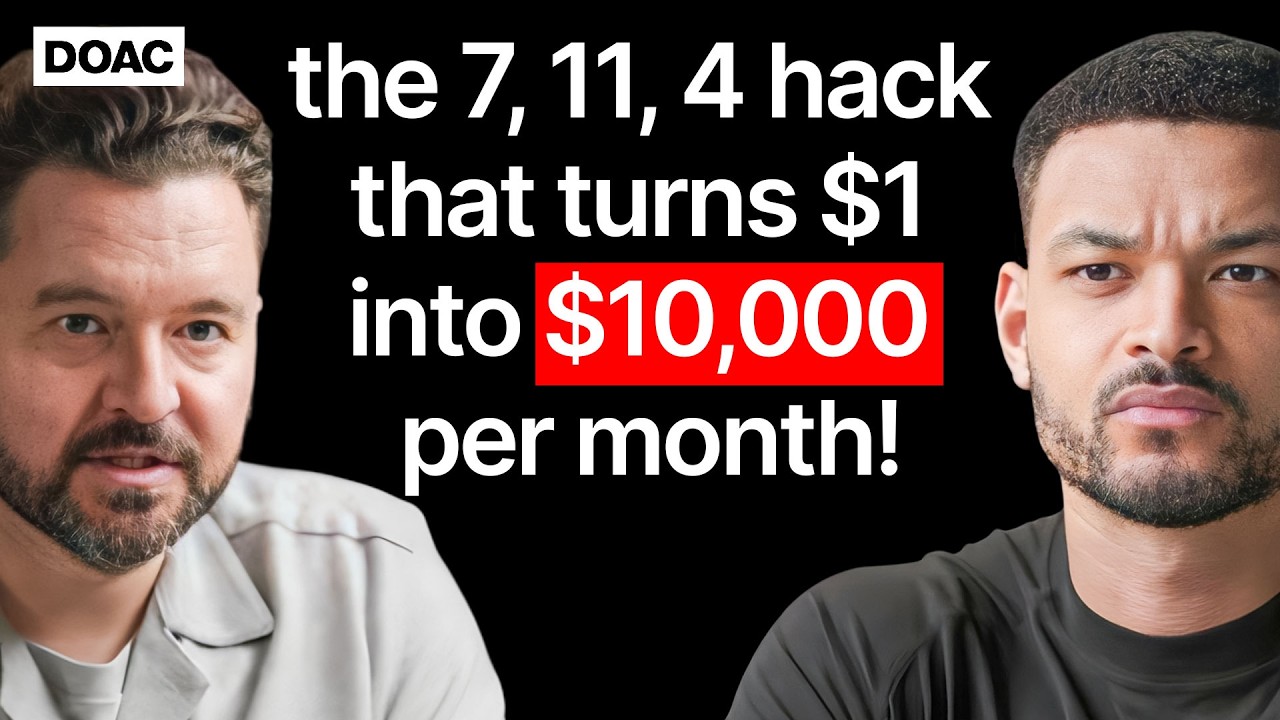
To establish these parasocial relationships at scale, Priestley points to research defining the **7-11-4 Rule**:
- **7 Hours:** The total amount of time a prospect must spend consuming your content.
- **11 Interactions:** The number of distinct touchpoints or engagements they need to have with you.
- **4 Platforms:** The number of different locations/channels where they should see you (e.g., YouTube, LinkedIn, podcasts, books).
Priestley poses a diagnostic test for founders: *"If I were to block out tomorrow to watch, read, or listen to everything you have online, can I spend all day going through your environment?"* While most business owners fail this test, those who provide enough long-form content (audiobooks, podcast interviews, detailed videos, posts) build scalable relationships and grow significantly faster than their competitors. Even though platforms like LinkedIn seem crowded, Priestley notes that only **1% of users actively create content**, while **99% remain silent**, meaning the market is still in its early stages for those willing to publish.
[29:11](https://www.youtube.com/watch?v=sFkR34AMPw8&t=1751s) The 5 Things That Grab Attention in a Noisy World
Daniel Priestley explains that the human brain is exceptionally proficient at deleting irrelevant information. Walking down a busy street, a person passes hundreds of people without retaining any specific details because the brain filters out background noise. To get noticed in a crowded marketplace, a brand or person must leverage one of the five elements that the brain is hardwired not to delete:
1. **Scary:** Fear commands immediate focus. News outlets have capitalized on this for decades with the philosophy "if it bleeds, it leads."
2. **Strange:** Unconventional or bizarre sights interrupt pattern recognition. Priestley highlights "peacocking"—such as wearing an unusually large hat or dressing up as a giant hot dog on the street. Bartlett laughs and admits that at 18, he wore a distinctive large hat everywhere to stand out at public events and on LinkedIn, which helped establish his early brand identity.
3. **Sexy:** While highly effective, Priestley notes that most businesses either cannot align their brand with this concept or simply cannot pull it off convincingly.
4. **Free Value:** Offering something genuinely useful without asking for money immediately sets someone apart. To work, this value must be high-quality—something people would normally pay for—and it must be "packaged" elegantly. Handing someone a piece of fine jewelry in a cheap plastic bag makes it look fake or stolen, whereas presenting it in a luxury box makes it feel like a thoughtful gift.
5. **Familiarity:** Consistency builds trust over time by accumulating interactions across the 7-11-4 model (7 hours of content, 11 touchpoints, 4 locations).
Bartlett's own show illustrates these principles effectively. Priestley points out that Bartlett invests heavily in high-production episodes, bringing on top-tier guests and releasing the content for free to millions on YouTube. By combining free value, familiarity, and a touch of the "strange" and "scary" (such as episodes on nuclear warfare or his book *Happy Sexy Millionaire*), Bartlett successfully breaks through the noise.
[33:24](https://www.youtube.com/watch?v=sFkR34AMPw8&t=2004s) Testing Demand: Productizing the Demo and Needs Analysis
Priestley emphasizes that most struggling entrepreneurs focus heavily on the supply side when starting out—deliberating over manufacturing, bottling costs, consulting qualifications, or logistics. Instead, successful founders focus first on testing market demand before making financial or operational commitments.
The most effective strategy to gauge demand is to **productize the demo and customer needs analysis**:
* **The Concept:** Package a 15-to-40-minute presentation explaining the core principles and benefits of the offering, combined with data collection to assess whether potential buyers actually have the problem you aim to solve.
* **The Coffee Example:** If launching a new coffee designed to boost libido, rather than spending money on physical inventory right away, the founder should pitch retailers directly with research and branding concepts. By offering to run pre-order waitlists or clipboard surveys across store locations at no initial cost to the retailer, the founder tests demand upfront. Even without a physical product ready to ship, this approach provides real data, establishes early relationships, and builds trust.
[36:44](https://www.youtube.com/watch?v=sFkR34AMPw8&t=2204s) The $200 Facebook Ad Hack & Unlocking the Situational Model
Bartlett shares a practical testing strategy he used for his own upcoming book. Rather than writing a manuscript and hoping it sells, he ran Facebook ad campaigns testing **70 different book titles** for just £200. The ads directed users to a simple landing page to join a waitlist:
* The best-performing title achieved a **15% click-through rate**.
* The worst-performing title received only a **0.3% click-through rate**—a massive 5,000% variance in audience interest.
Priestley builds on this technique, noting that his team constantly runs hundreds of ad variations in what he calls "The Hunger Games" for marketing performance. When users click an ad for a product that isn't built yet, they see a message stating, *"This product is not yet available in your area—click here to join the waiting list."*
Once users opt in, Priestley uses targeted survey questions to map out their internal **Situational Model**:
* **Where am I now?** (Current state and baseline situation)
* **Where do I want to be?** (Desired outcome or transformation)
* **What's in my way?** (Roadblocks that prevented success in the past)
* **What is the path of least resistance?** (Current options under consideration)
Additionally, asking targeted pricing questions (e.g., *What price feels fair? What is so cheap you'd doubt the quality? What is too expensive?*) ensures founders don't just generate low-cost leads, but attract high-value buyers.
- **Lead Cost vs. Lead Quality:** A £10 lead might pull in broke students, whereas a £20 lead could land C-suite executives earning £500,000 a year—making the higher ad spend vastly more profitable in the long run.
[40:04](https://www.youtube.com/watch?v=sFkR34AMPw8&t=2404s) Discussion Groups, Assessments, and Scaling Fast
Priestley highlights that rapid prototyping, data collection, and low-cost digital touchpoints are essential for both early-stage startups and multi-million-pound enterprises looking to pivot into new markets. He outlines three highly effective, low-friction methods to validate ideas and gather active leads:
* **Intro Events:** Running short, live interactive sessions via Zoom to present initial research, feature guest speakers, and gather immediate feedback on new concepts.
* **Discussion Groups:** Launching free communities on WhatsApp, Facebook, or LinkedIn centered around a specific niche or interest.
* **Assessments & Quizzes:** Converting customer needs analyses into interactive digital scorecards where users answer tailored questions to receive personalized insights.
- **Case Study (Gabriella Rosa):** A fertility clinic owner transitioned her traditional physical practice into a global digital business by launching an online discussion group for natural fertility breakthroughs, attracting **23,000 active members** almost immediately.
- **Case Study (Max):** An entrepreneur named Max wanted to network with high-net-worth investors. He created an exclusive WhatsApp group capped at 400 members for family office executives. Through LinkedIn outreach, he filled the group with 400 individuals who collectively managed over **$10 billion in capital**.
[43:37](https://www.youtube.com/watch?v=sFkR34AMPw8&t=2617s) Diagnosing Needs and Creating Value Through Friction
Daniel observes how successful brands like Huel use online diagnostic quizzes ("Which Huel is right for you?") to analyze customer needs before pushing a product. For complex or saturated markets, selling a needs analysis first is vital because modern consumers feel overwhelmed by lifestyle clutter—having too many unread books, unwatched media, or unused clothes. People only want products hyper-personalized to their exact situation.
Steven Bartlett echoes this concept from his book, *The 33 Laws of Business and Life*, highlighting that added friction can actually increase perceived value. In one study, two groups entered a discussion group designed to be intentionally boring; the group forced to complete an entry survey rated the experience as significantly more valuable and enjoyable simply because they had to put effort into joining.
* **Subjective Value:** Value is entirely subjective and driven by supply and demand dynamics. Bitcoin is valuable because buyers outnumber sellers, whereas life-saving water is free because it lacks friction.
* **The Google Maps Analogy:** Tech companies spent billions sending satellites into space to provide free navigation, yet consumers rarely weep tears of joy because there is zero friction attached to the service. If it were suddenly capped at $10 a month, people would pay.
* **Manufacturing Demand:** In a frictionless digital world where millions can consume content effortlessly, businesses must strategically introduce choke points and artificial tension to successfully monetize attention.
---
[48:08](https://www.youtube.com/watch?v=sFkR34AMPw8&t=2888s) The 10/90 Percent Model of Monetization
When transitioning to digital business models, customer affluence skews heavily toward the top. A typical audience breaks down into clear wealth brackets, revealing that the top 10% holds 60% of the total available spend, while the remaining 90% holds 40%. The modern strategy involves giving away free value to the bottom 90% without asking for anything in return, while hyper-monetizing the top 10% with rare experiences, limited editions, or exclusive access.
> "If you ask everyone how much should I charge, the average answer is going to be $500. But, if you ask the top 1% how much should I charge, the average answer is going to be $15 to $20,000."
* **Fractal Wealth Distribution:** Even within an exclusive list like *Forbes* billionaires, the top 1% still holds 15% of the total wealth pool, showing that this distribution rule applies at every level of income.
* **Filter Signal from Noise:** Entrepreneurs must avoid pricing products down toward the noisy 90%, as mass audiences lack the budget to sustain high-margin business models.
---
[50:26](https://www.youtube.com/watch?v=sFkR34AMPw8&t=3026s) The Entrepreneur Sweet Spot and Geography
To evaluate if an business idea is worth 10 years of effort, Daniel introduces the "Entrepreneur Sweet Spot"—a Venn diagram balancing three elements: **Passion**, the **Problem** being solved, and **Payment** (what customers are willing to pay). Compromise is required; straying into extreme passion without solving a real problem leads to feeling unrewarded, while high-paying corporate roles without passion cause burnout.
```
[ PASSION ]
/ \
[ PROBLEM ]---[ PAYMENT ]
```
On the question of geography, success no longer requires moving to major tech hubs. The old startup paradigm—two 20-something male dropouts from Harvard or Stanford raising VC money in a Silicon Valley garage—has been completely disrupted.
* **Lifestyle Boutiques:** Highly fulfilling digital or IP-based businesses employing 6 to 12 people, turning over $3M to $4M annually with 60% margins, yielding around $1M in clear profit without VC pressure.
* **Performance Businesses:** Tech and strategy-driven operations with roughly 30 employees, designed to achieve a $10M to $100M valuation and eventually exit to private equity or public acquirers.
* **Founder Skillsets:** Small 6–12 person teams only require expertise in the consumer's niche topic (e.g., yoga or photography). Mid-scale 30–100 person teams require founders who geek out on technology, go-to-market strategies (GTM), lifetime value metrics (LTV), and business frameworks.
---
[56:27](https://www.youtube.com/watch?v=sFkR34AMPw8&t=3387s) Ambition, Work-Life Balance, and Unpredictable Goals
Addressing his own path, Daniel shares that his happiness levels are exceptionally high because he views living and building businesses in this digital era as an incredible privilege. In the early stages of his career, he had no work-life balance for over a decade, working constantly because his business satisfied all core human needs: certainty, variety, significance, growth, and learning.
Marriage and children later introduced a need for structural balance, leading him to manage work in targeted "sprints" rather than permanent grind modes. Over time, he stopped setting rigid annual goals altogether because operating as a "Key Person of Influence" naturally generates unpredictable opportunities. A prime example was getting an unexpected podcast invitation from Steven while on a skiing trip—an event that completely transformed his year beyond any written goal.
[58:18](https://www.youtube.com/watch?v=sFkR34AMPw8&t=3498s) Goal Setting, Brand Power, and the Shift to Power Law Opportunities
Daniel Priestley explains that as a brand grows, goal setting actually becomes more difficult because of the sheer abundance of incoming opportunities. Early-stage goal setting is about directing immediate energy and exerting direct influence. In contrast, building a mature brand yields indirect power—it is about what you passively attract. To capitalize on this, entrepreneurs must learn to "slow down to speed up" by intentionally carving out open space in their calendars. Priestley candidly shares one of his own costliest mistakes: filling his schedule so tightly that he became blind to massive, high-leverage opportunities right in front of him—an oversight he estimates cost him tens of millions.
To evaluate opportunities when information is scarce, Priestley makes a critical distinction between **bell curve opportunities** and **power law opportunities**. Bell curve scenarios offer incremental gains constrained within predictable, narrow boundaries where zero outliers exist. Power law scenarios, powered by leverage, carry exponential, practically uncapped upside.
- **The NHS Doctor vs. The YouTuber:** An NHS doctor operates strictly within a bell curve where compensation is strictly capped regardless of tenure or effort. By contrast, Ali Abdaal left his NHS medical career to become a full-time YouTuber, stepping directly onto a power law distribution where top creators can earn over $1 million a month.
- **Examples of Power Law Moves:** Public speaking on global stages, forming strategic relationships with well-connected billionaires, and tapping into massive pre-existing distribution networks.
- **Leverage Sources:** Leverage acts as the catalyst that shifts someone from a bell curve to a power law. Key sources include fame/personal brand, capital, proprietary databases, strategic partnerships, and owning a business rather than holding a job.
> "Once you get a little bit bigger, you have to slow down to speed up. You have to create space to see what's happening around you... I really think at a certain level, strategically, you have to slow down to speed up."
---
[01:02:05](https://www.youtube.com/watch?v=sFkR34AMPw8&t=3725s) The Globalized Market and Defending Your Business Niche
The macro landscape has undergone a seismic shift due to global connectivity. In 2010, only 28% of the world had access to fast internet; by 2025, that number rose to 70% of over 8 billion people. This hyper-connected reality presents a double-edged sword: you are either in terrifying direct competition with the entire planet (including AI tools, $5/hour remote talent in the Philippines, specialized agencies in India, and hyper-funded Silicon Valley startups), or the entire world becomes your potential customer base.
To defend against global competition and create a defensible "blue ocean," Priestley advocates setting strict internal operational boundaries rather than obsessing over competitors. He details how he calculates his own companies' target economics and "official capacity" to maintain total control:
- **Defining Official Capacity:** In one of his businesses, Priestley's team determined that working with exactly **600 high-touch clients** in a year represents an ideal, highly profitable, and operationally smooth benchmark.
- **Calculating the Funnel:** Knowing their conversion rate is **1 in 66** (1 client out of every 66 leads), the business knows it needs to engage precisely **49,000 leads** annually to select those 600 dream clients.
- **Defensive Clarity:** By focusing exclusively on serving those 600 clients so well that they become delighted advocates, the business completely insulates itself from outside market noise and competitive friction.
---
[01:05:18](https://www.youtube.com/watch?v=sFkR34AMPw8&t=3918s) Capitalizing on the Baby Boomer Wealth Transfer and AI Integration
When asked what business he would start today with limited funds, Priestley highlights two massive macro shifts: the aging demographic wealth transfer and AI deployment. Across major Western economies (including the US, UK, Canada, and Australia), **baby boomers (aged 61 to 79) own roughly 50% of the economy**. As this generation transitions into retirement, they want to exit their businesses, travel, shift to advisory roles, or pass on capital.
Priestley notes that almost every traditional service industry—from local MOT test centers, elevator service companies, and air conditioning contractors to courier fleets—is owned by baby boomers. Younger entrepreneurs can win big by acquiring these cash-flowing businesses directly, creating modern alternatives that disrupt them, or selling specialized products directly to this well-funded age demographic.
Beyond demographics, Priestley stresses that every industry will be fundamentally altered by AI. Rather than building raw infrastructure, the immediate commercial opportunity lies in applying AI to optimize traditional workflows.
- **The AI Case Study Bot:** In one of Priestley's ventures, the company had accumulated over 250 video testimonials from satisfied clients. Because sales reps could not keep track of them all, they built an AI bot to index and analyze every transcript. Now, when a rep speaks to a prospective client with a specific industry problem, they type the scenario into the bot, which instantly pulls the perfect matching video case study and link.
- **Running AI Audits:** A simple, high-value service for legacy companies is conducting internal training workshops that audit standard job roles and show employees how to leverage tools like ChatGPT to increase output.
---
[01:09:11](https://www.youtube.com/watch?v=sFkR34AMPw8&t=4151s) The AI Infrastructure Boom and Navigating the New Skilled Labor Paradigm
Drawings parallels to historical shifts, Priestley compares today's AI explosion to the launch of the Apple App Store in 2007 (which paved the way for Uber and Instagram two years later) and the advent of electricity in the 1830s. Just as it took nearly 100 years to move from generating electricity at power stations to filling homes with consumer appliances like toasters, kettles, and vacuums, AI is currently transitioning from raw foundational models to domain-specific consumer and enterprise applications over the next 10 to 15 years.
Technological democratization is accelerating rapidly. For instance, Nvidia recently launched a localized supercomputer for $3,000—compute power that previously required cloud subscriptions costing $3,000 to $9,000 per month (or upwards of $50,000 annually). This massive drop in cost will enable agile 10-person teams to run huge datasets locally and build billion-dollar enterprises in specialized niches like healthcare and precision analytics.
For everyday individuals—such as taxi drivers, janitors, or philosophy students who lack technical backgrounds—Priestley advises breaking out of the traditional "industrial revolution" mindset taught by schools.
- **The Skilled Labor Trap:** The legacy education system teaches people to trade time and labor for money (e.g., getting a bachelor's, master's, or PhD simply to become a higher-priced unit of skilled labor).
- **The Top of the Pyramid:** Real wealth accumulation happens above skilled labor by leveraging scalable assets, digital infrastructure, AI tooling, and proprietary networks.
> "AI is like electricity, but we haven't built all the businesses that are going to plug in and are going to be great opportunities. And that's going to be over the next 10 to 15 years. Every single industry... is going to have applications that run on AI."
[01:12:45](https://www.youtube.com/watch?v=sFkR34AMPw8&t=4365s) Moving Up the Pyramid: From Skilled Labor to AI and Financial Assets
The transition away from trading time for money requires ascending a clear economic pyramid. At the foundational base of this digital economy is standard skilled labor. To break free, an entrepreneur must move up to **intellectual property (IP)** and media. Rather than constantly absorbing more information, you reflect on past wins, document a step-by-step methodology, record videos, or draw frameworks—turning concrete client results into scalable IP.
Above IP and media sits **data and software** (including AI applications). At this level, you gather proprietary databases through tools like questionnaires, surveys, and scorecards. Software acts as an automated engine that systematically delivers results without your manual intervention. Finally, at the apex of the pyramid are **financial assets**. This is where your entire operational machine is packaged into equity, enabling you to sell company shares for massive liquidity events.
* **Stephen Covey Case Example:** Covey was a church leader and small-business consultant in Utah who transitioned from skilled labor to IP by documenting his insights in *The 7 Habits of Highly Effective People*. That single book sold over 20 million copies and birthed a $400 million consulting enterprise rooted in IP rather than hourly labor.
* **The Progression Steps:** Skilled Labor $\rightarrow$ Intellectual Property & Media $\rightarrow$ Data & Software (AI) $\rightarrow$ Financial Assets (Equity/Exits).
---
[01:15:39](https://www.youtube.com/watch?v=sFkR34AMPw8&t=4539s) How Wealth Is Actually Created: Innovation vs. Squirreling Away Money
When asked about personal investment strategies, the conversation turns to the limitations of standard financial advice. While placing capital into passive index funds like the S&P 500 serves well as a simple "store of wealth," relying solely on standard investing off a $50,000 annual salary won't fundamentally transform your life. True wealth creation doesn't happen by attempting to "squirrel away" tiny fragments of an existing economy—a path where heavy taxation continually grinds you down.
Real wealth emerges through **innovation and entrepreneurship**—taking an idea out of your mind, formalizing it into a business, and bringing brand-new economic value into existence. When investors back a startup, they instantiate value that previously did not exist. This newly created asset eventually converts into liquid capital during acquisitions or secondary market sales, which can then be reinvested into further ventures.
* **Book Magic Case Example:** For Daniel Priestley's software startup, Book Magic, they raised £400,000 in exchange for a 10% equity stake. This single transaction created £3.6 million in fresh economic value (representing the remaining 90%) out of thin air through formalization and entrepreneurship.
---
[01:18:59](https://www.youtube.com/watch?v=sFkR34AMPw8&t=4739s) The Hidden Psychological and Structural Cost of Starting a Business
Building a multi-million dollar business comes with severe hidden strains. Most founders face intense friction because modern society and traditional education systems were engineered exclusively for the **Industrial Revolution**, not the digital era. Schooling conditioned people to become standardized component labor—admonishing them not to seek attention, disrupt things, or get others to do their homework.
In the entrepreneurial world, those rules are inverted: the attention-seekers, the disruptors, and the people who delegate their "homework" are the ones who build massive value. Because running a company feels creative yet completely outside the traditional blueprint, founders frequently experience emotional angst and imposter syndrome. Furthermore, post-pandemic workplace shifts—such as remote Zoom operations and community-driven customer personas—mean leaders are constantly navigating unchartered territory without a playbook.
> "All of society is built for the industrial revolution system and it's not built for the digital revolution system... You were told 'don't be an attention seeker,' but attention seekers make all the money."
---
[01:21:15](https://www.youtube.com/watch?v=sFkR34AMPw8&t=4875s) Global Tax Competition, Entrepreneurial Relief, and Capital Flight
The discussion shifts to geopolitics and taxation policies across the UK, US, and the Middle East. Governments often struggle in the digital age because they attempt to enforce rigid geographic borders, whereas digital assets—such as personal brands, software platforms, and proprietary databases—are fully portable on a smartphone. High tax rates disincentivize founders from taking immense personal risks to innovate.
To maximize overall tax revenue, governments should maintain low, competitive tax structures that attract top-tier talent, rather than driving them away. When tax burdens become prohibitive, high-net-worth creators relocate to jurisdictions with superior infrastructure, safety, and business-friendly environments.
* **Entrepreneurs' Relief (UK):** Historically, the UK offered a £10 million threshold on Entrepreneurs' Relief, taxing the first £10 million of a business exit at a reduced 10% capital gains rate to reward early unpaid risk. The UK government subsequently reduced this lifetime allowance to just £1 million, diminishing the incentive to start companies locally.
* **Tax Threshold Discrepancy:** In the UK, individuals hit the highest marginal tax bracket at roughly 3x the average wage, compared to the US where the top bracket kicks in at around 8x the average wage.
* **The Millionaire Migration:** Over 10,000 millionaires reportedly left the UK in a single year, heading to regions like San Francisco, Abu Dhabi, and Dubai (where no income tax is levied, yet public infrastructure, healthcare, and safety operate efficiently without eating up 45% of the local GDP in government spending).
* **AI Energy Constraints:** UK ambitions to dominate artificial intelligence face hurdles not only from high tax rates on elite tech talent, but also from some of the world's most expensive electricity prices required to power data centers.
[01:26:39](https://www.youtube.com/watch?v=sFkR34AMPw8&t=5199s) The Roots of Wealth Inequality and the Two-System Divide
Daniel Priestley clarifies the distinction between parasitic economic actors and legitimate wealth creators, arguing that modern wealth inequality is widely misunderstood. True wealth creators bring new intellectual property into the market, generating jobs, investments, and overall economic growth. In contrast, inequality is fundamentally driven by technology adoption rather than simple differences in effort.
To illustrate this gap, Priestley uses the metaphor of a marathon where one runner goes on foot while another rides a bicycle. The cyclist speeds ahead with far less physical strain—not because they work harder, but because they leverage technology. This dynamic mirrors historical transitions, such as the early Industrial Revolution described by Charles Dickens in *Oliver Twist* and *A Tale of Two Cities*. During that era, severe inequality arose because part of society remained trapped in feudal agriculture while others transitioned into industrial capitalism. Today, a parallel shift is taking place: those leveraging digital systems enjoy freedom, fulfillment, and financial success, while those bound to outdated industrial-age models work as hard as possible only to fall further behind.
- **Wealth Creators vs. Rent Seekers**: Wealth creation relies on generating new IP, jobs, and systemic value, distinct from rent-seeking or predatory behavior.
- **Technology as a Force Multiplier**: The widening wealth gap is driven primarily by unequal technology adoption rather than a disparity in work ethic.
- **The "Two Systems" Parallel**: Society currently operates on two competing economic tracks—the legacy industrial system and the emerging digital system.
- **Historical Echoes**: Dickens' opening line—"It was the best of times, it was the worst of times"—captures the present stark divergence between technology-enabled workers and industrial-era workers.
[01:28:35](https://www.youtube.com/watch?v=sFkR34AMPw8&t=5315s) Nuance in Economic Value, Asset Hoarding, and Policy Missteps
Steven Bartlett pushes back by noting the counterpoint: many wealthy individuals engage in a "hoarding season," accumulating assets and playing financial games without producing genuine economic value. Priestley agrees and calls for nuanced policy rather than sweeping generalizations based purely on income or net worth. Economic metrics often fail to differentiate between high-value contributors and economic drains—for instance, treating a nurse earning £30,000 and an illegal drug dealer earning £30,000 as economically identical simply because their income lines match.
Priestley argues that governments must design policies that discourage unproductive asset hoarding while incentivizing dynamic investment. Unproductive practices—such as buying up expensive assets solely to rent them out—should face higher tax burdens, whereas investing in startups, lowering consumer prices, and attracting global talent should be frictionless. He sharply criticizes current UK tax moves, such as imposing a 15% tax increase on employer national insurance contributions. He notes that this direct penalty on local employment forces entrepreneurs to outsource roles to countries like the Philippines and South Africa, where labor is immediately 15% cheaper.
- **The Distinction of Economic Roles**: Income alone does not define value; economic policy must distinguish productive contributors from unproductive "takers."
- **Incentivizing Active Capital**: Effective tax strategy should penalize passive asset hoarding and reward risk-taking, startup investment, and innovation.
- **Outsourcing Realities**: Adding extra taxes on local hiring inadvertently incentivizes businesses to shift positions overseas to lower-cost markets.
- **Global Competitiveness**: Governments structured around physical, geographic borders miss the reality of an interconnected, borderless digital economy.
[01:31:06](https://www.youtube.com/watch?v=sFkR34AMPw8&t=5466s) Outdated Industrial Institutions and the Global Digital Landscape
When Bartlett asks if four-year political cycles cause short-term decision-making—such as Prime Minister Keir Starmer scrambling to fix budget deficits rather than reforming education for the AI era—Priestley argues that the issue runs deeper. The core problem is that public institutions were built for the Industrial Age and are structurally obsolete. Entities defined by physical borders, like the UK government or the London City Council, inherently miss the point of the digital age, where anyone can build a global brand, hire internationally, and run a business from a smartphone.
Transitioning from industrial governance to digital-first systems is as fundamental as the historical shift from feudalism to industrial capitalism. In the digital paradigm, national identity and physical currencies lose their dominance. When asked about Donald Trump's return to power in the United States, Priestley describes him as a "disruptor" and an "accelerant" who will shatter failing institutional norms. He notes that the cultural pendulum is already swinging back from heavy-handed government authority and speech policing toward greater individual freedom, pointing to recent shifts made by tech leaders like Mark Zuckerberg.
- **Geographic Obsolescence**: Legacy government bodies defined by physical boundaries are ill-equipped to govern a digital-first global economy.
- **Structural Shift**: Modern digital capabilities—global remote hiring, instant international commerce, and smartphone-based brand building—require an updated institutional framework.
- **Trump as a Disruptor**: Political shake-ups accelerate the breakdown of decaying systems, forcing rapid adaptations across governance and commerce.
- **The US Advantage**: The United States remains the most bullish market due to its energy independence, food self-sufficiency, favorable borders (sharing land borders only with Canada and Mexico compared to China’s 17 neighbors), top universities, and vast tech infrastructure.
[01:35:38](https://www.youtube.com/watch?v=sFkR34AMPw8&t=5738s) The 2025 Entrepreneurial Playbook: Brand and Business Model
Bartlett asks what fundamental moves a 21-year-old should make in 2025. Priestley emphasizes that the ultimate strategy centers on two core pillars: building a personal brand and attaching it to an elegant, scalable business model. Entrepreneurs do not need massive mainstream audiences; securing just 5,000 to 50,000 engaged followers within a high-value niche is enough to generate a seven-figure income.
A well-positioned personal brand acts as an efficient magnet for capital, top talent, and customers. Looking at current success stories across industries, the winning play remains consistent: pair media leverage and clear positioning with an operationally sound business capable of serving a global customer base.
- **Niche Media Leverage**: An audience of 5,000 to 50,000 targeted followers in a specific vertical can sustain a seven-figure business.
- **The Two-Pillar Formula**: Success requires pairing an authentic personal brand with a frictionless, globally scalable business model.
- **Magnetizing Resources**: Personal influence significantly lowers the cost of acquiring talent, investors, and paying customers.
[01:37:08](https://www.youtube.com/watch?v=sFkR34AMPw8&t=5828s) The Mountain Analogy: Unlocking Your Hidden Value
Addressing why people fail to execute on these straightforward principles, Priestley shares a personal story from a trip to Bali, where he set out to climb Mount Agung. Woken at midnight, his group trekked through darkness with tiny headlamps, reaching the summit at 6:00 a.m. just as the sun broke over the island. Standing in the freezing air, looking out over the sea while cooking eggs in active volcanic steam vents, he noticed another peak on the horizon—Mount Rinjani—and immediately began asking his guide how to travel there and climb it too.
His guide put an arm around him and said, "Mr. Daniel, you need to learn to appreciate the mountain you're already standing on." Priestley realizes that while on top of Mount Agung, he could see every distant peak except the ground beneath his own feet.
This mirrors the primary trap holding people back today: individuals become so mesmerized by high-profile figures on distant horizons—such as Steven Bartlett or bestselling authors—that they overlook the "mountain of value" they already possess. Everyone has a distinct background, network, and level of relatability. Ironically, as industry leaders climb higher, they lose touch with beginners, leaving a valuable gap in the middle for rising creators to step in and serve.
- **Mount Agung Experience**: A midnight ascent to a Balinese volcano summit yielded a profound lesson on presence and perspective.
- **The Rinjani Trap**: Constantly fixating on the next distant peak prevents people from recognizing the assets they currently hold.
- **Overcoming Comparison**: Benchmarking oneself against top-tier public figures creates artificial paralysis.
- **Relatability as an Asset**: Being a step or two behind giant industry figures makes a creator far more relatable and helpful to beginners navigating the exact same path.
[01:40:16](https://www.youtube.com/watch?v=sFkR34AMPw8&t=6016s) Appreciation for the "Mountain of Value"
The conversation centers on how people often overlook their own potential because they are standing too close to their own accomplishments. Daniel notes that individuals are frequently distracted by others and fail to appreciate their own "mountain of value." Every person possesses a unique stack of experience and knowledge, but self-doubt or comparison makes them feel invisible.
Steven connects this to a story about his girlfriend, who runs a breathwork studio called Bali Breathwork. She spent nearly two years talking about starting her content creation journey on Instagram—repeatedly buying camera equipment and talking about dropped videos—without actually posting a single clip. He realized she was trapped in what the book *The Courage to Be Disliked* describes as a "possibility gap." By announcing her intentions, she got emotional credit for the idea without risking the harsh feedback of reality or proving she couldn't do it.
To break the deadlock, Steven reframed the entire mission for her: instead of striving to make "good" videos, the objective became simply reaching 1,000 videos. By shifting the goalpost to volume and execution rather than immediate perfection, she posted daily, quickly accumulating over 30 videos.
- **Bali Breathwork**: Breathwork studio and retreats mentioned as a real-world example (`balibreathwork.com`).
- **Possibility Gap**: The comfortable mental state where an intention is announced to get credit, but no action is taken to avoid failure or negative proof.
- **The 1,000 Video Goal**: The psychological shift from seeking perfection to pursuing volume and consistency.
---
[01:42:09](https://www.youtube.com/watch?v=sFkR34AMPw8&t=6129s) The Power of Exponential Growth and Repetition
Daniel explains how doubling works in an exponential system using the classic chessboard analogy: placing one grain of rice on the first square, two on the second, four on the third, eight on the fourth, and so on. In this pattern, every single doubling eclipses the sum total of everything that came before it. In digital platforms and business ventures, the initial 1,000 videos or early efforts might only yield modest results—like 10,000 followers—but that foundational repetition builds the momentum required for massive breakthrough moments that dwarf all previous gains.
To stay the course over a decade and unlock compound growth, an entrepreneur must develop a deep love for repetition and the process itself. Daniel emphasizes that legendary musicians and iconic brands succeed by executing "perfect reps" over and over again without getting bored.
- **WD-40**: Named after the 40th attempt to perfect a water-displacing spray, sold as a single core product line for over 50 years.
- **Tabasco Sauce**: A 150-year-old business built on a single iconic condiment found in households globally.
- **Fender Stratocaster & Porsche 911**: Flagship products created in the mid-20th century that refined their core design over decades rather than reinventing themselves constantly.
- **The Diary Of A CEO Scale**: Daniel points out that Steven's show had published 421 episodes, noting that the recent growth completely eclipsed the first 100 episodes, growing by 500,000 subscribers in December 2026 alone while closing in on 10 million total subscribers.
---
[01:45:37](https://www.youtube.com/watch?v=sFkR34AMPw8&t=6337s) Why Every Entrepreneur Should Write a Book
Analyzing the last 117 episodes of *The Diary Of A CEO*, Daniel reveals a striking statistic: 78% of the guests (91 out of 117) are published authors. The remaining 22% are typically global megastars in other arenas. He argues that writing a book is not primarily about direct book sales royalties, but rather about creating "relationships on steroids."
A book acts as a deep parasocial mechanism. It allows an author to spend roughly seven hours inside a reader's mind anywhere in the world, transferring precise thoughts and concepts line-by-line. This establishes authority and trust at scale. Even relative beginners or small business owners can document their journey, share a specific methodology, or highlight a specialized niche to build a massive advisory or coaching business.
- **Howard Tinter**: A restaurant owner who documented his local customer retention process in a book titled *More Bums on Seats* (adapted to *More Butts on Seats* in North America), distributing 1,000 copies to launch a restaurant consulting enterprise.
- **Gabriella**: A fertility specialist who authored *Fertility Breakthrough*, giving away 4,000 copies annually to drive her high-growth practice.
---
[01:48:37](https://www.youtube.com/watch?v=sFkR34AMPw8&t=6517s) Productizing Sales and the Demo
Addressing a common question from founders on how to sell to corporate leaders or prospective clients, Daniel outlines a framework focused on "productizing" the sales process. Rather than running standard pitch meetings, founders should turn their product demo and customer needs analysis into a distinct, named asset or experience.
A strong demo balances concrete features, advantages, and benefits with empirical data, research, and an emotional story illustrating real-world outcomes. It positions the solution as the ultimate path of least resistance between an ideal customer's current reality and their desired state while acknowledging their current obstacles. Pairing this demo with a structured assessment or diagnostic survey makes the interaction feel like an insightful product experience rather than a high-pressure sales pitch.
- **Path of Least Resistance**: Structuring a pitch to move clients seamlessly from current reality to desired reality across known obstacles.
- **Customer Needs Analysis**: Using structured surveys or assessments to qualify leads and demonstrate tailored value.
---
[01:50:17](https://www.youtube.com/watch?v=sFkR34AMPw8&t=6617s) Google's "Messy Middle" and the Death of the Sales Funnel
Steven highlights a visual model depicting Google's research on consumer buying behavior, which Daniel breaks down. The classic linear marketing funnel—moving customers neatly from awareness down through consideration, intent, and conversion—is largely dead. Modern consumers dislike feeling "funneled" and recognize when they are being pushed, knowing they can exit a page in seconds.
Google's research reveals that buying behavior now takes place in a non-linear space called the "Messy Middle." Triggered by an initial exposure, consumers enter an exploratory and evaluative "playground." They jump unpredictably across YouTube videos, review sites, social channels, community forums, waitlists, and interactive assessments until a final trigger prompts the purchase. Businesses must construct an engaging digital playground filled with rich, interactive touchpoints rather than forcing a rigid funnel.
> "A funnel feels dehumanizing for most people... They don't like to be funneled. They like to go on an adventure."
[01:53:25](https://www.youtube.com/watch?v=sFkR34AMPw8&t=6805s) The 5 P's of Becoming a Key Person of Influence
When asked about the most frequent question he receives from aspiring entrepreneurs—"How do I start when I don't have a brand?"—Daniel points to his core framework for moving from invisibility to authority: the 5 P's.
The very first "P" is **Pitching**. Entrepreneurship is a continuous journey of pitching ideas, products, visions, and partnerships. Mastering the pitch is the foundational skill required to build a personal brand and kickstart a new business venture from scratch.
- **Primary Founder Dilemma**: Overcoming invisibility when launching a new product or entering a new market without existing brand recognition.
- **The First P**: Pitching as the primary engine for driving authority and growth.
[01:54:17](https://www.youtube.com/watch?v=sFkR34AMPw8&t=6857s) The 5 P's Framework for Founders
Pitching is the fundamental engine of the entrepreneurial journey. Whether pitching an idea leads to a 10-to-100-million-dollar business or pitching your way to Mars like Elon Musk, founders must learn how to excite people with their words. This can be done live, one-to-one, to groups, on podcasts, or via video to camera, much like Steve Jobs staging keynotes or Mark Zuckerberg unveiling new Facebook features over two decades. The key is recognizing that every founder is the primary spokesperson for their business.
Beyond pitching, founders must master the remaining pillars of the "5 P's" framework: publishing, productizing, raising profile, and building partnerships. Publishing takes pitch elements and transforms them into scaleable formats like books, podcasts, videos, or LinkedIn posts. Productization means moving away from selling time or skills to building a scalable ecosystem around intellectual property, media, data, software, or productized services. A founder's time must be spent driving demand rather than tied up in supply. Profile creation involves social media platforms, live events, awards, and third-party media. Finally, big business happens through joint ventures—whether bringing in capital partners, distribution partners, or product partners who integrate their tools into your package. Together, pitching, publishing, product, profile, and partnerships define the role of a founder, or what is known as a "Key Person of Influence."
- Founders must focus on the demand side of the business rather than the supply side.
- Intellectual property, data, software, and productized services create leverage over selling raw time.
- Partnerships accelerate business growth through capital investment, distribution channels, and integrated product packages.
[01:56:29](https://www.youtube.com/watch?v=sFkR34AMPw8&t=6989s) Influencer vs. Key Person of Influence
Personal branding often carries a negative stigma, invoking images of waking up early to photograph breakfast for social media. However, focusing systematically on the 5 P's provides a sensible framework for successful business owners. The core goal is not to become an "influencer," but rather to become a "Key Person of Influence." Personal branding can take several forms, including "deficiency promotion" (building a brand around personal flaws) or "self-promotion" (narcissistically showing off cars, abs, meals, or partners). Self-promotion is typically associated with influencers, whereas high-value personal branding centers on "idea promotion."
Idea promotion means sharing big insights, highlighting critical data, framing problems with nuance, and outlining achievable solutions within a specific niche. While influencers with millions of followers frequently struggle to sell basic merchandise like hoodies because audiences view them purely as entertainers, a Key Person of Influence might only have 5,000 to 10,000 followers yet command enough authority that followers immediately buy recommended products. Every industry contains thousands of micro-niches, and every micro-niche needs a Key Person of Influence.
- Micro-niches allow entrepreneurs to escape local geographic limits and reach up to 1.5 billion English speakers or 70% of the global population on fast internet.
- A hyper-focused micro-niche can yield a highly profitable business by serving just 35 global clients willing to pay $100,000 annually.
- Key Persons of Influence combine the qualities of a thought leader and an entrepreneur to direct serious, high-value spending.
[02:00:07](https://www.youtube.com/watch?v=sFkR34AMPw8&t=7207s) Changing Environments to Dictate Performance
When feeling frustrated, stuck, or overwhelmed, the single most powerful principle to cut through obstacles is "environment dictates performance." Human behavior is heavily dictated by the surroundings we show up in. In an environment where no one builds businesses, doing so feels impossible; in an environment where everyone scales companies, it feels effortless. Similarly, surrounding oneself with people who view money as evil makes wealth creation difficult, whereas being around people who view money as a tool changes the outcome entirely.
To overcome mental blocks or feeling stuck, immediate changes in physical and social environments can shift perspective. Changing your environment forces new ways of thinking and makes ambitious goals feel normal.
- **Get High Up Physically:** Go to the top-floor restaurant in town or an office foyer overlooking the city skyline to view problems while looking out at the horizon.
- **Meet Leaders in Opulent Spaces:** Schedule coffee meetings with individuals three or four steps ahead in five-star hotel foyers.
- **Join Targeted Groups:** Enroll in structured courses, public speaking programs, or business accelerators where everyone is striving toward the same goal.
- **Form Local Communities:** Connect directly with peers watching or learning the same material, meeting via Zoom, Microsoft Teams, or Google Meet to discuss shared goals.
[02:03:05](https://www.youtube.com/watch?v=sFkR34AMPw8&t=7385s) Building a Peer Community and Sponsor Insights
Building a supportive network does not require living in the same city. Audience members watching or listening to business content can start conversations in the comment section by detailing their current situation, outlining their goals, and connecting safely with like-minded peers. Viewers who watch through to the end of long-form content can use a waving emoji to signal their shared commitment, make connections, verify identities on platforms like LinkedIn, and set up introductory calls to discuss episode takeaways.
In corporate and startup environments alike, integrating modern tools accelerates business operations. Currently, 55% of global businesses utilize AI in some capacity. Platforms like Adobe Express streamline workflow through AI features like "Generate Image" and customizable templates, allowing teams to produce visual assets without starting from scratch or requiring deep design expertise. Similarly, maintaining personal daily energy remains crucial for performance, with alternatives like Perfect Ted matcha—available in flavors like vanilla, salted caramel, peach, mint, and berry—offering quick energy options in retail stores like Tesco and Holland & Barrett or online with discount code `diary40`.
- 55% of global businesses are currently utilizing AI technology across their daily operations.
- Community members connecting online are advised to safely verify peers on LinkedIn to avoid scammers before scheduling networking calls.
[02:06:58](https://www.youtube.com/watch?v=sFkR34AMPw8&t=7618s) Health Optimization vs. Pleasure
Addressing the podcast's closing tradition—where the previous guest leaves a question without knowing who will answer it—the topic turns to drawing the line between health/optimization and pleasure. Optimization itself often leads directly to maintaining life's pleasures. This reality hit home on Christmas Eve just a few weeks prior, following an unexpected phone call from a General Practitioner regarding urgent blood test results.
The GP called out of the blue to warn that pancreatic enzymes in the blood were showing alarming spikes associated with severe conditions. The doctor urgently inquired whether symptoms like yellowing skin, loss of consciousness, dizziness, or severe fatigue had begun. Despite feeling completely fine and exhibiting none of those symptoms, the sudden call highlighted how closely health optimization is tied to preserving life itself.
[02:07:56](https://www.youtube.com/watch?v=sFkR34AMPw8&t=7676s) The Christmas Eve Health Scare and the Power of Health Data
Daniel Priestley shares a personal, transformative story about a sudden health scare right before Christmas. On Christmas Eve, he received an alarming phone call from a doctor following a routine blood test. The doctor warned him that he was on the brink of a serious health issue, telling him bluntly, "if you drink alcohol, if you eat too much food, you could end up in an ambulance with these levels that you're in." For a tense week, Daniel lived in uncertainty, wondering if he was facing a severe disease. However, after getting a CT scan, his doctor gave him a completely clean bill of health regarding his organs, declaring his pancreas, gallbladder, and liver as "pristine." The elevated markers were simply tied to reversible factors, including lifestyle shifts across diet, sleep, and exercise.
Daniel describes this moment as a profound "stay of execution" and compares it to a visit from the Ghost of Christmas Past, realizing that it wasn't too late to take control. Experiencing the real emotional weight of what it feels like to lose one's health completely reshaped his perspective. Now actively tracking his health metrics using tools like a Whoop band, he emphasizes that having clear visibility into health data is liberating and transformative.
* **Key Takeaways & Details:**
* **The Wake-Up Call:** Received urgent health warnings on Christmas Eve due to blood test markers.
* **Diagnostic Result:** CT scan revealed his pancreas, gallbladder, and liver were completely healthy ("pristine").
* **Behavioral Shift:** Utilizes wearable technology (Whoop band) to optimize his sleep, diet, and recovery.
* **Core Quote:** "Data is a great thing. There's nothing that frees you more than having visibility of the data."
---
[02:09:22](https://www.youtube.com/watch?v=sFkR34AMPw8&t=7762s) A Healthy Man Has Many Goals: Health as the Tectonic Plate
Steven and Daniel explore the deeper philosophical realizations that come from facing a health scare. Daniel reflects on the timeless adage, "A healthy man has many goals, a sick man has only one." When healthy, an entrepreneur's mind is consumed by external opportunities, business expansion, and career goals; but once health fails, every priority collapses into a single desire to get well. This scare taught Daniel to view his body as his primary vehicle and shifted his focus toward finding genuine joy in self-care.
Steven Bartlett strongly resonates with this message, noting that entrepreneurs often disregard their physical well-being while relentlessly pursuing achievements and accolades. Steven uses a vivid metaphor based on an earthquake he experienced at 2:00 a.m. in Cape Town, South Africa. While sitting in his house, he suddenly felt the ground shaking beneath him, realizing that the house was not the base—the underlying tectonic plate was. Similarly, in life, physical health is the unseen tectonic plate upon which every business success, goal, and relationship rests. The host wraps up the interview by thanking Daniel for his insights and encouraging him to continue his work.
* **The Tectonic Metaphor:** Everything built in life sits on top of physical health; if the base shakes, everything else is at risk.
* **Core Quote:** "A healthy man has many goals, a sick man has only one."
---
[02:11:17](https://www.youtube.com/watch?v=sFkR34AMPw8&t=7877s) Closing Message: The 1% Mindset and The 1% Diary
In the final segment of the episode, Steven Bartlett addresses the audience with a closing thought about goal-setting and long-term success. Pointing out that 80% of New Year's resolutions fail by February, he explains that people tend to fixate solely on distant end goals while neglecting small, daily actions. Because tiny positive habits are easy to perform, they are equally easy to skip—like saving a single dollar a day.
To counter this, Steven advocates for the "1% mindset," which focuses on making incremental 1% daily improvements that compound into major results over time. He introduces *The 1% Diary*, a 90-day journal designed to help individuals track small wins, stay accountable, and connect with a dedicated community. After selling out its initial launch in November, he announces a second drop and invites viewers to join the waitlist.
* **Resolution Failure Rate:** 80% of New Year's resolutions fail by February.
* **Product Details:** *The 1% Diary* is a 90-day journal focused on daily compounding improvements and community accountability.
* **Waitlist Info:** Available for sign-ups at `thediary.com`.
## Notable quotes
> [58:38](https://www.youtube.com/watch?v=sFkR34AMPw8&t=3518s) Once you get a little bit bigger, you have to slow down to speed up. You have to create space to see what's happening around you... I really think at a certain level, strategically, you have to slow down to speed up. — Daniel Priestley
> [01:09:11](https://www.youtube.com/watch?v=sFkR34AMPw8&t=4151s) AI is like electricity, but we haven't built all the businesses that are going to plug in and are going to be great opportunities. And that's going to be over the next 10 to 15 years. Every single industry... is going to have applications that run on AI. — Daniel Priestley
> [01:18:59](https://www.youtube.com/watch?v=sFkR34AMPw8&t=4739s) All of society is built for the industrial revolution system and it's not built for the digital revolution system... You were told 'don't be an attention seeker,' but attention seekers make all the money. — Daniel Priestley
> [01:26:39](https://www.youtube.com/watch?v=sFkR34AMPw8&t=5199s) It was the best of times, it was the worst of times — Charles Dickens
> [01:37:08](https://www.youtube.com/watch?v=sFkR34AMPw8&t=5828s) Mr. Daniel, you need to learn to appreciate the mountain you're already standing on. — Tour guide
> [01:48:37](https://www.youtube.com/watch?v=sFkR34AMPw8&t=6517s) A funnel feels dehumanizing for most people... They don't like to be funneled. They like to go on an adventure. — Daniel Priestley
> [02:07:56](https://www.youtube.com/watch?v=sFkR34AMPw8&t=7676s) Data is a great thing. There's nothing that frees you more than having visibility of the data. — Daniel Priestley
> [02:09:22](https://www.youtube.com/watch?v=sFkR34AMPw8&t=7762s) A healthy man has many goals, a sick man has only one. — Daniel Priestley
## Mentioned
Daniel Priestley, Steven Bartlett, Ali Abdaal, NHS, YouTube, Apple App Store, Uber, Instagram, Nvidia, ChatGPT, Stephen Covey, The 7 Habits of Highly Effective People, Book Magic, S&P 500, Charles Dickens, Oliver Twist, A Tale of Two Cities, Keir Starmer, Donald Trump, Mark Zuckerberg, Mount Agung, Mount Rinjani, Bali Breathwork, The Courage to Be Disliked, WD-40, Tabasco, Fender Stratocaster, Porsche 911, The Diary Of A CEO, Howard Tinter, More Bums on Seats, More Butts on Seats, Gabriella, Fertility Breakthrough, Google, Steve Jobs, Elon Musk, LinkedIn, Adobe Express, Perfect Ted, Tesco, Holland & Barrett, Whoop band, The 1% Diary
Entrepreneur Daniel Priestley argues that modern economic success requires shifting from industrial-era wage labor to niche influence built on intellectual property, scalable software, and high-trust media. To thrive, founders must validate market demand before building, establish long-form parasocial trust, and implement asymmetric monetization models while protecting physical health as their foundational asset.
Transitioning from Industrial Labor to Niche Influence (0:00)
Priestley contends that traditional education prepares workers for an obsolete industrial blueprint centered on trading time for wages. To build durable value in the digital era, individuals must become a "Key Person of Influence" (KPI). Unlike mass-market social media influencers who focus on self-promotion or personal drama, a KPI focuses on "idea promotion" within a specific vertical. Priestley asserts that securing a targeted audience of 5,000 to 50,000 followers within a specialized niche is sufficient to sustain a seven-figure business.
This shift is guided by the "5 P's" framework: Pitching, Publishing, Productizing, Profile, and Partnerships. Pitching drives initial interest, which is subsequently scaled through publishing. Across major networks, creator participation remains minimal—only 3% of LinkedIn users publish regularly and 4% of YouTube users hold creator accounts—meaning active publishing instantly bypasses 99% of passive consumers. Beginners can build these capabilities with minimal downside by acting as a "number two" to an established founder or running self-contained 90-day side hustles.
Building Trust via the 7-11-4 Rule (24:50)
Drawing on Dunbar’s numbers, Priestley notes that human cognitive constraints limit individuals to roughly 1,500 recognized faces and 150 close acquaintances. To claim space in a prospect's mind amidst severe digital noise, businesses must engineer deliberate parasocial relationships. This is governed by the 7-11-4 Rule: prospects require 7 total hours of content consumption, 11 distinct touchpoints, and exposure across 4 different platforms before granting substantial trust. To pierce cognitive filters, content must tap into core retention triggers: fear, novelty, sexual appeal, or well-packaged free value.
This dynamic explains the rapid shift toward unscripted, long-form content over polished soundbites. Priestley points to the 2024 US presidential election as an indicator: Donald Trump generated 124 million views across roughly 40 hours of unscripted podcast interviews, whereas Kamala Harris logged about 7 hours of tightly scripted appearances. In an environment saturated with AI-generated snippets and misinformation claims, audiences increasingly rely on multi-hour, unedited conversations to gauge credibility.
Testing Demand and the Messy Middle (33:24)
Rather than committing capital to manufacturing, inventory, or operational overhead upfront, Priestley emphasizes validating buyer demand first. Founders can achieve this by "productizing the demo" and administering structured customer needs analyses through low-cost mechanisms like live Zoom workshops, waitlists, and interactive digital scorecards. Bartlett illustrates this strategy by testing 70 book titles using £200 in Facebook ads, which revealed a 5,000% variance in interest between the worst (0.3% CTR) and best (15% CTR) performers.
These diagnostic assessments uncover a customer’s "Situational Model"—their current baseline, desired transformation, existing obstacles, and path of least resistance. This approach aligns with Google's research on the "Messy Middle," which reveals that linear sales funnels are increasingly obsolete. Instead of following rigid funnels, consumers navigate an open, non-linear playground of reviews, communities, and videos before buying. Introducing purposeful friction, such as mandatory entry surveys, actually enhances perceived value in a digital landscape flooded with frictionless products.
The 10/90 Rule and Wealth Creation (48:08)
Priestley identifies a fractal distribution in customer purchasing power: the top 1% commands 15% of total budget and the next 9% holds 45%, leaving the bottom 90% with 40%. Effective monetization models provide free, high-value intellectual property to the bottom 90% to maintain reach, while hyper-monetizing the top 10% through premium, exclusive offerings. Pricing down toward mass audiences often traps founders in low-margin operational noise.
Sustained wealth creation requires ascending the economic ladder: shifting from hourly skilled labor to intellectual property, scaling into data and software, and ultimately consolidating value into equity-backed financial assets. Priestley points to Stephen Covey, who turned small-business consulting into The 7 Habits of Highly Effective People, selling 20 million copies and generating a $400 million business. Unlike passive stock accumulation from a standard wage, entrepreneurship manufactures new value out of ideas—exemplified by Priestley raising £400,000 for 10% of Book Magic, establishing £3.6 million in newly created equity.
The Mountain of Value and Biological Limits (100:16)
Entrepreneurs often stall due to the "mountain of value" dilemma—they fixate on prominent industry figures while failing to recognize the distinct background and relatability they already possess. This comparison trap frequently spawns a "possibility gap," where aspiring creators discuss ambitions for years to receive premature validation without risking market failure. Breaking this inertia requires committing to execution volume and embracing process repetition, allowing exponential compounding to accumulate over time.
However, entrepreneurial expansion remains strictly bounded by physical capacity. Following an urgent Christmas Eve medical warning about spiking pancreatic blood markers, Priestley realized that commercial goals are secondary to biological preservation. Bartlett reinforces this with the metaphor of a South African earthquake: while founders focus on building the house of their business, physical health serves as the underlying tectonic plate. If that plate destabilizes, every ambition, company, and relationship built upon it is jeopardized.
Priestley positions entrepreneurship as a systematic discipline combining niche brand leverage, demand validation, and scalable equity rather than industrial labor. However, unresolved tensions persist between borderless digital enterprise and localized state policy: heavy domestic employment taxes and diminished tax reliefs for founders incentivize capital flight and labor outsourcing to lower-cost international markets.
## Background
本期内容由知名播客频道 The Diary Of A CEO 于 2025 年 1 月 20 日发布在 YouTube 平台。节目对话了连续创业者兼畅销书作家 Daniel Priestley,页面简介指出他创办了创业加速器 Dent Global 与测试营销平台 Score App,并重点探讨了如何运用“7-11-4”法则与个人品牌将微小投入转化为持续商业回报。
## TL;DR
节目深入剖析了从工业时代雇佣关系向数字时代超级个体跃迁的底层逻辑,强调现代商业权力已从冰冷的企业 Logo 转向有温度的个人品牌。Daniel Priestley 详细阐述了“7-11-4 法则”、5P 架构、产品化销售以及通过构建互动式游乐场取代传统线性漏斗的高阶变现策略。同时,对话还拆解了 AI 赋能传统实体业务、接盘婴儿潮一代资产、突破“可能性鸿沟”进行千次迭代的实战方法论,并在最后警示健康才是承载所有商业大厦的唯一地质板块。
## Atmosphere & style
整场对话兼具战略高度与密集的实战颗粒度,节奏张弛有度、层层递进。两位经历过生死考验的连续创业者在演播室中形成了极具默契的思想共振,既有拆解商业本质时的清醒犀利与倾囊相授,也有剖白濒临破产与平安夜健康警报时的真诚克制。收听体验如同一场高浓度的创业私董会,不仅给人以破除工业时代思维枷锁的认知震撼,更在冷静的数据推演中传递出务实而坚韧的长期主义力量。
## Bulletin
- [13:29](https://www.youtube.com/watch?v=sFkR34AMPw8&t=809s) 数字经济时代财富逻辑发生根本性跃迁:从工业时代的雇佣流水线转向个人品牌(Personal Brand)与可扩展轻量商业模式的结合,垂直领域仅需 5,000 至 50,000 名核心受众即可支撑百万美元级年收入。
- [24:50](https://www.youtube.com/watch?v=sFkR34AMPw8&t=1490s) 在陌生受众心智中建立深度信任遵循“7-11-4 定律”:潜在客户在购买前需累计消耗 7 小时内容、完成 11 次具体互动并跨越 4 个不同触点平台,以构建极高粘性的准社交关系。
- [48:08](https://www.youtube.com/watch?v=sFkR34AMPw8&t=2888s) 商业消费预算呈高度倾斜的“10/90 分形法则”:前 10% 的高净值人群占据整体市场 60% 的消费预算,创业者应将基础内容免费开放给 90% 的大众,集中为顶部 10% 提供稀缺溢价产品。
- [01:05:18](https://www.youtube.com/watch?v=sFkR34AMPw8&t=3918s) 2025 年最大的财富风口之一在于接盘与赋能掌握西方 50% 资产的婴儿潮一代(Baby Boomers),通过引入 AI 自动化与数字营销颠覆其传统利基业务。
## Key takeaways
- [13:21](https://www.youtube.com/watch?v=sFkR34AMPw8&t=801s) 个人品牌正在全面碾压企业 Logo:从马斯克对标 NASA 到布兰森对标维珍,公众不再信任冰冷的组织机构,掌握独立 IP 与无剧本沟通能力的超级个人获得了绝对赋权。
- [05:51](https://www.youtube.com/watch?v=sFkR34AMPw8&t=351s) 新手创业应践行“学徒制”:跳过独立试错风险的最佳路径是加入 12 人以下的小团队,担任核心创始人的二号人物,或启动 90 天内必须闭环的短期副业以极低成本验证商业感觉。
- [11:41](https://www.youtube.com/watch?v=sFkR34AMPw8&t=701s) 突破 1% 创作者门槛:写作是认知的最高级放大器,公开发布内容强迫个人站在用户视角输出,而 LinkedIn 等主流平台仅有不足 1% 的用户能够做到每周稳定更新。
- [24:50](https://www.youtube.com/watch?v=sFkR34AMPw8&t=1490s) 穿透大脑注意力过滤的“7-11-4 定律”:借助 7 小时内容时长、11 次多频互动与 4 个媒介渠道,创业者可以在潜意识层面建立深层心理熟悉感,并击穿大脑自动删除冗余信息的防御机制。
- [36:15](https://www.youtube.com/watch?v=sFkR34AMPw8&t=2175s) 以需求端验证替代盲目生产:用极低成本(如 200 英镑信息流广告、问卷测评与线上讨论组)跑出真实购买意愿与候补名单,在零现货状态下提前锁定订单以规避试错风险。
- [45:29](https://www.youtube.com/watch?v=sFkR34AMPw8&t=2729s) 摩擦产生价值与供给收紧策略:纯数字网络使得内容分发边际成本为零,但稀缺性与人为设置的准入门槛能够强化心理价值感知,进而支撑高端客单价交付。
- [48:08](https://www.youtube.com/watch?v=sFkR34AMPw8&t=2888s) 聚焦顶层 10% 的预算红利:受众付费意愿遵循分形法则,底部 90% 往往声音最大但付费意愿最低,切忌被其裹挟陷入低价内卷,而应依靠高端圈层与定制化服务完成商业闭环。
- [59:12](https://www.youtube.com/watch?v=sFkR34AMPw8&t=3552s) 摆脱钟形曲线束缚,追求幂律法则机遇:线性出卖工时的岗位收益存在物理上限,创业者必须转向知识产权(IP)、软件数据与股权等具备指数级非对称杠杆的资产层级。
- [01:07:31](https://www.youtube.com/watch?v=sFkR34AMPw8&t=4051s) 拥抱“发电厂与烤面包机”阶段的 AI 时代红利:当前 AI 基础设施刚刚起步,算力成本暴跌将催生十人规模创造十亿美元估值的超级敏捷团队,各细分垂直应用大有可为。
- [01:15:39](https://www.youtube.com/watch?v=sFkR34AMPw8&t=4539s) 真正的财富来自无中生有的增量创造:省吃俭用定投无法跨越阶层,商业财富的核心在于将创意、团队与执行力转化为具备独立估值的股权资产并通过流动性事件变现。
- [01:54:03](https://www.youtube.com/watch?v=sFkR34AMPw8&t=6843s) 打造关键影响力人物(KPI)的 5P 架构:聚焦推销(Pitch)、内容出版(Publish)、产品化(Product)、声誉形象(Profile)与合作伙伴(Partnership),彻底拉开与纯自我展示型网红的变现差距。
- [01:50:17](https://www.youtube.com/watch?v=sFkR34AMPw8&t=6617s) 颠覆传统线性漏斗,构建互动“游乐场”:针对数字时代消费者在探索与评估中反复横跳的“混乱中间层”,企业应将销售过程产品化,用测试诊断工具让用户无压力自主转化。
- [02:00:07](https://www.youtube.com/watch?v=sFkR34AMPw8&t=7207s) 环境决定个人表现上限:身处安于现状的圈子会让行动寸步难行,主动进入高端场域与目标一致的圈层是撬动认知觉醒与商业跃迁的前提。
- [02:09:22](https://www.youtube.com/watch?v=sFkR34AMPw8&t=7762s) 健康是所有成就唯一沉默的地基:财富与事业如同地表建筑,而身体机能是底层的地质构造板块;一旦健康发生震颤,所有宏大愿景都会瞬间坍缩为零。
## Detailed walkthrough
### [00:00](https://www.youtube.com/watch?v=sFkR34AMPw8&t=0s) 进入用户心智的新时代法则与系统性脱节
要在这个时代获得商业成功,核心在于穿透注意力壁垒并植入用户心智。丹尼尔·普里斯利(Daniel Priestley)开门见山地指出,人类大脑用于记住特定人物的“记忆槽位”极其有限。要想真正走进别人的头脑,必须掌握两大核心逻辑:第一是著名的“7-11-4 营销法则”;第二则是深刻理解大脑天生是一个极度高效的“信息过滤器”,它会主动屏蔽和删除绝大多数日常讯息,但唯独有五类关键刺激能够穿透这种防御机制,而其中最后两项恰恰是商业与个人影响力中最具威力的杀手锏。
然而,眼下绝大多数人正陷入严重的代际困局。作为打造了数家千万级营收企业、指导过超过 3,500 家企业的资深创业导师,丹尼尔与主持人史蒂芬·巴特利特(Steven Bartlett)探讨了现代人普遍焦虑的根源:我们身处高度互联的数字化世界,整个社会的运行制度和教育体系却依然牢固地锁死在工业革命时期的旧模型中。学校长达十二年的教育,是在按部就班地培训年轻人适应一个早已不复存在的世界;如今不仅没有所谓的“铁饭碗”,职业阶梯轰然倒塌,普通人更面临着 AI 的全方位正面冲击,导致整整一代人在刚刚踏入社会甚至还没起跑之前,就已经产生了一种被时代彻底抹杀的虚无感。
- **核心认知机制**:人脑仅留极少数槽位给特定人物,注意力竞争本质是进入该槽位的争夺战。
- **关键影响人物(KPI)路径**:无需追求拥有数百万粉丝的传统网红身份,只要在细分领域成为被认可的“关键影响人物”(Key Person of Influence),就足以支撑起七位数的商业变现。
- **系统性错配**:工业时代的学校教育致力于培养流水线雇员,而数字化时代的核心资产早已转变为个人品牌、核心知识产权与可扩展的商业架构。
```mermaid
flowchart TD
accTitle: 工业时代与数字时代的经济范式转移
accDescr: 对比工业时代依赖雇主和技能与数字时代依赖个人品牌与可扩展模式的转变路径。
subgraph Industrial["工业时代范式(已失效)"]
A["学校统一技能培训"] --> B["寻找雇主与终身雇佣"]
B --> C["固定职业路径(易被 AI 替代)"]
end
subgraph Digital["数字时代范式(新规则)"]
D["提炼独特知识产权 (IP)"] --> E["建立个人品牌 (Personal Brand)"]
E --> F["匹配可扩展商业模型 (Scalable Model)"]
end
Industrial -.->|"范式大迁移"| Digital
```
### [02:03](https://www.youtube.com/watch?v=sFkR34AMPw8&t=123s) 时代的断层:从工业时代雇佣到数字时代个人品牌
丹尼尔回顾了自己过去二十年的创业与观察历程。人类文明正经历一场堪比“农业时代向工业时代跃迁”的巨震:农业时代建立在封建领主与土地依附之上,工业时代催生了雇佣制度与资本主义体系,而如今工业时代正在飞速被数字时代所替代。每一次时代交替,底层的经济规则都会被连根拔起并彻底重写。
在工业时代,一个人想要走向成功,标准范式是习得某项专业技能,然后找到一家愿意购买该技能的雇主建立雇佣关系。但在数字时代,这种依赖单一雇主的逻辑正在全面瓦解。新世界的制胜法则变成了:基于你独特的知识产权(Intellectual Property, IP)建立鲜明的个人品牌,并将其与一个优雅、可无限扩展的数字化商业模式深度锚定。那些参透并践行这套法则的人正在以惊人的速度崛起并积累财富。
- **历史周期对比**:农业时代(封建制)$\rightarrow$ 工业时代(资本雇佣制)$\rightarrow$ 数字时代(个人超级节点与数字扩展)。
- **价值承载转化**:过去的价值挂靠在大型企业的组织招牌(Logo)与流水线上,现在的价值牢牢附着于具备独立知识产权与影响力的鲜活个体身上。
### [03:53](https://www.youtube.com/watch?v=sFkR34AMPw8&t=233s) 迷茫的一代:开普敦偶遇与被抹杀的无力感
史蒂芬分享了自己年初在开普敦跑步时的一段亲身经历。当他跑完步在一棵树下休息时,一对非常年轻的情侣(大约只有 21 岁)满脸焦虑地走上前搭话。他们是节目的忠实听众,但神情写满了被现实碾碎的迷茫与无助:“我们只是想弄明白到底该怎么做生意,我们现在究竟该干什么?”那种被困在原地、反复挣扎却找不到出路的痛苦,深深刺痛了史蒂芬。
丹尼尔对这种情绪有着极其深刻的共鸣与洞察。他指出,这不仅仅是 21 岁大学毕业生的专属困境,大量 40 岁、50 岁的传统行业从业者甚至传统企业老板,同样在全球范围内承受着这种“隐形感”(Invisibility)。大家普遍觉得自己无足轻重、买不起房子、看不见职业上升空间、没有任何一份工作是绝对安全的,同时 AI 正在以不可思议的速度吞噬传统技能。这种与意义和使命感的严重脱节,让无数人深陷孤立与绝望之中。问题的根源并不在于个人不够努力,而在于大家手里拿的依然是一份工业时代颁发的“旧游戏规则说明书”。
- **现代群体的四大核心困境**:
- **存在感隐形**:无法触达或链接到对的圈层与资源,在信息海洋中被彻底淹没。
- **路径锁死**:高房价、职业天花板与传统安全岗位的全面消亡。
- **AI 降维打击**:曾经引以为傲的基础专业技能被算法极速贬值。
- **意义感剥离**:在螺丝钉般的岗位中找不到价值归属,未曾真正起步就已感到心力交瘁。
### [05:51](https://www.youtube.com/watch?v=sFkR34AMPw8&t=351s) 破局第一步:成为“二号人物”的创业学徒制
针对那些渴望摆脱困境、尤其是刚迈入社会的年轻人,丹尼尔给出的首要建议绝不是盲目全职单干或直接去创办一家公司。他强调,直接从学生跳跃到独立创业者是一个跨度过大、风险极高的险境。破局的关键切入点是开启一段“创业学徒制”(Entrepreneur Apprenticeship),去成为一位优秀创业者的“二号人物”(Number Two)。
所谓创业学徒制,是指加入一个团队规模少于 12 人的小型精英团队,与创始人保持直接、高频的工作接触。理想的导师应当在社交媒体上拥有适度的个人影响力(例如 5,000 到 50,000 名精准粉丝),并且运营着一套令人向往的、优雅可扩展的商业模式。学徒的核心任务不是机械地完成手头事务,而是近距离观察并深度吸收新商业时代的底层规则:这位创始人是如何构建个人品牌的?他是如何通过内容与全球客户顺畅沟通并完成转化的?这套业务是如何用极小的人力撬动跨国规模的?
丹尼尔以自己的亲身经历现身说法:在他职业生涯早期,他正是担任了一位出色导师的二号人物整整两年。在那段学徒期内,他亲眼见证并深度参与了公司在一年内将营收从零做到 600 万,团队规模从零扩张到 60 人的全过程。正是这种贴身吸收的实战经验,彻底重构了他的商业认知底层。当被问及“如何判断自己是否天生适合创业”时,丹尼尔坦言,在剧烈动荡的变革时期,所有的常规信号都被严重干扰了,没有人会感到自己“百分之百准备好了”。你必须正视长达 12 年的传统学校教育所造成的知识代沟,主动通过学徒制吸收新世界技能,随后利用副业(Side Hustles)逐步验证想法,最终平滑地开启属于自己的商业版图。
- **创业学徒制的理想环境**:
- **团队规模**:少于 12 人的微型敏捷组织,确保能与创始人直连。
- **导师画像**:具备个人品牌(5K-50K 精准受众)、拥有清晰优雅的变现与扩展模型。
- **偷师重点**:全球化沟通能力、无边界销售架构、个人品牌到商业成交的转化闭环。
- **演进路线图**:
1. 成为优秀创始人的“二号人物”,建立商业直觉与真实视野;
2. 利用业余时间开展低成本“副业”测试与验证;
3. 当能力与信号就绪后,正式独立开启全职创业之旅。
### [08:01](https://www.youtube.com/watch?v=sFkR34AMPw8&t=481s) 创业无法纸上谈兵:从学徒制到90天快进快出的副业实践
在谈及创业准备阶段该如何快速积累知识与技能时,史蒂芬·巴特利特(Steven Bartlett)好奇是否有类似“创业学徒制”的新型教育路径,普通人究竟该去啃书本、刷 YouTube,还是直接向 ChatGPT 请教。丹尼尔·普里斯利(Daniel Priestley)坦言,现在的学习资源极其丰富且几乎全部免费;而在他十几岁的那个年代,连商业书籍都极难买到,不仅要专门去大型书店预订,而且像播客前身的商业录音带和 CD 光盘,往往一套就要花费高达 1,000 美元。但他随即指出,无论资源多么唾手可得,光看书看视频就如同指望通过看书学会骑自行车一样不切实际——“你必须亲自骑上车去踩踏板”。
```mermaid
flowchart TD
accTitle: 创业学习与实践路径梯度
accDescr: 展示从最佳到可行的三级创业起步实践方式
subgraph G1["最佳实践路径"]
A["为正在打拼的创业者工作<br/>(实战偷师)"]
B["寻找经验丰富的合伙人<br/>(联合创立)"]
end
subgraph G2["替代闭环方案"]
C["90 天快进快出副业<br/>(Side Hustle)"]
D["赛后复盘与经验迭代"]
end
A -.->|若无法实现| B
B -.->|若无法实现| C
C --> D
```
丹尼尔强调,最顶级的学习方式是去给真正正在创业的人打工,近距离观察业务如何运转;退而求其次,则是寻找一位比自己更有经验的人共同创业。如果这两条路都走不通,最好的切入点就是做“快进快出”的副业(Side Hustle)。这种副业必须是一桩在 90 天内必须闭环的短期项目,切忌一上来就背负沉重的长期承诺。
丹尼尔分享了自己年少时的两个实战案例:
- **夜店派对策划**:和夜店敲定特定日期的场地档期,展开宣传推广,活动当晚落地执行,派对散场后立刻清算分钱,项目彻底结束。全程节奏极快,不仅赚到了扎实的操盘经验,而且毫无长期业务羁绊的拖累。
- **情人节上门卖玫瑰**:情人节前构思创意、联系鲜花供应商采购了几百支玫瑰花,随后和小伙伴们西装革履地上门敲门推销。从诞生想法到情人节当天收工分账,整个周期只有短短三周。
这种短期副业的核心价值在于“有始有终的完整闭环”,让你能以极低的试错成本迅速反思哪些策略奏效、哪些彻底行不通,再决定是否继续投入。
---
### [10:23](https://www.youtube.com/watch?v=sFkR34AMPw8&t=623s) 写作作为认知放大器:史蒂芬·巴特利特的每日推文法则
史蒂芬·巴特利特提出了一个极少有创业导师深入强调的核心基本功——写作。他动情地回忆,保持写作习惯是他人生中学习速度产生质的飞跃的拐点。他在 24 岁时对自己许下了一个近乎严苛的承诺:每天写一条 Twitter(推文),然后截图发到 Instagram 上。
这个在当时看似微不足道的小习惯,成了史蒂芬人生中最强大的“作弊码”(Hack),并触发了三个改变他命运的连锁反应:
1. **庞大的流量积累**:凭借每天提炼思考并发布的金句卡片,他在 Instagram 上积累了超过 200 万粉丝。当时他的女友每天晚上 7 点都很清楚,他要雷打不动地独自离开一小时,去把脑海中的碎片想法凝练成文字。
2. **极简而高穿透力的沟通能力**:逼迫自己在有限字数内把一个宏大或复杂的商业概念讲清楚,并实时检验什么样的表达能够真正击中用户、引发公众共鸣。
3. **日常经历的智慧升华**:白天经历的纷繁事件,借助这一个小时的专注沉淀,被浓缩为一条底层规律或真理。如果没有这项日复一日的仪式,那些转瞬即逝的宝贵教训早就随风而逝了。
---
### [11:41](https://www.youtube.com/watch?v=sFkR34AMPw8&t=701s) 从“私人日记”到“公开发布”:跨越 1% 的内容创作者门槛
丹尼尔对史蒂芬的习惯给出了深刻的定性:这已经超越了单纯的个人写作,而是进入了“发布”(Publishing)的维度。在词源上,“Publish”的本质是“Make Public”——将其推向公共领域。记日记只是留给自己的自言自语,而公开发布则必须强迫你站在受众视角思考:“这究竟对别人有什么价值?”更关键的是,公开发布能让你暴露在真实的反馈机制下,迅速验证一个想法究竟是卓越、平庸还是糟糕。
丹尼尔指出,发布并不局限于发推文或出书,视频、音频、短视频乃至深度长文皆属此类。其核心在于将脑海中的观念公之于众,这是加速个人进化的捷径。他列举了一组令人震惊的平台数据对比:
- **LinkedIn(领英)平台**:拥有超过 10 亿注册用户,但其中只有 3% 的人在定期发布内容,每周坚持发布内容的更是不足 1%。这意味着绝大多数人误以为自己在跟 10 亿人竞争,实际上 99% 的人只是潜水的看客,真正同台竞技并创造内容的只有那 1%。
- **YouTube 平台**:全球月活用户达 27 亿,但其中仅有 4% 的人拥有创作者频道,而这些频道中处于活跃更新状态的更是少之又少。
从“内容的消费者”蜕变为“内容的创作者”,是每一位现代创业者必须完成的根本性跃迁。
---
### [13:21](https://www.youtube.com/watch?v=sFkR34AMPw8&t=801s) 从公司 Logo 到超级个人:金融危机废墟上的认知觉醒
史蒂芬追问丹尼尔,他那种能将庞杂知识融会贯通、在各类顶级播客和商业演讲中挥洒自如的底层认知框架究竟是如何建立的。丹尼尔坦言,这一切源于一场毁灭性的灾难。他早期经营着一家活动策划公司,经常需要为大型活动的现场座位准备手册与简报,因此被迫养成了高频写作的习惯,逐渐见识到文字的力量。
转折发生在 2009 年。全球金融危机爆发,整个商业世界天翻地覆,丹尼尔的业务遭遇了灭顶之灾:年营收在短短一年内断崖式下跌了 90%,从数百万暴跌至区区几十万。前一年的公司圣诞晚宴上还有十七八人欢聚一堂,第二年却只剩下孤零零的三个人,场面惨淡至极。
在被生活“掀翻地毯”的至暗时刻,丹尼尔开始疯狂写作,试图在虚无中探寻底层真相:“在经历如此惨烈的溃败后,这个世界上到底还有什么是我确信为真的?”2009 年动笔、2010 年出版的畅销书《关键影响力人物》(*Key Person of Influence*)便由此诞生。
在书中,他提出了一个在当时惊世骇俗的论断:未来的商业权力重心将彻底从“机构与企业品牌”转移到“个人超级品牌”手中。无脸化的冰冷跨国大公司将逐步式微,而那些鲜活、具有强大号召力的独立个体的光芒,必将凌驾于传统体制之上。这在十几年前曾被视为异端邪说,如今却已成无可辩驳的现实:
- 物理学家布赖恩·考克斯教授(Professor Brian Cox)的个人社交媒体关注者远超欧洲核子研究中心(CERN);
- 理查德·布兰森(Richard Branson)的个人声量与粉丝量将维珍集团(Virgin)甩在身后几个数量级;
- 埃隆·马斯克(Elon Musk)的网络影响力与追随者规模远超美国宇航局(NASA);
- 唐纳德·特朗普(Donald Trump)的个人政治动员能量远远凌驾于传统的共和党建制派之上。
通过公开发布与写作,丹尼尔将自己原本模糊不清的直觉直觉,淬炼成了无比锋利的时代洞察。
---
### [15:47](https://www.youtube.com/watch?v=sFkR34AMPw8&t=947s) 宏观视角的降维推演:农业、工业到个人品牌的时代更迭
当被问及究竟是什么宏观力量驱动了“从企业 Logo 到鲜活个体”的历史转变时,丹尼尔建议将观察尺度拉长至 300 年的时间跨度。
在长达数千年的农业文明中,底层的经济制度是封建主义(Feudalism)。社会的阶层结构极度固化:顶层是国王、领主与贵族,底层则是附庸于土地的农奴与佃农。在那个时代,财富与权力的终极象征就是广袤无垠的农业土地。
然而,技术的巨浪打破了这一平衡。当一台仅需 3 人操作的拖拉机轰鸣着开进田野,瞬间取代了过去 300 名农奴繁重的人力劳作时,当时的社会陷入了前所未有的恐慌:“所有人都以务农为生,失去土地我们该怎么活?未来的工作又在哪里?”
历史的答案并非改良农业,而是诞生一个全新的经济形态——工业体系(Industrial System)。工业时代彻底颠覆了财富的定义:一个人不再需要坐拥万里良田,哪怕只占有一小块建工厂的土地,只要能够有效组织机器与规模化的劳动力,就能创造出远超传统地主阶级的庞大财富。正是这种深层的技术与生产力范式跃迁,埋下了后来商业组织形态与权力中心不断重构的种子。
### [17:01](https://www.youtube.com/watch?v=sFkR34AMPw8&t=1021s) 技术驱动的范式转移:从工业革命到个人赋权
经济基础和权力结构向来由当时可用的技术决定。在工业革命爆发时,一座占地面积不大却机器轰鸣的工厂,其经济产出远远甩开了贵族阶层拥有的数百英亩庄园田产。那一刻,整个经济体系被彻底颠倒:一个人是不是世袭公爵已经无关紧要,决定一切的是你是否是工业家、资本家。历经200年的多波创新浪潮,技术始终是底层颠覆的终极引擎。
到了2000年至2020年间,一系列通用型技术以看似平淡无奇的方式接连涌入大众生活。转瞬之间,任何一个普通人都可以在互联网上发布视频、撰写博客、在社交平台上发帖、在 Facebook 上自建社群。更具革命性的是,每个人口袋里揣着的智能手机,其拍摄和制作能力已经超越了传统英国广播公司(BBC)昂贵的专业演播室设备。权力天平以不可逆转的态势从庞大的机构快速倒向个体。目睹这一巨变的 Daniel 意识到,个体如今掌握着跨国大公司拥有的一切工具和杠杆,却完全没有跨国企业的官僚主义包袱与沉重枷锁——个体不需要漫长的审批链条,能够以极快的速度做出决策。大企业的优势正在被瓦解并全盘移交给个体。
---
### [18:25](https://www.youtube.com/watch?v=sFkR34AMPw8&t=1105s) 美国大选的风向标:长视频与无剧本播客时代的开启
美国总统大选向来是预示媒介和技术大趋势的晴雨表:
- **1930年代的富兰克林·罗斯福(FDR)**:开启了全国广播电台战役(炉边谈话);
- **1960年代的约翰·肯尼迪(JFK)**:开启了首场电视辩论战役;
- **2008年的奥巴马(Barack Obama)**:掀起了社交媒体竞选浪潮;
- **2016年的唐纳德·特朗普(Donald Trump)**:依托剑桥分析(Cambridge Analytica)首创了超个性化、数据驱动的数字战役,正式催生了精准数据分析时代。
而在2024年,竞选模式再次被彻底打破。特朗普跳出了传统媒体框架,全身心投入各大长视频播客之中。对比双方的数据极其悬殊:特朗普在长视频播客中累计录制了约 40 个小时,播放量高达 1.24 亿次;而副总统卡玛拉·哈里斯(Kamala Harris)的长视频播客露面总共只有大约 7 个小时,仅获得几百万浏览量,甚至其中一次播客只录了区区 7 分钟。
两者的核心差异在于沟通范式。哈里斯采取了典型的“麦肯锡咨询顾问式”企业化流程:带着预先写好的脚本、设定好的提问清单到场,要求对方严格照本宣科,录完即走;特朗普则截然相反,他直接空降到喜剧演员的播客节目上,摊开双手说“尽管问,随便聊”,随即展开长达 3 个小时无拘无束的长篇大论。
在当今充斥着几十秒短视频、AI 深度伪造、混乱颠覆以及互相指责“虚假信息”的网络环境中,公众早已产生了心理防御与审美疲劳。大众的心理变成了:“受够了别人的预先咀嚼,我想看几个小时未剪辑的长视频,亲自用自己的脑子做判断;别教我什么是假信息,我想花两三个小时看看这个人到底是不是疯子。”2024年由此正式开启了**“无剧本长视频内容时代”**。
```mermaid
flowchart TD
accTitle: 媒介沟通范式的演进
accDescr: 展示从传统短篇受控脚本到长篇无剧本对话的沟通形态迁移过程。
subgraph OldParadigm ["传统机构化模式"]
A["麦肯锡顾问式思路"] --> B["预设脚本 & 精确公关提问"]
B --> C["短时长、强控制曝光"]
C --> D["引发受众防御与虚假感"]
end
subgraph NewParadigm ["长视频无剧本模式"]
E["去中心化个人表达"] --> F["开放式无预设对谈"]
F --> G["2至3小时深度长内容"]
G --> H["建立真实感、透明度与深度信任"]
end
```
---
### [21:04](https://www.youtube.com/watch?v=sFkR34AMPw8&t=1264s) 商业领袖的必修课:攀登播客金字塔
随着公众认知的转变,Daniel 做出了一项大胆预测:全球顶级企业的 CEO 将会蜂拥挤入长视频播客,拼命打造个人品牌。因为他们意识到,面对顶尖人才的招聘、高忠诚度客户的留存以及投资人的坚定支持,传统的企业宣传稿已经彻底失效,唯一的解法就是让大企业的掌舵人还原成一个鲜活、真实、且“不按剧本念台词”的真人。
对于向他寻求咨询的普通创业者,Daniel 给出的核心建议是**“攀登播客金字塔”**:
1. **从小处着手,大量积累**:行业中存在成千上万个单期播放量仅有几千次的小型播客,先主动申请上这些节目练习表达。
2. **循级而上**:表现出色后,自然会被引荐并受邀参加规模稍大的中型节目,最终逐步向上攀登至行业头部大播客。
3. **年度指标要求**:创业者在接下来的一年中,必须在播客上累积 **10 到 20 个小时**的有效时长(例如参加 10 场时长为 1 到 2 小时的深度访谈)。在访谈中完整打磨并讲透自己的创业历程、初心愿景、团队人才画像、解决的核心痛点以及所交付的客户成果。
---
### [22:48](https://www.youtube.com/watch?v=sFkR34AMPw8&t=1368s) 核心沟通框架:Name, Same, Fame, Aim, Game
当被问及如果只能选择一种方法来提升公开演讲与观点沟通能力时,Daniel 毫不犹豫地给出了答案:**框架(Frameworks)**。为了高效且权威地做自我介绍,他提炼了极为实用的“Name, Same, Fame, Aim, Game”五步框架:
* **Name(名称)**:自己的名字以及创办的企业名称。
* **Same(同类参照/锚定点)**:你与大众已熟知的哪个事物是同类。人在记忆新信息时,大脑必须先打开一个分类文件夹。如果标签过于虚幻抽象(如“我是跨越时空的能量治疗师”),大脑就无法归档;但如果说“我是一家软件公司”、“我是兽医”或“我是企业顾问”,听众便能瞬间建立心智认知锚点。
* **Fame(闪光点/背书)**:让你显得与众不同、令人信服的硬核资本。包括合作过的大牌客户、操盘过的标杆项目、重磅行业奖项或亮眼的经营数字。
* **Aim(近期目标)**:你在接下来的 90 天里正在全力推进的核心事项。
* **Game(终局愿景)**:你在未来 3 到 6 年乃至更长周期的宏伟蓝图与战略目标。
绝大多数创业者连自己的目标和愿景都模糊不清,而这套结构能在短短 30 秒内逼迫表达者完成高浓度、强气场的自我陈述,无论是在台上演讲、播客开场还是线下商务社交活动中均能即刻生效。
---
### [24:50](https://www.youtube.com/watch?v=sFkR34AMPw8&t=1490s) 个人品牌的底层法则:邓巴数与“7-11-4”定律
构建个人品牌的核心在于占据他人大脑中极其有限的认知卡槽。人类大脑对人名和面孔的记忆容量存在生物学上限,即著名的**邓巴数(Dunbar's number)**:
- 人类能够维系深度情感与强关系的只有最核心的亲友圈层;
- 能够保持稳定社交关系的大致上限约为 **150 人**;
- 能够勉强把面孔和名字对上号的总极限仅有约 **1,500 人**。
要在激烈的市场竞争中脱颖而出,必须深度植入目标人群的大脑槽位。实现这种心理熟悉度必须依赖时间投入、高频互动和多元场景的见证。权威调研总结出的硬核转化法则被称为**“7-11-4 定律”**:
- **7 小时(7 Hours)**:用户/受众必须在你的内容上累计消耗 7 个小时的观看或倾听时间;
- **11 次触达(11 Interactions)**:在不同节点完成至少 11 次具体的交互或连接;
- **4 个平台(4 Platforms)**:受众需要在 4 个不同的触点或平台(如播客、书籍、社交媒体、线下大会等)见证你的存在。
唯有满足这套阈值,一个人才能真正在陌生受众的心智中彻底扎根,从过客转化为坚定信任的拥护者。
### [26:13](https://www.youtube.com/watch?v=sFkR34AMPw8&t=1573s) 打造规模化的准社交关系与“7-11-4”法则
在人际互动中,时间的累积会催生出一种奇妙的熟悉感。Daniel Priestley 举例说明,如果两个人在线下或线上已经断断续续接触了大约 7 个小时,即使在拥挤的行业峰会现场,彼此相隔整个大厅,大脑也会在瞬间做出反应:“看,那是 Daniel!我得走过去跟他打个招呼。”这种心理机制在现代传播学中被称为“准社交关系”(Parasocial relationships)——即一种单向度的心理联结。大众对待好莱坞巨星 George Clooney 或 Angelina Jolie 正是这种感觉:观众通过电影银幕、采访和媒体报道,单方面与他们相处了数小时,大脑便误以为自己与他们熟识。而商业世界的核心任务,就是将这种“准社交关系”进行规模化复制,让潜在受众通过数字内容达成“7 个小时、11 次互动、跨越 4 个不同平台”的接触标准。
Priestley 在辅导创业者时,总会提出一个直击要害的问题:“如果我明天空出一整天的时间,试图通过阅读、观看或收听你在线上发布的所有内容,来搞清楚你是谁、你为谁服务、你能解决什么问题,你的内容储备足够我填满一整天吗?”绝大多数创业者的答案都是否定的。而那些少数能够回答“完全可以——我上过几期播客、出版过有声书、在 YouTube 上有一批长视频、在 LinkedIn 上有成体系的深度文章”的人,往往能在市场上迅速实现规模化增长。因为他们提前铺设好了数字资产,让任何人都能在极短时间内自主完成准社交关系的建立。
```mermaid
flowchart TD
accTitle: 准社交关系与 7-11-4 信任转化漏斗
accDescr: 展示受众如何通过跨平台与多时长的内容互动建立认知并建立商业信任
subgraph ContentPool ["数字内容资产池"]
A1["播客访谈 / 有声书"]
A2["YouTube 深度视频"]
A3["专业社媒长文 / 专栏"]
end
subgraph Rule7114 ["7-11-4 互动指标"]
B["7 小时总接触时长\n11 次独立互动\n4 个不同触点平台"]
end
subgraph Outcome ["心智与商业结果"]
C["建立准社交关系\n(单向熟悉感与心智占领)"]
D["获得极高信任度\n(降低交易门槛与决策阻力)"]
end
ContentPool --> Rule7114
Rule7114 --> C
C --> D
```
---
### [27:59](https://www.youtube.com/watch?v=sFkR34AMPw8&t=1679s) 闹市中的大脑过滤机制与“不可删除”的五大特质
针对 Steven Bartlett 提出的疑问——当大家都意识到个人品牌的重要性,LinkedIn 逐渐被铺天盖地的“人设打造者”淹没时,后进者该如何在嘈杂的红海中形成差异化?Priestley 纠正了一个普遍的错觉:尽管信息流看似拥挤,但真正坚持每周稳定输出高价值内容的人依然只有 1%,绝大部分人依然只是被动的旁观者,市场远未饱和。至于如何穿透信息噪音,Priestley 用伦敦牛津街(Oxford Street)做了一个形象的比喻:当一个人穿行在人潮汹涌的牛津街上时,大脑边缘系统的防御机制会自动过滤掉绝大多数陌生人,将他们视为一个个避免碰撞的“模糊阴影”;如果走到街尾询问此人记住了谁或谁的穿着,对方大概率脑中一片空白。
商业市场中的注意力竞争亦是如此,绝大多数推销信息都会被大脑下意识直接“删除”。然而,有五种特质能够强行突破这一生理过滤机制:
* **令人恐惧(Scary)**:人类的生存本能对威胁极度敏感,正如传统新闻业信奉的“流血则头条”(If it bleeds, it leads),危机与灾难总能瞬间抓住眼球。
* **古怪异类(Strange)**:如果街上走过一个打扮成巨型热狗的人,没人会视而不见。Steven Bartlett 对此深有共鸣并戏称为“孔雀开屏”(Peacocking),甚至自嘲 18 岁创业初期总戴着一顶夸张怪异的大帽子,这个古怪的外表反而在各种行业会议和 LinkedIn 上成了他脱颖而出的个人记忆符号。
* **性感迷人(Sexy)**:具有生理吸引力的特质天然能获取视线,但对于绝大多数正规企业或普通创业者而言,“恐惧、古怪、性感”往往难以驾驭,甚至可能损害品牌声誉。
* **免费价值(Free Value)**:无偿提供真正有分量的干货或服务,能够瞬间打破防备。
* **极致熟悉(Familiar)**:通过“7-11-4”法则反复触达受众,利用曝光效应建立天然好感。
---
### [30:38](https://www.youtube.com/watch?v=sFkR34AMPw8&t=1838s) 打造破局优势:极致包装的“免费价值”与“熟人效应”
在上述五项特质中,“免费价值”与“极致熟悉”是任何商业实体与个人品牌都能合法、安全复用的终极杠杆。关于免费价值,Priestley 强调了两个绝不能妥协的前提:首先,它必须是“人们在正常情况下愿意掏钱购买的真材实料”,而非敷衍了事的垃圾营销物料;其次,它必须经过极其考究的包装。正如他所比喻的:“如果我把一件昂贵的珠宝随手装在一个廉价塑料袋里递给你,你大概率会怀疑这是地摊假货或是偷来的脏物;但如果我将它安放在精致的礼盒中、系上丝带郑重赠予,你立刻会感受到这是一份沉甸甸的心意。”
Priestley 借此高度评价了 Steven Bartlett 运营《The Diary Of A CEO》的商业智慧:团队单期播客的制作成本高达数万英镑,不仅邀请全球顶尖嘉宾,还配备了极其奢华的制作水准,最终却将其全流程免费公开在 YouTube 等平台上。这种将原本极其昂贵、私密的对话向大众无偿敞开的举措,辅以长期稳定的更新,完美契合了“7-11-4”的熟悉度累积与“高品质免费价值”的轰动效应。Steven 随即风趣地补充调侃,自己其实把这五张牌全打满了:节目探讨过毁灭性的核武器(Scary),早年自封并出版了《Happy Sexy Millionaire》(Sexy),自己出门还顶着那顶怪帽子(Strange),外加高品质免费内容与高频陪伴,构成了无可复制的竞争优势。
---
### [33:24](https://www.youtube.com/watch?v=sFkR34AMPw8&t=2004s) 颠覆传统起步路径:将产品演示与需求分析“产品化”
当话题回到草根创业者或初出茅庐的年轻人(例如 Steven 曾在开普敦海滨步道遇到的年轻创业情侣)该如何迈出第一步时,Priestley 揭示了绝大多数失败企业家的通病:绝大多数人在创业伊始,都会一头扎进“供给端”(Supply Side)的死胡同。例如打算做一款新型罐装果茶饮料,人们往往第一步就去联系装瓶代工厂、核算水果原料采购成本;打算开咨询公司,就纠结于自己是否考取了 MBA 或拥有顶尖资历——这些全都是供给端的重资产执念。
聪明的商业验证策略应当完全倒置:在投入任何重资产供给之前,首要任务是低成本测试“市场需求”(Demand Side)。而测试需求最具实操性的战术,就是将“产品演示”(Demo)和“客户需求分析”(Customer Needs Analysis)本身做成一个独立的、包装精美的免费产品:
* 将自身的解决方案与底层运作逻辑,提炼为一场 15 分钟至半小时的高浓度演示汇报。
* 在展示专业能力的同时,系统性收集潜在客户的痛点数据与核心诉求。
* 将这一诊断流程包装成极具仪式感和高附加值的“咨询评估套件”,让潜在买家在享受免费价值的过程中,主动暴露需求、完成市场真实购买意愿的压力测试。
### [34:56](https://www.youtube.com/watch?v=sFkR34AMPw8&t=2096s) 零售渠道切入:通过“客户需求分析”在无实物时预售
Daniel 继续以一款声称能“提升性冲动(libido boosting)”的功能性咖啡为例,详细剖析如何向零售商推销尚未投产的产品。他强调,如果通过零售渠道铺货,真正的第一客户并非终端消费者,而是决定是否进货的零售采购商。初创团队无需等到产品下线才去接洽,而是应该主动出击,向零售商展示关于该咖啡功效的科研数据、品牌视觉设计与包装演示,并主动提出为其多个门店做免费的“客户需求分析(Customer Needs Analysis)”。
这种策略的核心在于自掏腰包帮零售商承担市场测试的成本——例如通过现场问卷拦截(clip boarding)、候补名单活动(wait list campaign)或“即将推出”的预热推广,提前收集真实的消费者意向数据,摸清到底有多少人愿意试饮、是否愿意购买以及能接受怎样的价位。即便此时创业者手中连一粒咖啡豆的实物都没有,也完全行得通,因为大型零售商本身的采购决策流程极其缓慢,就算带上现货对方也绝不可能当天拍板。相反,将数据报告、概念演示与需求分析打包作为“第一步合作方案”,不仅能在零库存状态下启动业务,还直接为零售渠道创造了前期价值。
```mermaid
flowchart TD
accTitle: 无现货零售测试流程
accDescr: 展示在没有现货的情况下,如何通过需求分析与零售商达成合作的完整流程。
subgraph S1["概念与背书准备"]
A["咖啡品牌视觉与功效研究"] --> B["打包演示方案 (Demo)"]
end
subgraph S2["零售渠道合作"]
B --> C["向零售采购商提议需求测试"]
C --> D["在门店开展候补预热与问卷调研"]
end
subgraph S3["验证与投产"]
D --> E["产出客户需求分析报告"]
E --> F["获得零售订单后再正式排产"]
end
```
### [36:15](https://www.youtube.com/watch?v=sFkR34AMPw8&t=2175s) 200英镑测出爆款:广告“饥饿游戏”与情境模型
Steven Bartlett 顺着这个思路分享了自己极少公开的测品秘诀:在动笔写书或立项之前,绝不能盲目闭门造车,而应先拿书名或概念去跑 Facebook 广告。他透露自己在为新书做准备时,一口气投放了 70 个不同的候选书名广告,点击广告的用户会被引导至一个候补等待页面。测试结果令人震惊:表现最好的书名点击率高达 15%,而最差的只有 0.3%,两者之间的转化差距达到了惊人的 50 倍(约 1500% 的相对差距)。整个测试仅花费了 200 英镑,却直接避免了围绕一个毫无吸引力的题目白白浪费数月精力去写书的巨大悲剧。
Daniel 对此深表赞同,直言专业人士做业务就是这么操作的——任何新产品上线前都应该准备几十个广告变体,让它们在 Facebook 上像“饥饿游戏(The Hunger Games)”一样互相厮杀。当用户点击广告发现“该产品在您所在区域暂未上市/已售罄”并选择加入候补名单时,最关键的闭环便开始了:通过 5 到 6 个核心问题,全面解构用户脑海中的“情境模型(Situational Model)”。这种调研绝不仅是统计点击率,更在于识别线索背后的真正客群质量,防止被廉价但无购买力的虚假繁荣所误导。
- **情境模型的四大核心问题**:
1. **现状认知(Where am I now)**:“哪项最能准确描述你当下的处境?”
2. **目标愿景(Where do I want to be)**:“你希望通过该产品实现怎样的成果?”
3. **核心阻碍(What's in my way)**:“过去未能达成该目标的主要原因是什么?”
4. **阻力最小路径(Path of least resistance)**:“你目前正在考虑哪些方案来实现这一目标?”
- **价格敏感度测试三问**:
- “你认为多少钱是一个公平合理的价格?”
- “便宜到什么价格会让你开始怀疑其质量?”
- “贵到什么价格会让你彻底放弃购买?”
- **获客质量优于获客成本**:一个点击率看似很高、线索成本仅需 10 英镑的广告,吸引来的可能全是囊中羞涩的学生;而另一个线索成本 20 英镑的广告,触达的却可能是年薪 50 万英镑的企业 CEO。通过情境模型识别出高净值受众,高成本投放反而具备更高的商业回报。
### [40:05](https://www.youtube.com/watch?v=sFkR34AMPw8&t=2405s) 低成本验资利器:线上介绍会、讨论组与测试问卷
Daniel 补充道,这种“敏捷验证(Fast Prototyping)”的打法不仅适用于从零起步的创业想法,在商业世界的任何阶段都必须持续贯彻。即使是年利润数千万英镑的成熟大型企业,在开拓新产品线、进军新区域或吸引新年轻群体时,也必须遵从数据驱动的测试法则。除了信息流广告之外,他还着重推荐了三种极其实用、成本几乎为零的验证方式:线上介绍会(Intro Events)、讨论组(Discussion Groups)以及评估测试(Assessments)。
介绍会只需利用 Zoom 等工具举行一场简单的线上说明,邀请对概念感兴趣的用户,分享初步研究并引入行业知名嘉宾对谈,即可直接观察用户反馈;而“讨论组”模式在冷启动维度的威力更是惊人。Daniel 列举了两个真实客户案例:
1. **天然助孕诊所 Gabriella Rosa**:原本经营传统的线下实体诊所,为寻求数字化转型,她发起了一个围绕“自然受孕突破”的线上讨论组。结果该社群吸引了 23,000 名极度精准的高粘性成员加入,从此她彻底摆脱了获客焦虑,不仅借此出版了畅销书,更顺利将本地小诊所转型为跨国数字健康业务。
2. **投资人 Max 的家族办公室社群**:他在退出一家企业后,希望链接更多高净值资金,于是在 LinkedIn 上发帖发起了一个限额 400 人的家族办公室(Family Office)WhatsApp 专属交流群,要求必须提交申请审核。最终他成功汇聚了 400 位可调动资金总额超 100 亿美元的顶级掌门人,轻松打入全球顶尖投资圈层。
最后一种极其高效的验证工具是“评估测试(Assessments / Quizzes)”。它是将前述的客户需求分析转化为趣味问卷,用户通过作答评估自身现状与痛点,不仅能让企业精准捕捉潜在买家的真实需求,更为后续的产品成交铺平了道路。
### [43:34](https://www.youtube.com/watch?v=sFkR34AMPw8&t=2614s) 测评问卷与需求诊断:在销售产品前先销售“需求分析”
Daniel Priestley 指出,聪明的企业往往在交付最终产品之前,先通过问卷测评来帮助用户“诊断需求”。他举例提到 Steven Bartlett 投资的营养代餐品牌 Huel,官网上就设有一个“哪款 Huel 最适合你?”的测试问卷;用户点击并回答一系列问题后,系统会直接推荐最契合的产品。Daniel 笑着透露,他注意到健康监测手环 Whoop 还没有这样的功能,甚至亲自为 Steven 随手做了一个版本。
以类似 Whoop 的健康手环为例,如果想在产品研发阶段就启动测试,可以先推出一份名为“你的身心健康指数有多高?”的测评。问卷可以涉及睡眠监测、日常习惯等细节。在硬件还没正式出厂前,可能就已经收集到了 10,000 份测评结果。如果一个潜在用户测出来的分数显示“健康认知度仅为 22%”,心理就会自然产生冲击,渴望提升到 80% 以上,进而明确意识到自己需要一款能够帮助监测与改善健康的产品。
现代消费者的生活充斥着严重的“信息与物质过剩”。Daniel 对比了不同时代的心态:一百年前,人们常常觉得资源匮乏、需求得不到满足;而在今天,人人都觉得书架上的书读不完、流媒体上的内容看不过来、衣柜里的衣服穿不完、家里堆满了闲置物品。正因为这种混乱与压迫感,消费者极其抗拒盲目购买,唯独对“极度个性化”(Hyper-personalized)、精准契合自身痛点的解决方案买单。因此,先做好“客户需求分析”(Customer Needs Analysis),让顾客亲眼看到该产品与自己严丝合缝,购买意愿才会真正被激发。
---
### [45:29](https://www.youtube.com/watch?v=sFkR34AMPw8&t=2729s) 摩擦产生价值:供需张力与主观价值心理学
Steven Bartlett 顺着该逻辑,引用了他在《商业与生活的 33 条法则》(The 33 Laws Of Business & Life)中提出的核心观点:“摩擦能够创造价值”(Friction creates value)。他在书中提到过一项心理学实验:研究人员将参与者随机分成两组,并安排他们参加一个故意设计得极度枯燥无聊的讨论小组。第一组参与者在入组前必须先填写一份繁琐的调查问卷(增加了摩擦阻力),而第二组则无需任何门槛直接入场。实验结束后,让两组人评估该讨论组的价值与趣味性。结果令人惊讶:经历了问卷筛选的第一组普遍认为讨论内容“非常有启发、很有价值”;而直接进入的第二组则直言该小组枯燥至极。哪怕内容本身乏味,只要人为设置准入门槛,人们潜意识中就会赋予其更高的主观价值。
Daniel 对此深表认同,并直言世界上根本不存在所谓的“客观价值”,所有价值本质上都是主观的,完全取决于“供需张力”(Demand and supply tension):
- **比特币的价值**:仅仅是因为在特定时刻买家多于卖家,供需张力推高了价格。
- **水为什么几乎免费**:因为触手可及,获取过程毫无摩擦。
- **Google Maps 的悖论**:科技巨头斥资数十亿美元发射卫星、搭建全球地图系统,免费放进每个人的手机,却没有任何人为此感动落泪或每天心怀感激。可一旦宣布这项服务明天起收取每月 10 美元,用户虽然会抱怨跳脚,但绝大多数人依然会乖乖掏钱。
在当今的数字环境中,天然的阻力消失了——一段视频无需物理损耗、跨越时空限制,一周内就能被 1 亿人免费观看。财富往往聚集在人为制造的“阻力点”与“咽喉点”(Choke points)上。成功的数字商业模式,就是善于利用数字网络零边际成本的传播力去制造大众渴望、拉升整体需求,随后在转化漏斗的关键节点收紧供给,利用极度的供需张力完成高额变现。
```mermaid
flowchart TD
accTitle: 数字商业的供需漏斗与变现张力
accDescr: 展示如何通过数字端零摩擦放大需求,并在后端设置筛选门槛实现高溢价变现的流程
subgraph DigitalDemand ["数字端:制造渴望与庞大需求(零阻力)"]
A["数字化内容/产品公域传播"] --> B["引发大规模注意力与需求沉淀"]
end
subgraph ChokePoints ["变现端:人为设置摩擦与供给收窄(高张力)"]
B --> C["需求诊断与筛选问卷 (增加心理摩擦)"]
C --> D["锁定咽喉点 (限定名额/稀缺交付)"]
D --> E["高客单价商业变现"]
end
```
---
### [48:08](https://www.youtube.com/watch?v=sFkR34AMPw8&t=2888s) 10/90 财富法则:放弃迎合大众,赚取顶层 10% 的预算
在谈到变现策略时,Daniel 提出了一个极具颠覆性的“10/90 商业模型”。根据团队的研究与数据统计,无论是只有几千粉丝的 LinkedIn 账号,还是拥有数百万受众的超级大 V,受众群体的购买力分布都遵循着严格的分形规律:
- **顶层 1% 的超级用户**:拥有该群体总支出预算的 **15%**;
- **接下来的 9% 高价值用户**:拥有该群体总支出预算的 **45%**;
- **合计前 10% 的高净值人群**:牢牢占据了整个市场 **60%** 的消费预算;
- **底层 90% 的普通大众**:所有人加起来仅仅占有剩余的 **40%** 预算。
即便把样本范围限定在福布斯亿万富豪榜里,这套分形规律依然生效。基于这种结构,当下最具统治力的新商业模式是:**将内容或基础价值免费开源给 90% 的普通大众,不求任何直接回报;同时打造极具稀缺性、独占性的高端产品、圈层社区与特权体验,专门向顶部的 10% 变现**。普通受众虽然不直接贡献高客单收益,但他们的点赞、转发和互动构成了强大的传播飞轮,持续把影响力推向位于金字塔尖的 10% 买家。
Daniel 特别告诫创业者:千万不要被底层 90% 的声音所绑架。大众群体通常是网络上最嘈杂、抱怨最多的声音。如果你公开询问所有受众“我应该给这项服务定多少钱?”,大众给出的平均答案可能是 **500 美元**;但如果你单独询问那顶层的 1%,他们期待的专业交付标价往往在 **15,000 至 20,000 美元** 之间。如果创业者听信大众反馈而被迫降价下沉,产品就会丧失溢价空间,陷入极度被动的泥潭。建立有效的受众分层工具,过滤嘈杂噪音,精准捕捉高价值用户的真实信号,是商业成功的关键。
---
### [50:26](https://www.youtube.com/watch?v=sFkR34AMPw8&t=3026s) 创业黄金交汇点(Sweet Spot):平衡激情、问题与支付意愿
当 Steven 问及在创业初期,如何从心理学与个人动力层面判断一个想法是否值得自己倾注未来 10 年的心血时,Daniel 提出了“创业黄金交汇点”(The Entrepreneur Sweet Spot)模型。该模型是一个由三环构成的维恩图(Venn Diagram),核心要素包含:
1. **激情(Passion)**:你内心是否对此真正热爱、愿意持续投入;
2. **问题(Problem)**:你是否真正解决了具有社会或商业价值的硬核痛点;
3. **支付意愿(Payment)**:市场和客户是否愿意为此付出真金白银。
很多职场人在大企业工作,他们解决的问题很有价值,收入也极其丰厚(满足了 Problem 和 Payment),但内心极度缺乏激情。很多人在职业倦怠后往往走极端——“把婴儿与洗澡水一起倒掉”,比如直接辞去年薪丰厚的高级律师职位,跑去当全职瑜伽教练。结果很快陷入生计窘迫,因为他们彻底丢弃了自己的专业壁垒与造血能力,仅仅投奔了纯粹的激情。反之,如果一个人只是一味追求毫无商业痛点与变现基础的爱好,最终也会深感失落,甚至怀疑自我价值。
Daniel 强调,创业者绝不能在任何一个单一维度走向极端。你不能一味追求极致的狂热,也不能纯粹沦为赚钱的机器,更不能沉溺于无人问津的自嗨式技术。真正的解法在于**在三者之间做出成熟的妥协与平衡**(Trade-offs):找到一个既能激发足够热情、又能发挥核心问题解决能力、且市场愿意支付高额回报的交汇地带。你无法在每一个维度的极值上拥有一切,但通过理性的权衡与取舍,你完全可以构筑一个能够持续繁荣十年的事业基石。
### [52:26](https://www.youtube.com/watch?v=sFkR34AMPw8&t=3146s) 地理位置不再是壁垒:生活方式精品公司与高绩效公司的抉择
史蒂文提出许多偏远地区(例如开普敦)年轻创业者面临的现实困惑:在数字化机遇层出不穷的今天,人们是否依然必须搬去大都市才能获得成功?丹尼尔明确指出,在过去的创投范式下,地理位置确实至关重要——传统认知里的典型创业者往往是两个20岁出头的年轻人,顶着哈佛或斯坦福等常春藤名校退学生的光环,躲在硅谷的车库里开发项目,最终拿到顶级风险投资(VC)。然而,现代创业已经彻底打破了这种由地理、性别、种族和精英名校设定的门槛。如今,创业者只要借助互联网,就能在世界任何角落直连全球市场并完成产品分发;人们不再盲目追求VC融资与全民通用型大市场,而是通过自力更生(bootstrapping)深耕垂直利基市场,更不再将成为“独角兽”视作唯一成功标准,而是转而探寻能让自己获得充实感(fulfillment)的业务规模。
在丹尼尔看来,当代商业中最具幸福感的一类组织是“生活方式精品公司”(Lifestyle Boutique)。这类团队通常维持在6至12人的紧凑规模,年营收在200万至400万美元之间。由于这类公司基于数字产品、知识产权(IP)以及新经济数字资产运作,利润率往往能高达60%,每年可产生上百万美元的纯利润。这类创始人拥有极致的自由与乐趣,既不用做下一个Google,也不必忍受风险投资机构在脖子后面时刻“喘着粗气”的监视催促,能自由挑选心仪的客户与合作机会。
相比之下,丹尼尔自己热衷的赛道则是“高绩效公司”(Performance Business)。这类团队大约维持在30人左右,依托核心技术构建,估值目标在1000万至1亿美元之间,最终可以高溢价出售给上市公司或私募股权基金(PE)。他坦言,要从精品业务跃升到高绩效业务,创始人必须是个“商业极客”(Business Geek)。在6至12人的团队中,创始人只需要沉浸在客户感兴趣的话题里(例如瑜伽或摄影爱好者),完全不需要懂复杂商业机制;但一旦团队扩张至30人以上,创始人不仅要精通自身产品的知识产权,还必须天然痴迷于科技、商业策略以及各种指标术语(如LTV客户终身价值、GTM市场进入策略),否则管理过程将痛苦不堪。
```mermaid
flowchart TD
accTitle: 现代创业组织形态与驱动模式对比
accDescr: 对比生活方式精品公司与高绩效公司的团队规模、核心能力要求及退出路径
subgraph Boutique["生活方式精品公司 (Lifestyle Boutique)"]
B1["团队规模: 6-12人"] --> B2["年营收: 200万-400万美元"]
B2 --> B3["高利润率 (~60%): 知识产权与数字资产驱动"]
B3 --> B4["核心驱动: 极致自由、乐趣与垂直兴趣沉浸"]
end
subgraph Performance["高绩效公司 (Performance Business)"]
P1["团队规模: 约30-100人"] --> P2["估值目标: 1000万-1亿美元"]
P2 --> P3["退出途径: 出售给上市公司或PE基金"]
P3 --> P4["核心驱动: 商业极客、技术赋能与指标运营 (LTV/GTM)"]
end
```
- **传统创业画像的瓦解**:由“名校退学生+硅谷车库+VC资本”主导的精英神话已被打破,数字基建普及使任何地域的创业者都能连接全球买家。
- **精品模式的财务自由度**:6至12人的IP型数字团队即可创造上百万美元净现金流,摆脱了外部资本干预与大规模人员管理的内耗。
- **认知壁垒的分水岭**:经营精品公司只需热爱产品本身;而驾驭千万美元级别的高绩效公司,创始人必须本质上渴望研读商业书籍、沉迷商业模型与规模化科技架构。
### [56:27](https://www.youtube.com/watch?v=sFkR34AMPw8&t=3387s) 创业者的野心与工作生活平衡:阶段性冲刺法则
当史蒂文问及丹尼尔如果野心小一点是否会更快乐时,丹尼尔毫不犹豫地表示自己目前的幸福指数极高。他觉得自己无比幸运,能够出生在这个见证历史变革的绝佳时代,并享有前所未有的商业工具与资源,每天醒来都视创业为一种特权。
谈到创业者(特别是处于早期阶段的创始人)该如何看待“工作与生活平衡”时,丹尼尔坦白自己在创业的前十年里完全没有所谓的平衡。在那段岁月里,他每天睁开眼就是工作,工作不仅占据了全部日常,而且全面满足了他所有的底层心理需求——确定感、多样性、重要感以及自我成长。然而,随着结婚和孩子的诞生,生活展开了全新的维度,过去那种单一维度的投入方式不再适用。他提出了一种“冲刺期”(Sprint)模型:生活并非处于恒定的平衡状态,而是由周期的冲刺构成。在推出新产品或开启新项目时,他会提前与家人朋友沟通并进入高强度冲刺;而在阶段性目标达成后,则会有意识地完全抽离工作,实现真正的深度休息与陪伴。
- **工作作为心理需求的聚合器**:对初创期创始人而言,全身心扑在工作上往往是因为商业探索直接满足了马斯洛需求层次中的成长、独特性与掌控感。
- **阶段性冲刺替代绝对平衡**:摒弃每天时间均等分配的幻想,转而采用“项目制冲刺+周期性断联”的动态节奏来平衡家庭与事业。
### [57:48](https://www.youtube.com/watch?v=sFkR34AMPw8&t=3468s) 为什么停止设定目标?品牌带来的间接吸引力与留白哲学
针对许多人奉为圭臬的“目标设定”(Goal Setting),丹尼尔给出了出人意料的答案:他已经彻底放弃了制定年度或季度目标。在创业早期,目标设定确实极其重要,因为那是一种“直接影响力”(Direct Power),帮助创始人在资源匮乏时集中聚焦精力;但当个人建立起强大的品牌声誉(KPI - 关键影响力人物)后,真正改变命运的机遇往往是无法被预先规划的。
丹尼尔举了一个亲身经历:他原本对2024年做了常规规划,但在滑雪度假时突然收到了史蒂文发来的《CEO日记》节目录制邀请,正是这次突如其来的对话彻底颠覆并重塑了他一整年的发展轨迹。他分析指出,品牌的核心是“间接影响力”(Indirect Power),依靠自身引力吸引未知的高价值机会。如果创始人把日程表填得密密麻麻,沉迷于日常事务的精准执行,反而会错失身边孕育的重大转折契机。丹尼尔悔恨地表示,自己职业生涯中犯过的最大错误就是“把日程排得太满”,这导致他至少错失了价值数千万美元的战略机会。他告诫创业者:“在一定高度上,你必须通过慢下来来实现真正的加速(Slow down to speed up),主动在日程中留出空白,让好机会能够击中你的雷达。”
- **直接控制 vs 间接吸引**:传统目标设定是用力推石头(推力),而强大品牌则是制造引力场(拉力),引来源源不断难以预测的高维度机遇。
- **日程过载的巨额隐形成本**:将每日行程全部排满会形成认知隧道效应,直接屏蔽最具爆发力的非线性机会。
### [59:12](https://www.youtube.com/watch?v=sFkR34AMPw8&t=3552s) 评估机遇的思维模型:钟形曲线与幂律法则
当信息极度有限、无法预测未来结果时,创业者该如何评估眼前机遇的价值?丹尼尔引入了“杠杆”(Leverage)概念,并将所有机遇划分为两类截然不同的数学模型:“钟形曲线机遇”(Bell Curve Opportunities)与“幂律法则机遇”(Power Law Opportunities)。
钟形曲线代表的是正态分布体系,结果被严格限制在均值与方差之内,绝无可能出现极端离群值。丹尼尔以英国国家医疗服务体系(NHS)的医生为例:新入职医生的收入固定,哪怕工作20年的资深医生,其收入也都在可预测的钟形区间内,绝不可能有人靠当NHS体制内医生做到月入百万。然而,当同为医生的阿里·阿卜达尔(Ali Abdaal)毅然离开体制全职投入YouTube创作时,他便一脚跨入了杠杆与幂律分布的世界——顶尖内容创作者能够突破一切线性天花板,获得每月上百万美元的收益。
丹尼尔强调,创业者必须拥有走出钟形曲线舒适区、投身幂律法则的勇气。登台演讲、结识能够提供关键资本与全球网络的超级富豪,都属于具备指数级杠杆的幂律事件,具有无限向上的非对称收益空间(Asymmetric Upside);相反,那些邀请你开会探讨某项微小业务改进的琐碎事务,本质上依旧困在收益递减的钟形曲线内,应该果断予以拒绝。
```mermaid
flowchart LR
accTitle: 钟形曲线机遇与幂律法则机遇的特征对比
accDescr: 展示钟形曲线的有界收益与幂律法则的高杠杆指数级收益差异
subgraph Bell["钟形曲线机遇 (Bell Curve)"]
B_Type["体制内/常规业务"] --> B_Limit["受限于正态分布区间"]
B_Limit --> B_Ex["例: NHS体制内医生、渐进式微小改进会议"]
B_Ex --> B_Res["收益线性且存在硬性天花板"]
end
subgraph Power["幂律法则机遇 (Power Law)"]
P_Type["杠杆型/品牌驱动"] --> P_Limit["依托数字资产与网络杠杆"]
P_Limit --> P_Ex["例: 头部YouTuber (Ali Abdaal)、大型演讲、核心人脉连接"]
P_Ex --> P_Res["非对称无限上行空间 (The sky is the limit)"]
end
```
- **钟形曲线的局限**:缺乏杠杆支撑的行业与事务,即便做到极致也只能停留在平均数附近,付出的时间精力与回报成线性绑定。
- **幂律法则的杀伤力**:利用内容、代码、资本或超级人脉形成强大杠杆,打破均值限制,使单点突破带来数百倍甚至上万倍的非线性回报。
### [01:01:11](https://www.youtube.com/watch?v=sFkR34AMPw8&t=3671s) 逃离钟形曲线:借助杠杆走向幂律分布
Daniel Priestley 指出,大多数人往往被困在“钟形曲线”(正态分布)内,所有的常规机会都只在这条曲线上打转,个人的收益顶多是从均值的一端微弱地挪到另一端,根本不存在巨大的上升空间(massive upside)。要想打破这种平庸的宿命,人们必须花时间去研究并探讨“指数级机会”(exponential opportunities),而创造指数级飞跃的核心正是**杠杆(leverage)**。
这种杠杆可以体现为名气、资本、庞大的现有数据库、成熟的分销网络,或是与远比自己成功的前辈结成合伙关系。甚至,选择创业而不是当一名朝九晚五的打工者,本身就是将自己推上“幂律分布”(power law)轨道的关键杠杆。放眼全球,互联互通的速度正在以不可思议的势头扩张:在 2010 年,全世界仅有 28% 的人口接入了高速网络;而到了 2025 年,这一比例飙升至 70%——这意味着全球 80 亿人中有 70% 能够随时顺畅上网,可触达的潜在客户群体直接迈入了数十亿级,海量资本正以前所未有的规模涌入互联网。
在这样的数字化浪潮中,人们正在面临严峻的两极分化:你所处的处境,要么是“必须与全世界所有人展开残酷竞争”,要么是“全世界所有人都是你的潜在客户”。对于前者,这种现实极其恐怖——传统职场人和普通企业每天都在焦虑自己会被 AI 淘汰、被印度外包团队或时薪仅 5 美元的菲律宾远程劳动力取代、被洛杉矶资金充裕的巨头挤压,或是被硅谷顶尖的技术精英和 YouTube 创作者抢走所有注意力。然而,一旦彻底理解并顺应新规则,心态就会发生 180 度翻转:你会意识到整个世界的人口都是你产品与服务的潜在受众。
```mermaid
flowchart LR
accTitle: 商业思维的转变路径
accDescr: 展示从钟形曲线普通竞争向杠杆驱动的幂律增长转型的机制。
subgraph Trap["困局:钟形曲线"]
A["线性竞争 / 均值陷阱"] --> B["与全球低成本劳力 & AI 恶性卷"]
end
subgraph Leverage["核心驱动:引入杠杆"]
C["资本 / 名气 / 数据"]
D["分销网络 / 战略合伙"]
end
subgraph PowerLaw["破局:幂律与防御"]
E["明确承载上限<br/>(Official Capacity)"] --> F["全网精准漏斗<br/>转化为忠实客户"]
end
Trap --> Leverage
Leverage --> PowerLaw
```
---
### [01:03:32](https://www.youtube.com/watch?v=sFkR34AMPw8&t=3812s) 防御性竞争策略:“承载上限”与精算漏斗
当 Steven Bartlett 问及在竞争激烈的红海中如何找到防御阵地和“蓝海”时,Daniel 分享了自己设计业务规模时的底层防守逻辑——**拒绝被卷入别人的游戏规则,而是自己制定规则**。他并不追求无休止地抢夺所有客户,而是先向团队抛出两个核心问题:“今年服务多少位客户,能让我们把他们照顾到极致满意?”以及“完成多少单交易,就足以算作一个辉煌的丰收年?”
以他旗下的一家公司为例,团队测算出的“官方承载上限”(official capacity)是 600 人。这意味着一年内只要能拿下 600 位高满意度的核心客户,公司就算大获全胜。紧接着,他们推算转化率:在这项业务中,平均每 66 个销售线索(leads)中会诞生 1 位完美匹配的精准客户(1 in 66)。通过倒推,团队得出了一个非常明确的执行目标:全年只需深度触达并互动 49,000 人。
只要与这 49,000 人建立连接,就能筛选出最契合的 600 位付费客户,并倾注全部资源提供卓越服务,促成口碑传播和高推荐率。Daniel 强调,这种基于清晰数字和容量上限的运营方式本身就是最强有力的防御机制。团队不再盲目追求无意义的扩张,也不会被外部竞争对手的动作带偏节奏,而是牢牢筑起属于自己的商业护城河。
- **官方承载上限(Official Capacity)**:设定为每年 600 名优质客户。
- **线索转化比率**:1:66(每 66 个线索产生 1 个完美成交)。
- **前端获客目标**:全年只需有效互动 49,000 人即可全额达成年度利润目标。
---
### [01:05:18](https://www.youtube.com/watch?v=sFkR34AMPw8&t=3918s) 2025 年最大的财富机遇:接盘与服务婴儿潮一代
面对开普敦散步道上那些囊中羞涩却渴望创业的年轻人(Steven 之前提及的案例),Daniel 给出了 2025 年最为明确的宏观商业趋势:**紧盯占据经济半壁江山的“婴儿潮一代”(Baby Boomers)**。
在当下的美国、英国、澳大利亚、加拿大、新西兰等主要西方经济体中,年龄在 61 岁至 79 岁之间的婴儿潮一代掌握着全社会 50% 的经济财富与资产。如今这批人正步入晚年生活方式的剧烈转型期:他们精力有限,渴望卸下繁重的企业日常管理负担,想要转做顾问、环游世界、重构生活重心,并急于脱手名下的实体生意。Daniel 指出,围绕这一人群有三条极具潜力的创业路径:
1. **直接收购或接盘他们现有的成熟生意**;
2. **打造全新的商业模式,颠覆他们陈旧过时的经营方式**;
3. **针对该群体定制高客单价产品与服务**,因为他们不仅拥有全社会最充裕的闲暇时间,更有极为雄厚的现金储备。
当被问及什么是典型的“婴儿潮业务”时,Daniel 直言:“放眼街头,目光所及的一切几乎都是婴儿潮一代的资产。”街角负责汽车年检(MOT)的修理厂、商厦里负责电梯维保的工程公司、写字楼的中央空调安装维护商、每天穿梭送件的传统物流货运公司——按营业额和企业估值计算,整座城市至少有一半的企业都被这批 61 至 79 岁的老板所掌控。
---
### [01:07:31](https://www.youtube.com/watch?v=sFkR34AMPw8&t=4051s) AI 赋能传统业务与科技周期:我们仍处在“电力发电”的初期
Steven 追问,年轻人是否可以通过“数字套利”捕捉婴儿潮企业错失的红利?Daniel 极为肯定地指出,未来全世界每一家传统企业都会被 AI 颠覆,而年轻人的机会就在于“**在老牌企业反应过来之前,率先用 AI 武装自己**”。所谓 AI 颠覆,并不一定需要高深的技术研发,哪怕只是利用 ChatGPT 等工具为传统公司员工举办内训,教会每个岗位如何提效,都是极好的切入点。
Daniel 分享了自己公司内部刚刚落地的 AI 实战案例:他们手头沉淀了 250 个极高质量的客户视频案例库(video case studies),但由于数量太庞大,销售团队在与潜在客户沟通时根本无法快速检索对应案例。为此,他们开发了一个 AI 机器人,让它“读懂”并吃透这 250 个视频的所有细节。现在,销售人员在和客户交谈时,只需把对方所处的行业痛点和具体场景打在系统里,AI 就会立刻精准推荐匹配度最高的视频案例:“这个客户不仅跟你身处同一个行业,遇到了完全相同的难题,甚至连挑战的细节都一模一样”,并瞬间附上视频链接。这极大提升了销售的精准度与说服力。
面对 Steven 对错过互联网泡沫的遗憾,Daniel 坚定地表示,当下人们对 AI 的探索才刚刚拉开序幕:
- **移动应用生态的周期**:Steve Jobs 于 2007-2008 年推出 App Store,而 Instagram 和 Uber 都是在整整两年后才相继诞生,随后才迎来数以万计移动应用的大爆发。
- **电力的百年普及史**:人类在 1830 年代就已经掌握了发电技术,但直到整整 100 年后的 1930 年代,家家户户才真正被各式各样的家用电器填满。
- **当下的 AI 时刻**:当前的 AI 行业仅仅相当于“人类刚学会发电的最初阶段”,真正的大规模应用、场景重塑与商业红利才刚开始萌芽。
### [01:09:58](https://www.youtube.com/watch?v=sFkR34AMPw8&t=4198s) AI 时代的“发电厂与烤面包机”:千行百业的接入机遇
Daniel Priestley 用一个生动的比喻来阐述当前人工智能所处的发展阶段:我们目前发明了“发电厂”,但还没有造出所有能在其上运行的设备。AI 就像电力,而数以千计的“烤面包机、烧水壶、吸尘器”等应用产品仍有待发明。未来 10 到 15 年内,没有任何一个行业能够不受波及,每一个领域都会涌现出基于 AI 构建的专属应用和创新团队。
他特别提到了最近的一个技术转折点:Nvidia(英伟达)推出了一款售价仅为 3,000 美元的超级计算机。在过去,想要获得同等规模的算力,创业团队每年仅在云端订阅上的花费就高达 50,000 美元(每月需花费 3,000 到 9,000 美元)。如今只需一次性支付 3,000 美元,身处世界任何角落的创业者都能处理海量复杂数据。Daniel 断言,这项技术突破将直接催生“仅凭 10 人团队就实现 10 亿美元营收”的超级独角兽,例如在医疗保健领域,小团队就能借此破解极其复杂的医学难题,从根本上彻底改变传统行业的运作逻辑。
```mermaid
flowchart TD
accTitle: AI技术层级比喻与普及演进
accDescr: 展示从底层AI算力设施到各行业终端应用落地的演变路径
subgraph Infra["基础设施(发电厂阶段)"]
A["通用大模型与底层基础设施<br/>(AI 算力 / Nvidia 超级计算设备)"]
end
subgraph CostShift["成本门槛骤降"]
B["历史成本:云端算力每年约 $50,000"]
C["当下门槛:一次性 $3,000 硬件投入"]
B --> C
end
subgraph Applications["行业应用(烤面包机阶段)"]
D["医疗健康数据深度解析"]
E["各行业垂直 AI 自动化引擎"]
F["10 人规模达成 $1B 估值的超级团队"]
end
A --> CostShift
CostShift --> Applications
```
### [01:11:40](https://www.youtube.com/watch?v=sFkR34AMPw8&t=4300s) 从熟练劳动力到超级资产:跨越阶层的五层价值金字塔
面对主持人 Steven Bartlett 提出的尖锐问题——对于占人口 90% 到 95% 的普通大众(无论是出租车司机、保洁员,还是学哲学的大学生),完全不懂高深技术,该如何分得这杯羹?Daniel 给出了系统性的进阶路径。他指出,传统学校教育灌输的工业革命逻辑是“将普通体力劳动转化为熟练劳动力(Skilled Labor)”,人们通过本科、硕士乃至博士一路进阶,本质上依然停留在“按时间出售更高单价的劳动力”,这一模式注定有其天花板。
要想进入数字经济并借力 AI,必须逐层向上攀登价值金字塔。第一步是告别纯劳动力出售,转向**知识产权(IP)与媒介(Media)**。这不需要学更多理论,而是要反思与提炼已有的实践成果。以《高效能人士的七个习惯》作者 Stephen Covey 为例,他原本只是犹他州的一名教会领袖和普通顾问,但他系统总结了自己的经验,将其提炼为书面文字出版,最终售出超 2,000 万册,并搭建起估值 4 亿美元的咨询集团——其根基在于 IP 而非贩卖工时。
在此之上,是**数据(Data)与软件(Software)**层。创业者通过问卷、打分卡(Scorecards)和专属数据库积累私域数据资产,并借由软件与 AI 将知识产权转化为自动化输出结果的引擎。金字塔的顶端则是**金融资产(Financial Assets)**,即把整套体系打包为公司股权,通过引入投资和资本市场退出实现巨额价值变现。Daniel 强调,普通人不可能一步从底层劳动力直接跃迁至高级 AI 算法开发,必须循序渐进地构建 IP、媒体、数据与软件能力。
- **熟练劳动力(Skilled Labor)**:工业革命时期的传统路径,以工时换报酬,收入受限于时间与体力。
- **知识产权与媒介(IP & Media)**:将个人独特方法论系统化,固化为文字、视频、图表,借由媒介实现边际成本为零的无限复制。
- **数据与软件(Data & Software)**:通过打分卡与表单沉淀专属市场数据,结合软件与 AI 自动化交付服务成果。
- **金融资产(Financial Assets)**:将 IP、软件与数据打包为公司实体,借由股权交易和流动性事件(Liquidity Event)变现。
### [01:15:39](https://www.youtube.com/watch?v=sFkR34AMPw8&t=4539s) 真正致富的秘密:不是存钱,而是无中生有地创造新财富
谈及个人投资策略,Daniel 直言自己认同“普通人无法跑赢市场”的理念,因为公开信息早已反映在资产价格中,因此他只将标普 500 指数等主流指数作为基本的资产储藏手段。针对年入 5 万美元的年轻人如何做金融理财的问题,他一针见血地指出这种小规模投资根本无法带来实质改变,与其省吃俭用去股市存钱,不如将资金投入到关键人脉关系的维护、自身能力的升级,或是投入早期创业以买下宝贵的时间,从而跨入新经济领域。
Daniel 提出了一个颠覆性的财富观:“整个宏观经济系统的设计本就不希望你存下钱,它让你赚不到钱,或者就算赚到了也留不住。”大多数人误以为发财靠的是从现有经济大盘中“抠出一小块”像松鼠一样攒起来,但真正富人的逻辑是**从无到有地凭空创造全新价值**。创业者通过脑力构想出一个解决方案,将其注册为公司实体并获得投资,这就向社会注入了原本完全不存在的财富增量,这便是创新与企业家精神的核心本质。
他以自己的软件初创公司 Book Magic 为例详细拆解了这一机制:团队以 10% 的股权成功融资 40 万英镑,这直接意味着凭空创造了 360 万英镑此前不存在的全新经济价值。这 90% 的估值最初完全来自创业构想,随着业务推进逐步落地坐实,最终吸引更大的机构收购或完成股份转让,形成资金流动性事件(Liquidity Event)。创业者再将套现所得的资本投入下一轮创造。Daniel 总结道,真正的富人从来不跟现有的存量财富较劲,而是专注于无中生有,将构想转化为进入流通的新财富。
### [01:18:34](https://www.youtube.com/watch?v=sFkR34AMPw8&t=4714s) 创业的代价:为何学校系统培养不出商业颠覆者
如果只是靠出卖时间领死工资,人就不得不面对残酷的税负——英国政府几乎想把一切收益的一半都收缴上去,这就像置身于一个永无止境的“跑步机”,永远无法真正逃脱。摆脱这种困局的唯一方式,是通过创新与企业家精神,凭借自己的大脑凭空创造出价值 500 万、1000 万甚至 2000 万英镑的新资产,将其正规化并引入经济体中。然而,创造一家千万级估值的公司,背后潜藏着极其可怕的代价。史蒂芬·巴特利特(Steven Bartlett)提到,前一天才有一位年轻优秀的英国女性创始人来到他的办公室,她的公司预计能做到 3500 万英镑营收,但她本人目前正处于一种极度痛苦、可怕的精神煎熬之中。
丹尼尔·普里斯特利(Daniel Priestley)指出,创业最深沉的恐惧在于:“我们从未受过适应这种生活的训练。”整个人类社会与学校教育系统都是围绕“工业革命”建立的,其目的在于批量生产“标准化零件劳动力”(standardized component labor),完全不适应数字革命时代。学校教导的一切原则在商业世界里几乎全被打脸:学校告诫学生“不要调皮捣蛋、颠覆规则”,但现实中所有巨额财富全被颠覆者赚走;学校严禁“找别人帮你写作业”,而真正赚大钱的人无一不是懂得把活全部外包和委托给他人的高手;学校教育人“不要哗众取宠、博取眼球”,而在商业社会中,懂得吸引注意力的人才能赚得盆满钵满。因此,当创始人白手起家创业时,虽然内心感到兴奋与充满创造力,却始终伴随着一种“自己在做坏事”的怪异内疚感,因为你的一举一动都在旧体制的规矩之外,现实中没有任何人为你准备现成的蓝图。
```mermaid
flowchart TD
accTitle: 工业时代教育与数字经济创业的思维冲突
accDescr: 对比传统教育培养的标准劳动力与现代数字经济所需的创新特质之间的根本矛盾
subgraph School["传统工业革命教育模式"]
A1["遵守既定秩序,严禁捣乱"]
A2["严禁找人代写,凡事亲历亲为"]
A3["切勿博取眼球,保持平庸合群"]
A4["终极形态:标准化零件劳动力"]
end
subgraph Reality["现代数字商业现实"]
B1["行业颠覆者赚取核心红利"]
B2["善于委托授权、借力他人者胜出"]
B3["个人品牌与吸引注意力掌控流量"]
B4["终极形态:独特的高价值知识产权"]
end
School -.->|"产生心理内疚与认知冲突"| Reality
```
- **认知与现实的巨大脱节**:传统教育将人塑造为同质化的标准工具,而新经济只奖励具备独特知识产权(Unique IP)的不可替代者。
- **全新游戏规则**:在后疫情时代,以 Zoom 为代表的技术彻底打破了地理局限,商业组织不再受限于物理空间,而是完全基于理想客户画像(ICP)与数字社群重构。
---
### [01:21:15](https://www.youtube.com/watch?v=sFkR34AMPw8&t=4875s) 税制困局与企业家减免:低税率如何最大化税收
政府目前所面临的根本危机在于:政府依然以传统的“地理疆界”来界定自身权力,而数字世界早已去中心化、跨越了国界。一旦英国政府宣布加税,高净值人士的第一反应就是“好的,那我直接搬走”。挪威此前推行财富税时,亿万富翁们同样大批打包离境。对于两党政治与税率辩论,丹尼尔秉持一种极为务实的立场:政府的目标应该是收集尽可能多的税收总量,但实现这一目标的唯一有效手段是“低税率”,而非“高税率”。
当资本和人才在全球范围内拥有绝对的自由流动权时,一个国家必须将自己打造为一个极具吸引力的落脚点。许多人本能地讨厌富人,但冷酷的财政现实是:英国收入最高的 1% 人口承担了全国 30% 的个人所得税。如果政府希望将税基翻倍,最直接的做法实际上是吸引更多这 1% 的财富创造者进驻。英国过去经济繁荣的重要支柱之一,是曾经拥有高达 1000 万英镑额度的“企业家减免”(Entrepreneurs' Relief,现为资产处置救济 Business Asset Disposal Relief)。该制度深刻理解了创业的高风险本质——创业者在漫长岁月里不拿薪水、投入全部心血和资源进行豪赌,作为对这种巨大风险与贡献的承认,他们在卖掉公司退出时,首笔 1000 万英镑收益仅需缴纳 10% 的资本利得税。
- **减免额度大幅缩水**:该项 10% 税率的优惠上限已被大幅砍至仅剩 100 万英镑。
- **扼杀创新驱动力**:如果冒着倾家荡产风险创立公司的税率与普通所得税相差无几,聪明人就不会再去冒险做创新企业,资本也会转而选择躺平买房收租,而不是注入初创公司。
---
### [01:23:21](https://www.youtube.com/watch?v=sFkR34AMPw8&t=5001s) 全球流动与财富出逃:从迪拜模式到万名百万富翁离开英国
在全球竞争格局中,资本与人才的选择极其残酷。迪拜甚至完全不征收个人所得税,而前往迪拜生活的人往往会产生一种强烈的反差感,甚至觉得西方高税收像一场骗局。在迪拜,警察高效、医疗先进、街道一尘不染、地面毫无坑洼裂缝、建筑恢弘、几乎零犯罪、公共交通顺畅如钟表般精准运转;而在英国,政府开支占据了整个国民经济体量的 45%,换来的却是基础设施老化与公共服务停摆。
这种劣势直接引发了惊人的财富大逃亡:仅在过去一年中,就有多达 10,000 名百万富翁选择离开英国。丹尼尔回顾自己过去 10 到 15 年间雇佣并寄予厚望的顶尖杰出人才,如今无一例外全部定居在迪拜,或者搬到了旧金山等美国城市。哪怕是同样被视为高税收的美国,其最高档税率的起征门槛是全美平均工资的 8 倍左右;而在英国,纳税人收入达到平均工资的 3 倍左右,就会被直接课以最高档个税,根本不给普通人通过奋斗实现阶层跨越的机会。基尔·斯塔默(Keir Starmer)宣称要让英国成为“人工智能(AI)领域的全球领导者”,但这与现实严重脱节:英国拥有全球极其昂贵的电力成本,导致本地根本无法经济高效地运行大型 AI 数据中心;同时极端苛刻的高税率,又彻底将高技能人才拒之门外。
- **数字资产的极端便携性**:在由个人品牌、软件代码、自媒体资产和云端数据构建的现代经济中,创始人只需带着一部智能手机登机离开,便能完整带走全部生产力和财富引擎。
- **高净值人群出走潮**:10,000 名百万富翁的净流失,抽走的不仅是资金,更是未来数十年的雇佣能力与创新税基。
---
### [01:24:57](https://www.youtube.com/watch?v=sFkR34AMPw8&t=5097s) 真正的财富创造 vs 掠夺:为何数字时代的留人至关重要
史蒂芬·巴特利特表示自己在政治上也是一个彻底的中立怀疑论者,在观察双方围绕“给富人加税”的激烈交锋时,他最初也警惕各方背后的个人利益诉求。但从自己身边的真实商界圈子来看,那些真正优秀、尚未背负房贷和家庭羁绊的年轻顶级创业者,确实正在集体逃离英国,流向旧金山、迪拜或阿布扎比。对于公众普遍存在的仇富心理,史蒂芬强调,如果不带偏见地客观看待,就必须承认中小企业与具备突破性思维的企业家才是整个经济运转的真正脊梁。
大众对财富往往存在根本性的误解,以为富人拥有的钱是从经济蛋糕里“强行切走的一部分”;然而在科技创新领域,事实恰恰相反——真正的创业者是通过想象力无中生有地创造出从未存在过的新事物,并将其作为“新增财富”源源不断地泵入实体经济。丹尼尔同时冷静地澄清,并非所有百万富翁都是财富创造者,社会中确实存在一部分依靠盘剥租客、欺凌他人发家致富的恶劣房东或食利者。但对于基于数据、软件和 AI 创造增量价值的技术创业者,一个国家如果无法在地理竞争中留住他们,失去的将是整个数字经济时代的核心命脉。
### [01:26:35](https://www.youtube.com/watch?v=sFkR34AMPw8&t=5195s) 财富不平等与技术杠杆:狄更斯笔下的“双城记”重现
Daniel Priestley 指出,人们对“百万富翁”的刻板印象往往停留在盘剥租金的贫民窟房东(slum landlords)或霸凌他人的投机者身上,但这绝不是健康经济所讨论的核心群体。真正的核心是“财富创造者”(wealth creators)——那些创造全新知识产权(IP)、将其注入经济循环、创造就业机会、吸引投资并推动世界运转的人。
当前财富不平等加剧的真正根源往往被大众误读,其本质并非单纯的分配不公,而是技术以及对技术的采用程度(technology adoption)。Daniel 用马拉松打了个生动的比方:两个人参加比赛,一个人徒步奔跑,另一个人骑着自行车。骑车的人利用了先进技术的杠杆,能够毫不费力地遥遥领先;旁观者会觉得这极不公平,抱怨“徒步者同样拼尽全力,凭什么落后这么多?”答案就在于是否借力了技术。
```mermaid
flowchart LR
accTitle: 技术分水岭与双重体系
accDescr: 解释旧体系与新体系由于技术杠杆差异带来的结果鸿沟
subgraph OldSystem["旧时代体系(工业/农业)"]
A["体力/时间硬拼"] --> B["缺乏杠杆与工具"]
B --> C["拼命工作却年年倒退"]
end
subgraph NewSystem["新时代体系(数字/技术)"]
D["掌握技术杠杆"] --> E["高乘数与全球分发"]
E --> F["趣味、自由与财富爆发"]
end
```
这种剧变在历史上并非首次发生。查尔斯·狄更斯在工业革命初期就曾描绘过这种断层:街头充斥着像《雾都孤儿》(Oliver Twist)一样的底层儿童,社会贫富差距急剧拉大。当时一部分人的收入绑定在封建农耕制度上,而另一部分人则搭上了工业资本主义的列车。狄更斯在《双城记》开篇写道“那是最好的时代,那是最坏的时代”,如今历史正在重演:
- 顺应潮流、掌握技术杠杆的人,享受着充满趣味、自由、成就感与充沛回报的黄金时代;
- 困在工业时代旧范式里的人,即使付出全部努力也难以维持现状,眼睁睁看着自己年复一年地掉队。
### [01:28:35](https://www.youtube.com/watch?v=sFkR34AMPw8&t=5315s) 财富的细微差异:掠夺者与创造者的政策激励
针对“许多富人只是在囤积财富(hoarding)并玩弄金融游戏,并没有创造实质经济价值”的反论,Daniel 强调公共政策必须具备“细微差别意识”(nuance),不能仅凭贫富标签或收入数字一刀切。无论是穷人还是富人,都有索取型与创造型之分:
- 经济中存在不从事生产、只索取社会资源的食利型(rent seekers)穷人,也存在为社会带来极高价值但薪资偏低的群体(例如年薪 3 万英镑的护士);
- 经济中同样存在单纯倒买倒卖昂贵资产、搞投机收租而不创造增量的富豪,以及与年入 3 万英镑的毒贩形成鲜明对比的合法劳动者;
- 真正的政策智慧在于区分行为:惩罚和限制消极收租,积极奖励和鼓励财富创造。
```mermaid
flowchart TD
accTitle: 经济行为分类与政策导向
accDescr: 区分掠夺型与创造型行为,并展示明智政策应采取的奖惩措施
A["经济参与者行为"] --> B["价值索取 / 纯资本收租"]
A --> C["真实价值创造 / 科技投资"]
B --> D["政策抑制:对高昂沉淀资产课重税,打击无生产力寻租"]
C --> E["政策激励:降低初创企业投资门槛,吸引全球顶尖人才"]
```
Daniel 直言,目前的政策制定者走错了方向。例如英国对雇佣本地员工额外征收了 15% 的相关税负,迫使大量创业者直接将工作岗位外包至菲律宾或南非——在其他条件相同的情况下,雇佣海外人才立刻节省 15% 的成本。政府不仅让在本土雇人变得昂贵,还让顶尖海外人才流入变得困难重重。在当今全球竞争的数字时代,这种做法无异于自残。
### [01:31:06](https://www.youtube.com/watch?v=sFkR34AMPw8&t=5466s) 工业时代体制的黄昏:为何地理边界正在失效
当 Steven Bartlett 问及“政客是否因 4 年任期所限而短视,如 Keir Starmer 忙于填补赤字而无暇顾及未来 15 年的 AI 教育布局”时,Daniel 反驳称,根本问题不在于任期长短,而在于整个官僚机构和政治组织从根子上就是为“工业时代”量身打造的,如今已彻底过时。
- **地理边界的局限**:不管是“英国政府”(UK government)还是圈在 M25 环城公路内的“伦敦市议会”(London City Council),所有基于地理疆界的行政概念从一开始就脱离了时代实际。
- **数字经济的现实**:如今任何创业者都可以坐在家里,通过一部智能手机向全世界销售产品、雇佣全球任何地方的员工、跨境向任何人付款,并以极低的成本创建全球化品牌。
- **历史周期的演进**:现在的治理架构试图用工业时代的模具去规制数字经济,就像当年工业革命爆发时试图修补农耕时代的“公爵领主与农奴制度”一样荒谬。民族认同和法定主权货币是工业时代的产物,无法框定一个无国界的数字化未来。
### [01:32:55](https://www.youtube.com/watch?v=sFkR34AMPw8&t=5575s) 特朗普变量与美国的地缘与数字霸权
谈及唐纳德·特朗普重返白宫及其决策走向,Daniel 认为他将是一个巨大的“破坏者与催化剂”(disruptor and accelerant):
- 特朗普势必会击碎那些原本就摇摇欲坠的旧机制,并加速催生新事物。
- 此前全球各国政府呈现出极度威权主义的倾向,对公众生活乃至言论进行严厉管控;而现在的政治钟摆已然向反方向强劲回摆(正如马克·扎克伯格近期对平台内容监管立场的转变所体现的那样)。
对于最具潜力的投资与创业热土,Daniel 的判断兼具数字维度与地缘现实:
- **真正的“地点”在网络上**:对创业者而言,追逐资本与认同的核心“场域”是数字空间而非单纯的物理空间。即使去硅谷,也能看到赤贫者与巨富毗邻而居;决定成败的是“数字思维对比模拟/地理思维”(digital vs analog/geographical)。
- **美国无可撼动的超级优势**:在实体国力层面,美国拥有“赢家通吃”的独特筹码:
- 能源独立与粮食自给自足;
- 优越的地缘屏障,北有友好的加拿大,南有可协作的墨西哥,无需为复杂的边境防务分心(相比之下中国需要应对多达约 17 个邻国);
- 坐拥全球最庞大的经济体量、顶尖大学体系和绝对领先的技术生态。具备清晰平整的起飞跑道(clear runways)。
### [01:34:49](https://www.youtube.com/watch?v=sFkR34AMPw8&t=5689s) 智能招聘的力量与 2025 年的核心成功支柱
在播客赞助环节中,Steven Bartlett 提到了招聘的重要性,指出优秀的招聘始于更精准的洞察。LinkedIn 作为节目赞助商,拥有强大的招聘数据体系,能够根据技能与兴趣匹配契合企业使命的优秀候选人。在任何给定的一周内,平台上都有约 1.71 亿名非主动求职但对全新机会持开放态度的用户。雇主可以通过专属链接免费发布职位,开启人才招募。
赞助环节结束后,Steven Bartlett 向 Daniel Priestley 抛出了一个直击本质的问题:如果回到 21 岁且身处 2025 年,一个年轻人最根本的行动策略应该是什么?Steven 猜测 Daniel 一定会持续制作内容、攀登“播客金字塔”以建立杠杆与声誉。Daniel 对此完全赞同,并给出了贯穿所有商业成功的终极公式:“将个人品牌(Personal Brand)与精妙的商业模式(Elegant Business Model)结合在一起,这就是一切。”他强调,个人品牌并不需要追求几百万的庞大规模,只要在一个高价值的细分领域里拥有 5,000 到 50,000 名关注者,成为该领域的关键影响力人物(Key Person of Influence),就足以支撑起一份产生七位数收益的成功事业;而一个精妙且具备扩展性的商业模式,则能让你跨越地理限制,向全世界展示价值并进行销售。
- **核心商业公式**:高影响力个人品牌 + 可扩展的精妙商业模式。
- **细分受众的价值**:在高价值垂直领域仅需 5,000–50,000 名粉丝,即可撬动 7 位数(百万级)的商业回报。
- **个人品牌的杠杆效应**:它是吸引资本(Capital)、吸纳顶级人才(Talent)以及获取客户(Customers)的关键钥匙。
```mermaid
flowchart LR
accTitle: 核心成功双支柱模型
accDescr: 展示个人品牌与精妙商业模式结合如何撬动客户、人才与资本。
subgraph S1["两大核心支柱"]
A["个人品牌<br/>(高价值细分领域)"]
B["精妙商业模式<br/>(可全球化与扩展)"]
end
subgraph S2["商业成果"]
C["吸引资本 (Capital)"]
D["吸纳顶尖人才 (Talent)"]
E["获取客户 (Customers)"]
end
A --> C
A --> D
A --> E
B --> C
B --> D
B --> E
```
---
### [01:37:08](https://www.youtube.com/watch?v=sFkR34AMPw8&t=5828s) 巴厘岛阿贡山上的启示:别忽视你脚下的价值之山
既然打造个人品牌与商业模式的逻辑如此清晰且无懈可击,为什么绝大多数人坐在家里认同这一理念,却迟迟不肯迈出第一步?为了解释这种普遍的知行脱节,Daniel 讲述了一段他在印度尼西亚巴厘岛的生动经历。
几年前,Daniel 在巴厘岛眺望地平线时被一座雄伟的山峰吸引,于是报名前往攀登著名的阿贡山(Mount Agung)。向导在半夜将他们叫醒,凌晨一点戴着微弱的头灯在漆黑寒冷的夜色中摸索攀爬。经过整整五小时的艰难跋涉,他们终于在清晨六点登顶。就在登上顶峰的瞬间,红日从地平线喷薄而出,将整座巴厘岛和波光粼粼的海洋尽收眼底,薄而清冽的空气、难得的寒意,以及在火山口地热蒸汽中煮熟的鸡蛋,让一切都美妙至极。然而,Daniel 很快又被远方海平线上的另一座更高更远的火山——邻近岛屿上的林贾尼山(Mount Rinjani)所吸引。他立刻连珠炮似地询问向导:“那是什么山?在巴厘岛上吗?坐轮渡要几天?登顶要多久?比这里高吗?我现在能找你预订吗?”
这时,向导一把搂住他的肩膀,意味深长地对他说:“Daniel 先生,你必须学会欣赏你此刻正踩在脚下的这座山(You need to learn to appreciate the mountain you're already standing on)。”向导的话宛如当头棒喝。Daniel 意识到,当自己站在山顶时,能看清天地间的所有奇景与远方的高山,却唯独看不见自己脚下这座巍峨的阿贡山,因为自己距离它太近了。
当今时代的大多数人正是犯了完全相同的错误:每个人其实都早已站在一座“价值之山”上,积累了独特的人生故事、专业背景、人际网络与独特的亲和力(Relatability)。但他们却被社交网络地平线上的“远山”彻底分心了——他们看着 Steven Bartlett 的超级播客,自惭形秽觉得“我永远不可能做到那种水准”;看着行业大师出版的畅销书或将公司以数十亿美元上市的独角兽创始人,觉得自己“才刚刚起步,有什么价值可以分享?”然而现实中,行业顶流往往因为走得太高太远而失去了普通人的共情;而一个只比受众领先两步的人,恰恰比领先二十步的人更能引发共鸣,更具指导意义。
---
### [01:40:38](https://www.youtube.com/watch?v=sFkR34AMPw8&t=6038s) 可能性鸿沟、千次迭代与指数级突破
顺着这个话题,Steven 分享了自己身边的一个真实故事。他的女朋友是一名呼吸法导师,在巴厘岛经营着自己的工作室(balibreathwork.com)。两年来,她一直在反复念叨要重启制作 Instagram 视频,甚至一台接一台地购买新相机,却始终没有真正发布任何内容。Steven 敏锐地察觉到,阻碍她开始的并非工具或技能,而是对“第一支视频表现好坏”的过度恐惧与患得患失。
Steven 联想到心理学著作《被讨厌的勇气》(The Courage to Be Disliked)中提到的“可能性鸿沟”(Possibility Gap)——当一个人公开宣布了宏大目标,却在真正执行之前悬停滞后。在这个空档里,没有任何客观证据能够证明你做不好小提琴、当不好 DJ 或拍不好视频;你既享受了向外界宣告计划时获得的赞许与虚荣,又安全地躲避了现实检验带来的失败风险。
为了彻底击碎这种心理停滞,Steven 对女朋友说:“不要再以‘做出一支好视频’为目标了,让我们把目标定为‘先拍完一千支视频’。”这一转变立竿见影——目标从关注“单次作品的成败”转移到了“积累迭代的数量”。从那天起,她每天坚持拍摄发布,一口气连更了三十多条动态。Daniel 补充指出,在现代数字传播的指数级曲线(Exponential Curve)中,每一次翻倍都会彻底吞没(eclipse)此前所有成果的总和。就像在国际象棋盘上放米粒的经典故事:第 8 格的 8 粒米大于前面 7 格的总和,第 16 格的 16 粒米又远超前 15 格的总和。在前期创作的第一千支视频过程中,你的粉丝可能增长缓慢,仅仅拥有 10,000 名关注者;但只要持续积累、跨过临界点,随后迎来的一次质的突破,就将释放无法估量的指数级杠杆能量。
### [01:42:56](https://www.youtube.com/watch?v=sFkR34AMPw8&t=6176s) 热爱、激情与极致的重复:商业长青与复利增长的本质
当谈到如何坚持十年并在某一领域取得真正突破时,Daniel Priestley 指出,一切策略、战术和等待名单(waitlist)的背后,最核心的底色其实只有两点:热爱与重复(Repetition)。任何想要实现复利效应的人,都必须爱上枯燥且持续的“完美重复”(perfect reps)。这就如同流行巨星在巡回演出中唱过无数次代表作:阿黛尔(Adele)唱过多少次《Set Fire to the Rain》?红发艾德(Ed Sheeran)唱过多少次《Castle on the Hill》?金属乐队(Metallica)演出过多少次《Master of Puppets》?那些被人们奉为传奇的顶尖大师,无一不是在年复一年地做着极致且完美的重复。
这种逻辑在商业世界同样适用。商业史上许多最成功的企业,往往一辈子只专心做一件产品并不断重复:
- **WD-40**:在经历了 39 次失败后,才在第 40 次尝试中研发出了这款喷雾剂配方。此后 50 多年里,他们几乎只卖这一款产品,无非是做成了大罐或小罐。
- **塔巴斯科辣椒酱(Tabasco)**:一家历经 150 年的老牌家族企业,核心业务至今仍是这瓶辣椒酱,却几乎渗透进了全世界每一个家庭的厨房餐桌。
- **芬达(Fender)Stratocaster 电吉他**:自 1950 年代设计定型后,数十年如一日持续生产销售同一款经典吉他。
- **保时捷(Porsche)911**:半个多世纪以来车身线条与设计理念从未发生剧烈颠覆,但它凭借持续精进与不断打磨,成为了世界上最成功的标杆跑车。
- **瑞士军刀(Swiss Army Knives)与劳力士(Rolex)**:找到已被市场验证的核心单品,然后深深爱上这种日复一日的重复生产与销售。
Daniel 随后将这一规律投射到了 Steven Bartlett 本人的播客《The Diary Of A CEO》上。当 Daniel 询问节目期数时,Steven 回复称已录制了 421 期。Daniel 直言,后 21 期节目带来的影响力和曝光,已经足以彻底碾压前 100 期的总和。上一次 Daniel 做客节目时频道才刚跨过 500 万订阅大关,而如今正逼近 1000 万,仅在刚刚过去的 12 月就单月新增了 50 万粉丝。Daniel 称这种现象为“翻倍速度”(doubling speed)——只要继续坚持做这套动作,从 1000 万到 2000 万的跨越所需的时间,将会与从 500 万到 1000 万一样快。这就是复利带来的指数级增长:找到那个能撬动指数级回报的关键动作,然后彻底爱上它、一遍又一遍地重复它。
---
### [01:46:16](https://www.youtube.com/watch?v=sFkR34AMPw8&t=6376s) 为什么每个人都应该写书:打造万倍放大的准社交关系
Daniel 揭示了自己对 Steven 节目所做的一项深度数据分析:在 Steven 最近的 117 期访谈嘉宾中,竟然有高达 78%(即 91 人)全都是出过书的作者。那些极少数没写过书的嘉宾,基本都是在其他领域早已登峰造极的超级巨星。Daniel 借此强调:“成为一名作者,是每个人都应当设立的目标。”
很多人误以为写书的目的是为了通过版税赚钱,但这完全是对图书商业价值的误解。写书的真正威力在于它是“注射了类固醇的深度社交关系”(relationships on steroids)和超级“准社交关系”(parasocial relationship)。一本书能让你与地球另一端素未谋面的陌生人建立起长达 7 个小时的无干扰对话;曾经完全存在于你脑海里的思考与认知,通过字里行间被原封不动地移植进了读者的脑海中,从而以一种规模化的方式建立极深维度的信任。
针对 Steven 提出的疑问——“如果一个人自认平平无奇、还没做出什么惊天成就,也能写书吗?”Daniel 给出了坚定的肯定回答。每个人其实都站在一座未被发掘的“价值宝藏”之上:
- **记录过程本身就是价值**:哪怕只是写下内心的热情与商业愿景,同样能引发共鸣。
- **小经验的大变现**:曾有中小企业主在成功拿下 8 到 10 份大型企业合同后,将这套流程系统化并写成一本书,教其他小公司如何向巨头卖服务,随后顺理成章演化成了一整套规模庞大的培训咨询业务。
- **餐馆老板 Howard Tinter 的跃升**:他经营着一家成功的餐厅,摸索出了一套让本地食客源源不断回流的机制。他将经验总结成书《More Bums on Seats》(澳洲俚语,意即“让更多人入座”),印刷了 1000 册直接寄给其他餐厅老板,借此迅速转型建立起面向全行业餐饮营销的咨询机构。
- **生殖医学专家 Gabriella**:在用自己的干预手段成功帮助多对伴侣受孕后,她写下了《Fertility Breakthrough》一书,如今每年免费赠送 4000 册,撬动了旗下极其庞大的生殖健康业务。
---
### [01:48:37](https://www.youtube.com/watch?v=sFkR34AMPw8&t=6517s) 将销售“产品化”:打造低阻力的价值演示与客户需求评估
当被问及创业者在面向大客户 CEO、向内部员工传达战略或面向终端客户时该如何销售时,Daniel 提出了一个核心法则:“将你的销售过程产品化(Productize your sales)。”销售不应该让对方感到被兜售,而应让对方觉得参与体验销售流程本身就是一项极具价值的产品体验。
具体的落地框架包含两大要素:
1. **打造产品化的演示(Productized Demo)**:系统化阐述产品价值,涵盖功能、优势与利益(FAB 框架)、支撑数据的行业研究,以及具有情感张力的真实案例,直观呈现产品如何改变了他人的生活并交付核心成果。该演示的核心目的,是向理想客户清晰证明:你的方案是连接其“现状”(Current reality)、“理想状态”(Desired reality)并扫除“现实阻碍”(Obstacles)之间的“阻力最小路径”(Path of least resistance)。
2. **客户需求评估(Customer Needs Analysis)**:演示并不是向所有人硬推,而是设置门槛。通过一份精心设计的评估问卷(Scorecard / Assessment / Survey),帮助潜在客户诊断自身现状,评估他们到底是否需要该产品。
3. **包装与沉淀**:给这套“演示+诊断评估”赋予一个专门的产品名称,制作专门的独立着陆页(Landing page),让潜在客户通过注册报名来体验这一流程,从而彻底摆脱传统推销的被动感。
```mermaid
flowchart LR
accTitle: 销售产品化运作流程
accDescr: 展现从客户现状、痛点诊断到产品化演示及最终转化的阻力最小路径
subgraph Problem["痛点与现状"]
A["客户当前现状<br/>(Current Reality)"] --> B["面临核心障碍<br/>(Obstacles)"]
end
subgraph Solution["产品化销售体验"]
B --> C["需求评估/问卷诊断<br/>(Needs Analysis)"]
C --> D["产品化演示 (Demo)<br/>FAB + 数据 + 真实故事"]
end
subgraph Outcome["目标达成"]
D --> E["阻力最小路径<br/>(Path of Least Resistance)"]
E --> F["理想未来状态<br/>(Desired Reality)"]
end
```
---
### [01:50:17](https://www.youtube.com/watch?v=sFkR34AMPw8&t=6617s) 谷歌报告:颠覆传统漏斗的“混乱中间层”(The Messy Middle)
对话切入到现代消费决策的重大变革。Steven 拿出一张来自谷歌官方报告的图表——“混乱中间层”(The Messy Middle),并向 Daniel 请教其背后的底层逻辑。
Daniel 解释道,过去数十年来,市场营销人员都坚信一套线性漏斗模型(Marketing Funnel),即按部就班地把用户从漏斗顶部推向底部:
- **认知阶段(Awareness / TOFU)**:让客户知道品牌;
- **考量阶段(Consideration / MOFU)**:客户比较选项;
- **信任、承诺与转化(Trust & Purchase / BOFU)**:最终达成购买。
然而,谷歌在对海量真实搜索和消费行为进行深入调研后发现,传统的漏斗转化链路在数字化时代已经完全失效。如今消费者的购买决策不再是线性的下滑过程,而是呈现为一个充斥着反复摇摆的非线性网络:
- **触发点(Trigger)**:某种即时需求或外界刺激唤醒了购买意向。
- **混乱中间层(The Messy Middle)**:用户进入一个类似游乐场般的开放环境,在“探索”(Exploration)与“评估”(Evaluation)之间随机且反复地横跳。他们可能会在社交媒体看评测、去搜索对比、转头又去刷论坛,路径毫无规律可循。
- **意图信号触发与购买(Signaling Intent & Purchase)**:直到某一关键契机触发了客户的明确意图,决策才最终从混乱网络中跳脱出来,走向实际成交。
### [01:51:26](https://www.youtube.com/watch?v=sFkR34AMPw8&t=6686s) 从漏斗到游乐场:告别非人性化的营销链路
传统的营销漏斗模型(Marketing Funnel)在当今复杂的消费者心智面前已经逐渐失效。Daniel Priestley 勾勒了一个典型的现代消费者旅程:用户可能最初只是在社交媒体上刷到某位网红展示一款手袋,随手点了个关注;随后便彻底忽略了这个账号,直到某一天偶然在 YouTube 上看到该品牌发布的长视频,看了一半又切换去忙别的事情;过了一阵子,用户在第三方评测网站上研究该产品,进而发现品牌正在为一个限量新产品开放等候名单(Waitlist);出于好奇,用户登记排队,随后收到邮件通知称该产品首发仅限量 500 件,询问是否愿意锁定名额——此时,用户终于做出了购买决定。
这一连串曲折迂回的触点揭示了一个核心事实:消费者的行为早已脱离了线性的漏斗轨道。在当下的数字环境下,消费者深知自己只需 3 秒钟就能划走离开,甚至随时可以“翻墙逃跑”。对大多数人而言,被动塞进预设的“漏斗”中会带来一种被物化、被算计的非人性化体验。如今的人们既不怕错过什么,也不担心以后找不到某个商家,因此传统的稀缺恐惧式漏斗彻底失灵。
企业需要将营销观念从“漏斗”彻底重塑为“冒险之旅”或“游乐场”(Playground)。企业应当搭建丰富多样、兼具互动性与价值感的探索场景供用户自由游玩:
- **多元互动载体**:提供精彩视频、深度播客节目、在线评估测试工具(Assessment)、客户需求分析问卷、软件 Demo 演示、系统试用入口,或是专属社群与主题研讨小组。
- **自主探索与成交契机**:用户在没有压力的情况下沉浸于高价值体验中;一旦在恰当的时间出现了恰当的契机,企业再顺水推舟提供购买转化节点,让购买变成消费者自主冒险后的自然选择。
```mermaid
flowchart TD
accTitle: 现代消费者“游乐场”旅程与转化逻辑
accDescr: 对比传统生硬的漏斗,展示消费者在多元内容游乐场中自由探索并最终触发购买的非线性闭环。
subgraph Playground["营销游乐场:自由探索与沉浸体验"]
A["社交触点 / 短视频"]
B["深度播客 / 行业专著"]
C["评分测试 / 需求诊断工具"]
D["免费试用 / 社群研讨"]
end
subgraph Conversion["转化契机:高价值节点"]
E["加入新产品等候名单 (Waitlist)"]
F["稀缺发售或专属解决方案"]
G["自然达成交易"]
end
A <--> B
B <--> C
C <--> D
D <--> A
Playground -->|"在恰当时机自主触发"| E
E --> F
F --> G
```
---
### [01:53:26](https://www.youtube.com/watch?v=sFkR34AMPw8&t=6806s) 零品牌起步的困境与破局
在回顾与 Steven Bartlett 之前的对谈时,Daniel 透露,节目播出后他收到的海量私信中,出现频率最高的问题始终是:“如果我完全没有个人品牌,该如何白手起家?”
很多创业者面临着同样的瓶颈:他们内心怀揣着极具野心的产品点子,或者找到了切入全新市场的机遇,对自己的业务充满激情,但现实中他们是“透明人”(Invisible)。这种毫无曝光度与品牌认知的状态,让许多人陷入了停滞与深深的无力感。针对这一痛点,Daniel 指出,打造影响力的核心并不在于随大流去经营虚浮的“网络人设”,而在于掌握一套系统化的商业赋能架构——即成为“关键影响力人物”(Key Person of Influence, KPI)的 5P 原则。
---
### [01:54:03](https://www.youtube.com/watch?v=sFkR34AMPw8&t=6843s) 关键影响力人物的“5P原则”核心框架
Daniel 强调,创业者的整个职业生涯本质上就是由“上千次路演推销(Pitches)”构成的旅程。平庸的推销最终一无所获,而卓越的推销则能催生估值千万乃至上亿美元的企业——正如 Elon Musk 一路凭借极具感染力的愿景推销,甚至推销出了通往火星的太空征途。作为企业的代言人与发言人,创始人必须通过语言激发他人的热情,无论是在镜头前、播客里、舞台上,还是一对一交流中。推销能力是创业的第一块基石。
为了从零建立起难以替代的影响力,创始人必须牢牢把握 5P 核心支柱:
1. **推销(Pitch)**:能够用精准有力的语言把想法讲透,通过视频、线下演讲、播客等各种渠道点燃受众的兴奋点。
2. **出版/内容发布(Publish)**:将核心观点转化为不同形式的内容资产,包括短视频、长音频播客、领英专栏文章以及专著出版物,践行“7-11-4”法则沉淀信任。
3. **产品化(Product)**:摆脱单纯出卖时间与技能的服务陷阱。必须将自身的知识资产沉淀为知识产权(IP)、媒体、数据、软件或产品化服务(Productized Services)。创始人的精力必须留在需求端开拓市场,而不是深陷于供给端的交付体力劳动中。
4. **提升个人形象与声量(Profile)**:搭建主流社交媒体平台阵地,参与线下行业活动,争取权威奖项背书,并积极借助传统媒体与第三方平台进行形象放大。
5. **合作伙伴关系(Partnership)**:商业质的飞跃发生在找到对的合作伙伴之时。这涵盖带来资金支持的资本伙伴、开拓销售通路的渠道分发伙伴,以及能把互补能力打包进产品矩阵的产品伙伴。
许多严谨务实的优秀企业家原本极其反感“个人品牌”,因为这往往让人联想到每天早起给早餐拍照发动态的虚荣行为。但当框架被厘清为“推销、出版、产品、声誉、合伙”这五大维度时,所有人都会立刻意识到:这本就是创始人履职的核心基准。
---
### [01:56:29](https://www.youtube.com/watch?v=sFkR34AMPw8&t=6989s) 网红 vs 关键影响力人物:理念推广与自恋式营销的本质区别
“个人品牌”(Personal Branding)这个词在当代语境中背负了许多污名与负面标签。Daniel 尖锐地指出,做商业的目标绝不是成为传统意义上的“网红”(Influencer),而是成为“关键影响力人物”(Key Person of Influence, KPI)。二者在动机、内容形式与商业变现力上有着本质云泥之别:
| 维度 | 网红(Influencer) | 关键影响力人物(KPI) |
|:--- |:--- |:--- |
| **主要定位** | 大众娱乐提供者 | 垂直领域思想领袖(Thought Leader)兼创业家 |
| **推广范式** | **自恋式自我推销(Self-Promotion)** 或不足营销:炫耀豪车、腹肌、伴侣、生活方式,或贩卖自身缺陷博眼球 | **理念推广(Idea Promotion)**:聚焦高价值利基,输出行业洞见、数据警示、问题本质与解决方案 |
| **粉丝规模与黏性** | 动辄拥有数十万乃至百万级粉丝量 | 通常仅需 5,000 到 10,000 个高度精准垂直的受众 |
| **商业带货转化率** | 普遍变现乏力,许多拥有一百万粉丝的网红连连帽衫都卖不出去 | 拥有极强的消费号召力与指导权,一旦推荐产品受众便争相买单 |
真正的商业影响力从不取决于无意义的数字幻象,而在于能否在垂直高价值领域内,成为指导重大预算与决策的权威指南针。
---
### [01:58:40](https://www.youtube.com/watch?v=sFkR34AMPw8&t=7120s) 全球化网络时代的微利基红利
当被问及普通人是否都有可能成为某个领域的 KPI 时,Daniel 给出了极其坚定的肯定回答。在过去 15 年间,他的团队与超过 5,500 家企业合作,亲历了无数普通人的跃升:带着特殊需求儿童的单亲妈妈从苦苦挣扎做到年入数百万的商业帝国;团队规模在 5 个人原地踏步了 10 年的老板,成功跃升到 50 人的扩张阶段;学员广泛分布在房地产、牙科诊所、医疗以及 IT 外包等 50 多个传统各异的行业中。
这一转变的根基在于底层商业地理逻辑的颠覆:
- **过去的地理限制**:在传统实体商业时代,创业者被禁锢在半径 5 到 10 英里的物理商圈内,深耕极度细分的微利基领域毫无商业意义,因为本地客群容量无法支撑其生存。
- **全球化互联网红利**:如今,互联网连接着全球超过 15 亿的英语人口,全世界 70% 的人口享有高速网络接入。
任何一个看似边缘、极其狭窄的微利基市场(Micro Niche),在乘以全球互联的人口基数后,都会放大成为一座庞大且利润丰厚的商业富矿。每一个行业内部都存在上千个微利基切口,而每个切口都需要一两位能够写出专著、讲清逻辑的关键影响力人物来领军。
### [01:59:40](https://www.youtube.com/watch?v=sFkR34AMPw8&t=7180s) 微利基市场与“关键影响力人物”的巨大潜力
Daniel Priestley 指出,当今经济形态已发生深刻变化,微利基(Micro Niches)具备令人惊叹的商业价值。哪怕某项专业业务在全球范围内仅有 35 位客户,只要每位客户心甘情愿每年支付 10 万美元,就能创造出数百万美元规模的优质业务。每一个行业都能拆解出上千个微型细分领域,而每一个微利基都需要一到两位属于该领域的关键影响力人物(Key Person of Influence, KPI)。整个经济趋势正在向这个方向演进,普通人深耕细分领域并取得成功的门槛早已大幅降低。
- 全球经济正在向高度垂直的微利基市场倾斜,每个细分垂直领域都能支撑起专属的头部影响力人物。
- 不需要面向海量受众,服务精准、高客单价的少数客户(如 35 人每年各支付 10 万美元)同样能构筑极为稳固的商业模式。
- 绝大多数人完全有潜力在自己的垂直领域内占据一席之地。
---
### [02:00:07](https://www.youtube.com/watch?v=sFkR34AMPw8&t=7207s) 环境决定表现:打破困境与停滞的核心法则
当主持人 Steven Bartlett 询问 Daniel,听众坐在家中可能最想问、但整场对话尚未触及的话题是什么时,Daniel 提出了压轴的核心理念:“环境决定表现”(Environment dictates performance)。他指出,如果一个人当前感到沮丧、停滞不前或不知所措,这项原则足以压倒其他所有阻碍。人类的行为和潜能从根本上受到所处环境的塑造与约束。如果周遭没有任何人尝试做个人品牌或创业,这件事就会显得困难重重;而一旦置身于全员实践的氛围中,行动就会变得自然流畅。如果周围的人认为金钱是罪恶的,你就很难赚到钱;相反,如果身边的人将金钱纯粹视作一种工具,创造财富就会顺理成章。
Daniel 分享了自己 20 岁初期的亲身经历:当时有人建议他去上舞蹈课,起初他极力抗拒,觉得“这太荒唐了,我根本不会跳舞,也永远学不会,跳舞太怪异了”。然而,当他真正踏入舞蹈班的物理环境后,他发现所有人都在认真学跳舞,学习跳舞在那里是极其自然的事情。在那种环境的带动下,仅仅上了三堂课,他就已经跳得有模有样,最终他坚持上了三年舞蹈课,并彻底爱上了跳舞。Daniel 坦言,自己如今觉得做个人品牌和扩张业务毫不费力,纯粹是因为他生活圈里的每一位朋友都在做同样的事;若缺少这样的环境支持,任何新尝试都会显得陌生而艰难。
```mermaid
flowchart TD
accTitle: 环境对个人表现的影响
accDescr: 展示不同环境对个人心智、习惯与结果的塑造过程
subgraph NegativeEnv["限制性环境"]
A1["周边无人探索创业或品牌"] --> B1["认知阻滞与自我怀疑"]
B1 --> C1["金钱被视作负面事物,行动停滞"]
end
subgraph PositiveEnv["赋能型环境"]
A2["置身于高密度同行者圈子"] --> B2["行为被视作正常基准"]
B2 --> C2["金钱被视作工具,业务自然扩张"]
end
NegativeEnv -.->|"主动切换物理/社交环境"| PositiveEnv
```
- **物理登高法**:感觉思维卡住时,直接去到物理空间的最高处,比如去城市顶层的景观餐厅或视野开阔的摩天大楼前厅眺望地平线,开阔的物理视野能瞬间重塑思考角度。
- **高星级酒店大堂咖啡会面**:约一位领先自己三四步的前辈,在五星级酒店的大堂喝杯咖啡,借助高规格的场域气场激发不一样的自我认知。
- **融入专项社群/加速器**:害怕公众演讲就报一个演讲训练营,想要做大企业就加入创业加速器,置身于目标一致的人群中,原本恐惧的行为会迅速变为常态。
---
### [02:03:05](https://www.youtube.com/watch?v=sFkR34AMPw8&t=7385s) 评论区连结倡议:寻找同频同行的终局伙伴
针对那些身处餐饮店晚班等繁重工作、身边缺乏商业圈子并对 AI 与商业策略感到遥不可及的受众,Steven Bartlett 与 Daniel 现场发起了一项社群连接倡议。他们呼吁完整听到节目的观众在 YouTube 评论区打破沉默,留下自己的背景、现状与想要前往的目标,以此播下链接的种子。
为了从海量留言中精准筛选出真正认真听完这场近三小时长对话的深度听众,Steven 建议大家在留言开头统一加上“挥手表情符号”(👋 挥手 emoji)。Daniel 建议听众如果看到同频的留言,不妨主动约对方通过 Zoom、Google Meet 或 Microsoft Teams 进行一次视频连线,共同讨论这期播客的收获。两位对谈者也特别提醒大家在网络社交中注意安全,通过 LinkedIn 验证身份,防范加密货币欺诈等陷阱。能耐着性子听完整场硬核商业对谈的人本身已经具备了高度的价值观契合,甚至可能比住在同一条街上的邻居更能提供高质量的情感与认知共鸣。
---
### [02:05:08](https://www.youtube.com/watch?v=sFkR34AMPw8&t=7508s) 赞助商插播:Adobe Express 与 Perfect Ted 抹茶
Steven 带来了本期节目的赞助商介绍:
- **Adobe Express**:全球已有 55% 的企业在业务流程中引入了某种形式的 AI 技术。作为团队的日常设计工具,Adobe Express 的图像生成工具(Generate Image tool)只需输入几个提示词即可生成多张精美图片供选,配合海量可定制模板,让非专业设计人员也能快速产出高质量视觉内容。
- **Perfect Ted**:Steven 介绍了自己投资的英国领先抹茶品牌 Perfect Ted,展示了其便携式抹茶粉(包括海盐焦糖、桃子、薄荷、浆果等口味),并在镜头前用摇摇杯现场冲泡了一杯喜爱的香草味抹茶。该产品已进驻 Tesco 与 Holland & Barrett 实体店,听众使用优惠码“diary40”可在官网享受 40% 的折扣。
---
### [02:06:58](https://www.youtube.com/watch?v=sFkR34AMPw8&t=7618s) 盲盒提问与濒死警报:优化与快乐的平衡边界
播客迎来了经典的收尾传统——由上一期未知的飞行嘉宾留给本期嘉宾一个盲盒问题:“你在健康(或任何方面的)优化(Optimization)与享乐(Pleasure)之间,如何划定界限?”
Daniel 回答道:“我认为极致的优化本身就可以通向纯粹的快乐。”为了阐述这一观点,他首次公开透露了录制前几周、刚刚过去的平安夜里经历的惊心一幕:当天他突然接到一位素未谋面的全科医生(GP)打来的紧急电话。医生在查看了他的血液化验报告后语气极为严肃地告诫:“Daniel,我必须在坏事发生之前立刻打给你。”当 Daniel 震惊地追问发生了什么时,医生直言他的胰腺指标中出现了一种与严重恶性疾病高度相关的特异酶异常,并紧急询问他:“最近有没有人说你的皮肤或眼睛正在变黄?”“你近期有没有晕厥或感到严重头晕?”突如其来的健康警报瞬间将他拉入前所未有的危机时刻。
- 该问题揭示了 Daniel 面对身体健康数据监控与生命优化的底层态度,即早期数据监测与优化并非剥夺生活乐趣,而是保全生命体验的前提。
- 平安夜的紧急电话成了他重新审视身体指标极限与生活平衡的重要转折点。
### [02:07:48](https://www.youtube.com/watch?v=sFkR34AMPw8&t=7668s) 平安夜的健康警报与虚惊一场的“重生”
Daniel Priestley 分享了一段令他心有余悸的经历。在一次为了查看身体生理指标的常规验血后,医生在平安夜(Christmas Eve)突然给他打来紧急电话。医生在电话里语气凝重地盘问:“你最近有没有莫名摔倒?或者有没有到了下午就必须昏睡过去的情况?”Daniel 回应说完全没有。医生随即警告,他的各项血液指标已经处于极度危险的临界点:“我之所以选在平安夜打给你,是因为如果在接下来的圣诞节当天你放开饮酒、暴饮暴食,以你目前的指标水平,很可能会直接被救护车拉走。”在此之前,Daniel 对自身的异常毫不知情,这通突如其来的急电让他整个人陷入了震惊与迷茫。
在随后长达一周的时间里,Daniel 完全被不确定性所笼罩,根本不知道自己是否患上了某种不可逆转的致命重疾。直到他前去完成了全面的 CT 扫描,医生才给出了出人意料的诊断结果——他的胰腺、胆囊和肝脏状态堪称“完美无瑕”(pristine)。血液中指标异常升高并非器质性病变,而是与阶段性的饮食、睡眠缺乏和运动模式相关,完全可以通过生活方式的调整来实现逆转。
对于 Daniel 而言,那一周宛如经历了一场惊心动魄的“死缓执行”与赦免,他将其戏称为宛如查尔斯·狄更斯笔下“圣诞幽灵”(Ghost of Christmas)的当头棒喝。这短短七天成为了他人生中最珍贵的圣诞礼物,因为他真正切身体会到了被宣判健康恶化时的绝望。自那之后,他开始佩戴 Whoop 健康手环,积极优化生活作息,并从中获得了极大的满足感。他深刻体会到,健康数据的透明化带来了无与伦比的自由,清晰看清身体指标让人掌握了主动权。
- 关键体检细节:因常规验血发现严重异常指标,医生在平安夜紧急致电,严禁他在节日期间过量饮酒和暴食以防突发急性危险。
- 最终诊断结果:随后的深度 CT 扫描确认胰腺、胆囊和肝脏组织结构完全健康(“pristine”),指标异常属于可逆的生活方式失衡。
- 后续行动:引入 Whoop 穿戴设备进行生理数据量化与作息重塑。
---
### [02:09:22](https://www.youtube.com/watch?v=sFkR34AMPw8&t=7762s) 构造板块隐喻:健康是所有成就的地基
当 Steven Bartlett 问及在那充满未知的一周中获得了怎样的顿悟时,Daniel 引用了一句经典格言:“一个健康的人有成千上万个愿望,而一个生病的人却只有一个愿望。”(A healthy man has many goals, a sick man has only one.)Daniel 感叹,当一个人拥有健康时,眼前是一望无际的可能与雄心;可一旦确信自己正在失去健康,整个世界就会瞬间坍缩为唯一的目标——把健康找回来。人们在失去之前往往对健康习以为常,将这具精密的身体躯壳视作理所当然。过去他将全部精力聚焦在商业扩展、外在机遇与世俗名利上,这场惊魂让他醒悟:关照好自己的身体载具本身,就能带来巨大的内在充实与喜悦。
Steven Bartlett 对此深有共鸣,并分享了自己在开普敦(Cape Town)亲历地震的记忆来印证健康的重要性。当时正值凌晨两点,Steven 独自坐在屋中,脚下的整座建筑与地面突然开始剧烈摇晃。那一瞬间他才猛然意识到,自己原本以为坚不可摧的避风港——房屋本身,其实根本不是真正的根基,房屋之下那块看不见的地质构造板块(tectonic plate)才是。在现实人生中,健康正是这块沉默的构造板块。许多创业者为了追逐光鲜的社会赞誉,极其轻率地透支并忽略健康,直到脚下的地基发生剧烈震颤,才惊觉那才是一切存在的唯一基石。
```mermaid
flowchart TD
accTitle: 健康作为生活基石的层级结构
accDescr: 展现外在追求建立在健康地基之上的层级关系,以及地基动摇时的重心转移。
subgraph Surface["上层追求(显性世界)"]
A["商业版图与企业经营"]
B["社会赞誉与外部机遇"]
C["多元的人生目标与雄心"]
end
subgraph Foundation["生命底座(隐性构造板块)"]
D["身心健康与身体机能"]
end
D -->|"支撑"| Surface
Surface -.->|"危机触发:板块震颤"| E["唯一诉求:重获健康"]
```
- 核心启示:健康健全时,人们追逐千百种外在欲望;健康归零时,夺回健康成为不可动摇的唯一诉求。
- 开普敦地震隐喻:外在的财富与事业如同地表建造的房屋,而健康是承托万物的地质构造板块;地基一旦动荡,上层建筑均无法独立维系。
---
### [02:11:17](https://www.youtube.com/watch?v=sFkR34AMPw8&t=7877s) 节目尾声与 1% 手账习惯法则
在结束对 Daniel Priestley 的深度对谈后,Steven Bartlett 表达了由衷的敬意与感谢。紧接着,Steven 分享了关于习惯养成的行为心理学见解:高达 80% 的新年目标在二月份到来之前便宣告彻底失败。究其核心原因,在于人们往往将全副精力倾注在宏大遥远的终极目标上,反而轻视了那些看似微不足道、却能产生复利效应的每日行动。
Steven 指出,生活中有许多事情“容易做到,但也同样容易被忽略”——比如每天存下一块钱很容易,但不去存它同样轻而易举。长久而言,每天迈出微小的一步、实现 1% 的增量改善,才能在时间的长河中汇聚成惊人的蜕变,这便是“1% 心智模型”(1% mindset)。为了帮助人们落地这一理念,团队打造了为期 90 天的《The 1% Diary》手账,旨在帮助使用者专注于每日微小的胜利、保持行为一致性,并连接到一个互相监督与激励的同路人社群。该产品在 11 月首发后迅速售罄,团队正开启第二批候补名单登记。
## Notable quotes
> [08:01](https://www.youtube.com/watch?v=sFkR34AMPw8&t=481s) 你必须亲自骑上车去踩踏板 — Daniel Priestley
> [45:29](https://www.youtube.com/watch?v=sFkR34AMPw8&t=2729s) 摩擦能够创造价值 — Steven Bartlett
> [56:27](https://www.youtube.com/watch?v=sFkR34AMPw8&t=3387s) 在一定高度上,你必须通过慢下来来实现真正的加速(Slow down to speed up),主动在日程中留出空白,让好机会能够击中你的雷达。 — Daniel Priestley
> [01:18:34](https://www.youtube.com/watch?v=sFkR34AMPw8&t=4714s) 我们从未受过适应这种生活的训练。 — Daniel Priestley
> [01:34:49](https://www.youtube.com/watch?v=sFkR34AMPw8&t=5689s) 将个人品牌(Personal Brand)与精妙的商业模式(Elegant Business Model)结合在一起,这就是一切。 — Daniel Priestley
> [01:37:08](https://www.youtube.com/watch?v=sFkR34AMPw8&t=5828s) Daniel 先生,你必须学会欣赏你此刻正踩在脚下的这座山(You need to learn to appreciate the mountain you're already standing on)。 — Daniel Priestley
> [01:46:16](https://www.youtube.com/watch?v=sFkR34AMPw8&t=6376s) 成为一名作者,是每个人都应当设立的目标。 — Daniel Priestley
> [01:48:37](https://www.youtube.com/watch?v=sFkR34AMPw8&t=6517s) 将你的销售过程产品化(Productize your sales)。 — Daniel Priestley
> [02:00:07](https://www.youtube.com/watch?v=sFkR34AMPw8&t=7207s) 环境决定表现(Environment dictates performance)。 — Daniel Priestley
> [02:09:22](https://www.youtube.com/watch?v=sFkR34AMPw8&t=7762s) 一个健康的人有成千上万个愿望,而一个生病的人却只有一个愿望。(A healthy man has many goals, a sick man has only one.) — Daniel Priestley
## Mentioned
Adele, Adobe Express, Ali Abdaal, Angelina Jolie, Barack Obama, BBC, Book Magic, Cambridge Analytica, CERN, Charles Dickens, ChatGPT, Daniel Priestley, Dent Global, Donald Trump, Ed Sheeran, Elon Musk, Entrepreneurs' Relief (Business Asset Disposal Relief), Facebook, Fender Stratocaster, Fertility Breakthrough, Franklin D. Roosevelt, Gabriella Rosa, George Clooney, Happy Sexy Millionaire, Howard Tinter, Huel, Instagram, John F. Kennedy, Kamala Harris, Keir Starmer, Key Person of Influence, LinkedIn, Mark Zuckerberg, Max, Metallica, More Bums on Seats, Mount Agung, Mount Rinjani, NASA, NHS, Nvidia, Perfect Ted, Porsche 911, Professor Brian Cox, Richard Branson, Rolex, Score App, Scorecard Marketing, Stephen Covey, Steve Jobs, Steven Bartlett, Swiss Army Knives, Tabasco, The 1% Diary, The 33 Laws Of Business & Life, The Courage to Be Disliked, The Diary Of A CEO, Twitter, Uber, WD-40, WhatsApp, Whoop, YouTube, Zoom
## Video description
Daniel Priestley is an award-winning serial entrepreneur who has built the entrepreneur accelerator company Dent Global and co-founded the quiz marketing platform Score App. He is the author of bestselling books such as, ‘Key Person of Influence’ and ‘Scorecard Marketing: The four-step playbook for getting better leads and bigger profits’.
00:00 Intro
02:03 Helping Millions Build Businesses
03:53 How to Capitalise in the Digital World
08:01 Where Do You Learn Entrepreneurship?
10:23 The Importance of Writing in Your Learning Phase
13:21 The Rise of Personal Brands and Decline of Institutions
15:47 Why We Went From the Logo to the Person
18:25 Technology Is Giving Power to Individuals
21:33 Leaders Have to Become Human and Unscripted
22:48 Communicating Ideas: NSFAG Technique
24:50 The Game of Personal Branding
27:59 Creating Differentiation in a Noisy Crowd: 5 Things
32:53 How to Test the Demand for Your Product
36:44 $200 to Figure Out the Demand for Something
45:29 How Friction Creates Value
48:08 The 10/90 Percent Model
50:26 The Entrepreneur Sweet Spot: Should You Pursue an Idea for 10 Years?
52:25 Does Geography Matter in Success?
01:05:18 What Company Would You Start in 2025?
01:11:40 Capitalising in AI
01:15:39 What's Your Investment Strategy?
01:18:59 What's the Cost of Starting a Company?
01:21:15 Is the Current Tax System Okay?
01:22:08 Entrepreneurs' Relief
01:28:35 The Counterpoint of Wealth Creation by Millionaires
01:32:55 Trump in Power
01:34:42 Ads
01:35:38 The Fundamental Moves in 2025
01:37:08 The Mountain Analogy
01:42:56 Love, Passion, and Repetition
01:46:16 Why You Should Write a Book!
01:50:17 Google Report: The Messy Middle
01:53:25 How to Start When You Don’t Have a Brand
01:54:03 The 5 P's Rule
02:05:07 Ads
02:06:58 Where Do You Draw the Line Between Health & Pleasure?
Follow Daniel:
Instagram - https://g2ul0.app.link/DyXMfookeQb
Twitter - https://g2ul0.app.link/2yBnZUwkeQb
Website - https://g2ul0.app.link/HpUTO9ukeQb
You can purchase Daniel’s book, ‘Scorecard Marketing: The four-step playbook for getting better leads and bigger profits’, here: https://g2ul0.app.link/mK0HWcWkeQb
1% Diary - Join the waitlist to be the first to hear about the next drop of The 1% Diary! https://bit.ly/1-Diary-YT-ad-reads
Get access to exclusive Diary of a CEO content: https://www.youtube.com/channel/UCGq-a57w-aPwyi3pW7XLiHw/join
My new book! 'The 33 Laws Of Business & Life' is out now - https://g2ul0.app.link/DOACBook
Follow me:
https://g2ul0.app.link/gnGqL4IsKKb
Sponsors:
Linkedin Jobs - https://www.linkedin.com/doac
Adobe - https://www.adobe.com/uk/express/spotlight/stevenbartlett?sdid=5NHJ82ZD&mv=social
PerfectTed - https://www.perfectted.com with code DIARY40 for 40% off
[Source](https://www.youtube.com/watch?v=sFkR34AMPw8)
Source quotes
[8:01] Daniel Priestley: 你必须亲自骑上车去踩踏板
[45:29] Steven Bartlett: 摩擦能够创造价值
[56:27] Daniel Priestley: 在一定高度上,你必须通过慢下来来实现真正的加速(Slow down to speed up),主动在日程中留出空白,让好机会能够击中你的雷达。
[78:34] Daniel Priestley: 我们从未受过适应这种生活的训练。
[94:49] Daniel Priestley: 将个人品牌(Personal Brand)与精妙的商业模式(Elegant Business Model)结合在一起,这就是一切。
[97:08] Daniel Priestley: Daniel 先生,你必须学会欣赏你此刻正踩在脚下的这座山(You need to learn to appreciate the mountain you're already standing on)。
[106:16] Daniel Priestley: 成为一名作者,是每个人都应当设立的目标。
[108:37] Daniel Priestley: 将你的销售过程产品化(Productize your sales)。
[120:07] Daniel Priestley: 环境决定表现(Environment dictates performance)。
[129:22] Daniel Priestley: 一个健康的人有成千上万个愿望,而一个生病的人却只有一个愿望。(A healthy man has many goals, a sick man has only one.)
Source quotes
[58:38] Daniel Priestley: Once you get a little bit bigger, you have to slow down to speed up. You have to create space to see what's happening around you... I really think at a certain level, strategically, you have to slow down to speed up.
[69:11] Daniel Priestley: AI is like electricity, but we haven't built all the businesses that are going to plug in and are going to be great opportunities. And that's going to be over the next 10 to 15 years. Every single industry... is going to have applications that run on AI.
[78:59] Daniel Priestley: All of society is built for the industrial revolution system and it's not built for the digital revolution system... You were told 'don't be an attention seeker,' but attention seekers make all the money.
[86:39] Charles Dickens: It was the best of times, it was the worst of times
[97:08] Tour guide: Mr. Daniel, you need to learn to appreciate the mountain you're already standing on.
[108:37] Daniel Priestley: A funnel feels dehumanizing for most people... They don't like to be funneled. They like to go on an adventure.
[127:56] Daniel Priestley: Data is a great thing. There's nothing that frees you more than having visibility of the data.
[129:22] Daniel Priestley: A healthy man has many goals, a sick man has only one.
Original transcript
[0:00] In order to be successful, you need to
[0:01] know that people have a small number of
[0:03] slots in their brain for who they
[0:05] remember. So, you've got to get into
[0:06] people's head. And in order to do that,
[0:08] you need to know two things. The first
[0:09] one is 7-11-4, which we'll talk about.
[0:12] And the second thing is that your brain
[0:13] is extremely good at deleting messages.
[0:15] But there's five things that will not be
[0:17] deleted by the brain. And the last two
[0:18] are the ones that are most useful. So,
[0:20] the first one is six.
[0:21] I wish I knew this stuff at the start of
[0:23] my career. Daniel Priestley is the
[0:24] money-making expert and serial
[0:26] entrepreneur who's built several
[0:27] multi-million-dollar businesses from
[0:29] nothing and has mentored over 3,500
[0:31] businesses with the same frameworks for
[0:33] career success that you're about to
[0:34] learn. The problem that we have now is
[0:36] that we live in a digital world, but all
[0:38] of society is built for the industrial
[0:39] revolution system, which means that
[0:41] we're playing by an old set of rules and
[0:42] going through a schooling system that is
[0:44] preparing them for a world that no
[0:45] longer exists. So, people feel like that
[0:47] there are no opportunities, there are no
[0:48] safe jobs anymore, feeling like you're
[0:50] in competition with AI, and that leaves
[0:52] a whole generation of people feeling
[0:54] absolutely wiped out before they've even
[0:55] started.
[0:56] So, what are the new set of skills
[0:57] people need to know to set them up in
[0:58] this digital world? Well, there's
[1:00] actually a step-by-step approach to
[1:01] doing that, including building a
[1:02] personal brand. Okay, let's pause there.
[1:04] Why does that matter? Cuz that's the key
[1:05] to capital, talent, customers. And it's
[1:08] not about becoming an influencer with
[1:09] millions of followers. But if you're
[1:11] seen as a key person of influence,
[1:12] that's enough to make seven figures. And
[1:14] is that where your five P's come in?
[1:16] Yeah, and I'll take you through all of
[1:17] those. And then there's the
[1:18] entrepreneurial pyramid, which opens you
[1:20] up to this whole other world of
[1:21] opportunities as well as side hustles
[1:23] and the two types of opportunities that
[1:25] everyone needs to know about. I want to
[1:27] go through all of that.
[1:28] Let's do it.
[1:32] This has always blown my mind a little
[1:33] bit. 53% of you that listen to this show
[1:36] regularly haven't yet subscribed to this
[1:38] show. So, could I ask you for a favor
[1:40] before we start? If you like this show
[1:41] and you like what we do here and you
[1:42] want to support us, the free simple way
[1:44] that you can do just that is by hitting
[1:45] the subscribe button. And my commitment
[1:47] to you is if you do that, then I'll do
[1:49] everything in my power, me and my team,
[1:51] to make sure that this show is better
[1:52] for you every single week. We'll listen
[1:54] to your feedback, we'll find the guests
[1:56] that you want me to speak to, and we'll
[1:58] continue to do what we do. Thank you so
[1:59] much.
[2:03] Daniel Priestley.
[2:05] How'd you
[2:07] define and describe what it is that you
[2:09] do with your content, with your work, um
[2:12] and through all of these books that
[2:13] you've published? What is the summary of
[2:15] what you do and who you do it for?
[2:17] So, I have a massive passion for
[2:19] entrepreneurship. About 20 years ago, I
[2:21] started seeing a massive trend uh about
[2:24] entrepreneurs who could stand out, scale
[2:26] up, and make a positive impact in the
[2:27] world through business.
[2:29] Um I have built multiple businesses over
[2:31] the last 20 years, and I'm just uh
[2:33] fascinated by the predictable stages
[2:35] that people go through in order to build
[2:37] successful businesses. Um as I've been
[2:40] growing my businesses, I've been writing
[2:41] about it in my books, um mostly to
[2:43] document what I'm learning myself. Um
[2:46] and I also built a community of
[2:47] entrepreneurs who wanted to uh
[2:49] essentially make the most of the times
[2:51] that we're in.
[2:52] So, what's happening at the moment is
[2:53] we're going through massive amounts of
[2:55] change. It's very similar to the
[2:56] agricultural age, when it was replaced
[2:59] by the industrial age, and there were
[3:00] new economic rules that didn't apply to
[3:03] the agricultural age, but did apply to
[3:05] the industrial age. So, the agricultural
[3:07] age was the feudal system, and the
[3:08] industrial age was the capitalist
[3:10] system. What's happening is the
[3:11] industrial age is fast being replaced by
[3:13] the digital age.
[3:15] And as we go through this massive
[3:16] change, we're seeing new rules and new
[3:19] economic rules that apply. So, give an
[3:21] example. In the industrial age, people
[3:24] had to to become successful, people had
[3:27] to gain skills, and then get a job and
[3:30] find an employer who would uh employ
[3:32] them for those skills.
[3:33] As we go into the digital age, what
[3:35] works is to build a personal brand based
[3:37] on your unique intellectual property,
[3:39] and then to position that brand next to
[3:41] a scalable digital uh elegant business
[3:44] model. And those who are doing that, and
[3:46] those who have figured that out, are
[3:47] doing incredibly well and succeeding at
[3:49] speed. And there's actually a
[3:51] step-by-step approach for doing that. I
[3:53] want to go through all of that. I am I
[3:54] was running in Cape Town. Look at me
[3:56] plugging my running brand that's lasted
[3:57] for 5 days. Um I was running in Cape
[4:00] Town and a young couple came up to me at
[4:02] the end of my run when I'd stopped uh
[4:03] running at underneath this tree and they
[4:06] came to me it was about the 2nd or 3rd
[4:08] of January. They said um "Steve, we love
[4:10] your content. We've been listening to
[4:11] Diary of a CEO for a while." And they
[4:12] looked at each other and you could see
[4:13] that they were really stressed and they
[4:14] said, "We're just trying to figure out
[4:16] how to start a business and what we
[4:18] should be doing." And I could see in
[4:19] their face that they'd been mulling it
[4:21] for a long, long time. There was this
[4:23] like they're very, very young. I'd say
[4:24] they were like 21 years old and they
[4:26] were saying like, "What do we do?" And
[4:28] actually at that time I said, "You need
[4:29] to need to listen to an episode I did
[4:30] with Daniel Priestley." But I also knew
[4:32] you were coming on so I said, "And I'm
[4:33] recording with him shortly so make sure
[4:34] you listen to that." So through the lens
[4:36] of that 21-year-old, you've detailed
[4:38] that their world has now changed.
[4:39] They're living in this digital world.
[4:42] Where would you advise those two to
[4:45] start if they want to capitalize on the
[4:47] opportunity that's presented itself?
[4:48] Okay, so I'll slow down for a minute.
[4:50] What's happening at the moment is people
[4:52] in that situation they're feeling
[4:54] incredibly invisible um that they don't
[4:57] matter. They feel stuck that there are
[5:00] no opportunities. You can't buy a house,
[5:02] you can't get a career, uh there are no
[5:04] safe jobs anymore, um AI's disrupting
[5:07] everything um and they feel detached
[5:09] from meaning and purpose. And that
[5:11] leaves a whole generation of young
[5:12] people feeling absolutely wiped out
[5:14] before they've even started. It doesn't
[5:17] actually exclusively apply just to
[5:18] people in their 20s. I know people in
[5:20] their 40s, 50s, I know entrepreneurs who
[5:22] have traditional businesses who feel
[5:24] that way. So it's worth acknowledging
[5:27] that it's a widespread phenomenon.
[5:29] Everywhere in the world people feeling
[5:30] invisible, feeling the pain of like not
[5:32] being able to connect with the right
[5:34] people um and feeling stuck and feeling
[5:36] detached from meaning. So what we need
[5:38] to do is address that be- because what's
[5:40] happening is you're playing by an old
[5:42] set of rules and that's normal because
[5:44] the school system told you an old set of
[5:46] rules cuz it was based in the industrial
[5:47] age, and we have to start by learning
[5:49] the new set of rules.
[5:51] So, if I was advising 21-year-olds in
[5:53] particular,
[5:54] the first thing that you want to do is
[5:55] called an entrepreneur apprenticeship.
[5:57] Uh an entrepreneur apprenticeship is
[5:59] where you go and work in a small team of
[6:02] less than 12 people where you have
[6:04] direct contact with an entrepreneur, and
[6:06] in particular, you're looking for an
[6:08] entrepreneur who has somewhat of a
[6:09] personal brand. So, they have, let's
[6:11] say, 5,000 to 50,000 uh followers on
[6:14] social media. And they've got an elegant
[6:16] business model that inspires you. It
[6:18] doesn't necessarily have to be exactly
[6:19] what you want to do in the future, but
[6:22] you need to learn the new rules. So, you
[6:23] need to learn how is that person
[6:25] building their personal brand, and how
[6:26] are they building their business so that
[6:28] it can scale. How do they communicate
[6:30] with people anywhere in the world? How
[6:32] do they sell to people anywhere in the
[6:33] world? So, those are some of the key
[6:34] things that you have to do. You do not
[6:36] want to become an entrepreneur straight
[6:37] away. It's too big a shift. You need to
[6:40] be a number two. I was a number two. I
[6:41] had a mentor. I worked for an amazing
[6:44] guy for 2 years. Uh we went from zero to
[6:46] 6 million in a year, and from zero
[6:48] people to 60 people in 1 year. So, I got
[6:51] the entrepreneur apprenticeship first,
[6:53] and that's where you want to start. And
[6:54] then, once you do that, you can do side
[6:56] hustles, and then begin the
[6:57] entrepreneurial journey on your own.
[7:00] But how do you know if it's for you? How
[7:01] do you know if you're cut out for it?
[7:03] So, at the moment, what's happening is
[7:05] that the rules are changing so fast that
[7:07] you uh it's not like anyone's cut out
[7:09] for it, right? So, there is no sure
[7:12] feeling where you go, "Oh, I'm really
[7:13] cut out for this because it's giving me
[7:15] clear signals." During times of
[7:16] disruption, the signals get uh jammed.
[7:19] So, what's happening is people are going
[7:22] through a schooling system that is
[7:24] preparing them for a world that no
[7:25] longer exists.
[7:26] So, we go through 12 years of school,
[7:28] and it's saying, "Oh, you know, here's
[7:30] how you get ready for an employer."
[7:31] Well, there are no employers. And here's
[7:32] how you get ready for a career. There's
[7:33] no such thing as careers anymore. Um and
[7:35] here's how you get ready for a job. Oh,
[7:37] by the way, that job can easily be done
[7:39] by AI already. So, all of this is
[7:41] happening, and that means that people
[7:43] are feeling this void, and they're
[7:44] saying, "Well, I don't feel ready for
[7:45] anything." That's because you had 12
[7:47] years of training for a world that
[7:48] doesn't exist anymore. So, what we have
[7:50] to do is say,
[7:52] "All right, let's look at the world that
[7:54] is emerging, and let's position
[7:56] ourselves for that world, and reskill
[7:58] ourselves, and reposition ourselves for
[7:59] that world."
[8:00] When you were talking about that
[8:01] entrepreneurial apprenticeship, it
[8:03] sounded like a new form of education, a
[8:06] new form of university. Are there any
[8:09] other ways, if we're talking about that
[8:10] preparation phase, where you're getting
[8:11] ready, are there any other ways you
[8:13] would advise someone to rapidly excel
[8:16] their knowledge and skills in
[8:18] preparation to become an entrepreneur?
[8:20] Um is it books? Is it Do I sit on chat
[8:23] GPT? What worked for you? Books are
[8:24] great. YouTube channels are great. I
[8:26] didn't have any of that. Um you know,
[8:28] believe it or not, even books were hard
[8:30] to come by when I was a teenager. Um you
[8:32] know, you had to kind of order business
[8:33] books in, or you had to go to a big book
[8:35] store that had a business book section.
[8:38] Um we didn't have Amazon, and we
[8:39] certainly, you know, anything like a
[8:40] podcast, you actually paid for cassette
[8:42] tapes and CDs, and they were $1,000.
[8:44] They were really expensive just to
[8:46] listen to some business content. Believe
[8:48] it or not, that was a thing. Um
[8:50] and all of it's for free now, online.
[8:53] However,
[8:54] there's you can't learn to ride a bike
[8:57] uh through books and videos. You have to
[8:59] get on the bike. So, the best thing to
[9:01] do is to work for someone who's building
[9:03] a business, and if you can't do that,
[9:05] become a co-founder with someone who's
[9:06] got more experience than you. Um and if
[9:09] you can't do that, then you need to do
[9:10] some small side hustles. A side hustle
[9:12] is an open and shut business case. So,
[9:14] within 90 days, you're going to start
[9:16] something and finish something all
[9:18] within within 90 days. You're not going
[9:19] to get yourself into a long-term thing.
[9:21] You're just going to start something,
[9:23] see how it goes, and it ends in 90 days.
[9:25] When I was a teenager, I did nightclub
[9:27] parties. So, the nightclub party had a
[9:30] time where we would agree with the club
[9:32] that we were going to uh have the venue.
[9:34] Then we had a promotion phase, then we
[9:36] run the party, and then that was it. At
[9:38] the end of the night, we split the
[9:39] money, and that was the finish. And it
[9:42] all happened very quickly. And you get
[9:44] the learning experience, but you don't
[9:46] have the ongoing
[9:48] connection to the business. I also sold
[9:50] roses door-to-door. So, on Valentine's
[9:53] Day, I bought
[9:54] a few hundred roses, we dressed up in
[9:56] tuxedos, and we went door-to-door
[9:57] selling Valentine's Day roses. And that
[10:00] probably lasted 3 weeks from the time we
[10:02] came up with the idea to the time we
[10:04] found a supplier, bought the roses, went
[10:06] door-to-door,
[10:07] and made our sales, and then it was all
[10:09] finished at the end of Valentine's Day.
[10:11] So, these are called side hustles, and
[10:12] the important point is that they're not
[10:14] ongoing ventures. They're just open and
[10:17] shut, and then you can reflect, you can
[10:18] then sort of see what worked, what
[10:20] didn't work, and then see if you want to
[10:21] continue after that. Something else that
[10:24] I I don't think I've ever heard many
[10:26] entrepreneurs or founders talk about
[10:28] when they're giving advice on that
[10:29] preparation learning phase is the
[10:31] importance of writing.
[10:34] Yeah. It's not had a profound impact on
[10:36] me.
[10:37] Um my the rate in which I learned
[10:40] was having a practice.
[10:42] stage in your journey did you write? So,
[10:44] I made a commitment to myself when I was
[10:46] 24 to write a tweet every day. Okay. And
[10:51] I would screenshot it and post on
[10:52] Instagram. Now, this was maybe the
[10:55] single biggest hack in my life that I've
[10:57] never really talked about because of the
[10:59] all of the downstream consequences that
[11:01] occurred.
[11:02] Downstream consequence number one, got 2
[11:03] million followers on Instagram by
[11:05] posting these quotes of ideas that I had
[11:07] every day. So, every day at 7:00 p.m. my
[11:09] girlfriend knew at the time she goes,
[11:10] he's going to go off for an hour and
[11:11] think of something to say.
[11:12] Um downstream consequence number two is
[11:15] it taught me how to communicate ideas in
[11:17] a concise high-impact way, and kind of
[11:19] what people respond to.
[11:21] And I'd say number three is it generally
[11:23] meant that if I went through my day and
[11:25] something had happened,
[11:27] it gave me a moment to condense that
[11:29] down into wisdom,
[11:31] a piece of truth. So, that day
[11:34] I learned something and
[11:36] um without that practice, those
[11:38] learnings kind of would have passed you
[11:39] by.
[11:41] So, what you're describing is actually
[11:42] beyond just writing, it's publishing. Um
[11:45] and publishing means to make public, to
[11:47] put something into the public domain.
[11:48] So, yeah, there's journaling which you
[11:50] keep private, but then there's making
[11:52] something public. Um and when you have
[11:54] when you do this, you have to think
[11:55] about how would this be a value to
[11:57] others? Um so, you're thinking, you
[11:59] know, entrepreneurs have to be thinking
[12:00] about how would this be a value to
[12:02] others. You're putting it into the
[12:03] public domain, so you're getting
[12:04] feedback as to whether this is a good
[12:06] idea or a bad idea or okay idea. Um so,
[12:10] yeah, uh publishing doesn't have to be
[12:12] tweeting, it doesn't have to be um
[12:14] writing a book. Publishing is video,
[12:17] audio. Um it can be long-form content,
[12:19] it can be short content. Uh you could do
[12:21] shorts, you could do tweets, right? All
[12:24] of that is publishing. The the essence
[12:25] of publishing is that you're taking your
[12:27] ideas and sharing it publicly, putting
[12:29] it in the public domain. That is a very
[12:31] rapid way to get started. Um interesting
[12:35] fact on this, that out of the billion
[12:38] people who use LinkedIn,
[12:40] only 3% are publishing regularly and
[12:42] less than 1% publish weekly. So, you
[12:46] think that you're in competition with a
[12:47] billion people on LinkedIn.
[12:49] 99% of people are just there to kind of
[12:51] lurk and watch what other people are
[12:52] doing. Only 1% of people are competing.
[12:55] 1% of people are creating the content on
[12:57] that platform. Um when it comes to
[12:59] YouTube, there's 2.7 billion users of
[13:02] YouTube, but only 4% of people have a an
[13:05] account and only a fraction of those
[13:07] accounts are active. So, it's a tiny
[13:09] percentage of the world's population
[13:11] that are creating something. Most people
[13:12] are consuming. So, one thing that you're
[13:15] describing is the move from being a
[13:17] consumer to a creator. And entrepreneurs
[13:19] have to make that move.
[13:21] How have you
[13:23] accelerated your learning? Because
[13:24] you're someone that is able to
[13:26] give out lots of different ideas from
[13:28] lots of different reference points. And
[13:29] there must be some kind of underlying
[13:30] framework you're using to like learn,
[13:32] process, and publish, which now presents
[13:35] you, which is part of the reason you get
[13:37] invited onto the all these podcasts now,
[13:38] and people are paying you to speak at
[13:40] their events, etc. What was that
[13:42] framework for you?
[13:43] So, my background was I used to have an
[13:46] agency, and we used to run all these
[13:47] different events, and we used to have to
[13:50] put stuff onto people's seats when we
[13:52] were running events, and I had to kind
[13:53] of write stuff all the time like quick
[13:55] reports and all of that. So, I got in
[13:56] the habit of writing. I saw the power of
[13:58] writing.
[13:59] Um in 2009, the entire world tipped on
[14:02] its head um after the global financial
[14:04] crisis, and I was completely disrupted.
[14:07] Uh I went from
[14:09] millions of revenue down to a few
[14:10] hundred thousand of revenue. I lost 90%
[14:12] of my revenue in 1 year. Um it was mass-
[14:14] It was I remember one Christmas party,
[14:16] 17, 18 people at a Christmas party, the
[14:18] following year was three. Um it was
[14:20] morbid.
[14:22] So, during that time where the global
[14:24] financial crisis had such a deep impact,
[14:27] I began writing about what is it that I
[14:30] know to be true? What is it that like I
[14:32] don't know much because I've just had
[14:33] the rug pulled out from under me. What
[14:35] is it I do know to be true? What are the
[14:36] most uh
[14:38] strong truths that I could share? And I
[14:40] ended up writing the book called Key
[14:41] Person of Influence in 2009, and it came
[14:44] out in 2010.
[14:45] And what I felt very confident about was
[14:47] this idea that the future was going to
[14:51] see a shift from business and
[14:52] institutional brands to personal brands.
[14:54] That we would see the decline of big
[14:57] faceless companies and the rise of uh
[15:00] individuals whose personal brands were
[15:02] bigger than the institutions. Um and it
[15:05] was pretty radical idea at the time, but
[15:06] I felt pretty confident about it. And
[15:08] the more I wrote about it, the more I
[15:09] felt this was where the world was
[15:11] heading. Um if we look today, we can see
[15:13] Brian Cox, Professor Brian Cox, has more
[15:15] followers than CERN. Um we can see
[15:18] Richard Branson has orders of magnitude
[15:20] more followers than Virgin. Uh we can
[15:22] see Elon's got more followers than NASA.
[15:25] Uh we can see, you know, Trump is way
[15:27] more powerful than the Republican Party.
[15:30] So, the the essentially the personal
[15:32] brand has just gone woosh ahead. Um but
[15:36] I was I I started that process very
[15:38] murky that I didn't quite know what it
[15:40] was. It was a feeling or a sense. And by
[15:42] the time I'd gone through the publishing
[15:44] process of writing, uh I was clear.
[15:47] And the macro factors that brought that
[15:49] about?
[15:50] What are those underlying shifts that
[15:52] happened that meant we went from the
[15:54] logo to the person?
[15:57] Let's zoom out 300 years. So, the the
[15:59] agricultural age
[16:01] uh was essentially the economic system
[16:03] was called feudalism. And there was
[16:05] lords and kings and queens. And then
[16:06] there was serfs and people who served
[16:08] the land. Then technology changed
[16:10] things. You can imagine what it must
[16:11] have been like when 300 people were on a
[16:14] farm, and then they saw three people on
[16:16] a tractor.
[16:17] And then that tractor went
[16:20] and went and did the job of hundreds of
[16:21] people with three people on it. And it's
[16:24] like, "Oh my goodness, what are we all
[16:25] going to do?"
[16:26] Um how are we all going to live our
[16:28] lives anymore, right? And then they
[16:29] would have said, "Well, what are going
[16:30] to be the jobs? Like, everyone works in
[16:32] farming." And it's like, "Well, there's
[16:34] going to be this whole new system. There
[16:35] will be a completely new economic system
[16:37] called the industrial system, and it's
[16:40] going to replace everything."
[16:41] So, back in the agricultural age,
[16:44] uh if you were a lord, right? And if you
[16:46] were rich, if you were successful, you
[16:47] had vast tracts of agricultural land.
[16:50] But as soon as the industrial age kicked
[16:52] in, you didn't even need land. You only
[16:54] needed a tiny amount of land to put a
[16:55] factory on. What mattered is that you
[16:57] had the ability to organize labor and
[16:59] machinery. And if you could organize a
[17:01] factory, that was way more economically
[17:03] productive than a huge hundreds of
[17:05] acres. So, the whole economic system got
[17:08] tipped on its head. And suddenly it
[17:09] didn't matter if you were a duke, it
[17:10] mattered if you were an industrialist,
[17:12] if you were a capitalist. So, this whole
[17:14] new system took over. We had 200 years
[17:16] of innovation, and it went through
[17:17] multiple waves. But, the important thing
[17:20] to know is that it's technology that
[17:21] changed things, right? It's always a
[17:23] technology shift, right? The the the
[17:25] fundamentals of the economy are dictated
[17:27] by the technology that we have available
[17:29] to us.
[17:30] So, what happened around the 2000s to
[17:34] 2020
[17:35] is we had these general-purpose
[17:37] technologies that just got introduced as
[17:39] though they were nothing. You know,
[17:41] suddenly everyone can publish a video
[17:43] online. Suddenly, everyone can write a
[17:45] blog. Suddenly, everyone can tweet.
[17:47] Everyone can form a community on
[17:48] Facebook. Uh there's this device that
[17:51] you put in your pocket that is better
[17:53] than a uh traditional camera studio that
[17:55] the BBC would have had. So, the the
[17:58] power was just rapidly swinging from
[18:00] institutions to individuals. I'm sitting
[18:02] there going, "Wait a second, an
[18:04] individual has got all the things that a
[18:06] multinational corporation has access to,
[18:09] but they don't have the bureaucracy,
[18:10] right? They don't have the the weight on
[18:12] their shoulders. They don't make slow
[18:13] decisions. They can make fast
[18:14] decisions." So, as I witnessed this
[18:16] technology being introduced, I said,
[18:19] "The way this is going is it's going to
[18:20] take all the power of big businesses and
[18:22] institutions and just give that to
[18:23] individuals."
[18:25] That's exactly what happened.
[18:26] And it I mean, if there was ever a year
[18:28] where that's been more in focus with
[18:29] this election cycle and what we've seen
[18:31] with Trump and going on Rogan and Kamala
[18:35] going on Alex Cooper in the media lens.
[18:37] That That's what cost the election. So,
[18:40] that's a big trend. Um
[18:42] US presidential elections have always
[18:44] predicted major trends. So, Franklin
[18:46] Roosevelt in the '30s, he did the
[18:49] national radio campaign. JFK in the '60s
[18:53] did the televised campaign. Obama in
[18:55] 2008 did the social media campaign. Each
[18:58] of those campaigns changed the game.
[19:01] Trump in 2016 did a hyper-personalized
[19:04] digital data-driven campaign, uh
[19:06] famously with Cambridge Analytica. And
[19:08] that actually gave birth to data
[19:10] analytics and hyper-personalization.
[19:12] And then something big happened in 2024.
[19:16] And what happened is that Trump broke
[19:17] the mold on campaigning and he started
[19:19] going on all these major podcasts.
[19:22] And if we actually crunch the numbers,
[19:25] Trump did something like 40 hours worth
[19:28] of watch time.
[19:29] And it got 124 million views.
[19:33] And Kamala did, I think it was 7 hours.
[19:36] Just in the long form? Yeah, just on the
[19:38] long form. She did 7 hours total and it
[19:42] only got a few million views.
[19:44] And one of her podcasts only last 7
[19:46] minutes.
[19:47] Now, what she did is she approached it
[19:49] like a McKinsey consultant, which is she
[19:51] turned up and she said, "Here's the
[19:52] script, here's the questions.
[19:54] Ask me these questions and then I'm out
[19:56] of here." And it was very much the kind
[19:58] of professional corporate approach.
[20:01] Trump rocks up onto comedian's podcast
[20:04] and says, "Yeah, ask me anything." And
[20:05] then he just goes on a big rant and it
[20:07] goes for 3 hours.
[20:09] Now, what's actually happening is is
[20:10] quite predictable.
[20:12] In a world of short videos and in a
[20:14] world of AI and in a world of confusion
[20:16] and disruption
[20:18] and and where everyone's throwing
[20:21] punches at each other saying, "You're
[20:22] misinformation, you're misinformation."
[20:24] You've seen some of this, right? Going
[20:25] on, right? Misinformation,
[20:27] misinformation.
[20:28] What's actually going on is that people
[20:30] say, "Hey, enough's enough. I want to
[20:31] see a long-form piece of content and
[20:33] make my own mind up. I don't want anyone
[20:35] to tell me what's misinformation. I'm
[20:37] smart enough. I want to see if this
[20:39] Trump guy is a crazy guy. I want to be
[20:41] able to see him, you know, for 2 or 3
[20:44] hours and I'll make my own mind up on
[20:45] that because everyone's saying so many
[20:47] different things and I know that there's
[20:48] all this confusion. I want the long-form
[20:51] piece of content."
[20:52] So, 2024
[20:54] began the long-form unscripted era,
[20:56] right? So, now where we are with
[20:58] marketing is you've got to drop the
[20:59] script and you've got to do long-form
[21:01] content. And here's my prediction.
[21:04] The prediction is is we're going to see
[21:05] the biggest CEOs in the world clamoring
[21:08] to get onto this podcast and other
[21:09] podcasts like it. They're all going to
[21:11] be wanting desperately to build their
[21:13] personal brand because they know that
[21:15] the long-form unscripted podcast is the
[21:17] only way to hire talented people, the
[21:20] only way to get loyal customers, the
[21:22] only way to keep investors happy. It's
[21:24] going to be the key to the entire
[21:25] shooting match is that the CEO of a big
[21:28] company has to become human and they
[21:30] have to be unscripted.
[21:33] And what advice would you give them
[21:34] because you consult for a lot of people?
[21:35] They come to you for advice whether it's
[21:36] the biggest influencers of the world or
[21:37] CEOs. If
[21:39] if you were giving them advice on how to
[21:41] achieve that goal, what would you say?
[21:43] Well, I I mostly talk to entrepreneurs
[21:46] and I mostly care about entrepreneurs.
[21:48] And the advice I give to entrepreneurs
[21:49] is work your way up the podcast pyramid.
[21:52] Um so, there's literally thousands and
[21:54] thousands of podcasts that get a few
[21:56] thousand views. Just go on those. Go on
[21:59] lots of them. Um if you do a good job,
[22:01] you'll eventually be invited onto a
[22:02] slightly bigger one and you'll
[22:03] eventually be invited onto a slightly
[22:05] bigger one again. And there's this
[22:06] pyramid of, you know, there's there's a
[22:08] few podcasts as big as yours, but
[22:10] there's thousands of podcasts in every
[22:12] single niche and vertical where anyone
[22:15] can go on and you know, talk about who
[22:17] they are and what they do.
[22:18] So, for any entrepreneur, my challenge
[22:20] to them, the ones that I'm working with,
[22:22] is an absolute minimum I want them to
[22:24] create 10 to 20 hours of watch time in
[22:27] the year ahead. So, I want people to go
[22:30] on 10 podcasts that last for 2 hours or
[22:33] 1 to 2 hours and I want them talking
[22:35] through their business story, their
[22:36] origin, their mission, their vision,
[22:39] you know, how they got started, the
[22:40] types of people they employ, the types
[22:41] of customer problems they solve, the
[22:43] outcomes they deliver. All of that, put
[22:45] it all into a podcast, get good at that
[22:47] format.
[22:48] You
[22:49] publish in lots of ways, right? You
[22:51] publish written form, you publish in
[22:53] video. Is there anything at all that's
[22:56] if there was one single thing that's
[22:58] helped you become better at speaking or
[23:00] communicating ideas
[23:02] and you can't say, "No, I'll take away
[23:04] the restraints." What would you say it
[23:05] is? Frameworks. Frameworks. What does
[23:08] that mean?
[23:09] So, you need communication frameworks.
[23:11] So, if I'm introducing myself
[23:14] to someone, I use something called name,
[23:16] same, fame, aim, and a game.
[23:18] So, we can break that down.
[23:21] What is my name and my business name?
[23:23] What is What is it that I'm the same as
[23:26] that you already understand?
[23:28] Let's pause there. What is Why does that
[23:30] matter? When people are storing
[23:32] information, they need to open a folder,
[23:34] and they want to open a folder that's
[23:35] very easy to label. So, they don't want
[23:38] to open a folder that says like I'm an
[23:40] energetic healer that works with
[23:42] transmutational objects that that
[23:44] transcend time space and blah blah blah.
[23:47] They want to go, "Oh, you know, you're a
[23:49] life coach. Okay, great. I understand
[23:50] that." Or you're a vet. Okay, cool.
[23:52] You're a consultant. You're You know,
[23:54] you're a software company. Got it. So,
[23:56] it's like just the most basic thing that
[23:58] I can then hang everything on that. Mhm.
[24:00] Cuz I already understand it.
[24:02] So, name, same, fame. So, fame is like
[24:05] what makes you interesting? What makes
[24:06] you fascinating? What big brands have
[24:08] you worked with? What interesting
[24:09] projects have you landed? So, anything
[24:12] that would make you stand out. Any big
[24:13] numbers, any awards, any big names, any
[24:17] of that would be your fame.
[24:19] So, name, same, fame. Aim. What are you
[24:23] working on in the next 90 days?
[24:25] Mhm. And then game. What is your bigger
[24:27] vision? What do you want to achieve in
[24:28] the next three to six years?
[24:30] I think a lot of people aren't even
[24:31] clear on that.
[24:32] A lot of people aren't, and that's why
[24:33] the framework's powerful, cuz it forces
[24:35] you to get clear on it. If you then get
[24:37] clear on it, you can introduce yourself
[24:39] with power and authority. You can do the
[24:41] beginning of a podcast. You can be on a
[24:43] stage. Just introducing yourself at a
[24:45] networking function. Believe it or not,
[24:47] you can cram all of that into 30
[24:49] seconds. Mhm.
[24:52] And so, going back to this point of
[24:53] preparation. Right, so one of the big
[24:55] things that is going to give me a
[24:56] significant competitive advantage if I'm
[24:58] building a business is personal
[25:00] branding.
[25:01] What else do you think someone like me
[25:04] at the start of my career needs to
[25:05] understand about the game of personal
[25:06] branding? Is there are there any
[25:08] particular platforms I should be aiming
[25:10] at? A particular upload cadence? A
[25:13] particular type of content? Here's what
[25:15] you need to know.
[25:17] You need to know that humans have a
[25:19] limited ability to remember names and
[25:21] faces. They only have a small number of
[25:23] slots in their brain for who they
[25:25] remember. And the number is about 1,500
[25:28] in total.
[25:30] Um and it's about 150 that you can kind
[25:32] of remember well. And these are called
[25:34] Dunbar's numbers. And Dunbar's numbers
[25:36] basically said you've got a few slots
[25:37] for your family and then some more slots
[25:39] for friends, then you've got your
[25:40] acquaintances right out to 1,500 people
[25:42] that you can easily put a name and a
[25:44] face to.
[25:46] In order to for you to be successful,
[25:47] you've got to get into people's head.
[25:49] They have to kind of know who you are.
[25:51] Um in order to do that, they have to
[25:53] spend time with you. They have to have
[25:56] rep uh repetition with you and they have
[25:57] to see you in multiple contexts. So, the
[26:00] research says 7 11 4.
[26:02] 7 hours, 11 interactions on four
[26:04] platforms. Per?
[26:06] In order for you to remember me. Okay.
[26:08] Total. Okay. So, for example,
[26:11] you and I, we've now connected a few
[26:13] times. Um so, we have probably clocked
[26:15] up maybe 7 hours together. Mhm. Now,
[26:17] what that means is that uh if I bumped
[26:21] into you at a conference, even if I was
[26:22] on one side of the room and you were on
[26:23] the other side of the room, you'd say,
[26:24] "Oh, there's Daniel." Your brain would
[26:26] immediately go, "Oh, there's Daniel.
[26:27] I'll walk over. I'll say hello." Because
[26:28] we've spent enough time together. Um
[26:31] now, there's this phenomenon called
[26:33] parasocial relationships. Parasocial
[26:35] relationships are basically one-sided
[26:37] relationships. It it's how we feel
[26:39] towards famous people.
[26:41] So, we think that we know George
[26:44] Clooney. We think that we know Angelina
[26:46] Jolie. We don't. It's a parasocial
[26:47] relationship. That person we've spent
[26:50] time with them through their movies,
[26:52] through their media appearances, and
[26:54] therefore, because they've clocked up 7
[26:56] 11 4 with us,
[26:58] we then feel that we know them.
[27:00] Is this making sense?
[27:01] Makes perfect sense.
[27:02] Yeah, so what we have to do is build
[27:03] parasocial relationships at scale.
[27:05] So, what we have to do is put out enough
[27:07] stuff where anyone can spend 7 hours, 11
[27:10] interactions for on four platforms.
[27:13] So,
[27:14] when I work with entrepreneurs, here's
[27:16] one of the questions I always ask. I
[27:17] say, "If I was to block out tomorrow,
[27:20] and I'm going to take all day to watch,
[27:22] read, or listen to everything that
[27:24] you've got available online,
[27:26] and uh I'm looking for things that are
[27:27] on message that tell me about who you
[27:29] are, who you serve, what it is that you
[27:31] do,
[27:32] can I spend all day going through your
[27:34] online environment and just fill the
[27:36] entire day?"
[27:37] And most people say no.
[27:39] And then, occasionally, some people say,
[27:41] "Yes." And they say, "Yeah, actually you
[27:42] can. I've been on a few podcasts. I've
[27:44] got an audiobook that I released. I've
[27:46] got some videos on YouTube. I've got
[27:48] some posts on LinkedIn. You could go
[27:49] through all of that." Those are the ones
[27:51] that are scaling really fast, because
[27:53] they've put in the work to be scalable.
[27:56] They can build a parasocial relationship
[27:58] like that.
[27:59] And if we drill down into the art of
[28:01] building a parasocial relationship,
[28:03] Mhm.
[28:04] because it's funny, at the start of the
[28:05] conversation you said that these are the
[28:06] new rules in business in the world
[28:09] because of these macro changes. But at
[28:11] some point, the new rules become the old
[28:13] rules again,
[28:14] Mhm. when everyone listens to this
[28:15] podcast. And you kind of see it at the
[28:17] moment on LinkedIn. LinkedIn is a
[28:19] um
[28:20] a long stream of professional personal
[28:23] brand builders, whereas 5 years ago, it
[28:25] wasn't the case the case.
[28:26] But but the but the numbers are still
[28:28] only 1% of people are doing it. 99% of
[28:31] people aren't posting weekly. So, we're
[28:32] still early.
[28:33] We're still way early. But is there is
[28:35] there a
[28:36] a framework for
[28:38] creating some kind of differentiation
[28:40] amongst
[28:42] a noisy crowd? Because
[28:44] Yeah. So, the the differentiation So, a
[28:46] lot of people ask me about
[28:47] differentiation. So let's talk about
[28:49] what makes you different. And to you to
[28:50] talk about this, let's go through a
[28:52] scenario. And the scenario is that
[28:54] you're walking down the street and
[28:56] you're walking down Oxford Street and
[28:57] it's thousands of people, really busy
[28:59] street.
[29:00] And as you're walking down, your brain
[29:03] has this limbic system that just deletes
[29:05] people. So you just kind of see people
[29:08] as blobs not to hit and you just kind of
[29:10] walk. And if I stop you at the end of
[29:11] the street and I say, "How many people
[29:13] do you remember seeing?" you'll go,
[29:15] "None. I don't remember seeing anyone in
[29:16] particular." If I said describe some of
[29:19] the people, what they were wearing, "I
[29:20] can't remember anything."
[29:22] So your brain is extremely good at
[29:23] deleting messages and this is what's
[29:25] happening in our marketplaces. People
[29:27] just delete everything.
[29:29] Here's what doesn't get deleted. So
[29:30] there's there's five things that will
[29:32] not be deleted by the brain. The first
[29:34] one is scary. So if something is scary,
[29:37] we pay attention to it. This is why the
[29:39] news has been so successful for many
[29:41] many years because they say if it
[29:43] bleeds, it leads. If it's scary, if it's
[29:45] horrible, people will watch it. Let's
[29:47] find the the worst possible things that
[29:49] happened today. Let's blow them up and
[29:51] put them in everyone's house so that
[29:52] they spend time watching uh watching the
[29:54] news.
[29:55] So so be a scary person.
[29:56] scary, right?
[29:58] Uh the next one is be strange. So if you
[30:01] saw someone walking down the street uh
[30:03] dressed as a giant hot dog, you'd say,
[30:05] "Oh, I remember the guy who was dressed
[30:06] as a giant hot dog." cuz it's so
[30:07] strange. Peacocking. Yeah. Well,
[30:09] peacocking, yeah. Uh you could try Yeah,
[30:11] exactly. You could wear that big kind of
[30:13] hat that you've got in the cupboard that
[30:15] uh that we don't talk about.
[30:16] Mhm. Uh and then the next one's sexy.
[30:19] So So we've got strange, we've got
[30:22] scary, we've got sexy. Now these are
[30:24] three things that most businesses don't
[30:26] want to be. So most businesses can't
[30:28] stand out and sexy, even if they wanted
[30:30] to be that, most people can't pull that
[30:32] one off anyway.
[30:33] Um so only a few lucky people get to do
[30:35] that one.
[30:36] Um but actually the last two are the
[30:38] ones that are most useful.
[30:39] And that is providing free value, so
[30:41] free things.
[30:43] Anyone who gives free value away is
[30:45] immediately stand out.
[30:47] Okay, we've got to make sure that it is
[30:49] value.
[30:49] It's got to be value. Because everyone
[30:50] thinks what they're doing is value.
[30:52] Totally. It's got to be something that
[30:53] people would have otherwise paid for.
[30:55] Um and it has to be beautifully
[30:56] packaged. So, if I hand you a piece of
[30:59] jewelry in a plastic bag, you're going
[31:01] to think, "Oh, it's fake or it's, you
[31:03] know, stolen or it's, you know, not real
[31:04] or something like that. It's cheap."
[31:06] Right? If I hand it to you in a
[31:07] beautiful box and it's beautifully
[31:08] wrapped, you're going to say, "Oh,
[31:09] that's a very thoughtful gift." Mhm. So,
[31:11] it's the way that it's packaged and it's
[31:12] also, you know, that it's actually
[31:14] something that people would otherwise
[31:15] pay for. So, providing free value,
[31:19] um and also being familiar, which is
[31:21] clocking up the 7-11-4. So, free and
[31:24] familiar are the two things that anyone
[31:26] can apply.
[31:28] So, look at Let's look at you, for
[31:29] example. You spend tens of thousands of
[31:31] pounds producing episodes of this show
[31:33] and you just make it freely available on
[31:36] um
[31:37] YouTube. I wish that's how much I spent.
[31:39] Well, each each show, right?
[31:41] Um
[31:43] So, you're putting all this energy and
[31:45] effort in and you're putting high
[31:46] production value. You're going to the
[31:48] expense of getting all these great
[31:49] guests. All of this stuff's going on and
[31:51] then you're making it free for so many
[31:53] people. You're including people in
[31:55] conversations that they normally
[31:56] wouldn't have access to. So, you have
[31:58] clocked up enormous amounts of standout
[32:01] value for people because you've been
[32:04] consistent, so 7-11-4. People have spent
[32:06] 7 hours, 11 interactions, four locations
[32:08] with you. Um and also you've done free
[32:11] value. So, you've given a lot for free.
[32:14] So, um essentially, those are the two um
[32:17] and you're also strange. So,
[32:19] So, with those three things, you've been
[32:22] able to uh succeed massively.
[32:23] We do have scary conversations as well.
[32:25] I have to be honest. We did the nuclear
[32:26] bomb conversation, right? And happy sexy
[32:28] millionaire, so you've got that as well.
[32:29] Yeah, sexy is what I'm Thank you so much
[32:31] for that, Daniel. You've got all five
[32:32] going on.
[32:33] It but when you were saying this, So
[32:35] actually thinking of this as a a
[32:36] marketing framework for brands as well.
[32:38] I was thinking of that kid that I met on
[32:40] the in the promenade in Cape Town with
[32:42] the couple and I was thinking if they
[32:43] were starting out with an idea today in
[32:45] a very saturated environment like Oxford
[32:47] Street in London,
[32:49] pulling in on some of these actually
[32:50] gives you such an unfair advantage to
[32:53] get to get going. And I I I know this
[32:54] myself because when I was 18,
[32:58] one of the things that I realized in
[32:59] hindsight was working for me was I
[33:00] looked a bit strange. I had this big
[33:03] which some people will find photos of,
[33:04] this big hat that I used to wear and I
[33:06] would wear it everywhere. I wore it
[33:07] because my hair was But it became
[33:09] this like this distinctive thing that at
[33:12] conferences, at events, on my LinkedIn,
[33:14] it became part of my brand. That's why I
[33:16] interjected with the word peacocking
[33:17] because looking slightly different in
[33:20] some way does actually It does work.
[33:22] Yeah, it cuts cuts through the noise.
[33:24] The other thing too, let's go to your
[33:26] friends the 21-year-olds in Cape Town.
[33:30] One of the first things we can do for
[33:31] free is we can
[33:34] um productize what's called the demo
[33:37] and the customer needs analysis. So
[33:39] let's get really tactical here.
[33:42] Um
[33:43] when it comes to what most people do to
[33:45] launch a business, they make a real
[33:48] focus on the supply of what they do. So
[33:50] if they let's say they want to do a
[33:52] drinks business,
[33:53] they're going to like talk to bottling
[33:55] companies and they're going to talk to,
[33:56] you know, how much do I have to spend
[33:58] buying the fruit to put in the tea and
[34:00] do all that sort of stuff. They're
[34:01] thinking about the supply of what they
[34:03] do.
[34:03] Um if they're going to launch a
[34:04] consulting company, they're thinking
[34:06] about, oh, do I have the right MBA
[34:07] qualifications and all of this stuff is
[34:09] the supply side of what they do.
[34:11] What we want to do when we launch
[34:12] anything is we want to test the demand
[34:14] of what we do. So testing demand, the
[34:16] best way to do this
[34:18] is uh one of the best ways to do this is
[34:21] to productize the demo and a customer
[34:23] needs analysis. Mhm. So that is where we
[34:25] go around and we sell a presentation
[34:28] that might be 15 minutes to for hour
[34:31] where we present what it is that we can
[34:32] do and how it works and the principles
[34:34] of how it works and then we collect
[34:37] enough data to identify whether you've
[34:39] got the need for that product. So, it's
[34:40] called a customer needs analysis. So,
[34:42] the demo and the customer needs analysis
[34:44] you can package that up so it feels like
[34:47] a product. It feels like something free
[34:48] of value.
[34:50] So, give me an example then using I'm
[34:51] going to launch a a new coffee. Yeah.
[34:53] And it's the the the point of difference
[34:55] with my coffee is
[34:56] it is going to be good for your libido.
[34:59] Fantastic. So,
[35:00] uh let's imagine that we're going to
[35:02] sell that through retailers. Yeah. And
[35:04] the real customer is not the end user,
[35:06] it's the retailer who's going to stock
[35:07] it. So, what I would do is I would say
[35:10] we've got a new coffee brand coming and
[35:12] it's all about coffee for libido
[35:13] boosting.
[35:15] Um and what we want to do is we want to
[35:17] present to you the data, the research as
[35:19] to how this coffee works and why it
[35:21] works and all of that sort of stuff. We
[35:22] want to show you the branding, we want
[35:24] to show you like what this is going to
[35:25] look like. And then also what we want to
[35:27] do is set up a customer needs analysis
[35:30] where we collect the data from several
[35:31] of your locations to find out in advance
[35:34] whether people would sample this
[35:35] product, whether they'd buy this
[35:36] product, how much they'd spend.
[35:38] Um so, we will at our expense do the
[35:40] clip boarding or we'll do the um wait
[35:42] list campaign um or we will uh collect
[35:45] the data uh through um
[35:48] a you know, a coming soon promotion. So,
[35:50] essentially what we're going to do is
[35:51] we're going to present the data and
[35:53] we're going to do the customer needs
[35:55] analysis or present the demo, the
[35:56] customer needs analysis and that's all
[35:58] going to be packaged up as our first
[35:59] thing. Now, mind you, we may have no
[36:01] coffee at this point. We may actually
[36:03] have no physical product, but big
[36:05] retailers, they move slow anyway. Even
[36:07] if you had product, they wouldn't buy it
[36:08] today. So, they're going to say, "Oh,
[36:10] that's fantastic. That's what we'd like
[36:11] to do. We want to collect the data and
[36:13] we want to see the demo and see the
[36:14] research."
[36:15] So, by packaging that up as a first
[36:17] step, uh you're actually providing
[36:20] initial value. Do you know one of the
[36:21] things that I don't think I've ever
[36:22] talked about that I think um
[36:23] entrepreneurs and people that are
[36:25] founding companies should really
[36:26] consider
[36:27] is
[36:29] if you're thinking about let's say
[36:30] writing a book,
[36:32] instead of writing the book and then
[36:34] hoping it does well,
[36:35] Mhm. what you should do is you should
[36:37] take the book idea you have
[36:39] and then run it as a Facebook ad.
[36:42] Run 100 different titles. Um and when
[36:45] people click on that Facebook ad, they
[36:46] hit a waiting list.
[36:47] Yes. Now, in that whole process, what
[36:49] you've just done there is you figured
[36:50] out the exact percentage of people that
[36:52] will click on um 100 different ideas.
[36:55] So, for my upcoming book, one of the
[36:57] things that I did and some people
[36:58] listening to this now would have seen
[36:59] the ads, is I ran 70 book titles.
[37:02] Mhm. Beautiful. So, 70 books like this
[37:05] would have popped up in your feed and
[37:06] people have clicked on them and they've
[37:07] said, "I want I would like that book."
[37:08] They put their email address in or
[37:09] something like that. And now I have this
[37:11] data and I can tell from the top of my
[37:12] head Which is the most successful?
[37:14] 15% of people clicked a certain one and
[37:16] the worst performing one was clicked by
[37:19] 0.3% of people. And I could have
[37:23] written a book um about that 0.3. And my
[37:25] math isn't exceptional, but the variance
[37:27] between a 0.3% conversion and a 15%
[37:29] conversion is like what's that? 1,500%
[37:32] or something crazy?
[37:34] Um and all and it was and it would cost
[37:36] me 200 quid to run the test. Yeah, um
[37:39] that's the beauty of Facebook ads. You
[37:41] know, you can do a set I mean, at any
[37:42] given time we've got hundreds of
[37:43] different variations of ads running and
[37:45] they it's like, you know, it's basically
[37:47] the Hunger Games for which ad performs
[37:49] better.
[37:50] Um and people don't do this sort of
[37:52] stuff and this is how professionals like
[37:54] yourself launch businesses. So, um with
[37:57] anything that I'm launching, whether
[37:58] it's a book or a product or a new
[38:00] business, we're going to run a set of
[38:02] Facebook ads, probably 10, 20, 30
[38:04] different variations. When you click on
[38:06] the link, it says, "This product's no
[38:07] longer available in your area." Or this
[38:09] product is not yet available in your
[38:11] area. Um but you can join the waiting
[38:13] list. Click here to join the waiting
[38:14] list. Now, once people click to join the
[38:16] waiting list,
[38:18] uh that's where we ask about five or six
[38:20] key questions. So, there's this thing
[38:23] inside people's head called the
[38:24] situational model. And the situational
[38:26] model is where am I now, where do I want
[38:28] to be, what's in my way, and what do I
[38:30] perceive as the path of least
[38:32] resistance. So, all the questions that
[38:34] we ask uh
[38:36] tell me about who you are today, which
[38:38] best describes your current situation.
[38:40] Tell me about where you want to be,
[38:41] which best describes the outcome that
[38:43] you're looking for from this product or
[38:44] service.
[38:46] Uh
[38:46] what's in the way, which best describes
[38:49] the reason you've not been able to get
[38:50] that outcome in the past. Mhm. And what
[38:53] are you currently considering
[38:55] as an option for getting that outcome?
[38:58] Right? So, those are the key four key
[38:59] questions. Then we might ask some price
[39:01] questions.
[39:02] Uh what price do you feel would be a
[39:05] fair price to pay?
[39:06] What price do you think would be so
[39:08] cheap that it would make you question
[39:10] the quality? What price would be so
[39:12] expensive um that you would no longer be
[39:15] able to afford this?
[39:16] So, we'll ask a few pricing questions.
[39:18] So, we don't just get people to join a
[39:20] waiting list.
[39:21] Sure. We're saying we want to understand
[39:22] the situational model. Because here's
[39:25] the interesting thing, especially with
[39:26] other products, not necessarily books,
[39:28] but with other products, sometimes you
[39:30] get a lower click-through rate,
[39:31] sometimes you get um what appears to be
[39:34] cheaper marketing,
[39:35] but attracts the wrong person. Yeah. And
[39:37] then sometimes you get a poorer
[39:39] performing marketing campaign. So, this
[39:41] one might produce leads at £10 a lead,
[39:43] this one might produce leads at £20 a
[39:45] lead, but this one might be attracting
[39:47] students who are broke, and this one
[39:49] might be attracting chief executive
[39:51] officers who are on 500 grand a year.
[39:53] I'd rather pay £20 for that client than
[39:56] £10 for that client. So, by getting the
[39:59] situational model, uh we can actually
[40:01] then understand which is the best
[40:03] campaign. Is there anything else that's
[40:05] really sort of pertinent to testing if
[40:06] my idea has legs? And I want to just add
[40:09] an element to this, which is we're not
[40:11] just talking here about the first idea,
[40:13] we're talking about every product you
[40:15] you release in the future.
[40:16] every business. Even your marketing
[40:18] campaigns and everything you do.
[40:19] Yeah. The The world is moving so fast
[40:21] that if you're an existing business
[40:22] listening to this, let's say you're a
[40:24] big business, you do tens of millions of
[40:25] profit, you're going to be pivoting into
[40:27] new products, new markets, new
[40:28] territories. You're going to be um
[40:31] trying to attract different age
[40:32] demographics. You're going to be you
[40:34] know, all of that sort of stuff.
[40:36] This is one of the rules of the current
[40:37] economy is about data and testing.
[40:40] You've got to be really fast with how
[40:42] fast you can prototype and test and get
[40:44] the data. Um so we love intro events
[40:47] where you just simply do an introduction
[40:49] event on Zoom uh to talk to customers.
[40:53] Um so we're introducing you to this new
[40:55] coffee. Um what do you think? Uh come
[40:57] and join the introduction event. We're
[40:58] going to share with you some research.
[41:00] We're going to have a a guest speaker
[41:02] who you've already heard of, right? So
[41:04] that would be an introduction event. Um
[41:05] I'm a big fan of discussion groups.
[41:07] Discussion groups are awesome for
[41:08] testing a an idea. So let's say um
[41:13] it's a discussion group. You know, let's
[41:15] say you're doing a a new brand of coffee
[41:17] and it's for Sex coffee. Sex coffee,
[41:20] right? Sexy sexy coffee. Um so yeah,
[41:23] we're going to do the sexy coffee
[41:24] discussion group, right? And it's
[41:25] basically we're launching a new product
[41:27] um and it's all about uh bringing sexy
[41:30] back to coffee. Um and if you love
[41:32] having coffee and you want uh want to
[41:35] be part of this new brand that we're
[41:36] launching, join the discussion group.
[41:38] Discussion groups are pretty wild. So
[41:40] I'll give you two examples of discussion
[41:42] groups. One of our clients um Gabriella
[41:44] Rosa, she uh ran a clinic.
[41:47] Um and it was a fertility clinic and it
[41:48] was about natural fertility
[41:49] breakthroughs. Um and what she did is
[41:51] she had a physical clinic that was run
[41:53] in a traditional way. She wanted to go
[41:54] and be more digital. So she launched an
[41:56] online discussion group where she said,
[41:58] "This is a discussion group for people
[42:00] who want uh fertility breakthroughs."
[42:02] 23,000 people joined the discussion
[42:04] group, all right? And it was super
[42:06] active and she never had to worry about
[42:08] customers ever again and she built her
[42:09] business then globally. Uh from there
[42:11] she wrote a book and she changed her
[42:12] business. She went from a physical
[42:14] location to a digital business, um but
[42:16] it it started with a discussion group.
[42:18] Um another guy, one of our clients, Max,
[42:21] he sold a business, not for a crazy
[42:24] amounts of money, but a decent sale, and
[42:26] he decided he wanted to um spend time
[42:28] with people who had
[42:30] uh family offices. And family offices
[42:32] have hundreds of millions of dollars to
[42:34] invest, and they're like basically the
[42:35] family office of multi-billionaires and
[42:37] things.
[42:38] He reached out on LinkedIn,
[42:40] and he said, "I'm launching a WhatsApp
[42:42] group for people who run a multi-family
[42:44] office or a family office. If you'd like
[42:46] to join, uh it's limited to 400 people.
[42:48] If you'd like to join, fill in the
[42:50] application form to be part of our
[42:51] WhatsApp group for family office." So,
[42:53] he ended up with 400 people who have
[42:55] collectively over 10 billion to invest.
[42:57] And he built himself a a a group of
[42:59] people who are some of the most
[43:00] successful investors in the world and
[43:02] some of the biggest checkbooks in the
[43:03] world. Um so, it just started with a
[43:05] WhatsApp group. So, um a discussion
[43:07] group is just a super easy way to launch
[43:09] anything. Um and it costs nothing to set
[43:12] up a discussion group on WhatsApp, on
[43:14] Facebook, on LinkedIn.
[43:16] Um so, those are some of the some of the
[43:18] best ways. And then, the final one that
[43:19] I love is called an assessment. So, a
[43:22] quiz or an assessment. And this is
[43:23] basically
[43:24] where essentially you turn the customer
[43:27] needs analysis into an assessment, and
[43:29] people fill in questions to find out uh
[43:32] if they would like the thing. So, for
[43:34] example, I noticed on one of your
[43:37] uh what which one? Huel, right? Sorry. I
[43:39] noticed on Huel that
[43:41] you have a quiz.
[43:42] Um and the quiz is which Huel is right
[43:45] for you? Um and if you click that
[43:47] button, you answer a series of
[43:49] questions, and it tells you which
[43:50] product would be the best product for
[43:52] you to uh for you to take. I noticed
[43:54] that Whoop didn't have it, right? So, I
[43:55] actually created one for you. But
[43:57] anyway,
[43:57] you. uh I'll give it to you later. Um
[44:00] but basically, if you wanted to uh
[44:03] launch a product like Whoop, you you do
[44:05] an assessment, which is how well do you
[44:07] know your health and fitness? You know,
[44:09] um do you are you tracking your sleep?
[44:11] Are you doing this? Are you doing that?
[44:12] So, by launching the assessment first,
[44:14] while you've got the product in
[44:15] development, you could get 10,000 people
[44:18] who filled in the assessment. Now, if
[44:20] they've come up with a score that is
[44:22] like, "Oh, I only know my health and
[44:23] fitness 22%. I need to get that up to
[44:26] over 80%. I need a product that helps me
[44:28] to do that."
[44:29] So, that assessment is essentially
[44:31] diagnosing a need. You're helping the
[44:33] customer diagnose a need. Yeah. That
[44:35] maybe they weren't clear on.
[44:36] Yeah. So, this is customer needs
[44:37] analysis. Smart businesses often sell
[44:41] the needs analysis before they sell the
[44:42] product. Especially with anything that's
[44:45] especially anything that is complex.
[44:48] But, it goes beyond that because most
[44:50] customers now feel a sense of clutter in
[44:52] their lives. We've gone from feeling 100
[44:55] years ago, we felt that we had lots and
[44:56] lots of things that we wanted or needed,
[44:58] and we had unmet needs.
[45:00] Most people feel the opposite today. We
[45:02] feel that we have too many books and we
[45:04] haven't read them. We have too much
[45:06] entertainment, we haven't watched it. We
[45:07] have too many clothes and they're
[45:09] cluttering up our wardrobes. Our houses
[45:11] are full of stuff. Mhm. So, people feel
[45:13] such clutter that they only want things
[45:15] that are hyper-personalized to the thing
[45:17] they actually need.
[45:19] Um because otherwise, they feel, you
[45:21] know, that it's going to be another
[45:23] thing that they're not using.
[45:25] So, by selling a customer needs
[45:26] analysis, when people see that it's a
[45:27] perfect fit, then they want to buy. In
[45:30] my last book, The Driver of Success: 33
[45:32] Laws, I talk about um the idea that
[45:34] friction can create value. Mhm. And I
[45:36] give examples of where someone has added
[45:38] friction to the customer process and
[45:40] it's resulted in more people buying. And
[45:42] one of the studies I talk about is where
[45:44] they took two groups of people, they
[45:46] exposed one of them to a survey in order
[45:48] to enter a discussion group.
[45:50] Mhm. Right? So, they had to go through
[45:51] this survey process to get in. And they
[45:53] let the second group straight into the
[45:54] discussion group.
[45:55] Yeah. And then they asked both groups
[45:58] to rate how valuable and enjoyable they
[46:01] found the discussion group to be. Now,
[46:02] the group that had had to go through a
[46:04] survey to get in
[46:05] Yeah. reported that the discussion group
[46:07] was like really interesting, etc., etc.
[46:09] And the group that had been let straight
[46:11] in reported that it was boring. And it
[46:13] was an intentionally boring group. The
[46:14] stuff So, they made an intentionally
[46:16] boring group.
[46:17] But just because you made someone go
[46:18] through a process to get in, people
[46:20] reported that it was more valuable
[46:22] than otherwise, which says something
[46:23] about our psychology.
[46:24] does create value. Um demand and supply
[46:26] tension is the ultimate test of value.
[46:29] Um
[46:30] you know, it's horrible to say
[46:32] and I I hate this being true, but there
[46:34] is no such thing as objective value.
[46:36] Nothing is objectively valuable.
[46:38] Everything is subjective. Why is a
[46:40] Bitcoin worth what a Bitcoin is? Because
[46:42] there's more buyers than sellers.
[46:43] There's demand and supply tension. Why
[46:45] is water free? Because it's freely
[46:47] available. There's no friction.
[46:49] Why do we never stop and think about how
[46:51] incredible it is that we have Google
[46:52] Maps?
[46:54] And like we go like, "Oh my goodness,
[46:56] someone spent a billion dollars sending
[46:59] satellites up so that I can have maps on
[47:00] my phone for free." Like no one's
[47:02] weeping tears of joy for Google Maps,
[47:04] and we should be. Mhm. Because he you
[47:06] know, someone spent a billion dollars on
[47:08] our behalf, so we've got free maps on
[47:09] our phone, but there's no friction
[47:11] around it. Mhm. Now, if they suddenly
[47:12] said, "We're taking it away," we'd hit
[47:14] the roof. Yeah. And if they said it's 10
[47:16] bucks a month, we'd pay 10 bucks a
[47:17] month. Mhm. Um so, friction creates
[47:21] value. Um demand and supply tension
[47:24] creates value. Now, the very difficult
[47:26] thing that we have in the world right
[47:27] now is that in a digital environment
[47:30] there's no natural tension. Right? So, a
[47:33] hundred million people can watch a video
[47:34] in a week and you know, it transcends
[47:37] time, space, wear and tear. There's no
[47:39] barriers. Nothing There's nothing that
[47:41] stops it.
[47:42] The money accumulates around those
[47:44] tension points.
[47:45] So, the successful businesses, they know
[47:47] how to use the digital environment to
[47:48] drive up demand and manufacture desire
[47:51] and manufacture demand. And then they
[47:52] have choke points in their business or
[47:54] tension points in their business where
[47:56] demand and supply tension is rife, and
[47:59] those are the places where they
[48:00] monetize. Mhm. Um something that's
[48:02] really interesting about monetization
[48:04] that's happening at the moment is that
[48:06] all the money is moving up to the top
[48:07] 10%, right? So, as as we go through this
[48:10] big transition,
[48:12] the affluence is all up in the top 10%.
[48:14] So, we did some research into this.
[48:16] The top 1% of people in your audience,
[48:19] in everyone's audience, whether you're a
[48:21] you know, LinkedIn account or whether
[48:23] you've got millions of followers,
[48:25] top 1% have got a total of 15% of the
[48:27] budget
[48:29] available to spend.
[48:30] The next 9% have got 45% of the budget
[48:34] available to spend. So, in the top 10%
[48:36] there is 60% of the available budget.
[48:39] And then the bottom 90% collectively
[48:42] have 40%.
[48:45] So, what happens is that the new
[48:47] business model that's emerging is that
[48:49] you give free value to the bottom 90%
[48:51] and you don't ask anything in return,
[48:53] but you monetize the top 10%, and you
[48:55] find things that are very special, very
[48:57] rare, special experiences, special
[48:59] products, limited editions, um
[49:01] communities, uh
[49:03] special access.
[49:04] The top 10% have got all the money, so
[49:06] you just give free value to 90% of
[49:08] people, and you only create products and
[49:10] services for the top 10%. That's very
[49:11] much a new business model at the moment.
[49:13] And the 90% are driving your content,
[49:16] your business, your product to the top
[49:19] 10% through their engagement, their
[49:20] sharing, etc. Well, it's a fractal. It
[49:23] doesn't matter what you do, the top 1%
[49:25] will even if
[49:26] even if you only did something for
[49:27] billionaires, the top 1% of billionaires
[49:29] have got 15% of the total budget, and
[49:32] the and the bottom 90% of billionaires
[49:34] have actually only got 40% of the
[49:36] budget. If you take the Forbes list,
[49:38] it's still those numbers still apply. Um
[49:41] the key is is that you well, actually
[49:43] what you want to do is the opposite. You
[49:45] don't want to get dragged down into the
[49:47] 90% because the 90% are the noisiest,
[49:50] they're the loudest. So, if you ask
[49:53] everyone how much should I charge, the
[49:56] average answer is going to be $500.
[49:58] But, if you ask the top 1% how much
[50:00] should I charge, the average answer is
[50:01] going to be $15 to $20,000.
[50:03] So, you have to be very, very careful
[50:06] not to create a product that gets
[50:07] dragged down towards the 90% cuz the 90%
[50:10] don't have the budget to pay the top
[50:12] money. You're far better off
[50:15] having a way of um
[50:17] uh
[50:18] a way of segmenting that top 10% so that
[50:21] you can actually pick up the signal from
[50:23] them and not the noise from everybody
[50:25] else. Are there any other frameworks
[50:27] that you would use in that early stage
[50:29] where you're trying to figure out if
[50:30] your idea has traction or even from a
[50:35] sort of motivation psychology
[50:37] perspective
[50:39] if it's worth pursuing this thing for
[50:41] the next 10 years of your life.
[50:43] Because we talk a lot about okay, if
[50:44] someone's clicked on it, someone there's
[50:45] demand and interest, but the journey of
[50:47] an entrepreneur is an emotional one. And
[50:49] as you often say, there's you go through
[50:50] hell and high water, ups and downs as an
[50:52] entrepreneur. So, there's an element of
[50:54] this which is like figuring out what you
[50:56] want to commit your life to. Mhm. Well,
[50:58] we call this the entrepreneur sweet
[50:59] spot. And the entrepreneur sweet spot is
[51:01] a Venn diagram. And you're trying to
[51:03] balance between your passion, Yeah. the
[51:06] problem and the value of the problem
[51:07] that you solve, and how much people are
[51:09] willing to pay for that. So, passion,
[51:11] problem, payment.
[51:12] Uh so, ultimately
[51:15] things that we're highly passionate
[51:16] about,
[51:17] that's great, but that only ticks one
[51:19] box. And if you're passionate about
[51:21] something, but you're not solving a
[51:22] problem for others and they're not
[51:23] willing to pay you for it, you're going
[51:25] to feel very unrewarded, you're going to
[51:26] feel
[51:27] um disconnected, maybe you feel even
[51:29] unethical uh about that.
[51:32] Uh a lot of people in corporate jobs,
[51:34] they solve a problem and they get paid
[51:35] well, but they're not passionate about
[51:37] it. And what they tend to do is throw
[51:38] the baby out with the bathwater, and
[51:40] they go and pursue being a yoga
[51:42] instructor from being a corporate
[51:44] lawyer, and then they wonder why they
[51:45] got no money cuz they just kind of threw
[51:47] away the thing that they're very good at
[51:49] and the thing that they get paid for and
[51:50] just exchange it. So, what we have to do
[51:52] is actually try and capture all three
[51:55] by making some compromises. And the
[51:57] compromises are I'm not going to go to
[51:59] the thing that is the extreme of
[52:01] passion, and I'm not going to go to the
[52:02] thing that's the extreme of financial
[52:04] rewards. I'm not going to go to the
[52:05] extreme of my intellectual property and
[52:08] my problem-solving abilities. I'm going
[52:10] to find something that is in the middle
[52:11] that ticks all of those boxes. So, I'm
[52:13] I'm getting a good blend. While
[52:15] understanding that I'm There's going to
[52:16] be a trade-off. There's going to be some
[52:17] shadow on the
[52:18] some trade-offs. Yeah, you can't have
[52:19] You can't have it all at the extremes.
[52:21] You can have it all, but not uh all uh
[52:24] at the extremes. You You talked about
[52:26] something at the start of this
[52:27] conversation. You mentioned the word
[52:28] geography.
[52:29] Um as we were talking about the macro
[52:31] factors that are at play in the
[52:32] transitions we've seen. My question to
[52:34] you is, does geography matter
[52:36] for success
[52:39] as an entrepreneur? So, those kids in
[52:40] Cape Town,
[52:42] do they need to be thinking, "Listen, we
[52:43] need to move to one of the major cities
[52:45] if we're going to have stand a chance in
[52:46] most of these new digital um
[52:49] opportunities?" It used to matter a lot.
[52:51] When we used to think about
[52:52] entrepreneurs, we thought about two men,
[52:55] typically in their 20s,
[52:57] who came from an a prestigious US
[52:59] university. They got into a garage.
[53:02] They, you know, they dropped They
[53:03] dropped out of Harvard. They dropped out
[53:04] of Stanford. Uh and then they started
[53:07] something that was VC-backed. That was
[53:09] the old model of what we think of as an
[53:11] entrepreneur. And it was very much
[53:12] dependent upon those parameters.
[53:15] Entrepreneurship's transcended that.
[53:16] It's transcended geography, gender,
[53:19] race,
[53:20] um
[53:20] and and also the sca- size and scale of
[53:22] what we consider to be successful. So,
[53:24] what we're now seeing is people all over
[53:26] the world who uh are able to connect
[53:29] with markets anywhere in the world,
[53:30] launch a product that can be sold
[53:32] anywhere in the world. Um we're seeing
[53:34] people who bootstrap rather than get VC
[53:36] capital. Uh we're seeing people who um
[53:38] rather than trying to create something
[53:40] mass market, they create something niche
[53:41] market. Rather than trying to scale to
[53:43] be a unicorn, they actually ask the
[53:45] question at what size would I be
[53:47] fulfilled? So, there are plenty of
[53:49] people who
[53:51] Well, one of the most fulfilling
[53:52] businesses that you'll ever have has
[53:54] between six and 12 people and does three
[53:56] or four million of revenue. And if
[53:58] you've got that,
[54:00] probably you're going to be the most
[54:01] fulfilled person in the world. If it's
[54:02] profitable. Yeah, well, cuz a lot of
[54:04] these businesses have 60% margins. If
[54:06] they're digital businesses, if they're
[54:07] intellectual property
[54:09] um you know, if they're running on the
[54:10] new economy assets,
[54:12] then they'll be wildly profitable. So,
[54:14] you might have six to 12 people do two
[54:16] or three million a year. You might make
[54:18] a million of clear profit. Um and then
[54:20] you're totally building a business on
[54:22] fun, freedom, and fulfillment. Are you
[54:25] the next Google? Absolutely not. Do you
[54:26] have VCs breathing down your neck? No.
[54:29] Um are you able to pick and choose the
[54:31] types of people and opportunities you
[54:33] want to work with? Yes. So, incredibly
[54:35] fulfilling. So, that's a new type of
[54:37] business. I would call that a lifestyle
[54:38] boutique.
[54:39] Um there's another type of business
[54:41] called a performance business. Um and
[54:44] this is a business that typically has 30
[54:46] people, normally working with some sort
[54:48] of technology,
[54:49] and they build a business that
[54:51] they build a business that can be sold
[54:52] for between 10 and 100 million. And
[54:54] that's my That's my game. I like
[54:56] businesses that achieve 10 to 100
[54:58] million valuation with about 30 people
[55:00] on a team, and we can sell to either a
[55:02] publicly listed company, a private
[55:04] equity-backed company.
[55:06] Um we can exit to any of those kind of
[55:08] companies, but you know, we don't have
[55:10] to be the next Google, and we also don't
[55:11] have to split the exit with a VC.
[55:14] Why do you say that when you also just
[55:16] said that the most fun and fulfilling
[55:18] businesses are actually those small ones
[55:19] with a small group of people? In order
[55:21] to go to that next level, you have to be
[55:22] a business geek.
[55:24] So, anyone can build a six to 12-person
[55:27] business, and at that point all you have
[55:29] to geek out on is the topic of interest
[55:31] to the customer. So, if your customer
[55:33] loves yoga, you're just talking about
[55:35] yoga all the time. Or if your customer
[55:37] loves photography, you're talking about
[55:38] photography. And you don't have to be a
[55:40] business geek at that point. When you've
[55:42] got a team of about 30 to 100,
[55:45] uh you have to be a you have to be
[55:47] totally into the product, the
[55:49] intellectual property of what you do,
[55:51] but you also have to geek out on
[55:52] technology, and you also have to geek
[55:54] out on business.
[55:55] So, not everyone is built for that. You
[55:58] have to really love your acronyms. You
[56:00] need to like, oh, go-to-market strategy
[56:02] or, you know, lifetime value of a
[56:03] client. I I Okay, what's the LTV? What's
[56:06] the GT you know, GTM? So, you kind of
[56:08] got to be into all of those things uh
[56:10] quite naturally. You naturally want to
[56:12] read business books. Um so,
[56:15] you're not going to enjoy that if you
[56:16] hate business or if you hate technology,
[56:18] cuz those businesses tend to be about um
[56:20] business strategy and tech. These ones
[56:22] are about intellectual property, media,
[56:24] and data.
[56:25] Got you.
[56:27] Do you think you'd be happier if you
[56:30] were less ambitious?
[56:31] Um I My happiness levels are really
[56:33] high. Um I walk around feeling like I'm
[56:36] super lucky to do what I do, and it's
[56:38] total privilege, and I love living in
[56:40] these times. I can't believe I'm lucky
[56:42] enough to be born at the perfect time to
[56:45] see this change and and to have access
[56:47] to all these resources. And what do you
[56:49] How do you think about work-life balance
[56:50] these days? And how should especially
[56:52] sort of young founders When I say young
[56:54] founders, I don't mean age, I mean
[56:55] stage.
[56:56] Um should be thinking about work-life
[56:57] balance in your view? So, I had no
[56:59] balance for many years, probably a
[57:00] decade or more.
[57:02] Um all I did was uh essentially just get
[57:05] out of bed, work, uh everything related
[57:07] to work. And the reason I did that is
[57:09] that it ticked all of my human needs,
[57:11] right? I was getting significance and
[57:12] variety, um and I was um
[57:15] you know, getting uh certainty, and I
[57:17] was getting all of those things that we
[57:18] want from life, and I was feeling a
[57:20] sense of growth and development and
[57:22] learning. So, everything plugged into
[57:24] those human needs, and my business was
[57:26] giving me all of that. When I had uh
[57:29] kids and I got married, there was this
[57:31] whole other side to me that needed to be
[57:32] balanced. And I think that there's more
[57:36] to do with there's some seasons, like
[57:38] that we go through sprints, and I tell
[57:40] friends, family, uh hey, I'm going
[57:42] through a bit of a sprint right now.
[57:43] We're launching something new.
[57:44] Um and then there are times where I
[57:46] switch off a lot. Do you Do you goal set
[57:49] at all? Do you set goals? And if so,
[57:51] You know, I used to I used to set goals,
[57:53] and I used to love setting goals.
[57:55] I don't anymore because my key person of
[57:58] influence brand
[58:00] brings in opportunities that I can't
[58:02] predict.
[58:03] So, this Diary of a CEO thing was an
[58:05] example of that. I had all these goals
[58:07] for 2024,
[58:08] and then you message me while I'm skiing
[58:11] and say, "Would you like to come on the
[58:12] show?"
[58:13] And I go, "Of course, that would be
[58:14] amazing." So, I come on the show, and
[58:16] then that totally transformed my year.
[58:18] So, as you build a brand, it's harder to
[58:20] goal set because you've got too many
[58:22] things So, goal setting is about direct
[58:25] power, direct influence.
[58:27] And um having a brand is about indirect
[58:29] power, indirect influence. It's what you
[58:31] attract. So, uh ultimately, at the early
[58:34] stages, goal setting is really important
[58:36] because it's how do I direct my energy?
[58:39] Once you get a little bit bigger, you
[58:41] have to slow down to speed up. You have
[58:43] to create space to see what's happening
[58:45] around you.
[58:46] One of the biggest mistakes I've ever
[58:47] made was filling my diary so full
[58:52] that I didn't see some of the biggest
[58:54] opportunities that were going on around
[58:55] me. And I think this has cost me tens of
[58:57] millions. And I really think at a
[58:58] certain level, strategically, you have
[59:01] to slow down to speed up. You have to
[59:03] create gaps where things can hit you.
[59:05] Things can get onto your radar. Um or
[59:08] else you miss all the benefits of having
[59:10] a great brand. So, I have a few
[59:12] questions here. One of them is about how
[59:14] you
[59:15] measure or quantify the value of an
[59:17] opportunity looking forward when you
[59:19] have very little information about the
[59:20] opportunities.
[59:21] So, So, what we would what we're trying
[59:23] to move towards is leverage. So, that we
[59:25] live in a world of leverage. And there
[59:27] are types of So, it's important to
[59:29] understand there are type two types of
[59:30] opportunities. There's bell curve
[59:32] opportunities and power law
[59:33] opportunities. So, bell curve
[59:35] opportunities means that everything fits
[59:36] within a bell curve, and it's very
[59:38] unlikely that anything will be outside
[59:40] of that bell curve. Power law
[59:41] opportunities means that because of
[59:43] leverage, the sky's the limit. Um what
[59:46] we have to do is have the courage to
[59:47] move out of bell curves and into power
[59:49] laws. So, for example, a doctor in the
[59:52] NHS who I know, um
[59:54] recognized that all doctors earn roughly
[59:56] the same amount of money. There's no
[59:58] outliers. Everyone who works in the NHS,
[60:00] if you're a new doctor, you earn about
[60:02] this. If you've been around for 20
[60:03] years, you earn about this.
[60:05] Um and most people fit within that bell
[60:07] curve. There's no doctors who are making
[60:08] a million a month, um type thing. Then
[60:11] there's the power law law. This
[60:13] particular guy dropped out of being an
[60:14] NHS doctor to become a YouTuber, and
[60:17] recognized that there are some YouTubers
[60:19] who are actually earning a million a
[60:20] month, and
[60:21] boom, there is this power law that goes
[60:23] up. So, what we're trying to find now
[60:25] Ali Abdaal. Yes, of course, Ali Abdaal.
[60:28] So, what we're trying to figure out is
[60:30] we're trying to figure out um
[60:32] is this a bell curve or a power curve
[60:35] power law? So, being a speaker on a
[60:37] stage, absolutely a power law uh move.
[60:41] Being friends with a billionaire in
[60:42] Italy and having access to that capital,
[60:45] access to how whatever networks they've
[60:47] got, all of that sort of stuff, if
[60:48] they're the right sort of person.
[60:49] There's definitely two types of
[60:51] billionaires, but
[60:52] Yeah. um
[60:53] but uh
[60:55] that's probably an exponential
[60:56] opportunity, right? It it it it puts you
[60:58] further up the power law power law. Um
[61:01] it's not a bell curve opportunity. Um
[61:03] however, if someone says, you know, can
[61:05] we meet to talk about some incremental
[61:07] thing? No, that's that's a bell curve,
[61:09] right? That's not going to that's not
[61:11] going to break me out of what I'm doing.
[61:13] So, for most people listening to this,
[61:14] most people are trapped inside a bell
[61:16] curve. You're never going to get out of
[61:18] that bell curve. Every opportunity fits
[61:20] within that bell curve. You're only
[61:22] going to incrementally move to one from
[61:24] one side of the bell curve to the other
[61:25] side of the bell curve, and that's about
[61:27] it. There is no massive upside.
[61:30] If that's you, what you need to be doing
[61:32] is spending a little bit of time talking
[61:34] to people about exponential
[61:36] opportunities, right? And exponential
[61:38] opportunities always involve leverage.
[61:39] That's what creates the exponential
[61:41] shift. Leverage could be fame. Leverage
[61:43] could be capital.
[61:45] Leverage could be large databases.
[61:47] Uh leverage could be huge distribution
[61:49] networks that are already exist.
[61:51] Leverage could be a partnership with
[61:52] someone who's way further along than you
[61:54] are.
[61:55] Uh leverage could be being in business
[61:56] first being in a job. So, all of those
[61:59] things are things that move you onto the
[62:01] power law. And there's it's almost the
[62:02] sky's the limit at the moment because
[62:05] in 2010,
[62:07] 28% of the world had fast internet. And
[62:09] in 2025, 70% of the world has fast
[62:12] internet. So, 70% of 8 billion people
[62:15] have got fast internet. So, the world
[62:18] the actual the number of people
[62:20] available to talk to
[62:22] has gone into the billions and billions
[62:24] and billions. The amount of capital is
[62:26] flooding into the internet. Um
[62:28] everything is in that space.
[62:30] And ultimately, unfortunately, one of
[62:33] the things that's happening at the
[62:33] moment is that you're either in
[62:35] competition with everyone in the world
[62:38] or everyone in the world is a is a
[62:40] potential customer.
[62:41] And um if you feel that you're in
[62:44] competition with everyone in the world,
[62:45] which a lot of people do,
[62:47] it's terrifying. It feels horrible. It's
[62:49] it's absolutely uh scary to think that,
[62:52] you know, for a lot of businesses and a
[62:53] lot of individuals with a career, it's
[62:55] like, "Wow, I'm in competition with AI.
[62:58] I'm in competition with an agent uh an
[63:00] agency in India or or a remote worker in
[63:03] the Philippines who's happy for $5 an
[63:05] hour.
[63:06] Um I'm in competition with someone who's
[63:08] phenomenally well funded in LA.
[63:10] Uh I'm in competition with this
[63:12] incredible tech team in Silicon Valley."
[63:15] Mhm.
[63:16] Like YouTubers. YouTubers. I'm competing
[63:19] on the opportunity. I'm competing for
[63:20] attention.
[63:21] Like, how am I going to survive? And
[63:23] then the flip side of that is that once
[63:25] you make this transition to this new
[63:27] rules, new way of doing things,
[63:29] then it flips. It's like, "Oh,
[63:30] everyone's a potential customer." So,
[63:32] how do you think about defense? You
[63:34] know, you many of your businesses that
[63:36] you run, you're in competition with lots
[63:37] of people.
[63:39] Where do you find areas to defend
[63:41] against that competition, the sort of
[63:42] proverbial blue oceans?
[63:45] So, what I'm looking for when when I set
[63:47] up my businesses to scale is we ask the
[63:49] question,
[63:51] "How many people this year
[63:53] could we either
[63:55] uh take on and leave them feeling
[63:57] completely delighted?
[63:59] Uh how many people this year would
[64:01] represent a phenomenally good year?
[64:02] Right? So, in one of the businesses, the
[64:04] number's 600. We say, "Okay, 600 people,
[64:07] if we have 600 people 600 clients in
[64:10] this particular business for this year,
[64:12] that's a really good year. We're happy
[64:14] with that year." So, we call that the
[64:15] official capacity of the business. We
[64:17] give it a name, official capacity is
[64:19] 600. Then we ask the question,
[64:22] "What percentage of our leads buy that
[64:24] product?" Mhm. And in that business,
[64:26] it's 1 in 66. So, for every 66 leads we
[64:29] generate, we get one client who's who's
[64:31] the perfect client. So, it's a very
[64:33] particular focus business.
[64:35] So, then we know that we need to engage
[64:37] 49,000 people. And if those 49,000
[64:40] people engage with us, then we will be
[64:42] able to select the 600 clients we work
[64:44] with, and that we will absolutely do
[64:46] everything we can to leave those 600
[64:48] people feeling delighted that they want
[64:50] to recommend it and refer it and they
[64:52] love it.
[64:53] And for us, just simply knowing those
[64:55] numbers,
[64:56] that allows us to say, "Ah, okay, we
[64:58] engage 49,000 people. We make our 600
[65:00] sales. It's a super successful year. We
[65:03] can celebrate that." So, by setting the
[65:05] rules to our game, we're not dragged
[65:07] into anybody else's rules. And that
[65:09] means that we're playing uh a really
[65:11] defensive game. We're defending against
[65:13] all the things that we could focus on by
[65:15] being really specific about what we want
[65:17] to focus on. And if you know, for those
[65:18] kids on the promenade in Cape Town that
[65:20] I keep referring back to,
[65:22] if they'd asked you, if they said, uh,
[65:23] "Daniel, what industry would you start a
[65:27] business in today
[65:29] if you were us
[65:31] and you had limited funds?"
[65:33] Well, let let let's do some big trends.
[65:35] The biggest So, biggest opportunity at
[65:37] the moment is 50% of the economy
[65:41] is owned by baby boomers, people aged 61
[65:44] to 79.
[65:45] So, that's 50% of the US economy, 50% of
[65:48] the Australian, the New Zealand, the
[65:50] Canadian, the UK, right? So, all the
[65:52] sort of major Western economies that had
[65:54] a baby boom, 50% of the economy is owned
[65:57] by people aged 61 to 79.
[66:00] Um, so those people are going through a
[66:02] big life change. They're transforming
[66:04] the way they live and work. They want to
[66:06] get rid of their businesses. They want
[66:08] to move into advisory roles. They want
[66:09] to travel. They want to have, uh,
[66:11] different relationships. They want to
[66:12] have different priorities.
[66:14] Um, so I would definitely be thinking
[66:16] about how do I work with that group of
[66:18] people? I'm either going to buy their
[66:20] business and take it over,
[66:21] um, which would be an opportunity. I'm
[66:23] going to build a business that disrupts
[66:25] the current way that they're doing
[66:26] business, um, or I'm going to sell to
[66:28] that market cuz they're cashed up, they
[66:29] got loads of time, loads of money.
[66:31] Um, and every business could think about
[66:33] how it's going to sell to a baby boomer
[66:35] market cuz that's 50%.
[66:38] Um,
[66:39] So, a good example might be
[66:41] of a baby baby boomer business.
[66:44] What's a good baby boomer business?
[66:46] Everything. The whole economy is made up
[66:48] of baby like if we went out on the
[66:49] street here, Yeah. um, the person down
[66:52] the road who's fixing who's doing the
[66:53] MOT on the cars is a baby boomer
[66:55] business. The guy who services the
[66:57] elevators that come up and down here,
[66:59] that's baby boomer. The air conditioning
[67:00] unit business is a baby boomer business.
[67:03] Um, you know, the courier company that
[67:05] kind of dropped everything off, it's a
[67:06] baby boomer business.
[67:08] You know, the whole damn shooting match
[67:10] is like mostly like 50 like half the
[67:12] businesses and especially by revenue and
[67:14] valuation, it's all baby boomers or half
[67:17] baby boomers at least. And then maybe
[67:19] sort of a digital arbitrage opportunity
[67:21] that there's been created with the tran-
[67:24] transfer of
[67:25] with the rise of digital that they might
[67:27] have missed that you could seize upon.
[67:29] It massively
[67:31] Well, one of the things is that every
[67:33] single business in the world is going to
[67:34] be disrupted by AI.
[67:36] And you've got to be the company that
[67:39] uses AI when they're not. And and using
[67:42] AI, like being disrupted by AI just
[67:45] means that every employee is way more
[67:46] effective because they're using AI. So,
[67:48] one of the simple things to disrupt a
[67:50] business with AI is to run a training
[67:53] workshop with all the people in the
[67:54] company about how they could use AI in
[67:55] their role. And you could watch some
[67:58] videos online and you could
[68:00] play with chat GPT. Recently we
[68:03] introduced an AI system to one of
[68:06] our businesses. We have 250 video case
[68:09] studies of clients who are happy
[68:10] customers and they've recorded a video
[68:12] for us.
[68:13] And they're amazing video case studies,
[68:14] but there's too many of them. There's so
[68:15] many video case studies. So, we created
[68:18] an AI bot that reads and understands all
[68:21] of those video case studies
[68:23] and then for my sales team, when they're
[68:25] talking to a customer, they're just
[68:27] typing
[68:29] of they're typing in the type of
[68:31] scenario that that person's going
[68:33] through and the bot is then suggesting,
[68:35] oh, this is the video case study. This
[68:37] is the customer. This is what they said.
[68:39] Same industry as you, same problem, same
[68:41] challenge and then they Here's the link
[68:43] to the video case study. Mhm.
[68:45] So, our sales team can be super
[68:47] effective at sending you through the
[68:48] exact video case study that's relevant
[68:50] to you Mhm.
[68:51] because the AI bot has read and
[68:53] understood every single one of our video
[68:55] case studies.
[68:56] So, that's an example.
[68:58] You know, there's been so many of these
[68:59] technological revolutions over the last
[69:02] 50 odd years that I look back on and
[69:04] thought, "Oh gosh, I wish I was there at
[69:06] the dot com boom. I would have become a
[69:08] billionaire. I would have had all, you
[69:09] know, a variety of different ideas." Do
[69:11] you think AI is that now? Do you think
[69:13] we're living through
[69:14] We're We're early. It's so early, right?
[69:16] It's It's the moment.
[69:18] I I remember when Steve Jobs launched
[69:21] the App Store, and that was 2007. 2007,
[69:24] 2008. It was 2 years later that
[69:27] Instagram was launched. It was 2 years
[69:29] later that Uber was launched. And then
[69:31] there was a march of hundreds of
[69:32] different businesses, and now
[69:35] applications are, you know, everywhere.
[69:38] The The bigger example would be
[69:40] electricity.
[69:41] So, it was the 1830s where we generated
[69:45] electricity, but it wasn't till the
[69:46] 1930s that we filled our houses full of
[69:49] things that ran on electricity. So, it
[69:50] was a 100-year transition.
[69:52] Um now, with AI, we're at the early
[69:56] stage of generating AI,
[69:58] but we're not yet into the stage of
[70:01] creating everything that runs on AI. So,
[70:03] think about
[70:04] uh a power station versus a toaster.
[70:07] So, the power station's been invented,
[70:09] but there's thousands and thousands and
[70:11] thousands of toasters that can be
[70:12] invented. Toasters, kettles, vacuum
[70:14] cleaners, things that run on
[70:16] electricity. So, AI is like electricity,
[70:18] but we haven't built all the businesses
[70:20] that are going to plug in and are going
[70:22] to be great opportunities. And that's
[70:24] going to be over the next 10 to 15
[70:25] years. Every single industry. You can't
[70:28] name an industry that's not going to be
[70:29] impacted by this. Every industry is
[70:31] going to have applications that run on
[70:33] AI. There's going to be new teams. Do
[70:35] you know what happened just a couple of
[70:37] weeks ago? Uh Nvidia launched a
[70:39] supercomputer for $3,000.
[70:42] Now, this is going to be the fundamental
[70:44] basis
[70:46] for 10 people companies that do a
[70:48] billion of revenue. This is going to be
[70:50] entrepreneurs who who like crunch some
[70:53] data, figure out a little application.
[70:55] Because of that kind of compute power,
[70:57] they're going to come up with something
[70:58] and it's going to be a billion-dollar
[70:59] business with 10 people working on the
[71:00] team. There's going to be a little
[71:01] health care unit that figures out how to
[71:03] crunch data and solve a like a really
[71:06] complex health problem and they'll
[71:07] figure out how to do it. That
[71:09] supercomputer for three grand
[71:12] supersedes what people used to be
[71:13] spending three to six to nine grand a
[71:15] month on. Um so previously, you would
[71:18] have had to subscribe to that level of
[71:20] compute and you would have been
[71:21] spending, you know, $50,000 a year just
[71:24] for the cloud subscription to that sort
[71:26] of thing. Now, one payment of $3,000,
[71:28] you can be anywhere in the world
[71:30] crunching any amounts of phenomenal
[71:32] data. So,
[71:34] just that one thing, that one
[71:35] innovation, is going to totally
[71:37] transform
[71:38] industries.
[71:40] I would imagine that I'm going to guess
[71:42] 90
[71:44] 95% of people that are listening right
[71:46] now don't know a lot about AI. They also
[71:49] don't really know a lot about technology
[71:51] to the extent that many other people do,
[71:52] the 5% do.
[71:54] For those people who are, you know,
[71:55] could be the taxi driver, it could be
[71:57] the
[71:58] the janitor, it could be student in
[72:00] university studying philosophy or
[72:02] something.
[72:03] What advice would you give them if you
[72:05] were the puppet master of their life now
[72:07] and you had to get them close to this
[72:09] opportunity? What are the the sort of
[72:10] steps you take towards
[72:12] being able to capitalize on something
[72:14] like Nvidia's supercomputer? Yes. So, of
[72:16] course it's a pyramid. So, the schooling
[72:18] system taught you that you the way to be
[72:21] successful was to turn labor into
[72:22] skilled labor. So, become skilled labor.
[72:25] Your time and your skills are what's
[72:27] valuable. And that was the industrial
[72:28] revolution model for everybody. We all
[72:30] went through that system and we said
[72:31] that's where the journey ends. In fact,
[72:33] if you want, you can go to university,
[72:34] become really skilled labor. You can get
[72:36] a master's and become really skilled
[72:37] labor, PhD, become super skilled labor.
[72:40] And the whole goal is sell your time for
[72:42] more money. And then sitting on top of
[72:43] that is this new universe. And the new
[72:45] universe is this digital economy. And
[72:47] the first step above it is called
[72:49] intellectual property.
[72:51] Intellectual property is where, rather
[72:53] than learning more stuff, you reflect
[72:55] and create some stuff. So, you say, "Oh,
[72:58] over the last 5 years, I did something
[73:00] special with that client, um and we got
[73:02] a great result, and I can explain it
[73:04] step by step. I'm going to document
[73:05] that. I'm going to turn that into a
[73:06] story, and I'm going to record a video
[73:09] about it, and I'm going to have a little
[73:10] poster with a wheel that explains how we
[73:12] did that, and then I'm just going to let
[73:14] people know about that. So, now we're in
[73:16] the business of intellectual property.
[73:18] Intellectual property is anything
[73:20] written, anything on video, anything
[73:21] audio, right? So, intellectual property
[73:23] couples up with media. So, IP and media
[73:26] are the next level above skilled labor.
[73:28] So, the first step, get out of skilled
[73:30] labor model, and get into intellectual
[73:32] property and media. And just making that
[73:35] step opens you up to this whole other
[73:37] world of opportunities.
[73:39] Uh if you you you must know the book
[73:41] Seven Habits of Highly Effective People,
[73:42] Stephen Covey. He passed away 10 years
[73:44] ago.
[73:46] He was not some special guy. He was a
[73:49] church leader in Utah. He did some
[73:51] consulting with small businesses, and he
[73:53] did some consulting with churches.
[73:55] But he just reflected on what he'd seen,
[73:58] and he reflected on a few studies that
[74:00] he'd come across, and he wrote this book
[74:02] Seven Habits of Highly Effective People.
[74:04] So, he went from skilled labor
[74:06] consulting to intellectual property and
[74:08] media, which was his written word plus
[74:10] his book publishing. So, that's step
[74:13] one, and mind you, he sold 20 million
[74:15] copies, and he built a $400 million
[74:16] consulting company, but it was based on
[74:18] IP, not labor.
[74:20] So, that's step one. Sitting above that
[74:23] is data and um
[74:25] intellectual property, media, and data,
[74:27] and software. So, once we have IP and
[74:31] media, now we want data and software.
[74:33] So, data is where we build a database,
[74:37] we get email addresses, we get
[74:38] information about customers, we know
[74:40] more about markets, we get people
[74:42] filling in forms, we get people filling
[74:44] in score cards, we start conducting
[74:46] surveys. So, we're capturing data that's
[74:49] unique to us. And then software is the
[74:52] ability to turn our intellectual
[74:53] property into an engine that just
[74:55] automatically delivers a a result. And
[74:58] in that software bucket is the ability
[75:00] to create AI applications.
[75:03] Um so, you're going to have to move your
[75:04] way up that pyramid. And then the final
[75:06] little top of the pyramid is um the
[75:09] ability to create financial assets.
[75:11] Financial assets is where you sell your
[75:12] business for an amount of money. So, you
[75:14] actually package all of that into a
[75:16] business that can be sold. And that
[75:18] business becomes a financial asset. The
[75:19] shares become a financial asset. And
[75:21] then you make a lot of money by selling
[75:23] your company.
[75:24] So, you can't jump straight from being
[75:26] labor or skilled labor straight up to
[75:28] software and data
[75:30] uh and those sorts of things, which is
[75:31] the AI advanced AI stuff. So, you got to
[75:34] go through
[75:36] uh intellectual property, media, data,
[75:38] software. And what you do with your
[75:40] money? So, everyone has a different sort
[75:42] of finance strategy or an investment
[75:44] strategy. What's your investment
[75:45] strategy?
[75:47] Uh I've said to you before that I
[75:50] like I really trust the advice that you
[75:53] can't outperform markets. Markets are
[75:55] everything's already priced into
[75:56] markets. So, for me personally, like I
[75:59] put money into S&P 500. I put it
[76:02] you know, basically things that you'd
[76:04] call a store of wealth.
[76:06] Um
[76:07] I don't think that's particularly
[76:08] exciting. I I'm not
[76:11] you know, some of sometimes I see people
[76:13] talking about like oh, what should
[76:14] someone do if they're earning 50 grand a
[76:15] year to invest?
[76:17] Honestly, it's not going to do anything.
[76:18] Like you you're you're just like
[76:20] obviously do it.
[76:22] But
[76:23] I believe it's far better to take that
[76:25] money and invest it into your key
[76:27] relationships.
[76:28] Um I think it's better to take that
[76:29] money and put it into a startup. Uh like
[76:32] actually you know, buy yourself some
[76:33] time so you can you know, move in what
[76:35] would move into this new economy.
[76:38] Um the thing that excites me most is
[76:41] just creating really valuable
[76:43] businesses. Um I have a group of
[76:45] companies now.
[76:47] Um and
[76:49] let let me explain
[76:51] Here's an idea. The economy doesn't want
[76:54] you to become rich, right? Doesn't want
[76:55] you to accumulate money, right? The
[76:57] whole economy is set up so that you
[76:58] can't get money
[76:59] or you can't keep it.
[77:01] Um
[77:02] and what people think you do to make
[77:04] money is that they think that you take a
[77:06] little piece out of the economy and
[77:08] squirrel it away and store it up. And
[77:10] that's not actually how people become
[77:12] rich.
[77:13] What they do is they create something
[77:14] from their mind and they formalize it
[77:16] into a company and then they get people
[77:18] to invest in that company and that
[77:20] creates new wealth in the economy that
[77:22] didn't exist, never existed. It was a
[77:24] figment of their imagination. And that
[77:26] new wealth, we call that innovation and
[77:28] entrepreneurship.
[77:29] And what happens, and I'll give you a
[77:31] real-life example.
[77:32] So
[77:34] Book Magic is one of my software
[77:36] startups. We raised 400,000 pounds for
[77:39] 10%, which means 3.6 million pounds
[77:42] worth of value is new value that never
[77:44] existed. It's just added to the economy.
[77:46] It's this new economic asset called
[77:47] shares in this company. 10% of the
[77:49] shares were 400,000. 3.6 million is the
[77:53] other 90% that doesn't actually exist.
[77:54] It was just a figment of the
[77:56] imagination. So it's it's called
[77:58] innovation and entrepreneurship. Very
[78:00] slowly, that becomes more and more real.
[78:03] And then bigger companies come in and
[78:05] acquire that or people acquire those
[78:06] shares and then it becomes a liquidity
[78:08] event. You get capital.
[78:10] And then you reinvest that capital into
[78:12] creating new things in the economy. So
[78:14] the way rich people become rich is not
[78:16] by squirreling little bits out of the
[78:18] existing economy. It's by creating
[78:20] something new that never existed and
[78:22] slowly introducing that into the
[78:24] economy, right? So it's it's building
[78:26] things that didn't happen exist. So when
[78:29] I hear people trying to
[78:31] you know, get this tiny little bit out
[78:32] of the economy and then they've got to
[78:34] pay taxes on it and then you know, the
[78:35] the UK government wants half of
[78:37] everything and it's it's horrific. You
[78:39] You never like you will just be on this
[78:41] treadmill. You'll never get out of it.
[78:43] But if you can create something and you
[78:45] can have innovation and
[78:46] entrepreneurship, you can build
[78:47] something that's worth 5 million, 10
[78:49] million, 20 million from your mind, from
[78:52] your brain.
[78:54] And then you introduce it and formalize
[78:55] it and it goes into the economy and it's
[78:57] actually a new asset in the economy. And
[78:59] what is the horror that we need to warn
[79:00] people about if they decide to do what
[79:02] you just said?
[79:03] Cuz everything in life has a cost. So,
[79:06] getting me starting a 20 million-dollar
[79:07] company comes with I meet so many
[79:09] founders. I had one in the office
[79:10] yesterday. Um
[79:11] great founder from the UK, young young
[79:13] lady. She's done exceptionally well.
[79:16] She's built a company that I think is
[79:17] going to make 35 million
[79:18] and um she's going through a
[79:20] horrific time.
[79:22] And it came out of her brain. Yeah, the
[79:25] biggest horror is that we were never
[79:26] trained for this. Right. So, all of
[79:29] society is built for the industrial
[79:31] revolution system and it's not built for
[79:34] the um digital revolution system. So,
[79:38] you know, we were told don't be
[79:39] disruptive and yet the disruptors are
[79:42] making all the money. We were told, you
[79:43] know, you can't ask someone
[79:47] to do your homework for you, yet the
[79:48] people who make all the money get
[79:49] someone else to do all their homework
[79:50] for them. We were told um you know,
[79:55] you know, don't be an attention seeker,
[79:57] but attention seekers make all the
[79:59] money. So, there's all of this stuff
[80:01] that we were taught about becoming
[80:02] standardized component labor
[80:04] and that that mindset is always fighting
[80:07] you when you're running a business
[80:09] because over here running a new business
[80:12] it's exciting, it's exhilarating, it's
[80:14] creative, but it feels wrong. Feels like
[80:16] you're doing something like weird
[80:17] because you're outside of the system.
[80:20] Um
[80:21] Yeah, there's no blueprint. There's no
[80:22] clear blueprint that anybody trained you
[80:24] for. Yeah, you didn't certainly didn't
[80:25] know at schooling. So, in fact,
[80:26] schooling system taught you everything
[80:28] wrong. It's the opposite. They wanted
[80:30] you to become standardized component
[80:32] labor and over here you have to be
[80:33] unique intellectual property. Mhm.
[80:36] You're also dealing with platforms that
[80:37] are brand new. Yeah.
[80:38] And and a and also just like a social
[80:41] environment that is brand new. I say
[80:42] that because obviously post-pandemic the
[80:43] rules of work changed.
[80:45] Completely. And the Zoom and technology
[80:47] geography to ideal customer personas in
[80:50] communities. Um so all of our entire
[80:52] economy, in fact, if you think about our
[80:54] governments, our governments are
[80:56] struggling because they define
[80:57] themselves by geography, but the digital
[80:59] world's not defined by geography. So
[81:01] when the government of the UK says,
[81:02] "We're putting up the taxes." All the
[81:04] millionaires go, "Okay, we'll leave."
[81:07] And then they're like, "Oh, no." I mean,
[81:09] Norway did this as well, right? All
[81:10] these multi-billionaires just packed up
[81:12] and left. "Oh, we're introducing a
[81:13] wealth tax." "Okay, bye."
[81:15] You you've commented a lot on this over
[81:16] the last couple of months. What is your
[81:18] position on this? Cuz there's been a lot
[81:20] There's lots going on geopolitically.
[81:21] The UK changed the tax system. US, what,
[81:24] Trump coming in and yeah.
[81:26] Yeah. I mean, he'll be in by the time
[81:27] this podcast is out probably, but Well,
[81:29] my position is that we should collect
[81:30] the most amount of taxes that we can,
[81:32] but the way to do that is with low
[81:34] taxes, not high taxes. Because in a
[81:36] world where people can freely move
[81:37] around, you need to be an attractive
[81:39] place for people to come to.
[81:41] Um
[81:42] you know, people say, "Oh, we don't you
[81:43] know, we don't like rich people." Well,
[81:45] actually rich people pay a lot of taxes.
[81:47] 1% pay 30%.
[81:49] Uh so you need if you wanted to double
[81:50] the tax base,
[81:52] get a few more of these 1% people to to
[81:54] come here. The UK was thriving when we
[81:57] used to have
[81:59] uh a 10 million dollar SEIS uh or sorry,
[82:01] 10 million entrepreneurs 10 million
[82:03] pound entrepreneurs relief. Um
[82:05] you know, made the UK one of the best
[82:07] places to do business. Sorry, just for
[82:09] people that have never experienced
[82:10] entrepreneurs relief. Yeah. Can you
[82:12] explain exactly what that who that
[82:14] impacts and when? Yeah, so essentially
[82:16] entrepreneurs relief acknowledged that
[82:18] entrepreneurs are taking a huge gamble
[82:20] in what they do. They're pouring time,
[82:23] effort, and energy, and resources into
[82:24] their business in an unpaid capacity.
[82:27] And that when they finally get a
[82:28] success, if they get a success,
[82:30] then one of the ways of of acknowledging
[82:33] that risk and making that a good
[82:34] decision is that you only pay 10% tax on
[82:37] the first
[82:39] well, it used to be 10 million um of
[82:42] exit value.
[82:43] Um and
[82:45] now it's on the first 1 million of exit
[82:47] value. So, essentially,
[82:50] if you're paying roughly the same as
[82:52] income tax on starting a company, then
[82:56] for a lot of people, they're just not
[82:57] going to start a company, right? They're
[82:59] not going to take the risk, they're not
[83:00] going to innovate.
[83:01] Um and then the investment also slows
[83:03] down. If people can earn more money by
[83:04] just sitting on their capital and
[83:06] sticking it into a property, they're not
[83:08] going to invest in startups. So, you
[83:10] have to have if you want an economy
[83:12] that's based on actual innovation and
[83:14] change and transformation and AI and
[83:16] software and data and the new economy,
[83:18] you have to incentivize investors to to
[83:20] to do that.
[83:21] Um it's also a globally competitive
[83:23] landscape. So, as
[83:26] you know, Dubai saying, "Hey, we don't
[83:28] even do income tax." Right? And also,
[83:30] when you go to Dubai, tax feels like
[83:32] such a scam because you go, "Wait a
[83:35] second, their police force, their
[83:36] hospitals work, everything's clean,
[83:38] they've got no potholes, their buildings
[83:39] are amazing, No crime. no crime,
[83:42] uh the transport's working, like the
[83:44] whole place is working like clockwork."
[83:46] You go, "But how are they doing this
[83:47] without collecting 45% of the economy as
[83:50] tax?" In the UK, 45%
[83:53] of the entire economy is government
[83:54] spending. Are people leaving the UK?
[83:56] 10,000 millionaires left last year. So,
[83:58] when I think about all the really
[83:59] exceptional people that I hired over the
[84:01] last 10, 15 years, every single one of
[84:03] the the truly exceptional ones that I
[84:05] go, "All right, I bet a lot on that
[84:06] person." They all live in Dubai. Mhm.
[84:08] They've all gone. Some of them have
[84:09] moved to America, some of them are
[84:10] working in SF. Well, even America, which
[84:12] is high tax, but you start paying the
[84:15] highest rate of tax at eight times the
[84:17] average wage. Here, you pay the highest
[84:19] rate of tax at three times the average
[84:20] wage. Yeah. So, they they're not letting
[84:24] anyone get ahead. Now, the other day, uh
[84:27] Keir Starmer says, "We want to be
[84:29] leaders in AI."
[84:30] Well, unfortunately, we have the most
[84:32] expensive electricity, so you can't run
[84:33] data centers here.
[84:35] Uh and we also have the highest tax
[84:36] rates, so highly skilled, highly
[84:38] talented people do not want to be here.
[84:40] And I hate to say it, everyone's like,
[84:41] "Oh, you know, we need to tax the rich."
[84:43] Sorry, they can leave. They they really
[84:45] can. And in this digital economy, with a
[84:47] personal brand, with data, with
[84:49] software, with media assets, those
[84:51] assets pick up on a phone. Like, you
[84:53] literally leave with your phone and
[84:55] you're fine. I you saw this narrative
[84:57] playing out over the last year, and I'm
[84:59] a skeptic. I'm also like politically
[85:01] apolitical.
[85:01] Yeah, same. I'm So,
[85:02] I'm neutral. I don't have a team. I I
[85:04] look at these narratives playing out and
[85:06] I try and figure out if it's a certain
[85:07] person has an agenda, they're trying to
[85:09] push a narrative because they're rich
[85:10] and they want the tax lower, or if
[85:12] another person on the other side has an
[85:13] agenda because they want to tax the rich
[85:15] more. And where I ended up landing,
[85:18] purely based on what I saw in my life
[85:19] with um
[85:21] rich people around me and the decisions
[85:23] they started to make is a lot of the
[85:25] most successful people that if I was
[85:26] Keir Starmer, I'd want to keep in this
[85:28] country, especially the ones that don't
[85:30] have the mortgage yet and the family,
[85:32] they are off. They're off, yeah. They
[85:33] are they are going. And then the stats
[85:35] came out, which I think recently said
[85:36] that about 10,000 we've had like an
[85:38] exodus of these people. And I know I
[85:41] know it's triggering for some people
[85:42] because they hate rich people
[85:43] and they they just think that rich
[85:45] people should just
[85:46] um but uh if you are truly, I think, in
[85:49] the middle, you do come to understand to
[85:51] some degree that the backbone of our
[85:53] economy is entrepreneurship, small
[85:56] businesses,
[85:57] with AI and technology becoming an even
[85:59] greater part of our economy, there's a
[86:01] certain type of entrepreneur that's
[86:02] likely to build and succeed in AI that
[86:03] we really need to keep. And they
[86:06] we are competing geographically with San
[86:08] Francisco, Dubai, Abu Dhabi.
[86:09] We we absolutely are. The other reason
[86:11] The other thing people think that rich
[86:13] people are taking money out of the
[86:14] economy, and the opposite is happening.
[86:16] They're creating wealth that pumps into
[86:18] the economy, and they're creating it
[86:19] from figments of their imagination.
[86:21] They're building things that didn't
[86:22] exist that come into the economy as new
[86:24] wealth.
[86:25] If we were living Now, mind you, that's
[86:27] not all millionaires. Some millionaires
[86:29] are horrible landlords who make their
[86:31] money by bullying people. Uh if you live
[86:34] in certain locations, the only
[86:35] millionaires you've met are probably
[86:37] uh slum landlords or something like
[86:39] that. That's not who we're talking
[86:40] about. We're not talking about people
[86:42] who are rent seekers or people who, you
[86:44] know, kind of bully people around or any
[86:46] of that sort of stuff. Talking about
[86:47] wealth creators, uh people who are
[86:50] coming up with new intellectual property
[86:51] and bringing it into the economy to
[86:53] create jobs and wealth and investments,
[86:55] and they make the world go round.
[86:57] One of the reasons we have wealth
[86:58] inequality is not what's being talked
[87:00] about. Wealth inequality is because of
[87:02] technology and technology adoption. So,
[87:05] I want you to imagine that we've got two
[87:07] people who are racing each other in a
[87:08] marathon. One person is running, and one
[87:11] person's on a bicycle. So, they've got
[87:12] technology that they're leveraging. The
[87:14] person on the bicycle is going to be
[87:16] powering ahead effortlessly. And it's
[87:19] going to look like a very unfair thing,
[87:21] and you say, "Well, this person works
[87:22] just as hard as this person. Why are
[87:24] they getting ahead a lot faster?" Cuz
[87:26] this one on the cycle is leveraging
[87:28] technology, and this person's not
[87:29] leveraging technology.
[87:31] When we go through these great shifts,
[87:33] we actually get people who are stuck in
[87:35] the old system and people who are in the
[87:36] new system. Charles Dickens wrote about
[87:38] this in the early Industrial Revolution.
[87:41] There were all of these kids that were
[87:43] on the street, right? Oliver Twist.
[87:45] And there was this huge wealth
[87:47] inequality as some people were
[87:48] industrialists, and some people were
[87:51] still in the feudal system in the
[87:52] agricultural age. Some people's income
[87:54] was linked to capitalism. Some people's
[87:56] link
[87:57] income was linked to feudalism. Um so,
[88:00] in the same way that that was happening
[88:02] then, we're going to see a very similar
[88:04] Dickens I mean, he had that famous book
[88:06] called The Tale of Two Cities. It was
[88:07] the best of times, it was the worst of
[88:09] times was the opening line. We're going
[88:11] to have the same thing now. It was the
[88:13] best of times, it was the worst of times
[88:15] because we're going to have some people
[88:17] who are leveraging technology
[88:19] uh and they live a life of fun, freedom,
[88:21] fulfillment, financial success, and we
[88:23] have some people who are stuck in the
[88:24] industrial age who sit there and say, "I
[88:26] work as hard as I possibly can and I
[88:28] cannot get ahead. I'm falling behind
[88:30] year after year after year." And it's
[88:32] because we have two systems operating in
[88:33] parallel.
[88:35] Okay, so the people that would count to
[88:36] you now uh when you talk about, you
[88:38] know, the idea that these individuals
[88:40] that are leaving are wealth creators.
[88:42] Um
[88:43] what is the counterpoint that is that is
[88:47] you know, does make sense?
[88:49] There are some rich people I know that
[88:50] are
[88:51] hoarding a lot of stuff. I mean, they
[88:53] are they're also they do create
[88:55] opportunities for the economy, but they
[88:57] are they're in a hoarding season of
[88:59] life.
[89:00] Just kind of stacking it up. They're not
[89:01] really giving it to many people and
[89:03] they're playing certain money games just
[89:05] to build wealth and not necessarily
[89:06] creating huge economic value.
[89:09] Um
[89:10] So, what we need is nuance and we need
[89:12] the nuance to understand that there are
[89:14] poor people who are who are um rent
[89:16] seekers, who are not productive, who are
[89:19] takers from the economy. There are rich
[89:21] people who are takers from the economy.
[89:23] And there are rich people who are
[89:25] phenomenal wealth creators who create
[89:27] opportunities around them. There are
[89:28] poor people who are phenomenally
[89:29] valuable to the economy. So, if you were
[89:32] to just simply
[89:33] uh make no distinction by just simply
[89:35] the level of wealth or income, it
[89:37] doesn't distinguish between, let's say,
[89:39] a nurse who's on 30,000 and someone
[89:41] who's a drug dealer on 30,000. They're
[89:43] not they they might be economically the
[89:45] same, they're not the same types of
[89:47] people in the economy.
[89:48] So, um what we need to do is have some
[89:51] nuance and understand what is the
[89:53] behaviors that we want to incentivize,
[89:55] what is the behaviors that we want to uh
[89:56] avoid. We want to make it hard to simply
[90:00] stick all of your money in expensive
[90:02] assets and then rent them out. Uh we
[90:04] want to tax that.
[90:06] Uh and we want to make it easy to invest
[90:08] in new economy. We want to We want to
[90:09] make it easy to bring down the prices of
[90:11] things. We want to make it easy to We
[90:13] want to make it easy for wealthy people
[90:14] to invest into startups. Uh, we want to
[90:16] make it easy for people to relocate
[90:18] here. Um, and uh, you know, it's an
[90:21] attractive opportunity to build to build
[90:22] a business here and create jobs here.
[90:24] We've just stuck a 15% tax on top of
[90:27] employing people. So, a lot of
[90:29] entrepreneurs have responded by
[90:30] outsourcing to remote workers. Um, I
[90:33] know plenty of companies that are now
[90:35] hiring people in the Philippines and
[90:36] South Africa because it's 15 but
[90:38] straight off the back all things being
[90:40] equal it's 15% cheaper to hire someone
[90:43] overseas than here. You know, so the
[90:45] government is making the wrong moves.
[90:46] They're just doing the wrong thing.
[90:48] They're making it expensive to hire
[90:50] people here. They're making expensive
[90:52] for talented people to live here and be
[90:53] here. Um, so the economy is going to
[90:56] suffer until they get their head around
[90:57] the fact that we're a globally
[90:59] competitive economy. We have to be
[91:01] globally competitive. That we live in a
[91:03] digital world. It's just going to get
[91:05] worse and worse. Is this in part because
[91:06] the way that the political system is set
[91:08] up is that the the prime minister or the
[91:10] president has four years. So, actually
[91:12] they're quite short-term cuz I'm
[91:13] thinking of Keir Starmer. He's He's
[91:15] saying that he walked into this deficit.
[91:17] And now he it's looks like he's
[91:18] scrambling around for the money. And the
[91:21] long-term play here would be we need to
[91:23] change the schooling system so that in
[91:25] 15 years time we've got a lot of AI um,
[91:28] knowledge base in our economy.
[91:30] It's not that. It's just that in the
[91:32] industrial age we created institutions
[91:34] that were appropriate for the industrial
[91:36] age and now they've run to the end and
[91:38] now they're just outdated. Uh, look at
[91:40] the name the UK government. That means
[91:43] it's a geographical border. The London
[91:45] City Council means it's a M25, right?
[91:48] Uh, is is the geography. The the
[91:50] British, you know, uh, the the UK
[91:53] economy. Uh, so
[91:55] anything that is defined by geography
[91:57] already misses the point straight off
[91:58] the bat. It misses the point. And the
[92:00] point is that we live in a a world where
[92:02] you can sell to anyone in the world, you
[92:05] can hire anyone in the world, you can
[92:07] pay anyone in the world,
[92:09] you can build a brand effortlessly from
[92:11] your phone, you can live and work from
[92:13] anywhere, you can create companies super
[92:16] easily. Like all of those things like
[92:19] the fundamental technology has shifted.
[92:22] So, it's like saying, "Oh, how do we
[92:24] change the duke and lord system and the
[92:26] surf surfdom system?" It's like, well,
[92:29] that was for the agricultural age, that
[92:31] was the system that evolved. We're going
[92:33] to need a completely different system
[92:35] because we now have an industrialized
[92:37] economy. So,
[92:39] unfortunately, we're going into a
[92:41] digital
[92:42] world or we're in a digital world and
[92:44] the entire government is set up for the
[92:46] industrial economy. National identity
[92:48] was a massive thing in the industrial
[92:50] age, national currency was a was a very
[92:52] big thing for the industrial age.
[92:54] Um Do you think Trump's going to make
[92:56] good decisions?
[92:58] He's certainly going to be a disruptor.
[92:59] He's going to be an accelerant.
[93:00] Whatever's happening, I think he's going
[93:02] to break things that were going to break
[93:04] and I think he's probably going to bring
[93:05] in some things that
[93:07] you know, emerge as as good things. Um I
[93:09] think we were definitely going in the
[93:11] wrong direction.
[93:12] Um you know, we were becoming you know,
[93:15] governments of the world were becoming
[93:16] very authoritarian for a while there. Um
[93:18] you know, they were really policing
[93:21] different, you know, elements of our
[93:22] lives and speech and those sort of
[93:24] things and uh all of that's going to
[93:27] definitely swing back the other way. The
[93:28] pendulum is already swung back the other
[93:30] way if you saw the Mark Zuckerberg
[93:32] uh announcement the other day.
[93:34] Are you bullish on America? Oh,
[93:36] America's definitely the most bullish
[93:37] place. Yeah. So, so this is goes back to
[93:39] something I said earlier in terms of if
[93:41] I'm an entrepreneur Yeah. and I want to
[93:42] position myself where the opportunity
[93:44] is, where the capital is where the
[93:45] mentality is. Yeah, where where is
[93:47] actually online? So, the the the where
[93:50] is digital.
[93:51] Um you know, you can go to Silicon
[93:52] Valley and you'll see some of the
[93:53] poorest people living next to to of the
[93:55] richest people. So, it's not a
[93:56] geographical thing. It's a mindset. And
[93:59] the mindset is digital versus analog or
[94:01] digital versus geographical.
[94:04] So,
[94:05] but the biggest economy, the winner take
[94:07] all is the US, right? Because the US is
[94:09] in a very unique position. They're
[94:11] energy independent, they're food
[94:12] independent. They've got
[94:14] massive natural geographical borders, so
[94:17] they don't have to police their
[94:19] neighbors. They don't have They have one
[94:21] friendly neighbor at the north called
[94:22] Canada and one
[94:24] neighbor they can work with called
[94:25] Mexico below. Contrast China. I think
[94:28] they've got 17
[94:30] neighbors to manage. So,
[94:33] the US has got clear runways, biggest
[94:35] economy in the world,
[94:37] most technology, most universities, all
[94:40] of that sort of stuff.
[94:43] We take our time when it comes to hiring
[94:44] at Flight Story because I fundamentally
[94:46] believe the success of a business is
[94:48] directly linked to how good you are at
[94:49] hiring. And better hiring starts with
[94:51] smarter insights. LinkedIn, who's a
[94:53] sponsor of this podcast, has some of the
[94:55] strongest hiring data available to help
[94:57] you identify the best candidates for
[94:58] your business. Their platform will even
[95:01] pair you with those who match what
[95:02] you're looking for, which might lie
[95:04] outside of the job description and more
[95:06] in their unique skills and interests.
[95:09] Because these days hiring isn't just
[95:11] about finding the most qualified person,
[95:13] but also finding the one whose
[95:14] experience, abilities, and interests
[95:16] align with your company's mission. And
[95:18] it goes beyond candidates who are
[95:20] applying for jobs, too. In any given
[95:22] week, 171 million members who weren't
[95:25] actively seeking jobs are open to new
[95:27] opportunities. Find your next great hire
[95:29] on LinkedIn and start today by posting
[95:31] your job for free. Just by visiting
[95:33] linkedin.com/doac.
[95:39] So, is there anything else that would be
[95:40] on the list of things that if you were a
[95:43] you know, a 21-year-old Daniel Priestley
[95:46] and you're in 2025,
[95:48] what are the like fundamental moves
[95:50] you'd be making? I can to guess a couple
[95:51] of things. You'd definitely be making
[95:52] content. Yeah. That's for sure. You'd be
[95:55] climbing the podcast pyramid. Yeah.
[95:57] Build more and more leverage and
[95:58] reputation, etc.
[96:00] Are there any other big life
[96:01] big stuff. So, the the big So, the key
[96:04] is the big opportunity is build a
[96:06] personal brand next to an elegant
[96:07] business model. That is That's
[96:09] everything. If you build the personal
[96:11] brand, it doesn't have to be a massive
[96:13] personal brand. If you've got 5 to
[96:15] 50,000 followers within a high-value
[96:17] niche, if you're seen as a key person of
[96:19] influence in a high-value niche, that's
[96:22] enough of a personal brand to make seven
[96:23] figures. Uh if you've got an elegant
[96:25] business model, you can sell to anyone
[96:27] in the world. Uh you can communicate
[96:30] your value to anyone in the world.
[96:32] That's some of the stuff with an elegant
[96:33] business model. So, essentially, those
[96:35] are the two pillars. If you're not
[96:37] financially successful or where you want
[96:39] to be at the moment, you want to look at
[96:41] building a personal brand
[96:43] and attaching that personal brand to the
[96:45] right business. Those are the two steps.
[96:47] So, ultimately, if you said if I was 21,
[96:51] I'm trying to build my personal brand.
[96:52] I'm trying to attach that brand to a to
[96:54] a great business. That's the key to
[96:56] capital. It's the key to talent. It's
[96:58] the key to customers. So, it's that
[97:00] personal brand on a scalable business.
[97:02] You look at every single person who's
[97:04] who's succeeding right now, they're
[97:06] focused on just those two things.
[97:08] Why don't people do that? When you when
[97:10] they hear you say all of that, why is it
[97:12] that they then don't do it? And it Those
[97:14] people agree. So, they're sat at home
[97:15] now. They go, "Yeah, I get it. I believe
[97:17] The foundations you laid are perfect.
[97:19] Makes sense." And they still don't.
[97:21] I'll tell you why.
[97:22] Years ago, I went to Bali.
[97:25] And I saw this massive mountain on the
[97:27] horizon.
[97:28] And uh we decided that we were going to
[97:30] book a uh a trip to climb it. And uh
[97:33] it's called Mount uh Mount Agung.
[97:36] So, they wake us up at midnight, and we
[97:38] get in a bus, and we have to go to the
[97:40] mountain at midnight and climb through
[97:42] the night, all right? It's crazy. And
[97:44] so, from 1:00 in the morning,
[97:47] all through the night we got this tiny
[97:48] little headlamp on and we're climbing
[97:50] and we're scratching and we're like
[97:51] going up the side of the mountain.
[97:54] And finally we get up there about 6:00
[97:56] a.m. and I'm like, I didn't even realize
[97:58] why we were climbing through the night.
[97:59] Like it hadn't even occurred to me why
[98:00] would we be doing it like this? And then
[98:02] finally we get up the top and I realize,
[98:05] oh, this is why we're doing it at 6:00
[98:06] a.m. cuz the sun comes up at 6:00 a.m.
[98:08] So we get to the top of the mountain and
[98:09] the sun comes up and it's like glorious.
[98:11] The air is thin, it's crisp, it's just
[98:14] incredible. And it's cold, right? Which
[98:16] is rare in Bali. And then the sun lights
[98:18] up Bali and I can see all of Bali and
[98:21] all of the glimmering sea and it was
[98:22] just beautiful. I'm standing there and
[98:23] I'm just loving it, taking it in and we
[98:26] put eggs in the uh hole and the volcano
[98:28] steam cooks the eggs.
[98:31] And then I look onto the horizon and
[98:33] there's this thing called Mount Rinjani.
[98:35] I say to the guide, "What's that
[98:36] mountain over there?" He goes, "Oh,
[98:37] that's Mount Rinjani." I go, "Oh, is
[98:39] that on the island of Bali?" He goes,
[98:41] "No, no, that's on a different island."
[98:42] I go, "Oh, how do you get there?" "You
[98:44] got to catch a ferry." "How many days
[98:45] does it take?" "Oh, you've got to go for
[98:46] 3 days." "How long does it take to
[98:48] climb?" "Oh, it takes about this much
[98:49] time." "Is it higher or lower or blah
[98:51] blah blah?" "How much is it? Can I book
[98:53] through you?"
[98:54] And he says,
[98:55] "Mr. Daniel,
[98:57] you need to appreciate the mountain
[98:58] you're standing on right now."
[99:02] Puts his arm around me. "You need to
[99:03] learn to appreciate the mountain you're
[99:05] already standing on."
[99:06] So when I was standing on that mountain,
[99:08] I could see everything but the mountain,
[99:10] right? I'm looking around the horizon,
[99:11] I'm seeing all this, I'm seeing the
[99:12] mountain on the her thing,
[99:14] but I couldn't see the mountain that I
[99:15] was already standing on cuz I was too
[99:17] close to it.
[99:18] So the biggest thing that people
[99:21] miss in today's world is that they're
[99:23] already standing on a mountain of value.
[99:25] They've already got so much value, but
[99:27] they're so distracted by the mountain on
[99:29] the horizon. They go, "Oh, Steven
[99:30] Bartlett, he's already so much further
[99:31] ahead. He's creating He creates
[99:33] podcasts. I could never do that." Right?
[99:35] Or they go, "Oh, uh you know, I saw this
[99:38] person who's really good in my industry
[99:39] and they wrote a book and I could never
[99:40] write like that." Or, you know, you
[99:43] know,
[99:43] you know, I don't know if I've got
[99:44] anything of value to share. Some people
[99:46] have floated a company for a billion
[99:47] dollars, and I I'm only, you know, I've
[99:49] only just started, right? What am I
[99:50] going to share?
[99:52] And what they miss is that every single
[99:54] person, your story is relevant, your
[99:57] background is relevant. Uh the people
[99:59] that you know is part of the mountain of
[100:01] value.
[100:02] You know, the your relatability is part
[100:04] of the mountain of value. You're losing
[100:06] your relatability because as you go so
[100:08] high, people just starting out, can't
[100:10] even how to get there. So, someone in
[100:12] the middle is going to take a place
[100:14] that you previously occupied because
[100:16] they're more relatable. They're only two
[100:18] steps ahead, not 20 steps ahead.
[100:20] So, every single person has this
[100:22] mountain of value, but the biggest thing
[100:24] at the moment is the distraction of all
[100:26] the other stuff, and you're so close to
[100:28] your own mountain of value you can't see
[100:29] it. So,
[100:30] the first thing I love to do is just put
[100:32] my arm around people and say,
[100:34] please learn to appreciate the mountain
[100:36] you're already standing on.
[100:38] It's so true. And um yeah, so I was just
[100:41] talking to someone before you came in
[100:43] about my my girlfriend. She's a breath
[100:45] work practitioner, has a studio, she's
[100:46] got her own studio, bali breath work.com
[100:48] if anyone wants to go to her retreats.
[100:49] And she um hashtag ad, I guess. Um and
[100:52] she
[100:53] was spending a lot of time talking about
[100:55] making Instagram videos again. And in
[100:56] fact, I think a year, two years passes
[100:58] and she's talking about it, and she's
[101:00] going to buy she buys a camera and buys
[101:01] another camera and buys another camera,
[101:02] etc., as we all do.
[101:04] And um I realized that eventually the
[101:06] reason why she wasn't starting is she
[101:07] was so
[101:09] I think a little bit too focused on
[101:12] how it might perform, that first video
[101:14] she dropped, that she never dropped the
[101:16] video. And I was reading um
[101:18] reading a book over the Christmas break.
[101:21] I think it was The Courage to Be
[101:22] Disliked. And it talks about the
[101:24] possibility gap, something like the
[101:26] possibility gap, where it's the gap when
[101:28] you say you announce your intention
[101:32] and before you do it. And you can live
[101:33] in this gap because there's There's no
[101:35] evidence to prove you can't yet. There's
[101:37] been no evidence to prove that you're
[101:38] actually not good at violin, or you're
[101:40] not good at DJing. So, you can live in
[101:41] this gap for a long time. It's like the
[101:43] world the realm of possibility. You've
[101:44] announced it, people are now giving you
[101:46] credit for it, and there's been no
[101:47] evidence to prove you can't do it. And
[101:49] one of the things that actually got her
[101:50] posting over Christmas was when I I said
[101:51] to her, "Instead of like trying to make
[101:53] good videos, let's make the objective
[101:55] get to video 1,000."
[101:57] She's She's posted every day since.
[101:59] She's posted
[102:00] 30-odd videos on her Instagram since
[102:02] then.
[102:02] She changed the goal. The minute she the
[102:04] goal became let's get to video 1,000,
[102:07] she was off to the races. The other
[102:09] thing that happens is in an exponential
[102:11] world, in an exponential curve,
[102:13] every double eclipses everything that
[102:15] came before it. And when you go through
[102:17] a doubling speed, you're doubling and
[102:19] doubling and doubling. Each double is
[102:21] worth everything before. So, imagine
[102:22] this. We put one grain of rice on a
[102:24] chessboard,
[102:26] then two, then four, then eight. Eight
[102:29] is bigger than seven that came before,
[102:31] then 16, which is bigger than 15 that
[102:33] came before that.
[102:35] Right? And it goes like this. So, every
[102:36] double eclipses everything that came
[102:38] before. So,
[102:40] in an exponential world, just those
[102:42] first 1,000 videos is it it you might
[102:45] only get,
[102:46] you know, 10,000 followers, right? It
[102:49] might be small, but then you get a
[102:50] breakthrough, and then in that
[102:52] breakthrough, you get more than 10,000
[102:53] followers from that breakthrough. But it
[102:54] was all of that that led to that. It's
[102:56] exactly what happened to me. Almost to
[102:58] the number.
[102:58] And to me.
[102:59] The The really important part there for
[103:01] me as well is just to to go for 10 years
[103:03] at anything, you are going to need to
[103:05] really love the thing. And so,
[103:07] as much as we talk about strategies and
[103:08] tactics and waitlists and all these
[103:09] things, the overarching thing of how do
[103:11] we get to consistency so we can start to
[103:13] compound is a consequence of love and
[103:16] passion and And repetition. This is what
[103:19] we're talking about, repetition. How
[103:20] many times has Adele sung Set Fire to
[103:22] the Rain? How many times has Ed Sheeran
[103:23] done Castle on the Hill? Uh how many
[103:25] times have Metallica done Master of
[103:27] Puppets? So, like all of the greatest
[103:30] that you um
[103:32] that you admire, they all do repetition
[103:34] and it's perfect reps. They do it over
[103:37] and over and over again. No one's
[103:38] talking about this. Some of the biggest,
[103:40] most successful businesses, WD-40. WD-40
[103:44] was the 40th attempt to create a spray
[103:46] that would
[103:47] do that thing that WD-40 does.
[103:49] And then for the last 50 years, they've
[103:51] just been selling WD-40. It's their one
[103:53] product and they just sell it in a small
[103:55] can or a big can. Um Tabasco sauce, it's
[103:58] a 150-year-old business and they just
[104:00] sell Tabasco, but every house in the
[104:01] world has Tabasco sauce. Fender
[104:03] Stratocaster guitars, they figured it
[104:05] out in 1950s and they have made that
[104:07] same guitar ever since. Porsche 911,
[104:09] they've barely changed it, but Porsche
[104:12] 911 is the most successful sports car
[104:14] because they just get good at doing
[104:15] Porsche 911s. Um you know, I love Swiss
[104:18] Army knives, Rolex watches. They are all
[104:21] businesses where they figure out what to
[104:23] do and then they just fall in love with
[104:24] the repetitions. They just do it and do
[104:25] it and do it and do it. And you've done
[104:27] 400 episodes of the show, I think. Um
[104:30] you know, and the first 100 Is that
[104:32] true?
[104:33] Uh 421. 421.
[104:35] So you've done 421 episodes of the show.
[104:37] I would almost
[104:39] guess that the last 21 probably eclipse
[104:42] the first 100. Um To say the least. To
[104:45] say the least, right? In fact, when I
[104:48] was on the show
[104:49] uh last time, you just crossed 5 million
[104:52] subscribers. I think you're coming up on
[104:53] 10 million. Yeah, we did um 500,000 in
[104:56] December. So this is called doubling
[104:58] speed.
[104:59] Yeah, it's man man so You doubling and
[105:01] doubling and doubling. What will blow
[105:02] your mind is that you'll go from 10
[105:03] million to 20 million in the year ahead.
[105:06] Um so it feels cuz that's exponential
[105:08] growth.
[105:09] What what if you continue to do the
[105:11] reps, you will cross 10 million and in
[105:14] the same speed that you went from five
[105:16] to 10, you'll go from 10 to 20.
[105:19] Uh you'll have 20 million subscribers to
[105:21] the channel.
[105:22] Uh if if if you know, if you continue to
[105:24] do the reps. So when we crank the
[105:26] handle, we go through doubling speeds.
[105:28] And you want to figure out what is the
[105:31] activity that leads to exponential
[105:33] growth, and just do it. Do it again, and
[105:35] fall in love with doing it.
[105:37] It's really that simple. It In many
[105:39] Well, if you're playing the right game,
[105:40] it is.
[105:41] I analyzed your episodes, by the way. Of
[105:44] your last 117 episodes, what percentage
[105:47] were authors?
[105:49] Mhm.
[105:51] I'm going to say it's a high percentage.
[105:53] It's very high. 78%. Okay. 91 out of 117
[105:58] are authors. They've all written books.
[106:00] Yeah, what's interesting is the ones who
[106:02] haven't written books are typically like
[106:04] superstars and like mega mega stars in
[106:07] some other thing.
[106:08] But almost all of your guests have
[106:10] written at least one book. That's 78% of
[106:13] your guests have written a book. Writing
[106:14] a book is a good idea.
[106:16] It is a good idea.
[106:17] And it's a good idea for the un-obvious
[106:19] reasons that most people don't think.
[106:20] It's not necessarily to sell books, cuz
[106:22] you know, I've got a book that sold
[106:23] pretty well, but I I don't think it's
[106:25] going to I don't necessarily think it's
[106:26] made much money. No, it's it's
[106:28] relationships on steroids. It is the
[106:30] ability to have a relation It's a
[106:31] parasocial relationship. It's the
[106:33] ability to have a relationship with an
[106:34] anonymous person on the other side of
[106:36] the planet, where they clock up 7 hours
[106:39] with you in your Literally, what was
[106:42] once inside your head word for word is
[106:44] now inside their head word for word. So,
[106:46] you actually connect at a very deep
[106:48] level with people at scale. So,
[106:51] authors Becoming an author, one thing
[106:53] that I recommend to all the listeners is
[106:55] have a goal to become an author.
[106:58] Even if you haven't done anything yet?
[107:00] You Well, you can document your journey.
[107:02] You can discover that you are standing
[107:04] on a mountain of value. A lot of people
[107:05] think they're not They've not done
[107:07] anything. Um I have had uh I've had
[107:09] people who've written really successful
[107:12] businesses about the passion that they
[107:14] have and the vision that they have.
[107:15] Uh Sorry, really successful books about
[107:18] the passion and vision that they have. I
[107:19] have people who Like, I've got someone
[107:21] who
[107:22] was very successful at selling as a
[107:24] small business selling a corporate
[107:26] contract and they wrote a book about how
[107:28] small businesses can sell to corporates
[107:31] and that was based on maybe eight to 10
[107:33] major contracts that they'd won but then
[107:35] they documented the process and now they
[107:37] have a whole business teaching small
[107:39] businesses to sell to corporates. So
[107:42] like if you've done one little thing
[107:44] that could actually be a massive
[107:46] business bigger than one of our guys
[107:49] Howard Tinter.
[107:50] He ran a successful restaurant and he
[107:52] had a successful process for building
[107:54] his restaurant regulars and people who
[107:56] you know locals who come back and back.
[107:58] And he actually wrote a book it's an
[108:00] Australian term but he says more bums on
[108:03] seats in America would have to be more
[108:04] butts on seats but he wrote the book
[108:06] called more bums on seats gave it out to
[108:08] a thousand restaurants and said here's
[108:10] how I built my restaurant and then ended
[108:12] up building a massive coaching and
[108:14] consulting business teaching restaurants
[108:15] how to do their sales and marketing. So
[108:18] he had one little restaurant
[108:20] and then he turned it into a a big
[108:22] thing. Gabriella who I mentioned before
[108:25] she helped some couples get pregnant
[108:28] through her fertility interventions and
[108:30] then she wrote a book called fertility
[108:31] breakthrough and now she gives away
[108:33] 4,000 copies a year and her business is
[108:35] massive.
[108:37] On that point of sales are there any
[108:39] frameworks for sales that you advise or
[108:42] give to entrepreneurs when they try cuz
[108:43] on stage a lot of people ask me this
[108:45] they say things like this I'm trying to
[108:46] sell to a customer or I'm trying to sell
[108:49] to the CEO of this company some idea
[108:51] that I have to change the company or I'm
[108:53] trying to sell downwards as a leader. Is
[108:55] there a framework for selling? Well you
[108:56] want to productize your sales and what
[108:58] you want to do is productize the demo
[109:00] and the customer needs analysis and give
[109:02] it a name so that it feels like a
[109:04] product and it doesn't feel like a sale
[109:06] it feels like a product so that you feel
[109:09] that you're getting something of value
[109:11] by seeing the demo and doing the
[109:12] customer needs analysis. That's one of
[109:13] the first things. So break that down for
[109:15] me so when you say the word demo So, the
[109:17] demo is explaining the value of what you
[109:19] do. So, you want to craft a demo.
[109:22] Crafting a demo is like you want to be
[109:25] able to do the features, advantages,
[109:26] benefits, the research that backs it up.
[109:29] You want to be able to show some data.
[109:30] You want to have an emotional story that
[109:32] tells people how this product works and
[109:34] how it changed someone's life or how it
[109:36] delivered a valuable outcome. So, all of
[109:39] that's in the demo and the demo shows
[109:41] how your product is the path of least
[109:43] resistance between the current reality,
[109:46] the desired reality, and the obstacles
[109:49] that a ideal customer has. So, you take
[109:51] an ideal customer, this is where they
[109:53] are, this is where they want to be, this
[109:54] is what's stopping them. Look at our
[109:56] path of least resistance that we've
[109:57] created. But, it's not for everybody.
[110:00] You have to do a customer needs
[110:01] analysis. So, a survey or an assessment
[110:04] and then that tells you whether you need
[110:05] this product or not.
[110:07] So, you want to productize that. You
[110:08] want to give it a name and you want to
[110:09] give it a like a landing page and people
[110:11] can sign up to it
[110:13] so they can experience the presentation
[110:15] and and do the customer needs analysis.
[110:18] I've got a picture here called uh
[110:21] the messy middle.
[110:22] Yeah, the Google Google report.
[110:24] I've actually never seen this before,
[110:25] this image. Yeah. Um can you explain to
[110:28] me, I'll put it on the screen and link
[110:30] it below for anyone that wants to look
[110:31] at it, I highly recommend you do,
[110:33] what this image is?
[110:35] Yeah, so we used to think of marketing
[110:37] as marketing funnels. And marketing
[110:39] funnels, essentially, we would push
[110:41] people through a marketing process from
[110:43] awareness to uh consideration through to
[110:47] trust and commitment and purchase. So,
[110:49] it was this marketing funnel and we're
[110:51] just kind of funneling them through. Um
[110:53] and that's how we, you know, almost all
[110:55] marketers draw funnels. Yeah.
[110:57] Um and then Google did some research to
[110:59] see is this actually true? Is this still
[111:01] how people buy? And they found it's
[111:03] actually not how people buy at all
[111:04] anymore.
[111:05] Um so um
[111:08] top of funnel, middle of funnel, and
[111:09] bottom of funnel has been replaced by a
[111:11] trigger, a totally random journey
[111:15] through a playground where we explore
[111:17] and evaluate randomly, and then a
[111:20] trigger for signaling intent, and then
[111:23] purchase over here. So, what this might
[111:26] look like is I might see an influencer
[111:30] talking about her, you know, handbag,
[111:33] and I go, "Oh, I'm interested in that
[111:34] brand. I'll give them a follow." Yeah.
[111:36] And then I ignore them.
[111:38] Um and then I discover that they've
[111:40] actually put some videos on YouTube, and
[111:42] I start watching a video on YouTube, but
[111:44] then I go and do something else. And
[111:46] then I see a review website, and um I go
[111:49] go on the review website. Then I find
[111:50] out that that brand has actually created
[111:52] a waiting list for a new product, so I
[111:54] actually say, "Oh, I might try drive the
[111:55] waiting list." Now I'm like ending up
[111:57] down here, and then um I get on the
[112:00] waiting list. They tell me that uh
[112:02] they're only releasing 500 of that
[112:03] product. Would I like one? Yes, I would.
[112:06] So, then I
[112:07] basically go and purchase.
[112:09] So, it's no longer a
[112:11] funnel experience because customers have
[112:13] figured out that they can disappear
[112:14] within 3 seconds if they want to, right?
[112:16] They can just jump your fence, and and a
[112:19] funnel feels dehumanizing for most
[112:20] people.
[112:21] So, they don't like to be funneled. They
[112:23] like to go on an adventure.
[112:25] So, rather than think of our marketing
[112:27] as a funnel, we want to think about it
[112:28] as an adventure or a playground. So,
[112:30] we're going to create things that people
[112:32] can interact with and play with. Um so,
[112:35] they could watch a
[112:37] watch a video. They could listen to a
[112:38] podcast. They could take an online
[112:39] assessment. Uh they could um complete a
[112:43] customer needs analysis. They could
[112:44] watch a demo. They could get free access
[112:47] to a trial in a portal.
[112:49] Um they could join a community. They
[112:50] could join a discussion group. Right?
[112:52] So, these are all things that people can
[112:54] engage with or play with, and we want it
[112:57] to avoid feeling like a funnel. We want
[112:59] to feel like it's um
[113:01] lots of value, lots of great
[113:02] experiences, and then at the certain
[113:05] time there are moments to act if you
[113:07] want to buy something. If you're in a If
[113:08] you're the right person at the right
[113:09] time, this is the moment to act. So,
[113:11] it's a bit of a different way of
[113:12] thinking about marketing, but it
[113:14] acknowledges the fact that we're living
[113:16] in a very different world where, you
[113:17] know, funnels worked when people were
[113:19] afraid of not seeing you ever again or
[113:21] that they're afraid that they would miss
[113:23] out, but no one's afraid of that
[113:24] anymore.
[113:26] The people that came to you following
[113:27] your our last conversation and that mess
[113:29] sent you messages and DMs, what is the
[113:31] most frequently occurring question that
[113:34] they asked you?
[113:36] How do I start when I don't have a
[113:38] brand?
[113:39] Um
[113:41] like a lot of people say, "I've got a
[113:42] big idea or I want to launch, but I
[113:44] don't have a brand yet. I I'm I'm
[113:46] invisible.
[113:47] Um you know, I feel invisible and that
[113:49] makes me feel stuck."
[113:50] Uh and essentially, they they know what
[113:53] they're excited about, they know what
[113:54] they're passionate about. Um I've got a
[113:56] big I've got a big new product idea,
[113:58] I've got a way of expanding into a new
[114:00] territory, but I don't have the brand.
[114:03] And is that where your five P's come in
[114:05] for becoming a key person of influence?
[114:07] So, the Yeah, so the five P's is uh we
[114:09] have to learn to pitch, right? The
[114:12] entrepreneur journey is a journey of a
[114:13] thousand pitches.
[114:14] Uh one way or another, you're either
[114:16] going to pitch an average pitch and end
[114:17] up with nothing or you pitch a
[114:18] phenomenal pitch and end up with a 10 to
[114:21] 100 million-dollar business.
[114:22] Um if you're Elon Musk, you'll end up
[114:24] pitching your way to Mars, right? But
[114:25] journey is the entrepreneur journey is
[114:27] all about pitching. So, we've got to
[114:29] have a a great way of pitching the
[114:31] business so people are excited.
[114:33] In person or digitally? Could be video,
[114:36] right? I've seen Mark Zuckerberg do
[114:38] hundreds of pitches uh over the last 20
[114:40] years for Facebook and new features. Um
[114:43] uh Steve Jobs used to do it on stage, um
[114:46] but then the video went out. So, you can
[114:48] do it to video, you can do it to camera,
[114:50] you can do it on a podcast, you can do
[114:52] it um
[114:54] uh live, you can do it one-to-one, you
[114:55] can do it to groups, but you have to
[114:56] learn how to be able to pitch an idea,
[114:58] get people excited about something
[114:59] through your words. Entrepreneurs and
[115:01] founders, they are the spokesperson for
[115:03] their business. They have to be able to
[115:04] be good at pitching.
[115:06] The second thing is publishing content.
[115:08] Publishing videos, publishing podcasts,
[115:10] publishing a book, publishing on
[115:12] LinkedIn, right? So, it's essentially
[115:14] taking the elements of a pitch, but
[115:15] putting into different formats.
[115:17] 7-Eleven four stuff.
[115:20] The third element is the productization,
[115:22] the product ecosystem. Too many people
[115:24] sell time and skills. They have to sell
[115:26] intellectual property, media, data,
[115:28] software, or productized services, or
[115:30] product They have to have a scalable
[115:32] product. Something that doesn't require
[115:34] their time and effort in order to sell
[115:35] it again and again.
[115:37] Um cuz your time and effort as a founder
[115:39] has to be on the demand side, not the
[115:40] supply side. So, we've got to
[115:41] productize.
[115:43] Uh raising profile
[115:45] uh is the next one. So, having your
[115:47] social media platforms, doing some live
[115:50] events, um winning some awards, uh
[115:53] getting on traditional media or
[115:54] third-party platforms, all of that is
[115:56] your profile. And then the next one,
[115:58] once you've done all of that, is doing
[116:00] your first joint ventures and
[116:01] partnerships. So, big business happens
[116:03] when you can find the right partners. Uh
[116:05] so, you might need a capital partner for
[116:07] investment, or you might need a
[116:08] distribution partner for sales. You
[116:10] might need a um a a a
[116:13] a product partner. Someone who actually
[116:15] partners to in incorporate something
[116:17] that they do into your product. So,
[116:18] you're packaging up through
[116:19] partnerships.
[116:20] Um
[116:21] So, I always focus people on pitching,
[116:24] publishing, product, profile,
[116:25] partnerships. That's the role of the
[116:26] founder. We call that the key person of
[116:28] influence role.
[116:29] The um personal brand feels like this
[116:32] weird thing, or it feels like branding,
[116:34] or it feels like this kind of like
[116:36] um oh, I've got to you know, get up
[116:38] every day and photograph my breakfast,
[116:40] and you know, all that sort of stuff.
[116:42] But actually, if we just focus on pitch,
[116:43] publish, product, profile, partnership,
[116:45] most people who are sensible people with
[116:47] successful businesses, they say, "Oh,
[116:49] that makes sense. I like all of those
[116:50] things." Yeah, personal branding has got
[116:52] a bit of a rap, isn't it? Bit of a um
[116:54] bit of a stigma. The goal is not to be
[116:56] an influencer, to be a key person of
[116:57] influence, and there's a difference.
[117:00] And I think um there's different types
[117:01] of personal branding, and the best, most
[117:03] effective type of personal branding that
[117:05] I've seen is what I call idea promotion,
[117:07] where you're promoting your ideas to the
[117:10] world, um maybe in a particular niche or
[117:12] industry, but it's all about here are my
[117:14] ideas, and you can do that as well,
[117:16] obviously, through books and through
[117:17] podcast appearances and stuff. But there
[117:18] are other types of promotion, so some
[117:20] people do
[117:22] deficiency promotion. Here are all the
[117:23] ways that I'm flawed, and they build a
[117:25] brand around that.
[117:26] the one people most object to is
[117:28] self-promotion.
[117:28] Self-promotion, which is here's how
[117:30] great I am.
[117:30] Look at me, this is my lifestyle, this
[117:32] is my car, this is my abs. Yeah. Um
[117:35] here's my
[117:36] dinner, here's my girlfriend, my
[117:37] boyfriend, right? So, all of that sort
[117:40] of stuff is self-promotion. That's
[117:41] narcissistic, and that's that's
[117:43] associated more with an influencer. A
[117:46] key person of influence is operating
[117:47] within a high-value niche, and they're
[117:50] idea promoting. They're saying, here's
[117:51] the big insights that you need. Here's
[117:53] the data that you should pay attention
[117:54] to. Here's the problem as I see it, and
[117:56] here's some nuances around the problem.
[117:57] Here's the solution or outcome that's
[117:59] achievable, and here's how you get to
[118:00] that outcome. So, they're they're
[118:02] basically it's part thought leader, but
[118:04] also part entrepreneur.
[118:06] Um they you don't need a huge following
[118:08] for this.
[118:09] Influencers notoriously can't sell
[118:11] stuff. They Many influencers have a
[118:13] million followers, and it turns out they
[118:15] can't sell hoodies.
[118:17] Uh you know, very very difficult to get
[118:20] anything sold. People look at them as
[118:22] entertainers, but they don't really look
[118:23] at them as thought leaders or you know,
[118:26] someone who's directing serious spend. A
[118:29] key person of influence might have 5,000
[118:31] or 10,000 followers, but when they say
[118:34] this is the thing to buy, everyone buys
[118:35] it. Um you know, so that's what we're
[118:38] we're going for that. And can anyone do
[118:40] that?
[118:40] Anyone can start. I mean, I've I've been
[118:42] working on this for 15 years with 5 and
[118:44] 1/2 thousand companies. We've got single
[118:47] moms with children who have special
[118:49] needs, who have gone from struggling to
[118:52] multi-million businesses. We've got um
[118:55] people who had been stuck at five people
[118:58] for 10 years and then they go to 50
[119:00] people. Um you know, we've got people in
[119:03] 50 different industries from real
[119:04] estate, dentistry to medicine to IT
[119:07] services.
[119:08] So, like the world the world is open at
[119:10] the moment. Every single industry has a
[119:12] thousand different micro niches. Every
[119:15] micro niche needs a key person of
[119:16] influence or two. Every micro niche can
[119:19] have a book. Um when we were stuck in
[119:21] geography,
[119:23] there was no point to doing all of this
[119:25] cuz you only had a 5-mi radius or 10-mi
[119:27] radius anyway, but now we can reach 1.5
[119:30] billion English speakers online. We can
[119:32] reach 70% of the world
[119:34] uh on fast internet. Your tiny little
[119:37] micro niche could be extremely valuable
[119:40] to 35 people on the planet who each
[119:43] happily pay 100,000 a year.
[119:45] You know, so
[119:47] we live in this world where the micro
[119:49] niches are incredibly valuable. Every
[119:51] industry has a thousand micro niches.
[119:53] Every micro niche needs an a key person
[119:55] of influence or two. Um there's
[119:57] absolutely no reason why and this is
[119:59] where the economy's headed. So, there's
[120:01] no reason why a lot of people can't do
[120:02] this. Can everyone do it? I don't know
[120:03] if everyone can do it, but a lot of
[120:05] people can definitely do it.
[120:07] So, what you think
[120:08] is maybe the subject or question that I
[120:11] haven't asked at this point in the
[120:12] conversation that people will be sat at
[120:14] home thinking?
[120:15] There's one last thing that I think we
[120:16] should talk about. If someone's feeling
[120:18] frustrated, stuck, or overwhelmed,
[120:20] there's the one thing that knocks out
[120:23] everything else
[120:25] for cutting through problems or cutting
[120:27] through things that get in the way. And
[120:28] that is this idea called I environment
[120:31] dictates performance. Environment
[120:32] dictates performance. And what that
[120:34] basically means is that we behave
[120:36] according to the environments that we
[120:38] show up in.
[120:39] So, if you are in an environment where
[120:41] nobody's doing this stuff, it's going to
[120:43] feel impossible.
[120:44] If you're in an environment where
[120:46] everybody's doing this stuff, it's going
[120:47] to feel effortless.
[120:49] If you're in an environment where
[120:50] everyone talks about how money is evil,
[120:52] you're never going to make any money. If
[120:54] you're in an environment where everyone
[120:55] sees money as just a tool,
[120:57] right? You're going to make a ton of
[120:58] money.
[121:00] Many years ago when I was in my early
[121:01] 20s,
[121:03] uh someone suggested that I go to
[121:04] dancing classes and I thought this is
[121:06] ridiculous. Why like I can't dance and
[121:08] I'll never be able to dance and
[121:09] dancing's weird. I went to a dance class
[121:12] and in that environment it was normal to
[121:14] learn dancing and within three lessons I
[121:16] was dancing really well. I enjoyed it. I
[121:19] did three years of dance classes. I got
[121:21] really good at it and it was one of my
[121:22] favorite places to show up. But nothing
[121:25] would have happened unless I made the
[121:26] commitment to get into a different
[121:27] environment. So, the final thing to talk
[121:30] about is that if any of this feels
[121:32] really hard or really like difficult,
[121:34] for me I feel effortless cuz I'm
[121:35] surrounded by people who live this way.
[121:37] Every single one of my friends is
[121:39] scaling a business and a personal brand.
[121:41] Um but if you're not in that
[121:42] environment, it's going to feel really
[121:44] weird and foreign.
[121:45] So,
[121:46] the easiest thing people could try, just
[121:49] simply try the idea of changing
[121:51] environments immediately by doing a few
[121:53] following things.
[121:55] If you feel stuck,
[121:56] find the highest place that you can get
[121:58] to. Do you agree like physically the
[122:00] highest? Go to the top floor restaurant
[122:02] in your town. Go to a um
[122:05] a place that is like an office that has
[122:07] a foyer that overlooks the whole city.
[122:09] Um do whatever you can to go high up and
[122:12] then see how the problem feels when
[122:13] you're actually high up looking out to
[122:15] the horizon. Just that change of
[122:17] environment will give you new ideas. Um
[122:19] go and talk to someone who you haven't
[122:21] talked to in a while who's two, three,
[122:22] four steps ahead of you. But meet them
[122:25] in an opulent hotel, right? Anyone can
[122:27] go sit in a hotel foyer of a five-star
[122:29] hotel. Go and meet for coffee in a
[122:31] five-star hotel foyer with someone who's
[122:34] three or four steps ahead of you.
[122:35] Suddenly you're going to feel very, very
[122:37] different.
[122:38] Enroll yourself onto a course where
[122:40] everyone's learning the same thing that
[122:42] you're learning, and that environment
[122:44] means that it's normal. Like let's say
[122:45] you're afraid of public speaking. Enroll
[122:47] yourself in a public speaking course,
[122:49] everyone's going through the process of
[122:50] public speaking, suddenly it feels like
[122:52] pretty normal.
[122:53] Enroll into an entrepreneur accelerator.
[122:56] Everyone's an entrepreneur in there,
[122:57] suddenly it feels very normal to be
[122:58] scaling a business.
[123:00] So, environment dictates performance is
[123:02] the big thing that changes everything.
[123:05] Pay attention to environment. What I'd
[123:06] love people to do that are listening now
[123:08] um on YouTube or wherever you might be
[123:11] listening. I think YouTube's probably
[123:12] the best place to do it. Is if you are
[123:15] one of those people that feels a little
[123:16] bit lost, and you are I don't know,
[123:18] you are working in a restaurant at the
[123:20] moment, and you're working evenings, and
[123:22] you heard Daniel talk about AI and all
[123:24] of these things, and you just feel like
[123:25] it might be a a bit far away, or you
[123:26] don't have the people around you that
[123:27] can um
[123:29] potentially help you with that. Let's
[123:30] start a little bit of a community in the
[123:32] comment section. So, I think it'd be
[123:34] really really cool if people detailed
[123:36] their situation, talked about where they
[123:37] want to get, and if you just throw that
[123:39] out there in the comment section, who
[123:41] you are, where you are. Obviously, keep
[123:42] your private details to yourself. But um
[123:45] as anonymous as you're comfortable
[123:47] being or not being,
[123:49] throw the seed out there, and you'll it
[123:51] will start a conversation with somebody
[123:52] else. I see all the time in the comment
[123:53] section, people start chatting, they
[123:55] start getting motivated.
[123:56] on a Zoom call with that person.
[123:58] Yeah. Right? Or a Microsoft meeting,
[124:01] right? Or a Google meeting, right? See
[124:03] if you can just randomly meet up with
[124:05] someone who's aligned on values because
[124:06] they watched the same video.
[124:08] Yeah. Right? Anyone who's going to
[124:09] comment this has watched all the way to
[124:10] the end. Yeah, exactly.
[124:11] Right? So, have a little video call with
[124:14] them. Like jump on a Zoom call, and just
[124:17] say, "Hey, let's discuss the episode.
[124:19] What are you up to? What are you doing?
[124:20] What are you taking away from that?"
[124:21] That's a that's a change of environment.
[124:23] You're you're putting yourself around a
[124:24] new person. And just so you know who
[124:26] these people are that also got to the
[124:28] end of this and that are doing this, if
[124:30] you could all start it with a waving
[124:31] emoji, then at least you know that
[124:33] you're people that got to the end and
[124:34] saw this part. And um, you could be
[124:36] friendly to those people and maybe um,
[124:38] reach out to them, talk to them, and
[124:40] safely, right? Do your own process of
[124:43] verification to figure out make sure
[124:44] that they're not a crypto scammer or
[124:46] something. Safely, maybe connect with
[124:48] them on LinkedIn, verify who they are,
[124:50] and then form that relationship because
[124:51] there are people in this audience that I
[124:52] know are searching for like-minded
[124:55] individuals. And as you say, by the very
[124:56] nature that they got to the end of a
[124:57] 3-hour conversation, they are
[124:59] like-minded in some way.
[125:01] Super aligned. You might discover you've
[125:02] got more in common with someone on the
[125:04] other side of the planet than someone
[125:06] who's just down the road.
[125:08] This year, 55% of businesses globally
[125:10] are utilizing AI in some form. It's
[125:12] become so integrated across every point
[125:14] of my businesses that it's hard to
[125:16] remember a time when my team and I
[125:18] weren't using it. Adobe Express, who
[125:20] sponsors this podcast, is a prime
[125:21] example of a tool our team uses day in
[125:23] and day out. It's generate image tool
[125:25] only needs a few words describing what
[125:26] you want, and using AI, it returns many
[125:29] images for you to choose from. If you're
[125:31] watching, see how quick and easy it is,
[125:34] and you can try it yourself for free.
[125:35] The customizable templates mean you or
[125:38] anyone in your team can create something
[125:39] that stands out without starting
[125:41] entirely from scratch or being a design
[125:43] expert. It's the type of technology that
[125:45] differentiates Adobe Express from being
[125:48] just another design tool and makes it
[125:50] the quick and easy create anything app.
[125:53] Search Adobe Express or download it for
[125:54] free in the App Store right now.
[125:58] In terms of energy, there are so many
[125:59] reasons why I'm a big matcha fan, if you
[126:02] don't already know by now. And so much
[126:03] so that I actually invested in the UK's
[126:04] leading matcha company called Perfect
[126:06] Ted. And one of my favorite Perfect Ted
[126:08] products is these delicious matcha
[126:10] pouches that come in every flavor from
[126:12] salted caramel to peach flavor to mint
[126:15] flavor to berry flavor. One of my
[126:17] favorites is this vanilla flavor, which
[126:20] I'm going to make
[126:21] in just 2 seconds. You just take this
[126:23] mixer here,
[126:25] get a little bit of the powder, pop it
[126:26] on top of the shaker like that, put the
[126:29] lid on.
[126:33] Shake, shake, shake.
[126:37] Delicious. If you haven't tried this
[126:39] yet, you can find Perfect Ted at Tesco
[126:40] and Holland Barrett stores or online
[126:42] where you can get 40% off with my code
[126:45] diary40. Head to perfectted.com and put
[126:48] in code diary40 to try this delicious
[126:50] multi-flavored matcha now. Highly
[126:52] recommend. And if you do it, please tag
[126:54] me, send me a message online.
[126:58] We have a closing tradition on this
[126:59] podcast where the last guest leaves a
[127:00] question for the next without knowing
[127:01] who they're leaving it for. Where do you
[127:03] draw the line between health
[127:07] or anything
[127:09] optimization and pleasure?
[127:12] I think optimization can lead to
[127:13] pleasure. Um
[127:15] one of the things that happened to me uh
[127:17] personally is Christmas Eve uh just a
[127:21] few weeks ago.
[127:22] I got a phone call from a GP who I'd
[127:24] never spoken to before in my life who
[127:26] had looked at my health results from my
[127:28] blood test and said um Daniel, I need to
[127:31] call you before something bad happens.
[127:33] And I went, "What are you talking
[127:35] about?" He said, "Well, your pancreas
[127:37] has an enzyme that's associated with bad
[127:38] things. Has anyone commented that you're
[127:40] turning yellow?" I went, "No."
[127:43] Uh he said, "Uh have you um
[127:46] lost consciousness or been dizzy?" No.
[127:48] "Have you uh you know, have you had to
[127:51] like fall over uh if you had to have a
[127:52] sleep all afternoon?" this. I'm like,
[127:54] "No, none of that." He said, "Okay,
[127:56] you're you're really close to having a
[127:57] health problem. The reason I'm calling
[127:59] you Christmas Eve is because Christmas
[128:00] Day, if you drink alcohol, if you eat
[128:02] too much food, you could end up in an
[128:04] ambulance with these levels that you're
[128:05] in." And I'm like, "This is so weird.
[128:07] I've never known this. I just had a
[128:09] blood test to sort of see my markers
[128:11] and I got this result."
[128:13] And for about a week, I didn't know
[128:16] whether I had some serious disease. I
[128:18] didn't know any of this. I went and got
[128:19] a CT scan. Suddenly, I find out that uh
[128:22] my doctor said, "Pristine." I have a
[128:24] pristine pancreas and gallbladder and
[128:26] and liver. And I had these elevated
[128:28] levels, Um but it was associated with
[128:30] some other things. It was associated
[128:32] with some changes to diet, sleep,
[128:33] exercise, all of this. But it was like a
[128:36] a reprieve. It was like a stay of
[128:38] execution. It was it was a wonderful
[128:40] experience to go, oh wow, okay, it's not
[128:41] serious, it's reversible.
[128:43] That data has changed my life. Just that
[128:45] week, it was the greatest gift I could
[128:47] have got for Christmas because for a
[128:49] week I felt like what it must feel like
[128:51] to lose your health and to be told that
[128:53] your health is in serious decline. I had
[128:55] the I I had the
[128:57] real experience of what it would feel
[128:58] like to to receive bad information. But
[129:01] then at the end of the week and I got
[129:02] the CT scan, I had the real experience
[129:05] of like uh you know, the ghost of
[129:06] Christmas, right? I It's okay, Dan. It's
[129:09] not too late. So suddenly I'm
[129:12] optimizing. I've got my Whoop band and
[129:14] and I'm I'm getting a lot of pleasure.
[129:16] Like having the data is great. Data is a
[129:18] great thing. There's nothing that frees
[129:20] you more than having visibility of the
[129:21] data.
[129:22] What was that epiphany that you got in
[129:24] that week? And what is the
[129:26] for us that, you know, for people that
[129:27] don't want to have to go through that to
[129:28] realize what you realized in that week?
[129:30] It's an age-old epiphany, but a healthy
[129:33] man has many goals, a sick man has only
[129:35] one.
[129:38] All right. So when you think you've got
[129:40] your health, you've got all of the
[129:41] possibilities ahead of you. When you
[129:43] think you've lost your health, you're
[129:44] only focused on getting that back again.
[129:46] Um and you don't know what you've got
[129:48] till it's gone. You don't Like you don't
[129:50] know what until you hit that crisis
[129:52] point, you just take it all for granted.
[129:55] Um
[129:56] it was just one of those magical moments
[129:58] of going, oh my goodness, I have this
[130:00] incredible body that's functioning like
[130:03] I need to take care of this. This is my
[130:05] vehicle. Um so it was you know, the
[130:08] epiphany was just
[130:09] I'm so focused on business and life and
[130:12] opportunities and all this external
[130:14] stuff, but actually there's great joy
[130:15] and great pleasure in taking care of
[130:17] yourself.
[130:18] I think that's so wonderful to hear and
[130:20] so refreshing um because it's the often
[130:23] the missing piece
[130:25] in the big picture of like success and
[130:26] optimization is this
[130:28] I I had it for many years this
[130:31] we take for granted that all that we
[130:32] strive for and all that we've
[130:34] accomplished and all that we love and
[130:35] know is sitting on this tectonic plate
[130:38] that we don't even know it's there until
[130:39] it shakes. Until it shakes.
[130:40] It's like I was in over in Cape Town
[130:42] there was an earthquake this um
[130:44] this year while I was there and I'm sat
[130:47] in my house and then it suddenly at 2:00
[130:48] a.m. in the morning
[130:49] like z- underneath me starts shaking.
[130:53] Yeah.
[130:53] And I I was like, "Oh my god, I didn't
[130:54] realize. I thought the house was the
[130:56] base. Actually, the base is the tectonic
[130:58] plate." And in our lives that's our
[130:59] health. As entrepreneurs, we disregard
[131:01] it so flippantly in the pursuit of
[131:04] some kind of accolade until it shakes.
[131:06] And then that becomes the only important
[131:07] thing.
[131:09] Daniel, thank you so much. It's an honor
[131:10] and please keep doing what you're doing.
[131:12] It's amazing. Thank you.
[131:17] Do you know that 80% of New Year's
[131:18] resolutions fail by February? It's
[131:20] because we focus too much on the end
[131:22] goal and we forget the small daily
[131:24] actions that actually move us forward.
[131:26] Those actions that are easy to do are
[131:27] also easy not to do in life. It's easy
[131:29] to save a dollar so it's also easy not
[131:31] to. Making one small improvement each
[131:34] day, one tiny step in the right
[131:35] direction has a big difference over
[131:37] time. And that is the 1% mindset, which
[131:40] is why we created the 1% diary, a 90-day
[131:43] journal designed to help you stay
[131:45] consistent and focus on the small wins
[131:47] and make real progress over time. It
[131:49] also gives you access to the 1%
[131:51] community, a space where you can stay
[131:52] accountable, motivated, inspired along
[131:55] with many others on the same journey. We
[131:56] launched the 1% diary in November and it
[131:58] sold out. So now we're doing a second
[132:01] drop. Join the waitlist at the diary.com
[132:04] and you'll be the first to know as soon
[132:05] as it's back in stock. I'll put the link
[132:07] below.
[132:15] Oh.
[132:17] Oh.
[132:20] Oh.
[132:22] Oh.
[132:25] Oh.
[132:27] Oh.
[132:30] Oh.