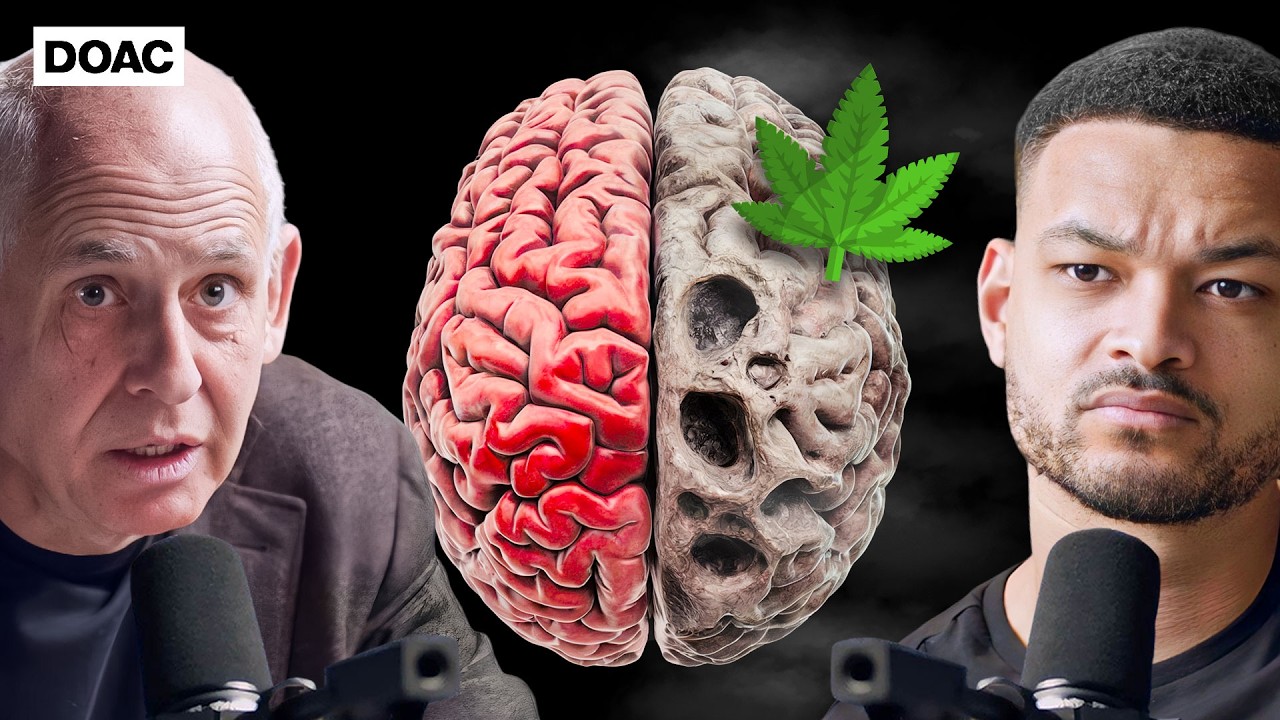
Dr. Daniel Amen Links Brain Atrophy to Alcohol, Obesity, and High-Carb Diets
The Diary Of A CEO
Psychiatrist Daniel Amen asserts that lifestyle choices ranging from alcohol consumption and high-carbohydrate diets to obesity directly accelerate brain shrinkage and elevate Alzheimer's risk.
## Background
This video was published on YouTube by The Diary Of A CEO on February 10, 2025. It features psychiatrist and brain disorder specialist Dr. Daniel Amen discussing how everyday choices, parenting, alcohol, and stress impact brain health and longevity.
## TL;DR
Dr. Daniel Amen presents clinical insights from hundreds of thousands of SPECT brain scans to illustrate how lifestyle habits, trauma, and nutrition directly dictate cognitive function and risk for diseases like Alzheimer's. He highlights the dangers of alcohol, high-carbohydrate diets, and social media while advocating for practical interventions such as racket sports, Kirtan Kriya meditation, and proactive pre-conception care. Additionally, Dr. Amen outlines strategies for raising resilient children, managing ADHD, and utilizing a simple decision-making filter to prioritize brain health in daily life.
## Atmosphere & style
The conversation carries an urgent yet deeply compassionate tone, blending rigorous clinical observations with accessible life advice. Steven Bartlett's engaged, reflective hosting provides a thoughtful counterweight to Dr. Amen's candid, science-backed warnings about modern hazards. Watching the exchange feels illuminating and empowering, shifting from stark warnings about brain damage to practical, hopeful solutions for personal recovery and intergenerational health.
## Key takeaways
- [01:03:43](https://www.youtube.com/watch?v=bOi_Y4ythYY&t=3823s) Psychological outcomes following severe trauma depend heavily on a person's pre-existing brain reserve, with only about 10% developing PTSD while another 10% experience post-traumatic growth.
- [01:05:28](https://www.youtube.com/watch?v=bOi_Y4ythYY&t=3928s) Brain development starts as early as day 21 of pregnancy, making maternal stress reduction and prospective parental health optimization prior to conception critical for a child's brain reserve.
- [01:09:08](https://www.youtube.com/watch?v=bOi_Y4ythYY&t=4148s) Alzheimer's disease is driven by a complex set of 11 distinct risk factors captured by the BRIGHT MINDS mnemonic, including blood flow, inflammation, toxins, mental health, and insulin resistance.
- [01:09:08](https://www.youtube.com/watch?v=bOi_Y4ythYY&t=4148s) Unhealthy body weight directly correlates with reduced brain size and lower cerebral blood flow, with insulin resistance present in 40% to 80% of Alzheimer's cases.
- [01:14:08](https://www.youtube.com/watch?v=bOi_Y4ythYY&t=4448s) Diet significantly impacts Alzheimer's risk: high-fat and high-protein diets are associated with reduced risk, whereas the high-carbohydrate Standard American Diet increases risk fourfold.
- [01:16:17](https://www.youtube.com/watch?v=bOi_Y4ythYY&t=4577s) Alcohol impairs prefrontal cortex function, worsening grief and emotional regulation, whereas structured tools like the 'One-Page Miracle' help align daily actions with long-term goals.
- [01:24:00](https://www.youtube.com/watch?v=bOi_Y4ythYY&t=5040s) Effective parenting focuses on building resilience and self-esteem by utilizing daily dedicated connection time, active listening, and consistent, calm consequences rather than rescuing children from struggle.
- [01:35:06](https://www.youtube.com/watch?v=bOi_Y4ythYY&t=5706s) ADHD is a neurobiological attention regulation disorder exacerbated by environmental factors like poor diet, excess screen time, and lack of sunlight, carrying severe risks if left untreated.
- [01:45:00](https://www.youtube.com/watch?v=bOi_Y4ythYY&t=6300s) Early romantic love triggers a dopamine-driven reward response similar to addictive substances, whereas long-term pair bonding relies on opiate pathways, making breakups feel like physical withdrawal.
- [01:46:34](https://www.youtube.com/watch?v=bOi_Y4ythYY&t=6394s) A central daily habit for long-term brain health is using the continuous self-evaluation question: 'Is what I'm doing right now good for my brain or bad for it?'
- [01:48:50](https://www.youtube.com/watch?v=bOi_Y4ythYY&t=6530s) Racket sports stimulate the cerebellum, which in turn energizes the prefrontal cortex to enhance executive function, focus, and emotional regulation.
- [01:50:57](https://www.youtube.com/watch?v=bOi_Y4ythYY&t=6657s) Short daily practices like the 12-minute Kirtan Kriya meditation and the 15-second breathing technique can measurably improve prefrontal cortex function and calm acute panic.
- [01:55:44](https://www.youtube.com/watch?v=bOi_Y4ythYY&t=6944s) Environmental hazards like microplastics, hearing loss from noise pollution, and cognitive offloading to AI tools present distinct risks of brain atrophy and neuroendocrine disruption.
- [02:03:34](https://www.youtube.com/watch?v=bOi_Y4ythYY&t=7414s) Practices like meditation, prayer, and having a clear sense of spiritual purpose correlate with increased prefrontal cortex activity, lower stress levels, and improved cognitive stability.
- [02:09:23](https://www.youtube.com/watch?v=bOi_Y4ythYY&t=7763s) First responders such as firefighters face cumulative brain damage from toxic smoke, physical trauma, and acute stress, resulting in significantly higher suicide rates that require proactive brain health care.
Dr. Daniel Amen opens with a stark warning about the multiple pathways to Alzheimer's disease, listing marijuana, alcohol, contact sports like football, and simple carbohydrate-heavy diets—which one study linked to a **400% increased risk**. Having scanned over 260,000 brains across his career—including high-profile figures like Justin Bieber, Miley Cyrus, Kendall Jenner, Mel Gibson, Muhammad Ali, Mike Tyson, and Jake Paul—Dr. Amen emphasizes that brain health dictates every aspect of human life. From 9-month-old infants to 105-year-olds across 155 countries, he has observed that physical brain function directly governs intelligence, character, mood, focus, and decision-making.
Despite the central importance of the brain, most people fail to realize that their everyday struggles—such as anxiety, depression, marital discord, poor focus, or insomnia—stem from the underlying physical health of their brain. The conversation highlights how Oxford University's choice of "brain rot" as the word of the year for 2024 reflects growing societal anxiety that modern lifestyle habits (including gaming, social media, pornography, and processed food) are actively shrinking human brains. Dr. Amen advocates for "brain envy"—a genuine desire to care for and optimize one's brain—noting that when the brain works right, the person works right.
- **400% Increased Risk:** Associated with diets high in simple carbohydrates regarding Alzheimer's onset.
- **260,000 Scans:** Total SPECT scans conducted by Dr. Amen across 155 countries.
- **2024 Word of the Year:** "Brain rot" selected by Oxford University, underscoring public worry over cognitive decline from digital habits.
> "Your brain is the organ of intelligence, character, and every decision you make. And when it works right, you work right. And when it doesn't, you have trouble."
---
[05:43](https://www.youtube.com/watch?v=bOi_Y4ythYY&t=343s) Pornography, Dopamine, and the Developing Brain
The discussion turns to the hidden impacts of digital content on neural circuitry, specifically focusing on the widespread exposure of young children to online pornography. Dr. Amen expresses deep concern over boys as young as 8, 9, or 10 years old encountering intense adult content before their brains have developed the capacity to discern what is healthy. This constant hyper-stimulation hits the nucleus accumbens—the brain's primary reward center—with artificial bursts of dopamine.
Over time, this relentless dopamine flooding causes the nucleus accumbens to become desensitized or "deadened." As a result, individuals require increasingly extreme stimulation just to feel baseline pleasure or motivation, a mechanism parallel to drug addiction or the neuro-psychological strain of fame. Dr. Amen stresses that the prefrontal cortex—the region responsible for judgment, impulse control, and decision-making—does not fully mature until age **25**. Prior to this milestone, parental supervision acts as a surrogate prefrontal cortex to protect developing minds from lasting harm.
- **Nucleus Accumbens:** The brain region responding to dopamine, heavily impacted and desensitized by repetitive exposure to pornography or intense stimuli.
- **Age 25:** The vital threshold when the prefrontal cortex finishes development; until then, the brain is exceptionally vulnerable to toxic habits and substances.
> "When the nucleus accumbens gets hit repeatedly with pornographic images, it's like dopamine, dopamine, dopamine. It begins to deaden that area and then you need more and more to begin to feel anything at all."
---
[08:39](https://www.youtube.com/watch?v=bOi_Y4ythYY&t=519s) Reversing Brain Damage and Why Patients Seek Help
Addressing whether a damaged brain can recover after years of poor habits, Dr. Amen offers a message of neuroplasticity and hope. Citing his extensive clinical research with retired NFL players—who suffer severe contact-related brain trauma—he reveals that **80% of NFL players showed measurable improvement** in brain function and symptoms after following a targeted rehabilitation protocol. He notes that regardless of past habits like heavy gaming, poor diet, or substance abuse, significant positive brain changes can occur in as little as two months once a rehabilitation regimen begins.
Most patients seek out Dr. Amen's clinics not out of casual curiosity, but because they are in acute psychological or relational pain. Common drivers include severe depression, marital breakdown (often under threat of divorce), failing grades, or unfulfilled potential. Approximately **10% of patients** are forward-thinking individuals who feel fine but seek optimization or wish to avoid neurodegenerative disorders like Alzheimer's after watching family members suffer from the condition.
- **80% Improvement Rate:** Demonstrated in NFL players on Dr. Amen's brain rehabilitation program.
- **2 Months:** The brief period in which tangible brain health and mood improvements can begin to take shape.
- **10% Proactive Patients:** The minority of clinic visitors who seek brain scans purely for preventative care and cognitive optimization rather than active crisis.
---
[11:15](https://www.youtube.com/watch?v=bOi_Y4ythYY&t=675s) The True Impact of Alcohol on Brain Health and Structure
Dr. Amen refutes the popular notion that alcohol can be part of a healthy lifestyle, citing recent warnings from the U.S. Surgeon General and the American Cancer Society regarding alcohol's link to elevated risks across **seven different types of cancer**. Reflecting on his 46 years as a psychiatrist, Dr. Amen identifies alcohol as the single leading trigger for poor decision-making, relationship destruction, domestic conflicts, and reckless behavior like drunk driving.
From a neuroimaging standpoint, alcohol acts by taking the "brakes" off the brain by shutting down crucial frontal lobe functions responsible for self-monitoring and restraint. While users drink to calm anxiety, they inadvertently disable the exact neural regions that prevent destructive words and actions. Dr. Amen references a television demonstration he conducted in 1999 where scanning a young adult before and after getting drunk revealed an immediate, dramatic crash in frontal lobe activity.
- **7 Cancers:** Alcohol consumption is directly linked to an increased risk of seven distinct forms of cancer.
- **46 Years of Clinical Psychiatry:** Basis for Dr. Amen's observations on alcohol driving bad life choices and brain dysfunction.
- **1999 Experiment:** Televised SPECT scan showing acute frontal lobe shutdown under the influence of alcohol.
> "Alcohol takes the brake off your brain... There's certain parts of your brain you really don't want to go offline: the part that says, 'Don't say that. Don't do that.'"
---
[14:08](https://www.youtube.com/watch?v=bOi_Y4ythYY&t=848s) Micro-Damage, SPECT Imaging, and Premature Brain Aging
Addressing the common question of whether light or moderate drinking is harmless, Dr. Amen highlights research from Spain demonstrating that even mild-to-moderate drinkers show measurable structural disruption in their brain's white matter. He compares gray matter to the brain's computational processing units and white matter to the intricate "highways" connecting them. Even small amounts of alcohol create microscopic "potholes" along these neural highways, accelerating cognitive aging.
Using Single-Photon Emission Computed Tomography (SPECT)—which measures blood flow, activity, and cellular mitochondrial energy intake—Dr. Amen contrasts healthy brains with alcoholic brains. Healthy brains appear smooth, full, and symmetrical. Conversely, brains damaged by heavy alcohol or drug use exhibit a distinct pattern known as "scalloping"—a bumpy, shriveled appearance reflecting widespread areas of suppressed blood flow and reduced energy metabolism.
- **White Matter vs. Gray Matter:** Gray matter houses cell bodies (computation), while white matter consists of nerve tracks (highways); alcohol degrades white matter connectivity even in moderate amounts.
- **SPECT Scans:** Imaging technique where 49% of the tracer is absorbed by cellular mitochondria to measure active tissue metabolism.
- **Scalloping Effect:** The distinct, wavy, shriveled surface pattern visible on SPECT scans of brains affected by substance abuse.
---
[16:44](https://www.youtube.com/watch?v=bOi_Y4ythYY&t=1004s) Brain Size, Stem Cells, and College Culture
Dr. Amen asserts that the brain is the one organ where size truly matters, as loss of physical brain tissue directly correlates with diminished cognitive capacity. Specifically, alcohol hinders neurogenesis within the hippocampus—the key temporal lobe structure responsible for generating roughly **700 new stem cells daily**. These stem cells are vital for mood regulation, memory consolidation, learning, and spatial orientation. Suppressing their growth leads directly to brain fog, memory loss, emotional volatility, and impaired judgment.
Dr. Amen shares a personal anecdote about his friend BJ Fogg, founder of Stanford's Persuasive Technology Lab and author of *Tiny Habits*. After learning about brain health from Dr. Amen, Fogg quit drinking entirely and reported waking up at "100% capacity" every single day. Dr. Amen laments the toxic culture of college fraternities and sororities, where underdeveloped brains under age 25 gather without adult supervision for binge drinking—a environment now further complicated by the rising popularity of psilocybin mushroom parties and heavy marijuana use.
- **700 New Stem Cells:** Produced daily in the human hippocampus, a process disrupted by alcohol consumption.
- **2009 Primate Study:** Published on Dr. Amen's blog, showing a **58% decline in new brain cell development** and a **63% reduction in new cell survival rates** due to alcohol exposure.
- **Polysubstance Trends:** College environments increasingly mix alcohol with marijuana and psilocybin mushrooms under the mistaken belief that these substances are harmless.
> "Why would you ever do anything that damages stem cell production in your brain?... In the short run, you feel more relaxed with alcohol. And in the long run, it increases your risk of Alzheimer's disease. That's not a good trade-off."
[21:31](https://www.youtube.com/watch?v=bOi_Y4ythYY&t=1291s) The False Promises and Brain Hazards of Cannabis
Addressing political discourse around cannabis, Dr. Daniel Amen reflects on the 2019 Democratic primary debates when Senator Cory Booker shamed Joe Biden for questioning the safety of federally legalizing marijuana. Dr. Amen asserts that, contrary to popular political rhetoric, the neuroscience is exceptionally clear: marijuana is undeniably harmful to the brain. In his own research scanning over 1,000 marijuana users, every region of the brain demonstrated a marked decrease in neural activity.
He highlights a landmark study published in the *Journal of the American Medical Association* (JAMA Network) examining 1,027 young adults. The findings revealed that nearly 70% of heavy cannabis users showed reduced activity in the hippocampus—the brain's primary memory and learning center—during working memory tasks. Furthermore, adolescent marijuana use is directly correlated with significantly higher rates of anxiety, depression, and suicide in a person's 20s. While acknowledging cannabis may offer specific medicinal benefits to certain individuals, Dr. Amen forcefully rejects the widespread myth that it is an innocuous substance.
```
CANNABIS USE IN ADOLESCENCE
│
┌──────────────────┴──────────────────┐
▼ ▼
STRUCTURAL & FUNCTIONAL LONG-TERM MENTAL HEALTH
IMPACT ON THE BRAIN RISKS IN ONE'S 20s
┌───────────────────────────┐ ┌─────────────────────────┐
│ • Decreased hippocampal │ │ • Elevated Anxiety │
│ activity │ │ • Severe Depression │
│ • Reduced volume in │ │ • Increased Risk of │
│ memory centers │ │ Suicide │
│ • Impaired working memory │ └─────────────────────────┘
└───────────────────────────┘
```
While Dr. Amen agrees that recreational cannabis users should not be imprisoned—calling criminalization a waste of public resources—he stresses that society is fundamentally failing to educate young people about the dangers of drug exposure during brain development.
- **The JAMA Study Findings:** Examining over 1,000 young adults, nearly 70% of heavy users showed decreased hippocampal activity and impaired working memory retention.
- **Mental Health Breakdown:** Widespread legalization across states like California has coincided with a worsening, rather than improving, national mental health crisis.
- **Educational Intervention:** Dr. Amen created a high school curriculum titled *"Brain Thrive by 25"*, tested across 16 schools, which proved to decrease drug, alcohol, and tobacco use while reducing depression and boosting self-esteem by teaching students to value their brain health.
---
[25:54](https://www.youtube.com/watch?v=bOi_Y4ythYY&t=1554s) Why Psychedelics and Street Drugs Are Not the Next Psychiatric Miracle
Dr. Amen expresses deep frustration that the major "innovations" being touted in 2025 psychiatry are marijuana, psilocybin, and ketamine—essentially rebranded street drugs from the 1960s. He views this trend as a dangerous repeat of historical pharmaceutical mistakes:
1. **1980s Benzodiazepines:** Xanax, Klonopin, and Ativan were marketed as "mommy's little helper" for anxiety, but they prematurely aged the brain and proved intensely addictive.
2. **Alcohol:** Framed for years as a healthy lifestyle choice.
3. **Cannabis:** Marketed as a harmless, natural remedy.
4. **Opioids:** Pain was declared the "fifth vital sign," directly precipitating the modern opioid epidemic.
5. **Psychedelics:** Psilocybin and ketamine are now being hailed as quick-fix miracles.
Addressing magic mushrooms, Dr. Amen warns that psilocybin-associated psychosis has spiked by 300% in recent years. In genetically vulnerable individuals, taking psychedelics can trigger severe, unrecoverable psychotic breaks.
Steven Bartlett, drawing from his background as an investor in biotech and psychedelic research, notes that while FDA Phase 3 clinical trials require strict safety controls, early trials (such as those from Imperial College London) demonstrated that around 30% of patients with treatment-resistant depression achieved clinical remission 12 weeks after a single dose of psilocybin. However, both agree that without proper pre-screening, administering powerful psychedelic compounds to severely depressed or suicidal patients carries immense risk.
> *"I feel like I'm living in this insane world where we're not talking about you should eat better and exercise and learn not to believe every stupid thing you think."*
---
[29:46](https://www.youtube.com/watch?v=bOi_Y4ythYY&t=1786s) The "Chest Pain" Analogy: Why Psychiatry Must Stop Flying Blind
Dr. Amen argues that treating depression without imaging the brain is as absurd as treating chest pain without diagnostic tests. Chest pain can be caused by a heart attack, arrhythmia, infection, acid reflux, an ulcer, or even intense grief—and no competent doctor would give every chest pain patient the exact same drug like nitroglycerin. Yet, modern psychiatry routinely hands out the same selective serotonin reuptake inhibitors (SSRIs) to anyone presenting with a cluster of nine depressive symptoms.
Depression is merely a surface symptom with dozens of wildly different underlying biological causes, including:
- Underlying head trauma or physical brain injury
- Chronic exposure to environmental toxins (such as toxic mold, mercury, or lead)
- Severe thyroid dysfunction or metabolic imbalance
- Neuroinflammation triggered by viral infections
To illustrate this, Dr. Amen references his work with reality star Kendall Jenner, who suffered from severe post-COVID anxiety. Her brain SPECT scans revealed intense neuroinflammation ("her brain was on fire") caused by the viral infection. The correct intervention was a targeted anti-inflammatory protocol—not psilocybin, ketamine, or standard antidepressants. Dr. Amen insists that psychiatry remains the only medical specialty that continuously treats an organ without directly looking at it.
---
[32:55](https://www.youtube.com/watch?v=bOi_Y4ythYY&t=1975s) Antidepressants vs. Proven Natural Alternatives
Referring to a global map showing pharmaceutical consumption, Steven highlights that the United States distributes almost ten times more antidepressant pills per capita than most other countries. Dr. Amen explains that American healthcare culture demands rapid, effortless solutions.
```
AMERICAN PSYCHIATRIC CARE REALITY
┌─────────────────────────────────────────────────────────────┐
│ 85% of psychiatric drugs are prescribed by non-psychiatrists│
├─────────────────────────────────────────────────────────────┤
│ Average consultation length: 7 minutes │
├─────────────────────────────────────────────────────────────┤
│ Standard-of-care compliance rate: Only 12% │
└─────────────────────────────────────────────────────────────┘
```
Patients visiting family doctors or nurse practitioners are routinely handed prescriptions for a triple combination of Lexapro, Xanax, and Ambien in a single 7-minute visit. These drugs do not heal or repair biological deficits; they suppress symptoms while altering brain chemistry so the patient requires the drug just to feel baseline normal.
Dr. Amen outlines non-pharmacological interventions that match or exceed the efficacy of standard antidepressants in head-to-head clinical trials:
* **Saffron (*Crocus sativus*):** Supported by 25 randomized controlled trials, the spice saffron is as effective as standard SSRIs for mild to moderate depression. Crucially, while SSRIs cause sexual dysfunction, loss of libido, and anorgasmia, saffron actually *enhances* sexual function, improves memory retention, and matches the cognitive benefits of Alzheimer's medications like Aricept.
* **Brisk Walking:** Walking "like you're late" for 45 minutes, four times a week, matches antidepressant performance.
* **Omega-3 Fatty Acids:** High-quality omega-3 supplementation demonstrated equivalent therapeutic efficacy in Australian studies.
* **Cognitive Reframing (Killing ANTs):** Learning to eliminate "Automatic Negative Thoughts" (ANTs)—the intrusive thoughts that ruin one's mood—is as effective as medication. Dr. Amen notes that despite completing college and medical school, he was never taught how to manage his own mind until his psychiatric residency at age 28.
- **Saffron Meta-Analysis:** A meta-analysis of eight clinical trials found zero difference in depressive symptom reduction between saffron and SSRIs, but noted a vastly superior safety and side-effect profile for saffron.
- **The Three Benefits of Saffron:** Dr. Amen summarizes its unique clinical triad as enhancing *"mood, memory, and sex."*
---
[39:25](https://www.youtube.com/watch?v=bOi_Y4ythYY&t=2365s) Visualizing Trauma on the Brain: PTSD, TBI, and ACE Scores
Dr. Amen confirms that emotional and physical trauma leave distinct visual fingerprints on brain scans. In a study of 21,000 patients published in *Discover* magazine, his team demonstrated that SPECT imaging can differentiate Post-Traumatic Stress Disorder (PTSD) from Traumatic Brain Injury (TBI) with high statistical accuracy—a finding subsequently validated in military veteran cohorts.
In his extensive research on childhood trauma using the Adverse Childhood Experiences (ACE) score (a 0–10 scale measuring exposure to abuse, neglect, domestic violence, parental incarceration, or mental illness):
- **ACE Score Thresholds:** Scoring 4 or higher dramatically elevates the risk for seven of the top ten leading causes of death.
- **Severe Trauma Impact:** Scoring 6 or higher reduces life expectancy by an average of 20 years compared to the general population.
```
THE BRAIN ON TRAUMA
│
▼
┌──────────────────────────────┐
│ Anterior Cingulate Gyrus │
│ (The Brain's "Gear Shifter") │
└──────────────┬───────────────┘
│
▼
Hyper-Activation State
│
┌───────────────────────────┴───────────────────────────┐
▼ ▼
Rigid Cognitive Looping Psychological Effects
• Inability to shift thoughts • Constant hypervigilance
• Fixation on past events • Elevated risk of anxiety,
• Visualizing trauma "in front" depression, & chronic insomnia
```
On a SPECT scan, high ACE scores correlate with marked hyper-activation of emotional limbic structures, particularly the **anterior cingulate gyrus**—the brain's internal "gear shifter." When overactive, individuals become cognitively rigid, holding onto hurts and constantly anticipating catastrophe. Dr. Amen notes an intriguing perceptual distinction: people without severe trauma typically perceive their past as resting *behind* them, whereas trauma survivors feel as though their past is permanently positioned right *in front* of their eyes.
Here is a detailed, faithful walkthrough of the transcript segment.
---
[43:04](https://www.youtube.com/watch?v=bOi_Y4ythYY&t=2584s) Accessible At-Home Treatments for Trauma and Brain Health
Steven Bartlett raises the issue of accessibility, noting that professional therapy and specialized brain scans are out of reach for many people. He asks what actionable steps someone with trapped trauma or PTSD can take at home without spending money. Dr. Daniel Amen emphasizes that healing trauma begins with optimizing the underlying brain health: "it's the brain you bring into trauma that often determines how you deal with it." To support the brain's physical structure, Dr. Amen outlines foundational lifestyle adjustments—eliminating alcohol, exercising, eating well—along with baseline supplementation. He recommends a daily multivitamin, optimizing vitamin D levels, and taking omega-3 fatty acids. Highlighting a clinic study, Dr. Amen notes that out of 50 consecutive patients not taking vitamin D, 49 had suboptimal omega-3 index levels. He points out that individuals with darker skin require up to five times as much sun exposure as someone from Northern Europe to synthesize healthy vitamin D levels.
Dr. Amen advises against jumping straight to addictive prescription medications like benzodiazepines for anxiety, as they accelerate brain aging and elevate dementia risk. Instead, he advocates for natural compounds and targeted calming practices.
- **Key Supplements for Mood & Anxiety:** Saffron (for mood regulation), L-theanine, ashwagandha, magnesium, and GABA.
- **Calming Practices:** Diaphragmatic breathing and clinical self-hypnosis.
---
[45:32](https://www.youtube.com/watch?v=bOi_Y4ythYY&t=2732s) Positivity Bias Training and the Dangers of "Low Anxiety"
The discussion turns to the neurobiological impact of negative thinking. Dr. Amen references a large study his clinic published on negativity bias, showing its damaging effects on the frontal lobes. To counteract this, he trains patients in daily positivity bias exercises, such as starting every morning by declaring, "Today is going to be a great day," to prompt the brain to scan for positive outcomes, and ending the night by reflecting on what went well. While he endorses a form of manifestation—in the sense that declaring an objective focuses the brain on achieving it—he cautions against irrational positivity.
Crucially, Dr. Amen warns that having extremely low anxiety can be fatal. He cites a seminal Stanford University study initiated in 1921 that tracked 1,548 ten-year-old children over their entire lifespans to identify traits linked to longevity and success. Contrary to popular belief, the "don't worry, be happy" personality types died earliest from preventable illnesses and accidents. The single strongest predictor of longevity was **conscientiousness**—being reliable, consistent, and keeping commitments—which reflects strong frontal lobe function.
---
[48:51](https://www.youtube.com/watch?v=bOi_Y4ythYY&t=2931s) Habits, Discipline, and Frontal Lobe Management
Addressing viewers thinking about New Year's resolutions, Steven asks how to cultivate discipline, motivation, and better habits. Dr. Amen explains that behavioral discipline depends directly on maintaining healthy frontal lobes and recognizing the physiological triggers that lead to relapse. Relapse and poor decision-making occur when the frontal lobe is compromised by sleep deprivation, dropped blood sugar levels, chronic stress, or substance use. For women, frontal lobe blood flow often drops during the last week of the menstrual cycle, exacerbating emotional volatility and automatic negative thoughts (ANTs).
Steven references data from Dr. Amen’s podcast (*Change Your Brain Every Day*) illustrating how alcohol severely degrades restorative REM sleep:
- **2 Drinks:** REM sleep drops to roughly 1 hour.
- **4 Drinks:** REM sleep drops to approximately 30 minutes.
- **6 Drinks:** REM sleep drops to less than 2 minutes for many people.
Dr. Amen outlines a three-step strategy to optimize frontal lobe function: develop "frontal lobe envy" (caring deeply about your brain), avoid damaging behaviors (like heading soccer balls or drinking heavily), and actively perform activities that strengthen frontal lobe tissue.
When negative chatter takes over, Dr. Amen instructs writing down the distressing thought and systematically questioning it using a process adapted from Byron Katie. He categorizes ANTs into specific types, such as "all-or-nothing ANTs" (using terms like *always*, *never*, *everyone*), "less-than ANTs" (driven by social media comparisons), guilt-beating, mind-reading, fortune-telling, and blaming ANTs.
Steven shares a personal example of his own background chatter: the constant, subtle expectation that opening an email will bring bad news. Dr. Amen walks him through the five-step cognitive inquiry to dismantle this "fortune-telling" thought:
1. **Is it true?** (Steven: No.)
2. **Is it absolutely true with 100% certainty?** (Automatically no.)
3. **How does that thought make you feel, act, and what is the outcome?** (Makes him feel tense, on edge, reticent, and leads to internal suffering.)
4. **How would you feel, act, and what is the outcome without the thought?** (Free, happier, more present, leading to better relationships.)
5. **Turn the thought to its exact opposite and ask if that is true:** ("It is going to be good or innocuous news." Steven admits this is true 99 out of 100 times, and as a CEO, he can handle whatever news arrives.)
Dr. Amen notes that society actively breeds negative thoughts. He cites data showing that people who watch the news in the morning are **27% less happy** in the afternoon. Referencing Dennis Prager’s work, Dr. Amen argues that happiness is ultimately a "moral obligation" because an individual's chronic unhappiness negatively impacts their children, spouses, and peers.
---
[01:01:33](https://www.youtube.com/watch?v=bOi_Y4ythYY&t=3693s) Extreme Trauma and Post-Traumatic Growth: The Elizabeth Smart Case
Dr. Amen shares the extraordinary case of Elizabeth Smart, who gained international attention after being kidnapped as a teenager and subjected to daily sexual assault for nine months. Smart managed to manipulate her abductors into taking her back to Salt Lake City, Utah, where she was rescued by police.
When Dr. Amen scanned her brain years later, expecting to see severe, lasting post-traumatic stress disorder, he discovered a remarkably healthy brain. Instead of suffering from chronic PTSD, Smart demonstrated **post-traumatic growth**. She channeled her experience into running an organization supporting abused women, got married, had children, and became a public speaker. Dr. Amen reflects that witnessing her resilience showed him how a person can endure horrific events without letting those events permanently ruin their brain or dictate their identity.
---
[01:03:40](https://www.youtube.com/watch?v=bOi_Y4ythYY&t=3820s) Trauma, Resilience, and Individual Differences
Steven and Dr. Amen discuss why two people exposed to the same horrific circumstances can have vastly different brain outcomes. Dr. Amen reiterates that pre-existing brain health, cognitive reserve, and ongoing mental habits dictate whether a person succumbed to trauma or achieves post-traumatic growth.
[01:03:43](https://www.youtube.com/watch?v=bOi_Y4ythYY&t=3823s) Horrific Events Don’t Necessarily Define Who You Are
When hearing about horrific, traumatic events, the common assumption is that trauma acts deterministically—that a person subjected to such trauma is inevitably bound to end up depressed, dysfunctional, and unable to maintain healthy relationships. However, data tells a different story. Following severe trauma, only about 10% of people go on to develop Post-Traumatic Stress Disorder (PTSD), while approximately 10% experience post-traumatic growth, with the vast majority falling somewhere in the middle.
Reflecting on a paper written in 1982 while a resident at Walter Reed—titled *"Post-Vietnam Stress Disorder: A Metaphor for Current and Past Life Events"*—the foundational premise was that "it's the brain you bring into Vietnam that often determines the brain that comes out of Vietnam." Growing up in an alcoholic or high-stress household leaves an individual significantly more vulnerable to addiction or severe post-deployment struggles.
This resilience or vulnerability comes down to the concept of **brain reserve**—the extra brain tissue and structural buffer available to weather life's stresses. Brain reserve building starts even before conception through epigenetics: if parents endured trauma and abuse, gene expression changes can pass down vulnerabilities to their offspring.
* **Day 21 (3 Weeks Post-Conception):** The human brain begins developing. A mother's stress levels, infectious disease burden, nutrition, and sleep during pregnancy directly shape generational brain health.
* **Childhood Reserve Builders vs. Drainers:** Factors like proper nutrition and low stress build reserve, whereas concussions from football or falling off a playground swing deplete reserve.
* **The IED Analogy:** Two soldiers in the same military tank hit an IED explosion; one walks away unharmed while the other ends up permanently disabled. The difference often comes down to their pre-existing brain reserve.
---
[01:05:28](https://www.youtube.com/watch?v=bOi_Y4ythYY&t=3928s) The Impact of Stress During Pregnancy on Your Child
Because brain development begins so early in gestation, partners are strongly advised to support pregnant women by actively reducing their stress levels. Beyond infancy, every choice a person makes either accumulates or drains their brain reserve over time.
As age advances, maintaining high brain reserve becomes crucial to withstand the physical toll of aging. Even though brain tissue naturally shrinks over time, there are "super brains"—individuals aged 80, 90, 100, or 105—whose brain scans reveal stunning health and structure. These individuals maintained rigorous brain reserve habits throughout their lives: they abstained from smoking and heavy drinking, ate nutritious diets, and maintained healthy body weights.
- **Age 85+ Risk:** 50% of individuals aged 85 and older (1 in 2) develop Alzheimer's disease.
- **Habits of "Super Brains":** Non-smoking, minimal/no alcohol consumption, nutrient-dense diet, healthy body mass index (BMI).
---
[01:09:08](https://www.youtube.com/watch?v=bOi_Y4ythYY&t=4148s) The Cause of Alzheimer's & The "BRIGHT MINDS" Risk Factors
Global projections suggest that by 2050, 150 to 160 million people worldwide will suffer from Alzheimer's disease. While conventional medicine long pinpointed excessive beta-amyloid plaque buildup as the primary cause, that theory is increasingly questioned. Instead, Alzheimer's is better understood as a complex condition driven by multiple intersecting risk factors.
Dementia is the broad umbrella term for losing cognitive faculties, with Alzheimer's being a specific subtype. To help prevent or reverse cognitive decline, the **BRIGHT MINDS** mnemonic highlights 11 major risk factor categories:
1. **B - Blood Flow:** Low cerebral perfusion is a leading predictor of Alzheimer's.
2. **R - Retirement & Aging:** Mental inactivity or lack of purpose accelerates decline.
3. **I - Inflammation:** Systemic inflammation damages neural connections.
4. **G - Genetics:** Pre-existing genetic vulnerabilities (e.g., APOE-e4 allele).
5. **H - Head Trauma:** Traumatic brain injuries drastically increase long-term risk.
6. **T - Toxins:** Alcohol, drugs, heavy metals, and environmental pollutants.
7. **M - Mental Health:** Depression doubles Alzheimer's risk in women and **quadruples (4x)** risk in men.
8. **I - Immunity & Infections:** Emerging research points to pathogens, including COVID-19 infection, as significantly increasing Alzheimer's risk.
9. **N - Neurohormones:** Deficiencies or imbalances, such as the growing epidemic of low testosterone in young men.
10. **D - Diabesity:** High blood sugar (diabetes) combined with obesity.
11. **S - Sleep:** Poor sleep prevents the glymphatic system from clearing metabolic waste.
> "As your weight goes up, the size and function of the brain goes down... Being at an unhealthy weight is unhealthy for your brain and body."
The role of **diabesity** is particularly destructive. Carrying excess fat cells causes the release of inflammatory molecules called *adipokines*, stores environmental toxins, converts healthy testosterone into cancer-promoting forms of estrogen, damages immunity, and impairs sleep. Studies scanning 33,000 individuals consistently prove that higher weight directly correlates with lower brain size and reduced blood flow. Consequently, many researchers now refer to Alzheimer's as **"Type 3 Diabetes"**, as 40% to 80% of Alzheimer's brains exhibit clear insulin resistance.
---
[01:14:08](https://www.youtube.com/watch?v=bOi_Y4ythYY&t=4448s) The Impact of Dietary Choices on Brain Health
Dietary choices directly influence cognitive decline and stroke risk. Research from the Mayo Clinic comparing different dietary patterns and their risk of Alzheimer's disease revealed stark contrasts:
High blood sugar makes blood vessels brittle and prone to rupturing, impairing tissue healing and vastly increasing stroke risk—and suffering a stroke increases Alzheimer's risk tenfold.
While strict keto diets can be helpful for certain medical conditions, they often lack sufficient fiber and plant diversity necessary for a healthy gut microbiome. A balanced **Paleo-style diet** consisting of high-quality fats, healthy proteins, and an abundance of nutrient-dense plants offers the optimal foundation for brain health.
---
[01:16:17](https://www.youtube.com/watch?v=bOi_Y4ythYY&t=4577s) The Impact of Hope and Grief on the Brain
Grief and loss exert a profound physical effect on the brain. When a loved one or pet passes away, the brain's emotional and limbic circuits become hyperactive. The lost individual is literally ingrained across neural networks in every memory and enjoyable region of the brain. When they are gone, the brain continuously "looks" for them, leading to prolonged distress.
On brain SPECT scans, acute grief and clinical depression manifest as dramatic hyperactivity in the **insular cortex** and **thalamus**. Managing grief depends heavily on the health of the prefrontal cortex (PFC), the rational, decision-making hub of the brain.
The nerve fibers extending from the prefrontal cortex down to the emotional centers are *inhibitory*—their job is to quiet overactive emotional circuits. If someone copes with loss by drinking alcohol, the alcohol shuts down the prefrontal cortex, removing these inhibitory controls and allowing negative emotional states to spiral out of control.
Conversely, **hope**—defined as the belief that *"tomorrow can be better and I have a role in making it so"*—is associated with low, controlled activity in the insular cortex.
To build personal agency and clear direction, an exercise called **"The One-Page Miracle"** should be practiced regularly (and every January):
* Write down explicit goals across key areas: **Relationships, Work, Money, Physical Health, Emotional Health, and Spiritual Health**.
* Review these goals daily and ask: *"Does my behavior get me what I want?"*
* Evaluate impulses against this standard to keep behavior aligned with underlying values.
* Improving overall brain health directly boosts physical vitality; because the brain utilizes **20% of total bodily blood flow**, enhancing cerebral circulation improves vascular function throughout the entire body.
---
[01:24:00](https://www.youtube.com/watch?v=bOi_Y4ythYY&t=5040s) How Do You Raise the Perfect Brain?
Addressing the challenge of parenting and how to rear children with optimal brain function, the journey begins by discarding the impossible standard of raising a "perfect" brain—no perfect brain exists. The goal instead is helping children build maximum resilience and cognitive health.
[01:24:41](https://www.youtube.com/watch?v=bOi_Y4ythYY&t=5081s) Raising Mentally Strong Kids: Bonding, Goals, and Active Listening
Dr. Daniel Amen outlines a structured framework for parents who want to raise mentally strong and resilient children. The starting point is establishing clear goals for oneself as a parent and for the child's development. Dr. Amen notes that his personal goal is to be present, kind, and effective, while aiming to raise kids who are mentally strong, resilient, and possess a healthy self-esteem. Achieving these outcomes relies heavily on creating a strong parent-child bond, which requires two fundamental ingredients: physical time and active listening.
To facilitate bonding, Dr. Amen introduces a daily exercise called **"Special Time."** He instructs parents to spend 20 minutes every day doing whatever activity the child chooses. During these 20 minutes, parents must refrain from giving commands, asking probing questions, or directing the activity—acting strictly as a supportive companion. He illustrates its efficacy through an anecdote about his former literary agent, Carl. At age 42, Carl complained that his two-year-old daughter ignored him in favor of her mother. When Dr. Amen suggested the 20-minute Special Time routine, Carl was initially skeptical, chalking his doubt up to negativity bias. However, when Dr. Amen followed up three weeks later, Carl reported that his daughter wouldn't leave his side, hanging onto his leg as soon as he walked through the door.
Active listening requires a similar restraint. Rather than immediately offering advice, corrections, or dismissive lectures, parents should repeat back what the child expresses to uncover the underlying emotional state. Dr. Amen contrasts typical parental reactions with active listening using a scenario where a child announces they want to dye their hair blue:
* **Dismissive Parent:** *"No way in hell as long as you live in my house!"* (Shuts down conversation or triggers a fight).
* **Lecturing Parent:** *"Sounds like you want to be like everyone else. If they jumped off a cliff, would you follow them?"* (Fails to validate or explore feelings).
* **Active Listening Parent:** *"Sounds like you want blue hair... It sounds like you want to be like the other kids."* This opens the space for the child to admit the true underlying issue: *"Sometimes I feel like I don't fit in."*
Once children feel truly heard and bonded, they naturally absorb their parents' values. Furthermore, Dr. Amen warns parents against stepping in to rescue their children from every struggle or inconvenience. Over-functioning for children steals their self-esteem, which is built by mastering challenges and developing competence. When a child complains of being bored, the best response isn't offering a list of activities, but empowering them by saying, *"I wonder what you're going to do about it."*
* **Special Time Protocol:** 20 minutes per day following the child's choice of activity, with zero commands, questions, or directions.
* **The Over-Parenting Trap:** Doing too much for children builds parent self-esteem at the expense of stealing the child's sense of agency.
* **Core Principle:** Character and self-esteem are built through struggle and problem-solving, not artificial comfort.
---
[01:30:12](https://www.youtube.com/watch?v=bOi_Y4ythYY&t=5412s) Non-Obvious Brain Hazards, Tantrums, and Setting Rules
Beyond the obvious dietary hazards like processed sugar, artificial chemicals, and environmental toxins, Dr. Amen highlights the critical role of parental modeling and behavioral boundary setting. Grocery stores deliberately place high-sugar, color-dyed cereals on the lower two shelves at eye level for young children to trigger impulses and begging. To counter this, Dr. Amen advises establishing a non-negotiable rule: **If a child throws a tantrum to get their way, the answer is always no.** Giving in trains children to use negative behavior as leverage, as adults teach others how to treat them based on what they tolerate.
Addressing concerns about handling public meltdowns, Dr. Amen frames the situation as choosing between short-term discomfort and long-term behavioral issues. Allowing a child to scream in a supermarket without giving in creates short-term awkwardness, but yielding creates long-term discipline problems. When children misbehave, Dr. Amen advocates delivering calm, delayed consequences. He frequently uses the phrase: *"I don't know what the consequence is going to be yet, but I'm going to think about it."* This technique shifts the anxiety back onto the child, forcing them to reflect on their actions while the parent calmly evaluates an appropriate response.
Responding to Steven's question about whether ignoring tantrums risks emotional neglect, Dr. Amen explains that holding firm boundaries is not neglect when done within a foundation of love, Special Time, and clear rules. Establishing transparent household guidelines sets predictable boundaries that prevent ongoing oppositional behavior.
* **Supermarket Cereal Placement:** High-sugar cereals are strategically positioned on bottom shelves to target children's eye levels.
* **The Tantrum Rule:** *"If you have a fit to get your way, the answer is always no."*
* **Core Household Rules:**
1. Tell the truth.
2. Put away things you take out.
3. Treat each other with respect.
4. Do what is asked the first time.
---
[01:35:06](https://www.youtube.com/watch?v=bOi_Y4ythYY&t=5706s) The Rise of ADHD, Environmental Triggers, and Untreated Risks
Addressing the widespread rise in ADHD diagnoses, Dr. Amen confirms that ADHD is a genuine neurobiological disorder with a strong genetic component. However, modern environmental factors significantly accelerate its expression. The combination of diets high in artificial food dyes (such as Red Dye No. 40) and refined sugars, constant screen time on digital devices, reduced exposure to sunlight, and immersive video games continuously overstimulate and fragment attention spans, heightening symptoms across the population.
Dr. Amen, author of *Healing ADD*, draws from both clinical practice and personal experience—having family members diagnosed with the condition. While patients and parents frequently worry about the side effects of stimulant medications like Ritalin or Adderall (such as tics, insomnia, reduced appetite, or weight loss), Dr. Amen emphasizes that they rarely consider the catastrophic side effects of leaving ADHD untreated.
For high-achieving, intelligent individuals, untreated ADHD often manifests as chronic underachievement—requiring immense effort to achieve results that should come far more easily. In broader populations, untreated ADHD carries severe long-term consequences across multiple life domains:
* **Academic:** School failure, chronic underperformance, and dropping out.
* **Financial & Legal:** Incarceration, bankruptcy, and impulsive financial mistakes.
* **Relational:** High rates of conflict, relationship instability, and divorce.
Dr. Amen shares the case of a 14-year-old boy who was failing school and constantly in conflict with peers and family. After natural interventions yielded insufficient improvements, Dr. Amen prescribed Concerta (a long-acting form of methylphenidate/Ritalin). The teenager subsequently went from failing to earning straight A's and B's, gaining admission to a highly competitive high school, and dramatically improving his interpersonal relationships.
* **Environmental Factors Increasing ADHD Expression:** Red Dye No. 40, high sugar consumption, lack of sunlight, screen saturation, and excessive video gaming.
* **Risks of Untreated ADHD:** School failure, incarceration, bankruptcy, divorce, and chronic underachievement.
---
[01:40:37](https://www.youtube.com/watch?v=bOi_Y4ythYY&t=6037s) Dr. Amen’s Personal Story: Scanning His Daughter
Revisiting a poignant story from a previous discussion, Dr. Amen candidly shares a personal regret involving his own daughter. Early in his career around 1991, despite being a child psychiatrist specializing in ADD, he failed to recognize the condition in his own child. His daughter spent hours every night struggling with homework until 1:00 or 2:00 AM. One evening, she broke down crying, telling him, *"Dad, I don't think I can ever be as smart as my friends."*
The following day, Dr. Amen performed a SPECT scan on her brain, administered a low dose of Ritalin, and scanned her again. The follow-up scan showed a fully normalized brain activity pattern. A week later, during dinner, his daughter described the transformation: previously, a single class felt like an agonizing eight-hour ordeal where she felt lost and prayed the teacher wouldn't call on her. With medication, the same class flew by in 20 minutes, and she actively participated with her hand raised.
Following the diagnosis and treatment, her academic performance shifted dramatically:
* She transitioned from earning hard-fought B's and C's to receiving straight A's.
* She maintained straight A's for the next 10 years.
* She was accepted into the University of Edinburgh's Royal (Dick) School of Veterinary Studies—one of the top veterinary schools globally, famous for cloning Dolly the sheep.
Dr. Amen notes that without identifying and treating her brain function, she would have been trapped in a cycle of self-doubt and underachievement. He emphasizes that while medication is never the first tool he reaches for, it remains a valuable option when optimizing brain health.
---
[01:43:16](https://www.youtube.com/watch?v=bOi_Y4ythYY&t=6196s) Hyperfocus and Novelty in ADHD
Steven shares his own experience with ADHD, noting how his symptoms differ from the typical perception of attention deficits. He shares that when he is engaged in a project, he can focus deeply for extended periods. To illustrate, Steven describes writing his previous book: he traveled to the jungle in Bali for 11 to 14 days with only 33 outline sentences and chapter titles. By working roughly 10 hours a day in high concentration, he completed the entire manuscript and delivered it to his publisher, Penguin.
Dr. Amen explains that this phenomenon is entirely consistent with ADHD brain physiology. ADHD is not a complete inability to pay attention, but rather an inability to regulate attention. When presented with tasks that are novel, highly interesting, stimulating, or urgent, the ADHD brain experiences a surge of dopamine, enabling intense hyperfocus. Conversely, when faced with routine, repetitive, or unstimulating tasks, dopamine levels drop, making sustained attention extremely difficult.
* **The ADHD Focus Paradox:** Difficulty sustaining attention on routine or uninteresting tasks, contrasted with the ability to hyperfocus on novel, highly engaging, or high-stakes activities.
[01:43:42](https://www.youtube.com/watch?v=bOi_Y4ythYY&t=6222s) The Reality of ADD and How Attention Works
Dr. Amen clarifies a major misconception about Attention Deficit Disorder (ADD/ADHD): people affected by it are not completely incapable of paying attention. In fact, when they love a subject—like a favorite history class—they can focus intensely. However, when faced with topics they dislike, such as geometry, their ability to concentrate drops off a cliff. As Dr. Amen puts it, "love is a drug," and while passion naturally drives focus, real life requires handling tasks that are far from enjoyable. This contrast creates a deeply erratic attention pattern, which often leaves sufferers feeling confused about whether they even have a disorder.
Unfortunately, this underlying dopamine deficit often drives individuals toward dangerous self-medication. Dr. Amen notes a recurring, tragic pattern where students in college experiment with illicit stimulants like methamphetamine to study. While it initially boosts their focus and productivity, the lack of management quickly spirals into addiction, effectively "stealing their soul."
- People with ADD can hyperfocus on topics they love, making their attention deficits context-dependent rather than absolute.
- Unmanaged attention deficits frequently lead to self-medication with illegal or unprescribed stimulants.
---
[01:45:00](https://www.youtube.com/watch?v=bOi_Y4ythYY&t=6300s) Seeing Love on the Brain and the Pain of Heartbreak
Love leaves a distinct neural signature on brain scans. Citing research by neuroscientist Dr. Helen Fisher, Dr. Amen explains that early-stage romantic love acts like a surge in the brain's dopamine reward centers, inducing a state of mild, pleasurable obsession. He compares the dynamic of love to substances: "new love" functions like dopamine (similar to a cocaine rush), whereas "lasting love" relies on the brain's opiate systems.
Because of this deep neurological dependency, the end of a long-term relationship triggers a severe physiological withdrawal. Breaking up after years of deep attachment feels less like coming off a casual high and more like "getting off of heroin" or "ripping your skin off." When heartbroken patients visit Amen Clinics saying "I can't stop," their brain scans reveal heightened activity in anxiety and sadness networks, trapped in loops surrounding memories of their former partner.
- **New Love:** Characterized by dopamine spikes and mild obsessive thinking.
- **Lasting Love:** Governed by opiate-like attachment pathways; loss triggers acute physical and emotional withdrawal.
- **Heartbreak on Scans:** Manifests as hyperactive anxiety and emotional distress circuits locked on memories of the ex-partner.
---
[01:46:34](https://www.youtube.com/watch?v=bOi_Y4ythYY&t=6394s) The Single Question to Change Your Life
When asked what single global change he wants to inspire, Dr. Amen points to a habit developed in collaboration with Stanford behavioral scientist BJ Fogg. The core principle centers on "Tiny Habits"—identifying the smallest daily action that yields the greatest long-term impact. For brain health, that comes down to instilling a single decision-making filter in everyone's daily life: *"Is what I'm doing right now good for my brain, or bad for it?"*
Dr. Amen illustrates how this single habit alters choices across every stage of life. A 15-year-old with an actively myelinating brain—whose prefrontal cortex will not fully mature until age 25—can use this question to reject junk food and alcohol. Similarly, a 60-year-old experiencing stress over a lost football match can pause, love their brain, and choose healthy habits over extra beers or poor dietary choices.
> "Whatever I'm doing right now, is it good for my brain or bad for it? I want to teach people to love their brains and to just make better decisions for the health of their brain, because then everything follows that."
---
[01:48:50](https://www.youtube.com/watch?v=bOi_Y4ythYY&t=6530s) Everyday Habits and Sports: Padel, Pickleball, and the Cerebellum
Host Steven Bartlett brings up current wellness trends to test whether they help or hurt the brain, starting with racket sports like padel and pickleball. Dr. Amen confirms that racket sports are exceptionally beneficial for brain health. Recalling Steven’s earlier brain scan—which revealed a "sleepy" cerebellum—Dr. Amen highlights how physical activities requiring rapid hand-eye coordination heavily recruit and train the cerebellum.
Activating the cerebellum through coordination exercises subsequently stimulates the frontal lobes, improving overall executive function, focus, and emotional regulation. Poor physical coordination often points directly to under-activity in the cerebellum, but targeted exercise can rebuild these neural connections over time.
- **Cerebellum Activation:** Racket sports (padel, pickleball, table tennis) demand real-time physical coordination, stimulating the cerebellum and energizing the frontal lobes.
- **Childhood Development:** Parents should engage children early in high-coordination, zero-contact sports (e.g., table tennis) to build brain reserve safely without risk of concussion.
---
[01:50:57](https://www.youtube.com/watch?v=bOi_Y4ythYY&t=6657s) Neuroplasticity Apps, Exercise, and Meditation
Addressing popular neuroplasticity training apps and memory games, Dr. Amen confirms they offer genuine benefits—especially when stacked with physical movement. Research demonstrates that aerobic exercise increases blood flow directly to the hippocampus, the brain's primary memory center. Performing cognitive tasks or studying a language while riding a stationary bike or walking dramatically improves memory retention and structural brain health.
Dr. Amen also highlights the profound neural impacts of mindfulness and meditation, specifically citing his published research on *Kirtan Kriya*—a 12-minute Kundalini yoga meditation. By combining rhythmic finger movements (coordination) with chanting the sounds *Sa Ta Na Ma*, practitioners engage the cerebellum, boost frontal lobe activity, and calm overactive emotional circuits.
- **Cognitive Stacking:** Engaging in learning or memory games during light aerobic exercise (walking, stationary cycling) maximizes hippocampal blood flow and neuroplasticity.
- **Kirtan Kriya Protocol:** A 12-minute daily practice involving vocalization and finger-tapping (*Sa Ta Na Ma*: 2 mins aloud, 2 mins whispering, 4 mins silent, 2 mins whispering, 2 mins aloud).
- **Proven Results:** Practicing Kirtan Kriya daily for 8 weeks measurably increases baseline frontal lobe function.
---
[01:53:26](https://www.youtube.com/watch?v=bOi_Y4ythYY&t=6806s) Cold Therapy, Job Satisfaction, and Breathwork
Evaluating other lifestyle practices, Dr. Amen offers a mixed assessment of cold exposure therapy. While cold showers provide a safe, rapid boost in dopamine and alertness, deep ice baths carry risks like triggering atrial fibrillation in susceptible individuals. Turning to career and stress, loving one's job is immensely protective—provided the work demands continuous new learning. Routine, stagnant work offers no cognitive challenge and is associated with a higher risk of Alzheimer's disease.
Conversely, chronic workplace stress and difficult colleagues raise baseline cortisol levels. Cortisol actively shrinks the hippocampus and increases visceral belly fat—a double blow to long-term brain health. To combat acute stress or panic attacks, Dr. Amen prescribes the "15-second breath" technique: inhaling for 4 seconds, holding for 1.5 seconds, exhaling for 8 seconds, and holding for 1.5 seconds. Exhaling for twice as long as the inhale significantly increases vagal tone, shifting the autonomic nervous system into a calm state within minutes.
- **Cold Exposure:** Cold showers safely increase dopamine; extreme cold plunges carry cardiovascular risks like atrial fibrillation.
- **Cognitive Growth at Work:** Novelty in the workplace protects against cognitive decline, whereas stagnant work routines elevate Alzheimer's risk.
- **Cortisol Danger:** Elevated cortisol shrinks memory centers (hippocampus) and promotes abdominal fat.
- **The 15-Second Breath:** Inhale 4s, hold 1.5s, exhale 8s, hold 1.5s. Repeating this 4–5 times engages the vagal nerve to break acute panic.
---
[01:55:44](https://www.youtube.com/watch?v=bOi_Y4ythYY&t=6944s) Social Media, Workaholism, Microplastics, and Noise Pollution
Dr. Amen systematically breaks down several environmental and lifestyle threats damaging modern brain health:
- **Social Media:** Chronic use fuels constant upward social comparison against artificial, curated lives, driving up anxiety and lowering self-esteem.
- **Workaholism:** Loving one's work is healthy, but working purely for money or out of compulsion without genuine purpose creates toxic, chronic distress.
- **Microplastics:** These environmental toxins disrupt endocrine systems, destabilize hormone balances, and elevate cancer risks.
- **Noise Pollution & Hearing Loss:** Exposure to loud environments damages hearing, which stands as a primary risk factor for Alzheimer's disease. Deprived of sensory input, the brain begins to atrophy, while the "negativity bias" fills the cognitive void with paranoia and anxiety.
Steven admits that after running an automated hearing test on his new Apple AirPods, he discovered his hearing had declined compared to his partner's. Surprised by the direct link between hearing loss and cognitive decline, he immediately turned down his listening volumes to protect his remaining brain reserve.
---
[01:58:17](https://www.youtube.com/watch?v=bOi_Y4ythYY&t=7097s) Artificial Intelligence, Video Games, and Synthetic Relationships
Looking ahead to an AI-driven world, Dr. Amen warns that artificial intelligence will likely harm human brains in the short term by reducing the cognitive effort required for daily tasks. Echoing his friend Byron Katie’s maxim—*"argue with reality, welcome to hell"*—he emphasizes that technology must be harnessed thoughtfully rather than allowed to hijack neural development.
He compares this to the advent of home video games in the late 1980s, recalling how video games overstimulated and dulled the dopamine circuits in young brains, impacting focus and academic drive. The modern push toward AI companions presents a similar trap: building relationships with synthetic personalities requires none of the complex social calculations, empathy, or conflict resolution demanded by real human interactions. Relying on engineered, frictionless AI relationships risks starving the brain's social networks.
- **Cognitive Atrophy:** Offloading thinking to AI tools reduces fundamental brain engagement and problem-solving effort.
- **Dopamine Overstimulation:** Unregulated screen time and immersive gaming flood dopamine pathways, desensitizing reward systems.
- **Synthetic Relationships:** Interacting with customizable AI companions eliminates the necessary social complexity that keeps real-world neural networks healthy and resilient.
---
[02:01:51](https://www.youtube.com/watch?v=bOi_Y4ythYY&t=7311s) Spirituality, Purpose, and the Four Circles of Health
To wrap up the conversation, Dr. Amen outlines his diagnostic framework: evaluating every human life across **Four Circles**—Biology, Psychology, Social Connections, and Spirituality. While modern medicine often fixates on biology and psychology, ignoring the spiritual circle leaves a massive void in long-term wellness.
The spiritual circle centers on purpose, asking fundamental questions: *Why am I here? Am I the product of random chance, or was I created with intent to make the world better?* Dr. Amen emphasizes that individuals living without a clear sense of purpose face significantly higher rates of depression, chronic loneliness, and dementia. Establishing a grounding sense of purpose—such as through his "One Page Miracle" exercise, which maps out explicit goals for relationships, work, money, and health—is essential for sustaining mental resilience and long-term brain health.
- **The Four Circles:** Comprehensive psychiatric health requires addressing Biological, Psychological, Social, and Spiritual dimensions.
- **The Power of Purpose:** Lacking a defined life purpose directly correlates with higher incidence of depression, social isolation, and age-related cognitive decline.
[02:03:34](https://www.youtube.com/watch?v=bOi_Y4ythYY&t=7414s) God, Physics, and the Neuroscience of Faith
Dr. Daniel Amen addresses the intersection of science and spirituality, countering colleagues who ask how a scientist can believe in God. He references the second law of thermodynamics (entropy)—the principle that systems naturally progress from order to disorder—to argue that the intricate design of the universe points toward an intentional, higher purpose rather than random chance. Neuroscientific studies show distinct patterns associated with faith: religious individuals often demonstrate increased activity in the prefrontal cortex—which governs decision-making, morality, and self-regulation—as well as a larger right temporal lobe.
The conversation explores how the brain physically experiences spiritual states. Dr. Amen highlights research by Dr. Michael Persinger at Laurentian University in Canada, who applied low-voltage electrical stimulation to subjects' right temporal lobes using a specialized helmet. This stimulation consistently triggered a "sensed presence," leading subjects to feel as though God were in the room with them. This raises the fundamental question of whether the brain manufactures the concept of God or possesses biological pathways designed to experience the divine.
- Through the Change Your Brain Foundation, Dr. Amen conducted a study examining conversational prayer and speaking in tongues (channeling the Holy Spirit in Christian tradition).
- Based on research by Dr. Andrew Newberg—who studied spiritual channelers in Brazil—they hypothesized that subjects must lower brain activity to attune to outside spiritual frequencies.
- The study revealed that 60% of subjects showed a significant decrease in overall brain activity while speaking in tongues, though one subject fully activated their dopamine centers.
- Dr. Newberg’s scans of Tibetan monks during meditation and Franciscan nuns during prayer revealed similar neurological shifts: heightened prefrontal cortex activity, reduced stress and anxiety, increased dopamine, thickened cortical tissue, and enhanced neuroplasticity.
- Steven Bartlett notes that while he is not religious, non-believers can access these same neurological benefits through meditation or broader spiritual practices. Dr. Amen adds that religious traditions can be either healthy (open and seeking) or toxic (rigid and shaming).
> "Do you know anything about physics? That the second law of physics is entropy. Things go from order to disorder... I think there's an order to this and that I'm here talking to you and there's a purpose behind it that's greater than me."
---
[02:08:31](https://www.youtube.com/watch?v=bOi_Y4ythYY&t=7711s) Why Brain Scans Reinforce Dr. Amen’s Belief in God
Reflecting on his career scanning roughly 260,000 brains, Dr. Amen notes that his findings have only strengthened his long-held faith. Looking at complex cellular structures makes the theory of unguided evolution feel statistically improbable to him. He explains that a single brain cell—equipped with intricate DNA and functional mitochondria—could not reasonably emerge from pure random chance, leaving him with a sense of awe at how "beautifully made" human beings are.
- Dr. Amen asserts that nothing in his lifetime of scientific study has disproven his faith in a creator.
- He emphasizes the statistical impossibility of cellular complexity arising without intentional design.
---
[02:09:23](https://www.youtube.com/watch?v=bOi_Y4ythYY&t=7763s) Trauma, Toxic Smoke, and the LA Fires: Caring for Firefighters
The discussion turns to the catastrophic Los Angeles fires and their emotional and physical toll. Growing up in Los Angeles, Dr. Amen feels deeply connected to the tragedy; his own clinic and doctors had to be evacuated, and a close personal friend lost his home. He draws a stark distinction between culture's worship of entertainers and true heroism, arguing that while NFL players are merely entertainers, firefighters and first responders are true heroes who face immense physical and neurological risks.
Dr. Amen points out that firefighters suffer from severe brain damage brought on by three combined factors: exposure to high levels of environmental toxins, acute emotional trauma, and physical head trauma from falling debris. Consequently, firefighters face a suicide rate roughly 25% higher than the general population. In response, his Change Your Brain Foundation is donating 100 comprehensive brain evaluations to firefighters, with the goal of raising enough funds to evaluate thousands more. He stresses the urgent need to shift first-responder culture away from turning to alcohol after traumatic shifts toward proactive brain repair and building neurological reserve.
- Firefighters suffer a suicide rate approximately **25% higher** than the general population due to accumulated brain hazards.
- The three main threats to firefighter brain health are toxic exposure, emotional trauma, and physical head trauma.
- The Change Your Brain Foundation is sponsoring **100 free brain evaluations** for firefighters, accessible at `changeyourbrain.org`.
> "NFL players aren't heroes. They're entertainers. Firefighters are heroes. First responders are heroes... Shouldn't we be teaching them about brain health and go, 'Hey, look, this is a brain-damaging job, but we need you to do it. So, all the way along, let's see and repair your brain.'"
---
[02:13:05](https://www.youtube.com/watch?v=bOi_Y4ythYY&t=7985s) Preparing Brain and Body Before Conceiving a Child
Steven asks the podcast's traditional closing question left by the previous guest: "What advice would you give a couple who want to start a family?" Dr. Amen advises prospective parents to spend a year or more optimizing their health before trying to conceive. Because a woman is born with all the eggs she will ever have, her lifestyle—including nutrition, stress management, and exposure to harmful substances—directly impacts the quality of that genetic material and the environment of the developing fetus.
Dr. Amen reminds prospective parents that the human brain begins developing at day 21 of pregnancy—often before a woman even realizes she is pregnant. Relying on the typical habit of quitting alcohol or improving diet only after a positive pregnancy test leaves crucial early developmental windows vulnerable. Both parents should focus on pre-conception care by evaluating every habit—diet, stress, and toxic exposure—asking whether it actively supports or harms their brain, ovaries, and sperm.
- Prospective parents should take **1 year or more** prior to conception to optimize nutrition, lower stress, and eliminate toxic habits.
- The brain begins developing at **day 21** after conception, making pre-conception preparation critical.
- Both partners must participate, as paternal sperm health and maternal egg quality are equally vulnerable to lifestyle factors.
---
[02:15:03](https://www.youtube.com/watch?v=bOi_Y4ythYY&t=8103s) Closing Appreciation and Show Outro
Steven expresses deep gratitude to Dr. Amen, sharing how frequently listeners express appreciation for his work. He shares a personal anecdote from earlier that day, when a practitioner at a spa treatment stopped to thank him for hosting Dr. Amen, explaining how the previous podcast episode helped her finally understand her ADHD. Steven notes that the comment section is filled with stories from families whose lives were transformed decades ago by visits to the Amen Clinics. Dr. Amen notes that his previous appearance on *The Diary Of A CEO* generated calls from around the globe, commending Steven on his impactful work.
Steven closes the episode with announcements for his audience:
- The updated Version 2 of *The Diary Of A CEO* Conversation Cards—featuring questions left by previous podcast guests with QR codes linking to their video responses—is available at `theconversationcards.com`.
- He asks the **53% of regular viewers who are not yet subscribed** to click the subscribe button, promising in return that his team will continuously improve the show quality, listen to community feedback, and book the most requested guests.
> "The life you've lived is such an important one and it's added so much value and hope... it's turned on the lights for so many people in so many ways. So, on behalf of all those people and on behalf of the tens of millions of people who've tuned into our conversations, thank you so much."
## Notable quotes
> [01:03:43](https://www.youtube.com/watch?v=bOi_Y4ythYY&t=3823s) it's the brain you bring into Vietnam that often determines the brain that comes out of Vietnam — Dr. Daniel Amen
> [01:09:08](https://www.youtube.com/watch?v=bOi_Y4ythYY&t=4148s) As your weight goes up, the size and function of the brain goes down... Being at an unhealthy weight is unhealthy for your brain and body. — Dr. Daniel Amen
> [01:46:34](https://www.youtube.com/watch?v=bOi_Y4ythYY&t=6394s) Whatever I'm doing right now, is it good for my brain or bad for it? I want to teach people to love their brains and to just make better decisions for the health of their brain, because then everything follows that. — Dr. Daniel Amen
> [01:55:44](https://www.youtube.com/watch?v=bOi_Y4ythYY&t=6944s) argue with reality, welcome to hell — Byron Katie
> [02:03:34](https://www.youtube.com/watch?v=bOi_Y4ythYY&t=7414s) Do you know anything about physics? That the second law of physics is entropy. Things go from order to disorder... I think there's an order to this and that I'm here talking to you and there's a purpose behind it that's greater than me. — Dr. Daniel Amen
> [02:09:23](https://www.youtube.com/watch?v=bOi_Y4ythYY&t=7763s) NFL players aren't heroes. They're entertainers. Firefighters are heroes. First responders are heroes... Shouldn't we be teaching them about brain health and go, 'Hey, look, this is a brain-damaging job, but we need you to do it. So, all the way along, let's see and repair your brain.' — Dr. Daniel Amen
> [02:15:03](https://www.youtube.com/watch?v=bOi_Y4ythYY&t=8103s) The life you've lived is such an important one and it's added so much value and hope... it's turned on the lights for so many people in so many ways. So, on behalf of all those people and on behalf of the tens of millions of people who've tuned into our conversations, thank you so much. — Steven Bartlett
## Mentioned
Dr. Daniel Amen, Steven Bartlett, Walter Reed, Carl, Dr. Helen Fisher, BJ Fogg, Byron Katie, Dr. Michael Persinger, Laurentian University, Dr. Andrew Newberg, Amen Clinics, Mayo Clinic, University of Edinburgh's Royal (Dick) School of Veterinary Studies, Apple, AirPods, Penguin, Change Your Brain Foundation, The Diary Of A CEO, Ritalin, Adderall, Concerta, BRIGHT MINDS, One-Page Miracle, Kirtan Kriya
Psychiatrist Dr. Daniel Amen argues that behavioral, emotional, and cognitive issues stem directly from physical brain health, advocating for brain-targeted lifestyle changes, diagnostic neuroimaging, and avoidance of neurotoxic substances to preserve cognitive reserve.
The Biological Reality Behind Everyday Mental Health Struggles (0:00)
Dr. Amen asserts that daily challenges such as anxiety, depression, and marital conflict are direct reflections of physical brain dysfunction rather than purely psychological flaws. Having evaluated more than 260,000 SPECT scans, he contends that psychiatry remains the only medical field that treats an organ without imaging it. Treating conditions like depression with standardized SSRIs overlooks distinct physical root causes, including past head injuries, neuroinflammation from infections, metabolic imbalance, or environmental toxins.
Neurotoxic Hazards of Alcohol, Cannabis, and Modern Trends (11:15)
Rejecting the idea that alcohol can fit into a healthy lifestyle, Dr. Amen notes that it disrupts inhibitory frontal lobe function, impairs white matter connectivity even in moderate amounts, and reduces stem cell neurogenesis in the hippocampus. He highlights studies showing heavy cannabis use suppresses hippocampal activity during working memory tasks and warns against viewing psychedelics as quick-fix miracles, pointing to spikes in psilocybin-related psychosis. In children and adolescents, whose prefrontal cortex does not fully mature until age 25, digital hyper-stimulation from pornography and video games desensitizes dopamine receptors in the nucleus accumbens.
Reversing Damage and Mitigating Dementia Risks (8:39)
Despite the impact of poor habits or head trauma, Dr. Amen stresses that the brain retains neuroplasticity. In his clinical rehabilitation research with retired NFL players suffering from severe contact-related trauma, 80% demonstrated measurable improvements in symptoms and brain function within two months. To prevent dementia, which is projected to affect 150 to 160 million people globally by 2050, he promotes the BRIGHT MINDS framework to target eleven categories of risk factors, including systemic inflammation, low cerebral blood flow, and toxic exposures.
Dietary Strategies and Daily Interventions for Cognitive Reserve (74:08)
Dietary patterns significantly shape dementia risk; Mayo Clinic data highlighted in the discussion indicates that simple carbohydrate-dense diets raise Alzheimer's risk by 400%, whereas high-fat and protein-based diets reduce risk by 42% and 21%, respectively. For trauma recovery and general maintenance, Dr. Amen recommends foundational supplementation like omega-3 fatty acids, vitamin D, and saffron, alongside daily cognitive routines to defeat automatic negative thoughts. He also points to Stanford longevity research showing that conscientiousness, supported by healthy frontal lobe function, is the primary personality predictor of long life.
Parenting and Managing Neurodivergence Across Generations (84:41)
To build resilient brains in children, Dr. Amen advises daily dedicated connection—such as 20 minutes of non-directive 'Special Time'—alongside firm boundaries, like never yielding to tantrums. Addressing ADHD, he characterizes it not as a total deficit of attention, but as an inability to regulate dopamine, which permits hyperfocus during stimulating tasks while hindering routine focus. He stresses the severe lifelong risks of leaving ADHD untreated and recommends that prospective parents take at least a year prior to conception to optimize nutrition and detoxify their habits, noting that brain formation begins around day 21 of pregnancy.
While Dr. Amen highlights dramatic cognitive improvements through targeted lifestyle interventions, neuroimaging, and non-pharmacological alternatives, host Steven Bartlett notes that FDA Phase 3 clinical trials and academic studies also demonstrate measurable psychiatric remissions using controlled compounds like psilocybin, pointing to ongoing debate over the role of emerging pharmaceutical treatments.
## Background
本视频由 YouTube 频道《The Diary Of A CEO》(主持人 Steven Bartlett)于 2025 年 2 月 10 日发布。根据页面简介,本期特邀嘉宾为知名精神科医生、脑功能障碍专家兼 Amen Clinics 创始人 Daniel Amen 博士,围绕其畅销著作《Change Your Brain Every Day》与《Raising Mentally Strong Kids》,深入探讨了毁坏大脑的育儿误区、酒精与毒品的神经毒性以及重塑大脑健康的科学路径。
## TL;DR
基于对逾 26 万例脑部 SPECT 扫描的临床实证,Daniel Amen 博士系统揭示了酒精、大麻及精制碳水饮食对大脑白质与神经储备的物理破坏,并直指酒精是加速脑萎缩与阿尔茨海默病的核心诱因。对话剖析了抑郁症与童年创伤(ACEs)的脑显像特征,批判了精神药物流水线式滥开的医疗现状,提出利用藏红花、规律快走以及消灭“自动负面思维”(ANTs)等天然且高效的认知干预方案。此外,Amen 博士阐述了预防脑退化的 BRIGHT MINDS 综合模型,分享了基于神经科学的育儿法则(如每日 20 分钟“专属时间”与拒绝溺爱包办),并深入探讨了 ADHD 的神经机制与生命精神意义对维系大脑健康的终极护城河作用。
## Atmosphere & style
整场访谈兼具硬核神经影像学的严谨说服力与深厚的人文关怀,氛围真挚、恳切且极具启发性。主持人 Steven Bartlett 展现出高度共情与毫不掩饰的坦诚,主动剖析身为企业高管的预警焦虑及自身确诊 ADHD 的心路历程;Amen 博士则如同一位循循善诱的长者,将震撼的临床扫描事实与自身家庭逆袭、灾区消防员救助等动人叙事交织呈现。对话在揭示脑损伤危机的沉重警醒与提供落地解法的情绪回暖中不断推进,给听众带来既惊心动魄又充满希望的沉浸式心智洗礼。
## Bulletin
- [00:00](https://www.youtube.com/watch?v=bOi_Y4ythYY&t=0s) 基于超过 26 万例 SPECT 脑扫描研究,Daniel Amen 博士指出酒精、大麻和超加工简单碳水对大脑结构有显著萎缩效应,而以简单碳水为主的饮食会使阿尔茨海默病患病风险暴增 400%。
- [32:55](https://www.youtube.com/watch?v=bOi_Y4ythYY&t=1975s) 精神类药物并不能从根本上治愈脑部器质性病变,临床严谨试验显示天然藏红花(Saffron)、每周 4 次 45 分钟快步走及 Omega-3 补充在治疗轻中度抑郁上的疗效堪比 SSRI,且无性功能障碍副作用。
- [39:21](https://www.youtube.com/watch?v=bOi_Y4ythYY&t=2361s) 童年不良经历(ACE)直接改变神经回路,ACE 达到 6 分及以上的人群平均寿命缩短整整 20 年;但通过建立充足的“脑储备”与积极反思训练,遭受重大创伤者仍有约 10% 能实现创伤后成长。
- [01:24:00](https://www.youtube.com/watch?v=bOi_Y4ythYY&t=5040s) 针对家庭育儿与自律培养,Amen 博士主张父母每日投入 20 分钟“专属时间”倾听孩子,并在做任何决策前自问核心微习惯:“我现在做的事,对大脑是有益还是有害?”
## Key takeaways
- [02:19](https://www.youtube.com/watch?v=bOi_Y4ythYY&t=139s) 大脑生理健康决定人生表现:心理障碍、决策失误或人际冲突往往根植于脑部物理机能受损,而非单纯的性格或态度问题。
- [05:43](https://www.youtube.com/watch?v=bOi_Y4ythYY&t=343s) 色情内容与高频刺激会过度透支伏隔核多巴胺受体,导致神经系统“麻木脱敏”,青少年在 25 岁额叶完全成熟前大脑极其脆弱易损。
- [08:39](https://www.youtube.com/watch?v=bOi_Y4ythYY&t=519s) 大脑拥有强大的神经可塑性与自愈潜能,即使是遭受严重碰撞创伤的 NFL 退役球员,通过系统健脑干预后仍有 80% 实现了脑血流与认知功能的显著逆转。
- [12:32](https://www.youtube.com/watch?v=bOi_Y4ythYY&t=752s) 酒精直接破坏脑白质神经纤维通路并抑制海马体每日约 700 个新生干细胞的存活,即便饮用两杯酒也会严重压缩快速眼动(REM)睡眠时间。
- [21:41](https://www.youtube.com/watch?v=bOi_Y4ythYY&t=1301s) 大麻绝非无害,长期青少年使用不仅削弱工作记忆与前额叶神经活性,还显著增加成年后焦虑、抑郁及海马体萎缩风险。
- [25:44](https://www.youtube.com/watch?v=bOi_Y4ythYY&t=1544s) 当前迷幻药(赛洛西宾与氯胺酮)热潮面临历史重演风险,盲目用于抑郁症而不先做脑扫描排查炎症或创伤病因,犹如把所有胸痛病人都当作心肌梗塞治疗。
- [45:21](https://www.youtube.com/watch?v=bOi_Y4ythYY&t=2721s) 长寿与健康的决定性性格特质是“尽责性”而非极端乐天,说到做到、自律守时的行为习惯直接映射了强大的前额叶皮层执行控制功能。
- [53:51](https://www.youtube.com/watch?v=bOi_Y4ythYY&t=3231s) 消灭脑内“自动负面思维(ANTs)”需要结合五步质询法反思念头的真实性,快乐不是特权而是一项不给身边人制造折磨的道德义务。
- [01:03:36](https://www.youtube.com/watch?v=bOi_Y4ythYY&t=3816s) “脑储备”是个体抵抗不可预知创伤与逆境的神经资本,带入冲击现场的脑部健康基础决定了当事人是安然无恙还是走向终身 PTSD。
- [01:09:28](https://www.youtube.com/watch?v=bOi_Y4ythYY&t=4168s) 阿尔茨海默病本质上是多因素交织的“3型糖尿病”,BRIGHT MINDS 模型中糖胖症(Diabesity)是核心诱因,而健康脂肪饮食可将患病风险降低 42%。
- [01:16:17](https://www.youtube.com/watch?v=bOi_Y4ythYY&t=4577s) 绝望源于丧失能动性并导致岛叶皮层与丘脑过度亢奋,通过“单页奇迹”明确六大人生维度的目标,可促使前额叶发出抑制性神经信号平息情绪过载。
- [01:28:28](https://www.youtube.com/watch?v=bOi_Y4ythYY&t=5308s) 育儿过程中包办替代会掠夺孩子的自尊与胜任感,面对情绪勒索必须坚持不妥协底线,结合“专属时间”与积极倾听才能建立深层亲子纽带。
- [01:42:02](https://www.youtube.com/watch?v=bOi_Y4ythYY&t=6122s) ADHD 患者在面对极高兴趣、危机或全新刺激时大脑能调动超常专注力,未受治疗的 ADHD 会造成潜能受限乃至学业与家庭的严重危机。
- [01:45:00](https://www.youtube.com/watch?v=bOi_Y4ythYY&t=6300s) 持久的深厚依恋依赖内源性阿片肽系统,其破裂所带来的神经戒断反应剧烈程度不亚于戒断海洛因。
- [01:58:11](https://www.youtube.com/watch?v=bOi_Y4ythYY&t=7091s) 听力衰退是导致阿尔茨海默病最主要的隐性可改变风险因素,声音输入匮乏会导致听觉语言皮层加速萎缩,保护听力至关重要。
- [02:01:52](https://www.youtube.com/watch?v=bOi_Y4ythYY&t=7312s) 全人精神健康离不开“四大生命圆环”(生理、心理、社会、精神),缺乏内在崇高的生命目标与意义感会显著推高抑郁与未来痴呆症的患病风险。
- [02:13:05](https://www.youtube.com/watch?v=bOi_Y4ythYY&t=7985s) 由于胎儿大脑在受孕后仅 21 天便启动发育,备孕夫妻应提前至少一年主动优化身体与脑健康,以阻断代际压力与毒素的遗传传递。
## Detailed walkthrough
### [00:00](https://www.youtube.com/watch?v=bOi_Y4ythYY&t=0s) 精彩片段与开篇引言
节目开篇以一段震撼的信息切入:通向阿尔茨海默病(Alzheimer's disease)的途径其实有很多,包括大麻、酒精以及美式橄榄球等运动。一项研究更指出,长期摄入以简单碳水化合物为主食的人群,罹患阿尔茨海默病的风险暴增 400%。著名精神科专家与大脑健康权威 Daniel Amen 博士迄今已扫描了超过 26 万个大脑,受检者包括 Justin Bieber、Miley Cyrus 和 Kendall Jenner 等诸多顶流名人,目的就是探索如何让大脑保持最佳功能状态。
在 2024 年,牛津词典将“脑腐”(Brain Rot)评选为年度词汇。人们日益焦虑于不良生活习惯正在令大脑萎缩——从垃圾饮食、沉迷游戏、过度刷社交媒体,到色情内容的泛滥。此外,消极思维的杀伤力同样被科学证实:Amen 博士团队刚发表的大型研究表明,负面思维会显著抑制前额叶皮层(Prefrontal Cortex)的活性,从而摧毁人的专注力、动力与情绪调节能力。而针对改善情绪,自然疗法中比如藏红花(Saffron),在多项头对头对比研究中被证明其抗抑郁效果堪比常规抗抑郁药物。
在对话正式开始前,主持人 Steven Bartlett 穿插了一段轻松的赌约插曲:频道即将迎来 1000 万订阅的历史性里程碑,幕后团队向他发起打赌——在接下来的 30 天内,每增加一名新订阅者,Steven 就必须向团队的庆祝基金注入 1 美元。为此 Steven 半开玩笑地向观众直言:“这可能是我第一次劝大家别点订阅,因为这可能会让我损失惨重。”
---
### [02:19](https://www.youtube.com/watch?v=bOi_Y4ythYY&t=139s) 为什么每个人都需要关注大脑健康?
Steven Bartlett 抛出首个核心问题:即使那些自认为目前毫无心理或认知障碍的人,为什么也必须聆听这场对话?
Dr. Daniel Amen 直截了当地指出,每一个活着的人都在依赖大脑进行运转。大脑不仅是智力与性格的物质基础,还全面掌控着你的思想、情绪感受、行为举止,以及你与周围人的相处关系。然而,现实中绝大多数人往往忽视了这一点。
当大脑运转正常时,生活和工作才能顺畅运作;而一旦大脑功能失调,各种困境就会接踵而至。很多人误以为自己的焦虑、抑郁、失眠、糟糕的人际沟通,甚至是频频做出的错误抉择,仅仅是性格弱点或“精神问题”,殊不知它们的病根往往出在大脑的物理生理功能上。想要活得更幸福,最核心的前提就是学会爱护并优化你的大脑——优化了大脑器官,才能真正释放心灵与心智的潜能。
```mermaid
flowchart TD
accTitle: 大脑生理健康与人生表现的关系
accDescr: 展示大脑物理功能如何决定日常认知情绪,进而影响决策与幸福感
subgraph 脑部物理健康
A["大脑物理功能正常运转"] --> B["前额叶等区域活性良好"]
C["不良生活方式/脑部损伤"] --> D["神经回路与递质失调"]
end
subgraph 现实映射
B --> E["专注高效、情绪稳定、做出明智决策"]
D --> F["焦虑抑郁、失眠拖延、人际关系破裂"]
end
```
---
### [04:03](https://www.youtube.com/watch?v=bOi_Y4ythYY&t=243s) 26 万例脑扫描与“脑腐”现象背后的焦虑
Dr. Daniel Amen 详细介绍了自己团队建立的庞大临床数据库。截至目前,诊所已扫描了约 26 万个大脑,患者年龄跨度从 9 个月大的婴儿到 105 岁的老人,覆盖全球 155 个国家。其中不仅包括 Justin Bieber、Miley Cyrus,还有知名影星 Mel Gibson,以及 Muhammad Ali、Mike Tyson、Jake Paul 等著名拳击手。Steven 本人也曾做过扫描,并坦言扫描结果彻底改变了自己对大脑的日常保护意识。
关于 2024 年“脑腐(Brain Rot)”一词的大火,Dr. Amen 认为这反映了大众潜意识里对现代数字生活成瘾的普遍恐慌:人们开始深刻意识到,沉迷社交网络和各类即时满足机制正在真实地“萎缩”他们的大脑。虽然他更希望公众用“大脑健康(Brain Health)”这种积极上进的词汇来定义追求,但这种对脑退化的集体警觉本身是一个重要的转折点。
- **脑扫描样本量**:累计达 260,000+ 例。
- **样本范围**:覆盖 9 个月至 105 岁,涉及全球 155 个国家。
- **知名受检者**:Justin Bieber、Miley Cyrus、Mel Gibson、Muhammad Ali、Mike Tyson、Jake Paul 等。
---
### [05:43](https://www.youtube.com/watch?v=bOi_Y4ythYY&t=343s) 色情内容与即时多巴胺对发育中大脑的“麻木效应”
谈及数字媒介内容对神经系统的损伤,Steven 特别提到了色情内容(Pornography)。Dr. Amen 指出,让尚未发育成熟的大脑接触色情内容极其危险。如今八九岁或十来岁的男孩,通过互联网随时随地接触到各类极端色情影像,而此时他们的大脑根本没有建立起区分健康与病态、现实与虚幻的成熟认知体系。
Dr. Amen 用了一个极其严肃的词汇来形容这种影响——“麻木化(Deadening)”。伏隔核(Nucleus Accumbens)是大脑中对多巴胺产生反应并驱动奖赏机制的核心中枢。多巴胺掌控着人体的动力、专注力和幸福感。当色情影像以极高频次、超强刺激猛烈冲击伏隔核时,多巴胺被过度透支,该区域的感受器会逐渐钝化、脱敏。最终,当事人对日常生活的普通刺激失去反应,必须依靠更加极端、更大剂量的刺激才能产生微弱的感觉。这种神经脱敏机制与成瘾药物(如可卡因)、赌博、电子游戏、酗酒乃至成名(Fame)对大脑的冲击如出一辙。
Dr. Amen 郑重强调:**在 25 岁之前,请务必保护好你的大脑**。因为负责冲动控制和理性规划的前额叶皮层直到大约 25 岁才完全成熟。在这之前,大脑无法有效自我防卫,这也是为什么青少年需要父母的有效监管与约束。
---
### [08:39](https://www.youtube.com/watch?v=bOi_Y4ythYY&t=519s) 大脑的可塑性:受伤后的大脑还能修复吗?
面对“如果我已经年过 25 岁,且此前对大脑挥霍无度,是否就无药可救”的担忧,Dr. Amen 给出了坚定的否定回答,并强调大脑拥有极其强大的自我重塑与修复潜力。
他列举了自己在 NFL(美国职业橄榄球大联盟)退役球员身上进行的研究。美式橄榄球与足球(常发生争顶头球等碰撞)都是极度摧残脑部的撞击性运动,许多退役球员脑部损伤严重。然而,Dr. Amen 团队为他们量身定制了系统的康复疗程后,高达 80% 的 NFL 球员脑部血流与认知功能出现显著逆转和好转。
这意味着,哪怕你过去长期熬夜打游戏、沉迷色情、大吃垃圾食品,只要从当下开始转变,并在脑海中树立起强烈的“大脑羡慕(Brain Envy)”意识——即真正渴望拥有一个健康强大的大脑——短短几个月内,你的思维敏捷度、专注力和精神面貌就会迎来可感知的蜕变。
---
### [09:57](https://www.youtube.com/watch?v=bOi_Y4ythYY&t=597s) 患者求诊的真实动机与酒精的脑毒性
Dr. Amen 透露,前来诊所求医的患者中,大约仅有 10% 是出于未雨绸缪的前瞻性考量(例如看到父母长辈饱受阿尔茨海默病折磨,自知有遗传风险而希望提早预防和优化健康)。剩下高达 90% 的人,都是在被生活的痛苦逼到绝境时才登门:他们深受重度焦虑或抑郁折磨、学业严重受阻、潜力无法发挥,或者婚姻面临破裂(伴侣下了“不来看医生就离婚”的最后通牒)。
而谈及日常中最隐蔽的大脑杀手,焦点迅速落到了酒精上。Steven 询问酒精是否真的在各种摄入量下都对身体有害。Dr. Amen 列举了多项硬核科学证据:
- 美国医务总监(US Surgeon General)已提议在所有酒类饮品上强制标注致癌警告。
- 美国癌症协会(American Cancer Society)早在三年前就明确警告避免饮酒,指出任何剂量的饮酒都会显著增加罹患包括乳腺癌、消化道癌在内的 7 种不同癌症的风险。
- 从脑影像物理证据来看,Dr. Amen 最早于北加州纳帕谷葡萄酒产区附近开设诊所,在海量脑扫描中他清晰看到,经常饮酒者的脑部扫描图像呈现出过早老化的萎缩状态,生理年龄远超其实际生理年龄。
Dr. Amen 从精神病学 46 年的行医经历总结指出,饮酒最大的危害往往始于它对大脑抑制控制区域的瓦解:人一旦摄入酒精,前额叶功能立刻受挫,随即脱口说出伤害伴侣的话、做出后悔莫及的盲目决定、在醉酒状态下盲目驾驶甚至上班,无数人际毁灭与悲剧由此而生。
### [12:32](https://www.youtube.com/watch?v=bOi_Y4ythYY&t=752s) 酒精如何“摘掉大脑的刹车”与破坏脑白质
丹尼尔·亚蒙(Dr. Daniel Amen)回忆起他在 1999 年制作的一档名为《饮酒的真相》(*The Truth About Drinking*)的电视节目。当时团队找来一名受酒精问题困扰的年轻人,先让他戒酒并扫描了大脑;随后在全美电视直播中让他再次喝醉,并立即进行脑部扫描。结果令人震惊:酒精直接让他的额叶陷入瘫痪。亚蒙博士指出,酒精最本质的作用就是“摘掉大脑的刹车”。许多人借由饮酒来放松或平复神经,但他们实际上关闭的,恰恰是大脑中时刻提醒“别说那句话、别做那件事”的理性控制中枢。
当被问及“偶尔小酌一杯在酒醒后是否能完全复原,还是会造成长期慢性损伤”时,亚蒙博士解释道,这存在明确的剂量反应关系。单次饮酒会轻度损害决策能力,而长期饮酒则会让生活彻底失控。西班牙一项针对轻度、中度和重度饮酒者与滴酒不沾者的对比研究显示,即使是轻度饮酒的人,其大脑白质也出现了明显受损。
为了让听众更直观地理解,亚蒙博士打了一个生动的比喻:灰质由神经元胞体构成,相当于大脑的计算处理中心;而白质则是神经纤维通路,好比信息流通的高速公路。酒精就像是在这些高速公路上肆意凿出“坑洼”,阻断脑区间的互联互通。长期或过量饮酒,本质上是在加速大脑的早衰。
```mermaid
flowchart TD
accTitle: 酒精对大脑功能的级联破坏机制
accDescr: 图表展示了酒精摄入如何直接损害额叶、白质与海马体,进而导致执行功能与记忆能力的全面衰退。
subgraph Intake["酒精摄入"]
A["单次或长期饮酒"]
end
subgraph BrainImpact["脑结构受损"]
B["额叶功能被抑制<br/>(刹车中枢下线)"]
C["白质通路受损<br/>(公路出现坑洼)"]
D["海马体干细胞抑制<br/>(每日新生细胞无法存活)"]
end
subgraph Consequences["长期认知与行为后果"]
E["冲动控制减弱与决策失误"]
F["大脑全局信息传输减速"]
G["记忆力衰退与阿尔茨海默病风险上升"]
end
A --> B
A --> C
A --> D
B --> E
C --> F
D --> G
```
### [15:19](https://www.youtube.com/watch?v=bOi_Y4ythYY&t=919s) SPECT 扫描下的脑萎缩与海马体干细胞危机
在谈到长期酗酒者的大脑外观时,亚蒙博士详细介绍了其临床使用的 SPECT(单光子发射计算机断层成像)技术。这项技术通过监测脑血流与神经元活动来评估大脑运作,其中 49% 的显像剂会被细胞的能量工厂——线粒体所摄取,因而它也能直接反映大脑的能量代谢状态。一个健康的大脑在扫描图像上呈现出饱满、均匀、对称的形态,显得丰满而圆润;而酗酒者的大脑则呈现出显著的“扇贝状改变”(scalloping),表面凹凸不平,伴随全局性的活动低下,甚至出现肉眼可见的皱缩与波浪状萎缩。
亚蒙博士直言不讳地指出:“大脑是全身上下唯一一个‘尺寸至关重要’的器官。”大脑深处颞叶内侧的海马体对记忆、情绪和空间定向至关重要,正常情况下它每天能产生约 700 个新的神经干细胞。然而,酒精会阻碍这些新生的干细胞扎根存活。一旦海马体受损,个体就会表现出记忆力减退、脑雾、空间认知障碍以及情绪不稳定。此外,酒精对小脑的损伤也会显著拖慢个体的思维处理速度,削弱判断力和自控力。
- SPECT 显像剂有 49% 被线粒体摄取,可直接映射脑细胞的能量代谢水平。
- 健康大脑表面平滑饱满,长期酗酒的大脑则呈现全局活性骤降的“扇贝状”萎缩形态。
- 海马体每天产生约 700 个神经干细胞,酒精会直接破坏这些干细胞的扎根与发育机制。
### [18:14](https://www.youtube.com/watch?v=bOi_Y4ythYY&t=1094s) 醒来保持 100% 状态与短期快感的代价
亚蒙博士分享了他与《微习惯》(*Tiny Habits*)作者、斯坦福大学说服技术实验室主任 BJ·福格(BJ Fogg)的一段往事。两人曾合作探讨如何帮助患者改变行为习惯。一年半后,他们在一次会议上重逢,福格特地走上前向他道谢并表示:“我现在每天醒来都能保持 100% 的充沛精力,因为我彻底戒酒了。”亚蒙博士感慨,了解脑健康的人往往只有两种选择:要么破罐破摔喝得更多,要么彻底远离酒精,而拥有清醒高能的清晨本该是每个人追求的目标。
针对“饮酒能在短期内带来放松”的反驳,亚蒙博士提出了一个尖锐的比喻:这就像一个已婚人士在出差时遇到心仪的对象,短期内出轨或许能带来强烈的刺激与快感,但长远来看,你失去的可能是半数家产,并且只能在周末探望孩子;饮酒同样如此,短暂的微醺换来的是未来患上阿尔茨海默病的高昂风险。
- 2009 年一项针对灵长类动物的研究表明,酒精摄入导致新生脑细胞数量减少 58%,新生细胞存活率下降 63%。
- 脑发育未完成时饮酒危害更甚。亚蒙博士批评了大学兄弟会和姐妹会的酗酒文化,一群大脑前额叶尚未发育完全的年轻人聚集在一起,缺乏成人监管,往往导致灾难性的后果。
- 当下的大学派对甚至演变成了混合滥用:在大量酗酒的同时,叠加摄入致幻蘑菇(裸盖菇素)和大麻。
### [21:41](https://www.youtube.com/watch?v=bOi_Y4ythYY&t=1301s) 大麻“无害论”的谎言与青少年大脑危机
亚蒙博士对当今社会将大麻包装成“无害良药”的风气表达了强烈的愤怒。他提及 2019 年美国总统大选民主党初选辩论现场,当乔·拜登(Joe Biden)因认为科学证据尚不明确而表示不支持联邦层面的大麻合法化时,新泽西州参议员科里·布克(Cory Booker)竟然在全美直播中当面讥讽拜登:“伙计,你是抽嗨了吗?”("Man, are you high?")。亚蒙博士直言这一幕令人震惊,因为临床科学结论早已黑白分明:大麻对大脑发育极其有害。
亚蒙博士曾发表过一项针对 1,000 名大麻吸食者的大脑成像研究,结果显示他们大脑几乎每一个区域的神经活性均明显低于常人。《美国医学会杂志》(JAMA)旗下刊物发表的另一项针对 1,027 名年轻大麻使用者的研究也印证了这一点:近 70% 的重度使用群体在进行工作记忆任务时脑区活性明显减弱,这种衰退直接导致他们信息处理与记忆能力下降,且长期吸食与海马体体积萎缩显著相关。更致命的是,如果在青少年时期吸食大麻,步入二十几岁后,患上焦虑症、抑郁症以及产生自杀倾向的概率会大幅飙升。
谈及政策与未来,亚蒙博士明确表示,他不赞成将吸食大麻的人关进监狱,因为这既浪费公帑也毫无益处。然而,盲目推进娱乐用大麻合法化并未让各地的心理健康危机有所好转,反而使其急剧恶化。真正的解决之道不在于惩罚,也不在于给每个人做扫描,而在于前置的脑健康教育。亚蒙博士在 16 所学校推广了名为“25 岁前让大脑蓬勃发展”(Brain Thrive by 25)的课程,通过教育年轻人了解并热爱自己的大脑,成功显著降低了学生群体的毒品、酒精和烟草使用率,同时改善了抑郁倾向与自尊水平。
### [25:44](https://www.youtube.com/watch?v=bOi_Y4ythYY&t=1544s) 迷幻药热潮再起:历史悲剧的重演?
Daniel Amen 医生直言不讳地指出,2025 年精神病学界所谓的“重大创新”,讽刺的是居然是大麻(Marijuana)、赛洛西宾(Psilocybin,迷幻蘑菇的主要成分)和氯胺酮(Ketamine,俗称 K 粉)。20 世纪 60 年代的街头毒品如今改头换面卷土重来。他感叹自己仿佛置身于一个荒诞的世界:医学界不优先引导大众通过健康饮食、规律运动、冥想或认知训练去平复心智,反而一窝蜂地去追逐这些药物。要知道,冥想在平息大脑焦虑方面的效果完全可以比酒精和大麻更有效,而且极易习得。
针对时下风靡的赛洛西宾“微剂量疗法”(Microdosing)及其作为抑郁症突破性疗法的宣传,Amen 医生认为这不过是历史剧本的再度重演:
- 20 世纪 80 年代初,苯二氮䓬类抗焦虑药(如 Xanax/阿普唑仑、Klonopin/氯硝西泮、Ativan/劳拉西泮)被标榜为家庭主妇的“妈咪小帮手”(Mommy's little helper),声称能彻底缓解焦虑;然而它们不仅极度成瘾,SPECT 脑扫描更显示它们让大脑呈现出远超实际年龄的衰老萎缩。
- 随后,酒精被包装成有益心血管的“健康食品”。
- 大麻被宣传为无害的纯天然产物。
- 疼痛被列为“第五生命体征”,直接引爆了席卷全美的阿片类药物成瘾危机。
- 如今,聚光灯又打在迷幻蘑菇身上。然而现实数据敲响了警钟:在过去短短几年里,与赛洛西宾相关的精神病发作(Psilocybin-associated psychosis)激增了 300%。对于某些潜在的易感脆弱人群——目前医学界根本无法预知谁是受害者——接触这类物质极可能直接将其诱发进严重的精神错乱发作。
```mermaid
flowchart TD
accTitle: 精神医疗史上被误判的药物浪潮
accDescr: 展示了从苯二氮䓬类药物到当今迷幻蘑菇的历史周期演变。
subgraph Historical["历史上的‘神奇解药’"]
A["80年代 苯二氮䓬类药物<br/>(宣称抗焦虑,实则加速大脑衰老且严重成瘾)"]
B["大麻与酒精无害论<br/>(标榜健康放松,实则损伤脑神经与认知)"]
C["疼痛列为第五生命体征<br/>(过度开具止痛药,酿成全美阿片危机)"]
end
subgraph Modern["当今新潮流与潜在危机"]
D["赛洛西宾与氯胺酮狂热<br/>(微剂量流行,但精神病诱发率飙升300%)"]
end
Historical --> Modern
```
---
### [27:39](https://www.youtube.com/watch?v=bOi_Y4ythYY&t=1659s) 赛洛西宾临床试验与抑郁症的“盲飞”误区
对话主持人 Steven Bartlett 结合自己早年在迷幻药投资领域的亲身体验展开探讨。他指出,目前美国除俄勒冈州通过了两年的法案过渡期、开始培训赛洛西宾辅助心理治疗人员之外,FDA 尚未正式批准任何赛洛西宾化合物上市,绝大多数研究仍处于三期临床试验阶段。早期的临床试验样本量往往极小(仅 20 人左右),随着三期试验样本扩大,个体差异和不良反应尤为突出。在难治性抑郁症(TRD)以及有自杀倾向的患者中,使用这类强效致幻化合物可能会让一部分人病情恶化;但不可否认的是,对于起效的受试者而言效果极其震撼。例如伦敦帝国理工学院(Imperial College London)的先锋研究显示,约 30% 的难治性患者在接受单次剂量赛洛西宾治疗 12 周后进入临床完全缓解,这种起效速度是现有常规手段极难达到的。
对此,Amen 医生反驳指出氯胺酮同样能实现类似效果,但它同样具有成瘾性和各种临床问题。他提出了精神病学临床逻辑的核心漏洞:**为什么不在给药前先扫描患者的大脑?**
```mermaid
flowchart LR
accTitle: 抑郁症病因探寻对比
accDescr: 对比传统看九项症状盲目开药与先扫描探究病因的精准医学路径。
subgraph Traditional["传统医学盲飞模式"]
T1["出现抑郁/焦虑症状"] --> T2["符合9项主观诊断标准"]
T2 --> T3["全员千篇一律开具 SSRI 处方"]
end
subgraph AmenClinics["精准脑科学路径"]
A1["深入查看大脑 SPECT 扫描"] --> A2["排查真实诱因:<br/>炎症/头部创伤/甲状腺/重金属毒素"]
A2 --> A3["针对性施治 (如抗炎配方、靶向排毒、生活方式干预)"]
end
```
Amen 医生将“抑郁症”类比为“胸痛”(Chest pain):
- 没有任何一名负责任的心脏科医生会把“胸痛”当成最终诊断,因为胸痛只是一种表象,其背后的诱因千差万别——心肌梗塞、心律失常、心包感染、胃胀气、胃溃疡甚至严重的悲恸情绪都会引起胸痛。如果医生给所有胸痛病人都无差别地开具硝酸甘油,那是荒唐且危险的。
- 抑郁症同样如此。它可能是生活创伤、消极思维习惯引起的,但也极可能是甲状腺功能减退、既往脑外伤、霉菌感染、汞中毒或铅中毒造成的。若医生仅凭九项量表症状就直接扣上抑郁症帽子,并千篇一律地开出抗抑郁药(如 SSRI),本质上就是在“盲飞”。
Amen 医生以其此前在真人秀《卡戴珊家族》(The Kardashians)中公开接诊肯豆(Kendall Jenner)为例:Kendall 当时饱受长新冠焦虑(Post-COVID anxiety)的折磨,SPECT 脑显像显示她的大脑因病毒感染呈现出大面积处于“着火”般的严重神经炎症状态。此时患者需要的根本不是致幻剂赛洛西宾,而是一套对抗炎症的复合配方(Anti-inflammatory cocktail)。精神医学是现代医学中唯一一个从不直观检测其所治疗器官的专科,这正是 Amen 医生与同行论战 33 年的症结所在。
---
### [32:55](https://www.youtube.com/watch?v=bOi_Y4ythYY&t=1975s) 泛滥的处方药:美国医疗体系的 7 分钟速决与天然替代方案
Steven 随后展示了一张流传于网络的全球抗抑郁药分发数据图。图表显示,美国人均抗抑郁药(特别是 SSRIs)的开具量遥遥领先,甚至几乎达到世界其他地区的 10 倍。对于美国为何像发饮用水一样滥发抗抑郁药,Amen 医生揭示了触目惊心的医疗行业内幕:
- **7 分钟问诊与非专科开药**:在美国,高达 85% 的精神类药物并非由专业精神科医生开出,而是由家庭全科医生(PCP)或执业护士在平均仅 7 分钟的极短问诊时间内草草开具。
- **合格医疗标准的缺失**:在这些闪电式接诊中,仅有 12% 严格达到了同行公认的合规医疗标准(Standard of care)。患者诉说“我难过、焦虑、睡不着”,医生便流水线般地同时开出 Lexapro(来士普/抗抑郁)、Xanax(阿普唑仑/抗焦虑)和 Ambien(安眠药/唑吡坦)这“三件套”。
- **药物不等于治愈**:精神类药物并不能“修复”或“治愈”脑部器质性病变,它们仅仅是在抑制症状。在此过程中,大脑生理结构被动改变以适应药物,最终导致患者必须依赖药物才能维持表面上的“正常”状态。
针对轻中度抑郁,多项头对头(Head-to-head)严谨临床对比试验已经证实了以下非药物疗法的等效性:
- **香料藏红花(Saffron)**:在缓解抑郁症状上与标准抗抑郁药效果完全相当。
- **高效健走(Walking like you're late)**:每周 4 次、每次 45 分钟像赶时间一样的快节奏健步走,抗抑郁疗效等同于抗抑郁药物。
- **Omega-3 脂肪酸补充**:澳大利亚的一项严格对照研究证实其抗抑郁效果不输传统药物。
- **思维认知管理(消灭 ANTs)**:学会不盲信脑子里冒出的每一个愚蠢念头,消灭“自动负面思维”(Automatic Negative Thoughts,简称 ANTs)。Amen 医生回忆自己直到 28 岁从医学院毕业、进入精神科住院医师培训阶段时,才在导师的点拨下第一次意识到人不必盲从自己的所有潜意识杂念,而大众在成长教育中几乎从未受过此类心智管理训练。
---
### [36:56](https://www.youtube.com/watch?v=bOi_Y4ythYY&t=2216s) 藏红花与 SSRIs 的终极较量:疗效与性功能的保全
谈及纯天然香料藏红花,Steven 当场核对了手头检索的科学文献:一项涵盖 8 项独立研究的荟萃分析(Meta-analysis)明确指出,藏红花提取物在治疗轻度至中度抑郁症方面与 SSRI 类抗抑郁药疗效无显著差异,且其整体不良反应发生率显著更优。
Amen 医生回忆,早在 25 年前他就开始关注藏红花的神经科学价值。截至目前,全球已有 25 项随机对照试验(RCT)一致证实了藏红花抗抑郁的卓越效能。然而,最促使他下决心推广这一疗法的核心动因,在于抗抑郁药长期被忽视的隐秘代价——对患者性功能的严重损害:
- 传统的 SSRI 类药物虽然能在特定脑区起效,但极其普遍的副作用是抑制性欲、导致勃起或润滑障碍,并使患者极难达到性高潮(Anorgasmia)。
- 抑郁症本身就已经让患者在情感和社交上与伴侣产生疏离与隔阂;如果处方药进一步摧毁了患者的性冲动和生理高潮能力,将对亲密关系造成不可逆的二次重创。
- 与抗抑郁药不同,临床试验证实藏红花不仅完全不会削弱性功能,反而在多项指标中展现出了提升性欲、改善性功能障碍的积极效果,让患者在战胜抑郁的同时免受亲密关系破裂的代价。
### [38:24](https://www.youtube.com/watch?v=bOi_Y4ythYY&t=2304s) 藏红花:改善情绪、记忆与性功能的天然替代方案
Daniel Amen 博士对藏红花(Saffron)的研究充满了热情。当最初得知藏红花能够改善性功能时,他便立刻被吸引住了,随后搜集了所有关于藏红花对大脑与心理健康影响的已发表研究。令人震惊的是,已有五项独立研究表明藏红花能够显著提升记忆力;在阿尔茨海默病(Alzheimer's disease)患者群体中,藏红花表现出的认知改善效果甚至不输于临床常用处方药安理申(Aricept,多奈哌齐)。
面对这一连串扎实的科学证据,Amen 博士不禁打趣总结道:“它能改善情绪、提升记忆,还能增强性功能——情绪、记忆与性爱(Mood, memory, and sex),我当然要吃它!”他强烈主张,在面对轻中度抑郁或心理低谷时,医学界和大众为何不优先尝试像藏红花这样安全性极高的天然补充剂、结合日常运动以及思维认知管理,而是动辄直接开具抗抑郁药来士普(Lexapro),甚至是激进地转向裸盖菇素(Psilocybin)或氯胺酮(Ketamine)等迷幻药。
---
### [39:21](https://www.youtube.com/watch?v=bOi_Y4ythYY&t=2361s) 大脑中的创伤印记与童年不良经历(ACEs)
谈及迷幻药时,很多人寄希望于用它们来治疗童年创伤与心理创伤。当被问及“如果扫描我的大脑,你能否直接看到创伤的存在”时,Amen 博士给出了极其明确且肯定的回答:“能。”早在 2016 年发表于权威科普期刊《发现》(Discover)上的一项研究中,Amen 团队分析了多达 21,000 名患者的大脑 SPECT 扫描成像,成功以极高的准确率将创伤后应激障碍(PTSD)与创伤性脑损伤(TBI)区分开来;随后他们在退役与现役士兵群体中复现了这项研究,得出了完全一致的结果。
不久前,Amen 博士发表了全球规模最大的童年创伤大脑成像研究,专门评估“童年不良经历评分”(Adverse Childhood Experiences, 简称 ACE 评分)。该评分量表分值为 0 至 10 分,用于量化一个人在童年期遭遇的重大逆境事件数量,涵盖躯体虐待、情感虐待、性虐待、情感与生活忽视、与精神病患者或服刑人员同住、家庭成员药物成瘾,以及目睹母亲遭受家庭暴力等极端恶性环境。Amen 博士透露,他自己的得分为 1 分,他的妻子得分为 8 分,而他们收养的两个侄女得分更是高达 9 分。ACE 评分越高,人生轨迹往往越残酷:
- **评分达到 4 分及以上**:个体在未来患上导致人类死亡的前十大死因中七种疾病的风险显著增加。
- **评分达到 6 分及以上**:个体的平均预期寿命相比普通人群直接缩短整整 20 年。
在神经生物学机制层面,ACE 得分越高的人,其边缘系统(Limbic System)的激活水平就越高,尤其是前扣带回(Anterior Cingulate Gyrus)。Amen 博士形象地将前扣带回比喻为“大脑的换挡器”——它负责帮助人类在不同的想法与观念间灵活切换,让人具备认知弹性与随遇而安的能力。然而,一旦前扣带回因创伤而长期过度活跃,个体的换挡机制就会彻底卡死,导致其陷入无休止的担忧与反刍思维,“创伤就像永远摆在眼前一样挥之不去”。Amen 博士在临床上常用“时间线投射法”测试患者:有些人感知时间是从左到右,有些人是从前往后;健康人通常感知过去留在了身后,而长期背负严重创伤的人(如他的妻子)在感知中,过去发生的一切可怕画面始终横亘在自己正前方。这种情感大脑的持续亢奋,不仅极大地推高了个体日后罹患焦虑症、抑郁症和严重失眠的几率,还让他们陷入时刻等待坏事发生的极度警觉与生理疼痛之中。
```mermaid
flowchart TD
accTitle: 童年创伤对大脑与健康的长期影响链条
accDescr: 展示从童年不良经历到前扣带回过度激活、情绪反刍与寿命缩短的发展过程。
subgraph ACE["童年逆境暴露(ACE 评分 0-10)"]
A1["虐待 / 忽视 / 药物成瘾 / 家暴"]
end
subgraph BrainChanges["大脑神经改变"]
B1["边缘系统过度亢奋"]
B2["前扣带回(换挡器)过度活跃"]
B1 --- B2
end
subgraph Symptoms["心理与认知表现"]
C1["失去认知灵活性:思维反复卡死"]
C2["时间线错位:创伤始终浮现在眼前"]
C3["慢性焦虑、抑郁与失眠高发"]
end
subgraph HealthOutcome["长期生命代价"]
D1["重大致死性疾病风险激增"]
D2["ACE ≥ 6 分:预期寿命缩短 20 年"]
end
ACE --> BrainChanges
BrainChanges --> Symptoms
Symptoms --> HealthOutcome
```
---
### [43:04](https://www.youtube.com/watch?v=bOi_Y4ythYY&t=2584s) 居家创伤与焦虑干预:基础营养、补充剂与身心调节
面对许多没有经济实力寻求昂贵心理咨询或高端脑部扫描的普通创伤患者,Amen 博士开出了一套能够在家中自主实践的低成本改善方案。他反复强调的核心逻辑是:“你带入创伤中的大脑状态,决定了你面对创伤时的应对与修复能力;想要从创伤中康复,首要任务是让你的脑组织恢复健康。”
具体的基础生理干预包括戒除酒精、规律运动、健康饮食以及补充关键基础营养素:
- **复合维生素(Multivitamin)**:提供基础神经代谢所需的微量营养素。
- **维生素 D(Vitamin D)**:必须检测指标并精准优化。Amen 博士指出,绝大多数现代人都缺乏维生素 D;尤其是肤色较深的人群,合成同等水平维生素 D 所需的光照时间是北欧浅肤色人群的 5 倍之多。他坚信“无法衡量的东西就无法改变”,维生素 D 水平是每个人必须掌控的健康底牌。
- **Omega-3 脂肪酸**:Amen 博士在自己的诊所连续测试了 50 名未服用维生素 D/鱼油的就诊者,其 Omega-3 指数竟然有 49 人处于严重不达标的亚临床状态。补充高品质 Omega-3 对绝大多数人的脑功能至关重要。
对于伴有严重焦虑倾向的个体,Amen 博士坚决反对一开始就依赖具有成瘾性、会加速脑老化并显著增加阿尔茨海默病风险的苯二氮䓬类药物(Benzodiazepines)。他推荐了丰富的天然镇静与神经营养组合:
- **天然补充剂**:茶氨酸(L-theanine)、南非醉茄(Ashwagandha)、镁剂(Magnesium)以及 γ-氨基丁酸(GABA)。
- **神经生理调节**:腹式呼吸(Diaphragmatic breathing)与催眠冥想练习,以此在神经底层平抑交感神经系统过度激活。
---
### [45:21](https://www.youtube.com/watch?v=bOi_Y4ythYY&t=2721s) 负面思维偏差与长寿的真正秘诀:尽责性
谈到思维模式对神经结构的物理重塑,Amen 博士指出他们刚刚发表了一项关于“负面偏差”(Negativity Bias)的大规模科研成果。长期的消极念头会对额叶(Frontal Lobes)造成严重的物理性损伤。为此,他极力推行“积极偏差训练”(Positivity Bias Training):每天清晨醒来第一句话,告诉自己“今天将是极其美好的一天”(Today is going to be a great day);每晚临睡前,在脑海中复盘“今天有哪些事情进展得非常顺利”。对于所谓的“吸引力法则/心想事成”(Manifestation),Amen 博士从神经科学角度予以了解释:这并非玄学,而是“你必须先向大脑下达清晰的指令,告诉它你究竟想要什么,随后你的大脑才会调动注意机制去寻找实现它的路径与理由”。
然而,Amen 博士明确指出,训练积极思维绝不等于推崇非理性的盲目乐观,“适度的焦虑对于生存必不可少,缺乏焦虑感甚至会致命”。长期持有“无忧无虑、快乐就好(Don't worry, be happy)”观念的人,往往会因为意外事故和可预防的急慢性疾病而早夭。他以自己的亲哥哥为例:哥哥性格乐天无虞、从不为明天发愁,年轻时的 Amen 博士曾十分羡慕这种心态并渴望效仿;直到他深入研读了斯坦福大学从 1921 年启动的长达数十年的著名纵向追踪研究。
- **斯坦福长寿研究**:研究团队追踪了 1,548 名年仅 10 岁的儿童,持续观察究竟哪些性格与生活特质与世俗成功、健康及终身长寿高度相关。
- **核心结论**:那些秉持极端乐天、凡事不操心的人在生命早期便因意外和忽视健康而纷纷去世;而寿命最长的人群身上展现出的唯一绝对共性是**尽责性(Conscientiousness)**。
- **神经机制映射**:如果一个人说到做到、守时可靠、行事具有持续的连贯性,说明其前额叶皮层功能异常强大。前额叶负责自律、执行控制、健康生活习惯的维系以及冲动抑制。正因额叶对生命健康至关重要,Amen 博士特别告诫家长,绝不要让成长中的孩子在足球运动中用前额连续顶球。
---
### [48:41](https://www.youtube.com/watch?v=bOi_Y4ythYY&t=2921s) 习惯、动机与自律的脑科学:何时会发生习惯崩溃(Relapse)
面对新年伊始大众对养成新习惯、保持动力与建立自律的狂热讨论,Amen 博士指出,人们通常将目光死死盯在健身房六块腹肌这类表象结果上,却忽视了更根本的“上游决定因素”——保护额叶功能,并精准掌握人类自控力断崖式溃败(Relapse)的生理触发点。
自律并非凭空产生的意志力,而是一种高度依赖生理能量的额叶功能。Amen 博士总结了导致自律全线崩溃的四大核心生理漏洞:
1. **睡眠匮乏**:额叶细胞得不到修复,冲动控制中枢直接下线。
2. **长时间未进食导致低血糖**:脑细胞无法获取足够的葡萄糖燃料,认知纠偏能力锐减,人会本能地做出短视和破坏性的糟糕决策。
3. **女性黄体期晚期(经前综合征阶段)**:Amen 博士拥有五位姐妹和五个女儿,通过大量脑扫描证实经前综合征(PMS)绝非无病呻吟。在月经周期的最后一周,许多女性流向前额叶皮层的血液会急剧暴跌。在扫描图上,同一位女性在经期的最佳阶段与最差阶段判若两人,其脑功能混乱程度宛如多重人格发作。
4. **自动负面思维(ANTs, Automatic Negative Thoughts)泛滥**:当个体疲劳、饥饿、处于经期激素波动或承受慢性压力、酒精与药物刺激时,侵入性的负面念头会如潮水般涌来。人们往往试图靠意志力强行压制,但负面念头很快反扑,驱使个体通过暴饮暴食、酗酒或吸毒来寻求即时解脱,成瘾恶性循环由此成型。
因此,要想在新的一年彻底改变行为模式,真正的突破口不应是盲目硬抗意志力,而是向上游溯源,把“提升前额叶皮层机能”作为首要基石,并由此展开针对性的神经强化策略。
### [51:03](https://www.youtube.com/watch?v=bOi_Y4ythYY&t=3063s) 额叶呵护、酒精对快速眼动睡眠的破坏与负面思维死循环
保护大脑的核心在于拥有“额叶嫉妒”(Frontal Lobe Envy)——时刻在意并呵护大脑的最高指挥官,避免任何损伤额叶的行为,积极做强化额叶的事情。史蒂文·巴特利特(Steven Bartlett)提到丹尼尔·阿门博士(Dr. Daniel Amen)播客中的关键发现:酒精对睡眠结构的破坏极为惊人。研究表明,饮酒两杯后,负责大脑修复与情绪重置的快速眼动睡眠(REM)骤降至约 1 小时;喝下四杯酒,REM 睡眠缩减至 30 分钟;喝下六杯酒后,许多人的 REM 睡眠甚至被压缩到不足 2 分钟。虽然个体之间存在脑生理差异,但饮酒导致深度修复性睡眠断崖式下跌是不争的事实。
睡眠剥夺会直接摧毁次日的专注力、自律性与情绪调节能力。当一个人带着未经修复的大脑醒来,动机和好习惯便极难维持,焦虑感随之升高,大脑随即被大量的“自动负面思维”(Automatic Negative Thoughts,简称 ANTs,与英文“蚂蚁”同词)入侵。面对这种令人痛苦的脑内杂音,人们往往再次借酒消愁试图让“蚂蚁”闭嘴;然而一旦酒精退去,“蚂蚁”不仅卷土重来,而且变得更加庞大凶狠,将人拖入恶性循环。
- **饮酒与 REM 睡眠的负相关关系**:
- 饮用 2 杯酒:REM 睡眠下降至约 1 小时。
- 饮用 4 杯酒:REM 睡眠缩水至约 30 分钟。
- 饮用 6 杯酒:REM 睡眠缩减至不足 2 分钟。
- **身心链式反应**:酒精剥夺恢复性睡眠 $\rightarrow$ 晨起自控力与动机崩溃 $\rightarrow$ 焦虑与 ANTs 滋生 $\rightarrow$ 再次饮酒压制负面杂音 $\rightarrow$ 情绪反扑加剧。
---
### [52:13](https://www.youtube.com/watch?v=bOi_Y4ythYY&t=3133s) 辨识大脑中的“思维蚂蚁”(ANTs)与史蒂文的 CEO 心理模式
消灭脑内杂音的第一步,是在感到悲伤、愤怒、神经质或失控时,将其诉诸笔端并辨识其类型。阿门博士指出,自动负面思维(ANTs)有着固定的心理模板:
- **非黑即白型(All-or-nothing ANTs)**:频繁使用“总是”(always)、“从不”(never)、“所有人”(everyone)、“每一次”(every time)等极端词汇。
- **劣人一等型(Less than ANTs)**:由社交媒体大规模催生,习惯性在横向对比中贬低自己。
- **内疚自责型(Guilt beating ANTs)**:不断用“本应该”苛责自我。
- **读心术型(Mind reading ANTs)**:主观臆断他人对自己怀有负面看法。
- **预言灾难型(Fortune telling ANTs)**:擅自预判未来一定会发生坏事。
- **怨天尤人型(Blaming ANTs)**:将一切痛苦和过错推卸给外界。
当阿门博士询问史蒂文脑中最顽固的杂音时,史蒂文坦言自己长期处于一种“随时准备接收坏消息”的预警状态。作为管理公司超过十年的领导者,这种背景杂音像收音机一样从未停歇:“我总觉得只要点开一封新邮件,里面就会是坏消息。”阿门博士随即诊断,这种心理模式正是典型的“预言灾难型”与“非黑即白型”蚂蚁的复合体。
```mermaid
flowchart TD
accTitle: 识别与反击自动负面思维(ANTs)流程
accDescr: 展示将负面思维分类并通过拜伦·凯蒂改编的五步问询法进行思维转化的完整路径。
subgraph Identify ["第一阶段:捕获与分类"]
A["情绪失控/焦虑触发"] --> B["落在纸上写出具体想法"]
B --> C{"辨识 ANTs 类别"}
C --> D["非黑即白 / 预言灾难 / 劣人一等<br/>读心术 / 内疚自责 / 怨天尤人"]
end
subgraph Inquiry ["第二阶段:五步质询法"]
D --> Q1["1. 这是真的吗?"]
Q1 --> Q2["2. 我能百分之百确定这是真的吗?"]
Q2 --> Q3["3. 抱有这个想法时,我如何感受、行动,结果如何?"]
Q3 --> Q4["4. 如果没有这个想法,我会如何感受、行动,结果如何?"]
Q4 --> Q5["5. 将想法反转为其对立面:对立面是真的吗?"]
end
subgraph Resolve ["第三阶段:重塑定念"]
Q5 --> R["静心专注于对立面的积极事实<br/>夺回思维主导权"]
end
```
---
### [53:51](https://www.youtube.com/watch?v=bOi_Y4ythYY&t=3231s) 驯服负面思维的五步质询法
为了彻底瓦解史蒂文脑中的预警偏执,阿门博士现场示范了基于其好友拜伦·凯蒂(Byron Katie)理念优化而来的“五步质询法”:
1. **这是真的吗?** 史蒂文答:“不是。”
2. **你能百分之百确定这是绝对真实的吗?** 当第一问为“否”时,第二问的答案自动为“否”。
3. **抱持这个念头时,你有什么感受?如何行动?结果是什么?** 史蒂文剖析道,这个念头让自己处于“神经紧绷”(on edge)的戒备状态;在行动上变得疏离、退缩迟疑;而相信“坏消息永远在路上”的唯一结局就是无休止的精神内耗与受苦。
4. **如果没有这个念头,你会如何感受?如何行动?结果又会怎样?** 史蒂文坦言自己会感到“彻底自由”(Free),行为上会更快乐、更活在当下,从而赢得更融洽的人际关系与更高品质的生活。
5. **将这个念头完全反转,并审视对立面是否更接近真相。** 比如将“我要倒大霉了”反转为“接下来会是好消息,或者只是一桩无关痛痒的寻常事”。
史蒂文反思后认可,在现实的商业经营中,99% 的情况其实都是平淡或好的消息。阿门博士补充道,作为同样经营庞大机构的 CEO,他深知绝大多数突发事件都在自己的应对能力范围之内,几乎没有什么危机是真正处理不了的。通过沉思原念头的对立面,“将那些狂妄的念头俘虏收押”,大脑便能从抑郁与焦虑的阴霾中重新夺回主动权。
---
### [56:51](https://www.youtube.com/watch?v=bOi_Y4ythYY&t=3411s) 媒体焦虑产业与“快乐是一项道德责任”
阿门博士指出,抑郁症患者的大脑往往被海量负面思维“严重侵蚀”,但现实教育中却没有任何小学课堂会教导孩子“不要轻信自己脑子里蹦出来的每一个愚蠢念头”。相反,整个社会都在向人们示范错误的思维范式——在政治听证会上,政客们充满歪曲、愤怒与过度悲观;而新闻媒体更是蓄意制造恐慌与愤怒,“因为他们深知只要激怒你、吓坏你,你就会牢牢盯住屏幕,他们好趁机兜售铜纤维内裤等各种广告”。
数据明确表明,**早晨观看新闻的人,在当天下午的幸福感会直接降低 27%**。人的大脑每时每刻都在被输入的信息所塑造,要么被写入快乐,要么被写入悲伤。
阿门博士深受思想家丹尼斯·普拉格(Dennis Prager)短片《为何要快乐》(Why Be Happy)的启发,并在自己的著作《更快乐的你》(*You, Happier*)中开宗明义地提出:**快乐不是一种个人特权,而是一项道德义务(a moral obligation)**。
- **快乐的伦理属性**:人在天主教学校或传统家庭长大时极少接触这一概念,但个人情绪具有强烈的外部性。无论是身处抑郁父母的阴影下、与怨气冲天的伴侣共处,还是抚养一个郁郁寡欢的孩子,身处其中的人都会切身体会到,不快乐在道德层面上会给身边所有人带来深重折磨。
- **训练快乐如练二头肌**:摆脱根深蒂固的悲观倾向确实困难,但它本质上与健身房练二头肌毫无二致——关键在于日复一日的重复训练。
- **阿门博士的自律哲学**:“当你真正爱自己时,你就会心甘情愿地去付出努力。”阿门博士坦言自己拥有肥胖家族史,为了对抗基因劣势,他一生中的每一天都在严格执行肥胖预防计划。生活不会因为人的任性愿望而改变,重塑大脑亦需要相同的敬畏与执行力。
---
### [01:00:34](https://www.youtube.com/watch?v=bOi_Y4ythYY&t=3634s) 商业赞助环节:LinkedIn 广告投放定位
播客插入节目赞助商 LinkedIn 的推广信息。史蒂文·巴特利特分享道,自己作为大约 40 家不同领域企业的投资者,发现所有企业在营销中面临的最核心痛点高度一致——如何避免广告费被浪费在无关人群身上,精准触达真正的核心受众。LinkedIn 目前汇聚了全球超过 10 亿职场专业人士,其中包括 1.3 亿核心决策者。企业营销人员能够直接依据职位头衔、资历级别、行业门类乃至公司年营收来进行高精度受众筛选。针对播客听众,平台提供了专属的 100 美元广告抵用金支持(需通过专用页面申请并遵循条款)。
---
### [01:01:33](https://www.youtube.com/watch?v=bOi_Y4ythYY&t=3693s) 伊丽莎白·斯马特的脑扫描奇迹:从极度创伤到创伤后成长
史蒂文将话题引向全美轰动的知名人物伊丽莎白·斯马特(Elizabeth Smart)。多年前,年仅 14 岁的伊丽莎白在犹他州盐湖城的卧室中遭到绑架,在此后长达 9 个月的非人囚禁中,几乎每天都遭遇残酷的性侵与虐待。最终,极其聪慧的伊丽莎白通过心理斡旋巧妙诱导绑匪将她带回盐湖城,成功被警方解救。
常理推断,经历如此毁灭性折磨的幸存者,大脑必然留有严重且难以磨灭的创伤后应激障碍(PTSD)病理痕迹。然而,阿门博士在为她进行脑 SPECT 扫描时,却看到了不可思议的一幕:
- **极度健康的脑状态**:伊丽莎白的大脑并未显现典型的 PTSD 损伤,脑功能整体异常健康。
- **创伤后成长(Post-Traumatic Growth)**:她没有沦为创伤的祭品,而是将滔天苦难转化为非凡的使命。如今步入三十岁出头的伊丽莎白不仅组建了美满的家庭、养育了孩子,还创立了专门救助受虐妇女的公益基金会,并在全美巡回演讲发声。
- **医者的启示**:阿门博士感慨道:“坐在她面前,我觉得她给予我的启发远胜于我对她的帮助。”她的生命实证表明,即便是人间地狱般的惨烈经历,也并不必然决定一个人的大脑走向退化与毁灭。
### [01:03:36](https://www.youtube.com/watch?v=bOi_Y4ythYY&t=3816s) 创伤并非宿命:创伤后成长与“脑储备”概念
人们在谈论严重创伤时,往往带有一种宿命论的视角,认为遭遇可怕灾难的人注定会走向抑郁、丧失社交功能或无法维系亲密关系。然而,现实数据远比这种线性推论复杂得多:在经历极度可怕变故的人群中,大约只有 10% 的人会患上创伤后应激障碍(PTSD),另有约 10% 的人反而会实现“创伤后成长”(Post-traumatic growth),而绝大多数人则处于两极之间的过渡地带。这种个体差异表明,创伤事件本身并不能绝对决定一个人未来的样貌。
Daniel Amen 医生回顾了自己早在 1982 年于沃尔特·里德国家军事医疗中心(Walter Reed)担任住院医师时写下的一篇开创性论文,题目为《越战后应激障碍:当下与过往生活事件的隐喻》(Post-Vietnam Stress Disorder: A Metaphor for Current and Past Life Events)。他当时便深刻意识到:“你带进越南战场的脑,往往决定了你从越南战场归来时的脑。”如果一个士兵成长于酗酒家庭或长期处于极高压力之下,他在战后染上海洛因毒瘾并在退伍后陷入挣扎的概率会显著升高。由此,Amen 医生提出了一个他临床影像学实践中极其珍视的核心概念——“脑储备”(Brain Reserve)。脑储备指大脑应对未来各种未可知压力与打击时所拥有的额外神经组织和缓冲资本。
```mermaid
flowchart TD
accTitle: 脑储备的影响因素与应激表现
accDescr: 展示影响脑储备形成的前期因素以及遭遇极端应激时的不同分化结果
subgraph Inputs ["储备积累与消耗因素"]
A["表观遗传与母体孕期"] --> C["个体脑储备水平"]
B["童年创伤与生活习惯"] --> C
end
subgraph StressEvent ["遭遇极端应激事件"]
C --> D["爆炸/创伤冲击"]
end
subgraph Outcomes ["分化结局"]
D --> E["脑储备充盈: 安然脱险/创伤后成长"]
D --> F["脑储备枯竭: 终身伤残/PTSD"]
end
```
- **创伤分化比例**:遭遇严重创伤后,约 10% 发展为 PTSD,约 10% 实现创伤后成长,其余大多数人落在中段。
- **脑储备定义**:大脑在面临物理创伤、心理应激或疾病侵袭时所具备的额外神经容量和防御缓冲能力。
---
### [01:05:28](https://www.youtube.com/watch?v=bOi_Y4ythYY&t=3928s) 跨代影响:表观遗传、孕期压力与脑储备的早期构建
脑储备的建立甚至始于受精卵形成之前。表观遗传学(Epigenetics)表明,如果父母自身成长于充斥着创伤与虐待的环境中,他们的基因表达便会发生改变,并将这种生理脆弱性遗传给下一代。当受孕发生后,胎儿大脑早在怀孕第 3 周(大约第 21 天)就已经开始发育。这意味着,母亲的心理压力水平、感染负荷、营养状况以及睡眠质量,都会直接刻写在胎儿最初的神经底盘上。Amen 医生常对妻子怀孕的男性患者严肃告诫:“你必须对她好一点,必须帮她减轻压力,因为这关乎跨代的深远影响。”
孩子出生后的分娩过程、成长时期的营养供给、生活压力,乃至运动中的碰撞——例如玩橄榄球是否发生脑震荡、有没有从秋千上摔下磕到头——都在持续不断地增加或消耗着脑储备。Amen 医生举了一个极为生动的实战比喻:两名士兵坐在同一辆装甲车内,车辆压上了简易爆炸装置(IED)并瞬间被炸毁。其中一人从废墟中走出来毫发无损,而另一人却留下了终身残疾。造成这一天壤之别的核心原因正是脑储备:“他们带进爆炸现场的大脑状态,决定了他们遭受冲击后的生存命运。”因此,终生主动积累脑储备,是抵御一切意外与疾病的根本策略。
- **胚胎发育关键期**:受孕后仅 3 周(约 21 天),胎儿大脑便开始启动发育,极易受母体压力荷尔蒙侵蚀。
- **代际传递风险**:父母未化解的童年逆境会通过表观遗传标记增加子女对压力的易感性。
- **坦克爆炸案例**:同等物理冲击下,士兵预先存在的脑健康底子(脑储备)直接决定了其是安然无恙还是终身残障。
---
### [01:08:04](https://www.youtube.com/watch?v=bOi_Y4ythYY&t=4084s) 衰老重压与 85 岁认知危机:“超级大脑”的护城河
Amen 医生谈到自己当年年满 70 岁,直面一个令人震惊的现实医学数据:在 85 岁及以上的老人中,阿尔茨海默病的发病率高达 50%,即每两个人中就有一人患病。面对“每增加一岁都在承受衰老重力”的自然规律,他将人生接下来的 15 年视为加固脑储备的关键窗口期。虽然普遍规律认为大脑体积会随增龄自然萎缩,但在 Amen 诊所的海量扫描中,却清晰记录着一群年龄在 80 岁、90 岁、100 岁甚至 105 岁的“超级大脑”(Super brains)拥有者,他们的脑部影像结构异常饱满、功能极佳。
这些逆龄大脑的共同秘诀并不神秘,而是源于极其严苛、持之以恒的健脑习惯:终生不吸烟、不酗酒、坚持健康洁净的饮食、严格管理体重。随着全球阿尔茨海默病协会的预测,到 2050 年全球患病人数预计将飙升至 1.5 亿至 1.6 亿人,公众对于该病的病因依旧充满困惑。主流科学界长期聚焦于过度沉淀的“β-淀粉样蛋白斑块”(Beta-amyloid plaques),但 Amen 医生指出,这一假说存在大量未解疑点,阿尔茨海默病本质上是多重诱因交织的结果。
- **85岁患病率**:85 岁以上人群阿尔茨海默病发病率高达 50%(1/2)。
- **2050年全球预测**:预计全球阿尔茨海默病患者总数将突破 1.5 亿至 1.6 亿人。
- **“超级大脑”共性**:无烟酒嗜好、低体脂率、抗炎健康饮食。
---
### [01:09:28](https://www.youtube.com/watch?v=bOi_Y4ythYY&t=4168s) 破解阿尔茨海默病:BRIGHT MINDS 模型与“糖胖症”连锁反应
在厘清阿尔茨海默病与痴呆(Dementia)的关系时,Amen 医生明确指出:痴呆是一个涵盖所有认知与精神功能进行性丧失的“保护伞式”上位概念,而阿尔茨海默病只是其中一种主要亚型。为了帮助公众系统预防,他创立了名为 **BRIGHT MINDS** 的 11 大危险因素记忆法:
| 首字母 | 危险因素 | 临床机制与影响 |
|:--- |:--- |:--- |
| **B** | Blood Flow(血流) | 脑部供血不足直接导致脑组织退化与神经元饥饿 |
| **R** | Retirement & Aging(退休与衰老) | 停止学习使大脑神经元连接突触急剧退化 |
| **I** | Inflammation(炎症) | 慢性系统性低度炎症破坏血脑屏障 |
| **G** | Genetics(遗传) | 携带易感基因(如 APOE-ε4)增加基础风险 |
| **H** | Head Trauma(头部创伤) | 脑震荡及机械性损伤破坏脑白质结构 |
| **T** | Toxins(毒素) | 酒精、重金属及环境毒物损伤神经元 |
| **M** | Mental Health(心理健康) | 女性抑郁使阿尔茨海默病风险**翻倍**,男性抑郁则使其风险**增加四倍** |
| **I** | Immunity & Infections(免疫与感染) | 隐匿感染(如 COVID-19 感染后患者风险显著上升)引发自身免疫损伤 |
| **N** | Neuro-hormones(神经激素失衡) | 年轻男性群体中睾酮普遍偏低,破坏神经保护机制 |
| **D** | Diabesity(糖胖症) | 高血糖与肥胖共同体,单一因素引爆几乎所有其他危险指标 |
| **S** | Sleep(睡眠障碍) | 睡眠不足剥夺脑部胶质淋巴系统的排毒代谢窗口 |
Amen 医生将“糖胖症”(Diabesity,即高血糖合并超重)列为破坏力极强的核心引擎。只要一个人出现糖胖症,就几乎直接激活了 11 个风险项中的 10 个:它不仅削减脑血流、加速大脑早衰、释放大量由脂肪细胞分泌的炎症性脂肪因子(Adipokines),还会扰乱基因表达、积蓄脂溶性毒素、加剧抑郁。更为严重的是,它会催化体内的健康睾酮转化为促癌的劣质雌激素,并严重破坏夜间睡眠。
面对部分外界关于“肥胖羞辱”(Fat-shaming)的指责,Amen 医生言辞激昂地澄清:“我发表过一项基于 33,000 人的大型影像学研究。事实无可辩驳——随着体重秤上的数字上升,大脑的体积与功能都在断崖式下跌!必须有人站出来讲出真相:体重不健康对你的大脑和身体都是致命的摧残。”
---
### [01:12:48](https://www.youtube.com/watch?v=bOi_Y4ythYY&t=4368s) 3型糖尿病假说与饮食法则:生酮、地中海还是纯旧石器?
医学界目前已愈发倾向于将阿尔茨海默病称为“3型糖尿病”(Type 3 Diabetes)。尸检与临床研究证实,在阿尔茨海默病患者的大脑中,高达 40% 至 80% 都表现出显著的胰岛素抵抗,证明长期高血糖对脑功能具有毁灭性打击。Amen 医生引用了梅奥诊所(Mayo Clinic)的一项对比研究,揭示了宏量营养素结构对阿尔茨海默病患病风险的戏剧性影响:
- **以健康脂肪为主的饮食**(鱼类、健康油脂、牛油果、坚果和种子):阿尔茨海默病患病风险**降低 42%**。
- **以优质蛋白质为主的饮食**(类似原始人/穴居人食谱):阿尔茨海默病患病风险**降低 21%**。
- **标准美国饮食(SAD)/ 精制碳水化合物饮食**(面包、意面、土豆、大米、果汁及精制糖):阿尔茨海默病患病风险**暴增 400%**。
高血糖会使脑部血管变得极度脆弱、僵硬并容易破裂,不仅使微创伤难以愈合,还会让中风几率呈指数级上升;而一旦发生中风,罹患阿尔茨海默病的风险将直接飙升 10 倍。
当主持人问及这是否意味着他是生酮饮食(Keto diet)的狂热倡导者时,Amen 医生给出了审慎且理性的解答。他认为纯粹的生酮饮食虽然在特定疾病治疗中有效,但往往缺乏足够的植物性食物,极易破坏肠道微生物群落(Microbiome)的多样性。因此,他最为推崇的是一种融合了旧石器时代原则(Paleo diet)的综合饮食模型:以丰富的健康脂肪(如深海富脂鱼类)、干净的优质蛋白质以及大量的色彩缤纷的蔬菜植物为绝对核心,从而在维持极低血糖波动的同时间接捍卫大脑认知寿限。
### [01:16:17](https://www.youtube.com/watch?v=bOi_Y4ythYY&t=4577s) 悲伤与希望如何重塑大脑
斯蒂芬·巴特利特(Steven Bartlett)将话题引向了悲伤(grief)与希望(hope)对神经层面的影响——当人们经历丧亲之痛或长期的失去之苦时,大脑深处究竟在经历什么。丹尼尔·亚蒙(Dr. Daniel Amen)博士坦言自己对这种痛苦有着深刻而切身的体会。失去深爱的人或宠物,会直接剧烈激活大脑的边缘系统(limbic system)与情绪回路。亚蒙博士回忆起自己曾养过一只通体雪白、温顺美丽的白色瑞士牧羊犬,爱犬最终不幸患癌离世,但至今仍活在他的脑海中;大约二十年前,他也曾痛失一位生命中至关重要的人,整整一年时间他都深陷其中、无法自拔。当时他为自己的大脑进行了单光子发射计算机断层成像(SPECT)扫描,结果显示他的情绪大脑处于极其活跃的过载状态。
亚蒙博士解释道,当我们深爱某个人时,对方的神经表征实际上已经深深烙印在我们大脑的各个快乐中枢与记忆回路中。他们被存储在大脑的各个角落,而一旦他们不在人世,大脑依然会下意识地四处搜寻他们的踪影。巴特利特询问这是否主要是杏仁核(amygdala)在起作用,亚蒙博士指出,在神经影像学上,更核心的区域其实是岛叶皮层(insular cortex)和丘脑(thalamus)。亚蒙博士曾与南加州大学(USC)以及洛杉矶儿童医院(Children's Hospital Los Angeles)的科学家联合发表过一项关于抑郁症的重磅研究,结果同样证实:与健康人群相比,抑郁症与深度悲伤患者的岛叶皮层和丘脑呈现出极为显著的异常过度活跃。
悲伤能否被妥善化解,很大程度上取决于前额叶皮层(prefrontal cortex)的调控能力。前额叶是大脑中最理智、最富人性与思考力的区域,它发往大脑其余部分的神经纤维全部具有“抑制性”(inhibitory),其生理功能正是为了给过度亢奋的情绪回路降温。如果一个人在经历悲痛时借酒消愁,酒精就会使前额叶皮层直接“下线”,导致情绪脑彻底失控泛滥。与悲伤相反,亚蒙团队在针对“希望”的研究中观察到,当人们心怀希望时,岛叶皮层的过度激活会明显下降。亚蒙博士将希望定义为一种积极的信念——“明天会变得更好,并且我能在其中发挥能动作用(agency)”。一旦陷入绝望,个体便会彻底丧失掌控感,认为自己无力改变未来。
```mermaid
flowchart TD
accTitle: 悲伤与希望在大脑中的神经回路机制
accDescr: 展示了悲伤如何通过前额叶抑制受阻导致情绪过载,以及希望如何通过建立能动性平息岛叶皮层的流程图
subgraph EmotionalProcessing["情绪加工回路"]
Loss["遭受重大丧失 / 悲痛打击"] --> LimbicActivation["边缘系统与情绪回路剧烈亢进"]
LimbicActivation --> OveractiveRegions["岛叶皮层与丘脑过度活跃<br/>(表现为抑郁与持续性悲痛)"]
end
subgraph PFCRegulation["前额叶调控机制"]
PFC["前额叶皮层 (PFC)<br/>(发出抑制性神经纤维)"]
Alcohol["饮酒 / 缺乏目标"] -.->|阻断削弱| PFC
PFC -->|平抑与理性调控| OveractiveRegions
end
subgraph HopeState["希望与能动性"]
HopeAction["重塑能动性与目标<br/>(坚信明天更好且自己有能力改变)"]
HopeAction --> LowerInsular["平息岛叶皮层过度活跃<br/>恢复大脑平衡"]
end
```
### [01:20:10](https://www.youtube.com/watch?v=bOi_Y4ythYY&t=4810s) “单页奇迹”法则:用行为校准人生目标
为了帮助陷入绝望或迷茫的患者重获掌控感,亚蒙博士为每位初诊患者量身定制了一套名为“单页奇迹”(One-Page Miracle)的练习,并要求他们在每年一月重新温习填写。这项练习的核心极为直截了当:在一页纸上清晰写下你在人际关系、工作事业、金钱财务、身体健康、心理健康以及精神信仰(spiritual health)等各个维度上到底想要什么。写下清晰的目标后,每天只需反复向自己发问一句核心箴言:“我现在的行为,能否换来我真正想要的结果?”("Does my behavior get me what I want?")
亚蒙博士以自己的婚姻生活为例进行了生动阐述。他与妻子明确达成的目标是维系一段“善良、关怀、充满爱意、相互支持且富有激情”的伴侣关系。然而在现实生活中,即便身为脑科学专家,脑子里也难免会冷不丁冒出尖酸刻薄的负面念头或冲突冲动,此时他会立刻踩下刹车制止自己:“绝不能说出那句话,绝不能那么做,因为那与我的终极目标不相符合。”正因为夫妻双方拥有完全一致的目标,并时刻校准言行,这段婚姻成为了他人生中最美好的关系。他类比道,任何一家企业的首席执行官(CEO)都会制定商业企划书、定期召开例会并通过关键绩效指标(KPI)来监控进度、动态调整策略,但大多数普通人却从未为自己的人生制定过规划,只能随波逐流,在社交媒体的裹挟下盲目追逐卡戴珊家族式的浮华虚幻。
谈到追求目标,亚蒙博士打趣道,如果自己哪天去纹身,他一定要把“这契合目标吗?”("Does it fit?")这句话纹在身上。很多人常误以为专注于自我追求是自私的表现,但他坚决反驳这一观点:“绝非如此,因为只有我自己状态健康、运转良好,我才能为身边的所有人带来积极价值。”他更直白地分享了一个临床中的有趣发现:当患者严格执行大脑健康计划后,不仅工作更加充实有意义、家庭关系改善,甚至男性的勃起功能都会显著变好,因为大脑消耗了全身整整20%的血液供应,当全身心血管与脑部血流被优化后,身体的各项生理机能自然都会跟着大幅提升。
- **“单页奇迹”包含的六大人生维度**:人际关系(Relationships)、工作事业(Work)、金钱财富(Money)、身体健康(Physical health)、情绪/心理健康(Emotional health)、精神信仰(Spiritual health)。
- **行动自省原则**:将“Does it fit?”(这是否契合我的长远目标?)作为日常决策与情绪冲动的过滤网。
- **生理关联事实**:大脑虽只占体重的一小部分,却消耗全身20%的血流量;脑血管健康的全面提升会对全身各处血流产生连锁良性反应。
### [01:24:00](https://www.youtube.com/watch?v=bOi_Y4ythYY&t=5040s) 怎样培养健康的大脑:20分钟“专属时间”与倾听艺术
面对即将步入人生下一阶段、渴望组建家庭的巴特利特提出的育儿困惑——在放任自流与严厉专制的育儿风格之间,一位扫描过26万个大脑的脑病专家究竟会如何“培养出一个完美的大脑”?亚蒙博士给出的第一个忠告却是:“首先,彻底抛弃想要培养一个‘完美大脑’的执念,这种想法本身就带有强迫症(OCD)的倾向。”为人父母的第一步,同样是确立清晰的目标:你想成为什么样的父母?你想培养出什么样的孩子?亚蒙博士对自己的定位是“身心全情投入(present)、友善温和(kind)且卓有成效(effective)”;而对于子女,他的目标是培养他们拥有坚韧强大的心智(mentally strong)、面对挫折的韧性(resilient),以及由内而外的自我配得感。
亚蒙博士强调,亲子之间建立深厚神经联结(bonding)的关键只有两件事:真实的陪伴时间与全神贯注的倾听。他极力推崇一项名为“专属时间”(Special Time)的亲子练习:父母每天抽出整整20分钟,完全陪伴孩子做孩子自己想做的事情。在这20分钟内,父母必须严格遵守“三不原则”——不发指令、不提问题、不做指导,纯粹专注于建立情感连接。亚蒙博士将其形容为“往亲子关系的心理银行里存钱”。
为了证明其威力,他讲述了自己首任图书出版代理人卡尔(Carl)的真实案例。卡尔在42岁时迎来了第一个女儿劳拉(Laura),两岁时孩子对他极度排斥,他一下班回家女儿就完全无视他,只粘着妈妈。卡尔甚至一度以为这是“女孩天生排斥父亲”的性别问题。亚蒙博士一针见血地指出卡尔是在以自我为中心忽视女儿,并勒令他执行“专属时间”。当时卡尔抱着严重的负面偏见嗤之以鼻,认为这根本不可能起效。然而三周后亚蒙博士依约打电话回访时,卡尔在电话那头激动万分地喊道:“丹尼尔!她现在一刻都不肯离开我!只要我一踏进家门,她就扑过来死死抱住我的腿,非要和我度过专属时间!”
而在陪伴之外,亚蒙博士指出绝大多数父母最欠缺的能力就是“闭嘴倾听”。倾听的精髓在于“积极倾听”(Active Listening)——在孩子表达观点时,父母切忌急于输出自己的大道理或主观评判,而应当首先原汁原味地复述孩子刚才说过的话,并用心体会文字背后的情绪感受。亚蒙博士举例调侃道,如果一个孩子对父亲说“我想把头发染成蓝色”,传统的粗暴家长往往会瞬间勃然大怒:“只要你还住在这个家里,你就休想染蓝头发!别人跳崖你也要跟着跳吗?”这种强硬表态只会彻底斩断沟通的桥梁,甚至引爆激烈的家庭内战;而合格的沟通应当是先平静地确认感受:“卡尔,你想把头发染成蓝色啊”,然后保持沉默,耐心引导孩子讲出诸如“因为大家都在染”等深层社交认同需求,从而展开真正建设性的对话。
### [01:28:28](https://www.youtube.com/watch?v=bOi_Y4ythYY&t=5308s) 倾听的艺术与过度保护对孩子自尊的剥夺
Daniel Amen 博士继续深入探讨亲子沟通的核心细节。当孩子主动表达“我觉得自己融入不进去”时,这其实是父母最梦寐以求的深层沟通契机。然而,许多父母(比如 Amen 博士自己的母亲)通常会本能地打断并反驳:“你当然合群了!你是个好孩子,长得又帅!”这种敷衍的否定实际上毫无帮助。父母真正应该做的唯有专注倾听——只要父母愿意花时间、倾听孩子的声音,亲子间的情感纽带(Bonding)就会自然建立,而孩子未来也会更乐意认同并内化父母的价值观。
随后,Amen 博士发出严厉警告:当孩子犯错时,切忌急于充当“救援者”(Rescue them)。当今父母替孩子做了太多本该由他们自己承担的事情,这无形中“偷走了孩子的自尊”。正如博士常说的一句话:“如果你替孩子包办太多,你其实是在通过掠夺他们的自尊来建立你自己的自尊感。”父母出于极度的爱护,害怕看到孩子受苦受挫,但性格与自尊恰恰是在挫折与解决问题的胜任感中塑造出来的。因此,当孩子跑来抱怨“我好无聊”时,明智的父母不该像娱乐策划师一样罗列选项,而应平静地反问:“我很好奇你打算怎么解决这个问题。”
```mermaid
flowchart TD
accTitle: 建立孩子自尊与品格的教养路径
accDescr: 对比包办溺爱与放手倾听对孩子自尊的不同影响路径
subgraph WrongPath["常见错误模式"]
A1["孩子表达困扰或无聊"] --> B1["父母急于安慰、包办与替其解决"]
B1 --> C1["剥夺面对挫折与独立解决问题的机会"]
C1 --> D1["损害自尊与胜任感"]
end
subgraph RightPath["神经科学教养模式"]
A2["孩子表达困扰或无聊"] --> B2["父母专注倾听、提供情感连接"]
B2 --> C2["引导自主思考:'我很好奇你打算怎么做?'"]
C2 --> D2["经历挫折、克服困难并获得胜任感"]
D2 --> E2["塑造坚韧品格与稳固自尊"]
end
```
### [01:30:08](https://www.youtube.com/watch?v=bOi_Y4ythYY&t=5408s) 拒绝妥协:应对超市发脾气的教养法则与延迟后果
当 Steven Bartlett 问及除高糖、化学添加剂与毒素之外,还有哪些容易被忽视的伤脑教养误区时,Amen 博士强调父母最关键的是要“以身作则”(Model the message)。商业营销极具针对性,超市底层的货架往往摆满了色彩斑斓的“毒药级高糖麦片”,目的就是精准迎合幼儿的视线高度。针对孩子在货架前哭闹索要零食的情形,Amen 博士提出了一条不可动摇的铁律:
> “只要你企图通过发脾气来达到目的,答案永远是否定的,而且永远只能是否定的。”
Amen 博士指出,我们通过自己容忍的底线在教会别人如何对待我们;同理,父母对孩子不良行为给予的关注度,就是在训练他们变坏。即便孩子在公共超市或朋友家当场撒泼大闹,父母也绝不能妥协退让。短期的尴尬和痛苦(坚持不妥协)远好过放任滋长不良品格的长远痛苦。
针对 Steven 提出的“如果当场无视甚至冷处理,是否会沦为情感忽视”的疑虑,Amen 博士澄清:这一原则必须建立在日常专属陪伴时间(Special time)与积极倾听的基础之上。此外,家庭需要立下清晰的规矩,例如说实话、物归原位、彼此尊重,以及博士最推崇的“第一次叫你就照做”(Do what I ask the first time)。在面对孩子在公共场合的发作时,博士推荐了其著作《Raising Mentally Strong Kids》中的经典金句:“我不知道回家后会有什么后果,但我现在会好好想一想。”这句话能让孩子产生适当的预期焦虑,促使他们反思自身行为的代价与后果。
### [01:35:06](https://www.youtube.com/watch?v=bOi_Y4ythYY&t=5706s) ADHD 的激增原因与未治疗的多动症隐形危机
话题转至近期社会上关于神经多样性(Neurodivergence)与 ADHD(注意力缺陷多动障碍)诊断率暴增的现象。Steven 回忆起 Amen 博士此前通过脑扫描和问卷调查也确诊了自己患有 ADHD,并探寻这种激增究竟是由于真正的生理发病率上升,还是源于过度诊断或社交媒体流行文化的炒作。
Amen 博士明确指出,ADHD 是一种有着显著遗传基础的真实大脑疾病,但现代社会的生存环境正不断放大它的外在表达:
- **饮食诱因**:富含精制糖以及人工色素(如 Red 40)的食物直接加剧儿童的多动表现。
- **环境刺激**:电子产品泛滥剥夺专注力,缺乏户外日照,长期沉迷视频游戏。
博士以自身家庭经验为例,他的妻子与多个孩子均患有 ADHD。很多人总担心利他林(Ritalin)或阿得拉(Adderall)等药物存在引发抽动、失眠或食欲减退等副作用,但他们却忽略了一个更致命的问题:“不去治疗 ADHD 的副作用是什么?”未治疗的 ADHD 会导致灾难性后果,包括学业失败、入狱、破产与婚姻破裂。即便对于像 Steven 这样极具进取心与才华的高功能个体,不治疗的代价也往往是“长期未能充分发挥潜力”(Underachievement),必须付出成倍的超额努力才能达到最佳状态。
Amen 博士列举了一个 14 岁男孩的案例:男孩此前学业濒临崩溃,极具攻击性且充满冲突,周围人都不愿靠近他。在尝试自然疗法效果有限后,博士为他开具了缓释哌甲酯类药物专注达(Concerta)。用药后,男孩成绩跃升至全 A 和全 B,成功考入当地竞争极激烈的高中,性格也变得开朗亲和,彻底改写了人生轨迹。紧接着,访谈切入了 Amen 博士大女儿的过往片段——博士曾一度自责地以为女儿智力平平,直到某晚女儿哭诉自己即使每晚熬夜到凌晨一两点做作业也无法像朋友那样聪明,心碎的 Amen 博士于 1991 年首次对女儿进行了脑部扫描,从而开启了对家族 ADHD 的深刻救赎。
### [01:40:06](https://www.youtube.com/watch?v=bOi_Y4ythYY&t=6006s) 改变女儿一生的诊断:从平庸挣扎到全 A 顶尖学霸
即使身为一名儿童精神病学家以及注意缺陷障碍(ADD/ADHD)领域的权威专家,Daniel Amen 也坦言自己最初完全没有察觉亲生女儿的异常。直到为女儿做了脑部扫描后,他才恍然大悟。第二天,他给女儿开具了极微剂量的利他林(Ritalin),再次进行脑部 SPECT 扫描时,她的脑部活动竟完全恢复了正常。一周后两人共进晚餐,Amen 询问女儿是否感觉到了变化,女儿的回答令他震撼不已:“我的天啊,以前一节课熬下来感觉像整整过了 8 个小时,我永远处于茫然走神的状态。因为我非常虔诚,所以我总在心里拼命祈祷上帝,千万别让老师点我的名字,因为我完全不知道讲到哪里了。而现在,同样的课眨眼间 20 分钟就上完了,而且我一直在主动举手,因为我的思绪完全能跟上课堂的节奏。”
在此之前,他的女儿即便付出巨大的努力,成绩单上也只有 B 和 C;然而用药之后的第一个学期,她拿到了全 A,并且在此后的整整 10 年里始终保持全 A 的顶尖成绩。最终,她成功考入了世界顶级兽医学院之一——培育出克隆羊多利的英国爱丁堡大学兽医学院。Amen 感慨道,如果自己当年没有通过脑扫描看清真相并干预,女儿这一生都会被困在平庸的泥潭中自我厌恶,承受着倾尽全力却只能换来平庸结果的痛苦折磨。药物从来不是他首先考虑的手段,但这绝对是他工具箱中不可或缺的重要武器——优化大脑,才能真正优化一个人的人生。
- **学业转变**:从极度费力维持 B、C,跃升为连续 10 年全 A,最终进入爱丁堡大学皇家(迪克)兽医研究院。
- **治疗理念**:药物并非万能首选,但在脑功能失调时,精准的医疗干预能让大脑功能“正常化”(Normalized),从而彻底改变患者的命运轨迹。
---
### [01:42:02](https://www.youtube.com/watch?v=bOi_Y4ythYY&t=6122s) 为什么 ADHD 患者能写完一整本书?“爱是一种毒品”
Steven 提出了一个许多普通人都感到困惑的现象:在外界印象中,ADHD 代表着注意力缺陷(Attention Deficit),但他身边的 ADHD 患者个体差异极大,而且 Steven 发现自己有时具备惊人的专注力。Steven 分享了一个从未公开的故事:在撰写上一本书时,他独自前往巴厘岛的丛林闭关了 11 到 14 天。他走进丛林时手里只有 33 个单独的句子和章节标题,在随后的两周里,他每天专注写作约 10 个小时,走出丛林时直接将完整的书稿交给了企鹅出版社(Penguin),这本书后来非常畅销。既然能保持如此超人的专注,这是否与 ADHD 相悖?
```mermaid
flowchart TD
accTitle: ADHD 注意力激活机制
accDescr: 展示 ADHD 患者在不同任务属性下脑部注意力的两极分化机制
subgraph 强激活条件["触发专注的强刺激源"]
A1["全新事物 (Novelty)"]
A2["极高兴趣 / 热爱 (Passion)"]
A3["高刺激性 (Stimulation)"]
A4["危机 / 恐惧感 (Frightening)"]
end
subgraph 神经反应["多巴胺与注意力响应"]
B["多巴胺中枢被动唤醒"]
C["注意力高度聚焦 / 超常发挥"]
end
subgraph 平淡常态["缺乏高刺激的日常任务"]
D["枯燥课程 / 繁琐工作 (如几何课)"]
E["前额叶皮层血流不足"]
F["注意力涣散 / 游离脱节"]
end
A1 & A2 & A3 & A4 --> B --> C
D --> E --> F
```
Amen 解释道,大众对“注意力缺陷”存在普遍误解。面对**新鲜、新颖、极度有趣、高度刺激或充满恐惧与危机感**的事物时,ADHD 患者的大脑完全能够集中注意力。许多人正因如此误以为自己没有病症——比如喜欢某位历史老师就能听得聚精会神,而到了枯燥的几何课就彻底走神无法理解。Amen 将这种机制形容为“爱是一种毒品(Love is a drug)”:当你深爱某件事时,你能完成得无可挑剔;然而现实生活中的大部分琐碎事务并不是你热爱的,这便导致了极其飘忽不定的注意力紊乱。Amen 遗憾地补充道,许多人在大学阶段因偶然接触微量甲基苯丙胺(Methamphetamine,如某些非法中枢神经兴奋剂)发现注意力显著提升,但因缺乏医学监控而逐步滥用成瘾,最终被毒品彻底“偷走灵魂”。
---
### [01:45:00](https://www.youtube.com/watch?v=bOi_Y4ythYY&t=6300s) 脑扫描下的爱情与心碎:多巴胺的狂热与海洛因般的戒断
当 Steven 询问在脑扫描中是否能看到“爱”时,Amen 肯定了这一现象,并引用了新泽西神经科学家海伦·费舍尔(Helen Fisher)对爱情神经机制的开创性研究:
* **新鲜的爱(New Love)**:在大脑中主要体现为多巴胺中枢(Dopamine centers)的神经活动急剧增加,这种高多巴胺状态会使人陷入轻度强迫与偏执(obsessive)。
* **持久的爱(Lasting Love)**:相较于多巴胺,持久的依恋关系在大脑中更依赖于内源性阿片肽系统(Opiates/Endorphins),它带来的是安定、联结与深层依附感。
从神经生化角度来看,两者破裂时的痛苦程度完全不在同一维度:新恋情分手时就像“戒断可卡因”,虽然难受,但尚可承受;而一段持久深厚的长久关系一旦破裂或遭遇丧亲之痛,那种悲痛如同被“生生剥下一层皮”,其戒断反应几乎等同于戒断海洛因(Heroin)。许多心碎欲绝的患者前来向 Amen 求助,抱怨自己“脑子里停不下来”。Amen 解释,这是因为失恋后大脑陷入了深层的焦虑与抑郁网络,前任的身影扎根在他们大脑中每一个曾经体验过快乐的区域,导致患者在神经生理层面极度难以自拔。
---
### [01:46:33](https://www.youtube.com/watch?v=bOi_Y4ythYY&t=6393s) 改变世界的终极微习惯:“这对我大脑有益还是有害?”
谈及自己最希望在全世界推动的改变,Amen 提到了他与斯坦福大学行为设计实验室创始人 BJ Fogg(《微习惯》作者)的合作。人类行为改变的核心在于:寻找那件能够撬动最大改变的最小行动。Amen 表示,如果他能用一句话影响全人类,那就是让每个人在做任何行为前都自问一个问题:
> **“我现在正在做的事情,对我的大脑是有益,还是有害?”(Is it good for my brain or bad for it?)**
Amen 呼吁人们真正去“爱惜自己的大脑”,因为所有的身心健康、决策与人生轨迹都建立在大脑健康的基础之上:
1. **青少年时期**:15 岁的大脑正处于髓鞘化(Myelination,用富含脂肪的白质髓鞘包裹神经元纤维)的关键期,前额叶皮层直到 25 岁才完全成熟。若心存对大脑的爱惜,年轻人就不会肆意向身体倾倒垃圾食品或暴饮酒精。
2. **步入老年**:当一位 60 岁的人因为支持的足球队输球而心烦意乱时,如果他懂得爱惜大脑,就不会借酒浇愁多喝一杯啤酒,而是会为了大脑健康主动管理体重。
Amen 动情地表示,唤醒人们自发爱护大脑的意识,正是他认为上帝赋予自己的使命。
---
### [01:48:50](https://www.youtube.com/watch?v=bOi_Y4ythYY&t=6530s) 潮流健康习惯大拷问:板式网球、小脑激活与“运动中学习”
针对目前全球流行的健康与运动风潮,Steven 与 Amen 探讨了哪些习惯真正对大脑有益:
#### 板式网球(Padel / 美式匹克球 Pickleball)
Steven 透露,之前在接受 Amen 的脑扫描评估后,医生叮嘱他未来 6 个月补充 Omega-3、调理身体并多打拍类运动。为此,Steven 特意在自己开普敦的家中小院建造了一座专用的板式网球场,并彻底爱上了这项运动。
* **神经学益处**:Amen 强调拍类运动对大脑极为优异。它直接锻炼了人体的小脑(Cerebellum)。当初扫描显示 Steven 的小脑处于“相对沉睡(sleepy)”的状态。
* **小脑与前额叶联动**:小脑不仅负责身体运动平衡,还深刻参与前额叶思维的协调。协调性较差的人通常存在小脑功能不足,而高强度的协调性训练会激活小脑,进而点亮前额叶皮层。
* **育儿与传承**:父母应尽早让孩子参与协调性训练与球类运动(必须排除美式橄榄球等易造成脑震荡的危险项目)。Amen 回忆自己现年 93 岁的高龄母亲当年曾是社区里的乒乓球冠军,母亲从未故意放水,直到孩子们凭实力真正战胜她,这种运动习惯受益终生。
#### 神经可塑性训练 App 与记忆游戏
针对当下流行的脑力训练与神经可塑性 App,Amen 指出单纯在屏幕上玩游戏效果有限,但有一种结合方式能产生“惊艳(stunning)”的强化效应:
* **运动叠加新知(Exercise with New Learning)**:在动感单车(室内固定自行车)上踩踏锻炼的同时进行记忆训练或脑力游戏。
* **生物学机制**:有氧运动能瞬间增加流向大脑海马体(Hippocampus)的血流量与神经滋养因子,在此窗口期进行新的认知与记忆输入,能够成倍提升记忆巩固效率,达到极强的大脑重塑效果。
### [01:51:56](https://www.youtube.com/watch?v=bOi_Y4ythYY&t=6716s) 动态学习与 Kirtan Kriya 冥想:12分钟激活前额叶
在探讨提升认知效率的具体方法时,丹尼尔·亚门(Dr. Daniel Amen)首先证实了一个实用的学习技巧:如果想高效吸收新知识(比如使用语言学习软件背单词),最好在散步或身体处于运动状态时进行。谈及正念与冥想对大脑的作用时,亚门医生给出了极高的评价,并分享了他针对昆达里尼瑜伽(Kundalini yoga)中一种名为“Kirtan Kriya”的冥想法发表的三项实证研究。他戏称这是“专为注意缺陷障碍(ADD)量身定制的完美冥想”,因为整个过程仅需耗时 12 分钟,节奏明确且毫不枯燥。
这项冥想的核心练习伴随着手部动作与特定的梵音唱诵“Sa Ta Na Ma”(分别象征出生、生命、死亡与重生)。其具体操作流程具有严格的时间结构:先大声唱诵 2 分钟,接着转为耳语低吟 2 分钟,随后在脑海中完全默念 4 分钟,再恢复耳语 2 分钟,最后以大声唱诵 2 分钟收尾。脑成像数据显示,这种兼具专注力与身体动作协调的冥想能够直接激活小脑和前额叶皮层,同时安抚过度活跃的情绪脑区。临床试验表明,受试者每天坚持练习 12 分钟,仅经过 8 周时间,其静息状态下的前额叶功能就获得了显著增强。
```mermaid
flowchart LR
accTitle: Kirtan Kriya 12分钟冥想流程
accDescr: 包含大声唱诵、耳语低吟与内心默念的12分钟昆达里尼冥想步骤
subgraph Phase1["阶段一:外放唤醒"]
A["大声唱诵 2分钟<br/>(Sa Ta Na Ma)"] --> B["耳语低吟 2分钟"]
end
subgraph Phase2["阶段二:深度内省"]
B --> C["完全内心默念 4分钟"]
end
subgraph Phase3["阶段三:回归平静"]
C --> D["耳语低吟 2分钟"] --> E["大声唱诵 2分钟"]
end
```
- **Kirtan Kriya 练习结构**:共计 12 分钟(2 分钟出声朗诵 → 2 分钟轻声耳语 → 4 分钟内心默唱 → 2 分钟轻声耳语 → 2 分钟出声朗诵)。
- **脑神经激活效应**:双向调节机制——激活主管执行功能的前额叶和主管协调平衡的小脑,同时抑制情绪中枢的过度反应。
- **8周临床结果**:持续 8 周规律练习可显著提升大脑前额叶的基线神经活动。
---
### [01:53:32](https://www.youtube.com/watch?v=bOi_Y4ythYY&t=6812s) 冷暴露疗法、职场倦怠与呼吸法的神经学影响
针对风靡健康圈的冷水浴与冰桶挑战,亚门医生提出了审慎的医学警告。他指出,剧烈的冷水浸泡存在诱发心房颤动(心律失常)的潜在风险,必须格外小心;相比之下,日常洗个简短的冷水澡更为安全,既能在短期内刺激多巴胺激增,为神经系统提供清爽的能量提振,又避免了极端低温对心脏的冲击。随后,话题转向工作对大脑的深远塑造。亚门医生强调,热爱工作固然对大脑极有益处,但前提是工作中必须包含“持续学习新事物”。如果长期从事一份机械重复、缺乏智力挑战的工作,大脑储备就会萎缩,罹患阿尔茨海默病的风险将显著上升。为了防止认知停滞,即便身为主治医生,他在日常看脑扫描图之余,也始终坚持动笔写作未知领域的题材,强迫自己走出认知舒适区。
不仅工作内容本身至关重要,恶劣的人际职场环境更会直接侵害脑神经。当主持人追问“若热爱工作内容但同事有毒该怎么办”时,亚门医生的回答斩钉截铁:“这对大脑极度有害。”长期的职场压力会导致皮质醇水平居高不下,而过量皮质醇会直接毒害并缩小海马体(记忆核心区),同时导致腹部内脏脂肪堆积,这对脑健康是双重打击。为了快速平息急性压力和恐慌发作,他现场传授了被称为神经刹车的“15秒呼吸法”:吸气 4 秒,屏息 1.5 秒;呼气 8 秒,再屏息 1.5 秒。研究证实,呼气时间达到吸气时间的两倍能够强力提升迷走神经张力(vagal tone),只要连续重复 4 到 5 次,紊乱的自主神经系统便能迅速回归平静。
- **冷暴露风险与益处**:极限制冷浸泡有诱发房颤的潜在危险;温和的冷水淋浴则可通过提升多巴胺带来短期的神经兴奋。
- **慢性压力与皮质醇危害**:长期皮质醇过高会导致海马体萎缩并促发腹部脂肪沉积,属于脑退化的核心生物标志物。
- **15秒平复呼吸法则**:吸气 4 秒 → 屏息 1.5 秒 → 呼气 8 秒 → 屏息 1.5 秒;核心在于“呼气时间为吸气的两倍”,以此激活副交感神经系统的迷走神经张力。
---
### [01:55:44](https://www.youtube.com/watch?v=bOi_Y4ythYY&t=6944s) 现代环境陷阱:社交媒体、拼命文化、微塑料与噪音性听力受损
在拆解现代生活方式对大脑的隐性毒害时,亚门医生直指沉迷社交媒体的深层弊端:“你总是在拿现实中的自己,去对比那些滤镜虚构出来的假象”,这会引发长期的心理耗竭。谈及“拼命文化”(hustle culture)与工作狂倾向,他厘清了健康投入与自我毁灭的界限:真正的病态工作狂往往是因为从事毫无内在使命感的工作、被迫与恶劣团队共事,或者仅仅为了金钱而盲目奔波。紧接着,两人对环境毒素展开了严肃声讨,亚门医生尤其赞赏演播室没有提供塑料水瓶,因为微塑料已成为现代社会导致内分泌激素紊乱和癌症高发的重大元凶。
更鲜为人知且极具破坏力的是噪音污染与听力衰退之间的隐秘关联。亚门医生揭示了一条残酷的神经学定律:听力丧失是导致阿尔茨海默病最主要的可改变风险因素之一。其机制在于,当耳部受损导致声音输入信号骤减时,大脑负责听觉与语言处理的皮层便会因缺乏刺激而逐渐萎缩退化;不仅如此,如果一个人本就具有消极思维偏见(包含大量消极自动化思维 ANTs),听不清外界对话往往会让他们产生偏执妄想,不由自主地用消极揣测去填补听觉空白。听到这里,主持人深有感触地分享了自己的经历:他在刚买到新 Apple AirPods 时配合手机做了一次听力测试,虽然尚未达到医学听力损伤,但得分明显落后于女友,这让他大受震撼。过去他以为听力衰退纯属衰老必然,如今意识到听力与大脑健康紧密挂钩后,他第一次主动调低了日常耳机的音量,以全力守护自己的“大脑认知储备”。
---
### [01:58:20](https://www.youtube.com/watch?v=bOi_Y4ythYY&t=7100s) 人工智能与屏幕娱乐:偷走大脑发展的技术危机
谈及席卷全球的人工智能浪潮,主持人和亚门医生展开了深层思辨。虽然 AI 工具在图像处理与辅助读片上带来了便利,但亚门医生明确指出:“短期内,AI 对我们的大脑有害,因为大脑需要主动运转的机会减少了。”过度将思考外包给机器,会剥夺神经突触的锻炼机会。他引用好友拜伦·凯蒂(Byron Katie)的箴言警示道:“与现实抗争,无异于踏入地狱(Argue with reality, welcome to hell)。”人类既然无法阻挡技术演进,就必须学会利用技术来增强认知,而不是任由其“偷走大脑的发展”。亚门医生回忆起 1987 年电子游戏首次进入自家家庭时的情景:当时他 11 岁的儿子原本是名列前茅的全 A 优等生,但电子游戏引入后,成绩一落千丈,家庭内充斥着针对游戏时长的激烈争吵。他最终果断将游戏机彻底清出家门,因为他敏锐地察觉到这类电子产品是“将大脑刺激至死、麻痹多巴胺结构的毁灭性媒介”。技术在未经脑神经科学严谨评估前就被大规模推向年轻一代,无异于一场危险的神经实验。
```mermaid
flowchart TD
accTitle: 现代虚拟技术对大脑奖赏系统的影响机制
accDescr: 展现过度外包思考与虚拟交互如何降低大脑投入并钝化多巴胺系统
subgraph Input["技术刺激外包"]
A["AI代劳思考 / 自动化搜索"]
B["高刺激电子游戏 / 虚拟伴侣"]
end
subgraph BrainImpact["脑神经负面变化"]
C["认知计算减少<br/>大脑处理活动萎缩"]
D["多巴胺受体过度脱敏<br/>奖赏系统阈值拔高"]
end
subgraph Outcome["长远后果"]
E["前额叶发展受阻与注意力涣散"]
F["现实社交耐受度降低与抑郁孤立"]
end
A --> C
B --> D
C --> E
D --> F
```
针对技术滥用,亚门医生还指出了两个紧迫的衍生问题:其一是借助 ChatGPT 获取医疗建议非常危险,它在医学专业判断上频频犯错;其二是当前社会中越来越多人选择与 AI 虚拟伴侣建立情感连结。亚门医生直言,人工拟造的社交关系对大脑有害无益。现实中与活生生的人相处极其复杂,大脑需要进行高密度的共情推演、微表情读取与行为计算;而在一段随时可以被编程讨好、稍不顺心就能一键删除的 AI 关系中,大脑彻底丧失了这种关键的深度社交演练,沦为被廉价多巴胺单向投喂的被动容器。
- **技术偷走脑发育**:亚门医生警告过早沉迷游戏与虚拟技术会“麻痹多巴胺神经结构”,导致奖赏机制脱敏与前额叶注意力下降。
- **医学 AI 误区**:通用大语言模型(如 ChatGPT)在专业医疗诊断咨询中错误率高,不可盲目轻信。
- **真实社交对神经回路的不可替代性**:真人社交依赖高度复杂的神经计算与心智理论(Theory of Mind),而 AI 伴侣剥离了社交摩擦,削弱了大脑解决人际冲突的能力。
---
### [02:01:52](https://www.youtube.com/watch?v=bOi_Y4ythYY&t=7312s) 缺失的核心拼图:四大维度的“精神之环”与生命意义
在访谈临近尾声时,主持人请亚门医生指出整场对话中尚未涉及但至关重要的议题。亚门医生毫不犹豫地指出了“生命意义与目的(Purpose)”以及“与更高维力量的连结(Connection to a higher power)”。他解释道,在诊所对任何患者进行精神评估时,他始终恪守全人关怀的“四大生命圆环”模型,绝不把人当成孤立的大脑器官:
```mermaid
flowchart TD
accTitle: 丹尼尔·亚门临床评估的四大生命圆环模型
accDescr: 包含生理、心理、社会与精神四个相互交织的生命健康维度
subgraph FourCircles["全人临床评估四大圆环"]
Bio["生物生理环 (Biology)<br/>大脑神经、血流、营养与脑结构"]
Psy["心理认知环 (Psychology)<br/>心理发育、创伤经历与消极思维偏见"]
Soc["社会连结环 (Social)<br/>人际关系、家庭、伴侣与生活环境"]
Spi["精神意义环 (Spiritual)<br/>人生终极目的、存在使命与信仰连结"]
end
Bio <--> Psy
Psy <--> Soc
Soc <--> Spi
Spi <--> Bio
```
亚门医生指出,前面的对话已经深度剖析了大脑的生物学结构(生理环)、认知创伤与消极自动化思维(心理环),以及亲密关系与爱(社会环),但唯独缺少了统摄全局的“精神环”。所谓精神层面,追问的是最根本的存在命题:“我活着的意义究竟是什么?我为什么会来到这里?”一个人究竟认为自己只是数十亿年前一场随机宇宙爆炸产生的偶然尘埃,还是深信生命拥有神圣的创造设计,自己生来就背负着让这个世界变得更加美好的特定使命?长期的临床追踪揭示了冷酷的事实:那些生活缺乏目标感与生命意义的人,不仅抑郁症和孤独感的发病率畸高,日后罹患痴呆症(认知障碍症)的概率也显著攀升。因此,引导患者找寻并坚守内在的崇高使命,是守护大脑健康决不可或缺的终极防线。
- **四大圆环评估体系**:生物生理(Biology)、心理发展(Psychology)、社会人际(Social)与精神意义(Spiritual)。
- **生命意义缺乏的神经病理代价**:缺乏人生目标(Purpose)与抑郁症、慢性社交孤立以及痴呆症(Dementia)的高发病率存在直接正相关。
### [02:03:26](https://www.youtube.com/watch?v=bOi_Y4ythYY&t=7406s) 宗教信仰与神经科学:大脑如何体验神圣感
Dr. Daniel Amen 强调了其提倡的“单页奇迹”(One Page Miracle)工具的重要性——明确自己在人际关系、工作、金钱、身体、情绪以及精神健康(Spiritual Health)上真正想要什么。精神层面的探索实际上是在追寻“为什么活着”的核心意义。许多科学界同行常好奇地问他:“作为一名科学家,你怎么能相信上帝?”Dr. Amen 的回应直切物理学本质:“你懂物理学吗?热力学第二定律指出了熵增——事物总是倾向于从有序走向无序。”在他看来,生命、意识以及宇宙中精妙绝伦的秩序,绝非无目的的混乱产物,自己坐在这里与主持人对话,背后必然有着超越个体之上的更高目的。
研究表明,宗教信仰与大脑结构和功能之间存在着切实的关联。虽然神经科学界不存在所谓单一的“宗教大脑”,但已发现某些明确的模式:负责决策、道德判断与自我调控的前额叶皮层(Prefrontal Cortex)在有宗教信仰的人群中往往更为活跃,而且其右侧颞叶(Right Temporal Lobe)通常体积更大。若确实存在神,且人类能够与其沟通,大脑中就必然对应着某种神经科学机制。加拿大劳伦森大学(Laurentian University)的研究学者 Michael Persinger 曾设计实验,为受试者佩戴头盔并施加微弱的电刺激;当他刺激受试者的右侧颞叶时,人们会强烈产生一种“感知到的存在”(Sensed Presence),甚至真切觉得房间内有上帝降临。这引发了发人深省的问题:究竟是大脑凭空虚构了上帝,还是大脑天生就演化出了体验上帝的神经通路?
```mermaid
flowchart TD
accTitle: 宗教与祈祷对大脑机制的影响
accDescr: 展示前额叶活跃、颞叶刺激产生临场感,以及祈祷与冥想对脑结构的重构路径
subgraph 神圣体验机制 ["神圣体验与神经机制"]
A["右侧颞叶微电刺激<br>(Michael Persinger 实验)"] --> B["产生感知到的存在<br>(感受到神圣临在)"]
C["前额叶皮层更活跃"] --> D["提升道德与自我调控"]
end
subgraph 祈祷与冥想效益 ["祈祷与冥想的生理改变"]
E["祈祷 / 冥想 / 方言祷告"] --> F["降低大脑背景杂音<br>(60% 受试者脑活动下降)"]
E --> G["强化多巴胺回路与神经可塑性"]
G --> H["皮层增厚 / 减轻焦虑与压力"]
end
```
---
### [02:05:37](https://www.youtube.com/watch?v=bOi_Y4ythYY&t=7537s) 祈祷与冥想的脑成像研究:通灵、方言祷告与多巴胺
Dr. Amen 创立的“改变你的大脑基金会”(Change Your Brain Foundation)致力于为脑科学研究、公众教育与救助服务筹款。他曾亲自主持过一项关于祈祷的脑成像研究,对比了日常对话式祈祷(如“我为你祈祷”)与基督教传统中的“说方言”(Speaking in Tongues,即承接圣灵做启示性祷告)。这与神经科学家 Andrew Newberg 的研究思路不谋而合——Newberg 曾远赴巴西研究通灵者(Channelers)与亡魂沟通的脑部状态。从理论上讲,若个体要感知或传导外部超然的灵性信号,大脑必须主动调低自身的背景噪音,以便“接收外部频率”。Dr. Amen 的实验证实了这一假说:高达 60% 的受试者在说方言时,大脑皮层整体活跃度显著降低;其中一位受试者的多巴胺中枢更是被彻底激活,Dr. Amen 笑称“一看就知道他平时极度热衷于此”。
Andrew Newberg 对冥想中的藏传佛教僧侣以及祈祷中的方济各会(Franciscan)修女进行了对照扫描,发现两者的脑部重塑惊人地一致:
- 显著强化前额叶皮层,提升专注力与执行力。
- 降低压力与焦虑反应,调解自律神经系统。
- 提高多巴胺分泌,强化神经回路连接。
- 促进大脑皮层增厚并激发神经可塑性(Neuroplasticity)。
当主持人提出自己不信仰特定宗教,但希望能获得这些脑健康益处时,Dr. Amen 建议可以通过冥想或者以开放、好奇的心态去探索;主持人笑言自己完全不排斥祈祷,哪怕只是面向浩瀚的宇宙祈祷。针对如今大行其道的“灵性”(Spirituality)热潮,Dr. Amen 评述道,关键在于其传统是健康还是病态的:有的宗教传统极其僵化且充斥着羞辱感(Shaming),极度损害心理健康;而另一些传统则倡导开放与内在探索,能对大脑产生极具建设性的良性滋养。当被问及扫描了约 26 万个大脑后是否动摇了对上帝的信仰时,Dr. Amen 坚定地表示自己自幼信神,生命中没有任何一件事动摇过这份信念。从概率上讲,随机演化绝不可能凭空创造出包含完整 DNA 和线粒体的复杂脑细胞,人体的结构如此精巧奇妙,绝非偶然而成。
---
### [02:09:26](https://www.youtube.com/watch?v=bOi_Y4ythYY&t=7766s) 洛杉矶大火与一线消防员的隐秘创伤
Dr. Amen 将话题转向不久前发生的洛杉矶严重山火(LA Fires),沉痛探讨了突发灾难对人类大脑的摧毁性打击。作为在洛杉矶长大的本地人,他目睹家园被毁感到极度震惊与心痛。Dr. Amen 的一家诊所和多名医生被迫紧急撤离,一位挚友的房屋更是在大火中化为灰烬,而这位朋友在失去居所后仍坚持按时前往诊所为病人提供咨询,令他深感震撼与酸楚。群体性创伤(Group Trauma)正笼罩在整个社区上空。
为此,“改变你的大脑基金会”(changeyourbrain.org)决定免费为 100 名一线消防员提供全面的脑部 SPECT 评估。Dr. Amen 动情地谈到,自己早年主导的大规模 NFL(美国职业橄榄球联盟)球员脑部研究固然意义深远,但“橄榄球选手只是娱乐大众的演艺人员,而消防员和一线急救人员才是真正的英雄”。然而,全社会在关怀这群守护者方面做得远远不够:
- **三重脑部重创风险**:在救灾现场,消防员不仅面临高浓度的有毒烟尘与化学毒素暴露(Toxins),还伴随着巨大的突发性情绪创伤(Emotional Trauma),以及高空坠物撞击导致的头部物理外伤(Head Trauma)。
- **极高的自杀风险**:由于长期的脑部器质性损伤与心理压力,消防员群体的自杀率比普通人群高出约 25%。
- **错误的应对文化**:目前队伍中普遍存在“今天经历残酷救援,下班后就一起酗酒麻痹”的有害文化,而社会理应及早介入,普及脑健康知识,帮助他们修复脑损伤并构建充足的“脑储备”(Brain Reserve)。
Dr. Amen 几度哽咽,表示看到那些拯救大众的人自身大脑伤痕累累却无处求助,内心极度难过。他希望能借由基金会筹集更多善款,未来将救助范围从 100 人扩大到数千名一线急救人员。
---
### [02:13:05](https://www.youtube.com/watch?v=bOi_Y4ythYY&t=7985s) 备孕终极建议与主持人的致敬
节目迎来了标志性的尾声环节——由上一位受访嘉宾为 Dr. Daniel Amen 留下的问题:“对于想要组建家庭、生养孩子的年轻夫妇,你有什么建议?”
Dr. Amen 对这个问题赞赏有加,并给出了基于神经发育学与表观遗传学的硬核建议:
1. **夫妻双方提前一年以上调理身体与大脑**:女性一生中所拥有的卵细胞在出生时就已全部形成,因此必须给予卵子至少一年甚至更长的时间,沉浸在良好的营养与健康状态中;男性的精子健康同样至关重要。
2. **铭记代际影响的心态准则**:双方必须时刻自问:“我现在的饮食、我的思维方式、我所承受的压力,都会直接遗传并塑造下一代的大脑。这对我自己的脑和身体是有利还是有害?”
3. **警惕关键的发育窗口期**:胎儿的大脑在受孕后仅 21 天就开始发育,而许多准妈妈在第 21 天甚至根本不知道自己已经怀孕。很多人习惯等到确认怀孕才戒酒戒烟,这往往为时已晚,因此从备孕首日就应彻底远离酒精等神经毒素。
在访谈收尾之际,主持人 Steven Bartlett 代表广大观众向 Dr. Amen 表达了由衷的敬意与感谢。Steven 分享了节目录制前的一个趣事:他在享受一次前所未有的水疗护理时,水疗师认出了他,并在疗程进行到 20 分钟时真诚地对他说:“感谢你邀请 Dr. Daniel Amen 上节目,他的内容彻底帮我认清并理解了自己的 ADHD。”Steven 感慨,每当看到过往节目的评论区里,无数人留言讲述十五年前带着孩子向 Dr. Amen 求医、从而彻底扭转整个人生轨道的真实故事,便深感 Dr. Amen 毕生所从事的事业点亮了无数处于黑暗中的家庭,赋予了大众前所未有的希望。
### [02:16:05](https://www.youtube.com/watch?v=bOi_Y4ythYY&t=8165s) 访谈致谢与积极的社会反响
在节目的尾声,主持人 Steven Bartlett 代表数以千万计收听并参与到对话中的听众,向 Daniel Amen 博士表达了由衷的感谢。Steven 动情地强调,Amen 博士分享的脑科学与心理健康知识对无数人产生了深远的影响。Amen 博士随即回应并致以感谢,他提到自从上次参加《The Diary Of A CEO》节目录制之后,他的诊所收到了来自世界各地的咨询与来电。Amen 博士对 Steven 赞赏有加,肯定他正在从事一项极其出色且充满使命感的事业,让至关重要的健康与生命议题触达全球公众。
### [02:16:23](https://www.youtube.com/watch?v=bOi_Y4ythYY&t=8183s) 《CEO日记》对话卡牌与订阅呼吁
随着对谈正式告一段落,Steven 向观众分享了一款特别的产品——《The Diary Of A CEO》对话卡牌(Conversation Cards)。长期关注节目的听众都知道,Steven 在每期节目的最后都会让当期嘉宾在日记本中留下一个深度问题给下一位访客。制作团队将历期嘉宾亲笔写下的所有经典提问,制作成了一套可供大家在家庭或社交场合使用的对话卡牌。特别的是,每张卡牌背面都印有专属的 QR 码,扫描后即可直接观看当年回答该问题的嘉宾视频片段。这套卡牌公开揭晓了所有提问者及其对应回答者的精彩互动。Steven 介绍,全新升级的第二版(Version 2)对话卡牌现已在 theconversationcards.com 正式发售;鉴于此前两版均在上线后被瞬间抢购一空,他建议想要入手的观众尽快行动。
最后,Steven 与听众分享了一组让他颇感意外的数据:在长期定期收听节目的受众中,竟然有高达 53% 的人尚未点击订阅。他真诚地向观众发起请求,如果大家喜爱并支持这个节目,只需随手点击订阅按钮,这就是对团队最大且完全免费的支持。作为对订阅观众的回馈,Steven 郑重承诺,他和团队会倾尽全力持续优化节目品质,倾听听众的反馈,邀请大家最想见到的重量级嘉宾,每周为大家呈现更优质的深度对话。
- 对话卡牌特点:正面收录历期嘉宾留下的深度问题,背面配有 QR 码,扫码即可观看下一位嘉宾的作答实录。
- 发售信息:第二版升级卡牌通过专属网站 theconversationcards.com 限量发售,此前两批均迅速告罄。
- 听众数据:定期收听该播客的受众中,有 53% 尚未关注或订阅频道。
## Notable quotes
> [15:19](https://www.youtube.com/watch?v=bOi_Y4ythYY&t=919s) 大脑是全身上下唯一一个‘尺寸至关重要’的器官。 — Daniel Amen
> [43:04](https://www.youtube.com/watch?v=bOi_Y4ythYY&t=2584s) 你带入创伤中的大脑状态,决定了你面对创伤时的应对与修复能力;想要从创伤中康复,首要任务是让你的脑组织恢复健康。 — Daniel Amen
> [56:51](https://www.youtube.com/watch?v=bOi_Y4ythYY&t=3411s) 快乐不是一种个人特权,而是一项道德义务。 — Daniel Amen
> [01:03:36](https://www.youtube.com/watch?v=bOi_Y4ythYY&t=3816s) 你带进越南战场的脑,往往决定了你从越南战场归来时的脑。 — Daniel Amen
> [01:09:28](https://www.youtube.com/watch?v=bOi_Y4ythYY&t=4168s) 随着体重秤上的数字上升,大脑的体积与功能都在断崖式下跌!必须有人站出来讲出真相:体重不健康对你的大脑和身体都是致命的摧残。 — Daniel Amen
> [01:20:10](https://www.youtube.com/watch?v=bOi_Y4ythYY&t=4810s) 我现在的行为,能否换来我真正想要的结果? — Daniel Amen
> [01:28:28](https://www.youtube.com/watch?v=bOi_Y4ythYY&t=5308s) 如果你替孩子包办太多,你其实是在通过掠夺他们的自尊来建立你自己的自尊感。 — Daniel Amen
> [01:30:08](https://www.youtube.com/watch?v=bOi_Y4ythYY&t=5408s) 只要你企图通过发脾气来达到目的,答案永远是否定的,而且永远只能是否定的。 — Daniel Amen
> [01:46:33](https://www.youtube.com/watch?v=bOi_Y4ythYY&t=6393s) 我现在正在做的事情,对我的大脑是有益,还是有害? — Daniel Amen
> [01:58:20](https://www.youtube.com/watch?v=bOi_Y4ythYY&t=7100s) 与现实抗争,无异于踏入地狱。 — Byron Katie
> [02:09:26](https://www.youtube.com/watch?v=bOi_Y4ythYY&t=7766s) 橄榄球选手只是娱乐大众的演艺人员,而消防员和一线急救人员才是真正的英雄。 — Daniel Amen
## Mentioned
Daniel Amen, Steven Bartlett, Amen Clinics, Justin Bieber, Miley Cyrus, Kendall Jenner, Mel Gibson, Muhammad Ali, Mike Tyson, Jake Paul, BJ Fogg, Joe Biden, Cory Booker, Elizabeth Smart, Byron Katie, Dennis Prager, Helen Fisher, Michael Persinger, Andrew Newberg, LinkedIn, Lexapro, Xanax, Ambien, Concerta, Ritalin, Adderall, Aricept, ChatGPT, Change Your Brain Foundation, The Diary Of A CEO, Tiny Habits, Raising Mentally Strong Kids, You, Happier
## Video description
Dr Daniel Amen is a psychiatrist and brain disorder specialist, and founder and CEO of the Amen Clinics. He is the bestselling author of books such as, ‘Change Your Brain Every Day’ and ‘Raising Mentally Strong Kids’.
00:00 Intro
02:30 Why This Conversation Is Important
04:03 How Many Brains Has Daniel Scanned?
04:50 Brain Rot: Why Are People Caring About Their Brains Now?
05:43 Is There a Link Between Porn Consumption and Brain Health?
08:39 Can I Fix My Brain?
09:57 Why Do People Come to See Daniel?
11:15 Alcohol Is Bad for the Brain
15:16 What Does a Brain Look Like After Heavy Drinking?
16:44 Why Does Brain Size Matter?
20:15 Alcohol Is Aging Your Brain
21:41 How Bad Are Drugs for the Brain?
26:43 What's Wrong With Magic Mushrooms?
33:06 Are Antidepressants Being Oversubscribed? Proven Alternatives
39:31 Can You See Trauma on the Brain?
43:04 Things You Can Do at Home to Help Trauma
45:32 The Impact of Negative Thinking on the Brain
46:53 Low Anxiety Will Kill You
48:51 How to Become More Disciplined and Motivated
53:26 How to Calm Your Worries
59:55 Can Extremely Negative People Become Positive?
1:00:34 Ads
1:01:33 Who Is Elizabeth Smart?
1:03:40 Horrific Events Don’t Necessarily Define Who You Are
1:05:28 The Impact of Stress During Pregnancy on Your Child
1:09:08 The Cause of Alzheimer's
1:14:08 The Impact of a Fatty Fish Diet
1:16:17 The Impact of Hope and Grief on the Brain
1:24:00 How Do You Raise the Perfect Brain?
1:30:12 What Are the Non-Obvious Ways to Help Children's Brains?
1:34:02 Ads
1:35:06 Is ADHD Increasing in Our Population?
1:40:37 Daniel Amen’s Daughter
1:43:16 Different Types of ADHD
1:46:17 Can You See Love on the Brain?
1:47:51 What Change Would Daniel Like to See in the World?
1:53:25 Mindfulness and Meditation
1:54:50 Ice Baths
1:55:15 Loving Your Job
1:56:22 Breath work
1:57:01 Social Media and Its Effects on the Brain
1:57:12 Hustle Culture
1:57:47 Microplastics
1:58:11 Noise Pollution
1:59:36 Is AI Going to Be Good or Bad for Our Brains?
2:01:51 Are Brains Getting Bigger or Smaller?
2:03:21 What's the Most Important Thing We Didn't Talk About?
2:05:19 Has Scanning Brains Changed Daniel’s Belief in God?
2:05:37 The Effects of Religion on the Brain
2:09:26 The LA Fires and Their Impact on the Brain
2:13:05 Guest’s Last Question
Follow Dr Amen:
Instagram - https://g2ul0.app.link/t3fyeyooNQb
Twitter - https://g2ul0.app.link/UmRfScqoNQb
Podcast - https://g2ul0.app.link/Lfnd1rmoNQb
Amen Clinics - https://g2ul0.app.link/W1oBV9roNQb
BrainMD Supplements - https://g2ul0.app.link/SZLrxBtoNQb
To support Change Your Brain Foundation - https://g2ul0.app.link/Uq3shdvoNQb
Get your hands on the Diary Of A CEO Conversation Cards here: https://appurl.io/iUUJeYn25v
You can purchase ‘Raising Mentally Strong Kids: How to Combine the Power of Neuroscience With Love and Logic to Grow Confident, Kind, Responsible, and Resilient Children and Young Adults’, here: https://amzn.to/4aSfizL
Independent research - https://danielamen.tiiny.co
Sponsors:
Linkedin Ads - https://www.linkedin.com/DIARY
PerfectTed - https://www.perfectted.com with code STEVEN40 for 40% off
[Source](https://www.youtube.com/watch?v=bOi_Y4ythYY)
Source quotes
[15:19] Daniel Amen: 大脑是全身上下唯一一个‘尺寸至关重要’的器官。
[43:04] Daniel Amen: 你带入创伤中的大脑状态,决定了你面对创伤时的应对与修复能力;想要从创伤中康复,首要任务是让你的脑组织恢复健康。
[56:51] Daniel Amen: 快乐不是一种个人特权,而是一项道德义务。
[63:36] Daniel Amen: 你带进越南战场的脑,往往决定了你从越南战场归来时的脑。
[69:28] Daniel Amen: 随着体重秤上的数字上升,大脑的体积与功能都在断崖式下跌!必须有人站出来讲出真相:体重不健康对你的大脑和身体都是致命的摧残。
[80:10] Daniel Amen: 我现在的行为,能否换来我真正想要的结果?
[88:28] Daniel Amen: 如果你替孩子包办太多,你其实是在通过掠夺他们的自尊来建立你自己的自尊感。
[90:08] Daniel Amen: 只要你企图通过发脾气来达到目的,答案永远是否定的,而且永远只能是否定的。
[106:33] Daniel Amen: 我现在正在做的事情,对我的大脑是有益,还是有害?
[118:20] Byron Katie: 与现实抗争,无异于踏入地狱。
[129:26] Daniel Amen: 橄榄球选手只是娱乐大众的演艺人员,而消防员和一线急救人员才是真正的英雄。
Source quotes
[63:43] Dr. Daniel Amen: it's the brain you bring into Vietnam that often determines the brain that comes out of Vietnam
[69:08] Dr. Daniel Amen: As your weight goes up, the size and function of the brain goes down... Being at an unhealthy weight is unhealthy for your brain and body.
[106:34] Dr. Daniel Amen: Whatever I'm doing right now, is it good for my brain or bad for it? I want to teach people to love their brains and to just make better decisions for the health of their brain, because then everything follows that.
[115:44] Byron Katie: argue with reality, welcome to hell
[123:34] Dr. Daniel Amen: Do you know anything about physics? That the second law of physics is entropy. Things go from order to disorder... I think there's an order to this and that I'm here talking to you and there's a purpose behind it that's greater than me.
[129:23] Dr. Daniel Amen: NFL players aren't heroes. They're entertainers. Firefighters are heroes. First responders are heroes... Shouldn't we be teaching them about brain health and go, 'Hey, look, this is a brain-damaging job, but we need you to do it. So, all the way along, let's see and repair your brain.'
[135:03] Steven Bartlett: The life you've lived is such an important one and it's added so much value and hope... it's turned on the lights for so many people in so many ways. So, on behalf of all those people and on behalf of the tens of millions of people who've tuned into our conversations, thank you so much.
Original transcript
[0:00] There are in fact many roads to
[0:02] Alzheimer's disease and it's things like
[0:04] marijuana, alcohol, and football. And
[0:06] then a study found that people who had a
[0:08] simple carbohydrate based diet had a
[0:11] 400% increased risk of getting
[0:13] Alzheimer's. But one of the major causes
[0:17] is
[0:18] gosh. Dr. Daniel Amen is the renowned
[0:21] psychiatrist and brain health expert
[0:23] scanned over 260,000 brains including
[0:25] Justin Bieber, Miley Cyrus, and Kendall
[0:27] Jenner
[0:27] to determine what we need to do for
[0:29] optimum brain health. In 2024, the word
[0:31] of the year was brain rot.
[0:33] Why? Because people are worried that
[0:35] their habits are shrinking their brain.
[0:38] Like food, gaming, social media,
[0:41] pornography. What about working with
[0:42] Bad for your brain.
[0:45] And then is there anything non-obvious
[0:46] that we do to our children's brains?
[0:48] Yes. And this is so important because
[0:51] this is one thing a lot of parents do
[0:53] without knowing the consequences for
[0:56] their children. And we'll talk about
[0:57] that. What about negative thinking?
[0:59] Well, we just published this huge study
[1:01] on this and the science is really clear.
[1:04] It decreases activity in your prefrontal
[1:07] cortex which impacts your motivation,
[1:10] focus, and mood. It is detrimental to
[1:12] your brain. So, how can you kill the
[1:15] negative thoughts? Well, there's a whole
[1:17] bunch of things. One is saffron. Head to
[1:19] head has been shown to be equally
[1:21] effective as antidepressants. And then
[1:23] whenever you feel sad or mad or nervous,
[1:26] what I want you to do is it's so simple.
[1:32] I have been forced into a bet with my
[1:35] team. We're about to hit 10 million
[1:36] subscribers on YouTube which is our
[1:37] biggest milestone ever thanks to all of
[1:39] you and we want to have a massive party
[1:41] for the people that have worked on this
[1:42] show for years behind the scenes. So,
[1:45] they said to me, "Steve, for every new
[1:46] subscriber we get in the next 30 days,
[1:48] can $1 be given to our celebration fund
[1:53] for the entire team?" And I've agreed to
[1:54] the bet. So, if you want to say thank
[1:56] you to the team behind the scenes at
[1:57] Diary of a CEO, all you've got to do is
[1:59] hit the subscribe button. So, actually
[2:01] this is the first time I'm going to tell
[2:02] you not to subscribe because it might
[2:05] end up costing me an awful lot.
[2:19] Dr. Daniel Amen.
[2:21] If someone's just clicked on this
[2:22] conversation now and they have no idea
[2:23] who you are,
[2:25] which is highly, highly unlikely,
[2:28] can you tell me
[2:29] why listening
[2:31] to you and this conversation and the
[2:33] work that we're about to go through now
[2:36] is so important for everyone, even those
[2:40] who believe that right now they have no
[2:42] issues.
[2:44] Everybody has a brain that's listening.
[2:47] It controls everything they do, how they
[2:49] think, how they feel, how they act, how
[2:53] they get along with other people.
[2:56] And most people know it but don't your
[3:00] brain is the organ of intelligence,
[3:03] character, and every decision you make.
[3:08] And when it works right, you work right.
[3:11] And when it doesn't, you have trouble.
[3:16] And most people have no idea that their
[3:20] bad decisions, their sadness, their
[3:24] anxiety, their insomnia,
[3:27] their poor relationship
[3:29] has to do with the physical functioning
[3:33] of their brain. So, if they want
[3:36] to be happier,
[3:39] they need to think about loving and
[3:41] caring for their brain.
[3:44] Optimize
[3:45] your brain, you optimize your mind's
[3:50] ability.
[3:52] You mentioned scanning brains. Now,
[3:53] remind me again how many people's brains
[3:55] you've scanned now. So, it's now about
[3:57] 260,000.
[3:59] 260,000 people's brains and you've
[4:01] scanned some famous brains.
[4:04] Yes, actually people from 9 months old
[4:06] to 105 from 155
[4:09] countries. And it's public knowledge.
[4:12] I've been in Justin Bieber's docu-series
[4:14] seasons, I scanned his brain. I've
[4:17] scanned Miley Cyrus's brain.
[4:20] Um Mel Gibson just went on Joe Rogan and
[4:22] talked about me scanning his brain. Um
[4:25] Muhammad Ali, Mike Tyson, Jake Paul.
[4:31] You also scanned my brain and you
[4:32] actually taught me a lot from scanning
[4:34] my brain which I'm And did you think
[4:35] about your brain after we talked about
[4:37] it?
[4:38] I think about it all the time now.
[4:40] It's also interesting that in 2024, the
[4:43] year just gone, the word of the year
[4:46] was the word brain rot.
[4:49] And that's interesting because the
[4:51] subject of the brain, I don't think has
[4:54] been
[4:55] given the credit and the attention it
[4:57] deserves really until recently. And much
[5:00] of your work has played into that. Why
[5:02] do you think, if you had to guess, why
[5:04] do you think Oxford University's word of
[5:06] the year was brain rot?
[5:09] Because people are worried that their
[5:11] habits are shrinking
[5:15] their brain,
[5:16] especially
[5:18] social media and digital addictions.
[5:23] I'm so hoping they'll go to brain health
[5:27] as
[5:28] be more aspirational.
[5:31] We've talked about a lot of things on
[5:32] this show. Um one of the things that
[5:34] really stuck with me is how the content
[5:37] we consume can have a profound impact on
[5:39] our brains. We often think of the
[5:41] chemicals, the the drugs, the alcohol,
[5:43] and all those things which you want to
[5:44] talk about. But one such piece of
[5:46] content which I don't think we have
[5:47] talked about is the impact of
[5:49] pornography on the brain.
[5:51] Is there a link between brain health and
[5:53] pornography consumption?
[5:57] You know, it's such an important
[5:58] question.
[6:00] And the first thing that comes to my
[6:02] mind is
[6:05] exposing
[6:06] developing brains to pornography is so
[6:11] dangerous. And 8, 9, 10-year-old boys
[6:16] are being exposed to the internet where
[6:20] they can see all sorts of pornography
[6:25] when their brains aren't anywhere near
[6:30] the ability to discern Mhm.
[6:33] what's good, what's not good, what's
[6:35] healthy, what's not healthy. And it's
[6:38] deadening.
[6:39] And I use that word purposefully.
[6:42] The nucleus accumbens which is the area
[6:45] of your brain that produces, that
[6:48] responds to dopamine. So, dopamine and I
[6:51] know you've done podcasts on dopamine.
[6:54] It's the neurotransmitter
[6:56] that helps us with motivation, Mhm.
[6:59] which helps us with focus, which helps
[7:02] us with happiness and mood. And when
[7:06] the nucleus accumbens gets hit
[7:10] repeatedly
[7:12] with pornographic images, it's like
[7:14] dopamine, dopamine, dopamine. It begins
[7:17] to deaden that area and then you need
[7:20] more and more to begin to feel anything
[7:24] at all. That's why fame is so hard on
[7:28] the brain. But pornography, especially
[7:32] in the young, is incredibly damaging to
[7:35] the brain. So, is that applicable to all
[7:38] things that cause like a really sharp
[7:40] burst of dopamine and stimulation? So,
[7:42] you said there
[7:44] fame, pornography, I mean potentially
[7:47] gaming or gambling, those kinds of
[7:48] things. Um alcohol's obviously one of
[7:51] those things as well. Cocaine. Cocaine.
[7:54] Especially for a developing brain.
[7:56] Especially for a developing brain. If
[7:59] there's any message, protect your brain
[8:01] until you're 25. And then your brain
[8:06] will protect you. But until then, your
[8:09] prefrontal cortex, that front third of
[8:12] your brain, is not fully developed.
[8:16] Which is sort of why God gave you
[8:17] parents. It's like so you supervise.
[8:20] It's like, "Oh, my teenagers hate it if
[8:22] I supervise them." And yeah, they hate
[8:24] it more if you don't. Um But what if you
[8:28] get to 25 and you're listening to this
[8:31] now and you go, "Jesus,
[8:32] I Does this mean that I can do nothing
[8:34] about my brain?"
[8:36] Of course not.
[8:37] I mean, what I've shown is let's just
[8:41] take the NFL work.
[8:42] High big damage, right? Let's stop lying
[8:46] about this. Football is a brain damaging
[8:50] sport. And soccer as well is a brain
[8:54] damaging sport. So, high levels of
[8:57] damage. 80% of my NFL players got better
[9:01] when we put them on a rehabilitation
[9:04] program.
[9:05] So, if you've been bad to your brain,
[9:10] like non-stop gaming, lots of
[9:13] pornography, terrible food,
[9:17] and all of a sudden you go,
[9:19] "Oh,
[9:20] I can have a better brain."
[9:23] Your brain can be better in as little as
[9:26] a couple of months
[9:28] where you just feel better, think
[9:31] better, your mood is better.
[9:34] But it has to start with this concept.
[9:38] I think we've talked about brain envy.
[9:40] It's You have to want to have a better
[9:43] brain.
[9:45] When When people come to you,
[9:48] what is it they're typically
[9:50] motivated by? Like in terms When they
[9:52] come to you, why do they come to you? Is
[9:54] it because they've heard of your work on
[9:55] the internet and they they want to just
[9:57] they're curious about getting their
[9:59] brain scanned. Or is Do they usually
[10:00] come with a symptom or some other
[10:03] ailment?
[10:05] No, usually they come because they're in
[10:07] pain.
[10:08] That they're anxious, they're depressed,
[10:11] their
[10:12] um
[10:13] marriage is falling apart, or
[10:17] um their wife says, "Come, or I'm going
[10:19] to divorce you." It's not an uncommon
[10:22] thing. Or they're struggling in school,
[10:25] they're not
[10:27] living up to their potential in one way
[10:29] or another. Now, about 10% of the people
[10:31] come to us go, "I'm fine,
[10:34] but I want to see, and I want to be
[10:36] better.
[10:38] And I don't want Alzheimer's." So, a lot
[10:39] of people come because they love a
[10:42] parent or grandparent that has
[10:44] Alzheimer's. They realize there's a
[10:47] genetic component to it,
[10:49] and they don't want to have that. But
[10:52] that's really someone who is
[10:54] forward-thinking.
[10:57] I think
[10:58] more people come because they're
[11:01] hurting.
[11:05] What evidence have we got that alcohol
[11:06] is
[11:08] bad for the brain and bad for the rest
[11:09] of our body, especially in moderation?
[11:12] Well, the certain US Surgeon General
[11:14] just came out wanting to put cancer
[11:17] warning labels on all alcohol.
[11:21] Um
[11:23] that's sort of big evidence. I mean, 3
[11:25] years ago, the American Cancer Society
[11:28] came out against any alcohol because
[11:33] drinking any alcohol increases your risk
[11:37] of seven different cancers.
[11:40] And that's a big deal. And then the
[11:44] evidence I have in my first clinic was
[11:46] outside of the Napa Valley in Northern
[11:50] California. So, alcohol is a big thing.
[11:53] And as I was looking at scans, I'm like,
[11:56] "Your brain's older than you are."
[11:59] That alcohol is not a health food. It is
[12:02] detrimental
[12:04] to brain function. And then, of course,
[12:07] you know, so I've been a psychiatrist.
[12:09] Now, I decided to be a psychiatrist 46
[12:12] years ago.
[12:13] The number one problem I see is someone
[12:16] drinks, and they make a bad decision.
[12:19] Someone drinks, and they say something
[12:22] to their partner that they just
[12:24] shouldn't have said. Or they drink, and
[12:27] they go to work. Or they drink, and they
[12:29] drive. Or they drink, and
[12:32] it just causes so much trouble. And in
[12:36] 1999, I did a show
[12:39] uh called The Truth About Drinking. And
[12:41] we took a young adult um who had trouble
[12:44] with alcohol, got him sober, scanned
[12:47] him, and then on national television, we
[12:49] got him drunk. Just like he got drunk.
[12:53] And it just crashed his frontal lobes.
[12:57] And you just It's so clear that
[13:02] alcohol takes the brake off
[13:05] your brain.
[13:07] And so, people use it to calm the brain
[13:10] down. But there's certain parts of your
[13:12] brain you really don't want to go
[13:14] offline.
[13:15] The part that says, "Don't say that.
[13:18] Don't do that." Is that just when when
[13:21] I've had one drink, and then when I
[13:23] sober up, I'm back to normal?
[13:26] Or is this chronic? Well, it depends.
[13:29] One drink will decrease
[13:33] um in a mild way, your decision-making.
[13:37] When it becomes chronic,
[13:40] your life begins to get out of control.
[13:44] Cuz I'm wondering if you know, if if
[13:46] people drink in moderation, are they
[13:47] going to see long-term impacts to their
[13:50] brain? What is there such thing as
[13:53] um
[13:54] drinking just a little bit and being
[13:56] fine?
[13:58] Well, I you know, I think there's always
[14:00] sort of a dose response. There was a
[14:02] study in Spain that looked at people who
[14:06] had mild, moderate, and severe drinking,
[14:10] and they compared them to people who
[14:12] didn't drink at all.
[14:14] Even the people who only drank a little
[14:18] had disruptions
[14:20] in the white matter of their brain. Now,
[14:24] most people have heard about gray matter
[14:26] and white matter. Gray matter is nerve
[14:30] cell bodies.
[14:32] White matter is nerve cell tracks. So,
[14:35] if you think of gray matter is where the
[14:38] computation
[14:40] uh is happening in the brain, and white
[14:43] matter are like the highways.
[14:46] And so, even a little bit of alcohol is
[14:51] creating potholes. It's disrupting the
[14:55] highways
[14:57] in the brain. And if you're drinking a
[14:59] lot, you are prematurely aging your
[15:04] brain.
[15:05] You've scanned a lot of people who are
[15:06] alcoholics. Lots.
[15:08] I mean, I've got some scans
[15:11] here, and which I'll put on the screen.
[15:12] But can you explain to me exactly what a
[15:15] brain looks like when the person has
[15:17] been drinking heavily for a long period
[15:18] of time?
[15:19] So,
[15:21] again, we do a study called SPECT, and
[15:23] SPECT looks at blood flow and activity.
[15:25] It looks at how the brain works. And
[15:30] for people who know the mitochondria,
[15:31] those are the little powerhouse energy
[15:34] plants in your cells.
[15:37] The SPECT tracer, 49% of it is taken up
[15:40] by the mitochondria in the brain. So,
[15:43] we're also looking at energy metabolism.
[15:48] And what we see with alcoholic brains is
[15:51] something we call scalloping, which is
[15:54] this global decrease
[15:58] in activity. So, a healthy brain, full,
[16:02] even, symmetrical activity. It sort of
[16:05] look big, fat, and round.
[16:07] With alcohol
[16:09] or other drugs, too, you see the brain
[16:12] begin to shrivel. And you see it it look
[16:15] gets this wavy appearance. And I'm like,
[16:20] "The real reason
[16:22] not to drink is it damages your brain."
[16:25] So, if you drink, then you have a
[16:27] smaller brain than you would have
[16:30] otherwise. Correct?
[16:33] That's pretty scary.
[16:34] And what is it Why does brain size
[16:36] matter? You know, when people say it's
[16:37] going to shrink your brain.
[16:39] Why does that matter?
[16:41] So, I often say the only organ where
[16:43] size really does matter is your brain.
[16:49] Um
[16:50] because you don't want to
[16:52] lose
[16:54] brain tissue.
[16:56] Right? There is a part of your brain
[16:58] called the hippocampus, which is
[17:01] on the inside of your temporal lobes,
[17:05] right here. And it's really important.
[17:09] And um
[17:11] it makes new stem cells every day, about
[17:15] 700.
[17:17] And if you're
[17:19] drinking,
[17:21] it's not allowing those new stem cells
[17:24] to take hold, to take root. You want to
[17:29] strengthen them so they will continue to
[17:33] support mood, memory,
[17:37] um spatial orientation, spatial
[17:40] processing. So, that's the symptoms.
[17:43] You're you're naming that in advance the
[17:45] symptoms of someone who has damaged
[17:46] their hippocampus. Right? So, poor
[17:48] memory,
[17:49] probably poor spatial awareness, brain
[17:50] fog.
[17:52] And mood. And mood issues. And judgment,
[17:55] and impulse control. Um
[17:59] But it it impacts the brain globally.
[18:03] So, the cerebellum, so they're not going
[18:05] to process as quickly. Their decisions
[18:09] are not going to be as good. And um
[18:14] I worked with my friend BJ Fogg, who
[18:18] wrote a wonderful book called Tiny
[18:20] Habits. And he's the
[18:22] um director of Stanford's Persuasive
[18:26] Technology Lab, which is really on how
[18:28] people change. And he and I worked
[18:30] together cuz I'm always interested in
[18:32] how I can help my patients better. Um
[18:37] And I met him at a conference like 18
[18:39] months after we worked together. And he
[18:41] said,
[18:42] "I just want to thank you."
[18:44] I'm like, "Why?"
[18:46] He said, "I wake up 100%
[18:49] every day."
[18:51] I'm like, "Why?"
[18:53] "I stopped drinking."
[18:55] Cuz people with and they're around me
[18:56] enough, they either drink more, I
[18:58] suspect, or they stop. And
[19:03] isn't that what you want?
[19:05] You wake up 100%
[19:09] every day.
[19:10] Why would you ever do anything
[19:14] that damages
[19:17] stem cell production in your brain?
[19:21] One might argue that it's serving me in
[19:22] the short term. Of course. But there
[19:24] lots of things that are like you see,
[19:27] you know, so say you're married, but
[19:28] you're at a conference, and you see this
[19:30] really
[19:31] cute person.
[19:33] And you're like, "Oh, well, in the short
[19:35] run, that could be awesome." Mhm. And in
[19:38] the long run, you lose half your net
[19:40] worth and visit your children on the
[19:41] weekends. It's like
[19:46] that's not a good thing.
[19:48] And you know, in the short run, you feel
[19:51] more relaxed.
[19:53] Right? With alcohol, you feel more
[19:54] relaxed.
[19:55] And in the long run, it increases your
[19:57] risk of Alzheimer's
[19:59] disease. I'm like, that's not a good
[20:02] trade-off. On your blog, you published a
[20:04] study from 2019, sorry, from 2009. It
[20:08] was a study on monkeys that showed a
[20:09] decline in new brain cell development.
[20:12] And in that study, there was a 58%
[20:14] decline in new brain cells and a 63%
[20:17] reduction in the survival rate of new
[20:18] cells from alcohol use.
[20:20] They had monkeys drinking alcohol? Yes.
[20:23] They have monkeys doing all sorts of
[20:24] things they shouldn't be doing.
[20:27] Which is effectively like premature
[20:28] brain aging.
[20:31] Right.
[20:32] And it's worse
[20:34] if you do it before your brain is
[20:38] finished developing.
[20:40] And so, if you think of
[20:42] fraternities Yeah. and sororities. Like,
[20:45] I'm not a fan of sending children away
[20:48] to college. And um
[20:51] is cuz you have all these underdeveloped
[20:55] brains or not fully developed brains,
[20:58] and you put them all together
[21:01] without appropriate adult supervision,
[21:04] and a lot of bad things happen
[21:08] at
[21:09] fraternity parties and sorority parties.
[21:11] They're drinking less though now. No,
[21:13] they're still drinking.
[21:15] Oh, really? There's one second. And now,
[21:17] they're adding mushroom parties to it.
[21:20] So, it's alcohol and psilocybin and
[21:23] marijuana because everybody thinks
[21:25] marijuana is innocuous, which is a lie.
[21:28] And uh Is it?
[21:31] Like marijuana? It's a lie.
[21:34] Yeah, and I was actually really upset.
[21:37] Um
[21:39] So, President Biden
[21:42] during the time he was running for
[21:44] president,
[21:46] so this is 2019.
[21:49] He's on debate stage with a lot of other
[21:51] people, and they ask him if he would
[21:54] federally
[21:56] legalize marijuana.
[21:59] And he said, "I don't think the science
[22:01] is
[22:02] decided.
[22:03] And no, I don't think I would." And Cory
[22:06] Booker, the senator from New Jersey,
[22:10] shamed Biden on national television. He
[22:13] said, "Man, are you high?"
[22:17] Which is just horrifying. And I'm
[22:20] watching this
[22:21] going,
[22:23] "The science is actually really clear.
[22:27] Marijuana is bad for the brain." I
[22:31] published a study on a thousand
[22:34] marijuana users. Every area of their
[22:37] brain is lower in activity. And just
[22:41] today, a study came out in the Journal
[22:44] of the American Medical Association on a
[22:47] thousand twenty-one thousand
[22:49] twenty-seven marijuana users. Um
[22:53] it decreased activity in the hippocampus
[22:57] that affected their memory centers.
[23:03] If you're a teenager and you use
[23:05] marijuana,
[23:07] in your 20s, you have a higher incidence
[23:09] of anxiety, depression, and suicide.
[23:13] This is not innocuous. And we've been
[23:18] advertised this load of crap, which is,
[23:22] "Oh, it's just good medicine." And for
[23:25] some people, it is helpful.
[23:27] But let's not say
[23:29] it's innocuous because that's a lie. And
[23:33] we are now, so many states have
[23:35] legalized
[23:36] marijuana for recreational use,
[23:38] including here in California.
[23:40] And the mental health crisis
[23:44] is not better.
[23:45] If anything, it's dramatically worse.
[23:50] There's two issues here, isn't there?
[23:51] There's the impact cannabis has on the
[23:53] brain, and then there's the whole issue
[23:54] of legalization.
[23:56] And I was as you were speaking, I was
[23:58] just looking at some of the research,
[23:59] and it it says exactly what you said. It
[24:01] says that there was a study published in
[24:02] JAMA Network, which examined over a
[24:04] thousand young adults' brains.
[24:06] And almost 70% of heavy users exhibited
[24:08] reduced brain activity during working
[24:10] memory tasks. The decline was associated
[24:12] with poor poor performance in retaining
[24:14] and using information. Long-term
[24:16] cannabis use has been linked to smaller
[24:18] hippocampus volume, which again impacts
[24:21] memory and learning.
[24:22] So, I mean, the the science is clear
[24:23] that of what it's doing, but the the
[24:25] question of legalization is a whole
[24:27] 'nother issue because
[24:28] Well, please don't put people who use
[24:30] marijuana in jail. Yeah. Like, that's
[24:32] just a bad use of money. Yeah. That
[24:34] that's
[24:36] not smart. But the the problem becomes
[24:40] we're not educating
[24:42] kids on the potential damage to brain
[24:45] development, which nobody really argues
[24:48] about.
[24:49] No Nobody's really Nobody reputable I
[24:52] know of is going, "Yeah, give it to
[24:54] teenagers and let them smoke all they
[24:56] want." No, it's just dumb.
[25:00] So, I think it's a bigger question, and
[25:02] I think the answer
[25:05] I have a high school course in
[25:08] um it's called Brain Thrive by 25. And
[25:11] we actually studied it in 16 schools.
[25:13] Decreases drug, alcohol, and tobacco
[25:15] use. Decreases depression and improves
[25:17] self-esteem.
[25:19] Why? We teach kids to love and care for
[25:23] their brain. You got your brain scanned,
[25:27] and now you love your brain more. You
[25:31] You want it to be better. That's the
[25:34] answer. It's not scanning everybody.
[25:37] It's educating everybody. Your brain
[25:40] controls everything you do, and when it
[25:42] works right, you work right, and when it
[25:44] doesn't, you don't.
[25:46] So, let's love it, and let's learn
[25:49] together
[25:51] to optimize it. But the big innovation,
[25:54] Stephen, for 2025 in psychiatry
[25:57] are marijuana, psilocybin, and ketamine.
[26:02] The street drugs of the '60s are coming
[26:05] back. And I'm like,
[26:08] I feel like I'm living in this insane
[26:11] world where we're not talking about
[26:15] you should eat better and exercise and
[26:18] learn not to believe every stupid thing
[26:20] you think. And meditation could calm
[26:24] your mind
[26:25] probably more effectively
[26:28] than alcohol or marijuana.
[26:30] And it's not hard to learn. What's wrong
[26:32] with psilocybin magic mushrooms?
[26:35] Yeah, everybody's so excited about
[26:37] microdosing, and it's a treatment for
[26:39] depression, and I think I've seen this
[26:42] story before.
[26:44] So, in the early '80s,
[26:48] benzos, you know, like Xanax and
[26:50] Klonopin and Ativan, they were mommy's
[26:53] little helper.
[26:54] And this will really help your anxiety.
[26:57] The problem is they make your brain look
[26:59] older than you are, and they're
[27:00] addictive as hell.
[27:01] Then there was alcohol is a health food.
[27:04] Marijuana's innocuous. Pain is the fifth
[27:07] vital sign, which led to the opioid
[27:10] epidemic. And now we're into mushrooms.
[27:14] Psilocybin-associated
[27:16] psychosis
[27:18] has gone up 300%
[27:20] in the last couple of years. That not
[27:23] for everybody, but for some vulnerable
[27:26] people, and we don't know who they are,
[27:28] it can flip them into a psychotic
[27:32] episode. I'm like, we need to be
[27:35] careful. We need to be thoughtful.
[27:39] So, psilocybin hasn't yet been legalized
[27:41] in the US.
[27:43] In Oregon. Oh, it has been in Oregon. Um
[27:46] Is it being delivered yet in Oregon? In
[27:49] effect I think just now. Is it? So, it
[27:52] There was a 2-year waiting period. Yeah.
[27:55] And they were training
[27:57] people to do psilocybin-assisted
[28:00] psychotherapy. But there isn't a
[28:02] psilocybin compound that's been approved
[28:04] yet by the FDA. So,
[28:06] they're still I think it's stage three
[28:08] clinical trials, from what I understand.
[28:10] I was quite involved in
[28:12] that world as an investor once upon a
[28:14] time. So, I understand the like rigor to
[28:16] get these compounds clinically
[28:19] approved. And you're right. So, in the
[28:21] early like clinical trials, there's I
[28:23] mean, groups of like 20 people in some
[28:25] of the early clinical trials. And as
[28:27] they're progressing now, and I think
[28:28] getting to stage three, they need to
[28:29] have bigger sample sizes
[28:31] and make sure that they these compounds
[28:33] are safe. And from what I've seen, a lot
[28:35] of people are trying to get it approved
[28:37] in a clinical setting for cases of
[28:40] treatment-resistant depression, where
[28:43] you do see, even in those the studies
[28:45] that I've read, you see some people have
[28:48] adverse responses. So, some people get
[28:50] worse. And there's, you know, if you
[28:51] take a someone who's treatment-resistant
[28:53] depressed and potentially suicidal, and
[28:55] you give them a a quite a strong
[28:57] compound like psilocybin,
[28:59] some people can get worse.
[29:01] But for the ones that get better,
[29:03] it's pretty remarkable.
[29:05] It's like I've been I remember the first
[29:07] study that I read, I think it coming out
[29:08] of the London
[29:10] one of the London universities that's
[29:12] really leading on this. Maybe Imperial
[29:14] College London or something.
[29:16] And it said something like 30% of people
[29:19] that did one dose of psilocybin were
[29:23] went into clinical remission after 12
[29:24] weeks after one dose. And there's really
[29:27] like nothing else that I can think of
[29:29] that can deliver that kind of
[29:32] response in that period of time.
[29:34] Ketamine.
[29:35] Ketamine. I mean, MDMA has I think been
[29:38] Ketamine can do it, but then ketamine
[29:41] can also be addictive and
[29:44] can be problematic.
[29:46] So, I'm like, well, why wouldn't we scan
[29:50] them first
[29:53] and then try to figure out why you're
[29:55] depressed? Cuz if you think about it,
[30:00] depression is like chest pain.
[30:04] And nobody gets a diagnosis of chest
[30:07] pain.
[30:08] Why?
[30:09] It doesn't tell you what's causing it
[30:11] and it doesn't tell you what to do for
[30:14] it.
[30:15] All sorts of things can cause chest
[30:17] pain, right? From a heart attack, a
[30:21] heart arrhythmia, a heart infection,
[30:24] gas, an ulcer, grief.
[30:28] All of those can cause chest pain.
[30:31] Well, there's a whole bunch of things
[30:32] that can cause depression.
[30:34] Like loss, negative thinking, low
[30:37] thyroid,
[30:39] having a head injury, um
[30:43] being exposed to mold or mercury,
[30:47] lead.
[30:49] It's like
[30:50] if you don't look, if you just give
[30:52] everybody you're depressed based on
[30:56] these nine symptoms,
[30:58] and now we go give everybody an SSRI,
[31:00] which is ludicrous, cuz that's assuming
[31:03] everybody with It's sort of like giving
[31:05] everybody with chest pain
[31:08] nitroglycerin,
[31:09] which
[31:12] is stupid.
[31:14] Right? You would never
[31:16] give everybody who has chest pain one
[31:19] treatment. You'd go, I have to target
[31:22] the treatment
[31:24] to the cause.
[31:26] But if you never look,
[31:28] you have no idea.
[31:30] So, for example, I was on the
[31:32] Kardashians. And so, it's public that um
[31:36] I saw Kendall
[31:37] and I saw her for post-COVID anxiety.
[31:40] Her brain was on fire
[31:43] from COVID. And a lot of people don't
[31:46] understand that COVID and other
[31:48] infections can cause inflammation
[31:52] in the brain.
[31:54] Well, that's not a psilocybin
[31:56] thing. That's an anti-inflammatory
[32:00] cocktail to help post-COVID anxiety or
[32:05] post-COVID depression. If you don't
[32:08] look, you don't know. You end up flying
[32:11] blind.
[32:13] And that's what I've been fighting with
[32:14] my colleagues for the last 33 years.
[32:18] And it's how do you know unless you
[32:21] look? And what other medical specialist
[32:25] never look at the organ
[32:27] they treat? So, we could talk about Oh,
[32:29] I've seen these amazing results.
[32:33] And I think we should see, well, what's
[32:35] the scan pattern
[32:38] that you're going to respond to
[32:39] psilocybin
[32:41] or Lexapro or ketamine or Lamictal,
[32:45] right? I mean, it's great we have all
[32:46] these treatments,
[32:48] but
[32:49] let's not fly blind
[32:53] when we don't have to.
[32:55] There's this graph I saw the other day
[32:56] circulating around the internet, which
[32:57] I'm going to show you, and I'll put it
[32:59] on the screen for anybody that can't see
[33:01] it, but it shows globally which
[33:03] countries distribute the most
[33:05] antidepressant pills, SSRIs,
[33:09] and the United States leads the way by a
[33:12] long margin.
[33:13] I mean, I think in in looking at that
[33:15] graph, it's almost 10 times more
[33:17] antidepressant pills per person are
[33:20] handed out in the United States than
[33:21] other parts of the world.
[33:24] And I wondered why. Why does the USA
[33:28] hand out
[33:30] antidepressant pills like
[33:33] like they're water or something?
[33:36] It's such an interesting graph um
[33:40] because
[33:42] here in America, we want the fast
[33:44] answer.
[33:45] I don't feel well, fix me.
[33:49] And
[33:52] what doctors have. Do you know 85% of
[33:55] psychiatric drugs in America are
[33:57] prescribed by non-psychiatric
[34:00] physicians in 7-minute office visits
[34:04] that do standard of care 12%
[34:07] of the time.
[34:09] What does that mean?
[34:09] And that they do what most doctors would
[34:13] consider good medicine
[34:15] 12% of the time. So, you go to your
[34:18] family doctor or your nurse practitioner
[34:21] and you go, I'm sad, I'm anxious, I'm
[34:23] not sleeping. You might, and we hear
[34:26] this all the time at Amen Clinics. I
[34:28] have 11 clinics around the United
[34:30] States. We hear it all the time
[34:32] that I went to my doctor and he gave me
[34:35] a prescription for Lexapro, Xanax, and
[34:39] Ambien.
[34:40] And
[34:41] it just blows my mind that they would
[34:44] put you on something that changes your
[34:47] brain
[34:48] to need them in order for you to feel
[34:51] normal. See, people don't understand,
[34:53] and I am not opposed to medication. I
[34:57] use it when I think I need to.
[35:00] But
[35:01] let's be clear, they do not heal,
[35:06] fix
[35:07] anything.
[35:08] What they do is they suppress symptoms.
[35:11] But then, once they've suppressed the
[35:13] symptoms, they've changed your brain, so
[35:16] you need them
[35:18] in order to feel okay.
[35:20] I don't like that.
[35:22] Like, what can I do naturally
[35:28] head-to-head
[35:29] against antidepressants? Saffron has
[35:32] been shown to be equally effective. The
[35:34] spice saffron.
[35:37] Head-to-head against antidepressants,
[35:39] walking like you're late, 45 minutes
[35:41] four times a week,
[35:43] equally effective. Head-to-head against
[35:45] antidepressants, taking omega-3 fatty
[35:47] acids, equally effective in a study from
[35:51] Australia.
[35:54] Head-to-head against antidepressants,
[35:56] learning how to not believe every stupid
[35:59] thing you think
[36:01] has been shown to be equally effective.
[36:03] So, why not if you're depressed
[36:07] and you can't get scanned,
[36:10] start walking,
[36:12] take omega-3 fatty acids and saffron,
[36:17] and learn how to kill the ants.
[36:19] Ant stands for automatic negative
[36:21] thoughts, the thoughts that come into
[36:22] your mind automatically and ruin your
[36:24] day. And we grow up. I don't know if the
[36:26] same thing is in England.
[36:29] There's no training on how to manage
[36:31] your mind.
[36:33] Right? I was 28 years old in my
[36:35] psychiatric residency when one of my
[36:38] professors said, you have to teach your
[36:39] patients not to believe every stupid
[36:41] thing they think.
[36:43] And I'm 28.
[36:45] And I'm I'm in my residency, which means
[36:47] I finished college, I finished medical
[36:49] school,
[36:50] and I believe every stupid thing I
[36:52] think, that no one had ever taught me
[36:53] how to manage my own thoughts.
[36:56] I can't believe that thing you just said
[36:57] about saffron.
[36:59] I was reading about it here. It says
[37:00] research indicates that saffron may be
[37:02] as effective as SSRIs in treating mild
[37:05] and moderate depression. And a
[37:06] meta-analysis of eight studies found
[37:08] no difference between saffron and SSRIs
[37:12] in reducing depressive symptoms, but in
[37:14] fact the side effect fact profile is
[37:16] probably better for saffron.
[37:18] Well, so I got interested in saffron
[37:20] about 25 years ago
[37:22] because I saw a study. So, there are now
[37:24] 25
[37:26] randomized controlled trials showing
[37:30] that saffron is as effective
[37:34] as SSRIs and other antidepressants.
[37:37] But the thing that caught my interest,
[37:41] this may speak more about me,
[37:43] is they didn't decrease sexual function.
[37:46] In fact, they enhanced it. And so, I've
[37:49] been a psychiatrist a long time,
[37:51] and
[37:52] SSRIs for the right brain, they work,
[37:57] but they make it harder to have an
[37:58] orgasm. They decrease your libido.
[38:03] And I don't like that. I don't want to
[38:06] separate. If you're depressed, you're
[38:08] already separated from your partner.
[38:11] Yeah. If you're depressed and you can't
[38:15] have an orgasm or you're not interested,
[38:19] that's damaging
[38:21] not only to you, but it damages your
[38:24] partner. And so, when I thought saffron
[38:26] can enhance sexual function,
[38:29] and I'm like, okay, I'm paying
[38:30] attention. And so, I have collected
[38:33] every study ever published on saffron
[38:36] and brain and mental health. There's
[38:38] actually five studies showing it
[38:40] enhances memory, that it was as good as
[38:44] Aricept in people Aricept, a medicine we
[38:47] use in Alzheimer's disease, and it's as
[38:51] good as Aricept, so it helps memory. It
[38:53] helps mood. It helps sexual function.
[38:56] I'm like, mood, memory, and sex, I'm
[38:58] going to take it. Mood, memory, and sex.
[39:02] So, yeah, I
[39:03] love saffron.
[39:06] So, why wouldn't we start with that
[39:10] and exercise and learn to manage your
[39:12] mind rather than start with Lexapro or
[39:17] even psilocybin or
[39:19] ketamine? One of the things when people
[39:21] are talking about psychedelics that
[39:23] they're trying to treat is trauma.
[39:25] Right. Early childhood trauma. Um is
[39:27] that something that you can see if you
[39:29] looked at my brain? Could you see trauma
[39:30] on my brain? Yes.
[39:32] And have you looked at trauma
[39:34] pattern that I've written about, I
[39:36] published in actually Discover magazine
[39:39] in 2016
[39:41] listed my study. So, I published a study
[39:44] on 21,000 people showing we could
[39:47] separate post-traumatic stress disorder
[39:51] from traumatic brain injury with high
[39:53] levels of accuracy.
[39:55] And then we repeated the study on
[39:57] soldiers and showed the same thing.
[40:01] And this year, I just published the
[40:04] world's largest study on childhood
[40:06] trauma. So, do you know the A score?
[40:08] Yes, which is a measure of childhood
[40:10] trauma. Childhood trauma. Adverse
[40:11] childhood experiences. So, it's on a
[40:13] scale of 0 to 10. How many bad things
[40:18] happened to you as a child? Physical,
[40:21] emotional, sexual abuse, neglect, um
[40:27] being raised with parent that has a
[40:29] mental illness, that's incarcerated,
[40:32] addiction, watching
[40:34] um your mother be abused. So, domestic
[40:38] violence. So, 0 to 10. I'm a one. My
[40:42] wife's an eight. We adopted our two
[40:45] nieces who are both nines. And so, I'm
[40:48] very interested in childhood trauma. So,
[40:50] sorry, a nine is good or bad? Nine is
[40:52] terrible.
[40:53] Okay, so higher the number
[40:54] So, zero is means you have none of
[40:56] those.
[40:56] Okay.
[40:58] Eight,
[40:59] you have a lot.
[41:01] And
[41:03] we If you have four or more,
[41:06] you have an increased risk of seven of
[41:10] the top 10 leading causes of death.
[41:14] If you have six or more, so my wife's an
[41:16] eight, my nieces are nines,
[41:19] you die 20 years earlier than the
[41:21] general population.
[41:25] And
[41:26] in our study, what we showed, the more
[41:29] Aces you had, the more activation
[41:33] of your limbic structures, especially
[41:37] a very interesting area
[41:42] called the anterior cingulate gyrus. I
[41:46] think of this is the brain's gear
[41:48] shifter. Let's you go from thought to
[41:50] thought, move from idea to idea, be
[41:52] flexible, go with the flow. And when
[41:55] this is overactive, people
[41:58] worry. They hold on to things. It's like
[42:03] the trauma is always in front of them.
[42:07] And I often do timeline. I ask people,
[42:10] do you see your life
[42:12] um
[42:14] going from left to right
[42:17] or from front to back?
[42:20] And I see the past behind me.
[42:24] My wife sees the past in front of her.
[42:27] And that's often what you see with
[42:29] trauma.
[42:31] And their brain becomes overactive
[42:35] in their emotional brain, which makes
[42:37] them at higher risk for pains and
[42:39] problems.
[42:41] Um
[42:43] Higher risk for anxiety, higher risk for
[42:46] depression, higher risk for insomnia.
[42:48] They're they're sort of always looking
[42:51] for bad things to happen. Is there
[42:54] anything someone can do at home?
[42:56] Because, you know, not everybody can
[42:58] afford to go to a therapist. It's hard
[43:00] to get access to the these kind of
[43:01] treatments. If if I have some kind of
[43:04] trapped trauma or traumatic experience
[43:07] PTSD that I've been through and I don't
[43:08] have any money at all, it What would you
[43:10] recommend for me?
[43:12] Well, I mean, the first thing I want
[43:13] everyone to do is love their brain.
[43:17] Right? The healthier your brain,
[43:20] and before we we started, we talked
[43:23] about this idea, it's the brain you
[43:26] bring into trauma
[43:28] that often determines how you deal with
[43:31] it. And to get well, you have to get
[43:34] your brain healthy.
[43:36] So, that's the first thing. So, that
[43:38] means getting off the alcohol, exercise,
[43:40] eat well. Certain simple supplements.
[43:44] Yes. What supplements?
[43:45] And then
[43:46] um
[43:47] multivitamin
[43:49] for basic nutrition, know your vitamin D
[43:52] level and optimize it. And most people
[43:55] need to supplement vitamin D. And if you
[43:59] have darker skin,
[44:01] you need five times the level of sun as
[44:04] someone from northern Europe to get a
[44:06] healthy vitamin D level. So, you should
[44:10] know your vitamin D level and optimize
[44:13] it. Like I always say, can't change what
[44:16] you don't measure, and vitamin D is a
[44:19] very important number to know. So,
[44:23] multivitamin, vitamin D,
[44:27] omega-3 fatty acid. I did a study
[44:31] 50 consecutive patients staying in
[44:33] clinics who are not taking vitamin D. We
[44:36] measured their omega-3 index. 49 were
[44:39] sub optimal.
[44:41] And so, I think most people would
[44:43] benefit from
[44:46] an omega-3 fatty acid supplement.
[44:50] And then it sort of depends. If you have
[44:52] issues with your mood, saffron would be
[44:55] great. If you tend to be anxious, don't
[44:58] go for the benzo.
[45:00] Um
[45:01] theanine.
[45:02] Ashwagandha, magnesium, GABA,
[45:06] diaphragmatic breathing, hypnosis. So
[45:09] many things to help anxiety before you
[45:13] ever go to something that's addictive,
[45:15] that makes your brain look older than
[45:17] you are, that increases your risk of
[45:19] dementia.
[45:21] One of the really, really interesting
[45:22] things that you mentioned, which I had
[45:24] never heard of or thought thought of
[45:25] before, is the impact of negative
[45:28] thinking on your brain.
[45:31] We just published this huge study on
[45:34] negativity bias, and it's not good for
[45:39] your frontal lobes. And so, I love doing
[45:41] positivity bias training. Like I train
[45:45] all of my patients, start every day,
[45:48] today is going to be a great day. I
[45:50] mean,
[45:52] somebody asked me today if I believe in
[45:54] manifestation.
[45:55] Um sort of. I think you have to tell
[45:58] your brain what you want, and then your
[46:01] brain will figure out how to get it.
[46:05] And so, if you go, today is going to be
[46:07] a great day,
[46:09] your brain starts looking like, well,
[46:11] why is today going to be a great day?
[46:13] And when you go to bed at night, what
[46:15] went well today?
[46:17] That's so helpful
[46:19] to just start programming your brain to
[46:22] look for what's right, not just for
[46:25] what's wrong. Virtually every depressed
[46:28] patient I said have a high negativity
[46:32] bias. And so, training them
[46:35] to be more positive. Now, not
[46:37] irrationally positive.
[46:41] Cuz you need some anxiety. People have
[46:43] low levels of anxiety die early
[46:46] from accidents and preventable
[46:49] illnesses. People who have low levels of
[46:51] anxiety.
[46:52] Low levels of anxiety. So, I always I
[46:54] have an older brother who I love. Um
[46:57] but he's one of the don't worry, be
[46:59] happy people.
[47:01] And I sort of always wanted to be like
[47:03] him cuz I'm much more serious, much more
[47:06] driven. And
[47:09] I'm like Now, I wanted to be like him
[47:11] until I read the research.
[47:14] The people who live the longest, so
[47:16] there's a study from Stanford. They
[47:18] started in 1921.
[47:20] And
[47:21] they looked at 1,548
[47:24] 10-year-old children.
[47:26] And they were looking for what goes with
[47:29] success, health, and longevity.
[47:35] And what they found was shocking.
[47:39] The don't worry, be happy people died
[47:41] the earliest from accidents and
[47:44] preventable illnesses.
[47:46] The people who live the longest,
[47:50] the one theme
[47:52] was they were conscientious.
[47:55] If they said they were going to show up,
[47:58] and they showed up reliably,
[48:00] consistently, they'll live longer
[48:03] than everyone else. And that just shows
[48:05] they had good frontal lobe function.
[48:07] It's like if I say I'm going to do
[48:08] something and I commit to it, I do it.
[48:11] You'll live longer. Could that be also
[48:13] linked to like discipline?
[48:14] Those people are more likely to be
[48:16] disciplined with other areas of their
[48:18] life, habits, eating, gym. Yes, which
[48:21] means they had better frontal lobe
[48:23] function. So, why would we ever take
[48:25] these guys' frontal lobes offline?
[48:29] No, love your frontal lobes. This is why
[48:32] when you have children, don't let them
[48:34] hit soccer balls with their forehead.
[48:36] It's just not a smart
[48:39] thing to do. I think that's probably a
[48:41] big thing people are thinking about this
[48:42] time of the year. So, we're recording
[48:43] now in January 2025. Wow. Um and
[48:47] everybody's thinking about new year, new
[48:49] me. They're thinking about their New
[48:51] Year's resolution, becoming a new
[48:52] person.
[48:53] Habits, motivation, discipline.
[48:56] These are like the trifecta of what I I
[48:59] see people talking about the most at
[49:00] this time of year. When you With what
[49:02] everything you understand about the
[49:03] brain, how do I become a more
[49:06] disciplined, motivated person who has
[49:08] better habits?
[49:10] So, one, you take care of your brain.
[49:12] And two, you know when relapse happens.
[49:16] Relapse happens when you don't sleep.
[49:20] Okay. When
[49:23] you've gone too long without eating.
[49:26] When blood sugar levels go low,
[49:30] relapse happens. You start making bad
[49:33] decisions.
[49:35] When if you're female,
[49:37] when you're in the last week of your
[49:39] cycle because blood flow to your frontal
[49:42] lobe drops for many women. So I have
[49:45] five sisters and five daughters. I
[49:47] completely believe in PMS and
[49:51] I've scanned people best time of their
[49:53] cycle worst time. It's like they're two
[49:56] different people sort of like they have
[49:58] multiple personality. Disorganized their
[50:00] brain is just so different. Now
[50:02] obviously not with all women, but for
[50:04] certain ones it's a big issue and if the
[50:11] ants
[50:12] are taken over. So if the automatic
[50:16] negative thoughts which also tend to go
[50:19] up if you haven't slept, if you've gone
[50:22] too long without eating, if you're at
[50:24] that time of your cycle or you're under
[50:27] chronic stress or you're drinking or
[50:31] using other drugs. So you might suppress
[50:34] them but then they come back and they
[50:36] attack you. So then you have to suppress
[50:37] them again and this is how addiction
[50:41] starts. So is it fair to say that if
[50:44] you're trying to change who you are,
[50:46] you're trying to establish a new habit
[50:47] or crack motivation, then the goal
[50:50] shouldn't be necessarily to get a six
[50:51] pack. It should probably be be something
[50:53] further upstream like sleep well.
[50:56] Or
[50:58] better frontal lobes. And so how do I
[51:00] get better frontal lobes? And three
[51:01] strategies.
[51:03] Frontal lobe envy right brain envy got
[51:05] to care about it.
[51:07] Avoid things that hurt damaging my
[51:09] frontal lobes.
[51:11] And do things that strengthen
[51:14] my frontal lobes.
[51:15] We talked about two of these points
[51:16] earlier but you talked we talked about
[51:18] alcohol but in the context of sleep I've
[51:20] heard on your I think it was on your
[51:21] podcast change your brain after two
[51:24] drinks your REM sleep drops to roughly
[51:26] an hour. After four drinks your REM
[51:28] sleep drops to 30 minutes and after six
[51:30] drinks your REM sleep drops to less than
[51:32] two minutes for many people.
[51:34] Um obviously these aren't
[51:36] specific numbers because everybody's
[51:37] brain is different.
[51:40] But it just goes to show I guess the
[51:42] relative drop in REM sleep which is your
[51:44] restorative sleep based on alcohol
[51:46] consumption. And so if I drink I'm not
[51:49] going to sleep well. I'm not going to
[51:50] get restorative sleep. I wake up the
[51:51] next day I'm going to struggle more with
[51:52] motivation
[51:54] and keeping any habit that I have. And
[51:56] anxiety and then it is you're going to
[51:58] be more ants.
[52:00] And then you're going to drink more to
[52:02] shut up the ants and then when they come
[52:04] back they come back
[52:05] stronger. And by ants you mean the
[52:07] automatic negative thoughts. Okay.
[52:09] The chatter that hurts you.
[52:13] And we talked about
[52:15] how to kill them. So whenever you feel
[52:19] sad or mad or nervous or out of control
[52:25] what I want you to do is just write it
[52:26] down.
[52:27] And then
[52:29] ask yourself a series
[52:31] of questions. Um and I have I have this
[52:35] cute diagram of the different types of
[52:39] ants and I always ask my patients so
[52:41] which which are your ants? Are they like
[52:45] all or nothing ants where you think in
[52:47] words like always, never, everyone,
[52:49] every time? Are they less than ants
[52:52] given to us by social media
[52:55] where we compare ourselves to others in
[52:57] a negative way? Guilt beating ants, mind
[53:01] reading ants, fortune telling ants,
[53:04] blaming ants. Um
[53:07] So identify the type.
[53:10] Do you have a example of a bad thought
[53:13] that just sort of runs around your head?
[53:15] Ooh gosh.
[53:18] Um
[53:20] I think I live in a permanent state of
[53:21] assuming I'm going to get bad bad news
[53:23] and it doesn't haunt me. I think I'm
[53:25] generally quite a calm person and quite
[53:29] focused and peaceful in my brain but I
[53:31] think because I've ran companies for the
[53:33] last 10 years or longer
[53:35] you're always just about to get bad
[53:37] news. So I think that can be
[53:39] that can be playing on the radio in the
[53:41] background somewhere.
[53:43] Like I'm going to open an email and it's
[53:45] going to be bad news. There's so many
[53:47] opportunities for bad news in my world.
[53:49] So yeah. Yeah. So I think you write it
[53:51] down. This is going to be bad.
[53:53] And then my friend Byron Katie has this
[53:56] process that I've refined a bit. So
[54:00] that's a fortune telling ant. Right.
[54:02] And so this is going to be bad news or I
[54:05] always get bad news.
[54:08] Fortune telling
[54:09] and all or nothing.
[54:11] And so the first question
[54:14] is is it true?
[54:17] No.
[54:18] The second question is it absolutely
[54:21] true with 100% certainty and if one is
[54:23] no two is automatically no. The third
[54:26] question is how does that thought make
[54:27] me feel? Mhm.
[54:29] On edge.
[54:30] On edge. How does the thought make me
[54:32] act? So the third question has three
[54:34] parts. How does the thought make me
[54:36] feel? Tense, on edge. How does it make
[54:38] me act?
[54:39] Um
[54:41] removed uh
[54:44] What's that word? Is it apathetic?
[54:46] Reticent.
[54:47] Yeah. Yeah.
[54:49] And the third part of that what's the
[54:52] outcome of believing
[54:55] it's always going to be bad
[54:59] news?
[55:01] I mean there's no good outcome really.
[55:03] Suffering.
[55:04] Yeah. Suffering, yeah. The fourth
[55:06] question is how would you feel if you
[55:09] didn't have that thought? Free.
[55:12] And how would you act?
[55:14] Uh happier and
[55:18] more present.
[55:20] And the outcome of not having that
[55:22] thought?
[55:24] Better relationships.
[55:26] Better life.
[55:27] Cuz you're more present. Yeah. Yeah.
[55:31] And then the fifth question. So the
[55:33] first one is is it true? The second one
[55:35] is it absolutely true? The third one how
[55:38] would I
[55:40] how do I feel, act and what's the
[55:43] outcome of having this thought? Fourth
[55:45] question is how would I feel, act and
[55:48] what's the outcome not having the
[55:50] thought?
[55:51] The fifth question's my favorite.
[55:54] Just take the thought and turn it to the
[55:57] opposite.
[55:59] And then ask yourself is that true?
[56:02] So
[56:05] it's going to be good news.
[56:07] Or it's
[56:08] going to be innocuous news.
[56:12] And then go yeah. 99 times out of 100
[56:15] that's true.
[56:18] And then I would cuz I'm also a CEO.
[56:21] I'm like well how many of these things
[56:24] can't I handle?
[56:27] Virtually none of them. I can handle all
[56:29] of them.
[56:30] Right?
[56:31] Mhm.
[56:32] So
[56:34] I'll be okay.
[56:35] And then I meditate
[56:37] on the opposite of the thought that's
[56:39] bothering me.
[56:41] And so I take these thoughts captive.
[56:47] I like that.
[56:49] And people who are depressed
[56:51] are infested
[56:54] with negativity.
[56:57] But you can train that your brain is
[57:01] healthy it's easier to do. You can train
[57:04] that but you imagine there's no second
[57:06] grade class in the world
[57:09] where teachers teach children not to
[57:12] believe every stupid thing they think.
[57:16] In fact I was watching one of the
[57:18] confirmation hearings today and
[57:22] the senators were filled with ants. Oh
[57:24] yeah.
[57:25] They were distorting things. They were
[57:28] angry. They were making things more
[57:30] negative than they needed to be. We are
[57:34] modeled
[57:35] bad thinking. Mhm.
[57:38] And the news does it purposefully
[57:40] because they know if they piss you off,
[57:43] if they scare you you're going to tune
[57:45] in so they can sell you more copper
[57:47] underwear.
[57:48] So we're in a society that breeds these
[57:53] ant
[57:54] attacks.
[57:56] So you have to be careful. People who
[57:58] watch the news in the morning are 27%
[58:00] less happy in the afternoon. And so you
[58:04] have to guard what goes in.
[58:09] So every day you're programming
[58:12] happiness or sadness.
[58:17] And I believe
[58:20] Um Dennis Prager has this great five
[58:23] minute video called why be happy.
[58:26] And I love it so much. I wrote a book
[58:28] called you happier and
[58:31] I start with his idea that happiness is
[58:34] a moral obligation
[58:36] and I'm like so I grew up not too far
[58:39] from here. I went to Catholic school. My
[58:41] mom was very serious about being
[58:43] Catholic.
[58:45] And growing up the idea happiness is a
[58:48] moral obligation was nowhere in my
[58:51] childhood and I had a good childhood.
[58:54] Why is it a moral obligation? Because of
[58:57] how you impact other people.
[59:00] If you were raised by an unhappy parent
[59:03] or married to an unhappy spouse or
[59:05] raised an unhappy child and you ask
[59:08] those people is happiness an ethical
[59:11] issue?
[59:12] They would all say yes.
[59:18] So is it wrong to program your mind to
[59:23] look for what's right?
[59:26] It's hard.
[59:27] For some people.
[59:28] It's just a pattern. Right? It's like
[59:30] getting biceps are hard.
[59:33] But it's it's not, right? It's just
[59:35] repeatedly
[59:38] doing the same thing
[59:40] that gives you the desire you want. Have
[59:44] you seen someone shift from being a
[59:46] stereotypically negative person
[59:49] down and out, negative, depressed to the
[59:52] opposite? Yes.
[59:53] Truly the opposite. A lot.
[59:56] But
[59:58] you got to do the process.
[60:01] And it's you you got to do the work.
[60:04] When you love yourself,
[60:07] you do
[60:08] the work.
[60:10] Like I come from a family of fat people,
[60:13] but I'm not. Why? Because I know it's a
[60:16] risk
[60:17] for me, and so every day of my life I'm
[60:21] on an obesity prevention plan.
[60:25] And I wish I didn't have to be, right? I
[60:27] wish I could just eat anything I want
[60:29] and it would be okay. But it's
[60:32] not the reality of my life.
[60:34] Do you own a business or do you work in
[60:36] marketing? If that's you, listen up for
[60:38] a valuable opportunity from our show
[60:40] sponsor LinkedIn. I'm an investor in
[60:42] about 40-odd companies, and while they
[60:45] operate in different industries, they
[60:47] all face one challenge, maybe the most
[60:48] important challenge when it comes to
[60:50] marketing, getting their brand in front
[60:51] of the right audiences. We can probably
[60:53] all think of times when we've been
[60:54] scrolling on social media and received
[60:56] an ad that absolutely wasn't relevant to
[60:58] us. LinkedIn has now grown to a network
[61:00] of over a billion professionals,
[61:02] including 130 million decision-makers,
[61:05] which means you can specifically target
[61:06] your buyers by job title, seniority,
[61:09] industry, even company revenue. So, stop
[61:12] wasting your marketing budget on the
[61:14] wrong audience and start targeting the
[61:15] right crowd through LinkedIn now. And
[61:18] because you're part of my community,
[61:19] LinkedIn is offering you a $100 credit
[61:21] for your next campaign. Head to
[61:23] linkedin.com/diary
[61:25] to claim yours now. That's
[61:26] linkedin.com/diary,
[61:28] and of course terms and conditions apply
[61:30] and only available on LinkedIn ads.
[61:33] Now, for people that don't know who
[61:34] Elizabeth Smart is,
[61:36] who is she and what did you learn from
[61:39] scanning her brain?
[61:41] So, Elizabeth is someone who made really
[61:45] international news
[61:47] many years ago. She was kidnapped when
[61:50] she was a teenager
[61:52] and virtually raped every day for 9
[61:56] months.
[61:57] And then, she was found.
[62:01] Um that she was actually very smart, and
[62:05] she manipulated her kidnappers to bring
[62:08] her back to Utah, Salt Lake City, where
[62:11] they kidnapped her from, and she was
[62:13] found by the police.
[62:15] And one would think she would have
[62:20] severe, lasting post-traumatic stress
[62:23] disorder.
[62:25] And
[62:27] I was very interested to scan her and
[62:32] be helpful
[62:34] to her.
[62:35] She in fact did not have post-traumatic
[62:37] stress disorder. She had post-traumatic
[62:40] growth.
[62:42] She took her trauma
[62:45] and made something
[62:48] special
[62:49] out of it, where she actually runs an
[62:51] organization for women who
[62:54] have been abused.
[62:57] Um
[62:58] and I just remember
[63:00] sitting there, and her brain was
[63:02] actually quite healthy.
[63:04] I think she helped me more than I helped
[63:06] her.
[63:07] Just
[63:09] so fascinated
[63:11] by how she could take
[63:14] something that's truly horrifying
[63:18] and come out of it
[63:22] and be quite okay. And she's how old
[63:25] now? She's in her late
[63:26] She's in her early 30s. And she's in a
[63:28] relationship, married?
[63:29] She's married, she has children, she's
[63:32] running an organization, she speaks
[63:34] around the country.
[63:36] I mean, when people hear that,
[63:39] they
[63:41] might begin to question
[63:43] how they think about trauma, because we
[63:44] think of trauma as a very deterministic
[63:46] thing. I If that happens to you, I can
[63:48] predict that you're going to be X.
[63:51] You're going to be, you know, maybe
[63:53] depressed, you're not going to be
[63:55] socially uh functioning. You're probably
[63:57] not going to have functional, good
[63:59] relationships. That's the kind of thing
[64:01] we think when we hear about such a
[64:03] horrific event. We kind of see it as
[64:04] deterministic of who you then become.
[64:07] But she's proving that that that's not
[64:08] the case. No, in fact, of people who go
[64:11] through something really terrible,
[64:14] about 10% of people will develop PTSD.
[64:18] And about 10% of people will develop
[64:20] post-traumatic growth.
[64:22] And most people sort of land in the
[64:25] middle. I wrote an article
[64:29] 1982 when I was a resident at Walter
[64:32] Reed, um
[64:35] called post-Vietnam stress disorder,
[64:38] a metaphor for current and past life
[64:41] events.
[64:42] And
[64:44] it was
[64:45] when I was resident I got the idea it's
[64:48] the brain you bring into Vietnam that
[64:51] often determines the brain that comes
[64:54] out of Vietnam. That if you grew up in
[64:57] an alcoholic home or you grew up with a
[65:00] lot of stress, you are much more likely
[65:04] to become a heroin addict and much more
[65:06] likely to come home and struggle.
[65:10] Um obviously not always.
[65:14] But we should There's a concept since I
[65:18] started imaging that I just dearly love
[65:21] so much called brain reserve. So, brain
[65:25] reserve is the extra tissue you have to
[65:29] deal with whatever stress comes your
[65:31] way.
[65:33] And brain reserve actually starts
[65:38] before you were conceived.
[65:41] So, if you get your brain wrapped around
[65:43] that a little bit, this idea of
[65:45] epigenetics.
[65:46] And if your parents grew up
[65:49] in trauma and abuse,
[65:53] it changed their genes to make you more
[65:57] vulnerable.
[66:00] And
[66:02] if So, your genetic history matters,
[66:07] the health
[66:08] of your mom while she's carrying you,
[66:13] your brain starts to develop 3 weeks
[66:17] after she gets pregnant.
[66:19] 3 weeks, like about day 21.
[66:23] And
[66:24] so, her stress level,
[66:27] her infectious disease level burden, her
[66:31] nutrition, her sleep,
[66:34] all of these things matter. When one of
[66:38] my patients' wife is pregnant, I'm like,
[66:40] you need to be nice to her. You need to
[66:42] like lower her stress because your child
[66:48] that this has generational
[66:51] consequences.
[66:54] And then, when you're born, how did the
[66:56] birth go? And then, as a child, what was
[67:00] your nutrition like? What were your
[67:02] stress levels like? Did you play
[67:04] football? Did you
[67:07] fall off the swing?
[67:09] All of those things
[67:11] are either building your brain reserve
[67:14] or stealing
[67:16] your brain reserve. So, when you
[67:21] get kidnapped,
[67:23] or let's just take two soldiers in war.
[67:26] They're in the same tank.
[67:29] They go over an IED. So, they're both
[67:33] the tank is blown up.
[67:36] One walks away unharmed.
[67:40] The other one's permanently disabled.
[67:44] Why?
[67:45] It's their brain reserve.
[67:47] The brain they brought into the
[67:49] explosion
[67:51] often determines
[67:54] how they are. So, I argue
[67:58] we should always be building
[68:02] reserve.
[68:04] And I turn 70 this year, and I know 50%
[68:09] of people 85 and older
[68:11] have Alzheimer's disease. One in two.
[68:15] Horrifying statistics. And so, I know
[68:18] that. So, between now and 15 years from
[68:22] now, what are the things I can do to
[68:26] build my reserve so the gravity of age
[68:32] has less impact on me. Because your
[68:34] brain is going to shrink with aging
[68:37] regardless of any It it's going to show.
[68:40] Although, I have a whole group of
[68:43] super brains, people that are 80, 90,
[68:49] 100, 105, like stunningly beautiful
[68:52] brains.
[68:53] But they're people that had stunningly
[68:55] beautiful brain reserve habits. Okay.
[68:59] That they didn't smoke, they weren't
[69:01] drinkers, they ate well, they were not
[69:03] overweight. So, on the subject of
[69:05] Alzheimer's, it's increasing
[69:08] uh globally. The
[69:09] reading something I think from like the
[69:11] Alzheimer's Association that said
[69:13] uh they're predicting by 2050 that
[69:15] there's going to be 150 or 160 million
[69:17] people globally that have Alzheimer's
[69:19] disease.
[69:20] There's still a lot of question marks
[69:21] around what causes it, what increases
[69:24] its probability, etc. But what do you
[69:26] think the cause of Alzheimer's is? I
[69:28] think there are many causes
[69:31] of it. And the going wisdom until
[69:35] recently was excessive beta amyloid
[69:38] plaque formation
[69:40] caused Alzheimer's. And there's a lot of
[69:42] questions around that theory.
[69:46] I think
[69:48] I have a mnemonic I like called bright
[69:50] minds. You want to keep your brain
[69:52] healthy or rescue it, you have to
[69:54] prevent or treat the 11 major risk
[69:57] factors. So, I think there are in fact
[70:00] many roads
[70:01] to Alzheimer's disease. And people go,
[70:04] "What's the difference between
[70:05] Alzheimer's and dementia?" Dementia is
[70:08] the umbrella category.
[70:11] You start losing your faculties.
[70:14] Alzheimer's is one of the types. But,
[70:18] the more you get into it, you realize
[70:21] it's a pretty mixed bag. And so,
[70:26] bright minds,
[70:28] blood flow, retirement and aging,
[70:31] inflammation, genetics, head trauma,
[70:33] toxins, mental health, you know,
[70:38] if a woman is depressed, it doubles her
[70:40] risk of Alzheimer's disease. If a man is
[70:43] depressed, it quadruples
[70:46] his risk of Alzheimer's. And then, the
[70:49] sleeper in all of these is infections,
[70:52] immunity and infections. Many of us
[70:55] think it's a major one of the major
[71:00] causes of Alzheimer's disease. In fact,
[71:03] there's a new study out on COVID. People
[71:05] who had COVID had an significantly
[71:08] increased risk of getting Alzheimer's
[71:11] disease. And then, neuro hormones. And
[71:15] we have this epidemic of low
[71:16] testosterone in young males now. Um
[71:21] diabesity
[71:23] and sleep. Diabesity is you either have
[71:27] high blood sugar
[71:30] and or you're overweight.
[71:32] And that one risk factor,
[71:36] if you have that one risk factor, now
[71:38] all of a sudden you have 10 of the 11
[71:41] risk factors. If you have one if you
[71:43] have diabetes.
[71:44] If you're
[71:45] overweight
[71:47] or you have high blood sugar,
[71:49] it lowers blood flow to your brain. It
[71:52] prematurely ages your brain. It
[71:54] increases inflammation. Fat cells
[71:57] produce something called adipokines,
[72:00] which is inflammatory molecules. It
[72:03] changes your genetics. Fat stores
[72:06] toxins. You're more likely to be
[72:08] depressed. Your It damages your
[72:11] immunity. Um
[72:13] takes healthy testosterone, turns it
[72:15] into unhealthy cancer-promoting forms of
[72:18] estrogen, and impairs your sleep and I'm
[72:21] just saying. And then, people go, "Oh,
[72:22] but you're fat-shaming." And it's like,
[72:25] "No, I published a study on 33,000
[72:28] people. As your weight goes up, the size
[72:33] and function of the brain goes down.
[72:37] Somebody's got to like say the truth.
[72:40] The truth is being at an unhealthy
[72:43] weight is unhealthy for your brain and
[72:47] body."
[72:48] I was reading uh some studies earlier on
[72:49] when I spoke to a insulin resistance
[72:53] expert. One of the things he said to me
[72:55] was that they now almost describe
[72:57] Alzheimer's as
[72:59] type three diabetes. That's a a phrase
[73:01] that's often used. And when they look at
[73:03] brains that are insulin resistant, the
[73:05] person between 40 or 80% of the time,
[73:08] depending on which studies you look at,
[73:09] has insulin resistance. I they've had
[73:13] elevated blood sugar levels, which of
[73:14] course then insulin resistance or
[73:16] something else. It could be stress that
[73:17] causes insulin resistance or many other
[73:18] things.
[73:19] But, it's interesting to think of
[73:22] to think of
[73:23] as you said, that that one thing, which
[73:26] is the high blood sugar levels, insulin
[73:29] resistance, can
[73:31] have such a profound impact on the
[73:32] brain. And if I've ever heard a case for
[73:35] being a bit more careful about
[73:37] sugar
[73:39] and other things that will spike my
[73:41] blood sugar levels in chronically,
[73:44] I think that's probably it.
[73:46] You know, because your brain, as you
[73:47] said at the start of this conversation,
[73:49] drives everything in your life. And
[73:52] to think that sugar and overconsumption
[73:54] of sugar, should I say, has such a
[73:56] profound impact on the brain is is pause
[73:58] for me.
[74:00] Because I don't like sugar that much.
[74:03] Um You don't like it as much as you like
[74:05] your brain. Yeah, and my life.
[74:07] So, there's a study from the Mayo Clinic
[74:09] where
[74:11] they looked at people who had primarily
[74:14] a fat-based diet. So, fish,
[74:19] healthy oils, avocados, nuts and seeds,
[74:24] they had 42% less risk of getting
[74:28] Alzheimer's disease.
[74:30] And then, they looked at people who had
[74:31] primarily a protein-based diet. So,
[74:35] think of a caveman diet. 21% less risk
[74:39] of getting Alzheimer's disease. And
[74:41] then, they looked at people that had a
[74:44] standard American diet, simple
[74:46] carbohydrate-based diet, bread, pasta,
[74:49] potatoes, rice,
[74:51] fruit juice, sugar,
[74:54] a 400%
[74:56] increased risk
[74:58] of getting Alzheimer's disease.
[75:01] It's the sugar and the foods that
[75:03] quickly turn to sugar, which goes with
[75:06] the insulin
[75:09] diabetes type three hypothesis.
[75:12] You have to manage it. And the reason
[75:14] this is so important to me
[75:16] is
[75:19] having high blood sugar
[75:22] makes your blood vessels
[75:26] brittle
[75:27] and more likely to break,
[75:29] which means it takes longer for things
[75:33] to heal.
[75:35] And you're more likely to have a stroke.
[75:38] And having a stroke increases your risk
[75:41] of Alzheimer's tenfold.
[75:45] So, you've a fan of the keto diet. I
[75:47] sound like a For some people. I I I find
[75:50] that it doesn't have
[75:52] enough plants
[75:54] in it, which means it's probably not
[75:56] going to be awesome for your microbiome.
[76:00] So, I'm more
[76:02] a fan of a paleo
[76:04] diet that has healthy fat, healthy
[76:09] protein,
[76:10] and lots of plants.
[76:13] We've covered so much. There's
[76:15] The one thing we talked we started
[76:16] talking about briefly, I think before we
[76:17] started recording, was the subject of
[76:19] hope and grief.
[76:21] I've never heard someone talk about the
[76:22] impact that grief has on the brain when
[76:25] we lose someone, when we're going
[76:28] through prolonged pain because of a
[76:29] loss.
[76:32] Oh, I know more about this than I want.
[76:34] It
[76:36] activates
[76:37] the limbic or emotional circuits in the
[76:41] brain. And so, when you lose
[76:45] someone important to you
[76:47] or even a pet,
[76:50] like I had
[76:53] Make me cry.
[76:54] a white shepherd.
[76:56] And so beautiful and so sweet. And he
[77:01] got cancer.
[77:02] And when he died,
[77:04] he still lives in my head.
[77:08] And I lost someone important to me about
[77:12] 20 years ago.
[77:14] And for like a year, I was just not
[77:17] okay. And so, I scanned myself and my
[77:20] emotional brain was so
[77:23] busy.
[77:24] And it's like when you have someone,
[77:28] they actually become ingrained
[77:31] in every fun place in your brain. So,
[77:36] they get stored in multiple places in
[77:39] your brain. And when they're not there
[77:43] anymore, your brain still looks for
[77:46] them.
[77:48] And
[77:49] figuring out ways to sort of calm down
[77:51] your emotional brain can be
[77:54] so help so helpful.
[77:57] What part of the brain is that? Is that
[77:59] the amygdala?
[78:00] No, it's more the insular cortex and the
[78:05] thalamus.
[78:08] And that's what we found with
[78:09] depression. I published a study with
[78:12] scientists from USC and Los Angeles
[78:16] Children's Hospital on depression. And
[78:19] what we found, those were the structures
[78:22] that were dramatically
[78:25] overactive compared to people who were
[78:27] not depressed. So, in grief,
[78:30] the prefrontal cortex, assuming because
[78:32] that's the more rational part of the
[78:34] brain, that's probably going to be
[78:35] quieter.
[78:37] Right.
[78:37] What do I And so, it's the prefrontal
[78:39] cortex you bring in
[78:43] to the loss that often determines how
[78:46] you deal with it. Okay.
[78:49] And so,
[78:51] your emotional brain fires up.
[78:54] If you're drinking and taking the
[78:57] prefrontal cortex offline, it can't
[79:00] manage it. So, one thing people don't
[79:02] understand
[79:04] is the fibers from the prefrontal cortex
[79:08] to the rest of the brain
[79:10] are inhibitory,
[79:12] which means they calm things down. So,
[79:15] if this isn't working right, the
[79:18] emotional part can sort of override it.
[79:22] And it becomes problematic.
[79:28] And so protecting this is
[79:31] so important to managing so much of your
[79:35] life. I mean, it's really the human most
[79:37] human thoughtful
[79:39] part of us.
[79:41] And what we found
[79:43] within hope
[79:45] was that insular cortex was low.
[79:49] It's really
[79:52] interesting to us. And hope
[79:54] is
[79:56] tomorrow can be better and I have a part
[80:00] in it.
[80:01] When you're hopeless, you don't believe
[80:04] you have agency
[80:07] to make tomorrow better.
[80:10] And so often
[80:13] there
[80:14] hope training courses
[80:16] that can be good. And I with all of my
[80:18] patients, I do this exercise called the
[80:21] one-page miracle I referred to earlier.
[80:23] It's like, write down what do you want?
[80:26] Relationships, work, money, physical,
[80:30] emotional, spiritual health. All these
[80:32] things, write it down. And so we talked
[80:35] to earlier about we're recording this in
[80:37] January.
[80:38] I have all my patients do it when I
[80:40] first see them
[80:41] and then every January for sure.
[80:44] And then you just ask yourself, does my
[80:46] behavior get me what I want?
[80:50] Mhm.
[80:51] But But it starts with
[80:54] what do you want?
[80:55] You have to write it down. Like with my
[80:58] wife,
[81:00] I'm very clear.
[81:03] I want a kind, caring, loving,
[81:05] supportive,
[81:07] passionate relationship.
[81:10] Always want that.
[81:12] Don't always feel like that. I have
[81:14] these rude thoughts that show up or
[81:18] conflicting ideas that'll just show up
[81:21] in my head.
[81:23] And I'm like, oh no.
[81:25] Don't say that.
[81:27] No, don't do that. Cuz it doesn't fit.
[81:30] And
[81:32] it's been the best relationship of my
[81:34] life because both of us have the same
[81:36] goals.
[81:37] And we're pretty good
[81:40] at matching our behavior to the goal.
[81:43] And as a CEO, right? What do you do with
[81:46] companies?
[81:48] You have a business plan.
[81:50] And then you have regular meetings and
[81:53] key performance indicators to let go,
[81:56] how are we doing?
[81:58] And if we're not doing great, we change.
[82:00] But it always starts with plan.
[82:03] And most individuals never have a plan.
[82:07] So they're kind of just being dragged
[82:09] around by
[82:11] whatever. I mean,
[82:12] And now in social media, it's very
[82:14] dangerous because you might want what
[82:17] the Kardashians have.
[82:19] And it's like, wait a minute.
[82:23] Relationships, work, money, physical,
[82:26] emotional, spiritual health. And then if
[82:29] I had tattoos, I don't yet.
[82:32] My wife got one and it freaked me out.
[82:35] It's my daughter's birthday. But
[82:39] the tattoo would be does it fit?
[82:43] Know what you want and then ask yourself
[82:45] every day,
[82:47] my behavior get me what I want? And some
[82:50] people go, well, isn't that selfish?
[82:53] It's like, absolutely not.
[82:56] Cuz if I'm good,
[82:59] I'm good for everyone around me.
[83:01] Your goal could be to be a great father.
[83:04] It absolutely should be a great father.
[83:06] It's to be a loving
[83:08] husband, kind, caring, loving,
[83:10] supportive, passionate.
[83:12] It's And oh, by the way, when people do
[83:15] our program,
[83:16] their erections are better, just saying.
[83:18] Because blood flow is better
[83:21] when brain health is better. Mhm. Cuz
[83:23] your brain uses 20% of the blood flow in
[83:27] your body.
[83:28] And so if you're working to have a
[83:30] healthy brain,
[83:33] everything works better. Just saying.
[83:35] Why did that come to mind when I asked
[83:36] about your goals?
[83:38] Well, cuz I went passionate and I'm
[83:40] like, okay.
[83:42] You have to be clear. Um
[83:46] And or even think about work, you know,
[83:49] what's the goal goal
[83:51] with work? It's to do meaningful
[83:53] work. It's to make a difference.
[83:56] I am You're a father. I'm not a father
[83:59] yet, but I hope to be.
[84:00] Um I've got three little nieces. My
[84:02] brother's had three
[84:03] three two little nieces and one nephew.
[84:06] My brother's a year older than me and
[84:07] he's had three kids already, so I've got
[84:08] some catching up to do. But as I'm
[84:10] progressing towards this season of life,
[84:12] one of the things I think about having
[84:13] met you is how to raise healthy brains.
[84:16] Like what parenting style is going to
[84:19] make sure that my kids have very healthy
[84:21] brains. There's so much conversation
[84:23] about parenting styles. Um some people
[84:26] say just let them do whatever they want
[84:27] to do. Some people say be an
[84:28] authoritarian and put rules in place.
[84:31] I'm wondering from the perspective of
[84:32] someone who's scanned 260,000 brains,
[84:35] how do you raise
[84:37] a perfect brain?
[84:39] Well, one, you get rid of the idea that
[84:41] you're going to raise a perfect brain.
[84:42] Okay. Because
[84:45] there's a little OCD in there. Mhm. Um
[84:51] The first thing you do is you have goals
[84:54] for yourself. What kind of parent do you
[84:56] want to be?
[84:58] And what kind of child do you want to
[85:00] raise?
[85:02] And for me, I want to be present,
[85:06] kind, and effective.
[85:09] And for my kids, I want them to be
[85:12] mentally strong
[85:15] and resilient. And I want them to feel
[85:17] good about themselves.
[85:19] And then
[85:21] you bond with them.
[85:23] You want to be a good dad?
[85:24] Bonding requires two things.
[85:27] Time, actual physical time.
[85:31] And listening.
[85:33] So time. I have an exercise I love so
[85:35] much called special time.
[85:38] 20 minutes a day,
[85:40] do something with your child that your
[85:42] child wants to do.
[85:44] And during that time, no commands, no
[85:46] questions, no directions.
[85:49] Just time to bond.
[85:51] The most important thing
[85:54] to children is time
[85:56] with their parents. And people are busy.
[86:00] Doesn't have to be a lot, but if you do
[86:03] that 20 minutes a day,
[86:06] it's money in the relational
[86:09] bank.
[86:11] So my first literary agent,
[86:14] I think he was 42 when he had his first
[86:16] child. And he's like,
[86:19] my daughter, she's two.
[86:22] Laura never wants to be with me. I come
[86:24] home, she completely ignores me. She
[86:26] just wants her mother. She wants nothing
[86:28] to do with me.
[86:29] That's because she's a girl, right? I'm
[86:31] like, absolutely not. Carl, you're
[86:33] ignoring her. Er, what do you mean I'm
[86:36] ignoring her? I said, you're ignoring
[86:37] her. Do this. And I told him about
[86:40] special time.
[86:41] And he's like, that won't work.
[86:43] I'm like, negativity bias.
[86:47] I'm like, oh great.
[86:49] You represent an idiot. You represent me
[86:52] and you're telling me it won't work. I
[86:54] said, do this. It works. And I'm going
[86:57] to call you in 3 weeks. So I wrote him
[86:59] in my appointment book. We had
[87:01] appointment books then.
[87:02] And 3 weeks later I called him.
[87:05] Carl, it's Daniel. Daniel, she won't
[87:08] leave me alone. All she wants to do is
[87:10] be with me. As soon as I get home, she
[87:12] grabs my leg and wants her time.
[87:16] I'm like, I told you it works.
[87:18] Mhm. It works.
[87:20] Time, actual physical time.
[87:23] And then
[87:24] shut up.
[87:26] Listen.
[87:27] This is so important. Parents are awful
[87:32] at listening.
[87:34] You've heard of active listening. Yeah.
[87:36] So active listening, it's like so
[87:37] simple.
[87:38] Child says something.
[87:40] Before you give your two cents,
[87:43] just repeat it back.
[87:45] And sort of listen to the feelings
[87:48] behind the words.
[87:50] I want to have blue hair.
[87:52] I know what my dad would have said. I
[87:54] want to I want to have blue hair.
[87:56] No way in hell as long as you live in my
[87:58] house, you can have a blue hair.
[88:01] But what does that do? It just shuts
[88:02] down the conversation
[88:04] or starts a fight.
[88:06] Like, Carl, you want to have blue hair.
[88:07] And then just be quiet.
[88:10] And then the child might say,
[88:12] everyone's doing that.
[88:15] My dad would say, I don't care what
[88:17] anyone else is doing. As long as you
[88:19] live in this house, you're not going to
[88:20] have blue hair. If they're going to jump
[88:21] off a cliff, are you going to go with
[88:22] them?
[88:24] Not helpful.
[88:26] Sounds like you want to be like the
[88:28] other kids.
[88:30] And then he might say, sometimes I feel
[88:31] like I don't fit in.
[88:34] Which is really the conversation you
[88:36] want to have.
[88:39] And my mother would have said,
[88:41] of course you fit in. You're a good boy.
[88:43] You're a good-looking boy. I said, and
[88:44] that's not helpful either. It's just
[88:46] helpful to listen. If you have time and
[88:48] you have listening, you bond.
[88:53] And then the kids tend to pick your
[88:54] values
[88:56] because they're bonded.
[88:59] And then when they make a mistake, don't
[89:01] rescue them.
[89:03] Today, parents do way too much for their
[89:06] children.
[89:08] And they steal their self-esteem. I
[89:11] often say, if you do too much for your
[89:14] kids, you build your self-esteem by
[89:16] stealing theirs.
[89:19] Mhm.
[89:21] And you're going to be tempted.
[89:27] Because you're going to have such love
[89:29] for them.
[89:31] You don't want them to hurt.
[89:34] And that's a mistake.
[89:37] Because character
[89:39] is built through struggle.
[89:42] Character and self-esteem are built by
[89:46] feeling competent.
[89:48] You can solve problems. So, when a child
[89:52] says, "I'm bored."
[89:57] Rather than
[89:59] well, we could do this or we could do
[90:00] that or we could do this.
[90:03] Go,
[90:05] "I wonder what you're going to do about
[90:06] it."
[90:08] In terms of that diet and lifestyle,
[90:11] am I right in thinking it's it's pretty
[90:14] obvious here. Sugar,
[90:17] chemicals, toxins, these kinds of things
[90:21] are really really bad for the child's
[90:22] brain. Is there anything non-obvious
[90:24] that we do to our children's brains?
[90:27] Well, I think the most important thing
[90:29] is you model
[90:30] Okay. the message.
[90:32] So, what you do
[90:33] And there's a reason that all of the
[90:37] sugar
[90:39] poison cereals
[90:41] are on the bottom two aisles.
[90:45] Or the bottom two rows.
[90:47] Um because that's where children can see
[90:49] them.
[90:50] And they're like, "Mommy, I want this."
[90:52] And
[90:55] I always want you to remember this rule.
[90:57] And I want you
[90:58] consider sharing it with your children.
[91:01] If you have a tantrum to get your way,
[91:04] the answer's no.
[91:06] It's always going to be no.
[91:09] Go for it.
[91:11] I'm dead serious.
[91:14] We
[91:15] teach people
[91:18] how to treat us by what we tolerate. We
[91:21] train children to be bad by what we pay
[91:24] attention to.
[91:26] So, I think
[91:28] that's always been a very effective rule
[91:32] for me.
[91:33] If you have a fit,
[91:35] the answer's no. It's always going to be
[91:37] no. And
[91:38] I'm not going to be phased if you do.
[91:41] But, what if they do it in a store?
[91:44] It's like, you want long-term pain or
[91:46] short-term pain? Short-term pain is not
[91:48] giving into the tantrum.
[91:50] And there will probably be a consequence
[91:52] when you come home for acting like that.
[91:55] Um So, are you saying to ignore the
[91:57] tantrum?
[91:59] It's like, I'm not giving in. Like, have
[92:02] fun with it.
[92:04] I am not giving in. We're at a friend's
[92:08] house
[92:09] and you have a fit. Well, one, there's
[92:12] going to be a consequence
[92:14] uh when you come home.
[92:17] I don't know what it is, but I'm going
[92:18] to think about it. It's such a great
[92:20] line
[92:21] that in my book, Raising Mentally Strong
[92:23] Kids, we we have lots of great lines for
[92:27] parents. And it's I don't know what the
[92:30] consequence is, but I'm going to think
[92:32] about it. Just to increase their anxiety
[92:37] about it. Uh cuz we want them thinking
[92:42] about their behavior. And like in life,
[92:47] there are consequences to bad behavior.
[92:50] We want them to think about what that
[92:52] might be.
[92:54] Might that stray into neglect when they
[92:56] get they express their emotions there?
[92:58] For example, if my kid is in a
[92:59] supermarket and screaming and crying,
[93:01] "Dad Daddy, give me this."
[93:03] And I just always ignore them. Are they
[93:05] going to
[93:06] be raised to be like neglected children
[93:08] or something?
[93:09] Well, if you do it in the context of
[93:12] special time,
[93:14] an act of listening.
[93:16] And I think rules are important.
[93:18] Um
[93:19] like
[93:20] tell the truth, put away things that you
[93:23] take out, we treat each other with
[93:25] respect. Um do what I ask the first time
[93:28] is one of my favorite rules.
[93:30] Um
[93:32] it prevents the kids from like going on
[93:35] and on about
[93:38] being oppositional. Um
[93:42] there's no way they're going to feel
[93:43] like you're not listening and then
[93:45] you're ignoring them.
[93:48] But, if they're acting
[93:50] inappropriately,
[93:52] you you want to
[93:54] one, not give in to it. And two, have a
[93:58] significant conversation and consequence
[94:01] for it.
[94:02] I've invested more than a million pounds
[94:04] into this company, Perfect Ted. And
[94:06] they're also a sponsor of this podcast.
[94:08] I switched over to using matcha as my
[94:09] dominant energy source. And that's where
[94:11] Perfect Ted comes in. They have the
[94:12] matcha powders, they have the matcha
[94:14] drinks, they have the pods. And all of
[94:16] this keeps me focused throughout a very,
[94:18] very long recording day, no matter
[94:20] what's going on. And their team is
[94:22] obsessed with quality, which is why they
[94:23] source their ceremonial grade matcha
[94:26] from Japan. So, when people say to me
[94:27] that they don't like the taste of
[94:28] matcha, I'm guessing that they haven't
[94:30] tried Perfect Ted. Unlike low-quality
[94:32] matcha that has a bitter, grassy taste,
[94:34] Perfect Ted is smooth and naturally
[94:36] sweet. And without knowing it, you're
[94:38] probably a Perfect Ted customer already
[94:40] if you're getting your matcha at places
[94:41] like Blank Street or Joe & the Juice.
[94:43] But now, you can make it yourself at
[94:45] home. So, give it a try and we'll see if
[94:47] you still don't like matcha. So, here's
[94:49] what I'm going to do. I'm going to give
[94:50] you 40% off our matcha if you try it
[94:53] today. Head to perfectted.com and use
[94:55] code Steven40.
[94:57] Or if you're in a supermarket, you can
[94:59] get it at Tesco's or Holland & Barrett
[95:00] or in the Netherlands at Albert Heijn.
[95:02] And those of you in the US, you can get
[95:04] it on Amazon.
[95:06] One of the big themes that I wanted to
[95:07] ask you about, it's the last thing I
[95:08] really wanted to to focus on today, is
[95:10] there's been such a huge rise in the
[95:12] conversation around neurodivergence,
[95:14] which we talked about in part last time.
[95:15] You looked at my brain, you looked at my
[95:17] brain and we did some tests and such and
[95:18] you spoke to some of my colleagues and
[95:20] people that know me. I think they did
[95:22] some surveys about me as well. And you
[95:23] concluded that I had ADHD. So many
[95:26] people are being diagnosed with with
[95:28] ADHD, it seems.
[95:30] When we look at some of the numbers
[95:31] around the increase in diagnosis, it's
[95:33] quite it's quite alarming.
[95:35] And I wonder
[95:36] why that is.
[95:38] Are people being born with more ADHD or
[95:41] is it an increase in the diagnosis?
[95:44] Um is there a pop culture element to it
[95:46] where it's become quite popular to say
[95:48] that you have a ADHD if you like forget
[95:49] your keys or something? What is it in
[95:51] your view?
[95:53] So, ADHD is real.
[95:55] There's a significant genetic component
[95:59] to it. But, we're also living in a
[96:01] society that promotes its expression.
[96:05] So,
[96:07] the more sugary cereals with red dye
[96:11] number 40
[96:13] increases hyperactivity.
[96:16] The more gadgets you give them, so they
[96:19] can't pay attention. Um
[96:22] the less they're outside in the sun.
[96:26] The more they're playing video games,
[96:29] all of those things increase the
[96:32] expression
[96:34] of ADHD.
[96:37] Um
[96:39] Again, something I know more about than
[96:41] I want to.
[96:42] Um I I have a book called Healing ADD.
[96:45] And I write about my own personal
[96:47] experience being married to someone who
[96:50] has ADHD and having several of my kids
[96:54] who have it. Um
[96:58] that it's real and left untreated,
[97:01] there all sorts of consequences. So,
[97:03] people always ask, if you think of
[97:04] medicine like Ritalin or Adderall,
[97:07] people go, "What are the side effects?"
[97:09] And it has side effects. Sometimes it
[97:11] can increase tics. Sometimes it'll
[97:14] cause sleep problems. Sometimes you'll
[97:16] lose some weight or decrease your
[97:18] appetite.
[97:19] Um But, they don't ask me the other
[97:22] question and I always want to make sure
[97:24] they do, is what are the side effects
[97:28] of not treating
[97:31] ADHD?
[97:34] And they're things like school failure,
[97:38] incarceration,
[97:39] bankruptcy, divorce. It's serious.
[97:43] Now,
[97:44] for someone like you who's really driven
[97:49] and very bright,
[97:53] for you, the consequences
[97:56] and this is going to sound crazy,
[97:59] but it's underachievement.
[98:01] Or it takes more
[98:05] for you to be at your best
[98:10] than if you had it treated.
[98:13] But,
[98:16] I have this an example of a 14-year-old
[98:18] who
[98:20] was literally failing in school.
[98:24] And
[98:26] conflict-driven
[98:27] with everyone around him, so people
[98:30] didn't really want to be near him.
[98:33] And I diagnosed him.
[98:37] I started with natural things and they
[98:39] helped, but not enough. Put him on
[98:41] Concerta, a form of methylphenidate or
[98:44] Ritalin.
[98:46] And he went from failing
[98:50] to
[98:51] all A's and B's. And he got into the
[98:54] high school he wanted to get into, which
[98:56] was very competitive.
[98:59] And he's easy to be around.
[99:02] That's a win.
[99:04] Because it's going to change the
[99:05] trajectory
[99:07] of his life.
[99:09] And And like that. I remember you
[99:11] talking last time about your daughter.
[99:14] We have the clip, don't we, of
[99:15] uh Dr. Amen talking about his daughter.
[99:17] We can just insert it here.
[99:19] I have a daughter and the truth is, and
[99:22] this is going to sound awful,
[99:24] I never thought she was very smart. And
[99:27] and I'm ashamed of myself for thinking
[99:29] that.
[99:31] And um
[99:33] she's staying up every night till 1:00
[99:35] or 2:00 in the morning
[99:37] to get her homework done. And one night
[99:40] she came just crying to me
[99:42] and she said, "Dad,
[99:45] I don't think I can ever be as smart as
[99:47] my friends."
[99:49] And it just broke my heart.
[99:51] And
[99:53] I scanned her the next day. And I'd
[99:56] actually scanned her originally, but I
[99:58] had no experience in scans. This was
[100:01] like 1991.
[100:03] I'm like
[100:06] child psychiatrist and an expert in ADD
[100:09] and I didn't see it in my own child.
[100:12] And
[100:15] the next day I put her on a tiny dose of
[100:18] Ritalin
[100:19] and scanned her again and her brain
[100:20] normalized.
[100:23] Normalized. A week later I had dinner
[100:25] with her
[100:27] and I'm like, "Do you notice any
[100:28] difference?"
[100:29] And she said, "Oh my god."
[100:32] She said, "A class seemed like it always
[100:36] took 8 hours to just do that one class
[100:38] and I was always lost and I'm very
[100:41] religious. I was praying to God that the
[100:43] teacher wouldn't call on me cuz I was
[100:45] lost."
[100:47] She said, "Now that same class goes by
[100:49] in about 20 minutes
[100:52] and my hand's up because I track what's
[100:55] going on."
[100:56] And that child who had always gotten B's
[101:00] and C's but with great effort.
[101:03] Her first report card
[101:05] was straight A's.
[101:07] The next 10 years
[101:10] straight A's. She actually got into the
[101:12] University of Ed University of
[101:14] Edinburgh's veterinarian school, one of
[101:16] the best vet schools in the world where
[101:19] they cloned Dolly the sheep. And
[101:24] if I wouldn't have figured that out
[101:26] she would have been condemned to a
[101:29] lifetime of mediocrity.
[101:33] Hating herself. Working so hard
[101:37] to get a mediocre result.
[101:42] Optimizing your brain.
[101:44] And medicine's never the first thing I
[101:46] think about but it's one of the things I
[101:49] think about
[101:50] cuz I just want to use all the tools in
[101:52] my toolbox to optimize your brain cuz if
[101:55] I optimize your brain, I optimize your
[101:57] life.
[101:58] It was really powerful and something
[101:59] that I then spoke to lots of my friends
[102:01] about and
[102:02] such. Um one of the things I've always
[102:04] struggled with with ADHD in terms of my
[102:06] understanding is some people that I know
[102:09] that have ADHD
[102:11] they just they're so remarkably
[102:12] different to me.
[102:14] And they're so remarkably different from
[102:15] each other. So if I think about one of
[102:17] my friends that has it very very
[102:19] different in terms of productivity,
[102:20] symptomology versus someone like me
[102:23] who
[102:25] for example, in my case, I'm very
[102:27] focused, I think. I can be very focused,
[102:30] not always. But when I'm into something
[102:32] I can I can focus on it for a long
[102:34] period of time. In fact, people don't
[102:35] know this, but
[102:37] it's worth me saying. Um my last book, I
[102:39] went to Bali for I think it was either
[102:42] 11 or 14 days and I came out of the
[102:44] jungle with the book.
[102:46] So I went into the jungle with um
[102:49] basically 33 sentences
[102:52] mhm individual sentences. I knew what
[102:54] the chapter titles were. And I came out
[102:56] of the jungle and handed my publisher
[102:58] Penguin the manuscript after that that
[102:59] period in the jungle which basically
[103:01] meant that for those 11 or 14 days, I
[103:03] can't remember the exact number I sat
[103:05] there for about 10 hours a day and did I
[103:07] was obviously getting distracted once in
[103:09] a while, but I I wrote the whole book in
[103:11] uh about 14 about 14 days. Decent book,
[103:14] sold well.
[103:14] jealous.
[103:15] Um but I but for me it's an an example
[103:18] of that you know, when I think of ADHD,
[103:20] I think of like attention deficit.
[103:23] And again, I don't know much about ADHD,
[103:24] so I'm very naive. I represent most of
[103:26] the population probably in that regard.
[103:28] But I don't think I have an attention
[103:29] deficit necessarily.
[103:32] Well,
[103:33] for things that are new
[103:36] novel
[103:37] highly interesting, stimulating or
[103:40] frightening Yeah.
[103:42] people with ADD can pay attention just
[103:44] fine. That's why a lot of people who
[103:47] have it go, "I don't have it." Like if
[103:50] I love my history teacher
[103:52] I'm like focused.
[103:55] But then when I go to geometry
[103:58] I can't do it at all. Yeah. Um this is
[104:01] the story of my school. It's
[104:04] it should be
[104:06] it's like love is a drug.
[104:08] If you love something well, you can do
[104:12] it.
[104:13] But the problem is
[104:15] most of life you don't love.
[104:18] And so you end up with this really sort
[104:22] of erratic
[104:24] attention disorder.
[104:26] Um
[104:28] and they tend to gravitate toward
[104:33] things
[104:34] you know, I I see hear the story a lot
[104:36] unfortunately
[104:38] is they they experiment in college and
[104:41] they take a little bit of
[104:42] methamphetamine and
[104:44] it helps them and they're more focused
[104:47] and
[104:49] but then they don't know how to manage
[104:51] it and they end up taking more and more
[104:53] and they end up getting addicted
[104:55] and
[104:57] it steals their soul.
[104:59] Love.
[105:00] Can you see love on the brain?
[105:05] Helen Fisher who's a neuroscientist in
[105:09] New Jersey
[105:10] has actually studied love.
[105:14] And new love
[105:16] shows up is increased activity in the
[105:19] dopamine centers of the brain. And it
[105:23] makes you just a bit obsessive.
[105:27] I think of new love as
[105:31] dopamine. But lasting
[105:34] love more
[105:37] like
[105:39] opiates. Mhm. So mhm new love when you
[105:43] break up is sort of like getting off
[105:45] cocaine.
[105:47] Hard but not that bad.
[105:49] Mhm.
[105:50] Lasting love
[105:53] if it goes away and we talked about
[105:54] grief earlier
[105:57] it's like it's ripping your skin off.
[106:00] It's really hard, sort of like getting
[106:03] off of heroin.
[106:06] Do people come to you that are
[106:07] heartbroken?
[106:08] A lot.
[106:10] What do they say?
[106:11] "I can't stop." I think that their brain
[106:14] gets into
[106:17] um
[106:18] anxiety, sadness and
[106:22] that person just lives in every fun
[106:25] place in their brain and they can't get
[106:28] over it and it can be quite messy
[106:31] for them.
[106:33] What is the change that you would like
[106:34] to see in the world?
[106:37] Well, I'm actually working on it. Um
[106:41] I want everybody
[106:44] to just ask this one question.
[106:51] And
[106:53] we mentioned my work with BJ Fogg on how
[106:55] people change and he
[106:58] um talks about tiny habits. What's the
[107:00] smallest thing
[107:03] I can do that will make the biggest
[107:06] difference?
[107:11] And if I
[107:14] could impact the world it would be
[107:16] through one question.
[107:18] Whatever I'm doing right now, is it good
[107:20] for my brain or bad for it?
[107:23] I want to teach people to love their
[107:26] brains
[107:28] and to just make better decisions for
[107:31] the health of their brain because then
[107:34] everything follows
[107:36] that.
[107:37] Is it good for my brain or bad for it?
[107:41] I'm 15. I have a developing brain. My
[107:44] brain is myelinating itself which means
[107:49] it's wrapping all my nerves all my brain
[107:52] cells with a white fatty substance
[107:54] called myelin. And my frontal lobes are
[107:57] not done until I'm 25.
[108:00] Oh, I'm going to love my brain, so I'm
[108:02] not pouring crap in my body with what I
[108:06] eat or what I drink because
[108:10] it's bad for my brain.
[108:12] When I'm 60
[108:15] and I'm stressed
[108:18] because my football team's not winning
[108:21] I'm not going for an extra beer because
[108:24] I love
[108:25] my brain.
[108:26] And I'm going to get to a healthy weight
[108:29] because
[108:30] I love my brain. That's the change.
[108:34] That's why I think God put me on the
[108:35] earth.
[108:37] I wanted to do something. Um
[108:40] I was just thinking about it as you were
[108:41] speaking then about the one simple thing
[108:43] that I can do to
[108:46] help my brain and to love my brain.
[108:49] Uh
[108:50] when you think about behaviors and
[108:52] habits that are popular and trendy at
[108:53] the moment are there any that stand out
[108:56] to you as being particularly good for
[108:58] the brain or particularly bad for the
[109:00] brain? Cuz I had a couple come to mind
[109:03] that I wanted to throw at you. I mean,
[109:04] one of them that's exploding in the UK
[109:05] at the moment is
[109:07] paddle.
[109:09] Which is kind of I think you call it
[109:10] pickleball here.
[109:12] Good for my brain, bad for my brain.
[109:14] Good for your brain. Really good. Do you
[109:17] know what, Dr. Amen? You When you scan
[109:18] my brain, you told me that you said for
[109:20] the next 6 months, Dave, I need you to
[109:21] take some omega-3, do this, do this, do
[109:23] this, and I'd like you to play more
[109:24] racket sports. I built a paddle court in
[109:27] my garden.
[109:28] So, I have a paddle court in my garden
[109:30] um in Cape Town. And I love playing it
[109:32] now. And when I play it all the time, I
[109:34] said Dr. Dr. Amen said it's good for my
[109:35] brain. Um
[109:38] but it's exploding. It's exploding
[109:39] across Europe really, but it really
[109:41] across much of the world now. Padel is
[109:43] that good for
[109:43] in the US, too. Oh, really? And it's so
[109:46] good for your brain because
[109:50] it's working your cerebellum. And I told
[109:54] you that because yours was sleepy.
[109:57] And as you activate this, and you do
[109:59] that with coordination exercises, it
[110:02] then activates your frontal lobes. Does
[110:04] that mean that people that are
[110:05] uncoordinated have a cerebellum issue?
[110:08] Yes. Oh, really? Huh.
[110:10] Okay. And the more you do it,
[110:13] the better coordination
[110:15] you develop.
[110:17] And that's why coordination exercises
[110:19] for kids, so we talked about kids,
[110:22] is
[110:23] you want to do that with them early.
[110:27] Play sports, but not sports where
[110:29] they're going to get a head injury,
[110:30] right? I mean, we have to be smarter
[110:33] than we are. Um
[110:36] but
[110:37] when I was young, my mother, who's now
[110:40] 93, was the ping pong champion
[110:45] in the neighborhood. And she was really
[110:47] good, and she never let us beat her
[110:50] until we could.
[110:52] Um but she was always encouraging.
[110:57] I've got um I was looking there as you
[110:59] were speaking about different trends at
[111:01] the moment that are either good or bad
[111:03] for the brain.
[111:04] And one big trend at the moment is
[111:05] neuroplasticity training. Lots of people
[111:08] are doing games and using other things
[111:10] to like there's apps you can get that
[111:12] are neuroplasticity training apps. Does
[111:15] any of that stuff work?
[111:16] Some of them Some of it works.
[111:18] And if you're so, for example, if you're
[111:21] doing memorization games, do them while
[111:24] you're on the bike.
[111:27] Now, not in the street, but if you're on
[111:29] a stationary bike,
[111:32] and you're doing those games, it's been
[111:37] found that exercise
[111:40] increases blood flow to the hippocampus,
[111:44] meaning you're more likely to remember
[111:46] it, and you're strengthening your brain
[111:49] in the process. So, exercise with new
[111:53] learning
[111:54] stunning.
[111:56] So, if I want to learn something, I
[111:58] should do it while walking or moving in
[112:00] motion.
[112:02] Right. So, if you're listening to a
[112:04] language app, Yeah.
[112:06] do it while you're walking. Mindfulness
[112:08] and meditation, good or bad for the
[112:09] brain? Great.
[112:11] I published three studies on a Kundalini
[112:13] yoga form of meditation called Kirtan
[112:16] Kriya. It's a 12-minute meditation. I
[112:19] always say it's the perfect ADD
[112:21] meditation cuz it's only 12 minutes. And
[112:23] for 12 minutes, you do this. Sa Ta Na
[112:27] Ma. Sa Ta Na Ma. Sa Ta
[112:31] It's 2 minutes out loud, 2 minutes
[112:33] whispering, 4 minutes silently to
[112:36] yourself,
[112:37] 2 minutes whispering, 2 minutes out
[112:39] loud. You're done. Sa Ta Na Ma. Birth,
[112:43] life, death, reborn. Birth, life, death,
[112:46] reborn. But the one we studied is Sa Ta
[112:49] Na Ma.
[112:51] And so, if they look it up, Kirtan Kriya
[112:56] um
[112:57] activates your cerebellum, activates
[113:01] your frontal lobes, calms down your
[113:03] emotional brain.
[113:06] People who did that for 12 minutes for 8
[113:10] weeks,
[113:11] their resting frontal lobe function was
[113:14] stronger.
[113:17] So simple.
[113:18] What the hell is going on there?
[113:21] I think it's the focused attention, plus
[113:25] you're doing a coordination meditation.
[113:27] Sa Ta Na Ma. Sa Ta
[113:32] Cold therapy, cold exposure therapy, ice
[113:35] bath, those kinds of things. Good or bad
[113:36] for the brain?
[113:38] Um I think you have to be careful with
[113:41] it
[113:42] because it can trigger atrial
[113:44] fibrillation.
[113:46] Um I think taking a cold shower is
[113:49] probably good for your brain because
[113:51] it's going to short-term increase
[113:53] dopamine and sort of give you a jolt.
[113:56] Loving your job.
[113:58] Absolutely great for your brain
[114:01] if
[114:03] you're learning new things. People who
[114:06] are in a job that does not require new
[114:09] learning have a higher incidence of
[114:11] Alzheimer's disease.
[114:13] So, if you're stagnant in your work, you
[114:15] have a higher risk of Alzheimer's.
[114:17] And like if I just read brain scans all
[114:19] day, well, I know how to do it. I'm not
[114:22] learning anything new.
[114:25] So, I do that,
[114:28] but I also am writing about something I
[114:31] don't know about.
[114:33] Um or I'm learning something new. What
[114:37] if you're working with
[114:39] I'm sorry. I love the job, but I'm
[114:40] working with Bad for your
[114:42] brain.
[114:43] Chronic stress
[114:45] increases cortisol.
[114:47] And I think everybody should sort of
[114:49] know their baseline cortisol level.
[114:53] And cortisol shrinks the hippocampus
[114:57] and puts fat on your belly. So, that's
[115:00] two very bad things for your brain.
[115:03] Breath work, that's a big trend.
[115:04] Excellent.
[115:05] Excellent. You want to break a panic
[115:07] attack?
[115:09] The 15-second breath.
[115:11] 4 seconds in, hold it for a second and a
[115:14] half, 8 seconds out, hold it for a
[115:18] second and a half. You just do that
[115:22] four or five times,
[115:24] your whole nervous system will calm
[115:26] down. And the research shows take twice
[115:30] as long to breathe out as you breathe
[115:33] in. That's why 4 seconds in, 8 seconds
[115:37] out.
[115:37] It shifts your nervous system, doesn't
[115:39] it? Yes. It increases something called
[115:41] vagal tone. Okay, some bad things then.
[115:44] Social media usage, chronic social media
[115:46] usage. Good for the brain, bad for the
[115:47] brain?
[115:48] Because you're constantly comparing
[115:50] yourself to people who aren't real.
[115:53] What about workaholism and hustle
[115:55] culture? So,
[115:59] I love my work.
[116:02] Am I addicted to it? I don't know.
[116:05] But I love it.
[116:10] When they say people are workaholics and
[116:12] it's bad for the brain, it's they're
[116:15] working
[116:17] with
[116:20] or doing something they don't like. Or
[116:23] doing it for the money, but without
[116:26] other purpose.
[116:28] Microplastics, that's a big trend.
[116:30] Awful
[116:31] for the brain. One of the major causes
[116:34] of hormone disruption and cancer.
[116:39] And other environmental
[116:40] Thank you for not giving me a plastic
[116:42] water bottle. Yeah, it's okay.
[116:44] Imagine if Imagine if we did that. We
[116:45] spend a lot a lot of time these days
[116:46] talking about the microplastics and
[116:48] other environmental toxins that I think
[116:51] people are becoming more aware of now,
[116:52] which is
[116:53] good. Noise pollution.
[116:55] Bad for the brain.
[116:57] And if if it hurts your hearing, hearing
[117:01] loss is actually one of the risk factors
[117:04] for Alzheimer's. Why is that? I did a I
[117:07] did a hearing
[117:08] Because you're not getting input. Right.
[117:10] And if you're not getting appropriate
[117:11] input,
[117:13] your brain starts to
[117:17] And if you don't hear what other people
[117:22] are saying, and you have a lot of ants,
[117:24] you have a high negativity bias,
[117:27] is you can actually begin to get a bit
[117:29] paranoid and fill in the empty spaces
[117:33] with negativity.
[117:34] I just bought some new Apple AirPods,
[117:37] and when I connected them to my phone,
[117:39] it said, "You want to do a hearing
[117:39] test?"
[117:40] So, I did the hearing test, and then I
[117:42] asked my girlfriend, I said, "You You
[117:43] should do this hearing test as well cuz
[117:44] I needed something to compare it to."
[117:46] And I was a little bit shocked. Um it
[117:49] said I hadn't lost any hearing yet, but
[117:51] my hearing was significantly not as good
[117:53] as hers.
[117:54] And I remember thinking, "Gosh,
[117:56] you know, this is But I didn't have any
[117:58] idea that it was linked to Alzheimer's
[118:00] at all."
[118:01] So, now I've turned down the volume for
[118:03] the first time in my life because I
[118:05] think your hearing declines regardless
[118:07] really of what you do with age anyway.
[118:09] Um but as you said earlier, like
[118:10] starting from a better baseline when
[118:12] you're talking about the brain reserves
[118:14] is really the game, I think, with aging.
[118:17] My last point is a
[118:20] My last question is a bit of a
[118:22] seems to be uncorrelated, but the world
[118:25] is heading towards a a world that's
[118:26] driven by artificial intelligence. It's
[118:29] like all the all the rage at the moment
[118:30] if you log on the internet. People
[118:32] talking about they're going to lose
[118:33] their jobs, all of these new tools that
[118:35] allow us to optimize our lives in a
[118:36] variety of different ways. When you
[118:38] think about the world of AI that we're
[118:40] heading into, there's so many ways that
[118:42] I imagine it's going to make your job
[118:44] easier as someone who's doing scans of
[118:46] brains and so on.
[118:49] But do you think artificial intelligence
[118:50] is going to be good or bad for our
[118:51] brains?
[118:55] I think in the short run, it's going to
[118:56] be bad
[118:58] because
[119:00] your brain is going to do less. And
[119:03] that's bad for the brain. I think I
[119:06] think it's fascinating to watch what's
[119:09] going to happen. And ultimately, in the
[119:12] words of my friend Byron Katie, argue
[119:16] with reality, welcome to hell.
[119:19] We need to figure out how to use it to
[119:22] enhance our lives rather than to steal
[119:26] brain development.
[119:28] And so much of technology, we haven't
[119:30] talked about this, has stolen brain
[119:33] development.
[119:34] Um when video games came into my house,
[119:39] was actually 1987, I remember, my son
[119:42] was 11.
[119:45] He was a straight A student.
[119:48] And then he wasn't.
[119:50] And then we started fighting about
[119:53] it's like you can play for a half an
[119:55] hour and then
[119:57] like I took it out of the house cuz I
[119:59] saw it as an agent of
[120:03] thrilling his brain to death, deadening
[120:06] the dopamine structures.
[120:09] Um and then I've watched this whole
[120:11] group of kids grow up with very cool
[120:15] video games
[120:17] that are I think damaging their brain.
[120:20] So, unleash technology without any
[120:25] neuroscience study on the impact of
[120:30] brain development. It's a bad idea. Our
[120:33] brain's getting bigger or smaller?
[120:35] Do Do Does anybody know?
[120:37] I don't know. I was wondering if
[120:39] technology
[120:39] Interesting question.
[120:40] Yeah, because if technology
[120:41] ChatGPT. Oh gosh, yeah. Isn't that
[120:43] funny? Well, it's it's things for you,
[120:45] this is the thing.
[120:46] Although, one caution with ChatGPT, it
[120:49] sucks if you ask it for medical advice.
[120:53] It often will make mistakes. And so,
[120:57] there are other sites I like
[121:00] better that I trust more.
[121:04] Social connections obviously another
[121:05] point on that because there's now I saw
[121:08] articles where men aren't getting into
[121:10] relationships with an AI character of a
[121:13] woman they like and
[121:15] you know, social connection is so good
[121:16] for the brain. So, I wonder if
[121:18] artificial social connection is going to
[121:20] It's probably not great for the brain.
[121:23] Because your brain doesn't have to work
[121:26] as hard with an artificial, especially
[121:29] when you
[121:31] Yeah. Right? Your brain is When when
[121:33] you're with like another real person,
[121:37] your brain has to do a lot more
[121:39] calculations to make that work than with
[121:44] someone you can just trash at any
[121:45] moment. Well, you program it for
[121:47] dopamine, wouldn't you?
[121:48] If you're making a friend or partner
[121:51] yourself.
[121:52] What's the most important thing we
[121:53] haven't talked about that we should have
[121:54] talked about, doctor?
[121:58] I think purpose and
[122:00] um
[122:02] Why does purpose matter?
[122:03] Connection to a higher power.
[122:06] Well, I always think when I assess
[122:08] patients of them in four big circles.
[122:11] It's like what's the biology? We talked
[122:13] a lot about the brain. What's the
[122:15] psychology?
[122:17] So, we talked about development a little
[122:19] bit and trauma and ants.
[122:22] What's the social circle?
[122:25] Like what's going on in your life now
[122:26] and who you're connected with and we
[122:28] talked about love.
[122:30] But we didn't really talk about the
[122:31] spiritual circle.
[122:33] Which is So, what's the point?
[122:37] Why am I here?
[122:39] Am I here because of random chance,
[122:42] because of an explosion that happened
[122:45] billions of years ago? Or do I believe
[122:50] in creative design
[122:53] where I'm really created for a purpose
[122:58] that is to make the world a better
[123:00] place.
[123:01] And I find people who live without
[123:05] purpose have a higher incidence of
[123:08] depression.
[123:10] Have a higher incidence of loneliness.
[123:12] Have a higher incidence
[123:14] of dementia.
[123:17] And so, I encourage all of my patients
[123:23] to seek
[123:25] and live with purpose. It's one of the
[123:26] reasons the One Page Miracle is so
[123:28] important to me. What do I want?
[123:31] Relationships, work, money, physical,
[123:34] emotional, spiritual health, which is
[123:38] really the why
[123:41] question. And a lot of
[123:43] my colleagues go,
[123:45] "Well, how can you believe in God if
[123:47] you're a scientist?" And I'm like,
[123:52] "Do you know anything about physics?
[123:55] That the second law of physics is
[123:57] entropy. Things go from order to
[124:00] disorder."
[124:02] I'm like,
[124:04] "I think there's an order
[124:07] to this and that I'm here talking to you
[124:12] and there's a purpose behind it that's
[124:15] greater than me."
[124:18] Studies suggest that religious belief
[124:20] can be associated with differences in
[124:21] brain structure and function.
[124:24] While there is no single religious
[124:25] brain, certain patterns have been
[124:27] observed in neuroscience research.
[124:29] The prefrontal cortex involved in
[124:31] decision-making, mortality, and
[124:32] self-regulation tends to be more active
[124:34] in religious individuals.
[124:37] And their right temporal lobe tends to
[124:39] be bigger.
[124:41] There's another study with that. And if
[124:44] if there is a God
[124:48] and we communicate with God, there's got
[124:50] to be a neuroscience mechanism
[124:53] for that. And Michael Persinger is a
[124:57] researcher at a university of Laurentian
[125:00] University in Canada. He would put
[125:02] helmets on people and give them low volt
[125:05] electrical activity.
[125:08] And whenever he would stimulate the
[125:10] right temporal lobe, people would get a
[125:13] sensed presence. They would actually
[125:15] feel the presence of God in the room.
[125:20] I think that's so interesting.
[125:22] And
[125:24] does that mean that the brain makes up
[125:27] God or
[125:29] that the brain has pathways to
[125:33] experience God?
[125:37] Has your
[125:37] it's an interesting question. I actually
[125:40] did a study on prayer.
[125:42] Uh we have a foundation called the
[125:44] Change Your Brain Foundation. And we
[125:46] raise money for research, education,
[125:48] service, and um I did a prayer study of
[125:53] conversational prayer, I pray for you,
[125:56] and speaking in tongues, which is
[125:59] channeling
[126:01] the Holy Spirit
[126:03] in Christian tradition.
[126:05] And it was so interesting and there's
[126:08] actually been other studies, uh
[126:10] Andrew Newberg, uh who
[126:14] studied channelers in Brazil. They would
[126:17] channel the dead. And the idea is if
[126:20] you're going to channel an outside
[126:23] spirit, you have to turn down the noise
[126:26] in your brain so that you can sort of
[126:29] hear the other frequencies. And that was
[126:32] our hypothesis and 60% of our subjects
[126:36] dropped
[126:37] their brain activity
[126:40] when they were speaking in tongues.
[126:42] Which I found so interesting. One
[126:44] completely activated the dopamine
[126:47] centers. And so, I'm looking at him
[126:49] like, "I bet you do this a lot."
[126:53] Prayer.
[126:55] Prayer can change the brain. I mean, we
[126:57] talked about meditation changing the
[127:00] brain. And Dr. Newberg again studied
[127:03] Tibetan monks while they meditated and
[127:06] Franciscan nuns while they prayed and
[127:10] they found very similar
[127:13] changes.
[127:15] Strengthens the prefrontal cortex,
[127:16] reduces stress and anxiety, increases
[127:18] dopamine, changes brain connectivity,
[127:20] thickens the cortex, promotes
[127:21] neuroplasticity.
[127:23] If you pray. Now, what if you're not
[127:25] religious? Cuz I I don't think I
[127:28] believe in any particular God.
[127:31] But I would like some of these benefits.
[127:32] So, I guess I could achieve them by
[127:34] meditation
[127:35] and those kinds of things. I could still
[127:37] pray. I've got no issue with praying. I
[127:39] don't know what I'd be praying
[127:39] And you could be curious. Yeah, I've got
[127:42] no issue with praying. I just don't know
[127:43] what I'd be praying to. I'd pray to the
[127:44] universe, I guess.
[127:46] Spirituality is another big trend. I
[127:48] wonder if that's good for the brain.
[127:50] And if any I guess it's down to
[127:52] on is it a healthy tradition or is it an
[127:57] unhealthy
[127:58] tradition? And I've I've seen both. I've
[128:03] seen some religions
[128:07] being very rigid and shaming. And I've
[128:12] seen others
[128:16] you know, be more open and seeking.
[128:19] You've scanned 260,000
[128:22] brains roughly. How has that, if at all,
[128:25] changed your
[128:28] belief in a God?
[128:31] Um
[128:33] you know, I believed in God since I was
[128:35] since I can remember.
[128:37] And there's not been one thing in my
[128:41] life that's caused me to not believe.
[128:44] So, I I always thought,
[128:49] going back to the second law of physics,
[128:52] that if it's random chance,
[128:57] it just doesn't make sense
[129:00] that randomly we would get
[129:03] a brain cell
[129:05] that has DNA and a mitochondria.
[129:08] It's like it's it's statistically
[129:11] impossible.
[129:14] And I'm just like we are so beautifully
[129:17] made.
[129:19] I just don't get the whole thing.
[129:21] So,
[129:23] one thing we haven't talked about
[129:26] is the LA fires
[129:28] and the impact of disaster
[129:31] on the brain.
[129:33] And I grew up in Los Angeles and
[129:38] I'm just horrified
[129:41] by
[129:42] what happened.
[129:44] Um
[129:46] and we talked
[129:48] that my foundation is actually going to
[129:51] give away a hundred evaluations for
[129:54] firefighters.
[129:56] And I almost feel bad. I said I did the
[129:59] big NFL study and it was really cool and
[130:01] it was a lot of fun for me, but NFL
[130:04] players aren't heroes.
[130:06] They're entertainers.
[130:08] Firefighters are heroes. First
[130:10] responders are heroes.
[130:13] And what I've seen with firefighters,
[130:17] this makes me so sad
[130:19] because they have damaged brains
[130:23] often because of the toxins that they're
[130:26] exposed to,
[130:29] the emotional trauma that goes with that
[130:31] job,
[130:34] and the head trauma that also goes with
[130:36] this with things falling on them.
[130:39] And
[130:42] they have a higher suicide rate
[130:45] than the general population,
[130:47] significantly
[130:48] higher. I think it's like 25% higher.
[130:53] And shouldn't we be teaching them about
[130:57] brain health
[130:59] and go, "Hey, look, this is a
[131:01] brain-damaging
[131:04] job,
[131:05] but we need you to do it. So, all the
[131:08] way along,
[131:11] let's see
[131:13] and repair your brain. Let's make sure
[131:16] your reserve
[131:18] is something special rather than we had
[131:21] a really bad day at work. Let's go get
[131:24] drunk together."
[131:27] Let's elevate
[131:30] brain health
[131:32] to the people
[131:35] who save us.
[131:42] Why is that emotion so raw for you?
[131:45] Well, it's just thinking of
[131:47] what happened.
[131:49] One of my close friends lost his home.
[131:54] And then he went to work and did a
[131:55] consult for me. I'm just blown away
[131:59] by him.
[132:01] But you know, we're so close to the
[132:04] sadness
[132:05] of what happened.
[132:08] And I have a clinic that we had to
[132:10] evacuate and I have doctors that they
[132:12] had to evacuate.
[132:14] The group
[132:16] trauma is so
[132:19] high.
[132:22] And yet the people who care for us,
[132:27] we're not doing a good job of caring for
[132:29] them.
[132:30] And I think
[132:32] I have part of the answer.
[132:38] And
[132:39] and I just wish I could do more.
[132:42] Incredibly kind of you to offer to scan
[132:45] 100 firefighters' brains.
[132:47] Yeah, and hopefully as our foundation,
[132:50] you know, can raise money, we can
[132:53] do thousands of them.
[132:55] How does one go about supporting your
[132:57] foundation? Where do Where do we go to
[132:59] support it?
[133:00] So, changeyourbrain.org.
[133:03] changeyourbrain.org Yeah. We have a
[133:05] closing tradition, as you know,
[133:08] where the last guest leaves a question
[133:09] for the next. And the question left for
[133:10] you is what advice would you give a
[133:14] couple
[133:16] who want to start a family?
[133:19] I love that question so much.
[133:24] As you want to start a family,
[133:28] you have to get your bodies ready.
[133:31] So,
[133:33] she was born with all the eggs she'll
[133:35] ever have
[133:37] and
[133:39] you want to give them time,
[133:42] like a year or more,
[133:44] of good nutrition and
[133:47] The child?
[133:49] No, no, the mom. Okay, so my so my
[133:51] partner I'm someone that wants to start
[133:52] a family. So, you want to go,
[133:57] "What I'm eating,
[133:59] what I'm thinking,
[134:01] the stress I'm under is going to impact
[134:05] the next generation.
[134:07] What are the right
[134:09] brain and body habits
[134:12] that we both can do
[134:15] to get our bodies in the best shape?
[134:22] Is this good for my brain and body or is
[134:24] it bad for it?" And really focus on
[134:28] good. You know, a lot of people who are
[134:30] drinking, they actually stop drinking
[134:32] when they find out they're pregnant.
[134:35] Remember, the brain develops at day 21.
[134:38] You may not even know you're pregnant at
[134:40] day 21. Just let that roll around your
[134:43] head a little bit. So, I love this
[134:45] question is, "Oh, I can start to get my
[134:49] brain and my
[134:50] ovaries and my sperm ready
[134:53] Mhm. to connect, to be healthy."
[134:57] So, I think that's the advice
[135:00] I would give them.
[135:03] Dr. Daniel Amen, thank you so much once
[135:05] again for your time and thank you for
[135:06] the wisdom and value you've given to my
[135:08] audience over the years. Like as I was
[135:10] saying before we started filming, I get
[135:11] stopped all the time everywhere I go,
[135:13] people telling me about you. I told you
[135:14] I was stopped just today. Well, I won't
[135:16] say what it is cuz I was having a spa
[135:17] treatment. I won't say what it is cuz
[135:19] people will roast me, but I was having a
[135:21] first first first of a of its kind for
[135:23] me spa treatment and the lady turned to
[135:25] me 20 minutes in and was like, "By the
[135:26] way, thank you so much for having Daniel
[135:28] Dr. Daniel Amen on because he helped me
[135:30] understand my ADHD,
[135:32] etc., etc." So, when I see that absolute
[135:34] love and admiration for you in the
[135:35] comments section every time where people
[135:37] will recount stories from
[135:39] decades ago where their kid came to see
[135:42] you and how you've transformed their
[135:43] life. I actually think the top comment
[135:45] on our last episode was someone who I
[135:47] think they they came to see you 15 years
[135:49] ago and they said that you changed their
[135:51] son's life. And that is just over and
[135:53] over and over and over again in the
[135:55] comments. So, the life you've lived is
[135:56] such an important one and it's added so
[135:58] much value and um hope and so many it's
[136:02] turned on the lights for so many people
[136:03] in so many ways. So, on behalf of all
[136:05] those people and on behalf of the tens
[136:06] of millions of people who've tuned into
[136:08] our conversations, thank you so much. I
[136:10] really appreciate it. Well, Steven,
[136:11] thank you. The last time I was on, we
[136:14] got calls from all over the world. I
[136:16] mean, obviously you're doing
[136:18] amazing, purposeful
[136:21] work.
[136:22] Thank you.
[136:23] Isn't this cool? Every single
[136:25] conversation I have here on the Diary of
[136:27] a CEO, at the very end of it, you'll
[136:28] know I ask the guest to leave a question
[136:32] in the Diary of a CEO. And what we've
[136:35] done is we turned every single question
[136:37] written in the Diary of a CEO into these
[136:39] conversation cards that you can play at
[136:42] home. So, you've got every guest we've
[136:45] ever had, their question, and on the
[136:47] back of it, if you scan that QR code,
[136:51] you get to watch the person who answered
[136:54] that question. We're finally revealing
[136:56] all of the questions and the people that
[136:59] answered the question. The brand new
[137:02] version two updated conversation cards
[137:05] are out right now at
[137:06] theconversationcards.com.
[137:08] They sold out twice instantaneously. So,
[137:10] if you are interested in getting hold of
[137:12] some limited edition conversation cards,
[137:14] I really, really recommend acting
[137:16] quickly. This has always blown my mind a
[137:18] little bit. 53% of you that listen to
[137:21] the show regularly haven't yet
[137:22] subscribed to the show. So, could I ask
[137:24] you for a favor before we start? If you
[137:26] like the show and you like what we do
[137:27] here and you want to support us, the
[137:28] free, simple way that you can do just
[137:30] that is by hitting the subscribe button.
[137:32] And my commitment to you is if you do
[137:33] that, then I'll do everything in my
[137:35] power, me and my team, to make sure that
[137:37] this show is better for you every single
[137:38] week. We'll listen to your feedback.
[137:40] We'll find the guests that you want me
[137:41] to speak to and we'll continue to do
[137:43] what we do. Thank you so much.