MrBeast Loses Tens of Millions on Beast Games Amid Supply-Chain Pivot
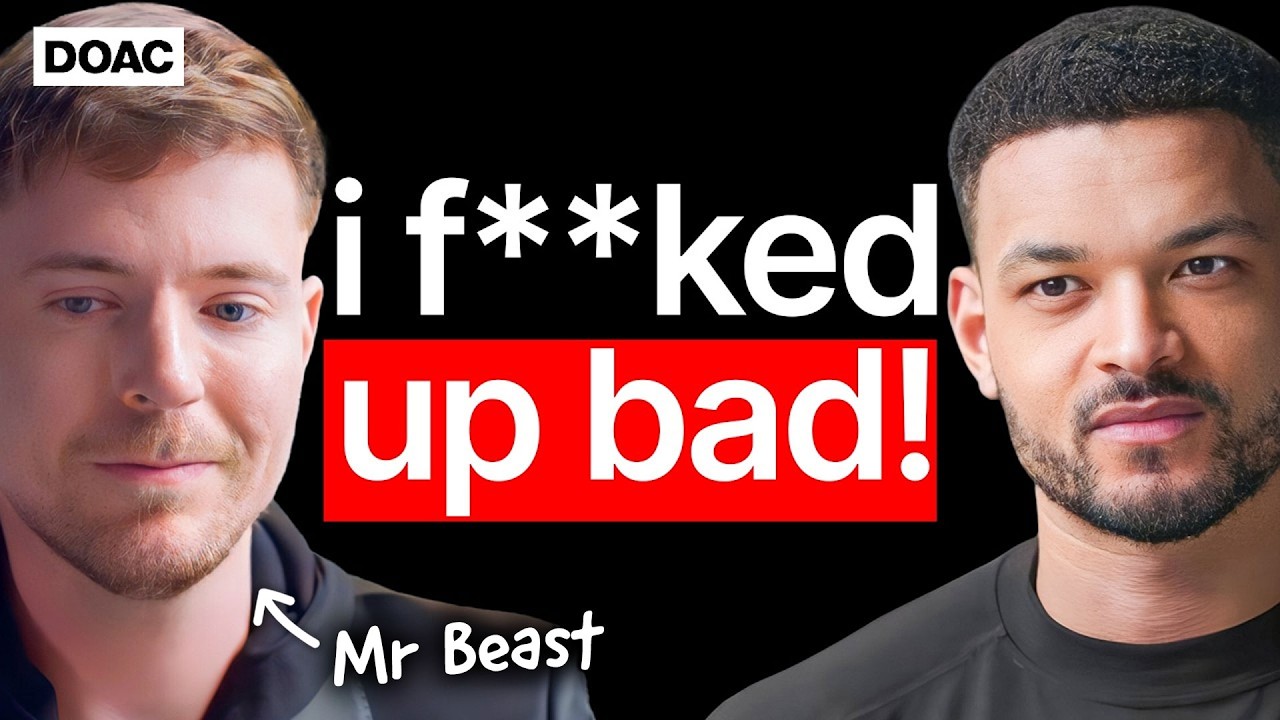
The Diary Of A CEO
Jimmy Donaldson absorbed massive out-of-pocket production losses on his Amazon series while refusing to sell Feastables or relax ethical sourcing standards on West African cocoa.
AI-assisted summary of MrBeast: If You Want To Be Liked, Don't Help People & I Lost Tens Of Millions On Beast Games! — original source. Check the original for full context.
Source published:
Detailed notes
## Background published this video on YouTube on February 20, 2025. The video description states that MrBeast, host of Beast Games and the world's most successful YouTuber, discusses his life, business empire, mental health, and recent ventures.
## TL;DR In this candid interview, Jimmy Donaldson (MrBeast) breaks down the intense physical and mental toll of running his YouTube channel and scaling Feastables, revealing that he routinely suffers from severe burnout and sleep deprivation to maintain his competitive edge. He details the operational nightmarish chaos behind launching Beast Games, which cost him tens of millions of dollars out of his own pocket despite Amazon's backing. Donaldson also opens up about his personal life—including his relationship with his fiancée Tia and plans for a family—and outlines his ethical mission to eradicate child labor from the cocoa supply chain. Throughout the discussion, he reiterates his refusal to sell his businesses, emphasizing that his relentless obsession with micro-details and high standards is what keeps his empire growing.
## Atmosphere & style The conversation carries an unusually raw, hyper-focused energy, balancing Steven Bartlett's probing, reflective interview style with Jimmy Donaldson's rapid-fire, uncompromising pragmatism. It feels intense and unvarnished, as Donaldson speaks with brutal honesty about his daily exhaustion, near-delirious filming schedules, and the immense stress of managing multi-billion-dollar scale. Despite the heavy subjects of burnout, ethical supply chain failures, and massive financial risk, there is a grounded, almost matter-of-fact confidence to the banter that keeps the dialogue engaging, candid, and dynamic.
## Key takeaways - [48:45](https://www.youtube.com/watch?v=FjrJ2DJN_pA&t=2925s) MrBeast relies on enduring extreme physical and mental discomfort, like surviving buried alive or isolated on islands, as his ultimate competitive moat that sets him apart from other creators. - [48:45](https://www.youtube.com/watch?v=FjrJ2DJN_pA&t=2925s) To handle cognitive load and avoid mental breakdowns caused by rapid gear shifting across different businesses, MrBeast restructured his daily workflow into strict time blocks. - [55:32](https://www.youtube.com/watch?v=FjrJ2DJN_pA&t=3332s) Because he is the non-negotiable face of his channel and cannot delegate his physical presence, filming intense projects like Beast Games severely bottlenecked his ability to scale other ventures. - [55:32](https://www.youtube.com/watch?v=FjrJ2DJN_pA&t=3332s) Despite his massive success, MrBeast constantly thinks about quitting YouTube to gain normal sleep schedules, though he recognizes stopping during high-cost productions is the ultimate failure. - [55:48](https://www.youtube.com/watch?v=FjrJ2DJN_pA&t=3348s) His fiancée Tia accommodates his relentless workload, creating a supportive, frictionless relationship with shared interests. - [01:00:20](https://www.youtube.com/watch?v=FjrJ2DJN_pA&t=3620s) MrBeast intends to wait to have children until he can be fully present, but currently satisfies his drive to teach by mentoring rising entrepreneurs and CPG brands. - [01:01:12](https://www.youtube.com/watch?v=FjrJ2DJN_pA&t=3672s) While Feastables and his media empire value him as a paper billionaire, MrBeast keeps less than $1 million in liquid cash, treating business expansion as a sport rather than personal wealth accumulation. - [01:03:44](https://www.youtube.com/watch?v=FjrJ2DJN_pA&t=3824s) After discovering widespread child labor in the West African cocoa supply chain, MrBeast pledged to scale Feastables ethically and refuse buyout offers from legacy corporations. - [01:09:02](https://www.youtube.com/watch?v=FjrJ2DJN_pA&t=4142s) He maintains an obsessive, hands-on leadership style, personally auditing Walmart shelves at night and running extensive field tests to fix retail packaging and display issues. - [01:18:26](https://www.youtube.com/watch?v=FjrJ2DJN_pA&t=4706s) To keep his channel growing after 14 straight years, he conducts rigorous post-upload analytics and fosters a culture that forgives costly creative mistakes as long as they stem from ambitious experimentation. - [01:22:36](https://www.youtube.com/watch?v=FjrJ2DJN_pA&t=4956s) Producing Beast Games required setting multiple world records and cost MrBeast tens of millions of dollars out of his own pocket beyond Amazon's original budget. - [01:32:55](https://www.youtube.com/watch?v=FjrJ2DJN_pA&t=5575s) Looking ahead to the next decade, MrBeast aims to hit 2 billion YouTube subscribers, rescue over a million children from forced labor, and focus on his family.
## Detailed walkthrough Here is a detailed, faithful walkthrough of the transcript section provided.
[00:00](https://www.youtube.com/watch?v=FjrJ2DJN_pA&t=0s) Teaser: The Price of Obsession
The episode opens with a candid glimpse into the mind of Jimmy Donaldson, known globally as MrBeast. Donaldson reflects on the singular nature of his life, stating that no one else creates content at his scale because "no one wants to live the life I live or be in my head—they would be miserable." Asked point-blank if he is happy, he pauses before admitting that, so far, he has been far more unhappy than happy, even acknowledging that the thought of quitting YouTube entirely has crossed his mind.
Host Steven Bartlett frames Donaldson as a monumental figure—the biggest YouTuber on Earth, holding the platform's largest channel at age 26, generating nine figures with his chocolate brand Feastables, and breaking production records with *Beast Games* despite losing tens of millions of dollars on its first season to ensure maximum quality. Yet Donaldson attributes his drive to a chaotic upbringing: feeling like a "confused child" and a "freak" who did not fit in, driven by an urgent need to help his family after they went bankrupt around the time he was 11. Donaldson touches on his hyper-fixation on complex global issues, such as targeting the 1.5 million child laborers in West Africa's cocoa farms through Feastables. Paradoxically, he notes that increased philanthropic effort has invited severe online backlash, including receiving over 5,000 suicide encouragement messages. He reflects that if his mental health were a priority, he would never have achieved this level of success—it is simply the price he pays.
[02:42](https://www.youtube.com/watch?v=FjrJ2DJN_pA&t=162s) Stubbornness, DNA, and the Isolation of Teen Obsession
Transitioning into the formal interview, Bartlett describes Donaldson as a "Rubik's Cube" due to his unique, uncompromising perspective on life. When asked what foundational elements from his early years explain who he is today, Donaldson zeroes in on his extreme stubbornness and refusal to quit. He recalls making a firm commitment at age 11 that he was going to be a YouTuber or "die trying." He insists that even if no one watched his videos today, he would still be uploading them regardless.
Donaldson explains that his relentless drive feels hardwired into his DNA rather than inherited. Growing up, his singular focus led to intense friction with his mother, who was constantly frustrated when his YouTube fixation took priority over schoolwork. During his teenage years, Donaldson briefly questioned whether his workaholism was unhealthy and tried to blend in with his peers. However, his attempts to adopt normal habits—such as forcing himself to watch *South Park*—failed because he felt it was a complete waste of time when he could be working. Unable to relate to anyone in his non-entrepreneurial school, he virtually stopped speaking altogether, to the point where a teacher asked if he was mute.
- Commenced his YouTube channel at 11 years old; currently 26 years old with 15 years of platform history. - Recalls a specific middle school memory of a high schooler calling him a "freak" for only talking about YouTube. - Shares this story specifically as encouragement for younger viewers in similar environments to realize they are not the problem—they simply need to change their environment.
[05:26](https://www.youtube.com/watch?v=FjrJ2DJN_pA&t=326s) Family Bankruptcy and Early Friction with His Mother
Donaldson expands on his family background and his relationship with his parents. While he chooses not to discuss his father, noting their history is a "sour way to start," he speaks candidly about his mother. In 2008, his parents were over-leveraged in real estate; when the housing market crashed, they lost everything and went bankrupt. His mother took on two jobs as a single parent to support Donaldson and his brother. During this era, Donaldson was diagnosed with Crohn's disease, and both brothers faced health struggles, compounding the stress on his mother.
Because his mother was working constantly to keep the family afloat, she was terrified by Donaldson's refusal to focus on traditional paths like high school academics. She frequently cried and begged him to do his homework. In response, a young Donaldson once bluntly told her, "If you want my homework done so bad, why don't you just do it?" Their dynamic was defined by a total failure to communicate; she feared he would end up homeless, while he was completely unfazed by financial risk and obsessed with building a business.
- Following the 2008 crash, his mother worked two jobs, leaving Donaldson and his brother largely self-supervised after school. - To protect him from financial collapse, his mother once secretly set aside $5,000 out of a $100,000 monthly YouTube payout into a separate bank account; upon finding out, Donaldson immediately wanted to reinvest it into video budgets. - After years of tension, his mother eventually surrendered to his vision, saying, "Jimmy, I trust you... I'm going to just follow your lead," which completely repaired their relationship. - Today, Donaldson fully supports his mother financially, purchasing her a second home and providing whatever she needs to repay her sacrifices.
[10:05](https://www.youtube.com/watch?v=FjrJ2DJN_pA&t=605s) Multi-Layered Motivations and the 18-Hour Study Calls
Bartlett asks what a 10-to-13-year-old Jimmy would have said about his life, to which Donaldson responds that he was constantly stressed about making YouTube work while nobody was watching. Pressed on why he chose YouTube specifically—given that it involves public visibility and explicit performance metrics—Donaldson explains that his early motivation was a mix of passion and financial desperation. Around age 11, he discovered that top creators were making hundreds of thousands of dollars, presenting a clear path to retire his mother and lift his family out of poverty.
Donaldson cautions against reducing human motivation to a single origin. While money was a major driver early on, his love for the process, the joy of building, and the desire to build a community were equally real. His dedication manifested in extreme habits: around age 19 or 20, he participated in a Skype call with a small group of friends to reverse-engineer YouTube's recommendation algorithm. That single call lasted over 18 straight hours; upon hanging up, he slept, woke up, and immediately rejoined the call to continue analyzing videos.
- Managed to transition his focus entirely to YouTube at age 15 after Crohn's disease caused his weight to drop from 190 lbs down to 139 lbs, ending his athletic prospects in baseball. - Describes his core superpower as an ability to hyper-focus on a single topic 16 hours a day for seven days straight without needing to "gear shift." - Notes that while he initially believed his sole passion was video production, building Feastables revealed that he harbors a deep love for general entrepreneurship and solving highly complex problems.
<ElicitationsGroup message="Where would you like to go next with this transcript analysis?"> <Elicitation label="Analyze MrBeast's thoughts on hiring and management" query="Provide a detailed walkthrough of MrBeast's discussion on hiring, employee traits, and workplace obsession from this interview."/> <Elicitation label="Examine his mental health and workaholism insights" query="Summarize the key sections from this interview where MrBeast discusses his mental health, workaholism, and coping with negativity."/> </ElicitationsGroup>
[14:50](https://www.youtube.com/watch?v=FjrJ2DJN_pA&t=890s) Battling Crohn's Disease and Living on "Hard Mode"
Jimmy Donaldson (MrBeast) opens up about his severe battle with Crohn's disease, an autoimmune condition where the immune system mistakenly attacks the gastrointestinal tract. He explains that his symptoms first manifested around age 15, causing him to use the bathroom eight to ten times a day without properly digesting food, leading to rapid weight loss of 50 lbs on his already lanky frame. He describes the intense pain of severe flare-ups as feeling like someone is constantly stabbing him in the stomach with a knife.
To manage the condition, Jimmy takes an extreme medication called Remicade, which functions by effectively suppressing his immune system. This leaves him exceptionally vulnerable to illnesses; he shares that he gets sick constantly, dealing with random rashes, having contracted COVID-19 six times, getting shingles, and recently spending four days in a hospital in South Africa after catching the flu. Jimmy reflects on how living with a compromised immune system means operating on "hard mode" daily, noting that anyone who wakes up naturally energized is already leaps and bounds ahead of him. He views current medical treatments as mere temporary band-aids and expresses frustration with the lack of better options short of major surgery to remove large portions of his GI tract.
The unpredictability of the disease creates immense mental and operational strain, especially when flare-ups coincide with massive multi-million dollar video shoots involving hundreds of crew members waiting on him. In those moments, he simply has to chug caffeine and push through the pain.
- **Age of Diagnosis:** Symptoms began at 15 years old. - **Physical Impact:** Lost 50 lbs during initial onset; uses the bathroom 8–10 times daily during flare-ups. - **Medication:** Takes Remicade, an immunosuppressant. - **Health Consequences:** Contracted COVID-19 six times, shingles, frequent flu episodes, and random skin rashes. - **Recent Incident:** Spent four days hospitalized in South Africa due to flu complications.
---
[18:04](https://www.youtube.com/watch?v=FjrJ2DJN_pA&t=1084s) Neurodivergence and the Superpower of Obsession
The conversation shifts as host Steven Bartlett mentions his own ADHD diagnosis, prompting Jimmy to address his own neurodivergence. Jimmy confirms that doctors have also diagnosed him with ADHD. While he isn't interested in defining himself by a label, he embraces how his brain is wired and has zero desire to change it. He considers his obsessive nature to be one of his greatest superpowers, arguing that if you spend three times as much time obsessing over and analyzing a problem compared to anyone else, you are bound to uncover unique solutions.
Jimmy highlights that surrounding himself with the right people is critical to directing his focus, as he absorbs the energy, speech patterns, and interests of those around him. He shares a prime example from launching Feastables: rather than trying to figure out the industry entirely on his own over eight or nine years, he proactively reached out to and befriended the founders of the fastest-growing chocolate and snack companies in the world. By picking their brains and downloading their "cheat codes," he became one of the top minds in the chocolate industry within just 18 months.
> "I think one of my greatest superpowers is my obsession... if you just think about solving problems three times more than everyone else, like you're bound to come up with different solutions."
---
[20:09](https://www.youtube.com/watch?v=FjrJ2DJN_pA&t=1209s) The Leaked Production Handbook and Extreme Ownership
Steven brings up the internal MrBeast production handbook that recently leaked online, noting its heavy emphasis on detail-orientation and chasing the "1% wins." Jimmy chuckles, explaining that he co-wrote that document around age 22. Looking back, he finds parts of it slightly naive, but maintains that its core principles still stand the test of time. He shares that several prominent CEOs have told him they now require their own employees to read the leaked guide—a practice Steven reveals his own team followed across their Slack channels.
The central pillar of the guide, Jimmy explains, is "extreme ownership" and a complete refusal to make excuses. When problems arise on set or in business, he teaches his team that even if an issue seemed out of their control, thorough preparation and deeper critical thinking could have brought it under control. The document was born out of his frustration with repeatedly teaching new hires the exact same fundamentals about accountability and caring deeply about their output.
---
[21:21](https://www.youtube.com/watch?v=FjrJ2DJN_pA&t=1281s) Extreme Ambition and the "Purple Cow" Strategy
When discussing the perception that his ambitions are extreme, Jimmy simplifies his philosophy down to basic physics: if the laws of physics allow something to be done, then it is inherently possible, provided you are willing to invest the necessary time. He admits that when people tell him he *shouldn't* do something, he considers it advice, but when someone tells him he *can't* do something, an intense spiteful motivation kicks in to prove them wrong.
To illustrate how he crafts viral videos, Jimmy details his "Purple Cow" analogy. If you drive down a road and see a normal cow, you pay no attention to it. However, if you see a purple cow, the sheer novelty shocks you into stopping, telling your friends, and remembering it for years. Jimmy applies this exact framework to content creation:
* **Ordinary Ideas (The Normal Cow):** Familiar topics that viewers scroll right past without a second thought. * **Radical Ideas (The Purple Cow):** Concepts so unbelievable or unprecedented that people feel compelled to click immediately just to satisfy their curiosity.
Jimmy explains that viewership operates on an exponential curve where winner-takes-all dynamics apply. Because it is far easier to get 50 million views on a single legendary video than 1 million views across 50 mediocre videos, he trains himself and his team to run toward insanely complex, original problems rather than avoiding them.
> "If you're driving down the road and you see a cow, who cares... but if you're driving down the road and you see a purple cow, you're like 'holy sh*t'... It's the same thing with ideas... you have to train yourself to not resent very difficult, complex, hard, original problems and actually run towards them."
---
[24:16](https://www.youtube.com/watch?v=FjrJ2DJN_pA&t=1456s) Hiring A-Players: Core Traits and the "Eighth Wonder of the World"
Steven asks Jimmy to outline the top characteristics required for an employee to succeed in the MrBeast organization. Jimmy lays out a specific profile centered on long-term value, coachability, and absolute commitment:
* **Coachability:** An eagerness to continuously learn and adapt, as protocols evolve rapidly year to year. * **Long-Term Vision:** A desire to build a decade-long career rather than treating the role as a temporary 1-to-2-year stepping stone. * **Obsession:** An intense passion for the craft and a total refusal to settle for mediocrity.
Jimmy describes investing heavily in an employee who stays for a decade as "the eighth wonder of the world" for a business. He points to his lead writer and director, Tyler, as a prime example. Jimmy spent four years working alongside Tyler in the trenches for five to six hours a day, instilling his exact mindset. Now, because Tyler can dedicate 100% of his time to writing and directing—whereas Jimmy can only allocate around 5% of his focus to it—Tyler repeatedly out-executes him, allowing Jimmy to show up to set with total trust in the final product.
> "Investing heavily in an employee and then they stick around for a decade... that is like the eighth wonder of the world."
---
[26:54](https://www.youtube.com/watch?v=FjrJ2DJN_pA&t=1614s) The Single Worst Trait in an Employee: B-Player Mediocrity
When asked for the single worst trait in an employee, Jimmy identifies **mediocrity**—specifically B-players who fall between clear A-players and obvious C-players. While C-players are easy to identify and fire, B-players are toxic because they perform just well enough to avoid termination while quietly dragging down the culture.
Jimmy explains that high performers thrive when surrounded by other elite talent, creating a compound effect of ambition and output. However, introducing mediocre employees into high-performing teams drains enthusiasm, makes work less enjoyable, and pulls A-players down. While acknowledging that support roles like bookkeeping don't necessarily require world-class visionaries, he insists that mission-critical creative roles must be staffed exclusively by elite, obsessed individuals. He notes that the primary reason top talent quits a company isn't compensation, but whether or not they enjoy and respect the people they work alongside.
[28:34](https://www.youtube.com/watch?v=FjrJ2DJN_pA&t=1714s) Finding "Unicorn" Employees and the Realities of Scaling
Jimmy Donaldson (MrBeast) dismisses the idea that he gets frustrated when employees fail to match his legendary level of obsession. Instead of getting upset, he simply seeks out the rare individuals who *do* share his drive. He emphasizes that while these people are "unicorns" who must be taken care of and paid well above standard rates, they genuinely exist within his organization. Key team members like Kitter Russ and several members of his editing team consistently log the same extreme hours he does because they fully buy into the vision.
Host Steven Bartlett points out that most founders view scaling headcount as the single hardest and most painful part of building a company—"more people, more problems." Jimmy wholeheartedly agrees, noting that managing rapid team growth has been a brutal learning curve: * **Current Headcount Breakdown:** Approximately 500 total employees across all ventures (~300 at the production company, ~100 at Feastables, and 40–50 scattered across other operations). * **The Founder's Dilemma at 26:** As a 26-year-old running his first major business, every organizational milestone (100, 200, 300 employees) is his first time experiencing it. * **Lessons Learned:** Scaling Feastables from 0 to 100 employees was far easier than scaling his production company because he had already gained experience and made initial mistakes. Looking back, he admits his biggest frustration is his own past ignorance—specifically waiting too long to bring in experienced leaders who had operated at larger corporate scales.
Jimmy explains how he previously overcorrected his management strategy. Fearful that traditional "corporate people" would build overly rigid systems that smother creativity and delay production, he swung the pendulum too far toward an anti-corporate structure. This lack of operational structure led to organizational missteps. Today, he seeks a healthy middle ground: bringing in an experienced C-suite and senior leaders who know how to manage large teams without crushing the creative process or prioritizing ease over the final product.
---
* "When you do [find those people], you got to treasure them and recognize that they're unicorns." * "Every employee milestone we hit, it's my first time hitting that... if I had known these things, I'd be way further along. But I mean, that's just how you learn. Just got to make 10,000 mistakes."
[32:56](https://www.youtube.com/watch?v=FjrJ2DJN_pA&t=1976s) Navigating Former Employee Backlash and Global Criticism
Steven shares his own anxieties about hiring on his show *Dragons' Den*, noting that high-profile figures face a massive incentive structure where former employees or media outlets are eager to throw arrows at them the moment they leave. Jimmy acknowledges this reality, pointing out that having worked with thousands of people over the years, negative chatter or rumors are statistically inevitable. He maintains an internal problem-solving mindset: if a criticism reveals a genuine mistake, he fixes it; if it is just baseless drama, he brushes it off, noting that "trash-talking old jobs" is practically a universal pastime regardless of the industry.
The conversation turns to the sheer, overwhelming scale of MrBeast's audience and why traditional feedback loops break down at his level: * **Global Reach:** His main channel averages ~200 million views per video. Excluding China (where YouTube is blocked), roughly 3% to 4% of every living human on Earth watches a given video within a year. * **The 1% Math Problem:** Even if a video achieves an astonishing 99% satisfaction rate, the remaining 1% of unhappy viewers represents **2 million people**—a group larger than the entire audience of most major creators. * **Developing an Internal Compass:** Jimmy stresses that relying on the internet's constantly shifting whims to define what is good, moral, or acceptable will destroy a creator's mental health and leave them spineless. To survive, he relies strictly on his own internal guidelines of ethics and morality rather than seeking 100% online approval.
---
* "You could just grab 33 random people on the planet and one of them on average would have seen that video because the views are so high." * "If you just let the whims of the internet kind of decide what is okay and what's acceptable... you don't have a backbone, you stand for nothing, and it will just destroy you mentally."
[37:18](https://www.youtube.com/watch?v=FjrJ2DJN_pA&t=2238s) Vulnerability, Crying Over Failure, and the Paradox of Philanthropy
Reflecting on whether intense online hatred ever gets to him, Jimmy admits that in his earlier days—around age 20—it routinely broke him down. Back then, he lacked confidence, was reinvesting every single dollar he made into videos, and had hired his closest friends and his mother. When a video underperformed or commenters called him "lazy" after he had poured hundreds of hours into a project, he would break down in tears, terrified that he was being reckless or that the algorithm was suppressing him. While he has developed a much thicker skin today, a heavy wave of drama or rumor-mongering can still occasionally get under his skin for a moment before he snaps out of it.
Jimmy addresses the bizarre internet paradox surrounding his philanthropic work, such as building water wells in Africa or paying for surgeries to cure blind people: * **The "Good Deed" Backlash:** In modern American media culture, audiences have been conditioned to assume that anyone doing explicit good must have a sinister hidden motive or be using philanthropy as a PR shield. * **The Bizarre Dynamic:** Jimmy jokes that if he buys a luxury yacht or posts a "$1 vs. $1,000,000,000 Boat" video, nobody bats an eye and people cheer him on. But when he provides clean drinking water to hundreds of thousands of people, critics attack him as "evil" or exploitative. * **Counterintuitive Advice:** He quips that if someone's goal on the internet is simply to be liked, he actively advises *against* helping people, as buying supercars generates far less hate than curing blindness or building infrastructure. * **Why He Keeps Doing It:** Despite the bad-faith criticism, Jimmy refuses to stop his charitable efforts because he simply believes "a world where I help people is just more fun than a world where I don't." Over time, he feels critics have realized he won't back down, leading them to accept that "Jimmy is just being Jimmy."
---
* "There's definitely times where I would cry... just because I would just be like, 'Fuck, am I not doing this right? They don't understand I put a lot of time into this.'" * "If you're trying to be liked, I actually don't recommend you help people... helping people will make the internet like you less than if you just buy nice cars and do the typical influencer path." * "When I build wells in Africa or help blind people see... you would think I'm Hitler. I mean, it's crazy like how people portray it."
<ElicitationsGroup message="Explore more from this interview:"> <Elicitation label="How MrBeast manages workaholism and mental health" query="Summarize the portion of the MrBeast interview where he discusses workaholism, mental health, and whether he is happy."/> <Elicitation label="MrBeast's production process and obsession with detail" query="Summarize the portion of the interview focusing on MrBeast's obsession with detail, raising standards, and editing."/> <Elicitation label="Behind the scenes of Beast Games and his financial risk" query="Summarize the section of the interview where MrBeast breaks down Beast Games, losing tens of millions, and giving away money."/> </ElicitationsGroup>
[43:04](https://www.youtube.com/watch?v=FjrJ2DJN_pA&t=2584s) Workaholism and 16-Day Filming Grinds
To illustrate the sheer physical toll of his schedule, MrBeast paints a vivid picture of his brutal itinerary over a single week. After traveling to South Africa to shoot a segment inside a cage surrounded by lions for a "5 Most Deadliest Places on Earth" video, he contracted a severe case of the flu and landed in a local hospital. Rather than returning home to recover, he pushed forward: he flew to North Carolina to film a weight-loss challenge video featuring a man living inside a custom gym, traveled to Florida to shoot with New York Yankees slugger Aaron Judge, and then flew in late at night to attend a *Beast Games* contestant reunion and record this podcast episode—finishing after 1:00 AM.
``` South Africa (Lions + Flu/Hospital) └─► North Carolina (Gym Weight-Loss Challenge) └─► Florida (Filming with Aaron Judge) └─► Podcast Filming (1:00 AM) └─► San Francisco (Steph Curry) └─► Snake Island & Deadliest Road ```
His upcoming schedule promises no respite, with planned stops in San Francisco to film with NBA star Steph Curry, followed by trips to Snake Island and the world's most dangerous road. All in all, he expects to be living out of a suitcase for at least 16 straight days. He candidly admits that constant travel has completely wrecked his personal routines. While working 15-hour days from home is manageable, jumping across unpredictable time zones destroys his sleep cycle—going to bed at 10:00 AM on some days and 5:00 PM on others—making it almost impossible to maintain his workout regimen.
* **The Stacking Effect:** Adding *Beast Games* (a massive Amazon Prime Video production) on top of his existing YouTube upload schedule, Feastables operations, and other business ventures pushed his workload beyond its absolute limit. * **Sleep Deprivation:** The combination of intense physical workouts and inadequate sleep causes extreme daily fatigue, forcing him to prioritize fixing his sleep schedule before regaining consistency at the gym. * **Current Physical & Emotional State:** Operating on high doses of caffeine while battling flu symptoms, he rates his current energy level on the lower end, though he admits to feeling a temporary emotional high from recently dropping the finale of *Beast Games*.
> "How you feel right now is why no one else does what you want to do or does what you do. And if you push through this, that's just even more of a reason why no one will ever be who you are."
---
[48:45](https://www.youtube.com/watch?v=FjrJ2DJN_pA&t=2925s) Suffering as a Competitive Advantage and Mental Health
Addressing his mental health, MrBeast reflects on the paradox of his success: if his mental state were balanced and serene, he would never have achieved his current scale. His willing capacity to endure extreme physical and mental discomfort—such as spending seven days buried alive, surviving on a deserted island, or remaining in solitary confinement—serves as his ultimate competitive moat. He operates on the firm belief that pushing through acute unhappiness, sleeplessness, and misery over the span of a decade is precisely what sets him apart from every other creator on the planet.
``` ┌────────────────────────────────────────────────────────┐ │ THE MRBEAST COMPETITIVE MOAT │ ├────────────────────────────────────────────────────────┤ │ Extreme Discomfort ──► Enduring Suffering ──► Scale │ │ (Buried Alive / (Pushing Through (1B Subs Goal│ │ 7 Days Island) Sleeplessness) No Rivals) │ └────────────────────────────────────────────────────────┘ ```
When asked about past comments to creators Colin & Samir regarding having "mental breakdowns every other week," he clarifies that while the term sounds dramatic, it refers to recurring moments of intense frustration where he questions why he subjects himself to such relentless difficulty. The core mental challenge stems from "gear shifting"—the cognitive fatigue caused by rapidly switching mindsets between filming on set, analyzing high-stakes marketing for Feastables in Chicago, and reviewing YouTube main-channel video concepts.
* **Target Goal:** He firmly believes his extreme drive will propel his channel to **1 billion subscribers**, a landmark he doubts anyone else will ever approach because most creators stop grinding once they earn a few million dollars. * **Managing Cognitive Load:** To avoid feeling like his "head is going to explode," he has restructured his schedule into blocks, focusing deeply on one business before transitioning to another rather than making 30 context switches a day. * **Reframing Strategy:** Whenever feelings of being an "animal in a zoo" or a "robot to my businesses" surface, he consciously reconditions his mindset, reminding himself that this self-imposed pressure is the price of changing the world and building an untouchable legacy.
> "Once you make a couple million dollars, why would you live the life I live? Why would you not take weekends off? Why would you not just film locally... It makes no sense, but that's why no one else does it."
---
[52:06](https://www.youtube.com/watch?v=FjrJ2DJN_pA&t=3126s) The Cost of Being MrBeast: Happiness vs. Scale
Reflecting on Elon Musk’s statement that "you wouldn't want to be in my head," MrBeast agrees that the average person would be deeply unhappy inside his mind. Most people would naturally recoil at working every single hour of the day and sacrifice their free will, wondering why they aren't relaxing or enjoying their wealth instead. His baseline emotional state so far this year has leaned more unhappy than happy, driven by the sheer burden of mandatory obligations that are grueling rather than enjoyable.
``` ┌──────────────────────────────────────────────────────────────────┐ │ THE PRESENCE BOTTLENECK │ ├──────────────────────────────────────────────────────────────────┤ │ Business Tasks ──► Can Delegate / Hire CEOs (Feastables, etc.) │ │ On-Camera Roles ──► CANNOT Delegate (Requires Jimmy's Presence) │ └──────────────────────────────────────────────────────────────────┘ ```
The fundamental tension in his life is the inability to delegate his physical presence. While he can hire world-class talent to manage operations for his corporate entities, he is the non-negotiable face of the MrBeast brand. Filming *Beast Games* added an enormous block of mandatory camera time onto an already packed calendar where he was already filming up to **25 days a month**, leaving zero room for entrepreneurial ventures like Feastables that he genuinely enjoys building.
* **Current Mood:** Varies daily; he notes he felt miserable while sick in a cage full of lions in South Africa, but generally finds genuine joy when focusing on consumer product innovation and business strategy. * **Opportunity Cost:** Every hour spent in front of a camera is an hour stolen from growing his enterprise, yet skipping filming completely halts the main media engine entirely. * **Personal Sacrifices:** Simple pleasures—such as playing strategy board games or maintaining a regular sleep schedule—have to be scheduled days or weeks in advance, making his calendar feel rigid and mechanical.
---
[55:32](https://www.youtube.com/watch?v=FjrJ2DJN_pA&t=3332s) The Constant Temptation to Quit
When asked if he has ever considered walking away from YouTube entirely like many high-profile creators who suffer burnout after hitting major milestones like 10 million subscribers, MrBeast admits that the thought crosses his mind constantly. He views creators who retire as completely reasonable human beings who reached their financial security goals—such as retiring their parents—and rationally chose to stop suffering.
He shares a dramatic example of a major breakdown during a shoot on a deserted island where he nearly hit his breaking point:
``` Deserted Island Shoot (Day 1) └─► Wakes up on Beach (Day 2) └─► Overwhelmed by 700+ Sand Flea Bites & Severe Sunburn └─► Delirious / Unable to See Straight └─► DECISION: Cancel & Abort Shoot (Massive Sunk Cost) ```
Waking up covered head-to-toe in over 700 excruciating sand flea bites, suffering from severe sunburn, and unable to see straight, he made the rare decision to abort the shoot on Day 2. Canceling a shoot represents the ultimate failure from an opportunity-cost standpoint, as it wastes hundreds of thousands of dollars, crew logistics, and precious schedule real estate without producing an uploadable video. Despite these brutal moments, he explains that YouTube is an inescapable "treadmill cranked up to the max"—once you reach the absolute top tier of the platform, the pressure to keep throwing coal into the engine never stops.
* **Frequency of Quitting Thoughts:** Occurs "all the time," particularly during high-stress challenge videos like seven days in solitary confinement. * **True Break Meaning:** Rather than quitting permanently, his desire to "quit" usually translates into wanting a single week off to get nine hours of sleep per night. * **The Creator Treadmill:** Acknowledges that the top level of content creation demands an endless supply of effort where stopping, even briefly, risks losing momentum.
> "Canceling a video like that is literally the worst thing that could happen from an opportunity cost perspective... You have moments like those and it's like, 'This isn't even fun.'"
[57:28](https://www.youtube.com/watch?v=FjrJ2DJN_pA&t=3448s) Relationship with Tia and a Frictionless Home Life
Jimmy (MrBeast) views his continuous work output as an endless race, comparing it to seeing "who can stay on the treadmill the longest" when the machine never slows down and only gets faster. Despite the immense pressure, he admits he has never seriously considered quitting, though he jokes that a break would have been nice. Looking ahead, he completely intends to keep pushing at this pace for the next two, three, or four decades.
A major stabilizing force in his life is his relationship with his fiancée, Tia. Jimmy reveals that he proposed to her on Christmas Day when her family was in town. He emphasizes how incredibly rare it is to find a partner who fits his intense lifestyle, stating that you could probably count on your hands the number of people on earth who would be a good match for him. Tia deeply understands that his work is what he lives for and what keeps him going. Their time together is entirely frictionless; they share the exact same interests, watch the same shows, play the same video games, and love to learn. Jimmy enjoys hearing about the online lectures she listens to or the unusual books she reads. This lack of friction is essential because he spends very little time at home, and the last thing he needs after a grueling day of work is domestic tension. He notes that they do not fight, affectionately describing her as his intelligent, attractive best friend.
* **How They Spend Time Together:** They primarily connect at night. Tia deliberately molds her schedule around his, working when he works and traveling alongside him. Their shared moments are built out of small pockets of time—on planes, during car rides, an hour before bed, in the morning, or during breaks on set. * **Independence and Sacrifice:** Jimmy highly values that Tia is exceptionally intelligent and has her own independent hobbies and pursuits, yet is still willing to adjust her life around his chaotic work schedule without viewing it as demeaning. He admits that if she did not compromise on her schedule, they would simply never see each other.
---
[01:00:20](https://www.youtube.com/watch?v=FjrJ2DJN_pA&t=3620s) Mentorship and the Timeline for Having Kids
When addressed with the classic parental advice to wait until he has children, Jimmy acknowledges that his current workaholic lifestyle is entirely incompatible with raising a family. While he definitely wants to have children in the future, he intends to wait as long as possible. He explains that if he is going to be a father, he is determined to be a great, fully present dad rather than an absent one. He needs to wait until he hits the right intersection in the Venn diagram where he can truly dedicate time to them.
Jimmy connects his desire for future fatherhood to his deep passion for mentoring people. He loves helping younger entrepreneurs succeed simply for the pure satisfaction of it. He recounts a story he previously shared on *The Joe Rogan Experience* about helping a friend scale their YouTube channel's revenue from $40,000 a month to $400,000. In another instance, he helped a friend with a consumer packaged goods (CPG) snack brand grow to eight figures in revenue just for fun, keeping in touch through a couple of phone calls a month. He looks forward to eventually having a couple of kids so he can mentor them into "being badasses."
---
[01:01:12](https://www.youtube.com/watch?v=FjrJ2DJN_pA&t=3672s) The Scale of the Feastables Empire and Reinvesting Wealth
The conversation shifts to the massive financial scale of Jimmy’s business empire, which the host notes is much larger than the general public realizes. While most people view him strictly as a content creator, Jimmy operates a multi-million dollar corporation. He confirms that Feastables generates nine figures in revenue, which easily implies the overall business is valued at several billion dollars.
When asked directly if he is a billionaire, Jimmy admits he is one "on paper." However, he reveals that his actual liquid bank account usually holds less than a million dollars. He does not take a massive salary, paying himself just a small amount to cover his monthly personal expenses and the cost of his assistants to essentially stay even. For Jimmy, money is not an avenue to early retirement or personal luxury; it is purely fuel to grow the business. He views building businesses as an incredibly fun video game. His fulfillment comes from taking an industry that has operated the exact same way for a century, flipping it on its head, and using his success to protect the planet and its people so he can look back at age 70 with zero regrets. He notes that if he were just making repetitive videos or running a mundane chocolate company like everyone else, he would be bored to death and ready to retire. Instead, he feels he is genuinely changing industries and impacting the world.
---
[01:03:44](https://www.youtube.com/watch?v=FjrJ2DJN_pA&t=3824s) The Harsh Reality of Child Labor in Big Chocolate
Jimmy rejects the idea that he struggles with focus despite the massive influx of opportunities he receives. Feastables has scratched the exact same creative itch as YouTube, making the process of building the company just as fun as filming videos. The host commends the taste of the chocolate, prompting Jimmy to dive deep into the stark realities of the American chocolate supply chain and why ethical sourcing is the core mission of Feastables.
When Feastables first launched, they sourced their cacao from Peru, where ethical supply chain issues are minimal. However, as the brand scaled rapidly, industry experts advised Jimmy to transition his supply chain to West Africa, where the vast majority of the world's cocoa is grown. Upon researching the region, Jimmy was horrified to learn that 46% of the labor on West African cocoa farms is child labor. When he reached out to major established chocolate corporations to ask how they address this issue, he was met with total indifference. Executives repeatedly told him "it just is what it is" and that it was simply how the industry had always functioned. Jimmy was deeply disturbed that billion-dollar profitable corporations were willingly building their empires on the backs of young children.
* **Boardroom Revelation:** Jimmy recalls a striking moment captured by his personal documentary filmmaker, Jeff. While sitting in a boardroom with a massive cocoa supplier, Jimmy asked if he could pay a premium or choose an alternative option to guarantee the exclusion of child labor. The supplier flatly told him no. Jimmy looked directly at the camera in utter disbelief that they admitted this so casually. * **The Root Cause:** The cheap price of mass-market chocolate in America is directly sustained by paying farmers less than a dollar a day. Because these farmers are paid below a living wage, they are financially forced to utilize child labor because they cannot afford to hire adult workers. * **The Scale of the Crisis:** There are over 1.5 million children trapped in child labor in West Africa specifically on cocoa farms.
---
[01:07:02](https://www.youtube.com/watch?v=FjrJ2DJN_pA&t=4022s) Driving Industry Change and Perfecting the Details
Jimmy's ultimate goal is to scale Feastables to a billion dollars a year in revenue as quickly as possible while remaining highly profitable and strictly ethically sourced. By achieving massive scale profitably, he intends to completely eliminate the excuses of legacy chocolate companies. He wants to prove to the world that ethical manufacturing at scale is entirely possible, forcing the rest of the industry to either change their ways or face public scrutiny. Long-term, he dreams of establishing his own version of a fair-trade seal of approval to help other brands source ethically, creating a cultural standard where the absence of the symbol implies the use of child labor. His explicit target over the next decade is to use his massive platform to rescue over one million children from child labor on cocoa farms.
When the host asks why he cares so deeply, Jimmy states the answer should be obvious: he has physically stood on these farms, and he refuses to get rich on the backs of little kids. He compares his mission to Elon Musk's early strategy with Tesla—proving that electric cars could be fast and highly desirable so that the legacy automotive industry could no longer claim electric vehicles were unviable. Because of this deeply ingrained mission, Jimmy adamantly states "hell no" to the idea of ever selling Feastables, even if someone offered him $5 billion. He knows the very first thing a corporate buyer would do to maximize profit margins would be to scrap the ethical sourcing standards. He notes he has also turned down billion-dollar offers for his YouTube channel in the past for similar reasons, echoing Mark Zuckerberg's famous logic that if he took the money, he would just spend it trying to build a new social media platform exactly like the one he already loves.
``` Feastables Structural Packaging Audit & Active Experiments ├── Current Issues │ ├── Blended Flavors: Dark Sea Salt and Dark Chocolate wrappers look identical from a distance. │ └── Back of Wrapper: Described by Jimmy as "pretty ass" with insufficient real estate utilized. └── Active Re-designs ├── Color-Coded Tips: Adding highly visible colored tips to wrappers for instant flavor identification. ├── Mission Messaging: Placing "Every bite helps get kids out of child labor" directly on the front. └── Imagery Upgrades: Utilizing new machinery to render significantly higher-quality chocolate images on the box. ```
Jimmy's obsession with meticulous micro-details becomes clear as he handles the Feastables bars sitting on the interview table. He immediately criticizes his own packaging, pointing out that from a distance, consumers cannot easily distinguish between the Dark Sea Salt and regular Dark Chocolate bars. To fix this, he is actively updating the wrappers to feature colored tips so the flavors stand out on retail shelves. He is also experimenting with machinery to improve the print quality of the chocolate images on the front, adding impactful messaging on the front wrapper stating "every bite helps get kids out of child labor," and completely re-engineering the back of the packaging to feature better brand storytelling.
[01:11:07](https://www.youtube.com/watch?v=FjrJ2DJN_pA&t=4267s) Early Mistakes, Unhinged QA, and Packaging Engineering
Jimmy (MrBeast) reflects candidly on the early days of launching Feastables chocolate, admitting how comically bad the initial product design was. When they first started, the chocolate bars were produced as a solid, flat sheet without the traditional scored break points. Because of this, dropping a bar caused it to shatter like a pane of glass into dozens of tiny fragments. Beyond the product itself, he was completely unaware that "packaging engineers" existed, resulting in retail display boxes that were dangerously unstable. When placed on Walmart shelves, pulling out one chocolate bar caused the entire box to lose balance and slide right off, spilling bars onto the floor.
When his internal team dismissed his concerns about broken bars as a minor industry-standard issue, Jimmy took matters into his own hands with absurdly direct methods. To prove how badly the boxes were failing on store shelves, he paid people to hide GoPros inside open bags of Lay's potato chips, placing them on Walmart shelves pointed straight at the Feastables display. The undercover footage captured endless incidents of mothers pulling a bar, only for the entire shelf display to collapse and dump shattered chocolate bars everywhere.
Determined to fix the customer experience no matter the cost, Jimmy eventually hired an agency called Acosta to send representatives into every single Walmart in America weekly to clean up shelves and manually buy back every broken bar.
- **The $100,000/week cleanup:** Sending representatives into all ~5,000 U.S. Walmart stores cost approximately $28 per store visit ($100,000 every week), on top of the cost of buying up all the broken inventory himself. - **The discovery of package engineers:** "Holy [__], this is your full-time job to make it where my boxes don't [__] fall over—where have you been?" - **Extreme customer standard:** Jimmy believes walking into a store and receiving a shattered chocolate bar is "literally the worst consumer experience you can have."
---
[01:14:22](https://www.youtube.com/watch?v=FjrJ2DJN_pA&t=4462s) Obsession with Details and First-Principles Leadership
Steven points out how completely atypical Jimmy's level of operational obsession is for a creator—or even a standard CEO who manages multiple massive enterprises. Jimmy reveals that he routinely spends all night inside Walmart stores studying chocolate displays, sales velocity data, and retail placement. He shares a story from a recent layover in Washington, D.C.: instead of flying straight back to North Carolina, he rented a car and visited around 30 Walmarts across the East Coast in the middle of the night, inspecting shelves and examining sales metrics aisle by aisle.
Jimmy explains that this level of scrutiny comes from a commitment to first principles. He refuses to be led blindly by industry "experts" or internal staff simply because he lacks domain knowledge. By mastering every step of the supply chain—from the retail shelf all the way back to cocoa farms in West Africa—he earns the authority to challenge assumptions, break status quo conventions, and drive genuine industry innovation.
> "I hate when someone in my business tells me something that I don't agree with, but I'm too ignorant to be able to challenge them... most people tend to pick the easiest route or conform to the status quo."
> "At the end of the day, the shelf is where people buy it. So I got to intricately know everything going on at the touchpoint of the consumer."
- **Store-level involvement:** When visiting Walmarts, Jimmy will actively walk into the back storage rooms, scan products in, and help store employees stock shelves if the item isn't on display. - **Equal passion outside YouTube:** Jimmy spent a week in West Africa tracking the supply chain from raw cocoa bean to finished bar, discovering that tackling complex business problems is just as fun and fulfilling as making videos.
---
[01:18:26](https://www.youtube.com/watch?v=FjrJ2DJN_pA&t=4706s) Analytics, After-Action Reports, and Managing Creative Mistakes
Addressing whether he suffers from paranoia over main channel performance, Jimmy notes that his YouTube views have grown every single year for 14 years straight. Rather than obsessively refreshing live view counters on release day, his team conducts systematic "After-Action Reports" roughly two weeks post-upload. A dedicated analyst prepares a massive presentation breaking down the retention curve, click-through rates (CTR), and specific timestamps where viewer drop-off or engagement spikes occurred.
Jimmy outlines how they objectively grade video performance: by benchmarking the new video's median view duration against the average of the last ten videos of identical length. If a video underperforms—such as a recent "Every Minute Someone Is Eliminated" video that suffered from a repetitive intro and confused viewers who mistook it for *Beast Games*—he focuses on analyzing facts rather than placing blame.
- **Benchmark math:** For a 20-minute upload, if the median retention across the last ten 20-minute uploads was 10 minutes and 55 seconds, any performance above 11 minutes is deemed a success. - **Tolerating expensive mistakes:** Jimmy encourages a culture where team members aren't punished for honest creative failures. He often reminds his team that his key executive, Tyler, has "cost me tens of millions of dollars in bad decisions," framing those losses as an essential investment in learning. - **The rule on errors:** Mistakes are acceptable as long as the underlying reason is articulated and the same error is never repeated twice.
---
[01:20:54](https://www.youtube.com/watch?v=FjrJ2DJN_pA&t=4854s) Culture of Experimentation and Ad Break
Jimmy emphasizes that continuous testing is the lifeblood of long-term success, even though high-risk experimentation carries the highest probability of failure. He points to another experimental video—where a contestant had to navigate down a massive tower before time ran out to prevent a room explosion—that failed to resonate because the concept was overly complicated. He maintains that if a leader yells at employees or punishes them for failed experiments, the creative culture deteriorates into safe, repetitive content.
> "Your highest chance of flopping is when you do something new... as long as we failed because we made the wrong shot call, not because we were lazy, I'm cool with that. We can do that all day."
---
*(Sponsor Break)* Steven transitions into personal endorsements for podcast sponsors **PerfectTed** (matcha energy products sourced from ceremonial-grade Japanese matcha) and **WHOOP** (fitness and recovery tracking wearables).
Making Beast Games and the Financial Reality
Steven reflects on the culmination of Beast Games, noting that it stands as the largest competition show in history—setting records for 50 Guinness World Records, massive sets, the highest cash prize, and the most contestants and cameras. Jimmy admits that while he feels a playful sense of sadness now that it is over because he will miss the weekly anticipation of internet reactions, he barely has time to dwell on it because there is always another project on the horizon. He mentions talks with Amazon about securing season two. Discussing the logistical nightmare behind the scenes, Jimmy reveals the staggering scale required to capture 24/7 footage without relying on traditional "story producers" who feed lines or manufacture drama: "Whereas we're just like, fuck it, we're going to be filming, you know, 24/7 all these cameras, you guys be yourselves, we'll just capture it."
To pull this off, they broke world records for camera cables laid, required millions of dollars in storage, hardware, and control rooms, and even had to work directly with Adobe to custom-modify software capable of handling that many multi-cams simultaneously. The local IT infrastructure constantly crashed under the sheer volume of data, forcing them to build custom server racks. When Steven brings up Amazon's funding, Jimmy drops a bombshell: despite the massive budget, he lost tens of millions of dollars out of his own pocket because they spent far too much money building colossal sets like the 1,000 ten-foot towers in episode one and the $14 million real-city set in episode two.
* **Show scale:** Over 150 editors working through an unfathomable volume of raw footage. * **Financial outcome:** Jimmy states, "I lost money, I would have more money if I didn't film it," but confirms he has zero regrets. * **Strategic impact:** The massive success of the show—achieving a roughly 90% approval rating from fans on Rotten Tomatoes and ranking as Amazon's number-one unscripted show of all time with strong evergreen daily viewership—proved that a major YouTube creator could successfully execute a high-end streaming spectacle, opening doors for the wider creator economy.
---
Looking Ahead 10 Years and Childhood Memories
Looking forward a decade, Jimmy—who would be 36 years old—resists the temptation to map out a rigid path, noting that five years prior he never would have predicted Feastables or his current scale. His future goals include reaching two billion subscribers on YouTube, growing Beast Games, helping get over a million kids out of child labor through Feastables, launching two or three other passionate businesses, and potentially starting a family once he has enough time to be a good dad. Steven then surprises him by pulling up old childhood photos from the internet. Looking at the pictures of himself as a young boy, Jimmy tries to figure out what military base house or temporary home he was living in while his parents traveled for the military.
Reflecting on his childhood self, Jimmy recognizes the phase where he felt like a complete freak who didn't fit in because no one else cared about building businesses and succeeding. If given a microphone to speak to his younger self, he wouldn't say anything—not even "buy Bitcoin"—out of fear that altering his past struggles would change the outcome and jeopardize the grit and conviction he gained. Turning to old photos of his mother from the period when they lost everything and she was at a low point following military discipline, Jimmy remarks that nothing he could have said back then would have convinced her that her "lunatic son" was on the right path, especially when he later dropped out of college with straight zeros.
* **Mother's support:** Despite the friction during his college drop-out days, Jimmy expresses deep gratitude for his mother, acknowledging that her hard work, providing internet access, and occasionally giving him $20 or $30 to help fund his early video experiments were foundational to his success. * **Current status:** Jimmy shares that he and his mother are in a wonderful place today, full of love and appreciation for one another after the 12-to-13-year journey from hardship to massive success.
By the way, to unlock the full functionality of all Apps, enable [Gemini Apps Activity](https://myactivity.google.com/product/gemini).
Here is a detailed, faithful walkthrough covering the final portion of the transcript.
[01:37:33](https://www.youtube.com/watch?v=FjrJ2DJN_pA&t=5853s) Jimmy's Mother, Financial Perspective, and Health Protocols
Jimmy (MrBeast) reflects on his mother's financial struggles while he was growing up. When he turned 16, she couldn't afford to buy him a car or repair their beat-up family minivan, which had smoke pouring out from under the hood. At the time, she was making around $40,000 a year, though they rarely discussed finances. When Jimmy secured his first $40,000 brand deal for a single YouTube video, he was stunned to learn that it equaled her entire annual salary. He remembers asking her why she was still working if he could make that amount per video, telling her, "Fuck math homework, Mom, I'm making YouTube videos."
Recognizing everything she sacrificed and went through to give him the tools to succeed, Jimmy feels strongly that she deserves a happy, stress-free life now. Because he plans to have kids later in life—meaning his mother could be in her 70s when they are born and potentially in her 80s as they grow into teenagers—he insists on strict health and longevity protocols for her. He lightheartedly pressures her to maintain a routine exercise regimen, undergo regular full-body health scans, and follow a solid vitamin routine so she remains active and capable of playing with her future grandchildren. When Steven notes that losing his mother seems to be one of Jimmy's few true fears, Jimmy jokingly jokes about Bryan Johnson and quips, "My mom's gonna live forever, we'll be fine."
- **Mom's Salary vs. Brand Deal:** She earned $40,000 annually; Jimmy matched her full annual income with a single $40,000 brand deal on YouTube. - **Health & Longevity Focus:** Jimmy pushes his mother through playfully firm conversations to focus on exercise, full-body scans, and supplements so she can remain active when she is in her 70s and 80s for his future children.
[01:39:50](https://www.youtube.com/watch?v=FjrJ2DJN_pA&t=5990s) The Last Guest's Question and Final Words
Following the podcast's tradition, Steven presents a question left by the previous guest without revealing who wrote it: *"Would you rather die with a sound body or a sound mind?"* Jimmy ponders the choice, noting that losing one's mind implies conditions like dementia. He answers that he would choose a sound mind, asking, "What are you if you don't have your mind?"
Steven then takes a moment to express deep personal gratitude to Jimmy. He shares how creators and their teams constantly study and borrow Jimmy's principles, obsession, and relentless mentality to improve their own work. Steven mentions that being "weird" or different comes with a heavy cost during youth when forced into rigid traditional structures, but that as adults, society celebrates those same unique individuals. Having seen a behind-the-scenes look at *Beast Games* recently, Steven describes how his mind exploded and how he realized he had been limiting his own ambitions. He credits Jimmy with creating a blueprint that inspires hundreds of millions of people to break free from the boxes imposed by schools and traditional systems. Jimmy expresses his genuine appreciation for the praise before jokingly concluding, "All right, let's see if we can break into a Walmart."
- **Closing Question:** Jimmy chooses a **sound mind** over a sound body when asked the traditional final question. - **Steven's Praise:** Acknowledges Jimmy for providing a roadmap and expanding what ambitious creators believe is possible through his work on YouTube and *Beast Games*. - **Closing Promotion:** Steven promotes *The Diary Of A CEO Conversation Cards* (available at `thediary.com`), explaining how scanning the barcodes on the cards reveals which guest answered each question.
## Notable quotes > [51:00](https://www.youtube.com/watch?v=FjrJ2DJN_pA&t=3060s) Once you make a couple million dollars, why would you live the life I live? Why would you not take weekends off? Why would you not just film locally... It makes no sense, but that's why no one else does it. — Jimmy (MrBeast)
> [47:04](https://www.youtube.com/watch?v=FjrJ2DJN_pA&t=2824s) How you feel right now is why no one else does what you want to do or does what you do. And if you push through this, that's just even more of a reason why no one will ever be who you are. — Jimmy (MrBeast)
> [55:32](https://www.youtube.com/watch?v=FjrJ2DJN_pA&t=3332s) Canceling a video like that is literally the worst thing that could happen from an opportunity cost perspective... You have moments like those and it's like, 'This isn't even fun.' — Jimmy (MrBeast)
> [01:11:07](https://www.youtube.com/watch?v=FjrJ2DJN_pA&t=4267s) Holy [__], this is your full-time job to make it where my boxes don't [__] fall over—where have you been? — Jimmy (MrBeast)
> [01:14:22](https://www.youtube.com/watch?v=FjrJ2DJN_pA&t=4462s) I hate when someone in my business tells me something that I don't agree with, but I'm too ignorant to be able to challenge them... most people tend to pick the easiest route or conform to the status quo. — Jimmy (MrBeast)
> [01:14:22](https://www.youtube.com/watch?v=FjrJ2DJN_pA&t=4462s) At the end of the day, the shelf is where people buy it. So I got to intricately know everything going on at the touchpoint of the consumer. — Jimmy (MrBeast)
> [01:20:54](https://www.youtube.com/watch?v=FjrJ2DJN_pA&t=4854s) Your highest chance of flopping is when you do something new... as long as we failed because we made the wrong shot call, not because we were lazy, I'm cool with that. We can do that all day. — Jimmy (MrBeast)
> [01:22:36](https://www.youtube.com/watch?v=FjrJ2DJN_pA&t=4956s) Whereas we're just like, fuck it, we're going to be filming, you know, 24/7 all these cameras, you guys be yourselves, we'll just capture it. — Jimmy (MrBeast)
> [01:22:36](https://www.youtube.com/watch?v=FjrJ2DJN_pA&t=4956s) I lost money, I would have more money if I didn't film it — Jimmy (MrBeast)
> [01:37:33](https://www.youtube.com/watch?v=FjrJ2DJN_pA&t=5853s) Fuck math homework, Mom, I'm making YouTube videos. — Jimmy (MrBeast)
> [01:37:33](https://www.youtube.com/watch?v=FjrJ2DJN_pA&t=5853s) My mom's gonna live forever, we'll be fine. — Jimmy (MrBeast)
> [01:39:50](https://www.youtube.com/watch?v=FjrJ2DJN_pA&t=5990s) Would you rather die with a sound body or a sound mind? — Steven Bartlett
> [01:39:50](https://www.youtube.com/watch?v=FjrJ2DJN_pA&t=5990s) What are you if you don't have your mind? — Jimmy (MrBeast)
> [01:39:50](https://www.youtube.com/watch?v=FjrJ2DJN_pA&t=5990s) All right, let's see if we can break into a Walmart. — Jimmy (MrBeast)
## Mentioned Acosta, Adobe, Amazon, Aaron Judge, Beast Games, Beast Philanthropy, Bryan Johnson, Elon Musk, Feastables, GoPro, Guinness World Records, Jeff, Jimmy Donaldson, Lay's, Mark Zuckerberg, MrBeast, PerfectTed, Rotten Tomatoes, Steph Curry, Steven Bartlett, Tesla, The Diary Of A CEO, The Joe Rogan Experience, Tia, Vanta, Walmart, WHOOP, YouTube
[Source](https://www.youtube.com/watch?v=FjrJ2DJN_pA)