UK Debt and Tax Traps Risk Civil Decay, Gary Stevenson Warns
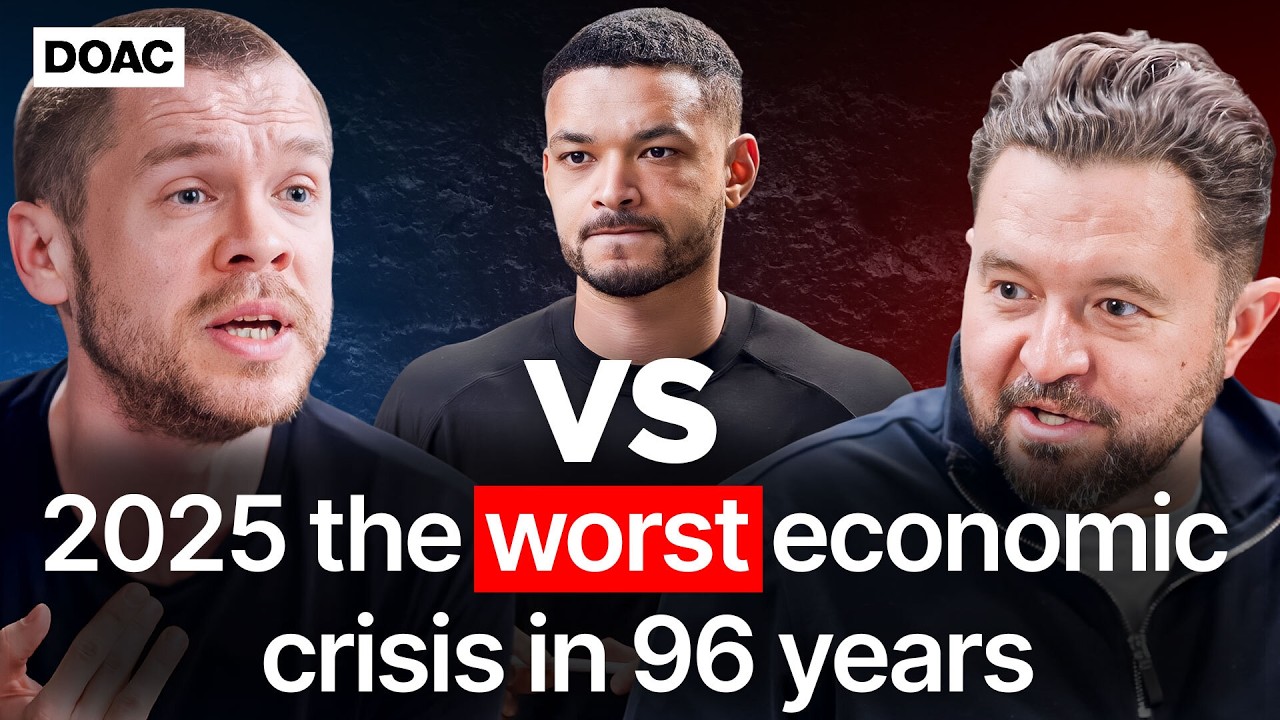
The Diary Of A CEO
Post-pandemic wealth concentration and tax loopholes threaten to trap lower-income citizens in structural poverty unless the UK shifts from taxing income to taxing accumulated wealth.
AI-assisted summary of EMERGENCY DEBATE: They Lied About The Economy Recovering! Is A Financial Apocalypse Coming? — original source. Check the original for full context.
Source published:
Detailed notes
## Background This episode of The Diary Of A CEO, hosted by Steven Bartlett and published on YouTube on March 20, 2025, features an emergency economics debate between Gary Stevenson and Daniel Priestley. According to the show description, the guests break down an emergency financial crisis no one is talking about and discuss whether the economy is on the brink of collapse.
## TL;DR The debate centers on whether economic stagnation and rising poverty are caused by growing wealth inequality or by over-regulation and high taxation choking economic freedom. Former trader Gary Stevenson argues that systemic capital concentration and wealth extraction are destroying middle-class asset ownership, advocating for marginal wealth taxes on multi-millionaires to fund public services. Serial entrepreneur Daniel Priestley counters that economic growth, digital scale-ups, and personal agency are the true paths to prosperity, warning that punitive taxes drive wealth creators offshore. Host Steven Bartlett guides the conversation across key issues including tech monopolies, remote work, housing affordability, and the role of the state.
## Atmosphere & style The atmosphere is intense, passionate, and deeply personal, characterized by a sharp clash between two contrasting economic philosophies. Stevenson brings an urgent, combative energy driven by working-class advocacy and personal frustration, while Priestley maintains a pragmatic, optimistic, and business-focused composure centered on opportunity and agency. Guided by Bartlett's probing moderation, the discussion balances rigorous macroeconomic arguments with emotional personal anecdotes, creating a compelling and visually dynamic debate.
## Key takeaways - [00:00](https://www.youtube.com/watch?v=4yohVh4qcas&t=0s) The fundamental debate centres on whether growing wealth inequality and asset concentration (Stevenson's view) or excessive government regulation, high taxes, and lack of individual agency (Priestley's view) are primarily responsible for falling living standards in Western economies. - [02:04](https://www.youtube.com/watch?v=4yohVh4qcas&t=124s) Gary Stevenson contends that systemic inequality threatens to reduce Western nations like the UK to extreme structural poverty similar to South Africa or Nigeria if unaddressed. - [09:53](https://www.youtube.com/watch?v=4yohVh4qcas&t=593s) Daniel Priestley highlights that the UK's score on the Economic Freedom Index fell from 82/100 in 2006 to 68/100 post-COVID, arguing that government overreach and high taxation suppress enterprise and growth. - [13:22](https://www.youtube.com/watch?v=4yohVh4qcas&t=802s) COVID-19 stimulus policies accelerated wealth concentration, as low-income households spent stimulus money on basic needs while asset owners and corporate shareholders captured the capital flows. - [15:35](https://www.youtube.com/watch?v=4yohVh4qcas&t=935s) The pandemic-era shift to the digital economy concentrated market gains into a small cluster of tech giants, with the 'Magnificent Seven' growing from $5 trillion pre-pandemic to approximately $17 trillion. - [17:48](https://www.youtube.com/watch?v=4yohVh4qcas&t=1068s) The UK faces a severe housing imbalance where 78% of housing wealth is held by Baby Boomers (aged 65+), making homeownership increasingly unreachable for younger generations. - [20:03](https://www.youtube.com/watch?v=4yohVh4qcas&t=1203s) Priestley distinguishes between Wealth Extraction (trading existing fixed assets) and Wealth Creation (innovative entrepreneurship expanding economic output), advocating for policies that encourage the latter. - [30:39](https://www.youtube.com/watch?v=4yohVh4qcas&t=1839s) US economic growth (6% GDP in Q4 2024 vs. UK's 0.1%) significantly outperforms the UK, though Stevenson attributes this to massive US government deficits rather than free-market small-state policies. - [44:31](https://www.youtube.com/watch?v=4yohVh4qcas&t=2671s) Over 10,800 millionaires left the UK in 2024 following the abolition of non-dom status, sparking debate on whether high tax rates cause destructive wealth flight or if non-doms fail to pay their fair share. - [48:39](https://www.youtube.com/watch?v=4yohVh4qcas&t=2919s) Multinational corporations leverage intangible assets and intellectual property licensing to shift profits offshore, creating an unequal tax burden that disproportionately hits domestic small businesses and citizens. - [55:24](https://www.youtube.com/watch?v=4yohVh4qcas&t=3324s) Stevenson advocates for a marginal annual wealth tax (e.g., 1%) on assets above £10 million to fund income tax cuts for working citizens, arguing static asset wealth must be taxed rather than labor. - [01:12:20](https://www.youtube.com/watch?v=4yohVh4qcas&t=4340s) Stevenson strongly criticizes wealthy individuals telling impoverished families to 'be entrepreneurial,' arguing it shifts blame onto victims when systemic barriers prevent social mobility. - [01:14:05](https://www.youtube.com/watch?v=4yohVh4qcas&t=4445s) Priestley emphasizes the critical importance of personal agency, arguing that waiting for political saviors leaves people powerless, whereas the digital economy gives individuals accessible tools to build income. - [01:18:08](https://www.youtube.com/watch?v=4yohVh4qcas&t=4688s) Technological advancement drives three stages of workforce disruption—simplification/replacement, globalization via remote work, and full software/AI automation. - [01:24:41](https://www.youtube.com/watch?v=4yohVh4qcas&t=5081s) Stevenson contends that the 70-year post-WWII middle-class prosperity was a historical anomaly driven by deliberate wealth redistribution, and warning that capitalism naturally reverts to extreme wealth concentration. - [01:37:07](https://www.youtube.com/watch?v=4yohVh4qcas&t=5827s) Priestley advocates for breaking up Big Tech monopolies that control entire digital ecosystems to ensure new startup entrepreneurs can compete effectively. - [01:54:56](https://www.youtube.com/watch?v=4yohVh4qcas&t=6896s) Steven Bartlett highlights that traditional educational systems fail young people by teaching obsolete subjects rather than modern digital literacy, financial mechanics, and entrepreneurial skills.
## Detailed walkthrough ### [00:00](https://www.youtube.com/watch?v=4yohVh4qcas&t=0s) Introduction and the Opening Debate
The episode kicks off with an intense confrontation between former City Bank trader Gary Stevenson and serial entrepreneur Daniel Priestley. Gary expresses deep frustration at multi-millionaires telling struggling working-class families that they simply need to be more entrepreneurial when they cannot even afford heating. Daniel counters that if he had adopted Gary’s worldview—which posits that without a rich parent, success is nearly impossible—he would have been ruined at twenty years old. Host Steven Bartlett introduces the emergency debate on the state of the UK, US, and Western economies, framing the central conflict: are average citizens getting poorer because of government over-reach, high taxes, and stifling regulations, or is growing wealth inequality squeezing ordinary families out of basic needs like housing?
---
[02:04](https://www.youtube.com/watch?v=4yohVh4qcas&t=124s) Who Is Gary Stevenson?
Gary Stevenson shares his backstory, tracing his journey from an underprivileged background in Ilford, outer East London, to the upper echelons of global finance. Growing up in a modest terraced house near the railway tracks, Gary was exceptionally gifted at mathematics. His talent earned him a spot at the London School of Economics (LSE), which he describes as an elite investment banking boot camp. In June 2008, at twenty-one years old, Gary landed a job at City Bank in London as a short-term interest rate trader—plunging him directly into the epicenter of the global financial crisis.
``` GARY STEVENSON'S CAREER PATHWAY
[ Raised in Ilford ] ───► [ LSE Economics ] ───► [ Citibank Trader (2008) ] (Outer East London) (Elite Math Focus) (Short-Term Rates Desk) │ [ Campaigner / Author ] ◄─── [ Top Global Trader ] ◄──────────┘ (Wealth Inequality) ($35M+ Profit in 2011) ```
Gary explains how short-term interest rate trading became the absolute core of the market during the Lehman Brothers crash, as credit dried up globally. While traders around him made vast fortunes overnight, Gary became fascinated by the macroeconomic forecasting errors that followed. As central banks slashed interest rates to zero in 2008, consensus economists consistently predicted rates would rapidly rebound in 2009, 2010, and 2011. Gary recognized that these highly paid experts were fundamentally misunderstanding the structural changes in the economy. Realizing he could capitalize on their mistake, he placed massive, counter-consensus bets that the recovery would fail and rates would remain depressed. In 2011, at just twenty-four years old, Gary became Citibank's most profitable trader worldwide, single-handedly generating over $35 million in profit.
- **Background:** Raised in a working-class family in Ilford, East London; attended the London School of Economics. - **Trading Career:** Joined Citibank in June 2008 on the short-term interest rates desk at age 21, right before the Lehman Brothers crash. - **Key Trade:** Bet against global economic recovery predictions when consensus repeatedly miscalculated rate hikes from 2009 to 2011. - **Financial Result:** Generated over $35 million in profit for Citibank in 2011, making him the bank's top-performing trader globally. - **Core Warning:** Argues that systemic wealth inequality will push Western nations toward extreme, structural poverty similar to that seen in South Africa or Nigeria if left unchecked.
---
[07:19](https://www.youtube.com/watch?v=4yohVh4qcas&t=439s) Who Is Daniel Priestley?
Daniel Priestley outlines his own path to financial success, coming from a low-income background in Australia where regional unemployment reached 24%. Surrounded by limited career options—primarily construction, pest control, and hospitality—Daniel took jobs at McDonald's, bars, and Pizza Hut delivery at fourteen. His turning point came through discovering books on entrepreneurship, which revealed how business ownership could build generational wealth. Since moving to the UK in 2006, Daniel has built and acquired a portfolio of seven companies across software, digital agencies, and business education, with one software firm ranking among the fastest-growing enterprises in the UK.
Despite their differing economic philosophies, Daniel agrees with Gary that the UK faces severe structural decay. Drawing parallels to Charles Dickens' *A Tale of Two Cities*, Daniel asserts that the modern UK represents "the best of times" for those integrated into the digital, high-growth economy, and "the worst of times" for everyone else. He notes that energy costs in the UK are now among the highest in the Western world, while housing affordability has collapsed: saving for a home deposit historically took three years, but now requires up to twenty years for the average worker.
---
[09:53](https://www.youtube.com/watch?v=4yohVh4qcas&t=593s) The Importance of Economic Freedom
Daniel introduces the concept of the Economic Freedom Index, arguing that a nation's prosperity directly correlates with market accessibility, ease of starting businesses, and low regulatory drag. High economic freedom creates widespread affluence and low poverty rates, whereas low economic freedom breeds stagnation. He cites India's economic deregulation as a success story that drastically reduced extreme poverty. Conversely, he highlights how the UK's economic freedom score plummeted from 82 out of 100 in 2006 down to 68 out of 100 following successive waves of government intervention after the 2008 financial crisis and the COVID-19 pandemic.
| Economic Metric / Indicator | UK Historical Standard | Current UK Condition | |:--- |:--- |:--- | | **Time to Save a Home Deposit** | ~3 Years | ~20 Years | | **Economic Freedom Index Score** | 82 / 100 (in 2006) | 68 / 100 (Post-COVID) | | **COVID-19 Deficit Spend (UK)** | Baseline Budgets | £1 Trillion (~£20,000 per adult) | | **COVID-19 Deficit Spend (US)** | Baseline Budgets | $4 Trillion–$14 Trillion total stimulus |
---
[11:46](https://www.youtube.com/watch?v=4yohVh4qcas&t=706s) Who Are We Blaming for the Economic Situation?
Daniel examines the cultural differences in how citizens respond to declining living standards. In the UK, historical memory leads the public to blame wealthy land-owners, aristocracy, and "the rich." In the US, the populace exhibits a strong anti-government instinct, blaming federal overreach, inflation, and burdensome taxation—a sentiment captured by the 2023 hit song *Rich Men North of Richmond*. Consequently, Americans demand smaller government and structural cuts, whereas British voters demand higher taxes on wealth.
---
[13:22](https://www.youtube.com/watch?v=4yohVh4qcas&t=802s) The UK & US Debt We're Carrying From COVID
Gary counters Daniel's narrative by focusing on the massive transfer of wealth triggered by pandemic stimulus packages. He points out that since COVID-19, the UK government accumulated over £1 trillion in deficits—equivalent to £20,000 for every British adult—while the US government injected trillions of dollars into the financial system. Gary emphasizes that lock-down policies effectively banned the rich from spending their discretionary income while flooding lower-income households with stimulus to cover basic living expenses. As working-class citizens spent their government stimulus on rent, food, and energy, those funds trickled directly up to asset owners and corporate shareholders. Because lockdowns prevented the wealthy from spending, this capital accumulated at the top, accelerating wealth concentration on an unprecedented scale.
> "At the beginning of COVID, we knew governments across the world were going to be giving out tens of trillions of pounds, dollars, euros... Nobody even thought to ask who's going to get tens of trillions richer. Nobody in the Conservatives, nobody in Labour, nobody in the Republicans, nobody in Democrats, nobody in the media... It's almost beautiful. It's unbelievable."
<ElicitationsGroup message="To explore the economic mechanisms discussed in this segment further:"> <Elicitation label="Analyze the mechanics of post-COVID wealth concentration" query="Explain how COVID-19 stimulus policies and lock-downs resulted in a wealth transfer from lower-income households to top asset holders, using Gary Stevenson's framework."/> <Elicitation label="Compare the US and UK Economic Freedom Index shifts" query="Compare how economic regulations and tax policy changes affected the Economic Freedom Index ratings for the US and UK post-2008."/> </ElicitationsGroup>
[015:35] The Pandemic's Digital Shift and the Rise of the "Magnificent Seven"
Daniel Priestley explains that during the COVID-19 pandemic, the global economy underwent a massive, rapid digital transformation. As everyone was forced to work from home and local high streets closed down, society learned to operate remotely through digital channels. This led to a huge migration of capital from the traditional 2019 "High Street economy" into the digital tech economy. Investors poured money into technology giants, creating the "Magnificent Seven" (the seven massive US tech companies: Apple, Microsoft, Alphabet, Amazon, Nvidia, Meta, and Tesla), whose combined valuation surged from around $5 trillion before the pandemic to approximately $17 trillion. Priestley highlights that roughly 50% of the S&P 500's gains can be attributed to tech companies, driving a massive surge in remote work tools, e-commerce platforms like Shopify, and media ventures like YouTube.
In Priestley's view, this technological wave is now the primary dividing line in modern society. Anyone working in digital sectors—whether media, technology, or finance—tends to do remarkably well post-pandemic. However, Gary Stevenson interrupts to challenge the practical reality of this premise, questioning whether an ordinary British or American worker who quits their traditional job to work in tech can realistically achieve financial security, particularly when facing the crushing cost of housing and the expenses of raising a family.
- The combined valuation of the "Magnificent Seven" tech stocks rose from $5 trillion to $17 trillion during the pandemic era. - Tech stocks account for approximately 50% of the total market gains in the S&P 500.
[017:48] The Housing "Traffic Jam" and Generational Wealth Distribution
The debate transitions into the housing crisis, which both speakers agree is a critical problem, though they attribute it to different causes. Priestley shares a personal example, noting that his father bought a house decades ago for under $18,000 (less than £10,000), which is now worth well over $1 million. He emphasizes that runaway property prices are not unique to the UK or the US, pointing out that even social-democratic countries like Norway and Sweden have seen home values skyrocket by 600%.
Priestley describes the core issue in the UK as a structural "housing traffic jam." He points out that 9.5 million family homes in the UK currently have two or more empty bedrooms, with 78% of all housing wealth owned by the Baby Boomer generation (those over 65). He illustrates this with an anecdote about taking his kids trick-or-treating down a street of large family homes, where almost every door was answered by elderly residents living alone in houses with unused bedrooms. Stevenson counters with his own family experience, noting that all four of his grandparents owned property, but all died with nothing because their wealth was drained by equity release schemes, retirement living costs, and end-of-life care.
- In the UK, 9.5 million homes have two or more spare bedrooms. - 78% of UK housing wealth is held by Baby Boomers (people aged 65 and older). - More than half of the total US economy's wealth is in the hands of the Baby Boomer generation. - Scandinavian countries like Norway and Sweden have experienced housing price increases of up to 600%.
[020:03] Wealth Creation vs. Wealth Extraction
The discussion intensifies as Stevenson and Priestley clash over the mechanics of wealth creation and debt. Priestley argues that government interventions, ultralow interest rates, and cheap debt artificially inflated home values, allowing buyers to take on larger loans and driving prices out of reach. Stevenson counters by asking who sits on the other side of that debt, challenging the idea that ordinary families possess true credit or cash, and pushing the point that young working-class people are being systematically shut out from owning any property or wealth.
Stevenson challenges the panel directly: "Do we three multi-millionaires think it's okay that the average Brit or American young person will never own any wealth?" He accuses Priestley of viewing the economy through an idealized lens while ignoring the reality of middle- and working-class impoverishment. Priestley responds by drawing a clear distinction between two economic worldviews:
1. **Wealth Extraction:** The domain of financial traders who bet on existing assets and extract value from a fixed pie without creating new utility. 2. **Wealth Creation:** The domain of entrepreneurs who innovate, start companies, and expand the total size of the economic pie.
To illustrate wealth creation, Priestley describes how startup valuation works: an entrepreneur creates a tech concept, raises a few hundred thousand pounds in seed capital from investors at a multi-million-pound valuation, and builds a brand-new asset without taking wealth away from anyone else in the existing economy.
[024:03] Historical Taxes, Economic Freedom, and Government Size
Addressing why ordinary workers are struggling, Priestley argues that economic growth is being choked by high taxes, heavy regulations, and bloated government spending, which suppress economic freedom. Stevenson asks whether economic freedom was higher in the 1950s—a period famous for strong middle-class growth. Priestley points out that the 1950s were a unique anomaly: Britain was under strict food rationing until 1956, suffering severe postwar labor shortages (exacerbated by hundreds of thousands of war casualties and women not yet fully in the workforce), and rebuilding from the Blitz. This high demand for labor led to ultra-low unemployment (around 2%) and a postwar baby boom that drove massive consumption, followed by high top marginal tax rates reaching 80% to 90% in the late 1960s.
Priestley highlights that government spending now accounts for 45% of total UK GDP, up from roughly 30% in earlier eras, funded largely by endless debt creation through central banks. When Stevenson presses him on whether cutting government spending will actually help the average person, Priestley argues that smaller governments and high economic freedom produce widespread prosperity, citing examples like Singapore, Ireland, and Switzerland. Stevenson scoffs at the Singapore comparison, remarking that its apparent prosperity ignores low-wage migrant workers "living in the closets," and points out that Ireland's tax-haven economy still leaves the average worker struggling to afford a home in Dublin.
- UK government spending currently accounts for roughly 45% of total GDP. - Post-WWII UK unemployment fell to around 2% during the reconstruction boom. - Top marginal income tax rates in the UK reached 80% to 90% in the late 1960s.
[026:03] "Capitalism Is Finished, We Won": Gary Stevenson's Warning
Stevenson delivers a stark critique of the modern economic consensus, directly confronting Priestley's free-market optimism:
> "I make money by being right on the economy... I know you're probably a wealthy man, you probably don't want to pay high taxes... but we exist in an economy where wealth is being extracted out of the middle class, out of the working class, very, very rapidly. It's benefiting people like the three of us at this table... our kids will be rich, their kids will be poor. And I just think we should be honest with them. Capitalism's finished. We won. Well done Stephen, well done Daniel, well done Gary. It's over now. Our kids will be rich, their kids will be poor... Why are we lying to them?"
Priestley rejects Stevenson's view as overly simplistic, arguing that dynamic market economies still allow people to succeed if they connect themselves to productive sectors like technology. He points to an upcoming global "split test" between the UK (which is moving toward higher taxes and more regulations) and the US (which is leaning toward deregulation and tax cuts). Stevenson counters with the human cost of the current system, sharing that his own sister can no longer afford the rent to live in the city where she was born. He insists that telling average people to just "connect to productive sectors" ignores the fundamental breakdown of social mobility for the majority of the population.
<ElicitationsGroup message="Explore related economic debates from this episode:"> <Elicitation label="Examine the debate on taxing billionaires and corporate tax avoidance" query="Walk through the debate on taxing billionaires, corporate tax avoidance, and profit shifting from the Diary Of A CEO debate transcript."/> <Elicitation label="Explore the discussion on monopolies and advice for younger generations" query="Summarize the discussion on monopolies, inheritance taxes, and advice for younger people from the Diary Of A CEO transcript."/> </ElicitationsGroup>
[30:39](https://www.youtube.com/watch?v=4yohVh4qcas&t=1839s) US vs. UK Economic Performance and Growth Metrics
Steven Bartlett opens with a stark statistical comparison highlighting the sharp divergence between the US and UK economies. In Q4 2024, the US economy grew by **6%**, whereas the UK managed just **0.1%**. GDP per head in the US stands at **$82,000** compared to **$49,000** in the UK. The disparity extends to financial markets and productivity: over a given timeline, the US stock market surged by **300%** while the FTSE 100 fell by **20%**. Furthermore, US productivity has outpaced the UK's by growing **30%** since 2018, and American per-capita income has risen by **72%** in dollar terms since 2007, compared to a **2%** decline in the UK.
Gary Stevenson challenges the idea that these figures prove free-market, small-state capitalism is superior. He points out that the US government has aggressively expanded its deficit and state intervention—reaching **45%** of GDP under the Biden administration—while the UK conservative government spent 14 years enforcing austerity. In Gary's view, the government running massive deficits drastically outperformed the one cutting state services. Daniel Priestley strongly counters, arguing that the UK government only engaged in "austerity in name only," expanding its footprint from **30%** of GDP to **45%** while delivering degraded public services and wasting tens of millions on corporate consulting firms.
- **GDP Growth (Q4 2024):** US **6%** vs. UK **0.1%**. - **GDP Per Head:** US **$82,000** vs. UK **$49,000**. - **Stock Market Trends:** S&P/US markets up **300%** vs. FTSE 100 down **20%**. - **Productivity Growth (Since 2018):** US up **30%**. - **Income Per Head (Since 2007, USD terms):** US up **72%** vs. UK down **2%**.
---
[33:26](https://www.youtube.com/watch?v=4yohVh4qcas&t=2006s) Offshore Remote Work, Global Tech Domination, and Government Waste
Daniel explains that one of the largest structural drains on the UK working class is the acceleration of remote work post-pandemic. High-paying British jobs are increasingly being offshored to lower-cost labor markets like the Philippines, India, and Vietnam. Concurrently, high-earning individuals and tech entrepreneurs are leaving for tax havens; Daniel notes that **1,000 millionaires a month** are moving to Dubai, where over **120,000 British citizens** now reside. While the US and China have consolidated their power by building massive tech powerhouses within their borders, Europe and the UK have allowed their technology sectors to decline, causing a severe erosion of well-paying domestic jobs.
A debate breaks out when Gary demands to know what specific government spending Daniel would cut if he advocates for a smaller state—offering options like police, education, the NHS, pensions, or single-mother and disability benefits. Daniel redirects the fault back to bureaucratic inefficiency and "blood-sucking" consulting firms paid **$50 million** for reports, rather than frontline workers. Gary dismisses Daniel's reluctance to tax top wealth, demanding that government focus on taxing billionaires and major asset owners rather than squeezing working-class taxpayers.
> "I worked my tits off and I paid... 50% top rate tax plus National Insurance—60%—to bring my family out of poverty at the same time the Duke of Westminster inherited 10 billion and paid nothing. Do you think that's fair?" — **Gary Stevenson**
---
[35:52](https://www.youtube.com/watch?v=4yohVh4qcas&t=2152s) The Duke of Westminster, Wealth Taxes, and Trusts
The debate grows tense as Daniel refutes Gary’s claim that the Duke of Westminster paid no tax on his **£10 billion** inheritance. Daniel explains that the Grosvenor Estate is held in a trust, meaning it pays a "periodic tax" of **6% every 10 years** (averaging **0.6% annually**) rather than a one-time **40%** inheritance tax, because trusts never legally "die." Gary scoffs at this math, pointing out that paying **0.6%** annually on inherited wealth is vastly lower than the **60%** tax rate he paid on his earned income every single year. Daniel insists Gary is making an "apples to oranges" comparison by conflating income tax with estate transfer taxes, asserting that the Duke pays income tax, corporate tax, stamp duty, and VAT like everyone else and remains one of the UK's largest taxpayers and employers.
Gary maintains that the current tax framework privileges inherited multi-billion-pound fortunes over earned labor, creating a multi-generational aristocracy while working-class families struggle to heat their homes. Daniel warns that adopting a punitive "tax the rich" mindset will ultimately destroy economic opportunities for ordinary citizens by driving investors and builders away. Gary sarcastically accepts Daniel's stance, noting that as a trader, he will personally make money in financial markets regardless, but it is the audience who suffers under the status quo.
- **Duke of Westminster Estate Value:** Estimated **£10 billion**. - **Trust Periodic Tax Rate:** **6%** every 10 years (**0.6%** per year). - **Standard UK Inheritance Tax:** **40%**. - **Gary's Top Earned Tax Rate:** **60%** (Income Tax + National Insurance).
---
[39:21](https://www.youtube.com/watch?v=4yohVh4qcas&t=2361s) Intangible Assets, Consumption Taxes, and Corporate Profit Shifting
Daniel shifts the discussion to the changing nature of wealth, observing that in the 1970s, **75%** of the S&P 500's value was tied to physical assets like real estate and factories, whereas today over **95%** consists of intangible assets (intellectual property, software, brand equity). Because modern corporate wealth and high-net-worth individuals are hyper-mobile, attempting to levy a **1%** direct wealth tax will simply cause wealth creators to relocate. When Gary suggests taxing multinational companies based on point-of-sale revenues in the countries where they operate, Daniel calls this a consumption tax that gets passed down to ordinary consumers.
The two find brief common ground in condemning corporate profit-shifting loopholes. Daniel highlights the absurdity of HM Revenue and Customs (HMRC) aggressively auditing everyday citizens making a few pounds on eBay or Facebook side hustles, while allowing tech giants to operate with near-total tax impunity within the UK. He slams corporate structures where UK-based purchases are funneled through foreign subsidiaries to evade tax.
- **1970s S&P 500 Asset Composition:** **75%** physical assets. - **Modern S&P 500 Asset Composition:** Over **95%** intangible assets. - **Starbucks Royalty Licensing:** Licensing logos out of Luxembourg at **15%** to reduce taxable domestic profits. - **Tech Corporate Tax Havens:** Facebook licensing through Ireland; Amazon billing via Luxembourg.
> "It strikes me as very strange that the government... is chasing down moms and dads who sell a few things on eBay... but Facebook's fine to pretend to be in Ireland." — **Daniel Priestley**
---
[44:31](https://www.youtube.com/watch?v=4yohVh4qcas&t=2671s) The UK Millionaire Exodus and the Non-Dom Tax Scheme
Steven introduces alarming data regarding the mass departure of wealth from the United Kingdom, labeled the "millionaire exodus." In 2024 alone, an estimated **10,800 high-net-worth individuals** departed the UK—a **57% increase** from the prior year, equivalent to losing one millionaire every **45 minutes**. Steven adds that losing this millionaire cohort equates to losing the tax contributions of **530,000 average taxpayers**. Moreover, in the US, the top **10%** of earners drive nearly half of all consumer spending, while in the UK, the top **1%** of income taxpayers are projected to generate **30%** of all income tax revenue for 2024–2025.
Gary and Daniel clash over the root causes of this flight. Gary attributes it to the collapsing purchasing power of British households, arguing that businesses are leaving because the domestic consumer base is impoverished. Daniel counters that the exodus directly correlates with recent legislative changes, specifically the abolition of the UK's long-standing Non-Domiciled ("non-dom") tax status. Under the new regulations, UK tax residents face global tax exposure on all worldwide assets and foreign income, forcing international entrepreneurs to flee to lower-tax jurisdictions like Dubai or Switzerland.
- **2024 UK High-Net-Worth Departures:** **10,800 millionaires** (up **57%** year-over-year). - **Exodus Rate:** 1 millionaire leaving every **45 minutes**. - **Tax Contribution Equivalent:** Loss of **10,800** millionaires equals the income tax impact of **530,000** average taxpayers. - **UK Tax Concentration:** Top **1%** of earners generate **30%** of total UK income tax (2024–2025).
[46:21](https://www.youtube.com/watch?v=4yohVh4qcas&t=2781s) The Debate Over Wealth Flight and Non-Dom Status
``` 1% OF UK POPULATION ┌──────────────────────────────────────────────────────┐ │ Pays 30% of total UK income taxes │ └──────────────────────────────────────────────────────┘ 10% OF UK POPULATION ┌──────────────────────────────────────────────────────┐ │ Pays 60% of total UK income taxes │ └──────────────────────────────────────────────────────┘ ```
Daniel Priestley presents a stark warning about the consequences of changing tax rules for high-net-worth individuals, specifically mentioning the breakdown of the UK's non-domiciled ("non-dom") regime. He explains that wealth managers have advised affluent clients to leave the country as tax rules shift toward taxing global income and inheritance at rates up to 40%. Daniel highlights that roughly 1,000 wealthy individuals are leaving the UK every month, cautioning that driving away top taxpayers risks devastating public finances. He framing this with a dinner bill analogy: if 10 people go to dinner and one person offers to pay 60% of the check, demanding they pay 80% instead will simply cause them to walk out—leaving the remaining guests to split a much higher bill.
Gary Stevenson rejects this premise, countering that non-doms were essentially guests at the dinner table who agreed to attend only on the condition that they wouldn't pay their fair share. He asserts that wealthy individuals leave not because they are overtaxed on local contributions, but because the system began requiring them to pay taxes on their global earnings rather than granting them tax shelters. Gary argues that high-net-worth individuals escape to places like Dubai to make money off Western economies without contributing to local infrastructure, leaving average citizens unable to afford housing or families. When Gary suggests taxing corporate profits at the point of sale, Daniel points out that taxing at the point of sale is functionally a consumption tax rather than a profit tax, which sets off a debate on how modern multinational corporations handle revenue.
- **Taxation distribution:** In the UK, 1% of taxpayers contribute 30% of income tax revenues, while the top 10% contribute 60%. - **Exodus rate:** Approximately 1,000 wealthy individuals are leaving the UK monthly due to non-dom tax changes. - **Gary Stevenson's direct quote:** "Isn't it a bit more like if there were 10 of us at dinner, and there was one guy who came to dinner on the condition he wouldn't pay?"
---
[48:39](https://www.youtube.com/watch?v=4yohVh4qcas&t=2919s) Profit Shifting and the Duty to Fight Hard Battles
``` ┌─────────────────────────────────────────────────────────────┐ │ DANIEL'S VIEW ON TAXATION │ │ Digital corporate structures make profit shifting easy; │ │ aggressive tax hikes drive wealth & capital overseas. │ └──────────────────────────────┬──────────────────────────────┘ │ ▼ ┌─────────────────────────────────────────────────────────────┐ │ GARY'S VIEW ON TAXATION │ │ Governments must intentionally outlaw profit shifting and │ │ fight hard battles to protect the working class from poverty.│ └─────────────────────────────────────────────────────────────┘ ```
Daniel details how modern digital business models easily bypass traditional national profit taxes. Companies can lease databases from entities in Luxembourg or license intellectual property from tax havens, effectively shifting profits out of high-tax jurisdictions before local governments can touch them. Gary responds that profit shifting is not an unchangeable law of physics—it is a political choice. He points out that countries like China do not tolerate profit shifting, nor did Western nations 50 years ago. He criticizes the government and media classes for telling the public that taxing global capital is impossible simply because it is difficult.
Delivering an impassioned speech, Gary stresses that he returns to the UK to advocate for these policies despite the personal difficulty. As a multimillionaire, he notes he could easily choose to live a life of leisure in the Philippines, but he chooses to fight because he comes from a working-class background and refuses to watch ordinary families slide into deep poverty. He draws a historical parallel to past generations who fought for healthcare, education, and social housing, arguing that society must take on hard challenges rather than giving up.
> "We don't try and do things which are necessary to keep our kids out of poverty because they are hard, then our kids will live in poverty... Sometimes we have to do things not because they are easy, but because they are hard. That is what makes a rich country rich." — **Gary Stevenson**
- **Corporate tax mechanisms:** Multinationals route profits via foreign licensing agreements and database leases in low-tax jurisdictions (e.g., Luxembourg). - **Historical context:** Gary argues that the post-WWII generation demanded healthcare, housing, and education despite severe economic hardship, rather than surrendering to wealth concentration.
---
[50:34](https://www.youtube.com/watch?v=4yohVh4qcas&t=3034s) Remote Work, Tax Flight, and Corporate Valuation
Daniel agrees with Gary's passion regarding working-class struggles, but maintains that Gary's proposed solutions fail to account for modern realities like remote work and global mobility. Following the COVID-19 pandemic, business owners no longer need to reside in the country where their revenue is generated. He illustrates this by pointing out how local service providers—such as gym trainers or restaurant workers—often work for businesses whose owners live overseas. If the UK imposes harsh taxes on individuals worth £10 million or more, Daniel explains that high earners will simply pass a board resolution, move their head offices, transfer intellectual property abroad, and establish non-tax residency within weeks.
To show the practical difficulty of taxing paper wealth, Daniel uses Gary's own growing YouTube channel (which had hit 820,000 subscribers) as a hypothetical case study. He explains that an analyst could easily value Gary's media brand at £11 million based on growth projections. Under a 1% annual wealth tax on assets over £10 million, Gary would suddenly owe £10,000 in cash every year on purely unrealized, paper gains. Daniel argues that taxing unrealized gains is notoriously difficult, as it penalizes paper valuations, discourages angel investment, and incentivizes founders to set up foreign entities to hold their company's equity.
``` GARY'S YOUTUBE MEDIA BRAND (HYPOTHETICAL VALUATION) ┌────────────────────────────────────────────────┐ │ Estimated Brand Valuation: £11,000,000 │ │ Wealth Tax Threshold: £10,000,000 │ │ Taxable Paper Wealth: £1,000,000 │ │ 1% Wealth Tax Owed: £10,000 │ └────────────────────────────────────────────────┘ ```
- **Audience metrics:** Gary Stevenson's YouTube channel reached 820,000 subscribers at the time of recording. - **Relocation speed:** Daniel notes an entrepreneur can shift corporate residency using services like WeWork and Airbnb within a week or two. - **Taxation structure:** Gary clarifies that his proposed wealth tax is marginal (applying only to the asset value *above* the £10 million threshold, not the entire wealth pool).
---
[55:24](https://www.youtube.com/watch?v=4yohVh4qcas&t=3324s) The Economic Freedom Index vs. Wealth Redistribution
``` HIGH ECONOMIC FREEDOM LOW ECONOMIC FREEDOM ┌──────────────────────────┐ ┌──────────────────────────┐ │ Poverty Rate: Below 7% │ VS. │ Poverty Rate: ~30%+ │ └──────────────────────────┘ └──────────────────────────┘ ```
Daniel presents a chart of the Economic Freedom Index, arguing that countries with higher economic freedom consistently display poverty rates below 7%, whereas nations that restrict economic activity see poverty rates climb past 30%. He asserts that reducing government intervention and lowering taxes encourages business creation, which naturally alleviates poverty far better than heavy taxation. He performs a rough napkin calculation showing that a 1% tax on wealth over £10 million in the UK might yield around £20 billion annually—assuming zero tax flight—which represents less than a single week of the UK government's annual £1.2 trillion spending budget.
Gary pushes back, proposing higher marginal rates (such as 3%) and lower thresholds to raise significant revenue (e.g., £60 billion), which could then be used to cut income tax and National Insurance for everyday workers. He asserts that wealth concentration is directly responsible for ordinary people losing access to property, as asset ownership shifts away from the middle class into the hands of the ultra-rich.
- **Economic Freedom Index stats:** High-freedom nations exhibit under 7% to 10% poverty; low-freedom nations experience poverty rates exceeding 30%. - **UK Budget Context:** Total UK government spending is approximately £1.2 trillion per year. - **Napkin math:** A 1% wealth tax above £10 million generates an estimated £20 billion annually, which equates to roughly £250 in tax relief per working person if redistributed directly.
---
[57:51](https://www.youtube.com/watch?v=4yohVh4qcas&t=3471s) Tech Monopolies and the Missing UK Tech Giants
Daniel points out that the vast majority of global wealth creation since the pandemic has concentrated in seven major US tech giants (the "Magnificent Seven"), which gained an estimated $11 trillion in market value. He notes that taxing UK multimillionaires does nothing to capture that wealth creation, as those tech founders and companies are based in the United States. Host Steven Bartlett interjects with a fundamental concern: rather than just debating how to tax existing wealth, why is the UK failing to create any of these dominant global technology companies in the first place?
Steven highlights the rapid rise of artificial intelligence, sharing an example where AI software (from companies like ElevenLabs and OpenAI) generated a near-perfect clone of his voice and produced an entire podcast episode rated 4.6 stars on Apple Podcasts without his manual input. He cautions that if the UK does not build an environment that fosters entrepreneurship and retains top technical talent, it risks falling behind as a technological colony to the US and China.
``` GLOBAL TECH WEALTH CONCENTRATION (POST-PANDEMIC) ┌─────────────────────────────────────────────────┐ │ Market Value Added by US Big Tech (7 Companies):│ │ $11,000,000,000,000 │ └─────────────────────────────────────────────────┘ ```
- **US Tech dominance:** Seven major US tech companies saw their valuations increase by $11 trillion following the pandemic. - **AI capabilities:** Steven Bartlett notes an AI tool cloned his voice to write, produce, and publish a podcast episode that achieved a 4.6-star user rating. - **Brain drain example:** Steven cites a London-founded AI startup, Fixer, whose 25-year-old British founders relocated to San Francisco to raise capital at a $60 million valuation due to the lack of local UK venture capital and talent density.
<ElicitationsGroup message="Explore further details from this debate:"> <Elicitation label="Walkthrough Part 5: NHS Funding, Crime, and Education" query="Provide a detailed walkthrough of Part 5 of this transcript covering tax evasion, the NHS, crime, and the education system."/> <Elicitation label="Summarize Gary vs. Daniel's core economic philosophies" query="Summarize the core differences between Gary Stevenson's redistribution model and Daniel Priestley's free-market entrepreneurship model."/> </ElicitationsGroup>
[01:01:00](https://www.youtube.com/watch?v=4yohVh4qcas&t=3660s) The AI Trap and Taxing Wealth vs. Income
Stephen Bartlett steps in to challenge the notion that building massive global tech companies in the UK is an impossibility, pointing to his own journey and arguing that San Francisco shouldn't be the sole model. However, Gary Stevenson quickly counters that the UK—and virtually everywhere else outside of Silicon Valley and China—is facing a losing game in AI and mega-tech. AI, Gary points out, is a unique beast: an "extremely low labor, extremely high capital model" that employs very few people globally while concentrating immense wealth into a couple of geographic hubs. Trying to duplicate Silicon Valley in London is a fool's errand when giant state-capitalism models like China or first-mover behemoths in the US already dominate.
Daniel Priestley pivots the discussion to technology at large rather than raw AI research, arguing that technology integration is transforming media, editing, transcription, and everyday operations. But Gary insists the UK government must focus on tangible domestic needs—like repairing falling-apart housing stock—rather than chasing buzzwords. More crucially, Gary reiterates his central economic thesis: the UK must dramatically lower income taxes for working people and entrepreneurs who produce value, but relentlessly tax massive accumulated wealth. When Daniel asks whether a founder should be taxed on a £50 million paper valuation before an exit, Gary clarifies that whether through capital gains, direct wealth taxes, or preventing multi-generational wealth hoarding, society must stop super-wealthy families from continuously expanding their share of the pie at the expense of ordinary working households.
- **Capital concentration in AI:** Gary highlights that AI requires massive capital expenditure while generating remarkably few direct jobs globally. - **Taxing income vs. assets:** Gary argues that lower taxes on active earnings paired with higher taxes on static wealth is the only way to restore economic balance. - **Paper wealth dilemma:** Daniel raises the operational risk of taxing non-liquid assets (e.g., a founder whose company is valued at £50M or £100M while they only hold £20,000 in cash).
---
[01:04:34](https://www.youtube.com/watch?v=4yohVh4qcas&t=3874s) Exits, Offshore Tax Havens, and the Breakdown of Society
Stephen brings up a concrete story about a personal friend who sold a UK business for £300 million during the pandemic. Immediately after the sale, the founder packed up and moved between Dubai and Monaco to avoid paying massive UK tax bills, which would have amounted to the equivalent of "paying £20 million rent a year to live in the UK." According to Stephen, his friend argued that the UK "product" simply wasn't worth the price tag anymore, citing high crime, the threat of getting mugged for a luxury watch on London streets, declining healthcare, and an underperforming education system.
This story sparks a fiery, passionate response from Gary. He argues that this exact dynamic—allowing wealthy individuals to build or own hundreds of millions in British assets while fleeing offshore to pay zero tax—is precisely *why* British streets are dirty, crime is rising, and the NHS is crumbling. "If you give all of the wealth to a group of people who do not pay tax, there will be nothing left to provide things like healthcare and education for ordinary people," Gary points out. Daniel counters that high earners in the UK already account for a disproportionate amount of total tax revenue—noting that the top 1% pays roughly 30% of income tax and the top 10% pays around 60% of the country's £1 trillion annual revenue—and warns that driving these individuals out entirely deprives the state of vital funds.
``` "If you allow British people who own 300 million pounds of British assets to technically live in Monaco and not pay tax, then you will get crime and you will have dirty streets and you will have a bad healthcare system." — Gary Stevenson ```
- **Top tax contributions:** Daniel notes that the top 1% of UK earners pays ~30% of total income tax, while the top 10% contributes ~60%. - **Offshore residency:** Stephen's example illustrates how high-net-worth founders relocate to zero-tax jurisdictions like Dubai or Monaco following multi-hundred-million-pound exit events. - **Land and rent extraction:** Gary highlights how non-resident offshore individuals can extract £50 million+ annually in UK property rents without contributing back to public infrastructure.
---
[01:08:39](https://www.youtube.com/watch?v=4yohVh4qcas&t=4119s) Pragmatism, Social Mobility, and Systemic Barriers
As the debate intensifies, Daniel pushes back against pure ideological arguments about "fairness," claiming that tax policy must be pragmatic and realistic about human behavior in a hyper-mobile globalized world. He notes that mathematically, a flat tax might sound "fair" to some, but policy must account for what a nation can realistically execute without triggering a mass capital flight. Gary angrily rejects this framing, asserting that what society is currently "getting away with" is pushing the children of working-class families into desperate poverty while multi-millionaires shield their multi-generational assets.
When Daniel brings up social mobility data, noting that children born into the top socio-economic tier have a 60% chance of dropping out of the top bracket over time ("persistence rate" is only ~40%), Gary remains unimpressed. Gary stresses that the real issue isn't rich kids falling into middle-class comfort, but poor kids being completely locked out of achieving basic financial security. When asked how he himself succeeded, Gary points to his unusual background: winning math competitions, excelling at LSE, and ultimately breaking into trading through sheer luck and card-game skill—an path he insists is entirely unreplicable for the average person.
- **Wealth persistence statistics:** Daniel cites data showing that 60% of offspring from top-tier wealthy families do not remain in the top bracket. - **Gary's background:** Raised in East London without even a desk at home, Gary won competitive math contests, attended LSE, and broke into institutional trading. - **Unreplicable paths:** Gary stresses that individual success stories from the working class are statistical anomalies, not viable systemic models.
---
[01:12:20](https://www.youtube.com/watch?v=4yohVh4qcas&t=4340s) "Just Be Entrepreneurial": The Clashing Realities of Wealth Creation
The conversation reaches an emotional boiling point when Daniel argues that young people can still achieve financial independence by stepping outside the traditional education system. Daniel contends that schools were designed for an outdated Industrial Revolution mindset—training people for corporate office jobs and saddling them with university debt—whereas modern success comes from self-directed learning, dropping out, and launching tech-enabled businesses. He insists he routinely sees young people from disadvantaged backgrounds build successful businesses once they bypass the standard school pipeline.
Gary reacts with intense outrage, accusing Daniel of selling an absurd, dangerous fantasy to desperate families. He sarcastically mocks the idea that all struggling viewers need to do is buy a book and become entrepreneurs. Speaking from his roots in East London, where his childhood friends are currently struggling just to feed their children and turn on the heating, Gary forcefully condemns wealthy commentators who preach individual hustle to people trapped by structural economic decay. He passionately argues that telling broke, struggling families "you just need to be more entrepreneurial" causes deep psychological damage and mental illness by blaming victims for a broken system.
``` "I'm sick of multi-millionaires telling kids who can't afford to turn the heating on 'you just need to be more entrepreneurial.' It's sick, Dan! It gives people mental illness. Tell them the truth: our generation took the opportunities, and now it is almost impossible to get out of poverty." — Gary Stevenson ```
- **Outdated schooling:** Daniel criticizes the traditional education pipeline for preparing students for non-existent industrial jobs while leaving them burdened with debt. - **Alternative paths:** Daniel advocates for self-education, entrepreneurship, and technical skills as the modern escape hatch from low wages. - **Psychological harm of hustle culture:** Gary fiercely argues that promoting entrepreneurship as a catch-all fix to families facing poverty is cruel, disingenuous, and mentally damaging.
<ElicitationsGroup message="Explore related topics from this debate:"> <Elicitation label="Examine the arguments for and against a global wealth tax" query="What are the main economic arguments for and against implementing a national or global wealth tax?"/> <Elicitation label="Analyze tax flight trends among high-net-worth individuals" query="How do high-net-worth tax migrations impact public revenues, and how do countries mitigate tax flight?"/> </ElicitationsGroup>
[01:14:05](https://www.youtube.com/watch?v=4yohVh4qcas&t=4445s) The Clash Over Personal Agency and Systemic Failure
Gary Stevenson reiterates his core conviction that instead of telling individuals who cannot afford basic necessities like heating to simply become more entrepreneurial, society must fix the economic system driving them into poverty. Daniel Priestley pushes back sharply, arguing that it is far harder to reform the entire global economic system than it is for an individual to take control of their personal economics by starting a business. Daniel emphasizes that feeling a lack of agency is the single biggest cause of mental health issues among young people. He criticizes Gary’s content, claiming that if he had watched videos telling him "if you don't have a rich dad, you're screwed" when he was 19 or 20, he would have felt completely hopeless.
``` "The thing that I know that gives people mental health issues is feeling that they have no agency in their life... To me, if I had have come across your content at 19, 20 years old, I would have been screwed." — Daniel Priestley ```
Daniel shares stories of working with teenagers from impoverished backgrounds and a charity in rural Uganda where a woman went from picking food out of trash piles to building a livestock empire employing 15 to 16 local workers. Gary firmly rejects the implication that he discourages hard work, noting that he has never told anyone not to work hard, but maintains that in 99.9% of cases, not having wealthy parents determines economic outcomes. He recounts an emotional interaction on a street near London Bridge at 1:00 AM with a young working-class man from Newcastle who started crying while holding two jobs to support his sick mother, relieved to finally hear someone say that his economic struggles were not his own fault.
- **Gary's standard counter-quote**: He asserts it remains true in 99.9% of cases that children without rich parents will not become rich under current conditions. - **Daniel's Uganda example**: A woman built a business progressing from chickens to pigs to cattle, eventually employing 16 people. - **The Newcastle story**: A young man working two jobs cried because Gary's videos made him realize his financial hardship wasn't a personal failing. - **The warning to Daniel**: Gary asks Daniel to think deeply before sending a message that implies failing to make it financially means you simply didn't work hard enough.
---
[01:18:08](https://www.youtube.com/watch?v=4yohVh4qcas&t=4688s) Technology Disruption and the Shrinking Workforce
Daniel frames the current crisis around tech disruption rather than laziness or personal failure. In the UK, 11% of working-age people are officially declared too sick to work, and 25% of working-age individuals do not work at all (including one in seven men). When Gary asks if Daniel considers these citizens "lazy," Daniel replies that the system itself is collapsing under technological change. While the post-war era offered stable local jobs, technology now simplifies, globalizes, and ultimately automates work out of existence through software and AI.
``` "Technology does three things: it makes jobs more simple which makes them replaceable, it makes jobs global where you can move them anywhere else, and then ultimately it automates the job altogether and gets rid of it." — Daniel Priestley ```
Daniel points out that the current education system continues to prepare young people for 1950s-style office jobs that will no longer exist as AI disrupts industries. Meanwhile, host Steven Bartlett prompts Daniel to address the limits of his own "start a business" advice, noting that high-risk entrepreneurship works for specific mindsets and personalities, but roughly 90% of businesses fail. Steven notes that successful entrepreneurs often suffer from hindsight bias, forgetting that they started with significant intellectual capital, mentors, and favorable market conditions.
- **Workforce statistics**: 11% of working-age Britons are classified as too sick to work; 25% of working-age people (and 1 in 7 men) are not employed. - **The three stages of tech disruption**: Simplification/replacement, globalization (e.g., outsourcing to the Philippines), and full AI/software automation. - **Business failure rate**: Approximately 90% of new ventures fail, making entrepreneurship an unsuitable safety net for the broader population.
---
[01:20:43](https://www.youtube.com/watch?v=4yohVh4qcas&t=4843s) How Wealth is Generated and the Role of Scale-Ups
Daniel defends his focus on entrepreneurs by arguing that wealth creation and job growth depend entirely on a tiny fraction of the population. He cites his friend who became a quadruple amputee at age 19 after a sudden medical emergency and made a conscious mental decision in his hospital room that it would be the best thing that ever happened to him—eventually founding a multi-million-dollar clinic. Daniel emphasizes that during peak economic periods in the UK, just 40,000 scale-up companies drove the majority of job creation, wage increases, and national investment.
``` "It's only 1% of people who pay 30% of the taxes, and 10% of people who pay 60% of the taxes. So you only need one in a hundred to actually create something that's valuable." — Daniel Priestley ```
Daniel uses Gymshark as a prime example, pointing out that thousands of employees rely on founder Ben Francis having created the enterprise. Without risk-taking founders building companies past £10 million in revenue, the jobs for the remaining 99% of the workforce vanish. Therefore, Daniel argues, economic policy must incentivize potential wealth creators to build locally, which in turn lifts everyone up through free-market circulation.
- **UK tax distribution**: Top 1% of earners pay 30% of total tax revenue; top 10% pay 60%. - **Scale-ups impact**: 40,000 scale-up businesses historically drove UK economic expansion. - **The Gymshark example**: Illustrates how one founder's initiative creates thousands of jobs for individuals who do not wish to start their own companies.
---
[01:24:41](https://www.youtube.com/watch?v=4yohVh4qcas&t=5081s) The Historic Anomaly of the Middle Class and Betting on Economic Collapse
Gary counters Daniel's free-market narrative by stating that the last 70 years of broad-based prosperity in Western nations were a historical anomaly, not the default setting of capitalism. Throughout most of human history—and across most developing nations today—societies consist of a small super-rich elite and a vast majority living in deep poverty. Gary references Charles Dickens' *Hard Times* to illustrate that 19th-century British industrialists threatened to "throw their factories into the sea" rather than pay taxes, echoing modern billionaire talking points.
``` "The last 70 years are not normal... The only time we've ever really been able to provide decent living conditions for ordinary working people was the period after the war where we massively redistributed wealth." — Gary Stevenson ```
Gary argues that the middle class only existed because post-WWII policies protected equal wealth distribution and taxed the rich at exceptionally high rates. Because those protections have been dismantled, Gary admits he places financial bets on the economy getting worse, predicting that poverty will rise, Nigel Farage and Donald Trump will win elections, and ordinary people will continue to lose ground. When Steven asks why Gary promotes a wealth-redistribution strategy he believes is unlikely to win politically, Gary replies that as a betting man he sees the steep odds, but building a grassroots movement to tax the rich is still a fight worth waging. Daniel agrees with Gary's historical context, acknowledging that for 5,000 years, extreme inequality with kings, dukes, and peasants has been the historic norm.
- **Historical standard**: For 5,000 years, societies have almost universally consisted of a tiny ruling elite and a impoverished majority. - **Post-war exception**: Decades of high tax rates on high earners and strong wealth distribution created the modern middle class. - **Gary's economic outlook**: Bet on rising poverty and economic degradation, predicting right-wing populist victories as conditions worsen.
[01:28:00](https://www.youtube.com/watch?v=4yohVh4qcas&t=5280s) Dubai as an Economic Model vs. Incentive Structure
Daniel Priestley describes Dubai as a striking economic anomaly—a harsh desert environment that has transformed into one of the richest and most thriving entrepreneurial hubs outside the United States. He attributes this growth directly to a low-tax environment that entices high-level talent, investors, and tech founders. To contrast the impact of tax burdens, Daniel shares the story of two personal trainers he knows: one in the UK capped his working hours upon reaching £50,000 to avoid entering the 40% tax bracket, while the other moved to Dubai, launched an online fitness community, and recently bought a $350,000 Ferrari.
``` ┌───────────────────────────────────────────┐ │ INCENTIVE DISPARITY COMPARISON │ └───────────────────────────────────────────┘
UK Personal Trainer Dubai Personal Trainer ┌──────────────────────────────┐ ┌──────────────────────────────┐ │ • Hits £50k income ceiling │ │ • Relocated to Dubai │ │ • Faces 40% tax bracket │ vs │ • Low/zero tax environment │ │ • Limits working hours │ │ • Scaled online business │ │ • Caps production/growth │ │ • Purchased $350,000 Ferrari │ └──────────────────────────────┘ └──────────────────────────────┘ ```
Daniel poses a hypothetical scenario to Gary Stevenson, asking if he would sign a second book deal with his publisher (Penguin) if they decided to cut his royalties in half simply because he reached the top 1% of authors. Gary responds that he wrote his book *The Trading Game* for the cause rather than money, even offering to forfeit his advance. Daniel argues that humans naturally respond to incentives: given two equivalent opportunities, anyone will choose the structure that rewards success rather than penalizing it.
* "Dubai is a desert... yet it's one of the most economically rich places in the world right now." * "One entrepreneur is super pumped and super excited about building a business because he's not overtaxed. The other entrepreneur has literally said, 'I'm not willing to do this because of how much I have to pay.'" * "If all things being equal... one's going to penalize you for being in the top 1% and the other one's going to reward you... of course you would go with the normal one."
---
[01:30:42](https://www.youtube.com/watch?v=4yohVh4qcas&t=5442s) Offshore Wealth, Elite Governance, and Wealth Accumulation
Gary Stevenson clarifies that he has always campaigned for lower taxes on working-class citizens, but contends that Western nations must stop allowing ultra-wealthy individuals to generate massive profits in markets like the US and UK while escaping taxation by residing offshore in places like Dubai or the Cayman Islands. While Daniel notes that the US taxes its citizens on worldwide income, Gary counters that loop-holes render these policies ineffective.
Gary argues that political systems are increasingly captured by the super-rich, pointing to figures like Elon Musk in the US or former UK Prime Minister Rishi Sunak, whose family wealth reaches hundreds of millions of pounds. Gary contends that when political leaders make passive fortunes that eclipse public salaries, their policies naturally protect upper-crust wealth while squeezing ordinary citizens out of real estate, energy, and democratic influence.
* "You're saying, 'I want the benefit of being able to sell to the US market and the UK Market, but I don't want the obligation of having to pay US and UK taxes.'" * "If you allow the rich to get richer and richer and richer, they squeeze the middle class and they squeeze the poor class out of things like housing, of things like space in cities... and of things like owning a share in government."
---
[01:32:06](https://www.youtube.com/watch?v=4yohVh4qcas&t=5526s) Economic History and the Post-War "Golden Age"
Daniel challenges Gary by asking whether anti-wealth, big-government regimes consistently collapse, pointing to Britain's economic crises in the 1960s and the 1976 IMF bailout. Gary counters that the decades following World War II represent the "Golden Age" of the middle class, driven by high top-tier tax rates alongside widespread asset ownership. He notes that living standards began to fragment after the 1980s as public housing and assets were privatized—a one-time windfall that could not be repeated for future generations.
``` POST-WAR "GOLDEN AGE" POST-1980s SHIFT ┌─────────────────────────────────┐ ┌─────────────────────────────────┐ │ • High top-tier marginal taxes │ │ • Deregulation & tax cuts │ │ • Broad middle-class growth │ ───> │ • One-time housing sell-offs │ │ • Widespread family asset base │ │ • Concentrated wealth holdings │ └─────────────────────────────────┘ └─────────────────────────────────┘ ```
The debate shifts to Singapore, which Daniel cites as a thriving low-tax market that encourages property ownership. Gary counters that Singapore's government plays a massive role in the economy—controlling roughly 25% of GDP and managing state-backed housing schemes through sovereign funds. Gary reiterates that he does not want a large, bloated state; he wants targeted wealth taxes on non-productive asset hoarders so that lower- and middle-class families can keep more of their earnings and retain ownership of real property.
* "Freedom for the heron is death for the fishes. If we have complete freedom, multi-millionaires like you and me will get richer... and we will eat the middle class." * "I am the only person at this table anti-redistribution, because the redistribution is happening in front of our eyes: the middle class is losing its assets... those assets are being accumulated by the rich." * "Wealth inequality is not the problem—it's collapsing living standards." * "I am somebody who has made millions of pounds by understanding the simple fact that living standards are falling because of growing wealth inequality."
---
[01:37:07](https://www.youtube.com/watch?v=4yohVh4qcas&t=5827s) Ecosystem Monopolies and Trust-Busting Big Tech
Daniel aligns with Gary on the danger of concentrated power, citing how America's Founding Fathers established a division of powers to prevent single factions from dominating society. In the early 20th century, US trust-busters broke up giant monopolies like Standard Oil to maintain market competition. However, Daniel argues that today's legal frameworks rely on outdated definitions of monopolies. Modern tech giants like Amazon (owning AWS, Audible, Whole Foods) and Google (owning Search, YouTube, Gmail) build interconnected corporate "fortresses" through vast ecosystems that lock out competition.
Daniel advocates for compulsory breakups of mega-tech corporations once they attain ecosystem control. He notes that established billionaires fear disruption from young, nimble entrepreneurs above all else. He humorously accuses Gary's proposed tax policies of playing into the hands of incumbent elites by capping growing companies, though Gary responds that a 1% tax on multi-millions would never deter a real business builder from creating wealth.
* "In the technology world, a monopoly is formed through an ecosystem... It creates a fortress that's almost impossible to compete with." * "Billionaires have two big fears... Number two is high taxes; number one is that startup entrepreneur who disrupts their business." * "Compulsory breakup of Big Tech once you hit a certain size... because they are terrified of entrepreneurs in the middle." * "Nobody is going to say, 'Oh my god, I don't want to be a multi-multimillionaire because in 20 years' time I'll have to pay 1% taxes.'"
---
[01:40:08](https://www.youtube.com/watch?v=4yohVh4qcas&t=6008s) Reality Check and Advice for 18-Year-Olds
When asked what actionable advice they would offer an ambitious 18-year-old seeking to build wealth in today's economy, Gary admits it is an extraordinarily difficult question. He warns young people against viewing his own path as a template, emphasizing that his career as a star trader was a rare anomaly that cannot easily be replicated. He also cautions against hype around day-trading courses, which he views as a dangerous trap turning young men into gambling addicts.
Gary encourages hard work and pursuing genuine opportunities in fields like tech entrepreneurship, but stresses the importance of understanding risk. He criticizes the pervasive media narrative that "everyone can just become an entrepreneur and get rich," warning that the vast majority of startups fail, leaving individuals with little fall-back in a system where baseline living standards continue to erode.
* "What I did is not replicable... People always say, 'Why don't you teach me to trade?' It's hard and it's dangerous, and a lot of young men are getting sold into trading and becoming gambling addicts." * "Understand it's risky. I think sometimes this message 'just become an entrepreneur and you'll make it' is a bit dangerous, because I think most people who try to become entrepreneurs fail."
Here is a detailed walkthrough of this portion of the debate:
[01:41:16](https://www.youtube.com/watch?v=4yohVh4qcas&t=6076s) Shrinking Lifeboats and the Nigerian Tech Example
Gary Stevenson begins by addressing a harsh reality that many young people might dislike hearing: it is extraordinarily difficult for a young person from a poor family to become rich today, and even obtaining basic financial security is growing harder. While advising people to work hard, study, and avoid superficial luxury spending like Balenciaga, he warns that society is actively "shrinking the seats on the lifeboat"—reducing the proportion of the population that can achieve financial safety from 50% down to 30% or 20%.
When host Steven Bartlett mentions his own Nigerian heritage, Gary argues that if a young person from a Nigerian shanty town asked how to get rich, the realistic response would be to acknowledge their extreme difficulty and encourage them to work hard enough just to support a family. Steven counters that knowledge acts as a personal life raft, pointing to Nigeria's booming tech sector. Steven cites his own tech venture in San Francisco, Flightcast (and Guest Radar), where the lead developer is a Nigerian engineer. However, Gary questions how many of those lucrative tech jobs actually go to kids raised in shanty towns, noting his own experience working in Canary Wharf: despite growing up within sight of the financial district in East London, he did not meet a single other kid from East London the entire time he worked there.
- **Nigerian Tech Sector:** Steven highlights remote development opportunities as a key vehicle for upward mobility. - **Flightcast / Guest Radar:** Steven mentions his San Francisco-based tech startup whose lead developer is based in Nigeria. - **Canary Wharf Anecdote:** Gary emphasizes that despite his local origin in East London, zero working-class locals from his neighborhood were represented on his trading floor.
---
[01:43:07](https://www.youtube.com/watch?v=4yohVh4qcas&t=6187s) The Remote Work Debate: Philippines and Global Arbitrage
Steven pivots to the broader trend of digitalization and remote work, pointing out that his company, thirdweb, hires creative talent in the Philippines because it is cost-effective and highly skilled. He asks whether this global shift isn't a net positive for workers in developing nations. Gary challenges this optimistic framing, arguing that remote workers in Western countries are often locked in their bedrooms barely paying bills, while questioning whether the average person in the Philippines is actually living a luxurious life.
A heated back-and-forth ensues. Steven asserts that money is flooding into the Philippine economy and that remote foreign workers are "balling out of control" relative to local standards, supporting whole extended families. Gary maintains that horrific poverty remains rampant in places like the slums of Manila and that global capital inflows have not translated into a high quality of life for the average Filipino.
> "There is this thing called remote foreign workers and this is a huge boom... The poverty in the Philippines is horrific... Money is flowing in, but it is not giving a good quality of life to your average Filipino."
---
[01:44:52](https://www.youtube.com/watch?v=4yohVh4qcas&t=6292s) Advising the "Lost Boys" and the Limits of Talent
Steven brings up a recent article about "the lost boys," pointing out that approximately one in seven young working-age men are currently out of work. He asks Gary what practical advice he has for young people trying to liberate themselves from poverty. Gary reiterates that young people must recognize the systemic reality they are in, support political change, and engage with his platform to stop the middle class from collapsing. When Steven presses him on personal career advice, Gary candidly admits he might not be the right person to give general career formulas because he was blessed with an unusual mathematical talent.
To illustrate the limits of individual effort, Gary shares a personal story about his sister. She is a talented poet who wrote a critically acclaimed grime musical based on Dizzee Rascal's debut album (*Boy in da Corner*). Despite having two university degrees and working relentlessly hard, she can barely afford her rent in London. Gary argues that telling young working-class kids to simply "follow their passion" is unrealistic and rarely leads to financial security unless they come from a wealthy family.
- **Out-of-Work Statistic:** Roughly 1 in 7 working-age young men are currently unemployed or out of the labor force. - **Dizzee Rascal Grime Musical:** Gary's sister wrote a successful musical adaptation of Dizzee Rascal's first album, yet still struggles financially despite her high achievements and hard work.
---
[01:47:01](https://www.youtube.com/watch?v=4yohVh4qcas&t=6421s) Daniel Priestley on the Two Economies and Playing Your Hand
Daniel Priestley responds by mapping out what he calls the "two economies" running simultaneously: a dying Industrial Revolution economy (office and factory jobs being automated or offshored) and a surging digital/entrepreneur economy. To succeed economically, Daniel argues, individuals must align themselves with where money is flowing. He points out that poetry has never paid well, whereas skills learned for free on YouTube, personal branding, and launching digital startups offer unprecedented upside.
Addressing Gary's career path, Daniel notes that traditional finance is now in decline as AI and automated trading systems replace human rate traders. Daniel stresses the concept of personal agency, arguing that individuals cannot sit around waiting for global macroeconomic reforms; they must "play the cards they are dealt" rather than adopting a victim mindset that waits for political saviors.
> "You cannot sit around waiting for the economic system of the world to be changed. You have to say, 'These are the cards I was born with... I'm going to play the cards that I've been dealt.' Personal agency is what gets people to feel good about their life."
---
[01:49:45](https://www.youtube.com/watch?v=4yohVh4qcas&t=6585s) Political Action vs. Personal Agency
Gary strongly pushes back against pure individualism, warning that if society becomes a collection of isolated individuals who ignore macro problems, it will become incapable of fixing systemic crises. Gary reflects on his past career, describing himself as "somebody who has made millions of pounds betting on the collapse of society" and stating bluntly that he does not want to be giving out "stock tips on the *Titanic*."
He urges listeners to take political action—subscribing to educational channels across YouTube, Instagram, and TikTok, sharing economic information, and voting for policies or parties (such as the Green Party) that advocate taxing accumulated wealth rather than wage earners. When Steven asks whether Gary supports young people taking risks and starting businesses in their private lives, Gary clarifies that he completely supports ambition and hard work—he worked tirelessly himself—but stresses that the economic system currently blocks smart kids from working-class backgrounds from entering elite spaces.
- **Systemic Critique:** Gary warns against purely individualistic thinking when the overarching financial structures are deteriorating. - **Tax Policy Demands:** Gary calls for shifting the tax burden away from working-class incomes and onto multi-million-pound wealth hoards.
---
[01:52:32](https://www.youtube.com/watch?v=4yohVh4qcas&t=6752s) Elite Spaces and Self-Made Wealth Statistics
Daniel challenges Gary’s assertion about entry into elite spaces, differentiating between elite academic institutions or exotic derivative trading floors and the "real economy" where small business owners operate. Most ordinary people, Daniel argues, do not aspire to be rates traders dealing in financial derivatives; they want to build businesses that employ people and generate local value.
To support his view that entrepreneurship remains viable, Daniel cites global wealth statistics: approximately 65% of ultra-high-net-worth individuals worldwide are self-made, while only 19% purely inherited their wealth, and 16% inherited wealth but significantly expanded it through their own entrepreneurial ventures. Gary responds that those figures reflect the end of a historic "golden age of capitalism"—an era when his father's generation and immigrant families in Ilford, East London could build wealth from scratch—and insists that window has now closed for the current generation. The section ends with Steven pointing out the irony of Gary's pessimism, noting that everything Gary has personally touched—from academia to derivative trading, writing a bestselling book, and building a massive social media following—has turned to gold.
- **Global Ultra-High-Net-Worth Distribution:** - **65%** Self-made - **19%** Inherited wealth - **16%** Inherited wealth and grew it through business ventures - **Ilford / East London Context:** Gary references his upbringing in an immigrant-heavy area of East London to show how wealth creation used to be accessible to ordinary families.
Here is a detailed, faithful walkthrough of this section of the transcript:
[01:54:56](https://www.youtube.com/watch?v=4yohVh4qcas&t=6896s) Rethinking Education for the Internet and Entrepreneurial Economy
Steven Bartlett pushes back against Gary Stevenson's insistence that ordinary young people cannot succeed, questioning whether modern education is fundamentally at fault for failing to equip youth for today’s economy. Steven uses the example of Gary’s sister—who writes poetry—explaining how, if he were her CEO, he would urge her to start an Instagram page and a YouTube channel immediately. He points to figures like Jay Shetty, who built multi-million dollar empires simply by sharing motivational and poetic words online. Steven argues that while the traditional economy offers few viable paths for a poet, the internet has decentralized media and opened massive new financial opportunities. However, schools completely ignore these realities—failing to teach students how to start a digital business or navigate platforms like YouTube, while continuing to focus on concepts like Pythagoras’s theorem, which AI tools like ChatGPT can easily handle.
The conversation turns deeply personal as Steven recalls his own school days, revealing how the system punished his early business instincts by placing him in an exclusion unit for conducting deals. In contrast, his brother Jason—who excelled at mathematics, attended the London School of Economics (LSE), and now manages Steven’s investments—was praised and rewarded by the exact same system. Steven explains that as a child with ADHD who struggled to focus in class, the traditional school setup made him feel like an absolute failure, while his brother was viewed as the model for success. He asserts that if schools celebrated entrepreneurial energy, technology, and internet literacy rather than punishing kids who do not fit the academic mold, the broader economy would benefit immensely.
- Jay Shetty built a tens-of-millions-a-year media presence by posting poetic and motivational content online. - Steven Bartlett was placed in a school exclusion unit for running business deals as a teenager, despite his Headmaster later boasting on national TV about how much money Steven made for the school. - Steven's brother, Jason, attended the London School of Economics (LSE) after succeeding in traditional academic math, and now works in Steven's company managing his investments.
---
[01:57:04](https://www.youtube.com/watch?v=4yohVh4qcas&t=7024s) Economic Reality, Individual Survival, and Asset Ownership
Gary Stevenson acknowledges Steven’s efforts to inspire young people, but he grounds the debate back in macroeconomic statistics: the actual percentage of young people who achieve financial freedom and can afford to start a family is shrinking. Gary warns that telling young people "it's there for the taking" while only 1% to 5% can actually make it creates a dangerous societal delusion. Steven agrees that the concentration of wealth is a major problem, sharing his own vivid memories from ten years ago when he was living in Moss Side, Manchester. He describes hitting rock bottom—stealing Chicago Town pizzas to survive, calling food delivery drivers to plead for free meals, hiding from bailiffs, printing off Jobseeker's Allowance forms, and dealing with County Court Judgments (CCJs) while estranged from his parents.
Because of that hardship, Steven emphasizes that individuals cannot simply wait around for Parliament to fix their lives; they need practical, individual solutions to build wealth right now. Responding to the idea of taxing wealth, Steven notes that as an employer of hundreds of young staff in London and Manchester who plans to hire 500 more over the next five years, overly hostile anti-business policies could force entrepreneurs to take their companies elsewhere. Gary points out that despite no current wealth tax, high-profile figures still move away, but Gary reiterates his core stance: taxation should target only high levels of wealth—specifically those with over £10 million—to rebuild a strong middle class.
- Steven's personal financial rock-bottom occurred 10 years ago in Moss Side, Manchester, where he lived with CCJ letters and bailiff notices on his desk. - Steven expects to employ 500 additional young workers in the UK over the next five years through his companies and investments on *Dragons' Den*. - Gary Stevenson defines his proposed wealth tax threshold at individuals holding **£10 million or more** in assets.
---
[02:01:26](https://www.youtube.com/watch?v=4yohVh4qcas&t=7286s) Inheritance, Middle-Class Purchasing Power, and Modern Markets
The debate turns to how wealth gets passed down through generations. Steven expresses a controversial view: he believes he should not be able to pass massive fortunes down to his own children, stating that inheriting tens of millions would rob them of the grit and drive he gained from his humble beginnings. Gary agrees that working hard should allow ordinary people to support themselves, pointing out that current tax policies place a heavy burden on working-class citizens while allowing the ultra-wealthy to preserve vast fortunes through loop-holed inheritance planning.
Gary explains that a healthy capitalist economy relies on a strong middle class with disposable income. In the 1960s, a thriving middle class fueled a vibrant art and music scene by purchasing records, clothes, and theater tickets. Today, because middle-class families are struggling just to pay basic utility bills, markets have bifurcated: businesses cater either to the extremely wealthy or produce cheap, disposable mass goods (such as fast fashion). Gary contrasts this with less unequal societies like Japan, where high-quality, affordable restaurants and cultural goods flourish for everyday citizens. Meanwhile, platforms like YouTube have stepped in as free entertainment for cash-strapped audiences, even though creator economics force entrepreneurs to endure years of unpaid struggle before turning a profit.
- The standard UK inheritance tax rate is **40%**, though Gary and Steven debate how effectively the ultra-wealthy bypass it. - Gary notes that in the 1960s, middle-class disposable income drove the UK's cultural boom in music, fashion, and theater. - Today, middle-class squeeze has forced the market into extreme ends: super-cheap fast fashion vs. elite luxury goods. - Gary highlights Japan as an example of a less unequal society where ordinary citizens enjoy high-quality everyday goods and dining.
---
[02:07:01](https://www.youtube.com/watch?v=4yohVh4qcas&t=7621s) Asset Mobility vs. Domestic Real Estate
Steven brings the debate to a practical premise, asking whether all parties agree that the top tier of wealthy individuals should contribute more. Daniel Priestley points out that the top 1% of taxpayers already contribute 30% of income tax revenues, adding that wealth today is completely mobile—rich individuals can easily relocate their capital, companies, and residency overseas if taxation becomes overly aggressive. Daniel argues that capital will simply flee anti-wealth environments to foreign markets.
Gary counters by pointing out that real estate and land—which make up a massive portion of national wealth—are physically fixed and cannot be moved offshore. Daniel disputes the idea that ultra-wealthy individuals keep the bulk of their net worth in domestic residential properties, noting instead that nearly four-fifths of UK housing stock is held by the Baby Boomer generation who bought homes decades ago. Gary maintains that a strong domestic consumer base is what truly attracts investment, whereas Daniel warns that driving away entrepreneurs risks destroying the very job engines and startup ecosystems the country needs.
- The top **1% of UK taxpayers** currently pay approximately **30%** of total income tax. - Daniel notes that **78% of UK housing** is owned by Baby Boomers who purchased their homes decades ago (e.g., around 1992). - Gary argues that physical assets like land and housing stock cannot be "ripped out of the sea," making them a fixed foundation of national wealth.
[02:08:06](https://www.youtube.com/watch?v=4yohVh4qcas&t=7686s) Wealth Concentration, Generational Decay, and the Role of the State
The discussion begins with Daniel Priestley claiming that pension funds own much of the commercial property and land, meaning everyday citizens indirectly own these assets. Gary Stevenson immediately challenges this premise, asking about the actual distribution of pensions and how much is concentrated in the top 1%. While Daniel admits he does not know the exact percentage off the top of his head, he acknowledges that wealth concentrates at the top. However, Daniel argues that the wealthy are not a static group, pointing to historical studies showing that most families who were among the richest in 1900 are no longer wealthy today. If those families had maintained their wealth, there would be 16,000 more billionaires today. He notes that wealth management banks struggle with succession planning because intergenerational wealth preservation across multiple generations is notoriously difficult.
Gary counters by pointing out that 20th-century wealth redistribution was largely driven by destructive events like two world wars and the Holocaust—an outcome no one wants to repeat. While both agree on wanting a thriving, affluent middle class, they clash sharply on how to achieve it. Daniel argues for growing entrepreneurship and creating wealth-friendly economies, whereas Gary contends that government growth mandates have failed to deliver for ordinary people. When Steven Bartlett brings up the US approach—specifically referencing Donald Trump and Elon Musk slashing government waste—Gary expresses skepticism. He warns against austerity and stripping away public infrastructure like education, policing, and youth services, pointing out that government programs are "how single moms feed their kids."
* Intergenerational wealth planning in major banks frequently fails to preserve fortunes across multiple generations. * In the 20th century, major wealth redistribution was heavily driven by global conflicts and systemic disasters rather than policy alone. * Daniel points out that the majority of top-tier fortunes from the year 1900 failed to persist into modern times.
[02:10:48](https://www.youtube.com/watch?v=4yohVh4qcas&t=7848s) Protecting the Middle Class and Modest Wealth Taxes
Gary warns that stripping resources from ordinary people leads to severe economic degradation, drawing a parallel to how extreme poverty operates globally. He references MrBeast spending £500 in developing nations to restore sight to visually impaired children, explaining that the issue isn't a lack of solutions, but a lack of money among the population. Gary mentions a friend returning from India who witnessed people on the street with untreated, rotting limbs—a stark visual of what happens when a society completely disempowers its middle class. He asserts that a wealthy middle class creates the consumer demand necessary for businesses to sell goods and services successfully.
When Steven asks if Gary would tax Daniel more, Gary clarifies his proposed wealth tax policy. Assuming a high-net-worth individual makes a 5% return on their assets, a person with £100 million earns £5 million in passive income annually. Taxing them 1% (£1 million) still leaves them with £4 million per year, allowing them to continue growing wealthy while contributing to public stability. Gary emphasizes that his stance is not based on morality, but on "cold hard economic analysis" that formed the basis of his successful trading career.
* Gary proposes a 1% annual wealth tax on individuals worth over £10 million. * Assuming an average annual return of 5%, a £100 million net-worth individual would earn £5 million and pay £1 million in tax, keeping £4 million in net passive gains.
[02:12:23](https://www.youtube.com/watch?v=4yohVh4qcas&t=7943s) Gary’s Advice to Young People and Political Strategy
Addressing young people, Gary paints a grim picture, forecasting that economic inequality and poverty will worsen relatively quickly. He advises the younger generation to prepare financially and emotionally, noting that it will become nearly impossible to build serious wealth through standard means. He urges them to pursue viable, practical fields like AI, computing, or specialized technical skills rather than financially unviable paths in the arts or over-saturated social media ventures. Despite the bleak outlook, Gary stresses that change is possible if people actively fight for political reform, just as previous generations fought for healthcare, education, and housing.
> "If you don't play politics, I guarantee you the other side will play politics and that means your kids and your grandkids live in poverty."
On political leadership, Gary expresses deep distrust in current politicians, stating that wealth inequality looks great from the top, where leaders are insulated from the crisis. Rather than pleading for concessions, his strategy is to build a massive digital movement—aiming for 5 million followers on YouTube through *Garys Economics*—to pressure and "bully the politicians" into systemic policy changes. He dismisses narrow party loyalty, arguing that both the Conservative and Labour parties in the UK, as well as Republicans and Democrats in the US, are failing to address the fundamental wealth divide. While he does not actively seek to become an MP or Prime Minister, he leaves the door open if it proves to be the only effective path forward.
* Gary advises young people to focus on high-utility careers like AI and computing over the arts due to economic pressures. * His primary campaign objective is to build a 5-million-follower media platform to force legislative reform on wealth taxation. * Gary criticizes political factionalism, asserting that both major UK and US political parties fail to tackle wealth inequality.
[02:17:51](https://www.youtube.com/watch?v=4yohVh4qcas&t=8271s) Daniel’s Perspective: Technology, Economic Freedom, and Global Opportunities
Daniel offers his closing remarks, praising Gary’s book, *The Trading Game*, as a compelling narrative regardless of one's economic background. While Daniel agrees that the traditional middle class is collapsing, he attributes the root cause to technological disruption and globalization rather than purely policy failure. He notes that taxes and government spending are already at historic highs, and because digital businesses and high-net-worth individuals are highly mobile, aggressive tax enforcement is practically difficult to execute without driving capital away.
At a macro level, Daniel argues that economic freedom directly correlates with lower poverty rates, citing data that moving from a high-freedom to a low-freedom economic environment can cause poverty rates to triple from roughly 10% to 30%. On a micro level, however, he believes there has never been a better time for ambitious individuals to start a business. With low entry barriers, anyone can leverage digital tools, create content, and access global markets. He points out that all three men in the room—Steven, Gary, and himself—built substantial fortunes starting from scratch across their 20s, 30s, and 40s.
Regarding political direction, Daniel advises voters to act as uncommitted "swing voters" to force politicians to earn their support. Commenting on the US political climate under Trump and Elon Musk's government efficiency initiatives (such as DOGE), Daniel predicts that aggressive deregulatory policies and golden visa programs will draw wealthy entrepreneurs and capital to the United States, ultimately raising living standards there to the detriment of countries that fail to remain competitive.
* Daniel highlights data indicating that restricting economic freedom can cause poverty rates to rise from 10% to 30%. * He argues that digital tools and globalized markets provide unprecedented opportunities for individual entrepreneurs to build low-overhead businesses. * Daniel predicts the US will attract significant global capital and high-net-worth talent through aggressive deregulation and targeted visa policies.
[02:21:44](https://www.youtube.com/watch?v=4yohVh4qcas&t=8504s) Closing Thoughts and Shared Goals
As the debate draws to a close, the speakers reflect on the tax dynamics surrounding the top earners, noting that if the 1% who pay roughly 30% of all taxes choose to leave, the remaining tax burden inevitably gets spread across everyone else. Host Steven Bartlett expresses his deep admiration for both Gary Stevenson and Daniel Priestley, emphasizing how valuable it is to watch people exchange and listen to opposing ideas in pursuit of genuine answers. He points out that while many voices online—including himself and Daniel—focus on entrepreneurship, business, and personal finance, there is a massive gap in the market for Gary’s perspective. Gary’s channel, *Garys Economics*, provides crucial collectivist, society-wide explanations for wealth inequality that are often missing from mainstream economic discussions.
Despite their disagreements on specific policy mechanisms, Steven highlights that all three of them share the exact same underlying goal: wanting the UK to thrive through genuine social mobility. True national survival relies on enabling those at the bottom to succeed and create opportunities rather than simply accumulating wealth at the very top. Steven warmly encourages viewers to check out Gary’s bestselling book, *The Trading Game*—which spent four consecutive weeks at number one on the *Sunday Times* bestseller list—as well as Daniel Priestley’s book *Entrepreneur Revolution* and his business resources at danielpriestley.com.
* **Top 1% Tax Contribution:** The top 1% of earners pay approximately 30% of total taxes. * **Gary Stevenson's Media & Book:** Host of YouTube channel *Garys Economics* and author of the *Sunday Times* #1 bestseller *The Trading Game* (4 weeks at #1). * **Daniel Priestley's Media & Book:** Author of *Entrepreneur Revolution* and owner of digital resources at danielpriestley.com.
---
[02:24:18](https://www.youtube.com/watch?v=4yohVh4qcas&t=8658s) Sponsor & Channel Closing Remarks
Steven concludes the episode with a brief promotional segment for podcast sponsor PerfectTed, a ceremonial-grade Japanese matcha brand he has invested over seven figures in. He mentions its widespread use in global coffee chains such as Blank Street Coffee and Joe & The Juice, noting that viewers can purchase flavored powders to make at home or buy them in major retail stores across the UK, Netherlands, and USA.
Finally, Steven shares a channel statistic with the audience, noting that 53% of regular listeners have not yet subscribed to *The Diary Of A CEO*. He asks viewers for a simple, free favor: hitting the subscribe button to support the show, promising that in return, he and his team will continuously work to improve the content, listen to feedback, and bring on requested guests every single week.
* **PerfectTed Retail Availability:** Tesco, Sainsbury's, Holland & Barrett, and Waitrose in the UK; Albert Heijn in the Netherlands; Amazon in the US; or directly via perfectted.com (40% off code: `STEVEN40`). * **Subscriber Metric:** 53% of regular podcast listeners are not currently subscribed.
## Notable quotes > [13:22](https://www.youtube.com/watch?v=4yohVh4qcas&t=802s) At the beginning of COVID, we knew governments across the world were going to be giving out tens of trillions of pounds, dollars, euros... Nobody even thought to ask who's going to get tens of trillions richer. Nobody in the Conservatives, nobody in Labour, nobody in the Republicans, nobody in Democrats, nobody in the media... It's almost beautiful. It's unbelievable. — Gary Stevenson
> [26:03](https://www.youtube.com/watch?v=4yohVh4qcas&t=1563s) I make money by being right on the economy... I know you're probably a wealthy man, you probably don't want to pay high taxes... but we exist in an economy where wealth is being extracted out of the middle class, out of the working class, very, very rapidly. It's benefiting people like the three of us at this table... our kids will be rich, their kids will be poor. And I just think we should be honest with them. Capitalism's finished. We won. Well done Stephen, well done Daniel, well done Gary. It's over now. Our kids will be rich, their kids will be poor... Why are we lying to them? — Gary Stevenson
> [33:26](https://www.youtube.com/watch?v=4yohVh4qcas&t=2006s) I worked my tits off and I paid... 50% top rate tax plus National Insurance—60%—to bring my family out of poverty at the same time the Duke of Westminster inherited 10 billion and paid nothing. Do you think that's fair? — Gary Stevenson
> [39:21](https://www.youtube.com/watch?v=4yohVh4qcas&t=2361s) It strikes me as very strange that the government... is chasing down moms and dads who sell a few things on eBay... but Facebook's fine to pretend to be in Ireland. — Daniel Priestley
> [46:21](https://www.youtube.com/watch?v=4yohVh4qcas&t=2781s) Isn't it a bit more like if there were 10 of us at dinner, and there was one guy who came to dinner on the condition he wouldn't pay? — Gary Stevenson
> [01:04:34](https://www.youtube.com/watch?v=4yohVh4qcas&t=3874s) If you allow British people who own 300 million pounds of British assets to technically live in Monaco and not pay tax, then you will get crime and you will have dirty streets and you will have a bad healthcare system. — Gary Stevenson
> [01:12:20](https://www.youtube.com/watch?v=4yohVh4qcas&t=4340s) I'm sick of multi-millionaires telling kids who can't afford to turn the heating on 'you just need to be more entrepreneurial.' It's sick, Dan! It gives people mental illness. Tell them the truth: our generation took the opportunities, and now it is almost impossible to get out of poverty. — Gary Stevenson
> [01:14:05](https://www.youtube.com/watch?v=4yohVh4qcas&t=4445s) The thing that I know that gives people mental health issues is feeling that they have no agency in their life... To me, if I had have come across your content at 19, 20 years old, I would have been screwed. — Daniel Priestley
> [01:18:08](https://www.youtube.com/watch?v=4yohVh4qcas&t=4688s) Technology does three things: it makes jobs more simple which makes them replaceable, it makes jobs global where you can move them anywhere else, and then ultimately it automates the job altogether and gets rid of it. — Daniel Priestley
> [01:20:43](https://www.youtube.com/watch?v=4yohVh4qcas&t=4843s) It's only 1% of people who pay 30% of the taxes, and 10% of people who pay 60% of the taxes. So you only need one in a hundred to actually create something that's valuable. — Daniel Priestley
> [01:24:41](https://www.youtube.com/watch?v=4yohVh4qcas&t=5081s) The last 70 years are not normal... The only time we've ever really been able to provide decent living conditions for ordinary working people was the period after the war where we massively redistributed wealth. — Gary Stevenson
> Freedom for the heron is death for the fishes. If we have complete freedom, multi-millionaires like you and me will get richer... and we will eat the middle class. — Gary Stevenson
> [01:37:07](https://www.youtube.com/watch?v=4yohVh4qcas&t=5827s) Billionaires have two big fears... Number two is high taxes; number one is that startup entrepreneur who disrupts their business. — Daniel Priestley
> [01:47:01](https://www.youtube.com/watch?v=4yohVh4qcas&t=6421s) You cannot sit around waiting for the economic system of the world to be changed. You have to say, 'These are the cards I was born with... I'm going to play the cards that I've been dealt.' Personal agency is what gets people to feel good about their life. — Daniel Priestley
> [02:12:23](https://www.youtube.com/watch?v=4yohVh4qcas&t=7943s) If you don't play politics, I guarantee you the other side will play politics and that means your kids and your grandkids live in poverty. — Gary Stevenson
## Mentioned Gary Stevenson, Daniel Priestley, Steven Bartlett, Citibank, London School of Economics, The Trading Game, Magnificent Seven, Apple, Microsoft, Alphabet, Amazon, Nvidia, Meta, Tesla, Shopify, YouTube, Duke of Westminster, Grosvenor Estate, HM Revenue and Customs, Fiverr, WHOOP, Intuit, Perfect Ted, Ben Francis, Nigel Farage, Donald Trump, Elon Musk, Rishi Sunak, Charles Dickens, Hard Times, ElevenLabs, OpenAI, Fixer, Gymshark, Penguin, WeWork, Airbnb, NHS, Economic Freedom Index, International Monetary Fund (IMF), Standard Oil, AWS, Audible, Whole Foods, Google, Gmail, Flightcast, Guest Radar, thirdweb, Dizzee Rascal, Boy in da Corner, Green Party, Jay Shetty, Dragons' Den, Chicago Town, MrBeast, Garys Economics, DOGE, The Diary Of A CEO, Sunday Times, Entrepreneur Revolution, danielpriestley.com, Blank Street Coffee, Joe & The Juice, Tesco, Sainsbury's, Holland & Barrett, Waitrose, Albert Heijn
[Source](https://www.youtube.com/watch?v=4yohVh4qcas)