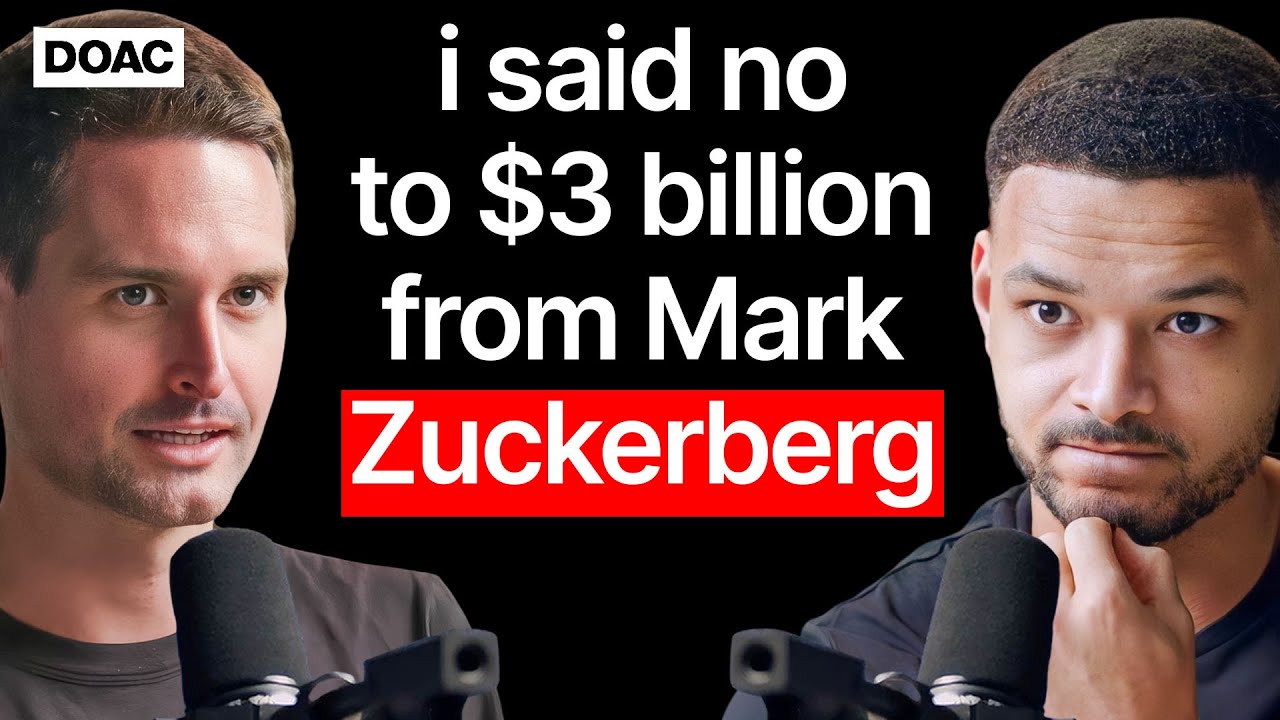
Snap CEO Spiegel Rejects Competitor Takeovers to Build Alternative Network
The Diary Of A CEO
Evan Spiegel attributes Snapchat's long-term independence to early founder liquidity and an unwavering focus on non-permanent, close-friend communication rather than engagement-driven metrics.
## Background
This video was published on YouTube by The Diary Of A CEO on March 24, 2025. According to the page description, it features Snap Inc. co-founder and CEO Evan Spiegel discussing his journey of founding Snapchat at Stanford, becoming the world's youngest billionaire at age 25, turning down a $3 billion acquisition offer from Mark Zuckerberg, and building a multi-billion dollar business.
## TL;DR
In this wide-ranging interview, Snap Inc. CEO Evan Spiegel reflects on the foundational lessons, failures, and design principles that shaped Snapchat. He details turning down Mark Zuckerberg's $3 billion acquisition offer, navigating intense competition and feature-copying from Meta, and the operational principles behind Snap's unique corporate culture, including flat hierarchies and 'Council' practice. Spiegel also offers candid advice on leadership, hiring, managing stress, product design, return-to-office policies, and the personal cost of continuous self-evolution as a long-term founder.
## Atmosphere & style
The conversation carries a reflective, candid, and intellectually grounded tone, blending deep corporate strategy with vulnerable personal revelations. Host Steven Bartlett creates an intimate dialogue that moves smoothly between high-stakes business decisions—such as rejecting Meta—and intimate moments about fatherhood, imposter syndrome, and personal stress management. It feels like an authentic, behind-the-scenes masterclass from a seasoned tech founder who has matured through public scrutiny while remaining intensely devoted to product design and human connection.
## Key takeaways
- [00:00](https://www.youtube.com/watch?v=rBM6lGk4-fk&t=0s) Complex systems and corporate challenges become far more manageable when opened up and systematically examined step-by-step.
- [08:38](https://www.youtube.com/watch?v=rBM6lGk4-fk&t=518s) Sustainable digital software innovation relies on rapid prototyping, direct user empathy, and building frictionlessly scalable distribution models.
- [15:42](https://www.youtube.com/watch?v=rBM6lGk4-fk&t=942s) Building products in isolation without distribution or an immediate personal feedback loop leads to failure, as seen with Future Freshmen.
- [21:20](https://www.youtube.com/watch?v=rBM6lGk4-fk&t=1280s) Designing products around unfiltered, everyday moments rather than curated permanent profiles creates authentic, high-retention social experiences.
- [39:10](https://www.youtube.com/watch?v=rBM6lGk4-fk&t=2350s) Flat organizational structures without rigid job titles allow small creative teams to continuously innovate alongside operational business scaling.
- [50:51](https://www.youtube.com/watch?v=rBM6lGk4-fk&t=3051s) Kindness in leadership requires giving honest, direct feedback that fosters growth, whereas nicety often hides uncomfortable truths.
- [01:10:10](https://www.youtube.com/watch?v=rBM6lGk4-fk&t=4210s) Early founder secondary stock sales provide crucial personal financial security that enables leaders to take bold, long-term operational risks.
- [01:04:10](https://www.youtube.com/watch?v=rBM6lGk4-fk&t=3850s) Declining acquisition offers from tech incumbents preserves an independent vision to build alternative, health-conscious social media experiences.
- [01:29:11](https://www.youtube.com/watch?v=rBM6lGk4-fk&t=5351s) Reframing competitor copying as market validation helps retain talent and reinforces confidence in a company's product direction.
- [01:23:50](https://www.youtube.com/watch?v=rBM6lGk4-fk&t=5030s) Establishing deep proprietary tech infrastructure like Lens Core and Lens Studio creates defensible moats against feature duplication.
- [02:02:00](https://www.youtube.com/watch?v=rBM6lGk4-fk&t=7320s) Embedding structured practices like 'Council' helps maintain authentic communication, cultural alignment, and core company values during rapid growth.
- [02:08:28](https://www.youtube.com/watch?v=rBM6lGk4-fk&t=7708s) Sustained long-term success as an entrepreneur requires genuine devotion to the work and constant, personal self-evolution.
## Detailed walkthrough
### [00:00](https://www.youtube.com/watch?v=rBM6lGk4-fk&t=0s) Refusing Mark Zuckerberg and the "Dots" of Early Life
Evan Spiegel spent his youth as a self-described introvert who loved to build things. Reflecting on the "dots" of his childhood that connected in hindsight, he attributes much of his imaginative drive to two fateful parenting rules: he was forbidden from watching TV, yet granted unlimited access to books. Left to fill his own time, he transformed his family’s living room into a "fake hotel," moving furniture around to craft elaborate guest experiences for his supportive parents. Feeling socially isolated and out of place—partly because he preferred spending lunch hours in the computer lab to playing traditional sports—he turned his curiosity toward hardware.
By sixth grade, after his mother promised he could keep a computer if he assembled it himself, a schoolteacher helped him put the components together, install Windows, and turn on the tower. This hands-on project stripped away the mystique of complex machinery, instilling an empowering realization that intricate systems are easy to tackle once you open up the box. That early mindset eventually gave him the confidence to take unconventional risks—such as writing an expose on his school's math program after interviewing students, teachers, and parents to demand a better curriculum.
* **Early Funding:** Snapchat raised $485,000 at a $4.25 million valuation in its initial stages.
* **Rapid Scale:** The platform defied early skeptic warnings about fleeting novelty apps by surging to 75 million monthly active users.
* **Lean Innovation:** Snapchat operates with a small core design team of just nine people, operating under the philosophy that generating a high volume of ideas is necessary because 99% will fail while only 1% will succeed.
* **2025 Public Commitment:** Spiegel noted that stepping into public speaking and podcasts is a personal 2025 New Year's resolution aimed at helping the public understand Snapchat's design philosophy and leadership values.
---
[08:38](https://www.youtube.com/watch?v=rBM6lGk4-fk&t=518s) Product Design and Lessons from Stanford
Spiegel pursued product design at Stanford University, a program housed under the mechanical engineering department and founded by David Kelley. What drew Spiegel to product design was its systematic approach to innovation: rather than waiting for lightning-strike inspiration, designers systematically uncover breakthrough ideas by empathizing with human pain points, rapid prototyping, and directly gathering user feedback.
While at Stanford, Spiegel took a pivotal course titled *Entrepreneurship and Venture Capital*, where active founders presented case studies on building their businesses. The central lesson that reshaped his perspective was the emphasis on pursuing massive scale over immediate cash flow. Coming from Los Angeles—where local business culture prioritized predictable, early profitability—Stanford introduced him to the venture capital blueprint: fund high-risk ideas aggressively, scale rapidly to billions of users, and construct the business model around that mass adoption later.
* **Scale Advantage:** Unlike traditional brick-and-mortar operations (like a local coffee shop) that require physical expansion for every new location, digital software allows a single product build to scale frictionlessly to 850 million users worldwide.
* **European vs. Australian Market Dynamics:** Spiegel observes that European founders often get trapped scaling across fragmented local markets (differing languages and cultures), whereas Australian tech founders are forced from day one to target massive overseas markets like the US or China.
[014:21] Navigating International Expansion and Localized Growth
Transitioning a business to the US market presents major structural hurdles for international companies. British and European startups frequently conquer their home territory before attempting to launch in the US, only to get burned by immense marketing costs and the operational friction of breaking into massive retail channels like Target or Walmart. By the time founders decide to expand, personal commitments—such as having built lives and families in the UK—prevent them from physically relocating to drive the US transition. As a result, many waste substantial capital and are forced to retreat.
Snapchat approached global expansion by strictly "following the growth." Rather than forcing entry into pre-selected territories, the company identifies regions where organic traction and momentum are already visible. To sustain and amplify this interest, teams focus on proper localization and partner with local creators to keep content culturally relevant. Because Snapchat is a fundamentally social product that relies on friend-to-friend communication, establishing this initial viral loop is essential before layering on broader features like the content ecosystem or augmented reality (AR).
[015:42] The Failure of Future Freshmen and the Importance of Distribution
Before Snapchat, Evan Spiegel and his co-founder Bobby Murphy—who lived across the hall in their Stanford fraternity and shared a passion for creating products—spent 18 months building **Future Freshmen**. Inspired by their own personal experience and that of their younger siblings, they designed the platform to streamline the college application process by aggregating essay questions, track requirements, and organize submissions.
Despite their hard work on the full-featured website, the business hit a distribution wall. Future Freshmen was competing against **Naviance**, an established incumbent with a deeply entrenched strategy: Naviance sold directly to high school college counselors, securing built-in distribution by getting guidance departments and parents to mandate its use. A pair of college students had little chance of unseating a platform recommended directly by school administrators. Moreover, the business model required re-acquiring a brand-new cohort of one million college applicants every single year.
The failure of Future Freshmen offered a crucial lesson in product development and speed to market:
* Never spend 18 months building in isolation before gathering real user feedback.
* Prioritize distribution dynamics and customer acquisition models early.
* Build simple products that allow rapid testing and iteration.
* Focus on an idea you genuinely love using, as passion is required to push through adversity.
[017:42] Passion, Rapid Prototyping, and Customer Validation
When evaluating whether to abandon a struggling business or iterate through the friction, authentic attachment to the product makes all the difference. Spiegel notes that he and Murphy lacked a deep connection to Future Freshmen because they were no longer personally applying to college. With Snapchat, however, they used the product with their own friends constantly throughout the day. This deep personal affinity provided the endurance necessary to navigate early headwinds.
```
"Love and passion for what you're building and the love and passion for the people you're working with... that's what allows you to get through all the challenges that come when you try to build a business."
— Evan Spiegel
```
Putting early concepts in front of users quickly—even via rough napkin sketches—is vital. A foundational principle of Stanford’s product design curriculum is rapid prototyping. Snapchat originally launched under the name **Picaboo**, initially leaning into disappearing messages as a novelty. Early feedback quickly revealed that users weren't interested in disappearing content for its own sake; they wanted a fast, visual medium for everyday conversation. Rebranding as **Snapchat** and pitching the app as a tool "10 times faster than sending a photo via text message" instantly clicked with users.
[020:22] Balancing Founder Vision With Customer Feedback
A common trap for entrepreneurs is clinging dogmatically to a flawed initial hypothesis. While success requires holding a strong long-term vision and philosophy, founders must remain humble enough to accept that their target audience is never wrong about how a product feels to use. Spiegel recalls a humorous souvenir from a party featuring a lighter that read: "The director is always right" on one side, and "The customer is never wrong" on the other—capturing the delicate balance required between creative vision and customer feedback.
[021:20] The Genesis of Snapchat and Critical Product Features
The concept for Snapchat originated after Spiegel returned to Stanford following a quarter abroad in Cape Town, a period that provided the distance needed to walk away from Future Freshmen. Back on campus, his friend Reggie expressed a desire for a way to send photos that would disappear. While a few existing apps offered self-deleting media, they were rigid, security-focused utilities rather than fun communication tools. Recognizing the gap, Spiegel and Murphy set out to build a lightweight prototype focused on speed and real-time interaction.
Key early design decisions defined the user experience and set the app apart from traditional platforms:
* **Opening directly to the camera:** Unlike the default iOS camera app at the time—which featured a slow shutter animation and a clunky toggle between photo and video—Snapchat launched straight into camera mode to eliminate friction and capture fleeting moments.
* **Ephemeral messaging for real life:** Traditional social media was built around permanence, clout, and curated highlight reels (the top 1% of moments). Snapchat was created for the other 99% of moments—unfiltered interactions meant for close friends rather than a public audience.
* **Screenshot notifications:** When Spiegel pitched Picaboo in his design class, peers claimed it would fail because users could simply take a screenshot. That summer, working out of Spiegel’s father’s house, the team built a feature that alerted the sender whenever a screenshot was taken, creating a playful, trusted feedback loop.
```
"Social media is all about permanence and you're trying to look popular and collect all these likes and comments and pretty pictures... Snapchat was for the other 99%."
— Evan Spiegel
```
[025:16] From Early Traction to Full-Time Momentum
Following the app's formal release to the App Store in September 2011, Spiegel and Murphy continuously iterated based on direct user requests. Early adopters quickly asked for features beyond basic photo sharing, leading to the addition of text captions and drawing tools.
By late 2011 and early 2012, signs of real product-market fit emerged. Spiegel recalls checking an internal admin page that tracked total snaps sent. In the early days, refreshing the page showed static numbers in the hundreds or low thousands. By early 2012, while sitting in class at Stanford, refreshing the page caused the counter to jump by double digits every single second.
[026:46] Designing High-Utility Features From User Requests
When processing customer requests, the implementation strategy matters far more than simply collecting feature requests. Rather than implementing heavy or cluttered text fields reminiscent of conventional social platforms, Snapchat kept text overlay fast and intuitive: users simply tapped directly on the photo right after capture to summon a text bar, typed their message without obscuring the background image, and hit enter to immediately bring up their contact list.
[28:04](https://www.youtube.com/watch?v=rBM6lGk4-fk&t=1684s) Early Funding and the $4.25 Million Valuation
```
_
/ \
/ _ \ SNAP INC.
| / \ | Series A Journey
| \_/ | "Visuals beat text"
\___/
```
When Snapchat was raising its seed round about a year after its inception, the pitch leaned heavily on a single core truth: text messaging was dull, and visual communication was dynamic and lasting. At the time, venture capitalists were extremely cautious because the market was flooded with "flash in the pan" consumer apps that spiked in viral popularity only to collapse months later. Snapchat’s secret weapon was a year’s worth of solid retention data proving that once friends started communicating through photos, they kept coming back. Spiegel and his small team led their pitch with just three to five slides containing pure metrics.
Despite the strong engagement numbers, early investor rejections were brutal and constant. The overwhelming consensus from Silicon Valley was that giant tech incumbents would simply copy the product and crush them, especially given the reigning belief that network effects made existing platforms untreatable. Spiegel notes that building a new social network back then sounded almost delusional because Facebook, Twitter, and Instagram were already massive. The breakthrough came when Jeremy Liew from Lightspeed Venture Partners reached out. Spiegel jokes that Liew’s profile photo showed him with Barack Obama, which made him think, "Okay, must be legit." Liew’s interest was sparked after another partner's daughter fell in love with the app. Lightspeed ended up writing a check for $485,000 at a $4.25 million valuation—a historic bargain in hindsight for an app that had roughly 100,000 users at the time.
* **First Seed Investment:** $485,000 raised from Lightspeed Venture Partners at a $4.25M valuation.
* **Traction at Funding:** Approximately 100,000 active users.
* **Pitch Deck Structure:** A minimalist presentation consisting of only 3 to 5 slides focused strictly on retention data.
---
[31:34](https://www.youtube.com/watch?v=rBM6lGk4-fk&t=1894s) The 3-Day Outage and Moving to the Venice Boardwalk
Early on, there was a terrifying moment when a system failure took down the entire Snapchat infrastructure for three full days. The team panicked, convinced that three days of downtime for a messaging service would permanently kill their momentum and drive users away forever. Instead, the moment the servers were restored, usage exploded right back to where it had been. That incident gave Spiegel deep conviction that they had built something people genuinely loved and relied on.
The app's growth was entirely organic and driven by a massive cultural and behavioral shift. At the time, people viewed digital photos as rare keepsakes to be saved on a hard drive; Snapchat taught a generation that a photo could be used as conversational text. As the team expanded, they outgrew Spiegel’s father's house, where seven or eight team members were sleeping on couches and working around the clock. They relocated to their first proper office: "The Blue House" at 523 Oceanfront Walk along the Venice Beach Boardwalk. Located right on a promenade that sees over 10 million tourists a year, the team put a massive ghost logo on the building. Passersby constantly walked in off the street to ask for account help, give feedback, or share how much they loved the product.
<Image alt="The original Snapchat headquarters known as the Blue House on the Venice Beach Boardwalk" caption="The historic 'Blue House' in Venice" src="[https://images.squarespace-cdn.com/content/v1/5412151be4b067c2937e21a8/1426618581001-A427C6C9C4XG62U1Z11J/Venice-Boardwalk-Snapchat-Blue-House.jpg](https://images.squarespace-cdn.com/content/v1/5412151be4b067c2937e21a8/1426618581001-A427C6C9C4XG62U1Z11J/Venice-Boardwalk-Snapchat-Blue-House.jpg)"/>
* **Infrastructure Crisis:** A 3-day server crash served as an unexpected test of user loyalty and product-market fit.
* **First Official HQ:** "The Blue House" located at 523 Oceanfront Walk in Venice, California.
* **Capacity Limits:** Packed up to 20 to 30 employees into the beachfront house before outgrowing the location.
---
[36:02](https://www.youtube.com/watch?v=rBM6lGk4-fk&t=2162s) Dropping Out, Returning to Stanford, and Nurturing Creativity
Leaving Stanford University was not a dramatic, triumphant moment for Spiegel, but rather a practical necessity. Short on credits and taking a heavy 20-credit course load while simultaneously managing $485,000 in venture capital and a skyrocketing product, he simply could not balance both worlds. He officially dropped out, though he later returned to finish his degree in 2018. The main motivation to go back was to avoid losing future debates with his kids when encouraging them to value their education.
Reflecting on how the world has shifted, Spiegel emphasizes that if his 14-year-old son Flynn—who is exceptionally talented at drawing—wants to follow in his footsteps, he shouldn't worry about traditional job titles. In an era increasingly dominated by AI, Spiegel views raw **creativity as the ultimate X-factor**. Society tends to over-index on measurable metrics, which starves creative muscles because artistic outcome is hard to quantify. Everyone is born creative, but people gradually stop practicing or become afraid of self-expression as they grow up.
* **Stanford Departure & Return:** Dropped out due to workload conflicts; returned to graduate in 2018 so his children wouldn't use his dropout status as an excuse.
* **Core Parenting & Mentorship Philosophy:** Focus on fundamental, transferable skills and visual expression over rigid career titles.
---
[39:10](https://www.youtube.com/watch?v=rBM6lGk4-fk&t=2350s) Defeating Corporate Hierarchy: The "Loonshots" Framework
Spiegel argues that job titles are largely ridiculous and serve primarily as artificial status symbols. In Snapchat's earliest days, the team casually made up absurd job titles for new hires because titles didn't matter—impact did. As companies scale, they naturally build process, hierarchy, and rigid reporting structures to manage operations, but this often suffocates innovation.
> "Hierarchy comes into place when things start to get big... but the companies that continue to innovate over long periods of time also have very small, very flat teams that don't have any hierarchy at all."
To combat organizational decay, Spiegel references Safi Beall’s book *Loonshots*. The key to long-term innovation is maintaining two distinct modes within the same company: a structured, operationally rigorous group that serves existing customers, and a small, completely flat, unstructured group of creators free to try wild experiments. He points to World War II radar development as an example, where rogue scientists developed wild ideas and passed them to the highly structured military for real-world battlefield testing and feedback.
At Snapchat, this philosophy is reflected in their core product design team. Despite serving hundreds of millions of users, the core design team consists of **just nine people**. The team is completely flat with no corporate titles—everyone is simply a "product designer." The culture is entirely centered around *making*, to the point that every new designer is required to present a physical or digital build on their very first day during weekly design critiques.
---
<ElicitationsGroup message="Explore more insights from Evan Spiegel's journey:">
<Elicitation label="Analyze Snap's design team structure" query="Explain how Snap keeps its core product design team down to just nine people while serving hundreds of millions of users."/>
<Elicitation label="Review the key lessons from 'Loonshots'" query="What are the key principles from Safi Bahcall's book 'Loonshots' regarding innovation in large companies?"/>
</ElicitationsGroup>
[42:34](https://www.youtube.com/watch?v=rBM6lGk4-fk&t=2554s) Fostering Innovation Through Early Failure and Internal Flywheels
Evan Spiegel describes the unique mechanism Snapchat uses on a new design hire's very first day: forcing them to present a product idea despite having zero context about what the company is working on. Because it is nearly impossible to pitch a winner on day one, the hire’s worst fear is realized immediately when everyone sits around looking at a subpar idea. However, that instant failure breaks down fear and opens the floodgates to creativity. At Snapchat, 99% of ideas are bad, but 1% are brilliant, adhering to the principle that the best way to get a good idea is to generate a massive volume of them.
To make those ideas reality, Snapchat relies on its product organization to serve as a bridge connecting the small design team with the larger engineering and product units. Spiegel notes this dynamic mirrors his early partnership with co-founder Bobby Murphy: Spiegel focused on design with a light computer science background, while Murphy was a world-class computer scientist who deeply appreciated design. This constant dialogue solved tough technical challenges, such as inventing the now-universal camera interface standard of tapping to take a photo and holding to record a video.
* **Weekly Design Critiques:** The 8 to 9-person design team holds a weekly multi-hour critique session to review new work, focus on solving user friction (like making it easier for creators to post or read story replies), and give direct feedback.
* **Maximizing Learning Rates:** Spiegel emphasizes that inexperienced entrepreneurs often mistakenly aim for a single perfect idea, whereas experienced founders realize they are bad at guessing and must maximize their rate of learning through rapid iteration.
[47:44](https://www.youtube.com/watch?v=rBM6lGk4-fk&t=2864s) Early Hiring, Interdisciplinary Magic, and Avoiding Past Mistakes
Reflecting on Snapchat's earliest team of 20 employees, Spiegel asserts that hiring is everything. Looking back at early engineers like David, Daniel, and Bobby, he realized an interesting commonality: almost all of their original engineers were also musicians. This highlighted an "aha moment" showing that technical discipline and artistic creativity shouldn't be separated. The real magic happens when those disciplines cross over, especially for a company aspiring to be creative in everything it does.
Spiegel admits to making several early hiring errors. Initially, they overindexed on bringing in leaders with experience scaling massive teams—such as hiring an engineering leader from Amazon who went from managing 300 people to leading eight at Snapchat. While that scaling mindset was useful, hiring candidates who relied strictly on narrow domain expertise proved less helpful. Unadaptable candidates would often ask, "Why don't you have likes and comments?" instead of showing curiosity about why Snapchat intentionally chose a different path.
* **Key Interview Trait:** Snapchat now prioritizes adaptability in potential hires over past experience alone, testing whether a candidate can apply past lessons to a totally new context.
[50:51](https://www.youtube.com/watch?v=rBM6lGk4-fk&t=3051s) Snapchat's Core Values and Leadership Traits: "Kind, Smart, Creative"
Since its founding days, Snapchat's core values have remained **Kind**, **Smart**, and **Creative**. Spiegel notes that a decade ago, talking about "kindness" in tech corporate culture was rare, but Snapchat found that kindness is the essential foundation for creativity. Without a supportive culture where people feel safe putting out wild or half-baked ideas without fear of being laughed at, creativity is stifled.
Spiegel carefully distinguishes between being "nice" and being "kind":
> "It's really kind to tell somebody that they have something stuck in their teeth... If you just want to be nice, you pretend nothing's going on... But if you're really being kind and you want to help that person, you say, 'You got something stuck in your teeth, you got to take care of that.'"
In a workplace context, a "nice" manager makes a struggling employee feel comfortable about missing expectations, whereas a "kind" manager provides direct, actionable feedback ("This isn't working because you're doing X, Y, and Z") to help them grow and succeed.
[53:37](https://www.youtube.com/watch?v=rBM6lGk4-fk&t=3217s) T-Shaped Leadership and the Trap of Generalist Middle Management
The first major leadership behavior Snapchat evaluates is **T-shaped leadership**. A T-shaped leader possesses deep expertise in a specific domain (the vertical bar) paired with a broad understanding of the overall business and an ability to collaborate across cross-functional teams (the horizontal bar). Because modern businesses cannot build complex products in isolation, leaders must translate their specific domain mastery across diverse areas of the company.
Spiegel points out that while an "I-shaped" employee (deep domain knowledge with narrow scope) can build breadth by stepping outside their comfort zone, the reverse is far harder. Generalists who lack a deep skill set often struggle to add tangible value, which creates the frustration associated with traditional "middle management"—managers who know a little about a lot, but cannot actually help engineers or designers solve tough technical problems or grow in their craft.
[56:28](https://www.youtube.com/watch?v=rBM6lGk4-fk&t=3388s) Advice to Younger Self: Velocity and Iteration
Reflecting on the advice he would give his younger self running a ten-person team from his father's house, Evan Spiegel reveals that his top message would simply be: "Everything's going to be okay." He argues that early-stage founders often paralyze themselves trying to make the absolute "right" decision, whereas the true key to success lies in the speed of the feedback loop—how quickly a founder changes their mind upon receiving new information and corrects course when proven wrong. Unless a choice is truly existential, making a decision and swiftly refining or reversing it matters far more than agonizing over initial perfection.
> "I think sometimes people are too focused on making the right decision and not as focused on fixing it if they're wrong."
The host, Steven Bartlett, shares his own early experience as a founder on a student project, noting how easy it is to gaslight oneself into ignoring feedback or delaying obvious decisions—such as firing an underperforming employee—out of fear or hesitation. Spiegel agrees, observing that when founders ask for advice about an underperforming employee, they usually have already made up their mind. While acknowledging that leaders shouldn't "thrash" their team by changing direction every day, Spiegel emphasizes that courageous leaders quickly point out errors and take a different path.
- Focus on the speed of the iteration loop over initial decision perfection.
- Recognize that most organizational choices are non-existential and easily reversible.
- Trust early instincts when addressing talent or organizational issues instead of procrastinating.
---
[59:24](https://www.youtube.com/watch?v=rBM6lGk4-fk&t=3564s) Building Culture Early and Eliminating "Brilliant Jerks"
When Snapchat rapidly scaled from 20 to 2,000 employees, the company inadvertently imported disparate corporate subcultures from major tech giants. They acquired an Amazon contingent that insisted on six-page memo documents, a Google contingent accustomed to consensus-driven decision-making, and a group from Meta. Because Snap had not clearly defined and embedded its core values—kind, smart, and creative—the culture began to feel fragmented and out of control.
Spiegel candidly recalls reaching a point where he hated his job and complained to a friend that he didn't like what the company had become. Her blunt response was simple: "Then fix it." Taking that to heart, Snap defined research-backed behaviors for its three core values and tied them directly to performance reviews, promotions, and exits. Spiegel rejects the common industry myth of the "brilliant jerk," sharing a memorable perspective from co-founder Bobby Murphy:
> "Bobby is like, 'Evan, there's no such thing as a brilliant jerk. If you're really brilliant, how could you possibly be a jerk?'"
- **Culture Sub-factions:** Rapid hiring led to competing internal habits from former Amazon, Google, and Meta employees.
- **Values Framework:** Snap translated its values—"kind, smart, creative"—into specific, research-backed behavioral standards tied to compensation and performance evaluations.
- **The "Brilliant Jerk" Fallacy:** True intelligence includes interpersonal awareness; high technical performance does not excuse poor values alignment.
---
[01:04:10](https://www.youtube.com/watch?v=rBM6lGk4-fk&t=3850s) Early Skepticism and the Infamous $3B Acquisition Offer
In the company's early days, Spiegel faced intense skepticism from external observers and advisors who insisted Snapchat was just a passing fad and urged them to sell immediately while they could. He recalls an embarrassing moment when he accidentally joined a conference call a minute early, overhearing Snap's own legal team privately stating that the company was "basically going to zero." Skeptics only saw an app for swapping temporary photos, but Spiegel and Murphy had a long-term product vision that gave them conviction in its future.
That conviction was tested when 23-year-old Spiegel was approached by Mark Zuckerberg. Meta (then Facebook) had recently acquired Instagram for $1 billion—which Spiegel viewed as vastly undervalued—and was developing a direct clone called Poke. Zuckerberg set up a meeting with Spiegel and Murphy at Sheryl Sandberg's condo in Santa Monica to discuss acquiring Snap or having them join forces.
Though $3 billion was widely reported as the offer price, Spiegel notes that while that specific figure was never publicly confirmed by the company, a very real acquisition path was discussed. Despite operating out of his father's house at the time, Spiegel and Murphy turned down the offer, choosing to remain independent.
> "We wanted to build a business that was different.... We felt like social media was about being pretty and perfect, and we wanted a way to communicate with our friends that was fun."
- Overheard lawyers on an early conference call predicting Snap was a temporary fad headed to zero value.
- Mark Zuckerberg used internal tracking tools to identify fast-growing app competitors for potential acquisition.
- Spiegel and Murphy declined Meta's multi-billion-dollar acquisition path to maintain their distinct vision of fun, authentic communication over curated social media profiles.
- Spiegel asserts he has never regretted or doubted the decision to refuse Meta's offer for even a single moment.
Here is a detailed, faithful walkthrough of the transcript section provided.
---
[01:10:10](https://www.youtube.com/watch?v=rBM6lGk4-fk&t=4210s) Taking Money off the Table and "Swinging for the Fences"
Evan Spiegel recalls a critical early financing round where he and co-founder Bobby Murphy were each allowed to sell $10 million worth of company stock. Receiving $10 million each felt like an absolute milestone, leaving them with the immediate feeling of: "Wow... we made it... we have enough money forever." This personal liquidity completely transformed their mindset and decision-making framework: because their baseline financial security—buying a home, taking care of their families—was locked in, they no longer felt risk-averse. Instead, it gave them the ultimate freedom to take massive risks and "swing for the fences" to build a giant enterprise without fearing total personal ruin.
Host Steven Bartlett echoes this insight with a story from 2020 about a female founder friend whose company was riding the top of the market. Board members and investors were hyping her business as a $1 billion entity, but when she asked Steven to buy equity, he conservatively valued it at $250 million ($0.25 billion). His reality check planted a crucial seed of doubt about the narrative she was being sold. She ultimately decided to sell a portion of her stock; when the market subsequently crashed, taking some money off the table saved her sanity while her company struggled through the downturn. Spiegel agrees that founders shouldn't treat building a company as a zero-sum choice between total risk and selling out. Creative liquidity options allow founders to protect their families while still aligning with venture capital investors who demand 10x to 100x outsized returns.
- **Key Liquidity Event:** Evan Spiegel and Bobby Murphy each cashed out $10 million in secondary stock sales during an early funding round.
- **Venture Alignment:** Venture capitalists thrive on the "swing for the fences" philosophy, whereas growth investors tend to become more conservative as companies scale.
- **Senate Hearing Encounter:** When asked if he and Mark Zuckerberg are friends, Spiegel mentions the last time he saw Zuckerberg was at the U.S. Senate hearings the previous year, dryly joking that Senate hearings look "fun" and that Steven should try it sometime.
---
[01:13:00](https://www.youtube.com/watch?v=rBM6lGk4-fk&t=4380s) Scale, Net Worth, and Meeting Miranda Kerr
By 2014, when Spiegel was just 24 years old, 40% of U.S. adults were using Snapchat daily, and by 2015, the platform was reaching 75 million monthly active users. At age 25—four years after launching Snapchat—Spiegel became the world's youngest billionaire, boasting an estimated net worth of $4 billion. Despite the intense trajectory, Spiegel points to meeting his wife, Miranda Kerr, in 2014 as the true "gamechanger" for his life. He describes her as an extraordinary woman who brought profound stability and support during a turbulent period of hypergrowth. As the founder of the organic skincare brand KORA Organics, Kerr deeply understands the pressures of entrepreneurship. Furthermore, her passion for wellness makes living with her feel like having a dedicated "wellness coach every single day."
```
Snapchat Growth (2014–2015)
├─ 40% of U.S. Adults Using Daily (2014)
├─ 75 Million Monthly Users (2015)
└─ Evan Spiegel becomes Youngest Billionaire at age 25 ($4B Net Worth)
```
Managing a high-stakes romantic relationship while piloting a "rocket ship" company required shared expectations. Spiegel explains that many couples experience relationship strain when a partner’s career suddenly demands all-consuming hours after years of a slower pace. In contrast, Spiegel and Kerr met when both were already working "flat out" on their respective businesses. Hard work to support their family and ventures was baked into their relationship from day one. To maintain their bond amidst busy schedules and four children, they instituted a non-negotiable rule: "Sunday family day," where everyone stays at home together without outside distractions.
- **Personal Dynamics:** Kerr provides direct and candid feedback to Spiegel. Raised by a litigator father and a tax lawyer mother, Spiegel admits he naturally defaults to a sharp, intense, "litigation-style" tone in business settings. Kerr frequently reminds him: "Hey, you could say the same thing but in like a slightly different way. And people will hear it."
- **Child-Rearing Philosophy:** After asking roughly 100 highly successful people how to raise great kids, Spiegel found one universal constant: parents who make the time to directly engage with their children one-on-one cultivate the strongest, most fruitful relationships.
---
[01:20:07](https://www.youtube.com/watch?v=rBM6lGk4-fk&t=4807s) The Meta Copycat Rivalry and Product Ethics
Addressing a running joke on his LinkedIn profile—where his bio tongue-in-cheek lists him as "VP of Product at Meta"—Spiegel credits the joke's origin to tech journalist Kara Swisher. He remarks that since Meta blatantly copied Snapchat’s ephemeral messaging, Stories, augmented reality features, and smart glasses initiatives (which Snap has worked on for over a decade), he has genuinely "earned that title." Beyond the comedic banter, Spiegel expresses deep frustration with how Meta operates. What irritates him most is that Meta repurposes Snap’s inventive features into engagement-driven formats that ultimately "make people feel unhappy and bad about themselves."
> "One of the things that's incredibly irritating about it is they repurpose our inventions to make products that make people feel unhappy and bad about themselves."
Spiegel points to independent academic studies conducted in the Netherlands and Australia comparing Instagram, TikTok, and Snapchat. The research concluded that while Instagram and TikTok produced measurable negative mental health impacts, Snapchat had no negative mental health implications—and in the Dutch study, was actually found to promote personal well-being and strengthen close relationships. Spiegel emphasizes that copying a feature's UI does not mean the underlying product is the same: Snapchat is deliberately architected around private communication between close friends and family, whereas competing platforms prioritize public broadcasting and viral algorithms.
- **Kevin Systrom's Reaction:** Spiegel notes he never reached out to Mark Zuckerberg to complain about feature copying. However, he expresses genuine respect for former Instagram CEO Kevin Systrom, praising his upfront honesty when launching Instagram Stories: "...Kevin Systrom came out and just said, 'Hey, we think this is a really great feature... and like we're going to steal it and put it in Instagram...' At least the honesty was admirable."
- **Inspiration from ByteDance:** Spiegel admits that inspiration flows both ways in tech. In Snapchat’s early days, he visited ByteDance when their primary product was Toutiao (an AI/ML-driven newsfeed app). Seeing Machine Learning power content feeds inspired Snapchat to make a massive structural change: splitting creator/publisher content entirely away from personal friend Stories.
[01:23:50](https://www.youtube.com/watch?v=rBM6lGk4-fk&t=5030s) Building Moats in Tech: Moving Beyond Features to Ecosystems
Evan Spiegel explains that Snapchat transitioned to machine learning–driven recommendations so users could receive content from creators and publishers tailored to their specific interests alongside posts from friends. While drawing inspiration from other companies is a normal part of tech innovation, the reality of copycats taught Snapchat that true defensibility requires building things that are extremely difficult and time-consuming to copy. When large tech companies can replicate basic software features effortlessly, a smaller company must tackle deep, complex engineering challenges.
For founders dealing with knockoffs, Spiegel advises evolving as quickly as possible from a single feature or product into a full-fledged platform or ecosystem. He points out that while a feature like Stories is simple to code—especially with modern AI tools—Snapchat’s augmented reality ecosystem is far harder to replicate. Snap built its own custom rendering engine, **Lens Core**, which runs on both mobile phones and its Spectacles, supported by a sophisticated authoring environment called **Lens Studio**. With hundreds of thousands of developers building experiences and hundreds of millions of daily users engaging with them, the platform benefits from a massive two-sided marketplace effect.
```
┌─────────────────────────────────────────────────────────┐
│ Augmented Reality Moat │
├─────────────────────────────────────────────────────────┤
│ • Lens Core Engine (Mobile & Spectacles rendering) │
│ • Lens Studio (Developer tools for 4M+ Lenses) │
│ • 100s of Millions of Daily AR Active Users │
└─────────────────────────────────────────────────────────┘
```
- Developers have created over **4,000,000** AR Lenses using Lens Studio.
- Over **850,000,000** monthly active users rely on Snapchat for communication and augmented reality experiences.
- Building two-sided marketplaces creates an inverse correlation between how hard a technology is to construct and how easy it is for a competitor to copy or migrate its user base.
---
[01:26:43](https://www.youtube.com/watch?v=rBM6lGk4-fk&t=5203s) Regulatory Cycles, Monopolies, and Mark Zuckerberg's Strategy
When addressing whether Big Tech giants are monopolies that should be broken up, Spiegel emphasizes that regulatory and legal processes move too slowly to save smaller tech companies. Pointing to Microsoft’s antitrust trials in the late 1990s, he notes that while the government investigated, Microsoft missed the entire mobile computing shift. A similar transition may be unfolding for Google as AI and platforms like ChatGPT challenge its core search business. Because government antitrust lawsuits routinely drag on for **10+ years**, founders cannot rely on regulators for protection; they must focus on fundamental technological innovations that capture incumbents off-guard.
Discussing Mark Zuckerberg’s strategy of copying competitors, Spiegel acknowledges that it is a highly effective tactic for a company of Meta's size and cash reserves. Meta can comfortably deploy billions of dollars into multiple bets—such as spending **$20 billion a year** on AR and VR development—or invest heavily in large language models to rival OpenAI, while keeping an eye on emerging products to clone.
- Historical precedent shows that legal antitrust cycles take over **10 years** to resolve, making them ineffective at protecting smaller, fast-paced startups.
- Meta spends approximately **$20,000,000,000 annually** on its hardware and spatial computing initiatives.
---
[01:29:11](https://www.youtube.com/watch?v=rBM6lGk4-fk&t=5351s) Surviving the Copycat Storm and Leading Under Pressure
Reflecting on the toughest moments after Instagram launched its clone of Stories, Spiegel recounts the immense external pressure Snapchat faced. Critics and media outlets repeatedly predicted Snapchat’s demise, failing to recognize a crucial fundamental difference in user behavior: people used Instagram primarily to follow influencers and creators, whereas they used Snapchat to communicate privately with close friends and family. Instagram only took notice of Stories after high-profile figures like DJ Khaled began adopting Snapchat to engage their fanbases in non-traditional ways.
> "If you have some of the biggest companies in the world validating what you're working on, that can be really energizing... This is really evidence that we're on the right path here, that we're building products that people love."
As a leader, Spiegel converted the threat into team motivation, framing Meta's imitation as ultimate validation that Snapchat was defining the industry's future. For the design team at Snap, knowing their work shaped user experiences for billions of people across the entire internet—not just Snapchat's own user base—served as a massive badge of pride.
- Instagram's implementation of Stories targeted public creators and influencers, whereas Snapchat focused strictly on close personal circles.
- Reframing intense corporate pressure as market validation boosts employee morale and helps retain top creative talent during competitive crises.
---
[01:31:34](https://www.youtube.com/watch?v=rBM6lGk4-fk&t=5494s) Content Moderation, Free Speech, and Company Values
Spiegel defends Snapchat’s strict stance on content moderation, confirming that the platform actively scans for and removes adult content and pornography. He argues that creating a safe, comfortable environment is essential for authentic personal expression; when platforms allow unmoderated hostility, abuse, or explicit material, regular users feel uncomfortable and refrain from sharing.
Addressing critics who frame content moderation as censorship, Spiegel clarifies the legal and intent-based boundaries of the First Amendment in the United States. The Constitution restricts government interference with publishers and individuals, but private platforms possess their own First Amendment rights to curate what appears on their services—much like *The Wall Street Journal* selects which authors to publish.
- Snapchat enforces strict guidelines against explicit content, extreme violence, and hate speech to maintain a comfortable environment for communication.
- Academic studies indicate users report feeling happier when using Snapchat compared to other social platforms, largely due to reduced exposure to toxic or graphic content.
- Spiegel dismisses the claim that geographic location (such as being headquartered in Los Angeles versus a conservative state) drives moderation policies, maintaining that restricting extreme violence and porn is a commonsense, values-based choice rather than a political bias.
- Navigating international regulation remains a major challenge for platforms attempting to roll back moderation, as regions like Europe enforce strict laws regarding hate speech and terrorist content.
[01:36:36](https://www.youtube.com/watch?v=rBM6lGk4-fk&t=5796s) Political Winds and Content Moderation Shifting
The conversation opens with Evan Spiegel and Steven Bartlett examining the financial and political incentives behind platform moderation. Spiegel notes that content moderation carries significant operating costs, and certain studies suggest that unmoderated platforms or viral negative posts actually experience higher engagement due to basic human nature. Bartlett observes a dramatic shift across the social media landscape over the previous 12 months—accelerated by Elon Musk’s purchase of Twitter (now X)—leading to debate around free speech, censorship, and platform splintering toward alternatives like Threads, Blue Sky, and Rumble.
Spiegel views these shifts not as a sudden anomaly, but as a continuation of large tech platforms adapting to political leadership. Using Meta as the primary example of the social market, Spiegel points out that Meta actively adjusted its policies depending on who held the White House: conducting aggressive proactive moderation during the Biden administration upon government request, and rolling back policies as political dynamics shifted. Spiegel characterizes this behavior not as something to admire, but as a purely "survivalist instinct" for a massive corporation facing intense regulatory scrutiny and potential antitrust litigation.
- Meta's policy shifts are framed as a tactical survival response by a founder-controlled giant balancing state regulatory pressures.
- "When content is moderated, engagement can go down... negative content spreads much further and faster on social media for human reasons."
---
[01:39:06](https://www.youtube.com/watch?v=rBM6lGk4-fk&t=5946s) Optimism, Parenting, and Tech Boundaries for Kids
When asked about his outlook for America's future, Spiegel expresses deep optimism. He points to the historical resilience and unifying spirit of the American public, referencing how the nation came together to tackle crisis points like the COVID-19 pandemic and World War II against the Axis powers.
The discussion pivots to how Spiegel manages technology in his own household, particularly with his 14-year-old stepson, Flynn. Spiegel emphasizes that he does not believe in a one-size-fits-all model for kids because each child develops differently. However, he preaches extreme caution regarding personal privacy, warning that young people often post public content without realizing that once something is online, it can never truly be retrieved.
Spiegel reflects on his family's changing tech rules, noting that prior to the COVID-19 pandemic, Flynn was not allowed to own a smartphone or use a computer. The isolation of lockdowns forced a shift so he could stay connected with friends. Spiegel criticizes the extreme "whiplash" youth have experienced—going from being forced onto screens during lockdowns to being told by adults post-pandemic to abandon phones entirely. He advocates for a balanced middle ground where kids engage in offline activities like running cross country or walking around the mall, while using messaging and games healthily to stay connected.
- **Children's Platform Access:** Flynn uses Snapchat, YouTube, and Roblox.
- **Family Rules on TikTok:** Spiegel notes that TikTok has historically been off-limits in their house, dryly joking that based on what he hears, the app is "like crack cocaine for people" who spend 3-4 hours scrolling mindlessly.
---
[01:42:37](https://www.youtube.com/watch?v=rBM6lGk4-fk&t=6157s) The TikTok Ban, Geopolitics, and Free Trade Realities
Addressing the ongoing political battles around banning TikTok in the United States, Spiegel candidly admits that a ban on TikTok "would be quite good for our business." However, looking at the broader economic picture, he argues that the U.S. government needs to establish clear boundaries regarding its relationship with China.
While open and free trade has historically served as a massive strategic advantage for American economic growth, Spiegel argues that critical sectors require distinct guidelines. He proposes dividing global trade into two clear buckets: benign consumer goods (like toys and diapers) where free trade should "let it rip," and sensitive sectors (like information services, critical minerals, and pharmaceuticals) where differing national ideologies make collaboration impossible. The current ambiguity harms entrepreneurs on both sides, creating unpredictability for international business.
- **Data Localization Risks:** Bartlett questions whether forced sales or bans establish a dangerous precedent where foreign governments—like the UK—might demand localized ownership of platforms like Snapchat.
- Spiegel argues that explicit geopolitical policy clarity from governments would prevent cross-border technological fragmentation.
---
[01:45:53](https://www.youtube.com/watch?v=rBM6lGk4-fk&t=6353s) The Pressures of Running a Public Company
Reflecting on Snapchat going public, Spiegel discusses the friction between short-term public market demands and long-term product innovation. While many advisors warned him that quarterly public scrutiny would push the company toward short-term thinking, Spiegel found that the enforced financial rigor—such as precise quarterly forecasting and tracking performance—ultimately improved Snap’s operational execution.
The core challenge arises during economic shifts, such as rising interest rates where markets heavily discount future cash flows and demand immediate profitability. Spiegel explains that long-term innovation cannot be turned on and off like a light switch without causing severe organizational disruption. Despite taking painful cost-cutting measures and shuttering non-core initiatives, Snap has chosen to maintain a higher rate of ongoing R&D investment, consciously accepting the short-term penalty to its stock price to preserve its long-term product pipeline.
- "You can't just flick a switch and turn on and off innovation... It's very difficult and disruptive to do that."
- Public markets prioritize immediate profitability during high-interest-rate environments, creating tension with multi-year hardware and software development cycles.
---
[01:48:45](https://www.youtube.com/watch?v=rBM6lGk4-fk&t=6525s) The Discipline of Saying No and Shutting Down Projects
Bartlett asks about the painful operational discipline required to kill creative projects, highlighting Spiegel’s long-standing leadership core of focus and refusal. Spiegel recalls a pivotal piece of advice given to him by one of Snap’s early venture investors when the company consisted of only four employees: "You got to get really good at saying no." When inbound requests, press, and partnership opportunities flood in during early growth, saying no to outside noise and focusing solely on the core community is essential for survival.
As a multi-billion-dollar enterprise, that same discipline requires making hard calls to sunset features that teams loved but failed to deliver scale. Spiegel shares a specific example of shutting down Snap's "Mini Games" platform. Despite hundreds of millions of users enjoying real-time multiplayer games directly within chat, it became evident that it was not going to turn into a massive business line, prompting the leadership team to pull the plug.
- **Early Venture Advice:** Focus entirely on your users and learn to reject distracting inbound opportunities early on.
- **Project Sunset Example:** Snap killed its Mini Games platform after determining it lacked a viable long-term trajectory to become a core business.
[01:50:25](https://www.youtube.com/watch?v=rBM6lGk4-fk&t=6625s) Developing Spectacles and Accelerating Innovation Timelines
Evan Spiegel discusses Snap's strategic approach to hardware iteration, highlighting the fifth generation of Spectacles. Snap's primary objective with this release was to get the device into developers' hands as quickly as possible to learn what tools are needed and what experiences can be built. By observing real-world usage, the company can shorten the feedback loop and accelerate its path toward product-market fit. Addressing the unpredictable timelines of hardware adoption—referencing historical attempts like Google Glass a decade ago or Meta’s acquisition of Oculus—Spiegel notes that while technology adoption can move slowly before suddenly taking off, proactive invention can pull those long-term timelines forward.
The conversation pivots to Meta's partnership with Luxottica on the Ray-Ban Meta smart glasses, which the host notes drew heavy inspiration from Snapchat’s early camera glasses. Spiegel shares that back in 2017, executives from Luxottica (the parent company behind Ray-Ban) approached Snap praising Spectacles and expressing enthusiasm for a partnership. Snap shared its vision and operations with them, only for Luxottica to go "radio silent" and eventually launch a product with Meta instead. While frustrating, Spiegel views this as a vital lesson in corporate negotiations and an example of how independent companies can still compete against giant conglomerates like Luxottica and Meta.
* Google Glass debuted roughly a decade ago expecting widespread glasses adoption, yet consumer shifts often take far longer than anticipated.
* Luxottica approached Snap in 2017 to express interest in a Spectacles partnership before abruptly cutting contact.
---
[01:53:23](https://www.youtube.com/watch?v=rBM6lGk4-fk&t=6803s) AI in Education, Creativity, and the Future of Thinking
Turning to artificial intelligence, Spiegel expresses enthusiasm for how large language models are transforming education and personal productivity. He views AI as an extraordinary "thought partner" and discovery tool, noting that his older children and creative professionals can use it to iterate, brainstorm, and gather alternative options instantly. Spiegel shares his own practical use case: whenever he feels stuck while writing, he prompts AI to give him ten quick structural or phrasing alternatives to break through writer's block.
The host questions whether relying on AI tools like ChatGPT for writing might atrophy human critical thinking, as writing is intrinsically tied to logic and deep thought. Spiegel acknowledges the value of analog starting points—mentioning that his own first drafts are always penned on physical paper—but suggests AI could fundamentally improve human cognition by teaching people how to ask better questions. He argues that asking incisive, repeated questions is the core engine of learning, historically facilitated by great mentors, teachers, or parents.
* Spiegel's writing workflow begins with a paper draft, using AI as an editing partner to generate alternative wordings when stuck.
* The core cognitive shift enabled by AI is moving human effort from rote output to asking high-leverage, well-formulated questions.
---
[01:56:20](https://www.youtube.com/watch?v=rBM6lGk4-fk&t=6980s) Trade-Offs of Foundational Technologies and Human Adoption
Addressing the systemic trade-offs of rapid technological adoption—comparing AI to the unintended social consequences of early social media—Spiegel takes a long-term historical view. Foundational technological leaps, such as the internet, automobiles, or commercial aviation, inevitably cause temporary societal disruption, but ultimately yield overwhelming net benefits for humanity.
Spiegel emphasizes that technological progress is fundamentally governed by human choices rather than pure technical capability. Tech commentators often over-index on technological breakthroughs while ignoring the actual human adoption curve: how real people understand, interpret, and integrate a tool into their daily lives and workflows. Consequently, the primary friction point for AI's rollout will be designing intuitive, human-centered interfaces that make the underlying power seamless to use.
---
[02:00:21](https://www.youtube.com/watch?v=rBM6lGk4-fk&t=7221s) Snapchat's Current Business Season and Ownership Structure
Describing Snapchat’s operational standing in 2025, Spiegel metaphorically characterizes the company as "emerging from a two-year winter into an early spring." The previous two years required a painful, complete rebuild of Snap's ad platform and go-to-market strategy to deliver clear ROI for advertisers, alongside revamped monetization tools for creators. These foundational investments are now yielding results: posting among creators grew roughly 40% year-over-year, driving over one billion public posts per month on the platform.
When asked whether Snap receives buyout offers today, Spiegel explains that the company's dual-class share structure makes unsolicited takeover attempts non-viable. He and co-founder Bobby Murphy hold voting stock, whereas the publicly traded shares are non-voting. While suitors occasionally express casual interest in buying the business should the founders ever choose to retire, formal acquisition offers are simply off the table given their governance setup.
* Snap spent two years overhauling its core ad architecture and creator tools to revive growth.
* Snap saw a ~40% year-over-year increase in posting creators, generating 1 billion public posts monthly.
* Evan Spiegel and Bobby Murphy maintain ultimate decision-making power through non-traded voting shares.
---
[02:02:00](https://www.youtube.com/watch?v=rBM6lGk4-fk&t=7320s) The "Council" Practice and Staying in Los Angeles
Spiegel details a foundational management practice he instituted at Snap called "Council," a concept borrowed from his alma mater, the Crossroads School for Arts and Sciences in Los Angeles. Originating in middle school, Council brings groups of 10 to 12 people together in a circle to engage in turn-based storytelling under three simple rules: "speak from the heart, listen from the heart, and be spontaneous." Beyond simple check-ins like "rose, bud, and thorn," it fosters authentic empathy and vulnerability that standard corporate environments lack.
Snap deployed Council at a pivotal turning point when operating out of their original Venice Beach "blue house." The board and outside investors were putting intense pressure on the founders to relocate the company to the San Francisco Bay Area to access tech talent. Instead of deciding top-down, Snap gathered the team into its first official Council circle to let everyone share their genuine feelings. The session made it overwhelmingly clear that the team shared a unified commitment to stay in Los Angeles, rendering formal debates unnecessary.
* Council Rules: 1) Speak from the heart, 2) Listen from the heart, 3) Be spontaneous.
* Snap used this circle methodology to reject Silicon Valley consensus and keep its headquarters permanently anchored in Los Angeles.
[02:03:53](https://www.youtube.com/watch?v=rBM6lGk4-fk&t=7433s) Council and Equalizing Workplace Hierarchy
Evan Spiegel explains that council practice—a practice of structured, empathetic group communication—originally served as a cornerstone of Snap's workplace identity and recruitment strategy. Early on, asking potential hires to move to Los Angeles required a deep level of personal commitment, making council an effective tool for building trust. As Snap grew into a large-scale organization, council became vital for connecting employees across disparate departments and levels of seniority. Today, Snap employs dedicated council facilitators to run these sessions and even offers training programs to help other corporations implement the practice.
The core mechanics of council are intentionally designed to disrupt corporate hierarchy. Rather than sitting around a traditional boardroom table, team members typically gather in a circle on the floor so everyone is situated equally. Each person speaks from the heart, listens attentively, and shares spontaneously without standard corporate posturing. Participants share everything from mundane weekend dinners with their spouses to personal emotional struggles, fostering deep interpersonal connections that traditional office environments rarely allow.
* Snap employs dedicated council facilitators and now trains outside companies on how to host their own council sessions.
* Participants sit in a floor circle rather than at a conference table to break down organizational hierarchy and ensure every voice is valued equally.
---
[02:05:20](https://www.youtube.com/watch?v=rBM6lGk4-fk&t=7520s) Returning to the Office and the "Oreo Incident"
Addressing the topic of company leadership versus team consensus, the conversation turns to remote work policies. Spiegel notes that Snap enforces a strict policy requiring employees to be in the office more than four days a week on average. He candidly shares his own evolution on the matter: early in the COVID-19 pandemic, working from home felt like a miracle because it allowed him to see his kids continuously instead of leaving before they woke up and returning after they fell asleep. He maintained a strict open-door policy in his home office, which led to a hilarious turning point when one of his young sons walked into his office completely nude holding two Oreo cookies. Spiegel jokes that this "Oreo incident" was the exact moment that made him reconsider returning to corporate headquarters.
```
"It was only a problem once when one of our boys came in fully nude with two Oreos, which actually prompted me to consider going back to the office."
```
Beyond family humor, Spiegel realized that the initial success of remote work relied entirely on the reserve of trust, shared shorthand, and physical collaboration built up over prior years. Over time, remote work began to fray Snap's corporate culture and stifle the spontaneous creativity essential for a product-focused tech company. To execute the return-to-office transition thoughtfully, Snap provided employees with an extended six-to-nine-month runway—and grant exceptions for extenuating circumstances—allowing remote workers sufficient time to relocate back to company hubs without abrupt disruptions.
* Snap's current policy mandates an average of more than four days per week in the office.
* Spiegel notes that remote productivity early in the pandemic was sustained by years of prior physical collaboration and existing trust.
* Snap gave employees a 6-to-9-month transition period to adapt their living arrangements before enforcing the office return.
---
[02:08:28](https://www.youtube.com/watch?v=rBM6lGk4-fk&t=7708s) Core Entrepreneurial Principles and Managing Stress
When asked to identify the single most critical principle for entrepreneurial success across any industry, Spiegel points to **how much a founder cares**. He observes that the degree of genuine devotion—whether focused on the world impact, inventing new tech, or simply bringing a smile to customer faces—is the ultimate predictor of long-term success. While the host suggests that caring deeply sounds inherently stressful, Spiegel rejects the premise that one can care "too much," pointing back to insights on reframing stress constructively.
Discussing his own experience with stress as the CEO of a public company, Spiegel reveals a surprising finding: after wearing a smart ring for several days to track his biometrics, his measured stress scores remained consistently low. He attributes this calm demeanor to normalization—having encountered so many extreme situations over years of scaling Snap that high-pressure environments simply feel like routine daily operations.
---
[02:10:04](https://www.youtube.com/watch?v=rBM6lGk4-fk&t=7804s) Celebrating Success, Paranoia, and Hard Days
Spiegel admits that one area where he needs improvement is celebrating major milestones and providing positive feedback to his team on outcome-focused goals. While he gets thrilled when seeing a brilliant new product concept, corporate milestones often pass without celebration. For instance, a friend recently suggested throwing a massive party when Snapchat reaches one billion users—an idea Spiegel realized he had not even considered. While some founders build an emotional immunity to shield themselves from external highs and lows, Spiegel argues that cutting off emotional responses would destroy a product creator's ability to empathize with users. However, he acknowledges that a healthy dose of founder paranoia—always worrying about what could go wrong next—frequently prevents leaders from pausing to enjoy success.
```
"When everything is like going up to up and to the right and going super well, you're always like, 'What's going to go wrong?'... That paranoia is probably pretty helpful, but celebrating those moments is important."
```
When asked about the hardest days of his career, Spiegel identifies the times he had to execute corporate restructuring and layoffs. He describes feeling an overwhelming sense of personal responsibility toward Snap employees, noting that failing them causes a deep sense of personal shame that far outweighs any daily operational headache.
* Spiegel tracks his stress using a biometric smart ring, which reveals low daily stress levels due to years of habituation to high-pressure scenarios.
* He admits a personal weakness in failing to celebrate major company milestones, often due to an intense focus on future risks.
* Layoffs represent the most painful days of his tenure as CEO due to the deep sense of personal responsibility and shame associated with letting team members down.
---
[02:13:36](https://www.youtube.com/watch?v=rBM6lGk4-fk&t=8016s) Reframing Imposter Syndrome and Future Ambitions
Reflecting on the near-impossible odds of building a global social media platform, Spiegel pushes back against the traditional concept of "imposter syndrome." Rather than viewing it as a negative psychological burden, he sees it as a healthy indicator that a leader recognizes there is still more to learn. Entering every meeting with a mindset focused on personal growth, listening, and adaptability prevents arrogance and keeps leaders open-minded.
When asked what he would do if Snapchat were to disappear tomorrow, Spiegel states he would focus entirely on philanthropic work through his family and the Snap Foundation. Asked directly if he would ever start another tech company, Spiegel answers with a decisive "never in a million years." He emphasizes that starting a tech business is extraordinarily difficult, primarily due to the painful, rapid rate at which a founder must personally adapt and evolve as an organization grows from four people to hundreds of millions of users.
[02:16:50](https://www.youtube.com/watch?v=rBM6lGk4-fk&t=8210s) The Hardest Thing to Overcome
Continuing their discussion about personal evolution, Evan Spiegel reflects on the constant need to adapt and grow to remain the leader Snap needs six months down the line. When asked if he could see himself running Snap for the rest of his life, Spiegel enthusiastically agrees, calling it an honor he would love.
Transitioning to the podcast's closing tradition—where the previous guest leaves a question without knowing who will answer it—Spiegel reads the prompt asking for the hardest thing he has ever had to overcome. Spiegel answers candidly: "The hardest thing I've ever had to overcome is myself." He explains that at every stage of his life and career, he has had to force himself to evolve to meet the shifting demands of his business, community, and family. It remains an ongoing daily battle to become a better version of himself.
---
[02:18:04](https://www.youtube.com/watch?v=rBM6lGk4-fk&t=8284s) Cultivating Self-Awareness and Navigating Hierarchy
The conversation shifts to how a CEO develops self-awareness when so much hinges on their judgment. Spiegel acknowledges how difficult this becomes as a company grows, because leaders get busier and organizational reporting naturally default to making teams and executives look good. To counter this filtered information flow, Spiegel places great emphasis on breaking the formal hierarchy by physically walking around, building trusted relationships, and talking directly to employees across all levels.
Spiegel shares that walking the floor yields insights far faster than formal six-week presentation cycles or corporate calendar reviews. Beyond breaking information silos, he highlights the role of empathy and intuition—observing subtle visual cues or shift in affect when someone might be uncomfortable speaking their mind. He also addresses his own impatience, admitting that urgency is in his DNA, joking that putting his equally impatient father in a line would make him "go ballistic."
---
[02:21:21](https://www.youtube.com/watch?v=rBM6lGk4-fk&t=8481s) Tailored Leadership and Unlocking Employee Creativity
When asked what his team would say about him as a leader, Spiegel explains that he tailors his approach to every individual rather than applying a blanket style. His communication with Snap's COO, Derek, differs from how he interacts with Chief Brand Officer Betsy or the design team, aiming to draw out each person's specific talents. Regarding his own core strengths, Spiegel highlights his strong intuition for human needs and product communication—often challenging engineering teams to see if he can craft a winning variant that beats four A/B test variations simply by understanding how users respond.
Another key strength Spiegel identifies is helping people discover their own creative potential, even in unexpected roles like legal. He shares an example from Snap's early days of challenging lawyers to throw out incomprehensible standard internet policies and creatively author a plain-language privacy policy that everyday people could actually understand. Conversely, when asked what he is bad at, Spiegel humbly notes "almost everything else," emphasizing that as a founder who became CEO at age 21 or 22, the strategic advantage was leveraging his youth and naivety to ask questions, learn quickly, and surround himself with experts far better than him in finance, legal, and HR.
- **Adaptability in Leadership:** Tailoring management styles specifically for executives like Snap's COO Derek and Chief Brand Officer Betsy.
- **Product Intuition:** Frequently competing with engineering teams to beat automated A/B testing by writing intuitive product copy and feature details.
- **Creative Application:** Reframing traditional legal work by writing easy-to-understand privacy policies for Snap's community.
---
[02:26:41](https://www.youtube.com/watch?v=rBM6lGk4-fk&t=8801s) The Fundamental Question for Entrepreneurs
To conclude the interview, the host asks Spiegel for the most critical question entrepreneurs listening should ask themselves. Spiegel states that founders must deeply reflect on whether they genuinely love what they are doing. He notes that passion acts as the indispensable fuel needed to carry a founder through immense challenges, whereas many people get trapped in businesses or careers that do not align with their unique talents.
The host thanks Spiegel for opening up, noting how rare podcast appearances are for him and praising the wisdom shared with listening entrepreneurs. Spiegel laughs that he caved to doing more public appearances in 2025 because almost everyone in his life nudged him to get out there. The episode wraps up with both expressed excitement to try Snap's new Spectacles glasses, followed by an outgoing promotion for *The Diary Of A CEO* Conversation Cards.
- **Core Entrepreneurial Advice:** Ask yourself if you truly love the work, as that love provides the essential endurance for building a company.
- **Public Appearances:** Spiegel made a resolution to do more podcasts in 2025 following encouragement from colleagues and friends.
## Notable quotes
> [17:42](https://www.youtube.com/watch?v=rBM6lGk4-fk&t=1062s) Love and passion for what you're building and the love and passion for the people you're working with... that's what allows you to get through all the challenges that come when you try to build a business. — Evan Spiegel
> [21:20](https://www.youtube.com/watch?v=rBM6lGk4-fk&t=1280s) Social media is all about permanence and you're trying to look popular and collect all these likes and comments and pretty pictures... Snapchat was for the other 99%. — Evan Spiegel
> [39:10](https://www.youtube.com/watch?v=rBM6lGk4-fk&t=2350s) Hierarchy comes into place when things start to get big... but the companies that continue to innovate over long periods of time also have very small, very flat teams that don't have any hierarchy at all. — Evan Spiegel
> [50:51](https://www.youtube.com/watch?v=rBM6lGk4-fk&t=3051s) It's really kind to tell somebody that they have something stuck in their teeth... If you just want to be nice, you pretend nothing's going on... But if you're really being kind and you want to help that person, you say, 'You got something stuck in your teeth, you got to take care of that.' — Evan Spiegel
> [56:28](https://www.youtube.com/watch?v=rBM6lGk4-fk&t=3388s) I think sometimes people are too focused on making the right decision and not as focused on fixing it if they're wrong. — Evan Spiegel
> [59:24](https://www.youtube.com/watch?v=rBM6lGk4-fk&t=3564s) Bobby is like, 'Evan, there's no such thing as a brilliant jerk. If you're really brilliant, how could you possibly be a jerk?' — Evan Spiegel
> [01:04:10](https://www.youtube.com/watch?v=rBM6lGk4-fk&t=3850s) We wanted to build a business that was different.... We felt like social media was about being pretty and perfect, and we wanted a way to communicate with our friends that was fun. — Evan Spiegel
> [01:20:07](https://www.youtube.com/watch?v=rBM6lGk4-fk&t=4807s) One of the things that's incredibly irritating about it is they repurpose our inventions to make products that make people feel unhappy and bad about themselves. — Evan Spiegel
> [01:29:11](https://www.youtube.com/watch?v=rBM6lGk4-fk&t=5351s) If you have some of the biggest companies in the world validating what you're working on, that can be really energizing... This is really evidence that we're on the right path here, that we're building products that people love. — Evan Spiegel
> [02:05:20](https://www.youtube.com/watch?v=rBM6lGk4-fk&t=7520s) It was only a problem once when one of our boys came in fully nude with two Oreos, which actually prompted me to consider going back to the office. — Evan Spiegel
> [02:10:04](https://www.youtube.com/watch?v=rBM6lGk4-fk&t=7804s) When everything is like going up to up and to the right and going super well, you're always like, 'What's going to go wrong?'... That paranoia is probably pretty helpful, but celebrating those moments is important. — Evan Spiegel
## Mentioned
Amazon, Betsy, Blue Sky, Bobby Murphy, ByteDance, ChatGPT, Crossroads School for Arts and Sciences, David Kelley, Derek, Elon Musk, Evan Spiegel, Facebook, Flynn, Future Freshmen, Google, Google Glass, Instagram, Jeremy Liew, KORA Organics, Kara Swisher, Kevin Systrom, Lens Core, Lens Studio, Lightspeed Venture Partners, Loonshots, Luxottica, Mark Zuckerberg, Meta, Miranda Kerr, Naviance, Oculus, OpenAI, Picaboo, Poke, Ray-Ban, Reggie, Roblox, Rumble, Safi Bahcall, Sheryl Sandberg, Snap Foundation, Snap Inc., Snapchat, Spectacles, Stanford University, Steven Bartlett, The Blue House, The Diary Of A CEO, Threads, TikTok, Toutiao, Twitter, Venice Beach Boardwalk, YouTube
Snapchat co-founder and CEO Evan Spiegel argues that enduring tech innovation relies on rapid, customer-centric feedback loops, building complex platform ecosystems rather than replicable features, and maintaining an organizational culture grounded in candor and flat reporting structures.
Designing for Speed and Fleeting Moments
Spiegel's product philosophy crystallized after the failure of his first venture, Future Freshmen, which spent 18 months in development without early user feedback only to fail against entrenched incumbents. Applying lessons from Stanford's product design program, Spiegel and co-founder Bobby Murphy launched Snapchat (initially Picaboo) around the insight that visual messaging offered an authentic alternative to permanent, curated social feeds. The app opened directly to the camera to eliminate interaction friction, focused on the 99% of everyday personal moments, and introduced ephemeral messaging with screenshot alerts to create low-stakes communication among close friends.
Rapid validation followed when the platform moved past static server counters to double-digit growth per second by early 2012. Spiegel underscores that founders must prioritize the speed of their iteration cycles over agonizing over initially perfect decisions. By listening closely to early users, Snap quickly incorporated drawings and text captions, ensuring that new features preserved speed and did not clutter the visual interface.
Moats and the Meta Copycat Challenge (80:07)
Spiegel notes that Silicon Valley incumbents regularly copy surface-level interface elements, pointing out Meta’s replication of Snapchat's Stories, ephemeral messaging, and hardware initiatives. He argues that antitrust enforcement moves far too slowly—often taking more than a decade—to protect fast-moving startups from well-capitalized tech monopolies spending upwards of $20 billion annually on new computing bets. Startup defensibility therefore cannot rely on regulatory relief or isolated software features that can be quickly cloned.
Instead, Spiegel advocates evolving features into deeply integrated technical ecosystems that are difficult and resource-intensive to duplicate. Snapchat invested in its proprietary Lens Core rendering engine, Lens Studio authoring suite, and developer marketplace, creating a two-sided network for augmented reality that extends across mobile and its fifth-generation Spectacles hardware. Spiegel maintains that even when competitors clone front-end tools, they cannot easily copy underlying product intentionality; he cites European and Australian studies indicating Snapchat's close-friend communication model fostered positive personal well-being compared to engagement-driven public platforms.
Flat Hierarchy and Intentional Workplace Culture (39:10)
To prevent corporate scaling from stifling creativity, Snap deliberately keeps its core product design team flat at just eight to nine people, operating without formal titles. Drawing on Safi Bahcall's *Loonshots* model, Spiegel separates structured operational units serving current business needs from nimble creative groups free to experiment and fail quickly. New design hires are pushed to pitch concepts on their very first day—a practice intended to normalize initial failure and demystify creative experimentation.
As the company scaled rapidly from 20 to 2,000 employees, disparate subcultures imported from Google, Amazon, and Meta caused friction. Snap responded by codifying its core values—Kind, Smart, and Creative—into objective performance metrics, while rejecting the concept of the 'brilliant jerk.' Spiegel contrasts kindness with mere niceness, arguing that true kindness demands candid, actionable feedback. To cut through managerial hierarchy and build cross-functional empathy, Snap instituted 'Council,' a middle-school-derived practice where employees sit in floor circles without boardroom formalities to share spontaneous, authentic personal reflections.
Governance, Liquidity, and Long-Term Execution (70:10)
Spiegel highlights a pivotal financing round where he and Murphy each took $10 million in secondary liquidity off the table. Securing their personal financial baselines removed survival panic and gave them the risk tolerance necessary to 'swing for the fences' over decades. To protect long-term experimentation from public market volatility and unsolicited buyouts, Snap adopted a dual-class share structure where the co-founders hold voting power, allowing them to reject outside takeover attempts and weather down markets.
Public company governance nevertheless introduced operational discipline. While Spiegel acknowledges the friction between quarterly market expectations and multi-year R&D commitments—such as hardware investments and a painful two-year overhaul of Snap's ad architecture—he credits public reporting with honing the firm's operational execution. Maintaining focus also required the discipline to sunset underperforming projects, such as killing its user-popular Mini Games platform when it failed to demonstrate a pathway to becoming a major business line.
Spiegel contends that sustained entrepreneurial endurance ultimately rests on whether a founder cares deeply about their work and is willing to continually adapt their own leadership style. However, the tension between maintaining long-term exploratory hardware investments and managing the short-term financial demands of public investors remains an ongoing operational challenge for founder-controlled tech enterprises.
## Background
该内容由商业访谈播客《The Diary Of A CEO》(主持人 Steven Bartlett)于 2025 年 3 月 24 日发布在 YouTube 平台。视频简介指出,本期嘉宾埃文·斯皮格尔(Evan Spiegel)是 Snapchat(现 Snap Inc.)的联合创始人兼 CEO,他在斯坦福大学就读期间创立了 Snapchat,并在 25 岁时成为全球最年轻的白手起家亿万富翁。
## TL;DR
在长达两个半小时的深度访谈中,埃文·斯皮格尔详尽复盘了 Snapchat 创立 13 年以来的关键转折,包括早年断然拒绝扎克伯格 30 亿美元全现金收购要约的底层逻辑,以及应对 Meta 全面抄袭 Stories 等功能时的组织定力。他系统拆解了 Snap 仅由 9 人组成的核心设计团队如何以极高试错速率持续突破、区分“客气(Nice)与真正善良(Kind)”的领导力模型,以及推行“圆圈议事会(Council)”消除科层制隔阂的管理实践。此外,埃文还坦率分享了早期创业惨败教训、内容安全治理边界、与妻子米兰达·可儿(Miranda Kerr)共同育儿的生活哲学,并强调唯有对产品发自内心的纯粹热爱才能对抗漫长残酷的创业重压。
## Atmosphere & style
整场对谈沉稳、克制且极具穿透力,完全摆脱了硅谷巨头常见的公关话术,呈现出一种近乎“玻璃箱(Glass Box)”式的纯粹与透明。埃文·斯皮格尔言辞平缓而笃定,在剖析裁员之痛、被巨头围剿的至暗时刻以及对自我怀疑的重构时,展现出了极具感染力的坦诚与反思深度。主持人 Steven Bartlett 节奏把控精准且充满共情,引导对话在微观产品交互细节与宏大商业哲学之间自如流转,让听众深刻感受到一名逆向思考者在科技风暴中心的孤独与坚守。
## Bulletin
- [00:00](https://www.youtube.com/watch?v=rBM6lGk4-fk&t=0s) 埃文·斯皮格尔(Evan Spiegel)在二十出头时断然拒绝了扎克伯格开出的30亿美元全现金收购要约,坚信基于熟人密友真实表达的社交生态拥有远超竞品的独立价值。
- [40:17](https://www.youtube.com/watch?v=rBM6lGk4-fk&t=2417s) Snapchat至今仍维持仅9人的核心设计团队,采用极度扁平的架构与快速试错机制,直面99%点子被淘汰的现实以淘出最具突破性的1%创意。
- [01:26:43](https://www.youtube.com/watch?v=rBM6lGk4-fk&t=5203s) 面对Meta等科技巨头每年数百亿美元的资本倾轧与功能复刻,Snapchat通过自研底层渲染引擎Lens Core及开发者生态构建起难以被简单复制代码抄袭的双边网络壁垒。
- [02:14:54](https://www.youtube.com/watch?v=rBM6lGk4-fk&t=8094s) 埃文明确表示若重新来过绝不会再创办第二家科技公司,并强调支撑创业者穿越漫长且残酷马拉松之旅的唯一终极法则在于是否发自内心热爱自己所做的事。
## Key takeaways
- [02:12](https://www.youtube.com/watch?v=rBM6lGk4-fk&t=132s) 亲自动手拆装电脑打破了技术的神秘感,让斯皮格尔意识到纷繁复杂的科技表象背后其实直白可控,奠定了其质疑既定规则的逆向思考者特质。
- [15:42](https://www.youtube.com/watch?v=rBM6lGk4-fk&t=942s) 首个大学申请工具项目的惨败提供了深刻教训:缺乏分发渠道与闭门造车是致命伤,创业必须追求极短的反馈循环与可零边际成本扩张的大市场。
- [23:03](https://www.youtube.com/watch?v=rBM6lGk4-fk&t=1383s) 将照片从“封存回忆的档案”重塑为“即时传递情绪的视觉语言”,Snapchat通过首屏呼起相机和截屏检测等反共识创新打破了传统社交媒体的完美人设包袱。
- [01:10:01](https://www.youtube.com/watch?v=rBM6lGk4-fk&t=4201s) 早期融资时投资人允许两位创始人各自套现1000万美元解决买房养家的后顾之忧,从而得以毫无包袱地放手追求百倍回报并抵御巨头低价并购诱惑。
- [52:10](https://www.youtube.com/watch?v=rBM6lGk4-fk&t=3130s) 区分客气好人与真正善良(Nice vs. Kind):客气是回避冲突以掩盖尴尬,真正善良则是敢于直面冲突提出建设性批评,从而为团队提供能够大胆试错的心理安全感。
- [53:37](https://www.youtube.com/watch?v=rBM6lGk4-fk&t=3217s) 领导者选拔看重T型能力:必须兼备在特定专业技术领域的深潜攻坚力,以及跨职能协同与商业全局视野,警惕无技术深度的万金油式平庸中层。
- [01:23:46](https://www.youtube.com/watch?v=rBM6lGk4-fk&t=5026s) 从单一功能跃迁为不可复制的双边生态系统:像Stories等纯前端界面极易被巨头代码级复刻,但底层引擎、开发工具和海量开发者构筑的生态护城河无法轻易迁移。
- [01:26:43](https://www.youtube.com/watch?v=rBM6lGk4-fk&t=5203s) 巨头反垄断监管周期动辄耗时逾十年,往往追赶不上技术迭代步伐;颠覆科技垄断的从来不是行政干预,而是巨头自身因认知局限错失下一个全新技术范式。
- [01:31:28](https://www.youtube.com/watch?v=rBM6lGk4-fk&t=5488s) 坚决执行内容治理与底线守护:将清除色情与血腥暴力视为平台常识与价值观抉择,拒绝为了短期互动率和虚假繁荣牺牲安全健康的沟通氛围。
- [02:02:00](https://www.youtube.com/watch?v=rBM6lGk4-fk&t=7320s) 推行源自“圆圈议事会”(Council)的扁平文化实践,提倡由心而发、用心倾听与自发真实,打破科层汇报壁垒与中层信息美化过滤网。
- [02:10:04](https://www.youtube.com/watch?v=rBM6lGk4-fk&t=7804s) 不应将自我怀疑病理化为“冒名顶替综合征”,承认自身不足正是保持空杯心态、驱动持续反思与快速进化不可或缺的健康动力。
- [02:05:28](https://www.youtube.com/watch?v=rBM6lGk4-fk&t=7528s) 创业的核心壁垒在于“你在乎的程度”,深厚的用户同理心与产品直觉往往能超越机械化的A/B测试,指引团队做出最优决策。
## Detailed walkthrough
### [00:00](https://www.youtube.com/watch?v=rBM6lGk4-fk&t=0s) 拒绝扎克伯格30亿美元收购与Snapchat的起点
节目开篇回顾了埃文·斯皮格尔(Evan Spiegel)极具传奇色彩的早期经历:25岁那年,他便成为全球最年轻的亿万富翁。在此之前,Meta(时为 Facebook)创始人马克·扎克伯格(Mark Zuckerberg)曾向年仅二十出头的埃文抛出高达30亿美元的全现金收购橄榄枝。那毫无疑问是一个决定命运的十字路口,但埃文与联合创始人鲍比·墨菲(Bobby Murphy)最终选择拒绝并独立走下去。当被问及“是否曾有一天后悔过这个决定”时,埃文平静中透着笃定。他将“阅后即焚”这一反常理的产品机制打造成一个数百亿美元估值的科技帝国,彻底颠覆了人类在线沟通的方式。
在斯坦福大学读书期间,埃文以425万美元的估值拿到了第一笔48.5万美元的早期融资。彼时移动应用市场正处于爆发期,大量应用如昙花一现般迅速蹿红又光速衰退。外界充斥着看衰与劝售的声音,许多投资人和观察者直言不讳地质疑:“你们不过是在手机屏幕上互相发照片而已,这种东西到底凭什么长期增长?”然而,Snapchat 的爆发轨迹彻底打破了常规,像病毒般在年轻群体中极速蔓延,迅速突破每月7500万活跃用户。埃文总结道,任何创新之所以能杀出重围,核心在于团队对自己所做之事投入的热忱以及极其迅猛的执行迭代能力。直至今日,Snap 依然维持着一个仅有9名成员的核心产品设计团队,不断产出海量的方案与功能构想,因为在他看来,“99%的想法注定是垃圾,但正是为了淘出那至关重要的1%,团队必须以最快的速度持续试验”。
```mermaid
flowchart LR
accTitle: Snapchat早期发展与决策路径
accDescr: 展示埃文从斯坦福早期开发到面对收购要约的核心决策走向。
subgraph S1["创业萌芽"]
A["斯坦福大学在读<br/>研发阅后即焚原型"] --> B["种子轮融资<br/>估值 $4.25M 融得 $485K"]
end
subgraph S2["病毒式增长"]
B --> C["外界强烈质疑<br/>仅发照片难以为继"]
C --> D["月活突破 7500万<br/>引爆社交网络"]
end
subgraph S3["关键抉择"]
D --> E["扎克伯格提出<br/>$3B 全现金收购"]
E --> F["拒绝收购<br/>坚持独立探索"]
end
```
---
### [02:12](https://www.youtube.com/watch?v=rBM6lGk4-fk&t=132s) 没有电视的童年:搭建假旅馆与拆解第一台电脑
谈及能够串联起今天这一切的人生起点,埃文将其归功于父母当年做出的几项决定性规矩。在成长过程中,父母严禁他看电视,生怕这种被动的视听刺激消耗掉他的童年精力。然而作为补偿,只要是他想读的书,父母一概无条件支持购买。埃文回忆,阅读书籍强迫他在大脑中构想人物形象与场景细节,极大激发了他的想象力。由于不能看电视,他拥有大把可以自由挥霍的时间,这驱使他从小就迷上了“动手造东西”。他常常在自家客厅里用桌椅板凳搭建出一个“假旅馆”,自编自导一套完整的客人入住流程,让父母扮演住客前来体验。父母不仅从未因为他把屋子翻得底朝天而责备他,反而给予他极致的包容与鼓励。
在社交方面,埃文坦言自己从小是个内向的孩子,极少觉得能融入主流人群。他最早接触计算机是在幼儿园或小学一年级前后,教父将一台早期的苹果麦金塔电脑(Macintosh)带到他家里展示,埃文第一次在屏幕上玩到了 Kid Pix 涂鸦软件。到了小学高年级,埃文对计算机愈发痴迷,整天泡在学校的机房里。他迫切渴望拥有一台属于自己的电脑,母亲顺势提出了一个挑战:“如果你能自己动手组装出一台电脑,它就归你了;但前提是,我们绝对不允许把它连上网。”
读六年级时,在一位学校老师的悉心指点下,埃文采购了所有核心配件,亲手把主板、CPU、显卡等硬件拼装在一起,并成功开机点亮了 Windows 系统。那一刻彻底重塑了他的思维范式:“在打开机箱盖之前,那个铁盒子从外面看显得无比深奥复杂;但只要你亲手拆解并组装一遍,就会发现其实根本没那么难。”这种亲手刺破技术神秘感的顿悟赋予了他极强的掌控力与自信心,也埋下了日后敢于动手颠覆整个行业的种子。
- **家庭规矩**:绝对禁止看电视,但无上限支持购买任何书籍;允许孩子在家中大肆挪动家具破坏秩序以施展创意。
- **第一台电脑的契机**:母亲立下“自己装好就能拥有,但不可联网”的赌注,六年级在老师帮助下成功组装出人生第一台主机。
- **核心心智印记**:表面看起来深不可测的复杂事物,剥开表象后往往极其直白,这消除了埃文对未知领域的敬畏与畏难情绪。
---
### [05:11](https://www.youtube.com/watch?v=rBM6lGk4-fk&t=311s) 中学时期的霸凌、计算机实验室与“逆向思考者”
进入初中阶段后,内向的性格给埃文带来了不小的生存困境。他遭遇了同龄人的排挤与霸凌,那是一段相当灰暗的时光。埃文并不热衷于同龄男孩追逐的各类团体球类运动,虽然偶有参加网球训练,但在绝大部分午餐时间和放学后的空闲里,他都独自躲在学校的计算机实验室里度过。这种与主流青少年生活方式的脱节,导致他在本就敏感脆弱的年纪里品尝到了强烈的社交孤独感。
尽管埃文自认缺乏社交上的自信,但他对自己的观点却拥有异乎寻常的坚定信念。他从不避讳提出非主流甚至不合时宜的大胆设想。在录制本期播客前,埃文曾和暂住在他家的父亲闲聊,询问父亲眼中童年的自己究竟是个怎样的人。父亲立刻脱口而出:“你骨子里就是一个彻头彻尾的逆向思考者(Contrarian)!”父亲提醒他,当年他在初中时曾写过一篇震动全校的深度调查报道,矛头直指学校的数学教学大纲。当时年幼的埃文亲自走访、采访了大量的老师、同学和学生家长,系统性地揭露了数学课程设置的弊端,并提出了详尽的改进方案。在许多人看来,一个初中生公然撰文抨击校方体制无异于惹火烧身,但幸运的是,学校不仅展现出了包容的态度,还准许他公开发表了这篇调查。这次经历让埃文深刻领悟到:挑战权威与固有规则是完全被允许的,只要你的论据足够扎实、出发点足够纯粹。
---
### [07:16](https://www.youtube.com/watch?v=rBM6lGk4-fk&t=436s) 走出幕后:为什么科技公司CEO必须成为透明的讲述者
在硅谷及全球商业领袖中,埃文一直以低调和鲜少在媒体露面著称,几乎从不参与播客节目的录制。他坦言自己过去极度反感公众演讲,但把“更多走向台前发声”列为了自己2025年的新年愿望清单。之所以做出这一转变,是因为他意识到当下的时代已经发生根本变化:公众不再满足于通过冷冰冰的企业公关通稿了解一家科技巨头。
埃文指出,他和鲍比创立 Snap 至今已有13年之久,团队在隐私设计、产品理念上做出了无数次违背行业惯例的独到抉择。然而,“如果你自己不去向外界阐述这些选择背后的原因,就永远没有人会真正理解公司的核心价值观”。主持人对此深表赞同,并指出过去的商业领袖往往躲在由公关团队包装的厚重外壳之后,而如今整个传媒生态的引力中心已经彻底转向了个体——受众渴望看到一个活生生、有缺陷、真实的思考者(Glass Box),而非抽象的企业符号。唯有创始人和决策者亲自讲述背后的逻辑与设计哲学,企业与用户之间才能建立起坚实的情感信任纽带。埃文正是带着这种彻底敞开自我的心态,开启了随后的深度对话。
### [08:40](https://www.youtube.com/watch?v=rBM6lGk4-fk&t=520s) 为什么在斯坦福选择产品设计
在斯坦福大学求学期间,埃文·斯皮格尔(Evan Spiegel)选择攻读产品设计(Product Design)。在谈及为何做出这一决定时,埃文解释道,产品设计最迷人的地方在于,它彻底打破了“创业必须坐等灵感从天而降或被雷电击中”的神秘感。产品设计提供了一套系统性创造新想法的严谨方法论:通过倾听人们的声音、产生深度同理心(empathy),针对他们遭遇的痛点快速制作解决方案的原型(prototyping),随后再带着原型回到用户面前询问“你觉得怎么样?这解决你的问题了吗?”,并基于反馈不断迭代。
对于埃文而言,能够将自己天生热爱动手制造东西的冲动,与这套能打造出真正对世人有用之物的结构化流程结合起来,是一件极其令人兴奋的事。当时斯坦福的产品设计项目隶属于机械工程系(Mechanical Engineering),由传奇设计大师、IDEO 创始人兼 d.school 创办人大卫·凯利(David Kelley)打造。埃文有幸选修了他的课程,并深受其远见卓识的启发。彼时的课程依然重度围绕实体硬件产品展开,要求学生理解材料特性与工艺构思,但其底层始终贯彻着同一套核心框架:理解痛点、深度共情,进而设计出能够切实解决问题的方案。
```mermaid
flowchart LR
accTitle: 产品设计核心迭代闭环
accDescr: 展示从倾听用户到原型迭代的产品设计闭环流程。
subgraph Empathy["同理心阶段"]
A["倾听与观察用户"] --> B["发现核心痛点"]
end
subgraph Prototyping["原型与迭代"]
B --> C["构建解决方案原型"]
C --> D["带回给用户测试与反馈"]
D -->|持续迭代| C
end
```
### [10:13](https://www.youtube.com/watch?v=rBM6lGk4-fk&t=613s) 创业课的顿悟:追逐足够巨大的机会与规模效应
大学二年级时,埃文选修了一门名为《创业与风险投资》(Entrepreneurship and Venture Capital)的课程,这成为了他人生轨迹的关键转折点。这门课由一系列真实的商业案例组成,每周都有不同的创业家来到课堂,毫无保留地讲述自己创办公司的起伏历程与惨痛教训,随后进行开放式的 Q&A 问答。与这些成功创业者的面对面交流给予了埃文巨大的震撼。
这门课带给埃文最核心的哲学冲击,是“将精力聚焦在极其庞大的机会上”(going after really, really big opportunities)。埃文成长于洛杉矶,在洛杉矶接触到的传统商业文化极度关注现金流(cash flow)——这门生意多快能实现盈利、确定性有多高、能产生多少稳定利润。然而,斯坦福的硅谷商业逻辑截然相反:所有人唯一在乎的是“这个机会到底有多大?”。如果一项事业无法触达数十亿人,那么在硅谷文化看来就根本不值得做。这种野心与风险投资模式完美契合——前期投入巨额资本,以最快速度做大规模,等到实现海量用户普及后,再来构建成熟的变现模式。
面对主持人的质疑——“追求如此庞大的目标,失败几率岂不是从几分之一飙升到极其渺茫?就像开一家咖啡馆成功率很高,但做社交网络听起来像疯子才会干的事”,埃文指出了科技产业独一无二的杠杆:零边际成本的规模化(scale)。
- **实体商业的局限**:咖啡馆要扩大规模,必须在每一个街角重资产新建一家实体店。
- **软件技术的杠杆**:Snapchat 只需要被打造出来一次,随后便能以极低的边际成本扩展至全球 8.5 亿(850 million)用户。
- 一旦创业者学会透过“规模化潜能”的棱镜观察世界,对机会的筛选和产品的构想就会发生本质的蜕变。
### [13:09](https://www.youtube.com/watch?v=rBM6lGk4-fk&t=789s) 欧洲创业者的误区与国际扩张路径
在探讨为什么欧洲难以像硅谷那样源源不断诞生超级科技独角兽时,埃文指出,欧洲初创企业面临的最大陷阱之一就是市场的碎片化。欧洲虽然地域相近,但各个国家之间拥有完全不同的语言、文化与商业习惯。很多欧洲创业者习惯于“先吃下本土市场作为跳板,再逐步开拓其他欧洲国家”,这导致他们浪费了大量宝贵的时间和精力在各具摩擦力的小市场之间打转。
埃文对比了澳大利亚创业者的思维模式:因为身处孤立的大陆,澳洲创业团队从第一天起就清醒地意识到必须“向外看”,首要目标就是直接杀入美国或中国这样单一且体量极其庞大的市场,迅速做大规模,之后再拿充沛的资金与资源杀回其他拓展难度更大的地区。主持人对此深表赞同,并分享了自己投资组合中 40 多家公司的惨痛教训:
- 几乎所有英国创始人都会制定“先拿下英国,再进军美国”的策略。
- 真正跨大西洋进入美国时,面临极其高昂的获客营销成本,实体消费品也极难撬动 Target 或 Walmart 等巨头渠道。
- 创始人的家庭与生活圈已经扎根英国,很难全家迁往美国拼搏,导致大多数跨国尝试都在白白烧光巨额资金后惨败退回。
谈到 Snapchat 自身的国际化策略,埃文强调他们从不盲目向外派驻庞大团队,而是采取“追随增长”(Follow the growth)的策略。Snapchat 的核心是熟人沟通,这意味着“如果你的朋友不用,这个应用就对你毫无价值”,它依赖强烈的自发网络效应。因此,团队会监测全球哪些国家的年轻人已经自发玩起了 Snapchat 并展现出极高黏性;一旦发现这种增长势头,团队才会跟进,派遣人员、接入当地创作者生态并进行深度本地化,顺水推舟地扩大战果。
### [15:42](https://www.youtube.com/watch?v=rBM6lGk4-fk&t=942s) 人生首个创业败仗:Future Freshman 的分发死局
当主持人问及埃文人生中第一个失败的项目时,埃文打趣说自己早年其实还鼓捣过一台“榨汁机”,但真正耗费心血且意义重大的败仗是一个名为 Future Freshman 的项目。埃文在斯坦福兄弟会宿舍认识了住在斜对面的鲍比·墨菲(Bobby Murphy),两人一拍即合,都极度痴迷于亲手构筑产品。在尝试了几个社交小点子后,他们决定全力投入解决大学申请难题的 Future Freshman。
```mermaid
flowchart TD
accTitle: Future Freshman 与 Naviance 的竞争对比
accDescr: 对比两家产品在产品功能与分发渠道上的优劣势差异。
subgraph Naviance["竞争对手: Naviance"]
N1["产品套件"] --> N2["绑定高中升学顾问 (College Counselors)"]
N2 --> N3["垄断学校/家长/学生渠道 (占领分发制高点)"]
end
subgraph FutureFreshman["埃文与鲍比: Future Freshman"]
F1["耗时 18 个月打磨网站"] --> F2["功能全面 (汇总论文题目、自动抓取要求)"]
F2 --> F3["无分发壁垒 (两个斯坦福学生的业余作品)"]
end
N3 -->|渠道压制导致获客失败| F3
```
当时埃文和鲍比刚经历过折磨人的大学申请流程,身边的弟弟妹妹也正在经历,这让他们拥有极强的同理心去体会申请者的痛苦。他们整整耗费了大约 18 个月的时间,构建了一个功能极其完备的网站系统:
- 学生可以在平台上自由勾选心仪的大学。
- 网站会自动聚合所有申请学校的文书题目、申请截止时间与各项硬性指标,极大地简化了申请手续。
然而在长达一年半的艰苦开发后,残酷的现实给了他们当头一棒:在这个赛道上他们根本赢不了。他们遭遇了行业霸主 Naviance。Naviance 极其聪明地拿下了全美各大高中的升学顾问(College Counselors),让升学顾问强制要求全校学生及家长统一使用他们的平台。面对升学顾问的官方要求,家长和学生自然只会选择学校指定的工具,绝不可能转去使用由两个斯坦福在校生搭建的第三方网站。埃文由此深刻意识到,即便产品打磨得再完善,如果缺乏决定性的分发渠道(distribution),创业项目也终将陷入死局。
### [17:06](https://www.youtube.com/watch?v=rBM6lGk4-fk&t=1026s) 放弃 Future Freshman:商业模式缺陷与漫长的反馈周期
在复盘自己的首次创业项目 Future Freshman 时,埃文·斯皮格尔(Evan Spiegel)指出了其在商业模式上的致命硬伤:用户流失率极高且缺乏终身价值。即便团队取得巨大成功,每年拿下了全美申请四年制大学的百万人次高中生,到了第二年,这批用户就会全部流失,团队不得不从零开始重新获取全新的一百万生源。这种每年被动清零的用户获取循环,让斯皮格尔意识到这很难成为一家能够持续滚雪球的伟大企业。更关键的问题在于产品开发节奏——他们整整闭门造车了 18 个月才拿到真实的市场反馈。经过这次挫折,斯皮格尔痛定思痛,决定寻找完全不同的方向:做一款极其轻量、简单,能在几天甚至几周内就能放到用户手中检验并迅速收集反馈的产品。
- **高昂的重新获客成本**:每年全美约有 100 万名四年制大学申请者,但这类产品天然缺乏复购与长期留存,团队每年都必须重新寻找新客。
- **反馈周期过长**:耗费长达 18 个月开发后才发现市场反响平平,沉没成本极其惨痛。
---
### [17:42](https://www.youtube.com/watch?v=rBM6lGk4-fk&t=1062s) 何时该果断放手?热爱是穿越创业低谷的唯一解药
面对主持人关于“如何在遭遇阻力时判断该咬牙坚持还是果断放弃”的提问,斯皮格尔给出了一个直击本质的答案:衡量你对所做的事情到底有没有纯粹的“热爱”。他坦言,如果创始人真正热爱自己打造的产品和使命,那种发自内心的执念能帮你硬抗下几乎任何打击。在 Snapchat 创立初期,他和团队自身就是最疯狂的核心用户,整天都在和身边的死党频繁互发 Snap,他们与产品之间有着近乎本能的强烈情感纽带;反观 Future Freshman,当时他们自己早就身处大学,根本不再经历申请高校的煎熬,无法对目标受众的痛点产生真正的共鸣。
斯皮格尔进一步强调,对产品、服务的人群以及并肩作战团队的无保留热爱,是创业者在无休止的挫折与绝望中挺过来的唯一支柱。“如果你不深爱你所做的事,面对创业的巨大压力时,你很难不崩溃。”很多时候,内心的直觉早已拉响警报,但创业者往往会因为父母的期望、社会压力或沉没成本而强迫自己忽视这种信号。
---
### [19:01](https://www.youtube.com/watch?v=rBM6lGk4-fk&t=1141s) 快速原型法:初始假设几乎必定是错的
斯皮格尔重申了产品设计中最核心却经常被违背的铁律——“极速原型构建,尽早获取反馈”。哪怕仅仅是在一张餐巾纸背面随手画下几笔草图,向潜在用户询问“你怎么看这个设计”,其价值也远胜于闭门苦干几个月。因为无论创始人在脑海中勾勒得多么美妙,在没有把可用载体真正交到用户手中之前,你根本不可能知道这究竟是个神作还是个垃圾。
这种“先推出去挨打”的哲学直接塑造了 Snapchat 的迭代轨迹。在更名为 Snapchat 之前,这款早期应用名为 **Picaboo**,当时团队将卖点定位于“阅后即焚的消息传输”,结果市场反应极为冷淡;团队迅速从反馈中领悟到,用户真正渴求的其实不是“焚毁”,而是“用图片来对话”(talk with pictures)。于是团队重新调整产品定位为 Snapchat,并将核心卖点提炼为“发送照片比普通彩信快 10 倍”,用户立刻兴奋地表示“这就是我每天都想用的东西!”。斯皮格尔借用早年名利场(Vanity Fair)派对上一款纪念品打火机上的幽默标语来总结这种创业心态:一面写着“导演永远是对的”,另一面写着“顾客永远不会错”。创始人既需要坚持内在的哲学与愿景,更必须保持极致的谦逊——你的任务是把事情做成功,而不是证明自己最初的臆断是正确的。
```mermaid
flowchart TD
accTitle: Picaboo 到 Snapchat 的定位迭代
accDescr: 展示产品从单纯强调阅后即焚转型为高速图片对话的过程
subgraph Phase1["最初假设:Picaboo"]
A["核心卖点:消失的消息/阅后即焚"] --> B["用户反馈冷淡:缺乏使用驱动力"]
end
subgraph Phase2["敏捷调整:Snapchat"]
B --> C["洞察转变:用户渴望用图片沟通"]
C --> D["核心卖点:比发彩信快 10 倍"]
D --> E["引发用户疯狂使用与留存"]
end
```
---
### [21:20](https://www.youtube.com/watch?v=rBM6lGk4-fk&t=1280s) 灵感降临:从开普敦留学到宿舍里的那句话
决定放弃 Future Freshman 的转折点发生在斯皮格尔前往南非开普敦(Cape Town)海外留学的一整个学期。地理距离和生活环境的巨变给了他抽离审视全局的视角。在开普敦的日子里,他一边继续兼顾着 Future Freshman 的收尾琐事,一边越来越清晰地意识到:这件事情实在太折磨、太枯燥,自己对它毫无热情,必须彻底止损。
结束开普敦的学期回到斯坦福大学后,斯皮格尔搬进了新的学生宿舍。当时他与之前同在兄弟会的好友雷吉(Reggie Brown)住在同一栋楼里。某一天两人在宿舍闲聊瞎侃时,雷吉突然随口抱怨了一句:“老兄,我真希望能发一种看完就会自动消失的照片。”("Man, I wish I could send a disappearing photo.")这句话瞬间击中了斯皮格尔的神经,他立刻意识到这是一个天才般的切入点。虽然当时市面上也有个别主打隐私和安全加密的类似小众工具,但它们普遍充斥着极客和安全软件的沉闷感,完全没有将乐趣和社交娱乐放在首位。更重要的是,这个点子非常轻巧,只需几周时间就能做出一个初版原型去市场上验证。
---
### [23:03](https://www.youtube.com/watch?v=rBM6lGk4-fk&t=1383s) 颠覆传统社交:首屏打开相机与截屏通知的诞生
在确立了方向后,斯皮格尔与联合创始人鲍比·墨菲(Bobby Murphy)做出了两个极其大胆且颠覆当时行业惯例的核心交互设计:
1. **App 首屏直接呼起相机(Open to camera)**:
他们的产品口号是“记录与分享瞬间的最快方式”(the fastest way to share a moment)。在当时,iPhone 原生相机的体验充满了操作阻力——点击相机图标后会有一个缓慢拉开的百叶窗快门动画,而且界面右下角还有一个巨大的拍照/录像切换拨钮。等你磨磨蹭蹭打开相机,想要抓拍的生活瞬间早已烟消云散。团队果断移除了所有加载动画与多余层级,让用户只要点开应用,下一秒就能直接完成取景拍摄。
2. **从“1%的完美包装”走向“99%的真实日常”**:
当斯皮格尔带着初版原型 Picaboo 到斯坦福的产品设计课堂上展示时,几乎所有同学都表示鄙视和唱衰。当时的社交网络(如 Facebook、Instagram)是永久留存的,用户都在极力打造自己完美、光鲜的人设,去乞求点赞和评论——斯皮格尔将其定义为“人生中仅占 1% 的高光瞬间”。而 Snapchat 从诞生第一天起,就是为了承载“其余 99% 的普通乃至略带狼狈的真实日常”——那些你绝不会公开发布给所有好友、但非常渴望发给死党或至亲逗乐的瞬间。
面对全班同学最集中的嘲讽——“这功能毫无意义,别人只要截屏(Screenshot),你的阅后即焚不就彻底失效了吗?”——斯皮格尔与鲍比在那个夏天躲在他父亲的屋子里写代码时,做出了一个名垂社交网络史的微创新:**截屏检测机制(Screenshot Detection)**。一旦接收方偷偷按下截屏键,系统会立刻给发送者弹窗通知:“嘿,你的朋友刚刚截了屏!”这一机制不仅巧妙破解了隐私漏洞,反倒戏剧性地衍生出一种好友之间充满张力与恶趣味的社交博弈,成为了 Snapchat 早期最强劲的用户自传播飞轮。
### [25:10](https://www.youtube.com/watch?v=rBM6lGk4-fk&t=1510s) 从灵感到爆发:教室后排刷新的计数器
从最初与雷吉(Reggie Brown)讨论照片阅后即焚的想法,到真正确信 Snapchat 能做成大事业,中间经历了大半年的时间。那个夏天,埃文与联合创始人鲍比·墨菲(Bobby Murphy)搬到埃文父亲家中闭关开发。他们将产品正式更名为 Snapchat,并在朋友群体中内测收集反馈。最初的版本极其简陋,只能发送纯照片,但朋友们很快提出新诉求:“能不能加文字说明?能不能在上面涂鸦?”为了满足日常沟通的需要,他们迅速补齐了这些工具。
Snapchat 于 2011 年 9 月正式上架 App Store,但直到 2011 年底至 2012 年初,转折点才真正到来。埃文回忆起当时坐在大学教室后排的场景:后台有一个统计全平台累计发送 Snap 总数的计数器。在早期,总数只有几百或上千,刷新页面数字根本不动;然而到了 2012 年初,每次刷新页面,计数器都在以 1 个、2 个甚至 10 个的速度疯狂跳动。埃文在那一刻意识到,这已经不再局限于他们自己的朋友圈子,更多真实用户正在涌入并把它当作日常交流工具,“这太有趣了”。
```mermaid
flowchart LR
accTitle: Snapchat早期发展与验证路径
accDescr: 展示从最初构想到验证产品爆发的关键节点
subgraph ideation ["构想与迭代"]
A["阅后即焚构想<br/>(与Reggie交谈)"] --> B["父亲家中闭关<br/>(与Bobby改名Snapchat)"]
B --> C["上架App Store<br/>(2011年9月)"]
end
subgraph traction ["爆发与验证"]
C --> D["加入涂鸦与文字栏<br/>(极简轻量交互)"]
D --> E["教室后排刷新计数器<br/>(2012年初数据实时跳动)"]
end
```
---
### [26:46](https://www.youtube.com/watch?v=rBM6lGk4-fk&t=1606s) 如何处理用户反馈:重在实现方式而非听取意见
作为初创团队,面对铺天盖地的功能需求与修改建议,如何筛选有效反馈是一门艺术。埃文认为:“所有的反馈都是好反馈,都有其价值,关键在于你如何将它实现。”以文字标注(Caption)功能为例,传统社交软件的做法往往繁琐冗长——在照片底部留出空白输入区,打上文字并加上标签(hashtag),严重打断沟通节奏。
Snapchat 团队则追求极致的速度与直觉交互:
- 用户拍下照片后,直接轻击屏幕任何位置即可唤出键盘;
- 半透明的黑色长条文字栏直接浮现在画面中央,既能表达信息又不遮挡背景图像;
- 按下回车键后,立刻跳转至好友选择列表一键发送。
正是这种对速度和便捷性的极端克制与精巧设计,使得标志性的“黑底白字条”成为了 Snapchat 深入人心的视觉符号,被全球用户广泛认知并使用。
---
### [28:19](https://www.youtube.com/watch?v=rBM6lGk4-fk&t=1699s) 48.5 万美元天使轮融资:用留存数据打破“昙花一现”的质疑
从产品诞生到完成第一笔外部融资,团队耗时约一年。在当时,移动应用市场充斥着大量“昙花一现”(flash in the pan)的产品——迅速蹿红后又急速流失,许多风险投资者因此被套牢并心存忌惮。Snapchat 去见投资人时,核心王牌就是那一整年的留存数据。
埃文用仅仅 3 到 5 张只展示核心数据的幻灯片证明:一旦用户开始用它和朋友聊天,他们就不会离开。视觉化沟通(Visual Communication)比干瘪的文字短信更生动、更有表现力,也更有趣。这种高粘性的真实行为模式,彻底打消了投资人对产品生命周期的顾虑。
尽管如此,绝大多数早期投资人依然给出了冷水式的反馈,核心逻辑有二:
1. **巨头碾压论**:Facebook、Twitter、Instagram 等巨无霸已经坐拥海量用户与强大的网络效应(Network Effects),当时主流投资圈坚信网络效应不可撼动,认为小产品必然会被大厂直接抄袭并扼杀;
2. **缺乏理解**:很多年纪较大的投资人完全搞不懂年轻人的这种沟通形态。
最终打破僵局的是风险投资机构 Lightspeed(光速创投)的合伙人杰里米·刘(Jeremy Liew)。杰里米发来联络时,头像是一张他与奥巴马的合照,这让年轻的埃文确信“对方不是骗子,是个靠谱的正规投资人”。更关键的是,杰里米一位合伙人的女儿正是 Snapchat 的重度忠实用户。凭借家人的亲身体验,他们看懂了这款产品的爆发力。最终,Lightspeed 以 425 万美元的估值,向当时约有 10 万用户的 Snapchat 投资了 48.5 万美元。
---
### [31:34](https://www.youtube.com/watch?v=rBM6lGk4-fk&t=1894s) 宕机三天的考验:重构人与照片的本质关系
在拿到融资的第一年里,Snapchat 经历过一场几乎致命的危机:团队意外弄崩了服务器底层架构,导致整个消息服务彻底瘫痪了整整 3 天。对于一款实时通讯应用而言,断联 3 天无异于灭顶之灾。埃文和鲍比当时一度心灰意冷,以为“一切都彻底完蛋了,谁还会用一个停摆三天的通讯工具”。然而,当系统终于抢修上线后,用户非但没有流失,反而立刻如同潮水般涌回并继续疯狂互发照片。这次意外不仅没有击垮他们,反而赋予了团队极强的信心——他们创造出了一款用户真正深爱的产品。
Snapchat 的所有增长完全依赖于朋友间的纯口碑自传播(Organic Growth)。埃文指出,这背后是一场深刻的行为习惯范式革命(Paradigm Shift):
- **过去对照片的定义**:属于“数码相机接入电脑上传归档”的时代,拍照是为了珍藏宝贵时刻、记录家庭回忆;
- **Snapchat 带来的变革**:智能手机的高清摄像头与即时网络让“一图胜千言”成为现实,照片不再只是封存过往的档案,而是变成了可以在几百毫秒内传递情绪、开展即时对话的全新语言体系。
史蒂芬·巴特利特对此深有共鸣并感慨道,大众往往健忘,如今随手发图聊天已经如同空气般自然普及到每一个软件中,但在 Snapchat 出现之前,人类甚至没有任何一款工具可以做到“用照片像说话一样即时交流”。
### [33:53](https://www.youtube.com/watch?v=rBM6lGk4-fk&t=2033s) 威尼斯海滩的“蓝房子”:从父亲家搬出的首个办公室
随着创业团队规模扩大,原本挤在埃文·斯皮格尔(Evan Spiegel)父亲家里的日子终于迎来了“临界点”。当时屋里挤了七八个人,一天晚上,父亲当时的女友(如今已是妻子)回到家,赫然看到团队的一名成员正盖着她刚买给父亲的圣诞毯子倒在沙发上大睡。她终于忍不住表示:“我想我们这里真的已经容不下了。”团队被迫四处寻找独立办公室。某天他们在威尼斯(Venice)外出吃晚饭时,路过了一栋挂着招租告示的破旧蓝色海滨小屋。大家激动地感叹如果能在威尼斯海滨步道(Venice Boardwalk)的海滩上办公简直太酷了。最初房东要的每平方英尺租金极其昂贵,完全超出早期团队的预算,但他们耐心等待了一段时间后,成功大幅砍价,最终顺利搬了进去,这就是后来著名的“蓝房子”(523 Oceanfront Walk)。
搬进蓝房子给团队带来了意想不到的巨大财富。威尼斯海滨步道是加州乃至全世界最繁华的旅游胜地之一,每年接待游客超过 1000 万人次。Snapchat 在房屋外墙挂上了一个巨大的幽灵 Logo,从早到晚不断有形形色色的路人上前攀谈——有人反馈应用问题,有人咨询账户支持,还有人单纯想聊聊产品。整支初创团队毫无阻隔地浸泡在来自世界各地的真实用户反馈中。虽然到后期客流多到有些让人招架不住,但在初期,这种与海滨步道人流零距离接触的氛围极为奇妙。在这间塞满 20 到 30 人的狭窄小屋里,桌下大家挤得腿碰腿,而此时 Snapchat 的用户规模已悄然突破了数百万。
- 办公室地址:加利福尼亚州威尼斯海滩 Oceanfront Walk 523 号(蓝房子 / The Blue House)
- 空间容量:离开时已挤进 20 多人至近 30 人,工位拥挤到在桌底下不得不“碰脚(playing footsie)”
- 独特体验:依托每年逾 1000 万人次的步道客流,巨大幽灵标志吸引了全球游客现场提供产品第一手反馈
---
### [36:02](https://www.youtube.com/watch?v=rBM6lGk4-fk&t=2162s) 从斯坦福退学与 2018 年重返校园补全学位
谈及当年离开斯坦福大学的决定,斯皮格尔坦言自己当时其实“别无选择”,并非外界想象中轻率耍帅的退学。他当时攻读的是产品设计与工程专业,距离毕业还需要修读大量课程。当团队成功从投资人手中筹集到 48.5 万美元资金后,他一边要扛着极重的学业负担(当时每学期修约 20 个学分),一边要全身心运营快速膨胀的公司,两头兼顾在现实中根本无法维系。权衡之下,他只能暂停学业全职扑向 Snapchat,但心里始终希望未来有一天能重返校园。
出乎很多人的意料,斯皮格尔在 2018 年正式补齐学分拿到了斯坦福的学士学位。当被问及功成名就后为何还要执着于这张文凭时,他笑着给出了一个非常现实且为人父母的答案:他不希望未来和自己的孩子们陷入无法反驳的尴尬辩论。他不想听到孩子们反驳说:“爸,你当年不也退学了吗?你都没有文凭,为什么我非得念大学?”斯皮格尔认为大学教育并非适合所有人,但这段求学历程确实对他的个人成长产生了深刻影响,他希望通过以身作则向孩子们证明接受高等教育的重要性。
- 早期融资数据:退学时团队刚拿到 48.5 万美元($485,000)天使投资
- 课程压力:当时正修读约 20 个学分,无法同时兼顾全职创业与毕业要求
- 学位修完年份:2018 年正式返回斯坦福完成剩余课程并取得学士学位
---
### [37:47](https://www.youtube.com/watch?v=rBM6lGk4-fk&t=2267s) 培养创造力:AI 时代不可替代的“X 因素”
面对当今快速变化的世界,主持人问及斯皮格尔会对自己的四个儿子(大儿子 Flynn 当时 14 岁)提供怎样的成长与专业建议。斯皮格尔强调,在当今尤其是在人工智能(AI)加速渗透的时代,最重要的核心竞争力在于培养“创造力”(Creativity),这是唯一的“X 因素”。以大儿子 Flynn 为例,他极具绘画天赋,但有时会怀疑画画未来能否作为一份正经职业。斯皮格尔则开导他,绘画本质上只是大脑表达创造力的外在途径;绘画训练的是大脑构建与可视化未见之物的思维肌肉。
斯皮格尔指出,创造力在现代社会之所以愈发稀缺,是因为整个社会体制过度向“能够被精确衡量的指标”倾斜,而创造力本质上极难被量化考核。当投入与产出充满不确定性时,人们往往缺乏坚守与锤炼创造力的决心。每个人生来都具备创造与自我表达的天赋,但随着年龄增长,人们要么停止练习,要么因害怕犯错与评判而封闭了自我。此外,许多年轻人过早陷入用具体职业头衔(如医生、律师)定义一生的误区,而没有意识到在快速剧变的现代社会中,打磨能够跨界迁移的底层创造力远远比争夺虚幻的职位标签重要得多。
```mermaid
flowchart TD
accTitle: 创造力在AI时代的核心价值转化
accDescr: 展示从社会量化偏见向大脑创造力思维肌肉培养的转变逻辑
subgraph Trap["传统衡量陷阱"]
A["社会过度追求可衡量指标"] --> B["过早绑定固定职位头衔"]
B --> C["害怕自我表达与试错"]
end
subgraph Solution["创造力培养机制"]
D["具体技能实践 (如绘画表达)"] --> E["锻炼大脑可视化未见之物的思维肌肉"]
E --> F["形成应对 AI 时代的底层 X 因素"]
end
C -.->|思维重塑| D
```
---
### [40:17](https://www.youtube.com/watch?v=rBM6lGk4-fk&t=2417s) 扁平创新 vs 严密科层:《Loonshots》法则与 Snap 的 9 人设计团队
针对大公司往往被繁冗层级扼杀创新的通病,斯皮格尔分享了畅销书《相变》(*Loonshots*,作者 Safi Bahcall)中的核心观点。大企业为了服务海量客户并保持运营严密性,不可避免需要搭建庞大的科层组织;但那些能够历经数十年依然保持强劲创新活力的组织,秘诀在于在庞大官僚体系之外,长期维系着规模极小、完全扁平、专职探索疯狂想法的核心先锋团队。作者曾以二战时期的美军为例:当时从事雷达等前沿研发的科学家组织极度扁平自由,他们把未经驯化的全新概念直接带给高度科层化的军队一线,军队将其装上战机投入实战检验并给予反馈,两个系统之间建立了极为健康的动态协作机制。
斯皮格尔透露,Snapchat 内部至今依然保持着极其反直觉的创新结构:其核心产品设计团队竟然只有 9 个人。整个团队没有任何花哨的行政职级,每个人都统一被称为“产品设计师”(Product Designer)。团队摒弃一切形式主义汇报,全神贯注于一件事——“动手制造实物”(making things)。团队每周都会固定召开数小时的设计评审会(Design Critique),甚至任何一名新成员在入职的第一天,就必须带着自己的设计作品走到台前向团队公开汇报,从入职第一刻起就彻底沉浸在毫无层级包袱、纯粹以产品创造为中心的文化之中。
- 核心组织理论来源:萨菲·巴考尔(Safi Bahcall)的著作《相变》(*Loonshots*)
- 组织双轨平衡逻辑:负责规模化运营的科层体系 vs 专注于疯狂点子的扁平小微团队
- Snap 设计团队现状:全公司核心设计团队仅 9 人,实行全员平级(无层级标签,统一为产品设计师)
- 团队日常节奏:每周举行数小时设计评审;新员工入职第一天必须现场展示设计方案
### [42:33](https://www.youtube.com/watch?v=rBM6lGk4-fk&t=2553s) 第一天就直面“失败”:设计团队的高频创意飞轮
对于刚加入 Snap 设计团队的新人,埃文·斯皮格尔(Evan Spiegel)立下了一个极为独特的规矩:入职第一天就必须做出某样东西并当众展示。这听起来近乎不近人情——在对公司业务缺乏背景认知、对内部运转一无所知的情况下,新人几乎不可能凭空提出一个惊艳的绝妙想法。然而,这恰恰是设计的精妙之处:在上班第一天,新人的最大恐惧便成真了,大家围坐在一起,审视着一个“最终并不怎么出色”的平庸点子。但正是因为已经在第一天“失败”过,恐惧被彻底打破,创造力的大门反而真正敞开。
在 Snap 内部,设计团队深刻奉行着一条法则:“要想拥有一个好点子,最好的办法就是先拥有大量的点子。”团队内部多达 99% 的想法最终都会被淘汰,只有 1% 能够留存下来。因此,由八九个人组成的核心设计小组每天都在源源不断地激荡出海量的新产品构想和功能细节。埃文自认并不通过冷冰冰的数字去量化创意产出的数量,但他对团队何时需要更多创意有着极其敏锐的直觉感知。管理层的关键任务,就是从这一堆粗糙的原石中辨识出那 1% 的闪光点,并让这支敏捷的设计小分队与庞大的工程、产品团队形成协同飞轮,让新产品不断诞生并持续迭代。
```mermaid
flowchart TD
accTitle: Snap创意迭代飞轮
accDescr: 展示从第一天破除失败恐惧到设计与工程协同落地的闭环流程
subgraph Ideation ["设计小分队 (8-9人)"]
A["第一天当众提案<br/>(破除失败恐惧)"] --> B["高频迸发大量点子<br/>(99%淘汰,1%留存)"]
B --> C["每周2小时评审会<br/>(聚焦解决真实用户痛点)"]
end
subgraph Bridge ["跨部门协同"]
C --> D["产品组织 (桥梁)<br/>平衡业务诉求与设计愿景"]
D --> E["工程组织<br/>攻关技术复杂度与底层限制"]
end
E --> F["打造划时代交互体验<br/>(例如:轻触拍照、长按录像)"]
F -->|收集真实反馈| B
```
### [44:00](https://www.youtube.com/watch?v=rBM6lGk4-fk&t=2640s) 组织桥梁与经典的“轻触拍照、长按录像”
史蒂文·巴特利特(Steven Bartlett)随即追问:大公司各部门往往有着不同的考核激励机制、排期规划,甚至背负着各自的傲慢与偏见,如何才能让庞大的工程团队愿意配合这支天马行空的设计小团队?埃文解释道,产品团队(Product Organization)在其中扮演了关键的“转译者”与纽带,负责将工程师与设计师紧密连接起来。这种协作方式实际上完全复刻了早期埃文与联合创始人鲍比·墨菲(Bobby Murphy)之间的工作默契:埃文偏向设计、懂一些计算机科学,而鲍比不仅是顶尖的计算机科学家与数学高材生,同时对设计饱含热情。两人在探讨新理念时,既能天马行空地勾勒体验,又能脚踏实地拆解工程约束。
最典型的例子便是如今智能手机上无处不在的相机交互标准——“轻触拍照,长按录像”(Tap for photo, hold for video)。在 Snapchat 发明这一功能之前,用户在拍照和拍视频之间切换极为繁琐。为了让用户毫无门槛地快速捕捉瞬间,这一交互设计应运而生。但为了支撑如此轻巧的操作,底层的工程复杂度极高:系统必须在毫秒之间根据手指的按压状态,即时判断是截取静态画面还是流畅调起视频录制流,同时画面动效还要无缝衔接。正是埃文与鲍比在设计诉求与技术限制之间的深度碰撞,才诞生了这项重塑整个行业的技术成果。Snap 将这种设计与工程深度对话的机制融入了公司的骨髓。
- **行业交互标准的诞生**:Snapchat 首创了“轻触拍照、长按录像”,如今已被全球所有智能手机原生相机和社交应用普遍采用。
- **产品团队的枢纽定位**:作为设计创新与工程落地的桥梁,消除不同职能部门之间的摩擦与认知壁垒。
### [46:05](https://www.youtube.com/watch?v=rBM6lGk4-fk&t=2765s) 每周评审会与“最大化学习速率”
谈及那支核心设计团队的日常运作,埃文透露他们每周都会固定举行一次长达两小时的“评审会”(Critique Session)。会议不谈繁文缛节,核心就是“看作品”。团队成员或独立作战,或结成两三人的敏捷小组,将过去一周绘制的原型和构想毫无保留地摆上桌面。这些想法绝非凭空幻想,而是紧扣用户痛点——例如,创作者在 Snapchat 上发布内容时哪里感到卡顿?查看快拍回复(Story replies)的界面是否令人困惑?围绕一个个具体的问题,团队会一口气端出几十种不同的解法来进行高强度碰撞。
史蒂文由衷赞叹这种以量取胜、拥抱失败的文化,认为这与许多创业新手执念于“寻找一个完美点子”的做法截然相反。埃文对此深表赞同,直言:“那些总想找完美点子的人,全都是从未真正创办过公司的人。”他强调,创业历程最终会教会你一件事:人类其实极不擅长凭空猜测市场。既然无法预知,创业唯一的制胜法则就是“最大化你的学习速率”(Maximize your rate of learning)。通过提出更多构想、抛出更多原型、承受更高的试错失败率,你才能以最快的速度换取真实世界的反馈。
### [47:40](https://www.youtube.com/watch?v=rBM6lGk4-fk&t=2860s) 早期招聘的魔力:懂音乐的工程师
回顾公司最早在威尼斯海滩小办公室里的二十人创业团队,埃文感慨万千地表示:“在事后看来,招聘就是一切(Hiring is everything)。”那些早期加入的伙伴不仅成为了 Snap 的基石,至今仍是埃文极为亲密的朋友。在回忆早期技术骨干时,埃文分享了一个极具启发性的“顿悟时刻”(Aha moment):
他突然意识到,包括大卫(David)、丹尼尔(Daniel)、鲍比(Bobby)在内,Snap 最初的几名核心工程师竟然全都是狂热的音乐人。在传统认知中,设计往往被归为纯粹的艺术与创意,而工程则被归为冷酷的理性与逻辑,二者界限分明。然而,Snap 早期团队所展现出的惊人创造力恰恰源于这两个领域的交融。这群工程师不仅代码功底扎实,同时有着敏锐的艺术审美与创造冲动,这种跨界思维为一家立志在所有细节上追求极致创意的科技公司注入了最核心的灵魂。
### [49:03](https://www.youtube.com/watch?v=rBM6lGk4-fk&t=2943s) 早期招聘的教训与三大核心价值观
当被问及在扩张过程中踩过哪些招聘陷阱时,埃文毫不避讳地承认团队早期犯过严重错误:他们曾过度盲信“特定的大公司管理履历”。当时年轻的创始团队心怀宏图,认为要把公司做大,就必须找带过超大团队的高管来掌舵。于是他们曾招募过一位在亚马逊带领过 300 人团队的资深工程管理者,直接空降到当时仅有 8 个人的 Snapchat。事实证明,这种跨维度的规模化管理经验在瞬息万变、需要极强机动性的初创期往往水土不服。
更致命的失误是对“垂直领域经验”的教条依赖。一些社交行业背景深厚的候选人带着预设的前置经验走进面试间,信誓旦旦地建议:“你们应该加上‘点赞’(Likes)功能,因为所有其他平台都有点赞,加了点赞用户留存就会上升。”这种人完全缺乏好奇心与开放心态,根本不会停下来思考:为什么 Snapchat 偏偏反其道而行之,坚持不设公开的点赞和评论?正因吸取了这些教训,如今 Snap 在考核人才时将“适应力”(Adaptability)置于极高优先级——过往履历固然重要,但更核心的是候选人能否将旧经验迁移到新语境中,能否为了适应 Snap 截然不同的商业和产品逻辑而主动重塑自我认知。而在性格与文化特质上,从创业第一天起,埃文与鲍比就确立了贯穿始终的三大核心价值观:
- **友善(Kind)**:待人真诚而富于同理心。
- **聪明(Smart)**:具备深度的思考力与极强的适应能力。
- **富有创造力(Creative)**:敢于突破常规框架,打破学科边界解决问题。
### [51:11](https://www.youtube.com/watch?v=rBM6lGk4-fk&t=3071s) 善良与创造力:为什么“友善”是创新的基石
在阐述 Snap 的人才选拔标准时,Evan Spiegel 总结了三个核心特质:“友善、聪明、富有创造力”(Kind, smart, creative)。他提到,在十年前的企业文化中,“善良”(Kindness)几乎不会出现在工作职场的讨论中,人们甚至会对此感到困惑:“在职场讲善良?为什么是善良?”但随着 Snap 的发展,团队意识到善良与创造力之间存在着极为紧密的共生关系。
在任何创新型团队中,人们必须感到安全,才敢于提出看似荒谬甚至疯狂的点子。如果一个员工提出了一个不怎么成熟甚至糟糕的构想,而企业文化是充满冷嘲热讽的,那么没有人再敢冒险。只有当工作氛围充满支持与善意时,团队成员才确信自己即使提了烂点子也不会被嘲笑,创造力才得以生根发芽。因此,善良绝非软弱的修饰词,而是构建敢于冒险、充满活力的创新环境最必不可少的关键原料。
### [52:10](https://www.youtube.com/watch?v=rBM6lGk4-fk&t=3130s) “客气老好人”与“真正善良”的区别(Nice vs. Kind)
面对 Steven Bartlett 的追问——如果在强调批判与严苛反馈的设计评审(critique sessions)中过分讲求“善良”,是否会扼杀真正的创新?Evan 明确厘清了“客套/好人”(Nice)与“善良”(Kind)的本质区别。他用了一个生动的生活案例做比喻:当你看到别人的牙缝里卡了菜叶时,最“客气”(Nice)的做法是装作什么都没看见,寒暄一句“很高兴认识你”,避免让彼此尴尬;但真正“善良”(Kind)的做法则是克服当下的尴尬,直截了当地告诉对方:“你牙缝里卡东西了,得处理一下。”
在职场环境中,这种区别直接体现在绩效辅导与人员成长上:
- **客气的老好人(Nice)**:面对表现欠佳或陷入瓶颈的员工,为了维持表面上的和谐,只说不痛不痒的安慰话:“别担心,一切都会好起来的。”这种做法只是在让对方暂时感觉良好,本质上是在回避冲突。
- **真正的善良(Kind)**:敢于直面核心问题,给予极其直接、坦诚且建设性的反馈:“这件事情没有做好,因为你做了 X、Y、Z。以下是你可以重新思考的几个角度。”帮助对方真正成长并跟上团队步伐,才是对人最大的善意。
| 维度 | 客套 / 老好人(Nice) | 真正善良(Kind) |
|:--- |:--- |:--- |
| **出发点** | 回避冲突、维持表面和谐、避免尴尬 | 真诚帮助他人成长、解决实质问题 |
| **面对牙缝卡菜叶** | 视而不见,假装无事发生 | 克服尴尬,坦诚指出来让对方清理 |
| **面对员工表现不佳** | 廉价安慰:“没事,以后会好的” | 直接指出差距与具体原因,提供改进路径 |
| **对团队创新的影响** | 掩盖缺陷,导致平庸与互相推诿 | 建立高度互信,敢于快速试错与纠偏 |
### [53:37](https://www.youtube.com/watch?v=rBM6lGk4-fk&t=3217s) 卓越领导力首要特质:T 型领导者(T-Shaped Leadership)
谈到选拔领导者,Evan 强调的第一项核心特质就是“T 型领导力”(T-shaped leadership)。这不仅适用于高管,也贯穿于 Snap 的每一位员工,因为公司坚信“人人皆是领导者”。T 型人才由纵向与横向两部分构成:纵向代表在特定业务或技术领域拥有极深的专业造诣与实践经验;横向则代表对公司全局业务拥有广泛的宏观理解,以及跨越不同部门、与不同思维模式的人高效协作与沟通的能力。
```mermaid
flowchart TD
accTitle: T型领导力模型结构
accDescr: 展示T型领导者横向跨职能理解力与纵向专业深度如何协同赋能团队
subgraph Horizontal["横向广度(The Crossbar)"]
H1["全局商业认知"] --- H2["跨职能协同与同理心"] --- H3["与多元思维者连接"]
end
subgraph Vertical["纵向深度(The Stem)"]
V1["特定垂直领域深厚功底"]
V2["硬核专业技能与实践"]
V3["解决复杂技术/业务难题的能力"]
V1 --- V2 --- V3
end
Horizontal ==> Leader["T 型领袖:不仅能深潜解决难题,还能带动跨部门合力"]
Vertical ==> Leader
```
Evan 指出,现代商业环境极其复杂,单打独斗已经不可能创造任何颠覆性的成果,必须依靠强大的跨职能团队。如果一个人只有纵向深度(I 型人才),虽然具有单点突破能力,但他可以通过主动走出舒适区、带着好奇心去了解其他业务来拓展横向广度;然而,如果一个人是缺乏核心专业深度的“万金油式通才”(Generalist),情况就会棘手得多。这类缺乏专业技术或深厚行业经验的领导者,极易沦为团队所诟病的“平庸中层管理者”——他们对什么都懂一点皮毛,但面对棘手的技术瓶颈或个人能力晋升时,根本无法提供切实有效的帮助,因而极难在团队中树立威信并激发他人的斗志。
### [56:29](https://www.youtube.com/watch?v=rBM6lGk4-fk&t=3389s) 穿越回 10 人团队:给年轻创业者的终极建议
当 Steven 问及,如果如今的 Evan 能够穿越回 Snap 只有 10 个人、还在他父亲卧室里艰苦创业的初期,他会贴着那个年轻 Evan 的耳朵说些什么?Evan 给出了一个平静而坚定的回答:“一切都会好起来的。”(Everything's going to be okay.)
他进一步阐释,许多初次创业者往往陷入过度的决策内耗,将全副精力倾注在“做出绝对正确的决定”上,却忽视了更为核心的能力:**一旦发现决定是错的,能否以极快的速度将其修复并调转船头**。创业初期,除了极少数关乎生死存亡的决定外,绝大部分决策都不致命。
- **快速迭代与反馈闭环**:收到全新信息与数据后,以最快的速度承认错误、改变想法,并执行纠偏,这才是早期创业最关键的生命线。
- **识别优秀团队成员的试金石**:真正有潜力的领袖往往敢于站出来打破“我们在做一件伟大的事”这一自我催眠,坦率指出“我认为之前的做法是错的,我们应该走另一条未曾考虑过的路径”。
Steven 也深有同感地分享道,很多年轻创业者面对已经证明不合适的高管或员工时,常常拖延数月甚至一年不敢采取解聘行动,不断向投资人倾诉借口来麻痹自己。Evan 幽默地对此回应:“每次有人跑来问我对团队人事的建议,问‘你觉得我们该怎么办’时,我其实一眼就能看透——他们的内心早就有了答案,只是在逃避做那个艰难决定的那一刻罢了。”
### [59:10](https://www.youtube.com/watch?v=rBM6lGk4-fk&t=3550s) 团队扩张中的文化稀释危机
当谈到如果能回到父亲家阁楼创业的早期,会给年轻的自己什么建议时,Evan Spiegel 表示,在公司从 20 人极速扩张到 2,000 人的过程中,他们本应该更早、更明确地确立企业文化(即“友善、聪明、富有创造力”——Kind, Smart, Creative),并将其深深植入团队体系中。在快速扩招期间,Snapchat 几乎是在全盘“进口”外部公司的文化习惯:来自亚马逊(Amazon)的员工热衷于写长达 6 页的文档(six-page memos);来自谷歌(Google)的人习惯于追求共识驱动的决策机制;还有来自 Meta 的各路人马。不同公司文化的杂糅让 Snap 措手不及,没有尽早清晰界定自身价值观及其在日常实践中的具体行为规范。
后来 Snap 进行了一项严密的研究,将“友善、聪明、创造力”这三大核心价值细化为一套与实际绩效挂钩的评估行为准则,才为员工提供了清晰的行为期望框架。然而,在此之前,Evan 曾一度觉得公司正在失控。他回忆起自己当时极其痛苦,甚至开始讨厌自己的工作和公司现状。他向一位女性朋友倒苦水抱怨:“我真不喜欢这份工作,我讨厌公司变成现在这个样子。”对方只直截了当地回了一句:“那就去修好它啊(Then fix it)。”这句话如当头棒喝,促使 Evan 不再抱怨,而是果断与团队一起重新确立价值观标准,并向大家讲明:如果不认同这套文化,完全可以去其他文化相符的公司,但在 Snap,这些标准不容妥协。
### [01:01:36](https://www.youtube.com/watch?v=rBM6lGk4-fk&t=3696s) 别写“文化圣经”,用奖惩机制落地价值观
针对初创公司创始人如何避免文化稀释的问题,主持人提问是否该像很多公司一样撰写一本“文化圣经”(Culture Bible)。Evan Spiegel 明确反驳了这种形式主义,认为关键根本不在于写书,而在于如何将价值观直接嵌入到晋升、招聘以及辞退等具体的激励结构之中。文化绝不是一个虚无缥缈的空洞词汇,其本质就是“群体在组织内部可接受的行为总和”。
谈到对不符合价值观人员的处理时,往往会面临“如果一个人业绩极强但做人很烂(Brilliant Jerk)该怎么办”的经典难题。Evan 分享了联合创始人 Bobby Murphy 的精辟见解:“世界上根本就没有所谓的‘聪明混蛋’。如果你真的足够聪明,你怎么可能做个混蛋呢?”这个逻辑彻底击穿了技术精英主义的借口:如果一个人真的智商超群又才华横溢,那善待他人就只是举手之劳,没有任何理由做不到。
```mermaid
flowchart TD
accTitle: 价值观与激励机制闭环
accDescr: 展示 Snap 如何将核心价值观落实到实际组织激励机制中以驱动文化落地。
subgraph CoreValues ["核心价值观 Core Values"]
V1["友善 Kind"]
V2["聪明 Smart"]
V3["创造力 Creative"]
end
subgraph HRProcesses ["组织机制落地 HR Processes"]
H1["招聘标准 Hiring"]
H2["绩效考核 Performance Evaluation"]
H3["晋升与淘汰 Promotion & Exit"]
end
subgraph CulturalOutcome ["最终结果 Outcome"]
O1["拒绝‘聪明混蛋’ (No Brilliant Jerks)"]
O2["塑造一致的团队日常行为规范"]
end
CoreValues --> HRProcesses
HRProcesses --> CulturalOutcome
```
### [01:04:10](https://www.youtube.com/watch?v=rBM6lGk4-fk&t=3850s) 创业早期听到的最差建议:“趁现在赶紧卖掉”
在 Snapchat 成立之初,外界充斥着极度的怀疑,Evan 听到的最糟糕建议就是“趁现在还有人要,赶紧把公司卖掉”。Evan 甚至分享了一个尴尬的幕后趣闻:有一次他提前一两分钟加入了一个律师们的电话会议,对方没意识到他已经在线,竟然正在若无其事地讨论:“这东西基本就是归零的命,不过是一阵风潮(fad)罢了……”Evan 只能默默在电话里出声打招呼:“嗨,伙计们……你们在开玩笑吗?”
当时的外部舆论认为,Snapchat 身处巨头环伺的残酷赛道,用户只是单纯在手机上传照片玩,根本看不出如何变现或长久生存。但那些唱衰者所忽略的,是团队内部对未来的长远愿景与新产品研发储备。外界看到的只是冰山一角,而团队自身对后续产品创新与用户号召力有着无比坚定的信念。
### [01:05:32](https://www.youtube.com/watch?v=rBM6lGk4-fk&t=3932s) 拒掉扎克伯格传说中的 30 亿美元收购
2013 年前后,年仅 23 岁的 Evan Spiegel 迎来了硅谷历史上最富传奇色彩的时刻之一——来自马克·扎克伯格(Mark Zuckerberg)及 Facebook 的收购接触。事情始于一封邮件,随后双方展开了接触。当时 Facebook 正自主开发一款针对 Snapchat 的竞品应用 Poke,扎克伯格在会面时半试探半施压地表示他们正在探索这一领域,并询问 Evan 是否愿意让 Snapchat 加入 Facebook。
在做出抉择时,Snapchat 团队参考了 Facebook 先前的一系列并购案:
- **Instagram 的教训**:Instagram 约一年前以 10 亿美元被 Facebook 收购。在 Evan 和团队看来,Instagram 被严重低估了,过早出售等于拱手放弃了一个无比庞大的独立平台机会。
- **WhatsApp 的标杆**:随后 WhatsApp 以约 190 亿美元的价格被收购,进一步印证了独立即时通讯工具的巨大价值。
当主持人求证坊间广泛流传的“Facebook 出价 30 亿美元现金收购”这一数字时,Evan 微笑回应称虽然 Snap 从未公开讨论过具体细节,公开发表报道的 30 亿美元也并非官方精确数字,但“既然外界普遍报道了这个数字,那就以此为准吧”。面对这笔能够让 23 岁年轻人瞬间财富自由的天文数字,Evan 与联合创始人和董事会、投资人经过深入探讨,最终坚定地达成一致:选择拒绝收购,独立走自己的路。
### [01:07:22](https://www.youtube.com/watch?v=rBM6lGk4-fk&t=4042s) 拒绝马克·扎克伯格 30 亿美元收购与圣莫尼卡的会面
在 Snapchat 收到高达 30 亿美元的收购邀约时,埃文·斯皮格尔(Evan Spiegel)和联合创始人鲍比·墨菲(Bobby Murphy)甚至还在父亲家里办公。面对主持人的惊叹——在父亲的房子里敲代码,却有底气拒绝一份 30 亿美元的天价报价,埃文坦言这谈不上拥有多高深的“智慧”,核心原因其实非常纯粹:他和鲍比由衷热爱自己正在做的事情,深信这项业务拥有不可估量的未来,并成功向投资人证明了公司的长远潜力远比这笔收购金宏大得多。
当被问及与马克·扎克伯格(Mark Zuckerberg)的交锋时,埃文透露两人相识已久。扎克伯格在战略上极其敏锐,当时 Meta(前 Facebook)拥有专门监测各应用增长态势的软件工具,一旦发现增速迅猛的黑马便会火速发起收购攻势。双方最早是在雪莉·桑德伯格(Sheryl Sandberg)位于加州圣莫尼卡(Santa Monica)的公寓里见面的。会面中,扎克伯格向他们挑明 Meta 正在开发一款名为 Poke 的图片通讯竞品。
埃文解释称,他们之所以拒绝加入 Meta 这类科技巨头,不仅是不想成为大公司的一颗螺丝钉,更深层的隔阂在于产品理念与公司价值观的根本分歧。Snapchat 的第一篇官方博文中便确立了初衷:反抗传统社交媒体那种展示“完美”、“漂亮”的人设包袱,为朋友之间提供一个纯粹有趣、毫无压力沟通的替代方案。两家公司的基因与愿景截然相反,埃文深知如果并入 Meta,他们根本无法按照自己钟爱的方式继续打造产品。面对是否有过哪怕一瞬间动摇或后悔的追问,埃文斩钉截铁地回答:“从来没有,甚至连一秒钟的迟疑都没有。”
- **会面地点**:雪莉·桑德伯格位于圣莫尼卡的公寓。
- **竞争施压**:扎克伯格在谈判中明确提到正在自研对标 Snapchat 的照片通讯应用 Poke。
- **核心分歧**:传统社交媒体追求“光鲜亮丽与完美无瑕”(pretty and perfect),而 Snapchat 追求朋友间“真实、有趣且无压力”的沟通。
```mermaid
flowchart TD
accTitle: Snapchat 拒绝 Meta 收购的决策逻辑
accDescr: 展示 Snapchat 为何在 30 亿美元面前选择独立发展的核心考量
subgraph Meta["Meta (Facebook) 的收购意图"]
M1["监测工具识别 Snap 高速增长"] --> M2["提出 30 亿美元收购报价"]
M2 --> M3["同步推进竞品 Poke 施加竞争压力"]
end
subgraph Snap["Snapchat 的核心坚持"]
S1["反叛传统社交:打破完美人设包袱"]
S2["坚守产品初心:朋友间的即时与真实互动"]
S3["投资人与创始人对更大远景达成共识"]
end
M2 -.->|"遭到拒绝"| Snap
Snap --> R["坚决拒绝收购,保持独立运营"]
```
---
### [01:10:01](https://www.youtube.com/watch?v=rBM6lGk4-fk&t=4201s) 早期套现保底:为什么 1000 万美元能让创始人放手一搏
在拒绝 30 亿美元的过程中,Snapchat 董事会与投资人展现出了惊人的一致性与支持。埃文透露了一个关键细节:在更早的一轮融资中,投资人做出了一个极具远见的安排——允许埃文和鲍比各自出售价值 1000 万美元的老股进行套现。对于当时的两位年轻创始人而言,各自入账 1000 万美元意味着人生已经彻底“上岸”,实现了终身的财务安全。他们不再需要为了买房、养家糊口等生活现实提心吊胆,这种安全感反倒让他们彻底甩开思想包袱,获得全力以赴、放手一搏("swing for the fences")的绝对底气与自由。
主持人斯蒂芬·巴特利特(Steven Bartlett)对此深有共鸣,并分享了一个身边的真实案例:2020 年市场狂热期,一位女性创业者的公司准备 IPO,身边所有投资人都向她描绘数十亿美元的宏大叙事。然而斯蒂芬在看盘后给出的估值仅为 2.5 亿美元。虽然当时双方未达成交易,但这番清醒的对话促使该创始人下决心在数月后抛售部分老股套现。四年后市场急转直下,许多高估值泡沫破灭,该创业者特意给斯蒂芬发来感谢语音,直言如果当初没有拿走一部分现金落袋为安,在如今公司陷入困境时精神恐怕早已崩溃。
埃文指出,外界往往将创业视角窄化为一种非黑即白的零和博弈(Zero-sum game)——要么全盘皆输一无所有,要么直接卖身给巨头。事实上,市场上存在大量灵活创新的结构性方案。通过早期让创始人适度套现、解决家庭后顾之忧,反而能让创始人更心无旁骛地追求超百倍的回报,这与追求长线超额收益的风险投资(VC)理念是高度协同的。
- **财务安全边界**:早期每人套现 1000 万美元,彻底打消了购买房产和家庭开支的后顾之忧。
- **投资哲学**:早期 VC 乐于支持创始人套现保底,以换取创始人追求“击出全垒打”(Swing for the fences)的超额回报决心。
---
### [01:12:43](https://www.youtube.com/watch?v=rBM6lGk4-fk&t=4363s) 25 岁登顶最年轻亿万富翁与伴侣米兰达·可儿的支撑
聊到与扎克伯格的现状时,埃文打趣称两人算不上私交甚密的朋友,最近一次见面还是前一年在美国国会参议院关于社交媒体的听证会上。进入 2014 至 2015 年,Snapchat 迎来了野蛮生长的高光阶段:2014 年埃文年仅 24 岁,全美已有 40% 的成年人每天都在使用 Snapchat;到 2015 年,平台月活跃用户数飙升至 7500 万。年仅 25 岁、创业仅四年的埃文·斯皮格尔以约 40 亿美元的身家,正式登顶成为当时全球最年轻的白手起家亿万富翁。
在这段掌控商业火箭般高速攀升的岁月里,埃文在 2014 年遇见了自己的妻子米兰达·可儿(Miranda Kerr),他将这段相遇称为人生的“重大转折点”(Gamechanger)。米兰达不仅极其优秀成熟,更给予了他在商海狂澜中无可替代的情感确定性与心理支撑。米兰达对健康与身心调养(Wellness)抱有极大的热情,埃文笑称自己就像每天与一位专属的顶级健康教练生活在一起,这种全方位的呵护为他在高压的管理工作中筑起了一道坚实的屏障。
---
### [01:14:05](https://www.youtube.com/watch?v=rBM6lGk4-fk&t=4445s) 双创业者家庭的运转法则与“周日家庭日”
驾驶一艘高速飞驰的商业火箭,如何兼顾浪漫关系与家庭生活?埃文指出,很多创业者之所以面临感情破裂,往往是因为伴侣相识于其职业生涯早期。当事业规模陡增、时间被工作全面蚕食时,伴侣容易产生“当初你陪伴我的时间更多”的落差与怨怼。但他与米兰达的情况截然不同:米兰达自身就是一位极具商业成就的企业家,创办并经营着有机护肤品牌 KORA Organics。她完全理解创业维艰的现实,从不埋怨他扑在团队与工作上的时间。
不仅如此,两人从相识的第一天起,就都处于全身心投入工作的“全速运转”(flat out)状态。为了家庭和热爱的事业不懈奋斗,是这段关系从诞生之初就内嵌的默认共识。他们并不会因为工作忙碌而渐行渐远,反而在共同经历创业起伏的过程中建立了更深层的纽带。而为了避免两人彻底被工作完全淹没,他们在几年前确立了一项铁律——每周日固定为“家庭日”(Sunday family day),将所有纷扰置于门外,专注于陪伴彼此与家人。
### [01:15:35](https://www.youtube.com/watch?v=rBM6lGk4-fk&t=4535s) 米兰达的坦诚反馈与沟通语气的转变
在家庭生活中,斯皮格尔和妻子米兰达·可儿(Miranda Kerr)极度重视全家人在一起的专属时光。如果孩子们想邀请朋友来家里玩完全没问题,但关键在于一家人要聚在一起,不被外界打扰。谈到妻子给他的反馈时,斯皮格尔坦言米兰达的意见“非常坦诚”,而这种坦诚是一份难得的礼物。因为米兰达热衷的领域和他截然不同,所以能提供很多他完全不曾考虑过的全新视角。
当被问及米兰达曾给过哪些严厉却深刻的反馈时,斯皮格尔分享了自己在沟通语气上的毛病。他成长于一个典型的法律从业者家庭——父亲是诉讼律师,母亲是税务律师,他从小听着父亲在电话里进行语气极其激烈的争辩长大。这种耳濡目染让他进入工作状态时变得极为直接,甚至会带有某种生硬、刺耳或攻击性的语调,即便他的初衷完全是出于善意和建设性。米兰达经常提醒他,如果换一种柔和的表达方式,表达相同的内容,别人会更容易听得进去。主持人巴特利特对此深有共鸣,坦言自己也常常无法从工作模式顺畅切换回生活模式,在家回复邮件时若被伴侣打断,常会带着工作情绪用生硬的口吻说话以求“别来烦我”。斯皮格尔也认同,在家庭中说话的方式至关重要,时刻保持同理心与善良是两人都需要不断修行的课题。
### [01:17:33](https://www.youtube.com/watch?v=rBM6lGk4-fk&t=4653s) 养育四个孩子的感悟:父母陪伴无可替代
斯皮格尔与米兰达如今养育着四个孩子。在全力执掌上市公司 Snap 的同时还要兼顾婚姻与庞大的家庭,但斯皮格尔坚信,生养孩子是“世界上最棒的事情,在地球上绝对找不到任何能与之相比的体验”。那种与孩子之间建立的深厚爱意与连接,深刻得无与伦比。谈到两人如何平衡事业与四个孩子的生活时,斯皮格尔谦虚地表示米兰达的平衡能力远胜于他,她全心全意地投入陪伴孩子的时光。
多年来,斯皮格尔私下曾向百余位极为成功的杰出人士请教同一个问题:“你事业如此成功,到底该怎样培养出优秀的孩子?”综合了上百次深入交流后,他总结出一个最核心的规律:那些真正愿意投入时间、亲力亲为去陪伴孩子并与孩子互动的父母,往往能与孩子建立起极其丰硕的亲密关系,孩子们成长得也非常好。斯皮格尔感慨道,看到现实中有那么多父母因为种种原因无法为孩子提供一对一(对他而言是一对四)的高质量陪伴,他感到十分心痛,因为父母身临其境的陪伴与情感连接,正是育儿中最不可或缺的关键要素。
### [01:20:07](https://www.youtube.com/watch?v=rBM6lGk4-fk&t=4807s) 领英个人简介的玩笑与 Meta 对 Snap 创新的抄袭
巴特利特提及斯皮格尔在 LinkedIn 个人简介里写着自己是“Meta 的产品副总裁(VP of Product at Meta)”。斯皮格尔笑着解释,这个梗最初是由知名科技记者卡拉·斯威舍(Kara Swisher)提出的,后来被他们借用。他调侃道,考虑到 Meta 几乎照搬了阅后即焚、Stories(故事功能)、绝大部分增强现实(AR)功能,如今又宣布在研发智能眼镜——而这恰恰是 Snap 已经深耕超过十年的领域——他觉得自己“完全配得上这个副总裁头衔”。
面对巴特利特提出的“这种赤裸裸的抄袭难道不令人愤怒吗”,斯皮格尔指出了最令他恼火的核心问题:Meta 不仅仅是在抄袭功能,更是在扭曲这些发明的初衷,将它们改造成让人感到痛苦和自卑的产品。斯皮格尔引用了荷兰与澳大利亚两项完全独立的研究报告:
- 荷兰与澳大利亚的独立研究表明,使用 Instagram 和 TikTok 会对用户的心理健康产生明显的负面影响。
- 与之相反,该研究发现使用 Snapchat 不仅没有任何心理健康层面的负面效应,荷兰的研究甚至证实 Snapchat 能够提升幸福感、促进与现实亲友的人际关系。
斯皮格尔强调,真正令人沮丧的是外界误以为两家公司的产品大同小异。Snapchat 的整个架构从底层就是围绕维护密友与家人关系而设计的,旨在提升生活的幸福感;而竞品即使窃取了功能和名称,也无法复制这种正向的情感体验。
### [01:22:31](https://www.youtube.com/watch?v=rBM6lGk4-fk&t=4951s) 面对抄袭的心态与从今日头条(ByteDance)获得的灵感
关于当年 Meta 抄袭 Snap 的 Stories 核心功能时是否想过给马克·扎克伯格(Mark Zuckerberg)发短信质问,斯皮格尔明确表示自己从未这么做过。他甚至表示,自己其实很佩服 Instagram 联合创始人凯文·斯特罗姆(Kevin Systrom)当时的坦率。当年 Meta 推出抄袭 Snapchat 的应用 Poke 时,还试图掩饰成自己的微创新;而当 Instagram 推出 Stories 时,斯特罗姆直接公开承认:“我们觉得这是个非常棒的功能和产品,我们打算把它偷过来放到 Instagram 里,相信你们会喜欢的。”斯皮格尔认为,至少这种诚实比掩耳盗铃更让人敬佩。
面对核心点子被盗,斯皮格尔表示自己并不会感到不公,科技行业向来有着“优秀艺术家借鉴,伟大艺术家偷窃”的传统,同行之间始终在相互启发。斯皮格尔以自身为例透露:
- 在早期阶段,他曾亲自拜访过字节跳动(ByteDance),当时字节跳动旗下还只有今日头条(Toutiao)这一款基于机器学习与 AI 驱动的新闻资讯应用。
- 看到今日头条通过算法分发内容的模式后,斯皮格尔深受启发,随后推动了 Snapchat 产品史上的一次重大结构性改版——彻底将创作者及媒体机构的内容与用户的私人好友动态分离开来。
### [01:23:46](https://www.youtube.com/watch?v=rBM6lGk4-fk&t=5026s) 从功能到生态:如何构建无法被抄袭的护城河
谈及产品创新与竞争,Evan Spiegel 解释了 Snapchat 在内容分发逻辑上的自我迭代。不同于传统社交媒体根据好友点赞或评论来推荐内容,Snapchat 引入了基于机器学习(ML)的推荐算法。在 Snapchat 上,用户一方面能看到密友的内容,另一方面则能进入由创作者和出版商构成的广阔世界,系统会根据用户的兴趣和热情精准推荐内容。Evan 坦言,从其他公司汲取灵感本就是商业创新的一部分,这就是“游戏规则”。但惨烈的抄袭战也教会了他们一个核心教训:如果要做新产品,就必须去做那些极其困难、需要耗费极长时间、极难被复制的东西,唯有攻克极高难度的壁垒,巨头才无法轻易照抄。
面对主持人提到许多创业者(从做 T 恤到做播客)被抄袭后在社交媒体上公开点名抗议的现象,Evan 给出了至关重要的建议:**初创公司必须以极快的速度从单一“产品”(Product)或“功能”(Feature),进化为一个“平台”(Platform)乃至“生态系统”(Ecosystem)**。
```mermaid
flowchart LR
accTitle: 从易被复制的功能向高壁垒生态系统的演进
accDescr: 展现从单一功能到复杂技术平台与双边生态的发展路径
subgraph Phase1["初级形态:功能 / 产品"]
F["单一功能 (Stories)<br/>代码易被快速抄袭"]
end
subgraph Phase2["核心技术壁垒"]
Core["自研底层引擎 (Lens Core)<br/>支持手机与 AR 眼镜"]
Tool["复杂开发工具 (Lens Studio)"]
end
subgraph Phase3["双边网络生态"]
Dev["数十万开发者<br/>产出 400+ 万款 Lens"]
Users["数亿活跃用户深度沉浸"]
end
Phase1 --> Phase2
Phase2 --> Phase3
```
- **单纯功能的脆弱性**:Stories 早期纯粹是用户之间互相发布动态,这种功能用代码很容易复制,在如今有 AI 辅助开发的情况下甚至能以极快速度被复刻。
- **底层技术平台壁垒**:Snapchat 在增强现实(AR)领域的深耕截然不同——他们构建了能够在手机和 AR 眼镜上流畅运行的自研底层渲染引擎 Lens Core,并开发了功能极其精密复杂的开发者创作工具 Lens Studio。
- **双边网络不可迁移**:平台积累了数十万名开发者打造的超过 400 万款 AR 滤镜(Lens),以及数以亿计热爱这些体验的用户。把功能代码抄走容易,但要抄走 400 万个社区作品、把数亿用户和几十万开发者一并撬走,几乎是不可能的。越是复杂精深且形成双边市场(Marketplace)的产品,转移成本就越高,真正的长期商业价值正在于此。
---
### [01:26:43](https://www.youtube.com/watch?v=rBM6lGk4-fk&t=5203s) 科技巨头垄断与反垄断监管的现实局限
当被问及当前市值数万亿美元的科技巨头是否构成垄断、是否应当被拆分时,Evan Spiegel 跳出了非黑即白的道德批判,转而从技术周期和历史规律的角度提供了一个务实的视角。他指出,更重要的问题不是它们现在是不是垄断,而是“接下来会发生什么”。
回顾历史,曾经每个人都认为微软将统治世界,微软当时深陷漫长的反垄断调查与诉讼泥潭。但微软最终失去先机,或许一部分是因为诉讼牵扯了精力,但更根本的原因在于其当时对自身业务的认知局限,导致他们彻底错过了整个移动互联网周期(Mobile Cycle)。当下人们看待 Google 也有类似的感受——Google 同样正面临反垄断审查,但以 ChatGPT 为代表的人工智能突破,正在动摇其核心搜索业务的根基。Evan 认为,反垄断的监管与诉讼周期动辄十年以上,政府在行政层面上真正能起到的干预作用相当有限。因此,初创企业与其寄希望于反垄断法案,不如潜心研发底层的颠覆性技术,在巨头措手不及(on a back foot)时弯道超车。
- **反垄断诉讼的滞后性**:司法流程动辄长达 10 年以上,往往追赶不上技术更迭的节奏。
- **巨头被颠覆的常态**:打败巨头的往往不是法庭,而是错失下一个技术浪潮(如微软错过移动端、Google 面对生成式 AI 的挑战)。
---
### [01:28:23](https://www.youtube.com/watch?v=rBM6lGk4-fk&t=5303s) 巨头的资本策略与被全面抄袭的至暗时刻
在被问到“如果你坐在 Mark Zuckerberg 的位置上,你会抄袭 Snapchat 吗?”时,Evan 非常坦率地承认:从巨头所处的市场地位来看,抄袭是一种“极其有效的策略(Very effective strategy)”。像 Meta 这样拥有庞大现金流的巨头,光是在 AR 眼镜和 VR 领域每年就砸下大约 200 亿美元(其中 AR 眼镜很大程度上是在跟进 Snap 的路线),同时还在投数十亿美元追赶 ChatGPT 和大语言模型。对于这种体量的企业,最合理的做法就是用充沛的资本四处押注,静观市场上哪些初创公司获得了成功,然后用天量资本砸向同赛道进行复制,力求在小公司做大之前将其扼杀在摇篮里。
谈到这场抄袭战中最艰难的时刻,Evan 回忆起 Instagram Stories 上线初期引发的全行业唱衰。当时外界普遍认为 Snapchat 即将被淘汰,媒体和行业给团队施加了巨大的压力,不断质问 Snapchat 还能否活下去。巨头当时大肆宣扬其 Stories 的使用数据,但公众当时并没有看透两者底层的差异:
- **Instagram 的本质**:更倾向于网红、创作者与受众之间的展示平台;
- **Snapchat 的核心**:始终专注于朋友和家人之间的真实互动。
Evan 解释道,当时像 DJ Khaled 等网红为了体验 Stories 功能开始入驻 Snapchat,打破了最初单纯的熟人社交场景,正是这种增长吸引了 Instagram 的警惕与抄袭。但在外界一片喧嚣中,大众根本无法理解两款产品中的 Stories 在用户心理和使用场景上的根本不同,这让当时的团队感到无比沮丧。
---
### [01:30:16](https://www.youtube.com/watch?v=rBM6lGk4-fk&t=5416s) 作为领导者如何在被抄袭的危机中重振团队士气
主持人提到,科技圈的代码常会被黑客提前逆向分析并在博客上曝光,作为团队领导,往往在功能正式发布前就已经得知最庞大的对手即将像素级抄袭自己的核心卖点。在这种压力下,领导者该如何管理整个团队的情绪?
Evan 提出了一种反常识的逆向领导思维:**不要将其视作灭顶之灾,而要把它当作一剂注入团队的“强心针”(Energizing)**。
- **巨头的跟进是最高的认可**:当全世界体量最大、最有权势的科技公司开始全力复制你的功能时,这绝不是“游戏结束该认输放弃”的信号,而是确凿无疑的证据——证明团队正在正确的轨道上,做出了人们真心热爱的开创性产品。
- **顶级创造者的自豪感**:Evan 常以此激励团队继续前进,去创造能够影响全球数十亿人的产品。他常常自豪地对 Snap 的设计师们强调,作为这里的创作者,你设计的产品不仅服务于 Snapchat 超过 8.5 亿的月活用户,甚至因为被巨头争相抄袭,实际上直接影响并重塑了全球数十亿人使用科技的方式。这种行业定义者的成就感,是任何被动的追随者所无法比拟的。
### [01:31:28](https://www.youtube.com/watch?v=rBM6lGk4-fk&t=5488s) 成人内容与内容守则:为什么平台需要守门人
主持人和埃文谈到了平台设计所带来的深远影响,随后将话题引向了一个令许多创业者避无可避的问题:成人内容与色情信息。主持人提到,随着 OnlyFans 凭借成人内容构建起庞大的商业帝国,很多社交网络在成长过程中都会面临来自投资者或用户的挑战——是否应当为了追求用户增长而放任成人内容的存在。埃文对此态度极其明确,他表示 Snapchat 从很早开始就主动扫描并清除平台上的色情内容,这早已写入了他们的内容守则(Content Guidelines),成人内容绝不是 Snap 核心业务的考量方向。
埃文进一步阐释,用户在平台上进行自我表达时,所处的“环境氛围”至关重要。一个充斥着彼此叫骂、污言秽语或大量色情内容的平台,会让绝大多数普通用户感到极度不适,甚至会让人心生退意,觉得“这里不适合我,这里的内容与我的价值观不符”。因此,Snapchat 坚持设立严格的内容守则,其初衷并不是限制表达,而是为了营造一个让用户能够安心、舒适地与亲朋好友沟通交流的空间。
```mermaid
flowchart TD
accTitle: 平台内容环境对用户表达的影响
accDescr: 对比缺乏守则的负面环境与具备严格守则的安全环境如何影响用户行为。
subgraph ToxicEnv["无内容守则平台"]
A1["充斥叫骂、仇恨言论与色情内容"] --> B1["用户感到不适与冒犯"]
B1 --> C1["压抑自我表达 / 用户流失"]
end
subgraph SafeEnv["Snapchat 守则驱动环境"]
A2["主动过滤色情、极端暴力与仇恨"] --> B2["营造安全舒适的社交空间"]
B2 --> C2["促进朋友与家人间的真实自我表达"]
end
```
---
### [01:33:16](https://www.youtube.com/watch?v=rBM6lGk4-fk&t=5596s) “审查制度”的误区与第一修正案的真正含义
主持人随即抛出了当前备受争议的观点:许多人会将这种内容监管视为“言论审查(Censorship)”。马克·扎克伯格(Mark Zuckerberg)此前曾发布视频,宣布调整 Meta 的审核体系并将团队迁至得克萨斯州,公开承认 Meta 过去的审核员在政治立场上过度偏向左翼,导致许多右翼内容遭到压制。面对“内容审核是否构成了对言论自由的审查”这一质问,埃文直言,大众关于审查制度的讨论很大程度上是对美国宪法《第一修正案》(First Amendment)的误解。
埃文解释道,《第一修正案》的核心在于限制“政府权力”,禁止政府干预或打压个人及内容发布者的言论表达;但与此同时,《第一修正案》同样赋予了私营企业和平台自主决定发布何种内容的权利。正如没有人能够强迫《华尔街日报》(The Wall Street Journal)刊登特定作者的稿件一样,《华尔街日报》拥有自主决定版面内容的宪法权利。私营平台有权选择彻底放开、任由各类内容泛滥,也有权为了保持健康的讨论环境和用户体验,坚决对暴力、色情和仇恨内容说“不”。埃文指出,研究表明许多用户在浏览 Snapchat 时心理状态更好,正是因为他们不会在这里冷不防刷到极其暴力的不良信息。
---
### [01:35:23](https://www.youtube.com/watch?v=rBM6lGk4-fk&t=5723s) 价值观抉择而非政治偏见:常识不应被政治化
主持人追问,Snapchat 设立在加利福尼亚州洛杉矶,这种地理位置是否不可避免地会让内容审核带上强烈的左倾色彩?与所谓的“红州”(共和党主导州)相比,这种视角是否无法代表更广泛的世界?还是说作为创始人,埃文其实并不在意这些,只坚持自己的企业价值观?
埃文反驳了将所有规则政治化的做法。他强调,拒绝在平台上出现极端暴力内容,或者拒绝向用户分发色情信息,并不是一种政治立场,而是一种“基于价值观的商业抉择(Values-based decision)”:
- **常识不应被党派化**:拒绝极端血腥暴力和色情内容是绝大多数人的基本常识,当下文化氛围中有一种危险的倾向,就是把显而易见的常识强行打上政治标签。
- **守住企业边界**:企业不应掉入政治站队的陷阱,而应当清醒地专注于自身的核心价值观与产品定位。
---
### [01:36:14](https://www.youtube.com/watch?v=rBM6lGk4-fk&t=5774s) Meta 放宽审核政策的背后:成本、互动率与“求生本能”
当被问及 Meta 为何在此时选择撤销和放宽部分审核政策时,埃文分析了其中的多重动机:
1. **监管与合规风险**:欧洲对于仇恨言论和恐怖主义内容有着极为严苛的法律法规,Meta 这一举动在欧洲将面临巨大的落地挑战。
2. **巨大的财务成本**:进行大规模的内容审核需要耗费巨额的人工和系统成本,削减或放弃审核可以直接大幅缩减开支。
3. **互动率(Engagement)的诱惑**:虽然埃文并未断定 Meta 的真实数据,但他指出大量学术研究表明,负面、偏激、煽动性的内容在社交媒体上传播得更快更广,严格的审核往往会拉低平台的互动指标。
主持人谈到过去一年社交媒体格局的剧变——自埃隆·马斯克(Elon Musk)收购 Twitter(现为 X)以来,引发了关于言论自由的骨牌效应,平台进一步割裂分化,用户流向 Bluesky、Threads 或 Rumble。埃文则淡然表示,这并不算什么根本性的新变局,更大程度上是巨头在“随政治风向摆动”。
埃文以 Meta 为例指出,拜登执政期间,白宫积极施压要求平台严加管控,马克·扎克伯格便公开且激进地推进内容审核;而当新一届政府展现出截然不同的政策偏好时,Meta 便迅速调头跟进。当主持人问这种见风使舵的行为“是否值得钦佩”时,埃文毫不客气地回应:“不,我认为这纯粹是一种生存主义策略(Survivalist approach)。”对于像 Meta 这样由单一创始人绝对控制、正面临政府多项严厉反垄断诉讼与高压审查的超级巨无霸而言,根据白宫掌权者的不同而频繁调整规则,不过是其在政治夹缝中求生的本能反应。
---
### [01:39:07](https://www.youtube.com/watch?v=rBM6lGk4-fk&t=5947s) 对美国未来的乐观态度
对话最后,主持人问埃文面对接下来四年的政治与经济周期,对美国的未来是否感到乐观。埃文毫不犹豫地给出了极为坚定的肯定回答,直言自己深爱这个国家,并对美国的韧性与潜力怀有无与伦比的信心。他表示,正是全美各地人民身上展现出的惊人精神,构成了推动这个国家不断前行的基石。
### [01:39:27](https://www.youtube.com/watch?v=rBM6lGk4-fk&t=5967s) 国家凝聚力与危机应对
Evan Spiegel 谈到美国在面对重大历史挑战时所展现的非凡凝聚力。从二战时期全体国民乃至世界各国团结一致对抗轴心国的惨痛恐怖,到近年的 COVID-19 疫情,历史反复证明,这个国家在最危急的关头往往能爆发出极其强大的团结力量。这种关键时刻共同应对危机的坚韧特质,一直令他深感触动与振奋。
### [01:39:53](https://www.youtube.com/watch?v=rBM6lGk4-fk&t=5993s) 家庭教育与孩子的社交媒体边界
主持人提到 Evan 的长子 Flynn 已经 14 岁,正处于同龄人对社交媒体关注度极高、面临巨大加入压力的年龄段,并询问他是否允许孩子使用 Instagram。Evan 透露,Flynn 目前在用 Snapchat,同时也非常喜欢玩 YouTube 和 Roblox。针对如今普遍引发热议的社交媒体对青少年的危害——如焦虑感、攀比恶习和孤立心理——Evan 分享了他和妻子在家庭育儿上的考量。他认为每个孩子的性格和成长节奏截然不同,“一刀切”的禁令或放任都不是科学的做法,父母必须因材施教。
```mermaid
flowchart TD
accTitle: 家庭科技使用演变与平衡逻辑
accDescr: 展示从疫情前的严格限制到疫情期间的必需连接,再到如今寻求健康平衡的演进路径。
subgraph S1["疫情前阶段"]
A["严格限制"] --> B["不给手机/不准碰电脑"]
end
subgraph S2["疫情期间转折"]
C["维持身心健康所必需"] --> D["全面依靠电子设备联络社交"]
end
subgraph S3["后疫情时代的平衡之道"]
E["线下充实生活<br>跑步/越野/面对面聚会"] <--> F["健康的数字工具<br>联络密友/适当放松/严守隐私"]
end
S1 --> S2
S2 --> S3
```
家庭内部对于科技使用有着一条清晰的演变主线与核心边界:
- **隐私保护是第一准则**:Evan 极其重视隐私问题,严肃告诫孩子不要过早公开发布内容,因为网络具有永久记忆,“一旦公开发布,你就永远收不回来了”。
- **疫情带来的理念震荡**:在 COVID 之前,家里严格禁止 Flynn 拥有手机或使用电脑;但疫情爆发后,孩子们被隔离在家,如果不通过电脑与朋友保持联络,心理健康就会受到重大冲击。这让年轻一代经历了巨大的反差:疫情时成人告诉他们“只能在屏幕上社交”,疫情后又突然严厉呵斥“离手机远一点”。
- **健康生活的综合平衡**:Evan 主张寻找中道,既鼓励孩子去跑越野赛、去商场闲逛、与现实朋友面对面交流,也肯定他们放学后利用手机发消息联络、玩玩游戏放松或观看优质内容的积极价值。
- **关于 TikTok 的红线**:当主持人问到如果孩子提出想刷 TikTok 怎么办时,Evan 坦言自己甚至连 TikTok 都不用,直言那东西像让人上瘾的“毒品”,人们一刷就是三四个小时。他明确表示这对家庭来说是“过桥之举”,如果儿子提出要求,他们会直接拒绝(过去也一直持否定态度)。
### [01:42:37](https://www.youtube.com/watch?v=rBM6lGk4-fk&t=6157s) TikTok 禁令讨论与中美科技博弈的思考
在谈及 TikTok 曾面临被禁危机、随后又因特朗普介入而出现变数时,主持人单刀直入地发问:作为 Snap 的 CEO,是否在内心深处其实希望 TikTok 被封禁以利于自家业务增长?Evan 坦诚回应,从纯商业角度来看,封禁 TikTok 确实“对我们的业务相当有利”。但他随即把讨论提升到更宏观的国际经贸与国家战略高度。
Evan 指出,美国目前亟需厘清中美两国之间商业合作的清晰边界:
- **市场对等与开放优势**:美国长久以来的开放市场与自由贸易构成了巨大的战略优势,有力推动了经济增长;然而,大量美国科技公司由于拿不到牌照等原因在很多领域根本无法在华运营,中国企业却能在美国的开放市场中自由扩张,这种不对称需要重新审视。
- **区分商业竞争与战略安全**:在儿童玩具、尿布等日常消费品领域,全面自由贸易对双方皆有益处,应该放手合作;但在信息服务、关键矿产、特定医药原料等触及国家核心利益的领域,由于两国根本愿景与意识形态不同,很难深度合作,必须各行其道。
- **消除政策不确定性**:当前的痛点在于政界缺乏清晰的规则边界,让商界无所适从。例如一位优秀的中国创业者辛辛苦苦做出了极具竞争力的企业,却突然因地缘政治而被全盘推翻,这是非常令人沮丧的。政府如果能明确界定哪些属于开放合作领域、哪些属于独立竞争领域,将大大降低企业的不确定性。
- **关于“强制出售”的连锁风险**:针对特朗普提出要求其必须出售给美国实体的设想,主持人表达了担忧——这种先例可能引发全球各国效仿(例如英国可能以同样理由要求收购 Snapchat 英国分部,否则不准运营)。Evan 对此赞同,指出目前全球范围内对“数据本地化”的执念已有类似苗头,正因如此,国家之间尽早确立数据跨境自由流动与经贸边界的共识才显得尤为迫切。
### [01:45:53](https://www.youtube.com/watch?v=rBM6lGk4-fk&t=6353s) 上市公司的季度大考与长期创新的张力
话题随后转向 Snapchat 的上市历程。主持人和 Evan 探讨了从私企转型为上市公众公司所带来的剧烈冲击。在公开市场上,公司股价往往并不单纯取决于内部业务的真实推进情况,更严重受制于宏观情绪、市场投机以及资金氛围的起伏。
Evan 谈到了对资本市场“双刃剑”效应的深刻体会:
- **季度严苛审视带来的纪律红利**:很多人在 Snap 上市前曾警告他,上市公司会逼迫管理层陷入短视主义,季度财报的压力将极其残酷。虽然从私企过渡到上市公司的过程异常痛苦,但 Evan 如今非常认可公开市场带来的制度性严密性与纪律性。精准预测业务走向、将执行情况与预期进行严丝合缝的比对,这种自律机制能够极大提高管理层和全公司的运营效能。
- **长远创新与高利率环境的矛盾**:上市机制最大的阻碍在于对“长期创新投入”的挤压。当利率大幅走高、现金流贴现率飙升时,全行业都在过度关注短期盈利能力。然而,真正的突破性创新具有内在规律,绝不可能像随手拨动开关一样想要就开、想停就关;在严苛的短期财务指标下坚持需要多年沉淀的产品研发,是上市公司 CEO 面临的最大考验之一。
### [01:47:39](https://www.youtube.com/watch?v=rBM6lGk4-fk&t=6459s) 在高利率时期坚守长期投资,以及学会残酷地“说不”
在宏观经济环境动荡、利率大幅攀升的周期里,上市公司的资本运作面临着巨大的现实阻力。投资者往往会根据更高的折现率重新评估公司的未来现金流,导致股价遭受重创。然而,埃文·斯皮格尔(Evan Spiegel)强调,尽管 Snap 经历了一些极其艰难且痛苦的关停决策,但团队依然选择保持高强度的战略投资。面对主持人的提问——作为一家资源庞大的上市公司,理论上有能力进军任何热门领域,作为富有创造力的领导者,究竟如何在众多机会中做出取舍,并亲手砍掉那些倾注了心血的项目?
斯皮格尔回忆起创业早期获得的最关键建议。当时团队仅有四个人,首批风险投资人之一就严肃告诫他:“埃文,你必须极度擅长说‘不’。”随着公司快速起步,外部合作要约、媒体采访等各类纷至沓来的诱惑会不断消耗精力。在极度缺乏资源的情况下,唯一能让公司活下去并取得突破的秘诀,就是对几乎所有外部干扰坚决拒绝,全身心扑在自己的社区和用户身上。
然而随着企业壮大,即便对核心业务有帮助的创新,有时也不得不面临残酷的业务重估与割舍。最典型的例子便是 Snapchat 的内置“迷你游戏”(Mini Games)。当时平台上有数以亿计的用户沉浸其中,大家可以实时在聊天界面里与好友联机对战,产品体验极受欢迎,整个平台生态也十分惊艳。然而现实却很骨感:数据和商业化逻辑清楚地表明,这项业务在当时无法成长为支撑公司体量的超大规模商业支柱。为了将有限的精力和资本聚焦在更具战略意义的赛道上,斯皮格尔和管理层只能咬牙做出极其痛苦的决定,彻底关闭了整个 Mini Games 业务线。
### [01:50:01](https://www.youtube.com/watch?v=rBM6lGk4-fk&t=6601s) 新技术押注的艺术:直觉、反馈与缩短时间线的发明
面对眼花缭乱的新技术概念——从生成式人工智能(AI)、增强现实(AR)、虚拟现实(VR)到各类头显与可穿戴设备,创业者该如何判断哪一个才是真正值得全盘押注的方向?斯皮格尔坦言,这种抉择在某种程度上依赖于创始人的商业直觉,但更离不开真实、快速的市场反馈。
以 Snap 推出的第五代 Spectacles AR 智能眼镜为例,团队的核心策略不是闭门造车,而是以最快速度将硬件交付到一线开发者手中。他们迫切希望听到开发者的第一线声音:开发者想用 Spectacles 做什么?现有的开发工具够不够用?缺少了哪些核心接口?什么样的场景最能引起共鸣?斯皮格尔坚信,只有让真实用户与开发者在实际场景中高频使用,才能以最快速度完成产品迭代,进而找到真正坚实的产品市场契合点(Product-Market Fit)。
针对主持人提出的“技术押注可能过早(如十年前便销声匿迹的 Google Glass,或是 Meta 收购 Oculus 后多年仍未实现全民普及的 VR 头显)”的质疑,斯皮格尔分析了科技发展的非线性特征:
* **渐进与突变的规律**:科技的演变往往遵循“初期极其缓慢,随后瞬间爆发”的轨迹。正如 ChatGPT 问世时仿佛凭空杀出的奇迹,其实背后是研发团队长达近十年持之以恒的技术深耕。
* **主动缩短未来时间线**:如果认定一项技术能带来深远的正面社会影响,创业者既要具备忍受漫长周期的耐心,更要主动通过底层技术创新来“将未来的时间线向前拉”。Snap 团队始终在思考:如果按现有行业轨迹需要漫长岁月才能成熟,我们能否打破常规,发明出全新的底层技术,让计算机信息无缝叠加在现实世界中的 AR 愿景提早实现。
### [01:52:09](https://www.youtube.com/watch?v=rBM6lGk4-fk&t=6729s) 遭遇巨头模仿与合作背刺:Luxottica、Meta 与独立竞争之路
当主持人提到 Meta 与雷朋(Ray-Ban)联名推出的智能眼镜在功能上再次明显借鉴 Snapchat 的早期探索,并询问斯皮格尔是否为此感到愤怒时,斯皮格尔平静地揭开了一段鲜为人知的商业往事。
真正令他感到沮丧的并非竞争本身,而是眼镜制造巨头 Luxottica(雷朋母公司)当年的行径。早在 2017 年,Luxottica 的高管主动找上 Snap,大赞 Spectacles 所做的一切令人惊叹,并极力促成双方深度合作。Snap 毫无保留地向其分享了自身在智能眼镜领域的所有构想、产品理念与探索细节。然而在此之后,Luxottica 却突然陷入“无线电静默”,单方面切断了沟通,转头便携手巨头 Meta 推出了雷朋智能眼镜。
斯皮格尔感慨,商业世界的成长历程往往伴随着这种现实的教训,它让人看清了巨头与传统垄断势力的行事规则。但他也借此勉励所有创业者:
* 面对 Luxottica 这样的眼镜行业霸主,或是 Meta 这样的科技巨头,初创企业往往看似毫无胜算。
* 但只要拥有真正打动人心的创新理念和无与伦比的产品体验,小团队完全有能力与巨头同台竞技。
* 他希望 Snap 的经历能够树立一个标杆——即便在巨头林立、抄袭与围剿不断的科技领域,一家创业公司依然可以保持自身的完全独立,并凭借持续的产品生命力不断向前发展。
### [01:53:23](https://www.youtube.com/watch?v=rBM6lGk4-fk&t=6803s) AI 浪潮下的教育重塑与人类思考力的隐忧
谈及以 ChatGPT 为代表的人工智能技术的飞速演进,话题自然延伸至它将如何重塑下一代的人际关系与职业分工。面对“律师、会计师等传统脑力知识岗位是否会被颠覆”、“孩子们未来究竟是去实体学校上学还是师从大语言模型”等宏大命题,育有四个儿子的斯皮格尔表现出了浓厚的兴趣与积极态度。
斯皮格尔尤其看好 AI 在教育与个人学习领域的颠覆性力量。从他自己的亲身体验来看,大模型在短时间内帮助人类吸收庞杂知识、打通跨领域认知断层的能力是前所未有的。他将 AI 视为人类极其强大的“思考伙伴”(thought partner)。特别是在创意与设计领域,AI 赋予了创作者迅速迭代、实时获取反馈和多路径试错的超强杠杆。他分享了自己的日常细节:当撰写内容陷入瓶颈、觉得表述不对劲时,他会直接向 AI 提出要求:“能针对这个意思给我提供 10 种不同的表达选项吗?”这极大地加速了创意思维的灵感碰撞。
与此同时,主持人也抛出了一个深刻的隐忧:如果日常思考与行文都交由大模型代劳,人类自身的逻辑思考能力是否会退化?毕竟“写作本身就是一种整理思路、深化理解的必经过程”。将严密的逻辑推演全盘外包给计算机,是否意味着人类将逐渐丧失真正深度思考的本领?斯皮格尔对此表示认同,他承认在人机共存的新时代,如何确保人类继续坚持主动写作与独立思考,将成为一个至关重要且无法回避的课题。
### [01:55:32](https://www.youtube.com/watch?v=rBM6lGk4-fk&t=6932s) AI 与学习的本质:学会提问而非仅仅获取答案
讨论从创作与思考的初始形态切入。Evan Spiegel 提到,即便在高度数字化的今天,他的许多第一版草稿依然习惯写在纸上。不过,比起工具形式,他认为面对 AI 时一个更关键的问题在于:**AI 是否能够训练人类变得更擅长提问?**
```mermaid
flowchart LR
accTitle: 核心学习闭环机制
accDescr: 展示提问、解答与思维迭代之间的闭环反馈结构
subgraph S1["传统教育纽带"]
A["提出深刻问题"] --> B["良师/益友/父母解答"]
end
subgraph S2["AI 交互时代"]
C["提示词持续迭代"] --> D["模型高频即时反馈"]
end
B --> E["思维模型进化"]
D --> E
```
在 Evan 看来,提出一个好问题并能获得解答,正是学习的核心所在。无论是遇到优秀的老师、导师还是父母,最大的馈赠莫过于可以向他们抛出各种各样的问题并得到回应。如今人机交互进入了一个高度依赖“提出正确问题”并不断重复、迭代提示词的模式。如果这种交互形态能够倒逼大家学会更高效、更深刻地提问,那将带来极为深远的积极变革。
---
### [01:56:20](https://www.youtube.com/watch?v=rBM6lGk4-fk&t=6980s) 基础技术的演进规律与技术的“人类适应曲线”
针对 Steven Bartlett 提出的担忧——新技术往往伴随着隐藏的代价(Trade-off),就像社交媒体的负面效应在普及 15 到 20 年后才彻底暴露并露出狰狞面目,AI 是否也会带来意想不到的严重后果?Evan Spiegel 从历史宏观视角给出了回应:
- **基础技术的历史必然性**:回顾汽车、飞机、互联网等突破性技术,它们在诞生初期确实极具颠覆性甚至引发阵痛,但长远来看都极大地改变了世界轨迹,带来了巨大的净收益并改善了人类生活。
- **技术落地由人主导(Human Adoption Curve)**:业界往往过度沉迷于技术的底层指标迭代,而忽略了“人类采纳曲线”。真正繁重且关键的工作在于如何降低使用门槛、让技术易于被普通人理解,并自然地嵌入日常生活与工作流之中。对于 AI 这类平台型技术,关键在于人机如何交互、人如何诠释它,以及它如何在人类社会中找到合理的位置。
---
### [01:58:08](https://www.youtube.com/watch?v=rBM6lGk4-fk&t=7088s) 赞助商插播:GoodNotes 与 Perfect Ted
节目中间插播了两则赞助内容:
- **GoodNotes 智能笔记软件**:Steven Bartlett 分享脑成像研究表明手写更能激活大脑中负责创造力与批判性思维的区域。他长期在录制《The Diary Of A CEO》时使用 iPad 上的 GoodNotes 作为“第二大脑”,记录研究资料、实时批注灵感、绘制设计草图,并借助其内置 AI 功能辅助发散思维。
- **Perfect Ted 抹茶**:Steven 介绍了自己投资超过七位数的抹茶品牌。该品牌采用来自日本的礼道级(Ceremonial Grade)抹茶原料,口感柔和自然回甘,不仅被 Blank Street Coffee、Joe & The Juice 等连锁咖啡馆采用,也推出了家庭冲泡粉。
---
### [02:00:21](https://www.youtube.com/watch?v=rBM6lGk4-fk&t=7221s) Snapchat 的 2025:从两年寒冬走向初春破土
当被问及如果用诗意的方式概括,2025 年的 Snapchat 正处于企业生命周期的哪个“季节”时,Evan Spiegel 形容为:**“从长达两年的寒冬中破土而出,步入初春。”**
过去的两年对 Snap 来说极其严峻。公司被迫全面重构底层的广告系统(Ad Platform),彻底改造面向市场的销售策略,以帮助广告主提升投放转化率;同时,团队将重心大幅倾斜于创作者生态的扶持:
- 创作者发布内容的活跃度实现了约 40% 的同比增长。
- Snapchat 平台上每月产生的公开内容发布量已达到 10 亿次级别。
- 公司的财务和业务层面正在显现复苏迹象,犹如“融雪之下的初春绿芽”。
当被问到自当年 Mark Zuckerberg 提出收购后是否还有其他收购邀约时,Evan 表示由于公司特殊的股权架构——他和 Bobby Murphy 持有绝对控制权的表决权股(Voting Stock),公开交易的为无投票权股,行业内部都心知肚明,因此几乎没人会正式发起敌意收购或并购邀约,最多只是偶尔开玩笑说“等你们想退休了记得通知我们”。
---
### [02:02:00](https://www.youtube.com/watch?v=rBM6lGk4-fk&t=7320s) 源自母校的秘密武器:“圆圈议事会”(Council)机制
Steven Bartlett 提到 Snap 内部一项独具特色的管理机制——“圆圈议事会”(Council)。Evan 笑着承认这完全是他从母校“十字路口艺术与科学学校”(Crossroads School for Arts and Sciences)“偷师”而来的文化实践。
这项机制从 Evan 读初中时就深植于心,它是一套极富凝聚力的团队倾听与交流模型:
| 议事会核心要素 | 具体执行与含义 |
|:--- |:--- |
| **参与形式** | 10 到 12 人围坐成一个圆圈,不设讲台或层级区隔 |
| **三大核心原则** | 1. **Speak from the heart**(由心而发,讲真话)<br>2. **Listen from the heart**(用心倾听,不批判)<br>3. **Be spontaneous**(保持自发真实,不做预演) |
| **运作机制** | 轮流发言叙事,内容既可以是日常琐事(如“最近一周的玫瑰与荆棘”),也可以是深度反思 |
| **心理价值** | 在正式职场中构建超越“茶水间寒暄”的深层信任连接 |
Evan 回忆,当年 Snapchat 还在威尼斯海滩著名的“蓝房子”(Blue House)办公时,曾面临一个重大抉择:当时硅谷的投资人和行业舆论施加了巨大压力,认为顶尖技术人才都在旧金山湾区,Snapchat 必须从洛杉矶搬去湾区。
面对这一分歧,团队召集了 Snap 历史上的第一次“圆圈议事会”。所有人围坐在一起,坦诚分享自己对于留在洛杉矶还是搬去北加州的真实感受。在每个人卸下面具、由心而发地倾听彼此之后,团队内部达成了一种深度的默契与共鸣,以至于在会议结束时甚至不再需要创始人拍板做决定——留下来的共识已经不言自明。
### [02:03:49](https://www.youtube.com/watch?v=rBM6lGk4-fk&t=7429s) 议事圈(Council)文化:坐在地板上打破层级
Evan Spiegel 详细回顾了 Snap 最初引入“议事圈”(Council)的背景。当时公司面临重大抉择,而通过 Council,大家明确了团队对洛杉矶(LA)的认同与承诺——留在 LA 不仅关乎业务和身份认同,更塑造了招聘机制,因为入职者必须下定决心搬到洛杉矶生活。看到这种形式在职场中的强大效果后,随着 Snap 规模不断扩大、新老员工与跨部门协作需求剧增,Council 顺理成章地成了建立深层连接的利器。如今 Snap 专门配备了专职的“议事圈协调员”(Council facilitators),甚至开始为其他企业提供培训和辅导。
主持问到 Council 的核心形式是否就是部门围坐在桌子旁坦诚交流,Evan 纠正说,大家通常不是围着会议桌,而是**围坐在地板上的圆圈里**。这个细节至关重要:
- 围成一个圆圈坐下,所有人处于完全平等的物理位置,打破了常规企业森严的层级感。
- 每个人都能畅所欲言,无论分享的是周末过得十分艰难,还是刚和妻子度过了一个美好的晚餐约会,都能获得倾听。
- 这种真诚与自发的交流,帮助员工发掘出平日工作沟通中根本无法建立的情感纽带。
---
### [02:05:20](https://www.youtube.com/watch?v=rBM6lGk4-fk&t=7520s) 领导决策与重返办公室政策:全裸吃奥利奥的儿子
讨论随之转向领导力的关键命题:创始人如何在倾听团队与避免“共识陷阱”之间把握平衡。特别是在后疫情时代,居家办公(WFH)与重返办公室(RTO)的拉锯战让许多管理者左右为难。如果全凭员工投票,大家往往不会主动选择天天回办公室。Evan 明确表示,Snap 目前推行的是**每周至少在办公室工作 4 天以上**,这不仅是明文政策,更是团队的实际常态。
Evan 坦言,在疫情刚开始时,他也曾觉得“再也不想回办公室了”。疫情前他总是披星戴月,早起时孩子还没醒,晚上到家孩子已经入睡,一度陷入“我到底在过什么样的生活”的自我怀疑。疫情期间居家办公就像奇迹一样,让他每天一睁眼就能陪伴家人。他在家办公奉行彻底的“开门政策”,孩子们随时可以进来,甚至常常坐在他腿上开会。直到有一天,他其中一个儿子**全身上下一丝不挂、手里抓着两块奥利奥饼干**径直走进办公室,这一爆笑插曲让他猛然意识到:“也许是时候回办公室了。”
幽默归幽默,Evan 强调了严肃的商业逻辑:
- 疫情期间团队之所以能够高效远程协作,完全是在透支过去多年线下实体办公积累下来的信任、默契与创意资产。
- 长期远离办公室会导致企业文化出现磨损裂痕(fraying),新人和分散各地的员工极难在孤独状态下内化企业文化。
- 创造力是 Snap 的生命线,而面对面的高频物理碰撞才是持续创新的源泉。
- 为了照顾员工现实困难,Snap 在很早就做出了返岗决策,并给予了长达 6 到 9 个月的漫长过渡期(runway),妥善处理买房、租房或举家搬迁等实际问题,避免粗暴一刀切。
```mermaid
flowchart TD
accTitle: Remote Work Erosion and RTO Rationale
accDescr: 解释远程办公为何透支信任,以及重返办公室如何重建文化和创造力
subgraph Phase1["前期积累"]
A["多年线下共事"] --> B["深厚信任与沟通默契"]
B --> C["疫情初期维持远程高效"]
end
subgraph Phase2["远程瓶颈"]
C --> D["文化逐渐磨损断层"]
D --> E["跨部门与新手缺乏连接"]
E --> F["对长期创意产出构成威胁"]
end
subgraph Phase3["政策落地"]
F --> G["制定 4+ 天/周回办公室政策"]
G --> H["预留 6-9 个月平稳过渡期"]
H --> I["重塑线下活力与创新"]
end
```
---
### [02:08:28](https://www.youtube.com/watch?v=rBM6lGk4-fk&t=7708s) 创业成功的最大底层法则:你在乎的程度
面对有志于创业的年轻创业者,主持询问在跨行业通用规律中,除了企业文化和招聘,最重要的底层成功法则是哪一条。Evan 毫不犹豫地指出:**你在乎的程度(How much you care)**。
在 Evan 看来,无论见识过多少创业团队,最顶尖的创业者与平庸者的分水岭就是这份全情投入的关切:
- **关切的多元投射**:这种在乎可以是对世界施加积极影响的渴望,可以是对发明全新事物的偏执,也可以是对客户体验的极致追求、渴望看见客户脸上的笑容。
- **不可替代的驱动力**:正是因为极度在乎自己的业务、员工和客户,创业者才愿意多走那常人难以企及的一里路(go that extra mile)。
- 当主持问及“在乎太多是否会变成负担或坏事”时,Evan 坚定地回答:“我认为不会。”
---
### [02:10:04](https://www.youtube.com/watch?v=rBM6lGk4-fk&t=7804s) 压力管理的真相与不善庆祝的 CEO
随后,两人探讨了管理上市公司的重压。主持提到Evan对压力的认知,Evan 笑着分享了他试戴智能健康戒指(如 Oura Ring 等设备)的趣事:设备记录了几天数据后生成了一个压力评分,结果显示他**在白天的压力值极低**。这与他的真实体感完全吻合——在商海里摸爬滚打多年,经历了无数惊涛骇浪与离奇局势后,这种高负荷的商业节奏对他来说早已成了日常生活的自然常态,根本谈不上过度焦虑。
主持问到他在达成重大职业成就(如功能成功上线受好评)时会不会狂喜庆祝,Evan 坦承这是自己亟需提升的短板:
- **不擅长结果导向的庆祝**:对于用户社区增长等宏大的公司里程碑,他很少大肆庆祝,甚至不经常在达成结果后向团队提供充分的积极正反馈。
- **真正的兴奋点在创意本身**:唯有当他亲眼看到一个惊艳、优秀的全新想法萌芽时,他才会从心底感到纯粹的快乐与激动。相比数字与里程碑,创意的火花才是真正点燃他的燃料。
### [02:11:19](https://www.youtube.com/watch?v=rBM6lGk4-fk&t=7879s) 创业中的情感共情与学会庆祝
主持人谈到之前聊过的许多成熟创始人,他们往往在长期的混乱与起伏中修炼出一种近乎“冷血”的从容(calm within chaos)——对外部利好波澜不惊,因为他们坚信只要你因好消息而狂喜,就必然会被坏消息拉入深渊。但埃文·斯皮格尔(Evan Spiegel)对此坚决反对。他直言这种情感隔离对他而言是不可接受的,因为打造卓越产品的核心就是与人建立真实连接、倾听用户并具备深度共情能力:“在任何情况下,我都绝不可能切断自己的情绪反应。”他会有意识地在具体的生活细节中汲取快乐,例如陪伴家人,或者前几天儿子哈特(Hart)数学测验拿到好成绩时,他都会兴奋地大声欢呼。
尽管如此,埃文坦言自己确实后悔过去未能好好庆祝公司的里程碑。当业务一路飙升、蒸蒸日上时,创始人内心往往被强烈的危机感占据:“接下来会出什么差错?什么可能会崩溃?”这种被偏执感(paranoia)驱动的心态虽然能帮企业活下来并持续增长,但也会让人忽视停下来举杯庆贺的意义。学会打破这种持续紧绷的戒备心、郑重其事地庆祝胜利,是他从实践中总结出的重要一课。
### [02:12:56](https://www.youtube.com/watch?v=rBM6lGk4-fk&t=7976s) 裁员的愧疚与重构“冒名顶替综合征”
当被问及执掌 Snapchat 以来最艰难、最受挑战的日子时,埃文没有提及竞品施压或系统崩溃,而是直指对组织架构进行调整的时刻——尤其是裁员。他认为作为 CEO,对团队成员背负着巨大的信任与责任,因此不得不裁员时内心的羞愧感(sense of shame)和让员工失望的痛楚最为沉重。即便他深知被裁员工承担着远比管理层更艰难的现实冲击,但从领导者的心理层面来说,那是无可争议的“最糟糕的日子”。
主持人紧接着探讨了在极其悬殊的成功概率下(在全球推出爆款社交平台几乎是“十亿分之一”的奇迹),埃文是否曾深陷“冒名顶替综合征”(Imposter syndrome)。埃文则对这个词汇本身提出了不同见解:
- **拒绝污名化**:他不认同将这种自我怀疑病理化为“综合征”,因为这种感受实际上是极其健康的自我提示。
- **拥抱成长心态**:感到自己不够格,恰恰证明内心渴望学习、意识到还有巨大的盲区等待填补。
- **打破全知错觉**:在迈进任何会议或开拓新业务时,如果抱有“我全搞得定(I've got this)”的傲慢才是灾难;保持空杯心态、探寻“我还能学到什么、如何换种方式迭代”,才是驱动进化的源泉。
```mermaid
flowchart LR
accTitle: 应对认知偏差的心态重塑
accDescr: 对比传统冒名顶替综合征与成长型空杯心态的逻辑走向。
subgraph Imposter["传统消极视角"]
direction TB
A["产生自我怀疑"] --> B["自责能力不足"]
B --> C["被动防御与内耗"]
end
subgraph Growth["埃文的成长型视角"]
direction TB
D["意识到自身不足"] --> E["渴望学习与倾听"]
E --> F["主动打破知识盲区"]
F --> G["推动组织与个人进化"]
end
```
### [02:14:54](https://www.youtube.com/watch?v=rBM6lGk4-fk&t=8094s) 绝不再办一家科技公司:创业的指数级蜕变
谈及如果 Snapchat 明天突然消失自己会做什么,埃文明确表示他会全身心投入家族慈善事业与 Snap 基金会的工作,利用已有的财富与影响力回馈社会。当主持人追问是否会再次创办一家科技公司时,埃文斩钉截铁地回答:“哪怕再过一百万年也绝不可能,零概率(Never in a million years. No chance)。”面对主持人的惊讶,他直言因为创业“实在太难了(way too hard)”,甚至调侃每一次遇见连续创业者时,内心都会惊叹对方的疯狂。
这种难度并非单纯源于工作压力,而是领导者必须跟随公司跨越式规模进行残酷的自我重塑与拔节生长:
- **组织复杂度的几何级跃迁**:管理 4 个人的极客车库团队,与统领数百人、乃至数千人的现代企业完全是两套截然不同的物种逻辑。
- **服务量级的代际差异**:支撑最初的 100 万用户,与为全球 8.5 亿月活跃用户提供毫秒级响应的实时网络,其背后的系统工程挑战是天壤之别。
- **半年的生存倒计时**:创始人必须强迫自己在极其紧迫的周期内完成脱胎换骨,去成长为“这家企业 6 个月后所迫切需要的那个人”,而那个未来的自己注定与当下的自己面目全非。
尽管过程痛楚,但埃文深情地表示,如果有机会,能够为 Snap 服务终生将是自己的莫大荣幸。
### [02:17:09](https://www.youtube.com/watch?v=rBM6lGk4-fk&t=8229s) 最大的对手是自己:警惕组织信息“美颜过滤”
按照播客的传统收尾环节,上一位匿名嘉宾为埃文留下了一个深度拷问:“你所克服过的最艰难的事是什么?”埃文稍作思索后回答:“最难克服的永远是自己。”从初出茅庐的斯坦福学生到上市公司掌门人,每一阶段都必须与内在的惰性、过往经验主义的枷锁进行博弈,打磨出一个能承载组织、社区与家庭需要的更高阶版本。
由此切入,主持人与埃文探讨了 CEO 的核心软实力——**自我觉察(Self-awareness)**。埃文指出,随着企业体量的指数级膨胀,建立客观的自我觉察正变得愈发艰难:
- **时间被政务稀释**:CEO 日程被无穷无尽的高层决策切割,丧失了静心倾听、与基层员工建立真诚信任的时间土壤。
- **信息茧房与粉饰太平**:中层管理者和各汇报线出于展示业绩的本能,会竭尽所能地筛选并美化递交给 CEO 的汇报材料(curating information),形成一片莺歌燕舞的“信息美颜”。
- **管理层突围之道**:领导者必须主动抗拒组织的这种自保惯性,拒绝被动审阅 PPT 报告。埃文强调,没有任何工具能替代最朴素的管理动作——亲自走出办公室,在工位间漫步并与一线的工程师、设计师面对面交谈。只有穿透层层过滤网,才能真正触碰到公司运转的真实脉搏。
### [02:19:26](https://www.youtube.com/watch?v=rBM6lGk4-fk&t=8366s) 打破 CEO 的信息茧房与情绪直觉
随着公司规模的扩大,CEO 面临的一个隐秘挑战是组织内部信息的流速会急剧放缓。斯皮格尔(Evan Spiegel)指出,在初创期,信息流转是即时且透明的;但当公司走向正轨,日历被无数管理会议和业务复盘(Business Reviews)填满后,信息体系开始形成官僚壁垒。一名员工可能会说某份展示方案还要等“六周后”才能正式呈送,但只要 CEO 主动走过去询问,对方其实现在就能透露核心进展。斯皮格尔强调,作为管理者,必须主动出击,打破围绕在自己身边形成的信息过滤体系,深入基层建立彼此信任的关系,主动获取未经层层包装的第一手真实情报。
不仅如此,斯皮格尔认为在沟通中运用同理心与直觉至关重要。很多时候员工并不会主动说出内心的真正顾虑或真实想法,领导者必须敏锐地捕捉对方眼神或神情中的细微变化,适时追问一句:“你内心真的是这么想的吗?我们是不是应该换个方式来做?”为团队营造一个足够安全、被理解的心理空间,才能引导大家毫无保留地吐露心声并提出建设性意见。
### [02:20:31](https://www.youtube.com/watch?v=rBM6lGk4-fk&t=8431s) 骨子里的“极度不耐烦”与推进速度
当被主持人问及是否会对团队的发展节奏感到不耐烦时,斯皮格尔毫不犹豫地承认自己“极度缺乏耐心(extraordinarily impatient)”。他笑着坦言这种性格甚至刻在家族的基因里——他的父亲就是个视排队为酷刑的人,如果想惩罚他父亲,只要让他去排队,父亲就会当场抓狂。斯皮格尔继承了这种急迫感,他始终渴望更快地验证想法、提升整个组织的学习迭代速度。
在面对不同团队成员时,斯皮格尔并不会采用单一刻板的领导模式。他认为优秀的领导者必须因人施策,针对每个人的特质激发出他们最好的潜能。他对待首席运营官(COO)德里克(Derek)、首席品牌官(Chief Brand Officer)贝茜(Betsy)以及底层设计团队的沟通与互动风格各不相同,正是这种灵活适配的交流方式让每个人在自己的岗位上发挥出独特优势。
### [02:21:58](https://www.youtube.com/watch?v=rBM6lGk4-fk&t=8518s) 核心强项:直觉超越 A/B 测试与激发全员创造力
谈及自己最擅长的领域,斯皮格尔提到了两个关键能力:精准洞察人性需求,以及激发团队潜能。在工程和产品开发中,团队通常热衷于通过 A/B 测试来决定方案(例如为一个文案写四个不同的变体,看哪个指标胜出)。而斯皮格尔经常在团队内部和工程师“打赌”竞争——他凭借对用户心理的透彻理解,直接写出一个版本,往往不用做复杂测试就能命中表现最优的文案。这种敏锐的产品直觉,来自于他过去 13 年里日复一日、几乎每天都在深度推敲产品交互与用户情绪的经验积累。
此外,斯皮格尔致力于让各部门员工发现并释放自身的创造力。他认为很多非设计岗位的人常常画地为牢,例如法务人员往往觉得自己与“创意”无关。但在 Snap 早期,斯皮格尔就与法务团队探讨:市面上所有互联网公司的隐私政策都写得晦涩难懂、反人类,为什么我们不能发挥创造力,写一份普通人能完全读懂、充满人情味的隐私政策?当法务团队成功办到后,大家都意识到自己同样具备改变规则的创造力。
```mermaid
flowchart TD
accTitle: 斯皮格尔的产品直觉与赋能逻辑
accDescr: 展现斯皮格尔如何通过对人性需求的理解超越AB测试,并为非设计团队赋予创造力
subgraph UserIntuition["产品与用户洞察"]
A["13年高频打磨产品细节"] --> B["洞悉用户心理与真实需求"]
B --> C["凭直觉预测最优方案<br/>(超越机械化 A/B 测试)"]
end
subgraph Empowerment["打破职能边界赋能"]
D["创造安全空间与鼓励"] --> E["重塑对创意的定义"]
E --> F["法务团队写出通俗隐私政策<br/>(全员发挥创造力)"]
end
```
### [02:24:35](https://www.youtube.com/watch?v=rBM6lGk4-fk&t=8675s) 认清短板与年轻创业者的“无知优势”
谈到自己不擅长的事情,斯皮格尔坦言:“除了核心产品外,几乎所有其他事情我都不擅长。”从人力资源(HR)、法务执行到财务金融,公司内各个专业领域的专家都比他出色得多。他认为作为创业者,真正的秘诀在于拥有极高的自知之明(Self-awareness)与谦逊,把时间聚焦在自己最擅长的新产品孵化和创意协同上,把其他专业领域放手交给更优秀的人才。
斯皮格尔特别提到,他在 21、22 岁创建 Snapchat 时没有任何管理上市公司或大型企业的经验,但这反而是他最大的战略优势。因为年轻、一无所知,所以他在行业前辈面前提问时没有任何虚荣包袱,不会担心显得愚蠢。当业内大佬问他“你在做什么”时,他可以一边回答“在做一个 App”,一边虚心讨教“如何为公司上市做准备”。这种将“初生牛犊的幼稚(naivete)”转化为快速学习杠杆的能力,是他一路成长的最关键养分,且至今他依然保留着这种旺盛的好奇心。
- **知人善任与自我聚焦**:明白自身局限,主动将权力下放给 HR、法务、财务等专家,专注发挥自身在产品与战略上的长处。
- **年轻与无知的红利**:20 岁出头创业的最大武器在于“不耻下问”,不戴面具、不扮专家,从而能以最高效率向行业顶尖人士请教。
### [02:26:41](https://www.youtube.com/watch?v=rBM6lGk4-fk&t=8801s) 创业者最该问自己的终极问题
访谈行将结束时,主持人向斯皮格尔抛出了最后一个核心问题:结合多年创业打拼所经历的高峰与低谷,所有正在聆听对话的创业者,最该问自己却最容易被忽略的问题是什么?
斯皮格尔真诚地回答道,每一位创业者都必须直面内心并深刻审视:“你是否真正发自内心地热爱你正在做的事情?”("Do they really love what they're doing?")因为创业是一场极其漫长、残酷且充满巨大挑战的马拉松,唯有真正的热爱,才能成为支撑创始人咬牙穿越所有挫败、质疑与至暗时刻的终极燃料;而现实中,有太多人被困在并不热爱的事务里,最终被途中的困难耗尽能量。
### [02:27:14](https://www.youtube.com/watch?v=rBM6lGk4-fk&t=8834s) 寻找热爱与天赋的交汇点
Evan Spiegel 谈及许多人在创业或职场生涯中感到迷茫的核心症结:不少人正在经营并不热爱的业务,或者困在没有激情的岗位上,始终未能找到如何将自己与生俱来的独特天赋与商业现实有效结合的方式。在 Evan 看来,人生的很大一部分旅程,就在于探寻那件能够彻底激发个人潜能、让自己倾注全部热忱的事业。他由衷地强调:“去探寻那件你发自内心热爱、能激发出最优秀自我和全部才华的事物,绝不轻言放弃,这至关重要。”
### [02:27:34](https://www.youtube.com/watch?v=rBM6lGk4-fk&t=8854s) 跨出舒适圈的新年愿景与专访尾声
对谈接近尾声时,主持人 Steven Bartlett 对 Evan 表达了深切感谢。Steven 直言 Evan 极少公开参与播客节目录制,因此能促成这场长谈倍感荣幸,并打趣询问这场对话是否让他感到紧张。Evan 笑着回应整个过程非常愉快,这场交流甚至帮助他推进了自己的“2025 年新年目标”——更加主动地走到台前。当 Steven 好奇追问究竟是谁在幕后推着他多对外发声时,Evan 幽默地感叹道:“不幸的是,身边的每个人都在推我,所以我最终妥协了。”
Steven 赞许 Evan 与所有创业者分享的真实心路,指出在当今以光速剧烈变革的商业环境中,无论是 Snapchat 经历的巅峰、低谷还是夹在期间的挣扎,对大众和初创团队来说都是极其珍贵的一课。最后,两人兴致勃勃地约定立刻移步现场,亲身体验 Snap 最新发布的 Spectacles 增强现实(AR)智能眼镜。
- **极简聚光灯哲学**:Evan Spiegel 过去极少在公众播客露面,此次受访是他践行 2025 年多走向台前、增加对外交流个人愿景的重要一步。
- **硬件现场体验**:访谈结束后,Evan 随即带领 Steven 现场实测 Snap 最新的 Spectacles AR 眼镜。
### [02:28:35](https://www.youtube.com/watch?v=rBM6lGk4-fk&t=8915s) 深度连接与《The Diary Of A CEO》对话卡牌
节目最后,Steven Bartlett 介绍了多次售罄并屡次加印的节目衍生产品——“The Diary Of A CEO Conversation Cards”(第二版对话卡牌)。这套卡牌被广泛用于同事团队建设、亲友聚会以及日常个人日记写作的灵感启发。Steven 解释了其背后的独特机制:每一位做客节目的重磅嘉宾都会在实体日记本中为下一位未知的到访者留下一个亲笔提问。
```mermaid
flowchart TD
accTitle: 对话卡牌运作机制
accDescr: 展示嘉宾在日记留题、卡牌分级以及扫码观看回答视频的闭环流程
subgraph Input["提问沉淀"]
A["历任顶尖嘉宾访谈"] --> B["在 CEO 日记本留下深度提问"]
end
subgraph System["卡牌分级系统"]
B --> C{"深度分级 (Level 1 - 3)"}
C --> D["Level 1: 破冰入门"]
C --> E["Level 2: 深度探索"]
C --> F["Level 3: 灵魂共鸣与深层连结"]
end
subgraph Interaction["互动与回溯"]
F --> G["扫描卡牌背面二维码"]
G --> H["观看对应嘉宾现场作答视频"]
end
```
这些由全球各领域顶尖人物沉淀下来的问题被整理并划分为 1 到 3 个深度等级:第一级(Level 1)作为打破僵局的破冰提问;而翻到卡牌背面的第三级(Level 3),则是直击内心深处、能够建立强烈情感连接的严肃议题。卡牌背面附有专属二维码,使用者扫码即可实时回看当时那位顶尖嘉宾在节目中面对该问题的亲口回答。听众可前往 thediary.com 或通过简介栏链接选购这套卡牌。
## Notable quotes
> [21:20](https://www.youtube.com/watch?v=rBM6lGk4-fk&t=1280s) 伙计,我真希望我能发一张阅后即焚的照片。(Man, I wish I could send a disappearing photo.) — 雷吉·布朗 (Reggie Brown)
> [23:03](https://www.youtube.com/watch?v=rBM6lGk4-fk&t=1383s) 分享瞬间最快的方式(the fastest way to share a moment) — 埃文·斯皮格尔 (Evan Spiegel)
> [47:40](https://www.youtube.com/watch?v=rBM6lGk4-fk&t=2860s) 招聘决定一切(Hiring is everything) — 埃文·斯皮格尔 (Evan Spiegel)
> [56:29](https://www.youtube.com/watch?v=rBM6lGk4-fk&t=3389s) 一切都会好起来的。(Everything's going to be okay.) — 埃文·斯皮格尔 (Evan Spiegel)
> [59:10](https://www.youtube.com/watch?v=rBM6lGk4-fk&t=3550s) 那就去修好它啊(Then fix it) — 埃文·斯皮格尔 (Evan Spiegel)
> [01:28:23](https://www.youtube.com/watch?v=rBM6lGk4-fk&t=5303s) 极其有效的策略(Very effective strategy) — 埃文·斯皮格尔 (Evan Spiegel)
> [02:02:00](https://www.youtube.com/watch?v=rBM6lGk4-fk&t=7320s) 由心而发(Speak from the heart) — 埃文·斯皮格尔 (Evan Spiegel)
> [02:02:00](https://www.youtube.com/watch?v=rBM6lGk4-fk&t=7320s) 用心倾听(Listen from the heart) — 埃文·斯皮格尔 (Evan Spiegel)
> [02:02:00](https://www.youtube.com/watch?v=rBM6lGk4-fk&t=7320s) 保持自发真实(Be spontaneous) — 埃文·斯皮格尔 (Evan Spiegel)
> [02:08:28](https://www.youtube.com/watch?v=rBM6lGk4-fk&t=7708s) 你在乎的程度(How much you care) — 埃文·斯皮格尔 (Evan Spiegel)
> [02:14:54](https://www.youtube.com/watch?v=rBM6lGk4-fk&t=8094s) 绝对不可能,零概率。(Never in a million years. No chance) — 埃文·斯皮格尔 (Evan Spiegel)
> [02:20:31](https://www.youtube.com/watch?v=rBM6lGk4-fk&t=8431s) 极度缺乏耐心(extraordinarily impatient) — 埃文·斯皮格尔 (Evan Spiegel)
> [02:26:41](https://www.youtube.com/watch?v=rBM6lGk4-fk&t=8801s) 他们是否发自内心热爱自己所做的事?(Do they really love what they're doing?) — 埃文·斯皮格尔 (Evan Spiegel)
## Mentioned
埃文·斯皮格尔 (Evan Spiegel), 鲍比·墨菲 (Bobby Murphy), 雷吉·布朗 (Reggie Brown), 马克·扎克伯格 (Mark Zuckerberg), 雪莉·桑德伯格 (Sheryl Sandberg), 凯文·斯特罗姆 (Kevin Systrom), 米兰达·可儿 (Miranda Kerr), 大卫·凯利 (David Kelley), 杰里米·刘 (Jeremy Liew), 卡拉·斯威舍 (Kara Swisher), 萨菲·巴考尔 (Safi Bahcall), 史蒂文·巴特利特 (Steven Bartlett), Snapchat, Snap Inc., Meta, Facebook, Instagram, WhatsApp, TikTok, 字节跳动 (ByteDance), 今日头条, Picaboo, Future Freshman, Naviance, Poke, Spectacles, Lens Studio, Lens Core, Mini Games, 雷朋 (Ray-Ban), Luxottica, KORA Organics, 光速创投 (Lightspeed Venture Partners), Google, Google Glass, 微软 (Microsoft), OpenAI, ChatGPT, Roblox, YouTube, Twitter, Bluesky, Rumble, OnlyFans, Kid Pix, Macintosh, 《相变》(Loonshots), Crossroads School, The Diary Of A CEO
## Video description
Evan Spiegel is the co-founder and CEO of Snapchat, now Snap. Inc. He founded Snapchat while he was a student at Stanford University and became the youngest billionaire in the world at the age of 25.
If you enjoyed this conversation, we think you'll also like our episode with LinkedIn founder Reid Hoffman - https://youtu.be/eTkFItOG3Kk
00:00 Intro
02:12 The Dots That Got You Here
03:16 Did You Feel Like You Fitted In?
03:29 When Did Computers First Come Into the Picture?
04:45 Things Aren’t as Complicated as They Seem
05:11 You Got Bullied
05:52 What Were You Like as a Kid
07:16 Why CEOs Don’t Do Many Podcasts
08:38 Why Did You Choose Product Design?
10:13 Your Class in Entrepreneurship
10:43 Most Important Lesson From Entrepreneurship Class
11:45 Big Ambitions
13:09 Entrepreneurship Challenges in Europe
15:42 Your First Failure
17:42 How to Know When to Quit
18:32 Why Love and Passion Matter
19:01 Launching Early & Getting Feedback Fast
20:22 How Your Initial Ideas Can Be Wrong
21:20 How You Got Started With Snapchat
26:46 How to Know What Customer Feedback to Implement
28:19 How You Raised Capital
29:29 Investor Feedback
30:00 Building a Social Network Sounds Delusional
31:34 Did You Ever Doubt Snapchat Would Work?
36:02 Quitting University to Build Snapchat
37:16 Most Important Entrepreneurial Advice for Young People
39:10 Could Job Titles Be Limiting Creativity?
40:17 The Hierarchy Problem in Companies
42:06 How Do You Innovate at Snapchat?
47:44 How Important Is Hiring?
48:45 Hiring Mistakes to Avoid
50:51 Three Leadership Traits of a Perfect Hire
52:10 Being Nice vs. Being Kind
53:37 T-Shaped Leadership
56:29 Advice to Younger Evan on Leadership
59:24 Embedding Company Culture Early
01:01:36 What Founders Should Do When Culture Dilutes
01:03:19 Company Incentives
01:04:10 Worst Advice You Got Early On
01:05:32 How Mark Zuckerberg Approached You
01:09:50 Did You Doubt Saying No to That Offer?
01:12:59 Becoming the Youngest Billionaire at 25
01:14:05 Managing a Romantic Relationship
01:19:09 Ads
01:20:07 Your LinkedIn Bio Joke
01:22:31 Did You Message Mark Zuckerberg When They Copied Features?
01:26:43 Should Big Tech Monopolies Be Stopped?
01:29:11 Hardest Day When Competitors Copied You
01:30:16 How Managers Lead in Tough Times
01:31:34 Content Moderation Challenges
01:36:14 Why Meta Rolled Back Moderation Policies
01:39:06 Are You Optimistic About America?
01:39:54 Social Media Usage With Your Kids
01:42:37 Is TikTok’s Ban Good for Your Business?
01:45:53 Snapchat Going Public
01:48:14 When You Had to Kill Projects You Loved
01:50:01 How Do You Know What to Prioritize?
01:52:09 How You Reacted to Ray-Ban Spectacles Launch
01:53:23 Will Kids Learn From AI in the Future?
01:56:20 What's the Tradeoff With AI?
01:58:08 Ads
02:00:21 What Phase Is Snapchat in for 2025?
02:02:00 Importance of Having Counsels at Work
02:05:20 Knowing When to Listen to Your Team
02:06:08 Work-From-Home Policies
02:08:28 Principles to Become a Successful Entrepreneur
02:10:04 How Do You Manage Stress?
02:12:56 The Worst Days of Snapchat
02:13:36 Do You Have Imposter Syndrome?
02:14:54 Would You Start Another Tech Company?
02:17:09 Hardest Thing You’ve Ever Overcome
02:18:03 Self-Awareness
02:20:31 Do You Feel Impatient as a Leader?
02:21:21 What Would Your Team Say About You?
02:21:58 What Are You Really Good At?
02:26:41 The Biggest Question Every Entrepreneur Should Ask
Are you ready to think like a CEO? Gain access to the 100 CEOs newsletter here: https://bit.ly/100-ceos-newsletter
Follow Evan:
Twitter - https://g2ul0.app.link/hnvyN8X8SRb
You can find out more about the launch of Snap’s new glasses, here: https://g2ul0.app.link/GDzqC6XeTRb
Get access to exclusive Diary of a CEO content: https://www.youtube.com/channel/UCGq-a57w-aPwyi3pW7XLiHw/join
You can purchase the The Diary Of A CEO Conversation Cards: Second Edition, here: https://g2ul0.app.link/f31dsUttKKb
Sign up to receive email updates about Diary Of A CEO here: https://bit.ly/diary-of-a-ceo-yt
Follow me:
https://g2ul0.app.link/gnGqL4IsKKb
Sponsors:
Linkedin Ads - https://www.linkedin.com/DIARY
GoodNotes - http://goodnotes.com/DOAC
Perfect Ted - https://www.perfectted.com with code STEVEN40 for 40% off
[Source](https://www.youtube.com/watch?v=rBM6lGk4-fk)
Source quotes
[21:20] 雷吉·布朗 (Reggie Brown): 伙计,我真希望我能发一张阅后即焚的照片。(Man, I wish I could send a disappearing photo.)
[23:03] 埃文·斯皮格尔 (Evan Spiegel): 分享瞬间最快的方式(the fastest way to share a moment)
[47:40] 埃文·斯皮格尔 (Evan Spiegel): 招聘决定一切(Hiring is everything)
[56:29] 埃文·斯皮格尔 (Evan Spiegel): 一切都会好起来的。(Everything's going to be okay.)
[59:10] 埃文·斯皮格尔 (Evan Spiegel): 那就去修好它啊(Then fix it)
[88:23] 埃文·斯皮格尔 (Evan Spiegel): 极其有效的策略(Very effective strategy)
[122:00] 埃文·斯皮格尔 (Evan Spiegel): 由心而发(Speak from the heart)
[122:00] 埃文·斯皮格尔 (Evan Spiegel): 用心倾听(Listen from the heart)
[122:00] 埃文·斯皮格尔 (Evan Spiegel): 保持自发真实(Be spontaneous)
[128:28] 埃文·斯皮格尔 (Evan Spiegel): 你在乎的程度(How much you care)
[134:54] 埃文·斯皮格尔 (Evan Spiegel): 绝对不可能,零概率。(Never in a million years. No chance)
[140:31] 埃文·斯皮格尔 (Evan Spiegel): 极度缺乏耐心(extraordinarily impatient)
[146:41] 埃文·斯皮格尔 (Evan Spiegel): 他们是否发自内心热爱自己所做的事?(Do they really love what they're doing?)
Source quotes
[17:42] Evan Spiegel: Love and passion for what you're building and the love and passion for the people you're working with... that's what allows you to get through all the challenges that come when you try to build a business.
[21:20] Evan Spiegel: Social media is all about permanence and you're trying to look popular and collect all these likes and comments and pretty pictures... Snapchat was for the other 99%.
[39:10] Evan Spiegel: Hierarchy comes into place when things start to get big... but the companies that continue to innovate over long periods of time also have very small, very flat teams that don't have any hierarchy at all.
[50:51] Evan Spiegel: It's really kind to tell somebody that they have something stuck in their teeth... If you just want to be nice, you pretend nothing's going on... But if you're really being kind and you want to help that person, you say, 'You got something stuck in your teeth, you got to take care of that.'
[56:28] Evan Spiegel: I think sometimes people are too focused on making the right decision and not as focused on fixing it if they're wrong.
[59:24] Evan Spiegel: Bobby is like, 'Evan, there's no such thing as a brilliant jerk. If you're really brilliant, how could you possibly be a jerk?'
[64:10] Evan Spiegel: We wanted to build a business that was different.... We felt like social media was about being pretty and perfect, and we wanted a way to communicate with our friends that was fun.
[80:07] Evan Spiegel: One of the things that's incredibly irritating about it is they repurpose our inventions to make products that make people feel unhappy and bad about themselves.
[89:11] Evan Spiegel: If you have some of the biggest companies in the world validating what you're working on, that can be really energizing... This is really evidence that we're on the right path here, that we're building products that people love.
[125:20] Evan Spiegel: It was only a problem once when one of our boys came in fully nude with two Oreos, which actually prompted me to consider going back to the office.
[130:04] Evan Spiegel: When everything is like going up to up and to the right and going super well, you're always like, 'What's going to go wrong?'... That paranoia is probably pretty helpful, but celebrating those moments is important.
Original transcript
[0:00] You became the world's youngest
[0:01] billionaire at the age of 25. You've got
[0:03] Mark Zuckerberg offering you $3 billion.
[0:06] That was a a fateful day for sure, but
[0:08] we decided that we'd rather go it alone.
[0:11] Was there ever a day where you doubted
[0:13] that decision?
[0:15] Evan Spiegel is the co-founder behind
[0:17] one of the world's biggest social media
[0:19] platforms, Snapchat. He turned
[0:20] disappearing messages into a
[0:22] multi-billion dollar empire, redefining
[0:24] how we connect online. Evan, you don't
[0:26] do many podcasts, do you? I don't do
[0:27] much public speaking at all, but I want
[0:29] to share a bit more. So, if let's go
[0:31] back to those early days. So, I was an
[0:33] introvert growing up and I loved to
[0:35] build stuff. At school, I had built my
[0:36] own computer. And once you start
[0:38] realizing that things that look really
[0:39] complicated on the surface aren't that
[0:41] difficult, you start wondering, you
[0:42] know, what else you can build. So, that
[0:44] led to building Snapchat at 21. So, I
[0:46] was in undergrad at Stanford and we'd
[0:47] raised
[0:48] $485,000 at a $4.25 million valuation.
[0:51] What a deal. But back then there
[0:53] were a lot of apps that would get
[0:54] popular really really quickly and then
[0:56] sort of fade away. And a lot of people
[0:57] told us that we should sell it. They
[0:59] said you're just sending photos back and
[1:00] forth. How is this going to grow for the
[1:02] long term? But the growth of Snapchat
[1:03] was atypical to say the least. It was
[1:05] like this virus and it was reaching 75
[1:07] million users on a monthly basis. So I
[1:10] wondered if you had any advice on the
[1:11] fundamental principles of success. How
[1:13] much people care about what they do and
[1:15] the ability to move quickly is the
[1:17] predictor of success. And at Snapchat we
[1:19] have a really small design team. It's
[1:21] nine people who are constantly
[1:23] generating an incredible number of ideas
[1:25] and products and features because 99% of
[1:28] ideas are not good, but 1% is. I want to
[1:30] know what they teach at Stanford because
[1:32] the success rate of creating some of the
[1:34] world's pre-minent entrepreneurs is
[1:35] really, really high. There were a lot of
[1:37] very good lessons. The first one is
[1:41] this has always blown my mind a little
[1:42] bit. 53% of you that listen to this show
[1:45] regularly haven't yet subscribed to the
[1:47] show. So, could I ask you for a favor
[1:49] before we start? If you like the show
[1:50] and you like what we do here and you
[1:51] want to support us, the free simple way
[1:53] that you can do just that is by hitting
[1:54] the subscribe button. And my commitment
[1:56] to you is if you do that, then I'll do
[1:58] everything in my power, me and my team,
[2:00] to make sure that this show is better
[2:01] for you every single week. We'll listen
[2:03] to your feedback. We'll find the guests
[2:05] that you want me to speak to and we'll
[2:07] continue to do what we do. Thank you so
[2:09] [Music]
[2:11] much, Evan. When you look back over your
[2:15] earliest years and you you try and make
[2:18] sense of the dots that connected in
[2:19] hindsight, I guess, as Steve Jobs once
[2:21] said, what are those dots?
[2:24] There were a couple fateful choices that
[2:27] my parents made that I think had a huge
[2:29] impact. One was that they never let me
[2:31] watch TV. So, they never let me watch
[2:33] TV. It didn't uh want me to spend my
[2:35] time doing that, but at the same time
[2:37] would allow me to get whatever book I
[2:39] wanted. And that was a really uh I think
[2:42] formative experience for me and and
[2:44] reading a book you get to use your
[2:46] imagination a lot you know to try to
[2:48] paint the characters in your own mind
[2:49] and that was really helpful and because
[2:51] I wasn't watching TV I had a lot of time
[2:53] on my hands and so I like to build stuff
[2:56] I mean when I was young I would make a
[2:57] little fake hotel in our living room and
[2:59] you know have a guest experience where
[3:01] my parents could come and you know try
[3:04] to stay at our hotel and I I got to use
[3:06] my imagination a lot at home and my
[3:08] parents never made me feel bad about
[3:10] turning the house upside down, moving
[3:11] chairs around to to express myself and
[3:14] and make stuff. Did you feel like you
[3:16] fitted in when you were a kid? No, not
[3:18] not at all. No. Um I I was more of an
[3:21] introvert um growing up. So, you know, I
[3:25] think sometimes that made it harder for
[3:26] me to, you know, feel like I fit in. And
[3:29] when did computers come into the picture
[3:31] for you? Uh I guess I I was exposed to
[3:34] my first computer. Gosh,
[3:37] probably kindergarten, first grade,
[3:39] maybe around that uh period of time. I
[3:42] my godfather brought over one of the
[3:44] early Macintoshes to show our our family
[3:47] and I got to try out things like Kidpics
[3:49] and and stuff like that. And then I
[3:51] guess later on in school, I I went to
[3:53] the computer lab a lot. My I really
[3:55] wanted my own computer. So the big
[3:57] breakthrough was when my mom said, you
[3:59] know, if you build your own computer,
[4:01] you can have it. uh we won't let you
[4:03] connect it to the internet, but if you
[4:04] build your own computer, you can have it
[4:05] to to play with. And so that was
[4:07] probably by sixth grade, I had a teacher
[4:09] who helped me uh you know, take all the
[4:11] different pieces you need and and put
[4:13] them all together to to build a
[4:14] computer. And I think the this act of
[4:17] you know, putting together these pieces,
[4:19] turning it on, you know, getting uh you
[4:21] know, windows up and running, um just
[4:23] made me realize why it's it seems so
[4:25] complicated on the outside when you're
[4:27] just looking at that tower, that box,
[4:29] right? or you know and you haven't yet
[4:30] open opened it up and seen what's inside
[4:33] I think it can seem really confusing or
[4:35] complicated but as soon as you realize
[4:37] it's not that hard uh you know to to put
[4:39] it all together and and to get started I
[4:41] think there's something really
[4:42] empowering about that about that feeling
[4:45] what what does that feeling teach you I
[4:48] I think you know and I think this is
[4:49] much more the case now because you know
[4:51] if you go on YouTube you can learn how
[4:52] to do pretty much anything right but I
[4:54] think uh once you start realizing that
[4:56] things that look really complicated or
[4:58] confusing on the surface aren't aren't
[5:00] that difficult. Do you you start
[5:01] wondering, you know, what else you can
[5:03] build or what else you can create or,
[5:04] you know, how else you can can
[5:06] experiment with something that seems
[5:08] impossible from the outside, but really
[5:09] it's just not that hard. And you got
[5:12] bullied in school, right? Was it sixth
[5:15] grade that you got bullied or was it
[5:17] sometime thereafter? Yeah, middle school
[5:19] was not the I think not the easiest
[5:21] easiest time for me. Why? Um, you know,
[5:24] as I mentioned, I sort of, you know, had
[5:26] trouble fitting in. I I I didn't do a
[5:29] lot of activities that some other
[5:31] schoolmates did like you know sports and
[5:33] stuff. I played t you know a little bit
[5:34] on the on the tennis team. Um but so I
[5:36] think you know the combination of not
[5:38] really playing sports with friends,
[5:40] spending a lot of time in the computer
[5:41] lab uh you know at lunch or or after
[5:43] school I think you know just led to me
[5:46] feeling a bit socially isolated at you
[5:49] know at what is I think a tricky time
[5:50] for for lots of kids. What were you like
[5:52] as a kid? Were you confident? I don't I
[5:55] don't know if I was confident in myself
[5:57] per se, but I definitely was confident
[5:59] in my ideas. Like I was willing to take
[6:01] a stand for ideas that I thought were
[6:04] different or I was willing to explore
[6:06] ideas that didn't seem popular at the
[6:07] time because I thought it was, you know,
[6:09] important. I I was uh I was talking to
[6:11] my my dad's has been staying with us for
[6:13] a while and I was talking with him. I
[6:14] was like, "What do you know, what
[6:16] stories do you think I could tell about
[6:17] growing up? What do you think?" And he
[6:18] was like, "Oh, you should tell them. You
[6:20] were definitely like a contrarian, you
[6:21] know." I was like, "What do you mean by
[6:22] contrarian?" He's like, "Don't you
[6:24] remember you wrote that article that was
[6:26] like an expose of the math program
[6:28] because you were, you know, you you
[6:30] basically interviewed all these teachers
[6:32] and kids and parents and, you know, uh,
[6:34] wrote this whole expose about how the
[6:36] math program could be better." And he
[6:37] was like, you know, it was sort of like
[6:40] maybe better left unsaid in that
[6:41] environment. But the school to their
[6:43] credit supported me and like let me
[6:44] publish it. And uh you know I think
[6:46] created an environment where you know
[6:49] kids could challenge authority which
[6:50] which was really uh you know something
[6:53] that that I learned was okay. I guess
[6:55] that's a principle as well of many of
[6:57] the people that I meet like you is that
[6:58] they're okay with pushing against
[7:00] convention and you know certain moments
[7:02] in your life you make these decisions
[7:04] which one would say are contrarian bets.
[7:06] I can I can see them all over your
[7:08] story, but clearly that was something
[7:11] innate in you from a fairly young age as
[7:14] you look back. You don't do many
[7:16] podcasts, do you? I don't do much public
[7:19] speaking at all. It's it's a 2025 New
[7:21] Year's resolution for me, though. So,
[7:23] we'll see. You know, I'm I'm trying to
[7:25] trying to, you know, share a bit more.
[7:27] Why? Um, I think it's really important
[7:30] that people understand our our company
[7:32] and what we stand for, why we make the
[7:34] decisions that we do and and I think
[7:37] part of that is, you know, getting to
[7:39] know me and Bobby and I, you know,
[7:40] started this business 13 years ago and
[7:43] we have made a bunch of different
[7:44] choices along the way. But I think
[7:46] unless we talk about them, nobody knows.
[7:48] Um, and so it's it's really important
[7:50] for us to share, you know, how how we
[7:52] make decisions and our design philosophy
[7:54] and and that kind of thing. It's a
[7:55] really interesting time I think to be a
[7:57] CEO generally because I think even 1015
[8:00] years ago CEOs of major companies that
[8:03] so many people use and love weren't
[8:05] doing podcasts. They weren't they would
[8:08] maybe release press releases and their
[8:09] marketing team would kind of run the
[8:11] coms. But there's been this almost big
[8:12] shift towards leadership transparency
[8:14] now where leaders are like expected to
[8:16] be glass boxes.
[8:19] I think even beyond that media has
[8:21] really reshaped to focus on individuals,
[8:24] right? Individuals are the are what
[8:26] people are interested in. They're the
[8:28] ones who have distribution. So I think
[8:30] that like the the center of gravity has
[8:32] shifted away from the entity like the
[8:33] business to focus more on the individual
[8:36] characters, right, and storytellers. So
[8:38] you went off to university um you went
[8:40] to Stanford University which is an
[8:42] incredible university and you went to
[8:44] ultimately try and pursue product design
[8:46] at Stanford. Why did you choose product
[8:48] design at that stage in your life? What
[8:50] was it that was calling you about that
[8:52] course? Well, what's really cool about
[8:54] product design is the basic concept is
[8:57] like you don't need to wait around and
[8:59] you know wait for an idea to fall out of
[9:01] heaven or get struck by lightning. You
[9:03] can systematically create new ideas by
[9:06] listening to people, empathizing with
[9:08] them and then basically prototyping
[9:10] solutions to the problems that they
[9:12] share with you and then iterating on
[9:14] those solutions by bringing those
[9:15] solutions back to them and saying, "What
[9:16] do you think? does this solve your
[9:17] problem? So for me to be able to combine
[9:20] um my love of making things with this
[9:22] process for making things that could be
[9:24] useful to people making new products
[9:27] that was really uh exciting to me and
[9:29] and the product design school was
[9:30] created by a really visionary guy named
[9:32] David Kelly. I had the opportunity to
[9:34] take a class from him and it was it was
[9:36] really just uh an incredible experience.
[9:40] What is product design for someone like
[9:41] someone like me that has no idea what
[9:43] they teach in such a course? Is it cuz
[9:45] my head says like designing like
[9:47] physical products or a lot of the
[9:50] product design school at Stanford is
[9:51] oriented around physical products of
[9:53] course now you know it's so much more uh
[9:55] than that but when I when I was there at
[9:56] the time and it was under the mechanical
[9:58] engineering department it was very
[10:00] oriented around physical products
[10:02] understanding materials but all part of
[10:04] this framework of how do we understand
[10:06] the problems that people are facing how
[10:08] do we empathize with them and then how
[10:10] do we design solutions that solve those
[10:12] problems. Did you learn entrepreneurship
[10:15] through this time as well? Because I
[10:16] think in your sophomore year you took a
[10:18] a class on entrepreneurship and venture
[10:20] capital, right? Yeah, that was that was
[10:21] really a gamecher. So I that that uh
[10:24] class called entrepreneurship and
[10:26] venture capital and the class is a
[10:28] series of case
[10:30] studies basically led by entrepreneurs
[10:32] who come in and present the story of
[10:34] creating their business and lessons
[10:35] learned and then it's an open Q&A. I got
[10:37] to listen to their amazing stories and
[10:39] and ask them questions and and that was
[10:41] super inspiring to me. Do you remember
[10:43] anything you took away from those
[10:44] classes that ended up being really
[10:46] important for you in terms of an idea or
[10:49] a philosophy or anything? I think the
[10:52] biggest thing that I took away from my
[10:54] time at at Stanford and from that class
[10:56] was the focus on going after really
[10:58] really big opportunities. And I think
[11:01] one of the things that's so different
[11:02] and growing up here in LA, I think a lot
[11:03] of the the business community that I was
[11:05] exposed to is more focused on cash flow,
[11:07] right? Like how quickly can this
[11:09] business turn a profit, you know, how
[11:11] can we do that really predictably? How
[11:12] much cash are we going to generate? At
[11:14] Stanford, the business culture is
[11:16] entirely oriented around well, how big
[11:18] is that opportunity? Like is that a huge
[11:21] opportunity? Is that opportunity big
[11:22] enough? Because if it if you're not
[11:23] going after something that could reach
[11:25] billions of people, that's not that
[11:27] interesting. Uh and that was a totally
[11:30] different way of thinking for me
[11:31] combined with the venture capital
[11:34] approach which is really to invest a lot
[11:36] of money early and scale quickly and
[11:38] then build out the business later uh
[11:40] after you've achieved scale after you've
[11:42] achieved mass adoption. I've always
[11:44] wondered what they teach at Stanford
[11:46] especially as it relates to business
[11:47] because the success rate of creating
[11:49] some of the world's sort of pre-minent
[11:51] entrepreneurs is really really high. So
[11:53] you're telling me one of the key ideas
[11:55] is big ambitions. Yeah. And and I think
[11:58] it makes sense because it's so hard to
[12:00] create a business, your odds of success
[12:02] are so low. So it's really important
[12:04] that you go after something really big.
[12:06] So that if you're successful that at the
[12:08] end of the day there there's a huge
[12:10] opportunity at the at the end of the
[12:11] rainbow. So my in my head I go, well, if
[12:13] it's really really big, then the chance
[12:14] of failure is probably going to go up.
[12:16] So you know, I could open a coffee shop,
[12:18] right? And my chance of success is
[12:20] pretty decent. But if I go after
[12:22] building a new social network, which is
[12:24] something only a psychopath would do,
[12:27] then my odds of success are what, one in
[12:29] a gazillion. Yeah. I I I think what is
[12:33] exciting though about the technology
[12:34] business is the way that it scales. And
[12:36] so I think what's different than your
[12:38] coffee shop example is once you build a
[12:41] great service, once once we build
[12:43] Snapchat one time, it can scale to 850
[12:46] million people around the world, right?
[12:48] Whereas you'd have to go build a new
[12:49] coffee shop. uh you know on every on
[12:52] every street corner to scale the
[12:53] business. And so once once I think you
[12:55] start seeing the world in terms of the
[12:56] potential to scale and the potential to
[12:59] build you know a product or service that
[13:00] can reach billions of people it really
[13:03] changes you know the opportunities you
[13:05] identify or the things that you know the
[13:07] services that you want to build.
[13:08] Interesting. So the question that most
[13:11] of us especially in the UK we we often
[13:13] don't think about building businesses
[13:15] that have the potential to reach huge
[13:17] scale.
[13:19] um in part because we don't have as much
[13:21] of a robust I think technical track
[13:24] record in terms of building great
[13:25] unicorn tech companies in Europe as you
[13:27] guys do over here. One of the I mean I
[13:30] don't know if we want to go down this
[13:31] path and talk about entrepreneurship in
[13:32] Europe, but I think one of the real
[13:34] challenges in Europe is how small the
[13:37] different markets are in each country.
[13:40] And so I think what's really interesting
[13:42] what I when I talk to entrepreneurs in
[13:43] Europe oftentimes they're very focused
[13:44] on growing first in their country and
[13:47] using that market as a stepping stone.
[13:48] But the all the countries in Europe are
[13:50] quite different. They're different
[13:51] cultures and different languages. And so
[13:53] sometimes entrepreneurs can spend too
[13:55] much time trying to grow in Europe
[13:57] rather than what I've seen out of some
[13:58] companies. In Australia, for example,
[14:00] they're on an island. The first thing
[14:01] that these entrepreneurs are thinking
[14:03] about is like, how do I go grow in the
[14:04] US? How do I go grow in China? How do I
[14:06] go grow in a really really big market
[14:08] and get to scale really quickly? And
[14:10] then I can go reinvest and grow in
[14:12] Europe or grow in other countries where
[14:14] it might be more difficult to to grow.
[14:16] That is so true. Thinking about my
[14:18] investment portfolio, there's about 40
[14:19] different companies there and almost
[14:21] every single one of them without without
[14:24] really an exception has adopted the
[14:26] approach of we'll crack the UK first and
[14:28] then we'll go and figure out the US. But
[14:30] in that transition to the US, they
[14:31] encounter tons of challenges with how
[14:36] expensive it is to succeed here, like
[14:37] marketing costs here, if they're in
[14:39] retail, how difficult it is to get into
[14:41] Target or Walmart here. Also, the
[14:43] founders end up building their lives,
[14:44] their families in the UK, which means
[14:46] that the f the founders can't really,
[14:48] you know, uproot and and move to the US
[14:50] later in the journey. So, most of them
[14:53] try the US, waste a ton of money, get
[14:55] burnt, run back, and then I've seen that
[14:58] story play over and over again. When you
[15:00] think about penetrating these
[15:01] international markets, do you send core
[15:04] team members there? Often times, what
[15:06] we've done with Snapchat is actually
[15:07] follow the growth. So looking for
[15:09] countries where people have already
[15:10] started using the product, already love
[15:12] it, are giving us a bunch of feedback,
[15:14] and then, you know, we'll send folks
[15:16] there or we'll figure out how to sort of
[15:18] build on the momentum or make sure it's
[15:19] localized properly, make sure we're
[15:21] working with local creators so that the
[15:23] content's relevant. But I think, you
[15:24] know, because our service is based on
[15:26] communication, it, you know, Snapchat
[15:28] doesn't really work unless you're using
[15:29] it with a friend. You got to use it
[15:31] together. uh what we look for is just
[15:33] that momentum where friends are are
[15:34] using it to communicate with one another
[15:36] and then figure out how to build on top
[15:38] of that with the content ecosystem or
[15:40] augmented reality and those sorts of
[15:41] things. What was your first idea that
[15:43] failed? Oh my well there there were I
[15:46] mean I made an orange juicer at one
[15:48] point um but this but um but I think the
[15:51] biggest the biggest failure was future
[15:53] freshman Bobby and I I I was really
[15:55] fortunate to meet Bobby. He lived across
[15:56] the hall from me uh at our our
[15:58] fraternity at at Stanford and we you
[16:01] know we shared this love of making
[16:02] stuff. So we you know we had kind of
[16:04] worked on a couple social ideas that
[16:05] were interesting but the one thing we
[16:07] decided to spend a lot of time on was
[16:09] future freshmen which was designed to
[16:10] help kids apply to college. It was
[16:12] something that we'd had direct
[16:13] experience with so we could empathize
[16:15] with how difficult the process is. We
[16:16] had siblings who were also applying to
[16:18] college. So we spent about 18 months
[16:20] building like a fullfeatured website.
[16:22] You could select the schools you wanted
[16:23] to go to. it would aggregate all the
[16:25] essay questions and requirements and
[16:26] make it really easy to apply. Um, but it
[16:30] was very clear by the end of that 18
[16:32] months or so that it was going to be
[16:34] really difficult for us to to win. We
[16:36] were up against a company called
[16:38] Naviance which had their own software
[16:40] suite and they had a really good idea
[16:42] which is they went to all the college
[16:44] counselors around the US you know and
[16:46] high schools and things like that and
[16:47] said hey tell everyone to use Naviance
[16:50] uh make sure your students parents are
[16:51] using our platform and so they got a a
[16:54] lot of distribution through all the
[16:55] different schools and so obviously
[16:56] you're going to use the platform that's
[16:58] being recommended by your college
[16:59] counselor not you know an app made by
[17:02] two kids uh out of Stanford um and so we
[17:05] had a real distrib contribution
[17:06] disadvantage. And then we also realized
[17:07] like even if we were wildly successful
[17:10] and we got, you know, the million
[17:11] students, you know, a year who applied
[17:13] to four-year colleges or, you know,
[17:14] something like that, we would have to
[17:16] then reacquire another million students
[17:17] the next year. Uh, and so we sort of had
[17:20] this uh realization that it was going to
[17:22] be really hard to build a big uh a big
[17:24] business and that we really ought to try
[17:26] something different and most importantly
[17:29] try to to build something that wouldn't
[17:31] take 18 months to build before we got
[17:33] great feedback. So to try to build
[17:35] something really simple um you know that
[17:37] that people could could try and and that
[17:39] we could collect feedback on faster. So
[17:41] two points there. How do you know when
[17:43] to quit? You've kind of assembled a
[17:45] couple of principles there but even it's
[17:48] I think it's difficult in business
[17:49] because you can be getting lots of
[17:50] negative feedback but that doesn't
[17:52] necessarily mean that the idea is
[17:54] something that you should quit. Maybe it
[17:55] means you should pivot or iterate or
[17:57] just keep going. But how did you know
[17:59] what were the stars that align that told
[18:01] you to quit that business? I I think for
[18:04] us it was that we didn't love the
[18:06] product enough. I think if you really
[18:08] love the product, you you know, and you
[18:09] love what you're building, what you're
[18:11] doing, you can fight through just about
[18:12] anything. I mean, that was really the
[18:14] case with the early days of Snapchat. We
[18:17] loved uh build, you know, using using
[18:20] the product. We were using it all day
[18:21] with our friends. So, we could really we
[18:22] just had an attachment to it that we
[18:24] never, you know, really developed with
[18:26] future freshmen because we weren't
[18:27] applying to college. So, we didn't have
[18:28] that same, I think, connection with the
[18:30] product that we ended up developing with
[18:31] Snapchat. And why does that end up
[18:33] mattering so much? That like love and
[18:34] passion for the thing that you're
[18:36] building? Because I think that's what
[18:37] you know, the love and passion for what
[18:38] you're building and the love and passion
[18:40] for the people you're working with, like
[18:41] that's what allows you to get through,
[18:43] you know, all the challenges that come
[18:44] when you try to to to build a business.
[18:46] I think if you don't love what you're
[18:48] doing, I mean, I just absolutely love
[18:50] what I do and and the team that we get
[18:52] to work with and and of course the the
[18:53] products that we make, the community we
[18:55] serve. And I think without that just
[18:56] love for what you do, it's it can be,
[18:59] you know, it can it can be hard. And you
[19:01] the other thing you said was you felt
[19:04] that you should go after a business that
[19:06] didn't take like 18 months, like two
[19:07] years of your time to build before you
[19:09] got it to market. Why is that for
[19:12] entrepreneurs that are listening that
[19:14] maybe have spent years perfecting
[19:17] something in their bedroom that hasn't
[19:19] gone to market yet? Why was that insight
[19:21] so important to you for your next
[19:22] venture? I think getting that feedback
[19:25] from your customers as quickly and early
[19:27] as possible is critical, even if it's on
[19:29] like the back of a napkin. and like,
[19:30] "Hey, here's what I'm thinking. This is
[19:32] what it's going to look like." What do
[19:33] you think about that idea? Because it's
[19:36] very hard to know whether or not you
[19:37] have a good idea unless you can put
[19:40] something in front of people and have
[19:41] them use it. I mean, that's almost one
[19:42] of the cardinal rules of the product
[19:44] design program that you I guess we will
[19:46] willfully uh ignored, which is that you
[19:48] should really rapidly prototype and get
[19:50] feedback as quickly as possible so that
[19:51] you know you're on the right track. I
[19:53] mean, even in the early days, you know,
[19:54] Snapchat before was called Snapchat was
[19:56] called Pickaboo. It was more focused on
[19:58] disappearing messages. Very quickly we
[20:00] learned that wasn't interesting to
[20:01] people. They wanted to communicate with
[20:03] pictures. They wanted to talk with
[20:04] pictures. So when we called the app
[20:06] Snapchat, we explained that it was 10
[20:07] times faster than sending a photo via
[20:09] text message. People were like, "Oh, I
[20:11] want that. Like that's something that
[20:12] I'll use every day." And so it was just
[20:14] really interesting to get the feedback
[20:16] really really early on, you know, with
[20:18] the with an initial version of the app
[20:20] that took, you know, a couple months to
[20:21] create. I think this is a really
[20:22] interesting point that a lot of founders
[20:24] don't realize that even companies like
[20:26] yours, they start with an initial
[20:28] hypothesis which is nearly always wrong.
[20:31] But kind of when you hear these stories,
[20:32] you hear like had an idea in my basement
[20:34] and then pursued it and then it became a
[20:35] billion dollar business. But there's
[20:37] something in the like humility and the
[20:38] realization that your initial idea might
[20:41] be wild be off and that your job isn't
[20:42] to like be right, it is to be successful
[20:47] and they're like two different things,
[20:48] right? I I totally agree and I think the
[20:50] the challenge someone I I think this was
[20:53] like one of those Vanity Fair parties a
[20:54] million years ago. The the the souvenir
[20:56] was a lighter and like on one side it's
[20:59] like the director is always right and on
[21:01] the other side it's like the customer is
[21:03] never wrong, you know? And I think like
[21:05] that's like always the interesting
[21:06] challenge with a business that you have
[21:08] to stay true to your vision, the reason
[21:09] why you're building a product, your
[21:11] philosophy, but at the same time, your
[21:12] customers are the people you serve and
[21:15] and ultimately how they feel about your
[21:16] product is is right, whether or not you
[21:18] agree with it. So, how did you get past
[21:21] um future freshmen to your next
[21:24] business? What was the journey from
[21:26] there? So, you'd met your co-founder at
[21:27] that point, Bobby. And how did you then
[21:30] move over to the idea of Snapchat? I
[21:33] think one of the things that was really
[21:34] helpful is that I did a semester a
[21:36] quarter abroad uh in Cape Town and I
[21:40] think taking a step back and being there
[21:42] sort of gave me perspective about what
[21:44] we were working I was working on it
[21:45] while I was still working on future
[21:47] freshman while I was there but it really
[21:49] gave me like more perspective and and I
[21:51] think you know I just realized this is
[21:52] going to be really hard and I don't
[21:54] really love what we're doing we got to
[21:55] find something else and was that more
[21:58] than anything a feeling you had like a
[22:00] feeling of just I'm not enjoying doing
[22:02] this every day opening my emails
[22:03] thinking about this problem. Yeah. I
[22:05] think it's so important to listen to
[22:06] those feelings. Yeah.
[22:10] Yeah. We were very good at not listening
[22:12] to them. Think because parents and other
[22:15] pressures, right, to continue doing
[22:16] something. So then how did you get from
[22:18] there from being in Cape Town to the
[22:21] idea for Snapchat? Well, I came back uh
[22:24] from Cape Town. I moved into um a dorm
[22:28] at Stanford. One of my buddies who had
[22:29] been Reggie, one of my friends who had
[22:32] been living in our fraternity before,
[22:33] was also in that same dorm. So, we were
[22:35] hanging out and, you know, one day he
[22:37] was like, "Man, I wish I I could send a
[22:38] disappearing photo." I was like, "That's
[22:39] a super interesting idea." And we looked
[22:42] it up. There were a couple other apps
[22:43] that were doing some similar stuff at
[22:46] the time. Um, but they were very they
[22:48] were much more like like security
[22:50] focused. They weren't really focused as
[22:52] much on on fun, you know? So, that's a
[22:55] super interesting idea. And you could
[22:57] see really quickly that it it was simple
[22:59] enough that we could build it and get
[23:01] feedback really quickly, you know, and I
[23:03] I think there were a couple uh important
[23:05] design choices uh that we made at the
[23:08] time. One was opening to the camera. Um
[23:10] we really wanted to be the, you know,
[23:12] the the tagline is the fastest way to
[23:14] share a moment. We wanted to be the
[23:15] fastest way to share a moment. And at
[23:17] the time, I don't know if you remember,
[23:18] the iPhone had like a shutter animation.
[23:20] So you would like tap the camera to open
[23:21] it and it would take forever to like
[23:23] open up the camera super slow. Oh, and
[23:26] there was a big toggle. You had to
[23:27] choose between the camera and and video,
[23:29] right? So, there's all this friction in
[23:31] in using the camera. So, we decided
[23:33] we're going to open the camera. We're
[23:34] going to get rid of that animation and
[23:35] you're going to be able to go straight
[23:36] into capturing what's happening in front
[23:39] of you before the moment disappears. So,
[23:41] that I think that was a a really
[23:43] important um choice that we made. And
[23:46] then of course the choice to let people
[23:48] choose how long they wanted to let
[23:50] someone um you know see their snap, but
[23:53] with the caveat that you could always
[23:54] take a screenshot. Um and that was
[23:56] probably one of the most important
[23:57] pieces of feedback we got in the initial
[24:00] in in the initial day. So we built the
[24:02] prototype of the app. I took it to my
[24:04] design class. Here's this new app. It's
[24:06] called Pikaboo. You can set a photo that
[24:07] disappears. You know, this is really
[24:09] different than social media. Social
[24:10] media is all about permanence and you're
[24:12] trying to look popular and collect all
[24:14] these likes and comments and pretty
[24:15] pictures. You know, that's the 1% of
[24:17] moments in your life. And here's
[24:18] Snapchat. This is or Peek-ab-oo at the
[24:20] time. Here's Peek-ab-oo. This is for the
[24:21] other 99%. Right? All the other moments
[24:24] that you might be embarrassed to post to
[24:26] all your friends, but that you want to
[24:27] share with your best friend or, you
[24:29] know, your family. Um, everyone's like,
[24:31] "This is never going to work because you
[24:33] can always take a screenshot. This makes
[24:34] no sense." So, it it doesn't go away.
[24:36] You can take a screenshot. And I think
[24:38] one of the the big inventions and that's
[24:41] why I think it's so important to get
[24:42] this feedback. One of the big inventions
[24:44] that we made uh at that later that
[24:47] summer when Bobby and I were working out
[24:48] at my dad's house, we invented a way to
[24:50] detect if someone had taken a
[24:51] screenshot. And so we would send a
[24:53] little notification back that said,
[24:54] "Hey, you know, your friend took a
[24:55] screenshot." And I think that was part
[24:57] of what made the service fun that, you
[25:00] know, you could set how long it would uh
[25:02] appear for your friend, but if they
[25:03] wanted to save it, they could take a
[25:05] screenshot, but you would know that they
[25:07] saved it. And I think that was one of
[25:08] sort of the early uh feedback loops of
[25:10] the product that helped, you know, make
[25:12] people feel comfortable using it for
[25:14] picture messaging. How long was that
[25:16] journey between you having that
[25:18] conversation with Reggie about wanting
[25:20] photos to disappear and the moment when
[25:23] you knew Snapchat was going to be a big
[25:25] deal? like how how long is that gap?
[25:28] I would say it took until maybe
[25:32] um certainly the following school year
[25:35] for me. So over that summer, Bobby and I
[25:36] went to my dad's house, worked a lot uh
[25:40] on the service, renamed it Snapchat, got
[25:42] a lot of feedback when we were using it
[25:44] with our friends, everyone wanted like,
[25:45] "Hey, can I add a caption? Can I add,
[25:47] you know, can I draw on it?" Because in
[25:49] the original version, it was just a
[25:50] photo. Um, but because people were, you
[25:52] know, using just our friend group using
[25:54] it to to communicate, we needed to add
[25:57] things like captions and and drawing.
[25:58] So, I think the Snapchat launched in the
[26:01] app store about September of 2011. And
[26:03] it probably wasn't until late that fall,
[26:07] maybe or even into into the following
[26:09] beginning of 2012 that I was I remember
[26:12] sitting in the back of my classroom. And
[26:15] we had a a snap counter that would count
[26:17] the total number of snaps ever sent, you
[26:19] know, and in the early days it was like
[26:21] hundreds or a thousand or whatever. um
[26:24] and you'd you know I'd refresh the page
[26:26] and it wouldn't the number wouldn't
[26:27] change you know but by that time by you
[26:29] know the beginning of 2012 every time I
[26:31] refreshed the snap counter page you know
[26:34] the number would go up and it would jump
[26:35] by one or two or 10 so it was clear that
[26:38] people were using the service and and
[26:39] communicating and that's when I was like
[26:41] ah this is this is fun you know not only
[26:42] are we loving it with our friends but
[26:44] there's more people using it too one of
[26:45] the things you said there is that you
[26:47] were using people around you your
[26:48] friends to give you feedback on what
[26:50] features you should add next you said
[26:52] people wanted to write on and they
[26:53] wanted to add
[26:55] captions. As a founder, that must be
[26:57] quite hard because you're getting lots
[26:58] of feedback to change lots of things all
[27:00] the time. How do you know what to filter
[27:03] as good feedback that you'll implement
[27:06] versus a distraction or bad feedback? Is
[27:09] there a framework at all that you have
[27:11] you've had to deploy? So, I think all
[27:13] feedback is good feedback. All feedback
[27:16] is valuable. I think what you do with it
[27:18] is what matters. So, for example, let's
[27:20] take the use of the the caption tool for
[27:22] example. You know, we could have added a
[27:24] super clunky caption tool that took
[27:26] forever to use that was like, you know,
[27:29] like social media where you add the
[27:30] caption at the bottom of the photo and
[27:32] tap it and hashtag stuff. The way that
[27:34] we decided to implement captions to make
[27:36] it easier for people to communicate is
[27:37] all you have to do is tap on the photo
[27:38] right after you took it. So, you'd snap
[27:40] take the photo, tap, the keyboard would
[27:41] pop up. there was a little caption bar,
[27:43] you know, the caption bar uh well, you
[27:45] know, that still allowed you to see the
[27:47] photo behind it instead of it being sort
[27:48] of attached to the photo below it. It
[27:50] was right on top of the photo. And then
[27:51] as soon as you hit enter, you could, you
[27:53] know, jump to the page where you select
[27:55] uh which friends you wanted to send it
[27:56] to. So I think, you know, what was more
[27:58] important than hearing feedback of, hey,
[28:00] I I want a way to, you know, add a
[28:02] caption or express more in the snap. The
[28:04] way that we implemented that feedback
[28:05] and designed something really fast and
[28:07] easy to use is why that black bar
[28:09] caption is you know now I think
[28:11] synonymous with Snapchat and and is like
[28:14] you know well well well known around
[28:16] around the world. So it was a year from
[28:18] the idea to the day when you raised
[28:21] capital for the first time roughly. Yeah
[28:23] more or less. And talk me through that.
[28:25] So how much did you raise about raising
[28:28] the capital and what was the business
[28:30] like at that time in terms of users and
[28:32] downloads? Yeah, I I don't remember the
[28:34] exact uh sort of user statistics, but
[28:37] what was really really helpful is that
[28:39] we had about a a year of data. So, if
[28:42] you remember back then there were a lot
[28:43] of apps that were sort of like a a flash
[28:45] in the pan, like they would get popular
[28:46] really really quickly and then sort of
[28:48] fade away. And so, venture investors
[28:50] would kind of jump into these apps and
[28:51] then the apps would get really popular
[28:52] and then kind of fade. And so when we
[28:55] were raising money, one of the things
[28:57] that really helped us is we had a year's
[28:58] worth of data to basically show, hey,
[29:00] when people start using this product to
[29:02] talk to their friends, they keep doing
[29:03] it because it's really fun and it's
[29:05] better than text message based
[29:07] communication. Visual communication is
[29:08] way more fun, more powerful, more
[29:10] expressive than textbased communication.
[29:12] And you know, people use it consistently
[29:15] once they learn how. Um, and that was
[29:17] really important to the investors who
[29:19] were worried is this, you know, just
[29:20] another flash in the pan type service.
[29:23] Um, so, so we really just led I think we
[29:25] had like three maybe five slides of just
[29:28] the data. Um, do you remember feedback
[29:30] you got from investors at that early
[29:31] stage? I think this is important because
[29:34] all founders are going to get the email
[29:35] that tells them that they're not on to
[29:37] something. Yeah, I think the biggest
[29:39] piece of feedback was just like, hey,
[29:41] this seems like something that these
[29:42] really big powerful tech companies are
[29:44] just going to copy and um, you know,
[29:47] it's they're really tough to compete
[29:48] with. So, you know, we we're not really
[29:50] sure we want to invest in something
[29:52] that's going up against these really
[29:53] really big powerful tech companies. I
[29:56] mean, there's some wisdom in that.
[29:57] Certainly a lot of foresight in that
[29:59] one. Yeah. Because the odds anyway of
[30:01] building a a social networking app are
[30:06] extremely low. It's we were saying
[30:07] before we started recording that you've
[30:09] got to be almost like delusional to
[30:11] think that you can. I think at that time
[30:14] too, you know, Snapchat came last after
[30:17] Facebook, Twitter, Instagram, like you
[30:20] name it. All of those services had come
[30:22] first. And so I think the idea that
[30:24] like, you know, and that was still at
[30:26] the time when people believed that
[30:27] network effects meant that you couldn't
[30:29] compete, right? Whoever has the biggest
[30:31] biggest network is going to win. No one
[30:32] else is going to be able to compete. And
[30:34] so I think there was that concern that,
[30:35] you know, oh, if these other competitors
[30:37] are much bigger and they have network
[30:38] effects, how are you ever going to grow
[30:40] uh grow and and compete? So that was a
[30:42] big piece of feedback. And then I think
[30:44] there was just a whole other group of
[30:45] people who didn't really understand what
[30:47] the service was um and so weren't that
[30:49] interested. But Jeremy at Lightseed
[30:52] reached out. He had his profile picture
[30:54] was a photo of him with Obama. Uh and I
[30:57] was like, "Oh, okay. Must be like a real
[30:59] you." Now with AI, you never know. But
[31:01] but back then I was like, "Okay, must be
[31:02] legit." So we met up with them and and
[31:05] one of his partners that uh I guess his
[31:07] daughter used Snapchat and loves
[31:09] Snapchat and so they understood the
[31:10] service and what it was about and how
[31:11] she was using with her friends and so
[31:13] they ended up investing
[31:16] $485,000 at a $4.25 million valuation.
[31:20] What a deal in hindsight. How
[31:22] many users did you have at the time when
[31:23] you raised that capital? Uh I would have
[31:26] guess about a h 100,000 or something
[31:27] like that. And the valuation was $4
[31:30] million roughly. 4.25. Yeah. In that
[31:33] first year up until the point that you
[31:34] raised that money, did you ever doubt
[31:37] that Snapchat was going to work? And I
[31:40] guess to understand the question a bit
[31:41] more, you almost have to add
[31:45] a goal or ambition to it. So, I'm
[31:48] presuming you wanted it to be and
[31:49] thought it could be a company. Did you
[31:51] ever doubt that it would be? Was there
[31:53] anything that ever happened in that
[31:54] first year?
[31:55] There was one moment where we
[32:00] accidentally took down the Snapchat
[32:03] infrastructure for three days. So the
[32:06] service stopped working entirely for
[32:09] three days. Actually it something broke
[32:11] and it took us three days to fix it. And
[32:12] we were like we're we're done. I mean
[32:15] what are we going to do? You know uh the
[32:18] service has been down for three days.
[32:19] It's a messaging service you know. Uh so
[32:21] people haven't been able to talk to
[32:22] their friends like is anyone going to
[32:23] use it? Um, and when we turned it back
[32:27] on, people just started using it again.
[32:29] And that gave us a lot more conviction
[32:31] and that, you know, we had a product
[32:32] that people really just loved using. How
[32:34] and why was it growing? Was it a
[32:36] marketing campaign or was it organic?
[32:38] The only thing that we ever saw work
[32:39] was, you know, friends using it with
[32:41] friends, telling their friends about it
[32:42] and wanting to, you know, learn how to
[32:44] use it because communicating with photos
[32:46] was a new thing. I mean people were
[32:49] hadn't been talking with pictures before
[32:51] and even the way people thought about
[32:53] photos it was like a photo is for saving
[32:56] a precious moment right like that's or
[32:58] like a family photo like that's really
[33:00] how people were thinking about photos at
[33:01] the time you weren't able like that was
[33:03] just coming out of the digital camera
[33:05] like plug it into your computer and
[33:06] upload the photos era. So there was this
[33:09] massive, I think, behavioral change of
[33:11] people realizing like, wow, like no, a
[33:13] picture is worth a thousand words. And
[33:15] now that I can take it instantly on my
[33:17] phone and and send it with my friend in,
[33:19] you know, uh, a couple hundred
[33:21] milliseconds, like we can talk with
[33:22] pictures and instead of just use
[33:24] pictures to save memories. I don't think
[33:27] we really remember that. Isn't that
[33:30] crazy that we don't remember? It wasn't
[33:31] that long ago. I know, but we just don't
[33:33] remember. Like, as you were saying, I
[33:34] was like, Yeah, you couldn't like
[33:35] send a photo to your friend to talk.
[33:37] Yeah. I was like I was trying to think
[33:39] of the app that I could have used back
[33:40] then to do that and there just like
[33:42] isn't one. Yeah. But now I'm dating
[33:43] myself, you know. It's terrible.
[33:46] No, that's crazy. We We forget that
[33:48] because it's so common place now on
[33:50] every app. You You can And I guess they
[33:53] they ultimately got that from you.
[33:55] Copied that from you. I've got this
[33:58] photo um from the early days. Do you
[34:00] remember this photo? Oh, this is
[34:01] awesome. This picture is great. What is
[34:04] this picture? Where are you? What are
[34:05] you doing? Who is that? Well, this was
[34:07] actually our first office, which was
[34:08] great. It was called the Blue House in
[34:11] Venice, 523 Oceanfront Walk. And
[34:14] actually, you know, things sort of uh
[34:16] had had reached a breaking point at my
[34:18] dad's house. I think there were seven or
[34:19] eight of us living there. You know, one
[34:21] one night, his girlfriend at the time,
[34:24] now wife, came in and one of, you know,
[34:26] one of our teammates was like sleeping
[34:27] on the couch with a blanket she had
[34:28] bought him for Christmas and she was
[34:30] just like, I think there's like we've
[34:31] had enough here. So, we we had to get an
[34:33] office uh and and move out. And we were
[34:36] going to dinner in Venice and we walked
[34:37] past this old blue house and it had a
[34:40] four lease sign on it. We were like,
[34:42] "Wow, this would be wild. We could have
[34:43] an office on the beach on the Venice
[34:45] boardwalk." Um, let's let's call them.
[34:48] And we called them. They wanted a crazy
[34:50] amount per square foot in rent. We
[34:51] couldn't afford at the time, but we
[34:53] ultimately waited uh a bit longer and
[34:55] and were able to to negotiate that down
[34:58] quite a bit and moved in to the Blue
[35:00] House. And I think the best thing about
[35:01] the Blue House was that the the Venice
[35:03] Boardwalk is one of the most popular
[35:06] destination tourist destinations in the
[35:08] in California, maybe even in the world.
[35:09] I mean, it's more than 10 million people
[35:11] a year come to the Venice Boardwalk. And
[35:12] we had a big ghost logo, our big app
[35:15] icon outside and all day long people
[35:17] would come up and talk to us about the
[35:19] app or give us feedback or need help
[35:20] with their account. And so we were just
[35:22] immersed in people from all over the
[35:24] world who were using Snapchat and wanted
[35:26] to come talk to us about it. ult
[35:28] ultimately became like a little too
[35:30] much. But in the beginning in the
[35:31] beginning uh it was just so amazing to
[35:33] be right there on the boardwalk uh with
[35:35] so many people. And so how many people
[35:38] could fit into the blue house? I think
[35:40] you know at max capacity it was 20
[35:42] something. I think we were 20some people
[35:44] by the time we moved out. Maybe 30. It
[35:46] was pretty cra I mean I was playing
[35:47] footsie with you know people under the
[35:49] under the table. We were pretty
[35:50] smooshed. And how many users did you
[35:52] have at that time for people to be
[35:53] coming up on the broadwalk and having
[35:55] conversations? You must have been pretty
[35:57] popular at that point. It must have been
[35:59] millions, I would have I would guess.
[36:00] Yeah. And you've dropped out of
[36:02] university by that point, obviously.
[36:04] Yeah. Tell me about that decision
[36:06] because that's not I know the app's
[36:07] growing and everything, but to drop out
[36:09] of a prestigious university can't be a
[36:12] super easy decision.
[36:15] I I really felt I had no choice. I
[36:18] didn't have enough credits to graduate.
[36:20] I mean, I you know, I was doing the I
[36:22] was doing the product design program,
[36:24] the engineering program. I had a lot
[36:25] more classes that I had to to finish and
[36:28] ultimately we'd raised $485,000
[36:31] uh from investors and you know I was
[36:33] spending all day trying to pass these
[36:36] you know I was taking I think 20 credits
[36:37] at the time or something uh and trying
[36:39] to trying to work on our business. I
[36:41] just couldn't do both at the same time.
[36:43] So I was like you know hopefully one day
[36:45] I'll be able to go back. I actually did
[36:46] end up going back and got my degree in
[36:48] 2018 which was awesome. Um and uh but um
[36:52] I just couldn't do both at the same
[36:53] time. Why did you go back and get your
[36:55] degree? I really did not want to have
[36:56] that debate with our kids where they're
[36:59] like, you know what I mean? Where
[37:00] they're like, but dad, like you, you
[37:02] know what I mean? Like, you you didn't
[37:03] you dropped out. You don't have a
[37:04] degree. Like, why do I need one? You
[37:06] know, I I think colleges can can be
[37:08] really valuable. It's not for everybody,
[37:10] but it made a huge impact in in my life.
[37:12] So, I wanted to be able to, you know,
[37:14] show how important that is to our to our
[37:16] kids. I was thinking earlier when we
[37:17] were talking about college
[37:20] university the world was different when
[37:22] you went to university and college and
[37:24] you've got these four boys now the
[37:26] oldest I think is 14 years
[37:27] old if he wants to be like dad say he
[37:31] wanted to follow in your footsteps is
[37:33] there anything else based on how the
[37:35] world is currently that you'd be
[37:36] advising him to learn before the age of
[37:39] like 21 is are there any topics or
[37:41] degrees that you would be pushing him
[37:42] towards now if he wanted to be like dad
[37:45] if that was his decision
[37:47] I think one of the most important things
[37:49] today is really nurturing creativity. I
[37:52] mean, I think creativity is really the
[37:54] the X factor, certainly in the age of
[37:56] AI, right? And so, I think nurturing
[37:59] creativity, finding ways to develop
[38:01] those skills. For example, Flynn who's
[38:03] 14, he loves drawing. He's unbelievably
[38:05] talented at drawing. And I think
[38:07] sometimes he's like, well, I don't know
[38:08] if there's a career in drawing, but I
[38:10] think sometimes he doesn't see that
[38:13] drawing is just the way that he's
[38:14] expressing creativity. drawing is the
[38:16] beginning of that journey of exercising
[38:18] those muscles in your brain that allow
[38:19] you to visualize something that other
[38:21] people don't see. Right? And and that's
[38:23] one way that's one tool, one skill he
[38:25] can use to express what's in his in his
[38:27] brain. But I think exercising that that
[38:29] muscle, that creativity is so important.
[38:32] I think creativity is just becoming more
[38:34] and more rare ultimately because so much
[38:36] of our society is oriented around things
[38:38] we can measure. creativity is so hard to
[38:40] measure and so I think it can be really
[38:43] tough um you know to to find the the
[38:48] dedication to invest in developing
[38:50] creativity when it's uncertain what the
[38:52] outcome is. Um but that that's really
[38:54] what I would encourage him or so many so
[38:55] many people to do. We're all born
[38:57] creative. We're all you know we're all
[38:58] born with this ability to express
[39:00] ourselves. And it's only over time I
[39:02] think that we stop you know practicing
[39:04] that ability or you know uh or we become
[39:06] fearful of expressing ourselves. And and
[39:08] I think that that can be overcome
[39:10] because we think through job titles at
[39:12] that age, don't we? We think what's the
[39:13] job title that I should be aiming at. So
[39:16] doctor, lawyer, etc. versus we don't
[39:18] necessarily think as much about
[39:20] collecting useful long-term skills. I'd
[39:24] say I've got a my girlfriend's little
[39:26] brother now who's like racking his brain
[39:28] trying to pick a job title for the next
[39:30] like 60 years of his life. I'm like, it
[39:31] doesn't work like that, you know? And
[39:34] the world is changing so quickly now as
[39:35] well. It's probably makes more sense to
[39:37] try and get some fundamental skills that
[39:38] will translate. Plus, job titles are
[39:41] totally ridiculous. Anyways, in the in
[39:43] the early days, we would just make up
[39:45] anyone who joined the team, we would
[39:46] just make up their uh their title. It
[39:48] would have nothing to do with anything.
[39:50] Yeah. Um so job titles are ridiculous
[39:54] when the team is small, right? Just in
[39:55] general, right? Because I think people
[39:57] anchor to job titles to confer confer
[39:59] status, right? And I think ultimately
[40:01] like amazing impact, creativity, great
[40:04] ideas come from anywhere, right? And the
[40:07] more that you focus your organization
[40:08] around hierarchy, I think the less
[40:10] you're focusing on the right things,
[40:11] which are how are we making sure great
[40:12] ideas are coming from anywhere, getting
[40:14] surfaced, you know, and um being built.
[40:17] But hierarchy comes into place when
[40:19] things start to get big and we need to
[40:20] put processes and reporting lines in
[40:22] place. How do you defend against that?
[40:24] Well, I I think you're getting at like
[40:25] the fundamental problem that all
[40:26] companies end up having and I I think
[40:28] there's there's a great book called
[40:30] Loonshots which I really love that
[40:31] actually gets at this issue directly and
[40:34] and
[40:35] basically what the author Safi Beall
[40:38] found was essentially that very big
[40:40] companies you know once they get a lot
[40:42] larger they have a lot of customers to
[40:43] serve they need to build all this
[40:45] organizational infrastructure and
[40:46] ultimately that comes with hierarchy but
[40:48] the ones that continue to innovate that
[40:50] are very successful at innovating
[40:52] consistently over long periods of time
[40:54] also have very small, very flat teams
[40:58] that don't have any hierarchy at all
[41:00] that are really, really focused on
[41:02] innovating and on trying new things. And
[41:05] ultimately, the companies that are
[41:07] really successful find a way to build a
[41:10] relationship between the huge
[41:12] organization that is supporting all
[41:14] these customers and needs to be
[41:15] operationally rigorous and metrics
[41:17] focused. Builds a relationship between
[41:19] them and this very small group of people
[41:21] who are trying crazy things. And he
[41:23] gives a lot of examples. You know, one
[41:24] of the ways that the United States was
[41:26] able to win World War II, they had these
[41:28] crazy group of scientists that were
[41:30] trying new things like radar and stuff
[41:31] like that at the time. But then they
[41:33] were taking those ideas, bringing them
[41:35] to the military, which is a huge, very
[41:37] structured, hierarchical organization
[41:38] and saying, "What do you guys think
[41:40] about this? How can you play with this?
[41:41] What are your ideas? What are your
[41:42] feedback? Take this into battle. Put it
[41:44] on an airplane. See what happens." and
[41:47] then give that feedback back to this
[41:49] very, you know, unstructured, flat,
[41:51] small group of of uh inventors and
[41:54] scientists. And by really focusing on
[41:56] the relationship between those parts of
[41:58] the organization, ultimately companies
[42:00] can figure out how to build a strong
[42:02] relationship between the two and then
[42:03] innovate over time. So, how have you
[42:05] done that at Snapchat? At Snapchat, we
[42:07] have a really small design team. I think
[42:09] it would surprise people. It's nine
[42:10] people really. It is totally flat, so
[42:13] there's no fancy titles. everyone is a
[42:15] product designer. Um the the way that
[42:18] the team works is very focused around
[42:21] making things. That's the entire job. In
[42:24] fact, your very first day when you start
[42:26] you we have design critiques once a week
[42:28] for a couple hours. Your very first day
[42:30] you have to present uh something. So you
[42:33] have to make something and and present
[42:34] it. And what that does that I think is
[42:38] really interesting and and powerful is
[42:39] that ultimately of course on your first
[42:41] day when you have no context for what
[42:43] the company's working on, no idea what's
[42:45] going on. How how on earth are you
[42:47] supposed to come up with a great idea? I
[42:49] mean it's almost impossible. But you
[42:51] have to show an idea your first day. And
[42:52] so ultimately on your very first day
[42:55] your worst fear has come true that like
[42:57] we're sitting there al together and
[42:58] we're looking at an idea that's like
[43:00] ultimately not that great. I mean
[43:01] sometimes they're pretty good but
[43:02] ultimately not that great. And that I
[43:05] think opens the door to creativity
[43:07] because you've already it already
[43:09] happened. You already failed. There's
[43:11] all the idea wasn't good. Uh and you
[43:13] know what ultimately happens on our own
[43:14] design team is that 99% of ideas are not
[43:17] good but 1% is. And you know we really
[43:20] abide by that idea of like you know or
[43:22] the concept that like the best way to
[43:24] have a good idea is to have lots of
[43:25] ideas. So the team is just constantly
[43:28] generating an incredible number of ideas
[43:31] and products and features and that sort
[43:33] of thing. And ultimately our job is to
[43:35] try to figure out what the great ones
[43:36] are and then most importantly build a
[43:39] strong relationship between this little
[43:41] team that's coming up with all this
[43:43] stuff all the time and our you know much
[43:45] bigger engineering organization our
[43:47] bigger product organization who also
[43:49] have all sorts of amazing ideas and are
[43:51] also innovating in their own way and
[43:52] build a flywheel between the two where
[43:54] we can ultimately you know make a lot of
[43:56] new products and then consistently make
[43:58] them better. So many questions there
[43:59] that I'm very very curious about. The
[44:01] first one is do you measure the amount
[44:02] of ideas that that small design team are
[44:04] producing?
[44:06] No, but I I do know when we need more.
[44:08] Okay. Okay. Fine. Okay. So, you've got a
[44:10] you've got a sort of an intuitive
[44:11] feeling. It's small team. You can stay
[44:12] close. And then how do you get the
[44:14] bigger organization to cooperate with
[44:17] the smaller design team when the bigger
[44:19] organization have their own incentives,
[44:21] they have their own planning cycles,
[44:22] they have their own egos as all humans
[44:25] do. How do you get them to work
[44:26] together? For us, the the bridge
[44:28] organization is probably our product
[44:30] organization. And they really helped
[44:32] connect the dots between the engineering
[44:33] folks and the design folks. And a lot of
[44:35] this stuff, you know, actually mirrors
[44:37] the relationship that Bobby and I had in
[44:38] the very early days where I was more
[44:40] design focused. I had a bit of an
[44:42] engineering background and had taken
[44:43] some CS, but I was more design focused.
[44:45] And Bobby, you know, is an unbelievable
[44:48] uh computer scientist, right? He, you
[44:50] know, took math and and uh computer
[44:52] science at school, but he also loved
[44:54] design. And so we had this really you
[44:56] know powerful relationship where you
[44:58] know I I could talk with him about new
[45:00] ideas and and design and he could talk
[45:03] about the engineering constraint. So
[45:04] when you know for example when we were
[45:06] inventing this this notion that you know
[45:08] you would tap to take a photo and hold
[45:09] to record a video at the time that was a
[45:12] really big deal right to to you know to
[45:15] help people more easily use their
[45:16] cameras. Now every camera on a
[45:18] smartphone is tab for a photo hold for
[45:20] video. But the engineering complexity
[45:22] that was required to enable that design
[45:25] was something that we really talked
[45:26] about and worked through because the way
[45:28] that the design and the animations had
[45:30] to work and the way that you, you know,
[45:31] held your finger really mattered with
[45:34] the way that ultimately we were flipping
[45:36] between, you know, the the video feed
[45:38] and or capturing uh a still a still
[45:40] image. And it was that dialogue that
[45:42] ultimately ended up you know resulting
[45:44] in a in a new product and a new you know
[45:47] uh thing that people could use. So we
[45:49] mirrored a lot of that and tried to
[45:50] build that relationship across the
[45:52] organization constantly over time where
[45:54] you know there's there's a real dialogue
[45:56] and an understanding and an appreciation
[45:58] both for design and engineering um you
[46:01] know that oftentimes is facilitated by
[46:03] our product organization. In terms of
[46:05] that small design team you said you have
[46:06] a critique session once a week. What is
[46:09] a critique session? So it's just where
[46:12] we look at work. That's all we do. Uh we
[46:14] people just share uh new work. So for a
[46:17] couple hours we'll just look at all the
[46:18] new ideas that have come out of that
[46:20] small and new designs that have come out
[46:22] of the last week from that team. And
[46:24] these can be anything. Really anything.
[46:26] Yeah. Oftentimes they're oriented around
[46:28] solving a problem. So kind of coming
[46:29] back to that product design philosophy
[46:31] like what problem are we trying to
[46:33] solve? How can we empathize with our you
[46:35] know community? Okay. our creators are
[46:37] having friction, you know, posting to to
[46:39] Snapchat. It's, you know, confusing the
[46:41] way that they're reading their story
[46:43] replies or that's not working the right
[46:44] way. How can we make that easier? And
[46:45] then we'll just look at a ton of ideas.
[46:48] And are these you said there's eight or
[46:49] nine people. Are they working in
[46:51] isolation within that team or are they
[46:52] working as one team? They very often are
[46:55] getting feedback from one another.
[46:56] Oftentimes are tackling projects
[46:58] together and small teams, you know, um
[47:00] but all come together on a on a regular
[47:02] basis. I love this this point you were
[47:04] making about the key thing that you've
[47:06] discovered is is that the game is more
[47:08] ideas, not trying to find a perfect
[47:10] idea. More ideas, more feedback. Yeah.
[47:13] More ideas, more feedback. You increase
[47:15] your failure rate, you get more
[47:16] feedback. It it does kind of go contrary
[47:19] to what people think when they're
[47:20] building a business. They think the game
[47:21] is to have the perfect idea. I But those
[47:23] are all people who've never built a
[47:24] business before.
[47:26] Yeah. Because eventually you learn you
[47:29] learn something, right? You learn that
[47:31] you're not that good at guessing. Yeah.
[47:32] And I think ultimately you have to
[47:34] maximize your rate of learning. I mean
[47:36] that's that's just critical. Maximize
[47:38] your rate of learning. Let's go back to
[47:41] the um those early days. You're in that
[47:43] office. When you think about the people
[47:45] in that photo that were part of the
[47:47] first sort of 20, how important in
[47:49] hindsight is hiring? I think it's
[47:52] everything. I think it's everything. And
[47:55] these were really really just wonderful
[47:59] people. I mean still you know uh in many
[48:01] cases close friends and I think
[48:03] interesting there was a moment I
[48:04] realized
[48:05] um David Daniel Bobby and a couple other
[48:09] of our original engine all of them uh
[48:12] you know original engineers were
[48:14] musicians as well and it was really
[48:16] interesting this moment you know because
[48:18] the the early folks who were working on
[48:20] the engineering side of of Snap were
[48:23] unbelievably creative and
[48:26] unbelievably talented and it it was an
[48:28] interesting interesting like aha moment
[48:30] because I think often times people think
[48:32] of the disciplines as separate like oh
[48:34] there's designers and then over there
[48:35] there's engineers and I think so much of
[48:37] the magic actually is when those
[48:39] disciplines like combine or cross over
[48:41] or people who really love and appreciate
[48:43] both especially for a company that's
[48:45] aspiring to be creative absolutely in
[48:48] everything that it's doing um on this
[48:50] point of hiring did you make any hiring
[48:53] mistakes in those early days oh
[48:54] absolutely and what were those mistakes
[48:56] not necessarily people but the the
[48:57] frameworks were were off or the way that
[48:59] you've hired these people or what what
[49:01] what caused the mistakes? I think
[49:04] occasionally in the early days um we
[49:08] almost like overindexed on the wrong
[49:10] types of experience if that makes sense.
[49:12] So one of the things we really wanted to
[49:14] do was bring in people who were very
[49:16] very experienced leaders who had run
[49:19] much bigger teams. That was like if we
[49:20] want to build a big company we got to
[49:22] find people who have run big companies
[49:25] and big teams. And so one of the early
[49:27] engineering leaders who joined our team,
[49:29] I think he, you know, he was coming from
[49:30] from working on a team of 300 or
[49:32] something like that at at Amazon was
[49:34] coming to like a team of eight at at
[49:36] Snapchat. But we were really thinking
[49:37] ahead about like how can we hire people
[49:39] who can actually help us scale here and
[49:41] and build something uh really big. And I
[49:44] think that that sort of focus on
[49:46] leadership experience and experience
[49:48] leading at scale was really valuable. I
[49:50] think what was oftentimes a bit less
[49:52] valuable in those early days were was
[49:54] almost more people who had very specific
[49:58] domain expertise. So there were people
[49:59] who would you know come into our come
[50:02] for an interview or something like that
[50:03] and be like well I think what you guys
[50:05] should do is add likes because every
[50:07] other platform has likes. So if you just
[50:08] add likes then people will you know use
[50:11] your service more and not really coming
[50:13] with the same open-mindedness and
[50:15] curiosity about well why is Snapchat
[50:17] doing it differently? like why don't you
[50:18] have likes and comments? It's like what
[50:21] how are you thinking about the service
[50:22] um differently and and how could I how
[50:24] can I change and grow and adapt to the
[50:26] way you're thinking about it to help you
[50:28] grow faster and and so I think now one
[50:30] of the things we're always looking for
[50:32] in the interview process is adaptability
[50:34] right it's amazing to have prior
[50:35] experience but the question is how do
[50:37] you apply that prior experience to a new
[50:40] context and change and adapt the way
[50:42] that you see things change your
[50:43] perspective um you know to be able to
[50:46] meet the needs of our business which is
[50:47] different than you know other businesses
[50:50] What what are the other factors? If if
[50:51] you were to make a perfect Snapchat
[50:53] employee now, what would their
[50:55] personality be? Their their psychology,
[50:57] their their attributes. We we have three
[51:00] values and three leadership behaviors.
[51:02] Three values are kind, smart, and
[51:04] creative. That's been the those have
[51:07] been the values since the the very
[51:08] beginning really because Bobby and I
[51:09] were just having a conversation like
[51:10] what kind of people do we want to work
[51:11] with? Kind, smart, creative. Like great.
[51:14] But since then and and we can spend some
[51:16] more time talking about this. I think
[51:17] what was really fascinating over time
[51:18] was to learn you know and by the way 10
[51:20] years ago people were not talking about
[51:22] kindness at work. I mean people would be
[51:23] like sorry what you know no kind no kind
[51:26] smart creative like why kindness. What
[51:28] we found was that with the that the
[51:30] relationship between kindness and
[51:32] creativity is really really important
[51:35] because unless people feel comfortable
[51:37] coming up with crazy ideas, unless they
[51:39] feel comfortable that if they say, you
[51:41] know, they have some new idea and it
[51:43] actually isn't that great that they're
[51:44] not going to be laughed at that they'll
[51:45] be supported, right? Unless you have
[51:47] that sort of supportive culture, it's
[51:50] very hard to be creative. And so we
[51:52] learned over time that actually wow
[51:53] kindness is is kind of the essential
[51:55] ingredient if you want to have a
[51:56] creative a creative culture. But
[51:59] anyways, kind, smart, creative, smart,
[52:01] pretty self-explanatory. Um, and then uh
[52:05] when it comes to leadership behaviors,
[52:06] there's three leadership behaviors or
[52:08] attributes we look for. I just want to
[52:10] pause on that point of kind. Do you make
[52:12] a distinction between someone being nice
[52:15] and being kind? Because in your
[52:17] environment, you also mentioned that you
[52:18] do these critique sessions and you're
[52:19] giving people crit critical feedback and
[52:21] if a culture gets a little bit too kind,
[52:23] then isn't that going to inhibit
[52:25] innovation and feedback? We always
[52:27] differentiate between kind and nice.
[52:29] There's a couple examples that I think
[52:30] help with that. So like for one, um I
[52:33] think it's really kind to tell somebody
[52:34] that they have something stuck in their
[52:36] teeth. Yeah, you have something stuck in
[52:38] your teeth, you want to know about it,
[52:40] right? It might make you feel awkward.
[52:41] Certainly as the person pointing it out,
[52:42] it's a little awkward, right? If you
[52:43] want if you just want to be nice, you
[52:45] pretend nothing's going going going on
[52:46] and you just say, "Oh, you know, nice to
[52:48] meet you, whatever." But if you're
[52:49] really being kind and you want to help
[52:50] that person, you say, you know, you got
[52:51] something stuck in your teeth. You you
[52:53] got to take care of that. And I think
[52:54] that helps distinguish between, you
[52:56] know, nicities and being kind and really
[52:58] wanting to help help somebody. I think I
[53:01] think another great example is if
[53:02] somebody's really struggling, you know,
[53:04] at work or they're struggling to grow or
[53:06] they're struggling with, you know, to to
[53:08] perform um you know, their duties at at
[53:11] SNAP, you know, the nice thing to do is
[53:13] maybe just make them feel good about it.
[53:14] Oh, don't worry. Uh you know, um I'm
[53:17] sure it'll be okay. The kind thing to do
[53:18] is really help them succeed, right? Say,
[53:20] hey, this isn't working because you're
[53:22] doing X, Y, and Z. You know, here are
[53:23] some things to do to think about that
[53:25] differently. provide that really direct
[53:26] feedback that allows people to grow and
[53:28] that's the kind thing to do rather than
[53:30] just making them feel good about not
[53:32] meeting expectations. Leadership values.
[53:34] You said there's three leadership
[53:35] values. Okay, there's three of them. The
[53:37] first one is is T-shaped leadership. So,
[53:39] we talk a lot about T-shaped leadership.
[53:42] What we mean by that uh is that you have
[53:44] a real depth of experience, a depth of
[53:46] expertise in a given area and then a
[53:48] real breadth of understanding of the
[53:50] business overall and an ability to
[53:52] connect with lots of different types of
[53:54] people who think different ways because
[53:55] you need to be able to connect your
[53:57] expertise to all the different areas of
[54:00] our business to really drive impact as a
[54:02] leader. I mean, I think that's one of
[54:04] like almost the hallmarks of of running
[54:05] a business today is it's basically
[54:07] impossible to do anything interesting
[54:09] without a team, right? The way that the
[54:10] world works today is very complicated
[54:12] and it's really important that you have
[54:13] folks who have deep expertise but then
[54:15] they have to apply it to all these other
[54:17] crossunctional areas you know so they
[54:19] have to have a familiarity with it and
[54:20] an ability to relate to people with
[54:22] different you know viewpoints or or
[54:24] other you know uh areas of expertise. So
[54:26] and as we proceed with this these
[54:28] leadership principles are you saying
[54:29] that in order to become a leader at
[54:31] Snapchat you need these three things or
[54:34] are you saying everybody at Snapchat
[54:35] needs these three things? We think
[54:36] everyone is a leader. So, we do apply it
[54:39] uh broadly. But, of course, you know, um
[54:42] you know, I think it's really important
[54:43] as we're thinking about hiring or
[54:44] bringing in a new leader that, you know,
[54:46] that this is something that we we talk
[54:47] to folks about. So, if someone's not
[54:49] quite T-shaped, if they're a little bit
[54:50] eye-shaped, is there something they can
[54:52] do to become a bit more te T-shaped?
[54:55] Yeah, that that's almost maybe the the
[54:57] easier one, right? If you can build on a
[54:59] if you can build on a real depth of
[55:01] expertise by going engaging with folks
[55:03] maybe outside of your comfort zone or in
[55:05] different parts of the business and
[55:06] build that curiosity and understanding
[55:08] that helps develop I think that breadth
[55:10] of understanding. I think what's harder
[55:12] is if you're a generalist and you don't
[55:14] have that deep skill set or that deep
[55:16] area of expertise, it's really really
[55:18] hard to bring enough value to the team,
[55:20] right? And I think that's that's where
[55:21] people get frustrated with like the idea
[55:24] of middle management, right? Where it's
[55:25] like, oh, this is just a person who, you
[55:27] know, knows a little about a lot but
[55:28] can't really help me solve this problem
[55:30] because they don't really know the
[55:32] details. They don't really understand,
[55:34] you know, how how to help me, you know,
[55:36] grow as an individual or solve this
[55:37] tough technical problem. And so I think
[55:39] that's why that area of expertise is so
[55:41] important because it's so hard to
[55:42] inspire people that you're working with
[55:44] if you don't know a lot about, you know,
[55:46] the the area that you're working in. And
[55:48] do you need to be a T-shape leader at
[55:50] Snapchat now and when there was 10 of
[55:53] you in the in the bedroom or in your
[55:55] dad's house? Has it always been
[55:57] important or is that a function of being
[55:58] bigger? That's a great question. I wish
[56:01] we had been more thoughtful about the
[56:03] leadership values and and
[56:04] characteristics we were looking for back
[56:06] then. I think, you know, when you're
[56:08] working on a team of 10 or a team of 20,
[56:10] you're not thinking as much about what
[56:12] what leadership characteristics are
[56:13] really important to us. It's more about
[56:14] like how do we survive tomorrow? Um, you
[56:17] know, but but I think over time as we
[56:19] learned what leaders were really
[56:20] successful at Snap, we were able to, you
[56:22] know, kind of look at those attributes
[56:24] and say, okay, you know, these are the
[56:25] leaders who can who who really succeed
[56:27] here and drive a lot of value for our
[56:28] business. Before we move on to this the
[56:30] second two, if this Evan could have gone
[56:32] back to the Evan that was running a team
[56:34] of 10 and he could have pulled him aside
[56:35] and said, "Listen, here's some advice
[56:37] that you're going to need to know about
[56:39] leadership in building this team. The
[56:41] most critical advice I could give you at
[56:42] this time, and this is for all the
[56:44] entrepreneurs out there that are
[56:45] building at they're laying the
[56:47] foundations of a potentially very big
[56:48] company right now, what would you have
[56:50] whispered in his ear?" I would have
[56:52] said, "Everything's going to be okay."
[56:53] Really? Everything's going to be okay.
[56:55] Um, you know, I I think sometimes people
[56:58] are too focused
[57:01] on making the right decision and not as
[57:04] focused on fixing it if they're wrong.
[57:07] And I think what I would have put more
[57:09] emphasis on is just how quickly are you
[57:12] changing your mind when you receive new
[57:14] information? How quickly are you fixing
[57:16] a problem or a mistake if you didn't
[57:18] make the right decision in the first
[57:20] place? And that's the feedback loop that
[57:22] is so missionritical to building a
[57:24] business in the early days. It has very
[57:27] little to do. Obviously, there's
[57:28] existential decisions, you know, and and
[57:30] those can, you know, create some big
[57:32] problems for your business. But most
[57:33] decisions are not existential decisions.
[57:35] And the more important thing is to make
[57:36] a decision and then if you're wrong, fix
[57:38] it. Um, and I think it's the when you're
[57:41] wrong, fixing it part that deserves most
[57:44] of the attention and and also how you
[57:46] can identify, you know, who your great
[57:48] leaders are, who, you know, uh, who
[57:49] really talented folks on the team are
[57:51] because they're very quick to point out,
[57:53] you know, I don't think we did that
[57:54] right. I think we should take this path,
[57:56] you know, this other path that, you
[57:58] know, we we maybe hadn't considered the
[58:00] first time. And and I think it takes
[58:01] courage to to say that in in an
[58:02] organization rather than just say, "Oh,
[58:04] we're doing a great job." Yeah. And when
[58:06] you're back there and you're you've made
[58:07] a mistake, there's something you've done
[58:09] wrong in hindsight, did you know in your
[58:13] because because one of the things that I
[58:14] think of when I was a first-time founder
[58:16] building a student notice board was I
[58:18] would get feedback and the feedback
[58:20] would be saying you're wrong about this.
[58:22] You need to change. And I think at
[58:25] sometimes there was a part of me that
[58:26] knew, but I was like too scared to act
[58:29] upon it. So I kind of like gaslit myself
[58:31] to just keep going. And I think a lot of
[58:33] founders do that. I know this because
[58:34] they they come to me in my portfolio and
[58:36] they say, "Ah, Steve, there's this guy
[58:37] we've hired and he's been there now for
[58:39] a year and he's just not cutting it."
[58:41] I'm like, "Why the are you telling
[58:42] me?" And they're they're procrastinating
[58:44] avoiding the conversation, but clearly
[58:46] they know. Clearly they know it's not
[58:48] right.
[58:50] It's funny you say that because anytime
[58:52] someone comes to ask me about like that
[58:54] type of people advice, like, "What do
[58:55] you think we should do?" You know, do
[58:56] you think that I'm like sounds like
[58:58] you've already made up your mind.
[59:00] So um so yeah I I think it is I think it
[59:03] is really important to you know act on
[59:05] that feedback not be afraid to change
[59:07] direction quickly if you know you you
[59:09] realize that you made a mistake but as
[59:10] you point out it's it's hard to do and
[59:12] sometimes it is worth seeing if you know
[59:14] your your bet you know plays out. You
[59:17] don't want to thrash the team and change
[59:18] your mind all the time. So sometimes you
[59:20] know it is it is sometimes worth seeing
[59:22] things through a little bit before you
[59:23] change. Is there anything else you would
[59:24] have said to that younger Evan in that
[59:27] in your dad's house advice? Um at at
[59:31] that point before we had scaled to a lot
[59:34] of you know thousands of people I think
[59:37] we could have been much more clear on
[59:39] the culture the kind smart creative
[59:41] piece and really embedded that in the
[59:43] team prior to scaling because one of the
[59:45] biggest challenges that we confronted
[59:47] was you know as we went from 20 people
[59:49] to 2,000 people we basically imported
[59:53] all of these different cultures from all
[59:55] sorts of different companies like we
[59:56] imported an an Amazon contingent right
[59:58] we you know who They really love their
[60:00] six-page documents. We, you know,
[60:02] imported a a Google uh contingent,
[60:05] right? And they're very focused on
[60:06] consensus based decision-making. We
[60:08] imported, you know, a contingent from
[60:11] from Meta as well. And I think we were
[60:13] too slow to be really clear about what
[60:16] our values were and what that looked
[60:18] like in practice, what those behaviors
[60:20] looked like. And I think if we had
[60:23] earlier and and faster one, so when when
[60:25] we're evaluating performance, we look at
[60:27] our values, kind, smart, creative, we
[60:28] have specific behaviors attached to that
[60:31] that are actually researchbacked and
[60:33] whatever. We did a whole study to
[60:34] understand which of those behaviors are
[60:36] really tied to performance and those
[60:38] values. But that gives people a really
[60:40] clear framework for the expectations for
[60:42] how to behave at Snap and our unique
[60:44] culture. And there there was a moment of
[60:45] time moment in time where I felt like we
[60:47] were losing control of our culture. And
[60:50] I wasn't happy with our our company and
[60:52] the team. I remember I was complaining
[60:54] to a friend of mine. This is probably
[60:55] like your story of of folks coming to
[60:57] you and saying, "Oh, it's not working."
[60:58] I was I was complaining to a friend of
[60:59] mine and I was just like, "Man, I just
[61:01] don't like I don't like it. Like I don't
[61:03] like my job. I don't like what our
[61:05] company's become." And she just looks at
[61:06] me and she's like, "Then fix it." And I
[61:09] was like, "Great point." Um and and I
[61:13] you know I think at that it just it had
[61:15] changed and grown so quickly that it was
[61:17] really hard to stay true to our values
[61:20] but I think you know uh I really took
[61:21] that advice to heart and just started
[61:23] trying to fix it with our team getting
[61:24] really clear about the values getting
[61:26] really clear about the behaviors holding
[61:27] a higher bar and saying hey you know if
[61:30] you're not into the kind smart creative
[61:31] thing that's okay there are other
[61:32] companies with different cultures but
[61:34] you know that really matters to us here.
[61:35] So, do you do you wish you had this
[61:37] would have been a pretty remarkable
[61:38] thing to do, but do you wish you had
[61:40] made like a culture bible in the early
[61:43] days and then like I'm thinking
[61:46] practically what should a founder do
[61:48] then if they're at that stage when
[61:49] they've got a small team now to prevent
[61:53] what happened to you in terms of the
[61:54] culture becoming a little bit too pick
[61:56] and mix. So, I think it's less about the
[61:58] culture bible and more about how you
[62:00] apply whatever your values are to your
[62:03] hiring processes, to your promotion
[62:06] processes, to whether or not people
[62:07] still work at the company. And so, we
[62:09] were too slow to embed those values in
[62:12] our performance evaluation. And so, I
[62:14] think if we had been way faster at just
[62:16] saying, hey, these are our values and
[62:17] what we stand for. This is what it looks
[62:19] like in practice. Uh, and if you're not
[62:21] living up to that, this isn't the right
[62:23] home for you. like that that would have
[62:25] helped shape the culture a lot faster
[62:27] also because immediately people see oh
[62:29] wow if they're serious about their
[62:30] values and they're asking people to
[62:32] leave if they won't live up to their
[62:34] values well then I you know I I better
[62:36] get on board with the values or find you
[62:38] know another culture that fits you know
[62:40] fits my personality better it just
[62:42] doesn't seem like a priority to founders
[62:43] culture I think it's such a priority but
[62:45] it's hard to understand what it means
[62:47] you know I had so many people telling me
[62:48] like really you got to really focus on
[62:50] the culture focus on the culture like
[62:51] like what do you mean by culture it's
[62:53] like it's actually just how people
[62:54] behave, right? I mean, that's really
[62:56] what we're saying like what is the
[62:57] collection of group behaviors, you know,
[63:00] that are uh acceptable or norms in your
[63:03] in your company. So, I think instead of
[63:04] using this big culture word, which I was
[63:07] hearing a lot, but not understanding how
[63:08] it was like tactically connecting to our
[63:10] business, I think when we're talking
[63:11] with founders, we should just be more
[63:12] specific about, you know, how people are
[63:14] living their the values of their company
[63:16] every day through their behaviors. And
[63:18] that's dictated essentially by the
[63:20] incentives of the organization because
[63:22] what you said is you basically
[63:23] introduced incentive structures said
[63:24] you're going to be exited or you're
[63:26] going to be promoted and and getting
[63:28] really real about that and serious. But
[63:30] it, you know, that the tough
[63:31] conversations come where it's like,
[63:32] well, that person's a superstar, you
[63:34] know, but they're not really living our
[63:36] kindness value. And Bobby, I think, is
[63:38] so is was so great on this. Bobby is
[63:40] like, Evan, there's no such thing as a
[63:42] brilliant jerk. If you're really
[63:44] brilliant, how could you possibly be a
[63:46] jerk? I mean it just me, you know, and
[63:47] you're like, damn, I love that. So, so I
[63:49] think this concept that like if you're
[63:51] really that smart, how could you
[63:53] possibly be a jerk to people? I mean,
[63:56] what that that I think, you know, really
[63:57] informed our approach to to building out
[63:59] our team and and I think gives you that
[64:02] clarity in those moments where you're
[64:03] like, "Wow, but they're so smart or
[64:04] they're so talented." It's like, yeah,
[64:06] but if they're that smart and talented,
[64:08] why can't they just be kind to people?
[64:10] What was the worst advice you got in
[64:11] those early years? We talked about some
[64:13] of the good advice and the good advice
[64:14] you'd give now, but was there any like
[64:16] really bad advice that you got that
[64:19] seemed to make sense but was terrible
[64:20] advice?
[64:22] I think a lot of people in the early
[64:23] days, you know, told us that um that uh
[64:27] we should sell it. I mean, there there
[64:29] were a lot of there was one embarrassing
[64:31] moment. I remember I I joined a
[64:34] conference call uh early with some of
[64:36] our lawyers and I don't think they had
[64:38] known I I had joined and they were
[64:40] talking about you know this thing is
[64:42] basically going to zero you know what I
[64:43] mean this was in the early days like
[64:45] it's just a fad you know da da da da and
[64:47] I'm like oh hey guys you know you're
[64:48] joking or and they didn't know you were
[64:50] on the call they hadn't known I joined
[64:51] because I joined a minute or two early
[64:53] or something like that. Um, so I think
[64:54] there was a lot of skepticism in the
[64:56] early days and a lot of people who said,
[64:57] you know, hey, sell now while you can.
[64:59] Um, you know, you're competing in a
[65:01] really really tough industry with a lot
[65:03] of big players and you don't know if
[65:05] people are going to, you know, continue
[65:06] to love this product. But I think what
[65:08] they missed was our vision for the
[65:10] future, right? They only saw what was in
[65:12] the public. We were working on all sorts
[65:13] of and still are working on all sorts of
[65:16] amazing new products that give us
[65:17] conviction in the future and and our
[65:20] ability to make products that that
[65:21] people really love. But I think from the
[65:22] outside when you were looking at
[65:23] Snapchat, you're like, people are just
[65:26] sending photos back and forth. I mean,
[65:27] how is this ever going to be a business?
[65:28] How is this ever gonna grow for the long
[65:31] term? But you do end up getting an
[65:33] offer, a very very famous offer when
[65:35] you're 23 years old from Mark Zuckerberg
[65:38] at Facebook. Yeah, that was a a fateful
[65:41] fateful day for sure. How does how does
[65:44] that begin? How does that story begin?
[65:46] Is it an email, a phone call, an
[65:47] introduction?
[65:49] I think it was an initial email.
[65:52] Um, and I think we met at at some point
[65:55] and they they were interested in what we
[65:56] were doing and you know at that time
[65:58] they were working on a competitor called
[66:00] Poke um you know and so they were kind
[66:02] of talking with us hey you know we're
[66:04] exploring this space kind of thing. what
[66:05] do you think? And maybe you want to join
[66:08] uh Facebook. I think they had just
[66:10] acquired Instagram too um probably like
[66:14] a year earlier or something like that.
[66:15] And our view was that Instagram had been
[66:18] wildly undervalued in that um
[66:20] acquisition ultimately had given up like
[66:22] a massive massive opportunity. Um
[66:25] Instagram was sold for a billion was it?
[66:27] Yeah. A billion. Yeah. And WhatsApp was
[66:29] 19 billion roughly. Yeah. I think so.
[66:32] You're 23 years old at that point.
[66:35] You've got Facebook, Mark Zuckerberg,
[66:39] offering you a lot of
[66:42] money. I heard that it was $3 billion
[66:46] they offered. Yeah, we never talked
[66:48] about it publicly, but yeah. Is is that
[66:51] the number? Uh, that's not technically
[66:54] the number, but it's what's been
[66:55] reported publicly, so we can go with
[66:57] that. Okay. And but did you get an
[66:59] offer? There were there was a real
[67:02] conversation about what it would look
[67:03] like and you know um you know to to join
[67:07] forces but ultimately you know when we
[67:09] talked with our board and our investors
[67:11] you know we decided that we'd rather go
[67:14] it alone. So I'm trying to understand as
[67:17] a 23-year-old if someone offers me $3
[67:20] billion for an app that I've started you
[67:22] said you're probably still at your dad's
[67:24] house or in the blue office at that
[67:25] point. Yeah I think we were definitely
[67:26] in my dad's house. you're in your dad's
[67:28] house and someone's offering you $3
[67:29] billion for an app. What wisdom do you
[67:31] have that enables you to turn that down?
[67:34] Um, I I wish I could say it was wisdom.
[67:37] I think it was just that Bobby and I
[67:38] loved what we were doing. We loved what
[67:40] we were working on. We believed in the
[67:42] the future of it and ultimately we were
[67:44] able to convince our investors as well
[67:46] that like our opportunity was much
[67:48] bigger over time. Um, and you know, so I
[67:52] think that's, you know, that's what gave
[67:54] us, I guess, the confidence in in making
[67:57] that decision. Did you ever get to meet
[67:58] with Mark or speak to Mark about it?
[68:00] Yeah. Yeah. Yeah. I've known Mark for a
[68:02] long time. And was he he was keen to buy
[68:04] it?
[68:06] Um, I you know, I I we had we had some
[68:10] interesting conversations about what it
[68:11] could look like for us to work at at uh
[68:14] at Facebook. I you know, I want to be so
[68:16] sensitive to those conversations. I
[68:18] don't want to like speak out of turn,
[68:19] but um you know he's he's very strategic
[68:22] and very good at identifying you know at
[68:23] the time they had a a piece of software
[68:25] that was identifying sort of what are
[68:27] the fast growing apps um you know so
[68:29] that they could pursue them for
[68:30] acquisitions. I'm I'm just so I'm I'm so
[68:33] interested to see how those things play
[68:34] out. It's almost it sounds like
[68:35] something you'd see in a movie where you
[68:37] get this call from someone like Mark
[68:39] Zuckerberg who's built this massive
[68:41] empire and you almost it feels like you
[68:42] get summoned I would imagine you get
[68:44] summoned from your dad's house to come
[68:46] and meet him and you went to Facebook's
[68:48] offices to meet him I'm guessing in
[68:49] person. I think at one point I went up
[68:51] there we he came and met us at uh we met
[68:54] at Cheryl's condo in like Santa Monica
[68:57] or something like that. Cheryl had a
[68:58] condo there and so we I think that's
[69:00] where we first met Bobby and I met him.
[69:03] And did he tell you that he was going to
[69:04] copy you if you didn't sell? He just
[69:06] explained that he was working on Poke
[69:08] and that, you know, it was uh for
[69:10] picture messaging and that kind of
[69:12] thing.
[69:14] And I'm guessing you didn't want to join
[69:15] a big company at that point. It was it
[69:17] was less so like not wanting to join a
[69:19] big company. I think fundamentally we
[69:22] wanted to build a business that was
[69:24] different. I mean, you go back to our
[69:25] first blog post and the way that we
[69:26] talked about wanting to offer an
[69:28] alternative to social media that we felt
[69:30] like social media was about being pretty
[69:32] and perfect and we wanted a way to
[69:34] communicate with our friends that was
[69:35] fun. The company ethos, the values, the
[69:38] visions were so divergent. It was very
[69:40] hard to imagine that like we could keep
[69:41] doing what we love in the way that we
[69:44] loved doing it like as a part of that
[69:46] organization because they're just
[69:47] oriented in a very different way. Was
[69:50] there ever a day where you doubted that
[69:52] decision? No.
[69:56] Not even a moment. Not a moment. No.
[70:01] Was Were all of the board supportive?
[70:03] Yeah. All of our investors were
[70:04] supportive. I They would have made a lot
[70:06] of money. Yeah. But they did something
[70:07] very smart early on in like a prior
[70:10] financing round that I guess around that
[70:12] time or before then where we were Bobby
[70:14] and I were each able to sell $10 million
[70:16] of stock. So we each had 10 million
[70:18] bucks and we were like, "Wow, like we
[70:21] made it." Like we you know what I mean?
[70:22] we have enough money for ever and that
[70:26] like allowed us to just swing for the
[70:27] fences. I mean, you know, at that point
[70:29] you're like, let's just go for it. So,
[70:30] there wasn't that feeling of like, oh
[70:33] no, I'm not going to be able to buy a
[70:34] house. I'm not going to be able to like,
[70:36] you know, have a family. We were like,
[70:38] we each got 10 million bucks. Like,
[70:40] let's let's go for it. I mean, there's a
[70:42] lesson in there as well for founders who
[70:44] are considering taking, as they say,
[70:46] taking some off the table. I got a a
[70:48] voice note from a I was actually
[70:49] listening to it this morning and I
[70:50] responded to her this morning. a friend
[70:52] of mine whose business was I think it
[70:55] was at the top of the market in 2020 was
[70:57] set for an IPO and her board and
[70:59] investors and everyone was telling her
[71:01] that it's going to be a billion dollar
[71:02] business and that she should carry on
[71:03] going. She approached me and asked me if
[71:06] I would buy some shares off her. I took
[71:07] a look at the business and I valued it
[71:09] at a quarter of a million sorry a
[71:11] quarter of a billion so 250 million very
[71:13] different numbers. Um and her investors
[71:16] around her were telling her it was worth
[71:17] something else. So she had sent me a
[71:18] voice note which is now 4 years later
[71:20] this morning saying thank you for that
[71:22] Steven because although we didn't end up
[71:24] doing a deal with you, you put this idea
[71:25] in my head that I could be being
[71:29] basically having a story sold to me. So
[71:31] what I ended up doing a couple of months
[71:32] after our conversation is I sold some
[71:34] shares and obviously you know what
[71:35] happened in 2020 with the markets and
[71:37] eventually everything comes crashing
[71:38] down and she says I would be losing my
[71:40] mind now because the company's
[71:43] struggling and obviously the markets
[71:44] have changed if I hadn't have taken some
[71:46] off the table. and she was sending a
[71:48] voice note four years later to say thank
[71:50] you for putting that seed in their head.
[71:51] And I hear the same with you. I hear
[71:53] that you took some money off the table.
[71:55] It changed your decision framework. Um
[71:57] but also you just never know. Yeah. And
[72:00] and I think you have to be to your
[72:01] point, you have to be careful about
[72:02] approaching these situations as like
[72:04] zero sum like either we're going to like
[72:07] go big or you know and with the risk
[72:09] that we'll lose it all or you know we'll
[72:11] we'll sell the company. I think, you
[72:13] know, there are all sorts of creative
[72:14] solutions that allow founders to take
[72:16] some money off the table, take care of
[72:18] their families, and still swing for the
[72:19] fences and and build a big business. And
[72:21] venture capitalists are really aligned
[72:23] with the swing for the fences
[72:25] philosophy. Growth investors maybe less
[72:27] so as the business gets bigger, but when
[72:28] you have venture capitalists, I mean,
[72:30] they're, you know, they're looking for
[72:31] 10x, 100x return. So I I think you know
[72:34] to to find a formula that works for
[72:36] founders that allows them to you know
[72:38] take care of their families but also
[72:39] swing for the fences is I think a
[72:41] valuable approach. Are you and Mark
[72:43] friends? You said you know him. Uh last
[72:45] I last time I saw him was at the the uh
[72:48] Senate hearings I think what last last
[72:50] year. Those look fun. Should try it
[72:54] sometime. No no no chance. No
[72:57] chance. By
[73:00] 2014, when you were 24 years old, 40% of
[73:04] US adults were using Snapchat every day.
[73:06] And by 2015, Snapchat was reaching 75
[73:09] million users on a monthly basis. At
[73:13] that point, what's life like for you as
[73:15] a CEO, as a founder? This was 2015.
[73:18] 2014, 2015. 2014, 2015. You became the
[73:21] world's youngest billionaire at the age
[73:22] of 25, just four years after launching
[73:24] Snapchat with an estimated net worth of
[73:26] 4 billion at the time. life was pretty
[73:28] good. I met my wife in 2014 uh which uh
[73:32] was a gamecher for me. Um and why now?
[73:38] She's an incredible just an incredible
[73:40] woman and and really gave me a huge
[73:44] sense of stability and a massive amount
[73:46] of support. She has a she really cares
[73:49] about wellness. That's something that
[73:50] she's really passionate about. So, it's
[73:52] like I live with a wellness coach
[73:54] basically every single day. And you know
[73:57] to have that sort of stability and
[73:59] support system while going through you
[74:01] know building our business was just
[74:03] profoundly helpful. How do you manage
[74:05] that though? How do you manage a
[74:06] romantic relationship when you are
[74:08] piloting a rocket ship? I think one of
[74:11] the things that was really helpful is
[74:13] she's you know incredibly accomplished
[74:14] herself. She has her own business that
[74:16] she is working on called Core Organics
[74:18] which is a an organic skincare business.
[74:21] Um, so she really understands that it's
[74:23] hard to be an entrepreneur and was
[74:25] always really supportive, um, you know,
[74:27] of of my work and my commitment to my
[74:30] work and our team. And so, um, I think
[74:32] that was almost something that brought
[74:33] us together, not something that, you
[74:34] know, pushed us apart. And I think it's
[74:37] interesting. I talk to a lot of people
[74:38] who, you know, sometimes say, "Hey, my
[74:39] relationship's been under strain because
[74:41] I'm working so much." And what I realize
[74:44] when I have those conversations with
[74:45] people is very often times they met
[74:46] their spouse when they weren't working
[74:48] as much. they met their spouse 10 years
[74:50] ago, 15 years, 20 years ago, you know,
[74:52] when they were just getting started in
[74:54] their career. And I think, you know, it
[74:56] can be difficult when you have a much
[74:58] bigger job and it's all time, you know,
[75:00] all consuming and your spouse is like,
[75:01] "Remember when we first met and you
[75:03] weren't working all that much? You were
[75:04] spending more time with me." From the
[75:06] minute I met my wife, we were both
[75:07] working flat out. And so, I think this
[75:09] expectation that, you know, we both work
[75:12] all the time to support our our
[75:13] business, support our family, do what we
[75:14] love to do was kind of just built into
[75:16] the relationship. But then how do you
[75:18] how would you make time to see each
[75:19] other? Do you need to put systems in
[75:21] place to make sure that you're not just
[75:23] both at the office the whole time? One
[75:25] of the things that's really been helpful
[75:27] that we started doing a couple years ago
[75:29] is just having Sunday family day. Always
[75:32] family day. Um and that means everyone's
[75:35] at home. And so if our kids want to have
[75:37] friends over or whatever, that's totally
[75:38] fine. But they're not going to their
[75:39] friends houses or everyone's together.
[75:41] And you know just dedicating that time
[75:44] to to our family is is really important.
[75:47] What role does she play in giving you
[75:49] feedback? Oh wow. Um she she gives very
[75:53] uh very candid feedback.
[75:58] Which is a gift, right? It's a gift.
[76:01] Um yeah, and I think she's really
[76:03] passionate about areas that are
[76:05] different than what I'm passionate
[76:06] about. And so, you know, she's able to
[76:07] give me feedback in in different areas
[76:10] or things that I really even wouldn't
[76:11] consider, you know. Is there any tough
[76:13] feedback that she shared with you that
[76:14] you can share with me? You know, I think
[76:16] one of the challenges that I have
[76:17] sometimes is I have I can have a very
[76:19] like harsh tone. Like even if what I'm
[76:21] saying is really, you know, I'm trying
[76:24] to be helpful or kind or whatever. I I
[76:26] was raised by my dad was a litigator, my
[76:29] mom was a tax lawyer. Like I I grew up
[76:31] listening to my dad have very intense
[76:33] conversations on the phone all the time.
[76:35] And so like in business mode, I can be
[76:38] very direct. Um, and I don't think it's
[76:41] helpful. And I don't think people want
[76:42] to listen when you have a, you know, a
[76:44] sharp or aggressive tone. And so I think
[76:47] she she's always just encouraging me
[76:48] like, hey, you could say the same thing
[76:50] but in like a slightly different way.
[76:51] And people will hear it. You know, my
[76:53] girlfriend says that to me because I
[76:55] think sometimes I I fail to context
[76:58] switch out of work, Steve, to then and
[77:01] you know, because you'll be getting
[77:02] emails and texts at home sometimes and
[77:03] my girlfriend might come up and she
[77:04] might say something and the way I
[77:05] respond is almost how I would respond as
[77:07] if I was at the office, but and it just
[77:10] and I have to say she's always right
[77:13] because there is a part of my tone which
[77:15] I think
[77:18] was conveying the emotion I was feeling
[77:20] from the thing I was doing to her to try
[77:22] and con to get her to leave me alone.
[77:26] This is something we can both work on.
[77:29] It's crazy. It's crazy that Matt is so
[77:31] much at home the way you say something.
[77:33] 100%. And having an empathy and a and a
[77:36] kindness. Um, and you you've had four
[77:38] children as well, which is something
[77:39] that I've not had. So, for me, that's an
[77:42] extra responsibility on top of the
[77:44] rocket ship of Snapchat, the
[77:45] relationship, and now four kids as well.
[77:48] Yeah. But it's the greatest in the
[77:50] world. I mean, the greatest thing in the
[77:51] world to have kids.
[77:52] really literally nothing better in the
[77:54] planet. I mean, I have not found
[77:56] anything close. Why? Because the love
[77:59] and connection that you have with your
[78:00] children is unlike anything else that
[78:02] you'll ever experience. I mean, it's
[78:04] it's profound, you know. How how do you
[78:08] both juggle the the four children, the
[78:11] businesses, the relationship?
[78:15] Well, I think Miranda probably juggles
[78:17] it better than I do. I think um and
[78:20] she's really committed to spending time
[78:22] with our children. I mean that's
[78:23] something that's so important to her and
[78:25] it's important uh to me. I don't think
[78:27] you know I I spent a lot of time
[78:28] actually over the years just I found
[78:30] people who are extremely successful and
[78:31] just like asked them like hey how do you
[78:33] raise great kids like you've been
[78:34] extremely successful. How'd you do it?
[78:36] And my basic takeaway from like a
[78:38] hundred of these conversations was
[78:41] basically that parents that are actually
[78:42] committed that can spend that time with
[78:45] their kids and do it themselves, engage
[78:46] with their kids themselves, they tend to
[78:49] have really fruitful relationship with
[78:50] their kids, and their kids seem to turn
[78:52] out really great. And I it breaks my
[78:54] heart that there are so many parents
[78:55] that can't spend that direct one-on-one
[78:57] time with their kids or I guess in my
[78:59] case one on four time uh with with their
[79:02] kids because that seems to be kind of
[79:04] the key ingredient is that connection
[79:06] with your parents being there. Yeah. Do
[79:09] you own a business or do you work in
[79:11] marketing? If that's you, listen up for
[79:13] a valuable opportunity from our show
[79:14] sponsor LinkedIn. I'm an investor in
[79:16] about 40 odd companies and while they
[79:19] operate in different industries, they
[79:21] all face one challenge. Maybe the most
[79:23] important challenge when it comes to
[79:24] marketing, getting their brand in front
[79:26] of the right audiences. We can probably
[79:28] all think of times when we've been
[79:29] scrolling on social media and received
[79:30] an ad that absolutely wasn't relevant to
[79:32] us. LinkedIn has now grown to a network
[79:34] of over a billion professionals,
[79:37] including 130 million decision makers,
[79:39] which means you can specifically target
[79:41] your buyers by job title, seniority,
[79:44] industry, even company revenue. So, stop
[79:47] wasting your marketing budget on the
[79:48] wrong audience and start targeting the
[79:50] right crowd through LinkedIn now. And
[79:52] because you're part of my community,
[79:54] LinkedIn is offering you a $100 credit
[79:56] for your next campaign. Head to
[79:58] linkedin.com/diary to claim yours now.
[80:00] That's
[80:01] linkedin.com/diary. And of course, terms
[80:03] and conditions apply and only available
[80:06] on LinkedIn ads. I saw your LinkedIn
[80:08] page. I saw your bio. Do you know what
[80:10] I'm going to say? I think so. Yeah. In
[80:12] your LinkedIn bio, it says that you're
[80:14] the I think VP of product at Meta. Is it
[80:18] not my joke? We we uh we uh have
[80:21] appropriated that joke from I think Cara
[80:22] Swisser who who originated it. But I
[80:24] think now that they've copied ephemeral
[80:26] messaging and stories, everything, you
[80:28] know, a lot of the stuff we've done in
[80:30] augmented reality, of course, now they
[80:32] say they're working on glasses, um
[80:34] which, you know, we've been working on
[80:35] for over a decade. I think, um I think
[80:38] I've I think I've earned that earned
[80:39] that title. I don't know.
[80:42] That must piss you
[80:44] off because that would piss me off. Like
[80:48] I can sit on a podcast and I can say now
[80:49] I wouldn't be bothered. You know, the
[80:50] thing is that blah blah blah blah blah.
[80:52] But no, that would piss me off because
[80:54] you just told me that there's a lot of
[80:55] people that are going to great creative
[80:57] lengths to think of these ideas. They're
[80:58] having thousands of ideas. You're you're
[81:01] fighting to find one and then you have
[81:02] that moment where you present it to the
[81:04] world. The world says, "This is
[81:05] interesting." You you know the guy that
[81:07] came up with it. You sit next to him.
[81:10] One of the things that's incredibly
[81:13] irritating about it is they repurpose
[81:15] our inventions to make products that
[81:18] make people feel unhappy and bad about
[81:20] themselves. One of the things that was
[81:22] so fascinating just in the last year
[81:24] there was a study out of the Netherland
[81:25] totally independent study out of the
[81:26] Netherlands. we weren't involved.
[81:28] Another one out of Australia and it was
[81:29] comparing I think like Instagram, Tik
[81:31] Tok and Snapchat and it it basically
[81:33] found that Snapchat there there are no
[81:36] negative they the study determined there
[81:38] were no negative health imp me mental
[81:39] health implications of using Snapchat
[81:41] but there were negative mental health
[81:42] implications of using Instagram and Tik
[81:45] Tok and in fact I think the study in the
[81:46] Netherlands found Snapchat actually
[81:47] promotes well-being and helps uh promote
[81:50] your relationships as well and so I
[81:53] think what's really frustrating is when
[81:54] people think because they've copied some
[81:56] of our features that the products are
[81:58] the same or that they do the same thing
[82:00] when our product is designed in a way
[82:02] that's very different that's designed to
[82:04] support your relationships with your
[82:05] close friends and family and ultimately
[82:06] is something that supports your your
[82:08] well-being and so what we never want
[82:10] anyone to think is if they're using
[82:12] stories on Instagram that that's the
[82:13] same as Snapchat and you know even
[82:15] though they stole the the the name of
[82:17] the product or the way that you know
[82:19] some of some of the functionality of it
[82:21] the way that Snapchat is designed on the
[82:22] whole is something that can have a
[82:24] really positive impact in in people's
[82:26] lives And that's not something that
[82:28] people feel when they use Instagram. Did
[82:30] you ever consider sending Mark an email
[82:32] or like a message or a phone call when
[82:34] they first started copying some of your
[82:35] core features like the story feature?
[82:38] No. No, we we didn't do that. I think,
[82:40] you know, one of the things that I
[82:41] really admire about Kevin Cyrum is when
[82:43] they copied the the stories feature,
[82:45] they they stopped pretending that they
[82:46] were doing anything different. I mean,
[82:47] with with things like Poke, they tried
[82:49] to sort of pass it off as their own
[82:51] creation. Oh, we're do, you know, doing
[82:53] it a little bit differently. with, you
[82:54] know, with stories. Um, you know, Kevin
[82:57] Cistro came out and just said, "Hey, we
[82:58] think this is a really great feature.
[83:00] This is a really great product and like
[83:02] we're going to steal it and put it in
[83:03] Instagram and we think you're going to
[83:04] love it." And, you know, I I think that
[83:06] the honesty at least was admirable. Is
[83:09] there do you feel a sense of injustice
[83:10] when someone steals your idea like that?
[83:13] No, not at all. I mean, that that is
[83:14] sort of the the I you know, I'm sure you
[83:16] know the saying like, you know, great
[83:18] artists uh steal. I think like one of
[83:20] the things about our industry is that
[83:22] people are constantly being inspired by
[83:23] one another. I mean in the very early
[83:25] days I went to visit bite dance when
[83:27] they only had Totia the app Totia which
[83:29] was a news a newsfeed app essentially
[83:31] but it was backed by AI by ML and when I
[83:36] saw that uh that was really inspiring to
[83:39] me and we made a big change to our
[83:40] product. We actually separated out all
[83:43] the creator and publisher content from
[83:46] our sto from stories from friends and we
[83:48] said hey you know unlike social media
[83:50] where you're seeing content based on
[83:52] what your friends like or what your
[83:53] friends comment on on Snapchat we're
[83:55] going to do ML driven recommendations.
[83:56] So you'll have content from your friends
[83:58] but then you're going to have this whole
[83:59] other world of content from creators and
[84:01] publishers that's going to be
[84:02] recommended based on your interests and
[84:04] and and what you're passionate about.
[84:05] And so I do think like drawing
[84:07] inspiration from other uh companies and
[84:10] other businesses is is part of
[84:12] innovating. Um so so I think it is it's
[84:15] uh it's a part of the game, but it
[84:16] definitely showed us that if we're going
[84:18] to innovate, if we're going to make new
[84:20] products, we ought to make things that
[84:22] are really difficult to copy. Uh that
[84:25] take a long time to copy that are really
[84:27] hard to do. Because if you go after
[84:28] really difficult and hard things, it's
[84:31] much harder for these large uh companies
[84:34] to to just copy them. Cuz I'm thinking
[84:36] about so many founders that I know that
[84:37] have started businesses and it might be
[84:39] anything from a t-shirt company to maybe
[84:41] it's a podcast and they're dealing with
[84:43] people copying their ideas and sometimes
[84:46] they react really badly and they take to
[84:47] social media and they post both and say,
[84:49] "Look, this person copied us." And they
[84:50] tag the brand. What advice would you
[84:52] give to founders that are being knocked
[84:53] off? I I think it's really important to
[84:56] very very quickly evolve from being just
[85:00] a product or just a feature to becoming
[85:03] a platform or an ecosystem. And so what
[85:06] I mean by that is if I if I compare the
[85:08] early days of stories where people just
[85:10] were posting stories uh for one another,
[85:12] it's relatively easy to copy that
[85:14] feature. You know, it's you can code
[85:16] that up pretty quickly. Probably with AI
[85:17] now, you can code it up very quickly.
[85:20] When I look at what we've done with
[85:21] augmented reality, right, we have a Lens
[85:23] Core, which is our own rendering engine
[85:25] for for augmented reality that runs on
[85:27] the phone, but also on our glasses. We
[85:30] have a a tool called Lens Studio that's
[85:32] an incredibly sophisticated tool that
[85:33] developers can use to build these AR
[85:35] experiences. We have a huge, you know,
[85:37] hundreds of millions of people who are
[85:39] using these AR experiences on the phone.
[85:41] And we have hundreds of thousands of
[85:42] developers who are making all of these
[85:44] AR experiences. When you have that sort
[85:46] of very complicated technology that's
[85:48] hard to copy and you have an ecosystem
[85:50] of people that are using it both in
[85:52] terms of developers, you know, creators
[85:54] and also our community who love uh those
[85:56] AR experiences, it becomes very very
[85:59] hard to, you know, copy the four million
[86:01] lenses that developers have created for
[86:03] our platform. Uh you know, or move the
[86:06] the hundreds of millions of people who
[86:07] are enjoying augmented reality on
[86:08] Snapchat to a new platform. And so
[86:10] especially in the technology business,
[86:12] the faster you can evolve from being,
[86:14] you know, a feature or a product to a
[86:16] real platform, I think that's where the
[86:17] value is created over the long term. So
[86:20] it's almost this relationship between
[86:21] like how hard and complicated the thing
[86:22] was to build and and create is sort of
[86:26] inversely correlated to how easy it is
[86:28] to copy. I think so. And then you know
[86:30] how how much of an ecosystem it is in
[86:33] terms of other people using it, right?
[86:35] Almost more of like a marketplace,
[86:37] right? um it it makes it very difficult
[86:39] to to migrate both sides of the
[86:41] marketplace.
[86:43] Do you think that the technology
[86:44] companies that exist now, those trillion
[86:46] dollar ones, those big social platforms,
[86:47] are monopolies and should be broken up?
[86:49] Because there was a big call originally
[86:51] to break these companies up and you've
[86:53] been, I guess you could say, victim to
[86:55] the strength of a monopoly being able to
[86:58] swoop in, copy, replicate, steal, and
[87:01] innovation. I think what matters more
[87:03] about whether or not they're monopolies
[87:05] is sort of what do you what do we think
[87:07] is going to happen next, right? I mean,
[87:09] if you remember, there was a period of
[87:10] time when everyone thought that
[87:11] Microsoft was going to take over the
[87:14] world. They were caught up in a lot of
[87:15] antitrust legislation or um antitrust um
[87:20] sort of inquiries and and uh lawsuits
[87:22] and whatnot. And ultimately as a result
[87:25] maybe of being distracted by the
[87:26] lawsuits but I think also just a
[87:27] function of how they thought about their
[87:28] business at the time they they missed
[87:30] the entire mobile cycle. Um you know I I
[87:34] think people are looking at Google right
[87:35] now and saying is there a similar moment
[87:37] happening for Google? Google is subject
[87:39] to a lot of these antitrust um
[87:41] inquiries. Is chat GBT for example
[87:44] coming along and with AI you know
[87:48] actually going to make it a lot harder
[87:49] for Google's core business to to
[87:51] compete? And so I I think given just the
[87:53] longevity of the regulatory and
[87:56] litigation cycle, I mean you're talking
[87:58] 10 plus years, it almost doesn't matter
[88:00] so much if the government thinks that
[88:02] it's a monopoly or not because there's
[88:04] not much it seems like that they're able
[88:06] to do about it. So what I think matters
[88:07] a lot more for small technology
[88:09] companies is thinking about what
[88:11] fundamental innovations, fundamental
[88:12] technologies can we work on, can we
[88:15] develop that ultimately can help us grow
[88:18] our business and maybe you know one day
[88:19] catch a catch one of these larger
[88:21] companies on a on a back foot. Want to
[88:23] talk about that. But my last question on
[88:25] copying was if you were in Mark
[88:26] Zuckerberg's shoes would you have copied
[88:28] Snapchat? I think given their market
[88:31] position it's a very effective strategy.
[88:33] They basically have an enormous cash
[88:36] pile. They I think they're investing $20
[88:38] billion a year right now just into, you
[88:41] know, the the AR glasses stuff and some
[88:43] of their VR stuff. AR glasses stuff is
[88:44] largely copying what what we've been
[88:46] doing. Um and then outside of that, they
[88:48] have tens of billions of dollars and all
[88:50] sorts of other investments including
[88:51] copying chatbt, right? And all of the
[88:53] the progress on large language models.
[88:55] So, I think it's quite an effective
[88:56] strategy if you're at that scale
[88:58] generating that much cash to just, you
[89:00] know, deploy that capital across a bunch
[89:02] of different bets and wait and see what
[89:04] companies are successful and what they
[89:06] make and then try to throw a ton of
[89:07] capital uh and and hoping that those
[89:09] companies don't get to scale. Was was
[89:11] there a hard day for you amongst all of
[89:13] this copying? Was there a hardist day
[89:16] that you can recall? Um there there was
[89:18] a lot of concern when Instagram stories
[89:20] first launched that Snapchat would
[89:21] essentially be obsolete and you know
[89:23] they they did a very good job talking
[89:25] about how many people were using you
[89:26] know stories and we got a lot of
[89:28] questions and pressure about you know is
[89:29] Snapchat ever going to succeed and
[89:31] people didn't I I don't think they
[89:32] realized at the time that folks were
[89:34] using Instagram mostly for content
[89:36] creators and influencers and that sort
[89:38] of thing and they were mostly using
[89:39] Snapchat for their friends and family
[89:41] and so we had really focused on this
[89:42] friends and family use case that was not
[89:44] really what Instagram was going after.
[89:46] they were much more focused uh on
[89:48] influencers and and I think it was
[89:50] really only because Snapchat had started
[89:52] growing with those influencers. If you
[89:53] remember, you know, DJ Khaled and some
[89:55] of those early snaps, there were
[89:57] influencers who were starting to join
[89:58] Snapchat just to use stories, right? To
[90:00] use it differently than how we had
[90:01] initially designed it for friends and
[90:03] family. And I think that's what really
[90:04] got Instagram's attention. So, it was
[90:06] really frustrating in those moments
[90:07] where people were saying, well, how's
[90:09] Snapchat going to survive because they
[90:10] didn't understand that stories on
[90:12] Instagram is for a totally different
[90:13] purpose than, you know, stories on
[90:15] Snapchat? You must see that coming
[90:16] because people start leaking that
[90:18] there's this new feature coming. I I was
[90:20] running a social media business at the
[90:21] time and there were hackers that can
[90:23] kind of look into code bases and see
[90:25] what features are about to come and then
[90:26] it's leaked out to the blog. So as a
[90:28] team you're managing the emotions of a
[90:30] group of people and that group of people
[90:32] they're all hearing that the biggest
[90:34] player in the game is about to launch a
[90:36] central feature of your proposition. How
[90:38] is the leader do you manage the emotions
[90:39] of the people through that? Well, I
[90:42] think that can be something that is, you
[90:44] know, energizing for a team, right? If
[90:46] you have some of the biggest companies
[90:47] in the world validating what you're
[90:49] working on, that can be really
[90:51] energizing if you approach it that way,
[90:52] right? So, I think rather than just
[90:53] saying, "Oh, no, it's, you know, game
[90:55] over, but it might as well shut the
[90:56] thing down and give up." I think if you
[90:58] say, "This is really evidence that we're
[91:00] on the right path here, that we're
[91:01] building products that people love, that
[91:02] they're getting the attention of some of
[91:04] the biggest and most powerful companies
[91:05] in the world." You know, let's build on
[91:07] that. Let's continue to go build
[91:09] products that billions of people all
[91:10] over the world will use. And I think
[91:12] ultimately to this point of, you know,
[91:13] can you hire and and, you know, retain
[91:16] really talented, creative people. I
[91:18] think it's pretty cool if you're a
[91:19] designer at Snap that the things you're
[91:21] making are not just, you know, used by
[91:22] the 850 million plus people that use
[91:24] Snapchat, but billions of people that
[91:26] use all sorts of other products because
[91:28] people get so much inspiration from our
[91:30] design team and what they build. I I
[91:32] think that's pretty cool. One of the use
[91:34] cases that emerged pretty much out of
[91:35] the blue, I think, for for Snapchat was,
[91:38] and this is this is something I was only
[91:39] thinking about yesterday is you you at
[91:41] some point have to make a decision about
[91:43] like adult
[91:44] content on the on the app and Only Fans
[91:47] have built this massive business now,
[91:49] and they're basically in the adult
[91:50] content business. At some point you must
[91:52] have had been challenged on that by
[91:54] investors or by users whether you were
[91:56] going to allow adult content to be on
[91:58] the platform because that would have
[92:00] been presumably that would have been a
[92:02] growing user base. Interesting. Yeah, we
[92:05] we proactively scan for pornography and
[92:08] remove it. I mean it's it's against our
[92:10] uh it's our content guidelines. We've
[92:11] been doing that for a really uh a really
[92:13] long time. So yeah, I mean that's just
[92:16] not how we think about you know our our
[92:18] core business. And I I also think, you
[92:19] know, when you when you think about
[92:21] self-expression, the importance of
[92:23] self-expression, the environment that
[92:25] you're in really matters, right? And
[92:27] that's why we have content guidelines
[92:29] because we want people to feel like
[92:30] they're in an environment where they can
[92:31] express themselves. And I think some of
[92:33] the the conversation about different
[92:36] content guidelines or having content
[92:37] guidelines or not having them has been
[92:39] really interesting because I think
[92:40] people are missing the broader point. If
[92:42] you have a a platform with no content
[92:43] guidelines and it's full of people
[92:45] yelling at each other or saying really
[92:46] mean or offensive things or posting a
[92:48] lot of pornography, that's a really
[92:49] uncomfortable thing for most people,
[92:52] right? That's that's uncomfortable. You
[92:53] say, "Uh, this maybe this platform isn't
[92:55] for me. Maybe I don't feel comfortable
[92:56] expressing myself here because all the
[92:58] stuff I'm seeing isn't really
[93:00] appropriate or or aligned with my
[93:02] values." And so one of the things we
[93:03] discovered really early on is if you
[93:05] want to create a platform where people
[93:06] feel comfortable expressing themselves,
[93:08] feel comfortable communicating with
[93:09] their friends and family, having content
[93:10] guidelines is really helpful because it
[93:12] means that the content experience is one
[93:14] that that feels more comfortable. But
[93:16] isn't that people would say well that
[93:18] censorship? I'm thinking now of the
[93:19] video that Mark Zuckerberg released
[93:21] about Meta's change to their moderation
[93:23] systems moving to Texas realizing that I
[93:26] think he said that they'd overindexed
[93:27] with their moderators in terms of
[93:29] left-leaning politics. So, a lot of the
[93:31] right-leaning content had been censored.
[93:33] What do you make of that argument for
[93:36] content moderation that we don't want to
[93:38] censor people? I think it's a
[93:39] misunderstanding of the the First
[93:41] Amendment and and how it applies. If we
[93:43] look at our country, uh, the way, you
[93:46] know, at least here in the United States
[93:47] with the first amendment that really
[93:49] focuses on the way that the government
[93:51] interacts with content creators or
[93:53] content publishers and it says, hey,
[93:55] it's not okay for the government to
[93:57] interfere with individuals or publishers
[93:59] self-expression, right? That's not
[94:00] allowed. But one of the things the first
[94:03] amendment also does is say, you know,
[94:05] platforms or individuals can make
[94:07] choices about what sort of content they
[94:10] want to promote or want to have on their
[94:12] platform. That's part of the first
[94:13] amendment. You can't force the Wall
[94:14] Street Journal to, you know, put this
[94:17] article or that article or accept any
[94:19] article from any author all around the
[94:20] world. The Wall Street Journal as a
[94:22] paper can decide what, you know, what
[94:24] authors, you know, it wants to include
[94:26] on on its pages. And that's part of the
[94:29] protected first amendment expression we
[94:31] have here in this country. So this whole
[94:33] notion of of censorship doesn't apply to
[94:35] to companies that are private businesses
[94:37] that actually have a first amendment
[94:39] right to decide what content is on their
[94:42] platform. And they may want to decide.
[94:44] We're open to literally anything.
[94:45] Anything goes. No problem. And it seems
[94:47] like some platforms are making that
[94:48] choice. But other platforms like ours
[94:50] say, "Hey, in order to have a healthy
[94:52] set of discourse across our platform, in
[94:54] order to make sure people feel
[94:55] comfortable when they're viewing content
[94:57] on our platform, we don't want people to
[94:58] come across pornography, for example, or
[95:01] violent content or, you know, hateful
[95:04] content. That that's not something that
[95:05] makes people feel good. And we actually
[95:08] want to make sure that that that content
[95:10] isn't on our platform because it doesn't
[95:11] comply with our our guidelines." And
[95:13] that may be one of the reasons why in
[95:15] some of these studies it shows that
[95:16] people feel better when they use
[95:18] Snapchat because they're not
[95:19] encountering, you know, really violent
[95:21] uh content when when they're using
[95:23] Snapchat. Is there an issue that if
[95:26] you're geographically based in Los
[95:28] Angeles or California, then your content
[95:31] moderation perspective is going to be
[95:33] very left-leaning versus if you're based
[95:36] in a red state and that might not be
[95:38] representative of the world. Or do you
[95:39] just not care? Did you just think, well,
[95:41] these are these are our values as a
[95:42] company. So, I don't think so because I
[95:45] don't think saying, you know, extreme
[95:47] violence is not something we want on our
[95:49] platform. I don't think that's
[95:50] political. I I think that's a
[95:51] values-based decision. Or saying we
[95:53] don't we don't want to service
[95:54] pornography to our community. I I don't
[95:57] think that that's, you know, political
[95:58] choice. I think that's a values-based
[96:00] decision. So, I think unfortunately
[96:02] right now in our culture, there's
[96:04] actually a real temptation to politicize
[96:06] things that are actually quite common
[96:07] sensical. And so I think we have to
[96:09] avoid that that temptation and instead
[96:10] focus on you know what are the values or
[96:12] the business choices that people are
[96:13] making. Why do you think Meta have
[96:14] rolled back their moderation policies?
[96:17] I I'm not sure. I I think you know there
[96:19] there's a moment in time when they seem
[96:21] to have a lot of support to do it. I I
[96:23] think it'll be challenging for them in
[96:24] Europe for example where there's a lot
[96:26] of rules and regulations about you know
[96:28] prohibiting things like hate speech for
[96:31] example or or terrorist content. And I
[96:33] think um it'll be interesting to see how
[96:34] they navigate that. It's certainly a lot
[96:36] less expensive to to avoid moderating
[96:38] content. It costs money to moderate uh
[96:40] content and I that could be a
[96:41] consideration as well. If you don't
[96:43] moderate content, does engagement go up?
[96:45] That's a that's a great question. I've
[96:47] seen some reports and some studies that
[96:49] show um that, you know, if content is is
[96:52] moderated, engagement can go down. Um
[96:54] certainly there are studies that show
[96:56] that negative content spreads much
[96:57] further and faster on social media for
[96:59] human reasons. Um but but I'm not sure
[97:02] in this particular instance. How are you
[97:04] how are you feeling about the social
[97:05] media landscape? It's changed so much in
[97:07] the last six months. It's just not even
[97:11] six months, I'd say 12 months since I
[97:13] think Elon bought Twitter, now called X
[97:17] that it's almost like this domino effect
[97:19] has happened in terms of content
[97:21] moderation, in terms of the types of
[97:23] voices on social media, in terms of this
[97:26] big movement around censorship and free
[97:27] speech. There's also been this
[97:29] splintering of social media where lots
[97:31] of people are now like leaving certain
[97:32] platforms and going to Blue Sky and
[97:34] Threads and you know Rumble was the only
[97:36] sort of big right-leaning platform just
[97:39] just a couple of years ago and now I
[97:42] don't know it seems like it's all
[97:43] changing before our eyes. I I don't read
[97:47] too much into it to be honest with you.
[97:49] To me, it feels like more of a
[97:50] continuation of of almost, you know, at
[97:52] least in the case of I I think we can
[97:54] use Meta as the example just because
[97:55] they are essentially the social media uh
[97:58] market. Um, and what's really
[98:00] interesting about their choices is what
[98:02] they've tended to do uh is sort of
[98:05] follow the political winds. So, when
[98:07] Biden was president, and Mark's been
[98:08] very public about this, they did a lot
[98:10] of very proactive content moderation.
[98:13] And that was something that apparently I
[98:15] guess the White House at the time was
[98:16] asking them to do very proactively. And
[98:18] now it seems like, you know, with the
[98:20] with the new administration, this new
[98:21] administration has a different approach
[98:22] to to content moderation and Meta is
[98:24] following that. And so I what I've seen
[98:27] mostly from from Meta over time is that
[98:29] they're quite willing to sort of
[98:31] navigate the the political landscape and
[98:33] follow um you know really follow the the
[98:36] lead of of uh politicians here. Is that
[98:39] something to be admired?
[98:42] No, I think it's a it's definitely a
[98:43] survivalist approach for sure when
[98:46] you're such a large and powerful
[98:47] company, right? You know, if you look at
[98:49] Meta, they have so much litigation with
[98:51] the government right now. The government
[98:52] is scrutinizing so many different
[98:53] aspects of their business. And so when
[98:55] you're at that scale and you're, you
[98:57] know, controlled by a single founder. I
[98:59] I think it's a survivalist instinct that
[99:01] that, you know, means that depending on
[99:03] who is in the White House, you change
[99:05] your policies. Are you
[99:07] optimistic about the next four years in
[99:09] America? I'm incredibly optimistic about
[99:12] our country. I I I love our country so
[99:15] much. I think uh that
[99:19] Americans across our country uh have an
[99:23] incredible spirit that has allowed us to
[99:27] overcome extraordinary challenges
[99:29] together. more recently the COVID
[99:31] pandemic, you know, longer ago, things
[99:34] like World War II, uh, you know, where
[99:36] we came together not only as a country
[99:38] but more broadly in the world to
[99:40] confront, uh, you know, the horror of,
[99:43] uh, the Axis powers. I I think our
[99:45] country in in very critical and
[99:47] important moments comes together in
[99:48] really powerful ways and that's
[99:49] something that's inspires really
[99:51] inspires me. Your your oldest child is
[99:53] 14, you said. Um, he's at that age now
[99:55] where he's going to be getting
[99:56] increasing pressures to join social
[99:58] media. Are you going to let him join
[100:01] Instagram? He's on Snapchat. I I I He's
[100:05] on Snapchat. Um certainly on YouTube and
[100:09] Roblox, which he likes a lot. Um so that
[100:12] that's sort of the current um the
[100:15] current situation. You must have thought
[100:16] about this. There's so much conversation
[100:18] at the moment around the impact that
[100:19] social media has on kids, anxiety, all
[100:22] of the sort of toxic things around
[100:23] comparison and becoming more isolated.
[100:26] Have you developed a an agreement with
[100:30] your your wife, with your kids, with
[100:31] your family about social media usage
[100:33] going forward?
[100:36] I I think in general our view, you know,
[100:38] each of our children are so different.
[100:39] They're going to develop in different
[100:40] ways. So, I don't think like a
[100:42] one-sizefits-all model is the right
[100:43] approach here. I think it really depends
[100:45] on on where each of our kids are at at
[100:47] at any given point and who they are and
[100:49] what they want to do. I think one thing
[100:50] I would really encourage them to be
[100:52] thoughtful about is their privacy,
[100:54] especially as young people. And I think
[100:56] there are a lot of young people at a
[100:58] very young age are posting a lot of
[100:59] public content and I think it's very
[101:02] important to be thoughtful about those
[101:03] sorts of decisions because once you've
[101:05] posted something publicly you can't get
[101:06] that back. And I think you know it's
[101:09] really important as we talk about
[101:11] technology that we focus on the healthy
[101:13] and constructive ways uh that you know
[101:15] Flynn for example at 14 can use
[101:17] technology like staying in touch with
[101:18] his friends and family. I think the real
[101:20] watershed moment for us as a family was
[101:23] up until the COVID pandemic, we we
[101:25] didn't allow Flynn to have a phone. We
[101:27] really didn't allow him to use a
[101:28] computer. When the pandemic happened, he
[101:31] had to stay in touch with his friends.
[101:32] He had to be connected with his friends.
[101:33] There were we knew that that was vitally
[101:35] important for his well-being, right? And
[101:37] and I think the challenge we have is is
[101:40] almost the whiplash that young people
[101:41] are experiencing because throughout the
[101:43] pandemic, they were told you can only
[101:44] talk to your friends on the computer.
[101:46] You can only talk to your friends on the
[101:48] phone, right? Right. And then coming out
[101:49] of the pandemic, what they're hearing a
[101:51] lot from adults now is stay off your
[101:52] phone. Don't use your phone at all. I
[101:55] think both extremes are are are unusual.
[101:57] And I for us as parents, we we think a
[102:00] lot about what's a healthy relationship
[102:02] with technology. Of course, we want you
[102:03] to go, you know, run cross country and
[102:05] hang out with your friends, you know, or
[102:06] or go, you know, go for uh go for a
[102:09] walk, go to the mall and and and just
[102:11] talk. But we know when when Flynn's not
[102:13] with his friends, when you know they're
[102:15] spread out all over the world, uh you
[102:17] know, or they're after school trying to
[102:19] meet up, like it's helpful to use
[102:21] technology. It's helpful to message your
[102:22] friends. And so I think we have to find
[102:24] this right balance of saying, you know,
[102:26] cultivate a healthy engaged lifestyle
[102:27] with all of your interests, your
[102:28] hobbies, your passions, and then if you
[102:30] want to use your phone to stay in touch
[102:31] with your friends or watch entertaining
[102:33] content or play a game to relax, like
[102:34] that's healthy, too. Even if Finn says,
[102:36] "I want to watch I want TikTok, Dad."
[102:39] That that might be a bridge too far.
[102:42] We say cuz Tik Tok's like I don't even
[102:44] use Tik Tok myself um personally because
[102:48] it's from what I hear it's like crack
[102:50] cocaine for people that they're just on
[102:51] there for like three or four hours a day
[102:53] scrolling mindlessly. Um if Finn came
[102:55] home and said I want to use Tik Tok Dad
[102:57] you'd say no. We we would probably say
[103:00] no. We have said no uh historically
[103:02] although he hasn't really pressed
[103:03] pressed the issue. Tik Tok was going to
[103:05] be banned and then Trump swooped in and
[103:07] seemed to save the day.
[103:10] Is that a good thing? Is this as a CEO
[103:12] of Snapchat, was part of you hoping that
[103:14] it was banned because then maybe more
[103:15] people would come over and use Snap? Did
[103:17] you think about that? I think it would
[103:18] be quite good for our business um if
[103:21] they were banned. I I think the bigger
[103:24] picture that we really have to figure
[103:26] out as as a country and in terms of our
[103:28] relationship with China is to figure out
[103:31] the areas where businesses are going to
[103:33] collaborate and do business across the
[103:35] United States and China and areas where
[103:37] they are not. So you're probably
[103:38] familiar many technology companies
[103:39] cannot operate in China for a variety of
[103:42] reasons. Maybe they don't have a
[103:43] license, they haven't been allowed to
[103:44] operate, etc. But they are allowed to
[103:46] operate here in the United States where
[103:48] we have an open market, a free market.
[103:50] And I think we have to be very
[103:51] thoughtful at this point in time as a
[103:53] country because being an open market has
[103:55] always been a massive strategic
[103:56] advantage for the United States. It's
[103:58] something that the United free trade
[103:59] things like that have been massively
[104:01] supportive of our economic growth. But
[104:03] we're now at a moment where I think we
[104:04] need to be thoughtful and say with some
[104:06] countries free trade in some areas makes
[104:08] a lot of sense. So if it we're talking
[104:10] about kids toys or diapers or you name
[104:12] it, right? Like let it rip. That that's
[104:15] good for both countries and both
[104:16] countries uh I think uh can do business
[104:18] in those areas. But when it comes to
[104:20] other areas like you know information
[104:22] services or maybe it's critical critical
[104:25] minerals, maybe it's some types of
[104:26] pharmaceutical uh you know compounds or
[104:29] or ingredients. Those are areas where
[104:30] the countries aren't going to be able to
[104:32] collaborate because ultimately they have
[104:34] very different goals, ideologies,
[104:37] visions for the future. And and I think
[104:39] the issue that the business community
[104:40] has right now is there's not enough
[104:42] clarity in that regard. So the more
[104:43] clarity the government can create and
[104:45] say, you know, the United States and
[104:47] China working together can say, hey, we
[104:48] agree these areas are open for business
[104:51] and these areas are areas where we're
[104:53] going to compete and we're not going to
[104:54] collaborate. that would help the
[104:55] business community because I think
[104:57] what's so frustrating imagine being a
[104:58] Chinese entrepreneur right now building
[105:00] this really successful company and then
[105:02] the US government saying hey you know
[105:05] given our our country and and our values
[105:07] and the strategic relationship we have
[105:09] with China this is not this isn't it's
[105:11] not going to work it sounds like Trump
[105:12] wants to buy it which was a very
[105:15] interesting suggestion and it's worrying
[105:16] because it sets a bit of a precedence
[105:18] that potentially an app like Snapchat
[105:21] the UK might decide listen we don't we
[105:23] don't know if we can trust you because
[105:24] you're an an American, so we want to buy
[105:28] the UK version in order for you to have
[105:31] Snapchat be in the UK. That could set a
[105:33] worrying precedence around the world. I
[105:36] think there's already some early flavors
[105:37] of that with folks really focused on
[105:39] data localization and and whatnot. And
[105:41] and that's sort of my point around I
[105:42] think we need to get really clear about
[105:44] with which countries, you know, are we
[105:45] going to have open free flow of data and
[105:48] and trade and and which countries are
[105:49] there areas where that that might not
[105:51] work as effectively. Snapchat eventually
[105:53] goes public. Um, running a public
[105:55] company is difficult to say the least
[105:58] because the share price can go up and
[106:00] down really irrespective of what you're
[106:02] doing and what you're building and it's
[106:03] really a reflection of the broader
[106:05] market, people's emotions and vibes, but
[106:07] you have to manage that as a
[106:09] CEO. Not easy, I
[106:13] imagine. You know what I a lot of people
[106:16] warned us about going public. Um and
[106:19] they said, you know, there were a lot of
[106:21] uh there's going to be a lot of pressure
[106:23] to be short-term oriented and this sort
[106:25] of thing. Um that the quarterly scrutiny
[106:27] would be challenging for for our
[106:29] business. Ultimately, I think the
[106:32] transition from being a private company
[106:34] to a public company was was uh
[106:36] challenging. It's it's quite different.
[106:38] Um but now I I really think the
[106:40] discipline and the rigor around the
[106:42] quarterly performance the you know need
[106:45] to forecast your business really
[106:46] effectively and then compare how you're
[106:48] tracking to your forecast helps the
[106:50] company run in a much more effective
[106:52] way. So that sort of scrutiny I think
[106:55] can be really helpful you know for the
[106:56] leadership team and then the broader
[106:58] team in terms of running the business.
[107:00] Now, where it can get difficult
[107:03] is when it comes to long-term investment
[107:07] and and innovation. So, for example,
[107:09] right now interest rates have gone way
[107:11] up. Um folks are uh discounting cash
[107:15] flows um you know at a much higher rate
[107:17] as a result. And so there's a huge focus
[107:20] on profitability for uh many many
[107:23] businesses across all sectors. What we
[107:26] know is true for long-term innovation is
[107:28] that consistency really matters. You
[107:30] can't just flick a switch and and turn
[107:32] on and off innovation, turn on and off
[107:35] um you know, investments in new uh
[107:37] products. It's very difficult and
[107:39] disruptive to do that. And so we've made
[107:41] a decision through this period of time,
[107:42] even though we've made some really
[107:44] difficult and painful deci decisions to
[107:46] shut down some of our projects, we're
[107:48] still investing at a higher rate uh
[107:50] right now through this period of time,
[107:53] even though we know that that means
[107:55] that, you know, our share price might be
[107:56] lower because people are, you know,
[107:58] discounting our cash flows differently
[108:01] due to higher interest rates. So I think
[108:03] you know that's when it gets challenging
[108:05] the actual reality of of you know
[108:07] continuing to invest through you know
[108:09] challenging periods of time or periods
[108:11] where interest rates have gone way up.
[108:13] When I think about sitting in your shoes
[108:15] or sitting in your seat I think about
[108:16] all the things you could do as a public
[108:19] company. I think you could do anything
[108:21] like you could go after any game and at
[108:23] some point as you kind of said there
[108:24] when you use the word painfully you're
[108:26] going to have to make a decision to
[108:27] focus on something. And even at like the
[108:29] level I'm at with the businesses I run
[108:30] and so on, I find the hardest thing for
[108:33] me is especially when you're somewhat
[108:34] creative, etc., is to pick something and
[108:38] to say no to everything else. And I've
[108:40] looked at your philosophy and I know
[108:41] saying no and focus is so central to
[108:44] your to your sort of leadership style,
[108:45] but also how you think as an
[108:47] entrepreneur. Tell me about those
[108:49] painful moments where you had to kill
[108:50] something that you didn't want to kill.
[108:53] Yeah, I there there are a bunch. I you
[108:55] know that that piece of advice was so
[108:58] helpful to us especially in the early
[109:00] days of our business. One of our first
[109:01] venture investors was like hey Evan you
[109:03] got to get really good at saying no.
[109:04] He's like you have almost no resources I
[109:06] think we were a team of four people at
[109:07] the time. Um you know and you're going
[109:09] to get all this inbound because the
[109:10] company's growing. People are going to
[109:12] want to do partnerships or do an
[109:13] interview or what and just if you can
[109:15] just get really good at saying no and
[109:16] stay focused on your community, stay
[109:18] focused on your customers. Like that's
[109:20] the that's the secret. And that focus
[109:22] has really helped us over the years. But
[109:24] as you point out, there's there have
[109:26] been times where we've had to refocus or
[109:28] we've had to reassess uh areas of our
[109:30] business. I think one good example uh
[109:32] were mini games. We had an amazing
[109:34] hundreds of people using um our our mini
[109:38] games and people love them. It was an
[109:40] amazing uh platform. You could play like
[109:42] real-time multiplayer games together
[109:44] inside of Snapchat and
[109:47] ultimately it was just clear that that
[109:49] was not going to be a really really big
[109:52] business for us at least at that time.
[109:53] And so we had to make the really painful
[109:55] decision to, you know, shut down uh our
[109:58] our mini games our mini games business.
[110:00] So how do you think about what to go
[110:01] after? There's all these new
[110:03] technologies. There's these buzzwords.
[110:04] There's AI now. There's AR. There's VR.
[110:08] There's headsets. There's wearables.
[110:10] There's all these things. How how do you
[110:12] decide what bet is your bet? I think
[110:15] that's a really good question. That is
[110:17] to some degree where intuition uh you
[110:19] know plays an important role but it's
[110:21] also where feedback plays a really
[110:24] important role. And that's why for
[110:25] example with our last generation of
[110:27] spectacles that we announced last year
[110:28] the fifth generation of spectacles our
[110:31] goal was just to get it into developers
[110:32] hands as quickly as possible so that we
[110:34] can listen and hear. Okay. So what sort
[110:36] of things do you want to build with
[110:37] spectacles? What tools are available?
[110:39] What what isn't there? What do you what
[110:40] do you think would be really
[110:41] interesting? because the faster that we
[110:43] can learn from people actually using our
[110:45] our product, the faster we can make it
[110:46] better and find that product market fit.
[110:48] That's so important. And you also don't
[110:50] know the time horizon for when the world
[110:51] will sufficiently change in the
[110:54] direction that your your bet has been
[110:56] placed. I think about Google Glass,
[110:59] which was I don't even know when it was
[111:00] like a decade ago that people were
[111:01] saying, "Okay, we're going to be wearing
[111:02] glasses." And Google had this Google
[111:04] Glass thing and it just seemed to like
[111:05] vanish and disappear. Uh, and then I
[111:07] think about when Meta bought Oculus and
[111:09] we thought, okay, no, so this is now
[111:11] when everyone's going to be wearing VR
[111:12] headsets and it's still kind of not
[111:14] really happened. So you could make a
[111:16] bet, you could be right, but you could
[111:17] be 15 years off. You have to be very
[111:20] careful in in technology, I think,
[111:21] because things change slowly and then
[111:23] they change very quickly. And I think
[111:24] that was certainly the case with chat
[111:26] GBT, right? People felt like, wow, this
[111:28] new technology came out of nowhere, but
[111:30] no, they've been working on it for what,
[111:31] a decade? I mean, you know, and and
[111:33] consistently trying to to make progress.
[111:36] And so I think, you know, as long as you
[111:37] find something that you really believe
[111:39] can can make a positive impact that
[111:41] people can use in a really compelling
[111:43] way, you're right that sometimes you
[111:45] have to be patient, but other times you
[111:47] can invent new things that bring that
[111:48] timeline in. And so I think a lot of
[111:50] times our our team is thinking about
[111:51] like okay yeah sure on the in the
[111:53] current trajectory that could take a
[111:55] really long time but what if we thought
[111:56] about it differently or invented you
[111:58] know some new uh piece of technology
[112:00] that could help us accelerate our vision
[112:02] to you know glasses that help people you
[112:04] know share these experiences that
[112:05] overlay computing on the world and that
[112:07] that's part of the fun too and Meta
[112:09] launched the Ray-B band ones which I've
[112:11] I've heard about I think I watched a
[112:13] video of it which seem to be again
[112:16] copying Snapchat
[112:18] Did that piss you off? The only thing
[112:21] that frustrated me was that the Lxodica
[112:22] guys had actually come to us probably
[112:24] back in 2017. Who's that? Lxodica
[112:27] Lxotica is the company that makes Ray-B
[112:28] bands. They had come to us in 2017
[112:30] saying, "Wow, it's so awesome what you
[112:32] guys are doing with Spectacles. We love
[112:33] it. We should find a way to partner."
[112:35] So, we talked with them of course all
[112:36] about everything that that we were
[112:37] doing. And then they went radio silent
[112:39] and decided not to partner with us and
[112:41] then obviously resurfaced doing this
[112:42] with Meta. So, I think ultimately as a
[112:45] is something like that. I think
[112:46] ultimately um you know you learn a lot I
[112:49] think growing a business and and really
[112:51] understanding how people do business and
[112:52] and I think it shows you a lot about the
[112:55] world and and I think it's so important
[112:56] for entrepreneurs to really know um you
[112:59] know that if they've got a a really
[113:00] compelling idea they've got an amazing
[113:03] service that that they can compete that
[113:04] they can build uh really compelling
[113:07] businesses even though it seems
[113:08] impossible with such giant you know
[113:10] companies whether it's Luxotica which is
[113:12] the giant in the glasses space or or
[113:14] Meta um that I think Snapchat hopefully
[113:16] can be, you know, an example of a
[113:18] company that's been able to stay
[113:19] independent and compete with these
[113:21] really, really large businesses.
[113:22] Artificial intelligence has become, I
[113:25] mean, the most talked about technology
[113:27] over the last couple of years as it's in
[113:30] many respects, thanks to Chat
[113:32] GPT, how are you um thinking about the
[113:35] future of artificial intelligence in
[113:36] terms of how it's going to fundamentally
[113:38] change human connection? You've got four
[113:40] boys. You must be thinking about, you
[113:41] know, we talked about earlier the kind
[113:43] of jobs that are going to exist in the
[113:44] future. There's a big narrative saying
[113:46] that knowledge jobs like lawyer and
[113:48] accountant aren't going to be the same.
[113:50] In fact, even when you think about how
[113:51] your kids are going to be educated, your
[113:53] youngest child is one years old. Are
[113:56] they going to go to a school or are they
[113:58] going to go to a large language model?
[114:01] Like, how are you thinking about that
[114:02] future? Are you scared? I I really love
[114:05] that you jumped to education because I
[114:07] think it's so profoundly powerful. I
[114:10] mean, even in my own experience, my
[114:11] ability to learn such amazing things in
[114:15] such a short period of time and connect
[114:16] different ideas together, I it's it's an
[114:19] incredible tool for discovery and for
[114:21] learning. And so, I I can't wait for our
[114:24] kids to, you know, use uh use these
[114:26] sorts of tools. I'm I'm sure Flynn does
[114:28] uh to some to some degree, but as a
[114:30] thought partner, uh you know, AI is just
[114:33] incredibly powerful. So, so I do think
[114:36] uh especially for creative people, it
[114:38] should be an unbelievably powerful tool
[114:40] to be able to iterate, to get feedback,
[114:42] to explore different ideas, explore
[114:44] different options. Even when I'm writing
[114:46] something and I'm stuck on like, yeah,
[114:47] this just doesn't feel right. And like
[114:49] I'm like, give me can you just give me
[114:50] 10 options? Um it it's really helpful to
[114:53] brainstorm um you know, to to find that
[114:56] that right word. I was wondering the
[114:58] other day when um I was using chat GBT
[115:00] or one of the the programs a couple of
[115:02] days ago. I was wondering if I'm going
[115:05] to get worse at writing because this
[115:07] thing's now doing it for me. And writing
[115:09] is such a wonderful way to think and
[115:11] understand. So therefore, am I going to
[115:12] get worse at like understanding things
[115:14] because I'm now deferring the process of
[115:18] thinking through something logically to
[115:19] this
[115:20] computer, whereas back in the day, I
[115:23] would have to like really think deeply
[115:24] about what I was trying to say
[115:26] myself. I I don't know. I I think it's
[115:29] going to be really important that
[115:30] obviously people continue to to write
[115:32] and oftentimes like my first draft is on
[115:33] a piece of paper, right? Um so so I I do
[115:36] think that that is going to be
[115:37] important, but I think the bigger
[115:39] question for me is whether or not AI
[115:42] will help people get better at asking
[115:45] questions because ultimately asking a
[115:48] great question and having someone who
[115:49] can help answer it is the key to
[115:51] learning. I mean, that's I think, you
[115:53] know, perhaps the greatest uh blessing
[115:56] of having a a great teacher or a great
[115:58] mentor or a parent is that you get to
[116:00] ask all sorts of great questions, right?
[116:03] And and get those answers. And so I I
[116:05] think if we're now in a you know, a
[116:07] modality that really is all about asking
[116:09] the right question and doing that really
[116:11] repeatedly, if that can train us all to
[116:14] ask questions more effectively, uh that
[116:17] that would be a very big deal.
[116:19] Interesting. I've not thought about
[116:21] that. I don't know if I'm getting
[116:22] better. I don't really know. It's really
[116:24] because because there's always a
[116:25] trade-off with new technology. And the
[116:27] problem as we saw with social media is
[116:28] we often don't discover the trade-off
[116:31] until 15 years, 20 years time when it's
[116:34] really reared its ugly head cuz it's
[116:36] slow then it's fast. So I'm trying to
[116:38] understand if you're looking around the
[116:40] corner or looking over the horizon now
[116:42] to think through the trade-off of us
[116:44] hurtling into something which just like
[116:46] social media made something better,
[116:47] faster, cheaper, easier but came with a
[116:50] unintended consequence.
[116:53] I think generally speaking as we have
[116:56] looked historically at the evolution of
[116:58] technology these sorts of foundational
[117:01] technologies you're right that they've
[117:03] been disruptive uh but they ultimately
[117:06] have massively positive and beneficial
[117:09] uh effects. I mean I think if you look
[117:10] at a foundational technology like the
[117:12] internet, a foundational uh technology
[117:15] maybe like the the motor vehicle, these
[117:17] are the you know an airplane, these are
[117:19] the sorts of foundational technologies
[117:21] that I think can really change the
[117:23] trajectory of the world and ultimately
[117:24] make people's lives better. I think the
[117:26] key will be how do we navigate that
[117:28] change together and that'll be something
[117:30] that will be really uh really important
[117:32] to do thoughtfully. And I I think you
[117:35] know in many ways the good news about
[117:37] this sort of technological change is
[117:38] it's always governed by people. I mean
[117:42] folks I I think almost overly fixate on
[117:44] new technology developments and don't
[117:46] think enough about what is actually the
[117:48] human adoption curve look like? How are
[117:50] we making this something that's easier
[117:52] to use, easier for people to understand,
[117:53] easier for people to integrate into
[117:55] their lives, into their workflows. Um,
[117:57] and so I think a lot of the work for a
[117:59] big foundational technology like AI is
[118:02] going to be much more around how humans
[118:04] are interacting with it, interpreting
[118:06] it, understanding how it fits in their
[118:07] lives. If you spend most days on your
[118:10] computer, you'll probably want to hear
[118:11] this. Some recent brain imaging studies
[118:14] have found that handwriting fires up
[118:15] more parts of the brain associated with
[118:17] creativity and critical thinking. But in
[118:19] digital workplaces, it's easy to lose
[118:21] the cognitive edge of handwriting. So, I
[118:23] want to introduce you to GoodNotes, a
[118:25] solution that combines both. I've used
[118:27] GoodNotes for a long, long time, well
[118:30] before they became a sponsor of this
[118:31] podcast. It's what I'm using every
[118:33] single time I'm sat here in the D of Sio
[118:35] on the iPad in front of me during every
[118:37] recording that I've pretty much ever
[118:38] done in the last couple of years. It
[118:40] holds my research, which I can annotate
[118:42] in real time, as well as jot down new
[118:44] ideas as they come to me as the guest is
[118:46] talking. Outside of the studio, I use it
[118:48] to mark up design concepts in meetings
[118:49] whenever I'm brainstorming and to
[118:51] capture other insights with my team.
[118:53] GoodNotes is like my second brain. It's
[118:55] the tool that helps me to unlock
[118:57] original ideas and sharper thinking. And
[118:59] their built-in AI lets me build on those
[119:01] ideas, too. For collaborative work, your
[119:03] team can get a business license or get
[119:05] it yourself. It only costs £9.99 a year.
[119:09] And they're offering our community a
[119:12] 30-day free trial. Just head to
[119:15] goodnotes.com/doac to get started. No
[119:17] matter where I am in the world, it seems
[119:19] like everyone is drinking matcha. And
[119:21] there's a good chance that that matcher
[119:22] you're drinking is made by a company
[119:24] that I've invested more than seven
[119:25] figures in who are a sponsor of this
[119:27] podcast called Perfect Ted because
[119:30] they're the brand used globally by cafes
[119:32] like Blank Street Coffee and Joe in the
[119:34] Juice and many, many more. Not only can
[119:36] you get Perfect Ted Matcha in cafes, but
[119:38] you can now also make it at home much
[119:41] cheaper in seconds using our flavored
[119:43] matcha powders that I have here in front
[119:44] of me. Perfect Ted Matcha is ceremonial
[119:47] grade and sourced from Japan. It is
[119:49] smooth. It is naturally sweet, not like
[119:51] those bitter grassy matches that I tried
[119:54] before. Perfect Ted. And if you are one
[119:56] of those people that have told yourself
[119:57] you don't like matcha, it's probably
[119:59] because you haven't tried our Perfect
[120:01] Ted Matcher. And you can find Perfect
[120:02] Ted Matcher in the UK and Tesco,
[120:04] Sainsbury's, Holland and Barrett and in
[120:06] Waitros or Albertahheine if you're in
[120:08] the Netherlands and on Amazon in the USA
[120:11] or get the full range online at
[120:13] perfectted.com where you can get 40% off
[120:16] your first order with code
[120:20] Steven40. What season is Snapchat in in
[120:23] terms of its company's life? You know,
[120:24] like you were in that startup phase,
[120:26] you're in your dad's bedroom phase where
[120:28] you're scrappy and you're growing
[120:29] quickly. Then you went to the blue
[120:30] office, you know, the met met uh
[120:32] meteoric growth, you had the IPO. What
[120:36] season is Snapchat in as we sit here
[120:37] today in 2025? How would you like
[120:39] summarize it if you had to poetically
[120:41] describe the psychology of the business
[120:44] now? I mean, in some ways, it feels like
[120:46] we're emerging from like a two-year
[120:48] winter into an early spring. The last
[120:50] two years have been really challenging.
[120:52] We had to rebuild our entire ad
[120:54] platform, change the way that we go to
[120:55] market, you know, really help
[120:57] advertisers find more success and at the
[120:59] same time do a lot of that for creators
[121:00] as well. We've seen a tremendous growth
[121:03] in terms of, you know, I think last
[121:04] quarter the
[121:05] the creators posting grew something like
[121:08] 40% year-over-year. There was a billion
[121:10] public posts a month on Snapchat. And
[121:13] that's an area we've invested in a lot
[121:14] as well. But it's been a very
[121:15] challenging last two years. So, I I
[121:17] would almost say maybe like very very
[121:19] early spring you're starting to see uh
[121:22] you know some some green shoots but you
[121:24] know um and the frost is melting. Have
[121:27] you had any acquisition offers since
[121:29] that conversation with Mark Zuckerberg
[121:32] once upon a time? Do people still try
[121:34] and buy the company like these days? No.
[121:36] I I think given the voting structure of
[121:38] the company, you know, Bobby and I uh
[121:40] have voting stock and non- voting stock
[121:42] is what's publicly uh traded. I think
[121:45] generally, you know, sometimes people
[121:47] will say, "Hey, if you guys ever, you
[121:48] know, want to retire or something, keep
[121:50] us in mind." But I think um, you know,
[121:52] in terms of uh, you know, kicking an
[121:55] offer over the over the sill or
[121:57] something that that that doesn't make a
[121:59] ton of sense given our company
[122:00] structure. Another thing that I admired
[122:02] when I was reading about the way you run
[122:03] Snapchat is this idea of having a
[122:05] council. Oh, amazing. Wow. Okay. Can you
[122:08] tell me about this because I might want
[122:09] to steal. I shouldn't. Please take it.
[122:11] Okay. Good. council is something that I
[122:13] stole uh from uh the school that I I
[122:16] went to growing up called Crossroads
[122:17] School for Arts and Sciences, which is
[122:19] quite a unique uh school. Um and one of
[122:23] the things that they have at Crossroads
[122:25] is a council. And you know, basically
[122:28] starting in middle school, you get
[122:29] together with a group of let's call it
[122:30] 10 or 12 classmates and you sit in a
[122:32] circle and there are three rules. It's
[122:34] you know, speak from the heart, uh
[122:36] listen from the heart and be
[122:38] spontaneous. And it's essentially uh you
[122:40] know turn-based storytelling where you
[122:42] go around the circle and you know it can
[122:44] be anything as simple as like how was
[122:45] your weekend or you know uh what's a
[122:47] what's a rose bud and a thorn from you
[122:50] know the last uh the last week and it it
[122:53] really creates an opportunity a for
[122:55] people to listen to one another because
[122:57] you're taking turns going around the
[122:59] circle but b you get to know people in a
[123:01] very very different way and I saw how
[123:03] powerful it was in middle school. Middle
[123:04] school is a tough time was a tough time
[123:06] for me, but in council I was able to
[123:08] connect with my classmates uh you know
[123:10] in a really thoughtful and and maybe
[123:12] deeper way that you wouldn't just kind
[123:13] of around the the water cooler or
[123:15] whatever at the office. And so for us
[123:17] ultimately when we came to LA and we
[123:19] were in the in the blue house, one of
[123:21] the big decisions we were confronting at
[123:22] the time was whether or not we should
[123:24] move the company from LA to the Bay
[123:26] Area. And there was a lot of pressure,
[123:27] you know, hey, all the tech talent is,
[123:29] you know, in the Bay Area. it's really
[123:31] important um for for you guys to be up
[123:33] there for the for the talent and and so
[123:35] we just got our team together and you
[123:37] know that had our first council and
[123:38] everyone went around the circle and
[123:40] shared their thoughts. Should we stay in
[123:42] LA or not? How did they feel about that?
[123:44] What did they think? And what was so
[123:45] clear coming out of that conversation we
[123:48] didn't even need to make a decision. It
[123:49] was just obvious that the that we
[123:51] believed in LA and wanted to be in LA
[123:52] and the team thought it was actually
[123:53] something really important to our
[123:55] business, to our identity, to actually
[123:57] the way that we hired talent because
[123:58] people had to really commit to moving to
[124:00] LA to be a part of the the company. So
[124:02] that was the first time we used council
[124:04] at at Snap and I saw how effective it
[124:06] was in the workplace setting. Then as
[124:07] the business got a lot bigger and it
[124:09] became much more important to connect
[124:10] with people who were new to the company
[124:12] or you know worked in a different area
[124:14] of the company, council became just a
[124:16] really useful tool for for doing that.
[124:18] Um and so you know at SNAP we have
[124:20] council facilitators whose job it is to
[124:22] to run these uh councils and now many
[124:24] more companies are interested in doing
[124:26] this and we we also help help train
[124:28] companies or offer sessions for other
[124:29] companies to help um help them bring
[124:32] their team members together. What is the
[124:33] essence of it? It's just get the get a
[124:35] small team in a certain department
[124:37] around a table and let everybody speak
[124:39] from the heart, listen from the heart
[124:41] and be spontaneous. Yeah. And it's
[124:44] usually not sitting around a table. It's
[124:45] usually sitting on the floor in a
[124:46] circle. Um, which again I think helps
[124:49] create that feeling. You know, when
[124:50] you're sitting in a a circle, everyone
[124:53] is situated equally, which I think is a
[124:55] really important thing. As you
[124:56] mentioned, companies have a lot of
[124:57] hierarchy. I think it feels really
[124:58] different in a company when everyone see
[125:00] that seat around a circle. Uh, and
[125:02] everyone's voice is important and
[125:04] everyone's voice is heard. You know,
[125:05] whether it's just saying, "Wow, I you
[125:07] know, that was a a really tough uh
[125:10] weekend or actually I had an amazing
[125:12] time. I went out to dinner with my wife.
[125:13] It was fabulous." And and I think people
[125:15] find new points of connection that they
[125:17] maybe wouldn't have found otherwise
[125:19] without it. Interesting. As a leader,
[125:22] how do you know in those situations
[125:23] whether to listen to your team or not to
[125:26] listen to your team? Because you know,
[125:28] it sounds quite risky for a founder, I'm
[125:31] not saying this is what you do, but for
[125:32] a founder to run their company on
[125:34] consensus, i.e. making sure everybody
[125:36] agrees on something. And we're actually
[125:37] seeing this in the post-pandemic world
[125:39] with this whole like remote work debate
[125:41] where some companies originally were
[125:44] okay everybody's going to be remote and
[125:45] then it went back to a lot of companies
[125:47] are like no come back into the office
[125:49] and I mean if you ask a team they're
[125:51] probably not going to all say let's run
[125:54] back to the office but as a CEO you have
[125:55] to make a call and what is this the the
[125:58] remote policy with Snap at the moment we
[126:01] are more than four days a week in the
[126:03] office on average more than is that by
[126:06] policy or is that just what's happening?
[126:08] That is by policy and also what's
[126:09] happening. Okay. And did you ever move
[126:11] on that? Was there ever a moment in the
[126:13] pandemic where you thought during the
[126:15] pandemic I thought I would never go back
[126:16] to the office. I was like, you know,
[126:18] going into the pandemic, I I was waking
[126:20] up before our kids woke up. I was
[126:22] getting home after they were asleep. I
[126:24] there was a moment I was like, what am I
[126:25] doing with my life? I'm never seeing our
[126:27] kids. What am I going to do? And the
[126:29] pandemic happened and it was like a
[126:31] miracle. I'm like, oh my god, I get to
[126:32] see our kids every single day. I get to
[126:34] wake up and see our kids. And I have an
[126:35] open door policy. If I'm working from
[126:37] home in my home office, our kids can
[126:39] come in anytime. It was only a problem
[126:41] once when uh one of our boys came in
[126:44] fully nude with two Oreos, which
[126:46] actually prompted me to consider going
[126:47] back to the office. But I really I I
[126:49] thought it was important for our kids
[126:50] that, hey, if I'm at home, I'm not like
[126:52] shut shut away in in my office. You can
[126:54] come in anytime, you know, with anything
[126:55] and and and I'll help you out. Sometimes
[126:57] it meant they spent a lot of time
[126:58] sitting on my laps and sitting on my lap
[127:00] in in in meetings. But in any case,
[127:02] there was a period of time in the
[127:03] pandemic where I was like, why would I
[127:04] ever go back to the office? I'm here
[127:05] with my family and but but I think you
[127:08] know that the adrenaline and the
[127:10] teamwork that happened you know during
[127:12] the pandemic when we were all able to
[127:14] work together really effectively
[127:15] remotely that was only possible because
[127:17] we had been working together physically
[127:19] for such a long period of time. We had
[127:20] all of that trust built. We had all that
[127:22] shortorthhand built. We had that you
[127:24] know many times you know long road
[127:25] mapaps of ideas we had come up with to
[127:27] get physically together and that really
[127:29] sustained the company through that
[127:30] period of time and it became clear to me
[127:32] that the culture was starting to fray
[127:34] right people don't learn the culture as
[127:36] quickly when they're alone and and and
[127:38] remote uh you know separated all all
[127:40] around the world and I was really
[127:42] worried about our ability to
[127:43] consistently be creative which is so
[127:45] important to our business if we weren't
[127:46] physically together. So ultimately um
[127:49] you know and especially after that Oreo
[127:51] incident we thought it was pretty
[127:52] important to get get back to get back to
[127:54] the office. How was that received? One
[127:56] of the things that we tried to do that
[127:57] was you know helped team members is just
[128:00] give a pretty long runway. We we made
[128:02] that decision pretty early on and then
[128:04] gave team members quite an extended
[128:06] period of time. I think it was like six
[128:07] or nine months for folks who had you
[128:09] know extenduating circumstances. We you
[128:11] know would grant exceptions and over
[128:12] time that allowed people to adapt their
[128:14] lives. you know, sometimes they'd rented
[128:16] a house or bought a house somewhere else
[128:17] and needed to move back to one of our
[128:19] hub office locations. And so, we wanted
[128:21] to give people enough flexibility to do
[128:22] that, not just, you know, have them wake
[128:23] up one morning and say, "Come come back
[128:25] to the office." That's not super
[128:26] thoughtful. For any entrepreneurs that
[128:29] are out there now listening to our
[128:30] conversation and they're at the very
[128:32] beginning of their journey and they are
[128:35] um they're thinking about so many
[128:36] different things, so many different
[128:38] problems, their products aren't working,
[128:39] their customers are complaining. When
[128:41] you think about the principles of being
[128:43] successful as an entrepreneur that that
[128:45] are transferable across all
[128:48] industries, have you defined what those
[128:51] principles are in your mind to be
[128:53] successful in any endeavor? We talked
[128:54] about some of them already. We said
[128:55] about culture, we said about hiring. Is
[128:58] there anything else that you've come to
[128:59] learn in your wisdom that entrepreneurs
[129:01] like me should be thinking a lot about
[129:03] as fundamental principles of success?
[129:06] To me, it seems like the biggest
[129:07] differentiator is how much you care. I
[129:10] mean that just seems day in and day out
[129:11] as I meet entrepreneurs and people
[129:13] working on businesses. How much do you
[129:15] care about your business, your team,
[129:17] your customer? Uh and those are the
[129:19] entrepreneurs I think that are really
[129:21] successful. They go that extra mile and
[129:22] and that care can come from different
[129:24] places, right? It can be about the
[129:25] impact that people want to make in the
[129:27] world. It can be about something that
[129:29] people really want to invent. It can be
[129:31] their love of their customers and seeing
[129:32] the smile on their customers faces. But
[129:34] how much people care about what they do
[129:36] seems to me to be quite a large
[129:39] predictor. if not the predictor of of
[129:40] success. Can you care too much? I I
[129:44] don't think so. Sounds stressful though
[129:46] caring that much. I thought in your book
[129:49] you talk about Don't talk about my book.
[129:51] I'm not I'm not disagreeing. I'm just
[129:53] playing devil's advocate. That's one of
[129:54] the things I loved about your book is
[129:55] you said, "Hey, people are thinking
[129:56] about stress wrong." Which I thought was
[129:58] really really powerful. Like I I wish
[130:00] more people talked about it that way
[130:01] because I think you know you just
[130:04] Anyways, you you wrote it. You don't
[130:05] even need to. No, but no, but it's it's
[130:07] a good point. Something I was going to
[130:09] ask you about is the stress of of being
[130:11] you and do you have techniques to manage
[130:14] that stress, especially running a public
[130:16] company? I just think it's psychotic.
[130:18] Well, what I what I thought was hilar
[130:19] So, this has been one of my hilarious
[130:20] findings from my ring over the last
[130:22] couple of days trying it out. I finally
[130:24] had enough days that it like gave me a
[130:26] stress score or whatever, and I'm just
[130:27] not stressed during the day, which
[130:29] really lines up with like how I
[130:31] experience work. I don't find work to be
[130:33] very stressful. I think a lot of it has
[130:36] become very normal because you know over
[130:38] the years we've grown our business and
[130:39] encountered all sorts of wild situations
[130:41] that at this point it's it's just a a
[130:44] daily normal thing. Um, do you
[130:46] celebrate? Do you get really happy when
[130:49] you have professional moments where I
[130:50] don't know, you launch a new feature and
[130:51] it's wellreceived. Do you get really
[130:53] happy? No, it's something that I I need
[130:55] to work on, especially celebrating our
[130:57] team as well. Like I, you know, just
[130:59] providing more of that really positive
[131:01] feedback. That's not something I do um a
[131:04] ton, especially around like outcome
[131:06] focused goals. When I see a great idea,
[131:07] if I see a great new idea, then I get
[131:10] really happy and excited. I love it.
[131:12] But, you know, to me, uh, you know, some
[131:14] of these big corporate milestones, like
[131:16] the growth of the community is cool. I I
[131:17] was talking to someone the other day.
[131:18] They were like, "You should throw a
[131:19] party when you guys reach a billion
[131:21] people." I was like, "Oh my god, what a
[131:22] great idea." Like that. Why didn't I
[131:24] think of it? Um, so I think we should
[131:26] celebrate uh things like that. I wonder
[131:28] if that there's an element of defense to
[131:30] this because I was speaking to a lot of
[131:32] founders recently and they were telling
[131:33] me how they've over time and with
[131:35] maturity, they almost just developed
[131:37] this calm within all the chaos where
[131:39] they're not moved up or down. And and
[131:42] some of them make the case to me that if
[131:44] you are moved up by something that
[131:46] happens externally, it's impossible
[131:48] therefore not to be moved down when
[131:50] something bad happens externally. So
[131:51] founders develop this almost like
[131:53] coldness to them. That would be a real
[131:56] problem for me because so much of
[131:59] creating products is about connecting
[132:01] with people and listening to people and
[132:02] being able to empathize with them. So
[132:04] like I absolutely under no circumstances
[132:06] can cut off my emotional response. I
[132:09] think, you know, I pick the things or I,
[132:12] you know, the things that make me feel
[132:14] really happy are things like being with
[132:17] our children or something or, you know,
[132:18] Hart did really well on his math test
[132:20] the other day and I was like, "Awesome."
[132:21] You know what I mean? I got super
[132:22] excited about that. But I I think to
[132:24] your point, one of the things I I do
[132:26] regret at some point is not celebrating
[132:27] some of those great moments. I think,
[132:29] you know, sometimes as an entrepreneur
[132:31] when everything is like going up to up
[132:32] and to the right and and going super
[132:34] well, you're always like, "What's going
[132:35] to go wrong?" You know, what could go
[132:36] wrong? And so you don't think about
[132:38] celebrating that great moment because
[132:39] you're thinking about, you know, the
[132:40] next day or or what what you could be
[132:42] doing differently to make sure the
[132:43] business can keep growing. And and I
[132:45] think breaking out of that like, you
[132:46] know, what could go wrong, which
[132:48] actually is quite helpful. That paranoia
[132:50] is probably pretty helpful. But
[132:51] celebrate those moments um is is
[132:53] important. So that's a good takeaway
[132:55] from from our chat. Was there was there
[132:57] a hardest day for you? A day when you
[132:59] were challenged the most as the CEO of
[133:00] Snapchat that comes to mind when I say
[133:02] that?
[133:06] I think some of the hardest days um the
[133:08] the painful days have been you know when
[133:10] we've had to make changes to our company
[133:12] structure things like things like
[133:14] layoffs. I mean I I feel like just a
[133:15] huge sense of responsibility to our team
[133:17] members and so when we let them down
[133:20] like that uh you know that's those days
[133:23] are are the worst. I mean that's that's
[133:25] you know of course you know in many
[133:28] cases worse for them and I you know um
[133:30] but but as a leader the sense of shame I
[133:33] feel when we have to make a decision
[133:34] like that that's you know that's sucks.
[133:37] Do you ever have imposter syndrome
[133:39] because I think about the odds of you
[133:41] the odds of launching a social media
[133:43] communications application as we said
[133:45] earlier like a billion in one or
[133:46] something great I don't know this it's
[133:48] staggering and I guess it's not a
[133:49] billion there's not been a billion of
[133:50] them but the odds are just against you.
[133:52] So when that happens and it explodes and
[133:54] it becomes this major global app, is
[133:57] there not any feelings of imposter
[133:59] syndrome?
[134:02] I don't like the word imposter syndrome
[134:03] because it doesn't sound very nice. And
[134:05] I I think imposter syndrome is actually
[134:07] a a good thing in the sense that it
[134:09] means that you feel like there's more to
[134:11] learn, right? And so like for me, you
[134:13] know, as I approach any situation or,
[134:16] you know, any meeting or, you know,
[134:18] anything that we're trying to do out in
[134:19] the world, I'm always trying to think
[134:21] like what else could I learn here? I
[134:23] obviously, you know, this is an
[134:24] opportunity for me to really listen to
[134:26] learn to figure out how I can how I can
[134:28] grow. And so like I never want to feel
[134:30] like, oh, I you know, I've I've got
[134:32] this. I always want to feel like what
[134:33] else could I learn? What could I be
[134:34] doing differently? You know, how could I
[134:36] grow? And I I think sometimes when we
[134:38] call it imposttor syndrome, like that's
[134:40] not super helpful. I think we should be
[134:41] telling people, hey, it's a it's a good
[134:43] thing if you feel like you've got more
[134:44] to learn. It's a good thing if you feel
[134:45] like, hey, maybe this isn't totally
[134:47] normal to be running a big company,
[134:49] right? Maybe maybe it's a good thing to
[134:50] stay open to to different different
[134:52] ideas or ways of doing things. If um if
[134:56] Snapchat goes away today,
[134:59] what does Evan end up doing? Starting a
[135:01] new company. I would probably continue a
[135:03] lot of the work that we've been doing as
[135:05] a family to to give back. I mean, I
[135:06] think that's been like the greatest
[135:08] blessing of this whole SNAP experience
[135:10] is being able to to give back. Um, you
[135:12] know, we've done a lot as a as a family.
[135:15] We've done a lot with SNAP and the Snap
[135:17] Foundation. And like that to me is like,
[135:19] you know, hopefully the the rest of my
[135:21] life is that story. You wouldn't want to
[135:23] start another tech company? Never in a
[135:24] million years. Really? No chance.
[135:28] No chance. Why? Um, it's it's way too
[135:32] hard. Way too hard.
[135:37] I told you it was psychotic. I could
[135:39] have told you that when you started it.
[135:41] You should have asked me. Whenever I
[135:43] meet a serial entrepreneur, I'm like,
[135:44] "What? What?"
[135:48] What when you say it's hard? This is I I
[135:51] asked this question. I paused on it
[135:52] because I actually posted about this my
[135:53] Instagram and my Snap this morning about
[135:56] how hard it is and how nobody talks
[135:57] about that. And so when you experience
[135:59] the hardship as a founder, you kind of
[136:00] look in the mirror and think it's you.
[136:03] Do you know what I mean? You think, "Oh,
[136:04] this is evidence of my inadequacy."
[136:06] But it really I mean, why' you say that?
[136:10] Because it sounds like you have PTSD.
[136:12] No, it's more I think like the the hard
[136:15] kind of to your point about how do you
[136:16] turn stress into something positive,
[136:18] right? The hard is a good thing in the
[136:19] sense that like what makes it so fun but
[136:22] also so challenging is the rate at which
[136:24] you have to change and grow. Like that
[136:26] is what has been so unbelievably hard,
[136:29] right? that you know the business at
[136:32] four people is really different than the
[136:33] business at 100 people. The business
[136:35] when we're supporting a million people
[136:37] is different than the business
[136:38] supporting 850 million people using our
[136:40] service. And to have to change so much
[136:43] over that period of time, to have to
[136:44] grow so much over that period of time,
[136:46] like that's what's hard. Like, because
[136:48] you just have to force yourself to
[136:50] change and grow and think about what you
[136:52] you know, how do I how do I need to
[136:54] adapt to to be the the person that our
[136:56] business needs six months from now,
[136:57] which inevitably will be different than
[137:00] than who I am today. So, do you think
[137:02] you could run Snap for the rest of your
[137:03] life? I would certainly be an honor. I
[137:05] mean, I'd love that.
[137:07] Maybe you you'd leave Snap and then
[137:09] you'd get bored and then you'd start
[137:10] some some new new company. Who knows?
[137:13] And we have a closing tradition on this
[137:14] podcast where the last guest leaves a
[137:15] question for the next guest not knowing
[137:16] who they're leaving it for. And the
[137:18] question that has been left for you
[137:23] interesting. Feel like I may have asked
[137:25] this before, but you're going to have to
[137:26] do your very
[137:27] best. What is the hardest thing you ever
[137:31] had to overcome?
[137:37] Yeah, I think that the hardest thing,
[137:38] maybe this is a good segue from what we
[137:39] were just talking about. The hardest
[137:41] thing I've ever had to overcome is
[137:42] myself, right? I've constantly had to
[137:44] force myself at at every stage to grow
[137:47] and change and be different and evolve
[137:49] to meet the needs of our our business
[137:50] and our community or my family. And I
[137:52] think, you know, that that's the that's
[137:55] the the battle with yourself to become a
[137:57] better version of yourself every day.
[137:58] That that that's a tough one.
[138:04] self-awareness. I was thinking about
[138:05] that as you were just saying that about
[138:06] the idea of self-awareness as a CEO and
[138:08] how you how you develop that because
[138:10] it's such an important thing when
[138:12] there's so much counting on you being
[138:13] aware. So I don't know how you think
[138:16] about self-awareness as a leader and how
[138:17] if there's any system you've had to
[138:19] cultivate that awareness that's been
[138:20] productive. I I love that you said that.
[138:22] I I think
[138:24] um it's so challenging and it becomes
[138:26] harder and
[138:27] harder I think as the business grows and
[138:30] you grow as a leader a because you
[138:32] become busier. So it's harder to tune in
[138:34] and really connect with people right in
[138:36] the way that you really need to to to
[138:38] understand how they really feel or what
[138:39] they're thinking and to create a trusted
[138:41] relationship so they feel like they can
[138:43] tell that to you. As the company grows,
[138:46] you know, I think people become very
[138:48] focused on curating the information that
[138:50] you're receiving. So you're constantly
[138:51] getting a lot of reporting that you know
[138:54] shows leaders and and their teams in a
[138:56] very positive light. And so you have to
[138:58] think about proactively breaking that
[139:00] because that will be the the default
[139:02] that the organization I think will do.
[139:04] All of a sudden they will just try to
[139:06] make sure you're receiving information,
[139:08] right? That that shows them in a in a
[139:10] great light because they want to be
[139:11] successful. It makes perfect sense. But
[139:12] I think you have to really do a lot of
[139:14] work to break that and to get out deeper
[139:16] in the organization and just talk to
[139:18] people and and I think there's no
[139:19] substitute. I wish there was, but
[139:21] there's really no substitute to just
[139:22] walking around and talking to people.
[139:24] And I found that that's an unbelievable
[139:26] way in our organization to just get
[139:28] great information really quickly. And
[139:29] then you see as a CEO, someone's working
[139:31] on a presentation, they're like, "Oh,
[139:32] yeah, this presentation will get to you
[139:33] in like six weeks, you know." Um, but
[139:36] yeah, sure. I can show you a little bit
[139:37] bit of it right now. You know, because
[139:39] the way that uh you know, calendars work
[139:41] as a as a CEO and business reviews work
[139:43] and that sort of thing, all this sort of
[139:46] information, I think, you know, ends up
[139:47] flowing in a way that's just slower than
[139:49] it than it did in the in the beginning
[139:51] of the company. So, I think, you know,
[139:52] really taking the time to connect with
[139:54] people and form those trusted
[139:55] relationships. Uh being really proactive
[139:57] about breaking the information system
[139:59] that will form around you, right, if
[140:01] you're not more deliberate about going
[140:02] and getting other sources of
[140:03] information. That's that's really
[140:05] important. And then you know I think
[140:06] just you know that empathy and intuition
[140:09] really helps because sometimes people
[140:10] feel uncomfortable saying how they
[140:12] really feel and it's only because you
[140:14] know you just notice something in their
[140:15] eye or their affect or whatever it is
[140:17] that you're like is that you know is
[140:18] that really how you feel you know we
[140:20] should or should we really be doing this
[140:22] differently and I think you know the
[140:24] ability to really understand how how
[140:26] people feel and create a space for them
[140:28] to actually share their perspective it
[140:30] just you know is so so valuable. Do you
[140:32] ever find yourself feeling a little bit
[140:34] impatient with your team? Cuz I get this
[140:37] a lot. I'm always trying to make things
[140:38] move faster. And I think maybe there's a
[140:40] point of privilege where as the leader
[140:41] of an organization, you know, you can
[140:43] just break everything to make things
[140:45] happen, but maybe the intern in the
[140:47] office doesn't feel like they've got
[140:48] that permission, but
[140:50] urgency as a leader, speed. You talked
[140:53] about increasing the learning speed of
[140:54] the organization. Do you ever feel
[140:56] impatient as a leader? I'm
[140:57] extraordinarily impatient. Like, and I
[141:00] think it's in my DNA. I mean like my
[141:01] father would not like the idea of
[141:04] waiting like if you want to just like
[141:05] punish my father you put him in a line
[141:07] for anything like he will go ballist
[141:10] like it's just like he the thought of
[141:12] waiting in a line for him would just
[141:13] drive him crazy because he's a very
[141:15] impatient person. I think I have some of
[141:17] that some of that impatience. You know
[141:19] if I asked your team members what's Evan
[141:21] like as a leader what do you think
[141:22] they'd say? Oh my goodness.
[141:26] Um I don't know. They might all have
[141:28] different perspectives because I really
[141:30] try to like bring out the best in our
[141:32] team members by showing different parts
[141:34] of myself. I'm not the same leader to
[141:35] every individual. That would be
[141:37] terrible. Uh I think so much of being a
[141:39] leader is trying to figure out for each
[141:41] individual and each person what sort of
[141:43] communication style will bring out the
[141:45] best in them and their unique abilities.
[141:47] So, you know, they engage the the way I
[141:49] engage with our CEO, Derek, is different
[141:51] than the way I engage with Betsy, who's
[141:53] our chief brand officer, is different
[141:55] than the way I engage with our our
[141:56] design team. And that that's important.
[141:58] If I asked them what you're good at,
[141:59] what would they say?
[142:02] Um, I think I'm good at a at a couple
[142:05] things. I think I'm quite good at
[142:09] um really understanding human needs and
[142:14] and wants and figuring out how to
[142:16] reflect that in our product. Uh I mean
[142:19] oftentimes it's one of the competitions
[142:20] I like to have with our team is, you
[142:22] know, a lot of times in in uh in
[142:25] engineering people like to run AB tests,
[142:26] right? So they'll like they'll run four
[142:28] AB tests and there they'll sort of pick,
[142:30] you know, the the one that performs the
[142:32] best, right? And like this is the case
[142:33] for like a text string or something like
[142:35] that. If they want to put a, you know,
[142:37] text in the app, they'll write four
[142:38] different variants of it or whatever.
[142:40] And I what I really like to do is figure
[142:41] out can I write the variant that will
[142:43] win the AB test without you know, you
[142:45] know, without them having to to run it.
[142:46] And I think that sort of intuition of
[142:48] what people will respond to, uh, you
[142:51] know, what makes sense to them, what's
[142:52] clear in terms of communicating through
[142:54] our product, our features, you know, and
[142:56] that that sort of thing. I think I
[142:57] that's something that I can offer the
[142:59] team and and part of that's just because
[143:00] I've been doing it for for 13 years
[143:02] right every you know every week or
[143:04] almost every day looking at work with
[143:05] our team and trying to figure out what
[143:07] what you know will resonate with the
[143:08] people that use our products. Um so I
[143:10] think I'm good at that. I also think um
[143:12] kind of maybe this kind of to my earlier
[143:14] point. I really work hard to bring out
[143:16] the best in people. And I think, you
[143:18] know, hopefully if I've done my job
[143:20] really well, people say like, "Wow, I
[143:22] didn't think I could do that." Or, "I
[143:24] didn't know I could do that." Or, "I
[143:25] didn't know that I was a really creative
[143:27] person, but you showed me that I'm
[143:28] actually a really creative person.
[143:29] That's so cool. Thanks." How? I think
[143:32] oftentimes it's by giving people the
[143:34] courage and the space uh to be creative
[143:37] and also to show them the different ways
[143:40] that creativity applies. So for example,
[143:43] you know, I think uh a lawyer might
[143:45] think, how could I be creative as a
[143:47] lawyer, right? But if you have a
[143:49] conversation with a lawyer, as you know,
[143:50] as we did early on in our business and
[143:52] say, you know, the problem today is all
[143:54] these privacy policies that are written,
[143:56] they make no damn sense. And I don't
[143:58] know if you've ever tried to read a
[143:59] privacy policy of one of these internet,
[144:00] it doesn't make sense. What if we were
[144:02] creative and we actually wrote a privacy
[144:03] policy that people could understand?
[144:05] Like wouldn't that be cool? like how how
[144:06] could we solve this problem differently
[144:08] and have have a different sort of set of
[144:10] expectations and then people say wow
[144:11] that's interesting let's try doing that
[144:13] and they do it and they're like oh wow
[144:14] no I am creative we can solve this
[144:16] problem differently we don't need to
[144:17] just have another privacy policy just
[144:18] like everybody else we can work really
[144:20] hard to put it in human terms and that
[144:22] would be better and so I think showing
[144:24] all sorts of team members across our
[144:25] company the way that their work can be
[144:27] creative in service of our community or
[144:29] in service of our advertising partners
[144:31] that's something uh that I I I hope to
[144:34] bring to our team and conversely what
[144:35] are you not good If id asked all of
[144:36] them, I said, "What's Evan not good?"
[144:37] Almost everything else. I mean, that's
[144:39] the that's the challenge. There's got to
[144:40] be some defining traits that you're
[144:43] like, if you ask my team after this,
[144:44] they'll tell you what I'm not good at.
[144:46] They'll tell you what I'm good at, but
[144:48] they'll also tell you what I'm not good
[144:48] at, and they'll all agree. They'll have
[144:50] total consensus. Um, no, but I but I do
[144:52] mean that seriously, that like in almost
[144:54] every area of our business, whether it's
[144:57] HR or legal or um, you know, finance,
[145:01] whatever, I'm certainly far from the
[145:04] best. I mean we our our team members are
[145:05] extraordinarily talented at what they do
[145:07] across our uh business and by nature I'm
[145:10] just not very good at those things. And
[145:12] so I think for me the real like uh you
[145:15] know secret I guess or not a not a
[145:17] secret the the focus of what I've tried
[145:19] to do over the years as so many
[145:20] entrepreneurs do is say how can I spend
[145:22] more of my time doing what I'm good at
[145:24] you know collaborating with our team
[145:25] trying to create new products be
[145:27] creative and then you know have a team
[145:29] around me that's so much better at
[145:31] everything else that you know I couldn't
[145:33] possibly be be better at es especially
[145:35] as a being a younger CEO I think that's
[145:38] probably even more important than it is
[145:39] for for other people to be be able to
[145:42] have that self-awareness and humility to
[145:44] say I don't know all the answers cuz you
[145:45] started this company at bloody what like
[145:47] 21 years old 22 years old so you've
[145:49] you've never done running a public
[145:51] company before so there I think humility
[145:53] is probably even more important for
[145:54] someone like you at that stage I'm
[145:58] interestingly it's it is the strategic
[146:00] advantage right to be 20 years old and
[146:02] to not know anything so that you can ask
[146:04] any question and not look like an idiot
[146:06] is the greatest gift in the world I mean
[146:08] I was almost always the youngest person
[146:10] in the almost always, you know, and that
[146:13] that was such a blessing because
[146:15] everyone's like, "Oh, what what are you
[146:17] working on?" "Oh, an app. That's cool."
[146:18] And I'd be like, "Yeah, actually, would
[146:20] you mind talking to me about like, you
[146:21] know, the best ways to prepare your
[146:22] company to be public?" And people are
[146:24] like, "Sure." You know, uh, so I I I
[146:26] think, you know, being able to use that
[146:29] naive as as the fundamental advantage to
[146:31] be able to learn quickly is so
[146:33] important. But have you lost that now?
[146:35] Uh, hopefully never. I mean that's the
[146:36] whole that that's like what I love to do
[146:39] is the curiosity, the asking questions.
[146:42] Evan, what is the this is my last
[146:43] question. What is the most important
[146:46] question for entrepreneurs that are
[146:48] listening to this conversation
[146:50] now based on everything that you know
[146:53] and have
[146:54] done that will help them that I didn't
[146:57] ask?
[147:00] I think they should really ask
[147:03] themselves if they love what they're
[147:05] doing. And if they really love what
[147:07] they're doing, that will be the fuel
[147:10] that will carry them the whole way. But
[147:12] there are so many people who are trapped
[147:14] building businesses or, you know, in
[147:16] jobs that don't really love what they
[147:18] do, who haven't found how to use their
[147:20] special gifts in a way that applies to
[147:22] the the business world. And I think so
[147:24] much of life is trying to figure out
[147:26] what is that thing that I can do that I
[147:27] just love that brings out the best in me
[147:30] and my talents. And I I think not giving
[147:32] up in pursuing that is just so
[147:34] important. Evan, thank you so much.
[147:36] Thank you so much for doing this today.
[147:38] I know you don't do a ton of podcasts,
[147:40] so I was I was particularly honored that
[147:41] you'd come and sit here with me. And
[147:42] hopefully it wasn't it wasn't a
[147:44] nerve-wracking experience. I had a lot
[147:46] of fun and thank you for helping me with
[147:48] my 2025
[147:49] resolution. Going to try and make some
[147:51] progress here. I'm so keen. I'm so keen
[147:53] to know who who in your life has been
[147:55] nudging you to get out there more
[147:56] because there must be someone
[147:58] unfortunately like everybody which is
[148:00] why which is why I've caved. So,
[148:03] well, thank you so much and it's so
[148:04] wonderful to get to know you more and
[148:05] understand how you're thinking about all
[148:06] of these things. And thank you for the
[148:07] wisdom that all of the entrepreneurs,
[148:09] the founders, the listening to this
[148:10] conversation have gained from you. And I
[148:12] do encourage you to do more of this kind
[148:14] of thing because there's so many of us
[148:15] that are so curious um about the ups,
[148:17] the downs and everything in the middle
[148:19] of being an entrepreneur, building a
[148:20] company like you have in a world that is
[148:22] changing at absolute light speed. So
[148:24] it's a real service to all of us to get
[148:25] to know you, to get to know the thinking
[148:27] of the company. Um but also to be able
[148:29] to learn from the experience you've had.
[148:31] And I'm really excited now to go and try
[148:32] these spectacles. Awesome. Let's do it.
[148:35] We launched these conversation cards and
[148:36] they sold out. And we launched them
[148:37] again and they sold out again. We
[148:38] launched them again and they sold out
[148:39] again because people love playing these
[148:41] with colleagues at work, with friends at
[148:43] home, and also with family. And we've
[148:45] also got a big audience that use them as
[148:47] journal prompts. Every single time a
[148:49] guest comes on the diary of a CEO, they
[148:51] leave a question for the next guest in
[148:53] the diary. And I've sat here with some
[148:55] of the most incredible people in the
[148:56] world. And they've left all of these
[148:58] questions in the diary. And I've ranked
[149:00] them from one to three in terms of the
[149:02] depth. One being a starter question. And
[149:05] level three, if you look on the back
[149:07] here, this is a level three, becomes a
[149:09] much deeper question that builds even
[149:11] more connection. If you turn the cards
[149:13] over and you scan that QR code, you can
[149:16] see who answered the card and watch the
[149:19] video of them answering it in real time.
[149:21] So, if you would like to get your hands
[149:23] on some of these conversation cards, go
[149:24] to the diary.com or look at the link in
[149:27] the description
[149:28] [Music]
[149:30] below. Heat. Heat. N.
[149:33] [Music]