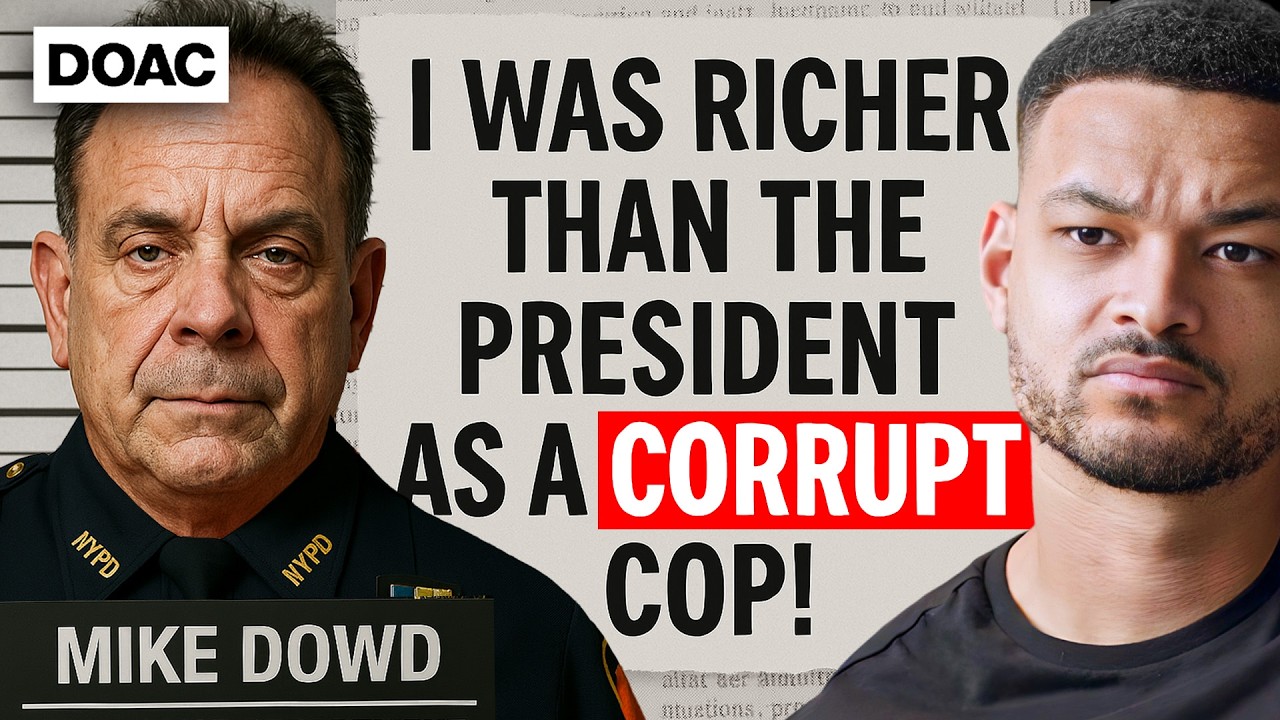
Former NYPD Officer Mike Dowd Details Racketeering and Federal Conviction
The Diary Of A CEO
Dowd attributes his eventual federal conviction to an overwhelming double life of systemic police corruption and drug distribution that ultimately offered relief only through his arrest.
## Background
This video was published on YouTube by the channel The Diary Of A CEO on April 3, 2025. According to the page description, it features former NYPD officer Mike Dowd discussing his path into police corruption, his work with the Dominican-American Diaz criminal organization, his 1992 arrest for drug distribution, and his subsequent 12-year prison sentence.
## TL;DR
Mike Dowd detail-analyzes his trajectory from a New York City police officer to a drug distributor and extorter allied with major crime syndicates like La Compañía and Adam Diaz. He exposes how internal police culture, death threats, and heavy substance abuse fueled his downward spiral and God complex prior to his 1992 arrest. Following a second federal arrest for a kidnapping plot, Dowd served over a decade in federal prison and testified before the Mollen Commission. Reflecting on his post-release life, he shares hard-won lessons on authenticity, family relationships, and redemption.
## Atmosphere & style
The conversation carries a raw, gritty, and intensely candid tone as Dowd unflinchingly recounts his rise and fall within the NYPD. It feels deeply reflective and emotional, shifting from tense stories of high-stakes criminal standoffs and extortion to quiet, vulnerable admissions of guilt, family heartbreak, and psychological strain. Watching or listening creates an arresting sense of relief and catharsis, as an individual once driven by power and self-destruction openly lays bare his flaws to offer genuine advice on truth and self-acceptance.
## Key takeaways
- [32:32](https://www.youtube.com/watch?v=NSsx6mkiaf8&t=1952s) Mike Dowd lived a double life as a police officer, extorter, and drug dealer, which resulted in severe physical numbness, extreme anxiety, and psychological stress.
- [32:32](https://www.youtube.com/watch?v=NSsx6mkiaf8&t=1952s) Despite receiving luxury items like mink coats, cars, and global trips, Dowd's wife pleaded with him to stop his illegal activities and live on legitimate income.
- [34:18](https://www.youtube.com/watch?v=NSsx6mkiaf8&t=2058s) After reporting a suspended officer involved with a crack house to Internal Affairs, Dowd faced nightly death threats, highlighting the danger within corrupt police networks.
- [37:47](https://www.youtube.com/watch?v=NSsx6mkiaf8&t=2267s) Dowd extorted $8,000 weekly from the drug syndicate La Compañía, using NYPD police cruisers to blockade their spots when they shorted his payment.
- [41:02](https://www.youtube.com/watch?v=NSsx6mkiaf8&t=2462s) Partnering with drug kingpin Adam Diaz, Dowd tipped off syndicates about upcoming narcotics raids and used police radio codes to clear crime scenes.
- [45:50](https://www.youtube.com/watch?v=NSsx6mkiaf8&t=2750s) The murder of Officer Venable, a personal friend, triggered severe guilt and psychological breakdown for Dowd, leading to heavy substance abuse and rehab.
- [49:50](https://www.youtube.com/watch?v=NSsx6mkiaf8&t=2990s) Dowd developed a God complex while wearing the badge, experiencing a downward spiral of drugs, alcohol, and escalating violence despite knowing he was self-destructing.
- [51:25](https://www.youtube.com/watch?v=NSsx6mkiaf8&t=3085s) Upon returning from rehab to modified assignment, Dowd was shunned by fellow officers who suspected he was an Internal Affairs informant.
- [54:32](https://www.youtube.com/watch?v=NSsx6mkiaf8&t=3272s) Dowd was arrested in May 1992 after supplying cocaine to his partner Kenny Eurell, whose phones were wiretapped during a drug investigation.
- [57:23](https://www.youtube.com/watch?v=NSsx6mkiaf8&t=3443s) Dowd felt immense relief when arrested, viewing the end of his exhausting double life as the best thing that ever happened to him.
- [01:03:10](https://www.youtube.com/watch?v=NSsx6mkiaf8&t=3790s) While out on bail, Dowd planned to raise $350,000 through a drug robbery to secure his family's property collateral before fleeing to Nicaragua.
- [01:04:44](https://www.youtube.com/watch?v=NSsx6mkiaf8&t=3884s) Kenny Eurell wore a federal wire that escalated the robbery plan into a kidnapping plot, drastically increasing Dowd's legal exposure to potential life imprisonment.
- [01:08:01](https://www.youtube.com/watch?v=NSsx6mkiaf8&t=4081s) Dowd served 12.5 years of a 14-year federal sentence for racketeering and narcotics distribution, incarcerated alongside individuals from the drug networks he dealt with.
- [01:10:45](https://www.youtube.com/watch?v=NSsx6mkiaf8&t=4245s) Dowd's mother did not visit him for eight months following his arrest, but spent the next 12 years praying for him daily in church.
- [01:17:55](https://www.youtube.com/watch?v=NSsx6mkiaf8&t=4675s) Following his release at age 44 with no assets, Dowd faced severe institutionalization shock and difficulty finding employment as a former corrupt officer.
- [01:23:18](https://www.youtube.com/watch?v=NSsx6mkiaf8&t=4998s) Dowd testified before the Mollen Commission in 1993, admitting to thousands of crimes and prompting broader investigations that led to roughly 200 officer arrests.
- [01:26:48](https://www.youtube.com/watch?v=NSsx6mkiaf8&t=5208s) Reflecting on police corruption today, Dowd notes that systemic corruption has shifted from organized street-level rings to high-level budgetary and political power abuse.
## Detailed walkthrough
### [00:00](https://www.youtube.com/watch?v=NSsx6mkiaf8&t=0s) Introduction and "America's Dirtiest Cop"
The interview begins with Steven Bartlett reflecting on Mike Dowd's notorious past involving drug trafficking, bribery, kidnapping, and even murder—crimes that earned Dowd the nickname "America's dirtiest cop." Dowd warns Steven upfront that if they have an honest conversation, Steven is going to hear things he won't like. Dowd frames his time as an NYPD officer as "the greatest job in the world," but argues the system wasn't built for anyone to play the "knight in shining armor." Faced with low wages, public hostility, and direct orders from superiors not to make drug arrests due to department budget limits, Dowd explains how he turned to an entrepreneurial, corrupt solution: taxing drug dealers instead of arresting them. This dynamic rapidly escalated into protecting major drug syndicates, earning more than the President of the United States, and eventually making Dowd the public face of New York City police corruption before his arrest in 1992.
When asked how being referred to as "New York's dirtiest cop" makes him feel, Dowd candidly admits it feels terrible. Although he accepts the title today and uses his story to "chaperone" audiences away from that lifestyle, he acknowledges the deep pain it caused his family, noting how humiliating it was for his mother to see his name splashed across newspaper front pages for disgraceful acts.
- **Key Crimes Admitted:** Robbery, extortion, drug distribution, burglary, kidnapping, and taking bribes.
- **Financial Scale:** Earned more than the President of the United States by protecting one of New York's largest Dominican drug trafficking organizations (*La Compañía*).
- **Arrest Year:** 1992.
---
[02:50](https://www.youtube.com/watch?v=NSsx6mkiaf8&t=170s) Committing Thousands of Crimes and Stealing a Porn Collection
Dowd estimates that over his decade on the force, he likely committed *thousands* of crimes. He explains that every time an officer puts on a badge, every action carries a risk of criminal intent or departmental sanction if boundaries are crossed. He breaks down how standard police actions morphed into legal felonies: taking cash, drugs, or personal items at gunpoint while using the power of the badge legally constitutes armed robbery and extortion.
To illustrate the sheer absurdity and moral decay of his daily routine, Dowd recounts a vivid incident in Brooklyn's 94th Precinct (Williamsburg) where he and his partner, Tom, responded to a homicide call. A murder victim was sitting on his couch with a knife protruding from his side in a 100-degree, un-air-conditioned July apartment that smelled of stale beer and cigarettes. While waiting for detectives, Dowd rummaged through the scene, hit play on the VCR, found a pornographic tape playing, and promptly took the VCR tape to his patrol car.
> "Some guy's porn collection might be missing... when someone's dead, it's really hard for them to complain about what's missing."
The situation turned comedic when Dowd and his partner grabbed a six-pack of Coors Light from the bodega downstairs to beat the heat, placing the unopened beers in the dead man's refrigerator. A female detective supervisor arrived and announced she was having forensics print every beer bottle in the apartment, including those in the fridge. Knowing Dowd's corrupt reputation, she immediately realized his fingerprints were on the Coors Light bottles at a homicide scene. She sighed, ordered him to get rid of the evidence, and told him not to do it again.
- **Location:** 94th Precinct (Williamsburg, Brooklyn).
- **Scene Details:** Homicide victim with a knife in his side; 100°F heat; VCR porn collection stolen; Coors Light six-pack brought in from the downstairs bodega.
- **Department Oversight:** Dowd was on "secret probation" at the time, under heavy observation by internal supervisors who suspected corruption but lacked solid proof.
---
[08:36](https://www.youtube.com/watch?v=NSsx6mkiaf8&t=516s) Joining the NYPD and Integrity Training Realities
Dowd reveals that he originally trained to be an accountant, but dropped out to follow a woman. In 1982, at age 21, he joined the NYPD Police Academy—not out of a noble desire to serve and protect, but simply because he needed a job. When taking the official oath, he confesses he didn't fully mean or understand the gravity of the pledge, though he felt an immature sense of pride.
Regarding the integrity and ethics training provided at the academy, Dowd criticizes it as superficial. Instructors didn't teach the fundamental societal value of trust in law enforcement; instead, they delivered utilitarian warnings like "don't take $5 or $50 from a motorist," because getting caught would land you on the news and make every other cop hate you. At the conclusion of academy training, an instructor gave the class a candid piece of advice that stuck with Dowd: if you try to live strictly by the rigid rules espoused by Internal Affairs, you will never be a successful cop—"just cover your ass."
> "If you live by the rules that these guys espouse in Internal Affairs, you'll never make a successful cop. Just cover your ass."
- **Entry into NYPD:** Joined in 1982 at age 21 after dropping out of accounting school.
- **Academy Philosophy:** Focus was placed on avoiding public embarrassment and maintaining partner stories ("covering your ass") rather than building genuine ethical integrity.
---
[12:11](https://www.youtube.com/watch?v=NSsx6mkiaf8&t=731s) The "Blue Wall of Silence" and Street Realities
Addressing the unwritten rule known as the "Blue Wall of Silence," Dowd explains the complex dynamics of officers protecting one another. While cops are technically the first ones who will turn on you if backed into a corner, on a daily basis they avoid snitching because survival on the street depends entirely on mutual trust. If an officer snitches on their partner, they risk being abandoned or facing delayed backup when targeted in a life-or-death physical struggle on patrol.
Dowd contrasts the public perception of police work with other professions, such as firefighters. While firefighters are praised by civilians and supported by their department, police officers operate in a hostile environment where civilians complain, the department seeks reasons to discipline or strip pay, and every shift carries the risk of career destruction or imprisonment. This siege mentality reinforces the instinct among officers to cover for one another rather than report misconduct.
---
[15:09](https://www.youtube.com/watch?v=NSsx6mkiaf8&t=909s) Being Told to Stop Arresting People
Steven brings up the environmental factors driving police corruption, particularly the crack cocaine epidemic of the 1980s and early 1990s, and asks about Dowd's arrest record. Remarkably, over his 10-year career as a police officer, Dowd only made **43 arrests** total—a number he notes he could have easily hit in a single month. He estimates that had he been an honest, proactive officer, he should have made at least **500 arrests** based on the blatant crimes he witnessed daily.
Dowd explains that precinct commanders actively discouraged officers from making crack arrests because of departmental budget constraints and system gridlock. A single crack arrest required an average of **18 hours of overtime**, pulling officers off patrol and overwhelming the court system. This policy left the streets unregulated and chaotic, creating the exact vacuum that allowed corrupt officers like Dowd to step in and extort local drug dealers for personal profit instead.
- **Total Career Arrests:** 43 arrests in 10 years (estimated 500+ should have been made).
- **Overtime Metric:** An average crack cocaine arrest generated 18 hours of overtime, driving supervisors to suppress arrest numbers to manage department budgets.
[16:14](https://www.youtube.com/watch?v=NSsx6mkiaf8&t=974s) The Incentive Structure Against Making Arrests
Mike Dowd breaks down the financial and operational reality of police work in 1980s Brooklyn. Processing a single crack arrest generated roughly 18 hours of overtime paid at time-and-a-half. With around 150,000 arrests made annually in Brooklyn alone, the overtime bill borne by the city was massive. Because the city had to manage its budget, precinct commanders were under pressure to cut down on arrests. Officers who made too many arrests were actively reprimanded, removed from patrol, and reassigned to desk duty—effectively pulling two officers off the streets for every arrest processed.
This created a perverse incentive system: the department preferred that low-level dealers continue selling crack rather than having officers stuck doing paperwork, which left streets short-staffed and exposed to far worse violent crimes like murder, rape, and robbery. "I think if you look at any system, you'll understand why people behave they do if you understand the incentive structure," the host observes. As a result, law enforcement lost control of the streets, creating a vacuum that entrepreneurial, corrupt cops stepped in to exploit.
- Overtime per crack arrest: **18 hours** at time-and-a-half pay.
- Total annual arrests in Brooklyn at the time: roughly **150,000**.
- Strategic outcome: Precincts prioritized keeping officers on patrol over arresting low-level drug dealers.
---
[18:08](https://www.youtube.com/watch?v=NSsx6mkiaf8&t=1088s) "Taxing" Criminals and the First Bribe
When official arrests were discouraged, Dowd began "taxing" offenders—soliciting bribes instead of booking them. His starting salary when joining the NYPD was approximately $18,000 a year. In 1983, at age 23 or 24, he committed his first financial crime on the job. He pulled over a driver with no license, no paperwork, and no license plates, carrying a stack of hundred-dollar bills. Referring to the situation in period street slang as a "Puerto Rican mystery," Dowd realized the driver was facing thousands of dollars in traffic fines and impoundment.
Dowd explicitly asked for a payoff, telling the driver, "I like lobster. Leave me enough money for a lobster lunch and this whole thing can go away." The driver left a couple hundred dollars under Dowd's briefcase on the back seat. Leaving the scene with the cash, Dowd felt an uncomfortable mix of anxiety and thrill: "It was the first time I actually solicited something like that. But it was sort of... almost like I won something as a cop."
- Dowd's starting NYPD salary: **~$18,000/year**.
- Year and age of first financial crime: **1983**, age **23 or 24**.
- Bribe amount: **A couple hundred dollars** left under a briefcase in the patrol car.
---
[19:40](https://www.youtube.com/watch?v=NSsx6mkiaf8&t=1180s) Sexual Favors on Duty and Precinct Culture
When asked about police officers receiving sexual favors—a trope common in crime movies—Dowd admits that it was real and that he took advantage of it. He identifies engaging in sexual activity while on duty in his patrol car as his "biggest sin in the world."
He recounts a specific incident occurring around 3:00 a.m. in the courtyard of a nine-story building. During the encounter in the back of the police cruiser, the woman's body accidentally hit the car's emergency siren buzzer, blasting the siren through the quiet residential courtyard.
---
[20:42](https://www.youtube.com/watch?v=NSsx6mkiaf8&t=1242s) Explicit Approval from Superior Officers
Dowd describes how his corruption expanded with the implicit approval of his superiors. At a murder scene involving a 20-year-old victim shot in the head inside a marijuana spot, Dowd found cash and drugs left behind. Being broke, Dowd slipped a thin stack of $100 bills (about $600) into his pocket before his boss, Sergeant James Otto, arrived.
When Sergeant Otto surveyed the remaining money ($1,500) and marijuana (2 to 3 pounds) and asked if that was all, Dowd felt pressed and handed over the $600 stack, lying that he hadn't wanted to take bills covered in blood. Later that night while drinking beers at "choir practice"—an informal gathering of officers after hours—Dowd asked Otto what would have happened if he had kept the $600. Otto replied, "I was annoyed that you gave it to me," adding, "If I don't see it, it's yours. But let me know so you can throw me something later on." This explicit endorsement from a 20-year veteran officer completely shifted Dowd's perspective, teaching him that stealing was acceptable as long as supervisors had plausible deniability.
- Murder scene recovery: **2–3 lbs of marijuana**, **$1,500** on table, **$600** pocketed by Dowd.
- Sergeant's directive: "If I don't see it, it's yours... just don't let me see it."
---
[22:59](https://www.youtube.com/watch?v=NSsx6mkiaf8&t=1379s) Desensitization to Death and Violence
Reflecting on his exposure to horrific crime scenes, Dowd explains how officers rapidly build a total emotional disconnect as a survival mechanism. His very first call on his first day as a rookie was a suicide involving a man who jumped off a building and landed on his head—an event that deeply shook him due to the immediate arrival of the traumatized family.
Over time, however, frequent shootings and stabbings hardened him. He recalls a midnight shift where he and his partner, Sal, spotted men stealing tires with tire irons. Sal advised against stopping them because it was late. Minutes later, after civilians complained, they returned to find one of the thieves shot dead in the street next to a tire iron. The realization that the suspect could have shot the officers—or might still be alive if they had intervened earlier—forced an immediate psychological detachment to cope with constant proximity to death.
- First call on the job: A fatal jumper on his very first day.
- Psychological defense: Rapid emotional detachment to survive daily life in violent precincts.
---
[24:42](https://www.youtube.com/watch?v=NSsx6mkiaf8&t=1482s) The Deaths That Still Haunt Him
Despite his desensitization, two fatal incidents deeply affected Dowd. In the first, a young man was stabbed in the stomach and knew he was dying. As the man lay bleeding out, he kept saying, "I'm getting cold, officer." Dowd had to comfort him with false hopes of survival while knowing the ambulance would arrive too late.
The second incident occurred when Dowd was still a rookie working alongside two veteran officers. A 35-year-old man suffered a heart attack during or immediately after a sexual encounter. Dowd wanted to perform CPR, but the senior cops ordered him not to bother and sent him outside to direct the incoming ambulance instead. The man died before medical help arrived. Dowd felt intense guilt over failing to render aid when he believed he could have saved a life, noting that senior officers on scene held absolute control over junior partners.
- Traumatic memory: A stabbing victim whose final words were "I'm getting cold, officer."
- Regret: Being ordered by senior partners to hold back CPR on a 35-year-old heart attack victim who subsequently died.
---
[26:59](https://www.youtube.com/watch?v=NSsx6mkiaf8&t=1619s) Becoming a Full-Fledged Drug Dealer and Market Maker
Dowd's transition into full-blown drug dealing began when his partner stole cocaine from a scene and brought back a couple hundred dollars in cash, telling him, "That shit we've been throwing out is cocaine. We ain't throwing it out no more. I got somebody that wants it." Receiving cash without having personally handled the drugs lowered Dowd's psychological barrier.
Soon, Dowd began confiscating any drugs he found on patrol to resell. If he couldn't find drugs on the street, he bought them directly from street dealers at steep discounts or demanded kickbacks, turning himself into a "market maker" within the neighborhood ecosystem.
- Transition trigger: Partner brought home cash from seized cocaine, proving there was easy money to be made.
- Escalation: Evolved from opportunistic confiscation to active purchasing and reselling of street narcotics.
---
[28:06](https://www.youtube.com/watch?v=NSsx6mkiaf8&t=1686s) "If You Were in the Drug Business, You Were Mine"
Dowd describes a total dual identity: when dealing with law-abiding citizens involved in car accidents or robberies, he performed his duties as a dedicated, proper police officer. However, for anyone operating in the illicit drug trade, he became an absolute tyrant. "If you were in the drug business, you were mine... I owned you," Dowd states.
He extorted money, jewelry, gold chains, expensive coats, and vehicles from local dealers. On single scores, Dowd made between $40,000 and $50,000 at a time—effectively doubling or tripling his annual police salary in a single day. In precincts like East New York, where nine out of ten calls were tied to narcotics, Dowd viewed himself as the supreme authority on the street.
- Mindset toward drug dealers: Total ownership and systematic extortion ("You were mine").
- Extortion targets: Cash, gold chains, high-end coats, and vehicles.
- Single score earnings: **$40,000 to $50,000** in a single event (2x–3x his annual salary).
---
[29:55](https://www.youtube.com/watch?v=NSsx6mkiaf8&t=1795s) How Corrupt Cops Handled Evidence and Other Officers
When asked whether other officers were involved in similar corruption, Dowd explains that honest cops usually had no idea what was happening because corrupt officers kept it strictly hidden. If non-corrupt officers showed suspicion, Dowd would test them directly by asking, "You want in?" Frequently, uninvolved officers simply turned a blind eye to avoid becoming legally liable or responsible for their partners' actions.
Dowd shares an incident where he and his partner were looting a high-level crime scene containing cocaine, heroin, cash, and firearms. When back-up officers arrived, they took one look at Dowd, said, "Oh, that's Dowd and his partner, leave them alone," and walked away to maintain plausible deniability.
- Operational rule: Corrupt activities were kept hidden from honest cops unless they wanted in.
- Peer dynamic: Uninvolved officers deliberately avoided witnessing corrupt acts to protect themselves from legal liability.
---
[31:24](https://www.youtube.com/watch?v=NSsx6mkiaf8&t=1884s) The Green Laundry Bag Heist
Dowd details a specific heist demonstrating how corrupt officers smuggled massive quantities of drugs off crime scenes. Responding to a double shooting where one victim was shot through an entry door eyehole, Dowd discovered a massive stash of heroin and cocaine alongside cash and illegal firearms.
With his sergeant ascending the stairwell to secure the scene, Dowd quickly stuffed a laundry bag full of heroin and cocaine into an outdoor garbage can by the entrance. He reported the fatalities to the sergeant and requested permission to return to patrol ("go 98") since the scene was crowded with police. Once the sergeant went upstairs, Dowd retrieved the green laundry bag from the trash, loaded it into his police car, drove straight to a local dealer to liquidate the drugs, and collected tens of thousands of dollars in cash.
- Method: Stashed a green laundry bag filled with heroin and cocaine inside an outdoor garbage can while the sergeant walked upstairs.
- Police radio code used: **98** (returning to routine patrol).
- Resolution: Retrieved the bag from the garbage, loaded it into the patrol car, and drove directly to a drug dealer to fence the load for cash.
Here is a detailed, faithful walkthrough based on the transcript provided.
---
[32:31](https://www.youtube.com/watch?v=NSsx6mkiaf8&t=1951s) High Anxiety and Living a Triple Life
Mike Dowd describes dropping stolen drugs at a friend’s shop called Auto Sound City, an auto body and car audio business in Brooklyn. The friend then called a local heroin seller to turn the product back into cash. Despite running these operations, Mike claims he was never scared, though in hindsight, he admits he should have been far more cautious. He reveals that for roughly five years, the constant thought of getting caught sat in the back of his mind. This non-stop pressure drove his anxiety to extreme levels, making his body go numb as he tried to figure out what was wrong with him.
He explains that the physical symptoms stemmed from trying to juggle three or four conflicting lives simultaneously: being a full-time police officer, shaking people down, dealing drugs, and managing personal relationships. At the time, Mike had a wife, a girlfriend, and one child. When asked if his wife knew about his illegal activity, Mike says he left the details up to her, but points out that the mink coats, brand-new cars, and global trips couldn't be explained by a rookie cop's salary. She never explicitly called it out, but she knew enough to beg him to stop. She told him, "I'd rather have you" and said she would rather sleep under a bridge than have him continue down that path. Asked why he didn't stop, Mike simply responds, "You can't stop that. It's not that easy to stop."
- **Physical symptoms of stress:** Body numbness and severe anxiety from living a triple life for five years.
- **Lifestyle discrepancies:** His wife knew he was crooked due to the unexplained luxury goods (mink coats, new vehicles, trips around the world).
- **Wife's plea:** She begged him to quit, stating she would rather "sleep under a bridge" than have the dirty money.
---
[34:18](https://www.youtube.com/watch?v=NSsx6mkiaf8&t=2058s) Internal Affairs, Retaliation, and Death Threats
The conversation shifts to an incident involving a suspended police officer named B. Scott. The feud began over a trivial matter, prompting Mike to retaliate when he spotted the officer's car outside a known crack house. Mike saw Scott's Mercedes-Benz—featuring a personalized "B SCOTT" New York license plate—in Long Island. Mike pulled over, told his wife to take a good look at the driver, and watched him enter and exit the only crack house in the neighborhood. After discussing the situation with his neighbor (his wife's uncle, a veteran detective in the 102nd Squad with 28 years on the force), the detective advised him, "Mike, anything but drugs, you got to turn them in." Although it was hypocritical given his own illicit activities, Mike called Internal Affairs.
Internal Affairs investigators arrived at Mike's house within 45 minutes to conduct an interview and subsequently had him identify Scott out of a photo line-up. Shortly after, Mike began receiving threatening phone calls at 02:30 almost every night for nearly a month. When Mike finally confronted the caller on the phone, the man claimed he was sleeping with Mike's wife every time Mike went to work, picking her up at the Long Island Rail Road station. When Mike invited him to come over and settle it face-to-face, the caller threatened, "Why don't I put a bullet in your fucking head while you're standing there in front of the window?"
Mike later ran into the man on the job and issued him several summonses. It turned out the officer was on suspension for his involvement in a Harlem drug case, where he served as a "collector" or "strong man"—the enforcer responsible for collecting money owed to a drug syndicate.
- **Vehicle details:** Mercedes-Benz 380 with custom "B SCOTT" New York license plates.
- **Advice from veteran cop:** Wife's uncle, a 28-year detective in the 102 Squad, told him to report drug involvement immediately.
- **Internal Affairs response time:** Arrived at Mike's home in 45 minutes to conduct an interview and line-up identification.
- **Harlem connection:** The suspended officer acted as the "strong man" (debt collector) for a Harlem drug ring.
---
[37:47](https://www.youtube.com/watch?v=NSsx6mkiaf8&t=2267s) Extorting "La Compañía" and the Standoff
Mike introduces Baron Perez, the owner of Auto Sound City, who acted as a key middleman connecting all the major drug dealers in Brooklyn. Through Perez, Mike met "La Compañía" (The Company), a powerful Dominican drug organization operating dozens of nickel-and-dime crack spots out of neighborhood bodegas across New York City. At the time, Mike was earning a meager cop salary of $600 every two weeks ($300 a week). Seeing an opportunity, he demanded $8,000 a week from La Compañía in exchange for police protection.
The arrangement soured during the very first week when La Compañía shorted him by $700, paying $7,300 instead of the agreed $8,000. When Mike demanded the balance, they refused to pay and declared the deal over. In retaliation, Mike parked marked NYPD police cruisers directly in front of their primary business locations for a week, completely shutting down their trade. In response, La Compañía placed a hit on Mike's life, putting out word to street shooters that they would pay to have the cop killed.
Upon learning of the hit through Baron Perez, Mike immediately hunted down the gang's boss. Spotting his distinct car, Mike pulled over the boss—who was driving a tiny Renault—and threw his license and registration back into his lap. Mike stood directly over the seated boss and challenged him: "If you want to put a hit on me, why don't we clear it up right here... We'll do 10 pace walk off. You turn around, I'll turn around, and we'll shoot it out." The terrified boss backed down, stammering "No, no, no, no." Twenty minutes later, Mike's pager went off with a message confirming the hit was off, asking to be left alone, and settling the $700 debt.
- **La Compañía's footprint:** Operated dozens of street-level locations out of city bodegas.
- **Short-changed payment:** Paid $7,300 instead of $8,000 on week one, leading to a feud.
- **Retaliation tactic:** Parked police cars in front of their storefronts for a week straight to destroy their customer traffic.
- **The Standoff:** Mike confronted the boss in a small Renault, offering a 10-step duel to settle the hit on the spot.
---
[41:02](https://www.youtube.com/watch?v=NSsx6mkiaf8&t=2462s) Partnering with Adam Diaz and Intercepting Raids
Following the collapse of his deal with La Compañía, Baron Perez introduced Mike to Adam Diaz, a high-level Dominican drug kingpin operating two to three levels above street gangs. Diaz was moving roughly 1,500 kilograms of cocaine, generating around $1 million a week ($50 million annually). To even sit down for an initial meeting, Mike demanded Diaz bring $24,000 in cash.
```
Adam Diaz Operation: 1,500 kg cocaine | ~$1M/week revenue (~$50M/year)
Upfront Meeting Fee: $24,000 cash
Weekly Protection: $8,000/week (split with Mike's partner)
```
At the meeting, Mike promised to surveil Diaz's properties and warn him of impending police raids. Mike made a strict rule clear: "If anybody gets hurt, I'm giving myself and you up... because that's not what this is about." Diaz agreed and began paying Mike $8,000 a week, which Mike split with his partner. Mike notes that earning this much money made him feel more powerful than the President of the United States.
Mike proved his worth multiple times. On one occasion, sensing a raid was imminent in an area, Mike entered one of Diaz's storefronts, grabbed two Heineken beers, popped them open at the counter, and ordered the clerk—a stranger—to "Shut it down." Within an hour and a half, a team of 30 to 40 narcotics detectives raided the location and found nothing. On another occasion, two notorious local armed robbers named Franklin and Coke robbed an apartment where Diaz's crew stored massive quantities of drugs and cash. When 911 was called, Mike was the first unit on the scene. He marked the call as a "90 X-Ray" (unfounded) to turn away incoming police cars. Inside the apartment, he caught rookie officers already packing out bags of uninventoried cash and cocaine left behind by the robbers. Using his authority as the senior officer on scene, Mike successfully convinced the officers to put all the cocaine and cash back into the house without seizing it.
- **Adam Diaz scale:** Distributed 1,500 kilos of cocaine, pulling in roughly $50 million a year.
- **Initial fee:** Diaz paid $24,000 cash upfront just to have the initial sit-down conversation with Mike.
- **Heineken warning:** Popped two Heinekens at the counter as a signal to clear out the store 90 minutes before 30–40 narcotics officers raided it.
- **90 X-Ray radio code:** Used the NYPD code for an "unfounded" complaint to clear a major robbery scene at a stash house and forced junior cops to return confiscated drugs and cash.
---
[45:50](https://www.youtube.com/watch?v=NSsx6mkiaf8&t=2750s) The Death of Officer Venable and Unraveling Guilt
The atmosphere turns dark as Mike reflects on the murder of Officer Venable, a fellow cop and personal friend. Venable was shot in the head and killed by associates linked to La Compañía, and Mike was the very first officer to arrive on the scene. Venable later died at the hospital. This event shattered Mike, burdening him with overwhelming guilt. He realized that while protecting and profiting from drug organizations, he was shielding the very people tied to the cop-killers. Referring to Mike Tyson's famous quote—"Everything's all good until someone punches you in the fucking nose"—Mike describes the murder as his reality check.
Mike notes the significance of the tragedy: prior to that day, despite working in the brutal environment of East New York, no on-duty police officer had ever been killed in that precinct. Feeling directly connected to and responsible for the tragedy because he helped keep these drug syndicates operational, Mike's life spiraled. He turned heavily to alcohol and drugs to cope. Within three to six months of Venable's death, Mike checked into a rehabilitation facility. Describing his private breakdown, Mike shares a poignant image: "What I did was I would go in my bathroom, close the door, and read the paper and cry."
- **Officer Venable:** Shot in the head by associates of La Compañía; Mike was the first officer on the scene.
- **Precinct history:** Prior to Venable's death, no on-duty police officer had ever been killed in East New York.
- **Personal spiral:** Driven by guilt, Mike turned heavily to substance abuse, resulting in a rehab stay roughly six months later.
---
<FollowUp label="Want to explore Part 4 covering Mike's rehab, arrest, and trial?" query="Can you walk me through Part 4 of the transcript focusing on Mike Dowd's time in rehab, his arrest, and trial?"/>
Here is a detailed, faithful walkthrough of Part 4 of the transcript.
---
[48:32](https://www.youtube.com/watch?v=NSsx6mkiaf8&t=2912s) The Physical and Emotional Toll of Living a Double Life
Mike Dowd describes the intense internal turmoil that consumed him during his police career. He recalls hiding away in the bathroom under the guise of reading the newspaper, only to break down crying as a desperate way to release the built-up stress, anxiety, and guilt. Because of his actions, he was trapped in his own mental prison with no outlet to publicly express his grief. He agonized over the weight of his decisions, knowing he had robbed drug dealers and sold cocaine, only to learn that a fellow police officer had died as a direct result of cocaine usage.
During this period, Dowd was actively consuming drugs and alcohol while his marriage was falling apart. Though he lost his wife, kids, and home, he clarifies that these losses were not the driving force behind his actions. His sole driving motivation was his obsession with saving his job, preferring to leave the NYPD on his own terms rather than face the humiliation of being fired.
- **Coping Mechanisms**: Used drugs, alcohol, and secret breakdown sessions in the bathroom to cope with stress.
- **Tragic Consequence**: A fellow police officer died due to cocaine, weighing heavily on Dowd's conscience.
- **Primary Concern**: Desperately wanted to avoid being fired from the police force, caring more about his job than the loss of his home and family.
---
[49:50](https://www.youtube.com/watch?v=NSsx6mkiaf8&t=2990s) Developing a "God Complex" and the Rabbit Hole of Self-Destruction
Reflecting on who he became, Dowd admits he was a direct product of his poor decisions and corrupt environment. He points out that he became no different from the street dealers selling crack or the criminals robbing each other. He explains how the power of the badge fostered a massive "God complex"—he felt completely indestructible on the outside even while watching his own life rapidly collapse beneath him.
He characterizes this period as a downward rabbit hole of drugs, alcohol, women, and escalating violence. He acknowledges that he was transforming into a "violent potential killing machine" who had no place on the street.
> "You become God. Like you get the God complex. Like you feel indestructible, but you see yourself declining... You know you're going down a rabbit hole, but the whole time you have this false armor on."
---
[51:25](https://www.youtube.com/watch?v=NSsx6mkiaf8&t=3085s) The Paranoia of Returning from Rehab as an Outcast
When Dowd returned from rehab intent on straightening out his life, he anticipated a fresh start. Instead, he discovered that going straight after being known as corrupt made other officers deeply suspicious. Because his reformed behavior seemed unnatural to his peers, they assumed he had turned informant and was working for Internal Affairs to set them up.
As a result, his fellow officers completely shunned him. They refused to work with him, wouldn't partner up, declined to back him up on calls, and excluded him from social gatherings. Losing the camaraderie and safety net of the police brotherhood left him utterly isolated, which ultimately shattered his attempt to stay clean and drove him back into criminal behavior.
- **Rehab Assignment**: Spent two years on "modified assignment" during his rehab period.
- **Colleague Reaction**: Fellow cops believed he was "working for the man" as an informant.
- **Ostracization**: Lost all safety, protection, and brotherhood, leaving him isolated on the job.
- **Failed Pension Hopes**: Dropped hints about retiring on disability, but was explicitly told, "You're either getting arrested or fired."
---
[53:39](https://www.youtube.com/watch?v=NSsx6mkiaf8&t=3219s) The "Diamond in a Pile of Shit" Mentality
When asked why he didn't stop his criminal activity despite knowing Internal Affairs was tailing him for months, Dowd compares his mindset to a story about an optimistic kid shoveling through a massive pile of manure because someone told him a diamond ring was hidden inside. He describes himself as an eternal, delusional optimist who convinced himself everything would turn out fine.
He illustrates the sheer power of this self-delusion by recalling his eventual prison sentence. Even after being sentenced to 14 years in federal prison—a term he considers fair—he woke up every single day for 12.5 years genuinely believing he might be allowed to go home the next day.
> "When the kid goes into the barn and there's a pile of hay and shit and manure and someone tells him there's a diamond ring in the middle... the kid gets a shovel and he starts shoveling... That's who I am. I'm that guy looking for that little diamond in that pile of shit. I'm an optimist."
---
[54:32](https://www.youtube.com/watch?v=NSsx6mkiaf8&t=3272s) May 1992: The Bust at the Precinct
On May 4 or 5, 1992—right after the Rodney King riots—Dowd struck a deal to supply his former partner, Kenny Eurell, with three or four packages of cocaine after Eurell called repeatedly because drug prices had doubled. Unbeknownst to Dowd, Eurell's phones were wiretapped as part of a Long Island drug investigation.
After dropping off a package with Eurell, Dowd noticed the radio in the 94th Precinct (Williamsburg) was unnaturally quiet. Upon pulling up to the station house, he spotted a suspicious car outside with two men. Inside, the desk officer directed him to the captain's office, where the two men from the car revealed themselves as Internal Affairs lieutenants taking him in for an emergency drug test.
- **Targeted Investigation**: Kenny Eurell was the primary target of a Long Island phone tap.
- **Locker Room Standoff**: Internal Affairs agents stood so close to Dowd while he changed that he couldn't even bend his knee or empty the cocaine hidden in his clothes into his locker.
- **Car Escort**: While chain-smoking in the back of the IAB car, Dowd tried to get the agents to roll down the window so he could throw his hidden cocaine out, but failed.
- **The Staging**: Arrived at Lefrak City to find 60 uniformed high-ranking officers (captains, inspectors, lieutenants) lined up.
- **The Arrest**: Upstairs on the 16th floor, after taking a urine test while high on vodka and a "bump" of cocaine, his mother's cousin (a Suffolk County police officer) placed him under arrest for conspiracy to distribute narcotics.
---
[57:23](https://www.youtube.com/watch?v=NSsx6mkiaf8&t=3443s) Arrest as the Ultimate Moment of Relief
Despite facing massive criminal charges, Dowd experienced a profound sense of relief the moment the handcuffs went on. After living for years with intense anxiety, paranoia, and the burden of lying to his wife, children, family, and the department, the arrest lifted an unbearable weight off his shoulders. He didn't fear the arrest itself; he feared ruining his life and continuing the exhausting double life.
Dowd views his arrest as the absolute best thing that ever happened to him. The sudden removal of pressure brought a deep sense of peace because he no longer had to maintain a false front or live a lie.
> "It was the biggest moment of relief... It was the best feeling in the world. Almost like I was like, 'Finally, it's over. It's finally over. I can go on with my life somehow.'"
---
[59:45](https://www.youtube.com/watch?v=NSsx6mkiaf8&t=3585s) Advice on Honesty, Consequences, and Finding Purpose
Reflecting on the lessons he would pass down to his two adult sons (aged 40 and 33/34), Dowd stresses that telling the truth is far easier than lying because maintaining lies requires constant memory and creates perpetual fear of exposure. He advises that people must learn to accept the hard knocks and consequences of their actions, noting that avoiding difficult conversations only compounds future pain.
Dowd admits that being completely transparent on podcasts and in public about his past misconduct can be tough, especially with the amount of hate directed at him. However, his openness has given him a new purpose: he regularly receives messages from police officers and individuals on the brink of suicide who decided to stay alive after hearing his story.
- **Family**: Has two sons, currently aged around 40 and 33 or 34.
- **Core Philosophy**: Everything in life has a cost; immediate gratification often carries devastating long-term consequences for careers, families, and freedom.
- **Impact of Transparency**: Reaches out to distressed officers; speaks to people who have attempted suicide or pulled back from taking their own lives.
---
[01:03:10](https://www.youtube.com/watch?v=NSsx6mkiaf8&t=3790s) Released on $350,000 Bail and the Plot to Flee
After his initial arrest, Dowd was unexpectedly released on a $350,000 bail secured by his family's homes and assets. Once out, he found himself overwhelmed with financial stress: he had no job, three mortgages, and a oceanfront condo in Myrtle Beach. To make matters worse, his tenants stopped paying rent the moment news of his arrest hit the press.
Desperate to avoid prison, Dowd began hatching a plan to skip bail and escape to Nicaragua to start over as a shrimp fisherman. However, because his family had put up their homes to guarantee his $350,000 bail, he knew he couldn't leave them bankrupt and homeless. He realized he needed to quickly score $350,000 in cash to pay back his family before fleeing the United States.
- **Bail Amount**: $350,000 backed by his family's properties.
- **Properties Owned**: Three homes, including an oceanfront condo in Myrtle Beach.
- **Escape Plan**: Intended to flee to Nicaragua to work as a shrimp fisherman after securing enough money to reimburse his family.
---
[01:04:32](https://www.youtube.com/watch?v=NSsx6mkiaf8&t=3872s) The Kidnapping Scheme for Bail Money
To raise the $350,000 needed to clear his family's financial risk before fleeing the country, a dangerous opportunity presented itself. Dowd learned of a woman who owed a major drug trafficking organization half a million dollars in cash and 10 kilograms of cocaine. Dowd and his associates devised a plan to abduct and rob her to secure the cash.
- **Target Target**: A woman owing $500,000 cash and 10 kilos of cocaine to a drug syndicate.
- **Objective**: Steal the cash to pay off his $350,000 family bail obligation so he could execute his escape to Nicaragua.
---
<ElicitationsGroup message="Where would you like to go next?">
<Elicitation label="Continue to Part 5 of the transcript" query="Please provide a detailed, faithful walkthrough of Part 5 of this transcript."/>
<Elicitation label="Summarize Mike Dowd's full timeline of events" query="Can you build a chronological timeline of Mike Dowd's life events mentioned across the transcript?"/>
</ElicitationsGroup>
Here is the detailed, faithful walkthrough covering Part 5 of the transcript:
[01:04:44](https://www.youtube.com/watch?v=NSsx6mkiaf8&t=3884s) The Set-Up: Kenny's Wire and the Entrapment Scheme
When Mike Dowd gets released on bail, his former police partner, Kenny Eurell, reaches out with a plot to rob a female drug dealer in order to solve Mike's massive financial strain. The initial proposal pitched to Mike was not a kidnapping; it was supposed to be a straightforward home invasion—entering her place under the guise of delivering flowers, pushing her aside, and seizing her cash and drugs so Mike could pay back his family and flee the country with Kenny. Unbeknownst to Mike, Kenny has already flipped and is wearing a hidden wire for the federal authorities.
Kenny lures Mike straight into a federal conspiracy, intentionally escalating the proposal to involve a full-scale kidnapping scheme. By coaxing Mike into agreeing to kidnap the woman, steal her assets, and flee the country, the government successfully elevates Mike's legal liability from that of a mid-level narcotics dealer facing 15 to 20 years into a high-level kingpin involved in a potential kidnapping and murder plot. Reflecting on how easily he fell into the trap, Mike bitterly remarks that he took the bait and "swallowed it like a pig."
- **Timeline Context:** Mike had known Kenny for seven years, dating back to 1985.
- **The Setup:** The plot evolved from a quick robbery using flowers into a federal conspiracy involving kidnapping and fleeing the country.
- **Legal Escalation:** The federal charge transformed Mike's exposure from a 15-to-20-year drug sentence into potential life imprisonment with no chance of returning home.
---
[01:06:20](https://www.youtube.com/watch?v=NSsx6mkiaf8&t=3980s) Second Arrest and Facing 25 to Life
On the day the proposed kidnapping and robbery is set to take place, federal agents move in and arrest Mike once again. Unlike his first arrest, which brought an overwhelming sense of relief, this second bust fills him with pure rage. Describing himself as a "rat in a corner," Mike explains that he was desperate to escape a state sentence of 25 years to life. When Kenny dangled the prospect of quick cash and a way out, Mike took the hook out of sheer panic for his family's financial future.
Despite the second bust, there is one small victory: because he was taken into custody on new federal charges rather than fleeing the jurisdiction, his family does not lose the collateral they put up for his initial bail. Shortly after, Mike is convicted in federal court on charges of racketeering (organized crime) and conspiracy to distribute narcotics.
- **Emotional State:** Anger and desperation, comparing his mindset to a trapped animal eating poisoned cheese.
- **Sentencing Risk:** Facing a state offer/threat of 25 years to life as a 30-something NYPD officer left him willing to take extreme risks to run.
- **Bail Preserved:** His family’s property and funds put up for his initial bail were saved from forfeiture because he was arrested before fleeing.
---
[01:08:01](https://www.youtube.com/watch?v=NSsx6mkiaf8&t=4081s) Sentenced to 168 Months in Federal Prison
Sitting in court awaiting his sentence, Mike holds out hope that the judge will hand down around seven or eight years. Instead, the female judge sternly announces a sentence of 168 months. Momentarily confused by the math, Mike asks what 168 months means, and the judge coldly responds, "That's 14 years." Hearing that number leaves him completely devastated, immediately forcing his brain into raw survival mode.
```
168 Months = 14 Years Federal Prison Sentence
Actual Time Served: 12 Years and 5 Months
```
Addressing the common belief that corrupt police officers face a swift death sentence in prison, Mike clarifies why his experience was somewhat different. He was not incarcerated for police brutality, civil rights violations, or abusing citizens; he was sent to federal prison as an organized crime racketeer alongside Dominican and Puerto Rican drug dealers—the very same networks he had done business with on the street. Because 30% of the prison population comprised these exact drug networks, white-collar criminals, and bank robbers, his landing was smoother than that of a typical cop, though he stresses it was still dangerous and far from easy.
---
[01:10:45](https://www.youtube.com/watch?v=NSsx6mkiaf8&t=4245s) The Emotional Impact on His Mother, Carol Dowd
The interview shifts to an emotional clip of Mike's mother, Carol Dowd. Carol reflects on the day of his sentencing, recalling how the judge delivered the term in days and months, preventing the full weight of a 15-year reality from hitting her right away. She expresses deep shock, confusion, and anger, remembering Mike as a once honest, reliable, smart, and good kid. She admits that the first time she saw him behind bars, she wanted to reach through the metal separators and scream, "What did you do this for?"
Carol reveals that it took her eight long months before she could bring herself to visit him in prison, but when she finally did, she held on and did not want to let him go. Deeply religious, Carol went to church every single day for the entire 12 years and 5 months Mike was locked up to pray for her son. Listening to her story in the studio, Mike breaks down in tears and becomes visibly overwhelmed with emotion.
> "I love him, but I want to just reach in through the bars... and say, 'What did you do this for?'" — Carol Dowd
---
[01:13:09](https://www.youtube.com/watch?v=NSsx6mkiaf8&t=4389s) Family Dynamics, Discipline, and Cold Love
Responding to his emotional reaction, Carol notes that Mike rarely expressed remorse or acknowledged the collateral damage his actions inflicted on his family. During his years of crime, "it was all about him," but seeing him cry makes her glad he finally understands the sacrifices made on his behalf. She reflects on his upbringing, explaining that authority went to his young head when he put on the NYPD uniform as a skinny kid on the corner.
Mike describes his mother as the absolute moral compass—the "weather vane" of right and wrong—who held him accountable his entire life while his father was more lenient. Their relationship was defined by constant sparring and tough love. Carol attributes her strictness to being raised by nuns in a cold, calculating environment following an unhappy childhood. Raising a large family required rigid discipline; she showed her love by cooking hot breakfasts and keeping order rather than being "mushy."
- **Mother's Routine:** Went to mass every single day for over 12 years to pray for Mike, a fact Mike only learned twenty years later.
- **Upbringing:** Raised in a strict household where love was expressed through service and chores rather than hugs and affection.
- **Role Reversal:** Mike was expected to be the family's rising star, but ultimate resilience came from the very parents he was pushed not to emulate.
---
[01:17:55](https://www.youtube.com/watch?v=NSsx6mkiaf8&t=4675s) Gratitude, Guilt, and Rebuilding at 44
Looking back as a 64-year-old man with parents in their 80s, Mike struggles to define what guilt feels like, choosing instead to describe his emotions as profound gratitude, respect, and awe for their perseverance. Growing up, he was groomed to be the success story who would elevate the family name, but when his entire life collapsed, his parents were the ones who stood by him without fail.
When Mike was finally released from prison at age 44 after serving over 12 years, he moved straight back into his parents' home. He recalls looking out their window and seeing two young boys playing in the yard, realizing with a heavy heart that they were his nephews whose names he did not even know. Standing in his parents' bathroom, taking his first shower as a free man in over a decade, he wept so hard he couldn't tell if the liquid running down his face was the shower water or his own tears.
- **Age at Release:** 44 years old, returning to live in his parents' house with zero money, no car, and no clothes.
- **The Void:** Reentering society meant coming out to "zero"—losing the entire two decades of adulthood following his youth.
- **Daily Contact:** Recognizing that his parents' days are numbered, Mike now makes it a point to call them almost every day just to hear their voices.
---
[01:21:53](https://www.youtube.com/watch?v=NSsx6mkiaf8&t=4913s) Institutionalization and Reconnecting with His Children
Stepping out of prison after 12.5 years triggered intense institutionalization shock for Mike. Simple daily interactions felt foreign; he describes standing in public not even knowing how to order a hot dog or navigate basic societal norms. The anxiety was so overwhelming that, initially, he felt a strange desire to go back to the familiar structure of prison.
Finding employment as a convicted "dirty cop" was nearly impossible. His record as a former officer who betrayed public trust, robbed drug dealers, distributed narcotics, and used cocaine made him radioactive to standard employers. Beyond the career barrier lay a devastating personal rift: his two sons had grown up completely without him.
- **Oldest Son:** Was 5.5 years old when Mike went away; by his release, he was attending college.
- **Youngest Son:** Was just 11 months old at the time of the arrest; by Mike's release, he was entering his second year of high school.
- **Post-Release Work:** Started out doing odd jobs as a handyman before eventually being approached to feature in *The Seven Five*, the landmark documentary detailing his life and corruption inside the NYPD's 75th Precinct.
---
<ElicitationsGroup message="Where would you like to go next?">
<Elicitation label="Summarize Part 6 of the transcript" query="Please provide the walkthrough for Part 6 of this transcript series."/>
<Elicitation label="Detail Mike Dowd's NYPD crimes and syndicate ties" query="Summarize Mike Dowd's specific crimes with the NYPD and his relationship with the Diaz criminal organization as discussed in the interview."/>
</ElicitationsGroup>
[01:23:18](https://www.youtube.com/watch?v=NSsx6mkiaf8&t=4998s) The Mollen Commission and Retrospective on Police Corruption
The conversation opens by reviewing the historic fallout of Mike Dowd’s arrest and his explosive testimony before the Mollen Commission—the investigative body set up in New York by then-Mayor David Dinkins to examine NYPD corruption. Although Internal Affairs had received 16 prior complaints against Dowd over the years, he was never brought down until 1992. When he finally testified at the commission hearings in 1993, Dowd famously refused to name individual cops, warning officials, "if I speak before your commission a lot of cops are going to commit suicide." While he admitted during the hearings to hundreds of crimes, he later acknowledged the true count was easily in the thousands. Dowd had created a system where both working police officers and street drug dealers were essentially on his payroll. Ultimately, the broader investigations connected to the commission resulted in approximately 200 police officers being arrested for drug trafficking.
- **Mollen Commission Context:** Commission established by the NYC Mayor to investigate systemic NYPD corruption.
- **Internal Affairs Complaints:** 16 separate complaints were filed against Mike Dowd prior to his arrest.
- **Hearing Testimony:** Admitted to thousands of crimes and noted both cops and drug dealers worked for him; warned that naming names would lead to officer suicides.
- **Fallout:** Approximately 200 police officers were arrested for drug trafficking in connection with the investigation.
---
[01:24:19](https://www.youtube.com/watch?v=NSsx6mkiaf8&t=5059s) What 18-Year-Old Mike Needed to Hear
Reflecting back on his youth, Steven asks Dowd what he would whisper in the ear of his 18-year-old self if he could travel back in time. Visibly moved, Dowd answers simply: "I'm proud of you and I love you." He explains that young people rarely know if they are doing enough, and while self-pride can turn toxic, hearing authentic pride and love from others validates one's self-worth and sacrifices.
This reflection leads back to Dowd's lifelong desire for maternal approval. He recalls how issues in his adult relationships often mirrored his deep-seated feeling of disappointing his mother, contrasting this with his father, who was always openly proud of him. Reassuring an 18-year-old consistently with love and validation could have altered his entire life trajectory. Later in life, when his mother revealed she prayed for him every day, Dowd was stunned, admitting, "I didn't even think you liked me."
- **Message to 18-Year-Old Self:** "I'm proud of you and I love you."
- **Root Motivation:** A constant, unfulfilled search for his mother's approval, whereas his father was consistently proud of him.
- **Impact of Reassurance:** Believes consistent emotional reassurance during youth could significantly alter a person's life choices.
---
[01:26:48](https://www.youtube.com/watch?v=NSsx6mkiaf8&t=5208s) Modern Police Corruption: From Street-Level to High-Level Bureaucracy
When asked if police corruption still exists today, Dowd responds without hesitation: "Oh, it's massive." However, he highlights a fundamental shift in how it operates. During his era, corruption was a organized, street-level enterprise involving drug ripoffs and protection rackets. Today, street-level corruption is mostly opportunistic "hit and miss scores"—cops stumbling upon money or contraband and pocketing it—rather than systematic street operations.
Instead, modern systematic corruption has moved to the high-ranking bureaucracy, revolving around massive departmental budgets, political power, and high-level abuse of authority. Dowd points to a recent headline-grabbing scandal where a police chief sexually abused a female lieutenant on official property, paying her over $200,000 in fraudulent overtime pay because she needed money. Dowd also recalls his own peak earnings, noting the most money he personally made in a single day was $40,000—though drug kingpin Adam Diaz told him he could have easily walked away with $150,000 from a single stash house robbery if he had taken all the cash left behind. Despite the chaos, Dowd admits he loved being a cop, calling it "the greatest job in the world if you have the support that you need."
- **Shift in Corruption:** Transformed from systematic street-level drug operations to top-level budgetary abuse, power plays, and political corruption.
- **Modern Street Corruption:** Mostly opportunistic "scores" (taking cash or drugs on the fly) rather than organized rings.
- **High-Level Abuse Example:** A police chief paying a subordinate $200,000 in overtime pay in exchange for sexual favors.
- **Peak Single-Day Score:** Dowd made $40,000 in one day, though a missed opportunity at a stash house was worth over $150,000.
---
[01:29:33](https://www.youtube.com/watch?v=NSsx6mkiaf8&t=5373s) What the Universe Put You Here to Share
Closing the interview with the podcast's signature tradition, Steven reads a question left by the previous guest: "What is the gift that the universe, life, or God has put you here to share?" Dowd reiterates the central theme of his life's lessons: "Just everybody needs more love. Just love... Just listen to your friends. Listen to your neighbors. Just listen. Patient love." He emphasizes that when people truly listen to one another, they realize how much more they have in common than what divides them.
Steven thanks Dowd for his raw honesty, reflecting on how easily a person's life trajectory can be altered by desperation, insecurity, or a lack of love. Shared drive and a lack of fear regarding consequences can lead one person to become a successful entrepreneur and another to become a criminal. Steven recalls a childhood friend named Joe telling him, "You're either going to be a millionaire or a criminal," illustrating how close the line can be when someone is desperately driven to escape their circumstances.
- **Closing Question Answer:** To spread love, patience, and active listening, recognizing shared human commonalities.
- **Host Reflection:** Steven shares his personal story of being told he would become either a millionaire or a criminal, highlighting how early insecurity and the desperate drive for success push people to extreme lengths.
## Notable quotes
> [33:32](https://www.youtube.com/watch?v=NSsx6mkiaf8&t=2012s) I'd rather have you — Mike Dowd's Wife
> [34:00](https://www.youtube.com/watch?v=NSsx6mkiaf8&t=2040s) You can't stop that. It's not that easy to stop. — Mike Dowd
> [35:10](https://www.youtube.com/watch?v=NSsx6mkiaf8&t=2110s) Mike, anything but drugs, you got to turn them in. — Mike Dowd's Wife's Uncle
> [36:50](https://www.youtube.com/watch?v=NSsx6mkiaf8&t=2210s) Why don't I put a bullet in your fucking head while you're standing there in front of the window? — Anonymous Caller / B. Scott
> [40:10](https://www.youtube.com/watch?v=NSsx6mkiaf8&t=2410s) If you want to put a hit on me, why don't we clear it up right here... We'll do 10 pace walk off. You turn around, I'll turn around, and we'll shoot it out. — Mike Dowd
> [42:20](https://www.youtube.com/watch?v=NSsx6mkiaf8&t=2540s) If anybody gets hurt, I'm giving myself and you up... because that's not what this is about. — Mike Dowd
> [46:30](https://www.youtube.com/watch?v=NSsx6mkiaf8&t=2790s) Everything's all good until someone punches you in the fucking nose — Mike Tyson (quoted by Mike Dowd)
> [48:05](https://www.youtube.com/watch?v=NSsx6mkiaf8&t=2885s) What I did was I would go in my bathroom, close the door, and read the paper and cry. — Mike Dowd
> [49:50](https://www.youtube.com/watch?v=NSsx6mkiaf8&t=2990s) You become God. Like you get the God complex. Like you feel indestructible, but you see yourself declining... You know you're going down a rabbit hole, but the whole time you have this false armor on. — Mike Dowd
> [53:39](https://www.youtube.com/watch?v=NSsx6mkiaf8&t=3219s) When the kid goes into the barn and there's a pile of hay and shit and manure and someone tells him there's a diamond ring in the middle... the kid gets a shovel and he starts shoveling... That's who I am. I'm that guy looking for that little diamond in that pile of shit. I'm an optimist. — Mike Dowd
> [57:23](https://www.youtube.com/watch?v=NSsx6mkiaf8&t=3443s) It was the biggest moment of relief... It was the best feeling in the world. Almost like I was like, 'Finally, it's over. It's finally over. I can go on with my life somehow.' — Mike Dowd
> [01:10:45](https://www.youtube.com/watch?v=NSsx6mkiaf8&t=4245s) I love him, but I want to just reach in through the bars... and say, 'What did you do this for?' — Carol Dowd
## Mentioned
Mike Dowd, Auto Sound City, Baron Perez, B. Scott, Internal Affairs, 102nd Squad, Long Island Rail Road, La Compañía, NYPD, Adam Diaz, Franklin, Coke, Officer Venable, Mike Tyson, East New York, Kenny Eurell, Carol Dowd, Mollen Commission, David Dinkins, The Seven Five
Former NYPD officer Mike Dowd argues that perverse departmental incentives, institutional silence, and unchecked street authority allowed him to run extortion and drug operations alongside violent cartels. While the police badge fostered an illusion of omnipotence, he contends that systemic corruption inevitably inflicts severe psychological decay and catastrophic familial consequences.
Departmental Incentives and the Slippery Slope (16:14)
Dowd claims the NYPD's operational structure during the 1980s crack epidemic actively suppressed legitimate policing. Because processing a single crack arrest generated roughly 18 hours of overtime pay, commanders facing citywide budget pressures discouraged drug busts and reassigned proactive officers to desk duty. Consequently, Dowd recorded only 43 arrests during his decade on patrol, despite witnessing hundreds of blatant offenses. Academy training reinforced this moral detachment by advising recruits to "cover your ass" rather than instill ethical integrity.
This vacuum prompted Dowd to "tax" suspects rather than arrest them. What began in 1983 as a couple hundred dollars solicited from an unlicensed motorist escalated into confiscating street narcotics for personal resale. Dowd asserts that supervision provided explicit endorsement; after he retained $600 from a homicide scene, his sergeant merely chided him for leaving evidence in sight and instructed him to pass along future cuts, legitimizing theft under plausible deniability.
Syndicate Protection and Street Extortion (41:02)
Dowd operated an organized extortion and distribution racket, asserting that anyone involved in neighborhood narcotics belonged to him. Seizing drugs and valuables at gunpoint, he made single-day scores between $40,000 and $50,000—dwarfing his initial $300 weekly police pay. When Dominican syndicate La Compañía shorted an agreed $8,000 weekly protection fee by $700, Dowd parked marked patrol cars outside their bodegas to disrupt customer traffic, backing down only after a direct standoff with the gang's boss neutralized a contract on his life.
Dowd subsequently allied with kingpin Adam Diaz, whose syndicate moved 1,500 kilograms of cocaine generating roughly $50 million annually. After receiving a $24,000 upfront cash fee and $8,000 weekly retainers, Dowd tipped Diaz off to impending raids and manipulated dispatch calls—such as logging a stash-house robbery as "90 X-Ray" (unfounded) to divert incoming backup while forcing junior officers to return seized contraband.
The Blue Wall and Psychological Collapse (45:50)
Dowd explains that the "Blue Wall of Silence" was sustained by survival: snitching risked losing immediate backup during lethal street altercations, prompting honest cops to turn a blind eye to maintain plausible deniability. Under this cover, Dowd developed a "God complex," feeling invulnerable on patrol while privately experiencing severe physical numbness and anxiety from managing conflicting identities as an officer, syndicate protector, and father.
His psychological facade broke when his friend Officer Venable was fatally shot by associates connected to La Compañía. Overwhelmed by guilt that his illicit protection enabled cop killers, Dowd turned to heavy cocaine and alcohol abuse, secretly weeping in bathrooms before checking into rehab. When he returned clean on modified duty, colleagues completely ostracized him, convinced his reformed behavior indicated he had turned into an Internal Affairs informant.
Federal Bust and the Mollen Reckoning (83:18)
Dowd was arrested in May 1992 after Internal Affairs tapped his former partner Kenny Eurell's phone. Released on a $350,000 bail backed by his family's homes, Dowd conspired to kidnap and rob a female narcotics dealer to recover funds and flee to Nicaragua. The operation was an entrapment sting orchestrated by Eurell, who was wearing a federal wire. Convicted of racketeering and narcotics conspiracy, Dowd received a 168-month (14-year) sentence, serving 12 years and 5 months before his release at age 44.
The case sparked New York's 1993 Mollen Commission, which exposed that Internal Affairs had failed to act on 16 previous complaints against Dowd. Dowd testified that hundreds of crimes—which he later admitted totaled thousands—involved both officers and dealers on his payroll, resulting in approximately 200 officer arrests. Reflecting on contemporary law enforcement, Dowd claims systematic corruption has largely migrated from street-level rackets to high-level budgetary and administrative abuse.
Dowd's account illustrates how departmental disincentives, unchecked street authority, and peer complicity can convert law enforcement into an organized criminal enterprise. Because his testimony is retrospective and self-reported, it leaves open whether modern institutional reforms have resolved the underlying pressures of silence and bureaucracy, or merely shifted corruption higher into administrative ranks.
## Background
本期内容由 YouTube 频道《The Diary Of A CEO》(主持人 Steven Bartlett)于 2025 年 4 月 3 日发布。视频简介指出,嘉宾迈克·多德(Mike Dowd)曾是纽约市警察局(NYPD)警员,后来彻底堕落并为多米尼加裔迪亚兹犯罪集团效力,最终在 1992 年因贩毒被捕并服刑 12 年。
## TL;DR
迈克·多德在访谈中全景式回顾了自己从一名普通巡警蜕变为“全美最肮脏黑警”的堕落全过程。他详细披露了警队内部的“蓝墙沉默”与扭曲体制,讲述了自己如何从顺手牵羊、向街头毒贩“抽税”,逐步升级为替大毒枭亚当·迪亚兹充当每周进账数千美元的武装保护伞。随着同僚殉职带来的精神崩溃与滥用药物,多德在 1992 年落网,并因涉入绑架勒索陷阱被判处 14 年监禁;出狱后,他在历经一无所有的归零与制度化迷茫后,选择直面过往的谎言并以真实经历警示世人。
## Atmosphere & style
对谈整体充斥着冷峻、露骨且近乎残酷的真实感,多德用平静甚至略带自嘲的口吻叙述着耸人听闻的黑警罪行,与主持人深度探究人性的严肃追问形成了强烈的张力。整个叙事弧线从早期的疯狂狂妄与“上帝情结”,急转直下至同僚殉职后的绝望瓦解,并在提及母亲长达 12 年默默祈祷与出狱后洗热水澡痛哭时达到情感风暴的顶峰。聆听这段对话,就像是亲临一场毫无防备的灵魂解剖,既能体会到好莱坞式犯罪叙事的惊心动魄,又深切感受到谎言坍塌后沉重的忏悔与宿命般的救赎感。
## Bulletin
- [00:00](https://www.youtube.com/watch?v=NSsx6mkiaf8&t=0s) 前纽约市警察局巡警迈克·多德(Mike Dowd)详述了自己如何从一名拿微薄底薪的巡警堕落为纵横黑白两道的黑警,在执勤期间主导抢劫、敲诈勒索并亲自涉足毒品分销,甚至每周向大毒枭亚当·迪亚兹(Adam Diaz)收取8,000美元保护费。
- [15:09](https://www.youtube.com/watch?v=NSsx6mkiaf8&t=909s) 多德揭露了当年纽约警队的体制性缺陷:一次毒品抓捕平均需要消耗18小时的加班费,这导致警队高层因预算与巡逻警力考量暗中惩罚积极抓人的警察,反而催生了“不抓人改收税”的权力寻租空间。
- [12:11](https://www.youtube.com/watch?v=NSsx6mkiaf8&t=731s) 警队内部的“蓝墙沉默(Blue Wall of Silence)”与长官的纵容(如“只要我没亲眼看见,那就是你的”)形成了严密的自保文化,直接掩盖了系统性的违法犯罪行为。
- [54:32](https://www.youtube.com/watch?v=NSsx6mkiaf8&t=3272s) 1992年多德因毒品走私被捕,随后在保释期间因卷入绑架抢劫圈套再次落网,最终被判处14年联邦监禁并在狱中服刑12年半;其案件成为莫伦委员会调查的核心导火索,震动了整个纽约警界。
## Key takeaways
- [02:05](https://www.youtube.com/watch?v=NSsx6mkiaf8&t=125s) 迈克·多德承认在执警生涯中犯下了数千起罪行,利用公权力和配枪在命案与搜查现场肆无忌惮地实施抢劫、敲诈勒索与入室盗窃。
- [09:59](https://www.youtube.com/watch?v=NSsx6mkiaf8&t=599s) 警校廉洁培训极其流于表面,教官私下传授的街头生存潜规则是“保住自己的屁股(Cover Your Ass)”,重点在于搭档间统一口径掩盖过失,而非坚守职业道德。
- [12:11](https://www.youtube.com/watch?v=NSsx6mkiaf8&t=731s) “蓝墙沉默”的根源在于危险环境下的生存现实:警察因担心被同僚在街头火拼中抛弃支援,形成了坚决不检举彼此违规的默契。
- [15:09](https://www.youtube.com/watch?v=NSsx6mkiaf8&t=909s) 体制的激励倒错导致多德10年警龄仅执行了43次抓捕,警局宁愿街头毒品泛滥也不愿承担单次抓捕带来的18小时加班费开销与街面巡警岗位空缺。
- [18:09](https://www.youtube.com/watch?v=NSsx6mkiaf8&t=1089s) 1983年多德以“请吃龙虾大餐”为暗号完成首次受贿勒索,随后在警长詹姆斯·奥托“不见即合法、事后分红”的默许下将现场劫财常态化。
- [26:59](https://www.youtube.com/watch?v=NSsx6mkiaf8&t=1619s) 在东纽约等高犯罪率街区,多德将涉案毒品与现金据为己有,通过布鲁克林中间人巴隆·佩雷斯变现,单次截胡赃款最高达4万至5万美元。
- [41:02](https://www.youtube.com/watch?v=NSsx6mkiaf8&t=2462s) 多德为多米尼加贩毒网络“拉公司”和顶级毒枭亚当·迪亚兹提供庇护,利用职务特权通风报信、驱逐竞争劫匪,每周坐收8,000美元保护费,收入远超当时美国总统。
- [45:50](https://www.youtube.com/watch?v=NSsx6mkiaf8&t=2750s) 同僚维纳布尔警官被受庇护黑帮的外围成员枪杀殉职,击碎了多德的心理防线,让他陷入极度罪恶感并演变为严重的酗酒与药物滥用崩溃。
- [51:25](https://www.youtube.com/watch?v=NSsx6mkiaf8&t=3085s) 戒毒归来后多德遭到警队同僚的全面孤立与防备,被怀疑为内务局卧底线人,在失去同袍信任和退路受阻的绝境中重蹈犯罪覆辙。
- [57:23](https://www.youtube.com/watch?v=NSsx6mkiaf8&t=3443s) 1992年长岛警方与内务部收网,多德在被捕戴上手铐的瞬间反而体会到了前所未有的解脱,终结了维系多年撕裂且充满谎言的双重生活。
- [01:04:32](https://www.youtube.com/watch?v=NSsx6mkiaf8&t=3872s) 保释出狱后面对财务崩盘与重刑指控,多德在被前搭档佩戴窃听器出卖的情况下踏入绑架抢劫圈套,导致二次被捕并最终获刑14年。
- [01:10:45](https://www.youtube.com/watch?v=NSsx6mkiaf8&t=4245s) 母亲卡罗尔因愤怒冷战8个月后才首次探监,并在其服刑12年半期间风雨无阻每日去教堂做弥撒祈祷,这种严苛而深沉的母爱成为多德晚年最大的救赎与触动。
- [01:20:14](https://www.youtube.com/watch?v=NSsx6mkiaf8&t=4814s) 44岁出狱时多德面临彻底制度化的恐慌与家庭隔阂,随后其证词与经历在莫伦委员会及纪录片《第75分局》中公开,推动了针对约200名涉案纽约警察的整肃。
- [01:26:48](https://www.youtube.com/watch?v=NSsx6mkiaf8&t=5208s) 警队腐败并未消失而是形态转变,从过去街头巡警直接抢夺毒资的暴力帝国,演变为当代警队高层围绕虚报加班费、预算审批与权力寻租的官僚体系腐败。
## Detailed walkthrough
### [00:00](https://www.youtube.com/watch?v=NSsx6mkiaf8&t=0s) 开篇导语:纽约最肮脏警察的堕落史
访谈在极其震撼的氛围中拉开序幕。主持人直截了当地指出,迈克·多德(Mike Dowd)的经历充斥着毒品贩运、受贿、绑架甚至谋杀的阴影,这让他获得了“全美最肮脏警察”的恶名。面对主持人的探究,迈克冷静地提醒对方:“如果你选择和我聊这些,你会听到很多让你感到极度不适的事。”
迈克谈起当年的执法环境,感慨在纽约当警察曾是“世界上最棒的工作”,但这绝非为那些梦想成为“白马骑士”的人所设计。基层警员拿着微薄的最低薪资,面对的是充满敌意的平民,更荒谬的是,上级部门出于严格的预算管控,直接下令让他们不要逮捕毒贩——因为仅仅抓捕一名吸食可卡因的嫌犯,平均就需要消耗长达18小时的加班费。
街头治安因此迅速失控。迈克自诩身上带着某种“企业家精神”,在无法实施逮捕的情况下,他决定换一种方式维持控制:直接向毒贩“抽税”(征税)。贪婪的欲望一旦被点燃便无可阻挡,迈克自封为街头的“上帝”。在巅峰时期,他负责为纽约市规模最大的毒品贩运团伙之一提供保护,赚取的非法收入甚至超过了当时的美国总统。但权力的膨胀最终让他滑向失控的深渊,成为纽约市警察腐败问题的典型代表。
1992年迈克落网后供认了数百起犯罪。当主持人向迈克展示他父母在事后的相关采访片段时,迈克的母亲卡罗尔·多德(Carol Dowd)出现在画面中,迈克的内心受到极大的震动。
### [02:05](https://www.youtube.com/watch?v=NSsx6mkiaf8&t=125s) “最肮脏警察”的标签与无休止的罪行
谈及外界反复贴在他身上的“纽约最肮脏警察”标签,迈克坦言这种称呼让人感到“极度难受”。尽管他不得不接受这个现实,并试图借此警示后人,但这始终是一道难以愈合的伤口,尤其是对至今依然健在的双亲而言更是残酷的打击。自己的名字赫然出现在报纸头条,却全都是令人蒙羞的劣迹,迈克对父母的愧疚溢于言表。
被问及在警队生涯中究竟犯下了多少罪行时,迈克给出了一个惊人的回答:“可能多达数千起。”他解释道,警察从宣誓并佩戴上警徽的那一刻起,其每一项执法行为就都在承担巨大的法律风险,稍有不慎就可能面临处分甚至牢狱之灾。而在他的职业生涯中,几乎所有的出警和日常执法互动,实质上都夹杂着某种犯罪意图。
在概括所犯罪行的种类时,迈克直言这涵盖了抢劫、勒索以及入室盗窃等方方面面:
- **抢劫与勒索**:在腰间佩戴配枪、利用公权力的情况下,任何强行从他人手中扣押现金、毒品或个人财物的行为,本质上都构成了抢劫。
- **入室盗窃**:借搜查民宅之机,顺手牵羊拿走各类财物,包括大笔现金、金币以及各类私人物品。
迈克讥讽地表示,当现场躺着死人时,死者是绝不可能站出来投诉财物失窃的。在荒谬与堕落的驱使下,他们早已践踏了人类一切应有的体面与道德底线。
### [04:09](https://www.youtube.com/watch?v=NSsx6mkiaf8&t=249s) 命案现场的荒诞荒唐:冰啤酒与被顺走的录像带
迈克随之讲述了一起发生在布鲁克林第94分局管区(威廉斯堡)的离奇案件。当时警方接到一起凶杀报案,迈克与搭档汤姆(Tom)赶往现场,发现一名男子坐在沙发上早已气绝身亡,身侧赫然插着一把刀,鲜血流淌满地。整个公寓一片狼藉,满地的空啤酒瓶和溢出烟灰缸的烟头,宛如一场刚刚结束的疯狂派对,但屋内连一点残留的可卡因都找不到。
正值7月盛夏,室外气温高达100华氏度(约38摄氏度),公寓内没有任何空调。迈克在翻动现场以搜寻“犯罪证据”时,按下了录像机(VCR)的播放键,屏幕上立刻开始放映色情录像带。因为天气燥热难耐,加上现场原有的啤酒早已被喝空,迈克与搭档走下楼梯,在正下方的杂货铺(Bodega)找店主交涉,以“要在楼上办案数小时”为由,直接拿到了一提六罐装的银子弹啤酒(Coors Light)。
迈克和搭档返回现场,与随后赶来的侦探各自喝起啤酒,坐在尸体旁若无事地等待带队女警长(Boss)到场。女警长迈入命案现场后,冷厉地下达命令:“我要提取这里所有啤酒瓶上的指纹,包括冰箱里的。”而此时,迈克刚刚把那提带指纹的啤酒塞进死者的冰箱里。
面对这一致命疏漏,身处“秘密留职察看”监控之下的迈克并未惊慌失措,而是主动将女警长叫到一旁,坦白冰箱里的啤酒印有自己的指纹。女警长气极反笑地斥责道:“整个警察局这么多人,偏偏又是你把指纹留在了凶案现场冰箱里的啤酒瓶上!本分局今年一共才发生四起命案,你一个人就‘光顾’了其中三起!”随后,女警长借故下楼打电话,严令迈克立即销毁证据并不准再犯。
荒唐的是,在那名身中数刀的死者遗留的极少数财物中,那套色情录像带早已被迈克提前顺走并塞进了警车里。当被问及为何连这种东西都要偷时,迈克耸了耸肩说道,死者身上除了一把插在腹部的尖刀,就只剩下这套录像带,而那把作为凶器的刀是无论如何也不能动的物证。
```mermaid
flowchart TD
accTitle: 命案现场荒唐违规流程
accDescr: 展示迈克·多德在布鲁克林命案现场顺走物品并喝啤酒的全过程
subgraph S1["案发现场初查"]
A["赶赴现场:威廉斯堡凶杀案(死者身中刀伤)"] --> B["搜查财物:顺走死者的色情录像带并转移至警车"]
end
subgraph S2["违纪与危机"]
B --> C["酷暑难耐:从楼下杂货铺索要六罐啤酒并在现场饮用"]
C --> D["现场处置:将剩余啤酒瓶存入死者冰箱"]
D --> E["危机爆发:带队警长要求提取屋内及冰箱全部指纹"]
end
subgraph S3["化解危机"]
E --> F["私下坦白:向警长承认指纹系自己留下"]
F --> G["长官包庇:警长借故离场,命令迈克销毁啤酒证据"]
end
```
### [08:36](https://www.youtube.com/watch?v=NSsx6mkiaf8&t=516s) 踏入警界:毫无信念的誓言与警校的“潜规则”
迈克最初的人生规划是成为一名会计师,但后来因为追随一名女性而选择退学。1982年,年仅21岁的迈克考入警察学院。他坦白承认,自己当年加入警队压根不是为了维护正义、服务人民或保家卫国,其初衷仅仅是因为“需要一份工作”。
当被追问在宣誓仪式上是否真正发自内心地效忠誓词时,迈克回忆称,虽然当时心里涌动着一种年轻气盛的虚荣自豪感,但那不过是一种“幼稚的顺从”,骨子里根本没有真正将誓言铭记于心。
谈到警察学院内部的“职业操守与廉洁培训”(Integrity Training),迈克直言这套系统存在严重的本质缺陷。警校所谓的道德与伦理教育,根本不是在培育学员内心的正义感,而是一种赤裸裸的威吓与自保说教——教官们只是一遍遍警告警员们违规被抓的后果,例如“绝不能为了5美元或50美元的小利去收受司机的贿赂”,告诫他们这种越界行为将如何把人一步步拖入万劫不复的深渊。警校的培训从一开始就将重点放在了“后果”而非“道义”上,为日后系统性的警察腐败埋下了祸根。
### [09:59](https://www.youtube.com/watch?v=NSsx6mkiaf8&t=599s) 警校道德教育的虚妄与“自保(Cover Your Ass)”潜规则
在警察学院受训期间,所谓的诚信与道德培训极其流于表面,教官从未真正向学员剖析过丧失诚信对社会公信力所造成的深远破坏。主持人指出,一旦公众对执法部门丧失信任,整个社会的信任基石就会崩塌,因为当普通人陷入危难拨打求助电话时,赶到现场的警察必须是完全值得托付的。迈克·道德(Mike Dowd)对此提出了自己扭曲的逻辑:他辩称,自己只抢毒贩的钱和毒品,普通民众在他面前是绝对安全的,甚至能得到超出预期的优质警务服务。
然而,警校毕业前夕的一幕彻底剥下了崇高誓言的伪装。给学员泼冷水的并非负责反腐的内务局官员,而是警校的一位资深教官。这名教官直言不讳地告诫全班:“如果你们照搬内务局推崇的那套规则做事,一辈子也成不了成功的警察。记住,保住自己的屁股(Just cover your ass)。”所谓的“自保”,本质就是永远准备好一套说辞与借口,并确保与搭档口径完全一致。道德解释道,在那个没有随身执法记录仪和遍地监控摄像头的年代,即使执法过程中发生不当行为或过度使用武力——比如嫌疑人吐了口水而被戴上手铐后“挨了一记肘击”或“进门时撞上了门框”——只要两名搭档把故事编排得天衣无缝,几乎所有不太过分的出格行为都能被轻松掩盖过去。
```mermaid
flowchart TD
accTitle: 警校教条与街头生存逻辑的脱节
accDescr: 展示警校宣讲的规则与教官私下传授的自保逻辑之间的冲突与行为模式。
subgraph AcademyRules ["警校教条"]
A["内务局道德准则"] --> B["严禁过度武力与违规"]
end
subgraph StreetReality ["街头生存潜规则"]
C["教官私下忠告: 搞定自保 (Cover Your Ass)"]
D["搭档之间串通口径"]
E["掩盖违规与暴力行为"]
C --> D
D --> E
end
AcademyRules -.->|"脱离现实被弃用"| StreetReality
```
---
### [12:11](https://www.youtube.com/watch?v=NSsx6mkiaf8&t=731s) 蓝墙沉默与警队内外的敌意生存环境
警队内部存在着坚不可摧的“蓝墙沉默(Blue Wall of Silence)”。尽管道德承认“如果有人要告发你,第一个告发你的往往也是警察”,但在现实工作中,警察们普遍尽全力避免互相检举。这种沉默并非源于崇高的同袍情谊,而是出于极其现实的街头生存考量:如果一名警察上周检举了搭档,下周他在街头被歹徒往死里殴打时,他的搭档完全可以选择磨蹭拖延、慢吞吞呼叫支援,甚至袖手旁观。为了能活着下班回家,没有人愿意把生死搭档推向对立面。一旦有人试图扮演正义骑士向上级打小报告,被举报者感受到的不仅是受处分,而是整个人生、家庭生计和职业生涯被彻底剥夺,这种冲突极易演变成致命的你死我活。
道德进一步倒苦水,描述了警察在系统中所承受的极端负面压力。他将警察与消防员做对比:消防员上班是去扑灭大火、拯救生命,享有丰盛的伙食与舒适的健身房,市民经过消防局会由衷欢呼,不会有人去投诉消防车倒车警报太刺耳;相反,警察从佩戴警徽的第一天起,整个体制和公众就都在想方设法找他的茬。市民对警察的出现总是充满敌意,要么是挨罚单,要么是家暴被捕或诉求未被采纳;一旦公众提出投诉,警局高层为了平息事态、保全自身,便会给警察调换最烂的勤务。在道德眼中,警察整天处在一种动辄得咎、四面受敌的消耗性环境之中。
---
### [15:09](https://www.youtube.com/watch?v=NSsx6mkiaf8&t=909s) 扭曲的激励机制:少抓人才是体制的最优解
在20世纪80年代可卡因(Crack)泛滥成灾的背景下,警队的考核与运转逻辑却呈现出令人咋舌的倒错:整个体制实际上是在变相惩罚那些积极抓人的警察。在迈克·道德长达10年的警察生涯中,他一共仅仅执行了43次逮捕,而在正常情况下,根据他目睹的犯罪数量,抓捕人数本应至少达到500人以上,这意味着超过90%应当被捕的罪行被他直接放过。造成这种现象的根源在于官僚体制的激励机制。
在当年的布鲁克林,逮捕一名吸毒或贩毒分子,警察平均需要消耗18个小时的加班时间来处理繁琐的案卷交接、法庭审核及惩教系统转运。这18小时需要按照1.5倍的加班工资结算,全由纽约市政府买单。如果全市警察放开手脚执法,每年数十万的抓捕量将让市政财政彻底不堪重负。不仅如此,一旦警察因为抓人而陷入冗长繁杂的行政流程,巡逻岗位就会出现严重空缺。当时严重暴力犯罪如抢劫、强奸和谋杀频发,对于警局高层而言,他们宁可街头有人卖可卡因,也不愿巡逻警力被逮捕文书绑死,导致街面失控、恶性暴力案件激增。道德直言自己曾遭到长官的敲打与惩罚:“你抓这几个人对大局根本毫无影响,反倒白白抽走了街上的两名巡警”,随后他就被直接罚去坐值班台(Desk Duty)。体制的潜台词非常明确:积极抓人不仅浪费纳税人的钱,还让警力从街道消失,因此“不抓人”反倒成了被体制默许甚至鼓励的行为。
- **道德10年执警生涯逮捕总数**:仅43起(道德表示若真想抓,一个月就能抓43人)。
- **应逮捕估算量**:若按正常执法规程处理街头犯罪,本应逮捕约500人。
- **单次可卡因抓捕的加班时长**:平均耗时18小时,且按1.5倍加班费全额支付。
- **消极执法的制度成因**:避免挤占市政财政预算、防止繁琐文书工作抽空街面巡逻警力。
---
### [18:09](https://www.youtube.com/watch?v=NSsx6mkiaf8&t=1089s) 从执法者到食利者:1983年的第一次“抽税”
体制制造的真空与失控,为道德底线崩塌的警察打开了权力寻租的大门。面对无法通过抓捕来管制的街头,道德凭借自己的“商业头脑”琢磨出了一套替代方案:“要控制这些人,要么逮捕,要么向他们收税。既然体制不让我抓人,那我就对他们抽税。”
道德第一次利用公权力强行勒索现金发生在1983年,当时他年仅23、24岁,作为新警的年薪只有大约18,000美元。在一次拦车临检中,他遇到了一起同行口中所谓的“波多黎各谜团(Puerto Rican mystery)”:一名刚从波多黎各来到纽约的男子开着一辆刚买的二手车,车子没有悬挂车牌,车主身上没有任何有效驾驶证件或过户文件。然而,道德在对方的车载包里发现了一叠厚厚的百元美钞。道德当即威胁对方:“你犯的事得开出2,000美元的罚单,而且我必须把你的车拖走扣押。”紧接着,他话锋一转,抛出了敲诈的暗号:“不过嘛,我挺喜欢吃龙虾的。你只要给我留足吃一顿龙虾大餐的钱,这整件事就当没发生过。”对方反应极快,心领神会地掏出几百美元现金,悄悄塞进了道德警车后座的公文包底下,随后驾车安然离去。这是迈克·道德执警生涯中第一次直接进行金钱敲诈,潘多拉的魔盒就此彻底开启。
### [19:21](https://www.youtube.com/watch?v=NSsx6mkiaf8&t=1161s) 警车内的交易与“职业特权”
迈克·道德(Mike Dowd)回忆起自己早期敲诈别人的情景,离开现场拿到钱后,他心里其实非常不适,因为这是他第一次主动去索取此类好处;但与此同时,作为一名警察,他又滋生出一种仿佛“赢了什么”的微妙快感。主持人借此追问,在当年的影视作品中,经常演到警察利用职务之便获取性利益,这种事情在现实中真的存在吗?道德坦言确实存在,而且自己当年也利用过这种便利。他承认自己在巡逻执勤时,就曾把女伴带进警车发生关系,并称这是自己“犯下的最大罪过”。
他甚至分享了一段荒唐而滑稽的真实插曲:警车的警报器唯一一次在非紧急情况下被触发,根本不是因为什么意外事故,而是在凌晨三点的一处九层居民楼后院里,两人在警车内亲热时,女方的臀部不小心撞到了警车警报器的蜂鸣按钮,刺耳的声音瞬间划破了深夜的寂静。
### [20:42](https://www.youtube.com/watch?v=NSsx6mkiaf8&t=1242s) 警长詹姆斯·奥托与“别让我看见”的默契
关于上级是否知情,道德表示警长詹姆斯·奥托(Sergeant James Otto)最初并不知晓这些勾当,但不久后发生的一起凶杀案彻底改变了局势。当时一名20岁的年轻人在一处大麻窝点被爆头枪杀,现场弥漫着毒品与金钱。道德直言,面对尸体、毒品和满屋的现金,而自己兜里空空如也,这种诱惑极具冲击力。他顺手将一小叠百元美钞揣进兜里(事后发现大约是600美元)。
当警长奥托走进现场清点证物时,看着桌上的两三磅大麻和大约1500美元现金,反复询问:“就这些吗?”道德心里发虚,以为警长看出了端倪,便把兜里的600美元拿了出来,辩解称自己只是不想拿沾满血迹的钱。然而到了当晚,警员们聚在酒吧喝酒闲聊(他们称之为“唱诗班排练”/choir practice)时,道德试探性地问奥托:“如果我当时把那600块留下了,会怎样?”奥托的回答让他大吃一惊:“你把它交出来,我很烦。”
这位拥有20年警龄、随时可以退休的老警官随即向道德挑明了行内的潜规则:
- **不见即合法**:“只要我没亲眼看见,那就是你的。”
- **事后分红**:“但你得让我知道,回头分我一点就行。”
- **规避做证责任**:让下属在自己赶到现场前赶紧拿走能拿的东西,这样自己就不用充当现场目击证人,免去麻烦。
道德坦言,那一刻他整个警察生涯的认知被彻底颠覆——体制内的老手正在公开教唆年轻警察趁火打劫。
```mermaid
flowchart TD
accTitle: 贪腐潜规则传递流程
accDescr: 展示警长如何向道德传授现场拿钱并规避监管的潜规则
A["凶杀案现场:毒贩被杀,散落现金和大麻"] --> B["道德私藏600美元后因心虚主动交出"]
B --> C["下班后酒局('唱诗班排练')上的私下对话"]
C --> D["警长奥托表明态度:'你交出来我很烦'"]
D --> E["确立腐败默契:到达现场先拿走,事后分红,长官装作看不见以避免作证"]
```
### [22:59](https://www.youtube.com/watch?v=NSsx6mkiaf8&t=1379s) 尸体、情感抽离与未施救的创伤
面对充满暴力与死亡的日常,道德谈到了自己心理上的麻木与痛苦。上岗第一天他就遇到了第一起当场死亡案件(DOA)——一名男子跳楼头部着地身亡,死者家属赶到现场时悲痛欲绝,而他不得不拦住家属,维持犯罪现场。道德表示,在频繁目睹枪击和刺伤后,警察会迅速产生一种心理解离(disconnect),将其视作生存本能。
他回忆了一次午夜巡逻,他和搭档发现有人在用撬棍偷车胎,由于搭档嫌麻烦劝阻,他们没有盘查嫌疑人。但随后平民投诉该区域有人作案,等他们调头回去时,那名小偷已经被击毙在街头,撬棍就掉在一旁。道德当时意识到:如果对方有枪,死在街头的可能就是自己;或者如果他们刚才果断盘查,这个人或许就不会死。这种与死神擦肩而过的经历,迫使警察必须在心理上迅速切断同情心。
即便如此,仍有两起死亡事件让他难以释怀:
- **被刺伤致死的男子**:一名腹部被刺的伤者虚弱地看着道德,一遍遍低声说着“长官,我好冷”。道德只能安慰他说救护车马上就到,但心里很清楚这个人必死无疑。几分钟后救护车赶来,该男子在送医途中死亡。看着一条生命在眼前流逝却无能为力,道德感到无比心酸。
- **心脏骤停的年轻男子**:一名约35岁、体格强壮的黑人男子在与妻子同房后突发心脏病濒死。初出茅庐的道德急切地想进行人生第一次心肺复苏(CPR),但两名资深老警察却极力阻拦他施救,敷衍着说“别管了,他会没事的,你去楼下引导救护车”。两分钟后救护车赶到,医护人员展开急救,但男子仍不治身亡。道德至今无法理解老警察为何阻止他救人,这种“眼睁睁看着本可以争取的生命消逝却不能施救”的无力感,成为他挥之不去的阴影。
### [26:59](https://www.youtube.com/watch?v=NSsx6mkiaf8&t=1619s) 从私吞到贩毒:对毒贩的绝对掌控与巨额斩获
道德走上贩毒道路的转折点非常偶然。当时他的巡逻搭档擅自带了一些查获的毒品回家,几天后突然塞给他几百美元分红,并告诉他:“咱们以前扔掉的那些玩意儿其实是可卡因,以后别扔了,我找到下家收货了。”道德见钱眼开,心想自己既没直接经手也没亲眼看见卖毒品,便欣然接受。心理防线一旦被撕破,贪欲便迅速升级:他开始主动侵吞在执勤中查获的所有毒品;如果搜不到,就直接找到辖区内的毒贩,强行以极低折扣“购买”甚至直接索要,自己化身为毒品市场的“做市商”(market maker)。
面对这种双重身份,道德描述了一种极度分裂的执法心态:
- **对待普通守法市民**:他坚称自己是一个好警察。市民如果遇到车祸、遭遇抢劫,他会认真做笔录、送伤者去医院,尽职尽责地履行警察职责。
- **对待涉毒人员**:他的态度则是纯粹的掠夺与统治。“只要你在毒品行当里混,你就是属于我的(You were mine)。”道德霸道地表示,他对毒贩拥有绝对控制权,毒品、金链子、名贵外套甚至汽车,只要他想要,毒贩就必须交出来,甚至有人为了讨好他主动奉送车辆。
当主持人问及他作为警察干过的最大一笔“截胡”(heist)是多少时,道德透露,一次行动中他们最高弄到了4万到5万美元的现金。在那个年代,这笔巨款相当于一名普通纽约警察整整两年的薪水。
### [29:20](https://www.youtube.com/watch?v=NSsx6mkiaf8&t=1760s) 街头劫掠:从“发一笔横财”到警队内部的心照不宣
在东纽约(East New York)执勤期间,几乎十起警情中有九起都与毒品沾边。对警察来说,警察的底薪只有两三万美元,但只要在现场截留一笔赃款,一次就能拿到三四万美元,当场使年薪翻倍甚至翻三倍。迈克·多德(Mike Dowd)将这种偶发的大额横财称为“大票”(a score),并坦言:“你一到现场,你就是老大,全看你自己怎么处理。”
当被问及身边的同僚是否也在干同样的事情时,多德表示最准确的回答是“有些人在干,但普通人永远不会察觉”。不知情的正直警察根本看不出端倪,因为参与者绝不会声张。偶尔有其他巡警看出异样,多德便会直截了当地反问:“怎么着?你想掺一脚吗?”其他警员逐渐摸清了他的作风,在现场看到他和搭档时甚至会主动避嫌:“那是多德和他的搭档,别管他们。”警员们以此来规避连带的渎职责任。
```mermaid
flowchart TD
accTitle: 现场毒资截留与警队默契流转
accDescr: 展示迈克·多德如何在出警现场避开监督转移毒品并迅速变现
subgraph Scene["案件现场(东纽约)"]
A["赶赴凶杀/毒品现场"] --> B["发现现金、枪支与毒品"]
B --> C["同僚主动回避\n避免承担连带责任"]
B --> D["趁主管上楼调查\n藏毒品于垃圾桶"]
end
subgraph Evasion["脱身与运送"]
D --> E["以恢复巡逻(Code 98)为由脱身"]
E --> F["取回洗衣袋并装入警车后备箱"]
end
subgraph Monetization["销赃变现"]
F --> G["送往巴隆·佩雷斯的汽车音响店"]
G --> H["分销给当地海洛因/可卡因贩子"]
H --> I["换取数万美元现金回流"]
end
```
- **分工分歧**:在一次搜查现场,同僚试图拿走涉案枪支,但多德坚决反对,认为枪支会牵扯进命案和刑侦调查,而“毒品和现金才是纯粹的钱”。
- **垃圾桶藏毒脱身**:一次在一处发生命案的楼道里,两名受害者分别被枪杀在门后与楼上。多德趁警长(Sergeant)走上楼梯巡视的空档,迅速将装满海洛因与可卡因的绿色洗衣袋塞进门口的垃圾桶。
- **警用代号借口**:多德随即向警长汇报现场有多人中枪身亡,并借口现场警力充足,申请“98代码”(Code 98,意为结束处理该现场、恢复日常巡逻)。在得到警长批准后,他返回垃圾桶取走藏匿的洗衣袋,直接塞进警车驶离。
---
### [32:46](https://www.youtube.com/watch?v=NSsx6mkiaf8&t=1966s) 双重生活下的精神重压与家庭破裂的预兆
得手后的毒品会被直接送往熟识毒贩所开的汽车音响店(Auto Sound City),通过当地销售网络迅速洗成大笔现金。多德坦承,自己当时并未感到恐惧,但事后回想确实缺乏应有的谨慎。这种走钢丝的日子在潜意识中压迫了他至少五年,时刻担心东窗事发。
长期的心虚让他的焦虑指数爆表,身体甚至开始出现麻木症状。此时的多德深陷在复杂分裂的多重身份中:他既是领薪水的警察,又是大肆倒卖毒品、敲诈勒索的罪犯;在私生活上,他同时维持着妻子与女友的关系,家里还有一个年幼的孩子。尽管他从未向妻子坦白犯罪细节,但突然出现的貂皮大衣、全新豪华轿车以及全球各地的奢华旅行,显然远远超出了纽约普通巡警的收入范畴。
- **妻子的最后通牒**:妻子虽然并未挑明,但对巨额财富的来源心知肚明,她曾多次苦劝多德收手,甚至绝望地对他说:“停手吧,我不需要这些东西,哪怕跟你一起睡在桥洞底下,我也只想要一个好好的你。”
- **无法刹车的贪欲**:面对家庭的劝告,多德直言自己当时已经深陷泥潭无法自拔,“根本不可能停得下来”。
---
### [34:18](https://www.youtube.com/watch?v=NSsx6mkiaf8&t=2058s) 与黑警中尉的冲突与死亡威胁
由于在东纽约名声过响、“风声太紧”(too hot),警局将多德调往康尼岛(Coney Island)以避风头。在康尼岛执勤期间,他与一名同僚警察结下梁子。此人驾驶着一辆挂有“B Scott”个性车牌的梅赛德斯-奔驰(Mercedes-Benz 380),因琐事向内部投诉过多德。
大约三周后,多德在长岛偶然发现那辆奔驰车停在当地唯一的一处吸毒窝点(Crack house)外,并目睹该人进出。多德回家后向住在隔壁、在102分局重案组任职28年的老刑警(妻子的叔叔)请教。老刑警明确告诫他:“除了毒品以外什么都好说,但涉及毒品,你必须向上汇报。”由于自己同样深涉毒品,举报同行让多德感到异常讽刺与沉重。
- **闪电调查与认人**:内务调查部门(Internal Affairs)接报后仅用45分钟就赶到了多德位于长岛的家中取证,随后多德在列队指认(lineup)中当场认出了对方。
- **午夜死亡威胁**:指认发生后约一周,多德家中连续一个月在凌晨两点半接到恐吓电话。对方在电话中满口污言秽语,声称要在长岛铁路车站拦截多德的妻子并实施侵犯,随后更在电话中恐吓:“信不信我现在就趁你站在窗前一枪打爆你的脑袋?”
- **对方的真实背景**:多德后来在巡逻时再次堵住该男子,并以连开数张传票的形式对其进行惩戒。调查显示,该男子是一名已被停职的纽约警察,其停职原因正是因为在哈林区(Harlem)充当大型毒品犯罪集团的“收账打手”(strong man / collector),专门负责暴力讨债。
---
### [37:47](https://www.youtube.com/watch?v=NSsx6mkiaf8&t=2267s) 结识布鲁克林中间人与向“拉公司”索要每周八千保护费
多德的销赃核心是布鲁克林的巴隆·佩雷斯(Baron Perez)。佩雷斯经营着名为 Auto Sound City 的汽车音响改装店,表面上做着合法改装生意,实际上却是布鲁克林毒品地下交易的关键中间人,全区的毒贩经常在此出入聚集。正是在佩雷斯的店铺里,多德搭上了势力庞大的多米尼加犯罪集团“拉公司”(La Compañía)。
“拉公司”是当时纽约最具统治力的街头毒品网络之一,其据点遍布全城,以数十家杂货店(Bodegas)为掩护从事零售贩毒。多德以现役警察的身份与对方高层直接谈判。当时他在警局每两周的薪水仅有600美元(折合每周300美元),而在面对这个庞大的犯罪集团时,多德掌握了绝对的主动权。
- **保护费要价**:多德没有等待对方开价,而是主动提出:如果想要得到他的警务掩护与庇护,集团必须每周支付8,000美元现金。
- **结怨伏笔**:毒品集团首周答应了该金额,但实际付款时却短缺了700美元,只交出7,300美元。多德当场强硬拒绝接受克扣,警告对方“一码归一码,规矩就是规矩”,严令其必须补齐差额,这场金额摩擦为双方后续的激烈冲突埋下了导火索。
### [39:19](https://www.youtube.com/watch?v=NSsx6mkiaf8&t=2359s) 与黑帮头目生死对峙:撤销悬赏追杀令
因为毒贩团伙“拉坎帕尼亚”(La Compañía)拒绝继续向迈克·道德(Mike Dowd)支付保护费,并声称“我们不付了,到此为止”,道德随即展开了报复。他直接开着警车堵在该犯罪团伙的生意据点门前整整一周,彻底瘫痪了对方的毒品买卖。这种强硬手段激怒了对方,该团伙随即向黑道发出了针对道德的“暗杀悬赏”(hit),开出价码招募任何敢开枪打死这名警察的人。布鲁克林改装车行老板巴隆·佩雷斯(Baron Perez)因为替全城的毒贩改装车辆,黑白两道人脉极广,他第一时间将消息通知了道德,明确指出是“拉坎帕尼亚”的头目要买凶杀他。
道德得知消息后当天便采取了极其极端的行动。虽然他从未见过这位黑帮头目本人,但他认得对方开的车。道德在街上拦截了那辆狭小的雷诺汽车,走上前去核对证件,随后直接将驾照和行驶证狠狠摔回对方膝盖上,直截了当地质问:“你想买凶干掉我?”当时道德全副武装站在车外居高临下,而头目蜷缩在车内抬头看着他,吓得脸色苍白如纸。道德当场向他提出了生死决斗:“如果你真想杀我,我们现在就在这儿彻底做个了断。我让你下车,我们背对背各走十步,然后转过身拔枪互射。”道德事后表示自己当时字字属实,绝非虚张声势,“在谈论枪械和武器时,你绝不能说假话。”当主持人追问是否感到恐惧时,道德承认自己当时几乎疯了,脑子里完全没有恐惧的概念,只坚信自己一定会赢。
面对道德近乎疯狂的姿态,这名黑帮头目当场崩溃,连连摆手求饶喊道:“不,不,不,不。”道德命令他立刻撤销暗杀令。仅仅二十分钟后,道德的寻呼机便响了起来,对方通知暗杀令已取消,奉上了拖欠的700美元,并恳求道德“请放过我们,以后井水不犯河水”。这笔700美元的结清彻底终结了道德与“拉坎帕尼亚”的直接交集。
```mermaid
flowchart TD
accTitle: 道德与拉坎帕尼亚冲突及与迪亚兹合作流程
accDescr: 展示迈克·道德从遭遇暗杀令到逼退黑帮,再到转投更高级别毒枭亚当·迪亚兹的利益链条演变。
subgraph Conflict ["拉坎帕尼亚危机"]
A["拒绝支付保护费"] --> B["道德派警车堵门一周"]
B --> C["黑帮头目下达买凶追杀令"]
C --> D["中间人佩雷斯通风报信"]
D --> E["道德持枪当面挑战十步决斗"]
E --> F["头目认怂撤销悬赏并支付700美元"]
end
subgraph Expansion ["结识大毒枭亚当·迪亚兹"]
G["佩雷斯牵线更高层级毒枭"] --> H["索要24,000美元见面礼"]
H --> I["达成每周8,000美元保护协议"]
I --> J["提前通报缉毒突击行动"]
I --> K["抢险拦截并隐匿涉案毒资"]
end
F -.-> G
```
### [41:02](https://www.youtube.com/watch?v=NSsx6mkiaf8&t=2462s) 结识大毒枭亚当·迪亚兹与每周八千美元的保护费
在此之后,巴隆·佩雷斯将道德引荐给了一个层级高得多的多米尼加裔大毒枭——亚当·迪亚兹(Adam Diaz)。迪亚兹比以往那些街头混混高出两三个层级,是能够直接经手批发1500公斤可卡因的顶级毒枭,每周进账百万美元,年可卡因销售额高达约5000万美元。双方依然在佩雷斯的汽车改装店碰面。在正式会谈前,道德狮子大开口,直接提出条件:“如果你想和我谈,先带24000美元现金过来。”道德笑着回忆,当时自己甚至不知道为什么没凑整要25000美元。
迪亚兹毫不犹豫地接受了条件。两人坐下谈判时,道德开始推销自己的“服务”,尽管他心里清楚自己能办到的其实微乎其微。道德向迪亚兹承诺,自己可以替其毒品据点和房产望风巡逻,一旦分局有任何突击搜查(raid)的风声,他会提前通知。但道德同时给迪亚兹划定了一条底线:“如果发生流血事件、有人伤亡,我会立即把你和我自己全都供出去,因为我们做的不是那种掉脑袋的凶杀买卖。”迪亚兹同意了这些条件。
这笔交易让道德获得了极度丰厚的回报,迪亚兹开始每周固定支付他8000美元的保护费。道德将这笔钱与搭档平分(尽管道德认为搭档根本不配拿这份钱)。在那个年代,道德每周拿到的钱甚至超过了美国总统的薪水。这种巨额金钱让身为普通公务员的道德体验到了前所未有的膨胀感与权力欲。
- **入场见面费**:24,000 美元现金(仅作为坐下来谈话的门槛)。
- **周薪保护费**:每周 8,000 美元,由道德与巡逻搭档均分。
- **保护承诺**:监视毒品据点安全、提前通报突击搜查行动;严禁暴力伤亡事件。
### [42:47](https://www.youtube.com/watch?v=NSsx6mkiaf8&t=2567s) 突击拦截与现场施压:保全迪亚兹的毒资
虽然道德给出的很多承诺带有忽悠成分,但在接下来的日子里,他确实几次在关键时刻展现了惊人的“保驾护航”能力。合作刚展开三四周左右,道德偶然截获了一次即将展开的大规模缉毒行动情报。虽然他不确定具体目标是否包含迪亚兹的杂货铺,但他察觉到了危险。道德穿着制服走进迪亚兹的店里,从冷柜里拿出两瓶喜力啤酒走到柜台前,拧开酒瓶,对完全不认识他的店员低声而严厉地命令道:“马上关门收摊。”店员愣愣地看着他,道德再次施压:“关门。”店员心领神会立刻清场。道德走出杂货铺后不到一个半小时,一支由三四十名缉毒警探组成的庞大搜查队便突袭了该店,但翻了个底朝天也没搜出一克毒品。
另一次危机则更为惊险。当地两名极其凶残、专抢毒贩的武装悍匪富兰克林(Franklin)和科克(Coke)盯上了迪亚兹的窝点。他们持枪控制了迪亚兹手下一个名叫埃尔维斯(Elvis)的年轻人,逼其带路上楼,洗劫了藏满现金和毒品的高级公寓。抢匪搜刮走一部分财物后,有人拨打了911报警。道德作为辖区一号巡逻车率先抵达现场。埃尔维斯冲下楼慌张地向道德报告被抢,道德当机立断,立刻通过警用电台呼叫调度台,将警情定性为“10-90X”(即无事实依据的虚假报警),企图阻止后续大批警力进入。
然而当道德上楼时,已有其他闻讯赶来的年轻警察冲进现场,正将悍匪没能带走的成包可卡因和巨额现金往外搬。道德凭借自己资深警察的身份当场发难,严厉质问他们:“你们在干什么?你们手里有进这间屋子的搜查令(search warrant)吗?”年轻警察答道没有,道德便呵斥道:“没有搜查令你们在干什么?你们不能就这样冲进来把东西搬走!”虽然在法律技术层面上,警察可以依据“紧急情况”(exigent circumstances)扣押涉案违禁品,但道德硬是凭借强大的现场威慑力,逼迫那些警察把已经拿出来的整袋可卡因和成捆现金原封不动地放回了屋内,神不知鬼不觉地为迪亚兹挽回了巨额损失。
### [45:50](https://www.youtube.com/watch?v=NSsx6mkiaf8&t=2750s) 维纳布尔警官之死与随之而来的精神崩溃
道德游走在黑白两道之间编织罪恶网络,但现实很快给了他一记毁灭性的重击。与道德同在一个警局的同事维纳布尔警官(Officer Venable)在执勤时被“拉坎帕尼亚”的外围同伙近距离开枪击中头部。道德是第一批赶到凶案现场的警察之一,维纳布尔警官最终在医院不治身亡。这一惨剧在东纽约(East New York)警界掀起了轩然大波,因为在此之前,东纽约虽然充斥着全美最恶劣的暴力犯罪,但从未有任何一名在岗警察在执勤时被杀害。
维纳布尔的牺牲彻底击溃了道德的心理防线。道德陷入了极度的自责与道德绝境:“迈克·泰森曾说过,‘每个人都有一个计划,直到鼻子挨了一记重拳。’维纳布尔的死就是迎面打在我鼻子上的一记重拳。”道德意识到,自己为了金钱正在保护的那些黑帮分子,正是杀害同袍的凶手或其同谋。无论他如何为自己的受贿行为辩解,这种“警察庇护毒贩,毒贩枪杀警察”的现实都成了不可推卸的原罪,他感到自己成了杀死同僚的间接帮凶。
这份无法消解的罪恶感迅速在道德的现实生活中全面失控。为了逃避内心的折磨,他彻底沉溺于高强度的酗酒和吸毒之中,精神状态急剧恶化。在日常生活中,抑郁和崩溃频繁发作,他常常独自反锁在卫生间里,一边假装看报纸,一边控制不住地抱头痛哭,以此宣泄内心积压的巨大罪恶感。维纳布尔遇害大约三到六个月后,道德的精神和身体彻底垮掉,最终不得不被送进戒毒康复中心(rehab)。道德在访谈中沉痛地强调,自己叙述这些经历绝非为了博取同情,因为这一切罪孽没有任何借口可以开脱。
### [48:36](https://www.youtube.com/watch?v=NSsx6mkiaf8&t=2916s) 罪恶感的囚笼与“上帝情结”的崩溃
迈克承认,在那段极度堕落的时期,他常常独自躲进浴室,一边翻看着报纸一边失控痛哭。那不仅是长期积压的压力与焦虑的宣泄,更是无法向任何人言说的罪恶感在作祟。他内心深处非常清楚自己的所作所为是错误的,但身处那个泥潭,他甚至没有资格公开表达悲伤:“我能向谁倾诉?我抢劫毒贩,私自倒卖可卡因,而现在有一名警察因为可卡因殉职。我成了自己的囚徒。”彼时,迈克不仅深陷毒品与酗酒的泥潭,婚姻也走向破裂,妻子、孩子和房子全都在失去的边缘。然而他坦言,促使他最终去戒毒的根本动力甚至不是挽救家庭,而是害怕“失去警察这份工作”——他宁愿以自己的方式体面离开,也不愿被警队扫地出门。
回看当时的自己,迈克直言自己完全变成了糟糕决定与恶劣环境交织催生的畸形产物。在充斥着强效可卡因和暴力的街头,他与那些相互黑吃黑、抢劫毒贩的罪犯没有任何区别。“环境决定论不能成为恶行的借口,但我的确变成了我所身处环境的一分子。”如果当时有人去问他的妻子迈克是个怎样的人,她大概会回答他是一个“迷失的灵魂,彻头彻尾的人渣”。迈克形容自己当时陷入了极度膨胀的“上帝情结(God complex)”:表面上觉得自己无坚不摧、刀枪不入,但内心深处却清醒地看着自己在一步步滑向深渊。那是一层脆弱的虚假铠甲,铠甲之下,他正被毒品、酒精、女人和暴力彻底吞噬,蜕变成一台冷酷且随时可能杀人的暴力机器。
---
### [51:25](https://www.youtube.com/watch?v=NSsx6mkiaf8&t=3085s) 戒毒康复归来:沦为警队孤立的“告密者”嫌疑人
为了保住警徽,迈克进入了戒毒康复程序,并在长达两年的时间里接受所谓的“调整后勤任务”(modified assignment)。重返警队时,迈克原本天真地以为自己能迎来一个洗心革面的崭新开端,然而现实却给了他当头一棒。在纽约警察局的潜规则中,一个早已因腐败而声名狼藉的警察突然开始循规蹈矩、按章办事,不仅不会赢得尊重,反而会引发周围同僚的极度恐慌。其他警察纷纷怀疑迈克是在戒毒期间向高层妥协,变成了内务调查处(Internal Affairs Bureau)安插在基层的线人(informant),回来的唯一目的就是钓鱼执法、把身边的兄弟送进监狱。
这种猜忌让迈克瞬间沦为了警局里的弃儿。曾经在辖区呼风唤雨的他,转眼间遭到了全方位的冷落与孤立:没有人愿意和他搭档,巡逻时没有巡逻车愿意为他提供后援,任何警员间的社交聚会也不再邀请他。警察职业赖以生存的核心纽带——兄弟情谊、袍泽信任与安全感——在迈克的生活中彻底消失。这种极度的孤独直接摧毁了他的心理防线,让他重蹈覆辙:“这就像酗酒一样,你可以停下来一次,但你很难一直停下来。”当时警队高层也不断向下传话,明确表示他绝不可能通过申请伤残退休体面脱身,留给他的结局只有两条路——要么被捕入狱,要么被正式解雇。
- **两年受限 assignment**:迈克并未被关进封闭戒毒所整整两年,而是在警队内部接受了长达两年的调整受限任务(modified assignment)。
- **信任断崖**:警队内部遵循严苛的“蓝墙沉默”(Blue Wall of Silence),一旦被怀疑是内务部线人,便会失去所有警力后援与社会交往。
- **断绝退路**:迈克试图通过心理或身体伤残申请全额退休金,但高层直接堵死了这一渠道,放话称等待他的只有手铐或开除通知。
---
### [53:39](https://www.youtube.com/watch?v=NSsx6mkiaf8&t=3219s) 粪堆里找钻石的乐观主义者
面对外界“明知警方在调查跟踪自己数月,为何还不收手”的质疑,迈克用了一个极为生动的比喻来剖析自己病态的心理机制:“就像一个孩子走进谷仓,里面堆满了发臭的干草和动物粪便,如果有人告诉他这堆烂泥底下藏着一枚钻石戒指,那孩子就会拿起铲子拼命挖。我就是那个拿铲子的孩子,永远在一堆烂泥里寻找那一颗小小的钻石——我骨子里是个彻头彻尾的乐观主义者。”正是这种盲目而致命的侥幸心理,让他始终坚信局面还能挽回,一切都会逢凶化吉。
这种对现实的过度心理防御甚至贯穿了他后来的铁窗岁月。迈克最终被联邦法庭判处14年监禁(他回顾时坦言,考虑到自己犯下的罪行,这个判决已经相当公正)。在实际服刑的整整12年零6个月里,迈克几乎每一天醒来都会欺骗自己:“也许明天我就能回家了。”人类的大脑在面临灭顶之灾时所展现的防御与心理调节能力,强大到了令人匪夷所思的程度。
---
### [54:32](https://www.youtube.com/watch?v=NSsx6mkiaf8&t=3272s) 1992年落网:莱弗拉克城的埋伏与口袋里的可卡因
转折点发生在1992年5月4日至5日,全美正因洛杉矶罗德尼·金案(Rodney King)判决引发的骚乱而动荡不安。当时迈克的前搭档肯·尤雷尔(Ken Eurell)正与妻子以及保龄球馆的朋友合伙倒卖可卡因,由于当时街头毒品价格翻倍,尤雷尔不断通过电话催促迈克搞货。迈克凭借自己的人脉设法弄到了三到四包可卡因送了过去,但他全然不知尤雷尔早已成为长岛执法部门的调查目标,电话已被全程监听。送完货的次日,迈克在管辖布鲁克林威廉斯堡一带的第94分局巡逻,整个警用无线电频道异乎寻常地安静,这让他隐隐感到一丝不祥。当他驾车返回分局时,赫然发现门外停着一辆形迹可疑的汽车,前排坐着两名便衣男子。
迈克刚走进分局大厅,值班警官便指着办公室说分局长要见他。紧接着,门外那两名男子快步跟了进来,亮出内务部警徽宣布要带迈克去强制药检。在地下更衣室换衣服时,两名内务部人员寸步不离地贴在迈克身后,距离近到他甚至无法弯曲膝盖脱裤子。致命的是,迈克的外套口袋里正揣着尚未脱手的可卡因,在严密看视下他根本无法将其转移到储物柜。被押上车后,迈克一根接一根疯狂抽烟,试图以呛人为由让对方摇下车窗好把毒品扔出窗外,但两名特工毫无反应,完全不给他抛弃罪证的机会。
```mermaid
flowchart TD
accTitle: Mike Dowd 1992 Arrest Sequence
accDescr: 展现迈克·鲍德在1992年5月因毒品交易被纽约市警察局内务部与萨福克县警方联合抓捕的完整经过。
subgraph SG1["监听与设局"]
A["肯·尤雷尔电话被长岛警方监听"] --> B["迈克向尤雷尔交付3-4包可卡因"]
B --> C["第94分局无线电反常沉寂"]
end
subgraph SG2["警局伏击与押送"]
C --> D["分局门前出现可疑车辆"]
D --> E["内务部特工亮徽带走迈克"]
E --> F["口袋私藏毒品,车内试图抛弃未果"]
end
subgraph SG3["收网与逮捕"]
F --> G["抵达皇后区莱弗拉克城"]
G --> H["约60名警官与督察全副列队"]
H --> I["16楼递交尿检杯"]
I --> J["萨福克县探员表亲宣读逮捕令"]
end
```
车子最终驶抵位于皇后区的莱弗拉克城(Lefrak City,内务部总部驻地)。走下车的一瞬间,眼前的景象让迈克倒吸一口凉气:约60名警官、副警督、副巡官和高级督察身着整齐的制服、佩戴着金光闪闪的胸徽列队站立,场面俨然是在迎接最高级别的要犯。迈克被押解至16楼,一位紧盯了他数年的副巡官微笑着递给他一个尿检杯。刚刚吸食了一道可卡因并喝了伏特加的迈克深知自己大势已去。就在这时,大门推开,迈克母亲的堂兄弟——一名来自萨福克县警察局(Suffolk County Police Department)的资深探员迈步走进房间,神情严肃地对他说:“迈克尔·鲍德先生,你因涉嫌串谋分销毒品罪被正式逮捕。”
---
### [57:23](https://www.youtube.com/watch?v=NSsx6mkiaf8&t=3443s) 被捕时刻的真正释然:双重生活的终结
面对冰冷的手铐与当场宣读的逮捕令,迈克的大脑在最初阶段依然处于非理性的防御之中。他甚至没有想过自己会被关押一天或一周,当时的脑海里充斥的念头依然是“我能交保释放,我能在法庭上打赢这场官司”。
然而,当手铐真正锁住手腕的那一刻,迈克内心涌起的不是绝望,而是一种难以言喻的巨大释然("the biggest moment of relief")。回首那段人生最低谷的戏剧性时刻,迈克将其形容为世界上最美妙的解脱:
> “那种感觉就像是:终于结束了,这一切终于彻底结束了。我终于能以某种方式重新开始我的人生。”
在过去的岁月里,迈克每天别着配枪去上班时,胸口都压着无法喘息的焦虑与恐惧。他所恐惧的并不是被捕本身,而是这种撕裂人性的双重生活,以及亲手将自己的人生一步步推向毁灭的窒息感。随着手铐咔哒一声落下,那份长年累月如影随形的恐惧瞬间烟消云散,尽管他当时并不知道,彻底清算这一切需要他在铁窗与假释期中耗费整整十五年以上的漫长光阴。
### [58:25](https://www.youtube.com/watch?v=NSsx6mkiaf8&t=3505s) 谎言的终结:被捕成为重获自由的瞬间
迈克·道德(Mike Dowd)坦陈,在案发之前,他的整个人生完全被谎言所吞噬——他欺骗妻子、欺骗家人、欺骗警察局、欺骗自己,也欺骗他当时年幼的两个孩子。那种由谎言交织而成的焦虑与恐惧始终笼罩着他,但他心头却从未真正盘踞过对“被捕”本身的恐惧。主持人指出,迈克在描述自己第一次被捕时,竟然将其视作人生重获自由的瞬间。迈克毫不犹豫地肯定了这一说法,直言被捕是“发生在我身上最美好的事情”。如果能将那一刻内心的平静装进瓶子里,他宁愿一辈子都生活在那份平静之中。
当来自各方的重压瞬间从生命中卸去,他终于不必再维持虚假的谎言。迈克指出,绝大多数普通人或许无法完全体会这种身陷囹圄的极端情境,但很多人都能共鸣那种长久生活在虚伪与不真实状态下的痛苦。面对生活被强制扭转的拐点,有人选择自杀,有人则克服逆境成为更好的自己,就像将生活丢过来的酸涩柠檬榨成柠檬水。而迈克骨子里始终在“一堆烂泥中寻找钻石”,因此对他而言,戴上手铐的那一刻意味着真正的解脱。
- 迈克育有两个儿子,目前大儿子将满 40 岁,小儿子约 33 至 34 岁。
---
### [59:45](https://www.youtube.com/watch?v=NSsx6mkiaf8&t=3585s) 关于真实生活的代价与告诫
谈到基于自身惨痛经历会给孩子们什么忠告,迈克给出的答案直截了当:实话实说在长远来看要比撒谎容易得多。因为一旦撒了一个谎,你每天都必须小心翼翼地记住所有的谎言,并时刻承受被拆穿的巨大精神压力。他告诫年轻人,要敢于接受诚实生活所伴随的挫折与硬碰硬的现实,因为只有经受住生活的颠簸与逆境,一个人才算真正懂得生活。
迈克进一步阐释,人生可以去拼搏、去尝试、去冒风险,但核心在于必须做好为自己的行为承担后果的准备。无论抢银行还是做任何铤而走险的事,如果侥幸逃脱,那份阴影迟早会缠绕一生,因为万事皆有代价("Everything has a cost")。主持人感同身受地补充道,在日常人际交往中也是如此,当下开启艰难的对话,远胜于逃避问题最终让事情恶化到不可收拾。迈克分析指出,被即时满足驱动的人往往短视,例如瘾君子只想要当下的快感,却完全忽视了这会摧毁工作、自由、未来与人际关系。相比之下,当场坦白并承担责任,虽然会暴露缺点,但至少双方无需再戴着伪善的面具交往。
```mermaid
flowchart TD
accTitle: 诚实面对与深陷谎言的生活路径对比
accDescr: 对比即时坦白所带来的长远稳定,以及追求即时满足、深陷谎言所带来的灾难性后果。
subgraph Choice_A["诚实与直面现实"]
A1["直面艰难对话 / 承认错误"] --> A2["承担当下代价与责任"]
A2 --> A3["内心获得平静,建立真实透明的人际关系"]
end
subgraph Choice_B["谎言与即时满足"]
B1["逃避后果 / 追求短视满足"] --> B2["日夜背负圆谎压力"]
B2 --> B3["最终引发连带崩盘:失去工作、自由与家庭"]
end
```
---
### [01:02:15](https://www.youtube.com/watch?v=NSsx6mkiaf8&t=3735s) 诚实的全新使命与被保释出狱
如今迈克频繁受邀做客播客、接受深度访谈,将过去那些难以启齿的恶行和黑历史全盘托出。迈克直言,如今公开谈论这些已经不再让他感到艰难。虽然网络上依然有成千上万的人对他恨之入骨,但他深知自己的真实坦白正在拯救他人——经常有自杀未遂十几次的绝望者联系他,甚至有将配枪塞进嘴里准备扣动扳机、却因儿子突然推门而止步的警官在事后第二天主动找他倾诉。坦白自己人生的悲剧与代价,赋予了迈克全新的生命意义。
然而,1992 年第一次被捕后的迈克并未立刻走上正道。在家人拿出全部资产作抵押、凑齐 35 万美元保释金后,迈克被保释出狱。重获自由的他脑子清醒,却陷入了前所未有的生存恐慌:他彻底失去了警察的工作,名下背负着两到三笔沉重的房屋贷款(包括在默特尔比奇海边的一套公寓以及另外三处房产)。房客们在电视上看到他被捕的新闻后全部拒付房租。在绝望中,迈克脑海中萌生了一个极其荒唐的逃亡计划:潜逃出境前往尼加拉瓜,隐姓埋名去当一名捕虾渔民。
---
### [01:04:32](https://www.youtube.com/watch?v=NSsx6mkiaf8&t=3872s) 致命的绑架诱饵与再度落网
迈克深知自己绝不能一走了之,因为 35 万美元的保释金全由家人以房产作保,一旦潜逃,家人将被收走房产沦落街头。为了在潜逃前凑齐 35 万美元还给家人,一个看似完美的方案摆在了他面前:某贩毒集团的一名女性欠下了 50 万美元现金和 10 公斤毒品。迈克的计划是拿着鲜花伪装敲门,推开对方抢走现金和毒品,随后与搭档肯尼(Kenny)一同逃离美国。然而迈克全然不知,自 1985 年起就与他称兄道弟、结识长达 7 年的搭档肯尼,此时早已背叛了他,正佩戴联邦特工的窃听器暗中取证。
联邦执法部门通过肯尼设下圈套,不仅将迈克拽入这一新的阴谋,还将其包装成该项犯罪的核心主脑。这一行动的险恶之处在于,一旦迈克踏入现场,他的罪名就从原本面临 15 到 20 年刑期的毒贩,直接升级为情节严重的绑架抢劫犯甚至潜在的杀人犯,彻底断绝了他出狱的可能。就在行动当天,迈克毫无防备地咬中诱饵,当场再次被捕。这一次被戴上手铐时,迈克心中再无第一次被捕时的解脱与平静,只剩下被盟友下毒陷害、逼入死角的极端愤怒。迈克事后剖析,由于纽约州检方当时声称要判处他 25 年至终身监禁,对于一个三十出头的年轻警察来说,这意味着如果能活着熬出来也已年过六旬,在恐惧与绝望的驱使下,他像一条饥饿的鱼一样吞下了致命的鱼饵。所幸因他在逃亡前被再次逮捕,家人的保释金与房产最终得以保全。
- 迈克第一次被捕的保释金额为:350,000 美元(35 万美元)。
- 卷入的抢劫目标涉及:50 万美元现金及 10 公斤毒品。
- 迈克与搭档肯尼(Kenny)自 1985 年结识,截至 1992 年案发已共事 7 年。
- 纽约州检方当时对迈克提出的指控刑期威胁高达:25 年至终身监禁(25 to life)。
### [01:07:55](https://www.youtube.com/watch?v=NSsx6mkiaf8&t=4075s) 168个月的刑期与联邦监狱的生存法则
迈克·道德(Mike Dowd)因共谋分销毒品等重罪被定罪,最终在监狱服刑了12年零5个月。在法庭等待宣判的那一刻,迈克心里预期的刑期大概是七到八年。然而,法官的裁决毫不留情,给出了她认为迈克应得的严厉惩罚:“道德先生,168个月。”
迈克瞬间愣住了,在心底失声暗骂:“168个月到底是什么鬼概念?”法官似乎看穿了他的错愕,直接挑明:“那就是14年。”听到这个数字的刹那,迈克整个人彻底崩溃,内心充满了愤怒与绝望。但在巨大的心理冲击之后,他立刻切换到了求生模式——他必须活下去,而且必须想明白接下来该如何在铁窗后生存。
外界普遍认为,警察一旦沦为阶下囚,在狱中往往会沦为众矢之的,日子会过得极其惨烈。迈克承认确实如此,但他自身的处境却有些微妙和特殊:
- **同狱罪犯的构成与认同**:迈克并非因为殴打虐待平民或侵犯人权等传统恶行被捕入狱,而是作为一名从事敲诈勒索与毒品交易的“犯罪同伙”获刑。
- **与狱中势力的交集**:在他服刑的监狱里,约有30%的囚犯属于多米尼加和波多黎各的毒品帮派,其余则是街头毒贩、白领犯罪分子和银行劫匪。迈克此前在街头正是与这些多米尼加贩毒网络勾结,他入狱的罪名和狱中大多数罪犯所干的事并无二致。
- **狱中待遇**:虽然狱中没有人会为他铺红地毯欢迎,但他并没有遭遇极端霸凌,反而遇到了一些善待他的人,帮助他平稳度过了漫长的刑期。
---
### [01:10:45](https://www.youtube.com/watch?v=NSsx6mkiaf8&t=4245s) 母亲的愤怒、心碎与长达8个月的对峙
迈克被判重刑对他的家庭造成了毁灭性的打击。在播放的纪录片片段中,迈克的母亲卡萝尔·道德(Carol Dowd)回忆了宣判那天的情景。那是她唯一一次出庭,当法官读出漫长的羁押天数时,她的大脑甚至无法将其即时换算成年限,直到有人告诉她这意味着近15年的牢狱之灾。原本平静的生活瞬间天塌地陷。卡萝尔坦言,当她看着铁窗后的儿子时,内心交织着爱与极度的愤怒,恨不得隔着铁栏狠狠摇醒他,质问他:“你到底为什么要干出这种事?”
在卡萝尔眼里,迈克曾是一个诚实、可靠、聪明且善良的孩子。突如其来的真相让她陷入震惊与剧痛。因为无法释怀内心的愤怒与怨恨,卡萝尔整整8个月都没有去监狱探望迈克。
直到8个月后,卡萝尔才终于踏进监狱探监。见面时,她紧紧抱住迈克久久不愿放手。那一幕深深烙印在迈克的心中。更让他心碎的是,母亲在随后的整整12年里,每天都风雨无阻地去教堂为他做弥撒祈祷。
```mermaid
flowchart TD
accTitle: 母亲卡萝尔面对迈克获刑的情感演变
accDescr: 展示母亲从法庭宣判的震惊、愤怒,到长达8个月的冷淡疏离,再到探视时的情感宣泄与长达12年的祈祷守护。
subgraph 情感冲击与裂痕
A["法庭宣判14年刑期<br>(平静生活瞬间崩塌)"] --> B["极度愤怒与不解<br>(质问好孩子为何沦为罪犯)"]
B --> C["长达8个月拒绝探视<br>(冷战与心理创伤)"]
end
subgraph 接纳与守望
C --> D["8个月后首次赴监探视<br>(相拥不舍、悲痛交织)"]
D --> E["连续12年每日赴教堂祈祷<br>(隐忍而深沉的母爱)"]
end
```
---
### [01:13:09](https://www.youtube.com/watch?v=NSsx6mkiaf8&t=4389s) 迟到二十年的秘密与无言的严苛母爱
在交谈中提到母亲每天去教堂为他祈祷整整12年时,迈克情绪完全失控,哽咽落泪。在纪录片受访时,卡萝尔曾评价迈克过去极度自私,从未停下来为父母和家人着想,一切只以自我为中心;看到迈克如今为当年给家人带来的伤害感到悔恨,卡萝尔感到欣慰,因为迈克以前从不在家人面前流露这些歉意。她感叹迈克曾是个穿上制服的瘦弱街头小子,但权力彻底冲昏了他的头脑。
迈克泪流满面地讲述,母亲从小到大都是家里的道德风向标("weather vane of what's right and wrong")。母亲性格极为严厉刚硬,一生都在逼着他走正道。迈克打趣说自己一辈子都在和母亲“对着干”,两人一见面就吵架,父亲甚至常常吓得躲出房间。但迈克深知,父亲是个老好人,总说着“没事的,都会过去的”,而母亲才是那个永远逼他面对现实、让他承担责任的人。
最让迈克破防的是,母亲每天去教堂为他祈祷这件事,他以前一无所知。他出狱整整20年后——直到大约一年前——母亲才漫不经心地提起。这让他受到极大震撼:
- **家庭情感表达的缺失**:母亲从小在修女的严酷看管下长大,形成了冷酷、内敛且不苟言笑的性格,从不像父亲那样直白表达爱意("not very lovey-dovey")。迈克甚至曾一度以为母亲没有心。
- **母亲表达爱的方式**:卡萝尔解释,抚养众多子女必须依靠铁一般的纪律。她不会甜言蜜语或搂搂抱抱,她对孩子的爱全落实在细节里,比如每天清晨为他们做早餐。在孩子们眼里,她永远只有命令:“回房间收拾干净”、“上楼把衣服挂好”。严苛源于她自己并不幸福的童年,卡萝尔甚至反思自己当年是不是管得太苛刻了。
---
### [01:17:55](https://www.youtube.com/watch?v=NSsx6mkiaf8&t=4675s) 历尽沧桑后的感恩、愧疚与角色反思
谈到如今历经风浪后对父母的情感,迈克流露出前所未有的敬佩与自责。他坦言,以前自己从没真正体谅过父母所承受的苦难与磨砺,但他们用顽强的韧性挺过了一切。迈克感慨道:“我多么希望自己对待孩子时能像他们对待我一样,但我反思自己,我根本做不到,我永远成不了他们那样伟大的父母。”
如今迈克已经64岁,父母也已年逾八旬。意识到生命有限、来日无多,迈克现在几乎每天都会给父母打电话,只为了听听他们的声音,确认他们一切安好。
当被问及对父母是否心存负罪感时,迈克给出了复杂的回答:
- **超越单纯的愧疚**:他不确定那是否还能叫负罪感,更多的是对父母所经历磨难的深切悲悯与同情,以及深深的敬畏("compassion and amazement")。
- **从自负到由衷感恩**:迈克承认自己内心既有骄傲也有羞耻,但占据最大比重的绝对是“感恩”。年轻时,他自命不凡,认为自己是全家的天之骄子、闪耀之星,注定要带领全家飞黄腾达。
- **人生的巨大讽刺**:年轻时周围的人常告诫他“千万别像你爸那样过一辈子”、“千万别学你那个原生家庭破碎的妈”。迈克一心想成为大人物,但走到人生尽头才蓦然发现,父母才是最纯粹、最完美的人,生活的终点与归宿,最终又回到了他们身上。
### [01:20:14](https://www.youtube.com/watch?v=NSsx6mkiaf8&t=4814s) 44岁重获自由:一无所有的归零与冲凉房里的泪水
服刑近13年(12年半)后,迈克·道德(Mike Dowd)走出监狱大门时已经是44岁。获释后,他回到了父母家中。他回忆起刚到家时的场景:隔着窗户望出去,他看到两个孩子,那是他兄弟的骨肉,但他连这两个亲侄子的名字都叫不出来,甚至认不出他们。那一刻,巨大的丧失感瞬间将他击溃。
重获自由后洗的第一场热水澡成了他人生最痛楚的转折点。站在喷头下,泪水与流水混杂在一起倾泻而下,他甚至分不清划过脸庞的究竟是水还是眼泪。道德坦言,普通人很难理解那种彻底的虚无:从高中毕业、读了两年半大学算起,之后的20多年人生不仅没有积累,反而彻底归零。“出来的时候你就是个零,你什么都不是。”人们通常用一生的积蓄、房产、地位来衡量自我价值,而44岁的他没有车、没有一分钱,甚至连一套像样的衣服都没有。如果不是父母依然无条件接纳他,他根本无法熬过这关。
### [01:21:54](https://www.youtube.com/watch?v=NSsx6mkiaf8&t=4914s) 制度化后的迷茫:想回监狱与陌生的孩子们
重返社会的巨大反差让道德甚至一度萌生了想立刻回监狱的念头。这就是典型的“制度化”(Institutionalised)现象——监狱里的规矩固定、环境熟悉,反而成了某种舒适区。回到自由社会的道德甚至连怎么在路边摊买个热狗都手足无措,完全不知道该如何融入现代生活。
洗完澡后,现实的生存压力接踵而至。道德站在镜子前问自己:“我接下来该干什么?我得找份工作,可怎么找工作?”对于一个出狱犯人来说,找工作本就难如登天;而作为一个臭名昭著的“黑警”,不仅背叛了公众信任,还曾抢劫毒贩、吸食可卡因、亲自贩毒,谁会愿意雇佣这样的人?更让他痛苦的是家庭关系的彻底断裂。他服刑12年半,入狱时大儿子才五岁半,如今已上大学;小儿子当年只有11个月大,出狱时已是高一学生。面对这两个长大的儿子,他完全是陌生的,那种隔阂与愧疚令他难以适从。
### [01:23:03](https://www.youtube.com/watch?v=NSsx6mkiaf8&t=4983s) 《第75分局》纪录片与莫伦委员会的调查震荡
出狱后,道德曾试图靠做杂工维生。后来,有人找上门来,以他的经历为蓝本拍摄了著名犯罪纪录片《第75分局》(The Seven Five)。这部纪录片详细披露了他在纽约市警察局第75分局期间的堕落全貌,其核心焦点之一正是当年由纽约市长牵头成立的“莫伦委员会”(Mollen Commission)调查案。
莫伦委员会的成立旨在调查NYPD内部盘根错节的系统性腐败。在道德最终被捕前,廉政局(Internal Affairs Bureau)已经收到过关于他的16起指控,但警方内部体制长期将其掩盖。在莫伦委员会作证时,道德为了保护同僚,没有供出具体警员的姓名,并直言:“如果我在委员会面前彻底招供指认,会有大批警察自杀。”在听证会上,他坦白了数百起犯罪事实,但私下里他表示真实的犯罪次数多达数千起。他甚至承认,当时的警察和街头毒贩同时受雇于他。莫伦委员会的听证调查犹如一场地震,最终促成了约200名涉及贩毒的纽约警员被逮捕查办。
```mermaid
flowchart TD
accTitle: 道德案件引发莫伦委员会调查的连锁反应
accDescr: 展示从道德被捕、莫伦委员会听证到纽约警局内部大整肃的过程
subgraph INVESTIGATION ["体制清查"]
A["廉政局积压16起投诉"] --> B["1992年道德被捕"]
B --> C["1993年莫伦委员会听证会"]
end
subgraph IMPACT ["震荡与结果"]
C --> D["道德拒绝点名具体同僚<br/>'供出所有人会导致大批警察自杀'"]
C --> E["道德承认数千起罪行<br/>警察与毒贩同为下线"]
E --> F["约200名涉毒涉腐警员被捕"]
F --> G["纪录片《第75分局》还原全貌"]
end
```
### [01:24:19](https://www.youtube.com/watch?v=NSsx6mkiaf8&t=5059s) 18岁时真正需要听到的话:对母亲认同的毕生执念
当被问及如果能穿越回18岁,最想对年轻的自己说些什么时,道德陷入了深思。他给出的答案极其简短,却令人唏嘘:“我为你感到骄傲,我爱你。”
道德解释,年轻时的自己总是陷在“自己做得还不够好”的恐慌中。傲慢固然有害,但获得他人的肯定至关重要。他天生就有一种愿意为朋友牺牲、替他人出头的义气,但他极度渴望别人的认可。话题随之不可避免地引向了他的母亲。道德承认,他一生都在病态地寻求母亲的认可。父亲一直很为他自豪,但母亲的冷淡让他难以释怀。他一生中在两性关系上遇到的所有问题,根源都是对母爱的饥渴与挫败感;他总觉得自己在让母亲失望。直到母亲在晚年告诉他,每天都在为他祈祷,道德才感到释然,开玩笑说:“我以前甚至觉得你根本不喜欢我。”他认为,一次口头的夸奖改变不了什么,但如果年轻时能持续感受到被爱与被肯定,他的人生轨迹或许完全不同。
### [01:26:48](https://www.youtube.com/watch?v=NSsx6mkiaf8&t=5208s) 今昔警察腐败对比:从街头黑金到体制顶层
谈及当今警队的腐败现状,道德断言腐败依然大规模存在,只是形态发生了转移。在他当警察的年代,腐败主要发生在底层,是巡警与街头毒贩之间赤裸裸的金钱、毒品掠夺;而现如今的腐败则集中在高层,围绕着巨额预算、权力交换和体制内分赃展开。
道德举了一个近期的丑闻为例:一名警长利用职权让一名女副官(Lieutenant)为他提供性服务,作为交换,警长利用加班费审批权限批给了该女警高达20万美元的虚假加班费。道德指出,如今街头巡警“抓捕毒贩、吞并整条贩毒网络”的系统性黑金帝国基本不复存在,底层警察的腐败多表现为偶发性的趁火打劫(如现场搜查时私吞钱财)。然而,官僚层面的系统性腐败却愈发根深蒂固。
回忆起当年赚黑钱的巅峰,道德确认自己单日最高进账是4万美元。毒枭亚当·迪亚兹(Adam Diaz)甚至曾对他开玩笑说,在一次劫案现场他们丢下了大笔现金,道德当时就应该直接拿走15万美元:“与其最后被赶来的其他警察私吞,还不如留给你。”回顾那段日子,道德感慨在纽约当警察就像活在一场狂暴的电影里,他深爱过警察这份职业,但也深知缺乏监督与心理支持的危险性。
### [01:29:42](https://www.youtube.com/watch?v=NSsx6mkiaf8&t=5382s) 宇宙让人类分享的核心真理:爱与倾听
在探讨宇宙、生命或上帝赋予每个人的终极使命时,迈克·多德(Mike Dowd)郑重地重申了自己内心最坚定的信念:这个世界上的每个人都需要更多的爱。“只要去爱,去彼此相爱(Just love each other)。”除了爱,另一个关键是学会倾听——耐心去倾听身边的朋友,倾听周围的邻居。
迈克强调,当你真正愿意带着耐心去倾听他人时,你就会豁然开朗并发现:人与人之间的共同点,其实远远多于彼此之间的分歧与差异。正是这种耐心的爱与深度的倾听,能够打破隔阂,让人看清人性相通的本质。
### [01:30:21](https://www.youtube.com/watch?v=NSsx6mkiaf8&t=5421s) 走向极端的人性驱动力:雄心、匮乏与恐惧的分水岭
主持人史蒂芬·巴特利特(Steven Bartlett)对迈克表达了由衷的感谢,感叹迈克度过了一段不可思议的人生。史蒂芬指出,迈克的经历听起来宛如好莱坞犯罪电影,充满了常人难以想象的惊险情节,但在剖析了迈克所展现的“人性那一面”之后,一切抉择又显得完全合乎情理。人生旅途中,每个人得到或未曾得到的爱、那些说出口或深埋心底的话语,都会将人推向截然不同的轨道。
史蒂芬分享了自己年轻时的亲身经历。他清晰地记得早年好友乔(Joe)曾站在他对面直言:“你将来要么成为百万富翁,要么沦为罪犯(You're either going to be a millionaire or a criminal)。”史蒂芬当时心知肚明这是实话,因为年少时的自己太渴望获得成功,那种近乎绝望的渴望会驱使一个人不惜一切代价铤而走险,甚至轻易迈过道德底线。然而,史蒂芬坦言自己之所以没有走上犯罪道路,是因为内心深处强烈的“恐惧”救了他。大学退学后,面对一些来路不正的灰色机会,他因为恐惧后果而退缩,最终选择了阻力相对最小的路径——创业经商。
史蒂芬进一步剖析指出,商业创业本质上也是一种巨大的冒险与近乎自虐的心理惩罚,充满了极端的不确定性。而驱动优秀创业者和首席执行官(CEO)甘冒奇险的底层推力,往往与迈克走上歧途的心态如出一辙:或许是童年时未曾获得父母足够的爱,或许是活在父亲阴影下的窒息感,抑或是学生时代遭受霸凌、被断言“一无是处”的耻辱感。这种渴望证明自己的绝望心智,构成了推动人生轨迹急剧飙升的“第二宇宙速度(escape velocity)”,最终把人推向极致的辉煌或毁灭的深渊。
```mermaid
flowchart TD
accTitle: 极端驱动力与人生路径走向
accDescr: 展示内心创伤与渴望如何因恐惧和底线差异导向完全不同的极端人生。
subgraph CoreDrive ["底层核心驱动力 (逃逸速度)"]
A["情感缺失 / 父母认可匮乏"]
B["自卑感、霸凌或被轻视的过往"]
C["对改变阶层与成功的极致绝望渴望"]
end
CoreDrive --> D{"面对道德红线与风险的选择"}
D -->|"缺乏制约与敬畏 / 铤而走险"| E["越界坠入深渊<br>(腐败、犯罪分子)"]
D -->|"心存恐惧 / 规避毁灭性后果"| F["能量转向商业冒险<br>(创业者、企业高管)"]
```
### [01:32:51](https://www.youtube.com/watch?v=NSsx6mkiaf8&t=5571s) 节目录制尾声与对话卡牌结语
在对谈圆满结束后,史蒂芬介绍了本期播客推出的《CEO日记》深度对话卡牌(Conversation Cards)。该产品在经历多次上线售罄后再度返场,广泛受到职场团队、亲友聚会以及个人反思日记读者的喜爱。
史蒂芬详细介绍了这套对话卡牌的独特机制与设计细节:
- **名人沉淀题库**:卡牌中的问题均源自每一位做客《CEO日记》的顶尖嘉宾在离开前,在日记本中为下一位受访者留下的亲笔提问。
- **三层深度分级**:问题按照交流深度被划分为1至3级。1级为破冰入门问题,3级则为直击内心、能够建立极深情感联结的硬核深度问题。
- **互动视频溯源**:卡牌背面印有专属二维码,扫描即可直接查看当初是哪位嘉宾留下了该问题,并能同步观看该嘉宾现场作答的实时视频片段。
- **购买途径**:观众与听众可通过官方网站 thediary.com 或节目简介下方的链接获取第二版对话卡牌。
## Notable quotes
> [00:00](https://www.youtube.com/watch?v=NSsx6mkiaf8&t=0s) 如果你选择和我聊这些,你会听到很多让你感到极度不适的事。 — 迈克·多德
> [02:05](https://www.youtube.com/watch?v=NSsx6mkiaf8&t=125s) 可能多达数千起。 — 迈克·多德
> [09:59](https://www.youtube.com/watch?v=NSsx6mkiaf8&t=599s) 如果你们照搬内务局推崇的那套规则做事,一辈子也成不了成功的警察。记住,保住自己的屁股(Just cover your ass)。 — 警察学院教官
> [18:09](https://www.youtube.com/watch?v=NSsx6mkiaf8&t=1089s) 要控制这些人,要么逮捕,要么向他们收税。既然体制不让我抓人,那我就对他们抽税。 — 迈克·多德
> [20:42](https://www.youtube.com/watch?v=NSsx6mkiaf8&t=1242s) 只要我没亲眼看见,那就是你的。 — 詹姆斯·奥托
> [26:59](https://www.youtube.com/watch?v=NSsx6mkiaf8&t=1619s) 只要你在毒品行当里混,你就是属于我的(You were mine)。 — 迈克·多德
> [32:46](https://www.youtube.com/watch?v=NSsx6mkiaf8&t=1966s) 停手吧,我不需要这些东西,哪怕跟你一起睡在桥洞底下,我也只想要一个好好的你。 — 迈克·多德的妻子
> [45:50](https://www.youtube.com/watch?v=NSsx6mkiaf8&t=2750s) 迈克·泰森曾说过,‘每个人都有一个计划,直到鼻子挨了一记重拳。’维纳布尔的死就是迎面打在我鼻子上的一记重拳。 — 迈克·多德
> [57:23](https://www.youtube.com/watch?v=NSsx6mkiaf8&t=3443s) 那种感觉就像是:终于结束了,这一切终于彻底结束了。我终于能以某种方式重新开始我的人生。 — 迈克·多德
> [01:20:14](https://www.youtube.com/watch?v=NSsx6mkiaf8&t=4814s) 出来的时候你就是个零,你什么都不是。 — 迈克·多德
> [01:23:03](https://www.youtube.com/watch?v=NSsx6mkiaf8&t=4983s) 如果我在委员会面前彻底招供指认,会有大批警察自杀。 — 迈克·多德
> [01:29:42](https://www.youtube.com/watch?v=NSsx6mkiaf8&t=5382s) 只要去爱,去彼此相爱(Just love each other)。 — 迈克·多德
> [01:30:21](https://www.youtube.com/watch?v=NSsx6mkiaf8&t=5421s) 你将来要么成为百万富翁,要么沦为罪犯(You're either going to be a millionaire or a criminal)。 — 乔(Joe)
## Mentioned
迈克·多德 (Mike Dowd), 史蒂芬·巴特利特 (Steven Bartlett), 卡罗尔·多德 (Carol Dowd), 詹姆斯·奥托 (James Otto), 巴隆·佩雷斯 (Baron Perez), 亚当·迪亚兹 (Adam Diaz), 富兰克林 (Franklin), 科克 (Coke), 埃尔维斯 (Elvis), 维纳布尔警官 (Officer Venable), 肯·尤雷尔 (Ken Eurell), 纽约市警察局 (NYPD), 内务调查局 (IAB), 萨福克县警察局, 第94分局, 第75分局, 拉坎帕尼亚 (La Compañía), Auto Sound City, 莫伦委员会 (Mollen Commission), 纪录片《第75分局》 (The Seven Five), 罗德尼·金案 (Rodney King), CEO日记深度对话卡牌 (Conversation Cards)
## Video description
Mike Dowd is a former New York City Police Department (NYPD) officer who became corrupt and worked for the Dominican-American Diaz criminal organisation. He was arrested in 1992 for drug distribution and served 12 years in prison.
00:00 Intro
02:05 NY’s Dirtiest Cop
02:50 How Many Crimes Did Mike Commit?
04:09 Mike Stole Someone’s Porn Collection
08:36 Entering the Police Force
08:55 Did Mike Mean the Oath He Took?
09:29 Integrity Training at the Academy
10:52 We Were Always Told to Cover Our Ass
12:11 The Police Agree They Won't Snitch on Each Other
15:09 Mike Was Told to Stop Arresting People
18:09 Taxing People Instead of Arresting Them
19:40 Were Cops Given Sexual Favours?
20:42 Mike’s Sergeant Encouraging Robbing Money
22:59 Did Seeing Dead Bodies Bother Mike?
26:59 Started Dealing Drugs
29:08 Biggest Heist
29:55 Were Other Cops Involved in Stealing and Dealing?
32:55 Did Mike Ever Think He Was Going to Get Caught?
33:27 Mike’s Personal Life
34:11 Why Didn't You Stop?
34:18 Mike Receiving Death Threats from Another Officer
37:47 Baron Perez, the Brooklyn Middleman
38:08 Meeting La Compañía
39:29 La Compañía Boss Putting a Hit on Him
41:02 Meeting Adam Diaz
42:47 Mike Saving Adam Diaz’s Money
43:31 Franklin and Coke – Local Bandits Who Robbed Dealers
44:58 Ads
45:50 Officer Venable and Feeling Guilt
47:54 How Did Mike’s Guilt Manifest Physically?
49:50 Who Had You Become?
51:25 Coming Home from Rehab
53:08 How Long Were You in Rehab For?
53:39 Why Didn't You Stop If You Knew They Were Onto You?
54:32 The Year You Got Arrested
57:23 How Did It Feel When You Got Arrested?
59:45 Advice About Living an Authentic Life
01:03:10 Getting Released on Bail
01:04:32 Kidnapping Scandal to Pay Family’s Bail
01:06:20 Arrested for the Second Time
01:08:01 The Day You Went to Prison
01:09:42 Ads
01:10:45 What Was Your Family Going Through?
01:12:16 First Time Mike’s Mum Came to See Him in Prison
01:13:09 Mike Getting Emotional in Front of His Mum
01:14:14 Mike’s Mum Tried to Keep Him Straight
01:16:29 Mike’s Mother Not Showing Him Love
01:17:55 Reflections on Parents After Everything
01:20:18 Coming Out of Jail at 44
01:21:53 Being Institutionalised
01:23:03 Life After Jail
01:24:19 What Did Mike Need to Hear at 18?
01:26:48 Does Corruption Still Happen Today?
01:29:33 What Has the Universe Put You Here to Share?
Follow Mike:
Instagram - https://g2ul0.app.link/mb66mKk82Rb
‘Good Cop Bad Cop Podcast' - https://g2ul0.app.link/QmZosMi82Rb
You can purchase the The Diary Of A CEO Conversation Cards: Second Edition, here: https://g2ul0.app.link/f31dsUttKKb
Sign up to receive email updates about Diary Of A CEO here: https://bit.ly/diary-of-a-ceo-yt
Ready to think like a CEO? Gain access to the 100 CEOs newsletter here: https://bit.ly/100-ceos-newsletter
Follow me:
https://g2ul0.app.link/gnGqL4IsKKb
Sponsors:
Linkedin Ads - https://www.linkedin.com/DIARY
Perfect Ted - https://www.perfectted.com with code STEVEN40 for 40% off
[Source](https://www.youtube.com/watch?v=NSsx6mkiaf8)
Source quotes
[0:00] 迈克·多德: 如果你选择和我聊这些,你会听到很多让你感到极度不适的事。
[2:05] 迈克·多德: 可能多达数千起。
[9:59] 警察学院教官: 如果你们照搬内务局推崇的那套规则做事,一辈子也成不了成功的警察。记住,保住自己的屁股(Just cover your ass)。
[18:09] 迈克·多德: 要控制这些人,要么逮捕,要么向他们收税。既然体制不让我抓人,那我就对他们抽税。
[20:42] 詹姆斯·奥托: 只要我没亲眼看见,那就是你的。
[26:59] 迈克·多德: 只要你在毒品行当里混,你就是属于我的(You were mine)。
[32:46] 迈克·多德的妻子: 停手吧,我不需要这些东西,哪怕跟你一起睡在桥洞底下,我也只想要一个好好的你。
[45:50] 迈克·多德: 迈克·泰森曾说过,‘每个人都有一个计划,直到鼻子挨了一记重拳。’维纳布尔的死就是迎面打在我鼻子上的一记重拳。
[57:23] 迈克·多德: 那种感觉就像是:终于结束了,这一切终于彻底结束了。我终于能以某种方式重新开始我的人生。
[80:14] 迈克·多德: 出来的时候你就是个零,你什么都不是。
[83:03] 迈克·多德: 如果我在委员会面前彻底招供指认,会有大批警察自杀。
[89:42] 迈克·多德: 只要去爱,去彼此相爱(Just love each other)。
[90:21] 乔(Joe): 你将来要么成为百万富翁,要么沦为罪犯(You're either going to be a millionaire or a criminal)。
Source quotes
[33:32] Mike Dowd's Wife: I'd rather have you
[34:00] Mike Dowd: You can't stop that. It's not that easy to stop.
[35:10] Mike Dowd's Wife's Uncle: Mike, anything but drugs, you got to turn them in.
[36:50] Anonymous Caller / B. Scott: Why don't I put a bullet in your fucking head while you're standing there in front of the window?
[40:10] Mike Dowd: If you want to put a hit on me, why don't we clear it up right here... We'll do 10 pace walk off. You turn around, I'll turn around, and we'll shoot it out.
[42:20] Mike Dowd: If anybody gets hurt, I'm giving myself and you up... because that's not what this is about.
[46:30] Mike Tyson (quoted by Mike Dowd): Everything's all good until someone punches you in the fucking nose
[48:05] Mike Dowd: What I did was I would go in my bathroom, close the door, and read the paper and cry.
[49:50] Mike Dowd: You become God. Like you get the God complex. Like you feel indestructible, but you see yourself declining... You know you're going down a rabbit hole, but the whole time you have this false armor on.
[53:39] Mike Dowd: When the kid goes into the barn and there's a pile of hay and shit and manure and someone tells him there's a diamond ring in the middle... the kid gets a shovel and he starts shoveling... That's who I am. I'm that guy looking for that little diamond in that pile of shit. I'm an optimist.
[57:23] Mike Dowd: It was the biggest moment of relief... It was the best feeling in the world. Almost like I was like, 'Finally, it's over. It's finally over. I can go on with my life somehow.'
[70:45] Carol Dowd: I love him, but I want to just reach in through the bars... and say, 'What did you do this for?'
Original transcript
[0:00] I've never heard a story like this in my
[0:02] life. A story of drug trafficking,
[0:04] bribery, kidnapping, and even murder,
[0:07] which earned you the nickname of
[0:08] America's dirtiest cop. And I want to
[0:10] know everything. Okay, but let's just be
[0:13] clear. If you choose to have a
[0:14] conversation with me about this, you're
[0:16] going to hear things that you won't
[0:18] like.
[0:21] Jesus. Let me just say this. Being a New
[0:24] York cop was the greatest job in the
[0:25] world. But it's not built for somebody
[0:28] to come in and be the night and shining
[0:29] armor. You're working minimal wage.
[0:31] Civilians are against you and you're
[0:32] directly told not to make drug arrests.
[0:34] Why? Well, cuz they got a budget to
[0:36] manage. And the average amount of
[0:37] overtime for one crack arrest was 18
[0:39] hours. So that leads to the streets
[0:42] becoming unwieldy. So what happens is a
[0:44] guy like me who's entrepreneur spirit
[0:47] shows up and says, "There's a way to
[0:49] control this. I can't arrest him." So I
[0:51] tax them. And that escalated. Greed is
[0:54] powerful, bro. But what happens then?
[0:56] You become God. I was making more than
[0:58] the president of the United States by
[0:59] protecting one of the largest drug
[1:00] trafficking organizations in New York.
[1:02] But I was losing control and I became
[1:04] the face of New York City's corruption
[1:05] problem. People wanted me dead. And then
[1:07] in 1992, you were arrested and you
[1:10] admitted to hundreds of crimes. But what
[1:11] about your family at this point? You
[1:13] know, that was tough. They're really
[1:16] special people.
[1:18] Mike, we spoke to your parents. Do you
[1:21] want to see what they said?
[1:22] I'm Carol Dow and uh I'm Michael Dow's
[1:28] [Music]
[1:32] mother. This has always blown my mind a
[1:34] little bit. 53% of you that listen to
[1:37] the show regularly haven't yet
[1:38] subscribed to the show. So, could I ask
[1:40] you for a favor before we start? If you
[1:42] like the show and you like what we do
[1:43] here and you want to support us, the
[1:45] free simple way that you can do just
[1:46] that is by hitting the subscribe button.
[1:48] And my commitment to you is if you do
[1:50] that, then I'll do everything in my
[1:51] power, me and my team, to make sure that
[1:53] this show is better for you every single
[1:55] week. We'll listen to your feedback.
[1:56] We'll find the guests that you want me
[1:58] to speak to, and we'll continue to do
[2:00] what we do. Thank you so
[2:04] much. Mike, when people do interviews
[2:07] with you, they often describe you as New
[2:08] York's dirtiest cop. No. And I watched
[2:11] that over and over again in your
[2:12] interviews. And I wondered as I watched
[2:14] people calling you New York's dirtiest
[2:16] cop how that makes you
[2:19] feel. Not
[2:23] good. Yeah. And that's a touchy subject
[2:25] and and and and but I accept it and I've
[2:28] turned it uh into something where I'm
[2:30] able to m maybe chaperon an audience
[2:34] because of it. But it's not nice to hear
[2:37] that. More importantly, it's not nice
[2:38] for your parents to hear something like
[2:40] that. And thank God they're still alive.
[2:42] But, you know, it's not the happy day
[2:45] when your mother says sees your name on
[2:47] the front page of the newspaper. I'll
[2:48] tell you that. And for nothing good, you
[2:50] know. And how many crimes did you commit
[2:53] while you were a New York cop? So, it
[2:57] may have been thousands because every
[2:59] time I did something that was
[3:00] inappropriate. So, you got to step back
[3:02] for a second. Every time a police
[3:04] officer puts on his badge and and swears
[3:07] that oath and takes the job on, he's
[3:10] basically taking a risk on everything he
[3:13] does that can end him up in jail.
[3:16] Everything. And that's really a very
[3:18] difficult position to be in. Everything
[3:21] you do legitimately can end you up being
[3:24] sanctioned or arrested. So I would
[3:27] suggest basically anything I did or any
[3:29] interaction I did could have been
[3:31] considered with some kind of criminal
[3:33] intent. And still on the top line, just
[3:35] painting the picture here, what are the
[3:37] before we get into the detail, what are
[3:38] the variety of crimes that you committed
[3:42] as a New York police officer? So, every
[3:45] time you take something from somebody,
[3:48] money, cash, drugs, um, personal
[3:52] property, let's say, it's basically a
[3:54] robbery basically because you have a gun
[3:56] on your hip and you're using a power, a
[3:59] position of power. So, you would start
[4:01] with robbery, extortion, burglary when
[4:03] you went into someone's home and came
[4:05] out with uh, a product. I mean, I've
[4:07] taken tapes from, you know, back in the
[4:09] day, you know, those VCR tapes, they
[4:11] were there was a lot of good stuff in
[4:13] some VCR tapes. I mean, we can get a
[4:14] little humorous here, but the reality
[4:16] was, you know, you know, some guy's porn
[4:18] collection might be missing. I mean, it
[4:19] just these are the these are the things
[4:21] that you ran into their cash, their gold
[4:23] coins, you know, there whatever was when
[4:26] someone's dead, it's really hard for
[4:27] them to complain about what's missing.
[4:28] So, and you know, it's ironic, it's
[4:31] stupid, and it's debauchery at the same
[4:33] time. So you you cross all the you cross
[4:35] all the lines of decorum when you do
[4:37] something like that. Did you steal
[4:38] someone's porn collection? Maybe.
[4:41] Really? It could have been. But the guy
[4:44] they were dead. They were dead. They
[4:46] were dead. They couldn't use it anymore.
[4:47] I mean they were smoking crack. Okay. So
[4:51] I'm in the 94th precinct in Brooklyn now
[4:53] which is Williamsburg where you say it
[4:54] was a lovely place and it was it was
[4:56] becoming lovely when we were they
[4:58] started opening up some studios. We got
[5:01] a call for dead on arrival. You know,
[5:04] someone was murdered. So, we we show up
[5:06] and the guy's sitting in his couch with
[5:08] a knife in his side. I mean, you walk
[5:11] into this home and there's a guy on his
[5:13] couch like this, sitting there with a
[5:15] hole in his side with the knife still in
[5:16] it. He's bled
[5:18] out. And the place looked like there was
[5:21] a party that didn't stop. So, while
[5:24] there, I'm sitting around waiting and
[5:25] waiting for the boss to show up and the
[5:26] squad to show up, the detective squad to
[5:28] show up. And I'm looking around,
[5:30] rumaging a little bit, see what see like
[5:32] looking for the evidence of the of the
[5:33] crime scene. And sure enough, I hit the
[5:35] button on the VCR and there's a porn.
[5:37] They've got the porn on [ __ ] TV. So
[5:40] I'm saying, okay, there he's dead.
[5:42] There's crack uh evidence of there was
[5:45] no crack there, by the way. It was all
[5:47] gone. No one leaves crack behind. The
[5:49] cigarette smokes were p, you know, the
[5:51] ashes were piled out of the out of the
[5:52] ashtrays and there's beer bottles
[5:54] everywhere. So it's July. It's 100
[5:58] degrees and this apartment has no air
[6:00] conditioning in it. So, what does any
[6:03] self-respecting 20some year old man want
[6:05] at this point? Not the porn per
[6:07] se, but the beer, right? So, I'm looking
[6:11] around, every beer bottle is empty, and
[6:13] right below the apartment is a bodega
[6:16] right below it. Like upstairs is the is
[6:18] the dead guy and downstairs is a bodega.
[6:20] So, we go downstairs and we tell the
[6:22] guy, "Listen, we're going to be upstairs
[6:22] for a couple hours." He hands us a
[6:24] six-ack of Coors Light. You can't make
[6:26] the story
[6:28] up. We walk in, me and my partner Tom,
[6:31] and in comes the detective. We each have
[6:32] a beer. We're sitting at [ __ ]
[6:34] waiting for the boss to show
[6:36] up. Boss walks in. She looks around. She
[6:40] goes, "I want every beer bottle in here
[6:44] printed." She says, "And in the
[6:46] refrigerator." Now, I just put the
[6:47] [ __ ] six-pack in the refrigerator
[6:50] when she walked
[6:51] in. So, I'm going, "Now, picture this.
[6:55] They know I'm corrupt, okay? But they
[6:58] can't prove it. I'm on what you would
[7:00] call secret probation, even though I'm
[7:02] not on probation. They're watching me
[7:04] like a hawk. Now, I got a detective
[7:06] who's looking at me like, "We just had a
[7:09] beer. The f our [ __ ] fingerprints are
[7:12] inside the refrigerator and he's
[7:15] scared." I'm not. I
[7:17] mean, I'm going to take a hit, I guess.
[7:19] Right. So, I go, "Sange?" She goes, she
[7:22] goes,
[7:24] "What?" "In that refrigerator, there's a
[7:27] six-ack of Coors
[7:29] Light and my fingerprints are on the
[7:32] bottles in the in in the
[7:34] refrigerator." She looks at me. She
[7:38] goes, "Of course it's you." She goes,
[7:42] "Of all the people in this [ __ ]
[7:44] police department, it would be your
[7:46] fingerprints inside the refrigerator on
[7:49] a cause light bottle at a homicide
[7:51] scene. And there's only four homicides
[7:53] in this precinct this year, and you've
[7:55] been on three of them. You've been at
[7:57] the scene of three of So I go, "Yeah, it
[8:01] doesn't look too good, does it?" So, she
[8:03] goes, "I'm going to go
[8:06] downstairs. I'm going to go to my car
[8:08] and I'm going to make a phone call.
[8:10] Whatever I got to do." I says, she said,
[8:11] "Get rid of that and don't do it again."
[8:14] Did you steal the porn collection? Yes.
[8:16] It was already in the car. It was
[8:18] already in the car. I already had it.
[8:21] I mean, that's all he had. A knife in
[8:23] his belly and a porn collection.
[8:26] You didn't steal the knife? No, I
[8:27] couldn't. There's evidence. But you put
[8:28] his porn collection in your car. Yeah.
[8:32] Wow. And you do originally trained to
[8:34] become an accountant and drop out
[8:35] because of a woman, right? And you
[8:37] wanted to follow her. So you end up
[8:39] joining the police academy in 1982, 21
[8:42] years old, right? And when you joined
[8:45] the police academy, did you do it
[8:47] because you wanted to be a police
[8:48] officer and because you wanted to serve
[8:50] and defend? No, that's not why I joined.
[8:54] I joined because I wanted a job. Because
[8:56] you wanted a job. And so when you stood
[8:58] there and took that oath, right? Did you
[9:01] mean it? I you know, no. I mean, I guess
[9:05] I guess so. So, so the answer to So, if
[9:07] you say no, it mean that means that you
[9:09] have no concern or care. So, it was an
[9:11] immature yes.
[9:13] So, you take that oath, you don't really
[9:15] mean it.
[9:17] And I I'm embarrassed if I say I I want
[9:20] to be truthful because I don't I don't
[9:21] like to lie. I I felt pride when I said
[9:24] it. Is that So, I I felt full of pride
[9:27] when I said it. And as part of your
[9:30] training to become a police officer, you
[9:31] do some integrity training. Yes. some
[9:34] like ethics training to make sure that
[9:35] police officers are like straight and
[9:36] narrow and understand. So, one of the
[9:39] things that I would suggest on that
[9:40] statement or that that that whole uh
[9:42] genre is it it wasn't necessarily we
[9:45] weren't necessarily trained on integrity
[9:48] or or ethics. We were trained on this is
[9:51] what would happen to you
[9:53] if don't take $5 from a motorist or $50
[9:57] from a motorist because that will lead
[9:59] to one you being arrested and being all
[10:02] over the news and then all the cops are
[10:03] going to hate you. Like it was never
[10:05] really explained to you as a student in
[10:09] the academy the depth of the lack of
[10:12] integrity and what you're actually
[10:14] affecting. Okay. like the fundamental
[10:16] issue if we don't trust law enforcement
[10:18] and the downstream consequences. Thanks
[10:20] for saying it that way. Yes. Because it
[10:21] it it destroys the very fabric of what
[10:24] people trust in law enforcement because
[10:27] when you need help, you got to call
[10:29] somebody and the person that shows up
[10:30] has to be trustworthy. Now, I would
[10:32] argue because I robbed money from drug
[10:35] dealers and even their drugs, you can
[10:38] still trust me, right? That's what I
[10:40] would argue because if you're not doing
[10:42] those things essentially Mhm. you're
[10:45] safe with me and I will give you the
[10:46] best police service that you ever asked
[10:48] for and probably go above and beyond to
[10:51] help you. There was some kind of comment
[10:52] made at the end of your training by an
[10:55] internal affairs academy instructor
[10:58] which basically said to be successful as
[11:00] a cop, don't follow these rules, the
[11:03] ethics rules that you were just given.
[11:05] So yes, so that wasn't the internal
[11:07] affairs officer that said that. That
[11:09] would be your academy instructor. Okay.
[11:11] Yeah. ironic. He said to me, "Us in the
[11:14] academy class, if you live by the rules
[11:17] that these
[11:18] guys espouse in internal affairs, you'll
[11:21] never make uh a successful cop. Just
[11:24] cover your ass." That would be his that
[11:26] was his words. Just cover your ass. What
[11:29] What do they mean by that? Always have a
[11:30] reason. Always have an excuse.
[11:31] Basically, you Yeah, you hit it on the
[11:33] head. Like, so bas and have if you have
[11:36] a partner, be on the same page. So,
[11:39] let's say something was handled
[11:41] inappropriately. Maybe there was some
[11:42] excessive force used, which I'm not fond
[11:45] of and nor am I in favor of, but there
[11:47] may be times where you might have given
[11:48] a guy an extra elbow. It happens. You
[11:52] know, you're mad, you spit in my face, I
[11:55] put the cuffs on you, I give you a shot.
[11:57] It h doesn't do you hit the door on the
[11:58] way in sometimes. So, as long as your
[12:01] partner and you have the story straight,
[12:03] you can pretty much without these
[12:05] cameras
[12:07] today get away with most things that are
[12:10] not unreasonable. And the police all
[12:13] kind of agree that they won't snitch on
[12:15] each other. That's general the general
[12:17] rule. And it's called I read this term
[12:19] the blue wall of silence. Yes. Right.
[12:23] So, let's just be clear. The first
[12:26] person that's going to snitch on you is
[12:28] going to be a cop. Okay.
[12:31] However, more chances than not, they try
[12:34] not to. And that's just the facts.
[12:37] Because what cop wants to go out on
[12:40] patrol knowing that if something goes
[12:42] down and it goes a little sideways from
[12:44] where it's supposed to go, let's say you
[12:47] and I were working together and you just
[12:49] told on me last week and now someone's
[12:51] pummeling you to death in the street. I
[12:54] have a chance to help you or I can call
[12:57] for backup and wait, you know. So, you
[13:00] don't want that relationship with me,
[13:01] right? I mean, we're trying to get home
[13:03] tonight. Yeah. So, it really puts people
[13:05] in a very precarious position because
[13:07] you need those other cops for your own
[13:09] personal survival. So, Correct. So, you
[13:11] don't want to be snitching on other
[13:12] cops.
[13:15] Yeah. It's, you know, I mean, it's
[13:17] really not built that position in this
[13:20] society is not built for somebody to
[13:24] come in and be the night and shining
[13:25] armor and say, "Listen, Officer Dav,
[13:27] that was not appropriate. I'm gonna have
[13:28] to report you right now. Before he goes
[13:30] to report me, I'm gonna either bludgeon
[13:32] him to death because now he's taking my
[13:34] livelihood away. He's taking the food
[13:36] off the table of my family. You don't
[13:38] look at it as like you're getting a guy
[13:39] in trouble. You look at you're taking a
[13:40] career, a livelihood, incarceration. I
[13:44] mean, these are the things that can
[13:45] happen. Like I said, the minute you put
[13:46] that badge on, and I didn't get to this,
[13:48] is the minute that the job and the is
[13:50] looking to take something from
[13:53] you. Like, think about that. Mechanic
[13:55] goes to work and they say, "Can you get
[13:57] six cars done today?" I'll try. You got
[14:00] six and there's a bonus for you at the
[14:02] end of the day. A cop goes to work and
[14:04] they're looking to screw him the whole
[14:06] time. Who's looking to screw him? The
[14:08] department and the civilians. I didn't
[14:11] like the way he handled me. They make a
[14:13] complaint. Your boss goes, "I got the
[14:15] people complaining. I'm going to have to
[14:17] give you a [ __ ] assignment or I'm going
[14:19] to have to change your assignment." I
[14:20] mean, the whole time someone's against
[14:23] you. They're trying to find some kind of
[14:24] [ __ ] in your arm or something you did
[14:26] wrong. Yeah. And it's really to cover
[14:28] their ass. Back to the beginning. It's a
[14:31] very, very difficult position. A fireman
[14:34] goes to work, you know what they do?
[14:35] They save lives. They put out fires.
[14:38] They eat a good meal. They have a great
[14:40] gym. No one's in there going They have
[14:43] rules in decorum, but no one's going,
[14:45] "We're looking to take you for this.
[14:46] We're looking to stripe you for that."
[14:48] The civilians aren't walking into a
[14:49] firehouse and going, "I didn't like the
[14:51] way that truck backed down and the siren
[14:53] blasted and hurt my ears." They're
[14:54] going, "Yay! They're going to save
[14:56] someone's life. A cop shows up on the
[14:58] scene. He's going to give me a ticket.
[14:59] He's going to arrest my husband. My
[15:01] husband beat me and he doesn't believe
[15:03] me." I mean, it's just it's such a it's
[15:06] such a grading position to be in. When
[15:08] we when we're thinking about the
[15:09] factors, the environmental factors that
[15:11] led you to make the decisions that you
[15:14] made, one of the big factors that I was
[15:17] looking into at the time was there was
[15:19] obviously this crack epidemic, but then
[15:21] it also seemed like the police at the
[15:22] time didn't actually want you to arrest
[15:24] people. Yes, that's correct. I saw some
[15:27] crazy stat which I'm sure you'll be able
[15:29] to recount for me, but in the in the
[15:31] sort of decade that you were a police
[15:32] officer, you didn't do that many
[15:33] arrests. No. How many? 43. You did what?
[15:36] 43 arrests. You did 43 arrests in how
[15:38] many years? Well, I mean, total total 10
[15:41] years, but yeah. So, not all of that was
[15:44] patrolled, but yeah. So, it doesn't
[15:45] matter. I mean, I can make 43 arrests in
[15:46] a month. Okay. If I really wanted to. If
[15:48] you weren't corrupt at that time, how
[15:49] many arrests do you think you probably
[15:51] should have made in those 10 years based
[15:53] on the crimes that you observed?
[15:56] 500. Okay. So, about 90% of the things
[15:59] you should have arrested someone for,
[16:00] you didn't.
[16:02] Okay. And why weren't you making more
[16:05] arrests?
[16:06] You couldn't keep the police on patrol
[16:09] if they were making arrests. They were
[16:11] clogging up the system. The system would
[16:12] get so jammed up. The average amount of
[16:14] overtime for one crack arrest was 18
[16:17] hours. You would be paid for that. Paid
[16:19] time and a half. Okay. So then the
[16:20] department has to pay you more money if
[16:21] you do an arrest and then process the
[16:23] arrest and they all get processed
[16:24] through the correction system and they
[16:25] all get processed through the court
[16:26] system. I mean, you're talking 150,000
[16:28] arrests a year in in Brooklyn alone.
[16:30] That's a lot of numbers if you just keep
[16:32] cranking at it. And everybody's getting
[16:33] 18 hours overtime per arrest. And who's
[16:35] paying for all these arrests at the end
[16:37] of the day? Well, the city the city's
[16:38] pay. So, the city don't want you to be
[16:39] arresting people because they got a
[16:41] budget to m manage. Were you ever
[16:43] directly told to stop arresting people?
[16:47] Yeah. How's this? You really didn't make
[16:49] a dent on it and now there's two men off
[16:52] patrol
[16:54] and then your next assignment was the
[16:56] desk. You're making arrests causing a
[16:59] problem. Yeah. The city's paying for it.
[17:02] There's less police available and the
[17:04] robberies, the the murders and the rapes
[17:06] in those communities were extremely
[17:08] high. They rather have them sell crack
[17:12] than people getting robbed and raped and
[17:14] murdered. Does that make sense? Of
[17:16] course it does. Yeah. So, it's all
[17:17] incentives. I think if you look at any
[17:19] system, you'll understand why people
[17:20] behave they do if you understand the
[17:22] incentive structure. And in your case,
[17:24] if you made more arrests of criminals,
[17:27] then the city would have both a bill
[17:31] because they had to pay cops overtime to
[17:33] take care of the admin work, but also
[17:35] they're going to have more cops off the
[17:37] street, which could also lead to more
[17:39] crime. More crime. Yes. So, you were
[17:41] incentivized not to arrest people.
[17:42] Correct. Okay. So, that So, what does
[17:45] that be? What does that lead to? That
[17:48] leads to the streets becoming unwieldy.
[17:51] You're like, there's no control. So,
[17:53] what happens is a guy like me who's
[17:55] entrepreneurial spirit shows up and says
[17:59] there's a way to control this. I tax
[18:02] these people or arrest them. One of the
[18:05] two. And I can't arrest them. So, I tax
[18:08] them. And let's talk about that first
[18:10] experience of you taxing the first
[18:12] person, which I think was
[18:13] in 1983.
[18:17] Your starting salary when you joined the
[18:19] police was $18,000 a year roughly. Yes.
[18:22] And you pulled someone over in 1983.
[18:25] Yes. And that's the first time That's
[18:27] the first time there was a tax levy.
[18:30] That was the first time you you
[18:31] committed a crime, I guess, as a police
[18:32] officer. No, but the first time that I
[18:34] committed an actual money crime, I would
[18:38] say. Yeah. How old were you at that
[18:39] point? In ' 83? 23. 24. Yeah. And that
[18:42] was basically uh we called it a Puerto
[18:44] Rican mystery back then. I know that I'm
[18:46] famous for saying that and people are uh
[18:48] listen that's that's what they called
[18:49] it. All right. Because the guy was from
[18:50] Puerto Rico and he had no paperwork, no
[18:53] license or anything like that. And he
[18:55] just bought the car. You pulled him
[18:56] over. Pulled them over. No plates. No
[18:58] plates. Right. You just came here from
[19:00] Puerto Rico. You got a stack of hundreds
[19:01] in your bag and I'm looking at him
[19:03] saying, "You know, you got like $2,000
[19:05] worth of tickets and I'm supposed to
[19:06] take your car from you." I said, "But
[19:08] you know, I like lobster. Leave me
[19:12] enough money for a lobster lunch. this
[19:14] whole thing can go
[19:15] away. So, the kid was quick on his feet.
[19:18] He left a couple hundred bucks under my
[19:20] briefcase on the back seat. He got out
[19:21] and I said, "I don't want to ever see
[19:23] you again, you know, unless you got
[19:25] unless you got some more lobster lunch
[19:26] money later." Of course, I didn't say
[19:29] that. And of course, I left that scene
[19:31] with the money and I was very
[19:32] uncomfortable because it was the first
[19:34] time I actually solicited something like
[19:36] that. But it was sort of a it's almost
[19:39] like I won something. as a cop. One of
[19:41] the things we saw in movies back then is
[19:44] cops getting like sexual favors because
[19:46] they're cops. Yeah. Did that happen? I
[19:49] would say that was available and I've
[19:51] took it advant some advantage of it. But
[19:53] yeah, there was some.
[19:55] Yeah. Yeah, there was some. I mean I
[19:57] mean that that's like you know you're
[20:00] driving by in a police car and a girl
[20:01] says hello and you go you and you go
[20:03] [ __ ] her. I mean you know that is that
[20:04] is that a is that like a benefit of the
[20:06] job or is that you know your
[20:07] promiscuity?
[20:09] Did you ever do that while working?
[20:13] Yes. That's my biggest sin in the world.
[20:16] While working in the car?
[20:20] Yes.
[20:23] Wow. Not just in movies. That's the
[20:25] license of siren only went off once.
[20:28] Really?
[20:29] That was from a [ __ ] It wasn't from
[20:32] Yeah. The girl's ass hit the [ __ ]
[20:33] buzzer. I'm like the [ __ ] the big back.
[20:36] 3:00 in the morning. You hit the buzzer.
[20:38] I'm in the back of a courtyard of a
[20:40] ninestory building. Your boss, your
[20:43] sergeant around that time, did he know
[20:45] that you were doing things like this?
[20:48] Not then. No. No. But shortly
[20:51] thereafter, there would be a situation
[20:54] where my sergeant uh it was a murder
[20:56] scene. Dead kid, 20-year-old shot in the
[21:00] head and it was a marijuana
[21:03] spot. There's money, there's drugs, you
[21:06] know. I mean, listen, it's overwhelming
[21:07] when you'll come across these things
[21:08] that there's a dead body there and
[21:10] you're entrusted to handle all this
[21:12] stuff and you're broke.
[21:14] And so I took a little thin stack of
[21:16] hundreds and put it in my pocket. Turned
[21:18] out it was like 600 bucks. And as the
[21:21] crime scene was being processed in walks
[21:22] my sergeant, Sergeant James Otto, he
[21:25] says, "Is this it?" Like two, three
[21:27] pounds of marijuana, which is like this
[21:28] much marijuana. It's not a [ __ ] big
[21:29] pile of [ __ ] And uh I don't know, it
[21:33] was like I don't know $1,500 in cash
[21:35] stacked all over here. Is this it? I go,
[21:38] "Yeah." I go, "But but I felt like he
[21:41] was asking me too much." So, well, I did
[21:44] have this and I take out a thin stack of
[21:46] hundreds. And he goes, "Oh, anything
[21:49] else?" I go, "No, that's it." I said,
[21:52] "You know, I didn't want to take it full
[21:53] of
[21:53] blood." Later on that night, I run into
[21:56] him at a at a a choir practice they
[21:58] would call it. He went out bullshitting,
[21:59] having a couple beers. I said, "Set let
[22:01] me ask you a question. What if and I say
[22:04] and I I come across money and he what if
[22:07] I kept that 600?" He goes, "I was
[22:09] annoyed that you gave it to me." Like
[22:12] just picture the moment. You're 20some
[22:14] years old. You're broke. You know,
[22:16] you're coming to work. You know, you're
[22:18] surviving. You're in survival mode.
[22:20] You're out having a couple of beers with
[22:21] your buddies and the your boss who's got
[22:24] 20 years on the job at this point. So,
[22:25] he's actually could retire if he wanted
[22:27] to. and he says to you, "If I don't see
[22:31] it, it's yours." He says, "But let me
[22:32] know so you can throw me something later
[22:34] on." It was like the whole vision of
[22:38] this thing changed at that
[22:39] moment. He's basically saying, "If you
[22:42] get there, it's
[22:44] yours. Take what you can before I get
[22:46] there because I don't want to witness it
[22:48] because I don't want to have to witness
[22:49] it." Was he taking money? Well, he
[22:52] wouldn't. He'd say no, but clearly he
[22:55] was indicating that it's good. just
[22:57] don't let me see it. When you reflect on
[22:59] that scene that you arrived at, you said
[23:01] there was a 20-year-old man that was
[23:02] dead. Yeah. Did Did seeing those scenes
[23:06] ever bother you? Initially, my first my
[23:10] first DOA was my first day. Guy jumped
[23:13] off a building and landed on his
[23:16] head. Uh that bothered me because the
[23:19] family showed up. It was horrific. And I
[23:21] got to hold the family back and don't
[23:24] touch him because he could be a murder.
[23:25] We don't know. We don't know why he's
[23:26] dead. It's a crime scene
[23:28] essentially. I began to see people shot,
[23:32] stabbed. You have a total disconnect
[23:34] like really quickly. The first shooting
[23:37] I was at was doing a midnight shift and
[23:39] and the guys were doing a burglary of a
[23:41] car. They were stealing tires and tire
[23:44] irons. And I said, "Hey, we should stop
[23:46] these guys." And my buddy S's like,
[23:47] "Nah." My partner, nah, let him go. It's
[23:51] late. Someone flags us down. Hey, this
[23:53] guy's trying to steal steal tires off a
[23:56] car. So now I said, "Look, we got
[23:57] civilians complaining about the same
[23:59] people that we should have just
[24:01] tossed." Turn around, go back about two
[24:03] or three blocks. Guy's dead in the
[24:06] street and I see a tire iron. So I said
[24:10] to the people, "Was there were they
[24:12] carrying a jack or a tire iron?" And
[24:15] they go, "Yeah." And they point over to
[24:16] the street where the the tire iron was
[24:18] for taking the wheels off off a car.
[24:21] this guy could have shot us, you know,
[24:23] like so like like he's dead. It could
[24:26] have been us or if we did toss this guy,
[24:30] he could not be dead. So when you come
[24:33] that close to death
[24:35] itself, your your survival instincts
[24:38] give you an ability to disconnect fairly
[24:40] quickly from those types of scenes. Did
[24:42] you ever show up to a scene where you
[24:44] saw someone dead or dying and feel sad?
[24:47] Yes.
[24:49] Yeah.
[24:53] Yeah. Yeah. A couple times. But more
[24:56] important, one one one that strikes me a
[24:58] lot. I was I was talking to the guy who
[24:59] was going out. I know he's going to die.
[25:01] You know, it was just uh he was stabbed
[25:03] in the stomach and uh he's looking at me
[25:06] and he goes, "I'm getting cold." I go,
[25:08] "Yeah, it's going to be
[25:09] okay." He says, "I'm getting cold
[25:11] officer." I sat out. Are you going to be
[25:13] okay? We're going to get you to the
[25:14] hospital. You know, the ambulance showed
[25:15] up like five minutes later and he was
[25:17] barely conscious when he got in the
[25:18] ambulance and he wasn't going to make it
[25:20] and he he died. And it was sad because I
[25:23] couldn't do anything for him. I'm like,
[25:25] you saw a lot of stuff. Why did that
[25:26] affect you?
[25:28] I felt bad because I was talking to him
[25:32] knowing he's going to die.
[25:34] Like, and one other time I felt really
[25:37] bad. Uh some guy who was I guess he was
[25:39] he was getting laid. young guy, big,
[25:42] heavy set, strong, powerful black guy.
[25:45] He's his wife is like I looked at her,
[25:48] she goes, I'm like, I knew I could tell
[25:50] it was a sexual thing. They had sex and
[25:53] the [ __ ] guy was like 35 years old
[25:55] and he he was either dead or dying. He
[26:01] had a heart
[26:02] attack and uh I wanted to give him
[26:06] CPR, but it would have been my first
[26:08] actual CPR case, you know, and the two
[26:11] cops I was working with go, "No, don't
[26:12] worry about it. Go get the ambulance.
[26:15] Don't worry about it." Yeah. Yeah. He's
[26:17] going to be okay. Don't worry about it.
[26:18] Go get the
[26:19] ambulance. I'm like, "Shouldn't we do
[26:23] CPR?" "No, no, no. You go
[26:27] outside." I was the kid. I was the
[26:29] rookie and these two oldtimes were like,
[26:31] "Don't worry about it. It's going to be
[26:32] all right. Go outside and and direct the
[26:35] ambulance in." Like two minutes later,
[26:36] the ambulance showed up. They started
[26:38] CPR on the guy and he died. To not
[26:41] render aid when you think you can make a
[26:43] difference, that hurts. Why did they
[26:45] tell you not to render aid, Tim? I I
[26:47] don't know. I don't know why. They
[26:48] didn't tell me why, you know, and it was
[26:51] very disheartening because I think I
[26:53] could have helped save the guy, but what
[26:54] am I going to do? Wrestle with these
[26:55] guys? And, you know, they got go get the
[26:57] they're in charge. Senior cop on the
[26:58] scene is in charge. At some point you
[27:01] started actually dealing drugs. Yeah.
[27:05] How did you start getting into drugs?
[27:07] When did when was that Eureka moment
[27:09] that you realized that you could sell
[27:10] drugs? My partner at the time took some
[27:13] home out of the blue and uh he came back
[27:17] and handed me a couple hundred dollars
[27:18] one day. I said, "What's that for?" He
[27:19] goes, "That [ __ ] we've been throwing out
[27:21] is cocaine. We ain't throwing it out no
[27:23] more. I got somebody that wants it." So
[27:24] he's bringing me cash. I was like,
[27:26] "Okay, well, this ain't that bad." I
[27:28] mean, for me, it was like, I didn't see
[27:30] it. I didn't do it, so I was okay with
[27:33] it. And then it becomes like anything
[27:36] else, it softens the blow for the next
[27:38] step. And eventually, I would lead to me
[27:42] just whatever dope I found, I would take
[27:45] and and if I couldn't find it, I' I'd
[27:47] see one of the drug dealers and say,
[27:48] "Give me something or or or give me
[27:50] something for discount." I mean, that
[27:51] that's it becomes you become a a market
[27:53] maker at that point. Did you stop buying
[27:55] it to sell it from these drug dealers?
[27:57] At some points I started buying it.
[27:58] Yeah. How bad did it get with the drug
[28:01] dealing when you were a cop? Because it
[28:02] almost sounds like you've at this point
[28:03] given up being a cop enforcing the law.
[28:06] So here's it's a dichotomy, right?
[28:08] Because I put the uniform on. I go to
[28:09] work and if you are not in the drug
[28:12] business, you're going to get a good
[28:13] police
[28:14] officer in my from my perspective. You
[28:16] may never say that. You may never agree
[28:18] with it. But if you were had a car
[28:20] accident and you needed a police officer
[28:22] to take the report, bring you to a
[28:24] hospital. I would do all the
[28:25] arrangements, do whatever best I could.
[28:26] If you had gotten robbed, I would do the
[28:28] report. I'd take you to a hospital if
[28:30] you were injured, you know, whatever it
[28:31] need. I I mean, I responded like a
[28:33] proper police officer. But if you were
[28:34] in the drug business, you were
[28:36] mine. You were
[28:40] mine. Simple. I mean, how else can I say
[28:42] it? What do you mean by you were mine?
[28:46] You were mine. I owned you. In what
[28:48] regard? In every regard. Whatever I
[28:51] wanted. You were mine. You could take
[28:54] their drugs. Whatever I wanted. Your car
[28:56] if I wanted it. Did you ever take
[28:58] someone's car? I didn't have to. A guy
[28:59] gave me one.
[29:02] What else? Whatever. Coats, jackets,
[29:05] gold, whatever. Chains. What was your
[29:08] biggest heist as a police officer? I
[29:11] would They weren't that large. I'd say
[29:13] 40 to 50,000 one at one time. which back
[29:16] then was good money. You know, you're
[29:18] talking about two years salary, you
[29:20] know. Yeah. If you're on a like 20
[29:22] $30,000, whatever is your salary,
[29:24] getting 40,000 is Yeah. I doubled my
[29:26] salary. Triple my salary. Yeah. That
[29:28] year. Things like that come along, you
[29:30] know? So, so there was opportunities.
[29:32] So, you would call that a score, right?
[29:34] Opposed to an ongoing thing. Mh. Because
[29:38] like boom, it's there. It's it's a one
[29:40] hit and wonder and it's over. Every job
[29:43] in East New York, nine out of 10 was
[29:46] involved with drugs. You're exposed to
[29:48] it. It's your choice on how you deal
[29:50] with it. You're the boss. You are the
[29:53] boss. You show up, you're the boss. Were
[29:56] your colleagues around you doing the
[29:58] same? The accurate answer is some
[30:03] were this. The best description is you
[30:06] would never know. You would never know.
[30:09] I might because I know what's going on.
[30:12] But if you were a cop that was not
[30:14] involved, you would never know. So the
[30:17] good cops wouldn't know that it was
[30:18] happening. You wouldn't know because I'm
[30:21] not going to tell you. Now, if you
[30:23] happen to say something to me that you,
[30:25] hey, wait a minute, something went down
[30:27] there, I'd say, and what do you want to
[30:29] do about
[30:30] it? You want in? I'll tell you a funny
[30:33] story. Ready? We go to the scene. I
[30:36] don't want to describe it because it's
[30:37] lengthy. Long story short, the cops show
[30:39] up. We're the cops. But the cops show up
[30:42] behind us and they go, "Oh, that's Dow
[30:44] and his partner. Leave them alone." And
[30:46] they turn around and they walk away. So
[30:48] the officers knew just just I don't want
[30:51] to see what they're doing because
[30:52] they're not I'm culpable or responsible
[30:54] for what they're doing. And that's how
[30:56] it became. And what were you doing at
[30:58] that scene?
[31:00] Cocaine and heroin. My partner wanted
[31:03] the guns. I said, "What are you going to
[31:04] do with the guns? This money. This This
[31:06] is money. That's a gun." And and and
[31:08] people were in debt. So the guns may be
[31:10] connected to the crime. So just when you
[31:12] show up at a scene like that, how do you
[31:14] and you arrive there and there's guns,
[31:15] there's money, there's drugs. How do you
[31:18] get the money and the drugs without
[31:21] other officers seeing you? That's funny.
[31:24] Like how'd you get it out? Do you put it
[31:26] in the back of the police car? So one
[31:27] time I put it in a laundry bag, which
[31:29] was loaded up with heroin and cocaine
[31:33] and I don't know whatever else was in
[31:35] there. And I happened to be lucky. There
[31:38] was a a row of garbage pales along this
[31:41] person's entrance way. As the sergeant
[31:43] was walking up the stairway to
[31:45] investigate the scene with us to to
[31:47] secure it and make sure everyone's doing
[31:48] what they're supposed to do. I take this
[31:50] bag and I go like this and I put it in
[31:52] the garbage pail. He comes up to me. I
[31:54] go, "SGE, there's a guy dead in the
[31:57] doorway. They shot him through the
[31:58] through the eyehole." I said, "There's
[32:00] another guy shot upstairs and there's a
[32:03] bunch of guns and stuff up there." I go,
[32:05] "But there's so many cops here. I'm
[32:07] going to go 98." which means I'm going
[32:08] to go back on patrol. He goes, "Good."
[32:10] Like, "Good
[32:12] idea." I'm like, "Good. We agree." So
[32:15] that gets me away from the scene. So now
[32:17] he goes up the stairs. I go back into
[32:19] the garbage pail, pick up the the green
[32:21] laundry bag, and put it in my car, and I
[32:23] leave. So now I got to go to a drug
[32:24] dealer, get rid of it, and then you get
[32:26] loads of cash eventually. Yes. And what
[32:28] do you do with the cash? In that
[32:30] specific case, I drove right to my my
[32:31] drug dealing friend's place who had an
[32:34] auto body auto sound city. They put the
[32:37] sound into into cars. I went right to
[32:39] his shop. I dropped off some dope with
[32:40] him and he called his buddy that sold
[32:42] the heroin in the area and so on and so
[32:44] forth and that recycles back into money.
[32:46] Were you ever scared?
[32:49] No. No. Should you have been? I I should
[32:53] have been more cautious. Did you ever
[32:55] think you were going to get caught?
[32:57] You know, it was in the back of my mind
[32:59] for probably five years. Just never
[33:02] left. And thus, thus you constantly are
[33:08] um your anxiety levels up. You know,
[33:11] your body starts to go numb. Uh and you
[33:13] wonder what's wrong with me? What's
[33:15] wrong with you? You're living like three
[33:16] different lives. You know, you have a
[33:17] wife, you have a girlfriend, you have
[33:19] drugs, you you're a cop, you're selling
[33:21] drugs, you're shaking people
[33:23] down. Everything's just fine. No, it's
[33:25] not it's never good. You have a wife and
[33:27] a girlfriend? Yeah, most most of the
[33:30] time. And you have kids at that time?
[33:34] One.
[33:36] And did anybody know what you were doing
[33:38] at home? I would leave that up to her.
[33:42] But the mink coats and the new cars and
[33:44] the trips to around the world, you don't
[33:46] do them on a cop salary. But you never
[33:49] said it. She knew enough.
[33:52] And did she ever give you advice about
[33:54] what you were doing? Stop. That's what
[33:56] she said. Stop. I don't need this. I'd
[33:59] rather have you. Imagine that.
[34:02] That's a nice feeling in a way, right?
[34:05] I'd rather you sleep under a bridge.
[34:07] That's what she said. Yeah. Your
[34:09] ex-wife. Yeah. And why didn't you stop?
[34:13] Can't you can't you can't you can't stop
[34:16] that. It's not that easy to stop that. I
[34:19] I read the story that someone a
[34:21] lieutenant had put a complaint against
[34:23] you for a trivial matter and you
[34:26] retaliated by reporting them uh to
[34:29] internal affairs for being in a drug
[34:31] house and then this sort of led to a
[34:34] situation where you received death
[34:35] threats over the phone from that
[34:36] lieutenant. Yeah. I'm working in Coney
[34:38] Island. I was sent to Coney Island to
[34:40] get away from East New York because they
[34:41] knew I was hot. I mean, the story is so
[34:44] big and deep, it's just crazy. His
[34:45] bottom line with him was I end up in a
[34:48] dispute with him somehow. He's a cop.
[34:50] Cop. Yeah. He had a Mercedes-Benz 3 380
[34:53] or something. Mercedes-Benz, whatever it
[34:55] was. His license plate on the back of
[34:56] his car said B
[34:59] Scott. Less than a month later, about
[35:02] three weeks later, I'm out in Long
[35:04] Island and there's the car. There's only
[35:07] one B Scott, right? In New York plate.
[35:10] And I pulled over and I said to my wife
[35:13] at the time, I said, "Get a good look at
[35:15] this guy." And he went up into a crack
[35:18] house. It was only one crack house in
[35:19] the in the whole neighborhood. And that
[35:20] was it. He went up into it and then he
[35:22] came out. I said, "Well, I left. I went
[35:24] home and I spoke to my neighbor who was
[35:26] my wife's uncle who was a detective in
[35:28] the 102 squad with 28 years on the job
[35:30] at the time." I said, "Listen, I want to
[35:32] talk to you." He goes, "What's up?" I
[35:34] told him the story, the scenario. And he
[35:37] goes, "Listen, Mike. anything but drugs,
[35:40] you got to turn them in. It was hard for
[35:42] me to do this because now I'm turning on
[35:44] a guy that I know was involved in drugs
[35:47] and I know what I had done previously.
[35:50] So I call internal. They were at my
[35:52] house in 45 minutes. Like hello. I mean
[35:55] my house. I live 45 minutes from them.
[35:58] They're at my house in 45 minutes. They
[36:00] do an interview with me. Long story
[36:02] short, they put a line up in front of
[36:04] me. I picked the guy out. So later on,
[36:07] within a week or so, I'm getting phone
[36:10] calls to my house at 2:30 in the
[36:11] morning. But it's every day. It's going
[36:13] on every day for about a month's length
[36:16] of time. So finally, I go, "What do you
[36:19] want, bro? Enough is enough. I'm [ __ ]
[36:22] your wife. Every time you go to work,
[36:25] I'm [ __ ] her." Oh. Oh, really? Yeah.
[36:28] She gets off the train in Long Island
[36:30] Railroad and I pick her up. I bring her
[36:32] home and I [ __ ] her. Oh, okay. Thank you
[36:34] very much. I said, "Well, why don't you
[36:35] come by?" And we'll straighten it out
[36:37] right here, you and me. He goes, "Why
[36:39] did I put a bullet in your [ __ ] head
[36:41] while you're standing there in front of
[36:42] the window?"
[36:45] So, he could see you? I don't know. Did
[36:48] you plot to kill him? No. Why would I
[36:52] plot to kill this guy? Well, because it
[36:54] sounds like he wants to kill you. Well,
[36:55] that's different now. But I But I did
[36:57] but I didn't cuz I didn't know who it
[37:00] was. It took me years to figure out who
[37:03] it was. But in the interim, I ran into
[37:06] him again. I essentially arrested him
[37:08] without arresting him. I gave him
[37:10] summones, which is an arrest in a way.
[37:12] And he was so pissed off. He made a
[37:14] complaint against me. And you know, but
[37:17] he was suspended.
[37:19] Oh, so he was a civilian when you arrest
[37:21] when you He was suspended. He was
[37:23] officer on suspension. Okay. And he was
[37:26] suspended for being the gun in a drug
[37:29] case in Harlem. He was the collector in
[37:32] Harlem for a drug organization. It turns
[37:34] out what's a collector? He was the
[37:36] strong man. So if you owed money to a
[37:38] drug organization, he went out and
[37:39] collected it. Oh, okay. So he was he was
[37:42] an off he was a police officer who had a
[37:44] job collecting money for a drug
[37:45] organization in Harlem. You met a guy
[37:47] called Baron Perez. Yes. Who's Baron
[37:50] Perez? Baron Perez is the guy who owns
[37:52] Auto Sound City at the time. He was what
[37:54] you call a middleman in any deal in
[37:56] Brooklyn. So he ran a car shop which was
[37:59] a front for a cocaine. He was not a
[38:01] front. He had been a legitimate
[38:02] business. But in his business would be
[38:04] all the dealers in Brooklyn would come
[38:07] in. And did you is that where you met
[38:09] Laac Compenia? Yes. What is LaMenia? La
[38:13] company was a Dominican drug
[38:14] organization that
[38:16] ran small nickel and dime spots
[38:19] throughout the city. Lots of them. Like
[38:21] dozens of them. And they were basically
[38:23] based out of bodeas. And you were a cop
[38:25] at the time when you met them? Yes. And
[38:27] they're one of the most powerful drug
[38:29] organizations in New York City at the
[38:30] time. At the time. Yes. But they were
[38:32] street level mostly. They had their own
[38:35] they had their own organizational
[38:37] structure, but they they dealt with all
[38:39] the street level bodeas. And at the time
[38:42] you're getting paid $600 a week as a
[38:44] cop. No, every two weeks. Every two
[38:46] weeks as a cop. So you're making $300 a
[38:48] week as a cop, right? And this drug gang
[38:51] offer you how much money to protect?
[38:53] didn't offer me anything. I told them if
[38:55] they want the protection, it was 8,000 a
[38:58] week. And what did they say when you
[38:59] said that? We'll pay it. So, they paid
[39:02] you $8,000 a week, the drug gang, for
[39:04] the first week, and then they were
[39:06] shorted me $700. What does shorted mean?
[39:09] Short. They they were short 700. Okay.
[39:11] So, they paid me $7,300 instead of
[39:13] $8,000.
[39:15] So, I told them, I need the rest of the
[39:17] money. The deal is a deal. And they
[39:19] said, you know, we're not paying you.
[39:22] We're done. So then I threatened them
[39:24] and I shut their business
[39:26] down. I parked police cars in front of
[39:28] their business for a week and they put a
[39:31] hit on me. What does it mean when
[39:33] someone puts a hit on you as a police
[39:35] officer? What does that mean? They
[39:36] suggest to anybody that is willing to
[39:38] shoot and kill this cop. Uh they'll pay
[39:40] them. And how do you find out they that
[39:43] this drug gang has put a hit on you?
[39:44] Well, because Baron Perez knows
[39:45] everybody in the city in the drug
[39:47] business because he does their cars. He
[39:50] said there's a hit on you. He said, "By
[39:52] the company." I said,
[39:54] "Okay." I went out that same day. I saw
[39:57] his car. I never met the guy in my life,
[39:59] but I knew his car. The company, the
[40:02] boss. I pulled him over. He didn't know
[40:04] who I was. I told him my license
[40:06] registration. I just threw the papers
[40:08] back in his lap. I said, "You going to
[40:10] put a hit on me?" He turned as wide as
[40:12] that pen because now I'm standing over
[40:14] him and he's sitting down a little tiny
[40:16] Renault looking up at me. I said, "If
[40:19] you want to put a hit on me, why don't
[40:20] we we'll clear it up right here. I'll
[40:22] let you get out of the car. We'll do 10
[40:23] pace walk off. You turn around, I'll
[40:25] turn around and we'll shoot it out." Did
[40:27] you mean that? I meant it. Every word of
[40:29] it. You don't say something you don't
[40:30] mean when you talk about guns and
[40:31] weapons. What if he said yes? It was on.
[40:34] I wasn't going to not I was going to not
[40:35] let him. Were you not scared? I I I was
[40:39] crazy. I don't know. It I didn't think
[40:41] of fear. I always thought I was I was
[40:43] going to win. What did he say? No, no,
[40:47] no, no. Oh, I said well you take the hit
[40:49] off. My pager went off 20 minutes later
[40:51] and he said the hit's off. I don't want
[40:53] to do any more business with you. There
[40:54] was a $700. Please leave us alone. So
[40:57] you got your $700 in the end. Yeah. And
[40:59] that was the end of your relationship
[41:00] with with them with Laminia. Correct. Um
[41:02] at some point after that you met a guy
[41:03] called Adam Diaz. Correct. Who is a much
[41:06] bigger Dominican drug dealer. Correct.
[41:08] Adam was you know two three levels above
[41:10] them. You know he was like the guy that
[41:12] gets the 1500 kilos and distributes it
[41:14] out. And he's making a million dollars a
[41:16] week and he's selling what$50 million a
[41:18] year in cocaine. Correct. Yeah. How did
[41:20] you come to meet him and what was the
[41:21] arrangement? So Baron the same way I met
[41:23] the company through that car shop. Yes.
[41:26] Correct. Then we had a nice sit down.
[41:27] Him and I. We had a discussion. I said
[41:29] if you want to talk to me, you bring
[41:31] $24,000 in cash. I don't know why I
[41:33] didn't say 25.
[41:36] So he agrees he wants to talk to you.
[41:38] Yeah. And what does he say? He agrees to
[41:40] the meeting. We sit down and I I explain
[41:42] to him what I can do. Uh, what can you
[41:44] do? Nothing really, but I make it up.
[41:46] What did you say? I said, "I can surveil
[41:48] your your buildings and and your
[41:50] locations and uh if I know of any
[41:53] impending raids, I could give you a
[41:55] heads up." I said, "But one thing I did
[41:58] say to him, and I'll say it to the
[41:59] camera, if anybody gets hurt, I'm giving
[42:01] myself and you up." I said, "Because
[42:03] that's not what this is about." We
[42:05] agreed to with the terms. I'll do what I
[42:07] can for you. I said, "I can't promise
[42:09] you anything, but I will do what I will
[42:11] do for you is the best that I can." So,
[42:13] I mean, Diaz started paying me 8,000 a
[42:14] week. Listen, I'm now making 8,000 a
[42:17] week splitting it with my partner who
[42:18] didn't deserve any of it, but whatever.
[42:20] And
[42:21] uh, you know, it was more than the
[42:23] president of the United States at the
[42:24] time. I mean, the the like that's a
[42:26] pretty powerful feeling for a civil
[42:28] servant cop. So, you couldn't really do
[42:30] anything for him? Very little. You could
[42:32] do very little for him, but you promised
[42:33] him a lot. Yes. And he and I and I
[42:36] actually performed for him. So, he he
[42:38] originally paid you $24,000 for the
[42:40] conversation. just for the conversation.
[42:42] Correct. And then he paid you $8,000 a
[42:44] week. Yes. Wow. And there was a
[42:47] particular time where you did actually
[42:49] save him some money more than once. Yes.
[42:51] I probably was involved with him at this
[42:53] point for about three or four weeks. I
[42:55] was able to pick off a pending raid that
[42:58] I didn't know they were going into his
[42:59] store, but I knew there was a raid going
[43:02] to happen. So I walked into the store,
[43:04] picked up two Heinekens, walked up to
[43:06] the counter, opened up the Heinekens,
[43:08] and told the guy behind I didn't know
[43:09] the guy behind the counter. I go, "Shut
[43:10] it down." I shut it down. He looks at
[43:14] me. I go, "Shut it down." He don't know
[43:17] me. I don't know him, but he knows. I
[43:20] walked outside and I say within an hour
[43:23] and a half, they were hit with a team of
[43:25] 30, 40 narcotics
[43:27] detectives, and I don't think they found
[43:29] a gram assault in the place. And there
[43:31] was another occasion where you saved
[43:33] Adam Diaz. Well, that's when they got
[43:35] the the the robbery with uh with Ko and
[43:38] uh Franklin So Franklin and Ko were the
[43:41] local bandits. They robbed all the drug
[43:43] dealers because they were just straight
[43:44] up killers. They didn't care. And they
[43:46] went to his spot and they're not going
[43:47] to kill you if they don't have to if you
[43:48] give up the [ __ ] So the kid walked him
[43:51] upstairs, uh Elvis was his name, walked
[43:53] him upstairs to the apartment with all
[43:54] the drugs and all the money in it. And
[43:56] they gave as much as they could up and
[43:58] someone called
[43:59] 911 and I hit mark one right down there
[44:02] and I pulled that was the first car on
[44:03] the scene. I jumped out and Elvis goes,
[44:06] "Is Elvis is telling me? Yeah, they just
[44:07] robbed us." So I I shut it down. We're
[44:10] on the scene. No further. I think it's a
[44:13] 90 x-ray, which means it's unfounded. So
[44:16] that would stop the police approaching
[44:18] the location. Basically, I have the
[44:20] scene closed down. There's a guy
[44:21] upstairs. The cops are upstairs taking
[44:23] [ __ ] out like cash and drugs. The
[44:26] thieves couldn't get it all. There was
[44:28] just too much. I What are you guys
[44:30] doing? This is crazy how this happens.
[44:32] They go, we found I go, "Listen, do you
[44:34] have a do you have a search warrant to
[44:36] go in that house?" the young cop and I'm
[44:38] seeing your guy at the scene. They go,
[44:40] "No." I go, "So what are you doing? You
[44:41] can't just go in there and take the [ __ ]
[44:43] out." Technically, you can't, but you
[44:45] can because it's an exigent
[44:46] circumstance. You're allowed. So, they
[44:48] got bags of cocaine and money. So, I got
[44:51] the cops to put the cocaine and the
[44:52] money back in the [ __ ] house. Don't
[44:55] ask me how, but they did it. A quick
[44:58] word about our sponsor, LinkedIn. Money
[45:00] and time are two of the most valuable
[45:02] resources in business, as you'll know,
[45:03] and when used in the right way, they
[45:04] create monumental shifts. But when
[45:06] mismanaged, they hold you back. And this
[45:08] is especially true when it comes to B2B
[45:10] marketing. If your team is spending time
[45:12] and money trying to reach your target
[45:14] audience without any clear plan on how
[45:16] to actually guarantee this, well, I can
[45:18] guarantee you're probably stumbling
[45:19] around in the dark. With LinkedIn ads,
[45:21] you can kill the guesswork and
[45:22] specifically target buyers by job title,
[45:25] industry, seniority, skill, even company
[45:27] revenue. With a network of over a
[45:29] billion professionals, you'll find the
[45:31] decision makers, industry leaders, and
[45:32] executives who actually have the power
[45:35] to buy. So, if you want to get your
[45:37] business in front of your target
[45:38] audience, visit
[45:40] linkedin.com/diary. And if you do that,
[45:42] you'll get a $100 credit just for being
[45:44] part of the Diary of SEO community.
[45:46] Claim yours right now at
[45:48] linkedin.com/diary. Terms and conditions
[45:50] apply. One of your friends when you were
[45:53] a cop was called officer Venibal and he
[45:56] was shot in the head by associates at La
[45:58] Compania. Um, and you were the first cop
[46:00] to arrive on the scene of Officer
[46:02] Venable who later died in the hospital.
[46:05] Correct. And you said that you had a lot
[46:06] of guilt over it. Yes. Well, because
[46:09] it's just the whole thing. I was
[46:11] involved in drugs in East New York and I
[46:14] was involved in protecting drug
[46:15] organizations and now a cop that that I
[46:18] didn't know was killed. And uh that
[46:21] doesn't matter. They didn't know him
[46:22] because he's a cop. You know, that's you
[46:25] know, it's not acceptable. Uh it just
[46:27] the fact that a cop was killed is not
[46:29] acceptable. And now the guilt that I
[46:31] lived with was that I was protecting
[46:34] people that may have either dealt with
[46:37] those people or been associated with
[46:38] those people. He killed a cop, but they
[46:40] killed a cop. And that's, you know, it
[46:43] everything's What does Tyson say?
[46:45] Everything's it's all good until someone
[46:47] punches you in the [ __ ] nose. Well,
[46:49] that's like getting punched in the nose.
[46:50] Like like what am I really
[46:52] doing? It was hard to swallow. I mean,
[46:56] and I don't I don't think I don't think
[46:57] it there's no excuse. What's What's the
[47:00] answer to that? It's not behavior that
[47:03] or
[47:04] it's first of all, in East New York, the
[47:08] cops are the greatest in the [ __ ]
[47:09] world. Okay? They dealt with the worst
[47:12] scenarios that mankind can present.
[47:16] And at that point, no cop had ever been
[47:18] killed in East New York. Someone had
[47:21] been shot, someone had been injured, but
[47:24] no onduty police officer had been killed
[47:27] ever in East New York to that day. It's
[47:30] almost like I was connected to it. And
[47:32] uh so it was tough. It was tough on me
[47:34] as a human being, never mind as a cop
[47:36] that was doing wrong. I mean, we allowed
[47:40] them to stay in
[47:41] business even though there was little
[47:44] you could do. The fact that you knew
[47:46] what they were doing and the fact that
[47:47] you parttook in some of the spoils of
[47:49] it, you feel that you're directly
[47:52] connected and responsible. When you say
[47:55] you feel
[47:56] bad,
[47:58] what how did that manifest like
[48:01] literally and specifically? Well, I
[48:03] would say that that's when I really took
[48:06] that turn into drugs and alcohol more
[48:10] deeply. And that's when I ended up
[48:12] probably three three to six months later
[48:13] I ended up in a rehab. About six months
[48:15] later I ended up in rehab. Were you
[48:17] depressed?
[48:18] What a cop does, what I did was I would
[48:21] go in my bathroom, close the door, and
[48:25] read the paper and
[48:26] cry. Now, I don't deserve any sympathy
[48:29] for that. It's just it was my way of
[48:31] letting go of all the guilt I was living
[48:32] with throughout uh my career as a cop.
[48:36] You you go in your bathroom, read the
[48:38] newspaper, and cry. Yeah. Yeah, just
[48:41] because it was like a it was a way to
[48:44] release all the builtup I don't know
[48:46] what the proper word is for this at this
[48:48] point. Stress, anxiety, guilt.
[48:52] Um because I was I knew my internal
[48:56] strife about what I was doing was wrong.
[48:58] I was not able to publicly grieve. Who
[49:01] am I? I'm really feeling bad right now.
[49:03] What do I do? Um you know, I I robbed
[49:05] drug dealers and I sold some cocaine and
[49:07] now there's a cop dead as a result of
[49:08] cocaine.
[49:10] Who do I tell that to?
[49:14] It's my own prison.
[49:17] At this time, you were on drugs as well.
[49:18] You were taking alcohol and drugs at
[49:19] this point. Yeah. Also, you were losing
[49:21] your marriage,
[49:24] correct? I So, I want to be accurate on
[49:27] the reason I went. Even in spite of
[49:30] losing my marriage and my kids and my
[49:32] house, it wasn't the driving force. The
[49:35] driving force was I was going to lose my
[49:39] job. That was the driving
[49:41] force. At this point, I didn't want to
[49:44] lose the job. I'd rather leave the job
[49:47] on my own terms than lose the job. Who
[49:50] did you become? I became the direct
[49:53] result of poor decisions and the
[49:55] environment that I was in, which I could
[49:58] see looking back at the time. I became
[50:01] whatever was in the environment. I
[50:03] became part of the environment. I I I
[50:05] was no different than the people that
[50:06] were selling crack cocaine or robbing
[50:09] people robbing drug dealers because they
[50:11] all did each other that way. So, a lot
[50:14] of people say, "Well, that's the
[50:15] environment they grew up in." You know
[50:17] what? I can see that. So, I can relate
[50:19] to that. You know, it doesn't excuse the
[50:21] behavior. We all know that. There's no
[50:22] excuse for the behavior. But I became
[50:24] the environment I was living in. If I'd
[50:26] asked your wife at the time, what's Mike
[50:29] like as a as a human? What would she
[50:32] have said to me at that point when she
[50:34] probably would have said he's a lost
[50:37] soul and an
[50:39] [ __ ] I wasn't a nice You become you
[50:44] become God. Like you get the God
[50:49] complex. Like you feel
[50:51] indestructible, but you but you see
[50:53] yourself declining. Like it's the
[50:55] weirdest thing in the world. You know
[50:57] you're going down a rabbit
[50:59] hole, but the whole time you have this
[51:01] false armor on. What's the rabbit hole
[51:04] you were going down?
[51:06] Drugs, alcohol, women, violence. You
[51:09] know, vi violence is coming. You know, I
[51:12] mean, you're become you you're turning
[51:15] into a violent potential killing
[51:17] machine. I was going to become the exact
[51:20] thing that you would have said you don't
[51:22] belong in the street ever in your life
[51:23] again.
[51:25] And you went to rehab. And when you're
[51:27] coming out of rehab, your intent is to
[51:28] straighten up your life. When I came
[51:31] home, you know, it was it was it was an
[51:33] eye openener
[51:35] because I thought, great, I'm going to
[51:38] get a fresh
[51:39] start. It turned out that when you
[51:43] become a straight lace guy, when you've
[51:45] been known to be
[51:46] corrupt, the process of getting to
[51:49] become a police officer in full respect
[51:52] is very, very difficult. maybe never h
[51:55] it may never happen. So in my case,
[51:58] because I tried to do the right thing
[51:59] and I'm not trying to I'm not trying to
[52:02] to shift responsibility because it's
[52:04] always your own responsibility because I
[52:06] was trying to do the right thing. Cops
[52:08] got nervous because this isn't the guy
[52:10] we heard about. So that means he's here
[52:13] to set us up. So when you came back from
[52:15] rehab, they thought you were working as
[52:17] an informant. Correct. Yes. Very well
[52:19] played. Yes. That's what they thought
[52:21] that I was now working for the man. And
[52:23] I was here there to get them. And what
[52:26] did that mean in terms of how they
[52:27] treated you? So they would be they would
[52:29] shun me, not want to work with me, not
[52:31] want to partner with me, not want to
[52:32] back me up, not invite me to any social
[52:35] gatherings. So I was basically an
[52:36] outcast now. I went from being the guy
[52:38] that ran [ __ ] to an outcast. And what
[52:40] did that mean for you as a cop? Well, it
[52:43] meant that you isolated. Yeah. And that
[52:45] you had no camaraderie. you didn't have
[52:47] the the reason that you enjoyed being a
[52:49] cops because you had brotherhood,
[52:50] camaraderie, safety, protection, like
[52:53] any organization that you belong to, you
[52:55] know, and I basically didn't have that
[52:57] any anymore. And um that affected me in
[53:00] my decision-m going forward from there.
[53:02] So, I just couldn't stay stopped. It's
[53:04] like being an alcoholic. You can stop,
[53:06] but you got to stay stopped. You were
[53:09] How long were you in rehab for? Two
[53:11] years. You were in rehab for two years.
[53:13] Yeah. not locked away in rehab, but on
[53:15] what they call modified assignment for
[53:17] two years. Okay. And you you tried to
[53:20] resign slashret retire from the police
[53:21] on disability at one point. Well, I was
[53:23] hoping that they would offer it, right?
[53:25] Yeah. Messages were being dropped. This
[53:27] guy's no good and he's they're going to
[53:29] arrest him soon if if if he continues
[53:31] on. You know, the words to me were,
[53:32] "You're going out one way or the other,
[53:34] and it's not through disability. You're
[53:36] either getting arrested or fired."
[53:38] Someone looking at the story would
[53:40] probably go, "Why didn't you, if you
[53:41] knew that they were on to you? If you
[53:43] knew that they were investigating you,
[53:44] following you for months and months and
[53:45] months, why didn't you just stop?" You
[53:47] know, when the kid goes into the barn
[53:50] and there's a pile of hay and [ __ ] and
[53:53] manure and someone tells him there's a
[53:57] diamond ring in the middle of that pile
[53:59] of [ __ ] and the kid gets a shovel and he
[54:02] starts shoveling looking for that
[54:03] diamond ring. That's how I That's who I
[54:05] am. I'm that guy looking for that little
[54:07] diamond in that pile of [ __ ] I'm an
[54:10] optimist. You thought it'd all be okay.
[54:13] Listen, I was in prison for well, I was
[54:16] sentenced to 14 years, which by the way
[54:18] was a pretty fair sentence overall, I
[54:21] guess. And
[54:23] uh every day in prison, I thought the
[54:25] next day I might go home. And I did that
[54:27] for 12 and a half years. Like that's how
[54:30] that's how powerful the mind is. I was
[54:32] born in '92. And in '92, that's quite a
[54:35] significant year for you because this is
[54:37] the year you were arrested, correct?
[54:39] Yeah. What happened that day? Take me
[54:40] into that day when you were arrested by
[54:42] the police department. So, it's 92, the
[54:46] day after Rodney King riots, May 4th,
[54:49] May 5th. I had just made a deal with
[54:51] Kenny Urel, my ex-artner, who was in a
[54:53] cocaine business with him, his wife, and
[54:55] his friends at the bowling alley. Kenny
[54:57] Urel kept calling me up for for drugs
[55:00] because the price had doubled. and he
[55:03] knew that if anyone could get it, I
[55:04] could. And I did. So, I got him a couple
[55:06] packages of cocaine, let's say three or
[55:07] four. In the meantime, his phones were
[55:10] tapped because he was the target of an
[55:12] investigation on Long Island. The
[55:14] following day, I'm driving around and my
[55:18] our radio's extremely quiet. No one's c
[55:21] 94's quiet anyway, the Williamsburg
[55:23] area, but really quiet for the last two,
[55:25] three days. And I'm getting a little
[55:27] suspicious. I just pick drop a package
[55:29] off with Kenny. I pull up to the station
[55:31] house and I see a car there that looks
[55:33] strange and I see two guys in the front
[55:34] seat. I walk into the station house, my
[55:36] partner, and I the desk officer, he
[55:40] points, he says, "The captain wants to
[55:41] see you." In walks these two guys that
[55:43] were in the car that were out in front
[55:44] of the precinct with their badges out,
[55:46] "Lieutenant so and so, internal affairs.
[55:48] We're taking you for a drug
[55:50] test." And sure enough, uh, went
[55:53] downstairs, got changed. I couldn't even
[55:55] get changed. I couldn't get my clothes
[55:56] off. They were so close to me. I
[55:58] couldn't bend my knee. It was like right
[56:00] up my ass. I'm like, "Excuse me, guys."
[56:01] I said, "Am I under arrest?" They go,
[56:03] "No, no, no. Are you sure? Because
[56:04] you're awfully close here." Anyway, they
[56:07] put me in the car. I get in the back of
[56:09] the car. I said, "I got to smoke." I got
[56:11] cocaine in my pocket now because it's in
[56:12] my clothes. I got I couldn't take it out
[56:14] and leave it in my locker with them
[56:15] standing there. I go, "You guys, can you
[56:17] open a window?" I'm smoking a cigarette
[56:18] like I'm chain smoking. Yeah, it's okay.
[56:21] We'll be all right. Are you sure you
[56:22] guys going to choke out? No, no, don't
[56:23] worry about it. I'm trying to get the
[56:24] cocaine. Throw it out the window.
[56:26] Anyway, they pull up to one leftrack
[56:28] city and there's probably 60 cops,
[56:31] sergeants, lieutenants, captains,
[56:33] inspectors, all of them lined up with
[56:35] their brass on all in uniform. Like,
[56:37] what the [ __ ] is this for a drug test?
[56:41] Little strange. I get out of the car. I
[56:43] go, I can just I can't dump it here.
[56:45] They're here. They're they're I can't
[56:46] even dump the coke. So, I get upstairs
[56:49] to uh 16th floor and there's the
[56:51] lieutenant who's been waiting for me for
[56:53] years. He goes, "Dow, how are I go,
[56:55] "Good, sir. How are you?" He goes,
[56:57] "Good." He hands me the cup to go take a
[56:59] piss. I hit just on a bump and and a
[57:01] [ __ ] and a vodka. So, I knew I was
[57:03] hit. I turn around and walks my mother's
[57:06] cousin from Suffach County Police
[57:07] Department says, "Uh, Mr. Dow, you're
[57:10] under arrest for conspiracy to
[57:11] distribute narcotics." So, did you think
[57:13] you were going to jail for the rest of
[57:15] your life at that point? I didn't think
[57:17] I didn't even think a week. I didn't
[57:18] think a day. I think I'm going to make
[57:20] bail. I'm going to beat the charge.
[57:22] That's how I'm thinking. How did it feel
[57:24] when you got arrested?
[57:28] It was the biggest moment of relief. You
[57:30] know, you asked about u life changing,
[57:33] you know,
[57:35] um lowest points. This was the best
[57:38] feeling in the world. Almost like almost
[57:42] like I was like, "Finally, it's over.
[57:45] It's finally over. I can go on with my
[57:47] life somehow." I didn't know it would
[57:50] take almost 15 years. Well, even more
[57:53] when you think about probation and a lot
[57:54] of other [ __ ] You were
[57:57] relieved. When I was going to work every
[58:00] day, I was going to work with anxiety
[58:02] and
[58:02] fear. I no longer had to have that fear.
[58:05] It was gone. Of course, I didn't know
[58:08] what I would be facing. I figured this
[58:10] will work out. Like, that's how I
[58:12] thought. You know, when you say you're
[58:14] going to work with anxiety and fear
[58:15] earlier on, you said you weren't scared
[58:17] of being arrested. I wasn't scared of
[58:19] being arrested. I was afraid of ruining
[58:21] my life, okay? And living a double life,
[58:25] you know, I'm lying to my wife. I'm
[58:27] lying to my family. I'm lying to the
[58:28] department. I'm lying to myself. I'm
[58:30] lying to my young child, two children at
[58:32] this point. You know, everything's a
[58:33] lie. So, this anxiety and fear in that,
[58:37] the fear of arrest really never entered
[58:39] my mind. It's funny when you describe
[58:41] being arrested and you you reference it
[58:43] almost like it was your moment of
[58:45] freedom.
[58:46] I still do today. Yeah, it was the best
[58:49] thing that ever happened to
[58:51] me. If I could capsulize, put that in a
[58:55] bottle, the peace I had at that moment,
[58:59] I could probably live in that peace my
[59:01] entire life and wish for that peace. The
[59:03] peace that comes over you when that
[59:05] pressure comes off your life because I
[59:07] no longer have to live a lie. Obviously,
[59:10] most people can't relate um because
[59:12] they've never been in such a situation
[59:13] where they've been like arrested. Um,
[59:15] but I think to some degree people can
[59:17] relate with the feeling of living a life
[59:20] that's like inauthentic to them and then
[59:23] something happening which forces them to
[59:25] course correct. Yeah. I mean some people
[59:27] kill themselves. Other people overcome
[59:29] it and become the better version of
[59:31] themselves. Either they
[59:32] make lemonade out of the lemons or they
[59:36] go on to become ruinous. So, and I told
[59:39] you I'm looking for that diamond in that
[59:40] pile of [ __ ] So to me it was freedom.
[59:44] How old's your child now? Your son? I
[59:46] have two. My oldest son is uh he'll be
[59:49] turning 40 and uh my younger son is
[59:52] 33 or four. So what advice based on your
[59:56] experience in that moment would you give
[59:57] to your kids about living an authentic
[60:01] life and lying?
[60:04] So it's and you'll know this from life
[60:06] itself. It's easier to tell the truth in
[60:09] the end than it is to lie because you
[60:12] have to remember the lies every day and
[60:14] live with the pressure of being
[60:17] uncovered. So accept the hard knocks
[60:20] that come along with living honestly and
[60:23] um you'll you'll turn out to be a better
[60:25] better person. So so part of my lesson
[60:29] is if you don't have any bumps in the
[60:31] road of
[60:32] life, you really don't know that much
[60:35] about life, right? You don't have you
[60:36] have to learn how to overcome adversity.
[60:39] So go ahead, live a good life. Do the
[60:41] best you can. And if there comes a point
[60:44] where you want to, let's say, experiment
[60:47] with something or or take risks, just
[60:49] accept the
[60:51] consequences. If you're going to stick
[60:52] up a bank, there's going to be
[60:54] consequences maybe. And if there isn't
[60:57] any consequences, it's going to haunt
[60:58] you. There will eventually be a
[61:00] consequence. There's always a
[61:01] consequence. Everything has a cost. I
[61:03] think about that just in day-to-day
[61:04] interactions that it's like it's easier
[61:07] to have the difficult conversation now
[61:10] versus avoiding it and then it becomes
[61:12] an even more difficult. Yeah, you're
[61:15] logical. People that live in fear of
[61:20] consequences, they don't think of that.
[61:22] They think of the immediate
[61:23] consequences. Immediate gratification.
[61:25] Guy wants to get high because he wants
[61:27] to feel this now. But he doesn't realize
[61:29] that later on that cost the consequence
[61:32] to that job, career, freedom, future,
[61:38] you know, relationships, all the damage
[61:40] that one incident can cause. But if you
[61:43] own up to something immediately and
[61:45] accept the responsibility for people
[61:47] have a choice then you know who I am.
[61:49] You can either interact with me or not.
[61:51] But I don't have to have a false front
[61:54] on when I speak with you or interact
[61:56] with you. That must be quite a challenge
[61:59] still for you to today because you know
[62:00] you now go on podcast you interview talk
[62:02] about what happened in your life and you
[62:04] there's a lot of things that you did
[62:07] that are hard to say but you're also
[62:10] battling with this new reality of being
[62:12] honest right about everything. Yes. So,
[62:15] it's not hard for me to say anymore
[62:17] because if you choose to have a
[62:19] conversation with me about those things,
[62:22] you're going to hear things that you may
[62:23] or may not like, but you chose to be in
[62:26] this conversation. You, your audience,
[62:28] people that, listen, there's a lot of
[62:30] people that hate me out there. But I
[62:32] know this for a fact. I have people
[62:34] today reaching out to me that have
[62:35] attempted suicide 10, 15 times. Cops
[62:38] that have had the gun in their mouth and
[62:40] then their son walked in the room and
[62:42] then I spoke to them the next day. I
[62:44] mean, if I can go down a list of them.
[62:46] So, you never know
[62:48] what being honest and fully disclosing
[62:52] the the tragedy of life or the
[62:54] experiences of life can do for the next
[62:56] person. And so, that's really where I'm
[62:58] so happy that I've been able to do that.
[63:00] I have a purpose and it it keeps me
[63:02] connected. You know, look, once you're a
[63:03] cop, you're sort of always a cop in a
[63:05] way. I mean, there's going to be cops.
[63:06] He's never a cop. He's a bad guy. Well,
[63:08] you know what? [ __ ] you. You eventually
[63:11] get released on bail after that first
[63:13] arrest, which I think comes to a lot of
[63:15] people's surprise because I think some
[63:16] people told thought that you were going
[63:17] to be in prison for the rest of your
[63:18] life, but your family put up some assets
[63:21] to get you out on bail. That was a
[63:23] $350,000 bail, right? It doesn't
[63:26] straighten you up. No. When I get out on
[63:29] bail, I'm clearheaded, but I don't know
[63:31] what to do because I've never been in
[63:32] this situation. I don't have a job. I
[63:34] have two, three mortgages to pay. I have
[63:36] a condo on the ocean in Myrtle Beach. I
[63:38] have three homes. The tenants stop
[63:40] paying the rent because they saw I was
[63:42] arrested. Now I'm back in the chase
[63:45] again to try to get my life back
[63:47] together. And then it turns into a whole
[63:50] new scenario comes my way. I'm out on
[63:53] bail. I end up making a plan to go to
[63:55] Nicaragua if they can become a shrimp
[63:57] fisherman. Wait, let's pause there a
[63:59] second. So you're out on bail and you
[64:01] plan to escape the US, which means that
[64:03] you'd be escaping your charges, correct?
[64:06] But I can't go if I don't pay my family
[64:08] back. I can't leave them homeless.
[64:11] Okay. So, when you go out on bail, your
[64:13] family are basically guaranteeing the
[64:15] money. The money, right? So, if you
[64:17] don't return from bail, they got to sell
[64:19] their homes to pay my bail. They've got
[64:20] to get $350,000. Yes. So, what you want
[64:23] to do is you want to get $350,000, give
[64:25] it to your family, correct? So that you
[64:27] can escape the US. Correct. Okay. Yes.
[64:30] And how would you plan to get that
[64:31] $350,000?
[64:33] There's a scenario comes my way. There's
[64:37] a woman that owes this drug organization
[64:39] half a million in cash and 10 kilos. All
[64:42] we have to do is go get the money from
[64:44] her and the drugs and I could pay my
[64:47] family back and we can I can leave the
[64:48] country and Kenny's going to join me. My
[64:51] partner's back in. But that wasn't the
[64:53] plan. The plan was never to kidnap her.
[64:56] The plan was to go in with some
[64:59] flowers, push her out of the way, take
[65:02] the money and the drugs. But Kenny is
[65:04] working for the federal government right
[65:05] now wearing a wire. He called me up for
[65:08] the drugs that brought me into his
[65:10] conspiracy and they made me the kingpin
[65:12] of his conspiracy. How long had you
[65:13] known Kenny? I had known Kenny since
[65:17] 1985. So now it's 1992.
[65:20] So you'd known him a long time? Yeah,
[65:22] seven years. You'd been friends a long
[65:23] time? Yes. And Kenny
[65:26] intentionally wears a wire. Correct. And
[65:28] pulls you into a conspiracy. Correct.
[65:31] Working with the police. With the
[65:32] federal government. Yes. Where they're
[65:34] trying to get you to potentially kidnap
[65:35] this woman, steal her stuff. Correct.
[65:38] And leave the country. So what does that
[65:39] do? That makes me It takes me from a
[65:42] low-life drug dealer to a low life
[65:44] kidnapping murderer guy. So then I'll
[65:46] never go home. You see? You see how they
[65:49] they're good. They're good. They take
[65:51] you from being a drug dealer who's going
[65:53] to get 15, 20 years to a murderer,
[65:55] kidnapper. You took the bait, though.
[65:57] Took the
[65:58] bait. Swallow it like a pig. So, you've
[66:01] left jail. You're out on bail. Kenny
[66:04] starts putting in your head this idea of
[66:07] potentially kidnapping or stealing from
[66:09] this woman. You don't know he's working
[66:11] for the police. And on the day of this
[66:13] attempted kidnap/ robbery, correct?
[66:16] You're arrested. Correct. Again. Again.
[66:20] again. And how And how does it feel the
[66:23] second time you're arrested? Relief
[66:25] again? No. Now I'm angry. Now I'm pissed
[66:29] off. I'm pissed off because I'm You got
[66:32] to realize I'm a rat in a corner trying
[66:35] to get out. You throw some cheese in
[66:38] front of me. I go and eat the cheese and
[66:41] then you poison the cheese, which is
[66:43] Kenny bringing the [ __ ] poison pill
[66:45] to me of this kidnapping theory that
[66:48] unfolds. Why did you take the bait
[66:52] there? Why didn't you just Because you
[66:53] talked to me. You said you had relief
[66:54] when you were arrested that first. I
[66:56] Let's dichotomy of this whole thing. It
[66:58] was the greatest relief of my life. But
[67:01] I jumped back in like a fool. It was,
[67:04] you know, the word fear always comes out
[67:06] first for me. Fear of not being able to
[67:09] provide from now I got a wife and two
[67:11] kids because I I was told I'm getting 25
[67:14] to life by the state of New
[67:17] York. That'll make anybody consider
[67:19] running. I don't give a [ __ ] who you
[67:20] are. Now you're a police officer in your
[67:22] 30s. 25 to life, you know. All right.
[67:25] So, you know, you're getting 25. So,
[67:27] maybe 30. So, now I'm 30 something years
[67:29] old. If I get out at 60, maybe if I live
[67:32] through it, I'm looking to go. Bottom
[67:34] line. Now, whatever opportunity comes
[67:36] along, I'm looking to hit on it.
[67:38] Whatever I can do. So, I'm like that
[67:39] fish that they dangle that bait.
[67:41] Eventually, that fish is going to bite
[67:42] that hook. What happens to the bail? Did
[67:44] do your family get to keep their money?
[67:46] Yes. because I got arrested. Because I
[67:49] got arrested. Eventually, you're
[67:52] convicted of rakateeering, organized,
[67:53] which is basically an organized crime
[67:55] scheme and conspiracy to distribute
[67:57] narcotics. Right. You served 12 years
[67:59] and 5 months in prison. Yeah. That day
[68:01] you went to prison. If I had asked you,
[68:03] how long do you think you're going to be
[68:04] here? What would you have said? So, when
[68:07] I was sitting there waiting to get
[68:09] sentenced, I'm think I'm going to get
[68:11] seven, eight years. And uh sure enough,
[68:13] she was firm and gave me what she
[68:16] thought I deserved. Uh Mr. Dow, that's
[68:18] 168 months. So I'm going, "What the
[68:21] [ __ ] 168 months?" And she knew it. She
[68:23] goes, "That's 14 years." How did you
[68:25] feel when you heard that? I was
[68:27] devastated. I was
[68:30] devastated. You don't know how you're
[68:32] going to react. I was pissed and
[68:34] devastated
[68:37] and how I I got to survive this. Like
[68:40] now you go right into survival mode. I
[68:42] got to survive this. And how am I going
[68:44] to do that? People often think if you're
[68:46] like a cop and you get sent to to prison
[68:49] that you're going to have a really hard
[68:50] time. You are. Did you have a hard time?
[68:52] Yeah. But I was fortunate enough that
[68:56] see I went to prison as a as basically a
[68:59] racketeer. Right. So and and and I
[69:02] worked with Dominican drug gangs. 30% of
[69:04] the population is Dominican Puerto Rican
[69:07] drug dealers in that realm. Then you
[69:09] have your street peddlers which are
[69:11] wouldn't be the same level. And then you
[69:14] have your white collar guys and your
[69:16] bank robbers. So I was I was a cop sent
[69:19] to I was sent to prison as a police
[69:21] officer for violating human rights for
[69:24] beating and abusing individuals. I was
[69:27] sent to prison for doing what everybody
[69:29] else in there was doing. So the landing
[69:32] was a little bit different for me. Now
[69:33] don't say it was not easy. I didn't have
[69:35] people opening a welcoming mat for me.
[69:38] But there were some people that were
[69:39] kind and that helped make made my bid go
[69:41] well. No matter where I am in the world,
[69:44] it seems like everyone is drinking
[69:45] matcha. And there's a good chance that
[69:47] that matcher you're drinking is made by
[69:48] a company that I've invested more than
[69:50] seven figures in who are a sponsor of
[69:52] this podcast called Perfect Ted because
[69:55] they're the brand used globally by cafes
[69:57] like Blank Street Coffee and Joe in the
[69:59] Juice and many, many more. Not only can
[70:01] you get Perfect Ted Matcha in cafes, but
[70:03] you can now also make it at home much
[70:06] cheaper in seconds using our flavored
[70:08] matcha powders that I have here in front
[70:09] of me. Perfect Ted Matcha is ceremonial
[70:12] grade and sourced from Japan. It is
[70:14] smooth. It is naturally sweet, not like
[70:16] those bitter grassy matches that I tried
[70:19] before. Perfect Ted. And if you are one
[70:20] of those people that have told yourself
[70:22] you don't like matcha, it's probably
[70:24] because you haven't tried our Perfect
[70:26] Ted Matcher. And you can find Perfect
[70:27] Ted Matcher in the UK in Tesco,
[70:29] Sainsbury's, Holland and Barrett and in
[70:31] Waitro or Albertine if you're in the
[70:33] Netherlands and on Amazon in the USA or
[70:36] get the full range online at
[70:38] perfectted.com where you can get 40% off
[70:41] your first order with code
[70:45] Steven40. What about your family at this
[70:47] point? Your mom and dad.
[70:51] Okay, let's watch your head. Yes.
[70:56] Okay. I'm Carol
[70:59] Dow and uh I'm Michael Dow's
[71:03] mother. Well, I remember being in court.
[71:06] I only went to court once and that was
[71:08] the day of
[71:09] sentencing. And when they said the
[71:12] amount of days he would be away, I
[71:14] didn't really it didn't like hit my
[71:17] mind, right? Because it was in days. It
[71:20] wasn't in years, you know. when somebody
[71:22] says that could be 15
[71:25] years and we tried to deal with it the
[71:28] best we could. Everything was going
[71:30] smooth in our lives and then all of a
[71:31] sudden this hit when I saw him. I guess
[71:36] my first reaction was I love him but I
[71:39] want to just reach in through the bars
[71:42] that between us and say what did you do
[71:44] this for? You know I can I can only
[71:46] imagine Yeah. the the emotions that must
[71:49] go through your head when you when you
[71:51] find out something like that. Yeah, it's
[71:53] it's terrible. Believe me, it's
[71:55] terrible. Especially when you think
[71:57] you're dealing with something else.
[71:59] You're dealing with a kid who was honest
[72:01] and reliable and smart and
[72:06] good. Absolutely
[72:08] shocked. I was angry, very angry at him.
[72:13] How could you do this? You know, that
[72:15] type of thing. She took eight months to
[72:18] come see me. Eight months? Yeah. And
[72:20] then she finally came and she she didn't
[72:22] want to let me
[72:24] go. You know, that was
[72:28] tough. She had she went to church every
[72:34] day 12 years.
[72:56] She's
[73:08] able. That's
[73:14] tough. Yeah.
[73:19] Okay.
[73:20] Why why do you think that that moved him
[73:23] so much? Uh I don't think he ever really
[73:26] sits back and thinks about the other
[73:29] people, you know, the other people in
[73:31] his life, his father, his mother, his
[73:34] family. It was all about him. It wasn't
[73:38] about anybody else around him. How does
[73:41] that make you feel when you see see him?
[73:44] It made me feel
[73:46] glad that he felt
[73:48] sorry because he never really says this
[73:50] in front of us,
[73:52] but it made me feel glad that he
[73:55] remembered that I went to church and
[73:57] prayed for
[73:58] him. He had good
[74:01] parents, believe me. And I don't know
[74:03] why this happened to him. He was a
[74:06] skinny little kid on the corner with a
[74:08] police uniform on and the authority, I
[74:11] guess, went to his head. I'm not sure.
[74:14] You know, she's always the uh Bob was
[74:18] always
[74:20] the the weather vein of what's right and
[74:23] wrong, right?
[74:27] I [ __ ] with my mother my whole [ __ ]
[74:29] life cuz she always kept me on track,
[74:33] you know. I
[74:35] tried to. Yeah, she's tough. She's still
[74:45] tough to [ __ ] get me. You
[74:48] cocksuck a [ __ ] sucker. You [ __ ]
[74:51] prick. You
[74:53] it's it's it's it's it's so interesting
[74:55] to see to see that that emotion because
[74:58] it it really tells me a lot about the
[75:00] relationship you have with this woman. I
[75:01] don't even know this woman, but I can
[75:02] see the relationship.
[75:06] We fight every [ __ ] page.
[75:12] My father leaves the room, but we get
[75:17] like you guys are always fighting.
[75:19] That's that's what your mother does cuz
[75:22] she's the one who keeps you to the mat,
[75:25] you know. She puts you on the mat. My
[75:27] father, ah, it's okay. We'll get over
[75:29] it. But my mother, she holds you to
[75:32] account. Mother holds you to account.
[75:34] But she loves you still.
[75:36] She went to church for every day. Every
[75:39] day.
[75:40] I never knew that. I never knew
[75:43] that. I only found that
[75:46] out a year ago. I'm home 20 years. She
[75:49] only told me that about a year
[75:53] ago. What?
[75:56] Why did Why does that move you so much
[75:58] to find out she went to church every day
[76:00] when you were in jail? Because we My
[76:03] mother's not very loveydovey.
[76:06] I am. She's not. And uh cuz my father
[76:10] was, you know,
[76:14] but you know, when you're raised by my
[76:16] mother was raised by nuns, you know,
[76:18] very cold and
[76:19] calculating. You never knew she had a
[76:22] heart. I mean, to go to church every
[76:24] [ __ ] day. They must really love you.
[76:28] I guess it's speak for itself.
[76:30] [Laughter]
[76:37] You know, I had to have some discipline
[76:40] raising that many children. You have to
[76:43] have discipline. And of course, you kiss
[76:46] them good night. You kiss them
[76:48] goodbye. You love them, but my showing
[76:52] my love was like making them breakfast.
[76:55] I made them breakfast, you know. So that
[76:58] was kind of a a way to show your love,
[77:02] you know. I was here for them all the
[77:04] time, but I was
[77:06] not I was not mushy, you
[77:11] know. And he's right. It was hard for
[77:14] him to understand what I was going
[77:18] through because I never showed my
[77:19] emotions to them. The only emotions they
[77:22] get they would get is get up in the room
[77:24] and clean it up. get upstairs you and
[77:28] hang those clothes up, you know. So,
[77:30] there was always
[77:31] that direction or order. So, I was
[77:34] pretty tough, but that's the way I
[77:38] am, I think, because of the way I was
[77:41] raised. I didn't have a happy
[77:44] childhood, but that's, you know, that
[77:46] could be a reason why I was tough, but I
[77:50] was tough. Maybe I was too tough.
[77:54] What is that range of emotions you feel
[77:57] about them now in the wake of all of
[78:03] this? Um that
[78:07] they
[78:10] persevered. They persevered when I
[78:13] didn't think much of
[78:15] their traals that they were going
[78:17] through.
[78:18] I wish I could be them to my kids. When
[78:23] I reflect on it, I'm like, I'm not them.
[78:25] I can never be them. I just can't. But
[78:28] yeah, it's really heavy for me to to
[78:31] like that. I don't think anybody asked
[78:33] me that question before because that's
[78:35] really I mean, I'm 64 years old, bro. My
[78:40] parents are 80s, you know. Uh days on
[78:43] this earth are numbered for all of us.
[78:45] And uh we don't know when the next one's
[78:47] going to come or not. And uh with them I
[78:50] call them almost every day just to see
[78:52] you know hear their voice make sure
[78:54] check everything good. Yeah. Okay.
[78:58] Is there guilt associated with them in
[79:01] particular?
[79:02] [Music]
[79:05] Um I don't even know what guilt is
[79:07] anymore. Sometimes I just think it's I
[79:11] have
[79:13] compassion for what they've had to deal
[79:15] with. So if you can translate that to
[79:18] guilt, I guess so. But for me, it's more
[79:21] like they're amaz. That's amazing what
[79:24] they did and what they still do. Like
[79:27] and maybe there's a sense of pride and
[79:29] maybe some shame. Um there's a lot of
[79:32] gratitude there. I am so grateful like
[79:36] be that would be that would be the best
[79:39] way to describe. Yeah. because I didn't
[79:42] have that for my parents growing up cuz
[79:45] I was the
[79:46] one. I was the star. I was going to
[79:50] bring my family someplace.
[79:53] And in the end, it came back to the
[79:56] people that I was always told not to be
[80:00] like, don't be like dad, be somebody
[80:03] else. You know, my mother, she came from
[80:06] a broken home. Don't be like don't be
[80:08] like your mother, be like somebody else.
[80:10] But they these are the perfect people.
[80:13] It all comes back to them really. If you
[80:14] think about it, without them I' I'd be
[80:16] in I'd be inside, you know, because you
[80:19] left prison after jail after 13 odd
[80:22] years
[80:24] and you were 43 years old. You left?
[80:27] Yeah. I'm going to say I was 44 actually
[80:28] when I stepped out the door. Yeah. So
[80:30] you said stepped out the door at 44
[80:31] years old and you went back home. Yes.
[80:34] Right. Yeah. To their house. To their
[80:36] house. Yeah.
[80:39] Yeah, that's, you know, quite the story.
[80:41] I looked out the window. I saw my my
[80:43] brother's two kids. I didn't know their
[80:44] names. And I'm looking at these two
[80:46] kids. Those are my nephews. I don't
[80:48] know. I don't even know who they are. I
[80:50] don't know their names. And then uh you
[80:52] see the tears flowing. That's was 10
[80:54] times first shower I took in freedom.
[80:57] And uh I didn't know if it was the water
[80:59] or my tears that were cascading over me.
[81:02] That's no
[81:04] exaggeration. I had to rebuild a life
[81:06] from there. But without them and that
[81:09] shower, without that moment of realizing
[81:12] the loss. See, people don't realize the
[81:14] loss. The loss is from the time you're
[81:16] you graduated high school and finished
[81:18] two and a half years of college. You
[81:20] left that and then the next 20 [ __ ]
[81:23] something years of your life.
[81:26] Zero is a
[81:28] zero. You know, that's the that's the
[81:30] you come out to zero. You are zero. Like
[81:33] what we all measure ourselves by what
[81:34] we've gained over life. I don't have a
[81:36] car. I don't have a dollar. I don't have
[81:39] any clothes. I have nothing. And now I'm
[81:42] 44 years old. But I had
[81:45] two wonderful people. Your mom and your
[81:48] dad? Yeah.
[81:50] Not everybody could get that.
[81:54] Did you want to go back to prison? Yes.
[81:56] When you came out? When I first came
[81:58] home? Yeah. Because people talk about
[81:59] being institutionalized where prison
[82:01] becomes home and comfort and
[82:03] familiarity. Yeah. Was that the case for
[82:05] you? Yes. I when I first came home, I I
[82:08] I didn't know I didn't even know how to
[82:09] order a hot dog. Like, I didn't know
[82:11] how. I didn't know how to metriculate
[82:12] through society. That same moment, I
[82:14] came out of the shower and I stood there
[82:15] and I said, "What am I going to do with
[82:17] my life? I got to get a job. What's it
[82:19] like to get a job?" Forget about getting
[82:21] a job when you come out of prison.
[82:22] That's like almost impossible. Just so
[82:23] you know, like there's no [ __ ] It's
[82:25] almost impossible to get a job and you
[82:27] come home from prison. Now you're a
[82:28] dirty cop. Who the [ __ ] wants to hire a
[82:30] dirty cop? You you disparage the the
[82:33] public's trust. You you you robbed drug
[82:35] dealers. You sold drugs. You did
[82:37] cocaine. Oh, did you want to hire me?
[82:40] You didn't know your kids when you came
[82:41] out? I didn't know my kids. I
[82:45] uh How could you? I was gone for 12 and
[82:48] a half years. My son was six. He five
[82:50] and a half. He went to
[82:52] college. My other son was was 11 months
[82:56] and he was going into second year of
[82:58] high school by the time I went to see
[83:00] him. Well, first year of high school. So
[83:03] I didn't know them. So that was a tough
[83:05] situation to walk into. And uh yeah, you
[83:08] tried to get a job as a handyman
[83:10] thereafter. Eventually you go on to be
[83:13] approached to make a documentary about
[83:14] your life called the 75 documentary
[83:17] which explains your life in more detail
[83:18] and everything that happened. And the
[83:21] documentary was centering on the Mullen
[83:22] Commission which was a commission set up
[83:25] in New York by the mayor at the time to
[83:28] assess the extent of corruption in the
[83:30] NYPD. Correct. And before you were
[83:33] arrested there were 16 complaints that
[83:34] had been made against you in the years
[83:36] to the Internal Affairs
[83:38] Bureau. You didn't provide any names at
[83:41] the Mullen Commission. You said at the
[83:43] time if I speak before your commission a
[83:45] lot of cops are going to commit suicide.
[83:47] Yes, that's correct. And during those
[83:48] hearings at that commission, you
[83:49] admitted to hundreds of crimes, but
[83:51] later you said it's probably more like
[83:53] thousands. And you explain the context
[83:54] of that. Correct. And in that
[83:55] commission, you admitted that both
[83:56] police and drug dealers were your
[83:57] employees. And as a result of this
[83:59] commission, 200 officers were arrested
[84:01] for drug trafficking. Correct. So that
[84:04] commission was a huge moment um back in
[84:06] 1992 where things really Yeah. to be the
[84:09] commission actually took place in 93.
[84:11] But yes, in association to my arrest.
[84:13] Yes. And that was 10 years ago roughly.
[84:15] Yes. So that was 201
[84:18] 15 16 15. If I went back and I spoke to
[84:21] Mike at let's say 18 years old. Yeah.
[84:26] What was like the most important thing
[84:28] that he needed to hear that he didn't
[84:30] hear? What was what would you if you
[84:32] could teleport back now and whisper in
[84:34] his ear? Yeah. What would you say to
[84:36] him?
[84:38] Yeah. Well, you know, maybe I I
[84:40] would I'm proud of you and I love you.
[84:43] You
[84:44] know, I'm proud of you and I love
[84:51] you. That's simple. Two words. Why did
[84:54] he need to hear that? What would it what
[84:56] would that have changed? Well, because
[84:59] we never know that we're doing enough.
[85:01] And
[85:07] um to be full of pride can be damaging,
[85:11] but for others to be proud of you, like
[85:14] you wonder what did I do that would give
[85:16] you that that gives you a sense of pride
[85:18] on my behalf, let's say, like why would
[85:20] you be proud of me? Well, because I like
[85:22] the way you handle people. you go out of
[85:24] your way, you know, which is both
[85:27] showing love and it's a reason for you
[85:30] friends to be proud. I'm proud of Mike.
[85:32] Why? Because he sacrifices of himself
[85:35] for others. Like like that's sort of in
[85:37] my nature, I guess, to begin with. Did
[85:39] you feel like anyone was proud of you at
[85:42] that age?
[85:47] You know, you're getting back to my
[85:48] mother. Okay. You're getting me back to
[85:49] my mother stuff. And I've always been
[85:51] seeking my mother's approval for some
[85:53] reason. My dad was always pretty proud
[85:55] of me, you know. And do you think that
[85:57] if someone had said that to you at 18
[85:59] years old that they're proud of you,
[86:00] that they loved you, do you think it's
[86:03] likely that you wouldn't have made the
[86:04] decisions you then went on to make? I
[86:07] think uh so so one time hearing that
[86:09] would do nothing for anybody. But if
[86:11] that's what you felt, but to be felt
[86:12] feel that and to be constantly
[86:13] reassured, I think that that could make
[86:16] some significant changes in any person
[86:18] because I as I'm thinking it through,
[86:21] I've always was seeking my mother's
[86:23] approval. I mean, every problem I ever
[86:25] [ __ ] had with a woman, I would always
[86:27] like profess my mother's I don't have my
[86:30] mother's approval. Somehow it would come
[86:32] out. I'm disappointing my mother.
[86:35] And that never has had left me. I think
[86:38] now I'm okay. You know, my mom and I are
[86:40] pretty pretty cool, you know. When she
[86:42] told me she was praying for me every
[86:43] day, I'm like, I didn't even think you
[86:45] liked me,
[86:47] you know. So, yeah. So, does this
[86:50] corruption still go on in the police
[86:52] department? Yeah. Oh, it's massive. So,
[86:54] it's still happening now. It's massive.
[86:57] It's just everything changes, but it's
[86:59] still corruption. And so, when I was a
[87:02] corrupt police officer, the corruption
[87:04] was at the lower level because it was a
[87:06] street level corruption. Today it's all
[87:08] up at the top and it's plenty of it.
[87:11] It's all about big budgets and money
[87:13] power. Do you think they'll always
[87:15] Listen, they had the girl bend over and
[87:17] get taken up the ass. Excuse me. The
[87:20] police chief
[87:23] did what? Grabbed the lube from his
[87:26] location, bent the girl over the couch,
[87:28] and [ __ ] her in the ass
[87:31] recently.
[87:33] Yes. And he was paying her for it.
[87:37] on overtime. Who was this? This was a
[87:40] sex worker or This is a [ __ ]
[87:42] lieutenant. Oh, so that the chief was
[87:44] having sex with the lieutenant. Yeah,
[87:46] cuz she needed money to pay her bills.
[87:49] Oh,
[87:50] okay. Okay.
[87:54] He gave her $200,000 in overtime pay.
[87:57] This is what goes on. That's the
[87:58] corruption that goes on today.
[88:01] Do you think there's still drug
[88:02] corruption going on with drugs and drug
[88:04] dealers and stuff like that? Not to the
[88:06] extent that it was. No, but there's
[88:07] always some. It's always here's how it's
[88:10] today. Corruption is today hit and miss
[88:13] scores opportunity. There's no
[88:15] systematic corruption today. There may
[88:17] be a
[88:18] few. There may be a few, but very few.
[88:21] When you say scores, you mean cops
[88:22] showing up at somewhere, finding
[88:23] something and finding something and
[88:24] taking it. Like that would be the
[88:26] corruption you would run in today more
[88:27] than anything else in that in in that
[88:30] kind
[88:31] of level of corruption. But systematic
[88:34] corruption of the bureaucracy itself is
[88:36] massive. What was the most you you um
[88:40] how much money you made in a day? You
[88:41] said it was 40,000. 40,000. Yeah. And
[88:43] and was that the Yeah. It's the funny
[88:45] thing is I could have made 150,000 if
[88:47] Diaz said I should have took the money
[88:49] from that the robbery where they left
[88:52] the money behind. He said you should
[88:53] have took that money. At least I know
[88:54] someone would have got it. He said the
[88:56] cops got it.
[88:58] Wow. Yeah. So So yeah. So, I I mean,
[89:01] listen, there's a thousand stories in
[89:03] that city.
[89:04] Uh, every day was a it's like being in a
[89:07] movie, but you're just you're actually
[89:09] part of it every every [ __ ] day, you
[89:11] know? It's just insane. I listen, I
[89:14] loved being a police officer. I didn't
[89:16] think that I would. Um, it's the
[89:19] greatest job in the world if you have
[89:21] the support that you need. You can have
[89:24] a wonderful day as a police officer.
[89:26] going to have a horrible day, but in the
[89:28] end, all you really want is love.
[89:31] Don't we all? Mike, we have a closing
[89:34] tradition on this podcast where the last
[89:35] guest leaves a question for the next
[89:36] guest, not knowing who they're leaving
[89:37] it for. And the question that's been
[89:39] left for you is, what is the gift that
[89:42] the universe, life, or God has put you
[89:46] here to share?
[89:49] Well, uh, if you don't mind, I'm going
[89:51] to say it again, and I said it on the
[89:54] saw fight on the
[89:55] belly. Just just everybody needs more
[89:59] love. Just love. Just love each
[90:03] other.
[90:05] Listen. Just listen to your friends.
[90:07] Listen to your neighbors. Just listen.
[90:10] Patient
[90:12] love. Why?
[90:15] you'll find that we have more in common
[90:17] than we don't.
[90:21] Mike, thank you. It's been an absolute
[90:23] pleasure speaking to you and um I mean,
[90:25] what an incredible life you have lived.
[90:28] Incredible isn't a very intentional word
[90:29] there because you're right, it does
[90:30] sound like it's a movie effectively. It
[90:32] sounds like you some of the stories that
[90:34] you've told and the things you've been
[90:37] through are unthinkable, but in the
[90:40] context of the human side of everything
[90:41] you've
[90:42] shared, it also makes sense. You know,
[90:45] we go through experiences in our lives
[90:47] and we can kind of take one or two
[90:49] routes and that the experience you went
[90:51] through, the love you did or didn't
[90:52] have, the words that went said or unsaid
[90:56] can take any of us in any direction. And
[90:58] even me sat here today, there were
[91:00] moments in my early life where I
[91:02] remember a friend turning around to me
[91:03] and saying to me one day, he said,
[91:05] "You're either going to be a millionaire
[91:06] or a criminal." He and he was one of my
[91:09] best friends. It was my my my friend
[91:10] Joe. Remember exactly where I stood when
[91:12] he said it because I knew it was the
[91:14] truth. Yes. Like I knew it was the
[91:16] truth. I knew that effectively I was so
[91:18] desperate to be successful. Yeah. That
[91:20] that desperation would take me to great
[91:23] lengths. And those great lengths,
[91:26] especially when you're a young man and
[91:27] you don't understand consequence in the
[91:28] same way, those great lengths can trip
[91:30] you over any kind of moral barrier.
[91:32] Fortunately, I was really scared. I was
[91:36] like scared of That's a lesson. Yes.
[91:37] Yeah. I was and I was there was early
[91:39] parts of my career where I was offered
[91:41] opportunities to go in a certain
[91:42] direction. Um especially when I dropped
[91:44] out of university and they explained to
[91:47] me, you know, the situation. Um and I
[91:50] was too scared to take them up on the
[91:51] offer. And actually the path of least
[91:53] resistance for me was going into
[91:54] business and building businesses and
[91:55] doing those kinds of things. But it all
[91:57] stemmed from an underlying probably
[91:59] insecurity but also fear. Yeah. And
[92:01] desperate and just like desperately
[92:03] wanting to live a better life. And kind
[92:05] of like what you said about your
[92:06] parents, desperately wanting to be more,
[92:08] you know, if you think about business or
[92:10] entrepreneurship as well, it is
[92:12] like self-punishment. So it's like a
[92:15] huge risk, huge punishment, um great
[92:19] uncertainty. So to do such a thing to
[92:22] like to start a company to take that big
[92:24] of a risk there's going to have to be a
[92:26] pretty strong macro tailwind driving
[92:28] force that's making you do that and a
[92:30] lot of the time having sat here with
[92:31] CEOs and founders and people that
[92:32] achieve great success it's much of what
[92:34] you've described it's maybe a parent
[92:36] that didn't love me enough it's maybe
[92:38] living in your father's footsteps it's
[92:40] maybe being bullied in school it's maybe
[92:41] being told you aren't good enough in
[92:42] some way and that's the escape velocity
[92:45] that propels us into a better or worse
[92:48] life. Yeah. Thank you so much, Mike. I
[92:50] really, really appreciate it. What a
[92:51] journey. We launched these conversation
[92:53] cards and they sold out. And we launched
[92:55] them again and they sold out again. We
[92:56] launched them again and they sold out
[92:57] again because people love playing these
[92:59] with colleagues at work, with friends at
[93:01] home, and also with family. And we've
[93:03] also got a big audience that use them as
[93:04] journal prompts. Every single time a
[93:06] guest comes on the diary of a CEO, they
[93:08] leave a question for the next guest in
[93:11] the diary. And I've sat here with some
[93:12] of the most incredible people in the
[93:13] world, and they've left all of these
[93:15] questions in the diary. And I've ranked
[93:18] them from one to three in terms of the
[93:20] depth. One being a starter question. And
[93:23] level three, if you look on the back
[93:25] here, this is a level three, becomes a
[93:27] much deeper question, that builds even
[93:29] more connection. If you turn the cards
[93:31] over and you scan that QR code, you can
[93:34] see who answered the card and watch the
[93:37] video of them answering it in real time.
[93:39] So, if you would like to get your hands
[93:40] on some of these conversation cards, go
[93:42] to the diary.com or look at the link in
[93:44] the description below.
[93:48] [Music]
[93:57] a
[94:00] deep. Hey
[94:05] [Music]