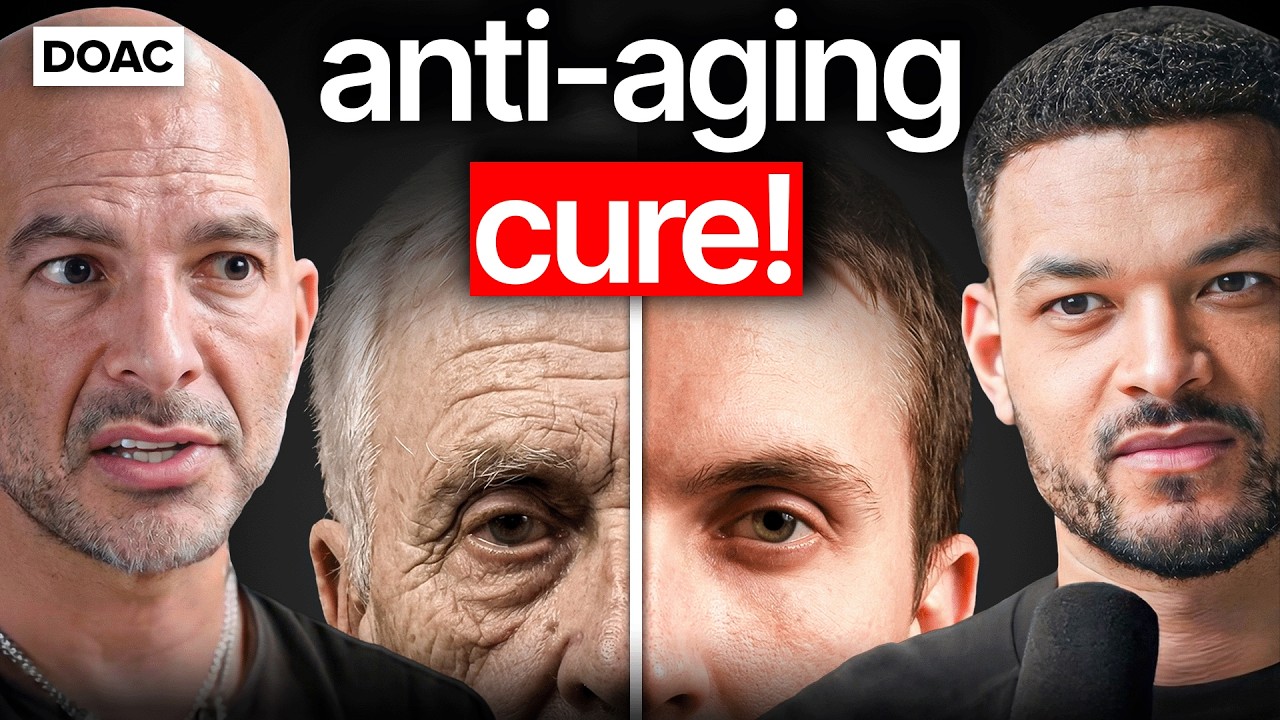
Peter Attia Urges Resistance Training To Slash Mortality Risk
The Diary Of A CEO
High VO2 max and targeted resistance training are the most critical factors for preventing functional decline and reducing all-cause mortality as individuals age.
## Background
Published on YouTube on April 7, 2025, by the channel The Diary Of A CEO, this video features host Steven Bartlett interviewing Dr. Peter Attia, a physician and author of Outlive: The Science and Art of Longevity. The page description outlines Dr. Attia's work in longevity medicine and provides a detailed timestamped overview of their discussion on exercise, physical testing, metabolic health, and nutrition.
## TL;DR
Dr. Peter Attia outlines critical strategies for extending healthspan, focusing on VO2 max, muscle mass, bone density, and movement stability to prevent physical decline. Through a detailed case study analyzing team member Jack's DEXA scan, VO2 max, and Zone 2 test results, Attia illustrates how to identify hidden metabolic and structural risks like visceral fat and early-onset osteoporosis. He also debunks common health misconceptions around alcohol, fasting, and social media nutrition trends, concluding with a personal reflection on facing major life decisions.
## Atmosphere & style
The discussion is pragmatic, intellectually intense, and candid, balancing rigorous clinical science with highly actionable advice. Steven Bartlett's probing, structured questioning complements Dr. Peter Attia's authoritative and direct communication style, giving the conversation an earnest and analytical feel. Real-world diagnostic reviews of Jack's health data add a compelling, human element that grounds complex medical metrics into accessible personal insights.
## Key takeaways
- [49:42](https://www.youtube.com/watch?v=ZxXruY7llcc&t=2982s) Muscle stiffness and limited movement are often protective neurological responses to instability rather than structural limitations, which can be mitigated with core stability techniques like Dynamic Neuromuscular Stabilization (DNS).
- [52:56](https://www.youtube.com/watch?v=ZxXruY7llcc&t=3176s) The single most important rule in physical exercise and longevity training is avoiding injury to preserve long-term functional output.
- [59:35](https://www.youtube.com/watch?v=ZxXruY7llcc&t=3575s) VO2 max is the single most powerful measurable biological metric for predicting all-cause mortality, with individuals in the top 2% showing a fivefold survival advantage compared to those in the bottom 25%.
- [01:06:21](https://www.youtube.com/watch?v=ZxXruY7llcc&t=3981s) Cardiorespiratory training for longevity should heavily prioritize Zone 2 aerobic training, which should comprise roughly 80% of total training time to build base metabolic health.
- [01:07:59](https://www.youtube.com/watch?v=ZxXruY7llcc&t=4079s) Health and longevity training should be managed like an investment portfolio, shifting emphasis away from already-elite metrics to address structural, biomechanical, or metabolic weaknesses.
- [01:15:37](https://www.youtube.com/watch?v=ZxXruY7llcc&t=4537s) Low bone density and osteoporosis risk can be effectively treated or reversed through heavy mechanical loading and strength training, which triggers osteoblast activity and bone remodeling.
- [01:23:08](https://www.youtube.com/watch?v=ZxXruY7llcc&t=4988s) Building muscle mass effectively requires consistent weekly volume (10–20 sets per muscle group) trained near failure (1–2 reps in reserve), alongside adequate protein intake (~1.0 g/lb of body weight).
- [01:29:52](https://www.youtube.com/watch?v=ZxXruY7llcc&t=5392s) Visceral fat is a major metabolic hazard driven by fuel partitioning issues, chronic stress, and poor sleep, unlike subcutaneous fat which is structurally less metabolically active.
- [01:30:59](https://www.youtube.com/watch?v=ZxXruY7llcc&t=5459s) Intermittent fasting offers no unique advantage for reducing visceral fat over standard caloric restriction when total caloric intake is equal.
- [01:32:34](https://www.youtube.com/watch?v=ZxXruY7llcc&t=5554s) Ethanol is a direct toxin at any dose with no compelling evidence of cardiorespiratory or overall health benefits, and its toxic effects become clearly measurable above 30 grams per day.
- [01:37:11](https://www.youtube.com/watch?v=ZxXruY7llcc&t=5831s) Proper hydration during heat or intense exertion requires adequate sodium replacement and a 5%–6% glucose concentration to optimize fluid absorption via sodium-glucose cotransporters.
- [01:38:44](https://www.youtube.com/watch?v=ZxXruY7llcc&t=5924s) Health guidance should be approached with nuance, as oversimplified single-cause claims and health fixes from unproven sources often represent the peak of the Dunning-Kruger effect.
The interview opens with a stark reminder: while death itself is ultimately inevitable, the rate at which our physical and mental health declines as we age is very much under our own control. Dr. Peter Attia points out that younger individuals often fail to recognize the inevitability of physical decline until it is actively happening to them. Reflecting on test results from team members in their 20s, he notes that early red flags are frequently uncovered—and ignoring these warning signs in youth guarantees poor outcomes by age 65.
Dr. Attia describes a major personal epiphany he experienced while attending a friend's parent's funeral. Observing how drastically the individual had declined in their final years—losing the ability to garden, play golf, or enjoy life due to persistent pain and physical limitations—he coined the term the "marginal decade" to describe the last ten years of life. To prevent this slow loss of independence, Attia argues that we must proactively train for our marginal decade like an athlete preparing for a sport, prioritizing key physiological metrics such as muscle mass, strength, and VO2 max.
- **400% Mortality Difference:** Comparing someone in the top 2% of VO2 max for their age group to someone in the bottom 25% reveals a 400% difference in all-cause mortality over the subsequent year.
- **The Marginal Decade Concept:** Refers to the final 10 years of a person's life, focusing on whether those years will be defined by vitality or physical limitation.
---
[02:04](https://www.youtube.com/watch?v=ZxXruY7llcc&t=124s) What Is Peter Focused on at the Moment?
When asked by Steven Bartlett what currently occupies his mind across his practice, books, and businesses, Dr. Peter Attia highlights two primary pursuits. First, he is focused on translating the principles of his book *Outlive* into a friction-free digital delivery system. The goal is to operationalize longevity science so individuals can seamlessly implement practical health-span solutions in their everyday lives.
Second, Attia is deeply invested in refining how people physically prepare and train for their marginal decade. He explains that while people dislike confronting the end of their lives, avoiding the reality only leads to a poor quality of life. By approaching aging with the mindset of an athlete, individuals can achieve the best possible version of their final years.
- **Translating *Outlive*:** Developing digital tools that lower the barrier to entry for longevity protocols and habit implementation.
- **Athlete Mindset for Aging:** Shifting the narrative around getting older from passive acceptance to deliberate physical preparation.
---
[04:39](https://www.youtube.com/watch?v=ZxXruY7llcc&t=279s) The Centenarian Decathlon and Marginal Decade
Dr. Attia introduces the framework he uses with his patients: the **Centenarian Decathlon**. He explains the analogy of a track-and-field decathlete who, while not necessarily the world's best in any single event, is considered the most well-rounded athlete due to their broad mastery of ten distinct disciplines. The Centenarian Decathlon asks individuals to define the top 10 physical tasks they wish to be capable of performing in their marginal decade.
Rather than letting health passively erode, individuals list their dream physical capabilities for their 80s, 90s, or beyond. Attia's medical team then reverse-engineers these goals into specific strength, stability, and cardiovascular movement patterns to build a targeted training regimen decades in advance.
- **27 Physical Requirements:** Attia notes that across almost all patient goals, there are approximately 27 core movement patterns and physical attributes (e.g., foot reactivity, scapular stability, concentric/eccentric strength) required to sustain daily independence and recreational joy.
- **Specific Training:** Just as a sprinter, basketball player, and skier train completely differently based on their goals, an individual's longevity training must directly match the specific activities they want to retain in old age.
---
[06:39](https://www.youtube.com/watch?v=ZxXruY7llcc&t=399s) What Steven Wants to Be Able to Do in His Last Decade
When pressed to define his own Centenarian Decathlon events, Steven outlines three deeply personal goals for his marginal decade. First, he describes a trip to Bali with his girlfriend where they had to navigate approximately 100 meters of steep stairs to reach a white-water rafting location. At the time, Steven realized his own father could not have negotiated those stairs—neither walking down (which requires eccentric quad strength to decelerate the body) nor climbing up (which requires concentric quad/glute strength and endurance). Furthermore, the rafting itself demanded upper-body strength, scapular stability, and the physical power to pull oneself back into the boat if thrown into the water.
Second, Steven shares the emotional contrast of watching his brother's three young children sprint around the garden during Christmas. While Steven hopes to chase his future grandchildren around, he notes that his father is forced to watch passively from the kitchen window. Third, Steven emphasizes the desire to protect and care for his family—being able to lift heavy objects, clear hazards, and maintain physical agency.
- **Bali Stair Case Study:** Highlights the physical distinction between downhill movement (eccentric decelerative strength) and uphill movement (concentric strength and cardiopulmonary stamina).
- **Rafting & Play Dynamics:** Requires high dynamic stability, core engagement, rapid upper-body power, and agility to keep pace with young children.
---
[10:08](https://www.youtube.com/watch?v=ZxXruY7llcc&t=608s) Ageing Is Inevitable, Decline Rate Is Not
Addressing the common misconception that physical decay is purely genetic or unpreventable, Dr. Attia emphasizes that while death is inevitable, the **rate of decline** is largely within our control. He cites a study published in the journal *Cell* that examined mitochondrial function in aging individuals. The study randomized older adults into a group engaging in structured exercise and a control group remaining largely sedentary. Muscle biopsies revealed that the exercise group preserved their mitochondrial function—the powerhouses of the cell—far better than the sedentary control group.
Attia uses the analogy of a **glider** to explain "physiologic headroom." Every human life is a glider that will eventually land, but the height of the cliff from which the glider launches determines how long it stays aloft. By building peak muscle mass, strength, and cardiopulmonary fitness early in life, individuals raise their starting altitude. Even as natural age-related decline occurs, a higher starting baseline ensures one stays far above the threshold of disability for much longer.
> "Death is inevitable... decline is inevitable, but the rate of decline is very much up to us and the preservation of strength, stamina, movement capacity—those things are largely up to us."
- **Mitochondrial Preservation:** Biopsy data confirms that targeted exercise directly mitigates cellular-level metabolic decline in skeletal muscle.
- **Physiologic Headroom:** Building high baseline strength and fitness early in life prevents crossing the threshold of physical disability in older age.
- **Retirement Savings Analogy:** Health capacity acts like compound interest; starting exercise at 50 is beneficial, but starting earlier yields vastly superior reserves.
---
[15:04](https://www.youtube.com/watch?v=ZxXruY7llcc&t=904s) What Peter Wishes Someone Had Told Him in His 30s
Reflecting on his current age of 52, Dr. Attia considers what advice he would give his younger self. Surprising Steven, Attia states that for 32-year-old Peter, the advice would not focus on exercise—since physical training was always a high priority for him—but rather on prioritizing emotional health and interpersonal relationships.
However, if he could speak to 14-year-old Peter, he would passionately advise him to go easier on his body and avoid lifting excessively heavy weights with poor technique. Attia shares that by age 27, he suffered a severe, debilitating back injury involving a herniated disc. He clarifies that catastrophic spinal injuries rarely happen from a single sudden movement; instead, they are usually the cumulative result of years of improper mechanical stress and micro-trauma.
- **Emotional Health Priority:** Emphasizes that longevity requires balancing physical fitness with psychological resilience and relational health.
- **Preventing Training Injuries:** Warnings against heavy structural loading without proper technique coaching, which can result in long-term spinal degradation.
[16:32](https://www.youtube.com/watch?v=ZxXruY7llcc&t=992s) Training Under Fatigue and Advice on Men's Emotional Health
Reflecting on past training mistakes, Dr. Peter Attia recalls how an injury at age 27 was the cumulative result of years of unnecessarily heavy axial loading performed with poor technique, often under severe fatigue. He emphasizes that heavy loading should never be done when fatigued.
Steven Bartlett shifts the conversation to men's health, citing a UK report titled *Lost Boys*. The report outlines concerning trends regarding men's emotional well-being, the emerging reverse gender pay gap among young adults, rising unemployment (one in seven young men out of work), and increasing rates of suicide and suicidal ideation. This prompts a broader inquiry into what it means to be a man and how testosterone fits into this picture.
---
[18:35](https://www.youtube.com/watch?v=ZxXruY7llcc&t=1115s) The Global Decline in Testosterone Levels
Bartlett notes that testosterone plays a fundamental role in shaping male behaviors and drives, including the protective instinct, and asks whether testosterone levels are indeed dropping worldwide. Attia confirms that the population-wide decline in testosterone is unambiguous and supported by clear data. While addressing this issue via exogenous hormone replacement therapy (TRT) is possible, identifying and treating the root causes is far better.
Attia explains that two primary factors drive this population-level drop:
* **Increased body fat and weight:** Higher body fat elevates systemic inflammation (which suppresses testosterone production) and increases the activity of the enzyme responsible for **aromatization** (converting testosterone into estrogen).
* **Poor sleep quality and duration:** Hormones like luteinizing hormone (LH) and follicle-stimulating hormone (FSH)—which signal the testicles to produce testosterone—peak during sleep. Modern disruptions such as smartphones and social media severely compromise sleep quality compared to previous decades.
```
+-----------------------------------------------------------------------+
| PRIMARY vs. SECONDARY HYPOGONADISM |
+-----------------------------------------------------------------------+
| Medical Test: Administer exogenous LH / hCG |
| |
| • Testosterone remains LOW ---> Primary Hypogonadism |
| (Testes cannot produce T) |
| |
| • Testosterone INCREASES ---> Secondary Hypogonadism |
| (Brain isn't sending signal; |
| common with high stress/poor sleep)|
+-----------------------------------------------------------------------+
```
Attia contrasts thorough medical evaluations with typical "street-corner testosterone shops" that hand out prescriptions without diagnosing the underlying issue. While some suggest environmental factors like microplastics play a role, Attia believes their effect is significantly smaller than the impact of poor sleep and excess body fat.
---
[23:20](https://www.youtube.com/watch?v=ZxXruY7llcc&t=1400s) Sleep Deprivation, Insulin Resistance, and Metabolic Health
Discussing the compounding effects of poor sleep, Bartlett shares that sleep-deprived days lead to worse food choices and craved junk food, wondering if dopamine dysfunction is responsible. Attia clarifies that the primary culprit is **insulin resistance**.
When people are sleep-deprived, their cells become resistant to insulin, making it harder for the body to tap into stored fat for fuel. As a result, the body signals intense hunger to acquire quick energy from food.
* **University of Chicago Study:** Healthy young subjects sleep-deprived to **4 hours of sleep per night for 10 to 14 days** experienced a **50% reduction in insulin sensitivity** (measured via euglycemic clamp testing).
* **Evolutionary Perspective:** Sleep appears counterintuitive from an evolutionary standpoint—during sleep, a human cannot hunt, mate, or defend against predators. The fact that sleep was not evolved away proves it is vital to fundamental survival.
---
[26:39](https://www.youtube.com/watch?v=ZxXruY7llcc&t=1599s) Marginal Decade Goals and Everyday Functionality
Bartlett asks Attia about his personal goals for his "marginal decade"—the last ten years of life. Attia envisions being able to actively play sports with future grandchildren, drawing on his love for activities he didn't focus on as a child (like baseball and soccer) after growing up playing hockey and practicing martial arts/boxing.
To achieve this in old age, Attia focuses on specific functional milestones:
* Playing sports (stopping a soccer ball, throwing/hitting a baseball).
* Sitting on the floor and getting back up under one's own power.
* Climbing multiple flights of stairs independently.
* Archery (aiming to draw a **50 lb bow** in his final decade).
---
[28:37](https://www.youtube.com/watch?v=ZxXruY7llcc&t=1717s) Training Parameters for Strength, Hypertrophy, and Endurance
To maintain these capabilities into late age, Attia outlines how training goals map to rep ranges and weight loads:
```
+------------------+------------------+-----------------------+
| TRAINING GOAL | REP RANGE | LOAD / WEIGHT |
+------------------+------------------+-----------------------+
| Pure Strength | 1 – 5 reps | Very Heavy |
| Hypertrophy | 7 – 12 reps | Moderate-Heavy |
| Enduring Muscle | 15+ reps | Light-Moderate |
+------------------+------------------+-----------------------+
```
Attia points out that no one in their final decade ever complains about having too much strength or endurance. However, to avoid injury from heavy compound lifts, he no longer trains in the 1–5 rep range.
Instead, he targets **8 to 12 reps with 1 to 2 reps in reserve (RIR)** on almost every set, taking each set near failure without compromising form.
---
[32:00](https://www.youtube.com/watch?v=ZxXruY7llcc&t=1920s) Peter's Personal Exercise Routine
Attia details his weekly workout structure, which totals seven days of physical activity divided into resistance work and cardiorespiratory training:
* **Resistance Training (3 days/week):** 90-minute sessions focused on heavy intensity, hitting each major body part once a week.
* **Zone 2 Cardio (3 days/week):** Low-intensity stationary cycling where he can still speak in strained sentences (maintaining a target heart rate around **140 BPM**). These act almost as recovery days.
* **VO2 Max Cardio (1 day/week):** A high-intensity interval day designed to push cardiovascular peak capacity.
> "No one in the final decade of their life ever said, 'I wish I had less strength and I wish I had less endurance.'" — Dr. Peter Attia
[033:30] Movement Preparation and Smart Warm-Ups
Peter explains that he does not warm up for a resistance training session by simply riding an exercise bike, running on a treadmill, or spending 20 minutes on a stairmaster. While many gym-goers default to generic cardio warm-ups, he maintains a firm stance on movement-specific preparation. Sitting on a stationary bike does not replicate or prepare the body for the heavy loaded movements of a strength session. Instead, warm-ups should be targeted to activate the core, build dynamic stability, and condition the connective tissues for the specific work ahead.
On a typical lower-body workout day, Peter's 20-minute preparation begins with core-stabilizing Dynamic Neuromuscular Stabilization (DNS) movements. These involve adopting developmental positions—resembling how a six-month-old infant moves—to establish deep core control. He then transitions to dynamic hip and glute activation exercises, such as 90/90 or shinbox drills, moving through slow eccentric and concentric phases. From there, he incorporates a dynamic movement prep featuring light footwork and low-level bouncing before moving into very light, machine-based isolation lifts like leg extensions and leg curls mixed with jumping and lunging.
- Generic cardio like cycling or treadmill walking fails to prepare joints and neuromuscular pathways for heavy lifting.
- Dynamic Neuromuscular Stabilization (DNS) utilizes infant movement patterns to prime deep core stability.
- 90/90 shinbox exercises isolate glute and hip activation through controlled eccentric and concentric ranges.
- Dedicated movement preparation takes approximately 20 minutes before loading heavy weights.
---
[035:28] Tendon Resilience, Injury Prevention, and the Importance of Jumping
Addressing Steven’s concerns about sudden injuries—such as pulling a neck or back muscle during a shoulder press—Peter notes that while lifting heavy without preparation is risky, many severe injuries stem from deeper structural vulnerabilities. Tendon and Achilles tears are particularly devastating as people age; while recoverable, an Achilles rupture can derail training for six months or more. These injuries frequently occur because an individual retains muscle strength but has lost tendon elasticity and pliability from avoiding plyometric movements over time.
To combat this loss, Peter integrates low-level jumping into his daily warm-ups and gradually builds to higher-level plyometrics. Exercises like jumping rope act as shock absorbers, requiring the calves and Achilles tendons to rapidly change length and adjust to impact. Furthermore, practicing both the initiation of a jump and the deceleration required to land safely builds crucial structural resilience that protects against sudden tissue failure.
> "A lot of these injuries happen because the individual still has strength, but they've kind of lost some of the pliability in the tendon because they've kind of lost some of the jumping."
- Achilles tendon ruptures typically require a minimum six-month recovery timeline.
- Tendon pliability degrades when dynamic plyometric movements are eliminated from training.
- Jump rope exercises train the calf muscles and Achilles tendons to function as effective shock absorbers.
- Landing and decelerating force are just as vital to injury prevention as explosive jumping.
---
[037:34] Why Muscle Mass and "Leg Day" Matter for Longevity
Steven admits to skipping leg workouts and asks Peter to make the case for why muscle mass—and lower-body training in particular—is vital for living longer. Peter highlights that muscle mass is the second or third most powerful predictor of longevity, ranking just behind overall strength and $VO_2$ max. Beyond serving as a direct proxy for body strength, muscle acts as the body's primary metabolic sink for glucose disposal. Larger, insulin-sensitive muscles provide a massive buffer for blood sugar, directly protecting against metabolic dysfunction.
As the body ages, its ability to regulate and dispose of glucose naturally declines. Unregulated glucose damages microvascular networks, leading to severe complications seen in advanced type 2 diabetes, such as vision loss, peripheral nerve damage, amputations, erectile dysfunction, and microvascular brain damage. Building and maintaining large muscle groups—especially in the legs—alongside proper sleep and energy balance ensures the body has adequate capacity to handle dietary glucose and reduce overall fat storage capacity.
- Muscle mass ranks among the top three predictors of longevity, along with overall strength and $VO_2$ max.
- Skeletal muscle functions as the primary sink for glucose buffering and metabolic regulation.
- Poor glucose regulation damages tiny blood vessels, leading to blindness, limb amputations, erectile dysfunction, and brain microvascular damage.
- Maintaining muscle mass in conjunction with an energy-balanced diet directly limits the body's capacity to accumulate visceral fat.
---
[040:32] Grip Strength, Dead Hangs, and Upper Body Integrity
When Steven asks about using handheld grip dynamometers to estimate lifespan, Peter agrees that grip strength correlates exceptionally well with overall longevity. However, at his clinic and facility (10 Squared), they prefer assessing grip using a timed dead hang from a pull-up bar. The dead hang standard requires individuals to hold their own body weight for at least two minutes, which automatically normalizes the test to body composition.
Grip strength serves as a barometer for total upper-body structural integrity. It is virtually impossible to generate significant upper-body pushing or pulling power without a robust grip. Hanging from a bar tests a complete kinetic chain—from the hands and forearms through the shoulders, scapular stabilizers, and deep core structures.
> "It's really hard to be strong anywhere in the upper body if your grip is weak... If you have a strong grip, you have a strong hand, you have a strong forearm, you have a strong scapula that is connected to your rib cage—it goes up the whole chain."
- The clinic benchmark for the dead hang test is maintaining a continuous grip for at least two minutes.
- Dead hangs test functional grip strength by normalizing score expectations against total body weight.
- A strong grip relies on kinetic engagement extending from the fingers through the forearm, shoulder girdle, and scapular stabilizers.
---
[042:34] Fall Mortality and the Loss of Type 2B Fast-Twitch Muscle Fibers
Peter warns that the physical decay caused by sarcopenia (muscle loss) and frailty becomes catastrophic in older adults, particularly regarding falls. For individuals aged 65 and older, suffering a fall that results in a broken hip or femur carries a staggering 15% to 30% mortality rate within a single year. Death can result from acute trauma, fat embolisms, blood clots, or a general failure to recover during bedrest. Even worse, among those over 65 who survive a major fall, 50% never regain their baseline functional independence, remaining dependent on walking aids for life.
The root cause of these devastating falls is usually not a simple lack of balance, but a critical deficit in muscular power. When a young person trips on a curb, they instinctively react with explosive force to catch themselves. That instantaneous recovery relies on specialized **Type 2B muscle fibers**, which are the very first muscle fibers to atrophy as humans age. Fiber loss begins early; power output peaks in early adulthood and declines rapidly without intentional training. Older adults fall because their lower legs lack the explosive speed required to reposition their feet when tripped.
- Seniors aged 65+ face a 15% to 30% chance of dying within 12 months following a hip or femur fracture.
- 50% of older fall survivors permanently lose their prior level of functional independence.
- Type 2B fast-twitch muscle fibers are responsible for explosive, instantaneous limb movements.
- Type 2B fibers are the earliest muscle structures to atrophy during the natural aging process.
---
[045:21] Training for Explosive Power vs. Pure Strength
To maintain the ability to catch oneself during a stumble late in life, individuals must actively train for power, not just force output. Peter clarifies that while strength is the capacity to move a heavy load regardless of speed, **power** represents the product of force and velocity. Graphing force against power yields an inverted U-curve: as resistance increases, power output rises up to a sweet spot, after which excessive load slows movement velocity down and causes total power output to drop.
To preserve fast-twitch fibers, Peter utilizes specialized equipment calibrated to measure velocity and peak power output, alongside fundamental plyometrics like vertical jumps. He also praises balance and instability drills—such as standing on unstable surfaces or walking across uneven gravel—which force the lower leg and foot to rapidly adapt. He describes this continuous micro-adjustment of the foot and ankle musculature as "problem-solving for your foot."
> "Power is the maximum combination of force and speed... As the force or the weight that you're moving goes up and you're trying to move it as fast as you can, you're getting more and more power. But then at some point, the weight gets so heavy that even as you continue to move it, it's going slower and slower... your power goes down."
- Strength measures raw force generation, whereas power combines force with movement velocity.
- Power generation follows an inverted U-shaped curve relative to the magnitude of the resistance loaded.
- Vertical jumping serves as a accessible bodyweight exercise for generating lower-body power.
- Training on unstable terrain forces the foot and lower leg muscles into active, real-time "problem-solving."
---
[047:35] Nervous System Protection and True Flexibility
Addressing Steven's questions about flexibility, Peter reveals that despite being naturally hyper-mobile, he does not perform traditional static stretching. Instead, he focuses on dynamic stability drills that challenge joints through their full available range of motion. He notes that conventional ideas about muscle tightness are often misunderstood; for example, when a person cannot touch their toes, it is rarely because their hamstring muscles are physically too short.
Rather, the restriction is governed entirely by the central nervous system (CNS), which locks down movement when it senses a lack of control or safety in an end-range position. Under general anesthesia, when CNS motor inhibition is removed, a person's leg can easily be lifted into a full vertical stretch without tearing tissue or causing post-operative pain. To improve functional flexibility, training must reassure the brain by building strength and neural control at extreme ranges of motion, rather than forcefully stretching passive tissues.
- Central nervous system inhibition—not physical muscle length—is the primary limiting factor in mobility.
- Patients under general anesthesia demonstrate full passive hamstring range of motion due to the temporary suspension of CNS tone.
- Safe, long-term movement range is achieved by building active neural control and stability at end-range positions.
[49:42](https://www.youtube.com/watch?v=ZxXruY7llcc&t=2982s) Dynamic Neuromuscular Stabilization (DNS) and Movement Security
Peter Attia recounts his experience learning about Dynamic Neuromuscular Stabilization (DNS), a method introduced to him by a practitioner when he was struggling with severe back pain. At the time, Attia was as stiff as a board, unable to reach past his knees without acute discomfort that had lingered for three days. During a 40-minute session, he performed a series of exercises on his back while the practitioner leaned against his feet, forcing him to execute isometric pushes while actively generating intra-abdominal pressure. At the end of the session, Attia was able to easily lay his palms flat on the floor.
He explains that his initial stiffness was not a structural mechanical limitation, but rather a protective neurological response. When the back is in pain or ungrounded, the brain acts conservatively, locking up movement to guard against perceived instability. By systematically building intra-abdominal pressure, the session communicated safety to his central nervous system, allowing the surrounding musculature to release. Attia utilizes these principles daily in his warm-up, spending five minutes on breathing mechanics to build a "cylinder" where the diaphragm serves as the top, the pelvic floor acts as the bottom, and the abdominal wall completes the perimeter.
- **DNS concept:** Uses intra-abdominal pressure to send stability signals to the brain, overriding protective tightness.
- **Abdominal cylinder model:** Diaphragm at the top, pelvic floor at the bottom, and abdominal walls along the sides.
- **Daily application:** Performs 5 minutes of targeted floor breathing exercises every morning to ground core stability.
Transitioning into his personal training regimen, Attia breaks down his three-day strength and resistance structure. Rather than complex protocols, he adheres to a classic movement split across three days. Each workout lasts roughly 90 minutes of dedicated lifting, preceded by 20 minutes of targeted DNS warm-ups and core preparation.
His weekly split is organized systematically:
- **Monday:** Lower body focus.
- **Wednesday:** Arms and shoulders.
- **Friday:** Chest and back.
During chest and back sessions, Attia selects four exercises per push/pull category, super-setting them across approximately five working sets per movement pattern. To complement heavy lifting, he incorporates dynamic power variations like medicine ball slams while emphasizing adequate warm-up sets to shield against training injuries.
---
[52:56](https://www.youtube.com/watch?v=ZxXruY7llcc&t=3176s) The Rise of Endurance Events and Rule Number One
Addressing the growing trend of high-intensity endurance competitions, marathons, and running clubs like HYROX, Attia views the movement as a positive societal shift that fosters camaraderie and baseline aerobic conditioning. However, his main caution is that participants must approach these sports sustainably to ensure long-term physical longevity.
Attia reiterates his core philosophy: "rule number one is don't get injured." The overarching objective of fitness in mid-to-late life is to maintain functional output long enough to keep playing the game of life without suffering set-backs that permanently degrade joint integrity or soft tissue structures.
---
[53:48](https://www.youtube.com/watch?v=ZxXruY7llcc&t=3228s) Demystifying $\text{VO}_2$ Max and Oxygen Metabolism
Attia provides a foundational breakdown of human bioenergetics, describing humans as obligate aerobes dependent on oxygen to produce adenosine triphosphate ($\text{ATP}$). Standard metabolic pathways convert ingested nutrients into $\text{ATP}$ through oxygen-catalyzed cellular respiration. Interrupting this chemical cascade is rapidly fatal, as demonstrated by poisons like cyanide, which instantly halts $\text{ATP}$ synthesis by blocking key transport proteins.
The mechanics of oxygen exchange rely on pressure gradients in the lungs' distal capillaries. Inhaled oxygen diffuses across membranes into hemoglobin molecules in exchange for carbon dioxide ($\text{CO}_2$), which is exhaled as metabolic waste. Because every cell requires a continuous supply of $\text{ATP}$ to maintain physiological function, oxygen uptake rises in direct proportion to physical workload and energy expenditure.
To precisely evaluate maximum aerobic power ($\text{VO}_2$ max), a patient wears a sealed face mask connected to specialized gas analyzer equipment while exercising on a treadmill or stationary bike. The apparatus measures two key metrics continuously:
1. The volumetric flow rate of air moving in and out of the lungs.
2. The exact concentration of oxygen present in exhaled air.
From these parameters, the system calculates absolute oxygen consumption in liters per minute ($\text{L/min}$). For clinical standardization, this figure is normalized against body weight and expressed as milliliters of oxygen consumed per kilogram of body weight per minute ($\text{mL/kg/min}$).
- **Resting baseline:** ~300 $\text{mL/min}$ during sleep; ~500 $\text{mL/min}$ ($0.5\text{ L/min}$) while seated and talking.
- **Light movement:** Walking briskly uses ~1.0 $\text{L/min}$; a light jog escalates consumption to ~1.5–2.0 $\text{L/min}$.
- **Maximal effort:** Intense exertion drives values to 3.5–4.0+ $\text{L/min}$, until reaching the physiological ceiling where any additional output relies on anaerobic glycolytic pathways.
[59:35](https://www.youtube.com/watch?v=ZxXruY7llcc&t=3575s) $\text{VO}_2$ Max as the Single Greatest Predictor of Longevity
Attia emphasizes that $\text{VO}_2$ max is the single most powerful measurable metric in human biology for predicting all-cause mortality, outperforming traditional clinical risk markers. Comparing individuals in the top 2% of $\text{VO}_2$ max relative to their age group against those in the bottom 25% reveals a 5x (500%) difference in survival outcomes over a given observation period, or roughly a 400% reduction in relative hazard risk.
To contextualize these metrics across age cohorts:
- **Males aged 30–39:** A $\text{VO}_2$ max below 35 $\text{mL/kg/min}$ places an individual in the bottom 25th percentile, whereas a score of 53 $\text{mL/kg/min}$ elevates them to the top 2.5%.
- **Males aged 50–59:** The bottom 25th percentile drops below 29 $\text{mL/kg/min}$, while the top tier requires a score exceeding 50 $\text{mL/kg/min}$.
- **Marginal decade (Ages 80+):** The bottom threshold falls to 18 $\text{mL/kg/min}$, while the upper tier is 36 $\text{mL/kg/min}$.
While absolute mortality rates for a 35-year-old are low overall (making relative risk spikes less immediately fatal year-over-year), the absolute risk gap expands significantly past age 65. For an 85-year-old with a baseline annual mortality rate over 10%, maintaining a high $\text{VO}_2$ max drastically buffers against functional decline and life-threatening events.
Beyond raw mortality statistics, $\text{VO}_2$ max maps directly to functional healthspan. Everyday activities require specific metabolic baselines: running an 8-minute mile demands high functional aerobic capacity, while basic independent tasks like climbing a flight of stairs without acute exhaustion require a minimum reserve capacity. Mapping a patient's current $\text{VO}_2$ max trajectory against age curves helps predict whether they will retain physical autonomy in their 80s and 90s.
---
[01:03:49](https://www.youtube.com/watch?v=ZxXruY7llcc&t=3829s) Case Study: Analyzing Jack's $\text{VO}_2$ Max and Heart Rate Recovery Results
Attia reviews the metabolic performance testing data for Jack, a producer on the show who underwent a comprehensive evaluation at Attia's 10 Squared facility in Austin, Texas. Jack completed a progressive exercise protocol on a treadmill to assess maximal aerobic capacity alongside baseline metabolic efficiency.
Jack achieved an absolute peak $\text{VO}_2$ max of **4.1 L/min**, reaching his maximum effort at a peak heart rate of **204 beats per minute (bpm)**. Normalized for body mass, Jack recorded **56.5 mL/kg/min**, placing him in the **97th percentile** for males in his age cohort (20s). Attia notes that clinical longevity goals aim to position individuals two decades ahead of their chronological age—meaning a 50-year-old patient should ideally target a $\text{VO}_2$ max exceeding 53 $\text{mL/kg/min}$.
Following maximal exertion, the testing team monitored Jack's 60-second Heart Rate Recovery (HRR) to evaluate autonomic nervous system regulation and the balance between sympathetic stress response and parasympathetic reactivation. Jack's heart rate dropped by **28 bpm** within the first minute post-test.
- **Target threshold:** Minimum drop of 30 bpm in one minute.
- **Elite athlete standard:** 40 to 50 bpm drop within 60 seconds.
---
[01:06:21](https://www.youtube.com/watch?v=ZxXruY7llcc&t=3981s) Zone 2 Aerobic Testing and Substrate Utilization
In addition to maximal exertion testing, Jack underwent Zone 2 aerobic base testing to evaluate mitochondrial function and fat oxidation limits. Zone 2 training represents the intensity ceiling where energy production remains strictly aerobic without accumulating excess blood lactate, serving as the core engine for cellular health.
Attia outlines the clinical principles of Zone 2 training:
- **Volume allocation:** Should comprise approximately **80%** of an individual's total cardiorespiratory training time.
- **Subjective feel:** A sustainable pace that can be maintained for over an hour; manageable effort where talking remains possible but noticeably constrained.
- **Metabolic function:** Marks the point of maximal cellular fat oxidation ($\text{Fatmax}$).
During Jack's incremental treadmill assessment, metabolic carts measured his Respiratory Exchange Ratio ($\text{RER}$)—the ratio of $\text{CO}_2$ produced to $\text{O}_2$ consumed—alongside real-time blood lactate capillary sampling. Jack achieved a peak fat oxidation rate of **0.77 grams of fat per minute** at a running speed of **7.3 mph**, while keeping his blood lactate stable at approximately **2.0 mmol/L**.
- **Fat oxidation standards:** 1.0 g/min is considered elite level; 0.76–0.77 g/min represents strong aerobic conditioning for an active individual in his 20s.
- **Lactate ceiling:** Zone 2 is defined as the maximum exercise intensity where blood lactate remains at or below ~2.0 mmol/L before rising sharply as anaerobic pathways kick in.
[01:07:59](https://www.youtube.com/watch?v=ZxXruY7llcc&t=4079s) Advising Jack on Longevity and Strategic Focus
Dr. Peter Attia explains the testing protocol at 10 Squared, noting that because clients travel from all over the world to Austin for a two-day evaluation, intensive tests like VO2 max and Zone 2 metabolic testing are often combined, though they would ideally be split across separate days. Assessing Jack’s cardiovascular metrics—a VO2 max in the top 2%, fat oxidation peaking at nearly 0.8 grams per minute, and a Zone 2 heart rate of 165 to 170 BPM—Attia emphasizes that Jack's endurance is completely "dialed in."
From a longevity standpoint, health management is akin to "portfolio management." Because Jack’s aerobic engine is already performing at an elite level, focusing additional energy on pushing his endurance further offers diminishing returns. Instead, Attia shifts the clinical focus to other areas uncovered during Jack's intake that present far higher long-term risks.
* **10 Squared Protocol:** Conducted over two days to mix metabolic assessments with strength testing for out-of-town clients.
* **Jack's Baseline Engine:** Top 2% VO2 max, high fat-oxidation rate (~0.8 g/min), and robust Zone 2 capacity.
* **Portfolio Management Approach:** Diverting training focus away from already-elite cardio toward structural and metabolic weaknesses.
---
[01:11:02](https://www.youtube.com/watch?v=ZxXruY7llcc&t=4262s) Analyzing Jack’s Running Gait and Biomechanical Issues
Jack joins the conversation to discuss his current training setup. After suffering overuse injuries from heavy running two years ago, he simplified his routine to a single weekly long run of 20 kilometers. However, Attia points out a critical issue caught by the 10 Squared team during Jack's treadmill test: severe biomechanical compensation. Photographs taken during his run revealed that while Jack's head stays centered when landing on his right foot, his entire body leans drastically off-center when landing on his left leg.
Jack confirms he suffered a severe ankle sprain on his left foot about six months prior. Attia explains that while Jack's aerobic "engine" is operating exceptionally well, his physical "chassis" is compromised. Running 20 kilometers involves thousands of repetitive, low-impact strikes; over time, this uncorrected compensation pattern and shoulder/head asymmetry will inevitably result in a repetitive strain injury.
* **Current Cardio Routine:** One 20 km long run per week.
* **Biomechanical Flaw:** Marked body lopsidedness and shoulder elevation when striking on the left leg.
* **Root Cause:** Unrehabilitated left ankle sprain from six months prior altering gait mechanics.
* **Clinical Prognosis:** High risk of repetitive strain injury despite high cardiovascular performance.
---
[01:13:21](https://www.youtube.com/watch?v=ZxXruY7llcc&t=4401s) DEXA Scan Findings: Bone Density and Osteoporosis Risk
The evaluation transitions to Jack's DEXA scan, which measures total body composition, regional bone mineral density (lumbar spine, left hip, right hip), body fat, muscle mass, and visceral fat. Attia reveals the most concerning finding of the day: Jack's bone density is severely deficient. In his lumbar spine, Jack sits two standard deviations below the mean for his age (Z-score), placing him in the bottom 10th percentile. His hip scores are similarly alarming, sitting 1.5 to 1.7 standard deviations below average.
In clinical terms, a T-score of -1.0 signifies osteopenia, while a T-score at or below -2.5 indicates osteoporosis. Because of his age, Jack's T-score and Z-score are nearly identical, meaning he effectively meets the technical definition for osteoporosis. Attia clarifies that while Jack isn't at immediate risk of a spontaneous fracture walking down the street, his risk of sustaining a severe fracture during routine athletics (such as a tumble while skiing) is "infinitely higher" than average.
> "When your T-score... gets below -2.5, you have osteoporosis... The problem is your risk of bone fracture goes up really significantly."
* **Lumbar Spine Density:** 2.0 standard deviations below the age-matched mean (bottom 10th percentile).
* **Hip Density:** 1.5 to 1.7 standard deviations below average.
* **Clinical Diagnosis:** Osteopenia bordering on/meeting criteria for early-onset osteoporosis.
* **Long-Term Strategy:** Preventing further bone density loss before entering his 60s and 70s.
---
[01:15:37](https://www.youtube.com/watch?v=ZxXruY7llcc&t=4537s) Investigating Causes and Remedies for Low Bone Density
Attia outlines the necessary diagnostic and behavioral steps for Jack, recommending an immediate evaluation by an endocrinologist to rule out underlying medical causes like Vitamin D deficiency, abnormal calcium metabolism, or parathyroid hormone issues. Jack notes he only began weight training two years ago and recalls his mother mentioning he was treated for low calcium right after birth. Attia explains that male bone mass is primarily built up until the early 20s; childhood calcium metabolic disruptions or historical corticosteroid use (common in asthma treatments) can permanently blunt peak bone accumulation.
To stimulate bone remodeling, the body requires physical deformation of the tissue. Bone tissue acts like it contains an internal "strain gauge"—when heavy mechanical loads deform the bone, it sends an estrogen-mediated chemical signal to osteoblasts to build density. While running offers minimal bone stimulation, heavy resistance training and combat sports like jiu-jitsu force the structural loading needed to slow bone loss.
```
Mechanical Load (Heavy Resistance) ──> Bone Deformation ──> Estrogen Signaling ──> Osteoblast Bone Building
```
Attia highlights the *LIFTMOR* study conducted by Dr. Belinda Beck in Australia. Postmenopausal women with osteoporosis were assigned to either low-impact activity or heavy resistance training. The heavy lifting group not only stopped bone density loss on DEXA compared to the control group, but CT imaging revealed actual cortical thickening of the bone tissue.
* **Diagnostic Priorities:** Endocrinology workup for parathyroid, Vitamin D, calcium, testosterone, and estrogen levels.
* **Mechanotransduction:** Bone builds in response to mechanical deformation caused by axial loading.
* **Effective Activities:** Heavy weightlifting (box squats, step-ups, farmer's carries) and grappling/jiu-jitsu (swimming and cycling show lower bone density on average).
* **Evidence Base:** Dr. Belinda Beck’s *LIFTMOR* trial demonstrating structural cortical thickening via heavy strength training.
---
[01:21:32](https://www.youtube.com/watch?v=ZxXruY7llcc&t=4892s) Visceral Fat, Subcutaneous Fat, and Metabolic Risk
Turning to body composition, Attia discusses Jack's body fat distribution. While his overall fat percentage is not dramatically elevated in absolute terms, it sits in the 80th percentile for his young age demographic. More critically, his visceral adipose tissue (VAT)—the internal fat surrounding vital organs that drives metabolic derangement—is at the 50th percentile.
Attia emphasizes that 10 Squared holds a strict clinical standard, aiming for patients to keep visceral fat below the 10th percentile. Addressing visceral fat requires optimizing nutrition (adequate protein, Vitamin D, and calcium) alongside targeted strength training to build lean muscle mass.
* **Total Body Fat:** 80th percentile for his age group.
* **Visceral Fat (VAT):** 50th percentile (clinical target is below the 10th percentile).
* **Metabolic Impact:** Visceral fat is significantly more inflammatory and metabolically harmful than subcutaneous fat.
[01:22:17](https://www.youtube.com/watch?v=ZxXruY7llcc&t=4937s) Jack's DEXA Scan Results: Muscle Mass and Body Fat
Dr. Peter Attia breaks down the DEXA scan metrics for Jack, starting with his muscle mass measurements: appendicular lean mass (ALM)—the total muscle mass in the arms and legs—and total fat-free mass (FFM). Both metrics place Jack at around the 20th percentile. For longevity and overall physical health, Attia targets having patients above the 50th percentile, meaning Jack is currently under-muscled. Furthermore, examining Jack's overall body fat percentage alongside his visceral fat levels reveals that he is "overnourished."
When evaluating patient health via DEXA and lab metrics, Attia frames the assessment around three core questions: whether the individual is metabolically healthy, whether they are adequately muscled, and whether they are overnourished. While formal blood tests are required to definitively prove metabolic health, Attia suspects Jack is in good shape metabolically based on his Zone 2 test performance—specifically pointing to his maximum fat oxidation rate of 0.77 grams per minute and an excellent fasting lactate of 0.5 mmol/L. Nonetheless, Jack's immediate path forward requires a clear recalibration: he needs to increase his protein intake, reduce overall caloric intake, and engage in more resistance training, while avoiding any additional cardio.
- **Appendicular Lean Mass Index (ALMI) & Fat-Free Mass Index (FFMI):** Placed Jack at the **20th percentile**, signaling he is under-muscled.
- **Fat Oxidation Rate:** Reached **0.77 g/min**, which Attia notes is very high and indicates strong metabolic flexibility.
- **Fasting Lactate:** Recorded at **0.5 mmol/L**, supporting the likelihood of good metabolic health.
- **Prescribed Strategy:** Higher protein intake, minor caloric restriction, and focused resistance training rather than extra cardiovascular work.
---
[01:23:48](https://www.youtube.com/watch?v=ZxXruY7llcc&t=5028s) Muscle Building Potential, Genetics, and Training Intensity
Addressing Jack’s concern that starting weightlifting at age 27 or 29 severely limits potential muscle gain compared to starting as a teenager, Attia reassures him that genetic ceiling plays a far more decisive role than starting age. A genetically gifted individual who picks up weights in their 20s will still pack on substantial muscle, whereas someone without those genetics won't achieve a bodybuilder frame regardless of starting early. Attia references his own experience, noting that despite lifting continuously since age 13, he will never have the genetics to stand on a bodybuilding stage.
However, translating genetic potential into actual muscle hypertrophy requires getting specific variables right: exercise selection, frequency, technique, and proper intensity. Attia stresses that lifting weights is not a uniform activity and highlights two non-negotiable rules for muscle growth:
- **Volume Threshold:** Achieving a minimum of **10 sets per week per muscle group**, ideally targeting closer to **20 sets**.
- **Proximity to Failure:** Maintaining high training intensity by keeping a minimum of **2 reps in reserve (RIR)**, ideally **1 RIR**, on working sets.
- **Effective Stimulus:** Simple sets (e.g., 3 sets of 10) where 3 or 4 additional reps could have been performed do not provide a sufficient training stimulus for growth.
---
[01:25:30](https://www.youtube.com/watch?v=ZxXruY7llcc&t=5130s) Nutrition and Protein Strategies for Muscle Gain
The conversation shifts to the common difficulty some individuals face when trying to eat enough food to build muscle. Host Steven Bartlett shares that a friend has struggled for a decade with feeling forced-fed while failing to gain muscle, whereas Steven easily gains weight and muscle when eating heavily. Attia notes that while this struggle is frequently reported by women, it occurs in men as well. The solution lies in shifting focus from total calorie overload to structured protein distribution.
To reach the target of **1 gram of protein per pound of body weight per day**, individuals who struggle with food volume should distribute their protein across four smaller daily servings and leverage protein shakes rather than relying purely on whole foods. Attia emphasizes that relying on supplementation is completely acceptable and used even by professional bodybuilders. Because Jack carries excess body fat and visceral fat, he does not need extra calories—he simply needs to hit his daily protein target while applying proper training stimulus in the gym.
- **Protein Target:** **1.0 g/lb of body weight per day** (equivalent to ~2.2 g/kg).
- **Meal Distribution:** Split into **4 protein-rich servings** throughout the day to avoid gastrointestinal discomfort and overwhelming volume.
- **Caloric Strategy for Overnourished Frames:** No caloric surplus required; prioritize protein sufficiency alongside resistance training.
---
[01:27:26](https://www.youtube.com/watch?v=ZxXruY7llcc&t=5246s) Sex Differences in Longevity Metrics and Visceral Fat
Steven asks how women's baseline metrics differ from men's regarding VO2 max, muscle mass, and bone density. Attia explains that women are scored on a different comparative curve for VO2 max because, all else equal, women naturally carry less muscle mass—the primary tissue consuming oxygen during exercise outside of the brain. While young, fit individuals display fewer disparities, age accentuates these differences: older women face significantly higher risks and steeper declines in both muscle mass (sarcopenia) and bone mineral density (osteopenia/osteoporosis).
The discussion transitions to body fat distribution, distinguishing between **subcutaneous fat** (stored under the skin) and **visceral fat** (stored internally around organ systems). Visceral fat is far more hazardous metabolically. However, Attia emphasizes that visually assessing someone is insufficient to determine their visceral fat load.
> "I've seen people who have lots of subcutaneous fat, but when you look at their liver and look at their visceral fat, they have virtually none... And conversely, if you look at Jack... nobody would look at Jack and say he's overweight, but he's got a little bit too much fat on the inside."
- **Subcutaneous Fat:** Primarily a structural or aesthetic matter; excess weight can impact joint mechanical load (e.g., knee pain), but it does not inherently drive metabolic dysfunction.
- **Visceral Fat:** Highly active pathologically, surrounding internal organs; even lean-appearing individuals can accumulate excessive visceral fat (the "TOFI" or thin-outside-fat-inside phenotype).
- **Age Effect:** Young individuals in their 20s often tolerate higher body fat without immediate metabolic consequences, but these metabolic buffers fade sharply by their 40s.
---
[01:29:52](https://www.youtube.com/watch?v=ZxXruY7llcc&t=5392s) Causes of Visceral Fat: Fuel Partitioning, Sleep, and Stress
Attia explains the biological mechanics of how visceral fat accumulates, describing it fundamentally as a problem of **fuel partitioning**—how the body decides where to store excess energy. Because the human body cannot store protein for energy, excess incoming calories are stored as glycogen or fat. Muscle and liver glycogen capacity is extremely limited; once filled, excess glucose and dietary fats are converted and stored as adipose tissue.
If an individual possesses lower muscle mass, they have less metabolically active tissue, resulting in lower daily energy expenditure and a higher likelihood of storing excess energy as visceral fat. Beyond diet and exercise, sleep disruption and chronic stress exert massive control over fuel partitioning:
- **Insulin Resistance:** Poor sleep rapidly induces insulin resistance, forcing the body to partition fuel unfavorably.
- **Metabolic Shift:** Insulin-resistant individuals struggle to access and oxidize fat during low-to-moderate intensity activities, defaulting to burning glucose instead.
- **Jack's Metabolic Status:** Despite elevated visceral fat, Jack oxidized fat at high rates on the treadmill (pulling **~0.88 g/min of fat at a heart rate of 165 bpm**), showing that his fuel partitioning under exertion remains robust for now.
---
[01:32:34](https://www.youtube.com/watch?v=ZxXruY7llcc&t=5554s) Intermittent Fasting and the Truth About Alcohol Toxicity
When asked about intermittent fasting for visceral fat reduction, Attia clarifies that current scientific evidence shows no unique advantage to intermittent fasting (time-restricted feeding) over equivalent standard caloric restriction; consuming calories across an 8-hour window yields the exact same metabolic outcomes as spreading them over 12 hours if total calories are matched.
The conversation turns to alcohol consumption, referencing public discussions by neuroscientist Andrew Huberman and debate over the Mediterranean diet. Attia flatly rejects the traditional claim that moderate alcohol consumption is cardio-protective or health-promoting.
> "There is no compelling evidence whatsoever that there is a health benefit that comes from ethanol consumption. The molecule of ethanol is not healthy at any dose and I believe that is unambiguously true."
However, Attia notes that ethanol toxicity is not strictly linear at very low doses:
- **Threshold for Low Toxicity:** Sub-**15 grams of ethanol per day** (roughly equivalent to one standard drink, such as 3–4 oz of wine). At this dose, physiological toxicity is difficult to measure and may be offset by pro-social benefits (e.g., unwinding with a partner).
- **Toxicity Threshold:** At **30 grams of ethanol per day** (~2 standard drinks), toxicity is clear and cannot be counterbalanced by psychosocial factors.
- **Personal Rule:** Attia shares his own rule of never drinking low-quality alcohol (e.g., "don't drink on airplanes") and limits his intake to roughly **4 high-quality drinks per week**, evaluating whether each drink is worth the health trade-off.
[01:37:11](https://www.youtube.com/watch?v=ZxXruY7llcc&t=5831s) Electrolytes, Dehydration, and the Science of Hydration
Steven pivots the conversation to the recent surge in popularity surrounding electrolyte supplements, noting how seemingly everyone is launching electrolyte drinks and encouraging higher sodium intake. He asks Peter Attia whether the general public is actually electrolyte deficient. As an essential disclosure, Attia notes that he is an investor in the electrolyte brand LMNT. He explains that historically, he never consumed electrolytes while exercising, relying strictly on water or water mixed with carbohydrates depending on the workout's length and intensity. However, having naturally low blood pressure, a severe wake-up call forced him to re-evaluate his hydration strategy after a dangerous fall in Brazil. Jet-lagged and dehydrated from the flight, he woke up in the morning, got out of bed, and "faceplanted into a table"—leaving a forehead scar that remains visible today. Upon returning home, his physician measured his blood pressure at a sluggish 95/60 and confirmed severe dehydration, pointing out that Attia's heavy sweating during outdoor training in the Texas heat required significantly more sodium.
Following the incident, Attia conducted an exhaustive deep dive into the physiology of hydration, discovering that maximizing fluid absorption comes down to two primary mechanisms. The first and slightly superior method relies on the sodium-glucose cotransporter, which requires an exact concentration of 5% to 6% glucose—equivalent to 50 to 60 grams of glucose per liter of fluid—to optimize water uptake into cells. The second method involves consuming osmotic sodium dissolved in water. Realizing that only his high-intensity VO2 max workouts warrant glucose intake, Attia decided that simple sodium and water suffice for all his other training sessions. After purchasing and sampling virtually every electrolyte mix available on Amazon, he concluded that basic electrolyte mixes are essentially commodities, advising people to simply select whichever brand tastes best so they will consistently drink it.
- **Optimal Glucose Hydration Ratio:** 50 to 60 grams of glucose per liter of fluid (5%–6% concentration) to maximize water absorption via sodium-glucose transport mechanisms.
- **Blood Pressure Baseline:** Attia's post-fall blood pressure dropped to 95/60 mmHg due to acute fluid loss and inadequate sodium replacement.
- **Product Selection Strategy:** Basic electrolyte powders are commodity products; taste preference should dictate selection to ensure compliance.
---
[01:38:44](https://www.youtube.com/watch?v=ZxXruY7llcc&t=5924s) Navigating Social Media Noise, the Dunning-Kruger Effect, and Nuance
When Steven asks what crucial concept they haven't touched upon regarding longevity and modern health discourse, Attia points to the dangerous temptation to seek out single "boogeymen" or simple root causes for complex health problems. He cautions that social media algorithms and health influencers frequently push unhelpful, binary narratives. To illustrate this phenomenon, Attia references the Dunning-Kruger effect, describing the classic chart mapping confidence against experience. Novices rapidly climb to the "peak of Mount Stupidity" with absolute confidence in simple answers before dropping into the "valley of humility" and gradually building true expertise as they realize how deep the subject matter really is.
```
Confidence
^
| /\ <-- "Peak of Mount Stupidity"
| / \
| / \____
|/ \________ <-- "Valley of Humility" -> Gradual Expertise
+-------------------------------------> Experience
```
Attia warns listeners to watch for red flags online, particularly influencers preaching from the peak of Mount Stupidity who claim a single food additive, seed oil, or type of sugar is the sole cause of disease. Reflecting on his own career, Attia candidly admits, "If I look at stuff I was writing 15 years ago, I'm like, man, you really oversimplified that too much." He advises the audience to trust voices that embrace nuance rather than sensationalism. When Steven asks how he handles unscientific claims on his own podcast, Attia explains that while he usually probes inquisitive guests directly—or occasionally adds post-production editorial corrections—his bigger frustration is when friends send him viral videos of charismatic speakers pushing unfounded health advice. In response, Steven shares that *The Diary Of A CEO* now employs independent scientific context-checkers to cross-reference controversial claims and provide viewers with accurate factual framing.
- **Dunning-Kruger Effect in Health:** High confidence combined with low expertise leads commentators to preach simplistic solutions from the "peak of Mount Stupidity."
- **Influencer Red Flags:** Beware of single-cause claims identifying isolated ingredients (e.g., specific oils, additives, or sugars) as universal villains.
- **Attia's Retrospective:** Admits to overindexing on simplified models in his writings from 15 years prior, emphasizing that true health science requires evolving with nuance.
---
[01:43:09](https://www.youtube.com/watch?v=ZxXruY7llcc&t=6189s) Recommending *Outlive* and Navigating Attia's Educational Resources
Steven delivers a resounding endorsement for Attia's bestselling book, *Outlive: The Science and Art of Longevity*, calling it "the book on this subject" out of the hundreds of expert interviews he has conducted. He highlights how the book successfully breaks down complex medical concepts into accessible, actionable strategies for non-scientists, making it his go-to recommendation for friends and family seeking clarity amidst a sea of online misinformation. Steven also commends Attia for building massive authority while upholding scientific rigor and nuance without resorting to clickbait.
Attia directs listeners seeking further education to his central platform, `peterattiamd.com`, which serves as the portal for his extensive library of free content. He emphasizes his weekly Sunday newsletter, noting that its open rate is exceptionally high because the team focuses entirely on delivering high-value, actionable medical research rather than marketing filler. Steven and his production team—including producer Jack—express deep gratitude for Attia's work, with Steven remarking that demystifying health science gives people their best shot at living vibrant, fulfilling marginal decades, such as being able to comfortably walk up and down stairs in Bali at age 75.
- **Primary Web Portal:** `peterattiamd.com` acts as the primary hub for podcasts, articles, and educational content.
- **Weekly Newsletter:** Published every Sunday, focusing on deep dives into longevity science with high subscriber engagement.
- **Core Philosophy:** Demystifying complex medical data directly translates into practical physical independence in late age.
---
[01:45:00](https://www.youtube.com/watch?v=ZxXruY7llcc&t=6300s) The Final Question: Dealing with Fear and Big Decisions
To close the interview, Steven asks the signature final question left in the journal by the previous guest: "What would you do if you weren't afraid?" Upon hearing the prompt, Attia's expression visibly shifts into a solemn, reflective pause. He reveals that he has spent the past several weeks grappling with an intensely frightening situation in his personal or professional life, admitting that he has finally summoned the courage to take action.
While unable to disclose specific details yet, Attia underscores the weight of the moment, stating, "There will be a day when I will be able to tell this story, and it will be one of the most important decisions I've ever made in my life." Steven acknowledges the obvious emotional weight and struggle behind Attia's reaction, wishing him strength and expressing hope for a follow-up discussion once the story can be shared publicly. Steven then wraps up the broadcast by inviting viewers to subscribe to the channel and check out the show's resources.
- **Personal Reflection:** Attia acknowledges confronting a major, highly intimidating life decision over the preceding weeks.
- **Future Disclosure:** Confirms the story will eventually be made public, describing it as a landmark moment in his life journey.
## Notable quotes
> [01:13:21](https://www.youtube.com/watch?v=ZxXruY7llcc&t=4401s) When your T-score... gets below -2.5, you have osteoporosis... The problem is your risk of bone fracture goes up really significantly. — Peter Attia
> [01:27:26](https://www.youtube.com/watch?v=ZxXruY7llcc&t=5246s) I've seen people who have lots of subcutaneous fat, but when you look at their liver and look at their visceral fat, they have virtually none... And conversely, if you look at Jack... nobody would look at Jack and say he's overweight, but he's got a little bit too much fat on the inside. — Peter Attia
> [01:32:34](https://www.youtube.com/watch?v=ZxXruY7llcc&t=5554s) There is no compelling evidence whatsoever that there is a health benefit that comes from ethanol consumption. The molecule of ethanol is not healthy at any dose and I believe that is unambiguously true. — Peter Attia
> [01:45:00](https://www.youtube.com/watch?v=ZxXruY7llcc&t=6300s) What would you do if you weren't afraid? — Steven Bartlett
> [01:45:00](https://www.youtube.com/watch?v=ZxXruY7llcc&t=6300s) There will be a day when I will be able to tell this story, and it will be one of the most important decisions I've ever made in my life. — Peter Attia
## Mentioned
Peter Attia, Steven Bartlett, Jack, Belinda Beck, Andrew Huberman, Dynamic Neuromuscular Stabilization (DNS), HYROX, 10 Squared, Early Medical, Outlive: The Science and Art of Longevity, The Diary Of A CEO, LIFTMOR, LMNT, Fiverr, Bon Charge, ZOE, peterattiamd.com
Dr. Peter Attia argues that while chronological aging and ultimate mortality are inevitable, the rate of physical and functional decline is largely controllable through targeted, lifelong physical preparation. He advocates viewing aging through an athletic lens to proactively prepare for the "marginal decade"—the final ten years of life—by optimizing cardiorespiratory fitness, muscular strength and power, and metabolic health.
The Centenarian Decathlon and Marginal Decade Preparation (4:39)
Attia frames longevity around preparing for the "marginal decade," the final ten years of life when physical autonomy frequently deteriorates. Rather than passively accepting functional loss, he proposes the Centenarian Decathlon framework: individuals select approximately ten physical tasks they wish to retain in their 80s or 90s, such as getting up off the floor unaided, climbing stairs, or carrying luggage. Medical and training teams then reverse-engineer these aspirations into roughly 27 underlying movement competencies and physical attributes, spanning dynamic stability, concentric and eccentric strength, and cardiopulmonary stamina.
To explain why building peak capacity in youth and midlife matters, Attia employs the metaphor of a glider launched from a cliff. Because every individual's physiological capacity inevitably glides downward with age, starting from a higher baseline elevation ensures that an individual remains far above the threshold of disability and dependency for significantly longer.
Aerobic Power and Zone 2 Bioenergetics (59:35)
Attia identifies VO2 max as the single strongest measurable predictor of all-cause mortality, outperforming traditional clinical risk markers. Cohort data indicates that an individual in the top 2% of VO2 max relative to their age group experiences a 400% to 500% reduction in all-cause mortality risk compared to someone in the bottom 25th percentile. While absolute mortality hazard is modest in younger populations, the absolute survival divergence widens dramatically past age 65.
To build cardiovascular capacity sustainably, Attia recommends dedicating roughly 80% of aerobic training volume to Zone 2 exercise. This low-to-moderate intensity allows conversation in strained sentences and corresponds to maximal cellular fat oxidation (Fatmax) without accumulating excess blood lactate. Zone 2 training preserves mitochondrial health, while high-intensity interval sessions target peak VO2 max to expand overall aerobic power.
Muscular Power, Structural Resilience, and Fall Prevention
Skeletal muscle acts as a primary metabolic sink for dietary glucose disposal, protecting against microvascular damage and metabolic derangement. Muscle mass ranks alongside strength and VO2 max as a leading longevity predictor. In older adults, sarcopenia and frailty create severe risks: individuals aged 65 and older who suffer a hip or femur fracture face a 15% to 30% mortality rate within one year, and 50% of survivors permanently forfeit their prior functional independence.
Attia stresses that catastrophic falls typically stem from deficits in muscular power rather than simple balance failures. The instantaneous ability to recover from tripping depends on Type 2B fast-twitch muscle fibers, which are the earliest to atrophy with age. Preserving these fibers requires power training—balancing velocity with force—alongside plyometrics and foot-reactivity drills. To assess upper-body structural integrity across the kinetic chain, Attia utilizes a bodyweight dead-hang test with a two-minute benchmark.
Body Composition, Bone Density, and Fuel Partitioning (73:21)
High cardiovascular fitness does not guarantee overall physiological resilience, as illustrated by the clinical assessment of producer Jack. Despite possessing a VO2 max in the 97th percentile, Jack presented with bone mineral density in his hips and spine that was 1.5 to 2.0 standard deviations below age-matched averages, meeting criteria for osteopenia and osteoporosis, alongside low muscle mass (20th percentile) and elevated visceral adipose tissue (50th percentile).
Attia notes that bone remodeling requires mechanical deformation from heavy structural loading rather than low-impact endurance training, citing trials like LIFTMOR where heavy lifting reversed bone loss. Visceral fat accumulation reflects poor fuel partitioning, driven heavily by inadequate sleep and insufficient lean muscle tissue. For individuals with low muscle mass and elevated visceral fat, Attia advises against additional cardio, prescribing instead targeted resistance training (10 to 20 sets per muscle group weekly at 1 to 2 reps in reserve), a daily protein intake of 1.0 gram per pound of body weight, and restorative sleep to support insulin sensitivity.
Attia cautions that pursuing longevity requires managing an individual's overall physiological "portfolio" rather than fixating on single metrics or simplistic dietary villains. While quantitative biomarkers like VO2 max, muscle mass, and bone density are essential, physical longevity remains incomplete without emotional resilience, sustainable injury-prevention protocols, and nuanced clinical analysis.
精炼阅读摘要
Dr. Peter Attia 指出,尽管衰老与死亡不可避免,但身体与心智功能的衰退速率在很大程度上由个体主动掌控。他主张人们摒弃对衰老的消极顺应,以运动员备战的态度规划生命最后十年的“边际十年”,系统性提升肌肉质量、爆发力、骨密度与最大摄氧量(VO2 max),以此构筑抵御失能与早亡的生理缓冲。
规划“边际十年”与百岁十项全能 (4:39)
Attia 提出了“百岁老人十项全能”(Centenarian Decathlon)评估框架,主张人们逆向推导自己在80岁或90岁时仍希望保留的10项日常身体功能,例如自主从地面起立、攀爬陡峭楼梯、抱起孙辈或提举重物。其医疗团队将这些愿景分解为约27种核心运动模式与身体素质要求(包括足部反应性、肩胛骨稳定性、向心与离心力量等),并据此在数十年前制定针对性的动作模式训练。
Attia 以滑翔机比喻人体的“生理净空”(physiologic headroom):人生的滑翔机终将着陆,但青年及中年时期构建的肌肉量与心肺基线决定了起跳悬崖的高度;起始高度越高,跌落至失能阈值之下所需的时间就越长。《Cell》期刊发表的研究亦证实,老年受试者进行规律结构化锻炼后,肌肉活检显示其线粒体功能得到了良好保存,直接证明针对性训练能在细胞层面延缓代谢衰退。
VO2 Max 与 Zone 2 的长寿预测价值 (59:35)
在心肺适应性方面,Attia 将最大摄氧量(VO2 max)称为预测全因死亡率最强有力的单一可测生物学指标。数据显示,同年龄段中 VO2 max 处于前2%的人群相比处于后25%的人群,后续观察期内的全因死亡相对风险降低约400%至500%(生存差异达5倍)。尽管年轻人的绝对死亡率基数较低,但该项心肺能力的绝对生存差距会在65岁以后显著放大。
为了兼顾峰值摄氧量与底盘耐力,训练时间需科学分配。Attia 建议将约80%的心肺训练分配给 Zone 2(维持可勉强交谈的配速,血乳酸维持在约 2.0 mmol/L 上下,对应细胞最大脂肪氧化率 Fatmax),以此夯实线粒体代谢机能;其余时间则用于高强度 VO2 max 冲击训练。在针对节目制作人 Jack 的临床测试中,其 VO2 max 达到 56.5 mL/kg/min(处于同龄前3%),脂肪氧化速率达 0.77 g/min,呈现出顶尖的心肺底盘;Attia 认为在此类指标已达标的情况下,长寿健康管理应遵循“资产组合管理”逻辑,将精力转向骨骼与力学短板,而非盲目追加有氧时长。
肌肉流失、快肌纤维与防跌倒爆发力
骨骼肌是人体清除与缓冲血糖的主要代谢水槽,肌肉量因而成为预测长寿的核心指标之一,直接抵御失控血糖引发的微血管与神经损伤。而在功能安全维度,肌肉退化在老年期极为危险:Attia 警告,65岁及以上老年人因跌倒造成髋部或股骨骨折后,一年内的死亡率高达15%至30%;而在幸存者中,高达50%的人永久失去原有的行动独立性。
致命跌倒的核心诱因往往不是单纯的平衡问题,而是神经肌肉爆发力的丧失。人体在绊倒瞬间用以迅速重新定位双脚的 Type 2B 快速收缩肌纤维,是随增龄最先发生萎缩的组织。由于爆发力是力量与速度的乘积,日常训练不能仅局限于大重量慢速动作,还必须引入跳跃、增强式训练(plyometrics)及不平整地面适应,以维持跟腱弹性与下肢抗冲击能力;同时,诊所将维持两分钟的自身体重悬垂(dead hang)作为衡量全身动力链与握力稳定性的硬性基准。
骨骼重塑负荷、内脏脂肪与代谢重塑 (73:21)
DEXA 扫描能够揭示表面体态无法反映的深层风险。以受试者 Jack 为例,尽管其心肺耐力拔尖且外表精瘦,但其腰椎骨密度较同龄均值低2个标准差(处于后10%),触及骨质疏松标准。Attia 解释,骨骼类似带有内置应变传感器的组织,必须承受大负荷抗阻力刺激使其发生轻微机械形变,方能经由雌激素信号通路刺激成骨细胞合成骨质(正如澳大利亚 LIFTMOR 试验证实),单纯慢跑无法提供足够的骨重塑载荷。
在代谢方面,包裹重要脏器的内脏脂肪(VAT)具有极强的促炎性,其危险程度远高于皮下脂肪。针对肌量偏低引发的能量异位分配,Attia 建议每天摄入每磅体重 1.0 克的蛋白质,并配合每周每肌群10至20组、保留1至2次力竭余量(RIR)的高强度阻抗训练。此外,芝加哥大学研究表明,连续10至14天每日仅睡4小时会导致胰岛素敏感性下降50%,直接加剧内脏脂肪堆积;对于饮酒,Attia 直言乙醇分子在任何剂量下都不具备生理健康益处,每日摄入超过30克乙醇便会带来明确且不可逆的代谢与器官毒性。
Attia 总结指出,延长健康寿命本质上是一场对抗身体各维度短板的“资产组合管理”,公众应警惕社交媒体将复杂慢性病归结为单一诱因的简化叙事。实现高质量的边际十年,要求个体提早直面衰老规律,通过兼顾抗阻、爆发力、Zone 2 有氧与睡眠的综合方案,在严重跌倒骨折或代谢崩溃发生前建立坚实的生理冗余。
Detailed notes — zh
## Background
本期视频由 YouTube 知名播客频道《The Diary Of A CEO》于 2025 年 4 月 7 日发布,主持人为 Steven Bartlett。节目特邀《超越百岁》(Outlive)作者、长寿医学专家 Peter Attia 博士展开深度访谈,重点探讨长寿医学的科学实践、衰老防线构建以及避免晚年失能的体能储备策略。
## TL;DR
Peter Attia 博士在对话中系统阐述了面向生命最后十年(“边际十年”)的长寿哲学,指出最大摄氧量(VO2 Max)、肌肉量与爆发力是对预期寿命和晚年生活自理能力最具决定性的生理指标。通过对节目制作人 Jack 现场体检报告(包括 VO2 Max、Zone 2 脂肪氧化率及 DEXA 骨密度扫描)的硬核案例拆解,Attia 揭示了清瘦外表下可能隐藏的骨质疏松与内脏脂肪超标风险,并驳斥了盲目跟风间歇性禁食和单一归罪论的健康迷思。他提出了平衡力量与心肺的务实训练处方,强调真正的抗衰老不是盲目延长寿命,而是通过提前数十年储备“生理余量”来最大化高品质的健康寿命。
## Atmosphere & style
整场对话在严密扎实的循证医学逻辑与极具同理心的人文关怀之间自如切换,既有顶尖临床医学深度面诊的硬核与严肃,又不乏老友围炉畅谈般的生活化幽默。Steven Bartlett 的提问敏锐接地气,而 Attia 则以精准拆解生理机制见长,现场调取团队成员体测数据的环节更让讨论充满了极具冲击力的现场感与代入感。尾声面对“如果不害怕你会做什么”的私密提问时,Attia 罕见流露出的深沉与动容,为整场高密度的科学探讨注入了强烈的情感张力与真实的人性底色。
## Bulletin
- [00:00](https://www.youtube.com/watch?v=ZxXruY7llcc&t=0s) 最大摄氧量(VO2 Max)是对预期寿命最具预测力的单一指标;同龄人群中处于前2%顶尖水平与后25%垫底水平相比,全因死亡率存在高达400%的巨大差距。
- [42:34](https://www.youtube.com/watch?v=ZxXruY7llcc&t=2554s) 年满65岁后因跌倒导致髋部或股骨骨折的一年内死亡率达15%至30%,幸存者中更有50%终生无法恢复伤前机能;其根源往往不是平衡力,而是随年龄最先萎缩的Type 2B快肌纤维爆发力匮乏。
- [19:44](https://www.youtube.com/watch?v=ZxXruY7llcc&t=1184s) 现代男性睾酮代际暴跌的核心诱因是体脂增加(引发慢性炎症及芳香化为雌激素)与睡眠恶化(抑制LH/FSH激素分泌),而非单纯依赖外源性TRT替代疗法。
- [01:32:34](https://www.youtube.com/watch?v=ZxXruY7llcc&t=5554s) 摄入乙醇分子对生理健康没有任何益处;每日摄入15克以下酒精的生理毒性极难检出且可能具备社交减压价值,但一旦超过30克阈值则毒性显著且不可逆。
## Key takeaways
- [09:27](https://www.youtube.com/watch?v=ZxXruY7llcc&t=567s) 生命衰退不可避免,但通过提前针对“边际十年”进行特异性训练积累高额“生理余量”,可以大幅推迟身体跌破失能警戒线的时间。
- [15:04](https://www.youtube.com/watch?v=ZxXruY7llcc&t=904s) 极度疲劳状态下冲击大重量轴向负重是导致严重陈旧性脊柱损伤的核心隐患,力量训练切忌在深度力竭疲劳时冒险上重量。
- [23:20](https://www.youtube.com/watch?v=ZxXruY7llcc&t=1400s) 短期睡眠限制(如连续10-14天每天睡4小时)可导致胰岛素抵抗恶化整整50%,从而削弱脂肪动用能力并引发暴饮暴食恶性循环。
- [30:02](https://www.youtube.com/watch?v=ZxXruY7llcc&t=1802s) 为追求长寿应权衡伤病风险,放弃1-5次的极限绝对重量,抗阻训练应主要落在8-12次且保留1-2次储备次数(RIR)的安全高效区间。
- [35:28](https://www.youtube.com/watch?v=ZxXruY7llcc&t=2128s) 随着年龄增长跟腱断裂与拉伤高发,根源在于人体丢失了跳跃与落地吸收冲击的减震制动能力,日常应融入足部弹性跳跃训练以维持肌腱顺应性。
- [37:34](https://www.youtube.com/watch?v=ZxXruY7llcc&t=2254s) 骨骼肌是人体最大的葡萄糖缓冲与储存蓄水池,充沛的肌肉量能直接抵御长期高血糖引发的视网膜、外周神经及血管病变。
- [40:32](https://www.youtube.com/watch?v=ZxXruY7llcc&t=2432s) 握力高度预测寿命的原因在于其代表整条上肢与肩胛骨稳定性动力链,单杠死悬挂测试(目标2分钟)比静态握力计更具体重标准化参考价值。
- [47:35](https://www.youtube.com/watch?v=ZxXruY7llcc&t=2855s) 很多摸不到脚趾的柔韧性问题并非肌肉过短,而是中枢神经系统在感知核心不稳时主动启动保护性锁死;通过腹压呼吸训练(DNS)能迅速释放活动度。
- [01:03:49](https://www.youtube.com/watch?v=ZxXruY7llcc&t=3829s) 剧烈运动后第1分钟内心率下降次数(心率恢复率 HRR)是衡量交感与副交感神经自主调控能力的关键指标,临床黄金标准为单分钟至少下降30次。
- [01:06:21](https://www.youtube.com/watch?v=ZxXruY7llcc&t=3981s) Zone 2低强有氧应占有氧总时长的80%,其核心价值在于实现最大脂肪氧化效率并极大保护神经肌肉恢复。
- [01:16:04](https://www.youtube.com/watch?v=ZxXruY7llcc&t=4564s) 纯跑步无法有效提升骨密度,骨骼微结构强化依赖机械形变刺激;大负荷抗阻训练(深蹲、农夫行走等)能显著增厚骨皮质以防骨质疏松。
- [01:21:28](https://www.youtube.com/watch?v=ZxXruY7llcc&t=4888s) 外表清瘦并不代表健康,内脏脂肪包裹腹腔脏器具高度促炎毒性,长寿医学标准要求将其控制在同龄人第10百分位数以下。
- [01:31:09](https://www.youtube.com/watch?v=ZxXruY7llcc&t=5469s) 间歇性禁食在相同热量限制下并未显现出消除内脏脂肪的额外优势,睡眠不足与高压引起的胰岛素抵抗才是促发内脏脂肪堆积的推手。
- [01:37:11](https://www.youtube.com/watch?v=ZxXruY7llcc&t=5831s) 快速补水依赖肠道钠-葡萄糖协同转运机制(最佳浓度为5%至6%葡萄糖),常规出汗只需补充适口性良好的含钠电解质水即可预防体位性低血压。
- [01:42:04](https://www.youtube.com/watch?v=ZxXruY7llcc&t=6124s) 警惕健康科普中的达克效应与单一归罪论,人体代谢系统极其庞杂,声称消除某单一食物(如种子油或糖)即可解决所有问题往往处于愚昧山峰。
## Detailed walkthrough
### [00:00](https://www.youtube.com/watch?v=ZxXruY7llcc&t=0s) 衰老的必然性与早期的隐患
生命的终结无法避免,但身体衰退的速率完全掌握在每个人自己手中。年轻群体往往存在一个致命的盲区:只有当机能衰退真正降临、病痛缠身时,他们才会意识到这种不可逆性。Peter Attia 博士提到,最近来到诊所接受体能与健康测试的节目组团队成员虽然都才二十多岁,但检查结果却暴露出不少令人担忧的隐患。如果在这个年龄段选择视而不见,到了 65 岁就必然要面对糟糕的恶果;事实上,许多年轻人都面临着相同的问题,坦诚直面这些身体缺陷才是改变的开始。
长寿并不只是活得更久,更关乎在晚年拥有强健且充满活力的体魄。肌肉量与肌肉力量固然至关重要,但在所有能够衡量的指标中,没有任何一个能够比最大摄氧量(VO2 Max,即人体每分钟所能消耗的最大氧气量)更准确地预测一个人的预期寿命。数据显示,处于最高前 2% 水平的人群与处于后 25% 水平的人群相比,未来一年的全因死亡率存在高达 400% 的巨大差距。想要在年老时不被身体禁锢,唯一的出路就是从当下开始,针对人生最后的阶段进行专门性训练——“越早开始,效果越好”。
```mermaid
flowchart TD
accTitle: VO2 Max与全因死亡率对比
accDescr: 对比最高前2%与后25%人群在全因死亡率上的400%差距
subgraph Comparison["最大摄氧量(VO2 Max)与死亡风险"]
TopTier["排名前 2% 的高心肺水平人群"]
LowTier["排名后 25% 的低心肺水平人群"]
end
TopTier --- LowTier
LowTier -.->|"全因死亡率高出整整 400%"| TopTier
```
- **心肺指标的决定性**:最大摄氧量(VO2 Max)反映了心肺输送氧气及肌肉利用氧气的能力,是对寿命最强有力的单一预测指标。
- **巨大的死亡率落差**:处于顶尖 2% 心肺适能水平的人群相比处于垫底 25% 的人群,全因死亡风险骤降 400%。
---
### [02:04](https://www.youtube.com/watch?v=ZxXruY7llcc&t=124s) 将长寿科学转化为可落地的生活系统
在被问及当前在医学科研、写作以及旗下多项业务中最专注的方向时,Peter Attia 坦言,许多成功人士或许一生只专注于一件事,而自己的精力则分散在几项核心事务上。目前占据他极大部分思考的,是如何将畅销书《超越百岁》(*Outlive*)中的医学理念转化为一套可供大众无缝落地执行的数字化交付系统。医学知识如果停留在纸面上就无法挽救生命,他希望通过科技手段打破阻力,让人们能够真正把“如何延长寿命”与“如何最大化健康寿命(Healthspan)”的方案应用到日常生活中,优雅且有尊严地老去。
除了数字化系统的搭建,Attia 的另一大重心是教导人们如何为自己的“边际十年”(Marginal Decade)进行系统性训练。本周 Steven 的团队成员也亲身体验了这套针对边际十年的身体评估流程。Attia 强调,每个人终将迎来自己生命的最后一个十年,如果选择逃避、不去设想年老体衰的惨状,结局往往是悲惨的;相反,如果像专业运动员备战奥运会那样,提前数十年为衰老做体能储备,每个人都能赢得自己所能拥有的“最佳晚年版本”。
---
### [03:48](https://www.youtube.com/watch?v=ZxXruY7llcc&t=228s) 墓园顿悟:“边际十年”与“百岁老人十项全能”
“边际十年”(Marginal Decade)与“百岁老人十项全能”(Centenarian Decathlon)构成了 Attia 运动长寿哲学的核心。边际十年特指一个人生命的最后十年,多数人并不知道自己具体在哪一天正式步入了这十年,但深陷其中的人终会真切地感受到无力。这个概念萌生于 2018 年,当时 Attia 正在教堂参加一位朋友父母的葬礼。在肃穆的仪式中他突然意识到,这位逝者在生命的最后十年里生活质量严重下滑,虽然依然活着,却早已失去了生命的乐趣。
这位逝者生前最大的爱好是打高尔夫球和打理花园,但由于严重的伤痛与身体劳损,晚年的他根本无法完成这些简单的动作,最终只能被迫从热爱的事物与社交生活中全面退缩。 Attia 意识到,几乎每个人的身边都曾目睹过父母、祖父母或挚爱亲朋经历这种逐渐被身体禁锢的悲剧。“那一瞬间,多年来潜伏在脑海中的零散想法突然晶体化凝结了:避免悲剧的唯一方法,就是专门针对人生的最后一个十年进行特异性训练。”
```mermaid
flowchart LR
accTitle: 百岁老人十项全能训练理念
accDescr: 借鉴十项全能运动员的多元能力来规划晚年生活所需身体机能
A["生命边际十年<br/>(Marginal Decade)"] --> B["确定晚年愿景与活动<br/>(想做的事/情感羁绊)"]
B --> C["百岁老人十项全能<br/>(Centenarian Decathlon)"]
C --> D["逆向工程专项训练<br/>(偏心/向心力量、稳定性、心肺)"]
```
不同体育项目的运动员训练方式截然不同:短跑运动员的目标是极速冲刺 100 米,足球运动员需要反复的高强度变速变向,滑雪选手则注重完全不同的机能模式。如果要在体育界寻找最理想的长寿范本,那绝不是单项的世界纪录保持者,而是“十项全能”(Decathlon)运动员。十项全能选手不需要在任何单个项目中做到天下第一,但他们全面掌握十种完全不同的运动模式,具备最综合的身体素能。Attia 借用此概念提出了“百岁老人十项全能”:每个人都应当预设自己在生命最后十年里必须具备的十项身体动作与生活能力,并据此提前展开特异性训练。
---
### [06:39](https://www.youtube.com/watch?v=ZxXruY7llcc&t=399s) 具象化晚年活动:偏心力量与向心力量的差异
当被问及希望在自己的边际十年具备哪些能力时,Steven Bartlett 结合自身经验描绘了属于他的具体愿望。他渴望在年老时依然能够与伴侣携手探索世界,比如像在巴厘岛度假时那样进行激流皮划艇漂流。为了到达河流起点,他们必须沿着几乎垂直的山体走下近百米极陡的台阶,完成漂流后再爬上去。那一刻,Steven 脑海中浮现出自己的父亲——他清楚地意识到,父亲的身体现在完全无法下这百米台阶,更别说爬上去了。
Attia 随即在专业生理层面拆解了下楼梯与上楼梯的根本差异:
- **下楼梯(Downhill/Walking Down)**:与耐力关系不大,主要考验股四头肌的**偏心力量(Eccentric Strength,离心力量)**。下行时肌肉处于被拉长的状态,核心任务是抵抗重力为下落的身体进行“刹车”减速。
- **上楼梯(Uphill/Walking Up)**:则主要依赖股四头肌与臀大肌的**向心力量(Concentric Strength,收缩发力)**,同时对心肺耐力提出了极高要求。两者属于完全不同的神经肌肉控制与训练系统。
除却上下楼梯的腿部力量,坐在皮划艇中与激流搏斗两小时、推动船只避开岩石,需要极强的肩胛骨稳定性(Scapular Stability);如果不慎翻船掉入水中,能否将自己重新拉回船舱,则完全取决于强大的上肢相对力量。如果不在当下及早进行储备,六十岁以后的生活将迅速对这些体验关上大门。
---
### [08:26](https://www.youtube.com/watch?v=ZxXruY7llcc&t=506s) 保护家人与深层情感链接的能力
除了极限户外探索,日常家庭生活中的微小瞬间同样构成了晚年生活质量的支柱。Steven 分享道,他的哥哥育有三个六岁以下的孩子,每当逢年过节,活泼好动的孩子们在院子里四处飞奔,总是拉着爷爷喊“快来花园陪我们玩”。然而由于机能退化,父亲根本无法在草地上追逐奔跑,只能隔着厨房的窗户默默注视着孙辈。这种因生理限制而造成的亲情疏离与无力感,深深触动了在场的每一个人。
此外,作为一名男性,在年老时维持保护家庭的基本能力是内心的核心尊严所在。这并不意味着要赤手空拳与入室歹徒搏斗,而是指当家里有重物倒塌时能够迅速搬开、在日常琐事中搬运物品而不至于闪腰瘫痪。长寿训练的终极意义不是冷冰冰的器械数据,而是守护记忆、维系深层人际情感与捍卫尊严的能力。Attia 指出,这也正是“百岁老人十项全能”评估的第一步:挖掘出每个人生命中最渴望保留的十个活动场景,以此作为逆向工程训练计划的起点。
### [09:27](https://www.youtube.com/watch?v=ZxXruY7llcc&t=567s) 衰老的必然性与人生的“生理余量”
日常生活中几乎所有的活动愿望,归根结底都可以拆解为具体的动作模式。例如想要重返巴厘岛,走下上百级台阶、登上漂流筏顺流而下再爬上来,需要一整套动作链;而在后院陪孩子踢球,则高度依赖脚步反应、侧向移动和敏捷度;甚至只是从地板上弯腰捡起一样东西,背后也是特定的动作机制。事实上,人类若要顺畅完成绝大多数想做的事,背后大约对应着 27 项核心身体机能需求。然而,许多人由于目睹父母、祖父母晚年失去行动能力、生活无法自理,便误以为衰老导致的衰败是不可抗拒的宿命与基因诅咒,从而放弃主动干预。
对此,Dr. Peter Attia 明确反驳了这种宿命论。尽管面对大范围的人群衰老退化,产生“这是人类必然宿命”的想法情有可原,且死亡与退化本身确实不可避免,但退化的速度以及维持力量、耐力和运动能力的水平,在很大程度上掌握在个人手中。发表在顶级期刊《Cell》上的一项研究就提供了有力佐证:研究人员将老年受试者随机分为大负荷规律运动组和久坐不动对照组,随后通过肌肉活检分析被称为“细胞能量工厂”的线粒体。结果显示,坚持运动者的线粒体功能衰退幅度微乎其微,而久坐组则出现显著衰败。虽然保护好线粒体不能逆转衰老的一切,但肌肉量、肌肉力量以及心肺适应能力的衰退速率,在运动者与非运动者之间存在天壤之别。
这就好比为退休储备养老金:越早开始积累复利,晚年拥有的资产越丰厚;哪怕从 50 岁开始也不算太晚,但起跑线决定了长远结果。Steven Bartlett 提到一张让他深受触动的图表:如果一个人在 30 岁时储备的肌肉量不足,到 70 岁左右就会跌落至“残障/机能丧失(Disability)”阈值线以下;而年轻时拥有高肌肉量的人,晚年依然远远高于该警戒线。Peter Attia 形象地用“滑翔机(Glider)”来比喻健康寿命(Healthspan):所有滑翔机终究都会落地,但从万仞绝壁起飞还是从低矮土坡起飞,决定了它能在空中翱翔多久。这种高起点带来的缓冲空间即是“生理余量(Physiologic Headroom)”——体能与肌肉储备越高,下滑曲线越平缓,跌破丧失生活自理能力的阈值所需的时间就越长。
```mermaid
flowchart LR
accTitle: 生理余量与衰老滑翔机模型
accDescr: 对比高生理储备与低生理储备随年龄下滑的不同轨迹,说明储备对避免晚年失能的决定性作用。
subgraph HighReserve ["高生理储备(高力量、高心肺、大肌肉量)"]
A["30岁起飞:高悬崖起点"] --> B["年老缓慢滑翔"]
B --> C["晚年(70岁+):维持独立活动能力"]
end
subgraph LowReserve ["低生理储备(缺乏运动储备)"]
D["30岁起飞:低矮坡起点"] --> E["年老过早下滑"]
E --> F["70岁前:跌破残障阈值失去自理能力"]
end
```
- **动作机能拆解**:人类想要实现的各类身体愿望,底层可归纳为大约 27 项身体能力需求。
- **《Cell》杂志肌肉活检实验**:在对照实验中,规律运动的老年人其线粒体功能几乎未见显著衰退,反观久坐组则退化严重。
- **生理余量(Physiologic Headroom)**:心肺耐力、肌肉质量和肌力共同构成机体抗衰退的最高冗余度,起点越高,生活机能跌破失能警戒线的时间就越晚。
---
### [15:04](https://www.youtube.com/watch?v=ZxXruY7llcc&t=904s) 给年轻自己的告诫:情绪健康与过度疲劳训练的沉痛教训
当 Steven 问及 52 岁的 Peter Attia 如今会给 32 岁的自己什么忠告时,Peter 出人意料地表示这与运动无关。因为运动一直是他骨子里的高优先级事项,如果能对 32 岁的自己大声疾呼,他会提醒自己关注“人际关系与情绪健康”。然而,若能穿越回去告诫 14 岁的自己——尽管当年的毛头小子绝不会听从——他会恳求年轻的自己对身体好一点,不要在某些极端训练上过度逞能,以避免落下一生无法逆转的陈旧性伤痛。
Peter 坦言,自己年轻时经常在缺乏专业动作技术指导的情况下,进行过高频率、过大重量的轴向负重训练(Heavy Axial Loading)。到了 27 岁,他遭遇了极其严重的腰椎间盘突出。事实上,很多严重的脊柱损伤往往并非发生在某个特定的意外瞬间,而是长期错误负荷慢慢累积导致的临界崩塌。当年他笃信在极度疲惫状态下挑战极限(Training Under Fatigue),而如今他坚信这是一种极其危险的误区:“在大重量负荷下进行的严苛训练,绝不应该在深度疲劳的状态下去做。”疲劳会导致动作变形、代偿失控,最终埋下致残性的身体隐患。
- **隐形损伤机制**:类似腰椎间盘破裂等重度损伤,往往并非单次意外所致,而是多年在技术变形与疲劳状态下进行轴向负重累积的结果。
- **疲劳与大重量的禁忌**:极度疲劳会迅速破坏动力链与核心稳定性,严禁在深度疲劳状态下冲击大重量器械。
---
### [17:02](https://www.youtube.com/watch?v=ZxXruY7llcc&t=1022s) 男性健康危机:睾酮水平暴跌与男性的定义
话题随后转向现代男性的心理与生理健康危机。Steven 提到英国 2024 年 3 月发布的爆炸性报告《迷失的男孩》(Lost Boys),该报告勾勒了当代年轻男性面临的惨烈现实:年轻男性群体中出现的“逆向性别薪酬差距”(年轻女性收入反超)、高企的失业率(约七分之一年轻男性处于无业或失业状态)、极高的自杀率与自杀意念频发等。这些现象让 Steven 联想到 Peter 关于男性特质(What is it to be a man)及睾酮水平断崖式下跌的深入研究。睾酮不仅调控着生理机能,更在深层驱动着男性行为模式、欲望与保护欲等心理建构。
面对“睾酮水平是否真的在下降”这一疑问,Peter 给出了坚决且肯定的回答:“确实在下降(It is. It is)。”在整个人群层面上,无论是跨年代队列数据还是流行病学统计,男性睾酮水平的逐代暴跌已经是不争的事实,没有任何争议空间。争论的焦点仅仅在于“为什么会下降”以及“我们该如何应对”。Peter 强调,明确病因至关重要——如果我们只依赖外源性补充疗法(TRT)进行对症治疗,却不去探究生活方式与环境的根本诱因,就无法从根源上阻止这一危害男性乃至女性健康的时代危机。在探讨人口层面的根本归因时,Peter 认为该现象是由多种复杂的生活方式与环境因素共同驱动的。
- **《Lost Boys》报告数据触目惊心**:揭示了现代年轻男性在经济收入、就业率(1/7 年轻人失业)、情绪绝望感及自杀风险上全线恶化的灰暗现状。
- **无可争议的睾酮下降趋势**:医学统计数据明确显示全球男性群体的平均睾酮浓度正在出现代际暴跌,成为全球性的内分泌与公共健康危机。
- **应对策略的两难抉择**:面对这一趋势,现代医学面临两套路径的审视——是直接依赖外源性激素替代疗法(Exogenous Hormone Replacement),还是通过追查多因素病因从生活方式与系统代谢层面进行根本性纠偏。
### [19:44](https://www.youtube.com/watch?v=ZxXruY7llcc&t=1184s) 睾酮水平下滑的根源:体脂激增与睡眠剥夺
彼得·阿提亚(Peter Attia)深入剖析了现代男性睾酮水平普遍下滑的两大主要驱动因素:体脂率升高以及睡眠质量的恶化与中断。阿提亚解释道,体脂的增加通过双重机制打击睾酮水平:首先,脂肪组织增加会推高全身性炎症,直接削弱身体合成睾酮的能力;其次,脂肪组织中富含芳香化酶,会促进“芳香化”(aromatization)过程,将原本就不多的睾酮转化为雌激素(estrogen)。这两种效应相互叠加,导致体内睾酮总储备大幅萎缩。
与此同时,与40年前相比,现代人因智能手机、社交媒体以及过度刺激的环境,睡眠质量严重下滑。睡眠是人体合成关键激素的黄金窗口,促卵泡激素(FSH)和黄体生成素(LH)在睡眠期间达到分泌峰值,而它们正是驱动睾酮生成的直接信号。在临床上,阿提亚指出可以通过注射人绒毛膜促性腺激素(hCG,其作用模拟脑垂体分泌的LH)来快速鉴别低睾酮的根源:
- **原发性性腺功能减退(Primary Hypogonadism)**:注射后睾酮依然低下,说明问题在睾丸本身无法正常生成睾酮。
- **继发性性腺功能减退(Secondary Hypogonadism)**:注射后睾酮水平迅速回升,表明睾丸制造功能完好,病根在于大脑在长期高压或睡眠剥夺下未能发出分泌指令。
阿提亚批评了街头滥开外源性睾酮的诊所,强调多数患者其实处于压力与睡眠紊乱导致的继发性问题中。对于微塑料等环境毒素或营养因子的讨论,他认为虽然不应完全忽视,但其影响远不及体脂和睡眠来得直接与巨大。
```mermaid
flowchart TD
accTitle: 现代男性睾酮下降的生理机制
accDescr: 展示体脂与睡眠不足如何通过炎症、芳香化和促性腺激素减少导致睾酮大幅下降
subgraph FAT["体脂增加"]
F1["体内脂肪堆积"] --> F2["全身性炎症升高"]
F1 --> F3["芳香化增强 (Aromatization)"]
F2 --> T_DOWN["睾酮合成能力受抑"]
F3 --> E_UP["睾酮转化为雌激素"]
end
subgraph SLEEP["睡眠恶化与压力"]
S1["手机/刺激/高压导致的睡眠剥夺"] --> S2["LH(黄体生成素)与 FSH 分泌受阻"]
S2 --> T_SIGNAL["大脑对睾丸的促生成信号缺失"]
end
T_DOWN --> TOTAL["总睾酮水平剧烈下滑"]
E_UP --> TOTAL
T_SIGNAL --> TOTAL
```
---
### [23:20](https://www.youtube.com/watch?v=ZxXruY7llcc&t=1400s) 睡眠剥夺如何摧毁代谢与饮食自控力
主持人史蒂芬·巴特利特(Steven Bartlett)提到,自己在睡不好时第二天总会做出极差的饮食选择,并询问这是否归咎于多巴胺功能障碍。阿提亚纠正指出,这更直接的原因在于**胰岛素信号传导紊乱**。当人处于睡眠不足的状态时,身体会迅速发展出胰岛素抵抗(insulin resistance)。胰岛素抵抗越严重,机体调动和利用自身储存脂肪供能的能力就越低。由于无法顺畅动用脂肪库中的能量,大脑便会不断发出饥饿信号促使人进食,进而恶性循环地渴望高碳水食物。
阿提亚引用了芝加哥大学的一项严谨实验:研究人员让一组健康的年轻受试者在10至14天内将每晚睡眠时间限制在4小时(现实中许多职场人长期处于该状态)。通过高胰岛素-正葡萄糖钳夹实验(euglycemic clamp)这一评估胰岛素敏感性的金标准测试,研究人员发现:
- 仅仅10到14天后,受试者的**胰岛素抵抗程度恶化了整整50%**。
- 骨骼肌细胞摄取和利用外源葡萄糖的能力被硬生生砍掉了一半。
史蒂芬感慨睡眠正是整个健康系统的“最上游水喉”,它一旦出问题,认知表达、训练强度、饮食克制力和情绪都会连锁崩溃。阿提亚对此表示完全赞同,并从演化生物学视角指出:在原始生存环境中,睡眠期间人类无法交配、狩猎或防卫,占据三分之一生命的无意识状态极其危险,“如果演化能够将睡眠淘汰掉,它早就这么做了;既然没有淘汰,就说明它对我们的生存具有不可替代的核心价值”。
---
### [26:39](https://www.youtube.com/watch?v=ZxXruY7llcc&t=1599s) 边缘十年的具体蓝图:从地表起身到拉开50磅弓
谈及人生最后的“边缘十年”(Marginal Decade,即生命最后8-10年),史蒂芬询问阿提亚随着成为父亲、步入新的人生阶段,他对自己晚年生活能力有何具体构想。阿提亚分享了非常具体的场景愿景:他希望到那时能够陪伴孙辈(届时年龄正如他现在的孩子一样)尽情运动。阿提亚童年在加拿大打冰球,随后长年练习拳击与武术,如今他享受学习棒球与足球等过去未涉猎的运动。他希望自己在生命的终点依然能胜任守门员,能够在面对孩子们全力射门时灵活移动扑救。
除了高机能的球类运动,阿提亚列出了晚年维持独立尊严的关键生活动作与体能指标:
- **地板起身**:能够毫不费力地坐到地上,并且不借助任何外力、完全凭借自身力量站起来。
- **爬楼梯**:自如地连续攀爬多层楼梯而不至于力竭或气喘吁吁。
- **负重与爱好**:阿提亚深爱射箭,他希望在人生最后的十年里,仍然拥有足够的上肢与核心力量拉开一张 **50磅(约22.7公斤)** 拉力的弓。
---
### [28:37](https://www.youtube.com/watch?v=ZxXruY7llcc&t=1717s) 力量与耐力:长寿投资的两大基石
面对史蒂芬关于“一个32岁的年轻人现在应该如何锻炼,才能在生命的最后十年实现这些体能目标”的提问,阿提亚给出了掷地有声的定论:“**在生命的最后十年里,从来没有任何一个人会抱怨说:‘真希望我当时力量更小一点,耐力更差一点。’**”在追求力量和体能的道路上,你永远不可能“过于强壮”或“过于健康”。
阿提亚指出,一个人唯一需要放缓对极致力量和耐力追求的场景只有两种:
1. **牺牲了生活或健康的其他关键维度**:比如过度训练损害了家庭、事业或引发了严重的系统性过度疲劳。
2. **训练风险失衡**:在追求极致重量时带来了过高的伤病风险。
在谈到具体的抗阻训练参数时,阿提亚梳理了不同负荷区间的生理适应:
- **1至5次(Reps)**:最大力量(Pure Strength)发展的最佳甜蜜点,追求神经招募与极限输出。
- **7至12次(Reps)**:肌肥大(Hypertrophy)与增加肌肉体积的核心区间。
- **更高次数**:侧重于肌肉耐力(Muscular Endurance)的建立。
### [30:02](https://www.youtube.com/watch?v=ZxXruY7llcc&t=1802s) 力量训练的次数区间与伤病风险权衡
在抗阻训练的传统范式中,不同的每组重复次数(Reps)对应着截然不同的适应性目标:纯粹追求绝对力量通常采用 1 到 5 次的大重量低次数;追求肌肉肥大(增肌)往往瞄准 8 到 12 次;而超过 15 次的高重复次数则侧重于肌肉耐力。彼得·阿提亚(Peter Attia)明确表示,如今他已经彻底放弃了 1 到 5 次的极限重量训练。原因在于极限大重量(尤其是在高负荷复合动作中)所带来的伤病风险,远远超过了它所能提供的边际力量收益。对于追求长寿的人而言,稍微牺牲一点极限力量的峰值,换取长期的关节和软组织健康,是更为明智的交易。
彼得目前的抗阻训练体系核心是将动作次数严格控制在 8 到 12 次之间,并保留 1 到 2 次的力竭储备(RIR, Reps in Reserve)。这意味着每一组训练在结束时,都非常接近力竭状态(距离完全力竭仅差一次)。训练过程中,他会根据状态动态微调重量,确保每一组都在 7 到 12 次的区间内达到预定强度,唯一的例外是俯卧撑这类自带肌肉耐力属性的自重动作。通过这种方式,他既能持续获得肌肥大与力量增长的刺激,又将运动损伤的概率降到了最低。
- 1–5 次(大重量、低次数):专注极限绝对力量,但软组织与关节损伤风险高,彼得已不再采用。
- 8–12 次(中等重量、1–2 RIR):兼顾增肌与力量增长,兼具极佳的安全性与收益比。
- 15 次以上(轻重量、高次数):侧重肌肉耐力(如俯卧撑)。
---
### [32:00](https://www.youtube.com/watch?v=ZxXruY7llcc&t=1920s) 彼得·阿提亚的一周七天训练日程表
许多人对彼得“每天都训练”的习惯感到惊讶,但他解释说,关键在于对强度的周期性分配。他的训练并非每天都处于高压状态,而是由三种不同生理负荷的模块组合而成:每周包含 3 天抗阻训练、3 天 Zone 2(二区有氧)和 1 天高强度的最大摄氧量(VO2 Max)训练。抗阻训练日每次约为 90 分钟,采用身体部位分化训练,每个部位每周只受到一次高强度的集中刺激。而在夏季,他还会额外融入 3 天的游泳训练。
在有氧运动方面,彼得从不在力量训练当天叠加有氧。他的 3 天 Zone 2 训练几乎可以被视作“积极恢复日”:通常在骑行台上进行,心率保持在约 140 bpm。这一强度的标准是“仍能勉强开口说话,但需要稍作停顿和用力”,它对神经和肌肉系统的消耗极小。相比之下,每周仅有的一天 VO2 Max 间歇训练则是极其残酷的“消耗战”,需要耗尽全部精力储备。
```mermaid
flowchart TD
accTitle: 一周七天训练模块划分
accDescr: 展示彼得·阿提亚每周七天的训练类型分布及强度特征
subgraph Strength["抗阻力量训练 (每周 3 天)"]
S1["单次 90 分钟集中轰炸"]
S2["身体部位每周单次循环"]
S3["8–12 次区间 + 1–2 RIR"]
end
subgraph Cardio["心肺耐力训练 (每周 4 天)"]
Z2["Zone 2 低强有氧 (3 天)<br/>心率约 140 bpm,可勉强交谈,充当恢复"]
VMAX["VO2 Max 极高强间歇 (1 天)<br/>高负荷挑战,全面消耗储备"]
end
Strength --> Schedule["7天无间断周期训练<br/>(夏季额外穿插3天游泳)"]
Cardio --> Schedule
```
---
### [33:38](https://www.youtube.com/watch?v=ZxXruY7llcc&t=2018s) 针对性动态热身 vs. 敷衍的有氧热身
针对健身房里普遍流行的“上跑步机或爬楼机慢跑/踩车 20 分钟当作力量训练前热身”的做法,彼得持强烈的反对态度。他直言这种方式缺乏针对性,无法模拟即将进行的抗阻负重动作,因而在力量准备上几乎毫无意义。彼得主张热身动作必须与随后要进行的抗阻训练动作模式高度契合。
以周一的“练腿日”为例,彼得会花费整整 20 分钟执行一套高度结构化的热身流程:
1. **动态神经肌肉稳定训练(DNS, Dynamic Neuromuscular Stabilization)**:模仿婴儿发育早期的姿势(如六个月大婴儿的地面仰卧与支撑姿态),重新建立并激活核心腹压与躯干稳定性。
2. **关节与臀部激活**:通过 90/90 坐姿髋关节转换(Shinbox)等地面动作,先进行等长收缩,再进入缓慢的向心和离心收缩,彻底激活臀部肌肉链。
3. **动态准备与足部弹性训练**:引入轻微的双脚弹跳、脚步移动步伐,唤醒跟腱与小腿的弹性储备。
4. **轻重量器械引导**:走向腿屈伸和腿弯举器械,使用极轻的重量做准备组,随后穿插跳跃和箭步蹲交替进行,直至身体完全准备好承受大重量。
---
### [35:28](https://www.youtube.com/watch?v=ZxXruY7llcc&t=2128s) 肌腱退化、跳跃能力的丧失与防伤机制
史蒂文·巴特利特(Steven Bartlett)提到自己年过 30 之后在做推举时极易伤到颈部和背部,不得不休养数月,并询问力量训练中受伤的根源是否仅仅是“走进健身房就贸然挑战大重量”。彼得指出,未做充分准备就盲目上大重量确实是危险诱因,但更深层次的原因隐藏在肌腱软组织的退化中——尤其是随着年龄增长而高发的小腿肌肉拉伤与跟腱断裂(Achilles tear)。
彼得解释说,很多中年人肌肉的力量依然健全,但肌腱的柔韧性与顺应性(Pliability)早已随年龄和久坐大幅衰减。其核心症结在于人们随着衰老彻底丢失了“跳跃”(Jumping)和“着陆制动”(Deceleration)的能力。跳跃不仅是向上跃起,更是从高处落地时吸收冲击力并迅速刹车的能力。如果跟腱和小腿肌肉无法在极短时间内拉长并充当“减震器”,外力就会直接撕裂软组织。彼得强调,像跳绳这种让双脚高频弹跳、促使跟腱与小腿肌群不断经历长度调节的动作,是维持肌腱弹性与身体抗伤韧性不可或缺的训练环节,每个人都应将其纳入热身乃至日常训练。
---
### [37:34](https://www.youtube.com/watch?v=ZxXruY7llcc&t=2254s) 肌肉量:代谢蓄水池与长寿核心防线
在长寿的各项预测指标中,肌肉量(Muscle Mass)的重要性仅次于绝对力量和心肺适能(VO2 Max),位列前二至前三位。彼得从两大维度剖析了肌肉对延缓衰老的决定性价值:
首先,肌肉量是力量的直接生理载体。尽管医学上存在极少数骨架瘦削却天生神力的特例,但对绝大多数人来说,肌肉量越大,对抗外界物理冲击与维持日常功能的能力就越强。
更重要的是肌肉作为机体最大**葡萄糖清除与缓冲器官**的代谢角色。伴随衰老而来的一个关键病理特征,正是人体代谢和缓冲血糖能力的进行性下降:
- **代谢缓冲库**:骨骼肌是机体摄取并储存葡萄糖的主要“蓄水池”。肌肉量越大,身体缓冲多余血糖的空间就越大。
- **高血糖微血管病变**:若血糖长期调节失控(如发展至 2 型糖尿病),糖基化终产物会不断破坏全身的微小血管。
- **下游器官损害**:微血管受损将直接引发一系列不可逆的并发症,包括视力减退直至失明、末梢神经坏死导致指端截肢、阴茎微小血管供血受阻导致的勃起功能障碍(阳痿),以及大脑微循环受损导致的认知障碍。充足的肌肉储备是抵御这一系列衰老溃败的最坚固防线。
### [39:51](https://www.youtube.com/watch?v=ZxXruY7llcc&t=2391s) 肌肉量与血糖调节、防脂机制
Peter Attia 指出,调节血糖水平除了最基本的能量平衡(即避免热量过剩)之外,最重要的事情是确保体内拥有大量且具备高胰岛素敏感性的肌肉。所谓胰岛素敏感的大肌肉群,前提是个体拥有良好的睡眠并坚持规律锻炼。当摄入碳水化合物时,这些健康强壮的肌肉就成了储存葡萄糖的最佳去处。
面对 Steven 关于“肌肉储存葡萄糖是否能防止腹部脂肪堆积”的疑问,Peter 肯定地表示,虽然最终仍取决于总能量平衡,但这确实会产生极其显著的差异。增加肌肉量是减少人体储存多余脂肪倾向最稳妥有效的方法之一。
```mermaid
flowchart TD
accTitle: 肌肉对葡萄糖调节与脂肪积累的影响机制
accDescr: 展示摄入碳水后高肌肉量与胰岛素敏感性如何引导能量储存并防止脂肪堆积
subgraph MetabolicEngine ["能量管理基础"]
A["热量摄入与能量平衡"]
B["高胰岛素敏感性的大肌肉群<br/>(良好睡眠 + 规律训练)"]
end
subgraph GlucoseDisposal ["葡萄糖分配与储存"]
C["摄入碳水化合物转化葡萄糖"]
D["肌肉组织优先大量吸收储存<br/>(作为肌糖原)"]
E["减少过剩葡萄糖外溢"]
end
subgraph BodyOutcome ["长期体成分结果"]
F["降低体脂与腹部脂肪堆积风险"]
G["维持代谢稳态与抗衰老"]
end
A --> C
B --> D
C --> D
D --> E
E --> F
F --> G
```
---
### [40:32](https://www.youtube.com/watch?v=ZxXruY7llcc&t=2432s) 握力测试与长寿的深层关联:悬挂测试与动力链
Steven 提到自己曾两次接受握力计测试,一次在 Bryan Johnson 家,另一次是跟 Andy Galpin 教授做的,大家都说握力是长寿的重要指标,但他一直不解这是否只是单纯衡量力气。Peter 证实,在所有力量指标中,握力与长寿的相关性确实位居前列。但在他的长寿医学测试机构 10 Squared,他们更倾向于采用“单杠死悬挂”(dead hang)来测试,而不是手持测力计。
Peter 解释,悬挂测试的优势在于它根据体重进行了标准化(normalized to your weight)。他们设定的目标标准是受试者能够在单杠上悬挂至少两分钟。握力之所以能高度预测长寿,根本原因在于人体动力链的整体性:
- 握力是整个上肢力量的基础。无论是推还是拉,没有强有力的握力,上肢几乎不可能发挥出真正的力量。
- 强大的握力背后是一整套连锁结构:强健的手掌、前臂肌肉,以及稳定贴合在胸腔上的肩胛骨。
- 单杠悬挂测试考查的是整条动力链,包括实际握力、肩胛骨稳定度以及肩关节的整体稳定性。
- 此外,握力还具有重要的实际生存意义。老年人群普遍低估了虚弱(frailty)、肌肉减少症(sarcopenia)以及跌倒带来的毁灭性打击,而较强的握力和上肢力量能在失衡或意外发生时提供关键的支撑与自救能力。
---
### [42:34](https://www.youtube.com/watch?v=ZxXruY7llcc&t=2554s) 65岁后的跌倒危机与爆发力(Power)断崖
Steven 觉得在自己 32 岁时去操心未来跌倒的问题显得有些不可思议。Peter 直言,虽然听上去有些荒谬,但跌倒对老年人的杀伤力是灾难性的:
- 一旦步入 65 岁,因跌倒导致髋部或股骨骨折后的**一年内死亡率高达 15% 至 30%**。死亡诱因可能是急性伤害(如摔倒撞击头部)、并发症(如脂肪栓塞或血栓),或者是在漫长恢复期中身体彻底失去机能、急剧衰败。
- 更令人不寒而栗的数据是:在骨折幸存者中,有 **50% 的人终生无法恢复到受伤前的身体机能**,往后余生只能依赖拐杖或轮椅度日。
这种悲剧的核心并非单纯是许多人认为的平衡力下降,而是足部与下肢的**爆发力(power)匮乏**。年轻人走在路上绊倒或踩空马路牙子时,能够瞬间调整步伐稳住重心,靠的就是足部肌肉的瞬间爆发反应。
负责这种极速神经肌肉反应的是**快肌纤维(Type 2B 肌肉纤维)**。令人警醒的是,Type 2B 肌纤维是随着衰老最早发生萎缩的肌肉纤维。Peter 直言,32 岁的 Steven 此时其实已经处于爆发力的生理顶峰,“往后全是在走下坡路”。Peter 自己比 Steven 年长 20 岁,其峰值爆发力已不及当年的一小部分,只能靠高强度专项训练拼命延缓流失。70 岁老人之所以频频摔倒,是因为他们面对日常相同的踉跄与冲击时,足部和小腿早已丧失了快速发力重新调整身体的“动力代偿”能力。
---
### [45:21](https://www.youtube.com/watch?v=ZxXruY7llcc&t=2721s) 爆发力训练原理与平衡感“足部解题”
针对 30 多岁时该如何训练以确保 70 岁时仍具备防跌倒的瞬时爆发力,Peter 厘清了力量与爆发力的物理学差异:
| 训练维度 | 核心定义与物理机制 | 力-功率曲线特征(Force-Power Curve) |
|:--- |:--- |:--- |
| **力量 (Strength)** | 移动物体/对抗阻力的绝对能力,与移动速度无关 | 纯粹追求负荷重量的提升 |
| **爆发力 (Power)** | 力量与速度的最佳结合($Power = Force \times Speed$) | 呈现**倒 U 型曲线**:随着负荷增加且以最快速度推移,输出功率不断上升;但当重量过大导致移动速度变慢时,功率反而迅速下跌,因此存在一个特定的黄金训练区间(Sweet Spot) |
- **爆发力训练手段**:Peter 本人会借助具有功率测算反馈的专用设备,但在日常没有专门器械的情况下,**跳跃训练(如原地垂直纵跳)**是训练爆发力极其高效的方式。
- **关于平衡训练**:Steven 提到 Bryan Johnson 做饭时会站在半圆平衡球(BOSU 球)上训练下肢肌肉。Peter 表示认同,任何制造不稳定的训练都非常有益,他将其生动地形容为**“给足部做数学题/解决问题”(problem solving for your foot)**。当走在碎石路等不断变化的非稳定平面上时,小腿与足部肌群都在高频进行微调整,这对于神经肌肉控制非常关键。
---
### [47:35](https://www.youtube.com/watch?v=ZxXruY7llcc&t=2855s) 柔韧性的神经真相:中枢神经系统的安全刹车
被问及是否进行柔韧性拉伸时,Peter 透露自己天生韧带关节较为松弛(lax),因此平时不做传统拉伸,而是通过极限关节活动范围(end ranges)下的动态稳定训练来维持机能。他以“站姿直腿俯身摸脚趾”为例,颠覆了人们对柔韧性的传统认知:
- 多数人摸不到脚趾,误以为是自己的大腿后侧肌群(腘绳肌)太短。
- 实际上,每个人的腘绳肌解剖长度都完全足够摸到脚趾。受限的真正原因在于:**中枢神经系统(Central Nervous System, CNS)不允许身体放行**,因为神经系统判定处于该姿势下是不安全的。
- 医学实证:当一个人处于全身麻醉状态时,由于大脑中枢神经不再向肌肉发出收紧防护的信号,外科医生可以在手术台上把患者的腿轻易抬高至完全折叠的角度;当患者术后醒来时,腘绳肌既没有撕裂,他们甚至不知道腿曾被掰到过那种角度。
- Peter 分享亲身经历:大约六年前,他在一次不必要的大重量硬拉中练得太狠扭伤了腰,导致腰方肌(QL)极度紧绷、整个人彻底卡死动弹不得,这段受创体验促使他深刻理解了神经保护性锁死对肌肉活动度的支配机制。
### [49:40](https://www.youtube.com/watch?v=ZxXruY7llcc&t=2980s) 动态神经肌肉稳定术(DNS)与腹压呼吸:让大脑放下戒备
彼得·阿提亚(Peter Attia)分享了他亲身经历的一次身体转变。一位引荐他接触动态神经肌肉稳定术(Dynamic Neuromuscular Stabilization, DNS)的朋友曾帮他化解了一场严重的背痛危机。当时彼得腰背剧痛持续了整整三天,身体僵硬得像一块木板,弯腰时手连膝盖都碰不到。随后,朋友带着他进行了约40分钟的系统练习,包括让他仰卧并抬起双腿,双脚顶在对方胸前进行等长收缩对抗推蹬,同时集中精力构建腹内压(intra-abdominal pressure)。令人不可思议的是,经过短短40分钟的训练,彼得从最初碰不到膝盖,直接恢复到了双掌能够完全贴平地面的状态。
背痛本身是身体的一种防御机制。如果拟人化地来解释神经系统的反应,当身体缺乏核心稳定性时,大脑会启动保护屏障,下达指令:“绝对不行,你的背部很不稳定,我必须保护你,不许再往下弯。”而那套练习的核心并非强行拉伸肌肉,而是通过神经反馈告诉大脑:“一切安全,你的核心稳如磐石,背部有强力支撑,放轻松吧。”大脑一旦解除警报,身体的活动度便瞬间被释放。如今,彼得每天清晨感到身体僵硬时,都会躺在地板上做五分钟的呼吸与腹压训练来作为热身。他将腹腔形象地比喻为一个承压的圆柱体:横膈膜是顶部,盆底肌是底面,四周的腹壁肌群构成圆柱的侧壁,通过呼吸在腹腔内建立起均匀的向心压力,从而为脊柱提供全方位的稳定保护。
### [51:54](https://www.youtube.com/watch?v=ZxXruY7llcc&t=3114s) 彼得·阿提亚的每周力量力量训练方案
针对史蒂文·巴特利特(Steven Bartlett)关于日常力量训练细节的询问,彼得详细拆解了自己极其简明但高强度的三分化力量课表。他每周进行三天抗阻力量训练,没有任何故弄玄虚的复杂动作,完全采用传统的肌群分化模式:周一专注纯下肢训练;周三专注手臂与肩部;周五则集中攻坚胸部与背部。整堂训练课通常包含约20分钟的基础热身以及一个半小时的高强度抗阻举铁。
在具体动作编排上,以周五的胸背日为例,彼得会挑选4个胸部训练动作和4个背部训练动作,并将胸背动作进行配对超级组(superset)练习。每个动作安排5个正式工作组(working sets),加上充分的递增热身组,整体容量相当充足。此外,他还会适度穿插药球砸地(medball slams)等爆发力训练作为辅助。
- **周一**:下肢力量训练(Lower body)
- **周三**:手臂与肩部训练(Arms and shoulders)
- **周五**:胸部与背部训练(Chest and back,包含4个胸部动作和4个背部动作,超级组交替进行,各完成5个正式组)
- **时间分配**:约20分钟热身激活 + 90分钟力量抗阻训练
### [52:56](https://www.youtube.com/watch?v=ZxXruY7llcc&t=3176s) 极致耐力运动风潮与防伤底线
对于近几年风靡全球的 HYROX 室内体能赛、负重徒步(rucking)、各种跑团以及马拉松热潮,彼得认为总体上是一个非常积极的社会现象,因为越来越多的人在运动中寻找到乐趣与团队凝聚力。但他同时也提出了严肃的警示:无论选择哪种运动,最核心的考量必须是其可持续性与安全性,是否能够让人无伤地坚持终身。在运动健康领域,“第一准则是绝对不要受伤”("Rule number one is don't get injured"),因为长寿与体能的真正游戏规则在于让你尽可能长久地留在赛场上,而一旦遭遇严重运动损伤,所有的健康增益都可能功亏一篑。
### [53:48](https://www.youtube.com/watch?v=ZxXruY7llcc&t=3228s) 什么是最大摄氧量(VO2 Max):生命的能量货币与氧气交换
史蒂文拿出了关于最大摄氧量(VO2 Max)的数据图表,彼得随即深入浅出地解释了该指标背后的生理机制与决定性意义。人类是严格的专性需氧生物(obligate aerobes),脱离氧气只能存活几分钟。这是因为细胞需要氧气来催化一系列复杂的生化反应,将食物中的营养转化为维持生命所必需的通用能量货币——三磷酸腺苷(ATP)。任何阻断 ATP 生成的过程都是致命的;例如剧毒氰化物(cyanide)就是因为直接破坏了 ATP 合成链上的转运蛋白,让人在数秒之内丧命。
人体通过呼吸系统将氧气吸入肺部,氧气经由肺泡深入毛细血管;在那里,红细胞中的血红蛋白(hemoglobin)将机体代谢产生的废物二氧化碳运回肺部,并通过毛细血管间氧气与二氧化碳的分压梯度完成气体交换。高浓度的氧气与血红蛋白结合后,被输送到全身每一个细胞以合成 ATP,并将二氧化碳排出体外。运动强度越高,肌肉对能量的需求越大,消耗的氧气量也会随之急剧增加。因此,氧气消耗率实际上就是人体代谢能量需求的直接替代指标(proxy)。
```mermaid
flowchart LR
accTitle: 呼吸系统气体交换与细胞能量生成流程
accDescr: 展现从外界吸入氧气到细胞生成ATP再排出二氧化碳的循环路径
subgraph External["呼吸交换"]
Inhale["吸入新鲜空气 (高O2, 低CO2)"] --> Lungs["肺部毛细血管网"]
Lungs --> Exhale["呼出代谢废气 (低O2, 高CO2)"]
end
subgraph Circulation["血液运输"]
Lungs -- "氧气与血红蛋白结合" --> Arterial["动脉血输送至全身各组织"]
Venous["静脉血携带CO2回流"] -- "分压梯度气体交换" --> Lungs
end
subgraph Cellular["细胞代谢"]
Arterial --> Mitochondria["细胞利用O2催化分解营养物质"]
Mitochondria --> ATP["合成生命能量货币 (ATP)"]
Mitochondria --> Venous
end
```
### [57:16](https://www.youtube.com/watch?v=ZxXruY7llcc&t=3436s) 最大摄氧量的测试原理与预测寿命的惊人力量
测量人体的耗氧量需要佩戴紧密密封的面罩,以极高的精度持续监测两个变量:进出呼吸道的瞬时气体流速,以及呼出气体中的氧气浓度差。由此可以精确计算出受试者每分钟消耗了多少升氧气。处于安静清醒坐姿时,人体每分钟大约仅需消耗 500 毫升(0.5 升)氧气;睡眠时最低可降至 300 毫升;而随着活动强度增加,慢步走升至 800 毫升,快走达到 1 升,慢跑升至 1.5 升,激烈奔跑时则会飙升到 3.5 至 4 升甚至更高。当运动强度推到极致,人体摄取和利用氧气的能力会达到生理上限,此时即便速度再加快,多余的功率输出也只能依靠无氧糖酵解途径维持,无法再摄取更多氧气。这个通过极限应激测试测得的每分钟最大吸氧量,就被定义为最大摄氧量(VO2 Max)。
彼得严肃地指出,在现代医学目前能够测量的所有人体现有指标中,没有任何单一指标在预测寿命长短方面能比 VO2 Max 更加强大和准确——"在这方面甚至没有任何指标能与之接近"("And it's not even close")。流行病学与临床数据显示,同年龄段中 VO2 Max 处于前 2% 的极高体能人群,与处于后 25% 的体能较差人群相比,后者的死亡风险高出前者整整 4 到 5 倍(即全因死亡率差异高达 400% 到 500%)。为了在不同体型的人群之间进行公平横向对比,医学上会进一步将该绝对值除以受试者的体重(公斤),最终换算为标准的相对摄氧量指标,单位为毫升/公斤/分钟(ml/kg/min)。
### [01:00:33](https://www.youtube.com/watch?v=ZxXruY7llcc&t=3633s) VO2 Max 对全因死亡率与“健康寿命”的决定性影响
Peter Attia 深入拆解了最大摄氧量(VO2 Max)与死亡率之间的惊人关联。对于 30 至 39 岁的男性,若 VO2 Max 低于 35 mL/kg/min,便属于同龄人中表现最差的后 25%;而如果能达到 53 mL/kg/min,就能跻身前 2.5% 的顶尖梯队。若将两个同样 35 岁的男性放在一起比较,一个 VO2 Max 为 53,另一个只有 35,两者在未来一年内的全因死亡率差距高达 400%(即 4 倍)。虽然 35 岁年轻人的年全因死亡率基数极低(大约仅为 1%,4 倍差距相当于 1% 对 4%),但随着年龄增长,这种差距的影响将呈指数级放大。
到了 Peter 目前的年龄阶段(50 多岁,比主持人大约年长 20 岁),后 25% 的底线降至 29 以下,而顶尖水准则在 50 以上。此时个体在未来十年的相对死亡率基数已上升至 2% 到 3%,再乘以 4 倍就变得非常显著。而当步入 80 多岁的“边际十年”(Marginal Decade)时,低水平基准为 18,高水平为 36。尽管两者绝对数值看似只是 2 倍的差距,但 85 岁老人的年死亡率基数往往超过 10%,此时 4 倍的全因死亡风险差异意味着生与死的绝对悬殊。
除了关注死亡率(Mortality),更要通过“健康寿命”(Healthspan)的视角来规划心肺功能。Peter 的诊所展示了一张以年龄为横轴、VO2 Max 为纵轴的曲线图,图上绘制了维持各种生活能力所需的阈值线:从跑进 6 分钟一英里、8 分钟一英里、10 分钟一英里,到爬一段楼梯而不气喘吁吁。每个人在图表上的当前定位决定了其未来的机能轨迹。只要能维持在顶部的绿色曲线上,即便到了 80 岁高龄,依然能随心所欲地完成这些日常与运动目标。
```mermaid
flowchart TD
accTitle: VO2 Max 与全因死亡率及生活能力关系
accDescr: 展示 VO2 Max 梯队在不同年龄段带来的 4 倍全因死亡率风险差距及对健康寿命的影响。
subgraph 30至39岁群体
A1["后 25%:< 35 mL/kg/min"]
A2["前 2.5%:> 53 mL/kg/min"]
A1 -->|"400% (4倍) 全因死亡率差距"| A2
end
subgraph 边际十年 80岁以上
B1["后 25%:< 18 mL/kg/min"]
B2["前 2.5%:> 36 mL/kg/min"]
B1 -->|"年死亡基数 >10%,4倍差距产生生死分野"| B2
end
subgraph 健康寿命导向
C["维持顶尖曲线 (绿色区间)"]
D["日常机能:爬楼梯不喘 / 户外跑步"]
C --> D
end
```
- **30–39 岁男性标准**:后 25% 为低于 35 mL/kg/min,前 2.5% 为高于 53 mL/kg/min。
- **50 多岁男性标准**:后 25% 降至低于 29 mL/kg/min,前 2.5% 为高于 50 mL/kg/min。
- **80 多岁男性标准**:后 25% 约为 18 mL/kg/min,前 2.5% 约为 36 mL/kg/min。
- **临床追求的雄心目标**:希望客户和患者的 VO2 Max 能达到“比自己实际年龄年轻 20 岁群体的前 2%”水平(例如 50 岁的人维持在 53 mL/kg/min 以上)。
---
### [01:03:49](https://www.youtube.com/watch?v=ZxXruY7llcc&t=3829s) 制作人 Jack 的实测报告:VO2 Max 与心率恢复率
节目制作人 Jack 亲自前往位于奥斯汀的 10 Squared 中心进行了全面的体能评测。Peter 详细解读了 Jack 在跑步机上测得的数据。评测并非直接让人跑至极限,而是严格执行标准化热身与渐进负荷方案。Jack 测得的 VO2 Max 绝对值为 4.1 L/min,测试峰值心率达到了 204 bpm(显著高于同龄人根据公式计算的预测最大心率)。根据体重标准化后,Jack 的 VO2 Max 达到惊人的 56.5 mL/kg/min。作为一个 20 多岁的年轻人,这个成绩位列同龄人群体的前 97%(即超越了 97% 的同龄人)。
评测中的另一项核心长寿指标是测试结束后的“心率恢复率”(Heart Rate Recovery, HRR)。该指标记录 VO2 Max 冲顶后停止运动的第 60 秒内心率下降的次数,是评估自主神经系统中交感神经与副交感神经平衡(即身体从应激转向恢复的能力)的关键预测指标。临床上的黄金标准要求在第一分钟内至少下降 30 次心跳,而顶尖运动员能下降 40 到 50 次。Jack 在 60 秒内心率下降了 28 次,表现相当稳健。
- **Jack 的核心生理指标**:
- VO2 Max 绝对值:4.1 L/min。
- 测试峰值心率:204 bpm。
- 标准化 VO2 Max:56.5 mL/kg/min(处于同龄人的第 97 百分位数)。
- 1 分钟心率恢复:下降 28 次心跳(接近 30 bpm 的临床黄金基准)。
---
### [01:06:21](https://www.youtube.com/watch?v=ZxXruY7llcc&t=3981s) Zone 2 评估与健康资产组合管理
除了最大摄氧量测试,团队还对 Jack 进行了血乳酸监测与 Zone 2(二区有氧)测试。Zone 2 是构建有氧基石的核心能量代谢区间,个人 80% 的有氧训练时间都应安排在这一区间。处于该区间时,运动强度既不仅是轻度恢复,也不会过度激活更高阶的高糖酵解系统,这是一种能够连续保持一小时、体感吃力但仍能支撑的强度。在微观代谢上,Zone 2 是体内脂肪氧化率达到峰值的区间。测试时通过代谢面罩同步测定二氧化碳呼出量与耗氧量比值,精确计算体内的脂肪消耗速度。
Jack 在时速 7.3 英里(约 11.75 公里/小时)的跑步配速下,血乳酸维持在 2 mmol/L 左右,其最大脂肪氧化速率达到了 0.77 g/min。Peter 指出,1.0 g/min 已经是极其罕见的顶尖水平,Jack 能达到 0.76–0.77 g/min 说明其脂肪氧化能力非常出色。由于 10 Squared 的客户通常来自全美乃至世界各地,为了让身体未达到运动员水平的受试者能够承受负荷,有氧代谢测试与高强度力量测试通常会分散在两天的行程中进行。
当主持人询问 Jack 该如何进一步提升这些指标时,Peter 坦言从“健康投资组合管理”(Portfolio Management)的视角来看,Jack 的心肺耐力已经完全拉满:VO2 Max 处于前 2%,二区心率处于 165–170 bpm 时仍能高效氧化脂肪,有氧系统极其强大。此时如果盲目继续死磕有氧,边际收益极低;医生应该关注的是初检档案中暴露出的其他薄弱板块(如力量、骨密度或肌肉量等短板)。
- **Zone 2 训练黄金法则**:应占据全部心肺有氧训练时长的 80%。
- **Jack 的 Zone 2 测试细节**:
- 测试配速:7.3 英里/小时。
- 血乳酸浓度:约 2 mmol/L。
- 脂肪氧化率峰值:0.77 g/min(极佳表现,顶尖天花板约为 1.0 g/min)。
- **健康资产组合策略**:若某项健康资本(如有氧心肺)已达顶尖水平,应将训练精力和时间重新分配给短板领域。
---
### [01:09:00](https://www.youtube.com/watch?v=ZxXruY7llcc&t=4140s) 中场赞助与创业团队敏捷实验
在此段访谈间歇,主持人 Steven Bartlett 插播了两则赞助商内容。首先是关于 Bon Charge 的红光理疗产品(红光面罩及远红外桑拿毯),Steven 分享了自己和家人使用红光改善皮肤状态、抚平细纹与瑕疵、促进胶原蛋白生成的日常体验。
随后,Steven 分享了团队打造针对创业者的商业通讯《100 CEOs》的经历。为了确保项目取得突破性成果,团队借助赞助商 Fiverr 平台雇佣了专业自由职业者团队,围绕邮件视觉设计、邮件标题、文案正文及外链点击率展开了高频且细致的 A/B 敏捷实验,最终使得《100 CEOs》在上线首日便斩获了 93,000 名订阅用户。
### [01:11:02](https://www.youtube.com/watch?v=ZxXruY7llcc&t=4262s) 强悍的“引擎”与脆弱的“底盘”:杰克的步态失衡隐患
在节目录制现场,主持人史蒂芬将幕后团队成员杰克(Jack)请到了镜头前,针对他前一天在彼得·阿提亚(Peter Attia)诊所接受的全面体能与生理指标测试展开深入复盘。阿提亚首先赞赏杰克是一个极佳的“试验品”(guinea pig),不仅全力以赴完成了严苛的测试,而且心肺数据异常出色。当被问及平时的有氧训练模式时,杰克坦言自己大约在两年前曾疯狂沉迷跑步,几乎把跑步当成唯一的运动,结果接连遭遇伤病。为了自保,他大幅缩减了跑量,目前基本保持在每周仅进行一次约 20 公里的长距离跑步(LSD),此外几乎不做其他有氧运动。
然而,团队在跑步机测试中通过高速摄像捕捉到了杰克步态上的严重异常。大约半年前,杰克曾遭遇过一次非常严重的踝关节扭伤,虽然早已“痊愈”,但这一创伤彻底改变了他的跑姿代偿模式。根据诊所团队成员凯勒(Kyler)展示的抓拍图像,杰克在右脚着地时,身体与头部能够保持在竖直中线上;而一旦重心转移至左脚,整个人就会明显倾斜,双肩高度出现落差,呈现出极不协调的左右失衡。
```mermaid
flowchart TD
accTitle: 跑步代偿与劳损形成机制
accDescr: 展示从踝关节旧伤到步态代偿,最终在长跑中演变为慢性劳损的过程
subgraph InjuryOrigin["伤病诱因与动作异常"]
A["6个月前严重踝关节扭伤"] --> B["左侧动力链产生保护性过度代偿"]
B --> C["左脚触地时躯干歪斜 / 双肩不等高"]
end
subgraph SystemDisparity["生理机能脱节"]
D["顶级心肺引擎 (VO2 Max & Zone 2)"]
E["脆弱底盘 (骨骼力线与结构受力失衡)"]
end
subgraph CumulativeStrain["高频冲击累积"]
C & E --> F["单次20公里长跑 (数万次不对称落地冲击)"]
F --> G["反复性劳损与慢性运动损伤 (RSI)"]
end
```
阿提亚在此引用了经典的汽车隐喻:杰克的生理系统呈现出“顶级引擎”与“薄弱底盘”的危险错配。在测试中,杰克的发动机性能无论是峰值输出(VO2 Max)还是代谢效率(Zone 2 脂肪氧化能力)都达到了非凡水准;但作为骨架和力学支撑的“底盘”(chassis)却存在明显缺陷。尽管跑步单脚落地的冲击看似轻微,但在单次 20 公里的奔跑中,这种受力不对称会被机械性地放大成千上万次。如果不尽快纠正动作模式并修复结构代偿,这种高频重复冲击必然会酿成严重的反复性劳损(Repetitive Strain Injury, RSI)。
---
### [01:13:21](https://www.youtube.com/watch?v=ZxXruY7llcc&t=4401s) 出人意料的 DEXA 结果:骨密度严重落后的隐形危机
如果说跑姿失衡尚在预料之中,双能 X 射线吸收测定仪(DEXA Scan)所揭示的骨密度数据则让在场的所有人感到震惊。阿提亚团队进行的全身 DEXA 扫描不仅精确计算了体脂总量、肌肉质量和围绕内脏器官分布的内脏脂肪,还针对腰椎、左髋和右髋的骨密度进行了细致评估。结果显示,年仅二十多岁的杰克,其腰椎骨密度居然比同龄男性的平均值低了整整两个标准差(Standard Deviations),直接跌入同龄人群中最垫底的 10% 区间;他的左右两侧髋骨情况同样不容乐观,数值落后平均值 1.5 到 1.7 个标准差。
阿提亚向杰克解释了临床骨密度的诊断标准:Z 评分(Z-score)是将受试者与同龄同性别人群进行对比,而 T 评分(T-score)则是以健康 30 岁成年人的骨峰值为基准进行对照。鉴于杰克本身的年轻状态,这两组评分高度重合。在医学定义中,T 评分低于 -1.0 即被划分为骨量减少(Osteopenia),而低于 -2.5 则被正式定义为骨质疏松症(Osteoporosis)。杰克目前的腰椎数值已逼近骨质疏松界限,骨折风险已呈现出指数级跃升:
- **年轻阶段的潜在危险**:虽然年轻时的日常行走不会造成严重骨折,但参与高冲击运动的风险极大。例如在滑雪摔倒或激烈的接触性运动中,正常骨密度的同龄人可能仅受轻微擦伤,而杰克这种极低骨密度的人群则极易出现诡异且严重的突发性骨折。
- **老年边缘十年的致命威胁**:更令医生担忧的是长远轨迹。如果杰克在骨量巅峰期就处于如此低的起点,那么到了 60 岁、65 岁或 70 岁随着生理退化骨质自然加速流失时,轻微摔倒就可能直接导致髋部或椎骨骨折,进而引发不可逆的生活质量滑坡乃至死亡风险。
- **必须立刻排除的医疗隐患**:阿提亚严正建议杰克必须尽快就诊内分泌专科医生,系统排查是否存在维生素 D 严重缺乏、甲状旁腺功能异常或钙代谢障碍等潜在病理因素。
---
### [01:16:04](https://www.youtube.com/watch?v=ZxXruY7llcc&t=4564s) 骨骼应变机制与力量训练:如何通过重负荷挽救骨密度
面对杰克“是否因近两年才开始正规举铁导致骨密度偏低”的疑问,阿提亚展开了深层的病因追溯与骨骼生物学解析。杰克回忆起母亲曾提及他出生时存在先天性低钙问题,甚至婴儿期牙齿都需要特殊处理。阿提亚指出,男性的骨量巅峰通常在 20 岁出头完全封顶(女性则在青春期末期),婴幼儿或青少年时期的钙代谢异常,加之长期使用皮质类固醇(如治疗哮喘等慢性疾病的药物)或家族遗传易感性,都会永久性削弱峰值骨量的建立。
在行为干预层面,阿提亚纠正了一个普遍的大众认知误区:单纯依靠跑步无法建立强大的骨骼。事实上,长期长跑者的骨密度仅略高于久坐不动的静坐人群;而游泳与自行车骑行等非承重运动的参与者,其平均骨密度往往更低。骨骼本质上是一种高度活跃、具有动态活力的生命组织,其强化依赖于“形变刺激”(deformation):
> “你可以把骨骼看作内部装有应变仪的结构。当骨骼受到外力发生微小形变时,应变仪便会向成骨细胞发射化学激活信号。而这个关键的化学信使,正是雌激素。”
阿提亚补充道,除了维生素 D 以外,雌激素是维持男女骨骼健康最核心的激素,这也是为何绝经后女性因雌激素骤降而极易罹患骨质疏松的原因。对于杰克而言,必须在血液检查中密切监测游离睾酮与雌激素水平,同时在训练中引入能够让承重长骨(股骨、髋关节及脊椎短骨)经受安全轴向负荷的复合力量训练动作,例如重负荷农夫行走(Farmer's Carry)、台阶登高(Step-ups)以及箱式深蹲(Box Squats),或是柔术与摔跤等格斗对抗项目,唯有通过实打实的外力负荷压迫骨骼,才能强行唤醒骨细胞的逆龄重塑。
### [01:19:26](https://www.youtube.com/watch?v=ZxXruY7llcc&t=4766s) 绝经期骨质流失与 Belinda Beck 的 LIFTMOR 研究
女性在经历更年期(绝经期)时,若未接受激素替代疗法(HRT),体内雌激素水平会断崖式下跌,失去这一关键的化学保护信号,进而导致骨密度迅速流失。针对展示的骨密度随年龄变化的趋势图,彼得·阿提亚(Peter Attia)确认其大体准确。杰克(Jack)随即提问:对于像他这样近三十岁的年轻人而言,现在的目标究竟是“增加骨量”还是“延缓衰退”?阿提亚明确指出核心任务是“延缓衰退”,因为绝大多数人的骨量峰值在二十几岁时就已经确立,后续的整场博弈就是竭尽全力阻止骨骼变得更脆弱。
谈及逆转与延缓骨流失的希望,阿提亚分享了澳大利亚骨质疏松专家贝琳达·贝克(Belinda Beck)曾做客他播客时介绍的里程碑式研究——LIFTMOR 试验。该研究招募了一批患有骨质疏松症且此前从未接触过阻抗训练的老年女性,将她们随机分为两组:一组进行瑜伽等常规低冲击活动,另一组则进行大重量阻抗训练(Heavy Resistance Training)。
```mermaid
flowchart TD
accTitle: LIFTMOR 研究中大重量阻抗训练对骨骼影响
accDescr: 对比低冲击常规运动与大重量阻抗训练对骨质疏松老年女性骨密度及皮质骨厚度的不同结果
subgraph GroupA["常规对照组(瑜伽等低冲击运动)"]
A1["常规活动干预"] --> A2["DEXA 扫描:骨密度显著下降"]
end
subgraph GroupB["大重量阻抗训练组(LIFTMOR)"]
B1["深蹲、硬拉等大负荷训练"] --> B2["DEXA 扫描:骨密度维持或轻微下降"]
B1 --> B3["CT 扫描:骨皮质厚度显著增加"]
end
B2 & B3 --> C["核心启示:DEXA 仅反映密度,CT 揭示骨骼内部结构与力学强度真正提升"]
```
双能 X 射线吸收测定法(DEXA)的扫描结果显示,大重量力量训练组的骨密度几乎没有改变,或仅出现极其微弱的下降,而对照组的骨密度则发生了显著暴跌。更为震撼的是高分辨率 CT 扫描的发现:进行大重量抗阻训练的女性,其骨皮质厚度(Cortical Thickening)显著增加。这一发现不仅暗示单靠 DEXA 扫描无法完全衡量骨骼的真实健康度(DEXA 仅测量密度,无法体现微观架构与力学抗阻能力),还证明即便整体密度略微走低,骨骼内部却可能因机械承重刺激而变得更加坚固结实。阿提亚兴奋地推荐大家去 YouTube 搜索这项试验的视频,画面中瘦小的老太太们在健身房里硬拉起自身体重的铁铃,令人备受鼓舞。
- **骨量峰值规律**:人类骨量通常在 20 岁至 30 岁之间达到最高峰,30 岁后的干预重心是防止骨矿物质持续流失。
- **LIFTMOR 临床试验**:由贝琳达·贝克主持,证实针对骨质疏松患者实施大负荷复合动作训练具有极高的安全性与骨重塑效益。
### [01:21:28](https://www.youtube.com/watch?v=ZxXruY7llcc&t=4888s) 解读 Jack 的身体成分报告:肌肉不足与内脏脂肪超标
在评估骨骼健康之余,杰克询问自己在营养摄入(如钙、维生素 D 和蛋白质)方面的建议,阿提亚顺势调出并逐项剖析了杰克的 DEXA 全身成分扫描数据。杰克的体脂百分比在绝对数值上看似不算夸张,但对于他当前的年龄段而言已经处于偏高的第 80 百分位数;更关键的是,他的内脏脂肪(Visceral Fat)处在同龄人的第 50 百分位数。阿提亚强调,在临床上他并不特别苛求皮下总体脂的高低,但对包绕在腹腔脏器周围、极具代谢毒性与破坏性的内脏脂肪有着极严苛的标准——他的诊所要求将其控制在第 10 百分位数以下。
随后评估的是骨骼肌质量。阿提亚审查了杰克四肢的肌肉量(即阑尾骨骼肌质量 ALM / ALMI)以及全身去脂体重(FFM / FFMI),两项指标均仅仅位列同龄人群的第 20 百分位数左右,远低于健康基准线所要求的第 50 百分位数以上。结合此前测得的 Zone 2 数据(杰克空腹乳酸值为极佳的 0.5 mmol/L,最大脂肪氧化速率达 0.77 g/min,反映其线粒体代谢功能相当优异),阿提亚对杰克作出了明确的临床归纳。
```mermaid
flowchart LR
accTitle: 阿提亚临床健康评估三维度
accDescr: 评估代谢健康、肌肉量和营养状态三个核心维度的现状与处方
subgraph Assessment["Jack 的三项生理评估"]
M["代谢健康度"] --> M_Res["优秀(空腹乳酸 0.5,线粒体燃脂能力强)"]
N["营养/体脂状态"] --> N_Res["营养过剩(内脏脂肪位于第 50 百分位,体脂超标)"]
S["骨骼肌储备"] --> S_Res["肌肉不足(四肢肌肉 ALMI 仅在第 20 百分位)"]
end
subgraph ActionPlan["行动方案"]
P["增加蛋白质摄入(1克/磅体重)"]
C["削减多余热量"]
R["增加抗阻力量训练"]
Cardio["停止增加额外的有氧训练"]
end
N_Res & S_Res --> ActionPlan
```
阿提亚直言不讳地指出,杰克目前处于“营养过剩”(Overnourished,表现为体脂与内脏脂肪过高)且“肌肉不足”(Undermuscled,ALMI 和 FFMI 严重偏低)的失衡状态。杰克未来的健康路径因此被高度凝练为明确的处方:“摄入更多蛋白质、削减多余总热量、全力投入阻抗力量训练,同时完全不需要再增加额外的有氧耐力运动。”
- **四肢瘦体重指数(ALMI)与去脂体重指数(FFMI)**:杰克仅处于第 20 百分位,理想健康老龄化标准要求维持在第 50 百分位以上。
- **内脏脂肪警戒线**:内脏脂肪释放促炎细胞因子,阿提亚的长寿医学标准要求将其压制在同龄人第 10 百分位以下。
### [01:23:44](https://www.youtube.com/watch?v=ZxXruY7llcc&t=5024s) 增肌上限、起步年龄与有效训练刺激
杰克提出了一个困扰自己两年的心病:在青春期十几岁开始举铁,与二十七八岁才开始系统训练相比,肌肉增长的终极生理上限是否会被永久性削弱?阿提亚打破了这种焦虑,澄清基因遗传在决定肌肉潜力上限方面扮演着远比开始年龄更决定性的角色。只要一个人的基因预设了强大的肌肥大潜力,即便到二十多岁才握起杠铃,依然能够练出惊人的围度。阿提亚拿自己现身说法自嘲道,他从 13 岁起就从未间断过力量训练,但受制于先天骨架与基因,自己无论如何苦练都绝不可能变成健美舞台上的肌肉巨兽。
然而,阿提亚严肃提醒道,“举重训练”(Lifting Weights)绝不是一个含糊笼统的概念,肌肉生长必须依赖精准严谨的变量调控:
1. **训练频率与容量**:想要有效促进肌肥大,每个肌群每周必须达到至少 10 组,理想情况下应接近 20 组有效工作组。
2. **动作强度与储备次数(RIR)**:每组有效工作组的末尾必须逼近力竭边缘,最低标准是保留 2 次储备次数(2 RIR),最佳状态是仅剩 1 次储备(1 RIR)。
阿提亚直言,很多人在健身房虽然按计划完成了 3 组 10 次的练习,但如果他们咬牙拼命其实还能多推 3 次以上,那么这几组训练在生理学上根本没有产生足够的机械张力与微损伤,也就无法带来实质性的增肌刺激。
### [01:25:31](https://www.youtube.com/watch?v=ZxXruY7llcc&t=5131s) 增肌饮食痛点与男女生理指标评估差异
斯蒂芬·巴特利特(Steven Bartlett)顺着训练强度探讨了增肌饮食的现实痛点。斯蒂芬提到自己身边有一位苦练十年的朋友,天生食量小,每天必须强迫自己塞下大量食物,感觉甚至像在“受刑”,且健身房增肌收效甚微;而斯蒂芬自己只要放开吃并配合举铁,肌肉就能迅速增长。斯蒂芬向阿提亚询问,这种难以摄入足够热量、难以长肉的群体该如何破局?
阿提亚回应称,这种难以增加体重的现象在女性中其实比男性更为普遍。解决问题的核心在于“不要盲目堆积总体热量,而要精准聚焦于蛋白质”。对于食欲有限的人,必须将蛋白质需求拆分到全天多次小剂量的进食中,甚至借助蛋白粉摇摇杯来达成目标,切忌死板地要求所有蛋白质都来自饱腹感过强的天然整全食物。即便是世界顶尖的职业健美运动员,在面临庞大的蛋白质配额时也离不开蛋白饮品补剂。
- **蛋白质摄入金标准**:阿提亚推荐每天摄入每磅体重 1 克蛋白质(约合每公斤体重 2.2 克),哪怕需要分摊至每天 4 顿摄入也必须确保达标。
- **杰克的个性化营养策略**:鉴于杰克体内已有偏高的内脏脂肪与体脂比例,他目前处于“热量过剩”而非热量匮乏状态,因此不需要额外增加总卡路里摄入,只需严格保障蛋白质达标并给予肌肉足够的器械刺激。
现场气氛在斯蒂芬的打趣中显得轻松融洽,斯蒂芬笑称没想到访谈中途竟然给团队制片人杰克办成了一场顶级的私人医学面诊。随后,斯蒂芬将话题转向女性生理指标的差异:对于同在现场的女性团队成员杰迈玛(Jemima),其骨密度、肌肉量以及最大摄氧量(VO2 Max)的评估基准与男性有何不同?阿提亚解释道,在医学评估中,女性拥有完全独立的常模参考曲线,不能将男性的绝对数值直接套用在女性身上。
### [01:27:41](https://www.youtube.com/watch?v=ZxXruY7llcc&t=5261s) 性别差异与内脏脂肪 vs. 皮下脂肪
Peter Attia 探讨了男女在生理指标上的基本差异。在同等条件下,女性的 VO₂ Max 评分基准通常略低于男性,核心原因在于女性的肌肉量整体相对较少,而肌肉是除大脑以外消耗氧气最多的器官。对于 25 岁的年轻人而言,评分标准存在不同曲线;但随着年龄增长,女性在肌肉流失和骨密度下降(骨质疏松)方面面临的风险明显高于男性。
谈及前面受测者 Jack 的体测数据,Steven 感到十分意外。人体脂肪主要分为两类:体表捏得到的皮下脂肪(Subcutaneous Fat)与包裹在内部器官周围的内脏脂肪(Visceral Fat)。普通的体脂测量大多反映的是皮下脂肪。Steven 疑惑自己身上也有皮下脂肪,普通人究竟该如何判断它是否构成健康问题。Peter 直言,单凭肉眼观察几乎不可能判断:有些人虽然皮下脂肪较厚,但肝脏和内脏几乎毫无脂肪堆积,代谢状态极佳;过多的皮下脂肪可能在外观上不尽人意,或因体重负荷给膝盖和关节造成机械性磨损,但在生理代谢上并未造成实质损伤。反之,像 Jack 这样外表清瘦、毫无赘肉的人,体内却可能堆积了超标的内脏脂肪。虽然 Jack 目前极佳的有氧体能抵消了部分代谢劣势,但年轻人体质带来的代谢缓冲期有限,“你在 20 多岁时能轻易蒙混过关的事,到了 40 岁就再也逃不掉了”。
### [01:29:52](https://www.youtube.com/watch?v=ZxXruY7llcc&t=5392s) 内脏脂肪的成因:能量分配与肌肉作用
针对内脏脂肪的生成根源,Peter 阐明这本质上是身体的“能量分配机制”(Fuel Partitioning)以及基因共同决定的结果。人体储存多余能量的形式非常有限:人体无法直接以游离形式储存过剩蛋白质(除肌肉蛋白质合成外),碳水化合物只能以有限的糖原形式储存在肌肉和肝脏中,容量极其有限。因此,所有多余的葡萄糖与外源性脂肪,最终都只能以脂肪形式储存下来。
```mermaid
flowchart TD
accTitle: 能量分配与脂肪沉积机制
accDescr: 解释多余能量在人体内的储存与分配路径,以及肌肉量对代谢的正面影响
subgraph INTAKE["能量摄入与处理"]
A["摄入多余热量 (碳水化合物 / 脂肪)"] --> B{"糖原储存空间是否饱和?"}
end
subgraph STORAGE["能量分配 (Fuel Partitioning)"]
B -- "肌肉/肝脏容量有限" --> C["转化为脂肪储存"]
C --> D["安全储存:皮下脂肪 (Subcutaneous)"]
C --> E["异位浸润:内脏脂肪 (Visceral)"]
end
subgraph MITIGATION["肌肉量的缓冲与改善"]
F["提升肌肉量"] --> G["增加代谢活性组织 & 基础能量消耗"]
F --> H["扩大葡萄糖储存容积 (糖原池)"]
G -. 抑制.-> E
H -. 减少.-> C
end
```
肌肉不仅是存储葡萄糖的代谢海绵,更是高代谢活性的组织。如果体内肌肉量较高,基础能量消耗更大,在同等能量摄入下脂肪沉积的倾向就会降低。如果能够提升瘦体重,体内的多余热量就更容易被安全利用,而不是异位沉积到内脏器官周围。
### [01:31:09](https://www.youtube.com/watch?v=ZxXruY7llcc&t=5469s) 间歇性禁食、脂肪氧化与胰岛素敏感度
面对 Steven 提出关于间歇性禁食(Intermittent Fasting)能否有效消除内脏脂肪的疑问,Peter 直言“没有任何证据表明间歇性禁食能带来超越同等热量限制之外的额外获益”。无论将进食窗口压缩至 6 小时、8 小时,还是分散在 12 小时内,只要摄入的总热量一致,产生的生理与减脂效果基本没有差异。
真正对内脏脂肪产生剧烈影响的是睡眠和压力:
- **睡眠不足与胰岛素抵抗**:睡眠紊乱会迅速诱发胰岛素抵抗,导致能量分配彻底失衡。在胰岛素抵抗状态下,人体即使在低强度活动中也无法正常调动脂肪供能,被迫依赖葡萄糖。
- **卓越的燃脂效率**:Jack 表现出了出色的代谢灵活性。在心率高达 165 次/分的跑步机负荷下,他体内的脂肪氧化速率依然能够达到近 0.88 克/分钟,说明他虽然累积了内脏脂肪,但骨子里依然拥有良好的胰岛素敏感度,能够自如地调动脂肪储备。
- **生活习惯驱动**:Jack 异常升高的内脏脂肪,很可能与高频出差、睡眠剥夺以及生活压力有着密不可分的联系。
### [01:32:34](https://www.youtube.com/watch?v=ZxXruY7llcc&t=5554s) 酒精的健康真相:无益、非线性毒性与社交权衡
关于酒精消费,Steven 提及 Andrew Huberman 警告“微量饮酒同样有害”,但民间和地中海饮食文化中依然普遍认为适度饮酒有益心脏。Peter 明确打破了这一迷思:其团队曾为播客订阅者撰写过长达 20 页的深度专题医学报告,“在彻底剖析所有医学证据后可以确认,摄入乙醇分子绝对没有任何健康益处,任何宣称饮酒改善心脏健康的说法都是站不住脚的”。
然而,酒精的生理毒性呈现出“非线性”特征,不能完全脱离剂量和场景一概而论:
- **低剂量区间(每天 15 克乙醇以下)**:15 克大约相当于一杯标准分量的酒(如 3 至 4 盎司葡萄酒)。在这个剂量下,酒精的实际毒性在多数人体内极难被明确检出。如果这种饮酒发生在健康的环境中——例如夫妻下班后在后院喝上一小杯酒、放松闲聊交流——其带来的亲社会效益(Pro-social Benefits)和心理减压效果,可能完全可以抵消微量酒精带来的毒性代价。
- **高剂量阈值(每天 30 克乙醇以上)**:一旦跨过 30 克门槛,没有任何社交价值能够弥补其生理毒性。
- **对世卫组织定性的反思**:尽管世界卫生组织(WHO)将乙醇直接定为全剂量致癌物,Peter 认为在极低剂量下缺乏足够的因果数据来支撑如此绝对的结论。
Peter 分享了自己的个人准则:饮酒必须具有高度的觉察力。他在饮酒前一定会自问“这杯酒到底值不值得”,坚决遵循“绝不在飞机上喝酒”的原则,因为那里的酒品质极差且只是为了麻痹感官。如果要喝,就必须为了真正顶级的体验而喝,他自己目前平均每周的饮酒量控制在 4 杯左右。
### [01:36:07](https://www.youtube.com/watch?v=ZxXruY7llcc&t=5767s) 中场赞助:ZOE 代谢测试
Steven 插入了一则关于其参投公司 ZOE 的赞助内容。他提到许多人热衷于追踪运动与睡眠,却极少有人真正了解自身对食物的代谢响应。ZOE 通过标准化的测试饼干(包含与日常均值一致的糖、脂肪与热量作为代谢应激测试),并搭配动态血糖仪(CGM),帮助用户精准绘制独一无二的血糖与脂质代谢反应,进而改善个人代谢健康。
### [01:37:11](https://www.youtube.com/watch?v=ZxXruY7llcc&t=5831s) 电解质补剂热潮与水合作用机制
面对近年来市场上铺天盖地的电解质饮料和补盐风潮,Steven 询问现代人是否真的普遍缺乏电解质。Peter Attia 首先坦诚进行了利益声明,指出自己是电解质品牌 LMNT 的早期投资人。谈及自身对电解质的认知转变,他坦言过去运动时通常只喝纯水,或者根据运动时长与强度添加少量碳水化合物。由于他天生血压偏低,几年前一次飞往巴西的旅程让他吃足了苦头:长途飞行导致身体严重脱水加之时差反应,第二天清晨他刚从床上起身便眼前发黑,整个人结结实实地“面朝下摔在桌子上”(faceplanted into a table),额头上至今仍留着清晰的伤疤。回国后医生测得他的血压低至 95/60 mmHg,明确告知他已经严重脱水。尽管他从未刻意限制饮食中的盐分,但定居在气候炎热的得克萨斯州,户外高强度训练带来的大量出汗迅速打破了体内的水盐平衡,逼得他必须系统性地补盐。
这次经历促使 Peter 对水合生理机制展开了深入探究。研究表明,人体细胞最大化吸收水分主要依赖两种机制:其一是通过肠道内的钠-葡萄糖协同转运蛋白(SGLT),此时需要将葡萄糖浓度精确控制在 5% 至 6% 之间(即每升液体含 50 到 60 克葡萄糖),这是吸收效率最高的方式;其二则是利用含适量渗透性钠离子的电解质水。Peter 分析指出,普通日常训练的时间和强度根本不需要额外摄入高糖,除了每周那次极限强度的 VO2 Max 间歇训练他会饮用葡萄糖水外,其余训练只需补充含有充足钠的电解质水即可。为了挑选合适的产品,他曾在亚马逊上疯狂下单买齐了市面上所有相关冲剂,逐一试饮后得出的结论十分务实:电解质本质上是一种大宗商品(commodity product),底层配方大同小异,最重要的是选一款自己觉得好喝的,唯有味道适口,你才能在日复一日的高强度流汗后坚持喝下去。
```mermaid
flowchart TD
accTitle: 水合作用吸收途径机制
accDescr: 展示肠道吸收水分的两种主要途径及适用场景
subgraph Pathways["水分与溶质吸收途径"]
P1["途径一:钠-葡萄糖协同转运 (SGLT)<br/>5%~6% 葡萄糖浓度 (50-60g/L)"]
P2["途径二:渗透性钠水合<br/>纯电解质水 (钠 + 水)"]
end
subgraph Scenarios["适用运动场景"]
S1["极高强度/超长耐力训练<br/>(例如 VO2 Max 间歇冲刺)"]
S2["常规力量与有氧训练<br/>日常出汗与防脱水补充"]
end
P1 --> S1
P2 --> S2
```
- **脱水与低血压警示**:高空飞行极易加剧隐性脱水,若本身基础血压偏低(如 95/60 mmHg),晨起体位性低血压易诱发昏厥与外伤。
- **最佳糖水吸收浓度**:水合效率最大化的葡萄糖浓度为 5%–6%(50–60 g/L),能最快激活肠道转运蛋白吸收水分。
- **电解质选购法则**:在钠含量充足的前提下,风味决定了执行力与依从性,选择适口性最佳的品牌最为关键。
---
### [01:38:44](https://www.youtube.com/watch?v=ZxXruY7llcc&t=5924s) 警惕“愚昧山峰”:在健康迷局中保持细微审慎
当 Steven 问及大众健康科普中最常被忽视但最致命的问题时,Peter 指向了充斥在社交网络与健康博主圈中的“单一归罪论”。现代人面对衰老与慢性病,总有一种寻找单一替罪羊(boogeyman)的执念——不是把某种食品添加剂打入地狱,就是将种子油(seed oils)或糖视作万恶之源。Peter 引用著名的“达克效应”(Dunning-Kruger effect)形象地解释道:随着认知从零开始,人的自信心会在极短时间内暴增并冲向虚幻的“愚昧之巅”(peak of Mount Stupidity);随后在面对真实世界的复杂性时,才会跌入“绝望之谷 / 谦逊之谷”(valley of humility);随着专业程度的不断深入,如同离岸越远、海水越深,认知才会缓慢且艰难地爬升。然而,当下社交网络算法推到聚光灯下的,往往正是一帮站在愚昧之巅以笃定口吻布道的煽动者。
Peter 坦承,自己在 15 年前写作时也曾犯过过度简化的错误,过度加码某些单一指标而忽视了全局。要辨别靠谱的信息源,核心是观察对方是否展现出思维的“细微之处”(nuance)——凡是将极其复杂的代谢网络简化为“只要消除某一种食物就能解决所有问题”的人,几乎都还陷在愚昧山峰上。Steven 询问 Peter 作为播客主持人,面对嘉宾发表反科学暴论时如何应对。Peter 解释称,自己的节目风格以深度探究为主,通常会直接当面质疑;有时若为了维持对话流畅未当面打断,也会在事后制作中专门加入编者按(editorial comment),向听众阐明对方混淆了因果关系。最令他困扰的反而是朋友们经常转发一些演讲技巧极高、极具煽动性却毫无科学根据的爆款视频向他求证。Steven 对此深有同感,并透露节目组近几个月专门引入了独立科学事实核查机制(context checking),试图在种子油等引发网络“营养战争”的争议话题旁提供严谨的背景事实。
- **达克效应(Dunning-Kruger Effect)的阶段特征**:
- **愚昧之巅(Peak of Mount Stupidity)**:知识极匮乏但自信心爆棚,热衷给出非黑即白的武断结论。
- **谦逊之谷(Valley of Humility)**:意识到人体生理与病理机制的庞杂,自信心回归理性敬畏。
- **开悟之坡与平稳高原**:经过多年严格科研训练,深知“离岸越远、水越深”,结论始终留有边界条件。
- **红旗预警**:社交媒体上将健康问题全盘归咎于单一诱因(如某种油、糖或添加剂)的观点,基本脱离了循证医学的客观事实。
---
### [01:43:09](https://www.youtube.com/watch?v=ZxXruY7llcc&t=6189s) 畅销巨作《Outlive》与科学长寿资源指南
在节目的尾声,Steven 对 Peter Attia 及其畅销代表作《Outlive: The Science and Art of Longevity》(超越百岁:长寿的科学与艺术)致以极高评价。Steven 直言,自己在采访过数百位全球各领域的顶尖专家后,依然认为《Outlive》是长寿医学领域无可替代的里程碑式巨作。这本书之所以能风靡全球,正是因为 Peter 成功做到了许多专家无法企及的事情:在保留高度科学严谨性与细微变量分析的同时,用极具感染力、通俗清晰且引人入胜的语言,向非科研背景的普通读者拆解复杂的医学逻辑,成为无数人指导自身与家人健康生活的核心指南。
谈及如何获取后续的权威健康资讯,Peter 建议读者访问其官方网站(peterattiamd.com),那里汇集了他多年来积累的海量免费医学研究与深度科普资源。他特别提到了团队每周日固定发送的免费电子邮件周刊(Newsletter)。由于周刊始终专注于扎实硬核、去伪存真的科学内容而非制造焦虑的垃圾资讯,其用户邮件打开率长期处于不可思议的高位。Steven 呼吁听众务必关注 Peter 的播客与周刊,借助这些高质量工具穿透网络上充满杂音的健康迷雾,构筑属于自己的科学长寿策略。
### [01:45:37](https://www.youtube.com/watch?v=ZxXruY7llcc&t=6337s) 告别致谢与上一位嘉宾的提问:“如果你不害怕,你会做什么?”
在对谈即将收尾之际,Steven 向 Peter Attia 表达了团队由衷的敬意与感谢。Steven 透露,录制开始前团队成员 Jack 就兴奋地提到自己对 Peter 的崇拜与喜爱,而这种感受正是所有听众的共鸣。Peter 最大的贡献在于将极其复杂、深奥的医学与长寿科学“去神秘化”(demystifying),以通俗易懂、严谨聪慧且值得信赖的方式呈现给大众。这种科学普及让每个人都有机会争取更健康、更幸福、更有意义的晚年生活,也让 Steven 自己对 75 岁时依然能在巴厘岛自如上下台阶充满希望。
正当 Steven 沉浸在由衷的赞赏中时,他突然想起节目不可或缺的传统环节:回答上一位做客嘉宾留在日记本里的私密提问——“如果你不害怕,你会做什么?”("What would you do if you weren't afraid?")。听到这个问题的一瞬间,Peter 脸上流露出极其复杂且沉重的表情,让 Steven 忍不住立刻追问:“为什么会露出这种表情?”
Peter 坦言,这道问题恰好击中了他最近内心的风暴。在过去几个星期里,他一直在面对一件让他“极其恐惧”(incredibly frightening)的事情,而就在最近,他觉得自己终于鼓足了勇气去采取行动。不过,Peter 遗憾地表示目前还无法公开谈论具体细节,但他坚信未来的某一天他一定会把这个故事完整讲出来,并直言这将会是“我人生中做出的最重要的决定之一”("one of the most important decisions I've ever made in my life")。Steven 感受到 Peter 眼神中的挣扎与深沉,不仅对这一未解之谜充满好奇,也真诚地送上祝福,并相约待尘埃落定后再邀 Peter 返场深聊。
### [01:47:24](https://www.youtube.com/watch?v=ZxXruY7llcc&t=6444s) 节目对话卡牌与主播结语
送别嘉宾后,Steven 介绍了《CEO 日记》推出的深度对话卡牌(Conversation Cards)。该卡牌历经多次发售均迅速售罄,被广泛应用于职场同事破冰、家庭聚会、朋友深聊以及个人日记写作提示词(journal prompts)。卡牌汇集了历任杰出嘉宾在日记中留下的各类问题,并按照深度分为 1 至 3 级:1 级属于轻松破冰的入门提问,3 级则是直击心灵、能够建立极深情感联结的重磅问题。卡牌背面附有专属二维码,扫描后即可查看原提问嘉宾的身份,并实时观看他们在节目录制现场亲口回答该问题的完整视频片段。
随后,Steven 向长期收听的受众分享了一组惊人的后台数据并发出真挚呼吁:
- 统计显示,经常收听本节目的听众中有高达 53% 尚未点击订阅按钮。
- Steven 恳请喜爱节目的观众随手点击免费订阅以示支持,并郑重承诺团队将倾听听众反馈、持续优化内容质量,不断邀请大家期盼的重量级嘉宾带来更多精彩对谈。
## Notable quotes
> [03:48](https://www.youtube.com/watch?v=ZxXruY7llcc&t=228s) 那一瞬间,多年来潜伏在脑海中的零散想法突然晶体化凝结了:避免悲剧的唯一方法,就是专门针对人生的最后一个十年进行特异性训练。 — Peter Attia
> [15:04](https://www.youtube.com/watch?v=ZxXruY7llcc&t=904s) 在大重量负荷下进行的严苛训练,绝不应该在深度疲劳的状态下去做。 — Peter Attia
> [23:20](https://www.youtube.com/watch?v=ZxXruY7llcc&t=1400s) 如果演化能够将睡眠淘汰掉,它早就这么做了;既然没有淘汰,就说明它对我们的生存具有不可替代的核心价值。 — Peter Attia
> [28:37](https://www.youtube.com/watch?v=ZxXruY7llcc&t=1717s) 在生命的最后十年里,从来没有任何一个人会抱怨说:‘真希望我当时力量更小一点,耐力更差一点。’ — Peter Attia
> [52:56](https://www.youtube.com/watch?v=ZxXruY7llcc&t=3176s) 第一准则是绝对不要受伤(Rule number one is don't get injured)。 — Peter Attia
> [57:16](https://www.youtube.com/watch?v=ZxXruY7llcc&t=3436s) 在这方面甚至没有任何指标能与之接近(And it's not even close)。 — Peter Attia
> [01:16:04](https://www.youtube.com/watch?v=ZxXruY7llcc&t=4564s) 你可以把骨骼看作内部装有应变仪的结构。当骨骼受到外力发生微小形变时,应变仪便会向成骨细胞发射化学激活信号。而这个关键的化学信使,正是雌激素。 — Peter Attia
> [01:21:28](https://www.youtube.com/watch?v=ZxXruY7llcc&t=4888s) 摄入更多蛋白质、削减多余总热量、全力投入阻抗力量训练,同时完全不需要再增加额外的有氧耐力运动。 — Peter Attia
> [01:27:41](https://www.youtube.com/watch?v=ZxXruY7llcc&t=5261s) 你在 20 多岁时能轻易蒙混过关的事,到了 40 岁就再也逃不掉了。 — Peter Attia
> [01:31:09](https://www.youtube.com/watch?v=ZxXruY7llcc&t=5469s) 没有任何证据表明间歇性禁食能带来超越同等热量限制之外的额外获益。 — Peter Attia
> [01:32:34](https://www.youtube.com/watch?v=ZxXruY7llcc&t=5554s) 在彻底剖析所有医学证据后可以确认,摄入乙醇分子绝对没有任何健康益处,任何宣称饮酒改善心脏健康的说法都是站不住脚的。 — Peter Attia
> [01:45:37](https://www.youtube.com/watch?v=ZxXruY7llcc&t=6337s) 如果你不害怕,你会做什么?(What would you do if you weren't afraid?) — Steven Bartlett
> [01:45:37](https://www.youtube.com/watch?v=ZxXruY7llcc&t=6337s) 这将会是我人生中做出的最重要的决定之一(one of the most important decisions I've ever made in my life)。 — Peter Attia
## Mentioned
Peter Attia, Steven Bartlett, Jack, Kyler, Jemima, Bryan Johnson, Andy Galpin, Belinda Beck, Andrew Huberman, 《超越百岁》(Outlive: The Science and Art of Longevity), 《The Diary Of A CEO》, Early Medical, 10 Squared, LIFTMOR 试验, 《Lost Boys》报告, 《Cell》, LMNT, Bon Charge, Fiverr, ZOE, VO2 Max(最大摄氧量), DEXA 扫描(双能X射线吸收测定仪), 动态神经肌肉稳定术(DNS), BOSU 半圆平衡球, 二区有氧(Zone 2)
## Video description
Dr Peter Attia is a physician, researcher, and author of the best-selling book, ‘Outlive: The Science and Art of Longevity.’ He is the founder of Early Medical, a medical practice that focuses on longevity medicine, and the co-founder of 10 Squared, a hybrid testing lab and training center focused on longevity.
00:00 Intro
02:04 What Is Peter Focused on at the Moment?
06:39 What Steven Wants to Be Able to Do in His Last Decade
10:08 Ageing Is Inevitable
15:04 What Peter Wishes Someone Had Told Him in His 30s
17:02 Men's Health
17:48 What Is It to Be a Man?
18:35 Is Testosterone on the Decline?
23:20 Sleep and Bad Choices
26:39 What Peter Wants to Do in His Marginal Decade
28:37 How to Prepare Now for the Marginal Decade
32:00 Peter's Workout Routine
35:28 What Causes Injury in the Gym?
37:34 Why Building Muscle Mass Is Important
38:17 Training on Fatigue
40:32 Grip Strength Test and Longevity
42:34 Danger of Falling After Age 65
45:21 Training Power to Prevent Falls in Older Age
46:36 Is Balance Training Important?
47:35 Peter's Flexibility Training Approach
51:54 Peter's Strength Training Routine
52:56 Why Endurance Exercises Are Gaining Popularity
53:48 What Is VO2 Max and Why It Matters for Longevity
1:03:49 Jack's VO2 Max Results
1:05:30 Jack's Heart Rate Recovery Results
1:06:21 Jack's Zone 2 Test Results
1:08:24 How Jack Can Improve His Results
1:09:00 Ads
1:11:18 Jack's Cardio Routine
1:13:21 Measuring Bone Density and Muscle Mass (DEXA Scan)
1:19:52 Preventing Bone Density Loss
1:21:32 Nutrition for Bone Density
1:23:44 Building Muscle Mass
1:25:30 Gaining Muscle Mass Through Nutrition
1:27:26 How Different Are Women's Results Generally?
1:28:34 How to Identify Subcutaneous Fat Issues
1:29:52 What Causes Visceral Fat?
1:30:59 Intermittent Fasting to Reduce Visceral Fat
1:31:28 Link Between Sleep, Stress, and Visceral Fat
1:32:34 Is Alcohol Acceptable from a Health Perspective?
1:36:07 Ads
1:37:11 Are People Electrolyte Deficient?
1:38:44 Navigating Information with Nuance
1:43:09 Peter's Book
1:45:00 Question from the Previous Guest
Follow Dr Peter:
Instagram - https://g2ul0.app.link/CABLVLhrgSb
Podcast - https://g2ul0.app.link/aKZjQEmrgSb
Early Medical - https://g2ul0.app.link/42mSperrgSb
10 Squared - https://g2ul0.app.link/YOtJ2furgSb
You can find out more about Peter’s newsletter article on alcohol, here: https://g2ul0.app.link/fK6HL1StiSb
You can purchase Dr Peter’s book ‘Outlive: The Science and Art of Longevity’, here: https://amzn.to/4jfZxpu
You can purchase the The Diary Of A CEO Conversation Cards: Second Edition, here: https://g2ul0.app.link/f31dsUttKKb
Sign up to receive email updates about Diary Of A CEO here: https://bit.ly/diary-of-a-ceo-yt
Ready to think like a CEO? Gain access to the 100 CEOs newsletter here: https://bit.ly/100-ceos-newsletter
Independent research: https://peterattia.tiiny.co
Follow me:
https://g2ul0.app.link/gnGqL4IsKKb
Get access to exclusive Diary of a CEO content: https://www.youtube.com/channel/UCGq-a57w-aPwyi3pW7XLiHw/join
Sponsors:
Fiverr - https://fiverr.com/diary with code DOAC for 10% off your first order
Bon Charge - http://boncharge.com/diary?rfsn=8189247.228c0cb with code DIARY for 25% off
ZOE - http://joinzoe.com with code STEVEN10 for 10% off
[Source](https://www.youtube.com/watch?v=ZxXruY7llcc)
Source quotes
[3:48] Peter Attia: 那一瞬间,多年来潜伏在脑海中的零散想法突然晶体化凝结了:避免悲剧的唯一方法,就是专门针对人生的最后一个十年进行特异性训练。
[15:04] Peter Attia: 在大重量负荷下进行的严苛训练,绝不应该在深度疲劳的状态下去做。
[23:20] Peter Attia: 如果演化能够将睡眠淘汰掉,它早就这么做了;既然没有淘汰,就说明它对我们的生存具有不可替代的核心价值。
[28:37] Peter Attia: 在生命的最后十年里,从来没有任何一个人会抱怨说:‘真希望我当时力量更小一点,耐力更差一点。’
[52:56] Peter Attia: 第一准则是绝对不要受伤(Rule number one is don't get injured)。
[57:16] Peter Attia: 在这方面甚至没有任何指标能与之接近(And it's not even close)。
[76:04] Peter Attia: 你可以把骨骼看作内部装有应变仪的结构。当骨骼受到外力发生微小形变时,应变仪便会向成骨细胞发射化学激活信号。而这个关键的化学信使,正是雌激素。
[81:28] Peter Attia: 摄入更多蛋白质、削减多余总热量、全力投入阻抗力量训练,同时完全不需要再增加额外的有氧耐力运动。
[87:41] Peter Attia: 你在 20 多岁时能轻易蒙混过关的事,到了 40 岁就再也逃不掉了。
[91:09] Peter Attia: 没有任何证据表明间歇性禁食能带来超越同等热量限制之外的额外获益。
[92:34] Peter Attia: 在彻底剖析所有医学证据后可以确认,摄入乙醇分子绝对没有任何健康益处,任何宣称饮酒改善心脏健康的说法都是站不住脚的。
[105:37] Steven Bartlett: 如果你不害怕,你会做什么?(What would you do if you weren't afraid?)
[105:37] Peter Attia: 这将会是我人生中做出的最重要的决定之一(one of the most important decisions I've ever made in my life)。
Source quotes
[73:21] Peter Attia: When your T-score... gets below -2.5, you have osteoporosis... The problem is your risk of bone fracture goes up really significantly.
[87:26] Peter Attia: I've seen people who have lots of subcutaneous fat, but when you look at their liver and look at their visceral fat, they have virtually none... And conversely, if you look at Jack... nobody would look at Jack and say he's overweight, but he's got a little bit too much fat on the inside.
[92:34] Peter Attia: There is no compelling evidence whatsoever that there is a health benefit that comes from ethanol consumption. The molecule of ethanol is not healthy at any dose and I believe that is unambiguously true.
[105:00] Steven Bartlett: What would you do if you weren't afraid?
[105:00] Peter Attia: There will be a day when I will be able to tell this story, and it will be one of the most important decisions I've ever made in my life.
Original transcript
[0:00] Death is inevitable, but the rate of
[0:02] decline is very much up to us. But the
[0:05] drawback that young people have is they
[0:07] only begin to realize the inevitability
[0:10] of the decline when it besets them. So
[0:12] your team that came in for testing that
[0:14] are in their 20s, when I'm looking at
[0:15] these results, there were issues that
[0:16] were uncovered that were a concern. And
[0:18] ignoring it doesn't lead to a good
[0:20] outcome when you're 65. But a lot of
[0:22] people have this issue. So it's okay to
[0:23] speak freely about this. Yeah. The
[0:25] biggest concern is that Dr. Dr. Peter
[0:27] Aia is the go-to physician for high
[0:29] performers, celebrities, and anyone
[0:31] serious about unlocking the science
[0:32] behind a longer, stronger, and healthier
[0:34] life. I had a big epiphany at a funeral
[0:37] of a friend of mine who I realized had
[0:39] declined so much during their last
[0:41] decade that when they couldn't do those
[0:43] things that gave them pleasure because
[0:44] of injuries, aches, and pains, they
[0:47] weren't enjoying life. I call it the
[0:49] marginal decade. Wow. Okay. So, what are
[0:51] the most important parts of my health
[0:53] that I should be thinking about for
[0:54] longevity? So there's muscle mass,
[0:55] muscle strength, but we don't have a
[0:57] single metric that we can measure that
[0:59] better predicts how long they will live
[1:00] and how high their V2 max is, which is a
[1:02] maximum amount of oxygen you can
[1:05] consume. And if you compare somebody who
[1:07] is in the top 2% to someone who is in
[1:09] the bottom 25%, there is a 400%
[1:13] difference in their all-c cause
[1:14] mortality over the coming year. But how
[1:16] do I know if it's an issue or not? We'll
[1:17] go into much more detail around that,
[1:19] but the way to avoid this is to train
[1:21] specifically for that marginal decade.
[1:23] And there's so many things that we just
[1:25] do wrong. The sooner you start, the
[1:28] better. So, rule number
[1:31] one, this has always blown my mind a
[1:33] little bit. 53% of you that listen to
[1:36] the show regularly haven't yet
[1:37] subscribed to the show. So, could I ask
[1:39] you for a favor before we start? If you
[1:41] like the show and you like what we do
[1:42] here and you want to support us, the
[1:44] free simple way that you can do just
[1:45] that is by hitting the subscribe button.
[1:47] And my commitment to you is if you do
[1:48] that, then I'll do everything in my
[1:50] power, me and my team, to make sure that
[1:52] this show is better for you every single
[1:54] week. We'll listen to your feedback.
[1:55] We'll find the guests that you want me
[1:57] to speak to and we'll continue to do
[1:58] what we do. Thank you so
[2:03] much. Dr. Peter, what is keeping you
[2:07] busy at the moment in terms of the
[2:09] subjects that you wrote about and
[2:10] outlive, but the work that you do online
[2:11] and the work you do in the variety of
[2:14] businesses that you have? What is
[2:15] keeping you fascinated at the moment?
[2:17] Like what is what does one's mind focus
[2:19] on? I wish I could say one thing.
[2:21] There's probably a few things and maybe
[2:23] that's um not good. Uh maybe the most
[2:27] successful people in life only think
[2:28] about one thing. I would say one of the
[2:31] things I'm thinking a lot about is how
[2:32] to translate outlive into a delivery
[2:37] system uh obviously digitally that
[2:41] basically operationalizes what is in
[2:43] that book in a manner that allows people
[2:46] to with as little friction as possible
[2:48] implement the solutions for themselves.
[2:50] So basically how do you live a longer
[2:52] life? How do you age uh as gracefully as
[2:55] possible and maximize your health span?
[2:57] I think the other thing I'm focused on
[3:00] that is related to that of course but
[3:02] distinct um which I know your team got
[3:05] to participate in a little bit this week
[3:07] was kind of how to train people for
[3:11] their marginal decade right so this idea
[3:13] of we're all going to have a last decade
[3:15] of life I call it the marginal decade
[3:17] just so that we can get comfortable
[3:19] talking about something that people
[3:20] don't like to think about and um I'm
[3:24] convinced that ignoring it and Not
[3:27] thinking about it doesn't lead to a good
[3:28] outcome. Instead, if you prepare for it
[3:32] and train for it like an athlete trains
[3:34] and prepares for their sport, uh you'll
[3:36] have the best version of that possible.
[3:39] Marginal decades and centurion
[3:42] decathlon. Did I say that correctly?
[3:44] Centinarian decathlon. Yep. Centinarian
[3:45] decathlon. Can you explain these two
[3:47] terms to me? Y. So, the marginal decade
[3:48] is the last decade. Last decade of life.
[3:50] Again, it's this weird thing where most
[3:52] people don't know the day they've
[3:53] entered it, but most people also realize
[3:56] at some point when they're in it.
[3:59] Um, I thought a lot about it. This was
[4:02] sort of a big epiphany that I had in
[4:04] 2018 when I was sitting in the in the
[4:07] church at a funeral of the parent of a
[4:09] friend of mine who's who I realized had
[4:12] declined so much during the last decade
[4:16] of their life that even though they were
[4:20] alive they weren't enjoying life. The
[4:23] things that they loved to do in the case
[4:26] of this individual play golf and tend to
[4:28] the garden they couldn't do. they just
[4:31] physically couldn't do it right. They
[4:33] had injuries. They had aches and pains.
[4:36] And when they couldn't do those things
[4:38] that gave them pleasure, they retreated
[4:40] from life. And I I I don't think there's
[4:42] a person listening to us who can't
[4:45] appreciate that because they they've
[4:46] witnessed it, right? They've seen it in
[4:49] a parent, a grandparent, a loved one.
[4:52] And I don't know, there was just
[4:54] something about that moment, which is
[4:56] often the case, right? It's usually like
[4:58] years and years of thinking about
[4:59] something and it crystallizes in an
[5:01] instant. But in that moment, I realized
[5:03] aha the way to avoid this is to train
[5:09] specifically for that decade. And the
[5:13] best model for how to do that is to look
[5:14] at athletes because every athlete trains
[5:17] with specificity, right? So think think
[5:19] of like all the different types of
[5:20] athletes you would know. So if you think
[5:22] about like a sprinter or a basketball
[5:25] player or a football player, they are so
[5:29] different and very little of their
[5:31] training looks like the other guy. And
[5:34] the reason for that is they're doing
[5:36] something very specific, right? The
[5:38] sprinter has a goal which is to move 100
[5:40] meters as fast as possible. That's it.
[5:43] And that requires a certain set of
[5:45] skills. And the footballer has a totally
[5:47] different goal. Yes, he has to be able
[5:48] to run fast for short distances, but
[5:51] just being able to run fast would not
[5:53] produce in, you know, superior results.
[5:55] And then the basketball player would be
[5:56] different. And then the skier would have
[5:57] a totally different set of skills. So I
[6:00] said, "Well, who's the most well-rounded
[6:02] athlete out there?" It's the decathlete
[6:04] because that guy's got to do 10
[6:06] different things really well. Now, he or
[6:09] she doesn't have to be the best in the
[6:11] world at those 10. In fact, they never
[6:14] are. But overall they're considered the
[6:17] best athlete because of the diversity
[6:18] and breadth of what they can do. And so
[6:21] I said that is our model. So what is the
[6:25] centinarian decathlon then is I say to
[6:28] you Stephen one day you are going to be
[6:31] in your marginal
[6:32] decade. What do you want to be able to
[6:35] do physically athletically in that last
[6:38] decade? It's the answer is so clear to
[6:41] me because it's associated with all the
[6:42] things that make me happy. So it would
[6:44] be being able to explore the world still
[6:48] with my partner, my romantic partner. It
[6:50] would be But I would even dig further.
[6:52] Tell me what that looks like. Okay. So I
[6:54] went to Bali. Mhm. And me and my
[6:57] girlfriend wanted to go white water
[6:58] rafting. And to get down to the white
[7:00] water rafts in Bali, we had to walk down
[7:03] and then up again. Mhm. About a 100
[7:06] meters of stairs. And as I went down
[7:09] those stairs, I had one of those moments
[7:10] that it sounds like you had at the
[7:11] funeral where I realized that my dad
[7:13] could not walk down these stairs. He
[7:15] couldn't walk down them and he couldn't
[7:16] walk up them. And by the way, it's a
[7:18] different reason. I'm going to point
[7:19] this out and I want to come back to your
[7:21] story. Walking down is not about
[7:23] endurance. Walking down is about
[7:26] eccentric strength in the quads to be
[7:28] able to uh decelerate the body as it's
[7:31] moving down. Very important. Coming up
[7:34] is about concentric strength in the
[7:36] quads and glutes. and endurance. Okay.
[7:39] All right. But continue. No, that's a
[7:40] really good point because they're two
[7:42] different training systems. And then the
[7:44] reason why that was so important was
[7:45] because of the great time I had in the
[7:47] white water raft with my girlfriend. So
[7:50] going down that lake through barley and
[7:51] I thought, gosh,
[7:53] it
[7:55] hadn't if I'm not careful and I don't
[7:57] think about this, I won't be able to
[7:58] have these experiences when I'm 60. What
[8:01] was involved in being in the raft? Yeah.
[8:02] So, a lot of strength required to like
[8:04] row um to keep us away from the rocks um
[8:06] to push us off when we got stuck. Um
[8:09] fall in the water, get it back in the
[8:11] boat.
[8:12] Absolutely. Think about the scapular
[8:14] stability that's required. Think about
[8:15] the upper body strength you need to lift
[8:17] yourself back into a boat if you fall. I
[8:19] mean, the list goes on and on and on.
[8:21] And it was it was it took a long time.
[8:23] We were out there for two hours going
[8:24] through this lake. So, the other thing I
[8:26] think about is Christmas. And I I think
[8:28] about my nieces. So, my brother's a year
[8:29] older than me and he has three kids
[8:31] under the age of six. And you know what
[8:33] that's like? These kids just sprint off
[8:35] in every direction. And they'll say to
[8:37] my dad, they'll say, "Come and play in
[8:38] the garden." And my dad um wouldn't be
[8:41] able to play with them in the garden the
[8:42] way that they would want to play in the
[8:43] garden, running around um being chased
[8:45] around. So, my dad just watches them
[8:47] from the kitchen. And so, these are just
[8:50] obviously all the emotional things come
[8:52] to mind first because those are the
[8:54] things that stay with us. I'll give you
[8:55] one more.
[8:58] Um, the other thing that comes to mind
[9:00] as a man is just being able to protect
[9:02] my family. And I don't necessarily mean
[9:04] wrestle an intruder, but I mean like
[9:06] lift things. And um, if something falls,
[9:09] being able to pick it up and move it. So
[9:12] those are the things that come come to
[9:13] mind first and foremost. It's
[9:14] protection, it's memories, it's
[9:16] activities that create relationships and
[9:18] connection. I mean, that's exactly the
[9:21] exercise we do, right? we take people
[9:25] through, give us the 10 most important
[9:27] things you want to be able to do. So
[9:29] like if you start with, I want to be
[9:30] able to go back to Bali and I want to be
[9:32] able to go down those hundred stairs,
[9:34] get in the raft, go down the river, come
[9:36] back up the stairs, that gets broken
[9:38] down into very specific movement
[9:41] patterns. Playing football with the kids
[9:44] out back gets broken down into very
[9:47] specific movement patterns. By the way,
[9:48] they're very different, right? That one
[9:50] comes down much more to foot reactivity,
[9:51] lateral movement, things like that.
[9:53] Being able to pick something up off the
[9:56] floor is yet another set of movement
[9:57] patterns. It turns out there are
[10:00] approximately 27 physical requirements
[10:03] that are necessary to do the sum total
[10:06] of most things people want to do. Part
[10:08] of the reason why I think people don't
[10:11] care enough is because they see aging as
[10:14] inevitable. Mhm. So they look at their
[10:16] their parents, their grandparents, and
[10:17] go they're immobile. They can't function
[10:20] properly. That's my destiny. It's
[10:23] genetic.
[10:25] Obviously, I don't agree with that.
[10:27] Although I have tremendous empathy for
[10:29] people who might feel that way. It's uh
[10:32] when you see something as ubiquitous as
[10:35] the decline
[10:37] of untold numbers of people as they age,
[10:41] it would be very easy and tempting to
[10:42] say that that is the inevitability of
[10:44] our species. Death is inevitable despite
[10:48] what some biohackers may tell you. Um
[10:50] decline is inevitable but the rate of
[10:54] decline is very much up to us and the
[10:59] preservation of strength, stamina,
[11:03] movement capacity, uh those things are
[11:06] largely up to us. In fact, there are
[11:09] actual data that demonstrate quite
[11:12] clearly. In fact, I was just reading a
[11:14] paper yesterday in in the journal Cell
[11:17] that looked at the role of exercise in
[11:20] aging individuals to preserve
[11:22] mitochondrial function. So, this is a
[11:24] study that looked at older individuals
[11:27] and it randomized one group to a
[11:30] significant amount of exercise and the
[11:32] other group was just sort of business as
[11:33] usual being largely sedentary. And then
[11:36] using pretty elaborate techniques where
[11:38] you biopsy the muscle, they look at the
[11:40] mitochondria which are the kind of the
[11:42] powerhouse of the cell in these
[11:44] individuals. And it turned out that in
[11:46] the people who were exercising, there
[11:48] was very little decline in the
[11:50] mitochondrial function compared to what
[11:53] happened in the people who were not
[11:54] exercising. Now, just because your
[11:57] mitochondria continue to function well
[11:59] doesn't mean all aspects of aging are
[12:01] offset. But it's a very important one to
[12:04] demonstrate. And this is also true by
[12:06] the way of strength and endurance.
[12:07] There's a big difference in the rate of
[12:09] decline of muscle mass, muscle strength,
[12:12] and cardiopulmonary fitness in people
[12:14] who exercise versus who don't. So, it's
[12:17] all kind of a long-winded way of saying
[12:19] um you have as an individual so much
[12:22] more under your control than you
[12:24] realize, but you have to sort of begin
[12:27] to compounding the gains. I'll do it
[12:29] when I'm 50.
[12:31] Well, look, the good news is 50 isn't
[12:33] too old. And I've met many people who
[12:36] don't begin to do this until they're 50.
[12:38] But again, the analogy I would use here
[12:40] is comparable to that of investing for
[12:43] retirement. The longer you wait, uh, the
[12:47] less money you're probably going to have
[12:49] at the end.
[12:51] Springs to mind this graph I saw the
[12:52] other day which I'd sent to my friends
[12:53] which shows that, um, the the decline, I
[12:56] think it was in muscle mass from when
[12:58] you're 30. And it makes the point that
[13:01] there's this line which on this graph
[13:03] called disability. And it shows that
[13:05] people who didn't have enough muscle
[13:06] mass when they were 30 cross the line of
[13:09] disability when they're 70. Uh and those
[13:12] that did have more muscle mass at 30
[13:14] don't don't get close to that line. Um
[13:18] so that for me was shocking because it
[13:20] goes to show that what I do now is going
[13:21] to determine whether
[13:22] I'm, you know, by all intents of
[13:24] measures disabled when I'm 70 or if I'm
[13:27] able. The sooner you start, the better.
[13:30] The drawback that young people have is I
[13:34] mean, you've had a you've had a great
[13:35] experience because you're you're
[13:37] introspective about it and you've been
[13:39] able to observe it in somebody older.
[13:41] So, you've been able to gather
[13:43] motivation without having to experience
[13:45] the decline yourself. Um, so that's a
[13:48] that's a wonderful position to be in.
[13:50] For many people, that's not the case.
[13:51] They only begin to realize the
[13:54] inevitability of the decline when it
[13:56] besets them. But the way to think about
[13:58] this again is another analogy is that of
[14:00] a glider. So gliders eventually all have
[14:04] to come down, right? Our health span is
[14:07] basically a glider, but we have a lot of
[14:10] control about how long it stays in the
[14:13] air based on how high we can start it.
[14:15] So if you think about, you know, would
[14:17] you rather take a glider off a really
[14:19] high cliff or off a low cliff, that's
[14:23] the that's the decision we get to make.
[14:25] And and we sort of call that concept
[14:27] physiologic headroom. So the example you
[14:30] gave is a great one, right? So muscle
[14:32] mass, muscle strength provide an
[14:34] enormous amount of physiologic headroom
[14:36] as does cardopulinary fitness. These are
[14:39] huge variables that make all the
[14:41] difference. and everyone's coming down,
[14:43] but the fitter you are, the slower the
[14:47] rate of decline and therefore the longer
[14:49] it takes before you cross below a
[14:51] threshold. And that threshold differs by
[14:54] different metrics, but once you're below
[14:56] that threshold, it's very difficult to
[14:58] engage in activities of enjoyment.
[15:01] Peter, you're 51 now. 52. 52. What do
[15:04] you wish someone had told you when you
[15:06] were 32? I'm 32 years old. What do you
[15:09] wish um someone had screamed in your
[15:11] face and told you when you were my age?
[15:14] It wouldn't have been much about
[15:16] exercise. It would have been more about
[15:18] other aspects of life for sure. Um
[15:21] because for whatever reason, I've always
[15:24] gravitated towards exercise. That's
[15:26] always been a very high priority for me.
[15:29] So, I think my advice to 32-year-old
[15:31] Peter would be much more about um
[15:34] relationships and emotional health. But
[15:36] if I could go back and speak
[15:39] to 14-year-old
[15:42] Peter, he a he wouldn't have listened,
[15:44] but I would have begged him to go a
[15:47] little bit easier on his body and back
[15:50] off on certain things that probably have
[15:52] led to injuries I have today that could
[15:54] have been prevented.
[15:57] Can I ask what they said things are?
[15:59] Sure. Um, I think I I think I lifted far
[16:03] too heavy far too often and probably
[16:06] without enough coaching on technique.
[16:09] And so, you know, I by the time I was
[16:13] 27, I had a devastating back injury, but
[16:17] it's one of those things that happened
[16:18] without any incident, which which is
[16:21] often the case, by the way, for a back
[16:22] injury. When you really blow out a disc
[16:24] in your back, it's not necessarily
[16:27] something you did in that moment. It's
[16:28] usually something that's been built up
[16:30] from the past. So, this injury I had at
[16:32] the age of 27 really was the result of
[16:36] years
[16:37] of unnecessarily heavy axial loading uh
[16:41] loading done with probably insufficient
[16:45] technique, you know, or technique that
[16:47] was at times sloppy and under fatigue
[16:49] because I used to do a lot under
[16:51] fatigue. You know, I sort of believed in
[16:53] training under a lot of fatigue and and
[16:56] I I think that that's a mistake. I think
[16:57] that training under very heavy load
[17:00] should not be done under great fatigue.
[17:02] Interesting. We'll talk about that as
[17:03] well. On that point of advice that you
[17:05] gave me there about emotional health.
[17:07] One of the things that's been very front
[17:08] of mind for me at the moment is men's
[17:11] health, specifically men's emotional
[17:13] health because I read a report that came
[17:15] out in March called Lost Boys and it
[17:17] just details this pretty horrific
[17:18] picture of men's emotional health in the
[17:22] UK at the moment in particular, but the
[17:24] trend holds around the world. and it
[17:26] came out in the start of March. It's
[17:28] been in all the newspapers in the UK and
[17:29] it details a couple of sort of headline
[17:31] stats. The reverse gender pay gap
[17:33] amongst young men. So women are now
[17:35] earning more. You know the stats
[17:36] probably around um soon for every yeah
[17:39] suicide and one in seven young men are
[17:42] unemployed or out of work. All these
[17:44] sort of horrific stats and then it
[17:45] compounds with things like suicide
[17:47] suicidal ideation etc
[17:49] etc. I was thinking about this this
[17:51] morning when I was listening to some of
[17:52] your your work. I was thinking I wonder
[17:53] what Peter's perspective is
[17:56] on what it is to be a man. Actually, it
[17:59] does kind of dovetail into some of your
[18:00] work around testosterone and the decline
[18:03] in testosterone. And because one of the
[18:05] things I was thinking about is how
[18:06] testosterone plays a role in what it is
[18:08] to be a man, but if you look at the
[18:10] stats around testosterone, um it appears
[18:12] to be declining. Yes. And I say this in
[18:15] part as well because testosterone causes
[18:17] a certain set of behaviors
[18:19] um in men
[18:23] that define and shape what a man is and
[18:27] what they want and how they show up. And
[18:29] even when I said earlier on protection
[18:30] as one of the three things I cared
[18:32] about, that's probably in part because
[18:34] of the testosterone in me. This debate
[18:36] around testosterone, this conversation
[18:37] around testosterone um and its
[18:40] decline, is it declining? It is. It is.
[18:43] Why is it declining and what and is this
[18:46] does it matter? Well, I think the second
[18:48] question is easier to answer than the
[18:49] first. I do think it matters. Um the the
[18:52] the why is probably multiffactorial and
[18:56] the why is just as important as the fact
[18:59] that it is. In other words, the fact
[19:00] that it's declining is both relevant for
[19:02] the fact that a very very important
[19:04] hormone that has incredible benefit to
[19:08] men uh and women by the way is going
[19:11] down. And we have to come up with a an
[19:13] answer to that, right? Like so how do we
[19:15] address that? Do we address it medically
[19:17] where we replace that hormone
[19:18] exogenously, meaning we give you that
[19:20] hormone directly or do we try to fix the
[19:22] underlying problem? So if you want to do
[19:24] the latter, you have to know what the
[19:25] underlying problem is. Now at the
[19:27] population level, the best answer as to
[19:30] why testosterone levels are declining
[19:33] and um unmistakably they are. So the
[19:35] data here are unambiguous. There's no
[19:37] debate on this fact. Um the debate is
[19:39] around the why. I believe that the best
[19:41] answer probably has to do with two
[19:44] things. Uh one is uh increase in body
[19:48] weight and fat, body fat specifically in
[19:50] men. Um and uh some combination of uh
[19:56] reduced quality of sleep and um and and
[20:00] and sort of disruption to sleep. So so
[20:03] why are those two things relevant? So
[20:05] when you increase body fat, two things
[20:08] are happening. One is you're increasing
[20:10] inflammation and you are reducing the
[20:14] amount of testosterone that gets to stay
[20:16] in the form of testosterone because part
[20:18] of the testosterone gets converted into
[20:21] estrogen. So with body fat comes more of
[20:24] this process called aromatization or
[20:26] converting testosterone into estrogen.
[20:29] So if you think about what those two
[20:30] things are doing, if you have more
[20:32] inflammation, that reduces your ability
[20:34] to make testosterone and you have more
[20:37] capacity to turn the less testosterone
[20:39] you make into estrogen, the net result
[20:42] of that is both of those things are
[20:44] reducing your total pool of
[20:45] testosterone.
[20:47] If you couple that with less, you know,
[20:50] lower quality sleep, and I'm not talking
[20:52] about over the last three years, I'm
[20:54] comparing like now to say 40 years ago.
[20:57] And what are all the reasons that people
[20:58] might have poorer quality of sleep? Now
[21:00] I think there are many but obviously
[21:02] phones and social media and uh just the
[21:05] stimulation of the world we live in
[21:06] probably plays a greater role in that.
[21:08] Sleep is when we make these hormones,
[21:10] right? So so so we we make follicle
[21:13] stimulating hormone and luteinizing
[21:15] hormone at their maximum amount during
[21:17] sleep and those are the hormones that
[21:19] are driving the production of
[21:21] testosterone. So, what we've seen in
[21:24] many of our patients when they have low
[21:26] testosterone, because there's a test you
[21:28] can do to see if their testosterone is
[21:30] low because their body can't make it or
[21:34] because their brain isn't receiving
[21:36] enough of a signal to make it. This is a
[21:38] very easy thing to determine medically.
[21:41] Unfortunately, most people aren't
[21:42] subjected to that level of testing
[21:45] because they go to these testosterone
[21:47] shops on street corners that are just
[21:48] giving everybody testosterone. But if if
[21:51] if a physician is curious enough to
[21:53] understand that you can give a patient a
[21:56] drug or a hormone called hCG. HCG is
[22:00] luteinizing hormone which is one of the
[22:02] hormones made by the brain. So if you
[22:04] come in and you see a man who's got very
[22:06] low testosterone and you can understand
[22:08] why you give him luteinizing hormone. If
[22:11] he still has low testosterone, you know
[22:14] that he has what's called primary
[22:16] hypogonatism, which means his
[22:17] testosterone is low because his testes
[22:19] can't make testosterone. Conversely, if
[22:22] you give the man luteinizing hormone and
[22:24] all of a sudden his testosterone goes
[22:25] up, he has secondary hypogonadism or I
[22:28] mean, you could mix the primary
[22:30] secondary there, but really what it the
[22:32] terminology doesn't mean anything. what
[22:33] matters is he can make testosterone, but
[22:37] for some reason his brain isn't giving
[22:39] his body the signal to do it. And that's
[22:42] that's a classic finding in a person
[22:44] who's under high stress and or not
[22:47] sleeping well. So that's a long-winded
[22:49] answer to your question, but I think
[22:53] that those are probably the greatest
[22:55] contributors to this. Now, people have
[22:57] talked a lot about what about
[22:59] microplastics, what about other
[23:00] environmental factors, what about other
[23:02] factors in nutrition beyond just the
[23:05] ones that would contribute to excess
[23:07] body fat. The evidence there is less
[23:10] compelling, but I don't think we should
[23:12] discount it. But I I think I think that
[23:14] that if those things are playing a role,
[23:16] it is probably much smaller than than
[23:18] what we just talked about. I was
[23:19] thinking as you were speaking about
[23:20] sleep and testosterone about how and
[23:23] also the link there with bad diets, how
[23:25] if I've not slept well, I wake up and
[23:28] make worse food choices for sure. And I
[23:31] was like, is that like dopamine
[23:33] dysfunction?
[23:35] Probably more due to insulin signaling.
[23:39] So um we know from ex really good
[23:43] experimental studies that when you
[23:45] sleepdeprive people they become insulin
[23:48] resistant and the more insulin resistant
[23:51] a person is the less they're able to
[23:55] access their stored uh energy. So higher
[24:00] insulin resistance means greater
[24:02] difficulty accessing stored energy. So,
[24:05] if you're if you wake up and you're if
[24:08] you know if you have successive days of
[24:10] poor sleep and you're becoming somewhat
[24:11] insulin resistant, um you're going to
[24:14] want to eat more because you're not able
[24:17] to access your own natural stores of
[24:19] fat, which is where we want to go for
[24:20] energy. So, if you look at one
[24:23] experiment that was done out of the
[24:24] University of Chicago, they they took uh
[24:27] healthy subjects, young young subjects,
[24:29] and sleepd deprived them for somewhere
[24:32] between 10 and 14 days. So, not a huge
[24:35] period of time. And they only let them
[24:37] sleep four hours a night, which by the
[24:39] way, I know a lot of people who were
[24:40] doing that for years at a time. In in
[24:44] that 10 to 14 day period of time, their
[24:47] insulin resistance was worsened by 50%.
[24:51] This is in other words they they do an
[24:53] experiment called a uglycemic clamp
[24:55] where they inject them with glucose to
[24:57] see how effectively they can put glucose
[25:00] into their cells which is that's the
[25:02] that's the hallmark of insulin
[25:03] sensitivity is how well you can put
[25:05] glucose into your muscles when it's
[25:07] infused in you and their capacity to do
[25:09] that was reduced by 50%. after such a
[25:12] short intervention. Um, so I think sleep
[25:15] uh restriction and unhealthy sleep is a
[25:18] is a very underappreciated cause of
[25:21] metabolic health and weight gain and
[25:22] then by extension these other things
[25:24] we're talking about. It seems to me to
[25:26] be the thing furthest upstream in my
[25:27] life that then causes this cascading
[25:29] effect to how I show up in sort of
[25:32] cognitive performance. How well I can
[25:33] articulate myself if I go to the gym,
[25:35] how hard my workout is, if I choose
[25:37] healthy options versus unhealthy
[25:38] options. So it feels like the and mood
[25:41] in general. Yeah. Yeah. I mean, look, I
[25:43] I I've said this before and I'm not the
[25:45] first to say this, so I'm paraphrasing
[25:47] others, but if you really stop to think
[25:49] about it, sleep doesn't make a lot of
[25:52] sense from an evolutionary perspective.
[25:54] Like, if you go back in time a few
[25:56] hundred thousand years, why would we
[25:59] have spent a third of our life
[26:01] unconscious? It didn't serve our
[26:03] purpose. You can't mate, you can't hunt,
[26:06] and you can't defend yourself.
[26:09] So you have to believe that if we could
[26:12] have evolved out of it, we would have
[26:14] done it and we didn't. So that means
[26:18] that whatever it's doing, it must be
[26:21] really important. I mean core essential
[26:25] to our existence. While I will
[26:28] completely acknowledge that different
[26:30] people have a different necessity or
[26:32] requirement for how much they sleep, I
[26:35] still think that many people
[26:37] underestimate how much they need. You
[26:39] know, you asked me at the start, you
[26:40] said, um, what are the things that you
[26:42] want to do when you reach your marginal
[26:44] decade? And I gave you my answer. What's
[26:46] your answer to that now that you're a
[26:48] father in heaven or in a different
[26:50] season of life? Well, they're very
[26:51] similar to the types of things you're
[26:52] thinking about. And I love how you've
[26:54] got specific examples. So, I really like
[26:57] playing with my kids, right? So, I can
[27:01] imagine that in my marginal decade, I'll
[27:03] have grandkids that are the age of my
[27:06] kids. Yeah. Right. And and you know,
[27:09] maybe a bit older, but but as I'm even
[27:11] getting towards that marginal decade.
[27:12] Okay. So, playing sports is really,
[27:15] really fun. I really like playing
[27:19] especially because when I grew up like I
[27:21] played hockey because I grew up in
[27:22] Canada and then I immediately went into
[27:25] kind of boxing and martial arts and
[27:27] those became my life. So now playing
[27:29] sports that I didn't play much as a kid
[27:31] is really fun. Like I'm really enjoying
[27:33] baseball. I'm really enjoying soccer.
[27:36] And um and so when you play these
[27:39] things, you realize this is not an easy
[27:42] thing to do when you get old. Like to
[27:45] sit in the, you know, to play to sit in
[27:46] the goal and actually like stop a ball
[27:48] when a kid is blasting at you full stop.
[27:51] You have to be able to move around. So
[27:53] again, like I would love to be able to
[27:56] play soccer, throw a football, throw and
[27:59] hit a baseball as long as possible. you
[28:03] can get into movements that are much
[28:04] simpler. Uh, but if I can do all of
[28:07] those things, I'm in great shape. Now,
[28:08] of course, to be able to do that, I also
[28:10] need to be able to do a lot of things
[28:11] that many people also can't do in their
[28:13] marginal decade, like sit on the floor,
[28:15] get up off the floor under their own
[28:17] power, um, you know, walk up x number of
[28:19] flights of stairs, having the strength
[28:21] to do that. I like doing certain things
[28:24] like I like archery a lot. So it's, you
[28:26] know, I want to be able to pull a bow
[28:28] back. Obviously not at the same poundage
[28:30] as the current bow that I pull back, but
[28:32] I would still like to be able to pull a
[28:34] 50 lb bow back in the final decade of my
[28:37] life. And when you think about all those
[28:38] things you want to accomplish, if we
[28:39] were then to sort of codify them into a
[28:41] bunch of exercises or areas of your
[28:44] health that you had to now be thinking
[28:46] about that I needed to be thinking
[28:47] about, what are the most important
[28:50] things? So, I'm a 32-year-old. What are
[28:53] what are the most important parts of my
[28:55] health that I should be thinking about
[28:56] if I want to achieve all the things that
[28:57] I said to you in my final decade? No one
[28:59] in the final decade of their life ever
[29:01] said, "I wish I had less strength and I
[29:04] wish I I wish I had less endurance." So,
[29:06] you cannot be too strong and you cannot
[29:08] be too fit. The only time that one would
[29:12] throttle back on the pursuit of those is
[29:14] a if doing so is come at the expense of
[29:17] something else either with respect to
[29:19] your health or your life and two if the
[29:24] pursuit of that at such an extreme level
[29:27] produces risk of injury. Okay. So in
[29:30] other words, could I be stronger than I
[29:32] am today? Yes. Uh I'll give you an
[29:35] example. We know that in resistance
[29:38] training, the sweet spot for pure
[29:41] strength is one to five
[29:47] reps. When your goal is to maximize
[29:51] strength, you need to be pushing 1 2 3 4
[29:54] five reps. Once you start thinking about
[29:56] hypertrophy, muscle size, we're starting
[29:58] to think about 7 8 9 10 11 12 reps. Once
[30:01] we start thinking about muscular
[30:02] endurance, we start thinking about north
[30:04] of 15, right? Those are the general
[30:06] patterns of resistance training. So, if
[30:08] I want to build my muscles because I'm
[30:10] going for aesthetic goals, then I need
[30:12] to be aiming above five reps. I need to
[30:14] be 10 or 12. But if I'm just purely
[30:16] thinking about strength, bigger weights,
[30:18] but lower reps. That's exactly right.
[30:19] Okay. And then if I got muscular
[30:21] endurance, which be even higher reps.
[30:23] Okay. Lower weight. Yep. Okay. So,
[30:26] again, we could go into much more detail
[30:28] around that, but just to finish the
[30:30] point here, why do I not do much
[30:32] training at one to five reps? In fact,
[30:34] these days I don't do any training at 1
[30:35] to five reps anymore.
[30:37] Why? Because to train at 1 to five reps
[30:41] comes at a risk. Okay? Especially for
[30:44] heavy compound movements. So
[30:47] like I'm, you know, I'm okay getting a
[30:51] little bit less of a strength benefit
[30:53] while still of course getting stronger,
[30:55] but training at a higher rep load. So
[30:58] I'm typically so I'm targeting 8 to 12
[31:03] reps with one to two reps in reserve is
[31:07] basically how I'm doing my resistance
[31:09] training. That means every set I'm doing
[31:13] I would expect to get to within about
[31:15] one rep of failure somewhere. So today
[31:17] when I lifted I don't think I did less
[31:20] than seven. I didn't do more than 12.
[31:22] And the weight was always titrated so
[31:24] that I was either failing, almost
[31:26] failing, or one rep away from failing
[31:28] somewhere in there. And I was adjusting
[31:30] the weight constantly on every exercise
[31:32] to get there with the exception of one
[31:33] exercise. I did. Push-ups was one of the
[31:35] things I did. Push-ups are kind of more
[31:36] in the muscle endurance. Obviously, I'm
[31:37] doing more reps when I was doing
[31:38] push-ups, but pretty much everything
[31:40] else was in that range. So again, I'm
[31:43] not fully maximizing strength anymore
[31:46] because the cost of it might be a little
[31:49] bit high in terms of injury risk.
[31:51] Similarly, I'm not strength training
[31:54] 24/7 because I need to make time to do
[31:57] my endurance training and other types of
[31:59] training. How often do you train uh
[32:03] resistance training? I resistance
[32:05] training three times a week. And how
[32:06] often do you train generally? And I
[32:09] train every day. Every day. Yeah. Why?
[32:11] Because, you know, again, the the
[32:13] intensity of my training is not that
[32:16] high. At least three days a week. So the
[32:19] three resistance days are pretty hard
[32:21] because I'm really only doing each body
[32:23] part once a week. So when I'm doing it,
[32:25] I'm really I'll spend that 90 minutes
[32:27] really kind of hammering those body
[32:29] parts. Three of those days are just zone
[32:31] two. So, my three three of my four
[32:34] cardio days are zone two days where I'm
[32:38] doing, you know, I'm on a bike and I am
[32:42] riding at a level of intensity that
[32:45] actually allows me to still talk some,
[32:48] you know, not not talk like I am now,
[32:50] but talking in a sort of a strained way.
[32:52] So, for me, that's about a heart rate of
[32:54] 140 beats per minute. And that's just
[32:58] not that's just not taking a huge toll
[33:00] on me. like that. Those are almost like
[33:03] recovery days for me. And then one day a
[33:06] week I do a a really really hard V2 max
[33:10] day and that's that's a really hard day.
[33:12] That burns a lot of matches. That's
[33:14] tomorrow. Not looking forward to it
[33:16] already. Do you do cardio on your
[33:18] resistance training days as well? No, I
[33:20] don't. So, it's the seven day. It's four
[33:22] days of cardio, three days of uh of
[33:26] resistance. Now, that's going to change
[33:28] in the summer when I'm going to add 3
[33:30] days of swimming. Um, and I will end up
[33:33] doing some swims on some resistance
[33:36] days. So, before you do your resistance
[33:38] workout, you don't go on the stepper for
[33:39] 20 minutes or cycle for 20 minutes or
[33:42] something. I don't. Is there a
[33:43] particular reason why? It wouldn't
[33:44] really serve a purpose. Um, I So, I I
[33:47] know a lot of people do that. I know a
[33:48] lot of people will say, "Hey, I'm going
[33:49] to do a little bit of a warm up on this
[33:51] treadmill or the stepmaster before I
[33:53] lift." But I actually have a pretty
[33:55] strong point of view on how we should
[33:56] warm up to lift. And I don't think
[33:59] walking on the treadmill or running on
[34:01] the treadmill or being on the
[34:02] stairmaster or on the bike is a great
[34:04] prep for the lift. I think it's better
[34:06] to warm up for a lift doing movements
[34:08] that prepare you to lift. So for
[34:11] example, like if it's a leg day, so
[34:14] Monday's leg day, right? So what am I
[34:15] going to do? I'm going to start by doing
[34:18] a bunch of core stabilizing stuff. So,
[34:20] I'm going to do a whole bunch of this
[34:22] dynamic neuromuscular stabilization
[34:23] stuff. So, you get into basically these
[34:25] baby positions and you really learn to
[34:28] activate your core as you move around in
[34:30] a six-month position and stuff like
[34:31] that. I then do a whole bunch of um like
[34:35] do you know what a 9090 is or a shinbox
[34:37] exercise is um where you're you're kind
[34:40] of on the ground in a position where
[34:41] you're really is you know uh you can
[34:44] start out doing it isometrically but
[34:46] ultimately going through uh a slow
[34:48] eccentric and concentric phase of
[34:50] movement that's kind of activating
[34:52] glutes. So I go through basically a
[34:54] whole DNS sequence. Then I get into a
[34:57] dynamic movement prep. So then I get
[34:58] into a bunch of bouncing, a bunch of
[35:00] footwork. Um, and then I start with
[35:03] really light weights. So I'll go to a
[35:05] leg extension machine and do very, very
[35:06] light leg extensions, very, very light
[35:08] leg curls. Come back and do more jumping
[35:10] and moving and lunging and go back and
[35:12] forth. So I'll spend 20 minutes doing a
[35:16] warm-up, but the warm-up is geared for
[35:19] me to lift. Whereas if I had just sat on
[35:21] a bike and pedal around, that doesn't
[35:23] actually replicate any of the movements
[35:25] I'm going to do when I start loading
[35:26] myself. I've got particularly concerned
[35:28] about injury. Yeah. Now that I'm 32,
[35:31] because when I was bloody 20, I could do
[35:32] almost anything, it seemed, and nothing
[35:34] would break. But I had a couple of
[35:35] injuries when doing like shoulder
[35:37] presses and things like that. And one of
[35:38] my friends had a similar injury recently
[35:40] which took him out for three or four
[35:41] months where he did a shoulder press,
[35:43] pulled something in his back or
[35:45] something, his like neck. Yeah. And then
[35:46] he couldn't like turn his head anymore.
[35:49] In terms of
[35:51] injury, if I wanted to get injured, am I
[35:53] right in thinking that the the thing
[35:55] that leads to injury is basically just
[35:57] walking straight in and trying to lift
[35:58] something heavy? Or is there things
[35:59] further upstream that cause injury in
[36:02] the gym? No, there's I mean that's one
[36:04] way to increase your risk of injury for
[36:06] sure. Uh but but yes, there are other
[36:08] ways that it can happen and I think
[36:10] about it a lot. I mean one of the
[36:12] injuries I think a lot about are calf
[36:15] injuries, Achilles injuries, sort of
[36:17] tendon injuries. This is, I think, one
[36:19] of the things that becomes a real
[36:22] problem for people as they age. You
[36:24] know, you you often hear about people my
[36:26] age, uh, tearing an Achilles. It's a
[36:29] devastating injury. Now, again, it's not
[36:31] devastating in that you won't recover
[36:32] from it, but boy, it's going to take you
[36:33] out of commission for 6 months. So, a
[36:36] lot of these injuries happen because the
[36:39] individual still has strength, um, but
[36:42] they've they've kind of lost some of the
[36:44] pliability in the tendon because they've
[36:46] kind of lost some of the jumping. That's
[36:48] why I always start these workouts with
[36:52] low level of jumping and I'll progress
[36:54] to higher levels of jumping. But jumping
[36:56] is actually a very important part of
[36:59] training and it's one of the things that
[37:01] we take for granted. But boy, when your
[37:03] ability to jump is gone, and jumping, by
[37:05] the way, can mean like just initiating a
[37:07] jump. But it can also mean jumping off
[37:09] something and stopping yourself. Those
[37:11] are really important skills. And so like
[37:14] something like jumping rope is really
[37:16] important, right? Your feet are just
[37:18] kind of moving like that. They're
[37:20] they're acting as shock absorbers. Calfs
[37:22] and Achilles have to constantly change
[37:24] in length. And that accommodation is a
[37:26] really important part of resilience. And
[37:28] I think that should that should be an
[37:30] important part of everybody's warm-up at
[37:32] a minimum, if not part of their workout.
[37:34] One thing I'd love you to do is to
[37:36] persuade people listening that muscle
[37:38] mass matters for longevity because
[37:42] um and also if you can within that that
[37:46] leg day matters because we all avoid leg
[37:49] day including me and sometimes I need to
[37:51] be told again why why it matters for me
[37:54] to add it. Well, I mean, I think look,
[37:56] muscle mass
[37:58] um is is probably the second most highly
[38:02] uh correlated finding uh or third most
[38:06] to longevity after strength and
[38:10] cardiorespiratory fitness V2 max. So,
[38:14] why is that? Um so, first of all, I
[38:16] think that muscle mass is both directly
[38:19] a proxy for strength in general. The
[38:22] more muscle you have, the stronger you
[38:23] are. We all know exceptions to that. We
[38:26] know wiry little people who are insanely
[38:28] strong. And I have patients like that.
[38:31] They're just naturally, you know, thin
[38:34] people. But when we put them through the
[38:36] testing
[38:37] protocols, you know, they're remarkable
[38:40] in terms of their strength. And I tend
[38:42] to not worry about the fact that they're
[38:44] slight in build when when I see that
[38:46] they're strong across the board. There
[38:48] is another benefit of muscle mass which
[38:49] is it's the place where you dispose of
[38:51] glucose. So from a metabolic
[38:53] perspective, the more muscle mass you
[38:55] have, the more glucose buffering
[38:58] capacity you have. And why does that
[38:59] matter as I age? Because you know, one
[39:02] of the hallmarks of aging is a reduction
[39:06] in the capacity to metabolize and buffer
[39:09] glucose. And so as as glucose levels
[39:12] become less and less regulated, all
[39:15] sorts of bad things happen. uh bad
[39:17] things happen to micro vessels in the
[39:19] body. So we if you think of the most
[39:21] extreme example of this is type two
[39:22] diabetes. So once a person has type two
[39:24] diabetes, what are they at risk for?
[39:26] They're at the risk of reduced vision
[39:28] and ultimately blindness, amputations of
[39:31] their digits, impetence, right? The
[39:33] penis has tons of tiny blood vessels in
[39:35] it and the more that you know
[39:37] glycosillated proteins accumulate there,
[39:39] the less they get blood flow and
[39:41] obviously damage to the small blood
[39:43] vessels of the brain as well. So all of
[39:46] these things are hugely problematic when
[39:48] glucose is disregulated. And again, the
[39:51] most important thing that you can do to
[39:53] regulate glucose in addition to the
[39:56] obvious, which is eating energy balance,
[39:59] not eating too much, is making sure you
[40:01] have large insulin sensitive muscles,
[40:04] which means large muscles in the context
[40:06] of an individual who's sleeping well and
[40:08] exercising. And you're going to
[40:10] basically have a great place to put all
[40:12] of that glucose when you consume it. And
[40:14] is that going to save off me getting
[40:15] belly fat because my glucose is going to
[40:18] be stored in the muscles as opposed to
[40:19] somewhere else or again it all depends
[40:21] on the total energy balance. But yes,
[40:23] it's clearly going to make a difference,
[40:25] right? So one of the shest ways to um
[40:29] reduce your capacity to store fat is to
[40:31] add more muscle. Okay. Um I I did the
[40:34] grip strength test. I've done it twice
[40:36] now. And meaning you did one of the like
[40:39] grip meters or you did a hanging test.
[40:41] The uh one of the grip grip meters.
[40:42] actually did it at Brian Johnson's house
[40:44] and then I but I also did it with Andy
[40:45] Galpin and people tell me it's a
[40:48] indicator of longevity but I've never
[40:50] really understood why is it just testing
[40:52] my strength. Yeah. Um grip strength of
[40:55] all the strength metrics it's one of the
[40:57] most highly correlated with longevity.
[40:59] We actually prefer to do it like at 10
[41:01] squared where your colleagues tested
[41:04] yesterday. We prefer to do it on a dead
[41:06] hang. So, we make them hang from a bar.
[41:09] Um, and we just time how long they can
[41:11] hang. So, that that's a really good
[41:13] metric of your grip strength because
[41:14] it's also normalized to your weight.
[41:16] Okay. So, uh, so we we want to see that
[41:19] people can hang for at least two minutes
[41:21] on a bar. And so, the question is why is
[41:24] that so highly correlated with
[41:26] longevity? And it's what you said. It's
[41:28] it's it's strength. Uh, and the reason
[41:31] for it is it's really hard to be strong
[41:34] anywhere in the upper body if your grip
[41:36] is weak. Like if you think about being
[41:39] able to push, especially being able to
[41:41] pull, like all of the real metrics of
[41:44] upper body strength require a strong
[41:46] grip. And if you have a strong grip, you
[41:48] have a strong hand, you have a strong
[41:50] forearm, you have a strong scapula that
[41:53] is connected to your rib cage, like it
[41:55] goes up the whole chain. That's another
[41:56] reason why we like the dead hang as a
[41:58] way to test it because the dead hang is
[42:01] testing everything. It's testing your
[42:03] actual grip. It's testing your scapular
[42:05] stabilization, the stability of your
[42:07] shoulder. It's basically testing that
[42:09] entire chain. And then I also think
[42:11] there's a practical side of this, right?
[42:13] when when you know it's very
[42:15] underappreciated what frailty does to an
[42:17] aging individual and what sarcopenia
[42:20] loss of muscle mass does to an aging
[42:22] person and and what it is about falling
[42:25] that is so devastating to an older
[42:28] person and the stronger your grip the
[42:31] easier you're able to navigate a lot of
[42:33] those things right it just seems
[42:34] unthinkable that falling is something I
[42:36] should be thinking about at 32 in the
[42:38] future like cuz my seems ridiculous it
[42:40] seems ridiculous yeah and yet it is
[42:43] devastating. So once you reach the age
[42:46] of
[42:47] 65, which that ain't that far. I mean,
[42:50] if you you know 65 year olds all day
[42:52] long, that does that's not a that's not
[42:53] a very old person. Yeah. Once you reach
[42:55] the age of 65, your mortality from a
[43:00] fall that results in a broken hip or
[43:02] femur is 15 to 30%. Think just think
[43:06] that is such a staggering number. So,
[43:09] you're over 65, you fall, and that fall
[43:11] results in the break of a femur or hip.
[43:14] There's a 15 to 30% chance you'll be
[43:17] dead within a year. What kills me? It
[43:20] could be something very acute like you
[43:22] bang, you know, the fall that's
[43:23] significant enough to do that also bangs
[43:25] your head. It could be that you get a
[43:27] fat embolism, you get a blood clot. It
[43:30] could be that, you know, during the
[43:32] recovery process of this, you just never
[43:34] really get better. You never thrive
[43:36] again. I think a more disturbing
[43:38] statistic is that of all the people who
[43:41] survive, 50% will never again regain the
[43:44] level of function they had before the
[43:46] injury. Wow. So they will require a cane
[43:49] for the rest of their life or something
[43:50] like that. Um now there are lots of
[43:52] things that account for that. Andy
[43:53] Galpin, who you mentioned a moment ago,
[43:55] talks a lot about this, but it's a lot
[43:57] of it comes down to foot explosiveness,
[43:59] power. So the reason you're not really
[44:02] afraid of falling like when was the last
[44:04] time you were walking and you your your
[44:05] foot caught something and you you
[44:07] slipped like yesterday. Yeah, quite
[44:10] often. Yeah, exactly. Why don't you fall
[44:12] when that happens? Because I can quickly
[44:14] readjust, right? That's power. Okay, so
[44:18] you have the power in your foot to
[44:20] readjust when you lose your step. You
[44:23] step off a curb not realizing it, it
[44:25] doesn't matter. You readjust. Okay,
[44:27] those are a very very specific muscle
[44:29] fiber that is responsible for that. It's
[44:31] called the type 2B muscle fiber. That is
[44:34] the first fiber that atrophies when you
[44:36] age. In fact, you're already at your
[44:38] peak. It's all downhill from where you
[44:40] are now. Thank you so much. Yes. So, I'm
[44:42] I'm already 20 years past you and my
[44:44] power is a fraction of what it was 20
[44:46] years ago. Now, I fight like hell based
[44:50] on the exercises I do to try to make to
[44:52] try to keep it as high as possible. So
[44:55] the reason that these, you know, people
[44:56] who are in their 70s are falling all the
[44:58] time is people think it's a balance
[45:01] thing. It's not just a balance thing,
[45:03] right? It's that they're undergoing the
[45:05] same insult you and I undergo on a daily
[45:07] basis. But the difference is their
[45:09] probability of being able to catch it
[45:11] either through the explosiveness of
[45:13] their foot or their lower leg coupled
[45:15] with maybe not being able to grab onto
[45:17] something as quickly and adjust. Uh it's
[45:19] a power deficit problem. So, what do I
[45:21] have to train now at 32 to ensure that
[45:24] specifically the example of hitting
[45:26] something and quickly being able to
[45:27] adjust? Um, I'm able to do that when I'm
[45:29] 70. I think jumping is a great way to do
[45:31] this, right? So, so I mean I use certain
[45:33] specialized pieces of equipment that
[45:35] actually have power built into it
[45:36] because power is different from
[45:38] strength, right? So, strength is really
[45:40] the ability to is is just the ability to
[45:43] move a force independent of the speed at
[45:45] which you move it. Power is the maximum
[45:49] combination of force and speed. Okay? So
[45:54] if you on the on the on the um x axis if
[45:56] you were to put force and on the y-axis
[46:00] if you were to put power the curve is an
[46:03] inverted u. So as the force or the
[46:07] weight that you're moving goes up and
[46:09] you're trying to move it as fast as you
[46:11] can, you're getting more and more and
[46:12] more and more power. But then at some
[46:14] point the weight gets so heavy that even
[46:15] as you continue to move it, it's going
[46:17] slower and slower and slower. So your
[46:18] power is going down. So there's a sweet
[46:20] spot there. So one of the things I do is
[46:21] there's certain specialized pieces of
[46:23] equipment that allow you to train in
[46:25] that way. So I definitely rely on a lot
[46:27] of those. But even if you don't have
[46:28] access to that machine, jumping is a
[46:30] really important way to generate power.
[46:32] So if you're just doing a vertical jump,
[46:34] that's a that's power. What about
[46:36] balance? I I was at Brian Johnson's
[46:38] house and as he was cooking his I don't
[46:40] know breakfast or lunch or whatever, he
[46:43] was balancing on a half
[46:46] ball. You've seen one of those things.
[46:48] Yeah. Yeah. I I don't think I asked him
[46:50] why he was balancing on it, but I assume
[46:51] it was to do with balance and the
[46:54] certain muscles in the in the leg. There
[46:56] are lots of exercises that are great for
[46:57] balance. Um, anything that produces
[46:59] instability is great because it's uh,
[47:02] you know, for lack of a better term,
[47:04] I've heard it described as problem
[47:05] solving for your foot. Okay? Right? So,
[47:07] so if you think about being on any
[47:09] unstable surface, even if you're just
[47:11] walking on an unstable surface, so if
[47:13] you if you were to look at a person's
[47:15] foot, their lower leg actually, as
[47:17] they're walking on a surface that's
[47:20] constantly changing, so like a gravel
[47:21] path or something like that, you're
[47:23] going to see like if this were my lower
[47:25] leg, you would see the musculature of
[47:27] the lower leg constantly adjusting to
[47:30] it. And so, yeah, I'm I really enjoy
[47:33] things that force that type of training.
[47:35] Do you do flexibility stuff? Yeah. So,
[47:38] I'm actually naturally a pretty lax
[47:42] person. So, I don't do any stretching if
[47:45] that's what you're asking. But all of
[47:48] the sort of stability and dynamic stuff
[47:50] I do incorporates movement at end
[47:55] ranges. So,
[47:57] um I I'll give you an example of why I
[48:00] think the notion of flexibility might be
[48:02] a little bit misunderstood. If you ask a
[48:05] person to stand up and with their legs
[48:07] straight touch their toes, most people
[48:11] would say that's a great test of
[48:12] flexibility in the hamstring, right? And
[48:14] most people can't do that. What they
[48:17] don't realize is everybody's hamstrings
[48:20] are long enough to allow them to do
[48:23] that. The reason they can't do it is
[48:27] their central nervous system will not
[48:30] release them to do it. Does that make
[48:32] sense? Interesting. The central nervous
[48:35] system won't release them to do it.
[48:36] That's right. It doesn't feel safe for
[48:39] them to do it. Now, how do I know this?
[48:42] Because if you take a person under
[48:44] general
[48:45] anesthesia, you can put them into almost
[48:48] any position possible. So, if you took a
[48:50] person under general anesthesia, laid
[48:51] them on the operating room table, you
[48:53] could lift their leg up to
[48:56] here. When they're awake, you couldn't
[48:59] get it past here. When they wake up from
[49:01] surgery, will they have a torn
[49:03] hamstring? Not at all. They won't even
[49:05] know their leg was moved. The difference
[49:07] is when they're under general
[49:08] anesthesia, their brain is not sending a
[49:10] signal to the leg that says don't lift.
[49:13] So why is the why is the leg why is the
[49:16] brain doing that to the individual? This
[49:18] is how I learned it on a personal level.
[49:20] So about six years ago, I had tweaked my
[49:24] back and had just done a, you know,
[49:27] unnecessarily heavy set of deadlifts and
[49:30] just pushed it a little too far. And I
[49:31] was kind of nursing this this sort of,
[49:33] you know, just very very tight QL. I was
[49:36] completely jammed up. And I came in to
[49:38] to do some training with a friend of
[49:40] mine who's one of the guys that actually
[49:42] he is really the guy that introduced me
[49:43] to this thing called DNS, dynamic
[49:44] neuromuscular stabilization. And I mean,
[49:47] I was stiff as a board. I couldn't, you
[49:50] know, get past my knees bending forward
[49:52] and I'd been hurting for like three
[49:54] days. And we went through a series of
[49:58] exercises
[49:59] for 40 minutes, which included me laying
[50:03] on my back with my legs up, him leaning
[50:06] on top of me, so my feet are here on his
[50:09] chest and doing isomemmetric pushes
[50:13] while working on uh generating
[50:16] intraabdominal pressure. And after an
[50:20] yeah maybe 40 minutes of this type of
[50:22] exercises, I was palms on the
[50:25] floor. Now, how do I go from not being
[50:29] able to get to my knees to palms on the
[50:32] floor in 40 minutes with three days of
[50:36] horrible back pain? The difference is
[50:38] when I my back was hurting, it was my
[50:41] body was not going to let me go down,
[50:43] right? The body was saying, "No way.
[50:46] your back. I'm protecting you because
[50:48] you were you are not stable. You're not
[50:51] going to go any further. And what we
[50:53] went through with this exercise and a
[50:55] series of exercises was basically I mean
[50:59] I'm oversimplifying this and sort of
[51:00] anthropomorphizing it, but letting my
[51:02] brain know it's okay. You're stable.
[51:05] You're stable. You're stable. The back
[51:06] is safe. The back is safe. Let him go.
[51:09] And then ah I'm palms on the floor. So I
[51:13] love testing this. Sometimes I'll just
[51:14] wake up in the morning and do five
[51:15] minutes of breathing exercises when I'm
[51:17] stiff as a board and just get into a you
[51:20] know position on the floor. Why the
[51:21] breathing breathing exercises? Because
[51:23] that's really how it's the it's the the
[51:25] breathing is how I kind of create this
[51:27] cylinder in my abdomen to sort of push
[51:29] the you know push the the the floor of
[51:31] the cylinder down as the pelvic wall.
[51:33] The diaphragm is the se cylinder uh the
[51:35] top and then the the entire you know
[51:38] entirety of my abdomen is the wall of
[51:40] the cylinder. And so I kind of go
[51:41] through these exercises every single
[51:43] day, usually on my back actually. That's
[51:45] kind of like part of my warm-up and and
[51:47] it's just a way to kind of ground myself
[51:49] around creating uh concentric pressure
[51:52] in the abdomen. Just to get some tips
[51:54] from you around your your strength
[51:56] training regime. Um how many exercises
[51:59] do you do? What does I'm really curious.
[52:00] So you train three days a week doing
[52:02] strength and resistance stuff.
[52:05] Do you do like shoulders and back and um
[52:07] as like a pet like you know people it's
[52:09] just totally Yeah. Yeah. Exactly. So on
[52:11] Monday Monday is uh is pure lower body.
[52:14] Okay. And uh uh Wednesday is arms and
[52:18] shoulders and Friday is uh chest and
[52:22] back. Okay. Super simple like nothing
[52:25] nothing no rocket science. An hour uh I
[52:28] mean it's it's a like an hour and a half
[52:30] of lifting play plus maybe 20 minutes of
[52:32] the warm-up stuff. So on the chest and
[52:35] back day, how many chest exercises are
[52:38] you doing? Four. Four. Okay. And then
[52:40] four on back. Yeah. Okay. And I just I'm
[52:42] just super setting them. And I'm going
[52:45] to do maybe five sets of each. So five
[52:48] working sets. So there's a lot of
[52:49] warm-up in there, too. Um and I'll also
[52:51] do some other stuff like some medball
[52:53] slams or things like that as well.
[52:55] There's been this huge rise in people
[52:57] doing these um high roxes and sort of
[53:00] elite endurance events and and such.
[53:03] really interesting that it's become so
[53:04] popular. Even things like running clubs,
[53:06] I know, but the fact that people are
[53:08] more people are doing marathons now than
[53:10] ever before. Why do you think this is
[53:11] happening? I don't know. I mean, I think
[53:13] it's a very net positive thing, though.
[53:15] I mean, I I I I do think that there's um
[53:18] more and more people that are taking up
[53:20] things like rucking and running and and
[53:23] you know, finding camaraderie in these
[53:24] things. The only thing I hope is that
[53:26] that people are doing it in a manner
[53:28] that's sustainable and safe and allows
[53:29] them to do it indefinitely. So I, you
[53:31] know, I just I'm always hopeful that
[53:32] whatever thing that people are doing,
[53:35] they're not injuring themselves cuz
[53:36] again, rule number one is don't get
[53:39] injured. So So you're, you know, you're
[53:41] you're you're playing uh you're playing,
[53:44] you want the game, the name of the game
[53:45] is to play the game as long as possible.
[53:48] In front of me, I have a bunch of
[53:49] different graphs and images. Um, and
[53:51] they some of them relate to a word you
[53:53] said earlier on, which is V2 max. And
[53:56] this is something I've heard you talk
[53:57] about previously, but for anyone that
[54:01] doesn't understand what V2 max is or why
[54:03] it's important, um, can you explain what
[54:06] it is and why it's so critical to
[54:08] longevity and health span? I think most
[54:11] people will be familiar with the idea
[54:12] that we are obligate anorobes, which in
[54:15] English means we cannot survive without
[54:17] oxygen.
[54:19] Okay. So why is that?
[54:22] So oxygen is absolutely essential to
[54:27] catalyze the chemical reaction that
[54:30] turns food into a currency for energy
[54:35] called
[54:36] ATP. So everybody's probably heard of
[54:38] ATP. ATP is the money, the currency of
[54:42] energy in our body. Anything that
[54:45] interrupts the production of ATP is
[54:47] fatal. So an extreme example of that is
[54:50] cyanide. Everyone's heard of cyanide as
[54:52] a poison. If you take cyanide, you'll be
[54:55] dead within seconds because cyanide
[54:57] blocks one of the transporters in the
[55:00] production of ATP. So that just gives
[55:02] you a sense of how critical it is to
[55:04] have an infinite and abundant supply of
[55:06] ATP. Oxygen is also essential for that.
[55:09] That's why without oxygen, you can only
[55:11] survive for a couple of minutes. Longer
[55:13] than you can without cyanide, but not
[55:15] much longer. So how does it work?
[55:18] So we breathe in air and that air goes
[55:22] into our lungs and that air goes through
[55:25] our lungs into these distal things
[55:26] called capillaries where hemoglobin is
[55:30] bringing the waste product called carbon
[55:33] dioxide back to the lungs. And there's a
[55:35] gradient of of partial pressure between
[55:38] oxygen and carbon dioxide such that a
[55:40] switch takes place. The air that we
[55:42] breathe in delivers some of its oxygen
[55:45] to the hemoglobin molecules and the
[55:47] carbon dioxide diffuses off that into
[55:49] the air and we breathe out air that is
[55:52] lower in oxygen and higher in carbon
[55:54] dioxide than what we breathed in. Mhm.
[55:57] So if I go that was high oxygen, low
[56:00] carbon
[56:01] dioxide, that was low oxygen, high
[56:04] carbon dioxide. And that's the that's
[56:06] happening every second of every day.
[56:08] That oxygen, that hemoglobin molecule
[56:11] that's carrying oxygen is carrying it to
[56:13] every cell in my body because every cell
[56:16] in my body needs
[56:18] oxygen. And that cell in the body is
[56:21] taking the oxygen to run that chemical
[56:23] reaction to make ATP. and it's shuttling
[56:26] back carbon dioxide. And it's just the
[56:28] most incredible thing in the world to
[56:30] imagine how frequently this is
[56:32] happening. And the more you exercise,
[56:35] the more you consume oxygen. So oxygen
[56:38] consumption is a proxy for energy
[56:42] demand. So we can measure this. Now to
[56:46] do so, you have to put a mask on because
[56:49] I have to be able to measure very
[56:52] precisely two things.
[56:54] I have to be able to measure exactly the
[56:57] flow rate of air going in and out of
[56:59] your mouth and I have to be able to
[57:02] measure very precisely the concentration
[57:05] of oxygen coming out. If I know those
[57:09] two things, I can calculate how many
[57:12] lers per minute of oxygen you are
[57:14] consuming.
[57:16] So you and I sitting here right now are
[57:21] probably
[57:25] consuming less than half a liter a
[57:29] minute. So call it 500 cc a minute of
[57:32] oxygen right now because you have to
[57:35] consume some to be alive. And look, I'm
[57:37] moving my arms around and you're nodding
[57:39] and taking notes. So, you know, if
[57:42] you're sleeping, you might be consuming
[57:44] 300 milliliters of oxygen per minute.
[57:46] That's that's the lowest level.
[57:49] If you were to get up and we were to
[57:51] walk around here, that number might go
[57:54] up to 800 milliliters uh per minute. If
[57:58] we were to walk a little more briskly,
[57:59] we might be at a liter per minute of
[58:01] oxygen. If I said, "Let's go out in the
[58:03] parking lot and jog." Well, we might get
[58:06] up to like 1.5 L per minute. we pick up
[58:09] the pace a little bit, we'll get to two
[58:10] liters per minute. If I start really,
[58:12] really running us hard, we're going to
[58:14] get to three and a half, four liters per
[58:16] minute. Well, at some point, I am going
[58:19] to push you so hard that you will
[58:23] achieve your maximum level of oxygen
[58:26] consumption. And if I push you any
[58:28] harder and faster, you won't extract
[58:30] more oxygen from the air. You may go
[58:33] faster but you will do so through a
[58:36] process that does not involve the
[58:38] consumption of oxygen. You will do do so
[58:40] through an anorobic glycolytic pathway
[58:43] but you will have achieved your maximum
[58:45] consumption of oxygen. And that number
[58:47] has a very special name. It's called V2
[58:50] max. So V2 max measured in liters per
[58:53] minute is the maximum amount of oxygen
[58:57] you can consume. And the only way you
[58:59] can measure that again is to have this
[59:01] mask with very very fancy apparatus that
[59:05] measures both of those things I said.
[59:06] And you have to be stressed hard. So we
[59:10] typically do this on a treadmill or on a
[59:12] bike. So your your your colleagues that
[59:15] came into 10 squared yesterday, they did
[59:17] it on treadmills. They ran and they ran
[59:20] them and ran them and they ran them
[59:22] until they couldn't go any faster. And
[59:25] then we measured how many liters per
[59:27] minute of oxygen they were consuming.
[59:30] Now that answers what V2 max is. So the
[59:32] next question is does this matter? Well
[59:35] the short answer is we don't have a
[59:37] single metric of humans that we can
[59:39] measure that better predicts how long
[59:41] they will live than how high their V2
[59:43] max
[59:44] is.
[59:46] And it's not even close to be completely
[59:49] clear. So if you compare somebody who is
[59:52] in the top 2% to someone who is in the
[59:55] bottom 25% for their age uh the
[59:59] difference in mortality is 5x 500%. Yes.
[60:03] 400% technically because with hazard
[60:05] ratios you you you go two two a 2x
[60:09] hazard ratio is 100% I guess. Yeah. So
[60:12] let's look at you. So I see you've
[60:14] pulled this chart out which is one of my
[60:15] favorite charts. Okay. So you Oh, by the
[60:18] way, there's one other thing I should
[60:19] state. We normalize this by weight.
[60:22] Okay. Okay. So, we always divide that
[60:24] number of liters per minute by how many
[60:26] kilograms you are. So, the number is
[60:29] actually reported as milliliters per
[60:33] kilogram per minute. Okay.
[60:36] Okay. All right. So if we look at
[60:39] somebody who is your age, male 30 to
[60:43] 39, if their V2 max is below 35
[60:48] milliliters per kilogram per minute,
[60:50] they are in the bottom
[60:55] 25%. Conversely, if they are at 53
[60:59] milliliters per kilogram per minute,
[61:02] they are in the top two and a half
[61:04] percent.
[61:06] So to be clear, if you take a
[61:09] 35-year-old man and one of them has a V2
[61:12] max of 53 and the other one has a V2 max
[61:16] of
[61:16] 35, there is a
[61:19] 400% difference in their all-c cause
[61:21] mortality over the coming year. Wow.
[61:24] Okay. So all cause mortality, anything
[61:27] killing them over the coming year.
[61:28] That's right. Now, this becomes more and
[61:30] more profound as you age because
[61:33] the all cause mortality ratio for a
[61:36] 35-year-old is incredibly low. Yeah,
[61:38] it's like 1%. So, that means you're
[61:41] comparing 1% to 4%. It's not that big a
[61:43] deal. But when you get up to my age, so
[61:47] I'm two decades older than you. So now
[61:50] the low bar, the bottom quartile is less
[61:53] than
[61:54] 29. The high bar is more than 50.
[61:59] Well, my relative mortality in the next
[62:02] decade is probably 2 to 3%. So now
[62:04] multiply that by four. Okay. When I get
[62:07] into my marginal decade, the low bar is
[62:12] 18. The high bar is
[62:16] 36. That's a 2x difference in V2 max. A
[62:20] 4x difference in mortality is huge. when
[62:24] the all-c cause mortality for an 85y old
[62:27] is going to
[62:29] be, you know, the one-year annual, you
[62:31] know, the one-year mortality for that
[62:33] person is, you know, more than 10%.
[62:35] Yeah. So, one of the things that we do
[62:39] is we sort of think through this not
[62:43] just through the lens of mortality,
[62:44] which is what I just walked you through
[62:46] here, but also health span, which is
[62:47] kind of what you were talking about
[62:48] earlier with the graph of strength and
[62:52] disability. So we have another figure
[62:55] that we show people that um on the x
[62:58] axis shows age. Yeah. And on the y ais
[63:02] shows
[63:03] V2. And it has a whole bunch of lines
[63:07] that come across that show various
[63:09] activities. You know, if you want to be
[63:11] able to run a six-minute mile, you have
[63:12] to have a V2 that's very high. If you
[63:14] want to be able to run an 8-minute mile,
[63:16] a 10-minute mile. If you want to be able
[63:17] to climb a flight of stairs without
[63:19] getting out of breath, like it shows all
[63:21] of these different things. And you see
[63:23] what the required V2 is. Mhm. I think in
[63:26] fact we might even have these graphs in
[63:27] here.
[63:30] Yeah. Right there. So we put your dot on
[63:35] the graph and we say if you stay where
[63:38] you are, you're meaning right at that
[63:40] green curve, you're in for a great life.
[63:43] Why? Because even when you're in your
[63:45] 80s, you're still going to be able to do
[63:47] all of those things. So the results
[63:49] you're looking at here are Jack's
[63:52] results. Yep. Who runs the production
[63:53] here. He came to your center. Yep. Came
[63:57] to 10 squared in Austin. He did the
[63:59] test. I think he was on the treadmill
[64:00] for like an hour or something like that.
[64:02] And can you explain to me exactly what
[64:04] his results say as it relates to what
[64:06] you were just describing? Yeah. So he
[64:09] did both a zone 2 and a V2 max test. So
[64:12] Jack got on the treadmill and you know
[64:15] there's a protocol for how you warm
[64:16] somebody up. really want them to be able
[64:18] to get to a maximum effort. You don't
[64:20] just put them on a treadmill and crank
[64:21] it up. You take you take your time
[64:23] getting them up there. And he had an
[64:25] amazing result. So, his V2 max was 4.1
[64:30] lers per minute. And he achieved that at
[64:34] a heart rate of 204 beats per minute,
[64:38] which is higher than what was predicted
[64:39] for his age. If you normalize it by his
[64:42] weight, he was at
[64:44] 56.5 milliliters per kilogram per
[64:47] minute. So when you look at his age,
[64:51] because he's in his 20s, he was at about
[64:54] the 97th percentile for his age, meaning
[64:58] his V2 max was higher than 97% of people
[65:02] his age.
[65:04] And uh so out of the gate that just
[65:06] tells us from a longevity standpoint,
[65:09] our goal is to keep him there as long as
[65:11] possible. I mean, we're so ambitious
[65:14] with our patients and clients that we
[65:16] actually want them to be as as an
[65:18] aspiration to be two decades younger at
[65:21] the top 2%.
[65:23] So if you're 50, you want to be V2 max
[65:27] north of 53. And then the other thing we
[65:31] do is we check on something called heart
[65:33] rate recovery. So in 60 seconds post V2
[65:37] max, how long does it take uh how many
[65:40] beats does their heart rate come down in
[65:42] one minute? This is also a very powerful
[65:44] predictor of mortality because it's a
[65:47] huge indication of what's called
[65:48] parasympathetic sympathetic balance. So,
[65:50] it's basically a question of how does
[65:53] the how how much is their autonomic
[65:56] nervous system in favor of sort of a
[65:59] stress response versus a recovery
[66:00] response. And so, the gold standard
[66:02] here, we want to see people that can
[66:04] recover at least 30 beats in the first
[66:08] minute. He did pretty well. He recovered
[66:10] 28 beats. You know, if you're really,
[66:12] really fit, you're going to be 40, 50
[66:14] beats of recovery within the first um
[66:17] one minute. It's incredible. Incredible.
[66:20] Then we tested his um lactate levels and
[66:25] we ran him for what we called zone 2
[66:28] testing. Right? So zone 2 is his aerobic
[66:31] base. This is where he should be
[66:32] spending 80% of his training. 80% of his
[66:35] cardio training time should be in this
[66:37] energy system. So it's hard enough that
[66:40] it's not just pure recovery, but not so
[66:43] hard that it's, you know, uh pushing
[66:46] energy systems that are that are higher.
[66:48] This is this is a pace he should be able
[66:49] to hold for an hour and he should
[66:52] certainly feel like he's working but not
[66:54] feel it too much. Technically it's also
[66:56] a place where he's prod he's got maximum
[66:58] fat oxidation. So we do this also in the
[67:01] same measure on a treadmill. This is a
[67:03] bit more of a complicated test because
[67:05] you're titrating between how he feels
[67:07] and what his blood lactate levels are.
[67:10] Maybe not to get too complicated in the
[67:12] weeds on that, but we're simultaneously
[67:15] looking at the ratio of how much carbon
[67:18] dioxide he produces to how much oxygen
[67:20] he consumes. That tells us how much fat
[67:23] he is using in his own body. And we look
[67:27] at that number and he maxed out
[67:30] at.77 grams per minute, which is very
[67:32] good. One gram per minute of fat
[67:34] oxidation is exceptional. So
[67:38] 7677 is pretty darn good. His lactate
[67:41] hit about 2 mill and he achieved this
[67:44] running at 7.3 miles hour. So So again,
[67:48] that's there there's a lot to unpack in
[67:50] there, but that gives us a pretty good
[67:51] sense of his level of fitness. And for a
[67:54] guy in his 20s, um that's that's really
[67:57] good fitness. He does a lot of running.
[67:59] Yes. Yeah. Yeah. Yeah. And and but even
[68:01] this test is a body of work. We normally
[68:02] would separate these two tests on two
[68:04] separate days. Okay. So people, you
[68:06] know, the the people who come to 10
[68:07] squared are not from Austin. They're
[68:09] from all over the place. So they come in
[68:10] for two days of testing. And you got to
[68:13] sort of figure out a way to take a
[68:14] person who's not necessarily that fit
[68:16] and and allow them to do these tests. So
[68:18] it's kind of broken up over to a couple
[68:20] days so they can mix it with the
[68:21] strength testing and all the other
[68:22] stuff. And if you were advising Jack on
[68:25] how to improve some of these scores
[68:27] here, what would you say? So the truth
[68:29] of the matter is looking at his stuff
[68:32] here I would say I think you've got the
[68:34] endurance thing really covered in his
[68:36] case there were other issues that were
[68:38] uncovered during his intake that were of
[68:40] more concern and this is a matter of
[68:42] like now what we think of as portfolio
[68:44] management right so when your V2 max is
[68:47] in the top 2% when your fat oxidizing 7
[68:50] you know almost8 grams per minute and
[68:52] he's got a heart rate of 165 to 170 when
[68:55] he's um in zone 2 I mean this Guys,
[68:58] cardio is dialed in. Bad skin. I've had
[69:02] it and I'm sure many of you listening
[69:03] have had it, too. Or maybe you have it
[69:06] right now. I know how draining it can
[69:09] be, especially if you're in a job where
[69:10] you're presenting often like I am. So,
[69:12] let me tell you about something that's
[69:13] helped both my partner and me and my
[69:15] sister, which is red light therapy. I
[69:18] only got into this a couple of years
[69:19] ago, but I wish I'd known a little bit
[69:21] sooner. I've been using our show
[69:23] sponsors Bon Chargar's infrared sauna
[69:25] blanket for a while now, but I just got
[69:27] hold of their red light therapy mask as
[69:29] well. Red light has been proven to have
[69:31] so many benefits for the body. Like any
[69:33] area of your skin that's exposed will
[69:35] see a reduction in scarring, wrinkles,
[69:37] and even blemishes. It also helps with
[69:39] complexion. It boosts collagen, and it
[69:41] does that by targeting the upper layers
[69:43] of your skin. And Bon Charge ships
[69:45] worldwide with easy returns and a
[69:47] year-long warranty on all of their
[69:48] products. So, if you'd like to try it
[69:50] yourself, head over to
[69:52] bondcharge.com/diary and use code diary
[69:54] for 25% off any product sitewide. Just
[69:58] make sure you order through this link.
[70:01] boncharge.com/diary with code diary.
[70:03] I've got a story that I think you'll be
[70:05] interested in hearing, and it's brought
[70:06] to you by my show sponsor, Fiverr. About
[70:09] 6 months ago, my team and I sat down to
[70:11] try and work out how we were going to
[70:12] build the most valuable newsletter for
[70:14] ambitious entrepreneurs ever. And after
[70:17] hours of discussion, we finally agreed
[70:19] that to tip the odds in our favor, we
[70:21] needed to be constantly experimenting.
[70:24] But to do this, we needed man power or
[70:26] woman power. So we hired a group of
[70:28] freelancers through Fiverr and tasked
[70:30] them with testing different elements,
[70:31] which are like the visuals in the
[70:32] newsletter, the subject lines, the copy
[70:34] links. And even after launching 100
[70:36] CEOs, the new newsletter, and getting
[70:38] 93,000 signups on the first day, our
[70:41] experimenting hasn't stopped. I'm
[70:43] confident we wouldn't have seen the same
[70:45] success had we not experimented in this
[70:47] way. And our freelance support from
[70:48] Fiverr was critical to that. So next
[70:50] time you're launching something, find
[70:52] your failures and fix them fast with
[70:54] Fiverr freelancers. Visit
[70:56] fiverr.com/diary today and use code doc
[70:59] for 10% off your first order. These are
[71:02] Jack's results. So I've invited Jack in
[71:04] because I feel like he might have some
[71:05] questions and you might have some
[71:06] questions. So you guys go ahead. All
[71:08] right. Well, uh, first off, Jack, thanks
[71:11] for being an awesome guinea pig
[71:12] yesterday. You hit it out of the park,
[71:15] um, as far as your cardio training. So,
[71:17] tell me a little bit like what are you
[71:18] what are you doing for cardio? How often
[71:20] are you running? So, I actually stripped
[71:21] it back quite a lot. I probably started
[71:24] maybe maybe like two years ago going
[71:26] really heavy on running and that's all I
[71:29] did. And then I started getting a little
[71:30] bit injured. So, now I've cut it back,
[71:32] but I'd say I do like one long run a
[71:35] week and that's like 20k. Outside of
[71:37] that, I don't really do much other
[71:38] cardio. Interesting. I I know that the
[71:41] team talked to you about your left foot.
[71:44] Yes. And did did they show you the
[71:46] pictures on the treadmill? They did.
[71:47] Yeah. That's super interesting. Super
[71:49] interesting. I sprained my ankle really
[71:51] badly like 6 months ago. Y said that
[71:53] could have been something. I think it's
[71:55] very likely that the ankle sprain has
[71:57] not has changed your gate such that you
[72:01] probably are going to develop an injury
[72:03] over time with your running. if the if
[72:07] your pattern is not corrected. So,
[72:08] you're overcompensating on the left and
[72:11] did I I assume that I assume you noticed
[72:12] the difference in the height of your
[72:14] shoulders and your head and everything
[72:15] while you were running. So, even though
[72:17] the engine is working insanely well,
[72:19] this test only measures the performance
[72:21] of your engine, your chassis, which is a
[72:23] subjective assessment to use the car
[72:26] analogy shows that the chassis is a bit
[72:28] weak. Okay, I'll give a bit of context
[72:30] on what that actually was. So, when I
[72:31] was running on the treadmill, um I think
[72:33] it was Kyler was it? He he showed me a
[72:35] picture afterwards of me running and
[72:37] basically my head was right in the
[72:39] middle. When I went on my right side,
[72:42] but then when I went on my left, my
[72:44] whole body was like a bit lopsided. Y So
[72:46] yeah, that's kind of what you're talking
[72:47] about there. That's right. And again,
[72:49] like the good news about running is each
[72:51] step is very light. Mhm. But if you're
[72:54] running 20k, that's a lot of steps. So
[72:57] even something that's a light impact but
[73:00] done thousands of times will produce a
[73:02] problem. Okay, so let's shift from how
[73:06] well the engine is, which is exceptional
[73:09] at both ends. By the way, to be clear,
[73:12] your peak engine output, which is V2
[73:14] max, was awesome, and your engine
[73:16] efficiency, which was your zone 2, your
[73:19] fat oxidation, exceptional. We do have
[73:21] this issue on the chassis that needs to
[73:22] be addressed or you're going to get a
[73:24] repetitive strain injury. Mhm. Um, so
[73:26] then the next thing that the the team
[73:28] did was just a very simple test called
[73:29] the DEEXA scan, but we we do a more
[73:32] comprehensive one. So we're looking at
[73:34] all the bone density, left hip, right
[73:36] hip, lumbar, spine, and then total body
[73:38] fat, total muscle mass, and then
[73:40] visceral fat, which is fat around the
[73:41] organs. I think the most surprising
[73:43] aspect of the test was your bone
[73:46] density. So, um, a DEXA scan, uh,
[73:50] measures bone density very accurately
[73:53] and both, uh, sort of across the board
[73:56] in terms of your your lumbar spine and
[73:58] your right hip and your left hip, you
[74:00] were in your in your lumbar spine two
[74:03] standard deviations below the mean for
[74:06] someone your age. So, that means
[74:09] basically you're in the bottom 10
[74:11] percentile of bone density for a guy
[74:14] your age. And for your hips, you're not
[74:18] much better. Both on the left and right
[74:20] hip, you're about 1 and a half to 1.7
[74:22] standard deviations below the
[74:24] mean. So what does that mean? That means
[74:28] that you're at you you already have
[74:30] something called osteoporosis. So when
[74:33] your T-core, which in your case is
[74:35] almost the same as your zcore because of
[74:37] your age, but the zcore compares you to
[74:39] someone your age. The t-core compares
[74:40] you to someone 30 years old. So when
[74:43] your T-core is minus1 um you have
[74:46] osteopenia and when it gets below minus
[74:49] 2.5 you have osteoporosis. Those are
[74:50] just technical definitions of bone
[74:52] density. The problem is your risk of
[74:54] bone fracture goes up really
[74:57] significantly. Now because of how young
[74:59] you are. It's not like I'm worried
[75:01] you're going to walk out of here and
[75:02] something's going to go wrong. But the
[75:05] risk of you sustaining an injury in
[75:07] sport is is not trivial. Right? If you
[75:08] were out skiing and Steven was out
[75:11] skiing, assuming he had normal bone
[75:12] density, and you guys both took a
[75:14] tumble, I would be infinitely more
[75:16] worried about your bone density. And we
[75:17] have patients in our practice who do.
[75:19] They're young, healthy people, and they
[75:21] get these freakish fractures while
[75:22] skiing or playing sports and things like
[75:24] that and they have really low bone
[75:26] density. So, so one, it's just something
[75:28] we want to address. The bigger concern
[75:29] is that what's what is the what is the
[75:32] story of this going to be when you're 60
[75:33] and 65 and 70? And that's that's the one
[75:35] where we really want to mitigate it. So,
[75:37] I know that the team talked to you about
[75:39] making sure you follow up with an
[75:40] endocrinologist. You want to make sure
[75:41] that there's nothing here that is
[75:43] medically obvious to be treated, such as
[75:46] vitamin D deficiency, anything that has
[75:48] to do with parathyroid hormone or
[75:50] calcium and things that are, you know,
[75:51] medically obvious to treat. Um the most
[75:55] important behavioral thing that a person
[75:57] can do with low bone density beyond
[75:59] correcting all the nutritional
[76:01] deficiencies that can lead to it is
[76:04] applying heavy load to the bone. So
[76:07] bones are active pieces of tissue even
[76:11] though we don't think of them that way
[76:12] and they respond to deformation. So you
[76:15] have to put strain into a bone for it to
[76:19] respond and strengthen. And it's
[76:23] counterintuitive that running is not
[76:25] amazing at doing that. It's not bad. So
[76:28] on in general, runners have better bone
[76:30] density than sedentary people, but not
[76:32] by much, believe it or not. Uh swimmers
[76:35] and cyclists, believe it or not, tech
[76:37] actually have lower bone density on
[76:39] average. But resistance training with
[76:42] heavy weights is is actually kind of
[76:45] what is necessary. Grappling as well, by
[76:47] the way. people who do jiu-jitsu,
[76:48] strength training, resistance training,
[76:50] those are those are the ways that you're
[76:51] going to you're going to increase this.
[76:52] So, I would say that was the first
[76:54] finding that that that is, you know,
[76:56] important and worth discussing. Do you
[76:59] have any questions on that? Cuz I've got
[77:00] a couple. Uh well, I think my first one
[77:02] was so I I only actually started lifting
[77:04] weights like properly maybe two years
[77:06] ago. So, that's probably why you're
[77:07] seeing that. Maybe. I mean, I guess did
[77:10] you have asthma as a child or anything?
[77:11] No. I know when I my mom says something
[77:14] about like when I was born I had low
[77:17] calcium something about low calcium they
[77:19] had to put something on my teeth but I
[77:20] don't know what that is exactly. Well if
[77:22] you had low if if there's something that
[77:24] was impacting your calcium levels when
[77:25] you were little that would certainly be
[77:27] a potential risk for it. Um the the our
[77:29] bones are mostly formed for for males in
[77:33] the early 20s for girls typically in the
[77:35] late teens. So, anything that disrupted
[77:38] calcium metabolism when you were young
[77:39] could have played a role in this for
[77:41] sure. Um, the reason I asked if you had
[77:43] asthma is a lot of the times we see
[77:45] folks that you know had any medical
[77:47] condition that required corticosteroids,
[77:49] prolonged use of corticosteroids would
[77:51] be another big risk factor. Of course,
[77:53] there's also genetics. So, probably
[77:55] worth knowing if your parents themselves
[77:57] have low bone density. Um, but but it
[78:00] sounds like there's something going on
[78:02] with calcium metabolism as a as a kid
[78:03] that might have played a role. Um the
[78:06] reason it is really important to connect
[78:08] with an endocrinologist now is there are
[78:10] actual medical uh treatments that can
[78:13] increase bone density in addition to all
[78:14] of sort of the total optimization of the
[78:17] nutritional stuff vitamin D calcium
[78:19] levels things of that nature and of
[78:21] course the training. M are there
[78:23] specific exercises I would do to
[78:25] increase that or is it just an all round
[78:27] kind of No, I mean I think the the if
[78:29] you think about the long bones of the
[78:31] body which are the the the ones that
[78:32] we're basically measuring here I mean
[78:34] the short bones in the spine but the
[78:35] femurss and hips anything that puts
[78:37] those things under deformation. So
[78:39] anything from a farmer's carry to a step
[78:42] up to a box squat. I mean, you know,
[78:44] it's whatever you can do safely that's
[78:46] loading you and placing these bones in a
[78:48] manner that that forces them to to
[78:51] actually undergo deformation. The way
[78:53] the way and the other thing I would also
[78:55] make sure of is that someone's checking
[78:56] your blood levels to look at things like
[78:58] testosterone and estrogen. So estrogen,
[79:00] believe it or not, probably the most
[79:01] important hormone besides vitamin D in
[79:04] bone health. So you can think of a bone
[79:07] as something with a strain gauge in it.
[79:10] And as the bone is deformed, the strain
[79:13] gauge sends a signal, a chemical signal
[79:16] to cells that build the bone. The
[79:18] chemical signal is estrogen. So the
[79:21] reason women are so susceptible to
[79:23] osteopenio and osteoporosis is once they
[79:26] go through menopause, many of them lose
[79:28] their estrogen if they're not placed on
[79:29] well, they all lose their estrogen, but
[79:30] if they're not placed on hormone
[79:31] replacement therapy, they don't get it
[79:33] back. And so they lose that chemical
[79:35] signal. So women see a rapid drop off in
[79:37] bone density at menopause. Peter, is
[79:39] this graph accurate roughly?
[79:42] Yes, this would be accurate. So, if this
[79:44] is broadly accurate, what is the game
[79:46] then for someone like Jack? Is it is it
[79:49] building bone or is it preventing
[79:52] decline? Yeah. Preventing decline. Most
[79:54] of us reach our peak bone mass uh in our
[79:58] 20s. Okay. Yep. So, so the name of the
[80:01] game is prevent it from getting any
[80:03] weaker. The good news is, by the way, I
[80:05] had a woman on my podcast named Belinda
[80:07] Beck who studies osteoporosis. She's
[80:10] she's from Australia and um she did this
[80:13] amazing study there called the Lyftmore
[80:15] study where she enrolled a bunch of
[80:17] women with
[80:18] osteoporosis who had never done any
[80:21] resistance training and half of them
[80:22] were randomized to the usual activities
[80:25] like you know yoga and things of that
[80:27] nature and then half of them were
[80:28] randomized to heavy resistance training.
[80:31] And the women that did the heavy
[80:32] resistance training actually first of
[80:35] all on DEXA saw no change in bone
[80:37] density or saw a very minor reduction in
[80:39] bone density compared to a significant
[80:41] reduction in the women who were not
[80:42] resistance training. But more
[80:44] importantly on CT scans the women who
[80:47] had did done the resistance training
[80:48] actually showed an increase in cortical
[80:50] thickening of bone suggesting that it
[80:52] might even be that DEXA is not by itself
[80:55] sufficient to fully assess bone health.
[80:58] It assesses bone density, but not
[81:00] necessarily bone health. And her
[81:02] hypothesis is that these women might
[81:04] actually be getting stronger bones even
[81:06] if the density is going down just a
[81:08] little. But either way, even if density
[81:10] were sufficient, the fact that their
[81:11] density went down so much less than the
[81:14] others, uh, was amazing. And it's it's
[81:16] actually, you know, if you can find the
[81:17] video and link to it on YouTube, Belinda
[81:19] Beck's lift more study. It's just an
[81:21] awesome video to watch these little old
[81:24] ladies walking around picking up, you
[81:26] know, deadlifting their body weight and
[81:27] stuff like that. Is there anything else
[81:29] you wanted to ask Jack or about your
[81:31] results or anything else pressing
[81:33] questions you you have? Yeah, nutrition
[81:35] would be a good one actually. Yeah,
[81:37] calcium, vitamin D, protein, everything
[81:39] that's going to support muscle mass as
[81:41] well because that's the other thing that
[81:42] we found here. So, we we looked at your
[81:44] body fat percentage. Again, in absolute
[81:46] terms, not that high, but for your age,
[81:48] pretty high, right? Because you're
[81:49] because you're young. So you were at the
[81:51] 80th percentile for your age and your
[81:53] visceral fat was at the 50th percentile
[81:56] for your age. We like to see so we don't
[81:58] really care that much about total body
[82:00] fat. We care a lot more about visceral
[82:02] fat. So the fact that your visceral fat
[82:04] was at the 50th percentile. Visceral fat
[82:06] is the fat that's around your organs.
[82:08] That's the more metabolically deranging
[82:10] damaging fat. We actually we have a very
[82:11] high standard. We want to see that below
[82:13] the 10th percentile. I'll hit pause on
[82:15] that for a second. But then to relay the
[82:17] next thing that we looked at was your
[82:19] muscle mass. So, we looked at the total
[82:21] muscle mass in your arms and legs.
[82:23] That's called your appendicular lean
[82:25] mass. And then we looked at the total
[82:26] fat-free mass in your body. And both of
[82:29] those put you at about the 20th
[82:31] percentile. So, the first question I'm
[82:34] asking when I'm looking at these results
[82:36] is, are you adequately muscled or
[82:39] undermuscled? So, I really want to see
[82:41] somebody above the 50th percentile in
[82:43] muscle mass. So, you're under muscled.
[82:46] The second thing I'm looking at is with
[82:49] the body fat percentage where it is both
[82:51] and the visceral fat is that to me I
[82:54] call that overnourished. Now I don't
[82:56] have blood tests to see where you are
[82:57] metabolically but I want those are the
[82:59] those are what I call my three
[83:00] questions. Are you metabolically healthy
[83:02] or not? I need a blood test to see it. I
[83:04] suspect you are though based on your
[83:06] zone 2. So the fact that your fat
[83:08] oxidation was 77 grams per minute very
[83:11] hard and your fasting lactate was 0.5
[83:13] which is also very good. So my bet is
[83:16] you are metabolically healthy. We would
[83:18] have to do a bunch of blood tests to
[83:19] confirm that, but I bet you would be.
[83:22] But you are
[83:23] overnourished, meaning body fat is too
[83:25] high and visceral fat is too high. And
[83:27] you are under muscled, your ALMI and
[83:30] your FFMI are too low. So that
[83:32] immediately tells me like what do you
[83:34] need to be doing? You need to be eating
[83:37] more protein, fewer calories, more
[83:39] resistance training. You don't need to
[83:41] do any more cardio. Like that's like
[83:43] oversimplification, but like that's the
[83:44] that's your path forward. And the last
[83:48] question I had around uh I think I've
[83:49] heard you speak about it before, but
[83:50] it's around like the potential of what
[83:52] your muscles mass can be. If you lift as
[83:55] a teenager versus if you start lifting
[83:57] and you're I'm 29. So if I start lifting
[83:59] at like 27, the potential is a lot less,
[84:02] right? Is that true or is that uh I'm
[84:04] I'm I'm not sure. I think I think
[84:06] genetics play a pretty big role in that.
[84:09] Um, and I think, in other words, I think
[84:12] that your ceiling is probably more
[84:15] dictated by your genetics than it is the
[84:18] age at which you started. I think if you
[84:20] took a, you know, someone who was just
[84:22] genetically wired to put on muscle and
[84:24] they don't start lifting until they're
[84:25] in their 20s, they're still going to put
[84:27] on a ton of muscle. I mean, like, I've
[84:29] been lifting weights my whole life since
[84:31] I was 13 years old. I'm never going to
[84:32] be like a monster. Like, it's just not
[84:35] gonna happen, right? there's no chance
[84:37] I'm ever going to be on the stage of a
[84:39] bodybuilding, you know, contest. Okay.
[84:41] Yeah. That's just one thing that's like
[84:42] always haunted me. Well, haunted me in
[84:44] the last two years. Yeah. Yeah. Yeah.
[84:46] And now you but but but I don't again
[84:48] there's you have to consider a bunch of
[84:49] variables as you're lifting. Right. So,
[84:51] are you training at the right intensity?
[84:54] Are you training at the right frequency?
[84:56] Do you have the right selection of
[84:58] exercises? Is your technique correct?
[85:00] So, lifting weights, it's not a uniform
[85:02] term. Um, so, so you really have to dive
[85:05] into that, right? So, to put on muscle,
[85:07] you probably need to be doing a minimum
[85:10] of 10 and I would say ideally closer to
[85:12] 20 sets per week per body group. The
[85:15] intensity has to be sufficient. So, we
[85:17] were talking about that minimum two,
[85:20] ideally one rep in reserve per working
[85:22] set. So, if you're if you're just doing
[85:25] like three sets of 10, but you could
[85:27] have done three more reps if you really
[85:29] pushed, there was no training stimulus
[85:31] there. I've got a question on that which
[85:33] is linked to one of my friends, but it's
[85:36] something I've heard you say which is
[85:37] you you've said to me before that you
[85:39] struggled with gaining weight. Yes. A
[85:41] friend of mine says has said this to me
[85:42] for the last 10 years that muscle. Yeah.
[85:44] He said yeah. So he says like he even
[85:46] when he eats a lot he has like feels
[85:48] like he's force-feeding himself um and
[85:50] it's like not natural and then when he
[85:51] goes to the gym he hasn't seen the
[85:53] results. Whereas for me I don't I've
[85:56] never had the problem of like I I can
[85:58] eat loads and then I go to the gym and I
[86:00] work out and muscle comes on. So, for
[86:02] those people that struggle with a eating
[86:04] enough calories and then they go to the
[86:07] gym and they don't feel like they're
[86:08] able to gain muscle, you've you've
[86:10] experienced this before, haven't you?
[86:11] You've experienced people that have said
[86:11] this to you. Sure. It's actually much
[86:14] more common with with women than men,
[86:16] but um it it's sort of focusing more on
[86:19] the protein as opposed to the total
[86:20] calories. I mean, you do need the
[86:22] calories, but it's probably breaking
[86:24] down the protein intake into smaller
[86:26] servings. Um, and that for many people
[86:29] just means they have to get shakes or
[86:30] things like that. like they're not going
[86:31] to get it through whole foods all the
[86:33] time. I I I don't need to drink shakes
[86:35] because I'm able to get protein through
[86:36] food enough, but that shouldn't be
[86:39] viewed as as something you don't want to
[86:40] do. I mean, even I'm sure some of the,
[86:43] you know, most successful bodybuilders
[86:44] in the world just based on their protein
[86:46] requirements still have to resort to
[86:47] shakes. So, figuring out what it takes
[86:49] to get one gram of protein per pound of
[86:52] body weight and making sure you get
[86:54] that, even if it takes four servings a
[86:56] day, is a it should be the highest
[86:58] priority. And again, you don't need more
[87:00] calories at this point based on your
[87:02] visceral and body fat. Um, we just need
[87:04] to make sure you're getting that gram of
[87:06] protein per pound of body weight. Um,
[87:08] and that you're doing the you're getting
[87:10] the right training stimulus in the gym.
[87:12] Okay. Yeah. Thank you.
[87:15] Okay. Thank you for that, Peter. I
[87:17] didn't know we were going to be doing a
[87:18] little consult here. I know, but it's
[87:20] super fascinating. Even for me, even
[87:21] though they're not my results, I learned
[87:22] a ton about about that. Um the question
[87:25] we don't necessarily need to go through
[87:26] all of the results here for Jamaima but
[87:28] how do you see women's results being
[87:30] different typically as it relates to
[87:31] bone density muscle mass and those
[87:33] things. I was wondering if even for the
[87:34] V2 max are expecting different results
[87:36] for women or well we we score them on a
[87:39] different curve. So the the results are
[87:41] going to be a little lower and again
[87:43] part of the reason is women have less
[87:44] muscle all things equal and muscle is
[87:48] the organ that is going to consume the
[87:50] most oxygen uh I mean outside of the
[87:52] brain. So, um, so you know, if you if
[87:55] you took a a woman at 25 and a man at
[87:58] 25, there's a different threshold for
[88:00] what a what the grade is on the curve.
[88:03] But I would say the biggest difference
[88:04] we typically see is, and not so much at
[88:08] the ages of these guys because they're
[88:10] both so young and fit, but as we as we
[88:13] get into kind of older folks, we we
[88:16] definitely see more of an issue with
[88:18] muscle mass in women and bone density in
[88:20] women. I was quite surprised with Jack
[88:22] when you you talked about um visceral
[88:24] fat. Yeah. There's two types of fat that
[88:26] I've come to learn. Subcutaneous which
[88:27] is I think is on the outside is and then
[88:29] visceral is around the organs. Right. So
[88:30] the body fat is mostly measuring his
[88:32] subcutaneous fat. Oh, on the outside. Y.
[88:35] Okay.
[88:37] I've got a little bit of subcutaneous
[88:38] fat right now. As we do all, how do I
[88:41] know if it's if it's an issue or not?
[88:43] Unfortunately, it's very difficult to
[88:46] know without further investigation. Um,
[88:49] I say this because I haven't been able
[88:52] to predict it looking at somebody. Like
[88:53] I've seen people who have lots of
[88:55] subcutaneous fat, but when you look at
[88:58] their liver and look at their visceral
[89:00] fat, they have virtually none. And they
[89:02] tend to be quite metabolically healthy.
[89:05] So maybe aesthetically they've got too
[89:07] much body fat. And there are lots of
[89:09] reasons why they might want that, might
[89:10] not want that, I'm sorry, based on, you
[89:12] know, excess body weight that just in
[89:14] general is an impediment to movement or,
[89:16] you know, pain in their knees or joints.
[89:18] Um, but it's not actually causing them
[89:21] harm physiologically. And conversely,
[89:24] you know, if you look at Jack, like he's
[89:25] he actually looks he's a pretty
[89:26] lean-look guy. Like nobody would look at
[89:28] Jack and say he's overweight, but he's
[89:30] got a little bit too much fat on the
[89:31] inside. and that if not I mean I think
[89:36] his running and his fitness is probably
[89:38] offsetting it metabolically but there
[89:41] might be come a day when that's not the
[89:43] case. So it it you know this is
[89:46] something that I think just needs to be
[89:48] addressed and and again people that are
[89:50] in their 20s can get away with a lot and
[89:52] it starts to become something you don't
[89:54] get away with in your 40s. Is there a
[89:55] genetic component to this and also what
[89:57] has caused
[89:59] it? What usually causes it? the body
[90:02] fat, the visceral fat. Visceral fat.
[90:04] Yeah, there's definitely a genetic
[90:06] component to it, but the truth of the
[90:07] matter is the cause of this is is just
[90:10] fuel partitioning. It's just it's just
[90:11] where the body is putting excess energy,
[90:14] right? So, so all of the fat we have in
[90:16] our body comes down to where does our
[90:18] body choose to store excess energy
[90:20] because that's that's the only way we
[90:21] store it. We can't store protein. So, we
[90:24] can only store I mean, we store protein
[90:26] technically in muscles, but we're
[90:27] basically storing carbohydrates and fat.
[90:30] So you can store carbohydrates
[90:32] preferably in the muscle and in the
[90:34] liver as glycogen, but that's a very
[90:35] finite source. So most of where you're
[90:38] storing those things is excess glucose
[90:41] gets stored as fat and then in fat gets
[90:43] stored as fat. So if theoretically if
[90:46] Jack had a higher muscle mass, he would
[90:48] have less visceral fat potentially.
[90:51] Yeah, probably because first of all
[90:53] muscle is more metabolically active. So
[90:55] more metabolically active tissue means
[90:57] higher energy expenditure which would
[90:59] all things equal mean lower fat. That
[91:02] makes sense. And if there were a couple
[91:05] of things that I could do to reduce my
[91:06] visceral fat, we talked about exercise
[91:08] there. We talked about diet.
[91:09] Intermittent fasting, do they are you
[91:11] are you a fan of those kinds of things?
[91:13] There's no evidence that intermittent
[91:15] fasting produces any benefits above the
[91:18] equivalent amount of caloric
[91:20] restriction. So you know whe whether
[91:22] you're eating in eight hours or six
[91:24] hours or across 12 hours if the same
[91:27] number of calories are consumed it's
[91:29] essentially producing the same outcome.
[91:31] Sleep stress absolutely dramatic. We've
[91:34] talked about sleep already right if your
[91:36] sleep is not good you are going to be
[91:38] insulin resistant. If you are insulin
[91:40] resistant, you are partitioning fuel in
[91:42] an unfavorable way, which in English
[91:44] means you are more likely to access
[91:47] glucose than access fat even at low
[91:50] levels of intensity when you should be
[91:52] accessing fat. That's why, by the way, I
[91:55] thought he's probably still insulin
[91:57] sensitive based on how high his fat
[91:59] oxidation was.
[92:02] Meaning when he was at 165 beats per
[92:04] minute on a treadmill, he was pulling
[92:07] out almost 0.88 gram per minute of fat.
[92:11] That's really good. That tells me he
[92:13] fuel partitions
[92:15] well. He knows how to access fat when he
[92:18] needs fat. So that's that's still
[92:19] working in his favor. But for many
[92:21] people, once they're exercising that
[92:24] hard, their their fat oxidation goes to
[92:26] hell and all they're doing is accessing
[92:28] glucose. But there could be a link for
[92:30] in his case between sleep and visceral
[92:34] fat. Yep. Especially if he travels with
[92:36] you. Yeah. And then alcohol. You mean
[92:38] Jack doesn't drink alcohol? But
[92:39] generally visceral fat and alcohol.
[92:40] Yeah. Bad sign. I want to talk to you
[92:42] about this alcohol point because I saw
[92:44] Huberman um tweet the other day saying
[92:45] that it's now pretty well established
[92:48] that even moderate alcohol intake is bad
[92:50] for you. But I sat here the other day
[92:51] with someone else who said to me that
[92:53] they talked about the Medit
[92:54] Mediterranean diet, the Italians, they
[92:56] seem to be fine, etc. And I wanted to
[92:58] kind of get your perspective on whether
[93:00] small amounts of alcohol intake are okay
[93:03] or not because some people still think
[93:05] it's healthy to have moderate alcohol
[93:06] intake. It's better for the heart. I
[93:10] think that is pretty abundantly not
[93:12] true. So I don't
[93:15] think I am aware of any real evidence
[93:19] and we've scrutinized the heck out of
[93:20] this. We so the subscribers to our
[93:22] podcast get these premium newsletters
[93:24] every month where we do an ultra insane
[93:27] deep dive into a topic and alcohol was
[93:30] one of them. So this is like you're
[93:31] getting a treaties right a 20page
[93:33] research report on a topic. So uh for
[93:36] anybody who's interested in that they
[93:38] should go and get the alcohol piece but
[93:40] I'll link it below. Yeah, the TLDDR is
[93:43] that there is no compelling evidence
[93:45] whatsoever that there is a health
[93:48] benefit that comes from ethanol
[93:50] consumption. The molecule of ethanol is
[93:53] not healthy at any dose and I believe
[93:56] that is unambiguously true. That said,
[94:00] it does not appear to be linearly
[94:05] toxic, meaning low doses, probably sub
[94:11] 15 gram per day. 15 grams of ethanol
[94:14] would be what you would get in a
[94:16] standard drink. Standard drink, not a
[94:18] generous drink. So, you know, whatever.
[94:20] Like 3 4 ounces of wine would be 15
[94:23] grams of ethanol, 14 grams of ethanol.
[94:26] It appears that for most people the
[94:28] toxicity of that amount of ethanol is
[94:31] very difficult to
[94:33] measure. And this is where you get into
[94:36] the area of for some people there might
[94:39] actually be enough of a pro-social
[94:42] benefit from that amount of ethanol if
[94:44] consumed in an otherwise healthy
[94:47] environment. Right? So if you talk about
[94:50] the individual who comes home and has a
[94:53] glass of wine while he's with his wife
[94:55] and they kind of unwind in the backyard
[94:58] and talk about their day and things like
[95:00] that, there might be benefits from doing
[95:02] that that outweigh the very very small
[95:05] amount of toxicity that came in that
[95:07] ethanol.
[95:08] Once you reach about 30 grams of ethanol
[95:10] a day, I don't see and I have not seen a
[95:13] shred of evidence that there is any
[95:15] amount of pro-social behavior that can
[95:17] offset the toxicity of that ethanol. So,
[95:21] while I would not go as far as the World
[95:24] Health Organization, which has condemned
[95:26] ethanol as a carcinogen at every dose, I
[95:31] just don't see the data to make that
[95:33] case for every dose.
[95:35] I tell my patients in a very measured,
[95:38] nuanced way, kind of what I just told
[95:40] you, like, you know, I drink alcohol and
[95:45] I I but I but I think about it every
[95:48] time I do, like, is it worth it? Is it
[95:50] worth it? Is it worth it? Like, I'm not
[95:51] just drinking for the sake of drinking.
[95:53] I have this expression, don't drink on
[95:54] airplanes because the alcohol sucks.
[95:56] Like, I'm not just drinking to numb
[95:58] myself, right? Like, if I'm going to
[96:00] drink, there's a reason. It's going to
[96:02] be really freaking good. And that for me
[96:05] amounts to probably like four drinks a
[96:07] week. Just for a second, I want to talk
[96:08] about a company I've invested in and who
[96:10] sponsored this podcast called Zoey. Like
[96:13] me, many of you are big on tracking your
[96:15] fitness and your sleep. But how many of
[96:17] you understand how your body handles
[96:18] food? Metabolic fitness is all about
[96:21] understanding your metabolism's response
[96:23] to food. And we all react differently.
[96:25] So Zoe created a test to help you
[96:27] understand how your body responds. And
[96:29] it starts with their famous test
[96:30] cookies, which are identical test meals
[96:33] with the same sugar, fat, and calorie
[96:35] content of the average meal, and
[96:37] therefore acts as a metabolic challenge.
[96:39] You also wear a continuous glucose
[96:41] monitor that tests your blood sugar
[96:42] levels. I've done this test, and it left
[96:44] me wondering how my metabolic fitness
[96:46] compared to others like me, and my
[96:48] results revealed everything. So, if
[96:50] you'd like to learn about your body's
[96:52] response to food, head over to zoey.com
[96:54] to order your test kit now. And if you
[96:56] want a discount, use code Stephen 10 at
[96:59] checkout for 10% off your membership. As
[97:01] a Zoey member, you'll get an athome test
[97:03] kit and personalized nutrition program
[97:05] to help you make smarter food choices
[97:07] that support your health. That's zoe.com
[97:09] with code
[97:11] stephven10. You're just talking about
[97:13] airplanes there. I was thinking about
[97:14] electrolytes. There's been a huge boom
[97:17] over the last couple of months year of
[97:20] people consuming more and more um
[97:22] electrolytes. Everyone's launching an
[97:24] electrolyte drink and consuming much
[97:26] more salt and sodium. What do you make
[97:28] of this? Are we electrolyte deficient?
[97:31] Um, well, first of all, as a disclosure,
[97:33] I'm an investor in a company that sells
[97:35] electrolytes, so LMT. Um, so I'm an
[97:37] investor in that company, which I always
[97:39] want to disclose stuff like that if it's
[97:41] pertinent. Um, the short answer is it
[97:44] depends. So, why did I get interested in
[97:47] electrolytes? Well, I historically never
[97:49] consumed electrolytes when exercising. I
[97:51] was pretty much always consuming water
[97:53] and or water plus carbohydrate depending
[97:55] on the intensity and duration of the
[97:56] exercise. I also tend to have very low
[97:59] blood pressure and a couple of years ago
[98:02] I had a really really bad fall when I
[98:04] woke up in the morning and I was
[98:06] jet-lagged. So I had just flown to
[98:08] Brazil. So obviously you get a little
[98:10] bit dehydrated on a plane and then the
[98:12] first like you know you get in whatever
[98:15] that night and then the next morning I
[98:17] woke up got out of bed and faceplanted
[98:20] into a table. You can probably still see
[98:21] the scar on my forehead. And I got back
[98:24] home and you know my doc measures my
[98:27] blood pressure. It's like 95 over 60.
[98:31] And he's like yeah you're just you're
[98:32] really dehydrated man. Like you we need
[98:35] to get a little more. And it's not like
[98:36] I don't eat salt. I make zero effort to
[98:39] restrict sodium in my diet, but clearly
[98:42] I was just exercising too much, you
[98:44] know? I mean, especially living in
[98:45] Texas, like when I'm exercising
[98:46] outdoors, I'm sweating like crazy. So,
[98:48] it was like, you just got to get more
[98:49] salt, man. So, I just went I literally
[98:52] then did a super deep dive on hydration
[98:55] and realized that there's basically two
[98:57] ways to maximize hydration. Either you
[99:00] consume water with a high enough not
[99:03] just a high enough with the absolute
[99:05] correct concentration of glucose in it
[99:07] and the correct concentration is between
[99:08] five and 6%. So that's 50 to 60 grams of
[99:11] glucose per liter of fluid will maximize
[99:14] water uptake through the sodium water
[99:17] transporter or you consume um what's
[99:21] called osmotic sodium in water. Those
[99:23] are your two options uh with the with
[99:25] the glucose one being slightly better.
[99:28] And so what I realized is look, I don't
[99:30] exercise long enough anymore to justify
[99:32] it. And the only workout I do a week
[99:34] that is intense enough to justify it is
[99:36] that V2 max one where I'm I actually am
[99:38] using glucose and water. But for the
[99:40] rest of my workouts, I don't I don't
[99:42] need it. I just need sodium and water.
[99:44] And then I just went through every
[99:46] product on the market. Like literally
[99:48] went to Amazon, click click click click
[99:50] click click click order every one of
[99:52] them and realize at the end of the day
[99:53] it's a commodity product. Get the one
[99:55] that tastes the best because that's the
[99:56] one you're going to have to suck down
[99:58] every day. Peter, what's the most
[99:59] important thing we didn't talk about
[100:00] that we should have talked about as it
[100:02] relates to your work, the science that
[100:04] you're obsessed with at the moment, and
[100:06] anything that my audience might and
[100:08] should need to know that we haven't yet
[100:10] discussed.
[100:12] May maybe just the idea that it's really
[100:14] tempting in in the world I live
[100:19] in to want to find single sources of
[100:23] problems, right? So there's always a
[100:25] there's always a a boogeyman and I think
[100:30] unfortunately the the entire landscape
[100:33] of health influencing and social media
[100:38] has has created a very unhelpful
[100:40] narrative around many of these things.
[100:42] And
[100:44] so, you know, there's an effect called
[100:46] the Dunning Krueger effect, which can be
[100:48] sort of, you know, put into a cartoon,
[100:51] right? Where it shows, you know,
[100:53] experience on the, uh, x-axis and
[100:57] confidence on the y- axis. So, you've
[100:59] seen this graph, I'm sure, where it
[101:00] starts out like it just skyrockets up to
[101:03] what's called the peak of stupidity, and
[101:05] then it kind of comes down into the
[101:06] valley of humility, and then as you
[101:08] become more and more of an expert, you
[101:10] gradually rise, right? So, so this idea
[101:11] of like the deeper you go out from
[101:13] shore, the further from shore, the
[101:14] deeper the water gets. And yet, and most
[101:16] of what you're what what I'm sure your
[101:19] audience is is going to be exposed to
[101:20] because we all are if we're on social
[101:22] media or whatever is like people
[101:24] preaching from the peak of Mount
[101:25] Stupidity. And so, I think maybe maybe
[101:27] the thing to be thinking about is like
[101:28] what are the signs of that, right? And
[101:31] it's usually people that are like
[101:33] there's one thing that is the thing,
[101:35] right? like it's this additive in food
[101:38] or it's this particular oil or it's this
[101:41] sugar or it's this that and it's like
[101:44] the truth of the matter is it isn't one
[101:46] thing like it's it's really really
[101:49] complicated and it's hard to talk about
[101:52] things that are complicated and we tend
[101:54] to just want to focus on one thing and
[101:56] I've been guilty of this myself if I
[101:58] look at stuff I was writing 15 years ago
[102:00] I'm like man you really oversimplified
[102:03] that too much like you overindex on that
[102:06] and you ignored this thing and and so I
[102:08] I just think that you know try try to
[102:10] identify people out there who are
[102:12] talking about things in a nuanced way
[102:14] and you're generally going to be closer
[102:16] to the direction of reality and how do
[102:18] you deal with that as a podcast host
[102:19] because you must sit there you know so
[102:21] much about the subject matter and you
[102:22] must sit there and hear people say to
[102:24] you on your podcast things that you
[102:26] don't agree with. Well, on my podcast,
[102:28] it's easy because again, the nature of
[102:30] my podcast is super inquisitive. So,
[102:32] it's just very easy to to push back and
[102:34] sometimes I don't. Sometimes I'll, you
[102:37] know, I I was recently interviewing
[102:38] somebody and they they made a comment
[102:40] and and I just knew it was wrong, but I
[102:42] I was like, you
[102:44] know,
[102:45] I I'll make an editorial comment later
[102:48] about this for the audience to
[102:50] understand that he's he's he's confusing
[102:52] cause and effect. And I didn't push
[102:54] back. and afterwards I thought I
[102:55] probably should have I probably should
[102:57] have pushed back on what he said a
[102:59] little bit. Um but again on my podcast
[103:01] it's easy. I think the bigger issue is
[103:02] when people send me links to podcasts
[103:05] like what do you think of this and I
[103:07] have to go through and like explain why
[103:09] what this person said is completely
[103:12] wrong. I mean just completely unfounded
[103:14] in any scientific uh basis whatsoever.
[103:18] But they're a very compelling speaker
[103:19] and so I get it like I get why you know
[103:23] that that you would you know as as my
[103:24] friend send that to me with concern. One
[103:27] of the things we've introduced recently
[103:28] well in the last 3 four months is just
[103:30] we put um we have some independent
[103:33] scientific individuals who have a look
[103:36] at some of the things that are being
[103:37] said just to cross reference and provide
[103:39] context. We call it kind of context
[103:40] checking. Nice. just because some of the
[103:42] bigger things obviously there's so many
[103:43] big as you were saying so many terms
[103:46] like seed oils and this and this and
[103:48] this that have started a bit of a
[103:49] nutrition war on the internet and so we
[103:51] just want to make sure that we provide
[103:53] more context to these things so that a
[103:55] person at home who isn't going to take
[103:57] it upon themselves to apply that context
[103:59] or do the research has more more of a
[104:01] wide opinion but it's difficult because
[104:03] as you say oftent times it's the best
[104:05] speaker or the person with the most
[104:07] conviction that gets heard. um you've
[104:09] managed to break through all of that and
[104:11] provide an tremendous amount of nuance
[104:13] and complexity to these subjects, but
[104:15] also to achieve the same focus and
[104:17] articulation and resonance and
[104:19] accessibility that some of those
[104:21] individuals have achieved. I would
[104:23] highly recommend anybody who has not
[104:25] read this book to read this book because
[104:28] this is the book on this subject. And I
[104:31] say that I've interviewed many hundreds
[104:32] of people, but this is the book on this
[104:34] subject. It's been a global phenomenon
[104:36] for all the reasons I've described about
[104:38] it being so accessible. It's so nuanced,
[104:40] but so um easy for someone like me to
[104:43] understand even though I'm not a
[104:44] scientist. And it's the book that I
[104:46] recommend to my friends, to my family
[104:47] when they're trying to understand the
[104:49] subject matter of longevity in a world
[104:51] where there is just so much information.
[104:53] And that's why this book did so well and
[104:54] it continues to do so unbelievably well.
[104:56] But I'd also recommend everybody go
[104:57] check out your podcast, which I love
[104:59] watching. And also if they want um other
[105:02] resources from you, where do we send
[105:04] people? Peter, I think our website
[105:06] probably. So Peter Aia MD the the
[105:08] website will probably direct people to
[105:10] all the different sort of places where
[105:11] we have unbelievable amounts of free
[105:13] information. So we have a newsletter
[105:15] that comes out every single week. It's
[105:17] free. It's really valuable. People, you
[105:20] know, the open rate on that is through
[105:21] the roof because it's not junk. like
[105:23] it's it's we're putting something in
[105:25] your inbox every single Sunday that
[105:26] you're going to want to read about the
[105:28] exact topics you're asking. So, I'm
[105:30] going to link all of that below. So, put
[105:31] all of the links below for for Peter's
[105:33] work if you if you haven't become
[105:35] obsessed like we all are here with
[105:36] Peter's work. And I really mean that.
[105:37] We're all massive fans of yours. Jack
[105:39] was saying before you came, he said,
[105:40] "Oh, I love Peter." You were saying this
[105:42] the other day. I was saying this about a
[105:43] week ago. And that's something that I
[105:45] think we all feel because of the impact
[105:46] you've had on our lives of demystifying
[105:48] this information, but bringing it to us
[105:49] in a way that's so so accessible, so
[105:51] smart, and so trustworthy. So Peter,
[105:53] thank you for what you're doing because
[105:54] you're demystifying a very complicated
[105:56] world for all of us. And it's a world
[105:58] that if demystified, we stand a better
[106:00] chance of living happier, healthier,
[106:01] longer lives. And there's probably
[106:02] nothing more important to to what makes
[106:05] life meaningful and fulfilling. And me
[106:07] being able to walk up and down those
[106:08] stairs in Bali when I'm 75. So thank
[106:10] you, Peter. It's tremendous. Really,
[106:12] really tremendous. And I appreciate you
[106:13] very very much. Peter, I I was so caught
[106:16] up in um admiration of you that I forgot
[106:18] that we have to ask you this question,
[106:19] which is the question left by the last
[106:21] guest. And that is what would you do if
[106:23] you weren't
[106:27] afraid? Why that
[106:31] face? Oh.
[106:36] Um because I've been dealing with that
[106:38] for a long I've been dealing with
[106:40] something for for a couple of weeks that
[106:41] that is is is incredibly uh frightening,
[106:45] but I think I've finally worked up the
[106:47] courage to do it. Um but I can't speak
[106:49] about it, unfortunately. Oh, really?
[106:51] um at least not yet. I will be able to
[106:54] one day. There will be a day when I will
[106:55] be able to tell this story and it it
[106:58] will it will be one of the most
[107:00] important decisions I've ever made in my
[107:02] life. Oh, I'm so curious and so
[107:04] intrigued. Yeah. And it's um I can tell
[107:06] by your reaction that it's going to be
[107:09] profound for both you and all of us. I
[107:12] could tell by your reaction because I
[107:13] can tell that there's some element of
[107:14] struggle there. So, yes, whatever it is,
[107:17] best of luck and maybe we'll talk again
[107:18] in the future once you've uh been able
[107:20] to talk about it. I can't wait. Thank
[107:21] you, Peter.
[107:24] We launched these conversation cards and
[107:25] they sold out and we launched them again
[107:26] and they sold out again. We launched
[107:28] them again and they sold out again
[107:29] because people love playing these with
[107:30] colleagues at work, with friends at
[107:32] home, and also with family. And we've
[107:34] also got a big audience that use them as
[107:36] journal prompts. Every single time a
[107:38] guest comes on the diary of a CEO, they
[107:40] leave a question for the next guest in
[107:42] the diary. And I've sat here with some
[107:44] of the most incredible people in the
[107:45] world, and they've left all of these
[107:47] questions in the diary. And I've ranked
[107:49] them from one to three in terms of the
[107:51] depth. One being a starter question. And
[107:54] level three, if you look on the back
[107:56] here, this is a level three, becomes a
[107:58] much deeper question. That builds even
[108:00] more connection. If you turn the cards
[108:02] over and you scan that QR code, you can
[108:05] see who answered the card and watch the
[108:08] video of them answering it in real time.
[108:10] So, if you would like to get your hands
[108:12] on some of these conversation cards, go
[108:13] to the diary.com or look at the link in
[108:16] the description below. This has always
[108:17] blown my mind a little bit. 53% of you
[108:20] that listen to the show regularly
[108:22] haven't yet subscribed to the show. So,
[108:24] could I ask you for a favor? If you like
[108:25] the show and you like what we do here
[108:26] and you want to support us, the free
[108:28] simple way that you can do just that is
[108:29] by hitting the subscribe button. And my
[108:31] commitment to you is if you do that,
[108:33] then I'll do everything in my power, me
[108:35] and my team, to make sure that this show
[108:36] is better for you every single week.
[108:38] We'll listen to your feedback. We'll
[108:40] find the guests that you want me to
[108:41] speak to, and we'll continue to do what
[108:43] we do. Thank you so much. Heat. Heat.
[108:47] [Music]
[108:57] I
[108:58] Wow.
[109:04] [Music]