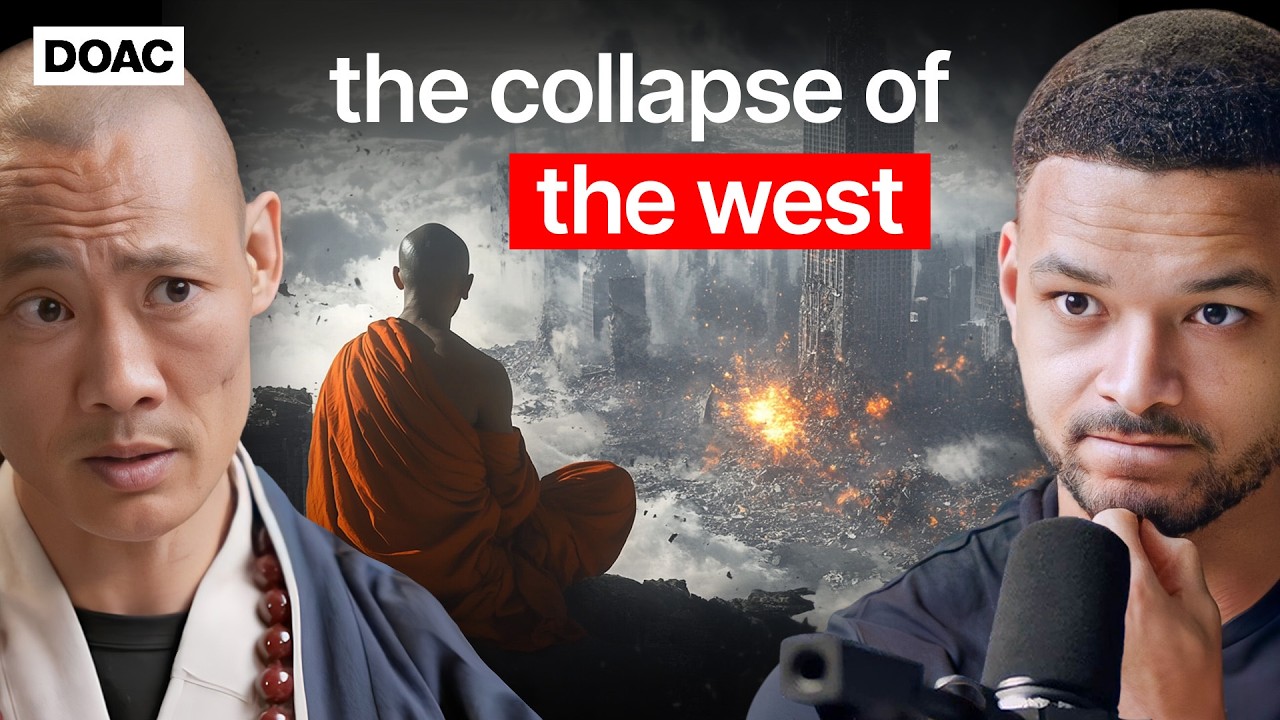
Shaolin Master Shi Links Modern Anxiety to Physical Disconnect
The Diary Of A CEO
Master Shi Heng Yi argues that modern mental suffering stems from a disconnect between mind and body, requiring self-awareness and systematic unlearning rather than external validation to achieve self-mastery.
## Background
Published on YouTube by The Diary Of A CEO on April 24, 2025, this video features Master Shi Heng Yi, Headmaster of Shaolin Temple Europe. According to the page description, the episode explores ancient Shaolin wisdom to help viewers navigate the chaos of modern life, addressing topics such as purpose, emotional patterns, anxiety, discipline, and the internal forces that hold people back.
## TL;DR
Master Shi Heng Yi discusses the root causes of modern suffering, pointing to physical inactivity, digital distraction, and identity tied to external achievements. He explains the Shaolin philosophy of self-mastery, detailing the Five Hindrances that block growth, the 14 Shaolin Virtues, and the physical conditioning involved in martial arts practice. Through personal anecdotes regarding his father's death, emotional shields, and raising his son, Master Shi illustrates practical methods like the RAIN framework to cultivate awareness, release egoic attachments, and achieve inner peace.
## Atmosphere & style
The conversation carries a calm, contemplative, and deeply grounded atmosphere that balances ancient spiritual philosophy with candid modern reflection. Master Shi speaks with measured tranquility and quiet authority, while host Steven Bartlett offers engaged, vulnerable prompts that guide the dialogue into deeply personal territory. The narrative arc moves fluidly from physical kung fu disciplines and energetic principles to poignant reflections on filial duty, grief, and emotional self-acceptance.
## Key takeaways
- [00:01](https://www.youtube.com/watch?v=atejm2w2jWY&t=1s) Breaking a brick requires intense, focused mental awareness rather than raw physical strength.
- [04:00](https://www.youtube.com/watch?v=atejm2w2jWY&t=240s) The modern disconnect between the mind and physical body due to sedentary lifestyles is a major root cause of anxiety and dissatisfaction.
- [08:00](https://www.youtube.com/watch?v=atejm2w2jWY&t=480s) Major spiritual traditions all point toward a single universal Source (the origin of Yin and Yang).
- [21:00](https://www.youtube.com/watch?v=atejm2w2jWY&t=1260s) Setting ambitious goals often stems from a feeling of internal lack, whereas connecting to the Source reveals that nothing needs to be added or removed.
- [26:46](https://www.youtube.com/watch?v=atejm2w2jWY&t=1606s) Breaking entrenched behavioral patterns requires both conscious awareness of the loop and deliberate daily practice to build new habits.
- [35:33](https://www.youtube.com/watch?v=atejm2w2jWY&t=2133s) Effective parenting focuses on providing a supportive framework for trial and error rather than trying to force or shape a child's identity.
- [42:35](https://www.youtube.com/watch?v=atejm2w2jWY&t=2555s) Discipline is ineffective without the acute awareness needed to notice sensory temptations and trigger moments right as they arise.
- [57:46](https://www.youtube.com/watch?v=atejm2w2jWY&t=3466s) The true test of spiritual practice in Chan/Zen Buddhism is how easily one can let go of attachments, whether material possessions or personal identity.
- [01:10:39](https://www.youtube.com/watch?v=atejm2w2jWY&t=4239s) Social media praise and public opinions are directed at a stylized role or character rather than a person's complete reality.
- [01:26:46](https://www.youtube.com/watch?v=atejm2w2jWY&t=5206s) The 14 Shaolin virtues (De) are divided into virtues to be expected, virtues of action, and virtues of the mind, which serve to build ethical character.
- [01:35:52](https://www.youtube.com/watch?v=atejm2w2jWY&t=5752s) Seeking inner peace is more sustainable than chasing happiness, as happiness operates on a dualistic spectrum paired with sadness.
- [01:43:28](https://www.youtube.com/watch?v=atejm2w2jWY&t=6208s) Intentionally exposing oneself to voluntary discomfort and hard physical stress builds resilience for unexpected real-world challenges.
- [01:59:34](https://www.youtube.com/watch?v=atejm2w2jWY&t=7174s) The five hindrances blocking human growth—Sensual Desires, Ill Will, Dullness/Sloth, Restlessness, and Skeptical Doubt—can be navigated using the RAIN method.
- [02:04:40](https://www.youtube.com/watch?v=atejm2w2jWY&t=7480s) Healing the loss of parental validation requires spending time alone to give oneself the recognition once sought from others.
- [02:14:38](https://www.youtube.com/watch?v=atejm2w2jWY&t=8078s) True self-mastery means taking full responsibility for managing one's own mind and physical body without outsourcing well-being to external authorities.
## Detailed walkthrough
### [00:01](https://www.youtube.com/watch?v=atejm2w2jWY&t=1s) Breaking the Brick and the Quest for Universal Purpose
The interview opens with host Steven Bartlett challenging Master Shi Heng Yi to demonstrate his extraordinary physical and mental mastery by smashing a brick. Reframing the challenge, Master Shi explains that breaking a brick is not fundamentally a display of raw physical force, but an act of absolute mental focus. Transitioning into the broader human condition, he addresses how modern life presents an overwhelming array of choices and pathways, leaving many people paralyzed and in deep suffering. In Shaolin tradition, the mind's clarity is continually sabotaged by five primary internal obstacles: sensory desire, ill will, dullness (sloth/torpor), restlessness, and self-doubt. To dismantle these barriers, Master Shi teaches the four-step RAIN method—a practical framework designed to simplify emotional regulation and mental control.
```
THE FIVE HINDRANCES
┌─────────────────────────────────────────────────────┐
│ 1. Sensory Desire │ Seeking immediate comfort │
│ 2. Ill Will │ Resentment, anger, aversion │
│ 3. Dullness │ Sloth, lethargy, low energy │
│ 4. Restlessness │ Agitation, anxious overthinking│
│ 5. Self-Doubt │ Paralysis, lack of belief │
└─────────────────────────────────────────────────────┘
```
Reflecting on his personal path, Master Shi shares that for a long time he struggled with feelings of inadequacy. Raised by strict parents who urged him to prove his worth, he spent years striving for his father's recognition through rigorous training and achievements. Tragically, his father passed away from cancer before that validation ever came. Addressing Steven's question about how to break such deeply ingrained patterns and discover true purpose, Master Shi emphasizes that true clarity requires turning inward:
> "The only thing you need to do is take a moment, contemplate about yourself, go into yourself and find the answers there, and then decide for yourself... what type of contribution would you like to give to the world."
- **The Five Hindrances:** Sensory desire, ill will, dullness/sloth, restlessness, and self-doubt.
- **The Core Solution:** The RAIN method (Recognize, Allow, Investigate, Non-Identification/Nurture) serves as a structured approach to overcome these mental blocks.
- **Personal Root:** Master Shi's relentless drive was initially sparked by a deep-seated need for approval from his father, who died of cancer.
---
[00:04](https://www.youtube.com/watch?v=atejm2w2jWY&t=4s) The Modern Disconnect: Overthinking and Physical Inactivity
When examining the underlying causes of widespread psychological distress today, Master Shi explains that he rarely takes people's self-diagnoses at face value. Instead, he observes how they actually live. The most pervasive issue in modern society is the total disconnect between the mind and the physical body: people sit at desks all day, channeling vast amounts of energy into cognitive processing while their bodies remain completely stagnant. Human beings were not designed to spend their lives sitting motionless, absorbed in continuous thought.
This energetic imbalance directly translates into chronic anxiety, persistent dissatisfaction, and an endless, unfulfilling search for external validation. Furthermore, people become trapped in complex 5-year or 10-year plans, losing sight of the immediate present. While long-term planning is necessary, over-identifying with hypothetical futures obscures the only concrete reality we ever possess: the present moment.
> "Whoever created us, he did not create us to sit with our butt on one place and do thinking work the whole time. I do think a part of why we have been created is to get out on the field and just do something out there."
- **Cost of Physical Inactivity:** Stagnant physical energy creates mental turmoil, manifesting as chronic anxiety and unfulfillment.
- **Illusion vs. Reality:** Elaborate long-term plans are mental projections; the physical reality directly in front of us is the only certainty.
---
[00:08](https://www.youtube.com/watch?v=atejm2w2jWY&t=8s) The Purpose of Existence and Connecting to the Source
Expanding on the concept of purpose, Master Shi contrasts scientific and philosophical perspectives on whether consciousness precedes matter or vice versa. Regardless of theoretical frameworks, the hard truth remains: our physical presence in this specific body is temporary, rarely lasting more than a few decades. He suggests taking a step back and viewing life like a film director watching an actor (an avatar): rather than becoming consumed by suffering, heartbreak, or societal expectations, one should embrace existence as a rare opportunity to experience the full spectrum of reality.
```
THE SOURCE OF EXISTENCE
│
┌───────┴───────┐
│ The Source │ (The One / Circle)
└───────┬───────┘
│
┌───────┴───────┐
│ Yin & Yang │ (Duality / The Two)
└───────┬───────┘
│
┌──────────────┴──────────────┐
│ Multi-Cultural Realization │
│ (Christian, Zen, Islam) │
└─────────────────────────────┘
```
Addressing the paradox of modern achievement, Master Shi admits that even as his global public profile expanded—attracting millions of followers, media appearances, and book deals—he often felt profoundly lonely while surrounded by thousands of people. Solitude, he notes, is not determined by who is around you, but by what you are connected to internally. Drawing from his upbringing—where he studied Christian lessons in school, practiced Zen Buddhism through martial arts, and learned about Islam through multicultural friendships—he highlights that all major spiritual traditions point to a single origin: a universal "Source" (or *mother* of Yin and Yang).
> "Yin and yang have a mother. The mother sometimes simply being illustrated as one circle... Where do the two come from? They must come from one."
> "It's not what you're surrounded with, it's with what you are connected... This source is the only thing that can connect us."
- **The Video Game Metaphor:** Life is structured like video game levels (e.g., *Super Mario*); you cannot jump to level two or face its "end boss" until you master the specific challenges presented in level one.
- **Multicultural Synthesis:** Master Shi's perspective was shaped by growing up in a foreign country, where his father encouraged him to make friends across cultures, exposing him to Christianity, Zen Buddhism, and Islam.
[21:00](https://www.youtube.com/watch?v=atejm2w2jWY&t=1260s) Doing vs. Being and the Trap of Goal-Setting from Lack
Master Shi Heng Yi and Steven Bartlett explore the fundamental drive behind human struggle, examining why so many people feel stuck in a perpetual state of striving. Steven observes that among his own friends, much of their anxiety stems from "wanting"—whether it is scaling a business or pursuing romantic love. Master Shi responds by identifying a deep friction between *doing* and *being*. When we set ambitious goals, we are often operating from a sense of internal lack, believing that achieving a specific target will finally make us complete.
```
┌──────────────────────────────────────────────────────────────────┐
│ THE STRIVING TRAP │
│ │
│ Goal-Setting from Lack ──► Chasing Identity / Attainment │
│ ▲ │ │
│ │ ▼ │
│ Cycle of Perpetual Struggle ◄── Max 100-Year Expiration Date │
└──────────────────────────────────────────────────────────────────┘
```
Master Shi points out that from a spiritual perspective, being connected to the source means recognizing that "there's nothing to add and there's nothing to take away from you." When action is driven purely by the desire to nourish an ego-driven identity, it traps individuals in an endless chase. He reminds us of an inescapable physical reality: whatever identity or material wealth someone accumulates, its maximum shelf life is roughly 100 years before it completely vanishes.
- **The Core Conflict:** The continuous battle between an ego/identity that seeks to maintain itself through attainment versus simply existing as you are.
- **Three Ways Humans Learn:**
1. *Direct Experience:* Achieving the goal, realizing it does not bring fulfillment, and learning you did not actually need it.
2. *Modeling/Imitation:* Trusting a teacher, guide, or mentor and copying how they live their life.
3. *Contemplation:* Hearing wise words, reflecting deeply on them, and voluntarily choosing an alternative path without having to experience every mistake firsthand.
> "Connected with the source, there's nothing to add and there's nothing to take away from you."
---
[26:46](https://www.youtube.com/watch?v=atejm2w2jWY&t=1606s) Breaking Cyclical Patterns and Rewiring Behavioral Habits
The discussion shifts to the tragedy of spent potential—people spending decades pursuing goals like wealth or luxury cars without ever attaining them or learning the underlying lesson. Master Shi notes that after spending 20 or 30 years chasing a goal without success, a person faces a critical fork in the road: they must either let go of the idea that they need the outcome, or fundamentally alter their approach. To change one's life, one must possess the capacity to drop old cognitive patterns and habitual responses.
Steven shares a story about a friend who experienced childhood bullying and developed a deep insecurity that manifested as a constant need to prove himself. In relationships, this friend puts up a fake facade; when the romance inevitably fails because it was built on an illusion, the cycle repeats despite the friend being fully aware of the pattern. Master Shi explains that breaking such entrenched loops requires both conscious awareness and deliberate training.
- **Master Shi's Personal Story:** Growing up as a four-year-old boy in Germany after his parents fled the war in Vietnam and Laos, he faced intense pressure to perform academically and prove himself. Simultaneously entering Shaolin kung fu training at age four, his masters never offered praise, only demanding "more, deeper, faster, harder." This created an internalized feeling of "never being enough."
- **The Defense Mechanism:** To protect himself from feeling inadequate, he built an emotional shield and hardened his internal walls, becoming overly reliant on his own judgment while tuning out external opinions and suppressing emotional expression.
- **Unlearning the Shield:** In his current life phase, as a partner and father, he must actively intercept these legacy patterns to remain emotionally open and accommodate his family's feelings.
> "To break patterns: number one, you need to see you have one. And number two, you need to replace old patterns... Patterns are habitual behavior."
---
[35:33](https://www.youtube.com/watch?v=atejm2w2jWY&t=2133s) Raising Young Men and the Crises of Modern Masculinity
Reflecting on becoming a father to a baby boy three months prior, Master Shi discusses his philosophy on parenting alongside the broader societal struggles facing young men today. Steven highlights alarming statistics from the UK and the Western world, noting that suicide is the leading killer of men under 45 and pointing out educational divides, such as forecasts suggesting only one man will graduate college for every two women.
Master Shi emphasizes that he does not view his role as forcefully "shaping" his son, but rather as constructing a secure, stable framework. Because his own childhood was marked by a relentless drive to prove himself, he wants his son to know that he does not need to achieve external markers to hold value. He believes that true self-worth comes from being allowed to fail safely, experience the fallout, and learn how to pick oneself back up.
- **Parenting Philosophy:** Provide a secure environment where trial and error can happen naturally without spoiling the child or making them feel inherently inadequate.
- **Root Causes of Young Men Struggling:** Current crises in 2025 are not isolated phenomena; they represent the cumulative downstream effects of what previous generations failed to pass down over the past 10 to 20 years.
- **Key Mental Attribute for Men:** Cultivating a self-sufficient individual who knows his internal worth because he has personally navigated failure and recovery.
> "I don't see myself as somebody who is now having the responsibility to shape my son... I only provide the framework... He can try out whatever he wants. If he fails, he will learn by himself to get up again."
---
[39:34](https://www.youtube.com/watch?v=atejm2w2jWY&t=2374s) The First Two Hindrances: Sensual Desire and Aversion
Master Shi connects modern distraction and purposelessness to the ancient framework of the **Five Hindrances**—five specific mental states that derail focus and prevent individuals from reaching their goals. When someone establishes a goal, the mind must remain steadily aligned with it from morning until night; these hindrances represent the primary cognitive distortions that pull the mind off course.
```
┌──────────────────────────────────────────────────────────────────┐
│ THE FIRST TWO HINDRANCES │
│ │
│ Hindrance 1: Sensual Desire ► Receptive to instant pleasure │
│ (Sight, smell, touch, physical) │
│ │
│ Hindrance 2: Aversion ► Resistance to discomfort │
│ (Rain, hardship, obstacles) │
└──────────────────────────────────────────────────────────────────┘
```
He breaks down the initial two mental blocks:
1. **Sensual Desire (*Kāmacchanda*):** Becoming excessively receptive to immediate physical pleasures through the five senses (sight, smell, touch, taste, sound). It is not inherently evil, but getting easily distracted by attractive stimuli or pleasant sensations scatters energy and destroys goal-oriented momentum.
2. **Aversion or Ill-Will (*Vyāpāda*):** Resisting discomfort, pain, or unexpected challenges. Using the metaphor of walking a path when it starts to rain, Master Shi explains that people often stop moving forward because they waste mental energy complaining about the rain rather than walking through it.
- **Goal Realization:** The fastest way to manifest an objective is maintaining uninterrupted focus from the moment of waking up until going to sleep, preventing the mind from being swayed by comfort or annoyance.
- **Mental Resistance:** Struggling against hardship causes the mind to shift away from its core purpose, prioritizing short-term relief over long-term realization.
<ElicitationsGroup message="Explore more ancient Shaolin principles from this conversation:">
<Elicitation label="Break down the remaining 3 Shaolin hindrances" query="What are the remaining 3 hindrances of the mind according to Master Shi Heng Yi?"/>
<Elicitation label="Explain the RAIN method for managing emotions" query="How does Master Shi Heng Yi explain the RAIN method for processing difficult emotions?"/>
</ElicitationsGroup>
[42:35](https://www.youtube.com/watch?v=atejm2w2jWY&t=2555s) Awareness vs. Discipline and the Trigger Moment
The conversation begins by examining how we react to life's circumstances. Master Shi Heng Yi identifies two major mistakes people make: either chasing standard pleasure and indulging in it, or rejecting challenges because reality does not match their internal expectations. Steven Bartlett asks whether this struggle against sensual desires—the "five gates" of taste, touch, and physical temptation—is where discipline enters the picture. Master Shi responds with a surprising "no." While structured guidelines (like 5 hindrances, 14 virtues, or 8 rules) provide helpful scaffolding, discipline alone is useless if you lack the fundamental **awareness** to catch a sensory temptation at the precise moment it appears.
Steven connects this to a friend's behavior, as well as his own daily habits—like reaching into the refrigerator at 1:00 AM or reacting defensively to a comment. While people often recognize their general negative patterns after the fact, they remain blind to the exact spark that sets off the chain reaction. Master Shi confirms that practices like breathwork and yoga (when taught properly) help cultivate sensitivity to these subtle shifts in internal energy. He uses the metaphor of an explosion: before a massive fire consumes a house, a tiny flame was lit. Something as simple as hearing a specific person's name can trigger a micro-reaction. Once the house is fully on fire, it is too late to put it out; transformation requires catching the tiny flame at the root before it grows into an uncontrollable blaze.
---
[48:51](https://www.youtube.com/watch?v=atejm2w2jWY&t=2931s) Inner Work and Bringing Light to the Dark
Moving deeper into emotional awareness, Master Shi explains that this process requires genuine "inner work"—a journey that starts with a firm belief and trust that looking inward will benefit your life. It is not about taking action in the external world or doing things because someone else commanded it; it is driven by a deep personal desire to understand what you are truly made of. He emphasizes that true liberation requires absolute self-transparency. Any unexamined corner of ourselves that remains in the dark will keep us trapped. He shares a guiding principle: live your life as if there is always someone watching everything you do and think—and realize that "someone" is your own elevated self.
```
Two Universal Forces
/ \
Force of Expansion Force of Contraction
(Limitlessness, Lightness) (Density, Boundaries, Pressure)
```
To determine what kind of work needs to be done, Master Shi points to the Daoist principles of Yin and Yang and the law of cause and consequence. Every thought, word, and action produces a result. He invites Steven to evaluate the nature of those consequences:
* **Density and Contraction:** Do your actions nourish conflict, pressure, and aggression, leaving you feeling like you carry a heavy stone on your heart?
* **Limitlessness and Lightness:** Or do your actions make your life and interactions feel free, joyful, and nourishing?
By reflecting on the primary emotion experienced over the past week, one can easily see whether they are living in state of limitation or liberation, providing a clear map for personal transformation.
* **Chan/Zen Metaphor:** Master Shi illustrates the limitation of language through an ancient story of a master and student walking up a mountain. When the student sees the morning sun and remarks, "Oh Master, what a beautiful sunrise," the master slaps him and refuses to walk with him again. By applying a rigid verbal label to an expansive, direct experience, the student restricted its true nature.
---
[57:46](https://www.youtube.com/watch?v=atejm2w2jWY&t=3466s) Breaking the Autopilot Loop and the Reality of Possessions
Steven candidly admits how hard it is to maintain lightness in daily life. Despite setting good intentions, he wakes up, opens one eye to check a packed calendar, manages podcast launches and urgent emails, and instantly falls back into autopilot mode. Master Shi acknowledges this struggle from his own life; as his public profile grew, his calendar filled up rapidly. Even when he tried to step back into the background, constant requests kept pulling him in. He emphasizes that the universe presents an infinite stream of opportunities, but individuals must decide what they truly want.
```
[ Seeking Possessions ] ---> Does it control your mind?
|
+-------------------------+-------------------------+
| |
[ YES ] [ NO ]
Attachment Forms Healthy Relationship
Consequence: Heavy, Painful Awakening EnJoy Freedom without Over-Identification
```
Addressing the common desire for wealth, mansions, private jets, or trophy partners, Master Shi explains that seeking these things is entirely understandable. However, life naturally forces a reality check. Because human beings arrive in this world with nothing and leave with nothing, the universe ensures everyone undergoes the painful lesson of letting go. If a person spends 70 or 80 years clinging to external achievements without realizing their impermanence, facing death or loss results in a devastating awakening.
* **The Core Lesson on Belongings:** In Chan/Zen Buddhism, the true test of spiritual practice is not whether you live in poverty or wealth, but how easily you can let go of what you have.
* **The Crucial Distinction:** "It's not about what is it that you possess. It's about what of these possessions are possessing you." You can own a sports car or enjoy a successful book launch, provided your mind remains free from attachment.
Here is a detailed, faithful walkthrough based on the transcript part provided.
[01:05:19](https://www.youtube.com/watch?v=atejm2w2jWY&t=3919s) Possessions and the Dynamic of Attachment
Master Shi Heng Yi discusses how financial position and intent dictate whether we possess our things or if our things end up possessing us. He offers an example: if someone struggles to pay rent but takes out a loan to buy an expensive sports car anyway, they are operating from a state of lack rather than abundance. That underlying insecurity makes them deeply attached to the car from the start—a problematic foundation.
Conversely, if a person actually has the means, buys the car outright, and sees it for what it truly is, a natural fading process occurs. The initial excitement lasts maybe a week or a month, but it inevitably dissipates. Over time, busyness and life take over; weeks might pass where they only see the car parked somewhere, or months where they travel the world and forget when they last drove it. Observing this natural cycle—where intense initial desire fades into indifference—gives a clearer perspective on whether a purchase is truly necessary or just a passing craving.
- **Key condition for ownership:** Whether an item controls you depends heavily on the mindset from which it was acquired and how much time you genuinely spend with it.
- **The fading nature of desire:** Cravings always peak before acquisition, but post-purchase excitement inevitably fades over days, weeks, or months.
---
[01:07:36](https://www.youtube.com/watch?v=atejm2w2jWY&t=4056s) The Second Hindrance: Ill Will and "Touching the Water"
Master Shi introduces the second of the five Shaolin hindrances: ill will. While sensory desire (the first hindrance) causes people to pull things toward themselves, ill will causes them to push unwanted things away—such as an unpleasant message, a confrontation, or a person they dislike.
Master Shi warns against both pushing and pulling, emphasizing a philosophy of non-judgment. Whatever you desperately hold onto will eventually swing away from you, and whatever you frantically try to avoid or push away will eventually come right back. He uses the metaphor of a still pond: "Don't touch the water." In the moment you touch the water out of like or dislike, your touch initiates ripples that disturb your surroundings and drain energy away from your main objective.
- **Definition of Ill Will:** A negative reaction or dislike that causes someone to waste vital energy trying to push away unavoidable aspects of life.
- **The "Don't Push, Don't Pull" Principle:** Attempting to forcefully hold onto or avoid anything creates an unstable, cyclical reaction.
- **The Water Metaphor:** Every emotional reaction creates unnecessary ripples, drawing focus away from primary life goals.
---
[01:10:39](https://www.youtube.com/watch?v=atejm2w2jWY&t=4239s) Managing Public Opinion, Identity, and Pedestals
Addressing Master Shi’s growing global visibility—including a viral TED Talk with tens of millions of views—Steven Bartlett asks how he manages other people’s opinions and whether he cares about what others think. Master Shi admits that he used to care deeply, but the last five to six years taught him tough lessons. He learned to detach from public comments because people on social media only judge a public character or representation—such as the monk in a uniform on a book cover—rather than his complete self.
Master Shi strongly warns against the danger of putting people on pedestals, whether as masters, gurus, or "special ones." Elevating someone to an inhuman status undermines the essential work of learning to discern between what is real and what is fake. In today's fractioned world, where technology threatens to allow people to live their entire lives isolated in a living room, clarity about true human nature is critical. He adds that experiencing misunderstandings from close companions of 8 or 9 years hurt twice as much as public criticism, teaching him to maintain purity of intention and rely on inner direction while retaining empathy for others' lack of understanding.
- **TED Talk Reach:** Master Shi's popular TED Talk has garnered over 20 million views on primary links and tens of millions more across the internet.
- **Public vs. True Identity:** People online interact with a stylized image or role, not the full complexity of a human being.
- **The Pedestal Trap:** Elevating leaders into idealized "gurus" distorts reality and distracts from personal awareness.
- **Personal Lesson:** Guard your inner circle carefully, maintain a pure heart, and move forward without holding ill will toward those who misjudge you.
---
[01:16:47](https://www.youtube.com/watch?v=atejm2w2jWY&t=4607s) Breaking the Brick: Mind, Body, and Focused Energy
The conversation shifts to physical focus and martial conditioning. Steven references a conversation prior to recording regarding a thick brick brought to the studio. While an exceptionally strong person might break it with brute force, Master Shi explains that true brick-breaking relies on intense mind-body focus rather than raw muscle. To demonstrate, Master Shi prepares to strike not just one, but two stacked bricks laid out on supporting blocks.
Before striking, Master Shi places his hands near the bricks to "read" them, just as he reads the tension and relaxation in a person's body. He tunes into the density and structure of the stone with his fingers, visualizes how the energy needs to descend, and aligns his body's energy with the physical structure of the stone before breaking the bricks in a split second.
<Image alt="Master Shi Heng Yi breaking bricks with his bare hand" caption="Master Shi demonstrating focus by breaking two stacked bricks." src="image_agent_tag_1"/>
- **Mechanism of Breaking:** It requires harmonizing body awareness, feeling the internal density of the target, and directing energy precisely into the material.
- **Underlying Attributes:** The instantaneous act of breaking a stone is simply an outward manifestation of long-term character traits: patience, consistency, endurance, and dedicated training.
- **The Sports Analogy:** Just as a spectator only sees a one-minute athletic performance or a three-minute round without seeing the years of unseen labor behind it, the sub-second brick break takes years of preparation.
---
[01:23:03](https://www.youtube.com/watch?v=atejm2w2jWY&t=4983s) Physical Conditioning and the Five Elements Training
Curious about how long it would take an average person to learn this feat, Steven asks Master Shi for a realistic timeline. Master Shi examines Steven’s hand and notes that mental focus alone is insufficient; one must physically condition the bones to increase their density.
To demonstrate bone conditioning, Master Shi has Steven strike his forearm against his own. When Steven strikes Master Shi's arm, he exclaims, "Yours is like steel... mine's like polystyrene in comparison!" Master Shi explains that achieving this level of physical conditioning requires roughly three months of dedicated daily training. He outlines the traditional Asian framework of the Five Elements (Wood, Earth, Metal, Fire, Water): conditioning begins with wooden objects ("Wood training"), progresses to stone ("Earth training"), and eventually advances to metal, systematically transforming the body's structural density over time.
- **Training Duration:** Achieving basic bone density and focus for brick-breaking takes approximately 3 months of consistent, dedicated practice.
- **Five Elements Progression:** Training moves systematically through phases—starting with Wood, moving to Earth (stone), and advancing to Metal—to safely harden the skeletal structure.
<ElicitationsGroup message="Explore more aspects of Master Shi Heng Yi's teachings:">
<Elicitation label="Learn about the 5 mental hindrances in Shaolin philosophy" query="What are the 5 hindrances to self-mastery according to Master Shi Heng Yi and how do you overcome them?"/>
<Elicitation label="Explore Shaolin techniques for mental focus and clarity" query="What daily practices and mindfulness techniques does Master Shi Heng Yi recommend for deep focus?"/>
</ElicitationsGroup>
[01:25:27](https://www.youtube.com/watch?v=atejm2w2jWY&t=5127s) The Five Elements and the LinkedIn Interlude
Master Shi Heng Yi continues explaining how Shaolin practitioners build resilience across physical and energetic environments. By understanding the specific frequencies and vibrations of various materials—whether wood, stone, or metal—a warrior trains to maintain inner strength in any environment. Steven clarifies whether this involves breaking or hitting metal, to which Master Shi confirms it is about hitting and conditioning against metal to build fortitude across all five elements.
A brief promotional interlude follows where host Steven Bartlett discusses the hiring platform LinkedIn. He emphasizes the principle of hiring slowly and thoughtfully, while stressing that once a hiring decision is made, speed is essential. Using paid job postings on LinkedIn helps employers receive qualified applicants seven times faster, preventing recruiting bottlenecks from stalling business growth.
- Shaolin element training involves understanding and matching the distinct vibrations of wood, stone, and metal.
- LinkedIn job promotions accelerate candidate acquisition by sevenfold compared to free job listings.
---
[01:26:46](https://www.youtube.com/watch?v=atejm2w2jWY&t=5206s) The 14 Shaolin Virtues: Character as the Vessel of Power
Master Shi Heng Yi breaks down the foundational role of virtues (*De*) in the Shaolin tradition, emphasizing that virtues serve as an essential internal navigation system for both martial arts and everyday life. Virtues are categorized into two major divisions across 14 distinct principles: virtues to be expected, virtues of action, and virtues of the mind. Master Shi explains that before a student is admitted to deep training, masters evaluate whether the applicant already displays baseline "virtues to be expected"—specifically self-control, discipline, and benevolence. Self-control ensures an individual can regulate emotional outbursts and retain honor during anger, while discipline reflects the baseline commitment needed to endure rigorous daily temple routines.
Master Shi draws an analogy to the Force in *Star Wars*: spiritual cultivation and martial skill generate immense power, but whether that power serves humanity or causes harm depends entirely on the vessel—the character of the person holding it. Steven notes that these exact same traits represent the ultimate checklist for high-performing teams in business. Master Shi elaborates that "virtues of action" dictate *how* one behaves outward (behaving with loyalty, trust, respect, and courage), whereas "virtues of the mind" (such as patience, persistence, and perseverance) provide the internal nourishment required to sustain ethical conduct even when facing disrespect or provocation.
- **The 14 Shaolin Virtues:** Self-control, discipline, modesty, benevolence, humility, respect, righteousness, trust, loyalty, willpower, perseverance, persistence, courage, and patience.
- **Three Categories:** 4 virtues to be expected (baseline entry requirements), 5 virtues of action (outward conduct), and 5 virtues of the mind (internal psychological fortitude).
- **The Core Purpose:** Skills and energy cultivation build raw power; virtue training constructs the character necessary to wield that power safely and ethically.
---
[01:33:03](https://www.youtube.com/watch?v=atejm2w2jWY&t=5583s) The Religion of Oneness and Unlearning Identity
When asked about his personal religious beliefs, Master Shi Heng Yi describes his faith as the "religion of oneness"—a deep conviction that all existence is interconnected. Rather than treating spirituality as an intellectual exercise or trying to acquire external additions to his life, his path focuses on stripping away internal friction and obstacles to recognize an already existing wholeness. He challenges the modern obsession with self-improvement and accumulation, revealing that true spiritual mastery is not about gaining something new, but removing the layers that obscure innate completeness.
Master Shi states directly, "I have nothing to give you. The only thing that I really try to do is take stuff away from you." He explains that what conceals a person's inherent completeness is everything that builds up a rigid identity—specifically the heavy baggage of past experiences held continuously in the mind. The more a person clings to past elements, the tighter their egoic identity becomes, severely limiting their capacity to break free and step into the open possibilities of the future.
- **Religion of Oneness:** The fundamental belief in universal connection rather than rigid dogmatic theology.
- **Subtractive Growth:** Spiritual progress comes from taking away psychological layers and egoic attachments, not accumulating external knowledge or status.
- **Identity Traps:** Storing past memories and grievances reinforces fixed self-identity and blocks future potential.
---
[01:35:52](https://www.youtube.com/watch?v=atejm2w2jWY&t=5752s) Chasing Peace over Happiness and Navigating Karmic Ties
Addressing whether he is happy, Master Shi Heng Yi admits it is a complex question because he does not actively search for happiness; he searches for peace. He explains that happiness exists on a dualistic spectrum—where there is happiness, there is inevitably corresponding sadness, just as anything that rises must eventually fall. Seeking conditional happiness creates the constant fear of losing it. Instead, he strives for a state of steady inner peace, acknowledging that while he still experiences difficult moments, he is progressively coming into a deeper state of equilibrium.
When Steven asks what stands in the way of achieving complete peace, Master Shi identifies "karmic connections"—unavoidable relational ties with those closest to us. Because human beings are interconnected, the actions, health, and emotional states of close relatives inevitably ripple into one's own life. Master Shi shares the personal example of his deep bond with his young son and his partner, noting that his son's emotional state directly impacts him. Managing these deep bonds, especially during sleep-deprived periods of early fatherhood, serves as an ongoing real-world laboratory for maintaining emotional poise and self-regulation.
> "I'm not searching for happiness. I'm searching for peace... If there's happiness, there is sadness. If something can rise, something must fall." — Master Shi Heng Yi
- **Peace vs. Happiness:** Happiness is a transient emotion tied to dualism (happiness/sadness), whereas peace is an underlying state of baseline stability.
- **Karmic Connections:** Deep emotional and biological ties with family members (such as parents or children) that naturally impact one's personal energetic state.
---
[01:38:38](https://www.youtube.com/watch?v=atejm2w2jWY&t=5918s) Morning Practice, Mindful Emptiness, and the "Squatting Monkey"
Describing his daily routine, Master Shi Heng Yi highlights the critical importance of starting the morning in a clean, uncluttered mental state. Upon waking, his primary objective is to cultivate an empty mind, intentionally refusing to carry over thoughts or anxieties from the previous day. Before engaging with external demands—provided his son does not require immediate attention—he spends his first hour alone, sitting quietly on a sofa, breathing deeply, and scanning his body from the inside to prepare his energy for the day ahead.
Following this quiet alignment, Master Shi performs physical conditioning consisting of push-ups, sit-ups, and static "standing practice." He highlights a specific posture known as the "squatting monkey," holding demanding isometric stances for 15 minutes at a time. Stripping away mystical interpretations, he explains that holding physically grueling positions develops internal *Qi* (energy) by demanding intense willpower. Willpower and energy development are intrinsically linked: forcing the body to endure intense physical discomfort cultivates an iron will and raises overall energetic stamina.
- **Morning Routine:** Begins with an hour of solitary quiet sitting, body scanning, and conscious breathwork to wake up "empty."
- **Physical Conditioning:** Daily regimen includes push-ups, sit-ups, and static standing postures.
- **The Squatting Monkey:** An intense 15-minute isometric holding stance designed to build willpower and cultivate internal energy (*Qi*).
---
[01:43:28](https://www.youtube.com/watch?v=atejm2w2jWY&t=6208s) Voluntary Discomfort: Why We Must Do Hard Things
Master Shi Heng Yi addresses why modern individuals must intentionally engage in hard physical and mental challenges. In a world saturated with modern comfort, voluntarily putting oneself through rigorous stress builds essential coping mechanisms for the inevitable hardships of human life. Life inherently brings periods of extreme tension; by intentionally stepping into controlled physical stress during training, a practitioner learns the exact mechanisms required to recognize, manage, and release tension when unexpected life crises strike.
Training hard things is not about showing off elite abilities, but about mastering the balance between tension and relaxation. Just as training teaches how to release physical tightness, it also teaches how to generate structure and energy when one becomes overly passive or "slacks off." Ultimately, Master Shi explains, ancient practices like Shaolin Kung Fu serve as a symbolic rehearsal for life's natural cycles—preparing the practitioner to walk through life's metaphorical valleys with steady resilience.
- **Purpose of Voluntary Hardship:** Prepares the mind and body for the unavoidable tensions and adversities of human existence.
- **Tension Management:** Physical training teaches the dual skills of releasing excessive tension and summoning energy when structure is lacking.
- **Shaolin Metaphor:** Shaolin Kung Fu is described as the practice of "walking through the valley" of life's hardships with balance and composure.
[01:46:17](https://www.youtube.com/watch?v=atejm2w2jWY&t=6377s) Physical Pain, Comfort Zones, and Building Up the Body
Master Shi Heng Yi addresses the nature of pain on a martial arts journey, breaking down how physical discomfort directly translates into mental endurance. Training inherently involves discomfort: stretching, strength conditioning, and martial arts drills all inflict pain. However, the core purpose of a martial arts practice is to consistently work oneself up to the point of discomfort until that feeling naturally begins to recede. This does not mean the practitioner becomes numb to pain. Rather, the master continues to feel the physical sensation, but their relationship to that pain shifts completely. They no longer feel a desperate urgency or knee-jerk reaction to alter their course just because their body registers discomfort.
```
+-------------------------------------------------------------------------------+
| THE DYNAMICS OF PHYSICAL PAIN |
+------------------------------------+------------------------------------------+
| UNTRAINED RESPONSE | TRAINED SHAOLIN PERSPECTIVE |
+------------------------------------+------------------------------------------+
| • Senses physical pain/stimulus | • Senses physical pain/stimulus |
| • Mind interprets pain as "bad" | • Mind registers the pain calmly |
| • Reacts immediately to stop/pivot | • Evaluates: "I can endure this pain" |
| • Shrinks back into comfort zone | • Observes the layer without panic |
+------------------------------------+------------------------------------------+
```
Steven Bartlett notes that this shift mirrors everyday human psychological patterns: when average people encounter the "pain" of embarking on a new business or pivoting careers, they construct a self-limiting narrative that they are "not good enough" or under threat, leading them to quit. Master Shi concurs, drawing a direct parallel between cultivating physical stamina and building a venture. Growth is impossible if one only repeats familiar tasks. To expand a comfort zone, an individual must systematically expose themselves to controlled stressors outside their baseline, consistently pushing limits without over-exaggerating to the point of injury.
* **Wisdom on Intelligent Limits:** "Your body is so intelligent that before something serious really happens, it tells you way before that: be careful."
* **Expanding Comfort Zones:** Real growth requires moving past baseline capabilities in small, deliberate increments until the higher bar becomes a habit.
---
[01:52:55](https://www.youtube.com/watch?v=atejm2w2jWY&t=6775s) Embracing the Unknown and Breaking Old Patterns
Growth inherently demands stepping into the unknown, yet most people harbor an intense fear of uncertainty. Master Shi uses a physical visual aid—the surface of a table—to represent one's comfort zone: if a person remains firmly planted on top of the table, they will never walk out to discover how beautiful the streets of London are. He emphasizes that uncertainty is not something to dread; in fact, he expresses immense gratitude for its existence, pondering how agonizingly boring life would be if every event over the next 20 years were predetermined.
To practical inquiries about how someone can cultivate the habit of leaning into uncertainty—whether it means raising a hand in a corporate meeting, starting a small business, or learning to run—Master Shi offers straightforward advice: actively seek out new knowledge and break established routines. When fear holds a person back, overcoming it requires changing perspective and "waking up from the dream" by refusing to take life's challenges too seriously.
```
[ COMFORT ZONE ] ===> [ STEPPING OUT ] ===> [ THE UNKNOWN ]
(Staying on the (Raising a hand, (Personal growth,
safe table top) breaking patterns) discovering beauty)
```
* **Statistical Rationalization of Worry:** Master Shi reveals that 80% to 90% of the things he worried about in recent months never materialized; for the remaining 10% that did occur, worrying ahead of time changed absolutely nothing.
* **Accepting Dualities (Yin and Yang):** True freedom comes from abandoning the naïve expectation that life will be purely peaceful, beautiful, and filled with well-meaning people. Light exists alongside darkness, success alongside failure, and life alongside aging, sickness, and death.
---
[01:59:34](https://www.youtube.com/watch?v=atejm2w2jWY&t=7174s) Overcoming the 5 Hindrances: The RAIN Method
Steven outlines the ancient Buddhist framework of the **Five Hindrances**—mental states that systematically block human potential and prevent people from reaching their chosen goals:
1. **Sensual Desires** (*attachment to physical sensory pleasures*)
2. **Ill Will / Aversion** (*pushing things away or harboring hatred*)
3. **Dullness / Sloth & Torpor** (*lack of energy and motivation*)
4. **Restlessness** (*an inability to ground the mind in the present moment*)
5. **Skeptical Doubt / Indecisiveness** (*distrusting oneself and vacillating*)
To dismantle these hindrances, Master Shi details the four-step **RAIN Method**, a structured framework for mindfulness and emotional regulation:
```
R — RECOGNIZE Pause and identify which mental hindrance is active.
A — ACKNOWLEDGE Accept the emotional state fully without denying it.
I — INVESTIGATE Probe like a detective to discover what triggered the state.
N — NON-IDENTIFY Detach from the mind/body; do not define yourself by the emotion.
```
* **Step-by-Step Breakdown:**
* **Recognize:** Sit in contemplation to clearly identify which mental state is currently present.
* **Acknowledge (Acceptance):** Allow the emotion or hindrance to exist without judgment, resistance, or aversion.
* **Investigate:** Analyze the root causes of the state (e.g., asking *"Was I restless this morning? What conversation or message triggered this shift?"*).
* **Non-Identification:** Maintain space between one's fundamental consciousness and the physical body or fleeting mental thoughts, avoiding the trap of absorbing the hindrance into one's core identity.
---
[02:03:25](https://www.youtube.com/watch?v=atejm2w2jWY&t=7405s) A Master’s Final Message to His Son
When asked what single, crucial message he would leave for his young son to receive upon turning 18, Master Shi strips away complex dogma in favor of radical mental adaptability and freedom.
> "Concepts are concepts. Theories are theories. Be careful or be aware of what you are keeping or what are you nourishing in the mind. Never restrict yourself to any concept. Never restrict yourself to any identity. Never restrict yourself to any type of role. What you create, you create—and you can create quite a lot of things."
* **Key Takeaway:** Identity is fluid; static roles, theories, and mental constraints limit human potential. True mastery lies in remaining open and unattached to arbitrary labels.
---
[02:04:40](https://www.youtube.com/watch?v=atejm2w2jWY&t=7480s) Grieving His Father’s Death and Finding Purpose
Master Shi reflects deeply on the profound loss of his father to cancer around 2012, when Master Shi was approximately 28 years old. Throughout his childhood and young adulthood, Master Shi felt an intense internal fire to excel—spending over two decades pursuing rigorous academic and formal education, from elementary school through university degrees. He explains candidly that he did not undertake these extensive academic accomplishments for himself, but rather out of a deep filial obligation to honor his parents for giving him life.
Upon graduating after 20 years of schooling, Master Shi returned to Kaiserslautern, Germany, where he spent his father's final year by his side. Experiencing his father's terminal illness and ultimate death shattered his previous framework of living purely to fulfill external expectations, instilling in him a far deeper, personal sense of purpose.
* **Location:** Kaiserslautern, Germany.
* **Timeframe:** Circa 2012 (at roughly 28 years of age).
* **Core Insight:** The transition from external motivation (pleasing parents and fulfilling societal duties) to internal purpose through the visceral realization of mortality.
Here is a detailed, faithful walkthrough of Part 7 of the transcript:
[02:06:42](https://www.youtube.com/watch?v=atejm2w2jWY&t=7602s) Grief, Unspoken Expectations, and the Search for Fatherly Recognition
Master Shi Heng Yi reflects on the deep emotional weight of completing his entire higher academic education specifically for his father, only for his father to pass away before seeing it accomplished. He explains how this left a profound, lingering wound. Adding to this complex dynamic was an Asian cultural tradition surrounding death: while his father lay dying in the hospital, knowing he only had days left, he explicitly instructed Master Shi not to cry or display grief when he passed. His father gave this direction only to him, knowing his mother and brother could not handle such a request.
Master Shi outlines the underlying cultural and spiritual logic of this ritual: in their belief system, when a person dies, the body perishes while the spirit sets itself free. If the spirit sees the family weeping, it remains tethered and bound to the earthly realm. To help his father transition and move on quickly, Master Shi had to suppress all outward grief at the moment of death. However, carrying these heavy responsibilities—spending years working to earn his father's approval, being unable to share the achievement with him, suppressing his grief, and pushing through 16-hour workdays in a relentless pursuit of overachievement—shaped who he is today, but left deep emotional blockages that he now feels a compelling need to release for the sake of his own young son.
When asked what he was truly seeking all those years, Master Shi acknowledges that it was simply recognition from his father—to hear him say, "You did well. It is enough." Having never heard those words from his father or mother, Steven Bartlett asks how one can heal when the parent is no longer around to deliver that validation. Master Shi emphasizes that one must step back from the world, spend time alone, and actively give oneself the precise affirmation that was missed.
Prompted by Steven to share the exact words he wished his father had said to him, Master Shi softly articulates: "You did well. You did enough. I see what you are doing. But now take your energy back and give it to your son. Give him everything that you feel you didn't receive from me." He notes that doing this deep inner work operates on a subconscious level, addressing hidden patterns that subtly govern one's actions and perspective.
- Master Shi followed the traditional belief that the spirit remains bound to the earth realm if relatives weep during the transition.
- In his tradition, a 49-day period following a death is designated during which loved ones are urged to refrain from grieving to allow the spirit to move on smoothly.
- Master Shi notes that while he was able to grieve after those 49 days, deep subconscious layers of unresolved emotion remained stored within him.
---
[02:14:38](https://www.youtube.com/watch?v=atejm2w2jWY&t=8078s) Defining True Self-Mastery and Reclaiming Agency
Turning to Master Shi's book, *Shaolin Spirit*, Steven asks what it truly means to achieve "self-mastery." Master Shi explains that throughout his upbringing in martial arts, he actively sought out masters and grandmasters to act as external guides and mentors. While each instructor taught him valuable isolated skills, none of them could provide the overarching architecture needed to manage his own life.
Master Shi asserts that true self-mastery means refusing to outsource the management of your life to any external figure, whether a master, mentor, or authority figure. External guides can teach techniques, but the responsibility of integrating those skills into a structured frame to extract your highest potential rests entirely on the individual. The master, he emphasizes, already resides inside each person; it simply needs to be cultivated and nourished.
He explains that his book is aimed directly at anyone who feels their well-being depends on external forces they cannot control—whether it is decisions made by the government or the opinions and remarks of workplace colleagues. The essential core of self-mastery is refusing to outsource your peace of mind to third parties, placing the foundation of your well-being strictly on the two things within your direct influence: your own body and your own mind.
- External mentors can teach specialized technical skills, but cannot construct a framework for how an individual should live.
- True well-being is undermined whenever an individual outsources their mental state to external, uncontrollable circumstances.
- Self-mastery centers on directing focus exclusively toward internal domains: the mind and physical body.
---
[02:18:51](https://www.youtube.com/watch?v=atejm2w2jWY&t=8331s) Practical Strategies for Overcoming Personal Blocks
For someone feeling lost, lacking purpose, and overwhelmed by everyday life, Master Shi provides practical perspective derived from his own humble beginnings. He reveals that he did not start out on book covers or with a massive social media presence; he grew up in the poorest, most rough neighborhood of Kaiserslautern, Germany—an area people actively avoided. Over 40 years of observing human nature, he has observed that successful individuals share a distinct capacity for endurance and consistency. Success requires trusting the process through trial and error, understanding that failure and hardship build the unseen foundation required to shine.
To translate these concepts into immediate daily practice, Master Shi outlines a simple self-diagnostic exercise: look back at the past week or month and identify the single most disturbing issue or recurring negative emotion that has followed you. Boil it down to pinpoint the exact person, situation, or trigger that blocks your progress and drains your energy.
Instead of letting that pattern persist for months or years—leading to chronic stagnation and complaining—invest all your focus into solving that single friction point. Master Shi shares that he applies this exact method to map out his own personal growth, evaluating key domains like business, family, and relationships to identify the specific bottleneck that requires attention next.
- Master Shi originated from the poorest district in Kaiserslautern, Germany.
- Persistent success is non-linear; it requires enduring setbacks and accepting that failure forms the necessary foundation for high achievement.
- Diagnostic Method: Identify the primary disturbing emotional state or obstacle from the past month, isolate the underlying trigger, and dedicate focused energy to resolving that specific block before moving forward.
---
[02:24:49](https://www.youtube.com/watch?v=atejm2w2jWY&t=8689s) Greatest Regret and Closing Reflections
Steven introduces the podcast’s signature closing tradition, reading a question left by the previous anonymous guest: "What is your greatest regret?" Master Shi pauses thoughtfully, reflecting that for 40 years he could stand firmly behind every decision and command he issued because his mind was fully aligned with his actions. However, in recent months, circumstances forced him to make a difficult operational decision—akin to letting someone go or terminating an arrangement—without having sufficient time to make the transition smooth and pleasant. Being forced to carry out an action that felt out of alignment with his preferred approach represents his one true regret.
Steven closes the conversation by expressing profound gratitude for Master Shi's simple yet challenging message, recommending his book, YouTube channel, and viral TEDx talk to the audience. Master Shi thanks Steven for the invitation and the opportunity to share his perspective, concluding a reflective and wide-ranging discussion.
- Over a 40-year period, Master Shi maintained complete internal alignment with his decisions until a recent forced, rushed termination decision.
- Steven highlights Master Shi's widely viewed TEDx talk and digital content as accessible entry points for viewers seeking clarity and practical wisdom.
[02:27:44](https://www.youtube.com/watch?v=atejm2w2jWY&t=8864s) The 1% Diary and Channel Subscription Request
Steven Bartlett concludes the episode by sharing details about "The 1% Diary," a physical diary designed to keep users focused, inspired, and motivated through daily incremental gains. He explains that the interactive journal contains pictures and elements specifically designed to build consistency around the small "1% changes" that ultimately compound to transform one's life. He encourages listeners to pick up a copy for themselves, friends, colleagues, or teams via `thediary.com`.
Following the product announcement, Steven addresses the audience directly with a personal request, sharing a statistic that continually surprises him: 53% of regular listeners have not yet subscribed to the podcast channel. He asks for a simple, free favor from those who enjoy the show—to hit the subscribe button. In return, he commits that he and his team will work tirelessly to improve the show every week, listen closely to audience feedback, and continue booking the exact guests that listeners want to hear.
- The 1% Diary is designed to track daily micro-habits and incremental progress.
- 53% of regular show listeners are currently not subscribed to the channel.
- Steven promises continuous improvement in guest selection and production based directly on audience feedback in exchange for subscriptions.
## Notable quotes
> [00:01](https://www.youtube.com/watch?v=atejm2w2jWY&t=1s) The only thing you need to do is take a moment, contemplate about yourself, go into yourself and find the answers there, and then decide for yourself... what type of contribution would you like to give to the world. — Master Shi Heng Yi
> [04:00](https://www.youtube.com/watch?v=atejm2w2jWY&t=240s) Whoever created us, he did not create us to sit with our butt on one place and do thinking work the whole time. I do think a part of why we have been created is to get out on the field and just do something out there. — Master Shi Heng Yi
> [08:00](https://www.youtube.com/watch?v=atejm2w2jWY&t=480s) Yin and yang have a mother. The mother sometimes simply being illustrated as one circle... Where do the two come from? They must come from one. — Master Shi Heng Yi
> [08:00](https://www.youtube.com/watch?v=atejm2w2jWY&t=480s) It's not what you're surrounded with, it's with what you are connected... This source is the only thing that can connect us. — Master Shi Heng Yi
> [21:00](https://www.youtube.com/watch?v=atejm2w2jWY&t=1260s) Connected with the source, there's nothing to add and there's nothing to take away from you. — Master Shi Heng Yi
> [26:46](https://www.youtube.com/watch?v=atejm2w2jWY&t=1606s) To break patterns: number one, you need to see you have one. And number two, you need to replace old patterns... Patterns are habitual behavior. — Master Shi Heng Yi
> [35:33](https://www.youtube.com/watch?v=atejm2w2jWY&t=2133s) I don't see myself as somebody who is now having the responsibility to shape my son... I only provide the framework... He can try out whatever he wants. If he fails, he will learn by himself to get up again. — Master Shi Heng Yi
> [01:23:03](https://www.youtube.com/watch?v=atejm2w2jWY&t=4983s) Yours is like steel... mine's like polystyrene in comparison! — Steven Bartlett
> [01:35:52](https://www.youtube.com/watch?v=atejm2w2jWY&t=5752s) I'm not searching for happiness. I'm searching for peace... If there's happiness, there is sadness. If something can rise, something must fall. — Master Shi Heng Yi
> [01:46:17](https://www.youtube.com/watch?v=atejm2w2jWY&t=6377s) Your body is so intelligent that before something serious really happens, it tells you way before that: be careful. — Master Shi Heng Yi
> [02:03:25](https://www.youtube.com/watch?v=atejm2w2jWY&t=7405s) Concepts are concepts. Theories are theories. Be careful or be aware of what you are keeping or what are you nourishing in the mind. Never restrict yourself to any concept. Never restrict yourself to any identity. Never restrict yourself to any type of role. What you create, you create—and you can create quite a lot of things. — Master Shi Heng Yi
> [02:04:40](https://www.youtube.com/watch?v=atejm2w2jWY&t=7480s) You did well. You did enough. I see what you are doing. But now take your energy back and give it to your son. Give him everything that you feel you didn't receive from me. — Master Shi Heng Yi
## Mentioned
Master Shi Heng Yi, Steven Bartlett, Shaolin Temple Europe, Shaolin Spirit, The Diary Of A CEO, RAIN method, Five Hindrances, Kāmacchanda, Vyāpāda, Five Elements, Chan/Zen Buddhism, LinkedIn, The 1% Diary, Star Wars, Kaiserslautern
Master Shi Heng Yi argues that modern psychological distress stems primarily from an energetic imbalance between continuous cognitive overthinking and physical inactivity, compounded by ego-driven striving for external validation. He contends that overcoming chronic dissatisfaction requires cultivating internal awareness, voluntarily embracing physical discomfort, and reclaiming personal agency over the mind and body.
The Modern Imbalance of Overthinking and Sedentary Living
Master Shi identifies the total disconnect between the mind and physical body as the most pervasive source of contemporary anxiety. Modern lifestyles force individuals to remain seated for extended periods, channeling substantial energy into cognitive processing while the body remains stagnant. In his view, human beings were not built to remain motionless while absorbed in constant thinking; this physical stagnation directly generates mental turmoil, chronic dissatisfaction, and an endless search for external approval.
He further cautions against over-identifying with hypothetical five- or ten-year plans. While acknowledging the utility of planning, he argues that elaborate future projections function as mental illusions that detach people from the immediate physical present—the only tangible reality over which an individual maintains direct control.
Regulating the Five Hindrances Through the RAIN Method (119:34)
In Shaolin philosophy, mental clarity and sustained focus are routinely compromised by five internal obstacles: sensual desire (clinging to instant pleasure), ill will or aversion (resisting hardship), dullness (sloth and low energy), restlessness (anxious agitation), and skeptical self-doubt. Master Shi notes that discipline alone is ineffective unless accompanied by acute moment-to-moment awareness. An individual must detect subtle energetic triggers early, comparing unchecked impulses to a small spark that quickly engulfs a house in flames if left unaddressed.
To manage these mental distortions, Master Shi advocates the four-step RAIN framework: Recognize which hindrance is active, Acknowledge and allow the emotional state without denial, Investigate its underlying trigger like a detective, and maintain Non-identification by detaching one's core identity from fleeting mental thoughts or physical sensations.
Shifting from Ego-Driven Validation to Internal Equilibrium (21:00)
Master Shi highlights a recurring friction between 'doing' and 'being,' arguing that ambitious goal-setting frequently operates from a perceived internal lack—the false assumption that acquiring an object, status, or partner will deliver completeness. Because accumulated material possessions and identities carry an inevitable expiration date of at most roughly a century, chasing them to satisfy the ego creates an unstable loop where initial excitement rapidly fades into indifference.
Reflecting on his personal history, Master Shi shares that his two decades of intensive academic study were driven by a filial desire to earn recognition from his father, who died of cancer circa 2012 before delivering that validation. To dismantle ingrained behavioral defenses, he emphasizes that individuals must look inward and provide themselves the affirmation they missed, rather than continuously seeking external approval.
Voluntary Discomfort and Physical Conditioning for Fortitude (103:28)
Master Shi maintains that modern comfort weakens resilience, making voluntary exposure to physical stress essential for handling unavoidable life hardships. In Shaolin practice, exercises such as holding the isometric 'squatting monkey' stance for 15 minutes, or progressive bone conditioning through the Five Elements (advancing from wood to stone and metal), systematically build willpower and internal energy (Qi). Demonstrating focus by breaking two stacked bricks, he explains that the feat depends on harmonizing mental intent with the material's density rather than raw muscular force.
Regularly confronting physical discomfort transforms an individual's relationship with pain. Rather than reacting impulsively to stop or constructing narratives of inadequacy, a trained practitioner learns to observe physical stress calmly, allowing comfort zones to expand while respecting the body's natural warnings against genuine injury.
Reclaiming Personal Agency and True Self-Mastery (134:38)
Within the Shaolin framework, character development is organized across 14 virtues divided into expected baseline attributes (self-control, discipline, benevolence), virtues of action, and virtues of the mind. Master Shi compares martial and energetic techniques to raw power, asserting that virtues provide the necessary ethical structure to wield that power safely without inflicting harm.
True self-mastery, Master Shi concludes, requires refusing to outsource the management of one's well-being to external teachers, employers, or political circumstances. For individuals feeling overwhelmed, he advises a focused diagnostic approach: identify the single most disruptive emotional trigger or obstacle experienced over the preceding month and direct all resources toward resolving that specific friction point before moving forward.
Master Shi views self-mastery as an ongoing process of subtractive unlearning—shedding rigid identities, dogmatic theories, and lingering grievances to reveal innate completeness. However, he notes that achieving absolute equilibrium remains perpetually tested by unavoidable relational ties, acknowledging that close family attachments and the demands of leadership occasionally challenge one's personal poise.
精炼阅读摘要
少林武僧释恒义(Master Shi Heng Yi)在与 Steven Bartlett 的对谈中指出,现代人普遍面临的焦虑与空虚源于身心严重失联,以及从“匮乏感”出发盲目追求外在认同;真正的自我掌控在于向内觉察,化解心智障碍并放下对外在身份与结果的执念。
身心失联与匮乏驱动的追求陷阱
释恒义分析认为,现代心理痛苦的根本原因在于“思维超载”与“身体停滞”的彻底脱节。人们终日久坐、消耗大量能量进行脑力活动,却缺乏躯体运动,这种失衡会直接转化为慢性焦虑与不满。此外,多数人深陷于以“匮乏感”为起点的目标设定之中,误以为获得名利或特定身份就能带来完整感,但任何外在成就与物质财富的保质期至多不过百年。
释恒义回顾自身经历指出,他曾为了获得严厉父亲的认可而拼命训练并攻读高等教育长达二十年,然而父亲在2012年因癌症去世时,他仍未等到这份肯定。他指出,若行为始终由喂养自我身份(ego)的欲望驱动,人就会困在无止境的追逐中。真正的成长不是向外索取或增加标签,而是剥离过去经历积攒的精神包袱,回归内在固有的完整性。
五盖障碍与情绪调节的RAIN法则 (39:34)
少林哲学将阻碍专注与实现目标的内在心理状态归结为“五盖”(The Five Hindrances):感官欲望(沉溺即时快感)、嗔恚或抗拒(排斥不适与困难)、昏沉(缺乏能量与动力)、掉举或不安(思绪躁动、无法安住当下)以及疑虑(自我怀疑与犹豫不决)。释恒义指出,感官诱惑和负面抗拒会拉扯心智,犹如在平静的水面上激起涟漪,白白消耗朝着主线目标前进的能量。
为打破这一循环,单纯依靠自律远远不够,关键在于培养对触发瞬间的敏锐“觉察”。释恒义提出了四步调适框架“RAIN法则”:首先是识别(Recognize),停下来清晰辨认当前升起的是哪种心智障碍;其次是接纳(Allow/Acknowledge),允许该情绪状态存在而不加以评判或抵抗;再次是探究(Investigate),如侦探般追溯引发该反应的具体诱因;最后是去认同(Non-Identification),将根本意识与短暂的身心念头拉开距离,拒绝让负面情绪定义自身本质。
自愿承受艰辛与扩展耐受阈值 (76:47)
在身体与意志训练方面,释恒义以徒手劈开两块砖的演示为例,解释这一动作的本质并非单纯依赖蛮力,而是高度的身心聚焦、能量校准,以及长期的骨骼密度强化。他介绍了少林传统的“五行”循序渐进身体强化过程,先从木质训练开始,逐步过渡到土(石材),最终推进至金属训练,通常需要三个月以上的持续日常训练才能建立基础骨质密度与韧性。
释恒义强调,在充满现代舒适的环境中,人必须主动参与困难的身体挑战,例如维持长达15分钟的高难度等长下蹲姿势“蹲猴式”(Squatting Monkey)。主动经受可控的肉体疼痛并非让人对痛苦麻木,而是重构心智与不适的关系,使人不再一感受到难受就条件反射式地退缩回舒适区。通过学会在紧张与放松之间转换,个体能在人生遭遇不可控的危机与低谷时保持沉着与韧性。
十四美德与收回自我生命的掌舵权 (86:46)
根据释恒义的阐述,少林体系将14项美德(De)视为驾驭强大力量的内在罗盘,划分为三大维度:底线要求的“应备美德”(自制、纪律、谦逊、仁爱)、对外处世的“行动美德”(忠诚、信任、尊重、勇气、正义),以及内在心理韧性的“心灵美德”(耐心、坚持、毅力、意志力、谦卑)。他指出,正如《星球大战》中的原力一样,武艺与修为能够带来力量,但该力量究竟造福世人还是造成毁灭,完全取决于承载者的道德器识。
关于自我掌控(Self-Mastery)的本质,释恒义指出不能将生命的管理权外包给任何导师、权威或外部环境。外部师父只能传授具体技能,但如何将其融合成个人生命架构的责任全在自身。他建议迷茫者每周或每月进行一次自我诊断:找出最困扰自己、持续消耗能量的单一核心摩擦点或情绪诱因,集中精力解决这个瓶颈,而不是任由其演变成长期的停滞与抱怨。
本期访谈的核心立论在于,外部环境与他人评价无法为个体提供永恒的平静与价值感,唯有收回投射在外的注意力、正视死亡的有限性,并经由持续的身心修炼剥离执念,才能达成真正的自洽。然而,对于习惯了现代快节奏分工、高度依赖外部系统支持与即时反馈的普通大众而言,如何脱离脱产训练环境、在现实琐事与职场竞争中长期维持该法则的高强度自我觉察与肉体磨砺,仍是一个需要个体在实践中自行摸索的未决挑战。
Detailed notes — zh
## Background
该视频由 YouTube 频道 The Diary Of A CEO(主持人 Steven Bartlett)于 2025 年 4 月 24 日发布。视频对话欧洲少林寺住持释恒义师父(Master Shi Heng Yi),结合其新书《Shaolin Spirit》,探讨在现代混乱生活中如何化解焦虑内耗、击破内心的“五盖”阻碍,并运用少林智慧与纪律实现身心掌控与内在平静。
## TL;DR
释恒义师父深入剖析了现代人身心失衡与焦虑的根本原因,指出过度动脑而身体闲置、沉迷外部追逐和匮乏感驱动的身份认同,让人深陷痛苦。他详细拆解了阻碍专注与成长的“五盖”(贪欲、嗔恚、惛沉、掉举、疑结),并提出以觉察为先导的四步“RAIN 法则”及少林十四美德来重塑行为模式。师父还在现场演示了徒手劈碎双砖的身心合一专注力,并真诚分享了自身童年创伤、父亲离世未获认可的遗憾,呼吁人们停止向外索求、接纳不确定性,唤醒内在的真正自我掌控。
## Atmosphere & style
整场对话在深沉内敛与极度真诚之间自如流转,既有禅宗高僧淡定通透的哲学思辨,又有赤诚袒露个人创伤的心灵震颤。释恒义师父沉稳从容的语调与 Steven Bartlett 敏锐好奇的追问碰撞出极具共鸣的张力,现场徒手碎砖的干脆爆发与谈及已故父亲时的深长叹息形成强烈的情感起伏。观看体验仿佛置身于一座宁静的禅堂,让人在剥离浮躁杂音的同时,直面内心深处最隐秘的恐惧与执念。
## Bulletin
- [04:08](https://www.youtube.com/watch?v=atejm2w2jWY&t=248s) 欧洲少林寺住持释恒义师父指出,现代人普遍焦虑与空虚的根源在于身心能量失衡:肉体长期闲置静坐,而大脑却在超负荷运转,违背了身体行动的原初机能。
- [39:35](https://www.youtube.com/watch?v=atejm2w2jWY&t=2375s) 心智专注的核心障碍来自佛教中的“五盖”(贪欲、嗔恚、惛沉、掉举、疑结),对抗这些障碍不能单靠自律,先决条件是培养即时的内在微观觉察力。
- [01:17:19](https://www.youtube.com/watch?v=atejm2w2jWY&t=4639s) 释恒义现场徒手劈开两块砖石,阐明这种瞬间爆发力并非蛮力,而是基于身心合一、“阅读结构”以及长达数年五行阶梯训练所重塑的骨骼密度与意志力。
- [01:59:33](https://www.youtube.com/watch?v=atejm2w2jWY&t=7173s) 破除负面情绪循环推荐采用“RAIN 法则”(觉察、接纳、探究、去同一化),将幸福感牢牢锚定在自身心智,而非将人生主导权外包给外界不可控因素。
## Key takeaways
- [02:03](https://www.youtube.com/watch?v=atejm2w2jWY&t=123s) 现代社会选择与多元性的过载剥夺了人们的决断力,向外索求只会加深迷失,深入了解自我才是人生方向的唯一起点。
- [04:08](https://www.youtube.com/watch?v=atejm2w2jWY&t=248s) 肉体闲置与精神过载造成严重能量失衡,缺乏行动将精力锁死在大脑内耗中,直接滋生了焦虑与空虚感。
- [08:14](https://www.youtube.com/watch?v=atejm2w2jWY&t=494s) 生命具有双重使命:一是世俗中因人而异的目标,二是所有人类共通的元使命——全然临在并完整体验作为生命存在的奇迹。
- [21:15](https://www.youtube.com/watch?v=atejm2w2jWY&t=1275s) “做”(Doing)与“是”(Being)的冲突在于,许多目标的设立源自内心的匮乏感,本质上只是为了喂养虚构的身份认同。
- [32:37](https://www.youtube.com/watch?v=atejm2w2jWY&t=1957s) 打破由童年创伤形成的固有心理防卫机制,需要先彻底觉察模式,再像习武一样日复一日地训练新的微小自律习惯来替换它。
- [35:33](https://www.youtube.com/watch?v=atejm2w2jWY&t=2133s) 抚育下一代与培养年轻男性的关键不在于施加硬性成就指标,而在于提供坚固的安全边界,允许其经历失败并建立安全型依恋。
- [43:08](https://www.youtube.com/watch?v=atejm2w2jWY&t=2588s) 自律必须以敏锐的觉察为前提;如果在诱惑或情绪爆发的微小火花升起时无法察觉,执行自律便无从谈起。
- [51:34](https://www.youtube.com/watch?v=atejm2w2jWY&t=3094s) 驱动行为的两股力量分别导向“限制与沉重”和“开敞与轻盈”,禅宗修行的实质在于检视自己能否轻松地放下对物质与名利的执念。
- [01:07:37](https://www.youtube.com/watch?v=atejm2w2jWY&t=4057s) 遵循“莫扰心水”法则:感官贪爱拉近事物,嗔恚排斥推开事物,频繁的贪执与排斥只会激起内心涟漪并抽干核心能量。
- [01:10:39](https://www.youtube.com/watch?v=atejm2w2jWY&t=4239s) 公众的造神与网络舆论评判的只是外在符号与人设,保持同理心与不生怨恨、守住内在动机的纯洁性是避免受伤的法则。
- [01:28:56](https://www.youtube.com/watch?v=atejm2w2jWY&t=5336s) 少林十四美德由基础期许、行动美德与心性美德构成;技能与力量本身是中性的,唯有通过美德淬炼载体品格,力量才不会成为破坏情绪的工具。
- [01:33:03](https://www.youtube.com/watch?v=atejm2w2jWY&t=5583s) 修行不是向外索取物质或成就的加法,而是一门剥除虚妄身份认同与过去记忆羁绊的“纯粹减法”。
- [01:43:28](https://www.youtube.com/watch?v=atejm2w2jWY&t=6208s) 做难事与习练少林功夫本质上是“穿过痛苦之谷”;长期修行的真谛不是失去痛觉,而是建立能够耐受痛苦并安住当下的觉察维度。
- [01:54:17](https://www.youtube.com/watch?v=atejm2w2jWY&t=6857s) 大部分日常担忧在现实中从未发生,接纳阴阳两面的世界规律,才能在面对无常与不确定性时真正摆脱恐惧。
- [01:59:33](https://www.youtube.com/watch?v=atejm2w2jWY&t=7173s) 战胜五盖的“RAIN”心法分为四步:识别状态(Recognize)、接纳现状(Acknowledge)、探究根源(Investigation)以及与情绪去同一化(Non-identification)。
- [02:06:40](https://www.youtube.com/watch?v=atejm2w2jWY&t=7600s) 对已故父母未竟认可的执念会演变为终身过度拼搏的成瘾模式,唯有隔绝外界杂音向内探索,由自己在潜意识中给予确证才能完成和解。
- [02:14:38](https://www.youtube.com/watch?v=atejm2w2jWY&t=8078s) 自我掌控(Self-Mastery)的本质是拒绝将生命的主导权外包给任何外部导师或不可控的外界环境,把幸福的基石收归于自己的身心之中。
- [02:21:43](https://www.youtube.com/watch?v=atejm2w2jWY&t=8503s) 破局实操法:反思过去一周中吸取自身能量最大的具体困扰,查明诱因并全力解决,防止同一个负面模式在未来数年反复循环延宕。
## Detailed walkthrough
### [00:01](https://www.youtube.com/watch?v=atejm2w2jWY&t=1s) 开场:专注力的力量与内心的五大阻碍
节目开门见山地抛出了一个惊人的视觉悬念:打碎一块坚硬的砖头并不单纯依赖蛮力,真正的核心在于能否做到极度、彻底的专注。欧洲少林寺住持释恒义师父(Master Shi Heng Yi)将在现场展示这种结合数十年少林功夫修行与心灵控制的惊人技艺。史蒂文·巴特利特(Steven Bartlett)介绍道,这位被誉为“世界上最硬核的僧人”致力于运用古老智慧帮助现代人应对最严峻的心理困境。当今世界充斥着过载的选择,让人们陷入难以抉择、不知何去何从的深重痛苦中。通过少林功夫训练所培养的方法与实践,能够赋予人掌控心灵的能力。
然而,在实现目标与内在平静的道路上,每个人都会撞上佛教中所说的“五盖”(Five Hindrances):
- **贪欲(Sensory Desires)**:对感官享乐的执念与渴望
- **嗔恚(Ill Will)**:内心的怨恨、恶意与敌对情绪
- **惛沉睡眠(Dullness / Sloth and Torpor)**:身心的昏沉、懒散与钝化
- **掉举恶作(Restlessness / Worry)**:心神不宁、躁动与焦虑浮躁
- **疑结(Self-Doubt / Skepticism)**:对自我和前路充满怀疑与动摇
为了击破这五大障碍,释恒义师父提出了一套简明易行的四步“RAIN 禅修法则”。紧接着,对话触及了极其个人且沉重的情感创伤:许多人终其一生都在不快乐与自我怀疑的死循环中挣扎。释恒义师父坦言,自己过去也曾深陷其中,总觉得“自己永远不够好”,父母施加的巨大压力逼迫他必须不断证明自己,而他拼命练习、攀登高峰,内心深处不过是渴望得到父亲的认可。然而,随着父亲因癌症离世,这一份认可成了永远无法实现的遗憾。如何放下执念、打破这种深入骨髓的痛苦模式,成为了贯穿整场对话的精神主线。
```mermaid
flowchart TD
accTitle: 阻碍心灵成长的五盖与破解之法
accDescr: 展示影响人类目标与心智的五大内在障碍,以及少林修行与RAIN法则的对应解决逻辑。
subgraph Hindrances["五盖(阻碍心智的内在障碍)"]
H1["贪欲 (Sensory Desires)"]
H2["嗔恚 (Ill Will)"]
H3["惛沉 (Dullness)"]
H4["掉举 (Restlessness)"]
H5["疑结 (Self-Doubt)"]
end
subgraph Solution["破局之道"]
S1["少林功夫身心训练"]
S2["四步 RAIN 法则"]
end
Hindrances -->|心智受困与内耗| S1
S1 -->|化繁为简| S2
S2 -->|转化认知| R["打破痛苦循环,重获清晰专注"]
```
### [02:03](https://www.youtube.com/watch?v=atejm2w2jWY&t=123s) 当下世界的两股力量与个体的使命
被问及在这个动荡多变的时代,他毕生践行的使命究竟是什么时,释恒义师父给出了深邃的观察。他认为,人类世界自古以来始终奔流着两股截然相反的力量:一股力量推动着人类走向更美好的进化,另一股力量则驱动着人类滑向毁灭与衰亡。这世上早已存在着取之不尽的古老智慧与知识,它们朴素、直接,不需要依附于任何复杂的外物或神迹,就能为饱受折磨的现代人提供解药。
人们根本不需要远渡重洋去寻找答案,最核心的做法只有一件:停下脚步,给自己片刻的宁静,向内审视,向内心深处去探索。在自我观照中看清真相后,再由自己做出抉择——在这短暂的一生中,你想为这个世界贡献什么样的价值?这就是师父正在做的事。
面对现代人向他倾诉的普遍困境,释恒义师父指出,现代人最大的精神危机之一在于**“过载的选择与多元性(Diversity and Choice)”**。现代社会给予了前所未有的选项,反而剥夺了人们做决定的能力,大家不知道哪条路是对的,哪条路是错的。然而,外在的导师、算法或专家都无法替你回答,真正的答案只有你自己的内心知道。这就回到了最根本的起点:“去深入了解你自己”。一旦你对自己是谁、自己是什么持有错误的认知框架,那么你在人生中所做出的每一个决定、选择的每一个方向,都会从根本上发生偏离。
### [04:08](https://www.youtube.com/watch?v=atejm2w2jWY&t=248s) 身心失衡的代价:身体闲置与精神过载
史蒂文追问,在当今高度数字化、空前孤独、心理疾病频发的环境下,人们日常痛苦的深层根源到底是什么?释恒义师父给出了一个极为平实却切中要害的洞见:他通常不会太在意来访者口头所描述的表面“问题”,因为只要看一眼一个人的生命状态,就能看清其匮乏所在。
这个根本问题完全无关宗教或信仰,而是一个客观事实:**现代人根本没有按照身体被创造的原初目的去使用它。**
现代人整天把臀部固定在椅子上,身体陷入漫长的停滞与闲置,但大脑却在高速运转,所有的能量投资与精力消耗都被困在大脑的思维风暴中。这种身体极度静止、精神极度过载的状态造成了严重的能量失衡。造物赋予人这具皮囊,绝不是为了让人整天坐着进行纯粹的脑力劳动,而是让人去田野间、去真实的大自然中行动与劳作。
缺乏身体运动的代价极其沉重,它在内部直接转化为失衡的能量,具体表现为:
- 无法遏制的焦虑感(Anxiety)
- 持续弥漫的空虚与不满足(Dissatisfaction)
- 永不停歇地向外索求、永无止境的匮乏心理
- 彻底忽视当下瞬间的珍贵,转而用虚妄的幻想、白日梦与无端猜测去填补现实
### [06:33](https://www.youtube.com/watch?v=atejm2w2jWY&t=393s) 幻象与现实:在长远规划与当下呼吸之间
师父直言不讳地指出,明天能否醒来,对每个人而言都是未知的概率事件,这并非佛教的专属教义,而是朴素的自然法则。然而荒谬的是,人们总是制定着宏大的五年计划、十年计划、短期与中期目标,把全部注意力押注在不可控的未来上。这并不意味着人应该走向另一个极端、漫无目的地混日子,当代人最核心的修炼,在于如何平衡**“长远愿景(Vision)”**与**“此时此地的现实(Reality)”**。
为了证明这一点,释恒义师父突然伸手重重敲击面前的桌子,砰然巨响让史蒂文惊呼“差点把我的桌子拍裂了”。师父借此点明:唯有这个桌面的震颤、当下的声响、当下的触觉与感知,才是真实不虚的。史蒂文随后半开玩笑地提到,等会儿师父还得在节目中用专注力和身体技巧徒手劈碎一块硬度惊人的砖头——史蒂文自己曾试图将那块砖砸在地上却毫发无伤,这正是将“纯粹的心智力”与“肉体力量”合二为一的具象检验。
### [08:14](https://www.youtube.com/watch?v=atejm2w2jWY&t=494s) 人生的终极剧本:体验的特权
话题随之引向人生的底层逻辑:如果沉湎于未来会带来焦虑,那么人到底该不该拥有“使命(Purpose)”?如何才能找到自己的人生目标?释恒义师父剖析了意识与物质的哲学辨证,随后将视角拉回到最底层的现实基准:不论科学或哲学如何争论意识与肉体的起源,不可否认的事实是,我们正身处这具肉身之中,而这具肉身在物理世界中大抵只剩下不到五十年的有效时间。
师父提出了一个强有力的心智模型:把自己想象成自己人生电影的导演,从现在的肉身中跳脱出来,像一个旁观者一样俯瞰此时此刻正坐在桌前的自己。剧本完全由你执笔,你究竟希望接下来的五十年写成什么样的故事?
- 你是要在走出这个房间后,继续感到惶恐不安、匮乏无爱、充满怨恨与痛苦?
- 还是选择去探索世界、去体验、去利用有限的肉身寿命为身边的同胞与社会贡献一份力量?
```mermaid
flowchart TD
accTitle: 两种维度的生命使命
accDescr: 区分个体在社会中个性化的目标,与所有人类共通的元使命(纯粹体验的存在本质)。
subgraph DualPurpose["生命的双重使命维度"]
subgraph Personal["个性化使命 (Personal Purpose)"]
P1["行万里路、探索世界"]
P2["利他助人、奉献社会"]
P3["因人而异的独特追求"]
end
subgraph Universal["根本元使命 (Ultimate Universal Purpose)"]
U1["全然临在 (Just Be)"]
U2["完整体验 (Experience Everything)"]
U3["包容顺逆:欢乐与眼泪并存"]
end
end
Personal -->|构筑生活方式| Life["塑造个人故事与意义"]
Universal -->|破除执念与评判| Peace["摆脱'把人生看得过分沉重'的虚妄"]
```
师父阐明,世俗意义上的目标因人而异,各具特色;但从更高的存在维度来看,所有人类都共享着同一个根本目的——**“体验作为生命存在的奇迹”**。能够去感知这个造化世界所创造的一切,本身就是一种无与伦比的恩赐。这种体验不带有功利的挑选,它不仅包括喜悦与幸福,同样毫无保留地包括泪水、心碎与痛苦。痛苦与快乐本就是一体两面。人之所以在现代社会活得如此疲惫与痛苦,最关键的症结就在于:**人们把当下的存在看得太沉重、太严肃了**,以至于彻底迷失在自己编织的得失幻网之中。
### [12:15](https://www.youtube.com/watch?v=atejm2w2jWY&t=735s) 跳出自我:成为人生的导演
释恒义大师指出,我们通常把身份和生命完全绑定在“我们认为自己是谁”的概念上,但这其实只是一幅静态的画面。他建议在生活陷入困顿时,采取一种极为简单的视角转换:跳出自己的躯壳,去扮演那个观察者的“导演”,将当前的肉身视作自己操控的“化身”(Avatar)。一旦切换到导演视角,视野会豁然开朗,因为你会突然领悟到人生就像一场电影——剧情并非永远都是积极美好的,但在充满挣扎与风浪的时刻,你依然能保有抽离的清醒,而不至于被困在自己亲手编造的剧情与身份认同之中。
主持人和大师讨论到,无论是“身份”、“自我幻象”还是其他禅宗表达,这都是一种极为受用的思维方式。现实中有太多人深受虚无感折磨,觉得人生找不到意义。主持人提到,自己每天都收到大量来自世界各地的听众留言,大家反复追问同一种无力感:“难道人生就只是这样吗?这就是我的全部生活了吗?”
---
### [13:08](https://www.youtube.com/watch?v=atejm2w2jWY&t=788s) 忙碌与空虚:外部追逐为何换不来真正的意义
“难道仅此而已吗?”这个疑问同样纠缠了释恒义大师许多年。特别是过去三到四年里,随着社交媒体算法的爆发式推送,欧洲少林寺和他本人的知名度激增。一时间,大量工作坊、播客访谈、授课邀请、电视节目甚至电影拍摄的机会扑面而来,通往名利的大门纷纷敞开。然而在某一刻,大师内心深处却产生了一种强烈的质疑:这绝不可能是人生的终极使命。因为这一切外部的喧嚣,本质上都依赖于一种无休止的“做”(doing)——不断行动、不断产出。
大师坦言,大众往往只看到取得成就和获得外界认可的光鲜一面,却看不到背后的另一面:他曾经历过即使身处数千人的狂热簇拥中,内心依然感到深切孤独的时刻。这种体会让他明白:**决定你充实与否的,从来不是你周围环绕着多少人,而是你与什么相连接。** 如果驱动一个人的力量永远是向外索取、向外抓取,最终只会让人迷失自我;而唯有向内找回自我,才是人生中建立真正连接的唯一基石。
```mermaid
flowchart TD
accTitle: 外部追逐与内在连接的对比
accDescr: 展示向外追求导致迷失与孤独,而向内连接带来完整与平静的演变过程。
subgraph External["向外追逐 (Doing)"]
A["外界机遇与算法曝光"] --> B["无休止的行动与产出"]
B --> C["获得名利与群体簇拥"]
C --> D["内在失联,深感孤独"]
end
subgraph Internal["向内连接 (Being)"]
E["向内觉察自身"] --> F["连接源头 (Source)"]
F --> G["超越匮乏的身份执念"]
G --> H["恒久的平静与圆满"]
end
```
---
### [15:30](https://www.youtube.com/watch?v=atejm2w2jWY&t=930s) 连接源头:超越二元对立的万物母体
面对主持人关于“我们到底需要与什么相连接”的提问,释恒义大师分享了自己的成长背景。他在德国上小学期间参加过基督教课程;家庭环境让他浸润在佛教传统中;而在少林武术修习中,他又深入接触了禅宗思想。此外,父亲常告诫他身在异国他乡更需广结善缘,因此他的成长圈子里有大量俄罗斯人、阿拉伯人和土耳其人,多元文化的交融也使他接触并了解了伊斯兰教。博采众长之后,他发现无论从哪一种信仰或哲学的视角审视,所有智慧最终都指向同一个真理:**万物皆有一个共同的源头(Source)。**
不论人们将这个源头称作宇宙、上帝、道,还是无限能量,本质并无分别。大师引用了阴阳的古老概念:
- 阴与阳代表了世间的二元性与两极化(对立的“二”)。
- 但阴阳皆有其“母”,古人常用一个浑圆的空心圆来象征这个“母体”(无极生太极)。
- “二”的对立必然源自于“一”。如同人与人之间看似是分离的个体,但彼此必然存在一个共同的基石。
大师强调,连接这种源头是唯一能让人彻底告别孤独的维度。这种连接超越了血缘家庭、人类与动物的区隔,是指向那个赋予众生平等存在许可与祝福的究极母体。
---
### [19:16](https://www.youtube.com/watch?v=atejm2w2jWY&t=1156s) 人生的闯关游戏与自我觉察
主持人提出,对于许多普通人来说,“源头”的概念过于抽象,是否有更直观的理解方式?释恒义大师坦言,语言文字在这类究极真理面前总是显得苍白,他能给出的只是指引方向的路标,最终的领悟必须靠每个人亲自探寻。每个人目前所处的成长阶段截然不同,但奇妙的是,每个人在当下所经历的一切,恰恰都是其迈向下一阶段飞跃所必需的养分。
因此,人无需执着于玄奥的概念,只需直面当下的内心:
- 去看清究竟是什么在让你痛苦不快乐?
- 究竟是什么在束缚你、阻碍你向前迈进?
大师用经典电子游戏《超级马力欧兄弟》(Super Mario Bros.)打比方:人生就像闯关游戏,如果你没有通过第一关,第二关的挑战和终极 Boss 就绝不会出现。只有彻底攻克了第一关的课题,你才不会在同一个泥潭里反复受困。用玩游戏的心态来看待生活中的磨难,不要把自己和现实看得过于沉重,往往更容易破局。
---
### [21:15](https://www.youtube.com/watch?v=atejm2w2jWY&t=1275s) “做”与“是”的冲突:匮乏感驱动的身份幻象
谈到大众普遍挣扎的核心原因,主持人反思身边朋友的困扰——渴望扩大事业规模、渴望获得理想的爱情,其本质似乎都是在苦苦追逐自己尚未拥有的东西。释恒义大师对此深表赞同,并将其归纳为“做”(Doing)与“是/存在”(Being)之间的根本冲突。
大师剖析了现代人设立目标的底层逻辑:
1. **源自匮乏的目标设定**:人们之所以渴望去行动、去制定野心勃勃的目标,是因为潜意识里认为自己缺少某种东西。这种因“感到匮乏”而驱使的行动,其本质并非来自与源头的共鸣,而是为了喂养并建立一个虚构的“身份认同”(Identity)——去迎合自己想象中应该展现的完美形象。
2. **连接源头的圆满感**:相反,如果一个人真正连接了本源,就会明白自性本自具足,“无可增添,亦无可剥夺”。
3. **百年的大限真相**:人们穷其一生去追逐、聚敛的一切成就与占有物,撑破天也只能带走一百年。百年之后,万物归空。
大师指出,真正的精神内耗,正是发生在这两种力量之间:一边是那个拼命想要证明自己、维持自身存在的强硬“身份认同”,另一边则是放下执念、安于“如其所是”的清净自性。人往往明白百年成空的道理,却依然深陷于“无法占有”的焦虑之中。而在如何看破这一真相上,人生往往有三种学习路径。
### [25:31](https://www.youtube.com/watch?v=atejm2w2jWY&t=1531s) 人生的三种学习方式与执念的陷阱
师父释恒义阐述了人类获取生命智慧的三种截然不同的途径。第一种是“亲身经历型”:许多人必须亲自把事情做成、将欲望紧握在手中,体验过拥有的滋味之后,才会恍然大悟“原来我并不需要它”。但这种领悟的前提,是你必须先切身经历过。这就好比告诉小孩子“别把手伸进火里”,绝大多数人依然会扑向火焰,唯有被灼伤两三次之后,教训才会真正刻进骨髓。第二种是“模仿榜样型”:你遇到一位深受你信任的导师或向导,看到对方生活过得通透圆融,于是选择毫无保留地复制对方的为人处世与生活方式。第三种则是“思辨顿悟型”:有幸听到大师或智者的箴言后,你深入省思与观照,仅凭思想层面的沉淀与洞察,便自然而然走上另一条道路,省去了亲自撞南墙的试错代价。这三种人在世间永远同时存在。
```mermaid
flowchart TD
accTitle: 人生获取智慧的三种学习路径
accDescr: 展示亲身试错、榜样模仿与思辨顿悟三种不同的学习成长方式
subgraph Pathways["认知学习的三种层次"]
A["第一种:亲历试错"] -->|亲手碰火/执着获得| A1["获得后方知不需要"]
B["第二种:榜样模仿"] -->|信任明师| B1["直接临摹其生活状态"]
C["第三种:思辨顿悟"] -->|反思智者箴言| C1["未历弯路已入正道"]
end
```
此时史蒂芬提出了一个尖锐的现实困境:现实中绝大多数立志要成为百万富翁、渴望开上兰博基尼跑车的人,在统计学上穷其一生都无法触及这一目标。他们没有机会像第一种人那样在“得到之后再看破”,而是在追求的泥潭中耗尽一生。
释恒义对此回应道,无休止的求而不得,本身也是生命赋予该个体的功课。一个人从二十岁开始追逐某个外部目标,到了三十岁仍在苦苦挣扎,四十岁仍不愿松手,到了五十岁依然执迷不悟。长达三十年的无果追求本身就是一面镜子,残酷地揭示了两种可能:要么你的达成方式从一开始就是错的,要么你所执着的目标本身根本不可行。摆在面前的选择其实只有两条:要么彻底放下“非它不可”的执念,重新校准人生的方向;要么彻底改变你追逐它的策略与手段。如果想要未来拥有截然不同的人生,核心就在于“学会放手”——彻底斩断过去多年深陷其中的固有思维与行为模式,若思想毫无转变,新的人生就绝无可能到来。
### [28:54](https://www.youtube.com/watch?v=atejm2w2jWY&t=1734s) 创伤循环与释怀的难题:为何知晓却无法打破?
史蒂芬顺着“模式与循环”的话题分享了身边朋友的真实经历。我们常常发现自己身陷同一套行为死循环,反复收获痛苦与不满的苦果。他的一位朋友童年时期曾遭受严重的校园霸凌,内心深处埋下了极度不安全感和强烈的“自我证明欲”。这种童年创伤演变成了一种恶性模式:每当他在亲密关系中结识新对象时,都会戴上一副光鲜虚假的伪装面具。然而,建立在虚妄之上的关系注定脆弱,感情往往在极短时间内崩塌。最令人绝望的是,这位朋友如今在理智上完全清楚问题所在,却依然一次又一次重蹈覆辙,陷入同样的模式与失落中。史蒂芬由此发问:面对童年创伤塑造出的惯性模式,一个人究竟该如何实现真正的放手与破局?
释恒义并没有直接给出抽象的说教,而是选择为史蒂芬勾勒出一幅自己童年的真实画面,用亲身经历拆解创伤与模式的本质。
### [30:05](https://www.youtube.com/watch?v=atejm2w2jWY&t=1805s) “永远不够好”:师父从难民家庭与少林武术中筑起的情感高墙
释恒义回顾了自己四岁时的童年。他的父母是来自越南和老挝的战争难民,为了躲避故土的动荡颠沛,一路逃难来到欧洲定居德国。对父母而言,漂泊异乡的首要执念就是给孩子争取绝对的安全与稳定。然而,这种安全感的匮乏转化为了沉重窒息的期望:父母从小就严苛地灌输“你必须在学校拔尖、必须出人头地、必须证明你自己”的生存法则。
与家庭教育重叠的是,释恒义同样在四岁就被送进了少林功夫武馆习武。经历过严苛武术训练的人都知道,传统的师父和武学大师极少会轻言夸奖,他们从来不会拍着你的肩膀温和地说“做得很棒”,嘴里永远只有四个词——“再多一点、下潜更深、速度更快、出手更狠”。
这两种环境的双重夹击,在年幼的释恒义心中种下了一颗生根发芽的梦魇:**“你永远不够好”**。
- 如果考试拿了 B,父母会质问为什么不是 A;哪怕拿了 A,还会被追问为什么不是 A+。
- 练功时即使咬牙做完了 100 个俯卧撑,师父的下一句永远是“为什么做不到 150 个?”
- 速度明明已经远超同龄人,在师父眼中却依然不够快。
四十多年后回望过去,释恒义才看清当年那个四岁小男孩所做出的心理防御:为了在这个充满挑剔与压力的世界活下去,小男孩亲手在灵魂深处筑起了一道坚不可摧的“情感护盾”。他筑起高墙,彻底隔绝外界对自己的评价,将生存的立足点全部收缩到自己的头脑之中。然而,代价是极其惨烈的——那座防御外敌的高墙同时成了情感的坚冰,外界的温情无法穿透进来,而自己内心的喜怒哀乐也彻底失去了向外表达的出口。
### [32:37](https://www.youtube.com/watch?v=atejm2w2jWY&t=1957s) 如何打破模式:像练功一样日复一日训练新习惯
这种封闭的情感高墙伴随了释恒义数十年,直到人生步入全新的阶段。当他组建了家庭,迎来了挚爱的伴侣和初生的儿子,他必须开始学会顾及身边至亲之人的情绪和感受。然而,每当特定情境被触发时,那些深植体内的旧有防御机制和情感屏蔽模式,依然会试图悄无声息地溜回生活中。
释恒义指出,打破旧有模式的路径分为两个不可分割的步骤:
1. **彻底看清并觉察到自己正身处模式之中**:承认自己并不完美,诚实地照见那些不再适用的创伤残留。
2. **用具有连续性的新习惯去替换旧模式**:模式的本质就是习惯性行为(Habitual behavior),而任何习惯的养成,完全依托于持久不懈的行为重复与一致性。
释恒义以少林武僧的日常功法作比:在武术领域,没有人在一星期里躺平六天、只挑一天去健身房拼命就能练成真功夫;唯有日复一日、贯穿全天的高频次微小自律,才能雕刻出真正的肌肉记忆。面对人生的转型,每个人都应该像审视战士的装备一样审视自己的性格:面对当下所处的人生境遇,你应当为自己的性格配置何种“新技能”?那些过时、阻碍你前行的防御机制必须果断抛弃,取而代之的是将新的美德与反应方式当成招式一样,投入每天的严谨操练之中。
史蒂芬对此深有感触地指出,现代人往往有一个误区,以为美德和良善的行为模式只需要“在脑海中做出选择”并尽力照着做即可。人们习惯于为身体增肌制定严格的训练日程表,却从未想过为自己的性格美德、情绪反应和心理习惯建立一套每日必须重复打卡的“行为训练程序”。
### [35:33](https://www.youtube.com/watch?v=atejm2w2jWY&t=2133s) 现代男性的迷茫与父亲之道:不强加成就,只守护安全边界
史蒂芬将话题引向了为人父的全新生命体验。三个月前,释恒义迎来了自己的儿子,成为了一名新生儿的父亲。与此同时,英国乃至整个西方社会正陷入一场关于“何为男子汉”以及“如何抚育男孩”的深刻危机之中:
- 数据显示,在 45 岁以下男性群体中,导致死亡的最大杀手正是自我了断(自杀)。
- 年轻一代男性普遍笼罩在虚无感与丧失人生意义的阴霾中,学业表现全面落后于女性;预测显示,不久的将来大学毕业生中男女比例可能拉大到 1:2。
史蒂芬询问释恒义,作为一位刚刚迎来男孩的少林师父,在当下的时代背景下,他打算如何抚育自己的儿子?现代年轻男性究竟遗失了什么?
释恒义给出的答案深沉而笃定。他明确表示,在教育儿子的过程中,有一件事他绝对会竭力避免——那就是将自己童年背负的窒息感转嫁给孩子。因为自己一生都在“永远不够好”的诅咒中挣扎,所以他向儿子许诺:“你不需要为了向世界证明什么而活着,你身上没有任何必须去达成的硬性指标。”
如果一定要给孩子一条人生的底线,那唯有四个字:**“保持连接”(Stay connected)**。
释恒义强调,作为父亲,他绝不将自己视为一个负责“塑造”或“雕刻”儿子的权威者。他的唯一天职,是为孩子构筑一个绝对安全、稳固的保护框架(Framework)。在这个坚实的容器之内,儿子可以根据天性去尽情尝试想探索的一切:去放手体验、去撞南墙、去经历失败,并在失败后自己学会拍拍尘土重新站立起来继续前行。父亲的职责从来不是替孩子阻挡风浪或预设终点,而是全力打造一个安全的港湾,让孩子在经历试错与阵痛时,始终坚信自己被爱包围,拥有重新站起来的勇气。
### [37:51](https://www.youtube.com/watch?v=atejm2w2jWY&t=2271s) 培养安全依恋与年轻男性的深层困境
在谈及家庭教育与自我形成时,释恒毅法师(Master Shi Heng Yi)指出,教育的核心既不是过度溺爱,也不是剥夺资源以至于让孩子产生匮乏感与“自己不够好”的自卑心理。借用现代依恋理论的语言,最理想的成长状态是建立“安全型”(secure)人格,成为一个情绪稳定、白手起家且自给自足的个体,这种人之所以深知自己的价值,是因为他们切身经历过“跌倒失败并重新站起”的过程。
当主持人史蒂文·巴特利特(Steven Bartlett)问及为何当今有如此多年轻男性深陷挣扎与迷茫时,法师强调,这一现象绝非一朝一夕之功。当前社会所展现出的危机,本质上是过去十年乃至二十年间教育理念和应对方式长期积累的结果。这不仅是当下一代人做错了什么的问题,更应当审视上一代人在传承与指引中缺失了哪些关键要素,从而导致了今天的局面,这是一个多层面的复杂系统问题。
---
### [39:35](https://www.youtube.com/watch?v=atejm2w2jWY&t=2375s) 五盖中的前两道障碍:感官欲望与抗拒不适
史蒂文提到释恒毅法师在 2020 年的一场关于“五盖”(Five Hindrances)的 TED 演讲,请他阐述这阻碍人类前行的五种心理状态。法师首先设定了背景情境:假设你为自己确立了一个目标,心念完全锚定于此;而“五盖”正是会让你偏离目标、难以保持专注的五种负面心智状态。
第一道障碍是“感官欲望”(Sensual Desire)。这意味着个体的五官感知对于外界的愉悦刺激过于敏感且毫无防备。眼睛一旦看到美丽的事物,鼻子一旦闻到美味的香气,身体一旦接收到舒适的触碰,就会迅速被吸引走神。法师强调,感官享受本身无所谓好坏,但若想以最快速度将目标变为现实,核心就在于将能量与心念彻底聚焦——从清晨醒来到夜晚入眠,始终不让心念离开目标。而感官欲望会在愉悦呈现的瞬间,让心智瞬间转移,从而丢失原本的专注。
第二道障碍则是“抗拒不适”(Aversion / Discomfort)。简单而言,就是逃避挑战、艰辛与身体或心理上的不舒服。法师用 TED 演讲中的生动比喻解释:当你正沿着既定道路前行时突然天降大雨,而你恰好讨厌下雨;此时许多人不会继续埋头赶路,反而把全部心思都花在抱怨和排斥雨水上。此时心智再次发生偏移,丢失了对前路的专注。法师总结道,在通往目标的路上,有两件事绝对不要做:一是“把时间花在享受上”(Spend your time enjoying),二是“把时间花在抗拒现实未按自己预期发展上”(Spend your time rejecting that things are not the way how you imagine them to be)。
```mermaid
flowchart TD
accTitle: 目标专注力与心智障碍机制
accDescr: 展示在通向目标的过程中,感官欲望与抗拒不适如何分散心智焦点,以及正向专注路径的对比。
subgraph GoalSetting["核心目标设定"]
A["明确既定目标"] --> B["心念能量聚焦"]
end
subgraph TwoHindrances["偏离目标的常见陷阱"]
B -- "诱惑刺激" --> C["感官欲望 (Sensual Desire)<br/>沉溺于五感愉悦"]
B -- "遭遇逆境" --> D["抗拒不适 (Aversion)<br/>排斥现实、抱怨挑战"]
end
subgraph Divergence["结果"]
C --> E["心智涣散,目标落空"]
D --> E
B -- "保持觉察并跨越" --> F["持续行进,目标落地成真"]
end
```
---
### [43:08](https://www.youtube.com/watch?v=atejm2w2jWY&t=2588s) 自律的局限与觉察的先决条件
史蒂文由此提问,面对感官欲望与五官大门的诱惑,是否正是“自律”(Discipline)发挥作用的地方?因为在当下的语境中,自律一词被高频使用,却常常缺乏明确的定义以及实现它的具体路径。人们普遍认为抵御食欲、触觉或享乐本能需要纯粹的自律。
出人意料的是,法师对此给出了否定的回答。他解释道,尽管佛门与修行体系中总结了五盖、十四种美德、八正道等诸多框架,为人类提供了非常条理清晰的阶梯式指引,但“如果你一开始根本不具备看清它、察觉它、意识到它的能力,那么单凭自律毫无用处”。如果一个人拥有极强的执行自律,却对感官欲望悄然入侵的那个微小瞬间毫无知觉,那么自律就根本无从施展。要想精准纠正自我,心智必须先具备更深层的敏锐品质,那就是即时发生的“觉察”(Awareness)。
---
### [45:14](https://www.youtube.com/watch?v=atejm2w2jWY&t=2714s) 捕捉微小火花:在情绪爆发前熄灭火源
史蒂文深有感触地联想到自己与身边朋友的经历:许多人虽然理智上知道自己存在某种不良行为模式(例如凌晨一点打开冰箱狂吃垃圾食品,或是遇到特定情境便情绪失控),但每当事情发生时,他们却完全意识不到触发该循环的“单一触发点”(trigger moment)。史蒂文询问,是否存在具体的练习来提升对这种触发瞬间的敏锐度。
释恒毅法师给予了肯定的答复。他高度评价了当今在社交媒体上普及的呼吸练习(breathwork)与传统瑜伽(yoga),认为在明师指导下,这些训练能极大地提升人对内在“能量”(energy)流动的感知能力。他打了一个极具画面感的比方:一个人因受辱而暴怒咆哮,表面看是瞬间爆发,但实际上在彻底炸裂之前,内部那团微小的火花早就已经点燃了。
- 甚至在与对方碰面之前,仅仅听到对方的名字,可能就已经埋下了潜在爆炸的引信。
- 当火势已经蔓延、整座房子都熊熊燃烧时,任何人都不可能轻易扑灭大火。
- 唯一的办法是在火势失控之前,直接抓住爆发的根源与核心。
- 要做到这一点,唯有让自己对身体内部与周遭环境的所有细微反应变得极度敏感,这项工作完全是纯粹的“内在功课”(inner work),与外在表象毫无干系。
---
### [48:51](https://www.youtube.com/watch?v=atejm2w2jWY&t=2931s) 内在功课:照亮阴暗角落与活得彻底透明
关于如何开启这项向内探索的旅程,法师指出,起点在于一份坚定的信念与信任:你必须从心底真正相信,把时间投入在认识自己、觉察自己的情绪状态上,将对整个人生带来决定性的益处。这种探索不能是因为外界的要求,而必须源于纯粹的内在驱动——“我想更深刻地认识自己,我想弄清楚自己究竟是由什么构成的,去直视那些我多年来一直回避却心知其存在的幽暗角落”。
释恒毅法师提出,走向彻底解脱与自由的唯一途径是“让自己变得完全透明”(You need to become transparent)。人心中绝不能留存拒绝光明照耀的阴暗死角,必须把光明带入一切曾经沉沦于黑暗之中的过往,这是每个人终有一日必须直面的考验。
最后,法师分享了一个至关重要的修行心态:无论你身处闹市还是独处一隅,无论你正在做什么或在思考什么,不妨时刻设想“有一双眼睛始终注视着你的一举一动”,并以此为基准去度过每一刻。史蒂文问及这位注视者究竟是谁时,法师回答:那正是你更高阶的自我版本(elevated version of you),归根结底,“这是你与你自己之间的事”(It's you and you)。史蒂文随即追问,当一个人真正照亮了自身阴暗面、获得了更高的觉察与透明度之后,接下来究竟该采取怎样的实际行动来掌控情绪、避免被外力触发。
### [51:34](https://www.youtube.com/watch?v=atejm2w2jWY&t=3094s) 两股对抗的力量:沉重与轻盈
释恒义法师(Master Shi Heng Yi)从武术与道家哲学的阴阳之理切入,探讨人们如何打破导致相同负面结局的旧有生活模式。他强调,一个人所思、所言、所行的一切,无时无刻不在产生结果。在做出选择或采取行动时,最核心的省察在于:这一举动所带来的结果,究竟是让你自身、你的存在以及你与他人的互动感到更加轻盈、愉悦、自由和滋养,还是在滋生冲突与攻击性?后者会让人觉得全世界的苦难都压在自己肩上,仿佛胸口压着巨石、生活布满重压。世间种种痛苦的修辞,本质上都与“密度”和“压力”有关。
```mermaid
flowchart TD
accTitle: 生命内力的两种走向
accDescr: 展现驱使人类行为的两股力量:一种导向束缚沉重,另一种导向轻盈解脱。
subgraph S1["限制与沉重"]
A["冲突、攻击性与执念"] --> B["内在密度与精神重压"]
B["内在密度与精神重压"] --> C["边界与自我束缚"]
end
subgraph S2["开敞与解脱"]
D["观照、放手与滋养"] --> E["内在轻盈与精神自由"]
E["内在轻盈与精神自由"] --> F["无限与真正觉醒"]
end
```
在世界上其实只存在两股相互博弈的力量:一股力量追求无限与超越,正如佛教中所说的开悟、自由与解脱;而另一股力量则致力于限制、施压并划定极其严苛的边界。法师建议每个人将目光转向自身,审视自己过去一周的生命状态:在过去七天里,占据你内心最主要的情绪究竟是什么?是一种让你感到局限、紧绷的状态,还是一种轻盈、自由、振奋而喜悦的体验?这种坦诚的自我观察,正是弄清自己究竟需要从何处向何处转化的起点。
### [55:00](https://www.youtube.com/watch?v=atejm2w2jWY&t=3300s) 言语的局限与直接体验的真理
为什么修行与生命的终极方向应当是“轻盈”?释恒义法师举了一个极具禅意的现场例子:就算这场对谈结束后,你花上整整两天时间向最好的朋友巨细靡遗地描述这三四个小时的谈话过程,你所说出的一切依然“不是真相”。那一刻,法师在演播室里停顿了数秒,用纯粹的静默展现当下的力量——唯有亲自置身其中的人,才能真正体会那一刻的真实质感。无论是多么生动的语言,都无法替代活生生的亲身体验,这就是语言的局限性。
法师分享了一个古老的公案:一位禅师带着弟子在清晨登上一座高山。当红日初升、霞光万道时,弟子忍不住赞叹道:“师父,多么美丽的日出啊!”结果禅师当场给了他一记耳光,并且从此再也不带他上山散步。外人往往难以理解师父为何如此严苛,但禅宗的真意在于:当你开口用语言去定义、描摹某种体验的瞬间,你就已经用概念限制了它原本无拘无束的本质。修行就是要学会穿透表面现象、穿透条条框框的文字与形态,去触碰事物背后那份超越局限的体悟与意义。
### [57:46](https://www.youtube.com/watch?v=atejm2w2jWY&t=3466s) 自动驾驶模式与日程陷阱
斯蒂文·巴特利特(Steven Bartlett)坦承了自己的现实困境:尽管他在理智上无比向往这种轻盈与自由,但在现实生活中,他总是一头栽进机械重复的“自动驾驶模式”。前一天晚上或许还下定决心要活得开朗松弛,但第二天清晨一只眼睛刚睁开,手就下意识摸向手机,查看排得密密麻麻的日程表:今天星期几、播客刚上线反响如何、某某发来了紧急邮件,甚至发现自己已经迟到了20分钟。生活就像一辆迎面疾驰而来的卡车将他狠狠撞飞,瞬间把他打回旧有的防御与应对模式。
对此,释恒义法师指出,光树立一个目标,生活并不会凭空将你想要的结果拱手奉上,关键在于你内心里究竟把这个目标看得有多重。法师分享了自己切身的经历:当他在公众视野的知名度大增后,日程表同样被各种邀约挤得水泄不通。他曾试图叫停,告诫自己必须沉淀下来、多退居幕后,但各种邀请仍源源不断涌来,脑海里难免会想“好吧,就再接这一个”。生活中的可能性与外界诱惑是无穷无尽的,它们永远不会停止消耗你,最终全凭你自己划定界限,认清自己在这期生命中真正要争取的到底是什么。
### [01:00:32](https://www.youtube.com/watch?v=atejm2w2jWY&t=3632s) 赤条条来去:物质执念与禅宗的解脱标准
世人常常渴望豪宅、私人飞机、漂亮的伴侣或是象征成就的奖杯,释恒义法师表示这些欲望完全可以理解,也是合情合理的追求。然而宇宙有一套恒常不变的法则:它总会以某种方式让你领受必须学的功课,把你拉回正轨。人是赤条条来到世间,最终也必然空手而去。宇宙必然会确保你走的时候带不走分毫,这意味着在生命终点来临之前,每个人都必须学会并经历“放下”自己在这一生所累积的一切。如果一个人耗费了七八十年的光阴汲汲营营于索取,直到临终才被迫面对无从选择的剥离,那将是一场极其痛苦、残酷的觉醒。
法师强调,在禅宗古籍与传统中,衡量一个人修行是否到位的标准极为朴素:只需觉察你的内心,看看你对于放下自己所拥有的东西到底有多情愿、多轻松。
- 如果你的精神依然深深执着于物质与名利,哪怕拥有的再多,也说明你离禅宗所指引的觉悟境界依然相去甚远。
- 禅宗从来不宣扬拥有财富或事物本身是错误的;如果你有能力获得这一切,尽可以坦然拥有。
- 关键不在于你拥有什么,而在于“你所拥有的东西,是否在占有着你”。
- 斯蒂文随即追问:人是否可能在追求跑车、畅销书或顶尖社交媒体影响力的同时,依然保持超然,不让这些外物反过来奴役自己?释恒义法师以“拥有一辆跑车”为例展开剖析,指出这完全取决于当事人的财务与生存处境。
### [01:05:19](https://www.youtube.com/watch?v=atejm2w2jWY&t=3919s) 占有与执念:跑车背后的匮乏感与激情消退
释恒义师父继续探讨物质执念的本质。他举了一个生动的例子:如果一个人连房租都快交不起了,却偏偏心心念念想要一辆昂贵的跑车,于是通过贷款强行买下它,那么这个人大概率会对此车产生极深的执念与附着心。这种强烈的占有欲并不是因为跑车本身,而是源于购买时的心境——他并非出于富足从容的状态,而是基于内心的匮乏感与勉强,这从一开始就埋下了失衡的种子。相反,如果一个人拥有充足的能力与预算,把钱和时间花在跑车上,就能以更清醒、现实的视角来看待这件物品,理性地评估自己究竟能花多少时间去享受它。
```mermaid
flowchart TD
accTitle: 欲望与嗔恨的能量模式
accDescr: 展示感官欲望与嗔恨如何通过拉近与推开外物干扰心智,以及不触碰水面的专注之道。
subgraph Reactions["面对外物的两种极端反应"]
A["感官欲望 (Sensory Desire)"] -->|"贪爱索取:拼命拉向自己 (Pull)"| C["外物遵循无常,终将消逝远去"]
B["嗔恨厌恶 (Ill Will)"] -->|"排斥逃避:拼命推开抗拒 (Push)"| D["越排斥之事,往往越会逼近眼前"]
end
subgraph Impact["扰动心水"]
C --> E["打破心智平静,激起无尽能量涟漪"]
D --> E
end
subgraph Wisdom["少林解脱之道"]
E -.->|"正见觉察"| F["莫扰水面 (Don't touch the water)"]
F --> G["不迎不拒,能量全然聚焦核心目标"]
end
```
人对新鲜事物的兴奋感往往极为短暂,师父指出,刚提车时的兴奋或许能维持一周,最多一个月,随后便会不可避免地退潮。接着生活回归忙碌,可能一整天你都顾不上看它一眼;再往后,整整一周里它不过是孤零零停在车库某个角落的铁块;甚至当你环游世界数月归来时,已经想不起上一次开它是什么时候了。世间对一切物质的占有大抵遵循这种轨迹——开始时欲罢不能、非要不可,随后激情归于平淡。真正透彻理解欲望,需要认清生活的真相:不仅要想清楚自己想不想要,更要自问是否真正需要、是否不可或缺、是否负担得起。正是这些现实考量决定了究竟是你占有了物品,还是物品奴役了你。
### [01:07:37](https://www.youtube.com/watch?v=atejm2w2jWY&t=4057s) 第二种阻碍“嗔恨”:莫扰心水,不迎亦不拒
主持人将话题转向阻碍人类成长的第二种障碍——“嗔恨”(Ill Will),即厌恶或反感等负面情绪阻碍了目标的追求,并请师父深入阐述其机制。师父用极简明的方式概括了五盖的能量运作:当我们在追求目标的道路上前行时,第一种障碍“感官欲望”会让我们试图将喜欢的事物强行拉向自己;而第二种障碍“嗔恨”恰好相反,属于缺乏“不作评判”(Non-judgment)态度的产物——当你遇见不愿见的人、收到不想看的信息或遭遇厌烦的人事物时,本能的反应是采取行动排斥它、将它推得远远的。
师父强调,无论是“拉过来”还是“推出去”,两者都不应该做。世间万物的规律就是如此奇妙:凡是你死死抓着不放的,由于自然法则的摆动,最终都会离你而去;而凡是你拼命逃避、试图推开抗拒的,随着时间的推移,它们反而会更快、更紧迫地反扑到你面前。
师父提出了一个极具禅宗意境的比喻——“莫扰心水”(Don't touch the water):
- **心水的涟漪**:若不希望人生充满动荡与颠簸,就不要随意伸手搅动水面;每一次主观的触碰与干预,都是激起无尽涟漪的开端。
- **沿途的消耗**:在奔赴人生目标的旅途上,不要因为贪爱顺境而伸手捞取,也不要因为厌恶逆境而伸手拍打。
- **能量的涣散**:一路上频繁地对顺境贪恋、对逆境嗔怨,只会让周遭泛起波澜,最终彻底抽干并分散原本用于实现目标的内在能量。
### [01:10:39](https://www.youtube.com/watch?v=atejm2w2jWY&t=4239s) 面对网络舆论与造神:看清真实与虚幻的界限
随着释恒义师父的讲座在全网风靡——仅其一场 TED 演讲便坐拥两千多万播放量,全球触达数以千万计的观众——随之而来的是铺天盖地的私信与评价,其中既有赞美,也不乏非议。主持人感同身受地询问,面对海量评价与外界看法时,这是否也考验着对抗“嗔恨”的定力?究竟是否还会在意别人怎么看自己?师父坦承,过去自己曾非常非常在意外界的眼光,但在过去五六年中,现实狠狠地给他上了几堂严苛的硬课。
第一堂课是:学会不再过分把陌生人的评价放在心上,尤其是那些此生从未谋面之人通过社交网络发出的言论。师父分析道,网络上的受众无论评判什么、留下何种言论,他们所评判的仅仅是呈现在屏幕上的那个符号或人设——那个穿着武僧僧袍、代表着少林形象的“释恒义”封面形象。然而,真实的自我绝非仅限于这种外在符号。
师父由衷地警告,当代社会热衷于将人“推上神坛”或“造神”(Pedestal)的做法极其有害。将某个人奉为无所不能的大师或神圣的导师,恰恰背离了他真正想传达的核心精神。在当今这个时代,真实与虚构、天然与人造之间的分界线正变得薄如蝉翼。世界因此陷入分裂:一部分人渴望彻底回归自然,另一部分人则深陷虚拟技术,甚至未来人们足不出户就能在客厅里体验全套虚拟现实。当大众把一个人神化并剥夺其人性时,这种不切实际的投射迟早会演变成幻灭与攻击。看清这一点,让师父放下了沉重的包袱,因为他深知看客们评论的只是盲人摸象的一块碎片,绝非真实的整体。
### [01:15:09](https://www.youtube.com/watch?v=atejm2w2jWY&t=4509s) 最深的伤痛与解法:守住内心的纯粹
然而,外界陌生人的非议并不是最伤人的。师父直言,最让他感到痛苦的第二堂硬课,来自于曾经朝夕相处的亲近之人。那些在自己身边共同生活、共事了八九年的极亲密伙伴,到头来却发现他们根本不曾真正了解自己。这种来自至亲之人的误解与疏离,带来的心理刺痛是陌生人恶评的双倍之多。
经历了这些锥心的现实,唯一的出路并非变成冷酷麻木之人:
- **行所当行**:不管外界如何非议猜测,坚定不移地走自己的路。
- **不起嗔心**:对他人缺乏理解的心态保持同理心与体谅,心中不生任何恶意与怨恨(No ill will)。
- **审慎筑圈**:以高度的觉察力挑选允许谁进入自己的核心社交圈。
- **独立自持**:最终能够依靠的只有自己,必须竭力守护好内心深处的纯洁性(Maintain the purity of your intention)。
对话至此,主持人深有感触,并引入了师父教义中极其强调的“专注力”。主持人提起录制前关于徒手劈砖的探讨:普通人可能完全劈不开一块砖,而身体极具蛮力的人或许能勉强做到;但劈砖的根本要诀从不是野蛮的力气,而是将注意力压缩到极致的绝对专注,而五盖正是瓦解这种极致专注的致命诱惑。
### [01:17:19](https://www.youtube.com/watch?v=atejm2w2jWY&t=4639s) 徒手劈砖:身心合一与“阅读结构”的极致专注
两人的对话由专注力的培养深入到了极其具体的功夫展示。Steven 指出,释恒义法师所修习的强大专注力,最直观的成果之一就是能徒手击碎坚硬的砖石,而这并非单纯依赖蛮力,而是源于身心在特定瞬间的高度合一与能量聚焦。释恒义欣然同意在现场进行演示。当看到桌上摆放的砖块时,释恒义打量了一番,笑着表示只劈一块“太容易了”("One is too easy"),随即果断叠上了两块砖。在全场屏息凝神与随后的掌声惊呼中,释恒义手起掌落,刹那间将两块厚重的砖石一劈两半,现场气氛顿时被点燃。
```mermaid
flowchart LR
accTitle: 徒手劈石的内外能量合一机制
accDescr: 展示从感知外界物体结构到调动内在能量并最终瞬间爆发的专注过程。
subgraph Sense ["外部感知:阅读结构"]
A["触碰石砖表面"] --> B["感知内部密度与松紧"]
end
subgraph Internal ["内在调控:聚气成力"]
C["预判能量下落轨迹"] --> D["明确调动何种劲力"]
end
subgraph Strike ["瞬间融合"]
B & D --> E["身心合一·刹那爆发"]
end
```
在惊叹之余,Steven 迫切地询问释恒义在击打前触碰砖块时的具体心智动作。释恒义伸出手让 Steven 伸手在前,进行了直观的演示:浅显浮于表面的触摸根本无法感知对方的身体,而他所做的是深层的“阅读身体”("I'm reading your body")——通过触碰去感知对方身体深处的紧张与放松,查明能量究竟阻塞在何处、哪里紧密、哪里松弛。对待石头也是完全相同的原理,他将手指搭在石砖上,去感受石头内部的分子与构造密度,预知能量该如何精准灌注下来,将对石质密度的认知与体内将要下落的能量完美契合,随后瞬间爆发("boom do it")。
### [01:20:14](https://www.youtube.com/watch?v=atejm2w2jWY&t=4814s) 台上一秒与台下数年:从劈砖映射人生品格
针对这套精密的力学与感知心法,Steven 追问这种能力如何迁移并折射到普通人的日常生活当中。释恒义坦率地回应,一个人要过好正常的生活并不一定非得具备劈碎砖头的能力,但能够徒手碎石的人,身上必然凝聚了一整套独特的心理素质与行为习惯,而这套心智模式在现实生活中极为宝贵。要达成这一击,当事人必须透彻理解什么是数年如一日的坚持(consistency)、什么是纯粹的耐心(patience)、什么是耐力(endurance)以及科学严格的训练。正是这些磨砺出来的性格特质,构成了将能力迁移至人生各个领域的坚实基石。
释恒义进一步将这比作现代竞技体育:观众在屏幕前看到的只是运动员那精彩绝伦的一分钟表演、短短三分钟的对决或九个动作的回合,却无人目睹这短短一分钟台前闪耀背后所埋藏的无数汗水与漫长沉淀。徒手碎石在现实中发生只用了不到一秒钟,但为了能让这一秒钟成立,背后却需要花费数年的苦练。劈砖只是人体无限潜能的一个具象表达,它向世人证明了一点:只要心怀明确的愿景,并找到正确、持续滋养这一愿景的方法,愿景终究会化为现实。
### [01:22:56](https://www.youtube.com/watch?v=atejm2w2jWY&t=4976s) 骨密度重塑与少林五行阶梯训练法
当好奇心十足的 Steven 询问若由释恒义亲自执教,自己需要训练多久才能像师父一样劈断两块砖时,释恒义没有立刻给出数字,而是仔细打量起 Steven 的手和手臂。他解释道,这不仅需要高度集中的心智,更需要实打实地改变骨骼的物理密度。为了展示这种骨骼密度的差异,释恒义让 Steven 抬起手臂与自己的小臂互碰。沉闷的碰撞声后,Steven 忍不住连连惊呼对方的手臂硬如生铁("Yours is like a steel"),相比之下自己的胳膊简直软得像泡沫塑料(polystyrene)。
释恒义评估后表示,如果进行全情投入且极度专注的专项目标训练,Steven 大约需要 3 个月的时间。至于具体的训练路径,释恒义阐述了少林传统中源于东方哲学的“五行”(木、土、金、火、水)阶梯式训练:
- **第一阶段(木之训练)**:身体的适应绝不能一蹴而就,训练必须从五行中的“木”开始,学员需利用各类木质器具反复进行身体排打与抗击打强化,先从击断木板等木质材料练起。
- **第二阶段(土/石之训练)**:当身体完全适应了木头的坚硬程度与反作用力后,再进阶至属于五行中“土”范畴的石材与砖块,也就是现场演示的劈砖级别。
- **第三阶段(金之训练)**:石材过关后,则进入坚硬度更高的“金”属性训练,学员开始直接以肉身击打、抗衡金属材料。
通过一步步体验并契合木、石、金属各自独特的物理振动与受力频率,人体的结构密度与适应能力得以层层递进,最终在五行交织的物质世界中牢牢保持自身的肉体强度与气力贯通。
### [01:26:47](https://www.youtube.com/watch?v=atejm2w2jWY&t=5207s) 少林武德的两大范畴:自控力与最初的纪律
话题随后转入少林文化的核心精神支柱——少林武德(Shaolin Virtues)。Steven 指出,在少林传统中,品德不仅是习武的指南针,更是日常生活的行事准则,真正的少林武者在日常的起居思虑中都在践行这些品格。传统武德大致被划分为两大体系:其一是“应具备的品德”(virtues to be expected),其二是“需学习培养的品德”(virtues to be learned)。
释恒义详细阐述了这两类品格的意义与门槛设定。当一个人来到少林寺门前渴望拜师学艺时,师父们首先要考察的并非身体素质,而是观察此人原本的性格底色中是否已经具备了一定的“应具备的品德”。这些作为基石的固有素质主要包括:
- **自控力(Self-control)**:不被自身奔涌的情绪所绑架或支配。即便遇到令自己怒不可遏的事情,也能清晰意识到在特定的场合宣泄或咆哮是不敬、不体面的举止,从而能够稳稳维系情绪状态,克制住内心的脾气。
- **纪律性(Discipline)**:虽然初学者无需在进入寺门前就把纪律发挥到人类所能企及的极限,但其言行中必须能清晰感知到对规则与专注的尊重,懂得持戒与自我约束的基本认知。
唯有那些在心性中展现出自我克制与守纪苗头的人,才具备了承接高深技艺与更深层次道德修行的心智土壤,避免让武艺沦为破坏情绪的工具。
### [01:28:56](https://www.youtube.com/watch?v=atejm2w2jWY&t=5336s) 寺院生活、力量载体与少林十四美德
释恒义师傅解释道,寺院生活要求每天在相同的时间醒来并严格执行日常作息,这需要极高的承诺与纪律——一种“明知艰难却依然自愿去做”的态度。除此之外,寺院还期望僧人怀有仁慈、同情与善意。少林武僧在修行中所积累的能量与技能,宛如《星球大战》中的“原力”,拥有强大的力量;然而,拥有这种力量的人究竟是造福人类还是危害世间,完全取决于其**品格**。力量本身是中性的,承载力量的“宿主”(载体)必须接受淬炼,而这正是美德发挥作用的地方。美德构成了修行者品格的内在骨架。
主持人史蒂芬·巴特利特(Steven Bartlett)随后将这套武学伦理与现代商业团队管理相勾连,指出优秀员工所需要的品质与少林美德惊人一致。释恒义师傅补充道,少林传统经典将其归纳为 14 项美德:
- **四项基础期许**:包含纪律、自制、谦虚、仁慈等;
- **五项行动美德(Virtues of Action)**:定义具体行为准则,例如以忠诚、可信、尊重、正义与勇敢的方式行事;
- **五项心性美德(Virtues of the Mind)**:为践行行动美德提供精神养分。当他人侮辱你时,本能反应绝非保持敬意;此时只有借助心性美德——如耐心、坚毅、执着与持久的意志力,修行者才能克制本能,依然待人以礼、守信尽忠。
```mermaid
flowchart TD
accTitle: 少林十四美德框架
accDescr: 少林美德分为四项基础期许、五项行动美德与五项心性美德的结构关系
subgraph Core["内在心性 (Virtues of the Mind)"]
M["耐心 · 坚毅 · 执着 · 意志力 · 勇气"]
end
subgraph Action["外在行为 (Virtues of Action)"]
A["忠诚 · 守信 · 尊重 · 正义 · 勇敢"]
end
subgraph Base["基础期许 (Foundational Virtues)"]
B["纪律 · 自制 · 谦逊 · 仁慈"]
end
Core -->|"滋养与支撑"| Action
Base -->|"筑牢基石"| Core
```
---
### [01:33:03](https://www.youtube.com/watch?v=atejm2w2jWY&t=5583s) “合一之教”:修行不是索取,而是减法与消解身份
被问及是否信仰某种特定宗教或神明时,释恒义师傅给出了深刻的回答:他所信仰的是“合一之教”(The religion of oneness)。他坚信万物在根本上是相互连接的,而修行绝非停留在字面上的智力推演,其本质是清除所有的摩擦、杂念与障碍,真正体悟到这一连接的真实存在。
他回顾自己的成长经历,曾一度认为人生需要不断“向外索取”、给生命不断叠加成就与物质。然而,少林传统的精髓却截然相反——它是一门纯粹的“减法”。
> “在最近的视频与文字中,我经常提到:我其实无法给予任何人任何东西。并不是因为你的生命有所缺失……甚至当你觉得我们相遇、而我要传授你某些东西时,这种念头本身就已经偏离了正确的状态。我无物可赠,我唯一努力去做的,是剥除你身上的附着物——那些遮蔽你‘本自具足’的一切迷雾。”
释恒义师傅指出,需要被剥离的正是“身份认同”(Identity)以及对过去记忆的死死抓取。一个人在心中沉溺过去越深,其身份认同就越顽固,也越发难以打破现实的枷锁,错失生命未来的全新可能性。
---
### [01:35:52](https://www.youtube.com/watch?v=atejm2w2jWY&t=5752s) 追求内在平静而非快乐,直面“业力羁绊”
在谈到“你快乐吗?”这个宏大问题时,释恒义师傅坦言自己追求的从来不是“快乐”,而是“平静”(Peace)。因为在语言逻辑与生活经验中,“快乐”往往伴随着二元对立:
- 有快乐便有悲伤;
- 能升起之物必会坠落;
- 有所获得,便有失去的恐惧。
他已经不再追逐波动的快乐,而是专注于对当下立足之地的安然与满足,尽管生活中依然充满了艰难时刻。当主持人追问是什么在阻碍内在平静时,师傅点出了核心概念——**业力连接(Karmic connections)**。
业力连接指的是因血缘或深刻羁绊而无法规避的生命关联。例如母亲生下了你,她的健康与作为便不可避免地影响到你;而在现实生活中,释恒义师傅最深刻的业力连接就是他年幼的儿子。作为骨肉至亲,孩子的一举一动、情绪起伏都会直接牵动他的心神。哪怕常常每晚只能睡两小时,这也成了磨炼心性、在动荡中重新找回平静的最佳道场。
---
### [01:38:38](https://www.youtube.com/watch?v=atejm2w2jWY&t=5918s) 清晨独处与站桩:少林师傅的日常练习
谈及每日如何调适身心、重归内在,释恒义师傅分享了自己每天早晨的定心法则:
- **清晨空境**:醒来的第一件事是提醒自己保持正确的觉知状态,努力不带入任何昨天的杂念,让意识完全归零,全身心浸润在“当下”。活在当下的唯一秘诀就是停止在过去与未来之间来回跳跃,通过清空思绪来实现彻底的临在。
- **一小时晨间静坐**:醒来后的典型状态是在沙发上静静坐着,只是单纯地呼吸,从内在缓缓扫描全身的感觉。除非儿子醒来需要照料,否则他必定将晨起后的第一个小时完全留给自己,在完全的宁静中慢慢积蓄一整天的能量。
- **晨练与 15 分钟站桩**:晨间锻炼包含基础的俯卧撑、仰卧起坐以及特定的少林站桩练习。他会选择一个特定姿势,一动不动地站立维持整整 15 分钟。即使剥离掉所有玄学与灵修层面的解释,某些古怪奇特的姿势本身,也是对肉体极限与心性专注极具挑战的严酷试炼。
### [01:41:49](https://www.youtube.com/watch?v=atejm2w2jWY&t=6109s) 意志力与能量的熔炉:古老秘传的身体修炼
释恒毅法师回顾起自己修行中的极端体能训练时感慨,常人往往很难理解为什么有人愿意把毕生心力投入到将身体置于极其折磨的姿态中。然而在古代,诸如“猴蹲”(Squatting Monkey)等站桩与静态动作之所以被列为不外传的秘法,其核心在于积聚“能量”(气与生命力)。能量的建立并非凭空而来,而是需要通过给心智设定极具挑战的情境,强迫个体调动坚不可摧的意志力去维持。
法师指出,意志力与内在能量的发展从来都是相辅相成的。无论是强烈的求生欲、坚持到底的执念,还是钢铁般的意志,背后都对应着高水平的生命能量。某些特定桩功对肉体的要求极其严苛,在那种近乎极限的负荷下,你必须调动全部的内在意志去对抗放弃的冲动,逼迫自己突破临界点。这不仅是对肌肉的考验,更是在体内锻造一种能够承受重压的内在力量。
- **意志与能量的共生**:强烈的意志力(如生存意志、钢铁般的坚持)直接催化内在能量的升维;
- **秘传苦修的本质**:古代留存的严苛姿势,本质上是借助身体的极端负荷来磨砺心智控制力。
---
### [01:43:28](https://www.youtube.com/watch?v=atejm2w2jWY&t=6208s) 做难事的意义:少林功夫是“穿过痛苦之谷”
当被问及现代人生活在便利与舒适的温室中,为什么还需要主动“自讨苦吃”去面对困难时,法师直言,生而为人,度过这一生从来都不是一件容易的事。一个人心中的期盼越多、抱负越大,人生路上所要面对的阻碍与风浪就越严峻。因此,在日常生活中自觉、自愿地将自己置于高压和艰苦的情境中,实际上是在模拟生命本身的结构与波折。人生总有极度紧绷的时刻,如果平时从未体验过这种紧绷,临危之时便会崩溃;相反,提前熟悉这种压力,人才能学会如何在重压下主动释放紧张,又如何在过于懈怠涣散时收拢心神、重新确立骨架与秩序。
在少林功夫的传统中,有一句流传甚广的箴言:“练习少林功夫,本质上就是徒步走过痛苦之谷(walking through the valley of pain)。”从基础的压腿拉伸、核心力量训练到抗击打排打,整个进阶之路每一步都伴随着不适与痛楚。习练者需要日复一日地在不适感的边缘保持连贯性,直到原本无法忍受的痛苦因舒适圈的扩大而自然消退,随后又迈向下一个更深层次的痛苦阶段。
法师特别澄清,长年苦修并不意味着他失去了痛觉。面对身体的疼痛,他也同样能感知到,甚至可能感知得更加敏锐,但他与“痛苦”之间的内在关系已经发生了根本性的转变:
> “我能感觉到疼痛,但在感知到疼痛的那一刻,我并没有觉得必须要立刻改变当下的状态。为什么?因为我完全能够承受它。当你对痛苦不习惯时,身体一喊疼,心智就会立刻判定‘这很糟糕’,然后本能地想要逃避。我并没有变得麻木,我只是多出了一层自我觉察的维度:‘这很痛,但眼下完全没有问题。’”
```mermaid
flowchart TD
accTitle: 面对痛苦的心智反应模型
accDescr: 展示未训练心智与觉察心智在面对痛苦刺激时的不同应对链路。
subgraph Untrained["普通心智反应模式"]
A1["身体产生疼痛刺激"] --> A2["心智判定:危险 / 不好"]
A2 --> A3["本能逃避:放弃或改变现状"]
end
subgraph Mindful["觉察修习者模式"]
B1["身体产生疼痛刺激"] --> B2["启动第三层觉察维度"]
B2 --> B3["接纳并承受:“这很痛,但我能容纳”"]
B3 --> B4["保持既定节奏,不被痛苦绑架决策"]
end
```
---
### [01:48:18](https://www.youtube.com/watch?v=atejm2w2jWY&t=6498s) 扩展舒适圈与界限的艺术:身体与事业的相通法则
法师认为,无论是他毕生致力于淬炼肉体与武道技艺,还是普通人在社会中创立和扩展自己的商业版图,二者底层的成长逻辑是高度相通的。要让身体成长,唯一的途径就是持续不断地让肉体接触已知舒适圈之外的刺激;如果每天只做身体早已得心应手的动作,就根本谈不上任何实质的进化与增长。
真正的成长艺术,在于精确洞察自身舒适区的边缘,随后在日常中保持微小却持续的突破。这种试探不能是莽撞冒进的巨大跳跃,而应当是极其细微的延展,直到身体和神经系统将更高的负荷自然接纳为新的基准线。在此过程中,必须区分盲目逞强与觉知试探的本质区别:
- **莽撞冒进**:过度夸大负荷、不计后果地挑战极限,极易导致肌肉拉伤或身心重创;
- **可控跨越**:带着高度的专注与清醒,谨慎而稳定地向边界外延展。
人类的身心系统具备极高的智慧,在骨肉或组织真正面临撕裂断裂等实质性破坏之前,神经信号早就提前发出强烈的预警。在拉伸训练中,普通人往往觉得肌肉即将撕裂而大喊吃不消,但经验丰富的师父能清晰判断出身体尚有充足的安全余量。所谓极限并非一道不可逾越的高墙,而是一个具备弹性的安全活动区间。正是通过在这一区间内反复试探,人才能以安全、可持续的方式稳步推高自己的舒适区边界。
---
### [01:52:55](https://www.youtube.com/watch?v=atejm2w2jWY&t=6775s) 拥抱不确定性:从细微之处打破旧循环
针对如何拓展人生疆界的议题,法师指出,如果一个人想让全新的事物与可能性进入生命,唯有一条道路——走向未知。大多数人之所以固步自封,正是因为对未知的恐惧。他以面前的桌面作比喻:如果你把自己的整个世界限制在眼前的桌面上,不敢迈出半步,你就永远无法领略伦敦街头是何等生动壮美。走向未知意味着主动接纳不确定性,而在法师看来,不确定性是生命最迷人的特质:
> “对于世界上存在着不确定性,我感到无比庆幸。因为我实在无法想象,如果我能百分之百确定二十年后的自己身在何处、在过怎样的生活,那该是一件多么枯燥无味的事。”
对于如何在日常生活中迈出走出舒适圈的第一步,法师给出了一套去繁就简的践行原则:
- **保持阅读与求知**:始终去探寻新的知识,清醒地认识到世界上尚待探索的事物远比自以为知道的要辽阔得多;
- **在具体场景中打破惯性**:改变不必惊天动地,它可以体现在微小的日常举动中。如果在过去的二十次会议中你都选择保持沉默,那么下一次就主动把手举起来发言;哪怕是开通一个分享烘焙作品的社交账号,或是开始第一趟慢跑;
- **斩断旧有循环**:无论具体形式是什么,关键是不要继续在旧的行为模式中打转。冲破阻碍生命潜能的最大枷锁,归根结底唯有面对并打破内在的“恐惧”。
### [01:54:17](https://www.youtube.com/watch?v=atejm2w2jWY&t=6857s) 突破恐惧:看清无常与阴阳两面的世界
史恒毅大师(Master Shi Heng Yi)被问及该如何克服内心的恐惧。他坦言自己并非完全“无所畏惧”(fearless),但他也不会对许多事物产生恐惧。在他看来,真正能让人彻底摆脱恐惧的唯一途径,就是找到一种方法“从梦中醒来”(wake up from the dream),学会在这一生中不要把所有事情都看得过于沉重。这本质上是一种视角的转变与理性化思考,就如同对待恐惧与担忧一样。
大师回顾了自己过去几个月里的所有担忧,发现其中至少有 80% 到 90% 的事情根本就没有发生过;而对于真正发生的那 10%,他也曾反问自己:即便事先担忧了那么久,当事情降临时,担忧又能改变什么?最终的结论是:**毫无用处,什么也做不了**。认识到这一点后,他内心深处发生了一场彻底的蜕变,真正放下了某种执念。人们往往抱有一种单向的幻想,认为生命中遇到的一切都必须是美好的、和平的,遇见的每个人都应该怀揣善意。然而现实并非如此:有心怀善意的人,就必然存在心存恶意的人;你想成为成功故事的一部分,就必然会经历失败的篇章;你置身于光明之中,就必然要面对阴暗的一面。
这就是所谓的“阴阳世界”,充满着生与死、衰老与病痛。正因如此,古老的智慧传承至今,核心始终围绕着如何自我解脱、打破枷锁。
```mermaid
flowchart TD
accTitle: 应对恐惧与担忧的心智模型
accDescr: 展示理性分析担忧事件以及接受阴阳二元世界观的心智流程。
subgraph 理性审视担忧
A["产生诸多担忧与恐惧"] --> B{"审视过去经验"}
B -->|"80% - 90%"| C["从未实际发生"]
B -->|"约 10%"| D["确实发生的事情"]
D --> E{"担忧能改变结果吗?"}
E -->|"结论"| F["毫无作用,徒增内耗"]
end
subgraph 认知转变与接纳
F --> G["放下单向美好的幻想"]
G --> H["接纳阴阳两面的现实"]
H --> I["光明 ⟷ 黑暗"]
H --> J["善意 ⟷ 恶意"]
H --> K["成功 ⟷ 失败"]
end
```
---
### [01:57:31](https://www.youtube.com/watch?v=atejm2w2jWY&t=7051s) 中场赞助与健康日常:Matcha 拿铁与赤足鞋
节目在此处插播了赞助内容与主持人的生活习惯分享:
- **PerfectTed 罐装抹茶拿铁(Matcha Latte)**:主持人 Steven 提到自己投资并推荐的罐装抹茶拿铁(香草与草莓风味)。创始人 Marissa 历经四年打磨与测试,克服复杂的研发难题,打造出媲美咖啡馆品质的抹茶饮品。抹茶能提供持久平稳的能量,避免其他咖啡因产品常带来的断崖式能量骤降(crash)。
- **Vivobarefoot 赤足鞋**:哈佛大学 Daniel Lieberman 教授曾做客节目,指出传统现代鞋垫过厚的缓冲与支撑削弱了双脚的自然机能,甚至导致背痛与膝盖疼痛。主持人曾饱受足底筋膜炎(plantar fasciitis)困扰,改穿 Vivobarefoot 恢复脚部自然力量。利物浦大学的研究证实,连续穿戴 6 个月赤足鞋,足部力量最高可提升达 60%。
---
### [01:59:33](https://www.youtube.com/watch?v=atejm2w2jWY&t=7173s) 克服五盖的“RAIN”心法
对话重新回到少林修行与心智锻炼。主持人梳理了阻碍人类成长的“五盖”(Five Hindrances):
1. **感官欲望(Sensual Desires)**
2. **瞋恨与抗拒(Ill Will / Aversion)**
3. **昏沉(Dullness / Sloth & Torpor)**:缺乏前行动力
4. **掉举与不安(Restlessness)**:无法专注于当下
5. **疑虑(Skeptical Doubt)**:犹豫不决、缺乏自信
当人设定了目标,这五种心理状态便会成为阻碍。为了战胜五盖,大师推荐并拆解了便于记忆的四步 **RAIN 法则**:
- **R – Recognize / Realize(觉察 / 识别)**:每天花时间静坐内省,首先敏锐地觉察并指认出自己当前正处于哪一种心理状态,清晰定位内心的坐标。
- **A – Acknowledge / Acceptance(承认 / 接纳)**:不去抗拒或排斥它(避免陷入第二盖“瞋恨/抗拒”)。哪怕发现了内心的负面情绪或混乱,也能平心静气地承认并完全接纳当前的事实。
- **I – Investigation(审视 / 探究)**:像侦探破案一样层层追问原因。例如,觉察到内心的焦躁不安后,探问:“我是如何进入这种状态的?今天早晨我也这样吗?早上明明很平静,那从早晨到现在究竟发生了什么?是刚才和谁谈过话?还是收到了某条特定信息?”彻底找出滋养这种烦躁情绪的根源。
- **N – Non-identification(不认同 / 去同一化)**:这是最难也是最深奥的一步。不要将自我与身体、心智完全等同。既然你不等同于这具肉身与转瞬即逝的念头,自然也不必将“自我”与刚才调查发现的那些导致烦躁的外界诱因绑定在一起。情绪只是升起的现象,不是你的本质。
---
### [02:03:26](https://www.youtube.com/watch?v=atejm2w2jWY&t=7406s) 给儿子的最终寄语:打破概念与身份的牢笼
主持人向大师提了一个设想性的问题:如果人生走到了不得不进行最后一次对话的终点,而他能给如今才三个月大、未来长到 18 岁的儿子留下一条最终寄语,那会是什么?
大师沉思片刻后回答道:
“概念只是概念,理论只是理论。要时刻保持警惕,清晰地知道你究竟在头脑中保留着什么、滋养着什么。**永远不要将自己禁锢在任何概念之中,永远不要将自己限制在任何身份之中,永远不要将自己局限在任何既定的角色之中。** 你所创造的一切都是你创造的,而你其实拥有去创造极其丰富事物的能力。”
---
### [02:04:40](https://www.youtube.com/watch?v=atejm2w2jWY&t=7480s) 父亲之死:从为了父母而活到确立自我使命
主持人提及大师人生中的一次重大转折点——2012 年左右,年仅 28 岁上下的史恒毅大师经历了父亲因癌症病逝的沉重打击。大师深情回顾了那段过往以及作为一名男性的心路历程。
他回忆起自己的成长轨迹:从小便在严苛的要求下学会忍耐,内心深处始终笼罩着一种“自己永远不够好”的感受。但他内心有一团永不熄灭的火焰,无论在什么环境下都拼尽全力做到最好——然而,这一切最初全部是为了父母。从四岁起进入小学、读中学、读大学,一次次拼尽全力拿学位,并非出于自己个人的强烈渴求,而是源于对父母给予生命的感恩。他遵循着“只要父母在世,便听从他们的期望”的原则,默默履行着孝道。在长达二十余年的学院教育中一路苦读,直到终于完成学业毕业。毕业后,他回到曾生活的德国城市凯泽斯劳滕(Kaiserslautern),而那一年,成为了他陪伴父亲度过的最后时光。
### [02:06:36](https://www.youtube.com/watch?v=atejm2w2jWY&t=7596s) 未竟的认可与不能流下的眼泪
释恒义师父敞开心扉,谈到了内心深处始终难以释怀的一个硬结:他为了满足父亲的期望,在正规学术教育中苦读深造了那么多年,然而父亲却未能活着亲眼见证他最终取得学业成果的那一刻。紧接着的一件事看似微小,却对他的内心产生了极其深远的影响。在亚裔传统的文化礼俗与信仰背景下,当父亲在医院病榻上已处于弥留之际、大家心里都清楚生命只剩下最后几天时,父亲唯独将释恒义叫到跟前,叮嘱他:“不要为我哭泣。”
父亲没有把这句话交代给母亲或兄弟,因为知道他们无法承受,而释恒义是全家唯一有能力做到克制的人。在传统信仰中,当肉身消亡、灵魂准备获得解脱时,如果身边的子孙家人痛哭流涕,逝者的灵魂就会被悲伤与执念牵绊在人世间,无法迅速前往下一程。为了帮助父亲能无牵无挂地迅速离去,释恒义硬生生按捺住所有悲伤,在至亲离世的时刻没有掉下一滴眼泪。然而,多年的求学未能得到父亲见证、面对离别被要求不能哭泣,再加上长期身处极度严苛的训练环境,养成了他不断追求过度成就(overachieving)、一天工作十六个小时也面不改色的拼命性格。这些经历固然塑造了他今日的成就,但直到自己的儿子降临人世,他才骤然意识到,内心深处其实一直存在着巨大的情感阻塞,为了自己的下一代,那些未竟的情绪必须被彻底释放。
### [02:10:03](https://www.youtube.com/watch?v=atejm2w2jWY&t=7803s) 迟到的认可与潜意识的自我和解
当被问及他内心深处究竟渴望什么、又在何时需要它时,释恒义直言不讳地回答:“认可(recognition)。”他所追寻的,无非是父亲能对他说一句:“你做得很好,已经足够了。”然而这句话直到父亲辞世也未曾出现,释恒义甚至坦言,自己至今也从未真正从母亲口中听到过类似的赞许。缺失的父爱认可,驱使着他停不下拼搏的脚步,也深深刻入了他的性格底色。面对主持人关于“父母若已不在人世,能否从自身内部听取这种认可”的提问,释恒义给出了肯定的答复。他强调,很多时候人必须将喧嚣的世界彻底隔绝在外,独自向内探索,由自己去创造并填补曾经缺失的部分。
如果时光倒流,能够从父亲那里听到一句话,释恒义渴望听到的是:“你做得很好,你已经做得足够了。我看到了你所付出的一切。现在,收回你的精力,把它给予你的儿子吧。把你觉得未曾从我这里得到的一切,毫无保留地全部给他。”释恒义坦言,即便只是设想这些话语,改变其实就已经在潜意识层面悄然发生。许多深层的行为模式并非理性显意识所能察觉——如果主持人今天不主动提起父亲,他可能连续一个月都不会想起父亲一次;然而那些潜伏在冰山之下的潜意识记忆,却在时时刻刻左右着一个人的认知框架与行事逻辑。谈及父亲离世后的哀伤过程,他表示自己严格遵从了传统中“前49天(七七)不可悲泣”的戒律,直到49天之后才允许自己释放悲痛,但他很清楚,心底仍然有更多积压的创伤需要继续宣泄与清理。
```mermaid
flowchart TD
accTitle: 潜意识创伤与自我和解闭环
accDescr: 展示从向外求取父辈认同,到转向内在自我认可并滋养下一代的心智转变过程。
subgraph External_Seek ["向外索求的循环"]
A["父亲的期望与情感压抑"] --> B["过度拼搏与成就上瘾<br/>(日行16小时/追求证明)"]
B --> C["无法从已故至亲处<br/>获得口头认可与结案"]
end
subgraph Internal_Resolve ["向内觉察与转化"]
C --> D["隔绝外界杂音<br/>直面潜意识的情感创伤"]
D --> E["自我给予确证:<br/>'你已经做得足够好了'"]
E --> F["回收生命精力<br/>倾注给下一代与内心真我"]
end
```
### [02:14:38](https://www.youtube.com/watch?v=atejm2w2jWY&t=8078s) 什么是自我掌控:不做外包生命的看客
谈到释恒义的新书《少林心法》(*Shaolin Spirit*)的核心主题“自我掌控”(Self-Mastery)时,他分享了自己数十年习武生涯的顿悟。从小在武术圈摸爬滚打,释恒义拜访过无数明师与宗师,过去他总是把目光投向外界,渴望找到一个能够指引自己人生的终极导师。然而随着岁月推移,他逐渐看清一个事实:无论外界的导师身怀何等绝技,他们传授的都仅仅是某一项具体技能;世上没有任何一个外部大师能够替你经营你自己的生活。
吸收百家之长、学习多元技能是必要的,但如何将这些知识、技能与建议融会贯通,构建起一套支撑个人生命运转的框架,最终只能仰赖自己。释恒义郑重提醒,绝不要指望任何一位导师或宗师来替你主宰人生,因为真正的“大师”早已经端坐在每个人的躯体之内,只是人们从未投入足够的觉知去滋养它。自我掌控的本质,就是通过不断磨炼与修习,将自身潜藏的最极致、最精纯的潜能挖掘并呈现出来。
- **拒绝依附导师**:外部指导者只能给予碎片化的技能与经验,生命整体架构的落地实施只能由自己全权负责。
- **唤醒内在真师**:每个人内心都住着一位潜藏的自我掌控者,修行的核心在于停止外求,转而向内滋养这股内在力量。
### [02:17:06](https://www.youtube.com/watch?v=atejm2w2jWY&t=8226s) 谁最需要读这本书:把幸福收归于自身掌控之中
在探讨何种人群当下最迫切需要这套少林智慧时,释恒义指出:只要一个人觉得自身的幸福感正完全依附于任何第三方或外在环境,他就应当立刻翻开这本书。无论是政府的一纸政策令你心绪大乱,还是职场同事的闲言碎语令你寝食难安,只要你将生活的主导权拱手让给那些自己根本无能为力的外部因素,痛苦与内耗就会如影随形。
这本书给出的核心解药,正是“不要把幸福感外包给任何你无法影响或掌控的事物”。释恒义强调,人们必须将生命的立足点与幸福的基石,牢牢锁定在自己真正能够施加影响的领域——而放眼世间,人唯一能百分之百施加影响与掌控的,唯有自己的身躯与自己的心智。
### [02:18:37](https://www.youtube.com/watch?v=atejm2w2jWY&t=8317s) 给迷茫者的寄语:看清人生的全貌与微末起点
针对当下社会中那些感到迷茫、缺乏人生目标、在人际关系与工作压力中苦苦挣扎的普通人,释恒义分享了看待生命全貌的宏观视角。人们常常只看到他如今登上新书封面、在社交媒体上拥有广泛影响力、身负高超少林功夫的光鲜一面,却容易忽略这条道路真正的起点。释恒义坦言,自己绝非含着金汤匙出生,他的人生始于德国凯泽斯劳滕(Kaiserslautern)当地最贫穷、名声最差、至今许多人依然不敢涉足的底层街区。
他的整个人生绝非一帆风顺,之所以能一步步走出泥淖、蜕变为如今的武学导师,依靠的正是在过去四十年起伏波折中沉淀下来的几项根本法则。生活固然充满沉重与挑战,但看清一个人完整的人生轨迹,便能明白没有谁的强大是一蹴而就的,唯有扎根于最基础的自律与向内心智的锤炼,才能在逆境中重塑自己的命运。
### [02:20:08](https://www.youtube.com/watch?v=atejm2w2jWY&t=8408s) 成功者的共通特质与生命的起伏律动
释恒义大师指出,在与形形色色的人交谈、观察世间百态并辨析出现实世界的运行结构后,他深信那些通常被定义为“成功”或以某种方式取得成就的人之间,存在着一个极其关键的共通之处——那就是非同寻常的“忍耐力”(endurance)与坚韧的执着(persistence)。在现实中,人们往往会经历“今天做什么都不顺、一切都乱了套”的糟糕日子,但真正成事的人绝不会轻易半途而废,而是抱持着高度的一致性与信任感告诉自己:“好吧,让我们再来一次。”
大师强调,人生本就是一个充满试错、艰难与顺境交织的过程,其本质就是起起伏伏的波浪。世上没有不伴随失败的成功,正如人们如今所仰望的耀眼光芒,其底层全是由那些隐于暗处的磨难与煎熬所构筑的基石。现实生活充满无限可能,但前进的道路绝对不是单向平坦的顺境。
```mermaid
flowchart TD
accTitle: 突破生活阻碍的内省与行动闭环
accDescr: 展示从识别生活干扰、定位诱因,到集中精力解决阻碍的循环成长路径。
subgraph Identify ["自我审视与定位"]
A["回顾最近一周或一月<br/>什么情绪与事件最令你不安?"] --> B["深入追溯触发源头<br/>是由某个人还是某件事引起的?"]
end
subgraph Action ["击碎模式与突破"]
B --> C["明确当前的核心阻碍<br/>'就是它在消耗能量、阻碍前进'"]
C --> D["投入全部精力寻找解决方案<br/>防止负面模式拖延数月甚至数年"]
end
D --> E["拓展至下一领域持续优化<br/>事业、家庭、人际关系逐项排查"]
E -.->|发现新的困扰| A
```
---
### [02:21:43](https://www.youtube.com/watch?v=atejm2w2jWY&t=8503s) 破局实操法:找出当下最困扰你的能量阻碍
谈到如何将智慧落地到日常行动中时,大师提出了一个直接明确的自我探问法:“我明天到底该做什么?下一步该走向何方?”答案就在审视自己过去一周的经历中:去问问自己,过去这一个星期里,生活中最令你心烦意乱、深感困扰的事情到底是什么?甚至可以把时间跨度拉长到过去的一个月,观察究竟是哪一种情绪状态主要缠绕着你。
接下来的关键在于追根究底:究竟是什么事物在内心深处激起了这种情绪?是一个具体的人,还是一件特定的事情?层层剥离后,你必须将其精确定位到直视真相的地步,清醒地对自己承认:“这就是目前在生活中阻碍我前行的东西。我想走向未来,但正是它一直尾随着我、困扰着我、抽干我的能量。”
大师警示道,一旦看清了这个核心症结,就必须集中全部力量去寻找解决方案。因为如果一个障碍已经困扰了你半年而未得到解决,那么它极有可能会继续拖累你下半年;如果你放任不管,它就会变成两年、三年,最终几年后你依然只能坐在原地抱怨自己止步不前,陷入一模一样的困局模式。大师正是通过这种自我拷问来确定自己下一个修行突破点的——依次排查事业、家庭或人际关系中究竟哪个领域最令自己内心动摇,以此逐项优化。而当一个人真正达到无可优化、彻底通透的境界时,便不再需要做任何刻意追求,只需安住于当下纯粹的“存在”(just to be)。
- **一周干扰反思**:找出过去7天中引发最强烈扰动的情绪或事件。
- **追溯触发核心**:不逃避、不含糊,彻底查明是特定人物还是具体情境在吸取自身能量。
- **果断采取行动**:若不及时阻断当下的卡点,同样的恶性循环会在一年、两年甚至三年后持续重演。
---
### [02:24:31](https://www.youtube.com/watch?v=atejm2w2jWY&t=8671s) 前任嘉宾的盲盒提问:人生最大的遗憾
节目遵循每期结尾的传统惯例,由上一位嘉宾在不知晓后一位嘉宾身份的情况下留下一道问题。本期留给释恒义大师的问题直击内心深处:“你人生中最大的遗憾是什么?”(What is your greatest regret?)
现场陷入了片刻沉静。大师坦言,在长达四十年的岁月里,无论是自己所说的话还是所做出的每一个决定,他事后始终能够问心无愧地完全承担并全力支持;哪怕过去在强推某些决策或下达指令时,其内心认知也与之一致。然而,就在最近这几个月里,他不得不做出一个让他深感遗憾的决定。
大师回忆道,他当时非常渴望能有更多的时间去处理,从而让整个过渡变得更加温和体面,但在当时的境况下他别无选择。即便内心深处明确感受到那并不是最妥当的方式,他依然不得不硬着头皮去执行。史蒂芬·巴特利特在一旁低声求证道:“就像是解雇某人、不得不让某人离开那样吗?”大师点头轻叹并确认正是此类事情:“是的,尽管明知那样做感觉不对,但我当时确实别无选择,这就是我的遗憾。”
---
### [02:26:03](https://www.youtube.com/watch?v=atejm2w2jWY&t=8763s) 结语致谢与微习惯复利的力量
对谈接近尾声,史蒂芬向释恒义大师表达了诚挚的敬意与感谢。他由衷感叹,大师传达给世界的理念正变得前所未有的必要;大家虽然因为各种原因在生活中苦苦追寻答案,而大师在《少林精神》(*Shaolin Spirit*)一书中所展现的思想虽然“极其简单,但绝非易事”。无论是轰动全球、改变数百万人人生的 TED 演讲,还是在 YouTube 频道上持续输出的智慧,大师都在提供一种截然不同的生活解法。大师也向史蒂芬表达了谢意,为能够受邀展开这场深层对话感到荣幸。
在节目尾声,史蒂芬向观众分享了一则幕后趣事:团队成员 Jemima 曾在公司内部的 Slack 频道发帖宣布她更换了录音棚里的香氛,结果全公司在频道里热烈鼓掌。史蒂芬坦言这听起来或许很疯狂,但这正是《CEO日记》团队信奉的理念——聚焦于每一个“1%的微小改进”。人生的质变并非源自一夜之间的剧烈颠覆或急功近利的速胜,而是来自于小幅度、持续性的行动所带来的复利效应。他借此介绍了团队历时两年打造的《1%日记》(The 1% Diary),旨在帮助人们保持专注并培养这种持续微调的习惯。最后,史蒂芬提到有高达 53% 的常客听众尚未点击订阅,呼吁认可节目内容的观众顺手点击订阅支持,并承诺团队将以此为动力持续倾听反馈、邀请更多优秀的嘉宾,不断精进节目品质。
## Notable quotes
> [13:08](https://www.youtube.com/watch?v=atejm2w2jWY&t=788s) 决定你充实与否的,从来不是你周围环绕着多少人,而是你与什么相连接。 — 释恒义
> [35:33](https://www.youtube.com/watch?v=atejm2w2jWY&t=2133s) 你不需要为了向世界证明什么而活着,你身上没有任何必须去达成的硬性指标。 — 释恒义
> [39:35](https://www.youtube.com/watch?v=atejm2w2jWY&t=2375s) Spend your time rejecting that things are not the way how you imagine them to be — 释恒义
> [43:08](https://www.youtube.com/watch?v=atejm2w2jWY&t=2588s) 如果你一开始根本不具备看清它、察觉它、意识到它的能力,那么单凭自律毫无用处 — 释恒义
> [48:51](https://www.youtube.com/watch?v=atejm2w2jWY&t=2931s) You need to become transparent — 释恒义
> [01:07:37](https://www.youtube.com/watch?v=atejm2w2jWY&t=4057s) 莫扰心水 (Don't touch the water) — 释恒义
> [01:43:28](https://www.youtube.com/watch?v=atejm2w2jWY&t=6208s) 练习少林功夫,本质上就是徒步走过痛苦之谷(walking through the valley of pain)。 — 释恒义
> [01:43:28](https://www.youtube.com/watch?v=atejm2w2jWY&t=6208s) 我能感觉到疼痛,但在感知到疼痛的那一刻,我并没有觉得必须要立刻改变当下的状态。为什么?因为我完全能够承受它。当你对痛苦不习惯时,身体一喊疼,心智就会立刻判定‘这很糟糕’,然后本能地想要逃避。我并没有变得麻木,我只是多出了一层自我觉察的维度:‘这很痛,但眼下完全没有问题。’ — 释恒义
> [01:52:55](https://www.youtube.com/watch?v=atejm2w2jWY&t=6775s) 对于世界上存在着不确定性,我感到无比庆幸。因为我实在无法想象,如果我能百分之百确定二十年后的自己身在何处、在过怎样的生活,那该是一件多么枯燥无味的事。 — 释恒义
> [02:03:26](https://www.youtube.com/watch?v=atejm2w2jWY&t=7406s) 永远不要将自己禁锢在任何概念之中,永远不要将自己限制在任何身份之中,永远不要将自己局限在任何既定的角色之中。你所创造的一切都是你创造的,而你其实拥有去创造极其丰富事物的能力。 — 释恒义
> [02:06:36](https://www.youtube.com/watch?v=atejm2w2jWY&t=7596s) 不要为我哭泣。 — 释恒义的父亲
> [02:10:03](https://www.youtube.com/watch?v=atejm2w2jWY&t=7803s) 你做得很好,你已经做得足够了。我看到了你所付出的一切。现在,收回你的精力,把它给予你的儿子吧。把你觉得未曾从我这里得到的一切,毫无保留地全部给他。 — 释恒义
## Mentioned
释恒义 (Master Shi Heng Yi), 史蒂文·巴特利特 (Steven Bartlett), 欧洲少林寺 (Shaolin Temple Europe), 《少林精神》/《少林心法》 (Shaolin Spirit), 五盖 (Five Hindrances), RAIN 禅修法则, 《超级马力欧兄弟》 (Super Mario Bros.), TED, PerfectTed, Vivobarefoot, Daniel Lieberman, 《1%日记》 (The 1% Diary)
## Video description
In this episode, Master Shi Heng Yi, Headmaster of Shaolin Temple Europe and author of Shaolin Spirit, reveals ancient Shaolin wisdom to help you find clarity, purpose, and peace in the chaos of modern life.
From breaking bricks with pure focus to breaking emotional patterns that keep us stuck, Master Shi shares the real reason we suffer—and how to free yourself from anxiety, overthinking, addiction to achievement, and feeling “never enough.”
He explains:
- Why young men are struggling more than ever
- How to find your true purpose (without chasing external goals)
- The 5 internal forces holding every human back
- Why discipline and awareness—not strength—lead to transformation
- How to reconnect with your inner power, even in a distracted world
- This isn’t just an interview. It’s a blueprint for spiritual, emotional, and mental mastery.
Timestamps:
00:00 Intro
02:02 What’s Your Mission?
05:43 Why Are We Suffering?
07:24 How Do We Find Our Purpose?
13:08 Why Purpose Is So Hard to Find
15:30 What Do We Need to Be Connected To?
21:15 Identity, Ego & the Feeling of Lack
26:46 Letting Go of Your Ideas
28:57 How to Break Old Patterns
34:47 Training New Patterns
35:33 Advice for Young Men
38:33 Why Are Young Men Struggling?
39:34 The 5 Things Holding All Humans Back
42:05 Living in a World Full of Temptations
43:13 What Is Discipline Really?
45:14 Awareness of Your Trigger Moments
48:51 Bringing Light to the Dark Parts of Your Life
01:07:36 The Emotions That Block Growth
01:10:39 How to Stop Caring What People Think
01:26:47 The Role of Kung Fu in Waking Up
01:32:10 The Shaolin Virtues
01:33:03 Do You Believe in God?
01:35:52 Are You Happy?
01:37:18 What Are Karmic Connections?
01:38:38 Daily Practice of a Shaolin Master
01:43:28 Doing Hard Things to Grow
01:48:18 How Master Shi Grows Every Day
01:52:55 Becoming Comfortable With Uncertainty
01:59:34 What Is the RAIN Method?
02:03:25 A Final Message to His Son
02:04:40 On Grieving His Father’s Death
02:11:02 What to Do When It’s Too Late to Speak
02:14:38 What Is Self-Mastery?
02:24:49 What Is Your Greatest Regret?
Pre-order Master Shi’s book, Shaolin Spirit:
https://g2ul0.app.link/H5w68GQpPSb
Follow Master Shi Heng Yi:
Website – https://g2ul0.app.link/okadS79yNSb
YouTube – https://g2ul0.app.link/ja5XXWfzNSb
Shaolin Temple Europe – https://g2ul0.app.link/XjRVrtxpPSb
Shaolin Online – https://g2ul0.app.link/AifGPompPSb
The 1% Diary is back – limited time only:
https://rebrand.ly/r0ogao4
The Diary Of A CEO Conversation Cards (Second Edition):
https://g2ul0.app.link/f31dsUttKKb
Get email updates: https://bit.ly/diary-of-a-ceo-yt
Think like a CEO – join the 100 CEOs newsletter: https://bit.ly/100-ceos-newsletter
Follow Steven: https://g2ul0.app.link/gnGqL4IsKKb
Sponsors:
Linkedin Jobs - https://www.linkedin.com/doac
Perfect Ted - https://www.perfectted.com with code STEVEN40 for 40% off
Vivobarefoot - https://vivobarefoot.com/DOAC with code DIARY20 for 20% off
[Source](https://www.youtube.com/watch?v=atejm2w2jWY)
Source quotes
[13:08] 释恒义: 决定你充实与否的,从来不是你周围环绕着多少人,而是你与什么相连接。
[35:33] 释恒义: 你不需要为了向世界证明什么而活着,你身上没有任何必须去达成的硬性指标。
[39:35] 释恒义: Spend your time rejecting that things are not the way how you imagine them to be
[43:08] 释恒义: 如果你一开始根本不具备看清它、察觉它、意识到它的能力,那么单凭自律毫无用处
[48:51] 释恒义: You need to become transparent
[67:37] 释恒义: 莫扰心水 (Don't touch the water)
[103:28] 释恒义: 练习少林功夫,本质上就是徒步走过痛苦之谷(walking through the valley of pain)。
[103:28] 释恒义: 我能感觉到疼痛,但在感知到疼痛的那一刻,我并没有觉得必须要立刻改变当下的状态。为什么?因为我完全能够承受它。当你对痛苦不习惯时,身体一喊疼,心智就会立刻判定‘这很糟糕’,然后本能地想要逃避。我并没有变得麻木,我只是多出了一层自我觉察的维度:‘这很痛,但眼下完全没有问题。’
[112:55] 释恒义: 对于世界上存在着不确定性,我感到无比庆幸。因为我实在无法想象,如果我能百分之百确定二十年后的自己身在何处、在过怎样的生活,那该是一件多么枯燥无味的事。
[123:26] 释恒义: 永远不要将自己禁锢在任何概念之中,永远不要将自己限制在任何身份之中,永远不要将自己局限在任何既定的角色之中。你所创造的一切都是你创造的,而你其实拥有去创造极其丰富事物的能力。
[126:36] 释恒义的父亲: 不要为我哭泣。
[130:03] 释恒义: 你做得很好,你已经做得足够了。我看到了你所付出的一切。现在,收回你的精力,把它给予你的儿子吧。把你觉得未曾从我这里得到的一切,毫无保留地全部给他。
Source quotes
[0:01] Master Shi Heng Yi: The only thing you need to do is take a moment, contemplate about yourself, go into yourself and find the answers there, and then decide for yourself... what type of contribution would you like to give to the world.
[4:00] Master Shi Heng Yi: Whoever created us, he did not create us to sit with our butt on one place and do thinking work the whole time. I do think a part of why we have been created is to get out on the field and just do something out there.
[8:00] Master Shi Heng Yi: Yin and yang have a mother. The mother sometimes simply being illustrated as one circle... Where do the two come from? They must come from one.
[8:00] Master Shi Heng Yi: It's not what you're surrounded with, it's with what you are connected... This source is the only thing that can connect us.
[21:00] Master Shi Heng Yi: Connected with the source, there's nothing to add and there's nothing to take away from you.
[26:46] Master Shi Heng Yi: To break patterns: number one, you need to see you have one. And number two, you need to replace old patterns... Patterns are habitual behavior.
[35:33] Master Shi Heng Yi: I don't see myself as somebody who is now having the responsibility to shape my son... I only provide the framework... He can try out whatever he wants. If he fails, he will learn by himself to get up again.
[83:03] Steven Bartlett: Yours is like steel... mine's like polystyrene in comparison!
[95:52] Master Shi Heng Yi: I'm not searching for happiness. I'm searching for peace... If there's happiness, there is sadness. If something can rise, something must fall.
[106:17] Master Shi Heng Yi: Your body is so intelligent that before something serious really happens, it tells you way before that: be careful.
[123:25] Master Shi Heng Yi: Concepts are concepts. Theories are theories. Be careful or be aware of what you are keeping or what are you nourishing in the mind. Never restrict yourself to any concept. Never restrict yourself to any identity. Never restrict yourself to any type of role. What you create, you create—and you can create quite a lot of things.
[124:40] Master Shi Heng Yi: You did well. You did enough. I see what you are doing. But now take your energy back and give it to your son. Give him everything that you feel you didn't receive from me.
Original transcript
[0:01] You said to me, "The key to breaking
[0:03] this brick isn't strength necessarily.
[0:05] It's the ability to really, really
[0:06] focus." So, can you show me you smashing
[0:09] this brick?
[0:14] Master Shaw Hungi is the world's most
[0:17] hardcore monk. He uses his decades of
[0:19] knowledge and techniques to help people
[0:20] control their minds and overcome
[0:22] society's biggest problems. This world
[0:24] is filled with so much choice that it's
[0:26] difficult to take a decision which
[0:28] direction to go. what is right to do.
[0:30] And so there is a lot of suffering with
[0:32] the skills that you are developing
[0:34] through kung fu training involves
[0:36] methods and practices that give you the
[0:38] ability to do this. But there are five
[0:40] hindrances that make it difficult for
[0:42] you to still keep your goal in the mind.
[0:44] There is sensory desires, ill will,
[0:46] dullness, restlessness, and then
[0:48] self-doubt. And to overcome the five
[0:49] hindrances, you recommend the four-step
[0:52] rain method. Yes. And with this, I make
[0:54] it super simple.
[0:56] So many of us live in the same cycles of
[0:58] unhappiness and suffering. I I witnessed
[1:00] it in my life as well because I felt I
[1:03] was never enough. My father and mother
[1:05] put a lot of pressure in terms of you
[1:07] need to prove yourself and so I did all
[1:09] these type of practices and methods that
[1:11] made it possible to be where I am right
[1:13] now. I wanted the recognition by my
[1:14] father but it didn't happen because your
[1:16] father passed away from cancer. Yeah.
[1:20] [Music]
[1:24] How does one let go of that and
[1:26] therefore break the pattern? I will show
[1:28] you some practices. Number one,
[1:31] this has always blown my mind a little
[1:32] bit. 53% of you that listen to this show
[1:35] regularly haven't yet subscribed to the
[1:37] show. So, could I ask you for a favor
[1:39] before we start? If you like the show
[1:40] and you like what we do here and you
[1:41] want to support us, the free simple way
[1:43] that you can do just that is by hitting
[1:45] the subscribe button. And my commitment
[1:46] to you is if you do that, then I'll do
[1:48] everything in my power, me and my team,
[1:50] to make sure that this show is better
[1:51] for you every single week. We'll listen
[1:53] to your feedback. We'll find the guests
[1:55] that you want me to speak to, and we'll
[1:57] continue to do what we do. Thank you so
[1:59] much.
[2:03] Master Sha
[2:05] Hung, based on everything that's
[2:07] happening in the world right now and the
[2:09] work that you've committed your life to,
[2:12] what is the mission that you are on and
[2:14] why is it so important right now?
[2:18] I do think that in this
[2:20] world there have always been different
[2:24] streams, different forces.
[2:27] One of them leading to the betterment of
[2:30] humanity, one of them leading to the
[2:32] destruction of humanity. And I do think
[2:35] that there are types of wisdom and
[2:39] knowledge existing out there that very
[2:41] easily without any
[2:43] additional help for anything
[2:46] else can be very useful for the people
[2:50] nowadays. Yeah, you don't need to go
[2:52] anywhere. The only thing you need to do
[2:54] is take a moment, contemplate about
[2:57] yourself, go into
[3:00] yourself and find the answers there and
[3:03] then decide for yourself which part and
[3:06] what type of contribution would you like
[3:09] to give to the world that you're living
[3:12] in. I ultimately think this is what I'm
[3:14] doing. And what is it that you see
[3:17] people struggling with? because so many
[3:18] people write to you, they they send
[3:20] messages to you, they come and see you.
[3:22] What is it that you hear they're
[3:24] struggling with at a fundamental level?
[3:26] I would say it's diversity and choice.
[3:28] This world is filled with so much choice
[3:32] meanwhile that it's difficult in a way
[3:34] to take a decision which direction to
[3:36] go, what is right to do, what is not
[3:39] right to do. But ultimately, it's only
[3:42] yourself who knows the answer. Which
[3:44] means it comes to the essential
[3:47] point. Learn more about yourself. This
[3:51] is where it starts because if you have
[3:54] the wrong perspective of who you are,
[3:57] what you are, everything else in this
[3:59] lifetime you base your decisions on is
[4:02] just not not going to
[4:04] be placed in the right direction.
[4:08] And what are the the other things that
[4:09] you hear people suffering with on a
[4:11] daily basis in the modern world with the
[4:13] way that the world is now? It's
[4:14] digitalized. We're lonier than ever.
[4:16] Mental health seems to be surging. What
[4:18] are the like fundamental things they say
[4:20] to you or that that you in infer through
[4:22] what they're saying that they are
[4:24] actually struggling with? So choice
[4:25] overload of choice and an inability to
[4:27] make a clear decision is number one.
[4:31] So being perfectly honest, I usually do
[4:35] not very much rely on what the people
[4:37] tell me, what they
[4:39] think, what problem they have. It's just
[4:42] that I look and I can see already what I
[4:46] think you need. And foremost one of
[4:50] these and it's very
[4:51] simple non-religious nothing about
[4:54] believing it simply is the fact you
[4:57] don't use your body as it is intended to
[5:00] be very
[5:02] simple. Yeah. You we you you sit many
[5:06] people sit too much during the day. The
[5:09] body is not active at all. A lot of work
[5:13] a lot of energy investment is done with
[5:16] the mind.
[5:18] less energy investment is done really
[5:20] with the body and that simply means for
[5:23] me I can see there's a
[5:25] disbalance whoever created us he did not
[5:29] create us to sit with our butt on one
[5:33] place and do thinking work the whole
[5:35] time I do think a part of why we have
[5:38] been created is to get out on the field
[5:40] and just do something out there and what
[5:43] is the cost
[5:45] of not utilizing our body in the way
[5:47] that it was meant to be utilized.
[5:50] Unbalanced energies that can translate
[5:53] into anxiety, that can translate into
[5:57] dissatisfaction, that can translate into
[6:01] continuously searching and never being
[6:05] satisfied. And the most common thing,
[6:09] not
[6:10] realizing how precious the moments are
[6:14] that you
[6:15] have. And instead of replacing them with
[6:19] illusions and dreams and assumptions
[6:22] which are just not
[6:24] real meaning everybody is not even
[6:28] Buddhist, it's not Shaolin. It is common
[6:31] understanding. We don't know if we wake
[6:33] up tomorrow. It is like this. Yeah. But
[6:35] our plans go. We have five years plans,
[6:39] 10 years plans. We have short-term,
[6:41] midterm plans. Yeah. The truth is we
[6:44] don't know if we wake up
[6:46] tomorrow. So of course I don't want to
[6:48] make it like in sound negative. So just
[6:51] live in the present moment without
[6:53] planning. This is not what I'm saying.
[6:56] But this is the challenge nowadays. How
[6:59] do you balance out vision?
[7:04] vision with
[7:07] reality. Real the only thing real right
[7:10] now is this. That's real for us. I can
[7:15] feel it. You can hear it. You can sense
[7:18] it. This is real. you nearly broke my
[7:21] table and I was concerned because um
[7:25] later on you will
[7:26] be proving to me that you can break this
[7:29] brick using your your mind and the
[7:31] physical um preparation that you've done
[7:33] which I find really really interesting
[7:35] cuz I tried to smash this brick on the
[7:37] floor and I couldn't. So all of the
[7:39] things you talk about understanding
[7:41] one's physical mind and and mastering it
[7:42] but also understanding one's physical
[7:44] body will find out if you can smash
[7:47] through this brick. But on this point, I
[7:49] I wanted to talk about an adjacent
[7:51] subject, which is really like purpose,
[7:53] what to do with one's life. And if we're
[7:56] spending a little bit too much time
[7:58] thinking off into the future um and not
[8:01] enough time thinking in the present
[8:02] moment, I'm wondering how purpose and
[8:04] having a having a big dream for one's
[8:07] life fits into this equation and if we
[8:09] should have a purpose and if so, how do
[8:11] we find our purpose?
[8:14] So absolutely there is the field of
[8:17] becoming conscious. Consciousness is a
[8:20] big field. Then we have science is is
[8:23] another very very big field. So some say
[8:27] okay is it that consciousness creates
[8:32] matter or is it the other way around?
[8:35] Which one is which one is the
[8:36] fundamental basis? What is the basis of
[8:40] our interaction? So the truth is the
[8:43] fact right now is regardless of science
[8:46] no science how our evolution developed
[8:49] right now we are here your body my body
[8:53] we are
[8:54] here this is what we are having right
[8:57] now at the same time in the way of how
[9:00] this lifestyle at the moment is we won't
[9:04] have more than 50 more years to go in
[9:06] that
[9:07] body so very simple
[9:10] without believing living without any
[9:13] religious aspect. Once again, the truth
[9:15] is the lifetime of what you carry right
[9:18] now and what I carry right now, it's
[9:22] limited. And now just imagine you would
[9:25] be let's say the director of your own
[9:30] movie. Jump out of the body and watch
[9:32] yourself right now. You are sitting like
[9:34] with Shi. We sit on the same table and
[9:37] you are writing your story.
[9:40] How do you want to write the story? You
[9:43] want to afterwards, after this podcast,
[9:45] you want to like feel
[9:47] uncomfortable, feel unsafe, feel
[9:51] unloved, feel like being just
[9:54] unsatisfied with the whole life, cry or
[9:56] anything like this or how do you imagine
[9:59] what is a a a really nice way of living
[10:03] for you the next 50 years. So and based
[10:07] on
[10:08] that purpose can be
[10:11] different. You say I do like the travel.
[10:14] I I do like to invest this lifetime in
[10:18] this body to have the feeling at least
[10:20] that I can contribute something to all
[10:23] the fellow um brothers and sisters that
[10:26] are around there. It makes me like I
[10:28] wake up I like to do it. It gives me
[10:31] purpose. So it is something very very
[10:34] personal.
[10:36] And which also means that in a way
[10:39] speaking in in these terms right now I
[10:43] do not believe that every human being
[10:46] has the same purpose when it comes to
[10:48] this type of
[10:50] purpose but now there's another type of
[10:55] purpose which is more or less personally
[10:58] for me why do I
[11:01] think that in the first place we have
[11:04] been put with all these
[11:07] possibilities and
[11:09] uh positively said I do think it is a
[11:13] blessing being able to just
[11:17] experience. It's a blessing that we have
[11:20] been granted the possibility of
[11:25] simply experiencing what this existence
[11:30] is capable of creating. including
[11:35] everything, including the joy, including
[11:38] the happiness, including the tears,
[11:40] including the heartbreaks, all of this
[11:43] without the separation. Whether you
[11:45] prefer one area or
[11:47] not, the one sometimes the one goes with
[11:51] the
[11:52] other. But the purpose in a way is just
[11:56] be and
[11:58] experience. The only thing that happens
[12:01] and which is a big part nowadays is if
[12:05] you
[12:06] take your current existence too
[12:10] serious. If you completely base your
[12:15] identity, your
[12:17] being on what you think you
[12:20] are. But like I said, it's just a
[12:23] picture right now. Yes. But just
[12:26] sometimes make it very simple. jump out
[12:28] of yourself and be the director. Be the
[12:32] director of this
[12:34] avatar and then it just opens another
[12:38] perspective because in that moment you
[12:42] just realize it's like a movie.
[12:45] Not everything is always
[12:46] positive but in the moment where there
[12:49] are times of struggle
[12:52] still not being caught inside your own
[12:56] creation
[12:58] identity
[13:00] identity illusion of the self different
[13:02] expressions for that it's a very helpful
[13:05] way of thinking let's put it like this
[13:08] because there are so many people that
[13:09] say they are struggling to find meaning
[13:12] in their life or they feel
[13:13] purposelessness And you know, I get so
[13:15] many messages from people all over the
[13:17] world saying that they um they're saying
[13:20] things like, "Is this it? Is this all my
[13:22] life is?"
[13:24] So, this is
[13:27] literally also one one point that you
[13:30] just mentioned is that it isn't there
[13:32] more. That has always been a part that
[13:35] followed me along the way. Yeah.
[13:38] Especially now in the last three four
[13:41] years after social media the algorithm
[13:45] of social media really started also
[13:47] pushing pushing us quite out
[13:51] there. More requests were coming of
[13:55] doing workshops, of doing podcasts, of
[13:59] teaching here, of teaching there, of
[14:01] making television show, of participating
[14:04] in movies. And of course all together
[14:07] with this doors start to open, different
[14:10] things start to come in. But at some
[14:15] point I just couldn't believe that this
[14:18] is supposed to be the
[14:22] purpose because it all still had to do
[14:25] like had to do with
[14:28] doing the constant
[14:31] doing. Yeah. And there I felt in my life
[14:36] now looking at this this couldn't be it.
[14:38] So I I look for alternatives always and
[14:41] always again especially feeling that
[14:44] along the way of what you would say
[14:46] achieving something being recognized at
[14:49] something. Yeah. But the there's a
[14:51] there's another side that goes hand in
[14:53] hand with it that the public doesn't
[14:55] see. There were times I could simply be
[14:58] surrounded with like thousands thousands
[15:01] of people but still feel
[15:04] lonely. is not what you're surrounded
[15:07] with, it's with what you are
[15:10] connected. Yeah. And there I felt like
[15:13] there is always again this type of
[15:16] force. What is it that drives you
[15:18] on? Going outwards, going outwards,
[15:21] going outwards, you lose
[15:24] yourself. But this self is the only
[15:27] thing that can give you connection in
[15:29] this life. And what do you need to be
[15:31] connected to then? You talked about
[15:34] being surrounded by thousands and being
[15:36] lonely and it's really about what you're
[15:38] connected to. What does one need to be
[15:40] connected to?
[15:43] Maybe before I answer you this question,
[15:44] there's one thing I maybe want to like
[15:47] mention beforehand. So when I went to
[15:50] elementary school and also during my
[15:52] school time, I actually for example
[15:54] joined Christian Christian lesson. Yeah.
[15:59] So by my parents I grew up with Buddhist
[16:03] tradition let's say from the martial art
[16:07] training I also got introduced into
[16:09] so-called Zen
[16:10] Buddhism because my father always told
[16:13] me look son we are here in a foreign
[16:16] country you're a foreigner it's always
[16:18] better to have friends than to have
[16:20] enemies that's why I made always friends
[16:22] with everyone meaning I had a lot of
[16:25] Russian friends I had a lot of Arab
[16:28] Arabic friends. I had a lot of Turkish
[16:29] friends.
[16:31] Multicultural also meaning at some point
[16:34] I also got like introduced into
[16:36] Islam. Bottom line
[16:39] is taking all of this knowledge from the
[16:41] past into my
[16:43] mind. No matter from which angle I'm
[16:47] watching right
[16:49] now, I do
[16:52] believe that we all have a source.
[16:57] There is a
[16:59] source. So whether you call that source
[17:03] is the
[17:04] universe, whether you call the source it
[17:07] is the God, whether this source is is
[17:10] the the the infinite energy, I don't
[17:13] know. There's so many different
[17:14] expressions to
[17:16] it. But when I look at all these
[17:18] teachings, all are always pointing at
[17:21] one and the same thing.
[17:23] Let's just take the expression of yin
[17:26] and yang. Yes, the symbol everybody
[17:29] knows in the world. And there is that
[17:31] nice saying yin and yang have a
[17:35] mother. The mother sometimes simply
[17:37] being illustrated as one
[17:40] circle. So yin and yang as the
[17:43] expression from duality, polarity,
[17:46] existence of number two. Yeah. Where do
[17:49] the two come from? They must come from
[17:51] one.
[17:53] So simple like in our way you are there
[17:56] I am here one two where do we come from
[18:00] there must be something that we have as
[18:02] a common
[18:03] denominator and this source is the only
[18:06] thing that can connect
[18:09] us because it's not your family it's not
[18:13] my family they're still different that
[18:15] is not
[18:16] enough going just looking at we are
[18:20] humans animals
[18:23] name. Whatever and whoever gave us the
[18:28] possibility to be here is the same who
[18:31] gave you the permission is the same who
[18:33] gave me the permission and the blessing.
[18:36] And this is what I think this is the
[18:39] level of mind. This is the level of
[18:43] connection that never leaves you
[18:46] lonely. This this is the one that I that
[18:49] I mean being connected to the source.
[18:51] Yes. Now, for someone that is listening
[18:54] to this and is confused at this juncture
[18:56] and they're asking themselves, what is
[18:59] that source? You've described it in in
[19:01] many potential ways, but it's the my
[19:05] attempt at describing it is it is
[19:08] ultimately where we came from. That is
[19:10] that is the source. Is there a better
[19:12] way of describing it for people that
[19:13] might be unfamiliar with the concept?
[19:16] First of all, I cannot speak without it
[19:18] and it would make sense to everyone.
[19:21] That's already the first very very
[19:23] difficult part. That's why my intention
[19:26] is never to say what is it. The only
[19:30] thing I can do is to to like give
[19:33] pointers. But ultimately there's only
[19:35] one person who will be able to find it
[19:38] out and it's not me finding it out for
[19:40] somebody
[19:41] else. Everybody will find out for
[19:44] himself or herself. So every human
[19:48] being I do think is at a different level
[19:53] of his um of his growth of his
[19:57] development and everybody gets what he
[20:00] needs exactly in the moment where he is
[20:03] in which is why I think everybody at
[20:06] this moment in time is exactly where he
[20:09] needs to be for the next elevation to
[20:13] take place. The only thing you need to
[20:15] do is look at yourself right now and
[20:20] just find out what is
[20:21] it that makes you
[20:24] unhappy. What exactly is it that at this
[20:27] moment in your life is binding
[20:30] you and restricting you from moving on?
[20:34] And this is the same question for
[20:36] everyone. But the what you ultimately
[20:39] need to tackle is different. In the
[20:43] past, I sometimes played Super Mario and
[20:46] Luigi. And it's the same. If you don't
[20:48] like manage level number one, you won't
[20:51] see level number two. The challenges
[20:52] from number two won't come. The end boss
[20:55] from number two is not going to come.
[20:57] First, you finish level one. But once
[21:00] number one is finished, you won't face
[21:02] the same stuff
[21:03] anymore. And there is something along
[21:06] this line where it sometimes is like a
[21:09] game at the same time.
[21:12] Don't take it so serious helps.
[21:15] On that point of we're all struggling
[21:19] with something based on the levels we're
[21:20] at. If you had to try and
[21:23] summarize what the common answer is to
[21:26] what people are struggling with, what do
[21:28] you think that might be? I was thinking
[21:30] about my um my best friends cuz
[21:32] sometimes it's easier to step outside of
[21:34] oneselves and look at others and I was
[21:36] reflecting on the conversations I've had
[21:37] with them over the last couple of weeks
[21:38] about things they're struggling with.
[21:40] And I would define a lot of it as
[21:43] wanting. So wanting to improve their
[21:46] businesses, wanting to improve maybe
[21:49] their romantic situations and find love.
[21:52] I would say the essence of it, the
[21:54] suffering seems to be striving for
[21:57] something that they're unable to grab.
[21:59] Um, but I wondered if you had a
[22:00] different perspective on that. Two
[22:03] things that right now would come to my
[22:05] mind.
[22:09] There is always the struggle between
[22:12] doing and
[22:16] being. I would ask why are you doing? So
[22:20] why why do you want to go into action?
[22:25] Mostly there is a
[22:28] goal. The goal why do you have that
[22:31] goal? because you're aiming at receiving
[22:34] something that in the moment where you
[22:36] where you have it apparently you are
[22:39] lacking. So that means this type of goal
[22:43] setting in in my perspective I would
[22:46] automatically refer to it already that
[22:49] your goal setting already comes from a
[22:52] space of
[22:54] lack. You feel like you're lacking
[22:56] something. That's why you need to do you
[22:59] feel like you're lacking something
[23:01] that's why you need to educate yourself
[23:04] that okay so this is the one
[23:07] direction now coming back maybe sounds
[23:10] again too
[23:11] philosophical connected with the
[23:15] source there's nothing to add and
[23:17] there's nothing to take away from
[23:21] you so apparently when somebody has this
[23:25] very very high ambition of doing
[23:27] something, achieving
[23:30] something, then most likely the chances
[23:34] are there. This is not coming from a
[23:36] connection to the
[23:37] source. It is coming from the idea of
[23:42] wanting to nourish or create an
[23:45] identity. An
[23:47] identity that represents something that
[23:50] you think you want to
[23:52] represent. Yeah. So this is the one area
[23:54] the doing versus the being. And then the
[23:58] second thing is that ultimately goes
[24:01] hand in
[24:02] hand with this way of living your life
[24:06] is that you for that that one thing is
[24:09] being forgotten along the along the
[24:14] line. The truth
[24:16] of that whoever and whatever you are
[24:20] creating and are intending to create and
[24:23] are intending to gather now and and
[24:27] starting to um to attain
[24:29] things your attainment maximum it's
[24:32] going to last 100
[24:34] years. That is the other truth.
[24:39] So,
[24:40] and I do believe people understand
[24:43] exactly what I
[24:45] said. But there comes the fight now
[24:50] again. The fight between
[24:53] Yes. between this very strong identity
[24:56] that wants to just maintain
[24:59] itself and the other side of just forget
[25:02] about your
[25:04] identity. Be as you are. That's it.
[25:08] No matter what you're going to attain,
[25:10] you have it for 100 years afterward is
[25:12] gone. So just be don't stress yourself
[25:17] too much with what you don't
[25:19] have. Well,
[25:22] unfortunately, and this is always going
[25:25] to continue like this. Unfortunately,
[25:27] there are always three ways how you
[25:29] going to learn this.
[25:31] Sometimes people just need to have the
[25:35] experience to realize okay I did it I
[25:40] got it now I realize I don't need it but
[25:44] in the first place you need to have it.
[25:46] First way of
[25:47] learning second way of learning you do
[25:50] trust a certain teacher you do trust a
[25:53] certain guide or a
[25:56] mentor you just copy the way how he's
[25:58] living his life. So your approach is you
[26:01] just copy because you see oh apparently
[26:03] the person lives a good life. So you
[26:06] just copy. Second way of learning. And
[26:09] the third way of learning is you maybe
[26:11] have like a teacher or a master. He
[26:13] tells you some wise words. You
[26:15] contemplate about it. You think about it
[26:18] and because you were thinking about it,
[26:20] it already puts you on the alternative
[26:23] path without you needing to try it for
[26:25] yourself. So, and there will always be
[26:28] people in this world in these three
[26:32] categories because you know simply said
[26:35] telling somebody look don't don't put
[26:38] your hand in the
[26:40] fire. They're still going to do it but
[26:43] later is when they do it like two times
[26:44] three times then it's done. But a lot of
[26:46] people never get the thing that they're
[26:48] pursuing. So, you know, someone might
[26:50] say I want to be a millionaire or I want
[26:52] to have a this Lamborghini sports car.
[26:56] The majority of people who aspire to
[26:58] that statistically won't ever reach it.
[27:00] So they'll spend their whole life just
[27:02] in pursuit. They'll never get the lesson
[27:04] of path one where you try it and you
[27:06] realize
[27:07] that. So but maybe that is also already
[27:13] the lesson involved in this person's
[27:19] life. You have this goal in the mind.
[27:22] you you put all your energy, all your
[27:25] effort into trying to achieve that.
[27:28] You're 20 years old, you're trying.
[27:30] You're 30 years old, you're trying. 40
[27:33] years already, you're still trying. 50
[27:35] years, you still haven't let go of the
[27:37] idea.
[27:39] Well, at some point
[27:42] hopefully you see
[27:45] exactly
[27:46] that that senseless approach of how you
[27:51] personally already wasted 30 years of
[27:54] following a goal with the conclusion of
[27:56] two things. Number one, you haven't
[27:57] achieved it yet or number two, you
[28:00] didn't had the right way of achieving
[28:02] it. But the bottom line is you have two
[28:05] ways now. What to do? let go of the idea
[28:08] that you need it and and redirect your
[28:12] life
[28:14] or redirect your
[28:16] approach of how you still want to
[28:19] achieve that goal if you don't want to
[28:21] let go of it. But apparently one of
[28:23] these two things is is not right.
[28:27] And the more you want your life now,
[28:30] let's say in the future to be quite
[28:33] different than what you're used to, the
[28:37] more you need to be able to let
[28:40] go. Let go of patterns. Let go of the
[28:44] way of thoughts that you had in the in
[28:46] the last years and months. Now, if
[28:49] nothing changes about that, there will
[28:51] not come a new life.
[28:54] So many of us live in patterns, the same
[28:58] cycles, and we we end up getting the
[29:00] same results and those results result in
[29:02] unhappiness and suffering. And I was
[29:04] speaking to a friend over the weekend
[29:06] about how one of our other friends has
[29:09] lived in a bit of a pattern and they've
[29:11] been able to unable to find love and
[29:14] companionship because of some things
[29:16] that happened when they were younger. I
[29:18] think they were bullied. So they have
[29:20] this sort of deeper sense of having to
[29:22] prove themselves and insecurity. And
[29:24] this shows up all the time because when
[29:26] they meet someone, they present a facade
[29:29] which might not necessarily be accurate.
[29:32] And then very quickly the relationship
[29:34] ends because it was never real in the
[29:36] first place. But this person's now aware
[29:38] of it, but it's still happening over and
[29:40] over again. They're still living out the
[29:42] same pattern in their life and still
[29:43] getting the same results and
[29:44] dissatisfaction. So when we think about
[29:47] trauma at an early age that results in
[29:50] this sort of cyclical pattern of getting
[29:52] same behavior, same results. I wondered
[29:54] if you had a perspective on how one can
[29:56] let go of that and therefore break the
[29:58] pattern. So let me draw you a picture.
[30:05] I was a four fouryear-old
[30:09] boy having father and
[30:12] mother Asian
[30:14] origin being refugees from Vietnam Laos
[30:19] meaning
[30:20] they they ran away from the
[30:24] war coming to Europe coming to Germany
[30:28] with the idea that for the children to
[30:31] have a better security on the one side
[30:33] feeling more safe in Germany without the
[30:37] instability that they witness in their
[30:39] own country. And so of course father and
[30:42] mother with this
[30:44] idea put a lot of pressure in early ages
[30:47] already in terms of you need to be good
[30:51] at school, you need to achieve, yeah,
[30:53] you need to prove yourself. So this is
[30:55] the education from father and mother. At
[30:58] the same time, with the age of four, I
[31:00] went into a Shaolin kung fu school
[31:03] learning martial arts. And every martial
[31:06] artist practitioner probably knows
[31:09] teachers and masters usually are not the
[31:12] ones telling you, "Oh, yes, you did that
[31:14] very good. Yes, very well." No, they
[31:17] they just say, "Okay, more, deeper,
[31:21] faster, harder." So bottom line is from
[31:25] the age of four growing up the only
[31:28] thing that in the way I felt was
[31:30] actually you're never
[31:32] enough. No matter what I brought home in
[31:35] terms of grades if it was a B why was it
[31:38] not A? If it was a A why is it not A+?
[31:41] If I did already 100 push-ups question
[31:44] is why don't you make 150? Yeah. If I
[31:47] was fast already it was still not fast
[31:49] enough. So constantly this type of never
[31:52] enough. Okay. Ultimately meaning and
[31:56] this is all now I can just tell you 40
[31:58] years later but now I can see it.
[32:01] Ultimately meaning that at some point
[32:03] this little boy started simply to build
[32:07] up a shield. Build up such a shield to
[32:11] be less dependent anymore on what other
[32:16] people think about me.
[32:19] Meaning I just started to rely
[32:21] everything in my life purely on what I
[32:25] think at the same time building up
[32:28] emotional blockages and emotional walls
[32:31] nothing to penetrate and at the same
[32:33] time also nothing to express to the
[32:35] outside.
[32:37] So now having entered into like a very
[32:41] new circumstance in my life where I need
[32:45] to take into consideration the opinion
[32:48] and the emotional state yeah of my
[32:51] beloved of my partner of my
[32:55] son. I can feel how my old patterns
[32:59] sometimes are still trying to sneak in.
[33:04] And so the only thing to do is what to
[33:07] do to break patterns. Number one, you
[33:09] need to see you have one. And number
[33:11] two, you need to replace old patterns,
[33:14] which ultimately mean patterns. It's
[33:17] habitual behavior. It's it's habits. How
[33:20] do you build habits by
[33:23] continuous behavioral patterns that you
[33:26] continuously do? So there is something
[33:28] about consistency and continuity that
[33:31] ultimately builds a pattern.
[33:34] So and this is now where for example in
[33:37] this field of martial arts that's
[33:39] exactly what it's
[33:41] about consistency of having a training
[33:46] regimen every
[33:48] day. This is yeah it's not helpful to
[33:52] like six days per week do nothing and
[33:54] then you go one day to the gym and and
[33:57] give your everything. No, it's better
[34:00] you have some type of consistency
[34:02] throughout the whole day. This is what
[34:05] builds patterns, healthy
[34:08] patterns. Yeah. And so similar like this
[34:11] I would describe now what is somebody
[34:14] supposed to do? Number one, look at
[34:17] yourself and see yourself. We are all
[34:20] not
[34:22] perfect, but according to the
[34:24] circumstances that you are facing right
[34:26] now
[34:27] today, what type of character do you
[34:30] think with what do you want to equip
[34:32] your
[34:34] character that he is able to go through
[34:37] this current times in the best possible
[34:40] manner? What is not useful for you
[34:42] anymore, try to get rid of it. and get
[34:45] your new skills in and then train those
[34:50] and then train of course those new
[34:51] patterns. We don't often think about
[34:53] training some of the virtues that we
[34:56] want to acquire and the patterns we want
[34:58] to have. We we kind of think that we
[35:00] have to select them and then we'll do
[35:03] our best to live them. But the idea that
[35:04] I might have to
[35:06] train certain new behaviors is a really
[35:10] compelling one because you're right, in
[35:11] the context of any physical development,
[35:13] I have to go to the gym and I have to do
[35:15] my repetitions to build that thing, that
[35:18] strength. But I um was just thinking
[35:20] about creating a training regimen for
[35:22] for certain behaviors
[35:24] um and new patterns that I want in my
[35:26] life and trying to make sure I do them
[35:28] every day, which is not something that
[35:30] I've I've ever considered. Three months
[35:33] ago, you became a dad to a young boy to
[35:36] a young son. Yes. Um, so you're now in
[35:39] the process of raising a man yourself.
[35:42] And there's a lot of dialogue at the
[35:43] moment in the UK, but also just broadly
[35:45] in the Western world around what it is
[35:47] to be a man and how to to raise men. I
[35:49] think much of this dialogue has been
[35:50] sparked by some shocking statistics that
[35:53] show young men are struggling now more
[35:55] than ever in various ways. Um, I think
[35:57] the single biggest killer of men under
[35:59] the age of 45 is themselves. And also
[36:02] there's just an overarching sense of I
[36:04] think purposeless meaninglessness that
[36:05] they're struggling in school more so
[36:07] than women are. Some forecasts predict
[36:09] that for every two women that graduate
[36:13] university or college only one man will
[36:15] graduate um in the near future. And it's
[36:18] pretty it's pretty shocking. So when I
[36:20] think about the way that you're intent
[36:21] on raising your young your young man,
[36:23] but also what it is that young men in
[36:26] particular are missing in their lives, I
[36:29] wondered if you had had an answer from
[36:33] this
[36:35] moment. There's one thing I can tell by
[36:37] myself what I would absolutely prevent
[36:41] when it would come, let's say, to the
[36:43] education or what I share with my son.
[36:47] Like I said, I felt I was never enough.
[36:50] There was always something that
[36:52] additionally needed to be done. So,
[36:54] which literally means for me for my son
[36:57] there is nothing to be done. There is
[37:00] nothing he has to
[37:04] achieve. If there if there would be
[37:06] something it is stay
[37:09] connected. So in terms
[37:12] of I don't see myself as somebody who is
[37:16] now having the responsibility to shape
[37:20] my son. No, I only provide the
[37:23] framework. I try to provide the most
[37:26] safe framework for my son. He can try
[37:30] out whatever he wants. If he fails, he
[37:33] will learn by himself to get up again
[37:36] and keep trying. So you know to fail and
[37:41] then to
[37:42] continue. I just want to build up this
[37:45] framework as good as I can to make him
[37:47] feel safe. Yeah. But trial and error is
[37:51] what I do believe is the way how you
[37:53] find
[37:54] yourself. So definitely not being
[37:58] spoiled but at the same time also not
[38:01] like keeping something away from him
[38:04] where where I make him feel like he's
[38:06] not enough. So ultimately I do think in
[38:09] the modern way of how to express it in
[38:11] all these attachment theories very
[38:13] simple of course it's the secure the
[38:16] secure way of being a
[38:20] stable own selfmade
[38:24] self-sufficient
[38:27] individual who knows his own value. Why?
[38:30] Because he failed and got up. Why do you
[38:34] think so many young men are
[38:41] struggling?
[38:43] No. Whatever shows up right now at at
[38:48] this moment. Yeah.
[38:50] 2025. It didn't start in 2025.
[38:54] Whatever appears right now sometimes
[38:57] it's the result of how things have been
[39:00] handled, how the education has been from
[39:02] previous years, whether it's the last 10
[39:04] years, whether it's the last 20 years.
[39:06] So it's not necessarily what did the
[39:10] generation right now do did wrong, let's
[39:13] say. No, it's also the question of what
[39:16] did the previous generation missed to
[39:20] keep passing on that ultimately led to
[39:24] the result that we have nowadays. So,
[39:26] and this is the question
[39:30] where where I do think it's
[39:33] multi-layered.
[39:35] You gave a a TED talk in 2020 almost 5
[39:38] years ago now about the five hindrances
[39:43] What are the five hindrances? You
[39:46] describe them as five mental states that
[39:48] are holding us back. Let's put the
[39:52] context
[39:55] first. Take it simple. Just you have a
[39:59] goal setting. You set yourself whatever
[40:01] goal it is, you have your
[40:03] goal. So your mind is set on the goal.
[40:08] Normally the five hindrances now simply
[40:11] describe there are five mental states
[40:15] that would actually make it difficult
[40:18] for you to still keep your goal in the
[40:21] mind whatever goal that is. So the
[40:25] number
[40:26] one for example is called sensual
[40:29] desire.
[40:31] Sensual desire means you are too
[40:35] receptive for any type of pleasurable
[40:38] feeling in regards to your five
[40:42] senses. You're being too quickly attract
[40:45] when you see something
[40:48] beautiful. You're too quickly attract if
[40:50] you smell something
[40:52] tasty. You're too quickly distracted
[40:55] when like you have like physical touch.
[40:58] Yeah. So the first hindrance means you
[41:01] you're losing the goal already because
[41:04] in the moment something pleasurable is
[41:06] being presented to you. Your your mind
[41:09] has shifted
[41:10] already. So that means that first mental
[41:13] state only means look be aware of what
[41:17] is it that you are very easily attracted
[41:20] to. It doesn't say it's bad. It doesn't
[41:23] say it's good. It just says in the
[41:26] context of you want to reach your goal,
[41:29] how to reach the goal the quickest, be
[41:31] focused with your energy. Meaning be
[41:34] focused with the mind. Don't lose the
[41:36] goal from the mind. Whatever you do from
[41:39] the moment of waking up until the
[41:41] evening, whatever you do, keep the goal
[41:44] in the mind. This is the quickest way of
[41:46] making this goal become real. Number
[41:50] two, simply said, you don't like
[41:55] discomfort. You you don't like
[41:57] challenges. You don't like
[41:59] hardship. In that TEDex talk, I
[42:01] described it like you're like walking
[42:03] along the path and then suddenly it
[42:05] starts to rain, but you don't like rain.
[42:09] So instead of you just continue follow
[42:12] the path, you are starting to make your
[42:16] mind busy about what you don't like.
[42:19] Yeah. And already that means the mind
[42:22] starts to shift again losing the focus
[42:25] of the goal. So this
[42:28] idea num hindrance number one, hindrance
[42:31] number two, actually you can easily say
[42:33] it like
[42:35] this. This is the goal. Two things not
[42:38] to
[42:40] do. Spend your time
[42:42] enjoying. Don't do this.
[42:45] Or spend your time
[42:48] rejecting that things are not the way
[42:51] how you imagine them to
[42:53] be. Both of these things, one is you
[42:57] follow pleasure and the other thing
[42:58] you're rejecting any challenges. Both of
[43:02] these things is something to be aware of
[43:05] when it comes to stay focused along the
[43:08] path. When we think about this first
[43:10] hindrance of sensual desire, is this
[43:12] where discipline comes into play? The
[43:15] idea of discipline because that word is
[43:17] often used, but it's often lacking a
[43:19] clear definition, but also a clear
[43:22] understanding of how one attains and
[43:24] exhibits discipline. Because when I
[43:26] think about the things that require me
[43:28] to have discipline, it is these desires.
[43:31] It is the five gates. It is something I
[43:34] want to eat. It is maybe um some kind of
[43:37] touch that I want to have etc etc. So is
[43:40] this where discipline is important?
[43:44] No. Even for example like in the book or
[43:49] even now when we talk about we have the
[43:51] five hindrances, we have the 14 virtues,
[43:55] we have the eight rules, we have the
[43:57] four here and the 13 here and the six.
[44:02] Okay, it's a very good guideline because
[44:06] it makes it easy for us humans to have
[44:09] something like really structured. There
[44:11] are there are four steps there are six
[44:13] steps there are five steps
[44:15] whatsoever what I want to say
[44:17] is just in this way it's also that only
[44:24] discipline wouldn't be helpful if in the
[44:28] first place you do not possess the
[44:31] ability
[44:33] to see
[44:35] it to realize it to be aware of
[44:41] Meaning you have discipline but you are
[44:43] never aware actually when is the moment
[44:46] actually appearing right now that this
[44:50] sensory desire is hitting in. You're not
[44:53] aware of it. So the discipline wouldn't
[44:56] help you if you don't have this
[44:58] awareness. So always meaning I do think
[45:01] that there are
[45:03] different different qualities of the
[45:07] mind that come into play for you
[45:11] to to adjust yourself properly. I was
[45:15] thinking about my friend when you
[45:17] mentioned awareness there the friend I
[45:18] described earlier who exhibits the same
[45:21] pattern and although they might be aware
[45:25] of the pattern they might say you know I
[45:26] have this pattern I don't believe
[45:28] they're aware
[45:29] of the moment where that pattern begins
[45:33] like this the singular trigger which
[45:35] sends them in that in that loop so I was
[45:38] and I was thinking the same about myself
[45:39] I was like there's some behaviors that I
[45:40] have that I don't like and although I'm
[45:43] aware of them In the moment when it
[45:46] happens, I might not be conscious that
[45:49] it's the pattern has begun that the
[45:51] someone has said something, something
[45:53] has happened and then you go on that
[45:54] pattern or you reach into the
[45:56] refrigerator at 1:00 a.m. in the morning
[45:58] and grab the thing or you end up being
[46:00] triggered by something. So I wondered if
[46:03] there's a practice at all to become
[46:05] increase our awareness of the trigger
[46:07] moment.
[46:08] Yes.
[46:10] This is for example where I very much
[46:13] appreciate so many different teachings
[46:17] that are meanwhile existing freely
[46:19] available for example through the social
[46:20] media including breath work including
[46:24] yoga
[46:25] practices all of them if you have a
[46:28] proper
[46:29] teacher I'm very sure that this is
[46:32] exactly what is starting to raise your
[46:34] awareness for something that in this
[46:37] field when you are spending some time we
[46:39] refer to as energy. If you're not aware
[46:43] of your
[46:45] own inner layer, let's say like
[46:49] this, and somebody insults you, it can
[46:52] happen that like somebody so somebody
[46:54] insulted me and then I just started
[46:57] exploding. Yeah. But the fact is before
[46:59] something explodes, before I
[47:02] explode, first of all, something must be
[47:05] lit already. the the the small little
[47:08] flame already must have been lit. So
[47:12] when I already knew who is it that I'm
[47:14] going to
[47:15] meet maybe that already knowing hearing
[47:18] the name from him already was
[47:21] ah was already the starting point of a
[47:25] potential explosion to happen. Yeah. So
[47:29] then ah this was where when this little
[47:31] flame already started being there and
[47:33] then you literally can feel things like
[47:35] this. You can feel when something is has
[47:38] been injected, let's say, into you when
[47:41] something starts to arise because when
[47:44] the fire is already too big, when the
[47:46] whole house is burning, you're not going
[47:48] to you're not going to
[47:49] [Music]
[47:51] um put down that fire in any way. You
[47:55] can only put down all of these fires
[47:57] before things come too big. meaning we
[48:01] must find a way to be directly grabbing
[48:05] the root, grabbing the core or grabbing
[48:08] the source of the
[48:11] explosion. And the only way that I know
[48:14] is you need to become more sensitive for
[48:19] everything that goes on in your
[48:24] body, in your surrounding, in
[48:27] everything. This is where for me
[48:30] awareness does play a
[48:35] role and
[48:37] yes and especially when it comes to
[48:41] becoming aware of your emotional states.
[48:44] This is absolutely inner work. This has
[48:47] nothing to do with doing work out here.
[48:49] It's inner work.
[48:51] How does one begin the journey of doing
[48:54] that inner work?
[48:56] You give trust in the vision that when
[49:00] you are investing your time right now to
[49:02] become more aware
[49:04] of yourself, of your emotional state,
[49:07] then this is going to benefit your life.
[49:09] That's the starting point. You believe
[49:11] in it. You believe in it. So you don't
[49:15] do it because somebody tells you you're
[49:16] supposed to do it. You do it because you
[49:19] genuinely believe this is the way. Yeah.
[49:23] I want to know more about
[49:26] myself. I want to really understand what
[49:29] is it that I am made out
[49:33] of. You want to figure out is there
[49:37] something inside of myself. I tried to
[49:40] look away for many years but I know it's
[49:43] still there and was afraid to look at
[49:46] it. All of these
[49:48] things. There's only one way to make
[49:50] yourself free.
[49:53] You need to become
[49:56] transparent. Yeah. If there are if there
[49:59] are spots inside of ourself where
[50:02] there's no light
[50:05] yet, it can't
[50:08] be. It can't
[50:12] be. Bringing
[50:14] light to everything that has been in the
[50:18] dark. This is another area of the past.
[50:22] which at some point everybody will
[50:26] face. Yeah. And even though that is is
[50:30] even though that this is not just like a
[50:32] saying
[50:34] but just the
[50:38] idea whatever you're doing whatever
[50:41] you're thinking whether people are
[50:42] around you or you are
[50:45] alone just imagine there is one who
[50:49] always sees what you're doing.
[50:52] So live your life based on that.
[50:56] And that person is you
[51:00] also.
[51:01] Who else is it? It is the elevated
[51:05] version of you. But it's true. It's you
[51:08] and you.
[51:10] Once I've shone a light on that area of
[51:12] me, so I have greater awareness of its
[51:14] existence and it's now transparent.
[51:18] Is it a case then of what is the work I
[51:21] then have to do to make a change in that
[51:24] in that context? So, we're talking here
[51:26] about managing one's emotions and
[51:29] getting a grip of one's emotions so you
[51:30] can avoid being triggered or
[51:34] perpetrating the same patterns in your
[51:36] life that have led you to the same
[51:38] outcomes. First, you you believe that
[51:40] it's possible to to change. You gain a
[51:44] greater awareness of the parts of
[51:46] yourself that you've kept in the dark
[51:48] that you might want to change. And then
[51:51] what does one do from there? Because I
[51:54] came let's say from this martial art
[51:57] field. Yes. Also meaning the Dao is
[52:00] teaching or the principles of yin and
[52:02] yang have always been the part in
[52:06] there. Let me put it like this.
[52:11] Whatever you are
[52:13] thinking, saying or
[52:18] doing
[52:20] has a
[52:22] consequence. So this consequence that
[52:25] you have created or that you are
[52:27] intending to
[52:30] create, ask
[52:31] yourself what is that consequence
[52:34] actually? Does it make you yourself?
[52:38] Does it make your being, your
[52:40] interaction with
[52:42] people, does it make it feel more
[52:46] light, more pleasurable, more enjoying,
[52:50] more
[52:53] free, more
[52:55] nourishing? Or is the result that you
[52:58] are about to
[52:59] create going in the other direction?
[53:01] Meaning you're nourishing conflict. You
[53:04] are nourishing aggression. Feeling like
[53:06] you are carrying the suffering of the
[53:08] world on your shoulder. Feeling like
[53:11] there's a burden on you. Feeling like
[53:14] there's a stone on your heart. Feeling
[53:16] like you're being put under pressure.
[53:18] See all of these expressions have
[53:20] something to do with density. Have
[53:22] something to do
[53:24] with
[53:26] pressure. Yeah. But then when we look at
[53:29] no matter which tradition it is,
[53:31] Buddhism,
[53:33] enlightenment,
[53:35] freedom,
[53:37] liberation, elevation, no matter what it
[53:40] is. You see, it is just two forces in
[53:43] the
[53:44] world. Two forces in the world. One
[53:47] aiming for
[53:50] limitlessness and the other one aiming
[53:52] for restricting and very clear
[53:55] boundaries. These are the two
[53:58] forces.
[54:00] So, and this is exactly now turning the
[54:03] view upon
[54:04] yourself. What are you made out of? Your
[54:08] your patterns, the emotional states that
[54:11] follow you within a
[54:13] week. Within a week, looking back the
[54:16] last week, what was the most dominating
[54:19] emotion you felt inside yourself? Was it
[54:23] one that had the character of limiting
[54:25] yourself in a way or were you in an
[54:28] emotional state like through the week it
[54:31] was light it was liberated free
[54:35] uplifting joyful which of these so and
[54:40] this simply gives you exactly from what
[54:43] to what do I think you need to transform
[54:48] yourself if you want
[54:50] this if you want this.
[54:53] So,
[54:56] and why do I think that this is the
[55:00] goal? Lightness. Lightness. Let's just
[55:03] imagine after this
[55:06] conversation, your best friend or your
[55:08] best girlfriend going to ask you, so how
[55:10] was this
[55:11] conversation? And even so that we are
[55:13] maybe just talking 3 hours, four hours.
[55:16] Even if you spend two days long
[55:20] explaining to your best friend how this
[55:22] conversation was, it's not the
[55:26] truth. It is not the
[55:30] truth. How is this conversation? How is
[55:34] this conversation? Even right now, we
[55:37] cannot even speak about
[55:40] it. I tell you how this conversation
[55:43] right now really is. Yes.
[55:49] How you want to describe
[55:53] this? You only you will be the only one
[55:56] ever
[55:58] knowing how this
[56:00] is. It doesn't matter who's going to ask
[56:03] you afterwards what you're going to tell
[56:07] them. You want to feel it, you need to
[56:10] experience it. There is no other way.
[56:13] And this is the this is the nature of
[56:16] words. This is why these these ancient
[56:19] stories come. For example, one master
[56:22] and his student walk up on the mountain
[56:24] early in the morning. Then the sun rises
[56:27] up and then the student says, "Oh,
[56:30] master, what a beautiful sunrise." And
[56:32] then like the master like slaps him and
[56:35] never takes him to a walk uh anymore.
[56:38] Then you say, "Why was the teacher so
[56:41] hard to him?
[56:43] Because in the moment where you give
[56:45] something that you
[56:47] experience a
[56:49] word, you limit
[56:52] its
[56:53] nature. You you you naturally limit its
[56:57] nature. So how does this now translate
[57:00] into into what we can do with this
[57:04] knowledge?
[57:08] Whatever is being dense and it's
[57:11] limiting I don't think it's the
[57:15] way I think everything for us to
[57:19] practice is look beyond
[57:23] limitations look beyond the
[57:26] words look beyond the shape practice to
[57:31] look beyond the superficiality of
[57:35] things because this is where the meaning
[57:37] lies or this is
[57:39] where part of
[57:41] the part of the realization lies.
[57:46] I think in my life I I want to be light,
[57:50] but the way that my life tends to
[57:52] operate is I might aspire for that, but
[57:55] then I fall into almost a bit of an
[57:59] autopilot and I run the same pattern
[58:02] throughout the week and the same I
[58:05] respond in the same ways to the same
[58:06] external external stim stimulus. So
[58:09] although might one might aspire to be
[58:12] freer and to be less agitated or to be
[58:16] you know all those things I quickly fall
[58:19] back into my old path my old autopilot
[58:23] because life does seem to come at me
[58:24] pretty quickly. Um if I look at my
[58:27] calendar it's just full every day. So, I
[58:30] wake up and like I woke up this morning
[58:32] and I'm like with one eye open looking
[58:34] at my phone schedule to figure out like
[58:36] what day it is and what that means and
[58:38] what I have to do and what's just
[58:40] happened and oh, the podcast has gone
[58:42] out and I've got this email from this
[58:43] person and there's my calendar or when
[58:44] I'm late for by 20 minutes and although
[58:48] I might have the day before said to
[58:49] myself that this week we're going to be
[58:51] joyful and light and free, it feels like
[58:54] the week hits me like a truck and then
[58:58] boom, autopilot.
[59:00] So our goal is set in a way and now
[59:03] comes the next realization. Just because
[59:05] your goal is set doesn't mean this life
[59:07] is going to give you exactly what you're
[59:09] looking for.
[59:13] meaning you really must make sure how
[59:17] important is that goal really for
[59:21] you because yeah I
[59:25] uh I I witness it in my life as well. So
[59:29] at some point I you know when it started
[59:32] become a lot public you know the
[59:35] calendar went full and at some point I
[59:38] said to myself okay now it's becoming
[59:40] too full let's start to let's start to
[59:43] settle down a bit let's start to stay a
[59:45] little bit more in the background. Yeah.
[59:47] But then still like requests coming in
[59:50] still and then you were think ah come
[59:52] this one still. Yeah. But ultimately
[59:54] it's really up to you how much do you
[59:58] really want it and it is going to
[60:02] continue like this until you will
[60:04] ultimately come to the
[60:06] point and it's going to come quickly I
[60:09] do think
[60:13] yeah where you realize for yourself that
[60:17] that it's an
[60:19] infinite that it's that it's an infinite
[60:22] direction of possibible abilities. They
[60:24] will never run out. But you will still
[60:27] have to figure out what is it that you
[60:29] really want from your
[60:32] life. People will say, "Well, I want to
[60:34] have a mansion and I would like to have
[60:36] a private jet and I would like to have
[60:38] a beautiful partner or I'd like to have
[60:42] a
[60:46] trophy." Valid. Absolutely
[60:49] understandable as well.
[60:51] But I do think that this
[60:55] universe is going to let you realize
[60:57] your lesson in the way how you need
[61:02] it. Yeah. You're going to have your
[61:05] mansion. You're going to have your
[61:08] beautiful, beautiful wife. You're going
[61:10] to have it all. There is something
[61:12] that's going to put you back on
[61:15] track. There is something that's going
[61:17] to put you back on track. Telling you,
[61:19] you need to readjust.
[61:23] It is why why why
[61:28] why it has always been like
[61:32] this. We come with
[61:34] nothing. We go with
[61:38] nothing. What does it
[61:41] mean? This universe is going to make
[61:43] sure that you going to go with nothing.
[61:47] Which means at some point before it's
[61:50] time for you to go, you will be faced
[61:53] with the fact of learning the necessity
[61:57] of letting go of what you have attained
[62:00] in this
[62:01] lifetime. And if you have not learned
[62:04] and have not understood that this is
[62:06] going to
[62:07] come, then I think it's a very very hard
[62:11] awakening. It's a very painful
[62:15] awakening to realize to have this
[62:17] realization that you have spent 70
[62:21] years 80 years following your goal and
[62:25] now there is no other choice. You have
[62:28] to let
[62:31] go.
[62:33] So
[62:35] yeah is not my
[62:37] invention is just my observation.
[62:42] And this is why in now maybe let's jump
[62:45] a little bit there are literally in the
[62:48] ancient traditions in the text of chan
[62:52] Buddhism Zen Buddhism is very simply
[62:54] said like this. How do you know that you
[62:58] have practiced this past this tradition
[63:01] in a in
[63:03] a in a decent
[63:05] manner? It is simply
[63:08] by feeling inside yourself how easy, how
[63:12] willing are you actually to let go of
[63:15] what you
[63:17] have. If you feel that you are mentally
[63:20] attached to still things, still mentally
[63:24] attached to
[63:25] possession, you're far you're you're far
[63:28] away from from the state of being what
[63:32] this chan Buddhism, what this chan
[63:34] teaching is uh wanting to like reveal to
[63:38] you.
[63:41] What it also means is if you have the
[63:44] possibility of attaining everything that
[63:47] you were speaking
[63:48] about, you are absolutely happy to do
[63:52] so. You are you can own
[63:55] everything. It's never about promoting
[63:58] to have this is not good. No, but to
[64:01] have attachment at least in this type of
[64:04] tradition will have consequence.
[64:07] So it's not about what is it that you
[64:09] possess. It's
[64:11] about what of these possessions are
[64:14] possessing
[64:16] you. That's it. And therefore, is it
[64:19] possible to possess things and to pursue
[64:22] the possession of things while
[64:25] also having a relationship with them
[64:29] where they don't possess you? I.e. Can I
[64:32] go in pursuit of getting a what's
[64:35] something that one might want? A sports
[64:38] car. And is it possible to then have the
[64:41] sports car and pursue it without it
[64:43] possessing me and therefore me avoiding
[64:45] the consequences that come with that
[64:47] unhealthy relationship to
[64:51] possession. Cuz in your life there must
[64:53] be things that you're pursuing and you
[64:55] get those things. So your book sells a
[64:57] million copies. your YouTube channel
[64:59] does exceptionally well. You pursued
[65:02] those things. Let's start with a sports
[65:05] car. Okay. Um
[65:07] it depends on the rest of the
[65:09] circumstances. So, let me put it like
[65:12] this. If the salary that you have, for
[65:15] example, is just as much that you can
[65:19] pay your rent. Nevertheless, you want to
[65:22] have that sports car. Therefore, take a
[65:24] loan, then buy the sports car. It's very
[65:27] probable you're going to be very
[65:29] attached to the car. Yeah. Simply
[65:32] because out of the out of the situation
[65:36] you bought it from. Yeah. You didn't buy
[65:38] it from a from a position of abundance.
[65:41] Yeah. So this is already not a good
[65:43] starting point to afford something that
[65:46] you actually cannot afford. So
[65:49] differently it is
[65:52] when you have the
[65:55] possibilities and you just spend the
[65:58] time and spend also the money on the
[66:00] sports car and see it what it is and
[66:03] realistically see it what how much time
[66:05] you let's say spend with it. I do think
[66:08] the excitement in the beginning is there
[66:10] for a week, maybe a month, that's
[66:13] already long, but it's fading. And at
[66:16] some point, there will even be a day you
[66:19] don't even see it cuz you're busy. Then
[66:22] there will be a week when you see the
[66:24] car once standing around somewhere. And
[66:27] then there will be a months passing by
[66:28] where you are traveling the world and
[66:30] you're not even sure anymore when was it
[66:32] the last time that you were riding it.
[66:34] So, and these are things like when you
[66:38] observe them and actually realize yeah
[66:40] it's the truth. This is how the how the
[66:43] development of things with possessions
[66:44] is in the beginning it's always like you
[66:46] want to have you want to have and then
[66:49] they
[66:50] fade.
[66:52] go and diving into this type of
[66:56] mentality of really
[66:59] understanding wanting. Wanting is the
[67:02] one part and then realizing how is life
[67:05] really. Do you need it? Is it necessary?
[67:08] Can you afford it is the second part. It
[67:11] just opens another perspective and then
[67:14] you just decide for
[67:15] yourself. Yeah. But so whether something
[67:19] is possessing you or you can possess
[67:21] something without being attached to it
[67:23] very much is linked to all of
[67:26] this. From which position did you buy it
[67:29] from? Did you attain it from? And then
[67:32] the second thing is how much time do you
[67:34] literally really spend with it? The
[67:37] second of the five hindrances is ill
[67:40] will. A negative emotion such as dislike
[67:42] stops you from chasing a goal.
[67:46] Can you give me some context on this
[67:48] one? What do you mean by ill will?
[67:54] Look, it's I make it super simple when
[67:56] it comes to the five hindrances
[67:58] literally is like
[68:01] this. No, whatever whatever appears in
[68:04] our
[68:06] life. If I have my goal set right now,
[68:09] what you are not supposed to do is to
[68:12] witness
[68:14] something. And now if you have like the
[68:17] number one sensual desire, sensory
[68:20] desire, what we tend to do is we like
[68:22] start to pull things towards
[68:25] us. Okay, that's number one. The second
[68:29] thing, what not to do, this is what it
[68:31] all belongs to that family of
[68:33] non-judgment is like when ill will
[68:37] something appears in your life.
[68:38] Something you witness. Yeah. You meet a
[68:41] person you don't want to meet. You get a
[68:43] message, you don't want to read that
[68:44] message. whatever it is and you try to
[68:46] avoid it by doing actions in order to
[68:49] push it away from you. So what it
[68:52] ultimately means is don't do any of them
[68:56] because whatever you try to hold on to
[68:59] the nature of thing is that this is
[69:01] happening swinging away. is going to
[69:04] move away from you and whatever you try
[69:07] to avoid and push away from you is just
[69:09] a question of time
[69:11] until it's going to move like pretty
[69:15] close towards you. It's going to come
[69:17] towards you. It's going to come towards
[69:18] you.
[69:19] Okay? So that
[69:24] means also in the way of how it's
[69:26] expressed, don't touch the
[69:28] water. If you don't want to
[69:31] have a life that is too
[69:35] shaky, don't touch the
[69:37] water because in the moment you touch,
[69:40] your touch is the initiation for the
[69:43] ripples to appear.
[69:46] Same way you want to follow that goal.
[69:50] You want to have it easy along that
[69:52] goal. Don't touch any additional water
[69:55] along your goal. Don't touch it because
[69:57] you like something and don't touch it
[69:59] because you dislike something because
[70:02] when you walk towards the goal and you
[70:04] do here and here and here, you you're
[70:07] just going to ripple your whole
[70:10] surroundings which ultimately means your
[70:12] energy is being just drawn away from
[70:14] your initial goal. That's how I would
[70:16] say it is an ill will is one of these
[70:20] expressions of you don't like something
[70:23] and then you invest the energy there.
[70:25] You like something and it draws your
[70:27] energy back to there. And ill will is
[70:30] similar in this category belonging to
[70:33] this idea
[70:35] of don't push, don't pull. as you've
[70:39] become more popular and you've got
[70:42] millions and millions of views across
[70:44] the internet. Your TED talk, I think
[70:45] from the link, one of the links that I
[70:47] saw had some 20 million views and it
[70:49] probably has tens of more millions of
[70:51] views all over the internet. Um, there's
[70:54] going to be more and more
[70:56] people sending you messages, interacting
[70:58] with you,
[71:01] and saying amazing things, saying not so
[71:03] amazing things. We experienced this
[71:05] obviously as a podcaster. you just you
[71:06] get you receive all kinds of feedback
[71:08] from everybody. When you think about how
[71:10] you manage that and you manage other
[71:13] people's opinion of you does this tie
[71:16] into ill will and I guess the ultimate
[71:18] question is do you care what people
[71:21] think about you? So there was a time I
[71:24] cared a lot a lot a lot a lot very much
[71:28] but within the last five six years I
[71:31] really had my hard lessons being
[71:32] perfectly honest. Number one thing I
[71:35] need to learn is also to
[71:40] really not take things too deep into
[71:43] consideration especially from people
[71:46] that I've never met in my life. Number
[71:48] one that is the first area I needed to
[71:51] learn which means all the everything
[71:53] that's on social media everything that
[71:55] is publicly available. This is one thing
[71:59] why because what they judge or if they
[72:03] judge or what they comment they can only
[72:05] comment on the character that is
[72:08] actually being available to them. So
[72:11] which is ultimately what which is for
[72:13] example also let's say that
[72:16] person yeah named Shuhungi on that cover
[72:21] always like having a good uniform in a
[72:26] way representing something
[72:28] yes but I'm simply not limited to only
[72:32] this type of
[72:34] representation and this is something
[72:36] really really important in general now
[72:40] to to bring out there to the
[72:44] world. It is
[72:46] not it is not good. It is not
[72:52] helpful if this idea of putting people
[72:58] on on how you call it on on higher
[73:02] pedestal or or podest is not a good
[73:06] idea.
[73:08] The idea of raising somebody up to be
[73:10] our guru, raising somebody up to be our
[73:14] master, raising somebody up, oh yes, he
[73:17] is the he is the special one. All of
[73:21] these
[73:22] things are doing exactly the opposite of
[73:26] what I'm trying to bring into the world
[73:28] of what I do believe is the key
[73:31] especially in this times right now
[73:35] worldwide. It is to become aware of the
[73:39] real and the
[73:41] fake. This is the this is the current
[73:45] situation that we're in that the
[73:48] threshold that the line between whether
[73:50] something is real or whether something
[73:52] is artificial or not real. It's becoming
[73:56] so
[73:58] incredibly slim that
[74:01] line. This is why at the moment our
[74:04] world seems seems so
[74:06] fractioned. There are the ones which are
[74:09] completely about let's go into the
[74:11] nature and then there's the other
[74:13] fraction which is all about going into
[74:15] the technology into everything that's
[74:18] available nowadays where ultimately
[74:22] meaning at some point you will be able
[74:25] to just spend your whole life in your
[74:26] living room cuz everything you want to
[74:28] see and want to partially experience you
[74:32] just call it into your living room. It's
[74:34] going to be possible at some point in
[74:35] time.
[74:38] So why how do we get to the point? Yeah,
[74:42] exactly. Because of this, it's not good
[74:44] if people raise you up and make you
[74:49] unhuman. And this is what is being
[74:52] attacked. So this is number one. That
[74:55] takes a little bit the pressure off from
[74:57] me to take it too seriously because I
[75:00] just know they are seeing something but
[75:04] it's a fraction of what I am. This
[75:08] number
[75:09] one second realization at the same time
[75:15] was also not helpful or wasn't helpful
[75:19] and or let's say was also a lesson for
[75:21] me even the close people even the very
[75:25] close people in my surrounding that
[75:27] stayed with me for 8 n
[75:29] years sometimes even such close people
[75:33] don't know who you are can also happen
[75:37] hurts double as much as people saying
[75:40] something about you that don't know you.
[75:42] Now you have people that you thought
[75:44] know you and still they didn't get you.
[75:47] Also very
[75:49] painful. So ultimately leading only to
[75:52] one thing. It only leads to one thing.
[75:54] You would have right now the impression
[75:56] of so what's the only way? Just go your
[75:59] way regardless of what people think in a
[76:02] way. Yes.
[76:06] But have understanding for
[76:10] them and and no ill will against them.
[76:14] Have empathy for their lack of
[76:16] understanding.
[76:19] Yes, that is ultimately the only thing
[76:22] that me as a as a result for the current
[76:25] state of
[76:28] being the that I took as my consequence.
[76:33] Yes. So be careful, be very aware who
[76:37] are you letting into your
[76:39] circle and ultimately rely on yourself
[76:42] and maintain
[76:45] your sorry to say, but it's the
[76:50] heart. Maintain the purity of your
[76:54] intention. One of the things that I've
[76:56] I've noticed in your work is that you
[76:58] have this huge emphasis on being able to
[77:00] focus oneself. And when I talked to you
[77:02] about this brick, I think just before we
[77:03] started recording, you said to me that
[77:05] the average person on the street might
[77:06] not be able to break it. But if someone
[77:08] was really, really strong, they might be
[77:10] able to break it. However, the key to
[77:12] breaking this brick isn't strength
[77:13] necessarily. It's the ability to really
[77:15] really focus. And when we talked about
[77:17] the five hindrances, they will sway us
[77:19] from focus. They will distract us from
[77:21] that ability to focus. So, you've
[77:22] cultivated that ability to focus, which
[77:24] culminates in you being able to smash
[77:27] this brick with your hand. And it's not
[77:29] necessarily a strength thing you're
[77:31] saying. It is this connection between
[77:33] mind and body focused at a particular
[77:35] moment. Yes. So can you show me you
[77:38] smashing this brick? Absolutely.
[77:44] Do you do you put the the brick in the
[77:46] in the middle of the blocks or do you
[77:48] just put it there? Put it like this. Oh.
[77:50] So okay. Okay. So chop it down on one
[77:52] side. Okay.
[77:54] Do you have another brick? Yes. There's
[77:58] another one
[77:59] here. You're going to pick your brick.
[78:09] One is one is too easy.
[78:26] [Applause]
[78:31] hell.
[78:34] [Applause]
[78:35] [Laughter]
[78:39] Damn. So, what were you doing then in
[78:41] the in the leadup to that? Just have
[78:44] your hands like here to the front.
[78:47] If I touch you like this and only do
[78:49] here. Yeah. M see this like I don't have
[78:53] a good feeling for you. I don't have a
[78:55] good feeling for your body. Yeah.
[78:57] Because it's like it's superficial right
[78:59] now. Mhm. What I do is like when I touch
[79:05] you know so it's not this type of
[79:08] touching you. When I touch you I
[79:10] literally try to sense your body
[79:13] structure. Yeah. I I feel like inside
[79:17] you where is the tension? Where's the
[79:19] relaxation inside the
[79:21] body? So it's like we call it I'm
[79:24] reading your
[79:25] body. I'm reading your body. How is it
[79:28] where is the energy locked? Where is it
[79:30] dense? Where is it loose? So the same I
[79:33] do with the
[79:34] stone. But when I when I touch the
[79:37] stone, I literally feel inside like
[79:40] sounds funny, but I feel inside the
[79:42] structure of the of the stone. I feel
[79:46] the density of the stone in my
[79:49] fingers and then I just see okay
[79:52] [Music]
[79:53] now. So I I I know how the energy is
[79:56] going to come down. I know how the
[79:58] energy is going to come down and then I
[80:01] just like see how does it fit together.
[80:03] So on the one side I feel the structure
[80:05] of the stone. On the other side I know
[80:08] what type of energy is going to come in.
[80:10] Those two I combine and then I just boom
[80:13] do it.
[80:14] That's it. And how does that translate
[80:16] to life generally?
[80:19] Good question. Because we, you know,
[80:22] it's not a problem I have day-to-day,
[80:24] but that ability to understand the
[80:26] energy of something and the structure of
[80:28] something and then really understand be
[80:30] able to cultivate your own focused
[80:32] energy when you need it.
[80:36] I do. So, do you need to have this
[80:39] ability to live a proper life? I don't
[80:42] think so. But somebody who is able to
[80:46] break the stone like this definitely
[80:48] possesses some type of skill set raises
[80:51] the probability that you can do
[80:53] something with that mindset in your
[80:55] daily life. Which means already
[80:58] um the only way to do this is you know
[81:00] what consistency
[81:02] means. You know what patience
[81:05] means. Yeah. you also knows what like
[81:09] endurance means or
[81:11] like training means and all of these
[81:14] character attributes that make it
[81:16] possible to break the stone just also
[81:19] builds the foundation I would say to
[81:22] integrate this now into other areas of
[81:24] life yeah so it's not about the breaking
[81:27] of the stone but at the same time it's
[81:30] also an expression of look the human
[81:33] your body is capable of doing a lot of
[81:37] things. Yeah. And this is just one of
[81:39] them. There are so many extraordinary
[81:42] abilities that people can do nowadays,
[81:44] but all of them have one thing in
[81:46] common. You have a vision and you find a
[81:50] proper way how to nourish that vision
[81:52] that the vision becomes
[81:54] real. Similar like this.
[81:58] So this is a consequence of
[82:02] yes a long journey of several character
[82:06] traits and attributes which you've
[82:08] cultivated over a long period of time
[82:10] and this is just a a symptom or a
[82:12] consequence of those things. You know
[82:14] that's that's exactly the thing similar
[82:16] like you know when yeah when nowadays
[82:19] you look at any type of competition
[82:21] sports the event itself the competition
[82:24] is being recorded that one minute
[82:28] performance.
[82:29] Yeah. Or that nine rings or that three
[82:32] three minutes. Yeah. Yeah. But
[82:35] everything that makes it possible for
[82:37] them to perform in that one minute on
[82:40] that show. Nobody sees what is lying in
[82:44] front of there. Similar like this. Yeah.
[82:46] It's it's it's with less than one second
[82:49] the stone is broken. Yeah. But took like
[82:53] a few years to be able to do that one
[82:56] second. And how long would it take me to
[82:59] learn how to do two bricks like you just
[83:01] did then? How long do you think you
[83:03] would have to spend training me? You're
[83:06] looking at my hand. M because it's
[83:08] important because it's literally not
[83:10] only about um it's not just about the
[83:13] focus of the mind. It literally is also
[83:16] about building the density now
[83:18] physically speaking the density of the
[83:21] bone structure. So I I can just give you
[83:24] if you like a a little
[83:26] example. What we do is this part and
[83:31] this part of the arm we just smash it
[83:33] like this. Oh my gosh. This is like a So
[83:36] like this. Okay. Okay. You just try like
[83:40] one just go really. Oh my
[83:44] god. Your yours is like a steel.
[83:49] Yeah. And and this is what it is.
[83:51] Yeah. So it is changing you if you want.
[83:55] You can like touch. You can feel it's
[83:57] Yeah. It's like steel. Mine's like um
[84:03] polyyrene in comparison to that. But
[84:05] well, yours just feels like steel. It
[84:07] felt like I was hitting a a a bar or
[84:09] something. Okay. So, you've got to build
[84:12] up the strength. But still, to answer
[84:13] the question, I do
[84:15] think 3 months, but dedicated training.
[84:19] Yeah. Mhm. And what would that training
[84:20] look like? So right now as I explained
[84:25] before this is why I also like in the
[84:27] book I mentioned one of the grandmasters
[84:29] that I also learn a lot of the methods
[84:31] from this is now let's say it's a stone
[84:34] yeah stone belonging to the family of
[84:38] earth because okay earth now in a in
[84:41] Asian tradition we have like the five
[84:43] elements or the five transition phases
[84:46] wood earth metal fire water like these
[84:50] five elements So the proper training
[84:53] starts with the so-called wood training.
[84:57] Okay. So we are using a lot of wooden
[85:00] material to actually condition our body.
[85:03] Yeah. So you're not going to break
[85:04] stones. You you break like first of all
[85:06] wooden things. Mhm. After wood is no
[85:09] problem for you. Then we go to the next
[85:11] layer which is going to be stone. You
[85:13] know this was this was this one for
[85:15] example. After stone comes metal. And so
[85:18] like this you we we go through all the
[85:20] layers until your body has increased in
[85:24] its abilities. You know the frequency of
[85:27] wood, you know the frequency of stone,
[85:30] you know the frequency and vibration of
[85:33] metal. And this is how we increase our
[85:36] ability to just uh be able to to to
[85:39] actually maintain our strength in the
[85:42] field of all five elements. You can
[85:44] break metal
[85:46] or you can hit metal. You can hit metal.
[85:47] You can hit metal. Okay. You can hit
[85:49] metal. Thank you. Fascinating. Thank
[85:52] you. Thank you so much. Thank you.
[85:53] You're welcome. Thank you. A business is
[85:56] only as good as the people inside it.
[85:58] So, how do you make sure you're hiring
[86:00] the best? Our sponsor, LinkedIn, can
[86:02] help you find these applicants quickly.
[86:04] I believe in taking time to hire slowly,
[86:06] but I also understand that once you've
[86:08] decided to hire, you want to get the
[86:09] ball rolling and get the best candidates
[86:12] in front of you to start interviewing.
[86:13] And that's where paying to promote your
[86:15] role on LinkedIn makes all the
[86:16] difference because you'll get applicants
[86:18] seven times faster than if you post your
[86:21] job for free. And even though slower,
[86:23] more considered hiring is important, you
[86:25] never want your hiring platforms to be
[86:27] what's holding you back. LinkedIn keeps
[86:29] pace. It takes care of the heavy
[86:31] lifting, sending you highly skilled
[86:33] candidates that you wouldn't find
[86:34] anywhere else. So when the time comes to
[86:36] make your next hire, make it count and
[86:38] promote your job on LinkedIn. Head to
[86:41] linkedin.com/doac. That's
[86:44] linkedin.com/doac and terms and
[86:46] conditions apply. I was really thinking
[86:48] a lot about these
[86:50] um
[86:53] virtues in Shaolon tradition. Virtues
[86:55] are a guiding system in both martial
[86:57] arts and daily life. The Shaolin warrior
[87:00] practices thinking deliberately and
[87:01] mindfully about the virtues of everyday
[87:04] life for his or her life. And the there
[87:06] are two categories of virtues. the
[87:09] virtues to be expected and the virtues
[87:12] to be
[87:13] leared. What are these virtues that you
[87:17] speak about in the Shaolon tradition?
[87:22] Prior to somebody entering now let's say
[87:24] into the temple and wants to learn from
[87:27] there. First of all we also as teachers
[87:31] want to find
[87:34] out what does the character of that
[87:37] personality already
[87:40] possesses. Yeah. And these are for
[87:43] example what we are looking for are
[87:45] ultimately the virtues to be
[87:49] expected. Virtues to be expected are for
[87:52] example self-control. A certain amount
[87:55] of
[87:57] self-control, a certain amount of
[87:59] discipline. So self-control, what does
[88:02] that mean in this context? If I'm
[88:04] self-controlled, what am I? You don't
[88:06] let your emotions run over you. Okay?
[88:08] You you you don't even if something
[88:11] makes you angry but in this context it's
[88:14] not honorable it's not respectful to now
[88:16] shout out you shouldn't do it okay you
[88:19] should like be able to maintain
[88:23] your emotional states maintain your
[88:26] temper let's say also at least to a
[88:28] certain extent this is where I would say
[88:30] it comes to self-control and the second
[88:33] one you said was discipline so
[88:36] discipline
[88:38] meaning you have like I said even if
[88:40] it's called the virtues to be expected
[88:43] expected means they should be visible
[88:46] somehow but not to the fullest extent to
[88:49] to what's what people are capable of
[88:52] okay discipline just meaning this
[88:54] understanding that if you come to the
[88:56] temple life you know it's going to be
[88:59] difficult to wake up every day at the
[89:02] same time and then start to do through
[89:04] the go through the daily structure. So
[89:08] it it needs some type of commitment.
[89:10] Let's say it needs some type of I know
[89:14] it's hard but I'm willing to do it. This
[89:17] type of discipline. Yeah. This is also
[89:20] in a in a way expected. And then uh
[89:25] another one is simply to be benevolent
[89:27] as well.
[89:29] So that's kindness and compassion for
[89:30] your brothers and sisters. Kind of it
[89:32] goes. Yeah. The virtues sometimes swim
[89:35] into each other. But this idea of why do
[89:38] we have these virtues in the first
[89:43] place and again it's like in Star
[89:46] Wars the force what you're
[89:48] learning the cultivation of
[89:52] energy the skills that you are learning
[89:54] they are these are very very powerful
[89:57] things. Yeah. But what does what makes
[90:00] the difference between somebody
[90:02] possessing this power and using it for
[90:04] the sake of humanity or somebody using
[90:07] it for the um for the not betterment of
[90:11] humanity. It's the
[90:12] character. The power is the same. It's
[90:15] the character. It's the carrier of the
[90:18] power. It's the one who is in
[90:20] in who's responsible to to hold this
[90:24] power to maintain this power. That one
[90:26] must be trained as well. And this is
[90:28] where the virtues hit in. The virtues
[90:31] are building the framework of the
[90:33] character of the avatar ultimately that
[90:36] is then receiving all different types
[90:39] of training, skill training that we that
[90:44] at least in the Shaolin tradition we
[90:46] would say is good to know them. Same in
[90:49] business really. I looked at a lot of
[90:50] these virtues and I thought they're all
[90:52] the kinds of things that we're looking
[90:53] for in a good team member. So we've got
[90:55] discipline, self-control, modesty,
[90:58] benevolence, humility, respect,
[91:00] righteousness, trust, loyalty,
[91:02] willpower, perseverance, persistence,
[91:05] courage, and
[91:06] patience. So ultimately, like I said
[91:10] before, in the Shaolin traditional text
[91:14] is broken down into 14 different
[91:16] virtues. Yeah. Four of them to be
[91:19] expected. Another five virtues of
[91:22] action. Another five virtues of the
[91:25] mind. Just simply when you will later on
[91:28] fly through it again. The virtues of
[91:31] action. What does it mean virtues of
[91:33] action? It is how should you behave? How
[91:38] should you
[91:39] behave? Behave in a loyal
[91:43] way. Behave in a trustful way. Behave in
[91:49] a respectful
[91:51] way. Behave in a courageous way. Yeah.
[91:55] So this is the how should you do
[91:59] something and the virtues of mind. For
[92:03] example, they
[92:05] say what is it that nourishes the way
[92:10] for you to put the virtues of action
[92:14] into practice? How can you be? How can
[92:17] you learn to behave respectfully?
[92:20] Because naturally if people like
[92:23] insulting you, you don't behave
[92:25] respectfully towards
[92:27] them. Yeah. So how can you still behave
[92:32] respectfully, still be loyal to
[92:36] people? How do you do it? Well, then
[92:39] this is where where it then comes
[92:41] to the virtues of the
[92:44] mind to really learn to be
[92:50] patient to really know what does it mean
[92:52] to be
[92:54] persistent to persevere during your
[92:57] training. Yeah. And this is ultimately
[93:00] how I would describe it to easily
[93:02] understand. Do you believe in a god or
[93:04] do you believe in a religion?
[93:07] If if someone asked you which religion
[93:09] do you follow what would your answer be?
[93:12] I would call it the religion of
[93:14] oneness. The religion of oneness. The
[93:17] religion of I do believe that we are
[93:21] connected at some
[93:23] way and it is my journey. I don't want
[93:27] to just intellectualize it.
[93:33] I do think it is an it is a it the path
[93:37] is to
[93:39] lay out and remove all the friction and
[93:42] all the obstacles to just realize that
[93:44] it is like
[93:47] this. Yeah, this is maybe also like an a
[93:50] very essential point along along the
[93:53] complete line whether somebody reads the
[93:55] book or whether somebody watches all
[93:58] these type of YouTube
[94:04] channels. I myself always grew up in the
[94:08] need to attain something to add
[94:12] something up on top of my life.
[94:15] This tradition, the whole tradition I'm
[94:18] talking about is actually quite the
[94:21] opposite. That's why in in the latest in
[94:24] the latest videos or publications for
[94:26] example, I often mention that actually
[94:28] there is nothing I can give to anyone.
[94:32] It's not that you miss something in your
[94:33] life.
[94:35] Yeah, remember you're not in a lack but
[94:38] in the moment where it feels like we are
[94:40] meeting and I give you something when
[94:43] you even think that I'm giving you
[94:45] something and you are about to receive
[94:47] something that's not the right state of
[94:49] mind already. I have nothing to give
[94:53] you. The only thing that I really try to
[94:56] do is take stuff away from you.
[94:59] Take things away from you that are
[95:02] covering that you see that you are
[95:05] complete. What things tend to cover us
[95:10] that need to be taken away? Everything
[95:11] that builds up
[95:15] identity. Everything that builds up a
[95:18] stronger and stronger
[95:21] identity. Everything that you keep from
[95:23] the past in your mind.
[95:27] The more that you keep the past in the
[95:28] mind, the stronger your identity is. I
[95:30] do think this is one correlation that
[95:34] also goes hand in
[95:36] hand. The more you keep past elements
[95:39] inside your mind, the less likely you
[95:41] will be able to break free into the
[95:45] future and open up for the possibilities
[95:48] that this lifetime might still have for
[95:50] you.
[95:52] Are you
[95:55] happy? It's a difficult question.
[96:00] I'm not searching for
[96:03] happiness. I'm searching for peace.
[96:06] So my state of what what I'm aiming for
[96:10] I would say it is
[96:13] peace because happiness for
[96:16] me yeah taking by this word if there's
[96:21] happiness there is sadness if something
[96:24] can rise something must
[96:26] fall if you can attain something there's
[96:29] something to lose that's why it's
[96:32] difficult that's why I I stopped the
[96:33] moment I don't know what type of
[96:35] happiness. You mean being satisfied with
[96:39] where I am standing? Yes. Does it mean
[96:43] that I don't have hard moments? I have
[96:45] hard
[96:45] moments. And that's why for me like what
[96:49] is it I ultimately look for? I would
[96:52] call it is just peace. Are you at peace?
[96:55] More and more. Yes. More and more. This
[96:58] one. Yes. More and more. What's in the
[97:00] way of your peace?
[97:03] I would call it karmic
[97:06] relations, karmic
[97:09] connections that you just think
[97:13] like you cannot avoid them. You you
[97:16] cannot avoid them anymore. What is
[97:18] karmic
[97:19] connections? Karmic connection
[97:25] meaning because your mother gave birth
[97:28] to you
[97:31] automatically whatever your mother is
[97:33] doing or not doing however the state of
[97:36] health of your mother is is going to
[97:38] affect
[97:40] you in a way. So there are sometimes
[97:43] people in this world you have a closer
[97:46] karmic relation towards them. So what
[97:49] they are doing is also going to affect
[97:51] you. So and in my case it's the
[97:55] same. Yeah. So meaning so literally real
[97:59] life speaking. So my son Yes. He is a
[98:03] very strong karmic relation. He's on the
[98:05] one side my own flesh and blood together
[98:08] with my beloved. But it also means the
[98:11] way how my son feels it is affecting me.
[98:15] And this is something that I still need
[98:17] to regulate. Learn to
[98:20] regulate which also sometimes means I
[98:23] mean if you only sleep like 2 hours per
[98:26] night then it is like this
[98:30] but you have good training to still
[98:32] maintain your peace afterwards. But it
[98:35] is these are simple things. Yes. And
[98:38] what is your practice in terms of your
[98:42] routines? What do you do every day that
[98:45] brings you back to yourself so that you
[98:48] can regulate yourself? What is your from
[98:50] the moment you wake up in the morning,
[98:51] are there any routines that you try and
[98:54] execute every day?
[98:57] Number one
[98:58] is one of the first things is really try
[99:02] as often as you can to remind yourself
[99:05] and put yourself in that proper state of
[99:09] what you think you are.
[99:12] I wake up and try to not already have
[99:16] any type of thought from yesterday in my
[99:18] mind. I try to wake up empty. Let's call
[99:21] it like this. And meaning also try to at
[99:26] all moments immerse myself as much as I
[99:30] can in the present
[99:32] moment. That's what it is. Yeah. Live in
[99:35] the here and now. How you do this? To
[99:38] live in the here and now. Stop jumping
[99:41] into the past and stop jumping into the
[99:43] future. Then you live in the here and
[99:45] now. But you must practice
[99:48] it. And literally meaning how you do it,
[99:51] make yourself empty. Because the only
[99:54] thing that fills your mind with past and
[99:57] future is your
[100:00] thoughts. The mind.
[100:03] So if I watched you for the first hour
[100:05] when you woke up in the morning, what
[100:06] would I see on a on a typical day?
[100:10] I wake up and sit on the sofa and and
[100:13] and still just
[100:17] sit. So just being awake and and just
[100:21] breathe literally just realizing slowly
[100:25] scanning my own body from the inside
[100:28] going through the
[100:30] body. So really making sure in a way
[100:34] that everything that's going to come up
[100:36] during this day is being perceived very
[100:42] consciously. Yeah. By this. So it's like
[100:45] I slowly build up my energies prepared.
[100:47] This is how I would call it. It doesn't
[100:50] look very special looking from the
[100:52] outside. Unless I wake up and I
[100:55] mean the sun is asking for something
[100:59] then of course I have my duties to do.
[101:01] But if I can really have my day after
[101:05] waking up still the next hour is still I
[101:07] spend alone. This is what I prefer to
[101:10] do. And do you do exercise in the
[101:13] morning? Yes. What do you do? Push-ups,
[101:16] sit-ups and standing practice. What
[101:19] standing practice? No. Partially it's
[101:21] also some of them are like mentioned in
[101:23] the book but literally it is what it
[101:26] sounds like. I choose one position that
[101:29] I'm standing in and then I hold that
[101:32] position for 15 minutes.
[101:35] Why?
[101:37] So let's take all the spiritual part out
[101:40] of this because there are some positions
[101:42] that are looking
[101:44] so
[101:46] strange that at some point I also asked
[101:49] myself how would somebody even invest
[101:52] his
[101:53] lifetime standing and putting yourself
[101:56] through such a position. Well, there
[102:00] must be a reason why in ancient
[102:03] times it is kept as
[102:05] a as a secret practice to stay like
[102:09] this. And since I discovered it, I do
[102:13] have to say that
[102:15] um it's not this one. At some point, the
[102:20] squatting monkey is
[102:21] called this is a practice that builds up
[102:25] what we call energy.
[102:28] How do you build up energy? It is by
[102:31] giving your mind something where you
[102:34] need to have willpower to maintain
[102:38] it.
[102:39] Willpower and development of
[102:43] energy go hand in hand with each other.
[102:47] The will to
[102:49] live, the will to keep going, the will,
[102:53] the
[102:54] will, strong will, iron will, energy is
[102:58] also very high. And so literally some of
[103:02] these positions are so demanding on the
[103:04] body that in order to maintain this
[103:08] position, you you have to have will. You
[103:12] need to create something about yourself
[103:15] where you are pushing
[103:18] yourself and this is uh when when we
[103:21] have time I show you the exercise.
[103:24] Yes. And this is why I do it.
[103:28] So how important is that for everybody's
[103:29] life to do hard things do you think?
[103:32] Because it's very easy not to do hard
[103:34] things in the comfort world we live in.
[103:37] when I mention it and then you directly
[103:39] look up in a way to me or any
[103:41] professionals who then do this type of
[103:43] training. Of course, it's it's it's it's
[103:46] it's beyond any normal person's
[103:49] abilities. But it's not about you need
[103:54] to learn and do the hard stuff like
[103:58] this. But one thing is for
[104:01] sure. This
[104:03] lifetime living a life as a human
[104:10] definitely is not
[104:13] easy. Let's put it like
[104:15] this. Living this lifetime is not easy.
[104:20] The more wishes you have, the more
[104:22] difficult it becomes. The more ambitious
[104:25] you are, the more the more you will have
[104:27] to face. So bottom line
[104:30] is I do think that in the moment where
[104:33] you just on a regular
[104:36] basis put yourself
[104:38] consciously and
[104:40] willingly in different situations and
[104:44] circumstances that actually represent a
[104:46] little bit the structures of
[104:48] life. There are moments in this lifetime
[104:51] where you are going to be super tense,
[104:53] super
[104:54] tense. And then it's good to know
[104:58] already how does it feel and what is it
[105:00] that you can do well to learn and
[105:02] release the tension. That's why
[105:05] releasing tension is also a big part of
[105:08] of the exercises. The one thing is
[105:11] learning to release tension. The other
[105:13] thing is like when you are too sloppy,
[105:15] when you're too slacky, how to increase
[105:19] your tension, how to increase the energy
[105:21] level again for you to get into back
[105:24] into structure again.
[105:27] So there's always this balance and
[105:30] ultimately how does it help people to
[105:33] know the hard stuff? Well, because I do
[105:37] think that it is symbolizing this way of
[105:40] life. It is symbolizing the patterns of
[105:44] what you are going to go through in this
[105:47] lifetime. And so you're almost training
[105:50] to do hard things because hard things
[105:52] are an inevitability of the life we
[105:54] live.
[105:58] in this training that I went through.
[106:00] Yeah, for for the moment maybe take all
[106:02] the spiritual part out. Simply the kung
[106:05] fu training, the Shaolin kung fu
[106:07] training. There is a saying which is
[106:11] Shaolin kung fu literally means walking
[106:14] through the valley of
[106:17] pain. So what does it mean? When you are
[106:21] doing stretching, stretching,
[106:23] stretching, stretching, it's going to be
[106:25] painful. When you are doing strength
[106:27] training is going to be painful. When
[106:31] you do conditioning training, it's going
[106:33] to be painful.
[106:35] So the whole path on this martial art
[106:39] journey, it is just filled with working
[106:44] yourself up to the level of where it
[106:46] feels
[106:47] uncomfortable. Getting some consistency
[106:49] into the practice until the point where
[106:52] that uncomfortable feeling just started
[106:55] disappearing. Why? Because somehow you
[106:58] broke that initial comfort zone. So but
[107:02] then it doesn't end. Now next
[107:06] level until you're building up first of
[107:10] all yeah whatever we're doing later on I
[107:12] will show you some practices is not that
[107:14] I do not feel pain I also feel pain
[107:18] maybe I feel it
[107:22] later but the essential part is that my
[107:26] connection my relation between the pain
[107:29] of the body towards what would it affect
[107:32] in the way of how I take make decisions.
[107:34] That is a different
[107:38] one. I feel the pain but at the moment I
[107:42] feel the pain but I see no necessity to
[107:45] still change something about my way
[107:46] right now. Why? Because I can take the
[107:50] pain. Whereas when you are not used to
[107:53] this pain, you feel it and then it tells
[107:55] you let's say it's painful. The mind
[107:58] okay is not good. And so you directly
[108:01] change something. And this is and this
[108:04] is just the difference. So it's not that
[108:06] I became numb. No, I just feel there is
[108:09] an additional layer that I can observe
[108:12] about myself. It is
[108:16] painful, but it's okay for right now.
[108:18] And that's a a habit you've learned, I
[108:20] guess, over time. That's a process
[108:22] you've learned, which is you still have
[108:24] the same stimulus, the same feeling, but
[108:27] you tell yourself, you've learned to
[108:29] tell yourself a different story about
[108:30] that feeling or you've turned you
[108:32] believe something differently about that
[108:34] feeling. Many people would feel the pain
[108:36] of I don't know starting a new career
[108:38] journey, starting a business, whatever
[108:40] might be painful and they would tell
[108:42] themselves the story that that means
[108:44] they are not good enough or they
[108:46] shouldn't do it or that it's a threat
[108:48] and they might stop. Whereas because
[108:50] you've cultivated this new relationship
[108:52] with pain, you're able to do these
[108:54] things and tell yourself a better story.
[108:57] I spent my
[108:58] lifetime for for some part to really
[109:01] wanting to build up my body and build up
[109:04] the skills related to the field of
[109:06] martial arts. So I want to build this
[109:09] up. Other people want to build up their
[109:11] business. I do think there is something
[109:13] similar in the way of building up. When
[109:17] I build up my body, how do I really
[109:20] build up? How do I make my body grow?
[109:24] It only works if I find
[109:28] a continuous way of exposing my body to
[109:34] situations outside of the comfort zone
[109:37] of what I know. Elsewise, it wouldn't be
[109:40] called growth. If I every day just do
[109:43] something towards the body that the body
[109:45] already knows how to do, there's nothing
[109:47] growing.
[109:49] So the idea of understanding where is
[109:52] the comfort zone of my body then on a
[109:56] regular basis very little must not be a
[109:58] big jump but very little extending this
[110:01] comfort zone until the body naturally
[110:05] takes it as a habit in raising the bar
[110:08] of where your comfort zone actually is.
[110:10] Always a little bit. Always a little
[110:12] bit. Always a little. But this only is
[110:14] possible I think
[110:17] by well what's called going over your
[110:20] limits. But now comes the thing. You can
[110:23] go over the limits by really
[110:25] exaggerating and risking to be injured
[110:29] or you make the idea of going going over
[110:32] the limit
[110:34] consciously aware carefully. still going
[110:38] over the limit but in a in a still
[110:41] controlled way. Let's say you know it's
[110:43] the limit now but at the same time at
[110:46] some point you also realize our bodies
[110:49] our mind is so intelligent before the
[110:53] when we are stretching at some point you
[110:55] feel like everything's going to rip
[110:57] apart but I know and this is why if we
[111:00] would stretch even though you say ah it
[111:03] hurts I know we can still go more yeah
[111:07] you think but I just know yeah because
[111:11] your body is so intelligent that before
[111:14] something serious really happens, he
[111:17] tells you way before that that be
[111:20] careful. And this figuring out where
[111:25] where is really this limit. This is that
[111:28] this is what makes the difference. There
[111:31] is a limit. Yes. But but this limit
[111:33] still has
[111:35] a has like a range of where we can still
[111:38] move inside. Yes. And I do think that
[111:41] this as a general line applies to
[111:44] everything if you want to grow and step
[111:46] by step by doing
[111:49] so the comfort
[111:51] zone
[111:53] extends. So how is something new
[111:56] supposed to enter into your life? Well,
[111:59] there's only one way exactly the way
[112:02] that many people are also afraid of
[112:04] right
[112:06] now. Go into the unknown.
[112:09] But that's exactly what it is. If this
[112:12] table is our comfort zone and you just
[112:14] stay on here, you will never know how
[112:17] beautiful London streets are. If you
[112:19] just stay here, you need to go into the
[112:23] unknown. You need to slowly walk your
[112:26] find your way out here.
[112:29] But that means
[112:32] that going into the uncertainty is
[112:35] nothing
[112:37] bad for me. I'm really really happy
[112:41] uncertainty is existing in this world
[112:44] cuz I cannot imagine how boring it would
[112:47] be if I would already know with
[112:50] certainty where I'm going to be in 20
[112:52] years.
[112:55] Is there something practical one can do
[112:57] to get better at stepping outside of
[112:59] their comfort zone? Because in our or
[113:02] everyday lives, stepping outside of our
[113:04] comfort zone might just mean putting our
[113:06] hand up in a meeting or doing a public
[113:08] talk or starting a Instagram page for
[113:11] our cupcakes or it could be small
[113:14] things. It could be learning how to run.
[113:16] What's the first sort of small step one
[113:18] should take to develop that habit of
[113:20] being okay in the uncertainty of our
[113:22] growth zone? Some people
[113:27] say just start
[113:29] reading. I do think that people who do
[113:32] like reading this is something meaning
[113:34] always look for something new to
[113:37] learn. Always realize that the the
[113:40] things able to still be discovered is
[113:44] way bigger than what you think you know.
[113:47] And that means exactly the way of how
[113:50] you also describe it now. Exactly. The
[113:53] last 20 times you stayed quiet the next
[113:55] time you raise your
[113:59] hand. Whatever it is, just don't stay in
[114:03] the old patterns. Break the cycle.
[114:08] This is where where I would say a great
[114:10] potential lies in
[114:14] the thing that holds us back is fear.
[114:17] Yes. How how do we overcome that fear?
[114:22] So am I fearless?
[114:24] No. Do I fear a lot of things? No.
[114:34] I do think there's only one thing that
[114:36] ultimately makes you break free from
[114:42] fear, which
[114:46] is to find a
[114:49] way and wake up from the
[114:55] dream. You don't take things too
[114:57] seriously in this lifetime.
[115:03] to just change. Let's put like this
[115:06] change your
[115:09] perspective rationalize things if you
[115:13] like it's similar like fear and worry.
[115:19] Yes.
[115:21] Oh, at least when I look at my worries I
[115:25] had in the last months.
[115:29] Well, for sure 80% 90% of all the
[115:32] worries just didn't happen in the first
[115:34] place. 10% might somehow came true. But
[115:39] then again, I asked myself, good. So the
[115:41] 10% that came true, even though I had
[115:43] the worries, what could I do about it?
[115:46] Coming to the
[115:47] conclusion,
[115:49] nothing.
[115:51] Nothing, you know. And then something
[115:53] just really started to to shift inside
[115:57] of me where I
[116:00] literally let go of
[116:03] something. Let go of this
[116:08] idea that that everything is
[116:11] like is like onedirectional. That
[116:14] everything that you're going to
[116:15] encounter in this lifetime is going to
[116:17] be beautiful. Everything in this
[116:20] lifetime is going to be peaceful.
[116:22] everybody you're going to meet along
[116:24] your journey is going to be wellhearted
[116:27] towards you. No, it's
[116:31] not. Because in the moment where you
[116:33] have well-hearted people, you have
[116:36] illwilled people. And in the moment
[116:38] where there is success, where you want
[116:41] to be part of the success story, you're
[116:43] going to be part of the failing story.
[116:46] And in the moment where you want to be
[116:47] part of the light story, you're going to
[116:49] be part of the dark story.
[116:52] This is how it
[116:56] is. This is the world of what we call
[116:59] it's the world of yin and yang. This is
[117:01] the world of birth and
[117:05] death, of
[117:08] aging and sickness.
[117:12] And this and this is why in the in the
[117:14] ancient traditions more and more even
[117:17] nowadays why why in the first place
[117:20] there is this whole idea about
[117:23] liberating yourself breaking free and
[117:26] and and all of these
[117:31] things for anybody that likes matcha for
[117:34] anybody that likes lattes. One of my
[117:36] companies has just launched canned
[117:38] matcha lattes and I was speaking with
[117:39] the founder Marissa and she said that
[117:41] creating this product has been no easy
[117:44] feat. They tried launching in 2021 but
[117:46] as is often the case in business the
[117:48] development process turned out to be
[117:50] extremely complex. So they've spent the
[117:52] last four years testing and refining
[117:54] every single detail to create this which
[117:57] is a perfect Ted matcha vanilla latte
[118:00] and a perfect Ted matcha strawberry
[118:02] latte. So, what we have here in these
[118:04] cans is barista quality matcha straight
[118:07] from the can. And it tastes like it's
[118:08] just been made from your favorite cafe.
[118:11] Naturally sweet and naturally creamy in
[118:13] a can. And the reason why I've invested
[118:15] in this company and I drink matcha is
[118:17] because matcha as an energy source gives
[118:18] me lasting energy without the big
[118:20] crashes that I get from other products.
[118:22] Grab their ready to drink canned matcha
[118:23] lattes at Waitros, Tesco's, and Holland
[118:25] and Barrett and perfected.com where you
[118:27] can use code Steven40 for 40% off your
[118:30] first order.
[118:33] This one change has transformed how my
[118:36] team and I move, train, and think about
[118:37] our bodies. When Dr. Daniel Lieberman
[118:40] came on the diio, he explained how
[118:42] modern shoes with their cushioning and
[118:44] support are making our feet weaker and
[118:46] less capable of doing what nature
[118:48] intended them to do. We've lost the
[118:50] natural strength and mobility in our
[118:52] feet, and this is leading to issues like
[118:54] back pain and knee pain. I'd already
[118:56] purchased a pair of Viva barefoot shoes.
[118:58] So, I showed them to Daniel Lieberman
[119:00] and he told me that they were exactly
[119:02] the type of shoe that would help me
[119:03] restore natural foot movement and
[119:05] rebuild my strength, but I think it was
[119:06] planticitis that I had where suddenly my
[119:08] feet started hurting all the time. And
[119:09] after that, I decided to start
[119:11] strengthening my own foot by using the
[119:12] Vivo Barefoots. And research from
[119:14] Liverpool University has backed this up.
[119:15] They've shown that wearing Vivo Barefoot
[119:17] shoes for 6 months can increase foot
[119:20] strength by up to 60%.
[119:22] Visit
[119:24] vivarefoot.com/doac and use code diary
[119:26] 20 from my sponsor for 20% off. A strong
[119:30] body starts with strong
[119:33] feet. We were talking about the five
[119:35] hindrances and the first of those was
[119:36] the sensual desires which we talked
[119:38] about and the second was ill will. The
[119:39] third is dullness, lack of motivation to
[119:42] move forward in life and the fourth is
[119:43] restlessness, unable to focus on the
[119:45] present moment and the fifth is
[119:47] skeptical doubt, indecisiveness and not
[119:49] trusting yourself. And to overcome the
[119:51] five
[119:52] hindrances, you recommend the four-step
[119:55] rain method. What is the four-step rain
[119:59] method? Yes, I do think it's called rain
[120:02] method. That has also been taught to me
[120:04] because it's easy to remember. What is
[120:07] it that you're supposed to do? Like I
[120:09] said, in this context of putting it
[120:12] simple, you have set yourself a goal.
[120:14] There are five mental states that could
[120:17] make it difficult for you to reach that
[120:19] goal. Those five mental states are these
[120:23] five hindrances. Yes. Could you read
[120:25] those out for me again? So sensory
[120:27] desire, sensual desire here, ill will,
[120:31] dullness, sloth topper or restlessness
[120:34] and then ultimately uh indecisiveness or
[120:38] self-doubt. Okay.
[120:43] Now what does the rain method tell you?
[120:46] Number one, it tells you with the R,
[120:49] recognize. Recognize or
[120:51] realize. So along your journey, every
[120:54] day just sitting somewhere
[120:57] contemplating, learn to realize in which
[121:01] mental state are you actually finding
[121:03] yourself right now. This is just the
[121:06] recognition, the realization of where
[121:08] you
[121:10] are. The A stands for acknowledge or
[121:14] acceptance.
[121:16] So even you know the second one was
[121:18] called ill will or actually it's called
[121:20] aversion. So denying something pushing
[121:23] something away from you very important
[121:25] right now same here you recognize
[121:28] something inside of you about you of
[121:31] course second one accepting it
[121:33] acknowledging it is
[121:37] important. Yes. I meaning now
[121:41] investigation.
[121:43] investigation meaning okay I see I
[121:49] am I see I'm dull I see I'm like like or
[121:53] I see I'm
[121:55] restless okay I accept that I have this
[121:59] feeling right now investigation meaning
[122:03] okay what is it like how did I get into
[122:06] this state have I been there this
[122:08] morning already in that state of being
[122:10] no this morning I really felt
[122:13] So what happened now since the morning
[122:15] until now that put me in this state of
[122:18] restlessness to who did I talk to? Was
[122:21] it a message that I received? What is it
[122:24] ultimately that led to this feeling of
[122:27] restlessness? So really
[122:29] investigating like like a detector
[122:32] investigating.
[122:34] So and ultimately then the n difficult
[122:37] one but it is standing for
[122:41] nonidentification.
[122:46] So, and nonidentification
[122:49] meaning I mentioned it
[122:52] before even if you just use it as a
[122:56] picture right now as a concept if you
[122:58] want
[123:00] but try not to identify your being too
[123:05] much with your body and too much with
[123:07] the mind. And if you don't identify with
[123:10] the body and not identify yourself too
[123:12] much with the mind also you do not
[123:15] identify yourself too much with all the
[123:18] things that you investigated that you
[123:21] felt like were nourishing your
[123:23] restlessness.
[123:26] If you had one last message to
[123:29] share and that message
[123:32] was a message you had to share for your
[123:35] son because one day the inevitability of
[123:37] life means that you do have to have one
[123:40] last conversation and we don't always
[123:42] get to choose what that one last
[123:43] conversation is but if you do get to
[123:44] choose that last conversation with your
[123:47] 3mony yearear-old son once he's able to
[123:50] process it a little bit better say he
[123:51] was 18 years old what would that message
[123:54] Okay. Concepts are concepts. Theories
[123:58] are theories. Be careful or be aware of
[124:03] what you are keeping or what are you
[124:06] nourishing in the
[124:07] mind. Never restrict yourself to any
[124:11] concept. Never restrict yourself to any
[124:14] identity. Never restrict yourself to any
[124:17] type of role.
[124:24] What you
[124:26] create you
[124:28] create and you can create quite a lot of
[124:33] things.
[124:35] Yeah. Something along these lines
[124:39] probably. I read that when you lost your
[124:42] father that had quite a profound impact
[124:44] on your life and
[124:47] your I guess your way of understanding
[124:50] the world. Your father passed away from
[124:53] cancer when you were sort of roughly 28
[124:55] years old. It was roughly around
[125:00] 2012. And this I read gave you a deeper
[125:04] sense of
[125:06] purpose. H how how did that impact you
[125:10] as a man?
[125:13] Yeah. See just imagine
[125:15] like when I talked before about enduring
[125:19] things going through my childhood
[125:23] and always receiving let's say to to
[125:26] never be enough but still I mean still I
[125:30] had this internal fire going to still
[125:32] always give my best but for the sake of
[125:35] my
[125:36] parents and so yeah from the age of four
[125:39] elementary school give your best high
[125:42] school give your best studying give your
[125:44] best study again okay I do again so all
[125:48] the time not because I necessarily
[125:50] wanted all of this it's because for the
[125:52] sake of my parents for the sake of they
[125:56] are the ones who allowed me in the first
[125:58] place to in a way be alive yeah also
[126:01] thanks to them so this was in a way um
[126:05] my expression of what they say as long
[126:07] as they are alive I listen to them so
[126:10] and then you know walking all the way up
[126:12] to this this academic education then
[126:16] finally graduating like
[126:19] after 20
[126:22] years. Yeah. And then I just returned
[126:26] from the graduation back to back to
[126:29] Kaiser Slot and the city where I lived
[126:31] and that was the last year uh I spent
[126:34] with my father. Yeah.
[126:36] So literally meaning
[126:40] uh spending so many years in this
[126:42] academic education for my
[126:45] father and now he's not even there to
[126:47] witness that it has been done for him.
[126:52] Now, this was like a a point where I
[126:53] thought
[126:57] like
[127:02] yeah, this was the one area that uh that
[127:06] stuck somehow a little bit hard. And
[127:09] then the next things yeah I call it
[127:12] maybe small but it's not so small
[127:15] apparently because um I grew up in let's
[127:19] say this Asian tradition with let's say
[127:22] different type of beliefs or rituals or
[127:24] ceremonies that we do. One of these
[127:27] things was that when my father was still
[127:30] uh lying in hospital and it was clear
[127:33] that it's just going to take a few days
[127:35] until he would pass away.
[127:38] He for example also said well he only
[127:41] said it to me because you know I I would
[127:42] be the only one who is able to do it.
[127:45] Don't cry for
[128:00] me because he couldn't say to my mother
[128:04] she cannot handle it.
[128:06] couldn't say to my
[128:09] brother. Yeah. But
[128:12] because I trust in the I trust in
[128:17] the in the tradition the reason why not
[128:20] to cry when my father pass away. Yes.
[128:23] Because we do think the body is there.
[128:26] The body passes away. The spirit sets
[128:28] itself free. And when the spirit simply
[128:31] realize that all the sons are there, the
[128:34] family is there crying. The spirit in a
[128:37] way is still bound to this realm, bound
[128:40] to the earth's realm, let's say. And in
[128:43] order to be able to help my father
[128:45] actually to get on
[128:48] a to move on quicker, to move on
[128:52] quicker, that was the reason why it is
[128:54] sometimes so important to don't show any
[128:58] grief in the moment when a beloved one
[129:01] like passes
[129:03] away. Yeah. But all of these things.
[129:08] Yeah. No,
[129:10] like spending so many years for my
[129:14] father, then he's not there to realize
[129:16] it, then not being able to cry, and
[129:19] then being in all this very very hard
[129:23] field and always
[129:26] like overachieving
[129:30] and no problem working 16 hours a day.
[129:33] Well, these are all the things that made
[129:34] it possible to be where I am right
[129:37] now. But at the same time, I just do
[129:40] feel like especially in the moment now
[129:43] when when my son started to come and all
[129:45] of these things, um I just felt like
[129:49] there's a lot blocked
[129:53] there or there's a lot that still needs
[129:56] to be released for the sake of my son.
[130:03] And yeah,
[130:13] what is it you needed and when did you
[130:15] need it? I would call it
[130:17] recognition. Being recognized by my
[130:19] father at some
[130:21] point to finally somehow say you you did
[130:25] well is
[130:26] enough. But it didn't come until today.
[130:31] So I still keep
[130:35] going. I never heard it from my
[130:38] father. From my mother I also don't hear
[130:42] it. Well maybe in a different way but I
[130:46] do
[130:48] think it is the father's
[130:52] recognition that you probably aim for.
[130:55] So these are absolutely things that do
[130:57] shape my character for sure.
[131:02] Many people will be able to relate in
[131:04] their own ways and maybe their parents
[131:07] have now passed on or are no longer with
[131:09] us. So I'm wondering if there is a way
[131:12] to hear it from
[131:15] yourself. Yes, there
[131:17] is. There
[131:19] is. And again, this leads to the fact of
[131:23] sometimes it's very very helpful to
[131:26] really shut the world, shut the world
[131:28] out of you and spend time with
[131:31] yourself and actually create what you
[131:34] think you were missing there. Create it
[131:36] cuz you're the one who creates it.
[131:38] That's exactly what I do
[131:41] think
[131:42] that when you we were speaking about it
[131:45] right now of course we could say that
[131:47] what is it that I was looking for from
[131:49] my father fact is is not I'm not going
[131:52] to hear it from him anymore so I need to
[131:54] hear it of course by
[131:56] myself and this is where it comes to all
[131:59] these type of practices and methods that
[132:01] many specialists now they also like
[132:04] emphasizing regardless of how you call
[132:06] them.
[132:07] Yeah. And what are those sentences in
[132:10] particular that if
[132:12] I if I was your
[132:16] father you would want me to say to you
[132:18] right
[132:21] now? Well, something
[132:23] like you did well. You did
[132:28] enough. I see what you are
[132:31] doing. But now take your energy back.
[132:38] and give it to your
[132:39] son. Give him everything that you feel
[132:43] you didn't receive from
[132:48] me. And if you heard those words from
[132:50] him, how do you think he would change?
[132:54] I do think there will be
[132:57] change and I do think there is already
[133:00] change. Yeah. And this is maybe like the
[133:03] part where like specialists now they
[133:05] would say it's not necessarily an area
[133:08] of the conscious mind. I do think that
[133:10] these are talks right now more dealing
[133:13] with
[133:14] subconsciously is stored inside our our
[133:17] let's say in our mind. I think this is
[133:20] where it plays a role. No especially
[133:23] when it's about patterns that come up.
[133:27] It's not consciously when you're
[133:28] conscious enough you can regulate
[133:30] already a lot. It's the subconscious
[133:32] things that you are not aware of that
[133:35] are still a part of your life. And if
[133:38] you wouldn't have cuh asked about my
[133:42] father, I wouldn't even think about him
[133:44] for one month is all not a problem.
[133:47] Yeah. But I do still think that these
[133:49] are like very very deep layers that just
[133:52] translate a
[133:53] lot unconsciously into the way of of
[133:57] doing things in way of how I see things
[134:00] also and this is where I feel like it
[134:03] probably would help. Have you grieved
[134:05] his passing?
[134:08] Yes.
[134:12] Yes. I do think at at some extent when
[134:15] the when the 49 days that's the period
[134:18] of where it's normally said don't grief
[134:21] at that time 49
[134:22] days afterwards I did
[134:28] yes but probably there's
[134:32] still a lot more to
[134:37] release. you've written this wonderful
[134:40] book which describes the way to
[134:43] selfmastery and it's um it's a really
[134:46] transformative book that I highly
[134:48] recommend everybody checks out. I'm
[134:49] going to link it below. When we talk
[134:51] about
[134:52] selfmastery, what is it you mean? What
[134:55] is it to master
[134:57] oneself? So, growing up like I said in
[135:01] this field of martial arts, I met a lot
[135:04] of masters. I lot met a lot of
[135:08] grandmasters. I always went looking for
[135:10] other instructors, looking for somebody
[135:14] outside of myself to be a mentor, to be
[135:17] a guide for
[135:18] me. But at some point, always
[135:24] realizing that everybody, no matter who
[135:27] it was, they possessed some type of
[135:31] skill that I wanted to learn from them.
[135:34] But there was one thing that in a
[135:37] way none of them in a way could help me
[135:41] with and that
[135:43] was how do I run my my own life. I can
[135:47] learn skills from you. I can learn
[135:49] skills from here. I can improve in this
[135:51] area in this area. But putting all these
[135:54] skills, putting all these knowledge,
[135:56] putting all the advice, putting it into
[136:00] a structure, into a frame, and then to
[136:04] run my own life with it. There's only
[136:07] one person who can do
[136:08] this,
[136:10] yourself. So, and this is where I meant
[136:14] that don't rely on a master for him to
[136:18] run your life. Don't rely on a mentor, a
[136:21] guide, whatever to run your
[136:24] life. This whole journey is about you
[136:28] learn and acquire the skills and acquire
[136:31] the knowledge and acquire whatever you
[136:33] think is
[136:35] necessary to bring out the best version.
[136:39] Let's call it like this. the best
[136:41] version, the best
[136:43] refined potential about about yourself,
[136:47] about what you believe you are capable
[136:50] of bringing out about
[136:52] yourself. Meaning the master is already
[136:56] sitting inside of each
[136:58] individual. It's just that we don't
[137:01] nourish that master inside of us enough.
[137:06] And who in particular at this moment in
[137:08] time do you believe would benefit most
[137:12] from the message inside the covers of
[137:14] this book?
[137:15] The more you feel like that your
[137:20] [Music]
[137:22] um that that your well-being about
[137:26] yourself is being dependent on any third
[137:31] parties anything outsourced. So if the
[137:35] government you feel like if any decision
[137:37] from the government affects you, read
[137:39] the book. If like your colleagues at
[137:43] work affect you by what they say and
[137:45] what they
[137:46] think, that's also something. Every time
[137:49] when you have the feeling your
[137:51] well-being is dependent on something
[137:54] that you feel you have no influence
[137:58] in because this is exactly this is the
[138:01] antidote. This book is literally telling
[138:06] you don't outsource your well-being to
[138:10] anything that you
[138:13] cannot influence or
[138:16] control. Which literally
[138:19] means place the
[138:22] emphasis and the foundation of your
[138:25] well-being only on things that you have
[138:28] influence on. And which one is that?
[138:33] your body and your mind. Of all the
[138:37] things we've discussed today, is there
[138:39] anything anything at all that you
[138:42] think is the most important thing that
[138:45] we missed for the for the person that's
[138:48] sat there at home and I'll give you a
[138:49] persona of the person. They are they're
[138:52] feeling a little bit lost in their life.
[138:53] They're feeling like they could do more.
[138:55] They're maybe lacking in purpose and
[138:57] meaning in their life a little bit. um
[138:58] they're struggling in various areas with
[139:00] their relationships, maybe a little bit
[139:02] with work, and they're feeling the the
[139:04] normal pressures of life that we all we
[139:06] all feel. Is there anything for that
[139:08] person that's listening now and that's
[139:10] gotten this far in the conversation that
[139:12] you might say in their ear right now?
[139:17] It's sometimes really nice to see the
[139:20] why I
[139:22] to see the full
[139:24] picture. The full picture of me is I
[139:28] didn't start like being on the cover of
[139:29] the book. I didn't start like having all
[139:32] the abilities and skills that I have
[139:34] nowadays. I didn't start with all the
[139:36] social media channels as they are right
[139:39] now. I started actually in the poorest
[139:41] area of that city in Kaiser Slouten that
[139:45] until today is known to be like the area
[139:47] where people do not like to go. This is
[139:50] where I come out
[139:51] from. So was my life always easy? Well,
[139:55] I don't think so.
[139:59] But there are just a few fundamental
[140:02] things
[140:04] that meanwhile after like 40 years
[140:08] meeting people, talking with people,
[140:10] looking into the world, being able to
[140:13] actually see some type of structures in
[140:15] the world, I do believe that what you
[140:18] might call successful people or people
[140:22] that somehow made it in whatever way you
[140:25] think is made it, I do think they have
[140:27] something in common there is something
[140:30] in common amongst them. Okay. So and one
[140:33] thing that I would definitely say
[140:38] is to really be able to
[140:41] endure is one
[140:43] area really having that persistence even
[140:47] so okay today is not working everything
[140:49] goes wrong. Yeah.
[140:51] like not like cutting it off like
[140:54] suddenly but this type of persistence
[140:56] and consistency like just knowing and
[141:00] trusting. Okay, let's do it
[141:04] again. So literally trial and
[141:07] error, hard times, good
[141:10] times to just understand that this life
[141:14] is like this up and down. There is a up
[141:18] and down. The one the success doesn't
[141:21] come without the failure. The brightness
[141:24] right now that is being seen from
[141:25] people. Yeah. But there's another side
[141:27] that that built the foundation for
[141:30] people nowadays to to
[141:32] shine. Yeah. And just to understand a
[141:35] lot of things is possible but it's never
[141:40] onedirectional. Yeah.
[141:43] And now to put things really literally
[141:46] into practice, one of the easiest
[141:48] things, how do I know what should be the
[141:51] next? What should I do tomorrow? What
[141:53] should I do tomorrow?
[141:57] Okay, look at yourself and ask yourself
[142:00] what is the most disturbing whatever it
[142:02] is from the last week in your
[142:06] life. What is disturbing you about your
[142:09] life the most from the last week?
[142:13] You can even extend it to what is it
[142:16] which emotional state is it that
[142:18] followed you primarily in the last one
[142:22] month.
[142:24] So and then maybe investigating again
[142:27] okay what is it that brings up that
[142:30] emotion that state inside of you? What
[142:32] is is it somebody who triggers it? Is it
[142:35] something that triggers it? So really
[142:38] boil it down to the point that you
[142:40] actually
[142:42] see this is what blocks me right now in
[142:46] my life. This is literally what blocks
[142:49] me in my life. I want to move into the
[142:51] future, but this here it follows me. It
[142:54] blocks me. It takes my energy. It's this
[142:57] one. I can literally see it. No, that is
[143:00] the one. Now invest all of the energy to
[143:03] figure out the solution for this
[143:05] one. Because if you took care of this
[143:09] already the last half year, the chances
[143:11] are very very high. You're going to have
[143:13] it the next half year, which means
[143:15] you're going to have it already for one
[143:17] year. And if you do nothing about it,
[143:19] it's going to be two years. And it's
[143:21] going to be three years. And in three
[143:23] years, you still sit there and complain
[143:25] that you were not able to move on. Yes.
[143:30] because it's the same pattern and it is
[143:33] the same
[143:34] hindrance still in the life and this is
[143:38] for example how I know what is my next
[143:41] area of
[143:43] um of
[143:45] development the one that let's say
[143:48] shakes me the most at the moment if I
[143:52] think about literally I think about is
[143:54] it something in the business area that
[143:55] shakes me no is it something in the
[143:57] family area that shakes me No, is it
[143:59] something in the in the relationship
[144:01] area that and like this you find out
[144:04] okay that is the next one let's tackle
[144:07] it and and so and we will always find
[144:10] something that in a way like we would
[144:13] say we could
[144:15] optimize and I do believe that in the
[144:18] moment where you say
[144:20] no I have
[144:22] arrived I think then there's really
[144:24] nothing to be
[144:26] done then just to be Sweet.
[144:31] We have a closing tradition on this
[144:33] podcast where the last guest leaves a
[144:35] question for the next guest, not knowing
[144:37] who they're going to be leaving the
[144:38] question
[144:39] for. And the question that has been left
[144:42] for you is,
[144:46] uh, what is your greatest regret?
[145:00] I would say that 40 years
[145:09] long, whatever I said and whatever
[145:12] decision I took in the last 40
[145:14] years, I could always stand behind
[145:18] it. Yeah. I I pushed decisions through
[145:22] and I gave I gave commence to to do it
[145:27] the way that I wanted
[145:30] because behind it my mind was always
[145:34] supporting all of
[145:36] this. Just in the recent months I had to
[145:39] take a
[145:40] decision. I would have wished to have a
[145:43] little bit more time to make it to make
[145:44] the transition more pleasant but I
[145:46] couldn't. I had no choice.
[145:49] And so despite of not feeling that it is
[145:52] the right way to do it, I still had to
[145:54] do it. And this is what I regret. It's
[145:58] like firing someone, letting someone go
[146:00] kind of like this. Yes.
[146:03] Thank you. Thank you so much for the
[146:06] message you're putting out into the
[146:07] world because it's a increasingly
[146:08] necessary message because we're I think
[146:11] we're all searching for answers and for
[146:13] a variety of different reasons. Um, and
[146:15] your message as I read it throughout the
[146:17] book, the the striking thing about it is
[146:20] it's a simple one, but that doesn't mean
[146:22] it's an easy one, but it's a very, very
[146:25] necessary one. And for anyone that does
[146:27] relate to the things we've described to
[146:28] today and the situations we've described
[146:31] that people are feeling at the moment,
[146:32] I'd highly recommend you give this book
[146:34] a try. Um, because it is a completely
[146:36] different message. So, thank you for
[146:38] writing such an incredible book and
[146:40] thank you for the wisdom that you've put
[146:41] out into the world. I highly recommend
[146:42] everybody goes and checks out your
[146:44] YouTube channel um because there's much
[146:45] more content there and you're you're a
[146:47] real star on YouTube. Your TED talk is a
[146:49] smash hit sensation that has changed
[146:51] millions of people's lives as well. So,
[146:53] thank you again for your time today.
[146:54] It's been a huge honor. Thank you,
[146:56] Stephen, for the invitation. Appreciate
[146:58] it having this conversation. Thank you
[147:00] so much.
[147:02] I'm going to let you into a little bit
[147:03] of a secret. You're probably going to
[147:05] think me and my team are a little bit
[147:06] weird, but I can still remember to this
[147:08] day when Jamaima from my team posted on
[147:09] Slack that she'd changed the scent in
[147:12] this studio. And right after she posted
[147:13] it, the entire office clapped in our
[147:15] Slack channel. And this might sound
[147:17] crazy, but at the Diary of SEO, this is
[147:19] the type of 1% improvement we make on
[147:20] our show. And that is why the show is
[147:22] the way it is. By understanding the
[147:25] power of compounding 1%s, you can
[147:27] absolutely change your outcomes in your
[147:29] life. It isn't about drastic
[147:31] transformations or quick wins. It's
[147:33] about the small consistent actions that
[147:36] have a lasting change in your outcomes.
[147:38] So two years ago we started the process
[147:40] of creating this beautiful diary and
[147:42] it's truly beautiful. Inside there's
[147:44] lots of pictures, lots of inspiration
[147:46] and motivation as well, some interactive
[147:48] elements and the purpose of this diary
[147:50] is to help you identify, stay focused
[147:53] on, develop consistency with the 1%s
[147:56] that will ultimately change your life.
[147:58] So, if you want one for yourself or for
[147:59] a friend or for a colleague or for your
[148:01] team, then head to the diary.com right
[148:03] now. I'll link it below. This has always
[148:06] blown my mind a little bit. 53% of you
[148:09] that listen to this show regularly
[148:10] haven't yet subscribed to the show. So,
[148:12] could I ask you for a favor? If you like
[148:14] the show and you like what we do here
[148:15] and you want to support us, the free
[148:17] simple way that you can do just that is
[148:18] by hitting the subscribe button. And my
[148:20] commitment to you is if you do that,
[148:22] then I'll do everything in my power, me
[148:23] and my team, to make sure that this show
[148:25] is better for you every single week.
[148:27] We'll listen to your feedback. We'll
[148:28] find the guest that you want me to speak
[148:30] to and we'll continue to do what we do.
[148:32] Thank you so much.
[148:35] [Music]
[148:53] [Music]