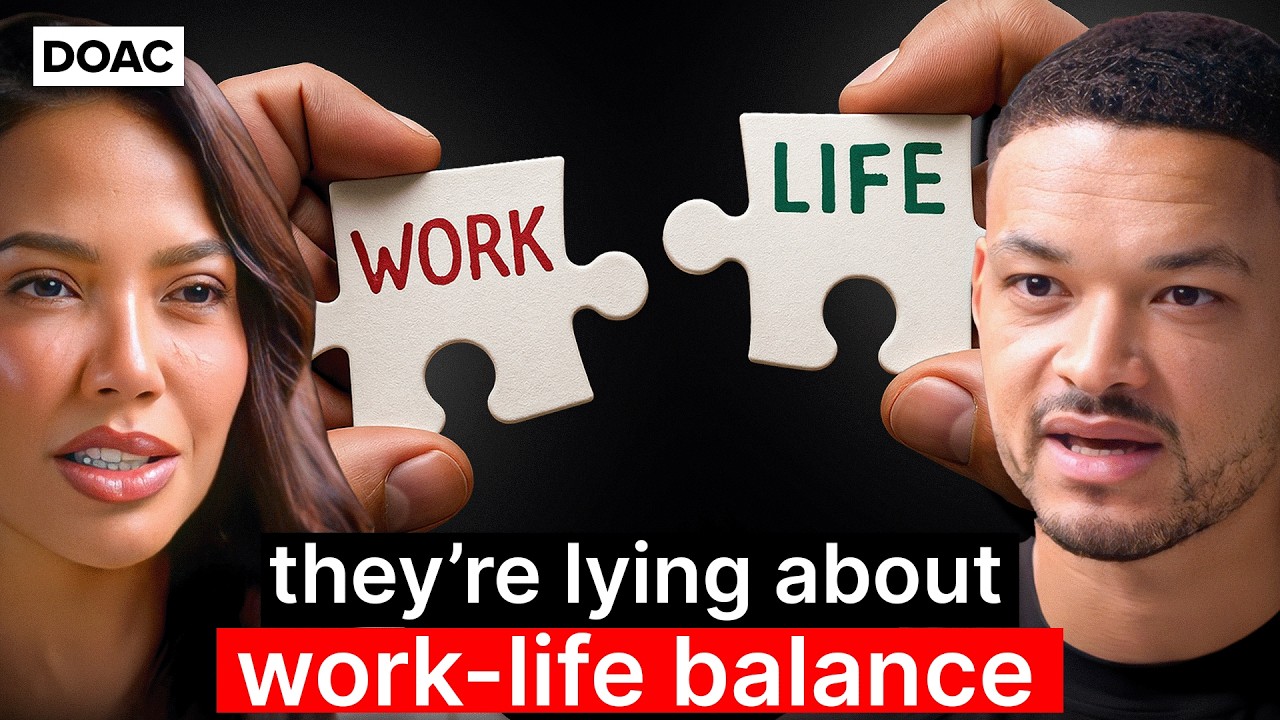
Skims Co-Founder Emma Grede Ties Success to Sacrificing Work-Life Balance
The Diary Of A CEO
Emma Grede argues that reaching the top of any industry strictly requires major personal trade-offs and that employers bear no responsibility for an individual's personal work-life balance.
## Background
This episode of The Diary Of A CEO, hosted by Steven Bartlett, was published on YouTube on May 5, 2025. It features Emma Grede—founding partner behind SKIMS, Good American, and Safely, as well as one of Forbes' 'Richest Self-Made Women in America'. According to the video description, the interview covers modern brand building, non-negotiable hiring traits, leadership frameworks, execution over design skills, business audits, and navigating work-life balance and ambition.
## TL;DR
Entrepreneur Emma Grede dismantles popular myths around work-life balance, arguing that achieving elite professional success inherently requires major sacrifices and trade-offs. She details her rise from a working-class background in East London to co-founding multi-billion dollar brands alongside the Kardashian family, emphasizing grit, execution, in-office collaboration, and enterprise-first leadership. Grede also opens up about her personal journey through IVF, miscarriages, and surrogacy, while introducing her podcast 'Aspire' aimed at offering candid, practical business mentorship.
## Atmosphere & style
The conversation carries an intimate, high-energy, and unfiltered atmosphere that balances sharp strategic insight with deep vulnerability. Bartlett acts as an encouraging peer and 'younger brother' figure, allowing Grede's pragmatic, no-nonsense British demeanor to shine through. The mood shifts fluidly between decisive corporate real talk on hiring and leadership to poignant, emotionally grounded moments concerning fertility, representation, and personal security.
## Key takeaways
- [00:00](https://www.youtube.com/watch?v=EdlXcVu1CTs&t=0s) Emma Grede argues that work-life balance is a personal responsibility rather than an employer's duty, asserting that reaching the top of any industry requires real sacrifices, trade-offs, and extraordinary effort.
- [03:58](https://www.youtube.com/watch?v=EdlXcVu1CTs&t=238s) Grede's fierce determination to achieve financial stability and freedom was heavily shaped by her childhood experiences growing up in a tight economic environment in East London.
- [10:24](https://www.youtube.com/watch?v=EdlXcVu1CTs&t=624s) Success depends fundamentally on relentless hard work, focus, and continuous execution, rejecting the concepts of toxic positivity and the idea that one can simply manifest or visualize goals into reality.
- [15:28](https://www.youtube.com/watch?v=EdlXcVu1CTs&t=928s) A critical mindset shift occurs when a leader moves away from seeking constant validation or board approval and confidently steps up to take full command as CEO.
- [17:20](https://www.youtube.com/watch?v=EdlXcVu1CTs&t=1040s) Grede advises against seeking formal mentors, recommending instead that professionals build their skills by practicing active inquisitiveness and closely observing leaders within their immediate workplace environment.
- [19:40](https://www.youtube.com/watch?v=EdlXcVu1CTs&t=1180s) The core trait powering entrepreneurial achievement is grit, which is often forged through navigating difficult, real-world circumstances rather than a privileged background.
- [21:38](https://www.youtube.com/watch?v=EdlXcVu1CTs&t=1298s) The most effective way to accelerate career advancement is by volunteering for every assignment with the approach 'I'll do that,' positioning oneself early on as a reliable problem solver.
- [23:52](https://www.youtube.com/watch?v=EdlXcVu1CTs&t=1432s) Maintaining an in-office working culture is highly beneficial for young professionals, as remote work deprives them of essential observational learning, real-time feedback, and dynamic networking opportunities.
- [26:43](https://www.youtube.com/watch?v=EdlXcVu1CTs&t=1603s) High performers must deliver exceptional output in their current role before expecting promotions, and organizations should hire for attitude while seeking cross-functional 'T-shaped leaders.'
- [29:05](https://www.youtube.com/watch?v=EdlXcVu1CTs&t=1745s) Asking about work-life balance during a job interview serves as an immediate red flag and dealbreaker when looking to hire top talent for high-performance cultures.
- [36:30](https://www.youtube.com/watch?v=EdlXcVu1CTs&t=2190s) True leadership requires an enterprise mentality that avoids people-pleasing and focuses firmly on the ultimate survival, profitability, and growth of the company.
- [46:57](https://www.youtube.com/watch?v=EdlXcVu1CTs&t=2817s) Founders must regularly separate themselves from daily operational details to conduct objective business audits, evaluating competitors, retail markets, and customer sentiment with fresh eyes.
- [57:37](https://www.youtube.com/watch?v=EdlXcVu1CTs&t=3457s) The motivation to move from service agencies to direct brand ownership came from realizing that equity-for-endorsement celebrity deals generate massive enterprise value that founders should retain for themselves.
- [01:04:35](https://www.youtube.com/watch?v=EdlXcVu1CTs&t=3875s) Good American disrupted the fashion industry and eliminated size segregation by offering a unified product across 19 continuous sizes without altering or altering designs based on the customer's size.
- [01:06:15](https://www.youtube.com/watch?v=EdlXcVu1CTs&t=3975s) To build an enduring brand, founders should develop physical retail and wholesale channels rather than relying entirely on cheap digital customer acquisition strategies.
- [01:16:11](https://www.youtube.com/watch?v=EdlXcVu1CTs&t=4571s) Effective salesmanship and pitching require a clear narrative that identifies a real market problem, illustrates consumer friction, and anchors the solution in a strong value proposition.
- [01:23:18](https://www.youtube.com/watch?v=EdlXcVu1CTs&t=4998s) Scaling a company past distinct revenue milestones requires a willingness to upgrade talent rapidly, as the teams that build a business to $10 million are rarely the ones to scale it to hundreds of millions.
- [01:32:14](https://www.youtube.com/watch?v=EdlXcVu1CTs&t=5534s) The trajectory between a good business and a truly great business is completely determined by the quality and culture established by the company's first 3 to 10 hires.
- [01:53:07](https://www.youtube.com/watch?v=EdlXcVu1CTs&t=6787s) Women should intentionally and strategically incorporate family planning alongside their career ambitions, recognizing that embryo freezing is often a more reliable option than egg freezing.
- [02:02:55](https://www.youtube.com/watch?v=EdlXcVu1CTs&t=7375s) The ultimate capacity to take bold professional risks and demonstrate business fearlessness stems directly from having deep personal security and an unconditional support system.
## Detailed walkthrough
### [00:00](https://www.youtube.com/watch?v=EdlXcVu1CTs&t=0s) The Myth of Work-Life Balance and the Reality of Hard Work
Emma Grede takes a sharp, unapologetic stand against the popular narrative surrounding work-life balance, calling it an individual responsibility rather than something employers owe to their staff. Balancing extreme professional ambition with raising four children required her to make conscious choices, making it clear that reaching the top of any industry demands real sacrifices. She openly challenges the idea that someone can become number one in their field while strictly protecting all of their evenings and weekends, bluntly asserting: "If it's possible, tell me who she is and I'll show you a liar."
The opening sets the tone for a conversation rooted in brutal honesty, grit, and the realities of high performance. Host Steven Bartlett highlights Grede's trajectory—from growing up in East London to co-founding multi-billion-dollar empires like SKIMS and Good American alongside the Kardashian family. Grede reflects on a childhood photograph from when she was 15 years old, seeing a girl who was desperate to escape her tight circumstances.
* **Key Philosophy:** Work-life balance is personal, not an employer's duty; top-tier success requires non-negotiable trade-offs.
* **Early Background:** Raised by a single mother in East London as the eldest of four girls.
* **Driven by Grit:** Lacking formal qualifications or native design skills, she built her career on pure execution, determination, and adaptability.
---
[03:58](https://www.youtube.com/watch?v=EdlXcVu1CTs&t=238s) Acting as the Mum and Raising My Siblings
Grede's character was forged in East London, a place she credits with instilling her deep sense of reliability, honesty, and hustle. Growing up in a single-parent household, her home dynamic evolved into a unique structure where her mother acted as the father figure, while Emma took on the role of the mother to her three younger sisters. Her daily childhood routine involved waking up early to iron three school uniforms, pack three lunches, and get her sisters off to school before returning home.
This heavy responsibility taught her accountability early on, but it also exposed her to the overwhelming anxiety of financial hardship—watching bills pile up on the doormat and knowing the milkman had gone unpaid. Rather than letting that heaviness break her, it instilled a fierce determination to change her trajectory. She notes that while traditional play was absent from her childhood, the experience built an intensely empathetic and maternal foundation that continues to drive how she leads and protects those around her.
* **East London Mentality:** Built on hard work, street smarts, and keeping one's wits about oneself to stay safe.
* **Childhood Responsibilities:** Managed morning routines, meals, and logistics for her three younger sisters.
* **Core Takeaway:** Early exposure to financial stress made her resolve to eliminate financial anxiety from her future life.
---
[06:47](https://www.youtube.com/watch?v=EdlXcVu1CTs&t=407s) Escape Through Fashion and the Worship of Money
By age 15, Grede knew with total certainty that she wanted to work in fashion. Growing up in 1990s Britain—the golden era of supermodels like Kate Moss and Naomi Campbell, alongside iconic designers like Alexander McQueen and John Galliano—fashion served as a glamorous escape from her everyday environment in Plaistow. With no family connection to the industry other than a grandmother who worked in a bra factory, fashion felt as distant and magical as Hollywood.
```
┌─────────────────────────────────────────────────────────┐
│ 1990s BRITISH FASHION CULTURE │
├───────────────────────────┬─────────────────────────────┤
│ Supermodels │ Iconic Designers │
│ • Kate Moss │ • Alexander McQueen │
│ • Naomi Campbell │ • John Galliano │
└───────────────────────────┴─────────────────────────────┘
```
When asked about her childhood relationship with money, Grede describes it candidly: "We worshiped money. We worshiped money. We worshiped what money could bring." Money represented security, status, and the freedom to get away from financial strain. As a young girl, she held a specific, comforting image in her mind—drawing a warm fireplace, a Christmas tree, and a credenza as her ultimate dream home. Years later, after bringing her newborn son Gray home to her townhouse in Clerkenwell on December 20th, she sat down in her living room and burst into tears. Looking around at the window, the credenza, and the Christmas tree, she realized she had physically built the exact room she had drawn hundreds of times as a child.
* **Fashion as Sanctuary:** Saw the fashion world as a way to transcend her immediate surroundings.
* **Money Mindset:** Money was viewed as the ultimate solution to instability and the gateway to freedom.
* **The Power of Focus:** A recurring childhood visualization materialized years later in her London home.
---
[10:24](https://www.youtube.com/watch?v=EdlXcVu1CTs&t=624s) Emma's Recipe to Achieve Anything
Addressing the popular discourse surrounding mindset and visualization, Grede pushes back against what she calls "toxic positivity" targeting women. While dreaming and vision boards have their place, she stresses that nothing happens without relentless hard work, meticulous planning, and aggressive execution. Her personal blueprint for achieving extraordinary goals comes down to three foundational habits:
```
┌─────────────────────────────────────────────────────────┐
│ EMMA'S HIGH-PERFORMANCE TRIAD │
├─────────────────────────────────────────────────────────┤
│ 1. Unwavering Focus │
│ Acts as a force multiplier to double down on strengths│
│ 2. Continuous Self-Improvement │
│ Relentless commitment to refining key competencies │
│ 3. Drowning Out Noise │
│ Eliminating self-doubt and external judgment │
└─────────────────────────────────────────────────────────┘
```
Grede candidly acknowledges her own technical limitations—she could not sketch well and lacked conventional design talent. Instead of trying to be something she wasn't, she focused on her true superpower: acting as an enabler to creative genius by bridging the gap between artistic vision and commercial execution. In her early career, before email was widespread, she would hand-deliver letters directly to PR agencies across London's West End, buzzing on doors to start conversations. That bias toward relentless action separated her from those who merely hold on to unrealized dreams.
* **Execution Over Affirmations:** Visualizing means nothing without aggressive follow-through and hard work.
* **Self-Awareness:** Recognized early on that her strength lay in operational execution rather than artistic design.
* **Proactive Outreach:** Spent her early days pounding the pavement and knocking on doors to create her own opportunities.
---
[13:30](https://www.youtube.com/watch?v=EdlXcVu1CTs&t=810s) Filtering Noise vs. Customer Feedback
Steven Bartlett pushes on the potential tension between Grede's rule of "drowning out the noise" and the necessity of gathering feedback. Grede clarifies that decision-making feedback and customer feedback require entirely different approaches. When facing major business choices where she feels unequipped, she frequently reaches out to a network of trusted advisers. However, after hearing varying perspectives, she insists that a leader must ultimately trust their gut and "call the play."
```
┌─────────────────────────────────────────────────────────┐
│ FEEDBACK FRAMEWORK │
├───────────────────────────┬─────────────────────────────┤
│ Strategic Decisions │ Customer Feedback │
│ • Consult trusted advisers│ • Treat as absolute truth │
│ • Filter conflicting views│ • Ingest via large surveys │
│ • Execute based on gut │ • Adapt to serve and please │
└───────────────────────────┴─────────────────────────────┘
```
Customer feedback, by contrast, operates under a different principle: "everything your customer says is true because it's true to them." While strategic decisions demand strong personal conviction and internal direction, product and brand decisions rely heavily on listening to consumer data and survey insights. As the conversation shifts, Bartlett introduces the concept of a "personal board of directors"—the core group of trusted people a leader calls when making critical moves—leading into how Grede selects the advisers she relies on most.
* **Decision Ownership:** Information gathering is essential, but the final call must come from leadership intuition.
* **Customer-Centricity:** Consumer sentiment is treated as valid reality, requiring continuous listening and adaptation.
* **Advisory Network:** Leverages a select group of trusted advisers to stress-test complex strategic choices.
[15:28](https://www.youtube.com/watch?v=EdlXcVu1CTs&t=928s) The Importance of Reliable Decision Partners & Mentality Shifts
Emma explains that her husband, Jens Grede, is her primary sounding board because he possesses a unique understanding of her weaknesses and the internal blocks preventing her from making tough decisions. She credits him with some of the biggest unlocks in her life and career. She vividly recalls an early board meeting at one of her first companies, ITB, when she was 26 or 27 years old. Despite being a natural presenter who could "sell anything," she used to get extremely nervous and crumble during board meetings. Right before walking into the room, Jens delivered a candid reality check: "You have an employee mentality."
This feedback was a massive wake-up call for Emma. She realized that instead of walking into the board meeting as a CEO tasked with guiding the board members to a decision, she was looking to them for approval and waiting for them to tell her what to do. Shifting her mindset from seeking approval to taking command and stating, "Here's the direction. This is what we're doing... Everybody come with me," entirely transformed her approach to leadership.
* Jens Grede served as a critical decision partner who identified Emma’s early operational and mental bottlenecks.
* Emma was 26 or 27 years old when she realized she was managing her board with an "employee mentality" rather than an executive presence.
* Moving from approval-seeking to decisive leadership unlocked her ability to successfully run board meetings.
---
[17:20](https://www.youtube.com/watch?v=EdlXcVu1CTs&t=1040s) Do People Need Mentors to Succeed?
When Steven asks whether young professionals need formal mentors—noting how often fans ask him for mentorship despite hundreds of hours of free knowledge available on his podcast—Emma reveals that she never had formal mentors herself. She landed her first entry-level job in an office at a fashion show production company at age 18, after having worked paper routes, delis, and clothing shops since age 12. Instead of seeking a dedicated mentor, she made whoever was around her a source of learning.
At her early fashion job, her boss sat right behind her, which meant her screen was always visible. While colleagues thought this was a nightmare—especially given their staff discount on Net-a-Porter—Emma turned it into an advantage. Whenever her boss was on sales calls, Emma would write down the exact scripts and phrases her boss used and immediately adopt them for her own sales pitches. She advises against actively searching for a mentor, pointing out that the best leaders rarely have the time. Instead, professionals must be inquisitive, ask direct questions, and absorb knowledge from clients and senior executives whenever the opportunity arises.
* Emma started working at age 12 (paper routes, delis, retail) and got her first office job in fashion show production at 18.
* Net-a-Porter was an early client at her fashion production job, offering staff discounts that distracted other employees.
* Emma built her sales pitch toolkit by silently taking notes on her boss's live phone calls and immediately repurposing the phrasing.
* Her core advice on mentorship: Don't look for a formal mentor; cultivate extreme inquisitiveness and ask smart, targeted questions of leaders around you.
---
[19:40](https://www.youtube.com/watch?v=EdlXcVu1CTs&t=1180s) The One Skill That Made Me an Entrepreneur
Reflecting on what single trait accounts for her success—despite being dyslexic and dropping out of both school at 15 and college later—Emma identifies **grit**. While her high-net-worth lifestyle means her kids "are not going to be gritty" because "you don't grow up in Bel-Air gritty," her own edge comes from a relentless determination to make things happen. Although she lacks formal qualifications on paper to run apparel giants, start global agencies, or raise hundreds of millions of dollars, her grit allows her to bridge the gap through sheer execution and preparation.
* Emma identifies as a "serial dropout," having left traditional schooling at 15 before later dropping out of college as well.
* She emphasizes Angela Duckworth’s popularization of the term "grit" and notes that grit is forged by circumstance rather than silver-spoon upbringing.
* Despite lacking standard resume credentials for enterprise leadership, her preparation and willingness to seize opportunities drive her business outcomes.
---
[21:38](https://www.youtube.com/watch?v=EdlXcVu1CTs&t=1298s) The Three Most Important Words for Career Advancement
Emma attributes her early career trajectory to having a "whatever it takes" attitude. Even as a teenager, she felt a strong drive to step away from the pack and accomplish something extraordinary. She asserts that the three most important words for advancing any career are simply: **"I'll do that."** She constantly volunteered for assignments, putting her hand up regardless of whether she possessed the exact skill set yet.
Steven connects this to Emma’s childhood as the eldest sister stepping up in her family, noting that navigating a "void of independence" builds a rare, self-reliant belief system. Emma agrees that willingness to step up and figure things out on the fly sets hyper-successful individuals apart from those paralyzed by the gap between where they are and where they want to be.
* The three most critical words for career progression: "I'll do that."
* Raising her hand for every task positioned Emma as a reliable problem-solver early in her career.
* Childhood independence built her willingness to cross the gap between ambition and execution.
---
[23:52](https://www.youtube.com/watch?v=EdlXcVu1CTs&t=1432s) Does Working in an Office Make Employees More Successful?
Discussing whether grit can be taught, Emma contrasts in-person development with remote work culture. While acknowledging the flexibility of post-pandemic remote work setups (where her own company permits four days in-office with flexibility), she argues that remote working introduces significant hidden rigidities. She firmly asserts, "Had I been a work-from-home person in my 20s, I would not be where I am now."
She highlights that major milestones—meeting her husband, forging lifelong professional networks, and gaining real-time operational feedback—happened because she was physically present in dynamic office environments. Teaching junior staff grit or nuance across a screen is nearly impossible because remote workers miss out on observing how senior leaders move, speak, and handle live situations.
* Emma’s office policy requires four days in-office, with product teams regularly coming together in person.
* She believes remote work deprives young workers of dynamic, real-time observational learning and spontaneous relationship-building.
* Teaching grit and high-level business instincts requires physical presence and real-time feedback loops.
---
[26:43](https://www.youtube.com/watch?v=EdlXcVu1CTs&t=1603s) Traits of Future Successful People
When evaluating which employees are destined to become future stars, Emma looks for individuals who master their current roles before seeking new responsibilities. She finds it frustrating when team members demand new opportunities while performing at only 70% in their current job. Instead, she looks for "120% people" who excel in their current mandates first.
Beyond performance, Emma hires heavily for attitude over experience, prizing a "winning mentality" and curiosity across the whole business. She favors "T-shaped leaders"—for example, a wholesale sales expert who actively seeks to understand e-commerce, brick-and-mortar retail, planning, and merchandising. For senior executive roles (often hiring people in their 40s and 50s), the ultimate differentiator is flexibility: combining deep industry experience with an eagerness to adapt to evolving technology and consumer behavior.
* High performers must deliver 120% output in their current role before expecting promotions or new responsibilities.
* Emma prioritizes attitude, enthusiasm, and cross-functional curiosity over pure years of experience.
* She looks for "T-shaped leaders" who maintain deep specialized expertise while understanding all facets of the broader enterprise.
* Senior executive hires must balance decades of experience with dynamic operational flexibility.
---
[29:05](https://www.youtube.com/watch?v=EdlXcVu1CTs&t=1745s) Interview Red Flags & Work-Life Balance
When asked about immediate red flags during job interviews, Emma reveals that candidates asking, "Can you talk to me about work-life balance in this organization?" immediately disqualifies them in her mind. Her philosophy is direct: work-life balance is an individual's personal responsibility to manage, not the company's burden to structure for them. Modern, high-performing organizations already offer flexibility for personal appointments like doctor visits or parent-teacher conferences, so raising the topic in an interview signals a misplaced priority.
Steven supports this point by sharing data from his own company's recruitment screening process. Their pre-interview survey explicitly tests for this preference, revealing a concrete benchmark for how job candidates prioritize work-life balance against performance metrics.
* Asking about work-life balance during a job interview is an immediate dealbreaker for Emma.
* She views work-life balance as a personal management task rather than a corporate mandate.
* Steven reveals that approximately 33% of job applicants select work-life balance over options like delivering perfect work, beating the competition, or leading a team on his company's applicant screening test.
[30:49](https://www.youtube.com/watch?v=EdlXcVu1CTs&t=1849s) The Reality of Work-Life Balance and Executive Expectations
Emma Grede and Steven Bartlett dive directly into the modern debate surrounding work-life balance, hustle culture, and corporate profitability. Grede challenges the idealistic notion that employees can demand maximum compensation and flexibility without recognizing that high-performing workplaces require a profitable, highly efficient business engine. She outlines a fundamental social contract between employer and employee: workers give intense dedication, and in return, the company provides an extraordinary environment—such as hosting internal fertility and egg-freezing seminars—that enriches their broader lives.
When Bartlett plays devil's advocate regarding employee expectations around weekend work, Grede offers a candid reality check on what it takes to reach the top. While standard roles should not require working seven days a week, achieving top-tier success or building a transformative career inevitably demands going above and beyond standard hours. Pointing to Bartlett's own habits—and her own practice of responding to messages at all hours while still enjoying weekends in Malibu—she stresses that true success requires personal responsibility, high speed, and constant focus rather than a blanket adherence to a strict 9-to-5 mindset.
* High performance and personal well-being are enabled by company profitability, not isolated from it.
* A comfortable, middle-class life with weekends off is completely valid and achievable without excessive hours, but elite professional success strictly requires extraordinary effort.
* "If it's possible [to reach the top while keeping every evening and weekend], tell me who she is and I'll show you a liar."
---
[36:30](https://www.youtube.com/watch?v=EdlXcVu1CTs&t=2190s) Enterprise Mentality and Navigating the Post-Pandemic Founder Trap
The conversation shifts to the unique pressures facing modern company founders, particularly in the post-pandemic landscape dominated by social media commentary. Bartlett notes that leaders often feel "gaslit" by online discourse urging them to cater to every employee desire, while fearing public backlash or "activist employees" posting call-out videos on TikTok if they make tough management decisions.
Grede firmly rejects managing out of fear or trying to please everyone, noting that "you can't be a leader and a people pleaser at the same time." She preaches an "enterprise mentality"—putting the health and mission of the business first. While acknowledging that she is supported by an entire "village" of talented people rather than being truly "self-made," she insists that a founder’s core duty is driving business growth and ensuring overall survival, even if individual decisions attract temporary public criticism.
* **Leadership vs. People Pleasing:** Prioritizing individual approval over business objectives undermines the stability of the entire organization.
* **The Enterprise Mentality:** When forced to downsize, a leader's focus must remain on protecting the hundreds of jobs being saved rather than dwelling solely on the fraction being lost.
* Leaders must operate with zero ambiguity so employees clearly understand company goals and values.
---
[42:07](https://www.youtube.com/watch?v=EdlXcVu1CTs&t=2527s) The Double-Edged Sword of Empathy and Firing 15 People in One Day
Grede reflects on the unique hurdles of leadership as a woman, highlighting how maternal instincts and empathy can become a double-edged sword. While empathy makes women exceptional leaders and mentors, it makes necessary corporate actions—such as layoffs, pay freezes, or firing poor performers—feel inherently unnatural, as though leaving someone stranded goes against the grain of caring.
To illustrate this tension, Grede recalls a painful early memory from her agency days at ITB in London on Great Titchfield Street. Operating out of a tight, open-plan office, she had to downsize her 60-person team by laying off 15 people in a single day. Without a private boardroom to retreat to, she had to address the remaining team directly in the open space right after delivering the news.
> "I fired 15 people in one day... we're in a tiny office... and everyone sits together. So there was no giant boardroom that you could go into and then go out the back door. It was like I went back upstairs and told everyone... it felt like the end of the world, the end of my life."
* **Key Takeaways on Downsizing & Leadership:**
* Keeping business anxieties isolated at the top creates a lack of accountability across the broader executive team.
* Leaders should view themselves as sideline managers directing the team, rather than constantly running onto the pitch to score goals themselves.
* Involving senior staff in structural challenges ensures they are part of both the hardship and the solution.
[46:57](https://www.youtube.com/watch?v=EdlXcVu1CTs&t=2817s) Zooming Out: Escaping the Trenches and Finding Perspective
Starting a business from the ground up creates an immense sense of personal responsibility, making every downturn feel like "the end of the world." Businesses rarely experience a single catastrophic point of failure; instead, a decline is usually "death by a thousand cuts"—a subtle accumulation of small issues. Founders often get so deeply submerged in client demands and daily execution that they lose the ability to see clearly. Emma Grede shares that she built a personal "muscle" to combat this: every quarter, or at least every six months, she deliberately floats up to get an objective view of what is actually happening in the market and with competitors, rather than relying on the internal narratives she tells herself.
To illustrate this need for perspective, Steven Bartlett recounts a story from his solo podcast episode regarding "clouds and trenches." He recalls spending seven hours in a tiny two-meter wooden boat on a lake in the pouring rain, trying to fish. Despite catching nothing and being soaked through his raincoat, those seven hours away from the daily grind were among the most important of his life because they allowed him to step back and look at the whole picture. Founders often carry immense guilt when they step away from the front lines, failing to realize that creating space actually serves the company better than staying endlessly trapped in operational chaos.
Emma's specific routine for gaining perspective involves leaving the office and thoroughly auditing both the market and her own operations:
* **Analyzing Competitors:** She regularly inspects competitor websites, physically visits retail stores, and evaluates what customers are experiencing across the landscape.
* **Remaining Objective:** She maintains the discipline to not "believe my own shit," constantly questioning internal assumptions.
* **Leveraging Fresh Eyes:** Recognizing that new hires only maintain an unbiased perspective for a few weeks or months before absorbing company narrative bias, Emma directly interviews new starters to ask what they see and how the business compares to their previous workplaces.
* **Creating a One-Pager:** She distills her observations into a simple, three-point action list aligned with broad company priorities to address operational drift.
[52:33](https://www.youtube.com/watch?v=EdlXcVu1CTs&t=3153s) Dealing with Copiers and the Dynamics of Power Couples
When Steven asks if she is paranoid, Emma readily admits she is "rightly paranoid" because she works with some of the most copied and duplicated brands in the world. However, she remains unbothered by imitators. Her view is that by the time competitors copy a concept, her team has already progressed eighteen months ahead into the future: "Go for it. Done. It's over."
The conversation shifts to Emma's early career trajectory and her relationship with her husband, Jens Grede:
* **Career Evolution:** Emma began in fashion at 19 with an internship, became a show producer at Inca Productions, and later worked at Saturday Group (now Wednesday Agency) between ages 23 and 25.
* **Meeting Jens:** Saturday Group was co-founded by Jens Grede. Their relationship evolved from employer-employee to investor-founder, then to marriage and raising four children together.
* **Navigating Ambition and Partnership:** Emma notes that having a highly ambitious partner is deeply fulfilling but requires mutual respect and interest in each other's evolution over their 16 or 17 years together.
* **Advice on Unsupportive Partners:** Addresssing listeners whose partners view their ambitions as a competition or actively diminish their confidence, Emma states directly: "Everything starts with yourself." While a partner does not necessarily need to be a constant "cheerleader," any partner who drains your energy and undermines your self-belief is a major liability. Success requires putting what you care about first and surrounding yourself with people who respect your growth.
[57:37](https://www.youtube.com/watch?v=EdlXcVu1CTs&t=3457s) The Genesis of Good American and the Power of Equity Deals
Emma discusses how running her entertainment marketing agency, ITB Worldwide—which she founded in her mid-20s and ran for a decade—led to the creation of Good American. Operating out of London and New York, ITB sat at the intersection of brands, film product placements, endorsements, and early-stage influencer marketing (when creators were still referred to as "bloggers").
Around that time, equity-for-endorsement deals began emerging in pop culture, such as Ashton Kutcher taking equity stakes in Silicon Valley startups. Emma began receiving calls from startups offering top-tier celebrity talent 10% equity in exchange for endorsements. Because ITB operated on traditional cash commission models, equity deals presented a monetization dilemma—equity taken by the agency would belong to the overarching shareholder base rather than compensating her directly. To solve this, she charged startups flat fees of a couple hundred thousand dollars to structure 10% equity deals for high-profile talent.
> "I remember this company reporting some numbers and I was like, 'I cannot believe that they've gone from there to there.' And in my head, I made a direct correlation between the talent that had been brought into that company—it was Pharrell Williams at the time... I got my little couple of hundred grand and wasn't incentivized... I was like, 'God, I'm really losing here. Maybe I should do one of these for myself.'"
This realization—that she was generating massive enterprise value for others while receiving a fixed fee—became the primary spark for Good American. She decided to launch her own business, retain the core equity, and bring in talent as a partner to accelerate scale. At the time, her husband Jens and his business partner Erik Torstensson had already launched the successful denim brand Frame, providing a blueprint for what was possible in the apparel industry.
[01:02:30](https://www.youtube.com/watch?v=EdlXcVu1CTs&t=3750s) The Genesis of Good American and the Pitch to Khloé Kardashian
Emma Grede reflects on how her background initially misled her. She had worked with powerhouse denim clients like Calvin Klein and Topshop, while her husband Jens Grede had co-founded the denim brand Frame. She falsely assumed she knew the denim industry inside out, but eventually realized she only knew denim marketing, not product creation. The pivotal moment arrived during a dinner conversation with an investor heavily involved in a major plus-size retailer in America. When he remarked that the space was exploding, Grede looked up the retailer on her phone and thought, "That's gross. Nobody wants to dress in those clothes. That product is horrible."
This spark brought everything together for her. She realized she could build a denim company that offered all sizes all the time, making every woman look hot. Combined with her specialized expertise in booking and converging top-tier talent, she knew the concept would be explosive. Having already had conversations with Kris Jenner about potential partnerships, Grede approached her with the idea and asked to pitch her daughter, Khloé Kardashian.
When Steven Bartlett asks what Khloé's immediate reaction was to the pitch, Grede politely declines to share specific verbatim quotes. She explains that she works incredibly hard to protect her relationship with the family by never speaking on their behalf, noting that because they are so phenomenally famous, even casual remarks quickly turn into global news headlines. However, she proudly notes the end result: Khloé said yes, and they remain successful business partners eight years later.
[01:04:35](https://www.youtube.com/watch?v=EdlXcVu1CTs&t=3875s) The Hypothesis and Testing the Market Instincts
Bartlett observes that most founders' initial hypotheses are at least partially wrong, but Grede states that their core instinct was entirely correct. They intrinsically recognized a massive subset of customers—specifically women above a size 12—who were completely excluded from the fashion conversation because the market lacked appealing options. Historically, traditional retailers separated these shoppers, forcing them to go to a isolated subsection or a different floor that was entirely unreflective of the main collection. Good American completely eliminated this segregation by creating a unified product offered across 19 continuous sizes.
Grede emphasizes that they refused to moderate or tone down their designs based on size. If they designed a dress with a high thigh slit or a tiny fluorescent pink bikini, they produced it in every single size and let the customer decide what she wanted to wear. Their core gamble paid off perfectly: women weren't neglecting these styles because they didn't want them, but simply because they were never manufactured or made available.
[01:06:15](https://www.youtube.com/watch?v=EdlXcVu1CTs&t=3975s) Navigating the Changing Games of Customer Acquisition
The business landscape of 2016 to 2018 cannot be replicated today because the underlying digital environment has fundamentally shifted. Grede describes a "three-year golden period of runway" where massive arbitrage existed on platforms like Facebook and Instagram. Algorithms allowed brands to target exact cohorts and acquire customers incredibly cheaply.
During this hyper-growth phase, several board members pressured Grede to spend aggressively on acquisition without worrying about profitability. However, veteran retail figures on her board like Andrew Rosen and John Howard gave her the opposite advice, telling her, "You need a profitable business that works when this is over." Listening to their experience saved the company. While they established a strong digitally native foundation, they never relied on it exclusively; instead, they immediately began rolling out a wholesale footprint and opening physical retail stores. When the digital acquisition market tightened post-COVID-19, Good American possessed a structural buffer that allowed it to stay the course.
[01:08:15](https://www.youtube.com/watch?v=EdlXcVu1CTs&t=4095s) Brand Building and Customer Strategy in 2025
For founders launching direct-to-consumer (D2C) or business-to-consumer (B2C) brands in 2025, Grede strongly champions real-world, experiential marketing. In a post-pandemic society, customers crave physical experiences, shared memories, and tangible connections. She highlights a recent campaign for SKIMS where they opened a retail store on Sunset Boulevard and synchronized it with a takeover of a nearby iconic, 24-hour Hollywood diner.
The entirely "SKIMS-ified" 50s-style diner—complete with a jukebox and themed menu items like pancakes, chicken tenders, and root beer floats—sold out every single reservation slot for its 6-day, 24-hour run within five minutes, drawing queues around the block. Grede recounts taking her own children to the activation. Two days later, her three-year-old daughter requested to go back to the "cafe" for the dessert with a cherry on top, illustrating how a profound physical experience can leave a lasting impression even on a child. Grede acknowledges that early-stage startups might lack the capital for massive takeovers, but notes that the underlying principle remains identical: getting physically in front of your customer at the point of purchase, like a supermarket aisle, is vital to tell your story.
[01:10:40](https://www.youtube.com/watch?v=EdlXcVu1CTs&t=4240s) Cultivating Community and Evolving Corporate Purpose
The strategy of modern brand building has transitioned away from merely blasting Facebook ads or relying solely on influencer endorsements toward cultivating real community through active events like run clubs and yoga partnerships. Grede shares that for SKIMS, owning the customer experience directly through their dedicated app has built immense brand affinity, though she cautions that very few brands possess the massive cultural pull required to make a standalone app successful.
For most companies, community is sustained by standing for a distinct purpose. Good American achieved its longevity because customers understood exactly why they bought from the brand, even if the baseline products were blue jeans and white t-shirts. However, purpose must adapt. Midway through their journey, Good American undertook the grueling, heavy-lifting process to achieve B Corp certification. This milestone was deeply important to their staff, which includes many young mothers. Because the denim industry is notoriously pollutive, the team wanted to know they worked for a company that actively cared about the environment, proving that underlying values must remain authentic to both customers and internal staff.
[01:12:56](https://www.youtube.com/watch?v=EdlXcVu1CTs&t=4376s) First Principles of Business: Advice to Her Younger Self
Looking at a photograph of herself at 15 or 16 years old, Grede jokes about her curly hair before reflecting on what she would tell that young version of herself who was "dying to escape her circumstances" and do something different. She distills her decades of experience into three core business principles:
* **Have Conviction in Your Gut:** Trust your deep feelings and strong instincts, as they are reliable guides for pivotal decisions.
* **Know What You Don't Know:** Recognize your personal weaknesses and vulnerabilities. Grede identifies this awareness as her superpower, allowing her to systematically hire brilliant talent to fill the gaps in her own knowledge. She takes immense pride in retaining a close-knit group of professionals who move with her from company to company.
* **Embrace Serious Risks:** Disregard the safe, protective instincts instilled during childhood. Nothing of note comes easily. Grede recalls the extreme vulnerability of moving to America with a two-year-old, a newborn baby, and no real friends, all while launching a brand-new venture she didn't fully understand how to run at the time. Taking that risk remains the best decision of her career.
[01:16:11](https://www.youtube.com/watch?v=EdlXcVu1CTs&t=4571s) The Art of the Pitch and the Power of Sales
Grede highlights the ability to clearly articulate an idea—or pure salesmanship—as a vital, underappreciated skill. When evaluating founders to back as an investor, she is perfectly comfortable if they have operational blind spots or missing pieces, but she emphasizes a strict rule: "If you can't sell, you ain't getting my money. Like, no way."
An entrepreneur cannot outsource the core narrative of their company; they must possess the personal capability to bring an investor on a journey, tell an evocative story, and uniquely convince others that the world requires their product. When constructing her own pitches, Grede focuses on intense personal passion and old-school structural fundamentals. She identifies the specific market problem she is solving, vividly paints the picture of where that friction sits for the consumer, outlines her unique solution, and anchors everything in a rock-solid value proposition.
[01:17:49](https://www.youtube.com/watch?v=EdlXcVu1CTs&t=4669s) Intuition vs. Excitement in Decision-Making
Emma Grede explains that while she is a born salesperson who operates heavily on intuition, founders must learn to distinguish between genuine gut instinct and superficial excitement. Reflecting on a past comment from her business partner Jens Grede—who once told her she was "acting like an employee" and needed to trust herself to call the shots—she discusses how she cultivated conviction. Through her experience on shows like *Dragon's Den* and *Shark Tank*, she learned to separate an emotional, core-level connection from the mere prospect of financial gain.
For Emma, decisions driven purely by the thought that something "looks like money" or will yield nice dividends almost never work out. Real intuition hits at a deeper level than simple financial optimism, and learning to listen to that distinction is what prevents costly strategic missteps.
- **Gut Instinct vs. Financial Hype:** True intuition moves you emotionally rather than just signaling a quick payout or high dividend yield.
- **Overcoming the "Employee Mindset":** Unlocking authority as a founder requires trusting your own internal voice rather than seeking external permission or acting like a subordinate in your own company.
---
[01:20:00](https://www.youtube.com/watch?v=EdlXcVu1CTs&t=4800s) Dreaming Bigger and Scaling Aspirations
Steven bring up an anecdote about SoftBank's Masayoshi Son giving the founder of WeWork a billion-dollar check while simultaneously criticizing him for not dreaming big enough. Although Emma quips about WeWork's eventual downfall ("I'm not investing in his next thing"), Steven notes that the founder still walked away wealthy and raised another $250 million for a subsequent venture, illustrating the power of ambitious goals.
Emma reflects on how a person's environment dictates their definition of "high." Growing up in London without visible local role models, she looked to Oprah Winfrey on television as a benchmark for aspirational, articulate, and thoughtful leadership. Rather than starting with massive 20-year operational plans, Emma scaled her career incrementally—focusing on leveraging each step to reach the next, while maintaining grander, broader visions for how she wanted to feel and live.
- **Role Models and Environment:** "You can't be what you don't see." Exposure to ambitious thinkers expands a founder's internal baseline of success.
- **Incremental Escalation:** Ambition can be executed in bite-sized, sequential steps—moving out of local housing estates, securing the right job, surrounding oneself with top talent, and leveraging each win into the next opportunity.
---
[01:23:18](https://www.youtube.com/watch?v=EdlXcVu1CTs&t=4998s) The Importance of Firing and "Up-Leveling" Talent
Addresssing a major blind spot early in her career, Emma asserts that the single best piece of hiring advice she could have received was learning to fire people faster. She emphasizes that early-stage startup loyalty often traps founders into keeping team members who are no longer equipped for the next stage of scale.
> "The people that get you to $10 million are not the people that get you to $100 million. The people that get you to $100 million are not the people that get you to $500 [million] and then to a billion."
Emma admits that her desire to be a "nice girl" and her affection for early employees restricted her company's growth because she delayed necessary personnel changes. Successful businesses mask underlying organizational dysfunctions, making it vital for leaders to actively audit their teams even when revenue is growing. Today, Emma views talent curation as one of her absolute highest priorities, allocating roughly a quarter of her time to finding and placing the right people.
- **Company Culture Definition:** Culture is defined directly by three decisions: who you hire, who you fire, and who gets promoted.
- **"We Are Not a Family":** Emma rejects the trope that a company is a family, clarifying that a business is an organization built to generate profit through clear, shared goals.
- **Time Allocation:** Emma spends **20% to 25%** of her personal working time strictly on recruiting, vetting, and managing talent.
---
[01:28:06](https://www.youtube.com/watch?v=EdlXcVu1CTs&t=5286s) Pitching a Vision and Learning From Failure
When small startups lack the financial leverage or brand power of established conglomerates, attracting top-tier talent relies on the founder's ability to sell a compelling vision and strategy. Emma stresses that exceptional talent will not join a founder who tries to do everything themselves. Instead, founders must hone extreme focus—concentrating on a tiny set of core responsibilities and hiring expert talent to execute the rest.
Emma shares a notable past failure: moving a large team from London to Los Angeles, only to shut the office down 18 months later. She had assumed her UK reputation would carry over, but discovered LA's business ecosystem was a closed, insular community where she was initially "frozen out completely." Deeply analyzing such mistakes is critical for refining hiring and expansion strategy over time.
- **Core Founder Focus:** Emma summarizes her primary execution formula into three steps: obsess over the customer, obsess over a set of products, and deliver them to customers extremely quickly.
- **Attracting "A Players":** Top talent buys into strategy and strategic chops, not just high-level founder rhetoric or unvested equity promises.
- **Admitting Strategic Errors:** Scaling into new markets requires humility and continuous adaptation when local dynamics do not mirror past successes.
An overview of this transcript section is provided below.
---
[01:32:14](https://www.youtube.com/watch?v=EdlXcVu1CTs&t=5534s) Levelling Up Employees and the Rigor of Hiring
Steven questions whether top performers ("A players") naturally self-police by only wanting to work alongside other A players, creating self-propagating pockets of excellence. Emma partially pushes back, noting that top-tier companies and strong workplace cultures can elevate individuals who might initially seem like "B minus" players into "A+" performers. People tend to level up to the average of those around them when given the right environment, provided they have the personal drive to do so.
When Steven confesses to hiring underqualified friends early in his career—including picking an account manager from a Prada store and a marketing director at a rap battle—Emma highlights the necessity of hiring rigor. Modern founders must approach hiring with deep intention and structure rather than relying on chance encounters. She emphasizes that the first 3 to 10 employees a founder hires will determine the difference between a good business and a great one, making recruitment one of the most vital uses of a founder's time alongside product development.
* Emma explains how exceptional company culture transforms individuals: "You can bring in somebody not quite exceptional into an exceptional culture and company, and the organization makes them great."
* "Who those first three, five, 10 people that you bring into your organization will be the difference between good and great."
---
[01:35:54](https://www.youtube.com/watch?v=EdlXcVu1CTs&t=5754s) Stereotype Threat and the Reality of Workplace Prejudice
Steven brings up the issue of prejudice and stereotype threat—where marginalized individuals might count themselves out or perform worse due to internalizing societal biases before entering a room. Emma shares her perspective as a Black woman in business, noting that she never allowed factors like her accent, lack of higher education, or race to limit her confidence. Instead, she viewed being the only Black woman in corporate settings as a distinct advantage, as executives often singled her out for a fresh, unique perspective.
However, Emma distinguishes her experiences in the UK from the racial climate in the United States. Having lived in America for eight years, she observes that race is navigated with far more tension and daily friction in the US compared to her upbringing in London. She credits her early years in London for instilling a strong, self-assured sense of identity that protected her from internalizing external prejudices.
* Steven cites classic psychological studies showing how asking individuals to identify their race or gender immediately before a test degrades performance, illustrating stereotype threat.
* Emma describes turning minority status into an advantage: "There was only one of me... everyone came from the same kind of private school stock and there I was with the accent, with the big curly hair... and inevitably they'd be like, 'What do you think?'"
* Emma notes the cultural contrast regarding race: "It ain't the same here in America... the way people relate to race is extremely different here."
---
[01:40:56](https://www.youtube.com/watch?v=EdlXcVu1CTs&t=6056s) High Self-Worth and Ignoring the Opinions of Others
Emma attributes her resilience to a naturally high level of self-assurance and conviction, placing far greater value on her own opinions than on what others think of her. She points out that most people overestimate how much attention others pay to them. While individuals often assume they are at the center of everyone else's world, the reality is that people are far too consumed with their own lives to spend significant time judging others.
Steven adds an evolutionary angle, suggesting that human brains were built to manage social dynamics within small tribes of around 20 people, making modern online criticism feel far more threatening than it actually is. Emma agrees, humorously dismissing anonymous online trolls (like "Dave in Swindon with an egg emoji") as irrelevant to her day-to-day happiness and peace of mind.
* Emma summarizes her philosophy on self-worth: "I just have such a high value on how much I care about what I think that maybe what other people think just kind of pales into insignificance."
* "Nobody wakes up and thinks about me as much as I do. So it can feel like we just got to relax."
* Steven jokes about online hate: "In reality it could be like Dave in Swindon with like an egg emoji who's telling you that those jeans suck," to which Emma replies that such opinions shouldn't ruin anyone's day.
---
[01:42:26](https://www.youtube.com/watch?v=EdlXcVu1CTs&t=6146s) Mid-Roll Sponsor: Bon Charge Red Light Therapy
Steven transitions to a brief personal anecdote about dealing with skin issues and how red light therapy has benefited him, his partner, and his sister. He introduces show sponsor Bon Charge, highlighting their infrared sauna blanket and their red light therapy mask, which targets skin layers to boost collagen and reduce scarring, wrinkles, and blemishes.
* **Sponsor Link:** `[boncharge.com/diary](https://boncharge.com/diary)`
* **Discount Code:** `DIARY` for 25% off sitewide.
* **Product Perks:** Worldwide shipping, easy returns, and a 1-year warranty.
---
[01:44:28](https://www.youtube.com/watch?v=EdlXcVu1CTs&t=6268s) Emma's Fertility Journey and the Toll of IVF
Shifting to personal topics, Steven asks Emma about her fertility journey as he prepares for parenthood himself. Emma splits her experience into two distinct halves: her first two children (now 11 and 8 years old) were conceived effortlessly around age 30 shortly after getting married, despite her earlier belief that she never wanted kids. However, when trying for baby number three around age 38, she faced unexplained infertility.
Living in Beverly Hills with access to top medical care, Emma embarked on a multi-round IVF journey. She describes the process as single-track, soul-destroying, and emotionally consuming, leaving her unable to focus on anything else. Though the IVF treatments succeeded in achieving pregnancies, she endured the devastating grief of three consecutive miscarriages.
* Emma recounts her initial ease with pregnancy at age 30 vs. her later struggles at age 38.
* She details the emotional obsession during IVF: "You could be like, 'Emma, what do you want for dinner tonight?' I'd be like, 'A baby.'... all I could think about was I need this."
* "I went through multiple rounds of IVF and every single time for me actually it did work out, but then I lost a baby three times and it was really... just awful."
[01:47:46](https://www.youtube.com/watch?v=EdlXcVu1CTs&t=6466s) The Heartbreak of Pregnancy Loss and Navigating IVF in Lockdown
Emma Grede details the excruciating pain of experiencing multiple pregnancy losses, specifically at 9 weeks, 11 weeks, and 16 weeks. Reaching the 16-week mark is particularly devastating because it is typically considered past the "danger zone"—the moment when parents finally feel safe enough to share the news with family and friends. Despite positive assurances from doctors and undergoing complementary treatments like acupuncture, Emma describes an intuitive, heavy feeling in her heart that things were not going to work out. The losses were profoundly isolating, compounded by happening during the peak of the COVID-19 pandemic.
She recalls the surreal and eerie experience of driving to her IVF appointments during strict lockdown restrictions. Dressed in protective gear with gloves, navigating completely empty roads, she would occasionally be pulled over by police officers and have to explain that she was travelling to a fertility clinic—one of the few permitted reasons to be on the road. The emotional toll was unbearable for someone used to controlling outcomes through sheer effort, as fertility defies hard work, precision, and dedication.
- **Pregnancy Losses:** Suffered miscarriages at 9 weeks, 11 weeks, and 16 weeks.
- **Lockdown Conditions:** Drove to IVF appointments in a mask/gloves on deserted streets, explaining her medical necessity to police officers who pulled her over.
- **Controllability Gap:** Realized that unlike business—where input directly correlates with output—fertility doesn't guarantee success no matter how perfectly you follow the rules (diet, acupuncture, avoiding saunas/strenuous exercise).
---
[01:48:48](https://www.youtube.com/watch?v=EdlXcVu1CTs&t=6528s) Finding Hope in Surrogacy and Breaking the Silence Around Fertility
Despite the immense emotional hardship, Emma's journey ultimately led to a joyful ending through surrogacy. She admits she initially felt a deep sense of internal conflict and self-doubt—wondering why her body couldn't carry the pregnancy at age 38, feeling as though she had been robbed of a natural rite of passage. However, meeting the woman who would carry her twins transformed her perspective entirely. The surrogate asked for nothing beyond their agreed arrangement, creating a selfless, profound, and deeply beautiful partnership that brought her twins into the world.
Reflecting on the experience, Emma laments how fertility struggles remain one of society's final taboos for women. She shares a striking memory of being on a boat trip with four other women where she was the only one who knew that *everyone* on board was going through a distinct, silent fertility struggle—ranging from IVF and endometriosis diagnoses to secret pregnancies after loss. She argues that women are conditioned to view fertility issues as a failure of their womanhood, keeping them isolated in secrecy instead of leaning on shared experiences for support.
> "I ended up deciding that I would have a surrogate... my twins were born via surrogacy and that was the single biggest thing that anyone can ever do."
- **Surrogate Partnership:** Characterized her surrogate as an extraordinary person who formed a beautiful, selfless partnership without demands.
- **The Boat Tangent:** On a trip with five women, every single one was navigating a hidden fertility issue (IVF, endometriosis, secret early pregnancy), yet none spoke openly to each other about it.
- **Overcoming Shame:** Shifted from feeling a loss of control and mild shame to overwhelming gratitude for witnessing another human being's selflessness.
---
[01:53:07](https://www.youtube.com/watch?v=EdlXcVu1CTs&t=6787s) The Biological Clock and the Need for Strategic Family Planning
Addressing the stark reality of the female biological clock, Emma challenges the pervasive myth that modern options like freezing eggs offer a complete safety net. Women spend the majority of their early adult lives trying *not* to get pregnant, only to suddenly hit a surprisingly narrow window where control slips away. While freezing eggs is helpful, she emphasizes that it is vastly different from freezing viable embryos, and the idea that women have unlimited time or complete autonomy over the timeline is unrealistic.
Steven agrees wholeheartedly, sharing that despite being 32 and running successful businesses with his partner, fertility planning wasn't actively on their radar until hearing honest conversations on his podcast. Emma advises young women who know they want children to be proactive and plan intentionally early on, rather than treating family planning as an afterthought to be handled "whenever they get around to it."
- **The Narrow Window:** Emphasizes that women switch overnight from preventing pregnancy to realizing their biological timeline is remarkably tight.
- **Egg Freezing vs. Embryo Freezing:** Highlights that egg freezing is often mistakenly viewed as an absolute insurance policy, whereas embryo freezing carries significantly higher success rates.
- **Call to Action:** Urges ambitious young professionals to approach having children with the same strategic planning they apply to their careers and businesses.
---
[01:55:02](https://www.youtube.com/watch?v=EdlXcVu1CTs&t=6902s) Launching 'Aspire' and Scaling Mentorship Beyond Toxic Positivity
Transitioning to Emma's next major venture, Steven prompts a discussion about her upcoming podcast, *Aspire with Emma Grede*, launching in May 2025. Emma reveals that the motivation behind the show grew out of a practical challenge: every day, people constantly approach her seeking business advice. To help as many founders as possible, she made it a daily habit to do 30-minute mentoring calls while commuting four days a week. The podcast is her strategic solution to scale that mentorship to millions.
When researching the media landscape, Emma noticed a glaring absence of female voices in business podcasting, which remains heavily dominated by men. She wanted to bring a fresh, pragmatic perspective—cutting through the "toxic positivity" that plagues traditional female-targeted media. She rejects the idea that entrepreneurs can simply "manifest" success, promising instead to deliver hard truths, actionable business frameworks, and candid conversations with high-achieving guests, many of whom have never appeared on a podcast before.
> "In like the female media landscape, there's so much toxic positivity and I'm like, 'Babe, you're not going to be able to manifest your way there.' I'll tell you the truth if you want to listen."
- **Commute Coaching:** Prior to launching the podcast, Emma conducted 30-minute mentorship calls with founders during her morning drives 4 out of 5 days a week.
- **Media Gap:** Noticed business podcasts are overwhelmingly hosted by men, while female business media often over-indexes on manifestation rather than practical execution.
- **Fresh Voices:** Reached out to prominent figures in her network who had never done podcast interviews before, ensuring unique content for listeners.
---
[01:58:48](https://www.youtube.com/watch?v=EdlXcVu1CTs&t=7128s) Legacy, Representation, and the Duty to Inspire the Next Generation
Steven delivers an emotional tribute to Emma, asserting that *Aspire* will ultimately define her greatest legacy—even above her multi-billion-dollar brand portfolio. He emphasizes that there is simply no one else like her: a Black British woman who built a life from modest beginnings, climbed to the absolute summit of business in both the UK and the US, managed high-level executive responsibilities alongside motherhood, and remained profoundly relatable and articulate throughout.
Comparing her impact to figures like Oprah Winfrey or the late Jamal Edwards, Steven explains that seeing someone who looks like you achieve the impossible plants the vital "kernel of belief" necessary to break through limiting beliefs. He tells her that she holds a unique responsibility to fill that representation gap because her presence will inspire thousands—if not millions—of future entrepreneurs. Deeply moved, Emma acknowledges this responsibility, reiterating that her life's purpose centers on serving others, being customer-obsessed, and telling honest stories that move culture forward.
> "There's no other Emma... seeing someone that brings down those limiting beliefs could go on to create 100,000 Emmas."
- **Comparative Icons:** Steven cites Oprah Winfrey and SB.TV founder Jamal Edwards as historic examples of foundational representation that gave others permission to dream.
- **Unique Market Position:** Emma is uniquely positioned as a self-made Black female founder operating at the highest levels of global retail and culture across the UK and US.
- **Service Mindset:** Emma outlines her core philosophy: approaching listeners with the same radical obsession and focus on service that she brings to her business customers.
---
[02:02:45](https://www.youtube.com/watch?v=EdlXcVu1CTs&t=7365s) Reflections on Growth and Preparing for the Closing Tradition
As the conversation draws to a close, Emma and Steven reflect on their mutual respect and friendship. Emma mentions how proud she feels watching Steven—a Black man from England—reach the very top of global podcast charts, frequently texting him praise after standout episodes. They reflect on what seeing their present-day selves would have meant to their 15-year-old self-perceptions in the UK, agreeing that the representation would have changed everything.
Steven then transitions to *The Diary Of A CEO*'s signature closing tradition: opening the question left behind in the podcast diary by the previous guest, who wrote it without knowing who the next participant would be.
- **Mutual Support:** Emma regularly texts Steven to congratulate him on exceptional podcast episodes, celebrating his impact as a Black British creator.
- **Full-Circle Moment:** Reflecting on how transformational it would have been for a 15-year-old Emma to see her current self achieving global success.
- **The Diary Tradition:** Transitioning into the final segment where Emma opens the anonymous question left behind by the prior guest.
<FollowUp label="Would you like to continue with Part 9 of the transcript?" query="Write the walkthrough for part 9 of the transcript."/>
[02:02:55](https://www.youtube.com/watch?v=EdlXcVu1CTs&t=7375s) The Power of Being Loved
Steven poses a final philosophical question from the conversation cards, asking Emma what part of her has vastly improved or become better because of the person who loves her the most. After playfully contemplating whether that person is her mother or her husband, Jens Grede, she expands the sentiment to include her entire tight-knit support system—her mother, husband, sisters, and children. Emma explains that being deeply loved, seen, and secure creates a profound emotional and mental capacity within a person. This unwavering foundation allows her to keep pushing forward, giving back, and continuously expanding her boundaries.
Reflecting on her life at 42 years old, Emma notes that contrary to the popular belief that people possess the most energy in their 20s, she currently feels a much greater capacity for learning, openness, and resilience than ever before. She attributes this strength entirely to the psychological safety net provided by her family rather than her immense professional achievements. Because she feels so inherently safe and supported, she possesses the fearlessness to take big risks and make mistakes, knowing that the people who matter most will love her unconditionally regardless of the outcome.
- **Key Support Figures:** Jens Grede (husband), her mother, her sisters, and her children.
- **Current Age:** 42 years old.
- **Core Philosophy:** True professional fearlessness and capacity for growth stem from deep personal security and unconditional love, not just raw ambition or accolades.
[02:05:01](https://www.youtube.com/watch?v=EdlXcVu1CTs&t=7501s) A Mutual Appreciation and Outro
The interview draws to an affectionate close as Steven expresses his deep gratitude and admiration for Emma, describing her as a "big sister" figure and emphasizing how much he values their ongoing relationship. Emma warmly returns the praise, expressing immense pride in Steven’s journey and his expanding success. She enthusiastically cheers on his endeavors in America, telling him she is thrilled to see him "about to take it over."
Following their exchange, Steven delivers his standard closing appeal to the audience. He shares a striking statistic about the channel's viewership to encourage deeper listener engagement. Making a direct pact with his audience, he promises that in exchange for their subscription, his team will continuously integrate listener feedback to book the most requested guests and elevate the production quality week after week.
- **Listener Statistic:** 53% of regular listeners to *The Diary Of A CEO* are not yet subscribed to the show.
- **Host Commitment:** Steven pledges to actively listen to audience feedback and relentlessly improve the show's quality in exchange for subscriber support.
## Notable quotes
> [00:00](https://www.youtube.com/watch?v=EdlXcVu1CTs&t=0s) If it's possible, tell me who she is and I'll show you a liar. — Emma Grede
> [06:47](https://www.youtube.com/watch?v=EdlXcVu1CTs&t=407s) We worshiped money. We worshiped money. We worshiped what money could bring. — Emma Grede
> [15:28](https://www.youtube.com/watch?v=EdlXcVu1CTs&t=928s) You have an employee mentality. — Jens Grede
> [21:38](https://www.youtube.com/watch?v=EdlXcVu1CTs&t=1298s) I'll do that. — Emma Grede
> [23:52](https://www.youtube.com/watch?v=EdlXcVu1CTs&t=1432s) Had I been a work-from-home person in my 20s, I would not be where I am now. — Emma Grede
> [36:30](https://www.youtube.com/watch?v=EdlXcVu1CTs&t=2190s) you can't be a leader and a people pleaser at the same time — Emma Grede
> [42:07](https://www.youtube.com/watch?v=EdlXcVu1CTs&t=2527s) I fired 15 people in one day... we're in a tiny office... and everyone sits together. So there was no giant boardroom that you could go into and then go out the back door. It was like I went back upstairs and told everyone... it felt like the end of the world, the end of my life. — Emma Grede
> [01:16:11](https://www.youtube.com/watch?v=EdlXcVu1CTs&t=4571s) If you can't sell, you ain't getting my money. Like, no way. — Emma Grede
> [01:23:18](https://www.youtube.com/watch?v=EdlXcVu1CTs&t=4998s) The people that get you to $10 million are not the people that get you to $100 million. The people that get you to $100 million are not the people that get you to $500 [million] and then to a billion. — Emma Grede
> [01:35:54](https://www.youtube.com/watch?v=EdlXcVu1CTs&t=5754s) There was only one of me... everyone came from the same kind of private school stock and there I was with the accent, with the big curly hair... and inevitably they'd be like, 'What do you think?' — Emma Grede
> [01:40:56](https://www.youtube.com/watch?v=EdlXcVu1CTs&t=6056s) I just have such a high value on how much I care about what I think that maybe what other people think just kind of pales into insignificance. — Emma Grede
> [01:44:28](https://www.youtube.com/watch?v=EdlXcVu1CTs&t=6268s) You could be like, 'Emma, what do you want for dinner tonight?' I'd be like, 'A baby.'... all I could think about was I need this. — Emma Grede
> [01:44:28](https://www.youtube.com/watch?v=EdlXcVu1CTs&t=6268s) I went through multiple rounds of IVF and every single time for me actually it did work out, but then I lost a baby three times and it was really... just awful. — Emma Grede
> [01:55:02](https://www.youtube.com/watch?v=EdlXcVu1CTs&t=6902s) In like the female media landscape, there's so much toxic positivity and I'm like, 'Babe, you're not going to be able to manifest your way there.' I'll tell you the truth if you want to listen. — Emma Grede
## Mentioned
Emma Grede, Steven Bartlett, Jens Grede, Kim Kardashian, Khloé Kardashian, Kris Jenner, Kate Moss, Naomi Campbell, Alexander McQueen, John Galliano, Angela Duckworth, Pharrell Williams, Ashton Kutcher, Erik Torstensson, SKIMS, Good American, Safely, The Diary Of A CEO, ITB Worldwide, Inca Productions, Saturday Group, Wednesday Agency, Frame, Net-a-Porter, Andrew Rosen, John Howard, Facebook, Instagram, Dragon's Den, Shark Tank, Masayoshi Son, SoftBank, WeWork, Oprah Winfrey, Bon Charge, Aspire with Emma Grede, Jamal Edwards
Skims联合创始人Emma Grede认为成功需牺牲工作与生活的平衡
Emma Grede认为,登上任何行业的顶峰都必须做出重大个人取舍,雇主对个人的工作与生活平衡不承担责任。
创业家Emma Grede打破了关于工作与生活平衡的普遍迷思,认为取得顶尖的职业成功必然需要做出重大牺牲与取舍。她详细讲述了自己从伦敦东区工薪阶层背景,到与卡戴珊家族共同创立数十亿美元品牌的崛起历程,并强调了毅力、执行力、现场协作以及企业优先的领导力。Grede还坦诚分享了自己经历试管婴儿(IVF)、流产和代孕的个人历程,同时介绍了旨在提供坦率、实用商业指导的播客《Aspire》。
Emma Grede认为工作与生活平衡是个人的责任而非雇主的义务,并坚称登上任何行业的顶峰都需要真正的牺牲、取舍以及非凡的努力。 (0:00)
Grede实现财务稳定与自由的坚定决心,在很大程度上受到她在伦敦东区拮据经济环境中成长的童年经历影响。 (3:58)
成功从根本上取决于不懈的辛勤付出、专注和持续的执行力,她摒弃了盲目积极的观念,也否定了仅凭显化或愿景构想就能将目标变为现实的想法。 (10:24)
当领导者不再一味寻求外界认可或董事会批准,而是充满自信地全面掌控并履行CEO职责时,便标志着关键心态的转变。 (15:28)
Grede建议不要盲目寻求正式导师,而是建议职场人士通过保持积极的好奇心并密切观察身边工作环境中的领导者来积累自身技能。 (17:20)
Reading summary
Co-founder of Good American and SKIMS Emma Grede contends that top-tier commercial success is fundamentally incompatible with conventional work-life balance, requiring aggressive execution, personal accountability, and decisive leadership. Rejecting corporate-mandated balance and entrepreneurial 'toxic positivity,' she argues that high-growth businesses depend on an enterprise-first mindset, rigorous talent curation, and direct customer alignment.
Personal Responsibility Versus Corporate Work-Life Balance (0:00)
Grede challenges the prevailing corporate narrative that employers owe employees work-life balance, framing it instead as an individual responsibility. Reaching the peak of an industry inevitably demands substantial personal trade-offs; she openly questions whether someone can be number one in their field while strictly guarding all evenings and weekends. While standard roles should not require a seven-day workweek, she insists that extraordinary career trajectories require operating at high speed and delivering beyond standard hours.
Consequently, Grede views job applicants inquiring about work-life balance during interviews as an immediate red flag, arguing that high-performing workplaces already offer practical flexibility for personal life. Host Steven Bartlett notes that his own company’s recruitment screening corroborates this tension, revealing that roughly 33% of applicants actively prioritize work-life balance over beating the competition, leading teams, or delivering flawless work.
Grit, Decisiveness, and the Executive Mindset (19:40)
Lacking formal qualifications after leaving school at 15 and dropping out of college, Grede attributes her career trajectory to grit, execution, and an eagerness to volunteer for assignments with the phrase "I'll do that." Early in her entrepreneurial career at age 26 or 27, her husband and business partner Jens Grede gave her a critical reality check by pointing out she was running board meetings with an "employee mentality"—looking to directors for permission rather than directing them. Embracing executive presence meant shifting from approval-seeking to decisively setting company direction.
Grede also cautions against the hidden rigidities of remote work for early-career professionals, stating she would not have achieved her career outcomes had she worked from home in her twenties. While her company maintains a four-day in-office policy with flexibility, she argues that physical co-location is essential for junior talent to observe senior executives, internalize unspoken nuances, and build spontaneous professional relationships.
Enterprise-First Leadership and Rigorous Talent Auditing (83:18)
Grede explicitly rejects the framing that a company is a family, defining it instead as an organization structured to generate profit toward shared objectives. She warns founders against managing out of fear or trying to please everyone, advocating an "enterprise mentality" that prioritizes the stability and mission of the business above individual approval. She recalls laying off 15 people in a single day at ITB in an open-plan office as an agonizing experience, yet an unavoidable operational decision to ensure overall company survival.
A recurring operational insight Grede emphasizes is the necessity of firing underperforming or outgrown personnel faster. She asserts that the personnel who scale a company to $10 million are rarely equipped to take it to $100 million or $1 billion. Because strong financial performance can mask internal organizational dysfunctions, she spends 20% to 25% of her working time on recruitment and talent structuring, arguing that company culture is ultimately defined by who gets hired, fired, and promoted.
Omnichannel Strategy and Inclusive Product Design (66:15)
The launch of Good American alongside Khloé Kardashian addressed an overlooked market segment: women above size 12 who were historically relegated to separate floors or unappealing apparel options. Grede eliminated this segregation by offering fashion-forward designs across 19 continuous sizes without altering the aesthetic for larger garments.
Grede notes that the cheap digital customer acquisition environment between 2016 and 2018 on platforms like Facebook and Instagram was a temporary arbitrage that no longer exists. Advised by experienced retail board members Andrew Rosen and John Howard to construct a profitable business model independent of cheap digital ads, Good American established wholesale accounts and physical retail early. In modern consumer branding, Grede advocates real-world, experiential marketing—such as SKIMS' 24-hour takeover of an iconic Hollywood diner—and tangible corporate values, evidenced by Good American pursuing B Corp certification to meet the ethical standards of its workforce.
Confronting Reproductive Taboos and Biological Timelines (104:28)
Grede criticizes the pervasive cultural silence around fertility and the misconception that egg freezing offers an unconditional insurance policy, pointing out that frozen eggs carry far lower success rates than frozen viable embryos. Having conceived her first two children naturally around age 30, she experienced unexplained infertility at age 38, navigating multiple IVF rounds during COVID-19 lockdowns and suffering three consecutive miscarriages at 9, 11, and 16 weeks before welcoming twins via a surrogate.
Reflecting on how societal conditioning leads women to perceive fertility challenges as personal failures, Grede calls for proactive, strategic family planning rather than treating parenthood as an afterthought. Her forthcoming podcast, *Aspire with Emma Grede*, aims to scale mentorship while discarding the "toxic positivity" and manifestation narratives prevalent in female-targeted business media in favor of pragmatic, numbers-driven frameworks.
Grede's operational thesis connects commercial success directly to personal accountability, emotional resilience fostered by family, and an uncompromising focus on the end consumer. However, her perspective leaves an open question regarding how broader, non-executive workforces should navigate the friction between extreme operational demands and long-term personal well-being in an evolving employment landscape.
精炼阅读摘要
Emma Grede主张所谓“工作与生活平衡”属于个人自我管理的范畴而非雇主的义务,登顶任何行业都必然伴随着非妥协性的个人牺牲。她结合联合创办SKIMS与Good American的经历指出,商业成功依赖极致的执行韧性、果断的组织汰换以及拒绝“有毒积极性”的务实执行力。
破除平衡神话与雇佣契约现实 (0:00)
Grede对职场流行的“工作与生活平衡”叙事持鲜明批评态度,强调雇主不承担为员工规划生活平衡的责任。在她看来,追求行业顶级成就必然要求在常规工时之外付出极大牺牲,她直言“如果有人能既严格守住所有夜晚和周末又成为领域第一,请告诉我她是谁,我来指认一个骗子”。在其招聘实践中,求职者若在面试时主动询问公司的“工作与生活平衡”制度,会被她直接视为不适任的警示信号,因为现代高效组织虽提供必要就医或家事的弹性,但将此置于面试考量首位往往反映出重心的错位。
播客主持人Steven Bartlett分享的数据印证了这一考量:在其公司的候选人筛选测试中,约有33%的求职者在面对“实现完美交付、击败竞争对手、领导团队”等选项时,优先选择了“工作与生活平衡”。Grede主张,雇佣关系的本质是一项契约——员工提供高度专注与投入,企业则以提供优质发展环境和关怀作为回报,而非单方面迁就无法支撑企业盈利的平庸诉求。
告别员工思维与强化行动力 (15:28)
出身于东伦敦单亲家庭的Grede早年承担起照顾三个妹妹的职责,因患有阅读障碍而在15岁离校。她认为自身欠缺传统设计才华或名校文凭,其核心壁垒完全来自在严苛环境中淬炼出的“韧性”(Grit)。在职业早期,她推进事业的关键在于践行“我来做”(I'll do that)这三个字,通过无条件主动承担未知任务来弥补能力差距,并把身边的领导者与客户当作随时汲取实战经验的无形导师。
在从执行者向企业家的跨越中,一个关键转折发生在26至27岁运作ITB公司期间。面对董事会时,她常因寻求许可而产生严重焦虑,其丈夫兼商业伙伴Jens Grede直言她抱持着“员工思维”。这促使她彻底完成心智转变:不再等待董事会批准或指引,而是以首席执行官的姿态果断制定战略方向并带领全员推进。Grede强调,高管决策需要咨询值得信赖的智囊,但最终必须依靠直觉做出独立决断,而非陷入讨好他人或等待外部背书的被动状态。
组织管理:摒弃家庭论与果断汰换团队 (83:18)
Grede坚决反对将企业比作“家庭”的煽情叙事,明确指出商业组织的存在目的在于依靠清晰目标创造利润。她将企业文化严格定义为三项核心决策的产物:雇佣谁、解雇谁以及提拔谁。对于早期创始人容易陷入的“老好人”与过度念旧心理,Grede指出,带领公司实现1000万美元营收的团队往往无法胜任1亿美元规模的需求,而在5亿美元乃至10亿美元阶段更是如此,业务的快速增长往往会掩盖组织深层的能力脱节。
早期在伦敦运营ITB时,她曾经历在紧凑开放式办公室一天内裁减15名员工的巨大心理痛苦,这段经历促使她领悟到,创始人不能为了取悦员工而牺牲公司整体存续。她现在将个人工作时间的20%至25%固定用于人才甄选,并强调前3至10名员工的质量直接决定了公司走向平庸还是伟大。在工作形态上,Grede推行每周四天现场办公机制,直言若自己在20多岁时选择远程办公,将彻底失去在现场观察高级领导者行事风范和即时建立深度人际网络的契机。
消费品破局:摆脱流量套利与全尺码突破 (64:35)
在创立Good American之前,Grede察觉到美国大码女装市场虽然庞大但产品审美极差,传统零售商习惯将12码以上的消费者隔离在边角展区。她与Khloé Kardashian合作打破这一陈规,推出覆盖19个连续尺码的高端牛仔系列,且坚持不在设计风格或剪裁上因尺码而妥协。这一直觉切中了长期被市场漠视的真实痛点,迅速验证了被边缘化群体的巨大消费力。
针对当前市场环境,Grede指出2016至2018年依托Facebook和Instagram廉价算法实现用户获取红利的“三年黄金期”已不复存在。得益于早期董事会零售老牌投资人关于追求真实盈利的建议,Good American及时布局了批发渠道与实体零售,从而抵御了后期线上获客成本飙升的冲击。她向消费品创业者建议,品牌建设必须从粗暴的数字广告轰炸转向沉浸式物理体验与社区价值认同,正如SKIMS通过快闪接管好莱坞24小时复古餐厅引发排队狂潮,唯有真实的感官记忆与清晰的社会使命(如推进B Corp共益企业认证)方能构筑长期护城河。
直面生育现实与拒绝有毒积极性 (115:02)
在探讨女性领导者的多元挑战时,Grede公开打破了关于职场女性生育规划的沉默。她在30岁初顺利生育前两个孩子,但在38岁经历不明原因不孕,在疫情严苛封锁期间历经多轮身心俱疲的试管婴儿(IVF)治疗,并在怀孕9周、11周及16周遭遇三次流产打击,最终通过代孕迎来双胞胎。她警告年轻女性切勿盲目相信“冻卵”是绝对的保险单,指出冷冻胚胎的成功率远高于冷冻卵子,并呼吁有生育意愿的专业人士及早进行战略性规划,而非在狭窄的生物钟窗口期被动应对。
基于对女性商业舆论场中泛滥的“有毒积极性”与“显化法则”(Manifestation)的反思,Grede筹备于2025年5月推出播客节目《Aspire with Emma Grede》,将其此前利用晨间通勤时间为创业者提供的30分钟免费咨询规模化。作为英美商界极少数跻身百亿帝国的黑人女性,她拒绝兜售不切实际的空头口号,主张用严酷的商业真相、可落地的执行框架和强悍的销售能力赋能新生代,将自身从边缘群体成长为行业领袖的经历转化为可复制的商业代表性力量。
Emma Grede的商业哲学建立在对竞争现实的清醒认知之上:极致成功必须以高昂的个人时间与精力为代价,企业增长必须超越温情脉脉的感性管理。然而,她并未否认同理心与家庭支持的基石作用,而是强调在缺乏资本庇护、学历优势或面临生育等人生阻滞时,唯有直面残酷取舍、掌握销售说服力并建立自我掌控感,才能在商业世界构筑真正的壁垒。
Detailed notes — zh
## Background
该视频由知名访谈频道 The Diary Of A CEO(主持人 Steven Bartlett)于 2025 年 5 月 5 日发布在 YouTube 平台。访谈嘉宾为估值数十亿美元品牌 SKIMS、Good American 与 Safely 的联合创始人 Emma Grede,视频简介指出她将深度拆解 2025 年制胜品牌战略、十亿级团队的招聘逻辑、为何拼搏文化并非有毒,以及创始人如何通过定期抽身审计业务来避免规模化扩张中的溃败陷阱。
## TL;DR
Emma Grede 在访谈中彻底粉碎了当下流行的“工作与生活平衡”神话,指出追求顶尖卓越必然伴随着超常的付出与牺牲,且平衡是个人的课题而非雇主的责任。她回顾了自己在东伦敦由单亲母亲抚养、早早承担养育妹妹重担的成长经历,阐述了顽强坚毅(Grit)、专注力与老派销售力如何助她跨越没有设计与学术背景的局限,一路走到商业巅峰。她还倾囊相授了其硬核管理哲学——坚决摒弃讨好型人格、果断辞退不适格者、以企业盈利为先,并毫无保留地分享了自己创立 Good American 的破局点、DTC 流量红利消退后的线下体验策略,以及经历三次流产和寻求代孕背后脆弱而真实的心路历程。
## Atmosphere & style
整场对话洋溢着罕见的务实、辛辣与极其松弛的真实感,Emma Grede 口吐莲花且毫无废话,以标志性的“大姐大气场”和伦敦俚语频繁击穿外界浮夸的心灵鸡汤。Steven 与 Emma 之间互动默契、亦师亦友,既有直击商业残酷本质的刀刃向内,又有谈及生育创伤与家庭挚爱时的柔软与共情。听众能切身感受到一种从底层匮乏突围后沉淀下来的笃定自信与生命韧劲,既热血沸腾又充满脚踏实地的清醒与治愈。
## Bulletin
- [00:00](https://www.youtube.com/watch?v=EdlXcVu1CTs&t=0s) 艾玛·格雷德(Emma Grede)直言“工作与生活的平衡”是个人的自我管理课题而非雇主的责任;追求行业顶尖成就必然伴随着超常的付出与个人时间取舍,承诺不牺牲夜晚与周末就能登顶的人都是骗子。
- [01:06:12](https://www.youtube.com/watch?v=EdlXcVu1CTs&t=3972s) 随着 Meta 等平台的流量套利红利在 2018 年后见顶、获客成本激增,2025 年消费品牌突围的关键在于兼顾盈利基本盘,并重注线下真实体验(IRL)与全渠道实体零售网络。
- [59:19](https://www.youtube.com/watch?v=EdlXcVu1CTs&t=3559s) 商业模式的跃迁源于价值捕获机制的升级:格雷德从早年代理机构仅收取几十万美元固定服务费,转型为以自创品牌深度绑定顶流艺人股权(如科勒·卡戴珊与 Good American),从而捕获指数级资产增值红利。
- [01:23:32](https://www.youtube.com/watch?v=EdlXcVu1CTs&t=5012s) 创业者绝不能做讨好型人格,企业文化本质上是由“你雇佣谁、辞退谁和提拔谁”决定的;格雷德指出早期最大的教训是没有及早开除跟不上公司成长的人,企业扩张中必须不断对团队进行能力换血。
## Key takeaways
- [29:06](https://www.youtube.com/watch?v=EdlXcVu1CTs&t=1746s) 工作与生活的平衡纯属个人边界与时间规划课题,在面试中索要“平衡”是对自身管理能力缺失的危险红旗,高绩效与盈利才是企业提供优质弹性和福利的前提。
- [32:45](https://www.youtube.com/watch?v=EdlXcVu1CTs&t=1965s) 超凡的成就离不开超凡的付出;普通人追求稳定体面的生活可以保全夜晚与周末,但想要成为行业第一,妄想脱离 150% 的极度投入是不切实际的谎言。
- [09:35](https://www.youtube.com/watch?v=EdlXcVu1CTs&t=575s) 显化与愿景板无法凭空带来成功,警惕针对女性的“有毒正能量”;把脑中图景转化为现实的核心基石在于海量务实的工作规划、极度专注与屏蔽外界杂音。
- [11:06](https://www.youtube.com/watch?v=EdlXcVu1CTs&t=666s) 清醒的自我认知是专注的前提:格雷德早早认清自己缺乏设计天赋,转而将自己精准定位为“天才的赋能者”,通过顶级的商业与执行手腕将创意天才的愿景变现。
- [15:04](https://www.youtube.com/watch?v=EdlXcVu1CTs&t=904s) 摆脱打工人思维(Employee Mentality):CEO 的核心职责不是向董事会寻求认可与指示,而是昂首挺胸走入会议室指明战略方向并带领全员冲锋。
- [18:28](https://www.youtube.com/watch?v=EdlXcVu1CTs&t=1108s) 不必到处寻找专属导师,顶尖人才往往极度忙碌;真正的捷径是把身边能接触到的所有人作为偷师对象,并在与高管接触时主动加问关键业务问题。
- [23:52](https://www.youtube.com/watch?v=EdlXcVu1CTs&t=1432s) 后疫情时代的全面远程办公(WFH)正在隐形伤害年轻人的职场成长,缺乏线下动态互动与即时偷师,无法传递坚毅(Grit)与危机应对实战经验。
- [26:43](https://www.youtube.com/watch?v=EdlXcVu1CTs&t=1603s) 招聘看重态度胜过经验:格雷德优先提拔那些把当前手头工作做到 120% 的人,同时青睐具备全局好奇心的“T型人才”与能打破二十年经验惯性的灵活性领导者。
- [37:20](https://www.youtube.com/watch?v=EdlXcVu1CTs&t=2240s) 卓越领导者绝不能是讨好型人格,必须坚持“企业思维”;面对裁员等艰难决策应以无歧义的沟通聚焦大局——裁减 50 个岗位是为了拯救其余 400 个人的生存。
- [46:57](https://www.youtube.com/watch?v=EdlXcVu1CTs&t=2817s) 创始人必须定期跳出微观战壕:每季度或半年脱离办公室,亲自调研竞品并倾听入职两月内新员工的客观反馈,提炼出一页纸的核心行动清单。
- [52:33](https://www.youtube.com/watch?v=EdlXcVu1CTs&t=3153s) 对抗抄袭最好的防御不是诉讼内耗,而是维持极致的迭代速度;当模仿者赶出上一代爆款时,顶尖品牌早已将业务推进至一年半后的周期。
- [01:16:11](https://www.youtube.com/watch?v=EdlXcVu1CTs&t=4571s) 销售力(Sales)是创始人绝不能外包的超能力;投资人最看重创始人能否将痛点清晰描绘并以独特的价值主张将他人拉入自己的愿景之中。
- [01:23:32](https://www.youtube.com/watch?v=EdlXcVu1CTs&t=5012s) 学会快速解雇与团队换血:把公司带到 1000 万美元规模的人往往无法带队冲上 1 亿美元;摒弃“团队是一家人”的幻想,文化是由招聘、开除和提拔这三项决断定义的。
- [01:32:11](https://www.youtube.com/watch?v=EdlXcVu1CTs&t=5531s) 卓越组织机制具有拉升效应:将普通员工置于高标准、健康运作的文化中,其能力可跃升至顶尖水准;反之,顶尖人才在功能失调的混乱组织中也会被压制。
- [01:41:16](https://www.youtube.com/watch?v=EdlXcVu1CTs&t=6076s) 不在乎外界评价源于高自我价值感与破除“聚光灯效应”;网络陌生人的闲言碎语是原始部落进化残留的敏感错配,不配毁掉任何人的专注与前进步伐。
- [01:53:10](https://www.youtube.com/watch?v=EdlXcVu1CTs&t=6790s) 生育并非个人意志能完全掌控的确定性事件;多数女性长期将注意力放在避孕上而低估了生物钟的狭窄窗口,冷冻卵子并不等同于冷冻受精胚胎,若渴望生育必须及早进行现实规划。
## Detailed walkthrough
### [00:00](https://www.youtube.com/watch?v=EdlXcVu1CTs&t=0s) 引言与人生底色:工作与生活平衡的谎言与拼搏韧劲
访谈伊始,艾玛·格雷德(Emma Grede)直接打破了当下流行的职场神话。她直截了当地指出,所谓的“工作与生活的平衡”本质上是个人的课题,而非雇主的责任。作为四个孩子的母亲,她必须自己去厘清如何在个人野心与育儿责任之间取得平衡。当被问及一个人是否有可能在成为行业第一的同时,还完整保留所有的夜晚和周末时光时,艾玛给出了毫不客气的否定回答:“如果真有人说能做到,告诉我她是谁,我证明给你看她是个骗子。”
当主持人史蒂文·巴特利特(Steven Bartlett)拿出一张她 15 岁时的旧照时,艾玛感慨万千,坦言照片中的那个女孩“拼了命想要逃离当时所处的环境”。她在东伦敦由单亲母亲抚养长大,是家中四姐妹里的老大。为了帮母亲维持家庭运转,她很小就参与分担养育妹妹们的重责。然而,她每天都在感激那种艰难的成长环境,因为现实早早就把一个道理烙印在她心里:人生中没有任何事情会凭空而来。正是这种顽强的“毅力(Grit)”,支撑着完全没有任何正规资质、也不具备设计师天赋的她,一路成长为掌管多家跨国机构、能募集数亿美元资金的顶尖商业领袖。
- 核心观点:职场成功需要绝对的诚实,追求顶尖成就必然伴随着个人时间与精力的取舍。
- 个人背景蜕变:从伦敦东区毫无背景的匮乏少女,跃升为估值数十亿美元品牌 SKIMS 和 Good American 的联合创始人与商业掌舵人。
### [02:07](https://www.youtube.com/watch?v=EdlXcVu1CTs&t=127s) 东伦敦的烙印:诚实、可靠与跳出原生环境的渴望
当史蒂文询问是什么塑造了今日的艾玛时,她毫不犹豫地将根源归结为自己的出生地——东伦敦。艾玛特别强调自己是“东伦敦人”,这一地域身份构成了她人格的基石。在东伦敦的工人阶级文化浸润下,做人必须讲究“可靠”与“诚实”,而且这种诚实不是偶尔为之,而是时时刻刻的准则。
母亲虽然独自抚养四个女儿,生活异常拮据,但不断向艾玛灌输一个观念:“这里是你的起点,但绝不是你必须停留的终点;世界很大,你可以做成任何事,前提是你必须拼命努力。”在成长过程中,艾玛身边全都是为了糊口日夜奔波的底层劳动者,但她内心始终燃烧着一种笃定:只要自己敢想敢拼,追求更好的人生完全是触手可及的。
### [03:58](https://www.youtube.com/watch?v=EdlXcVu1CTs&t=238s) 长姐如母:过早承担的家庭重担与安全感缺失
史蒂文提到艾玛身上有一种极其强烈的“大姐大气场(Big Sister Energy)”。艾玛坦承,自己在原生家庭中扮演了非常特殊的角色。父亲在她们很小的时候便离家出走,母亲需要外出打工维生,这个家庭的动态更像是“母亲充当父亲赚钱,而艾玛充当母亲,两人共同拉扯另外三个妹妹”。
每天清晨,还是个孩子的艾玛就要起床熨烫三件校服衬衫、准备三份上学午餐,护送妹妹们去学校。很多时候送完妹妹,她才能折返回家,甚至旷课坐在电视机前看英国早间节目《This Morning》。尽管偶尔荒废了学业,但她的核心精力全部放在帮助母亲维持家庭运转上。很小的时候,她就切身体会到了生存的残酷重量:门口脚垫上散落着催款账单,牛奶工人的账单无力支付,生活的窒息感时刻笼罩着全家。
尽管史蒂文认为孩子不应该承受账单带来的沉重压力,但艾玛坚持认为这种经历是命运的礼物。虽然它彻底剥夺了她童年放声玩乐的权利——直到今天,艾玛依然坦言自己不懂得如何“单纯地玩耍”——但这赋予了她极强的同理心、母性保护欲以及敏锐的安全意识。在复杂的东伦敦社区,她养成了必须随时保持警惕的本能:把自行车推进门锁好、确保门锁锁死、确认妹妹们吃饱且安全,这些生存底色远远压过了同龄人聚会玩乐的冲动。
```mermaid
flowchart TD
accTitle: Emma Grede's Childhood Resilience Flowchart
accDescr: A flow chart illustrating how Emma Grede's early domestic responsibilities and poverty shaped her empathy and drive.
subgraph Survival ["生存环境与家庭分工"]
A["父亲缺席 / 单亲母亲打工"] --> B["艾玛承担'母亲'角色"]
B --> C["日常照料三位妹妹<br/>(熨衣、做饭、护送上学)"]
D["脚垫上的催款账单<br/>拖欠牛奶工钱"] --> E["直面贫困带来的焦虑与压迫感"]
end
subgraph Formation ["性格与能力的塑造"]
C --> F["深度同理心与保护欲"]
E --> G["极度渴望打破匮乏现状"]
F & G --> H["锻造出强大的韧性 (Grit)<br/>过早成熟与高度负责"]
end
```
### [06:40](https://www.youtube.com/watch?v=EdlXcVu1CTs&t=400s) 时尚作为逃生通道:90年代英伦风潮与少女梦想
被问及 15 岁时的理想职业时,艾玛斩钉截铁地回答:“服装设计师。”生于 1982 年的艾玛,成长过程中恰逢 1990 年代英国时尚与文化的黄金盛世。那是一个由凯特·摩丝(Kate Moss)、娜奥米·坎贝尔(Naomi Campbell)等初代超级名模,以及亚历山大·麦昆(Alexander McQueen)、约翰·加利亚诺(John Galliano)等鬼才设计师引领的时代,伴随着英伦摇滚与前卫艺术的爆发,整个英伦文化圈璀璨夺目。
对于身处东伦敦普拉斯托(Plaistow)恶劣现实中的艾玛来说,时尚界就像好莱坞电影一样,是一场华丽而遥远的梦幻,也是她唯一的“逃生通道”。在她的现实生活中,没有任何亲友涉足高端时尚行业;唯一沾点边的是她的祖母——曾经在一家文胸制造厂打工。艾玛调侃道,如今自己创立的品牌生产了数以千万计的内衣文胸,回想起来别具戏剧性。当时年轻的她并不知道什么是“创业”,她只觉得普拉斯托的生活糟透了,而时尚代表着远方美好、光鲜且充满希望的世界。
### [07:53](https://www.youtube.com/watch?v=EdlXcVu1CTs&t=473s) 对金钱的依恋与具象化的生活蓝图
当史蒂文借用心理学中的“依恋类型”(Attachment Style)来探讨金钱在艾玛童年家庭中的角色时,艾玛毫不掩饰地表示,金钱在当时就是“最好的朋友、世上最美好的东西”。她们极度崇拜金钱以及金钱所能换来的一切物质享受——豪车、名牌包和体面的物件。
然而现实是残酷的:在艾玛的童年里,金钱完全是缺位的。虽然她知道有些人很有钱,但那是平行世界的事情。对金钱的极度匮乏,促使她日思夜想该如何摆脱贫困的泥潭。从小时候起,她就在脑海中勾勒自己未来的理想居所,甚至常常在纸上细致地画出一幅画面:一个壁炉、一棵装饰华丽的圣诞树,以及一张精致的矮柜餐边柜。这种对富足生活的具象化憧憬深深扎根在她心底。多年以后,当她在 12 月 20 日生下长子格雷(Gray),初次抱着婴儿坐在自己宽敞明亮的客厅中时,那个童年画卷中的壁炉与圣诞树,终于完完全全变成了真实的现实。
### [09:35](https://www.youtube.com/watch?v=EdlXcVu1CTs&t=575s) 画作照进现实与拒绝“有毒正能量”
在伦敦克勒肯维尔(Clerkenwell)的一栋联排别墅里,艾玛·格雷德(Emma Grede)生完宝宝后靠在窗前,目光扫过窗框、边柜和立在室内的圣诞树,突然忍不住号啕大哭。一旁的丈夫延斯·格雷德(Jens Grede)满脸感动,以为妻子是因为迎来新生命而热泪盈眶,艾玛却脱口而出:“不,我哭是因为我小时候无数次画过这一幕!”在整个童年时期,她在脑海中构思、在纸上描摹过至少五百次完全相同的画面——那样的窗户、那样的柜子、那样的圣诞树。那一刻的震撼甚至一度盖过了初为人母的喜悦,她清醒地意识到:自己真的把脑海里的图景彻底显化(manifestation)为了现实。
面对主持人史蒂文·巴特利特(Steven Bartlett)关于“普通人如何把脑中的画作变为现实”的提问,艾玛给出的回答却出人意料地务实。她明确表示,自己绝不会给别人“把愿景画出来”这种虚浮的建议。她尖锐地指出,在当下的心态塑造、显化和愿景板领域,充斥着针对女性的“有毒正能量”(toxic positivity)。做愿景板、心怀梦想当然可以,但如果忽视了掩藏在愿景之下的残酷基石,一切都是空谈——那便是海量的工作投入和极其周密务实的规划。
```mermaid
flowchart TD
accTitle: 从愿景到现实的转化路径
accDescr: 展示艾玛强调的拒绝有毒正能量、以海量工作与行动将构想落地的流程
subgraph Mindset["意识层面"]
A["愿景与构想<br/>(Vision & Dream)"] --> B["破除虚妄:拒绝有毒正能量<br/>(Reject Toxic Positivity)"]
end
subgraph Execution["执行核心:真正的倍增器"]
B --> C["海量工作与规划<br/>(Massive Work & Planning)"]
C --> D["单点聚焦<br/>(Extreme Focus)"]
C --> E["持续精进迭代<br/>(Constant Improvement)"]
C --> F["屏蔽外界杂音<br/>(Drown Out the Noise)"]
end
subgraph Reality["落地成果"]
D & E & F --> G["将蓝图变成现实<br/>(Manifestation Achieved)"]
end
```
---
### [11:06](https://www.youtube.com/watch?v=EdlXcVu1CTs&t=666s) 专注是力量倍增器:找准自我定位的“赋能者”
谈及自己能将目标落地的核心能力,艾玛归结为三点:极度专注、持续精进,以及坚决屏蔽周围杂音。在她看来,专注在工作中就像是一个“力量倍增器”(force multiplier)。许多人之所以一事无成,是因为他们被分散在太多事情上;而真正的突破,来自于认清自身优势后,在极少数的关键事情上全力以赴下重注。
这种专注建立在残酷而清醒的自我认知之上。艾玛从小狂热地渴望投身时尚行业,甚至立志成为一名服装设计师。但她很早就认清了一个事实:自己根本没有设计天赋,不仅画功平平,连草图都画不好。正因如此,她没有在不擅长的领域死磕,而是将自己精准定位为“天才的赋能者”(enabler to talent)。她擅长与极具创意天赋的人并肩而坐,深刻理解对方脑海中天马行空的愿景,并利用强大的商业与执行手腕将这套愿景转化为商业现实。
艾玛强调,把梦想搬出脑海的关键在于大量的实质行动。在还没有电子邮件的年代,她为了在时尚圈找工作,寄出了无数封纸质求职信。当信件石沉大海时,她并没有自怨自艾,而是推测对方可能没收到信,索性直接跑到伦敦西区(West End),一家挨着一家按响公关公司的门铃,自报家门:“嗨,我是艾玛,我寄了信给你们,不知道你们收到了没有?”尽管大多数时候得到的只是冷冰冰的敷衍,但偶尔真有人愿意打开门放她上楼面谈。正是这种不知疲倦的行动力与屏蔽内心恐惧、无视外界冷眼的心态,帮她推开了一扇又一扇机遇的大门。
---
### [13:28](https://www.youtube.com/watch?v=EdlXcVu1CTs&t=808s) 决断的直觉与倾听客户反馈的本质区别
史蒂文随即提出质疑:在强调“屏蔽杂音”的同时,如何兼顾创业者必须重视的“倾听反馈”?尤其是面对常常抗拒变革、甚至不知道自己究竟想要什么的消费者时,究竟该把哪些声音当成杂音,把哪些声音奉为反馈?
艾玛给出了非常清晰的判断界线:
- **公司战略决策反馈**:当面临自己尚未完全掌握的重大商业决策时,她会密集致电多位行业行家。但征询七八个人的意见往往会得到七八种截然相反的观点,最终的战术制定(call the play)必须回到创始人自己的直觉(gut)与公司的根本使命。外部建议只是拼图的碎片,绝不能替代企业家的主导意志。
- **消费者反馈**:消费者的声音必须以完全不同的逻辑去对待。艾玛认为,“客户说的每一句话都是真的,因为对他们而言那就是事实”。她会通过大规模问卷调查和密集的客户沟通来获取宏观数据全貌。在面对客户时,目标是极致地服务与满足他们;而在掌控公司方向时,决断只能出自创始人对愿景的敏锐直觉。
---
### [15:04](https://www.youtube.com/watch?v=EdlXcVu1CTs&t=904s) 破除“打工人思维”:个人董事会与关键顿悟
当史蒂文引申出“个人董事会”(Personal Board of Directors)这一概念——即每个人在面临重大抉择时常备的5到10人智囊团时,艾玛深表赞同,并坦言丈夫延斯是她智囊团中最重要的首席顾问。两人在商业上深度绑定,延斯对她的软肋、决策阻碍有着手术刀般的洞察,且永远敢于对她说真话。
艾玛回忆起自己26、27岁创办第一家营销代理机构 ITB 时的惨痛教训。当时她哪怕极擅长公开演讲、推销与沟通,但每逢公司董事会前夕都会紧张到几近崩溃。在一次董事会开门进场的前一秒,延斯毫不客气地甩给她一记当头棒喝:
> “你知道你为什么这么痛苦吗,艾玛?因为你身上全是打工人思维(employee mentality)。”
这句话让艾玛在整场会议中如坐针毡,但也带来了她职业生涯中最重大的顿悟。在此之前,她的人生经历全是作为一名受雇员工,因此哪怕坐上了 CEO 的位置,她潜意识里依然在像下属一样寻求董事会成员的认可与指引,指望别人告诉自己该怎么做。而一名真正的商业领袖,职责恰恰相反——必须昂首挺胸走入会议室,向董事会清晰指明战略路径:“这是我们的方向,这就是我们要干的事,所有人跟我走,原因如下。”延斯的这番逆耳忠言,彻底帮她蜕掉了骨子里的下属心态,确立了真正的领袖气魄。
---
### [17:10](https://www.youtube.com/watch?v=EdlXcVu1CTs&t=1030s) 导师迷思:处处皆可为师的实战哲学
针对当下年轻人普遍存在的“导师崇拜”,史蒂文直言不讳地表达了无奈:无数年轻人动辄跑来问他能否当自己的导师,却对他公开放出的1.7万小时播客干货视若无睹,“那些内容本身就是最顶级的指导”。艾玛对此强烈共鸣,并直言自己在成长历程中从未拥有过所谓正式的“导师”。
艾玛的人生始于极其底层的摸爬滚打:
- **12岁起步**:送报纸、在熟食店打工、去服装店当店员;
- **18岁正式入行**:在一家时装秀制作公司获得了第一份办公室全职带薪工作,正式踏上心仪的职业轨道。
艾玛指出,聪明人的做法绝不是四处苦求一位专属的人生导师,而是将身边的每一个人都变成自己的导师("make whoever is around you your mentor")。刚入行时,她被安排坐在老板的正对面办公,所有同事都觉得她很倒霉,因为老板一抬头就能看到她的电脑屏幕(当时正值 Net-a-Porter 刚起步的在线购物初期,也是她们公司的客户)。然而,艾玛却将这个工位视为近距离观察、偷师顶级决策者处事风格与沟通手段的最佳学习现场。真正的学习与成长,永远发生在直面现实工作的每一个缝隙之中。
### [18:28](https://www.youtube.com/watch?v=EdlXcVu1CTs&t=1108s) 别到处找导师,向身边人偷师并保持好奇
Emma 提到早年在公司工作时,员工们享有可观的折扣,大家整天都在刷 Net-a-Porter 购物,只有她不敢——因为她的女老板就坐在她正背后。同事们都觉得这种座位安排是“一场噩梦”,但 Emma 却觉得这是巨大的机遇。女老板打电话谈业务时,Emma 会把对方说的每一句话都飞速记在本子上,然后在自己的销售电话里现学现用;她甚至会模仿老板的着装风格。尽管那位老板名义上并不是她的“导师”(Mentor),但 Emma 主动把对方当成了最好的学习对象。
Emma 强调,年轻人不应该整天四处寻找所谓的“导师”。现实非常残酷:任何真正有能力做优秀导师的人,往往极度忙碌,根本没有时间去指导别人;而且取决于个人的背景与阶层,大多数人身边根本没有现成的精英圈子。真正的捷径是“保持极度旺盛的好奇心”:
- 认清自己当前所处的环境,仔细观察身边能接触到的所有人。
- 只要有机会接触到决策者(无论是客户方的 CMO、CEO 还是高管),Emma 都会在常规会议结束、汇报完既定项目简报后,主动举手加问两三个与本职工作完全无关的问题,借此汲取商业认知。
```mermaid
flowchart TD
accTitle: 寻找导师与自主偷师的思维对比
accDescr: 对比传统找导师的困境与 Emma 提出的就地偷师、主动提问的高效成长路径。
subgraph Trap["传统找导师思维(被动困境)"]
A1["苦寻所谓名师"] --> A2["顶级人才极度忙碌,无暇指导"]
A2 --> A3["受限于当前圈子,缺乏人脉资源"]
end
subgraph Strategy["Emma 的自主偷师策略(主动突破)"]
B1["观察身边榜样(如工位背后的老板)"] --> B2["实时记录话术并立刻在实战中演练复用"]
B2 --> B3["面对接触到的高管(CEO/CMO)抓住机会额外提问"]
end
```
### [19:41](https://www.youtube.com/watch?v=EdlXcVu1CTs&t=1181s) 核心特质:坚毅(Grit)与“我来做”的底色
当 Steven 问 Emma,如果从她身上抽离一项特质或技能,就会绝对确保她无法取得今天的成就,那会是什么?毕竟 Emma 自认患有阅读障碍(Dyslexia),15岁从中学辍学,之后进入大学不久也再次辍学,是个典型的“连环退学者”(Serial dropout),她的成功显然不是靠学校教育赋予的。
Emma 毫不犹豫地回答:“坚毅”(Grit)。尽管当年大家还不流行用这个词,直到 Angela Duckworth 撰写了著名的《坚毅》(*Grit*)一书后,大家才争相讨论。Emma 打趣道,现在比佛利山庄(Bel Air)那些含着金汤匙出生、应有尽有的富家子弟根本不可能拥有真正的 Grit,因为坚毅源于匮乏与逆境中的磨砺。Emma 坦言,自己简历上那些耀眼的头衔——服装公司 CEO、能完成数亿美元融资的创业者、跨国代理机构创办人——她没有任何一样受过正规资格培训,但她对自己想要什么有着极度清醒的认知,并且无论遇到什么阻碍都会想方设法去实现。
回想 18 岁时的自己,Emma 坚信如果有同学录,自己肯定会被评为“最有可能成功的人”。在职业晋升上,她认为最关键的三个词就是:“我来做”("I'll do that"):
- 只要有人抛出任务,不管多么棘手、自己懂不懂,她总是第一个举手接下。
- 她把自己塑造成那个“总能把事情搞定”(Figure it out)的人。
- Steven 补充指出,这种特质源于她童年早熟的经历——作为长女承担起缺失的父亲角色,照顾弟妹做午餐,独立穿梭于生活之间。这种独立性的真空迫使她早早跨越了从“现状”到“目标”的鸿沟。
### [23:52](https://www.youtube.com/watch?v=EdlXcVu1CTs&t=1432s) 线下协作的魔力与远程办公(WFH)对职场成长的隐形伤害
在讨论“坚毅是否能后天培养”时,Emma 认为只要一个人真正渴望改变,坚毅是可以培养的。但她随即指出了当下一个令人担忧的职场趋势:后疫情时代的全面远程办公(Work From Home)正在剥夺年轻人的成长机会。
Emma 提到,当天是周五,她刚从两分钟路程外的办公室走过来。办公室里只有产品研发团队全员到场,其他部门几乎空无一人。大众总在歌颂在家办公的灵活性和 Zoom 带来的便利,却忽视了它给职业发展带来的僵化与剥夺:
- **无法隔屏传授实战经验**:Emma 直言,“我没法隔着屏幕教会你坚毅,宝贝(I can't teach you on a screen, babe)。你根本看不到我是如何行动和周旋的。”当年她坐在女老板背后偷师话术、转头就在下一通电话里演练的即时性,在远程时代荡然无存。
- **缺失真正的人际基石**:Emma 的丈夫就是在工作中认识的,她人生中最深厚的人际关系、坚固的友谊以及内心的幸福基石都源自线下真实的职场互动。
- **错失动态环境的碰撞**:当人们不再共处一室,失去面对面的快速协同与即时偷师,年轻员工很难在动态环境中获得高密度的能量交互与耳濡目染。
### [26:43](https://www.youtube.com/watch?v=EdlXcVu1CTs&t=1603s) 未来之星的画像:态度大于经验,120%做好手头事
作为管理者,Steven 和 Emma 都在日常工作中不断观察团队,寻找未来的明星员工。关于什么样的人能脱颖而出并获得晋升,Emma 给出了极其直率的判断标准:
- **拒绝眼高手低,先把本职做到 120%**:很多人连当下手头的工作都只完成了 70%,就急着跑来要新项目、要晋升机会;而 Emma 只会关注那些把当前岗位做到 120%、彻底把现有工作打爆(Smashing it)的人。
- **雇佣态度而非经验(Attitude over experience)**:相比于光鲜的简历或既往经验,Emma 更看重员工是否具备“必胜的心态”(Winning mentality)以及“把问题搞定的执行力”(Figure it out mentality)。
### [27:48](https://www.youtube.com/watch?v=EdlXcVu1CTs&t=1668s) 优秀高管的核心特质:T型人才与打破惯性的灵活性
在选拔顶尖团队成员时,Emma Grede 格外看重那些能够突破职责边界的“T型领导者”(T-shaped leaders)。她举例说明,一个理想的候选人可能是一名极其出色的批发销售骨干,但他同时会迫切地渴望去钻研电商(E-commerce)如何运作、实体零售门店如何经营,并且对货品企划与采买(planning and merchandising)有着扎实的认知。商业领袖不仅要能在自己的细分赛道上做到极致,更需要对整个业务的全貌保持好奇心与全局视野。除了这种跨业务的敏锐度,心态、活力、热情和积极的工作态度也是不可或缺的基石。
对于招募四十多岁或五十多岁、处于高级执行领导层(super senior executive leadership)的资深人士,Emma 强调了一项极其重要却经常被外界严重忽视的特质——灵活性(flexibility)。在传统企业或竞争对手那里深耕了二十年的人,如果带着“过去二十年来我都是这么干的,所以这是唯一的成功路径”这种僵化思维加入,对团队来说将是灾难性的。在技术与消费者体验瞬息万变的现代商业环境中,成熟领导者既要带来深厚的经验积淀,更要随时准备好根据当下的市场节奏灵活应变。
---
### [29:06](https://www.youtube.com/watch?v=EdlXcVu1CTs&t=1746s) 面试中的最大“红旗”:别把工作与生活平衡当成公司的责任
当 Steven Bartlett 问及在面试中有哪些能立刻让人被一票否决的“红旗”(red flags)发言时,Emma 毫不犹豫地给出了一个典型例子:“你能跟我聊聊这家公司的工作与生活平衡(work-life balance)吗?”如果候选人问出这个问题,她的第一反应就是直接下逐客令:“对不起,亲爱的,你可以走了,请立刻出去(Sorry, babe. I'm leaving. Get out)。”
```mermaid
flowchart TD
accTitle: 现代职场中的权责边界
accDescr: 对比企业提供的环境与员工个人应承担的生活平衡责任
subgraph CompanyRole ["企业承担的职责 (组织保障)"]
A1["提供弹性工作机制"]
A2["看牙/就医/家长会自由"]
A3["超越传统的超级福利与环境"]
end
subgraph EmployeeRole ["员工自负的职责 (个人边界)"]
B1["家庭与育儿时间规划"]
B2["上下班通勤与生活节奏"]
B3["建立自我平衡与边界"]
end
subgraph Performance ["共同基石:业务表现"]
C["盈利与行业竞争力"]
end
CompanyRole --> C
EmployeeRole --> C
```
Emma 解释说,在当下的现代化管理中,工作与生活平衡纯粹是员工自己需要解决的问题。现在的企业早已不再采取把人死死钉在工位上的陈旧模式,员工去看牙医、看病、理发或是去开孩子的家长会,享有充分的日常弹性,根本不会有人在背后指指点点。因此,如果一个人在求职面试的关头还要向雇主讨要所谓的平衡,这说明该候选人连自己的生活秩序都无法理顺,“那绝不是你赢得面试的方式”。
---
### [31:04](https://www.youtube.com/watch?v=EdlXcVu1CTs&t=1864s) 商业的社会契约:高绩效与盈利才是优质福利的前提
Steven 分享了一个内部数据:在他们公司使用的初筛问卷中,有一道测试优先级的题目,结果显示大约 33% 的普通求职者会将“工作与生活平衡”选为最看重的事项,其优先级甚至高于追求完美交付、击溃竞争对手、领导与激励团队或保持团队快乐。这表明在公众视野中,有极高比例的人将平衡视为第一诉求。Emma 坦言这本身没有对错,但雄心勃勃的创业者绝不会做出这种选择。
Emma 指出,普通人往往忽视了福利与商业逻辑之间的因果关联:
* **盈利是包容的前提**:企业必须保持盈利并在竞争中处于领先地位,具备极高的经营效率,才能有资源和底气为员工提供优质的弹性待遇。
* **职场的隐性契约**:这是一种双向契约——员工全力以赴辛勤工作,企业则回报以超凡的工作环境和全方位的滋养。
* **远超常规的关怀**:以她自己的公司为例,办公室甚至会组织数百人规模的生育与冻卵讲座,提供超越传统职场标准的关照。
* **责任归属的底线**:如何接送孩子、如何通勤、如何过好家庭生活,属于个人生活建构范畴,绝非雇主的法定责任。
---
### [32:45](https://www.youtube.com/watch?v=EdlXcVu1CTs&t=1965s) 超凡成就必有超常付出:任何承诺“躺赢”的人都是骗子
针对 Steven 提出的反方立场——求职者提问或许只是想确认是否需要每周工作 7 天以安排生活,Emma 作出了极其坦率的回应。她明确表示,如果只求一份普普通通的工作,企业绝不会强求你一周工作 7 天。但如果你怀揣野心,渴望攀登到组织顶层,想要获取丰厚的奖金并实现超凡成就,现实就是你必须付出更多的努力。
Emma 直言当今社会充斥着对奋斗文化(hustle culture)的倦怠与对职业倦怠(burnout)的抱怨,但商业社会的底层真相从未改变:
> “想要成为顶尖人物,你就不可能过着完全不醒着干活、不用大部分心思去思考业务的日子。如果不付出 150% 的努力就能获得巨大成功,那根本不符合事实,也违背了我对所有真正成功人士的观察。”
面对“能否完全保全所有夜晚和周末,同时还能成为登上杂志封面、像 Emma 一样成功的顶尖领袖”的疑问,Emma 给出了斩钉截铁的回答:“如果这真的可能,请告诉我她是谁,我会指给你看一个彻头彻尾的骗子(I'll show you a liar)。”她认为,普通人追求一份体面高薪、能轻松负担房贷房租、开好车、定期度假的生活无可厚非,也理应不需要牺牲夜晚和周末;但如果一个人想要的是“超凡的人生(extraordinary life)”,却妄想脱离“超凡的付出(extraordinary effort)”,那是完全脱离现实的妄念。
---
### [36:30](https://www.youtube.com/watch?v=EdlXcVu1CTs&t=2190s) 疫情后创始人的困局:别被平台上的所谓“平衡”言论绑架
在探讨后疫情时代的职场生态时,Steven 和 Emma 聊到了创业者所面临的舆论压力。疫情爆发后,传统的五天到岗办公模式被彻底打乱,而在 LinkedIn 等社交平台上,充斥着各种教导创始人“该如何做领导”、“如何保持同理心”以及“如何追求工作生活平衡”的大道理。这种铺天盖地的声浪让许多初出茅庐的年轻创业者陷入了严重的自我怀疑与被“煤气灯操纵(gaslit)”的困惑之中。面对这种复杂的环境,创始人比以往任何时候都更需要保持清醒,拥有敢于抽身审视、不盲从流行口号的定力。
### [37:20](https://www.youtube.com/watch?v=EdlXcVu1CTs&t=2240s) 领导者无法讨好所有人:企业思维与摆脱“白手起家”的神话
在探讨企业管理时,Emma Grede 直言不讳地指出,做管理根本没有许多人想象的那么复杂,但前提是必须认清一个残酷的事实:“你不可能既做一个优秀的领导者,又做一个讨好型人格(people pleaser)。”如果一个创始人在公司里整天战战兢兢地试图让每一个人都开心,那么这家企业绝不可能走向卓越。领导者必须拥有近乎偏执的聚焦力,不遗余力地追求商业目标,并全力争取那些能为目标提供关键助力的人才。
谈到外界赋予她的“白手起家”(self-made)标签,Emma 表现出了强烈的反感。她坦言,只要看一眼会议室外等待她的庞大支持团队就会明白,世界上根本没有真正的“白手起家”。“外面坐着整整一个村庄的人在托举我,”商业成功需要无数专业技能,而其中许多能力往往是创始人自身所不具备的。她提出了一个核心概念——“企业思维”(enterprise mentality):创办一家公司,首要考量必须是企业的生存与业务需求,其次才是具体的情感妥协。企业的本质是创造利润、服务客户并健康扩张;领导力固然至关重要,但它绝不能凌驾于“如何让公司生存与繁荣”这一根本目标之上。
---
### [39:24](https://www.youtube.com/watch?v=EdlXcVu1CTs&t=2364s) 员工维权、社交媒体威胁与无模棱两可的领导风格
Steven Bartlett 随即切入了一个当代创始人普遍面临的焦虑痛点:在社交媒体和短视频时代,被解雇或不满的员工拥有极高的话语权和反制筹码。员工随时可以在 TikTok 上发布视频爆料“某某创始人根本不是你们想象的那样”,从而借助舆论将创始人推向被“抵制”(cancelled)的悬崖边缘。许多创业者因此变得束手束脚,甚至为了迎合所谓的“积极分子员工”(activist employee)而放弃了维护企业利益的原则。
Emma 对这种恐惧给出了极为硬核的回应。面对投资组合中那些向她哭诉“害怕被取消”的创始人,她的态度非常干脆:“不想被抵制,那就别做会招致抵制的不道德之事。”她强调,领导者永远不可能取悦所有人,抵御外界舆论威胁的最佳武器是“毫无模棱两可”(lead with no ambiguity)的管理风格。在她的团队中,没有人需要去费力猜测“Emma 到底在想什么”,目标和预期始终透明公开。在必须进行裁员或业务收缩的艰难时刻,她始终坚持大局观:
> “如果我不得不对公司进行裁员缩编,我脑子里想的不是必须被裁掉的 50 个人,而是必须被拯救的 400 个工作岗位。很遗憾,商业中难免会出现附带损伤,这就是经商的一部分。”
由于每一个艰难决策都发自内心、问心无愧,且出发点是为了保护更多员工和企业全局,她从来不会坐在那里为某个前员工可能在 TikTok 上的泄愤指控而担惊受怕。
```mermaid
flowchart TD
accTitle: 创始人应对裁员决策的心态对比
accDescr: 对比个人主义内耗心态与企业全局思维在面对裁员时的差异
subgraph Trap["个人主义/讨好型思维陷阱"]
A["面临经营危机与冗余"] --> B["过度聚焦个体情绪与亏欠感"]
B --> C["害怕社交媒体曝光与被'取消'"]
C --> D["决策迟疑不决,危及整家企业"]
end
subgraph Enterprise["企业思维 (Enterprise Mentality)"]
E["面临经营危机与冗余"] --> F["清晰、无歧义的沟通方式"]
F --> G["聚焦大局:裁减50人以拯救400人"]
G --> H["问心无愧,保障企业长期生存"]
end
```
---
### [42:01](https://www.youtube.com/watch?v=EdlXcVu1CTs&t=2521s) 女性领导力的双刃剑:同理心与艰难决策的冲突
当被问及作为一名商业领域冉冉升起的优秀黑人女性,她学到的最重要领导力课程是什么时,Emma 坦诚地表示,这与普通女性领导者面临的挑战并没有本质区别,但女性面临的挑战确实与男性截然不同。一方面,女性独特的视角是其不可替代的商业优势;但另一方面,女性身上的“同理心硬币拥有残酷的正反两面”。
这种特质既是优势也是软肋:
- **同理心的正面价值**:女性往往极具共情力,善于倾听、悉心指导员工并敏锐捕捉团队的心理需求,这让她们成为极具凝聚力的卓越领袖。
- **同理心的阴暗反面**:当企业面临裁员、辞退不合格员工或因预算有限无法给员工加薪时,同理心往往会转化为巨大的内耗与痛苦。
Emma 解释道,解雇员工在本质上完全违背了女性骨子里那种“照料他人、为他人遮风挡雨”的母性本能(maternal instinct)。辞退别人意味着将对方独自推入不可预测的残酷外部世界,这种与生俱来的关怀冲动与商业管理要求的冷酷果决之间,构成了她早期职业生涯中最痛苦的内心博弈。
---
### [43:43](https://www.youtube.com/watch?v=EdlXcVu1CTs&t=2623s) 第一次大规模裁员的至暗时刻与管理觉醒
回忆起职业生涯中第一次直面这种残酷冲突的场景,Emma 至今记忆犹新。那是多年前她在伦敦经营代理机构 ITB(Independent Talent Brand)的时期。当时公司位于托特纳姆法院路(Tottenham Court Road)旁的格雷斯街(Gresse Street),办公室狭小逼仄,没有任何气派的大型会议室或能让人悄悄离开的后门通道,所有 60 名员工都挤在同一个开放空间里办公。因为业务遭遇困境,她被迫在一天之内连续解雇了 15 名员工。
当时她只能在当着全公司的面走上楼梯宣布这个噩耗。她坦言,那一刻的感觉简直是“生不如死、痛彻心扉”(soul-destroying),仿佛整个人生和世界都崩塌了。作为创始人,这些员工是她千方百计从其他顶级机构挖角过来的骨干,她曾承诺过美好的未来,结果却不得不亲口告诉他们“一切都结束了”。
然而,经历过这次毁灭性的阵痛后,Emma 从中获得了蜕变,并重新审视了自己作为最高管理者的定位:
- **建立经营纪律**:这次危机迫使她看清了过去的管理漏洞,明白公司陷入绝境不仅是因为人员冗余,更是因为整个商业运作引擎不够健康。
- **走出 CEO 的焦虑孤岛**:过去她习惯将所有现金流压力、经营不善和未来不确定性全部独自扛下,对高管团队报喜不报忧,认为“我是 CEO,这是我一个人的责任,员工只需要安心上班”。这种过度保护反而导致了高管团队整体缺乏问责制与危机意识。
- **从“场上球员”转变为“场边教练”**:她领悟到,CEO 不应该在比赛中亲自冲上球场去射门得分,而必须站在场边冷静指挥全局。在日常运营以及遭遇困境时,必须尽早让核心团队参与进来,将问题与现实摆在桌面上,让大家共同成为解决方案的制定者。即使方案最终失败不得不裁员,全员也是在同舟共济中做出抉择,共同为企业的重生负责。
### [46:57](https://www.youtube.com/watch?v=EdlXcVu1CTs&t=2817s) 跳出战壕:创始人抽身审视大局的艺术与实践
创业初期遭遇滑坡时,那种感觉如同世界末日。由于所有事情都是亲手从零搭建起来的,创始人肩头背负着巨大的责任感。商业上的下行往往不是由单一因素造成的,而是如同“千刀万剐”般的微小因素交织而成。当全身心深陷于执行细节、埋头伺候客户时,创始人很容易丧失退后一步纵观全局的能力。Emma Grede 分享道,她后来刻意训练自己形成一种习惯:每季度或至少每半年,强制自己“悬浮”起来,客观审视市场、竞品和全局动态,而不是被内部自我安慰的叙事所蒙蔽。这种退后一步的能力与 Bill Gates 每年去湖边小屋闭关独处的“思考周”(Think Week / Reading Week)有异曲同工之妙。
Steven Bartlett 对此深有共鸣,并分享了他在《The Diary of a CEO》单人播客中提出的“云端与战壕”(Clouds and Trenches)概念。他回忆自己曾坐在一条仅有两米宽的破旧木船上淋着暴雨钓鱼,七个小时一无所获,但那次彻底无所事事的经历却成为他生命中最关键的时刻之一。长期在战壕中与现金流短缺、客户抱怨、员工摩擦搏斗的创始人,常常会对“放下工作”产生强烈的负罪感,却忽略了适度拉开距离才是对公司最大的负责。
```mermaid
flowchart TD
accTitle: 创始人战壕与云端视角循环
accDescr: 描述创始人从埋头战壕执行到抽身云端审视,再形成精简行动清单的闭环流程。
subgraph Trenches ["战壕状态:微观执行"]
A["埋头苦干与业务细节"]
B["应对现金流、团队与客户危机"]
A --> B
end
subgraph Clouds ["云端状态:抽身审视(每季度/半年)"]
C["脱离办公室环境"]
D["竞品深度调研与线下探店"]
E["向新员工获取未被同化的新鲜视角"]
C --> D
D --> E
end
subgraph Action ["战略输出"]
F["一页纸计划(聚焦核心3件事)"]
end
B -->|"刻意抽离"| C
E -->|"提炼客观真相"| F
F -->|"指导战壕落地"| A
```
Emma 详细拆解了她抽身审视的具体流程:
- **脱离办公空间**:必须离开常规办公场所,营造能与自己深度对话的环境。
- **化身真实用户调研竞品**:亲自浏览竞品网站、走进线下门店,探究顾客眼中的真实体验到底是什么。
- **绝不被自身说辞蒙蔽**:她强调自己“绝不自欺欺人”(don't believe my own sh*t),始终保持对业务缺陷的敏锐感知。
- **善用新员工的“新鲜眼光”**:新入职员工通常只有几周到两个月不等的“滤镜失效期”,随后就会同化于内部叙事。Emma 会专门找新人深聊,询问他们眼中的实际情况与公司宣讲的内容究竟有何出入。
- **产出一页纸行动计划**:汇总所有观察后,提炼出一份极简的“一页纸”,锁定当下最核心的 3 件大事交由团队推进。
---
### [52:33](https://www.youtube.com/watch?v=EdlXcVu1CTs&t=3153s) 偏执狂与从容应对抄袭
当被问及是否是一个偏执(paranoid)的人时,Emma 毫不犹豫地承认自己“绝对百分之百”偏执,但她认为自己的偏执完全合情合理,因为她操盘的是全世界被山寨、被抄袭最严重的品牌(如 SKIMS、Good American)。然而,面对市场上无休止的抄袭者,她的心态却极其松弛:“我们早就向前推进了,宝贝(We've moved already, babe)。”当模仿者终于把现有爆款抄出来时,她的团队已经在规划一年半之后的未来产品,因此她对抄袭完全无所谓,甚至带着一种“随便你们抄,我们已经翻篇了”的从容。
- Emma 认为在竞争激烈的消费领域,适度的偏执是生存必备的警觉性。
- 对抗行业抄袭最好的防御不是打官司或内耗,而是保持难以企及的迭代速度,永远走在市场周期的前沿。
---
### [53:03](https://www.youtube.com/watch?v=EdlXcVu1CTs&t=3183s) 伴侣关系与野心:如何面对嫉妒与消耗型的另一半
谈及职业生涯早期历程,Emma 19 岁时从时尚界实习起步,随后在 Inca Productions 担任秀场制作人;23 至 25 岁期间,她加入营销机构 Saturday Group(现 Wednesday Agency),并在那里结识了公司的联合创始人 Jens Grede。两人的关系历经了从雇主与雇员、到投资人与创业者、再到夫妻与四位孩子父母的转变。Emma 坦言,伴侣双方都极具野心且各自打拼事业,加之孩子的到来,维持关系绝非易事。但 Jens 最宝贵的一点在于他能敏锐发现 Emma 甚至连自己都尚未意识到的才华,并在她感到不安、怀疑自己能力超出舒适圈时,持续给予笃定的鼓励,用过去的真实战绩帮她击碎自我怀疑。
针对现实中许多有抱负的人遭遇伴侣暗中嫉妒、冷嘲热讽甚至将彼此成就视作竞争关系的普遍现象,Emma 给出了切中要害的建议:
- **一切始于自我优先级**:你必须敢于把自己真正渴望和在意的事业放在第一位,不能因为迁就他人而削足适履。
- **警惕能量吸血鬼**:伴侣不一定非得是疯狂呐喊的“啦啦队长”,但绝对不能是一个不断吸干你的精力和自信心、削弱你信念的存在。
- **共同成长的本质**:健康长久的关系核心其实非常纯粹——保持对彼此的好奇与兴趣,并肩同步成长,而不是在暗中将伴侣的成功当成对自己的威胁。
### [56:19](https://www.youtube.com/watch?v=EdlXcVu1CTs&t=3379s) 互相欣赏的伴侣关系与网络安全合规赞助
在谈及与丈夫延斯·格雷德(Jens Grede)的长期相处时,艾玛·格雷德(Emma Grede)坦言,两人能够紧密共事且彼此扶持,核心源于深层的“好奇与尊重”。回想起十六、七年前初识时的他,艾玛感慨自己不仅对当年的他充满兴趣,更对如今他正在成为的人充满期待,而延斯对她亦是如此。这种对彼此个人成长的持续关注与欣赏,成为了他们长期合作最坚固的情感基石。
随后,主持人史蒂芬·巴特利特(Steven Bartlett)插播了赞助商 Vanta 的介绍。他强调网络安全与合规已成为无论初创企业还是成熟企业都必须严肃对待的关键课题,Vanta 能够将跨越 SOC 2、ISO 27001 等 35 种框架的繁琐合规流程自动化,使安全问卷处理速度提升最高达五倍。IDC 白皮书数据显示,使用 Vanta 的企业平均每年可节省超过 535,000 美元,并在短短 3 个月内收回成本。
---
### [57:37](https://www.youtube.com/watch?v=EdlXcVu1CTs&t=3457s) 创立 ITB Worldwide 与结识克里斯·詹纳(Kris Jenner)
艾玛回顾了自己在二十四、五岁时创立娱乐营销代理机构 ITB Worldwide 的经历。她倾注了整整十年的心血运营这家公司,直到 35 岁左右。正是在这十年期间,她通过 WME 经纪公司的一位经纪人拿到了克里斯·詹纳的私人电话号码,并直接拨通了对方的电话。艾玛打趣道,那个经纪人现在回想起来肯定“快气疯了”,因为他们当时完全没有深度参与或促成更长期的合作,仅仅是随手给了一个电话。
艾玛回忆起第一次约克里斯出来共进午餐的情景。虽然当时的克里斯因真人秀已经极具知名度,餐厅外甚至开始有小撮人群聚集,但与如今卡戴珊家族引发的轰动相比,当时的情形截然不同。对于艾玛来说,那次会面并未带着盲目的粉丝心态,而是纯粹从业务出发:“对我而言,这就像去见其他任何一位经理人、经纪人或公关人员一样。”艾玛当时负责代理品牌的代言与合作,见克里斯只是为了推进手头的工作、获取项目所需的信息,一切都以高效交付为目标。
---
### [59:19](https://www.youtube.com/watch?v=EdlXcVu1CTs&t=3559s) 娱乐营销转型:从“固定佣金”到“股权合作”的痛感领悟
艾玛将 ITB Worldwide 打造成了一家连接品牌与娱乐产业的先锋机构,业务涵盖电影植入、明星代言以及早期的网红(当时多被称为“时尚博主”)合作。随着公司在纽约设立办事处并承接了大量美国核心客户,整个娱乐营销行业迎来了剧烈的范式转移——好莱坞开始流行“艺人股权置换代言(Talent-based equity deals)”。阿什顿·库彻(Ashton Kutcher)等明星入股硅谷初创公司的案例接连涌现,许多科技初创公司也开始主动联系艾玛,希望用 10% 的股权换取顶流明星的站台与背书。
然而,传统的代理模式让艾玛陷入了商业变现的困境:代理机构通常按流转的现金抽取佣金,而股权无法直接作为佣金分配给 ITB 的庞大股东层。为了解决这个问题,艾玛退而求其次,向品牌收取数十万美元的高额固定顾问费(Flat fee),以此帮明星谈下初创公司的股权份额。
```mermaid
flowchart TD
accTitle: 艾玛·格雷德商业模式演进路径
accDescr: 展示艾玛从传统固定服务费代理模式转向自创品牌并深度绑定顶流艺人股权的逻辑变革
subgraph Phase1["传统代理模式(错失资产增值)"]
A["撮合顶流艺人与初创企业"] --> B["企业估值因艺人暴涨"]
B --> C["代理机构仅收取几十万美元固定服务费"]
end
subgraph Phase2["顿悟与模式颠覆"]
C --> D["意识到自身承担价值创造却未获股权激励"]
D --> E["确立全新模式:自建品牌 + 出让股权绑定合伙人"]
end
subgraph Phase3["创立 Good American"]
E --> F["切入大码及全尺码牛仔蓝海市场"]
F --> G["邀请 Khloé Kardashian 作为合伙人持股"]
end
```
这种模式的致命缺陷很快暴露无遗。艾玛亲眼见证了一家与法瑞尔·威廉姆斯(Pharrell Williams)合作的公司在明星效应加持下业绩与估值呈爆发式增长,而自己却仅仅拿着几十万美元的死工资,完全无法享受公司资本增值的红利。艾玛在反思中意识到:“天呐,我在这里真的亏大了。也许我应该为自己创办一家公司,把顶流艺人引进来并给他们一部分股权,以此来极速加速这项业务。”这就是创办 Good American 的核心萌芽。
- **传统代理痛点**:促成巨大增值交易,却受制于中介架构,仅能获取数十万美元一次性现金收入。
- **明星赋能红利**:以法瑞尔·威廉姆斯等顶级艺人入股为例,明星号召力带来的是指数级估值飞跃。
- **战略结论**:“没有人会给我合理的报酬,那我就必须自己亲手创造它。”
---
### [01:02:12](https://www.youtube.com/watch?v=EdlXcVu1CTs&t=3732s) 一场晚餐催生的灵感:Good American 的诞生
艾玛虽然长期服务于 G-Star、Calvin Klein 和 Topshop 等牛仔大户,且丈夫延斯与合伙人埃里克(Erik)也创立了极度成功的牛仔品牌 Frame,但她坦承自己当时“只懂牛仔营销,完全不懂牛仔产品的生产制造”。真正的破局点发生在一场晚宴上。艾玛身旁坐着一位重金投资了美国大码女装零售商的投资人,对方兴奋地对她说:“艾玛,这个赛道正在爆发式增长!”
艾玛当场拿出手机翻看该零售商的产品,内心的直觉瞬间被击中:“那太糟糕了,根本没有人想穿成那样,产品简直丑陋至极。”就在那一刻,所有碎片迅速拼贴成一副完整的商业蓝图:
1. **产品与价值主张**:创办一家全尺码牛仔裤品牌,每一款均覆盖所有尺码,打破传统界限,让每一个体型的女性都感到性感火辣(“make everyone look hot”)。
2. **核心壁垒与杠杆**:利用自己十年积累的顶级明星邀约能力,将明星合伙人与品牌深度捆绑,引爆市场声量。
恰在此时,克里斯·詹纳曾向艾玛透露卡戴珊家族正在寻找此类深度合伙的商业项目。艾玛立即联系克里斯,提出希望能向她的女儿科勒·卡戴珊(Khloé Kardashian)进行商业提案(Pitch)。
---
### [01:03:58](https://www.youtube.com/watch?v=EdlXcVu1CTs&t=3838s) 提案科勒·卡戴珊与颠覆传统零售的 19 个尺码
当被问及向科勒提案的具体细节时,艾玛保持了极高的职业操守。她解释道,自己与卡戴珊家族之所以能保持八年以上的良好合作,正是因为她恪守原则,绝不擅自代表她们发声。在聚光灯无孔不入的名人环境下,外人的只言片语都可能被过度解读为新闻,因此艾玛只透露了最终的结果:“她答应了,于是八年后我们依然是紧密的商业伙伴。”
针对初创公司“初始假设往往存在偏差”的普遍规律,艾玛坚定地表示,Good American 最核心的初始假设不仅没有错,反而完全切中了时代痛点:
- **被遗弃的消费群体**:主流时尚圈长期对 12 码(US 12)以上的女性视而不见,市场上几乎没有任何时尚、精致的衣服可供选择。
- **消除人为区隔**:传统零售巨头习惯把标准尺码放在主楼层,而将娇小版(Petite)和大码(Plus-size)像“丑陋的小配角”一样流放到商场冷清的五楼角落。
- **革命性举措**:Good American 从第一天起就拒绝任何区隔,全线推出涵盖 19 个尺码的服装,无论身材尺寸,所有女性享受完全相同的设计、版型与尊重。
### [01:05:25](https://www.youtube.com/watch?v=EdlXcVu1CTs&t=3925s) 颠覆尺码偏见:将选择权交还给女性
传统时装零售往往对大尺码女性抱有根深蒂固的刻板偏见,认为特定体型的女性在着装上会倾向于保守或遮掩。Emma Grede 创办品牌时的逻辑截然相反:打破楼层与专区隔离,同一款设计直接制作 19 种尺码,把选择的权力完完全全交还给消费者。无论是侧边开高衩的热辣长裙,还是极小的亮粉色比基尼,团队从不因为尺码变大就去缩短开衩高度或改变设计版型。
市场的狂热反响证实了 Emma 的直觉:大尺码女性过去之所以不买这些大胆、性感的单品,根本不是因为她们不想穿,而是因为市面上根本没有品牌为她们提供。只要将高质量的产品摆上货架,需求就会毫无保留地爆发。
- **19 种全尺码覆盖**:同一设计理念不打折,完全消除对大尺码消费者的审美预判与版型妥协。
- **验证市场真空**:消费者不消费往往不是因为缺乏需求,而是因为供给端存在巨大空白。
---
### [01:06:12](https://www.youtube.com/watch?v=EdlXcVu1CTs&t=3972s) 告别流量红利:从烧钱获客转向商业盈利本质
Steven 询问在 2018 年行之有效、但在今天几乎无法复制的策略是什么。Emma 直言,当年的社交媒体流量套利红利如今已荡然无存。在 2018 年前后,利用 Facebook 和 Instagram 的算法以极低成本获取新客,并借由庞大的粉丝红利迅速起量,拥有大约三年的“黄金窗口期”。而如今,投流获客成本(CAC)大幅攀升,算法逻辑与用户留存群组的行为特征已彻底改变。
在行业普遍推崇“不计成本扩张规模”的狂热时期,董事会成员 Andrew Rosen 和 John Howard 给予了她至关重要的冷思考。与其他催促她“疯狂花钱冲量、别管盈利”的投资人不同,这两位资深行业前辈明确告诫她:“绝对不能这么做,你必须打造一家即使浪潮退去也能稳健盈利的企业。”正是在这一指导下,品牌虽然起步于数字原生(Digitally Native),但从未将鸡蛋放在单一篮子里,而是早早布局自有门店与批发零售网络(Wholesale Footprint)。当疫情带来的线上爆发期退潮后,多元稳健的业务基本盘成为品牌穿越周期的护城河。
```mermaid
flowchart TD
accTitle: DTC获客演变与战略平衡
accDescr: 展现从过去的低成本流量扩张转向兼顾线下实体与盈利本质的战略路径
subgraph Era2018["2018 流量套利黄金期"]
A["Meta/IG 低成本流量红利"] --> B["大规模线上获客 (CAC低)"]
B --> C{"董事会两派分歧"}
end
subgraph StrategyChoice["战略抉择与定力"]
C -->|"盲目烧钱派"| D["不顾利润盲目冲规模 (被否决)"]
C -->|"资深导师建议"| E["扎根健康单体经济模型"]
end
subgraph Era2025["2025 穿越周期之道"]
E --> F["数字原生起步 (DTC)"]
F --> G["线下自营旗舰店"]
F --> H["批发零售实体渠道"]
G & H --> I["穿越线上流量下滑的抗风险护城河"]
end
```
---
### [01:08:15](https://www.youtube.com/watch?v=EdlXcVu1CTs&t=4095s) 2025 品牌战略:线下真实体验打败纯数字营销
谈及当下消费品品牌(如 Good American、功能性饮料等)在获客渠道上的布局,Emma 认为最迷人、却常被忽视的突破口是“线下真实体验”(IRL - In Real Life)。在后疫情时代,消费者极度渴望回归物理世界,寻找真实的相聚、触手可及的质感以及持久的情感记忆。任何能带来独特线下体验的营销举措,其生命力与心理沉淀都远远胜过纯粹的数字原生投放。
Emma 以 SKIMS 在西好莱坞日落大道(Sunset Boulevard)开设的新店为例:团队将开业活动与隔壁一家极具好莱坞标志性的 24 小时经典复古餐厅相联动,将其全面改造成“SKIMS 风格”的 50 年代复古餐厅。餐厅提供的仅是煎饼、炸鸡柳和根啤漂浮(Root Beer Float),但开放预订后仅用五分钟,整整六天 24 小时的所有席位被一抢而空,门外更是大排长龙。Emma 带着自己的孩子前往体验,两天后其三岁的小女儿依然心心念念想回那个“有樱桃的咖啡馆”。这种深植于消费者记忆中的物理印记,价值无可替代。她强调,即使初创品牌没有巨额预算搞大型快闪,也必须在超级市场货架前或销售终端(POP)亲自走到顾客面前,让品牌拥有触手可及的实体存在感。
- **真实物理连接**:后疫情时代人际联结的渴望,让线下场景具有远超屏幕广告的心智穿透力。
- **快闪沉浸化**:SKIMS 跨界包下好莱坞经典复古餐厅,在 5 分钟内售罄 6 天 24 小时的预约席位。
- **终端故事表达**:初创团队即使缺乏巨额资金,也应通过走进商超一线货架等实体触点向顾客讲述故事。
---
### [01:10:40](https://www.youtube.com/watch?v=EdlXcVu1CTs&t=4240s) 社群与使命:品牌穿越周期的精神内核
面对当下品牌纷纷转向跑步俱乐部、瑜伽社团等“社群化”运营的趋势,Emma 指出社群的核心在于建立超越产品本身的认同感。她提到,SKIMS App 打造了极佳的专属体验空间,但这依赖于极高的品牌忠诚度,属于“高门槛”打法,并不适合绝大多数品牌盲目复制。对更多品牌而言,真正的凝聚力来自于“有所坚持”的精神内核。
以 Good American 为例,虽然产品本质上是蓝色牛仔裤和白 T 恤,但消费者深知该品牌所承载的包容理念。随着企业发展,团队进一步完成了极具挑战性的 B Corp(共益企业)认证。牛仔布制造历来是高污染行业,而团队内部有许多年轻员工和年轻母亲,大家都渴望在一个真正关爱环境、对社会有积极影响的企业工作。推动可持续发展与员工价值观的共鸣,让品牌的内涵得以不断进化,这种深层凝聚力构成了品牌稳固的护城河。
---
### [01:12:56](https://www.youtube.com/watch?v=EdlXcVu1CTs&t=4376s) 致 15 岁的自己:坚守直觉与懂得聘用认知盲区
Steven 展示了一张 Emma 约十五六岁时的年轻照片,并询问如果能对当年的自己传授商业“第一性原理”与取得成功的法则,她会说什么。Emma 看着照片幽默地夸奖了自己的卷发,随后给出了两条影响她数十年商业生涯的核心准则。
首先是“忠于自我并坚信直觉”。Emma 认为自己拥有极其敏锐的直觉与强烈的内在指引,在重大决策时敢于坚持深信不疑的方向。其次是“明白自己的认知局限”(Know what you don't know)。Emma 坦言自己在许多领域存在能力短板,而她真正的超能力在于保持自知之明,并大胆雇佣那些在自己知识盲区与薄弱环节中极其出色的顶尖人才,共同拼起一张完整的商业版图。
- **直觉与定力**:在商业决策中建立深度的自我信念,不轻易被外部杂音动摇。
- **自知之明即超能力**:清晰辨识自身弱点,将填补认知盲区的任务交给更优秀的专业人才。
### [01:14:26](https://www.youtube.com/watch?v=EdlXcVu1CTs&t=4466s) 跨国迁徙的脆弱与冒险:逃离过往的原始渴望
Emma 回顾了自己在不同商业项目中始终依赖同一批核心成员的习惯。无论开启什么新业务,她几乎都会把之前合作默契的伙伴带进新公司,因为这些熟悉的人恰好能补足她自身的短板与盲区。然而,除了团队支撑,创业最绕不开的一关就是“承担风险”。在东伦敦普莱斯托(Plaistow)长大的童年记忆里,她被灌输的全部生存信条都是“千万别冒险”、“凡事都要规避风险、稳妥行事”。但现实狠狠打破了这种教条——没有任何成功会来得轻松,打破现状必须孤注一掷。
当她下定决心搬到美国时,现实境况堪称一场极度脆弱的冒险:怀里抱着一个刚出生的婴儿,身边还带着一个两岁的幼儿,在异国他乡举目无亲,连一个真正的朋友都没有。离开一切熟悉的文化与支持系统,本就是人生任何阶段都会感到艰难的抉择,而叠加了照顾新生儿的身心透支,以及对如何运营全新企业尚未完全摸清门道的迷茫,这种无助与脆弱感尤为强烈。当看着当年的自己时,Emma 感慨那个女孩看起来依然可爱熟悉,但眼神深处正“迫切渴望做些完全不同的事,不惜一切代价想要逃离自己原有的阶层与境遇”。
- **团队复用策略**:将验证过的核心人才无缝迁移至后续创办的新品牌中,形成高互补性的原始班底。
- **孤注一掷的跨国迁徙**:携幼子(2岁)与新生儿跨洋搬迁至美国,在毫无成熟人脉网的情况下切入全新商业领域。
---
### [01:16:11](https://www.youtube.com/watch?v=EdlXcVu1CTs&t=4571s) 无法外包的超能力:清晰表达与老派销售的底层逻辑
Steven 指出 Emma 身上有一项常被外界低估但至关重要的核心能力——将抽象构想精准表达并说服他人的能力,也就是所谓的“销售力”(Sales)。谈及此,Emma 斩钉截铁地表示,销售力是创业者最不可替代的特质。作为投资人,在考察早期初创企业时,哪怕创始人身上存在很多明显的短板与空白,她都可以容忍,但唯独一条是不可逾越的底线:“如果你不会卖东西、不会推销,你绝对拿不到我的一分钱(if you can't sell, you ain't getting my money)。”
```mermaid
flowchart TD
accTitle: 核心销售说服逻辑架构
accDescr: 展示 Emma Grede 向投资人或客户传达商业价值的四个关键推销步骤。
subgraph 痛点提炼与洞察
A["真诚热爱与痛点捕捉<br/>深信市场存在真实未满足需求"] --> B["描绘问题现状<br/>清晰刻画用户痛苦场景与盲区"]
end
subgraph 方案构建与交付
B --> C["提出差异化解决方案<br/>展示独特的解题视角与产品形态"]
C --> D["老派价值主张闭环<br/>精准定价策略与独家触达渠道"]
end
```
在 Emma 看来,销售能力是绝对无法外包给任何第三方的,创始人要么具备将别人带入自己愿景并引起共鸣的能力,要么就不具备。当被问及如果现场向 Steven 兜售一个项目她会如何构建策略时,Emma 笑称自己没有 Steven 想象的那么复杂和深思熟虑。她的底层方法极为朴素:首先,自己必须对这件事具备绝对的热情;其次,必须精准锁定“这到底在解决什么现实问题”,将痛点清晰地描绘出来,随后展现自己独一无二的解决方案。她崇尚最古典的商业逻辑(Value Proposition)——找到恰到好处的价格甜蜜点,并以独特的方式交付给客户。
---
### [01:18:01](https://www.youtube.com/watch?v=EdlXcVu1CTs&t=4681s) 直觉与兴奋感的界限:追逐金钱还是听从内心
在解释自己的商业决断时,Steven 观察到 Emma 频频下意识地将手轻抚在自己的胸口,指出她其实极度仰赖“直觉”(Intuition)。此前,她的丈夫兼商业合伙人 Jens Grede 曾严厉提醒她“不要表现得像个普通打工人,而要相信自己的判断来发号施令”。许多人在现实中往往习惯于自我怀疑(Gaslighting),甚至在外界杂音下主动压制内心的声音。Emma 坦言,真正建立起对直觉的笃定,一方面来源于经历无数次决策并最终被事实证明正确的正向反馈,但更关键的一点在于:分清“真正的直觉”与“一时冲动的兴奋感”。
在出任《创智赢家》(Shark Tank)等创投节目的评委期间,这种边界感被进一步磨砺。她强调,很多人常常被“这件事好像能大赚一笔”或“这能分到丰厚股息”的贪婪和亢奋所误导,而那绝非直觉。每当她因为纯粹的财务收益驱动而感到兴奋并盲目跟进时,结局无一例外全盘皆输。对她而言,真正的直觉必须直击心口(heart spot),产生深刻的情感触动;如果一个项目仅仅散发着金钱的味道,她会立刻保持警惕并选择止步。
---
### [01:19:57](https://www.youtube.com/watch?v=EdlXcVu1CTs&t=4797s) 目标的高度与榜样:从奥普拉到阶梯式前行
两人的对话随后延伸到“梦想的尺度”对人生成就的制约。Steven 提到了当年软银(SoftBank)孙正义在车后座向 WeWork 创始人开出十亿美元支票、却依然训斥对方“唯一的缺陷是梦想不够大”的戏剧性轶事,反思自己早年也曾因眼界有限而严重低估自己。Emma 坦然接受了“志存高远”的道理,但她清醒地指出:人无法凭空想象自己从未见过的东西("You can't be what you don't see")。
在缺乏精英阶层参照物的东伦敦成长环境中,童年时期的 Emma 根本无法界定何谓真正的“高”。她当时唯一的精神灯塔,是放学回家在电视荧幕上看到的奥普拉·温弗瑞(Oprah Winfrey)——那是一个博览群书、自尊自爱、畅谈感恩与显化法则的黑人女性。Emma 从未想过要成为电视明星,但奥普拉的言谈举止、深刻的思维维度与自信的处世姿态,彻底重塑了她对自我可能性的认知。
相比于空洞地喊出宏大的终极口号,Emma 坦言自己的野心走的是踏实的小步迭代路线(bite-sized and incremental):
- **第一步**:不惜一切代价走出原本闭塞贫困的普莱斯托社区;
- **第二步**:进入时尚行业立足,让自己置身于优秀同侪的圈子之中;
- **第三步**:将手中积累的每一分资源与经验,作为杠杆撬动下一个更高阶的平台。
她在三十岁时虽然也开始撰写人生愿景,但内容并非硬性规定自己在某个节点必须坐在什么具体职位上,而是更偏向于哲学层面的底色规划——聚焦于自己未来渴望以怎样的心境度过时间、体验怎样的人生状态。随着谈话深入,话题自然过渡到了驱动商业规模跃迁的核心支柱:创始人对人才甄别与招聘团队认知的演进。
### [01:23:32](https://www.youtube.com/watch?v=EdlXcVu1CTs&t=5012s) 创始人最难学的一课:学会解雇与团队迭代
当被问及若能给刚起步的自己一条招聘建议时,艾玛·格雷德(Emma Grede)毫不犹豫地回答:“学会解雇(Learn to fire)。”在商业世界中,一个极为残酷却普遍的法则是:把公司带到 1000 万美元规模的人,往往不是能带你冲上 1 亿美元的人;而能做到 1 亿美元的人,也未必能驾驭 5 亿甚至 10 亿美元的盘子。
```mermaid
flowchart LR
accTitle: 业务扩张与人才迭代阶段
accDescr: 展示企业从初创到百亿规模过程中人才能力要求的阶梯式演进
subgraph Scale["企业规模扩张轨迹"]
A["1000 万美元阶段<br/>初创期骨干"] --> B["1 亿美元阶段<br/>体系化扩张人才"]
B --> C["5 亿至 10 亿美元阶段<br/>专业化领军者"]
end
subgraph Challenge["创始人的心智挑战"]
D["情感羁绊与早期忠诚"] -.->|阻碍迭代| A
E["认知盲区掩盖业务问题"] -.->|制约增长| B
end
```
许多创始人在创业初期极易沉溺于早期的“初创氛围(startup vibe)”中。那些最早陪着你打拼的伙伴、共同度过的艰难岁月,都深深烙印在你的成功故事里。但艾玛坦言,如果创始人执念于过去、久久不愿放手,就会彻底错失业务升级与转型的契机。她早年犯下最大的错误,正是“没有足够快地淘汰不合格的人”:
- **致命的“好人包袱”**:出于盲目的忠诚与想要做个“好姑娘(nice girl)”的心理,明知某些人已经跟不上节奏,却迟迟开不了口劝退。
- **隐形损害与成长受限**:这种拖延直接限制了公司的成长空间,压制了业务接触更高层级客户的能力。
- **持续升级团队认知**:创始人必须意识到,业务扩张的核心是不断给团队“换血升级(upleveling)”,你无法看清自己认知之外的盲区,直到人才差距活生生砸在眼前。
---
### [01:25:09](https://www.youtube.com/watch?v=EdlXcVu1CTs&t=5109s) 摒弃“我们是一家人”:文化取决于你招谁、辞谁和提拔谁
针对那些容易陷入讨好型人格、甚至常把“团队就是一家人”挂在嘴边的年轻创业者,艾玛给出了极为清醒的当头棒喝:“我们不是一家人(We're not a family)。”卓越的领导力始于明确团队聚在一起的核心诉求——这里是一个商业组织,存在的目标就是实现盈利,所有人都必须极度清晰目标及实现路径。
艾玛警示创始人警惕“成功”带来的麻痹效应:
- **成功会掩盖功能紊乱**:当业务飞速增长、财务报表一片大好时,公司内部往往滋生着严重的机能障碍。创始人绝不能让漂亮的业绩掩盖内部问题,反而要比任何时候都更苛刻、更深入地排查隐患,否则小毛病会随着规模扩大演变为致命溃败。
- **精力倾斜人才战略**:招聘与识人是一项需要刻意练习的肌肉记忆。艾玛透露,自己现在会把 **20% 甚至 25%** 的宝贵时间专门用来物色、吸纳顶尖人才。
- **文化的本质定义**:所谓企业文化,绝不是贴在墙上的标语,而是“**你雇佣谁、开除谁、提拔谁**”。这三大决策直接定义了整个公司的基因。
---
### [01:27:31](https://www.youtube.com/watch?v=EdlXcVu1CTs&t=5251s) 早期缺乏筹码时,如何吸引真正的卓越人才?
面对史蒂芬·巴特利特(Steven Bartlett)提出的疑问——当创始人处于一无所有的初创阶段、手里的期权可能一文不值时,凭什么吸引顶尖“A级人才(A-players)”?艾玛指出,核心在于创始人是否具备顶级销售能力去兜售宏大愿景,同时配以扎实的战略支撑。
真正优秀的候选人非常清楚,创始人单打独斗走不远。因此,创始人必须做到两点:
1. **兜售愿景与战略蓝图**:不仅要描绘未来的可能性,更要有清晰的战略路径,让顶尖人才看到能够施展抱负的确定性结构。
2. **专注于极少数核心环节**:很多创业者误以为自己必须十八般武艺样样精通,但艾玛强调恰恰相反。她从不试图掌控一切,而是只做三件事:**极致洞察客户、极致打磨核心产品、极速交付给消费者**。
---
### [01:29:57](https://www.youtube.com/watch?v=EdlXcVu1CTs&t=5397s) 勇于承认无知,从跨地域扩张失败中汲取教训
为了找到能弥补自身短板的顶级专家,创始人需要保持强烈的“好奇心”,通过不断提出深度问题来判断候选人的真正胜任力。在商业实战中,艾玛认为社会对“失败与错误”的公开探讨远远不够。
她毫无保留地分享了自己曾经惨痛的滑铁卢案例:
- **洛杉矶分部败局**:当年她雄心勃勃地将整套团队从伦敦迁往洛杉矶,以为在伦敦积累的行业声誉能直接无缝平移到美国市场。
- **忽视封闭生态圈的教训**:洛杉矶本地是一个极其排外、高度依赖本地人脉的闭环圈子(closed door)。由于缺乏本地根基,新团队几乎瞬间被孤立和冷冻(frozen out)。
- **断腕止血**:在苦苦挣扎 18 个月后,艾玛果断关闭了洛杉矶办公室,深刻反思自己在战略假设与团队落地上的失误。
正是通过这一次次惨痛教训的打磨,创始人才会逐步建立起对“真正卓越人才”的敏锐嗅觉与鉴别标准,进而坚决摒弃平庸的 B 级与 C 级员工,全力构筑由顶尖 A 级人才驱动的战斗力体系。
### [01:32:11](https://www.youtube.com/watch?v=EdlXcVu1CTs&t=5531s) 卓越组织对人才的“升级”效应与初创期招聘的严谨性
Steven 提出一个经典的团队构建理论:当你费尽心思招揽到大约 5 名顶尖的“A 级人才(A players)”并让他们共事时,他们会极其享受这种环境,因为他们过去很少有这样的机会;同时他们会自发形成一种自我监督机制,拒绝与 B 级或 C 级人才共事,从而只招募更多的 A 级人才,使团队形成顶尖人才的良性循环。此外,Steven 还提到早期创始人的自我怀疑——面对资历极其深厚的大牛时,创始人往往会产生“我到底该怎么管理他们”的不安全感。
Emma 提出了富有洞察力的不同看法。她指出,虽然尊重这种经典理论,但根据她在不同组织和公司间调配人才的经验,“有时是公司成就了人,而不是人成就了公司”。即使是一个极具天赋的人,置身于一个功能失调(dysfunctional)的混乱公司中也无法发挥实力;相反,把一个看似普通的人放入一个拥有卓越文化与机制的组织中,组织不仅能让他们“显得优秀”,而是真正“使他们变得优秀”。Emma 强调,人往往会趋近于周围同伴的平均水平,只要员工自身有提升的意愿,在一个充满卓越标准的组织中,原本评估为“B-”的员工完全可以跃升为“A+”。
```mermaid
flowchart TD
accTitle: Talent Dynamics in Different Company Cultures
accDescr: Diagram illustrating how company culture elevates or suppresses individual talent performance.
subgraph CultureElevates["卓越组织文化(Emma 的观点)"]
A["B- 级潜在员工"] -->|进入卓越文化与高标准环境| B["被团队拉升 (Level Up)"]
B --> C["跃升为 A+ 级核心骨干"]
end
subgraph DysfunctionalCulture["功能失调组织"]
D["顶尖 A 级人才"] -->|陷入混乱机制与内耗| E["受制于环境,表现滑坡"]
end
```
谈及早期招聘的误区,Steven 打趣分享了自己 18 岁刚创业时的荒唐经历:因为缺乏严谨的招聘流程,他在 Prada 专卖店遇到一个人就直接拉来当客户经理,在说唱对决(rap battle)现场碰到另一个人就让人家做市场总监。Emma 听后大笑并调侃道:“真是一个绝妙的主意——来自一个现在和丈夫一起工作的人的吐槽!”随后她严肃地指出,早期创始人容易因不安全感而随意招聘朋友或不合格的人。如今时代完全不同了,拥有完善的人资体系去招募并培育人才。创始人最重要的职责之一,就是极其严谨、谨慎且目标明确地敲定前 3 个、5 个或 10 个核心员工,因为他们决定了公司究竟是仅仅停留在“不错(good)”还是能够走向“伟大(great)”。
- 创始人除了打磨核心产品外,最值得投入时间的事情就是极度慎重、缓慢且系统化地招聘前 3 到 10 名核心团队成员。
- 普通员工在优秀环境中往往会“主动升级(level up)”,但前提是他们内心必须具备渴望进步的驱动力。
---
### [01:35:54](https://www.youtube.com/watch?v=EdlXcVu1CTs&t=5754s) 刻板印象威胁与将“少数标签”转化为竞争优势
Steven 将话题引向职场与商业中的偏见(prejudice),特别是“人还没进门就已被判定出局”的隐性歧视。Steven 引用了心理学中著名的“刻板印象威胁(stereotype threat)”实验进行深度背景铺垫:
1. **词汇测试实验**:在测试前要求黑人受试者讨论或确认自己的种族,其测试表现会出现显著下滑;而在对照组中,如果不提前引导他们关注种族标签,其测试表现与其他受试者完全一致。
2. **数学测试实验**:女性受试者如果在进行数学测试前被要求标识或谈论自己的性别,受社会上关于“女性不擅长数学”的刻板印象影响,测试成绩会明显受损;如果不进行此类提示,成绩则毫无差异。
Steven 担心的是一种更深层的不良反应:因为外界偏见客观存在,许多人在跨入会议室大门之前就已经在内心里给自己设限,被这种无形的刻板威胁束缚。
Emma 对此回应,任何负责任的现代企业在过去五年中都会主动审视自身的招聘流程,确保团队能真正反映客户群与社会的多样性。谈及面对偏见的个人心态,Emma 直言:“偏见最奇妙的地方在于,你几乎永远无法确切知道自己是否正在遭遇它——没有人会当面跑来对你说‘听着,你没拿到这个机会,纯粹是因为我对你有偏见’。”
正因如此,Emma 天生的心理机制让她从不将这种外界杂音内化:
- 她从不觉得自己的受教育背景、工薪阶层口音或作为一名黑人女性的身份是一种阻碍。
- 相反,她将这种“全场唯一”的差异转化为巨大的心理优势与职场辨识度。
- 早年在各类公司实习或参加工作体验时,会议室里清一色是私立名校出身、背景雷同的人,而她顶着蓬松的卷发、带着地道口音坐在角落,所有人反而会主动聚焦于她,好奇地发问:“你对此有什么看法?”这种独特性让她在雷同的群体中迅速脱颖而出。
---
### [01:39:22](https://www.youtube.com/watch?v=EdlXcVu1CTs&t=5962s) 英美种族语境差异与“不在乎外界评价”的底层能力
针对偏见的话题,Steven 总结道,偏见虽然客观存在,但它完全可以留在制造偏见的人身上,成为“他们的问题”,而不必被受害者内化为“自己的问题”。Emma 对此表示赞同,但敏锐地指出了地域文化差异背后的复杂性。作为两名在英国长大的黑人,Emma 直言在她移居美国生活 8 年后,切身体会到大西洋两岸对种族问题的感知完全不可同日而语。
在美国家常便饭般的日常对话中,种族不仅是一个高频话题,各种微妙且带有负面意味的偏见也更频繁、更深刻地渗透在日常生活细节里。Emma 坦言,如果自己当年是在美国出生长大,对于肤色如何影响每日生活可能会有完全不同的沉重感受。她庆幸自己在伦敦长大,那段成长经历赋予了她一种不受外界凝视左右的内核与自我认同感,她的自信完全来自内部而非外部。
看到 Emma 这种强大的心理防御机制,Steven 顺势引出了下一个核心议题:在现实生活中,如果我们总是在意每一个人的眼光、被无休止的外界杂音所绑架,我们将寸步难行,更无法去冒险和奋斗。那么,究竟该如何学会“根本不在乎(how to stop giving a f***)”?Emma 会心一笑,坦言这正是她最擅长、也是她整个人生哲学中最核心的专长领域。
### [01:41:16](https://www.youtube.com/watch?v=EdlXcVu1CTs&t=6076s) 自我价值感与“聚光灯效应”:别被陌生人的评价内耗
在谈到如何摆脱外界审视与评价时,Emma Grede 坦言这种心态几乎是与生俱来的底层特质。她拥有一种极高的自我确信与底气:“这不是说我完全不在乎,而是我对自己想法的看重程度远远超过外界,以至于别人的看法在我这里显得微不足道。”这种极高的自我价值感,让她天然具备了屏蔽杂音的免疫力。
她进一步指出,大多数人最普遍的思维误区在于误解了“别人究竟有多在乎我们”。人们常常深陷于聚光灯效应之中,反复揣摩一条工作短信的字句、大小写乃至表情符号,甚至整夜失眠追问“对方究竟是什么意思”。然而真相是,发信人可能在发送时根本没有多想半秒钟。Emma 直言:“因为我们是自己世界的中心,便以为自己也是别人世界的中心。但现实根本不是这样,没有人整天盯着你,也没有人醒来后会像你一样挂念着你。”
Steven Bartlett 从进化心理学的角度补充道,人类大脑在进化上是为了适应只有约20人的原始部落环境,因此我们的大脑天生把接收到的每一条外部评价都视为“同部落族人的生死反馈”;而在现代互联网时代,屏幕另一端可能只是一个顶着鸡蛋头像、住在斯温顿(Swindon)的陌生人“Dave”,随口敲下一句“你这牛仔裤真烂”。Emma 对此幽默附和:Dave 固然有权用他的鸡蛋头像评头论足,但绝不配毁掉任何人的一天,“可怜的家伙,他到底在干什么?这简直太尴尬了。”
```mermaid
flowchart TD
accTitle: 进化心理学视角下的外界评价错配
accDescr: 对比原始部落环境与现代社交网络环境下的认知差异
subgraph Tribe["原始部落环境 (大脑进化机制)"]
A["~20 人的紧密社群"] --> B["每个人的评价关乎群体生存"]
B --> C["本能地对所有评价高度敏感"]
end
subgraph Modern["现代社交网络 (现实环境)"]
D["网络陌生人批评<br/>(例如:鸡蛋头像的匿名网民)"] --> E["认知错配:误将其视为部落重要族人"]
E --> F["引发不必要的严重精神内耗"]
end
C -.->|进化残留造成| E
```
---
### [01:43:23](https://www.youtube.com/watch?v=EdlXcVu1CTs&t=6203s) 间歇与皮肤管理:红光疗法对高压状态的修护
Steven 结合日常经常需要出镜和主持的职业需求,谈到了皮肤状态带来的心理压力与疲惫感,并分享了自己与伴侣、妹妹共同尝试红光疗法(Red Light Therapy)的经历。他介绍了本期赞助商 Bon Charge 的红光面罩和红外桑拿毯,解释了红光如何通过靶向皮肤上层组织来促进胶原蛋白生成、改善肤色、减少疤痕、淡化皱纹与瑕疵。
---
### [01:44:28](https://www.youtube.com/watch?v=EdlXcVu1CTs&t=6268s) 截然不同的两段生育旅程:从顺遂如意到陷入不孕
当 Steven 提到自己正迈向人生的下一阶段——为人父母,并向 Emma 询问她的备孕与生育历程时,Emma 感慨自己的经历完全是一场“两极分化的双城记”。她的前两胎顺遂得不可思议,而后两胎却构成了她人生中最痛苦、最令人心碎的灰暗时期。
生头两胎时,Emma 刚满 30 岁结了婚。她笑称自己此前完全没有生儿育女的野心,然而就在婚礼当天走过红毯的那一刻,母性本能突然觉醒,内心惊呼:“天哪,我迫不及待想要一个宝宝了!”随后一切水到渠成,停用避孕药后她立刻自然怀孕,31 岁生下大儿子 Gray,两年后又顺利迎来了第二个孩子。
然而,当全家搬迁至美国、事业生活蒸蒸日上时,Emma 决定迎接第三个孩子。再次停药后,预想中的好消息却迟迟没有到来。夫妻二人进行了全面的医疗检查,医学上却找不到任何明确的原发性不孕原因。此时 Emma 已经 38 岁,虽然尚未达到医学上严格定义的“高龄产妇”(40岁以上),但生育力断崖的现实已然摆在眼前。
- **家庭构成与生育时间节点**:Emma 育有四个孩子,前两个孩子分别为 11 岁与 8 岁(受访时),在 30 岁至 33 岁之间自然受孕顺产。
- **态度转变**:从早年毫无生子意愿,到婚礼仪式瞬间决意成为母亲,再到 38 岁面临无法解释的继发性不孕。
---
### [01:46:40](https://www.youtube.com/watch?v=EdlXcVu1CTs&t=6400s) 令人心碎的试管婴儿经历与三次流产
一旦下定决心要这个孩子,Emma 便展现出了近乎执拗的单轨思维:“别人问我今晚想吃什么,我的回答只会是‘一个孩子’。”尽管当时身处比弗利山庄,坐拥全美最顶尖的医疗专家资源,试管婴儿(IVF)的求子之路依然成为彻底撕裂她身心的折磨。
最击垮人心的并非无法受精,而是希望被反复点燃又残忍熄灭。Emma 经历了多次试管周期,每一次植入都成功着床受孕,但随后她却接连经历了三次残酷的流产:
1. 第一次在孕 9 周流产;
2. 第二次在孕 11 周流产;
3. 第三次在孕 16 周流产——在这个早已度过传统医学安全期的节点,全家人正准备向亲友公开喜讯,胎儿却骤然停止了心跳。
Emma 坦言,其实每次到了深处,自己的直觉都会隐隐感知到不对劲,但理智上依然拼尽全力配合医学指导:按时扎针、高频针灸、遵循所有医嘱。雪上加霜的是,这段痛苦发生在疫情封控期间。整座城市的街道空无一人,她独自戴着防护手套、身穿隔离防护服驱车前往 IVF 诊所。面对空旷马路上警方的例行拦查,她只能出示去往生殖诊所的证明——那是当时为数不多被允许出行的医疗事由之一,孤立无援的绝望感被无限放大。
---
### [01:48:47](https://www.youtube.com/watch?v=EdlXcVu1CTs&t=6527s) 代孕诞下双胞胎:当努力无法直接决定结果的失控感
经历了常人难以承受的反复创伤后,Emma 做出了此前从未设想过的决定——寻求代孕。幸运的是,她结识了一位极具爱心且无私的代孕母亲。在严格的商业契约之外,对方展现出了纯粹的善意与崇高的人格,两人建立起深厚互信的协作关系,最终代孕母亲替她平安诞下一对健康的双胞胎。
回顾这段代孕与生育创伤,Emma 剖析了自己最深层的心理冲突:作为一名极其强势、习惯于通过极度自律和拼搏掌控一切的企业家,她坚信“付出的努力与达成的结果绝对成正比”。然而在生育这件事上,这个人生信条彻底失效了:
- **无法量化的无力感**:无论打多少针、做多少次针灸、饮食多么苛刻纯净、戒掉高强度健身与桑拿浴,无论自己表现得多么完美无瑕,身体依然无法留住腹中的胎儿。
- **从失控到和解**:这种毫无道理可讲的失控与生理沉沦,是她人生中最难承受的情感重负,也促使她重新反思生命中那些人力无法完全规训的边界。
### [01:50:52](https://www.youtube.com/watch?v=EdlXcVu1CTs&t=6652s) 生育话题的隐秘禁忌与代孕经历的感悟
Emma 回顾了围绕女性生育话题的深重沉默。她分享了一个真实的场景:几个夏天前,她与几位女性好友在一艘空间狭小的船上度假,当时船上包括她在内的五位女性其实都在经历各自不同的生育挑战——有人是通过试管婴儿(IVF)有了孩子,有人刚刚经历了流产或就医,有人正在确诊子宫内膜异位症(endometriosis),还有人怀了孕却不敢声张,因为那也是艰难试管换来的结果。Emma 是当时船上唯一知晓所有人秘密的人。她感叹,明明大家都在面临类似的人生关卡,本可以展开极其深刻、互助的交流,但生育困境却依然是女性群体之间“最后的禁忌”(the last taboo)。这种甚至被赋予某种对“女性特质”评判的沉重秘密与羞耻感,让大多数人难以启齿。
谈及自己选择代孕(surrogacy)的历程,Emma 坦言最初并非没有挣扎。她当时 38 岁,心理上完全做好了自己怀孕、承受身体变化以及产后恢复锻炼的准备,因此刚开始她心底有一种“为什么我不行”、“我被剥夺了亲身经历这一过程的机会”的遗憾与挫败感。然而,在真正走过整个代孕过程后,她的心境彻底转变。她感到这反倒是一段极其深刻而独特的经历,如果没有这些波折,她永远无法亲眼见证并感受到另一个人(代孕母亲)能够展现出何等无私与伟大的人性光辉,这让她心怀感恩。
```mermaid
flowchart TD
accTitle: 女性生育困境与认知盲区
accDescr: 展示女性从年轻时的避孕盲点到生育窗口期收窄,以及面临的现实挑战与应对路径。
subgraph Timeline["认知与生理时间线"]
A["年轻时期盲点<br/>全神贯注于避孕与打拼事业"] --> B["转折点<br/>渴望怀孕但生物钟窗口极速收窄"]
B --> C["现实壁垒<br/>生育受控权并非全由个人意愿决定"]
end
subgraph Challenges["隐秘挑战与误区"]
C --> D["认知误区<br/>误以为冻卵等同于冻胚胎"]
C --> E["身心重负<br/>IVF、子宫内膜异位症与流产"]
C --> F["社会禁忌<br/>因内疚羞耻而独自承受痛苦"]
end
subgraph Resolution["应对与态度重塑"]
D & E & F --> G["及早规划(Planful)<br/>打破禁忌、坦诚沟通"]
G --> H["接纳多元路径<br/>如代孕中体会人性的无私与连接"]
end
```
### [01:53:10](https://www.youtube.com/watch?v=EdlXcVu1CTs&t=6790s) 生物钟的残酷现实与打破“虚假掌控感”
当 Steven 问及 Emma 当年是否像现在的年轻人一样对“生物钟”有所警觉时,Emma 直言,多数女性大半辈子都在拼命研究“如何不怀孕”,将全部精力放在避孕上,仿佛只要自己不想要就不会发生;然而等到真正想要孩子的那一刻到来,现实往往会迎头痛击——选择权其实不在自己手里,受孕的生理窗口期非常狭窄。
Emma 强调,现代社会和职场中关于生育依然充斥着大量虚假神话与认知盲区。许多女性误以为“什么时候想要就能什么时候生”,或者以为“冻卵”就等于万无一失的保险,但“冻卵和冻胚胎根本不是一回事”。女性误以为生育掌控权完全属于自己,这根本脱离现实。尽管选择不生孩子完全是一种正当的生活方式,但如果女性内心确实渴望成为母亲,就必须及早做更周密的规划(be more planful),因为现实极其艰难、远超预期。Steven 深有共鸣地表示,要不是在主持播客中接触到这些坦率分享的女性嘉宾,他和伴侣(目前 32 岁)也一直在埋头挣钱、专注做生意,完全不会有这方面的规划,多数人总误以为可以“等准备好了再说”,却忽视了生物钟残酷的倒计时。
- **避孕心理惯性**:女性往往花费数年乃至十数年全力避免怀孕,容易产生能完全掌控生育时机的错觉。
- **狭窄窗口期**:真正决定要孩子时,生理黄金期往往转瞬即逝,选择权极其有限。
- **医学认知误区**:冷冻未受精卵子(freezing eggs)的解冻成活与受孕成功率,与冷冻已受精胚胎(freezing embryos)存在本质差距。
- **行动建议**:打破“等万事俱备再要孩子”的拖延思维,提早纳入人生规划,正视生理规律。
### [01:55:02](https://www.youtube.com/watch?v=EdlXcVu1CTs&t=6902s) 新播客《Aspire》:规模化导师机制与击碎“有毒的正能量”
对生育话题的探讨自然引出了交流与信息传递的重要性。Steven 顺势半开玩笑地建议 Emma 创办自己的播客,Emma 笑着回应:“Steven,你说什么我就做什么。”两人正式揭晓了 Emma 将于 5 月推出的全新播客——《Aspire with Emma Grede》。
Emma 动情地解释了做这档播客的核心使命:随着商业上的成功,她发现自己无论走到哪里,都会被无数渴望寻求建议的年轻人和创业者包围。就像她和 Steven 在曼彻斯特街头同行时被人群堵住问问题一样,每天都有无数人渴望攻克创业中的特定难关来向她求助。为了回馈他人,Emma 坚持在工作日清晨通勤途中,拿出半小时给某位创业者打辅导电话(每周四天),但这种一对一的方式效率有限。她做播客的初衷,正是为了**“将导师机制规模化”(scale mentorship)**,让所有渴望答案的人都能获取一手经验。
在观察现有播客行业时,Emma 敏锐地指出,尽管播客看似百花齐放,但视角依然非常单一窄化——绝大多数头部播客由男性主持,商业商业领域更是被男性主导。她发现,当她邀请那些杰出的女性商业领袖作为嘉宾时,对方几乎无一例外地表示“我以前从未上过任何播客”。Emma 希望利用自己独特的经历、关系网络与视角,做一档真正脚踏实地的节目:
- **拒绝有毒的正能量(toxic positivity)**:在女性媒体圈中充斥着“只要敢想就能心想事成”的虚幻口号,Emma 坚决反对这种空洞画饼,直言“宝贝,你不可能光靠显化(manifest)就能成功”,一切必须靠真金白银的付出和硬核执行。
- **诚实呈现艰辛路径**:用平实、真诚、甚至像私下聊天一样的方式,向大众公开她和同行者究竟跨越了怎样的挑战才走到今天。
### [01:58:49](https://www.youtube.com/watch?v=EdlXcVu1CTs&t=7129s) Steven 的赞誉:无可替代的行业灯塔
Steven 对 Emma 迈向播客领域给予了极高的赞誉。他由衷地表示,在 Emma 所取得的所有耀眼商业成就之外,公众视野中的表达以及《Aspire》播客很可能会成为她人生中**最伟大的传承(legacy)**。
Steven 指出,在整个商业与媒体界,没有任何一个人能够替代 Emma 的生态位:
- **无可比拟的双重背景**:出身普通,却跨越了大西洋,在英国本土与美国顶级商业圈均攀上了顶峰。
- **罕见的真实感与亲和力**:哪怕身处巅峰,依然平易近人、极具共鸣感。
- **多重身份的硬核平衡**:亲身经历并直面了无数人共同面对的育儿、家庭与事业的多重撕扯。
- **行业代表性(Representation)**:作为一位兼具深厚商业资历、极强表达能力且战绩卓著的黑人女性企业家,她的存在本身就是一块绝无仅有的灯塔,对于所有如同当年那个年轻 Emma 一样的后辈而言,有着无可估量的标杆意义。
### [01:59:57](https://www.youtube.com/watch?v=EdlXcVu1CTs&t=7197s) 榜样的力量与填补空白的责任
Steven 谈到了榜样所带来的深远心理影响。他提到自己当年仰望像 Jamal Edwards(英国知名青年创业家及音乐平台创始人)这样的人,或者别人仰望奥普拉·温弗瑞(Oprah Winfrey),这种榜样的存在植入了一颗至关重要的信念种子:“如果他们能做到,那就没有任何理由我做不到。”他透露自己在过去几个月里经常对团队提起 Emma:“世上再没有第二个 Emma Grede。”正因如此,她站出来发出声音不仅是个人选择,更像是一种填补空白的责任。
Emma 在商业与慈善领域取得了卓越的成就,但随着年岁渐长,Steven 越发意识到,仅仅是“看见”一个鲜活的典范,就能打破社会或自我施加的思维局限。Emma 的存在与影响力,有望在未来催生出成千上万个像她一样勇敢的女性与少数族裔创业者。面对 Steven 的高度赞赏,Emma 坦言自己确实将此视为一份必须全力以赴的沉甸甸的责任。
```mermaid
flowchart TD
accTitle: 榜样影响力的传递机制
accDescr: 展示从卓越榜样到破除限制性信念,再到催生新一代创业者的正向循环流程。
subgraph Inspiration ["榜样的确立"]
A["顶尖榜样 (Oprah / Jamal / Emma)"] --> B["树立可见的成功范式"]
end
subgraph Impact ["心理破局与拓展"]
B --> C["打破社会及个人的限制性信念"]
C --> D["催生内在信念:'如果他们行,我也行'"]
end
subgraph Legacy ["深远传承"]
D --> E["赋能新一代受众 (创造数以万计的未来商业女性)"]
end
```
- **榜样心态**:一个清晰可见的领路人能够彻底粉碎年轻群体心中的限制性信念。
- **服务意识**:Emma 强调无论做产品还是做内容播客,核心永远是“服务受众”。正如她对客户深度痴迷一样,如今她也同样痴迷于听众的需求,致力于发起那些当下尚未被充分探讨的高价值对话。
- **文化自豪感**:Emma 特别提到为 Steven 作为一个来自英国的黑人男性能够登上全球播客榜首而深感自豪,并感叹如果当年 15 岁的自己能看到如今的 Emma,内心一定会受到莫大的鼓舞。
---
### [02:02:46](https://www.youtube.com/watch?v=EdlXcVu1CTs&t=7366s) 终极拷问:爱如何重塑一个人的承载力与底气
按照节目的收尾传统,上一位嘉宾在不知晓后一位嘉宾是谁的情况下,留下了一个直击灵魂的问题:“**因为那个最爱你的人,你身上有哪些特质变得更好了,或者有了飞跃性的提升?**”
听到这个问题,Emma 笑着脱口而出:“最爱我的人自然是 Jens(Jens Grede,Emma 的丈夫兼商业伙伴)了,对吧?甚至超过我亲爱的妈妈。”随后她深情地解释道,无论是母亲还是丈夫 Jens,亦或是她的姐妹与孩子们,被这种深沉而纯粹的爱意包围,彻底重塑了她的内在承载力(capacity):
- **无尽的接纳与能量**:Emma 表示,正是因为自己是被深切爱着的,她发现自己的心理容量变得无比巨大——拥有更强烈的动力去付出、去承担繁重的工作、去接纳事物并把它们做到极致。
- **越年长越宽广的心境**:许多人常说 20 多岁时精力最旺盛,但现年 42 岁的 Emma 却觉得,现在的自己拥有比以往任何时候都更强大的学习能力、付出意愿与开放包容的心态。
- **试错的安全网**:这种无穷底气的根源并非来自于外界的商业成就,而是源于被无条件爱着带来的深度安全感与确定感。“我知道自己被稳稳地守护着、被真正理解着,所以我可以去大胆做任何事。即使犯了最大的错误,这些人也依然会一如既往地爱我。”
---
### [02:05:04](https://www.youtube.com/watch?v=EdlXcVu1CTs&t=7504s) 姐弟般的情谊与节目尾声
对话在极其温情与真挚的氛围中落下帷幕。Steven 发自内心地表达了对 Emma 的感激与敬意,直言 Emma 就像自己的亲姐姐一样,并希望这份深厚的友谊能够长久维系。Emma 也对 Steven 的发展赞不绝口,欣喜地为他即将在美国开创更大天地加油打气:“冲吧,宝贝!(Come on, babes. No pressure.)”
在最后的结语中,Steven 呼吁听众支持节目。他分享了一组令他感到不可思议的数据:
- 长期收听该节目的听众中,有高达 **53%** 的人尚未点击订阅。
- Steven 承诺,只要听众点击免费订阅按钮给予支持,他和团队将竭尽全力倾听反馈、邀请听众最想见到的重量级嘉宾,持续在每周交付更高质量的内容。
## Notable quotes
> [00:00](https://www.youtube.com/watch?v=EdlXcVu1CTs&t=0s) 如果真有人说能做到,告诉我她是谁,我证明给你看她是个骗子。 — Emma Grede
> [02:07](https://www.youtube.com/watch?v=EdlXcVu1CTs&t=127s) 这里是你的起点,但绝不是你必须停留的终点;世界很大,你可以做成任何事,前提是你必须拼命努力。 — Emma Grede 母亲
> [15:04](https://www.youtube.com/watch?v=EdlXcVu1CTs&t=904s) 你知道你为什么这么痛苦吗,艾玛?因为你身上全是打工人思维。 — Jens Grede
> [23:52](https://www.youtube.com/watch?v=EdlXcVu1CTs&t=1432s) 我没法隔着屏幕教会你坚毅,宝贝。你根本看不到我是如何行动和周旋的。 — Emma Grede
> [29:06](https://www.youtube.com/watch?v=EdlXcVu1CTs&t=1746s) 对不起,亲爱的,你可以走了,请立刻出去。 — Emma Grede
> [32:45](https://www.youtube.com/watch?v=EdlXcVu1CTs&t=1965s) 想要成为顶尖人物,你就不可能过着完全不醒着干活、不用大部分心思去思考业务的日子。如果不付出 150% 的努力就能获得巨大成功,那根本不符合事实,也违背了我对所有真正成功人士的观察。 — Emma Grede
> [37:20](https://www.youtube.com/watch?v=EdlXcVu1CTs&t=2240s) 你不可能既做一个优秀的领导者,又做一个讨好型人格。 — Emma Grede
> [39:24](https://www.youtube.com/watch?v=EdlXcVu1CTs&t=2364s) 如果我不得不对公司进行裁员缩编,我脑子里想的不是必须被裁掉的 50 个人,而是必须被拯救的 400 个工作岗位。很遗憾,商业中难免会出现附带损伤,这就是经商的一部分。 — Emma Grede
> [52:33](https://www.youtube.com/watch?v=EdlXcVu1CTs&t=3153s) 我们早就向前推进了,宝贝。 — Emma Grede
> [01:16:11](https://www.youtube.com/watch?v=EdlXcVu1CTs&t=4571s) 如果你不会卖东西、不会推销,你绝对拿不到我的一分钱。 — Emma Grede
> [01:25:09](https://www.youtube.com/watch?v=EdlXcVu1CTs&t=5109s) 我们不是一家人。 — Emma Grede
> [01:35:54](https://www.youtube.com/watch?v=EdlXcVu1CTs&t=5754s) 偏见最奇妙的地方在于,你几乎永远无法确切知道自己是否正在遭遇它——没有人会当面跑来对你说‘听着,你没拿到这个机会,纯粹是因为我对你有偏见’。 — Emma Grede
> [01:41:16](https://www.youtube.com/watch?v=EdlXcVu1CTs&t=6076s) 因为我们是自己世界的中心,便以为自己也是别人世界的中心。但现实根本不是这样,没有人整天盯着你,也没有人醒来后会像你一样挂念着你。 — Emma Grede
> [02:02:46](https://www.youtube.com/watch?v=EdlXcVu1CTs&t=7366s) 因为那个最爱你的人,你身上有哪些特质变得更好了,或者有了飞跃性的提升? — 上一位嘉宾
## Mentioned
Emma Grede, Steven Bartlett, Jens Grede, Kim Kardashian, Khloé Kardashian, Kris Jenner, SKIMS, Good American, Safely, ITB Worldwide, The Diary Of A CEO, Aspire with Emma Grede, Forbes, Kate Moss, Naomi Campbell, Alexander McQueen, John Galliano, Net-a-Porter, Angela Duckworth, Andrew Rosen, John Howard, Pharrell Williams, Ashton Kutcher, WME, Oprah Winfrey, Jamal Edwards, Vanta, Bon Charge, Shark Tank, Frame, Inca Productions, Saturday Group
## Video description
Emma Grede is the founding partner behind the globally successful brands like SKIMS with Kim Kardashian, Good American with Khloé Kardashian, and Safely with Kris Jenner. She was named one of Forbes ‘Richest Self-Made Women in America’.
▫️ How to build a winning brand strategy in 2025, what actually works in today’s market
▫️The key hiring traits behind her billion-dollar teams and why grit and adaptability beat experience
▫️ Why hustle culture isn’t toxic and how ambition fuels Emma’s business growth and company culture
▫️The leadership frameworks she uses to scale fast and build high-performance, mission-driven teams
▫️How she grew SKIMS and Good American without design skills: by doubling down on vision, execution, and speed
▫️Why every founder must zoom out and audit their business regularly, or risk scaling failure instead of success
00:00 Intro
02:17 Becoming Emma Grede
03:58 Acting as the Mum and Raising My Siblings
11:06 My Dream Was Always Fashion
12:20 Understanding Money Attachment Styles
14:32 Emma's Recipe to Achieve Anything
17:55 Customer Feedback
19:30 The Importance of Reliable Decision Partners & Mentality Shifts
21:38 Do People Need Mentors to Succeed?
24:06 The One Skill That Made Me an Entrepreneur
26:09 The Three Most Important Words for Career Advancement
27:25 Does Working in an Office Make Employees More Successful?
31:11 Traits of Future Successful People
33:32 Interview Red Flags & Work-Life Balance
39:32 Can You Be Successful and Have Work-Life Balance?
40:58 You Can't Be a Leader and a People Pleaser
43:51 Being Cancelled as a Leader and Public Figure
46:29 Racism and Sexism in the Business Industry
50:56 Dealing With Business Struggles and Crises
53:33 Top 3 Valuable Practices for Founders
55:58 Don't Get Stuck, Keep Fresh Eyes
57:15 Brands Copying Other Brands
01:00:42 Advice for People With Unsupportive Partners
01:05:45 Meeting Kris Jenner and Pitching to Her
01:12:05 Pitching to Khloé Kardashian
01:12:43 Turning an Idea Into a Business
01:14:23 Strategies Deployed in Business
01:16:24 Building a Brand Strategy in 2025
01:21:11 First Principles of Business
01:25:59 How to Become the Best Salesperson
01:33:01 Learning How to Fire People
01:37:17 Attracting Top Talent to Your Company
01:39:37 What a Founder Shouldn't Do in Business
01:41:33 Hiring Exceptional People
01:45:42 Prejudices in the Workplace
01:49:09 Why Prejudices Shouldn’t Limit Anyone
01:50:39 How to Stop Giving a F***
01:54:16 When Do Successful Women Have Children?
01:56:01 My IVF Journey and Miscarriages
02:00:30 The Taboo Around Surrogacy, Freezing Eggs & Pregnancy
02:04:51 Emma Grede's New Podcast ‘Aspire’
🃏 The Diary Of A CEO Conversation Cards (Second Edition):
https://thediary.com/products/the-conversation-cards-2nd-edition
📧 Get email updates: https://manage.kmail-lists.com/subscriptions/subscribe?a=QSijwy&g=UmhJ8p
📣 Think like a CEO - join the 100 CEOs newsletter: https://bit.ly/100-ceos-newsletter
Follow Steven: https://beacons.ai/diaryofaceo?_branch_match_id=1443935875697260069&utm_medium=marketing&_branch_referrer=H4sIAAAAAAAAA8soKSkottLXTzcqzTHQSywo0MvJzMvWT89zL%2FQx8Sz29k6yrytKTUstKsrMS49PKsovL04tsnXOKMrPTQUAG23N%2FTwAAAA%3D
Follow Emma:
Instagram - https://www.instagram.com/emmagrede/?hl=en
Good American - https://www.goodamerican.com/
SKIMS - http://skims.com/
Safely - https://getsafely.com/
Aspire With Emma Grede Podcast - https://podcasts.apple.com/us/podcast/aspire-with-emma-grede/id1811878340
Sponsors:
"Vanta - https://vanta.com/steven
Bon Charge - http://boncharge.com/diary?rfsn=8189247.228c0cb with code DIARY for 25% off"
[Source](https://www.youtube.com/watch?v=EdlXcVu1CTs)
Source quotes
[0:00] Emma Grede: 如果真有人说能做到,告诉我她是谁,我证明给你看她是个骗子。
[2:07] Emma Grede 母亲: 这里是你的起点,但绝不是你必须停留的终点;世界很大,你可以做成任何事,前提是你必须拼命努力。
[15:04] Jens Grede: 你知道你为什么这么痛苦吗,艾玛?因为你身上全是打工人思维。
[23:52] Emma Grede: 我没法隔着屏幕教会你坚毅,宝贝。你根本看不到我是如何行动和周旋的。
[29:06] Emma Grede: 对不起,亲爱的,你可以走了,请立刻出去。
[32:45] Emma Grede: 想要成为顶尖人物,你就不可能过着完全不醒着干活、不用大部分心思去思考业务的日子。如果不付出 150% 的努力就能获得巨大成功,那根本不符合事实,也违背了我对所有真正成功人士的观察。
[37:20] Emma Grede: 你不可能既做一个优秀的领导者,又做一个讨好型人格。
[39:24] Emma Grede: 如果我不得不对公司进行裁员缩编,我脑子里想的不是必须被裁掉的 50 个人,而是必须被拯救的 400 个工作岗位。很遗憾,商业中难免会出现附带损伤,这就是经商的一部分。
[52:33] Emma Grede: 我们早就向前推进了,宝贝。
[76:11] Emma Grede: 如果你不会卖东西、不会推销,你绝对拿不到我的一分钱。
[85:09] Emma Grede: 我们不是一家人。
[95:54] Emma Grede: 偏见最奇妙的地方在于,你几乎永远无法确切知道自己是否正在遭遇它——没有人会当面跑来对你说‘听着,你没拿到这个机会,纯粹是因为我对你有偏见’。
[101:16] Emma Grede: 因为我们是自己世界的中心,便以为自己也是别人世界的中心。但现实根本不是这样,没有人整天盯着你,也没有人醒来后会像你一样挂念着你。
[122:46] 上一位嘉宾: 因为那个最爱你的人,你身上有哪些特质变得更好了,或者有了飞跃性的提升?
Source quotes
[0:00] Emma Grede: If it's possible, tell me who she is and I'll show you a liar.
[6:47] Emma Grede: We worshiped money. We worshiped money. We worshiped what money could bring.
[15:28] Jens Grede: You have an employee mentality.
[21:38] Emma Grede: I'll do that.
[23:52] Emma Grede: Had I been a work-from-home person in my 20s, I would not be where I am now.
[36:30] Emma Grede: you can't be a leader and a people pleaser at the same time
[42:07] Emma Grede: I fired 15 people in one day... we're in a tiny office... and everyone sits together. So there was no giant boardroom that you could go into and then go out the back door. It was like I went back upstairs and told everyone... it felt like the end of the world, the end of my life.
[76:11] Emma Grede: If you can't sell, you ain't getting my money. Like, no way.
[83:18] Emma Grede: The people that get you to $10 million are not the people that get you to $100 million. The people that get you to $100 million are not the people that get you to $500 [million] and then to a billion.
[95:54] Emma Grede: There was only one of me... everyone came from the same kind of private school stock and there I was with the accent, with the big curly hair... and inevitably they'd be like, 'What do you think?'
[100:56] Emma Grede: I just have such a high value on how much I care about what I think that maybe what other people think just kind of pales into insignificance.
[104:28] Emma Grede: You could be like, 'Emma, what do you want for dinner tonight?' I'd be like, 'A baby.'... all I could think about was I need this.
[104:28] Emma Grede: I went through multiple rounds of IVF and every single time for me actually it did work out, but then I lost a baby three times and it was really... just awful.
[115:02] Emma Grede: In like the female media landscape, there's so much toxic positivity and I'm like, 'Babe, you're not going to be able to manifest your way there.' I'll tell you the truth if you want to listen.
Original transcript
[0:00] Work life balance is your problem. It
[0:03] isn't the employer's responsibility.
[0:05] Look, I have four kids and I had to
[0:06] figure out how I would think about my
[0:08] own ambition balanced with my parenting.
[0:10] That's the truth. And we have to have a
[0:12] level of honesty about what it takes to
[0:14] be really successful. But is it possible
[0:16] to be number one but still have all of
[0:18] my evenings and weekends? No, you're
[0:19] not. No, no. If if it's possible, tell
[0:21] me who she is and I'll show you a liar.
[0:24] Emma Greed has rewritten the fashion
[0:25] business rule book. As the co-founder of
[0:27] multi-billion dollar brands like Good
[0:29] American and Skims with the Kardashians,
[0:31] she's now revealing the secrets behind
[0:32] her unstoppable success. You know this
[0:35] Emma here? Where'd you get these photos?
[0:37] How old are you here? 15. And how do you
[0:39] feel about her? I feel like this person
[0:41] was like dying to escape her
[0:44] circumstances. I was raised by a single
[0:46] mom, one of four girls, and I had a very
[0:48] big hand in raising them to help my mom
[0:51] keep our family afloat. But I thank God
[0:54] every day for the type of upbringing
[0:55] that I had because it was hammered into
[0:58] me that nothing is going to come easy.
[1:01] And that made me who I am. Grit. Fast
[1:04] forward and I'm Carol CEO, someone who
[1:07] goes out and raises hundreds of millions
[1:08] of dollars. Somebody who starts an
[1:10] agency in multiple countries. I have
[1:11] zero qualifications to do any of that.
[1:13] Like I didn't have talent as a designer,
[1:15] but I will just make it happen. There's
[1:18] a lot of things I want to go into. What
[1:19] are the three most important things in
[1:21] being successful in business? Do you
[1:22] think it's possible for someone to make
[1:24] themsel gritty? How do we not give so
[1:26] many my sexuality and then pitch Chloe?
[1:30] What was that journey like? I'll tell
[1:32] you the truth.
[1:35] This has always blown my mind a little
[1:37] bit. 53% of you that listen to this show
[1:39] regularly haven't yet subscribed to the
[1:41] show. So, could I ask you for a favor
[1:43] before we start? If you like the show
[1:45] and you like what we do here and you
[1:46] want to support us, the free simple way
[1:48] that you can do just that is by hitting
[1:49] the subscribe button. And my commitment
[1:51] to you is if you do that, then I'll do
[1:53] everything in my power, me and my team,
[1:54] to make sure that this show is better
[1:56] for you every single week. We'll listen
[1:58] to your feedback. We'll find the guests
[1:59] that you want me to speak to, and we'll
[2:01] continue to do what we do. Thank you so
[2:06] much. Emma, what do I need to understand
[2:09] about your earliest context in order to
[2:13] understand the woman, the very, very
[2:14] unique woman, the very successful woman
[2:16] that is sat in front of me today? And
[2:18] when I ask that question, I'm looking
[2:20] for the characteristics that were most
[2:23] formative in creating the woman that is
[2:27] Emma. What a great way to start. I think
[2:31] that that's a great question for me
[2:33] because so much of who I am and how I
[2:37] feel about who I am comes from where I'm
[2:40] from. And you know, I I say all the
[2:42] time, I'm from East London. I like to
[2:44] make that distinction because I feel
[2:46] like such a Londoner and I feel like
[2:49] that, you know, being from East London,
[2:51] coming from that place is so much a part
[2:55] of my character. It's so much a part of
[2:57] what is important to me. Like that idea
[3:00] of being, you know, someone that is
[3:03] reliable, someone that is honest, not
[3:07] just, you know, sometimes but all the
[3:10] time. and I'm one of four girls. I was
[3:13] raised by a single mom. And it was so
[3:15] much kind of hammered into me that this
[3:19] is where you're from. This is not where
[3:21] you need to stay. The world is your
[3:23] oyster. You can do anything. You're just
[3:25] going to have to work really, really
[3:26] hard. And I think all around me, I saw a
[3:29] lot of people that were working hard. I
[3:31] saw a lot of people that were hustling
[3:33] and doing what they needed to do just to
[3:34] get through the day. But I had this
[3:37] feeling very much inside of me that if I
[3:39] wanted more for myself, it was all
[3:40] completely within reach. And I think
[3:42] that really came from this like East
[3:45] London mentality and all the people that
[3:47] were around me. I didn't need to do my
[3:48] research to realize that you are a big
[3:51] sister
[3:53] because you've got some serious big
[3:54] sister energy. Even with me, we've known
[3:56] each other for a little while now. So
[3:58] you're the oldest of four sisters. I am
[4:00] indeed. How did that shape you? I think
[4:03] in a really big way. You know, I have a
[4:04] pretty interesting relationship with my
[4:06] mom. You know, my dad left when we were
[4:08] much younger. And our family dynamic is
[4:11] like she's the dad, I'm the mom, and we
[4:14] have three kids together. And and I
[4:16] really, you know, I think if you asked
[4:18] any of my sisters, they'd say Emma had
[4:20] this very big hand in raising us in in
[4:23] being pretty formative in our childhood.
[4:26] You know, I would get up as a kid. I'd
[4:28] iron three school shirts. I'd make three
[4:30] pack lunches. My mom would, you know, go
[4:32] off to work. I'd get all the kids in
[4:34] school and half the time turn back
[4:35] around and come home to watch this
[4:38] morning. That that was my life. You
[4:40] know, there was the odd day I decided to
[4:42] stay there, but more often than not, I
[4:44] was just, you know, about trying to help
[4:46] my mom keep our family afloat. And I
[4:49] think that that made me super
[4:51] responsible at an early age, but it also
[4:53] gave me a very early indication of like
[4:56] how I didn't want to live my life. I
[4:58] knew that the milkman hadn't been paid.
[5:00] I knew that there were bills dropping on
[5:02] the, you know, on the doormat kind of
[5:04] every day. And I felt that at a very
[5:07] young age and I felt the heaviness of
[5:09] that. And I knew it was all down to my
[5:11] mom to uh to make ends meet and to and
[5:14] to figure that out so that we could all
[5:16] be okay. And I I kind of decided at a
[5:19] very very young age that I didn't want
[5:21] any of that anxiety and I didn't want
[5:23] that heaviness to to stay around and to
[5:26] weigh on me as I grew up. I feel like
[5:28] children aren't supposed to grow up with
[5:30] the heaviness of bills on the doormat.
[5:32] Whether they are or they aren't, I
[5:34] actually I thank God every day for the
[5:36] type of upbringing that I had because I
[5:39] think a it it's made me who I am. And I
[5:42] guess there were parts of my childhood
[5:44] that essentially like just didn't exist
[5:47] because I didn't have the ability to
[5:48] like, you know, and still to this day,
[5:50] it's so interesting actually like the
[5:51] idea of like just playing isn't part of
[5:54] like who I am. But it gave me a lot of
[5:57] other things. It gave me a sense of, you
[6:00] know, I'm I'm an extremely maternal
[6:02] person and it gave me this kind of like
[6:05] empathetic route that is like I'm here
[6:07] to look after a lot of other people and
[6:10] I know I do that very very well. My
[6:12] energy had to be about, you know, making
[6:15] sure my sisters were fed and making sure
[6:16] that the house was clean and making sure
[6:18] we were safe because as wonderful as
[6:20] East London was, it was also a place
[6:21] where you needed to have your wits about
[6:23] you. You needed to make sure that you'd
[6:25] bought your bike in. You needed to make
[6:27] sure that you were safe. And so my
[6:29] primary instinct wasn't like, "Let me
[6:30] have a laugh right now. Let me see what
[6:32] my friends are doing." My primary
[6:33] instinct was, "How do I ensure
[6:34] everybody's safe and the doors locked
[6:36] and we're going to be good?" And at that
[6:39] young age, before the age of, let's say,
[6:40] before the age of 16, if I met you as a
[6:42] 15-year-old and said, "What you want to
[6:44] be when you're older?" What would you
[6:45] have said to me? Fashion designer.
[6:47] Fashion designer. Straight away. Yeah.
[6:48] Fashion designer. I was obsessed. Well,
[6:50] you've got to remember, you know, I was
[6:51] born in 82 and in the early 90s in
[6:54] England, it was like the glory days of
[6:56] fashion. You know, you had all of those
[6:58] supermodels, the Kates and the Naomi
[7:01] and, you know, amazing designers,
[7:03] McQueen and Galliano and the British
[7:05] kind of Brit art scene and the, you
[7:07] know, British music scene. It was just
[7:08] an amazing time in England. But to me,
[7:11] fashion was this means of escape. It was
[7:13] this fantasy industry. I didn't know
[7:16] anyone that worked in fashion. My which
[7:18] is so crazy. My grandma worked in a bra
[7:21] factory, which I laugh about all the
[7:23] time now thinking about how many bras I
[7:24] make. But that was like as close as
[7:27] anything I knew like anyone that had
[7:28] worked in like the apparel business. I
[7:30] certainly didn't understand the idea of
[7:32] entrepreneurialism, having your own
[7:34] business. To me, it was just a fantasy
[7:36] like I'm here in plasto. It's [ __ ] How
[7:40] do I get away from it? And you know this
[7:43] it to me it was like it's almost like
[7:44] the movies could have just as well been
[7:45] Hollywood. It was like that's over
[7:47] there. It's beautiful. It's glamorous.
[7:49] Wouldn't that be fantastic to be part of
[7:51] that somehow? And what was I was
[7:53] thinking the other day about money. I
[7:54] was speaking to a friend and we were
[7:57] discussing money as if it was a person
[8:00] and playing through the attachment style
[8:02] you would have with that person, you
[8:04] know, like the secure attachment, the
[8:05] anxious, the avoidant. At a young age,
[8:08] what was money as a person in the room
[8:11] in your life growing up in the family?
[8:14] Like like the the best
[8:18] best friend, like the best thing ever. I
[8:21] mean, you know, I we worshiped money. We
[8:25] worshiped money. We worshiped what money
[8:26] could bring. We worshiped the material
[8:29] stuff that you could get for having the
[8:31] money. It was all about the car and the
[8:32] bag and the thing and the thing. That
[8:34] was it. Was money around a lot? There
[8:37] was none of it around. Absolutely none.
[8:39] I mean, I knew I knew people that had
[8:42] money, but they were kind of over there
[8:44] doing their thing. They were not part of
[8:46] my thing. But it was it was so obvious
[8:49] to me when I was a kid that uh money was
[8:53] something that I needed to find. So in
[8:56] my head that was always like playing out
[8:58] in my mind of like how do I get away
[9:01] from that being my reality? And I've,
[9:04] you know, I wanted to leave where I was,
[9:07] you know, I wanted to be, I used to have
[9:10] this like vision and I would draw this
[9:12] fireplace and this beautiful Christmas
[9:14] tree and this credenza and I would, you
[9:17] know, and I'd imagine like that's the
[9:19] house of of my dreams and it's so you're
[9:21] going to think I'm insane. But years
[9:24] later, the first So I had Gray on
[9:26] December um December 20th and got him
[9:30] back home, sat down with my baby in my
[9:33] living room for the first time and
[9:35] literally burst into tears and my
[9:36] husband was oh my god isn't it like
[9:38] amazing we got this baby and I was like
[9:39] no it's amazing I drew this scene. This
[9:42] is the scene that I drew my whole
[9:44] childhood and had this beautiful
[9:45] townhouse in Clark and well and it was
[9:47] like the window and the credenza and the
[9:49] Christmas tree and I was like b like I
[9:51] did it and I I will never forget the
[9:53] moment. It was it almost eclipsed having
[9:55] the baby. I was like this is insane.
[9:58] Like I visualized it. I made that
[10:00] happen. I've drawn this 500 times and
[10:03] here it is and here I am. And if you
[10:05] were to give someone some advice, just
[10:08] jumping ahead and doing some topline
[10:09] stuff on how to make their drawing Yeah.
[10:13] come true in their life. Yeah. As you
[10:15] reflect back on the like core components
[10:17] of that manifestation becoming a
[10:20] reality. What are those core components?
[10:22] Cuz we've all got a drawing in our head.
[10:23] Yeah. Yeah. Of course. Yeah. Well, first
[10:24] of all, I wouldn't tell them to draw it
[10:26] cuz that's just not me. I wouldn't that
[10:28] wouldn't that wouldn't be part of what I
[10:29] would say. Absolutely not. I think that
[10:31] certainly in this space of like you know
[10:36] mindset manifestation visualization
[10:40] there's a lot of toxic positivity around
[10:42] here for women and what you need to do
[10:43] is like get to work like that is the
[10:46] first thing to say so I I I have like
[10:49] yes you can dream it you can believe it
[10:50] you can create a vision board all the
[10:52] things but don't forget what comes under
[10:53] that and what comes under that is an
[10:55] enormous amount of work and an enormous
[10:57] amount of planning I think that what I
[11:00] do uniquely well, Stephen, is that I
[11:04] have an ability to focus on what I'm
[11:08] doing. I have an ability to get better
[11:12] at what I'm doing, right? Like to
[11:14] constantly get better at whatever it is
[11:16] that I'm focusing on. And then I have an
[11:18] ability to drown out and kind of
[11:21] disregard the noise of everyone around
[11:24] me. And those three things are important
[11:26] because focus is like it's like a force
[11:29] multiplier in work, right? When you have
[11:31] a plan and you have a focus and you can
[11:33] kind of go into what it is that you find
[11:37] important and double down on a very
[11:40] finite number of things. That's what
[11:42] propels you forward. And I was very
[11:44] fixated on working in fashion. But I
[11:47] also knew that I didn't have talent as a
[11:49] designer. And as much as I wanted to be
[11:51] a fashion designer, I couldn't draw.
[11:53] That drawing wasn't a very good one
[11:54] actually. If you look at it now, it's
[11:56] like I couldn't sketch. I don't have
[11:58] much creative talent. What I am is a
[12:00] great enabler to talent. I can sit next
[12:02] to a talent and understand their vision
[12:04] and figure out a way to turn that vision
[12:07] into a reality, but the creative part
[12:09] isn't what I do so well. And so really
[12:12] understanding like what is your plan and
[12:14] how you can double down and get into the
[12:17] things that you are uniquely good at and
[12:19] that you uniquely have skills for is
[12:21] important. I think getting outside of
[12:23] your head is like really important
[12:26] because so many people have dreams and
[12:28] ambitions and ideas, but it just exists
[12:30] here. Like what I do is a lot of action.
[12:32] Like I made like hundreds of calls. Like
[12:35] I always talk about this thing of at
[12:37] some point cuz this was like before
[12:39] email. I would send a lot of letters and
[12:41] I thought no one's getting back to me.
[12:43] Maybe they're not getting the letters.
[12:44] So I started like handd delivering
[12:46] things around the West End. I would buzz
[12:48] on little doors of PR agencies and be
[12:50] like, "Hi, you know, my name's Emma and
[12:52] I sent you a letter, but I don't know if
[12:53] you got it." People like, "Yeah,
[12:56] whatever, love." But sometimes they'd
[12:58] let you up. And sometimes you've had a
[12:59] conversation with somebody and whatever,
[13:01] right? So, I really believe in this kind
[13:03] of idea of action. And then you've just
[13:06] got to like just really when I talk
[13:09] about this idea of disregarding what
[13:10] people think, there's just so much noise
[13:12] and you have to have like this
[13:14] single-minded focus on what you're
[13:15] doing. And I've I've been really good at
[13:17] drowning out the noise, not just from
[13:19] what goes on inside me and what you
[13:21] know, my own kind of fear, but also
[13:23] what's happening around you. And I think
[13:24] that those things are really really key.
[13:27] When you say drowning out the noise,
[13:28] there's a lot of things I want to go
[13:29] into there, but you talk about drowning
[13:30] out the noise. I'll focus on that
[13:32] because it was the last thing. How do
[13:33] you balance drowning out the noise with
[13:35] another principle that I know is
[13:36] important to you, which is feedback?
[13:39] Yeah. Especially from customers because
[13:40] customers will be saying, "We hate this.
[13:43] Customers always hate change and they
[13:44] also don't know what they want. So, how
[13:46] do you how do you know what to drown out
[13:47] and what to consider to be feedback? I
[13:49] think that that's really it's a it's a
[13:51] great question and you know it's
[13:53] interesting because I am actually a
[13:55] person who takes in a lot of
[13:57] information. If I'm trying to make like
[13:58] a really big decision that I don't feel
[14:00] fully qualified to make, which by the
[14:02] way happens to me all the time because
[14:03] I'm still learning so much. I will call
[14:06] a lot of people that I think are in the
[14:07] know, but at the end of the day I have
[14:09] to call the play, right? And often if
[14:11] you if you call up seven or eight people
[14:13] they're going to have different opinions
[14:14] there. There'll be different patterns
[14:15] that emerge. There will be contrarian
[14:18] type of you know something that comes
[14:20] out of that. And so you have to then
[14:22] still like go where is my gut? What
[14:25] feels good to me? What's right for my
[14:27] customer? I think it's very different
[14:28] when you get customer feedback because
[14:30] what I've learned is that everything
[14:32] your customer says is true because it's
[14:34] true to them. And so what I do is like
[14:36] of course we have a balanced view. We
[14:38] try to like speak to as many customers.
[14:40] We're doing giant surveys and you take,
[14:42] you know, the sum of of those parts. But
[14:45] when it comes down to customer feedback,
[14:47] I think it is it's ingested in a very
[14:49] very different way than like that kind
[14:51] of decision-making feedback. When I make
[14:53] a decision on behalf of my business,
[14:55] that has to come from my gut and from
[14:57] the intentions of where I want that
[14:58] business to go. When I'm doing things
[15:00] for customers, it's very different
[15:01] because you just want to please
[15:02] customers. You you referenced that
[15:04] calling around people that you respect
[15:06] all the time. I do it constantly.
[15:09] I had someone say that refer to this as
[15:13] your like personal board of directors.
[15:14] Oh, I love that. Which is these like
[15:16] five or seven people that you typically
[15:17] call, maybe it's 10. Um, who's on your
[15:19] personal board of directors? Like who
[15:21] are these people that are taking these
[15:22] phone calls? And why are you calling
[15:23] them? What is it about them that makes
[15:25] them a reliable partner in decisions?
[15:28] Well, you know, a first person I speak
[15:30] to my husband a lot because obviously we
[15:33] work together and Yens has a unique
[15:36] understanding of me, of my weaknesses,
[15:38] of what might be stopping me from making
[15:40] a decision. So, I feel like I go to him
[15:43] a lot because he will, oh, he's going to
[15:45] tell me the truth. I mean, he's, you
[15:47] know, he's told me to like some of the
[15:49] biggest unlocks in my life and my career
[15:53] have come from Yens. And I will never
[15:56] ever forget, Stephen, like one of my
[15:57] first board meetings, one of my first
[15:59] companies, it was called ITB and I would
[16:01] get so nervous ahead of a board meeting
[16:04] and he'd be like, "Why are you so
[16:05] nervous?" And I'd be like, "I don't
[16:07] know." Cuz I'm I'm a good chatter. I'm a
[16:09] good presenter. I can sell anything.
[16:10] But, you know, I would get to these
[16:11] board meetings and I would just fall
[16:12] apart. And he said to me, just wrong
[16:16] timing, by the way, if you're going to
[16:18] give, you know, your wife a little bit
[16:19] of feedback. Literally, just before we
[16:21] went in, he said, "You know what? really
[16:22] I I know why you are suffering here,
[16:25] Emma. You have an employee
[16:27] mentality and I I mean I was 26 or 27
[16:32] years old. I couldn't think about
[16:34] anything else in the whole meeting
[16:35] because I was like he's completely
[16:37] right. I have an employee mentality.
[16:39] Well, why? Because I'd only ever been an
[16:41] employee up until that point. But I was
[16:44] looking instead of, you know, being
[16:48] there as the CEO to guide the board into
[16:50] a decision. I was looking for everybody
[16:52] else to tell me what to do. And so I was
[16:55] seeking their approval instead of going
[16:57] in and saying, "Here's the direction.
[16:59] This is what we're doing. Everybody come
[17:00] with me and these are the reasons D."
[17:02] And so it was such an interesting
[17:04] insight and I think that you could only
[17:06] or I could have only heard that from
[17:08] somebody so close to me. So at that
[17:10] early stage in your career, what role
[17:12] are mentors playing? Because we're
[17:14] talking about personal boards of
[17:15] directors here. Yeah. These are in some
[17:17] respects mentors, right?
[17:20] Do they matter? And I say this, Emma,
[17:21] because I have kids coming up to me all
[17:22] the time saying, "Steve, I need a
[17:24] mentor." And they sometimes say, "Can
[17:26] you be my mentor?" And I'm thinking,
[17:27] "Fucking hell, I've done 17,000 hours of
[17:29] podcasting and you haven't learned a
[17:30] [ __ ] thing." That was the mentorship.
[17:32] That was the mentorship. How what's your
[17:35] what's your take on finding a mentor and
[17:36] how pivotal and important that is to
[17:38] become a successful person. Listen, you
[17:40] know, from my own experience, I don't
[17:44] think I had any mentors. You know, I I
[17:46] started work like well, let's talk about
[17:49] real work, right? So it's like I've had
[17:50] a job since I was 12 years old. I've
[17:52] worked a paper round and then I worked
[17:54] in the delies and then I worked in
[17:55] clothes shops. And when I got my first
[17:57] real job in an office in a fashion show
[18:00] production company, I was 18 years old.
[18:02] So I've had a salaried job in a place
[18:05] that was working towards something that
[18:06] I felt was interesting and in the the
[18:08] kind of direction of where I wanted to
[18:10] go since I was 18. At that point, you
[18:13] make whoever is around you, if you're
[18:15] smart, you make whoever is around you
[18:17] your mentor. I used to sit in front of
[18:19] my boss and everybody thought that was
[18:20] so unfortunate because my she could see
[18:23] my screen and that was like the
[18:24] beginnings of online shopping. Netaporte
[18:26] was our uh client and we all had a
[18:28] discount. So everyone would sit on
[18:29] Netaporte all day except me because my
[18:32] boss sat behind me and they were like
[18:33] what a nightmare. And I was like no not
[18:36] a nightmare at all. Whatever she says
[18:38] when she's on her sales calls I would
[18:40] write down and I would use them later on
[18:42] on my sales calls. Now was she my
[18:44] mentor? No, she was my boss, but I used
[18:47] her as such because I would learn from
[18:49] her. I take, you know, I even like copy
[18:51] her outfits, you know, like I would do
[18:52] the whole thing. And so for me, she was
[18:54] really formative. But I don't think that
[18:57] you should walk around looking for a
[18:58] mentor. I think you have to walk around
[19:00] asking questions because anyone who's
[19:01] going to be a good mentor probably
[19:03] doesn't have time to mentor you first.
[19:06] Secondly, like depending who you are and
[19:09] what your exposure is, you're not going
[19:10] to have the right people around you to
[19:12] get mentored. So you've just got to be
[19:14] super inquisitive and I think it's
[19:15] really important to take where you are
[19:17] and figure out like who is around you
[19:19] and where can you get that type of
[19:21] mentorship from. For me in the beginning
[19:23] I would just take whatever client I had
[19:26] like if I come into contact with the CMO
[19:28] or the CEO I just ask him a question.
[19:30] I'd be in the meeting I'd be like I have
[19:32] two other questions for you. It have
[19:33] nothing to do with the work that we're
[19:34] doing or the you know whatever brief I
[19:36] was there to deliver and I'd ask a
[19:38] question. And what what part of you do
[19:41] you think if I
[19:42] removed and this could be a skill or a
[19:44] characteristic
[19:46] would definitely assure that you
[19:47] wouldn't be where you are today? Like
[19:49] what is this the sacred part of you that
[19:51] is defining cuz people see Emma today
[19:53] and they see these skills and this
[19:54] knowledge and all this stuff and these
[19:56] relationships and these businesses and
[19:57] this success but what is the like cuz
[19:59] you said I'm dyslexic and I know I think
[20:01] you left school you dropped out of
[20:02] school at 15 and then you went to
[20:04] college for a while and you dropped out
[20:05] there too. I'm a serial dropout. So it's
[20:08] not something you learned necessarily in
[20:09] school. So I'm wondering what the
[20:10] characteristic is that was the like the
[20:14] wind in one sails that brought you here
[20:16] and what if I removed that thing you
[20:18] definitely wouldn't be here and he could
[20:19] only give me one thing. I mean listen we
[20:22] didn't call it that then but it would
[20:25] come down to grit. Grit, right? I think
[20:28] that that is what we would say now. You
[20:31] know, Angela Duckworth like coined that
[20:34] phrase, I guess, or that term and wrote
[20:37] that fantastic book about grit that all
[20:40] everybody read and was like, "Oh my god,
[20:42] I just want my kids to have grit." Like,
[20:44] my kids want for nothing. They're not
[20:45] going to be gritty. Like, it's just
[20:47] facts. You don't you don't grow up in
[20:49] Belair gritty, you know? But I think
[20:51] that if you if I think about what it
[20:54] what it is for me and and still is, I'm
[20:57] just gritty. I'm very clear about what I
[21:01] want and what I need and I will find a
[21:04] way whatever it is. You know, I am not
[21:07] any of the things that you would have on
[21:10] my resume. You know, an apparel CEO,
[21:13] someone who goes out and raises hundreds
[21:14] of millions of dollars, somebody who
[21:16] starts an agency in multiple countries.
[21:18] I have zero qualifications to do any of
[21:20] that stuff. I will just make it happen
[21:23] because I'm in the moment. I see the
[21:24] opportunity and I am prepared. And I'm
[21:27] prepared because it's like I have done
[21:29] all the work to get to the point where
[21:32] that thing that is in front of me, I
[21:36] will make it happen. I've done enough
[21:37] work to say, okay, like I can take this
[21:40] to the that next place. And is that grit
[21:43] an ember that life blew on? Because I
[21:45] wonder if I'd gone back and I'd met Emma
[21:47] at 18 years old whether she would have
[21:49] said it like to me like that.
[21:51] No, Emma at 18 years old would have been
[21:54] like it's so interesting. You know, we
[21:56] don't have yearbooks in in England, but
[21:58] if if we did, I reckon I would have been
[22:00] like the most likely to succeed. I don't
[22:02] think anyone at school was like, "Oh,
[22:03] she's a bit of a waste girl." No, it's
[22:04] like I had that mentality that I was
[22:08] away from the pack, that I was going to
[22:10] do something
[22:11] special, but also my mentality was like
[22:14] whatever it takes. You know, if I could
[22:16] if I think about the most important
[22:19] words for career
[22:22] advancement, like the the three most
[22:24] important words, I'd be like, I'll do
[22:25] that. That was me. I had my hand up my
[22:28] whole life. I'll do that. Like every
[22:30] single time anytime anyone has asked me
[22:34] whatever it took, wherever I have been
[22:36] in whichever workplace, I was like, I'll
[22:38] do it. I'll do that. And and that is
[22:40] what like people started to look at me
[22:43] as someone that would just figure it
[22:45] out, right? It's not like I had any
[22:47] particular skill. I just put myself in a
[22:50] situation and in the space
[22:54] of let me have a go every single time.
[22:57] To me, it makes perfect sense. It makes
[22:59] perfect sense because you grew up in a
[23:01] situation as an older sister where you
[23:04] were playing the role of a dad where you
[23:06] did have to put your hand up and say,
[23:07] "I'll do that." Mhm. You did have to
[23:08] make the lunches. And I sometimes think
[23:10] back to my own life and think about how
[23:12] avoid of independence is maybe a scary
[23:16] thing to some parents, but it's also an
[23:17] incredibly useful thing for a kid to
[23:19] learn that I have to get myself from A
[23:22] to B. Yes. Whether it's from home to
[23:24] school or from home to dinner or from
[23:26] home to whatever it might be. And that I
[23:29] don't know. I looked at your life and go
[23:30] okay you had this massive void of
[23:32] independence and in there grows skills
[23:35] belief and understanding about life that
[23:37] most others don't get. So it's no
[23:39] surprise that at such a young age you
[23:40] were you thought you could do stuff cuz
[23:42] so many people they have an idea they
[23:44] know where they are now and they kind of
[23:46] might have an idea of where they want to
[23:48] be but the gap between it is not
[23:49] something they've ever had to traverse
[23:51] like they've never had to walk it. Do
[23:52] you think it's possible for someone to
[23:54] make themsel gritty? You know, you've
[23:55] got team members, employees, you can see
[23:58] the variance in gritty and ungritty,
[24:00] resilience. And I see a lot of
[24:01] ungrittiness that Yeah. Go on. Where
[24:04] where do you see the ungrittiness? And
[24:05] is it possible to make yourself great?
[24:07] Have you ever seen someone go from what
[24:09] should we call it? What's the opposite
[24:10] of grittiness? Floppy. I don't know. I
[24:13] don't know what the opposite of
[24:14] grittiness is, actually. Um I soft I
[24:17] guess. Yes. Listen, I I do. if you want
[24:20] it, like anything else, right? It's got
[24:22] it's all
[24:24] about do you actually want to be that
[24:27] way and to behave that way. And we were
[24:28] talking about this actually, funny
[24:30] enough, on the way over because, you
[24:32] know, I I just came from my own office 2
[24:35] minutes away. It's
[24:36] Friday. All of the product teams are in.
[24:39] The rest of the office is pretty empty.
[24:41] And you know, and I think postco people
[24:44] have really taken the liberty
[24:47] of as we allow them, right? they can
[24:50] come in four days a week. And it's
[24:53] interesting because we talk so so much
[24:55] about the flexibility of working from
[24:59] home and what Zoom life has kind of done
[25:01] for business, but we don't talk about
[25:03] any of the rigidity of it and what it
[25:05] takes away from work. And I can tell you
[25:08] and I can guarantee you that had I been
[25:11] a work from home person in my 20s, I
[25:15] would not be where I am now. There is no
[25:18] doubt in my mind and I think about some
[25:21] you know I met my husband at work. I
[25:23] made some of my best strongest
[25:26] relationships in my life that are the
[25:27] most important things to me and the
[25:29] foundation of my happiness and my like
[25:33] being a solid person at work. That's
[25:35] where those relationships come from. And
[25:37] so I think it's really interesting now
[25:39] that we have this aversion of like
[25:41] wanting to be away from the office all
[25:43] of the time. And I'm like, "Oh, that's
[25:45] like it's so interesting to me because
[25:47] I'm like such a I'm like an imperson. I
[25:50] want to be with people. I want to
[25:51] collaborate. I want to do things
[25:53] quickly." And the culture of work right
[25:56] now makes that so hard. So I think yes,
[26:00] you can treat teach someone to have
[26:02] grit, but I can't teach you on a screen,
[26:05] babe. I can't reach you. You won't see
[26:07] how I move. And in that same way that I
[26:10] had this woman that sat behind me and I
[26:12] would take notes of everything she said.
[26:14] That happened in real time, right? She
[26:17] would walk out of the room and I'd be on
[26:18] my next new business call saying her
[26:20] lines. Like it was just that quick and
[26:22] that immediate and I would test it out
[26:23] and I'd make it my own. All of that is
[26:26] lost. And so I feel a little bit sad for
[26:29] the way that we're working right now
[26:30] because I don't think that we're having
[26:32] that exchange of, you know, what happens
[26:35] when you're in a really dynamic
[26:36] environment and you're able to learn
[26:38] from people around you because we're not
[26:41] as together as we once were. When you're
[26:43] looking around your team and thinking
[26:45] that person's going to be a star in the
[26:47] future, that person's going to be a star
[26:48] in the future, which I'm always doing,
[26:49] which I'm always doing as well. And this
[26:50] is why always, always, always. What are
[26:52] the factors or the characteristics of
[26:54] those people that you look at in your
[26:55] office and go that's she's going to be a
[26:56] star, he's going to be a star. What is
[26:57] it about them? What are they doing that
[26:59] others aren't doing? Well, I you know,
[27:01] and people ask me this all the time. I
[27:03] think that the sure way to put yourself
[27:06] in a position for more responsibility
[27:09] for a promotion is to be excellent at
[27:11] what you're doing, right? Like I I find
[27:14] it really difficult when people are
[27:15] like, you know, I'd really like to do
[27:16] this thing over there. I'd really like
[27:17] that opportunity. And I'm like, but
[27:19] you're only 70% good at what you're
[27:20] doing now. like I'm looking at the 120%
[27:24] people, the people that are smashing it
[27:26] in the role that they're at now before
[27:28] they're going to go anywhere else. So
[27:29] that's the first thing to say. But I
[27:31] don't think it's any I I again I have
[27:34] hire much more for attitude over
[27:37] experience, right? I really want the
[27:39] people that come in with like a winning
[27:41] mentality, a figure it out mentality.
[27:44] And also what I love is this these
[27:46] people that have like an understanding
[27:48] across the business. It's like you are
[27:50] an amazing thoroughbed, you know,
[27:52] wholesale salesperson, but you really
[27:55] want to learn ecom and you really want
[27:56] to learn about stores and you really
[27:58] have a good understanding what's
[27:59] happening planning and merchandising.
[28:01] Like, you know, in business leadership
[28:03] language, they call them the T-shaped
[28:04] leaders, but it's like that's what
[28:06] that's what I care about. People that
[28:07] have an interest in the entirety of our
[28:10] business and they can see outside of the
[28:12] lane or the division that they work in.
[28:14] And so, that becomes interesting to me.
[28:16] But to me it's so much more in
[28:18] mentality, energy,
[28:21] enthusiasm, attitude. I'm also one of
[28:24] the things that I think is massively
[28:25] overlooked. But a key thing now is
[28:28] flexibility because I hire a lot of
[28:30] people that are in their 40s and 50s,
[28:32] right, for super senior executive
[28:34] leadership level roles. But if you come
[28:36] to me from a competitor and you believe
[28:39] that the only way to get from here to
[28:40] here is the way you've been doing it for
[28:42] the last 20 years, that's problematic to
[28:45] me. I need you to come both with the
[28:46] experience and a level of flexibility
[28:48] because technology means that the
[28:50] customer and the uh the consumer
[28:52] experience is changing all the time. So
[28:54] that ability to say I've got all of this
[28:56] knowledge but I'm I'm willing and ready
[28:58] to flex is like really important. So I I
[29:01] need I need all those things. I need a
[29:03] lot. Stephen, you don't say. But what
[29:06] are the red flags? Very demanding. Tell
[29:08] me tell me some sentences I could say in
[29:10] an interview with you that would be
[29:11] immediate red flags. Oh, I've got a good
[29:13] one. So, can you talk to me about work
[29:16] life balance in this
[29:19] organization? Sorry, babe. I'm leaving.
[29:22] I'm Get out. Here's the thing. Work life
[29:25] balance is your problem. Like, that's
[29:28] yours to figure out because the way we
[29:29] run organizations now is that no one
[29:32] misses a dentist appointment or a
[29:34] doctor's appointment or a haircut or
[29:36] their kids parent teacher conference at
[29:38] our organizations. That's just not how
[29:40] we work anymore, right? like you come
[29:41] in, you have set hours, but you you know
[29:43] there's flexibility within the the your
[29:46] working life. It's not like, oh my
[29:48] goodness, such and such is not at their
[29:49] desk. That's just not how we work
[29:50] anymore. So when somebody talks to me
[29:52] about their work life balance in an
[29:55] interview process, I'm like, something
[29:57] is wrong with you. You haven't been able
[29:59] to figure that out. That's not the way
[30:00] you win this interview. I'm not trying
[30:03] to give this away. I'm not trying to
[30:04] give this away, but because it might
[30:07] [ __ ] me over saying this, but um we do a
[30:10] screening survey and one of the
[30:11] questions tests for this. So I actually
[30:13] know the exact percentage of the general
[30:14] public that when asked this question
[30:16] will pick work life balance as one of
[30:18] the most important things and it's
[30:19] roughly 33%. 33. So 33% of people on our
[30:23] screening survey will say that work life
[30:25] balance is more important to them than
[30:27] another range of options including doing
[30:30] perfect work, beating the competition,
[30:32] leading and inspiring others, having a
[30:34] happy team, etc. They'll pick work life
[30:35] balance as being one of their most
[30:37] important things. So it's a lot of
[30:39] people that prioritize this. And it's
[30:40] not to say for me, let's listen, it's
[30:43] not to say for me that it's a bad thing,
[30:45] but it's it's not what I would pick. No
[30:49] babe, it's not what you would pick
[30:50] because you're ambitious as anything. So
[30:53] maybe, you know, it's very interesting,
[30:55] right? Because I wonder if you put on
[30:57] that list of options earning 10% more
[31:00] year on year getting a meaningful bonus,
[31:03] right? Like because here's the thing,
[31:04] these things correlate. And that's what
[31:06] people don't understand. In order to run
[31:08] an organization where there is the
[31:10] ability for your people to have a good
[31:13] work life balance, you have to be
[31:15] profitable. The company has to be, you
[31:18] know, in line with, if not beating its
[31:20] competition. We have to be able to run
[31:24] an efficient business to give people
[31:27] what they need. The two things go hand
[31:29] in hand. And so I have this idea that
[31:32] with the people that I work with, like
[31:34] we're in a social, like we're in a
[31:35] contract together, right? It's like
[31:37] you're going to work really hard and in
[31:38] return you should get an amazing place
[31:41] to work. you should get an incredible
[31:44] environment that is feeding you in ways
[31:47] that are not just about your your job,
[31:49] right? And so when I look around at our
[31:52] office and our organization, we're
[31:54] doing, you know, I just I left the
[31:55] office yesterday, there was like a
[31:57] fertility seminar going on where there
[31:59] were like hundreds of people in the
[32:01] kitchen of our office all learning about
[32:03] having their eggs frozen and like
[32:05] various different I I I have four kids.
[32:07] I clearly didn't need to be in the
[32:08] seminar. I'm like, I'm done. Um, but you
[32:10] know that that was happening. It's like
[32:11] we do things for our employees that are
[32:14] above and beyond what a workplace back
[32:17] in the day may have considered the norm.
[32:20] So I just feel like you've got to with
[32:23] that like something has to give and
[32:24] there are certain things that are the
[32:26] employees responsibility within that and
[32:28] you figuring out what works for your
[32:30] life, how you're going to pick up your
[32:31] kids, how you get home, how you get to
[32:33] work, what happens in like these are all
[32:35] things that you need to figure out
[32:37] within the construct of your life. That
[32:39] isn't the
[32:40] employer's job. That isn't the
[32:42] employer's responsibility. I'm going to
[32:45] play devil's advocate. So, what people
[32:46] are, I guess, when they hit that that
[32:48] button and they say, "I want work life
[32:50] balance," what they are maybe alluding
[32:52] to is am I expected to work seven days a
[32:55] week because I need that information to
[32:58] be able to figure up figure out if I'm
[32:59] going to be able to pick up my kids and
[33:01] be able to do my totally dejing or
[33:03] whatever on the weekend. So, what is the
[33:06] expectation in your business? I don't
[33:08] think the expectation is that anyone is
[33:11] going to have to work seven days a week
[33:14] in order to get, you know, to have an
[33:16] average job. Like, they're not going to
[33:18] have to do that. If you have ambition,
[33:22] if you want
[33:23] to do the most, if you want to grow, if
[33:27] you want to be one of those people
[33:28] that's like, you know, at the top of the
[33:30] organization, the chances are you might
[33:32] have to work a little bit more. That's
[33:34] the truth. Like, what are we talking
[33:36] about here? We're gonna lie to everyone.
[33:38] Do you work five days a week, Stephen?
[33:40] No, babe. You're working on a Saturday
[33:42] and a Sunday. And if I text you wherever
[33:44] you are in the world, you come back to
[33:45] me within about an hour. I'm assuming
[33:48] that that's not just what you do for me.
[33:50] That that's just how you roll. And
[33:52] that's how I roll. And that's how most
[33:54] successful people roll. And you know,
[33:57] it's like there is something to speed
[33:59] and agility. And I don't listen, I think
[34:01] I have a tremendous work life balance. I
[34:04] am in Malibu most weekends. um on the
[34:07] beach. But I think that we have to have
[34:08] a level of honesty about what it takes
[34:11] to be really successful. And I think
[34:13] that everybody is tired of hustle
[34:15] culture. People are tired of burnout and
[34:19] figuring out how you can do what you
[34:22] need to do and be really successful at
[34:24] the same time is like what I consider
[34:26] personal responsibility. But at the same
[34:28] time, if we tell everybody that to be
[34:30] really successful, you can do that in a
[34:32] way that um is, you know, without being
[34:36] 150% without waking up most days and
[34:38] doing some type of work, without
[34:39] thinking about work a lot. It's just not
[34:43] it's not honest and it's not um it
[34:46] wouldn't connect with what I see and
[34:50] what my experience are of most people
[34:51] that are truly successful. Why do some
[34:53] people hate what you just said? I think
[34:55] because it hits them in a place of like
[34:57] I just don't want to do that. I want I
[34:59] want all the benefits but I don't want
[35:01] to do the bit in the middle. And I get
[35:02] that it's not for everyone then don't do
[35:04] it. But is it possible to have the
[35:07] success to be number one to be on the
[35:09] magazines to be Emma? And is there like
[35:13] not a way where I can have my evenings
[35:16] and weekends but still get like the I
[35:18] have some evenings and weekends but like
[35:20] I want all of my evenings and weekends.
[35:22] No, you're not. No. No. If if it's
[35:24] possible, tell me who she is and I'll
[35:26] tell you. I'll show you a liar.
[35:30] You know, I I I don't think so. And and
[35:34] and honestly, Stephen, like what what
[35:36] are we talking about? Because we I think
[35:40] that most people most people want
[35:44] a you know, they they don't want
[35:47] everything, right? It's like most people
[35:49] don't are not sitting here being like, I
[35:50] need to be in all the magazines. I want
[35:52] this. I want that. It's like most people
[35:54] want to have uh security of a
[35:57] well-paying job. They want to, you know,
[35:59] be able to afford their rent or their
[36:01] mortgage and have a nice car and live
[36:04] well and go on a few holidays and and
[36:06] that's like a good life. Should you be
[36:08] able to do that? Absolutely. Should you
[36:11] be able to do that without working
[36:13] evenings and weekends and putting all of
[36:16] the hours in? Yeah, I really think that
[36:18] you should. But if you are leading an
[36:21] extraordinary life, to think that
[36:24] extraordinary effort wouldn't be coupled
[36:26] to that somehow is crazy.
[36:30] It's interesting post pandemic how it
[36:32] feels like leaders got gas lit a little
[36:35] bit. founders got gas lit by platforms,
[36:39] you know, like if you go on LinkedIn,
[36:41] you got all these people telling you how
[36:42] to run a business and that what you're
[36:44] doing wrong and work life balance and
[36:46] you got to be more like this and you've
[36:48] got to be this kind of leader and you
[36:49] have to be this empathy and do this and
[36:51] that and the other. And if you're a
[36:53] young founder growing up in this world
[36:54] where this everyone is telling founders
[36:56] what to do, um it can feel incredibly
[36:59] confusing. And I think in particular
[37:01] post pandemic where like how we work was
[37:02] like shuffled up and it's now like take
[37:04] a mix. It's like before the pandemic, it
[37:06] was like we all got it. We come to the
[37:08] office 5 days a week, we work, you know.
[37:10] Um, it's a difficult time to be a
[37:12] founder because you've almost got to
[37:15] step out if you know what I mean. Yeah,
[37:17] you do. Yeah, you have to. And listen, I
[37:20] don't think that that is as hard as
[37:23] people are making it. You have to
[37:25] understand that, you know, you can't be
[37:28] a leader and a people pleaser at the
[37:30] same time. And if you're walking around
[37:32] trying to make everybody happy, guess
[37:34] what you won't do? You won't have a
[37:35] great business. You have to have a focus
[37:38] on what it is that you're trying to do.
[37:40] And you have to be relentless in the
[37:42] pursuit of doing those things. And you
[37:45] need the people that are going to, you
[37:47] know, I am I'm so much about the people
[37:51] that help you. You know, I I hate that
[37:53] idea of like being um, you know, like a
[37:55] a you know, I get called like a
[37:57] self-made whatever. And I'm like, I'm
[37:59] really not self-made if you understood
[38:01] how many people there were around me
[38:03] that just like getting me here today. Do
[38:05] you know what I mean? There's like a a
[38:07] village sitting outside. But nothing
[38:09] happens on your own. And it takes so
[38:11] many people and so so much skill and so
[38:14] much that I don't have. And so when you
[38:18] start a company, this idea that you
[38:20] should make all of the if you if you're
[38:22] thinking about making all of these
[38:23] concessions before you're thinking about
[38:25] what the goal is, what the the the the
[38:28] you know I I call it and everybody it's
[38:30] like enterprise mentality. It's like you
[38:32] have to put the business first, the
[38:34] needs of the business. And sometimes
[38:37] that is about thinking about your people
[38:39] and being a certain type of leader.
[38:41] Sometimes it's not. So you've got to
[38:43] balance those things, right? We're
[38:44] trying the point of a business is to
[38:47] make profit. It's to create like a
[38:50] company to serve, you know, your
[38:52] customers, all of those things. It
[38:54] really isn't about what I think so many
[38:57] people are trying to make it about. Now,
[39:00] your leadership style is, you know, it's
[39:02] it's going to be such a huge part of
[39:04] what makes that business successful, but
[39:06] it isn't it isn't everything. And so, I
[39:08] think that we've just got to try and
[39:09] separate these things like a little bit.
[39:11] That can't be the first thing that
[39:13] you're thinking of like
[39:15] how you know like how you're doing all
[39:18] of that stuff. The first thing that you
[39:19] think about is like how is the business
[39:20] going to grow? How are we going to
[39:21] thrive? What are we what are we actually
[39:22] here to do? I think founders are scared
[39:24] as well because we live in this age of
[39:25] social media where you know if
[39:28] especially if you have a profile if you
[39:30] do something wrong there's this really
[39:32] interesting incentive that the employee
[39:34] has where they can they can pop back.
[39:37] And so if if you fire me from your
[39:39] company, Emma, and you know, I didn't
[39:42] feel so good when I was
[39:44] there, I now have you by the balls a
[39:47] little bit, if you know what I'm saying.
[39:48] Yeah, totally. Because I can post on my
[39:50] TikTok and say, you know what, Emma is
[39:52] not who you think she is. Yeah. That's
[39:54] just part of being in business though,
[39:55] right? But then because you're living
[39:56] under that threat from some kind of
[40:00] activist employee, how do you stop that
[40:03] from changing the way that you live with
[40:05] that enterprise mentality and do what's
[40:07] right for the business? I don't think
[40:09] you do. I've had so many founders say
[40:10] this to me in my portfolio. They've
[40:11] saying like, "Oh man, I'm like scared of
[40:13] being canceled." Well, don't do anything
[40:15] to be cancelled. I mean, look, I think
[40:17] it's a fine line, right? You're if
[40:19] you're a leader, you're never going to
[40:21] please everybody. And I think that this
[40:22] is where leadership style and who you
[40:26] are as a person really comes out. I
[40:28] don't think anybody I'm somebody that
[40:30] leads with no ambiguity. Nobody's like I
[40:34] wonder what Emma's thinking. It's like
[40:36] I'm very clear in what I'm thinking. I'm
[40:38] very clear in what the goals are. And
[40:40] the reason that we've been able to do
[40:42] what we've been able to do is because of
[40:44] those things. I have a very
[40:47] straightforward management style and I I
[40:50] bring everybody along with me. Now
[40:52] listen, there's always going to be
[40:55] someone or you know a fraction of people
[40:57] that will feel disgruntled. I've gone
[40:59] through various things in different
[41:01] companies where you've had to you know
[41:02] downsize or let people go and things
[41:04] that are really unfortunate and that's
[41:07] just part of the course of business. Now
[41:09] are you doing those things in a way that
[41:11] is congruent with who you are as a as a
[41:14] leader and you know really thinking
[41:17] about what what that actually like you
[41:19] know it's it's not again it's like I
[41:22] never have like an indiv
[41:24] individualistic idea about that. It's
[41:26] like if I have to look at a company and
[41:28] downsize I'm not thinking about the 50
[41:31] people that I have to let go. I'm
[41:33] thinking about the 400 jobs that need to
[41:35] be saved. And sadly, sometimes there is
[41:38] a little collateral damage. That's just
[41:39] part of being in business. Um, I
[41:42] certainly am not sitting here sweating
[41:44] what somebody might do on TikTok because
[41:46] I know who I am and I feel good about
[41:48] the decisions that I make because of the
[41:51] of the where they come from. They come
[41:53] from me. They come from my heart and I
[41:55] know that I'm a good person. So, I would
[41:57] never sit here and be like, "Oh no,
[41:58] someone's going to like shame me." What
[42:01] was the most important lesson you had to
[42:02] learn about leadership as a upand
[42:05] cominging
[42:07] talented black woman in business? I
[42:10] don't think it's any different than
[42:13] honest if I if I'm really honest I don't
[42:14] think it's any different from any other
[42:16] woman but I do think it's different for
[42:17] women. Okay. More generally, I think
[42:20] that probably the most important lesson
[42:24] was how distinctive and important my
[42:28] point of view is and why that gives me
[42:32] an edge, right? But I also understand
[42:35] that, you know, this kind of like
[42:38] empathy coin has two sides to it, right?
[42:41] What makes women phenomenally good
[42:43] leaders and makes them fantastic at you
[42:47] know mentoring staff and looking after
[42:50] the needs of the team is sure as the
[42:53] underbelly when it comes from perhaps
[42:56] you know downsizing their team or you
[42:59] know firing the wrong person or if
[43:02] people are not getting pay rises like
[43:03] how they might feel about that. So, I
[43:06] definitely had to learn that there's two
[43:09] sides to what makes me great and to keep
[43:11] both of those sides in check. So, it's
[43:13] balancing the empathy part of you with
[43:15] the needing to make difficult decisions.
[43:19] Yeah.
[43:20] Because it doesn't feel like care to
[43:22] fire someone. It's like because No, it
[43:24] goes against the grain of uh of caring
[43:28] for It goes against the grain of being
[43:30] like a maternal individual who is
[43:33] looking after people, right? because
[43:35] that's the opposite of that. You're
[43:38] leaving someone to their own devices and
[43:40] so that that's been difficult for me for
[43:42] sure. Do you remember the first time you
[43:43] had to contend with that dichotomy and
[43:46] how it felt and Yeah. Yeah, I do. I I
[43:50] think it would have been like way back
[43:51] when in London in ITV the first time I
[43:55] had to do like a meaningful downsizing
[43:57] of the agency and I had to fire like you
[44:00] know it was a small agency. I had like
[44:02] 60 people and I fired 15 people in one
[44:04] day. So we're in a tiny office, Gressy
[44:07] Street in, you know, just off of
[44:08] Tottenham Court Road and everyone sits
[44:10] together. So there was no like giant
[44:12] boardroom that you could go into and
[44:13] then go out the back door. It was like I
[44:15] went back upstairs and told everyone,
[44:17] you know, it was like awful. It was
[44:19] absolutely awful. I laugh about it out
[44:21] of just
[44:22] like horror of how it felt at the time
[44:25] because it really to me it felt like the
[44:27] end of the world, the end of my life.
[44:30] And I felt so
[44:32] responsible because oftentimes, you
[44:34] know, like so much of being in a
[44:36] competitive dynamic environment, you
[44:38] know, like you're pulling people out of
[44:39] other agencies and other jobs and you're
[44:41] bringing them in and you know, you're
[44:43] like that's the best person for this and
[44:45] then all of a sudden you're like, I'm so
[44:46] sorry, but like it's over. And and that
[44:49] for me was soul destroying the first
[44:52] time I had to do it. But in hindsight,
[44:54] how do you look at that decision now
[44:56] with your wisdom? Well, look, again, I
[44:59] go back and say I created a better
[45:01] company be because of it. I created more
[45:03] discipline in the business because I was
[45:06] able to see the mistakes that I'd done
[45:09] that weren't just about overstaffing,
[45:10] but it was just about running a a less
[45:13] healthy engine. I do think it made me a
[45:16] better leader in the sense of I had held
[45:20] so much of the anxiety of what was
[45:22] happening in that company, it not going
[45:25] well to myself. I hadn't really shared
[45:27] with the full senior management team
[45:29] like quite how bad things were because I
[45:31] felt I'm the CEO that's all my problem.
[45:33] They should be able to just come in and
[45:34] out. And with that there was a lack of
[45:36] accountability from everybody else. And
[45:38] so I think I've really understood now
[45:40] that you know it's like I'm I'm here at
[45:43] the top of the organization. And you
[45:46] know it's like almost like I'm the I'm
[45:47] the manager, right? I sit on the
[45:49] sidelines and I have a bunch of people.
[45:50] I shouldn't be like running on the pitch
[45:52] to score the goal. I need to stay on
[45:54] those sidelines and I need to direct
[45:55] everybody to do the best job possible.
[45:58] And now I think so much more about
[46:01] bringing everybody on the journey. And
[46:02] when you're having difficult times,
[46:04] which we do all the time in all of our
[46:06] businesses, despite whatever it might
[46:08] look like to people, you know, you need
[46:10] to bring people on the journey and get
[46:12] them involved in what those solves are.
[46:14] Because if you get to that place where
[46:16] you have to downsize or you have to
[46:18] change the way that you're doing
[46:19] business and you have to make meaningful
[46:20] changes, they're there with you. they've
[46:22] been part of the solution. They've been
[46:24] part of those solutions not working out
[46:25] and they're going to be part of making
[46:26] them right for the rest of the business.
[46:29] I think there's a lot of business owners
[46:30] that can relate to holding on to all of
[46:33] that pressure themselves, cash flow
[46:36] issues, the uncertainty around the
[46:37] business, and you know, they internalize
[46:39] it, they take it home with them, it's
[46:40] with them seven days a week. Um, how did
[46:43] it feel for you when you were going
[46:44] through those challenges with your your
[46:46] first company? Um, and I I asked that
[46:50] because I want the person going through
[46:53] that, I was going through it, to feel
[46:56] seen, but also to have a bit of a
[46:57] blueprint, a road map of what to do
[46:59] about that. Well, the the truth is it
[47:02] feels like the end of the world, right?
[47:04] Like that that's how it feels when you
[47:05] start something from the ground up and
[47:08] it's yours. There's such a sense of
[47:10] responsibility. And, you know, I think
[47:12] that what happens in business, it's
[47:13] always like a a confluence of factors,
[47:16] right? like you try to work out like
[47:17] what has made this thing happen and it's
[47:19] like you know sometimes like death by a
[47:21] thousand cuts there's no like one thing
[47:23] that you can point to and say that was
[47:25] it that's what made this like
[47:27] downtrending moment happen it's like
[47:29] it's a bit of this and a bit of that and
[47:30] a bit of this and a bit of that but
[47:31] often what it comes from is you know you
[47:34] get so into what you're doing that it's
[47:36] very very hard to rise back up and I
[47:39] think what I've taught myself like this
[47:40] muscle that I've taught myself is every
[47:43] kind of quarter at least every six
[47:45] months I try to float up and see like
[47:48] what is happening not what I'm telling
[47:50] myself not what are we doing like what's
[47:53] happening what's happening with the
[47:54] competition what's happening in the
[47:55] market and back then I just didn't have
[47:58] the ability to do that I was so heads
[48:00] down so in the work so you know like
[48:03] just deep in like my clients and doing
[48:08] the best job that I could that I had no
[48:10] ability to zoom out and I do again I'm
[48:13] not just blaming myself but it it really
[48:15] was about that inability to see clearly.
[48:18] And so I think for anybody that's kind
[48:21] of been through a moment like that, it's
[48:23] either surrounding yourself with people
[48:25] that are able to help you have a little
[48:27] bit more perspective or trying to make
[48:30] that a habit that you do that in your
[48:32] business. You know, Bill Gates talks
[48:34] about having reading week or like, you
[48:36] know, an away week. He takes himself off
[48:38] and he does it twice a year and he goes
[48:40] and he just like sits somewhere
[48:42] beautiful. It looked like it was like by
[48:43] the water or something. goes into a
[48:45] little cabin and he just reads, but he
[48:46] thinks about like what is happening in
[48:49] his business, what is happening in the
[48:50] world. And I certainly would never want
[48:52] the comparison to Bill Gates, but I
[48:55] think just having the ability to zoom
[48:57] out a little bit is something that all
[48:59] founders should really really think
[49:01] about and it's given me unbelievable
[49:02] perspective that I've made that a
[49:04] practice now. That's so so true. I was I
[49:08] was talking the other day, I think it
[49:09] was actually when I did that solo
[49:10] episode on on the diary of a sea about
[49:11] this idea of like clouds and trenches. I
[49:13] love the solo episodes. Did you listen
[49:15] to it? Oh, thank you. Yeah, I love them.
[49:16] I think they're so good. One of the
[49:18] ideas that emerged from that process was
[49:20] as I was writing the solo episode, I
[49:22] thought about the day that I went
[49:23] fishing. Like I don't fish, obviously,
[49:25] you know, like, you know, but I went
[49:27] fishing because whatever. I just found
[49:30] myself there and I'm on this boat in the
[49:32] middle of the lake and the art of
[49:33] fishing is you sit there and do [ __ ]
[49:34] nothing. You do nothing and you're on a
[49:35] lake and it's like pissing it down. So
[49:36] I'm sat there in my Mac and it's just
[49:38] like leathering on me. And this boat,
[49:39] this is not glamorous. This is a 2 m
[49:41] wooden boat. Oh, babe. We all had an
[49:43] idea of like a yacht. No, no, no, no,
[49:45] no. It was like at a castle somewhere.
[49:47] And it was the most important like seven
[49:49] hours of my life at that exact moment
[49:51] cuz I'd been in the trenches for so many
[49:53] weeks in a row that sitting out on that
[49:56] boat for seven hours just waiting for
[49:58] this nibble that never came cuz I'm [ __ ]
[50:00] at fishing, it turns out, was so
[50:02] powerful. Like this is this is the
[50:04] distinction between being able to stand
[50:07] back from the photo so you can see the
[50:08] picture and founders like especially
[50:10] when you've got cash flow issues and
[50:12] clients giving you [ __ ] and and team
[50:13] member issues you're like this. Yeah.
[50:16] And I think that the problem is as
[50:18] founders we can feel guilt and we kind
[50:19] of talked about this earlier tremendous
[50:21] guilt of like not being in there and not
[50:23] being in the trenches but because we
[50:24] don't realize we're serving our company
[50:26] by creating a little bit of space. Yeah.
[50:29] So is it a practice for you? It is and
[50:31] honestly I've really made it a practice
[50:33] and I say that it it's about like first
[50:35] of all I have to get out of the office
[50:37] that's the most important thing um and
[50:40] it's really about me creating the
[50:42] conditions for me to be really
[50:44] thoughtful so it's like I prepare to
[50:46] like be with myself like so I'm really
[50:48] taking a snapshot of like what's
[50:50] happening with my competition what are
[50:52] people doing I'm on the sides of my
[50:54] competition like I'm like what is the
[50:57] customer seeing I go like in store I
[50:59] really try to understand that what is
[51:01] everybody else like what are customers
[51:03] truly experiencing from this brand and
[51:06] then it's really about looking
[51:09] objectively at what we're putting out
[51:11] there and I really do that and I've I've
[51:14] got a uh I think I have a really really
[51:16] good sense of not
[51:18] um I don't know how to say it without
[51:20] swearing like you can swear I just don't
[51:22] believe my own [ __ ] I I've still got
[51:25] the ability and it's so interesting
[51:27] because I think that when you join a new
[51:29] company you I always say to people that
[51:31] come, you know, you got fresh eyes for,
[51:34] I don't know, a couple of weeks, maybe a
[51:36] couple of months at best, until you
[51:38] start telling yourself the same stories
[51:40] that we tell ourselves internally. And I
[51:43] am very good at having those fresh eyes.
[51:46] And so when I have new people in the
[51:47] business, I will go to those people and
[51:49] be like, what are you seeing? Where were
[51:51] you before? What have you like versus
[51:53] what we're telling you? Like what are
[51:55] you seeing in this company? And so I
[51:56] make a point to like get around to any
[51:58] new starters and that's just like part
[52:00] of the process. Competition, new
[52:02] starters, having the zoom out, what am I
[52:04] actually like serving and delivering to
[52:06] customers and I kind of take all of that
[52:08] and come up with like just a one pager.
[52:11] Like for me it's always very simplistic,
[52:13] you know, it's like three things. I'm
[52:14] like this, this, this, go and work on
[52:16] those things. And it will often be in
[52:19] line with the priorities that I have
[52:20] like the broader priorities of the
[52:22] business. But sometimes it's just like a
[52:23] random thing that I'm like, didn't see
[52:25] that happening. I didn't see how [ __ ]
[52:27] would we become at that, you know? And
[52:28] so it's like I try to I try to have that
[52:31] level of objectiveness all the time. Are
[52:33] you paranoid?
[52:35] Definitely. 100%. Yes. Well, also I'm
[52:39] par rightly paranoid. Like I work with
[52:40] some of the most like copied duped
[52:42] brands in the whole world. Do you know
[52:43] what I mean? It's like I'm not actually
[52:45] paranoid. I'm just like everybody's
[52:46] copying me. And how do you think about
[52:49] people copying you? Because anyone
[52:51] that's successful, all of my friends
[52:52] that have done anything well, they're
[52:54] just everyone just copies. I'm totally
[52:56] unbothered. We've moved already, babe.
[52:58] I'm like, by the time they've copied me,
[52:59] I'm, you know, I'm a year and a half in
[53:01] the future. I'm like, go for it. Done.
[53:03] It's over. You got your first um I guess
[53:05] your first foray into the world of
[53:07] fashion was that internship you had at
[53:09] 19 years old. You became a show producer
[53:10] after that at Inca Productions. You
[53:12] worked at a marketing agency between
[53:14] sort of 23 25 years old um called
[53:17] Saturday Group which is now known as
[53:18] Wednesday Agency co-founded by your now
[53:22] husband Yens. Yes indeed. Which is where
[53:25] you met him? Yes. Now I'm you know I'm
[53:28] in business with Yens. So we started our
[53:30] relationship as I was an employee and
[53:32] then he was my investor. So he and his
[53:35] business partner invested alongside
[53:36] somebody else that I bought in in my
[53:38] first company. Then I married him. Um,
[53:42] then we had four kids together and it
[53:45] has been an
[53:47] unbelievable relationship and one of the
[53:50] kind of most important things in my life
[53:52] and still remains one of the most
[53:54] important things in my life. But it
[53:55] hasn't always been easy because he is
[53:58] obviously, you know, doing his thing and
[54:00] he's very ambitious and he has his own
[54:02] things going on. Um, and when you bring
[54:05] kids into the equation, everything
[54:07] changes again, right? that it it shifts
[54:09] a little bit. I think what is important
[54:11] is to have somebody
[54:13] who just
[54:16] sees all of your talent and sometimes
[54:19] sees it before you do yourself. And I
[54:21] think that Yens has been like
[54:23] unbelievably encouraging of me at every
[54:26] turn. Every time I've had any doubt,
[54:28] every time I've been like, "God, that
[54:31] feels like a little bit outside my
[54:32] comfort zone." And he's been like, "But
[54:34] you did this, but you did that." you
[54:37] know, and I'm like, "Oh, yeah, I did,
[54:38] didn't I?" And he's like, "No, everybody
[54:40] has that." And you'll know people,
[54:42] right, who are really ambitious
[54:44] themselves and maybe their partner is
[54:47] envious, resentful, maybe
[54:51] lowkey, subtly plays them, like plays
[54:54] them down or diminishes their ability to
[54:56] them. What would you say to someone who
[54:58] right now is listening to this and has a
[55:01] partner who they feel doesn't want them
[55:04] to climb to the top of the mountain and
[55:06] isn't willing to help carry them up
[55:08] there and actually sees their work
[55:11] as a competition. What would you say to
[55:15] that person because I know we probably
[55:16] got a couple million listening.
[55:18] I say this all the time.
[55:23] Everything starts with
[55:24] yourself. And you have to be willing to
[55:28] put what it is that you care about, what
[55:31] it is that
[55:33] you want more than
[55:36] anything
[55:37] first. You have to be able to do that
[55:40] first. And if you have somebody who
[55:44] isn't necessarily like a big
[55:45] cheerleader, which not everybody can be
[55:48] for everyone else, that's one thing. But
[55:49] if you've got someone that sucks your
[55:52] energy and your ability to believe in
[55:54] yourself, that's a problem, right? So I
[55:57] don't think that everybody needs the
[55:58] like cheerleader husband, but you need
[56:01] somebody that at least supports your
[56:04] belief in yourself so that you can go
[56:06] off and do what you need to do. But I
[56:07] don't know that there's any big secret.
[56:09] The secret is just being interested in
[56:11] each other. The secret is
[56:13] just growing together. And I think that
[56:16] we are so fortunate that we've been able
[56:19] to work with one another, but it comes
[56:21] from like this place of like interest
[56:23] and respect. And I'm interested in the
[56:25] person that he was. Is it 16 or 17 years
[56:28] ago? I wish I knew. But I'm interested
[56:30] in the person that he's becoming. And I
[56:32] think he's interested in the person I'm
[56:34] becoming.
[56:36] Quick one. I want to talk about
[56:38] something we all need to take seriously,
[56:39] which is cyber security. Whether you're
[56:41] a first-time founder facing your very
[56:43] first audit or a seasoned professional
[56:45] who's been through it all, staying
[56:46] compliant is getting more critical than
[56:48] ever and more complicated, I have to
[56:49] say. And that is where Vanta comes in,
[56:52] who is a sponsor of this podcast. Vant
[56:54] takes the pain out of security
[56:56] compliance, automating the tedious but
[56:58] essential process of proving your
[56:59] business is secure across over 35
[57:02] frameworks like SOCK 2, ISO 2701.
[57:06] centralize your workflows, answer
[57:08] security questions up to five times
[57:09] faster, and protect your business
[57:11] without losing focus on growth. And this
[57:13] is really a critical part of this. A new
[57:16] IDC white paper found that companies
[57:18] using Vant save over
[57:21] $535,000 a year, and it pays for itself
[57:24] in just 3 months. For a limited time, my
[57:27] community gets $1,000 off Vanta at
[57:29] vanta.com/stephven. That's
[57:32] van.com/stephven for $1,000 off.
[57:37] So 25 years old, you start ITB. Yes.
[57:41] Worldwide. And you run that 25. 24
[57:44] maybe. Yeah. Something like that for a
[57:46] decade roughly. A decade. A decade of
[57:49] your life up until 35ish.
[57:52] And you meet Chris. Yes. Jenna. Yeah. In
[57:55] this process of these 10 years, when did
[57:57] you meet Chris Jenner? I met her for the
[58:00] first time like on a job that I'd done
[58:03] for one of the girls. I was actually and
[58:05] I'm sure they must be pretty furious
[58:08] now. Actually, I was actually introduced
[58:09] through an agent at WMA. They just gave
[58:11] me her number directly, so I just called
[58:13] her. Why would they be furious now? Cuz
[58:15] they Well, you know,
[58:18] probably, you know, maybe they should
[58:20] have ushered that introduction slightly
[58:22] more, but hey ho. Yeah, I just called
[58:25] her. At that time, you know, at that
[58:28] time, Chris wasn't the Chris of now. She
[58:29] was still extremely famous. I remember
[58:31] when we went for lunch there um you know
[58:33] there was like a little crowd forming
[58:34] outside but it was very different from
[58:36] how it is today. And what was she like
[58:39] when you met her? Amazing you know but
[58:41] also like not in that way that when you
[58:45] you go and meet someone for me it was
[58:46] just like meeting any other manager,
[58:48] agent, publicist and of course it was
[58:51] Chris and she was you know on the show
[58:53] and so I had an understanding of who she
[58:55] was but also I was trying to get
[58:57] something done. you know, I would have
[58:58] been doing some type of endorsement and
[59:01] trying to, you know, get some
[59:03] information about whatever it was that,
[59:05] you know, I was working on at the time.
[59:07] So, it was just like a means to an end
[59:09] wherever I would go at that point in my
[59:10] life. You know, I was meeting with
[59:12] managers, agents, publicists all the
[59:14] time. Um, and that was part of my job
[59:16] and part of what I did on behalf of
[59:18] brands. What was that journey from
[59:19] meeting Chris that first time to getting
[59:21] into business with Chris and pitching
[59:23] her as to be a business partner and then
[59:26] what happens to ITB the agency you were
[59:28] running in the background? Mhm. So it
[59:30] was a really interesting time for me
[59:31] actually because there was this big
[59:33] shift and what I'd done in the agency
[59:36] was built this you know entertainment
[59:37] marketing agency and we really kind of
[59:39] sat at the intersection of where like
[59:41] brands and entertainment get together.
[59:44] So film product placement, endorsement
[59:46] deals, influencer packages like and that
[59:49] was like the very early days of
[59:50] influencers. Most of the like we were
[59:52] calling them bloggers at that time,
[59:53] right? So the agency was growing and I'd
[59:57] opened an office in New York that was
[59:59] really doing like the majority of the
[60:01] business and it was fantastic. So the
[60:02] business become very kind of US-facing
[60:05] from a client-based point of view. And
[60:08] then this idea of like talentbased
[60:11] equity deals kind of like raised its
[60:12] head. And I read something about Ashton
[60:14] Kutcher taking I don't know equity in
[60:16] some Silicon Valley startup. And I
[60:18] started to get calls and you know people
[60:20] would always phone me when they wanted
[60:22] to put an alias talent in a fragrance ad
[60:25] for example. But people started calling
[60:26] me and saying hey we've got this startup
[60:29] we'd be willing to give X Y and Z 10% of
[60:31] this thing for you know for an
[60:34] endorsement. And I was like well that's
[60:36] interesting but how do I commission
[60:37] that? Right? because usually I would be
[60:40] getting paid a percentage of whatever
[60:42] cash was taking was crossing hands. So
[60:45] for me it was this new interesting part
[60:48] of the business that I had to figure out
[60:49] how to
[60:50] monetize. So fast forward I did a couple
[60:53] of deals and instead of you know taking
[60:56] a piece of equity like you know because
[60:57] at the end of the day my agency wasn't
[61:00] it wasn't in that way shape or form it
[61:03] wasn't figured out that we could like
[61:04] bring equity into the business like
[61:06] where does that go? that wouldn't go to
[61:07] me, that would go to this shareholder
[61:09] base. It would then mean nothing to
[61:10] anybody. So I was like, do you know
[61:11] what? A flat fee. And so I did a bunch
[61:13] of deals with a bunch of talents and I'd
[61:15] say, you're going to pay me a couple
[61:17] hundred,000. I'm going to work out for X
[61:19] to take 10% of your company. And I did
[61:23] three that were very, very successful.
[61:25] Then what happened is I kind of sat back
[61:27] and I was like, "Wow, it's so
[61:30] interesting." And I remember this
[61:31] company reporting
[61:34] some just reporting some numbers and I
[61:36] was like I cannot believe that they've
[61:39] gone from there to there. And in my head
[61:41] I made a direct correlation between the
[61:43] talent that had been brought into that
[61:45] company. It was Fel Williams at the time
[61:47] and I was like wow because Farel did
[61:49] this thing the value of the company
[61:51] jumped like this. I got my little couple
[61:53] of hundred grand and wasn't incentivized
[61:55] and you know by any of the value that
[61:58] was created and therefore you know I was
[61:59] like god I'm really losing here. Maybe I
[62:02] should do one of these for myself. Maybe
[62:04] I should create a company and bring a
[62:06] talent into that company and give them a
[62:08] piece of equity in order to accelerate
[62:10] the business. That was the start of Good
[62:12] American. That was the initial thought
[62:15] because I wasn't getting paid what I
[62:16] needed to from my clients. So I was like
[62:18] well who's going to who's going to pay
[62:20] me correctly? no one. So, I'll create it
[62:23] myself. At that time, Yenz and Eric had
[62:25] started Frame, which is an incredibly
[62:27] successful denim company. And so, I had
[62:30] kind of thought in my head that between,
[62:32] you know, I had clients like Gar and
[62:34] Calvin Klein and I've worked with
[62:35] Topshop for a long time, very
[62:37] denimheavy. Yens had um frame. And so, I
[62:40] was like, I know something about denim.
[62:42] Like, that's a category I can do. No,
[62:44] what I knew was denim marketing. I had
[62:47] no idea about how to make a product. And
[62:49] then fast forward, I sit down, I sit at
[62:52] a dinner and next to some guy who had
[62:54] invested heavily in a big plus-size uh
[62:58] retailer in America. And he said to me,
[63:00] "Emma, this space is exploding." And he
[63:03] was telling me all about it. And I
[63:05] looked on my phone, I looked at the
[63:07] retailer, and I was like, "That's gross.
[63:09] Nobody wants to dress in those clothes.
[63:13] That product is horrible." And then
[63:15] everything just came together. I was
[63:18] like, "Oh my goodness, I'm going to
[63:19] create a denim company. I'm going to
[63:21] make all of the sizes all the time and
[63:23] I'm going to make everyone look hot.
[63:25] Buster end off." That was it. I was
[63:27] like, "Ding, ding, ding." And it just
[63:29] came together and I was like, "Oh, and
[63:31] you know what I know how to do? I know
[63:33] how to book talent and bring them into
[63:34] the brand and converge all of those
[63:37] things and it's going to be explosive."
[63:39] And so the idea was kind of set in my
[63:41] head. And at that point, I'd had the
[63:43] conversation with Chris who had said,
[63:45] you know, we're looking for these type
[63:47] of partnerships now. And so I just went
[63:49] back to her and I was like, I have an
[63:51] idea and I'd really love it if I could
[63:53] pitch your daughter. The rest is
[63:55] history. You pitched her? I pitched her.
[63:58] You pitched Chloe? Mhm. What did Chloe
[64:00] say? I don't remember the exact words.
[64:03] And you know, I never like to It's so
[64:04] interesting. We have a great working
[64:07] relationship, the family and I,
[64:11] because I don't speak on their behalf,
[64:14] you know, and I'm very careful not to
[64:16] speak on their behalf. And it feels
[64:18] really unfair because what they are so
[64:20] unbelievably famous that anything that
[64:23] you say becomes news. So I prefer never
[64:26] to talk about what she said. What I
[64:29] remember is the end result is that she
[64:31] said yes and you know we're in business
[64:33] together eight years later. What was the
[64:35] process of making Good America a good
[64:37] company in terms of you have that
[64:39] initial hypothesis when you're sat at
[64:40] that dinner. You think, okay, this is
[64:42] what it's going to be. It tends to be
[64:44] the case that almost everyone's initial
[64:45] hypothesis is like a little bit wrong.
[64:47] Yeah. At least in part. No, it's so
[64:49] interesting actually. That's the that's
[64:51] the thing that we got right. I think
[64:52] that what we understood intrinsically is
[64:54] that there was this huge subset of
[64:56] customers that were left out of the
[64:58] fashion conversation. if you're above a
[65:00] size 12 that there was almost nothing
[65:03] cute in the market for you. And what we
[65:05] didn't do was create any separation. We
[65:08] just like we're going to make 19 sizes
[65:10] of clothes. And what happens
[65:12] traditionally in most retailers is that
[65:14] you've got one set of sizes and then you
[65:16] go up to floor five and there's this
[65:18] like horrible little subsection and
[65:20] you've got bit of, you know, the
[65:21] assortment for petite and a bit of the
[65:23] assortment for plus-siz women and it's
[65:25] completely not reflective of what's
[65:27] downstairs for everybody else. And so we
[65:29] were like, do you know what? We're just
[65:30] going to connect all of those things.
[65:32] We're just going to make one product.
[65:33] We'll make it in 19 sizes and whatever
[65:36] we do, we'll let the customers choose.
[65:37] So, if we're making a dress with a giant
[65:40] slit up the side of it, we're not going
[65:42] to moderate it because we think that a
[65:44] girl at a certain size doesn't want the
[65:45] slit as high, cuz you know what? We bet
[65:47] she does. If we make a teeny tiny
[65:50] fluorescent pink bikini, we're going to
[65:52] make it in every size and we'll let the
[65:53] decision be down to the woman. And it
[65:56] turns out we were 100% right with our
[65:58] instinct because these girls weren't
[66:01] buying or because they didn't want to
[66:04] buy it. They weren't buying because it
[66:05] wasn't available anywhere. And so our
[66:07] instinct to just like make the stuff and
[66:10] put it out there and see who comes was
[66:12] the right thing to do. What part of the
[66:15] strategy and the games you played in 201
[66:20] 18? 18
[66:22] could not be replicated now. That was so
[66:24] important back then because the the game
[66:26] is changed so many the game has so
[66:29] changed. you know, the arbitrage that
[66:31] existed in social media then, like how
[66:33] you could pay to acquire a customer is
[66:35] almost entirely gone. And so, when I
[66:38] think about how we could work with
[66:40] Facebook and how we could work with
[66:42] Instagram, how powerful those followings
[66:45] were back then, you can't compare it to
[66:48] now. And so, you could acquire a
[66:50] customer very cheaply. You could um you
[66:53] know, I think that the the algorithms
[66:54] worked completely differently.
[66:56] Therefore, the cohorts in your business
[66:57] behave completely differently. And if I
[67:00] think about it, we had a three-year
[67:02] golden period of runway. The good thing
[67:06] is I think we knew and I always talk
[67:09] about the beauty of my board members at
[67:11] that time going back to people like
[67:12] Andrew Rosen and John Howard who were
[67:16] the total opposite to everybody else on
[67:18] my board that was like, Emma, you need
[67:20] to just double down, acquire as many
[67:23] customers as possible. don't worry about
[67:25] profitability. Just spend, spend, spend.
[67:27] And they were like, absolutely do not do
[67:30] that. You need a profitable business
[67:33] that works when this is over. And so I
[67:36] just was like, I'm going to do what
[67:38] these guys are telling me. They have a
[67:40] lot of experience. They have a lot of
[67:42] successful businesses. They've been
[67:43] doing it for a lot longer. And so I
[67:45] think that while we, you know, created a
[67:48] foundation for the business that was
[67:49] really important, that was rooted in
[67:51] being digitally native, we never we
[67:54] never rested on that being the only way
[67:56] that we could meet customers. We were
[67:58] immediately saying, "We've got to open
[68:00] our own stores. We've got to create a
[68:01] wholesale footprint." And when the tide
[68:03] turned, which it inevitably did, and
[68:05] that really happened, you know, COVID
[68:07] kind of gave you an acceleration, but
[68:09] then the falloff was pretty quick. we
[68:11] had this buffer of an incredible
[68:13] business that allowed us to stay the
[68:15] course. So if one is, you
[68:17] know, 2025 and they're trying to deploy
[68:20] a strategy to build any kind of brand um
[68:23] and they're thinking about the channels.
[68:24] If we think about uh B2C companies, so
[68:27] things like Good American or it could
[68:29] be, I don't know, an energy drink or
[68:32] whatever. What what kind of strategy are
[68:34] you thinking about now to acquire
[68:35] customers as being some of the most
[68:37] interesting but maybe unobvious? Yeah, I
[68:39] really am blown away by what happens
[68:42] when you meet customers in real life,
[68:45] you know, and I think that some of the
[68:48] more experiential things that we've done
[68:50] that stay with people, you know,
[68:51] postcoid people want to be together and
[68:54] they want to be in person and they want
[68:56] experience and they want memories and
[68:59] they want things that last and they want
[69:01] physicality and and what's tangible. And
[69:04] so whatever you can do that brings those
[69:07] type of experiences like in real life
[69:09] experience is always going to be out
[69:12] anything that is like more digitally
[69:15] native. And so a good example of that is
[69:17] we just opened a store on Sunset for
[69:19] Skiims and we connected the store
[69:21] opening with this incredible diner next
[69:24] door that's like a 24-hour kind of like
[69:26] Hollywood staple diner. There were cues
[69:30] around the block. Every single slot for
[69:32] in the entirety of the six days, and
[69:34] it's 24 hours, was booked within five
[69:37] minutes. And this is to get pancakes
[69:39] and, you know, chicken tenders and like
[69:41] a root beer float. And what was so
[69:43] interesting to me is I took my kids and
[69:45] it was so cute. You know, it's like a
[69:47] 50s diner with a juke box and we
[69:49] skimified the whole thing. It looked
[69:50] amazing. My three-year-old two days
[69:53] later said, "I want to go back to the
[69:55] cafe." And I was I was like, "You're
[69:56] English? That's so cool." um you want to
[69:58] go to the diner. She's like, "Yeah, I
[70:00] want to get the thing with the cherry on
[70:01] the top." And I was like, "Wow." Like in
[70:03] a three years, three-year-old's head
[70:05] that even like she had an impression of
[70:07] like that being like a special moment
[70:10] and something that stuck in her mind.
[70:11] And I was like that those type of things
[70:13] for me are just way more valuable. Now
[70:15] look, if you're starting a business,
[70:17] it's really hard to do experiential in
[70:19] real life things like that. I think the
[70:21] point is like getting in front of
[70:23] customers like getting to them and and
[70:25] that physicality of being in front of
[70:27] them and whether that is if you're
[70:29] starting a new drink like being in the
[70:31] supermarket being in front of like the
[70:34] point of purchase like that is really
[70:36] important to tell your story and have
[70:38] some physicality around what you're
[70:39] doing. Are you seeing this idea of
[70:41] community becoming more and more
[70:42] important for building brands? Because
[70:45] you know a couple of years ago it was
[70:46] all like just throw some Facebook ads at
[70:48] them or get some influencers to tell
[70:49] them about it. Now we're seeing this
[70:50] transition towards like run clubs and
[70:53] yoga thing with the brand present and
[70:56] yeah I think it's I definitely think
[70:57] it's community um and I you know when I
[71:00] think about what that means um for our
[71:03] businesses you know often times it's
[71:04] really about
[71:05] like owning that customer experience you
[71:09] know it's like if you if you know for
[71:11] example Skiims has an app which is like
[71:13] an incredible place for customers to
[71:15] experience the brand and I think there's
[71:17] like a lot again it's like there's high
[71:20] low ways. There's very very few brands
[71:22] that can be successful in an app, right?
[71:24] You've got to really have so much brand
[71:26] affinity and so much love to that brand
[71:27] that people will come get off of
[71:29] whatever they're doing and like click
[71:30] and be in your app. So, I think that's
[71:32] certainly not for everybody. I don't
[71:34] think that would work for a lot of the
[71:36] brands that I'm involved in. But the
[71:37] sense of like standing for something,
[71:40] having some kind of purpose, galvanizing
[71:43] people around something that isn't just
[71:45] about your product is is probably the
[71:49] way to go, I think. And and you know,
[71:50] Good American has been so successful
[71:52] because it always stood for something.
[71:54] At the end of the day, we were selling
[71:55] blue jeans and white t-shirts, but
[71:57] people understand why they come to that
[71:59] brand. They understand that there's a
[72:00] purpose, but you also have to evolve
[72:03] that purpose continuously. And when I
[72:05] think about where we started eight years
[72:07] ago and where we are in the middle
[72:09] somewhere we became BC Corp certified
[72:11] and that was another like real push for
[72:14] the company it was very very very heavy
[72:16] lifting but that was something that for
[72:19] our staff became so important to them
[72:21] you know denim is a tough business to be
[72:23] in it's a very pollutive business I have
[72:26] a lot of really young people a lot of
[72:28] young mothers that work at the company
[72:30] and they wanted to know that they worked
[72:32] in a place that cared about the world
[72:34] that they live And so it really was
[72:36] something that was an undertaking by
[72:37] that company to say we all feel that we
[72:40] could do so much better. And I think
[72:42] that the underlying values of that
[72:45] company are about it being about our
[72:47] customers and the people that work for
[72:50] work there and whatever is true to them
[72:52] being the most important thing. And so
[72:54] that has really evolved over time. How
[72:56] old are you here in this photo? I must
[72:58] be well. Okay. So if Katie is she looks
[73:02] like I must be 16. 16. 15. No. 15. 15.
[73:05] Oh yeah. Yeah. A
[73:08] if you were to speak to this Emma and
[73:10] this Emma was keen to start a business
[73:12] and she came to you and said, "What are
[73:13] the like first principles of business?
[73:16] What are the the the three most
[73:18] important things in being successful in
[73:20] business that you've learned in your
[73:21] decades now of wisdom and experience?
[73:24] What what would you take to say to her?"
[73:26] A bless her. Well, I'd say I love your
[73:29] curly hair first of all. Um, it's not a
[73:32] bad place to start actually
[73:34] because I would say that it's so
[73:37] important to be true to yourself in
[73:40] whatever you do. And, you know, I think
[73:43] that I have an incredible gut instinct
[73:48] and I have very strong feelings that
[73:51] guide the decisions that I make and that
[73:54] has really led me so well. So, I'd be
[73:57] like have conviction about what it is
[74:00] that you feel deeply and go and go with
[74:02] that. But by the same token, I'd say
[74:04] know what you don't know because there's
[74:06] a lot of places where I'm weak. And one
[74:08] of my greatest strengths and a
[74:10] superpower of mine has been know what
[74:12] you don't know and hire people into the
[74:15] kind of gaps and the holes that you have
[74:17] in your own knowledge. That's been
[74:19] really important for me. And it's I I
[74:21] feel like I'm so privileged that I've
[74:23] worked with people in one company and
[74:26] been able to bring them into another
[74:27] company and another and I start almost a
[74:30] lot of things with like a similar group
[74:32] of people and I love that because they
[74:34] fill in for where I'm not so good. Um,
[74:37] and that's been really key. And then
[74:41] despite everything you've been
[74:43] told, you're going to have to take some
[74:46] risks. And I think that everything that
[74:48] this kid knew was like don't be risky.
[74:52] Don't take any risks. Like figure
[74:54] everything out and be really safe. And
[74:58] what I've learned is
[75:00] that nothing is going to come easy. And
[75:03] I think that when I moved here, I moved
[75:06] to America with a 2-year-old and a
[75:08] newborn baby. And I had no friends here,
[75:12] not like real friends. And it was a
[75:14] really scary move because you move away
[75:16] from you know you forget when you move
[75:19] country you move from all senses of what
[75:21] is familiar to you and that's
[75:23] very it's very difficult in any stage of
[75:27] your life but there's a special
[75:28] vulnerability that comes along with
[75:30] having a new baby and having a new
[75:32] venture that you don't really understand
[75:34] how to run at the time and so I would
[75:37] say like learning to take risks has
[75:41] probably been the best thing that I've
[75:43] done. How do you feel about her?
[75:46] Oh, you know, I think she's so cute and
[75:48] so lovely. You know, I don't like I feel
[75:51] like that's, you know, I still look
[75:53] exactly the same, don't I? Yeah, you do.
[75:57] You know, like I feel like this person
[75:59] was like dying, like dying
[76:03] to dying to just do something
[76:06] differently and dying to escape her
[76:09] circumstances.
[76:11] Some of the skills that I think you have
[76:14] that are unappreciated. One of them is
[76:16] the ability to articulate an idea and
[76:19] some people call this like sales. How
[76:22] critical do you think it is for for
[76:24] women, for men, for everybody to
[76:26] cultivate that particular skill and how
[76:28] did how did you cultivate it? Oh, I I
[76:31] think it's one of the most important
[76:33] things. You know, when I think about who
[76:36] I am investing in, when I think about
[76:40] what businesses to support, I don't care
[76:42] if a founder has a lot of missing
[76:45] pieces, but if you can't sell, you ain't
[76:48] getting my money. Like, no way. Like,
[76:50] it's just no way. You can't you can't
[76:52] outsource that stuff. You either have an
[76:54] ability to convince somebody of what
[76:57] you're doing and sell your idea uniquely
[77:00] or you don't. And I've never invested in
[77:02] any founders that didn't have that as a
[77:04] skill that couldn't bring me on a
[77:06] journey and tell me their story and
[77:08] convince me that this was something that
[77:10] the world needed. How do you sell? So,
[77:12] if you were selling something to me,
[77:13] what what are the core what would you be
[77:15] thinking about as you're preparing that
[77:17] pitch and putting it together? Oh,
[77:18] you'll see. You're just so much more
[77:20] thoughtful than I am. I would just I
[77:22] would be so you know like my whole thing
[77:25] is like I have to be passionate about
[77:27] the thing that I'm doing. I have to like
[77:29] see the need. I have to figure out the
[77:31] like what am I solving for and then I go
[77:34] in on that. I'm like, you know, I'm I'm
[77:37] painting the picture of like where the
[77:39] problem sits and then I'm showing you
[77:41] how I've uniquely come up with the
[77:43] solution. And then I'm, you know, I I'm
[77:45] like old school, right? It's like I
[77:47] create a value proposition. And I'm all
[77:49] about like the perfect place for pricing
[77:51] and then it's like I'm going to get it
[77:52] to you in a a unique way. But I don't
[77:55] think it's like so complicated. I'm I'm
[77:58] I'm like a born saleserson. That's just
[78:01] who I am. When you reference this, you
[78:03] touch your chest a lot. Oh, do I? No,
[78:05] no, but it's interesting to me. That's
[78:07] what I'm saying. So intuition, feeling.
[78:11] Yeah. And I do get that from you that I
[78:14] think you've cultivated the trust with
[78:16] your intuition which obviously took some
[78:17] time because I remember the comment
[78:19] Yen's made to you said you're acting
[78:20] like an employee. You need to like it
[78:22] almost sounded like trust yourself a bit
[78:24] more so you can call the shots.
[78:26] Is that something we cultivate? And and
[78:29] how how do we know whether to trust our
[78:31] intuition? Because so many people like
[78:32] their intuition is trying to say
[78:33] something to them and maybe they like
[78:35] gaslight themselves and tell themselves
[78:36] or other people tell them to to sort of
[78:38] dim down that internal voice. How have
[78:40] you learned to get that conviction to
[78:42] act upon feeling?
[78:46] How have I learned to act upon feeling?
[78:48] Well, I guess there's an element of
[78:50] doing it and turning out to be right.
[78:54] But I think that you've got to know the
[78:56] difference
[78:58] between having intuition and a gut
[79:02] feeling and then just sort of general
[79:04] excitement and being able to separate
[79:06] those things cuz I get really excited
[79:09] about things, right? And I'll be like,
[79:10] "Oh my god, that's amazing." And it's so
[79:13] interesting because when you sit on a
[79:14] show like, you know, Dragon's Den or
[79:16] Shark Tank, like you really need to
[79:18] learn like very quickly to separate
[79:19] those feelings. And so that that helped
[79:21] me a little bit. But I think that that
[79:23] is the like is it coming from a place
[79:26] that kind of hits you in your heart spot
[79:29] or are you just feeling like some sense
[79:31] of excitement? And that that is two very
[79:34] different things for me. Like are you
[79:36] are you moving me emotionally or am I
[79:40] just like oh that feels like money over
[79:42] there. It's like that looks like it's
[79:45] going to chop up into some you know nice
[79:47] dividends at some point. That's that's
[79:49] not how I make decisions. It's like I
[79:50] never I never go that way with that sort
[79:52] of general excitement of something to
[79:54] that's going to be like more financially
[79:55] exciting for me. They never work out.
[79:57] Have you thought much about as you look
[79:59] back through your career and now you
[80:00] have the clarity of hindsight how
[80:02] important the size of one's dreams are
[80:06] because I imagine that if you spoke to
[80:09] that Emma now you'd be like like listen
[80:11] go [ __ ] hell like dream [ __ ] big
[80:13] like it's going to you know and I I was
[80:15] I think it was when I heard about how we
[80:17] work took investment in the back of a
[80:19] car from Mash what's his name son
[80:22] something from Soft Bank the big like
[80:24] billionaire investor and he gave the we
[80:27] work founder a billion dollar check and
[80:29] said you know the only problem with you
[80:30] is you don't dream big enough. He just
[80:32] given him a billion dollars and he was
[80:34] criticizing him for not asking for more.
[80:36] And as I reflect back through my career
[80:37] I go Jesus Christ like so many moments I
[80:39] like undersold myself because I just
[80:42] like couldn't see it. I didn't have the
[80:43] friends. Yeah. What happened in the end
[80:44] of that story right Steven? Yeah yeah
[80:47] but still like listen this guy walked
[80:49] away with a billion dollars even he did
[80:51] he did all right. He did all right but
[80:52] you know it's like I'm I'm not investing
[80:54] in his next thing a year. He's just
[80:55] raised 250 million. I saw it. I saw it.
[80:58] I I can't believe people are just
[80:59] walking back into that. But there you
[81:00] go. The the thing that put in my mind
[81:02] was actually that you know that whole
[81:05] adage of like aim for the cloud like aim
[81:06] for the stars and you land on the
[81:08] clouds, whatever. I was like there's
[81:09] truth to this idea of just like aiming
[81:11] higher. Yeah. I think there is some
[81:14] truth to it. I mean, look, I I don't
[81:17] know that I even
[81:19] had an idea of how high high was, you
[81:23] know, and I think that it's perspective
[81:26] and your environment that gives you an
[81:28] idea of like what is high, you know? I
[81:30] often talk about this idea, you you
[81:31] can't be what you don't see. And for me,
[81:33] I don't think that I had a lot of role
[81:36] models and being in England at that
[81:38] time, it just wasn't like who was there
[81:40] like do you know what I mean? Like I
[81:42] don't remember anybody being
[81:44] particularly like you know I I I kind of
[81:46] honed in on Oprah because she was on the
[81:48] TV when I would come home from school
[81:50] and I was like that is aspirational.
[81:52] There's a black woman who reads all
[81:54] these books that has these crazy ideas
[81:56] around gratitude and at the time she you
[81:59] know she was talking a lot about um
[82:01] manifesting and it wasn't mindfulness
[82:04] meditation right but that then kind of
[82:06] moved in to mindfulness but the exposure
[82:08] to those ideas to me at that time it
[82:11] felt fresh and new and I was like I am
[82:14] going to watch Oprah and I'm going to be
[82:16] like Oprah in my way of thinking not
[82:17] that I wanted to be on TV but it's like
[82:20] that's the type of level of thought I
[82:22] wanted I wanted to be thoughtful and
[82:24] articular and and and move like Oprah
[82:27] because I thought she'd moved good. So
[82:30] when it comes to like your dreams and
[82:32] your ambitions for me I think that
[82:34] they've maybe aside from the
[82:36] visualization side of things where I
[82:38] like drew this beautiful home for me
[82:40] they've always been a little bit more
[82:41] bite-sized. It's been like let's get out
[82:43] of this place, get out of plasau, then
[82:45] let's like get a job and surround
[82:48] yourself with the right people and then
[82:50] like and you know it's all been very
[82:51] kind of like much more incremental and I
[82:54] always think about this idea of how I've
[82:55] leveraged everything that I've had into
[82:58] the next thing and I'm pretty good at
[83:00] doing that. I'm I have grand plans that
[83:03] I started writing when I was 30, but
[83:04] they're much more theoretical about how
[83:06] I want to feel and how I want to be
[83:08] spending my time as opposed to like what
[83:10] will I be doing at that moment. One of
[83:13] the things you said over and over again
[83:14] as well when talking about building
[83:16] business is hiring and how important
[83:18] that is to you. Um it's taken me a long
[83:20] time, longer than I would have liked to
[83:22] realize the importance of hiring. In my
[83:25] first business, I think it was an
[83:27] afterthought. I thought most important
[83:28] things are if I work seven days a week
[83:30] and I don't leave this office and I have
[83:32] good ideas, we'll be good. Yeah. Not so
[83:35] much. Not scalable. Yeah. And you learn
[83:38] the hard way. You learn the hard way
[83:39] because you start hiring your friends
[83:40] and you go off vibes, etc. So the hiring
[83:43] advice that you needed at the start of
[83:44] your career that would have helped you
[83:46] to make less mistakes. What is that
[83:49] advice? The hiring advice was learn to
[83:50] fire. Oh, really? Well, that's what you
[83:53] know because I think that what happens
[83:54] in businesses is the people that get you
[83:56] to 10 million are not the people that
[83:57] get you to 100 million. The people get
[83:58] you to 100 million are not the people
[84:00] get you to 500 and then to a billion.
[84:02] And so what happens is as a founder you
[84:05] get so um you know you know what it's
[84:08] like like that startup vibe, those early
[84:10] people, the work that they do and the
[84:13] times you have together that all becomes
[84:16] like so much part of your success story,
[84:19] right? And if you hold on to that for
[84:20] too long, you kind of miss what is next
[84:23] and you miss that ability to be able to
[84:26] pivot and to level up. And so I think
[84:28] that the mistakes that I made early on
[84:30] were not moving people out of the
[84:32] business quickly enough. And so because
[84:35] because I just didn't want to fire them.
[84:37] I was so lo cuz I have loyalty and I'm
[84:39] like such a nice girl and I was like I
[84:40] you just needed to go and I didn't want
[84:42] to I didn't want to say that. And what
[84:44] was the harm that they did by staying or
[84:45] by you and Oh, we it restricted my
[84:48] growth. it restricted my ability to be
[84:50] able to move up and level up and have
[84:52] better clients. And you know, you you
[84:55] don't know what you don't know until
[84:57] it's like right in front of you. And so
[84:59] I needed to keep a as the as the
[85:02] business grew, you need to keep
[85:04] constantly upleveling your people. And
[85:06] so that's what I that's what I missed.
[85:09] So if I could bring that old Emory in
[85:10] that didn't want to fire and I sat her
[85:12] here, what would you say to her? Because
[85:13] I asked this because I know cuz kids
[85:16] come up to me all the time saying this
[85:17] that there are so many people who can
[85:20] relate who can relate. Can relate. Oh,
[85:23] no doubt. You know, people pleasing.
[85:25] We're a family. Yeah. No, we're not a
[85:27] family. We're not a family. And that's
[85:28] the first thing. It's like I think
[85:30] everybody really needs to understand
[85:31] like why they are there. And this is
[85:34] about leadership style, right? Like are
[85:36] you clear in what you're all there to
[85:39] do? Because it's like I am not building
[85:41] a family. I am here to run an
[85:43] organization. That organization is here
[85:45] to create a profit. And we all have to
[85:48] be very very clear about our goals and
[85:50] how we're getting there. And I think
[85:51] that in the past what happens and
[85:54] especially when you have successful
[85:55] companies, success masks a lot of
[85:59] problems in a business, right? Like and
[86:02] when you get successful, you've got to
[86:04] allow yourself and your team to be
[86:06] equally critical. Even when everything's
[86:09] going well and even if the bottom line's
[86:10] well, there'll still be dysfunction
[86:12] within that organization and you can't
[86:14] let the success masked what that
[86:16] dysfunction is, you've got to get into
[86:18] it. And actually, it's even more
[86:19] important when you are successful that
[86:21] you deal with those things because
[86:22] otherwise the problems get bigger and
[86:24] bigger as the company gets bigger and
[86:25] bigger and you end up with a problem
[86:27] that you could have stamped out much
[86:28] earlier on that you then didn't. So,
[86:31] it's just a really key thing and it's a
[86:33] muscle. It's like anything you get
[86:34] better at this like all the time. I've
[86:36] become better and better at spotting who
[86:38] are the right people and inevitably
[86:40] actually I spend more and more of my
[86:42] time bringing the right people into the
[86:44] company. I reckon we were talking about
[86:46] this the other day. I think it's like 20
[86:48] maybe even 25% of my time is spent on
[86:52] talent and and and cultivating like the
[86:55] right people to come into the company.
[86:58] It's a lot of time. It's a lot of time.
[87:00] It's a lot of time. Oh my god. But
[87:02] that's the difference between good and
[87:03] great. 100% agree that who you bring in
[87:06] you know when we talk about culture in a
[87:08] company culture is like who you hire who
[87:11] you fire and who gets promoted now that
[87:14] is my job that's my decisions to make
[87:17] within the organization and so I really
[87:20] think about how how much more thoughtful
[87:23] can I be about those decisions and the
[87:26] majority of that is put in like who I
[87:28] hire. So on that point then how does one
[87:31] get truly exceptional people to come and
[87:33] join them? And I I say this because you
[87:36] know in the last 5 years I've become
[87:37] increasingly obsessed with hiring. It's
[87:39] like my your team will tell you I feel
[87:40] like I'm the head of recruitment. I
[87:42] built the process sign off everybody
[87:43] that joins every company obsessing about
[87:46] it. Building tools myself in my bedroom
[87:47] to make our like the screening process
[87:49] that I talked about built it myself.
[87:50] It's my absolute obsession because I now
[87:52] have the clarity of hindsight where I
[87:54] go, "Oh my god, my net worth and my
[87:55] outcomes can be correlated to like 10
[87:58] exceptional people that I brought into
[87:59] my ecosystem 10 years ago and the
[88:02] downstream impact of them hiring more
[88:03] exceptional people, etc." So this So,
[88:06] but me and you're in a different place
[88:07] now. And if you go back to when you
[88:10] first started your agency all those
[88:12] years ago,
[88:14] you didn't have the same leverage. Oh,
[88:16] no way. So if you're a startup founder
[88:18] now and they agree with this principle
[88:20] that hiring is so critical, a players
[88:21] really matter, how do they go about like
[88:24] how would you go about now getting
[88:27] exceptional people to come and join
[88:29] Emma's company? Yeah. Well, Stephen,
[88:31] that's the reason that you've got to be
[88:32] a great salesperson otherwise I'm not
[88:34] going to invest in you. But it comes
[88:36] back down to that, right? Because in the
[88:38] beginning, you've got to sell a dream, a
[88:40] vision. You might be willing to give
[88:42] someone some equity, but chances are
[88:44] that equity is worth zilch in the
[88:46] beginning. So, you've got to be that
[88:48] person that can say, "Here's where we're
[88:50] going. We're going to paint a vision,
[88:51] but you got to have the strategic chops
[88:54] to say, you know, anybody good is going
[88:56] to understand that a founder alone goes
[88:59] nowhere, right?" So, it's like what am I
[89:01] coming into? Like, if it's the founder
[89:03] and it's like very little, then what's
[89:05] the vision that I'm buying into and
[89:06] what's the strategy to get there? So, it
[89:08] comes back down to this like idea of
[89:10] like, can you sell a vision? Can you
[89:12] sell the strategy these people are going
[89:14] to come into and actually work towards?
[89:17] And I think that that is probably like
[89:19] the thing that I'm good at after. I've
[89:21] had a pretty clear idea about what I'm
[89:23] doing. And I can do that because I don't
[89:25] do very much. Everybody always says to
[89:27] me, "How do you do so much?" It's like,
[89:28] "I don't do very much. What I do is
[89:30] obsessed over the customer. I obsess
[89:33] over a set of products and then I get
[89:35] them to them really quickly. That's it.
[89:38] Like that's all I do. And so it's not
[89:40] really that much that I do. And I think
[89:42] that it's like so so so important for
[89:44] you to be able to do very very very few
[89:47] things really really well. I think
[89:49] that's it really goes against what a lot
[89:52] of startup founders think they have to
[89:53] be doing because they think they have to
[89:54] be good at everything. No. No. I think I
[89:57] I honestly think it's the opposite. And
[89:58] I think that if you start to tell
[90:00] yourself that it's a slippery slope
[90:02] because no one is good at everything,
[90:03] right? You've got to find people that
[90:06] have expertise that can do things that
[90:08] you can't do. And that can be really
[90:10] difficult in the beginning, but again,
[90:12] it's like you have to have it's like so
[90:15] much of it is about curiosity, asking as
[90:17] many questions as you can so you can
[90:19] start to figure out who is going to be
[90:21] the best person to solve that problem.
[90:23] in the beginning like I just feel like I
[90:25] had no idea how so many parts of my
[90:27] business worked but it's like I would
[90:30] make sure that I would be the person to
[90:31] ask enough questions to get to the point
[90:33] where I could hire somebody that would
[90:36] be competent to do that role right so
[90:38] it's like you train yourself and you you
[90:41] train these muscles that get you better
[90:43] at hiring and you're going to make some
[90:45] mistakes like I I never feel like we
[90:48] spend enough time talking about failure
[90:50] about the mistakes I've made so many
[90:53] mistakes. I moved a whole bunch of
[90:56] people here to LA and shut the office
[90:58] down 18 months later cuz I was I thought
[91:02] I had something that I just didn't have.
[91:05] I thought that the reputation I'd built
[91:06] in London would translate to LA. What I
[91:09] didn't understand is LA is a community
[91:12] and I wasn't part of it. You know, it
[91:14] was like a closed door. I got here and I
[91:16] was like, "What?" like I like just
[91:18] frozen frozen out completely like like
[91:22] that. Yeah. Yeah. They're not like us
[91:23] like this is it. So you know and it
[91:26] really was and so I think that you know
[91:29] learning like not just understanding
[91:32] okay I had this thing it went wrong but
[91:34] it's like really going deep and being
[91:36] like where and how did I fail and how do
[91:39] I consistently get better at that and
[91:41] staffing is one of those things that you
[91:42] just get better and better and better at
[91:44] it the more you do it. I'm really
[91:46] obsessed about this idea of like truly
[91:48] exceptional people and truly exceptional
[91:50] people. Yeah. Like truly exceptional
[91:52] people. I was I was listening to
[91:53] something Steve Jobs was saying a couple
[91:54] of weeks ago. I'll throw it up on the
[91:56] screen for anybody. I've built a lot of
[91:59] my success off finding these truly
[92:03] gifted people and not settling for B and
[92:06] C players, but really going for the A
[92:08] players. And I found something. I found
[92:11] that when you get enough A players
[92:14] together, when you go to through the
[92:15] incredible work to find, you know, five
[92:17] of these A players, they really like
[92:20] working with each other because they
[92:21] they've never had a chance to do that
[92:23] before and they don't want to work with
[92:26] B and C players and so it becomes self-p
[92:28] policing and they only want to hire more
[92:30] A players and so you build up these
[92:32] pockets of A players and it propagates.
[92:35] Have you found that to be the case? And
[92:37] also I want to address another point
[92:38] here which is the insecurity of an early
[92:41] stage founder who looks up and sees
[92:43] someone that's really experienced and
[92:44] then they have that sort of self-doubt
[92:46] and go how the [ __ ] am I going to manage
[92:47] them? Mhm. You know what at the risk of
[92:50] disagreeing with anybody so prolific and
[92:53] amazing. I think as someone who has been
[92:57] able to move people between
[92:59] organizations or between companies
[93:02] sometimes it can be the company that can
[93:04] make people great. You can have a truly
[93:06] exceptional person in a kind of
[93:10] dysfunctional company and then they
[93:13] don't do as well, right? Like you can
[93:15] bring in somebody not quite exceptional
[93:19] into an exceptional culture and company
[93:22] and the organization makes them great,
[93:25] makes them look great or makes them No,
[93:27] makes them great. Because what people
[93:30] tend to do is level up, right? whether
[93:33] you you you end up the average of the
[93:35] people that you surround yourself most.
[93:37] And I have in some cases bought people
[93:40] in, you know, I'd be like a B minus and
[93:43] they've turned into an A+. And I the
[93:45] more I think about this, Stephen, the
[93:46] more I think that's happened on a number
[93:48] of occasions and when the organization
[93:50] is exceptional and when the people there
[93:52] are doing exceptional work, they can
[93:54] actually level up the people. Now, they
[93:56] have to be somebody that wants to level
[93:57] up for sure, but I've definitely seen it
[93:59] work that way. One of the things I think
[94:01] a lot about, it's kind of dovetales into
[94:03] this a little bit because I was
[94:04] referencing how we can sometimes be our
[94:06] own worst enemies and doubt ourselves
[94:08] away from like finding the truly
[94:09] exceptional person. So, we end up hiring
[94:11] our friends is the idea of I love this
[94:13] idea that you've hired friends. Who are
[94:15] these friends that you're hiring? Did
[94:16] you hire a bunch of friends? It's a
[94:18] terrible bloody idea. 18 says me who
[94:20] works with my husband.
[94:22] I was 18 and I I um they weren't
[94:25] actually friends but they weren't they
[94:26] weren't qualified. I just met them at
[94:28] like I met one guy at a Prada store and
[94:29] I was like you can be my account manager
[94:30] and then I met some guy at like a rap
[94:32] battle and I was like you should be my
[94:33] marketing director and he this is great
[94:34] between Prada and the rap battle I get
[94:36] it I can see these things weren't
[94:38] happening no rigor in deciding who No
[94:40] but that's what it comes down to like
[94:41] rigor right it's like you again you've
[94:43] developed systems and processes that
[94:45] have helped you get to where you are and
[94:46] it's like now I have a giant
[94:48] organization and you know a head of
[94:52] people that that spend their life like
[94:54] not just again bringing people into the
[94:57] organization, but then like making them
[94:58] great once they get there. Like I had no
[95:01] such thing. I don't even think I knew
[95:02] where the HR office was when I was in in
[95:05] employment. I mean like who are they?
[95:06] Where are they? Some I don't know girl
[95:08] called Joe that sits in accounts. I
[95:10] don't know where she was. Um but the I
[95:12] say that because we're in a different
[95:15] time now where there is such an ability
[95:17] for us to be more thoughtful about who
[95:20] we're bringing in. And so I think anyone
[95:22] who's really smart and any founder
[95:24] that's really smart is going to use all
[95:26] the tools. All you need to do is know
[95:29] that it's a really important thing that
[95:31] you will do. Who those first three,
[95:34] five, 10 people that you bring into your
[95:36] organization will be the difference
[95:38] between good and great. And so being
[95:40] slow and thoughtful and purposeful and
[95:42] using everything at your disposal to
[95:44] make those decisions is probably the the
[95:47] best time that a founder can spend
[95:49] outside of developing product or
[95:51] whatever the end product is. How do you
[95:54] think about prejudice, Emma? I I mean
[95:56] what I really mean here is being being
[95:59] counted out before you walk in the room.
[96:00] So people hear that you're it might be a
[96:02] woman or something else and you feel
[96:05] that they're not taking you seriously.
[96:07] Has that happened in your career? Um, as
[96:09] a black person, as a woman, as anything
[96:12] that puts you in the minority, as it
[96:15] relates to the accomplishments you've
[96:16] made? Actually, you know, I'm going to
[96:18] give you a bit more context as to why I
[96:19] ask. Yeah. Go on. Frame. Is because one
[96:21] of my fears, Yeah. is with some people,
[96:25] they count themselves out before they
[96:27] walk in the room because prejudice is
[96:29] real. So, they limit themselves. And
[96:32] there's a really great study they did
[96:33] many, many years ago where they got a
[96:37] group of black people, I believe it was
[96:39] on a vocabulary test, just to talk about
[96:41] their race before they did the
[96:43] vocabulary test. And if they got them to
[96:44] talk about their race before, their
[96:46] performance dropped. If they didn't get
[96:48] the group to talk about their race
[96:49] before in a different study, performance
[96:51] was the same. They did the same with
[96:52] women. They got them to um identify
[96:54] their gender before doing a maths test.
[96:56] because there's a
[96:57] stereotype around mass or at least there
[97:00] was at the time in women. Women on that
[97:02] test would perform worse if they'd
[97:03] talked about their gender right before
[97:05] they did the test. But importantly, if
[97:06] they didn't, the results were the same
[97:08] as everybody else. So stereotype threat
[97:11] is a real thing. And the UN unpopular
[97:13] conversation is there could be ways that
[97:15] we're holding ourselves back before we
[97:18] even walk into the room because of that
[97:20] stereotype threat. Mhm. It could be age,
[97:24] it could be race, it could be gender, it
[97:26] could be anything else. It could be a a
[97:28] disability. And I just wonder how you
[97:30] think about like, you know, that I mean,
[97:33] look, it's undoubtable that that is real
[97:36] for so many people in their lives and
[97:39] the way they think about themselves. I
[97:41] think that any thoughtful organization
[97:43] has and
[97:45] certainly in more recent times, if we
[97:48] think about what's happened in the last
[97:49] 5 years, anybody that didn't look at
[97:52] their company hiring process and and and
[97:56] beyond the hiring process, look around
[97:58] their business and see is it a true
[98:00] reflection of our customer base, of
[98:03] society, of what we're trying to achieve
[98:06] and who we want to be, you know, making
[98:08] decisions. We're talking about foolish
[98:10] companies here. I feel like any anybody
[98:13] and everybody did that. Look, the the
[98:16] great thing the great thing about
[98:18] prejudice is you very rarely know if it
[98:19] actually happened to you. Nobody nobody
[98:21] likes to point out. They're like,
[98:23] "Listen, you didn't get this thing
[98:24] because actually I'm prejudiced against
[98:25] you." I'm sure it has happened. It's
[98:27] never something that for me, knowing how
[98:31] I'm
[98:32] hardwired, I would have let get to me in
[98:35] any way, shape, or form. you know, I'd
[98:36] get in a room and would never feel any
[98:40] such like like held back by my educa
[98:43] education, held back by my accent or
[98:45] anything like that or being a black
[98:47] woman. In fact, to the contrary, to me,
[98:50] I always felt like it was a bit of an
[98:51] advantage. There was only one of me. I
[98:54] used to walk into these offices and work
[98:56] experience and everybody would always
[98:57] single me out because I was the only one
[99:00] that kind of looked like she might have
[99:01] a different opinion. and everyone came
[99:03] from the same kind of, you know, like
[99:05] private school stock and there I was
[99:07] with the accent, with the big curly
[99:09] hair, black girl sitting in the corner
[99:11] and inevitably they'd be like, "What do
[99:13] you think?" So, you know, it just played
[99:16] out differently for me and and therefore
[99:17] my experiences kind of are a reflection
[99:20] of that. That's what I wanted to know. I
[99:22] wanted to understand that because
[99:25] it's it's um it's something that I
[99:28] really want people to realize which is
[99:32] like prejudice. Yes, it's real as you
[99:33] said but it doesn't have to be your
[99:35] problem. It can remain theirs. Yeah. And
[99:38] I really worry that people will
[99:40] internalize other people's prejudice and
[99:41] then limit themselves. Yeah. And I think
[99:44] this is a very different Listen, you and
[99:46] I speak as two British people,
[99:48] right? I've lived here now for eight
[99:51] years.
[99:52] It ain't the same here in America. How
[99:54] do you mean? Well, the the way people
[99:56] relate to race is extremely different
[99:58] here. And if I'd have been born in
[100:00] America, maybe I'd have had a different
[100:02] feeling about how the color of my skin
[100:05] impacted my life on a daily basis
[100:08] because it's very very very different
[100:11] here and very much more prolific and a
[100:14] point of everyday
[100:20] uh not just conversation but everyday
[100:23] prejudice comes up and manifests itself
[100:26] in a very very different way here. uh in
[100:29] with negative connotations. And so I
[100:31] thank God that I was raised in London
[100:34] and I I had a very very different way
[100:37] of associate like how I felt about
[100:41] myself. I had a very very different way
[100:42] of um the way in which I was raised and
[100:48] how I experienced like race as a kid.
[100:51] How you felt about yourself seems to be
[100:53] more internal than external in that
[100:55] regard. And that brings me to my next
[100:56] question, which is just about how do we
[100:58] not give so many [ __ ] because
[101:02] it's hard to live and it's hard to
[101:04] strive and it's hard to take risk if
[101:05] we're imprisoned by the amount of [ __ ]
[101:07] that we we get. Yeah. This is I feel
[101:09] like this is like my specialtity, you
[101:11] know? It's really interesting because so
[101:14] much of that is just
[101:16] like in us, right? It's like hardwired
[101:19] who we are and how many [ __ ] we give.
[101:22] And I just so happen to be the type of
[101:25] person that has such sort of self
[101:28] asssurance and such
[101:30] conviction
[101:32] that I don't care or I just have I have
[101:36] such high it's not that I don't care. I
[101:38] just have such a high value on how much
[101:41] I care about what I think that maybe
[101:44] what other people think just kind of
[101:46] like pales into insignificance for me.
[101:48] That that that's the honest truth. And
[101:50] so I just have very very high selfworth.
[101:54] I've heard you talk before about how as
[101:55] well we kind of misunderstand how much
[101:57] people actually give a [ __ ] about us. I
[101:59] think about that all the time because
[102:00] it's just one of those things that we
[102:03] just imagine that people spend a lot of
[102:06] time crafting texts to us that you would
[102:09] like sit and be like what did they mean
[102:10] by that? You know like I it just was
[102:14] sent. Do you know what I Like I didn't
[102:15] even think about the words and now you
[102:17] know whether I was using caps or the
[102:18] wrong emojis or like whatever it is. And
[102:21] I do think that there is this thing that
[102:22] we imagine because we're at the center
[102:24] of our universe that we're at the center
[102:25] of everybody else's. And it's just not
[102:28] the truth. Nobody's watching you. Like I
[102:31] think about it all the time. Nobody
[102:33] wakes up and thinks about me as much as
[102:35] I do. So it can feel like we just got to
[102:37] relax. Well, maybe it feels like it for
[102:39] you, but I just don't think that
[102:40] anybody's that interested. It doesn't
[102:42] feel like it for me. But when you're in
[102:44] the I think humans like from an
[102:47] evolutionary perspective, we're like our
[102:49] brain is built to deal with like 20
[102:52] tribes people. Yeah. Yeah. So we we
[102:54] interpret we we we we have a probably
[102:57] hardwired to our fault of being
[102:59] interpreting everything as coming from a
[103:01] member of the tribe. Yeah. Whereas in
[103:03] reality it could be like Dave and
[103:05] Swindon with like an egg emoji who's
[103:08] telling you that those genes suck suck.
[103:11] Yeah. Yeah. Yeah. Totally. Listen. And
[103:13] David Swindon is like allowed to have
[103:15] his egg emoji. I just don't think his
[103:17] egg emoji needs to like ruin my day. I'm
[103:20] like, poor [ __ ] Like, what's he
[103:22] doing? How
[103:23] embarrassing. Bad skin. I've had it. And
[103:26] I'm sure many of you listening have had
[103:28] it, too. Or maybe you have it right now.
[103:31] I know how draining it can be,
[103:33] especially if you're in a job where
[103:34] you're presenting often like I am. So,
[103:36] let me tell you about something that's
[103:37] helped both my partner and me and my
[103:39] sister, which is red light therapy. I
[103:42] only got into this a couple of years
[103:43] ago, but I wish I'd known a little bit
[103:45] sooner. I've been using our show
[103:47] sponsors Boncharg's infrared sauna
[103:49] blanket for a while now, but I just got
[103:51] hold of their red light therapy mask as
[103:53] well. Red light has been proven to have
[103:55] so many benefits for the body. Like any
[103:57] area of your skin that's exposed will
[103:59] see a reduction in scarring, wrinkles,
[104:01] and even blemishes. It also helps with
[104:03] complexion. It boosts collagen, and it
[104:05] does that by targeting the upper layers
[104:07] of your skin. And Boncharge ships
[104:09] worldwide with easy returns and a
[104:11] year-long warranty on all of their
[104:13] products. So, if you'd like to try it
[104:14] yourself, head over to
[104:16] bondcharge.com/diary and use code diary
[104:18] for 25% off any product sitewide. Just
[104:22] make sure you order through this link,
[104:25] bondcharge.com/diary with code diary.
[104:28] One of the um the next seasons of life I
[104:30] find myself moving towards quickly is
[104:33] parenthood. M when did you start trying
[104:36] and what was your fertility journey
[104:38] like? I love that you asked this and I
[104:40] was I'm very surprised that you are. Um
[104:43] I had the most
[104:46] easy,
[104:48] unbelievable,
[104:50] brilliant fertility journey with my
[104:52] first two and then probably the saddest,
[104:55] most disappointing, hardest time in my
[104:57] life with the second two. And so it
[105:00] really was a tale of two halves because
[105:01] I have an 11 and an 8-year-old and you
[105:04] know without too much information I like
[105:07] literally you know came off the pill and
[105:09] puff I was pregnant which was amazing.
[105:12] 31 I had gray when Yeah. So 30 30 years
[105:16] old, you know, was had had got married.
[105:19] Actually had zero ambition to ever have
[105:21] kids ever. And then it was like one of
[105:23] those fairy tale things where I
[105:25] literally walked down the aisle and was
[105:27] like, "Oh my god, I just can't wait to
[105:28] have a baby." What is going on here? No,
[105:31] I don't know who that girl was. Um, so I
[105:34] got pregnant uh very easy with my first
[105:36] child. Couple of years later, had my
[105:38] second child. You know, life happens.
[105:41] Moved to the US. Oh, everything's like,
[105:44] you know, going fantastic. I decide baby
[105:46] number three. Come off the pill again.
[105:48] And I'm like,
[105:51] waiting. I'm waiting again. And it
[105:53] doesn't happen. And so I'm like, honey,
[105:56] you need to go and get yourself
[105:58] checked. Okay. You know, so we do the
[106:02] things that you do when you don't get
[106:03] pregnant so easily. And there was just
[106:05] no explanation for my infertility. And
[106:08] so I went through um a few rounds of
[106:11] IVF. And for me, you know, what age is
[106:14] this? Sorry, just so I am at this point,
[106:16] how old am I now? I'm 42. The kids are
[106:19] three f So 38. You're 38. I'm 38. So
[106:23] I'm, you know, I'm not like quite yet a
[106:25] geriatric pregnancy as they like to call
[106:27] it in this country when a woman over the
[106:28] age of, you know, 40 has a baby. But I'm
[106:31] I'm skimming, right? I'm on the edge of
[106:33] where f fertility starts to um become,
[106:37] you know, more of an issue. And anyway,
[106:40] for me it was devastating because I
[106:44] really really had something and and I'm
[106:46] sure so many women will tell you this.
[106:48] Once you've made up your mind that
[106:49] you're having another baby, that was it
[106:51] for me. Then it was just like, well, how
[106:54] is this going to happen? And I was so
[106:56] lucky in some ways that I was here in,
[106:59] you know, I lived in Beverly Hills at
[107:01] the time. Access to the best doctors was
[107:04] like so so easy. And so I went on what
[107:06] would become a journey through IVF. And
[107:10] it was one of the hardest, most soul
[107:13] destroying times of my life. I couldn't
[107:16] think about anything else. You know, you
[107:18] could be like, "Emma, what do you want
[107:19] for dinner tonight?" I'd be like, "A
[107:20] baby." You know, like I just I just was
[107:24] single track like the all I could think
[107:27] about was I need this. I need to be
[107:29] pregnant. Why soul destroying? You know,
[107:32] it was so destroying because I went
[107:34] through multiple rounds of IVF and every
[107:37] single time for me actually it did work
[107:39] out but then I lost a baby three times
[107:43] and it was really it was just awful you
[107:46] know and for me it happened at 9 weeks
[107:48] 11 weeks and 16 weeks and so you know at
[107:51] that point 16 weeks you you're about to
[107:53] tell people you are you know you think
[107:54] you're past the sort of danger zone so
[107:56] to speak something in my heart told me
[107:59] that it wasn't going to work out for me
[108:01] like I I actually think I knew deep
[108:04] down, but you're doing all the things.
[108:05] You know, I'm having the acupuncture and
[108:07] the doctors all feel great about it. And
[108:09] of course, you know, you have IVF and
[108:11] then it's successful. You're like,
[108:12] great, now I'm pregnant. I'm having a
[108:13] baby. Um, and so that that loss was just
[108:17] an it was so hard to deal with. And
[108:19] again, you know, it was a very isolating
[108:21] time because it was like like co I was
[108:24] on my like driving in a, you know, in
[108:27] gloves and a hazmat suit, you You know,
[108:30] it was like the time where we really
[108:31] didn't know and you know, and the roads
[108:34] were empty and it was tough. You know,
[108:35] the police would pull you over and I'd
[108:37] be like, I'm going to the IVF clinic,
[108:38] which was like one of the few things
[108:40] that you were allowed to be on the road
[108:42] and driving around for. So, it was just
[108:44] very, very difficult. Um, but you know,
[108:48] I had a happy ending. And so for me, my
[108:51] journey ended in something that I never
[108:54] thought would be uh a way that I would
[108:57] go, but I ended up deciding that I would
[108:59] have a surrogate. And I met an
[109:01] incredible woman. And she carried my
[109:05] twins, which was
[109:08] the like single
[109:11] biggest thing that anyone can ever do.
[109:14] You're like, "What? Like this is so
[109:16] crazy." Um, and it was amazing. I had
[109:20] like such a profound, incredible
[109:22] pregnancy with this amazing, wonderful
[109:25] woman who beyond what our contractual
[109:27] commitment was, you know, because you
[109:28] hear horror stories like she asked me
[109:30] for nothing. It was a beautiful, amazing
[109:34] partnership and my twins were born via
[109:37] surrogacy and that was that complicated
[109:40] emotions.
[109:42] No. And you know, I have to tell you,
[109:44] Stephen, I'd love to like and maybe I
[109:46] approached it more like a bit of a like
[109:48] I was very transactional about it. Not
[109:50] the surrogacy in the moment before of
[109:53] beyond beyond beyond complicated
[109:55] emotions because you are, you know, I've
[109:57] had pregnancy loss before before I
[110:00] decided to have children. Uh, you know,
[110:02] I've had a complicated, as so many women
[110:05] have, complicated fertility journey. It
[110:07] was emotions that
[110:09] were, I would say, too hard to bear. And
[110:12] for somebody who's used to being able to
[110:14] get her way and work towards things
[110:16] being as they should be, and to me it's
[110:19] like the amount of effort I put in
[110:22] directly correlates to the result. And
[110:24] there was no such thing in this. You
[110:26] could have all the shots and all the
[110:27] acupuncture and do everything that
[110:29] you're supposed to do, not work out too
[110:30] much, don't go in a sauna, you know,
[110:32] like be an angel, eat all of the right
[110:35] things, and still I couldn't, you know,
[110:37] hold on to the pregnancy. So to me it
[110:39] was just something that I couldn't I
[110:41] couldn't bear in that moment. Are there
[110:44] any like are there decisions that you
[110:46] wish you'd made or is there something
[110:48] you'd wish you'd known? Because we don't
[110:50] talk about this enough so people end up
[110:52] going through this themselves. You you
[110:53] know what I'll tell you I wish I'd have
[110:56] spoken about it more with all of my
[110:59] friends that had gone through it. And I
[111:01] will tell you this story. I was a couple
[111:03] of summers ago. You know, I'm often the
[111:06] person people confide in. And I happened
[111:08] to be, I won't say where. I was in this
[111:09] place. I'm very confined, like on a
[111:11] boat. And all of the women were in some
[111:16] type of fertility thing. Like they had
[111:19] different things going on. And I looked
[111:21] around and I knew I was the only one of
[111:24] all five of us that knew everybody's
[111:26] thing. And I was like, we could be
[111:28] having such a good conversation now,
[111:31] right? like it would be so rich and so
[111:34] useful because again like there was
[111:35] somebody that had like had kids by by
[111:37] IVF. There was someone who had just come
[111:39] from somewhere. There was somebody that
[111:40] was in the middle of like diagnosing
[111:43] endometriosis and there was somebody who
[111:45] was pregnant but not telling everyone
[111:46] she was pregnant because it was IVF and
[111:48] she'd have all the problem. But anyway,
[111:49] like everybody had their own unique
[111:50] circumstances and I was like in a group
[111:53] of women where we discuss I won't even
[111:55] say what we discussed but we discuss
[111:57] every single thing that that is like the
[112:00] last taboo. It says something about your
[112:03] womanhood that it would that it would be
[112:05] such a deeply held secret and something
[112:09] that you just can't discuss is such a
[112:12] shame. And I'm not saying that that's
[112:13] what it is for all women and all groups
[112:15] of friends, but it's definitely um it's
[112:19] definitely something that people really
[112:20] really struggle with talking about. And
[112:22] certainly for me going down the
[112:24] surrogacy route, I really felt an
[112:26] element of I wouldn't say shame, but it
[112:30] was like
[112:33] Why could I was willing to do this
[112:34] myself? Like why couldn't I? Like you,
[112:37] you know, I should have just been able
[112:38] to do it. I was ready, you know, at 38
[112:40] to like have to like go back on the
[112:42] workouts and, you know, like, you know,
[112:43] figure myself out again. And so I felt
[112:45] like I'd been robbed of of an
[112:47] opportunity to do something. And then,
[112:49] you know, coming out of it, I was like,
[112:50] "Wow, that was such a profound
[112:52] experience. I would never have had had
[112:55] all of these things not happened." And
[112:57] so in a weird way, I was just kind of
[112:59] grateful for the opportunity to have
[113:01] been, you know, to have been able to see
[113:04] how selfless like another human being
[113:07] could be. Were you aware of the
[113:10] biological clock in the way that people
[113:12] are now aware of it back then? Yeah, I I
[113:15] was. Although I have to tell you that
[113:16] there's nothing, you know, for most
[113:20] women, we spend all of our time thinking
[113:22] about how to not get pregnant. He's just
[113:24] like, you know, I just want to like not
[113:26] get pregnant forever until it's your
[113:28] moment that you want to get pregnant and
[113:29] then there's this second moment where
[113:30] it's like it's no longer your choice and
[113:32] the window's really really narrow. And
[113:35] so I I you know, again, I have hundreds
[113:39] of women in my office and I mentioned to
[113:40] you at the start of this conversation,
[113:42] you know, there was some fertility
[113:43] seminar yesterday. I think that there's
[113:45] still so many myths around it. You know,
[113:48] there is no good time. You can freeze
[113:50] eggs, but it's not like freezing
[113:52] embryos. it's very different, right? And
[113:54] so the idea that the decision is all
[113:58] ours is just not realistic and that
[114:01] there is there is a window and it is
[114:04] narrow and it is something that you have
[114:05] to think about. And I think that there
[114:07] are a lot of women that know that they
[114:09] don't want children, that's fine. But if
[114:11] you do, it's really something that you
[114:13] ought to be more planful of because it's
[114:17] bloody difficult and it's not how you
[114:19] think. Thank you. Thank you for talking
[114:22] about that because there, as you say,
[114:24] there's not enough people that talk
[114:24] about it. And actually, had I not had
[114:27] the the access to information on doing
[114:30] this podcast and meeting these women who
[114:31] have been very open about it, I would
[114:33] have had no idea. And I would have
[114:35] probably found myself in a bit of a
[114:38] struggle because me and my partner
[114:39] weren't thinking about that. We're
[114:40] thinking about getting the back. We're
[114:42] thinking about building our businesses.
[114:43] And we're 32 now. Yeah. So, when I hear
[114:46] people like you say, "Listen, if this is
[114:47] something you want, then plan, make a
[114:50] plan." And I don't think many people
[114:51] listening actually have a plan for for
[114:54] children. They're going to they see it
[114:55] as the thing they'll get round to when
[114:57] they're ready. But this clock, man, it's
[114:59] like the clock is ticking. Work like
[115:02] that. I've got an idea. I think you
[115:05] should start a podcast.
[115:07] Steven, whatever you say, I will do.
[115:09] It's a great idea. Let's go. What should
[115:12] What should it be called? I think you
[115:13] should call it Aspire. I think you
[115:16] should launch it in May. Stephen, you're
[115:19] so incredibly smart and thoughtful. And
[115:22] I feel like if my podcast could be born
[115:25] here and be just half the podcast that
[115:28] you have, I think you can do it even
[115:30] better. I think you can I think you can
[115:32] level up. You This is what you said. You
[115:34] said people come and see something then
[115:35] they level up. So they level up. Why
[115:37] podcasting? So your podcast launches in
[115:39] May. It's called Aspire. Yeah.
[115:42] What are the what are you trying to
[115:43] achieve? What's the mission there? Yeah.
[115:45] You know, and it I'm so glad that you
[115:46] asked a question like that because for
[115:48] me it is a little bit of a mission and I
[115:51] think that the more success I've had and
[115:55] I'm sure this is very similar to you and
[115:56] you you've mentioned it on a few
[115:58] occasions and actually I remember being
[115:59] out with you in Manchester. You remember
[116:01] when we had to like walk like from the
[116:03] studio to the bar where everyone was
[116:05] doing that thing and you know it's like
[116:06] inundated with people and questions and
[116:08] people just wanted like just get like
[116:10] this one thing that they're trying to
[116:12] figure out across the line and say like
[116:15] Stephen like how does how do I do this?
[116:17] And so that happens to me all the time
[116:19] wherever I go and I've made it a habit
[116:21] of mine in the morning on the way to the
[116:23] work to just like jump on the phone to
[116:25] someone for half an hour. I do it almost
[116:27] every day, four days out of five. And
[116:29] I'll speak to some founder and give them
[116:32] like 30 minutes of whatever it is that I
[116:34] can. And so the podcast was honestly
[116:37] from the beginning about figuring out
[116:39] like how can I scale mentorship? How can
[116:43] you get to this place where all of these
[116:46] people that want to ask me questions can
[116:48] actually get some answers from me? And
[116:50] you know the podcasting was not the
[116:52] first thing that came to my head. But
[116:53] the more I looked into it because I am a
[116:55] huge podcast listener. I listen to so
[116:57] many podcasts. But it's kind of
[117:00] interesting that for such a kind of
[117:03] broad space there is kind of such a
[117:06] narrow point of view in so many ways.
[117:09] There's so many men hosting podcasts.
[117:12] And when we start to think about
[117:14] business, it becomes even more
[117:16] male-dominated. And so in my head I was
[117:18] like, well, I just have a very different
[117:20] point of view. I have very different
[117:22] experience. I have a very different, you
[117:24] know, access. And what's been so
[117:26] interesting is all the people I called
[117:28] up to do a podcast, they'd never done a
[117:29] podcast before. Really? Yeah. Everyone
[117:31] that I was like, "Hey, would you come
[117:32] on?" They were like, "I've never done
[117:34] this." And I was like, "Well, that's
[117:35] interesting." And immediately, even just
[117:37] from that kind of casting point of view,
[117:38] I was like, "Oh, maybe I have a a
[117:40] distinct point of view that could be
[117:41] interesting here." But all I want to do
[117:44] is very very simply is take what I've
[117:46] learned and take the people that I know
[117:48] and have it be impactful because I feel
[117:51] like everyone aspires to something.
[117:53] Everybody wants to build the life of
[117:56] their dreams. And so I was really
[117:58] thinking about this as something that
[118:00] maybe if I could facilitate
[118:02] conversations and tell people more about
[118:06] the journey that I've been on and be
[118:08] really thoughtful about what it takes,
[118:12] right? Because I just feel like again
[118:14] in like the female like media landscape,
[118:18] there's so much toxic positivity and I'm
[118:20] like babe, you're not going to be able
[118:21] to manifest your way there. like I'll
[118:23] tell you the truth if you want to listen
[118:26] and if you're willing to put the work in
[118:28] like all of these things could be, you
[118:30] know, applicable and, you know, you
[118:32] could have access. Um, and so that's
[118:34] what I want to do. I want to just like
[118:37] do things how I do them, be honest with
[118:39] people, bring in people that I know and
[118:41] be honest about my journey. And I'm I'm
[118:43] excited to do it. Like it's been I've
[118:45] done a couple of episodes and I'm like
[118:47] just having a chat. I think of all the
[118:49] things you've done in your life, I think
[118:51] the more and more that you find yourself
[118:54] in the public eye,
[118:57] um, and the more of the work that you do
[119:00] on your podcast, Aspire. Um, I think
[119:03] that is ultimately going to be
[119:07] the greatest part of your legacy. And I
[119:10] say that
[119:12] because there is nobody
[119:15] else, able, and capable of occupying
[119:20] that space that I can see. There is no
[119:23] one who comes from where you come from,
[119:26] who has been on the journey that you've
[119:27] been on both in the UK and in the US,
[119:29] that's climbed both mountains that is
[119:33] relatable even though that they're so
[119:35] high up the mountain, that is had to
[119:39] contend with some of the things you've
[119:40] contended with, which many women and men
[119:41] contend with, which is like parenthood
[119:43] and family, that is articulate, that is
[119:46] seasoned across a variety of different
[119:48] environments and spaces, that is also a
[119:51] black
[119:52] woman, there is nobody. And if you
[119:55] reflect on you as that young girl
[119:57] looking up at Oprah or me like looking
[120:00] up at Jamal Edwards, it was so
[120:02] important. Yeah. It was the it was the
[120:05] kernel of belief that stays in your mind
[120:07] that says if they can, there's no reason
[120:10] I can't. And I've said this to my team
[120:12] before a ton of times over the last
[120:14] couple of months about you. I'm like,
[120:15] there's no other Emma. So, she almost
[120:18] has
[120:19] a
[120:21] responsibility to that gap because
[120:24] you've done incredible things in your
[120:25] life. You've done so much philanthropic
[120:27] work which I'll I'll put all in the
[120:29] description below um to help so many
[120:31] people. But it's not lost on me that
[120:34] like the older I've gotten, just seeing
[120:36] someone that you can that makes you
[120:38] realize that that brings down those like
[120:40] limiting beliefs that you have or that
[120:42] society has has passed to you could go
[120:46] on to create a 100,000 Emma and that you
[120:50] it's hard to think of a more like
[120:51] astonishing important legacy than than
[120:54] that. Like the 10 million Emma that you
[120:55] will create and so I'm so glad you're
[120:58] doing this because I've said to my team
[120:59] a time like there's not there's not
[121:00] another Emma. there's not someone else
[121:01] that could occupy that position. So,
[121:03] it's so important that you're successful
[121:04] in it and it's so important that you
[121:06] continue to do it. So, so thank you for
[121:07] that. That means so much. It's so true
[121:10] though. I say it all the time behind
[121:11] your back. I'm like, there's not another
[121:12] one. There's only Emma. So, she has to
[121:14] not has to cuz it's not it's not an
[121:16] obligation, but it's a responsibility.
[121:18] It's a responsibility. I see as a
[121:20] responsibility. It's one that I'm taking
[121:21] really seriously because I feel like
[121:23] there is um there is an amazing
[121:26] opportunity there. And if you take
[121:29] anything seriously and you apply
[121:32] yourself and you think about like who
[121:34] are you here to serve, you know, and I
[121:36] think about that every day. I told you
[121:38] it's like I'm obsessed with customers.
[121:40] I'll be obsessed with listeners. And at
[121:42] the end of the day, I just want to do
[121:43] something where it's like it's just
[121:44] about doing a good job. Right now, I'm
[121:47] obsessed with like what is the content
[121:49] that you put out? How do you have a
[121:52] conversation that's not currently being
[121:54] had? And I feel like there are such
[121:57] incredible people like yourself that are
[121:59] having beautiful conversations that are
[122:02] actually moving us forward in ways. You
[122:05] know, it's like I, you know, I text you
[122:07] when you have an amazing episode. I'm
[122:08] like, I love that episode. And I'm so
[122:12] proud that, you know, you could be an
[122:14] like black guy from England who's doing
[122:17] these things, who's at the top of the
[122:18] charts. And I I look at that and I think
[122:21] that's so important. And so for me, it's
[122:23] like it's interesting to think about how
[122:26] this could be important for a certain
[122:28] group of people right now. It's going to
[122:29] be important beyond what you'll ever see
[122:31] or realize or understand or be able to
[122:32] measure. And hoping and we've and you
[122:35] know if you know that if that's
[122:36] 15year-old Emma there had seen this Emma
[122:40] what that would have meant to her. Yeah.
[122:42] You know what that would have meant
[122:43] quite a lot. Exactly. We have a closing
[122:46] tradition here Emma where the last guest
[122:47] leaves a question for the next guest not
[122:49] knowing who they're leaving it for.
[122:51] And the question that's been
[122:53] left
[122:55] is what about you is better or has
[122:58] vastly
[122:59] improved because of the
[123:02] person who loves you the
[123:07] most? Who loves you the most? Well, Yens
[123:11] loves me the most, doesn't he? More than
[123:13] more than my mom. More than my lovely
[123:17] mom. You know, I would say whether it
[123:20] was my mom or it was Yen's, you know,
[123:23] when you
[123:24] are when you're so loved, you know, and
[123:28] I feel like someone who is so loved, you
[123:30] know, my sisters love me, my kids love
[123:32] me, my mom really loves me, Yens loves
[123:35] me. You have like such
[123:38] capacity, right? And that's what I
[123:40] always feel, you know, when when I think
[123:43] about what it is that kind of like keeps
[123:46] me going and gets me up. I have such a
[123:49] huge capacity
[123:51] for more. I have such a like huge
[123:54] capacity to give, to put the work in, to
[123:58] receive, to make things better. And I
[124:01] honestly think that that is what's
[124:03] happened to me that I've like my
[124:07] ability has just grown so much and
[124:10] continues and my capacity just keeps
[124:13] growing. And it's a really interesting
[124:15] thing as you get older to see that like
[124:19] happen within you, you know, because you
[124:21] we always talk about like having insane
[124:23] energy in our 20s and then, you know,
[124:25] it's like I'm 42 now and I think I have
[124:27] more capacity for learning, for giving,
[124:30] for being, you know, open to new things
[124:33] than I've ever had in my life. And I
[124:35] think that that is because I'm really
[124:38] loved. And it's so interesting. I don't
[124:41] think it's about what I've achieved. I
[124:43] don't think it's about anything else. I
[124:46] think that I know I feel so safe and so
[124:49] secure and so seen that I can do
[124:51] anything because even the biggest
[124:53] mistakes like these people would they'll
[124:55] always love me like it's totally fine
[124:57] whatever I do. So it's like I would say
[125:01] that that's a beautiful thing. Emma,
[125:04] thank you so much. Thank you darling.
[125:05] I'm a huge fan of yours in every way and
[125:07] um you're like a big sister to me and I
[125:09] really appreciate our relationship and
[125:11] long may it continue. Oh, I hope so. I'm
[125:13] so I'm so proud of you. I really am. I
[125:15] look at everything you're doing and I'm
[125:17] so happy that you're here in America
[125:20] about to take it over. Come on, babes.
[125:24] No pressure.
[125:28] This has always blown my mind a little
[125:29] bit. 53% of you that listen to this show
[125:32] regularly haven't yet subscribe to the
[125:34] show. So, could I ask you for a favor?
[125:36] If you like the show and you like what
[125:37] we do here and you want to support us,
[125:38] the free simple way that you can do just
[125:40] that is by hitting the subscribe button.
[125:42] And my commitment to you is if you do
[125:44] that, then I'll do everything in my
[125:45] power, me and my team, to make sure that
[125:47] this show is better for you every single
[125:49] week. We'll listen to your feedback.
[125:51] We'll find the guests that you want me
[125:52] to speak to and we'll continue to do
[125:54] what we do. Thank you so
[125:56] [Music]
[126:00] much. Heat. Heat. N.
[126:02] [Music]
[126:15] [Music]