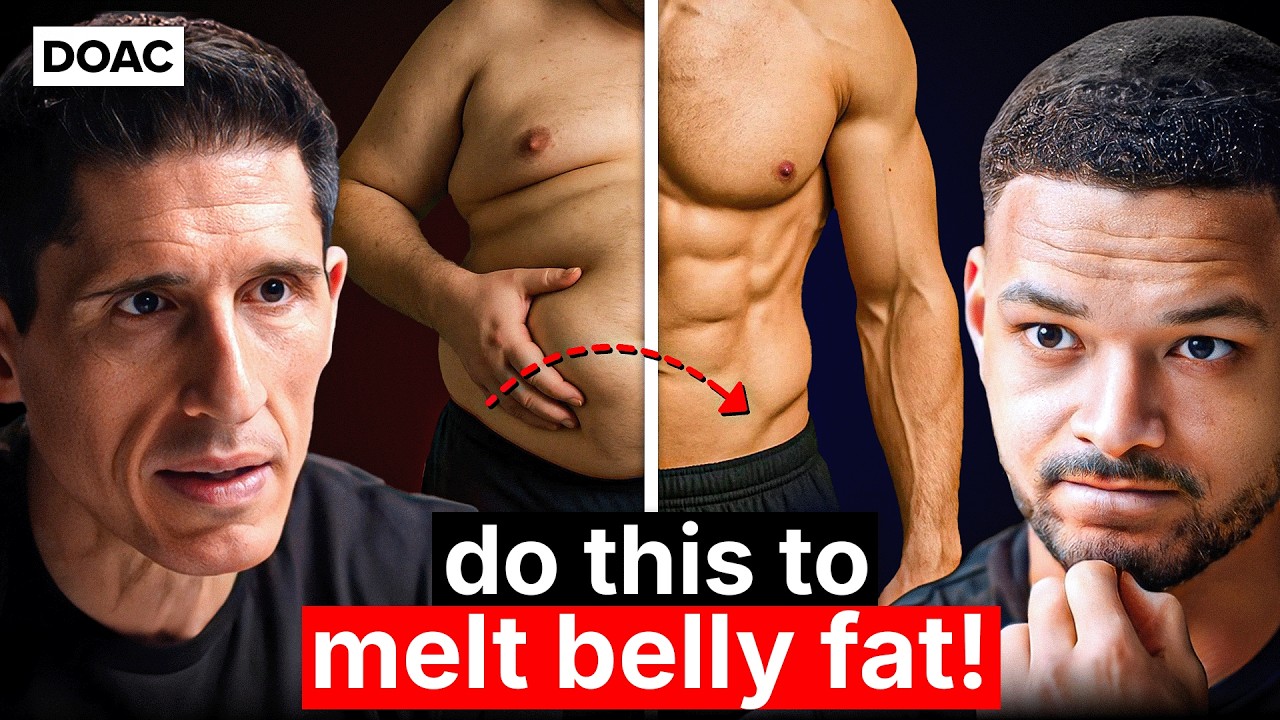
Jeff Cavaliere Ranks Creatine and Protein as Top Fitness Supplements
The Diary Of A CEO
Athlean-X founder Jeff Cavaliere argues that long-term physical longevity depends on progressive resistance training and multi-planar mobility rather than extreme diets or high-volume workouts.
## Background
This episode of The Diary Of A CEO was published on YouTube on May 15, 2025, featuring physical therapist and ATHLEAN-X founder Jeff Cavaliere. According to the page description, Cavaliere reveals the truth behind creatine, belly fat, and real muscle growth while addressing harmful fitness myths, posture fixes, and longevity strategies.
## TL;DR
Jeff Cavaliere breaks down the fundamental principles of muscle growth, fat loss, and long-term physical sustainability. He clarifies common misconceptions regarding abdominal training, supplement selection like creatine, and high-volume workout splits in favor of intensity, proper mechanics, and thoracic spine rotation. Additionally, Cavaliere connects baseline physical metrics—such as grip strength and sleeping posture—to overall functional longevity, urging listeners to replace overthinking with small, daily disciplined habits.
## Atmosphere & style
The conversation carries an authoritative yet highly accessible tone, striking a balance between rigorous biomechanical science and practical human motivation. Cavaliere speaks with direct, practical clarity, seamlessly moving from live physical demonstrations—such as using an anatomical skeleton model and assessing host Steven Bartlett's thoracic mobility—to vulnerable personal anecdotes about family and routine. The interaction feels like a grounded, high-level masterclass that transforms complex physical therapy principles into actionable life guidance.
## Key takeaways
- [06:19](https://www.youtube.com/watch?v=epAVydG6IxI&t=379s) Consistency and discipline matter far more than initial motivation or genetics for achieving long-term fitness results.
- [07:46](https://www.youtube.com/watch?v=epAVydG6IxI&t=466s) Taking the first physical step immediately overrides overthinking and internal resistance to starting a workout.
- [14:19](https://www.youtube.com/watch?v=epAVydG6IxI&t=859s) Engaging in difficult physical tasks expands the brain's anterior midcingulate cortex, which strengthens overall mental fortitude.
- [37:27](https://www.youtube.com/watch?v=epAVydG6IxI&t=2247s) Body fat reduction and physique improvement depend primarily on nutrition rather than spot-reduction exercises.
- [01:14:26](https://www.youtube.com/watch?v=epAVydG6IxI&t=4466s) Prioritizing high-intensity training over high-volume workouts builds muscle efficiently while protecting joint health.
- [01:17:56](https://www.youtube.com/watch?v=epAVydG6IxI&t=4676s) Training sets close to or to true form failure ensures maximum muscle growth stimulus without unnecessary joint wear.
- [01:00:13](https://www.youtube.com/watch?v=epAVydG6IxI&t=3613s) Moving beyond the sagittal plane by incorporating lateral and rotational exercises prevents common functional gaps and joint injuries.
- [01:03:24](https://www.youtube.com/watch?v=epAVydG6IxI&t=3804s) Maintaining thoracic spine extension and rotation is essential to prevent poor posture, 'nerd neck', shoulder restrictions, and lower back pain.
- [01:33:40](https://www.youtube.com/watch?v=epAVydG6IxI&t=5620s) Grip strength serves as a strong correlative indicator of overall muscle mass, physical independence, and lower all-cause mortality.
- [01:42:19](https://www.youtube.com/watch?v=epAVydG6IxI&t=6139s) Chronic lower back pain often stems from lack of thoracic spine mobility or weak glutes rather than actual disc herniations.
- [01:48:55](https://www.youtube.com/watch?v=epAVydG6IxI&t=6535s) Frequent short movement breaks throughout the day are significantly more effective for joint health and spine decompression than prolonged sitting paired with a single workout.
- [01:57:00](https://www.youtube.com/watch?v=epAVydG6IxI&t=7020s) Creatine enhances muscle performance and provides neurological benefits, such as mitigating brain fog and cognitive decline.
- [01:59:19](https://www.youtube.com/watch?v=epAVydG6IxI&t=7159s) A daily creatine loading phase is unnecessary; consistent daily doses of 3 to 5 grams saturate muscle cells over time without digestive discomfort.
- [02:04:18](https://www.youtube.com/watch?v=epAVydG6IxI&t=7458s) Sleeping in the back-lying 'corpse position' minimizes physical strain, joint tightness, and morning back pain compared to fetal side sleeping.
## Detailed walkthrough
Here is a detailed walkthrough of the transcript segment.
[00:00](https://www.youtube.com/watch?v=epAVydG6IxI&t=0s) Introduction: Creatine and Jeff Cavaliere’s Unique Approach
The episode opens with a brief teaser highlighting the multi-faceted benefits of creatine. Beyond boosting muscle and strength, new research indicates it enhances brain function and performance during periods of sleep deprivation and high stress, with emerging studies pointing toward its potential to slow or prevent cognitive decline.
Steven Bartlett introduces his guest, Jeff Cavaliere—a renowned physical therapist and strength coach trusted by elite athletes across the NFL, MLB, WWE, and high-profile celebrities like Sylvester Stallone. Cavaliere has earned a global reputation for his science-based training method, ATHLEAN-X, which bridges the gap between aesthetic results and injury prevention. Bartlett gives a overview of what the episode covers, ranging from losing lower belly fat and essential longevity exercises to training grip strength and addressing "nerd neck."
---
[02:05](https://www.youtube.com/watch?v=epAVydG6IxI&t=125s) Jeff's Mission and Philosophy on Health
When asked what sets his perspective apart in the crowded fitness space, Cavaliere explains that while he respects everyone trying to help others improve, his approach is built on a comprehensive foundation. Combining his background in physio neurobiology, physical therapy, and strength conditioning, he emphasizes achieving aesthetic goals without sacrificing the body's structural integrity.
Cavaliere outlines his core philosophy: fitness is a lever for improving every area of life, including mental health. He reassures listeners that they do not need to follow his exact diet or reach his low level of body fat to reap major health rewards. Small, manageable changes applied consistently are enough to yield life-changing benefits.
* **Core Premise:** Health is the ultimate asset—without it, wealth, relationships, and achievements become meaningless.
* **Credentials:** Degree in physio neurobiology, a master's degree in physical therapy, and certification as a Strength and Conditioning Specialist (CSCS) through the NSCA.
---
[05:33](https://www.youtube.com/watch?v=epAVydG6IxI&t=333s) Training World-Class Athletes
Cavaliere reflects on his 25-year career, which kicked off when his credentials qualified him as the head physical therapist and assistant strength coach for the New York Mets. Working with elite MLB baseball players, NFL football stars, and professional wrestlers shaped his perspective on athletic development.
He expresses particular respect for professional wrestlers. Despite public skepticism surrounding scripted outcomes, he highlights their extreme athletic demands, rigorous travel schedules, and constant physical wear and tear. Wrestlers must combine high-level physical performance with peak aesthetic condition—a dual focus that directly inspired Cavaliere’s hybrid training philosophy.
---
[06:19](https://www.youtube.com/watch?v=epAVydG6IxI&t=379s) Motivation vs. Discipline
Addressing the common misconception that his shredded physique is purely a result of superior genetics or endless natural drive, Cavaliere dismisses motivation as overrated. While motivation might spark initial action, only discipline sustains long-term consistency.
Reflecting on his upbringing, Cavaliere shares that his mother was 5'0" and his father was 5'8" and 160 pounds—proving he did not inherit elite muscle-building genetics. Instead, he developed discipline by experiencing small, early wins and finding deep fulfillment in testing his physical limits.
> "Motivation isn't what produces the results. It might get you to the show and get you to actually show up at the gym and initiate the work, but only discipline keeps you there."
---
[07:46](https://www.youtube.com/watch?v=epAVydG6IxI&t=466s) Overcoming the Struggle to Get Started
Discussing the difficulty many face when attempting to start a fitness journey—especially later in life—Cavaliere acknowledges that while starting in your 40s or 50s is vastly better than doing nothing, building new habits becomes progressively harder with age.
To overcome initial friction, he advises eliminating the internal negotiation process entirely. The path of least resistance (like relaxing on the couch) is always more inviting. Cavaliere shares a personal anecdote about waking up late after falling asleep putting his sons to bed: rather than contemplating going to his gym, he steps outside, walks to his workout space half-asleep, turns on the lights, and completes one warm-up set. Once that initial barrier is broken, momentum takes over.
* **Primary Obstacle:** Overthinking and internal negotiation leading to paralysis by inactivity.
* **Actionable Advice:** Take the first physical step immediately to bypass the mind's tendency to choose the easier route.
---
[10:17](https://www.youtube.com/watch?v=epAVydG6IxI&t=617s) Stories of Unstoppable Will
When Bartlett asks what keeps him driven after reaching billions of viewers, Cavaliere grows visibly emotional sharing real-life stories from his live events. He recalls an older participant, Craig, who suffered a bloody fall during a 300-yard shuttle run in 95-degree heat.
Despite his injuries, Craig moved on to the 225-pound sled push on hot pavement. Struggling to pick up a 100-pound kettlebell for the final carry, Cavaliere ran to his side and told him he didn't need to finish. Craig refused to quit, revealing he had been diagnosed with multiple sclerosis four years prior and couldn't feel his feet—he needed to prove to himself that he could complete it.
Cavaliere shares another story of a participant in a push-up challenge who couldn't lower his chest fully to the ground. When Cavaliere prompted him on form, the man quietly explained he had a port in his chest from stage four cancer. He passed away two months later. Cavaliere emphasizes that people push their bodies for reasons far deeper than surface aesthetics, showcasing an unquantifiable power of human willpower.
---
[14:19](https://www.youtube.com/watch?v=epAVydG6IxI&t=859s) The Impact of Doing Hard Things
Bartlett connects Craig's story to the concept of self-identity, observing how choosing to do hard things—like pushing through a workout on a low-energy day—translates directly into broader personal resilience. It builds the capacity to handle difficult conversations, confront uncomfortable situations, and remain disciplined across all areas of life.
Referencing research popularized by neuroscientist Andrew Huberman, Bartlett notes that engaging in challenging tasks physically expands a specific region of the brain (the anterior midcingulate cortex). Doing hard things acts as a trainable muscle that increases capacity for effort and mental fortitude over time.
---
<ElicitationsGroup message="What would you like to do next?">
<Elicitation label="Explore the role of the anterior midcingulate cortex in willpower and tenacity" query="Explore the role of the anterior midcingulate cortex in willpower and tenacity" query_intent="CLICKABLE_SUGGESTION" />
<Elicitation label="Design an entry-level exercise routine for older adults starting fitness late" query="Design an entry-level exercise routine for older adults starting fitness late" query_intent="CLICKABLE_SUGGESTION" />
<Elicitation label="Detail Jeff Cavaliere's core principles for injury prevention during strength training" query="Detail Jeff Cavaliere's core principles for injury prevention during strength training" query_intent="CLICKABLE_SUGGESTION" />
</ElicitationsGroup>
[15:45](https://www.youtube.com/watch?v=epAVydG6IxI&t=945s) Tapping Into Deeper Reserves Through Hardship
Steven Bartlett reflects on how challenging himself physically has transformed other areas of his life, such as becoming much more organized with his possessions. Jeff Cavaliere agrees, emphasizing that people constantly undersell their own capabilities. Pointing back to the stories of resilient individuals, Cavaliere explains that when you face dire circumstances—far beyond mere workout intensity—you realize there is a much deeper well of strength to draw from to complete tasks you do not want to do. Finding that mental capacity provides the keys to self-awareness, giving individuals the underlying confidence to tackle difficult conversations or intimidating life challenges.
Cavaliere references a study discussed by Dr. Andrew Huberman regarding the anterior midcingulate cortex (aMCC). The findings show that if you eventually grow to like a hard task you initially hated, it no longer challenges that specific brain structure, causing it to shrink back down. This highlights the constant need to seek out fresh challenges to maintain mental growth.
* **The Holiday Discomfort Challenge:** Over Christmas and New Year's, Steven sat down with a close friend to identify the exercises and activities they hated most so they could confront them directly.
* **Overcoming Excuses:** Steven identified running and heavy squat workouts as his biggest personal dislikes, realizing that his prior reasons for avoiding them ("my legs aren't built for this") were self-imposed identity traps limiters.
* **Jeff's Personal Blindspot:** Even as a top-tier strength coach, Cavaliere admits he naturally resists raw cardio and conditioning work, constantly having to force himself to prioritize it.
---
[18:00](https://www.youtube.com/watch?v=epAVydG6IxI&t=1080s) Uncovering the "Why": Insecurity, Capability, and Deep Motivators
When Steven asks what fundamental desires drive people to consume fitness content, Cavaliere points to deep-seated emotional drivers: insecurity, a desire for social acceptance, and the need to feel capable. Many men harbor quiet anxiety about whether they could physically protect their families or respond effectively in an emergency.
Cavaliere quotes a classic maxim: "Change happens when the pain of staying the same becomes greater than the pain of making a change." If he were coaching a stubborn client who had struggled for years to make health habits stick, he would not start in the weight room—he would start with a deep conversation using the "Five Whys" methodology to uncover the root motivation.
```
"Why do you want a six-pack?"
└── "To look better in the mirror."
└── "Because I feel like I'm letting myself down."
└── "I feel inadequate based on childhood pain."
```
Cavaliere observes that nearly every lifelong gym-goer carries some level of past pain. The gym becomes a sacred sanctuary because it offers absolute personal control—a space away from external chaos where physical exertion releases endorphins and rebuilds self-worth.
---
[21:32](https://www.youtube.com/watch?v=epAVydG6IxI&t=1292s) Surface-Level Wants vs. Root Health Objectives
While the underlying emotional drivers are complex, the top-level requests that bring millions of viewers to ATHLEAN-X are straightforward. Combining his background as both a physical therapist and a strength coach, Cavaliere categorizes public interest into two main buckets:
1. **Fixing Pain and Physical Limitations:** Viewers searching for solutions to lower back pain, posture issues ("nerd neck"), knee pain, and shoulder impingements that interfere with daily life.
2. **Aesthetic Enhancements ("Beach Muscles"):** Viewers seeking quick ways to build visible abs, larger biceps, and a wider chest.
Rather than dismissing superficial aesthetic goals, Cavaliere uses them as a gateway. When a client enters his ecosystem wanting six-pack abs, he leverages that motivation to overhaul their nutrition, ultimately improving their systemic health and longevity.
---
[23:09](https://www.youtube.com/watch?v=epAVydG6IxI&t=1389s) The Core Categories of Looking Good: Fat Loss and Muscle Shape
Cavaliere breaks down physical appearance into three core pillars: how much body fat someone carries, their level of muscular development, and their overall structural shape. Simply losing weight is rarely the goal, as "skinny fat" outcomes leave people unsatisfied with their physique.
* **Men's Aesthetic Focus:** Men heavily prioritize upper-body development—chest, shoulders, arms, abs, and a thicker neck—while frequently neglecting lower-body training like squats or glute work.
* **Women's Aesthetic Focus:** Women generally prioritize lower-body aesthetics—glutes, hamstrings, and overall leg shape and strength—often avoiding excessive upper-body bulk.
* **Cultural Influences:** Social media platforms like Instagram heavily reinforce these sex-specific aesthetic expectations, constantly feeding user desires based on these visual standards.
---
[24:56](https://www.youtube.com/watch?v=epAVydG6IxI&t=1496s) How to Lose Body Fat: Spotting Hidden Dietary Saboteurs
When beginning a fat-loss journey, Cavaliere advises taking a "30,000-foot view" of your habits rather than overcomplicating things immediately. Start by eliminating the most obvious negative behaviors—such as excessive alcohol consumption or eating a pint of ice cream every night—for two weeks to achieve rapid initial progress.
To make further progress, individuals must learn to identify hidden dietary offenders. Carbohydrates are not inherently bad, but they are far easier to overeat than lean proteins because they are chemically gratifying to the brain.
```
Hidden Sugar & Calorie Trap Example (Oatmeal)
┌─────────────────────────────────────────────────────────┐
│ Plain Rolled Oats │
│ ──> High fiber, complex carbs, low sugar │
├─────────────────────────────────────────────────────────┤
│ Pre-Flavored Instant Packets (e.g., Brown Sugar & Maple)│
│ ──> Loaded with added sugars │
│ ──> More sugar than a bowl of sugary kids' cereal │
└─────────────────────────────────────────────────────────┘
```
* **Portion Misconceptions:** While foods like white rice and pasta have a place in an active diet, people consistently underestimate their portion sizes, leading to massive caloric surpluses.
* **Hidden Sugars in "Healthy" Foods:** Popular options like fruit-on-the-bottom Greek yogurts or pre-packaged instant oatmeals are frequently loaded with added sugars that undermine weight loss efforts.
---
[27:29](https://www.youtube.com/watch?v=epAVydG6IxI&t=1649s) Decoding Food Labels and The Three Key Metrics
When evaluating food labels at the grocery store, Cavaliere looks at three primary items:
1. **Dietary Fat Content:** At 9 calories per gram (compared to 4 calories per gram for both protein and carbohydrates), fat-dense foods quickly drive up the total caloric value of a meal. Controlling fat intake makes maintaining a hypocaloric (caloric deficit) state much easier.
2. **Added Sugars:** Essential to minimize, as refined sugar provides no real nutritional necessity and triggers cravings that lead to overeating.
3. **Protein Quantity:** High protein intake improves the muscle-to-fat body composition ratio and promotes satiety, keeping you full longer than carbohydrate-heavy meals.
---
[28:55](https://www.youtube.com/watch?v=epAVydG6IxI&t=1735s) What Jeff Cavaliere Eats in a Day
Cavaliere outlines his daily, highly structured meal plan, which is designed around prioritizing high protein intake at every meal:
* **Breakfast:** Plain oatmeal mixed with canned pumpkin (added for vitamins and minerals), a protein shake, and egg whites.
* **Lunch:** A grilled chicken wrap paired with low-sugar Greek yogurt.
* **Late Afternoon Snack:** A second protein shake around 6:00 PM to bridge the long gap between work, family time, and his late-night workout.
* **Post-Workout Midnight Dinner:** Lean protein (chicken, steak, or fish), fibrous vegetables like broccoli and edamame, and dense carbohydrates like sweet potatoes or pasta.
---
[30:58](https://www.youtube.com/watch?v=epAVydG6IxI&t=1858s) Late-Night Workouts and Daily Routines
Cavaliere surprises Steven by revealing that he regularly trains late at night, from roughly 10:30 PM to 11:45 PM, eating his primary dinner around midnight. While he acknowledges this schedule is technically suboptimal compared to training around 5:00 PM, it is the only time he can consistently execute his routine without work or family interruptions.
He avoids morning workouts because he is a self-described "zombie" for the first 15 to 30 minutes after waking up. Steven relates to this late-night schedule, sharing that his own sleep tracker (Whoop) confirms how going to bed late disrupts overall recovery cycles.
[31:37](https://www.youtube.com/watch?v=epAVydG6IxI&t=1897s) Sleep Routines, Sleep Tracking, and Short Sleeper Genes
Steven opens by sharing a personal realization about late-night dining: eating close to bedtime keeps his resting heart rate elevated throughout the night, forcing his body to digest food rather than repair and restore itself. Consequently, he has set a goal to avoid eating after 9:00 p.m. Jeff commends this strategy, noting that establishing a consistent bed-and-wake routine is the single most critical factor for optimizing sleep quality.
Jeff reveals his own sleeping patterns, sharing that he consistently gets only 5 to 6 hours of sleep per night, going to bed late and rising around 7:00 a.m. While he used to track his sleep, he no longer does, noting that his cortisol levels have actually improved even as his overall sleep duration decreased. He explains that a tiny minority of the population carries genetic variants that grant them "short sleeper syndrome"—a condition that optimizes gene expression for wakefulness and brainstem activity, allowing full function on fewer hours of rest without physiological drawbacks.
* **Population Statistics:**
* **27%** of people report sleeping fewer than 6 hours per night.
* **20%** of people sleep between 4 to 5 hours per night.
* Only **1% to 3%** of the general population possesses the genetic mutation for natural short sleeper syndrome.
* **Jeff's Personal Sleep Profile:** Averages **5 to 6 hours** of sleep daily (waking at 7:00 a.m.) without tracking software.
* "When it comes to sleep, the routine of sleep is what's most important."
---
[33:40](https://www.youtube.com/watch?v=epAVydG6IxI&t=2020s) The Truth About Stubborn Lower Belly Fat ("The Pouch")
Addressing the common obsession with losing lower belly fat—often affectionately dubbed "the pouch"—Jeff clarifies that fat loss follows a strict top-down, last-in, first-out biological pattern in men. The lower abdomen is the first place male bodies store excess adipose tissue and the absolute last place it leaves. Spot-reduction methods like sit-ups or crunches are entirely ineffective for burning fat in that specific spot.
Achieving a flat, defined lower stomach comes down to sustained, uncompromising nutritional discipline. Jeff highlights the ironic visual downside of natural fat loss: as fat melts from the top down, the face and neck lose volume and collagen first, which can temporarily look "caved in" before the lower belly fat finally clears out. However, early visual wins—such as seeing the top row of abs emerge right under the chest—provide the psychological spark to stay the course.
* **Fat Loss Progression:** Melts top-down (face and neck $\rightarrow$ chest and upper abs $\rightarrow$ lower abs and lower back).
* **The Body Fat Sweet Spot:** At **10% to 12% body fat**, men look aesthetic, defined, and better than roughly **98%** of the male population, all while maintaining a sustainable lifestyle without extreme sacrifice.
* **Misconception:** Doing crunches burns the fat lying directly over the abdominal wall.
---
[37:27](https://www.youtube.com/watch?v=epAVydG6IxI&t=2247s) Calories In vs. Calories Out and Hypertrophying Abs
While a caloric deficit is mandatory for weight loss, Jeff dispels the simplistic "calories in, calories out" belief that all food sources produce equal results. Eating a deficit composed of junk food (like Twinkies) leads to significant muscle wasting rather than selective fat loss. To preserve lean muscle tissue and optimize body composition while cutting, prioritizing sufficient dietary protein is essential.
Regarding abdominal muscle development, Jeff shares an anecdote about a house contractor named Lazlo, who assumed belly fat could be targeted by a single special exercise while keeping his diet unchanged. Jeff explains that abs are anatomically no different than biceps or quadriceps; they are skeletal muscles that undergo hypertrophy when loaded through resistance or weighted crunching movements.
> "Nutrition determines body fat levels above everything else... Abs are not going to be gotten through just the exercise."
* **Abdominal Anatomy:** The visible "six-pack" separation is created by the tendinous sheath of the *linea alba* suturing down the muscle tissue.
* **Hypertrophy Mechanism:** Direct resistance training grows the abdominal muscle bellies so they push outward from the *linea alba*, creating deeper separation and a more prominent look once body fat is low enough.
---
[40:37](https://www.youtube.com/watch?v=epAVydG6IxI&t=2437s) Steroid "Palumboism" Bloating and the TRT Epidemic
Steven asks about the distended, "bloated" bellies seen on older professional bodybuilders. Jeff explains that this condition is typically caused by the heavy abuse of human growth hormone (hGH) and anabolic steroids, which causes internal organs (viscera) to enlarge and push outward against the abdominal wall. Unlike abdominal hernias, this global distension is an unnatural, unhealthy side effect of extreme enhancement.
The conversation shifts to the rising popularity of Testosterone Replacement Therapy (TRT), with both Jeff and Steven noting that young men are increasingly jumping on TRT as a first resort even with normal low-end baseline levels (400–500 ng/dL). Jeff warns that exogenous testosterone suppresses the body's natural endocrine production, effectively locking users into a lifelong medical commitment.
* **Growth Hormone Side Effects:** Visceral organ enlargement leading to abdominal distension ("GH gut").
* **TRT Pitfalls:** Suppresses endogenous testosterone production; returning to natural levels after stopping is never guaranteed.
* **Jeff's Personal Stance:** Jeff has never taken TRT and remains 100% natural, approaching his 50th birthday powered by natural training and lifestyle optimization.
---
[44:27](https://www.youtube.com/watch?v=epAVydG6IxI&t=2667s) Training for Longevity and the "Athlete" Paradigm
To remain strong, functional, and independent well into older age, Jeff advocates for a multifaceted approach to fitness: "If you want to look like an athlete, you got to train like an athlete." Focusing on a single physical trait is insufficient. He illustrates this using arm wrestlers, who may possess world-class grip, forearm, and rotator cuff strength, but will fail if their neurological recovery, sleep, and nutrition are compromised.
The cornerstone of aging gracefully is aggressive muscle preservation. As adults age past 50, they naturally lose muscle mass and strength at an accelerating rate. Combatting this age-related decline requires structured weight training aimed at muscle hypertrophy and strength, alongside neurological challenges that train balance, reaction speed, and agility.
* **Age-Related Muscle Loss:** Humans lose approximately **8% to 10%** of their muscle strength per decade after reaching age 50.
* **Neurological Aging:** Firing speed of motor neurons slows over time; balance drills and reactive movements keep the central nervous system sharp.
* **Anecdote of Inspiration:** Jeff recalls an **89-year-old man** who built a custom backyard obstacle course (featuring balance beams and climbing nets) and added a new obstacle every week to continuously challenge his brain and body against fall risks.
[47:50](https://www.youtube.com/watch?v=epAVydG6IxI&t=2870s) The Longevity Pyramid and the Invisible Roots of Fitness
Jeff Cavaliere breaks down how fitness priorities change as people age, highlighting a critical flaw in how most gym-goers structure their training. He references a classic fitness hierarchy shaped like a pyramid: at the base sits raw strength, followed by lean muscle mass, with functional performance and sport-specific skill work (such as swinging a baseball bat or fielding a ground ball) sitting at the apex. Conditioning and cardiovascular health sit right alongside or just above strength depending on the athlete's sport and goals.
However, Jeff argues that the most essential elements for long-term health are not even part of the visible pyramid—they are the "roots" beneath the soil. Much like a tree cannot stand without its hidden root system, a person’s strength and performance cannot exist without **stability, flexibility, and mobility**.
To drive the point home, Jeff uses a stark example: taking the strongest person in the world who can squat 600 lbs and placing them on an unstable surface like a Swiss ball. Stripped of their baseline stability, their massive strength becomes completely unusable. If your joints cannot move through their full range of motion due to poor mobility, or if your muscles are too tight, your body simply cannot express its strength.
```
/\
/ \ <- Skill Work
/----\
/ Performance \
/---------------\
/ Muscle Mass & Cardio \
/------------------------\
/ RAW STRENGTH \
========/============================\======== (Ground Level)
/ Stability & Control \
/ Mobility (Joint Range) \ <- The Invisible Roots
/ Flexibility (Muscle Length) \
```
- **Flexibility vs. Mobility:** Flexibility refers specifically to muscle length and the muscle's ability to stretch, whereas mobility refers to joint excursion and the full range of motion around a joint.
- **The Fountain of Youth:** While stretching and mobility work are often praised as the ultimate secrets to feeling young, being limber without strength leaves a person functionally incapable.
- **The Rubber Band Analogy:** Jeff demonstrates with an elastic band that a completely loose band generates no force, while a rigid, muscle-bound structure lacks the range of motion for elastic output. Maximum force and ease of movement occur only at the intersection of optimal muscle tension and full flexibility.
---
[52:06](https://www.youtube.com/watch?v=epAVydG6IxI&t=3126s) Correcting Deficits with 5 to 10 Minutes of Daily Consistency
Addressing flexibility and mobility does not require hours of tedious work; it simply requires consistent, targeted effort. Jeff emphasizes that spending just **5 to 10 minutes a day** stretching tight areas is enough to produce dramatic, long-term physical improvements.
During his tenure in professional baseball, Jeff never handed out generic, team-wide routines. Every player received a custom program based on a comprehensive individual assessment that accounted for their body type, position, and unique mechanical demands. He notes a common misunderstanding among his online audience: when he posts daily mobility routines, followers often assume they must stack every single exercise into a massive, daily regimen. Instead, individuals should isolate their specific functional deficits and address only those high-impact areas.
> "People think they have to combine all of those things into a whole separate career in order to be able to pull them off. That's not necessary... It doesn't require long duration of these things, it simply requires consistency."
---
[53:56](https://www.youtube.com/watch?v=epAVydG6IxI&t=3236s) Interactive Demo: 5 Key Exercises for Longevity and Function
Jeff steps into an open area of the studio to demonstrate five accessible, highly scalable bodyweight exercises designed to diagnose weaknesses and preserve functional movement. These exercises require no equipment and minimal space, making them accessible to anyone regardless of fitness level.
```
5 ESSENTIAL MOVEMENTS FOR LONGEVITY
┌───────────────────────────┬───────────────────────────┐
│ Exercise │ Key Target / Benefit │
├───────────────────────────┼───────────────────────────┤
│ Single-Leg RDL │ Balance & Hip Hinge │
│ Squat and Reach │ Thoracic Spine Mobility │
│ Sumo Squat Stance Hold │ Multi-Planar Hip Control │
│ Posterior Chain Push-Up │ Total Back-Line Strength │
│ Side-Lying Hip Abduction │ Glute Medius & Stability │
└───────────────────────────┴───────────────────────────┘
```
1. **Single-Leg Romanian Deadlift (RDL):**
- *Purpose:* Builds single-leg balance and teaches the essential biomechanical hip hinge.
- *Execution:* Hinge at the hips as if pushing an open drawer closed with your butt. Reach forward while kicking the opposite leg straight back, engaging the glute as a counterbalance.
- *Goal:* Perform up to 10 controlled repetitions per side without losing balance or touching the back foot to the floor.
2. **Squat and Reach:**
- *Purpose:* Restores thoracic spine mobility lost to hours of slouching over phones and computers.
- *Execution:* Drop into a deep squat position and wedge your elbows against the inside of your knees. Post up on one hand, reach the opposite arm high toward the sky, and track your hand with your head to open up the chest.
- *Goal:* Hold the rotated position for up to 60 seconds per side.
3. **Sumo Squat Stance Hold (Horse Stance):**
- *Purpose:* Develops lower-body endurance, multi-planar hip mobility, and an upright posture.
- *Execution:* Take a wide stance, turn the toes outward, and sit deep into a squat. Beginners can support their forearms on their thighs; advanced variations involve crossing the arms, lowering into the deep squat, and extending the arms up and out to force the thoracic spine and shoulders into extension.
- *Goal:* Maintain an upright, open chest for 30 to 60 seconds.
4. **Posterior Chain Push-Up:**
- *Purpose:* Pairs classic upper-body pushing power with total posterior-chain engagement.
- *Execution:* Set up in a tight plank with hands beneath the shoulders, squeezing the glutes and locking out the quads. Lower all the way to the floor, extend the arms forward, point the toes, and raise the entire body into a "Superman" lift. Return the hands under the shoulders and press back up into the plank.
- *Goal:* Maintain strict trunk rigidity without sagging at the hips or lower back.
5. **Side-Lying Hip Abduction:**
- *Purpose:* Isolates the gluteus medius to stabilize the hips during walking and prevent pelvic drop.
- *Execution:* Lie on your side, rotate the top leg so the toe points slightly down toward the floor, slide the leg slightly behind the body's midline, and lift upward. Keep the pelvis rotated forward throughout the movement to prevent the hip flexors from taking over.
- *Goal:* Hold or pulse in the top position for 30 to 60 seconds per side.
---
[59:13](https://www.youtube.com/watch?v=epAVydG6IxI&t=3553s) Sponsor Interlude: Foot Health and Natural Movement
Steven Bartlett steps in to highlight how footwear impacts overall biomechanics, sharing insight from a prior interview with evolutionary biologist Dr. Daniel Lieberman. Lieberman explained that modern cushioned, highly supportive shoes strip the feet of their natural strength and mobility, laying the groundwork for widespread joint issues like plantar fasciitis, knee pain, and lower back discomfort.
After struggling with foot pain himself, Steven switched to minimalist footwear to rebuild his foot strength. He notes research from the University of Liverpool demonstrating that wearing minimalist shoes like Vivobarefoot for six months can increase foot strength by up to 60%.
---
[01:00:13](https://www.youtube.com/watch?v=epAVydG6IxI&t=3613s) Moving Beyond the Sagittal Plane to Prevent Injury
Returning to the studio, Jeff explains the broader context behind his five foundational longevity tests. Most traditional gym exercises—such as squats, deadlifts, bench presses, and lunges—take place entirely in the **sagittal plane** (forward-and-backward movement). While these movements build massive baseline power, neglecting the **frontal plane** (side-to-side) and **transverse plane** (rotational) creates severe functional gaps.
Jeff recalls his time training elite professional baseball players, including Hall-of-Fame caliber home run hitters. Despite their raw athletic output, several of these elite athletes exhibited shockingly weak hip internal and external rotation strength when isolated on an examination table.
> "I remember so many times taking some of the most powerful baseball players, the leading home run hitters, and then testing their hip internal or external rotation strength and it being incredibly weak... What could his career stats have looked like if he didn't miss all those games?"
One star player in particular suffered recurrent knee pain that repeatedly sidelined him throughout his career. Jeff notes that while isolated movements like side-lying hip abductions might not directly increase how far an athlete can hit a ball, addressing those hidden stability deficits prevents cascading joint wear, keeps athletes off the injury list, and extends long-term athletic longevity.
- **Assessment Tool for Everyone:** Small, multi-planar movements serve as quick, low-barrier diagnostic tools to identify physical imbalances before they turn into chronic pain or injury.
- **Introducing "Raymond":** Jeff introduces his anatomical skeleton companion, named "Raymond" (short for "X-ray"), complete with a formal bow tie. Jeff brought Raymond onto his YouTube channel back in 2011 or 2012, and the skeleton quickly became a fan-favorite teaching aid for visual anatomy breakdowns.
<ElicitationsGroup message="Where would you like to go next?">
<Elicitation label="Explore Thoracic Spine Mobility Exercises" query="What are the best exercises to improve thoracic spine mobility and fix rounded posture?"/>
<Elicitation label="Review the Full 7-Day Workout Routine" query="Walk through Jeff Cavaliere's recommended 7-day workout plan and training split."/>
<Elicitation label="Deep Dive on Creatine Benefits & Dosages" query="What is the truth about creatine according to Jeff Cavaliere, including loading and dosage?"/>
</ElicitationsGroup>
[01:03:24](https://www.youtube.com/watch?v=epAVydG6IxI&t=3804s) The Importance of Thoracic Spine Rotation and Extension
Using a anatomical skeleton model, Jeff Cavaliere highlights why torso rotation is the single biggest movement deficit people develop as they age. Torso rotation is driven predominantly by the thoracic spine—the section running from the base of the neck down to the bottom of the rib cage. The thoracic spine requires about 40 degrees of flexion (bending forward) and 25 degrees of extension (bending backward). Because range of motion in this area is shared between flexion/extension and rotation, every degree of motion lost to a slumped, flexed posture directly subtracts from the ability to rotate side-to-side.
Demonstrating this live on host Steven Bartlett, Jeff places a wooden dowel across Steven's back and has him rotate while slumping forward in a typical "desk posture." When Steven resets into tall posture with full thoracic extension, his rotation range increases by roughly 20%. Maintaining this rotation is essential for everyday life and athletic performance—whether catching oneself during a fall to avoid breaking a hip, swinging a golf club, kicking a soccer ball, or throwing a pass. By age 50 to 60, people typically lose 25% to 35% of their thoracic mobility, leading to a stiff, robotic gait or a severely hunched posture.
- **Thoracic spine boundaries:** From the base of the neck/top of the shoulders down to the bottom of the rib cage.
- **Normal thoracic mobility:** ~40° flexion, ~25° extension.
- **Age-related decline:** 25% to 35% loss of mobility in the thoracic spine between ages 50 and 60.
- **Mechanisms:** A 1-to-1 loss ratio occurs—every degree of extension lost to slumped flexion subtracts a degree of rotational capacity.
- **Personal anecdote:** Jeff recalls his grandmother living to age 97, but spending her later years bent over a walker at a literal right angle because she had completely lost thoracic extension.
---
[01:08:25](https://www.youtube.com/watch?v=epAVydG6IxI&t=4105s) Cascade Effects of Poor Posture: Shoulder Blockage, Low Back Pain, and Restricted Breathing
Losing thoracic extension triggers a destructive cascade of mechanical adaptations throughout the rest of the body. To demonstrate, Jeff asks Steven to raise his arm overhead while hunched over; the arm gets mechanically blocked halfway up. Overhead arm movement requires the shoulder blade (scapula) to rotate around the rib cage. When the upper back is rounded, the shoulder blade cannot glide, blocking overhead mobility regardless of how healthy the shoulder joint itself is.
To compensate for blocked shoulders, people instinctively lean backwards from their lower back (lumbar spine). The lumbar spine is built for stability, not massive mobility; forcing it to extend leads to muscle spasms and joint damage. Furthermore, a rounded, compressed rib cage acts like a rigid box around the lungs, preventing full lung expansion. This restricted breathing decreases oxygen intake, leaving people feeling fatigued throughout the day and unrested after sleep. Jeff estimates that at most 10% of people actively train or protect this critical anatomical area.
- **Scapular mechanics:** Overhead reach requires full rotational movement of the shoulder blade across the rib cage; blocking scapular movement restricts arm elevation.
- **Low back compensation:** Lack of upper back extension forces the lumbar spine (meant for stability) into hyper-extension, causing lower back pain and joint strain.
- **Respiratory impact:** A collapsed thoracic frame restricts lung inflation, leading to chronic daytime fatigue and poor sleep quality.
- **Adoption rate:** Jeff estimates that only ~10% of gym-goers directly perform exercises targeting thoracic extension and mobility.
---
[01:11:11](https://www.youtube.com/watch?v=epAVydG6IxI&t=4271s) Daily Mobility Drills to Prevent Hunching
To prevent hunching and preserve mobility into older age, Jeff outlines three accessible daily drills that combine flexibility with rotational strength. These simple exercises require minimal equipment and only 5 to 10 minutes of daily effort, with noticeable mobility improvements appearing within just a few weeks.
1. **Wall Angels / Wall Slides:** Stand with your head, upper back, and glutes flat against a wall. Place the backs of your hands and forearms against the wall with elbows at 90 degrees, then slide your arms up while maintaining continuous contact with the wall. Tight rotator cuff muscles will attempt to pull the arms inward, forcing the thoracic spine into extension to stay flat.
2. **Prone Dowel Rotations:** Lie face down on the floor with legs spread and hands holding a dowel across the upper back (forming an "X" shape). Rotate the torso toward the ceiling, driving the dowel back to isolate extension and rotation in the mid-back.
3. **Bridge and Reach-Over:** Perform a standard glute bridge on your back, but at the top of the hip extension, reach one arm diagonally across your body to touch the floor behind the opposite shoulder, fusing lower-body drive with thoracic rotation and extension.
> "I think people don't realize the minimal time investment that's required... those little deposits have to be made each day and they pay off in big dividends."
---
[01:14:26](https://www.youtube.com/watch?v=epAVydG6IxI&t=4466s) Quality over Quantity: High Intensity vs. High Volume Training
When asked whether people should train for longer periods or perform shorter, higher-intensity workouts, Jeff gives his classic rule: "You can train long or you can train hard, but you can't do both." As people age, saving joint wear-and-tear becomes paramount. Every joint movement is like a rotation on a car tire; high repetition volume eventually grinds down cartilage and joint structures, particularly if subtle bone spurs or alignment issues are present.
Jeff advocates trading excessive volume for higher effort and mechanical tension. While research shows that any rep range between 5 and 30 reps taken close to or all the way to failure can induce hypertrophy, heavier weights or higher-intensity techniques deliver superior stimulus in fewer total joint revolutions. Muscle growth is metabolically demanding, and because the body naturally strives for homeostasis, it will not build new muscle unless forced by an intense stimulus that exceeds its current capacity.
- **Core training principle:** "You can train long or you can train hard, but you can't do both."
- **Hypertrophy rep range:** Studies show muscle growth occurs across 5 to 30 repetitions, provided sets are taken close to or all the way to muscular failure.
- **Homeostasis and effort:** The body naturally resists building new muscle tissue due to metabolic cost; true growth requires pushing sets to failure to force adaptation.
- **Joint preservation:** Higher intensity with lower total repetition volume reduces joint friction and prolongs long-term joint health.
Here is a detailed, faithful walkthrough covering this part of the conversation:
[01:17:56](https://www.youtube.com/watch?v=epAVydG6IxI&t=4676s) Form, Mechanical Breakdown, and Training to Failure
Jeff Cavaliere and Steven Bartlett continue discussing the importance of training intensity and why training to true failure serves as the only clear, objective metric. Jeff explains that while research often states stopping one or two repetitions shy of failure yields comparable results, predicting that threshold is notoriously unreliable. In practice, if a person feels they have two reps left in reserve, a true max-effort push might reveal they actually had four reps remaining—a drop in effort that significantly reduces muscle-building stimulus.
```
INTENSITY vs. FORM BREAKDOWN
+---------------------------------------------------------------+
| Controlled Training ---> Minimal Form Failure ---> STOP |
| (Target muscle stays (Slight momentum or (Focus |
| fully engaged) shortened range) lost) |
+---------------------------------------------------------------+
```
Jeff emphasizes that pushing exercises to extreme effort inevitably leads to minor mechanical compromises, such as a slightly shortened range of motion or subtle momentum. He considers these acceptable as long as the movement remains controlled. However, once the form deteriorates to where the movement no longer resembles the original exercise, the target muscle loses tension. For instance, an exercise meant to target the chest can degrade into a chaotic full-body movement, shifting tension off the intended muscle and rendering the effort counterproductive for hypertrophy.
- **Objective End Point:** Training to the point where another rep cannot be completed with good form guarantees the required stimulus was met.
- **RIR (Reps in Reserve) Fallacy:** Estimating 1–2 reps in reserve often turns out to be 4 reps in reality when pushed under extreme motivation.
- **Form Boundaries:** Minor momentum or shortened range of motion is tolerable near failure, but shifting tension away from the primary muscle destroys training efficiency.
---
[01:19:24](https://www.youtube.com/watch?v=epAVydG6IxI&t=4764s) The Origin and Fix for "Nerd Neck"
Steven shifts the conversation to postural issues, asking whether constantly staring downward at phones, notes, and screens creates long-term structural consequences—a condition commonly referred to as "nerd neck." Jeff clarifies that the root cause does not actually lie in the neck muscles themselves, but rather originates from the thoracic spine and shoulder girdle.
```
THE "NERD NECK" CASCADE
Thoracic Spine Slumping / Rounding
│
▼
Internal Rotation of the Shoulders
│
▼
Forward Head Extension (to keep eyes up)
```
When someone hunsches forward, the arms internally rotate and the thoracic spine rounds. Because human vision naturally seeks the horizon, the neck compensates by extending upward from a slumped base. Jeff points out that treating "nerd neck" directly at the neck is a mistake; the solution requires restoring extension mobility to the thoracic spine and improving shoulder external rotation.
- **Epicenter of Dysfunction:** Slumping originates in the thoracic spine, driving the shoulders into internal rotation.
- **Compensatory Extension:** The forward-head position is simply a natural reaction to keep the eyes looking forward while the upper back is rounded.
- **Corrective Strategy:** Fix forward head posture by restoring thoracic extension and shoulder mobility rather than isolated neck training.
---
[01:21:09](https://www.youtube.com/watch?v=epAVydG6IxI&t=4869s) Preventing Common Gym Injuries and Joint Instability
Steven shares his frustration with getting injured as he reaches age 32, noting that he is currently using crutches and a boot due to torn ankle ligaments. He observes that injuries derail overall health, sleep, metabolic fitness, and mental clarity, asking Jeff how to build a practical injury prevention program. Jeff humorously takes offense at Steven calling 32 "old," but agrees that proactive physical preparation is critical.
```
JOINT FUNCTION & INJURY RISK
┌───────────────────┬────────────────────────────────┐
| Joint Type | Primary Risk Cause |
├───────────────────┼────────────────────────────────┤
| Mobile Joints | Lack of muscular control |
| (Shoulders, Hips) | and stability |
├───────────────────┼────────────────────────────────┤
| Stable Joints | Forced into excessive planes |
| (Knees, Lumbar) | of motion due to tightness |
└───────────────────┴────────────────────────────────┘
```
Jeff breaks down joint vulnerability: mobile ball-and-socket joints (like shoulders and hips) suffer when surrounding stabilizing muscles are weak. He highlights the gluteus medius as an essential stabilizer controlling the hip in the frontal (side-to-side) plane. Standard compound movements like squats and deadlifts operate almost exclusively in the sagittal (front-to-back) plane, leaving frontal plane stabilizers unworked unless targeted intentionally.
To build hip stability efficiently without adding extra workouts, Jeff demonstrates how to modify standard movements. For example, performing a reverse lunge or Bulgarian split squat while holding a single heavy dumbbell (50–60 lbs) in one hand creates an asymmetrical load. This offset forces the gluteus medius on the opposite hip to contract intensely to keep the pelvis level. Slowing down the movement and holding a isometric pause at the bottom further strengthens frontal-plane stability while simultaneously training quad and glute strength.
- **Gluteus Medius Function:** Controls hip movement and pelvic levelness in the frontal (side-to-side) plane.
- **Offset Loading Trick:** Holding a single dumbbell during lunges or split squats forces the off-side stabilizers to work without adding separate exercises.
- **Tempo Emphasis:** Slow eccentric phases and bottom pauses force stability muscles to engage through the full range.
---
[01:25:44](https://www.youtube.com/watch?v=epAVydG6IxI&t=5144s) Designing a Balanced 7-Day Training Split
Steven asks Jeff to design a ideal weekly training layout that balances strength, hyperthrophy, and cardiovascular health. Jeff introduces two primary split concepts: the **Upper/Lower Split** and the **Push/Pull/Legs (PPL) Split**.
Jeff explains the Push/Pull/Legs structure:
- **Push Day (Monday):** Targets muscles performing pushing movements (Chest, Front/Side Deltoids, Triceps).
- **Legs Day (Wednesday):** Covers both anterior and posterior chains (Quads, Hamstrings, Glutes).
- **Pull Day (Friday):** Focuses on pulling muscles (Lats, Upper Back, Rear Deltoids, Biceps).
- **Conditioning Days (Tuesday & Thursday):** Dedicated to cardiovascular health, high-intensity intervals, or athletic conditioning.
- **Flex Day (Saturday):** If muscle building is the primary goal, Saturday serves as a total-body workout featuring large compound movements. To avoid overtaxing muscles worked on Friday's pull session, the workout emphasizes horizontal pulling (like seated rows) if Friday featured vertical pulling (like pull-ups). If fat loss is the priority, Saturday becomes a third conditioning session.
- **Rest Day (Sunday):** Essential for systemic nervous system recovery; Jeff cautions against doing full-body resistance training seven days a week.
Jeff notes that combining conditioning and heavy weightlifting into the same workout causes energy to drop, reducing the effectiveness of whichever discipline comes second. Placing cardio on dedicated days maximizes performance and adaptation for both recovery and muscle building.
- **Push Movement Definition:** Concentric phase pushes load away from the body or pushes the body away from an anchor point (e.g., bench press, push-ups, overhead press).
- **Pull Movement Definition:** Concentric phase pulls load toward the body (e.g., lat pulldown, barbell rows, bicep curls).
- **Volume Targets:** Most muscle groups thrive on **9 to 16 direct working sets per week**, distributed across workouts.
- **Compound Efficiency:** Secondary muscles (like triceps during chest pressing) receive stimulus during compound lifts, meaning isolated tricep work requires fewer total sets.
[01:31:44](https://www.youtube.com/watch?v=epAVydG6IxI&t=5504s) Bicep and Tricep Training: Frequency and Recovery
Jeff Cavaliere shares his preferred tricep exercise—the lying tricep extension on a bench, often known as "skull crushers" or "nose breakers"—before turning to a discussion on bicep growth and muscle recovery. He highlights muscle recovery as one of the most under-researched and fascinating frontiers in fitness, noting that recovery rates vary drastically not only between individual people but also between different muscle groups on the exact same person. For instance, someone might be capable of training their biceps every three days, yet require significantly more time to recover from a chest or back workout.
Because universal recovery guidelines do not exist, Cavaliere urges lifters to tune into their intuitive feedback. Key indicators of solid recovery include progressive overload (consistently increasing weights or strength) and maintaining genuine psychological enthusiasm to train that specific muscle again. From a physiological standpoint, maximizing the frequency with which a muscle can be stimulated—provided it has fully recovered—yields superior long-term results.
- **Recovery Variance:** Individual recovery rates differ between subjects and across distinct muscle groups on the same individual body.
- **Intuitive Metrics:** Progress in load/strength and eagerness to train a muscle serve as primary indicators that full recovery has taken place.
- **Frequency Principle:** Higher frequency of muscle stimulation correlates with superior hypertrophy, provided recovery capacity is not exceeded.
---
[01:33:40](https://www.youtube.com/watch?v=epAVydG6IxI&t=5620s) Grip Strength: Longevity Metric and Live Demonstration
The conversation pivots to a hand dynamometer resting on the table. Steven Bartlett reads out striking clinical data regarding grip strength as a predictor of mortality and general health outcomes:
- **Mortality and Cardiac Risk:** A 2015 *Lancet* study across 17 countries linked every $5\text{ kg}$ decrease in grip strength to a $16\%$ higher risk of all-cause mortality, a $17\%$ higher risk of heart disease, and a $7\%$ higher risk of stroke.
- **Cognitive Decline:** A 2018 study in the *Journal of Alzheimer's Disease* found low grip strength associated with a $68\%$ increased risk of developing Alzheimer's disease.
- **Falls and Dependency:** Older adults in the lowest third of grip strength are $2.5$ times more likely to fall and suffer injuries requiring hospitalization, and those over 65 with weak grip are $2.1$ times more likely to become dependent in daily activities within 3 years (*Journal of Gerontology*).
- **Strength Correlation:** Grip strength predicts overall upper-body strength by up to $70\%$.
Cavaliere contextualizes these stark statistics by explaining that grip strength is primarily a "correlative rather than causative" marker. People with robust grip strength in old age are generally those who have maintained active physical lives—lifting heavy objects, exercising, and preserving muscle mass. Thus, grip strength serves as an upstream indicator of an active lifestyle rather than an isolated cause of longevity. Additionally, tracking sudden dips in your baseline grip strength in the morning can serve as a metric to measure central nervous system recovery from overall training.
```
TYPICAL GRIP STRENGTH RANGES (HAND DYNAMOMETER)
+-------------------+-----------------------------------+
| Cohort | Baseline Range (lbs) |
+-------------------+-----------------------------------+
| Average Men | 100 - 120 lbs (46 - 54 kg) |
| Average Women | 60 - 80 lbs |
+-------------------+-----------------------------------+
```
During the live dynamometer test using proper form (elbow flexed at $90^\circ$, arm hovering without touching the table or torso), the host records $130\text{ lbs}$ on his first right-hand attempt, $160\text{ lbs}$ on his left hand, and $150\text{ lbs}$ on a subsequent right-hand re-test. Cavaliere tests his own hands, registering $130\text{ lbs}$ on his right and $110\text{ lbs}$ on his left, humorously pointing out a loud pop in his bicep during the effort. A female crew member is invited to test her strength and scores $100\text{ lbs}$, significantly outperforming the female average baseline of $60\text{--}80\text{ lbs}$.
"It is not the strength in which we can grip that matters necessarily, but the thing that matters is upstream from that," Cavaliere notes, reinforcing that overall movement and systemic strength drive these health benefits.
---
[01:41:47](https://www.youtube.com/watch?v=epAVydG6IxI&t=6107s) Direct Grip Training and Preventing Chronic Back Pain
When asked if grip strength can be trained directly, Cavaliere explains that old-fashioned spring-loaded hand grippers are effective, noting that modern manufacturers now produce heavy-resistance grippers that offer genuine challenges compared to older models.
The discussion shifts to back pain—the leading cause of disability worldwide. Bartlett highlights that $80\%$ of adults experience back pain at some point, causing over $10\text{ million}$ lost workdays annually in the UK, where back issues account for 1 in 6 hospital visits. Cavaliere notes that in the United States, back pain is the second most common reason for doctor visits, trailing only acute respiratory infections. While acute back pain is statistically probable over a lifetime, Cavaliere insists that "chronic and recurring back pain is entirely avoidable."
He breaks down the anatomical root causes of lower back issues, using a spine model to illustrate:
- **Disc vs. Muscle Issues:** Although up to $85\%$ of people experience lower back pain, only $27\text{--}35\%$ of these cases involve intervertebral disc herniation or nerve compression.
- **Nerve Compression Signals:** When a disc herniates, it compresses spinal nerves, causing radiating pain along specific dermatomes. Herniations at $L_5\text{--}S_1$ cause numbness, tingling, or weakness radiating down the calf and foot, while $L_2\text{--}L_3$ or $L_3\text{--}L_4$ issues refer pain to the front or side of the hip and thigh (often misdiagnosed as localized hip pathology).
- **Non-Surgical Recovery:** Of all disc-related issues, $96\%$ do not require surgery and can be resolved through targeted conservative interventions like stretching and physical therapy.
- **Biomechanical Triggers:** Lower back strain is rarely an isolated problem; it typically compensates for lack of extension in the thoracic spine or glute weakness, which forces the lower back to over-extend during hip extension and gait.
- **US Primary Care Data:** Back pain is second only to upper respiratory infections as a driver of medical consultations in the US.
- **Non-Operative Rate:** $96\%$ of diagnosed spinal disc herniations resolve via non-surgical interventions.
- **Glute Dysfunction:** Weak gluteal muscles restrict clean hip extension, shifting load directly onto the lumbar spine during walking and extension exercises.
[01:47:06](https://www.youtube.com/watch?v=epAVydG6IxI&t=6426s) Back Pain, Spine Mechanics, and the "Mismatch" of Modern Life
Jeff Cavaliere details how restricted lower-body mobility forces the lumbar spine to compensate, causing back injuries. The lower back is designed to serve as the stability center of the spine. When an individual lacks mobility in the hips or the thoracic spine above and below, the lumbar spine is forced to step in to provide that missing movement. It complies, but at a severe cost—resulting in strain, disc issues, and pain. Addressing underlying hip weaknesses and tight hip joints is paramount to treating and preventing back issues.
Steven Bartlett introduces the concept of a "mismatch disease," citing conversations with anthropologists David Raichlen and Daniel Lieberman about their research on the Hadza hunter-gatherer tribe in West Africa. Bartlett notes his original assumption that Western back pain stems purely from total sedentary time, but Raichlen revealed that the Hadza also spend roughly 10 hours a day in resting postures. The crucial difference lies in *how* they rest: the Hadza maintain a straight J-shaped spine rather than the slouched S-curve standard in Western chairs, routinely squat, walk extensive distances, and carry heavy loads.
- **The Lumbar Function:** Acts primarily as a stabilization zone; forcing it to act as a mobility pivot leads directly to tissue overload and injury.
- **The Mismatch Concept:** Modern environments trap bodies in static, unnatural postures that conflict with evolutionary biomechanics.
- **Hadza Comparison:** Hadza tribespeople log ~10 hours of rest daily without rampant back degeneration, attributed to active resting postures (squatting), dynamic daily movement, and preserving a natural J-shaped spine.
---
[01:48:55](https://www.youtube.com/watch?v=epAVydG6IxI&t=6535s) Standing Desks, Decompression, and the Importance of Movement Frequency
When asked whether standing desks are a worth-while fix, Jeff strongly endorses them, admitting with a touch of self-deprecating humor that he should probably hold himself accountable to using one more often as well. Sitting has frequently been branded "the new smoking" due to its compound negative effects—especially when stacked on top of the 8 to 10 hours of complete immobility during sleep. Staying trapped in a fixed chair for an additional 8 to 10 workday hours severely starves joints of movement.
Moving against gravity actively compresses and unloads joints like the knees, effectively "squeezing and bathing" them in nourishing synovial fluid. Standing desks eliminate some of that static chair compression and automatically correct slouching from the lower body up. However, Jeff emphasizes that standing alone does not cure physical inactivity. The real solution lies in high-frequency breaks throughout the day. Interspersing activity evenly—such as pacing during phone calls or taking a 5-minute walk every 30 minutes—yields far better health outcomes than lumping exercise into one hour and remaining completely frozen for the other 23.
- **Synovial Fluid Bathing:** Joint weight-bearing and movement pump synovial fluid through cartilage; prolonged sitting allows joint fluid to become stagnant.
- **Actionable Daily Hacks:** Pacing around the office or gym during phone calls, parking farther away at grocery stores, and taking 5-minute movement breaks every 30 minutes.
- **Decompression Rituals:** Performing basic daily two-arm or one-arm bar hangs helps reverse spinal compression accumulated from gravity and sitting.
---
[01:52:09](https://www.youtube.com/watch?v=epAVydG6IxI&t=6729s) The Top Science-Backed Muscle-Building Supplements
Transitioning to supplementation, Steven points out growing consumer skepticism fueled by recent viral lab tests revealing that many popular online supplement brands underdose or fake their ingredients. When asked which supplements actually deliver real results for muscle growth, Jeff places two at the absolute top of the ladder: **creatine** and **protein powder**.
Jeff clarifies that protein powder contains no magical properties beyond what whole foods provide. Instead, its primary value is economic and practical convenience. Meeting daily protein targets through solid food alone has become increasingly expensive. For active individuals, Jeff targets a baseline protein intake of at least 1 gram per pound of body weight, scaling up to 1.2 grams per pound for intense training regimes.
- **Top Tier Staples:** Creatine and protein powder form the gold standard for performance and physique goals.
- **Protein Intake Target:** Minimum 1.0 g per pound of body weight daily for active individuals, up to 1.2 g/lb for maximum demands.
- **Economic Value:** Protein supplementation offers a cost-effective, convenient tool to hit daily amino acid targets compared to relying entirely on high-cost whole-food protein sources.
---
[01:53:40](https://www.youtube.com/watch?v=epAVydG6IxI&t=6820s) Creatine: Brain Health, Myths, and Mechanism of Action
Addressing the massive surge in search popularity and interest surrounding creatine from the early 2020s into 2025, Jeff explains that its scope has expanded far beyond bodybuilding. Exciting clinical research highlights creatine's profound neurological benefits. It creates a favorable bioenergetic state in the brain, supplying energetic support to neurons. This mechanism shows immense promise in mitigating depression and slowing degenerative conditions like Parkinson's and Multiple Sclerosis (MS).
Jeff shares that he recently urged his wife to start taking creatine to combat the brain fog and elevated stress caused by chronic sleep deprivation from raising their young boys. Research demonstrates that creatine restores cognitive performance in high-stress and sleep-deprived states. He tackles common misconceptions—such as women fearing creatine will act like a "steroid" or make them bulky—by contrasting their mechanisms. Anabolic steroids enter the muscle cell nucleus to alter gene expression (like "turning an iPad into a MacBook"). Creatine, on the other hand, merely supplies readily available cellular energy (ATP recycling) so muscles can perform more total work. Additionally, creatine draws water into muscle cells via osmosis, hyper-hydrating the cell to create an optimal environment for growth.
- **Brain Protection:** Elevates neural bioenergetics, aiding brain function during sleep deprivation, chronic stress, depression, and neurodegenerative states.
- **Not a Steroid:** Operates without hormone receptor binding or altering cell gene expression.
- **Cellular Hydration:** Osmotically draws water inside the muscle cell, promoting long-term hypertrophic signaling much like watering a plant.
---
[01:57:50](https://www.youtube.com/watch?v=epAVydG6IxI&t=7070s) Monohydrate vs. HCl and Dosage Guidelines
Discussing the cluttered supplement market—filled with everything from creatine gummies to complex blends—Jeff simplifies the choices down to two legitimate forms: **Creatine Monohydrate** and **Creatine Hydrochloride (HCl)**. The primary distinction is the molecule bound to the creatine: Monohydrate is bound to water ($H_2O$), while HCl is bound to a hydrochloric acid molecule, making HCl significantly more water-soluble and easier to absorb at lower volumes.
Jeff notes that while the classic recommendation was 5 grams daily for everyone, modern research supports scaling dosage to body weight. Larger individuals (200+ lbs) often benefit from 8 to 10 grams daily, whereas lighter individuals or female athletes (around 120 lbs) can thrive on 2 to 3 grams. Because HCl is more absorbable, a 2 to 3 gram dose of Creatine HCl yields performance outcomes comparable to a 5 gram dose of Monohydrate.
- **Creatine Monohydrate:** Bound to $H_2O$; classic, cost-effective standard.
- **Creatine HCl:** Bound to hydrochloric acid; higher solubility requiring smaller effective doses (2–3g).
- **Body-Weight Scaling:**
- Lighter individuals (~120 lbs): 2–3 g daily.
- Standard baseline: 5 g daily.
- Heavy/muscular individuals (200+ lbs): 8–10 g daily.
---
[01:59:19](https://www.youtube.com/watch?v=epAVydG6IxI&t=7159s) The Truth About the Creatine Loading Phase
Addressing Steven's memory of his brother aggressively "loading" creatine during his early bodybuilding days, Jeff demystifies the practice. Loading involves taking 20 to 25 grams daily (split into four or five 5-gram doses) for 5 to 7 days to rapidly saturate intramuscular creatine stores.
However, high monohydrate doses can cause gut discomfort, bloating, or mild stomach distress due to its breakdown product, creatinine, drawing excess water into the GI tract. Skipping the loading phase completely and taking a steady daily dose (e.g., 3–5 grams) achieves the exact same level of total muscle cell saturation in 27 to 35 days without any gastrointestinal distress. Jeff concludes that loading is only necessary if an athlete needs maximum performance saturation within a tight 4- to 5-day window before a competition.
- **Loading Protocol:** 20–25 g daily for 5–7 days (divided into 5g doses).
- **Non-Loading Timeline:** Daily maintenance doses reach full muscle saturation within 27 to 35 days.
- **Side Effect Avoidance:** Bypassing the loading phase prevents stomach upset, bloating, and distress caused by creatinine breakdown in sensitive individuals (roughly 15% of users).
Here is a detailed, faithful walkthrough based on the transcript provided.
---
[02:00:59](https://www.youtube.com/watch?v=epAVydG6IxI&t=7259s) Protein Powder Quality and "Amino Acid Spiking"
Continuing the conversation on supplementation, the discussion pivots from creatine to protein powders. When asked whether certain proteins are superior to others, Jeff Cavaliere candidly notes that while he prefers his own Athlean-X brand, the broader reality comes down to prioritizing protein quality. In general, whey isolate proteins are higher quality than concentrate proteins because they yield a higher concentration of protein per volume—roughly 90% protein by volume for isolate versus 80% for concentrate.
However, Cavaliere warns that not all protein powders on the market are as high-quality as advertised. Without wanting to disparage specific brands, he points out that garbage-quality proteins are frequently sold by the biggest retailers who are driven by profit margins rather than product integrity. While these products technically contain protein, the amount your body actually absorbs nets out to far less than expected.
The primary trick consumers should look out for is a practice known as "amino acid spiking" (or nitrogen spiking). Manufacturers add cheap, non-essential amino acids like glycine to the formula. Because standard testing measures total nitrogen content to calculate protein grams, spiking allows companies to inflate the protein total on the label. However, since glycine is not a complete protein, the consumer is robbed of the actual muscle-building quality they would get from a genuine whey isolate.
- **Whey Isolate vs. Concentrate:** Isolate delivers approximately 90% protein by volume, whereas concentrate averages around 80%.
- **Amino Acid Spiking:** Companies add cheap amino acids (specifically glycine) to bump up the advertised protein grams on nutrition labels without delivering complete protein.
---
[02:02:40](https://www.youtube.com/watch?v=epAVydG6IxI&t=7360s) Food Dyes and Melatonin
When asked about specific foods or ingredients he would absolutely never allow near his mouth or let his children eat, Cavaliere targets artificial food dyes. He expresses frustration over how long the U.S. food industry has gotten away with using synthetic food coloring, noting that European regulators have recognized the health dangers of food dyes for over a decade. He questions why these additives are tolerated in American food products simply to make packaging look more visually attractive.
The host then brings up a jar of melatonin, asking for Cavaliere’s opinion since many people use it as a sleep aid. Cavaliere views melatonin as safe and helpful, particularly for individuals struggling to establish a baseline sleep routine—noting that he even gives it to his own children when they have trouble sleeping. However, he emphasizes that the ultimate key to fixing sleep issues is strict consistency: going to bed and waking up at the exact same times every day. When your sleep rhythm is optimized, your body will naturally awaken within 5 to 10 minutes of your target wake-up time every morning without needing an alarm clock.
- **Food Dyes:** Cavaliere strongly opposes artificial food dyes, praising European regulations and calling out American food manufacturers for prioritizing visual packaging appeal over health.
- **Melatonin & Natural Sleep Rhythms:** Melatonin is safe for short-term fixes, but strict bedtimes and wake-up times create a natural circadian rhythm where you consistently wake up within a 5 to 10-minute window without an alarm.
---
[02:04:18](https://www.youtube.com/watch?v=epAVydG6IxI&t=7458s) Optimal Sleep Positions and Preventing Morning Back and Neck Pain
The discussion shifts to sleep posture and its dramatic impact on physical alignment, joint mobility, and chronic pain. Cavaliere points out that sleep is the single longest continuous period of static posture in a person's day. While people move around during the day to eat or use the restroom, they remain virtually immobile for 7 to 9 hours straight in bed.
"I think the position that has the least amount of negative side effects in terms of how you feel upon waking is to be in what we call the corpse position," Cavaliere advises, describing laying flat on your back with your arms by your sides or resting on your belly. Keeping the arms rotated outward (or resting higher up) can also help undo the internal shoulder rotation tightness caused by daily sitting.
He breaks down several common sleeping habits that silently wreck the body overnight:
* **The Fetal Position / Side Sleeping:** Sleeping with knees pulled up into tight hip flexion mimics the exact posture of sitting in an office chair, adding another 8 hours of tight hip flexors to an already sedentary day.
* **Fluffy Pillows:** Excessively thick pillows force the neck into severe forward flexion for hours. Cavaliere reveals he used to wake up every single morning with neck stiffness until he switched to a flat pillow that is only 1 to 2 inches high—just enough to support the head without propping it up abnormally. Furthermore, thick pillows narrow the airway, aggravating sleep apnea.
* **Tuck-In Bed Sheets and Calf Tightness:** Tight sheets tucked into the foot of the bed force the feet into plantar flexion (toes pointed straight down) all night. This shortens the calf muscles while they try to repair and regenerate overnight. Cavaliere recommends pulling the sheets loose at the bottom of the bed so feet can rest neutrally.
Cavaliere connects these sleeping postures back to chronic back pain, noting that roughly 82% of people with sleep disturbances attribute it to back pain, with 77% feeling that pain immediately upon waking.
> "Most of the back pain sufferers we talked about before... 82% I believe of people that report sleep disturbance say it's from back pain. And what happens? They feel it mostly... 77% of them feel it upon waking... You see, it all relates."
- **The Corpse Position:** Back-sleeping with neutral or externally rotated arms minimizes structural strain.
- **Pillows & Neck Strain:** High pillows cause excessive cervical spine flexion; switching to a 1–2 inch flat pillow resolved Cavaliere's chronic morning neck stiffness.
- **Calf Shortening:** Tightly tucked bed sheets force feet into continuous toe-pointing, shortening calf muscles overnight.
---
[02:09:07](https://www.youtube.com/watch?v=epAVydG6IxI&t=7747s) The Ultimate Advice for Health and Fitness: Don't Get Overwhelmed
Asked to share the single most important piece of advice regarding fitness, health, and living a good life, Cavaliere warns against the trap of overwhelming yourself with perfectionism. Too many people analyze every single thing they need to fix, become paralyzed by inactivity, and convince themselves that the total commitment is too daunting to attempt.
Instead, Cavaliere urges people to "chip away" in gradual stages:
1. **Nutrition:** Make a first pass by eliminating obvious junk that you already know is bad for you. Once that habit takes hold, refine it further.
2. **Fitness:** Start simply by building the habit of getting out the door and going to the gym for a couple of months. Do not worry about complex training splits right away.
3. **Small Fixes:** Gradually introduce specific mobility micro-habits—such as hanging from a pull-up bar or working on thoracic spine mobility—that pay massive dividends over time.
Cavaliere emphasizes that any positive investment in your body pays off down the road. Building basic habits at age 32 ensures a vastly superior quality of life at 52, 62, and 72. Expanding your training intensity is easy once the habit of showing up is fully formed and enjoyable.
The host takes a moment to express profound gratitude, calling Cavaliere his go-to resource for over a decade. He credits Cavaliere’s famous visual teaching style—such as drawing muscle anatomy directly on his own body to demonstrate range of motion—with helping millions of viewers for free across ATHLEAN-X's nearly 3 billion YouTube views.
- **Overcoming Paralysis by Analysis:** Action beats perfection; start with basic habit formation before adding intricate workouts or strict diets.
- **Long-Term Dividend:** Small, manageable lifestyle adjustments compound over decades to preserve independence and health in older age.
---
[02:12:30](https://www.youtube.com/watch?v=epAVydG6IxI&t=7950s) Closing Question: What Jeff Cavaliere Would Change About Himself
Following the show's closing tradition, Cavaliere answers a two-part question left behind by the previous guest without knowing who asked it: *"What would you change about yourself first and secondly, and why haven't you?"*
Cavaliere reflects that when he identifies a problem in his life, he normally takes immediate, serious steps to fix it. However, after thinking it over, he highlights two areas:
1. **Becoming More Adventurous with Travel:** Cavaliere admits to being a homebody who tends to vacation in the exact same familiar spots repeatedly, despite his wife being a passionate traveler. While he often uses their busy schedules with their sons as an excuse, he acknowledges it isn’t a fully valid excuse and wishes he were more willing to venture out into unfamiliar parts of the world.
2. **Being Less Judgmental and Opinions-First:** He notes that he can sometimes react with strong, opinionated judgments rather than listening first. Tracing this back to his childhood as the third sibling, Cavaliere reflects that he often felt unheard as a kid, causing his opinions to come out as an instinctive reflex to ensure his voice is heard. He continuously works on keeping his mind open and listening to others before offering an opinion.
> "The opinions come out first as a reflex, but if I could do that, I still wish I could get a little bit better."
- **Travel Hesitation:** Admits he defaults to staying home or revisiting the same vacation spots instead of traveling to new places with his wife.
- **Communication Reflex:** Traces his tendency to lead with strong opinions back to growing up as the youngest of three children seeking to be heard.
[02:15:19](https://www.youtube.com/watch?v=epAVydG6IxI&t=8119s) Outro and Channel Commitment
The host concludes the episode with a direct appeal to the audience, asking for their support through a channel subscription. He frames this request not just as a typical call to action, but as a reciprocal agreement between himself, his team, and the viewers. He pledges that in return for their support, he and his team will dedicate themselves to continuously elevating the quality of the show every single week.
He emphasizes a commitment to listening to audience feedback and actively seeking out the specific guests that the viewers want to hear from. By maintaining this collaborative approach, the show aims to keep delivering high-value conversations and actionable insights for its audience.
- The host commits to making the show better every week based directly on community feedback.
- Audience requests will actively shape the selection of future guests on the podcast.
## Notable quotes
> [06:19](https://www.youtube.com/watch?v=epAVydG6IxI&t=379s) Motivation isn't what produces the results. It might get you to the show and get you to actually show up at the gym and initiate the work, but only discipline keeps you there. — Jeff Cavaliere
> [18:00](https://www.youtube.com/watch?v=epAVydG6IxI&t=1080s) Change happens when the pain of staying the same becomes greater than the pain of making a change. — Jeff Cavaliere
> [31:37](https://www.youtube.com/watch?v=epAVydG6IxI&t=1897s) When it comes to sleep, the routine of sleep is what's most important. — Jeff Cavaliere
> [37:27](https://www.youtube.com/watch?v=epAVydG6IxI&t=2247s) Nutrition determines body fat levels above everything else... Abs are not going to be gotten through just the exercise. — Jeff Cavaliere
> [44:27](https://www.youtube.com/watch?v=epAVydG6IxI&t=2667s) If you want to look like an athlete, you got to train like an athlete. — Jeff Cavaliere
> [52:06](https://www.youtube.com/watch?v=epAVydG6IxI&t=3126s) People think they have to combine all of those things into a whole separate career in order to be able to pull them off. That's not necessary... It doesn't require long duration of these things, it simply requires consistency. — Jeff Cavaliere
> [01:00:13](https://www.youtube.com/watch?v=epAVydG6IxI&t=3613s) I remember so many times taking some of the most powerful baseball players, the leading home run hitters, and then testing their hip internal or external rotation strength and it being incredibly weak... What could his career stats have looked like if he didn't miss all those games? — Jeff Cavaliere
> [01:11:11](https://www.youtube.com/watch?v=epAVydG6IxI&t=4271s) I think people don't realize the minimal time investment that's required... those little deposits have to be made each day and they pay off in big dividends. — Jeff Cavaliere
> [01:14:26](https://www.youtube.com/watch?v=epAVydG6IxI&t=4466s) You can train long or you can train hard, but you can't do both. — Jeff Cavaliere
> [01:33:40](https://www.youtube.com/watch?v=epAVydG6IxI&t=5620s) It is not the strength in which we can grip that matters necessarily, but the thing that matters is upstream from that — Jeff Cavaliere
> [02:04:18](https://www.youtube.com/watch?v=epAVydG6IxI&t=7458s) I think the position that has the least amount of negative side effects in terms of how you feel upon waking is to be in what we call the corpse position — Jeff Cavaliere
> [02:04:18](https://www.youtube.com/watch?v=epAVydG6IxI&t=7458s) Most of the back pain sufferers we talked about before... 82% I believe of people that report sleep disturbance say it's from back pain. And what happens? They feel it mostly... 77% of them feel it upon waking... You see, it all relates. — Jeff Cavaliere
> [02:12:30](https://www.youtube.com/watch?v=epAVydG6IxI&t=7950s) The opinions come out first as a reflex, but if I could do that, I still wish I could get a little bit better. — Jeff Cavaliere
## Mentioned
Jeff Cavaliere, Steven Bartlett, ATHLEAN-X, New York Mets, NFL, MLB, WWE, Sylvester Stallone, Andrew Huberman, NSCA, Whoop, Vivobarefoot, Shopify, Raymond (skeleton model), Dr. Daniel Lieberman, David Raichlen, Hadza tribe, University of Liverpool, The Lancet, Journal of Alzheimer's Disease, Journal of Gerontology, Creatine Monohydrate, Creatine Hydrochloride (HCl), Glycine, Melatonin
Jeff Cavaliere 将肌酸与蛋白质评为最佳健身补剂
Athlean-X 创始人 Jeff Cavaliere 认为,长期保持身体健康机能取决于渐进式阻力训练和多平面灵活性,而非极端饮食或大容量训练。
Jeff Cavaliere 详细阐述了增肌、减脂以及维持长期身体机能的基本原则。他澄清了关于腹肌训练、肌酸等补剂选择以及大容量分化训练的常见误区,转而强调训练强度、正确的动作力学和胸椎旋转能力。此外,Cavaliere 还将握力和睡眠姿势等基础身体指标与整体功能性寿命联系起来,呼吁大家告别过度思虑,养成微小且坚持不懈的自律习惯。
要想取得长期的健身效果,持之以恒与自律远比最初的动力或基因更为重要。 (6:19)
迈出第一步的实际行动能立即克服过度思虑,打破开始训练前的内在阻力。 (7:46)
从事高难度的身体训练会刺激大脑的前中扣带皮层生长,从而增强整体心理韧性。 (14:19)
降低体脂和改善体型主要取决于饮食营养,而非局部减脂训练。 (37:27)
优先采用高强度训练而非大容量训练,能在高效增肌的同时有效保护关节健康。 (74:26)
Reading summary
Physical therapist and strength coach Jeff Cavaliere argues that long-term physical health, longevity, and athletic aesthetics depend on foundational biomechanical mobility, disciplined habit execution, and targeted nutrition rather than aesthetic shortcuts, extreme regimens, or unguided motivation.
Sustaining Consistency Through Discipline Over Motivation (6:19)
Cavaliere asserts that motivation is heavily overrated, serving only to initiate action while discipline alone sustains long-term consistency. To overcome initial inertia—particularly as habit formation becomes increasingly difficult with age—he advises eliminating internal negotiation entirely by taking an immediate physical step, such as walking into the gym half-asleep and performing a single warm-up set to let momentum take over.
Underlying long-term adherence are often deep-seated emotional drivers rather than superficial aesthetics. Cavaliere advocates using the "Five Whys" framework to identify core motivations, noting that many gym-goers channel past insecurities or the desire for physical capability into their training. Reinforcing this mindset, host Steven Bartlett references neuroscientific findings that choosing to engage in difficult, friction-heavy tasks physically expands the anterior midcingulate cortex, strengthening an individual's overall capacity for effort and mental fortitude.
Biological Realities of Fat Loss and Diet (33:40)
Addressing body composition, Cavaliere clarifies that fat loss cannot be localized through spot-reduction exercises like crunches. In men, adipose tissue is lost in a strict biological "top-down, last-in, first-out" pattern: the lower abdomen is the first site to store fat and the last to release it. Achieving visible abdominal definition requires sustained nutritional discipline to reveal muscle bellies separated by the tendinous sheath of the linea alba. He notes that 10% to 12% body fat represents an aesthetic, highly sustainable sweet spot for men.
While a caloric deficit is necessary for weight loss, Cavaliere stresses that food quality dictates the outcome. Severe deficits composed of poor-quality food cause significant lean muscle loss rather than selective fat burning, making adequate dietary protein essential. Furthermore, he warns against hidden dietary saboteurs in seemingly wholesome choices, noting that commercial foods like pre-flavored instant oatmeals and fruit-on-the-bottom Greek yogurts frequently contain excessive added sugars that hinder progress.
Biomechanical Integrity and Multi-Planar Mobility (47:50)
Cavaliere models physical fitness as a pyramid supported by unseen roots: stability, mobility, and flexibility. Relying strictly on traditional exercises like squats, deadlifts, and bench presses confines movement to the sagittal plane (forward and backward). Neglecting the frontal (side-to-side) and transverse (rotational) planes leaves vital stabilizers, such as the gluteus medius and hip rotators, critically weak—a deficit Cavaliere observed even among elite professional baseball players.
This structural breakdown often centers on the thoracic spine, which typically loses 25% to 35% of its mobility between ages 50 and 60 due to chronic slumping. Losing thoracic extension triggers a cascade of dysfunctions: it drives compensatory neck extension (the origin of "nerd neck"), restricts the shoulder blades from rotating upward, compresses the rib cage to limit oxygen intake, and forces the lumbar spine—anatomically designed for stability—to compensate as a mobility pivot, precipitating lower back injury. Cavaliere advises dedicating 5 to 10 minutes daily to focused rotational and extension drills to preserve functional movement.
Evidence-Based Supplementation: Creatine and Protein Quality (112:09)
Cavaliere identifies creatine and protein powder as the two most scientifically validated supplements for physique and performance goals. He notes that creatine dosage should scale with body weight rather than following a static 5-gram rule, recommending 2 to 3 grams daily for lighter individuals (~120 lbs) and 8 to 10 grams for individuals exceeding 200 lbs. Creatine hydrochloride (HCl) offers superior water solubility compared to creatine monohydrate, achieving equivalent muscle saturation at lower doses (2 to 3 grams).
Cavaliere dismisses the necessity of a traditional creatine loading phase (20 to 25 grams daily for 5 to 7 days), explaining that a steady daily dose achieves full intramuscular saturation in 27 to 35 days without the gastrointestinal distress experienced by roughly 15% of users. Regarding protein powders, he advises targeting 1.0 to 1.2 grams of protein per pound of body weight daily and warns consumers against "amino acid spiking." In this practice, manufacturers add cheap, non-essential amino acids like glycine to artificially inflate nitrogen readings on product labels without delivering complete muscle-building protein.
Cavaliere concludes that lasting health relies on avoiding the paralysis of perfectionism, urging individuals to chip away at gradual nutritional upgrades, baseline gym consistency, and brief daily mobility habits rather than attempting daunting, full-scale lifestyle overhauls. A remaining challenge is how older adults can reliably diagnose their specific mobility deficits without individualized clinical evaluations.
## Background
该视频由 YouTube 知名播客频道 The Diary Of A CEO 于 2025 年 5 月 15 日发布。节目邀请了著名物理治疗师、体能教练兼 ATHLEAN-X 创始人 Jeff Cavaliere,深入探讨肌酸的科学真相、减掉顽固腹部脂肪的饮食与训练机制、避免运动损伤的生物力学原理,以及以健康长寿为导向的功能性训练体系。
## TL;DR
Jeff Cavaliere 结合自身物理治疗与顶尖职业体育执教经验,系统拆解了大众在减脂、增肌和抗衰老维度的核心误区。他指出纪律与微小行动是击破启动拖延的关键,而顽固下腹脂肪的剥离本质上依赖于严格的营养管理而非局部腹肌动作。针对长寿体能,他强调胸椎伸展与旋转、关节稳定性及多运动平面训练的重要性,并现场演示了维持机能的五大黄金动作。此外,他对握力作为健康寿命风向标的机制、一水肌酸与蛋白粉的科学补充方案以及防范背痛的睡眠与日常姿势给出了极其详实的实操建议。
## Atmosphere & style
整场对话兼具硬核严谨的科学解剖学质感与真挚深沉的情感温度。Jeff 与主持人 Steven Bartlett 互动自然且极具默契,现场借助骨骼模型“Raymond”及握力计进行实操演示,既有专业严谨的生物力学推演,又有直面伤病与衰老的真实体悟。在剖析深层动机与闭幕自省时,访谈流露出罕见的脆弱与谦逊,给观众带来一种既醍醐灌顶又充满力量感与治愈感的沉浸式体验。
## Bulletin
- [01:53:39](https://www.youtube.com/watch?v=epAVydG6IxI&t=6819s) 一水肌酸与盐酸肌酸能够加速ATP合成并促进肌细胞水合,近期研究更证实其在缺觉高压下具有显著的神经保护与认知改善作用,且常规剂量摄入不会带来激素副作用。
- [01:44:00](https://www.youtube.com/watch?v=epAVydG6IxI&t=6240s) 久坐已成为危害全身的“新型吸烟”,绝大部分下背痛由胸椎活动度不足或臀肌无力导致腰椎代偿所致,96%的确诊椎间盘病变无需手术即可通过功能矫正康复。
- [38:09](https://www.youtube.com/watch?v=epAVydG6IxI&t=2289s) 局部减脂在生理学上并不存在,腹肌雕刻依赖于热量赤字消除脂肪覆盖与针对性肥大训练的结合,而非盲目做卷腹。
- [01:00:13](https://www.youtube.com/watch?v=epAVydG6IxI&t=3613s) 传统力量训练过度集中于前后向的矢状面,忽视冠状面侧向稳定和水平面胸椎旋转会导致严重的代偿磨损与跌倒风险。
## Key takeaways
- [06:19](https://www.youtube.com/watch?v=epAVydG6IxI&t=379s) 动力被严重高估,长期坚持依靠不可动摇的纪律与早期获得的小胜正反馈,避免在行动前与自己过度思虑和讨价还价。
- [14:19](https://www.youtube.com/watch?v=epAVydG6IxI&t=859s) 强迫自己做抗拒的艰难之事能够促使前中扣带皮层(aMCC)增生并重塑心理韧性,而一旦适应就必须寻找新的不适区。
- [18:00](https://www.youtube.com/watch?v=epAVydG6IxI&t=1080s) 大众健身的深层驱动力往往源于潜意识的不安全感、对自身胜任力的焦虑,以及试图夺回生活掌控权的内在诉求。
- [25:46](https://www.youtube.com/watch?v=epAVydG6IxI&t=1546s) 体脂控制的首要切入点是剔除生活中的显性高热量恶习,并在食品标签中重点排查隐藏添加糖与高能量密度的脂肪。
- [33:40](https://www.youtube.com/watch?v=epAVydG6IxI&t=2020s) 减重的物理前提是热量赤字,但若缺乏充足的高质量蛋白质摄入,身体将大量分解宝贵的肌肉而非精准削减脂肪。
- [40:37](https://www.youtube.com/watch?v=epAVydG6IxI&t=2437s) 健美大肚腩(Bubble Gut)是滥用生长激素导致内脏器官代偿性肥大的结果;盲目尝试外源睾酮会抑制自身分泌轴且具不可逆风险。
- [47:44](https://www.youtube.com/watch?v=epAVydG6IxI&t=2864s) 运动表现的金字塔必须建立在稳定性、肌肉柔韧性与关节活动度的地基之上,延展性与肌肉张力需达成黄金平衡。
- [01:03:00](https://www.youtube.com/watch?v=epAVydG6IxI&t=3780s) 胸椎是躯干旋转的枢纽,含胸驼背会直接锁死旋转自由度,进而引发肩部受限、腰椎过度反弓代偿以及呼吸通气不足。
- [01:19:24](https://www.youtube.com/watch?v=epAVydG6IxI&t=4764s) 探颈(乌龟颈)的震中在于胸椎屈曲与双肩内旋,颈部为了维持平视前方被迫过度仰起,局部治疗无法根治。
- [01:14:50](https://www.youtube.com/watch?v=epAVydG6IxI&t=4490s) 关节犹如汽车轮胎具有磨损寿命,应采用高质量高专注度的训练强度接近力竭,避免冗长低效的高重复垃圾容量。
- [01:23:10](https://www.youtube.com/watch?v=epAVydG6IxI&t=4990s) 在单腿硬拉或箭步蹲中融入单侧负重,能够借力打力强迫对侧臀中肌与核心等长收缩,在复合动作中弥补冠状面稳定短板。
- [01:25:53](https://www.youtube.com/watch?v=epAVydG6IxI&t=5153s) 推拉腿(PPL)结合间歇体能日是兼顾恢复与生长的经典分化,目标肌群每周推荐累计完成9至16个高质量正式组。
- [01:41:46](https://www.youtube.com/watch?v=epAVydG6IxI&t=6106s) 握力强弱是上游整体生活方式健康的下游体现,握力计可作为评估中枢神经系统恢复状态与监测疲劳的客观工具。
- [01:49:50](https://www.youtube.com/watch?v=epAVydG6IxI&t=6590s) 静止站立办公桌无法取代主动行走,关节需要通过周期性负重与卸重驱动滑液循环,日常建议每30分钟起身活动打破久坐。
- [01:59:19](https://www.youtube.com/watch?v=epAVydG6IxI&t=7159s) 肌酸无需经历肠胃负担极大的冲击期,每天摄入3-5克在27-35天内即可达到饱和;警惕蛋白粉中掺入甘氨酸的“氨基酸欺诈”。
- [02:04:18](https://www.youtube.com/watch?v=epAVydG6IxI&t=7458s) 侧卧过度蜷缩睡姿在床上复制了白天的髋屈曲僵化;建议使用1至2英寸扁平薄枕保护颈椎,并松解床尾被单防止小腿夜间僵缩。
- [02:09:07](https://www.youtube.com/watch?v=epAVydG6IxI&t=7747s) 避免因制定过于宏大的全盘计划而陷入行动瘫痪,通过微习惯渐进微调并养成到场惯性,才能在数十年后收获健康复利。
## Detailed walkthrough
### [00:00](https://www.youtube.com/watch?v=epAVydG6IxI&t=0s) 序幕:肌酸潜能、大众诉求与健康的终极底线
节目开篇迅速抛出了一系列重磅话题:肌酸不仅能增强肌肉力量,最新研究还表明它对处于睡眠剥夺与高压状态下的大脑认知功能具有显著改善作用,甚至在延缓或预防神经退行性病变方面展现出惊人潜力。作为 ATHLEAN-X 的创始人,物理治疗师兼体能训练专家 Jeff Cavaliere 曾指导过 NFL、MLB、WWE 的顶级运动员以及好莱坞动作巨星 Sylvester Stallone。在谈到大众对身材的向往时,他指出根据受众调研,男性普遍渴望雕刻六块腹肌、练大双臂与强化胸肌,而女性则更加关注腿部线条与臀部塑形。
然而,摆在绝大多数人面前的最大绊脚石并非训练技巧本身,而是“迈出第一步”的艰难。很多人在漫无边际的思虑中陷入无所作为的瘫痪状态,最终彻底放弃行动。Jeff 动情地强调,久坐已被证实是当代的“新型吸烟”,它对人体的侵害是系统性且致命的。“如果我剥夺了你的健康,你的一切就都彻底结束了。”对话中还埋下了诸多悬念,包括消除顽固下腹脂肪的真正机制、卡路里进出法则的现实应用,以及 Jeff 特意带到录音室、戴着领结的骨骼模型“Raymond”,用来直观揭示大众尚未触及的关键训练领域。
- **调研受众目标**:男性侧重六块腹肌(six-pack abs)、粗壮手臂与饱满胸肌;女性侧重腿部力量线条与臀背形态开发。
- **久坐的危害**:医学界将其视为与吸烟同等危害的健康隐形杀手。
- **骨骼模型道具**:名为“Raymond”的教学骷髅架,用于现场演示与长寿紧密相关的五大黄金动作及胸椎活动度。
---
### [02:05](https://www.youtube.com/watch?v=epAVydG6IxI&t=125s) Jeff Cavaliere 的核心使命:美学与运动机能的双重统一
主持人 Steven Bartlett 探讨了 Jeff 在众多线上健身博主中脱颖而出的根源。Jeff 坦言,自己对所有在互联网上传播健康知识的创作者都抱有敬意,但他自己的核心壁垒在于“物理治疗背景与体能训练的深度融合”。传统的健美或塑形思路往往为了追求外表的美观而过度消耗关节与韧带,甚至以牺牲身体结构为代价;而拥有物理治疗学术背景的他,则坚决主张在追求外在体态的过程中绝不牺牲内在健康。他认为,训练不仅改变镜子中的外貌,更是重塑生活全局的杠杆——心理健康与身体状态紧密共振,一旦体魄增强,个体的自我认知、专注力与生活质量均会迎来连锁跃升。
Jeff 强调自己的教学哲学是“授人以渔”(teach a man to fish),他从不强求普通大众按照他极端严苛的职业水准去生活或维持极低的体脂率。即使体脂水平远高于他,只要采取正确的方法进行日常干预,同样能获得显著的心血管与代谢健康红益。他反复申明健康的不可替代性:“我可以夺走你所有的金钱,夺走你的房产,甚至夺走你的各种人际关系,因为人际关系随时可以重新建立;但只要我夺走你的健康,你就彻底出局了。”
```mermaid
flowchart TD
accTitle: 身体机能与生活全方位的正向循环
accDescr: 展示以保护关节与生物力学为基础的训练如何驱动外形改善、精神状态重塑以及全生命质量提升
subgraph Baseline ["底层根基:科学训练体系"]
A["生物力学与物理治疗理论"] --> B["保护关节与结缔组织"]
end
subgraph Physical ["身体维度的蜕变"]
B --> C["肌肉维度与力量提升"]
B --> D["体脂代谢改善与体态矫正"]
end
subgraph Life ["综合维度的跃迁"]
C & D --> E["提升自我效能与外在形象"]
E --> F["改善心理健康与抗压韧性"]
F --> G["全生命周期质量(Healthspan)延长"]
end
```
---
### [05:33](https://www.youtube.com/watch?v=epAVydG6IxI&t=333s) 顶尖职业竞技的淬炼:从纽约大都会队到 WWE 擂台
谈及自身的学术与执业背景,Jeff 详细回顾了其专业资历的积累历程。他大学最初主修的是神经生物学与生理学(Physioneurobiology),随后又历经整整三年的全日制深造获得了物理治疗师学位。为了进入高门槛的职业体育界,他考取了美国国家体能协会(NSCA)的体能训练专家(CSCS)认证。正是这套扎实的复合型学术履历,为他敲开了美国职业棒球大联盟纽约大都会队(New York Mets)的大门,使其担任首席物理治疗师与体能教练,长年服务于全球顶尖的棒球与橄榄球运动员。
Jeff 还在职业生涯中接触了大量职业摔角手(如 WWE 选手)。作为从小看着摔角长大的狂热粉丝,他为摔角手正名:尽管比赛的剧情走向和输赢结果是预先设定的,但那些高空坠落、身体砸击与累积的伤痛是百分之百真实的。由于需要应对常年奔波的高频赛程,摔角手不仅必须维持惊人的运动爆发力与耐受性,还要兼顾镜头前雕塑般的视觉美感。这种“极致运动机能与视觉美学(athletic + aesthetic)”的严苛融合,构成了 Jeff 训练哲学最核心的基因。
- **专业资历路径**:神经生物与生理学本科学位 $\rightarrow$ 3年物理治疗硕士/博士训练 $\rightarrow$ NSCA-CSCS 认证。
- **职业履历亮点**:曾任纽约大都会棒球队首席物理治疗师,常年担任职业摔角运动员与好莱坞名流私人特训专家。
- **摔角手的训练特质**:面对全年无休的巡回伤病风险,必须同时具备顶级抗冲击能力与高视觉饱和度的肌肉形态。
---
### [06:19](https://www.youtube.com/watch?v=epAVydG6IxI&t=379s) 破除神话:动力是虚妄,纪律与正反馈才是持久引擎
面对镜头前常年维持如刀刻般低体脂与强壮肌肉的形象,不少观众往往容易陷入宿命论,认为 Jeff 拥有超凡的基因或是天生具备源源不断的动力。对此,Jeff 坚决反驳道:“我认为动力被极大地高估了。”在健身领域,单纯的情绪冲动或许能促使某个人一时兴起走进健身房,但真正能让人日复一日坚持数年的,唯有不可动摇的“纪律”(discipline)。而纪律并非凭空诞生,它高度依赖于早期训练中获得的“成功体验”(finding success early)。一旦初学者在起跑线上品尝到力量增长或体态微调的正反馈,这种成就感就会内化为自驱力。
Jeff 坦诚揭示了自己的家庭遗传背景:他的母亲身高仅有 5 英尺(约 152 厘米),父亲身高大约 5 英尺 8 到 9 英寸(约 173-175 厘米),体重仅 160 磅左右,身型清瘦且缺乏肌肉量。他明确表示自己绝非出自天生神力的“优越基因池”,如今的身材完全是后天探索极限的结果。他在训练中体会到的并非苦行僧般的折磨,而是一种发自内心的热爱与充实感,正是这种源自内心的滋养让长久坚持变得自然而然。
- **动力 vs 纪律**:“动力只能带你到达现场、开始工作;唯有纪律能让你长久留在那里。”
- **自驱力循环机制**:训练初期的阶段性小胜 $\rightarrow$ 建立内在自我胜任感 $\rightarrow$ 沉淀为固定行为纪律。
- **家族遗传对比**:母亲 5 英尺高,父亲 5'8"-5'9"、160 磅,打破了“大块头与低体脂皆因基因天赋”的认知偏差。
---
### [07:46](https://www.youtube.com/watch?v=epAVydG6IxI&t=466s) 战胜阻力:摆脱无休止的思虑与最低阻力路径
Steven 谈到现实中很多身患慢性疾病、肥胖、糖尿病或严重炎症的人,他们虽然眼神中充满了绝望与改变的渴望,却始终无法付诸实践。Jeff 指出,现代人虽然坐拥互联网上取之不尽的训练信息,却往往更容易被海量信息淹没并深陷启动停滞。他直言不讳地指出,随着年龄增长,身体机能不可避免地会出现代谢放缓与代偿风险,在 40 岁或 50 岁启动系统的体能训练虽然依然具备扭转健康的巨大价值,但其习惯养成与生理重塑的难度,绝对远高于十几岁或二十岁时打下的基础。
针对那些长期徘徊在起点、迟迟不敢迈步的人群,Jeff 给出的核心策略是:**“彻底切断过度思考(eliminate thinking)”**。人类大脑具有趋利避害的本能,思考的时间越长,寻找借口的几率就越高。民间常说“最困难的是迈出第一步”,但在 Jeff 看来,真正击垮大部分人的并不是前方的艰难险阻,而是“最低阻力路径”(the path of least resistance)散发出的巨大诱惑。躺在舒适的沙发上看电视,永远比换上运动鞋走向寒风中的健身房更具吸引力。想要打破僵局,唯一有效的方法就是在念头产生与阻力诱惑介入之间缩短决策时间,不给拖延留出心理博弈的空隙。
> “阻碍绝大多数人的并不是挡在路上的绊脚石,而是那条最低阻力路径实在太过诱人。”
### [09:19](https://www.youtube.com/watch?v=epAVydG6IxI&t=559s) 终止内耗:拒绝与自己讨价还价
Jeff Cavaliere 分享了他应对倦怠与拖延的亲身策略。有时在晚上陪儿子入睡时,他自己也会不小心睡着,等深夜猛然惊醒,屋里一片漆黑。在这种时刻,他甚至不会多做停留去放狗,而是直接推门走向户外的健身房。整个人走在路上时往往还处于半梦半醒的状态,但他深知心理机制的运作规律:只要能迈进健身房的大门、打开灯、放上音乐,完成哪怕第一组热身,整个状态就会被彻底激活。
他警示道,如果在犹豫时坐下来哪怕一秒钟,大脑就会立刻寻找阻力最小的路径(path of least resistance),家里的沙发也会显得无比诱人。即使健身已经变成一件充满乐趣的事情,面对高强度工作(例如整整一天的录像拍摄)后的身心俱疲,脑海中依然会浮现“或许今天就算了吧”的声音。彻底摆脱这一困境的关键在于:“停止与自己讨价还价”(stop the negotiation with yourself),直接去执行第一个微小的物理动作,只要跨过了那道门槛,身体自然会明白接下来的使命。
```mermaid
flowchart LR
accTitle: 克服拖延的行动循环机制
accDescr: 展示从疲惫挣扎到采取微小行动,从而阻断内耗并激活状态的心理过程。
subgraph Trap["危险诱惑区"]
T1["深夜醒来/身心俱疲"] --> T2["停下来犹豫/坐在沙发上"]
T2 --> T3["走向阻力最小的路径(彻底放弃)"]
end
subgraph Action["即刻行动区"]
T1 --> A1["拒绝脑内讨价还价"]
A1 --> A2["迈出第一步:走进健身房"]
A2 --> A3["开灯 + 音乐 + 第一组热身"]
A3 --> A4["状态激活:顺利进入训练流程"]
end
```
### [10:17](https://www.youtube.com/watch?v=epAVydG6IxI&t=617s) 超越腹肌与虚荣:直面绝境的意志之火
当 Steven Bartlett 问及在全网数十亿次的观看量背后,究竟是什么样的生命契机(spark)让无数人彻底扎根于健身时,Jeff 讲述了自己早期举办线下体能挑战赛的两段震撼人心的经历。当时正值炎热的七月,室外气温高达华氏 95 度(约 35 摄氏度),第一位上场的是一位年近六旬、抽到 1 号签的参赛者 Craig。在顶着烈日完成了多组 300 码折返跑(每组 50 码往返)后,Craig 已经脚步踉跄、双臂像风车般胡乱挥舞,最终失去平衡重重摔在水泥地上,膝盖摔得血肉模糊。随后的另一位年轻人也在第二关因拼尽全力而严重中暑退赛,这让毫无酷暑办赛经验的 Jeff 一度想叫停整场比赛。
第四个项目是在室外水泥停车场上推重达 225 磅(约 102 公斤)的雪橇车,粗糙地面带来的巨大摩擦阻力超出了所有人的预料。Craig 拖着鲜血淋漓的膝盖,历经数次艰难停顿硬是将雪橇推到了终点。紧接着,他必须抓起一个 100 磅(约 45.4 公斤)的壶铃步行折返。看着双腿交叉绊跌、几近再度倒地的 Craig,Jeff 急忙跑上前搂住他的肩膀劝阻:“Craig,老兄,你不需要证明什么,你已经很棒了,可以停下了。”Craig 却转过头看着他,说出了一句令 Jeff 至今提及仍起一身鸡皮疙瘩的话:“Jeff,我必须做完它。四年前我被确诊了多发性硬化症(MS),现在我的双脚早已没有了知觉。我必须完成它。”
第二年赛场上同样出现了一位令人动容的硬汉。在进行俯卧撑竞赛时,该选手每次下压都距离地面还有两三英寸,无法完全贴地。Jeff 走上前提醒他把胸口再压低一点,那名选手平静地回答:“我做不到了,因为我胸口埋了输液港(chemo port),我是癌症晚期(stage 4 cancer),输液港顶住了胸口。”两个月后,这名选手不幸离世。这些震撼的场景让 Jeff 彻底泪目,他深刻意识到,很多人走进健身房绝非仅仅为了追求漂亮的六块腹肌,其背后蕴藏着外人无法度量的、与厄运抗争的顽强意志力。
### [14:19](https://www.youtube.com/watch?v=epAVydG6IxI&t=859s) 克服艰难阻力重塑大脑:“做难事”与前额叶神经机制
Steven Bartlett 结合自身经历指出,Craig 咬牙提起 100 磅壶铃并非为了外在表现,而是为了向自己重构内心的“自我叙事”(self-story)与身份认同。在不想动弹的日子里依然抓起车钥匙出门锻炼,这种克制力会外溢并渗透到生活的方方面面,重塑一个人的整个人格——让人敢于面对日常工作与人际关系中艰难的对话,不再逃避冲突。
两人讨论了神经生物学关于“克服阻力”的最新研究(源自神经科学家 Andrew Huberman 的科普):
- 人脑中存在着一个与“强迫自己去做困难之事”密切相关的脑区(主要指前中扣带皮层 aMCC)。
- 当一个人逼迫自己去做不想做、感到抗拒的艰苦事情时,该脑区会随之增生、体积变大,就像锻炼肌肉一样逐步构建起强大的心理韧性。
- **动态挑战机制**:该研究极为精妙之处在于,一旦你逐渐喜欢上了原本讨厌的苦差事,它便不再构成真正的意志对抗,该脑区反而会停止增长甚至缩小。这意味着一个人必须持续不断地寻找新的挑战与不适区。
Steven 谈到自己曾和好友在新年期间做过一次坦诚梳理,列出了各自最抗拒的健身项目(Steven 最讨厌跑步、深蹲以及练腿日)。细究原因后发现,那些“我的腿天生不适合”、“我的大脑受不了”的借口,不过是画地为牢的自我设限标签。Jeff 对此深有共鸣,坦言自己同样极其抗拒体能代谢训练(conditioning)和枯燥的长跑,但深知正因如此,才更应该直面并去执行它们。
### [18:00](https://www.youtube.com/watch?v=epAVydG6IxI&t=1080s) 剥离表象:健身背后的终极底层驱动力
当话题从高阶的意志磨砺转向大众心理时,Steven 询问 Jeff,在制作了横跨十余年、触达数十亿人次的运动健康内容后,所观察到的支撑大众寻求改变的“最底层的本质动机”(the very bottom why)究竟是什么。
Jeff 直截了当地指出,剥去追求力量和形体的表象,深藏在绝大多数普通人内心最深处的原始驱动力其实是**内心的不安全感(insecurity)**。这种心理投射在不同维度上:
- **渴求被社会与他人接纳认同**:希望借由外在的身体形态获得归属感与赞许。
- **对自身能力边界的焦虑与不确定**:尤其对男性而言,内心普遍隐藏着对自己“是否真正具有胜任力”的巨大疑虑——例如,如果现实危机突然降临,自己是否拥有足够的肉体力量和魄力去保护家人、承担起危难时刻的重任。正是这种对无力感的恐惧,驱使着无数人踏入健身房寻求改变。
### [18:52](https://www.youtube.com/watch?v=epAVydG6IxI&t=1132s) 探寻深层动机:多层追问法与健身背后的痛苦
很多现代人在潜意识中对自己的应对能力与身体准备状态充满不安全感,这种隐秘的恐慌往往成为想要改变的内在驱动力。正如一句经典名言所说:“只有当维持现状的痛苦大过做出改变的痛苦时,改变才会真正发生。”("Change happens when the pain of staying the same becomes greater than the pain of making a change.")当被问及若面对一个屡试屡败、坚持了三年却毫无起色且已经出现健康隐患的极度固执学员时该如何入手,Jeff Cavaliere 明确表示,他的第一步永远是**深入谈话**,去挖掘对方内心最深层的“为什么”(the Why)。
挖掘真正动力最有效的方法是层层递进的刨根问底。例如,如果有人说“我想减肥”,追问下去得到的回答可能是“因为我现在太胖了”;继续问“不再发胖对你意味着什么”,对方会说“我能拥有六块腹肌”;再问“拥有腹肌为什么重要”,回答往往是“这样我照镜子时会更喜欢自己”;再深入探究“为什么喜欢镜子里的自己那么重要”,真实的内核才会暴露出来:“因为我觉得自己现在不够好,我一直在让自己失望,我明明知道该做什么却没做到。”这种追问最终往往会直击童年创伤、害怕让别人失望的心理,或是父母与外界灌输的深层不配得感与自卑感。
大多数终身健身者之所以对举铁如此执着,是因为生活中或多或少都经历过某种创伤与痛苦。健身房是他们唯一能够绝对掌控的领域——在这里不需要听从任何人的指令,完全掌握自己的身体;同时,运动释放的内啡肽也成为逃避现实痛苦、获取自尊的健康避难所。
```mermaid
flowchart TD
accTitle: 寻找深层健身动机的多层追问模型
accDescr: 展示从表面目标一层层向下挖掘至深层心理动因的过程
subgraph Surface["表面诉求"]
A["我想减重 / 练出腹肌"] --> B["希望照镜子时更满意自己的外貌"]
end
subgraph Internal["心理诱因"]
B --> C["不再让自己和他人失望"]
C --> D["摆脱长期内疚与不配得感"]
end
subgraph CoreDriver["核心动力与疗愈"]
D --> E["童年创伤 / 夺回对生活的控制权"]
end
```
### [21:32](https://www.youtube.com/watch?v=epAVydG6IxI&t=1292s) 大众的初始诉求:止痛与“沙滩肌肉”
在内容传播和咨询的第一线,大众被吸引过来的初级入口通常极其直白。兼具物理治疗师(PT)与体能训练专家(CSCS)双重身份的 Jeff 指出,人们找他基本上出于两个目的:**解决功能障碍**,或是**改善外观美感**。
一方面,无数人因下背痛(low back pain)、圆肩驼背等体态缺陷、膝盖痛或肩部损伤严重干扰了正常生活和训练,四处寻找“修复”方案;另一方面,则是对腹肌、二头肌、胸肌等典型“沙滩肌肉”(beach muscles)的狂热追求。Jeff 并不排斥大众因这些表面诉求找上门,相反,他将腹肌视作切入点——想要六块腹肌,就必须建立更健康的饮食结构,从而借此契机潜移默化地重塑他们的生活方式与整体健康。
大众的健身目标归纳起来主要涵盖三大支柱:
1. **外表出众(Look Good)**:追求更低的体脂率与美观协调的肌肉形态。
2. **身体表现(Perform)**:在运动与日常生活中具备实打实的力量与功能。
3. **健康长寿(Live Long)**:让强健的体魄与运动能力能够无伤延续至老年。
### [23:09](https://www.youtube.com/watch?v=epAVydG6IxI&t=1389s) 审美的性别差异与减脂的第一步
在追求“好看”的层面,体脂率(是否精干)与肌肉形态构成了核心。单纯减重并不等于美感,许多人减成“泡芙人/瘦胖子”(skinny fat)依然缺乏形体线条。而在男女对于体态的追求上,存在着截然相反的文化投射与审美关注点:
| 维度 | 男性偏好与诉求 | 女性偏好与诉求 |
|:--- |:--- |:--- |
| **视觉核心区域** | **腰部以上(上半身)** | **腰部以下(下半身)** |
| **重点肌群** | 胸肌、手臂(二头肌)、粗壮的颈部与肩膀 | 饱满的臀部(backside)、紧致有力的腿部线条 |
| **相对忽视区域** | 几乎不主动要求练大腿或练臀部(视下肢训练为苦差) | 对上半身大块肌肉关注较少 |
| **社会心理驱动** | 社交媒体与审美文化对男性上半身维度的凝视 | 社交媒体与主流文化对女性下肢与臀腿曲线的关注 |
若想摆脱多余脂肪、达到极度精干的状态,一切的根基都在于营养。Jeff 给出的核心减脂建议不是盲目上极端节食手段,而是先站在“三万英尺的全局视角”做一次诚实的生活方式排查:找出显而易见的不良生活习惯,比如过度饮酒或每晚睡前挖一整盒冰淇淋吃。仅需对这些最显眼、最恶劣的热量炸弹动刀,严格执行两到三周,体重往往就会迎来迅速且显著的下降。
### [25:46](https://www.youtube.com/watch?v=epAVydG6IxI&t=1546s) 潜藏的营养陷阱:碳水过量与食品标签的阅读法则
除去显而易见的高热量垃圾食品,日常饮食中还有大量容易被忽视的热量隐形刺客。碳水化合物在膳食中不可或缺,但也极易引发摄入失控。极少有人能一口气吃下五块牛排,因为蛋白质和油脂会带来极强的饱腹感信号;但面对白米饭或意面,由于其在神经化学层面的愉悦刺激机制,人们不知不觉就能扫光一大整盘。很多人声称自己也在吃米饭和意面却减不下来,问题往往不在于食物本身,而在于缺乏对分量(portion control)的认知。
此外,大量看似健康的日常食品其实被糖分高度渗透:
- **低脂酸奶**:许多主打“底部铺满真实果酱”的酸奶(fruit on the bottom yogurt),内里实际上加满了浓缩糖浆。
- **即食燕麦片**:许多人误以为只要是燕麦就很健康。Jeff 回忆自己十几岁看健美杂志说吃燕麦能增肌减脂,便去买桂格(Quaker Oats)的即食小包装燕麦,殊不知袋底沉淀着满满的红糖调味剂,含糖量甚至超过一整碗含糖早餐麦片(如 Trix cereal),完全无法与纯燕麦片画等号。
在审视食品配料与营养标签时,Jeff 强调首要盯紧**脂肪**与**糖**这两大项:
- **脂肪的密度危机**:每克脂肪提供 9 大卡热量,而每克蛋白质或碳水化合物仅提供 4 大卡。任何脂肪添加都会导致盘中餐的总热量呈倍数飙升;要想形成热量缺口(hypocaloric state)实现减脂,必须时刻警惕脂肪摄入量。
- **添加糖的非必要性**:添加糖对人体机能来说完全不是必需品,它只会过度刺激食欲中枢,导致神经系统极难踩下“停止进食”的刹车。
### [28:22](https://www.youtube.com/watch?v=epAVydG6IxI&t=1702s) 食品标签的三大指标与 Jeff 的日常饮食清单
在挑选食品时,Jeff 强调看配料表和营养成分表是走上健康减脂正轨的最快方法。每当他翻开包装看营养标签时,眼中永远只盯住三样核心指标:**糖(Sugar)**、**蛋白质(Protein)**以及**脂肪(Fats)**。其中,将添加糖降到最低是当务之急;而高蛋白质不仅能够改善体内脂肪与瘦体重的比例,还能带来极强的饱腹感,让人比单纯摄入碳水化合物更不容易感到饥饿。
随后,Steven Bartlett 询问 Jeff 平时一整天的饮食究竟包含什么。Jeff 毫不避讳地拆解了自己的典型餐单:
- **早餐**:燕麦片(他常在里面加入罐装南瓜泥以补充额外的维生素和矿物质)、一份蛋白粉摇饮,再搭配一些蛋白(Egg whites),早晨便能打下坚实的蛋白质底子。
- **午餐**:烤鸡肉卷(Grilled chicken wrap)搭配低糖希腊酸奶,继续将“每一餐都以蛋白质优先”的原则贯彻到底。
- **傍晚加餐**:下午大约 6 点下班回家后,面对期待一起玩耍的孩子们,他会先喝一份蛋白粉摇饮垫肚子,避免在随后的家庭互动中能量枯竭。
- **午夜晚餐**:因为 Jeff 的训练时间极度推迟,他的正餐通常要到午夜 12 点左右才吃。即便时间很晚,餐盘结构依然雷打不动:
- **核心蛋白质**:鸡肉、牛排或鱼肉;
- **高纤维蔬菜/碳水**:毛豆(Edamame,他特别提到毛豆不仅富含蛋白质,而且完全不用恐慌适量大豆蛋白的雌激素影响)以及西兰花;
- **淀粉类碳水**:他最爱的红薯(Sweet potatoes),或者意面,有时两者兼备。
---
### [30:23](https://www.youtube.com/watch?v=epAVydG6IxI&t=1823s) 深夜训练与非典型作息:一致性重于“绝对最优”
听到 Jeff 居然在半夜 12 点吃晚餐,Steven 感到十分震惊,并追问他的具体训练时间。Jeff 坦白,自己通常在晚上 10:30 或 11:00 开始举铁,一直练到深夜 11:45 左右。面对这种作息是否“次优(Suboptimal)”的质疑,Jeff 提出了一个核心观点:**所谓的“最优”,其实就是你能长期坚持、始终如一去执行的时间**。如果可以理想化选择,他也很想在下午 5:00 训练,但那个时间段工作和外界的各种需求总在不断拉扯他;至于晨练,他直言自己早晨起床后有长达 15 分钟宛如“僵尸”,完全无法立刻进入高强度训练状态。
```mermaid
flowchart TD
accTitle: Jeff Cavaliere's Daily Routine Flow
accDescr: A chronological flowchart showing Jeff Cavaliere's daily schedule from morning awakening to midnight dinner.
subgraph Morning ["早晨与日间"]
A["晨起阶段<br/>清醒困难(约15分钟'僵尸'状态)"] --> B["早餐<br/>燕麦加南瓜泥 + 蛋白粉 + 蛋白"]
B --> C["午餐<br/>烤鸡肉卷 + 低糖希腊酸奶"]
end
subgraph Evening ["傍晚与家庭"]
C --> D["18:00 下班归家<br/>蛋白粉摇饮垫饥 + 陪伴孩子"]
end
subgraph Night ["深夜训练与补给"]
D --> E["22:30 - 23:45<br/>高强度力量训练"]
E --> F["约 00:00 午夜晚餐<br/>高蛋白肉类 + 毛豆/西兰花 + 红薯/意面"]
end
```
Steven 对此深有共鸣,并分享了自己佩戴智能穿戴设备 WHOOP 后的发现:如果太靠近睡觉时间进食,夜间的静息心率(RHR)会居高不下,这意味着身体整夜都在忙于消化食物,而不是在修复身体机能,因此 Steven 给自己定下了晚上 9 点后不吃东西的规矩。
Jeff 认可规律作息的重要性,但指出睡眠的核心在于“生物节律的稳定性”。他分享了一组数据:人群中有 27% 的人每晚睡眠少于 6 小时,20% 的人仅睡 4 到 5 小时;而他自己每晚通常也只有 5 到 6 小时睡眠(深夜入睡,早上 7 点起床)。虽然总睡眠量偏低,但 Jeff 持续监测的皮质醇(Cortisol)指标反而有所改善。他幽默地推测,医学上存在与“短睡眠综合征(Short Sleeper Syndrome)”相关的基因突变,能优化脑干清醒机制,让人睡得少依然精力充沛,但这种幸运儿在全人群中仅占 1% 到 3%,“如果我没有中基因彩票,那我也许在玩一场最终赢不了的危险游戏”。
---
### [33:40](https://www.youtube.com/watch?v=epAVydG6IxI&t=2020s) 击碎顽固下腹脂肪与热量赤字的真相
谈到身材塑造,两人将话题引向了所有健身爱好者最头疼的痛点——下腹部的顽固脂肪(两人指着现场的模型打趣称其为“小肚腩口袋 / pouch”)。许多人误以为疯狂做仰卧起坐就能消除下腹脂肪,Jeff 果断打破了这一幻想:消除顽固腹部脂肪的唯一钥匙,是**饮食控制的严苛程度(Strictness)与持之以恒的执行力(Consistency)**。他甚至调侃道,那些口口声声宣称自己“饮食极度干净(Eat clean)”的人,往往是第一个暴露其饮食并不干净的危险信号。
Jeff 用解剖生理规律解释了为什么腹部脂肪如此顽固:
1. **“先上后下,自上而下”的消脂顺序**:男性增加脂肪时,下腹部是第一个堆积的地方,减脂时却是最后一个剥离的部位;脂肪的脱落呈由上至下的趋势——面部、颈部先瘦,胸部下沿逐渐显现轮廓,接着露出一对上腹肌(Two-pack),最后才轮到下腹。
2. **消瘦的代价值得吗?**:为了彻底削掉下腹那点微小的脂肪,面颊往往会凹陷得像脱了相,随着年龄增长胶原蛋白流失,这种面相甚至显得苍老憔悴。Jeff 提醒大家权衡利弊:“在 10% 到 12% 的体脂率下,你看起来就已经不可思议了,胜过 98% 的普通男性。”此时你拥有分明的肩臂线条、血管凸起和清晰的上腹肌,为了追求极致的下腹平坦而牺牲所有社交生活与美食乐趣,是否值得每个人深思。
最后,针对“减重是否等于单纯的卡路里摄入小于消耗(CICO)”,Jeff 明确回答:**“是,也不是。”** 制造热量赤字是减重的物理前提,但如果你把赤字全部用来吃高糖点心 Twinkies,结局将截然不同——缺乏蛋白质摄入的热量赤字会导致身体大量分解宝贵的肌肉,而不是最大化保留肌肉并针对性削减脂肪。想要维持代谢并拥有紧致体型,食物的营养构成(宏量营养素配比)与热量差同样重要。
### [38:09](https://www.youtube.com/watch?v=epAVydG6IxI&t=2289s) 腹肌的迷思与局部减脂的真相
在减肥与体态管理的过程中,即使制造了热量缺口,也必须把蛋白质摄入放在首位。单靠“卡路里进、卡路里出”(Calories in, calories out)虽然能让人减重,但大多数人真正追求的,是在减掉脂肪的同时最大化保留甚至增加瘦体重(Lean muscle),唯有这样才能兼顾视觉美感与身体机能。
谈及大众对腹肌最大的误解,Jeff 指出,最普遍的谬论就是以为“做卷腹等动作能减掉肚子上的肉”。他回忆起当年帮自己盖房子的承包商 Laszlo:Laszlo 是个典型的中年男性,每天干体力活,身材底子还算可以,但肚子上有肉。他跑来问 Jeff:“老兄,我得练练身材了。”当 Jeff 问他每周训练几天时,他回答只是偶尔做几个俯卧撑,饮食上则是想吃什么就吃什么。紧接着,Laszlo 用手指戳着自己的肚腩问道:“你就告诉我,有什么动作能把这块肉练下去?”这种“只要做一两个特定动作就能消除局部脂肪”的执念极其根深蒂固,但生理学上根本不存在局部减脂。体脂的高低归根结底取决于饮食营养,唯有饮食才能决定整体脂肪水平。
```mermaid
flowchart TD
accTitle: 腹肌显现与雕刻的正确逻辑
accDescr: 展示体脂控制与腹肌抗阻肥大训练在形成清晰腹肌过程中的双重作用
subgraph FatLoss["第一步:消除脂肪遮盖(饮食核心)"]
A["严格控制营养摄入"] --> B["整体体脂率下降"]
B --> C["腹部皮下脂肪变薄"]
end
subgraph Hypertrophy["第二步:肌肉肥大雕刻(抗阻训练)"]
D["卷腹/负重腹肌训练"] --> E["腹直肌纤维肥大增粗"]
E --> F["白线腱划固定不动,肌腹向外凸起"]
end
C --> G["腹肌线条清晰显现"]
F --> G
```
如果一个人体脂很低,却从来不做针对性的腹肌训练,他的腹部虽然平坦,但线条往往不够清晰饱满。因为腹肌与二头肌、股四头肌一样,本质上都是可以通过抗阻训练肥大的骨骼肌。腹肌之所以呈现出块状结构,是因为肌肉中间有被称为“白线”(Linea alba)的腱鞘组织以及腱划将肌肉纤维锚定勒紧。通过卷腹或负重腹肌训练促进肌纤维肥大时,这些结缔组织腱划是无法改变位置的,肌腹(Muscle belly)只能向外突起,从而形成立体、刀刻般的腹肌块。但这一切的前提,必须是先通过饮食将覆盖在肌肉表层的脂肪减掉。
---
### [40:37](https://www.youtube.com/watch?v=epAVydG6IxI&t=2437s) 类固醇、生长激素的代价与 TRT 泛滥现象
针对某些退役或年长的健美运动员肚子异常鼓胀(即俗称的健美大肚腩,Bubble Gut)的现象,Jeff 澄清这绝非自然状态下的产物,也不是普通腹股沟疝或腹壁疝导致的局部隆起,而是滥用合成代谢类固醇(Anabolic Steroids)或生长激素(Growth Hormone)的典型体征。生长激素的滥用会导致腹腔内部的内脏器官(如肠道、肝脏等)代偿性肥大,不断增大的内脏将腹壁从内向外顶出,造成极其不健康的腹部膨隆,在视觉上显得相当怪异且令人不安。盲目追求极致的奥林匹亚先生体格,短期的体态往往换来的是长期难以逆转的身体损伤。
主持人提到,如今甚至许多普通年轻人都开始将睾酮替代疗法(TRT)和生长激素当作日常捷径,甚至早早出现了体型畸变的苗头。Jeff 对此深表担忧。虽然他并不一概否定 TRT 在临床上的必要性——对于那些自身睾酮水平极度低下、存在器质性病变的患者,医疗替代疗法是合理的;但他坚决反对将 TRT 当作首选手段的潮流。很多人在睾酮指标尚有 400 或 500 ng/dL 的情况下,完全不尝试去通过力量训练、睡眠和饮食发掘自身的自然潜能,就急匆匆地注射外源性睾酮。
- **外源性激素的不可逆依赖**:一旦引入外源性睾酮,自身的下丘脑-垂体-性腺轴(HPG axis)就会受到反馈抑制,自身合成睾酮的能力会严重退化甚至停滞。虽然部分人通过停药脱毒能恢复部分功能,但这绝非必然发生,很多人一旦开始就意味着必须终身用药。
- **Jeff 的自然健美准则**:年近 50 岁的 Jeff 坦言自己从未碰过任何 TRT。除非未来有无可辩驳的证据证明其完全安全,且自己身体机能彻底崩溃不得不靠医疗介入,否则他绝不会尝试。完全依赖自然训练并保持强悍状态,正是他数十年如一日最引以为傲的动力源泉。
---
### [44:27](https://www.youtube.com/watch?v=epAVydG6IxI&t=2667s) 面向长寿的体能构建:像运动员一样多维度训练
当话题转向长寿与抗衰老训练时,Jeff 强调了他的核心哲学:“想要看起来像个运动员,就必须像运动员一样训练”(Train like an athlete)。运动员训练的精髓在于**多维度复合发展**,而不是单打一。即便是看似单一的掰手腕选手,哪怕拥有极其恐怖的握力、前臂力量和肩袖力量,如果饮食糟糕、睡眠不足、恢复缺失,同样无法获胜——因为中枢神经系统输出和握力大小直接受制于身体的神经恢复状态。
随着年龄迈过 50 岁大关,人体每个年代(每 10 年)都会自然流失大约 8% 到 10% 的肌肉力量与质量。为了抵御这种不可逆的衰老流失,必须将抗阻力量训练和肌肥大训练作为底层支柱。然而,健康长寿的拼图远不止举铁增肌,人的大脑和神经系统同样在飞速老化,神经元放电速度减缓会导致肌肉募集能力、平衡能力和反应速度大幅退步。
- **神经与平衡挑战**:训练计划必须引入抗失衡训练、反应敏捷练习以及多元化的神经刺激动作,迫使中枢神经系统维持高效的神经放电与肌肉募集。
- **89岁老人的后院障碍赛案例**:Jeff 分享了一段令他印象极深的视频——一位 89 岁的老人在自家后院亲手搭建了一套障碍训练场,包含平衡木、攀爬网等关卡,并且大约每周都会新增一个新障碍。老人坚持每天跑一次这个障碍赛道,目的就是不断给身体制造未知的不稳定刺激,逼迫大脑始终保持预测与应变状态。正是这种全方位的身体与神经挑战,让他即使在高龄依然保持着惊人的敏捷与活力。
### [47:44](https://www.youtube.com/watch?v=epAVydG6IxI&t=2864s) 力量金字塔下的根基:稳定性、柔韧性与活动度
随着年龄增长,跌倒的风险呈现指数级上升。这种退化很大程度上源于胸椎活动度的丧失以及对身体机能维度的忽视。许多人习惯将体能结构视为一座经典的营养金字塔:最底部通常是力量,其上是维持精瘦肌肉量,再往上是基于力量与肌肉衍生出的动作表现能力;金字塔顶端则是最顶级的专项技能,比如棒球运动员击球挥棒、处理地滚球的技术水平;心肺耐力则根据项目特性排布在力量的上下层级。
然而,Jeff Cavaliere 提出了一个至关重要的隐喻:如同参天大树必须依靠深埋地下的根系支撑,金字塔之所以能稳固耸立,取决于埋在地底的基础——**稳定性(Stability)、柔韧性(Flexibility)与关节活动度(Mobility)**。假如让一个能深蹲 600 磅的强壮大力士站在瑞士球(健身球)上做深蹲,他根本无法完成。肌肉力量并没有消失,但因为稳定性被瞬间剥离,力量就无法释放出来;同样,如果关节或肌肉缺乏活动度,身体根本无法到达特定运动姿势,力量的输出通道也会被锁死。因此,决定长期健康与机能长寿的真正“生命之泉”,就在于保持这三大底层素质。
```mermaid
flowchart TD
accTitle: 身体机能的金字塔与地下根基模型
accDescr: 展示运动表现金字塔各层级及其地底根基之间的支撑结构关系
subgraph Pyramid["可见的体能金字塔 (地面之上)"]
Top["专项技能 Skill Work<br>(如挥棒、防守接球)"]
Perf["动作表现 Performance"]
Mass["肌肉质量 Lean Muscle Mass"]
Base["力量与心肺 Strength & Conditioning"]
Top --> Perf --> Mass --> Base
end
subgraph Roots["隐蔽的生命之根 (地面之下)"]
Stability["稳定性 Stability"]
Mobility["关节活动度 Mobility<br>(关节全范围活动幅度)"]
Flexibility["肌肉柔韧性 Flexibility<br>(肌肉长度延展能力)"]
end
Base -.-> Stability
Base -.-> Mobility
Base -.-> Flexibility
```
- **柔韧性与活动度的本质区别**:柔韧性关注肌肉的长度及其延展改变长度的能力;活动度则关乎关节游走范围(Joint Excursions)及全活动范围内的控制能力。
- **大众对拉伸的普遍厌恶**:除非深入练习瑜伽或普拉提,普通健身者往往极度讨厌拉伸,要么将其当作离馆前的敷衍之举,要么完全无视,从而埋下机能衰退的隐患。
---
### [50:50](https://www.youtube.com/watch?v=epAVydG6IxI&t=3050s) 弹力带实验:张力与延展性的黄金平衡
尽管拉伸常被誉为“不老泉”,但若身体仅有柔韧性而缺乏力量,同样无法拥有健全的日常功能。Jeff 在现场拿出一根弹力带向主持人形象地展示张力与弹性的关系:
1. **过度松弛(缺乏力量)**:如果弹力带极其松弛无力,无论如何拉动,都无法产生足够的张力将它弹射出去。
2. **僵硬僵化(缺乏柔韧)**:若像肌肉僵硬、丧失延展性的健美者那样,弹力带毫无拉伸空间,同样无法积蓄弹性势能来发力。
3. **最佳结合态**:唯有在具备良好延展空间(活动度)的同时保持充足的肌肉张力(力量),弹力带才能以最大的速度、力量和轻松姿态射向远方。
普通人要改善柔韧性并不需要每天花数小时苦练,核心在于**高度的针对性与持之以恒**。Jeff 回忆起在职业棒球队执教时的经历:每个球员都接受过全面的身体评估,由于场上守备位置、身体形态和专项负荷不同,每个人的薄弱短板完全不一致。健身者应先找出自己最受限的部位,每天针对性投入 5 到 10 分钟即可,而不是试图把网上所有的“晨起必练动作”塞满一整天。
- **弹力带力学启示**:唯有肌肉张力能力与关节活动度达成平衡,神经系统才能表达出最佳的运动表现。
- **高效训练法**:无须进行漫长耗时的拉伸,每日 5 到 10 分钟聚焦于最严重功能受限区域的微训练足矣。
---
### [53:40](https://www.youtube.com/watch?v=epAVydG6IxI&t=3220s) 动作实操:解锁长寿的 5 大关键功能动作(前篇)
为了维持长寿与生活质量,Jeff 提炼出 5 个无门槛、零器械、小空间即可练习的核心动作。这些动作具备高度的容错性与可扩展性,不论体能高低都能快速切入:
1. **单腿罗马尼亚硬拉(Single Leg RDL)**:
- **动作要领**:旨在重塑身体关键的生物力学机制——髋关节铰链(Hip Hinge)。想象身后有一个拉开的抽屉,你需要用臀部向后推并将其关上;上身向前探的同时,对侧腿向后蹬直踢出,强烈收紧对侧臀肌以构建力矩平衡。
- **通关目标**:在悬空脚不碰地、完全不丧失平衡的前提下,单侧平稳完成 10 次动作。
2. **深蹲旋转摸天(Squat and Reach)**:
- **动作要领**:下蹲至深度蹲姿,双肘紧紧顶住双膝内侧形成固定锚点;单手撑地提供支撑,另一侧手臂发力向天空最大限度旋转并抬起,头部与视线全程跟随指尖向上看。
- **目标与功效**:尝试维持这一伸展姿势长达 60 秒。现代人长时间低头伏案、紧盯电子屏幕,往往会导致胸椎(上背部脊柱)严重含胸驼背;该动作能强力打开受限的胸椎旋转与伸展空间,反制“电脑姿势”对体态的侵蚀。
3. **相扑深蹲静力支撑(Sumo Stance Squat Hold / 马步)**:
- **动作要领**:源于传统的中国武术马步(Horse Stance),用以在三维平面上全面锻造髋关节的活动度与稳定性。双脚宽距站立、下蹲进入深蹲静态持平位置。
- **退阶与进阶**:初学者可将双手手肘支在双侧大腿上辅助支撑,但胸膛必须高高挺起,依靠胸椎伸展带动双肩自然舒展;进阶者可将双臂在胸前交叉后向上、向外完全张开,静态保持 30 到 60 秒。
4. **后链俯卧撑(Posterior Chain Push-up)**:
- **动作要领**:俯卧撑是衡量上肢推力绝对强度的经典基准,但通过强化后侧动力链,能够同时收获身体前后侧的双重收益。双手精准置于双肩正下方,推起至肘关节完全伸展;动作全程必须主动夹紧臀大肌、彻底绷直股四头肌,使核心和后链处于极高张力之下。
- **动作 1 核心效益**:激活后链、纠正髋铰链发力模式,并在单侧失衡环境中强化脚踝与核心本体感觉。
- **动作 2 核心效益**:改善现代久坐族最匮乏的胸椎伸展与旋转活动度。
- **动作 3 核心效益**:打开髋关节活动度并强化内收肌与下肢耐力,利用躯干挺拔对抗圆肩驼背。
### [57:11](https://www.youtube.com/watch?v=epAVydG6IxI&t=3431s) 动作演示:俯卧撑至超人式与侧卧髋外展
在长寿五大基础训练的最后两个动作演示中,Jeff Cavaliere 展示了如何将基础力量与深层稳定性结合。在进行俯卧撑时,常见的问题是动作幅度缩水或者核心垮塌;而正确的做法是收紧股四头肌将膝关节锁死,保持如钢板般坚固的平板支撑姿态。下落时不要中途停顿,而是让身体完全贴紧地面,随后双臂贴地向前笔直滑出,双脚脚尖绷紧,股四头肌始终维持高度紧绷,整个人用力向上抬起进入“超人式”(Superman)。这个看似简单的衔接动作,能够从脚后跟一路激活到指尖的整条后侧动力链(Posterior Chain)。随后手臂贴地收回胸侧,核心不泄力地重新坚决推回标准俯卧撑。
最后一个动作是极易被忽视、却具有巨大功能迁移价值的“侧卧髋外展”(Side-lying Hip Abduction)。受试者侧卧于地面,关键的解剖学细节在于:脚尖必须主动内旋朝向地面,随后将整条腿沿身体向后方滑移到最大极限,在这个位置向上抬起。抬起的瞬间,臀中肌(Gluteus Medius)会产生强烈的收缩感。Jeff 强调,臀中肌掌控着髋关节的旋转控制与骨盆稳定性;日常行走中如果臀中肌无力,骨盆就会在迈步时向两侧晃动下坠(Trendelenburg 步态)。该动作的目标是能够稳定维持 30 至 60 秒。许多人常犯的错误是为了把腿抬高而下意识地将骨盆向后翻开,这会直接把负荷转移给本就容易过度紧绷的髋屈肌,违背了孤立刺激臀中肌的初衷。
- **动作细节要点**:
- **俯卧撑至超人式**:胸口完全触地,手臂完全前伸,脚尖下压并锁死双膝,背部与臀后侧整体收紧上抬,随后平稳收回推起。
- **侧卧髋外展**:躯干保持略微前倾,脚尖朝向地面,腿部后延伸展后再做小幅度外展抬升,严禁骨盆后仰代偿。
- **核心目标**:评估并重建后侧动力链与臀中肌对骨盆的侧向支撑力,每侧维持静态控制 30 到 60 秒。
---
### [59:13](https://www.youtube.com/watch?v=epAVydG6IxI&t=3553s) 赞助插播:足部力量对全身生物力学的基石作用
回到演播室后,Steven Bartlett 分享了自己生活与训练方式的一项重大转变。此前哈佛大学演化生物学教授 Daniel Lieberman 博士做客节目时曾深入阐述:现代运动鞋厚重的缓冲气垫与人造足弓支撑,反而退化了人类双足在漫长演化中形成的天然肌力与活动度,使得双足失去感知地面的能力,进而向上传导诱发膝盖和下背部疼痛。Steven 坦言自己曾饱受足底筋膜炎的折磨,双脚长期隐隐作痛。
在向 Lieberman 教授展示自己购买的 Vivobarefoot 赤足鞋并得到肯定后,Steven 开始系统性地使用赤足鞋重建双足机能。来自英国利物浦大学(University of Liverpool)的科研数据为此提供了强力背书:连续穿戴 Vivobarefoot 赤足鞋 6 个月,日常受试者的足部内在肌群力量平均提升了最高达 60%。“强壮的体魄始于强壮的双足”,通过去除过度保护的鞋底结构,足弓与脚趾肌肉得以自然抓地受力,从根源上缓解向上传导的生物力学代偿。
---
### [01:00:13](https://www.youtube.com/watch?v=epAVydG6IxI&t=3613s) 动作平面的失衡:为什么传统三大项无法替代微小肌群
Steven 紧接着追问 Jeff:为何长寿训练要挑选这些动作?一个人如果能达标完成它们,是否就意味着拥有了通向长寿的体能储备?Jeff 解释道,这五大动作实际上是极高维度的“代偿测量标尺”,一眼就能看出一个人多年来因为忽略功能训练而累积了多少身体赤字。人类的运动存在于三个解剖平面,但绝大多数健身者的训练几乎完全局限在矢状面(Sagittal Plane,即前后运动平面)——例如深蹲、硬拉,甚至 Jeff 最推崇的箭步蹲,全都是前后方向的做功。
```mermaid
flowchart TD
accTitle: Movement Planes in Strength Training
accDescr: Comparison of Sagittal Plane Dominance versus Frontal and Transverse Planes in Longevity Training
subgraph Sagittal ["传统力量训练(矢状面 / Sagittal Plane)"]
A["深蹲 (Squats)"]
B["硬拉 (Deadlifts)"]
C["剪步蹲 (Lunges)"]
end
subgraph Deficit ["常被忽视的运动维度(缺乏直接刺激)"]
D["额状面 (Frontal Plane): 侧向稳定性"]
E["水平面 (Transverse Plane): 躯干与髋关节旋转"]
end
subgraph Outcome ["导致的机能失衡与潜在代偿"]
F["臀中肌/深层外旋肌无力"]
G["胸椎与骨盆旋转受限"]
H["膝关节磨损、下背部代偿疼痛"]
end
Sagittal --> Deficit
Deficit --> Outcome
```
如果只练矢状面,身体在额状面(Frontal Plane,左右侧向)和水平面(Transverse Plane,旋转)的控制力就会彻底归零。Jeff 回忆起自己担任职业棒球体能教练时的亲身经历:许多身价不菲、击出无数全垒打的明星强打者,在接受髋关节内旋与外旋肌力测试时,表现虚弱得令人难以置信。他们在赛场上固然表现卓越,但其中一位顶级球员整个职业生涯都被顽固的膝盖疼痛折磨,频繁缺席比赛。尽管这位球员最终依然入选了名人堂,但 Jeff 常常感慨:“如果他的细小肌群没有短板,不曾因为膝痛缺席那么多比赛,他的生涯数据该有多么惊人?”这些无需器械的自重评估动作,能够精准揭开强壮外表下潜藏的结构性漏洞。
---
### [01:03:00](https://www.youtube.com/watch?v=epAVydG6IxI&t=3780s) 决定衰老命运的核心枢纽:胸椎伸展与旋转测试
为了更直观地展示脊柱生物力学,Jeff 带来了他在 2011 至 2012 年视频中就频繁出镜的标志性道具——系着领结的骨骼模型“雷蒙德”(Raymond,全名 X-ray)。雷蒙德虽然断了一只手臂、失去了双腿,但其保留完整的脊柱恰好能解释人类随年龄增长流失最严重的能力:空间旋转能力。而控制躯干旋转的最关键部位,正是从颈根部延伸到肋骨下缘的“胸椎”(Thoracic Spine)。
Jeff 解释道,胸椎在活动度分配上存在极强的制约关系:健康胸椎通常拥有约 40 度的屈曲(Flexion)活动度和 25 度的伸展(Extension)活动度。现代人长时间低头伏案、含胸驼背玩手机,大量占用了前屈维度的活动度,导致胸椎伸展能力急剧丧失。人体解剖学的铁律在于:**胸椎每向前驼背弯曲一分,就会直接成比例地剥夺旋转自由度**。胸椎一旦锁死在屈曲姿态,躯干就无法进行安全的解剖学旋转。
```mermaid
flowchart LR
accTitle: Thoracic Posture and Rotational Range of Motion
accDescr: Flow diagram showing how forward slump posture restricts rotation compared to upright thoracic extension
subgraph Slump ["不良姿势(含胸驼背 / 伏案状态)"]
A1["胸椎过度前屈 (Thoracic Flexion)"] --> B1["关节突关节锁死"]
B1 --> C1["水平旋转幅度显著缩水 (~20% 损失)"]
end
subgraph Upright ["矫正姿势(胸椎主动伸展)"]
A2["胸椎充分伸展 (Thoracic Extension)"] --> B2["解剖学活动空间释放"]
B2 --> C2["恢复全范围躯干功能性旋转"]
end
```
为了让现场切实感受这一机制,Jeff 让 Steven 将一根轻质长杆横担在背后,现场进行对照测试:
1. **驼背姿态旋转**:Steven 模仿日常伏案低头的含胸姿势,向一侧转动躯干,视线沿着长杆末端观察自己能旋转到的极限角度;
2. **挺拔姿态旋转**:Steven 重新挺起胸椎,保持端正的脊柱伸展状态再次向同方向旋转。
测试结果立竿见影,Steven 惊呼自己在挺拔状态下的旋转幅度“瞬间增加了整整 20%”。Jeff 总结道,维持胸椎伸展是保留全身旋转能力的先决条件;而在现实生活中,随着年龄增长,无论是平地绊倒时的本能侧身抓握,还是日常的躲避反应,全都需要依靠毫秒级的躯干旋转。失去胸椎旋转,不仅会使肩部和腰椎产生剧烈代偿,更直接推高了老年人跌倒致残的风险。
### [01:06:18](https://www.youtube.com/watch?v=epAVydG6IxI&t=3978s) 旋转能力与胸椎伸展:对抗重力衰退的关键
运动表现的核心在于旋转,无论是美式橄榄球还是英式足球运动员,几乎所有的力量输出——比如大力踢球或棒球投掷——都离不开跨身体的旋转动作。人体的运动从来都不是单一平面的。然而随着年龄增长,人们最先丧失的往往是脊柱伸展(extension)的能力。在50至60岁之间,人群在这一区域的灵活性和活动度会衰退25%至35%,导致许多老年人走路时显得僵硬甚至机械化。Jeff 以自己享年97岁的祖母为例:她在晚年身体完全弯曲成90度直角,推着助行架无法直起腰来,失去了全部的脊柱伸展能力,随之而来的便是旋转能力的彻底丧失。
Steven 困惑地询问,这种衰老变驼、身体弯成直角的状态难道不是不可避免的自然规律吗?Jeff 解释道,虽然人体最终都在与重力抗争,重力或许终会获胜,但并不意味着它必须赢得如此彻底。如果你在练就大重量深蹲的同时丧失了胸椎旋转(thoracic rotation)能力,在功能性角度上就不能被称为一个健康的人。胸椎活动度的丢失会直接引发下游关节的代偿与连锁反应:
```mermaid
flowchart TD
accTitle: 胸椎活动度受限的代偿连锁反应
accDescr: 展示胸椎活动度受限后如何引发肩关节受限、腰椎代偿性损伤以及肺通气不足等连锁问题。
subgraph ThoracicDisorder["核心病灶:胸椎受限"]
A["胸椎伸展与旋转受限<br/>(含胸驼背姿势)"]
end
subgraph DownstreamImpacts["下游代偿与生理损害"]
B["肩胛骨无法沿肋骨旋转"] --> C["手臂上举机械性受阻"]
C --> D["腰椎过度反弓代偿<br/>(稳定关节被迫提供灵活性)"]
D --> E["腰部肌肉痉挛 / 关节损伤"]
A --> F["胸廓受压迫<br/>(如盒中气球无法充气)"]
F --> G["肺部通气不足<br/>导致全天疲劳、夜间睡眠差"]
end
A --> B
A --> D
```
当胸椎长期前倾弯曲时,手臂上举会受到机械性限制。Jeff 让 Steven 现场测试:先含胸弯腰尝试举手,发现手臂被完全锁死;只有把背挺直,手臂才能顺利抬过头顶。因为肩关节上举不仅仅依赖盂肱关节的球窝构造,更需要肩胛骨顺着肋骨向上旋转配合。如果胸椎卡死导致手举不上去,人就会本能地后仰身体来弥补角度,而这种代偿完全来自于原本应该承担稳定任务的腰椎(lumbar spine)。让原本负责稳定的腰椎强行过度移动,必然会导致腰肌痉挛和关节损伤。此外,胸椎与肋骨相连,长期处于蜷缩姿态就如同一只被困在紧闭盒子里无法充气的气球,使肺泡无法充分扩张,直接造成全天精神疲劳及睡眠质量低下。Jeff 直言,现实中能针对性锻炼这个区域的人“顶多只有10%”。
---
### [01:11:11](https://www.youtube.com/watch?v=epAVydG6IxI&t=4271s) 改善胸椎灵活性与防驼背的日常训练
针对 Steven 提出的“三十岁出头应当如何预防年老驼背、保持完整活动度”的问题,Jeff 指出必须兼顾灵活性(mobility)与力量(strength)——灵活性是基础,而力量负责维持这种灵活性。他介绍了三套门槛极低、每个人都能在几分钟内上手的矫正动作:
* **靠墙天使滑动(Wall Slides)**:将后脑勺、上背部和臀部紧贴墙面,双前臂背侧也完全贴住墙面向上滑动。该动作极度考验肩袖肌群的灵活性(因为紧张的肩袖往往会拉扯手臂内旋),如果在滑动过程中胸椎无法保持伸展,身体就会被向前带离墙面。
* **俯卧木棍转体(Prone Dowel Rotation)**:趴在地上,双腿分开呈 X 状,将一根木棍或长杆横置在背部,双手握持并尝试向天花板方向旋转,带动木棍向后移动。这一动作能高度孤立中背部胸椎的旋转与伸展。
* **臀桥跨体伸展(Bridge and Reach Over)**:仰卧完成常规的臀桥动作,在推髋至顶峰时,一只手横跨身体向对侧肩膀后方伸展触碰地面,将脊柱伸展与大幅度躯干旋转融为一体。
Jeff 强调,初学者刚开始难免因活动受限而做得不够标准,但完全不需要追求立即完美,只要持续练习两三周就会感受到胸部被打开的显著改善。Steven 提问每天花5到10分钟练习是否会带来深远影响,Jeff 给出了高度肯定的答案:“每天存入一点细微的身体存款,长远来看会带来巨大的复利回报。”
---
### [01:14:26](https://www.youtube.com/watch?v=epAVydG6IxI&t=4466s) 训练原则:练得久还是练得狠?
当讨论转移到训练时长与强度的权衡时,Jeff 给出了他的核心铁律:“你可以练得很久,也可以练得很苦,但你绝不可能两者兼得(You can train long or you can train hard, but you can't do both)。”
尤其是随着年龄增长,关节和软组织需要更加精打细算。Jeff 用汽车轮胎打比方,指出人必须尽量减少“轮胎的旋转圈数”(即无谓的动作磨损与垃圾容量),在保护关节寿命的前提下,用更高质量、高专注度的强度替代冗长低效的疲劳轰炸。
### [01:14:50](https://www.youtube.com/watch?v=epAVydG6IxI&t=4490s) 训练强度胜于垃圾容量:保护关节的“轮胎理论”
Jeff 深入剖析了过度追求重复次数(Volume)对身体带来的隐性磨损。他举例说明,如果一个人仅仅是把手臂举过头顶,哪怕没有任何负重,但每天重复一千次,肩关节内部依然会持续发生摩擦与研磨。如果关节本身已经出现退行性病变,或者长出了骨刺,那么这种高频反复的动作就如同“拿一根绳子在锋利的刀刃上来回摩擦”,时间一长,绳子必然会一点点磨损断裂。
因此,Jeff 强烈建议用“训练强度”来置换无意义的“高重复次数”。通过采用更高重量或更高强度的技术给肌肉施加张力,能够以更快、更高效的方式带来肌肉生长的益处。尽管科学研究表明,在接近或达到力竭的前提下,5 到 30 次的重复区间都能有效刺激肌肉肥大,绝对负荷并非唯一决定因素;但 Jeff 强调,随着年龄增长,每个人都必须省着点用关节的“额度”。他形象地比喻道:
> “随着年龄增长,你必须省着点用那些重复次数,因为这就像磨损汽车轮胎一样。轮胎总有磨平的一天,最终你不得不换轮胎,但我们身上的这些‘零件轮胎’可没那么容易更换。”
---
### [01:16:22](https://www.youtube.com/watch?v=epAVydG6IxI&t=4582s) 动作标准、训练力竭与肌肥大的对抗性法则
针对主持人提问“只要练到酸痛是否就意味着有效”以及动作规范的重要性,Jeff 阐明了标准动作的底层逻辑。标准动作的核心功能有二:其一是保障安全,确保训练者能够完全掌控所举起的重量,将运动损伤降至最低;其二则是保证刺激精准作用于目标肌群。
关于在追求增肌时动作允许有多大的借力或变形空间,Jeff 提出了极其严谨的观点。他指出,人体本质上追求的是“稳态”(Homeostasis),它本能地抗拒合成代谢成本高昂的新肌肉组织。因此,增肌绝不是身体主动馈赠的,而是必须强行“夺取”的——训练者必须施加超出当前身体适应能力的刺激。这就是为什么 Jeff 极度推崇“练至力竭”(Training to failure):
- **为何必须力竭:** 并非绝对力竭本身有神奇魔力,而是力竭提供了唯一客观的评估终点。如果研究建议保留 1 到 2 次力竭储备(RIR 1-2),大多数人根本无法准确感知;在生死威胁下,原本自认为还剩 1 到 2 次的人往往能再做 4 次,而差 4 次力竭的训练效果将大打折扣。
- **允许的动作代偿限度:** 在冲刺极限强度的最后阶段,出现轻微的动作行程缩短或合理的惯性借力是可以接受的,前提是整体依然在控制之中。
- **不可逾越的红线:** 如果动作已经彻底变形,甚至完全看不出原本的动作形态,训练便彻底失效了。例如原本旨在练胸的推胸动作,到最后变成全身乱晃的挣扎,张力完全从目标肌肉上脱离,不仅无法增肌,反而徒增伤病风险。
---
### [01:19:24](https://www.youtube.com/watch?v=epAVydG6IxI&t=4764s) 手机低头族与“乌龟颈”的解剖学根源
主持人聊到现代人普遍面临的“乌龟颈 / 探颈”(Nerd Neck)问题,指出人们无论是在看笔记、刷手机还是办公,绝大部分时间都在低头。Jeff 指出,探颈的真正根源并非颈部本身,而是源自胸椎这一“功能障碍的震中”(Epicenter of dysfunction)。
当双臂前伸低头使用设备时,肩关节会发生持续的内旋(Internal rotation)。伴随肩部内旋,胸椎自然向前弯曲、驼背。然而,由于人类的双眼本能地需要水平视物,当胸椎屈曲佝偻时,头部为了看清前方就必须被动过度代偿仰起,从而形成了下颈椎前凸、上颈椎过度伸展的典型“探颈”形态。Jeff 强调,探颈绝不能单单当作颈部问题去局部治疗,真正的解决钥匙在于恢复背部和胸椎的伸展与旋转灵活性。
```mermaid
flowchart TD
accTitle: 探颈(乌龟颈)的形成机制链条
accDescr: 展示从长时间看手机、肩关节内旋,到胸椎屈曲驼背,再到颈部被动仰头代偿形成探颈的解剖力学连锁反应。
subgraph PostureHabit["不良姿势习惯"]
A["长时间低头看手机 / 伏案工作"]
end
subgraph Biomechanics["力学连锁失衡"]
B["双肩持续处于内旋状态"]
C["胸椎屈曲、后背圆曲驼背<br/>(丧失伸展灵活性)"]
D["为维持双眼平视前方<br/>颈椎被动过度代偿仰起"]
end
subgraph Symptom["最终代偿体态"]
E["形成典型探颈 (Nerd Neck)<br/>颈椎受压与肌肉劳损"]
end
A --> B
B --> C
C --> D
D --> E
```
---
### [01:21:09](https://www.youtube.com/watch?v=epAVydG6IxI&t=4869s) 伤病代价与关节的“灵活性 vs 稳定性”法则
主持人分享了自己最近脚踝韧带拉伤的痛苦经历:32 岁时不得不拄拐、穿保护靴,深刻体会到年轻时不热身踢球几小时都没事,而如今不认真热身伸展就面临“100% 受伤率”。伤病不仅让人无法行动,更会引发无法训练、肌肉流失、代谢变差、睡眠和认知能力下滑等一系列下游恶性循环。
面对主持人关于“如何避免最常见训练伤病”的提问,Jeff 先是打趣抗议对方才 32 岁就自称衰老,随后坦言虽然充分的热身准备不能完全杜绝意外(他自己也曾撕裂过二头肌),但能化解大部分风险。Jeff 提出了理解常见关节损伤的核心框架:
- **伤病的产生机制:** 伤病往往发生在两类关节上——要么是“天生为了灵活性(Mobility)而设计”的关节缺乏了应有的控制力;要么是“天生为了稳定性(Stability)而设计”的关节被迫承担了过多的活动度要求。
- **肩关节的解剖脆弱性:** 以最常受伤的肩关节为例,它是一个典型的球窝关节(Ball and socket),虽然具备向各个方向自由运动的巨大活动范围,但如果周边肌群缺乏动态稳定控制能力,在承重时极易发生撞击、撕裂或劳损。
### [01:23:10](https://www.youtube.com/watch?v=epAVydG6IxI&t=4990s) 关节控制与“单侧负重”训练诀窍:把冠状面训练融入箭步蹲
人类的肩膀和髋关节都属于球窝关节(ball-and-socket joints),从生理结构上天生就应当具备向所有方向自由活动的能力。然而,许多人在日常训练中往往会出现关节失控与伤病,其根本原因并不在于关节本身,而在于那些负责控制关节稳定性的肌肉严重缺乏力量。以髋关节为例,深蹲、硬拉和常规箭步蹲大多只发生在矢状面(前后方向),但负责在冠状面(左右侧向运动)维持骨盆与髋关节稳定的臀中肌(gluteus medius)却常常被彻底忽视。Jeff 强调,肌肉具有专属性的功能,如果不主动施加负荷去挑战它,它绝不可能凭空变强。
很多人觉得为了兼顾不同平面的肌肉,必须在常规训练外额外堆叠大量细碎的孤立动作。Jeff 却指出,完全可以通过聪明的动作变式将功能整合进去。他当场询问 Steven 平时做箭步蹲用多大重量,Steven 坦承自己平时很少做箭步蹲,Jeff 随即半开玩笑地强调:“必须得做箭步蹲(Got to do lunges)。”随后 Jeff 给出了一个极其高效的改良方案:无论是做走姿箭步蹲还是保加利亚分腿蹲,只需单手持握一只 50 到 60 磅的哑铃。当单手悬挂重物向前迈步时,不对称的重力会疯狂地将身体拉向一侧;为了对抗这种侧倾,对侧髋关节外侧的臀中肌与核心肌群必须进行强烈的等长收缩来维持躯干中立。
如果进一步放慢下落节奏并在动作底部停顿一到两秒,由于身体始终在单腿支撑的状态下渴望倒向负重侧,原本纯粹的前后向矢状面练习,就被巧妙地“偷换”成了一次高强度的冠状面稳定性挑战。这种借力打力的方式让训练者无需占用额外时间,就能在复合力量动作中同时强化深层稳定肌群。
- **球窝关节的失控风险**:缺乏对控制性小肌群的专项力量刺激,会导致髋与肩在大幅度运动中丧失中立位稳定。
- **运动平面的平衡**:常规训练过度集中于前后移动的矢状面(深蹲、硬拉),严重缺乏左右对抗的冠状面刺激(如髋外展功能)。
- **单侧负重箭步蹲(Offset Lunge / Single-arm Bulgarian Split Squat)**:通过单侧持握重哑铃(50–60 磅)迫使对侧臀中肌强烈介入,配合离心放慢与底部静态悬停,实现一箭双雕。
---
### [01:25:53](https://www.youtube.com/watch?v=epAVydG6IxI&t=5153s) 经典推拉腿分化:打造高效的七日训练蓝图
当 Steven 请 Jeff 为自己量身定制一套完整的 7 天训练计划时,Jeff 推荐了两种最经得起检验的分化模式:上下半身分化(Upper/Lower Split)以及推拉腿分化(Push/Pull/Legs, 简称 PPL)。对于推拉腿分化,Jeff 明确解释了什么是“推”:所有主要向外推移负荷、向心收缩功能一致的肌群都会被整合进同一天,包括胸部(卧推、俯卧撑向外推)、肩部(推举)以及肱三头肌(三头下压、仰卧臂屈伸)。将它们排在周一统一练习,不仅符合肌肉联动逻辑,也能为后续肌群留出充足的恢复窗口。
按照这一套基础模板,周一进行推类上半身训练(Push);周二则不安排力量举铁,留作神经和肌肉的缓冲期;周三轮到腿部训练日(Legs),全面覆盖大腿前侧与后侧链条(包括腘绳肌、臀大肌与股四头肌);周四继续休息一天,不进行阻力训练;周五则迎来拉类训练日(Pull),专注于背部与肱二头肌等负责向身体方向拉近负荷的动作。
面对 Steven 对“休息日”的疑问,Jeff 笑着补充道:所谓的休息日并不等于完全躺平不动。如果跟随他训练,周二和周四通常会安排专项体能训练(Conditioning)或腹肌训练,以此在保证关节与肌肉得到修复的同时维持高水平的能量消耗与心肺耐力。
```mermaid
flowchart TD
accTitle: Seven-Day Training Schedule Overview
accDescr: A weekly split covering Push, Legs, Pull, Conditioning, and Flex/Rest days.
subgraph MidWeek["周一至周五:推拉腿核心循环"]
D1["周一:推类训练日 (Push)<br/>胸部、肩部、肱三头肌"]
D2["周二:抗阻间歇日<br/>专项体能 / 腹肌训练"]
D3["周三:腿部训练日 (Legs)<br/>股四头肌、腘绳肌、臀肌"]
D4["周四:抗阻间歇日<br/>专项体能 / 恢复"]
D5["周五:拉类训练日 (Pull)<br/>背部肌群、肱二头肌"]
end
subgraph Weekend["周末:目标机动与完全恢复"]
D6{"周六:机动日 (Flex Day)"}
D6_A["方案 A:全身复合力量训练 (增肌优先)"]
D6_B["方案 B:心肺体能训练 (减脂优先)"]
D7["周日:完全休息日 (Full Rest)<br/>全身彻底休整"]
end
D1 --> D2 --> D3 --> D4 --> D5 --> D6
D6 -->|力量/增肌| D6_A --> D7
D6 -->|减脂/心肺| D6_B --> D7
```
- **推类动作(Push)定义**:以向外推开阻力为向心阶段的动作,如卧推(推离胸口)、推举(推向头顶)、俯卧撑(推离地面)和绳索三头下压。
- **拉类动作(Pull)定义**:以朝向身体收拉负荷为向心阶段的动作,如高位下拉、引体向上及各种划船与弯举。
- **隔日穿插节奏**:推(周一)→ 调理(周二)→ 腿(周三)→ 调理(周四)→ 拉(周五),极大减轻了恢复能力普通者的中枢疲劳。
---
### [01:28:49](https://www.youtube.com/watch?v=epAVydG6IxI&t=5329s) 周末机动日规划与有氧运动的放置逻辑
在完成周一至周五的基础框架后,周末的安排取决于个体的恢复能力与首要健身诉求。Jeff 指出,对于那些恢复能力较强、渴望最大化增肌与力量增长的训练者,周六可以作为“机动日(Flex Day)”,加练一次全身性力量训练(Total Body)。由于前一天(周五)刚刚练过背部拉类动作,周六的全身训练需要精细微调动作角度以避免过度疲劳:例如周五如果以引体向上、高位下拉等“垂直拉”为主,周六就可以转向坐姿划船、俯身划船等“水平拉”,以此切换关节受力面。
然而,若训练者的主要诉求是减脂、提高心血管健康或改善亚健康体质,周六则应当用于进一步的体能与心肺训练。至于周日,Jeff 给出了毫不含糊的态度:全天彻底休息。他坚决反对任何人每周 7 天无休止地进行高强度全力训练。
关于有氧与力量的先后顺序,Steven 提出是否可以将有氧直接并入推、拉、腿的同一天内进行。Jeff 强调,这完全取决于训练优先级:“排在第二位的事情往往是最先受到影响的(The thing that usually comes second is what suffers)。”如果目标是长肌肉、长力量,就必须把状态最充沛的时刻留给力量举铁,将有氧或体能训练放在力量训练结束后进行;若将有氧提前,疲劳必然会导致大重量训练的输出质量缩水。
- **周六全身机动日细节**:挑选波及肌群最多的大型复合动作;针对背部需调整运动平面(垂直拉 vs 水平拉),避开连续高负荷重叠。
- **周日彻底放空**:严禁 7 天连轴转力量训练,神经系统与软组织的深度修复是超量恢复的前提。
- **并发训练排序原则**:增肌优先者切忌在举铁前进行大量高强度有氧,体能与心肺应安排在力量后或单独放在调理日(周二/周四/周六)。
---
### [01:30:37](https://www.youtube.com/watch?v=epAVydG6IxI&t=5437s) 训练容量与组数设定:每周每肌群的黄金区间
针对周一的一小时推类训练,Steven 进一步追问每个具体肌肉群应当安排多少组数与次数。Jeff 说明,组数的配置与每周的整体结构密切相关。如果训练者计划在周六安排第二次全身训练,就意味着周六还有机会通过上斜卧推等变式再次刺激胸肌,周一就无需在单次课中把胸部的所有容量全部塞满。
从整体周容量来看,Jeff 给出的黄金参考范围是:**每个目标肌群每周累计完成 9 到 16 个有效正式组**。以只练一次推类日且专注胸部为例,如果在当天安排 3 个胸部动作,每个动作做 3 组,总共就是 9 个正式组,这已经稳稳落在了有效促进肌肥大所需的标准门槛区间内。对于多数自然训练者而言,不必盲目追逐过高的垃圾容量,把高质量的强度贯彻到有限的组数中,才是兼顾进步与关节健康的科学之道。
- **每周肌肉容量基准**:单块目标肌群每周推荐总量约为 9 至 16 组正式组。
- **单次训练与跨日分布**:
- 若单周单练(如只在周一练胸):约 3 个动作 × 每动作 3 组 ≈ 9 组基准容量。
- 若配合周六全身训练:周一可完成基础容量,留出一部分组数由周六的卧推变式补足。
### [01:31:38](https://www.youtube.com/watch?v=epAVydG6IxI&t=5498s) 手臂训练与肌肉恢复的个体差异
对话承接上一部分关于手臂训练的安排。Jeff Cavaliere 指出,在进行卧推等推类动作时,肱三头肌本身就已经深度参与其中,因此额外安排动作时,只需加入一项孤立训练即可。他个人最推崇的肱三头肌训练是仰卧三头肌伸展(Lying Triceps Extension),也就是健身界常说的“碎颅者”(Skull Crushers)或“破鼻者”(Nose Breakers)。随后,Steven Bartlett 提出了一个关于增肌与掉肌的核心疑问:以肱二头肌为例,究竟需要怎样的训练频率与强度才能让它持续生长?反过来,如果完全放任不管,肌肉萎缩又需要多久?
Jeff 直言这是训练科学中尚未完全揭开、极具魅力的一块领域,他此前甚至与神经生物学家安德鲁·休伯曼(Andrew Huberman)深入探讨过该问题。肌肉恢复存在极其错综复杂的层次:人与人之间的全身整体恢复速度千差万别;同一个人身上的不同肌群,其恢复速率也大相径庭。比如两个人做完全相同的二头肌训练,一人可能需要更长的恢复时间;甚至对于 Jeff 个人而言,他的肱二头肌或许每隔三天就能练一次,但背部或胸部肌肉绝对无法承受每三天一次的高频轰炸。
正因这种高度的个体化与肌群特异性,Jeff 建议训练者在制定计划时必须依靠一定的“训练直觉”:
- **力量进阶**:负重是否在稳步增加,或者在该动作上的力量是否提升?
- **训练欲望**:走进健身房准备训练该部位时,内心是否感到兴奋、充满动力?
- **频率逻辑**:在能够充分恢复的前提下,“肌肉受刺激的频率越高,最终的增肌效果就会越好”。
```mermaid
flowchart TD
accTitle: 肌肉恢复与训练频率评估流程
accDescr: 展示如何通过训练直觉评估局部肌群的恢复状态并调整训练频率。
subgraph Evaluation["恢复状态自我评估"]
A["评估训练表现: 负重/力量是否提升?"]
B["评估心理状态: 是否渴望训练该肌群?"]
end
subgraph Decision["频率决策与反馈"]
C{"两者均满足?"}
D["判定充分恢复: 可尝试提升刺激频率"]
E["判定未充分恢复: 延长休息间歇或降低训练量"]
end
A --> C
B --> C
C -- "是" --> D
C -- "否" --> E
```
---
### [01:33:46](https://www.youtube.com/watch?v=epAVydG6IxI&t=5626s) 握力测量仪与震撼的健康寿命数据
Steven 将目光投向演播室桌面上放置的一个小仪器——握力测力计。他直言很多人都曾向他强调过这台设备有多么重要,其监测结果又具有多么深远的意义。为此,Steven 在采访前查阅了多项重量级学术研究,并现场列举了一系列令人咋舌的统计数据:
- **全因死亡与心血管风险**:2015年发表于《柳叶刀》(The Lancet)、涵盖17个国家的流行病学研究显示,握力每下降5公斤,死亡风险上升16%,心脏病风险上升17%,中风风险上升7%。
- **阿尔茨海默病**:2018年《阿尔茨海默病杂志》(Journal of Alzheimer's Disease)的研究发现,握力较低的人群患阿尔茨海默病的风险高出68%。
- **跌倒与住院**:在握力处于后三分之一的老年人群中,发生跌倒并因伤住院的概率是握力正常者的2.5倍。
- **全身力量关联**:研究表明握力能预测高达70%的上半身整体力量。
- **生活自理能力丧失**:刊登在《老年学杂志》(Journal of Gerontology)上的数据显示,握力弱的65岁以上老年人,在3年内丧失日常生活自理能力、沦为功能受限依赖者的概率高出2.1倍。
---
### [01:35:08](https://www.youtube.com/watch?v=epAVydG6IxI&t=5708s) 握力:是因果关系,还是上游健康的结果?
面对这一连串触目惊心的数字,Jeff 冷静地指出了科研数据背后的本质逻辑:这些研究结果很大程度上是“相关性(correlative)”而非“因果性(causitive)”。终身保持强健握力的人,本质上是因为他们长期积极参与高强度的体力活动与体育锻炼——他们经常提拉重物、进行徒手自重体操(calisthenics),需要频繁对抗阻力并控制身体重心。这种高度活跃的运动习惯直接保护了心肺与肌肉骨骼系统,进而让他们在年老时拥有更高的整体健康水平与更少的疾病。
简而言之,握力并非直接决定长寿的“根源”,而是反映整体生活方式健康与否的“下游症状”:
> “重要的并不是我们握紧物体的力道本身,而是位于其上游的那些因素;强大的握力,仅仅是上游良好生活状态在下游的具体体现。”
虽然握力不直接等同于长寿药丸,但握力计在运动恢复监测中是一项极具实操价值的工具。Jeff 说明,中枢神经系统的疲劳会直接投射在末梢神经与握力表现上。在状态良好、精力充沛的一周内,连续5天清晨测量握力并取平均值,便可建立个人的“握力基线”。此后在长期训练中定期复测,一旦发现某天早晨握力出现显著断崖式下滑,往往意味着身体处于过度疲劳或未恢复状态,提示应该降低强度或安排休整。
---
### [01:36:48](https://www.youtube.com/watch?v=epAVydG6IxI&t=5808s) 演播室握力大比拼与性别基准
随后,两人在桌前展开了一场即兴的握力大比拼。Jeff 详细拆解了标准的测试姿势:身体保持端正,手臂屈肘呈90度,悬空且绝对不能接触桌面借力,然后集中全力进行一次短暂而爆发性的最大力道挤压。
对于成年男性而言,正常的平均握力范围大约在100至120磅之间(约46至54公斤):
- **Steven Bartlett 的测试**:Steven 率先用惯用手(右手)尝试,憋足了劲全力一握,甚至直呼“感觉脑袋快要爆炸了”,读数显示为130磅(已高于男性平均水平)。接着他换用自认为较弱的左手,却意外爆冷飙出了不可思议的160磅。Jeff 认为初次测试存在对器械特性的适应过程,建议右手再试一次,Steven 随后右手复测达到150磅。
- **Jeff Cavaliere 的测试**:作为力量教练的 Jeff 亲自上阵。他右手握出130磅,换左手时由于旧伤发出了轻微的肌肉响声(Jeff 自嘲“那是我二头肌弹响的声音”),左手最终测得110磅。对于身为右撇子的 Jeff,这一表现稳稳落在正常男性区间内。Steven 感到惊讶并调侃道,虽然自己的瞬时握力读数更高,但 Jeff 在卧推、弯举和所有大重量复合动作上的综合力量无疑远超自己,这也印证了特定肌肉指标必须独立针对性评估的道理。
- **女性团队成员的测试**:现场的一名女性工作人员受邀测试,单手爆发一握拿下了100磅的傲人成绩。Jeff 随即指出,成年女性的平均握力通常落在60至80磅之间,该成员的握力不仅远超普通女性水平,甚至已经比肩普通成年男性的基准线。
---
### [01:39:54](https://www.youtube.com/watch?v=epAVydG6IxI&t=5994s) 商业历程与赞助商信息
测试结束后,Steven 插入了播客赞助商与个人项目的介绍。他回顾了自己从12岁开始创业,并在14至18岁期间连续创办多家公司的经历。在当年资金匮乏的初创时期,创始人不得不独自承担市场营销、销售代表、财务清算、客户服务乃至招聘人事等多重角色。而如今的创业者可以借助由 AI 深度赋能的电商基础设施平台 Shopify,一站式搞定产品文案生成、独立站搭建、图片优化、物流追踪、税务计算与库存管理,如同在起步阶段就拥有一整支增长团队。随后,Steven 还预告了由全球100位顶尖 CEO 联合发起的专属导师通讯项目。
### [01:41:06](https://www.youtube.com/watch?v=epAVydG6IxI&t=6066s) 100 CEOs 互动专栏与握力专项训练
史蒂文·巴特利特(Steven Bartlett)首先介绍了针对听众的互动企划“100 CEOs”:观众可以提交自己的疑问,最受欢迎的问题会被直接发送给100位管理着百亿美元级大企业的顶尖首席执行官(例如“在初创期如何维系亲密关系?”或“有商业构想却不知从何起步该怎么办?”)。团队会精选其中5至6条最佳回答,通过邮件免费回信给提问者。巴特利特坦言最初曾担心这只是噱头、宣传与实际不符,但看到创始人与企业家们认真回复的热情和质量后,确信这极具价值。
紧接着,巴特利特将话题带回到前一部分讨论的健康指标,询问如果想要专门提升握力,是否可以通过握力专项训练来实现。杰夫·卡瓦利尔(Jeff Cavaliere)给予了明确肯定的答复。他指出,最简单直接的方法就是使用传统的弹簧握力器(grippers)。他回忆道,自己年轻时的握力器阻力上限很低,稍加训练就能轻松捏到底;而如今市面上的握力器阻力级别非常丰富,甚至有超大阻力规格,完全能够给经过长期训练的人带来充足的挑战。
---
### [01:42:19](https://www.youtube.com/watch?v=epAVydG6IxI&t=6139s) 背痛流行病学:它是不可避免的宿命吗?
巴特利特转向了一个影响极广却常被轻视的健康难题——背痛。他罗列了一系列触目惊心的数据:全球80%的人一生中都会经历背痛,背痛已成为全球致残的首要原因;在英国,每年因背痛损失超过1000万个工作日,医院六分之一的就诊与背痛有关,它是45岁以下人群就医的最常见原因;全英约有五分之一的成年人饱受慢性背痛折磨。现场包括工作人员共有五个人,这意味着从概率上看,其中就有一人正在或即将遭受慢性背痛困扰。
杰夫补充了美国的相关统计数据:在美国,任何时间点都有约26%的人正在忍受背痛;背痛是全美仅次于呼吸道感染的第二大就诊原因。考虑到秋冬季节普通人(包括他自己的孩子)因呼吸道感染跑诊所的频率,这一对比直观展示了背痛的普遍性。
针对“背痛是否能被彻底避免”的疑问,杰夫给出了清醒而积极的评估:
- **急性背痛**:由于人体脊柱每天承担重负,一生中偶发某种程度的背痛概率确实很高。
- **慢性与复发性背痛**:完全是可以通过后天干预来预防和避免的。
---
### [01:44:00](https://www.youtube.com/watch?v=epAVydG6IxI&t=6240s) 椎间盘突出的真实归因与“代偿链条”机制
为了厘清大众对背痛的恐慌,杰夫拿起身旁的骨骼解剖模型,深入拆解了脊柱受损的物理机制。在人群中80%至85%遭遇下背痛的案例里,真正由椎间盘(vertebral discs)病变引起的其实只有27%至35%。正常情况下,椎骨之间的椎间盘扮演着维持间距与减震缓冲的垫片角色;当椎间盘受挤压向外突出(膨出或脱出)时,便会压迫穿行其间的神经根。
神经一旦遭受物理触碰或压迫,就会沿着其支配的皮节(dermatome)产生放射性症状(如麻木、刺痛、无力):
- **L5/S1 突出**:腰椎最下节与第一骶椎处的压迫,症状通常沿小腿后侧向下放射,直至足底发麻刺痛。
- **L2/L3 或 L3/L4 突出**:许多患者自认为髋关节出了毛病、抱怨髋部疼痛,实际上是高位腰椎神经受压并沿神经通路环绕至髋部所致。
杰夫强调,即使在确诊为椎间盘问题的27%至35%人群中,依然有高达 **96%** 的患者根本不需要接受手术。如果患者没有出现下肢神经缺损(麻木、严重刺痛或肌肉萎缩瘫软),其背痛绝大多数本质上是肌肉源性的功能失调。
```mermaid
flowchart TD
accTitle: 脊柱代偿与背痛产生机制
accDescr: 展示胸椎活动度不足或臀肌无力如何迫使提供稳定性的腰椎进行过度代偿从而引发损伤
subgraph Upper ["上方动力链"]
T["胸椎活动度受限<br/>(缺乏伸展/旋转)"]
end
subgraph Center ["中枢稳定结构"]
L["下腰椎 (Lumbar Spine)<br/>设计初衷:提供刚性与稳定性"]
Injury["腰椎过度代偿移动<br/>(拉伤 / 椎间盘受压突出)"]
end
subgraph Lower ["下方动力链"]
G["臀肌无力 / 髋部活动度不足<br/>(髋伸展能力丧失)"]
end
T -->|"借用活动度"| L
G -->|"借用活动度"| L
L --> Injury
```
背痛的核心诱因往往不在腰椎本身,而在脊柱上下两端的代偿:
- **腰椎的功能定位是“稳定器”**:人体脊柱的腰椎段天生设计是为了提供刚性稳定,而非大幅度活动。
- **胸椎活动度匮乏**:若胸椎缺乏伸展与旋转能力,腰椎就会被迫“帮忙”活动,从而承受超出承受能力的剪切力。
- **臀肌无力与髋伸受限**:臀大肌的核心功能是从下向上完成后伸大腿(髋伸展)。如果臀肌无力或髋屈肌紧张,行走迈步时腿无法在身后充分伸展,身体便会强行用下腰部反弓过伸来“凑”步幅。上下的活动度缺失全由腰椎买单,腰背慢性损伤便不可避免。
---
### [01:47:47](https://www.youtube.com/watch?v=epAVydG6IxI&t=6467s) 错配疾病与久坐危害:升降桌的价值
巴特利特提出了演化医学中的“错配疾病”(mismatch disease)概念:现代人的生活方式与祖先在漫长演化中适应的模式产生了严重脱节。他提到人类学家大卫·赖克伦(David Raichlen)与丹尼尔·利伯曼(Daniel Lieberman)对东非坦桑尼亚哈扎(Hadza)狩猎采集部落的考察。令人意外的是,哈扎人每天同样有约10个小时处于休息放松姿势,但他们几乎没有背痛困扰。差异在于:
- 哈扎人休息时保持自然的微屈“J型”脊柱,而非西方现代人深陷座椅时被动弯曲的“S型”脊柱;
- 他们经常进行深蹲、负重行走、频繁变换体位,而非长时间死板地固定在椅子上。
杰夫对此深表赞同,并支持在办公室使用**升降站立办公桌(Standing Desk)**。他虽然幽默地调侃承认这一点意味着自己也必须自律践行,但久坐的危害确实被许多学者形容为“新型吸烟”:
- **长时间固定制动的生理代价**:现代人白天伏案工作8到10个小时(仅偶尔起身喝水或上厕所),夜间睡眠又在床上静止躺卧8到9个小时,全天绝大部分时间身体都处于僵滞状态。
- **缺乏关节自润滑**:人体的骨骼与关节需要在重力对抗与三维空间的主动运动中,才能促进滑液循环、实现软骨营养“浸润”,持续的静止坐姿会造成关节间持续的局部机械压迫,加速劳损与退变。
### [01:49:50](https://www.youtube.com/watch?v=epAVydG6IxI&t=6590s) 关节滑液与活动频率:站立式办公桌无法替代日常走动
长期处于静态姿势会对关节造成持续性压迫。人体关节(如膝关节)依靠关节滑液(synovial fluid)维持润滑与营养供应,而这种机制需要通过周期性的负重与卸重交替来驱动——就像海绵一样,通过反复挤压和释放,让关节软骨充分浸润在滑液中,避免滑液停滞不流动。频繁的活动能大幅改善关节健康预后。虽然站立式办公桌能减轻长期坐姿带给下半身的静态压迫并改善下肢姿态,但单凭“静止站立”根本无法解决身体缺乏活动(inactivity)的本质问题。单纯站立虽然矫正了下半身的部分体态,对上半身的含胸驼背却收效甚微。
真正的解决之道在于提高打断久坐的频率。理想状态是每工作约 30 分钟就站起来走动 5 分钟。日常工作中有许多创造活动机会的方式:例如 Jeff 自己在办公室接听电话时,会立即起身走到相邻的健身房里边散步边通话,绝不坐在椅子上完成通话;或者在开车去超市购物时特意把车停在距离入口稍远的车位,强迫自己多走几步路。即便一天中总活动时间相同,将活动碎片化、均匀分散在全天各个时段,其健康益处也远大于“久坐一整天后集中运动 1 小时”。持续分散的活动能让关节不断经历减压与滑液润湿,打破单调持续的压迫状态。此外,Jeff 极其推崇单杠悬吊(hanging from a bar),哪怕每天只做一到两次双手悬吊或单手悬吊,都能为整天承受压缩负荷的脊柱提供极为关键的牵引减压,然而现代人几乎从不进行这项练习。
---
### [01:52:09](https://www.youtube.com/watch?v=epAVydG6IxI&t=6729s) 增肌核心补剂:蛋白粉与一水肌酸的地位
面对市场上琳琅满目的营养补剂以及社交媒体上频频曝光的质量造假事件——例如检测发现某些热门网售肌酸的实际有效成分与标注剂量严重不符——消费者很容易对补剂产生强烈的怀疑情绪。但在所有旨在增肌和提升身体机能的补剂中,无可争议排在最顶端的核心补剂只有两种:肌酸(尤其是性价比最高的一水肌酸 Creatine Monohydrate)和蛋白粉。
蛋白粉本身并没有任何超越普通食材的“神奇魔力”,如果日常膳食已经能摄入足够的优质蛋白质,完全可以不依赖蛋白粉。但从经济成本和日常便利性的角度来看,如今高蛋白肉类食材的价格高昂,普通人要想单纯依靠饮食达成每日蛋白质摄入指标,往往成本过高且难以坚持。对于维持规律运动的群体,理想的蛋白质摄入标准应达到每天每磅体重至少 1 克(约合 2.2 克/公斤体重),高强度活跃人群甚至需要提升至每磅体重 1.2 克。在这一摄入目标下,蛋白粉提供了一种高性价比且极易执行的营养补充途径。
---
### [01:53:39](https://www.youtube.com/watch?v=epAVydG6IxI&t=6819s) 肌酸从健身走向大众:神经保护与抗疲劳研究的突破
近年来肌酸在公众视野中的关注度呈现爆发式增长。Google 搜索数据显示,从 2020 年代初到 2025 年,肌酸的搜索指数迎来了极为迅猛的攀升。这项早已在健美和竞技体育圈存在数十年的补剂之所以破圈,核心在于现代神经科学与医学界对其大脑健康潜力的全新发现。最新临床研究显示,肌酸在对抗抑郁症、延缓多发性硬化症(MS)和帕金森病等神经退行性疾病方面展现出巨大潜力;它能改善神经元的生物能量状态(bioenergetic state),为能量代谢受阻的脑细胞源源不断地供给能量。
肌酸的应用价值更延伸到了日常生活中的高压与缺觉人群。例如在高压工作状态或严重睡眠剥夺的环境下,补充肌酸能显著改善大脑认知功能与神经精神状态。正因如此,Jeff 近期强烈建议自己的妻子补充肌酸,以帮助她应对因照顾两个活泼好动的儿子而长期处于睡眠不足、高压运转状态下的脑力消耗。大量科学研究反复印证,在标准剂量下补充肌酸不仅对缓解抑郁症状有协同增效的作用,而且几乎没有任何已被科学证实的负面毒副作用,属于收益极高、风险极低的基础补充剂。
---
### [01:54:49](https://www.youtube.com/watch?v=epAVydG6IxI&t=6889s) 破除类固醇偏见:肌酸与合成代谢类固醇的机制差异
长期以来,女性群体对肌酸存在极其根深蒂固的误解与偏见。在很多人的刻板印象中,肌酸被等同于“健美运动员吃的类固醇”,担心服用后会导致体型异常粗壮或男性化。但正如 Jeff 所强调,虽然肌酸和同化类固醇(Anabolic Steroids)都能带来增加瘦体重和提升力量的表象结果,两者的底层作用机制、最终效应量级以及法律合规性存在天壤之别,完全不能混为一谈。
```mermaid
flowchart TD
accTitle: 类固醇与肌酸的作用机制对比
accDescr: 对比同化类固醇改变细胞基因表达与肌酸提供高能磷酸并促进水合的不同生理通路
subgraph SteroidPath ["同化类固醇机制 (改变硬件)"]
S1["进入肌细胞内部"] --> S2["结合雄激素受体并进入细胞核"]
S2 --> S3["从基因层面改变表达<br/>('把 iPad 变成 MacBook')"]
end
subgraph CreatinePath ["一水肌酸机制 (能源优化与细胞水合)"]
C1["提高胞内磷酸肌酸储备"] --> C2["快速再生 ATP 提供持续能量流"]
C2 --> C3["提升单次训练做功总量 (Work Load)"]
C1 --> C4["渗透压作用吸附水分子进入细胞"]
C4 --> C5["肌细胞高度水合 (更易生长发育)"]
end
```
类固醇是直接穿透肌肉细胞膜,与胞内雄激素受体结合后进入细胞核,彻底改变细胞的基因表达,Jeff 用生动的比喻形容这种改变就像“直接把一台 iPad 改造成了一台 MacBook”。而一水肌酸的作用则完全遵循人体的自然生理代谢:
- **能量循环加速**:它通过向肌肉细胞提供源源不断的高能磷酸基团,加速高能磷酸化合物(ATP)的周转,帮助肌纤维在极限抗阻训练中维持更高功率输出。
- **刺激超量做功**:运动员在力量训练中得以多完成几次高质量推举,创造更大的机械张力与渐进超负荷,从而间接刺激更多肌肉合成。
- **促进细胞水合(Cell Hydration)**:根据物理渗透压原理,肌酸进入肌细胞的同时会带动水分进入胞内,使肌肉细胞维持高度充盈与饱满状态。正如充足的水分滋养鲜花生长一样,高度水合的肌细胞在长期来看具备更强大的生长潜能与抗分解能力。
### [01:58:04](https://www.youtube.com/watch?v=epAVydG6IxI&t=7084s) 一水肌酸 vs. 盐酸肌酸:形态与吸收效率
主持人提到自己在调研肌酸时发现,市场上存在不同形式的肌酸,其中有些品质很差、添加了大量杂质。Jeff Cavaliere 表示,肌酸的分类其实非常简单,他在向大众科普时通常归结为两大类:**一水肌酸(Creatine Monohydrate)**与**盐酸肌酸(Creatine Hydrochloride / HCl)**。两者的核心差异仅在于肌酸分子所结合的辅团不同:一水肌酸结合的是水分子(H₂O),而盐酸肌酸结合的是盐酸分子(Hydrochloric acid)。
分子结合方式的差异直接影响了人体的吸收效率。盐酸肌酸的吸收率显著高于一水肌酸,因此达到相同效果所需的服用剂量更小。以往人们普遍认为所有人每天服用 5 克一水肌酸即可,但最新研究推翻了这种“一刀切”的看法:体重超过 200 磅(约 90 公斤)的大体格训练者,每天可能需要摄入 8 到 10 克一水肌酸;而体重约 120 磅(约 54 公斤)的人群或部分女性运动员,每天仅需 2 到 3 克即可。由于盐酸肌酸吸收更高效,2 至 3 克的盐酸肌酸就足以媲美 5 克一水肌酸的生理效应。
- **一水肌酸(Monohydrate)**:结合 H₂O 分子,性价比较高;常见剂量为 5 克,大体重者(200+ 磅)建议提升至 8~10 克/天。
- **盐酸肌酸(Hydrochloride / HCl)**:结合盐酸分子,生物利用度与吸收率更高;常规剂量只需 2~3 克/天。
---
### [01:59:19](https://www.youtube.com/watch?v=epAVydG6IxI&t=7159s) 破除“冲击期”迷信:肠胃耐受度与肌酸饱和
关于健美圈盛行的“肌酸冲击期(Loading Phase)”——即第一周大剂量摄入、随后转入低剂量维持的传统做法,Jeff 解释了其生理机制:冲击期唯一的目的就是让骨骼肌的肌酸储存更快达到饱和上限。传统的冲击方案要求每天摄入 4 到 5 次、每次 5 克,全天总量高达 20 至 25 克。然而,这种急剧超载往往会给许多人的肠胃带来沉重负担。
肌酸在体内代谢分解的副产物是肌酐(Creatinine,常规体检血液指标之一)。在大量摄入和分解代谢的过程中,未被吸收或快速分解的物质会滞留水分,直接引发腹胀和腹泻等肠胃不适感。这也是 Jeff 唯一会向特定人群推荐盐酸肌酸的原因:如果某人属于那 15% 极易出现肠胃反应的敏感人群,低剂量的盐酸肌酸代谢产生的副产物相对更少,能显著缓解腹胀。Jeff 强调,除非面临即刻到来的比赛(例如 4 到 5 天后就要登台竞技需要突击提升爆发力与运动表现),普通人完全不需要执行冲击期。每天正常摄入常规剂量,在 27 至 35 天后肌肉肌酸储量同样能达到 100% 的饱和上限,还能彻底规避肠胃不适的风险。
```mermaid
flowchart TD
accTitle: 肌酸摄入策略对比
accDescr: 对比肌酸冲击期与常规日常服用的周期与肠胃耐受差异
subgraph Loading ["冲击期策略 (Loading Phase)"]
L1["每日 20~25g (分 4~5 次)"] --> L2["快速达到肌酸饱和 (约 5~7 天)"]
L2 --> L3["风险: 易致肌酐副产物蓄积、拉肚子与严重肠胃腹胀"]
end
subgraph Daily ["常规稳态策略 (Daily Dose)"]
D1["每日 3~5g (盐酸肌酸 2~3g)"] --> D2["平稳达到肌酸饱和 (约 27~35 天)"]
D2 --> D3["优势: 肠胃零负担,长期收益完全一致"]
end
```
---
### [02:01:09](https://www.youtube.com/watch?v=epAVydG6IxI&t=7269s) 蛋白粉品质鉴别与“氨基酸欺诈”
讨论转向蛋白粉的选择时,主持人询问各类蛋白粉之间是否存在优劣之分。Jeff 坦言,优质蛋白质与劣质蛋白质之间存在巨大的鸿沟。从原料层级来看,**分离乳清蛋白(Whey Protein Isolate)**的纯度与品质普遍高于**浓缩乳清蛋白(Whey Protein Concentrate)**:按体积克数换算,分离乳清的蛋白质纯度高达 90% 左右,而浓缩乳清通常仅在 80% 上下。
更严峻的问题在于市场监管漏洞与偷工减料。Jeff 犀利地指出,部分大型零售商货架上的热销产品本质上是“垃圾(garbage)”,不良厂商完全以利润为导向。他向听众揭露了行业臭名昭著的作弊手段——**氨基酸欺诈(Amino Acid Spiking)**:实验室在检测蛋白质含量时通常通过测定氮含量来进行换算,某些不良品牌利用这一漏洞,在粉剂中大量添加极其廉价的游离甘氨酸(Glycine)。这虽然能在营养成分表上凭空虚标极高的“蛋白质总量”,但甘氨酸根本不是完整的全谱蛋白质,消费者身体实际吸收利用到的有效氨基酸远低于标签宣称的数值。
- **纯度对比**:分离乳清(Isolate)纯度约 90%,浓缩乳清(Concentrate)约 80%。
- **虚假标标(Amino Acid Spiking)**:通过掺入廉价非必需氨基酸(如甘氨酸)虚增总氮含量,误导消费者以为买到了高蛋白产品。
---
### [02:02:40](https://www.youtube.com/watch?v=epAVydG6IxI&t=7360s) 绝不碰的食品成分:人工食用色素
当被问及有哪些食物无论如何都绝不会吃、甚至孩子提出要求也绝不允许入口时,Jeff 毫不犹豫地将矛头对准了**人工食用色素(Food Dyes / Colorings)**。他直言自己对这种成分深恶痛绝,并庆幸目前终于有相关政策法规开始推动在食品中取缔这类添加剂。
Jeff 表达了强烈的愤慨与不解,他提到欧洲早在十多年前就已经充分认识到人工合成色素对健康带来的潜在危害并进行了严格限制,但美国的食品工业却长期游离于监管之外,至今仍将其肆无忌惮地广泛添加在日常食品中。Jeff 质问道:“这到底能带来什么实际好处?仅仅是为了让外包装和食物本身看起来稍微鲜艳诱人一点吗?”为了这种毫无生理营养价值的视觉噱头而让大众摄入化学色素,是他绝对无法容忍的底线。
---
### [02:03:23](https://www.youtube.com/watch?v=epAVydG6IxI&t=7403s) 褪黑素的使用建议与自然生物钟的建立
主持人拿出随身携带的一小瓶褪黑素(Melatonin),表示身边有好友极力推荐服用以改善睡眠,并征询 Jeff 的专业看法。Jeff 认为褪黑素整体上是安全且有效的补充剂,适用于那些暂时难以建立正常睡眠周期的人群。他坦白由于自己的孩子存在睡眠障碍,家里晚上也会给孩子服用适量的褪黑素来辅助入睡。
然而,Jeff 提醒大家不要过度依赖药物。要想真正从根本上建立稳固的昼夜节律,关键在于睡眠与觉醒行为的**长期绝对一致性**(Consistency)。一个人的作息如果真正回归到了健康的生理轨道上,他在清晨通常根本不需要闹钟叫醒;在没有外力干扰的情况下,身体会在每天早晨同一时间的 5 至 10 分钟窗口内自然苏醒,这才是深度充足睡眠的客观标准。
---
### [02:04:18](https://www.youtube.com/watch?v=epAVydG6IxI&t=7458s) 睡眠姿势的人体工学:仰卧优势与蜷缩睡姿的力学代偿
结合前面谈到的慢性腰背部疼痛,主持人进一步追问究竟哪种睡姿对身体最优(仰睡、俯卧还是侧睡)。Jeff 强调睡姿因人而异,但从生物力学角度评估,晨起后对骨骼关节负面副作用最小的姿势当属**仰卧姿势(Corpse Position)**:身体自然平躺在床面上,双臂自然垂放于躯干两侧或轻叠于腹部。若能适应,甚至可以将手臂向上展开呈外旋姿态,这能对抗白天长期伏案工作所累积的肩关节内旋僵硬。
Jeff 警示说,很多人低估了睡眠状态对肌肉骨骼的持续压力。在白天的久坐中,人们至少还会起身喝水、上厕所或走动接电话;而一旦入睡,人体将在完全静止的状态下固定 7 到 9 个小时。许多人晨起时感到局部剧痛,往往就是因为在无意识中长时间压迫了手臂或让关节处于极度扭曲的姿态。
在各类常见睡姿中,Jeff 重点批判了**侧卧蜷缩姿势(Fetal Position)**。很多侧睡者习惯将双膝深深蜷起拉向胸前,这在力学上完全复制了白天坐在椅子上的“髋关节极度屈曲(Hip Flexion)”状态。Jeff 形象地比喻道:"You're creating your own chair in bed."(你等于是在床上给自己造了一把无形的椅子),整整又增加了 8 到 9 个小时的髋屈肌缩短时间。他强烈呼吁侧卧者应尽量伸展双腿以舒展关节与软组织;同时提醒不可使用过于蓬松过高的枕头,否则会使颈椎彻夜处于被动过度前屈的折叠力矩之下,对颈部带来严重破坏。
### [02:06:40](https://www.youtube.com/watch?v=epAVydG6IxI&t=7600s) 睡眠姿势的隐形杀手:枕头高度与紧绷被单对颈椎和跟腱的影响
杰夫·卡瓦利尔(Jeff Cavaliere)指出了睡眠环境与慢性疼痛之间极易被忽视的深层关联。据统计,约有 82% 报告睡眠障碍的人表示其根本诱因是背痛;尤为糟糕的是,其中 77% 的人是在早晨醒来的一瞬间才感受到明显的背痛与僵硬。在睡梦中无法察觉疼痛,意味着身体整夜都在承受不良姿势的折磨而无法自主调整。这与前文提到的胸椎灵活性紧密呼应——背痛、脊柱活动度与睡眠姿势绝非彼此孤立的问题,人体全身的筋膜和力学结构环环相扣。
杰夫重点剖析了高枕头的危害:很多人习惯枕着厚重的枕头,导致颈椎在整夜睡眠中处于过度屈曲(flexion)状态。日复一日,颈部周围的肌群和颈椎小关节会承受巨大的被动牵拉与剪切力,进而引发慢性颈痛与关节退行性病变;对于伴有睡眠呼吸暂停(sleep apnea)或呼吸受阻的人群,高枕仰卧更会进一步挤压呼吸道,加重缺氧状况(此类人群侧卧往往更有利于呼吸畅通)。杰夫分享了自己的亲身经历:他过去每天起床时颈部都会习惯性僵硬,直到他彻底换掉厚枕头,改用高度仅约 1 至 2 英寸(约 2.5 至 5 厘米)、刚刚足以托住头部的极薄扁平枕头,颈椎疼痛与僵硬自此彻底消失。
另一个鲜为人知的细节是床尾被单对脚踝的影响。现代人因久坐普遍存在小腿三头肌紧张、脚踝背屈活动度(dorsiflexion,脚尖朝向头部)严重退化的问题。当人们钻进被窝时,酒店或家里紧紧塞进床垫底部的被单会死死压住脚背,迫使双脚整夜处于脚尖下压的跖屈(plantarflexion)状态。如果当天恰好训练了小腿,肌肉在夜间本该进行组织修复与再生,此时却被迫在肌肉缩短的僵死形态下进行重塑,导致晨起小腿与跟腱更为紧绷。
- **睡眠疼痛数据**:82% 的睡眠障碍源自背部疼痛,77% 的患者在清晨醒来时痛感最剧烈。
- **枕头高度调整**:建议换用厚度仅 1~2 英寸的扁平薄枕,避免颈椎过度屈曲与呼吸道受压。
- **床尾被单松解**:睡觉前主动扯松床尾塞紧的被单,让双脚与脚趾能自由向后回勾活动,防止小腿肌群在缩短状态下通宵僵缩。
---
### [02:09:07](https://www.youtube.com/watch?v=epAVydG6IxI&t=7747s) 避免“行动瘫痪”:健康与长寿的关键在于循序渐进地积累
当被主持人史蒂文·巴特利特(Steven Bartlett)问及本场对话中尚未涉及但关乎健康、健身与长寿最重要的核心议题时,杰夫给出的答案不是某项特定动作或尖端科技,而是“心理上的减负与启动”。杰夫直言,绝大多数人最大的误区就是刚开始就罗列出一大堆繁重的任务清单,随后被沉重的负担吓倒,陷入所谓的“行动瘫痪”(paralyzed by inactivity),最终干脆什么都不做。他们总是自我劝退,认为健身需要的生活方式剧变与当前状态相差太远,自己绝对无法企及。
杰夫强调的应对哲学是“一点点凿开阻碍”("chip away, dude")。正如饮食管理一样,第一步只需做初步清理,剔除那些最明显、明知对健康无益的垃圾食品即可;在训练层面,第一要务是先迈出大门去到健身房,在最初两三个月里专注于把“到场”养成固定习惯。至于精细的训练分化方案(split routine)或极限力竭的高强度技巧,完全可以等到习惯稳固之后再去逐步叠加。即使每天只做一件微小的改善——例如意识到自己的胸椎活动度不足,每天去单杠上悬挂拉伸一会儿——这些看似不起眼的微小积累,假以时日都能产生巨大的复利回报。
任何对身体的健康投资都是值得的。史蒂文今年 32 岁,杰夫提醒道,现在种下的因,将在 52 岁、62 岁乃至 72 岁时收获果实。一旦健康习惯自然融入生活、让人发自内心地体会到乐趣,后续逐步增加强度与复杂度将变得轻而易举;反之,若试图在一夜之间颠覆原有的全部生活,强迫自己立刻爱上所有严苛的训练,最终只会演变成难以承受的心理抗拒与放弃。
```mermaid
flowchart TD
accTitle: 建立可持续健身习惯的心智模型
accDescr: 对比全盘颠覆导致的行动瘫痪与逐步微调累积复利的过程
subgraph Failure["常见失败路径:全盘颠覆"]
A["设定过于严苛复杂的全部目标"] --> B["心理负担过载产生抗拒"]
B --> C["行动瘫痪:干脆彻底放弃"]
end
subgraph Success["成功长寿路径:渐进微调 (Chip Away)"]
D["第一阶段:做减法"] --> E["第一步执行:养成到场习惯"]
E --> F["叠加功能微习惯"] --> G["建立热爱与终身复利"]
end
```
- **第一阶段饮食减法**:无需直接采用极端食谱,首轮仅清除日常饮食中显而易见的不良食品。
- **第一阶段训练执行**:重点在于培养“出门走进健身房”的心理惯性,不必在前期纠结复杂的计划分化。
- **微习惯复利**:每日加入 1 个微小动作(如单杠悬挂改善胸椎与肩关节),从 30 岁阶段开始为 50~70 岁的行动力奠定基石。
---
### [02:11:25](https://www.youtube.com/watch?v=epAVydG6IxI&t=7885s) 十年陪伴与数十亿影响:史蒂文的致谢与闭幕提问
史蒂文打断了常规提问,饱含深情地向杰夫表达了由衷的敬意与谢意。史蒂文坦言,在节目录制前他就想亲口告诉杰夫,长达十年来,杰夫一直是自己健身与康复路上唯一的“线上私人教练”。无论自己遇到如何增肌三头肌、如何规避深蹲硬拉伤病,还是各种关于力量与长寿的困惑,只要搜索并看到 ATHLEAN-X 的视频就会顿感安心与信赖。史蒂文特别赞叹杰夫标志性的教学风格:在自己的肌肉和关节上用彩色记号笔清晰地画出肌肉走向、肌腱附着点和运动轨迹,以最直观易懂的视觉化方式向大众普及专业的运动解剖学。
ATHLEAN-X 频道拥有近 30 亿次播放量,启发了全球无数普通人,也激励了整整一代 YouTube 健身博主的涌现。史蒂文代表数以亿计的受益者向杰夫多年来免费提供顶尖科普表示感谢。随后,史蒂文按照《CEO日记》(The Diary Of A CEO)的闭幕传统,打开了上一位未公开身份的飞行嘉宾留给杰夫的专属问题纸条:
> “首先,你想改变自己的哪一点?其次,你还想改变哪一点?现在请回答:为什么你至今还没改变它们?”
---
### [02:12:49](https://www.youtube.com/watch?v=epAVydG6IxI&t=7969s) 杰夫的心灵剖白:更具冒险精神与学会倾听他人
面对突如其来的深度自省问题,杰夫陷入沉思,坦言自己通常是一个行动力极强的人——一旦他在个人生活、人际关系或自我提升中发现需要改进的地方,都会极其严肃地制定步骤并迅速付诸实践。但面对这两个更深层的心灵拷问,他给出了毫无保留的真诚回答:
首先,他希望自己能变得更具冒险精神(more adventurous)。杰夫承认自己在骨子里是个极度恋家的人(homebody),而他的妻子是一个充满热情的旅行爱好者,非常渴望两人能一起探索世界各地。然而,尽管他们总能抽出时间度假,杰夫却总是习惯性地选择一遍又一遍回到去过且熟悉的地方。被问及为什么至今没有改变时,杰夫自省道,虽然自己常拿“照顾两个儿子生活非常繁忙”当作借口,但这并非无法改变的真正理由,根本症结还是在于自己难以打破舒适圈的保守天性。
其次,在史蒂文的追问下,杰夫分享了第二个渴望改进的缺点:他希望自己在日常相处中能少一些评判(less judgmental),在表达观点时保持客观克制,并学会更敞开心扉去倾听别人的想法与声音。谈及这一缺陷未能改掉的心理根源时,杰夫罕见地提到了自己的童年经历:由于在兄弟姐妹中排行老三("I was a third kid"),童年时的他常觉得自己的声音被忽略、感受不到被大人认真倾听。这种童年缺失让他长大后形成了一种防御性的本能反应——在人际交往中总是急于率先抛出自己的见解以确保自己“被听见”,从而显得主观且带有评判色彩。杰夫坦言,自己至今仍需要在这个弱点上持续修炼与精进。
### [02:15:13](https://www.youtube.com/watch?v=epAVydG6IxI&t=8113s) 结语与订阅呼吁
在节目的尾声,主持人 Steven Bartlett 向一直陪伴和支持节目的听众与观众提出了一个简单而诚恳的请求。他坦言,如果大家喜欢这档节目、认可团队所呈现的内容,并且希望能够给予支持,其实只需要做一个完全免费且举手之劳的动作——点击“订阅”按钮。
作为回报,Steven 郑重向受众承诺:只要大家给予这份订阅支持,他和整个制作团队就会倾尽全力,确保每一周都把节目做得更加出色。他们会认真倾听听众的每一条反馈与建议,去邀请大家真正渴望听到其发声的重磅嘉宾,并持续深耕高价值的对谈内容。在诚挚致谢之后,本期对谈在标志性的片尾音乐中圆满落幕。
- **主持人的承诺**:持续倾听受众反馈,根据观众意愿邀请特定嘉宾,每周不断优化并提升节目制作水准。
- **支持方式**:通过点击订阅(Subscribe)这一简单、零成本的举措,帮助节目与社区持续健康成长。
## Notable quotes
> [00:00](https://www.youtube.com/watch?v=epAVydG6IxI&t=0s) 如果我剥夺了你的健康,你的一切就都彻底结束了。 — Jeff Cavaliere
> [02:05](https://www.youtube.com/watch?v=epAVydG6IxI&t=125s) 我可以夺走你所有的金钱,夺走你的房产,甚至夺走你的各种人际关系,因为人际关系随时可以重新建立;但只要我夺走你的健康,你就彻底出局了。 — Jeff Cavaliere
> [06:19](https://www.youtube.com/watch?v=epAVydG6IxI&t=379s) 动力只能带你到达现场、开始工作;唯有纪律能让你长久留在那里。 — Jeff Cavaliere
> [07:46](https://www.youtube.com/watch?v=epAVydG6IxI&t=466s) 阻碍绝大多数人的并不是挡在路上的绊脚石,而是那条最低阻力路径实在太过诱人。 — Jeff Cavaliere
> [10:17](https://www.youtube.com/watch?v=epAVydG6IxI&t=617s) Jeff,我必须做完它。四年前我被确诊了多发性硬化症(MS),现在我的双脚早已没有了知觉。我必须完成它。 — Craig
> [10:17](https://www.youtube.com/watch?v=epAVydG6IxI&t=617s) 我做不到了,因为我胸口埋了输液港(chemo port),我是癌症晚期(stage 4 cancer),输液港顶住了胸口。 — 参赛选手
> [18:52](https://www.youtube.com/watch?v=epAVydG6IxI&t=1132s) Change happens when the pain of staying the same becomes greater than the pain of making a change. — Jeff Cavaliere
> [33:40](https://www.youtube.com/watch?v=epAVydG6IxI&t=2020s) 在 10% 到 12% 的体脂率下,你看起来就已经不可思议了,胜过 98% 的普通男性。 — Jeff Cavaliere
> [44:27](https://www.youtube.com/watch?v=epAVydG6IxI&t=2667s) 想要看起来像个运动员,就必须像运动员一样训练 — Jeff Cavaliere
> [01:11:11](https://www.youtube.com/watch?v=epAVydG6IxI&t=4271s) 每天存入一点细微的身体存款,长远来看会带来巨大的复利回报。 — Jeff Cavaliere
> [01:14:26](https://www.youtube.com/watch?v=epAVydG6IxI&t=4466s) You can train long or you can train hard, but you can't do both — Jeff Cavaliere
> [01:14:50](https://www.youtube.com/watch?v=epAVydG6IxI&t=4490s) 随着年龄增长,你必须省着点用那些重复次数,因为这就像磨损汽车轮胎一样。轮胎总有磨平的一天,最终你不得不换轮胎,但我们身上的这些‘零件轮胎’可没那么容易更换。 — Jeff Cavaliere
> [01:28:49](https://www.youtube.com/watch?v=epAVydG6IxI&t=5329s) 排在第二位的事情往往是最先受到影响的(The thing that usually comes second is what suffers) — Jeff Cavaliere
> [01:35:08](https://www.youtube.com/watch?v=epAVydG6IxI&t=5708s) 重要的并不是我们握紧物体的力道本身,而是位于其上游的那些因素;强大的握力,仅仅是上游良好生活状态在下游的具体体现。 — Jeff Cavaliere
> [02:04:18](https://www.youtube.com/watch?v=epAVydG6IxI&t=7458s) You're creating your own chair in bed. — Jeff Cavaliere
## Mentioned
Jeff Cavaliere, Steven Bartlett, ATHLEAN-X, Raymond, NFL, MLB, WWE, Sylvester Stallone, New York Mets, NSCA, CSCS, Andrew Huberman, Daniel Lieberman, David Raichlen, Vivobarefoot, Shopify, WHOOP, Quaker Oats, The Lancet, Journal of Alzheimer's Disease, Journal of Gerontology
## Video description
He created ATHLEAN-X, YouTube’s first-ever fitness channel and spent decades training pro athletes, now Jeff Cavaliere reveals the truth about creatine, fat loss, and real muscle growth.
Jeff Cavaliere is a renowned physical therapist, strength coach, and founder of ATHLEAN-X, one of the world’s most trusted fitness brands blending science-based training with real-world results. He is also the author of books such as, ‘AthleanX's Train Like an Athlete: Intelligent Training to Build the Ultimate Body’.
He discusses:
* The science behind creatine and how it really supports muscle growth and recovery.
* Why you’re struggling to lose belly fat, and the simple fixes that actually work.
* The most harmful fitness myths that keep people weak, tired, and injured.
* Small but powerful changes that help burn fat and preserve lean muscle mass.
* Why grip strength predicts overall health and how to train it effectively.
* How “nerd neck” and poor posture can destroy your gains, and how to fix it fast.
00:00 Intro
02:05 Jeff's Mission
05:33 Training the World's Best Athletes
06:19 Motivation vs. Discipline
07:46 Advice for People Struggling to Get Started
10:17 What Motivates Jeff's Audience?
14:19 The Impact of Doing Hard Things
17:13 Are There Exercises Jeff Avoids?
18:00 Deepest Motivators for Fitness
21:32 Surface-Level Motivators for Fitness
23:09 How to Look Good Physically
24:56 How to Lose Body Fat and Get Leaner
25:46 Less Obvious Nutrition Offenders
27:29 What to Look for on Food Labels
28:55 What Jeff Eats in a Day
30:58 Eating and Sleeping Times
33:40 Getting Rid of Stubborn Belly Fat
38:32 Misconceptions About Abs
40:37 Long-Term Consequences of Steroid and Growth Hormone Use
44:27 Part Two: Training for Longevity
50:06 Top 3 Overlooked Elements of Training
52:06 Improving Flexibility and Mobility
53:56 Workout Demo: 5 Key Exercises for Longevity
59:13 Ads
01:00:13 Why These 5 Exercises Matter for Longevity
01:03:00 Most Important Functional Movement: Thoracic Spine Rotation
01:11:11 Exercises to Prevent Hunching with Age
01:14:26 Train Longer or Harder?
01:16:22 Importance of Proper Form
01:19:24 What Is Nerd Neck?
01:21:09 Common and Avoidable Gym Injuries
01:24:05 How to Do Less and Achieve More
01:26:44 7-Day Comprehensive Workout Plan
01:30:37 Sets and Reps for These Workouts
01:31:56 Growing Biceps
01:33:46 Grip Strength and Its Link to Longevity
01:39:15 Women's Average Grip Strength
01:41:47 Can Grip Strength Be Trained Individually?
01:42:19 How to Avoid or Improve Back Pain
01:47:47 Jeff's Opinion on Standing Desks
01:52:09 Jeff's Advice on Supplements
01:53:39 Creatine Benefits and Misconceptions
01:57:50 Best Form of Creatine
01:59:19 What Is the Creatine Loading Phase?
02:01:09 Are Some Protein Powders Better Than Others?
02:02:40 Foods Jeff Would Never Eat
02:03:23 Jeff's View on Melatonin
02:04:18 Is There an Optimal Way to Sleep?
📣 100 CEOs: Ready to think like a CEO? Gain access to the 100 CEOs newsletter here: https://bit.ly/100-ceos-youtube
The 1% Diary is back - limited time only:
https://bit.ly/3YFbJbt
The Diary Of A CEO Conversation Cards (Second Edition):
https://g2ul0.app.link/f31dsUttKKb
Get email updates: https://bit.ly/diary-of-a-ceo-yt
Follow Steven: https://g2ul0.app.link/gnGqL4IsKKb
Research document: https://stevenbartlett.com/wp-content/uploads/2025/05/DOAC-Jeff-Cavaliere-Independent-Research-further-reading.pdf
Follow Jeff, here:
YouTube - https://bit.ly/4mfLt1B
Instagram - https://bit.ly/3YKF58s
Athlean-X - https://bit.ly/4dnOU2k
You can purchase Jeff’s book, ‘AthleanX's Train Like an Athlete: Intelligent Training to Build the Ultimate Body’, here: https://amzn.to/4j6g6Up
Sponsors:
Vivobarefoot - https://vivobarefoot.com/DOAC with code DIARY20 for 20% off
Shopify - https://shopify.com/bartlett
[Source](https://www.youtube.com/watch?v=epAVydG6IxI)
Source quotes
[0:00] Jeff Cavaliere: 如果我剥夺了你的健康,你的一切就都彻底结束了。
[2:05] Jeff Cavaliere: 我可以夺走你所有的金钱,夺走你的房产,甚至夺走你的各种人际关系,因为人际关系随时可以重新建立;但只要我夺走你的健康,你就彻底出局了。
[6:19] Jeff Cavaliere: 动力只能带你到达现场、开始工作;唯有纪律能让你长久留在那里。
[7:46] Jeff Cavaliere: 阻碍绝大多数人的并不是挡在路上的绊脚石,而是那条最低阻力路径实在太过诱人。
[10:17] Craig: Jeff,我必须做完它。四年前我被确诊了多发性硬化症(MS),现在我的双脚早已没有了知觉。我必须完成它。
[10:17] 参赛选手: 我做不到了,因为我胸口埋了输液港(chemo port),我是癌症晚期(stage 4 cancer),输液港顶住了胸口。
[18:52] Jeff Cavaliere: Change happens when the pain of staying the same becomes greater than the pain of making a change.
[33:40] Jeff Cavaliere: 在 10% 到 12% 的体脂率下,你看起来就已经不可思议了,胜过 98% 的普通男性。
[44:27] Jeff Cavaliere: 想要看起来像个运动员,就必须像运动员一样训练
[71:11] Jeff Cavaliere: 每天存入一点细微的身体存款,长远来看会带来巨大的复利回报。
[74:26] Jeff Cavaliere: You can train long or you can train hard, but you can't do both
[74:50] Jeff Cavaliere: 随着年龄增长,你必须省着点用那些重复次数,因为这就像磨损汽车轮胎一样。轮胎总有磨平的一天,最终你不得不换轮胎,但我们身上的这些‘零件轮胎’可没那么容易更换。
[88:49] Jeff Cavaliere: 排在第二位的事情往往是最先受到影响的(The thing that usually comes second is what suffers)
[95:08] Jeff Cavaliere: 重要的并不是我们握紧物体的力道本身,而是位于其上游的那些因素;强大的握力,仅仅是上游良好生活状态在下游的具体体现。
[124:18] Jeff Cavaliere: You're creating your own chair in bed.
Source quotes
[6:19] Jeff Cavaliere: Motivation isn't what produces the results. It might get you to the show and get you to actually show up at the gym and initiate the work, but only discipline keeps you there.
[18:00] Jeff Cavaliere: Change happens when the pain of staying the same becomes greater than the pain of making a change.
[31:37] Jeff Cavaliere: When it comes to sleep, the routine of sleep is what's most important.
[37:27] Jeff Cavaliere: Nutrition determines body fat levels above everything else... Abs are not going to be gotten through just the exercise.
[44:27] Jeff Cavaliere: If you want to look like an athlete, you got to train like an athlete.
[52:06] Jeff Cavaliere: People think they have to combine all of those things into a whole separate career in order to be able to pull them off. That's not necessary... It doesn't require long duration of these things, it simply requires consistency.
[60:13] Jeff Cavaliere: I remember so many times taking some of the most powerful baseball players, the leading home run hitters, and then testing their hip internal or external rotation strength and it being incredibly weak... What could his career stats have looked like if he didn't miss all those games?
[71:11] Jeff Cavaliere: I think people don't realize the minimal time investment that's required... those little deposits have to be made each day and they pay off in big dividends.
[74:26] Jeff Cavaliere: You can train long or you can train hard, but you can't do both.
[93:40] Jeff Cavaliere: It is not the strength in which we can grip that matters necessarily, but the thing that matters is upstream from that
[124:18] Jeff Cavaliere: I think the position that has the least amount of negative side effects in terms of how you feel upon waking is to be in what we call the corpse position
[124:18] Jeff Cavaliere: Most of the back pain sufferers we talked about before... 82% I believe of people that report sleep disturbance say it's from back pain. And what happens? They feel it mostly... 77% of them feel it upon waking... You see, it all relates.
[132:30] Jeff Cavaliere: The opinions come out first as a reflex, but if I could do that, I still wish I could get a little bit better.
Original transcript
[0:00] Taking creatine can increase muscle and
[0:02] strength, but also improve brain health
[0:04] and performance in sleepdeprived and
[0:07] high stress states. But there's some new
[0:08] research coming out showing its ability
[0:10] to slow prevent things like
[0:14] Wow. Jeff Cavalier is the physical
[0:16] therapist and strength coach trusted by
[0:18] the NFL, MLB, WWE, and even Sylvester
[0:21] Stallone. He's built a global reputation
[0:23] for science-based training that
[0:25] delivers. What do people want? When we
[0:27] pull our followers, I found that for
[0:29] men, they want their six-pack abs,
[0:31] getting bigger arms, develop their
[0:32] chest, and for women, they want to have
[0:34] better legs and well-developed back
[0:35] sizes. So, we'll get into those
[0:36] exercises. But the biggest problem most
[0:39] people have is the struggle to get
[0:40] started. And in doing so, become
[0:42] paralyzed by inactivity and say, "I'm
[0:44] not going to do anything at all." And I
[0:46] get emotional, but it's sad when people
[0:48] don't ever find that drive and and
[0:51] motivation cuz like the detrimental
[0:53] effects that prolonged sitting can have
[0:54] on your body, they call it the new
[0:56] smoking. Like if I take away your
[0:58] health, you're done. So finding the
[1:00] drive to get yourself on track with
[1:02] pursuing optimal health is everything.
[1:05] So if I was one of those people
[1:06] struggling to get the ball rolling,
[1:08] where would you start with me? I would
[1:09] start with and I'm not done yet. Lower
[1:12] belly fat. How do I get rid of that?
[1:14] Calories and calories out. What's your
[1:15] view? You say that there are five key
[1:17] exercises to maximize your longevity and
[1:19] quality of life. Can you show me these
[1:20] workouts? Sure. And then why did you
[1:22] bring the skeleton with you with the bow
[1:23] tie? This is Raymond and I use him to
[1:25] show one of the most fascinating areas
[1:27] of training that has yet to be
[1:29] uncovered.
[1:31] This has always blown my mind a little
[1:32] bit. 53% of you that listen to the show
[1:35] regularly haven't yet subscribe to the
[1:37] show. So, could I ask you for a favor
[1:39] before we start? If you like the show
[1:40] and you like what we do here and you
[1:41] want to support us, the free simple way
[1:43] that you can do just that is by hitting
[1:44] the subscribe button. And my commitment
[1:46] to you is if you do that, then I'll do
[1:48] everything in my power, me and my team,
[1:50] to make sure that this show is better
[1:51] for you every single week. We'll listen
[1:53] to your feedback. We'll find the guests
[1:55] that you want me to speak to and we'll
[1:57] continue to do what we do. Thank you so
[1:59] [Music]
[2:01] much. Jeff, you're very much known as
[2:05] the the king and the OG of online
[2:08] fitness training, advice, support.
[2:14] In terms of the mission that you're on
[2:15] in particular and how your perspective
[2:17] differs from other people out there in
[2:20] the market, what is it that you think
[2:22] makes your perspective different,
[2:24] unique, and more important potentially
[2:27] than a lot of the perspectives out there
[2:28] as it relates to how to how to how to
[2:30] build up our muscles, how to have a
[2:32] strong, healthy body, and how to prolong
[2:35] our health span.
[2:36] Everybody that for the most part that's
[2:38] out there trying to put information
[2:42] out, they should have a level there's a
[2:45] level of respect I have for everyone
[2:46] doing that because they're all trying to
[2:48] help people get better or improve
[2:50] themselves. I think where I was really
[2:52] heavily focused was on a more
[2:55] comprehensive more uh multiaceted way to
[2:59] do that because my background wasn't
[3:01] just in let's say strength training or
[3:03] in aesthetic appeal of of training but
[3:07] also as a physical therapist and having
[3:08] a physical therapy background I
[3:10] understood the importance of not
[3:13] sacrificing the body in the process of
[3:16] trying to aesthetically improve the
[3:18] body. So I believe that when people
[3:21] understand the why and they do become
[3:23] empowered to sort of you know make this
[3:25] their own journey the benefits are so
[3:28] far reaching it's it's not just the gym
[3:31] or the aesthetic appeal that you imp
[3:33] improve it's your it's so many facets of
[3:36] life that improve because fitness
[3:37] improves like mental health is directly
[3:40] related to people's physical health. If
[3:43] you feel if you look better and feel
[3:45] better about yourself, your mental
[3:46] health improves, too. Like every element
[3:48] of life is improved, I think, with
[3:51] improved levels of fitness and health.
[3:53] So, my why has always been to just use
[3:56] my platform to try to get people to
[3:58] understand that even the smallest
[4:01] investments, it doesn't have to be every
[4:02] bit I do. And I try to stress that in
[4:04] all my videos, especially when we start
[4:06] to talk about nutrition, like you don't
[4:08] have to eat the way I do to get as lean
[4:12] as I am to still benefit from being
[4:14] lean. You could be you could have body
[4:15] fat levels much higher and still see the
[4:18] immense benefits in terms of overall
[4:20] health. So, you don't have to do it
[4:22] exactly how I do it, but take the
[4:24] information and apply it to yourself.
[4:27] That to me is the most rewarding part of
[4:28] it. Because if I can show you how to do
[4:30] it, the whole thing, teach a man to
[4:31] fish, right? If I could do that, then I
[4:33] think I've done something right. I say
[4:34] all the time, I could take everything
[4:36] away from you. I could take all your
[4:38] money, I could take houses, I could take
[4:40] everything away. I could take even, you
[4:42] know, relationships away because we
[4:44] could always find another relationship
[4:45] potentially. If I take away your health,
[4:48] you're done.
[4:49] Health is everything. And what did you
[4:52] study? So a few things. Physio
[4:54] neurobbiology was my initial degree and
[4:57] um I became a physical therapist which
[5:00] required another three years. And you
[5:02] became a certified strength and
[5:04] conditioning specialist as well. Most of
[5:06] the jobs that were in professional
[5:08] sports would require some certification
[5:10] in that regard. So you'd have to have a
[5:12] college degree, but then you'd also have
[5:14] to have um um a certification. And in
[5:16] this case, it was the National Strength
[5:17] and Conditioning Association. And over
[5:19] the last 25 years since you got that
[5:21] certification, who have you worked with?
[5:23] Who have you helped? And how many
[5:25] people? The most important thing that
[5:27] came from that certification was that it
[5:29] qualified me to work for the Mets. And
[5:33] what's the Mets for anyone that doesn't?
[5:34] So the Mets are the New York Mets
[5:36] professional baseball team. So I work
[5:37] with some of the best baseball players
[5:39] in the world. Had a chance to work with
[5:40] some of the greatest football players in
[5:42] the world. Like it's wrestlers. was a
[5:44] big wrestling fan growing up and we have
[5:46] a lot of wrestlers that that come
[5:48] through and that's a cool thing because
[5:50] wrestling though some people may not
[5:52] like the storyboarding of wrestling
[5:56] athletically they're some of the most
[5:57] gifted athletes in the world. I mean,
[5:59] the travel schedule, the amount of days
[6:01] that they that they that they wrestle
[6:02] every week, the the rigors that they put
[6:05] their body through, whatever you want to
[6:06] say, the outcome might be determined,
[6:08] but the the the the bumps and bruises
[6:10] are not fake. And, you know, they also
[6:14] have to have that aesthetic appeal, too.
[6:16] So, it's this combination of athletic
[6:17] and aesthetic that always appealed to
[6:19] me. When I look at someone like you and
[6:20] I see these bulging muscles and I see
[6:22] how lean you are, I it's very easy to
[6:25] fall into the trap of thinking, well,
[6:26] you were just born with extreme
[6:27] motivation and that's why you are the
[6:30] way that you are.
[6:32] Well, I think motivation is extremely
[6:35] overrated, right? Because like
[6:37] motivation isn't what produces the
[6:40] results. It might get you to the to the
[6:42] show and get you to actually show up at
[6:44] the gym and initiate the work, but only
[6:47] discipline keeps you there. And being
[6:49] disciplined is the number one asset
[6:51] somebody can have. Now discipline comes
[6:54] with finding success. So at an early age
[6:58] if you can or an early training age if
[7:00] you can experience some success early
[7:02] you do become motivated again
[7:04] self-motivated
[7:05] um to continue on down that path. So my
[7:09] genetics were never great. I I didn't if
[7:11] my mom was 5 foot tall my my dad's 5
[7:14] foot n 5'8 160 pounds not a lot of
[7:17] muscle. I definitely have surpassed my
[7:19] dad in muscle, but like I didn't come
[7:21] from this genetically gifted pool of
[7:23] cavaliers. There's no there's no way.
[7:25] But I did have this desire to do
[7:28] something in terms of training and
[7:31] taking my body as far as I could. But I
[7:33] really found the discipline
[7:36] through the fact that I liked it and I
[7:39] found that this was feeding me in other
[7:40] ways. It was it was making me feel
[7:43] fulfilled. So it was easier for me to
[7:45] stick to it. you you must deal with so
[7:47] many people that are struggling that
[7:49] come to you and they say, "Listen, I've
[7:50] got these big goals. I'm I'm overweight.
[7:52] I don't feel good. I've got diabetes
[7:53] here, cardiovascular problem here,
[7:55] inflammation here." And they say to you
[7:57] that they want to change. Yeah. You
[7:59] know, you can see it in their face.
[8:00] They're desperate, but they don't change
[8:03] for whatever reason. We live in an age
[8:06] now where you have access to the
[8:08] internet. You have so much access to
[8:10] information. use it in whatever way you
[8:12] can to get started on your journey
[8:14] because the earlier you start the
[8:16] better. But it's it's it is quite sad
[8:18] when people don't ever find that spark.
[8:21] And trying to play catch-up, it's no lie
[8:23] to it. You're not it's going to be
[8:24] harder as you get older. Starting or
[8:26] initiating a training program in your
[8:28] 40s and 50s, though way better than not
[8:32] starting one, is much more difficult
[8:34] than if you had started in your teens
[8:35] and 20s. you know to develop that habit
[8:37] to maintain that habit it's very
[8:40] difficult to initiate that the older
[8:43] that you get but I do think that it's
[8:45] possible so my best advice to people who
[8:48] have that struggle to get
[8:51] started is to figure out ways that you
[8:54] can eliminate thinking right because the
[8:56] longer you think the more likely you are
[8:59] to not be able to do it you know the
[9:00] thing that stops most people there's
[9:02] that saying the start is what stops most
[9:04] people right but at the same token, it's
[9:07] not the obstacle that's in your way.
[9:09] It's the fact that the path of least
[9:11] resistance is more inviting. So, you
[9:13] wind up saying, "Well, I you know, I
[9:15] could just sit on the couch and watch
[9:16] this. I'm not going to go to the gym."
[9:18] And believe me, there's even nights now
[9:19] for me where I'll be with one of my sons
[9:22] and we'll be in his room putting him to
[9:24] bed. I might fall asleep in there, you
[9:25] know, and wake up and it's late at
[9:27] night. I don't even think I let my dogs
[9:30] out. I go right outside. I walk.
[9:32] Sometimes I'm literally half asleep as
[9:34] I'm walking, but I know if I can get to
[9:35] the gym, get in there, turn on the the
[9:37] music, and kind of put the lights on,
[9:39] and do one warm-up set, I'll I'll be
[9:42] good. And if I even sat down for a
[9:46] second, I might find that path of least
[9:48] resistance to be a lot more inviting and
[9:50] that couch to be a lot more comfortable.
[9:51] And then once it becomes something that
[9:54] you enjoy, because for the most part, I
[9:56] think you probably enjoy it now, right?
[9:58] The process, it becomes a lot easier to
[10:00] make that automatic step. But there's
[10:02] still going to be days, you know, maybe
[10:03] a long day of shooting, you know, and
[10:05] you're going to be like, h, not maybe
[10:06] not today. But if you stop the
[10:08] negotiation with yourself and you just
[10:10] go and make that first action, that's
[10:12] all it usually takes to get you through
[10:13] the door and you realize that you know
[10:15] what you're what you were set out to do.
[10:16] When you think about all the many
[10:18] millions of people that have watched
[10:19] your videos, I mean, it's actually
[10:20] billions of people that have watched
[10:21] your videos and consumed your content,
[10:24] you must hear a lot of different types
[10:26] of spark. When I say spark, I mean the
[10:29] moment in someone's life where they
[10:30] something happened and it stuck. It
[10:34] finally stuck. What are the kind of
[10:36] things that you hear? Oh man, they're
[10:37] life-changing. Like that it it is it's
[10:40] part of the why that keeps me going, you
[10:42] know, hearing some of these stories. I
[10:43] had a live event a few years ago, first
[10:46] woman that we ever had. So, I was I was
[10:49] a rookie. I didn't know how it was going
[10:50] to go, but part of that event was a
[10:53] competition that we ran. So anyway, we
[10:55] we had a guy who was in his uh late 50s,
[10:58] first one to do the competition. So he
[11:00] he drew number one. Okay. So he goes and
[11:02] the first thing we had was a 300 yard
[11:04] shuttle, which is just a 50 yard
[11:06] distance. They had to run to the cone
[11:08] and back. That's 100 yards back and
[11:10] forth again and back and forth again. It
[11:12] was extremely hot that day. It was like
[11:14] 95 degrees because of course I ran the
[11:16] event in July and it was like, "Okay,
[11:18] this is not going to work out so well."
[11:20] So anyway, he goes out, he comes back on
[11:22] the last run. He uh he starts to
[11:26] windmill his arms. He's he's losing his
[11:28] balance forward. And I'm like, "Oh no."
[11:30] And he crashes down, wipes out, scrapes
[11:33] up his knee, blood all over the place.
[11:36] Okay, next kid comes up. He He's up now.
[11:39] He goes by the second station, he's
[11:41] overheated. He tried so hard. He has to
[11:43] stand out the rest of the competition
[11:44] because he overheated from I was ready
[11:46] to to put a stop to the games because I
[11:49] said, "We just weren't prepared for this
[11:51] heat in this first time." And anyway, we
[11:53] continued. So, the fourth drill up for
[11:56] the man that I talked about in the
[11:58] beginning was a sled push. And we had
[12:00] put 225 lbs on the sled, but that sled
[12:04] was on the pavement out in the parking
[12:06] lot from this gym that we that we hosted
[12:09] it at. And the friction of the of the
[12:12] sled on the ground was not really
[12:14] something that was accounted for. It
[12:15] made it even more difficult. Well,
[12:17] again, he's got that bloodied up knee.
[12:19] He's he's pushing it. He gets it to the
[12:21] end struggling. And now he has to pick
[12:24] up at the end 100 pound kettle bell and
[12:27] walk it back. He goes down there. He
[12:30] grabs a kettle bell after a long, you
[12:32] know, multiple attempt to get the sled
[12:33] down there. And I finally run down there
[12:35] and I said, uh, his name is Craig. I
[12:37] said, "Craig, dude, you don't have to do
[12:39] this. You're good. You're good. It's
[12:40] okay." And he's like, "No." And he says,
[12:42] "I'm gonna do it." And he starts walking
[12:43] and he's crossing the legs over each
[12:45] other. It looks like he's gonna go down
[12:47] again. I put my arm around him. I said,
[12:48] "Man, listen. you don't have to do this.
[12:51] He says, and I get goosebumps from
[12:53] think. He goes, Jeff, I have to do this.
[12:55] He goes, I was diagnosed with MS, you
[12:57] know, four years ago, and I can't feel
[12:59] my feet. I got to do this.
[13:03] And it's that kind of drive and and
[13:07] motivation. And you never know because
[13:09] you don't know who the what they're
[13:10] dealing with, you know? And I get
[13:12] emotional, but it's it's like that's the
[13:14] kind of stuff that gets me going. We had
[13:16] another guy who uh competed at our event
[13:20] and he was doing uh the push-up portion
[13:22] of the competition. It's the second year
[13:25] and he was doing his push-ups. He wasn't
[13:28] going all the way down. So got down to
[13:31] like I don't know two three inches away
[13:33] from his chest. So I go over to him. I'm
[13:35] like um hey dude just a little bit
[13:38] lower. Get your chest down. He says, "I
[13:41] can't because I have a port in my chest
[13:42] and I have stage four cancer and I can't
[13:45] get all the way down because of the
[13:46] port." He wound up dying two months
[13:48] after the
[13:49] competition. So, when you realize that
[13:53] people do this for reasons that you
[13:54] don't like, it's not just to go to the
[13:56] gym to get a six-pack. It's it's going
[13:58] there to for reasons we'll never know.
[14:02] And I think that those those kinds of um
[14:05] moments are more than touching to me as
[14:08] you can tell. But like they're they're
[14:10] they're just they show the power of will
[14:14] and that is something that we'll never
[14:17] be able to quantify
[14:20] within that as well. I was thinking
[14:22] about how that guy who wouldn't put that
[14:24] 100 pound kettle bell down for him.
[14:27] It it was actually about a
[14:30] story he wanted to tell to himself. It's
[14:35] something that he wanted to do for
[14:40] reasons that are much more about one's
[14:43] identity and one's self-story as we call
[14:46] it. And uh on that particular point,
[14:49] it's one of the things that I often
[14:50] think about with fitness and working out
[14:52] is if I can be the guy that grabs the
[14:54] keys that day when I don't feel like it,
[14:57] then how that permeates through the rest
[14:59] of my life and how I show up in the rest
[15:02] of my life when there's things I don't
[15:03] want to do and how that then shapes me
[15:05] over time into somebody who is able to
[15:08] have the difficult conversation, is able
[15:10] to confront the thing, I think is like
[15:12] really understated. I actually was
[15:14] reading this um I think Andrew Hubman
[15:16] told me this. He said that they've
[15:18] neuroscience has found a part of the
[15:19] brain which is associated with doing
[15:21] hard things. Yes, I saw that. And I
[15:23] think he said basically that that part
[15:24] of the the brain and I'll put this up on
[15:25] the screen grows the more hard things
[15:27] that you do. So you basically build the
[15:29] muscle of being able to do hard things.
[15:32] And the minute I learned that, I oh,
[15:33] this makes a lot of sense because the
[15:35] more I was able to make the workout
[15:37] stick and the health and fitness stick
[15:38] and now my diet is like as we sit here
[15:41] now is extremely disciplined. I've like
[15:45] changed as a person in other areas of my
[15:47] life. Like I've got more organized with
[15:49] like my my possessions and well, you
[15:52] realize what you're capable of too,
[15:54] right? Because I think we underell our
[15:55] capabilities. And I think that in
[15:59] reference to those two men that I just
[16:01] talked about, like when you're staring
[16:03] at the face of something that seems to
[16:05] be much more dire than again what level
[16:07] of fitness you have, you realize that
[16:10] there's a much deeper well that you can
[16:12] tap into to do things that you don't
[16:14] want to do. Yeah. And I think the people
[16:18] that are lucky enough like yourself to
[16:21] have found that have found the keys to
[16:24] the kingdom to be able to you know take
[16:27] themselves to another level of awareness
[16:30] and self-awareness that does 100% like
[16:33] you said play out in other areas of your
[16:35] life. you know, when you can do the
[16:37] difficult
[16:38] thing, it's still not an automatic that
[16:41] you're gonna be able to have that
[16:42] difficult conversation with somebody,
[16:44] you know, but you know that you have the
[16:46] capacity to do things that you didn't
[16:48] really think you could and it gives you
[16:50] that confidence to actually go and carry
[16:52] those out. Interesting thing on that
[16:54] that uh study that uh Andrew Hubin was
[16:56] talking about was that if you start to
[16:59] like the thing that you actually didn't
[17:01] like in the beginning, then it no longer
[17:03] challenges that area of the brain. that
[17:04] area of the brain starts to shrink
[17:05] again. Oh, really? So, it it has to kind
[17:08] of which is cool because it means that
[17:10] you need to continue to seek challenge.
[17:12] I was thinking a lot about this over
[17:13] Christmas and New Year's. I was I sat
[17:15] down with one of my best friends and
[17:16] said to him, I said, "What exercise and
[17:18] what thing do you dislike the most and
[17:21] we basically made a list of them and
[17:22] then we started doing those things. For
[17:24] me, it was actually running and it was
[17:26] leg day and squatting." Yeah, it also
[17:29] made me cuz when I asked him why he
[17:30] didn't do those things, the list of
[17:32] reasons he gave were things like my legs
[17:36] aren't insert excuse, my brain insert
[17:39] excuse. And we both came to realize
[17:41] together that that was just a bunch of
[17:42] that we like made our
[17:44] identities and it was now limiting us.
[17:46] Are there things like that in your life
[17:47] that you just Oh gosh, you avoid
[17:51] conditioning, running, I try to address
[17:54] those things and do them knowing that I
[17:57] should do more of them, but there's
[17:59] always more more to do. One of the
[18:00] things you must have figured out from
[18:02] all the content you've produced across
[18:04] all the these channels is really like
[18:06] the essence of what people want and and
[18:09] I you know because you'll see from the
[18:10] views and the engagement and these
[18:12] things you'll build this sort of mental
[18:13] pattern of oh okay people are really
[18:15] interested in this. So if you had to
[18:17] summarize for me the essence of what you
[18:20] think people are looking for and when I
[18:21] say the essence I mean like the why why
[18:23] why the very bottom of that what are
[18:25] those things? Oh, I think I think
[18:29] insecurity is definitely a factor. I
[18:33] think um a feeling of wanting to be
[18:35] accepted is is part of that. I think a
[18:38] feeling of wanting to be more capable,
[18:40] right? Because I think a lot a lot of
[18:41] men carry insecurities of how capable
[18:44] they are. You know, if the moment arose
[18:46] that they needed to, let's say, protect
[18:48] their family or do something that was
[18:50] physically needed to be done, how
[18:52] capable would you actually be? And I
[18:54] think a lot of us feel insecure in our
[18:57] preparedness that way. So I think that's
[18:59] a driver. Um I heard this quote many
[19:02] years ago. It says change happens when
[19:04] the pain of staying the same becomes
[19:05] greater than the pain of making a
[19:06] change. And I was thinking if you were
[19:08] my trainer and I was one of those
[19:11] stubborn people who were struggling to
[19:13] get the ball rolling. Where would you
[19:15] start with me? Like what would you do if
[19:16] I was super stubborn? I tried for three
[19:18] years. I'd never made it stick. But but
[19:21] clearly there was health consequences
[19:23] playing out in my body. Where would you
[19:25] start with me to get me going? Probably
[19:27] the conversation, you know, I I would
[19:29] start with always with the conversation.
[19:30] I think it is important to see if you
[19:32] can understand the why for somebody
[19:35] because if you if you ask this question,
[19:37] this is an interesting exercise to do,
[19:39] but if you ask the question of like why
[19:41] do you want to get in shape? Um you
[19:43] might say I'm too fat right now. And I
[19:47] would say to you, well, what would it
[19:48] mean to you to not be as fat as you
[19:51] think you are? Well, I it would be
[19:54] better because I'd have a six-pack. What
[19:57] would be important if having a six-pack?
[19:59] Well, I would like how I looked in the
[20:01] mirror more. Why would it be important
[20:03] for you to like who you're looking at in
[20:04] the mirror? Because I don't feel like
[20:06] I'm enough right now because I'm letting
[20:09] myself down because I know that I'm not
[20:10] doing the things I need to. Why is it
[20:12] important to not let yourself down?
[20:15] Right? So when you start to ask the
[20:16] question multiple keep digging you find
[20:19] the why very quickly and a lot of times
[20:21] it comes from pain from childhood. It
[20:24] comes from pain of of letting others
[20:27] down. It comes from a feeling of
[20:29] inadequacy that you developed either
[20:31] because it was you know drilled into you
[20:34] from your parents or or others or
[20:36] because you just never lacked the
[20:38] self-confidence to actually feel better
[20:40] about yourself. I always say that most
[20:42] people who are lifelong gymgoers, they
[20:46] all have some level of pain in their
[20:48] life that caused them to seek this out
[20:51] because it's the one thing they can
[20:52] control. It's the one area where it's
[20:54] like I can I don't have to listen to
[20:55] anybody. I have to do what I have to do
[20:56] for myself and I'm in control of my
[20:58] body. And I think that a lot of times
[21:00] people or or it's an escape, you know,
[21:02] where you benefit from the endorphins
[21:04] that are released through exercise and
[21:05] it's your escape for doing something to
[21:07] make yourself feel better. But that a
[21:09] lot of times people get into fitness as
[21:11] an escape from some of that pain. So if
[21:13] if if I had you had come to me in the
[21:16] very beginning, I would have started
[21:17] with that conversation and tried to find
[21:19] out why is it that you can't stick with
[21:20] this? You've tried and you stopped. And
[21:22] I think that people need to understand
[21:25] that. And finding the why to get
[21:28] yourself on track with pursuing optimal
[21:31] health is everything. What about the
[21:33] very top then? Like how does it manifest
[21:35] like the the title of the video or the
[21:37] thing? I mean the top is uh abs, biceps,
[21:40] chest and uh and you know low back pain.
[21:43] I mean people actually come to me for
[21:46] one of two things. Again I think it's
[21:47] having the two the two hats of physical
[21:49] therapist and uh strength and
[21:51] conditioning coach. I think people come
[21:52] to me to fix something or to improve the
[21:55] look of something. So we have lots and
[21:58] lots and lots of views obviously based
[22:00] around fixing issues um low back pain,
[22:04] postural issues, knee pain, shoulder
[22:08] pain and how it disrupts their ability
[22:11] to carry on in life or through their
[22:13] fitness pursuits. Then there's the other
[22:15] side of it where people of course they
[22:17] want their six-pack abs and then they
[22:19] want their arms and they want their
[22:21] chest. And I I highlight those because
[22:24] the fact is that is where people are
[22:26] most interested because it's, you know,
[22:29] it's it's the it's the beach muscles.
[22:31] But that's it's a fact of life. People
[22:33] want to improve those areas. What I try
[22:36] to do when I when I bring people in
[22:38] through that track is to also make them
[22:42] aware that it's okay, this is cool. You
[22:44] want your abs, that's good, you know,
[22:46] but obviously it's going to require a
[22:48] healthier eating plan. So I know I can
[22:51] have a much broader impact on their
[22:54] overall health and life if I can get
[22:56] them to eat much healthier than they are
[22:58] right now. So I always feel that you can
[23:00] come in for whatever your top level
[23:03] interest might be. But my mission and
[23:06] goal is to make sure that you understand
[23:08] there's more to it than that. I've kind
[23:10] of broken everything you've said into
[23:11] three sections which is people want to
[23:14] look good, they want to perform in
[23:16] whatever that might be and they also
[23:18] want to be able to do it for a long
[23:20] time. They want to live long. Yeah. So
[23:22] under if we start with looking good as a
[23:25] topline category, what are the things
[23:27] that you think are the subcategories of
[23:29] looking good? The amount of fat that
[23:32] someone carries. So how lean they are.
[23:34] Yeah. The aesthetic development of their
[23:38] muscles. what their bodies are shaped
[23:40] like because, you know, you could lose
[23:41] weight, but as you've described before,
[23:43] skinny fat isn't really an attractive
[23:44] look. Um, so I think they want to
[23:47] develop their muscles in specific ways.
[23:50] What is it the difference you see
[23:51] between what men say they want versus
[23:53] what women say they want? What do men
[23:55] come to you and say that they want to,
[23:56] you know, as a a trainer of athletes,
[23:58] it's it's sacrilegious to me, but they
[24:00] really discuss anything in the lower
[24:01] body, right? They're not talking about,
[24:02] I just want really big legs or I want to
[24:04] have, you know, strong developed glutes.
[24:06] I mean, it's just not really high on the
[24:08] list. So, pretty much everything is
[24:10] going to focus on, you know, from the
[24:11] waist up in terms of the aesthetic
[24:13] desire, bigger neck for men. For women,
[24:17] it's the opposite, right? For women,
[24:19] they focus first and foremost below the
[24:21] waist. They want to have better legs.
[24:23] They want to have stronger legs. They
[24:24] want to have well-developed backsides.
[24:26] They want to like, and there's probably,
[24:29] I mean, a cultural importance upon that.
[24:32] You know, people are, you know, men are
[24:33] being judged aesthetically on their
[24:38] upper bodies more than women are, and
[24:39] women are being judged more
[24:40] aesthetically on their lower bodies. So,
[24:42] we're we're feeding into those desires,
[24:45] especially, you know, one scroll through
[24:46] Instagram and you're just reinforcing
[24:48] everything I just talked about in that
[24:49] category as well of looking good. Um,
[24:51] nutrition. Most importantly, the level
[24:53] of body fat that you carry is going to
[24:54] be impacted by nutrition. So, let's
[24:57] start with fat and lean. Mhm. If I want
[24:59] to be lean like you and I want to have
[25:01] low body fat,
[25:03] where does one begin?
[25:05] What happened with me and what I always
[25:08] advise people to do is start just by
[25:11] looking at globally from 30,000 foot
[25:15] view. What do you know you're doing in
[25:17] like not well right now? Like are you
[25:19] drinking excessively? Um do you end
[25:22] every night with you know a pint of ice
[25:25] cream? like you know you're doing some
[25:28] things wrong. So you make one pass at
[25:31] the obvious stuff and you just do it for
[25:35] a couple weeks, you know, and you see
[25:36] how you progress and what will normally
[25:38] happen is usually those are the most
[25:40] offending the biggest offenders when it
[25:42] comes to nutrition that you will notice
[25:44] some quick weight loss when you stop it.
[25:46] What do you think are some of the
[25:47] offenders that we don't realize are
[25:49] offenders? I've had so many in my life
[25:50] even like ketchup and Yeah. I thought
[25:53] white rice was great. Yeah, I mean,
[25:55] white rice is actually there's a place
[25:57] for carbohydrates in people's in
[25:58] people's diets, I believe, but um you
[26:01] have to have a healthy respect for them
[26:02] because they're the most likely to be
[26:04] overeaten. Like the desire to eat five
[26:07] steaks is not there for most of us. Like
[26:09] you but you could pound a whole plate
[26:11] full of rice and then some or pasta and
[26:13] then some because they're they're they
[26:15] are much more chemically pleasing to the
[26:18] body. So, I think people need to uh be c
[26:22] cautious of overconumption of
[26:25] carbohydrates and they're not aware of
[26:27] portion sizes really impacting them
[26:28] because they'll say, "No, I had I had
[26:30] rice and uh and and pasta and and I
[26:33] would say I have rice and pasta too
[26:35] every day, but like I probably don't eat
[26:37] as much as that person does." So,
[26:39] portion sizes when it comes to that is
[26:40] one of the areas people do not have a
[26:42] good awareness about. the kind of hidden
[26:45] offenders. I mean, there's sugar in a
[26:47] lot of things that is used just to make
[26:49] these things more appealing, especially,
[26:52] you know, like yogurts, right? People
[26:54] will have, you know, fruit on the bottom
[26:56] yogurt, but it's like loaded with sugar
[26:57] or I my first experience was oatmeal. I
[27:00] was reading the bodybuilding magazines
[27:02] in my teens that every bodybuilder ate
[27:04] oatmeal in the morning. So, of course, I
[27:06] was buying Quaker Oats, but I was buying
[27:08] those little packets and they have brown
[27:11] sugar in the bottom and it's like they
[27:12] were loaded with sugar. They were not
[27:14] the equivalent of Quaker Oats from a
[27:16] from a like a a
[27:18] canister. And so here I'm thinking I'm
[27:21] doing something right, but I'm not
[27:23] because there was more sugar in that
[27:25] than there was in a in a a bag of or in
[27:27] a a bowl of tricks cereal. What do you
[27:30] look for in the on the package? I always
[27:31] look for sugar and fat. That's what I
[27:33] look for. So B dietary fat there are
[27:38] nine calories per gram of fat versus
[27:41] four calories per gram of protein or
[27:43] carbohydrate. There are much more
[27:45] calorie dense foods. So when you have
[27:48] fats on your plate in any way, shape or
[27:51] form calorically the that dish is going
[27:54] to increase pretty quickly. So you have
[27:56] to be mindful of them. If you if you
[27:58] want to lose weight and achieve a
[28:01] hypocchloric state to get there, you're
[28:02] going to have to take in fewer calories
[28:04] than you're than you're than you're
[28:05] burning. That's why I would look at fat
[28:08] content. But sugar is just really not
[28:10] necessary. It's just one of those things
[28:12] that our bodies do not need and um tends
[28:16] to be uh too inviting to the point where
[28:19] people have a hard time stopping eating
[28:22] sugar. So, I think that's one of the
[28:24] fastest ways to um to get yourself on
[28:27] track is to is to try to minimize the
[28:29] sugar content in the food. And then I
[28:31] look for protein because I think that
[28:32] protein has a lot of benefits in terms
[28:34] of improving that ratio of fat to lean
[28:38] muscle and also for its ability to
[28:40] satiate you. So, if you're eating a
[28:42] higher protein food, you're likely going
[28:45] to find yourself feeling satisfied and
[28:47] full faster than if it's just a
[28:48] carbohydratebased meal. So, those are
[28:50] the three things that I look at every
[28:52] time I turn a label around. Protein,
[28:54] sugar, and fats. And what does your diet
[28:56] look like? I eat uh breakfast in the
[28:59] morning. And I have usually, again, I'll
[29:01] give you typical meals. I have uh
[29:03] oatmeal. I even put like some pumpkin in
[29:06] the oatmeal itself, some canned pumpkin
[29:07] just for some additional uh vi vitamins
[29:10] and minerals, protein shake, um and some
[29:13] maybe some egg whites. So, I get good
[29:15] amounts of protein. And for lunch, I'll
[29:20] have like a grilled chicken wrap. Again,
[29:22] trying to prioritize protein at every
[29:23] single meal. And I'll try to have a
[29:25] Greek yogurt that has limited sugar in
[29:27] it. Um, then I'll have a protein shake
[29:31] usually after work only because I know
[29:34] that when I get done with work, usually
[29:35] at 6:00, I come home, the kids are
[29:38] there, they want to play. I wind up just
[29:41] having something to tie me over,
[29:42] realizing that my dinner's going to
[29:43] occur later at night after my workout.
[29:45] What happens though is that workout
[29:46] occurs at around 10:30 to 11 o'clock at
[29:48] night. So dinner happens at around
[29:50] midnight for me. Um that's always again
[29:54] based around a protein first. So usually
[29:57] chicken or steak or fish and then
[30:00] fibrous carbohydrates. So it's going to
[30:02] be something like uh I I I like
[30:05] edetamame. It's um you know it has good
[30:08] protein uh in it and I'm not fearful of
[30:11] the soy protein that's there especially
[30:13] in that limited amount. broccoli and
[30:15] then I have my f my starchy
[30:16] carbohydrates which my favorite of all
[30:18] time is uh sweet potatoes. So I'll have
[30:20] sweet potatoes or or pasta or both. I'm
[30:23] still shocked that you're eating dinner
[30:24] at midnight and that what So what time
[30:25] do you train? So I train around 10:30 or
[30:29] 11 until around4 to 12 or so. Is that
[30:32] suboptimal?
[30:34] It's it's only optimal because it's when
[30:36] I can consistently do it. Okay. If I
[30:39] could change that, I would probably work
[30:41] out at 5:00 p. p.m., you know, but I
[30:44] always find that there's still work
[30:45] going on. People still need me at that
[30:47] point in the day. Why not the morning? I
[30:50] have a very difficult time waking up.
[30:51] I'm one of those people that act like a
[30:53] zombie for probably uh 15 minutes before
[30:56] I'm feeling ready to go. I'm very much
[30:59] the same. I probably eat a bit too late.
[31:01] I train a bit too late, etc. And as I'm
[31:04] listening to you, I'm almost listening
[31:06] to myself. And I know the rebuttal is
[31:08] that, well, Stephen, if you went to bed
[31:10] earlier and you ate earlier, then you'd
[31:12] wake up and you'd be able to train in
[31:14] the morning. Yeah. Well, how do you feel
[31:15] when you wake up? Do you feel energetic
[31:17] as soon as you wake up? Or do you feel
[31:19] No. Yeah. Um, I'm very similar to you. I
[31:22] wake up late. Yeah. And if I wake up
[31:25] late, then I feel fine. But if you try
[31:27] and wake me up at 7:00, the chances are
[31:28] that I went to bed maybe at midnight or
[31:30] 1:00 a.m. So, there's not enough sleep
[31:32] taking place there. But having worn this
[31:34] whoop for a while, who are a sponsor,
[31:36] I'm an investor in the company, hashtag
[31:37] ad hasha. Um, one of the things I came
[31:40] to learn was that when I eat close to
[31:42] the time I go to sleep, my body isn't
[31:44] actually asleep cuz I could see my
[31:46] resting heart rate so high through the
[31:48] night. So, my body's actually just
[31:50] working on the the food, so it's not
[31:51] restoring my body. So, what are my goals
[31:55] for this year is to try and not eat
[31:57] after 9:00 p.m.
[32:00] I I think it's a good goal in terms of
[32:03] establishing a more regular sleep or or
[32:06] or time to go to bed because the number
[32:09] one thing I think people need to
[32:11] understand is that when it comes to
[32:13] sleep, the the routine of sleep is
[32:15] what's most important. I believe even in
[32:18] cases of lower sleep totals um there's
[32:22] actually 27% of people report sleeping
[32:27] uh less than six hours a night and 20%
[32:30] of people sleep four to five hours. I
[32:33] actually fall into the category of
[32:36] sleeping probably 5 to 6 hours uh most
[32:39] nights because I get to bed late and I
[32:40] get up around 7 o'clock each each
[32:42] morning. Do you sleep track? Uh I don't
[32:44] sleep track. I did for a while. Um, I
[32:46] don't sleep track. I actually, you know,
[32:48] I've tracked my cortisol levels and my
[32:50] levels of cortisol have actually
[32:52] improved even as my sleep time, my total
[32:55] sleep time has diminished. Now, there
[32:58] is, and I hold on to this um as a
[33:01] possibility, but I haven't tested
[33:03] myself. There are two genes that are
[33:05] actually responsible for uh short
[33:08] sleeper syndrome. In other words, where
[33:09] you can get away with less sleep because
[33:12] it it optimizes gene expression for
[33:16] wakefulness and brain stem activity that
[33:19] allows you to wake up easier. And the
[33:22] downside to that is that only 1 to 3% of
[33:25] the population has that. So unless I got
[33:28] really lucky in terms of that, then I
[33:30] might be, you know, playing a game that
[33:31] I ultimately can't win. Um, but I think
[33:34] that there is a possibility that some
[33:36] people can operate better on lower sleep
[33:39] totals than others. On this point of
[33:41] being uh
[33:43] lean, one of the things people are most
[33:45] obsessed with getting rid of
[33:47] is lower belly fat. This stubborn belly
[33:51] fat that occurs right right there. Right
[33:53] there on our little mannequin here. You
[33:55] don't have a pouch. That's what we call
[33:57] it. Me and my friends, we call it a
[33:58] pouch. um we can be, you know, very lean
[34:01] elsewhere but still have a little bit of
[34:02] a pouch there. Some people think doing
[34:04] sit-ups is the way to get rid of that
[34:06] stubborn belly fat. What is the answer
[34:08] in your view? It's the level of
[34:10] strictness of nutrition. And when I mean
[34:12] the level of strictness, it's not just
[34:13] in the foods that you choose, but
[34:17] the consistency with which you choose
[34:19] them. So, how long can you sustain this
[34:23] really clean diet? And I hate the word
[34:25] clean diet because usually when people
[34:27] say they eat clean, it's actually the
[34:28] first thing is a red flag that they
[34:31] don't. Um, but I think it comes from
[34:35] having a sustained ability to eat in a
[34:37] very restricted way. When men put on
[34:40] body fat, that is the first place to go
[34:43] on and the last place to come off. And
[34:45] one of the biggest areas for that, you
[34:46] mentioned that I don't have one, but I
[34:48] mean, as as ridiculous as that's this is
[34:50] going to sound, when I start to see a
[34:53] little bit of fat on my body, it's right
[34:56] there. And it's because that is the
[34:58] absolute first place to go on. This the
[34:59] shamefulness of of how your body does
[35:02] this. And what it does to us is that it
[35:04] kind of works from this top down
[35:06] approach. Like you lose fat first from
[35:08] here and then it kind of goes down and
[35:10] the last place is here. So it works in
[35:12] this top down approach. Well, by the
[35:14] time you get all the way down there,
[35:16] you've lost the fat in your face. You've
[35:17] lost the fat in your neck. So, like, you
[35:19] know, I I sometimes I look at myself in
[35:21] the mirror, I'm like, man, you're gone,
[35:22] you know? And I hate the way that like
[35:24] my my face gets sort of caved in. But
[35:26] it's sometimes the price that you pay in
[35:29] terms of maintaining a lean physique.
[35:31] Um, especially naturally because that's
[35:34] how your body starts to lose fat and
[35:35] especially as you age, you start to lose
[35:37] collagen and skin thickness. So, it
[35:38] looks even it's even more of a
[35:39] challenge. But this top down approach is
[35:43] sometimes good because it allows you to
[35:46] start to see like the upper row abs
[35:49] underneath the chest or so when you
[35:50] start to get into better shape. You
[35:52] might have noticed this yourself. You
[35:53] start to see like okay my my lower chest
[35:55] isn't as saggy anymore. It's actually
[35:57] starting to take some shape. Well,
[35:58] what's cool is that's actually that
[36:00] little spark of motivation that like I
[36:02] want to keep going. I can see the top
[36:04] ab, right? I can see the top ab like
[36:05] there it is. I can see I have them, you
[36:07] know? I actually have them. You I got a
[36:09] two pack, but I have them. Well, you
[36:11] continue down that path. Sometimes you
[36:13] sharpen up the diet a little bit more.
[36:14] Sometimes you take one extra night of,
[36:17] you know, uh, socializing or drinking
[36:19] out of the schedule and you start to see
[36:21] it, you know, go even lower and you
[36:24] start to get that second row of abs,
[36:26] then it becomes a question of how
[36:27] motivated you are to actually discontin
[36:30] what level of sacrifice is required or
[36:33] is worth it to you to continue. And
[36:35] that's the caveat that I always say I
[36:37] mentioned early on like is it that
[36:39] important to you? Because I could tell
[36:40] you that at 10 11 12% body fat, you're
[36:44] going to look amazing and you're going
[36:46] to look better than 98% of all men. So
[36:51] whether you have that little tiny, you
[36:53] know, area of fat around your waist,
[36:56] you're still going to have your abs.
[36:57] You're still going to have defined
[36:59] shoulders and arms and, you know, some
[37:01] veins popping out and other places. like
[37:03] is that is that good enough so that you
[37:06] experience the health benefits you
[37:08] already would be you you be there
[37:10] aesthetically you're probably really
[37:12] happy with where you are now compared to
[37:14] where you came from and you still get to
[37:16] live a life that's not as filled with
[37:18] sacrifice yeah to get there and that's
[37:21] the battle people have to have to um
[37:23] wage and ask themselves what is how
[37:25] worth it is it to me is is the game of
[37:27] weight loss basically calories in
[37:28] calories out I I just need to have less
[37:31] calories than I burn. Yes and no. So, to
[37:35] lose weight, you're going to need to be
[37:38] in a calorie deficit. Um, but if you
[37:42] took that approach and just ate whatever
[37:43] you wanted to, let's just say you ate
[37:45] Twinkies in a deficit, you're not going
[37:47] to get the same outcome because the type
[37:50] of weight lost is going to vary
[37:53] depending upon what you ingest. So, if
[37:57] you don't ingest enough protein, you're
[37:58] just eating Twinkies. might lose weight,
[38:00] but you're also going to lose muscle in
[38:02] the in the in the process. So, if you
[38:03] want
[38:04] to deter the loss of muscle and and
[38:07] maximize the retention of muscle and
[38:09] maybe again even slightly build in that
[38:12] deficit, then you're going to want to
[38:14] prioritize protein. So, it's not just
[38:16] the calories in, calories out that will
[38:18] get you to lose the weight. But when you
[38:21] ultimat loss, they really want to make
[38:23] sure that they're maximizing lean muscle
[38:26] at the same time that they're losing
[38:27] weight. if they want to look a certain
[38:28] way, function a certain way, it's it it
[38:30] it's gonna matter. What are the big
[38:33] misconceptions we have about abs to get
[38:35] rid of the body fat by doing those
[38:37] crunches and stuff like that doesn't
[38:38] work, you know? Um I think that's
[38:40] probably the biggest misconception. I
[38:41] always remember Llo. Lazlo was a was a
[38:44] guy who worked on my house as a
[38:46] contractor when we were building it. He
[38:47] would come up to me just he was like the
[38:49] typical male, right? He was in pretty
[38:52] decent shape. He worked every day,
[38:54] active. He's like, "I gotta get in
[38:56] shape, man." And I was like, "Well, you
[38:58] know, how many days a week do you
[38:59] train?" He said, "Well, I don't really
[39:00] train. I just, you know, do a couple
[39:02] push-ups and stuff." I said, "Well,
[39:03] you're gonna have to probably train.
[39:04] What do you do for your nutrition?" I
[39:06] kind of eat what I want. And I was like,
[39:08] "All right." But he wasn't really
[39:09] overweight, you know, but it's the
[39:11] typical. And I He goes, "Just tell me
[39:12] what I could I just want to know what I
[39:14] can do for this. What's a good exercise
[39:15] I could do for this for for his belly
[39:16] fat?" For the belly fat. It's just
[39:18] pointing at his stomach. And it's like
[39:20] there's still that belief that there's
[39:22] just an exercise or two that you need to
[39:24] do for that. That's not how that's not
[39:26] how it is. Abs are not going to be
[39:29] gotten through just the exercise. It's
[39:31] always about nutrition. It's always
[39:34] about nutrition determines body fat
[39:36] levels above everything else. Now, when
[39:38] you get lean enough, if you're not doing
[39:40] any type of uh ab training, you'll
[39:43] probably have less defined abs because
[39:45] you won't have the development of that
[39:47] muscle. There's nothing different about
[39:48] the abdominals and the biceps or the
[39:50] quads. There's still muscles that can be
[39:53] developed. And because of the anatomy of
[39:55] the abs, there's that line down the
[39:58] middle and the packs, right? That's just
[39:59] caused by a suturing down of something
[40:01] called linear alba. It's just a
[40:03] tendonous sheath. When you develop the
[40:06] muscles themselves through either
[40:08] crunches or resistance training, right?
[40:10] Even weighted ab work is is helpful in
[40:11] this case. The muscles are just growing
[40:13] just like a bicep would grow. And as
[40:15] they grow that you can't change the
[40:17] suturing down of the tendonous sheath.
[40:19] So they're sort of growing out more
[40:20] prominently from that area. So you get
[40:23] more visible abs. But that's the only
[40:26] way to really do that is through
[40:28] training to hypertrophy the abs. But
[40:31] you're not going to get there if you
[40:32] don't first attack the body fat that's
[40:35] over them. And that's only going to come
[40:36] from nutrition. You know, sometimes you
[40:38] see um older bodybuilders, like former
[40:40] bodybuilders, and they kind of look a
[40:42] bit bloated. What is that? I mean,
[40:45] that's usually anabolic steroid use that
[40:47] causes that or growth hormone. Um, that
[40:50] doesn't generally come from natural
[40:52] occurrences where your where your belly
[40:54] gets so bloated like that. I mean,
[40:55] sometimes if you have um different types
[40:58] of hernas, you can get hernas actually
[41:00] within the abdomen, not just in the
[41:03] ingral um, you know, in the groin area.
[41:06] That could cause some of that distension
[41:08] in the abs, but not that global bloating
[41:10] that you get there. That's really
[41:11] usually a tell a telltale sign of like
[41:13] growth hormone use. Something that
[41:15] they've that they've abused that causes
[41:17] the
[41:18] the organs underneath to actually grow
[41:22] and cause distension pushing out of the
[41:24] belly. That's the organs growing
[41:26] underneath. Yeah. It's actually is a
[41:28] pretty disturbing visual when you think
[41:29] about it, but it's not a it's certainly
[41:31] not a healthy thing to have. And uh you
[41:34] know, there's always a lot of
[41:36] repercussions to um going down that
[41:39] path. you know, they might look short
[41:40] term the way they want to look. And I
[41:43] would argue that even in those
[41:45] cases, you know, the the the the large
[41:48] super large Mr. Olympia look, I don't
[41:51] even know if that was ever aesthetically
[41:52] appealing to me or even a lot of people,
[41:54] but um it it definitely leaves behind a
[41:57] lot of a lot of damage. And people do
[42:00] that at a variety of different ages now.
[42:02] I think even people that aren't training
[42:04] to be bodybuilders, I can think of
[42:06] several people that I'm aware of who
[42:08] have started taking like TRT and growth
[42:11] hormones pretty young. And I'm actually
[42:13] seeing a little bit of that same body
[42:17] shape. I don't even know what it is, but
[42:20] yeah, I mean I think it look at TRT is
[42:23] becoming such a
[42:26] prevalent path for people. I don't like
[42:29] that that's a prevalent path. I don't
[42:30] want to come across as somebody who is
[42:33] anti-TRT because I've been I've been
[42:35] reminded of that and that on some of the
[42:37] videos I've made about it that look
[42:39] Jeeoff there's a lot of cases where
[42:40] people have extremely bottomed out
[42:42] testosterone levels and there's nothing
[42:44] medically that can be done other than
[42:46] replace the testosterone that's not
[42:47] being made. I completely appreciate
[42:49] that. But as you've noted, the rise in
[42:54] interest in TRT is coming from a lot of
[42:58] the documentation of people talking
[43:01] about their use of it and and how, you
[43:03] know, they it's it's physically changing
[43:06] them and they're doing it at at a rate
[43:08] like it's it's becoming option one. Like
[43:12] what about maximizing your natural
[43:14] potential first, you know,
[43:16] before declaring yourself as low
[43:19] testosterone even at levels like of 400
[43:21] and 500 and then going and using
[43:23] testosterone like you're going to be on
[43:25] that for the rest of your life if you
[43:26] pursue that path. You know, once you
[43:28] decide to replace your body's own
[43:30] natural testosterone level with
[43:32] exogenous testosterone, you're going to
[43:33] have to rely on that for the rest of
[43:35] your life. Now, some people can get off
[43:36] of that and then try to restore their
[43:38] body's ability to produce testosterone,
[43:40] but that's not a given. So, be prepared
[43:43] that once you go down that path, that's
[43:44] one you're going to have to be on for
[43:45] the rest of your life. Have you ever
[43:47] taken TRT? No. No. Would you ever?
[43:51] If it's proven down the road that it's
[43:53] something that could be beneficial and
[43:56] safe, I want to say I want to I'm aching
[43:59] to say 100% safe because that's what I
[44:01] want. than maybe I would if I felt like
[44:03] I was really suffering from, you know,
[44:06] the the the loss or the change that my
[44:09] body was going through. Cuz I don't want
[44:10] to just let myself get old. I want to
[44:12] try to do what I can, but up till now,
[44:15] the journey for me has been completely
[44:17] natural and to do it in a way that it
[44:19] feels most rewarding because I haven't
[44:21] had to do anything. So, I feel like I'm
[44:23] most inspired by my ability to keep
[44:25] going. And I'm I'm going to be 50 this
[44:26] year. What about let's do living long
[44:29] then. Um, when we think about longevity
[44:32] and what it's going to take for me to be
[44:35] live a long time but be strong into my
[44:37] later
[44:39] years, where what areas do I need to
[44:42] focus on training and and staying strong
[44:44] and where do I need to invest my energy
[44:46] and time? So, this is where I think when
[44:48] I say if you want to look like an
[44:50] athlete, you got to train like an
[44:51] athlete because like the hallmark of
[44:53] their training is that it's multiaceted.
[44:55] So, you can't just have one element
[44:58] developed and be a great athlete. Even
[45:01] if you look at someone as
[45:02] one-dimensional, I'm not doing this
[45:03] saying this to put them down, but
[45:04] onedimensional as an arm wrestler,
[45:06] right? They could have grip strength and
[45:09] forearm strength and rotator cuff
[45:12] strength, you know, to be able to
[45:13] actually turn somebody over, but if they
[45:16] have poor nutrition, poor sleep, poor
[45:20] recovery, they're likely going to lose,
[45:22] especially because your neurological
[45:25] output and grip is directly correlated
[45:28] to your ability to recover.
[45:30] If you don't have more than one
[45:34] element de developed, you're not going
[45:36] to be your best. So when people are
[45:38] looking, the general population is
[45:40] looking to become healthier and feel
[45:43] better, it's not going to be one thing.
[45:46] First and foremost, I believe that
[45:48] getting on a training plan that
[45:52] prioritizes the building of muscle, so
[45:55] hypertrophy and strength building is
[45:57] going to be really important because we
[46:00] are going to again like I talked about
[46:01] before, you're going to naturally lose
[46:04] strength every passing decade. You know,
[46:06] up to 8 to 10% per decade as you as you
[46:08] pass the age of 50. So, you need to make
[46:12] sure that you are doing something to
[46:14] save that off. You can dramatically slow
[46:16] that down by engaging in strength
[46:18] training and engaging in regular weight
[46:20] training with the purpose of trying to
[46:22] build muscle. But you you have to do
[46:24] that. The brain ages. So
[46:30] having challenges to your balance,
[46:33] having challenges to your ability to
[46:36] maintain muscle recruitment because
[46:38] that's again neurologically your brain
[46:40] your neurons start to fire at a slower
[46:42] pace. You need to train these things.
[46:44] reactivity, reaction, your reaction
[46:46] skills, again, balance drills. These are
[46:48] all little parts of things that people
[46:49] can do. I always remember seeing this
[46:51] old man. He was in a he had an obstacle
[46:54] course he built. I don't know if you
[46:55] ever saw this, but it was a video. He
[46:56] was like 89 years old and he made this
[46:58] obstacle course and he used to add every
[47:01] week or so he'd add one more obstacle to
[47:04] his course and he built it in his
[47:05] backyard and it was like a balance beam
[47:08] and then a net that he had to climb and
[47:10] all these things. He used to run the
[47:11] obstacle course once a day. Wow. And he
[47:15] said that like he would try to find new
[47:17] ways to challenge his body so that he
[47:20] would keep his brain guessing as to
[47:22] what's next. And again, whether or not
[47:24] it he was he was uh finding this thing
[47:26] to be something he didn't want to do,
[47:28] maybe it was also feeding into his his
[47:29] his uh increases because of he was doing
[47:32] the things he hated to do. But the but
[47:34] the idea was he maintained his fitness
[47:37] by being completely multiaceted and by
[47:40] incorporating some of these balance and
[47:43] reaction type drills into his approach
[47:44] because it is important. The fall risk
[47:47] improve uh increases exponentially as
[47:50] you get older. Um a lot of it has to do
[47:52] with something we'll talk about um with
[47:55] the thoracic spine and losing mobility
[47:57] there, but like you need to factor those
[47:59] types of things in. Flexibility and
[48:01] mobility feed into that. Like you can't
[48:05] I always talk about there's a there's a
[48:07] pyramid, right? If you look at the the
[48:08] the old nutrition pyramid, there's a
[48:10] bottom which is supposed to be represent
[48:11] the the like all the things you're
[48:13] supposed to work on and then it kind of
[48:14] fine-tunes and works its way up. At the
[48:16] bottom of the pyramid, most would say is
[48:18] strength, right? You got to you got to
[48:20] maintain your strength. And then above
[48:21] that, you got to maintain your your
[48:23] muscle mass, like the amount of lean
[48:24] muscle you carry. And above that, your
[48:27] ability to perform because of those two
[48:29] attributes. So to be able to actually do
[48:31] things and if it was an athlete it would
[48:33] be like their skill work would be at the
[48:34] very very top. So could you if you're a
[48:36] baseball player you know how well do you
[48:38] swing the bat? You know how well do you
[48:39] feel the ground ball? Like it's that top
[48:41] level skill work that comes up here. Is
[48:43] cardiovascular in there? Cardiovascular
[48:44] is in there as well as well. Yeah. Your
[48:46] your conditioning would be right you
[48:48] know depending upon who you talk to in
[48:50] terms of longevity and performance and
[48:52] the sport you play is going to fall
[48:54] right above or below strength.
[48:57] Now, I would argue that there's a few
[49:00] things underneath the whole thing. It's
[49:01] just like a tree. You see the tree above
[49:03] the ground, but you don't see the roots.
[49:04] And this in the pyramid sits on the
[49:06] ground, but what's underneath the
[49:07] pyramid? The roots, your stability, your
[49:11] flexibility, your mobility. Because if I
[49:14] took the strongest person that could
[49:16] squat 600 lb, but now I'm going to put
[49:18] you on a stability ball and tell you to
[49:20] do the same thing. You're not doing it.
[49:22] I just took away your amazing strength
[49:24] because I took away your stability. And
[49:26] if you can't obtain certain positions of
[49:29] your body because you lack the mobility
[49:31] or you lack the flexibility, then I've
[49:33] also taken away and I've weakened the
[49:35] strength that you have. It's there. Your
[49:37] strength is there, but it can't be
[49:38] expressed because I took away the
[49:40] stability. So, the real root of
[49:42] longevity in fitness is really in your
[49:46] ability to maintain mobility,
[49:47] flexibility, and stability. Flexibility
[49:49] is the muscle length and in the in the
[49:52] ability to change the length of the
[49:54] muscle. Mobility is the joint
[49:56] excursions, the ability to move your
[49:58] joints and in and um their full range of
[50:00] motion. So, it's it's a muscle or joint
[50:02] thing. Still the same concept, but
[50:04] they're working on different elements.
[50:06] Do you think people realize that that's
[50:08] so important? And do you think they
[50:09] enjoy it? No, I think people hate it.
[50:11] And I think that I mean some people like
[50:13] it. If you're into the practice of yoga,
[50:15] Pilates, you you will likely gain a
[50:17] quick appreciation for how much better
[50:19] you feel when you do those types of uh
[50:21] exercises that will improve mobility and
[50:23] flexibility. But for the average gym
[50:26] goer, no, it's either going to get
[50:27] relegated to the last thing they do uh
[50:29] before they leave the gym or not at all.
[50:32] And I think that that's going to have a
[50:35] big impact on how well they feel. I
[50:38] think that when they talk about the
[50:41] fountain of youth, stretching and
[50:43] mobility is probably the thing that
[50:45] makes people feel the best. I've heard
[50:47] that people say that and I agree to
[50:50] almost a full extent, but I think that
[50:51] if you are just limber and loose, but
[50:54] you lack the the strength, you are never
[50:59] going to be as functionally capable as
[51:00] you can. Actually, I I have this band to
[51:03] sort of show that like if somebody was
[51:06] just completely flexible, right, and you
[51:10] were trying to shoot this band across
[51:11] the table, I don't have a lot of tension
[51:14] to be able to generate to to get any
[51:16] kind of force to do that. On the
[51:18] contrary, if somebody was
[51:20] um strong, right, maybe even muscle
[51:23] bound, I don't have any flexibility here
[51:26] to again really create much of a elastic
[51:29] output here or to get a lot of force
[51:31] generation. But if I were to take this
[51:33] band and sort of get that optimal amount
[51:37] of flexibility, but also the strength in
[51:41] this case, the muscles, the tension, I
[51:42] can shoot that band a lot further, a
[51:44] with a lot more force and a lot more
[51:46] ease. Our goal should be not just
[51:49] athletes should be striving for this,
[51:51] but our goal should be to have the right
[51:53] amount of muscular tension and force
[51:56] capability with the flexibility and
[51:59] mobility because that's only at that
[52:01] point that you actually can express
[52:03] probably the best performance possible.
[52:06] How much work have I got to put in to
[52:07] become more flexible and to improve my
[52:09] mobility? Not not much. It just has to
[52:12] be consistent. So, I mean, I think if
[52:13] you were to devote even five to 10
[52:18] minutes a day of stretching the areas
[52:20] that are tight, and again, this is very
[52:21] individual. Like, one thing that I
[52:23] always stressed, even when I was in
[52:24] baseball, every player from me got an
[52:26] individual program, and it was based off
[52:29] of a comprehensive assessment. So I
[52:31] would go through the assessment on each
[52:33] player and you would find that either
[52:34] based on position um and the demands of
[52:37] that position, body type, you would find
[52:41] certain requirements of a program that
[52:44] needed to be in place to maintain
[52:46] optimal health. You would get tight in
[52:48] certain areas. You would have things
[52:49] that would need to be strengthened more
[52:51] than others. People have to be willing
[52:53] to a seek out where these the deficits
[52:57] are and b to actually pursue a program
[53:00] that would work on those deficits. And
[53:02] then when you have that, again, the
[53:05] comprehensive list doesn't have to be an
[53:07] hour a day of doing those things. You
[53:09] prioritize that list and you focus on 5
[53:11] to 10 minutes of extra work with it.
[53:13] It's funny. I make a lot of videos on,
[53:15] hey, do this every morning, do that
[53:16] every morning, do this every morning.
[53:17] But it's only appropriate to the people
[53:19] that have the deficits that I highlight
[53:20] in the video. People think they have to
[53:22] combine all of those things into a whole
[53:24] separate career in order to be able to
[53:26] pull them off. That's not necessary. You
[53:28] can you find the ones that have the
[53:29] biggest impact. But I don't think that
[53:31] having, you know, doing stretching
[53:33] requires long duration of these things.
[53:36] It just simply requires consistency of
[53:38] them. You you say that there are five
[53:40] key exercises you need to be able to
[53:42] maximize your longevity and quality of
[53:43] life that kind of dovetail into this.
[53:45] the single leg Romanian deadlift, the
[53:47] squat and reach, the sumo stance hold,
[53:50] the posterior chain push-up, and hip
[53:52] abductions.
[53:54] Can you show me these workouts? Sure.
[53:58] As you can see from the space I'm in,
[53:59] you don't need a whole lot of room to be
[54:01] able to do these exercises. They're
[54:02] incredibly accessible. They're actually
[54:04] scalable with a low barrier of entry.
[54:06] So, no matter what level of ability you
[54:08] bring to these exercises, you're going
[54:09] to be able to do them. All right, so the
[54:11] first exercise up here is pretty simple,
[54:13] but it does demand some balance. And it
[54:15] also will teach us a very critical
[54:18] biomechanical requirement, which is a
[54:19] hip hinge. So, it's called the single
[54:21] leg RDL. What you want to do is you want
[54:23] to hinge. Pretending that there's a
[54:25] drawer behind you that's open, you're
[54:27] going to close it with your butt. Then,
[54:29] you reach forward, but at the same time,
[54:31] you kick back the opposite leg and
[54:33] engage the glute on that side, lifting
[54:35] it up to create a bit of a
[54:37] counterbalance. So, your goal is to see
[54:39] if you can get even up to 10 without
[54:42] losing your balance or having that other
[54:45] foot have to contact the ground. Next
[54:47] exercise is something that we call a
[54:49] squat and and reach. And what we do is
[54:51] we get down to the ground like this,
[54:53] down to a squatting position. And we
[54:56] anchor our elbows into the sides of our
[54:59] knees. Okay? And then from here we post
[55:02] up on one hand, reach up and rotate and
[55:06] follow it with your head as you go up as
[55:08] high as you can to the sky. Now the goal
[55:10] here is to try to hold this position for
[55:12] up to 60 seconds. That is what is lost
[55:16] when we get into these chronic positions
[55:18] like this right with our devices at our
[55:21] computers. We get to this rounded
[55:22] thoracic spine, this upper portion of
[55:24] the spine. Doing this will give us the
[55:27] mobility that we're lacking. So the next
[55:29] thing is something we call a sumo squat
[55:32] stance. It's a squat stance hold and
[55:34] it's based off of something called the
[55:35] horse stance which again we work on
[55:37] getting hip mobility and hip stability.
[55:40] Right? And again we're going to still
[55:41] work on the hip in all three planes. So
[55:44] what we do is we get down feet wide and
[55:47] squat down into this position here. Now
[55:50] the beginner version of this is to
[55:51] simply keep your elbows on your thighs
[55:54] for a little bit of support. But what I
[55:56] want to see as tall of a chest as I can
[55:59] get the same way that we just did
[56:00] through that rotation to maintain that
[56:03] area of the spine, that thoracic spine,
[56:05] and getting extended because we know
[56:07] that when that spine is extended, the
[56:09] shoulders will go with it and the
[56:10] posture will get away from this position
[56:12] and more to this open upright position.
[56:15] If we don't do it in that beginner
[56:17] format, then what we're going to do is
[56:18] cross the hands over. Okay? Get in that
[56:21] down position. Reach up and
[56:25] out.
[56:27] Okay, that is a 30 second hold up to a
[56:30] 60-second hold depending upon how far
[56:33] you can take it. The next thing we do is
[56:35] we got to work on that upper body a
[56:36] little bit. So the upper body, you
[56:39] should still be able to do the exercise
[56:43] that is often times the benchmark for
[56:45] upper body strength, which is the
[56:46] push-up. But we can do it in a way where
[56:48] we get bigger benefits both front and
[56:50] back side. So we call this a posterior
[56:52] chain push-up. For a push-up, you want
[56:55] those hands underneath the shoulders.
[56:57] Okay? I'll demonstrate one, then we'll
[56:59] do it together. You want to be able to
[57:01] push up all the way to full extension.
[57:04] You also want to have tightness through
[57:06] your quads and glutes. So you squeeze
[57:09] your butt together. You straighten your
[57:11] knees out by contracting your quads. And
[57:13] then you get a good firm holding plank
[57:16] position here. Now, when you go down,
[57:19] normally people would stop here or they
[57:21] wouldn't come up all the way. You go all
[57:22] the way down to the ground. At this
[57:24] point, you slide your hands out in front
[57:25] of you, point your toes, keep those
[57:28] quads contracted, squeezed, tight, and
[57:31] then lift up into what we call a
[57:33] superman. Right? From here, you're going
[57:35] to train all the muscles in your
[57:37] posterior chain from the back of your
[57:38] heels all the way up to the tip of your
[57:41] fingers. Right? Come down. Slide it
[57:44] back. Come up into that good firm
[57:46] push-up. Don't lose any of that
[57:48] stability. Come down. Slide up. And
[57:51] lift. The final thing is something that
[57:54] looks so darn simple, but it actually
[57:57] has a lot of functional carryover. We're
[58:00] talking about just a sidelineing hip
[58:03] abduction. Okay? And what we do is we
[58:05] get in this position here. We position
[58:08] our toe down in front of us. So, you
[58:10] want to basically point your toe down
[58:12] into the ground. Okay. From there,
[58:14] you're going to slide your leg back
[58:16] behind you. Okay? As far as you can take
[58:19] it and then lift up. And right when you
[58:22] do that final lift, you're going to feel
[58:24] a contraction right here in the glutes.
[58:27] in particular in the glute medius.
[58:30] That's the muscle that's controlling
[58:32] that rotational element of your hip
[58:33] joint and the stability and the strength
[58:35] that's needed to propel your body even
[58:38] on a regular walk without your hips
[58:40] dropping down side to side. You don't
[58:42] want to let that happen to you. You want
[58:43] to be able to hold this position for 30
[58:45] to 60 seconds. Some of the mistakes
[58:47] people make is in order to feel like
[58:49] they're getting the lift, they'll just
[58:51] rotate their body to let the hip flexor
[58:53] do the lifting. Remember, we don't need
[58:55] the hip flexor to do the lifting. We
[58:56] want the glute medius to do the lifting.
[58:58] So, you need to make sure that you're
[58:59] rotated forward the entire time. And
[59:02] that's it. There's the five essentials.
[59:04] Quick, simple, and incredibly effective.
[59:06] No fancy equipment, no gym required,
[59:08] just a little bit of space and
[59:09] consistency. Now, back to the diary of a
[59:11] CEO studio. This one change has
[59:15] transformed how my team and I move,
[59:16] train, and think about our bodies. When
[59:18] Dr. Daniel Lieberman came on the diio.
[59:21] He explained how modern shoes with their
[59:23] cushioning and support are making our
[59:25] feet weaker and less capable of doing
[59:27] what nature intended them to do. We've
[59:29] lost the natural strength and mobility
[59:31] in our feet and this is leading to
[59:32] issues like back pain and knee pain. I'd
[59:36] already purchased a pair of Viva
[59:38] barefoot shoes. So I showed them to
[59:39] Daniel Lieberman and he told me that
[59:40] they were exactly the type of shoe that
[59:42] would help me restore natural foot
[59:44] movement and rebuild my strength. But I
[59:46] think it was planttoicitis that I had
[59:47] where suddenly my feet started hurting
[59:48] all the time. And after that I decided
[59:50] to start strengthening my own foot by
[59:52] using the Vivo barefoots. And research
[59:53] from Liverpool University has backed
[59:55] this up. They've shown that wearing Vivo
[59:57] barefoot shoes for 6 months can increase
[59:59] foot strength by up to
[60:01] 60%. Visit
[60:04] vivarefoot.com/doac and use code diary
[60:06] 20 from my sponsor for 20% off. A strong
[60:10] body starts with strong
[60:12] feet. And what what is the context there
[60:14] with those workouts? Why why did you
[60:16] choose those workouts and what do these
[60:18] kind of signal? Are you saying that if
[60:19] I'm able to do those then there's a
[60:21] probability that I have the strength and
[60:23] flexibility conducive with longevity?
[60:25] Yeah, those are good standard exercises
[60:27] that will measure at a at a high level
[60:32] how much of a deficit you've acquired
[60:35] over the years from not doing them. So,
[60:37] you should maintain the ability to do
[60:39] those exercises because they're going to
[60:41] reflect the global approach at least to
[60:46] working on flexibility in your groin or
[60:48] working on the strength in your hip
[60:49] abductors. Because the hip abductors, if
[60:51] you look at most leg
[60:52] exercises, the squat, the deadlift,
[60:55] they're occurring in the sagittal plane,
[60:57] which is this front to back plane. One
[60:59] of my favorite exercises of all time is
[61:01] the lunge, right? I love the exercise,
[61:03] but it's still occurring front to back
[61:05] in this plane here.
[61:07] Getting exercises that work the other
[61:10] two planes and mostly through rotation.
[61:12] But working this frontal plane, this
[61:14] side to side is really important to
[61:18] producing a complete person, right, with
[61:22] complete levels of strength. And because
[61:24] they're not the primary exercises that
[61:27] do that, like that sidelineing hip raise
[61:29] that that we I show you is not one of
[61:32] the big exercises that are most
[61:34] important that are going to be up on
[61:35] your list. you're going to do your
[61:36] squats first and you're going to maybe
[61:37] not never do those. But it doesn't mean
[61:39] that that muscle didn't matter, right?
[61:42] That those muscles are there for a
[61:43] reason and they need to be developed. I
[61:45] remember so many times taking some of
[61:48] the most powerful baseball players, the
[61:52] leading home run hitters, and then
[61:54] testing their hip internal or external
[61:57] stren uh rotation strength and it being
[61:59] incredibly weak. Like incredibly weak.
[62:02] And you say to yourself, "How is that
[62:03] even possible?" because it was never
[62:06] actually directly trained. And does it
[62:09] have a carryover? Obviously, they're
[62:10] doing really, really well in terms of
[62:12] their performance on the field. I still
[62:15] think it would have a carryover to
[62:16] improve performance on the field, but
[62:18] more importantly, one of the players in
[62:20] question actually wound up having a lot
[62:21] of knee pain throughout his his career.
[62:24] And there are missed games because of
[62:26] knee pain. What What could his career
[62:28] stats have looked like? They're already
[62:29] Hall of Fame worthy. What could his
[62:31] career stats have looked like if he
[62:33] didn't miss all those games? So they may
[62:35] not have improved performance directly,
[62:37] but they could have kept them healthier
[62:39] and having other issues be avoided by
[62:41] doing them. So I think that these types
[62:45] of smaller movements are really
[62:48] revealing of what might be going on
[62:49] underneath. And the nice thing about
[62:51] those is that anybody can do them. Like
[62:53] it doesn't require a gym, doesn't
[62:55] require an elaborate setup. They're
[62:57] really good assessment tools for people
[62:59] who just want to see where they stand.
[63:01] Why did you bring the skeleton with you
[63:02] with the bow tie? Uh the bow tie. I
[63:05] mean, he came dressed even more than I
[63:07] did. I think my t-shirt, but this is
[63:10] Raymond. So X-ray is his full name, and
[63:12] then Raymond became his uh short name.
[63:15] So I I broke him out, God, I probably in
[63:19] 2011 or 12, and he became a fan favorite
[63:23] pretty quickly. But I think people like
[63:24] the visual. And for me, he's not the
[63:27] most mobile guy. He's lost his lower
[63:29] arm. He doesn't have another arm on this
[63:31] side, and he doesn't really move that
[63:32] well. But what it is important is he's
[63:34] also lost his legs. He's lost his legs.
[63:36] I got a leg over there if I need it. But
[63:38] the spine. See, for me, again, I focus a
[63:42] lot
[63:43] on the ability to function in space. And
[63:47] rotation is probably the area of biggest
[63:50] deficit. It's what we lose the most. And
[63:52] the reason for that is because the area
[63:54] of the spine that's most responsible for
[63:57] functional rotation of the torso is
[63:58] going to be here in the thoracic spine.
[64:00] So what that is is anybody that wants to
[64:02] measure on themselves, it's right at the
[64:03] bottom of the of the neck. So at the
[64:05] base of the neck, the height of the
[64:06] shoulders, and it runs down just to
[64:08] below the rib cage. So right where the
[64:10] rib cage ends is where the thoracic
[64:12] spine ends. It has so many farreaching
[64:15] implications because it shares its range
[64:17] of
[64:18] motion between two different directions.
[64:20] So its ability to go front to back
[64:23] again, he can bend forward and back. We
[64:24] can slump forward, we can go back,
[64:26] right? You want to have ideally about 40
[64:28] degrees of flexion in that area and
[64:30] about 25 degrees of extension through
[64:32] that area. And just us sitting here
[64:35] alone, you know, we probably tended to
[64:37] get a little bit of this posture while
[64:39] we were getting comfortable and talking.
[64:40] We kind of get a little bit rounded out.
[64:43] When you use up motion in this
[64:45] direction, and imagine what that looks
[64:47] like when people are on their phones or
[64:50] at a desk all day, you're going to start
[64:52] to lose the motion into extension.
[64:55] You're going to get too flex. Well,
[64:56] every time you lose a degree into
[64:58] flexion, you actually lose a direct
[65:01] degree into rotation. So, you're because
[65:05] you're sharing that motion. The motion
[65:06] is only available in a combined way. So,
[65:09] if you want to take up motion this
[65:10] direction, there's going to be less
[65:11] motion available here. If I have a a a
[65:14] thing, if you let me grab this, put this
[65:17] over your back. Over my back. Yeah. Just
[65:20] like this. Yeah.
[65:22] Now, allow yourself to slump forward.
[65:25] Pretend you're on that phone, right? Get
[65:27] there. Now, just turn from the shoulders
[65:30] in one direction. Slumped over. Okay.
[65:33] Now, take a peek down the barrel of that
[65:35] thing, you know, behind you and see
[65:37] where you're pointing. How about how far
[65:38] rotated you are? Yeah. All right. Cool.
[65:39] Now, come back. Reset yourself. Now,
[65:42] take back that mobility that you lost
[65:45] through your thoracic spine. I'm getting
[65:46] crumpled. There's your rotator cuff. So,
[65:49] get yourself up right now. Nice posture.
[65:51] Act like I'm I'm watching, right? So,
[65:53] get there. Now go ahead and rotate again
[65:55] in that
[65:56] direction. How much more did you get?
[65:58] Yeah, I got another like 20%. Right. So
[66:03] maintaining thoracic extension maintains
[66:05] your ability to rotate. The ability to
[66:08] rotate in space is one of the most
[66:10] important functional requirements we
[66:12] have. When you're when you're falling as
[66:14] you get older, you're likely reaching
[66:17] spontaneously to grab something to
[66:18] regain control before you crash down and
[66:20] maybe break a hip. Mhm. Functionally as
[66:23] an athlete, your ability to perform is
[66:25] all about rotation. You know, you don't
[66:27] usually just move in one plane like
[66:29] this. If you're a football player,
[66:31] American or not, you're rotating all the
[66:34] time. You generate force as a soccer
[66:38] player, you know, by kicking across your
[66:40] body, right? By throwing a baseball,
[66:43] it's all about rotation. You need to
[66:46] hold on to rotation. But what what we
[66:47] lose is the ability to extend at our
[66:50] spine. By the age of between 50 and 60,
[66:54] people will have lost 25 to 35% of their
[66:57] ability, their mobility in this area.
[67:00] You see it as well. You see what people
[67:02] get older, they look stiff and they kind
[67:03] of look robotic. Awful. My grandmother,
[67:06] God bless her soul, she lived to 97
[67:07] years old. Wow. But at that age, she was
[67:10] literally a right angle. She was
[67:11] literally she had a walker. She was
[67:13] completely bent over at that walker.
[67:15] Could hardly get herself back up. She
[67:17] had lost all of her extension. So, she
[67:19] could not rotate at all. And again,
[67:21] functionally, it's the most important
[67:24] movement you can make, I think, is to be
[67:26] able to rotate through your torso to be
[67:28] able to do things. So, I think that
[67:31] people need to focus on, again, you go
[67:33] back to that whole concept of like, what
[67:35] do you need to focus on? Well, I could
[67:37] tell you some great exercises to do to
[67:39] maintain your strength, but if in the
[67:42] process of getting a really strong
[67:43] squat, you've also lost thoracic
[67:45] rotation. I can't deem you to be a
[67:48] really healthy individual because you've
[67:49] you've you've given up one of the most
[67:51] important things that you need to
[67:53] maintain. Cuz I I thought that aging and
[67:56] then basically turning into that right
[67:58] angle was just inevitable because you
[68:00] see it in so many older people. They
[68:02] often are like bent over and you you
[68:04] kind of think, well, why don't they just
[68:05] stand up? Yeah. Well, it's it's
[68:07] impossible because, you know, you're
[68:08] losing that that fight to gravity,
[68:11] right? Gravity is going to win
[68:12] ultimately, but it doesn't have to win
[68:14] completely. So, the more that you work
[68:17] on maintaining your ability to extend
[68:19] through the thoracic spine, then you
[68:22] don't develop those downstream
[68:25] adaptations that happen from always
[68:27] being there. So, what happens once you
[68:28] get in this position, you lose
[68:31] flexibility through other joints. Again,
[68:33] if you get get in that position again,
[68:35] actually turn a little bit. Try to raise
[68:37] your arm up as high as you can from that
[68:40] position. Okay. Now, just straighten
[68:42] yourself out. Go up tall. Now, raise
[68:44] your arm up again. Like, yeah. Why?
[68:47] Because you've literally mechanically
[68:49] blocked your shoulder because your
[68:50] shoulder blade has to be able to rotate
[68:54] around your rib cage as you raise your
[68:56] arm up overhead. Okay. Right. A great
[68:58] percentage of ability to move your arm
[69:00] over your head is not just the ball and
[69:02] socket that's over here to get your arm
[69:04] up there. It's the fact that your
[69:06] shoulder blade has to rotate with it to
[69:08] allow it to go up there. I could
[69:09] actually block your overhead mobility if
[69:11] I went behind you right now and just
[69:13] held your shoulder blade. If I held your
[69:14] shoulder blade in place, you wouldn't be
[69:15] able to raise your arm up maybe more
[69:17] than here because it has to rotate in
[69:19] order to be able to get to the top.
[69:21] So when you realize that this epicenter
[69:25] of dysfunction can have these
[69:27] far-reaching benefits where all of a
[69:28] sudden a perfectly healthy shoulder
[69:30] can't move up overhead and then what
[69:32] happens then if you can't move your arm
[69:34] up overhead right and I say Stephen get
[69:36] your arm up over your head like I can't
[69:38] no get your arm over your head you'd go
[69:40] like this you you'd lean your body back
[69:44] because your arm can't get any higher so
[69:45] you're going to lean your body back what
[69:47] are you leaning from your low back so
[69:49] now all of a sudden you're asking a an
[69:51] area of your spine that's supposed to be
[69:54] stable, right? The low back, the lumbar
[69:56] spine is supposed to be a stable area of
[69:57] your body. You're asking it to now
[69:59] become a mobile area of your body. And
[70:01] you're you're asking for motion that
[70:03] it's not naturally inclined to want to
[70:05] give you because this area didn't give
[70:07] it to you, right? The upper thoracic
[70:08] area didn't give it to you. So now what
[70:10] does that happen? Now you're asking that
[70:12] to do too much. The muscles can become
[70:13] spasm. You can damage the joints in your
[70:15] low back. Now you're causing a problem
[70:17] somewhere else. So this area has has all
[70:19] these farreaching benefits. Another
[70:21] thing that can happen too is when you're
[70:23] down like this, I mentioned that this
[70:25] area of the spine we tal about is
[70:26] actually connected to the ribs. Yeah. If
[70:29] you're in this compressed position where
[70:32] you're rounded forward, hunched over,
[70:35] you actually don't even get good lung
[70:37] inflation. It's like trying to inflate a
[70:39] balloon inside of a box that won't open.
[70:41] You can't get the lungs to inflate
[70:43] properly. lack of properly uh operating
[70:47] lungs are going to cause you to be more
[70:49] fatigued throughout the day and they
[70:50] cause you to feel uh less rested at
[70:52] night. So these the this area has so
[70:56] many up and down ramifications that you
[70:59] need to really focus on it and it it's
[71:03] one of those things again if you were to
[71:04] ask me how many people do I think
[71:06] directly work on this area
[71:08] 10%. At most what have I got to be doing
[71:12] that at my age? I'm I'm 30 in my early
[71:14] 30s now. What have I got to be doing now
[71:16] to make sure that when I get older I'm
[71:18] not hunched over and I am I do have that
[71:20] full range of mobility? Yeah, there's a
[71:22] few things like again anytime you try to
[71:24] approach any of these dysfunctions, you
[71:26] know, we talk about um the mobility
[71:29] flexibility part being the the
[71:31] foundation of that. But then there's
[71:32] also a strength component because like
[71:34] you can free up the mobility and
[71:35] flexibility, but can you maintain it?
[71:37] The strength is just going to help you
[71:38] to maintain it. From a mobility
[71:40] flexibility standpoint, you can simply
[71:42] go up against a wall, right? And what
[71:45] you what what you're supposed to do
[71:46] there is put the back of your head
[71:47] against the wall, your upper back
[71:49] against the wall, and your butt against
[71:51] the wall. So, you're going as flat as
[71:52] you can, and you put your arms back up
[71:54] against the wall themselves. So, the
[71:56] back of your forearms is all up against
[71:57] the wall. Now, one of the requirements
[72:00] to be able to get there is going to have
[72:02] good mobility or flexibility through
[72:04] your rotator cuff muscles because your
[72:05] rotator cuff as it gets tight wants to
[72:07] internally rotate your arms. Can you get
[72:09] them back this way? Can you get your
[72:10] elbows forward, but your your arms
[72:12] You're doing a pretty good job. You can
[72:13] see I can see some deficits there. So,
[72:16] can I get in that position when I'm
[72:18] there? Can I then raise them up against
[72:20] that wall flat? And as I do, the only
[72:23] way I'm going to be able to do that is
[72:24] to maintain that thoracic extension
[72:26] because what's going to happen is if you
[72:28] lose that, as soon as you try to raise
[72:29] your arms up, it's just going to fold
[72:31] you forward from the wall and you're not
[72:33] going to be able to get up there. You
[72:35] can do stretches where you take that
[72:38] dowel that's that that we had there. You
[72:40] would lay on the ground face down.
[72:42] Dowels over your over your back like
[72:44] that. You spread your legs. So you look
[72:46] kind of like a like a maybe an X with
[72:48] your hands out here and your legs
[72:49] spread. And all you do is you rotate
[72:51] around. So you're trying to basically
[72:53] rotate up towards the ceiling. That dial
[72:55] is going to travel back behind you. And
[72:58] you're pretty much isolating the
[72:59] rotation through the low through that
[73:02] midback through that thoracic spine. And
[73:04] so you're getting rotation and extension
[73:05] because it's causing you to do this and
[73:07] lean backwards. There's another exercise
[73:09] um I have that's called the bridge and
[73:11] reach over. And the bridge and reach
[73:13] over is you push up through you're on
[73:15] your back. You do a regular bridge like
[73:17] a glute bridge. But then as you get to
[73:19] the top, you reach across your body and
[73:22] try to touch behind you over the
[73:25] opposite shoulder. So again, what are
[73:26] you getting there? you're getting
[73:27] extension through that spine and the
[73:30] rotation together to see if you can
[73:34] combine those movements and again take
[73:35] back that range of motion that's being
[73:37] shared between those two functions.
[73:40] These are all things that anybody can
[73:42] do. Like anybody can do them. And maybe
[73:43] you won't do them well in the beginning
[73:45] because you are restricted. But these
[73:47] are the types of things that improve as
[73:49] you do them. And again, don't don't look
[73:51] for perfection right away. But the nice
[73:54] thing about these drills is they don't
[73:56] have to be done for more than a few
[73:57] weeks consistently to actually start to
[73:59] see the benefits and to feel what
[74:01] happens when you start to become less
[74:03] restricted here. So if I just did five
[74:04] or 10 minutes a day of some of these
[74:05] drills, you think the net impact over
[74:07] time would be pretty profound? very very
[74:10] I think that again I think people don't
[74:14] realize the minimal time investment
[74:16] that's required um it just needs to be
[74:20] done each day right those little
[74:21] deposits have to be made each day and
[74:23] they pay off in big dividends if you do
[74:26] and is it important for me to train for
[74:27] a long time or for a more intense but
[74:30] shorter period how do you think about
[74:32] that yeah so I always say you can train
[74:34] long or you can train hard but you can't
[74:36] do both right and I think that
[74:39] especially as you get older, I
[74:42] think you need to minimize the rotations
[74:46] on the tire, right? The how many tire
[74:48] rotations are you getting? Because even
[74:50] if I just raise my arm up overhead and I
[74:52] just do it a thousand times a day, I'm
[74:54] still moving my arm up in that position.
[74:57] And every time I move it up, even on
[74:59] here in this limited capacity to move
[75:01] here with this guy, like you're still
[75:04] getting some of that rubbing and and
[75:07] grinding in that joint. And if you have
[75:09] any degenerative changes, if you've
[75:11] occur, if you've acquired any type of
[75:12] bone spur in your shoulder and this is
[75:15] rubbing up against that each time, it's
[75:16] like taking a rope and rubbing it over
[75:19] and back over sort of a sharp edge,
[75:21] right? Eventually, it just starts to
[75:22] fray and fray and fray. I'd rather you
[75:25] trade that in the repetitions for the
[75:27] intensity because the the tension
[75:31] delivered to the muscle with the higher
[75:34] level of of weight that you're using or
[75:36] the intensity of the technique that
[75:37] you're using is going to have bigger
[75:40] benefits in a in a faster way than just
[75:43] accumulating a lot of high repetitions.
[75:45] Now, that's not to say that you can't
[75:46] actually benefit from high repetitions
[75:48] and develop muscle. You can. And they've
[75:51] actually shown um recently that anywhere
[75:53] between five and 30
[75:55] repetitions taken close to or all the
[75:57] way to failure can stimulate muscle
[75:59] growth. This the absolute load is
[76:02] sometimes not even as important as long
[76:05] as the effort is there. But I believe
[76:07] that as you get older, you got to kind
[76:09] of spare some of those repetitions
[76:11] because it has that same effect that
[76:14] just wearing down those tires would
[76:16] have. ultimately you're gonna have to
[76:17] change the tires and we may not be able
[76:19] to change these tires as easily. What
[76:22] about um the importance of form when
[76:24] we're training? It's one of the things
[76:25] you're known for is emphasizing that
[76:27] form really matters. And you know, there
[76:29] might be another school of thought that
[76:30] says, listen, it hurts, so it must be
[76:32] doing something. Yeah, people think that
[76:34] a lot. They think, well, listen, my
[76:35] muscles are hurting, so clearly it
[76:37] worked. Form is very important because I
[76:40] think doing things in proper form do two
[76:42] things. Number one, it keeps you safe.
[76:45] You know, most likely if you can do
[76:46] something in good form, then you're in
[76:48] command of the weight that you're you're
[76:49] lifting and therefore it's likely going
[76:51] to um do what it's supposed to do with
[76:55] the least detrimental effect from doing
[76:57] it. In terms of the leeway that you
[77:01] have, I think that depends upon the goal
[77:03] that you that you're trying to achieve.
[77:05] So, if you're trying to
[77:07] achieve muscle growth, I I'm a big
[77:10] believer that muscle growth is not
[77:12] given. and it is taken and you need to
[77:13] force yourself. You need to force your
[77:16] body to make a change because your body
[77:18] wants to stay in a state of homeostasis.
[77:20] It wants to stay the same and getting it
[77:24] to deliver new muscle tissue to your
[77:27] body is metabolically demanding or it's
[77:30] creating more tissue that's going to
[77:31] require a higher metabolic demand. It
[77:34] doesn't want to do that. Again,
[77:35] homeostasis states that it wants to keep
[77:36] you the same. You have to take that and
[77:39] the only way to take that is to put
[77:42] forth an effort and an intensity that is
[77:44] above and beyond what your body is able
[77:46] to do right now. That's why I I am a big
[77:49] believer in performing our sets to
[77:51] failure. Not because I think that
[77:54] absolute failure is 100% necessary, but
[77:56] it's the only objective end point for
[77:58] you and I to speak the same language
[78:00] here. Because if you go to the point
[78:02] where you cannot lift the weight again
[78:03] in good form, then I I pretty
[78:05] comfortable in saying, "Well, Stephen,
[78:06] you went to failure." Good. So, I know
[78:08] you went far enough. If you stop at an
[78:10] estimated one or two reps shy, which is
[78:12] what research would say is okay, you
[78:15] know, passable, same result potentially.
[78:17] How do I know it was really one or two
[78:19] reps? I don't. I don't. Because I I
[78:21] think if if there's a gun to your head,
[78:23] you might say, "Oh, I could do two
[78:24] more." Well, now it wasn't one to two,
[78:26] it was four. and four is completely not
[78:29] as effective, if not at all, compared to
[78:32] the one to two in reserve. So, when you
[78:35] do these
[78:36] exercises to this degree of effort,
[78:40] there's going to be a little bending of
[78:41] form. Now, I'm not saying that the form
[78:43] should break down. You might find an
[78:45] abbreviated range of motion. You might
[78:46] find a little bit more momentum
[78:48] involved. That's all okay for me. Um, as
[78:51] long as it's still controlled. If the
[78:53] exercise you're doing no longer
[78:54] resembles what you were doing in the
[78:56] beginning, then you're not doing it
[78:57] right. Your form has broken down to a
[78:59] point where I don't think you're getting
[79:00] the benefits of that. You might not even
[79:02] actually be training the muscles you
[79:03] were trying to train. Right? You might
[79:05] have shifted the focus for you started
[79:06] the exercise, it was supposed to be for
[79:08] your chest, but by the time you're done,
[79:09] it's for everything but your chest
[79:10] because you're just trying to move your
[79:11] body through space. That's not effective
[79:13] if you're trying to build muscle. You
[79:14] want to direct attention into the
[79:16] muscles you're trying to build. And
[79:18] sometimes form can become a little bit
[79:20] laxed in that pursuit, but not to the
[79:22] point where you're actually taking it
[79:23] off of the muscles. Again, this is just
[79:24] jumping a bit back backwards, but um a
[79:27] conversation I had with one of my
[79:28] friends the other day was about nerd
[79:31] neck and is there a consequence to the
[79:35] fact that we all walk around now staring
[79:37] downwards? Like for these this whole
[79:39] conversation, I'll be looking up at you,
[79:40] but most of the time I'm also staring
[79:41] downwards at my notes and and stuff. And
[79:43] if I'm not here, then I'm on my phone
[79:45] and I'm staring downwards. And we spend
[79:47] most of our lives now staring downwards.
[79:49] And I just wondered if you how you think
[79:51] about that. And it's good. It's good.
[79:53] It's a good um it is a good connection
[79:55] back to what we talked about because I
[79:56] believe that still comes from that
[79:58] epicenter of dysfunction which is that
[80:00] thoracic spine because when you go like
[80:02] this, right, you're actually internally
[80:04] rotating the arms too. So this this is e
[80:07] internal rotation of the shoulders. If I
[80:09] go that way, right, that's the external
[80:11] rotation. If I do it the way we're just
[80:12] doing it up against the wall, that's
[80:13] external rotation. more difficult when
[80:15] you're higher than when you're lower.
[80:17] But when you're in this position, once
[80:19] you do this, what tends to follow is
[80:21] that spine tends to follow you in that
[80:22] direction. When you start to round here,
[80:25] nerd neck is more of a consequence of
[80:28] what's happening back there. Because
[80:29] when you're here, what do you got to do?
[80:31] Yeah. Got to look up, right? Because our
[80:33] eyes always want to see in front of us.
[80:35] So, it's not that your neck is
[80:38] necessarily being pulled in that
[80:39] direction or the fact that you're
[80:40] looking down. It's the fact that your
[80:42] body is following that. And when it
[80:45] follows the adaptation is well, okay,
[80:48] now I've developed these tightnesses
[80:49] this way and I've lost that mobility
[80:51] into extension of my back. What do I do
[80:54] to compensate? I got to look up. So now
[80:57] I'm walking around looking like this.
[80:58] And that's that sort of nerd neck. I
[81:00] think I think nerd neck is less of
[81:03] something you have to treat from a neck
[81:05] situation and more of something you have
[81:07] to treat from that back mobility. You've
[81:09] made a lot of videos that pertain to
[81:11] injuries, common injuries that we get
[81:13] when we're working out and training.
[81:14] What are the most common but avoidable
[81:16] injuries, and how do I avoid them?
[81:17] Because I I care a lot about this now
[81:18] that I'm getting older. In fact, as we
[81:20] sit here, as I said to you, I've I've
[81:21] pulled some like ligaments in my ankle,
[81:24] and I was at the physio yesterday, and
[81:25] I've been on crutches, and I've got this
[81:26] big boot I have to wear. And it's not
[81:30] until you get injured, that you realize
[81:32] how imperative it was for you to avoid
[81:35] this. Yeah. because it puts you for me
[81:37] it's completely changes my whole it
[81:39] changes my whole life. Not only can't I
[81:41] like just move through a space normally
[81:44] but then I can't train. I'm going to get
[81:45] weaker. It's going to have an impact on
[81:47] my metabolic health. It's going to
[81:49] therefore have an impact potentially on
[81:51] my sleep um my cognition and everything
[81:54] downstream. So I go okay I should
[81:55] actually have an injury prevention
[81:57] program. So what are the most commonly
[82:00] occurring injuries and what advice would
[82:02] you give me to avoid them? Let's see.
[82:06] So, first of all, I take personal
[82:07] offense to you calling yourself old at
[82:08] 32. Well, a bit older. I don't know what
[82:10] that makes me, but I feel like a the
[82:12] keeper. But you just start to like
[82:15] You do though. When I was a kid playing
[82:16] soccer, I could play for 3 four hours. I
[82:18] didn't stretch and I was fine. These
[82:20] days, I I have a 100% injury rate if I
[82:23] don't stretch and if I don't warm up and
[82:25] if I don't really really think about it.
[82:26] 100% injury rate. I'm like, I'm I'm on
[82:28] my way downhill, you know? Well, I mean,
[82:30] you're certainly going in the wrong
[82:32] direction, but I I think when it comes
[82:35] to
[82:36] injury, prep preparation does go a long
[82:40] way towards helping someone to avoid it.
[82:42] It doesn't it's not completely
[82:44] avoidable. I actually tore my bicep in
[82:46] this arm. But when it comes to the more
[82:48] common ones, I think you could look to
[82:50] the joints that are
[82:52] either built to be mobile that aren't
[82:56] being controlled or built to be stable
[82:59] that are being asked to do too many
[83:00] things. So what is that? If you look at
[83:02] your shoulder, right, it's a ball.
[83:04] Again, we can look at that. It's a ball
[83:06] and socket, right? It's got the ball
[83:08] inside the socket. It's supposed to be
[83:09] able to move in all kinds of directions.
[83:10] We can move it all everywhere. If you
[83:12] look at the the the leg, right? We don't
[83:14] have the other part of the hip, but we
[83:16] have the ball from the ball and socket.
[83:18] It's meant to be able to go in all
[83:19] directions. When those joints, the
[83:22] shoulder and the hip
[83:25] are uncontrolled, meaning you're lacking
[83:28] strength in the muscles that control the
[83:30] movement of that joint. That's when you
[83:32] actually wind up having issues. So, what
[83:34] are the what are the muscles that
[83:35] control that? Well, we talked about um
[83:37] one of those smaller exercises before,
[83:39] the glute medius. um that muscle
[83:42] controls motion of the hip in that
[83:45] frontal plane. So not just in this front
[83:48] to back squat, lunge, deadlift
[83:50] direction, but this frontal side to side
[83:52] plane. It controls the movements of the
[83:54] hips this way. If you don't train them,
[83:57] they're not going to magically get
[83:59] strong. Like they they have a function,
[84:01] and if you're not challenging that
[84:02] function, then you're not strengthening
[84:04] that muscle. It seems like a lot. It is
[84:06] a lot. It is a lot. But I mean, you
[84:08] could acquire the strength you need
[84:10] there with one exercise. You know, the
[84:12] function is hip abduction. So, you could
[84:13] do some of the sidelineing hip um uh
[84:16] lifting or leg lifting. You could do
[84:18] something more challenging where you
[84:21] perform a lunge, but interestingly, all
[84:24] you have to do is weight on one side.
[84:26] So, if I were to say, "All right,
[84:27] Stephen, what do you normally do? What
[84:29] do you normally do for lunges? How much
[84:30] weight do you hold in your hands when
[84:32] you do a regular lunge? Or do you not do
[84:34] lunges? I don't do many lunges. Got to
[84:35] do lunges." So, let's say you're doing
[84:36] like or Bulgarian split squat, another
[84:38] one of my favorite exercises where you
[84:39] put one leg back on the bench. I would
[84:41] say hold the weight in one hand. So, now
[84:44] if you're doing a lunge and I put a 50
[84:46] or 60 pound dumbbell in your hand on one
[84:48] side and then you go and you lunge out,
[84:51] that weight want, you know, you're in
[84:53] the split position now with one leg out
[84:54] in front. The weight on this side
[84:57] totally wants to pull you in that
[84:58] direction. You have to pull back on this
[85:02] side through the muscles on the outside
[85:05] of the opposite hip to keep you in this
[85:07] position. And I can say, I'm gonna make
[85:09] this even harder. Go slow. Go really
[85:11] slow. So now you're stepping out. You're
[85:14] on one leg as you're stepping. So now
[85:16] you're on one leg and you're being
[85:17] pulled here. Now you land, the leg drops
[85:20] down or the, you know, the the dumbbell
[85:21] wants to drop you down. You stay up
[85:22] there. I make you hold it for even a
[85:24] second or two in the bottom position
[85:25] because your body is just aching to want
[85:27] to move in that direction. I've just
[85:29] trained your hip abduction strength in
[85:34] this frontal plane on an exercise that's
[85:36] truly a sagittal plane exercise front to
[85:38] back. So, I have ways that I can
[85:40] actually trick you into getting these
[85:42] things accomplished at the same time
[85:44] you're training something else. So, it's
[85:45] not always an extra thing that you have
[85:47] to do. You could actually do this in a
[85:48] way that you know is sort of part of
[85:51] what you do. So, what do you do then? If
[85:53] if I were saying to you, I want to have
[85:54] a comprehensive workout and you are
[85:56] designing my 7-day workout plan. What
[85:59] would you give me to do? One of the best
[86:01] ways to train is with an upper lower
[86:04] split or with a push pull leg split. And
[86:08] again, if you were to do a push pull
[86:10] legs, I would I would then have to have
[86:12] you include your shoulders along with
[86:13] your chest and triceps there, right?
[86:15] Because it's your only shot in that week
[86:17] to do your shoulder work. And again, as
[86:19] a pushing muscle, it would go on the
[86:21] same day. So Monday, what do I do
[86:23] Monday? So you could do push there,
[86:24] right? But my one caveat to a push pull
[86:27] legs is that it it tends to be a lot,
[86:31] right? Like you're you're
[86:33] doing shoulders, chest, triceps. Some
[86:37] people don't like that amount of of
[86:39] volume, right? What's push when you say
[86:41] push? Someone that doesn't know. Yeah.
[86:43] So push is just the muscles who share a
[86:45] similar function of pushing. So, if you
[86:47] look at a bench press, it's pushing the
[86:49] weight away from you is the concentric
[86:51] action that you're doing. If I looked at
[86:52] a lat pull down, I'm pulling the weight
[86:54] towards me. That's the concentric part
[86:56] of it. If I'm doing a bicep curl, I'm
[86:58] pulling it towards
[87:00] me. Triceps, shoulders, chest,
[87:03] everything is pushing. I'm pushing away
[87:04] this way. Pushing away that way.
[87:06] Push-up, I'm pushing away from the
[87:08] ground. Tricep push downs, I'm it's in
[87:10] the name itself. I'm pushing down
[87:11] through a tricep push down. Um, I'm
[87:13] doing tricep, you know, lying
[87:15] extensions. I'm pushing the weight away.
[87:17] They would all go on a similar day.
[87:19] Again, I like the the function of that
[87:21] because it's optimal recovery. So, why
[87:24] that's why that's good if you could
[87:26] tolerate, you know, I'm asking, you
[87:28] know, if that's okay for you to do that
[87:29] because you have you're not naturally
[87:31] adding shoulders in. If you were to okay
[87:33] with adding shoulders in, then you would
[87:35] do your push workout. And then what I
[87:38] would do is know that I'm getting enough
[87:41] recovery in between workouts because I
[87:43] could give you a day off in terms of
[87:45] your weight training on Tuesday. Come
[87:47] back and do Wednesday legs, right? So So
[87:50] Monday, I'm just doing push upper body.
[87:52] Push. Yeah. Well, it's Yeah. Just push
[87:54] upper body. Okay. Tuesday, you're going
[87:56] to give me the day off. Tuesday get the
[87:57] day off. Yeah. Then there's two I'm
[87:59] going to give you two variations of
[88:00] this. Okay. And when I say day off, we
[88:02] could we we if you were with me, you'd
[88:04] be doing conditioning. All right. So,
[88:05] we'll get into that, but that but it
[88:06] would be Yeah, it's not a day off. No,
[88:08] you give me seven days. I I'll I'll take
[88:10] a ball seven. Even if I'm just doing ab
[88:12] work on some, but you you then on
[88:14] Wednesday would come back and do your
[88:16] your leg workout. And what leg workout
[88:18] am I doing on Wednesday? So, it's going
[88:20] to be front anterior posterior. So, I'm
[88:22] going to train your hamstrings, your
[88:23] glutes, and your quads. Everything will
[88:24] get done together. Thursday, you'd have
[88:26] another day off. Okay. Again, likely not
[88:29] a day off. Some conditioning. And then
[88:31] the uh Friday could be your your pull
[88:33] workout. Now, what's nice about that is
[88:36] if you are somebody that doesn't recover
[88:38] as well as others, and this is not
[88:41] everybody, but that gives you a really
[88:44] good amount of recovery between those
[88:47] workouts. If you could tolerate more
[88:49] than that, the first step I would do is
[88:52] add a total body workout one more time.
[88:55] So, I could come back on Saturday and
[88:57] add a total body workout. It would just
[88:58] be a little bit light on the pull
[89:01] because you just did that or you did it
[89:02] the day before. So you my whole body on
[89:05] Saturday. You could do it. You know when
[89:06] I mean like I would pick very big
[89:10] compound movements that are
[89:11] representative of including as many
[89:13] muscles as possible at one time. Okay.
[89:16] And I can shy off a little bit back off
[89:18] a little bit off of the pull that you
[89:20] were doing because I realized that you
[89:23] just did certain exercises the day
[89:24] before. So I would if I trained you on
[89:27] and this gets a little nuanced, but if I
[89:28] trained you on Friday and a pull
[89:30] workout, remember I have different
[89:32] planes of motion. and I can move in. So
[89:34] if you were doing vertical pulling stuff
[89:36] like a pull-up or a pull down, I could
[89:38] stress more horizontal pulling exercises
[89:40] like a seated row or bent over row,
[89:42] right? So I could shift the focus a
[89:43] little bit and then Sunday Sunday I
[89:46] break. Yeah, I definitely I mean I I
[89:48] definitely don't advocate seven days a
[89:49] week of full training. Where would I be
[89:51] doing my cardiovascular work in this in
[89:53] this particular week? So in that in that
[89:55] scenario, I'd have you do your
[89:56] conditioning work on Tuesdays and
[89:58] Thursdays. So, I had to And if you were
[90:00] gonna, if you had, you know, your goals
[90:02] were more aligned with fat loss and
[90:06] overall conditioning and you feel like
[90:07] you're, you know, not as healthy as you
[90:09] could be there, I would probably take
[90:10] advantage of that Saturday to do that.
[90:12] But if your priority was the training
[90:15] side of it, getting stronger, building
[90:16] more muscle, then I would take advantage
[90:18] of that Saturday as my my flex day to do
[90:20] training. And you don't put the cardio
[90:22] on the same day as the upper body legs
[90:24] workouts. It could be, but if your
[90:26] priority again is to build muscle, then
[90:29] prioritize muscle building. Put that
[90:31] first. Do your cardio conditioning work
[90:33] at the end of that workout. Something
[90:34] might suffer. And the thing that usually
[90:36] comes second is what suffers. If we
[90:38] think just about Monday, which we had
[90:40] down is the push day. So that's me doing
[90:41] like chest and is it uh triceps and
[90:46] shoulders. How many if I'm training for
[90:49] one hour, how many reps are you trying
[90:51] to do per muscle and how many like sets?
[90:54] So set count, you know, if you can get
[90:56] in, and again, this is a little bit
[90:58] determined by um whether you're going to
[91:01] train on that Saturday. So if you're
[91:03] going to come back and train total body
[91:04] on Saturday, then I I know I have an
[91:07] opportunity to maybe do a bench again on
[91:09] Saturday or a variation of bench, an
[91:10] incline bench. So I don't have to get
[91:12] all of my chest volume in in that first
[91:14] day. But typically, you're looking for
[91:17] around anywhere between nine and 16 sets
[91:21] or so for that muscle group across the
[91:23] week. So, if you were going to do, let's
[91:25] say, the one workout for chest and
[91:28] you're doing, say, three uh sets per
[91:31] exercise, you're in that range of around
[91:34] uh three exercises, right, for chest.
[91:36] Now, you don't have to have that. The
[91:37] volume doesn't need to be as high for
[91:38] triceps because you're obviously
[91:40] training your triceps while you're doing
[91:42] bench press. So, you could put one
[91:44] direct tricep exercise in. If it was me,
[91:47] I would put something, my favorite
[91:49] exercise for triceps is the lion tricep
[91:50] extension where I lay on my back on the
[91:52] bench and I do the, you know, they some
[91:53] people call them skull crushers or nose
[91:55] breakers. Just take the bicep for as an
[91:58] example. How often do I need to train
[92:01] and how intense do I need to train the
[92:03] bicep for it to grow? And conversely, if
[92:06] I just left my bicep alone, how long
[92:08] would it take for me to lose the muscle?
[92:10] Yeah. Interesting. So, um I think this
[92:13] is one of the most fascinating areas of
[92:15] training that has yet to be uncovered.
[92:19] Um I actually discussed this with with
[92:21] Andrew Huberman at one point. It's like
[92:23] it's very interesting. So from person to
[92:26] person, we know that there are different
[92:28] recovery rates between the people. From
[92:32] person to person, we know that there are
[92:35] different recovery rates between
[92:38] muscles. like you might do the same
[92:40] bicep workout I do and need more time to
[92:43] recover than I would. What's interesting
[92:46] is from the individual themselves,
[92:49] certain muscle groups require more or
[92:52] less frequency to recover from. So I
[92:56] might find that I could train my biceps
[92:58] every three days, but I could never
[93:01] train my back every three days or I
[93:03] could never train my chest every three
[93:05] days. It's just so intricate because
[93:07] every muscle is going to be different
[93:09] for every person. And even at a at a
[93:12] holistic one level, you you're just not
[93:15] going to find the same recovery rate
[93:16] across the board for every muscle in
[93:18] your body. So I a lot of times I think
[93:20] people should rely on a little bit of
[93:22] training intuition to say, "Hey, like am
[93:25] I increasing my weights? Is my strength
[93:28] going up on the lift? Am I feeling
[93:30] excited to train that muscle when I go
[93:32] to train it? If I am, then I'm probably
[93:34] recovering well. And you can experiment
[93:37] with like hitting it again more
[93:39] frequently. I think in the big picture,
[93:42] the more frequently that you can
[93:43] stimulate a muscle, the better the
[93:45] results are going to be. You have this
[93:47] um contraption on the desk in front of
[93:50] us.
[93:52] This this thing here. Yeah. A lot so
[93:56] many people talk to me about this device
[93:57] and it's it's quite strange how
[94:00] important people say that this device is
[94:02] and what it tells us. I was doing some
[94:04] reading beforehand. It's a grip strength
[94:06] Yeah. reader monitor and there's some
[94:08] really crazy stats that I found. There
[94:09] was a 2015 Lancet study across 17
[94:13] countries that found for every 5
[94:14] kilogram decrease in grip strength, it
[94:17] was associated with a 16% high risk of
[94:19] death, a 17% higher risk of heart
[94:21] disease, and a 7% higher risk of stroke.
[94:24] And a 2018 study in the Journal of
[94:26] Alzheimer's disease found that people
[94:27] with low grip strength had a 68% high
[94:30] risk of developing Alzheimer's. There
[94:32] was another another study that linked it
[94:34] to other cardiovascular um and blood
[94:36] issues. And another study that shows
[94:38] that older adults in the lowest third of
[94:40] grip strength were 2.5 times more likely
[94:43] to fall and be hospitalized with their
[94:46] injuries. And one study found that grip
[94:49] strength predicted upper body strength
[94:50] by 70%. And lastly, adults over 65 with
[94:53] weak grip strength were 2.1 times more
[94:55] likely to become dependent in daily
[94:57] activities within 3 years. That was in
[94:59] the journal of gurontology.
[95:03] Grip strength. Pretty important, huh?
[95:08] Um, a lot of that research has been
[95:12] determined to be more uh correlative
[95:15] than causitive.
[95:18] But the fact is that maintaining your
[95:20] grip strength is very important. So what
[95:24] I mean by the correlative causitive
[95:25] thing is that what they find is that
[95:28] people that maintain their grip strength
[95:29] throughout life are probably doing so
[95:31] because they're regularly engaging in
[95:34] physical activity. uh likely they are
[95:36] lifting weights, they're holding heavy
[95:38] weights, they're having to um manipulate
[95:40] their body in space if they're doing
[95:42] calisthenic exercises. So there's a
[95:45] level of activity that remains
[95:48] in their grip that probably keeps their
[95:51] level of strength at a higher level. So
[95:53] you're selecting out people that are
[95:55] just generally maintaining their
[95:56] fitness, in which case they're probably
[95:57] maintaining higher levels of health and
[95:59] lower issues as they age. So it's not
[96:01] the the strength in which we can grip
[96:03] that matters necessarily, but the thing
[96:06] that matters is upstream from that and
[96:08] downstream is our ability to grip. So
[96:09] it's just one it's almost like a a
[96:11] symptom of something upstream which is
[96:13] positive, right? Or lacking, right? not
[96:15] you're not doing enough of. Um that
[96:18] being said, you can actually directly
[96:22] relate or measure your ability to
[96:24] recover from exercise um based upon
[96:28] having a a baseline understanding of
[96:30] what your grip strength is and then
[96:31] monitoring what that is over the over
[96:33] you know weeks or months of training.
[96:36] So, if you were to measure your grip
[96:37] strength with a tool like this in the
[96:39] morning, five mornings in a row, and
[96:42] average it out in a at a time where you
[96:44] feel like you're feeling energetic and
[96:45] good, that will give you a good baseline
[96:46] of what your grip strength is. What's a
[96:48] good grip strength? So, most men would
[96:51] be somewhere between 100 I'll talk in
[96:54] pounds, 100 to 120 pounds. So, if you
[96:56] look at that, that's around 46 kilos to
[96:59] 54 kilos. Um, if you you want to give it
[97:03] a shot, see where you stack up. So, to
[97:07] do this now, there's some rules here.
[97:08] Yeah. Don't go like this. You know, keep
[97:10] it in here. Don't touch your arm to the
[97:12] table at all. Keep it Yeah. 90° like
[97:14] that. Yep. And then you're just going to
[97:16] squeeze, you know, one good effort as
[97:18] hard as you can. Wish me luck. All
[97:20] right. Don't blow out now.
[97:23] All right. Let's see. Oh gosh, my head
[97:24] nearly exploded.
[97:27] 130. So, you're you're above average. So
[97:31] doing well on grip strength. So now what
[97:32] you would do is and you would test both
[97:34] sides. You could average out the sides.
[97:35] Sometimes you're going to have one
[97:36] obviously one side's stronger than the
[97:37] other. You would then have a good
[97:39] baseline. If you were feeling like you
[97:41] weren't sure if you recovered or not,
[97:43] you would test this in the morning. Not
[97:44] Can I try this side as well? Yeah. This
[97:46] is my So this is my weaker. All right.
[97:48] Here we go. My weaker hand. All right.
[97:50] You got to beat it though now. Oh gosh.
[97:53] It's a bit slippery.
[97:56] I think you did. Did I beat it? Oh my
[97:58] god. Wow. 160. No, you're joking.
[98:03] 160. 160. So, you probably if you did
[98:07] the other side again, give it another
[98:08] shot. If you did the other side again,
[98:10] you think I'd beat it? No. No. You're
[98:11] not going to beat You're going to beat
[98:12] your old performance, but you're not
[98:13] going to beat you're not going to beat
[98:14] the the left side.
[98:18] Are you left-handed? I'm I'm
[98:19] right-handed. So, that was strange.
[98:21] Okay.
[98:23] All right. Let's see what you got.
[98:26] 150 now. See, I have my prediction is
[98:28] right. So, a lot of times it takes a
[98:29] little accommodation to the to this the
[98:32] stress of of of doing that. What's your
[98:34] grip strength? Uh, I don't know. I
[98:36] haven't touched it in a while. See, now
[98:37] you're going to show me left and right.
[98:39] All right, let's see. We're going to ask
[98:41] if some of my team members if they want
[98:42] to give it a shot. All right, here we
[98:43] go.
[98:45] Wow.
[98:47] Crunching.
[98:49] 130. Okay. On that side and your left
[98:52] side. All right, let's see. Anyone else
[98:54] want to do it? B, you want to give it a
[98:55] shot? Try to do with all the popping
[98:57] without the popping. That was my bicep
[98:58] that popped, by the way.
[99:04] 110. Okay. So, you're right. And I'm
[99:06] right-handed.
[99:08] So, it was 130, right? 130 versus 110 on
[99:10] this side. So, I fall in the range of
[99:12] average, but not not super human for
[99:15] sure, but you try. Sure. But you're most
[99:18] certainly way stronger than me. Not in
[99:20] grip strength, but you're stronger than
[99:22] me at bicep curls, bench press,
[99:25] everything else. Yeah. I mean it is it
[99:27] is this is again un underscoring why
[99:29] some of these things need to be trained
[99:30] individually. Okay. All right. So now
[99:32] hold it like this. Mhm. Yep. And then
[99:34] you're just going to one one hand right
[99:36] squeeze as hard as you can for as kind
[99:38] of a short burst. Okay. All
[99:40] right. There you go. Let's take a look.
[99:44] Wow. 100. Now women's average grip
[99:47] strength is 60 to 80 pounds. So you're
[99:50] actually much stronger than the average
[99:52] woman.
[99:54] I started my first business at 12 years
[99:56] old and then I started more businesses
[99:57] at 14, 15, 16, 17 and 18. And at that
[100:01] time, what I didn't realize is that
[100:03] being a founder with no money meant that
[100:06] I also had to be the marketeteer, the
[100:08] sales rep, the finance team, customer
[100:10] service, and the recruiter. But if
[100:12] you're starting a business today,
[100:14] thankfully there's a tool that wears all
[100:16] of those hats for you, our sponsor
[100:18] today, which is Shopify. Because of all
[100:20] of its AI integrations, using Shopify
[100:23] feels a bit like you've hired an entire
[100:25] growth team from day one, taking care of
[100:28] writing product descriptions, your
[100:29] website design, and enhancing your
[100:31] products images, not to mention the bits
[100:34] you'd expect Shopify to handle, like the
[100:35] shipping, like the taxes, like the
[100:37] inventory. And if you're looking to get
[100:39] your business started, go to
[100:41] shopify.com/bartlet and sign up for a $1
[100:44] per month trial. That's
[100:47] shopify.com/bartlet.
[100:50] This has never been done before. A
[100:53] newsletter that is ran by 100 of the
[100:56] world's top CEOs. All the time people
[100:59] say to me, they say, "Can you mentor me?
[101:01] Can you get this person to mentor me?
[101:02] How do I find a mentor?" So, here is
[101:04] what we're going to do. You're going to
[101:06] send me a question. And the most popular
[101:08] question you send me, I'm going to text
[101:10] it to 100 CEOs, some of which are the
[101:13] top CEOs in the world running a hundred
[101:15] billion dollar companies. And then I'm
[101:18] going to reply to you via email with how
[101:20] they answered that question. You might
[101:22] say, "How do you hold on to a
[101:24] relationship when you're building a
[101:25] startup? What is the most important
[101:27] thing if I've got an idea and don't know
[101:28] where to start?" We email it to the
[101:30] CEOs. They email back. We take the five,
[101:32] six top best answers. We email it to
[101:33] you. I was nervous because I thought the
[101:36] marketing might not match the reality.
[101:37] But then I I saw what the founders were
[101:39] replying with and their willingness to
[101:40] reply and I thought actually this is
[101:42] really good and all you've got to do is
[101:44] sign up completely free and can I train
[101:48] my grip strength individually if I
[101:50] wanted to improve it as an individual
[101:51] thing where I just have to grip. Yeah, I
[101:53] mean you know they they one of the
[101:54] easiest ways to do it is with those
[101:56] oldfashioned little grippers, you know,
[101:58] that you just squeeze and they make them
[102:00] in some really really uh heavy
[102:03] resistance levels now for people that
[102:04] are have worked on it and actually
[102:06] improved. When I was young, they're
[102:08] pretty easy to conquer with a little bit
[102:10] of training. You'd be able to squeeze
[102:11] them because they never really made the
[102:13] resist resistance high enough, but now
[102:15] it's definitely something that you could
[102:16] uh uh you could be challenged by. The
[102:19] other thing I I wanted to talk to you
[102:21] about, which we've touched on briefly,
[102:22] but I think is important to talk about
[102:23] because I don't think people realize how
[102:26] how prevalent it is, is back pain. I was
[102:29] looking at some stats beforehand, and it
[102:30] says that 80% of people will experience
[102:32] back pain at some point in their lives.
[102:33] It's actually the leading cause of
[102:35] disability worldwide. And in the UK,
[102:37] over 10 million work days are lost every
[102:39] year due to back pain. One in six
[102:42] hospital visits in Britain are related
[102:44] to back pain. It's the most common
[102:45] reason for people under 45 to see a
[102:47] doctor. And chronic back pain, which is
[102:50] sort of just enduring back pain, affects
[102:52] about one in five adults in the UK. And
[102:54] there's five of us in this room now in
[102:56] total. And so, one of us
[102:58] probabilistically is going to have
[102:59] chronic back pain. Is this something one
[103:02] can avoid? I I asked this in part
[103:04] because I spoke to some I think the
[103:06] anthropologists who go and look at the
[103:07] tribes in Africa and they find that back
[103:10] pain just doesn't exist there. It's not
[103:11] a thing. I think the likelihood that
[103:13] you're going to experience back pain at
[103:15] some point in your life is is high. But
[103:19] that recurring back pain and that
[103:20] chronic back pain, I think that's that's
[103:22] entirely avoidable.
[103:25] Um 26% of the time at any one time in
[103:28] the United States, people have are going
[103:30] to be dealing with back pain. So kind of
[103:32] with the numbers that you just said
[103:33] there, the other thing I I find
[103:35] interesting is that the second leading
[103:38] cause of trips to the doctor in the
[103:40] United States is back pain behind
[103:41] respiratory infection. So if you think
[103:43] about how often, especially this time of
[103:45] year, my own kids have been in at least
[103:48] four or five times, you know, to the
[103:49] doctor for respiratory infection, it
[103:51] starts to an eye openener like wow, you
[103:54] know, and this is and this is something
[103:55] that's somewhat preventable. We need to
[103:57] do something about it to prevent it. The
[104:00] problem is that it can come from so many
[104:03] different causes. You know, we we talked
[104:06] about before how the limitation in that
[104:08] thoracic mobility could ask the low back
[104:11] to do more than it could and therefore
[104:14] cause strain there. Now, here's the good
[104:16] part about this though. 80% of people or
[104:19] 85% will have low back pain in their
[104:22] life. Only 27 to 35% of the time is it
[104:27] discreated. So, we're talking about, you
[104:29] know, if we look back on this guy again,
[104:30] it's the it's the discs, you know,
[104:32] between the vertebrae, right? The the
[104:34] the vertebral discs that create that
[104:36] spacing and the cushioning between the
[104:37] the vertebrae and our spine. When one of
[104:40] those discs, actually, this is one of
[104:42] them dislodged itself. But when the disc
[104:44] that sits above and below these two
[104:47] levels pushes outward or herniates, it
[104:50] could it could push on any one of these
[104:52] nerves that's traveling downward.
[104:54] Anytime you get any touching of this
[104:56] nerve with some other structure, in this
[104:58] case the disc, you get the radiating
[105:00] symptoms that go down whatever dermatome
[105:02] this is. What that means is this nerve
[105:04] will feed some function of the lower
[105:07] body or some sensory area of the lower
[105:10] body depending upon where people
[105:12] complain of pain like, oh, I feel it in
[105:15] my hip or I feel it in my leg around my
[105:18] knee or or I feel it down behind my knee
[105:22] down to my foot. you pretty much know
[105:24] what level of disc problem they have
[105:26] because it's representative of the level
[105:28] of herniation. When you press on
[105:31] something that is at the level of like
[105:34] L5S1, right, the last lumbar vertebrae
[105:36] in the first sacral vertebrae, it's
[105:39] going to give you symptoms like
[105:40] numbness, tingling down near the back of
[105:42] your calf underneath your foot. If you
[105:45] get something more around the hip, you
[105:47] know, a lot of times people complain of
[105:49] hip pain. They think they have they have
[105:50] a hip issue. it's actually a back issue
[105:52] that's pressing on a nerve that wraps
[105:54] around that area. So that's an L2 L3 or
[105:57] L30 L4. You get indicators of where
[105:59] that's coming from. Again, the good news
[106:01] is if you don't have this this
[106:03] neurological deficit in your lower body,
[106:05] this tingling, numb, numbness, weakness,
[106:07] um it's mostly muscle and origin. Now
[106:11] again, even of the discreated issues,
[106:13] the 27 to
[106:14] 35% 96% of those are not operated on.
[106:18] So, think about the impact you can have
[106:21] if we're saying that pretty much every
[106:24] single instance of low back pain that
[106:26] you have is going to be able to be
[106:28] addressed through non-operative
[106:31] strengthening or stretching intervention
[106:34] because a lot of times, as we said, what
[106:35] are what's the cause of the dysfunction?
[106:38] Is it coming from that thoracic spine
[106:40] lack of extension? Cool. Okay. Well,
[106:43] let's work on it. So, let's start try to
[106:45] restore that thoracic spine extension.
[106:47] Is it coming from a weak glute? Right?
[106:51] Having weak glutes because again the the
[106:53] the the role of the glutes from the
[106:55] bottom up is to extend the hip. In other
[106:57] words, kick the leg back behind you. If
[106:59] I can't get my leg back behind me and
[107:02] I'm trying to basically extend my body
[107:04] by doing that when I step through and
[107:06] get behind me. Well, how can I do that?
[107:08] Once again, I could do it from the low
[107:09] back by overexaggerating and stepping in
[107:12] where it's not supposed to. Always
[107:14] remember the low back is supposed to be
[107:17] the st the the stability center of your
[107:20] spine. It's supposed to provide
[107:21] stability. If you're not getting
[107:25] mobility from your hip or from your
[107:26] thoracic spine up and above and below,
[107:29] it's going to ask for it from the next
[107:31] place above, you know, above it or below
[107:33] it. It's going to say to the low back,
[107:34] please help out. Give me the mobility
[107:36] that I lack. So, the low back will do
[107:38] it, but at an expense, and that's where
[107:40] you get injured. So you got to address
[107:43] hip weaknesses. You have to address hip
[107:45] hip mobility issues. This strikes me as
[107:49] what they call a mismatch disease or a
[107:51] mismatch issue. Um when they say
[107:54] mismatch issue, they mean that there's a
[107:55] way that we're living our lives these
[107:57] days that is at odds with how we were
[108:00] quote unquote supposed to live or how
[108:01] our ancestors lived. And it's
[108:03] interesting because I've interviewed
[108:04] David Rachalan who is an anthropologist
[108:07] but also Daniel Lieberman. they've both
[108:09] spent time with the Hadza tribe in West
[108:11] Africa. And the shocking thing for me is
[108:13] I was assuming that the reason why we
[108:15] get back issues and the Hadza tribe
[108:17] don't really get them. It's because we
[108:19] spend a lot of time like just sedentary.
[108:21] However, David Ralin said that they the
[108:24] Hadza tribe still spend 10 hours a day
[108:26] in resting postures, but they maintain a
[108:30] straight J-shaped spine, not the curved
[108:32] S-shaped spine common in the West. They
[108:34] squat. Um, they walk, they carry loads a
[108:36] lot. Um, and they aren't in chairs,
[108:39] they're doing more active motions. Now,
[108:42] I'm, you know, I spend a lot of time sat
[108:44] down, whether it's at a desk doing this
[108:46] or whether it's in an office. I'm
[108:48] wondering from your experience if you
[108:50] thought it would be better to have a
[108:52] standing desk or if there's No, no. I
[108:55] think I think standing desks are are are
[108:57] great and I I hate to say it because it
[108:59] might actually I might have to hold
[109:00] myself responsible, but I feel like it
[109:02] it would be beneficial for me, too. I
[109:04] think that too much time sitting, right?
[109:07] There's there's people that call sitting
[109:08] the new smoking. Like the the
[109:10] detrimental effects that sitting can
[109:11] have, prolonged sitting can have on your
[109:13] body. Especially when you couple it with
[109:15] the fact that when we do go to sleep, 8
[109:18] n 10 hours. Like how much time do you
[109:20] want to spend in a sort of fixed
[109:22] immobile position in a day? Like you're
[109:24] you're working all day. There's a big
[109:26] chunk there, maybe eight hours, nine
[109:27] hours, 10 hours with intermittent breaks
[109:29] that you're going to to the bathroom and
[109:31] getting some water. And then you got
[109:32] another eight or nine hours at night
[109:33] that you're doing the same thing. Like
[109:35] your body wasn't meant to be that
[109:36] immobile. Like I I think the there's an
[109:40] actual compression. So when you're when
[109:43] you're when your joints are subject to
[109:45] gravity and you're moving through space,
[109:46] you're actually getting uh a bathing of
[109:50] those joints of the synovial fluid
[109:51] that's in these joints like let's say
[109:53] your knees that you're
[109:55] essentially mobilizing because you're
[109:58] compressed and you know again with your
[109:59] knee you're weight bearing and then
[110:00] you're off of it. you're weight bearing
[110:01] your off. It's like squeezing and
[110:02] bathing that that joint in the synovial
[110:04] fluid. The outcomes are much better when
[110:07] we don't allow that to become stagnant.
[110:08] And when we when we stimulate that
[110:10] through frequent movement sessions,
[110:13] being up on your feet at a standing desk
[110:15] is certainly going to take away some of
[110:17] the compression and the load that we're
[110:18] getting from the the chair and probably
[110:22] discourage some of that really bad
[110:24] posture that comes from sitting and
[110:25] doing this. Standing in that, you're
[110:27] likely going to at least improve your
[110:28] posture from below. You may not improve
[110:30] your posture so much from above like we
[110:32] talked about, but at least from below
[110:33] you're going to improve that. But I
[110:35] still think that the inactivity just
[110:37] standing alone is not solving for the
[110:39] inactivity. You need to take more
[110:41] frequent breaks. I think people need to
[110:43] um get up and walk around just a little
[110:45] bit. Five minutes every every you know
[110:47] 30 minutes or so would be ideal. But
[110:49] like if you're going to take a phone
[110:51] call, go walk while you're on the phone.
[110:52] Like one thing I do is I have my office
[110:54] and I have the gym. And as soon as I
[110:56] know I'm going to be on a call, I just
[110:57] stand up and I walk around the gym while
[110:59] I'm on my call just as an excuse to get
[111:01] up and move. I could easily conduct that
[111:03] phone call from the chair still, but I'm
[111:05] doing the rest of my work from the
[111:06] chair. Anything you can do, you know, I
[111:09] know they're cliche, but you know, park
[111:11] a little further when you're at a store,
[111:12] so you have to walk a little bit more.
[111:14] But I think it's the frequency of the
[111:16] breaks that we're not taking, which is
[111:17] the main the main problem. I think that
[111:21] even if you added up all the time that
[111:22] you're active in a day and then the time
[111:25] that you're not active, it's if it was
[111:28] the same exact time of an activity, but
[111:30] I interspersed my activity more
[111:32] regularly throughout the day, you'd have
[111:34] less negative side effects than you do
[111:35] if you're just grouping it. I'm going to
[111:36] be inactive from this period. I'm going
[111:38] to be active from this period because
[111:40] again of that effect of intermittently
[111:42] bathing and giving these joints a break
[111:44] and subjecting to that them then to
[111:45] different stresses than just
[111:46] compression, compression, compression.
[111:48] It's one of the reasons why I talk all
[111:49] the time about the benefit you can get
[111:51] from just hanging from a bar, right? To
[111:54] decompress your body, you know, even
[111:56] just minimally, again, not that much,
[111:59] you know, one arm hang or so, you know,
[112:01] two arm hangs a day is enough to give
[112:03] your your body a bit of a break that
[112:06] you're not getting right now. And nobody
[112:07] does that. Nobody nobody hangs from a
[112:08] bar. What about let's talk about
[112:10] supplementation. I've got a bunch of
[112:12] supplements here with me now. And
[112:13] there's so much said about
[112:15] supplementation, but if you were to give
[112:16] me some advice and guide me on what
[112:17] supplements you think I should be taking
[112:19] every day frequently versus the ones
[112:21] that maybe aren't so important, but also
[112:23] just like the call outs of, you know, I
[112:25] saw this thing on Twitter going viral
[112:27] the other day where someone
[112:29] had screenshotted the top creatines on a
[112:33] certain website and then they had tested
[112:35] them in a lab and found that a lot of
[112:36] them weren't actually creatine in the
[112:39] doses that they'd said and in the form
[112:41] that they were selling. Yeah. So, I have
[112:43] this I now have this skepticism around
[112:44] the supplements I'm taking. I've got
[112:46] some supplements here. I've got some
[112:47] more on the floor. What supplements do
[112:49] you think we should all be taking and
[112:51] explain to me why for building muscle?
[112:53] The two that rank at the very very top
[112:55] of the list are going to be creatine
[112:56] monohydrate or creat any form of
[112:58] creatine. There's different forms of
[112:59] creatine. We can get into those, but
[113:01] creatine and a protein powder. And some
[113:04] people want to argue the necessity of a
[113:07] protein powder. And I guess if you're
[113:08] getting enough through your diet, you
[113:12] you don't have to take it. It's not a
[113:13] necessity. You're not you're not getting
[113:14] anything magical from the protein powder
[113:16] that you are um that you're not getting
[113:18] through your food. It's just that you're
[113:20] doing it at a much more economic cost.
[113:22] If you look at the price of protein
[113:23] these days, I mean, it's it's certainly
[113:25] becoming a little bit um unrealistic to
[113:28] think you're going to meet your daily
[113:29] goals. And for me, my daily goal is
[113:32] around at minimum a gram per pound of
[113:35] body weight and upwards of 1.2 2 grams
[113:37] per pound of body weight if you're
[113:38] active. Creatine has become all the rage
[113:41] recently, it seems. I was looking at
[113:42] some Google search data and it shows
[113:45] just how quickly in search volume
[113:47] creatine is increasing from the early
[113:50] 2020s to 2025. Now it's exploding and
[113:54] it's been around forever and been and
[113:56] and the benefits have been known
[113:57] forever. Right. So that's interesting
[113:59] because that's all related to the
[114:01] neurological benefits that creatine is
[114:03] showing in terms of depression and um
[114:06] degenerative neurological diseases and
[114:08] and its improvement it ability to slow
[114:12] prevent things
[114:14] like MS and Parkinson's and you know by
[114:17] basically keeping the brain in a more
[114:20] favorable uh bioenergetic state meaning
[114:23] be able to to feed the neurons of the
[114:26] brain um with the energy that seems to
[114:29] be lacking in some of these degenerative
[114:31] diseases.
[114:33] Also, the other thing that I think has
[114:34] happened and I did I did a little test
[114:36] in my office a couple couple of months
[114:37] back where I asked who in the team took
[114:41] creatine. Yeah. And every hand that
[114:42] raised was a man and I asked the women
[114:45] in my office why they didn't take
[114:46] creatine. And the overarching sort of
[114:49] misconception which also my girlfriend
[114:51] told me about when we were in Cape Town
[114:52] a couple years ago and I said, "Babe,
[114:53] you should take creatine. Everyone on my
[114:54] podcast is talking about it." And she
[114:55] was like, "No, it's going to make me
[114:58] it." I think she Yeah. She saw it as
[114:59] like she saw it as a steroid. Yeah. She
[115:02] was like, "It's what bodybuilders take."
[115:04] Well, that's going to change quickly
[115:05] because I think that you have a lot of
[115:06] people, highly respected people in the
[115:08] field that are doing the research as we
[115:10] speak in these areas that we're talking
[115:12] about. I urged my wife recently to take
[115:15] to take it. She is chronically sleepd
[115:18] deprived because of my boys, you know.
[115:20] So, she has um you know, she has a
[115:25] definitely operating on at a higher
[115:27] stress level. Um it's been shown to
[115:29] actually improve brain health and
[115:32] performance in sleepdeprived and in
[115:36] stressed high stress states. from a
[115:38] depression standpoint, it's being shown
[115:40] to be uh very effective even when kind
[115:44] of paired up with traditional approaches
[115:46] to treating depression through uh
[115:48] pharmaceuticals. It's just got a lot of
[115:50] promise and the good thing is that
[115:52] there's really no downside, right? They
[115:54] haven't really identified a downside to
[115:56] taking it. Um there's a lot of rumors as
[115:58] to what the downsides are. Actually made
[116:00] a video recently where I talked to and I
[116:02] kind of addressed headon what they were.
[116:04] Jesse of course played our concerned
[116:06] parent who had all the questions he
[116:07] asked. But like there is a big confusion
[116:10] that people have when it comes
[116:12] to people think it's a steroid and they
[116:14] think that because the outcomes of
[116:17] taking creatine are it can increase lean
[116:19] muscle, it can increase strength. Sure,
[116:23] because the outcomes are the same as,
[116:25] let's say, anabolic steroid use doesn't
[116:28] mean that the mechanism is the same or
[116:30] the magnitude of what you're going to
[116:31] see from them is the same or even the
[116:33] legality of of the of the supplement
[116:36] itself is the same. We're talking about
[116:38] two completely different two two
[116:40] different mechanisms completely and two
[116:42] different things that the body are going
[116:44] to react much differently to. When it's
[116:45] an anabolic steroid, it's going into the
[116:48] muscle cell, binding to and receptors
[116:50] that then go into the nucleus of the
[116:52] cell and change gene expression, right?
[116:54] To basically convert, as I did in that
[116:55] video, I said you're taking an iPad and
[116:57] making it a MacBook, right? You're
[116:59] you're completely changing what it is.
[117:01] Whereas with creatine on hydrate, you're
[117:04] just talking about providing a more
[117:06] constant flow of energy to those muscle
[117:09] cells so that they they can continue to
[117:11] turn over faster and continue to operate
[117:13] at higher levels of performance. Well,
[117:14] what happens when that when that occurs?
[117:16] You're able to generate more work in a
[117:19] in a workout. By getting more work done,
[117:21] you're creating more of that overload.
[117:23] You're also getting a secondary benefit
[117:25] of pulling water into the muscle cell
[117:28] with the creatine because osmotically
[117:30] when you pull water, anything into the
[117:32] cell, you're going to bring along with
[117:33] it water to kind of keep the
[117:35] concentration inside the cell to be the
[117:37] same. Well, that extra water keeps the
[117:41] muscle cell hydrated, and that's a great
[117:42] thing. A more a hydrated muscle cell is
[117:44] going to likely grow better longer in
[117:46] the in the long run just like a flower
[117:48] with water would grow better than one
[117:50] without. And there's lots of different
[117:51] types of creatine, right? There's like
[117:52] gummies now, there's monohydrate,
[117:55] there's all kinds of creatines. There
[117:57] was over New Year's again, I was looking
[117:59] at um different types of creatine. So, I
[118:01] went to the shop and it sounds crazy,
[118:03] but I bought like 30 types and I just
[118:04] started researching it and I realized
[118:07] that there's like a better form of
[118:09] creatine. Yeah. Um and there's some
[118:11] creatines which aren't so good. I ones
[118:12] that have many things added to them um
[118:15] etc. Yeah, creatine is pretty simple. I
[118:18] always present it in sort of two forms
[118:20] to people because there's a there's one
[118:23] creatine monohydrate and then there's
[118:24] one called creatine hydrochloride and
[118:26] the only difference is what it's bound
[118:27] to. The creatine monohydrate is bound to
[118:29] a H2O molecule and the hydrochloride is
[118:32] bound to a hydrochloric acid molecule.
[118:34] And so what happens when that's ingested
[118:37] in your body is that one's more
[118:39] absorbable than the other. the
[118:41] hydrochloride is more absorbable than
[118:42] the other. So, you could take lower
[118:45] dosages of that. The creatine
[118:48] monohydrate is usually taken at a higher
[118:50] dosage. And now there's some new
[118:51] research coming out that states that I
[118:52] used to think that it was just five
[118:54] grams for everybody, but now they're
[118:55] finding that people that are like
[118:57] upwards of 200 lb or more, they might
[118:58] benefit from like 8, nine, 10 grams per
[119:01] day. So, bigger dosages there. And
[119:02] people who are at, you know, 120 pounds
[119:04] or so and maybe some of the females and
[119:06] female athletes like they might benefit
[119:08] from even just two to three grams of
[119:10] creaty hydrochloride is usually in lower
[119:13] doses anyway. So a comparative dose of
[119:16] five grams of monohydrate might equal
[119:17] out to two to three grams of
[119:19] hydrochloride. What's all this stuff
[119:20] about loading? Because when I was
[119:22] younger, my brother was bodybuilding, he
[119:23] would he would tell me that you had to
[119:25] load up. Yeah. I you had to have a huge
[119:28] dosage for a week and then thereafter go
[119:30] back to a low dosage. It's just so your
[119:32] body ultimately reaches a capacity for
[119:34] creatine storage. So if you want to get
[119:36] there faster, you load. It's five grams
[119:40] four to five times a day. So a total
[119:42] dose of 20 to 25 grams in a day. Some
[119:45] people are going to find that that's a
[119:47] little bit of an overload for them on
[119:49] their on their gut. There is a byproduct
[119:50] of creatine breakdown. Creatin is what
[119:53] it's called. We get it measured whenever
[119:54] we get our blood test done. um that can
[119:57] sometimes pull along with it some extra
[119:59] water and that can make you feel a
[120:01] little gut discomfort from that. Again,
[120:03] at lower dosages, if you're using
[120:05] hydrochloride, you wouldn't see that
[120:07] breakdown as much. You wouldn't you
[120:09] wouldn't get as much of that accumulated
[120:10] breakdown of creatinin. So, you might
[120:11] get less of that bloating bloating.
[120:13] That's the only indication why I would
[120:16] ever suggest hydrochloride is if you are
[120:20] some of that 15% of people that have
[120:22] some sensitivity to that. And a lot of
[120:24] times getting around the loading phase
[120:26] and not doing it would bypass some of
[120:29] that discomfort that you feel, that gut
[120:30] discomfort that you feel from taking it.
[120:32] So what happens if you don't load? You
[120:34] just ultimately get to the same capacity
[120:36] at a slower pace. So anywhere from 27 to
[120:40] 35 days or so, you're going to reach
[120:42] that full capacity anyway. If you're
[120:44] taking it because you want to see
[120:46] benefits in performance, like power
[120:48] output and performance, let's say
[120:50] leading up to an event that's, you know,
[120:52] a competition in four or five days, then
[120:55] you might want to load because you have
[120:56] to kind of get to those full capacities
[120:57] sooner. But I don't really see a need to
[120:59] have to load. Um, if again in the long
[121:03] run, you take away any of those risks,
[121:06] those gut risks, and then you get to
[121:08] that ultimate level anyway. And what
[121:09] about the the proteins I've got here?
[121:11] Are there any particular proteins that
[121:13] are better than others? I mean, I like
[121:15] to say since that's mine, that's that's
[121:16] better. But the, you know, the the fact
[121:18] is that anything you can do to
[121:21] prioritize the quality of the protein.
[121:23] So, in general, your isolate proteins
[121:26] are going to be of a higher quality than
[121:28] your concentrate proteins. Um, they're
[121:30] still protein, but there's more on a
[121:32] gram per gram basis. Uh, it's 90% versus
[121:35] 80% um by volume if it's isolate versus
[121:39] concentrate. you're getting more protein
[121:40] per per volume, but they're not all as
[121:43] advertised, are they? Because No. No.
[121:45] There's I mean, look, I without I don't
[121:47] ever want to disparrage other brands or,
[121:50] you know, I I not in the practice of
[121:52] doing that, but like there are some
[121:53] garbage quality proteins out there that
[121:55] are on the shelves of oftentimes like
[121:58] the biggest retailers. You know, they
[122:00] they they don't they're they're in it to
[122:02] make money. They're not in it to provide
[122:04] high quality. And um again, you're still
[122:07] getting protein, but by the time your
[122:09] body absorbs what's in there, it's
[122:12] netting out to less than what it could
[122:13] be. How do I spot garbage? Uh I think
[122:16] the best way to spot garbage would be to
[122:18] like there's something called amino acid
[122:20] spiking. You like people will will
[122:22] actually include a lot of um glycine in
[122:26] their in their uh proteins like spec
[122:28] like adding glycine to it because they
[122:30] can get the label benefit of increasing
[122:33] protein content. but is actually not a
[122:36] complete protein. So, you're not getting
[122:37] the actual quality that you would be
[122:39] getting from an isolate protein. What
[122:41] are some foods that you would just
[122:42] absolutely never let go near your mouth?
[122:44] Like the real ones where if your kids
[122:46] asked or you know, you just say there's
[122:49] no way we're eating that. I really hate
[122:53] the dyes in foods, the food dyes. I
[122:56] think that's a really um I'm glad that
[122:59] that things are being done as we speak
[123:01] to try to eliminate them from our foods.
[123:03] I don't know how our industry has gotten
[123:06] away with it for as long as it has, you
[123:08] know, in in Europe. They've known about
[123:10] the dangers of food coloring and food
[123:12] dyes for a decade or more. And we're
[123:16] still eating these in our foods all the
[123:18] time. For what benefit? So, it looks
[123:20] more attractive on a on a package. Like,
[123:22] that's What about melatonin?
[123:24] I've got a little jar of it here that I
[123:26] found. Um, a lot of people are taking
[123:28] melatonin now and I've got a friend very
[123:30] close to me that's encouraging me to
[123:32] take melatonin. Do you have a view on
[123:33] it? My view is I I believe it to be
[123:35] safe. I believe it to be um helpful, you
[123:39] know, for people that are having a
[123:41] problem establishing a normal sleep
[123:44] pattern. Um, we actually do uh uh give
[123:47] it to our children at night because they
[123:49] do have they do have issues with sleep.
[123:51] Um, but honestly, the the thing that
[123:53] people find to be even more helpful to
[123:56] establishing that normal sleep pattern
[123:59] is that consistency in going to bed and
[124:02] that consistency of waking up. And when
[124:04] you know you're on the right track, you
[124:06] generally don't need uh an alarm clock
[124:08] to wake you up. If you're doing it right
[124:10] and you're getting enough sleep, you
[124:12] generally see that your body naturally
[124:14] wakes up within 5 to 10 minutes of the
[124:16] same time every morning without an alarm
[124:18] clock. Have you thought much about how
[124:19] we're supposed to sleep? I.e. because we
[124:21] talked about lower back, back pains,
[124:23] etc. Is there an optimal way to sleep?
[124:25] Am I meant to sleep on my front, my
[124:26] back, my side? So again, I think this is
[124:29] individual, you know, and again, there's
[124:31] a lot of conditions that can sway
[124:34] somebody in one direction or another.
[124:36] In general, I think the position that
[124:38] has the less the least amount of
[124:41] negative side effects in terms of how
[124:43] you feel upon waking is to be in what we
[124:45] call the corpse corpse position, just
[124:47] laying on your back with your arms sort
[124:49] of at your side or crossed over your
[124:50] your belly like this. If you're able to
[124:52] tolerate even more kind of up in this
[124:54] position here with your with your um
[124:56] arms up just because again that actually
[124:58] helps a little bit with some of that
[124:59] internal rotatingness internal rotation
[125:01] tightness that we get in our shoulders
[125:02] that you were demonstrating up against
[125:04] that the wall with that position before.
[125:07] Not not as big a deal, but you have to
[125:11] understand that at what other time
[125:13] really again we just talked about being
[125:15] static throughout the day, but at least
[125:16] you're getting up to go to the bathroom.
[125:18] At least you're getting up to go get a
[125:19] meal. At least you're getting up to go
[125:20] take a phone call. When else are you
[125:23] pretty much statically in the same
[125:24] position? I don't care if you are on
[125:26] your side or on your back or on your
[125:28] other side or on your stomach. You're
[125:30] pretty static
[125:31] for 7 8 n hours. There are some effects
[125:37] that can happen to you while sleeping
[125:39] that are significant. Like there are
[125:42] times people wake up and they feel
[125:44] excruciating amounts of pain. They did
[125:46] something during the night and they all
[125:47] I must have done something when I slept,
[125:48] right? People say that all the time
[125:50] because they probably did. They probably
[125:52] did. They either stayed in one position
[125:53] for too long and weren't conscious of it
[125:55] or they position themselves over an arm
[125:58] and it kind of, you know, was in this
[126:00] really strange position for a long
[126:01] period of time because they weren't
[126:02] conscious of
[126:04] it. But then there's the sort of chronic
[126:06] effects of being a certain type of
[126:09] sleeper, like a side sleeper, especially
[126:11] some that like to sleep in the fetal
[126:13] position. They they pull their knees up.
[126:16] You the last thing you need is more hip
[126:19] flexion. It's like sitting like you're
[126:20] getting from a chair. You're creating
[126:22] your own chair in bed, right? You got
[126:24] another eight, nine hours of being in
[126:25] that position. Like lengthen them out.
[126:27] You know, get some get some flexibility
[126:29] or at least, you know, get some
[126:30] elongation at that joint and those
[126:32] muscles. You know, sleeping with a
[126:34] pillow that is too fluffy can wreak
[126:38] havoc on your neck. You know, you wake
[126:40] up the next day. Most most of the back
[126:42] pain suffers we talked about before. 82%
[126:45] I believe of people that uh that report
[126:48] sleep disturbance say it's from back
[126:50] pain. And what happens? They feel it
[126:53] mostly. 77% of them feel it upon waking.
[126:56] It's like they're not feeling it when
[126:57] they're sleeping, which is even worse
[126:59] because if they did, they might be able
[127:00] to modify that. They're feeling it upon
[127:02] waking. And it goes back again what we
[127:04] were talking about um earlier. You see,
[127:07] it all relates. Like this back pain
[127:09] seems isolated and we're talking about
[127:10] the thoracic spine, that's back pain.
[127:12] But now I'm talking about sleeping and
[127:13] that's back pain. Like all these things
[127:15] relate to each other. That's why you
[127:16] have to care about all of it. But being
[127:19] in that position is with that pillow up
[127:23] behind your head causes a lot of um
[127:26] excess flexion of your neck, which can
[127:28] cause issues with the muscles around
[127:30] your neck and with the joints in your
[127:32] neck over time. So, you might like to do
[127:34] that, but I'm telling you the healthier
[127:36] position is to sleep with a really flat
[127:38] pillow. A really flat pillow. Um, I
[127:40] myself used to wake up every morning
[127:42] with some degree of neck stiffness. I
[127:44] switched to a pillow that is pretty much
[127:46] only about one or two inches high, just
[127:48] enough to support my head. I never have
[127:50] any issues with neck pain again. You're
[127:52] not abnormally propping it up. Not to
[127:54] mention, if you have any type of sleep
[127:56] apnea issues or breathing issues at
[127:57] night, the on the back position with the
[127:59] head propped up, it's going to be worse
[128:01] because you're closing down your airway
[128:02] a little bit more. You know, there are
[128:04] some cases where again that apnea
[128:06] patient might want to be on their side.
[128:08] You know, it's going to be it's going to
[128:09] be easier for their breathing. But in
[128:11] most cases on their back and also too,
[128:14] interestingly, you know, look, our most
[128:16] people have tight calves, right? Their
[128:18] ankles are again, we sit all day. We're
[128:20] not pulling our ankles back towards our
[128:21] head. We're not maintaining that
[128:23] mobility towards in our ankle with our
[128:25] foot moving towards our head. Well, what
[128:26] happens in a bed? You get in bed, the
[128:28] the sheets are kind of tight at the
[128:30] bottom. They're pulling your ankles
[128:31] straight down like that and your feet
[128:32] are pointed the whole night, further
[128:35] tightening those calves because they're
[128:36] just shortening in that position.
[128:38] Especially if you trained your calves
[128:39] that day and your muscles repairing
[128:41] regenerate at night, you know, you're
[128:42] basically repairing them in the
[128:44] shortened position because your toes are
[128:46] pointed down. I always say if you're
[128:48] going to get in bed, loosen up the
[128:49] sheets at the end of the bed so that you
[128:51] at least get the ability to move your
[128:52] toes backwards or they're freely moving.
[128:54] They're not being forced into this
[128:55] position. So, lots of little tweaks you
[128:58] can make and some people think they're
[128:59] not as important. I think they're very
[129:01] important given how long you stay in
[129:03] those positions. Never in any other
[129:04] portion of your day do you spend that
[129:06] much time in that position. Jeeoff,
[129:07] what's the most important thing we
[129:08] haven't talked about that we should have
[129:09] talked about as it relates to health,
[129:11] fitness, longevity, and I guess just
[129:13] more broadly just living a living a good
[129:16] life?
[129:17] I think
[129:18] that you don't want to stress yourself
[129:21] out thinking of all the things that you
[129:24] need to do. Um because there's many and
[129:27] in doing so become paralyzed by
[129:31] inactivity and say I'm not going to do
[129:32] anything at all because they can't do
[129:33] all of it. I think that's one of the
[129:35] biggest things that I see people do is
[129:37] they they talk themselves out of it from
[129:40] the very beginning because they think
[129:41] that the commitment is going to be too
[129:43] much more than what they're doing right
[129:44] now. Too much to ask and they can't do
[129:45] it. That's that's a mistake. chip away,
[129:47] dude. Make those We talked about
[129:49] nutrition again, like make that first
[129:51] pass. Take away the obvious stuff, the
[129:52] stuff you know is just not contributing
[129:54] to a healthier life. Then make another
[129:57] pass when you're ready from a fitness
[129:59] standpoint. Get yourself to the gym. Try
[130:01] to do that first thing we said to take
[130:02] that first action. Get yourself out the
[130:04] door. Get a habit of doing that over a
[130:07] period of a couple months. You want to
[130:09] you want to start to adopt a more
[130:10] intense training plan or you want to
[130:12] start to adopt a more intricate training
[130:15] split. fine after. Don't worry about it.
[130:17] Like the most important thing is to get
[130:19] started and then adopt some of these
[130:22] little things. You know, I'm really
[130:23] noticing that my my thoracic spine is
[130:25] not mobile enough. Like Jeff said, I
[130:26] mean, you know, hang from the bar, do
[130:29] that one little activity each day. Those
[130:32] are the types of things that will pay
[130:34] big dividends when added up. But don't
[130:36] be daunted by the thought that all of
[130:39] them have to be done or you're not going
[130:41] to be healthy. Any investment that you
[130:43] make into your body is going to be a
[130:47] good investment that will pay off. Maybe
[130:49] not even right now, but as you started
[130:52] this with the idea of down the road,
[130:54] like you're realizing now at 32, it's
[130:56] going to matter at 52, 62, 72. And so by
[131:00] doing what you're doing now, you're
[131:02] you're making the right step in the
[131:04] right direction that can always be
[131:06] intensified as you go. And by the way,
[131:08] your ability to intensify and do more is
[131:10] going to be so much easier then when
[131:12] you've adopted the habit and you
[131:14] actually enjoy what you're doing and
[131:16] rather than making that big departure
[131:18] from what you're doing now and thinking
[131:20] you're just going to all of a sudden
[131:21] start loving all these things, you're
[131:22] not. And you're likely going to wind up,
[131:24] you know, making yourself not want to do
[131:25] it. Jeeoff, thank you for doing what you
[131:27] do because um, as I said to you before
[131:29] we started recording, you've been the
[131:31] go-to resource for me over the years.
[131:33] And in fact, whenever I've got a
[131:34] challenge, whether it's like how to
[131:35] build my triceps or how to avoid an
[131:36] injury or um other challenges relating
[131:40] to strength or longevity, all these
[131:41] kinds of things, I'm always happy when I
[131:44] find your videos because you're someone
[131:45] that everybody trusts. You're someone
[131:47] that presents the information in a
[131:49] really, really clear visual way of, you
[131:51] know, you're famous for drawing on your
[131:53] own body, showing how the muscles sort
[131:55] of extend and where the muscles are and
[131:57] the range of motion. But you've helped
[131:59] me for free for a long long time. Like I
[132:03] think I think probably a decade. I think
[132:04] this I spent about 10 years as you you
[132:08] being my sort of personal trainer. And
[132:10] because this information is free and
[132:11] it's on YouTube, you would have helped
[132:13] literally billions of people. I mean I
[132:15] was looking at your channel. I think
[132:16] you've got almost three billion views.
[132:18] It's might even be more now just on that
[132:20] one channel alone. But then the clips
[132:21] and everything else and how that's
[132:23] inspired other people to become trainers
[132:24] on YouTube. So on behalf of all of those
[132:26] people, but also on behalf of me, just
[132:28] thank you so much for doing what you do.
[132:30] Um, we have a closing tradition where
[132:31] the last guest leaves a question for the
[132:33] next guest, not knowing who they're
[132:34] leaving it for. And the question that
[132:36] has been left for you is, what would you
[132:39] change about you first and
[132:44] secondly? Now answer why haven't you?
[132:49] Okay. What would I change about me and
[132:50] then why have I not? Wow.
[132:56] Oh
[132:59] man, you know, there's there's there's
[133:02] not much and I'm I'm thinking off the
[133:05] top of my head here.
[133:06] So, when I identify something that I
[133:09] want to change about myself, I usually
[133:12] do a pretty damn good job of putting in
[133:14] place steps to to make that happen. And
[133:18] there are things that are quite personal
[133:20] about myself. There are things that from
[133:22] a relationship level, there are things
[133:24] from a, you know, uh, self-improvement
[133:28] standpoint, like I always seek to
[133:30] identify areas that I can improve and I
[133:32] do make those changes. Um, and I takes I
[133:35] take it serious and I make steps to do
[133:36] that. So, of the things that I've wanted
[133:40] to
[133:42] do, I think I always wanted to be more
[133:47] adventurous. I think that I'm a bit of a
[133:50] of a homebody and I think that I I
[133:53] I might my wife is a big traveler and I
[133:56] think that I probably would benefit from
[133:58] being a little bit more adventurous and
[134:01] taking some vacations to places that I
[134:03] would never ordinarily go to if I'm
[134:05] looking for a travel partner or someone
[134:07] that could do that. She more than would
[134:09] be willing to want to do that with with
[134:11] me. So, I think perhaps I I wished I
[134:15] would have changed that. Um, I could
[134:17] certainly use an excuse and say that
[134:18] that the boys keep us very busy and and
[134:20] there's a lot of reasons why I haven't,
[134:22] but it's probably not a real good excuse
[134:24] because we do find time to go away, but
[134:25] we seem to go back to the same places
[134:27] all the time. You got to give me two. It
[134:28] says first and secondly,
[134:31] I wish I could be a little bit less
[134:33] judgmental from time to time and if
[134:35] anything, just keep it on the side of
[134:37] opinionated, but be be open to hearing
[134:40] um the opinions of others more. The
[134:43] reason why I haven't, I think, is more
[134:45] of of wanting to be heard. Maybe in a in
[134:48] a time when I was a kid of not being. I
[134:50] was a third kid, so I was probably not
[134:52] heard as much as I often thought I I I w
[134:54] I wanted to be. So, the opinions come
[134:56] out first as a reflex, but if I could do
[134:59] that, I I still wish I could I could get
[135:01] a little bit better. Thank you. Thank
[135:03] you.
[135:04] [Music]
[135:06] This has always blown my mind a little
[135:08] bit. 53% of you that listen to the show
[135:11] regularly haven't yet subscribed to the
[135:13] show. So, could I ask you for a favor?
[135:15] If you like the show and you like what
[135:16] we do here and you want to support us,
[135:17] the free simple way that you can do just
[135:19] that is by hitting the subscribe button.
[135:21] And my commitment to you is if you do
[135:22] that, then I'll do everything in my
[135:24] power, me and my team, to make sure that
[135:26] this show is better for you every single
[135:27] week. We'll listen to your feedback.
[135:29] We'll find the guests that you want me
[135:31] to speak to and we'll continue to do
[135:32] what we do. Thank you so
[135:35] much. Heat. Heat. N.
[135:38] [Music]
[135:54] [Music]