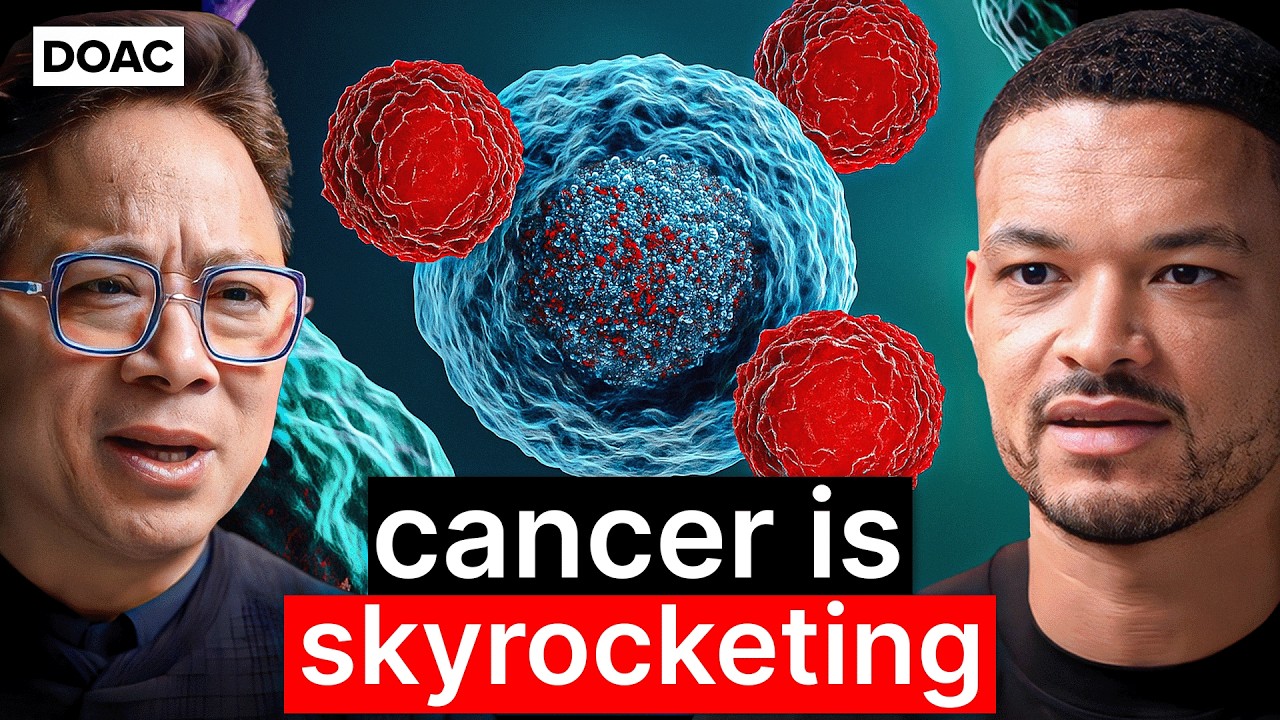
Dr. William Li Identifies 200 Foods That Block Cancer Blood Supply
The Diary Of A CEO
Everyday foods containing natural bioactives can starve microscopic tumors and reduce chronic disease risks by regulating blood vessel growth and protecting internal health defenses.
## Background
This episode was published on YouTube by The Diary Of A CEO, hosted by Steven Bartlett, on May 19, 2025. Featuring world-renowned medical scientist Dr. William Li, the conversation focuses on how daily diet and common foods impact cancer cells, metabolic disease, biological aging, and overall health.
## TL;DR
Dr. William Li explains how everyday dietary choices directly influence internal defense mechanisms like angiogenesis, the microbiome, and immune surveillance to either fuel or prevent chronic illnesses like cancer and Alzheimer's. The discussion explores the risks of added sugars, ultra-processed foods, excess sodium, and microplastics, while highlighting the therapeutic power of whole foods like green tea, matcha, coffee, and leafy greens. Dr. Li emphasizes a sustainable 'MediterrAsian' dietary approach and practical lifestyle habits to optimize healthspan and lower disease risk.
## Atmosphere & style
The dialogue is deeply informative, serious, and grounded in rigorous medical science, yet remains warmly accessible and empowering. Dr. Li communicates with calm, authoritative clarity, using vivid analogies to turn complex biological processes into engaging, actionable insights. The interaction feels like an intimate masterclass, blending urgent health warnings about modern environmental toxins with a hopeful message about the healing potential of food.
## Key takeaways
- [00:00](https://www.youtube.com/watch?v=LgsJ3V9pIG0&t=0s) Over 200 common foods contain bioactives that can starve cancer cells and target cancer stem cells by regulating angiogenesis.
- [07:56](https://www.youtube.com/watch?v=LgsJ3V9pIG0&t=476s) Microscopic cancers form continuously in the human body, but internal health defenses like blood vessel regulation and immune surveillance keep them from growing into clinical tumors.
- [15:59](https://www.youtube.com/watch?v=LgsJ3V9pIG0&t=959s) Ultra-processed foods, added sugars, and chronic stress weaken internal health defenses, creating a permissive environment for microscopic cancers to acquire blood supply.
- [17:46](https://www.youtube.com/watch?v=LgsJ3V9pIG0&t=1066s) Excess dietary sodium accelerates cellular aging and compromises the angiogenesis system, leading to hypertension and circulatory inflammation.
- [26:19](https://www.youtube.com/watch?v=LgsJ3V9pIG0&t=1579s) Deep sleep activates the brain's glymphatic system to clear cognitive toxins and provides a fasting window that lowers insulin levels to promote fat burning.
- [29:50](https://www.youtube.com/watch?v=LgsJ3V9pIG0&t=1790s) Early-onset cancer rates among young people have increased significantly, likely driven by environmental toxin exposure combined with compromised health defenses.
- [32:42](https://www.youtube.com/watch?v=LgsJ3V9pIG0&t=1962s) Microplastics embed directly within human organs and tissues, causing widespread inflammation and significantly increasing the risk of cardiovascular events.
- [37:05](https://www.youtube.com/watch?v=LgsJ3V9pIG0&t=2225s) Plastic tea bags release billions of microplastics when heated, whereas loose tea brewed from whole leaves provides protective polyphenols without synthetic contamination.
- [40:06](https://www.youtube.com/watch?v=LgsJ3V9pIG0&t=2406s) Earl Grey tea and matcha offer exceptional health benefits, with matcha polyphenols and purple potato anthocyanins shown in lab research to target cancer stem cells.
- [45:59](https://www.youtube.com/watch?v=LgsJ3V9pIG0&t=2759s) The World Health Organization classifies processed meats as known carcinogens directly linked to bowel cancer.
- [51:53](https://www.youtube.com/watch?v=LgsJ3V9pIG0&t=3113s) In laboratory studies, food extracts from onions, garlic, green tea, soy, and grapes blocked tumor angiogenesis as effectively as synthetic cancer drugs.
- [01:51:56](https://www.youtube.com/watch?v=LgsJ3V9pIG0&t=6716s) Alzheimer's disease involves defective, disordered angiogenesis that produces dysfunctional blood vessels, which secrete neurotoxins and amyloid plaque precursors.
- [01:54:05](https://www.youtube.com/watch?v=LgsJ3V9pIG0&t=6845s) Specific gut microbes like Akkermansia muciniphila and Lactobacillus reuteri play a key role in metabolic health, systemic inflammation, and brain function.
- [01:57:05](https://www.youtube.com/watch?v=LgsJ3V9pIG0&t=7025s) A 'MediterrAsian' diet rich in functional whole foods—such as tea, coffee, tree nuts, tomatoes, berries, and leafy greens—offers a sustainable strategy for disease prevention.
## Detailed walkthrough
### [00:00](https://www.youtube.com/watch?v=LgsJ3V9pIG0&t=0s) Introduction and the End of Cancer
Dr. William Li, a Harvard-trained physician and medical scientist, opens the conversation with a bold, transformative perspective on chronic disease and modern oncology. He shares that after witnessing patients transition from stage four cancer—traditionally considered a terminal sentence—down to stage zero, he has seen where the end of cancer is coming from and how the war against it will ultimately be won. Dr. Li explains that human bodies are subject to roughly 10,000 DNA copying errors every 24 hours, each effectively acting as a microscopic cancer. However, we do not constantly develop clinical disease because our bodies are hardwired with sophisticated internal health defense systems.
The core challenge facing society today stems from the long-term fallout of industrialization—in our food supply, healthcare systems, and environment—originating in the 1950s, 60s, and 70s. For instance, environmental contamination has reached a point where the average person may ingest up to a credit card’s worth of plastic every single week. While ultra-processed diets and environmental toxins actively lower our health defenses, Dr. Li’s research reveals that we can deliberately raise our shields. In laboratory experiments aimed at discovering new oncology drugs, his team replaced half of the test candidates with common foods. The results were jaw-dropping: mother nature beat the pharmaceutical industry to the punch by providing over 200 foods capable of starving cancer cells and targeting the elusive "holy grail" of oncology—cancer stem cells.
- **DNA Mutation Rate:** The human body experiences approximately 10,000 uncorrected DNA replication errors every 24 hours.
- **Microplastic Ingestion:** Current estimates suggest people consume up to a credit card's weight in microplastics per week.
- **Dietary Cancer Defenses:** Dr. Li’s research has identified over 200 foods that actively starve cancers and target cancer stem cells.
---
[02:17](https://www.youtube.com/watch?v=LgsJ3V9pIG0&t=137s) What Listeners Will Gain from This Conversation
Addressing anyone tuning into the discussion, Dr. Li promises a fundamental shift in how they view food, healthcare, and daily decision-making. Rather than viewing diet through a restrictive or purely aesthetic lens, listeners will learn actionable, science-backed steps that can be implemented immediately to stave off chronic disease, optimize daily physical resilience, and extend healthy lifespan. He emphasizes that transforming health does not require a single radical overhaul, but rather a series of informed choices that build long-term vitality.
---
[03:03](https://www.youtube.com/watch?v=LgsJ3V9pIG0&t=183s) Major Chronic Diseases Correlated with Diet
When discussing the leading global health crises in developed nations, Dr. Li highlights cardiovascular disease as the primary killer, closely followed by type 2 diabetes and its vast web of downstream metabolic complications. Uncontrolled blood sugar is not merely an isolated insulin problem; it triggers widespread "metabolic chaos" that causes microvascular damage leading to vision loss, non-healing wounds, and systemic organ stress.
Beyond diabetes and heart disease, cancer and neurodegenerative disorders such as dementia represent massive burdens as global populations age. Dr. Li confirms the scientific validity of the phrase "inflammation is the root cause of chronic disease," pointing out that chronic, low-grade inflammatory conditions drastically strip away quality of life long before they cause death. He urges a shift in medical focus from merely preventing mortality to eliminating "morbidity"—ensuring that people do not just live long, but live well.
> "It's not just about mortality, it's about morbidity. It's not just about living long, it's about living well and feeling good along the way."
---
[04:24](https://www.youtube.com/watch?v=LgsJ3V9pIG0&t=264s) The Current State of Health, Food, and Modern Society
Steven notes a puzzling paradox in modern society: despite having more health data, medical technology, and scientific information at our fingertips than ever before, objective public health metrics show stagnating life expectancies and rising rates of chronic conditions like diabetes and cancer. Dr. Li breaks this down from a "30,000-foot view," identifying two powerful, opposing forces currently at play in the Western world.
On one hand, society is suffering the cumulative, multi-generational impact of decisions made decades ago. The mass industrialization of agriculture, the widespread introduction of ultra-processed convenience foods, chemical exposures, and systemic environmental degradation take 20 to 50 years to fully manifest in human populations. We are currently living through the biological fallout of these mid-20th-century shifts. On the other hand, a countervailing force is emerging: unprecedented scientific capability to probe human biology, understand cellular mechanisms, and discover how the body naturally heals itself.
- **The Industrialization Lag:** The lag between environmental/dietary degradation (1950s–1970s) and peak chronic disease expression is roughly 20 to 50 years.
- **Immune System Potential:** Breakthroughs show that activating the body's native immune response is more potent than pharmaceutical intervention alone.
- **Remission Milestones:** Over a dozen of Dr. Li's own patients, alongside hundreds in clinical trials, have moved from stage four "game over" cancer diagnoses down to stage zero.
---
[07:56](https://www.youtube.com/watch?v=LgsJ3V9pIG0&t=476s) How Cancer Works in the Human Body
Addressing the common fear that cancer is a completely random game of "roulette," Dr. Li reframes the disease entirely: microscopic cancers are forming in our bodies constantly, almost like "pimples." The human body consists of roughly 40 trillion cells, each containing a complex strand of DNA. To maintain life, these cells must continually divide and copy their genetic code.
Dr. Li uses a vivid typing analogy: if a person is asked to copy a single sentence 10 times, it will be flawless. If asked to copy it 1,000 times, a few typos will creep in despite spellcheck. If required to copy it 40 trillion times, the sheer volume guarantees that thousands of mistakes will slip past the system. In the human body, uncorrected errors become mutations, and every mutation carries the potential to become a microscopic tumor.
Instead of asking "Why did I get cancer?", Dr. Li asks the deeper scientific question: "Given the millions of daily mutations, why don't we all get cancer as children?" The answer lies in our hardwired "swashbuckling" health defense systems—specifically immune surveillance and blood vessel regulation—which act like police cruisers patrolling a neighborhood, quietly arresting mutated cells before they can multiply into clinical tumors.
```
40 Trillion Body Cells ──► Daily DNA Copying ──► ~10,000 Uncaught Mutations/Day
│
▼
Microscopic Cancers Form
│
┌─────────────────────────────────────────┴─────────────────────────────────────────┐
▼ ▼
Health Defenses Active (Normal) Health Defenses Compromised
- Immune system destroys rogue cells - Cancers multiply to 1B cells (1 cm)
- Angiogenesis control cuts off blood supply - Cancers hijack blood vessels to grow
```
- **Cellular Scale:** The human body contains ~40 trillion cells, vastly outnumbering the visible stars in a clear night sky.
- **Clinical Detection Threshold:** The smallest breast cancer tumor palpable by a trained hand is 1 centimeter in diameter, which already contains roughly **1 billion** cancer cells.
- **Angiogenic Explosion:** A 1-cm tumor requires approximately **100 million** blood vessels to sustain it. In laboratory settings, when a single blood vessel connects to a microscopic tumor, the tumor can grow **16,000 times** in size in just 2 weeks.
---
[14:40](https://www.youtube.com/watch?v=LgsJ3V9pIG0&t=880s) How to Lower Your Risk of Cancer
Because cancer cells rely on specific biological mechanisms to expand from microscopic clusters into dangerous tumors, supporting the body's internal defenses significantly lowers overall risk. Dr. Li outlines two primary defense pillars that can be optimized through daily diet and lifestyle choices: boosting immune surveillance and regulating blood vessel growth (angiogenesis).
By consuming immune-enhancing foods and staying physically active, an individual equips their white blood cells to hunt down and eliminate mutated cells before they reach the critical mass required to form a detectable lump. Simultaneously, consuming "anti-angiogenic" foods prevents rogue tumor cells from hijacking the body's vascular network. Daily staples such as coffee and green or black tea contain natural bioactive compounds that block excess vessel growth, effectively starving potential tumors long before they pose a medical threat.
- **Dual-Action Defense:** Effective cancer prevention requires both immune system amplification (cell destruction) and anti-angiogenesis (starving blood supply).
- **Dietary Anti-Angiogenesis:** Common everyday beverages like tea and coffee contain bioactives that inhibit tumor vascularization.
---
[15:59](https://www.youtube.com/watch?v=LgsJ3V9pIG0&t=959s) Foods That Fuel Cancer and Lower Defenses
In response to Steven's query about whether the inverse is true—that certain foods actively dismantle defenses and accelerate disease—Dr. Li agrees completely. Just as specific natural compounds act as "shields up" by strengthening immunity and suppressing dangerous blood vessel expansion, poor dietary choices act as "shields down." Consuming inflammatory, highly processed foods turns off the body's internal smoke alarms, unlatches the biological front door, and creates a permissive environment for microscopic cancers to acquire a dedicated blood supply and thrive.
[16:36](https://www.youtube.com/watch?v=LgsJ3V9pIG0&t=996s) Fast Food and Lowering Your Health Defenses
Steven guesses that a meat burger might be the culprit behind chronic disease. Dr. William Li explains that the reality is nuanced: "eating meat, eating burgers, even eating ultra-processed foods once in a while is not going to harm you if your health defenses are naturally strong." However, making it a regular habit at the expense of healthier, plant-based, and less processed options will tip the odds in favor of disease. Overeating fast foods acts as a catalyst that forces your health shields down.
[17:46](https://www.youtube.com/watch?v=LgsJ3V9pIG0&t=1066s) The Accelerated Aging of Excess Sodium
Dr. Li targets excess sodium as a massive driver of chronic wear and tear. Because restaurant patrons love salty food, commercial kitchens season meals heavily to satisfy the brain's strong response to salt. This high sodium exposure directly accelerates cellular aging and compromises the body's angiogenesis system, which regulates blood vessel growth and circulation.
When Steven asks if the growing trend of consuming hydration and electrolyte supplements poses a risk, Dr. Li clarifies that a healthy body has a robust filtration system. If you drink an electrolyte-fortified beverage, your body absorbs what it needs and eliminates the rest through urine. The true risk comes from dietary sodium, which is hidden in almost every daily meal.
- High sodium levels cause hypertension (high blood pressure).
- Excess salt causes inflammation in the lining of the circulatory system.
- The human body possesses a natural titration system to balance liquid electrolytes.
[19:36](https://www.youtube.com/watch?v=LgsJ3V9pIG0&t=1176s) Added Sugar, Insulin Resistance, and Alcohol Toxins
High blood sugar causes parallel damage to your circulation. Dr. Li openly rejects popular fear-mongering marketing terminology like "glucose spikes" and "glucose crashes." In a healthy body, metabolism operates on gentle slopes and smooth fluctuations, which is entirely normal. The danger arises with a sustained uphill climb in blood glucose caused by overconsuming added sugars and ultra-processed foods.
When sugar intake continuously climbs, the metabolism is forced to chase the blood sugar down by working harder to produce more insulin. Eventually, this overexertion wears out the system, resulting in high blood glucose, an insensitive metabolism, and a domino effect of systemic failure. Dr. Li notes that sugar from fruit does not pose this risk because nobody consumes an unnatural, excessive volume of whole fruit.
Turning to alcohol, Dr. Li addresses the common belief that red wine is inherently healthy. While the bioactives, resveratrol, and polyphenols derived from red grape skins possess healthful properties, "it's never the alcohol." Alcohol is a universal toxin that is destructive to the brain, liver, and heart. Dr. Li uses a metaphor to describe occasional drinking:
> "A drink is sort of like driving behind a truck and it flings a little pebble right into your windshield. You might get a little spider in the windshield. Okay, don't worry. It'll repair itself... But if you keep on drinking, you're actually going to smash your windshield."
[22:32](https://www.youtube.com/watch?v=LgsJ3V9pIG0&t=1352s) The Dual Nature of Stress on Immune Health
Beyond dietary factors, chronic stress compromises your body's five core health defenses. Unabated stress lowers the immune system, leaving the body vulnerable to microscopic cancers that are trying to establish a foothold. It elevates blood pressure and triggers the brain and adrenal glands to release hormones that degrade circulatory health. Stress even introduces critical errors when DNA attempts to copy and paste its sequences.
Dr. Li makes a clear distinction between chronic stress and acute grit. A little stress is actually beneficial. Living in a completely insulated, coddled bubble causes the body's systems to get lackadaisical. Hardworking, successful individuals utilize a healthy amount of short-term stress to keep their minds sharp and stay "on." However, when stress is continuous and unchecked, it completely sinks your health defenses.
Steven validates this with a personal observation from 13 years of running businesses. He notes that he rarely gets sick because he eats clean and sleeps well. Yet, with perfect predictability, if he experiences two consecutive weeks of enduring, chronic angst, he will fall severely ill exactly one week after the stressful period ends.
[26:19](https://www.youtube.com/watch?v=LgsJ3V9pIG0&t=1579s) The Glymphatic System: How Deep Sleep Cleanses the Brain
Dr. Li explains that Steven's post-stress sickness is tied directly to sleep disruption. Sleep is not merely a passive state of muscular rest; it is an active 7 to 9-hour window where health defenses are systematically repaired, renewed, and rebooted. During deep sleep, the brain utilizes a specialized waste management network called the glymphatic system.
This glymphatic network functions like a hidden sewer system underneath the brain. During the daytime when the brain is actively working, these literal grates are shut tightly, causing cognitive metabolic toxins to naturally accumulate. At the end of a grueling day, this buildup creates a feeling of a "full brain" or a mild tension headache.
When you enter deep REM dream sleep, the grates of the glymphatic system open up to flush these accumulated toxins away. When chronic stress disrupts deep sleep, these toxins fail to drain, resulting in persistent brain fog. This cognitive fatigue creates a cascade effect, leading to poor decision-making, skipped workouts, and impulsive dietary choices.
[28:09](https://www.youtube.com/watch?v=LgsJ3V9pIG0&t=1689s) Nighttime Fat Burning and the Car Analogy
Deep sleep is also a critical driver of fat metabolism. Dr. Li compares the human body to a high-performance sports car, like a Ferrari. During the day, the body is in a driving gear, revving its engines to accumulate speed and fuel. At night, when food intake stops, insulin levels naturally drop. This hormonal shift prompts the body to change gears from accumulating fuel to burning down stored fat.
When individuals experience chronic stress and poor sleep—often compounded by late-night alcohol use—the body is robbed of this fat-burning window. Fuel accumulates as fat, systemic inflammation rises, and the body's defenses are left completely compromised.
[29:50](https://www.youtube.com/watch?v=LgsJ3V9pIG0&t=1790s) The Alarming Global Rise of Early-Onset Cancer
Steven introduces alarming global health statistics, noting that breast cancer is the most searched cancer topic on Google. According to data from the NHS, one in two people will develop some form of cancer during their lifetime, making it the second leading cause of death worldwide. Most shockingly, global early-onset cancer incidence rose by roughly 80% between 1990 and 2019.
A recent article titled *"The Worrying Puzzle Behind the Rise of Early-Onset Cancer"* highlights a sharp increase in breast, colorectal, and other cancers among young people in their 20s, 30s, and 40s. Over the last decade, colorectal cancer among 25 to 49-year-olds has surged across 24 different countries, including the UK, US, France, Australia, Canada, Norway, and Argentina.
Dr. Li affirms that this shift is deeply troubling. When he was in medical school, colorectal cancer was an ailment reserved almost exclusively for older populations; seeing it manifest in teenagers today was once completely unfathomable. Because the fundamental genetic makeup of humanity has not changed in a few decades, Dr. Li attributes this crisis to a parallel assault: young people are simultaneously being exposed to harsher environmental toxins while their baseline health defenses are being systematically dismantled. He points to climate change and broader environmental shifts as critical pieces of this modern puzzle.
[32:42](https://www.youtube.com/watch?v=LgsJ3V9pIG0&t=1962s) Microplastics in Our Bodies
The discussion shifts to a less obvious environmental hazard that has only gained scientific clarity in recent years: the ingestion of inflammatory microplastics. Reflecting on past generations, storing leftovers in plastic, using Styrofoam, drinking from disposable cups, and eating off plastic plates at picnics were standard, unexamined behaviors across the modern world. Today, medical science recognizes that plastic packaging and containers release microparticles directly into food and drink. While small plastic shedding was acknowledged over a decade ago with an assumption of zero harm, recent findings present a far more troubling reality: these microparticles embed themselves inside human organs, trigger significant inflammation, and enter the body in staggering volumes.
Recent autopsy research on individuals who passed away from non-neurological causes revealed that the average human brain contains roughly a plastic spoon’s worth of microplastics distributed throughout its tissue. While some extreme estimates—such as consuming a credit card’s worth of plastic weekly—remain mathematically debated, the presence of microplastics across human anatomy is undisputed:
- **Cardiovascular System:** An Italian study examining men with carotid artery narrowing discovered physical fragments of plastic embedded within the blood vessel linings. Over longitudinal follow-ups, men with plastic in their carotid plaque exhibited a 400% (fourfold) increase in fatal heart attacks or strokes compared to those without.
- **Reproductive and Developmental Systems:** Microplastics have been identified in breast milk, testicles, and human semen.
- **Surgical Observations:** Urologists performing penile surgeries who routinely examine tissue under microscopes now consistently observe microplastics embedded directly within human flesh.
While Dr. Li clarifies that he is not attributing the entire rise in global cancer rates solely to microplastics, he emphasizes that the medical community is urgently awakening to their systemic inflammatory threat.
---
[37:05](https://www.youtube.com/watch?v=LgsJ3V9pIG0&t=2225s) Practical Strategies to Lower Microplastic Exposure
Reducing daily microplastic intake does not require complex interventions, but rather simple home habits. The primary directive is to eliminate single-use plastic cups, plastic plates, and plastic utensils from the kitchen, replacing them with ceramic, glass, or stainless steel options. Additionally, consumers should minimize buying foods wrapped or sealed in heavy plastic packaging.
A major, often overlooked source of microplastic contamination is tea bags. Research from McGill University (noted in discussion via Montreal studies) demonstrated that a single plastic-mesh or reinforced paper tea bag can shed over one billion microplastic particles directly into hot water.
- **Why Tea Bags Shed:** While tea bags appear to be simple paper, manufacturers frequently coat or weave them with synthetic plastic polymers to maintain structural integrity and prevent tearing when submerged in boiling liquid.
- **Flavored and Processed Teas:** Beyond the bag itself, commercial herbal teas (such as pre-packaged lemon-ginger blends) often rely on synthetic flavorings processed in factories. Consumers are advised to review ingredient labels closely or prepare fresh versions manually by steeping loose leaves and adding natural lemon slices and raw ginger root.
---
[40:06](https://www.youtube.com/watch?v=LgsJ3V9pIG0&t=2406s) The Health Benefits of Tea: Earl Grey vs. Green Tea
Comparing popular beverages reveals surprising nuances in how different teas support human defense systems. Green tea is widely celebrated for its rich polyphenol profile, which combats inflammation, boosts metabolism, supports cardiovascular health, and reduces overall cancer risk. However, surprising comparative research reveals that green tea isn't the sole standout.
Research conducted at the Angiogenesis Foundation tested various tea types—including Japanese green tea, Chinese jasmine tea, and traditional English breakfast brews—to evaluate their capacity to support angiogenesis (the formation and maintenance of healthy blood vessel networks). Contrary to the baseline assumption that Japanese green tea would rank highest:
- **Earl Grey Tea:** Earl Grey black tea proved to be the most potent at supporting healthy blood vessel function.
- **The Citrus Synergism:** Earl Grey’s unique potency stems from its composition: it is a fermented black tea infused with bergamot, a Mediterranean citrus fruit. The combination of black tea polyphenols and natural bergamot compounds creates a synergistic health impact.
---
[41:22](https://www.youtube.com/watch?v=LgsJ3V9pIG0&t=2482s) Matcha: Polyphenol Density and Cancer Stem Cells
Matcha stands out from standard green tea due to its unique agricultural cultivation and processing. Unlike traditional tea leaves that are steeped and discarded, matcha leaves are grown under shade covers during the final weeks before harvest. This shade treatment alters the plant’s chemical structure, boosting polyphenol concentration. The stem and veins are removed, and the remaining whole leaf is ground into a fine powder.
Because the entire leaf powder is consumed directly in liquid, matcha yields distinct physiological benefits:
- **100% Polyphenol Delivery:** Drinkers ingest the entire polyphenol content rather than only what steeps out into hot water.
- **Microbiome and Fiber:** Matcha provides dietary fiber, benefiting gut microbiome health, metabolic regulation, and anti-inflammatory pathways.
- **Elimination of Cancer Stem Cells:** Laboratory research demonstrates that matcha’s concentrated polyphenols can selectively target and kill breast cancer stem cells. Stem cells within tumors are responsible for disease recurrence; eliminating them helps prevent relapse.
- **Parallel Dietary Defenses:** Purple potatoes contain high levels of anthocyanins, which laboratory studies at Penn State University showed can kill colon cancer stem cells.
The popularity of matcha has skyrocketed in recent years. Dr. Li highlights its broad systemic benefits, noting how his own great-uncle lived to 104 years old with full cognitive and physical independence. He attributed his longevity to drinking up to 10 cups of fresh, organically grown green tea daily at the foot of a mountain tea garden, paired with strong social bonds and low-stress living.
---
[45:59](https://www.youtube.com/watch?v=LgsJ3V9pIG0&t=2759s) Colorectal Cancer, Processed Meats, and the Digestive System
Addressing the alarming rise of colorectal cancer among younger demographics requires understanding basic gastrointestinal anatomy and dietary exposures. The human gut spans roughly 40 feet from the mouth down through the esophagus, stomach, small intestine, large intestine (colon), rectum, and anus:
- **Small Intestine:** The densely coiled central segment of the digestive tract responsible for primary nutrient absorption.
- **Large Intestine (Colon):** A thick, horseshoe-shaped organ framing the small intestine. It begins at the lower right abdomen with the ascending colon, travels horizontally across the belly via the transverse colon, descends along the left side via the descending colon, and curves into the rectum.
Colorectal cancers typically develop along the ascending or descending walls of the colon. The World Health Organization (WHO) classifies processed meats—such as salami, bologna, hot dogs, and ultra-processed deli meats—as known carcinogens directly linked to bowel cancer:
- **Mechanism of Harm:** Regular, high-volume consumption of processed meats subjects the lining of the colon to continuous exposure to chemical carcinogens and digestive byproducts. While an occasional hot dog at a sporting event poses minimal threat, daily intake significantly elevates disease risk over time.
[49:16](https://www.youtube.com/watch?v=LgsJ3V9pIG0&t=2956s) How Angiogenesis Works and the Goldilocks Zone of Health Defenses
Dr. William Li breaks down the word **angiogenesis** into its core roots—*angio* meaning blood vessel, and *genesis* meaning growth or creation. He highlights that our circulatory system is actually one of the body's primary health defense systems, featuring an astounding 60,000 miles of blood vessels packed inside a single adult body. These vessels act as internal superhighways delivering oxygen and essential nutrients to every cell. However, if you consume toxic foods or inhale harmful substances, those same highways deliver those negative inputs straight to your organs.
```
60,000 MILES OF BLOOD VESSELS
[Highways & Byways Delivering Oxygen and Nutrients Body-Wide]
|
+----------------+----------------+
| |
Healthy Flow State Damaged Lining State
(Endothelial "Ice Rink" Smooth) (Scraped Ice / Plaque Build-up)
| |
- Optimal circulation - Excess salt / Hypertension
- Precise Goldilocks control - Debris catches & narrows walls
- Prevents blood to tumors - Risk of joint, eye, or cancer growth
```
Dr. Li compares the inner lining of blood vessels—the **endothelial layer**—to a smooth sheet of ice on a hockey rink or a layer of clear plastic wrap. When conditions like hypertension (from high salt intake) or diabetes wear down this smooth surface, it acts like rough, scraped-up ice. Blood components begin catching along the vessel walls and building up, leading to cardiovascular narrowing. Under healthy conditions, the angiogenesis system operates under strict control to maintain the "Goldilocks zone"—providing just the right amount of blood supply, neither too much nor too little.
- **Vascular Length:** A typical adult body contains approximately **60,000 miles** of blood vessels.
- **Endothelial Function:** Functions like a frictionless ice rink to ensure smooth blood flow; damage to this lining accelerates cardiovascular disease.
- **The "Goldilocks Zone":** The body naturally regulates angiogenesis so that blood vessels do not overgrow into places they shouldn't—such as joints, eyes, or growing tumors.
---
[51:53](https://www.youtube.com/watch?v=LgsJ3V9pIG0&t=3113s) The Subversive Experiment: Proving "Food as Medicine" Against Cancer
Holding up a bar graph that his organization generated, Dr. Li reveals the pivotal experiment that fundamentally changed his career trajectory. Early in his research, his team was screening synthetic pharmaceutical compounds for biotech companies and academic professors, searching for anti-angiogenic candidate drugs that could starve tumors by cutting off their blood supply.
In a moment of self-described disruption, Dr. Li did something "subversive": he swapped out half of the drug testing wells in the lab setup for natural food extracts. When they ran the comparative screens, the results left his jaw on the floor. Bioactive compounds extracted from everyday foods—such as **green tea, onions, garlic, red grapes, soy, artichokes, parsley, and strawberries**—were cutting off blood vessel growth to tumors with potencies that rivaled pharmaceutical cancer drugs. This proved to him that food possesses real biological potency without the massive costs, long development timelines (a decade and over a billion dollars per drug), or heavy toxicities of traditional pharmaceuticals.
- **The Discovery:** Laboratory assays proved dietary elements actively block tumor-directed angiogenesis just as effectively as synthetic targeted drugs.
- **Key Anti-Angiogenic Foods:** Green tea, garlic, onions, red grapes, soy extract, artichokes, parsley, and strawberries.
- **Safety Profile:** Unlike pharmaceutical interventions, dietary anti-angiogenic factors operate naturally without systemic toxicity or starving healthy tissues.
- **Dual-Action Foods:** Certain foods like fruit peels, barley, and dark chocolate can selectively prune harmful blood vessels while encouraging new healthy blood vessel growth where needed.
> "I was a skeptic... foods have potency just like drugs. A drug takes a decade and a billion or more dollars to be able to develop... but a food has immediacy."
---
[58:40](https://www.youtube.com/watch?v=LgsJ3V9pIG0&t=3520s) Personal Story: Immunotherapy, Diet, and a Stage Four Victory
Sharing a deeply personal narrative, Dr. Li reflects on the emotional pain of losing two uncles years ago—one to colon cancer and the other to liver cancer. Despite being a trained physician doing cutting-edge research, he felt completely "powerless" at their bedsides because medical science had not yet advanced.
Years later, his own 80-year-old mother was diagnosed with endometrial cancer (cancer of the uterine lining). Following a hysterectomy and radiation, microscopic cancer stem cells escaped and spread aggressively throughout her body. Within months, her oncologist delivered the devastating news that she had stage four cancer throughout her body, calling it "game over." Refusing to give up, Dr. Li enrolled her in early clinical trials for **immunotherapy**—a treatment designed to re-awaken the body's own immune system rather than poisoning cells with chemotherapy.
Alongside three rounds of immunotherapy administered three weeks apart, Dr. Li aggressively restructured her diet to keep her internal health defenses maxed out. Within nine weeks, a follow-up scan revealed her stage four cancer had dropped to **stage zero**. Over a decade later at age 91, she remains completely healthy and cancer-free.
- **Immunotherapy vs. Chemotherapy:** Immunotherapy does not poison cells; it trains and unleashes the patient's native immune system to target cancer cells.
- **Combined Approach:** Coupling immunotherapy with a defense-boosting diet and targeted low-dose radiation helped her immune system pinpoint and eliminate systemic metastases.
- **Clinical Outcome:** Stage four endometrial cancer was reduced to stage zero after just three cycles of treatment over nine weeks.
> "Her oncologist told me... 'Dr. Li, you know this is serious and this is pretty much the time of game over.'... Three treatments of immunotherapy... stage four went to stage zero."
---
[01:02:28](https://www.youtube.com/watch?v=LgsJ3V9pIG0&t=3748s) The Future of Cancer Therapy: AI and Personal Genomic Targeting
Looking toward the horizon of oncology, Dr. Li describes revolutionary work being conducted alongside colleagues in Germany that pairs full-genome sequencing with artificial intelligence. Currently, when a patient gets a biopsy, the tissue is simply diagnosed under a microscope and matched to generic treatment guidelines that often fail over time.
Dr. Li's team advocates for sequencing the entire genome of the tumor—analyzing all **20,000 to 30,000 genes** to identify every mutation and typographical error—while simultaneously sequencing a sample of the patient's normal blood cells. By feeding both massive genomic datasets into machine learning models, the AI rapidly subtracts the patient's baseline variations, isolating the exact few hundred "smoking gun" mutations driving that specific cancer. Referencing the futuristic interface from the movie *Minority Report*, Dr. Li envisions a near future where doctors can visually manipulate a patient's precise mutational landscape to design hyper-personalized targeted therapies and custom vaccines.
- **Full Cancer Sequencing:** Moving beyond testing a few dozen genes to mapping all 20,000–30,000 genes in both tumor tissue and normal tissue.
- **AI Mutational Filtering:** Machine learning algorithms perform complex subtraction to isolate the specific "smoking gun" mutations causing the malignancy.
- **Precision Oncology:** Paves the way for customized cancer vaccines and treatments tailored to an individual's unique genetic fingerprint rather than standardized "recipe book" protocols.
<ElicitationsGroup message="Explore related insights from Dr. William Li's research:">
<Elicitation label="Explain how microplastics impact immune health" query="What are the hidden health risks of microplastics in our diet and body according to Dr. William Li?"/>
<Elicitation label="Detail the gut microbiome's role in cancer defense" query="How does specific gut bacteria influence cancer treatment and immune response according to Dr. William Li?"/>
</ElicitationsGroup>
[01:05:42](https://www.youtube.com/watch?v=LgsJ3V9pIG0&t=3942s) Personalized Peptide Vaccines and Breakthroughs in Glioblastoma
Dr. William Li details the cutting-edge frontier of personalized cancer immunotherapies, illustrating the process through an intuitive metaphor. Imagine looking at a patient's tumor sequencing data on a glass screen, identifying its top 20 distinct mutations—the "smoking guns"—and linking them together like a pearl necklace. Using modern biotechnology, scientists can print these tumor-specific mutations out as a unique protein vaccine and inject it under the skin. This "challenges" and trains the patient's own immune system to recognize the unique markers of their specific cancer and aggressively hunt down the tumor cells.
Dr. Li highlights real-world progress from his colleague, Dr. Saskia Biskup, whose team developed peptide vaccines targeting glioblastoma—a historically fatal brain cancer with typical survival measured in just a few years. In a study of over 100 patients published in *Nature Communications*, this personalized approach successfully awakened patients' immune systems, keeping some completely cancer-free. To offer tangible inspiration, Dr. Li points to Rebecca Devine (known on social media as "That Brainy Blonde"), an ambassador for the Angiogenesis Foundation who has thrived for seven years following her glioblastoma diagnosis thanks to immunotherapy. While these clinical breakthroughs demonstrate the immense power of waking up the body's defenses, Dr. Li emphasizes that medical treatments work best when supported by lifestyle and dietary choices at home.
* A personalized cancer vaccine sequences a patient's unique tumor to isolate approximately 20 specific mutations.
* Printed synthetic proteins are injected sub-cutaneously to act as a custom "most wanted" poster for the host immune system.
* Dr. Saskia Biskup's peptide vaccine trial for glioblastoma was published in *Nature Communications* with over 100 participants.
* Glioblastoma traditionally carries a severe prognosis where patients rarely survive beyond a couple of years.
* Rebecca Devine (@ThatBrainyBlonde) serves as a living example of long-term glioblastoma survival (7+ years) utilizing immunotherapy.
---
[01:08:51](https://www.youtube.com/watch?v=LgsJ3V9pIG0&t=4131s) The Gut Microbiome: *Akkermansia muciniphila* and Immunotherapy Success
Reflecting on a pivotal 2017 cancer conference in Paris titled "Rethinking Cancer," Dr. Li shares breakthrough findings presented by French immuno-oncologist Dr. Laurence Zitvogel of the Institut Gustave Roussy. When examining why some cancer patients respond dramatically to checkpoint inhibitor immunotherapies while others do not, researchers controlled for age, gender, comorbidities, and genetic factors. The single defining differentiator between responders who survived and non-responders who succumbed to disease was the presence of a single gut bacterium: *Akkermansia muciniphila*.
*Akkermansia* resides primarily in the protective mucus layer of the cecum—the pouch located at the beginning of the large intestine. To validate its crucial role, Dr. Zitvogel transferred *Akkermansia* from human responders into non-responding germ-free mice, effectively restoring their immune system's ability to attack tumors. While targeted *Akkermansia* probiotics exist today, Dr. Li explains that anyone can naturally cultivate and grow their own population of this beneficial microbe through specific foods rich in polyphenols and natural compounds.
* Dr. Laurence Zitvogel's landmark 100-patient study was first presented at the 2017 "Rethinking Cancer" conference in Paris.
* *Akkermansia muciniphila* resides in the cecum, located at the entry point of the colon.
* Fecal microbiota transfers of *Akkermansia* from human responders into non-responding mice successfully unblocked anti-tumor immune responses.
* Key foods that feed and grow *Akkermansia* naturally include:
* Pomegranate (juice and seeds)
* Cranberries (juice and dried berries)
* Concord grapes and Concord grape juice
* Chili peppers
* Chinese black vinegar (traditionally served with dim sum soup dumplings)
---
[01:12:53](https://www.youtube.com/watch?v=LgsJ3V9pIG0&t=4373s) Sustainable Diets vs. Short-Term Trends: Lessons from Mediterranean and Blue Zones
When host Steven Bartlett asks about specific dietary approaches like low-carb or ketogenic diets, Dr. Li provides a nuanced view on popular trends. Most fad diets—whether keto, carnivore, or raw food—are restrictive protocols engineered to force short-term metabolic outcomes. Because they are difficult to sustain amidst social life and everyday food culture, people inevitably abandon them. In Dr. Li's view, an unsustainable diet fails to offer a long-term health solution.
> "Listen, you can't—don't con me. You can't be enjoying eating raw food your entire life, navigating through society and seeing other people eat a big steaming plate of pasta... What I prefer, and where I think the science takes us... is tearing a page from the playbook of some of the healthiest cuisines in the world."
Instead of extreme restriction, Dr. Li advocates for sustainable, plant-forward eating patterns modeled after global Blue Zones and traditional Mediterranean and Asian cuisines. These traditional culinary patterns emphasize fresh, seasonal whole foods, healthy fats, and flavorful preparation methods that foster lifelong adherence and genuine enjoyment.
* Popular restrictive diets (e.g., pure keto, carnivore, raw food) frequently fail over long horizons due to low sustainability and social friction.
* Long-term health benefits stem from enjoyable, sustainable patterns rather than short bursts of extreme dietary restriction.
* Core elements shared across Mediterranean, Asian, and Latin American Blue Zone diets:
* Plant-forward base
* Fresh, seasonal produce
* Healthy cooking oils (such as extra virgin olive oil)
* Rich culinary traditions that prioritize flavor and variety
---
[01:16:19](https://www.youtube.com/watch?v=LgsJ3V9pIG0&t=4579s) Longevity in Japan: Caloric Moderation and *Hara Hachi Bu*
Addressing data showing Japan consistently ranking at the top for global healthspan and longevity, Dr. Li explains that their success isn't tied to a single magic food, but rather a fundamental cultural habit: avoiding overeating. Excessive caloric intake causes metabolic strain, accelerates cellular aging, and drives systemic inflammation. Traditional Japanese food culture naturally encourages modesty and subtle under-eating.
Dr. Li highlights the cultural phrase *Hara hachi bu*—a Confucian adage embedded in Japanese culture that advises stopping a meal when one feels 80% full. Steven shares an anecdote about his colleague Jack, who appeared visibly lean but received a DEXA scan result indicating he was "over-nourished" and needed to restrict overall calories. Dr. Li uses this example to introduce concepts from his book, *Eat to Beat Your Diet*, explaining that body fat is actually a dynamic endocrine organ designed to act as a fuel tank and a protective cushion for internal organs.
* Overeating and "caloric loading" accelerate cellular aging and elevate systemic inflammation.
* *Hara hachi bu* is a Japanese cultural mantra translated from Confucius, meaning "eat until you are 80% full."
* DEXA scans measure total body composition, including visceral fat, subcutaneous fat, lean muscle mass, and bone density.
* Body fat functions as a vital organ that provides mechanical cushioning and acts as the body's primary energy storage system.
---
[01:20:41](https://www.youtube.com/watch?v=LgsJ3V9pIG0&t=4841s) Fat Types and the Hidden Danger of Internal Visceral Fat
Unlike a car's fuel tank, which automatically stops pumping when full, the human body lacks a mechanical shut-off valve, making it easy to overfill our energy reserves. When we consume more calories than we burn, excess energy is stored as body fat. Dr. Li distinguishes between two primary types of white fat distribution: subcutaneous fat and visceral fat. Subcutaneous fat accumulates right beneath the skin in areas like the chin, thighs, buttocks, and waist ("muffin top").
The far more dangerous form of fat is visceral fat, which accumulates deep inside the body's central trunk or cavity. Using the analogy of a shipping tube packed tightly with foam peanuts around fragile glass items, Dr. Li illustrates how internal fat can wrap tightly around internal organs. Even individuals who look visibly thin on the outside can hide dangerous levels of internal visceral fat, driving inflammation and metabolic dysfunction.
* The human body lacks an automatic "clicker" to prevent over-fueling, making caloric surplus easy to achieve.
* Subcutaneous fat sits directly beneath the skin (e.g., under the chin, arms, thighs, and around the waist).
* Visceral fat accumulates internally within the body cavity, directly surrounding vital organs.
* Visceral fat is highly inflammatory and poses significantly greater health risks than subcutaneous fat.
* A person can appear externally lean (sometimes referred to as "skinny fat" or over-nourished) while storing hazardous amounts of internal visceral fat.
---
<ElicitationsGroup message="What would you like to do next?">
<Elicitation label="Explore the mechanisms of anti-angiogenic foods in cancer prevention" query="Explore how anti-angiogenic foods help prevent cancer growth" query_intent="CLICKABLE_SUGGESTION" />
<Elicitation label="Learn strategies to naturally increase Akkermansia muciniphila" query="List daily dietary habits to boost Akkermansia muciniphila" query_intent="CLICKABLE_SUGGESTION" />
<Elicitation label="Compare the health benefits of Mediterranean vs. Asian diets" query="Compare Mediterranean and traditional Asian diets for longevity" query_intent="CLICKABLE_SUGGESTION" />
</ElicitationsGroup>
Here is a detailed, faithful walkthrough of this section of the video transcript:
[01:21:43](https://www.youtube.com/watch?v=LgsJ3V9pIG0&t=4903s) Skinny Fat, Subcutaneous vs. Visceral Fat, and DEXA Scans
The discussion continues with a visual metaphor describing the concept of being "skinny fat." Regardless of the size of a person's outer frame—the "tube" of their body—overconsuming calories can cause internal fuel tanks to build up inside. An outwardly slim person can still pack a massive amount of hidden visceral fat deep within their torso.
Steven shares a personal story illustrating this contrast. After seeing his podcast co-host Jack's scan results showing high visceral fat, Steven panicked and immediately visited the same clinic, under Dr. Peter Attia, for a DEXA scan. Steven’s scan revealed that he had "zero visceral fat" (a rare result according to Dr. Attia), but he carried more subcutaneous fat (external fat under the skin) than Jack. Jack, conversely, had dangerous internal visceral fat and almost no external subcutaneous fat. Steven expresses confusion over why his body stores excess energy externally, while Jack's stores it inside the body.
Dr. Li explains that all white body fat can be stored either subcutaneously (under the jaw, beneath the arms, or on the thighs) or viscerally (deep inside the abdominal cavity). In contrast, brown fat is a specialized, wafer-thin layer of fat plastered around the neck, behind the breastbone, between the shoulder blades, and in the belly. Unlike white fat, brown fat is metabolically active and triggers thermogenesis to burn off harmful visceral body fat.
- **DEXA Scan Comparisons:** Steven's scan under Dr. Peter Attia showed $0\%$ visceral fat but higher subcutaneous fat; Jack showed high visceral fat with almost no subcutaneous fat.
- **White Fat Locations:** Subcutaneous (under skin, jaw, arms, thighs) and Visceral (deep inside the torso cavity around organs).
- **Brown Fat Locations:** Plastered around the neck, behind the breastbone, between the shoulder blades, and within the abdominal area.
---
[01:24:19](https://www.youtube.com/watch?v=LgsJ3V9pIG0&t=5059s) Brown Fat, Cold Exposure, and Evolutionary History
Dr. Li highlights how brown fat acts as "mother nature’s adaptation" to help animals survive freezing temperatures. Steven hands Dr. Li a visual reference card displaying two thermal images of the same individual. At normal room temperature, no brown fat activity is visible. However, when the surrounding room temperature drops significantly, the individual's brown fat lights up intensely across their upper body.
Dr. Li notes that brown fat was first discovered in hibernating animals when zoologists dissected a hibernating muskrat-like creature and found a brown mass between its shoulder blades. Biologists initially called this unknown mass a *hibernoma* (a hibernating mass). In the 1930s, a researcher at UCLA examined hibernoma tissue under an advanced microscope and discovered it consisted of brown fat cells. The cells are brown because they are packed with mitochondria—the energy generators and "batteries" of the cell. Mitochondria contain high levels of iron, which oxidizes and turns brown much like rusting outdoor iron nails. When activated by cold temperatures or specific foods, brown fat draws energy directly from white visceral fat to burn it away and generate heat. Humans can intentionally activate their brown fat by sleeping in cool rooms or taking cold baths.
- **Hibernoma:** The original term used for brown fat until its cellular structure was identified in the 1930s at UCLA.
- **Why Brown Fat Is Brown:** Packed with iron-rich mitochondria that turn brown when oxidized.
- **Primary Energy Source for Brown Fat:** Draws fuel from white visceral fat first to drive thermogenesis.
- **Activation Methods:** Cold bath exposure, sleeping in cooler rooms, and specific thermogenic foods.
---
[01:27:46](https://www.youtube.com/watch?v=LgsJ3V9pIG0&t=5266s) The Role of Stress and Cortisol in Metabolism
Steven reflects on the lifestyle of his co-host Jack, who works seven days a week, puts in long hours, and travels constantly around the world for studio shoots. Steven wonders if this high-stress environment elevates cortisol and influences where the body chooses to store fat.
Dr. Li characterizes cortisol as a "Swiss Army knife of hormones" and a natural body steroid that snaps people into action, aids healing, and feels beneficial in short bursts. However, relentless, unyielding long-term stress causes chronic cortisol elevation. Because fat tissue functions as an endocrine organ releasing approximately 15 distinct hormones, sustained high cortisol levels derail fat metabolism and disrupt the body's overall hormonal balance.
- **Cortisol Properties:** Functions like a body steroid; highly effective for short-term alertness and healing, but destructive when chronically elevated.
- **Fat as an Endocrine Organ:** Fat tissue naturally secretes roughly 15 different hormones.
---
[01:29:31](https://www.youtube.com/watch?v=LgsJ3V9pIG0&t=5371s) Why Visceral Fat Is Dangerous and Linked to Cancer
Dr. Li uses a packing analogy to explain why visceral fat poses a grave danger to health. The human torso is like a tightly packed travel suitcase containing delicate clothing (the liver, stomach, colon, and small intestines). Visceral fat squeezes into the tight spaces between these organs. When too much visceral fat accumulates, it compresses the organs and eventually outgrows its own blood supply.
When fat outgrows its vascular network, the center becomes hypoxic (starved of oxygen). This oxygen deprivation attracts inflammatory immune cells into the tissue. The inflamed fat begins leaking inflammatory compounds throughout the abdominal cavity, acting like a leaking container of lotion inside a packed suitcase.
This systemic inflammation significantly elevates the risk of malignancy. Dr. Li cites a landmark study conducted by Cornell University that monitored 3,000 normal-sized Swedish women over a 13-year period. By using baseline DEXA scans, researchers tracked women who appeared slim on the outside but had "skinny fat" (excess internal body fat). Over 13 years, normal-weight women with elevated body fat exhibited a **threefold increase** in their risk of developing breast cancer, accompanied by elevated inflammatory markers in their blood. Dr. Li explains that microscopic cancer cells thrive in inflammatory conditions—adding systemic inflammation to a micro-tumor is like "pouring gasoline on the embers of a fire." Visceral fat accumulation is currently linked to an increased risk of at least **14 different cancers**.
- **Mechanism of Fat Inflammation:** Visceral fat expands $\rightarrow$ outgrows blood supply $\rightarrow$ becomes hypoxic $\rightarrow$ attracts inflammatory cells $\rightarrow$ leaks inflammatory signals across organs.
- **Cornell University Study on Swedish Women:**
- Sample size: 3,000 normal-weight/slim women tracked over 13 years using DEXA scans.
- Finding: Women with high internal fat ("skinny fat") experienced a $3\times$ (300%) increase in breast cancer incidence.
- **Cancer Multiplier:** Elevated visceral fat increases the risk for at least 14 distinct cancer types (including colon, ovarian, lung, breast, and prostate cancers).
Steven takes a brief moment to share how he manages his creative process while writing his latest book and producing *The Diary Of A CEO*. Ideas often strike unexpectedly during guest conversations or daily walks. He uses Notion to immediately log book concepts, images, and voice notes on his phone so inspiration isn't lost.
[01:35:51](https://www.youtube.com/watch?v=LgsJ3V9pIG0&t=5751s) Illness Anxiety Disorder and Health Avoidance
Steven references a striking study published in *JAMA* that evaluated Illness Anxiety Disorder (IAD)—formerly referred to as hypochondriasis—and its effect on mortality rates. The study analyzed long-term health data from approximately 45,000 individuals over a 24-year tracking period, comparing 4,000 individuals diagnosed with health-related anxiety and health-avoidant behaviors against those without the disorder.
The data revealed that individuals suffering from IAD had an **84% higher overall risk of death** during the study window and died, on average, 5 years earlier than non-anxious peers. Steven points out that while establishing direct causation is complex—since constant anxiety keeps cortisol elevated and often leads to poorer lifestyle and dietary choices—the severe impact of health avoidance and chronic anxiety on longevity remains stark.
- **JAMA Study on Illness Anxiety Disorder (IAD):**
- Dataset: 45,000 individuals analyzed across a 24-year timeframe.
- Cohort: 4,000 patients with IAD compared against healthy controls.
- Results: IAD sufferers showed an $84\%$ higher mortality risk and died an average of 5 years earlier.
[01:36:48](https://www.youtube.com/watch?v=LgsJ3V9pIG0&t=5808s) Proactive Health Defenses and the Power of Cooked Tomatoes
Steven Bartlett notes that taking a "front foot" approach to health becomes increasingly important with age, especially when facing risks like prostate cancer. Dr. William Li enthusiastically agrees, stressing that everyday meals present constant opportunities to deploy food as medicine. Most people encounter food about five times a day through three main meals and a couple of snacks. Every single encounter is a chance to pick ingredients that raise the body's natural defense systems and lower disease risk over time. While no diet offers 100% guarantees in life, proactive choices significantly tilt the odds in one's favor.
Dr. Li illustrates this with the concrete example of tomatoes and prostate health. Large-scale epidemiological research, such as the 25-year Health Professionals Follow-up Study, tracked outcomes across thousands of participants to find statistical correlations between diet and disease. The data revealed that men who regularly eat cooked tomatoes have a **29% lower risk** of developing prostate cancer. When Steven asks if someone needs to eat a "wheelbarrow of tomatoes," Dr. Li clarifies that the effective dose is surprisingly modest: just **half a cup of cooked tomatoes, two to three times per week**.
* **The Science Behind Lycopene**: Tomatoes are rich in carotenoid bioactives, most notably lycopene. In laboratory settings, lycopene exhibits anti-angiogenic properties by cutting off the blood supply to developing tumors.
* **Biopsy Evidence in Humans**: In studies analyzing prostate tissue biopsies from men who developed prostate cancer, those who ate higher amounts of tomatoes (4 to 6 servings per week) had significantly fewer blood vessels feeding their tumors, resulting in less aggressive cancer forms.
* **Why Cooked Tomatoes?**: Raw tomatoes picked fresh off the vine contain lycopene in a native form that the human body cannot absorb as efficiently. Cooking breaks down the cell walls, vastly increasing lycopene's bioavailability.
---
[01:40:43](https://www.youtube.com/watch?v=LgsJ3V9pIG0&t=6043s) Coffee, Brown Fat Activation, and Visceral Fat Loss
Shifting gears as Steven sips his drink, he asks whether the widespread rumor that coffee aids weight loss holds any scientific truth, specifically regarding brown fat. Dr. Li breaks down the biochemistry of coffee beans, explaining that coffee is a plant-based beverage packed with potent polyphenols—most notably **chlorogenic acid**. Chlorogenic acid acts as a powerful anti-inflammatory compound while simultaneously stimulating brown adipose tissue (brown fat).
When chlorogenic acid triggers brown fat, it activates the tissue's dense network of mitochondria to undergo thermogenesis. This biological process effectively "fires up" brown fat to burn off harmful white fat and deep visceral fat. To achieve this targeted fat-burning reaction, research points to an optimal daily intake of **3 to 4 cups of coffee per day**.
---
[01:41:33](https://www.youtube.com/watch?v=LgsJ3V9pIG0&t=6093s) Practical Intermittent Fasting and the 12-Hour Daily Fast
Addressing the popular topic of fasting as a therapeutic intervention, Dr. Li points out that fasting is an ancient practice deeply rooted in human history and world religions rather than a fleeting modern trend. He cautions that there is no universal, one-size-fits-all fasting protocol because individual lifestyles, genetics, and metabolic profiles vary widely. Instead of stressing over rigid fast schedules, Dr. Li advocate for a practical, natural framework built around normal sleep patterns.
Everyone fasts naturally while sleeping. During periods without food input, the body's metabolic engine—which Dr. Li compares to a fine-tuned Ferrari—switches gears from processing fresh nutrients to burning stored excess fat. To maximize these natural metabolic windows without burdensome calendar tracking, Dr. Li outlines a simple 12-hour routine:
* **Evening Kitchen Closure**: Finish dinner between 7:00 PM and 8:00 PM, put the dishes away, and stop all eating. Avoid late-night television snacks or bedtime treats. Over the 3 hours between 8:00 PM and bedtime at 11:00 PM, blood glucose and insulin levels drop, allowing metabolism to shift into fat-burning mode early.
* **Restful Sleep**: Sleep for 8 hours (from 11:00 PM to 7:00 AM), which is the metabolic sweet spot for brain rest and fat oxidation.
* **Delayed Breakfast**: Resist the childhood habit of eating immediately upon waking. Taking time to get dressed, go for a quick walk, check emails, or read a book for 1 hour after waking up seamlessly adds another hour to the fast.
* **The Math**: 3 hours post-dinner + 8 hours sleep + 1 hour delayed morning eating = an effortless **12-hour daily fast**.
* **Scaling to 16:8**: For those aiming for a 16-hour fast, simply extend the morning window by skipping breakfast and eating a sensible, non-excessive lunch at noon.
---
[01:46:15](https://www.youtube.com/watch?v=LgsJ3V9pIG0&t=6375s) Angiogenesis, Vascular Health, and Dementia Types
Examining a anatomical brain model, Steven asks how blood vessel growth and angiogenesis relate to common cognitive diseases like Alzheimer's and dementia. Dr. Li frames the discussion by highlighting the scale of the central nervous system's blood network: out of the body's **60,000 total miles of blood vessels**, approximately **400 miles** are tightly packed inside the human brain. The brain is an intensely active metabolic engine that depends entirely on continuous, unobstructed blood circulation.
Dr. Li clarifies a common misconception regarding cognitive decline, noting that "dementia" is an umbrella term for declining cognition, whereas Alzheimer's is only one specific subtype. In reality, the most prevalent form of cognitive decline in aging adults is **vascular dementia**. This occurs when the 400 miles of cerebral blood vessels narrow, harden, or become clogged, cutting off essential oxygen and nutrient supply to brain tissue over time.
* **Promoting Vascular Health**: Supporting healthy cerebral circulation requires foods that stimulate **nitric oxide** production, a gas that dilates and relaxes blood vessels.
* **Nitric Oxide Foods**: Cacao-rich dark chocolate, beetroot, and spinach are exceptional dietary sources that drive nitric oxide production in blood vessels.
* **Stem Cell Recruitment**: Nitric oxide triggers the release of healthy bone marrow stem cells into circulation. These regenerative cells help repair and replace damaged blood vessel lining, counteracting the natural brain atrophy (shrinking mass) visible in older brain scans.
---
[01:50:51](https://www.youtube.com/watch?v=LgsJ3V9pIG0&t=6651s) The Angiogenesis Link to Alzheimer's Disease
Dr. Li shares insights from an influential editorial paper he co-authored with Dr. Anthony Vagnucci in *The Lancet*, linking abnormal angiogenesis directly to Alzheimer's disease pathology. Most clinicians originally assumed that Alzheimer's brains simply suffered from overall reduced blood vessel density and low blood flow. However, advanced tissue analysis revealed a surprising paradox.
While brain scans of Alzheimer's patients indeed show severely reduced blood *flow*, their actual brain tissue contains an abnormally high *number* of blood vessels. These extra vessels are the result of defective, disordered angiogenesis. Because these newly formed vessels are structurally flawed and dysfunctional, they fail to carry blood effectively, leaving the brain severely under-perfused despite the dense network of abnormal vessels present.
[01:51:56](https://www.youtube.com/watch?v=LgsJ3V9pIG0&t=6716s) Angiogenesis in Alzheimer’s Disease and the Return of Food as Medicine
Dr. William Li details a fascinating discovery regarding abnormal blood vessels in Alzheimer's disease. Rather than creating normal blood flow to support brain function, these malformed vessels actually secrete a neurotoxin that directly kills brain cells, alongside secreting the precursors that build up amyloid plaques. After publishing this hypothesis in an editorial in *The Lancet*, an entire research field emerged to explore the connection between angiogenesis and neurodegenerative diseases. This insight ties back directly to the concept of "food as medicine." Prior to the advent of modern pharmaceuticals in the 1930s, diet and lifestyle were essentially the only medical tools humanity possessed.
During the industrial revolution of medicine, society myopically put that traditional tool aside to focus almost exclusively on synthetic drugs. As someone who actively develops biopharmaceuticals, Dr. Li emphasizes that he is by no means advocating throwing the baby out with the bathwater—both new and old medicines save countless lives. However, modern scientific tools can now be applied to analyze whole foods with that same rigorous level of sophistication. This allows researchers to understand precisely why and how specific dietary choices support health outcomes, effectively restoring a long-lost tool back into the medical toolbox.
---
[01:54:05](https://www.youtube.com/watch?v=LgsJ3V9pIG0&t=6845s) Smart Supplementation and Gut Microbes
When asked about his stance on supplements, Dr. Li shares his philosophy: primary micronutrients, vitamins, minerals, fiber, and polyphenols should ideally come from whole foods, which offer hundreds of synergistic compounds. However, supplements serve a valuable role in literally "topping off" deficiencies that are hard to meet through diet alone. Dr. Li personally takes vitamin D and omega-3 fatty acids for this reason. Additionally, he selectively uses targeted probiotics based on strong clinical data.
Specifically, Dr. Li takes *Akkermansia muciniphila*, which supports metabolism, lowers the risk of metabolic syndrome, and may even reduce the risk of future dementia. He also takes *Lactobacillus reuteri*, a probiotic strain that communicates with the brain via neural pathways to trigger the release of social, feel-good hormones like oxytocin while simultaneously dampening systemic inflammation. Interestingly, Dr. Li chooses a chewable form of *L. reuteri* because chewing it kills the harmful mouth bacteria responsible for cavities and gum disease—noting with a smile that he hasn't had a single cavity in over a decade.
- **Key Supplements Mentioned**: Vitamin D, Omega-3 fatty acids, *Akkermansia muciniphila*, and *Lactobacillus reuteri*.
- **Mechanism of *L. reuteri***: Reduces inflammation, boosts immunity, stimulates brain oxytocin release, and eliminates cavity-causing oral bacteria when chewed.
---
[01:57:05](https://www.youtube.com/watch?v=LgsJ3V9pIG0&t=7025s) Top 5 Miracle Foods and the "MediterrAsian" Lifestyle
Challenged to name his top five functional foods based on scientific evidence, Dr. Li outlines a list rooted in his favorite "MediterrAsian" eating style—a fusion of Mediterranean and Asian dietary patterns:
1. **Coffee & Tea (Beverages)**: Rich in polyphenols. He drinks coffee in the morning and tea in the evening.
2. **Tree Nuts**: Walnuts, almonds, macadamias, and pistachios (ideally self-toasted and seasoned at home, avoiding pre-packaged versions) provide dietary fiber, plant protein, healthy fats, and compounds that target cancer stem cells.
3. **Tomatoes**: An exceptional source of hydration and lycopene, which supports metabolic health.
4. **Berries**: Blueberries, strawberries, and particularly raspberries. Pound-for-pound, raspberries are one of the most fiber-dense foods available due to their light, hollow structure, and they are packed with anti-inflammatory polyphenols.
5. **Leafy Greens**: Brassicas and bitter greens central to Mediterranean and Asian cooking, such as bok choy, kale, chicory, and escarole.
Dr. Li stresses that he intentionally avoids giving rigid meal plans or strict menus. His overarching philosophy is humanistic: "You should love your food to love your health." Rather than forcing an unappealing diet, people should review a list of validated healthy foods (such as the 200+ listed in his books *Eat to Beat Disease* and *Eat to Beat Your Diet*), grab a highlighter, and circle the ones they already enjoy eating. Sticking to healthy foods you genuinely love builds confidence and long-term sustainability.
---
[02:01:22](https://www.youtube.com/watch?v=LgsJ3V9pIG0&t=7282s) A Life's Legacy and Closing Reflections
Reflecting on his career in response to the podcast's traditional final question—how he will know if his time on Earth was successful—Dr. Li shares a two-fold answer. On a personal level, success means making life better for his immediate family and community. On a broader scale, he views his work as "taking one for the team" for the rest of the world, deriving fulfillment from knowing his scientific contributions have improved human lives. Host Steven Bartlett praises Dr. Li's rare gift for translating complex scientific research—including his contributions to over 70 FDA-approved therapies—into clear, accessible, and actionable advice for the public.
Dr. Li reflects on how modern digital platforms and books allow him to distill massive amounts of scientific data quickly. He contrasts this with the helplessness he felt years ago when his uncles passed away from cancer, compared to years later when his mother faced cancer and advanced science offered viable solutions. Through his books, foundation work, and public education, he aims to continuously solve complex health problems and empower individuals to take control of their well-being.
## Notable quotes
> [03:03](https://www.youtube.com/watch?v=LgsJ3V9pIG0&t=183s) It's not just about mortality, it's about morbidity. It's not just about living long, it's about living well and feeling good along the way. — Dr. William Li
> [19:36](https://www.youtube.com/watch?v=LgsJ3V9pIG0&t=1176s) A drink is sort of like driving behind a truck and it flings a little pebble right into your windshield. You might get a little spider in the windshield. Okay, don't worry. It'll repair itself... But if you keep on drinking, you're actually going to smash your windshield. — Dr. William Li
> [51:53](https://www.youtube.com/watch?v=LgsJ3V9pIG0&t=3113s) I was a skeptic... foods have potency just like drugs. A drug takes a decade and a billion or more dollars to be able to develop... but a food has immediacy. — Dr. William Li
> food as medicine — Dr. William Li
> [01:57:05](https://www.youtube.com/watch?v=LgsJ3V9pIG0&t=7025s) You should love your food to love your health. — Dr. William Li
> [02:01:22](https://www.youtube.com/watch?v=LgsJ3V9pIG0&t=7282s) taking one for the team — Dr. William Li
## Mentioned
Dr. William Li, Steven Bartlett, The Diary Of A CEO, Angiogenesis Foundation, NHS, McGill University, Penn State University, World Health Organization (WHO), Dr. Anthony Vagnucci, The Lancet, Akkermansia muciniphila, Lactobacillus reuteri, Eat to Beat Disease, Eat to Beat Your Diet
William Li 博士指出 200 种可阻断癌症血液供应的食物
富含天然生物活性物质的日常食物可通过调节血管生长并保护体内健康防御机制,从而饿死微小肿瘤并降低慢性病风险。
William Li 博士阐述了日常饮食选择如何直接影响血管生成、微生物组和免疫监视等体内防御机制,进而诱发或预防癌症与阿尔茨海默病等慢性疾病。讨论探讨了添加糖、超加工食品、过量钠和微塑料带来的风险,同时强调了绿茶、抹茶、咖啡和绿叶蔬菜等天然全食物的食疗作用。Li 博士着重提倡一种可持续的“地中海-亚洲”(MediterrAsian)饮食方式与实用的生活习惯,以优化健康寿命并降低疾病风险。
200 多种常见食物富含生物活性成分,可通过调节血管生成来饿死癌细胞并靶向癌症干细胞。 (0:00)
微小癌细胞在人体内不断形成,但血管调节和免疫监视等体内健康防御机制能阻止其生长为临床肿瘤。 (7:56)
超加工食品、添加糖和慢性压力会削弱体内健康防御机制,为微小癌症获取血液供应创造温床。 (15:59)
膳食中摄入过量钠会加速细胞衰老并损害血管生成系统,从而引发高血压和循环系统炎症。 (17:46)
深度睡眠可激活大脑的类淋巴系统以清除认知毒素,并提供一段禁食窗口以降低胰岛素水平并促进脂肪燃烧。 (26:19)
Reading summary
Physician and medical scientist Dr. William Li argues that while modern diets and environmental pollutants continually degrade cellular health, individuals can proactively suppress cancer and chronic disease by activating the body's innate vascular and immune defense systems through targeted whole foods and lifestyle practices.
Innate Cellular Defenses and Dietary Anti-Angiogenesis (7:56)
Human biology undergoes approximately 10,000 uncaught DNA copying errors every 24 hours across 40 trillion cells, creating continuous microscopic mutations that could theoretically form tumors. Clinical disease is typically prevented by internal health defense systems, primarily immune surveillance and angiogenesis regulation, which patrol tissues and prevent rogue cells from recruiting blood supplies. In laboratory drug-screening assays evaluating anti-angiogenic oncology agents, Dr. Li found that bioactives from common foods—including green tea, garlic, onions, red grapes, soy, and berries—inhibited abnormal blood vessel growth with potencies rivaling synthetic pharmaceutical compounds.
Dietary Stressors, Microplastics, and Vascular Degradation (17:46)
Modern industrial shifts have introduced compounding threats to cellular resilience. Excess dietary sodium accelerates cellular aging and damages the endothelial lining across the body's 60,000 miles of blood vessels, while persistent glucose elevations from ultra-processed foods drive metabolic insensitivity. Concurrently, regular consumption of processed meats exposes the colon to World Health Organization-classified carcinogens. Environmental exposures worsen this burden: commercial plastic-mesh tea bags can shed over one billion microplastic particles into hot water, contributing to systemic microplastic accumulation that embeds within vital organ tissues and arterial walls.
Visceral Adiposity, Chronic Stress, and Systemic Inflammation (89:31)
Internal visceral fat, which packs around organs inside the abdominal cavity, poses far greater clinical risks than visible subcutaneous fat. When excess visceral fat outgrows its vascular network, it becomes hypoxic and leaks inflammatory immune markers directly into the torso. Dr. Li highlights a Cornell University study tracking 3,000 normal-weight Swedish women over 13 years, where individuals with elevated internal body fat faced a threefold increase in breast cancer risk. Chronic, unyielding stress amplifies this vulnerability by sustaining elevated cortisol levels and impairing deep REM sleep, which prevents the brain's glymphatic system from flushing neurotoxic waste.
Synergistic Whole Foods and Practical Metabolic Habits (96:48)
Rather than restrictive dietary regimens, Dr. Li advocates for a sustainable 'MediterrAsian' approach centered on functional whole foods. Concrete examples include consuming half a cup of cooked tomatoes two to three times weekly, which epidemiological tracking associates with a 29% reduction in prostate cancer risk due to lycopene. Additionally, Earl Grey tea combines black tea polyphenols with citrus bergamot to optimize vascular regulation, while matcha delivers whole-leaf polyphenols demonstrated in laboratory settings to eliminate cancer stem cells. These food interventions are complemented by practical habits such as a standard 12-hour overnight fast, which allows insulin levels to drop and triggers fat oxidation, as well as cultivating gut microbes like Akkermansia muciniphila to improve immune responsiveness.
Dr. Li emphasizes that food and lifestyle interventions are not meant to replace modern biopharmaceuticals, but rather to serve as an accessible, scientifically validated frontline strategy to substantially shift long-term disease odds in an increasingly toxic environment.
## Background
本期视频由知名播客频道《The Diary Of A CEO》(主持人 Steven Bartlett)于 2025 年 5 月 19 日发布在 YouTube 平台上。视频简介指出,国际知名医学科学家、血管新生基金会主席威廉·李博士(Dr. William Li)将在访谈中揭示日常饮食如何暗中诱发慢性疾病与癌症,并深入剖析微塑料危害、盐与衰老的关系、睡眠代谢机制以及糖分对健康的系统性侵蚀。
## TL;DR
威廉·李博士系统阐述了人体每天产生约一万次致癌突变、但依托五大健康防御系统与血管生成调控维持动态平衡的生理机制。他指出超加工食品、隐形高钠、添加糖以及茶包等环境微塑料正严重瓦解人体屏障,并揭示了嗜粘蛋白阿克曼氏菌(AKK 菌)在激活抗癌免疫疗法中的决定性作用。李博士结合前沿癌症疫苗研究与母亲从四期癌症完全逆转的真实案例,提出了顺应自然断食、激活棕色脂肪、推崇地中海-亚洲饮食与“爱你的食物,才能爱你的健康”的主动防御哲学。
## Atmosphere & style
整场对话既有严谨的分子生物学与临床数据支撑,又充满生动形象的比喻(如滑冰场、行李箱与法拉利换挡),将深奥医学机制化繁为简。史蒂芬·巴特利特的敏锐追问与即时互动(如现场吐掉含微塑料的茶水、对比体脂扫描数据)为节目增添了极强的沉浸感与戏剧张力。李博士回顾至亲患癌时的无力感与母亲抗癌奇迹的情感流露,更赋予了严密科学深切的人文温情与慈悲力量,令整场访谈兼具警醒震撼与赋权治愈的质感。
## Bulletin
- [09:50](https://www.youtube.com/watch?v=LgsJ3V9pIG0&t=590s) 人体每24小时约产生10,000次未修复的DNA复制差错,恶性肿瘤恶化的关键在于异常血管生成(Angiogenesis)为其供血;实验室研究表明抗血管生成的天然食物在阻断血供上的效果不亚于部分化疗与靶向药。
- [01:08:51](https://www.youtube.com/watch?v=LgsJ3V9pIG0&t=4131s) 前沿癌症免疫疗法与肠道微生态紧密挂钩,临床研究证实唯有肠道中定植嗜粘蛋白阿克曼氏菌(Akkermansia muciniphila)的患者才能有效响应免疫检查点抑制剂,该菌可通过石榴、蔓越莓与传统黑醋等食材定向培育。
- [01:32:19](https://www.youtube.com/watch?v=LgsJ3V9pIG0&t=5539s) 康奈尔大学长达13年的前瞻性研究揭示,体型纤细但内脏脂肪超标的“隐形肥胖(Skinny Fat)”女性,其乳腺癌发病风险高出常人3倍,内脏脂肪缺氧引发的慢性低度炎症是恶性肿瘤的重要温床。
- [37:05](https://www.youtube.com/watch?v=LgsJ3V9pIG0&t=2225s) 现代茶包多因喷涂防破裂塑料涂层而在高温浸泡下向每杯水中释放超10亿个微塑料颗粒,散装原叶茶配合新鲜果蔬是规避工业微塑料及超加工食品暴露的直接手段。
## Key takeaways
- [07:56](https://www.youtube.com/watch?v=LgsJ3V9pIG0&t=476s) 癌症的本质不是突发的命运宿命,而是细胞海量复制分裂过程中必然伴随的概率副产物,健康维持仰赖机体全天候的免疫巡逻与血管防御网络扼杀微型病灶。
- [11:48](https://www.youtube.com/watch?v=LgsJ3V9pIG0&t=708s) 肿瘤体积暴增的前提是劫持人体血管生成系统(Angiogenesis),仅1厘米大小的肿瘤即可拥有1亿条新生微血管,接入血管后两周内体积可膨胀16,000倍。
- [16:12](https://www.youtube.com/watch?v=LgsJ3V9pIG0&t=972s) 高钠与超加工食品的长期倾斜摄入会磨损血管平滑内皮细胞,破坏血管生成阀门调节,并诱发系统性代谢混沌与慢性低度炎症。
- [21:16](https://www.youtube.com/watch?v=LgsJ3V9pIG0&t=1276s) 酒精是无差别的生物通用毒素,红酒的健康益处源自红葡萄皮发酵产生的多酚(如白藜芦醇)而非乙醇本身;过量酒精与慢性压力会使健康防御盾牌彻底下线。
- [26:19](https://www.youtube.com/watch?v=LgsJ3V9pIG0&t=1579s) 夜间深度睡眠期间,大脑胶质淋巴系统(Glymphatic System)泄洪排毒,同时低胰岛素水平促使代谢“换挡”进入高效燃烧内源性脂肪模式。
- [29:50](https://www.youtube.com/watch?v=LgsJ3V9pIG0&t=1790s) 全球25至49岁人群早发性癌症急剧上升,与半个世纪以来食品工业化、加工肉制品(世卫组织一类致癌物)以及环境微塑料在脑、血管与器官中的多重沉积密切相关。
- [40:08](https://www.youtube.com/watch?v=LgsJ3V9pIG0&t=2408s) 英式伯爵茶因发酵红茶与佛手柑精油的协同多酚表现出强劲的血管调控力,而抹茶通过全叶肉摄入100%多酚与不可溶性纤维,在实验室中表现出抑制乳腺癌干细胞生长的潜力。
- [55:55](https://www.youtube.com/watch?v=LgsJ3V9pIG0&t=3355s) 抗血管生成食物遵循机体“金发姑娘区(Goldilocks zone)”平衡法则,如同精准除草机只修剪恶性过剩血管,绝不会剥夺正常健康组织的血氧供给。
- [01:02:47](https://www.youtube.com/watch?v=LgsJ3V9pIG0&t=3767s) 利用全基因组测序差分运算结合AI机器学习,科学家已能精准锁定患者肿瘤专属突变并3D打印多肽个性化癌症疫苗,在脑胶质母细胞瘤等恶性肿瘤上打破生存期瓶颈。
- [01:12:53](https://www.youtube.com/watch?v=LgsJ3V9pIG0&t=4373s) 极端流行饮食(如极端纯生食或生酮)难以长期坚持,而融合地中海与亚洲饮食智慧的高纤维、富抗氧化植物性膳食,搭配日本“腹八分目”节制哲学,才是可持续的长寿基石。
- [01:22:59](https://www.youtube.com/watch?v=LgsJ3V9pIG0&t=4979s) 棕色脂肪富含铁与线粒体,具备“好脂肪吃坏脂肪”的非颤抖性产热特性,可通过冷水浴、低温睡眠、咖啡中的绿原酸等方式唤醒以定向消耗深层内脏脂肪。
- [01:40:41](https://www.youtube.com/watch?v=LgsJ3V9pIG0&t=6041s) 熟番茄中的番茄红素经过烹调生物利用度大幅提升,流行病学队列研究表明每周摄入2至3次半杯熟番茄可使前列腺癌风险降低29%并显著抑制肿瘤血管增生。
- [01:41:33](https://www.youtube.com/watch?v=LgsJ3V9pIG0&t=6093s) 间歇性断食无需复杂计算时刻表,通过晚餐后留白3小时、保障8小时睡眠以及早起推迟1小时进餐,即可自然无痛达成12小时以上修复断食窗口。
- [01:49:03](https://www.youtube.com/watch?v=LgsJ3V9pIG0&t=6543s) 阿尔茨海默病患者脑内不仅是微循环供血不足,更是生成了大量无法通血却释放神经毒素和淀粉样蛋白前体的异常畸形血管,黑巧克力、甜菜根等刺激一氧化氮生成的食物有助于改善脑血流与干细胞修复。
- [01:54:59](https://www.youtube.com/watch?v=LgsJ3V9pIG0&t=6899s) 膳食补充剂的本质是查漏补缺(topping off),咀嚼型罗伊氏乳杆菌能兼顾口腔防蛀与通过脑肠轴刺激催产素分泌;健康饮食的秘诀在于以加法思维挑选自己发自内心喜爱的天然防病食材。
## Detailed walkthrough
### [00:00](https://www.youtube.com/watch?v=LgsJ3V9pIG0&t=0s) 前言:改写癌症战局与大自然的自愈力量
在节目的开篇序幕中,哈佛医学院背景的知名医生与医学科学家威廉·李博士(Dr. William Li)抛出了一个颠覆传统认知的重磅观点:战胜癌症的终局已经清晰可见。李博士指出,他亲眼见证了十多位被判“死刑”的四期癌症(Stage 4)患者彻底逆转至零期(Stage 0)。人类身体每天都在经历剧烈的细胞层级变动——每 24 小时体内就会产生约 10,000 次分裂错误,每一次错误本质上都是一个微型癌症细胞,但人体天生自带强大的“健康防御系统”,才使得我们没有随时被恶性疾病击垮。
然而,现代社会正在承受 20 世纪五六十年代食品工业化与环境破坏留下的苦果。李博士警告称,普通人每周摄入的微塑料可能相当于一张信用卡的分量,大量日常饮食也在暗中瓦解体内的免疫与代谢屏障。但科学实验带来了惊人的转机:医药研发界苦苦追寻能够杀灭癌症干细胞(Cancer Stem Cells)的“圣杯级”药物而不可得,大自然却早已在食物中给出了答案。李博士带领团队在实验室筛选发现,有超过 200 种日常天然食材具备“饿死癌细胞”的能力,其抗癌潜力甚至让科学家为之瞠目。
随后,主持人斯蒂芬·巴特利特(Steven Bartlett)穿插了一则真诚的订阅呼吁:数据显示有高达 53% 的常客听众尚未订阅频道。斯蒂芬承诺,团队会倾听反馈、邀请最顶尖的重磅嘉宾,用持续迭代的优质内容回馈支持者的订阅点击。
- 关键机制:人体由约 40 万亿个细胞构成,每 24 小时发生约 10,000 次基因复制错误,形成微小癌灶。
- 环境负荷:现代人平均每周不知不觉摄入约一张信用卡重量的微塑料。
- 天然防线:李博士团队研究证实,自然界中有 200 多种食物能够切断肿瘤血供或靶向抑制肿瘤干细胞。
---
### [02:17](https://www.youtube.com/watch?v=LgsJ3V9pIG0&t=137s) 彻底颠覆食物认知:微小抉择决定终身健康
面对主持人关于“观众在接下来的两小时里能带走什么”的提问,李博士坦言,这场对话将彻底重塑人们对“食物”本质的认知。大众通常把进餐视作满足口腹之欲或补充热量的日常程序,但现代生物医学已经证明,每一次动筷子,都是在对体内的基因表达、血管生长和免疫监控下达指令。
李博士强调,这并不是要提供某种单一神奇的“速效药”方案,而是让人们理解:听完这期节目后做出的哪怕一个简单的饮食决定并付诸行动,都具有长远且累积的保护效应。它不仅能帮助人体抵御慢性病侵袭、维持体魄强健,更是开启健康长寿(Longevity)之门的关键一步。
---
### [03:03](https://www.youtube.com/watch?v=LgsJ3V9pIG0&t=183s) 现代致命杀手:从高血糖混乱到无处不在的慢性炎症
在谈到现代人应当警惕的核心疾病时,李博士指出了与不当饮食高度相关的几大现代健康危机。在发达国家中,心血管疾病始终稳坐致死率的第一把交椅,而紧随其后的则是糖尿病及其引发的一系列下游灾难。李博士特别澄清,糖尿病的表象是血糖调节失控,但其背后的实质是整个机体陷入了“代谢混沌(Metabolic Chaos)”。这种长期的生化混乱会如多米诺骨牌般引发全身上下严重的继发并发症,从视网膜病变导致失明,到微循环受损令微小伤口彻底无法愈合。
除了癌症和随着人口老龄化愈发猖獗的阿尔茨海默病(认知障碍)之外,李博士特别指出了公众往往忽视的“慢性炎症”。科学界早已明确,低度慢性炎症是几乎所有退行性疾病与慢性病的温床。很多未被广泛宣传的炎性病症,虽然短期内不致命,却在数十年的漫长岁月中持续摧毁患者的行动力、睡眠与精力。李博士呼吁,健康的焦点不仅在于“死亡率(Mortality)”,更在于“患病率与生活质量(Morbidity)”——人们不仅要活得长,更要活得有尊严、有活力。
```mermaid
flowchart TD
accTitle: 饮食驱动的慢性代谢与炎性疾病网络
accDescr: 展示不良饮食如何引发代谢混乱并连锁扩散到全身各个器官系统的病理通路图。
subgraph INTAKE["不良饮食诱因"]
A["高精制糖 / 超加工食品"]
end
subgraph METABOLISM["核心病理机制"]
B["高血糖调节失灵"]
C["系统性代谢混乱"]
D["全身慢性低度炎症"]
end
subgraph OUTCOMES["下游严重病症"]
E["心血管疾病 (头号死因)"]
F["眼底视网膜病变"]
G["伤口不愈与坏疽"]
H["癌症与认知障碍"]
end
A --> B
B --> C
C --> D
C --> F
C --> G
D --> E
D --> H
```
---
### [04:24](https://www.youtube.com/watch?v=LgsJ3V9pIG0&t=264s) 现代文明的健康悖论:历史沉疴与前沿科学的对决
主持人斯蒂芬提出了一个困扰许多现代人的时代困局:尽管现代人掌握着人类历史上最丰富的健康信息与医疗技术,但现实客观数据却残酷地显示,人均预期寿命在 2020 年前后出现停滞甚至逆转,癌症、糖尿病等恶性疾病发病率节节攀升。这种“信息爆炸与健康衰退并存”的悖论究竟源于何处?
从三万英尺的宏观视角来看,李博士解释这一现象由两股方向截然相反的力量角力所致:
一方面,是迟发性的“历史因果报应”。食品工业化、医疗体系流水线化以及生态环境退化并非一日之寒。自 1950 年代至 1970 年代起,超加工食品、人造添加剂、化学农药和微塑料大规模渗透人类生活。这些有害生活方式与环境毒素在体内潜伏、累积,往往需要经历 20、30 乃至 50 年的沉淀才会全面显现为器官衰竭与恶性突变。今天我们所目睹的中老年甚至年轻化慢病爆发,很大程度上是在为半个世纪前工业社会的莽撞发展买单;加上全球人口基数剧增,使得受波及的总人数在数学层面上被成倍放大。
另一方面,则是以李博士为代表的现代生物医学前沿带来的抗衡曙光。科学家现在拥有前所未有的显微、基因与免疫工具去深入剖析疾病机理和健康机制,探索如何逆转心脏病、彻底防范糖尿病。更颠覆性的是,在癌症领域,过去四期晚期癌症被视作必死无疑的绝境,如今通过激发人体自身强大的免疫系统与自我修复机制,已经能使四期恶性肿瘤完全消退至零期。李博士强调:"无论食物还是药物,其本质最终都是在唤醒并辅助人体生来就具备的自愈本能,任何人工药物都无法脱离人体自身精密系统的支持而独自发挥奇效。"
---
### [07:56](https://www.youtube.com/watch?v=LgsJ3V9pIG0&t=476s) 重新定义癌症:它不是命运轮盘赌,而是体内的“粉刺”
对于大众普遍抱有的“癌症全凭运气,谁得癌就像被轮盘赌轮盘抽中一样完全随机且无力”的恐慌观念,李博士给出了一个彻底颠覆性的科学视角:癌症并不是偶然突发的宿命外来物,从童年时代起,每一个人的体内其实就在源源不断地生成微型癌细胞。
李博士用了一个极度形象的比喻:体内的微小癌症就像皮肤上冒出的“小粉刺”(Pimples)。人体由大约 40 万亿个活细胞构成,其数量比晴朗夜空中肉眼所见的星星还要多得多。为了维持生命运转,这些细胞必须不断进行复制与分裂,其核心指令即 DNA 的复制与转录。
在解释这一复杂生物学现象时,李博士向斯蒂芬打了个比方:如果给一个人一句话,让他在电脑文档里复制粘贴 10 次,他完全能做到毫无瑕疵;若复制 1,000 次,难免会出现几处笔误,但依靠拼写检查工具(Spell Check)可以轻松纠正;然而,如果要将一句话连续复制 40 万亿次,即便是世界上最顶级的纠错系统,也必然会出现大量漏网的错误。这些由于细胞分裂失误、DNA 错配累积而产生但尚未失控的异常细胞,就是微型癌症的原型。癌症的本质不是突如其来的厄运,而是生命庞大复制机制下必然伴随的概率副产物;决定我们是否发展为临床患者的,从来不是体内有没有癌细胞,而是机体的后勤清除系统能否日复一日地将它们精准扼杀。
### [09:50](https://www.youtube.com/watch?v=LgsJ3V9pIG0&t=590s) 每天一万次复制错误:体内潜伏的“微型癌症”
人体细胞每天都在进行自我复制与更新,而在如此庞大的复印工程中,出错在所难免。一旦细胞在复制过程中出现未被及时识别并修复的差错,突变(mutation)就此诞生。李博士指出,基因突变并非罕见的病理事件,而是生命维持运转与存活过程中的必然副产物。这些细微的突变本身不会立刻让人感到不适,但实质上,每一次未被纠正的突变都是一个“微型癌症”(microscopic cancer)的开端。
当李博士让主持人史蒂文猜猜人体每24小时大约会发生多少次未被修复的DNA复制差错时,史蒂文联想到体内庞大的细胞总数,试探性地猜测是“一百万次”。李博士公布了科学界测算出的确切数字:人体每天大约会产生 10,000 次未被拦截、并在身体这一庞大系统中持续传递的复制差错。这意味着,每个人体内每天都会冒出一万个微型癌症。尽管它们小到肉眼无法辨别,却是一切恶性肿瘤的最初形态,潜在具备发展成致命巨型肿块的可能。
作为一名临床医生,李博士经常遇到癌症患者痛苦地发问:“李医生,为什么偏偏是我?为什么我得的是乳腺癌、结肠癌、胰腺癌或脑瘤?”面对病患,他始终报以深切的共情;但作为医学研究者,他脑海中浮现的却是一个更具启发性的逆向问题:“既然每个人体内每天都在发生上万次致癌突变,为什么绝大多数人没有更频繁地患上癌症?为什么我们没有在童年时期就大面积发病?”这一视角的转换,成为了李博士破解健康密码的重大契机。
- **每日突变规模**:人体每24小时产生约 10,000 个未被修复的 DNA 复制差错,每一个都是潜在的微型癌症。
- **临床视角的转变**:从探究“人为什么会得癌症”转向探究“在海量突变下,人体究竟如何长期保持健康”。
---
### [11:48](https://www.youtube.com/watch?v=LgsJ3V9pIG0&t=708s) 人体防御系统与血管生成:肿瘤如何劫持血液循环
人类之所以没有被体内层出不穷的突变击垮,关键在于人体天生自带一套精密硬核的健康防御系统。李博士形象地比喻道,这些防御机制宛如一辆在寂静街区日夜巡逻的警车,一旦发现街角有形迹可疑的毒贩,便会立刻将其拷上警车带走,从而维持街区的清朗。从出生到咽下最后一口气,人体的免疫防御部队全天候运转,随时搜寻并清除这些微型癌症。临床上真正恶化的癌症,往往是由于机体防御系统出现故障,未能及时侦测并剿灭微型病灶,导致其失控疯长。
为了说明癌症早期筛查的挑战,李博士以女性淋浴时的乳腺自检为例。一个训练有素的专业医生,通过双手触诊在乳房中能够感知到的最小肿块,直径通常也在 1 厘米左右。然而,仅仅 1 厘米大小的乳腺肿瘤,其内部就已经聚集了多达 10 亿个不断分裂增殖的癌细胞。面对这种数量级的敌军,单靠机体原有的免疫巡逻早已无法压制,医学上必须借助化疗、内分泌治疗等外力支持。
不仅如此,要养活这 10 亿个疯狂扩张的癌细胞,肿瘤必须建立专属的补给网络。癌细胞会主动“劫持”人体的血液循环系统,李博士将其形容为“恐怖分子强行踹开飞机驾驶舱的门并抢夺飞行控制权”。这种诱导新血管生成以自肥的过程被称为“血管生成”(Angiogenesis)。在健康状态下,人体自身拥有精确调控血管走向的能力,能向健康组织输送养分,同时严格封锁病变区域。然而,一个 1 厘米的成熟肿瘤内部,竟有多达 1 亿条新生微血管在为其日夜输血。实验室研究表明,一旦有单条血管成功接驳上微型肿瘤,短短两周之内,肿瘤的体积就会暴增 16,000 倍。
```mermaid
flowchart TD
accTitle: 肿瘤血管生成与防御机制
accDescr: 展示微型癌症如何通过劫持血管恶化以及防御系统的干预路径
subgraph Defense ["机体健康防御系统"]
Immune["免疫巡逻系统<br/>识别并消灭突变"]
AngioControl["自主血管调控<br/>切断病态血供"]
end
subgraph Progression ["微型癌症演变路径"]
Mutation["每日约 10,000 次 DNA 复制差错"]
MicroCancer["微型癌症诞生<br/>肉眼不可见"]
Hijack["劫持血液循环<br/>触碰新生血管"]
Explosion["两周内体积暴增 16,000 倍"]
FullTumor["1 厘米可见肿瘤<br/>10 亿癌细胞 + 1 亿新生血管"]
end
Mutation --> MicroCancer
MicroCancer -->|逃脱防御| Hijack
Hijack --> Explosion --> FullTumor
Immune -.->|日常清除| MicroCancer
AngioControl -.->|切断养分| Hijack
```
---
### [14:41](https://www.youtube.com/watch?v=LgsJ3V9pIG0&t=881s) 用饮食给防线充能:抗血管生成食物与免疫巡逻
面对如此惊人的病理机制,李博士指出了现代医学与营养学的前沿突破点:我们完全可以通过主动调整生活方式来扭转局势。既然机体的免疫系统是猎杀微型癌症的天然巡逻队,那么通过合理的饮食、规规律的运动以及健康的生活习惯,就能够大幅强化免疫机能,提升其在全身地毯式搜寻并消灭癌细胞的能力。
另一方面,针对肿瘤依赖血管供给的弱点,日常膳食可以成为遏制血管过度增生的强大武器。李博士团队的核心研究正是“抗血管生成”(anti-angiogenesis)。如果能够利用食物中所含的天然生物活性成分,守住血管生长的“阀门”,就能有效阻断肿瘤偷接血管的企图,断绝其养分来源,从而将其活活“饿死”。
李博士指着桌上摆放的日常饮品指出,咖啡和茶就是极为典型的抗血管生成代表。这两类饮品中蕴含着丰富的天然抗血管活性物质,能够抑制异常毛细血管向病灶蔓延。日常饮食不仅关乎卡路里摄入,更能从细胞层面巩固生理屏障,大幅降低恶性肿瘤成型发展的概率。
- **提升免疫屏障**:通过饮食和作息增强免疫系统巡逻效率,将病灶扼杀在“微型癌症”阶段。
- **断绝养分供给**:摄入具有抗血管生成特性的天然食物(如咖啡、茶叶),抑制新生血管与肿瘤对接,阻止其几何级膨胀。
---
### [16:12](https://www.youtube.com/watch?v=LgsJ3V9pIG0&t=972s) 瓦解防御盾牌的隐形杀手:超加工食品与高钠危害
史蒂文随即敏锐地提出反向思考:既然正确的食物能为防御系统“加固盾牌”,那么不健康的饮食是否会反过来让血管调控失常、加速喂养癌细胞?李博士给予了坚决的肯定,并深入剖析了究竟是什么因素在无形中“关闭了家里的烟雾报警器、打开了防盗门”。史蒂文指着摆在桌上的汉堡发起猜测,李博士则给出了辩证而客观的专业解答。
李博士澄清,汉堡和红肉本身并非绝对的“毒药”。对于免疫防御系统健全的人而言,偶尔吃一次汉堡、肉类甚至超加工食品,机体完全具备承受和自我修复的能力。真正的危机在于“饮食习惯的长期倾斜”——如果一个人把高油高脂的快餐当成家常便饭,挤占了原本属于全谷物、植物性天然食材和非加工食品的空间,就会打破天平,使防御盾牌彻底瓦解。
在导致机体防线失守的元凶中,高钠(过量盐分)首当其冲。外食族与餐馆爱好者是高钠的重灾区。李博士直言,如果走进任何一家商业餐馆的后厨,就会发现厨师为了取悦顾客的味蕾,会极其大剂量地下盐和调味品,因为人类的大脑天然对高咸味食物产生强烈的愉悦反应。长期过量摄入钠不仅会大幅加速细胞层面的老化进程,还会直接给心血管系统带来剧烈的磨损,诱发血管内皮炎症,摧毁人体原本健全的血管调节机制。
- **习惯决定胜负**:偶食快餐无伤大雅,但长期以超加工食品为主食会系统性削弱防御机能。
- **高钠的双重危害**:直接加速细胞衰老,并诱发血管内皮持续损伤,削弱正常的血管调控屏障。
---
### [18:30](https://www.youtube.com/watch?v=LgsJ3V9pIG0&t=1110s) 电解质真相与添加糖迷思:理性看待血糖波动
针对当前风靡健身圈与大众健康领域的“电解质补充”热潮,史蒂文提出疑问:许多主打补水的产品都富含镁、钾和钠,普通人频繁饮用是否存在健康隐患?李博士解释道,健康的人体自身拥有一套精密的电解质滴定调节系统(titration system)。饮用电解质强化饮料后,身体会各取所需,多余的成分通常会通过肾脏随尿液自然排出。
然而,电解质中的“钠”依然存在巨大的累积风险。不同于人们偶尔饮用的电解质水,高含量的钠几乎隐藏在日常食用的每一道咸味菜肴中,甚至广泛潜伏于甜品烘焙之中。这种长期的隐形过量摄入,会引发高血压、血管内壁慢性炎症,从底层瓦解人体的血管防御系统,为下游各类重大慢性病埋下祸根。
与此同时,添加糖的过量消耗对循环系统的破坏力同样惊人。谈及大众媒体上铺天盖地的“血糖飙升”(glucose spikes)与“血糖骤降”(glucose crashes),李博士明确表达了对这类煽动性词汇的不赞同。他认为这些字眼纯粹是为了制造恐慌来吸引眼球;在生理学上,健康人体的代谢机制更像是一道平缓起伏的曲线,血糖的上升与回落本应是温和渐进的自然坡度,关键在于避免长期滥用添加糖对这一柔性系统的暴力冲击。
- **电解质调节机制**:健康肾脏可自主排出多余的强化电解质,但日常膳食中的“隐形高钠”难以全额代偿。
- **去恐慌化的血糖认知**:拒绝使用“飙升与暴跌”等恐吓性修辞,人体健康的糖代谢原本具备柔韧平缓的自我调节节律。
### [20:08](https://www.youtube.com/watch?v=LgsJ3V9pIG0&t=1208s) 添加糖的隐秘危机与多米诺骨牌效应
血糖在餐后出现自然的生理波动本属正常,但若摄入过量添加糖与超加工食品,血糖就会形成持续攀升的“爬坡效应”且居高不下。 Dr. William Li 指出,随着葡萄糖摄入量飙升,身体的新陈代谢被迫全力以赴地追赶并试图压低血糖,促使胰腺分泌更多胰岛素。长期以往,整套代谢调节系统将被彻底耗竭,导致持续的高血糖与代谢不敏感(胰岛素抵抗),这正是人体各项健康机能走向崩溃的“第一块多米诺骨牌”。
与加工食品中的添加糖截然不同,天然水果中摄入的糖分完全无需过度担忧。人类的本能天生向往多样化,极少有人会狂吃水果到失控的极端程度;只要在日常饮食中保持种类丰富与轮换,身体便能从容应对。Dr. William Li 特别强调,盐与添加糖是破坏代谢防线的两大元凶,而在极端饮食与丰富多样之间,维持多元平衡才是顺应身体天性的健康策略。
- **天然水果 vs. 添加糖**:水果中的天然糖伴随膳食纤维与微量营养素,不会导致类似精炼添加糖与超加工食品引发的恶性代谢疲劳。
- **代谢耗竭机制**:长期过量摄入添加糖迫使胰岛素超负荷分泌,造成代谢系统钝化与胰岛素受体不敏感。
---
### [21:16](https://www.youtube.com/watch?v=LgsJ3V9pIG0&t=1276s) 酒精的真相:普遍性毒素与挡风玻璃裂痕
针对大众对“适量饮用红酒有益健康”的普遍迷思,Dr. William Li 进行了清晰的医学澄清。红酒中被广泛推崇的健康益处,实际上来自红葡萄皮发酵过程中产生的生物活性多酚物质(如白藜芦醇,Resveratrol),而绝对不是酒精本身。无论是啤酒、红酒还是威士忌,其中的酒精(乙醇)在生物学上都是不折不扣的“通用毒素(Universal Toxin)”,无差别地损害大脑、肝脏与心脏功能。
谈及酒精对身体防线的冲击,Dr. William Li 用了一个极为生动的汽车比喻:偶尔喝一杯酒,就像开车跟在卡车后面时被飞溅的小石子击中挡风玻璃,虽会激起微小的蜘蛛网裂纹,但身体防御系统(Shields up)能够启动自我修复;然而,若是日复一日频繁饮酒,挡风玻璃终将被彻底击碎,演变为毁灭性的酒精依赖与器质性病变。当主持人 Steven 询问他的饮酒习惯时,Dr. William Li 直言自己极少饮酒,即便偶有小酌也必然严格恪守极度适量的原则。
---
### [22:32](https://www.youtube.com/watch?v=LgsJ3V9pIG0&t=1352s) 压力如何瓦解人体五大健康防御系统
除了不良饮食与酒精外,压力是击溃人体健康防线的另一大无形推手。Dr. William Li 强调,人体维持长寿依赖于五大核心健康防御系统(包括血管生成系统、免疫系统等)。当长期的慢性压力降临时,人体的防御护盾便会彻底宕机("Shields down"),使原本受控的微观癌细胞失去免疫监视,这也是身处重压下的人群更容易诱发癌症等严重疾病的根源所在。
```mermaid
flowchart TD
accTitle: 慢性压力对人体健康防线的破坏机制
accDescr: 展示长期的慢性压力如何通过激素释放、血压升高与免疫压制全面削弱人体健康防御系统。
subgraph StressSource ["慢性压力与内分泌触发"]
A["慢性/持续性压力"] --> B["大脑与肾上腺释放应激激素"]
B --> C["血压上升 & 交感神经亢奋"]
end
subgraph DefenseBreakdown ["防御系统受损"]
C --> D["免疫护盾受抑<br/>(微观癌细胞失去监视)"]
C --> E["血管生成调控紊乱<br/>(循环系统供血不良)"]
C --> F["DNA复制错误率倍增<br/>(打字砸手效应)"]
end
D --> G["慢性疾病与癌症风险激增"]
E --> G
F --> G
```
慢性压力还会促使大脑与肾上腺源源不断地释放去甲肾上腺素和皮质醇等激素,导致血压飙升并过度磨损心血管循环系统,致使血管生成(Angiogenesis)机制无法精准地为关键器官提供所需血液。更致命的是,压力还会直接破坏 DNA 修复过程。Dr. William Li 打了个比方:身体原本像是在一丝不苟地打字复制精准语句,而压力就像有人在你打字时冷不防猛砸你的手指,必然导致基因复制产生灾难性的突变。不过,他也客观地指出,适当的急性压力如同磨砺意志的坚韧剂,能让人保持机敏专注,只有那种“毫无缓解的持续性慢性压力(Unabated stress)”,才会从根本上击沉人体的健康护盾。
---
### [24:39](https://www.youtube.com/watch?v=LgsJ3V9pIG0&t=1479s) 创业者的压力周期律与被误解的睡眠本质
Steven 结合自身逾十三年的创业经历分享了一个极其精准的生理规律:他平时极少生病,但只要遭遇持续两周以上的深度商业危机或悬而未决的精神重压,在压力期结束后的那一周,身体几乎必然会彻底病倒瘫痪一周。Steven 感慨这表明人体的免疫能量库终究会被耗尽。
Dr. William Li 解释道,重压侵蚀的不仅是免疫系统,它更是直接摧毁了高质量睡眠。许多人从小接受的传统观念认为“睡眠只是身体肌肉停止运动的被动休息”,但现代医学发现,睡眠恰恰是人体内部防御系统进行深度检修、更新、细胞再生与重启的黄金时段。在每晚理想的 7 到 9 小时(以 8 小时为黄金甜点点)深度睡眠中,大脑与机体正在紧锣密鼓地开展大规模的排毒与代谢修复工程。
---
### [26:19](https://www.youtube.com/watch?v=LgsJ3V9pIG0&t=1579s) 脑部下水道:胶质淋巴系统排毒与认知滑坡
Dr. William Li 揭开了大脑排毒的关键机制——胶质淋巴系统(Glymphatic System)。白天当人们全神贯注工作、思考和运转大脑时,这套系统就像紧闭的地下暗渠,伴随着白天的神经活动,各种代谢废物和神经毒性蛋白在大脑内部不断积聚,导致高压工作一天后人们常感到脑胀欲裂、头脑被彻底塞满。
唯有进入夜间深度睡眠状态时,这套如同“巴黎地下排污下水道”般的泄洪闸门才会完全敞开,彻底冲洗并排出蓄积一整天的毒素。长期失眠或高压浅眠的人,大脑垃圾永远无法彻底清空,从而陷入持续的“脑雾(Brain Fog)”状态。这种状态如同大学时通宵狂欢或熬夜备考后的认知迟钝,进而触发一系列连锁生活决策崩溃:深感疲惫而不愿运动、丧失自制力而随手抓取高热量垃圾食品充饥,最终使整体健康陷入急剧恶化的恶性循环。
- **运转时机**:胶质淋巴系统在深睡与快速眼动(REM)梦境阶段最为活跃,而这一阶段主要集中在睡眠周期的后半程。
- **决策级联反应**:睡眠不足导致前额叶认知控制下降,引发“疲于锻炼、滥食垃圾食品”的行为退化,加剧代谢损伤。
---
### [27:49](https://www.youtube.com/watch?v=LgsJ3V9pIG0&t=1669s) 深度睡眠燃脂:人体赛车的“换挡机制”
深度睡眠不仅负责清除大脑毒素,更是激活机体代谢燃脂的隐形引擎。Dr. William Li 将人体代谢比作一辆高性能法拉利赛车:白天进食活动时,身体挂在加速行驶挡位,不断摄入能量、调动胰岛素并将热量储存为燃料;而在夜间安眠时,由于不再摄入食物,体内胰岛素水平回落至低谷,机体随即完成“换挡”,自动切换至高效调动内源性脂肪燃烧供能的模式。
这意味着,只要进入深层睡眠,身体哪怕静卧不动也在全力燃烧脂肪。相反,如果睡眠长期被剥夺或受压力与酒精摧残,人体赛车便无法顺利换挡进入夜间燃脂程序,未被代谢的燃料便在体内不断堆积转化为顽固脂肪。偶然一两天的时差或熬夜尚可依靠补觉挽回,但若日复一日承受慢性压力、长期睡眠不足再叠加酒精麻痹,代谢与免疫防线将遭到彻底摧毁。
### [29:22](https://www.youtube.com/watch?v=LgsJ3V9pIG0&t=1762s) 慢性压力、睡眠不足与健康防线的瓦解
当慢性压力与睡眠匮乏交织在一起时,人体内部的恶性循环便悄然成型。大脑会陷入持续的昏沉与脑雾,新陈代谢彻底紊乱,白天摄入的卡路里不仅无法通过正常的夜间代谢有效燃烧为能量,反而会堆积成脂肪。随之而来的是全身性炎症的节节攀升,直接击垮机体的免疫与健康防御系统,使人体暴露于巨大的患病风险之中。这种从长期高压到睡眠崩塌、再到免疫力溃退而突发疾病的链条,在现代人身上屡见不鲜。
```mermaid
flowchart TD
accTitle: 压力与睡眠剥夺对身体防御的破坏链条
accDescr: 展示长期压力、睡眠匮乏、代谢失调及慢性炎症导致健康防线全面失守的逻辑闭环。
subgraph StressSleep ["神经与生理失调"]
A["慢性精神压力"] --> B["深度睡眠匮乏"]
B --> C["脑雾与代谢失衡"]
end
subgraph InflammationCycle ["系统性退化"]
C --> D["热量无法有效燃烧<br/>脂肪过度堆积"]
D --> E["体内慢性炎症激增"]
E --> F["健康防御系统被击垮"]
F --> G["严重疾病与感染易感性大增"]
end
```
---
### [29:50](https://www.youtube.com/watch?v=LgsJ3V9pIG0&t=1790s) 触目惊心的数据:为何年轻人癌症发病率急剧攀升?
关于癌症的讨论随即转向了一组令人背脊发凉的全球统计数据。在谷歌健康相关搜索中,关于癌症检索量最高的是乳腺癌;英国国民医疗服务体系(NHS)的数据则显示,一生中每两个人里就有一人会患上某种形式的癌症;作为全球第二大死因,预计到 2040 年全球每年新增癌症病例将飙升至 2800 万例。最令人震惊的现实在于“早发性癌症”(Early-onset cancer)的爆发式增长:从 1990 年到 2019 年间,全球年轻群体的癌症发病率暴增了约 80%。在过去短短十年内,包括英国、美国、法国、澳大利亚、加拿大、挪威和阿根廷在内的 24 个国家中,25 至 49 岁人群的结直肠癌发病率均出现了显著上升。
面对这种“究竟发生了什么”的追问,李博士指出,这绝非单纯是检测手段变灵敏带来的假象,而是临床确诊病例的实质性暴增。人类的遗传基因在几十年内不可能发生巨变,失衡的关键在于天平的两端同时倾斜:一端是现代人在日常环境中暴露于前所未有的毒性环境有害物;另一端则是我们的自然健康防线正遭受隐秘力量的瓦解。李博士感慨地回忆道,当年在医学院接受培训时,结直肠癌在 50 多岁的人身上都极其罕见,几乎全属于老年疾病,而如今消化道肿瘤甚至频繁出现在二三十岁乃至十几岁的青少年群体中,这种剧变在过去是完全无法想象的。
- **早发性癌症剧增**:1990 年至 2019 年间,全球年轻群体癌症发病率激增近 80%,结直肠癌与乳腺癌在 20 岁至 40 岁人群中持续攀升。
- **波及国家广泛**:在英、美、法、澳、加、挪、阿等 24 个国家,25 至 49 岁青壮年结直肠癌发病率在近十年呈现普遍上扬。
- **机制失衡本质**:人体暴露于更多的外部致癌毒素,叠加削弱人体健康防御屏障的现代生活因素,双重夹击彻底打破了防御平衡。
---
### [32:43](https://www.youtube.com/watch?v=LgsJ3V9pIG0&t=1963s) 微塑料的隐形入侵:从脑组织到血管的毒性积聚
在寻找环境致病诱因的过程中,李博士强调除了宏观的气候变化,过去几年科学界最新挖掘出的一个隐形元凶就是“微塑料”(Microplastics)。在以往几十年里,现代人习惯了用塑料盒盛放剩菜、用泡沫塑料杯喝热饮、在野餐时使用一次性塑料餐盘,社会普遍认为这些微量脱落的颗粒无伤大雅。然而,最新的医学检测技术证实,微塑料不仅能穿透屏障嵌入人体组织,更会在局部持续激发慢性炎症——而炎症正是癌症与心血管退化的温床。
更骇人的是人类体内微塑料的富集程度。近期的一项尸检研究发现,在非脑部疾病死亡的正常人脑组织中检测到的塑料总量,平均竟然相当于一把“常见的塑料野餐勺”的分量散布在大脑各处;有估算甚至认为,如果不加节制,普通人每周可能通过饮食和饮水摄入约一张信用卡重量的微塑料。意大利的一项开创性临床研究更为心血管领域敲响了警钟:研究人员检测了颈动脉狭窄患者的血管斑块,高倍显微镜下清晰拍到了嵌入斑块的塑料碎片;长期的随访结果显示,血管壁中积聚微塑料的男性,数年后发生致命性心脏病发作或中风的概率整整飙升了 4 倍(风险增加 400%)。此外,科学家已相继在母乳、睾丸、精液乃至男性生殖器海绵体组织中检测到了微塑料纤维。李博士直言,如果面对这些证据仍不警醒,现代人就是在对自身健康的系统性侵蚀视而不见。
- **脑部沉积量**:正常死者脑组织解剖发现,平均每颗人脑中分布着相当于一把塑料野餐勺重量的微塑料颗粒。
- **血管栓塞致命风险**:意大利颈动脉狭窄研究证实,血管壁内检出塑料微粒的患者,其致命性心梗或中风几率是常人的 4 倍。
- **生殖与分泌系统失守**:微塑料已被证实进入母乳、睾丸组织、精液及阴茎组织切片,打破了传统的生理屏障概念。
---
### [37:05](https://www.youtube.com/watch?v=LgsJ3V9pIG0&t=2225s) 远离微塑料的生活策略与茶包中的十亿微粒陷阱
针对如何将生活“拨乱反正”、找到通向健康的北极星,史蒂文急切地询问是否有简单易行且低成本的规避策略。李博士给出的首要建议清晰而决绝:彻底扔掉家中的塑料水杯、塑料盘子和一次性塑料餐具,全面替换为化学性质稳定的陶瓷或玻璃器皿;在购买食品时,尽量避开那些过度封装在软塑料膜中的深加工产品。
正当讨论告一段落、史蒂文准备端起面前托盘里的饮品润喉时,现场发生了戏剧性的一幕。托盘里摆着抹茶、咖啡、红茶和绿茶,李博士当即制止了他正欲入口的茶水:“在你喝下去之前,我必须提醒你——我看到里面漂着一个茶包。”李博士解释道,绿茶本身富含多酚类抗氧化剂,对于抗炎、促进代谢、防癌和保护心脏极有益处,但问题出在泡茶的工具上。加拿大蒙特利尔大学(University of Montreal)的实验研究揭示,市面上许多经过机器压制塑形的现代茶包,并非纯纸质,在热水浸泡下,单个茶包便能向杯中释放出超过十亿个微塑料颗粒!史蒂文吓得当场把茶水吐了出来,两人打趣道:“你怎么不早点救我一命,还让我先尝了一口?”李博士笑着表示,这就是健康认知带来的即时改变,人们必须对一切“人工篡改了自然本色”的包装食品与调味茶保持高度警惕,选择散装原叶茶冲泡,才能真正享受到食物的疗愈力量而非摄入工业毒素。
### [39:10](https://www.youtube.com/watch?v=LgsJ3V9pIG0&t=2350s) 茶包中的微塑料与超加工食品的避坑之道
谈及茶包的安全隐患,李博士(Dr. William Li)指出,为了防止纸质茶包在冲泡时破损,制造商通常会在纸张表面喷涂一层极薄的塑料涂层以增加韧性,而正是这些塑料在遇热时脱落并释放出微塑料。与此同时,货架上那些听起来十分诱人且具有舒缓功效的“柠檬生姜茶”,其背后同样隐藏着工业加工的套路。消费者往往默认里面含有天然草本,但实际上大家依赖的是食品工厂添加的人工柠檬香精与生姜风味剂。李博士提醒,想要避开这些工业陷阱,最有效的方法就是仔细阅读食品配料表,或者直接回归本源——买原叶茶,切一片新鲜柠檬,加一块天然生姜。
这种“自己动手做”的心态,是规避超加工食品(ultra-processed foods)毒素暴露最简单、最彻底的途径。大众常常觉得对抗工业超加工食品是一场复杂的健康硬仗,但只要树立起亲自取材、简单加工的饮食观念,就能毫不费力地躲开绝大多数隐藏的有害添加剂与工业污染物。
- **茶包塑料来源**:纸质茶包为防破裂而喷涂的微量塑料涂层,在冲泡时极易溶出微塑料。
- **调味茶配料陷阱**:商业柠檬生姜茶等多用人造香精调配,并非真正的完整果蔬食材。
- **低成本避坑策略**:使用散装原叶茶,搭配新鲜切片柠檬与生姜自行冲泡,杜绝超加工成分。
---
### [40:08](https://www.youtube.com/watch?v=LgsJ3V9pIG0&t=2408s) 伯爵茶的出人意料:血管新生的超级盟友
在食物即药物(Food as Medicine)的研究领域,客观数据往往会打破固有的直觉。李博士回顾了他在血管新生基金会(Angiogenesis Foundation)主导的一项系统性茶叶对比实验。研究团队测试了多种不同茶类,包括各种绿茶、日本茶、中国茉莉花茶以及英式红茶。在此之前,团队一直秉持着行业内普遍的假设,认为富含茶多酚的绿茶——尤其是备受推崇的日本绿茶——理应具备最强劲的健康效益。
然而实验结果却令人大跌眼镜:在支持血管内皮功能、维持循环系统健康和调控血管新生(angiogenesis)这一人体核心防御机制方面,表现最为强劲的竟然是英式伯爵红茶(Earl Grey tea)。李博士坦言:“这给了我极大启发,科学绝不能凭空假设,必须基于事实和数据说话。”伯爵茶的超强功效很可能源于其独特的原料协同作用——它是由经过全发酵的红茶与佛手柑(Bergamot,一种柑橘类植物)精油混合调配而成,茶多酚与柑橘类活性物质的天然化合,赋予了它意料之外的强大保护力。
---
### [41:28](https://www.youtube.com/watch?v=LgsJ3V9pIG0&t=2488s) 抹茶的科学本质与对抗癌症干细胞的力量
看到录制现场托盘上摆放的抹茶,李博士详细拆解了它为何被视为多酚极度富集的“超级茶叶”。抹茶绝非普通的绿茶粉末,它的种植与加工工艺决定了其超凡的生物活性:在采摘前,茶树会被专门遮光覆盖数周,避光生长显著改变了茶叶内部的天然化学结构,使其氨基酸与抗氧化活性物质大幅攀升。收获后,工人们会手工剔除叶脉与叶梗,仅将最嫩的叶肉组织研磨成极其细腻的粉末。
```mermaid
flowchart TD
accTitle: 抹茶的特殊工艺与健康防御机制
accDescr: 展示抹茶从遮光种植、去梗研磨到完整摄入多酚、纤维并对抗癌症干细胞的全过程
subgraph Prep ["独特工艺处理"]
A["采收前遮光覆盖"] --> B["改变化学结构/富集活性物"]
B --> C["剔除叶茎与叶脉"]
C --> D["完整叶肉研磨成微粉"]
end
subgraph Intake ["全物质摄入"]
D --> E["100% 悬浮多酚摄入"]
D --> F["完整膳食纤维摄入"]
end
subgraph Impact ["机体健康机制"]
E --> G["实验室杀死乳腺癌干细胞"]
F --> H["滋养肠道菌群 & 降低全身体内炎症"]
E --> I["提升新陈代谢 & 强化血管防御"]
end
```
这种处理方式带来了革命性的营养吸收差异。无论是泡茶包还是冲泡散装茶叶,杯中析出的都只是部分可溶性多酚;而喝抹茶则是直接将茶叶本身悬浮于水中完整饮下,摄入率达到 100%。此外,整叶研磨完整保留了不可溶性膳食纤维,能够直接滋养肠道微生物组、降低全身性慢性炎症并调节代谢。更为瞩目的是实验室研究发现:抹茶中高浓度的多酚成分能够特异性杀灭“乳腺癌干细胞”(breast cancer stem cells)。干细胞具备强大的自我更新能力,癌症治疗后若有残留,正是导致肿瘤死灰复燃的罪魁祸首。李博士还横向列举了宾夕法尼亚州立大学(Penn State University)的研究,表皮与果肉皆为深紫色的紫土豆富含花青素(anthocyanins),在实验室条件下同样被证实能有效清除结肠癌干细胞。
---
### [43:55](https://www.youtube.com/watch?v=LgsJ3V9pIG0&t=2635s) 饮茶、长寿与防癌机制的现实关联
主持人史蒂芬·巴特利特(Steven Bartlett)坦承自己几年前曾向一家抹茶公司投入了高达七位数的巨资,并调取了近年来的网络搜索趋势图,画面显示公众对抹茶的兴趣呈现爆发式增长。针对李博士提到的实验室结果,史蒂芬追问:宣称抹茶能影响乳腺癌细胞,在现实临床中究竟意味着什么?公众是否可以直接推导出“喝抹茶就必然不会得乳腺癌”?
李博士明确给出了客观严谨的医学界定:这并不意味着单喝抹茶就能成为抗癌神药,而是通过摄入这种最优质形态的绿茶,全方位激活人体的五大健康防御系统。它不仅增强免疫监视、优化血管调控、修复 DNA 突变并清除潜在的恶性干细胞,还能加速新陈代谢,从而在统计学和系统层面上显著降低癌症的发生风险。为了更具象地说明茶的长期复利效应,李博士分享了自己舅公的真实生活:老人活到了 104 岁高龄,始终头脑清晰、精神饱满且生活完全自理。舅公将长寿归功于自己住在茶山脚下,每天清晨沿着石阶步行前往高山茶园采摘新鲜有机茶叶,全天饮用多达 10 杯新鲜绿茶,并与同龄好友在日出晨曦中相聚闲聊。这不仅是茶多酚的持续滋养,更是规律运动、纯净饮食与紧密社会联结(social connection)的综合长寿奇迹。
- **商业热度与临床事实**:虽然搜索指数暴涨且资本大量涌入,但抹茶的价值在于系统性构筑防线,而非作为替代正规医疗的绝对靶向药。
- **综合防御效益**:抹茶带来的代谢提升、DNA 保护和干细胞抑制,在宏观上协同拉低机体患癌阈值。
- **104 岁长寿范例**:高频次原茶饮用、每日爬山运动、无污染环境与晨间社交的有机融合,构成了抗老防衰的理想生活方式。
---
### [46:00](https://www.youtube.com/watch?v=LgsJ3V9pIG0&t=2760s) 消化道速成课:结直肠癌为何在年轻人中攀升?
对话随后转向令人担忧的流行病学趋势:结直肠癌(colorectal cancer)在年轻人群体中的发病率正急剧上升。为了厘清病灶所在的解剖位置,李博士在录音室现场拿出人体模型,为听众带来了一堂通俗生动的“播客医学院速成课”。大众通常误以为肠道只局限于下腹部甚至单纯指胃部,但实际上整个消化道始于口腔,总长度达 40 英尺(约 12 米),由食管、胃、小肠和大肠连续构成。
模型中盘根错节的蜿蜒管道是主要负责吸收营养的小肠,而外围如马蹄铁般将其框住的粗壮蓝色管腔则是大肠(结肠)。小肠末端汇入结肠起点后,通道首先向上延伸,即升结肠(ascending colon);随后在腹部上方形成直角弯折,像一条皮带横跨上腹,称为横结肠;接着进入降结肠(descending colon),如同“坐电梯一路向下”;最后经过迂回的乙状结肠,通向直肠与肛门。当今年轻群体中剧增的恶性肿瘤,绝大多数就分布在大肠两侧电梯式的升结肠与降结肠通道之中。
---
### [48:03](https://www.youtube.com/watch?v=LgsJ3V9pIG0&t=2883s) 加工肉类的致癌隐患与肠道健康
结直肠癌发生率攀升的背后,是不良现代饮食习惯的长年累积。李博士严肃指出,医学界早已明确证实,超加工肉制品(processed meats)与肠癌风险升高存在铁证般的因果关联。世界卫生组织(WHO)早已将萨拉米香肠(salami)、波隆那香肠(bologna)以及各类熟食店冷盘肉(deli meats)正式列为一类致癌物。
问题的关键在于接触的频率与时长。李博士打趣道,偶尔去球场看比赛吃一根热狗并无大碍,人体有代谢自愈的能力;然而,如果日复一日地将加工肉类作为主食,结肠黏膜就会长期、高浓度地浸泡在加工肉制品残留的致癌化合物中。由于结肠处于整个消化管的末端,粪便在此停留时间最长,黏膜上皮细胞不断遭受促炎与诱变物质的持续刺激,最终诱发细胞异常增生并激活异常的血管新生,促使恶性肿瘤滋生。
- **世卫组织权威定性**:冷切肉、加工香肠与热狗等因含亚硝酸盐及热加工变性产物,被明确列为肠道致癌物质。
- **剂量与暴露频率法则**:偶尔社交聚餐食用风险可控,但长期高频次摄入会导致毒素在结肠黏膜过度蓄积。
- **机制衔接**:长期的局部黏膜化学刺激与慢性炎症,为异常血管新生(angiogenesis)提供了滋养肿瘤萌芽的温床。
### [49:11](https://www.youtube.com/watch?v=LgsJ3V9pIG0&t=2951s) 血管生成防御系统:人体内6万英里的“滑冰场”高速公路
主持人询问血管生成(Angiogenesis)在癌症发生时是否相当于系统出现了“工作失误”。李博士解释说,“Angio”代表血管,“Genesis”代表生长与维持,血管生成本质上是人体构建与维系血液循环网络的过程。循环系统是人体极为关键的健康防御体系之一,在成年人体内,血管展开后总长度高达惊人的60,000英里(约合9.6万公里),密集盘错地分布在全身。这些血管犹如高速公路与各级道路,负责将每一次呼吸吸入的氧气以及吃下的所有营养素精准泵送至全身各个细胞;然而,这也意味着一旦摄入劣质食物或吸入有害物质,血管同样会将其作为毒素输送至身体深处。
```mermaid
flowchart TD
accTitle: 血管生成健康防御系统与内皮受损机制
accDescr: 展现血管作为营养与氧气运输网络在健康平滑状态与受损变窄状态下的工作对比。
subgraph S1["体内6万英里循环网络"]
A["氧气与日常营养摄入"] --> B["血管系统(高速公路)"]
B --> C["滋养全身健康组织器官"]
end
subgraph S2["内皮层健康稳态"]
D["内皮细胞单层(如平整滑冰场)"] --> E["血液成分顺畅流动无阻碍"]
end
subgraph S3["病理性损伤与血管狭窄"]
F["高盐/高血压/糖尿病"] --> G["内皮层划伤粗糙化"]
G --> H["血细胞及脂质堆积附着"]
H --> I["管腔变窄与心血管疾病"]
end
```
为了确保血流平稳无阻,血管内壁覆盖着一层极薄且平整的内皮细胞层(Endothelial layer),李博士将其形象地比作保鲜膜或“溜冰场上光滑平整的冰面”,旨在让血液成分顺畅滑过而不粘附在管壁上。当人体遭遇高血压、摄入过多盐分或患有糖尿病时,这层内皮就会被严重刮伤磨损,犹如滑冰场在众多溜冰者滑过后变得布满划痕、坎坷不平:
- 当内皮层受损粗糙化,血液中的各类成分便会不断卡在血管壁上并层层沉积,最终造成管腔狭窄并诱发严重的心血管疾病。
- 血管生成系统的调控必须极其严密精准,一旦失控在错误位置肆意增生,就会在关节诱发关节炎、在眼底诱发视网膜病变导致失明,或是为早期微小癌细胞铺设专用供血管道,输送氧气与养分催生出致命肿瘤。
---
### [51:53](https://www.youtube.com/watch?v=LgsJ3V9pIG0&t=3113s) 颠覆性实验:食物提取物与抗癌药物的正面交锋
主持人向李博士展示了一张柱状图,李博士立刻认出这是自己创立的血管生成基金会(Angiogenesis Foundation)多年前完成的划时代研究成果,也正是这一实验彻底将他引向了“食物即药物”(Food as Medicine)的科研道路。在血管生成研究的“黄金探索期”,李博士的团队致力于为生物技术公司和高校学者筛选化合物,寻找能够切断肿瘤血供的新型抗癌药物。他们在实验室中搭建了一套标准化测试平台,在图表最顶端是一条极长的对照基准柱,代表正常健康血管不受阻碍地生长延伸;随后测试各类候选药物,凡是能够有效抑制、缩短血管长度的分子(图表中以蓝色标注的抗癌药及老药新用化合物),便具备开发为抗癌新药的潜力。
李博士在此刻做出了一个极具颠覆性的决定:“如果你想打破现状,有时候必须先革自己的命。”他下令撤掉实验板上一半的候选化学药物,替换成从日常天然食物中萃取的冻干粉末。实验结果让李博士大为震惊、瞠目结舌(“It made my jaw drop”):
- 图表中以红色标出的食物因子,其切断肿瘤血管新生的效力完全不亚于昂贵的化疗药物与靶向药。
- 展现出强大抗血管生成(Anti-angiogenic)特性的天然食材包括绿茶、大蒜、洋葱、红葡萄以及草莓等。
- 传统新药研发从实验室靶点发现到最终送达患者手中,往往耗时长达十余年、耗资超过10亿美元,且通常伴随显著的毒副作用和高昂售价,难以惠及所有需要的人群;与之相对,诸如抹茶、紫土豆、草莓等天然食物具有“立竿见影的即时性”(Immediacy),既无机体毒性,又极具经济普惠性。这一震撼的对照彻底打破了他以往作为正统医学学者的怀疑态度。
---
### [55:55](https://www.youtube.com/watch?v=LgsJ3V9pIG0&t=3355s) “金发姑娘区”:为什么抗血管生成食物不会饿死正常细胞?
面对实验数据,主持人提出了一个关键疑惑:既然大豆提取物、朝鲜蓟、欧芹和浆果等食物具有如此强劲的抗血管新生能力,大剂量食用是否会导致健康器官也无法长出所需血管,进而造成机体缺血受损?李博士给出了斩钉截铁的否定回答(“Answer is no”),并引出了人体防御系统神奇的“金发姑娘区”(Goldilocks zone)法则——如同童话《三只熊》中金发姑娘寻找温度适中的粥、软硬正好的床铺一样,人体的血管生成防御系统生来具有智能恒温调节机制,旨在将血管网络锁定在“不太多、不太少,恰到好处”的动态平衡之中。
```mermaid
flowchart LR
accTitle: 金发姑娘法则下的双向血管园艺调节机制
accDescr: 说明机体在面对恶性血管过剩与健康缺血时,如何借助食物进行双向精准平衡。
subgraph A["病理过度增生"]
T["肿瘤滋生 / 恶性血管生成"]
end
subgraph B["天然修剪调节"]
F1["浆果 / 朝鲜蓟 / 大豆 / 绿茶"] --> P["修剪冗余病态血管(如高尔夫球场除草机)"]
end
subgraph C["机体健康平衡"]
G["『金发姑娘区』:恰到好处的血流灌注"]
end
subgraph D["生理修复促进"]
F2["果皮提取物 / 大麦 / 黑巧克力"] --> S["促进新生健康血管生成(按需播种草籽)"]
end
subgraph E["生理组织缺血"]
H["健康组织修复需要"]
end
P --> G
S --> G
T -.-> P
H -.-> S
```
李博士用高尔夫球场草坪管理员的形象比喻化解了这一顾虑:
- **除草机修剪多余杂草**:摄入朝鲜蓟、草莓或大豆等抗血管生成食物,相当于园艺师开着割草机修剪高尔夫球场上疯长出来的杂草,只精准铲除伸向肿瘤或病变组织的异常血管,绝不会在健康的草皮上开出一块斑秃,更不会阻碍健康组织获得应有的血氧支持。
- **双向调节的“非凡园艺大师”**:人体血管网络兼具双向调节智能。另一项实验表明,诸如柑橘果皮、大麦以及黑巧克力等食材,能够反向刺激健康血管新生以支持受损组织的血供修复。某些食物甚至能够“双向操纵杆运行”——既能修剪病理性过剩血管,又能在机体需要时促进健康血管生长。只要人体摄入正确的天然养分,体内的这位“总园艺师”便清楚地知道何时该播撒草籽、何时该启动割草机。
---
### [58:40](https://www.youtube.com/watch?v=LgsJ3V9pIG0&t=3520s) 医者的无力感:痛失亲人的家族癌症创痛
当主持人问及李博士自己的家族是否有人遭遇过癌症时,李博士坦言,与绝大多数家庭一样,癌症同样毫不留情地侵袭了他的至亲。多年前,他的两位叔父先后因癌症离世——一位罹患结肠癌,另一位死于肝癌。
李博士动情地回忆道,当时自己已经是一名受过系统训练的专业医生,掌握着成熟的临床诊断技能,能够亲自为患者查体施治。然而,在面对至亲被癌症逐步剥夺生命的残酷现实时,他依然深陷于一种近乎窒息的巨大无力感(“I felt so helpless”)之中。这种深切的切肤之痛与作为现代临床医生的局限感,进一步驱使他突破传统药理学的框架,全力探寻通过饮食防御机制战胜绝症的科学突破口。
### [59:09](https://www.youtube.com/watch?v=LgsJ3V9pIG0&t=3549s) 母亲的抗癌奇迹:从晚期绝境到“阶段零”的免疫疗法逆转
李博士回忆起当年面对患癌叔叔时的无力感:当时他亲手摸到叔叔坚硬如石的肝脏和体内蔓延的肿块,即便自己身为癌症前沿研究者、正在探索未来的治疗途径,却只能眼睁睁看着亲人离世,深感科技“尚未走到那一步”的绝望。然而时代飞速变迁,医学终于迎来了隧道尽头的光芒。数年后,李博士八十高龄的母亲因异常出血就医,确诊为子宫内膜癌(Endometrial Cancer)。母亲随即接受了子宫与卵巢切除手术,原本预期辅以微量放疗即可控制,不幸的是,残存的微观癌症干细胞在老年人衰退的免疫环境中迅猛爆发,术后短短数月内便扩散为全身广泛转移的四期(Stage 4)癌症。主治肿瘤医生当时直言不讳地对李博士说:“李医生,你自己也是医生,你明白这意味着什么,基本上已经是‘游戏结束’(game over)了。”
但此时的医学已迎来了里程碑式的飞跃——免疫疗法(Immunotherapy)刚刚获批问世。李博士向听众澄清,免疫疗法截然不同于传统的化学疗法,它不是直接向体内注入毒素去毒杀癌细胞,而是唤醒患者自身沉睡的免疫系统,让身体防线化身为一支全副武装的超级军团。李博士的母亲成为了最早接受该疗法的患者之一。在治疗期间,李博士全面重构了母亲的饮食结构,在各轮治疗间歇期全力加固身体防线,并辅以极低剂量的局部放疗以帮助免疫系统“精准标记”肿瘤。
令人惊叹的转机发生了:仅仅接受了三次免疫治疗(每隔三周一次,全疗程共九周),复查影像显示,母亲体内的四期广泛转移病灶竟然彻底清零,直接降至“阶段零”(Stage 0),且全程未用过一滴化疗药。当年李博士无力挽救叔叔的遗憾,在母亲身上换来了胜利——就在录制节目的两天前,李博士还与已经 90 多岁高龄的母亲共进晚餐;在确诊四期癌症过去十余年后,老人家依然身体硬朗、完全处于无癌生存状态。
- **母子亲历的医学跨越**:从 15 年前面对叔叔肝癌晚期的彻底无助,到亲眼见证 80 岁母亲通过调动自身机体防线击溃四期癌细胞。
- **治疗时间线与效果**:仅历经 3 次注射、总计 9 周的免疫治疗,全身转移的四期子宫内膜癌全面缓解至 Stage 0,至今维持无癌健康逾 10 年。
- **综合策略**:将前沿免疫药物与个性化饮食干预、靶向微量放疗紧密结合,为免疫细胞构筑最强后盾。
---
### [01:02:47](https://www.youtube.com/watch?v=LgsJ3V9pIG0&t=3767s) 肿瘤全基因组测序与 AI 筛选:寻找癌细胞的“确凿罪证”
尽管免疫疗法带来了前所未有的生机,但医学界目前的瓶颈在于它仍无法对所有患者奏效。为了让更多人受益,李博士与德国的科学家团队正在开辟一条令人震撼的全新战线:基于人工智能(AI)与机器学习的个性化癌症疫苗。在传统诊疗路径中,活检切片仅仅用于显微镜下病理定性(判断是乳腺癌、肠癌还是胰腺癌),随后医生翻开标准化临床指南套用治疗方案,而这套机械化的“标准配方”往往很快就会耐药失效。
全新的精准范式则彻底颠覆了这一流程。活检获取肿瘤组织后,不再仅仅检测几十个常规靶向基因,而是直接进行全基因组测序(覆盖 2 万至 3 万个基因),找出癌细胞内发生的所有基因突变与“拼写错误”。与此同时,抽取患者的正常血液样本进行平行全基因组测序。在许多传统学者看来,对同一位患者测序两次全基因组简直是“浪费资源的无稽之谈”,但李博士指出,这正是现代计算科技大显身手之处:利用 AI 与机器学习算法,将癌细胞基因组与正常细胞反复进行高速比对和差分运算,剔除正常细胞中无害的背景突变,从而精准锁定仅存在于肿瘤中的数百个核心致癌突变。这些残留的变异体就是癌细胞无可辩驳的“确凿罪证”(smoking guns)。
```mermaid
flowchart TD
accTitle: AI个性化癌症疫苗研发流程
accDescr: 展现从肿瘤活检与正常细胞测序,经AI对比筛选突变,再到打印多肽疫苗并激活机体免疫的完整闭环。
subgraph Sample ["样本采集与全基因组测序"]
A["肿瘤活检组织<br/>全基因组测序 (2-3万基因)"]
B["正常血液细胞<br/>全基因组测序"]
end
subgraph AI_Analysis ["AI 差分与特征提取"]
C["AI 算法多轮交叉对比<br/>消除正常细胞背景变异"]
D["锁定肿瘤特异突变<br/>(数百个'确凿罪证'新抗原)"]
E["挑选约20个核心突变<br/>按'珍珠项链'结构串联"]
end
subgraph Vaccine_Action ["疫苗打印与自体免疫激活"]
F["蛋白质打印机<br/>合成个性化多肽疫苗"]
G["皮下注射回患者体内<br/>(发布自体肿瘤'头号通缉令')"]
H["机体免疫系统全面觉醒<br/>特异性消灭扩散癌细胞"]
end
A --> C
B --> C
C --> D
D --> E
E --> F
F --> G
G --> H
```
---
### [01:05:31](https://www.youtube.com/watch?v=LgsJ3V9pIG0&t=3931s) “珍珠项链”多肽疫苗与攻克脑胶质瘤的临床奇迹
为了形象解释这一前沿疗法,李博士引用了汤姆·克鲁斯主演的科幻电影《少数派报告》(Minority Report):医生犹如戴着数据手套在悬浮玻璃屏幕前操作,从 AI 筛选出的突变库中挑出约 20 个最具特征的突变位点,并将它们像“穿珍珠项链”一样串联在一起,构建出一张专属于该患者癌细胞的“头号通缉令”。随后,实验室利用先进的蛋白质打印机,将这串独特的突变序列直接打印为多肽蛋白片段。将这种承载着患者自体肿瘤特征的多肽疫苗注射入患者皮下,便能促使免疫系统发出“原来这就是敌人”的顿悟,激发出极具杀伤力的特异性抗体与 T 细胞军团,向全身潜伏的癌细胞展开精准围剿。
这项颠覆性的临床转化正由德国科学家萨斯基亚·比斯库普(Saskia Biskup)博士等人全力推进。李博士团队大约一年前在《自然-通讯》(Nature Communications)上发表了一项涉及 100 多名胶质母细胞瘤(Glioblastoma)患者的临床研究成果。胶质母细胞瘤被称为“癌症之王”,传统认知中属于生存期极少超过两年的绝症,但在该多肽疫苗治疗下,部分患者被成功唤醒了体内免疫防线,实现了长期存活且无癌生存。
李博士特别提到了自己创立的血管新生基金会(Angiogenesis Foundation)新任形象大使丽贝卡·德瓦恩(Rebecca Devine,社交平台账号为 @thatbrainyblonde)。她在 7 年前确诊恶性脑胶质母细胞瘤,通过接受该项前沿免疫疫苗治疗,至今依然充满活力地健康生活着。李博士感慨,在自己的亲友与患者圈子里,已有十多位原本被判死刑的人因这类身体防线重塑技术而奇迹生还。但他最后着重强调,尖端药物绝非万能的单方解药,患者在日常生活中通过饮食与生活习惯构筑的坚实防御屏障,才是让治疗天平彻底倒向生命奇迹的关键拼图。
- **科幻照进现实的制药流程**:AI 挑选约 20 个特异突变点 $\to$ 像穿珍珠项链般串联基因编码 $\to$ 蛋白打印机即时合成多肽新抗原疫苗 $\to$ 皮下注射激活精准免疫。
- **打破绝症魔咒的实证**:在《自然-通讯》(Nature Communications)发表的百余人临床研究中,致命性脑肿瘤“胶质母细胞瘤”患者获得了前所未有的长期完全缓解。
- **典型真实范例**:患者 Rebecca Devine 罹患脑胶质母细胞瘤 7 年后依然健康无癌;李博士强调这证明了“医学正在将不可能变为可能”,但家庭饮食与健康防御系统的日常修筑始终是药物发挥奇效不可或缺的温床。
### [01:08:51](https://www.youtube.com/watch?v=LgsJ3V9pIG0&t=4131s) 肠道微生态与免疫疗法的关键突破:嗜粘蛋白阿克曼氏菌
在谈及癌症治疗的最新前沿时,主持人提到了一个令人惊讶的观点:肠道中是否存在某些特定菌群,直接决定了免疫疗法(Immunotherapy)的成败。李博士对此给出了极其肯定的回答,并回顾了自己在 2017 年于巴黎协助发起的一场名为“重新思考癌症”(Rethinking Cancer)的高峰学术会议。当时,他们汇聚了全球顶尖的医学科学家,其中包括来自法国著名的古斯塔夫·鲁西癌症研究所(Institut Gustave Roussy)的免疫肿瘤学家洛朗斯·齐特沃格尔博士(Dr. Laurence Zitvogel)。在这次会议上,齐特沃格尔博士首次公开了一组此前处于保密状态的重磅突破性临床数据。
该研究追踪了约 100 名接受免疫检查点抑制剂(Checkpoint Inhibitors)治疗的癌症患者。在临床实践中,这类免疫疗法的治疗效果往往两极分化严重:一部分患者响应极佳、肿瘤消退并长期生存,另一部分患者却完全没有反应、病情迅速恶化直至死亡。医生与科学家们常常为此抓狂,竭尽全力想找出背后的决定性因素。然而,在全面比对了患者的年龄、性别、基础合并症、遗传基因等所有常规变量后,研究团队发现两组之间没有任何显著差异——唯独除了肠道内的一种细菌。所有对免疫疗法产生积极响应的患者体内,都无一例外地存在一种名为嗜粘蛋白阿克曼氏菌(*Akkermansia muciniphila*,简称 AKK 菌)的微生物。
```mermaid
flowchart TD
accTitle: AKK菌与免疫治疗响应机制
accDescr: 展示肠道AKK菌如何影响免疫检查点抑制剂对肿瘤的杀伤效果
subgraph S1["临床对比研究"]
A["晚期癌症患者<br/>接受免疫检查点抑制剂"] --> B{"肠道微生物检测"}
B -->|"存在 AKK 菌"| C["免疫系统激活<br/>肿瘤消退 / 长期生存"]
B -->|"缺乏 AKK 菌"| D["免疫治疗无应答<br/>疾病进展 / 预后不良"]
end
subgraph S2["实验室验证与干预"]
C -.->|"提取 AKK 菌移植"| E["无应答荷瘤小鼠模型"]
E --> F["成功唤醒抗肿瘤免疫反应"]
G["饮食靶向培育<br/>石榴 / 蔓越莓 / 康科德葡萄 / 辣椒 / 黑醋"] -->|"滋养肠黏膜"| B
end
```
这种细菌生活在结肠黏膜层(特别是回盲部 / 盲肠区域)。为了验证因果关系,齐特沃格尔博士将人体应答者肠道内的 AKK 菌提取出来,移植给原本对免疫疗法毫无反应的荷瘤小鼠。令人震撼的是,移植后小鼠的抗肿瘤免疫应答被彻底“复活”,重新获得了杀死癌细胞的能力。李博士指出,虽然未来可能还会发现更多相关菌株,但 AKK 菌绝对是目前已证实能显著扭转治疗胜率的关键角色。在早期尚无现成益生菌补充剂的情况下,李博士提倡通过饮食“自制培育”(DIY)体内的 AKK 菌:
- **石榴与纯石榴汁**:富含鞣花单宁(Ellagitannins),能强力促进肠道黏膜分泌,为 AKK 菌提供理想温床。
- **蔓越莓(鲜果、纯汁或无糖干果)**:含有高浓度原花青素,显著提升 AKK 菌定植率。
- **康科德葡萄(Concord Grapes)及纯果汁**:富含特异性多酚类物质。
- **辣椒(Chili Peppers)**:辣椒素可通过刺激黏膜受体间接优化肠道菌群结构。
- **中国传统黑醋(老陈醋/镇江香醋)**:如吃小笼包时蘸配的传统黑醋,已被实验证实具有刺激体内 AKK 菌生长的奇特功效。
---
### [01:12:53](https://www.youtube.com/watch?v=LgsJ3V9pIG0&t=4373s) 流行饮食的短板与地中海-亚洲饮食的可持续智慧
随着关于生酮、极低碳水等抗癌防病饮食讨论的增加,主持人谈到了自己的饮食习惯——一种极低碳水、徘徊在生酮边缘的饮食模式,并询问李博士对生酮饮食(Keto Diet)及其他流行饮食的看法。李博士指出,市场上层出不穷的饮食法(从南海滩饮食、生酮饮食到纯肉饮食或纯素饮食)通常都是为了某种极其明确、狭窄的短期目标而量身打造的。这类极端饮食法本质上是在强行迫使机体发生剧烈代偿,绝大多数人根本无法在漫长的岁月里长久坚持。
李博士直言不讳地指出,一项无法长期贯彻的饮食方案缺乏实际意义:“流行饮食往往出发点很好,也是短期的解决方案,但你不可能一辈子都保持冲刺状态。”那些常年坚持极端纯肉饮食或极端纯生食(Raw Food)的人,往往失去了进食本身的乐趣:“别自欺欺人了,你不可能一辈子吃生食还能真正享受生活,尤其是当你置身于正常社会,看着旁人端上一大盘热气腾腾的意面或者走进一家美味的中餐馆时。”
真正的终身健康之道,应当从全球公认最健康的传统饮食文化中汲取灵感。李博士高度推崇地中海饮食与亚洲传统饮食——这两大区域不仅孕育了全球多个长寿“蓝区”(Blue Zones),更拥有共通的营养底层逻辑:以大量新鲜、应季的植物性食材为基础(Plant-forward),配合健康的烹饪油脂(如特级初榨橄榄油)和轻柔的加工方式,最重要的是风味极其诱人。李博士表示,地中海融合亚洲风味的健康饮食才是他本人践行并终身推荐的生活方式,它既具备强大的科学背书,又绝不会剥夺人们享受美食的快乐。
---
### [01:16:19](https://www.youtube.com/watch?v=LgsJ3V9pIG0&t=4579s) 日本人的长寿根基:克制进食与“腹八分目”
当主持人出示全球健康寿命(Healthspan)的对比图表,询问为何日本在长寿和健康指标上始终稳居榜首时,李博士强调,在分析日本人吃什么之前,必须先看他们“不做什么”——那就是他们绝不过量进食。
李博士特意在交谈中停顿以示强调:过量进食与瞬间的热量超载(Caloric Loading)会对人体代谢系统造成毁灭性破坏。过剩的能量会直接阻碍机体的修复与长寿通路,加速细胞衰老,并引发全身性的系统性慢性炎症。相比之下,日本传统的饮食与烹饪美学更推崇适度、节制与微小的分量,其文化深处甚至沉淀着少食的哲学信条。
其中最具代表性的便是源自儒家思想、深植于日本长寿文化中的箴言——“腹八分目”(*Hara Hachi Bun Me*),意即每餐只吃到八分饱便主动停筷。
谈及“如何判断自己是否进食过量”,主持人分享了一则身边团队的真实案例:节目组的制作总监杰克(Jack)身材非常苗条纤瘦,但在与彼得·阿提亚博士(Dr. Peter Attia)交流并进行 DEXA 身体成分扫描(用于精确检测内脏脂肪、皮下脂肪、骨密度与肌肉量)后,医生给出的临床诊断竟然是“营养过剩 / 能量超载”(Over-nourished),并严厉告诫他必须削减热量摄入。这一反差生动地揭示出,表面消瘦并不等于代谢健康,隐蔽的热量超标和内脏脂肪堆积同样在悄然威胁着现代人的机体。
### [01:18:37](https://www.youtube.com/watch?v=LgsJ3V9pIG0&t=4717s) 体脂肪的真相:它不是敌人,而是人体的能量器官
当主持人 Steven 聊起一位身形看起来极其清瘦、甚至远比自己精瘦的朋友却被医生警告严重摄食过量时,威廉·李博士(Dr. William Li)提到了自己的著作《Eat to Beat Your Diet》(以食抗疾:打破节食迷思)。李博士强调,这根本不是一本教人挨饿节食的常规书,而是一本打破刻板印象的“抗节食之书”,旨在揭示关于代谢的全新前沿科学。在当代社会文化中,体脂肪普遍被视作健康大敌,人人都巴不得彻底摆脱它;然而在生理学上,体脂肪本质上是人体分布最广的重要器官之一。
李博士解释,脂肪作为器官承担着多重不可或缺的功能。首先是至关重要的机械缓冲保护,如果人体完全没有脂肪保护,哪怕只是在楼梯上不慎绊倒着地,剧烈的冲击力就足以撞破体内器官;脂肪就像一层棉花糖般的缓冲垫,吸收了外界的直接冲击。其次,体脂肪是人体的能量储备箱,负责存储日常摄入的热量能源。李博士用加油站做了极为贴切的比喻:汽车只有在油表指针接近红线时,仪表盘才会提示我们需要进加油站;人类同样如此,大脑与肠道之间的饥饿信号就是油量表,提示我们“油箱见底了,该补充燃料”。然而与现代加油站加满油会自动“跳枪”断油的机制不同,人体这台机器并没有机械卡扣,人们可以漫无节制地往身体里塞进过多食物,极其轻易就会让能量油箱彻底过载并形成脂肪堆积。
- **体脂肪的器官功能**:
- **物理防护**:形成棉花糖般的结构缓冲,防止日常跌倒或撞击造成内脏器官破裂。
- **能量储备**:充当人体的能源油箱,将过剩的卡路里转化储存,供缺乏能量时调用。
- **生理调控缺陷**:人体缺乏类似加油枪的物理跳枪阻断机制,在美食诱惑下极易摄入过量卡路里,导致能量系统长期超载。
---
### [01:20:44](https://www.youtube.com/watch?v=LgsJ3V9pIG0&t=4844s) “瘦胖子”陷阱与内脏脂肪的致命隐患
过载的热量会在人体内部不同区域分化堆积。人体脂肪主要分为白色脂肪(White Fat)与棕色脂肪(Brown Fat)。大众最熟知的白色脂肪常见于下巴下方、手臂内侧、大腿、臀部以及腰侧堆叠出的“松饼顶”(Muffin Top)。但李博士严肃指出,这些肉眼可见的外在脂肪绝非最致命的存在;最具破坏性、极易诱发慢性全身性炎症的,是藏在身体躯干深处的内脏脂肪(Visceral Fat)。
为了生动说明这一机制,李博士将人体腔体比喻为一个硬质的海报收纳圆筒,或者准备通过联邦快递(FedEx)寄送精密花瓶或红酒的包装箱。在装箱时,人们会往缝隙里塞满防震用的泡沫填充颗粒(Peanuts)——这些填充颗粒就相当于内脏脂肪,会密密麻麻地挤压进各个内脏器官之间的间隙。无论是大箱子还是紧凑的小箱子,都可以被塞入大量泡沫颗粒。这意味着,一个从外表看来极为纤瘦的人,体内同样可能塞满了致密的内脏脂肪颗粒,这就是临床上常说的“瘦胖子”(Skinny Fat)。
听到这里,Steven 分享了自己的亲身经历:在看到那位精瘦朋友的惊人检查报告后,他自己内心十分恐慌,第二天便赶往同一家诊所找彼得·阿提亚博士(Dr. Peter Attia)进行了全身体成分骨密度扫描(DEXA Scan)。扫描结果截然相反:阿提亚博士惊讶地发现 Steven 的内脏脂肪读数竟接近“0”,属于极其罕见的情况,但他身体外部的皮下脂肪(Subcutaneous Fat)却明显多于那位朋友;而那位朋友则是几乎没有皮下脂肪,体内却堆满了危险的内脏脂肪。Steven 对这种脂肪分布截然相反的机制感到百思不得其解。
```mermaid
flowchart TD
accTitle: 两种体脂肪分布路径对比
accDescr: 对比皮下脂肪与内脏脂肪在人体中的储存位置及其对健康的潜在风险
subgraph INGESTION["热量摄入过载"]
C["过量卡路里输入<br/>(无自动跳枪机制)"]
end
subgraph PATHWAY["脂肪沉积路径分化"]
C -->|表层存储| SUBCUT["皮下脂肪 (Subcutaneous Fat)<br/>• 分布于下巴、手臂、臀部、大腿<br/>• 质感松软晃动<br/>• 炎症风险较低"]
C -->|深层腔体内沉积| VISC["内脏脂肪 (Visceral Fat)<br/>• 类似快递箱内填充的防震泡沫颗粒<br/>• 紧密包裹挤压内脏器官<br/>• 引发全身性慢性炎症<br/>• 产生“瘦胖子 (Skinny Fat)”现象"]
end
```
---
### [01:22:59](https://www.youtube.com/watch?v=LgsJ3V9pIG0&t=4979s) 棕色脂肪:用“好脂肪”吞噬“坏脂肪”的生理奇迹
李博士随即向 Steven 揭开了体脂肪更深层的奥秘:人体内并非只有惹人生厌的白色脂肪,还有一种功能截然不同、极为珍贵的“棕色脂肪”(Brown Fat)。与松软晃动的白色脂肪不同,棕色脂肪极薄如晶圆(Wafer thin),主要紧贴在人体的颈部周围、胸骨后方、肩胛骨之间以及腹部少量区域。棕色脂肪在代谢上异常活跃,能启动名为“非颤抖性产热”(Thermogenesis)的生物学进程,直接把有害的内脏脂肪和多余白色脂肪作为燃料烧掉。这正是大自然的精妙之处——人体能够凭借“好脂肪”去定向清除“坏脂肪”。
```mermaid
flowchart LR
accTitle: 棕色脂肪激活与燃烧机制
accDescr: 展示低温或特定食物如何刺激棕色脂肪线粒体,从而调取并燃烧深层内脏脂肪
A["外部刺激<br/>(冷水浸泡 / 低温睡眠 / 激活食物)"] --> B["棕色脂肪被点亮<br/>(Brown Fat Activation)"]
B --> C["高密度线粒体启动产热<br/>(Thermogenesis)"]
C --> D["抽取并消耗深层白色内脏脂肪<br/>(Burn Visceral Fat)"]
```
在演播室现场,Steven 递给李博士一张对比图卡。李博士向听众描述,图中有同一个人在不同环境下的成像:在常规室温下,棕色脂肪处于静默调节状态,成像上毫无光亮;而一旦处于极度寒冷的实验室环境下,附着在颈部、胸骨后方和肩胛骨区域的棕色脂肪瞬间“被全面点亮”,释放热量抵抗严寒。李博士随后回顾了棕色脂肪被发现的科学史:它最早在冬眠动物体内被观察到。当时的动物学家解剖冬眠中的麝鼠类动物,在其肩胛骨间发现了一团神秘的棕色肿块,由于不明其功能,便将其命名为“冬眠瘤”(Hibernoma)。这一称呼沿用了数百年,直到 20 世纪 30 年代,加利福尼亚大学洛杉矶分校(UCLA)的研究人员在高倍显微镜下深入观察,才震惊地发现这个所谓的“瘤”实际上是由高密度脂肪细胞构成的组织。
这群脂肪细胞之所以呈现出独特的棕褐色,是因为细胞内密密麻麻地挤满了线粒体(Mitochondria)——即人体的微型能量发电厂与动力电池。线粒体内部富含铁元素,当铁在代谢氧化过程中发生反应时,就会像露天放置生锈的铁钉一样转变成深褐色,因此被称为棕色脂肪。在自然演化中,这是野生动物在严冬冬眠时不至于冻死的核心保命武器;而现代人类完全可以主动利用这一古老机制。通过冷水浴(Cold plunge)、在偏低室温的凉爽房间中入睡,或是摄入特定的激活食物,都可以高效唤醒休眠的棕色脂肪,命令这群携带铁线粒体的“燃烧引擎”优先调取并吞噬体内堆积的有害白色内脏脂肪,实现代谢防线的逆转。
- **棕色脂肪核心特性**:
- **微观结构与色泽**:富含高密度的线粒体和铁元素,铁发生氧化因而显现出棕褐色;形态极薄,非松垮流质。
- **人体分布位置**:颈部表层、胸骨后侧、双侧肩胛骨之间以及腹腔局部。
- **历史沿革**:早期在冬眠动物肩胛骨处被发现,因功能未知被统称为“冬眠瘤”(Hibernoma),直到 1930 年代在 UCLA 的显微镜研究下才被正名为富含线粒体的脂肪细胞。
- **主动激活途径与收益**:
- **物理冷刺激**:冷水浸泡、调低卧室温度入睡,可直接诱发棕色脂肪启动产热(Thermogenesis)。
- **能量消耗路径**:棕色脂肪被激活后,会优先把有害的深层内脏脂肪作为燃料消耗殆尽。
### [01:27:46](https://www.youtube.com/watch?v=LgsJ3V9pIG0&t=5266s) 皮质醇的双刃剑:短期救急与长期失衡
谈话转向了压力荷尔蒙对脂肪分布的具体影响。主持人提到团队成员(如制片人 Jack)的高压工作节奏——每周工作七天、经常清晨开工、随行飞往全球各地录制节目,表面看似轻松的播客工作实际上承受着巨大的身心压力。主持人提出疑问:压力与皮质醇(Cortisol)究竟是如何决定身体将多余能量储存在何处的?
Dr. William Li 将皮质醇形容为人体荷尔蒙中的“瑞士军刀”(Swiss Army knife)。它本质上是一种内源性类固醇激素,职能极其多样:在短期内,它能让人迅速进入行动状态,协助应对危机,甚至具备促进组织修复和让人感觉良好的积极作用。然而,一旦陷入无休止的慢性压力中,皮质醇水平便会持续处于“节节攀升且无法回落”的高位。
脂肪组织本身就是一个内分泌器官,能自主分泌约 15 种不同的荷尔蒙。长期处于过量皮质醇的浸润下,脂肪原有的内分泌结构与正常代谢机制会被彻底打乱,从而诱发代谢脱轨。Dr. Li 明确指出,对身体造成破坏的绝非短期的皮质醇波动,而是那种持久不断、无法缓解的长期慢性皮质醇刺激。
```mermaid
flowchart TD
accTitle: 皮质醇对代谢与脂肪的影响机制
accDescr: 展现短期皮质醇带来的积极反应与长期慢性皮质醇导致内分泌紊乱的对比
subgraph ShortTerm["短期急性压力"]
A["短期压力触发"] --> B["皮质醇脉冲式分泌"]
B --> C["迅速进入行动状态"]
B --> D["促进组织修复 / 维持状态"]
end
subgraph LongTerm["长期慢性压力"]
E["持续性高压状态"] --> F["皮质醇长期居高不下"]
F --> G["干扰脂肪内分泌功能\n(脂肪自主分泌约 15 种荷尔蒙)"]
G --> H["代谢机制全面脱轨与脂肪堆积"]
end
```
---
### [01:29:31](https://www.youtube.com/watch?v=LgsJ3V9pIG0&t=5371s) 内脏脂肪的致命隐患:“行李箱”比喻与缺氧炎症风暴
谈及内脏脂肪为何会直接关联多种慢性病与癌症,Dr. William Li 提出了一个非常生动形象的“行李箱”比喻。人体的躯干如同一个容积固定的管道或行李箱,里面原本紧凑且井井有条地装满了各种脏器:肝脏、胃、结肠和小肠,就像旅行达人精心折叠收纳的衬衫和裤子一样严丝合缝。而内脏脂肪,就像是硬生生塞进这些折叠衣物缝隙里的多余物品。
```mermaid
flowchart TD
accTitle: 内脏脂肪引发全身炎症的病理过程
accDescr: 描述内脏脂肪在体腔内过度膨胀、缺氧坏死并向全身泄漏炎症因子的完整链条
A["内脏脂肪在脏器间隙过度增生"] --> B["挤压周围器官并超过新生血管供养极限"]
B --> C["脂肪组织中心缺氧 (Hypoxia)"]
C --> D["炎性免疫细胞大量浸润聚集"]
D --> E["脂肪如同破裂的乳霜瓶向外渗漏炎症因子"]
E --> F["全身处于慢性低度炎症环境,大幅助长癌细胞生长"]
```
适量的脂肪可以起到缓冲作用,但一旦脂肪细胞过度膨胀,便会产生严重的物理与生理后果:
- **物理挤压**:在固定大小的体腔内,多余的脂肪开始挤压、压迫周边脏器,打乱器官原本的解剖结构与正常运转。
- **血管供应脱节与中心缺氧**:内脏脂肪的增殖速度极易超出新生血管网络的供养上限。脂肪组织中心由于缺乏充足血液供应而陷入缺氧状态(Hypoxia)。
- **炎性细胞浸润与渗漏**:缺氧的脂肪细胞诱发局部坏死,招募大量炎性免疫细胞涌入。Dr. Li 形象地将其比作在行李箱塞满衣物的同时,硬塞入几十瓶护肤霜;当箱子被过度挤压时,瓶身破裂,乳霜彻底泄漏并渗透到所有衣物的纤维缝隙中。
这种从内脏脂肪中向外持续泄漏的慢性炎症,会随着循环系统蔓延到全身各个角落,成为体内慢性病和肿瘤滋生的温床。
---
### [01:32:19](https://www.youtube.com/watch?v=LgsJ3V9pIG0&t=5539s) 隐形肥胖与癌症:康奈尔大学 13 年追踪研究与火上浇油效应
Dr. William Li 引用了纽约康奈尔大学(Cornell University)针对瑞典女性展开的一项长达 13 年的里程碑式前瞻性队列研究。该研究专门聚焦所谓的“泡芙人”或隐形肥胖人群(Skinny Fat):
- **研究样本**:共纳入约 3,000 名体型正常、不属于超重或肥胖范畴的普通女性。
- **检测手段**:在基线期使用双能 X 射线吸收测定法(DEXA Scan)精准测量她们体内的深层脂肪与内脏脂肪比例。
- **核心发现**:在这群外观苗条或正常的女性中,基线 DEXA 扫描显示体内脂肪超标者的乳腺癌发病风险,是脂肪正常者的整整 **3 倍**(Threefold increase)。
- **血液生化特征**:这群患癌风险剧增的隐形肥胖女性,血液中的炎性生物标志物水平显著升高,完全契合体内脂肪“破裂渗漏炎症”的病理假说。
Dr. Li 解释,癌症的本质决定了它极度依赖炎症环境生存。即便是人体内本来可以被免疫系统清除的微小肿瘤或休眠癌细胞,一旦暴露在高浓度的炎症环境中,就犹如往即将熄灭的露营营火残炭上泼了一桶汽油,“瞬间便会爆燃成熊熊大火”(Bonfire)。
不仅是乳腺癌,过量内脏脂肪目前已被现代医学证实与至少 **14 种其他恶性肿瘤** 的风险上升密切相关,涵盖结直肠癌、卵巢癌、肺癌、前列腺癌等。
---
### [01:34:50](https://www.youtube.com/watch?v=LgsJ3V9pIG0&t=5690s) 赞助商插播:Notion 与灵感捕捉
主持人 Steven 谈及自己在过去两年间撰写新书的经历。由于播客对谈、日常散步或遛狗时常常会有灵感突发,他选择使用赞助商 Notion 平台随时通过手机记录灵感、收纳图文与语音备忘录,防止思路遗失,并向听众推荐了专属链接。
---
### [01:35:51](https://www.youtube.com/watch?v=LgsJ3V9pIG0&t=5751s) 疾病焦虑障碍与全因死亡率的惊人关联
随后,主持人引用了近期发表在《美国医学会杂志》(JAMA)上的一项关于疾病焦虑障碍(Illness Anxiety Disorder, IAD;过去被称为疑病症 Hypochondriasis)的震撼研究。该研究追踪了约 45,000 名受试者长达 24 年的纵向数据,重点比对了其中约 4,000 名患有严重健康焦虑、却因恐惧而刻意回避就医和体检的人群:
- **死亡风险剧增**:患有疾病焦虑障碍且表现出医疗回避行为的个体,在研究期间的全因死亡风险高出整整 **84%**。
- **寿命显著缩短**:该群体平均比没有该障碍的对照组人群早逝 **5 年**。
主持人指出,尽管因果关系可能受到多重复杂中介变量的影响——例如极度焦虑本身会导致皮质醇水平长期处于病理性高位,或者长期焦虑往往导致较差的饮食与生活习惯选择——但这种心理对生理与寿命的实质性侵蚀依然触目惊心。
### [01:36:41](https://www.youtube.com/watch?v=LgsJ3V9pIG0&t=5801s) 食物即药物:主动防御与熟番茄降低前列腺癌风险
随着年龄增长,男性面临前列腺癌等重大健康隐患的几率随之攀升,与其消极等待,不如采取积极主动的“迎击姿态”。李博士(Dr. William Li)强调,普通人每天吃三餐、加上零食大概会接触食物五次,每一次进食其实都是提升身体健康防御系统、拉起“防护盾”的良机。虽然世界上没有绝对能把患病风险降为零的灵丹妙药,但科学饮食能显著压低患病概率。
以番茄为例,来自长达25年的大型流行病学队列研究——“卫生专业人员随访研究”(Health Professionals Follow-up Study)的数据表明,规律食用熟番茄的男性,其患前列腺癌的风险足足降低了29%。这并不需要每天吃上一整手推车,达到该效果的有效剂量仅为每周吃两到三份,每份约为半杯煮熟的番茄。
从机制层面剖析,番茄中富含一种名为番茄红素(Lycopene)的类胡萝卜素生物活性物质。实验室研究显示,番茄红素具有出色的抗血管新生(Anti-angiogenesis)作用,能够切断滋养肿瘤的异常新生血管网络,从而切断肿瘤的养分补给。在后续的相关性研究中,研究人员调取了那些即便平时吃番茄却依然患上前列腺癌的患者活检组织,结果发现:吃番茄频率越高的男性(每周吃四到六次),其肿瘤内部的新生血管数量显著更少,癌细胞的侵袭性也明显更弱。李博士特别强调,之所以要吃“熟番茄”,是因为天然生番茄中的番茄红素并不容易被人体高效吸收,经过加热烹调后,其生物利用度会大幅提高。
- **流行病学研究**:卫生专业人员随访研究(追踪观察25年数据推导有效剂量)。
- **建议摄入量**:每周2至3次熟番茄,每次仅需半杯(half a cup)。
- **保护效果**:前列腺癌发病风险降低29%;即便发病,肿瘤血管增生更少、恶性程度更低。
- **关键生物活性物**:番茄红素(具有抗血管新生能力,熟吃吸收率远高于生吃)。
```mermaid
flowchart TD
accTitle: 熟番茄与番茄红素抗癌机制
accDescr: 展示熟烹饪提高番茄红素吸收并阻断肿瘤血管生长的机制流程
subgraph Prep["烹饪与摄入"]
A["烹调熟番茄<br/>(每周2-3次,每次半杯)"] --> B["提高番茄红素<br/>(Lycopene)吸收率"]
end
subgraph Defense["生理与抗癌反应"]
B --> C["强化机体防御网络<br/>发挥抗血管新生作用"]
C --> D["切断肿瘤异常血供"]
D --> E["显著降低前列腺癌风险<br/>削弱肿瘤侵袭性"]
end
```
---
### [01:40:42](https://www.youtube.com/watch?v=LgsJ3V9pIG0&t=6042s) 咖啡与脂肪燃烧:绿原酸激活棕色脂肪
针对坊间“喝咖啡能减肥”的传言,李博士给出了肯定的科学解释。咖啡豆本质上是一种植物性食材,其中蕴含着丰富的多酚类抗氧化物,其中最为关键的一种成分便是绿原酸(Chlorogenic acid)。
绿原酸不仅具备出色的抗炎能力,还能够精准触发并激活人体的棕色脂肪(Brown fat)。一旦棕色脂肪被唤醒,其细胞内部密集分布的线粒体就会全速运转,开启产热(Thermogenesis)模式。在此过程中,棕色脂肪会像熔炉一样迅速消耗并燃烧掉对人体极其有害的白色脂肪,特别是包裹在内脏周围的危险内脏脂肪。科学研究支持的有效起效剂量通常是每天饮用三到四杯咖啡,通过这种方式,有益的棕色脂肪便能源源不断地清除体内有害的蓄积脂肪。
- **活性成分**:咖啡豆中富含的多酚类物质“绿原酸”(Chlorogenic acid)。
- **双重功效**:抗炎作用 + 唤醒并激活棕色脂肪线粒体。
- **燃脂机制**:通过棕色脂肪产热反应,定向消耗有害的白色内脏脂肪。
- **推荐剂量**:每日饮用约3至4杯咖啡。
---
### [01:41:33](https://www.youtube.com/watch?v=LgsJ3V9pIG0&t=6093s) 实用间歇性轻断食法:从日常作息中轻松实现断食
谈及如今风靡全球的断食(Fasting),李博士指出这绝非近期的流行噱头,而是数千年来贯穿世界古老宗教与人类文明的古老传统。然而,大众往往容易陷入“该断食几小时”、“如何严苛计算时刻表”的焦虑之中。李博士明确表示,人体的体质与生活方式各异,根本不存在放之四海皆准的“万能断食黄金公式”;其实断食是人体的天性,最轻松可持续的做法是顺应生理作息,把断食无缝融入日常生活中。
他用生动的比喻安慰大众:“当你睡觉时,你没有在吃东西,这就是在断食。”睡眠期间,人体的新陈代谢就像一辆精准调校的法拉利跑车,开始自动切换排挡,从消化吸收模式切换至清理并燃烧体内多余堆积脂肪的模式。要最大化这一代谢红利,无需复杂地在日历上做标记,只需要优化睡眠前后的窗口期:
1. **晚餐后彻底封箱**:假设晚上7点至8点吃完晚饭,洗好碗筷放入水槽或洗碗机的那一刻,就代表当天的进餐正式结束。严禁把零食带到电视机前漫不经心地大快朵颐,睡前更不可狂炫夜宵。如果计划晚上11点入睡,这中间就创造出了3小时的“睡前无进食期”。此时血糖和胰岛素水平双双回落,新陈代谢提前整整3个小时启动脂肪清理模式。
2. **保障深度睡眠**:维持晚上11点到早晨7点的8小时充足睡眠,这是修复大脑与稳定代谢的核心阶段。此时加上睡前的3小时,已经无痛累积了11个小时的自然断食。
3. **打破早晨第一件事就吃早餐的惯性**:许多人从小被母亲教育“起床必须争分夺秒塞饱肚子才有力气上学”。李博士分享自己如今特意反其道而行之:早晨7点起床后绝不立刻吃东西,而是从容洗漱更衣、出门呼吸新鲜空气、散步、处理几封工作邮件或翻阅几页书,至少在起床后等待1个小时再享用早餐。
通过这样简单易行的作息微调,甚至完全不需要刻意忍饥挨饿,人体就能在一天中自然而然地达成12小时以上的优质断食窗口,让新陈代谢系统高效完成内耗与修复。
### [01:45:43](https://www.youtube.com/watch?v=LgsJ3V9pIG0&t=6343s) 自然间歇性断食的计算法
李博士(Dr. William Li)梳理了一套极其自然、易于执行的间歇性断食逻辑。如果晚餐后留出 3 小时空腹时间再入睡,加上 8 小时的睡眠时间,醒来时身体就已经完成了整整 11 个小时的断食;早晨起床后只要再等待 1 个小时不进食,就能轻松达成 12 小时的断食窗口。对于希望尝试 16:8 断食法的人群,最直接的方式就是跳过早餐,直接吃午餐。不过李博士特别提醒,断食窗口结束后必须保持适度自律,关键在于午餐切勿暴饮暴食,并且要挑选营养正确的天然食物,这就是融入日常生活最自然、最无压力的轻断食之道。
### [01:46:15](https://www.youtube.com/watch?v=LgsJ3V9pIG0&t=6375s) 血管生成与大脑健康:血管性痴呆的隐形威胁
对话随后转向了人体最重要的中枢器官——大脑。主持人指着现场的人体模型,询问血管生成(angiogenesis)与阿尔茨海默病(Alzheimer's disease)及认知障碍症(dementia)等常见脑部疾病之间是否存在深层关联。李博士给出了斩钉截铁的肯定回答。他指出,人体内密布着长达 60,000 英里(约 96,560 公里)的血管网络,如同纵横交错的生命高速公路向全身输送氧气与养分,而其中足足有 400 英里(约 644 公里)的高精细微血管专门穿行于大脑之中。无论一个人的智商高低或日常从事何种脑力活动,大脑都是人体代谢极度活跃的“引擎”,每分每秒都高度依赖健康顺畅的微循环。
李博士澄清道,大众常把痴呆症和阿尔茨海默病混为一谈,但“痴呆症”(dementia)本质上是一个描述性统称,指随着年龄增长而出现的认知功能障碍,其背后包含多种亚型。事实上,最普遍的类型是“血管性痴呆”(vascular dementia)。当大脑中那 400 英里的血管逐渐狭窄、变硬、发生堵塞时,就像农田灌溉系统的管道被阻断,脑组织因长期缺血缺氧而无法正常运转。因此,任何追求长寿的人都必须将维护脑血管健康、支持良性血管生成的饮食与生活方式放在首位。
```mermaid
flowchart TD
accTitle: 脑部血管功能失常引发认知衰退机制
accDescr: 展示血管性痴呆与阿尔茨海默病中异常血管生成对大脑神经细胞造成损伤的双重病理路径。
subgraph 脑循环系统受损
A["脑内400英里微血管网络"] --> B["血管硬化、狭窄与闭塞"]
B --> C["脑血流灌注不足缺氧"]
C --> D["血管性痴呆 (脑萎缩与认知衰退)"]
end
subgraph 阿尔茨海默病异常病理
A --> E["异常血管新生 (无有效灌注功能)"]
E --> F["分泌神经毒素杀伤脑细胞"]
E --> G["分泌前体物质促进淀粉样蛋白斑块沉积"]
F --> H["阿尔茨海默病神经退行性病变"]
G --> H
end
```
### [01:49:03](https://www.youtube.com/watch?v=LgsJ3V9pIG0&t=6543s) 一氧化氮与干细胞:对抗大脑萎缩的天然食物
为了逆转和预防脑供血不足,李博士重点介绍了一氧化氮(Nitric Oxide)的关键生理机制。特定食物能促进机体合成一氧化氮,从而舒张并拓宽血管,显著提升大脑血流量:
- **黑巧克力(Dark chocolate)**:富含纯可可多酚,能强效刺激机体生成一氧化氮,维护包括大脑在内的全身血管弹性。
- **甜菜根(Beetroot)与菠菜(Spinach)**:富含天然硝酸盐,进入人体后能高效转化为一氧化氮。
一氧化氮不仅能够扩血管,还能向骨髓发出信号,动员健康的成体干细胞(stem cells)进入循环系统。这些未经分化的原始细胞是人体内部自我修复的核心力量,可以修复受损组织并新生健康的微血管。李博士形象地比喻道,随着衰老进程,人类大脑在影像扫描下会明显萎缩,“就像一件缩水了的棉质衬衫”,头颅内部的脑实质容积不断缩减;而充足的血流与干细胞再生机制,正是阻止大脑萎缩、维系脑细胞生机所不可或缺的生理屏障。
### [01:50:51](https://www.youtube.com/watch?v=LgsJ3V9pIG0&t=6651s) 颠覆认知:阿尔茨海默病中的“异常血管新生”
谈及阿尔茨海默病,李博士分享了多年前与安东尼·瓦格努奇博士(Dr. Anthony Vagnucci)在国际权威医学期刊《柳叶刀》(The Lancet)上发表的突破性假说。医学界过去普遍认为,阿尔茨海默病患者脑部扫描显示的局部低血流灌注仅仅是由于“血管太少”。然而他们深入研究发现,阿尔茨海默病患者脑内不仅没有缺少血管,反而新生出了大量结构畸形、无法正常通血的异常血管。
这些异常血管非但不能运送养分,反而在原位分泌出能直接杀死神经元的神经毒素(neurotoxin),并且分泌加速淀粉样蛋白斑块(amyloid plaques)聚积的前体物质。这项发表在《柳叶刀》上的研究打破了传统教条,直接开辟了从血管生成角度攻关阿尔茨海默病病理与靶向干预的全新前沿领域。
### [01:52:35](https://www.youtube.com/watch?v=LgsJ3V9pIG0&t=6755s) 食物即药物:用现代前沿科学重塑古老工具
对于主持人感叹这一切最终又回到了“食物即药物”(Food is medicine)的理念,李博士表示完全赞同。在 20 世纪 30 年代现代合成制药工业诞生之前,人类对抗疾病、维持生命的唯一手段就是饮食与生活方式。随着近代制药革命的崛起,医学界却在很大程度上忽视了这个相伴人类数千年的基础工具箱,过于偏执地单方面依赖化学药物。
李博士明确表态,作为长期致力于生物制药研发的科学家,他绝不主张因噎废食,许多新药与传统药物依然具有不可替代的挽救生命价值。但他强调,当代科学的核心任务是运用现代药物研发那套极致精密、高深度的分子生物学检测手段,去系统解密天然食物在分子层面如何影响人体生理,明确何种食物在何种时机对何种疾病机制产生保护作用。“食物即药物”绝非复古玄学,而是用最前沿的严密科学重新武装人类本就拥有的最古老健康基石。
### [01:54:05](https://www.youtube.com/watch?v=LgsJ3V9pIG0&t=6845s) 膳食营养补充剂的真正定位:“锦上添花”而非替代
在被问及个人是否服用膳食补充剂(如肌酸、Omega-3、维生素 D 等)时,李博士证实自己确实也会使用,但他对补充剂持有极其理性的哲学认知:
- **天然食物永远是微量营养素的最佳载体**:单一天然食材中往往协同蕴含数百种多酚抗氧化物、膳食纤维、矿物质和复合维生素,其生物利用度与综合协同效应是人工提纯片剂无法比拟的。
- **补充剂的核心本质是“查漏补缺”**:李博士剖析了英文“Supplement”的字面本义即为“补足差额(topping off)”。唯有当日常饮食无法完全摄入某种必需营养素时,补充剂才能作为辅助手段把短板补齐,万不可本末倒置。
### [01:54:59](https://www.youtube.com/watch?v=LgsJ3V9pIG0&t=6899s) 威廉·李博士的私人补剂清单:从脑肠轴到十年未蛀牙的秘密
在探讨膳食补充剂时,威廉·李博士明确指出这属于个人健康管理方案,而非对大众的一揽子处方。他在日常饮食之外,会针对食物较难摄取充足的营养素进行“查漏补缺”。除了常规补充维生素 D 和 Omega-3 脂肪酸外,他重点分享了两种基于严谨临床数据而选择的益生菌。第一种是嗜粘蛋白阿克曼氏菌(*Akkermansia muciniphila*,简称 AKK 菌)。尽管李博士平时会刻意进食石榴和辣椒等促进 AKK 菌生长的食物,但他依然选择服用该补剂。因为现有研究表明,AKK 菌不仅能显著改善机体代谢、降低代谢综合征的发生风险,医学界甚至已发现其有助于降低晚年罹患阿尔茨海默病(认知障碍症)风险的线索。
另一种被他视为日常必备的益生菌是罗伊氏乳杆菌(*Lactobacillus reuteri*)。这种益生菌能够有效降低全身性慢性炎症并增强免疫防御,更奇妙的是它能通过“脑肠轴”向大脑发送信息分子,刺激大脑释放催产素(Oxytocin)——这种被称为“社交荷尔蒙”的物质能让人产生愉悦、信任与联结感。在剂型选择上,李博士特别偏好咀嚼片而非吞服胶囊。他解释道,当在口腔中咀嚼罗伊氏乳杆菌时,它能直接消灭引发龋齿和牙周疾病的致病菌。李博士笑着透露,得益于这一微小的习惯,自己已经超过十年没有长过一颗蛀牙。
- **维生素 D & Omega-3 脂肪酸**:日常饮食中极难通过常规摄入完全满足身体最优需求,李博士选择通过补剂来填补缺口("top off")。
- **嗜粘蛋白阿克曼氏菌(*Akkermansia muciniphila*)**:增强肠道屏障黏膜,调节代谢系统,对抗代谢综合征,并展现出潜在的神经退行性疾病预防前景。
- **罗伊氏乳杆菌(*Lactobacillus reuteri*)**:促进大脑释放催产素提升心理愉悦感;咀嚼形态可靶向清除口腔致龋菌,实现口腔与肠道微生态的双重防护。
```mermaid
flowchart TD
accTitle: 罗伊氏乳杆菌在人体的双重作用机制
accDescr: 展示咀嚼罗伊氏乳杆菌如何在口腔消灭龋齿致病菌以及在肠道调节免疫并向大脑发送信号释放催产素。
subgraph OralCavity["口腔局部防护"]
A["咀嚼型罗伊氏乳杆菌"] --> B["定植口腔黏膜"]
B --> C["杀灭引发龋齿与牙龈疾病的致病菌"]
C --> D["预防蛀牙与牙周炎"]
end
subgraph GutBrain["肠脑轴双向调节"]
A --> E["进入胃肠道"]
E --> F["降低全身炎症 & 构建免疫力"]
E --> G["通过迷走神经及生化信号与大脑对话"]
G --> H["促使大脑释放催产素(Oxytocin)"]
H --> I["提升愉悦感与社交情感联结"]
end
```
---
### [01:57:00](https://www.youtube.com/watch?v=LgsJ3V9pIG0&t=7020s) 科学家的“五大超级食物”与“地中海-亚洲式”饮食法
史蒂芬·巴特利特提到李博士的畅销著作《吃出健康:疾病的自我痊愈》与《吃出健康:激活代谢的饮食》,并向他发起了一项挑战:抛开商业营销过度包装的“超级食物”概念,仅凭扎实的医学科研证据,选出他心目中最具健康价值的五种日常食物。李博士欣然应战,并按功能与风味归纳出了自己的黄金清单:
```
1. 优质饮品组合:晨起黑咖啡 + 夜间茶饮(富含茶多酚与绿原酸)
2. 完整树生坚果:核桃、扁桃仁、夏威夷果、开心果(富含抗癌干细胞成分)
3. 熟番茄:极佳的水分补充源与高生物利用度番茄红素
4. 浆果家族:蓝莓、草莓,尤其是单位重量膳食纤维极高的覆盆子
5. “地中海-亚洲”深色绿叶菜:小白菜、羽衣甘蓝、菊苣等
```
李博士将咖啡与茶并列为健康饮品的核心。他在清晨饮用富含多酚类抗氧化物的咖啡,晚间则享用茶饮(他本身对咖啡因不敏感,因而晚间饮茶不会影响睡眠)。第二类是树生坚果(Tree nuts),包括核桃、扁桃仁(巴旦木)、夏威夷果和开心果。他强调自己从不购买工业预加工的坚果包,而是买来生坚果后自己烘烤、调味;坚果不仅富含膳食纤维、优质植物蛋白与健康脂肪酸,研究更证实其特定成分能靶向抑制癌症干细胞。第三种是番茄,不仅提供充沛的水分,更是番茄红素的最佳来源,对心血管和代谢健康裨益极大。
第四类是浆果类(Berries)。蓝莓、草莓和覆盆子都是李博士的心头好。他分享了一个令人惊讶的冷知识:按单位重量计算,覆盆子是自然界中膳食纤维密度最高的水果之一。虽然它们外表轻盈、内部中空,却包裹着惊人的纤维量与抗炎多酚。最后一种则是他极力推崇的“地中海-亚洲融合饮食风格”(MediterrAsian diet)中的灵魂角色——深色十字花科与苦味绿叶蔬菜,例如中国小白菜(Bok Choy)、羽衣甘蓝(Kale)、菊苣(Chicory)和苦苣(Escarole)。这类蔬菜横跨东方与地中海的长寿食谱,能多通路激活体内的血管生成防御机制。
---
### [01:59:22](https://www.youtube.com/watch?v=LgsJ3V9pIG0&t=7162s) 人本主义健康观:“爱你的食物,才能爱你的健康”
当史蒂芬询问整场访谈中是否还有最关键却尚未提及的核心议题时,李博士给出了一个饱含人本主义关怀的总结。他在两部著作中详尽梳理并研究了超过200种具有确切医学证据的有益食物,但他刻意没有为读者设计任何刻板的固定食谱或教条化的“健康公式”。他直言,许多健康法之所以彻底失败,是因为它们将进食变成了痛苦的惩罚。李博士提出的核心原则是:“你必须热爱你的食物,才能热爱你的健康(Love your food to love your health)。”
李博士建议大众面对健康饮食时,应当采取一种充满赋权感的“加法思维”,而不是陷入苛刻自我剥夺的减法泥潭。读者大可翻开那份列有200多种健康食材的长清单,拿起荧光笔或铅笔,圈出那些自己本来就发自内心喜爱的食物:“只要从你已经热爱的健康食物开始,并长期坚持下去,你在健康的赛道上就已经遥遥领先了。”史蒂芬由衷赞叹李博士这种注重实践与人性温度的科普方式,指出这种不剥夺生活乐趣、专注向餐盘中添加生命活力元素的理念,正是其作品风靡全球的核心原因。史蒂芬还透露李博士正在撰写一本关于“长寿(Longevity)”的全新著作,李博士确认手稿正在推进中,并幽默承诺史蒂芬届时会是第一批见证者。
---
### [02:01:23](https://www.youtube.com/watch?v=LgsJ3V9pIG0&t=7283s) 闭幕之问:用科学破除迷雾,如何定义地球之旅的成功?
播客迎来了经典的压轴传统:由上一位未曾谋面的嘉宾为李博士留下一道人生问题——“你如何判断自己在地球上的时光是成功的?你怎样确信自己已经达成了最初设定的目标?”面对这个宏大的终极提问,李博士从个人与职业两个相辅相成的维度给出了极其真诚的回答。在微观层面,如果他能让身边的至亲家人与紧密社区的生活变得更美好、更温暖,那么这便是一段富有深意、未被虚度的人生;在宏观的职业生涯层面,他渴望自己的医学科研成果能真正引起世人共鸣并切实改善人类的健康。李博士用了一句充满奉献精神的俚语来形容自己的使命:“我是在为整个团队挺身担待(Taking one for the team)——而这里的‘团队’,指的就是这世界上所有的普通大众。”哪怕毕生努力只能为人类福祉增添微小的一块基石,他便觉得不虚此行。
```
“对我而言,如果我能让我身边的微型社区和家人生活得更好,那就是一段有意义的人生;而在我的整个职业生涯与生命历程中,我希望所做的工作能与他人共鸣,切实改善他们的生命质量。我常说我是在‘为整个团队挺身担待’——这个团队就是全世界。只要我能贡献出哪怕微小的一份力量让别人的生活变得更好,我就觉得自己尽到了本分。”
—— 威廉·李博士
```
史蒂芬深受触动,由衷总结了李博士非凡的人生轨迹:作为血管生成领域的顶尖先驱,李博士不仅领导推动了涵盖癌症、糖尿病、慢性创伤及致盲性眼病在内的40余种FDA批准疗法(惠及70多种重大疾病),创立了致力于慢性病防治的非营利性血管生成基金会(Angiogenesis Foundation),更难能可贵的是他从象牙塔的实验室走向了公共舆论场。在这个信息泛滥却认知匮乏的时代,李博士展现出了一种极其罕见的天赋——将深奥复杂的分子医学机制,转化为普通大众一听就懂、拿来即用的日常行动指南。这场跨越两个多小时的深度对话,不仅重新定义了食物与药物的边界,更让大众看到了顶级医学家将硬核科研转化为普惠慈悲的非凡力量。
### [02:03:44](https://www.youtube.com/watch?v=LgsJ3V9pIG0&t=7424s) 科学传播的艺术与拥抱未来的平台
主持人 Steven Bartlett 对李医生(Dr. William Li)表达了由衷的赞叹与感谢,特别称赞了他卓越的科普沟通能力。Steven 指出,李医生极其擅长运用生动的隐喻和类比,这种天赋能将艰深复杂的科学与医学概念牢牢烙印在普通听众的脑海中,使其变得清晰易懂。正是这种深入浅出的沟通方式,往往能促成普通人认知上的“茅塞顿开”(penny drop moment),进而启发并推动大家为了健康去彻底改变自己的生活方式。
李医生对此深表感谢,并分享了他对当今时代与公众沟通的看法。他表示自己始终坚持“面向未来”的视角,而现代社会的技术与自媒体平台赋予了科研人员前所未有的传播力量。李医生谈到自己之所以建立 YouTube 频道,是因为医学科研就像是在“对着消防栓喝水”(drink from the fire hydrant)一样面对汹涌海量的信息;而借助现代媒体,他能够将这些浩瀚而深奥的医学突破迅速提炼、浓缩,并以高效易懂的方式直接传递给大众——这在十年前是完全无法想象的。
这一心路历程与李医生的个人经历紧密相连。他回忆起早年间叔叔们身患癌症去世时,作为医生的自己内心充满着无能为力的痛苦与挫败感;然而多年后母亲患病时,医学已经取得了巨大进展,使他们具备了扭转局面的能力。如今,他将撰写科普书籍、运营社交媒体及 YouTube 频道视为解决长期困扰自己的难题的关键工具:通过现代媒介打破信息壁垒,普及科学防病治病的知识,把掌握健康的自主权真正交还到每一个人手中。
### [02:04:56](https://www.youtube.com/watch?v=LgsJ3V9pIG0&t=7496s) 结语与听众订阅呼吁
访谈接近尾声,Steven 再次强烈建议听众关注李医生的 YouTube 频道,并阅读他的著作,以继续这段健康求知之旅。他承诺会将李医生的频道与所有图书链接附在节目说明中,并由衷感谢李医生慷慨分享其深厚的时间与智慧。
节目最后,Steven 揭示了一个令人意外的数据:在《CEO日记》(The Diary Of A CEO)的长期固定听众中,居然有高达 53% 的人尚未点击订阅。他借此向观众发出了真诚的请求,呼吁喜欢本节目的听众通过点击订阅按钮来支持制作团队。他郑重承诺,团队将全力以赴每周持续优化播客质量,积极倾听观众的反馈,邀请大家渴望见到的重量级嘉宾,持续产出具有深度和启发性的优质内容。
- **科学传播途径**:李医生通过出版畅销书、打造 YouTube 频道与社交媒体内容,将前沿复杂的医疗数据转化为大众可操作的日常防癌抗病指南。
- **播客订阅号召**:针对 53% 持续收听却尚未订阅的受众发起号召,以观众反馈为导向持续精进访谈质量与嘉宾阵容。
## Notable quotes
> [04:24](https://www.youtube.com/watch?v=LgsJ3V9pIG0&t=264s) 无论食物还是药物,其本质最终都是在唤醒并辅助人体生来就具备的自愈本能,任何人工药物都无法脱离人体自身精密系统的支持而独自发挥奇效。 — Dr. William Li
> [37:05](https://www.youtube.com/watch?v=LgsJ3V9pIG0&t=2225s) 在你喝下去之前,我必须提醒你——我看到里面漂着一个茶包。 — Dr. William Li
> [40:08](https://www.youtube.com/watch?v=LgsJ3V9pIG0&t=2408s) 这给了我极大启发,科学绝不能凭空假设,必须基于事实和数据说话。 — Dr. William Li
> [51:53](https://www.youtube.com/watch?v=LgsJ3V9pIG0&t=3113s) 如果你想打破现状,有时候必须先革自己的命。 — Dr. William Li
> [59:09](https://www.youtube.com/watch?v=LgsJ3V9pIG0&t=3549s) 李医生,你自己也是医生,你明白这意味着什么,基本上已经是‘游戏结束’(game over)了。 — 肿瘤医生
> [01:12:53](https://www.youtube.com/watch?v=LgsJ3V9pIG0&t=4373s) 流行饮食往往出发点很好,也是短期的解决方案,但你不可能一辈子都保持冲刺状态。 — Dr. William Li
> [01:41:33](https://www.youtube.com/watch?v=LgsJ3V9pIG0&t=6093s) 当你睡觉时,你没有在吃东西,这就是在断食。 — Dr. William Li
> [01:59:22](https://www.youtube.com/watch?v=LgsJ3V9pIG0&t=7162s) 你必须热爱你的食物,才能热爱你的健康(Love your food to love your health)。 — Dr. William Li
> [02:01:23](https://www.youtube.com/watch?v=LgsJ3V9pIG0&t=7283s) 我是在为整个团队挺身担待(Taking one for the team)——而这里的‘团队’,指的就是这世界上所有的普通大众。 — Dr. William Li
## Mentioned
Dr. William Li, Steven Bartlett, The Diary Of A CEO, Angiogenesis Foundation, Eat To Beat Your Diet, University of Montreal, Penn State University, World Health Organization (WHO), Saskia Biskup, Nature Communications, Rebecca Devine (@thatbrainyblonde), Dr. Laurence Zitvogel, Institut Gustave Roussy, Dr. Peter Attia, UCLA, Cornell University, JAMA, Health Professionals Follow-up Study, Dr. Anthony Vagnucci, The Lancet, Notion, NHS
## Video description
Is your daily diet secretly fuelling chronic disease? Dr. William Li reveals the shocking truth about what you're really eating.
Dr. William Li is a world-renowned medical scientist specialising in chronic disease and blood vessel growth. He is Founder & President of the Angiogenesis Foundation, and his groundbreaking research has led to 44 medical treatments that target over 70 diseases. He is also the bestselling author of ‘Eat To Beat Your Diet’.
He explains:
▫️The number one common food that feeds cancer cells
▫️The surprising link between salt and accelerated aging
▫️How poor sleep is connected to belly fat
▫️The hidden health risks of microplastics in your diet
▫️How sugar quietly fuels chronic diseases
00:00 Intro
02:17 What Will People Out of This Conversation?
03:03 What Key Diseases Correlate to Diet?
04:24 Where Is Our Society at with Health and Food?
07:56 How Cancer Works in Our Body
14:40 How to Lower Your Risk of Cancer
15:59 Foods That Fuel Cancer
17:46 Debunking “Superfoods”
18:29 Risks of Electrolytes
19:36 Lowering the Body's Defenses: Risk of Consuming Added Sugars
21:16 Alcohol
21:57 Risks of Drinking Alcohol
22:32 How Does Stress Impact Immunity?
24:39 The Relationship Between Stress, Sleep, and Sickness
26:19 Why Lack of Sleep Contributes to Stress: The Glymphatic System
27:49 Deep Sleep Clears Your Mind and Burns Fat!
29:50 Why Are Cancer Cases in Young People Increasing?
32:43 Microplastics in Our Bodies
37:05 How Can I Lower My Exposure to Microplastics?
37:43 Benefits of Green Tea—but the Danger of Teabags!
40:06 Which Tea Has the Best Health Benefits?
41:22 Is Matcha Good for Me?
42:21 The Link Between Cured Meats and Cancer
45:59 My Personal Story with Cancer
58:39 Groundbreaking New Studies with AI
1:02:28 Successful Cancer Treatment Linked to Specific Gut Bacteria
1:08:51 What’s the Best Food Diet?
1:12:53 Why Is Japan Considered One of the Healthiest Countries?
1:16:19 The Different Body Fat Types and How They Affect You
1:29:31 Visceral Fat: Dangerous for Cancer
1:38:22 The Link Between Fat and Coffee
1:41:33 Is Fasting Good for Fat Loss?
1:46:18 Brain Diseases
1:52:35 Food Is Medicine
1:54:10 Should We Use Food Supplements?
1:57:05 The Superfoods Helping Our Body
👀 28.05.2025. Be the first to know:
https://bit.ly/circle-youtube
Follow Dr William:
Instagram - https://bit.ly/4krzrR2
Website - https://bit.ly/3SaLlmb
Youtube - https://bit.ly/4doaaox
You can purchase Dr William’s book, ‘Eat To Beat Your Diet’, here: https://amzn.to/44HiE7Z
Research Document: https://bit.ly/3SaYwUg
The 1% Diary is back - limited time only:
https://bit.ly/3YFbJbt
The Diary Of A CEO Conversation Cards (Second Edition):
https://g2ul0.app.link/f31dsUttKKb
Get email updates: https://bit.ly/diary-of-a-ceo-yt
Follow Steven: https://g2ul0.app.link/gnGqL4IsKKb
Sponsors:
Notion - https://notion.com/doac
[Source](https://www.youtube.com/watch?v=LgsJ3V9pIG0)
Source quotes
[4:24] Dr. William Li: 无论食物还是药物,其本质最终都是在唤醒并辅助人体生来就具备的自愈本能,任何人工药物都无法脱离人体自身精密系统的支持而独自发挥奇效。
[37:05] Dr. William Li: 在你喝下去之前,我必须提醒你——我看到里面漂着一个茶包。
[40:08] Dr. William Li: 这给了我极大启发,科学绝不能凭空假设,必须基于事实和数据说话。
[51:53] Dr. William Li: 如果你想打破现状,有时候必须先革自己的命。
[59:09] 肿瘤医生: 李医生,你自己也是医生,你明白这意味着什么,基本上已经是‘游戏结束’(game over)了。
[72:53] Dr. William Li: 流行饮食往往出发点很好,也是短期的解决方案,但你不可能一辈子都保持冲刺状态。
[101:33] Dr. William Li: 当你睡觉时,你没有在吃东西,这就是在断食。
[119:22] Dr. William Li: 你必须热爱你的食物,才能热爱你的健康(Love your food to love your health)。
[121:23] Dr. William Li: 我是在为整个团队挺身担待(Taking one for the team)——而这里的‘团队’,指的就是这世界上所有的普通大众。
Source quotes
[3:03] Dr. William Li: It's not just about mortality, it's about morbidity. It's not just about living long, it's about living well and feeling good along the way.
[19:36] Dr. William Li: A drink is sort of like driving behind a truck and it flings a little pebble right into your windshield. You might get a little spider in the windshield. Okay, don't worry. It'll repair itself... But if you keep on drinking, you're actually going to smash your windshield.
[51:53] Dr. William Li: I was a skeptic... foods have potency just like drugs. A drug takes a decade and a billion or more dollars to be able to develop... but a food has immediacy.
Dr. William Li: food as medicine
[117:05] Dr. William Li: You should love your food to love your health.
[121:22] Dr. William Li: taking one for the team
Original transcript
[0:00] I've had patients go from stage four
[0:02] cancer to stage zero. So, I have now
[0:04] seen where the end of cancer's coming
[0:07] from. I've seen how the war is going to
[0:08] finish.
[0:09] And here's how.
[0:10] Dr. William Li is a Harvard-trained
[0:12] physician and medical scientist.
[0:13] Whose work is revolutionizing the way we
[0:15] understand
[0:16] and fight some of the most devastating
[0:18] diseases facing our world today.
[0:20] I'm going to give you a brand new view
[0:22] of thinking about cancer. And this is
[0:24] shocking to some people to hear, but
[0:26] every 24 hours there are 10,000 mistakes
[0:29] that are made in your body. Each of
[0:31] those is a microscopic cancer. But the
[0:33] reason that we don't become more sick
[0:35] from all kinds of diseases, including
[0:37] cancer, is because our body is hardwired
[0:39] with its own health defense systems. But
[0:42] here's a problem. We are presently
[0:44] seeing the fallout of some of the
[0:46] not-so-good moves that we made in the
[0:48] 1950s and '60s and '70s. For example,
[0:50] people might consume as much as a credit
[0:52] card's worth of plastic every single
[0:54] week, which is very worrying, and I will
[0:56] tell you why. But there's also the foods
[0:58] you eat, which contribute to taking your
[1:00] health defenses down.
[1:01] But the good news is that you can
[1:02] actually put shields up as well.
[1:03] So, this is like our experiment. And
[1:05] we're trying to discover drugs that
[1:06] could be developed as cancer treatments.
[1:08] So, we said, "Let's remove half of them,
[1:09] and let's swap them out with food." I
[1:12] was a skeptic, but when I saw these
[1:13] results, it made my jaw drop. Because
[1:17] the holy grail in the pharmaceutical
[1:18] industry is to find something that can
[1:20] kill cancer stem cells. And we don't
[1:21] have a drug that can do that. Turns out
[1:23] mother nature beat us to the punch. And
[1:24] there's more than 200 foods that I've
[1:26] studied that can actually starve
[1:28] cancers.
[1:29] And if you had to pick five based on the
[1:31] science you've seen, what would those
[1:32] top five be?
[1:33] The good news is that it's food that we
[1:35] can eat every single day. So, number
[1:38] one,
[1:40] This has always blown my mind a little
[1:42] bit. 53% of you that listen to the show
[1:44] regularly haven't yet subscribed to the
[1:46] show. So, could I ask you for a favor
[1:48] before we start? If you like the show
[1:50] and you like what we do here and you
[1:51] want to support us, the free simple way
[1:53] that you can do just that is by hitting
[1:54] the subscribe button. And my commitment
[1:56] to you is if you do that, then I'll do
[1:58] everything in my power, me and my team,
[1:59] to make sure that this show is better
[2:01] for you every single week. We'll listen
[2:03] to your feedback. We'll find the guests
[2:05] that you want me to speak to, and we'll
[2:06] continue to do what we do. Thank you so
[2:08] much.
[2:12] Dr. William Lee.
[2:15] If someone has just clicked on this
[2:16] conversation, and they're asking
[2:18] themselves, they're wondering what
[2:19] they're going to get out of spending
[2:21] this time with us for the next couple of
[2:23] hours, what would you say directly to
[2:25] them that they
[2:26] will learn, gain, and how will their
[2:28] life improve?
[2:30] I would say that you're going to hear
[2:32] about food in a brand new way that you
[2:35] didn't realize that a decision that you
[2:38] can make after this, listening to this
[2:40] or watching this, that you could put
[2:42] into action to your life immediately
[2:45] could actually help you for the rest of
[2:47] your life. It could stave off disease,
[2:50] help you feel stronger, even help you
[2:53] with longevity. Uh, so there's no single
[2:55] moves that you can make, but it's the
[2:57] beginning of taking steps that can
[2:59] actually allow you to live the rest of a
[3:01] long, enjoyable life.
[3:03] And what are the the key diseases that
[3:05] people are and should be most concerned
[3:07] about today based on their correlation
[3:10] to the food that we eat?
[3:11] Yeah, if you look at the biggest health
[3:15] crises in the world today, in developed
[3:18] countries, um, you know, you're really
[3:20] talking about cardiovascular disease
[3:22] being the number one killer, diabetes,
[3:24] and all the consequences, the
[3:26] devastating consequences that come out.
[3:28] Listen, your blood sugar is not being
[3:29] very well regulated, that's the
[3:31] definition over time of diabetes, but
[3:34] the knock-on effect of having high,
[3:37] uncontrolled sugars is really underlying
[3:40] metabolic chaos. There's a whole litany
[3:43] of
[3:44] terrible conditions that happens every
[3:46] downstream from that, from eye disease
[3:48] to wounds that don't heal, etc., etc.
[3:51] Cancer is another one. Dementia is a big
[3:54] bigger and bigger problem as our
[3:56] population ages. And a lot of people
[3:58] don't really recognize this, but you
[4:00] know, the the saying that inflammation
[4:02] is a root cause of chronic disease
[4:05] scientifically correct.
[4:07] But there are many many inflammatory
[4:09] diseases that are out there that don't
[4:11] get enough airplay that really take away
[4:14] the quality of your life as you get
[4:16] older. And so I think all of these
[4:17] things it's not just about mortality,
[4:19] it's about morbidity. It's not just
[4:20] about living long, it's about living
[4:22] well and feeling good along the way.
[4:25] And where do you think we are as a
[4:26] society, you know, especially as
[4:28] Westerners as it relates to our
[4:29] relationship with health and food?
[4:33] Because when I look at some of the stats
[4:34] around life expectancy,
[4:37] there's been a bit of a been a bit of a
[4:38] stagnation in the I think it was
[4:41] 2020-ish
[4:43] time. But then also when you look at a
[4:45] lot of these chronic diseases, whether
[4:46] it's diabetes, whether it's cancer,
[4:49] these things seem to be on the rise. So
[4:52] as a nation it feels like we've got more
[4:53] information than ever before, but when
[4:55] you look at the objective numbers, yeah,
[4:57] for some reason we're not going in the
[4:58] right direction. What's your your
[5:00] 30,000-ft view on it?
[5:02] 30,000-ft
[5:03] There's more and more people in the
[5:05] world. So once you get the huge numbers,
[5:08] uh the diseases that affect most people
[5:10] are going to magnify. So just as a a
[5:13] matter of math, we're going to see more
[5:15] of these chronic diseases.
[5:17] Um but we're also going to be seeing two
[5:19] things that are happening that uh
[5:21] actually oppose each other.
[5:23] One thing is that the lifestyle and
[5:26] dietary harms that have occurred over
[5:32] 20, 30, 50 years from in the
[5:35] industrialization of food, from the
[5:37] industrialization of health care, from
[5:39] degradation of the environment, those
[5:41] are all things that take time to
[5:43] manifest. And so to some extent, we are
[5:46] presently seeing that the fallout of
[5:50] some of the not so good moves that we
[5:53] made in the 1950s and 60s and 70s and so
[5:56] on and so forth. So, decades later we're
[5:57] beginning to see the consequences, the
[6:00] devastation of things that happened
[6:02] decades ago. That's one side of
[6:05] elevating, increasing the
[6:07] incidence and prevalence of of health
[6:09] conditions, bad health conditions.
[6:11] There's another side that is
[6:13] countervailing. And the other side,
[6:15] which is the side I That's the team I
[6:17] play on, is it really exciting because
[6:20] one thing that's different is that we
[6:21] have now have tremendous scientific
[6:24] power to get in there and probe diseases
[6:28] and also indeed probe probe health,
[6:30] which is something we're not doing often
[6:32] enough. And in so doing, we're actually
[6:35] able to find solutions to the problems
[6:38] that that counter some of those harms.
[6:40] So, we're beginning to discover now how
[6:42] do we actually prevent diabetes? How do
[6:45] we prevent cardiovascular disease? Can
[6:47] we reverse heart disease? And even
[6:49] conditions that seemed like no-win
[6:51] situations. And I like to talk about
[6:54] this is that
[6:55] in my career, I never thought as a
[6:57] physician I would actually see
[7:00] the cure to cancer, the end of cancer.
[7:03] But actually I have to tell you, I have
[7:05] now seen where the end of cancer's
[7:07] coming from. I've seen how the war is
[7:09] going to finish. And because I've had
[7:11] well over a dozen patients and there are
[7:13] hundreds of people like this that are
[7:15] started in form that can go from stage
[7:17] four cancer, that's game over cancer, to
[7:20] stage zero. We can do this. And it's not
[7:23] for everybody yet, but we're beginning
[7:25] to see where the light at the end of the
[7:28] tunnel is and it involves your immune
[7:29] system. And some of the remarkable
[7:32] scientific breakthroughs are teaching us
[7:34] that our body heals itself against
[7:37] diseases as serious as cancer in ways
[7:40] that the pharmaceutical industry can't
[7:43] by itself do, but it really relies on
[7:45] the body. So, when you talk about food
[7:48] as medicine or medicine as medicine,
[7:51] none of them are as powerful as what the
[7:53] body is hardwired to do by itself.
[7:56] When I think about something like
[7:57] cancer, it's slightly terrifying because
[7:58] it feels like a game of roulette. It
[8:00] feels like the the people that get
[8:02] cancer, it's completely random, and that
[8:06] our outcomes are also a game of
[8:08] roulette. And this is as someone that
[8:09] knows very little about cancer. I hear
[8:11] someone that I thought was very very
[8:12] healthy get cancer, and then their
[8:14] outcomes, whether they they beat it or
[8:15] not, also seem to be largely down to
[8:18] chance sometimes. That's how it seems.
[8:21] What do you think of that view?
[8:23] Yeah, I'm going to give you a brand new
[8:25] view of thinking about cancer.
[8:28] And that is that we are all forming
[8:31] cancer in our bodies all the time, from
[8:34] the time we were kids. You don't have
[8:36] clinical cancer, you haven't gone to the
[8:37] doctor to get a diagnosis, still started
[8:39] forming cancers. And let me tell you
[8:40] why. Cancers are like pimples in our
[8:43] body.
[8:44] All right? And this is shocking to some
[8:46] people to hear, but our the human body
[8:49] is made up of about 40 trillion cells.
[8:53] That's more cells in our body than stars
[8:56] in a clear sky. All right? And these
[8:59] cells have to divide
[9:02] uh to be able to reproduce themselves,
[9:04] copy and paste. Every cell has its own
[9:07] genetic material called DNA. It's our
[9:10] instructions for how our cells are work.
[9:12] So, you got to copy and paste your DNA.
[9:15] All right? Now,
[9:17] copying and pasting is a tricky thing to
[9:19] do really well. So, if I gave you a
[9:22] sentence to write, Stephen, and I said,
[9:24] "Copy it 10 times on a word document,"
[9:27] you'll do it perfectly.
[9:28] If I get told you to copy it a thousand
[9:31] times, you're going to make a few
[9:32] mistakes.
[9:33] Good thing that we have spell check to
[9:36] fix it to catch it and fix it. But if I
[9:39] asked you to copy a single sentence 40
[9:42] trillion times,
[9:44] you're going to make so many mistakes
[9:46] that your spell check isn't even going
[9:48] to be able to catch all of it, okay? And
[9:50] that's what's happening in our body
[9:51] every single day as we are replicating
[9:53] ourselves. We're going to make mistakes,
[9:55] and whenever there's a mistake that's
[9:57] being made that isn't caught and fixed,
[10:00] that's a mutation.
[10:02] And so we have mutations that are
[10:03] forming in our body just a matter just
[10:06] as an outcome of being alive and doing
[10:09] our thing, and we're not sick from those
[10:11] mutations, but every mutation is the
[10:14] beginning of a microscopic cancer.
[10:17] Take a guess of how many mistakes
[10:19] in DNA of copying and pasting your own
[10:21] body
[10:23] are made every 24 hours. Take a guess.
[10:25] This has been calculated.
[10:27] Randomly.
[10:28] I you there's so many cells in my body,
[10:30] so
[10:31] it's going to be a big number, a
[10:33] million?
[10:33] Okay.
[10:34] Every day, every 24 hours, there are
[10:37] 10,000 mistakes
[10:40] that are made in your body that your
[10:42] body doesn't catch, that keep on that
[10:44] propagate in the document of our body as
[10:47] it goes on. 10 10,000. Each of those is
[10:51] a microscopic cancer. A microscopic
[10:53] cancer is just that, it's microscopic.
[10:55] It's too small to be seen with the naked
[10:57] eye,
[10:58] but it's abnormal, and that thing could
[10:59] turn turn into a big tumor that could
[11:02] eventually kill you.
[11:03] So why don't we die from cancer all the
[11:06] time? Now this is actually something
[11:07] that I see as a physician.
[11:09] I have a patient diagnosed with cancer,
[11:11] they always ask me, "Dr. Lee, why me?
[11:14] Why did I get breast cancer, colon
[11:16] cancer, pancreatic cancer, brain tumor?"
[11:18] A very, very natural question, and I do
[11:22] my best to try to provide an empathic
[11:24] answer to that question. But as a
[11:27] researcher, I have a more interesting
[11:29] question.
[11:30] Given the number of mutations that occur
[11:32] in our body every single day, why don't
[11:34] we get cancer more often? Why don't we
[11:36] all get cancer as kids? You know,
[11:39] cancer can happen in children, but not
[11:40] as often as we have mutations. And it
[11:42] turns out this was the great unlock for
[11:46] me
[11:47] in terms of health.
[11:49] The reason that we don't become more
[11:50] sick from all kinds of diseases,
[11:53] including cancer, is because our body is
[11:55] hardwired with its own health defense
[11:58] systems. So, that we've got these
[12:00] swashbuckling defenses that are firing
[12:03] on all cylinders all day long from the
[12:06] from the moment we're born until our
[12:08] very last breath, these systems that are
[12:10] inside our body defend our health,
[12:12] including the microscopic cancers,
[12:15] spots them, takes them out, kind of like
[12:17] a police cruiser patrolling a quiet
[12:20] neighborhood, sees a drug dealer on the
[12:22] corner, pops him in the back of the
[12:25] police vehicle and takes him away,
[12:27] cleaning up the neighborhood. That's how
[12:29] our body naturally cleans up these
[12:31] microscopic cancers. And so, when you
[12:33] talk about cancer as a scary disease,
[12:37] you're thinking about the person whose
[12:40] body has failed to detect and eliminate
[12:43] the microscopic cancers and it's become
[12:45] large enough to actually become a
[12:47] threat. Now, here's a question for you.
[12:49] So, we tell women to actually do a self
[12:51] breast exam when they're taking a
[12:52] shower. You know, look for lumps or
[12:54] bumps and you know, if you find one, you
[12:56] know, certainly go to your doctor
[12:57] immediately for an exam.
[13:00] The smallest cancer that you could feel
[13:03] with a trained person can feel with
[13:05] their with their hands in the breast is
[13:08] 1 cm in diameter.
[13:11] A 1 cm breast cancer already has 1
[13:14] billion cancer cells that have already
[13:17] multiplied. That microscopic cancer
[13:20] multiplied a billion times. That's the
[13:22] smallest one you can feel.
[13:23] Now,
[13:24] immune system's not taking that them
[13:27] out, all right? So, you need a better
[13:29] immune system if you want a shot at
[13:31] this, not just chemo or hormonal
[13:32] therapy.
[13:33] And that's where some of these
[13:36] incredible advances are taking place.
[13:37] But, there's another one.
[13:39] In order to feed a billion cancer cells,
[13:42] you need blood vessels to feed them. So,
[13:43] the cancers as they get bigger, they
[13:45] hijack our own circulation to feed
[13:49] themselves, okay? It's kind of like
[13:51] terrorists kicking in the cockpit door
[13:53] to take over the controls of the plane.
[13:55] They want to actually get your blood
[13:56] vessels to feed themselves. Now,
[13:58] normally the body knows how to control
[13:59] those blood vessels. It's called
[14:01] angiogenesis. Angio blood blood vessels,
[14:04] genesis how the body grows and controls
[14:06] them. That's my area of research. So,
[14:08] naturally our body knows how to prevent
[14:11] blood vessels from feeding cancers, and
[14:13] yet knows how to direct blood vessels to
[14:15] feed healthy tissues. So, guess what? A
[14:18] 1-cm tumor with 1 billion cancer cells
[14:21] is fed by
[14:23] 100 million blood vessels coursing into
[14:26] the tumor to feed them. And we've
[14:28] studied this in the laboratory. The
[14:30] moment that a single blood vessel
[14:31] touches a tumor, tiny microscopic tumor,
[14:35] it will grow 16,000
[14:37] times in size in just 2 weeks.
[14:39] Wow.
[14:40] All right. So,
[14:41] I've told you some scary statistics, but
[14:43] now let me kind of give you the where
[14:45] the breakthroughs are coming through,
[14:46] right? So, with this kind of knowledge,
[14:48] what do we what can we do with cancers?
[14:50] Not just breast cancers, but in general.
[14:52] Number one,
[14:53] we know that if you boost your immune
[14:55] system
[14:56] with foods, with exercise, diet,
[14:59] lifestyle, you're going to actually make
[15:01] your immune defenses a lot stronger to
[15:03] patrol your body to wipe out those
[15:06] microscopic cancers. That's why healthy
[15:09] diet lifestyle lowers the risk of
[15:11] cancer. That's why eating the right
[15:13] foods that boost your immunity can
[15:15] substantially lower your risk of cancer,
[15:17] as well. We also know that you can eat
[15:20] foods that support prompt up fortify
[15:25] your body's natural ability to control
[15:27] blood vessels.
[15:28] Keep those blood vessels where they're
[15:30] supposed to be and get rid of those
[15:32] blood vessels where you don't want them
[15:34] to be, which is kicking in the cockpit
[15:36] to take over your circulation to feed
[15:38] cancers. So, if you eat foods like that
[15:41] are anti-angiogenic foods like at on
[15:42] stable, you've got um coffee and tea.
[15:45] Both of those contain natural substances
[15:48] that cut off the blood supply and starve
[15:50] cancers. That's a good thing. So, that's
[15:52] why we know our what we do with our diet
[15:55] can actually help to lower the risk of
[15:57] cancer as well.
[15:59] I'm assuming the opposite also applies.
[16:01] I mean, I can eat foods, I can drink
[16:03] things that cause my body to
[16:05] malfunction. I mean, makes the blood
[16:08] vessels unregulated, makes and starts to
[16:10] feed the cancer, right?
[16:11] Yeah, absolutely. So, let's talk let's
[16:13] talk a little bit about that. So, So, I
[16:15] told you the body's hardwired with these
[16:16] defenses, shields up, right? That's what
[16:19] we want to do. Cuz shields are already
[16:21] normally up, you want to raise them
[16:22] higher. But, what about and this is a
[16:25] brilliant question you're asking, a very
[16:26] probing question. What are the things
[16:28] that take your shields down? Right? What
[16:30] are the things that turn off the smoke
[16:33] alarm in your house, that unlock the
[16:36] doors?
[16:37] Can I take a guess?
[16:39] Is it this?
[16:42] Okay. Now, I know the answer that you're
[16:46] setting this conversation up for, which
[16:48] is a burger with meat. Uh is that
[16:51] actually uh disease causing? And I would
[16:54] I would tell you that yes and no. A
[16:57] burger is something that many people
[17:00] enjoy eating and I would say eating
[17:02] meat, eating burgers, even eating
[17:06] ultra-processed foods once in a while is
[17:09] not going to harm you if your health
[17:11] defenses are naturally
[17:13] strong. But, if you make it a habit, a
[17:18] regular habit of eating this
[17:21] at the expense of eating healthier
[17:24] foods,
[17:25] more plant-based foods, less processed
[17:28] foods, okay? Um you are actually going
[17:30] to tip the uh your odds where the
[17:34] diseases are more likely to get you.
[17:35] What that What that means is that
[17:37] overeating fast foods like burgers
[17:41] will actually contribute to taking your
[17:43] uh health defenses down. Shields down.
[17:46] So what are those things then that bring
[17:47] the shield down you were saying?
[17:49] Okay, excess sodium, too much salt,
[17:52] which it can be present in a lot of
[17:54] restaurant foods. People eat out a lot,
[17:56] go to restaurants all the time. You ever
[17:58] You ever go to the back of a kitchen of
[18:00] a restaurant to see how they're salt and
[18:01] season their food? Patrons love salty
[18:04] food. It makes food taste really great.
[18:06] There's a you know, our brains uh
[18:08] respond very well to salty food. That
[18:11] high sodium levels actually speeds up
[18:14] accelerates our cellular aging. So we
[18:16] actually age faster, but it also um uh
[18:20] is a huge wear and tear on our health
[18:22] defenses, specifically our circulation.
[18:25] Our our blood vessels, our angiogenesis
[18:27] system is taken down by excess salt.
[18:30] Okay, I've got a question here.
[18:31] Obviously there's a a big movement at
[18:33] the moment around hydration
[18:35] Mhm.
[18:35] and electrolytes. And these electrolytes
[18:37] have magnesium, potassium, they have
[18:39] sodium in them. Yeah. So a lot of people
[18:41] are now taking electrolytes to hydrate
[18:43] themselves.
[18:45] Is there a a risk here?
[18:47] So the great news is that the healthy
[18:49] body has got its own titration system
[18:53] for electrolytes. If you drink uh a
[18:57] electrolyte-fortified beverage, you get
[18:59] Your body's going to take everything it
[19:01] needs and it's going to pee out the
[19:02] rest. You're going to eliminate through
[19:04] your urine, all right? However, sodium
[19:07] uh
[19:08] is one of those electrolytes is present
[19:11] like you're not drinking electrolyte
[19:12] fluid all day long, but sodium you're
[19:14] eating it in almost every food that you
[19:15] actually have, except perhaps dessert.
[19:17] But maybe even then. And so, this is one
[19:20] of the things that we realized is sodium
[19:21] is a high risk for hypertension, high
[19:23] blood pressure, inflammation of the
[19:25] lining of your circulation, and that
[19:27] that sets up for a lot of badness
[19:29] downstream when it comes to your health,
[19:31] and it takes down your circulation
[19:33] health defenses that we talked about.
[19:35] High blood sugar can also do the same
[19:36] thing. So, if you're eating an excess of
[19:39] added sugar, we all have heard by now
[19:42] glucose spikes and glucose crashes. I
[19:44] don't actually use those words, by the
[19:45] way. I don't like to actually cast our
[19:48] body's metabolism in terms of spikes and
[19:52] crashes. I think those are fear words
[19:54] that get attention.
[19:56] They they do make you pay attention to
[19:58] it, but in fact, really our the healthy
[20:01] body sort of has, you know, smooth ups
[20:04] and smooth downs. They're gentle slopes
[20:06] up and down of our blood sugar, and
[20:08] that's completely fine. All right? And
[20:11] and it should be like that. However, if
[20:12] you have an uphill climb of your blood
[20:15] glucose, and it continues to stay up,
[20:18] that can actually happen if you're
[20:19] eating too much added sugar.
[20:22] Okay? Added sugar, ultra-processed
[20:24] foods. What happens is that your blood
[20:27] sugars your intake of the sugar,
[20:29] glucose, rises up up up up up, and now
[20:33] your body has to your metabolism has to
[20:34] chase that blood sugar down, and it's
[20:36] got to work harder and make more
[20:38] insulin, and eventually you just wear
[20:40] out that system, and then you have a
[20:41] high high blood blood glucose and an
[20:43] insensitive metabolism, and that's the
[20:45] beginning of sort of the the dominoes
[20:49] starting to fall apart in your body. And
[20:52] so, sugar, high blood sugar, added sugar
[20:54] is a problem. You get it from fruit, not
[20:56] a problem. Okay? No one's going to be
[20:58] eating a crazy amount of fruit. This is
[21:00] why extremes aren't good. Diversity.
[21:02] Switch it out. Keep it interesting for
[21:05] yourself. This is what our human nature
[21:08] wants anyway. It's how we're hardwired.
[21:10] You'll actually be fine. So, salt,
[21:12] sugar, those are two offenders, okay?
[21:16] Alcohol is another one that actually can
[21:18] take down your health defenses over
[21:19] time. You know, people say, "Well, what
[21:22] about red wine? Isn't red wine healthy?"
[21:24] What I would say is that actually the
[21:27] fermented products the or the bioactives
[21:30] that come out of red grapes from the
[21:32] skin of red grapes that's found in red
[21:34] wine,
[21:35] those there can be some healthful
[21:37] properties of the resveratrol and other
[21:39] polyphenols that come out of that are in
[21:41] wine, but it's never the alcohol. It's
[21:43] not the alcohol in the beer, the wine,
[21:45] the whiskey. Nope. None of that is The
[21:47] alcohol is is a universal toxin. Toxic
[21:50] to your brain, toxic to your liver,
[21:51] toxic to your heart.
[21:53] Can't get away from that. Your body will
[21:54] recover. Shields up.
[21:57] Little it can take a ding. It's like a
[21:59] you know, like a drink is sort of like a
[22:00] driving behind a truck and it flings a
[22:03] little pebble right into your
[22:04] windshield. You might get a little
[22:07] spider in the windshield. Okay, don't
[22:09] worry. It'll repair itself. You'll
[22:11] you'll fix yourself. You'll bounce back.
[22:12] It's not going to break your windshield.
[22:14] But if you keep on drinking, you're
[22:15] actually going to smash your windshield
[22:17] and that's why alcoholism is so
[22:20] devastating to the health. But you know,
[22:22] regular a small amount of alcohol So,
[22:24] alcohol itself is is a toxin.
[22:27] Do you drink?
[22:27] Uh I I rarely drink and when I drink,
[22:30] it's in a moderation.
[22:32] Mhm.
[22:32] And I was thinking about stress as well.
[22:35] Does that
[22:36] bring down the
[22:37] So, besides the foods you eat, other
[22:39] things that can compromise your health
[22:40] defenses.
[22:42] And by the way, there are five health
[22:43] defenses. We talked about blood vessels,
[22:44] we talked about immunity, but there are
[22:46] three other ones that are core to
[22:49] functioning in the healthiest way
[22:50] possible. You want to If you want
[22:52] longevity, you need all five of your
[22:53] health defenses and more to be working
[22:56] in your favor. But stress, what does
[22:58] stress do? Lowers your immune system.
[23:00] Shields down. All right? Those
[23:02] microscopic cancers, whoa. That's why
[23:05] stressful people are more vulnerable to
[23:07] developing diseases like cancer, all
[23:09] right? Stress also causes your blood
[23:12] pressure to go up and causes
[23:14] neurotransmitters, hormones to be
[23:15] released from your brain and your
[23:17] kidneys, your adrenal glands that
[23:19] actually wear down your circulation.
[23:21] Now, your angiogenesis system is also
[23:25] not functioning as well to protect
[23:27] yourself and keep good blood flow going
[23:29] where it needs to go. Now, your
[23:31] circulation is actually down. Um so,
[23:33] again, stress also can actually damage
[23:35] the DNA. We talked about naturally
[23:37] copying, pasting, and having errors. Add
[23:39] some stress to it. Now, it's kind of
[23:41] like
[23:42] you're trying to copy that sentence I
[23:43] was telling you perfectly. Now, I'm
[23:45] going to come and just smash your
[23:46] fingers down every now and then and
[23:48] let's see if you actually make a
[23:48] mistake. You will, all right? Stress
[23:51] will actually do that. It's devastating
[23:53] to have so much stress continuously.
[23:55] Listen, by the way, I want to be really
[23:57] clear to anybody listening or watching
[23:59] this.
[24:00] A little stress is actually good for
[24:02] you. You know, like just being coddled
[24:05] all day long and living in a happy
[24:06] bubble, that doesn't That's not That's
[24:08] not good for our health, either. We kind
[24:10] of get lackadaisical, we let our guard
[24:12] down. Little stress, I mean, anybody
[24:15] who's hardworking, you know, successful
[24:18] knows that, you know, it's not the no
[24:20] pain, no gain. It's that the the the
[24:22] grit that goes along with it, which
[24:24] gives a little stress. Keeps us sharp,
[24:26] you know? Which is a Which is a good
[24:28] thing. You want to be on You want to be
[24:31] on. So, little stress is good, but when
[24:32] that stress is unabated,
[24:35] it literally sinks your health defenses.
[24:37] It is just taking those shields down.
[24:39] Yeah, I I've noticed that with myself.
[24:41] I've I've spent the last 10 years
[24:42] running businesses, a little bit more
[24:44] than 10 years now, but probably like the
[24:45] last 13 years running businesses. And
[24:48] the only times when I really get sick,
[24:51] where I'm like out for a week, and I
[24:52] really, really feel it,
[24:54] is
[24:55] 1 week after
[24:59] 2 weeks of stress.
[25:01] So, when I say 2 weeks of stress, what I
[25:02] mean there is when something happens in
[25:04] my life,
[25:05] business, where that it's kind of
[25:07] chronic and it's enduring stress, I can
[25:09] deal with having a stressful day. I can
[25:11] deal with having two stressful days in a
[25:12] row, but when I've had like 2 weeks of
[25:15] an enduring issue, like an enduring
[25:17] angst or a problem,
[25:19] almost perfectly predictably, a week
[25:21] later, I'm sick. And I'm extremely
[25:23] rarely sick, cuz I think I sleep really
[25:24] well. Like, I think I eat really clean.
[25:27] And so, it's taught me something about
[25:29] if I zoom out on that and see what's
[25:30] going on in my body. Well, eventually,
[25:31] like my body's kind of my immune system
[25:34] is running out of energy almost.
[25:36] More than your immune system. So, when
[25:37] you're super stressed, it also
[25:40] interferes with your ability to sleep
[25:41] well.
[25:41] Yeah.
[25:42] When you're sleeping well, you know,
[25:44] sleeping is something that I was taught
[25:46] when I was a kid, when you're sleeping,
[25:49] you're resting, and when you're resting,
[25:50] you're not active, right? Well, that's
[25:52] just our physical self. It turns out
[25:54] when we're sleeping, even though our
[25:55] muscles may not be moving like we are
[25:57] during the day, in fact, a lot of other
[25:59] systems, including our health defenses,
[26:01] are being repaired, renewed,
[26:04] regenerated, rebooted while we are
[26:06] sleeping. So, in those ideally 8 hours,
[26:10] 7 to 9 hours, 8's the sweet num- sweet
[26:12] number, you know, our brain is cleansing
[26:15] itself, detoxifying itself, releasing Do
[26:17] you know about the glymphatic system in
[26:19] the brain?
[26:19] No, it's what it's you do.
[26:20] Okay. Well, the there's a there's a um
[26:23] sewer system of the great of in our
[26:26] brains that's called the glymphatic
[26:28] system, and it's shut tightly during the
[26:31] daytime when we're using our brain,
[26:33] doing our work, uh whatever we're doing.
[26:36] And during the day, we accumulate a lot
[26:38] of uh toxins in inside our brain during
[26:42] the day. It's just a matter of
[26:43] functioning. All right? And what happens
[26:45] is that those toxins accumulate, which
[26:46] is that, you know, at the end of a
[26:48] really, really tough, hard day,
[26:51] you got if not a headache, you've got
[26:53] your you feel like your brain is
[26:55] it's full. It's cup runneth over, right?
[26:57] All right. So, when you go to sleep,
[27:00] guess what? This sewer system, it's like
[27:02] the sewers of pair underneath Paris. The
[27:04] grates open up suddenly and it drains
[27:07] those toxins out while you're sleeping
[27:10] and only when you get good sleep. So,
[27:12] when you're stressed and you're not
[27:13] getting good sleep, you start to
[27:15] accumulate these toxins that are never
[27:17] quite cleaned up and your brain is not
[27:19] that cleaned up. When your brain's not
[27:20] that cleaned up, you're feeling foggy.
[27:23] So, think about the you know, when
[27:24] you're in college, you're pulling
[27:25] all-nighter or go to a party or whatever
[27:28] and you're and you're staying up all
[27:30] night. You're never quite the same. It
[27:31] takes a while for your brain to clean up
[27:33] itself.
[27:34] When your brain is foggy, you tend to
[27:36] not make as good decisions.
[27:38] I'm too tired to work out. I'm too tired
[27:40] I don't care what I eat. I'm just
[27:41] hungry. I'm going to eat anything. You
[27:43] start to make bad decisions when it
[27:44] comes to diet and lifestyle. You see?
[27:47] So, it's
[27:48] the stress can cascade on your health
[27:50] like that.
[27:51] Is there a certain stage of sleep where
[27:53] the glymphatic system kicks in?
[27:54] Yeah, it's during like the deep REM
[27:57] sleep.
[27:57] Okay.
[27:57] That dreaming sleep.
[27:59] Okay. And that usually comes later in
[28:01] the night as well.
[28:01] Correct. Correct.
[28:03] And and in more quali- quantity later in
[28:05] the night. So, you need to really be
[28:06] getting a lot of sleep.
[28:07] Now, the other thing about about deep
[28:09] sleep is while you're sleeping really
[28:11] deeply, your metabolism is also burning
[28:14] down fat. So, you think that you're not
[28:17] working out during the night? You're
[28:18] right, you're not actually exercising,
[28:20] but in fact, your metabolism is burning
[28:21] fat. Because while you're sleeping
[28:24] and your insulin levels don't need to be
[28:27] high because you're not eating, insulin
[28:29] levels go down, your metabolism is
[28:32] shifts gears. I I started to give people
[28:34] the analogy, it's like your your body is
[28:37] a race car, sports car, like a Ferrari.
[28:40] During the day, you are in gear to
[28:43] drive, accumulate speed, and and your
[28:47] your revenue engines
[28:49] at night, you shift gears where you're
[28:51] actually burning down fat.
[28:53] You you don't need to accumulate more
[28:54] fuel. Now you're burning down the fuel.
[28:56] So when you're sleeping, aren't you
[28:57] burning away fat?
[28:59] But when you don't sleep well,
[29:01] when you don't sleep long enough, you're
[29:02] not burning down that fuel. That fuel
[29:04] accumulates.
[29:07] Day or two of not good sleep, that's
[29:09] that's okay. Think about flying
[29:11] overseas, getting some jet lag, you got
[29:13] to catch up once you get Catch up, you
[29:15] feel better. All right? But think about
[29:17] this like day in and day out chronically
[29:18] stressed people are never getting good
[29:19] sleep, add a little booze, alcohol to
[29:22] the
[29:22] to the equation, you can kind of see the
[29:24] problems that are going to build up.
[29:25] Your brain's going to be foggy, your
[29:26] metabolism is going to be out of whack,
[29:28] you're not burning as much fat from the
[29:31] calories that you ate during the day.
[29:32] Now inflammation starts to
[29:35] rise in your body, and that inflammation
[29:38] really takes down your health defenses,
[29:40] and now you're much more vulnerable. So
[29:42] in your own example of where
[29:45] chronic stress leads to poor sleep, and
[29:48] then you get sick, no surprise.
[29:51] If we go back up the thread that we were
[29:53] talking about the sort of individual
[29:54] perspective on cancer, and I was looking
[29:56] at some stats here, and it says that the
[29:57] number one Google search related to
[29:59] cancer is breast cancer. One in two
[30:01] people will develop some form of cancer
[30:02] during their lifetime. That's according
[30:03] to the NHS. Cancer is the second highest
[30:06] leading cause of death worldwide, and by
[30:07] 2040, there will be 28 million new cases
[30:10] of cancer each year worldwide. But one
[30:12] of the most shocking things that I saw
[30:13] was that globally early onset cancer
[30:16] incidence has risen by about 80% by 1990
[30:22] and 2019. And there was an article which
[30:24] I had sent to my team a couple of weeks
[30:25] ago.
[30:26] It's it's called the worrying puzzle
[30:28] behind the rise of early onset cancer.
[30:31] And it says that there are rising cases
[30:32] of breast, collateral, and other cancers
[30:34] in people in their 20s, 30s, and 40s.
[30:37] And it posits the question, what is
[30:39] going on? Over the last 10 years, rates
[30:41] of colorectal cancer among 25 to 49 year
[30:45] olds has increased in 24 different
[30:47] countries including the UK, US, France,
[30:50] Australia, Canada, Norway and Argentina.
[30:52] I mean what is going on?
[30:54] Yeah.
[30:55] That's a big question. So,
[30:58] are we seeing
[31:00] the results of more harms in our
[31:03] environment that we're being exposed to
[31:05] that are more toxic and leading to
[31:08] earlier incidence of clinical cancer?
[31:11] They're talking about clinical diagnosed
[31:13] cancer, not the invisible microscopic
[31:15] ones that are forming all the time.
[31:17] Um it's yes, it's very worrying. Are are
[31:19] we being exposing ourselves to something
[31:23] that is more commonly encountered today
[31:26] than before? Number one. Number two,
[31:29] are our defenses being taken down by
[31:32] forces that we didn't appreciate are
[31:35] compromising us? Most likely both. It's
[31:37] most likely
[31:38] uh I mean the human makeup hasn't
[31:40] changed. And so it's got to be the fact
[31:42] a combination that we're being exposed
[31:44] to more harmful things and
[31:47] though some of those harmful things are
[31:48] actually that they are provoking more
[31:50] cancers but and we're also being exposed
[31:52] to things that take down our health
[31:53] defenses. So, the balance is being
[31:55] tipped against us and it's true. I can
[31:59] tell you that when I went to medical
[32:00] school, I mean colorectal cancer was
[32:02] something that you rarely saw in people
[32:04] even in their 50s. It was for much older
[32:08] uh people.
[32:09] Uh now to see uh I mean there's even
[32:12] teenagers that have actually developed
[32:13] colorectal cancer which was
[32:15] unfathomable.
[32:16] So, I will tell you one thing that's
[32:18] actually arisen in terms of like what
[32:20] are some of the clues of these things
[32:21] that could be a happening, right? So, we
[32:23] are talking about climate change and all
[32:25] the things that are happening in the
[32:26] environment. That's a that's almost too
[32:29] big
[32:30] a conversation to have to answer a
[32:32] question like this but we I think we
[32:34] cannot afford to ignore the fact that
[32:38] the environment, the climate that we
[32:40] live in has changed.
[32:42] But, there are other things that we're
[32:43] beginning to unearth
[32:46] that we didn't realize until just within
[32:48] the last few years. And one of them is
[32:49] the is how many inflammatory
[32:51] microplastics we are ingesting.
[32:54] When I was growing up, uh my mom, very
[32:59] uh well-intentioned, would store foods
[33:03] in plastic, leftovers.
[33:05] Uh and we'd buy foods that came in
[33:07] plastic packages, right? We didn't think
[33:10] a think second have a second thought
[33:11] about it. A plastic cup, Styrofoam cup.
[33:15] Go to a picnic, you're eating off of a
[33:16] plastic plate, right? I mean, these are
[33:18] all common
[33:19] uh experiences that we all have uh in
[33:22] the modern developed world. Well,
[33:24] what if I told you that we now realize
[33:27] that the plastic touching food can shed
[33:30] the plastic itself as microparticles
[33:33] into the food, and then we eat the food?
[33:35] And okay, we've known this for maybe
[33:38] more than a decade. Maybe there are
[33:39] small plastic particles uh that come
[33:42] off. But, you know, hey, there's no
[33:44] harm, right? We don't We haven't been
[33:46] able to discover it. I I used to say
[33:47] that. Now, just within the last few
[33:49] years, we're beginning to pinpoint that
[33:53] number one, it does plastics can
[33:56] actually embed themselves in our body.
[33:58] We you know where.
[34:00] We also know that these plastics uh are
[34:02] associated with inflammation.
[34:04] That is a big red flag. The clock's on
[34:07] alarm should start going off. And third
[34:10] is that the volume of plastics that
[34:12] we're consuming is crazy. There was a
[34:14] study that came out recently
[34:17] that showed that in normal autopsies of
[34:20] people that
[34:21] didn't die of a brain problem, that when
[34:24] they were doing the autopsies and
[34:26] looking for plastic, that we could find
[34:28] them. And the amount of plastic that was
[34:31] found in the average human brain
[34:34] is about the amount you'd find in a
[34:36] typical plastic picnic spoon.
[34:39] Just distributed throughout the brain.
[34:41] This is like normal It's a person who
[34:42] has died of something else. Wow. Does
[34:44] that mean that, you know, like you and I
[34:46] are actually you got a plastic spoon
[34:48] worth of plastic in our brain?
[34:50] There's been some people that
[34:51] calculated, and this has been the actual
[34:53] calculate the math has been challenged,
[34:55] but there was an estimate that, you
[34:56] know, some people might consume as much
[34:58] as a credit card's worth of plastic
[35:00] every single week in their food if
[35:02] they're not careful about it. And let me
[35:03] just tell you where we're finding
[35:04] microplastics. And, you know, I want to
[35:06] get to the point where we're talking
[35:07] about the healthy foods that can
[35:09] actually turn the ship around. How do we
[35:12] turn the battleship of of unhealth back
[35:15] to health? So, we're back on the course
[35:17] that everybody wants to go to. We want
[35:18] to go to that north We don't know how do
[35:19] we find our north star for health? So, I
[35:21] do want to get to that, but let me just
[35:23] say something about microplastics.
[35:25] We've now found microplastics in the
[35:27] brain, as I mentioned to you.
[35:29] We found it in the bloodstream. A group
[35:31] in Italy actually looking at men who had
[35:34] narrowing of the carotid artery. That's
[35:37] the blood vessel feeding the brain from
[35:40] the comes from the heart right to the
[35:41] brain, the carotid artery.
[35:42] Up through the neck.
[35:43] Through the neck. They found that the
[35:45] narrowing that can occur in some men can
[35:48] accumulate plastic. They can actually
[35:50] find plastic particles as photographs of
[35:53] the chunks of plastic, the particles,
[35:55] fragments of plastic in there. And they
[35:57] followed them over a period of time.
[35:58] Those men who had plastic embedded in
[36:02] their blood vessel lining had a fourfold
[36:04] increase in the chances of having a
[36:06] fatal heart attack or a stroke
[36:08] like years later. Okay.
[36:09] 400%
[36:10] Four fourfold, yeah. Okay. Now, that's
[36:13] that's not kidding, right? So, now
[36:14] you're Now, we're beginning to take
[36:16] notice of this, but we're also finding
[36:18] microplastics in breast milk. We're
[36:21] finding microplastics in testicles.
[36:24] We're finding microplastics in human
[36:26] semen.
[36:28] How's it get there? And urologists who
[36:30] are doing surgery on the penis are
[36:33] finding that in in the human flesh, when
[36:36] they look into the microscope, we never
[36:38] used to look for this. Now we're looking
[36:39] for it. That there's even microplastics
[36:41] in the flesh of the penis. Okay? So,
[36:46] if anybody listening to this isn't
[36:47] taking notice about microplastics now,
[36:49] it's time to start thinking about this.
[36:51] So, one of the questions is I and I'm
[36:53] not saying that the rise and rate
[36:56] of cancers that we're seeing is due to
[36:59] microplastics. What I mean What I am
[37:00] saying is that we're beginning to wake
[37:02] up
[37:03] to the fact.
[37:05] So, let's close off on microplastics.
[37:06] What are the the easy wins in our lives,
[37:10] do you think, when you think about
[37:11] microplastics? Is it just removing
[37:12] anything plastic that I eat from? Or are
[37:14] there some sort of easy, cheap wins? Is
[37:16] it my shampoo? Is it my frying pan? Is
[37:19] it a container?
[37:20] Yeah, so I always tell people that the
[37:22] easiest way to lower your exposure to
[37:25] microplastics is to throw out your
[37:28] plastic cups, your plastic plates, and
[37:30] your plastic silverware.
[37:31] Mhm.
[37:32] Okay? And get ceramic or glass. Uh
[37:35] that's the best way to actually avoid
[37:37] those. And also, when you're buying
[37:39] food, try to avoid food that comes
[37:41] clearly packaged in plastic. All right?
[37:44] Now, I do want to point out one thing
[37:46] cuz right here on this table, we are
[37:48] looking at a tray full of beverages, and
[37:51] I can already identify the matcha, and
[37:55] this looks like a cup of coffee, and
[37:57] we've got English breakfast tea. I've
[37:59] done a lot of research on tea, all
[38:01] right? But I'm noticing something that
[38:03] green tea, which is universally healthy,
[38:05] the polyphenols in green tea
[38:08] lower the risk of inflammation, they
[38:09] actually improve your metabolism, lower
[38:12] your risk of cancer, they're heart
[38:13] healthy. Before you take that sip,
[38:15] though,
[38:17] let me tell you, I see a tea bag in
[38:18] there.
[38:20] Okay? And there's different ways of
[38:21] brewing your tea.
[38:22] It turns out research from the
[38:24] University of Montreal have now shown
[38:26] that
[38:27] tea bags can shed microplastics.
[38:30] So you can have a billion particles of
[38:32] microplastic shed from a single tea bag.
[38:35] Okay.
[38:36] All right, so I just changed your mind,
[38:37] right? So look, this is the power of
[38:40] awareness and understanding. I probably
[38:42] should have stopped you before I would
[38:44] have you were like, "Why didn't you save
[38:45] my life?"
[38:46] You let me drink it first, but I I spat
[38:48] it out.
[38:48] I I I just as you were doing it I was
[38:51] like, "Uh uh."
[38:52] All right, but look, there's another
[38:54] there's another one there that's got
[38:55] lemon ginger tea. This is like a herbal
[38:57] tea, that's fine. Listen, I I would also
[39:00] tell you with flavored teas
[39:02] just be cautious. Like always check
[39:04] anything that's been machined to be a
[39:06] little bit more than nature. Tea bags
[39:08] are supposed to be paper, right? Well,
[39:10] in order to prevent the paper from
[39:11] ripping, the manufacturers of the tea
[39:13] bags spray with a small amount of
[39:14] plastic to
[39:16] have it hang together better, and that's
[39:18] the plastic that comes off. But what
[39:19] about the lemon and ginger in this lemon
[39:21] ginger tea that that sounds so appealing
[39:24] and calming, right? And and something
[39:26] that most people would find nice as an
[39:28] herbal tea. Well, listen you're you're
[39:30] relying on a factory to actually put
[39:32] that lemon flavor, ginger, ginger
[39:34] flavor.
[39:35] Is it real lemon or is it real ginger?
[39:37] Always look at the ingredient label to
[39:39] know what's in there, or just buy your
[39:41] own tea and squeeze your own lemon and
[39:44] and add your own piece of ginger. These
[39:46] are ways to actually kind of avoid the
[39:49] potential exposures to toxins that come
[39:52] from ultra-processed food. So all this
[39:54] conversation about, you know, avoid
[39:56] ultra- ultra-processed foods and watch
[39:58] out for all those harmful things, you
[40:00] know, it's actually quite easy to dodge
[40:02] them if you just have in your mindset
[40:04] that you're just going to make it
[40:05] yourself and it's absolutely easy. Now,
[40:08] I would tell you in something
[40:09] interesting about English breakfast tea.
[40:11] We did research at the Angiogenesis
[40:13] Foundation, a nonprofit I I looked at to
[40:15] look at
[40:17] different types of teas, different types
[40:18] of green tea, Japanese tea, Chinese
[40:20] jasmine tea, uh
[40:22] English tea.
[40:23] And we were always assuming,
[40:26] again, this is the power of food as
[40:27] medicine research. We were always
[40:28] assuming that the green tea is going to
[40:30] be the best.
[40:32] I'd always heard that Japanese green tea
[40:33] is going to be like the ultra best.
[40:36] And what we found was that English tea,
[40:39] specifically Earl Grey tea,
[40:41] actually was the most potent when it
[40:43] actually supported your blood vessels,
[40:45] your body's defense system for
[40:46] angiogenesis to keep your circulation
[40:48] healthy. Wow, what a surprise that is.
[40:51] And this spoke to me
[40:53] about the fact that we can't make
[40:55] assumptions. We need to look at facts.
[40:57] We need to look at data. And so, I'm a
[40:59] big fan of Earl Grey now.
[41:01] Now, what could what what might make
[41:03] Earl Grey give Earl Grey its superpower?
[41:06] Well, this is where knowing a little bit
[41:08] about what you're eating is actually
[41:10] useful because Earl Grey is a fermented
[41:13] uh is a is a black tea. It's got
[41:15] bergamot in it, and bergamot is a kind
[41:17] of a citrus, so maybe it's combining
[41:19] those uh ingredients that actually
[41:21] provides the superpower. But I do see
[41:24] matcha on this uh
[41:27] uh tray.
[41:28] I want to tell you about matcha cuz it
[41:29] is a Matcha is truly a super enriched
[41:34] polyphenol enriched tea. A lot of people
[41:37] don't realize it. There's I don't No tea
[41:38] bag in it, so don't worry.
[41:40] So, a lot of people think about matcha
[41:43] uh as just another green tea, but it's
[41:46] not another green tea. It is made with
[41:48] green tea leaves, the same kind of green
[41:50] tea leaves, but uh the as you would find
[41:52] in any green tea. However,
[41:54] it's what's the composition of matcha.
[41:57] Matcha is green tea
[41:59] that is before it's ready for harvest is
[42:02] grown under a shade
[42:04] that changes its chemical structure,
[42:06] natural chemical structure a little bit,
[42:08] so it's got a lot of potency to it. And
[42:10] what happens with matcha is they take
[42:12] the tea leaf
[42:14] they take out the stem of the green of
[42:16] the of the green tea leaf and they
[42:18] ground up the actual leaf into a powder.
[42:21] Now, what's in that green tea leaf?
[42:23] You've got not just some of the
[42:25] polyphenols that might steep out in the
[42:28] cup whether you're using a tea bag or
[42:30] loose leaf tea, you are getting all the
[42:32] polyphenols suspended in that. So, now
[42:34] you get 100% polyphenol, okay, in
[42:38] matcha. So, go ahead you're Go ahead do
[42:40] it.
[42:40] Okay, good.
[42:41] That one's good.
[42:42] All right. Okay, for matcha. And because
[42:45] you're getting the tea leaf ground to
[42:47] it, you're also getting your dietary
[42:49] fiber. That dietary fiber's good for
[42:51] your gut health, your microbiome, good
[42:53] for your metabolism, good for lowering
[42:55] inflammation. And the polyphenols found
[42:58] in green tea have also been uh matcha
[43:01] matcha tea
[43:02] have also been found in the lab to kill
[43:06] breast cancer stem cells.
[43:09] What's a breast cancer stem cell? What's
[43:11] a stem cell cancer stem cell? Well,
[43:12] look, stem cells are these renewable
[43:14] cells. All right. And um cancers contain
[43:19] stem cells that help the cancers come
[43:21] back, right? If you got cancer, you get
[43:23] it treated, one the one thing you don't
[43:25] want it to do is to come back. So, um
[43:27] and by the way, other foods can also do
[43:29] kill cancer stem cells.
[43:30] Purple potatoes
[43:32] uh that you might have seen in the
[43:33] market, they're um kind of purpley
[43:36] looking on the outside, slice it open
[43:38] dark purple on the inside. All right.
[43:40] Turns out that those purple potatoes
[43:42] have something called anthocyanins.
[43:44] Purple potatoes have been studied in the
[43:46] lab, okay, at Penn State University and
[43:48] been shown to kill colon cancer stem
[43:52] cells which contribute to the colon
[43:54] cancer coming back.
[43:55] So, full disclaimer, I am I made a very
[43:57] very big investment uh a seven-figure
[43:59] investment into a matcha company a
[44:01] couple of years ago.
[44:03] And if you look at the search trend data
[44:07] on the subject of matcha. I don't know
[44:09] if you've seen this, but that's
[44:11] I'll throw it up on the screen for
[44:12] anyone that's watching on video, but you
[44:14] can see how it's just come out of
[44:16] nowhere, it seems, it's exploded.
[44:18] And when you say that matcha cells have
[44:21] an impact on breast cancer cells,
[44:23] what does that mean in reality? Does it
[44:25] Cuz obviously the the
[44:27] the conclusion one might jump to is that
[44:29] if you drink matcha, you're lowering
[44:30] your risk of breast cancer.
[44:32] But that's not necessarily what you're
[44:33] saying.
[44:34] What I What I mean What I am saying is
[44:35] that drinking green tea in its most
[44:38] helpful form,
[44:40] okay, um raises your body's health
[44:42] defense systems. And by having better
[44:44] health defense systems, better immunity,
[44:47] better control of your blood vessels,
[44:49] better control over your DNA and those
[44:50] mutations, and if you can actually kill
[44:53] some of those stem cells, cancer stem
[44:55] cells, that's going to be in your favor
[44:57] as well. That is overall going to
[45:00] actually lower your risk of cancer. And
[45:03] so, I think that And by the way, the
[45:05] other thing that green tea and matcha
[45:07] can actually do is improve your
[45:08] metabolism. It It's really pretty much
[45:11] all good. My My great uncle, by the way,
[45:13] lived to 104 years old. Vital, intact,
[45:18] uh independent. He told me that he
[45:20] attributed his longevity and his
[45:23] vitality to the fact that he lived at
[45:26] the base of a mountain that grew
[45:28] tea.
[45:30] That every morning he got up and he
[45:32] walked up He walked up stone steps, a
[45:34] stone path, to a tea garden, and he had
[45:36] freshly picked tea. It's all organically
[45:39] grown and everything. And he And he
[45:41] drank tea all day long. He probably had
[45:42] 10 cups of green tea a day. And this has
[45:44] been his whole life. He sat with his uh
[45:47] uh
[45:48] close friends who are also very vibrant
[45:50] and and elderly, um social connection,
[45:54] all right? Watch the sunrise. It's very
[45:56] calming.
[45:57] Do you drink it?
[45:58] Absolutely.
[45:59] Um I've got to just going up the the
[46:01] thread again a little bit. You mentioned
[46:02] the word colorectal.
[46:04] Mhm.
[46:04] Where is the
[46:05] colorectal cancer?
[46:07] So, we have a little um model here.
[46:09] Cuz I'm asking this because I'm
[46:10] wondering why that type of cancer is
[46:13] increasing. So, is there is there a
[46:14] particular reason why?
[46:16] Well, okay. So, let's do a quick
[46:20] uh medical school
[46:22] uh course crash course for podcasters.
[46:26] Um
[46:28] the the gut
[46:29] When we talk about gut health, most
[46:31] people think of the gut as sort of lower
[46:33] down in your belly or maybe even just
[46:34] your stomach. But, the gut actually
[46:36] starts in your mouth.
[46:38] And it runs down down down about 40 ft
[46:40] worth of stuff, organs. Uh your
[46:43] esophagus, your stomach, your small
[46:44] intestines, your large intestines. By
[46:46] the way, these squigglies are your small
[46:47] intestines. All right? This blue is your
[46:50] large intestines. This is like a It's
[46:53] shaped like a horseshoe. It's big, thick
[46:55] uh tube that that's kind of framing your
[46:59] small intestines. And then, it goes down
[47:01] the poop shoot, the rectum, the anus.
[47:03] That's the end of your gut. All right.
[47:05] So,
[47:06] the colon is really the large uh framing
[47:11] thick part of the gut. It's near the
[47:13] very end. All right? So, all this
[47:15] squiggly small intestines winds up here
[47:19] uh at the beginning of the colon. The
[47:20] colon goes up. It's called the ascending
[47:22] colon. And then, it makes a sharp angle
[47:25] turn right across your belly, kind of
[47:27] like a belt, right across your belly.
[47:29] This is colon here. And then, it goes to
[47:31] the descending colon. Take the elevator
[47:33] down down down down down down. You see
[47:35] the blue down it's going down. And then,
[47:37] it kind of takes a little jog at the
[47:39] very end and goes down into your rectum
[47:41] and your anus. Okay.
[47:42] Right. So, the blue thing is my colon.
[47:44] So, this is where
[47:45] cancer incidence is rising in young
[47:47] people.
[47:47] So, you're talking about the rising in
[47:50] instance of colorectal cancer. That
[47:51] could be a cancer that's typically
[47:54] uh either on the right side of the colon
[47:56] either the going up up the up side up
[47:59] the elevator
[47:59] Yeah.
[48:00] or down the elevator on the right side
[48:02] of the left side.
[48:02] Okay.
[48:03] And okay. And it turns out that we've
[48:05] known for a long time
[48:07] that unhealthy diets are linked to a
[48:11] higher risk of colorectal cancer,
[48:13] specifically processed meats. So, the
[48:16] World Health Organization contain
[48:17] considers processed meats, salami,
[48:20] bologna, ultra-processed, you know, kind
[48:23] of deli meats, delicatessen meats you
[48:25] find at a delicatessen. All right.
[48:28] Um tho- those would be uh considered uh
[48:31] carcinogens.
[48:33] And and they're they're they are uh
[48:37] highly linked to an increased risk of
[48:39] bowel cancers. Now, why would that be?
[48:41] Well, it turns out that think about it,
[48:43] if you're eating a ton of meat, all
[48:45] right, you're actually exposing the gut
[48:47] to a lot of those processed meat
[48:49] carcinogens that when it sits around in
[48:51] your colon, not one not not once in a
[48:54] while. Go to the ballgame, have a hot
[48:56] dog, enjoy yourself, but if you eat it
[48:59] day in and day out, you're giving a lot
[49:01] of exposure uh to your gut.
[49:04] This time, angiogenesis.
[49:07] You've talked about the link that that
[49:08] has to cancer. Angiogenesis, from my um
[49:11] novice understanding, is how the blood
[49:13] cells provide blood to different parts
[49:16] of our body, right? And in the case of
[49:18] cancer, there's this
[49:21] the angiogenesis system
[49:23] is making a mistake.
[49:25] Is that simplified version of it?
[49:27] Yeah, so angiogenesis, which is a field
[49:29] I study study, you break it down uh
[49:33] it to what its elemental parts of angio,
[49:35] blood, blood vessel, genesis, how the
[49:37] body grows and maintains them. So,
[49:39] angiogenesis is how our body grows and
[49:42] maintains our circulation. A lot of
[49:44] people don't know this, but our
[49:45] circulation is one of our body's health
[49:47] defense systems, and it's so extensive
[49:50] that in a typical adult, there are
[49:52] 60,000 mi worth of blood vessels packed
[49:56] inside our body. These are the highways
[49:57] and byways that deliver blood to every
[50:00] organ and tissue. But, that means that
[50:03] they also deliver the air we breathe,
[50:05] the oxygen we're breathing in, and the
[50:06] nutrients that we're eating. So, we eat
[50:08] good things, they're going into our
[50:09] bloodstream, and our blood vessels are
[50:11] angiogenesis system develop delivering
[50:13] to every cell in the body. Now, you eat
[50:15] something bad,
[50:16] similarly, or you breathe something in
[50:18] bad, similarly, your those blood vessels
[50:20] are delivering negative. Now, inside the
[50:22] blood vessels
[50:24] is a lining. It's called a the lining is
[50:27] like a clear, like a plastic wrap inside
[50:29] the blood vessel called the endothelial
[50:32] layer.
[50:33] That's like a layer of ice, like on an
[50:37] ice skating rink, to ensure that
[50:39] everything in the blood vessels are
[50:40] flowing smoothly without getting caught
[50:43] on the walls.
[50:44] So, when you have cardiovascular
[50:46] disease, too much
[50:48] too much salt, to hypertension, when you
[50:50] have diabetes, where you're actually
[50:52] wearing down the lining of the blood
[50:53] vessels, endothelial layer is being
[50:55] damaged. It's like damaging the lining
[50:58] of your angiogenesis defense system has
[51:00] really deadly consequences because it's
[51:03] like scraping up the ice on an ice
[51:06] skating rink. You know, if you actually
[51:08] have a lot of ice skaters on a rink,
[51:11] after a while, it's unskateable, right?
[51:13] You can't get on it. And what will
[51:14] happen in your bloodstream is then
[51:16] elements in your blood get caught
[51:19] Oh.
[51:19] along the walls, and they build up. And
[51:21] that's actually how blood vessels narrow
[51:23] up. So, that's one of the areas of
[51:26] So, angiogenesis actually is intended to
[51:28] deliver
[51:29] oxygen and nutrients to the tissues that
[51:31] need it for to maintain your health.
[51:34] But, because it's so critical, it's also
[51:37] very, very carefully controlled, so you
[51:39] don't have blood vessels growing where
[51:41] they should not be growing,
[51:43] like in your joints, in your eyes, or of
[51:46] course to cancers. You don't definitely
[51:48] don't want to be feeding cancers by
[51:51] delivering oxygen and nutrients to them.
[51:53] I've got this graph which shows
[51:55] different things that cause more or less
[51:57] angiogenesis.
[51:59] You've seen this graph, but
[52:00] Okay.
[52:01] So, you are showing a graph that I I
[52:04] generated, my my organization generated.
[52:07] And this is
[52:08] actually, you're looking at the
[52:09] experiment that got me into food as
[52:11] medicine.
[52:12] Let me explain to you the experiment. Um
[52:15] I'll just put it I'll put it over here.
[52:16] So, um so, we were studying
[52:20] at one point
[52:22] drugs.
[52:23] And we're trying to discover drugs that
[52:25] could be developed as cancer treatments.
[52:27] So, we were looking for our drugs that
[52:29] could cut off the blood supply to
[52:30] tumors.
[52:31] So, we were screening
[52:33] uh lots of chemicals that biotech
[52:36] companies were developing and inventing
[52:38] and professors were inventing and said,
[52:40] "Hey, can you take a look at this see
[52:42] this could be a worthwhile drug that
[52:44] could cut off the blood supply to a
[52:45] tumor as a cancer treatment?" All right,
[52:47] and at the time there were no such
[52:49] treatments, so it was all discovery.
[52:50] Like this was, you know, a like the like
[52:53] the golden age of discovery when it came
[52:55] to angiogenesis. We were testing, "Oh my
[52:57] gosh, this thing could really stop blood
[52:59] vessels. Could we develop this into our
[53:01] cancer treatment?" Ultimately, yes. The
[53:03] answer was yes, but we were looking for
[53:04] them. And we would And so, we developed
[53:06] a system where we could add a substance
[53:08] into a laboratory test system to see if
[53:13] blood vessels would grow or shrink.
[53:16] And so, here on this graph, you can see
[53:18] at the very top a very long bar of blood
[53:22] vessels growing. That's normal healthy
[53:24] blood vessels growing out as long as
[53:26] they can.
[53:27] And then what we would do is we'd throw
[53:29] drugs into it. And we would see if we
[53:31] could actually shrink them up. And so,
[53:32] some of the
[53:34] uh shorter bars uh
[53:36] are cancer drugs. Uh you can see them uh
[53:39] in this color in blue.
[53:42] Not surprisingly, some of the cancer
[53:43] drugs were making the blood vessels
[53:45] smaller. Hey, this could be a good
[53:47] candidate drug. And we were also testing
[53:49] other
[53:50] uh drugs that were available, not used
[53:52] for cancer, to see if they would work.
[53:54] Sure, we discovered some of those, too.
[53:56] But,
[53:57] I did something a little bit subversive,
[53:58] and as you know, you know, if you want
[54:00] to be disruptive, you got to sometimes
[54:02] um disrupt yourself in order to be able
[54:04] to do this. So, this is like our
[54:05] experiment that we were doing at the
[54:06] Angiogenesis Foundation. We decided to
[54:08] disrupt ourselves. So, we said,
[54:11] "We have a whole system of drugs to
[54:12] test. Let's remove half of them, and
[54:14] let's swap them out with powders that
[54:17] came from food."
[54:19] All right? Just to see what would
[54:21] happen. And when we actually tested
[54:23] foods in the same system used to develop
[54:27] drugs, food as medicine, tested in the
[54:29] same system that medicines are
[54:30] developed, we found what you see on this
[54:33] bar chart in red, we actually found that
[54:36] dietary factors, stuff that's found in
[54:39] food, could actually
[54:42] cut down the blood supply that would be
[54:44] growing to feed a cancer. In other
[54:46] words, there's anti-angiogenic foods.
[54:49] You could see the green tea, you could
[54:50] see the onions and garlics and red
[54:52] grapes and strawberries. Um it was
[54:54] really an eye-opener to me for when I
[54:57] saw these results,
[54:59] it made my jaw drop. And I said, "My
[55:02] god, foods have potency just like
[55:06] drugs." I I I was a skeptic. All right?
[55:09] And I And it made me just kind of
[55:10] realize like this is something that I
[55:11] had to pursue. This was an area of
[55:14] research that I absolutely
[55:16] had to actually look further into.
[55:19] A drug takes a decade and a billion or
[55:22] more dollars to be able to develop from
[55:25] uh from scratch to reaching a patient,
[55:27] and then not everyone who needs a
[55:29] treatment can actually get the drug.
[55:31] But, a food has immediacy. You discover
[55:34] something amazing about a food, whether
[55:36] it's matcha, whether it's purple
[55:38] potatoes, whether it's a strawberry,
[55:40] that could be that that that immediacy
[55:43] could be used beneficially without
[55:45] toxicity.
[55:46] All right? Uh and affordably. And so I
[55:49] just saw this as this was this
[55:52] experiment is what brought me into the
[55:53] realm of food as medicine.
[55:55] So I'm going to ask some stupid
[55:55] questions here. So on here I can see
[55:57] that for example soy extract
[56:01] or this less angiogenesis, which is what
[56:03] I understand is the the growth of these
[56:05] blood vessels. But does that mean that
[56:08] if I have lots of soy extract or arc-
[56:11] artichoke or parsley or berries, that
[56:14] it's going to
[56:15] cause other parts of my body not to grow
[56:18] blood cells?
[56:19] this is the great question. But let me
[56:21] kind of reframe the question as you're
[56:22] asking it.
[56:23] If
[56:24] uh experiments are able to show that
[56:26] certain foods can uh prevent blood
[56:30] vessels from growing, will that actually
[56:32] cause a problem with your body's health
[56:35] defenses to keep uh blood vessels from
[56:37] growing in healthy tissues? All right?
[56:39] Answer is no. And here's why.
[56:41] As a health defense system, our
[56:43] angiogenesis system is completely
[56:46] designed to yoke in the right number of
[56:50] blood vessels to give just amount just
[56:52] the right amount of blood flow. Not too
[56:54] much, not too little. I call it the
[56:55] Goldilocks zone. You know Goldilocks the
[56:58] fairy tale? Um you know, the bears were
[57:00] home invaders, they broke into the
[57:02] house, and they were looking for chairs
[57:03] and porridge and beds. Not too hot, not
[57:06] too cold, but just right. All of our
[57:08] health defenses, including the
[57:09] angiogenesis health defense, is
[57:11] hardwired to keep the body just right.
[57:14] So, what that means is that eating foods
[57:17] like artichokes or strawberries or soy
[57:21] can actually help your body prevent
[57:23] extra blood vessels from growing towards
[57:25] cancer, for example, and and other
[57:28] disease tissues, but it will not
[57:30] override the body's natural ability to
[57:33] get the right amount of blood vessels to
[57:35] the right tissue. So, you don't have to
[57:36] worry about starving your healthy
[57:38] tissues, you're just uh cutting off the
[57:40] uh uh bad blood vessels that you should
[57:42] I can I call it like a landscaper on a
[57:45] golf course that that breaks out the
[57:47] lawnmower to mow that uh the the golf
[57:50] course so that it's got a perfect level
[57:52] um of the lawn. You're not going to
[57:54] actually uh carve out a bald spot uh uh
[57:57] in on in the country club. You're going
[57:58] to get just the right amount. Similarly,
[58:01] and um we're not talking about this
[58:03] graph, there's another graph that can
[58:05] actually show foods that you can eat
[58:07] that can grow blood vessels, healthy
[58:08] blood vessels where you want them. And
[58:11] it turns out things like fruit peel uh
[58:14] uh can actually do that, and barley can
[58:16] grow new blood vessels, and dark
[58:17] chocolate can actually help to support
[58:19] blood vessels as well. And some of these
[58:21] things can also work on both sides of
[58:22] the equation. They can prune away the
[58:24] bad extra blood vessels, and they can
[58:26] grow them whenever you need them. So,
[58:27] your body is sort of like the gardener
[58:30] extraordinaire. It knows exactly how to
[58:33] actually tend. You give them the right
[58:34] ingredients, they know exactly where to
[58:36] put the grass seed, and they know
[58:38] exactly where to mow the lawn.
[58:40] Have you ever had cancer in your family?
[58:42] Yes.
[58:43] Um cancer has touched my family like it
[58:46] has for most people. Um
[58:48] I had two uncles
[58:50] uh
[58:51] years ago that passed away. One passed
[58:53] away from colon cancer, one passed away
[58:55] from liver cancer.
[58:56] And I you know, I was a doctor at the
[58:58] time, and so I felt so
[59:02] uh
[59:03] helpless
[59:04] uh because as a doctor I could
[59:07] I could diagnose, I could lay hands on,
[59:09] I could feel the hard liver, I could
[59:12] feel the masses, and I felt at the time
[59:16] helpless. Even though I was doing the
[59:17] research cancer research and finding
[59:20] future paths, I felt like this is we
[59:22] we're we're not there yet, and we can't
[59:25] I couldn't help him. I felt I felt
[59:28] powerless.
[59:29] Fast forward.
[59:32] We're now at a point where we're
[59:33] beginning to see the light at the end of
[59:35] the tunnel.
[59:36] And my mother when my mother had cancer,
[59:38] so my uncle's sister, my mother, wound
[59:42] up having endometrial cancer. She was 80
[59:44] years old. One day um
[59:47] had some bleeding, went to the hospital,
[59:49] found a mass. She had a hysterectomy to
[59:52] remove her uterus and ovaries and they
[59:55] found in there an endometrial cancer.
[59:58] That's a cancer of the lining of the
[59:59] uterus. The surgery and a little bit of
[60:01] radiation is supposed to take care of
[60:03] it. Unfortunately,
[60:05] in her case, those little cancer stem
[60:07] cells, and it was microscopic cancers
[60:09] that were present, took off, raced off
[60:12] in her
[60:14] 80-year-old body, which, you know,
[60:16] weaker immune system when you're 80. All
[60:18] right, and within a few months after
[60:21] successfully recovering from the
[60:22] surgery, she had stage four cancer
[60:24] everywhere.
[60:26] All right. And her oncologist told me,
[60:29] uh
[60:29] uh Dr. Lee, you know, you're a doctor as
[60:31] well. You know this is serious and this
[60:33] is pretty much the time of game over.
[60:35] And now,
[60:38] times have changed. Science had
[60:40] advanced. Progress has advanced.
[60:43] At that time, when my mother was
[60:44] diagnosed with stage four cancer,
[60:47] immunotherapy,
[60:48] the latest and greatest, I think,
[60:52] advancement in cancer treatment had just
[60:54] broken through and become approved.
[60:57] Immunotherapy is not chemotherapy.
[61:00] It doesn't actually poison the cancer.
[61:02] Immunotherapy is a medicine that you
[61:05] give a cancer patient that wakes up your
[61:07] own immune system.
[61:09] Whether you're a young person old
[61:10] person, it can wake up your immune
[61:12] system, all right? And my mother had
[61:15] immunotherapy. She was one of the early
[61:17] patients to get immunotherapy.
[61:19] And her own 80-year-old immune system
[61:21] woke up
[61:23] like a super like an army of super
[61:24] soldiers and went after that cancer.
[61:27] Now, we completely adjusted her diet to
[61:31] so that her body between treatments
[61:34] would be as strong as possible, shields
[61:36] raised as we've been talking about. And
[61:39] we give her a little bit of radiation to
[61:41] to to help the
[61:43] the her immune system spot the cancer.
[61:46] Guess what happened?
[61:48] Three treatments
[61:50] of immunotherapy, three three weeks
[61:52] apart. So, time zero is the first
[61:55] treatment three weeks later, the next
[61:57] treatment, three weeks after that, the
[61:59] next treatment. All right? So, we're
[62:02] talking about you know, like total of
[62:03] nine weeks of three treatments, all
[62:04] right? Of these three treatments, we
[62:07] scanned her.
[62:08] Stage four went to stage zero.
[62:12] And she never had chemotherapy. Now,
[62:14] chemotherapy can be helpful, too, with
[62:16] immunotherapy, but this was where I saw
[62:20] first hand, close up, in my own family,
[62:23] the ability to harness your body's own
[62:26] health defenses
[62:28] in a way that I couldn't do for my uncle
[62:31] 15 years ago before,
[62:33] and we lost him.
[62:34] And we were to save my mom, and I can
[62:36] tell you I literally had dinner with my
[62:38] mom
[62:39] two days ago, and she's 90
[62:42] 91, 10 11 years later,
[62:44] completely healthy, completely
[62:46] cancer-free.
[62:47] And by the way, this immunotherapy,
[62:51] if we could only get this to work as
[62:53] well for everyone. This is where we are
[62:55] in the history of medicine.
[62:57] We can see an end. We know how we can
[62:59] get to an end. We've actually seen
[63:00] successes. We just can't get it to work
[63:03] for everyone yet, and there are
[63:04] different ways to actually wake up your
[63:06] immune system. Another way that I'm
[63:07] working on now that
[63:08] um a colleague of mine
[63:10] in Germany is working on is
[63:12] also absolutely jaw-droppingly amazing.
[63:17] Imagine this, somebody has cancer and
[63:20] you're going to they're going to get a
[63:21] biopsy no matter what. They're going to
[63:23] take some tissue out to look at it under
[63:24] the microscope. What kind of cancer is
[63:26] it? Is it brain, is it breast, is it
[63:28] colon, is it pancreas? Where is it
[63:29] coming from? You're going to get a
[63:31] diagnosis. Right now, up until recently,
[63:34] that's all we did with the tissue, the
[63:35] biopsy. You just got a result and it's
[63:37] kind of like a death sentence depending
[63:39] on what type of cancer and you're
[63:41] supposed to then go to the guidelines
[63:42] and open up the
[63:44] the the the treatment book to say,
[63:46] "Well, what's the pathway we should
[63:47] What's the recipe we should follow for
[63:48] treatment?" Too often, those recipes
[63:51] don't work very well or for very long.
[63:54] And what if I told you that where we are
[63:56] headed with cancer therapy is a
[63:59] new frontier
[64:01] where you take the tumor with the
[64:03] biopsy.
[64:04] Sure, look at it under the microscope,
[64:06] call it out,
[64:07] uh uh define what it is, and then you
[64:10] send it to a lab where you do complete
[64:13] full-on genetics. You sequence the
[64:15] entire cancer genome. All right? Right
[64:18] now, we do sequence. We take a dozen,
[64:21] two dozen, three dozen. I'm talking
[64:23] about doing 20, 30,000 genes. Right?
[64:26] Right now, most people say it's not
[64:28] worth it. We don't know what we do with
[64:29] all that information. What if I told you
[64:31] if you took a tumor and sequenced all
[64:34] the genes, you'll find every mutation,
[64:36] every
[64:37] typographical error that we talked about
[64:39] earlier that's in that cancer. Those are
[64:41] the smoking guns of the cancer. Now,
[64:43] what if I took a piece of a a little
[64:45] normal blood, normal cells, and
[64:47] sequenced that, too? All right? Now,
[64:50] people are be hearing me talk who are
[64:52] oncologists or scientists would say, "I
[64:54] don't know what you're talking about.
[64:55] That's a double the waste of effort cuz
[64:56] now you're going to sequence the human
[64:58] genome twice in a single patient. And
[65:00] what are you going to do with all that
[65:01] information?" Ah, this is where
[65:03] technology fits in.
[65:05] Artificial intelligence, machine
[65:07] learning. Let's now have a computer
[65:11] compare normal cells with tumor cells
[65:13] back and forth and back and forth and
[65:14] back and forth, subtract out all the
[65:16] mutations that are found in normal
[65:18] cells, leaving only the smoking gun
[65:22] mutations in the cancer. A couple
[65:23] hundred going to be left. Those are the
[65:26] smoking guns. Those are the doers that
[65:28] led to this cancer. Now imagine,
[65:31] and I'm going to give you an analogy
[65:32] here.
[65:33] Do you remember that Tom Cruise movie,
[65:35] uh Minority Report?
[65:36] Yeah.
[65:37] So you remember that like he was wearing
[65:38] these gloves and you have a glass pane
[65:40] and you can actually move the
[65:42] things around on the glass with your
[65:44] fingertips, right? So now imagine you
[65:46] can take these human uh the the the
[65:48] cancer mutations on the bottom of this
[65:51] glass screen and you can just randomly
[65:53] with your fingers pick out 20 random
[65:55] mutations
[65:57] and move them up on the screen.
[65:58] All right. Now you've just picked out
[66:00] the mutations and now you can connect
[66:02] the mutations together. I call it a
[66:04] pearl necklace. Imagine every mutation
[66:05] is a pearl and you connect them together
[66:07] with the string that connects a pearl
[66:09] necklace.
[66:10] Now now you get what I'm saying? Like
[66:11] now we've taken the tumor,
[66:13] find out the doers, the the the the the
[66:16] smoking guns. Now we've strung them
[66:19] together. Okay? This is the most wanted
[66:22] sign that you would actually place out
[66:24] for the criminal.
[66:25] And now imagine you hit print.
[66:29] Technology. And now you have a protein
[66:31] printer that prints out those smoking
[66:34] guns as a protein.
[66:36] As a protein full of your own individual
[66:39] cancer of that particular person.
[66:41] Now you take that protein and you inject
[66:43] it under the skin
[66:44] and you're challenging your own immune
[66:46] system. You're vaccinating yourself with
[66:47] the with your own cancer. And you're
[66:50] causing your own immune system to say,
[66:51] "Aha!
[66:52] This is a bad guy. We're going to
[66:54] develop antibodies to go find our immune
[66:57] system. We're going to get ratcheted up
[66:59] to go find that cancer." Well, this is
[67:03] happening right now in clinical trials.
[67:06] I have a colleague named Saskia Biskup
[67:08] that is actually developing
[67:10] peptide vaccine treatments against
[67:12] cancer. And if you want to see some
[67:15] amazing results, there was a paper we
[67:18] published in nature
[67:19] communications
[67:21] about a year ago that showed in more
[67:23] than 100 people with glioblastoma. That
[67:27] is a game over brain cancer. Nobody
[67:29] lives
[67:30] more than a couple of years with this.
[67:32] All right. That with this treatment
[67:34] we've been able to actually show that
[67:36] some patients with their own immune
[67:39] system woken up can actually keep them
[67:41] alive
[67:43] and cancer-free.
[67:45] Brain cancer, like that is no-win
[67:47] situation, impossible to possible. And
[67:50] actually somebody who I've just
[67:52] recruited as an ambassador to my
[67:53] nonprofit organization, the Angiogenesis
[67:55] Foundation, I strongly encourage people
[67:58] who want to have a modicum of hope, who
[68:00] wants to see what I'm talking about in
[68:02] real life on social media, there's a
[68:04] woman named Rebecca Devine. She's okay
[68:06] with me giving her name. Her handle is
[68:09] that brainy blonde. It's a it's a triple
[68:13] entendre. She's blonde, she's very
[68:15] smart, but she had a glioblastoma 7
[68:18] years ago, and she is thriving, alive
[68:21] with this immunotherapy. So between my
[68:22] mother, Rebecca Devine, I'm just telling
[68:25] you like I've had well I've known well
[68:27] over a dozen people who
[68:30] there's no way they'd be here today
[68:33] if it wasn't for this scientific
[68:34] advances that all shore up the body's
[68:37] health of health defense systems,
[68:39] specifically the immune system, but
[68:41] that's a but the drugs alone aren't
[68:43] enough. You really can take advantage at
[68:46] home of your own diet lifestyle to be
[68:48] able to tip those odds in your favor.
[68:51] I've heard you say that immunotherapy is
[68:52] more likely to be successful if you have
[68:54] certain bacteria in your gut.
[68:58] Yeah.
[68:58] Is that
[68:59] Okay. So, in 20
[69:03] 17
[69:06] I helped to convene a cancer research
[69:09] conference in Paris.
[69:11] Uh and we called it Rethinking Cancer.
[69:15] And we brought the world's best minds
[69:17] out there. And one of the um researchers
[69:20] uh
[69:21] named Dr. Laurence Zitvogel, she's at
[69:24] the in Paris, works in Paris at the
[69:26] Institut Gustave Roussy. She is an
[69:28] immuno-oncologist. So, she studies
[69:30] immunotherapy for cancer.
[69:31] And at the time, we had uh we we asked
[69:34] her to present
[69:36] uh some
[69:37] uh groundbreaking results that were
[69:39] embargoed at the time.
[69:41] So, our research our conference was the
[69:43] first time it was ever presented.
[69:46] And she said in
[69:49] 100 people who were receiving
[69:51] immunotherapy
[69:52] for uh different types of cancer
[69:55] that if you looked at the difference
[69:57] between
[69:58] people who responded, lived, did well
[70:01] versus people who didn't respond, didn't
[70:04] do well, died. All right. And that's the
[70:05] frustration. With the types of
[70:07] treatments that my mom had, um you know,
[70:10] some people do well, some people don't
[70:11] do well.
[70:12] We pull our hair out trying to figure
[70:14] out like what's going on? How do we make
[70:16] people do better? Well, it turns out
[70:18] that when you compare everything,
[70:20] gender, age, comorbidities, uh
[70:23] uh
[70:24] all the other genetic factors, the
[70:26] research that was presented showed that
[70:28] there was no differences
[70:31] between the groups of responders, people
[70:33] who did well versus people who didn't do
[70:34] well for immunotherapy
[70:36] except for one thing.
[70:38] That one thing was one bacteria.
[70:41] The responders had one bacteria called
[70:44] Akkermansia muciniphila. So, most
[70:46] bacteria have a genus and species, first
[70:48] name, last name. First name is
[70:50] Akkermansia. Uh last name is
[70:51] muciniphila. Okay, it likes to grow in
[70:54] mucus, muciniphila. Where is there a lot
[70:56] of mucus? In the colon. Where's the
[70:59] colon? That's the on this model the blue
[71:01] area. So, Akkermansia grows right here
[71:04] in the cecum, which is the pouch
[71:07] in the colon right at the beginning
[71:08] before you take the up elevator to the
[71:09] top of the colon. That's where it grows.
[71:12] If you if the people had that
[71:14] Akkermansia,
[71:16] they would respond to immunotherapy. So,
[71:17] what what the research did they she took
[71:19] out the Akkermansia and brought it to
[71:22] her lab of the responders from humans
[71:25] and and gave it to mice who were not
[71:27] responding to immunotherapy. Boom. She'd
[71:30] she'd resurrect the immune response to
[71:33] kill the cancer. So, this is
[71:35] one of the first bacteria and there
[71:37] there may be many many that we haven't
[71:38] yet discovered. All right, so like my
[71:40] whole career is all have been about
[71:41] discovery. There may be more bacteria,
[71:43] but we discovered at least one the
[71:45] presence of which seems to be absolutely
[71:49] vital
[71:50] if you are a patient receiving
[71:52] immunotherapy
[71:54] uh the type of immunotherapy called
[71:55] checkpoint inhibitors. If you want to
[71:59] tip the odds in your own favor of being
[72:00] a responder. Now, how do you get
[72:02] Akkermansia?
[72:03] Well,
[72:04] at the time
[72:06] there was no Akkermansia probiotics.
[72:07] Now, you can actually find Akkermansia
[72:09] probiotics. But but at the time this was
[72:11] coming out you you had to grow your own
[72:13] Akkermansia. DIY Akkermansia. All right,
[72:16] so how do you grow it? Well, it turns
[72:18] out that there are certain foods you can
[72:19] eat that grow Akkermansia. What are
[72:21] those foods?
[72:23] Pomegranate. Pomegranate juice,
[72:25] pomegranate seeds will grow Akkermansia.
[72:27] Cranberries. Uh cranberry juice, dried
[72:31] cranberries will grow Akkermansia.
[72:32] Concord grape juice or Concord grapes
[72:34] will grow Akkermansia. Chili peppers
[72:37] will actually grow Akkermansia. Chinese
[72:40] black vinegar. You ever go to dim sum
[72:42] and have soup dumplings?
[72:43] Oh, yeah.
[72:44] The black vinegar sauce that they use
[72:46] for for as a condiment to the soup
[72:48] dumplings, Chinese black vinegar. That
[72:50] will prompt your body to grow
[72:52] Akkermansia as well.
[72:53] So, what is your diet of preference
[72:55] then? There's so many different diets
[72:56] that we've people speak about when they
[72:58] talk about cancer and other chronic
[73:00] diseases. Um as I think I said to you
[73:02] beforehand, I'm
[73:03] on an extremely low-carb diet.
[73:05] Mhm.
[73:06] Um which is like verges on keto, but I
[73:07] kind of bounce in and out of ketosis.
[73:10] What what do you think of Let's start
[73:11] with the the ketogenic diet. Do you have
[73:12] a view on on that kind of diet?
[73:15] Yeah, so let me just give you my
[73:17] my perspective on diets.
[73:20] Lots of different diets out there.
[73:21] They're all designed with kind of a
[73:25] specific perspective and a particular
[73:27] goal in mind. Often times, diet, whether
[73:30] you're talking about South Beach or keto
[73:32] or carnivore or vegan, you know, they're
[73:35] all designed to achieve a certain kind
[73:37] of goal.
[73:38] Most of them are very, very difficult to
[73:41] maintain for a long period of time. Now,
[73:44] people are vegans and vegetarians and
[73:46] they're That's something that because of
[73:48] the diversity of the food that you can
[73:50] You can actually maintain that, but you
[73:51] know, if you're only doing pure keto,
[73:53] that's very difficult to do. So, most
[73:57] popular trending diets are short-lived,
[74:00] short-term
[74:02] solutions and they'll kind of force your
[74:04] body to do something.
[74:06] All right, but you can't keep it up. And
[74:08] so, a diet that you can't keep up
[74:10] isn't to me a very practical diet
[74:12] because you're
[74:14] going to bursts of activity that you
[74:17] just can't do your whole life.
[74:20] I find that
[74:23] it's much more healthy in the long run
[74:26] if you can find a sustainable way of
[74:28] eating that works for you personally,
[74:32] that you can maintain and that you're
[74:33] going to enjoy your life as well. Most
[74:35] people who are on really strict diets,
[74:37] they're not enjoying their diet. You
[74:39] know, like people who only eat eat meat,
[74:41] only eat carnivore diet or only eat raw
[74:44] food. Listen, you can't Don't con me.
[74:47] You can't you can't be enjoying eating
[74:49] raw food, you know, your entire life,
[74:51] you know, navigating through society and
[74:53] seeing other people, you know, eat a big
[74:56] steaming plate of pasta or something,
[74:57] you know, or going to a Chinese
[74:58] restaurant. So, what I'm saying is that
[75:01] trending diets are well-intentioned.
[75:04] They often are designed to do one thing,
[75:06] but you can't keep it up. So, it doesn't
[75:07] really, at the end of the day,
[75:09] contribute to the ultimate uh goal.
[75:13] What I prefer, and where I think the
[75:15] science takes us, where the next
[75:17] frontier for like lifetime health is
[75:22] tearing a page from the playbook of some
[75:23] of the healthiest cuisines in the world,
[75:26] and I would say Mediterranean is the
[75:28] hotbed, the crucible of a lot of healthy
[75:31] diets. Not just the blue zones, but I
[75:33] think but but there but there are blue
[75:35] zones in the Mediterranean. Also, Asia.
[75:37] Uh there's a blue zone in Asia as well.
[75:39] But, you know, look, there's also blue
[75:40] zone in Latin America. If you take a
[75:42] look at the common denominator of what's
[75:44] going on in the Mediterranean and Asia
[75:47] is a very healthy plant-forward
[75:51] fresh
[75:52] seasonal uh healthy cooking oils,
[75:55] healthy preparation style, absolutely
[75:58] delicious way of eating. I mean, come
[76:00] on. Take If I were to take you to a
[76:02] Mediterranean restaurant or to a Asian
[76:04] restaurant, I would find it hard to
[76:07] believe that you wouldn't you and I
[76:09] opening a menu couldn't find something
[76:10] that we would enjoy eating, right? So,
[76:12] Mediterranean is what how I tell people
[76:15] I actually eat. That's my quote diet.
[76:19] Why do the Japanese seem to do so well
[76:20] on when we think about the world's
[76:23] healthiest countries? Looking at some
[76:25] data here, some a variety of different
[76:27] graphs that I have in front of me, and
[76:29] Japan seems to continually seem to come
[76:30] out on top as it relates to health span.
[76:33] Yeah, okay. Well, um there's no one
[76:36] single
[76:37] factor, I think, that was responsible
[76:40] for it, but it is true. Um, the the
[76:43] Japanese uh demographics uh show uh
[76:46] consistently some of the uh oldest,
[76:49] longest living people, you know, they
[76:51] tend first and foremost, okay, before we
[76:54] talk about what they eat, let me tell
[76:55] you what they don't do.
[76:57] They don't overeat.
[77:00] And I'm giving you a purposeful pause
[77:02] there because overeating,
[77:05] caloric loading, okay, uh is very
[77:08] damaging to our metabolism.
[77:10] It actually counters uh our ability for
[77:14] long to to live long. It actually speeds
[77:16] up our cellular aging.
[77:19] It It It sets up inflammation. So, by
[77:22] cutting down on your caloric intake
[77:25] every day, that's one of the things is
[77:27] that the Japanese culture, the
[77:30] the the culinary and gastronomic
[77:32] approach to food in Japan tends to
[77:35] favor modesty, uh uh
[77:38] uh under-eating rather than overeating.
[77:41] I've got a question here. How do How do
[77:43] I know if I'm overeating?
[77:45] Okay. So, so there's a Confucian saying
[77:49] uh that's been translated into the
[77:51] Japanese that they that's a mantra,
[77:53] which is hara hachi bun me, which means
[77:56] stop eating when you're 80% full.
[77:58] I asked this question because I have a
[78:01] friend who is I think it was on this
[78:03] podcast, so um don't think I'm revealing
[78:05] anything. He actually sat next to me um
[78:07] when Peter Attia was talking to him.
[78:08] He's Jack who um runs the production for
[78:10] us.
[78:11] He had his DEXA scan done which looks at
[78:14] your visceral fat, subcutaneous fat,
[78:16] muscle mass, bone density, those kinds
[78:17] of things. Yeah. And he's a slim guy.
[78:19] He's much slimmer than I am.
[78:21] And
[78:23] the
[78:24] diagnosis that came back from the doctor
[78:25] basically said, "You're over-nourished."
[78:28] And when I look at him, he doesn't look
[78:30] like someone that's over-nourished.
[78:32] And the
[78:33] the doctor essentially said to him that
[78:35] you need to reduce your calories. Now,
[78:37] I'm looking at this guy thinking this is
[78:38] a slim guy. This guy is like
[78:40] much, much slimmer than I am.
[78:43] Yeah, the doctor's telling him that he's
[78:44] overeating.
[78:46] Yeah, so I wrote a whole book on this
[78:48] called Eat to Beat Your Diet, which is
[78:49] not a diet book. It's an anti-diet book
[78:51] that really um
[78:54] uh
[78:54] uh uncloaks the new science of your
[78:57] metabolism.
[78:58] And what I try to say in terms of
[79:02] sharing that science is that first of
[79:04] all,
[79:06] body fat, which societally is regarded
[79:09] as a bad thing. We don't know nobody
[79:11] wants fat, right? Um is actually a good
[79:13] thing. Body fat's an organ in the body.
[79:16] Did you know that? Like it's it's one of
[79:18] our body organs.
[79:20] Um our body fat. It is distributed
[79:22] throughout our body. And what does it do
[79:23] as an organ?
[79:25] Well, it's got some cushioning effect.
[79:27] So, you know, like if you didn't have
[79:28] any body fat, by the way, you tripped on
[79:30] the stairs and you hit the ground, you
[79:32] might rupture your organs. All right?
[79:34] That's So, it has a little bit of a
[79:36] cushion effect, marshmallowy cushion
[79:38] effect. But, our fat also is a fuel tank
[79:43] to store fuel. So, when we're eating
[79:45] calories, our calories are energy. We're
[79:48] eating food, we're eating calories,
[79:50] that's our energy. That's that's the
[79:51] fuel our body runs off of. I always tell
[79:53] people
[79:55] if you have a car and you're filling it
[79:56] up with gasoline at the petrol station
[79:58] or the gas station,
[79:59] um you don't even think about your gas
[80:02] until your fuel gauge starts to run low.
[80:05] And the same thing for our our our
[80:07] bodies. So, we don't think about our
[80:08] fuel until we're hungry. And our our
[80:10] hunger in our brain and our gut is
[80:12] really as our fuel tank that signals
[80:14] whoop, you know, we're getting towards
[80:16] that red line, better go fill fill up.
[80:18] Now, unlike a gas station or petrol
[80:20] station, there's no clicker
[80:23] on our body. We can keep stuffing food
[80:25] into our system. We can very easily
[80:27] overload our fuel tank.
[80:29] Okay, that is you've got you've got to
[80:31] cut back on your calories. That's what
[80:33] you your your friend heard when the
[80:35] doctor was saying you got to cut back on
[80:36] your calories cuz you're overloading on
[80:38] fuel. So, where does So, where does the
[80:39] fat build up?
[80:41] It's there's different areas that fat in
[80:43] your body builds up. Now,
[80:45] the fat can there's white fat and
[80:47] there's
[80:49] brown fat. White fat can be under your
[80:51] chin, could be under your arms, could be
[80:53] in your thighs, in your butt, could be
[80:55] your your the the muffin top, you know,
[80:57] around your waist. But, that's not where
[80:59] the most dangerous fat builds up. The
[81:02] most dangerous fat, inflammatory fat, is
[81:05] a fat that builds up in the inside the
[81:07] tube of your body.
[81:09] So, if you think of your body like a
[81:10] poster tube, okay? Inside that tube, all
[81:14] this gut I'm sorry, the the body cavity,
[81:17] if you were to slice this body in half
[81:19] and look at a cross-section, all right?
[81:21] It's a tube. You can fill any of these
[81:25] interstitial areas between organs, you
[81:27] can pack with fat. So, think about
[81:29] you're going to FedEx something to
[81:30] somebody overnight mail,
[81:33] a vase or or glass or bottle wine or
[81:36] whatever, you're going to pack it full
[81:37] of peanuts and you're going to put it
[81:38] into a package. Well, look, you can get
[81:40] a big box and put a lot more peanuts on
[81:41] it or you can take a skinny box that
[81:43] will just fit it and you'll put it in.
[81:44] So, it doesn't really matter the size of
[81:46] your tube. You could be a skinny person
[81:48] and you could pack it with a lot of
[81:49] peanuts, in this case visceral fat, and
[81:52] that's what you're talking about in a
[81:54] skinny person with too much visceral
[81:56] fat, too many peanuts packed in there,
[81:58] and that is the result of
[82:00] overconsumption of calories. That fat,
[82:02] that energy, the fuel tanks building up
[82:05] within a skinny body.
[82:06] Yeah.
[82:06] And that's what we call skinny fat.
[82:08] I I'm still like slightly in shock about
[82:11] it because
[82:13] because I saw his results, I I panicked.
[82:15] So, the next day I also went to the same
[82:17] clinic as him. I had my DEXA scan scan
[82:19] done and it came back and said that I
[82:21] had
[82:23] quote zero visceral fat. So, my results
[82:26] from Dr. Peter Attia said I had zero
[82:28] visceral fat, which he said was rare,
[82:31] but I had subcutaneous fat, which is the
[82:34] fat on the outside, more than Jack did.
[82:37] So, Jack had visceral fat, which is the
[82:39] fat inside us, and he had he has like
[82:42] almost no subcutaneous fat, and I'm kind
[82:45] of the inverse of that.
[82:47] And I don't understand what like I'm
[82:48] trying to figure out why is my body,
[82:50] when I eat something, putting the fat
[82:52] subcutaneously on the outside, whereas
[82:53] Jack's body is putting the fat on the
[82:55] inside, which is the the dangerous fat.
[82:58] Here is um an interesting thing. Let's
[83:02] look at the opposite of building up
[83:04] subcutaneous fat.
[83:05] Which is the external fat, not the not
[83:07] the dangerous
[83:07] External fat, yeah. So, okay, so there's
[83:09] two kinds of body fat, white fat and
[83:11] brown fat.
[83:13] White They're all good. They're all
[83:14] beneficial.
[83:16] Um white fat can be subcutaneous.
[83:18] Subcutaneous means under the skin,
[83:20] under your jaw, under the skin of your
[83:22] jaw, under your arms, on your thighs.
[83:24] That's subcutaneous. White fat can also
[83:26] be visceral fat. That's deep inside the
[83:28] tube of your body. And then brown fat is
[83:30] not wiggly jiggly like the other like
[83:32] white fat. Brown fat is wafer thin,
[83:35] and it's plastered around our neck, is
[83:36] behind our breastbone, a little bit
[83:38] behind between our shoulder blades, a
[83:39] little bit in our belly.
[83:40] And brown fat actually is metabolically
[83:43] as active, and it fires up a process
[83:46] called thermogenesis to burn down
[83:49] harmful visceral extra body fat. So, you
[83:51] can use good fat to burn down bad fat,
[83:54] which is the amazing thing. Again, fat
[83:56] is not universally bad, it's actually
[83:58] quite good. And uh so, one of the things
[84:01] that I think is really important to
[84:05] know is that when you've got too much
[84:06] visceral fat, you've got too much
[84:07] inflammation. But you can actually use
[84:09] your brown fat to try to um control
[84:12] that, to try to burn it down. Brown fat,
[84:15] by the way, is activated by foods and
[84:18] activated by cold temperatures. So, when
[84:19] you talk about your cold plunge,
[84:23] brown fat can actually light up. So, you
[84:25] just handed me a card. I'll describe
[84:28] this in which there's two pictures of a
[84:31] figure.
[84:32] And one of the
[84:34] picture on the left is room temperature
[84:37] and it's not cold, it's regular room
[84:39] temperature and this is the same
[84:40] individual by the way and you can't see
[84:42] anything lighting up because the brown
[84:44] fat is just adjusted to normal room
[84:46] temperature. Now, on the right-hand side
[84:49] is when you actually
[84:51] lower the temperature.
[84:52] In an ice bath or something?
[84:53] No, no, this is actually just lowering
[84:54] the room temperature really really cold.
[84:57] Like a laboratory condition lowering the
[84:58] room temperature. And boom, you see all
[85:00] this brown fat lighting up. Remember I
[85:03] told you it's it's plastered around the
[85:04] neck, behind the breastbone,
[85:07] a little bit in your belly and this is
[85:09] mother nature's adaptation and evolution
[85:13] to help animals survive cold
[85:15] temperatures. So, before we had
[85:17] thermostats and room heaters,
[85:19] uh
[85:20] I I think about it. By the way, brown
[85:22] fat was discovered in hibernating
[85:23] animals.
[85:25] Um there was a zoologist
[85:27] who was looking at
[85:30] plucked out a
[85:32] kind of a muskrat-looking animal from
[85:34] hibernation and dissected it and found
[85:37] that there was this brown lump
[85:40] that was between its shoulder blades and
[85:42] nobody knew what it was. They just and
[85:44] the more researchers and biologists and
[85:47] zoologists looked at animals that were
[85:48] hibernating, they they found this very
[85:50] consistently. In fact, they called that
[85:53] brown mass first a hibernoma.
[85:55] Hiber, hibernating, oma, a mass, we
[85:58] don't know what it does. Okay?
[86:01] A hibernoma. That's what it was known
[86:02] until 1930s. In the 1930s at UCLA,
[86:06] a researcher who
[86:08] in the beginning we didn't have
[86:09] microscopes and then we had microscopes
[86:10] and we had really great microscopes and
[86:13] all of a sudden in 1930s, the researcher
[86:16] at UCLA said, "You know, that hibernoma
[86:19] is actually made of fat cells, and those
[86:21] fat cells are brown, and the reason
[86:24] they're brown is because they have a lot
[86:26] of mitochondria in it. Mitochondria
[86:28] being the fuel cells of our body, like
[86:31] they're the batteries of our body,
[86:33] they're packing the they're the energy
[86:35] generators in our cell, and mitochondria
[86:37] are very rich in iron.
[86:40] And when iron is oxidized, it turns
[86:42] brown, like a pile of nails that you've
[86:43] put outside your door, and the outdoors,
[86:46] silver nails would turn brown.
[86:49] Brown fat,
[86:50] packed with mitochondria, energy
[86:51] generating,
[86:52] Mhm.
[86:52] packed with iron, oxidizes, turns brown,
[86:55] that's why brown fat is brown.
[86:56] And and so, what happens is that in cold
[86:58] temperatures,
[87:00] like in hibernation in winter, the brown
[87:02] fat fires up, and that's what keep keeps
[87:04] these hibernating animals warm
[87:06] throughout the winter, so they don't
[87:07] freeze to death.
[87:08] Now, humans, we can actually use that to
[87:11] our advantage. We can actually activate
[87:14] our brown fat.
[87:15] Cold bath will do it.
[87:17] Uh
[87:17] Sleeping in cold cooler rooms will
[87:19] actually start to activate it as well.
[87:21] When that by the way, that when those
[87:22] mitochondria fire up,
[87:25] they're burning energy. You know where
[87:26] they draw that energy from? From your
[87:27] white fat, from your visceral fat first.
[87:30] So, you want brown fat, good fat to burn
[87:32] down bad fat, visceral fat, white fat,
[87:34] you want to sleep in a cool room, or you
[87:36] want to go into a cold bath. And there
[87:37] are lots of foods
[87:39] that will also you can eat foods to
[87:42] activate your brown fat
[87:44] to burn down harmful fat.
[87:46] Um and then the last thing is cortisol.
[87:48] The job that we have, I know it doesn't
[87:50] sound like a hard job to be a podcaster,
[87:52] but the in Jack's role, he's basically
[87:54] working 7 days a week sometimes, you
[87:56] know, he's working
[87:57] early hours of the morning, he's
[87:58] traveling around the world with me to
[88:00] come to the studios. It is, I observe
[88:02] it, it's a stressful job.
[88:03] So, I was wondering if these if all of
[88:05] these factors
[88:07] play a role in in how our body chooses
[88:09] where to store things. And really like
[88:10] the role of cortisol in determining fat
[88:13] storage is so interesting to me. Like
[88:14] the role of stress
[88:16] in determining where our fat is stored.
[88:19] Yeah, well, I mean cortisol is a stress
[88:21] hormone.
[88:22] It actually snaps us into
[88:25] action. It actually is also healing.
[88:27] Cortisol is a got multiple job
[88:29] descriptions. It's kind of like a Swiss
[88:30] Army knife of hormones.
[88:32] Uh and uh
[88:35] in a in small bursts, cortisol
[88:37] incredible. Like and it makes you feel
[88:39] good as well. I mean, it's a kind of
[88:41] basically it's a it's type of body
[88:42] steroid. So, cortisol is a very, very
[88:46] useful hormone for all kinds of reasons.
[88:49] But, long-term stress
[88:52] will lead to excessive, prolonged,
[88:55] unabated cortisol secretion. And when
[88:58] your cortisol levels are up up up up up
[89:00] and and unrelentlessly,
[89:03] that then actually changes your
[89:05] metabolism. It definitely alters your
[89:08] the ability for your fat to actually
[89:11] conduct its metabolism. I mean, fat
[89:13] releases itself about 15 different
[89:14] hormones. So, when you mess up the
[89:17] hormonal structure, the endocrine
[89:19] structure of your own body fat
[89:21] with something like excessive cortisol,
[89:24] you'll actually begin to derail your own
[89:26] metabolism. So, it's not the short-term
[89:28] cortisol, it's the long-term cortisol
[89:30] that's actually the most damaging.
[89:31] Why is visceral fat dangerous? Because
[89:33] people refer to it as being linked to a
[89:35] lot of chronic disease and cancer and
[89:37] stuff like that. But, what evidence do
[89:38] we have for this dangerous and what Why
[89:40] is it dangerous?
[89:41] Yeah, because the tube of your body with
[89:44] all the organs packed into it, just like
[89:46] we're seeing here. Look at all these
[89:47] organs packed in. You got your liver,
[89:49] you got your stomach, you got your your
[89:50] colon and your small intestines. That's
[89:52] packed into the tube. All right? It is
[89:55] it it's kind of like
[89:56] packing for vacation. You know, some
[89:58] people are really, really skilled at
[90:00] packing. They can actually
[90:02] fold their socks and their underwear and
[90:03] their pants and it's like, oh my
[90:06] You're a genius. You're you're packing
[90:07] genius, right? Now, visceral fat grows
[90:10] between those folded shirts and pants,
[90:13] and it and it fills a lot of space in
[90:15] there.
[90:16] When you have too much of it, not only
[90:18] does it fill up that the suitcase of
[90:20] your body, the tube of your body, but it
[90:23] starts to push on organs, which is not
[90:25] healthy, cuz it's all packing inside the
[90:27] between the spaces of potential spaces
[90:29] in there. And then when they grow when
[90:31] it grows beyond its own blood supply,
[90:33] the visceral fat um starts to starve. It
[90:35] becomes hypoxic, meaning it's not
[90:37] getting enough oxygen. Bigger than the
[90:39] amount of blood vessels that are growing
[90:40] in there. And now you've got the center
[90:43] of the fat starved of oxygen. Uh the
[90:46] inflammatory cells start moving in, and
[90:48] now you've got this fat that's outgrown
[90:50] its own blood supply, that's now
[90:52] becoming very inflammatory. And because
[90:54] it's packed all throughout your the tube
[90:56] of your body, into the suitcase of your
[90:58] body, it's leaking out that inflammation
[91:00] everywhere. So, think about it like if
[91:01] you have a neatly packed suitcase, and
[91:04] you're like, "I'm You know, I'm going to
[91:05] put um I'm going to put some uh
[91:08] uh lotion and cream counters of the
[91:10] lotion and cream. I'm going to pack it
[91:12] everywhere in into putting spaces."
[91:14] Okay, look. Uh Stephen, pack a few, but
[91:18] but let's stop right there. And you're
[91:19] like, "No, I'm going to pack like 20 or
[91:20] 30 of them." And you keep on stuffing
[91:22] it. Even though the suitcase it's a hard
[91:24] suitcase, and you can you can put a lot
[91:26] in there, now you're starting to press
[91:28] on the the clothing. You're going to
[91:29] scrunch up your pants. And here in the
[91:31] body, you're scrunching up your organs.
[91:33] Now, why don't we make the one of those
[91:36] tubes uh uh
[91:38] of uh of cream.
[91:40] Let's break one of them open. Now it's
[91:42] leaking.
[91:43] All right. That's what's happening when
[91:44] your fat is so infla- so inflamed, it
[91:47] starts to leak inflammation. Now,
[91:49] imagine that that cream uh starts to
[91:51] leak out into the interstices of your
[91:54] suitcase. Now you've got a suitcase
[91:57] looks skinny on the outside. Looks like
[91:58] it just looks like a suitcase. It's a
[92:00] could be a carry-on. But now all the
[92:02] organs, all the clothes you packed so
[92:04] neatly are squeezed and scrunched up,
[92:06] and now the lotion is leaking
[92:08] everywhere. That is the analogy of
[92:11] excess body fat in a small container
[92:14] spreading out, compressing the organs
[92:16] and leaking out, and that's why it's
[92:18] dangerous.
[92:19] Oh, gosh. And that there's a link there
[92:20] to cancer.
[92:22] Yeah. So, studies have actually shown
[92:23] that
[92:24] and this was a study done by Cornell
[92:29] in New York um looking at Swedish women
[92:32] who were normal body size or skinny. So,
[92:37] you've heard of skinny fat. This is what
[92:39] they were studying. And they looked at
[92:40] these women
[92:42] to see
[92:43] they did the DEXA scans, as you
[92:45] described, to see how much body fat they
[92:47] had, and then they followed them over 13
[92:50] years. And they actually found that
[92:52] women who did not have extra body fat
[92:56] had, you know, normal risk of breast
[92:58] cancer, but women who had skinny fat
[93:01] Remember, all the women in the study,
[93:03] it's 3,000 women, actually were normal
[93:05] body size. Not I mean, they weren't
[93:07] supermodels, but they were they were
[93:09] just normal size women. Some of them
[93:11] were
[93:12] slimmer than others, but none of them
[93:14] were obese, none of them were
[93:15] overweight, just normal size.
[93:18] And they but they knew at the baseline
[93:20] what the DEXA scan showed. And what they
[93:22] found is that women who had excess body
[93:26] fat over the period of 13 years had a
[93:29] threefold increase in the risk of
[93:30] developing breast cancer.
[93:32] And it's linked to higher inflammatory
[93:35] markers in their bloodstream, which
[93:36] makes total sense. The leaking body
[93:38] cream, the leaking inflammation, you
[93:40] know, in a skinny tube, all right, or a
[93:42] normal size tube, normal suitcase. Look,
[93:45] the suitcase can't expand bigger. It's
[93:46] it's got a finite size, but it's leaking
[93:49] out, and and this is because cancer
[93:52] thrives in an inflammatory environment.
[93:54] If you have inflammation with the even a
[93:56] microscopic cancer like we talked about
[93:58] but a small tumor,
[94:00] putting inflammation in the environment
[94:03] of a cancer is like pouring gasoline on
[94:05] the embers of a fire. Ever go camping,
[94:07] you have a campfire that's almost out at
[94:09] the very end. Now, if you pour some
[94:10] gasoline in it, boom, whoosh, you're
[94:12] going to actually create a bonfire all
[94:13] over again. That's how dangerous
[94:15] inflammation is. So, that's why excess
[94:18] visceral fat, inflammatory fat, is so
[94:20] dangerous and linked to cancer. And by
[94:22] the way, not just breast cancer. It
[94:23] turns out that excess visceral fat has
[94:26] been linked to 14 other cancers,
[94:29] increased risk of 14 other cancers.
[94:31] Everything from colon, ovarian, lung,
[94:34] breast, prostate,
[94:36] uh it it it's the it's a it's a growing
[94:39] list of cancers that seem to be at
[94:43] put you would be at a higher risk if you
[94:45] had to get high levels of visceral fat.
[94:47] And it makes total sense given the
[94:49] inflammation.
[94:50] Don't you hate it when you have a good
[94:52] idea and then you forget? For the last 2
[94:54] years, I've been writing my brand new
[94:56] book. And my book writing process is a
[94:58] little bit atypical in the sense that I
[94:59] have all of these great conversations on
[95:01] The Diary of a CEO. And I might stumble
[95:02] across a great idea while my guest is
[95:04] speaking to me in the middle of a
[95:05] conversation. Or I could be walking the
[95:07] dog, I could be out and about with my
[95:10] friends, I could be anywhere when I have
[95:12] an idea for my upcoming book. This is
[95:14] why Notion, who are a show sponsor of
[95:16] mine now, has been an incredible
[95:17] platform for me. I've designed my Notion
[95:20] so that I can pull out my phone super
[95:21] quickly and store the idea in the
[95:24] section about my new book. And I can
[95:26] collect pictures, images, voice notes,
[95:28] any type of media on the go, which means
[95:31] I'm able to capture that point of
[95:32] inspiration in a flexible way and I'm no
[95:35] longer losing good ideas. I imagine many
[95:37] of the creatives and entrepreneurs
[95:38] listening to my podcast already use
[95:40] Notion. But if you want to try out
[95:42] Notion and you've never used it
[95:43] yourself, head over to notion.com/doac.
[95:46] That's notion.com/doac.
[95:51] There was a a shocking study that I read
[95:53] about this a while ago in JAMA and it
[95:56] examined the impact of illness anxiety
[95:58] disorder which they call IAD,
[96:01] formerly known as hypochondriasis.
[96:04] Mhm.
[96:04] And the impact that being avoidant of
[96:07] health and illness has on your mortality
[96:09] rates. And they the researcher analyzed
[96:11] data from approximately 45,000
[96:13] individuals over a 24-year period
[96:15] comparing 4,000 patients who had this
[96:17] anxiety around their health and were
[96:19] avoidant. And the findings showed that
[96:21] those with IAD that were anxious about
[96:24] health and
[96:25] getting check-ups and those kinds of
[96:26] things had an 84% higher risk of death
[96:29] during the study period dying on average
[96:31] 5 years earlier than those without the
[96:33] disorder. And again, causation's hard to
[96:34] establish that because it could mean
[96:35] that being an anxious person means your
[96:37] cortisol's up and anyway, being an
[96:38] anxious person means you make worse
[96:39] dietary choices.
[96:41] But I I've always remembered that and
[96:42] thought about how
[96:44] how um
[96:45] how it's I find it much more much
[96:48] better, especially as I age and I'm
[96:49] going to be now confronted with more
[96:51] risks, especially things in men like
[96:53] prostate cancer,
[96:54] being on the front foot
[96:56] um is probably a better approach.
[96:58] Well, and if you take some proactive
[97:01] approaches using food as medicine where
[97:03] you got to eat three, you know, you got
[97:05] to eat every day. Most Most of Most
[97:07] people eat three times a day. Most
[97:08] people encounter food about five times a
[97:10] day. Breakfast, lunch, dinner, and a
[97:11] couple of snacks. If you realize every
[97:14] time you're encountering food is an
[97:16] opportunity.
[97:17] An opportunity to choose
[97:20] a food, an ingredient that actually
[97:22] supports, raises your shields, supports
[97:25] your health defense systems, and know
[97:27] that and trust your body, trust your
[97:29] health defense systems that if you raise
[97:30] your shields, you're less likely to
[97:32] actually have
[97:33] uh have problems later. Won't eliminate
[97:37] them, okay? There's no guarantees in
[97:38] life, but it'll lower the risk. Here's
[97:40] an example,
[97:41] um Stephen, you know, research studies
[97:43] have shown that tomatoes are good for
[97:46] overall um health. You mentioned
[97:49] prostate cancer, so studies have shown
[97:51] that uh men who eat tomatoes regularly,
[97:54] cooked tomatoes, actually have a 29%
[97:56] lower risk of developing prostate
[97:58] cancer.
[97:59] It's pretty good. Uh what's the dose of
[98:02] of tomatoes that you need to cook
[98:03] tomatoes you need to eat? Two to three
[98:05] servings per week. All right.
[98:08] Uh I could probably I could probably
[98:09] accomplish that. How much each time? Do
[98:11] I got to eat a wheelbarrow of tomatoes
[98:13] each time? No.
[98:15] The the typical serving that the study
[98:18] supports is just half a cup of tomatoes
[98:20] so cooked tomatoes is per serving.
[98:22] How do they know this stuff? Because I
[98:23] see how do they isolate that in a test?
[98:25] so these are from large-scale population
[98:29] studies. In this case, it's a it's a uh
[98:32] epidemiological study called the
[98:34] uh health professionals follow-up study
[98:36] where they looked at they develop
[98:38] hypotheses and they looked at outcomes
[98:40] over the course of 25 years and they
[98:41] look for statistical correlations. So
[98:44] they found that um tomatoes lower the
[98:46] risk of prostate cancer based on people
[98:48] reporting their tomato eating. Then they
[98:50] actually went back and look at the
[98:52] report within the data collected how
[98:53] much how much do they eat on average
[98:56] every week. So that then you can
[98:57] actually back calculate the dose. All
[98:59] right. Now,
[99:01] I I told you earlier about the way that
[99:03] I do research foods medicine research.
[99:05] Let's take it further. Let's figure out
[99:06] what's in a tomato. Well, tomatoes have
[99:09] lots of
[99:11] it's got it's got sugar, it's got uh uh
[99:14] some salt, it's got uh carotenoids which
[99:17] are bioactives, one of which is
[99:18] lycopene.
[99:19] Well, okay, what does lycopene do?
[99:22] Guess what lycopene does. Lycopene in
[99:24] the lab will cut off the blood supply to
[99:27] tumors.
[99:28] Anti-angiogenesis.
[99:30] Shores up your health defense systems.
[99:32] Prevents cancer from getting a blood
[99:33] supply. And in fact, in correlative
[99:36] studies,
[99:37] um
[99:38] they've actually taken the prostate
[99:42] cancer
[99:43] biopsies of men who did not avoid
[99:46] prostate cancer. So, they were tomato
[99:48] eaters who went on to develop prostate
[99:50] cancer anyway. There's no nothing takes
[99:52] you over to zero. And they looked at
[99:54] them and what they found is that those
[99:56] men who ate more tomatoes had fewer
[99:59] blood vessels in their prostate cancer
[100:01] and then their prostate cancers were
[100:02] also less aggressive. So, people who ate
[100:05] four times and five times and six times
[100:07] had fewer and less aggressive blood
[100:10] vessels growing into cancer. So, that's
[100:12] an example where
[100:14] you know, if I told you um
[100:18] consider having some cooked tomatoes a
[100:21] few times a week and you don't need a
[100:22] lot. Even half a cup is enough. Oh, why
[100:25] cook tomatoes? Well, because it turns
[100:27] out lycopene is
[100:30] a natural chemical that in its native
[100:32] form pick a tomato off the vine and eat
[100:34] it that like an apple
[100:36] it's absorbed in your body but not
[100:38] avidly, not as much as possible.
[100:42] Um what is that?
[100:43] That is coffee.
[100:44] Okay.
[100:45] And we've been talking a little bit
[100:46] about brown fat.
[100:47] Yeah.
[100:47] Is there a link between fat and coffee?
[100:49] Cuz I had someone the other day saying
[100:51] that if you want to lose weight drink
[100:52] coffee and I wasn't sure if that was
[100:54] Well, so coffee is a beverage made with
[100:57] coffee beans. Coffee beans are
[100:59] plant-based foods. Coffee beans contain
[101:01] many polyphenols including chlorogenic
[101:04] acid.
[101:05] Chlorogenic acid is anti-inflammatory.
[101:07] Chlorogenic acid also turns on your
[101:09] brown fat.
[101:11] So, it activates or triggers your brown
[101:12] fat and it has causes your brown fat,
[101:14] the mitochondria, to fire up, undergo
[101:16] thermogenesis to burn down harmful white
[101:19] fat or visceral fat. So, cup of coffee a
[101:21] day or actually the dose is actually
[101:24] about three to four cups of coffee a day
[101:25] will definitely cause your brown fat
[101:28] good fat to burn down your bad fat, your
[101:31] harmful fat, your visceral fat.
[101:33] What about fasting?
[101:35] People people often talk about fasting
[101:37] as a as an intervention as a form of
[101:39] medicine for the body and I wondered if
[101:41] you had a take on that.
[101:42] Yeah, listen, fasting is beneficial.
[101:44] Fasting's good and fasting's very old.
[101:46] It's not just a recent trend. Uh if you
[101:48] go back thousands of years, I mean if
[101:50] you look at some of
[101:52] some of the oldest religions of the
[101:53] world, fasting was part of their ritual
[101:55] that would happen, you know, throughout
[101:56] the year. Now, people go, "Well, what
[101:58] about intermittent fasting? How long
[102:00] should I fast?"
[102:01] I try to tell people there is no magic
[102:05] formula for success for fasting cuz
[102:07] we're all different. And our bodies are
[102:08] different, our lifestyles are different.
[102:10] There's no universal fasting protocol
[102:13] that's going to be one size fits all.
[102:15] However, I will tell you an easy way to
[102:17] fast. Because fasting is very natural to
[102:19] us, is just paying attention to what you
[102:22] do every day and be mindful. So,
[102:25] when you're sleeping, you're not eating.
[102:29] When you're not eating, you're fasting.
[102:31] So, I try to be reassuring. So, guess
[102:33] what? You're fasting every day anyway
[102:34] when you fall asleep, you're fasting.
[102:36] All right? And the longer you're not
[102:38] eating and sleeping, the more time your
[102:41] metabolism, the Ferrari of your of your
[102:43] metabolism of your body, can switch
[102:46] gears to burn down any extra fat that's
[102:48] accumulated. Now, if you've been eating
[102:50] whatever you want over time, you
[102:52] probably built up a lot of extra fat.
[102:54] Now, from your scans, apparently not.
[102:57] You don't have too much. All right? But,
[102:59] you if you if you're fasting regularly,
[103:01] you're burning down all that extra
[103:02] stuff. Okay? And so, then how do you
[103:06] optimize that without having to
[103:08] calendarize your fast and figure out,
[103:11] you know, how to
[103:12] uh schedule your meals. I try to make
[103:15] things um
[103:18] uh as scientific but as practical as
[103:20] possible. And so, I tell people you want
[103:22] to really get involved in intermittent
[103:23] fasting, easiest way is take advantage
[103:26] of what you're doing already.
[103:28] And that is
[103:29] if you're sleeping, try to sleep 8 hours
[103:31] a day.
[103:32] So, how do you sleep 8 hours a day? I
[103:34] don't know. I said if you go to bed at
[103:35] 11:00, get up at 7:00, you get 8 hours
[103:37] of sleep. All right. We know that that's
[103:39] the the sweet spot for your brain, for
[103:41] your metabolism, for your you know, for
[103:43] burning on harmful body fat. How do you
[103:44] get more out of that? How do you turn
[103:46] that 8 hours of fasting into more? Well,
[103:50] what I say is that
[103:52] the night before
[103:53] when you're eating dinner, let's say you
[103:55] eat from 7:00 to 8:00 in the evening.
[103:58] What I say is that when you finish
[104:00] dinner and you put your dishes away in
[104:02] the sink or in the dishwasher, that's
[104:04] it.
[104:05] No more eating. Stop eating.
[104:08] Nothing until the next day.
[104:10] Um if you're going to have dessert or
[104:11] whatever, squeeze it in there, but don't
[104:14] take a snack with you and sit by the
[104:16] television or, you know, absentmindedly
[104:18] gobble food and don't before you you go
[104:21] to bed, eat a big chunk of whatever,
[104:23] okay? Now, you got 3 hours before you go
[104:26] to bed at 11:00. Again, this is all a
[104:28] theoretical model. 3 hours of not
[104:30] eating.
[104:31] Your blood sugar goes down, your your
[104:33] insulin goes down because your blood
[104:35] sugar not eating anymore. All right, now
[104:37] your metabolism shifts gears 3 hours
[104:39] earlier.
[104:40] Okay? Now, you've got those 8 hours plus
[104:42] 3
[104:43] hours, you got 11 hours. Now, when you
[104:46] get up in the morning
[104:47] okay? Let's say you get up at 7:00 in
[104:49] the morning, don't do what our moms told
[104:51] us to do, right? So, when if you were
[104:53] like me growing up, my mom when I got up
[104:55] was like, "Hurry up and get to breakfast
[104:57] and eat something so you got enough
[104:58] energy to actually go to school and
[104:59] learn something." All right? So, that's
[105:01] I I developed this instinct of actually
[105:03] just getting up and eating as quickly as
[105:05] I can, getting some breakfast in.
[105:07] What if I told you that what I do now
[105:10] when I get up in the morning, I
[105:11] deliberately don't do what my mother
[105:13] told me to do. I get up, I take my time
[105:16] getting ready,
[105:17] uh I get dressed, um I don't eat
[105:19] anything right away. In fact, if I'm
[105:21] dressed and I'm ready for the day, I
[105:23] might go check it out. I might go
[105:24] outside and take a look at the outside.
[105:26] I might go for a quick walk or check my
[105:28] emails or might read a chapter of a book
[105:31] or read a few pages of a book. I wait at
[105:33] least an hour
[105:35] before I eat anything. Now, let's do the
[105:37] math, uh Steven. 8:00 stop eating.
[105:41] 11:00 go to bed, 3 hours. 11:00 to 7:00,
[105:43] 8 hours. 3 + 8 is equal to 11 hours. I
[105:45] got 11 hours of fasting. Now, I get up
[105:47] and I don't eat for another hour.
[105:49] Boom, 12 hours of fasting. Just like
[105:52] that. Okay? Now, if you really want to
[105:54] do that 16-hour
[105:56] fasting, 16:8,
[105:58] just skip breakfast and get to lunch.
[106:01] And as long as you don't overeat at
[106:03] lunch,
[106:04] which does require a little discipline
[106:06] after you go for your fasting window,
[106:09] that you don't overeat and you're eating
[106:10] the right foods,
[106:11] that's how you actually get to do
[106:13] intermittent fasting in the most natural
[106:14] way possible.
[106:15] So, there's one part of the body that we
[106:16] haven't talked about, which is
[106:18] in my little mannequin here,
[106:21] inside his head, the brain. And I'm
[106:23] wondering how some of the themes we
[106:24] talked about link to one of the most
[106:26] common brain diseases which people talk
[106:28] about, which is Alzheimer's and and
[106:29] dementia. We talked about I can't say
[106:31] that long word, but um
[106:33] angiogenesis.
[106:35] Is there a link between angiogenesis,
[106:37] what we in the brain health, dementia,
[106:39] Alzheimer's?
[106:39] Yeah.
[106:40] Absolutely.
[106:41] So, I mentioned to you that the human
[106:44] body's got 60,000 miles worth of blood
[106:47] vessels that are coursing through the
[106:49] entire body bringing the
[106:51] oxygen and nutrients through the
[106:52] highways and byways of health. All
[106:54] right. 400 miles of those blood vessels
[106:58] are in your brain.
[106:59] 400 miles of blood vessels are actually
[107:01] coursing through our brain. And our
[107:03] brain is super metabolically active.
[107:06] You know, we're we're the engine of the
[107:08] brain is functioning all the time.
[107:11] Regardless of your IQ, regardless of
[107:13] what type of task you do, our brain is
[107:15] very, very metabolically active. Highly
[107:16] dependent upon a healthy circulation.
[107:19] Now,
[107:20] what we do know as people get older, is
[107:24] that problems can occur with
[107:27] uh brain function. And the reason I'm s-
[107:30] framing it this way is that it's quick
[107:32] to jump to a term that people use like
[107:35] dementia or Alzheimer's disease,
[107:37] thinking it's one thing. But in fact,
[107:39] dementia is just a descriptive term for
[107:41] your cognition not working properly
[107:45] most commonly as you actually age.
[107:47] Alzheimer's, even though it is one type
[107:50] of diagnosis, is probably several
[107:52] different kinds of disease as well. And
[107:54] we do know that there are different
[107:56] types of dementia. Alzheimer's is a
[107:57] subset of demen- of dementia.
[108:00] Alzheimer's dementia. There's There's a
[108:02] more common type of dementia called
[108:04] vascular dementia.
[108:06] And that's where those 400 miles of
[108:07] blood vessels in your body actually
[108:09] narrow, get hard, get clogged up, and
[108:12] don't have good blood flow. So, you can
[108:14] imagine if you were to actually
[108:16] interrupt the sprinkler system, the
[108:17] tubing, the blood vessels, the
[108:19] tributaries bringing oxygen to your
[108:22] brain within those blood vessels. Okay?
[108:25] Over time, your brain's not going to
[108:26] function very well. So, vascular
[108:28] dementia is is by far the more common
[108:30] type of dementia. So, what can we do to
[108:33] maintain healthy angiogenic blood
[108:35] vessels throughout the course of our
[108:37] lives for anybody who wants aspires
[108:40] towards longevity. All right, you should
[108:41] be thinking about how to avert that path
[108:45] where your blood circula- your blood
[108:47] vessels, your circulation to your brain
[108:49] gets impaired. The more
[108:51] uh
[108:52] vascular, blood vessel healthy,
[108:55] angiogenesis supporting diet and
[108:58] lifestyle, and medications that you
[108:59] take, the better it's actually going to
[109:01] be. Now, here's what what's interesting.
[109:03] What are some of those things? Turns out
[109:05] that dark chocolate,
[109:07] plant-based foods with the cacao,
[109:09] actually um produces helps your body
[109:12] produce
[109:13] uh something called nitric oxide. Nitric
[109:15] oxide actually widens your blood vessels
[109:18] so you get better blood flow. So, dark
[109:21] chocolate is one of those foods that
[109:23] actually can seem seems to be able to
[109:25] promote better vascular health including
[109:28] in the brain. Now, there are other foods
[109:30] that can produce nitric oxide as well.
[109:32] Beets, beetroot actually can produce
[109:35] nitric oxide, spinach can do produce
[109:37] nitric oxide as well. Those are vascular
[109:40] healthy. Now, here's the other thing.
[109:42] When you produce nitric oxide like with
[109:44] these foods, you know what nitric oxide
[109:46] does? It recruits stem cells, healthy
[109:50] stem cells, not cancer stem cells, but
[109:51] healthy stem cells from your bone
[109:53] marrow.
[109:54] Stem cells are
[109:55] Stem cells are primitive cells that can
[109:57] turn into anything you need them to be.
[110:00] Turn into a brain, heart, lung, liver,
[110:02] skin, hair.
[110:04] Um our stem cells actually regenerate us
[110:06] from the inside out. Now, you know that
[110:08] one of the things that happens as we get
[110:10] older is our brain atrophies and can
[110:12] start to degenerate. It shrinks.
[110:14] Literally a scan of an older person, the
[110:17] brain the brain matter, the mass of the
[110:19] brain shrinks inside the skull.
[110:21] Mhm.
[110:21] It's like a like a cotton shirt that
[110:24] shrank. And you see this actually in a
[110:26] scan. And so, in order to be able to try
[110:28] to keep the shrinking from happening,
[110:30] you want to make sure there's good blood
[110:31] flow going which actually helps to keep
[110:34] the brain growing in a healthy and
[110:35] maintained in a healthy sort of way. So,
[110:38] um stem cells that are recruited by
[110:40] nitric oxide actually can help to also
[110:42] regenerate the blood vessels and keep
[110:45] the blood vessels helping healthy
[110:46] feeding the brain. That's the connection
[110:47] between Alzheimer's and angi- I mean,
[110:49] dementia and angiogenesis. Now, for
[110:51] Alzheimer's,
[110:52] um I worked with a colleague, Dr.
[110:54] Anthony Vagnucci, some years ago and we
[110:57] published a
[110:58] what was then an editorial in The
[111:01] Lancet, uh you know, a very prestigious
[111:03] British medical publication, and we were
[111:06] connecting the dots between angiogenesis
[111:08] and Alzheimer's disease. And here's how
[111:10] it works. Most people assume that if
[111:13] you've got Alzheimer's disease or
[111:14] someone has Alzheimer's disease,
[111:16] they don't have very good blood flow.
[111:17] They're not going to have a lot of
[111:18] angiogenesis. They got problems, right?
[111:20] Of their of their circulation, of
[111:22] course.
[111:22] And in fact, if you look at um the blood
[111:26] flow studies, scans, brain scans looking
[111:29] for blood flow in Alzheimer's brains,
[111:31] indeed you see
[111:33] poor or blood flow in people who have
[111:36] actually Alzheimer's disease. But,
[111:39] it turns out the brains of people with
[111:41] Alzheimer's disease have more blood
[111:43] vessels.
[111:44] More blood vessels that aren't working
[111:46] well.
[111:47] So, their angio- abnormal angiogenic
[111:49] blood vessels are not working well. So,
[111:51] you don't get good blood flow. So, the
[111:52] scans don't show them.
[111:54] They're just not
[111:55] creating blood flow.
[111:56] Guess what those blood vessels are
[111:58] doing, those abnormal blood vessels?
[112:00] They have been discovered to secrete a
[112:03] neurotoxin
[112:05] that kills your brain cells. So,
[112:08] abnormal angiogenesis in Alzheimer's
[112:10] disease grows blood vessels that don't
[112:13] create blood flow, but they secrete a
[112:15] toxin that kills brain cells. And they
[112:17] also secrete the precursor to build up
[112:19] the plaque. So, uh we we published this
[112:22] as a as a hypothesis in an editorial in
[112:24] The Lancet, and now there's a whole
[112:26] field looking at angiogenesis and and
[112:28] Alzheimer's disease.
[112:29] It's crazy how this all stems back to
[112:31] this idea that food is medicine.
[112:34] Yeah. I mean, listen, before we had
[112:36] medicine as medicine, before we had
[112:38] pharmaceuticals in the 1930s, that's all
[112:40] we had. That's all humans had. Our diet
[112:43] and lifestyle were medicines. You know,
[112:45] and so I think that that's really uh I
[112:48] think what's happened is that in during
[112:51] the industrial revolution that occurred
[112:55] with pharmaceuticals,
[112:56] we put aside
[112:59] a tool in the toolbox that we've always
[113:01] had. In fact, that's the only thing we
[113:02] had before. And we focused myopically
[113:05] just on what pharmaceuticals can do.
[113:07] Now, I'm telling you as somebody who's
[113:08] developed biopharmaceuticals and who is
[113:10] still
[113:11] very much involved in that, new
[113:14] medicines can be life-saving. Old
[113:16] medicines can be life-saving. And so,
[113:17] you never want to throw out the baby
[113:19] with the bathwater. What we have
[113:20] forgotten about is that tool in the
[113:22] toolbox that's been with humanity
[113:24] forever, which is what we do with our
[113:25] food. And And what I'm saying is that
[113:28] what we can do now with the work that
[113:31] I'm doing in food as medicine, so we can
[113:32] take the modern science that deep probe,
[113:36] that ex- extraordinary level of
[113:39] sophistication that we use for drug
[113:41] development, and we can use it, apply it
[113:44] to understand
[113:46] why our foods help us, which foods help
[113:48] us, and what types of outcomes we're
[113:50] actually looking for. And so, food as
[113:52] medicine, bringing it back into the fold
[113:54] is just replacing a tool in the toolbox,
[113:56] but now we are actually fortifying it
[113:59] with the knowledge
[114:01] provided by science of what we should
[114:03] choose and when and why.
[114:05] Supplementation.
[114:07] Are you a fan of supplementation?
[114:08] Because I take a couple of supplements
[114:10] every morning, things like creatine and
[114:11] omega-3 and vitamin D.
[114:13] Do you take supplements?
[114:14] Yeah, yes, I do. And I'll I'll I'll
[114:16] first say
[114:18] um my my first off approach is that
[114:22] uh we should get most of the
[114:24] micronutrients that we need to be
[114:26] healthy from our food.
[114:28] Use your food uh to our advantage
[114:30] because uh single foods will have
[114:33] hundreds of different uh polyphenols and
[114:36] fiber and all kinds of other beneficial
[114:37] things. So, and my and vitamins and
[114:40] minerals. So, our food is a much more
[114:42] efficient way to get all of our
[114:44] micronutrients. However,
[114:47] supplements can be helpful in
[114:49] the literal translation of the word
[114:51] supplement, which means topping off. So,
[114:55] if you can't get everything that you
[114:56] need from your food, then feel free to
[114:58] top it off. And that's what I actually
[114:59] do as well. But vitamin D, vitamin D, I
[115:02] do it as well. Omega-3 fatty acids,
[115:04] another good
[115:05] top off to actually use for a
[115:07] supplement. And by the way, there are
[115:09] some probiotics that
[115:12] I feel that it's prudent to actually get
[115:15] have in my body. So, I'm not giving a
[115:17] general recommendation. I'm just telling
[115:19] you what I do, right? That's what That's
[115:21] what we're talking about. Everything I'd
[115:22] be just personal. It's personal to them.
[115:25] But I, you know, we talked earlier about
[115:26] the Akkermansia, right? So, I do eat the
[115:28] foods that support Akkermansia. The
[115:30] pomegranate, etc., and the chili
[115:31] peppers. But
[115:33] I'm going to take the supplement because
[115:34] I've seen the data that shows how
[115:36] important it can be. Oh, and Akkermansia
[115:38] improves your metabolism, lowers the
[115:39] risk of metabolic syndrome. There might
[115:42] even be some clues that Akkermansia
[115:44] might also lower the risk of dementia
[115:47] development later on as well. So, hey,
[115:49] this is a pretty safe natural bacteria.
[115:52] I'll take that probiotic. And another
[115:54] probiotic I take is called Lactobacillus
[115:56] reuteri.
[115:58] L. reuteri.
[115:59] What does this do? Lowers inflammation,
[116:01] builds immunity. It actually takes This
[116:03] is the bacteria that text messages the
[116:05] brain. We talked about the brain. And it
[116:07] causes our brain to release social
[116:09] hormones like
[116:11] oxytocin. That's a social hormone that
[116:13] makes us feel good. So, you know, why
[116:16] wouldn't I actually take that? And oh,
[116:18] one last thing, Lactobacillus reuteri
[116:20] has been I The kind I take is chewable.
[116:23] Why wouldn't you just take a capsule?
[116:25] Well, it turns out that the same
[116:26] bacteria, Lactobacillus reuteri, it's
[116:28] good for the gut. But if you chew it up,
[116:30] this is a bacteria that kills the
[116:33] bacteria that causes cavities and gum
[116:36] disease.
[116:38] I haven't had a cavity in well over a
[116:39] decade.
[116:40] You know? And so, again, this is one of
[116:42] these types of practical things that
[116:45] um just knowing the science and knowing
[116:48] what I do and where where
[116:50] I don't eat enough It's hard to get
[116:51] enough vitamin D. Um
[116:54] hard enough to get omega-3s. I will
[116:56] actually top off on those.
[116:58] I'm wondering, you know, you've I've got
[116:59] these two great books in front of me,
[117:00] Eat to Beat Disease, which is a New York
[117:02] Times bestseller, and Eat to Beat Your
[117:04] Diet, which is really about burning fat,
[117:06] healing your metabolism, and living
[117:07] longer.
[117:08] I know that you must have some favor-
[117:11] people use the term superfoods all the
[117:13] time, but there must be some foods where
[117:15] you look at them and just think they are
[117:18] little miracles in their own right. So,
[117:20] I wanted to a little challenge for you
[117:22] is if you had to pick five of your
[117:24] favorite foods based on the research
[117:26] that you've done, the science you've
[117:28] seen, what would those top fives be?
[117:30] I would bring coffee.
[117:32] Okay.
[117:32] Um because of all the polyphenols in
[117:35] coffee, I'd bring tea.
[117:36] Okay.
[117:37] I tend to drink coffee in the morning
[117:38] and I have tea at night. Um and I can
[117:40] I'm not caffeine sensitive, so I can
[117:42] have the tea at night.
[117:44] If if if you allow me, I'll actually
[117:47] lump those into my beverages.
[117:48] Okay.
[117:49] Under one category. Um I'll bring tree
[117:51] nuts.
[117:52] Tree nuts?
[117:52] Tree nuts. Walnuts, almonds, macadamias,
[117:55] pistachios. Um I love nuts.
[117:57] Um tree nuts. And
[117:59] you know, not the pre-packaged kind, but
[118:01] I like to, you know, kind of like toast
[118:03] them up myself and season flavor them
[118:05] myself. Um I would bring that because of
[118:07] the dietary fiber, the healthy pro- it's
[118:09] a good source of protein, healthy some
[118:11] healthy fats in it as well, and
[118:13] can kill some cancer stem cells while
[118:15] we're at it. Okay. So, tree nuts are
[118:17] actually good. I would bring tomatoes
[118:20] because I love tomatoes.
[118:22] Okay.
[118:22] It's a great source for hydration, good
[118:24] source of lycopene, which you talked
[118:25] about, good for metabolism. I would take
[118:27] berries.
[118:29] Berries, blueberries, strawberries,
[118:32] raspberries are are among my favorites.
[118:35] Raspberries, you might be surprised at
[118:36] this, but raspberries are pound for
[118:38] pound, or weight for weight, one of the
[118:41] most fiber
[118:42] rich foods out there.
[118:44] They're light, they're hollow, packed
[118:46] with fiber.
[118:47] Um and they've got polyphenols on that
[118:49] are useful for lowering inflammation as
[118:51] well. Berries um are actually really
[118:53] good. And then, you know, I
[118:56] because I follow what I call the
[118:57] MediterrAsian
[118:59] uh style of eating,
[119:01] I love to have those vegetables that are
[119:04] actually used in both the Mediterranean
[119:07] and Asia MediterrAsian style cooking,
[119:10] the bok choy, the kale, chicory,
[119:13] escarole, you know, all of those types
[119:16] of um uh of leafy greens. So, those
[119:20] would be the five I would actually take
[119:21] with me.
[119:21] And what is the most important thing
[119:23] that we didn't talk about that we should
[119:24] have talked about?
[119:26] You know,
[119:27] I think that
[119:29] uh the most
[119:30] One of the most important things that
[119:31] that I want people to walk away with is
[119:33] that there's more than 200 foods that
[119:35] I've studied and I've written about my
[119:37] books Eat to Beat Disease and Eat to
[119:38] Beat Your Diet that, you know, I've done
[119:41] all the heavy lifting to help you figure
[119:42] out what foods are healthy that you
[119:44] could consider adding to your diet. But,
[119:47] if you notice, I didn't actually give
[119:50] you a formula
[119:51] or a set menu on what to do for health.
[119:55] Because the most important thing I I I
[119:57] want people to walk away with is that my
[120:01] humanistic approach to this is
[120:03] um you should love your food to love
[120:05] your health. And if you could actually
[120:06] do both at the same time, you have to
[120:09] find out what are the foods that
[120:10] resonate with you. What do you prefer?
[120:12] What do you enjoy? So, if you could look
[120:14] at 200 healthy foods, which is what what
[120:16] I have in my books, and just take a
[120:19] highlighter or pencil and circle them.
[120:21] Circle the ones you already love. Start
[120:23] and stick with those, you're already way
[120:25] ahead of the game. And that builds
[120:27] confidence that you're actually doing
[120:29] the right things.
[120:30] And that's what I love about uh this
[120:31] book in particular, Eat to Beat Disease,
[120:33] is that it also comes with lots of great
[120:35] recipes
[120:37] um inside the book, and um
[120:39] I think that's super helpful because
[120:41] there's a lot of information here, but
[120:42] this makes it actionable. It's a I It's
[120:44] a a iconic book. It's such It's sold so
[120:46] incredibly well, because also it's so
[120:48] unbelievably accessible to people who
[120:50] aren't scientists and that are trying to
[120:52] find some
[120:53] things that they can add to their plate.
[120:55] Um and I think that's essential to the
[120:57] approach that you take as well. You're
[120:58] not someone that's telling us we can't
[121:00] eat nice things and enjoy our life.
[121:01] You're talking about the things that we
[121:03] should be adding to our plate to make
[121:05] our lives more um healthy and increase
[121:07] our longevity, which I'm very excited
[121:09] about actually, because you're writing a
[121:10] book about longevity, I hear. And um
[121:13] I'm very much awaiting that book, which
[121:15] I Well, when when do you think that will
[121:17] be due and ready?
[121:18] I don't know. I'm working on a
[121:19] manuscript, so I'm not ready to give a
[121:20] release date yet, but you'll be the
[121:22] first to know.
[121:22] Okay, good. We have a a closing
[121:24] tradition on this podcast, where the
[121:25] last guest leaves a question for the
[121:26] next, not knowing who they're leaving it
[121:27] for.
[121:28] And the question that's been left for
[121:29] you is how would you be able
[121:33] to tell
[121:35] that your time here on Earth has been
[121:38] successful?
[121:40] That you've achieved what you set out to
[121:42] achieve.
[121:45] Well,
[121:47] I think I would have
[121:49] two sides two answers for that that
[121:52] represent different sides of the coin.
[121:55] For me,
[121:56] I think if I'm able to have made my
[121:58] immediate community, my family, better,
[122:02] that would uh be meaningful a meaningful
[122:06] life
[122:07] uh
[122:08] having been lived.
[122:10] And if you look at the whole uh rest of
[122:13] my career and existence and how I spend
[122:16] my time,
[122:18] I want
[122:19] the work that I've done
[122:21] to resonate with others in a way that
[122:23] can improve their lives. I'm You know,
[122:26] what I do, I kind of say I'm taking one
[122:28] for the team, the team being the rest of
[122:30] the world, and if I can contribute even
[122:32] a small piece that makes other people's
[122:35] lives better, then I feel like, you
[122:36] know, I've done it I've done my job.
[122:39] Well, that's what you're most certainly
[122:41] doing,
[122:42] my friend, because you when I was
[122:43] looking through what you've accomplished
[122:45] in your life whether it's the all of the
[122:48] FDA approved treatments for over 70
[122:50] diseases including cancers diabetes
[122:52] chronic wounds and blindness that you've
[122:54] helped to develop more than I could
[122:55] possibly count or whether it's the work
[122:57] that you're doing through your
[122:58] foundation which I think people should
[123:00] check out which is a non-profit
[123:01] organization which helps develop
[123:02] treatments for chronic diseases that are
[123:04] based on angiogenesis.
[123:06] You've most certainly done that you
[123:07] continue to do that but even maybe more
[123:08] importantly of all because there's so
[123:11] many billions of people out there that
[123:12] are starved of the information that you
[123:14] have and that you find in your research
[123:16] laboratory is you've come out into the
[123:18] world into the public forum and you're
[123:19] helping to articulate and demystify
[123:23] these incredibly confusing things that
[123:24] people like me who didn't go and get a
[123:26] PhD or didn't go to Harvard don't
[123:28] understand
[123:30] and you're masterful at it. You really
[123:32] are masterful your ability to break down
[123:34] you know I sit here
[123:35] week in week out speaking to very very
[123:37] smart people and not all of them have
[123:39] the very important skill of being able
[123:40] to turn something very complicated into
[123:42] something understandable and that is a
[123:44] skill you have it's a real real gift and
[123:45] especially your use of like metaphors
[123:47] and analogies which really cement these
[123:49] ideas in our brain in a way that we can
[123:51] all understand. That for me is a really
[123:53] really important gift so long may you
[123:54] continue to continue your work of public
[123:56] communication as well because people
[123:58] like me it can cause a penny drop moment
[124:00] that then leads us to change our lives
[124:02] for the better so thank you.
[124:03] thank you well thank you for inviting me
[124:05] but you know I would say that you know
[124:06] we also live in a time
[124:09] again this is about going into the
[124:11] future. I'm always about moving into the
[124:12] future where we have a platforms we have
[124:16] you know I I went on to I develop a
[124:17] YouTube channel because I realized it
[124:19] was a place for me to take to drink from
[124:21] the fire hydrant
[124:22] distill it
[124:23] and figure out well how I can just
[124:24] deliver it in swift fashion which would
[124:27] have been impossible 10 years ago. So
[124:29] for example you know we talked about how
[124:31] you know
[124:32] when my uncles had
[124:35] had cancer and passed away because I
[124:37] felt helpless. Then my mother had it
[124:39] some years later and we had progress. We
[124:41] had the ability to be able to do
[124:42] something different. Similarly for me, I
[124:45] look at my books, I look at my social
[124:46] channels, my YouTube
[124:48] platform as a ways of being able to
[124:50] actually solve a problem that I felt
[124:52] like needed to be solved but I wasn't
[124:54] really sure how to do it until now.
[124:56] Dr. William Li, I highly recommend
[124:58] everybody goes and checks out your
[124:59] YouTube channel cuz it is fantastic and
[125:01] that's a great place to get more of this
[125:03] information. But also I'm going to link
[125:04] the YouTube channel and all of these
[125:05] books below for anybody that wants to
[125:07] continue their journey of learning.
[125:09] Thank you.
[125:10] Thank you.
[125:10] I really appreciate you being so
[125:11] generous with your time and wisdom.
[125:15] This has always blown my mind a little
[125:17] bit. 53% of you that listen to this show
[125:19] regularly haven't yet subscribed to this
[125:21] show. So, could I ask you for a favor?
[125:23] If you like this show and you like what
[125:24] we do here and you want to support us,
[125:26] the free simple way that you can do just
[125:27] that is by hitting the subscribe button.
[125:29] And my commitment to you is if you do
[125:31] that, then I'll do everything in my
[125:32] power, me and my team, to make sure that
[125:34] the show is better for you every single
[125:36] week. We'll listen to your feedback,
[125:38] we'll find the guest that you want me to
[125:39] speak to, and we'll continue to do what
[125:41] we do. Thank you so much.