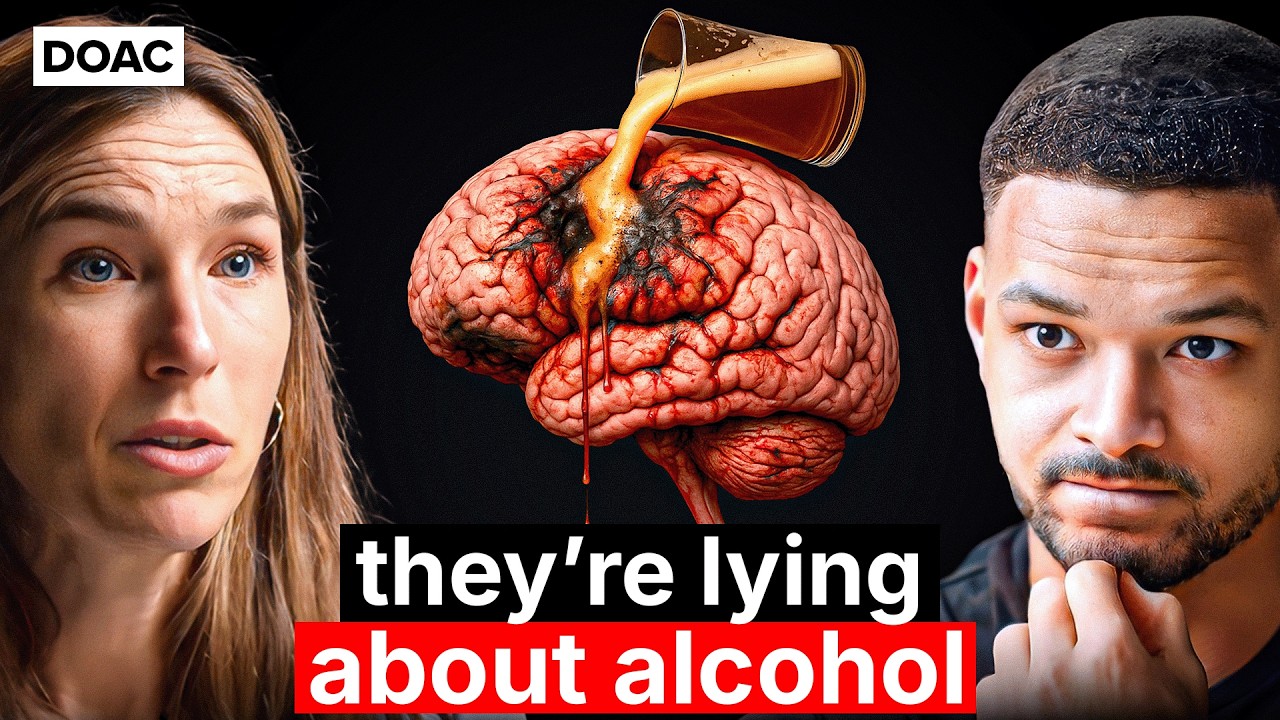
Harvard Medical Expert Links Moderate Drinking to Cancer Risks
The Diary Of A CEO
Dr. Sarah Wakeman warns that daily alcohol intake drives a 40% rise in relative cancer risk while destroying brain tissue and accelerating liver disease.
## Background
This episode of The Diary Of A CEO, hosted by Steven Bartlett, was published on YouTube on May 22, 2025. It features Dr. Sarah Wakeman, a senior medical director for substance use disorder at Mass General Brigham and Assistant Professor of Medicine at Harvard Medical School, discussing how alcohol impacts the brain, cancer risks, moderate drinking myths, and systemic flaws in addiction treatment.
## TL;DR
Dr. Sarah Wakeman deconstructs widespread cultural misconceptions surrounding alcohol and addiction, revealing that even low levels of alcohol intake carry measurable health risks, such as increased cancer susceptibility and organ damage. She explains the neurobiological underpinnings of addiction, emphasizing how trauma, isolation, and dopamine hijacks drive substance use disorders. The conversation highlights evidence-based medical interventions—including medications like Naltrexone and GLP-1 agonists—while critiquing punitive models, 'tough love' strategies, and stigmatizing medical language. Ultimately, Wakeman emphasizes that recovery is achievable through neuroplasticity, evidence-based care, and deep human connection.
## Atmosphere & style
The conversation carries an intimate, deeply compassionate, and clinically grounded tone. Steven Bartlett serves as an empathetic and inquisitive host, guiding the dialogue through high-stakes medical realities, personal grief, and systemic failures with quiet gravitas. Dr. Wakeman speaks with a clear, authoritative yet warm demeanor, seamlessly balancing rigorous scientific evidence with deeply human stories of loss and resilience. The visual and emotional arc moves from alarming public health revelations to a comforting message of hope, agency, and structural empathy.
## Key takeaways
- [00:00](https://www.youtube.com/watch?v=Fg7U-BhiZGE&t=0s) Daily moderate drinking carries significant health risks, with a single daily glass of wine increasing breast cancer risk by 5% and two glasses increasing overall relative cancer risk by 40%.
- [04:20](https://www.youtube.com/watch?v=Fg7U-BhiZGE&t=260s) Clinical addiction is defined by the four Cs (loss of Control, Compulsive use, adverse Consequences, and Craving), which is distinct from physiological dependence.
- [10:11](https://www.youtube.com/watch?v=Fg7U-BhiZGE&t=611s) Trauma and Adverse Childhood Experiences (ACEs) serve as primary drivers of addiction, while genetic factors account for 40% to 60% of individual risk.
- [12:13](https://www.youtube.com/watch?v=Fg7U-BhiZGE&t=733s) Alcohol impacts multiple neurotransmitter systems, triggering dopamine, mimicking GABA's anti-anxiety effects, and releasing endogenous opioids in the brain.
- [18:01](https://www.youtube.com/watch?v=Fg7U-BhiZGE&t=1081s) Framing addiction as a moral failure or waiting for an individual to hit 'rock bottom' causes systemic harm, whereas sustained recovery is driven by connection, hope, and support.
- [25:42](https://www.youtube.com/watch?v=Fg7U-BhiZGE&t=1542s) The belief in 'healthy' moderate drinking was largely rooted in epidemiological studies flawed by the 'sick abstainer effect,' where control groups included people who quit due to illness.
- [34:41](https://www.youtube.com/watch?v=Fg7U-BhiZGE&t=2081s) Alcohol acts as a direct cellular carcinogen through the production of toxic acetaldehyde and reactive oxygen species, with no safe consumption threshold for certain cancers.
- [41:38](https://www.youtube.com/watch?v=Fg7U-BhiZGE&t=2498s) The liver can regenerate up to 80% of its tissue, but chronic binge drinking and inflammation can lead to irreversible scarring (cirrhosis) without causing early pain symptoms.
- [48:57](https://www.youtube.com/watch?v=Fg7U-BhiZGE&t=2937s) High alcohol tolerance does not protect internal organs or the brain from damage, structural deterioration, and premature cortical atrophy.
- [53:36](https://www.youtube.com/watch?v=Fg7U-BhiZGE&t=3216s) Traditional 28-day acute rehab models often fail chronic addiction; effective long-term treatment requires evidence-based therapies, trauma-informed care, and FDA-approved medications like Naltrexone.
- [55:24](https://www.youtube.com/watch?v=Fg7U-BhiZGE&t=3324s) Emerging addiction treatments, including psilocybin-assisted therapy and GLP-1 receptor agonists like semaglutide, show promising results in altering brain reward mechanisms.
- [01:06:16](https://www.youtube.com/watch?v=Fg7U-BhiZGE&t=3976s) Environmental enrichment and community support are critical for recovery, mirroring findings from the 'Rat Park' experiments where social environments reduced addictive behavior.
- [01:12:32](https://www.youtube.com/watch?v=Fg7U-BhiZGE&t=4352s) Family strategies like CRAFT and Motivational Interviewing emphasize positive reinforcement and person-centered dialogue rather than aggressive confrontations or lecturing.
- [01:22:52](https://www.youtube.com/watch?v=Fg7U-BhiZGE&t=4972s) Long-term recovery relies on finding a core purpose, setting actionable micro-goals, and filling the void left by substances with healthy sources of dopamine and social connection.
- [01:30:07](https://www.youtube.com/watch?v=Fg7U-BhiZGE&t=5407s) Brain neuroplasticity allows for recovery, with an individual's addiction risk returning to baseline public levels after five years of continuous recovery.
- [01:37:00](https://www.youtube.com/watch?v=Fg7U-BhiZGE&t=5820s) Stigmatizing language influences clinical outcomes; adopting person-first language instead of labels like 'substance abuser' or 'alcoholic' improves care quality and reduces bias.
## Detailed walkthrough
### [00:00](https://www.youtube.com/watch?v=Fg7U-BhiZGE&t=0s) Moderate Risk and the Misconceptions Around Daily Drinking
The standard threshold for alcohol-related health hazards is dramatically lower than most people realize. Even a routine single glass of wine per day places an individual into what medical professionals categorize as a "moderate risk" tier. This level of consumption is directly associated with an elevated incidence of virtually every form of cancer. Escalating that intake to just two glasses daily drives a staggering 40% increase in overall relative risk, while even a single daily glass correlates with an approximate 5% rise in breast cancer risk. Despite how common and socially normalized this pattern of intake appears in everyday life, pervasive public misinformation obscures these physical costs.
Dr. Sarah Wakeman—a Harvard Medical School professor, board-certified addiction specialist, and senior medical director for substance use disorder at Mass General Brigham—stresses that addiction represents one of the paramount public health crises of our era. The epidemiological scale is severe: globally, 2.6 million people die annually from alcohol-attributed causes (equating to roughly 7,000 deaths per day), largely because alcohol degrades almost every organ system in the human body. Neuroimaging from chronic, high-volume drinkers demonstrates severe structural deterioration; for instance, brain scans of a 43-year-old with long-term heavy alcohol use can closely mirror the advanced cortical atrophy of a 90-year-old patient suffering from late-stage dementia.
- **Global Mortality (Alcohol):** ~2.6 million deaths annually (~7,000 deaths per day).
- **Global Mortality (Drugs):** ~600,000 deaths annually (~1,600 deaths per day).
- **Lifetime Prevalence:** An estimated 15% to 30% of people (roughly 1 in 3) will develop an alcohol use disorder during their lifetime.
- **Global Population Affected:** ~400 million individuals worldwide meet criteria for an alcohol use disorder, alongside ~80 million with drug use disorders.
> "The amount of alcohol it takes to begin to cause health-related problems is much lower than you think."
---
[02:13](https://www.youtube.com/watch?v=Fg7U-BhiZGE&t=133s) Dr. Sarah Wakeman’s Mission, Training, and Institutional Focus
Dr. Wakeman's core professional mission centers on dismantling widespread myths regarding substance use and reframing how society understands addiction. Beyond general public education on consumption guidelines and safety thresholds, her primary clinical objective is integrating addiction treatment directly into general medicine. Historically, addiction care has been relegated to an isolated, poorly regulated, and unequal silo separate from conventional healthcare delivery. As a practicing general internist who treats acute medical conditions like pneumonia, heart failure, diabetes, and depression, while simultaneously leading the Addiction Medicine Fellowship at Mass General, Dr. Wakeman works to train incoming physicians to treat substance use disorders as standard medical conditions.
When evaluating contemporary addiction care, Dr. Wakeman points to a fundamental systemic flaw: the deeply ingrained, moralized cultural belief that addiction is a behavioral choice, a defect of character, or a criminal justice matter. Believing that recovery is simply a question of willpower or "pulling oneself up by their bootstraps" inherently undermines the delivery of evidence-based medical treatment, compassion, and structured clinical support.
> "My mission is really to change the way people think about and understand alcohol and drug problems, and also to give people the evidence and the facts."
---
[04:20](https://www.youtube.com/watch?v=Fg7U-BhiZGE&t=260s) Defining Addiction vs. Physiological Dependence
The term "addiction" is often tossed around casually in everyday conversation—such as referring to heavy smartphone, iPad, or streaming use—yet its formal medical definition requires a strict diagnostic framework. Clinically, addiction is characterized by continued engagement in a behavior or substance use **despite ongoing negative consequences**. Medical professionals frequently use the memory framework of the "Four Cs" to assess and identify the disorder:
* **Control:** Loss of control over intake, marked by repeated, unsuccessful attempts to cut back or abstain.
* **Compulsive Use:** A spiraling pattern of consumption that bypasses rational, conscious decision-making.
* **Consequences:** Persisting in use despite adverse impacts on health, interpersonal relationships, employment, or legal standing.
* **Craving:** An intense, intrusive psychological urge or fixation to use the substance.
To make a formal diagnosis, clinicians evaluate patients against 11 standardized criteria outlined in diagnostic manuals, classifying the condition as mild, moderate, or severe based on the number of met criteria. Moderate-to-severe diagnostic classifications correspond to what is colloquially recognized as true addiction.
A crucial distinction exists between **physiological dependence** and **addiction**. For instance, a daily coffee drinker may experience caffeine withdrawal symptoms such as headaches or fatigue if they skip a morning cup, demonstrating physiological dependence. However, unless that coffee intake escalates into spending all of one's savings, chronically arriving late to work, and damaging personal relationships to acquire caffeine, it does not constitute an addiction.
---
[05:37](https://www.youtube.com/watch?v=Fg7U-BhiZGE&t=337s) Addictive Potential Across Various Substances
The likelihood of a substance causing addiction depends heavily on its pharmacological property to trigger dopamine release within the brain's reward circuits. Across the spectrum of psychoactive compounds, addictive indices vary significantly:
* **High Risk / Highly Addictive:** Opioids (such as heroin, prescription pain pills, and fentanyl), illicit stimulants (such as cocaine and methamphetamine), and prescription sedatives/anxiolytics (such as benzodiazepines like Ativan, Lorazepam, or Xanax).
* **Moderate to High Risk:** Alcohol, which remains the most widely consumed addictive substance worldwide, impacting over 400 million individuals.
* **Lower Relative Risk:** Cannabis, which, while capable of causing a substance use disorder, carries a lower baseline addiction potential than methamphetamine or opioids.
Stigma often prevents open dialogue about these issues, fostering a false narrative that addiction only impacts marginalized populations—such as individuals actively injecting drugs or those experiencing severe morning tremors ("the shakes") from end-stage alcohol dependency. In reality, the broad distribution of substance use disorders across all socioeconomic classes underscores its universal reach.
---
[08:49](https://www.youtube.com/watch?v=Fg7U-BhiZGE&t=529s) The Impact of the COVID-19 Pandemic on Mortality and Life Expectancy
The societal footprint of substance use expanded significantly following the onset of the COVID-19 pandemic. Beginning around March and April of 2020, public health data revealed a dramatic 23% surge in alcohol-related mortality, alongside unprecedented peaks in drug overdose deaths. This sudden rise in substance-involved fatalities was a primary factor driving the distinct drop in US overall life expectancy during that era—a statistical decline that only began to stabilize and return toward pre-pandemic baselines around 2024–2026.
This surge was particularly acute among specific high-stress populations:
* **Frontline Essential Workers:** Healthcare providers, grocery clerks, and convenience store employees operating under intense, high-risk environmental stress.
* **Caregivers:** Individuals managing disproportionate domestic responsibilities, isolated from routine support networks and coping mechanisms.
---
[10:11](https://www.youtube.com/watch?v=Fg7U-BhiZGE&t=611s) The Drivers of Addiction: Genetics and Adverse Childhood Experiences (ACEs)
Understanding what drives an individual to rely on psychoactive substances is essential for effective treatment. Rather than a Gateway Drug like cannabis being the primary entry point to problematic use, evidence suggests that **trauma is the true gateway**. Research establishes that addiction risk is governed by two primary pillars:
1. **Genetic Susceptibility:** Accounting for roughly 40% to 60% of an individual's overall risk profile—a hereditary influence comparable to chronic conditions like type 2 diabetes. While genetic predisposition elevates risk, it is neither a sole cause nor a guarantee that an addiction will develop.
2. **Environmental Exposures and Trauma:** Quantified prominently through the **Adverse Childhood Experiences (ACEs)** framework. Replicated studies globally demonstrate a direct, step-wise linear correlation: as an individual's cumulative count of adverse childhood events rises, their statistical likelihood of developing a substance use disorder increases proportionally.
During periods of severe stress, isolation, grief, or boredom—such as those experienced during pandemic lockdowns—substance use escalates rapidly because drugs and alcohol directly activate the brain's neurochemical relief mechanisms.
---
[12:13](https://www.youtube.com/watch?v=Fg7U-BhiZGE&t=733s) Pharmacological Mechanisms: How Alcohol Affects the Brain's Neurochemistry
Alcohol exerts a surprisingly complex series of actions across multiple neurotransmitter networks in the central nervous system:
* **Dopamine Pathways:** Like all addictive substances, alcohol triggers dopamine release in the nucleus accumbens, reinforcing the behavior by driving feelings of pleasure and motivation.
* **GABAergic System:** Alcohol binds to Gamma-Aminobutyric Acid (GABA) receptors—the brain's primary inhibitory, anti-anxiety system. This mechanism is identical to the pathway targeted by clinical sedatives and benzodiazepines (such as Xanax or Ativan), leading to muscular relaxation, sedation, and anxiolysis.
* **Endogenous Opioid Activation:** Alcohol consumption triggers the release of internal endorphins and endogenous opioids, which act as the body's natural pain-relieving system.
Because alcohol directly engages these endogenous opioid pathways, drinking offers real, biological relief from both physical discomfort and acute emotional distress. This underlying mechanism explains why certain pharmacological treatments for alcohol use disorder—such as opioid antagonist medications like Naltrexone—work by blocking these exact neural receptors, blunting the rewarding euphoric and pain-relieving feedback loop generated by alcohol.
[13:44](https://www.youtube.com/watch?v=Fg7U-BhiZGE&t=824s) Trauma, Early Exposure, and Childhood Risk Factors
Alcohol operates as both an anti-anxiety agent and a painkiller rolled into one, which is why people so naturally turn to it for self-medication. The danger arises when individuals benchmark their safety against extreme outcomes—assuming that as long as they are not drinking in the morning, missing work, or destroying their relationships, their consumption is harmless. In reality, alcohol inflicts silent damage long before it disrupts daily functionality. When analyzing how trauma drives substance use, timing matters immensely: while trauma at any stage of life increases the risk of developing a substance use disorder, trauma experienced during early childhood and adolescence is especially damaging. The human brain continues to develop until the early-to-mid 20s, making it significantly more vulnerable during these formative years to both psychological adversity and early chemical exposure.
However, trauma is not defined merely by the occurrence of an event itself, but rather by the experience of being left alone to process that distress in isolation. The exact same circumstance can produce vastly different psychological outcomes depending on the individual's underlying support system. During the COVID-19 pandemic, some people found being isolated at home deeply traumatizing, while others adapted smoothly because they retained a sense of safety and meaningful connection. Because trauma leaves people feeling profoundly isolated, the ultimate counterforce to addiction is not simple abstinence; "the opposite of addiction is not sobriety, it's actually connection."
* **Brain Maturation Window:** The human brain does not fully develop until an individual reaches their early-to-mid 20s, making early childhood trauma and early substance exposure exceptionally high-risk factors for addiction.
* **Redefining Trauma:** Trauma is determined less by the event itself and more by whether the person was left isolated to process the experience without a supportive outlet.
* **Late-Onset Trauma:** Trauma experienced for the first time in one's 20s, 30s, or 40s can still initiate a substance use disorder, though the neurological baseline risk is highest during childhood.
---
[16:26](https://www.youtube.com/watch?v=Fg7U-BhiZGE&t=986s) The Isolation of Fame: Liam Payne and the Void of Purpose
The profound role of isolation in fueling addiction is starkly illustrated by the story of Liam Payne, the former One Direction member who tragically died after struggling with substance use. When he previously appeared as a guest on *The Diary Of A CEO*, he detailed the extreme cycle of isolation that defined his youth as a global pop star. After performing in front of massive stadium crowds of 100,000 people in places like Dubai, he was immediately whisked away in a car and locked inside his hotel room for safety reasons, as his immense fame rendered it impossible to walk the streets freely. Trapped inside with a fully stocked mini-bar, he routinely drank to cope with the sudden transition from high adrenaline to complete isolation, creating a destructive feedback loop of "stage, car, hotel room, drink."
This pattern mirrors clinical observations made in day-to-day addiction treatment. Patients frequently manage to achieve initial sobriety for several weeks, only to relapse because their daily lives feel entirely hollow. When someone is unemployed, lacks close relationships, and spends their days sitting alone watching television, drinking becomes the only readily accessible source of psychological relief. Treating addiction effectively requires moving beyond the chemical molecule itself to address the broader structural void: rebuilding a person's life through community, connection, identity, and daily purpose.
* **Liam Payne's Isolation Cycle:** The repetitive routine of performing for huge crowds followed by immediate confinement in hotel rooms with access to mini-bars created an environment where alcohol became the primary mechanism to handle sudden isolation.
* **The Void After Sobriety:** Achieving physical abstinence often leaves patients facing an empty routine; without active social connections, work, or hobbies, the urge to return to alcohol for relief quickly resurforces.
* **Beyond the Molecule:** Long-term recovery relies on creating structural identity and community support rather than focusing solely on removing the substance.
---
[18:01](https://www.youtube.com/watch?v=Fg7U-BhiZGE&t=1081s) Personal Loss and the Reality of Living with an Addicted Loved One
Dr. Sarah Wakeman's dedication to addiction medicine stems from personal tragedy. While attending medical school around age 24, she lost an immediate family member to addiction, followed later by the loss of a close friend to an overdose. Experiencing these losses while simultaneously studying the emerging neuroscience of addiction highlighted a painful disparity: the medical field and society at large lacked basic scientific literacy surrounding substance use disorders. This personal pain motivated her to build the exact clinical tools, educational resources, and empathetic frameworks she wished had existed to save her own loved ones.
For family members, navigating a loved one's addiction is an agonizingly helpless experience. Because popular culture frames addiction as a simple failure of personal choice or willpower, family members often internalize the behavior, feeling deeply hurt under the false impression that their loved one is choosing a substance over their love. Furthermore, families are routinely subjected to damaging mainstream advice—such as enforcing "tough love" or waiting for the individual to "hit rock bottom." When patients inevitably pass away, families are left carrying heavy burdens of guilt, anger, and constant regret, endlessly replaying past decisions and wondering if a different intervention might have kept their relative alive.
* **Personal Motivation:** Dr. Wakeman lost a close family member to alcohol addiction while in medical school at age 24, and later lost a friend to a drug overdose.
* **The Willpower Fallacy:** Viewing addiction as a lack of willpower leads family members to mistakenly believe the person using substances simply does not love them enough to stop.
* **The Burden of Guilt:** Relatives frequently wrestle with agonizing regret over whether enforcing strict boundaries or withholding contact ultimately contributed to their loved one's demise.
---
[20:33](https://www.youtube.com/watch?v=Fg7U-BhiZGE&t=1233s) Flaws in "Tough Love" and the Missed Medical Opportunities
Reflecting on lost loved ones highlights how traditional punitive models actively rob families of precious time. The rigid binary framing that someone is either "sober and good" or "actively using and bad" frequently leads families to cut off contact entirely. Yet, individuals struggling with addiction remain full, loving human beings who are simply dealing with a severe medical condition; society would never demand cutting off emotional contact with a relative diagnosed with cancer. Dr. Wakeman stresses that her loved ones visited doctors and spent time in hospitals during their struggles, missing out on science-backed care because the healthcare system routinely failed to treat their condition with dignity and clinical rigor.
The prevailing cultural narrative—"change happens when the pain of staying the same becomes greater than the pain of change"—is often used to justify leaving people to suffer until they hit "rock bottom." While some individuals do recover after reaching a extreme low, data shows that far more people simply endure continuous pain until it destroys them. Real, sustained transformation is far more frequently driven by hope—the realization that someone cares, that help exists, and that a meaningful life is attainable.
When families feel a sense of relief upon seeing a loved one incarcerated—a phenomenon referred to clinically as "a rescue"—it illustrates the utter desperation families experience. However, using prison as an intervention is demonstrably dangerous:
1. Incarceration fails to address the underlying physiological and psychological drivers of addiction.
2. The period immediately following release from prison carries a **130-fold increased risk of drug-related death**.
3. Having ever been incarcerated drastically increases an individual's lifetime mortality risk from substance use.
Rather than relying on punitive environments or forced hitting of rock bottom, effective intervention requires a combination of love, connection, evidence-based psychotherapy, and targeted medication.
* **"A Rescue":** A psychological term describing the relief families feel when an addicted relative is incarcerated, mistakenly believing they are finally safe.
* **Post-Incarceration Mortality Risk:** Individuals released from prison face a **130 times higher risk of dying** from a drug-related cause in the period immediately following their release.
* **The Core Components of Recovery:** Sustained change relies on restoring hope and connection alongside evidence-based medical treatment, such as psychotherapy and FDA-approved medications.
---
[25:42](https://www.youtube.com/watch?v=Fg7U-BhiZGE&t=1542s) Deconstructing the "Healthy Alcohol" Myth and Epidemiological Errors
The cultural perception of alcohol's health profile has shifted drastically throughout history. Archaeologists have documented beer-making equipment in hunter-gatherer cave dwellings dating back **13,000 years**, while ancient Chinese records from **9,000 years ago** show alcohol integrated into social and spiritual rituals. Crucially, alcohol was historically consumed for ceremonial or recreational purposes—it was never viewed as a medical health tonic. The modern belief that light-to-moderate drinking (such as a daily glass of red wine) actively protects cardiovascular health arose entirely from flaws in epidemiological research design.
For decades, large observational studies tracked tens of thousands of participants, categorizing them into non-drinkers, light drinkers, moderate drinkers, and heavy drinkers. When plotting health outcomes, researchers repeatedly observed a **"J-shaped curve"**: moderate drinkers appeared to exhibit lower overall mortality and lower rates of cardiovascular disease than non-drinkers, with risk only spiking once consumption reached heavy levels.
This J-shaped curve was fundamentally flawed due to the **"sick abstainer effect."** Researchers had grouped all non-drinkers into a single baseline category without accounting for *why* those individuals abstained from alcohol. A significant portion of the non-drinking group consisted of people who had quit drinking because they were already suffering from severe, underlying health conditions (such as heart failure, advanced organ damage, or prior severe illness), or who were on medications that interacted poorly with alcohol. Comparing healthy moderate drinkers against an inherently unhealthy group of non-drinkers created the false mathematical illusion that moderate alcohol intake was actively providing protective health benefits.
* **Archaeological Timeline:** Beer-making equipment dates back **13,000 years** to hunter-gatherer sites, and **9,000 years** to ancient China, where it served spiritual and social functions rather than health purposes.
* **The J-Shaped Curve:** A flawed statistical model claiming moderate alcohol consumption offers lower mortality risks than absolute abstinence.
* **The Sick Abstainer Error:** The baseline non-drinking group in early observational studies was heavily skewed by individuals who abstained precisely because they had pre-existing, severe health problems.
Here is a detailed, faithful walkthrough of Part 3 of the transcript.
---
[27:38](https://www.youtube.com/watch?v=Fg7U-BhiZGE&t=1658s) The Flawed Science Behind "Healthy" Drinking and the Truth About Safe Limits
Dr. Sarah Wakeman breaks down why early observational studies claimed moderate drinking was good for heart health. When researchers re-examined those studies, they realized the non-drinking baseline group was fundamentally flawed. It contained "sick quitters"—people who had stopped drinking because of severe health conditions, medication interactions, or a history of severe alcohol use disorder—making non-drinkers appear unhealthier than light drinkers. Once researchers changed the control group to people who drink very light amounts (rather than abstaining due to illness), the supposed health benefits of alcohol vanished across almost every medical condition.
Dr. Wakeman emphasizes that there is simply no truly healthy level of alcohol consumption. However, she clarifies that staying within low-risk limits can still fit into an individual's lifestyle, provided they understand it as a indulgence with inherent risks rather than a health-promoting activity. She compares drinking alcohol to eating bacon, having dessert, or sunbathing—activities that carry health risks that people weigh and decide upon for themselves. When discussing low-risk guidelines, she notes that in the UK, low-risk drinking is capped at 14 units of alcohol per week (where one unit is 8 grams of pure ethanol). People often misjudge serving sizes; a single large pour of wine at a restaurant or home can easily contain three units of alcohol. Consuming just one of those glasses every night puts a person at 21 units per week, pushing them well past low-risk guidelines into the moderate-risk tier.
* **UK Low-Risk Limit:** Under 14 units of alcohol per week (1 unit = 8g pure ethanol).
* **US Low-Risk Standard:** Fewer than 7 standard drinks per week for women (a standard US wine pour is 5 oz).
* **The "One Glass" Fallacy:** A single large pour of wine often contains ~3 units of alcohol. Drinking one such glass daily yields 21 units/week, moving a drinker into a higher risk bracket.
> "Don't fool yourself into thinking that drinking that glass of wine is like going to exercise for 30 minutes. It's not something that's going to promote your health. I think of it more like having dessert, eating bacon, going out in the sun."
---
[30:28](https://www.youtube.com/watch?v=Fg7U-BhiZGE&t=1828s) Moderate Alcohol Use and the Rising Risk of Cancer
Addressing why cancer rates—particularly breast and colon cancers—are escalating in young adults, Dr. Wakeman points out that moderate-risk drinking is strongly linked to almost every major form of cancer. Unlike many health risks that only spike after extreme abuse, certain cancers display no safe threshold whatsoever. Breast cancer and esophageal cancer show a statistically significant elevated risk even at consumption levels well below standard low-risk weekly guidelines.
Dr. Wakeman highlights that drinking even low amounts of alcohol increases a woman's lifetime baseline risk of breast cancer by roughly 5%. In the US, a woman's baseline lifetime risk of developing breast cancer is roughly 13% (meaning approximately 1 in 8 or 9 women will face a diagnosis). A 5% relative increase elevates that total risk to around 13.6%. While this specific numerical jump seems small, across entire populations, it translates to thousands of additional diagnoses. Other lifestyle factors and environmental drivers—such as obesity, delays in childbearing, processed meats (for colon cancer), microplastics, and unmeasured environmental toxins—further compound these cellular risks.
- **Dose-Response Relationship:** For nearly all cancers, as alcohol consumption increases, cancer risk scales upwards proportionately.
- **Breast Cancer Risk:** Increases by ~5% even below low-risk drinking guidelines (under 7 standard US drinks or 14 UK units per week).
- **Prostate & Male Cancers:** Though prostate cancer isn't explicitly classified as an alcohol-sensitive organ cancer, general systemic alcohol consumption damage creates DNA mutations across body tissues.
- **Colon Cancer Drivers:** Strongly associated with alcohol, obesity, and processed meat consumption, showing an alarming rise among young adults.
> "There's really sort of no safe amount of alcohol when it comes to breast cancer."
---
[34:41](https://www.youtube.com/watch?v=Fg7U-BhiZGE&t=2081s) Heavy Drinking, Synergistic Multipliers, and Cellular Cancer Mechanisms
Drinking two standard-to-large glasses of wine daily consistently places an individual into the heavy drinking category—a habit that many adults view as normal evening relaxation. Heavy alcohol consumption increases an individual's overall cancer risk by roughly 40% on average across various cancer types. The presence of comorbid conditions, particularly obesity or tobacco use, dramatically accelerates this probability.
When alcohol is combined with smoking, the health risk does not simply add together; it multiplies. Alcohol acts as a solvent on mucosal linings, making cells in the mouth, throat, and esophagus significantly more susceptible to the primary carcinogens found in tobacco smoke. At the cellular level, ethanol (alcohol) metabolizes into toxic byproducts that create reactive oxygen species and chronic systemic inflammation. These free radicals damage cell DNA, inhibiting the body's natural cell repair mechanisms and creating the precise genetic mutations that precipitate malignant tumors.
- **Heavy Category Definition:** Consuming two moderate-to-large glasses of wine daily (or ~4-6 units per day) places a drinker firmly into heavy drinking status.
- **General Cancer Multiplication:** Heavy drinking elevates baseline risk for alcohol-linked cancers by roughly 40%.
- **Synergistic Risk:** Combining alcohol and tobacco creates a multiplicative risk factor rather than a additive one due to increased mucosal permeability to carcinogens.
---
[36:10](https://www.youtube.com/watch?v=Fg7U-BhiZGE&t=2170s) How Alcohol Traverses the Body and Brain
Dr. Wakeman traces the physiological journey of alcohol (ethanol) from the moment of ingestion. Once swallowed, ethanol is absorbed quickly through the stomach and small intestine, entering the bloodstream within roughly 10 minutes. Because ethanol is a small, water-soluble molecule, it diffuses only into the water-containing tissues of the body and does not penetrate fat tissue. Consequently, individuals with a higher body fat percentage or lower total body water (including most biological women compared to men) experience higher blood alcohol concentrations from the same volume of alcohol.
Ethanol easily crosses the blood-brain barrier almost instantaneously. In low doses, it triggers early pleasurable feelings: mild euphoria, reduced anxiety, muscle relaxation, and heightened sociability. As blood alcohol levels continue to climb, central nervous system depression sets in, impairing motor coordination, clouding executive judgment, and leading to slurred speech, stumbling, and risky decision-making. At extreme levels, ethanol inhibits basic brain function to the point of sedation, memory blackouts, loss of consciousness, and passing out.
- **Absorption Speed:** Hits the bloodstream in under 10 minutes; diffuses through body water.
- **Body Composition Factor:** Higher body fat or lower body water concentrates ethanol in the bloodstream, resulting in higher blood alcohol levels.
- **Neurological Progression:** Mild relaxation $\rightarrow$ impaired executive judgment & motor control $\rightarrow$ loss of consciousness/passing out.
---
[38:43](https://www.youtube.com/watch?v=Fg7U-BhiZGE&t=2323s) The Liver's Regenerative Capacity and the Danger of Silent Cirrhosis
Navigating a human body model, Dr. Wakeman locates the liver—a large, brownish organ situated on the right side of the upper abdomen, tucked directly under the rib cage, roughly comparable in size to a lung. The liver serves as the primary chemical filter and metabolizer for the body, processing over 90% of ingested alcohol along with glucose, medications, and circulating toxins. The body treats ethanol as an unwanted poison and works to convert it into acetaldehyde (a highly toxic intermediate molecule) and then into acetate, which can be safely excreted through urine and breath.
The liver possesses a unique capacity for regeneration; up to 80% of a healthy liver can be surgically removed or damaged, and the organ can completely regrow itself. This remarkable property makes living-donor liver transplants possible. However, chronic exposure to toxins like alcohol or severe fat accumulation from obesity causes repetitive tissue scarring. Once these scar tissue networks form a threshold known as cirrhosis, the liver reaches a "point of no return" where its regenerative mechanisms fail.
Dr. Wakeman uses a baking analogy: if you realize you forgot eggs while mixing cake batter, you can whisk them in and fix the cake; but once the cake has already baked in the oven without eggs, pouring raw eggs over the top will not repair the structure. Similarly, early-stage liver inflammation and fatty liver changes can be completely healed if caught early, but once full cirrhosis forms, irreversible damage is done. Tragically, because the liver lacks direct pain receptors, severe liver damage often develops completely silently until patients present in emergency rooms with fulminant liver failure in their 20s or 30s.
* **Transplant Capability:** A healthy donor can donate over half their liver; both the donor's remaining tissue and the recipient's graft will regenerate toward full size.
* **Silent Progression:** Fatty liver disease and early fibrosis present zero symptoms; many patients only discover damage when entering fulminant liver failure.
* **Leading Transplant Drivers:** Alcohol-related liver disease and non-alcoholic fatty liver disease (linked to obesity) remain the top causes of liver transplantation and liver-related mortality.
> "You could actually cut out 80% of the liver and it would regrow itself... But once you pass that point into scar tissue, the liver can't regenerate anymore... We're seeing younger and younger people coming in in liver failure. People in their 20s coming in in fulminant liver failure from alcohol and then dying in the hospital."
[41:45](https://www.youtube.com/watch?v=Fg7U-BhiZGE&t=2505s) Binge Drinking Culture and Long-Term Liver Damage
Dr. Sarah Wakeman emphasizes the urgent need for public education regarding the real health harms of alcohol, noting that society has normalized binge drinking—especially among young people—despite its severe health consequences. Responding to Steven Bartlett's query about whether a person can engage in "blowout weekends" and rely on the liver's natural ability to regenerate, Dr. Wakeman explains that while a single isolated weekend might not cause permanent harm, recurring binge episodes accelerate organ damage.
Once liver tissue transitions into the scarring phase, the organ can no longer bounce back, even if the person stops drinking entirely. Medical researchers are actively studying why this timeline varies so drastically between individuals: some people drink heavily for 60 years without scarring, whereas some 25-year-olds present with fatal end-stage liver failure. Because individual susceptibility cannot be predicted in advance, minimizing high-risk drinking and seeking regular medical care—such as routine blood tests and ultrasound screenings—are the safest ways to prevent irreversible damage.
* **Progression of Liver Disease:**
1. **Fat Deposition:** The initial step where fat accumulates in the liver cells.
2. **Fatty Liver & Inflammation:** Cellular stress and swelling begin to manifest.
3. **Fibrosis:** Scar tissue forms across the tissue.
4. **Cirrhosis & Liver Failure:** Advanced scarring causes the organ to stop functioning, requiring a liver transplant or resulting in death.
---
[43:42](https://www.youtube.com/watch?v=Fg7U-BhiZGE&t=2622s) Lifestyle Factors and Patterns of Alcohol-Induced Liver Stress
Beyond alcohol consumption, other everyday factors place immense stress on the liver. Because the liver plays a critical role in glucose metabolism, poor diet, obesity, and excess body weight significantly impact hepatic health. Additionally, over-the-counter medications can cause severe toxicity; for instance, taking acetaminophen (Tylenol) above recommended doses—often hidden inside multi-symptom cold remedies—combined with heavy drinking creates a dangerous compounding effect that can trigger acute liver damage.
When assessing alcohol consumption patterns, Dr. Wakeman points out that massive binge episodes are often more damaging than drinking moderate amounts over a prolonged period. Large surges of alcohol create a sudden, toxic backlog of acetaldehyde that the body struggles to clear efficiently. Consequently, several years of heavy weekend binging can inflict far more liver damage than years of consistent, lower-level intake.
---
[45:17](https://www.youtube.com/watch?v=Fg7U-BhiZGE&t=2717s) Alcohol's Devastating Impact on Brain Structure and Function
Alcohol impacts virtually every organ system in the body, starting at the very top with the brain. Dr. Wakeman illustrates this process using cross-sectional brain MRI scans. Healthy brain tissue consists of plump gray and white matter occupying maximum space within the skull. As people reach advanced age or develop dementia, the brain shrinks, leaving larger black spaces filled with fluid. High alcohol intake drastically accelerates this deterioration.
Showing a brain scan of a 43-year-old individual with severe alcohol use disorder, Dr. Wakeman reveals that their brain atrophy mirrored that of a 90-year-old dementia patient. Because ethanol easily crosses the blood-brain barrier, elevated blood alcohol levels literally bathe brain tissue in a toxin that drives cellular inflammation, structural damage, and DNA alteration. This damage is frequently compounded by severe nutritional deficiencies in heavy drinkers, which can trigger sudden-onset amnesia or alcohol-related dementia.
---
[47:13](https://www.youtube.com/watch?v=Fg7U-BhiZGE&t=2833s) Gastrointestinal Issues and Cardiovascular Risks
Moving down from the brain, alcohol continuously bathes the mouth, esophagus, and stomach during ingestion. Aside from increasing upper GI cancer risks—an effect dramatically amplified by tobacco use—alcohol frequently causes non-lethal but troublesome conditions like chronic acid reflux (heartburn). Frequent reliance on antacids is often an early indicator that alcohol intake is irritating the digestive tract.
The cardiovascular system is equally vulnerable once drinking exceeds low-risk thresholds:
* **Atrial Fibrillation ("Holiday Heart Syndrome"):** Alcohol disrupts the electrical impulses traveling from the top chambers (atria) to the bottom chambers (ventricles) of the heart. Instead of a clean, single impulse telling the heart to pump blood, the top of the heart quivers irregularly. Clinicians frequently see patients enter emergency rooms with this rhythm disturbance after heavy holiday drinking.
* **Alcoholic Cardiomyopathy:** Over time, high levels of alcohol cause the heart to dilate. The cardiac muscle becomes thin, weak, and floppy, ultimately leading to congestive heart failure.
---
[48:57](https://www.youtube.com/watch?v=Fg7U-BhiZGE&t=2937s) Body Fat, Tolerance, and the Physiology of Hangovers
Steven shares a personal observation from his past drinking days: despite being smaller, he possessed a higher alcohol tolerance than a larger friend with higher body fat, leading him to wonder if his lower intoxication meant he was experiencing less organ harm. Dr. Wakeman corrects this common misconception by explaining the physics of body water distribution.
Because alcohol is water-soluble and does not enter adipose (fat) tissue, individuals with lower body fat percentage possess a higher total volume of body water. Alcohol diffuses into this larger fluid volume much like red dye in a glass of water, diluting the overall blood alcohol concentration (BAC). Conversely, someone with higher body fat has less total body water, causing their BAC to spike much faster from the exact same number of drinks.
> "A hangover isn't just about being dehydrated... It is sort of that sequelae of your brain essentially being bathed in this ethanol, and then as it leaves, you just feel totally crappy."
* **Misconceptions About Tolerance:** Higher functional tolerance or slower metabolic clearance does **not** protect organs from liver damage, cancer, or heart disease.
* **The Mechanism of a Hangover:** While dehydration contributes to hangover severity by contracting total body water and raising ethanol concentration, the hangover syndrome (apathy, fatigue, nausea, headache) is primarily driven by the brain recovering from direct ethanol exposure after BAC drops back to zero. Experiencing a hangover is a clear biological sign that low-risk intake thresholds have been breached.
---
[52:03](https://www.youtube.com/watch?v=Fg7U-BhiZGE&t=3123s) Balancing Social Benefits and Navigating Health Risks
Addressing the common counterargument that alcohol is an essential social lubricant in the modern world, Dr. Wakeman insists on a non-judgmental approach. She notes that "a molecule of ethanol is not more moral or immoral than a molecule of glucose," drawing a direct parallel to dietary choices regarding ultra-processed foods or refined sugar.
The goal is not to demand an austere lifestyle devoid of all pleasure, but rather to help individuals evaluate risks with "eyes wide open." For those seeking to reduce consumption, environmental and structural changes are essential. Trying to cut back while continuing to attend daily happy hours relies too heavily on willpower against constant triggers. By modifying weekly routines—such as replacing three or four drinking days with non-alcohol activities while reserving social drinking for special occasions—overall health risks decline dramatically without sacrificing social connection.
---
[53:36](https://www.youtube.com/watch?v=Fg7U-BhiZGE&t=3216s) The Flaws of Traditional Rehab and Evidence-Based Recovery
When asked about traditional residential rehabilitation facilities, Dr. Wakeman expresses deep skepticism regarding the standard 28-day rehab model. Viewing addiction as an acute infection that can be cured by a two-week retreat fails to align with modern medical science. Addiction is a chronic illness—much like diabetes or cancer—requiring intensive up-front treatment followed by long-term management to maintain remission.
Many commercial rehab programs lack clinical rigor and fail to provide proven medical care. In a "secret shopper" research study conducted by Dr. Wakeman's team, researchers phoned residential rehab facilities across the United States to inquire about their clinical offerings. A alarming number of centers offered non-evidence-based treatments like "dolphin-assisted therapy" or equine therapy, while actively failing to provide science-backed interventions.
* **Key Components of Effective Addiction Treatment:**
* **Pharmacotherapy:** Utilizing FDA-approved medications to manage cravings and brain chemistry (despite widespread societal stigma).
* **Evidence-Based Psychotherapy:** Structured therapies such as Cognitive Behavioral Therapy (CBT) and Motivational Enhancement Therapy.
* **Trauma-Informed Care:** Addressing underlying psychological trauma rather than relying solely on peer-led support groups or environmental removal.
[55:24](https://www.youtube.com/watch?v=Fg7U-BhiZGE&t=3324s) Evidence-Based Treatments and Promising New Medications
Dr. Sarah Wakeman emphasizes the stark disconnect between traditional rehab programs and scientifically proven interventions. While expensive facilities often push unverified methods like dolphin swimming or equine therapy, they frequently lack trained clinicians or evidence-based treatments. For alcohol use disorder (AUD), effective pharmaceutical tools exist that remain largely underutilized. Dr. Wakeman highlights naltrexone, an opioid receptor antagonist. Though seemingly counterintuitive for treating alcohol dependence, naltrexone blocks the brain's opioid receptors, dampening the pleasure and pain relief that alcohol triggers in susceptible individuals.
The conversation touches on the "Sinclair Method," an targeted pharmacological protocol pioneered in Europe. Instead of requiring daily medication, patients take naltrexone roughly 30 minutes before an occasion where they anticipate overdrinking—such as a holiday gathering or social dinner. By blocking the neurochemical reward, patients report losing the drive to continue drinking after a single glass.
Beyond naltrexone, novel therapeutic frontiers are emerging:
* **Psilocybin-Assisted Psychotherapy:** Recent clinical trials evaluating psilocybin (the active compound in magic mushrooms) compared high-dose psilocybin against control groups (such as high-dose diphenhydramine/Benadryl) alongside an eight-hour guided therapy session. Results demonstrated a significant reduction in long-term alcohol consumption, likely driven by heightened neuroplasticity that allows the brain to establish new behavioral pathways.
* **Ibogaine:** Frequently cited in addiction discussions for opioid use disorder, ibogaine has shown mixed results and lacks the rigorous trial data supporting psilocybin. Its adoption is further limited because highly effective, life-saving FDA-approved medications for opioid use disorder (such as buprenorphine and methadone) already set a high standard of care.
* **GLP-1 Receptor Agonists (Semaglutide/Wegovy/Ozempic):** Patient anecdotes on online communities like Reddit initially revealed that weight-loss and diabetes drugs significantly reduced cravings for alcohol and nicotine. Subsequent double-blind, placebo-controlled clinical trials have confirmed that GLP-1 medications alter reward and craving mechanisms globally across the brain, not merely for food.
---
[59:49](https://www.youtube.com/watch?v=Fg7U-BhiZGE&t=3589s) The Public Spectacle of Celebrity Addictions
Steven Bartlett and Dr. Wakeman discuss the tragic pattern of public figures struggling with addiction under intense media scrutiny—referencing figures like Whitney Houston, Michael Jackson, Prince, Elvis Presley, Mac Miller, and Anna Nicole Smith. Dr. Wakeman describes her reaction to these high-profile deaths as deeply heartbreaking, primarily because death from addiction is fundamentally preventable with modern medical interventions.
> "When I read the headlines of someone dying, to me, it's gutting and heartbreaking... mostly that it was a totally preventable death. Really, no one should die from a substance-related death."
The public often holds a simplistic belief in the "dramatized intervention"—the idea that a single confrontation followed by a stint in rehab will permanently cure a person. In reality, addiction recovery is a non-linear process that requires ongoing support, harm reduction, and personal goal-setting.
---
[01:02:14](https://www.youtube.com/watch?v=Fg7U-BhiZGE&t=3734s) Stigma, Blame, and Heartbreaking Reality
Bartlett shares a personal story about a friend who was always known as the "life of the party." At an event, this friend pulled Bartlett aside and whispered, *"I'm in so much pain,"* before recounting how rehab had repeatedly failed him. Dr. Wakeman emphasizes the critical linguistic shift Bartlett made in saying *the treatment failed him*, rather than *he failed treatment*.
```
┌────────────────────────────────────────────────────────────────────────┐
│ REFRAMING TREATMENT DISCONTINUATION │
│ │
│ Traditional Stigma View: │
│ [ Patient Relapses ] ──► "The patient failed their treatment." │
│ │
│ Evidence-Based Medical View: │
│ [ Patient Relapses ] ──► "The treatment protocol failed the patient."│
└────────────────────────────────────────────────────────────────────────┘
```
When cancer therapies fail to arrest a tumor, medical professionals adjust the protocol rather than blaming the patient. In addiction medicine, however, systemic stigma turns treatment failures into personal moral shortcomings. This global stigma causes individuals to conceal their suffering out of fear of judgment, loss of employment, or losing custody of their children.
Dr. Wakeman shares a devastating clinical story that illustrates how societal factors compound addiction:
* A long-term patient struggling with heroin addiction had maintained a stable life while living with his elderly mother in public housing.
* When housing authorities discovered he was residing there, the threat of his mother losing her housing forced him to move out to protect her.
* Newly unhoused and isolated on the streets, the patient suffered a fatal overdose alone between two parked cars.
* Dr. Wakeman stresses that such deaths are preventable, driving her commitment to structural reform and systemic healthcare change.
---
[01:06:16](https://www.youtube.com/watch?v=Fg7U-BhiZGE&t=3976s) Upstream Prevention and the Lessons of "Rat Park"
When asked how she would redesign societal structures if she were President, Dr. Wakeman advocates shifting focus from reactionary measures to "upstream" preventative interventions. Traditional school drug-prevention campaigns that rely on fear tactics or simple prohibition ("just say no") have proven ineffective. Effective prevention requires building emotional resilience, healthy attachment, and strong community connections early in life.
```
┌────────────────────────────────────────┐
│ UPSTREAM PREVENTION PARADIGM │
└───────────────────┬────────────────────┘
│
┌────────────────────────────┼────────────────────────────┐
▼ ▼ ▼
┌──────────────────┐ ┌──────────────────┐ ┌──────────────────┐
│Affordable Housing│ │ Public Green │ │ Family Support │
│ & Stability │ │ Spaces & Parks │ │ & Childcare │
└──────────────────┘ └──────────────────┘ └──────────────────┘
```
Bartlett brings up the famous **"Rat Park"** experiments conducted by Bruce Alexander and his colleagues in the late 1970s:
* **Isolated Environment:** Rats kept in solitary cages with no stimulation, companionship, or exercise options consistently consumed morphine-laced water over plain water until they overdosed or became severely dependent.
* **Enriched Environment ("Rat Park"):** Rats placed in a spacious cage equipped with exercise wheels, social interaction, mating opportunities, and abundant food largely ignored the morphine water in favor of plain water.
* **Core Takeaway:** While the experiment is a simplified model, it demonstrates that addiction is driven significantly by isolation, lack of purpose, and environmental distress. True systemic prevention requires building supportive communities that foster purpose, connection, and stability.
<ElicitationsGroup message="Explore related discussions on addiction science and recovery:">
<Elicitation label="Examine the neuroscience of alcohol's impact on dopamine and neuroplasticity" query="What are the specific neurological mechanisms of how alcohol alters dopamine pathways and neuroplasticity in the brain according to Dr. Sarah Wakeman?"/>
<Elicitation label="Review evidence-based strategies for supporting a family member with addiction" query="How does Dr. Sarah Wakeman advise setting boundaries and using motivational interviewing to help a loved one struggling with alcohol or substance use disorder?"/>
</ElicitationsGroup>
[01:08:52](https://www.youtube.com/watch?v=Fg7U-BhiZGE&t=4132s) Reframing Addiction Care and the Modern "Rat Park"
Dr. Sarah Wakeman emphasizes the urgent need to reframe substance use treatment to match how medicine treats any other health condition. When a person walks into a general practitioner's office or an emergency room, they should be met with compassion, evidence-based science, and supportive inquiries asking how to help, just as someone would be treated following a new cancer diagnosis or a heart condition. Instead, society continues to send mixed messages by criminalizing substance use and sending people to jail or prison while simultaneously claiming that addiction is a medical issue. These two approaches are fundamentally misaligned.
```
┌─────────────────────────────────────────────────────────┐
│ MODERN "RAT PARK" │
│ - Social isolation (living alone in big cities) │
│ - Sedentary lifestyle & lack of extended family │
│ - Loss of traditional community anchors (religion) │
└───────────────────────────┬─────────────────────────────┘
│
▼
┌─────────────────────────────────────────────────────────┐
│ COPING & ADDICTIVE BEHAVIORS │
│ - Alcohol, social media, ultra-processed food, porn │
│ - Pursuit of new connection: sports, volunteering │
└─────────────────────────────────────────────────────────┘
```
Steven Bartlett notes that many people in modern society are essentially living in the isolated first model of the "Rat Park" experiment. People are living alone in dense cities, working demanding jobs far away from family support systems, and leading increasingly sedentary lifestyles. Dr. Wakeman reflects that having young children was an eye-opener regarding why human beings historically lived in village-style communities or multigenerational households with parents and grandparents. Because traditional structures like religion no longer resonate with everyone, people must intentionally prioritize finding new avenues of meaning, purpose, and connection—whether through sports, volunteer groups, or shared activities—just as deliberately as they prioritize physical health.
* Modern social isolation creates a fertile ground for diverse addictive behaviors beyond alcohol, including social media, pornography, and ultra-processed foods.
* Prioritizing social connection acts as a fundamental health intervention that counteracts the factors driving addiction.
---
[01:11:18](https://www.youtube.com/watch?v=Fg7U-BhiZGE&t=4278s) The Role of Therapy and Therapist Empathy
When asked about therapy to address early childhood trauma, Dr. Wakeman expresses strong support, though she cautions against forcing treatment on people. Instead, the healthcare system must make high-quality, welcoming care readily available so that individuals willingly engage with it. Therapy offers a critical space for healing trauma, uncovering underlying reasons for substance use, and forging genuine human connections.
```
┌────────────────────────────────┐
│ THERAPIST EMPATHY LEVEL │
└───────────────┬────────────────┘
│
┌────────────────────────┴────────────────────────┐
▼ ▼
┌───────────────────────┐ ┌───────────────────────┐
│ HIGH EMPATHY │ │ LOW EMPATHY │
├───────────────────────┤ ├───────────────────────┤
│ Strongest predictor │ │ Clients are MORE │
│ of positive behavioral│ │ likely to INCREASE │
│ change & recovery │ │ substance use post- │
│ │ │ treatment │
└───────────────────────┘ └───────────────────────┘
```
Crucially, the quality and empathy of the therapist are decisive factors in recovery success. Dr. Wakeman highlights studies demonstrating that a therapist's empathy is perhaps the single strongest predictor of whether a patient successfully reduces or stops their drug or alcohol use. Conversely, research reveals that when patients see a therapist who exhibits low levels of empathy, those patients are actually more likely to increase their substance use by the end of the treatment course. This underscores the critical need for a compassionate, well-trained workforce, a principle that applies equally to how friends and family approach loved ones struggling with addiction.
* A therapist's level of empathy directly correlates with patient outcomes, making empathy a core clinical requirement rather than a mere soft skill.
* Disliking or feeling unsupported by a non-empathetic therapist is a valid barrier to successful addiction recovery.
---
[01:12:32](https://www.youtube.com/watch?v=Fg7U-BhiZGE&t=4352s) Enabling vs. Empowering: CRAFT and Contingency Management
Addressing the complex concept of "enabling," Dr. Wakeman clarifies that showing love and support is almost never harmful. When speaking with patients in recovery, Dr. Wakeman finds that the true catalyst for change is rarely a punitive consequence or hitting "rock bottom." Instead, it is the profound realization that someone else cared for them and believed in their worth during a period when they felt hopeless and incapable of loving themselves.
Dr. Wakeman shares a story illustrating this power of connection: a patient admitted to the hospital with a life-threatening infection related to drug use received compassionate, non-judgmental care from the addiction team. Exactly one year to the day after his discharge, he wrote a heartfelt letter to the medical staff thanking them for simply sitting and talking with him—a anniversary email tradition he continues every single year.
```
┌────────────────────────────────────────────────────────────────────────┐
│ CRAFT METHODOLOGY │
│ (Community Reinforcement and Family Training) │
├────────────────────────────────────────────────────────────────────────┤
│ 1. Understand the medical science of addiction │
│ 2. Obtain emotional support for family members │
│ 3. Apply natural, proportional consequences (avoid extreme ultimatums)│
│ 4. Use positive reinforcement for healthy behaviors │
└────────────────────────────────────────────────────────────────────────┘
```
To guide families struggling to support a relative, Dr. Wakeman recommends CRAFT (Community Reinforcement and Family Training). Unlike dramatic, aggressive televised interventions, CRAFT teaches family members to understand the science of addiction, obtain emotional support for themselves, and implement proportional, natural consequences without resorting to harsh ultimatums like immediate eviction. A core component of this approach is positive reinforcement for desirable behaviors—a principle known clinically as contingency management. While systems like health insurance companies offer rewards for joining a gym to encourage positive habits, society often mistakenly tries to punish people into overcoming addiction rather than rewarding steps toward health.
* **CRAFT (Community Reinforcement and Family Training):** An evidence-based framework that trains families to use positive reinforcement and natural boundaries instead of hostile interventions.
* **Contingency Management:** The practice of offering tangible positive rewards for healthy, productive behavior changes, which significantly boosts treatment retention and sobriety.
---
[01:15:24](https://www.youtube.com/watch?v=Fg7U-BhiZGE&t=4524s) Boundaries, Protection, and the "Righting Reflex"
When a family member or friend offers continuous support, but the individual repeatedly refuses treatment and engages in destructive actions, complex emotional boundaries become necessary. Dr. Wakeman emphasizes that relatives must grant themselves grace. Establishing firm boundaries—such as removing an aggressive or stealing individual from the home—is entirely appropriate to protect the well-being and safety of the rest of the household. However, Dr. Wakeman notes a key distinction: family members should recognize this choice as self-protection rather than deceiving themselves into believing that kicking someone out is a therapeutic intervention that will "cure" them.
Dr. Wakeman notes that clinicians have an easier role in maintaining unconditional acceptance because their medical care is not contingent on whether a patient achieves immediate sobriety. For family members whose lives and safety are directly intertwined, the dynamic is far more challenging. Ultimately, people change not because someone else demands it, but because they envision how their own life will improve through change. Caregivers often fall into the "righting reflex"—the strong human instinct to lecture, advise, and force solutions onto others. Pushing advice onto someone triggers a natural psychological drive to resist, even if the advice is good. Effective support requires stepping back from lecturing and instead helping the individual identify their own personal motives for recovery.
* Setting safety boundaries is a valid form of self-preservation for families, distinct from medical treatment strategies.
* The "righting reflex" describes the counterproductive urge to lecture or fix someone, which routinely provokes resistance rather than behavioral change.
---
[01:18:46](https://www.youtube.com/watch?v=Fg7U-BhiZGE&t=4726s) Motivational Interviewing in Practice
Dr. Wakeman demonstrates the practical application of Motivational Interviewing (MI)—a clinical communication technique designed to elicit an individual's internal motivation for change and reflect it back to them. Through a live role-play, Steven Bartlett acts as a heavy drinker who operates heavy machinery at work, faces job disciplinaries for falling asleep, and recently lost his partner. Throughout the interaction, Dr. Wakeman avoids lecturing him on the obvious hazards of drinking; instead, she selectively highlights his own expressions of concern ("change talk") regarding his job security, personal safety on the crane, and desire to build a family.
> "Man, your job sounds really important to you, and alcohol's starting to get in the way of that."
By mirror-reflecting his feelings of anxiety and core values back to him, Dr. Wakeman guides the patient to voice his own conclusion: "I really should fix this alcohol issue that I have." Rather than cornering or interrogating the individual, the provider or family member acts as an empathetic partner. By amplifying these subtle nuggets of "change talk," the communicator helps the person realize their own reasons for pursuing recovery, handing the agency and power back to them.
* **Motivational Interviewing (MI):** A directive, person-centered counseling style aimed at eliciting behavior change by helping clients explore and resolve ambivalence.
* **Change Talk:** Verbal expressions from a patient indicating a desire, ability, reason, or need to make a positive lifestyle change, which the practitioner actively amplifies.
[01:21:34](https://www.youtube.com/watch?v=Fg7U-BhiZGE&t=4894s) Motivational Interviewing and "Change Talk"
Dr. Sarah Wakeman emphasizes that effective motivational interviewing requires listening intently for tiny "kernels of change talk"—moments where a person expresses anxiety about their habit or hints at wanting something better, such as worrying about workplace safety or desiring a healthier relationship. The trick—and the hardest part—is to ignore "sustain talk" entirely. When someone defends the status quo by insisting their drinking isn't a big deal, the practitioner simply does not engage with or validate that resistance. Humans naturally fixate on negative feedback, much like dwelling on a single critique during a performance review while forgetting every compliment. Overcoming this impulse means training oneself to mirror and amplify only the small impulses toward positive change.
By reflecting those exact concerns back to the person without lecturing them, you help guide the conversation forward naturally. For instance, rather than telling someone they must stop drinking for job safety, you reflect back: "You're starting to get worried that you might have an accident at work, and that's really serious." Crucially, whenever resistance is met, the key is to pivot immediately. Arguing causes people to dig in and double down on their original position, transforming the interaction into a battle over winning the argument rather than making progress.
* **Kernels of Change:** Identify subtle statements indicating concern or desire for change (e.g., worries about work performance or personal safety).
* **Ignore Sustain Talk:** Completely refrain from engaging with excuses or arguments for keeping the status quo.
* **Reflection as Amplification:** Act as a mirror that reflects and magnifies the person's own words back to them.
* **Pivot on Resistance:** Avoid debates entirely; arguing forces people to defend their stance and stall forward movement.
---
[01:22:52](https://www.youtube.com/watch?v=Fg7U-BhiZGE&t=4972s) Discovering Your "Why" and Personalizing Change
When applying these principles to personal transformation, Dr. Wakeman stresses that establishing a core purpose—your "why"—is indispensable. While motivation is frequently discussed, it is notoriously fleeting and fluctuates wildly even within a single day. A person might feel inspired to get in shape on a Sunday, only to hit snooze when the alarm goes off at 5:00 AM on Monday morning in a warm, cozy bed. Without a deep, personal goal anchored to individual values, willpower alone quickly falters.
For alcohol or lifestyle changes, vague declarations like "I should stop drinking because it's bad for me" rarely stick because they lack personal resonance. Sustainable change relies on clear, micro-level goals connected to daily well-being—such as wanting to feel rested, being fully present with family, or waking up energized to run a morning workout. Furthermore, individuals process triggers differently; while one person can eat two potato chips and stop, another will eat the entire bag once opened. In the same way, some can manage moderation, while others find complete avoidance far simpler and less taxing than trying to manage small amounts.
* **Motivation vs. Purpose:** Motivation fluctuates daily, whereas a well-defined "why" sustains momentum through difficult moments.
* **Vague vs. Concrete Goals:** Swap abstract health warnings for tangible benefits (e.g., getting better sleep, being productive after dinner, or staying on track for athletic training).
* **Individual Thresholds:** Recognize personal behavior patterns; for many, abstaining completely requires far less cognitive effort than attempting strict moderation.
---
[01:25:53](https://www.youtube.com/watch?v=Fg7U-BhiZGE&t=5153s) Upstream Factors, Replacement Behaviors, and Healthy Dopamine
Behavior change is exceptionally difficult when a person is depleted, anxious, or exhausted. Just as no one chooses their worst, most stressful day to switch careers or initiate a major life decision, embarking on recovery requires optimizing foundational health—nutrition, sleep, and physical activity—to ensure you are acting from a place of resilience. Because substances tap directly into the brain's natural reward system, removing them leaves a void that must be actively filled with healthy sources of dopamine, such as exercise, nourishing food, human connection, or dedicated relaxation routines like yoga or meditation.
However, Dr. Wakeman cautions against simply swapping one harmful habit for another under the guise of self-care. Replacing alcohol with excessive junk food or turning "Dry January" into "High January" by heavily consuming cannabis merely substitutes one health risk for another. While occasionally enjoying dessert is a healthy, normal pleasure, the broader cultural mistake has been framing alcohol as a health-promoting activity. Alcohol carries real physiological risks, and viewing it clearly—much like sunbathing, eating processed meats, or indulging in sweets—allows individuals to weigh risks and benefits realistically without buying into the myth that drinking improves health.
* **Upstream Foundation:** Ensure adequate sleep, nutrition, and stress management so recovery efforts aren't attempted in a state of exhaustion.
* **Fill the Void:** Replace substance use with positive dopamine channels (e.g., sports, social connection, hobbies) rather than relying on "white-knuckling."
* **Avoid Harmful Substitutions:** Beware of swapping alcohol for high-risk behaviors or heavy drug/cannabis use.
---
[01:30:07](https://www.youtube.com/watch?v=Fg7U-BhiZGE&t=5407s) Brain Plasticity, Positive Childhood Experiences, and Long-Term Recovery
Addressing the belief that childhood trauma permanently locks a person into an "addictive brain," Dr. Wakeman highlights the extraordinary neuroplasticity of the human brain. While Adverse Childhood Experiences (ACEs) raise addiction risk, Positive Childhood Experiences (PCEs) serve as powerful protective buffers. Remarkably, research indicates that having even one single caring, consistent adult figure in a traumatized child's life significantly alters their trajectory and slashes their overall risk of developing a substance use disorder.
Furthermore, recovery is rarely a single, flawless line of instant success; it is almost always a series of incremental steps characterized by "progress, not perfection." A person might achieve one month sober, later three months, and eventually reach sustained abstinence. Long-term longitudinal and functional brain imaging studies demonstrate that after 5 years of continuous recovery, an individual's risk of developing a future addiction drops to a level no higher than that of the general public. While initial neurobiological responses to drugs vary—some people feel an overwhelming "warm hug" upon trying an opioid while others feel nauseous—the brain genuinely heals over time.
- **5-Year Recovery Benchmark:** After 5 years of recovery, addiction risk resets to match that of the general population.
- **Power of One Adult:** A single supportive adult figure can counteract the developmental impact of severe childhood trauma.
- **Non-Linear Recovery:** Success usually happens in progressive stages rather than an immediate, permanent outcome.
- **Neurobiological Variety:** Initial individual responses to substances range from intense euphoric comfort to immediate physical discomfort.
- **Cross-Domain Overlaps:** Non-substance behaviors—such as gambling, pornography, social media, and food addictions—share identical underlying dopamine pathways and stem from a search for connection, comfort, and meaning.
[01:34:06](https://www.youtube.com/watch?v=Fg7U-BhiZGE&t=5646s) Uncovering Childhood Trauma and Carrying the Weight of Loss
Dr. Sarah Wakeman recalls a patient who had struggled with severe substance use disorder for years—misusing opioids, alcohol, and cocaine—and who had experienced extensive hardship, including spending time in prison and losing his parents. Despite knowing his difficult background, Dr. Wakeman did not fully grasp the root cause of his suffering until years into their clinical relationship, when he broke down in her office and disclosed that he had been molested as a child. Holding onto that secret created a profound "well of pain," where the pain of keeping the secret was compounded by feeling fundamentally damaged and unable to heal. When asked if the patient eventually recovered, Dr. Wakeman shares the heartbreaking outcome: he ultimately passed away from substance use.
Addressing the emotional weight of dealing with loss and preventable deaths, Dr. Wakeman explains that her resilience is sustained by counterbalancing stories of hope. Across the United States, approximately 24 million people live in recovery, often leading vibrant, fulfilling lives as parents and workers without advertising their past struggles. She notes that nothing in medicine offers as dramatic a transformation as watching someone recover from severe addiction, regain their health, and rebuild their relationships. Beyond the profound purpose derived from clinical work, she maintains personal boundaries through connection with family, running, and writing.
- In the U.S. alone, an estimated 24 million individuals are currently living in recovery.
- Personal coping strategies mentioned by Dr. Wakeman include running, writing, and maintaining strong family connections.
---
[01:37:00](https://www.youtube.com/watch?v=Fg7U-BhiZGE&t=5820s) The Power of Language: How Stigmatizing Words Shape Care
The conversation shifts to a crucial but often overlooked factor in addiction treatment: the specific language used by clinicians, media, and the public. Dr. Wakeman highlights that common terms like "substance abuse" or "substance abuser" carry deep historical baggage. Etymologically rooted in concepts of willful misconduct, the word "abuse" is otherwise reserved for violent offenses such as child, sexual, or domestic abuse. Applying it to a medical condition subtly reinforces the idea of intentional bad behavior rather than a health issue.
Dr. Wakeman cites elegant clinical studies where highly trained PhD-level psychologists were given vignettes about fictional patients described either as a "substance abuser" or as a "person with a substance use disorder." When the term "substance abuser" was used, clinicians were significantly more likely to recommend punitive measures, such as sending the individual to drug court or jail, rather than offering outpatient treatment. Similar studies show the general public holds a noticeably more negative view of someone labeled a "drug addict" compared to a "person with addiction." Medical consensus has increasingly shifted toward person-first language—referring to a "person with alcohol use disorder" rather than an "alcoholic"—to ensure individuals are not defined solely by their medical condition.
> "Words actually influence how we think, even how we make clinical decisions."
The terminology around recovery is equally loaded. While describing someone as "clean" sounds positive on the surface, it implies that someone in active addiction was inherently "dirty." Dr. Wakeman shares an anecdote from a friend in recovery who was asked during a job interview how long he had been clean. He lightheartedly replied, "Well, I've been bathing since I was a newborn, so I've been clean my whole life, and I've been in recovery for five years." While individuals in recovery are free to identify however they choose, health professionals have a duty to adopt humanizing language to combat systemic stigma.
- Clinicians presented with vignettes describing a "substance abuser" were more likely to favor punitive, jail-based interventions over medical treatment.
- Medical conventions favor person-first language (e.g., "person with lung cancer" rather than "the lung cancer in room 204").
- Terms like "clean" implicitly frame active addiction as being "dirty."
---
[01:41:30](https://www.youtube.com/watch?v=Fg7U-BhiZGE&t=6090s) Avoiding Deficit-Based Labels and Fixed Identities
The host reflects on how casually people assign restrictive identities to themselves, recalling how he caught himself telling his team, "I'm not organized," before correcting it to "I'm working on organization right now." Framing personal traits as absolute deficits puts people in a rigid box. Dr. Wakeman agrees that labeling someone an "addict" operates in the exact same way, creating a false impression that addiction is a permanent, static label that defines a person's entire existence.
Referencing an article by journalist and author Maia Szalavitz titled *"Addiction Doesn't Always Last a Lifetime,"* Dr. Wakeman emphasizes that substance use disorders do not follow a single, immutable path. While some individuals actively manage recovery over a lifetime, others resolve their addiction and move on. Reducing a person's entire identity to their diagnosis severely limits their potential and obscures their capacity for change.
---
[01:43:47](https://www.youtube.com/watch?v=Fg7U-BhiZGE&t=6227s) Looking Ahead: Presence, a New Book, and Final Thoughts
Following the podcast's closing tradition, the host asks Dr. Wakeman a question left by the previous guest: *"If you could redo or revise one thing that you have successfully accomplished, what would that be and why?"* Reflecting on her medical training, Dr. Wakeman shares that she would choose to be far more present in the moment. Rather than constantly rushing toward the next exam or milestone, she wishes she had fully absorbed the remarkable experiences along the way—such as standing in an operating room during surgical rotations to observe a beating heart inside an open chest. She notes that the tendency to rush past current miracles applies equally to medical careers, parenting, and daily life.
Looking to the future, Dr. Wakeman announces that she is writing a new book scheduled for release in Spring 2027. The book aims to reshape the cultural narrative around addiction, reframing it as a treatable health condition with a good prognosis through real-life recovery stories. The host expresses deep gratitude for her evidence-based clarity—especially regarding the realities of alcohol consumption—and notes that her work is becoming increasingly critical amid modern challenges like social isolation and cheap access to addictive materials and digital devices. The episode closes with the host inviting listeners to support the show by subscribing.
- Dr. Wakeman's upcoming book on reframing addiction and recovery is scheduled for publication in Spring 2027.
- Viewers can find Dr. Sarah Wakeman on LinkedIn and Instagram to follow her ongoing clinical and educational work.
## Notable quotes
> [00:00](https://www.youtube.com/watch?v=Fg7U-BhiZGE&t=0s) The amount of alcohol it takes to begin to cause health-related problems is much lower than you think. — Dr. Sarah Wakeman
> [02:13](https://www.youtube.com/watch?v=Fg7U-BhiZGE&t=133s) My mission is really to change the way people think about and understand alcohol and drug problems, and also to give people the evidence and the facts. — Dr. Sarah Wakeman
> [27:38](https://www.youtube.com/watch?v=Fg7U-BhiZGE&t=1658s) Don't fool yourself into thinking that drinking that glass of wine is like going to exercise for 30 minutes. It's not something that's going to promote your health. I think of it more like having dessert, eating bacon, going out in the sun. — Dr. Sarah Wakeman
> [30:28](https://www.youtube.com/watch?v=Fg7U-BhiZGE&t=1828s) There's really sort of no safe amount of alcohol when it comes to breast cancer. — Dr. Sarah Wakeman
> [41:38](https://www.youtube.com/watch?v=Fg7U-BhiZGE&t=2498s) You could actually cut out 80% of the liver and it would regrow itself... But once you pass that point into scar tissue, the liver can't regenerate anymore... We're seeing younger and younger people coming in in liver failure. People in their 20s coming in in fulminant liver failure from alcohol and then dying in the hospital. — Dr. Sarah Wakeman
> [48:57](https://www.youtube.com/watch?v=Fg7U-BhiZGE&t=2937s) A hangover isn't just about being dehydrated... It is sort of that sequelae of your brain essentially being bathed in this ethanol, and then as it leaves, you just feel totally crappy. — Dr. Sarah Wakeman
> [52:03](https://www.youtube.com/watch?v=Fg7U-BhiZGE&t=3123s) a molecule of ethanol is not more moral or immoral than a molecule of glucose — Dr. Sarah Wakeman
> [59:49](https://www.youtube.com/watch?v=Fg7U-BhiZGE&t=3589s) When I read the headlines of someone dying, to me, it's gutting and heartbreaking... mostly that it was a totally preventable death. Really, no one should die from a substance-related death. — Dr. Sarah Wakeman
> [01:02:14](https://www.youtube.com/watch?v=Fg7U-BhiZGE&t=3734s) I'm in so much pain — Friend of Steven Bartlett
> [01:21:34](https://www.youtube.com/watch?v=Fg7U-BhiZGE&t=4894s) Man, your job sounds really important to you, and alcohol's starting to get in the way of that. — Dr. Sarah Wakeman
> [01:37:00](https://www.youtube.com/watch?v=Fg7U-BhiZGE&t=5820s) Words actually influence how we think, even how we make clinical decisions. — Dr. Sarah Wakeman
## Mentioned
Dr. Sarah Wakeman, Massachusetts General Brigham Hospital, Mass General Hospital Addiction Consult Team, Harvard Medical School, The Diary Of A CEO, Steven Bartlett, Liam Payne, One Direction, Naltrexone, Ativan, Lorazepam, Xanax, Tylenol, Sinclair Method, Psilocybin, Ibogaine, Semaglutide, Wegovy, Ozempic, Whitney Houston, Michael Jackson, Prince, Elvis Presley, Mac Miller, Anna Nicole Smith, Bruce Alexander, Rat Park, CRAFT, Motivational Interviewing, Maia Szalavitz, Dry January, High January, LinkedIn, Instagram
Dr. Sarah Wakeman argues that alcohol inflicts substantial physiological damage even at socially normalized consumption levels, emphasizing that addiction is a treatable chronic medical disorder driven by neurobiology, trauma, and isolation rather than a failure of willpower.
Dismantling the Healthy Drinking Myth (25:42)
Longstanding cultural beliefs that moderate alcohol intake provides cardiovascular protection stem from flawed observational studies. Researchers grouped individuals who quit drinking due to pre-existing medical conditions into non-drinking baselines, creating an artificial "J-shaped curve" that made light drinkers appear healthier than abstainers. Correcting for this "sick abstainer effect" reveals that no amount of alcohol improves health. Drinking routinely places individuals at elevated risk for numerous malignancies; a single daily glass of wine correlates with an approximate 5% rise in baseline breast cancer risk, while two daily glasses drive an estimated 40% increase in overall cancer risk, compounded synergistically when combined with tobacco.
Physiologically, ethanol diffuses into body water and readily crosses the blood-brain barrier. Elevated alcohol exposure bathes central nervous system tissue in toxic byproducts, accelerating structural decline; neuroimaging of a 43-year-old with chronic heavy alcohol use can exhibit brain atrophy mirroring that of a 90-year-old dementia patient. In the liver, while the organ possesses substantial regenerative capacity, chronic alcohol toxicity and repeated cellular inflammation ultimately produce permanent scar tissue. Once this progression crosses the threshold into cirrhosis, the damage becomes irreversible.
Neurochemical Relief, Trauma, and Social Isolation (12:13)
Clinically, addiction is distinguished from simple physiological dependence by the "Four Cs": loss of control, compulsive use, persistent use despite negative consequences, and intrusive cravings. Alcohol possesses high addictive potential because it acts across multiple neurotransmitter systems simultaneously. It stimulates dopamine release in the nucleus accumbens, binds to inhibitory GABA receptors to produce sedative and anti-anxiety effects similar to benzodiazepines, and triggers endogenous opioids that relieve both physical pain and emotional distress.
This neurochemical pain relief makes alcohol a potent self-medication tool for individuals coping with adversity. While genetic factors account for 40% to 60% of an individual's susceptibility, Dr. Wakeman notes that trauma functions as the true gateway to substance use disorders. Epidemiological data demonstrates a step-wise correlation between Adverse Childhood Experiences (ACEs) and addiction risk, compounded by social isolation. When individuals lack community, meaningful purpose, or emotional safety—a vulnerability demonstrated by Bruce Alexander's historical "Rat Park" experiments—substances become the primary accessible mechanism for relief.
Evidence-Based Treatments Versus Traditional Rehab (53:36)
Dr. Wakeman critiques the standard commercial addiction paradigm, noting that traditional 28-day residential rehab programs often treat a chronic illness as an acute episode while offering non-evidence-based interventions instead of medical therapy. Similarly, punitive concepts such as enforcing "tough love" or waiting for individuals to hit "rock bottom" frequently lead to fatal delays in treatment. Effective medical management requires long-term chronic care combining psychotherapies, trauma-informed support, and FDA-approved medications.
Pharmacological therapies remain severely underutilized despite clear clinical efficacy. Opioid receptor antagonists like naltrexone blunt the dopamine and endorphin reinforcement triggered by drinking, facilitating the extinction of heavy drinking urges through daily protocols or targeted regimens like the Sinclair Method. In therapeutic settings, clinical studies identify therapist empathy as one of the strongest predictors of whether a patient reduces substance use. Techniques like Motivational Interviewing capitalize on this dynamic by selectively exploring and amplifying an individual's internal "change talk" while avoiding confrontations that provoke defensive resistance.
Stigma, Person-First Language, and Long-Term Recovery (97:00)
Systemic stigma actively distorts healthcare delivery and public perception. Controlled studies reveal that when clinicians evaluate vignettes describing an individual as a "substance abuser" rather than a "person with a substance use disorder," they are significantly more likely to recommend punitive measures such as incarceration over medical treatment. Dr. Wakeman advocates for person-first language to decouple human identity from a medical diagnosis, emphasizing that substance use disorders are not universally permanent conditions.
Despite the severity of alcohol-related harms, the brain exhibits substantial capacity for neuroplasticity. Positive Childhood Experiences (PCEs)—even the presence of a single caring, consistent adult—substantially mitigate early trauma risks. Furthermore, longitudinal research indicates that after five years of sustained recovery, an individual's risk of recurrence declines to a level comparable to the general public's baseline risk, with roughly 24 million Americans currently living in remission.
Dr. Wakeman emphasizes that addressing alcohol use disorder requires treating it as a standard medical condition within primary healthcare rather than an isolated moral failure. While approximately 24 million Americans have achieved sustained recovery, reducing the global annual toll of 2.6 million alcohol-related deaths depends on abandoning punitive models, expanding access to evidence-based pharmacotherapies, and accurately communicating that alcohol consumption carries tangible physiological risks at any level.
[0:00] Dr. Sarah Wakeman: The amount of alcohol it takes to begin to cause health-related problems is much lower than you think.
[2:13] Dr. Sarah Wakeman: My mission is really to change the way people think about and understand alcohol and drug problems, and also to give people the evidence and the facts.
[27:38] Dr. Sarah Wakeman: Don't fool yourself into thinking that drinking that glass of wine is like going to exercise for 30 minutes. It's not something that's going to promote your health. I think of it more like having dessert, eating bacon, going out in the sun.
[30:28] Dr. Sarah Wakeman: There's really sort of no safe amount of alcohol when it comes to breast cancer.
[41:38] Dr. Sarah Wakeman: You could actually cut out 80% of the liver and it would regrow itself... But once you pass that point into scar tissue, the liver can't regenerate anymore... We're seeing younger and younger people coming in in liver failure. People in their 20s coming in in fulminant liver failure from alcohol and then dying in the hospital.
[48:57] Dr. Sarah Wakeman: A hangover isn't just about being dehydrated... It is sort of that sequelae of your brain essentially being bathed in this ethanol, and then as it leaves, you just feel totally crappy.
[52:03] Dr. Sarah Wakeman: a molecule of ethanol is not more moral or immoral than a molecule of glucose
[59:49] Dr. Sarah Wakeman: When I read the headlines of someone dying, to me, it's gutting and heartbreaking... mostly that it was a totally preventable death. Really, no one should die from a substance-related death.
[62:14] Friend of Steven Bartlett: I'm in so much pain
[81:34] Dr. Sarah Wakeman: Man, your job sounds really important to you, and alcohol's starting to get in the way of that.
[97:00] Dr. Sarah Wakeman: Words actually influence how we think, even how we make clinical decisions.
Original transcript
[0:00] the amount of alcohol it takes to begin
[0:01] to cause health rellated problems is
[0:03] much lower than you think. Okay. So, if
[0:04] I have this glass of wine every day,
[0:07] you'd be in what we call moderate risk,
[0:08] which is associated with pretty much
[0:10] every form of cancer. So, say that I'm
[0:12] drinking If you're drinking two of those
[0:13] glasses, we're talking like a 40%
[0:15] increase. But even drinking that amount,
[0:17] your risk of breast cancer would
[0:18] increase by about 5%. This amount. Mhm.
[0:20] Which for many people is very normal.
[0:22] So, there's a lot of misinformation out
[0:24] there about how much should you drink,
[0:25] which I think people don't know, but I
[0:27] can take you through everything. So, Dr.
[0:29] Sarah Wakeakeman is a Harvard professor
[0:31] and addiction expert leading the charge
[0:33] against one of the biggest public health
[0:34] crises of our time, addiction. Bringing
[0:36] facts, empathy, and hard-earned truth.
[0:38] One in three people may have a problem
[0:40] with alcohol at some point in their
[0:41] lives. And globally, 2.6 million people
[0:43] every year die from alcohol-related
[0:45] causes because pretty much every organ
[0:47] in the body is impacted by it. You can
[0:49] see here, this is a 43year-old person
[0:51] where their brain looks the way a
[0:52] 90-year-old with dementia would look
[0:54] because of that brain damage over time
[0:56] from alcohol use. But what drives people
[0:58] to use substances? It's probably the
[0:59] most important question and if we look
[1:01] at studies, one is about 40 to 60%
[1:03] genetics. And the other half of the
[1:05] equation is trauma. And so we hear
[1:07] someone talk about alcohol gives them
[1:08] pain relief, whether that's emotional or
[1:10] physical. That's a very real thing.
[1:12] That's because your sort of natural
[1:13] painkiller system is activated by
[1:15] drinking. It's an anti-anxiety and a
[1:17] pain medication sort of allin-one. So
[1:19] when you think about how we treat
[1:20] addiction, where are we going wrong? The
[1:22] biggest problem is that people haven't
[1:24] been given the evidence and tools to
[1:25] understand addiction. But also many
[1:27] rehabs don't offer the things that we
[1:29] know are actually effective. And what is
[1:30] it that people need? Great question. One
[1:32] of the most effective tools we teach
[1:34] people is something called and they
[1:36] found that people drink much less after
[1:38] it. Yeah. Wow.
[1:41] This has always blown my mind a little
[1:42] bit. 53% of you that listen to this show
[1:45] regularly haven't yet subscribed to the
[1:47] show. So, could I ask you for a favor
[1:49] before we start? If you like the show
[1:50] and you like what we do here and you
[1:51] want to support us, the free simple way
[1:53] that you can do just that is by hitting
[1:55] the subscribe button. And my commitment
[1:56] to you is if you do that, then I'll do
[1:58] everything in my power, me and my team,
[2:00] to make sure that this show is better
[2:01] for you every single week. We'll listen
[2:03] to your feedback. We'll find the guests
[2:05] that you want me to speak to, and we'll
[2:07] continue to do what we do. Thank you so
[2:09] [Music]
[2:11] much, Dr. Sarah Wakeakeman. With all the
[2:15] work that you
[2:16] do, what is the mission that you are on?
[2:20] My mission is really to change the way
[2:22] people think about and understand
[2:23] alcohol and drug problems and also to
[2:25] give people the evidence and the facts
[2:27] both to understand addiction, which are
[2:29] sort of problems related to alcohol and
[2:30] drug use, but also to just understand
[2:32] the science around, for example, how
[2:34] much should you drink? Is drinking
[2:35] healthy? Is it not healthy? There's a
[2:37] lot of misinformation out there, and I
[2:39] want to give people the tools to make
[2:40] the right decision for them in their
[2:41] lives. And who who are you and what what
[2:44] is your sort of body of
[2:45] experience education? So I'm a medicine
[2:48] doctor by training. So I still do some
[2:50] general medicine like in the hospital
[2:52] take care of pneumonia and heart failure
[2:53] and in the outpatient setting take care
[2:55] of people's diabetes and um depression
[2:58] but I train especially in addiction
[3:00] medicine. So I'm board certified in
[3:01] addiction medicine and that's been kind
[3:02] of my life's work. I work in a big
[3:05] academic medical center in Boston,
[3:07] Massachusetts, where I would say my kind
[3:09] of focus professionally has been
[3:11] thinking about how do we bring addiction
[3:12] care back into the medical system so
[3:14] that it's not this separate and unequal
[3:17] and often very poorly done sort of
[3:20] siloed system, but actually just a part
[3:22] of the health care that people get. And
[3:24] then I train people so I'm um program
[3:25] director of our fellowship program. So I
[3:27] train doctors who want to be specialists
[3:28] in addiction medicine. When you think
[3:30] about how we treat addiction in the
[3:32] modern world, what are some of your
[3:34] gripes? Where are we going wrong? Oh,
[3:37] how much time do we have?
[3:39] Where do we begin? I mean, I think at
[3:41] its core, the biggest problem is that
[3:43] we've all been taught and sort of
[3:45] infused in this idea that addiction is
[3:48] an issue of behaving badly, that it's an
[3:50] issue of morality, that people really
[3:52] need to kind of knock it off and pull
[3:54] themselves up by their bootstraps, and
[3:55] that this is like a criminal legal
[3:57] issue, that um it's an issue of
[3:59] willpower. And so, if you believe those
[4:01] things, then why would you think that
[4:02] someone should get medical care or why
[4:04] would you treat them with compassion and
[4:06] kindness if you think that they're doing
[4:07] something wrong? And so really reframing
[4:10] how we think about addiction based on
[4:12] all of the science we have and what
[4:14] effective treatment looks like, which
[4:15] often is very different than what people
[4:17] may have experienced if they were trying
[4:18] to access care for themselves or a loved
[4:20] one. And what is an addiction? What what
[4:23] falls into the the bucket of addiction?
[4:26] You know, because I'm I use my iPad a
[4:28] lot. I use my phone a lot. Um is that is
[4:31] that an addiction? Yeah, it's a great
[4:33] question because we use that term
[4:34] colloially a lot. You know, I'm addicted
[4:36] to Netflix or whatever. Um, so addiction
[4:39] is really defined by use despite
[4:40] consequences. So continuing to do
[4:42] something in your life despite bad
[4:44] things happening to you because of it.
[4:46] So we talk of addiction, we talk of the
[4:47] four C's is a way to remember it. So one
[4:50] C is loss of control, meaning like
[4:52] you've tried to change and you haven't
[4:53] been able to. So you've tried to cut
[4:54] back or you've tried to stop and you
[4:56] couldn't. The other is compulsive use.
[4:58] So your use is like spiraling out of
[5:00] control that you're kind of using in a
[5:02] way that isn't really attached to your
[5:03] rational thinking. The next is
[5:05] consequence. So continued use despite
[5:07] negative consequences either in your
[5:09] life, your job, your relationships, your
[5:11] health. And then the last C is craving,
[5:14] which is this sort of strong
[5:15] psychological urge to want to use. Like
[5:17] you can't get the idea of having a drink
[5:18] out of your mind. And so it's really
[5:20] those four C's that we think about. And
[5:22] then we make the definition based on how
[5:24] many criteria people meet out of this 11
[5:26] list of different criteria. And then
[5:28] based on that, people can have a mild,
[5:30] use disorder, moderate, or severe. And
[5:32] so moderate, severe is really what we
[5:34] think of as addiction. But it's that use
[5:36] despite bad things happening to you. And
[5:37] what things are capable of being
[5:39] addictive? Yeah, lots of things. I mean,
[5:42] um, I focus mostly on alcohol and drugs.
[5:44] So, alcohol obviously probably most
[5:47] common. I think we'll talk about that a
[5:49] lot today, which I'm excited about. And
[5:50] certainly when we look worldwide, 400
[5:53] million people have an alcohol use
[5:54] disorder, meaning addiction alcohol.
[5:56] It's a lot of people. The other are
[5:59] drugs. So, that can be, you know,
[6:01] opioids like heroin or pain pills or
[6:03] fentanyl. can be cocaine or stimulants
[6:05] like methamphetamine or prescription
[6:07] stimulants, sedatives that people may
[6:09] take for anxiety like bzzoazipines,
[6:11] cannabis. And so there's a whole sort of
[6:14] range of substances that can be
[6:15] addictive and how addictive a substance
[6:17] is um is really related to sort of how
[6:19] much dopamine is released in the brain.
[6:21] I know you've had a wonderful episode
[6:22] with Dr. Lumpkkey about dopamine, so
[6:24] you've talked about that a bit. Um and
[6:26] there are different sort of addictive
[6:28] indices of different substances. So
[6:30] cannabis is less addictive than
[6:32] methamphetamine for example, but all of
[6:34] those substances can cause addiction in
[6:36] people. Even beyond that, I wonder
[6:37] sometimes in my life if I'm addicted to
[6:39] other things like I mean I drink coffee
[6:40] every day. Certainly get a craving to
[6:42] drink it now. Yeah. Well, there's, you
[6:45] know, a couple important pieces there.
[6:46] Is your coffee drinking causing harm in
[6:48] your life in any way? No. I think it's I
[6:50] think it helps. It may be helping you,
[6:52] right? Okay. So, it's not Yeah. So, it's
[6:53] not addiction. So, there's a difference
[6:54] between physiologic dependence, meaning
[6:56] like if you don't drink your cup of
[6:58] coffee, you're going to get a headache,
[6:59] and addiction, meaning that you're
[7:01] spending all your day and all your money
[7:03] buying more and more coffee. We don't
[7:04] really see this, but um buying more and
[7:06] more coffee despite, you know, your
[7:08] girlfriend nagging you about it and you
[7:10] you're late to work cuz you're
[7:11] purchasing coffee. We don't really see
[7:12] that so much with coffee, but that would
[7:14] be sort of addiction. And how big is the
[7:16] problem? So, if you were to frame like
[7:18] why should we care? Why should the
[7:19] person listening to this care? Because I
[7:21] imagine it's the case that many people
[7:23] here don't have an addiction that fits
[7:26] into the category of having severe
[7:27] consequence for their life. I also
[7:29] imagine some people are under the
[7:30] impression that addiction is something
[7:31] that happens to other people. Yeah. So c
[7:35] can you frame the situation for me and
[7:37] explain to me why we should all care
[7:38] about this and the I guess the scale of
[7:41] the impact it's having? Well, I
[7:43] guarantee that many people listening
[7:44] have been touched by addiction either
[7:46] personally or in their lives. Because of
[7:48] stigma, we tend not to talk about that.
[7:50] But the scale is huge. So globally 2.6
[7:53] million people every year die from
[7:54] alcohol-related causes. So that's 7,000
[7:57] people today will die from an
[7:58] alcohol-related death. Another 600,000
[8:01] people die from drugrelated deaths
[8:03] annually. So that's like 1,600 deaths
[8:06] today from drugrelated causes. And then
[8:08] when we look at the criteria of sort of
[8:10] meeting criteria for a substance use
[8:12] disorder or addiction, it's about 400
[8:14] million people worldwide for alcohol and
[8:16] 80 million people for drug use. So it's
[8:18] incredibly common. If you think about
[8:20] alcohol, some studies estimate that the
[8:22] lifetime prevalence, meaning in over the
[8:24] course of your life, how likely are you
[8:26] to at some point develop alcohol
[8:27] addiction? Somewhere between 15 and 30%
[8:30] in some studies. So one in three people
[8:33] may have a problem with alcohol at some
[8:34] point in their life. So this touches all
[8:36] of us. We just don't talk about it
[8:37] because of stigma and because of these
[8:38] mental images of kind of othering that
[8:41] you know it's only those people who are
[8:42] injecting heroin who have addiction or
[8:44] that person who you know has the shakes
[8:46] every morning and is drinking as soon as
[8:47] they wake up who has a problem with
[8:48] alcohol. In which direction are we going
[8:50] in as a society? Are we getting better
[8:53] or are we getting more addicted? Yeah,
[8:55] great question. Um the pandemic was not
[8:57] kind to addiction. So we saw rates of
[9:00] alcohol and drug use and deaths related
[9:02] to those increase significantly after
[9:04] the onset of the COVID pandemic. Um that
[9:07] has started to level out. So for drug
[9:09] use related deaths, we're now back at
[9:11] the prepandemic levels. But there was a
[9:14] very significant increase during the
[9:15] time of the pandemic. And that's really
[9:16] not surprising when we think about what
[9:18] are the things that drive people to use
[9:20] alcohol or drugs in a problematic way. I
[9:22] was looking at some of the some of the
[9:24] life expectancy graphs and um this one
[9:26] in particular I found quite shocking.
[9:28] I'll throw it up on the screen but it
[9:30] shows that obviously you know we would
[9:33] expect that there was a drop in life
[9:36] expectancy during the pandemic but even
[9:39] when you compare it to other countries
[9:41] it's not as significant. So I'm
[9:42] wondering why in your view there was
[9:44] such a significant decline in life
[9:46] expectancy during the pandemic. Yeah. So
[9:49] um obviously COVID was one driver. One
[9:51] of the main other drivers was substance
[9:53] related deaths. So actually immediately
[9:54] following the onset of the pandemic, so
[9:56] beginning March, April of 2020, we saw a
[9:59] 23% increase in alcohol-related
[10:01] mortality and we saw the highest rates
[10:03] ever we've seen of drugrelated overdose
[10:05] deaths. And that actually impacted US
[10:07] life expectancy up until this year. This
[10:09] is the first year that we've seen that
[10:10] change. at the essence of what's
[10:12] actually going on there because you know
[10:16] addiction is downstream from something
[10:18] else. Yeah. What is actually going on?
[10:21] Yeah. So that's a really great question
[10:23] like what drives people to use
[10:24] substances. It's actually probably the
[10:26] most important question even in my work.
[10:28] You know if you don't understand what
[10:30] someone's substance use is about or
[10:32] related to how are you ever going to
[10:33] address it or help them address it? Um
[10:35] so trauma is probably the single biggest
[10:38] driver. So, you know, you often hear
[10:39] things like cannabis is a gateway drug.
[10:41] I would say trauma is the gateway drug.
[10:43] If we look at many, many studies,
[10:46] they're kind of two different things
[10:47] that drive someone's risk of addiction.
[10:49] One is genetics. It's about 40 to 60%
[10:51] genetics, similar to diabetes in terms
[10:54] of someone's risk. That's not a done
[10:56] deal. Obviously, there are people with
[10:57] strong genetic risks who never develop
[10:59] addiction and people without that who
[11:00] do. The other half of the equation is
[11:02] based on kind of your exposures and your
[11:04] experiences. And one of the number one
[11:06] drivers is what we call adverse
[11:08] childhood experiences. So there are this
[11:10] famous study called the ACES study which
[11:12] is stands for adverse childhood
[11:13] experience and it's been replicated.
[11:15] There's a recent one done actually in
[11:17] Europe as well that looks at the number
[11:19] of adverse childhood experiences you
[11:20] have and it's a linear track increase in
[11:23] terms of your risk of substance use
[11:24] disorder. So if you think about what's
[11:26] happening in the brain with substances,
[11:28] you know, when we use alcohol or drugs,
[11:31] all sorts of feel-good hormones are
[11:33] released, right? dopamine, your
[11:34] indogenous opioid system, which is
[11:36] literally your natural pain reliever.
[11:38] And if you take someone who's
[11:40] experienced trauma, there's great relief
[11:42] that people can find in substance use.
[11:43] And so we saw that in the pandemic, like
[11:45] what was going on in the pandemic,
[11:46] people were scared, they were bored,
[11:48] they were lonely, they were stuck at
[11:50] home, they didn't have their usual
[11:51] routine, some people were losing people
[11:53] that they loved. And so we saw all of
[11:56] this escalating substance use. And it
[11:57] was actually most pronounced in people
[11:59] who are frontline workers. So that could
[12:00] be a healthcare provider. It could also
[12:02] be someone working in a grocery store or
[12:04] a convenience store who had to work
[12:05] through the scariest times of the
[12:06] pandemic. And also people who are
[12:08] caregivers. So those are kind of the two
[12:09] groups that had the biggest increase in
[12:11] their substance use during the pandemic.
[12:13] What is going on in the brain? You
[12:16] referenced it a little bit there. You
[12:17] referenced that dopamine makes you feel
[12:19] good. Um so you know very naively I
[12:22] would assume a case if you feel bad
[12:23] dopamine makes you feel good. You want
[12:24] more dopamine. But is it is it more
[12:26] complic complicated and nuanced than
[12:28] that? Yeah. Yeah. Well, alcohol is a
[12:29] really complicated one because alcohol
[12:31] has lots of different effects on the
[12:32] brain. Um, so any drug that can or
[12:35] substance that can cause addiction is
[12:36] going to release dopamine. That's sort
[12:37] of a primary driver of many things that
[12:39] we find rewarding whether it's sex or
[12:41] food or alcohol or drugs. But alcohol
[12:44] also so it binds to the part of our
[12:46] brain um a system called GABA which is
[12:48] sort of our anti-anxiety system. So it's
[12:50] the same system that anxiety medications
[12:52] like people may have heard of Adavan or
[12:54] larazzipam or Xanax. These medications
[12:56] that are kind of sedatives and anxiety
[12:58] meds, alcohol acts on that part of the
[13:00] brain and it actually then causes a
[13:02] release of your indogenous opioids in
[13:04] your brain. So like your brain's natural
[13:05] painkillers. So that's actually why one
[13:08] of the medications that's effective in
[13:09] helping people stop drink actually just
[13:11] blocks the opioid response in the brain,
[13:13] which doesn't make sense when you first
[13:14] hear about it until you understand these
[13:16] neural mechanisms that actually your
[13:19] sort of natural painkiller system is
[13:20] activated by drinking. So when you hear
[13:22] someone talk about alcohol gives them
[13:24] pain relief, whether that's emotional or
[13:26] physical, that's a very real thing.
[13:28] That's a powerful system in our brain um
[13:30] that gets activated when you're
[13:31] drinking. Ah okay. So, if I'm having a
[13:34] stressful time at work and work is
[13:35] making me anxious and um is crippling
[13:39] me, then I'm more likely to want to have
[13:41] a big blowout on the weekend because
[13:42] that's
[13:44] effectively a a pain medication.
[13:46] Totally. It's an anti-anxiety and a pain
[13:48] medication sort of allin-one, you know,
[13:50] and I think often this is part of the
[13:52] area where I think just getting more
[13:53] awareness and and education about
[13:55] alcohol is so important because we see
[13:57] that as a way of like treating
[13:58] ourselves, right? And and it's very easy
[14:00] to have that get out of control. And I
[14:03] think especially if in your head you
[14:04] think as long as I'm not like drinking
[14:06] in the morning or missing work because
[14:08] of drinking or you know having problems
[14:10] in my relationships I'm fine. But
[14:11] actually there's so many health problems
[14:13] and even life problems related to
[14:14] alcohol that people may make different
[14:16] decisions for themselves if they had
[14:17] that awareness earlier on. You know I
[14:20] was thinking about a friend of mine who
[14:23] is fairly well known um passed away from
[14:30] issues related to his addiction. Yeah.
[14:33] He had a lot of pressure on him when he
[14:35] was fairly young. He wasn't
[14:38] necessarily a a young child when he had
[14:41] a lot of pressure put on him, but he was
[14:43] young. And I was wondering as you
[14:45] said childhood
[14:48] experiences, what age that is? Yeah. Is
[14:51] there like a certain age where those
[14:52] experiences become, you know, if you
[14:54] experience a certain level of trauma at
[14:55] a certain age, it's harder um to recover
[14:59] from that and you're more likely to be
[15:00] addicted. Yeah. So, it's a great
[15:02] question. Trauma at any time can put you
[15:04] at risk for addiction. The earlier that
[15:06] happens, the more sort of long-lasting
[15:08] the impact can be. Um, so when we think
[15:11] about the brain, you know, your brain
[15:13] doesn't really fully form until early to
[15:15] mid20s. And so both in terms of trauma,
[15:18] but also in terms of early substance
[15:19] exposure, you're at much greater risk
[15:21] when you're younger, but that doesn't
[15:23] mean that trauma in later life doesn't
[15:25] um put you at risk for developing
[15:26] substance use as well. So I've seen
[15:28] people who, you know, their first trauma
[15:30] was in their 20s or 30s or 40s and they
[15:32] can still develop a substance use
[15:33] disorder. It's just the risk is even
[15:35] greater when you experience those
[15:37] adversities as a child. And the
[15:39] interesting thing is, you know, trauma
[15:40] is not so much about the experience.
[15:42] It's about often being left alone to
[15:45] grapple with that experience by
[15:46] yourself. And so what's traumatizing to
[15:48] one person may not be traumatizing to
[15:50] someone else. And you know, take the
[15:52] pandemic for example. I've talked to
[15:54] people who like being stuck at home and
[15:56] alone and bored was deeply traumatic.
[15:58] Other people were fine. They like were
[16:00] in their living room, you know, doing
[16:02] whatever and found ways to connect and
[16:03] to live their lives and did okay. It was
[16:05] the same experience, but it was
[16:06] experienced very differently by
[16:08] different people. So, it's less about
[16:09] the actual experience and more about the
[16:12] impact on that human, how they're left
[16:13] feeling. And often it's about feeling
[16:16] disconnected. Um, we often talk about
[16:18] the opposite of addiction is not
[16:19] sobriety, it's actually connection. It's
[16:21] how do you build that connection with
[16:23] other people again? My friend um that I
[16:25] was referencing is is Liam Payne who's
[16:26] from One Direction, the the boy band who
[16:28] passed away. and he was on my podcast
[16:30] and uh a few years before he passed away
[16:32] and on the show he said
[16:34] that much of what made his early life so
[16:38] difficult as a teenager was he was
[16:40] obviously thrust onto this big show and
[16:42] then the way it worked was you know got
[16:43] all this public spotlight and then
[16:45] they'd like put him up on a stage and
[16:47] he'd be in front of 100,000 people in
[16:49] Dubai and then they after that
[16:52] experience he was then like driven back
[16:53] to a hotel room and like locked in the
[16:55] hotel room because obviously you can't
[16:56] go out because you're you're that famous
[16:57] that if you walk out on the street the
[16:58] crowds are going emerge. So he was then
[17:00] locked in that hotel room and on the
[17:02] show he said I was locked in there with
[17:04] the mini bar which is full of alcohol.
[17:06] Yeah. So I would drink and that cycle
[17:08] would repeat itself and he'd be like
[17:09] stage you know car hotel locked drink
[17:12] stage car and that cycle repeat itself.
[17:14] So when you were talking about isolation
[17:15] and loneliness as well I never really
[17:18] considered the fact that connection and
[17:19] social
[17:21] um relationships could play a role in
[17:23] help in creating an addiction in someone
[17:25] but it it tracks totally. I mean, it
[17:28] makes me think of a patient I saw this
[17:29] week who really wants to stop drinking
[17:30] and is able to go for a few weeks, but
[17:33] his life is pretty empty. Like, he's not
[17:35] working right now. He doesn't have a lot
[17:36] of relationships. So, when he's not
[17:38] drinking, he's sitting at home like
[17:39] watching TV by himself. And it doesn't
[17:42] take very long for him to think that
[17:43] like, you know, the thing that's going
[17:44] to give me relief is having a drink. And
[17:46] so, then the question becomes less about
[17:47] the molecule of alcohol and more about
[17:49] like how do we fill up people's lives?
[17:51] How do we form connection and build
[17:53] community and build a sense of identity
[17:55] and purpose and engagement outside of
[17:57] the relief of substance use? You're
[17:59] you're clearly extremely smart and when
[18:01] I meet people like you, I always think
[18:02] to myself, you could have committed your
[18:04] life to anything. You could have you
[18:06] could have worked in pretty much any
[18:07] field and you would have been a success
[18:08] because you have what it takes to be
[18:10] successful. So, why do you care so much
[18:12] about this? Yeah. Um, I think like many
[18:16] people, I had kind of a personal thread.
[18:18] I um had a family member who was
[18:20] impacted by addiction who actually died
[18:21] when I was in medical school. And so
[18:23] that was a sort of a pivotal moment I
[18:26] think that coming at the same time that
[18:27] I was learning all of this science, I
[18:29] was realizing like, wow, I wish I'd
[18:30] known this when I was younger and
[18:33] dealing with family members and friends
[18:34] who were affected by this and that we've
[18:36] gotten it so wrong and most people don't
[18:38] have the kind of tools and knowledge to
[18:40] do things differently. And so, you know,
[18:42] you sort of there's that saying when you
[18:43] know better, you do better. And I think
[18:45] I kind of wanted to put out into the
[18:46] world what I wished was there for other
[18:47] people. An immediate family member. Mhm.
[18:50] And what age were you when you lost that
[18:51] person?
[18:53] Probably 24 or so from addiction. Yep.
[18:58] When you're dealing with a family member
[19:00] or someone close to you that has an
[19:04] addiction. So many people listening will
[19:06] be able to relate to that feeling. Yeah.
[19:07] Can you can you describe that what they
[19:10] feel to in I guess in attempt to make
[19:12] them feel seen because sometimes
[19:15] especially in hindsight if you end up
[19:16] losing that person you can be filled
[19:18] with lots of feelings of guilt or
[19:20] misunderstanding and especially thinking
[19:21] about how society's moved on. So how do
[19:24] you put into words how it feels to be a
[19:26] family member with someone dealing with
[19:27] addiction? Yeah, I think you feel
[19:29] powerless. You feel like you want to do
[19:32] something and you either don't know what
[19:33] to do or feel like everything you've
[19:34] tried hasn't worked. Um, I think again
[19:36] because people have been exposed to this
[19:38] idea that it's an issue of willpower or
[19:40] choice, which really implies that if
[19:41] people wanted it bad enough, they could
[19:43] just stop. And so if you're a family
[19:45] member, then that's easy to feel like,
[19:47] oh, they don't love me enough, you know,
[19:49] that they're not choosing me over this
[19:51] substance. And so I think often people
[19:53] feel deeply hurt and they've, you know,
[19:55] been through experiences that have
[19:56] created trauma for themselves. There's a
[19:58] lot of trauma within families who are
[19:59] experiencing this. And then they're
[20:01] sometimes given really bad advice, you
[20:03] know, that you have to like kick someone
[20:04] out or this whole concept of kind of
[20:07] tough love and that people need to hit
[20:08] bottom. And so sometimes people, you
[20:11] know, either do that and then wrestle
[20:12] with the guilt of was that the right
[20:14] thing or not or they feel bad even like
[20:16] being kind or loving to their family
[20:18] member. So I think there's a whole mix
[20:20] of feelings and of course if you lose
[20:22] someone you always wonder what if like
[20:23] could I have done something differently?
[20:25] Could something else have changed? And I
[20:27] think people can feel angry and sad and
[20:28] guilty and be left with that. What did
[20:32] those people in your life need that you
[20:33] lost
[20:35] that they didn't get? I think they
[20:36] needed science-based treatment and
[20:39] compassion and empathy and um and I
[20:43] think they needed a world where
[20:44] addiction was not seen as something to
[20:46] be ashamed of or something that we judge
[20:48] but rather something that is a problem.
[20:51] You know, the shift from like you are
[20:52] the problem to like you have a problem
[20:54] and we can help you with this. And I
[20:56] think too often we have approached it as
[20:57] if like you the person are the problem.
[21:00] Do you sometimes think back and think
[21:01] you know if if
[21:04] id done something differently whether it
[21:07] was you or someone else around you or
[21:08] the system around that individual they
[21:11] would still be here today. Cuz I think
[21:12] that was the first thing that sprung to
[21:14] mind. I played back all the decisions
[21:15] that I made and I thought okay maybe
[21:18] that was bad advice that I was given.
[21:19] Maybe I should have been you know maybe
[21:21] I could have called more. Maybe I could
[21:22] have intervened here. Maybe, you know,
[21:25] maybe there's something else I could
[21:26] have done. Absolutely. I mean, I think
[21:29] about that all the time. And um, you
[21:31] know, I think I think of a friend, I
[21:32] lost overdose. I think of the family
[21:33] member, I lost alcohol. And not only
[21:36] things that I could have done
[21:37] differently, but also, you know, those
[21:39] people, they they saw their doctor, they
[21:41] were in the hospital, they had all these
[21:43] touch points, all of these like
[21:44] reachable moments where someone could
[21:46] have engaged with them and offered them
[21:48] kindness and actual effective care
[21:51] that's backed by science. And and they
[21:52] weren't. And so there are all of these
[21:54] like missed moments and missed
[21:55] opportunities. But the other thing I
[21:57] think about is like how much time I lost
[21:59] with them because I think often in this
[22:02] model of like tough love and kicking
[22:04] people out or thinking like I'm not
[22:06] going to see you until you stop using or
[22:08] stop drinking because I think that's
[22:10] going to help make them make that
[22:11] change. You lose out on like all of
[22:13] these moments of time with people that
[22:15] you love and you you can't get those
[22:16] back. And so there is this problem I
[22:20] think in that binary model of like
[22:22] you're either like sober in recovery or
[22:24] you're actively using and this is good
[22:25] and that is bad is that we lose the fact
[22:29] that like people who are struggling with
[22:30] addiction are amazing funny loving
[22:33] people who have a problem that they're
[22:34] dealing with. But if someone was dealing
[22:36] with cancer, you wouldn't like not want
[22:38] to spend time with them. You know, you
[22:39] miss all of that time. And you know, the
[22:42] both cases that I'm thinking about it,
[22:43] like I'll never get that back. You know,
[22:47] there's a phrase I had many years ago
[22:48] which I'm now reconsidering, which is um
[22:51] change happens when the pain of staying
[22:52] the same becomes greater than the pain
[22:54] of making a change. And that kind of
[22:57] dovetales into this idea that someone
[22:59] needs to hit their own rock bottom for
[23:00] them to change. I think the part the
[23:02] reason why that idea prevails is because
[23:04] we hear so many stories. I hear them on
[23:05] this podcast of someone's family
[23:07] rejecting them, throwing them out on the
[23:09] street and then them having that Eureka
[23:11] moment that [ __ ] I need to change my
[23:13] life. And people always reference that
[23:15] like rock bottom moment where they took
[23:16] action because you know they were at the
[23:19] very bottom of the well. And um how does
[23:22] that phrase sit with you? Change happens
[23:24] when the pain of making a change becomes
[23:25] greater than the pain of making a
[23:27] change. I think that there are those
[23:29] times for sure. It's not to discount
[23:31] that and I hear those stories too. But I
[23:33] think there are um from evidence what we
[23:37] know there are probably more times where
[23:39] people just endure the pain again and
[23:41] again again until they never change. And
[23:43] I think the part that we don't see are
[23:45] are the folks who change happens when
[23:48] they begin to get enough hope that
[23:50] things could be better for them. That
[23:52] you know someone loves them someone
[23:54] cares enough that they're reaching out a
[23:55] hand in the darkness that there actually
[23:56] is a path forward. I think people stay
[23:58] stuck when they feel hopeless, when they
[24:00] feel like nothing could ever, that
[24:02] they're never going to get this, they're
[24:03] never going to be able to change, their
[24:05] life would never get better. And so, you
[24:07] know, take the example I'll often hear
[24:09] from family members when their loved one
[24:11] is in jail that they're like, "Thank
[24:13] heavens." You know, they're they're in a
[24:14] safe place at least like there's
[24:16] actually this sense of relief. There's
[24:17] even a term for it called a rescued that
[24:19] people feel. I think it just goes to the
[24:21] desperation that families are dealing
[24:23] with, but this idea that like that's a
[24:25] safe intervention. And you hear these
[24:26] stories, right, of someone who they get
[24:28] locked up and like that's their Eureka
[24:29] moment. And yet, if imprisonment were an
[24:33] effective intervention for addiction,
[24:35] for example, we wouldn't see that
[24:37] actually the time after getting released
[24:39] from prison, there's 130 times increased
[24:41] risk of dying from a drugrelated cause
[24:44] after people leave prison. And that your
[24:46] risk of dying ever from addiction is
[24:48] much much higher if you've ever been
[24:49] imprisoned. And so I think there are
[24:51] those stories, but we tend to elevate
[24:52] those like amazing narratives and we
[24:54] miss the fact that so many other people
[24:56] are going to die in pain and alone and
[24:58] isolated because they have no hope. And
[25:00] so it's not to discount those moments.
[25:02] And some people are incredibly resilient
[25:05] and against all odds even with the most
[25:07] trauma they can, you know, make it
[25:09] through and that's incredible. But that
[25:12] doesn't mean that we should like create
[25:13] a system that makes it as hard as
[25:15] possible on people. So would you say
[25:17] that if we are trying to help someone
[25:19] change really it's about hope it's about
[25:22] the strength of their why and it's about
[25:24] love and empathy and connection
[25:25] absolutely is there anything else
[25:26] missing and it's about effective
[25:28] treatment and treatment
[25:31] okay which is subjective right which
[25:33] could be depending on the situation
[25:35] they're in it depends on the type of
[25:36] addiction and their situation but in
[25:38] most cases is some combination of
[25:40] psychotherapy medication
[25:43] so alcohol yes there's I I mean,
[25:46] alcohol's been on a journey. Yes. It's
[25:48] been on a journey in terms of society's
[25:50] opinion about it. Mhm. Can you take me
[25:52] on that journey and tell me where we are
[25:54] now and and in ter when I'm saying that,
[25:56] I'm talking about society's opinion on
[25:58] its health benefits and what it is and
[26:00] and then and then also what we're
[26:02] getting wrong now about alcohol. Yeah.
[26:04] Yeah. Um, so I mean the journey of
[26:06] alcohol is fascinating. So, first I
[26:08] think we think of this as a relatively
[26:09] modern thing, but you know,
[26:10] archaeologists have discovered like beer
[26:12] making equipment in hunter gatherers
[26:14] cave dwellings from 13,000 years ago.
[26:17] That's wild. Like 13,000 years of people
[26:20] figuring out how to make beer. You know,
[26:22] you look at China 9,000 years ago, it
[26:24] was really about like a spiritual
[26:26] journey or a social thing. It was never
[26:28] really about health. At some point, we
[26:29] started talking about this as something
[26:30] that is good for your health. Like drink
[26:32] red wine. It's going to improve your
[26:34] health. And that's where I think we got
[26:36] wrong. And the reason why was actually
[26:38] from how we were looking at the data. So
[26:40] first if you look at only one health
[26:42] condition, there are some health
[26:43] conditions where a moderate amount of
[26:45] alcohol actually improves your health.
[26:46] But it was also how people were
[26:48] conducting the studies. So in most of
[26:49] those studies, what people do is they
[26:50] take like a massive population, tens of
[26:53] thousands of people, where we have some
[26:54] data where they're reporting how much
[26:56] alcohol they used. And then we look at
[26:57] health risks over time. And scientists
[26:59] would lump people into sort of
[27:01] non-drinkers versus light drinkers,
[27:03] moderate drinkers, or heavy drinkers.
[27:05] And what they were finding is that
[27:06] people who were drinking in the even up
[27:07] to the moderate level were actually
[27:09] doing better than the people who weren't
[27:10] drinking at all. And so that was where
[27:12] that um concept that drinking is good
[27:14] for your health came from. And so people
[27:16] talk about this like J-shaped curve,
[27:17] meaning that moderate drinkers actually
[27:20] have lower risks of health problems. And
[27:22] then it's really only when you start
[27:23] drinking very high levels that you start
[27:25] having more risk of health problems than
[27:26] people who don't drink at all. What they
[27:28] realize is wrong with that is that in
[27:30] the people who don't drink at all, many
[27:32] of those people are not drinking because
[27:33] they're actually really unhealthy for
[27:34] another reason. Like they might have
[27:36] heart failure and they like don't want
[27:38] to drink because they don't want it to
[27:38] mix with their medication or they might
[27:40] have had a history of alcohol use
[27:41] disorder and they're actually in
[27:42] recovery. So they've already had some
[27:44] damage from alcohol and they're not
[27:46] drinking because of that. And so when
[27:48] you change the reference group, you
[27:49] actually make the the sort of group that
[27:51] you compare people to to people who very
[27:53] rarely drink. So, it's not that they're
[27:54] not drinkers at all, but they drink, you
[27:56] know, very very light levels. Then you
[27:59] start to see that those like health
[28:00] benefits of alcohol go away, especially
[28:03] if you look across all conditions. Are
[28:05] you telling me that there's no healthy
[28:08] level of alcohol consumption? Yes. I
[28:10] would never say drinking alcohol is good
[28:12] for your health. That doesn't mean that
[28:15] drinking at what we call low-risk levels
[28:17] can't be a part of a healthy lifestyle.
[28:19] So, it's a slight slight shift that like
[28:21] don't fool yourself into thinking that
[28:23] drinking that glass of wine is like
[28:24] going to exercise for 30 minutes. Like,
[28:26] it's not something that's going to
[28:27] promote your health. I think of it more
[28:29] like having dessert, eating bacon, going
[28:32] out in the sun. There are risks
[28:33] associated with all those activities. It
[28:34] doesn't mean that I would say you can
[28:36] never do any of that, but you need to
[28:37] understand what the risks are and then
[28:39] make choices for yourself. Say look at
[28:41] this glass of wine here and this pint of
[28:44] beer. Yep. If I drank one of these a
[28:47] day, not a huge amount, um I think what
[28:50] people tend to think is they think,
[28:51] well, it's only one, so my body will
[28:53] just flush it out and there'll be no
[28:55] adverse health consequences.
[28:57] Yep. I Is that true? Well, so part of
[29:01] the challenge is what we think of as one
[29:02] drink. So I think um much like, you
[29:04] know, if you learn to re read the
[29:06] serving size on a food, you realize that
[29:08] like, oh, a serving of ice cream is like
[29:09] a half a scoop. It's not like a giant
[29:12] ice cream sundae. The same is true with
[29:14] alcohol. So um in the UK the kind of
[29:17] low-risisk drinking limits talk about
[29:18] units of alcohol which is the equivalent
[29:20] of 8 grams of alcohol. So how much of a
[29:23] drink has eight grams of alcohol and to
[29:25] be in that lowrisk category you have to
[29:27] be below 14 units. The problem is that
[29:29] glass of wine just eyeballing it has
[29:32] several units of alcohol. So it is not a
[29:34] even though we think of it as a single
[29:36] drink it's probably I mean I have to
[29:38] guess but it's probably like three units
[29:40] of alcohol. So, if I have a glass of
[29:43] wine every day, I'd be over that limit.
[29:45] Then you'd be right at that limit. The
[29:47] problem is most people don't drink just
[29:49] one glass. If you um you know, you have
[29:52] two glasses one day and then one glass
[29:54] one day and then three glasses one day
[29:55] cuz you're at a social function. All of
[29:56] a sudden, you're actually quite a lot
[29:58] over that limit. So, if you said that
[29:59] this this is roughly three units roughly
[30:02] and you get 14 a week. You get 14 a
[30:04] week. Mhm. So, 3 * 7. Mhm. 21. Yep. So,
[30:08] yes, you're over if you're drinking that
[30:09] size. Yep. Okay. Okay. So, if I have
[30:11] this glass of wine every day, then I'd
[30:14] be over the UK limit of lower risk
[30:17] drinking. Lower risk drinking. So, I'd
[30:18] be medium risk drinking. You'd be in
[30:20] what we call moderate risk, which is
[30:22] associated with pretty much every form
[30:23] of cancer, which I think people don't
[30:26] know.
[30:28] Okay. Cuz I was wondering why cancer has
[30:31] been increasing. Yes. A variety of
[30:33] different forms of cancer increasing.
[30:35] You know, breast cancer is one of the
[30:36] ones we always hear about that's
[30:37] increasing.
[30:38] So you're saying what is the data in
[30:40] terms of low or moderate risk of
[30:43] drinking and cancer? Yeah. So the data
[30:47] is um growing and really worrisome. So
[30:49] for breast cancer so there's really
[30:51] there's a few cancers that even at low
[30:54] risk limits you see the risk begin to
[30:56] increase. So where we would say there's
[30:57] kind of no healthy or there's no even
[30:59] like low risk amount. So breast and
[31:01] esophageal cancer are two examples of
[31:03] that. So breast cancer if you were to
[31:04] drink um below those low risk limits. So
[31:07] in the US that would be fewer than seven
[31:09] drinks but a drink in the US is 5 ounces
[31:12] of wine which is smaller than that or in
[31:14] the UK is below that 14 units. So it
[31:16] would be you know fewer than seven of
[31:17] that that size glass of wine. We still
[31:20] see a slight increase in the risk of
[31:21] breast cancer. It's about a 5% increase.
[31:23] So that means your risk of breast cancer
[31:25] would increase by about 5%. Now that's
[31:27] not huge. So I think you know percent
[31:29] increase is kind of hard to do the math
[31:31] on but if you think in the US for
[31:32] example the average woman has a 13%
[31:35] likelihood of getting breast cancer in
[31:36] their lifespan. 13% likelihood. Really?
[31:40] Yeah. Wow. Really high. So 5% increase
[31:42] would increase that to like 13.6 or so.
[31:45] So that means that if there's nine women
[31:48] in this room Yeah. one of them has is
[31:52] going to get breast cancer
[31:53] probabilistically in their life. Yep.
[31:56] Damn. Yeah. Why is it is it and it's
[31:59] increasing. Yeah. And so the reasons for
[32:01] that are likely environmental because
[32:02] your genes don't change over that time
[32:04] period. So the risk factors, you know,
[32:06] if you think about breast cancer, it's
[32:07] alcohol, it's obesity, um it's, you
[32:10] know, age when you have children or
[32:12] don't have children because it's a
[32:13] really hormonally driven cancer. Same
[32:15] thing if you think about colon cancer,
[32:16] that's a really scary one where we're
[32:18] seeing more and more cases in younger
[32:19] people. Some of the drivers of that
[32:22] eating meat. So processed meats increase
[32:24] your risk of colon cancer. So, you know,
[32:26] these very sort of normal behaviors.
[32:28] There's probably other environmental
[32:30] things honestly that we're not yet
[32:32] measuring or able to measure just given
[32:34] the rate of acceleration. When I talk to
[32:36] my colleagues who are oncologists, you
[32:38] know, things like plastics or other
[32:40] things that we don't yet know, there's
[32:41] um it's clearly something in the
[32:43] environment that is driving these
[32:44] increased cancer risks. So, even at even
[32:47] at this sort of level, if I'm drinking
[32:50] that might be one unit, right? Yes. So,
[32:52] that would be one unit. So, that would
[32:53] be fewer than 14 of that. So you could
[32:55] see like an, you know, if you had double
[32:58] that, it would be a decent pour of wine.
[33:00] You could not have more than seven of
[33:01] those in a week to be in low risk. But
[33:03] even drinking that amount, your risk of
[33:05] breast cancer would go up a little bit.
[33:06] Even this amount. Mhm. There's really
[33:08] sort of no safe amount of alcohol when
[33:11] when it comes to breast cancer. Is it
[33:13] just breast cancer? So that lowrisk
[33:17] category. So when we these big cancer
[33:18] studies categorize people as sort of low
[33:21] risk or light drinkers, moderate or
[33:23] heavy. And for pretty much every cancer,
[33:26] once you get to the moderate category,
[33:27] we start seeing increases. And there's
[33:29] what we call a dose response
[33:30] relationship. So the more you drink, the
[33:32] higher your risk of cancer. There's only
[33:34] a few cancers that the risk seems to
[33:35] increase even at that very low level.
[33:37] And breast cancer is one of those. And
[33:38] then esophageal cancer is one of those.
[33:41] So there are certain cancers where even
[33:43] a small amount of alcohol will increase
[33:44] your risk. Does it have an impact on
[33:47] thinking about cancers that are
[33:49] prominent in men? Yeah. Um, so colon
[33:52] cancer, we're seeing that in a lot of
[33:53] young men. Um, liver cancer, yeah,
[33:56] prostate cancer, which is obviously a
[33:58] male cancer, we don't think of as much
[33:59] as being sort of an alcohol sensitive
[34:01] cancer, but most cancers, because the
[34:04] way alcohol impacts your risk of cancer,
[34:05] is not really on a specific organ
[34:07] outside of the liver. It's really about
[34:09] how it changes our DNA. So, it's about
[34:11] inflammation and what are called
[34:13] reactive oxygen um species that sort of
[34:15] change our cells and increase the risk
[34:18] over time of the mutations that lead to
[34:19] cancer. So yeah, can you drill down on
[34:21] that? So if I if I'm a heavy drinker, so
[34:23] say that I'm drinking
[34:25] uh let's say I'm drinking two glasses of
[34:27] wine a day consistently, which I guess
[34:29] would cons like if I was drinking if you
[34:31] drink two of those glasses. Yeah, you'd
[34:32] be in the heavy category. So two of
[34:34] those a day puts me in the heavy drink
[34:35] category, which would surprise most
[34:37] people, right? Like that for many people
[34:40] is very normal. It is very normal. Yeah,
[34:43] I think it's some somewhat more
[34:44] difficult for younger people to
[34:46] understand because younger people drink
[34:47] less. But if I think about the
[34:49] generation above me, having two glasses
[34:51] of wine a day is quite normal after work
[34:54] on the weekends with with every meal
[34:55] that you have. So that would make me a
[34:57] heavy drinker. And then what are my what
[35:00] are the stats saying in terms of my
[35:02] cancer uh risk profile? Yeah. So it
[35:05] varies by cancer, but roughly we're
[35:07] talking like a 40% increase in cancer
[35:09] depending on the cancer type. And the
[35:11] more you drink, the more that's going to
[35:12] go up. So you know these are scientific
[35:14] studies where it's not precise to you as
[35:16] an individual. They're based on large
[35:17] populations, but definitely the more you
[35:20] drink, the greater the risk. And then if
[35:21] I have other sort of do they call them
[35:24] comorbidities? Yeah, exactly. So other
[35:26] illnesses, other diseases in my body, my
[35:28] probability is going to go up further
[35:29] from obese some if I'm overweight.
[35:31] Exactly. If you smoke. So one of the
[35:33] main drivers of alcohol too and cancer
[35:35] is that it actually makes you more
[35:37] susceptible to the cancer-causing
[35:38] effects of tobacco. So if you drink and
[35:40] smoke, your risk of cancer is going to
[35:42] be even higher.
[35:44] How does that work? The thought is like
[35:46] if you take esophageal cancer at like
[35:48] the cellular level, it makes you um more
[35:51] susceptible of the carcinogens which are
[35:52] kind of the cancer-causing compounds in
[35:54] tobacco. And so rather than just seeing
[35:56] like an additive risk, you actually
[35:58] almost get a multiplied risk in terms of
[35:59] the risk of cancer. So smoking and then
[36:02] obesity is the other big one. So a lot
[36:04] of um cancers your risk goes up if
[36:06] you're if you're you know have an
[36:08] increase in your body mass. What's going
[36:09] on in the body then? If I drink alcohol,
[36:12] how is that leading to cancer? You
[36:13] referenced it slightly there, but I'm
[36:15] trying to I want to make sure I'm super
[36:16] clear of my brain as to like what the
[36:17] the the knock-on effects are and how
[36:20] that ends up as cancer. Yeah. I mean,
[36:22] there's lots of different mechanisms.
[36:24] So, I mean, maybe starting just with
[36:25] like what does alcohol do in your body?
[36:26] So, you ingest alcohol. The like fancy
[36:29] name for that is ethanol. It's a
[36:31] molecule and it basically gets absorbed
[36:33] pretty quickly from your stomach. And
[36:35] so, you know, it hits your bloodstream
[36:36] usually within 10 minutes or so of
[36:38] having a drink. Um, how much it hits
[36:40] your bloodstream depends on how much
[36:41] water you have in your body. So alcohol
[36:43] doesn't penetrate into your fat. It just
[36:45] kind of diffuses into the water parts of
[36:47] your body. So that's actually why for
[36:48] many women, they will get more sort of
[36:51] drunk or more of an effect from alcohol
[36:52] at a lower level than men because women
[36:54] have more body fat than men. But that's
[36:56] going to depend on you as an individual.
[36:57] If you have more body fat, you're going
[36:58] to have a different impact. So alcohol
[37:00] gets in your bloodstream. Alcohol can
[37:02] instantly cross across what we call your
[37:04] bloodb brain barrier. So it impacts your
[37:06] brain instantly and that's where you
[37:07] feel the initially pleasurable effects
[37:09] for many people of feeling a little
[37:11] relaxed, feeling more social, feeling a
[37:13] little bit, you know, less anxiety. If
[37:16] you keep drinking and that level keeps
[37:17] going up, then you start having impaired
[37:19] judgment. You might have motor lack of
[37:22] motor coordination. So we've all seen
[37:23] this and many people have probably
[37:25] experienced it. You know, you may be
[37:26] stumbling, not able to drive safely.
[37:29] You're not going to make the same
[37:30] decisions you would make if you weren't
[37:32] drinking. And then if you keep drinking
[37:33] then you get you can actually lose
[37:35] consciousness so pass out and people
[37:36] have experienced that your body is going
[37:38] to try to break down alcohol as quickly
[37:40] as it's able to like anything we want to
[37:42] kind of excrete any abnormality and get
[37:44] back to our normal functioning and so
[37:45] that process happens mostly in your
[37:47] liver which is why the liver is so
[37:48] sensitive to alcohol because your body
[37:50] sees ethanol as poison. Yes. I mean you
[37:54] know I know you talked about this Dr.
[37:55] Lumpy but your body always wants to
[37:56] restore what's called homeostasis.
[37:58] You're always your body's always going
[37:59] to fight to get back to what it feels
[38:01] its normal is. And so ethanol is not
[38:03] something that belongs in your
[38:04] bloodstream. Your body's going to try to
[38:05] excrete it as fast as it can and then it
[38:08] converts it into something called
[38:09] acetate and then you can pee that out
[38:10] and breathe that out and get rid of it.
[38:13] So to eliminate the alcohol in your
[38:14] body, you have to go through this
[38:16] process and part of that process
[38:17] includes this toxic molecule that's
[38:19] going to be floating around and causing
[38:21] damage to your cells. So that's one way
[38:23] that alcohol can cause cancer. The other
[38:26] is um just general sort of inflammation.
[38:28] People have probably heard that
[38:29] inflammation is just not good for the
[38:31] body and increases the risk of cancer
[38:33] and o um alcohol generates a lot of that
[38:36] inflammation in the process of getting
[38:37] eliminated and so it can actually change
[38:39] your cells that over time that can lead
[38:41] to cancer. So I also found this graph
[38:45] which shows for anyone that can't see
[38:46] what we're describing at the moment. It
[38:48] shows the acceleration in liver disease
[38:50] uh death rates and general li liver
[38:52] disease compared to other parts of the
[38:55] body. Yeah. Other organs in the body. I
[38:56] believe it shows y what impact does
[38:58] alcohol have on the liver and we have
[39:00] our little mannequin here of the human
[39:02] body. Where is the liver? Yeah, great
[39:04] question. So here's um our little
[39:06] mannequin. So just to orient people to
[39:08] the body. So we're looking at the inside
[39:10] of the body. So like the ribs are gone,
[39:11] the outside of the skin is gone. These
[39:13] two pink things are the lungs. They kind
[39:15] of encase the heart. You can see the
[39:16] hearts behind the lungs pumping your
[39:18] blood. The liver is this brownish organ.
[39:21] It's on the right side of your body,
[39:22] right under your ribs. It's quite large
[39:24] and it's big. An amazing organ. It is
[39:26] quite big. It processes much of what any
[39:30] kind of toxins that we take in, things
[39:33] that we eat, your glucose, alcohol, 90%
[39:37] of it's metabolized by the liver. So the
[39:39] liver is sort of the clearing house,
[39:40] getting rid of byproducts in your body.
[39:43] The other are the kidneys, but the liver
[39:45] plays a huge role, especially in
[39:46] alcohol. So, it sits right here. It
[39:48] almost looks like it's as big as the
[39:49] lung as one lung. Yeah. Yeah, it is.
[39:51] Yeah. Really? Yeah. It's a giant organ
[39:54] and it's an amazing organ. So, you could
[39:55] actually cut out 80% of the liver and it
[39:58] would regrow itself. So, kind of like
[40:00] you know those lizards that you cut off
[40:01] their tail and they regenerate a tail.
[40:03] The liver is fascinating. It's why we
[40:05] can do living liver um transplant. So, I
[40:07] could take half of your liver and give
[40:09] it to someone who needed a liver. you
[40:11] would still be able to live and they
[40:12] would get a second chance at life from
[40:14] that part of your liver. So, it's this
[40:16] really cool organ that can regenerate,
[40:18] but it can only regenerate up to a
[40:20] point. So, once you get to a level where
[40:22] you have a lot of scar tissue in your
[40:23] liver, we call that cerosis. Um, you
[40:26] sort of reach a point of no return where
[40:28] at that point the liver can't heal
[40:29] itself. So, I sort of think of it like
[40:31] to use a baking analogy. If you're
[40:33] making muffins or a cake, you're going
[40:36] along, you're mixing all your
[40:37] ingredients, and you realize before you
[40:39] put things in the oven like, "Oh, I
[40:40] forgot the eggs." You can still add the
[40:41] eggs in and like whisk it all together
[40:43] and it's going to be okay. If the
[40:44] muffins are baking in the oven and you
[40:46] forgot the eggs, you can't like pour the
[40:47] eggs on top and make the batter the
[40:49] same. And the liver is sort of like that
[40:50] that up to a certain degree, you can
[40:52] actually completely repair the effects
[40:55] of things like alcohol or obesity, other
[40:58] things. But once you pass that point
[41:00] into scar tissue, the liver can't
[41:02] regenerate anymore. And so when you
[41:04] think about that graph or just the
[41:05] rising rates of liver disease, um the
[41:08] the main drivers of liver disease are
[41:10] obesity and two is alcohol. And so those
[41:13] are the leading causes of of liver
[41:15] transplant. And the thing that is, you
[41:17] know, so sad is I mean I see this all
[41:20] the time working in the hospital is
[41:21] first of all, we're seeing younger and
[41:23] younger people coming in in liver
[41:24] failure. So people in their 20s coming
[41:27] in in fulminant liver failure from
[41:29] alcohol and then dying in the hospital.
[41:32] And the terrible thing is that they
[41:33] often didn't even know that this was
[41:35] causing a problem in their health. And
[41:36] by the time they get to the hospital,
[41:37] they're so sick it's too late. And yet
[41:40] all of that could have been prevented or
[41:41] even repaired if it was caught sooner.
[41:43] And so that's where I think this
[41:45] education of understanding like what
[41:47] really are the health harms of alcohol
[41:48] and that we have normalized binge
[41:50] drinking in many occasions, especially
[41:52] in young people, as being totally
[41:53] normal. and yet there are very serious
[41:55] health consequences.
[41:57] So, I've got a bunch of questions around
[41:59] around the liver. Um, does that mean
[42:01] that my liver can take a bit of a
[42:03] beating before there's any real
[42:05] problems? Should I, you know, some
[42:06] someone like me, I don't drink alcohol,
[42:08] I'm not engaging in anything too bad,
[42:10] but sometimes I do wonder if I could
[42:12] have like a blowout weekend and then my
[42:14] liver would just recover to normal again
[42:16] and I'd be fine. Yeah. I mean, so first,
[42:18] every person is different. One blowout
[42:20] weekend, you probably would be fine.
[42:21] Anyone would probably be fine. The
[42:23] challenge is one blowout weekend then
[42:25] leads to like multiple blowout weekends
[42:26] and then over time that can actually
[42:28] accelerate the damage to your liver. The
[42:31] up you said that my my liver regenerates
[42:33] though. So I'm thinking this thing will
[42:34] just pop back to normal again. As long
[42:36] as you haven't gotten to that scarring
[42:37] phase. So once you get too far down that
[42:39] path even if you were to stop drinking
[42:41] your liver won't recover. The hard thing
[42:43] is that that we don't totally understand
[42:46] who and why that happened so young to.
[42:48] So, this is an active area investigation
[42:50] because there are people who've been
[42:51] drinking for 60 years and their livers
[42:54] don't show signs of scarring. And then
[42:55] we're seeing these young people at 25
[42:57] who come in and die in the hospital. And
[42:59] so, there are individual factors that
[43:01] you don't have any way of knowing that
[43:03] are going to impact your risk of
[43:04] developing liver inflammation and scar
[43:06] tissue. And so, the safest way to
[43:08] prevent that is to not drink in these
[43:10] really high ways that we know are going
[43:11] to lead to harm. The other way is to get
[43:13] medical care because often we do detect
[43:16] these things through blood tests and we
[43:17] can do ultrasounds and when we see those
[43:19] early phases. So what happens first is
[43:22] you actually get fat deposition in your
[43:23] liver. That's the first step and then we
[43:26] see inflammation and fatty liver and if
[43:29] you don't stop the thing that's driving
[43:30] those changes over time we see the
[43:32] development of what's called fibrosis
[43:34] which is like scar tissue. And then that
[43:36] scar tissue gets more and more advanced
[43:38] to the point that your liver stops
[43:39] functioning and you either die or you
[43:40] need a liver transplant. What activities
[43:43] outside of alcohol cause great stress on
[43:45] our liver that we might not see as
[43:47] obvious? Yeah. Um so obesity. Um so food
[43:51] does. Yeah. Food. So your liver is very
[43:53] involved in glucose metabolism. Um so so
[43:57] our diet and our body weight impact our
[43:59] liver health. Um the other medications.
[44:01] So um acetaminophen or Tylenol, which is
[44:04] a very common over-the-counter pain
[44:06] reliever, um above a certain threshold
[44:08] can cause serious liver damage. So
[44:11] sometimes you'll see cases where someone
[44:12] didn't realize that like their cold
[44:13] medicine plus the Tylenol they were
[44:16] taking both had that ingredient and then
[44:17] they go out and drink heavily and that
[44:19] kind of combination effect can cause
[44:20] liver damage. How
[44:23] much do you think this might be a bit of
[44:25] a strange bit of an an unclear question
[44:28] but how much alcohol is going to cause
[44:30] liver damage? So again it varies person
[44:32] to person for liver damage it does tend
[44:34] to be the moderate to higher amounts
[44:36] that cause damage. Um, one thing is that
[44:40] you know that having these big surges,
[44:41] like these massive binge episodes, is
[44:44] probably more harmful than drinking like
[44:45] at a moderate level for a long period of
[44:47] time. Those like big surges cause a big
[44:50] buildup of that toxic byproduct that
[44:52] your body has to clear. And so, you
[44:55] know, if you have several years of binge
[44:58] drinking heavily, that actually probably
[44:59] is going to cause more damage than a
[45:01] longer period of time of just drinking
[45:02] above the risk limits. So really trying
[45:05] to minimize and avoid those very heavy
[45:07] drinking episodes is incredibly
[45:08] important and then keeping it to those
[45:10] low-risisk guidelines which we just
[45:12] learned are kind of eye opening and and
[45:14] how low risk they are is going to reduce
[45:15] the risk of liver damage. And does
[45:17] alcohol just impact the liver? No. I
[45:20] mean alcohol has effects across our
[45:22] body. So many parts of the body can be
[45:25] affected by alcohol. So kind of starting
[45:26] from the top your brain and we can look
[45:28] at this with pictures like an MRI. Oh,
[45:30] I've got one actually. Yeah. I think
[45:32] this is, by the way, shocking. Yes. To
[45:35] me. So, when we do an MRI of someone's
[45:38] brain, um, we basically, this is like a
[45:40] cross slice. So, it's almost like you're
[45:41] you're facing me and I'm cutting your
[45:43] face off and looking at your brain
[45:45] onwards. Um, healthy brain tissue is the
[45:47] gray and white matter. And you want it
[45:48] to be as plump and like taking up as
[45:51] much space as possible because that's
[45:52] where all of your brain activity is.
[45:54] When people get really old or have
[45:56] dementia, one thing we see is more and
[45:58] more the black space is essentially
[46:00] water. So we see the brain starts
[46:01] shrinking and shrinking and there's more
[46:03] water and less active healthy brain
[46:05] tissue. That process is accelerated with
[46:07] heavy alcohol use. And so you can see
[46:09] here, this is a 43-year-old person with
[46:11] severe alcohol use disorder where their
[46:13] brain looks the way, you know, a
[46:14] 90-year-old with dementia would look
[46:16] because of that um brain damage over
[46:18] time from alcohol use. And so we can
[46:20] actually a form of dementia is related
[46:22] to alcohol use. And so your brain can be
[46:24] hugely impacted with alcohol. What is
[46:27] going on there? like what's causing the
[46:29] brain to deteriorate in such a way
[46:31] because of alcohol. Yeah. Well, um
[46:32] remember I said um ethanol which is the
[46:34] molecule crosses the bloodb brain
[46:36] barrier and so especially when you're
[46:38] having these high levels of blood
[46:40] alcohol that ethanol is sort of bathing
[46:42] your brain and if you think about what
[46:45] we talked about inflammation and changes
[46:46] to cells and to DNA and proteins that is
[46:49] happening at the brain level. The other
[46:51] thing that can cause accelerate the
[46:52] brain damage we see with alcohol is
[46:54] actually nutritional deficiencies. So
[46:56] people may be drinking a lot and they're
[46:57] actually not getting really crucial
[46:59] nutrients in their diet and that can
[47:01] accelerate the process of brain damage.
[47:03] We can even see a very like sudden onset
[47:06] amnesia from heavy alcohol use in the in
[47:09] the setting of not getting enough
[47:10] nutrients in your diet.
[47:12] Okay, so that's the brain. That's the
[47:14] brain. So the brain for sure. The next
[47:16] is the mouth and your esophagus. So
[47:18] obviously you're drinking alcohol. It's
[47:20] bathing your mouth. It's bathing your
[47:21] esophagus and your stomach. So we do see
[47:23] an increase in cancer like we talked
[47:25] about and that's accelerated by smoking.
[47:27] But we also see like benign but annoying
[47:30] and problematic health conditions most
[47:32] notably acid reflux. So heartburn. So if
[47:34] you notice like I'm like always having
[47:36] heartburn. I'm having to pop all these
[47:37] like ant acids and take this medicine.
[47:39] You might want to think like how much am
[47:41] I drinking? Is that contributing to my
[47:43] heartburn? So that's a very common
[47:44] thing. Um the heart is affected by
[47:46] alcohol. So you know the heart is an
[47:48] organ where at low risk levels there
[47:50] doesn't seem to be harm from alcohol.
[47:52] But once you get into the moderate and
[47:53] high, we see harms. And the harms can be
[47:56] a couple fold. One is um something
[47:59] called atrial fibrillation, which is
[48:00] basically where your heart starts
[48:02] beating really irregularly. Yeah. So um
[48:05] in your heart, there's four chambers.
[48:06] The two chambers at the top. So this is
[48:08] really showing the ventricles and the
[48:09] atrium. So there's two chambers that
[48:11] blood flows through. And in a normal
[48:14] heart, your electrical activity comes
[48:15] from the top of your heart, goes down to
[48:17] the bottom of your heart, and tells the
[48:18] heart to pump. Mhm. And so you get a
[48:20] single impulse that goes to the bottom
[48:21] of the heart, says pump. And that pumps
[48:23] blood out to your brain and your body
[48:24] and your organs and your liver. In
[48:26] atrial fibrillation, the top of the
[48:28] heart is just kind of quivering with
[48:29] this abnormal electrical activity. And
[48:31] so the heart can't pump in a normal way.
[48:33] We actually there's a a term in medicine
[48:35] called holiday heart because we see
[48:37] sometimes people drink a ton over the
[48:39] holidays and we'll end up in this
[48:40] abnormal rhythm just from that binge
[48:42] drinking pattern. And then over time, if
[48:44] you're drinking at high levels, your
[48:45] heart actually dilates and you can end
[48:47] up with congestive heart failure from a
[48:49] cardiammyopathy, which means the heart
[48:51] muscle gets kind of weak and thin and
[48:53] floppy and can't pump the way that it
[48:55] needs to. Oh, damn. Sometimes we think
[48:58] that if we're good at handling our beer
[49:00] or our alcohol, then it's having less
[49:02] harm on us. So, I'm for whatever reason,
[49:04] I've always been good at drinking quite
[49:06] a lot when I used to drink. drink
[49:08] anymore, but when I used to drink and
[49:10] being less affected than my friend who
[49:12] was a little bit bigger than me, had a
[49:14] little bit more body fat, which is
[49:15] really interesting because you pointed
[49:16] out an association there that I was
[49:17] never aware of. Just to pause on that
[49:19] for a second, you're saying that if
[49:20] someone has more body fat, they're more
[49:22] likely to get drunk. Yeah. Because they
[49:23] have less body water and alcohol doesn't
[49:26] go into your body fat. So, you're
[49:27] essentially it's like if you took, you
[49:28] know, a glass of water and you dropped
[49:30] red dye in it, you're going to diffuse
[49:32] into that water. So the more water you
[49:34] have, the more diffuse it'll be and the
[49:36] lower your blood alcohol content. So if
[49:38] you have very low body fat, you probably
[49:40] have more body water. And so, you know,
[49:42] two drinks for you is going to diffuse
[49:43] into a larger amount of water. Ah, that
[49:45] explains a lot cuz I always wondered, he
[49:47] was he was so much bigger than me at the
[49:48] time. He was um he had much more body
[49:51] fat. And he would get drunk very very
[49:53] quickly. And you always think, oh, a big
[49:54] guy, they can handle their beer or
[49:56] whatever, but he would get drunk very
[49:57] quickly. So I used to wonder I used to
[49:59] think well alcohol isn't harming me as
[50:01] much because I'm not having I'm not as
[50:02] drunk as he is. But but that's not true.
[50:05] No. I mean so first of all I think the
[50:07] interesting story there one is not just
[50:08] the body fat but also that people
[50:10] metabolize alcohol at different rates.
[50:12] You probably I don't know if you found
[50:14] this to be true. You probably had fewer
[50:15] hangovers than your friend because it
[50:17] hangover does seem to be related to the
[50:19] amount how high that your blood alcohol
[50:20] level gets. So people who don't
[50:22] metabolize alcohol as quickly tend to
[50:24] have worse hangovers. So that may have
[50:26] been something you experienced but it
[50:27] doesn't protect you from the other
[50:28] health harms of alcohol like liver
[50:30] damage like cancer like overtime you
[50:33] know heart problems or esophageal
[50:35] problems. What is a hangover? Yeah
[50:37] hangover is a fascinating thing that
[50:39] people are you know there's a lot of
[50:41] emerging evidence about it and trying to
[50:42] understand what happens. It seems to be
[50:44] most related to how high the ethanol
[50:46] concentration in your brain gets because
[50:48] they've actually done a ton of studies
[50:49] with mice and with people. It was
[50:51] initially thought to be due to the
[50:52] byproducts of alcohol like that acetal
[50:55] aldahhide molecule we talked about but
[50:57] it doesn't seem to be related to that.
[50:58] that seems to be related to ethanol, but
[51:00] essentially it's this syndrome where
[51:02] after you drink, once your blood alcohol
[51:03] content comes down to zero. You feel
[51:06] sort of apathetic, you're tired, you
[51:08] have a headache, you often feel
[51:09] nauseous. And so it's sort of that
[51:11] squelli of your brain essentially being
[51:14] bathed in this ethanol and then as it
[51:16] leaves you just feel totally crappy
[51:18] because people think of it sometimes as
[51:19] just being dehydrated.
[51:21] Yeah, it it is not just being
[51:23] dehydrated. There's actual sort of
[51:24] effects of ethanol on your brain that
[51:26] lead to the hangover. Okay. I think if
[51:28] you are drinking at an amount that
[51:30] you're getting a hangover, it is a good
[51:31] sign that you're drinking above a limit
[51:33] that would be considered okay for your
[51:35] body. Cuz sometimes I remember back in
[51:38] the day if I had a big glass of water
[51:40] before I went to bed, if I had been
[51:42] drinking, I felt better in the morning.
[51:45] There is some element of dehydration,
[51:46] don't get me wrong. And that's partly
[51:48] because, right, if you think again,
[51:49] alcohol is diffused in water. So if your
[51:51] total body water is contracted because
[51:53] you're dehydrated, your ethanol level is
[51:55] going to be higher. So drinking is going
[51:58] to help you sort of flush it out and
[51:59] feel better. I'm drinking water, but
[52:01] it's not only because of dehydration.
[52:03] There'll be people listening to this
[52:05] now. I doubt they would have got this
[52:06] far, but um because if they if they did,
[52:09] they probably wouldn't think this, but
[52:10] there'll be some people who would have
[52:11] gotten this far in the conversation and
[52:13] be thinking, "Yes, but Mhm.
[52:15] Alcohol helps me socialize and
[52:18] socializing is really important and I
[52:20] can't socialize very easily because of
[52:22] the design of the modern world without
[52:23] having a drink or I have great times
[52:26] when I drink so I don't want to quit my
[52:29] alcohol use and you know in some cases
[52:31] that they will be high and medium
[52:34] consumption alcohol drinkers. What do
[52:37] you say to those people? Well, first
[52:39] like there's no judgment here. So a
[52:41] molecule of ethanol is not more moral or
[52:43] immoral than a molecule of glucose. So
[52:44] you could say the same thing about diet.
[52:46] We have lots of awareness now about
[52:48] processed foods and white flour and
[52:50] white sugar. That doesn't mean that
[52:51] everyone's going to live this like
[52:53] aesthetic lifestyle where they never eat
[52:54] dessert. So I think it really is like an
[52:56] you need to go in with eyes wide open
[52:58] and understand what are the risks, what
[53:00] matters to you, and how do you make that
[53:02] calculus. So if you decide it's a choice
[53:04] you want to make, you want to set
[53:05] yourself up for success. So, if you
[53:07] decide like I want to cut back on how
[53:08] much I'm drinking, but I'm going to go
[53:09] to happy hour every night with my
[53:11] friends and just try to like not drink
[53:12] while I'm there, you're probably not
[53:14] going to be very successful because
[53:15] you're going to be in a situation that's
[53:16] constantly like reminding you of alcohol
[53:18] use and everyone around you is using
[53:19] alcohol. So, try to make some different
[53:22] sort of structural changes and how you
[53:24] set up your life and your week and your
[53:25] day. Um, and you may find that actually
[53:27] you don't miss it that much. That you
[53:28] could cut out three or four days of
[53:30] drinking and still get that social
[53:32] pleasure two days out of the week and
[53:34] your overall health risk is going to go
[53:35] down significantly. In terms of treating
[53:38] someone with alcohol uh abuse disorder,
[53:41] rehab is often the most widely known
[53:43] form of treatment. Um, one of my friends
[53:46] who struggled with addiction really,
[53:48] really badly with alcohol addiction, but
[53:50] also drug addiction said to me multiple
[53:52] times, he said, "I've been to rehab
[53:53] three or four times now, and it's just
[53:54] not working." Yeah. And I think when the
[53:57] most popular or the most well-known
[53:58] treatment doesn't work for you, you kind
[54:00] of develop an even greater sense of
[54:01] hopelessness. Are you a fan of rehab?
[54:04] Generally, no. Um, so you know, rehab is
[54:07] this idea that you go away somewhere for
[54:09] a week, a couple weeks, and then you're
[54:11] kind of cured, right? It's almost like
[54:13] people have thought of addiction as an
[54:14] infection where you need like two weeks
[54:15] of antibiotics and then you're done.
[54:17] Mhm. What we really understand is that
[54:18] for many people addiction is more like a
[54:20] chronic illness or even like cancer
[54:22] where you need a lot of treatment
[54:23] upfront for the first few years and then
[54:25] over time you get into stability and
[54:27] remission and you're almost like a a
[54:30] cancer survivor. You're in long-term
[54:31] recovery. And so this idea that you go
[54:33] somewhere for a couple weeks and then
[54:35] you come out and you're all better
[54:36] really doesn't match what we know of
[54:38] addiction. The other problem is that
[54:39] much of what happens in rehab is not all
[54:41] that therapeutic most of the time. So
[54:43] the things that we know are most
[54:44] effective for addiction, one are
[54:46] medications, which there's a lot of
[54:48] stigma, misunderstanding about, and then
[54:50] two are like evidence-based
[54:51] psychotherapy. So things like cognitive
[54:53] behavioral therapy, motivational
[54:54] enhancement therapy, you know, working
[54:57] on your underlying trauma. Often in
[54:59] rehabs, the model is really built around
[55:01] this idea of like you remove yourself
[55:02] from this environment. You do some
[55:06] groups while you're there. Sometimes
[55:07] often they're based on more of like a
[55:09] peer support model. Sometimes the
[55:11] therapies that are offered are frankly
[55:12] not very evidence-based. Like we
[55:14] actually did this study, it was a secret
[55:15] shopper study where we called rehab
[55:17] programs across the country to like ask
[55:19] about what they offered. And many of
[55:20] them offer things like, you know, horse
[55:22] therapy or like dolphin assisted
[55:24] therapy, which like I'm sure it's very
[55:26] nice to swim with dolphins and to work
[55:28] with horses, but it's not something
[55:30] that's been like studied and effective.
[55:31] And many places don't offer the things
[55:33] that we know are actually effective,
[55:34] which are, you know, trained clinicians
[55:36] doing evidence-based treatments or
[55:38] medication treatments. So, it's a
[55:40] combination of like this short-term fix
[55:42] for a long-term problem and not actually
[55:45] getting the treatment that you need. So,
[55:46] what does work like for alcohol use
[55:48] disorder, most people don't know we have
[55:49] very effective medications that can help
[55:51] you even if you just want to not drink
[55:53] as much. So, there's this medication I
[55:56] mentioned at the beginning that actually
[55:57] blocks your opioid receptors. Yeah.
[55:59] which seems kind of funny that it works
[56:01] on alcohol, but the reason it does is
[56:02] that that for people who part of the
[56:04] thing that drives them to drink is that
[56:06] they drink, they feel this like pain
[56:07] relief pleasure sensation from the
[56:10] release of opioids in their brain and
[56:11] that makes them want to drink more. That
[56:13] if you block that, people don't get sick
[56:14] if they drink, but they just don't find
[56:16] it as rewarding. And so, someone named
[56:18] Sinclair actually in Europe did some
[56:20] fascinating experiments of even just
[56:21] using it as needed. So rather than
[56:23] taking it as an everyday medication, if
[56:24] you know that when you go to like a
[56:27] holiday event, you're going to drink way
[56:28] more than you want to drink, you take it
[56:30] like 30 minutes before you go, and then
[56:31] what people find is they have like one
[56:33] drink and they're like, "Ah, I'm good. I
[56:34] don't have that same urge to want to
[56:35] drink more and more because I didn't get
[56:37] the same sort of tickle of feeling
[56:39] better and feeling relief." What do you
[56:41] think about psychedelics as a way to
[56:43] counteract addictive behaviors like the
[56:45] ones we've described? Yeah, one of the
[56:47] most like groundbreaking trials in the
[56:49] last couple years for alcohol use
[56:50] disorder was psilocybin. So there's a
[56:52] big study of psilocybin assisted
[56:54] psychotherapy for alcohol use disorder
[56:56] which showed really remarkable effects.
[56:58] So people took psilocybin they actually
[57:00] compared it. Folks came in and they
[57:02] either got a big dose of benadryil or
[57:03] psilocybin and then they sat with a
[57:05] therapist for like eight hours for this
[57:07] guided um psilocybin journey and they
[57:10] found that people drink much less after
[57:12] it. So it does seem to have some effect
[57:13] and the thought is that part of the way
[57:15] psychedelics work is they imp increase
[57:17] neuroplasticity meaning the ability for
[57:19] the brain to form new pathways and kind
[57:21] of retrain itself and so it does seem to
[57:24] be a potential therapeutic for alcohol
[57:25] use disorder. Psilocybin is the active
[57:27] compound in magic mushrooms. Yes,
[57:29] exactly. Have you heard of iberane? I
[57:31] have. Yeah. Which is often associated
[57:33] which is another psychedelic often
[57:35] associated with addiction. Yes. People
[57:37] have looked at ibagane for um opioid use
[57:41] disorder. um those studies have been
[57:43] less promising than psilocybin although
[57:45] it hasn't been tested in the same kind
[57:47] of rigorous ways recently partly for
[57:49] opioid use disorder we have really
[57:50] effective medications that have been
[57:52] shown to improve recovery and reduce
[57:54] death and so it's sort of hard to be
[57:55] better than that one really interesting
[57:57] like new whole class of medications for
[57:59] alcohol is um medications that are being
[58:01] used for weight loss that people have
[58:02] probably heard of so like WGOI ompic
[58:05] that whole class of GLP-1
[58:07] um medication seems to also reduce
[58:09] alcohol use which is kind of interesting
[58:11] Really? Yeah. Have they studied that?
[58:13] Yeah. So, they Well, first of all,
[58:15] there's I mean, there's whole like
[58:16] Reddit threads and online communities
[58:17] about this where people were prescribed
[58:19] it for diabetes or for weight loss and
[58:21] they all of a sudden were like, I don't
[58:22] really want to smoke or drink. Like that
[58:24] kind of urge has gone away entirely. And
[58:26] for some people, they really describe it
[58:28] as being like miraculous. They've been
[58:30] trying to stop drinking for, you know,
[58:31] years and years and for the first time,
[58:33] they don't feel that sense of like
[58:34] craving and urge. Um, and there recently
[58:36] have been some actual clinical trials
[58:38] where they've done, you know, placeboc
[58:40] controlled blinded studies and have
[58:42] shown that it does reduce drinking. And
[58:44] so it's a really interesting area where
[58:46] it seems like those medications kind of
[58:48] reset craving and appetite more globally
[58:50] and not just for
[58:54] food. What the hell is this? I'm going
[58:57] to tell you. All of you will probably
[58:58] know that I spend a huge amount of year
[59:00] about 50 weeks a year traveling around
[59:02] the world. And one of the great tips
[59:03] that I've always offered for traveling
[59:04] is to pack as light as you possibly can.
[59:07] Because if you do, I found that I can
[59:08] save hours by not having to check in my
[59:10] bags and then having to wait for them on
[59:12] the other side. So, I always travel with
[59:14] a small, tiny bag that can be stowed
[59:17] above me in the plane everywhere I go,
[59:19] even for trips that take weeks and
[59:21] weeks. It is a massive travel hack. And
[59:24] that's why I have to tell you about
[59:25] today's show sponsor, Extra. This bag
[59:27] uses some clever technology to suck all
[59:29] the air out of your luggage so that you
[59:31] can fit up to three times more things in
[59:34] a tiny tiny little space. You can learn
[59:36] more at extra.com. And if you want to
[59:37] buy one of these, you can use code DOAC
[59:40] for 10% off plus free shipping and a 100
[59:43] day trial. That's extra.com with code
[59:46] DOAC.
[59:48] One of the ways that many of us
[59:49] understand addiction if we haven't
[59:50] experienced it directly in our own lives
[59:51] is we look up at role models on TV and
[59:55] in sort of celebrity pop culture and we
[59:57] see these role models who you know we
[59:58] see on stages start to deteriorate and
[60:01] deteriorate in the public eye and
[60:03] ultimately it seems often like it's
[60:05] inevitable that someday the TMZ
[60:06] headlines going to ring out and say that
[60:08] this person has passed away and that
[60:10] happens all too often. We think about
[60:11] you know Whitney Houston or um I guess
[60:14] Michael Jackson's even been associated
[60:16] with dying from an addiction to I think
[60:18] it was painkillers or something. Prince
[60:20] Elvis Presley Mac Miller who a lot of
[60:23] people will know as well and a Nicole
[60:25] Smith and even now in the public eye
[60:27] there are certain individuals where
[60:29] we're starting to see this sort of
[60:30] erratic behavior. They're posting on
[60:32] their Instagrams. They're they're
[60:34] showing up in society in a slightly
[60:36] different way. When you see that in the
[60:38] line of work that you operate
[60:40] in, what is your natural reaction? How
[60:43] does it make you feel when you know
[60:45] because there's a couple of people I'm
[60:46] thinking about at the moment who the
[60:47] world are talking about that you know we
[60:49] think they have an addiction, we think
[60:50] they need help. What is your natural
[60:52] reaction to to that and what what is it
[60:55] that those people need? Yeah. Well, when
[60:57] I when I read the headlines of someone
[60:59] dying, I mean, to me, it's gutting and
[61:02] heartbreaking. One, because obviously
[61:04] it's a human life that was someone's
[61:06] mother and sister or brother and people
[61:08] cared about, a public figure that people
[61:09] looked up to and cared about, but mostly
[61:11] that it was a totally preventable death.
[61:13] Like really, no one should die from a
[61:15] substance related death. We have tools
[61:16] to treat addiction. We know how to
[61:18] prevent the harms of, you know, drug
[61:20] overdose, for example. And so the fact
[61:22] that someone can die, especially someone
[61:24] that everyone has watched for so long,
[61:26] is I think just like a tragic example of
[61:28] how what the mismatch is between what we
[61:31] do around addiction and what science
[61:32] does is actually helpful. Um I think you
[61:35] know when I see someone who actively is
[61:38] showing signs, like it's just sad to see
[61:40] that happen so publicly without people
[61:42] being able to support that person. And
[61:45] it's not a magic fix. not going to be
[61:47] like a you know you have an intervention
[61:49] the person goes to treatment gets better
[61:50] forever that I think is often in
[61:52] people's minds it is a process a journey
[61:54] like any change and so really it is
[61:58] around where we began that idea of how
[62:00] do you begin to understand with this
[62:01] person how is their substance use
[62:03] getting in the way of what they want for
[62:05] themselves and how might their life be
[62:07] better for them based on whatever they
[62:09] believe better is if they were to make
[62:10] changes to their substance use I am I
[62:13] remember I had this one particular
[62:14] friend who had an addiction and um I
[62:16] remember always the life of the party.
[62:18] And I remember this one day he came up
[62:20] to me at at an event and he'd sat down
[62:24] in front of me and said to me
[62:26] um he said he like whispered to me, "I'm
[62:30] in so much pain." Mhm. And he told me
[62:32] about rehab and how it had failed him,
[62:35] etc. But it it just it almost sounded
[62:39] unbelievable that someone with such a
[62:40] big smile on their face would whisper to
[62:43] me, especially a man because men don't
[62:44] really talk much about their emotions.
[62:46] I'm in so much pain. Mhm. And then
[62:48] funnily, I I then see how the world
[62:50] treats that individual, him having
[62:51] whispered that to me one day and the
[62:54] world how the world responds to his
[62:56] behavior and attacks him and criticizes
[62:58] him. But I was privy to the whisper.
[63:00] Yeah. Yeah. And that that one whisper
[63:03] helped me to kind of reframe how to how
[63:05] to treat that person, but also really
[63:06] what was at the heart of what was going
[63:08] on and probably gave you so much
[63:10] empathy, you know, a huge amount of
[63:11] empathy cuz I would have been like the
[63:12] rest of the world. I would have just
[63:13] thought what an idiot, what a [ __ ]
[63:14] Like what's he doing that? That's
[63:15] strange behavior. Y, you know, and you
[63:17] said something really important that was
[63:19] a slight shift in words. You didn't say
[63:21] he failed treatment. You said the
[63:22] treatment failed him. And that matters
[63:24] so much because I think too often we've
[63:26] made it seem as if people are failing.
[63:28] like if they go to rehab and they don't
[63:30] get well h it's their problem you know
[63:32] and actually the treatment wasn't right
[63:34] for them. If someone had cancer and
[63:36] their cancer came back or didn't get
[63:37] treated by chemotherapy we wouldn't say
[63:39] like they failed you know we would say
[63:40] well what's the next treatment how do we
[63:42] get them to the right doctor and so
[63:43] there is this like personal blaming and
[63:46] that gets it stigma which is one of the
[63:47] main reasons that people don't share
[63:49] that they're struggling with substances
[63:50] that they don't seek treatment and so we
[63:52] have tremendous stigma towards drug and
[63:54] alcohol addiction. It's one of the most
[63:55] stigmatized kind of social conditions
[63:57] globally. And so, of course, then if
[63:59] you're a person who starts to think
[64:00] like, "Oh, maybe I do have a problem."
[64:02] Like, maybe my alcohol use is getting in
[64:03] the way of things. It's really hard to
[64:05] then say anything because you worry that
[64:06] you're going to be judged. You're going
[64:07] to be labeled. You're going to be
[64:09] misunderstood. In some cases, terrible
[64:11] things could happen to you. You might
[64:12] get your children taken away by, you
[64:14] know, child welfare. You could lose your
[64:15] housing or lose your job. And so, that
[64:17] stigma has like played into this
[64:19] terrible cycle where people, you know,
[64:20] have to whisper it to someone. shows how
[64:22] much he trusted you to even be able to
[64:24] say honestly what he was going through
[64:26] because there's so much stigma about the
[64:28] condition itself. You must have had many
[64:29] cases that broke your heart. Yeah. Can
[64:32] you tell me about one that changed you?
[64:37] Oh goodness. So many um you know so one
[64:42] gentleman in particular he was um
[64:44] struggled with heroin addiction for a
[64:46] long time and had been like we talked
[64:49] about it had been kind of a chronic
[64:50] illness for him. He'd had periods where
[64:51] he'd done really well. He'd had periods
[64:53] where he had struggled and had always
[64:56] stayed safe through all of that. And he
[64:57] actually his like one really meaningful
[64:59] relationship in his life that kind of
[65:01] kept him together was a relationship
[65:03] with his mom and he lived with her. And
[65:06] um and they lived in public housing.
[65:08] They were, you know, dealing with
[65:09] economic insecurity like many people.
[65:11] And someone found out that he was
[65:13] staying with her and it would have put
[65:14] her at risk for her housing. And so he
[65:16] didn't want her to lose her housing. So
[65:18] he left. But he was newly homeless. and
[65:20] all of a sudden because of just social
[65:22] barriers was dealing with the stress of
[65:24] homelessness and being alone and um even
[65:27] with kind of all of the connection he'd
[65:30] had with his mom and with treatment he
[65:32] was found um dead between two parked
[65:34] cars had overdosed alone in the street
[65:36] and I always think like if and you knew
[65:39] him. Oh yeah, the cascading effects that
[65:42] you know that it didn't have to be that
[65:43] way. And I think there are so many
[65:44] deaths like that where I just think it
[65:46] doesn't have to be like this. You know,
[65:48] really no one should die like this. And
[65:51] um and there are so many things that,
[65:53] you know, in the moment feel so out of
[65:55] our control. And I think that's part of
[65:56] what generates my passion for this work
[65:59] is I can't always save the person in
[66:02] front of me or change issues around
[66:04] homelessness or housing policy, but I
[66:06] can try to work on a broader scale to
[66:08] make things different for the next
[66:09] person. And I think that kind of that
[66:12] for me counteracts some of the distress
[66:14] of of of losing people that I care
[66:16] about. If you were president of the
[66:18] United States, for example, let's just
[66:20] use this country as an example, and you
[66:22] had to make upstream changes to the way
[66:25] society was designed in order to
[66:27] mitigate the downstream symptom of
[66:30] addiction and addictive behaviors, etc.
[66:33] What are those things that you would
[66:34] change about the way that our society is
[66:36] designed? You could change anything.
[66:38] Yeah, I mean, starting upstream, the
[66:41] biggest thing would be building
[66:42] resilience and building connection early
[66:44] on. So you know I think these things
[66:46] that feel so not related to addiction
[66:48] per se are actually deeply related when
[66:50] we think about adverse childhood
[66:51] experiences. So we think about
[66:53] prevention for children you know often
[66:55] people have looked at like education
[66:56] like you know telling people telling
[66:58] kids that drugs are bad that doesn't
[67:00] work. What does work is actually
[67:01] building resilience in young people. So
[67:03] building resilience building connection.
[67:05] So what does that look like? That looks
[67:06] like affordable housing. That looks like
[67:08] parks where people can get outside and
[67:09] play sports and exercise and build
[67:12] relationships. That looks like, you
[67:14] know, supporting families so that
[67:15] families can stay together and so those
[67:16] early relationships and attachment can
[67:19] be wellformed. That's like the true
[67:21] prevention work is trying to break the
[67:22] cycles of intergenerational trauma,
[67:25] poverty, substance use, and actually
[67:27] supporting families, communities at the
[67:29] very start. It reminds me of Rat Park.
[67:32] Yes. Yeah. Rat Park is a great example
[67:34] of that. What is Rat Park for those that
[67:36] don't know? Yeah. So rat park was a
[67:38] series of experiments that were done um
[67:41] where essentially they took they're
[67:43] trying to understand kind of drivers of
[67:44] addiction using rat models. And so they
[67:46] took rats and they had one model where
[67:48] rats were isolated in their own cage
[67:50] with nothing to do and no human
[67:52] connection. And they had access to a
[67:54] substance like morphine or cocaine where
[67:57] they could push a lever and get more of
[67:58] it. And those animals when they were
[68:01] deprived of connection and isolation,
[68:02] anything to do more of the drug. It gave
[68:05] them relief. who gave them pleasure.
[68:07] They took those same animals and they
[68:08] put them in this amazing cage with, you
[68:11] know, areas to play and like wheels to
[68:13] climb on and lots of friends and other
[68:15] rats. And all of a sudden, they saw the
[68:17] same animals were no longer kind of
[68:18] pushing the lever and trying to get more
[68:20] of the drug. And so, you know, it's it's
[68:23] a somewhat simplified model that there's
[68:25] lots of it's probably oversimplified,
[68:26] but I it demonstrates that so much of
[68:29] addiction really is around this idea of
[68:31] connection restoring sort of the world
[68:34] around us, the community, the
[68:36] interrelatedness that we all have, the
[68:38] opportunities and purpose and and
[68:40] meaning and hope. So, I think that's the
[68:42] real prevention. And then there's how do
[68:43] we actually address folks who are having
[68:45] a problem? And I think you know what I
[68:47] would do there is first make addiction
[68:48] treatment widely available immediately
[68:51] when people need it. So the minute you
[68:52] walk into your general practitioner's
[68:54] office or an emergency room, you get
[68:57] treated with compassion, with science,
[68:59] with people asking you what can they do
[69:00] to help and offering you effective care
[69:02] the same way they would if you had a new
[69:03] cancer diagnosis or a new diagnosis of a
[69:06] heart problem. And that we really
[69:08] reframe treatment entirely to look like
[69:09] the way it looks for any other health
[69:11] condition. and that we stop punishing
[69:13] people who use substances where, you
[69:16] know, a lot of times people are still
[69:17] sent to jail for substance use, which,
[69:20] you know, is a confusing mixed message
[69:21] of we're saying this is a health problem
[69:23] on the one hand, but we're going to put
[69:24] you in prison or jail at the same time.
[69:27] Those two things don't necessarily
[69:28] align. Many of us are living in the
[69:31] first model of Rat Park. Yeah, we're
[69:33] living alone. We're living in these big
[69:34] cities. We're more sedentary than ever
[69:36] before.
[69:38] um maybe you know we've moved to a big
[69:41] city because we don't h which means we
[69:42] don't have our family around um we might
[69:45] be doing a job that's incredibly
[69:47] challenging. So, it's no wonder when we
[69:48] think about addiction and alcohol and
[69:50] some of these other behaviors, but more
[69:52] broadly beyond alcohol um as a
[69:55] substance, other addictive behaviors,
[69:58] whether it's social media or it's uh
[70:01] what we eat or pornography or in the
[70:04] sort of inverse the good habits, the
[70:06] healthy food, the working out, the
[70:08] exercise, the productive behaviors, why
[70:11] we're struggling so much. And um I've
[70:14] often wondered if we should all just
[70:15] like go to like communes and live, do
[70:20] you know what I mean? In like in in
[70:22] groups. I mean, I don't think human
[70:24] beings were meant to live this way. And
[70:25] it's a relatively new thing, right? We
[70:27] often lived in a village or a community.
[70:29] We lived in these multigenerational
[70:31] households. I mean I have little kids
[70:33] and I think having kids was such an eye
[70:34] openener of that of like well that makes
[70:36] sense why people live with their parents
[70:38] and their grandparents and have these
[70:39] big families to create you know
[70:41] community and and a sort of extended
[70:43] family around you and we have lost that
[70:45] in a lot of ways and I think the ways
[70:47] that we used to get that like religion
[70:49] maybe not maybe that still resonates for
[70:51] some people but for others it may not
[70:53] and so finding other ways of engagement
[70:55] of meaning of purpose that can be
[70:58] through lots of different things you
[70:59] know I think people are finding creative
[71:00] ways of doing that it can be through
[71:02] like, you know, finding a volunteer
[71:04] activity, finding some other type of
[71:06] social group. Some people do it through
[71:07] sports. You know, they they find
[71:09] connection and engagement with people
[71:10] they don't really know over the shared
[71:12] love around around an activity or a
[71:14] team. But really sort of seeing that as
[71:16] a priority the same way you'd prioritize
[71:17] other things in your life, in your
[71:18] health. And are you a fan of of therapy
[71:20] as an approach to aim at the early
[71:23] childhood trauma? Absolutely. Yeah. I
[71:25] mean, I think one of the problems is
[71:27] that too often therapy has been like
[71:29] forced on people. I think that um I'm
[71:32] much more of the approach of like we
[71:34] need to make treatment available and
[71:35] welcoming and high quality so that
[71:37] people get value out of it and therapy
[71:39] is a huge part of that. You know, it's
[71:41] about a lot of things. It's about
[71:42] connection. It's about figuring out
[71:43] those reasons why people are using in
[71:45] the first place addressing and healing
[71:47] those traumas. It also matters that we
[71:49] have um good well-trained empathetic
[71:51] therapists. So there's been a lot of
[71:52] interesting studies looking at actually
[71:54] how empathetic your therapist is is
[71:56] probably the strongest predictor of
[71:58] whether you stop make changes to your
[71:59] alcohol or drug use really which is so
[72:01] interesting because we often think like
[72:03] you you've probably heard someone say
[72:04] like I don't really like my therapist
[72:05] and I think sometimes reaction to that
[72:06] is like oh like you're you're not that
[72:08] into therapy but they've actually done a
[72:10] lot of studies showing that a therapist
[72:12] who is less empathetic their client is
[72:14] more likely to use more substances at
[72:16] the end of that course of treatment. So
[72:18] actually having a really well-trained,
[72:20] compassionate, evidence-based workforce
[72:22] is hugely important, too. And I guess
[72:24] the same applies for family and friends.
[72:26] Yeah. Yeah. I think empathy is really
[72:28] powerful. Those kind of things that we
[72:29] think of as soft skills actually matter
[72:31] tremendously. Is it possible to prop
[72:34] somebody
[72:36] up. You know, because I was talking to I
[72:38] think it was talking to Dr. Anna L about
[72:40] this about the idea that you can play a
[72:43] role in someone's addiction. Yeah. I.e.
[72:45] I want to help my friend who's addicted
[72:49] and so I I'm there for them. I'm
[72:51] comforting them, but I'm actually in
[72:53] some way reinforcing that addictive
[72:54] behavior
[72:55] because I'm I'm positively reinforcing
[72:58] it because I'm supporting them so much
[73:00] and I'm loving them so much and I'm
[73:01] showing them so much empathetic
[73:03] attention that actually I'm playing a
[73:05] role in continuing that addiction. Is
[73:07] that possible? Yeah. And this is this
[73:08] concept of like enabling which I think
[73:10] is nuanced. I would say at its core it's
[73:13] really deeply problematic that for the
[73:15] most part love and support are never
[73:17] going to be harmful. And when I talk to
[73:18] patients often the thing that caused
[73:20] them to ultimately engage in treatment
[73:22] was not some terrible consequence. It
[73:24] was the idea that someone cared enough
[73:26] about them in a moment where they didn't
[73:28] love themselves very much and felt
[73:30] hopeless that someone was willing to
[73:32] sort of lift them up and believe in
[73:33] them. And it's these small moments of
[73:35] kindness, like I'll tell you a story of
[73:36] a patient that we took care of in the
[73:38] hospital who was there for a really
[73:40] life-threatening infection related to
[73:41] their drug use. And a year to the date
[73:44] after um he was hospitalized, he wrote a
[73:46] letter to our team. And he said, you
[73:48] know, I'll never forget the moments you
[73:49] guys came in and just sat with me and
[73:51] talked to me. And he now sends an email
[73:53] every single year on the anniversary of
[73:54] when he got out of the hospital. And
[73:56] it's those those moments of humanity of
[73:58] connection again that connection idea
[74:00] that often are the catalyst for change
[74:02] the kind of hope and belief that your
[74:04] life could be better somehow as opposed
[74:06] to this idea of like increasing
[74:08] someone's pain and suffering. And that
[74:10] plays out in different ways. So in
[74:11] families one of the most effective tools
[74:13] we teach people is something called
[74:14] craft which is um stands for community
[74:16] reinforcement and family training. And
[74:18] it's very different than the like people
[74:20] may have seen like shows where you're
[74:22] supposed to like stage an intervention
[74:23] and you know tell someone all or nothing
[74:25] but craft is very different. It teaches
[74:27] people first how do you understand the
[74:28] science of addiction family members.
[74:30] Second, how do you get support for
[74:31] yourself? Because it's really tough to
[74:33] deal with addiction in a family. And
[74:35] then how do you start to learn about
[74:36] consequences in a different way that you
[74:38] know if you're a parent and your kid is
[74:40] missing school because they're using,
[74:42] you don't want to cover for them and and
[74:44] sort of reinforce their pattern, but you
[74:46] also don't need to kick them out of your
[74:48] house. That there's sort of gradations
[74:49] of consequence that can actually help
[74:51] people change. And one of the biggest
[74:53] sort of motivators for change is
[74:55] actually positive reinforcement of the
[74:56] behaviors you want to see. So that's
[74:58] been called contingency management in
[75:00] the kind of treatment world. And you
[75:02] know, health insurance companies, lots
[75:04] of companies have figured this out,
[75:05] right? So if you get money back because
[75:06] you join a gym or you get those, you
[75:08] know, you get reimbursements for doing
[75:09] something that people want to see,
[75:11] people do more of it. It's true in human
[75:13] behavior. It's very true with addiction.
[75:15] But we often do the opposite. We try to
[75:16] punish people into getting well instead
[75:18] of reinforcing kind of the healthy
[75:20] behavior, the what we want to see more
[75:22] of, if that makes sense. Yeah. I I I'm I
[75:25] guess I'm trying to represent the
[75:27] audience member that's listening to this
[75:28] right now that knows someone in their
[75:30] life that was addictive and they tried
[75:31] to be empathetic. They they tried to
[75:34] offer support. They tried to give the
[75:37] person help and still nothing changed.
[75:40] Yeah. In that situation, maybe the
[75:43] person that was struggling with the
[75:45] addiction didn't accept the support.
[75:48] Yeah. Didn't go to the meetings, didn't
[75:49] speak to the therapist. Yeah. in such a
[75:52] situation where you're offering help to
[75:53] someone and they're not taking it,
[75:54] they're not willing to investigate
[75:56] different medical um
[75:58] treatments, they're living at your
[76:00] house, they're in your business,
[76:02] whatever.
[76:03] Is there a point where you say enough is
[76:06] enough? Yeah. Well, first like it is
[76:08] just so hard to be there as a family
[76:10] member or friend. So for anyone
[76:12] listening, I've been there. It's
[76:14] incredibly impossible. So have grace
[76:16] with yourself. I think that's a
[76:18] different decision you're talking about
[76:20] is at some point do you have to make a
[76:22] decision to protect yourself. So let's
[76:23] say you have someone in your home who's
[76:26] dealing with addiction who you know gets
[76:28] aggressive or is stealing money or is
[76:30] you know causing trauma to the people
[76:32] living in the house. At some point you
[76:33] may need to decide that for my wellbeing
[76:35] for the rest of the family's wellbeing I
[76:36] can't have this in my life right now.
[76:38] That's very different than saying
[76:40] kicking them out is going to make them
[76:41] better. So the distinction there is that
[76:43] it's okay to protect ourselves.
[76:45] Sometimes we have to do that and
[76:47] sometimes there's only so much you can
[76:48] do. But to not sort of fool yourself
[76:50] into thinking that the action is to help
[76:52] the other person and that's okay. I
[76:54] think the other piece is, you know, at
[76:56] the end of the day, first of all, it's
[76:58] easier to be a treater. So I've been a
[76:59] family member, I've been a clinician. As
[77:01] a clinician, I can truly be
[77:02] unconditional. So I can I'm going to be
[77:04] someone's doctor whether they continue
[77:05] to use heroin or continue to drink or
[77:07] don't. And there's something really
[77:08] beautiful in that. Like my engagement
[77:10] with someone is is not premised on
[77:12] whether they make changes or not. as a
[77:14] family member, that's harder, especially
[77:16] if you're a kid dependent on someone or
[77:18] you're in a marriage or relationship.
[77:20] So, you may have to make different
[77:22] choices. But I think at the end of the
[77:24] day, people don't change because of why
[77:26] we think they should change. They change
[77:27] because they think their life is going
[77:29] to get better in some way. So, the key
[77:31] then becomes figuring out like why might
[77:32] this person's life get better if they
[77:34] were to make changes to their alcohol or
[77:35] drug use. So, it's a shift where you
[77:38] become sort of on their team instead of
[77:40] trying to drag them towards water, you
[77:41] know, drag the horse towards water. And
[77:44] there's this um fascinating kind of
[77:45] human instinct that none of us like
[77:47] being told what to do. So there's
[77:48] something called the writing reflex,
[77:50] which is it's really hard for
[77:51] caregivers, it's hard for parents
[77:52] because we love to tell people like our
[77:54] great advice and why what they're doing
[77:56] is wrong and they should take our like
[77:57] brilliant doctor advice. And this can be
[77:59] like telling someone like, "Don't you
[78:01] see what you're doing is causing harm?
[78:02] You should make changes." It can also be
[78:04] subtler. It can be like lecturing
[78:06] someone or trying to educate them. But
[78:08] when someone shoves something down your
[78:09] throat, your instinct is to to resist.
[78:11] It's just like natural human behavior.
[78:13] even if it's a great idea, if someone's
[78:14] like shoving an ice cream cone in your
[78:15] face and like eat it. Even if you like
[78:17] ice cream, you might be like, "Wait,
[78:18] wait, I don't know if I want this ice
[78:20] cream." And so the key then is not to
[78:22] sort of tell someone what to do. It's to
[78:23] understand why might they want to make
[78:24] changes. And so once you do that, then
[78:26] you all of a sudden realize like it just
[78:29] feels better. You're not trying to drag
[78:30] someone towards something. It doesn't
[78:33] you don't have like personal skin in the
[78:35] game about what choice they make, but
[78:36] you're really a partner with them and
[78:38] figuring out how is this thing causing
[78:40] problems to you and why might your life
[78:42] get better if you were to make changes
[78:43] to your alcohol use or your drinking or
[78:45] your substance use. What's the
[78:47] difference in delivery there in terms of
[78:48] delivering that message? Because they're
[78:50] both ultimately getting to the same
[78:52] outcome, but it sounds like the language
[78:55] might be slightly different. Yeah, very
[78:57] different. So um in kind of like medical
[79:00] speak and therapy speak we talk about
[79:01] something called motivational
[79:02] interviewing which is it becomes almost
[79:04] like a mind trick but it's um it is
[79:06] basically a way of trying to identify
[79:08] from the person their reasons for change
[79:10] and reflecting it back to them. And so
[79:12] it's not you telling them you think they
[79:14] should change but you are trying to
[79:16] elicit their motivation and amplify it.
[79:19] And then at the end of the day you're
[79:20] turning over the power back to them. So
[79:21] that might look like something someone
[79:22] says you know I'll I'll be your your uh
[79:25] patient. Okay. So yeah, I I I do drink a
[79:28] lot. I drink a couple of times a day,
[79:30] especially in the mornings, but it's
[79:31] fine, you know. Uh I'm still managing to
[79:34] get to work every day. Obviously, I have
[79:35] a couple of uh misconduct issues at
[79:37] work, but other than that, you know, and
[79:39] my partner's left me, but other than
[79:41] that, everything everything else is fine
[79:42] and I can manage this. It sounds like
[79:45] your alcohol use is causing some
[79:46] problems at work and in your
[79:47] relationships. It is. Yeah. Yeah. I lost
[79:50] my my partner's left me and um I keep
[79:52] getting these misconduct notifications
[79:55] at work in disciplinaries because I
[79:57] sometimes get there late and when I'm
[79:58] there sometimes I fall asleep etc. and
[80:00] I've obly I work with big machinery so
[80:02] there's a little bit of a risk there but
[80:04] otherwise it's okay. It sounds like
[80:06] you're worried about your safety at work
[80:08] and also how your drinking is starting
[80:09] to affect your job and your
[80:10] relationships. That's true. Yeah, I am.
[80:13] You know, I've been on the on the crane
[80:14] in particular, being um being
[80:17] intoxicated on the crane in particular
[80:18] has caused a few incidences. And you
[80:20] know, I sometimes do worry that one day
[80:22] it'll it'll go a little bit too far.
[80:24] Yeah. Yeah. It sounds like that's really
[80:26] scary that you're really worried your
[80:28] alcohol use could cause even like a
[80:30] serious or lifethreatening accident at
[80:32] work. Yeah. And then what am I going to
[80:34] do for work? You know, because if you
[80:35] get a something like that on your file,
[80:37] then you I'm never going to be able to
[80:38] be a machine operator ever again. So,
[80:40] yeah. Man, your job sounds really
[80:41] important to you and so important.
[80:42] Alcohol's starting to get in the way of
[80:44] that. Yeah, 100%. Yeah. And so what are
[80:46] your goals looking forward around your
[80:48] job or your relationship? Well, I I
[80:50] really should
[80:52] um I really should fix this alcohol
[80:55] issue that I have and uh I would love to
[80:58] find a partner. I'd really that's really
[81:00] important to me cuz I want to have a
[81:02] family. So obviously prerequisite of
[81:05] having a family is finding a partner
[81:06] really. So yeah. Yeah. Yeah, it sounds
[81:08] like you're really committed to thinking
[81:10] about making a change to your drinking
[81:11] and that you're looking forward to
[81:13] finding a partner and family and you're
[81:14] worried that alcohol might get in the
[81:16] way of that. So, you're what you're
[81:17] doing there is you're you're you're not
[81:19] leading me, you're kind of pushing me,
[81:21] if that makes sense. There's like a
[81:23] little bit of like a Jedi mind trick
[81:24] thing where you're so essentially it's
[81:27] actually really it's a little tricky
[81:28] when you're first learning how to do it
[81:29] because what I'm trying to do is I'm
[81:31] listening for what's called change talk.
[81:32] So, any little nugget you're giving me
[81:34] about making a change. So, you're saying
[81:37] like, "Oh, I'm starting to get this
[81:38] misconduct. I'm worried about this thing
[81:40] with safety at work. I want a partner."
[81:42] Those are like it's a gold mine of
[81:43] little kernels of change and I'm
[81:46] ignoring all of your sustained talk. So,
[81:48] anything where you're arguing for the
[81:49] status quo, it's not a big deal,
[81:51] drinking's not that big a deal, I can't
[81:52] make a change, I don't even acknowledge
[81:54] it or address it. And that's actually
[81:55] hard because I think most of us pay
[81:57] attention to the negative stuff. So if
[81:58] you think about like a performance
[81:59] review at work or someone telling you
[82:02] any kind of feedback, we tend to amplify
[82:03] and remember like the one bad thing that
[82:05] someone said to us and forget the
[82:06] millions of good things. So you have to
[82:08] change you have to like train yourself
[82:09] to do the opposite to hear those little
[82:11] kernels of change talk and then I'm
[82:13] basically being a mirror but I'm
[82:14] amplifying it. So I'm taking these
[82:16] little kernels of change talk. I'm
[82:18] reflecting back to your own words. So
[82:19] I'm not telling you that you should stop
[82:20] drinking because it's unsafe at work.
[82:22] I'm reflecting to you like you're
[82:24] starting to get worried that you might
[82:25] have an accident at work and that's
[82:26] really serious. And that's kind of
[82:28] guiding the conversation forward. The
[82:31] other key is that if you meet a point of
[82:33] resistance, you want to pivot because
[82:34] once you start arguing, whether it's
[82:36] about politics or anything, people dig
[82:38] in. So if you start arguing with
[82:40] someone, you got to find another way.
[82:42] You just got to pivot and roll to a
[82:43] different tactic because the more you
[82:45] argue, the more people dig in on their
[82:47] point of view. And it's more about like
[82:49] winning the argument than it is about
[82:50] moving forward. What if you want to
[82:52] change yourself? Are is there a process,
[82:55] a system, a methodology to help you
[82:57] discover what your ideal behaviors are,
[83:00] what your why is, and to implement
[83:02] change? That's why I say all the time,
[83:03] what's your why? I think that's so
[83:05] exciting. Like, we all want to live our
[83:07] best lives, whatever that means to us.
[83:09] And so, um, having a purpose, having a
[83:11] goal is probably the most important
[83:13] thing. Motivation is important. We talk
[83:15] a lot about motivation, but motivation
[83:17] is fleeting. It can slip and slide over
[83:19] the course of one day. So you may, you
[83:21] know, take kind of a mundane example.
[83:23] You want to get in shape and you're
[83:25] feeling super motivated one day and then
[83:26] the next morning your clock, your alarm
[83:28] clock goes off at like 5 in the morning
[83:29] and you're tired and it's cozy in your
[83:31] bed and maybe you stayed up a little too
[83:33] late. Your motivation is going to be
[83:35] flagging, right? So if you don't have a
[83:36] goal or a reason or a why or a purpose,
[83:39] it's going to be really hard to actually
[83:40] get up the energy to get up. And so
[83:42] figuring out what that purpose is and
[83:45] then trying to find ways to enjoy the
[83:46] process because if you're always working
[83:48] towards a future goal, some people are
[83:49] very goal-oriented and that works for
[83:51] them. But finding joy in the process
[83:53] will help you. So I'll take alcohol for
[83:54] example, like not an addiction issue,
[83:56] just like making changes to your
[83:57] drinking in your life. So if you're just
[83:59] like, I should stop drinking because
[84:01] drinking is bad for me. That's like a
[84:03] relatively vague goal, right? It's not
[84:05] really about anything that matters
[84:06] specifically to you and it's going to be
[84:09] hard to stick to that. If instead you
[84:11] think, okay, I, you know, started to
[84:13] realize that when I drink every single
[84:15] night, I don't get the work done that I
[84:17] want to get done because I'm too tired
[84:18] and I fall asleep. I don't feel
[84:19] refreshed in the morning, so I'm not
[84:20] sleeping very well. I'm not getting up
[84:22] early to exercise, and that's something
[84:23] that really matters to me. I'm not like
[84:25] as present with my family as I wanted to
[84:27] be. Then it's these all these little
[84:29] micro goals that make it much easier to
[84:31] make a change. So, you may decide, you
[84:32] know, I'm not going to drink. I'm only
[84:34] going to drink two days out of the week,
[84:35] and when I do drink, I'm going to keep
[84:37] it to this amount. But the reason why is
[84:38] not some vague recommendation from some
[84:40] doctor. It's because like you're working
[84:42] really hard at work and it feels good to
[84:44] be productive after dinner and you're
[84:46] training for a race and you want to get
[84:47] up in the morning and run. And so you
[84:49] actually notice those little steps like,
[84:50] "Wow, it feels great. I woke up this
[84:52] morning and I feel so refreshed." Like
[84:54] you're reinforcing your goal right
[84:55] there. You're not working towards some
[84:57] abstract thing that doesn't really
[84:58] matter to you. So you want to make these
[85:00] like really focused, personalized goals
[85:02] and really anchoring it on what is your
[85:05] why. And your why may be very different
[85:06] than my why or someone else's why. Um so
[85:09] it may be you know sleep really matters
[85:11] to you or you know you may have a
[85:14] different relationship with alcohol. So
[85:15] the other kind of example I'd give is
[85:17] people are different right? We respond
[85:19] differently to things. So some people
[85:20] can open a bag of like potato chips and
[85:22] eat two and walk away. Some people like
[85:24] they open the bag they're going to eat
[85:25] all of the chips. And so it's just
[85:27] easier not to open the bag. And alcohol
[85:29] is like that too. Some people may find
[85:30] if they open a bottle of wine or they
[85:32] have alcohol in the house they're going
[85:33] to drink all of it. And the idea of like
[85:36] trying to keep to these small amounts of
[85:37] alcohol is actually really hard. And
[85:39] it's simpler and easier to just avoid it
[85:41] completely or to only drink at a
[85:43] restaurant or something. So, you do have
[85:44] to understand like how your goals, your
[85:46] why, your purpose interacts with your
[85:49] response to whatever it is that you're
[85:50] working on. And that's going to be
[85:51] different for everyone. Are there any
[85:53] other things, any other habits that we
[85:55] should be thinking about when we're
[85:56] trying to overcome an addiction? So if
[85:59] we think about alcohol as being at like
[86:01] the bottom of the stream, are there is
[86:03] there anything else upstream that I
[86:04] should be thinking about? So we talked
[86:05] about social connections and
[86:06] relationships. So I need to be making
[86:08] sure that I'm surrounded by people. I'm
[86:09] socializing because that's going to be
[86:11] an insulator to like stress and
[86:13] loneliness which is going to cause me
[86:15] discomfort which is going to lead me to
[86:16] alcohol. But are there any other things
[86:19] that I should be thinking about when I'm
[86:21] setting off to make a change in my life?
[86:23] Yeah. Yeah. There's a bunch. I think
[86:25] first any behavior change whether it's
[86:27] alcohol or other. If you're feeling like
[86:29] depleted and tired and not your best
[86:31] self, it's going to be harder to make a
[86:33] change. So, if you think about like any
[86:34] big decision you made to change your
[86:36] job, to start an exercise routine, to
[86:38] leave your partner, you probably didn't
[86:39] choose like the day that you were
[86:40] exhausted and feeling anxious and
[86:42] stressed and not your best self to make
[86:44] that change. Like, change is hard. So,
[86:45] you want to try to boost up other things
[86:47] in your life. Eat well, you know, get
[86:49] enough rest, try to exercise, things are
[86:51] that are going to help you feel healthy
[86:53] and your best best self when you're
[86:54] trying to make a change. Is that linked
[86:56] to dopamine? Yeah, because I mean so our
[86:58] natural reward system, the thing that
[87:00] triggers it is exercise, food, sex,
[87:02] connection. So, you know, trying to have
[87:04] healthy other ways of um of positive
[87:08] dopamine release. And so, I think for
[87:10] many people, alcohol or substances can
[87:12] feel like a way of doing something nice
[87:14] for ourselves, like I'm going to this is
[87:16] going to help me reduce my stress after
[87:18] a bad day at work. So, the goal then is
[87:20] not that you just like white knuckle it
[87:22] all night and feel really stressed after
[87:23] work. It's that you figure out like what
[87:24] are some other things that help me
[87:25] reduce stress after work? Maybe it's
[87:27] going to a yoga class with a friend.
[87:29] Maybe it is, you know, spending time
[87:31] with my family. Maybe it's getting
[87:34] massage or meditating or watching a show
[87:35] I like. So, you want to, it's not just
[87:37] you're removing the thing that you're
[87:38] trying to change. You want to fill up
[87:40] the empty space with other things. So,
[87:42] what if I fill it up with like Hargan's
[87:45] ice cream and burgers because that will
[87:49] cause a dopamine hit. Mhm. So presumably
[87:52] if I just eat loads of sweets and candy
[87:55] then that's going to stop me from
[87:57] engaging in addictive behavior. But we
[87:59] see that all the time. So that's like
[88:00] replacing things. And um you know I was
[88:03] reading an article people have probably
[88:04] heard of dry January. This idea of like
[88:06] not drinking for the month of January to
[88:08] rethink your relationship with alcohol.
[88:09] I was reading an article that dry
[88:10] January has become high January because
[88:12] people are just smoking a ton of weed
[88:13] instead of drinking. And so it's very I
[88:15] think you want to be cautious that
[88:17] you're not just replacing the thing that
[88:19] you're trying to change with something
[88:20] that's also going to cause health
[88:21] problems. Now, if having dessert once in
[88:23] a while for this, you know, you're not
[88:24] getting calories from alcohol and having
[88:26] a nice ice cream cone once a week is a
[88:29] way of sort of treating yourself that's
[88:30] healthier and maybe more aligned with
[88:32] your goals. That's fine. I think
[88:34] thinking about these things, actually
[88:35] thinking about alcohol, the way we think
[88:37] about dessert, sunbathing, eating
[88:39] processed meats, all of these things
[88:41] have risk and benefit in our lives. I
[88:43] think where we've gone so wrong with
[88:45] alcohol is this idea that it's like a
[88:46] healthpromoting
[88:47] behavior that you shouldn't be drinking
[88:50] for your health. It's not going to make
[88:51] you healthier. Um, and also much like
[88:54] many things we do that are not
[88:55] healthpromoting activities, there are
[88:56] ways of reducing the health harms of
[88:58] that activity so that it's okay in small
[89:00] amounts in your life. I think B2B
[89:04] marketeteers keep making this mistake.
[89:05] They're chasing volume instead of
[89:08] quality. And when you try to be seen by
[89:10] more people instead of the right people,
[89:12] all you're doing is making noise. But
[89:13] that noise rarely shifts the needle and
[89:16] it's often quite expensive. And I know
[89:18] as there was the time in my career where
[89:20] I kept making this mistake that many of
[89:21] you will be making it too. Eventually I
[89:24] started posting ads on our show sponsors
[89:26] platform LinkedIn. And that's when
[89:27] things started to change. I put that
[89:29] change down to a few critical things.
[89:31] One of them being that LinkedIn was then
[89:33] and still is today the platform where
[89:35] decision makers go to not only to think
[89:37] and learn but also to buy. And when you
[89:39] market your business there, you're
[89:41] putting it right in front of people who
[89:42] actually have the power to say yes. And
[89:45] you can target them by job title,
[89:47] industry, and company size. It's simply
[89:49] a sharper way to spend your marketing
[89:50] budget. And if you haven't tried it, how
[89:53] about this? Give LinkedIn ads a try. and
[89:55] I'm going to give you a $100 ad credit
[89:57] to get you started. If you visit
[90:00] linkedin.com/diary, you can claim that
[90:02] right now. That's
[90:06] linkedin.com/diary. Just thinking about
[90:07] something we said earlier about how
[90:09] early childhood trauma causes the brain
[90:11] to change and then results in addictive
[90:14] behaviors. If I went through an early
[90:16] childhood trauma and my brain has
[90:18] changed because of that and then I get
[90:20] into uh I become addicted to alcohol as
[90:23] a as a young man and then I manage to
[90:25] find my way off the alcohol. My brain is
[90:28] still addicted, right? My brain still
[90:30] has that addictive sort of
[90:32] predisposition. So isn't it the case
[90:34] that I'll just end up being addicted to
[90:35] something else that gives me a dopamine
[90:37] hit? So it turns out the brain is
[90:39] amazingly um plastic meaning it can
[90:41] change. We see that over time. So the
[90:43] first thing is even adverse childhood
[90:45] experiences are not a done deal. So we
[90:47] talk a lot about ACEs. We don't talk a
[90:49] lot about pieces or PCE positive
[90:51] childhood experiences but actually you
[90:54] can reduce the risk that someone
[90:55] develops addiction by increasing the
[90:57] number of positive childhood
[90:58] experiences. So take someone who's
[90:59] experienced some terrible adversity.
[91:01] Their parent has died or they have a
[91:03] parent who's in prison or they have
[91:05] addiction in their family. If that kid
[91:07] has one single adult figure that they
[91:09] believe cares about them, that reduces
[91:11] their risk of addiction. So there are a
[91:13] lot of positive ways that we can
[91:14] actually change the trajectory even in
[91:16] the midst of terrible trauma. When you
[91:18] think about someone who's had a
[91:19] substance use disorder, we actually have
[91:21] good data on this that after 5 years of
[91:23] recovery and often that is fits and
[91:26] starts. So most people think of like
[91:27] this is one fail swoop that you like
[91:29] decide to stop drinking and then success
[91:31] is that you never drink again. For most
[91:33] people what we find is that's actually
[91:34] like a series of steps. So I always like
[91:37] to think of progress not perfection and
[91:39] not have this kind of all or nothing
[91:40] mindset that for many people they may
[91:42] early on have a month where they go
[91:44] without alcohol and then maybe next time
[91:45] it's three months and then maybe it's a
[91:47] year and these recurrences happen but
[91:49] ultimately they get to this place where
[91:51] they go into long-term recovery. After 5
[91:53] years of recovery, a person's risk of
[91:55] subsequently developing addiction is no
[91:57] higher than the general public. So your
[91:59] brain actually does change and we see
[92:00] this on functional imaging. We see this
[92:02] in longitudinal studies that follow
[92:04] people over time. So you actually can
[92:06] overwhelm those things and get to a
[92:09] place where you don't have a higher risk
[92:10] than other people. Because some people
[92:12] say, "I've got an addictive personality
[92:14] that's they sort of self-label and
[92:15] selfidentify as having an addictive
[92:17] personality." Sometimes they even
[92:18] reference their brain as being easily
[92:20] addictive. Is there is there truth in
[92:22] that? Is it possible to have an
[92:24] addictive personality? It's not so much
[92:25] about personality, but we do respond
[92:27] differently to substances. So um you
[92:30] know, take alcohol or opioids, anything.
[92:33] People feel differently the first time
[92:34] they ever use it. So often if you talk
[92:36] to someone who then develops addiction,
[92:38] they tell you that first time they use
[92:39] the substance, it was like this amazing
[92:41] feeling. It felt like I've had people
[92:43] describe it as falling in love or, you
[92:45] know, a warm hug or or like a relaxing
[92:47] bath. These like incredible comforting
[92:49] experiences. Other people, they get
[92:51] prescribed like an opioid for a tooth
[92:53] extraction. They feel nauseous and kind
[92:55] of like not like themselves and they
[92:56] don't like the feeling. So how we
[92:58] respond to substances is definitely
[92:59] based on our neurobiology and is
[93:02] different for different people. Um so
[93:04] some people are both from a genetic
[93:06] reason and and their own brain are just
[93:08] more wired to be at risk of addiction.
[93:10] And that's important to know about
[93:11] yourself because then you can make
[93:12] different choices. You may decide, you
[93:14] know, never to keep alcohol in the house
[93:16] or not to drink because the risk is too
[93:18] great. But how much do you think about
[93:20] other things that are taking hold of
[93:21] society? some of the other things that
[93:23] are non substance related. So, social
[93:26] media addictions and pornography
[93:28] addictions and what else? What else are
[93:30] some of the big ones? Food addictions,
[93:31] food, sex, gambling. Um, I think there
[93:34] are a lot of similarities. It's not my
[93:36] particular area of focus, but I think
[93:37] there are a lot of overlaps. I mean, I
[93:39] think many of the things you just
[93:40] listed, you could talk about. One,
[93:42] dopamine obviously, but two, this idea
[93:44] of needing to fill yourself with
[93:47] something else. either, you know,
[93:48] thinking about trauma, thinking about
[93:50] untreated mental illness, thinking about
[93:51] just kind of the deficit of connection
[93:54] and of meaning and reward um and
[93:56] reaching to these external solutions.
[93:58] Can you tell me about a time where
[94:00] you've worked with a patient
[94:01] who through the process of working with
[94:04] them and understanding their trauma, you
[94:06] discovered something unexpected about
[94:08] the root cause of their addictive
[94:11] behavior? Yeah. Yeah. I can think of
[94:14] many patients, but one in particular
[94:16] who, you know, I I had this I knew that
[94:19] he'd experienced hard things in his
[94:20] life. He'd been in prison, for example,
[94:21] which is a traumatizing experience. He'd
[94:24] lost his parents and other thing. I
[94:25] never truly understood the depth of his
[94:27] trauma and had he had struggled his
[94:29] whole life um with substance use
[94:31] disorder and and using lots of things,
[94:33] mostly opioids, but also alcohol and
[94:35] cocaine and um and just had had a really
[94:38] really hard time. And after I mean years
[94:41] of knowing him, one day he broke down my
[94:43] office and shared that he'd actually
[94:44] been molested as a young kid. And so
[94:46] sometimes there is that like that thing
[94:48] that people have never felt like they
[94:50] could share with anyone that really is
[94:52] at the root of so much of what they've
[94:53] been dealing with. And like the person
[94:55] who whispered to you, I think the pain
[94:57] of keeping that inside. Not only the
[94:59] trauma of experiencing that as a child,
[95:01] but then holding that secret and feeling
[95:03] like you somehow are damaged or you know
[95:05] that this this thing inside you is there
[95:07] and not being able to heal it, talk
[95:10] about it, share it with people. I think
[95:12] um is just this like this well of pain
[95:14] that lives inside people. Did he
[95:16] recover? He actually passed away
[95:20] from substance abuse. From substance
[95:22] use. Yeah.
[95:24] You must carry a lot of this stuff with
[95:26] you because your line of work sounds
[95:29] like you're dealing with bad news quite
[95:31] often, more so than the average person.
[95:34] And the news you're dealing with is is a
[95:36] different type of news. You're dealing
[95:37] with somebody sort of reaching the end
[95:39] of their life um through something that
[95:41] you also have said many times you
[95:44] believe is preventable in many cases.
[95:46] How do
[95:48] you how do you manage that? Yeah, I mean
[95:51] I think a couple things. one um there
[95:54] are so many stories of hope that I think
[95:56] um counterbalance that for me. So I
[95:58] think you know the other stories in my
[96:00] mind are you know I carry with me and
[96:02] still care for and are in touch with
[96:03] people who are living these amazing
[96:05] vibrant lives in recovery and in the US
[96:07] alone there's 24 million people living
[96:09] in recovery. So there are these stories
[96:10] of people who have overcome just trauma,
[96:13] tragedy, hardship and are doing awesome.
[96:15] They're parenting, they're working. You
[96:17] probably don't even know they're around
[96:18] you. you know, they don't tell people
[96:20] necessarily that they're in recovery.
[96:21] And getting to be sort of a part of that
[96:23] process with someone and watching, you
[96:26] know, there's nothing in medicine where
[96:27] I can actually see as dramatic of a
[96:29] change as with addiction, where someone
[96:31] can be, you know, at a moment where
[96:33] they're dealing with all of these health
[96:34] consequences and relationship challenges
[96:36] and then they get better and it's just
[96:38] like the most beautiful thing to be a
[96:40] part of. And so, I think the hope from
[96:41] that, the sort of positivity of it is
[96:44] what keeps me going every day. Obviously
[96:46] finding ways to care for myself through
[96:47] that and family and connection,
[96:49] exercise. I run, I write, you know, you
[96:51] gota you have to keep yourself whole
[96:53] through it all, too. But I think I get I
[96:55] get tremendous purpose and mostly like a
[96:57] lot of hope from working with people and
[96:59] seeing them recover. What is the most
[97:00] important thing we didn't talk about
[97:01] that we should have talked about?
[97:04] I think one thing is language. It's like
[97:06] this subtle thing. I sort of mentioned
[97:08] an example where you did it really well
[97:09] where instead of saying someone failed
[97:10] treatment, you said the treatment failed
[97:12] them. But a lot of the language that we
[97:14] use with addiction actually subtly and
[97:16] not so subtly worsen stigma. And
[97:18] sometimes this sounds like I'm being
[97:20] politically correct or it's like an
[97:21] issue of semantics, but there's actually
[97:23] really good data on this. So if you
[97:24] think about words we use for addiction,
[97:26] one is substance abuse, right? So the
[97:28] term abuse, what does abuse refer to? So
[97:30] it actually comes from an old English
[97:31] word that means like a willful act of
[97:33] misconduct. And it's a word that we use
[97:35] for child abuse, for sexual abuse, for
[97:37] domestic abuse. like it's only for these
[97:39] like terribly violent acts of commission
[97:42] that are very stigmatized because
[97:43] they're like terrible things. And yet we
[97:45] use it for this thing that we're saying
[97:46] as a health condition that you're like a
[97:47] substance abuser or you have substance
[97:49] abuse. And so there have actually been
[97:51] these elegant studies that took like PhD
[97:53] level psychologists, really highly
[97:54] trained clinicians, and they described a
[97:56] person as either a substance abuser or
[97:58] as a person with a substance use
[97:59] disorder. And the clinician was actually
[98:01] more likely to recommend a punitive
[98:03] intervention for the person described as
[98:04] a substance abuser. What does that mean?
[98:06] So in this case, they were given like an
[98:08] option. You read this paragraph about a
[98:10] p about like a fictional patient and
[98:12] they don't really know what the
[98:13] researchers are testing and they're
[98:14] given a bunch of different options for
[98:16] intervention and one is this like send
[98:18] them to drug court or send them to jail.
[98:20] One is like offer them, you know,
[98:22] outpatient effective treatment. There's
[98:24] a bunch of different choices. When they
[98:25] hear someone described as a substance
[98:27] abuser, they're actually more likely to
[98:28] recommend the like jailbased
[98:29] intervention.
[98:31] So words actually like very in they
[98:33] influence how we think even how we make
[98:35] clinical decisions. They've also done
[98:36] this to the public. So if you describe
[98:38] someone as a drug addict the public has
[98:40] a more negative view of them than if you
[98:41] describe them as a person with
[98:43] addiction. So there are these subtle
[98:44] ways there's been this shift in
[98:46] addiction to really using what we call
[98:48] person first language which has been
[98:50] true across medicine. So like we used to
[98:52] use terrible words like we'd refer to
[98:53] someone as like the schizophrenic you
[98:55] know or really labeling them as their
[98:57] health condition. And thankfully there's
[98:58] been a change from that to realize that
[99:00] people are people first who have an
[99:01] illness or not defined by it. So I would
[99:03] never say like I'm going to go see the
[99:05] lung cancer in room 204. I'd say I'm
[99:07] going to see you know Mr. Smith who has
[99:09] lung cancer. And so with addiction too
[99:10] like people are more than that. So to
[99:12] say you know person with addiction
[99:14] person alcohol use disorder rather than
[99:15] saying they're an addict or an
[99:16] alcoholic. And then even terms like
[99:18] clean and dirty which are commonly used
[99:20] when we talk about addiction. So you
[99:22] know take the word clean. It sounds
[99:24] really positive. Like you're saying,
[99:25] "Oh, you're clean." But like what are
[99:26] you really saying? So you're saying
[99:28] like, "If you're clean now, when you
[99:29] were actively struggling, what were you?
[99:31] You were dirty." And so I always
[99:34] remember an example, a friend of mine
[99:35] who's in recovery was interviewing for
[99:37] jobs in the recovery space. And so
[99:39] people on the on the interview trail
[99:40] would say to him like, "How long have
[99:42] you been clean for?" And he would say,
[99:43] "Well, I've been bathing since I was a
[99:44] newborn. So I've been clean my whole
[99:46] life and I've been in recovery for five
[99:48] years or whatever." So, I think these
[99:50] little things actually matter that we
[99:52] should use terminology that we'd use for
[99:54] another health condition. If we're
[99:55] labeling, you know, people with active
[99:57] addiction as dirty or, you know, people
[99:59] with addiction is the same as child
[100:01] abusers with that sort of language, um,
[100:03] we're really sort of subtly increasing
[100:04] stigma. So, that's a small thing that we
[100:06] can all do is just try to use language
[100:08] that's a bit bit more humanizing. It's
[100:10] so interesting because I was aware of
[100:11] this, but I still found myself
[100:13] accidentally using the word abuse. Yeah.
[100:15] And I' I'd stumble into it. Go [ __ ]
[100:18] um I try to avoid the use of the word
[100:20] addict. Yeah, it's hard to change, but
[100:23] you know, like everything you just want
[100:24] to be humble, curious, and keep trying.
[100:26] I mean, there's lots of language that
[100:28] we've changed. Like, think about so many
[100:29] terms we use for, you know, for you
[100:32] know, people who are born with different
[100:33] abilities or for people of different
[100:35] races or other identities that were
[100:37] really stigmatizing and we've like
[100:39] learned to use different language even
[100:40] if it feels a little awkward when you're
[100:42] first learning it. I think understanding
[100:43] the science and the data behind the
[100:45] impact it has to use certain language I
[100:47] think is really useful. Yeah. Because
[100:49] that's helped me to understand just
[100:50] because now I understand the first
[100:51] principles of it. I need to make sure I
[100:52] describe people as a person first. So a
[100:55] person with addiction addiction is much
[100:57] better than calling someone an addict.
[100:59] Yep. Exactly. And one thing people ask
[101:01] me will say well what if someone refers
[101:02] to themselves that way because people
[101:04] may do that and that's I'm that's fine.
[101:06] People can use whatever language they
[101:08] want for themselves. But I think as a
[101:10] health care professional for sure or
[101:11] someone who's trying to help combat
[101:13] stigma, like we can choose to use
[101:15] different language. And I've actually
[101:16] had patients sort of ask me like, well,
[101:18] why do you use that terminology when
[101:19] they use a different language? And it
[101:21] actually can be sort of empowering to be
[101:23] like, oh yeah, I'm actually a person in
[101:24] recovery or I'm a person with addiction.
[101:26] I'm not going to label myself that way
[101:28] anymore.
[101:30] Something I've been really um curious
[101:31] about just in my life generally because
[101:32] in conversation, I'll often I said
[101:34] something yesterday when we were at
[101:35] dinner with with the team here. I said,
[101:38] I can't remember the exact phrase, but
[101:39] it was words to the effect
[101:43] of I'm not good at that or I'm not that
[101:46] type of person or I'm
[101:48] not organized. And I stopped myself and
[101:52] the team will remember and I go actually
[101:53] I shouldn't say that. I should say right
[101:56] now uh was you're like defining yourself
[101:59] as incapable of doing something instead
[102:01] of being like I'm working on
[102:02] organization right now. I think it's so
[102:04] important and we don't think about it
[102:05] how casually we create an identity for
[102:08] oursel that is like fundamentally
[102:09] limiting or puts us in a box or frames
[102:12] us having a deficit or captures our
[102:14] whole identity and some kind of
[102:15] deficiency we have often in the case of
[102:18] the habits I'm referring to does this a
[102:20] similar thing take effect when we're
[102:22] talking about calling someone an addict
[102:24] yeah you're sort of labeling them as
[102:25] that is the only thing that they are and
[102:27] that they will be that forever and you
[102:29] know um a friend of mine who's a
[102:30] journalist who is in recovery and writes
[102:32] a lot about addiction. My Solivitz wrote
[102:34] this great New York Times piece that
[102:36] addiction doesn't always last a lifetime
[102:37] because I think there's this idea in our
[102:39] head that like you know people with
[102:40] addiction will always have addiction and
[102:42] it's this like incurable thing and that
[102:45] actually people have lots of different
[102:46] journeys and for some people you know
[102:48] that becomes something they deal with
[102:50] and then they move on their lives. For
[102:51] other people it's something that they
[102:52] actively manage. But this idea that you
[102:55] sort of boil things down to like the
[102:57] only thing I am in this world as a
[102:58] person with addiction, um, you really
[103:01] limit everything else about
[103:02] yourself. We have a closing tradition on
[103:05] this podcast where the last guest leaves
[103:06] a question for the next, not knowing who
[103:08] they're going to be leaving it for. And
[103:09] the question that's been left for you
[103:12] is, if you could redo or revise one
[103:17] thing that you have successfully
[103:21] accomplished, what would that be and
[103:23] why?
[103:25] I guess I would say, and I could think
[103:28] of lots of successful accomplishments
[103:31] I'd apply this to, but I'll take the
[103:32] example of medical training, which is a
[103:34] successful accomplishment. I think I
[103:36] would be more present that we are always
[103:38] like rushing to the accomplishment to
[103:40] the finish line to sort of getting to
[103:42] the next goal and I think back and wish
[103:46] I had realized what an amazing journey
[103:48] it was in that moment and I mean even
[103:50] things with medical training that I was
[103:52] I was never going to be a heart surgeon
[103:53] but to stand in an operating room and
[103:55] look inside someone's chest and watch a
[103:58] beating heart is an experience that I'll
[104:00] never get again and I think in this
[104:01] journey to always achieve and move
[104:03] forward and get to the next exam and the
[104:04] next thing we sometimes miss like the
[104:06] miracle that's right in front of us. And
[104:08] so I think I would have um been even
[104:10] more present.
[104:12] That applies to all of us. I felt like I
[104:15] was being called out.
[104:19] True for parenting, true for everything.
[104:22] Thank you so much. I'm so grateful for
[104:24] the work that you're doing because
[104:25] there's so much there's so much um
[104:27] conflicting information, especially as
[104:29] it relates to alcohol. There's been so
[104:31] much information over the last 5 10
[104:33] years about um the impact alcohol has on
[104:35] us. And I've sat here and and had
[104:37] conversations with people who are pretty
[104:39] convinced that even, you know, moderate
[104:42] levels of alcohol are good for us. And
[104:44] having read your work, I'm now clear on
[104:46] what the truth there is. Um thank you
[104:48] for doing what you do. It's incredibly
[104:49] important. And I actually think it's
[104:51] going to become increasingly important
[104:52] unfortunately because the way that the
[104:54] world is heading, the loneliness
[104:56] epidemic that we're experiencing and um
[104:59] the the access we now have to digital
[105:01] devices and to um lowcost consumption of
[105:04] addictive substances is is terrifying
[105:06] for me. I know you've got a book on the
[105:08] way which I'm extremely excited about
[105:09] which is due in autumn, next autumn.
[105:11] Spring of 27. So we have Okay. And
[105:14] what's that book about? Can you give me
[105:15] a give me a clue? I mean, I could gasp.
[105:18] It is going to be about changing the
[105:19] narrative around addiction and um about
[105:22] really reframing how people think about
[105:24] it to see it as a treatable good
[105:26] prognosis illness and using some of the
[105:28] stories of people I've had the privilege
[105:29] of knowing to hopefully help people see
[105:31] things in a different way. Where do
[105:33] people find you if they want to reach
[105:35] out or learn more? Yes. Um they can find
[105:37] me on LinkedIn, on Instagram, they can
[105:40] email me. Um yeah, happy to connect and
[105:43] would love to come back after the book
[105:44] is out too. I look forward to that. I'd
[105:46] love to. So, your Instagram, your
[105:48] LinkedIn, I'll put those details below.
[105:50] I'm sure you'll probably get a lot of
[105:51] messages. Great. Um because these issues
[105:53] in particular are incredibly um
[105:56] incredibly potent issues in people's
[105:58] lives and um very emotional issues as
[106:00] well. So, thank you for on behalf of all
[106:02] my audience, thank you for your
[106:03] generosity today, but also thank you for
[106:04] your wisdom. Really, really appreciated
[106:06] and I would love to speak to you again
[106:07] soon when the book is out. Thank you.
[106:09] Thank you for having me.
[106:13] This has always blown my mind a little
[106:14] bit. 53% of you that listen to the show
[106:17] regularly haven't yet subscribed to the
[106:19] show. So, could I ask you for a favor?
[106:21] If you like the show and you like what
[106:22] we do here and you want to support us,
[106:24] the free simple way that you can do just
[106:25] that is by hitting the subscribe button.
[106:27] And my commitment to you is if you do
[106:29] that, then I'll do everything in my
[106:30] power, me and my team, to make sure that
[106:32] this show is better for you every single
[106:34] week. We'll listen to your feedback.
[106:36] We'll find the guests that you want me
[106:37] to speak to and we'll continue to do
[106:39] what we do. Thank you so much. Heat.
[106:40] Heat. N.
[106:43] [Music]
[107:00] [Music]