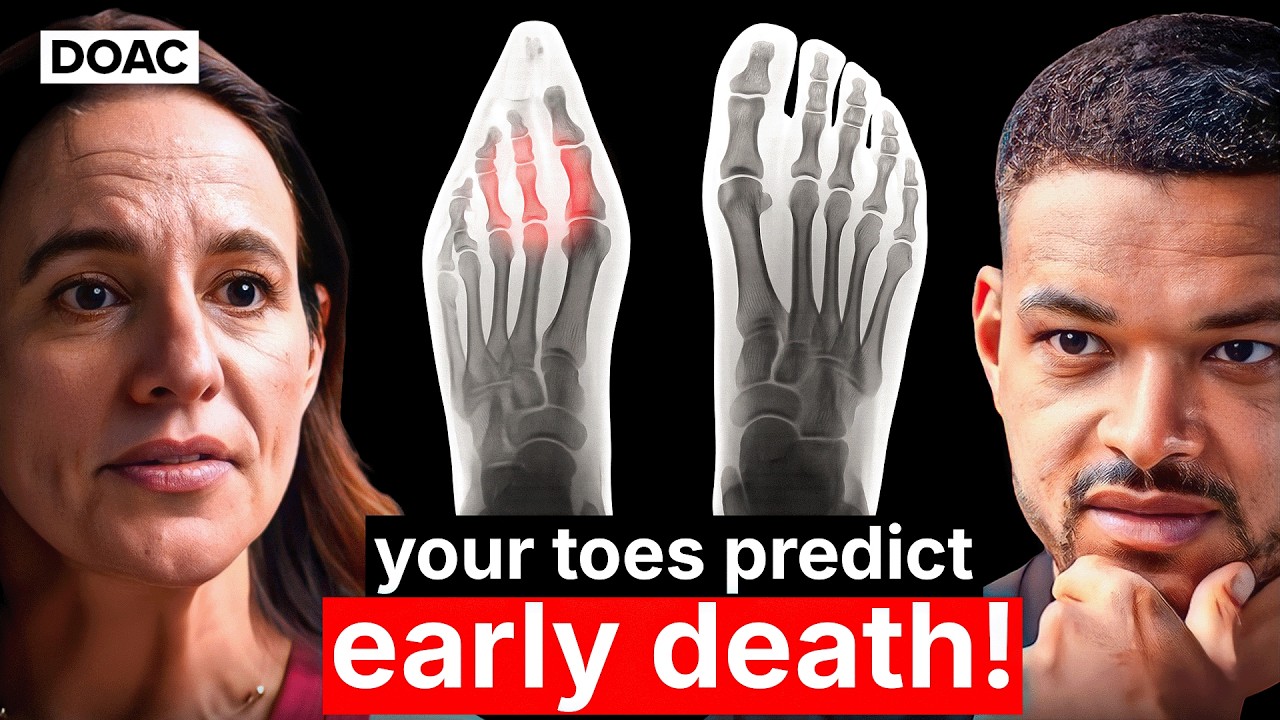
Dr. Conley Links Tapered Shoes to Chronic Pain, Cognitive Decline
The Diary Of A CEO
Modern restrictive footwear causes foot muscular atrophy and kinetic chain dysfunctions that severely drive up long-term risks of physical dependency, back pain, and dementia.
## Background
Published on YouTube by The Diary Of A CEO channel on May 29, 2025, this video features physician and foot specialist Dr. Courtney Conley. According to the page description, Dr. Conley breaks down why modern shoes fail us and explains how proper foot health can fix back pain, cut heart attack and dementia risks, and support overall longevity.
## TL;DR
Dr. Courtney Conley explores the profound impact of foot health on overall physical and mental well-being, explaining how restrictive modern shoes deform foot architecture and trigger kinetic chain issues like back pain. She highlights how incremental daily walking significantly lowers risks of depression, cardiovascular events, and dementia while advocating for foot-strengthening exercises, wide toe box footwear, and gradual transitions to minimalist shoes. Through practical demonstrations and personal stories, the conversation reframes foot care as an accessible, non-negotiable foundation for lifelong mobility and independence.
## Atmosphere & style
The conversation is warm, deeply authentic, and highly educational, striking a balance between clinical expertise and lighthearted camaraderie. Host Steven Bartlett brings playful curiosity and personal vulnerability—sharing his own history with injuries and high-fashion shoes—while Dr. Conley responds with passionate, clear-eyed enthusiasm for biomechanics. Between barefoot demonstrations, live foot diagnostics, and touching personal reflections on addiction and motherhood, the interview feels like a grounded, insightful masterclass that inspires action without being preachy.
## Key takeaways
- [00:00](https://www.youtube.com/watch?v=CMzEnLkS2rQ&t=0s) Foot health and daily movement are vital keys to overall physical longevity, mental well-being, and retaining basic independence as people age.
- [02:20](https://www.youtube.com/watch?v=CMzEnLkS2rQ&t=140s) Foot pain affects 1 in 3 people, and restricting basic mobility frequently cascades into emotional distress and severe mental health declines.
- [02:20](https://www.youtube.com/watch?v=CMzEnLkS2rQ&t=140s) Systemic foot issues often begin in childhood due to rigid, narrow footwear that restricts natural toe splay and prevents normal arch development.
- [05:54](https://www.youtube.com/watch?v=CMzEnLkS2rQ&t=354s) Foot dysfunction cannot be isolated from the rest of the body; mechanical issues at the feet ripple up the kinetic chain to cause knee, hip, and back pain.
- [11:36](https://www.youtube.com/watch?v=CMzEnLkS2rQ&t=696s) Incremental increases in daily walking volume deliver massive health returns, with 5,000 steps per day significantly cutting depression risk and ~9,800 steps per day drastically lowering dementia risk.
- [11:36](https://www.youtube.com/watch?v=CMzEnLkS2rQ&t=696s) For individuals suffering from acute chronic foot pain, gradual reconditioning through micro-walks is far more effective for long-term recovery than total rest.
- [19:06](https://www.youtube.com/watch?v=CMzEnLkS2rQ&t=1146s) Standard tapered toe boxes and elevated heel-to-toe drops deform foot structure, cause muscle atrophy, and shift abnormal loads forward onto the forefoot and spine.
- [23:18](https://www.youtube.com/watch?v=CMzEnLkS2rQ&t=1398s) While hyper-cushioned shoes offer immediate comfort, excessive foam soles deaden sensory feedback from the foot's nerve endings and compromise natural balance.
- [27:56](https://www.youtube.com/watch?v=CMzEnLkS2rQ&t=1676s) Orthotics can temporarily offload inflamed tissues during acute pain, but long-term reliance weakens intrinsic foot muscles unless paired with active strengthening exercises.
- [30:45](https://www.youtube.com/watch?v=CMzEnLkS2rQ&t=1845s) Plantar fasciitis and other common foot injuries typically stem from adding physical load too quickly onto weak, unconditioned foot structures.
- [36:12](https://www.youtube.com/watch?v=CMzEnLkS2rQ&t=2172s) Functional footwear relies on three non-negotiable features: a wide toe box for complete toe splay, a zero-drop sole for alignment, and a thin, flexible base for sensory feedback.
- [37:13](https://www.youtube.com/watch?v=CMzEnLkS2rQ&t=2233s) Transitioning to minimalist or wide toe box shoes must be done gradually to build tissue capacity and avoid triggering overuse injuries.
- [37:13](https://www.youtube.com/watch?v=CMzEnLkS2rQ&t=2233s) Relying on carbon-plated 'super shoes' for everyday running weakens foot muscles, whereas basic plyometric training offers similar performance gains naturally.
- [01:00:32](https://www.youtube.com/watch?v=CMzEnLkS2rQ&t=3632s) Restricted big toe extension and poor ankle dorsiflexion force compensation patterns like shorter strides, limiting hip extension and increasing fall risks.
- [01:05:03](https://www.youtube.com/watch?v=CMzEnLkS2rQ&t=3903s) Overstriding while running creates harsh braking forces and injury risks, which are often masked by thick cushion rather than corrected.
- [01:13:52](https://www.youtube.com/watch?v=CMzEnLkS2rQ&t=4432s) Traditional recovery techniques like towel scrunches promote harmful toe-gripping compensation patterns rather than functional gait mechanics.
- [01:23:34](https://www.youtube.com/watch?v=CMzEnLkS2rQ&t=5014s) Thickly cushioned shoes and rigid hiking boots worsen ankle instability by deadening ground feedback and restricting ankle motion during descents.
## Detailed walkthrough
Here is a detailed, faithful walkthrough of the transcript section.
[00:00](https://www.youtube.com/watch?v=CMzEnLkS2rQ&t=0s) Intro & The Surprising Power of Foot Health
Dr. Courtney Conley opens by framing foot health as a foundational, yet widely ignored, key to longevity and performance. As a former ballet dancer and triathlete who battled bunions, neuroma, and severe heel pain, Dr. Conley speaks from both professional expertise as a chiropractor and deep personal experience. She emphasizes that foot pain is not merely a localized physical inconvenience; one in three people will experience foot pain, which rapidly cascades into emotional distress, isolation, and depression when basic mobility is stripped away.
Steven Bartlett highlights staggering stats on how simple daily walking influences overall health and longevity. The conversation underscores that foot care and proper movement are the most accessible, underutilized tools available for mental and physical well-being.
- **5,000 steps/day:** Reduces symptoms of depression and cuts all-cause mortality risk by 15%.
- **9,800 steps/day:** Drastically lowers the risk of developing dementia.
- **Childhood footwear:** Approximately 70% of children wear shoes that are far too narrow, altering foot development right from the start.
---
[02:20](https://www.youtube.com/watch?v=CMzEnLkS2rQ&t=140s) How Modern Shoes and Early Habits Sabotage Our Feet
Dr. Conley explains that our systemic foot issues begin in early childhood when rigid, narrow footwear starts interfering with natural foot structure. Human feet contain a complex system of bones, ligaments, and four layers of intrinsic muscles designed to stretch, recoil, expand, and absorb impact. By locking children's feet into restrictive shoes, we prevent the natural arch from contracting and lengthening, which stifles strength development before it even has a chance to build.
Steven asks whether the main long-term danger of neglecting our feet is simply the risk of falling in old age. Dr. Conley clarifies that falling is only one downstream consequence. Chronic foot pain—surpassed in frequency only by low back pain—destroys quality of life because it stops people from performing basic daily tasks, from taking a neighborhood hike to simply walking to the mailbox.
- **Foot pain prevalence:** Affects 1 in 3 people, especially those over age 45.
- **Primary systemic risk:** Loss of basic physical independence, leading directly to physical degradation and severe mental health declines.
---
[05:54](https://www.youtube.com/watch?v=CMzEnLkS2rQ&t=354s) Common Foot Injuries and The Kinetic Chain
The discussion turns to specific pathologies that Dr. Conley treats regularly in her clinic. When a patient presents with bilateral symptoms (issues occurring on both feet, such as bilateral bunions), it serves as a crucial diagnostic window into kinetic chain dysfunction higher up in the body. For example, tilting the pelvis forward causes the arches of the feet to collapse, while tucking the pelvis causes the arches to lift. Abnormal loads at the hip or pelvis directly impact the feet, and vice versa.
Dr. Conley breaks down the most common diagnoses rooted in foot weakness and poor load distribution:
* **Bunions:** Bony bumps forming on the joint at the base of the big toe due to abnormal structural loading.
* **Morton's Neuroma:** An extremely painful nerve irritation situated between the toes, most commonly between the third and fourth toes. A wide, strong forefoot provides a stable base during push-off; when narrow shoes prevent toe splay, the nerves are compressed and irritated.
* **Hammer Toes:** A condition where the toes curl or claw unnaturally. Dr. Conley notes that the foot is unique because it is the only place in the body where you can visually observe aberrant (abnormal) mechanical loads on the surface without needing internal imaging.
* **Plantar Fasciopathy & Achilles Tendonopathy:** Severe heel and tendon inflammation. She notes that key lower-leg powerhouses like the *soleus* (deep calf muscle) and the *posterior tibialis tendon* (which stabilizes the medial column of the foot) need to be loaded and trained just like any other muscle group in the gym.
---
[08:54](https://www.youtube.com/watch?v=CMzEnLkS2rQ&t=534s) Dr. Courtney's Personal Story: Movement as Survival
Dr. Conley shares her personal background as a chiropractor who chose proactive physical medicine over surgery or pharmaceuticals. Growing up as a ballet dancer, runner, and triathlete, movement was not about tracking VO2 max or optimizing longevity metrics; it was a fundamental coping mechanism and a means of emotional survival while fighting personal demons in her teens and twenties.
When severe foot injuries (bunions, neuromas, and heel pain) stacked up and prevented her from walking day after day, the inability to move dragged her into dark emotional places. This personal battle birthed her passion to establish *Gait Happens* and dedicated her career to helping others regain their functional movement.
> "Movement was survival for me... When you tag on day after day of not being able to walk and not being able to move, you can go to some pretty dark places."
---
[11:36](https://www.youtube.com/watch?v=CMzEnLkS2rQ&t=696s) The Power of Walking: Micro-Walks and Overcoming Pain
Steven admits that walking has fallen out of fashion in a modern world dominated by Ubers, desk jobs, and sedentary routines. Dr. Conley points out that the global average step count sits around 4,500 to 4,900 steps per day, meaning millions of people are walking far less.
She highlights how tiny, incremental increases in daily steps yield massive clinical returns for longevity and mental health:
- **+500 extra steps/day:** Reduces cardiovascular mortality risk by 7%.
- **+1,000 extra steps/day:** Reduces all-cause mortality risk by 15%.
- **5,000 steps/day:** Significantly cuts the risk of experiencing depressive symptoms.
- **7,500 steps/day:** Substantially lowers the overall clinical prevalence and diagnosis of depression.
To illustrate this, Dr. Conley shares the emotional story of a 27-year-old patient who was a quadruplet suffering from severe chronic heel pain for two years. A previous doctor had instructed him to restrict his movement to just 2,500 steps a day to "rest" the foot. Isolated in his father's basement and watching his siblings thrive, the young man was crying daily and sunk into deep depression.
Instead of prescribing more orthotics or rest, Dr. Conley focused on rebuilding his confidence through **"micro-walks"**—short 5-minute walks (roughly 500 steps) or 10-minute walks (roughly 1,000 steps). Over time, gradual loading reconditioned his feet, which naturally support four to six times body weight during normal walking. Months later, he was walking 5,000 to 6,000 steps a day, reconnecting with family, attending church, and living without constant despair.
<ElicitationsGroup message="Where would you like to go next with this transcript summary?">
<Elicitation label="Summarize Part 2 of the transcript" query="Please provide the walkthrough for Part 2 of this transcript."/>
<Elicitation label="Deep dive into shoe characteristics & foot strength" query="Can you detail the specific shoe characteristics and foot exercises Dr. Conley recommends based on this episode?"/>
</ElicitationsGroup>
[19:06](https://www.youtube.com/watch?v=CMzEnLkS2rQ&t=1146s) Footwear Choices, Tapered Shoes, and Missing Mobility
Steven Bartlett reflects on how people rarely pay attention to their feet and ankles until an injury forces them to. Drawing from his own experience, he recalls developing plantar fasciitis in the past and notes that he is currently dealing with a high ankle sprain sustained while training for Soccer Aid. Going through recovery again has pushed him to evaluate what went wrong and how foot strengthening acts as a critical preventative measure. Pointing to a lineup of standard footwear on the table, Steven asks Dr. Courtney Conley what makes everyday shoes—often worn from early childhood—so problematic for long-term health.
Dr. Conley points out that standard sneakers feature a narrow, tapered toe box that pinches the toes together rather than allowing them to spread. She cites research showing that approximately 70% of young girls wear shoes that are too narrow for their feet. Because the widest part of a natural human foot is supposed to be the toes, shoving them into pointed toe boxes actively alters foot structure over time. Dr. Conley draws an analogy to wearing an arm in a sling for a decade: without active use and space to move, the foot's muscles atrophy and mobility is permanently lost.
- **Childhood Footwear Statistics:** ~70% of girls wear shoes that are structurally too narrow.
- **Biomechanical Impact:** Tapered toe boxes constrict the forefoot, changing skeletal alignment and causing muscle loss.
- **The "Use It or Lose It" Rule:** Restricting toe splay in stiff, narrow shoes immobilizes the foot similarly to keeping a limb in a sling.
---
[21:18](https://www.youtube.com/watch?v=CMzEnLkS2rQ&t=1278s) Men's Dress Shoes and Heel-to-Toe Drop
Dr. Conley expands on how formal men's shoes worsen these structural issues through pointed fronts, rigid soles, and elevated heels. She mentions lighthearted debates with her brother in New York City, who frequently shows her shoes he claims are wide, only for her to point out their lingering rigidity and narrowness. Beyond toe constriction, many dress shoes incorporate a noticeable "heel-to-toe drop," raising the heel above the plane of the forefoot like a mini high heel.
When a foot sits flat on the ground, the muscular and tendinous tissues in the back of the leg maintain an optimal length-tension relationship while distributing pressure evenly. Raising the heel immediately shifts excess weight forward onto the forefoot and shortens the calf muscles and Achilles tendon. Dr. Conley emphasizes that this distortion ripples upward, causing chain-reaction issues in the calves, hamstrings, and lower back. Although foot pain is the primary complaint that brings patients into her clinic, she stresses that foot dysfunction cannot be isolated from the hips and core, which actively dictate how the foot unlocks during movement.
- **Heel-to-Toe Drop Effects:** Elevates the heel, shortens posterior leg tissues, and dramatically increases forefoot pressure.
- **Upward Kinetic Chain Impact:** Foot misalignment and elevated heels directly contribute to hamstring tightness and lower back injuries.
- **Hip and Foot Interdependence:** Dynamic hip strength controls how the foot unlocks and adapts to the ground during a stride.
---
[23:18](https://www.youtube.com/watch?v=CMzEnLkS2rQ&t=1398s) The Shoe Cushioning Dilemma and Loss of Sensory Input
Addressing the societal tension between health and aesthetic style, Dr. Conley shares that even her daughter jokes about being forced to wear wide, functional "platypus shoes" instead of trendy footwear. While fashion often dictates poor foot mechanics, Dr. Conley acknowledges that shoe design is gradually improving. Steven then asks about thick, pillowy shoe soles—often featuring an inch or more of plush foam—and whether maximum cushioning is actually good for the body.
Dr. Conley explains that hyper-cushioned shoes present a major mechanical trade-off. While standing on a soft foam sole in a store feels immediately comfortable, excessive cushioning strips away sensory feedback. The human foot acts as a complex sensory organ packed with thousands of nerve endings that provide real-time feedback to help maintain upright balance. Thick foam dampens these signals, impairing sensory perception. While cushioned soles have a time and place—such as for individuals standing still on concrete all day—her absolute non-negotiable requirement is a wide toe box that permits full toe splay for balance and propulsion.
> "The cushion conversation is always very interesting... The problem with cushion is that the more stuff that's between your foot and the ground, the less you feel. So, there's a loss of sensory acuity... The foot is... a sensory organ."
---
[25:43](https://www.youtube.com/watch?v=CMzEnLkS2rQ&t=1543s) Natural Foot Anatomy vs. Modern Deformities
Examining his own foot, Steven observes that his pinky toe curls inward and tucked underneath, resembling the cramped shape of a shoe. Dr. Conley confirms that this curled shape is an unnatural distortion caused by years of restrictive footwear. Steven asks what an unconstrained, natural foot looks like and whether Dr. Conley has observed populations that do not wear cushioned, narrow shoes.
Dr. Conley confesses to being "obsessively" fascinated by feet and human gait, noting that how a person walks reveals their physical state and emotions. She shares an anecdote from a spring break trip to Belize with her mother and daughter, where she spent time watching two local builders working completely barefoot on a construction site near the beach. Their feet were broad, thick, flat, and remarkably strong. Unlike modern culture, which views a flat foot as a defect requiring orthotics, these workers possessed incredible toe range of motion, strength, and arch control. She describes a strong, wide foot as the essential foundation for human movement, comparing it to building a house on solid ground rather than sinking sand.
- **Visual Indicators of Constriction:** Curled or tucked pinky toes are direct visual proof of shoe-induced structural deformity.
- **Observation of Barefoot Populations:** Naturally un-shod feet feature wide toes, thick skin, high mobility, and functional strength across all joints.
- **The "Flat Foot" Misconception:** A broad, flat appearance in active barefoot individuals often reflects structural strength and load capacity rather than pathology.
---
[27:56](https://www.youtube.com/watch?v=CMzEnLkS2rQ&t=1676s) Insoles, Orthotics, and the Missing Exit Strategy
Steven recounts his own experience with plantar fasciitis, noting that a specialist prescribed custom insoles (orthotics). However, Steven quickly stopped using them and swapped his footwear instead. He asks whether reliance on insoles is truly the best primary intervention, pointing out that medicine often treats foot pain by throwing inserts at the problem rather than fixing the underlying mechanics.
Dr. Conley argues that the medical field's reliance on orthotics and surgery fails patients because it ignores long-term active rehabilitation. While inserts can temporarily offload inflamed tissues during acute flare-ups, relying on them perpetually causes the foot to become weaker. She insists that clinicians must provide an "and" approach—offering temporary relief *and* implementing a progressive foot-strengthening routine with a clear exit strategy to get the foot back on the ground. She often treats patients who own up to 20 pairs of custom inserts without experiencing lasting relief because no one ever addressed their muscular weakness.
- **Acute vs. Chronic Load Offloading:** Orthotics are useful short-term tools to reduce immediate pain, but long-term reliance accelerates weakness.
- **Flexor Digitorum Brevis:** Weakness in this key muscle—which runs parallel to the plantar fascia and pulls the four outer toes down—directly correlates with heel pain.
- **The "And" Conversation:** Effective care pairs temporary symptom management with targeted strengthening to eliminate reliance on passive support.
> "I have patients... they will come in with 20 pairs of orthotics, 20 pairs of inserts... and I'm sitting there going, 'we're missing the boat here.' Let's have the 'and' conversation... wear this insert and strengthen your foot, because the goal should be to have an exit strategy for the insert."
---
[30:45](https://www.youtube.com/watch?v=CMzEnLkS2rQ&t=1845s) The High Rate of Foot Pain and Causes of Plantar Fasciitis
Steven brings up a striking analogy from researcher Daniel Lieberman: if a child were forced to wear two-inch thick gloves from birth until age 30, their hands would be completely weak and deformed upon removing them—yet society treats feet this way every day. Dr. Conley emphasizes that **1 in 3 people** suffer from foot pain, making it a critical public health issue.
They break down the mechanics of plantar fasciitis (and its chronic counterpart, plantar fasciopathy). Steven describes how his own flare-up began: after living normally, he abruptly started training twice a week for Soccer Aid. By week five or six, he developed severe, debilitating heel pain that was particularly excruciating during his first steps in the morning. Dr. Conley explains that almost all cases stem from adding physical load too quickly onto a weak structure ("too much, too fast, too soon"). Whether from sudden soccer training or walking barefoot around the house during COVID-19 lockdowns, unconditioned feet break down when exposed to loads they are unprepared to bear.
- **Prevalence of Foot Pain:** 1 in 3 people experience debilitating foot pain.
- **Plantar Fasciitis Mechanics:** Caused by sudden increases in training volume or load on unconditioned, structurally weak feet.
- **Morning Heel Pain:** A classic diagnostic symptom caused by acute inflammation and tissue tightening overnight.
---
[33:51](https://www.youtube.com/watch?v=CMzEnLkS2rQ&t=2031s) Downward Spiral of Inactivity and High-Heeled Shoes
Steven highlights the severe secondary consequences of foot and ankle injuries. Dealing with his current high ankle sprain and past plantar fasciitis forced extended periods of inactivity, leading to lower-body muscle atrophy, compensatory imbalances on his uninjured side, and heightened susceptibility to lower back problems. Dr. Conley agrees, stressing that maintaining foot strength in one's 30s is not just about avoiding falls at age 70—it is about preserving daily mobility and preventing the downward physical and mental spiral of forced sedentary living.
Turning to high heels, Steven jokingly notes that anyone can wear them, but asks for Dr. Conley's clinical opinion on their safety. Dr. Conley states plainly that heels force the foot into a completely unnatural, compromised position. While she recognizes that fashion choices mean people will not abandon heels entirely, she advises strict moderation. Prolonged time in heels weakens structural connective tissue, shifts extreme joint pressures forward, and alters posture—despite many wearers claiming they feel "comfortable."
- **Cascading Effects of Injury:** Acute foot/ankle trauma forces inactivity, driving rapid muscular atrophy, structural asymmetry, and secondary back pain.
- **High Heel Mechanics:** Forces extreme plantarflexion, drastically alters joint pressure distribution, and weakens connective tissues over time.
- **Moderation Rule:** Non-functional shoes should be limited in duration to avoid permanent tissue adaptation and structural damage.
---
[36:12](https://www.youtube.com/watch?v=CMzEnLkS2rQ&t=2172s) Characteristics of Functional Footwear
Steven introduces two functional shoes on the set: a pair from Vivo Barefoot (a podcast sponsor) and a pair from Altra Running. He asks Dr. Conley to detail the key features that define a healthy, functional shoe.
Dr. Conley outlines her three strict non-negotiables for functional footwear. First, the shoe must feature a wide toe box that allows full toe splay to prevent conditions like bunions, hammertoes, and neuromas. Second, the shoe must be "zero-drop," meaning the heel and toe sit on the exact same horizontal plane. Third, the sole should be thin and flexible enough to allow the foot to bend and feel the ground naturally. She describes ultra-minimalist options like Vivo Barefoot as a "workhorse shoe" that actively builds internal foot strength through everyday use.
- **Non-Negotiable #1 — Wide Toe Box:** Essential for complete toe splay; prevents bunions, Morton's neuromas, and hammertoes.
- **Non-Negotiable #2 — Zero-Drop Sole:** The heel and forefoot sit at equal height to maintain proper postural alignment and tissue length.
- **Non-Negotiable #3 — Thin and Flexible Sole:** Allows natural foot articulation and restores essential sensory feedback from the ground.
[37:13](https://www.youtube.com/watch?v=CMzEnLkS2rQ&t=2233s) Earn the Right to Barefoot: Transitioning Footwear and "Super Shoes"
Transitioning from maximalist, heavily cushioned running shoes to minimalist or wide-toe-box footwear requires a gradual, deliberate approach to prevent injury. Courtney Conley emphasizes that while minimalist shoes increase the physical load on bones, ligaments, tendons, and muscles—thereby strengthening the foot over time—switching instantly can trigger severe conditions like plantar fasciopathy. Patients who throw away cushioned shoes with custom insoles overnight to wear minimalist shoes 24/7 inevitably complain of heel pain because their feet have not earned the right to that load. The transition must start with targeted foot exercises and wearing minimalist shoes for just 10 minutes a day, slowly scaling up as tissue capacity improves.
```
FOOTWEAR SPECTRUM & TRANSITION GUIDE
[ Aggressive Cushion / Inserts ] ---> [ Wide Toe Box / Cushioned ] ---> [ Minimalist / Zero-Drop ]
• High stack height • Zero-drop, wider forefoot • Low stack height, zero-drop
• Passive support • Protective for road running • Maximizes muscle activation
• Use during recovery • Transition bridge • "Earn the right" gradually
```
For individuals with severely weakened feet, jumping straight to paper-thin footwear is impractical. Conley advocates using zero-drop shoes that feature a wide toe box and a flexible mesh upper, allowing the toes to expand naturalally while still offering a cushioned stack height. This setup keeps the heel and toe on the exact same horizontal plane without exposing a weak foot to harsh concrete or asphalt impacts.
When the conversation shifts to high-performance "super shoes" like the Nike Alphafly, Conley admits they make her "start sweating." Steven Bartlett jokes about his own running shoes, admitting, *"I have torn the ligaments in my ankle, but I look good."* Conley breaks down the mechanics of super shoes, highlighting their extreme carbon-plated rigidity and prominent "toe spring"—the upward curvature at the front that rocks the foot forward automatically.
* **The Super Shoe Trade-off:** Super shoes provide a 2% to 4% improvement in running economy due to carbon-plate technology facilitating gait, but relying on them for daily training weakens the intrinsic foot muscles.
* **The Plyometric Alternative:** Research demonstrates that doing basic plyometric training (such as jumping exercises) once or twice a week yields the exact same 2% to 4% increase in running performance by building natural elastic capacity.
* **The Stacking Strategy:** Conley advises runners to train mostly in zero-drop, foot-strengthening shoes, perform regular plyometrics, and save high-tech super shoes purely for speed or race days.
---
[42:45](https://www.youtube.com/watch?v=CMzEnLkS2rQ&t=2565s) Movement Snacks, Step Counts, and the Dementia Connection
Addressing modern sedentary lifestyles, Conley dispels the myth that standing desks are a total cure-all for desk workers. Simply standing in one place for eight hours is not inherently better than sitting motionless; the human body craves movement rather than fixed posture. She advocates taking frequent "movement snacks"—short, 5-minute walks scattered throughout the workday to keep the musculoskeletal system active and boost daily step volume.
The conversation turns to the profound link between daily walking volume and cognitive decline. Conley highlights compelling epidemiological research showing that hitting roughly 9,800 steps per day dramatically lowers the risk of developing dementia and Alzheimer's disease. Crucially, the health benefits follow a non-linear curve, meaning people do not need to hit massive targets right away to harvest significant neurological protection.
* **The 4,000-Step Threshold:** Walking just 3,800 to 4,000 steps per day delivers fully **50% of the maximum brain-protective benefit** against dementia.
* **Social Walking Dynamics:** Group walking studies among older adults show marked reductions in feelings of loneliness, depression, and isolation, combining cardiovascular activity with essential emotional connection.
* **The Shift to Walking:** At major industry conventions like the Running Event in Austin, Texas, shoe retailers report that the majority of their retail customers are now walkers rather than runners—a shift Conley suspects may stem from runners getting injured by overly artificial footwear that does the work for the foot.
---
[46:04](https://www.youtube.com/watch?v=CMzEnLkS2rQ&t=2764s) The "Foot Gym" and Diagnosing Common Deformities
Unpacking her portable "foot health kit," Conley reveals what she jokingly calls her "bag of treats" for building a "foot gym." The kit contains foundational diagnostic and rehabilitation tools: soft silicone toe spacers to restore alignment, elastic toe strengtheners, resistance bands, and a textured mobility ball. She explains that caring for feet should be integrated into daily wellness routines alongside VO2 max work, strength training, and cardiovascular fitness.
Taking his shoes and socks off, Bartlett asks Conley to evaluate his feet, mentioning his history of plantar fasciitis and a recent severe ankle sprain involving torn ligaments on three sides. Inspecting his forefoot, Conley immediately identifies a visible bony bump forming at the top of his big toe joint. She explains the distinct diagnoses associated with foot bumps:
```
COMMON FOREFOOT DEFORMITIES
Hallux Limitus / Rigidus Hallux Valgus
(Top of Big Toe Joint) (Side of Big Toe Joint)
│ │
▼ ▼
• Osteoarthritis / Bone spurs • Bunion formation
• Restricts upward windlass mechanism • Lateral drift of big toe
• Limits gait extension • Narrow shoe box constraint
```
* **Hallux Limitus / Rigidus:** Bony growth or osteoarthritis forming on *top* of the big toe joint, restricting the upward movement required during walking or running.
* **Hallux Valgus (Bunion):** Deviation where the big toe shifts inward and the joint protrudes out to the *side*, typically driven by narrow, tapering shoe toe boxes.
* **Normal Big Toe Range:** A healthy gait requires **40 to 45 degrees of upward extension** at the big toe while keeping the ball of the foot firmly grounded.
---
[49:49](https://www.youtube.com/watch?v=CMzEnLkS2rQ&t=2989s) Toe Dexterity, Muscle Testing, and Awakening the Arch
Conley leads Bartlett through a real-time assessment of his toe dexterity and motor control, testing whether he can move his toes independently without compensation from his hands or lower body. She asks him to raise only his big toes while keeping his smaller toes grounded, and then reverse the action by raising the outer four toes. Bartlett notes how surprisingly difficult it is, remarking, *"That's actually quite hard. Like I've never had to do that before."* Conley explains that a lack of foot awareness often causes people to arch their backs or tense their hands when trying to isolate their toes.
She highlights the ability to splay the middle toes (digits two, three, and four) as vital for preventing conditions like Morton's neuroma—a painful thickening of tissue around the nerves running between the metatarsal heads. When feet are jammed into narrow shoes, these nerves get crushed, whereas wide footwear allows the metatarsals to spread naturally.
To test deep foot strength, Conley demonstrates a simple home test using a credit card placed under the toes:
* **Flexor Hallucis Longus (FHL) Test:** Placing a card under the big toe, she attempts to pull it away while the patient presses down. The engagement should be felt deep in the foot arch and calf—not in the hip or quad. The FHL originates on the fibula (outside of the lower leg), wraps under the inner ankle, and inserts into the big toe, making it essential for stability after ankle sprains.
* **Flexor Digitorum Longus Test:** Placing the card under the four smaller toes tests the long digit flexors that stabilize the forefoot during push-off.
* **Awakening Plantar Receptors:** If a person feels no muscle engagement during these tests, rolling the sole over a firm mobility ball for 60 to 90 seconds wakes up dull sensory receptors. Conley keeps a ball under her standing desk and performs foot rolling daily after running to maintain nerve density and arch responsiveness.
---
[54:21](https://www.youtube.com/watch?v=CMzEnLkS2rQ&t=3261s) Wide Shoes vs. Wide Toe Boxes and Toe Spacers
Reflecting on her past as a ballet dancer who spent years wearing pointe shoes, rigid orthotics, and ill-fitting footwear, Conley shares that she developed her own bunions and foot weakness. To fix her mechanics, she made wearing silicone toe spacers a non-negotiable part of her daily life. These spacers manually separate the toes, re-aligning the first metatarsal bone with the rest of the foot to restore a functional base of support.
Conley clarifies a major source of consumer confusion regarding shoe sizing: the difference between a "wide shoe" and a "wide toe box shoe."
* **The Taper Trap:** Standard "wide" shoes merely add extra volume around the midfoot or ball of the foot, but still taper sharply inward at the toes, pinching them into an unnatural point.
* **True Wide Toe Box:** A proper wide-toe-box shoe maintains an anatomical shape where the toe box is the widest part of the entire shoe, allowing digits to splay naturally.
* **Long-Term Benefit:** Wearing toe spacers inside anatomically correct footwear for a year permanently improves natural toe splay, restores blood flow, and rebuilds deep intrinsic arch strength.
[56:19](https://www.youtube.com/watch?v=CMzEnLkS2rQ&t=3379s) Building a Jet Engine on a Solid Platform
Dr. Courtney Conley emphasizes that developing robust foot strength has a direct, positive ripple effect all the way up the kinetic chain. When toe strength improves, it creates a stable base of support that optimizes ankle mobility, knee extension, and hip extension. By allowing the foot to perform its natural job—being both mobile and resilient—the rest of the body functions as intended. Conversely, when issues originate at the foot level, compensations inevitably travel upward.
Following this discussion, host Steven Bartlett introduces a sponsor message for Vivo Barefoot. Reflecting on a previous podcast episode with Dr. Daniel Lieberman, Steven notes how modern cushioned shoes weaken the feet and contribute to back and knee pain. After dealing with foot pain himself, Steven adopted Vivo Barefoot shoes to rebuild his natural foot strength. He references research from Liverpool University demonstrating that wearing Vivo Barefoot footwear for six months can increase foot strength by up to 60%.
- **Upstream kinetic effects:** Stronger toes improve ankle mobility, knee extension, and hip extension.
- **Biomechanical analogy:** Building a strong body on weak feet is like putting a "jet engine on a paper airplane."
- **Research on barefoot footwear:** A study from Liverpool University showed a 60% increase in foot strength after 6 months of wearing Vivo Barefoot shoes.
---
[57:56](https://www.youtube.com/watch?v=CMzEnLkS2rQ&t=3476s) Targeted Toe Exercises for Plantar Fasciitis and Foot Resilience
Turning her attention to specific rehabilitation tools on the table, Dr. Conley demonstrates exercises using resistance bands to strengthen individual toes. To perform a toe resistance exercise—which functions like a "bicep curl" for the feet—one places their heel on the band, wraps the band over the toes, and presses downward while lifting upward against the resistance. Dr. Conley outlines a specific protocol supported by research that directly targets plantar fasciitis symptoms by strengthening both the four lesser toes and the big toe independently.
She also highlights the importance of the pinky toe, noting that many people dismiss the little toe as if its only purpose is "to hit furniture." In reality, the abductor digiti minimi—the muscle responsible for moving the little toe outward—is surprisingly large and plays a crucial role in stabilizing the lateral border of the foot. Strengthening these intrinsic muscles builds a foundation of structural resilience across the entire system.
- **Toe Resistance Protocol:** 4 sets of 12 repetitions pressing against resistance bands to treat plantar fasciitis and build arch strength.
- **Big Toe Technique:** Keep the ball of the big toe grounded while pressing into resistance to build targeted strength.
- **Little Toe Function:** The abductor digiti minimi is equivalent in size to the big toe's abductor and acts as a primary lateral stabilizer.
- **Athletes & Load Capacity:** High-performance athletes are experiencing higher rates of foot injuries because their overall strength and power output exceed the load capacity of their unconditioned feet.
---
[01:00:32](https://www.youtube.com/watch?v=CMzEnLkS2rQ&t=3632s) Big Toe Extension, Ankle Mobility, and the Soleus Machine
Dr. Conley explains how limited foot flexibility impacts total-body mobility and movement patterns during everyday activities like walking. For proper gait, the big toe must extend sufficiently to allow full range of motion at the knee and hip. If a person only has around 20 degrees of big toe extension, the body compensates by shortening its stride and limiting hip extension. She bridges this to ankle dorsiflexion—the ability to bend the ankle forward while keeping the heel firmly on the ground—noting that normal functional range falls between 20 to 30 degrees, which is frequently lost from wearing elevated heels.
Steven recalls a previous podcast where he discussed white-water rafting in Bali and negotiating steep stairs, admitting he thought maintaining that ability into old age depended on VO2 max or core strength. Dr. Conley points out that ankle mobility and toe strength are the true foundational safeguards against falls. She highlights the soleus—the deep calf muscle—as a power powerhouse that can handle loads up to eight times body weight through the forefoot. Despite its vital role in controlling ankle motion, it remains one of the most neglected muscles in conventional training.
- **Big Toe Range Requirements:** Restricted toe extension (e.g., capped at 20 degrees) forces shorter strides and restricts full hip extension.
- **Ankle Dorsiflexion Target:** Healthy, uncompromised ankle dorsiflexion requires 20 to 30 degrees of motion with the heel grounded.
- **Soleus Load Capacity:** The soleus muscle can manage force up to 8 times an individual's body weight during forefoot loading.
- **Return-to-Running Baseline Criteria:**
- *Seated Single-Leg Calf Raise:* Capacity to perform 6 repetitions with 1.5 times body weight.
- *Standing Single-Leg Calf Raise:* Capacity to perform 6 repetitions holding 0.5 times body weight.
- **Gym Observation:** Dr. Conley jokes that the seated calf raise machine—which isolates the soleus—should have the longest line in the gym, yet it is almost always empty.
---
[01:05:03](https://www.youtube.com/watch?v=CMzEnLkS2rQ&t=3903s) Running Mechanics: The Danger of Overstriding and Crossover Gaits
When analyzing common running mistakes beyond heavily cushioned maximalist shoes, Dr. Conley identifies heavy overstriding as the primary offender. Overstriding occurs when the foot strikes the ground far in front of the body's center of mass rather than directly underneath it. The calcaneus (heel bone) is naturally designed to absorb shock, but overstriding creates harsh braking forces. Highly cushioned shoes often mask this impact, allowing runners to repeatedly overstride without feeling the immediate pain feedback that would otherwise force them to correct their stride.
She clarifies what a running gait analysis entails, explaining that an observer evaluates the movement of the feet, knees, pelvis, and hips across both the stance and swing phases. Alongside overstriding, another frequent issue is a "crossover gait," where a runner's feet cross over the body's midline upon contact, leading to excessive collapse through the lower extremity. Correcting gait requires a combination of building physical strength (such as calf raises) and practicing gait drills (such as adjusting cadence) to engage different neural pathways in the brain.
- **Overstriding Defined:** Landing with the foot extended far ahead of the body's center of mass rather than underneath or slightly in front of it.
- **Sensory Masking:** Thickly cushioned footwear silences natural pain feedback, enabling runners to maintain harsh overstriding patterns unnoticed.
- **Crossover Gait:** Striking across the body's center midline, which reduces running efficiency and causes inward joint collapse.
- **Strength vs. Skill:** Strength training builds muscular capacity, but motor skill cues (like cadence adjustments) are required to rewrite brain-gait patterns.
---
[01:09:50](https://www.youtube.com/watch?v=CMzEnLkS2rQ&t=4190s) Barefoot Dynamics and Custom Toe-Splay Resistance Bands
Addressing whether humans are meant to be entirely barefoot, Dr. Conley acknowledges that while feet are evolutionarily designed to feel and adapt to terrain, modern hard surfaces like concrete make pure barefoot living challenging. However, building stronger, more resilient feet allows people to navigate modern environments far more safely. She then introduces custom toe-resistance bands she invented, inspired by finger-strengthening bands her rock-climber daughter used.
Dr. Conley guides Steven through using these variable-resistance bands on his own feet. As Steven tries to spread his toes, he jokingly remarks that his little toe feels "completely redundant" and "disabled." Dr. Conley coaches him to activate the abductor hallucis (the muscle along the inner arch that pulls the big toe outward, key for combating bunions) while maintaining the structural "tripod of the foot"—keeping the center of the heel, the base of the big toe, and the base of the little toe solidly grounded while lifting and splaying the toes.
- **Origin of Toe Bands:** Designed by Dr. Conley after observing her daughter use finger resistance loops for rock climbing.
- **Abductor Hallucis Activation:** Engaging this inner arch muscle pulls the big toe outward and is critical for bunion prevention and arch support.
- **The Foot Tripod:** A three-point stance consisting of the center of the heel, the first metatarsal head (ball of the big toe), and the fifth metatarsal head (base of the pinky toe).
- **Gait Mechanics at Heel-Off:** Engaging intrinsic foot muscles, the posterior tibialis (a key arch stabilizer), and the soleus during the push-off phase generates stability and propulsion.
[01:13:52](https://www.youtube.com/watch?v=CMzEnLkS2rQ&t=4432s) Interactive Foot Mobility and Gait Mechanics Demonstration
Dr. Courtney Conley leads Steven through an interactive exercise targeting foot alignment and arch activation. She instructs him to stand with his feet slightly apart and toes pointing straight forward, emphasizing that during normal gait from point A to point B, feet should be directed straight ahead. Unless a person has a structural variation—such as outward bone rotation in the lower leg—walking with feet flared outward indicates a mechanical issue. She guides Steven to place a resistance band around his feet and drive his ankles outward into the band while keeping the ball of the foot and the big toe grounded, simulating a slight ankle sprain action to engage the arch and hips.
To demonstrate how the foot dynamically changes shape, Dr. Conley has Steven place his hands on his chest and rotate his upper body from left to right while keeping his feet anchored. This torso rotation naturally causes the foot to alternate between flattening and lifting into an arch. She recommends integrating quick movement breaks like this throughout the workday—such as doing 20 torso rotations or "toe yoga" (lifting, spreading, and reaching the big toe and small toes) while standing at a desk—to maintain tissue elasticity and foot function.
When Steven mentions that a physical therapist previously had him do towel scrunches—grabbing a towel on the floor with his toes as part of injury rehab—Dr. Conley pushes back against the practice. While towel scrunches or picking up marbles can briefly help "wake up" the foot in very early rehabilitation phases, they lack functional transfer to real-world movement. During a natural gait cycle of walking or running, toes should never curl or grip the floor. In fact, toe gripping is one of the most common compensation patterns seen in people with weak, dysfunctional feet.
- Proper gait requires toes to point straight ahead unless structural bone rotation prevents it.
- Torso rotation naturally loads and shapes the arches of the grounded feet.
- Recommended office movement breaks include 20 torso rotations and toe yoga.
- Towel scrunches are non-functional for walking and running, as toe-gripping is actually a compensation pattern for weak feet.
---
[01:19:30](https://www.youtube.com/watch?v=CMzEnLkS2rQ&t=4770s) Socks, Webbed Toes, and the Shoe Spectrum
When asked why she does not wear socks, Dr. Conley reveals a personal physical trait: her second and third toes are webbed with skin reaching up between them. Standard compression socks squeeze her toes together into a tight bundle, aggravating her bunion and causing discomfort. While toe socks would theoretically offer better foot mechanics, her webbed toes prevent her from wearing them comfortably. Turning to the overarching goal of her work, she explains that her primary passion is building public awareness around ground-up movement to make daily life, physical exercise, and general wellness easier.
For anyone overwhelmed by complex foot exercises, Dr. Conley points out that the "lowest hanging fruit" is simply switching to foot-shaped footwear that allows the foot to feel the ground in a functional position. Research demonstrates that simply wearing minimal or foot-shaped shoes naturally increases foot muscle strength over time. Steven reads a YouTube comment from a 65-year-old viewer who reported that switching to zero-drop shoes with wide toe boxes completely eliminated his foot, ankle, knee, and hip pain within two months. Dr. Conley notes that such stories are extremely common because conventional shoes impose artificial cushion, support, and heel elevation that alter natural ground-interface dynamics.
Crucially, Dr. Conley emphasizes that people should not rush out to burn their existing shoes immediately. Transitioning too quickly into minimalist footwear can cause injury because tissues need time to adapt. She advocates building a "shoe spectrum" based on earning the right to wear minimal footwear gradually. In this spectrum, individuals manage different pairs for different scenarios—balancing a "workhorse shoe" for daily foot strengthening with a cushioned "cheat shoe" when extra protection is temporarily required.
- Dr. Conley has webbed second and third toes, preventing her from comfortably wearing conventional tight socks or toe socks.
- Research confirms that simply transitioning to foot-shaped footwear builds baseline foot strength.
- A 65-year-old viewer eliminated decades of foot, ankle, knee, and hip pain within months of using zero-drop, wide toe box shoes.
- Adopting minimalist footwear requires a gradual transition using a "shoe spectrum" rather than an abrupt shift.
---
[01:23:34](https://www.youtube.com/watch?v=CMzEnLkS2rQ&t=5014s) Ankle Rehabilitation, Hiking Boots, and Athletic Cleats
Discussing ankle sprain recovery, Dr. Conley highlights a dangerous irony in traditional rehabilitation advice. When recovering from a sprained ankle, patients are often advised to wear thick, highly cushioned running shoes. However, max-cushion soles elevate the foot off the ground and severely deaden proprioceptive feedback. If a runner with a history of ankle instability steps on an uneven surface like a rock while high up on a thick foam stack, the foot has a much greater distance to tilt, dramatically increasing the risk of a severe re-sprain. For this reason, she keeps her ankle sprain patients in low-profile shoes close to the ground.
She similarly challenges the common belief that rigid hiking boots are necessary for ankle stability on trails. Rather than offering real structural protection, high-top hiking boots provide a psychological "neurological hug" while stiffly restricting ankle dorsiflexion. When walking down a mountain, restricting natural ankle motion transfers excessive kinetic loads directly up into the knee joints. She advises hikers to train their ankles to be stable and mobile so they no longer rely on rigid boots.
Regarding specialized athletic footwear—such as soccer cleats, ice skates, ski boots, or stiff cycling shoes—Dr. Conley clarifies that using them will not undo the progress made from barefoot training. Because certain sports inherently require rigid footwear environments, athletes simply need to prepare their feet before playing and restore foot mobility afterward. Her recovery routine includes rolling out the soles of her feet after riding in stiff cycling shoes.
- Thickly cushioned shoes increase the height of the foot above the ground, exacerbating leverage and risk during an ankle turn.
- High-top hiking boots restrict ankle dorsiflexion, transferring impact loads directly into the knee joint on downhill descents.
- Specialized rigid shoes (cleats, ski boots, cycling shoes) should be managed with pre- and post-activity foot mobility work.
---
[01:26:45](https://www.youtube.com/watch?v=CMzEnLkS2rQ&t=5205s) Balancing Passion with Family and Final Reflections
Steven presents the closing tradition of the podcast, asking a question left by the previous guest: *"What do you fear you will most likely regret 10 years from now?"* Dr. Conley speaks candidly about her constant internal struggle to balance her deep passion for her work with her role as a mother. While she loves educating people on foot health and working long hours, she actively guards against looking back in ten years and realizing she missed key moments in her daughter's life, such as her soccer games. She shares that owning her business gives her the autonomy to drop work whenever necessary to prioritize her daughter, even when her daughter teases her about her heavy workload.
Steven expresses his gratitude for the conversation, sharing that learning about foot health transformed his understanding of how foundational movement impacts long-term health, fall prevention, and vitality in older age. He jokes that the next time they meet, he hopes to show off the strongest feet she has ever seen, to which Dr. Conley humorously promises even more compliments on his feet. Steven wraps up the episode by thanking the audience and encouraging regular listeners to hit the subscribe button to support the show's continuous growth.
- Dr. Conley's primary fear of future regret is missing important childhood milestones with her daughter due to work commitments.
- She leverages business ownership to maintain the flexibility to attend her daughter's events and balance her intense work ethic.
- "Hopefully, next time we see each other, I will have the strongest feet you've ever seen," Steven jokes, ending the interview on a warm, personal note.
## Notable quotes
> [08:54](https://www.youtube.com/watch?v=CMzEnLkS2rQ&t=534s) Movement was survival for me... When you tag on day after day of not being able to walk and not being able to move, you can go to some pretty dark places. — Dr. Courtney Conley
> [23:23](https://www.youtube.com/watch?v=CMzEnLkS2rQ&t=1403s) The cushion conversation is always very interesting... The problem with cushion is that the more stuff that's between your foot and the ground, the less you feel. So, there's a loss of sensory acuity... The foot is... a sensory organ. — Dr. Courtney Conley
> [27:56](https://www.youtube.com/watch?v=CMzEnLkS2rQ&t=1676s) I have patients... they will come in with 20 pairs of orthotics, 20 pairs of inserts... and I'm sitting there going, 'we're missing the boat here.' Let's have the 'and' conversation... wear this insert and strengthen your foot, because the goal should be to have an exit strategy for the insert. — Dr. Courtney Conley
> [37:46](https://www.youtube.com/watch?v=CMzEnLkS2rQ&t=2266s) I have torn the ligaments in my ankle, but I look good. — Steven Bartlett
> [49:49](https://www.youtube.com/watch?v=CMzEnLkS2rQ&t=2989s) That's actually quite hard. Like I've never had to do that before. — Steven Bartlett
> [01:26:45](https://www.youtube.com/watch?v=CMzEnLkS2rQ&t=5205s) Hopefully, next time we see each other, I will have the strongest feet you've ever seen — Steven Bartlett
## Mentioned
Dr. Courtney Conley, Steven Bartlett, Gait Happens, Total Health Solutions, Daniel Lieberman, Vivo Barefoot, Altra Running, Nike Alphafly, The Diary Of A CEO, Liverpool University
Dr. Conley指出窄头鞋与慢性疼痛及认知衰退存在关联
现代紧绷束缚型鞋类会导致足部肌肉萎缩及动力链功能障碍,大幅增加长期身体依赖、背痛和痴呆的风险。
Courtney Conley博士深入探讨了足部健康对身心整体健康的深远影响,解释了束缚性的现代鞋类如何导致足部结构变形并引发如背痛等动力链问题。她强调每日适度增加步行量能显著降低抑郁症、心血管事件和痴呆症的风险,并倡导进行足部强化锻炼、穿着宽鞋头鞋子以及逐步过渡至极简鞋。通过实际示范和亲身经历,本期对话将足部护理重新定义为维持终身行动能力与生活自理能力不可或缺且人人可行的基石。
足部健康与日常活动是实现身体长寿、心理健康以及随着年龄增长保持基本自理能力的关键所在。 (0:00)
每3人中就有1人受足部疼痛困扰,而基本行动能力受限常常会引发连锁反应,导致情绪困扰和心理健康水平严重下滑。 (2:20)
系统性足部问题通常始于童年,僵硬且狭窄的鞋子会限制脚趾自然张开,阻碍足弓的正常发育。 (2:20)
足部功能障碍不能与身体其他部位割裂开来看;足部的力学问题会沿着动力链向上传递,引发膝关节、髋关节和背部疼痛。 (5:54)
逐步增加每日步行量能带来巨大的健康回报,每天走5000步即可显著降低抑郁风险,每天约走9800步则能大幅降低痴呆风险。 (11:36)
Reading summary
Chiropractor Dr. Courtney Conley argues that modern tapered and cushioned footwear structurally atrophies the feet and disrupts the entire kinetic chain, asserting that targeted intrinsic strengthening and daily walking volume are foundational to musculoskeletal health and long-term vitality.
How Conventional Footwear Distorts the Kinetic Chain (2:20)
Conley observes that systemic foot dysfunction begins early in life, noting that approximately 70% of young girls wear shoes that are structurally too narrow. Standard commercial shoes feature tapered toe boxes, elevated heels, and thick foam cushioning. This architecture immobilizes the foot's four intrinsic muscle layers, dampens sensory feedback from thousands of plantar nerve endings, and shortens the posterior calf muscles and Achilles tendon. The resulting forefoot compression directly fosters bunions, hammertoes, and Morton's neuroma, which occurs when squeezed metatarsals irritate interdigital nerves.
Because the feet anchor the body's kinetic chain, foot distortions directly propagate upward. Raising the heel alters the pelvis and spinal alignment, contributing to hamstring tightness and lower back injuries. Furthermore, pelvic orientation directly impacts foot posture: an anterior pelvic tilt collapses the arches, whereas a posterior tilt forces them upward. Conley emphasizes that a wide, splayed forefoot provides the essential structural platform required for proper knee and hip extension during human locomotion.
Passive Orthotics Versus Active Intrinsic Rehabilitation (27:56)
Conley critiques traditional clinical reliance on permanent orthotics, rigid footwear, and total rest for conditions such as plantar fasciitis. While custom inserts can temporarily offload inflamed tissues during acute flare-ups, relying on them perpetually accelerates foot muscle atrophy. Research indicates that weakness in the flexor digitorum brevis—which runs parallel to the plantar fascia—strongly correlates with chronic heel pain. Conley argues that practitioners must pair symptom relief with an active strengthening protocol and a clear exit strategy from orthotic support.
Functional rehabilitation prioritizes intrinsic activation over passive bracing. Conley advises against traditional towel scrunches, explaining that clawing or gripping the toes is a dysfunctional compensation pattern rather than functional gait mechanics. Instead, she recommends targeted resistance-band exercises—such as four sets of 12 repetitions pressing downward against resistance—to isolate the big toe, lesser digits, and the abductor digiti minimi along the foot's lateral border. Normal walking mechanics also require 40 to 45 degrees of upward big toe extension and 20 to 30 degrees of ankle dorsiflexion, both of which are routinely compromised by stiff, elevated footwear.
Transition Protocols and Performance Shoe Trade-offs (37:13)
Switching from conventional cushioned shoes to minimalist footwear requires gradual adaptation to avoid tissue overload. Conley cautions that abruptly discarding cushioned shoes often triggers plantar fasciopathy because dormant intrinsic tissues lack the capacity to handle immediate ground impact. Citing research from Liverpool University, Steven Bartlett highlights that wearing minimalist Vivo Barefoot shoes for six months can increase foot strength by up to 60%. Conley recommends transitioning through a "shoe spectrum," beginning with wide-toe-box, zero-drop cushioned shoes before shifting toward ultra-flexible, low-stack footwear for brief intervals.
Conley also identifies distinct mechanical trade-offs in specialized sports footwear. High-performance "super shoes" equipped with carbon plates and prominent toe springs enhance running economy by 2% to 4%, but overusing them in daily training weakens intrinsic arch musculature; performing regular plyometric exercises achieves comparable running economy gains without inducing muscle atrophy. In ankle sprain rehabilitation, Conley warns against thick maximalist cushioning and rigid high-top hiking boots, pointing out that elevated soles increase rotational leverage during missteps and rigid collars transfer downhill kinetic forces directly into the knee joint.
Step Thresholds, Movement Snacks, and Cognitive Longevity (11:36)
Foot pain affects one in three people—most prominently those over 45—frequently triggering secondary declines in physical activity and psychological health. Conley highlights that small, incremental step increases above the typical global average of 4,500 to 4,900 daily steps yield significant clinical returns: an additional 500 steps per day cuts cardiovascular mortality risk by 7%, while 1,000 extra steps reduces all-cause mortality risk by 15%. Reaching 5,000 steps per day noticeably reduces depressive symptoms, and 7,500 steps significantly reduces clinical depression diagnoses.
Daily walking volume also demonstrates a profound relationship with neurological health. Epidemiological data indicates that walking approximately 9,800 steps per day dramatically reduces the risk of dementia. Conley notes that because this protection follows a non-linear curve, achieving just 3,800 to 4,000 steps per day delivers 50% of the maximum cognitive benefit. To break up sedentary workdays without relying on static standing desks, Conley advocates taking frequent "movement snacks"—short five-minute walks or rotational mobility drills—to accumulate functional step volume and maintain tissue elasticity.
Conley acknowledges that modern hard surfaces like concrete and rigid athletic requirements make completely unshod living impractical for many individuals. The persistent challenge lies in educating clinicians and footwear designers to balance baseline protection with natural anatomical widths, ensuring that patients systematically rebuild load capacity rather than relying on indefinite passive support.
## Background
本期内容由 YouTube 知名播客频道《The Diary Of A CEO》于 2025 年 5 月 29 日发布。节目邀请了足部健康专家、“Gait Happens”创始人考特尼·康利博士(Dr. Courtney Conley),深入剖析现代鞋履如何悄然破坏足部结构,并揭示双足健康与缓解背痛、预防失智症及延长寿命之间的关键机制。
## TL;DR
康利博士指出,现代人普遍穿着的狭窄厚底鞋正在系统性剥夺足部的天然机能,引发足底筋膜病变、下肢动力链失衡乃至全身代偿性疼痛。步行是人人皆可触及的强效良药,每天增加适量步数不仅能显著降低全因死亡率,还能将失智症与抑郁风险大幅削减。通过逐步过渡到具备宽鞋头与零落差的功能鞋、善用分趾器与筋膜球,并在日常中针对性强化拇长屈肌与比目鱼肌,每个人都能打破伤病恶性循环,为身体筑牢真正稳固的运动地基。
## Atmosphere & style
整场对话在专业硬核与风趣幽默之间自如切换,主持人史蒂文毫无保留地展示自己伤痕累累的双脚,演播室秒变即兴诊室,气氛生动而接地气。康利博士坦诚分享昔日与成瘾及伤病抗争的灰暗岁月,以及在全职母亲与创业执念间的内心拉扯,让理性严密的生物力学分析充盈着深刻的人性共鸣与感染力。听众仿佛跟随一位充满温度与激情的医者,一层层揭开被现代文明遮蔽的身体真相,既收获了颠覆常识的认知冲击,又获得了笃定实用的行动力量。
## Bulletin
- [00:00](https://www.youtube.com/watch?v=CMzEnLkS2rQ&t=0s) 考特尼·康利博士指出,全球约三分之一的成年人受足部疼痛困扰,而现代狭窄且高落差的鞋履设计是摧毁足弓、引发代偿性全身病痛的核心诱因。
- [10:45](https://www.youtube.com/watch?v=CMzEnLkS2rQ&t=645s) 步行是极具杠杆率的健康干预手段:日均仅需额外增加 500 步即可降低 7% 的心血管死亡风险,达到 3,800-4,000 步可解锁 50% 降低失智症风险的神经保护收益,达到 9,800 步则可将失智风险减半。
- [27:56](https://www.youtube.com/watch?v=CMzEnLkS2rQ&t=1676s) 过度依赖矫形鞋垫与超厚碳板跑鞋会导致足底内在肌群失用性萎缩,临床研究显示换穿赤足鞋日常行走 6 个月即可使足部力量提升高达 60%。
- [54:20](https://www.youtube.com/watch?v=CMzEnLkS2rQ&t=3260s) 足部是全身动力链的地基,脚趾展开度(Toe Splay)与大脚趾背伸活动度直接决定了步态力学及防跌倒能力,应警惕将“宽鞋头”与仅加宽围度的“加宽鞋”混淆。
## Key takeaways
- [02:09](https://www.youtube.com/watch?v=CMzEnLkS2rQ&t=129s) 足部疼痛是仅次于下背痛的高发肌肉骨骼疾患,丧失行走能力会迅速恶化患者的情感与心理防线,诱发抑郁情绪。
- [04:48](https://www.youtube.com/watch?v=CMzEnLkS2rQ&t=288s) 下肢是一条完整的动力链,骨盆前倾会导致足弓被迫塌陷,而足底受力异常则会以拇囊炎、锤状趾及莫顿神经瘤等肉眼可见的形态代偿暴露出来。
- [13:18](https://www.youtube.com/watch?v=CMzEnLkS2rQ&t=798s) 对于慢性足底疼痛患者,绝对静止会使足部组织进一步退化;通过每天 5-10 分钟的“微步行”逐步施加负荷,是打破恐惧与重建组织韧性的有效手段。
- [19:08](https://www.youtube.com/watch?v=CMzEnLkS2rQ&t=1148s) 约 70% 的儿童从小穿着过窄的鞋子,现代锥形鞋头强行改变足趾天然展开结构,而跟趾落差则像“微型高跟鞋”一样缩短下肢后侧肌群并传导至腰背部。
- [23:44](https://www.youtube.com/watch?v=CMzEnLkS2rQ&t=1424s) 足底是富含成千上万个神经感受器的感官器官,过度厚实的缓震材料会严重削弱足底本体感觉敏锐度,因此“宽鞋头”是挑选鞋履不可妥协的底线。
- [27:56](https://www.youtube.com/watch?v=CMzEnLkS2rQ&t=1676s) 矫形鞋垫应作为急性发炎期的短期卸载工具而非终生拐杖,使用鞋垫的同时必须配合“退出策略”,同步训练趾短屈肌等内在肌力。
- [31:24](https://www.youtube.com/watch?v=CMzEnLkS2rQ&t=1884s) 足底筋膜炎的核心诱因是短时间内过快施加了超出承载极限的负荷,而非运动本身存在缺陷。
- [36:12](https://www.youtube.com/watch?v=CMzEnLkS2rQ&t=2172s) 功能鞋的三大评估金标准为:宽鞋头(允许脚趾自然展开)、零跟趾落差(保持肌肉力线)、薄底且具备高柔韧性。
- [39:42](https://www.youtube.com/watch?v=CMzEnLkS2rQ&t=2382s) 前掌前翘弧度的超级碳板跑鞋虽然能提升跑步经济性,但长期依赖会导致内在肌群失用性萎缩,应将其与增强式训练及赤足鞋基础力量进行“堆叠疗法”合理分配。
- [47:36](https://www.youtube.com/watch?v=CMzEnLkS2rQ&t=2856s) 大脚趾背伸活动度在行走时需达到 40 至 45 度,背屈受限会锁死髋关节伸展并强迫骨盆产生代偿扭矩。
- [01:03:50](https://www.youtube.com/watch?v=CMzEnLkS2rQ&t=3830s) 比目鱼肌是小腿深层的力量源泉,能承受并产生相当于体重 8 倍的力量,坐姿提踵机是重塑脚踝稳定性最被低估的训练器械。
- [01:05:48](https://www.youtube.com/watch?v=CMzEnLkS2rQ&t=3948s) 跑者常犯的“过度跨步”错误会消除天然的落地位移保护,而厚底软跑鞋阻隔了地面对大脑的冲击痛感反馈,间接加剧了膝髋代偿损伤。
- [01:16:22](https://www.youtube.com/watch?v=CMzEnLkS2rQ&t=4582s) 传统的“脚趾抓毛巾”训练违背了正常步态动力学,在日常行走中脚趾绝不应蜷缩抓地,反复抓毛巾反而会强化脚趾抓地代偿并加剧筋膜张力。
- [01:23:34](https://www.youtube.com/watch?v=CMzEnLkS2rQ&t=5014s) 习惯性崴脚者切忌穿厚底缓冲鞋,因厚底放大了杠杆力臂会大幅增加翻侧风险;同时高帮登山靴锁死踝背屈后容易将冲击负荷直接转移至膝关节引发劳损。
## Detailed walkthrough
### [00:00](https://www.youtube.com/watch?v=CMzEnLkS2rQ&t=0s) 引言:足部健康、鞋履真相与惊人的寿命关联
在这场访谈的开端,足部专家考特尼·康利博士(Dr. Courtney Conley)抛出了一个振聋发聩的观点:人们必须开始重新审视自己的双足,因为足部对人类预期寿命有着不可估量的深远影响。康利博士指出,增强足部力量和运动表现的方法不仅丰富多样,而且完全可以在家中自主完成。主持人史蒂文·巴特利特(Steven Bartlett)打趣道,康利博士打招呼的方式可“一点都不像是在夸人”。作为“Gait Happens”的创始人,康利博士正致力于打破大众对传统鞋履与足部健康的固有认知。
现实情况触目惊心:统计表明,每三个人中就有一人正在或将要经历足部疼痛。足部一旦出现问题,最先被摧毁的就是个体的行动能力——无法散步、无法运动,甚至寸步难行,进而迅速侵蚀心理与情感健康,把人推入抑郁的深渊。然而,身体活动带来的正向回报同样极其可观:研究数据表明,每天只需走 5,000 步,就能显著缓解抑郁症状,并将全因死亡风险降低 15%;而将步数提升至 9,800 步,更可以将患痴呆症(认知障碍)的风险大幅削减 50%。步行本是人类最廉价、最触手可及的“长寿药”,如今却成为被大众严重忽视的健康资产。
鞋履的选择在其中扮演了罪魁祸首的角色。现代制鞋业的过度保护与造型设计严重扭曲了脚的天然功能。大约 70% 的儿童从小就穿着过于狭窄的鞋子;高跟鞋则持续缩短下肢后侧的肌群;过度缓冲与包裹的鞋子彻底改变了足部的原生骨骼排列。史蒂文随后简短呼吁经常收听节目却尚未订阅的观众点击订阅支持,并承诺团队将持续带来更多探讨生命本质的重磅嘉宾。
- **5,000 步/天**:显著降低抑郁症状,降低 15% 全因死亡风险。
- **9,800 步/天**:降低约 50% 痴呆症患病风险。
- **70% 儿童**:日常穿着鞋头过窄的鞋子,童年期便埋下足部畸形隐患。
- **1/3 人群**:45 岁以上人群中有三分之一常年忍受足部疼痛困扰。
---
### [02:09](https://www.youtube.com/watch?v=CMzEnLkS2rQ&t=129s) 错误从何时开始:儿童鞋履与被禁锢的足部机能
史蒂文直截了当地询问康利博士:“我们究竟在哪里做错了?又是从生命的哪个阶段开始走偏的?听起来你对现代鞋子似乎‘积怨颇深’。”康利博士笑着承认,自己确实和鞋履行业有点“过节”。她指出,如果我们能从孩子抓起、给他们穿上符合天然脚型的鞋子,她自己“恐怕早就失业了”。足部的骨骼结构与内在肌力在儿童期开始发育定型,但人类往往从幼年起就给脚套上了限制其自由生长的拘束工具。
人类的双足是极度精密的生物力学工程杰作。脚底分布着四层内在肌肉群,以及复杂的骨骼与韧带系统。足弓的设计本应像弹簧一样自由运作——受力时延长回弹,蓄力时紧缩发力。然而,现代鞋类坚硬的鞋底和狭窄的鞋头剥夺了足弓收缩与延展的自由,直接瓦解了足部的天然机能。
很多人的认知误区在于,以为足部退化的最终后果仅仅是“老了容易跌倒”。跌倒确实是灾难性的终局,但足部失常的即时代价远不止于此。在 45 岁以上的人群中,足部疼痛的发生率高达三分之一,这一数据在所有肌肉骨骼疾病中仅次于下背痛(慢性腰痛)。足痛最残酷的地方在于剥夺生活自理能力:“当你患上严重的脚痛,你不仅不能徒步或慢跑,你甚至连走到院子门口取个快递都做不到。”这种无法动弹的无力感,会以极快的速度拖垮一个人的身体素质与精神防线。
---
### [04:48](https://www.youtube.com/watch?v=CMzEnLkS2rQ&t=288s) 动力链的窗口:骨盆、神经瘤与足部畸形
史蒂文询问足部是否通过脚踝、小腿一路向上与后背及全身相连,形成一个整体动力链。康利博士给出了 100% 肯定的回答。尤其是当患者双侧足部同时出现异常时,足部往往只是下肢乃至全身力学失衡的一面“镜子”。以双侧拇囊炎(大脚趾内侧凸起的外翻畸形)为例,病根并不单单在脚趾,必须向动力链上游追溯:骨盆的前后倾斜度直接决定了足弓的高度与承重状态。
```mermaid
flowchart TD
accTitle: 骨盆姿态与足弓动力链关系
accDescr: 展示骨盆前后倾斜对足弓高度、压力负荷及足部病变的层级影响
subgraph PelvisRegion["骨盆核心力学"]
P1["骨盆前倾"]
P2["骨盆后倾"]
end
subgraph FootArchKinetic["足弓动力响应"]
F1["足弓塌陷 / 扁平外翻"]
F2["足弓回缩 / 向上提拉"]
end
subgraph Pathologies["远端代偿与病理改变"]
D1["异常载荷与压力集中"]
D2["拇囊炎 / 锤状趾 / 莫顿神经瘤"]
end
P1 --> F1
P2 --> F2
F1 --> D1
D1 --> D2
```
当人体站立并将骨盆前倾时,足弓会瞬间失去支撑而被迫塌陷;而当骨盆后倾归位时,足弓便会自然向上提起。足部之所以神奇,是因为它是全身体表唯一一个“肉眼可见异常载荷与力学功能障碍”的部位。膝盖或髋关节的软骨磨损通常只能通过 X 光或 MRI 等影像学手段检出,但脚部的结构代偿会赤裸裸地暴露在眼前:
- **莫顿神经瘤(Morton's Neuroma)**:常见于第三与第四脚趾之间的指间神经刺激与炎性肿大。正常行走离地蹬伸(push-off)时,前足必须横向张开(Splay)以建立稳定底盘;若鞋头挤压导致前足无法自然延展,神经便会在跖骨头反复挤压下遭受重创,产生钻心的剧痛。
- **锤状趾(Hammer Toes)**:脚趾呈现如同鹰爪般的蜷曲僵硬状态。这是足底内在肌失去平衡、肌腱被迫过度代偿拉扯的表现。
- **平衡力丧失与跌倒诱因**:拇囊炎和锤状趾直接削弱了足部的接地面积与抓地感知,显著恶化身体平衡,是老年期平衡失控、骨折跌倒的核心元凶。
---
### [07:36](https://www.youtube.com/watch?v=CMzEnLkS2rQ&t=456s) 常见足部损伤与 Courtney 的生存自救之路
史蒂文分享了自己的亲身经历:几年前为了备战一场足球慈善赛,他曾不幸罹患足底筋膜炎(Plantar Fasciitis),连续数周连下地走路都痛苦万分。正是这次惨痛教训,让他第一次意识到足部力量的重要性,并开启了探寻足部健康的旅程。康利博士列举了临床上因足部脆弱而高发的核心病症:
- **足底筋膜病变(Plantar Fasciopathy / 俗称足底筋膜炎)**:发病率极高的足跟内侧及足底疼痛,需要从受力机制上重新审视,而非单纯当成局部炎症对待。
- **跟腱病变(Achilles Tendinopathy)**:下肢后侧动力传递系统的慢性劳损与退行性变。
- **胫后肌腱病变(Posterior Tibialis Tendinopathy)**:胫后肌腱沿内踝内侧向下走行,是维系足部内侧纵弓最强有力的动态悬吊系统;它与小腿深层的比目鱼肌(Soleus)并称为下肢爆发力与抗阻力学的“动力源泉(Powerhouse)”。这些组织完全可以通过科学负重得到强化,人们必须像对待胸肌、背肌一样去训练双足。
谈及个人从业经历,康利博士透露自己早年从脊骨神经医学院(Chiropractic School)毕业。她深知自己渴望从事的是主动性预防医学,对被动的药物治疗或外科手术毫无兴趣,因为“运动从来都是我生命中最核心的一部分”。
这一信念背后交织着一段鲜为人知的救赎往事。康利博士年轻时曾是高强度的芭蕾舞演员,随后转入马拉松长跑与铁人三项领域。在十几岁到二十几岁期间,她经历了严重的心理困扰,并一直在与个人心魔及成瘾症苦苦搏斗。在那段黑暗动荡的岁月里,运动并非为了刷高最大摄氧量(VO2 Max)或追求长寿,而是她“唯一能够牢牢掌控在手中、维持理智与生存的生命线”。
极其讽刺的是,常年穿着严苛紧绷的芭蕾舞足尖鞋和长跑鞋,让她尝遍了拇囊炎、神经瘤、顽固性足底筋膜炎在内的所有下肢伤痛。当脚痛发作到让她连续数天完全无法下床走动时,她赖以生存的心理防线随之轰然倒塌,精神被拖入了“极其黑暗的深渊”。正是这种切肤之痛,使她彻底参透了双脚无法移动对人性尊严与生命能量的毁灭性打击,也促使她将后半生完全投注在重建人类双足力量的事业之中。
### [10:45](https://www.youtube.com/watch?v=CMzEnLkS2rQ&t=645s) 步行的力量:被严重低估的健康与长寿基石
Dr. Courtney Conley 谈到自己对足部健康的研究与推广不仅是一项事业,更是一场深刻的个人救赎。主持人 Steven 敏锐地察觉到她神情中的动容,指出这件事对她而言非同寻常。Conley 坦言,这彻底改变了她的人生,每一个充满热情的人背后往往都有一段切肤的个人探索历程。在过去 20 年的临床行医中,她亲眼目睹了足部与行走如何改变患者的生活,这让她更有紧迫感将这些认知普及开来。然而,在以 Uber 等便捷出行工具代步、久坐成风的现代办公生活中,行走这项基本的人类本能似乎已被彻底边缘化。Steven 坦白自己平时走路极少,询问究竟该如何理解步行的重要性。
Conley 直言,步行是当今社会“被最严重低估、利用最不足,却又人人皆可触及的活动”。从全球统计数据来看,绝大多数人的日均步数仅在 4,500 到 4,900 步之间,这意味着有很大一部分人群的日常步数远远低于这个水准。在为患者制定康复方案时,她始终坚持从基线步数切入。对于那些基线仅为每天 2,500 步的人来说,哪怕只是在日常中稍微增加一点点步数,身体机能与生存率就会迎来惊人的蜕变。
- **基线步数偏低**:全球人口平均每日步数约在 4,500 至 4,900 步,大量久坐人群每日仅能走 2,500 步左右。
- **心血管获益**:在 2,500 步基线之上,每天仅需额外增加 500 步,心血管疾病死亡风险就能降低 7%。
- **全因死亡率剧降**:每天若能增加 1,000 步,全因死亡(因任何原因导致的死亡)风险将显著下降 15%。
---
### [13:18](https://www.youtube.com/watch?v=CMzEnLkS2rQ&t=798s) 从绝望到新生:微步行如何治愈一名27岁的慢性足跟痛患者
为了说明行走的治愈力,Conley 分享了一位深深触动她的 27 岁男性患者案例。这名年轻患者饱受足跟痛折磨长达两年之久,四处求医无果。他看过的上一位医生给出的医嘱竟是“将每日步数严格限制在 2,500 步以内”,试图以此让脚“充分休息”。但 Conley 指出,面对长达两年的慢性疼痛,这种极度静止的做法不仅荒谬而且有害。更残酷的是,这名患者是一名四胞胎之一,同龄的另外三个兄弟姐妹正值青春年华、尽情享受人生,而他却因为医嘱每天战战兢兢地不敢迈过 2,500 步,最终只能绝望地躲在父亲的地下室里,每日以泪洗面,深陷严重抑郁。
Conley 深知,两年的慢性病程绝不可能靠某种神奇的矫正鞋垫、特殊的鞋子或特定的孤立动作来逆转。她彻底抛开对“足跟痛”本身的纠缠,将目标坚定地锁定在“让他走出门、重新给脚掌施加负荷”上。人行走的每一步,双脚本该承受相当于体重 4 到 6 倍的冲击负荷;长期不合理地避开承重,肌肉只会迅速萎缩退化。针对患者不敢突破 2,500 步的恐惧心理,Conley 引入了“微步行”(Micro-walk)的概念:将宏大的步数目标拆解为仅仅 5 分钟的微步行(约 500 步)或 10 分钟的行走(约 1,000 步)。这种极其微小、毫无心理负担的介入,让患者重新建立了对身体行动力的信心。
在逐步增加步数的同时,Conley 紧盯步数与心理状态之间的科学关联,并配合换鞋、足部强化以及心理练习,要求他每周复诊时分享“本周发生的三件好事”。刚开始治疗时,身处抑郁阴霾的他甚至连一件好事都很难挤出来。数月后患者发来邮件向她致谢,表示自己目前的日均步数已稳定在 5,000 到 6,000 步之间,不仅重返教会、与父亲共享时光,更动情地写道:“我已经想不起上一次哭泣是什么时候了。”正如 Conley 所感叹的那样:“重要的不是步数本身,而是步数背后那个活生生的人。”
```mermaid
flowchart TD
accTitle: 步数恢复与身心健康闭环
accDescr: 展示从微步行介入到心理与身体状态全面好转的正向循环机制
subgraph Step_Intervention["微行动介入"]
A["5分钟微步行(约500步)"] --> B["10分钟微步行(约1,000步)"]
end
subgraph Thresholds["关键健康阈值"]
B --> C["突破5,000步/天:显著减轻抑郁症状"]
C --> D["达到7,500步/天:临床抑郁确诊率大幅降低"]
end
subgraph Positive_Loop["全面身心康复"]
D --> E["双足逐步适应4-6倍体重冲击载荷"]
E --> F["打破恐惧循环,重建生活掌控感与社交联结"]
end
```
- **足部承重能力**:正常行走时,足部需承受人体 4 至 6 倍体重的负荷;盲目静养与缺乏承重会导致足部肌肉失用性萎缩。
- **微步行换算标准**:5 分钟步行约折合 500 步;10 分钟步行约折合 1,000 步。
- **步数与抑郁症关联**:每天达到 5,000 步可显著缓解抑郁症状;提升至每日 7,500 步能有效降低临床抑郁症的患病率。
---
### [19:08](https://www.youtube.com/watch?v=CMzEnLkS2rQ&t=1148s) 鞋履的陷阱:狭窄鞋头与足跟落差如何悄然摧毁身体
Steven 深有共鸣地表示,大多数人往往要等到真正遭遇伤痛时,才会猛然意识到双足与脚踝的存在。他提到自己曾经患上足底筋膜炎,而眼下又因为备战 Soccer Aid 慈善足球赛拉伤了脚踝上方的韧带,导致高位脚踝扭伤,这促使他反思自己在足部防护与力量训练上的长期缺位。桌上摆放着几双大众最常穿的运动鞋,Steven 指出这些鞋子几乎从小穿到大:鞋头极其狭窄,鞋跟厚重高耸。
Conley 指出,鞋履选择是大众日常中最容易犯错、却也是最唾手可得的健康改善切入点。研究数据显示,尤其是年轻女孩群体中,有高达 70% 的人长期穿着鞋头过窄的鞋子。人类双脚最宽的生理结构本应位于脚趾部位,然而现代主流鞋类(包括运动鞋和男士正装皮鞋)却无一例外地将鞋头做成锥形收窄的设计,将五趾强行向内挤压成三角形。Conley 打了一个生动的比方:“如果把手臂吊在悬带里固定 10 年,你的肱二头肌难道不会萎缩吗?关节难道不会丧失活动度吗?”“用进废退”的铁律在双足上体现得淋漓尽致。
除了窄鞋头,现代鞋履普遍存在的“跟趾落差”(Heel-to-toe drop)同样破坏力极大。正常的足部在平坦地面上时,脚跟与脚趾处于同一水平面,下肢后侧肌群(小腿三头肌、腘绳肌)处于最理想的张力与长度平衡状态,足底压力分布均匀。而一旦鞋子带有明显的足跟落差,就相当于整天踩着一双“微型高跟鞋”。这种抬高足跟的姿态不仅将过多压力强推至前掌,还会使小腿后侧肌群长期处于异常缩短的状态,进而沿着动力链层层向上殃及小腿、腘绳肌乃至整个下背部,成为诱发全身代偿性疼痛的隐形元凶。
- **儿童与青少年鞋码危机**:统计显示约 70% 的女童穿着过窄的鞋子,导致足部在发育黄金期便被迫改变生理骨骼结构。
- **生理结构错位**:人体足部最宽处本应是脚趾,而尖头与锥形鞋头强行改变五趾展开角度,引发失用性肌肉退化与活动度丧失。
- **跟趾落差的连锁代偿**:带跟鞋履打破了下肢后侧肌肉的长度-张力平衡,过度压迫前掌,导致小腿肌肉紧缩短缩,并沿动力链传导诱发小腿、大腿后侧及腰背部疼痛。
### [22:40](https://www.youtube.com/watch?v=CMzEnLkS2rQ&t=1360s) 脚部与全身的动力学关联及“功能优于时尚”
考特尼·康利博士(Dr. Courtney Conley)指出,虽然绝大多数患者都是因为脚痛前来就诊,但治疗从来不能“头痛医头、脚痛医脚”。脚并不是孤立存在的,整个身体都承载在双脚之上。例如,臀部与髋部肌肉(Hip strength)的强弱直接控制着脚踝与足部的旋转,决定了足部在步态中如何解锁与稳定。因此,在评估足部疼痛时,必须综合考虑整个下肢动力链。
针对市面上的鞋履设计,主持人史蒂芬·巴特利特(Steven Bartlett)提到了现代鞋子往往为了美观而严重牺牲人体工学。康利博士感同身受地分享了自己女儿的趣事:女儿常常抱怨妈妈逼她穿那些宽头鞋,说看起来像“鸭嘴兽鞋(platypus shoes)”;但康利博士坚守的原则始终是“功能优于时尚(Function over fashion)”。尽管寻找既符合足部健康又兼具颜值的鞋子是她面临的最大挑战,但近年来鞋类设计已经取得了长足的进步。
```mermaid
flowchart TD
accTitle: 现代鞋履问题与足部健康恶性循环
accDescr: 展示现代厚底窄头鞋如何削弱感官并导致代偿性损伤
subgraph ShoeIssues["现代鞋履设计缺陷"]
A["过厚鞋底 / 超强缓冲"]
B["狭窄鞋头 Narrow Toe Box"]
end
subgraph SensoryLoss["足部机能退化"]
C["足底数千感受器被阻隔<br/>本体感觉/感知敏锐度丧失"]
D["脚趾挤压受限<br/>如小脚趾内扣蜷缩"]
end
subgraph BiomechanicalFailure["运动代偿与损伤"]
E["缺乏稳定性与推进力"]
F["足部内在肌萎缩<br/>趾短屈肌无力"]
G["足底筋膜超载<br/>引发足跟痛与筋膜炎"]
end
A --> C
B --> D
C --> E
D --> E
E --> F
F --> G
```
---
### [23:44](https://www.youtube.com/watch?v=CMzEnLkS2rQ&t=1424s) 厚底缓冲鞋的感官代价与宽鞋头的“底线”
在讨论鞋底厚度(包括足跟厚度与缓冲垫)时,康利博士强调这是一场永恒的权衡。如今许多极为畅销的鞋款都主打像“踩在枕头上”一样的极厚超软鞋底,消费者在店里试穿三秒钟就会觉得舒服无比。然而,脚在本质上是一个极为灵敏的“感官器官(Sensory organ)”,足底分布着成千上万个神经感受器,它们不断向大脑传递地面信息,帮助人类维持双足直立平衡。
鞋底与地面之间垫的材料越多,足底的感知敏锐度(Sensory acuity)与触觉反馈就丢失得越严重。康利博士坦言,对于那些需要整天站在水泥地或人造硬地面上的工作人员,适当的缓冲确实有其存在的意义;但她的“不可妥协的底线(Non-negotiable)”是:**鞋子必须具备宽敞的鞋头(Wide toe box)**。即使为了站立选择厚底缓冲,也必须让脚趾能够在鞋内自然张开(Splay),唯有脚趾舒展,双脚才能建立起平衡基底并提供向前推进的杠杆力量。
---
### [25:42](https://www.youtube.com/watch?v=CMzEnLkS2rQ&t=1542s) 变形的脚趾与伯利兹赤足工人的启示
史蒂芬审视自己的脚部状况时自嘲道,自己的小脚趾早已向内卷曲、变形受压,“完全不可能靠在 OnlyFans 上卖脚部照片赚钱了”。康利博士直言,这种小脚趾卷缩内扣的形状完全是常年穿鞋挤压出来的模具形状,绝非人类自然的脚型。
谈及自然未受束缚的人脚长什么样,康利博士笑称自己有着“职业病”——走在路上总忍不住盯着别人的脚看,因为脚型和步态就像一个人的履历表,甚至能看出一个人是刚被升职还是刚被解雇。她分享了近期与母亲、女儿在伯利兹(Belize)春假度假时观察到的震撼一幕:海滩旁有两个当地工人正在打赤脚建房子。康利博士注意到他们的脚掌极宽、极其厚实,甚至在视觉上显得有些平。在现代西方医学观念中,人们一看到扁平足往往就会惊呼“大事不妙,赶紧去配矫形鞋垫”,但这几个赤脚工人展现出的却是难以置信的脚趾活动度、力量与推进力。人类的双脚生来就是为了充当坚固的地基,正如盖房子需要深厚的基石一样,足部本身就具备强大的支撑与承载潜能。
---
### [27:56](https://www.youtube.com/watch?v=CMzEnLkS2rQ&t=1676s) 矫形鞋垫的陷阱与“And(兼顾)”康复哲学
针对足底筋膜炎(Plantar fasciitis)等常见病症,现代主流医疗的默认方案往往是“疼了就垫矫形鞋垫(Insoles / Orthotics),再不行就开刀手术”。史蒂芬回忆起自己患病时也被医生配了鞋垫,但他后来索性拿掉了鞋垫换穿其他鞋子。康利博士指出,鞋垫的作用是分散和卸除局部压力,在足底筋膜发炎的急性期(-itis),使用鞋垫确实能够起到短期缓解作用。
但医疗界最大的盲区在于缺乏一套“退出策略(Exit strategy)”和“兼顾(And)的对话”。很多患者一用就是几年,甚至带着20双不同的定制鞋垫来就医,不断尝试更厚缓冲、更大前后掌落差(Heel-to-toe drop)的鞋子。康利博士强调:人体遵循“用进废退(If you don't use it, you're going to lose it)”的铁律。正确的逻辑应当是:**戴上矫形鞋垫减压的同时,必须同步强化足部内在力量**,最终目标是摆脱鞋垫、重新让脚掌接地。临床评估表明,与足底筋膜平行、负责压低四个脚趾的**趾短屈肌(Flexor digitorum brevis)**的力量强弱,是预测足跟痛的关键指标;疼痛的一侧往往伴随着明显的脚趾屈肌力量衰退。
- **丹尼尔·利伯曼(Daniel Lieberman)的比喻**:如果把一个婴儿从出生起就套上2英寸(约5厘米)厚的厚手套,直到30岁才脱下来,他的双手必然会退化变形。现代人终其一生把脚塞进厚底高跟的狭窄鞋子里,也是同样的道理。
- **高发病率**:据统计,每三个人中就有一人(1 in 3 people)会经历足部疼痛。
---
### [31:24](https://www.youtube.com/watch?v=CMzEnLkS2rQ&t=1884s) 足底筋膜炎与病因:过度过快加载负荷
谈及足底筋膜炎的病理机制,康利博士解释称,医学界如今更倾向于使用“足底筋膜病变(Plantar fasciopathy)”,因为大多数患者从急性发炎逐渐迁延为长期的慢性退行性疼痛,而慢性期与急性期的康复方案完全不同,核心在于重建组织的韧性。
史蒂芬分享了自己的亲身经历:他原本生活作息规律,为了准备一场足球慈善赛开始每周训练两次,到了第4到第6周,脚后跟突然爆发了整日持续的剧烈刺痛,尤其在早晨起床下床时痛不可当,一度以为自己骨折或肌腱撕裂。康利博士确认这是最典型的足底筋膜炎发作过程:**在短时间内过快地施加了过多负荷(Added load too fast, too soon)**。无论是突然开始长距离徒步、短时间内加大训练强度,还是像疫情期间突然在家赤脚走硬地板,其根源都不是运动本身有错,而是足底肌肉与软组织原本就已经非常虚弱,根本没有做好承受骤增负荷的准备,最终导致组织超载崩溃。
### [33:38](https://www.youtube.com/watch?v=CMzEnLkS2rQ&t=2018s) 损伤的连锁反应与足部力量的根源
Dr. Courtney Conley 指出,足部健康的真正意义在于长期的生命质量:“我们希望在 70 岁时避免跌倒,这就是原因所在。”拥有强健的双脚,意味着即使步入 30 岁,也能随心所欲去踢一场足球,而不必时常担忧足底筋膜炎发作。主持人对此深有共鸣,提到了自己刚经历的脚踝韧带撕裂,这种伤势不仅让人极度痛苦,更会强制剥夺运动能力。
当严重的伤病(如跟腱损伤、韧带撕裂或足底筋膜炎)发生时,最可怕的是随之而来的“不活动”(inactivity)。在停止运动的短短几周内,下肢肌肉就会迅速萎缩;由于主持人的右侧脚踝受伤,左侧身体不得不代偿承担绝大部分负荷,导致身体平衡失调;进而小腿、大腿乃至下背部都变得极其脆弱,容易诱发继发性损伤。这形成了一个可怕的“伤病下行螺旋”,而最初的根源,仅仅是因为忽视了足部力量的训练。
```mermaid
flowchart TD
accTitle: 下肢损伤引起的身体代偿与连锁反应机制
accDescr: 展示了从脚踝等足部伤病开始,经由被迫停顿、肌肉萎缩、单侧代偿,最终恶化为全身性代偿损伤的恶性循环路径。
subgraph 足部始发
A["足部/脚踝损伤<br>(韧带撕裂、筋膜炎)"] --> B["被迫停止运动<br>(长期不活动)"]
end
subgraph 连锁代偿反应
B --> C["下肢肌肉萎缩"]
B --> D["身体失衡与单侧代偿<br>(未受伤侧负荷剧增)"]
C --> E["下背部/大小腿代偿性劳损"]
D --> E
end
subgraph 恶性循环
E --> F["全身伤病下行螺旋<br>(Downward Spiral)"]
end
```
### [34:43](https://www.youtube.com/watch?v=CMzEnLkS2rQ&t=2083s) 高跟鞋对足部生物力学的长期侵蚀
谈到日常鞋履选择时,主持人拿出一双女士高跟鞋开玩笑说:“在 2025 年,任何人都可以穿它,你怎么看?”Dr. Conley 直言,高跟鞋的形态“根本不像人类的脚”,它强行将脚置于一种完全非自然的体位。虽然她坦言自己不可能打赢让所有人“每周 7 天、每天 24 小时都穿功能鞋”的战役,但她强调穿高跟鞋的时间必须严格受限,凡事应讲求适度。
虽然高跟鞋不一定会立刻导致急性创伤,但长期穿着会不可逆地削弱足部组织。Dr. Conley 分享道,自己现在定居科罗拉多州,那里穿高跟鞋的人极少;但每次去纽约市,都会看到完全不同的景象。高跟鞋不仅会彻底重塑组织结构、大幅改变足底的压力分布,而且无论人们口头上如何坚称“穿高跟鞋很舒服”,事实并非如此,这纯粹是人类为了追求外貌而做出的妥协与牺牲。
### [36:12](https://www.youtube.com/watch?v=CMzEnLkS2rQ&t=2172s) 功能性鞋履的三大铁律与循序渐进的过渡
随后,演播室桌上摆出了两双鞋:一双是主持人代言赞助的 Vivobarefoot 赤足鞋,另一双是 Altra 跑步鞋。Dr. Conley 拆解了评判一双“功能鞋”(functional shoe)的三大核心标准:
1. **宽鞋头(Wide Toe Box,不可妥协的前提)**:脚趾必须有足够的空间自然展开(splay)。这是预防拇囊炎(bunions)、莫顿神经瘤(neuromas)和锤状趾(hammer toes)的关键,前足能够张开,双脚才能发挥应有的机械功能。
2. **零落差(Zero Drop)**:脚跟与脚趾必须处于同一个水平面上。
3. **薄底且具高柔韧性(Thin and Flexible)**:鞋底要薄,易于弯曲。
Dr. Conley 将 Vivobarefoot 这种完全贴地的极简鞋称为“主力鞋”(workhorse shoe)。科学研究表明,穿这类鞋子行走时,更大的负荷会自然贯穿骨骼、韧带、肌腱与肌肉,从而迫使足部自主变强。但她严肃告诫,使用者“必须凭实力去争取穿着它的权利”(earn your right)。如果一个人长期穿着厚底缓震鞋并垫着矫形鞋垫,突然 24 小时换穿超薄赤足鞋,足跟必然会剧烈疼痛,甚至诱发足底筋膜病变(plantar fasciopathy)。合理的过渡必须配合足部锻炼,从最初每天仅穿 10 分钟开始,给机体足够的适应时间。
对于足底肌肉过于薄弱或有明确病症的人群,Altra 提供了完美的折中方案:它兼具宽大鞋头与零落差设计,鞋面也是易于脚趾延展的透气网面,但具有更高的鞋底厚度(stack height)与缓震泡棉。Dr. Conley 认为,如果需要在柏油路或混凝土路面上跑步,这种鞋能够提供必要的地面对抗保护。
### [39:42](https://www.youtube.com/watch?v=CMzEnLkS2rQ&t=2382s) 碳板跑鞋的利弊与“堆叠疗法”
主持人展示了自己的当前主力跑鞋——Nike Alphafly 超级跑鞋,并坦白自己纯粹是“因为它好看”才买的,尽管他刚刚扭伤了脚踝。Dr. Conley 看到后打趣说这让自己“直冒冷汗”。她指出,超级跑鞋有着与功能鞋截然相反的特征,最典型的就是前掌极其夸张的“前翘弧度”(toe spring / 滚动设计)。这种滚轮结构会机械性地代替双脚完成向前的蹬伸过渡,穿上后让人感觉“能直接飞起来”。
然而,“用进废退”(if you don't use it, you lose it)是铁律。大量研究表明,带有前翘弧度的鞋子会直接导致足部内在肌群(intrinsic muscles)萎缩弱化。超级跑鞋内置碳板,确实能凭借科技手段提升 2% 到 4% 的跑步经济性(running economy),让运动员跑得更快;但如果日常训练无节制地依赖它,双脚得不到应有的负荷刺激,最终只会演变成腿筋拉伤、足底撕裂等代偿性重伤。
Dr. Conley 提出了科学使用跑鞋光谱的“堆叠疗法”(stacked therapies):
- **日常力量与基础训练**:大部分时间穿着功能性强身鞋(如 Vivobarefoot 或零落差鞋),夯实足部肌力。
- **结合增强式训练(Plyometrics)**:研究显示,每周进行 1 到 2 次跳跃等弹跳增强式训练,利用人体自身的筋膜弹性机制,同样能够提升 2% 到 4% 的跑步能力。
- **比赛日(Race Day)释放潜能**:在拥有强韧体魄和强健双足的前提下,比赛日再穿上厚底碳板跑鞋,此时跑者才会轻盈得像个“跑步精灵”(running fairy),真正发挥科技与肉体的双重优势。
### [42:45](https://www.youtube.com/watch?v=CMzEnLkS2rQ&t=2565s) “微步间歇”与步行降低失智风险的科学数据
针对现代办公室人群久坐的问题,主持人询问站立办公桌(standing desk)是否有意义。Dr. Conley 澄清,单纯从“定点久坐”换成“定点久站”,在生理上并没有本质区别,关键在于“动作”(movement)。她提出了“零食运动”(movement snacks)的概念:与其执着于站着,不如在一天的工作中安排几次 5 分钟的微型散步(micro walks),让身体系统始终保持循环运转,轻松累积步数。
步行不仅深刻影响情绪与心理健康,还与预防阿尔茨海默病及各类失智症(dementia)有着惊人的数据关联:
- **最大获益阈值**:每天步行达到约 **9,800 步**,可以最大程度地降低罹患失智症的风险。
- **50% 边际效益**:然而最振奋人心的科学发现在于,只要每天走上约 **3,800 步**(目标可以大致定为 4,000 步),就能获得这套神经保护机制 **50%** 的最大收益。
Dr. Conley 最后提到,老年群体通过“社交型散步”(relationship walking)或组团结伴走路,在延缓大脑认知退化方面展现出了令人瞩目的临床意义。
### [44:50](https://www.youtube.com/watch?v=CMzEnLkS2rQ&t=2690s) 跑团热潮背后的反思与“足部健身房”工具箱
对话承接上文关于行走对心理健康、社交连接及抗击孤独感的重要性展开。Steven 提到,目前全球范围内“跑团”(Run clubs)正在迅猛兴起,形成了一股巨大的流行文化,他询问 Courtney 是否因此在门诊中看到了更多患者。Courtney 分享了她在得克萨斯州奥斯汀的一场专业跑步展会(The Running Event)授课时的见闻:一家规模极大的鞋店向她透露,他们目前的大多数顾客实际上是“健步走人群”(walkers),而非传统意义上的跑步者。
这让她不禁深思背后的原因:是越来越多的人在跑步中频繁受伤,不得不退回到走路?还是现代制鞋业正朝着错误的方向狂奔?如今市面上的超级缓震跑鞋几乎“包办了足部该做的一切工作”,穿着感受极其舒适软绵,导致人们的双脚不再主动发力训练。随后,Courtney 带来了她的“足部健康工具箱”(Foot health kit),并戏谑地称这是她平时送朋友的“生日大礼包”。她解释道,现代人为了维持健康已经精疲力竭——既要抗阻力量训练,又要在意饮食,还要兼顾最大摄氧量(VO₂ max)与心肺耐力,因此她希望足部训练能变得像一个便携式的“足部健身房”(Foot gym)一样简单直接。工具箱内包含了分趾器(toe spacers)、脚趾肌力强化带(toe strengtheners)、弹力阻力带以及筋膜放松球。
```mermaid
flowchart TD
accTitle: 现代鞋业与足部功能退化的恶性循环
accDescr: 展示过度缓震跑鞋如何导致足部肌肉退化、运动损伤,最终迫使跑者退回步行的因果链路。
subgraph ShoeParadox ["鞋履设计陷阱"]
A["超级缓震与支撑跑鞋"] --> B["鞋底包办发力<br/>足部肌肉完全休眠"]
end
subgraph FootDecay ["机能退化与损伤"]
B --> C["足底本体感觉丧失<br/>足弓及足趾肌力弱化"]
C --> D["跑步负荷冲击<br/>引发足底筋膜炎/脚踝扭伤"]
end
subgraph Outcome ["运动降级"]
D --> E["跑者因伤转为健步走人群<br/>(Shoe stores: Walkers > Runners)"]
E -.->|亟需干预| F["使用足部工具箱训练<br/>(分趾器 / 放松球 / 阻力带)"]
end
```
---
### [47:36](https://www.youtube.com/watch?v=CMzEnLkS2rQ&t=2856s) 现场足部体检:拇僵症、大脚骨与大拇趾活动度
现场变成了即兴门诊,Steven 脱下鞋袜展示自己的双脚与脚踝。他透露自己不仅一侧患过足底筋膜炎,近期还遭遇了严重的高位脚踝扭伤(high ankle sprain),韧带三侧撕裂,刚脱掉充气步行靴(walking boot)并不再拄拐。Courtney 瞬间将目光锁定在他的脚部,一眼便指出了隐藏的机械力学线索。
在 Steven 的大脚趾关节顶部,能清晰摸到一个隆起的骨质小包。Courtney 诊断这属于拇限症(Hallux limitus)或拇僵症(Hallux rigidus)的早期表现,即大脚趾关节上方形成了骨关节炎与骨刺,这会严重锁死行走和跑步时所必需的背屈活动度。她进一步科普,如果凸起是向内侧侧方突出,则是大众熟知的“拇外翻”(Hallux valgus / Bunion,俗称大脚骨)。足部之所以是洞察人体力学的窗口,正是因为这些异常受力(aberrant loads)会直接以骨骼形变的形式显现出来。
为了验证大脚趾的活动度,Courtney 进行了现场测量:
- 行走时,人体的大脚趾需要具备大约 40 到 45 度的向上背屈活动度。
- 检查的关键在于:必须确保大脚趾的跖骨头(ball of the big toe)牢牢贴紧地面,而不是整个脚掌抬离地面代偿。
- Steven 顺利完成了 45 度的向上抬升,得到了 Courtney 的第一句夸奖:“你的活动度相当不错。”
---
### [49:49](https://www.youtube.com/watch?v=CMzEnLkS2rQ&t=2989s) 脚趾控制力测评与神经常见病隐患
随后,Courtney 开始测试 Steven 的足趾灵巧度(toe dexterity)与神经分离控制能力:
- **大脚趾独立上抬**:先右脚后左脚,大拇趾单独向上翘起,其他四趾贴地。Steven 直言这非常艰难,过去从没这样用过力。Courtney 笑着指出,足部本体感觉较弱的人,试图动脚趾时往往双手和后背都会跟着僵硬代偿。
- **四小趾独立上抬**:大脚趾贴地,其余四趾向上展开。测试中 Steven 的小脚趾完全不听使唤。
- **全趾抬起与张开(Toe Splay)**:将五根脚趾全部抬起并在空中像扇子一样向两侧大幅张开。Steven 的第 2、3、4 趾紧密黏在一起,几乎无法自然分开。
Courtney 随即强调了“足趾自然展开”的极端重要性。此前讨论过的莫顿神经瘤(Morton's neuroma)就是深埋在脚趾缝隙的神经受到长期挤压而引发的剧痛。如果双脚缺乏自然展开的解剖空间,神经卡压不可避免。她谈到数周前在展会上遇到的一位女患者,对方脱下鞋子后,整只脚已经严重萎缩定型成了“尖头鞋的形状”。现代人甚至已经忘记正常的人脚应该是什么形状——**人类足部最宽的部位原本必须是脚趾末端**,而不是跖骨球部。
---
### [51:49](https://www.youtube.com/watch?v=CMzEnLkS2rQ&t=3109s) 居家测试脚趾肌力与足底感觉激活
针对 Steven 此前的足底筋膜炎病史,Courtney 演示了一套任何人用一张普通信用卡就能在家自测的足底肌力评估法:
1. **拇长屈肌(Flexor Hallucis Longus)测试**:将信用卡平垫在患者的大拇趾下方,要求受试者仅用大脚趾垂直下压卡片,施测者尝试向外抽拉卡片。健康的标准是卡片被牢固咬死、无法抽出,且受试者感受到的发力点必须集中在“足弓内侧”乃至“小腿深层”,绝不能用髋屈肌或大腿前侧(股四头肌)代偿。Courtney 详细解析了这根肌腱的解剖走向:它起始于小腿外侧的腓骨,向下绕过脚踝内侧滑轮系统,跨过足底直达大脚趾末端。对于有反复脚踝扭伤史的人群,强化拇长屈肌是稳固踝关节的绝对应急核心。
2. **趾长屈肌(Flexor Digitorum Longus)测试**:将卡片垫在其余四根小脚趾下方并向外抽拉。Steven 在测试中表示自己几乎感受不到足底肌肉在发力收缩。
针对这种“足部失感”,Courtney 立即掏出筋膜球,指导他在脚底反复滚压 60 到 90 秒以重新唤醒神经受体。她指出,现代人长期把脚关在狭窄且厚底的鞋子里,加之各种陈旧伤病,足底机械感受器早已麻木休眠。
```mermaid
flowchart LR
accTitle: 居家信用卡足底肌力测试流程
accDescr: 展示使用信用卡测试拇长屈肌与趾长屈肌的力量与感觉代偿评估流程。
A["平放信用卡于脚趾下方"] --> B{"测试部位"}
B -->|大脚趾下方| C["测试拇长屈肌<br/>(防脚踝扭伤核心)"]
B -->|四小脚趾下方| D["测试趾长屈肌<br/>(足底横弓与纵弓控制)"]
C & D --> E["施测者尝试抽出卡片<br/>受试者脚趾向下死扣"]
E --> F{"受试者发力感受区"}
F -->|正确| G["足弓深层收紧 / 小腿微发力"]
F -->|代偿/错误| H["髋部 / 大腿股四头肌发力 (功能失调)"]
```
---
### [54:20](https://www.youtube.com/watch?v=CMzEnLkS2rQ&t=3260s) 宽鞋头(Wide Toe Box)与加宽鞋(Wide Shoe)的本质区别
话题转到 Courtney 脚上全天佩戴的硅胶分趾器。她分享了自己的个人经历:由于年轻时长期跳芭蕾舞、穿足尖鞋(en pointe),加上长年依赖刚性矫形鞋垫和逼仄狭窄的鞋子,导致双脚极度衰弱并形成了明显的拇外翻畸形。为了自救与彻底恢复足部功能,她现在日常生活和跑步后都会佩戴分趾器,并且她的选鞋准则是“绝对不妥协”的——**每一双鞋都必须兼容分趾器的佩戴宽度**。
Courtney 在此澄清了一个在鞋类选择上最具误导性的概念误区:
- **加宽鞋(Wide Shoe)**:市面上大部分标有“Wide / 2E / 4E”的跑鞋,仅仅是在脚掌最宽处(跖骨关节处)放宽了周长,其鞋头部分(Toe Box)依然急剧向中间收窄收尖(Tapered)。
- **宽鞋头鞋(Wide Toe Box Shoe)**:其鞋头轮廓完全贴合人体解剖结构,宽度一直延伸到脚趾最末端,允许五指完全向外扇形张开(Splay)。如果把分趾器强行塞进普通的“加宽鞋”里,双脚依然会承受剧烈的挤压与不适。
面对 Steven 关于“如果坚持佩戴分趾器一年会有什么改变”的提问,Courtney 给出了肯定的承诺:足趾的扇形展开度(Toe Splay)将发生肉眼可见的显著改善,足底深层软组织的延展性与神经控制力也将被彻底重塑。
- **脚部自测与康复要点清单**:
- **大脚趾背屈标准**:跖骨头不离地的情况下,向上抬升应达到 40° 至 45°。
- **足底神经激活频次**:晨起或久坐办公时,使用硬质筋膜球单脚滚压 60-90 秒。
- **关键解剖肌群**:拇长屈肌发端于小腿腓骨、终止于大脚趾,是脚踝扭伤康复与动态足弓稳定的第一防线。
- **选鞋铁律**:警惕虚假的“宽楦/加宽”,必须寻找允许脚趾末端彻底展平的“宽鞋头(Wide Toe Box)”鞋款。
### [56:19](https://www.youtube.com/watch?v=CMzEnLkS2rQ&t=3379s) 动力链的上行传导:从脚趾到全身的“喷气式发动机”
足部力量绝非孤立存在,它直接决定了整条动力链(Kinetic Chain)向上延伸时的力学表现。脚趾力量是整个人体地基的支点:只有当大脚趾与足弓能够构建出稳固的着地平台,踝关节的活动度才能充分释放,进而解锁膝关节和髋关节的完整伸展(Hip Extension)。人体足部在演化设计中本就兼具极高的灵活性与强大的承载力,一旦地基失灵、功能向下溃败,膝盖、髋部乃至脊柱都会不可避免地承受代偿性的损伤冲击。
```mermaid
flowchart TD
accTitle: 足部到全身动力链的上行传导
accDescr: 展示从脚趾力量与足底平台开始,逐级向上解锁踝、膝、髋关节功能,若基础缺失则导致代偿性损伤。
subgraph Foundation["足部基底(地基)"]
A["脚趾力量与足底平台"] --> B["踝关节背屈与活动度"]
end
subgraph UpperChain["上行传导(动力链)"]
B --> C["膝关节伸展与稳定"]
C --> D["髋关节伸展与核心发力"]
end
D --> E{"功能状态"}
E -->|"地基稳固"| F["全身力学顺畅 / 减少关节劳损"]
E -->|"脚趾受限/失代偿"| G["代偿性步态 / 膝痛与下背痛"]
```
现代厚底带支撑的鞋子恰恰在剥夺这种天生机能。当鞋子接管了足底肌肉的所有缓冲与稳定工作,双脚便不可逆地退化羸弱,诱发足底筋膜炎、膝痛及下背痛等连锁反应。英国利物浦大学(University of Liverpool)的临床研究表明,仅仅换穿赤足鞋(如 Vivo Barefoot)日常行走 6 个月,人体的足部力量即可显著提升高达 60%。
---
### [57:56](https://www.youtube.com/watch?v=CMzEnLkS2rQ&t=3476s) 阻力带脚趾训练与被严重低估的“小脚趾”
针对足部肌肉的强化,Dr. Courtney Conley 现场演示了如何利用弹力阻力带进行针对性复健:
- **除大拇趾外的四趾屈曲训练**:将脚跟稳稳踩在弹力带上,用弹力带套住外侧的四个脚趾,像“做脚趾二头肌弯举”一样向下踩压弹力带,随后缓慢抬起抗阻回落。多项针对足底筋膜炎的研究证实,坚持进行 4 组、每组 12 次的脚趾抗阻训练,能极其有效地改善足部内在肌群功能。
- **大脚趾独立下压训练**:同样用弹力带套住大脚趾,核心要领是确保大脚趾下方的跖骨球(Ball of the foot)全程紧贴地面,仅靠大脚趾自身孤立发力下压。
许多人认为小脚趾存在的唯一作用就是“在家里不小心撞到家具”,但解剖学事实令人震惊:负责外展小脚趾的小趾外展肌(Abductor Digiti Minimi),其肌肉体积与力量几乎和大脚趾的外展肌一样粗大。小脚趾及其外侧肌群承担着稳定整个足部外缘的关键任务,一旦外侧肌群萎缩,足底落地时就会丧失横向抗倾覆的平衡支点。
---
### [59:15](https://www.youtube.com/watch?v=CMzEnLkS2rQ&t=3555s) 纸飞机上造发动机:运动员为何频遭足部反噬
强化足部与放任不管的人之间,最显著的区别体现在疼痛发生率与身体抗逆力上。Dr. Courtney Conley 强调,临床上她更倾向于谈论“为身体创造最佳的功能环境”,而非轻巧地保证“百分之百预防损伤”。足部是人类唯一接触地面的结构,也是整个人体韧性的根基所在。
当前竞技体育中存在一个危险趋势:运动员们正在变得体型更庞大、力量更强横、冲刺更迅猛,然而足部与脚踝的损伤率却在节节攀升。
> “你不能在纸飞机上面组装一台喷气式发动机(You cannot build a jet engine on a paper airplane)。”
现代人热衷于在健身房里狂做深蹲、硬拉等充满视觉冲击力的“性感大重量训练”,却彻底无视了承载成百上千磅负荷的足底底座。人在日常行走与奔跑时,足部承受着数倍于体重的冲击负荷。如果不从地面向上(Ground up)打牢基础,盲目追求大重量最终只会变成在伤痛中自食恶果。
---
### [01:00:32](https://www.youtube.com/watch?v=CMzEnLkS2rQ&t=3632s) 大脚趾背伸与踝关节活动度:防跌倒的长寿指标
足部活动度直接制约着全身的灵活性与活动范围(Mobility)。以步行为例,大脚趾在迈步离地前必须具备充分的背伸角度(Normal Extension):
- 如果大脚趾因僵硬或拇外翻只能产生约 20 度的活动范围,身体就会立刻产生代偿:步幅被迫缩短,原本应由后腿完全展开的髋关节伸展动作(Hip Extension)被直接锁死,导致骨盆与下背部承受额外的旋转扭矩。
在探讨老龄化与长寿指标时,很多人谈论深蹲下楼梯、巴厘岛激流漂流等场景,往往会归因于最大摄氧量(VO2 Max)、心肺耐力、臀部力量或核心控制。但 Dr. Conley 指出,极少有人意识到:**脚趾力量不足是跌倒的最主要元凶,而踝关节活动度缺失则是导致活动能力崩塌的核心瓶颈**。
在临床检查中,踝关节背屈(Dorsiflexion,即脚跟贴地时脚尖向上抬起或小腿向前倾斜的幅度)是必查指标,健康状态下应达到 20 至 30 度。长期穿着高跟鞋或高落差厚底鞋的人群,跟腱与小腿后侧肌群慢性挛缩,踝背屈活动度被严重截断,身体上下楼梯或深蹲时便无法有效缓冲重心。
---
### [01:03:50](https://www.youtube.com/watch?v=CMzEnLkS2rQ&t=3830s) 健身房里最该排长队的器械:坐姿提踵与比目鱼肌
关节健康必须从两个维度兼顾:“活动度(Mobility)”与“稳定性(Stability)”——不仅要看关节能够活动多大范围,更要看神经肌肉能否精准控制该活动范围。
要重塑小腿与踝关节的稳定性,Dr. Conley 特别强调了比目鱼肌(Soleus)的核心价值:
- **惊人的承重潜力**:比目鱼肌是小腿深层极具爆发耐力的大肌群,在下肢负重运动中,它能够协助前足分散和产生高达人体体重 8 倍的巨大力量。
- **重返跑步(Return-to-Run)力量金标准**:运动医学与物理治疗界研究显示,伤后重返跑步的安全力量指标之一,是患者能够完成**单腿坐姿提踵**(Single Leg Seated Calf Raise),负重达到自身体重的 1.5 倍(1.5x Body Weight),且能稳定重复 6 次;若换算成站姿提踵,标准则是手持自身体重 0.5 倍的额外负重完成 6 次。
现实中绝大多数健身者(尤其是男性)普遍忽视小腿深层肌群的专项力量训练。Dr. Conley 感叹,健身房里本该排起最长队伍的黄金器械正是**坐姿提踵机(Seated Calf Raise Machine)**,但在各大健身房里,这台关乎下肢稳定底盘的核心器械却几乎总是空无一人。
---
### [01:05:48](https://www.youtube.com/watch?v=CMzEnLkS2rQ&t=3948s) 跑者的头号致伤元凶:过度跨步(Overstriding)
在厚底超轻跑鞋(Maximalist Shoes)之外,跑者最致命的生物力学错误是**过度跨步(Overstriding)**。
- **理想着地力学**:跑步时足部着地点应当尽可能靠近人体的身体质心(Center of Mass)正下方,使地面反作用力顺着下肢关节轴线被平稳吸收。
- **过度跨步的机制与伤害**:过度跨步是指跑者在摆动腿向前伸展过远,使脚跟在远离身体重心的前方以极大倾角狠狠砸向地面。
- **天然的神经保护机制**:人类的跟骨(Calcaneus)在演化结构上天然具备极佳的减震力,但若在没有厚软海绵鞋底阻隔的自然状态下过度跨步,剧烈的冲击痛感会瞬间反馈给大脑,逼迫跑者立刻缩短步幅、提升步频。然而,过度缓冲的厚底跑鞋彻底麻痹了这种天然的神经警告反馈,跑者在毫不知情中日复一日地过度跨步,将本应被足底化解的剪切应力层层上传至胫骨、膝盖与髋部。
### [01:06:56](https://www.youtube.com/watch?v=CMzEnLkS2rQ&t=4016s) 步态的本质:为什么过步幅与交叉步会破坏跑步效率
跑步时的脚着地位置决定了受力方式。理想的步态应当让脚落在躯干正下方或略偏前方的位置,必须避免沉重的“过步幅”(overstride)。然而,厚底缓冲跑鞋剥夺了足底神经的感知能力,使跑者在重重过步幅着地时毫无知觉,这也正是让脚掌感受地面的核心价值所在。
史蒂芬提到曾有网友在他的跑步视频下留言质疑他的“步态不对”,但他并不清楚对方所说的步态具体指的是什么。康利医生解释,无论是步行步态还是跑步步态,本质上都是单脚从触地到下一次触地所经历的完整周期,涵盖步幅(stride length)与步长(step length)。若在跑步机上评估一个人的步态,不仅要从后方、侧面和正面观察双脚触地及腾空摆动阶段,更要向上观察骨盆与髋关节的联动,从中排查导致疼痛或性能下降的潜在因素。
康利医生强调,许多人在发现步态问题后,往往只被建议去练提踵(calf raises),但这并不能直接矫正步态。她指出,“力量与技能会点亮大脑完全不同的区域”,提踵虽然增强了肌肉力量,但如果不针对步频、触地技巧进行专门的步态提示(gate cueing),力量无法自动转化为正确的动作模式。
```mermaid
flowchart TD
accTitle: 步态评估与神经技能转化流程
accDescr: 展示从多角度步态分析到神经技能与肌力结合的矫正逻辑
subgraph Assess["多维度步态评估"]
A["视觉评估:正、侧、后方观察"] --> B["触地至摆动相分析"]
B --> C["上链动作分析:髋部与骨盆稳定性"]
end
subgraph Problem["两大高发步态代偿"]
C --> D["过步幅 (Overstride)<br/>缓冲鞋削弱触地感知"]
C --> E["交叉步 (Crossover)<br/>下肢塌陷与动能流失"]
end
subgraph Intervention["双轨矫正机制"]
D & E --> F["基础力量强化<br/>(如提踵激活腓肠/比目鱼肌)"]
D & E --> G["步态神经技能训练<br/>(步频控制与触地线索)"]
F & G --> H["高效无痛的跑步动力链"]
end
```
- **过步幅(Overstride)与交叉步(Crossover)**:这是跑者中最常见的两大问题。交叉步会导致着地瞬间整条下肢向内塌陷,大幅损耗前进的动能与效率。
- **髋控足底(The hip controls the foot)**:脚着地瞬间的姿态与减震,根源在于髋关节对下肢力线的稳定控制能力。
---
### [01:09:50](https://www.youtube.com/watch?v=CMzEnLkS2rQ&t=4190s) 赤足行走的争议与脚趾抗阻训练器的发明
针对“人类是否本该赤足”的问题,康利医生指出,人类的双足从演化设计上本该直接感知地面,但现代人每天行走在人工硬化路面和坚硬的水泥地上,直接倡导全员赤足并不现实。然而,足部越强韧、抗逆力越好,就越能自如适应各种硬质环境,让身体与环境的交互变得更加轻松自如。
谈到足部锻炼工具,康利医生分享了她的发明灵感:她的女儿是一名攀岩运动员,常常在房间里用手指弹力阻力带锻炼握力与手指力量。康利医生当时便设想足部也需要类似的抗阻器械,但找遍市场都一无所获,于是决定亲自研发脚趾专用阻力带,并设计了不同的阻力等级。
现场演示中,史蒂芬自嘲小脚趾仿佛“报废且残疾了”,完全不听使唤。康利医生指导他将阻力带套在脚趾上,进行激活足底内在肌的训练:
- **拇展肌(Abductor Hallucis)激活**:尝试向上抬起所有脚趾,同时主动将大脚趾向外侧展开去触碰手指,这个动作能直接强化足弓内侧的拇展肌,是改善和预防拇外翻(bunions)的关键。
- **足底三脚架(Tripod of the foot)控制**:抬起脚趾向外展开并向前延伸时,足底的第一跖骨头、第五跖骨头以及足跟中心这三个支点必须死死锚定在地面上,绝不能像“穿着冰刀滑行”一样左右摇晃晃动。
- **训练频率**:建议每天针对性完成 30 到 40 次脚趾抬升、展开并下压抓地的复合动作,逐步升级阻力带规格。
---
### [01:12:43](https://www.youtube.com/watch?v=CMzEnLkS2rQ&t=4363s) 后足发力与足弓稳定:胫后肌、比目鱼肌与躯干旋转测试
当脚跟离地、准备向前蹬地推进(propel forward)时,足部所有的内在肌与深层稳定肌群会被瞬间调动。康利医生指出,在这个推进准备位上,有两块极其关键的肌肉协同工作:沿着小腿内侧向下延伸的**胫骨后肌(posterior tibialis)**,以及它的“最佳搭档”**比目鱼肌(soleus)**。这两块肌肉是足弓的核心稳定器,负责带动足部完成内翻(inversion)动作并维持足弓高度。
康利医生让史蒂芬起立,将弹力阻力带套在双侧脚踝上,指导他进行下肢力线与足弓激活练习:
- **脚趾朝向与力线**:双脚与肩同宽,脚趾必须笔直朝向正前方。康利医生强调,在位移过程中,双脚朝向必须与行进方向一致;除非存在先天性的小腿骨外旋等解剖结构异常,否则绝不应养成外八字步态。
- **抗阻足外展抗阻**:前脚掌的球状部位(大脚趾根部)牢牢贴紧地面,双踝主动向外侧抵抗弹力带发力(类似脚踝内翻扭伤的运动轨迹),此时足弓会被显著拉高,同时臀部与髋部肌肉也会同步产生强烈的收缩感。
针对史蒂芬感觉自己“好像天生没有足弓”的困惑,康利医生让他双臂交叉抱胸,双脚平踩地面,分别向左右两侧最大幅度旋转躯干。随着骨盆与躯干的带动,原本扁平的双脚立刻动态地显现出清晰漂亮的拱形。康利医生指出,健康的足部在行走时就应当具有这种“变形能力”——在缓冲时降低足弓,在推进时升高足弓。她建议久坐办公族在工作间隙进行 20 次躯干旋转或“脚趾瑜伽”(大脚趾与其余四指交替升降、脚趾向外延展),随时激活足底弹性。
---
### [01:16:22](https://www.youtube.com/watch?v=CMzEnLkS2rQ&t=4582s) 为什么“抓毛巾”是过时的康复动作:警惕脚趾抓地代偿
史蒂芬提到自己脚踝受伤做物理治疗时,治疗师常在地上铺一条毛巾,让他用脚趾不断屈曲抓取毛巾堆叠起来,或是用脚趾捡弹珠,他好奇康利医生是否也推荐这种经典的康复动作。
康利医生明确表示反对,甚至直言不讳地指出这个动作违背了人体功能学:
> “从功能性视角来看,这种动作在步态周期中根本不会发生。当你在走路或跑步时,你的脚趾绝不应该蜷缩抓地。”
她解释道,毛巾抓取(towel scrunches)或捡弹珠或许只能在受伤极早期的神经唤醒阶段发挥微小的刺激作用,但在日常动态步态中,脚趾从来不需要做这种抓握动作。相反,临床上许多足部无力、功能不良的人,最常见的错误代偿正是**脚趾抓地(toe gripping)**——因为足弓和髋部缺乏稳定性,他们走路时会本能地死死扣住地面。反复做抓毛巾训练只会进一步强化这种错误的代偿模式,加剧足底筋膜的异常张力。
### [01:17:31](https://www.youtube.com/watch?v=CMzEnLkS2rQ&t=4651s) 中场赞助与 The Diary Of A CEO 内部圈子
史蒂文·巴特利特(Steven Bartlett)分享了他迄今为止最大的一笔公司投资背后的故事。某天凌晨一点,他回到家中,看到心爱的女友正抓狂地熬夜尝试为自己的业务搭建在线网店。就在那一刻,他想起了 Stan Store 创始人约翰(John)曾发给他的一封邮件。Stan Store 专为创作者打造,能通过简洁且高度自定义的“个人主页链接”(link-in-bio)销售数字产品、在线课程、咨询指导以及会员社群,一站式接管付款、预约、电子邮件分发、社群互动,并能与 Shopify 无缝对接。基于对该平台的强烈信心,史蒂文宣布启动“Stan 挑战赛”,并将向其中一位参与者送出 10 万美元大奖,通过专有链接注册还可享受 30 天免费试用。
紧接着,史蒂文向观众发出私密邀请,宣布成立全新的封闭式社群“DOAC 内部圈子”(DOAC Circle)。该社群首批仅限前 10,000 名成员加入。圈内成员不仅能直接与史蒂文互动,决定未来的采访嘉宾与节目话题,还能获取录制现场的 iPad 提纲备忘录、未公开的独家花絮、与嘉宾的幕后私密对话以及从未发布的完整剧集。
---
### [01:19:30](https://www.youtube.com/watch?v=CMzEnLkS2rQ&t=4770s) 考特妮为何不穿袜子与脚部健康的“低垂之果”
回到演播室对谈,史蒂文好奇地询问考特妮·康利(Dr. Courtney Conley)平时是否穿袜子。考特妮坦白自己从来不穿袜子,并透露了一个非常私人的身体细节:她的第二根和第三根脚趾是并趾(webbed toes),脚趾间有皮肤相连。市场上的普通袜子(尤其是紧绷的压缩袜)穿上后就像强力抽吸袋一样,把她的脚趾连同拇囊炎部位死死挤压在一起,带来极度不适;而专门的五趾袜又因为并趾结构无法穿进,因此她干脆不穿袜子。
谈及脚部健康最核心却未被充分讨论的本质时,考特妮指出,她的终极目标是唤醒大众对足部的重视。人体变强必须“从地面向上”(from the ground up)开始构建。如果整套足部强化训练让人望而生畏,普通人最容易摘取的“低垂之果”(lowest hanging fruit)就是换上一双能让脚感知地面、并让脚趾处于自然功能状态的宽鞋头鞋子。单凭这一项改变,科研数据就证明足部内在肌力会自发开始恢复。
---
### [01:21:34](https://www.youtube.com/watch?v=CMzEnLkS2rQ&t=4894s) 观众反馈与循序渐进的“鞋类光谱”
史蒂文念了一条热心观众的留言:一位 65 岁的男士在换上零落差(zero-drop)配合宽鞋头(wide toe box)的鞋子后,仅仅几个月内,困扰多年的双脚、脚踝、膝盖乃至髋部疼痛全部彻底消失。考特妮表示这种案例在她的门诊中屡见不鲜。现代人长期被灌输“双脚需要厚重支撑、缓冲和回弹”的消费理念,这彻底破坏了双脚与地面的自然交互动力学;一旦让足部回归天然设计,惊人的自愈就会发生。
但考特妮特别严肃地发出了警告:绝不能听完播客后一时冲动,回家把所有鞋子全扔了,立刻换上超薄的赤足鞋全天穿着。人必须“凭实力赢得穿赤足鞋的资格”(earn your right),建立渐进过渡的“鞋类光谱”(shoe spectrum):
- **主力鞋(Workhorse shoe)**:具备良好功能位、宽鞋头并允许脚感知地面的日常训练用鞋。
- **“作弊”鞋(Cheat shoe)**:在特殊社交、特定运动或过渡期偶尔穿着的缓冲/传统鞋款。
```mermaid
flowchart LR
accTitle: Footwear Transition Spectrum
accDescr: A gradual transition path from traditional cushioned shoes to functional barefoot shoes.
subgraph S1["第一阶段:建立意识"]
A["传统厚底窄头鞋<br/>(高缓冲/剥夺触觉)"] --> B["引入宽鞋头/零落差<br/>(作为作弊鞋过渡)"]
end
subgraph S2["第二阶段:力量进阶"]
B --> C["主力鞋日常化<br/>(足底肌力逐步适应)"]
C --> D["赤足/极简鞋<br/>(赢得全面触地权利)"]
end
```
---
### [01:23:34](https://www.youtube.com/watch?v=CMzEnLkS2rQ&t=5014s) 崴脚后的鞋履陷阱、登山靴真相与运动锁鞋保养
针对踝关节扭伤(崴脚),考特妮揭示了一个极具破坏性的认知误区:许多人在脚踝扭伤痊愈后,因为害怕再次受伤而选择底极厚的厚底缓冲鞋。踝关节扭伤史本身就会严重破坏本体感受(proprioception),若此时脚底与地面之间再垫上数厘米厚的厚底,踩到小石头时杠杆力臂被大幅放大,极易发生更灾难性的重度扭伤。因此,脚踝易扭伤的人群反而迫切需要低重心、贴近地面的鞋底,以实时捕捉地面反馈。
关于高帮登山靴,考特妮指出了同样的防护幻觉:
- **“神经学拥抱”(neurological hug)**:登山靴紧裹脚踝带来的所谓稳定感只是一种心理安慰,并不能防止扭伤。
- **负荷转移机制**:在下山时,脚踝必须进行充分的背屈(dorsiflexion)。高帮登山靴硬生生锁死踝关节背屈后,冲击负荷会直接向上转移到膝关节,引发严重的膝盖损伤。真正持久的解决方案是增强踝关节自身的稳定力量与活动度。
当史蒂文询问长期穿赤足鞋后,偶尔换上足球鞋(cleats/球靴)是否会引发伤病时,考特妮给出了否定回答。包括足球鞋、滑冰鞋、滑雪靴在内的专业运动装备,因运动规则必须具备刚性与包裹度。应对策略在于“前瞻与后延”:脱下硬质运动锁鞋或球靴后,立即拿出工具球滚压足底筋膜、做脚趾活动操,积极修复特殊运动环境对双脚造成的短暂挤压。
---
### [01:26:45](https://www.youtube.com/watch?v=CMzEnLkS2rQ&t=5205s) 播客传统终局提问:十年后你最害怕后悔什么?
节目进入尾声,史蒂文拿出了《CEO日记》标志性的神秘提问环节——由上一位匿名嘉宾为考特妮留下的专属问题:“你最害怕自己在十年后会后悔什么?”
面对这个发人深省的问题,考特妮坦言这正是她脑海中几乎每天都在打架的心灵战役。她深爱自己的医疗与科普事业,内心怀有无穷无尽的探索欲,迫切渴望去帮助更多的人摆脱病痛,但这种近乎执迷的热情也给生活平衡带来了巨大挑战……
### [01:27:31](https://www.youtube.com/watch?v=CMzEnLkS2rQ&t=5251s) 十年后的遗憾:母亲身份、工作狂与时间平衡
考特妮·康利(Courtney Conley)博士坦言自己工作极为拼命,但她从不把这看作单纯的苦役,因为她发自内心地热爱这份事业。然而,除了创业者和医生的身份之外,她还是一位母亲。她最大的担忧就是十年后回首往事时,会懊悔地对自己说:“哎,我当时确实工作得很拼,但我真希望自己去看了女儿的那场足球赛。”时光一去不复返,失去的陪伴是无法弥补的。
为了防止这种终生遗憾发生,考特妮主动重塑了自己的生活节奏。自己开创事业的最大价值就在于获得了选择的自由——当女儿有比赛时,她可以坚决推掉其他安排,直接前往球场为女儿加油。虽然女儿经常会打趣嫌弃妈妈反复念叨“这就是自己当老板的好处”,但女儿心里其实非常清楚两点:妈妈平时确实拼尽全力在工作,但只要女儿有需要,妈妈随时可以放下手头的一切去陪伴她。考特妮强调,守住这个平衡是她当下必须坚守并持续精进的课题。
- **事业自主权的意义**:考特妮认为自主创业的核心价值不仅是业务上的成就,更在于能够自由支配日程,在关键家庭时刻随时放下工作现身。
- **不可逆的时光成本**:工作带来的成就无法弥补缺席孩子成长的悔恨,时间流逝后绝无可能再次重来。
---
### [01:28:44](https://www.youtube.com/watch?v=CMzEnLkS2rQ&t=5324s) 告别“黑盒”:重筑双脚的地基与对谈收尾
主持人斯蒂芬·巴特利特(Steven Bartlett)对考特妮表达了诚挚的感谢,并表示非常期待她即将出版的新书。斯蒂芬坦言,在接触到考特妮的研究成果以及今天的深入对谈之前,双脚与足部健康对他来说一直像是一个未知的“黑盒”。原本以为双脚是人体上微不足道、无关紧要的部位,如今才彻底认清它对下肢动力链、整体体态、大脑健康乃至生活质量有着巨大的下游深远影响。更关键的是,这场对话提供了一套可以在日常生活和每周坚持执行的实操行动,防止日后年老时因下肢与足底“地基”失效而遭遇跌倒、丧失行动能力甚至失去生活热情。
两位嘉宾在轻松风趣的气氛中结束了探讨。斯蒂芬打趣道,希望下次两人再见面时,自己能练出考特妮“这辈子见过最强壮的脚”,考特妮也笑着附和,期待下次见面时能送给他关于双脚的无数赞美。
```mermaid
flowchart TD
accTitle: 足部健康对生活质量的影响链条
accDescr: 展示从忽视足部健康到导致跌倒与失去行动力,以及通过日常锻炼重建身体地基的逻辑路径。
subgraph Problem ["忽视足部健康(黑盒状态)"]
A["缺乏足部锻炼与错误认知"] --> B["足底与下肢力学链退化"]
B --> C["年老跌倒 / 丧失行动能力"]
end
subgraph Solution ["日常行动与干预"]
D["日常与每周微习惯训练"] --> E["强化双足肌肉与足弓地基"]
E --> F["维持长久灵活性与生活质量"]
end
```
---
### [01:29:45](https://www.youtube.com/watch?v=CMzEnLkS2rQ&t=5385s) 主持人的订阅呼吁与承诺
在节目的最后,斯蒂芬向听众分享了一个让他深感意外的数据:在长期定期收听《The Diary Of A CEO》的受众中,竟然有高达 53% 的人尚未点击订阅。他借此向听友真诚求助,表示如果大家喜欢这档节目并希望给予支持,最简单且完全免费的举手之劳就是按下“订阅”(Subscribe)按钮。作为对听众的回馈,斯蒂芬郑重承诺,他和制作团队将竭尽全力每周持续提升节目品质,积极倾听观众反馈,力邀大家最想听到的重磅嘉宾,带来更多有深度的对话。
- **听众转化数据**:定期收听节目的听友中,未订阅比例高达 53%。
- **团队品质承诺**:以持续优化节目内容、采纳受众反馈、邀请高期待嘉宾作为对订阅用户的核心回馈。
## Notable quotes
> [02:09](https://www.youtube.com/watch?v=CMzEnLkS2rQ&t=129s) 当你患上严重的脚痛,你不仅不能徒步或慢跑,你甚至连走到院子门口取个快递都做不到。 — 考特尼·康利博士
> [10:45](https://www.youtube.com/watch?v=CMzEnLkS2rQ&t=645s) 步行是当今社会被最严重低估、利用最不足,却又人人皆可触及的活动。 — 考特尼·康利博士
> [13:18](https://www.youtube.com/watch?v=CMzEnLkS2rQ&t=798s) 重要的不是步数本身,而是步数背后那个活生生的人。 — 考特尼·康利博士
> [19:08](https://www.youtube.com/watch?v=CMzEnLkS2rQ&t=1148s) 如果把手臂吊在悬带里固定 10 年,你的肱二头肌难道不会萎缩吗?关节难道不会丧失活动度吗? — 考特尼·康利博士
> [22:40](https://www.youtube.com/watch?v=CMzEnLkS2rQ&t=1360s) 功能优于时尚(Function over fashion)。 — 考特尼·康利博士
> [27:56](https://www.youtube.com/watch?v=CMzEnLkS2rQ&t=1676s) 用进废退(If you don't use it, you're going to lose it)。 — 考特尼·康利博士
> [33:38](https://www.youtube.com/watch?v=CMzEnLkS2rQ&t=2018s) 我们希望在 70 岁时避免跌倒,这就是原因所在。 — 考特尼·康利博士
> [36:12](https://www.youtube.com/watch?v=CMzEnLkS2rQ&t=2172s) 必须凭实力去争取穿着它的权利(earn your right)。 — 考特尼·康利博士
> [59:15](https://www.youtube.com/watch?v=CMzEnLkS2rQ&t=3555s) 你不能在纸飞机上面组装一台喷气式发动机(You cannot build a jet engine on a paper airplane)。 — 考特尼·康利博士
> [01:06:56](https://www.youtube.com/watch?v=CMzEnLkS2rQ&t=4016s) 力量与技能会点亮大脑完全不同的区域。 — 考特尼·康利博士
> [01:16:22](https://www.youtube.com/watch?v=CMzEnLkS2rQ&t=4582s) 从功能性视角来看,这种动作在步态周期中根本不会发生。当你在走路或跑步时,你的脚趾绝不应该蜷缩抓地。 — 考特尼·康利博士
> [01:27:31](https://www.youtube.com/watch?v=CMzEnLkS2rQ&t=5251s) 哎,我当时确实工作得很拼,但我真希望自己去看了女儿的那场足球赛。 — 考特尼·康利博士
## Mentioned
考特尼·康利(Dr. Courtney Conley), 史蒂文·巴特利特(Steven Bartlett), 丹尼尔·利伯曼(Daniel Lieberman), The Diary Of A CEO, Gait Happens, Total Health Solutions, Vivobarefoot, Altra, Nike Alphafly, Stan Store, DOAC Circle, 利物浦大学(University of Liverpool), 足底筋膜病变/足底筋膜炎(Plantar Fasciopathy), 拇外翻/拇囊炎(Bunion / Hallux Valgus), 莫顿神经瘤(Morton's Neuroma), 锤状趾(Hammer Toes), 比目鱼肌(Soleus), 胫骨后肌(Posterior Tibialis)
## Video description
What if the secret to fixing back pain, avoiding dementia, and living longer is…your feet? Dr. Courtney Conley breaks down why your feet shoes are failing you.
Dr Courtney Conley is a physician specialising in feet. She is the founder of ‘Gait Happens’ and ‘Total Health Solutions’, where she aims to educate people about the importance of the human foot to overall health.
She explains:
▫️How foot pain leads to emotional distress, depression, and inactivity
▫️How 500 extra steps a day can cut heart attack risk by 7%
▫️Why 4,000 steps a day can slash dementia risk by 50%
▫️How Courtney’s overcame addiction and used movement to save her life
▫️Why children’s shoes are sabotaging their future health
00:00 Intro
02:20 Why Care About Feet
05:54 The Most Common Foot Injuries
07:36 What People Get Wrong About Foot Pain
11:36 The Link Between Walking, Longevity, and Depression
19:08 What Shoes Should I Wear to Help My Foot Strength?
25:42 Our Feet vs. Tribe Feet
27:56 Insoles Help Initially but Not Long Term
30:45 1 in 3 People Will Develop Foot Pain
31:24 Pain in the Heel (Plantar Fasciitis)
33:51 Bigger Problems from Foot Issues
35:21 Problems with Wearing Heels
37:42 Characteristics of Good Shoes
39:41 Super-Cushioned Running Shoes: Good or Bad?
43:46 The Shocking Link Between Movement and Dementia
45:03 The Rise of Run Clubs
47:36 The Foot Gym
48:13 Bunion Diagnoses
57:00 Ads
59:03 Importance of Strong Feet at the Gym
1:06:05 What Is a Running Gait?
1:09:49 Are We Supposed to Be Barefoot?
1:17:29 Ads
1:19:30 Should We Wear Socks?
1:21:34 Viewer Comments
1:23:34 What Happens After Ankle Injuries Heal
1:26:45 What You'll Most Likely Regret in 10 Years
👀 DOAC Circle:
https://bit.ly/circle-youtube
Follow Dr Courtney:
Instagram - https://bit.ly/43mfyoU
Gait Happens - https://bit.ly/43EXDZq
http://doac.gaithappens.com/
The 1% Diary is back - limited time only:
https://bit.ly/3YFbJbt
The Diary Of A CEO Conversation Cards (Second Edition):
https://g2ul0.app.link/f31dsUttKKb
Get email updates: https://bit.ly/diary-of-a-ceo-yt
Follow Steven: https://g2ul0.app.link/gnGqL4IsKKb
Research document: https://stevenbartlett.com/wp-content/uploads/2025/05/DOAC-Courtney-Conley-Independent-Research-further-reading.pdf
Sponsors:
Vivobarefoot - https://vivobarefoot.com/DOAC with code DIARY20 for 20% off
Stan Store - Visit https://link.stan.store/joinstanchallenge to join the challenge!
[Source](https://www.youtube.com/watch?v=CMzEnLkS2rQ)
Source quotes
[2:09] 考特尼·康利博士: 当你患上严重的脚痛,你不仅不能徒步或慢跑,你甚至连走到院子门口取个快递都做不到。
[10:45] 考特尼·康利博士: 步行是当今社会被最严重低估、利用最不足,却又人人皆可触及的活动。
[13:18] 考特尼·康利博士: 重要的不是步数本身,而是步数背后那个活生生的人。
[19:08] 考特尼·康利博士: 如果把手臂吊在悬带里固定 10 年,你的肱二头肌难道不会萎缩吗?关节难道不会丧失活动度吗?
[22:40] 考特尼·康利博士: 功能优于时尚(Function over fashion)。
[27:56] 考特尼·康利博士: 用进废退(If you don't use it, you're going to lose it)。
[33:38] 考特尼·康利博士: 我们希望在 70 岁时避免跌倒,这就是原因所在。
[36:12] 考特尼·康利博士: 必须凭实力去争取穿着它的权利(earn your right)。
[59:15] 考特尼·康利博士: 你不能在纸飞机上面组装一台喷气式发动机(You cannot build a jet engine on a paper airplane)。
[66:56] 考特尼·康利博士: 力量与技能会点亮大脑完全不同的区域。
[76:22] 考特尼·康利博士: 从功能性视角来看,这种动作在步态周期中根本不会发生。当你在走路或跑步时,你的脚趾绝不应该蜷缩抓地。
[87:31] 考特尼·康利博士: 哎,我当时确实工作得很拼,但我真希望自己去看了女儿的那场足球赛。
Source quotes
[8:54] Dr. Courtney Conley: Movement was survival for me... When you tag on day after day of not being able to walk and not being able to move, you can go to some pretty dark places.
[23:23] Dr. Courtney Conley: The cushion conversation is always very interesting... The problem with cushion is that the more stuff that's between your foot and the ground, the less you feel. So, there's a loss of sensory acuity... The foot is... a sensory organ.
[27:56] Dr. Courtney Conley: I have patients... they will come in with 20 pairs of orthotics, 20 pairs of inserts... and I'm sitting there going, 'we're missing the boat here.' Let's have the 'and' conversation... wear this insert and strengthen your foot, because the goal should be to have an exit strategy for the insert.
[37:46] Steven Bartlett: I have torn the ligaments in my ankle, but I look good.
[49:49] Steven Bartlett: That's actually quite hard. Like I've never had to do that before.
[86:45] Steven Bartlett: Hopefully, next time we see each other, I will have the strongest feet you've ever seen
Original transcript
[0:00] I want people to start thinking about
[0:02] their feet because the implications it
[0:04] will have for longevity is massive. But
[0:07] there is plenty of things we can do for
[0:09] foot strength and performance. And you
[0:11] can actually do this at home. And I'm
[0:12] going to educate you here. There's a lot
[0:14] we could talk about here. That didn't
[0:15] sound like a compliment. Dr. Courtney
[0:18] Connley is a worldrenowned foot doctor
[0:20] who's making people rethink everything
[0:21] they know about their feet and the
[0:23] shocking truth about their shoes. One in
[0:26] three people will experience foot pain
[0:28] and it really starts to deter your
[0:30] physical health, your emotional health,
[0:32] your mental health because you can't do
[0:33] most things. And I know this because as
[0:36] a ballet dancer and then a triathlete, I
[0:38] had all of the diagnoses, bunions,
[0:40] nuromomas, heel pain, and not being able
[0:42] to walk and not being able to move. You
[0:44] can go to some pretty dark places. But
[0:46] when you look at the statistics, 5,000
[0:48] steps a day can reduce the risk of
[0:50] having symptoms of depression and also
[0:53] reduce your risk of all-c causeed
[0:54] mortality by 15%. Wow. Here's a bigger
[0:58] wow. 9800 steps can reduce the risks of
[1:01] dementia. So it's the most underutilized
[1:04] easily accessible activity that most of
[1:05] us are not doing. What about footwear
[1:08] choices? Footwear has such a big
[1:10] implication on our function. For
[1:12] example, around 70% of children are
[1:15] wearing shoes that are too narrow. I've
[1:17] got a range of footwear here that most
[1:19] people wear. So, what do you think of
[1:20] these shoes? You shorten the muscles in
[1:22] the back of the leg. What is the issue
[1:24] with wearing these? So, they change the
[1:26] structure of the foot. What about this
[1:29] one here? You're going to make me start
[1:30] sweating. So, let's talk about some good
[1:32] shoes then. Okay, so these are the
[1:34] things you want to look for in a
[1:35] functional shoe. First,
[1:38] this has always blown my mind a little
[1:39] bit. 53% of you that listen to this show
[1:42] regularly haven't yet subscribed to the
[1:44] show. So, could I ask you for a favor
[1:46] before we start? If you like the show
[1:47] and you like what we do here and you
[1:48] want to support us, the free simple way
[1:50] that you can do just that is by hitting
[1:52] the subscribe button. And my commitment
[1:53] to you is if you do that, then I'll do
[1:55] everything in my power, me and my team,
[1:57] to make sure that this show is better
[1:58] for you every single week. We'll listen
[2:00] to your feedback. We'll find the guests
[2:02] that you want me to speak to and we'll
[2:04] continue to do what we do. Thank you so
[2:06] much.
[2:09] What are we getting wrong? And at what
[2:12] stage in our life do we get it wrong? It
[2:13] feels
[2:14] like you have a little bit of beef with
[2:16] shoes. A little bit. A little bit of
[2:19] beef. I've got a range of different
[2:20] shoes here. But what is it that we're
[2:23] being sold or told that is fundamentally
[2:26] not aligned with what it is to be a
[2:27] healthy, strong, happy human? I always
[2:30] say that if we started with our children
[2:32] and put them in the right footwear, I'd
[2:34] be out of a
[2:36] job because that's when it starts.
[2:39] That's when the foot starts developing
[2:42] and that's when we start to build
[2:43] strength and you know structure to the
[2:46] foot and from a very young age we start
[2:50] interfering with what goes on the foot.
[2:54] And when you think about all of the
[2:57] things that the foot can do, it's why
[2:59] I'm obsessed with it. I mean, there's
[3:01] bones and ligaments and the foot should
[3:03] be designed, it's designed to move.
[3:06] The arch recoils, so it should lengthen,
[3:09] and then it should contract. There's
[3:11] four layers of muscles in
[3:13] here. So, when we look at the function
[3:16] of the foot, we have to respect that.
[3:18] And I think
[3:20] footwear can deter the function of the
[3:23] foot. So is the is the biggest risk just
[3:27] make sure I'm super clear that I will
[3:28] fall when I'm older. Is that the key
[3:30] risk? I mean I don't I think that is one
[3:34] of the squella of what's going to happen
[3:37] if we don't start paying attention. But
[3:39] when you look at function as a whole,
[3:43] things like walking, one in three
[3:47] people and probably over the ages of 45
[3:51] will experience foot pain. Yeah. So,
[3:54] other than low back pain, there's really
[3:57] no other
[3:58] diagnosis that you'll see those types of
[4:01] numbers. And here's the here's the issue
[4:03] with foot
[4:05] pain. You can't do much.
[4:08] You can't go for a
[4:09] walk. You can't go for a hike. You can't
[4:13] do most things. You can't walk to the
[4:14] mailbox when you have severe foot pain.
[4:16] So, it really starts to deter your
[4:20] physical health, your emotional health,
[4:22] your mental health. So, it's one of
[4:25] those things I'm extremely passionate
[4:27] about because it's not just about pain.
[4:31] It's about what happens when you can't
[4:33] walk and you can't use your foot. And is
[4:35] it is the foot connected to the ankle
[4:37] which is connected to the correct half
[4:38] which is connected to the back. Is
[4:41] there sort of a whole body um holistic
[4:46] issue here? Is it all interconnected?
[4:48] Yes, 100%. Especially when I see you
[4:52] know patients that have
[4:54] bilateral symptoms of their feet. So
[4:56] that would be both sides. Okay. So, for
[5:00] example, if I see someone with bilateral
[5:03] bunions, okay, which would be the bump
[5:06] on the inside of the big toe. Yeah.
[5:09] Okay. You have to ask
[5:11] yourself, where is this abnormal load
[5:14] coming from? Let me just check my
[5:16] bunions.
[5:18] Yeah. Check. Check. Yeah. Right. Where
[5:21] is it coming from? Is it, you know, is
[5:24] it a something that has to do with the
[5:26] pelvis? Right. Because when I'm
[5:28] standing, if I tilt my pelvis forward, I
[5:31] should feel my arches drop. Mhm. So
[5:34] there's a direct correlation between
[5:36] what's happening at your hips and your
[5:38] pelvis and what happens at your foot.
[5:40] And when I were to tuck my pelvis, you
[5:42] should feel the arches
[5:43] lift. So when we start to see things
[5:47] happen at the foot, it's a window. It's
[5:49] a window to what's going on, not only at
[5:52] the foot, but everywhere else in the
[5:53] kinetic chain. When patients come to
[5:55] you, what kind of symptoms do they have
[5:57] that are connected to the foot?
[5:59] Bunyions, nuromomas, hammer toes. What's
[6:03] a nuroma and a hammer? So, a nuroma
[6:05] is a nerve irritation. Yeah. In between
[6:09] the toes. So, the mo the most common you
[6:12] will hear of is a Morton's nuroma, and
[6:14] that's typically in between the third
[6:16] and fourth toes. Okay. And it can be
[6:19] very painful. Remember we talked about
[6:21] when you go to push off when you're
[6:22] walking? Yeah. The wider and the
[6:25] stronger the forefoot is, the more
[6:28] stable it is. So, if I have a foot that
[6:31] doesn't have spllay or that looks like
[6:33] this and you're trying to push off of
[6:36] it, you can irritate the nerves within
[6:39] the forefoot. Okay. And you can develop
[6:42] these nerve symptoms at the forefoot.
[6:44] Very painful. What are the are the other
[6:46] types of sort of injuries or symptoms
[6:48] that people come to you with that you
[6:50] then root back to the feet? Hammer toes.
[6:54] Hammer toes, which is the clawing of the
[6:57] toes. Oh, okay. Yeah. Right. And this is
[6:59] what's cool about the foot because it's
[7:00] the only place in the body where you can
[7:03] see aarent loads. What does that mean?
[7:06] Abnormal lo dysfunction because you
[7:09] can't see it at the knee. You can't see
[7:11] it at the hip unless you were to take
[7:13] imaging where you'd start to see
[7:16] structural change. But you can see it at
[7:18] the foot. So, you should be asking
[7:20] yourself, man, why am I developing
[7:22] hammer toes? And maybe I should pay
[7:24] attention to that because bunyions and
[7:27] hammer toes
[7:29] also will increase your risk of falling
[7:32] and also decrease balance. That's a
[7:35] problem. I had um planttoitis, which
[7:38] meant that I struggled to walk for a
[7:39] couple of weeks uh a few years ago when
[7:41] I was training for a football match. And
[7:43] that's really what started me on my
[7:45] journey of understanding the foot and
[7:48] trying to understand how to strengthen
[7:50] it. Yeah. So that I could be more
[7:52] active. Cuz if you've never experienced
[7:54] planttoitis, which I'm sure some of my
[7:56] listeners have, it really is a awful
[7:58] awful thing. What are what's the the
[8:01] rest of the list of those kinds of
[8:02] injuries that people can get from having
[8:04] a weak foot? Is there anything else that
[8:06] we haven't covered? Well, plantar
[8:07] fasciopathy is probably the most common.
[8:09] That's your heel pain. Okay. And I do
[8:12] think that that is a
[8:15] diagnosis that we need to look at a
[8:17] little bit differently. Achilles
[8:20] tendonopathy also very very
[8:23] common. Um other tendon diagnoses
[8:27] posterior tibialis tendon. So that's the
[8:29] tendon that runs along the inside of the
[8:31] foot and it's one of the biggest
[8:33] stabilizers of the medial column of the
[8:35] foot. It's a powerhouse that in the
[8:38] soius which is your calf lower the calf
[8:40] muscle powerhouses of the lower leg and
[8:44] all of these tissues can be strengthened
[8:46] and produce
[8:47] power and we need to start looking at
[8:50] the foot just like we look at every
[8:51] other part of the body. So what do you
[8:54] do for a living and who are you?
[8:58] Um well I'm a chiropractor by nature. Um
[9:01] I went to chiropractic school.
[9:04] Um, you know, I knew that I wanted to
[9:07] get into some type of medicine that was
[9:11] proactive, you know, not reactive. I
[9:14] didn't quite have interest in surgeries
[9:17] or pharmaceuticals. Movement has always
[9:18] been a very big part of my life. And so,
[9:22] I knew I needed to stay in that in that
[9:26] arena.
[9:28] So, what did you do? When I was younger,
[9:31] I was a dancer. I was a ballet dancer
[9:33] and then I shifted gears into being a
[9:35] runner and then a
[9:37] triathlete and I didn't know at the time
[9:43] why movement was a necessity for me. You
[9:46] know, I certainly wasn't thinking, oh,
[9:49] you know, I need to do this because of
[9:51] longevity or because I'm going to have a
[9:53] better V2 max, you know. And now in
[9:55] hindsight, when I think about it, it was
[9:58] a means of survival. Mhm. Uh movement
[10:01] was survival for me. And in my teens and
[10:06] into my 20s, you know, I had some
[10:07] personal demons that I fought.
[10:11] And the one thing that was consistent
[10:14] that I felt I could control was making
[10:17] sure that I stayed moving. And the
[10:19] problem is is when you have foot pain,
[10:23] you can't do that. And because movement
[10:26] was a was a lifeline for me. It was a
[10:28] mode of survival. There were days where,
[10:31] you know, I was a dancer. I had all of
[10:33] the diagnoses we just talked about,
[10:34] bunions, and nuromomas, heel pain, and
[10:37] when you tag on day after day of not
[10:40] being able to walk and not being able to
[10:41] move, you can go to some pretty dark
[10:43] places.
[10:45] And so I just it was a mission of mine
[10:49] to figure this out and figure out how I
[10:51] can personally be able to continue to
[10:55] move but then also be able to hopefully
[10:57] help other people. It got tough for you,
[10:59] didn't it? I can see it in your face.
[11:02] Yes.
[11:04] Because for this to matter this much to
[11:06] you, then it's it's personal to say the
[11:09] least.
[11:10] It changed my life. when you're, you
[11:14] know, I think whenever we have a
[11:15] passion, there's always this quest
[11:18] personally behind it. And so I
[11:22] saw what it did for me and then over the
[11:26] past 20 years being able to see what it
[11:29] has done for my patients is why I'm even
[11:32] more hardpressed to get this information
[11:34] out there. Walking, yes,
[11:39] we don't do much of that these days. It
[11:41] seems to have gone out of fashion with
[11:42] all the Ubers and the other ways to to
[11:45] get around and all the sedentary uh
[11:48] behavior that we do living in living and
[11:51] working in offices. What what should we
[11:53] know about walking and how important it
[11:56] is? Because I'll be honest, I don't walk
[11:58] that much. Yes. It's um I always say
[12:01] it's the most underrated, underutilized,
[12:04] easily accessible activity that most of
[12:06] us are not
[12:07] doing. If you think about if you look at
[12:11] the research on average step count that
[12:14] most people globally are taking, it's
[12:17] about 45 to 4,900.
[12:20] Okay? Which means that there's a lot of
[12:24] us that are taking less than
[12:27] that. So when I'm working with my
[12:29] patients, we always look at baseline
[12:30] numbers. What's your baseline?
[12:33] So, for example, if you had a person who
[12:36] was walking 2500 steps a day, I mean,
[12:38] some of us would be like, "Wow, that's
[12:40] not a lot." But for a lot of us, it
[12:44] is. If you were to walk an additional
[12:48] 500 steps in a day, your baseline's
[12:51] 2500. You can reduce your risk of
[12:54] cardiovascular mortality by 7%.
[12:57] Wow. Here's a bigger wow. If you have a
[13:02] thousandst step
[13:04] increase, you can reduce your risk of
[13:07] all-c causeed mortality by 15%. Dying of
[13:10] anything, all-c causeed mortality,
[13:13] 15%. That's a big number for a thousand
[13:16] steps.
[13:18] So, I I have a story for you. This is a
[13:21] patient of mine and it just, you
[13:25] know, it warms my heart to talk about
[13:27] him because when I saw him, he was 2
[13:30] years into a diagnosis of heel
[13:33] pain, 27 years
[13:35] old. So, he had um gone to see a bunch
[13:38] of people and the last doctor that he
[13:41] had seen told him to limit his step
[13:45] count to 2500 steps a day. Why?
[13:50] to rest to rest the foot. Now, this is
[13:54] chronic pain. Now, we're not talking
[13:55] acute heel pain. We are two years into
[13:58] this song and dance and he's being told
[14:01] at 27 years old to take 2500 steps a
[14:05] day. So, he comes into my office, we're
[14:08] talking about all of this, and he's also
[14:10] a
[14:11] quadruplet. So, it was one of the first
[14:14] quadruplets I think I've ever treated.
[14:15] So he has
[14:17] um you know which why I think pain is so
[14:21] difficult. It's so complicated because
[14:22] now you have this 27-year-old who's
[14:24] seeing his siblings who are at 27 like
[14:27] enjoy their life and doing all these
[14:29] things and he's being told he can take
[14:31] 2500 steps a day. So he's now living in
[14:34] his father's
[14:36] basement and he's
[14:38] afraid to go above 2500 steps.
[14:43] And he used to tell me, he's like, "I
[14:46] cry a lot. I'm
[14:48] depressed." And wouldn't you be if
[14:52] Yeah.
[14:54] So there wasn't any magic exercise that
[14:58] I was going to give him two years into
[15:00] this. There wasn't any magic orthotic or
[15:02] magic shoe. He had done all of that.
[15:04] Shame on me if I would have done the
[15:06] same thing.
[15:07] So, we had a
[15:09] conversation
[15:11] and I knew I needed to get him outside
[15:15] and I needed to get him walking. That
[15:17] was my goal. Forget about the heel pain.
[15:19] We didn't even focus. We didn't even
[15:20] talk about the heel pain. I knew I
[15:22] needed to get him outside and start
[15:23] loading his
[15:25] foot. Two years. This foot, by the way,
[15:27] when you're walking, four to six times
[15:29] your body weight. It can handle four to
[15:31] six times your body weight when you're
[15:32] walking. but you don't load it
[15:35] appropriately and muscles
[15:37] atrophy. So I told him, we had a long
[15:41] long conversation and I said, "We're
[15:44] going to slowly start to introduce
[15:48] steps." And if you think about this, if
[15:51] we were to say add a thousand steps a
[15:54] day, to some people that might not sound
[15:57] like a lot, but to someone who's taking
[15:59] 2500 steps, that's almost 50% of what
[16:02] they're doing.
[16:05] So we introduced the concept of a micro
[16:08] walk which is a five minute
[16:12] walk. So a five minute walk is about 500
[16:16] steps. Okay. A 10-minute walk is about a
[16:21] thousand about a thousand steps. Okay.
[16:24] Right. So that makes it like a little
[16:26] more digestible. Right. So you're
[16:28] talking to him. And you're like,
[16:28] "Listen, all I need is 5
[16:31] minutes." And so we started five minute
[16:34] walks. And for the first couple weeks,
[16:37] it was, you know, there were good days,
[16:40] there were bad days, and there still
[16:41] are, but we were starting to build his
[16:44] confidence in movement. We were starting
[16:46] to get him comfortable on his foot
[16:48] again.
[16:50] And it was, you know, it was one of
[16:53] those cases where I just like I I
[16:56] really enjoyed working with him and
[16:58] watching what had happened
[17:01] because if you look at step counts, I
[17:03] knew what number I was trying to get to
[17:05] because if you look at um depression,
[17:08] for
[17:09] example, 5,000 steps a day can reduce
[17:13] the risk of having symptoms of
[17:15] depression. Mhm.
[17:18] If you get to 7,500 steps per day, it
[17:22] can reduce the prevalence of the
[17:24] diagnosis of depression. So that was in
[17:27] the back of my head. I'm like, we just
[17:29] got to keep working towards these
[17:31] numbers.
[17:33] So while we were doing that, we were
[17:35] strengthening his foot. I had him in
[17:37] different
[17:38] footwear. And at the end of each week,
[17:40] we were also talking
[17:43] about three good things. tell me three
[17:45] good things that happened to you this
[17:47] week. And in the beginning of treatment,
[17:50] it was it was a struggle, Stephen. It
[17:52] was a struggle for him to think about
[17:54] good things happening in his
[17:57] life. And
[17:59] um I I spoke with him probably about a
[18:02] month
[18:03] ago and his email is like my why. He was
[18:08] like
[18:09] um on average he's walking between five
[18:13] and 6,000 steps a
[18:15] day. He still has good days or still has
[18:18] bad days, more good days than bad days.
[18:21] But he said to me, he's like, "I haven't
[18:24] I can't tell you the last time I cried.
[18:26] He's going to church. He's spending time
[18:29] with his dad, you know,
[18:31] and it's not it's not the step count,
[18:36] it's the person behind the step count.
[18:38] And that's why I think this stuff is so
[18:40] powerful. I saw it change my life. I saw
[18:43] what it does to my patients. I mean, it
[18:45] has the capacity to improve not just
[18:49] your physical health, but how you
[18:50] interact with the world.
[18:53] you
[18:54] it has a completely different meaning
[18:56] when you understand the real sort of
[18:58] human consequences it can have on
[18:59] someone's life for better or for worse.
[19:02] [Music]
[19:03] Um and it's and it's not often until we
[19:06] have some kind of injury or issue that
[19:08] we yes realize that our feet and ankles
[19:10] were were there. Yes. And that certainly
[19:13] been the case in my life. It wasn't
[19:14] until I got planticitis that I was like
[19:15] oh my god I should have been doing
[19:16] something about this sooner. And then as
[19:18] I told you before we started recording
[19:19] I've currently got a high ankle sprain.
[19:21] So, I've pulled some ligaments in my the
[19:22] top of my ankle training for this game
[19:24] called Soccer Aid. So, I'm now going
[19:27] through the whole process once again of
[19:28] like figuring out what I did wrong and
[19:29] what what I should have been doing as a
[19:32] preventative measure to try and
[19:33] strengthen my feet. One of the things I
[19:36] think most of us get wrong is our
[19:38] footwear choices. Yes. And I've got a
[19:41] range of footwear on this table in front
[19:43] of me here. These are the types of shoes
[19:45] that most people wear. Um, from a very
[19:47] young age, I think we all wear shoes
[19:49] like this.
[19:51] Yes. Narrow shoes with a big heel. If
[19:54] anyone can't see our conversation at the
[19:55] moment, it's like the the typical
[19:57] trainer. What is what is the issue with
[20:01] wearing these from an early age?
[20:05] When I was doing research to have this
[20:08] discussion with you, it was fascinating
[20:09] to me when you look at the statistics of
[20:12] especially with um children, with girls,
[20:17] around 70% are wearing shoes that are
[20:20] too narrow. Too narrow. The end part.
[20:22] Yes. Yeah. Remember we talked about the
[20:24] widest part of the foot should be the
[20:25] toes. Mhm. So when you look at a shoe
[20:28] like that, that is not the widest part.
[20:31] It's tapered. See how the toe box looks
[20:34] like it's tapered? Yeah. It's point like
[20:36] correct. Yeah. So when you put your foot
[20:38] in there, it's doing this. Mhm. It
[20:43] changes the structure of the foot. It's
[20:45] like the lowest hanging fruit for me is
[20:47] just wear a shoe that fits your
[20:51] foot because when it's in that
[20:54] position, it changes the structure. If I
[20:57] walked around with uh my arm in a sling
[21:01] for 10 years, would my bicep get weak?
[21:04] Yeah. Your mo you'd lose your mobility
[21:06] as well. Correct. If you don't use it,
[21:08] you're going to lose it. And so that's
[21:10] why I think footwear has such a big
[21:13] implication on our function.
[21:18] Men's dress shoes. Men's dress shoes. I
[21:21] mean, that is crazy. The point on that.
[21:23] Yes. It's funny. My um brother lives in
[21:26] New York City and we have this
[21:28] conversation all the time and he's like,
[21:30] "Look at this one. It's wide." I'm like,
[21:31] "Nope, that's not wide." Right. And
[21:34] they're stiff and they're, you know,
[21:37] again, changing the structure of the
[21:39] foot. A lot of those shoes also have a
[21:42] little bit of a heel to toe drop. Yeah.
[21:44] Yes. So that is when the heel to toe
[21:48] drop, so the heel and the toes sit in
[21:49] one plane. But when you have a higher
[21:52] heel to toe drop, it's like you have a
[21:53] mini high heel on. Yeah. And what's the
[21:57] problem with that? Well, if my foot is
[22:00] supposed to sit
[22:02] flat, I have tissues in the back of my
[22:05] leg that are in a good length tension
[22:09] relationship. I have even pressures
[22:12] across my foot. Yeah. The second I go
[22:15] and change those things where I go into
[22:17] a heel, you put additional pressure on
[22:20] the front of the foot, you shorten the
[22:22] muscles in the back of the leg. So you
[22:24] start changing the the function and the
[22:27] structure of not only the foot, but
[22:29] everything that sits above it, your your
[22:32] calf, your hamstring, your back.
[22:36] Do you see a lot of back injuries that
[22:37] are relating to things like heels and
[22:40] Yes, you do. Mhm. It's all, you know, I
[22:45] see mostly people come in for foot pain
[22:48] and I always say to my patients, I wish
[22:51] it was just about the foot. I wish I
[22:54] could just look at your foot and say,
[22:55] "This is what it is. It's all right
[22:57] here." But it's not because there's a
[23:00] body that sits on top of the foot.
[23:03] The strength of the hip, for
[23:05] example, controls the foot. It controls
[23:09] how the foot unlocks.
[23:11] So, you have to take that into account
[23:12] when you're looking at patients with
[23:14] foot pain.
[23:16] But this this is the shape because it's
[23:18] fashionable, right? Yes. It's my
[23:20] biggest, you know, I always tell my
[23:23] daughter cuz my daughter, you know,
[23:24] she's like, "You make me wear these
[23:25] platypus shoes." And I'm like, "Listen,
[23:27] it's function over fashion." But I get
[23:31] it. That is my biggest challenge is
[23:35] making, you know, is looking for shoes.
[23:37] But they've come a long way. They're
[23:38] they've come a very very long way and I
[23:41] think that uh we're getting there. Is
[23:44] there an issue with the thickness of the
[23:46] heel on these shoes? This big When I say
[23:50] the thickness of the heel, I really mean
[23:51] the thickness of the sole. So the
[23:53] cushion and the the cushion. It's I mean
[23:56] it's really really soft soft and
[23:57] cushiony and there's about you know an
[23:59] inch at the back here of soul. Yeah. Um
[24:03] the cushion conversation is always very
[24:06] interesting.
[24:08] Um, there's always a trade-off. So,
[24:12] there's a lot of popular shoes right now
[24:14] that have a lot of cushion on them.
[24:16] Yeah. And it's hard to argue when
[24:20] someone goes into a store and they're
[24:22] given this shoe that has this pillow on
[24:24] it and they're standing on it for 3
[24:26] seconds and they're like, "Man, this
[24:28] feels really
[24:31] good." The problem with
[24:34] cushion is that the more stuff
[24:38] that's between your foot and the ground,
[24:41] the less you feel. So, there's a loss of
[24:45] sensory acuity. There's a loss of
[24:47] sensory perception. Remember, the foot
[24:49] is, imagine the foot's a sensory organ.
[24:51] And it is because there's thousands of
[24:54] receptors that are, you know, screaming
[24:57] for information to help keep us upright
[24:59] in a biped. So, when we start
[25:01] interfering with how that foot feels,
[25:04] you can expect there to be problems.
[25:07] Now, if you have someone that's standing
[25:10] in place all day long, right, on
[25:12] concrete, on man-made surfaces, there's
[25:14] a time and a place. But my
[25:17] non-negotiable is at least keep the foot
[25:19] in its functional position, which means
[25:21] a wide toe
[25:23] box. So, you want to stand on concrete
[25:26] all day long, fine. Put a put some
[25:28] cushion underneath your foot. Help
[25:30] yourself out. That's okay. But at least
[25:33] allow those toes to spllay so that you
[25:36] can have balance. You can have your foot
[25:38] in a position that can propel you
[25:41] forward. I was just thinking about my
[25:43] foot as you're talking and I'm pretty
[25:45] sure like my I'm pretty sure like my
[25:48] pinky toe
[25:51] looks I'm not going to be able to sell
[25:53] pictures on only fans of my feet because
[25:55] my pinky toe is kind of like crumpled
[25:57] in. It like curls under, right? Yeah.
[25:58] It's like curled under, right? Kind of
[26:00] looks like a shoe. like you had a shoe
[26:01] there like Excuse me. No, no, but you're
[26:04] right. It is. It is like that. Um it's
[26:07] kind of like been pushed pushed in and
[26:09] underneath and I guess that's not
[26:11] natural. No, it is not. How does a
[26:14] natural foot look like? Have you been to
[26:16] see a tribe who who don't wear these
[26:18] cushion shoes? Have you seen what like a
[26:20] un cushioned foot looks like? I'm
[26:24] obsessed. I watch people's feet all the
[26:26] time. I was just in Bise with my mother
[26:28] and daughter for spring break. It's
[26:30] slightly creepy. Sorry. It is, isn't it?
[26:35] And you're looking at people's feet on
[26:36] holiday. I'm always looking at people's
[26:38] feet. Uh because it tells a story. It's
[26:40] like someone's gate, you know. Watching
[26:42] someone walk tells a story. you can tell
[26:44] if they just got fired or if they just
[26:46] got promoted, you know. But when you
[26:48] look at someone's foot, I was in Bise
[26:50] and with my mom and daughter and um
[26:53] there were these two guys building a
[26:55] house a little bit off the beach
[26:58] barefoot and I'm looking at their foot
[27:00] and I'm going, "Wow, it was wide. It
[27:04] looked
[27:05] thick. It looked flat."
[27:10] And you know, I think in our society, if
[27:13] you will, when we think of a flat foot,
[27:15] we think, "Oh, this is bad news. We
[27:18] better go get an orthotic." An orthotic
[27:20] is a um a device that you put underneath
[27:22] the foot to help um modify loads. Uh
[27:27] what do they call those in the UK? Um
[27:29] insoles. Like an insole. Okay. Yes. And
[27:32] so I'm watching these guys build this
[27:34] house and they're like coming up on
[27:35] their toes and they have all this, you
[27:37] know, toe range of motion and all this
[27:39] strength and power to their foot and I'm
[27:42] like that's that's what our foot was
[27:44] designed to do is to be strong to
[27:47] support. It's like building a house on
[27:48] sand. Yeah. You have to have a
[27:51] foundation that you can build upon. And
[27:54] it was really cool to see. It really
[27:56] was. When I had that pain in my foot,
[27:59] which they told me was plantificitis,
[28:01] they recommended that I go to some foot
[28:04] doctor person. And this foot doctor
[28:05] person measured me up for insoles. Yes.
[28:09] And I put the insoles in and then I took
[28:13] the insoles out and instead of that, I
[28:15] just wore different shoes. Yeah. A lot
[28:18] of people's first sort of diagnosis and
[28:20] the thing that they're told to do
[28:21] whenever they have foot pain or back
[28:23] pain or whatever is go get some insoles.
[28:26] Is this what you think we should be
[28:28] doing? Because it's really really
[28:31] common. It's like it seems to be the the
[28:33] like in medicine they throw pills at you
[28:35] if you have certain symptoms. It seems
[28:37] to be the first thing that we do when
[28:38] someone has a foot problem or an ankle
[28:39] problem. First line of intervention is
[28:42] that's why I I you want to change how
[28:44] we're viewing the foot. It's either if
[28:47] your foot hurts, here's an orthosis,
[28:49] which is a a foot orthotic, an insert.
[28:51] Yeah. or if it hurts worse get
[28:55] surgery. If you look at the research on
[28:59] planner fascitis, okay, so itis being
[29:02] acute, it will tell you that putting an
[29:05] orthosis or something to modify the load
[29:08] underneath the foot can be
[29:11] beneficial
[29:13] initially because you want to offload
[29:15] something that hurts. Yeah. But if you
[29:18] don't use it, you're going to lose it.
[29:20] So what they're not the part of the
[29:22] conversation that's being missed is the
[29:26] and
[29:27] conversation. It's wear this insert
[29:31] and strengthen your
[29:33] foot because the goal should be to have
[29:37] an exit strategy for the insert and get
[29:41] your foot back on the ground. Because I
[29:45] have
[29:46] patients, Stephen, they will come in
[29:48] with 20 pairs of orthotics, 20 pairs of
[29:51] inserts. They've tried this one, they've
[29:53] tried that one, they've tried different
[29:54] shoes, higher heel totoe drops, more
[29:56] cushion, and I'm sitting there going,
[29:58] we're missing the boat
[30:00] here. Let's have the and conversation.
[30:03] One of the muscles that is a good
[30:05] predictor of having heel pain, okay, is
[30:09] it runs parallel to the planar fascia.
[30:12] So it's flexor digtor and brevis. It
[30:14] basically takes the four toes and
[30:16] presses them down.
[30:19] There's ways you can assess for
[30:21] this. So we'll look at their toe
[30:24] strength and then it almost always
[30:28] correlates with the side that has the
[30:30] heel pain on because it it shouldn't be
[30:32] one of those conversations. You're like,
[30:33] man, I wonder where this came from. No,
[30:35] your foot is weak. Your foot is weak.
[30:38] There's a lot of load going through it
[30:41] and the structures are, you know,
[30:44] getting beat up. There's something
[30:46] Daniel Lieberman said to me which I've
[30:47] never forgotten. He said, "If you took a
[30:48] child and you put them
[30:51] in 2in thick gloves from the day that
[30:54] they were born and then you took those
[30:56] gloves off at 30 years old, can you
[30:58] imagine how deformed their hands would
[31:01] be?" Right? And that's like very much
[31:02] the way that we live our lives. We spend
[31:04] pretty much all day wearing these big
[31:06] cushioned shoes that sometimes have
[31:08] these heels on. So, it's no wonder that
[31:10] so many people are getting foot
[31:11] problems, ankle problems, back pain.
[31:13] Yeah. So, one in three people, one in
[31:16] three people. Foot pain. I mean, it
[31:19] is it really is a statistic that we need
[31:22] to be paying attention to. We use this
[31:24] word planttoicitis, but we didn't
[31:26] explain what it is and what the symptoms
[31:28] of it are. Is it essentially like pain
[31:31] in the the heel of your foot? Pain in
[31:33] the heel. So yes, and they've played
[31:35] around with, you know, the terminology
[31:39] being it plantar fascitis, so more of an
[31:41] acute issue versus plantar fasciopathy
[31:44] because often times these cases will
[31:46] turn into, you know, having heel pain
[31:48] for very long periods of time. Yeah. So
[31:50] then you have to treat it differently.
[31:52] You don't treat something that's acute
[31:54] the same as you would treat something
[31:55] that's chronic. And so you have to look
[31:58] at how can I build the resiliency to the
[32:01] foot. How did it happen?
[32:05] How did all of this happen? How did
[32:07] planticiitis happen? Like, how did I get
[32:09] it? So, I'll tell you what I was doing.
[32:12] I was living my life as normal. Yeah.
[32:14] And then I started training to play for
[32:16] this soccer game and I started training
[32:19] several maybe twice a week. And then
[32:21] maybe by week four or five or six, I get
[32:25] this horrific ongoing pain which lasted
[32:30] throughout the entire day. Yeah. where I
[32:32] couldn't walk easily. It was especially
[32:34] bad in the mornings and uh yeah, I
[32:37] thought I'd like broken something or
[32:38] ripped something in my foot. And when
[32:40] they told me that it was planttoicitis,
[32:43] I'd never heard that term before. But
[32:45] understanding what I did there, how did
[32:46] I get it? When I see I hear very similar
[32:50] stories with that diagnosis, there's
[32:53] always there always seems to be some
[32:54] impetus of I I added load too fast too
[32:59] soon. Mhm. I went on a longer hike. I
[33:03] This was one of my favorites. Um I went
[33:05] barefoot during COVID around my house
[33:07] and everybody wanted to blame the fact
[33:09] that, you know, don't ever go barefoot.
[33:12] And I was like, maybe it's just cuz your
[33:14] foot was weak and you weren't ready to
[33:16] handle these loads. You add loads too
[33:20] fast, too
[33:22] soon, and the foot just says, "You know
[33:24] what? You weren't ready to give me this
[33:27] amount of load this quickly." Okay. And
[33:30] that's, you know, when you asked me
[33:31] earlier about
[33:34] um why do we need to pay attention to
[33:36] our foot strength? Is it just because,
[33:38] you know, we're going to we want to
[33:40] prevent falls when we're 70? This is the
[33:42] why. Because we want to have healthy
[33:45] feet, strong feet, so you can say, "Hey,
[33:47] I want to go play a soccer game and I
[33:48] don't want to worry about having planner
[33:50] fascitis in my 30s." Mhm. Or I mean, now
[33:54] with this this ankle sprain that I have,
[33:56] Yes. pulling my ligaments which takes
[33:58] you out of activity for so long which is
[33:59] horrific. That's like a big part of this
[34:01] which is if you get an injury if you get
[34:03] a bad injury if you get like an Achilles
[34:05] tendon issue or the you tear a ligament
[34:08] like I have or even planttoitis
[34:11] the inactivity that stems from that
[34:13] causes a bunch of downstream issues. So
[34:16] my muscles are going to atrophy. I'm
[34:18] going to lose muscle over this next
[34:20] couple of weeks in my lower half. I'm
[34:21] going to get probably a little bit
[34:22] lopsided because the injury is on my
[34:24] right side. So now my left side's having
[34:26] more of the burden. Uh my my lower legs,
[34:30] my upper legs, my lower back is probably
[34:32] susceptible now to some kind of injury
[34:34] as well. And it feels like, you know,
[34:36] this down downward spiral of injury just
[34:40] because I didn't strengthen my foot.
[34:43] What do you think of these shoes? These
[34:45] are women's heels, but listen, anyone
[34:47] can wear them. It's 2025. Um what do you
[34:50] think of these shoes?
[34:53] Well, it doesn't look like a foot. Your
[34:55] foot in that position is not the
[34:57] position it is supposed to be in. Now,
[34:59] with that being said, there is a time
[35:01] and a place. You know, I don't think I'm
[35:04] going to win the battle of, you know,
[35:06] you need to wear, you know, functional
[35:08] footwear 24 hours a day, 7 days a week.
[35:11] Time in those shoes should be
[35:13] limited just like with, you
[35:16] know, other things.
[35:20] It's moderation. Do you see a lot of
[35:23] women getting injuries because they
[35:26] spend too long wearing heels? I don't
[35:28] know if acute injury but but a weakening
[35:33] of tissue. Yes. Because, you know, I
[35:37] live in Colorado now, so I don't have
[35:39] that uh there's not too many women in
[35:41] Colorado that are wearing heels.
[35:43] However, when I go to New York City,
[35:44] it's a different conversation, different
[35:46] environment. M so you know I have to say
[35:49] I have to use the that is not the
[35:52] position that you want to keep your foot
[35:54] in. It's changing the structure of your
[35:56] tissues changing the pressures in the
[35:58] foot. Not to
[35:59] mention that those aren't I don't I
[36:02] don't care what anybody says that's not
[36:03] comfortable to walk around in. People
[36:05] will be like I'm really comfortable in
[36:06] heels. I'm like are you really though?
[36:09] The lengths we go to to look good
[36:11] though. Right. That's right. Okay. So
[36:12] let's talk about some good shoes then.
[36:14] Okay. I've got two pairs of shoes here.
[36:17] Okay.
[36:18] One of them is Vivo Barefoot, who are
[36:21] actually a sponsor of mine ever since I
[36:24] s started talking about feet. Um and
[36:26] then I don't know this brand. What is
[36:28] this brand? That is Ultra Running.
[36:31] So, let's talk about um the things you
[36:34] want to look for in a functional
[36:36] shoe. My non-negotiable is the wide toe
[36:39] box. The toes have to be able to play.
[36:43] When you think of all the diagnoses that
[36:45] we talked about, bunyions, nuromomas,
[36:46] hammer toes, when the forefoot can
[36:49] spllay, the foot's going to function
[36:52] better. So that's number one. Number two
[36:54] is having the heel and the toe in the
[36:57] same
[36:58] plane. And number three is having a shoe
[37:03] that is thin and flexible.
[37:07] When you wear this type of
[37:09] footwear, I call this a workhorse shoe
[37:13] because there is more loads going
[37:16] through all of your tissues, through
[37:18] your bones, through your ligaments,
[37:20] through your tendons, through your
[37:21] muscles. So, your foot gets stronger
[37:25] when you wear this type of footwear.
[37:26] There's research on that.
[37:30] Now, you have to earn your right. This
[37:33] is the plantar fasciopathy conversation.
[37:37] You can't go from wearing a um
[37:40] aggressive high cushion shoe like this
[37:43] one here with and yes with an insert for
[37:47] example and say oh this stuff makes
[37:49] sense I'm going to go take that off and
[37:50] I'm going to go wear this 24 hours a
[37:52] day. You won't like me. Why? Because
[37:55] you'll say hey my heels hurting because
[37:57] you haven't done the work. It's hey
[38:00] let's do these foot exercises. Let's
[38:03] wear this for 10 minutes a day. And then
[38:05] people are like, "Wow, that does feel
[38:06] better." And then it's a transition into
[38:10] wearing this more
[38:12] often. Now, when you have patients that
[38:16] have had a a very weak foot or clients
[38:18] that have had a very weak foot with
[38:20] different
[38:21] diagnosis, this is a hard, you know,
[38:25] shoe to walk around in for extended
[38:27] periods of time. So, that's when we'll
[38:29] talk about footwear that still puts the
[38:32] foot in a wide position. wide toe box. I
[38:36] love this shoe. And I also like the mesh
[38:40] upper because you can the toes can
[38:42] expand in
[38:43] here. I still have zero
[38:46] drop, right? Where the heel and the toe
[38:49] sit in the same plane, but you'll notice
[38:51] the difference between the two shoes is
[38:53] the amount of stack height or the amount
[38:55] of
[38:56] cushion. There's more stuff. Yeah. So on
[39:00] this on this shoe
[39:02] the it does look like the you call it
[39:05] plane looks level. Yes. Okay. And it's
[39:08] got a good toe box. You can see from
[39:10] this side that the toe box is wide so
[39:12] you can play. But it is elevated.
[39:16] It's elevated off the ground. Yeah. But
[39:18] the heel and toe are in the same plane.
[39:20] Okay. Fine. But it it's it's still
[39:22] elevated though. They're still like
[39:23] quite a thick Yes. That's not too much
[39:25] of a problem because it's still depends
[39:28] on what your goals are. If I'm running,
[39:30] that is that is a I think a great shoe
[39:32] to run on, to run with, right? If you're
[39:36] running on concrete, if you're running
[39:37] on asphalt, you want a little something
[39:39] underneath the foot.
[39:42] What
[39:43] about
[39:45] the Nike Alpha Flies, which is my You
[39:48] make me start sweating. Really? Uh uh
[39:52] this is my current running shoe and I
[39:53] bought it because it looks great. Yes. I
[39:55] mean, you know, it is it's I have torn
[39:58] the the ligaments in my in my ankle, but
[40:01] but I look good. Here's the super shoe,
[40:04] right? So, here's this shoe, right? And
[40:06] here's your super shoe over here. Yeah.
[40:08] Okay. When you look at that shoe,
[40:11] there's certain characteristics to that
[40:13] shoe that you definitely do not see in
[40:15] this shoe. One of them being the toe
[40:17] spring. So, see how it kind of lips on
[40:20] the front of the shoe? Yeah. Okay. This
[40:22] part here. Yeah. Yes. So, if I had that
[40:24] shoe on this table and I went like this
[40:26] to the front of the shoe, it would
[40:27] literally rocker for me. Mhm. So, it
[40:30] facilitates the rocker of the foot.
[40:33] Sounds great. You put that on, you're
[40:34] like, "Man, this is great. I can fly."
[40:36] If you don't use it, you're going to
[40:38] lose it. So, there is research that
[40:40] shows when you put your foot in a
[40:42] position with toe spring, you will
[40:44] weaken the intrinsic muscles of the
[40:46] foot.
[40:48] So, I'm not
[40:50] saying don't have race day and wear that
[40:54] shoe, right? You get the research will
[40:55] tell you two to four% running economy.
[40:57] People run faster because the shoe has
[41:00] the technology to facilitate gate. But
[41:03] if you train in that all the time and
[41:07] you never let your foot get stronger,
[41:10] it's just a matter of time. You're going
[41:13] to say, "My hamstring, my foot, my this,
[41:15] my that." And it's like we that's why
[41:18] the conversation has to happen is this
[41:21] is the shoe that you're going to get
[41:22] stronger in. Spend time in your training
[41:25] shoe. And then that's your speed day.
[41:28] That's your race day. So it's having the
[41:31] shoe spectrum, knowing when to dance
[41:33] along the spectrum.
[41:35] I feel like I can bounce in these.
[41:38] I mean, you probably can. I literally
[41:40] when I put it on, I was like, "Wow, I
[41:41] can bounce." I think it has like a piece
[41:43] of metal going through the middle of it.
[41:46] carbon in there. You know what another
[41:48] fun fact is though? Certain plyometrics,
[41:51] so plyometric is training the spring of
[41:54] the body. So think like
[41:56] jumping. There's research that will show
[41:59] you that plyometrics also increase
[42:03] capacity in running by 2 to 4%. So my
[42:06] conversation I have with my patients is
[42:07] listen, what if we stacked therapies,
[42:10] right? What if you did plyometric work
[42:12] which is uh jumping? Yeah. you know,
[42:15] once or twice a week and we worked on
[42:18] your strength and I had you in these
[42:20] shoes the majority of the time and then
[42:24] on race day you want to throw that shoe
[42:26] on. It's like you're you're a running
[42:29] you're like a running fairy. You're like
[42:31] running and things look beautiful and
[42:32] everything is, you know, because you
[42:34] have a strong body on top of the shoe.
[42:37] But if you put a weak body and a weak
[42:39] foot in that
[42:42] shoe, you got to earn your right. Should
[42:45] we be standing more often? Because most
[42:47] of us work and live in offices now and
[42:49] we sit at desks and I I you know I do
[42:51] this podcast sat down. Do you think much
[42:54] about standing desks or how often we
[42:56] should spend bipedal or I think that's
[42:59] what you refer to as I think that it's
[43:01] more about movement. Okay. I don't know
[43:03] if standing in one place is any better
[43:05] than sitting in one place other than
[43:07] when you're standing you can actually
[43:08] like you know move around and you know
[43:12] make it more active standing but it is a
[43:15] matter of taking movement breaks like
[43:18] that's I call them you know movement
[43:20] snacks all of us spend a lot of time
[43:23] either sitting all day long or you know
[43:26] standing at our
[43:27] desks if we were to take micro walks a
[43:31] five minute walk a couple times a day.
[43:34] The system stays moving. You're staying
[43:36] active and you're slowly, you know,
[43:39] inching up that step count that we know
[43:40] is so important for not only physical
[43:42] health, but emotional and mental health.
[43:44] That's what I like about it. I think you
[43:46] mentioned there was an association with
[43:49] movement, walking, and dementia,
[43:52] Alzheimer's risk. What What does the
[43:54] science say there? You
[43:57] know, when you look at step counts, if
[44:00] that was going to be our
[44:02] baseline,
[44:03] 9,800 steps per day can reduce the risks
[44:08] of dementia. But what I think is the
[44:10] cool part with that is
[44:13] 3,800 steps, you get 50% of the maximal
[44:17] benefit.
[44:22] So, if you were to, let's just call it
[44:25] 4,000, shoot for 4,000 steps, you're
[44:29] going to get a benefit,
[44:32] a 50%
[44:34] benefit. And some of my favorite
[44:37] research on looking at that
[44:40] population with walking is relationship
[44:42] walking. There's really cool studies um
[44:46] looking
[44:47] at walking in groups for the elderly
[44:50] population and how that has a social
[44:53] connection and it improves their
[44:55] emotional health and it combats
[44:57] loneliness and feelings of
[44:59] isolation and that is the beauty of a
[45:03] walk. Run clubs are getting incredibly
[45:05] popular at the moment, aren't they? All
[45:06] around the world. Are you seeing more
[45:08] and more people come to you as a result
[45:09] of that? Yes, I think also um you know
[45:12] it was interesting. I was working at the
[45:14] running event in Austin, Texas, and I
[45:17] was teaching there. And so, a lot of the
[45:19] shoe stores were there, and one of the
[45:22] bigger shoe stores had said that the
[45:24] majority of their clients now are
[45:28] actually walkers and not
[45:31] runners. And I thought that was pretty
[45:33] interesting. And I'm thinking to myself,
[45:35] I wonder why that is. Like, are more
[45:37] people reverting to walking because
[45:40] they're getting injured when they're
[45:43] running? Are they, you know, I'm making
[45:45] all these conclusions in my head. I'm
[45:47] like, well, is it because we're going in
[45:49] the wrong direction with footwear
[45:51] because we're creating this shoe that is
[45:54] basically doing the work for us and it
[45:55] feels so good and, you know, people
[45:57] aren't putting the work in
[45:59] anymore. I don't know, but I'm certainly
[46:02] going to do my best to change that.
[46:04] You brought me a box which I have Yes.
[46:08] here in front of me.
[46:11] Foot health kit. Yes, that's what it
[46:13] says on the front of the box. Um, a foot
[46:15] health kit. I mean,
[46:17] what is in this box? It's like my little
[46:20] like bag of treats. You know, when I
[46:22] started doing this, it was funny. Um,
[46:24] this is what you give people as a bag of
[46:26] treats. That's right. For their
[46:27] birthdays and stuff.
[46:30] I want people to start thinking about
[46:32] their feet because I I think there's
[46:36] such um implications for their health.
[46:40] And I wanted to make it easy because
[46:43] when we think about all the things we
[46:45] need to do to stay healthy, it's like I
[46:47] have to strength train, I have to, you
[46:49] know, eat this. I need to V2 max. I need
[46:51] my cardiorespiratory fitness. There's a
[46:53] lot. So, I wanted to make it easy. So I
[46:58] um first what one of the things that
[47:01] that is in there are toe strengtheners.
[47:04] So I'll pull them out the box. So
[47:07] those are toe spacers. Toe spacers. Yes.
[47:11] So is this all the same thing, right?
[47:12] Yes. So these are toe spacers. Correct.
[47:15] And then there's this. Yes. What's this?
[47:19] Those are toe strengtheners. Toe
[47:21] strengtheners. Okay. So that's my toe
[47:22] workout. There is this thing, a band.
[47:26] And
[47:27] then there's this ball. Yes. So this is
[47:30] like this is my foot gym. That's right.
[47:33] Can you show me how this stuff works?
[47:35] Absolutely. Okay. So um these are my
[47:38] feet and these are my ankles. So I had
[47:41] planttoitis in I believe it was this
[47:44] foot actually and then right now I've
[47:46] got a high ankle sprain which is some
[47:48] kind of ligament here has been torn and
[47:50] they told me that it's torn on all three
[47:51] sides. So, I've been in a boot for the
[47:54] last couple of weeks, but I've taken it
[47:56] off over the last week or two, and I was
[47:59] on crutches as well. Um, what are you
[48:02] The minute I took my socks off, you
[48:03] became fixated on my feet. Yes. What
[48:07] What do I need to be thinking about? And
[48:08] what can you see just by looking at my
[48:09] feet? You know, when you're looking at
[48:11] this foot here, you can start to see
[48:13] this little see this little bump here.
[48:16] You can start to see bumps on the top of
[48:20] the big toe. Mhm. Okay. And the
[48:23] diagnosis is a hex limitus or a hex
[48:25] rigidus. And basically what that means
[48:27] is that you have formed um
[48:31] arthritis on the top of the toe. So it
[48:34] prevents you from getting that full
[48:37] range of motion that we need when we
[48:38] walk and run. Okay.
[48:41] Okay. If the bump goes out to the
[48:44] side, that's what we call hex valgus.
[48:47] That's the bunion. The bunion. Okay.
[48:50] Okay.
[48:51] So that's what why the foot is a window
[48:56] to mechanics because you can see loads
[49:00] aarent loads right why is this forming
[49:02] here so you know one of the first things
[49:05] I want to look at is how much range of
[49:07] motion the big toe it's all about the
[49:08] big toe when we're walking we put a lot
[49:11] of loads and force that go through the
[49:13] big toe when we walk you should have
[49:16] about 40 to 45 degrees to walk out of
[49:22] that big toe. So, here's Eddie. Here's
[49:26] 45 degrees up. Up. Okay. Okay. So, yes.
[49:31] So, what I'll want to see is how much
[49:33] range of motion. Can you see how he's
[49:35] off the ground, though? I want the ball
[49:37] of the big toe on the ground.
[49:41] That's a good amount of range. That's
[49:42] the first nice thing you've said about
[49:43] my feet.
[49:46] We're just getting started. I'll find
[49:47] something else. And then you want to
[49:49] look at toe dexterity. So in other
[49:51] words, can you isolate your toes? So can
[49:55] you lift just your big toe on the right?
[49:58] Good.
[50:00] And then on the left.
[50:03] That's actually quite hard. Like I've
[50:04] never had to do that before.
[50:06] It's funny because when you'll see
[50:08] people that have poor awareness to their
[50:10] feet, when they try to lift their toes,
[50:12] you'll see them like their hands and
[50:14] like your back isn't going to extend
[50:16] your toe. Okay. Okay. And then put your
[50:18] big toe down and then extend your four
[50:21] toes. Yes.
[50:24] No, that pinky is not that's not
[50:26] listening. There you go. And
[50:30] here. Okay. And then what I want you to
[50:32] do is you're going to lift up all of
[50:33] your
[50:35] toes and spread
[50:37] them. And you can see two, three, and
[50:41] four, right? They don't want to spread
[50:43] as much. Mhm. Earlier we talked about
[50:46] those nuromomas. The nuromomas live
[50:48] within the toes here, right? Within
[50:50] right in between the toes.
[50:53] So if we have issues with nerve problems
[50:57] here, you got to be able to spllay.
[51:02] So you wear vivos. You know, when you
[51:05] allow your foot to be in a shoe where
[51:08] the feet can actually spllay, you'll
[51:11] start to see changes. Mhm. But imagine
[51:13] if you, you know, were in a shoe where
[51:15] your foot I mean I had a I was at an
[51:17] expo working a couple weeks ago and this
[51:19] woman came up to me and she's like,
[51:20] "Man, I can't figure out why my foot
[51:22] hurts." And I took her shoe off and I'm
[51:25] telling you, her foot looked like this.
[51:28] It look like a shoe. And I took a
[51:31] picture and I showed it to her and I was
[51:32] like, "Does your foot look like a foot
[51:34] or does it look like a shoe?" We don't
[51:36] really know the difference these days.
[51:37] No, because remember the widest part of
[51:40] the foot should be the toes.
[51:44] So that's what we want to look for in
[51:46] the front of the foot. We also talked
[51:49] about that muscle. What side did you
[51:50] have the heel pain on?
[51:54] I believe it was the right side. So one
[51:57] of the things we'll do um and you can
[51:59] actually do this at home. You could use
[52:00] like a a credit card. So in my office we
[52:05] can actually measure that. But if you
[52:06] were to do it at home, you just take a
[52:08] card and put it underneath the toe.
[52:10] Okay. Okay. And make sure you're lined
[52:12] up here. Yep. And some people will also
[52:14] do that. See how you're like holding
[52:16] your leg just the toe. Mhm. And then
[52:20] I'll try to pull the card out from under
[52:22] you. And I shouldn't be able to do that.
[52:24] I should feel some tension.
[52:27] And then I'll ask the patient, "Where do
[52:28] you feel this? What's
[52:30] working?" And if they say my hip, my
[52:35] quad, it's wrong guy. We're talking
[52:38] about the foot. So you should feel that
[52:40] in the arch of the foot and maybe into
[52:43] the calf.
[52:45] Okay. Big toe flexoralis longus. This
[52:48] guy by the way, this muscle starts over
[52:52] here. It's very important to strengthen
[52:56] this muscle when you have a history of
[52:58] ankle sprains. Starts on the fibula,
[53:01] which is the outside of the leg. It
[53:03] comes down the foot, crosses under, and
[53:06] inserts into the big toe. Then I'm going
[53:08] to take the card and I'm going to put it
[53:10] underneath the four
[53:11] toes. The muscle that we're looking for.
[53:14] Yes, that's beautiful. See how you got
[53:15] that little See, that's the second comp
[53:17] compliment I gave you
[53:21] about. I'm going to put this underneath
[53:23] your toes.
[53:25] Yeah.
[53:26] Right. Little. Yep. And then don't let
[53:30] me pull the card
[53:31] out. And you should feel that in the
[53:34] arch of your foot. patients that have
[53:37] I'm not really feeling it to be honest.
[53:39] I'm not feeling it anymore. Okay. Oh,
[53:40] what? Okay, there you go. Roll the roll
[53:43] the bottom of the foot like this. Yes.
[53:46] Just wake it up a little bit. There's a
[53:47] bunch of receptors on the bottoms of the
[53:49] foot. So, when we can't feel things and
[53:51] it shouldn't surprise us, you know, if
[53:53] we've been walking around in footwear
[53:56] that compromises the function of the
[53:57] foot or we've had injuries, you start to
[54:00] lack what we can feel. So, just wake it
[54:03] up a little bit. And how long would you
[54:04] do that for in the morning?
[54:06] 60 90 seconds. Do you do this every day?
[54:09] Uh, I do. I'll tell you when I like if
[54:12] I'm standing at my desk, I'll keep the
[54:14] ball there. Okay. When I come back from
[54:17] a run, I do this whole little setup. But
[54:20] I wear these all day.
[54:22] What is that that you're wearing,
[54:24] though? So, these are toe spacers. So,
[54:26] they do exactly that. They spllay the
[54:28] foot. And why are you wearing that?
[54:31] Okay. Remember when I was telling you
[54:33] about my years of being a ballet dancer?
[54:35] Okay. Um, inpoint shoes. Uh, I wore
[54:39] orthotics for a long period of time. I
[54:41] wore ill-fitting footwear and my foot
[54:43] was weak and things hurt. Okay. And we
[54:45] talked about why I needed to fix all of
[54:48] that. Um, you can
[54:50] see my bunion here.
[54:54] Okay. So, I work on all of this stuff
[54:57] all the time and toes play is a big part
[55:02] of that. So when I have these toe
[55:04] spacers
[55:07] in, they spllay the foot for me. Every
[55:10] pair of shoes that I wear um is
[55:14] compatible with a toe spacer. Okay. So
[55:17] you don't wear any narrow shoes. Yeah.
[55:20] Non-negotiable.
[55:22] Okay. And this is
[55:24] important. There is a difference between
[55:26] a wide toe box and a wide shoe. So
[55:30] people will say, "Well, I ordered the
[55:34] wide." The width will come
[55:37] here. That's where they change the
[55:39] width. But if the toes are still
[55:42] tapered,
[55:43] the width has to extend into where the
[55:46] toes are. Mhm. So that's where you got
[55:49] to be careful. It's a wide shoe is not a
[55:51] wide toe box shoe. And if you try to
[55:53] wear these in just a wide shoe, you're
[55:56] not going to be comfortable. So if I
[55:58] wore this for one year, what promise
[56:00] could you make me or what could you tell
[56:03] me the benefit and the upside would be?
[56:05] You would definitely see improvement of
[56:09] display of your foot. Yeah.
[56:12] And when you have the tissues the the
[56:16] spllay, you can start to improve the
[56:19] strength of the foot. And what's
[56:21] downstream from strong foot? Go up the
[56:23] chain. You have better toe strength.
[56:26] You're going to build a better platform.
[56:28] You're gonna have a jet engine on a jet
[56:30] engine. So, your ankle mobility, then
[56:32] your knee extension, your hip extension,
[56:35] because your foot is doing what it was
[56:36] designed to do, which is be mobile and
[56:40] be strong.
[56:42] Okay? We need to pay attention. If you
[56:45] if things go south from
[56:49] here, you can expect there to be changes
[56:52] up the chain. I see it all the time.
[56:56] This one change has transformed how my
[56:58] team and I move, train, and think about
[57:00] our bodies. When Dr. Daniel Lieberman
[57:02] came on the diio, he explained how
[57:04] modern shoes with their cushioning and
[57:07] support are making our feet weaker and
[57:09] less capable of doing what nature
[57:10] intended them to do. We've lost the
[57:12] natural strength and mobility in our
[57:14] feet. And this is leading to issues like
[57:16] back pain and knee pain. I'd already
[57:19] purchased a pair of Viva barefoot shoes.
[57:21] So I showed them to Daniel Lieberman and
[57:23] he told me that they were exactly the
[57:25] type of shoe that would help me restore
[57:26] natural foot movement and rebuild my
[57:28] strength. But I think it was planticitis
[57:30] that I had where suddenly my feet
[57:31] started hurting all the time. And after
[57:32] that I decided to start strengthening my
[57:34] own foot by using the Vivo Barefoots.
[57:36] And research from Liverpool University
[57:37] has backed this up. They've shown that
[57:39] wearing Vivo Barefoot shoes for 6 months
[57:42] can increase foot strength by up to 60%.
[57:45] Visit
[57:47] vivarefoot.com/doac and use code diary
[57:49] 20 from my sponsor for 20% off. A strong
[57:52] body starts with strong feet.
[57:56] Is there anything else that we need to
[57:57] be aware of? What is what is this other
[57:58] stuff here? You've got like toe
[57:59] strengtheners as well. So before we get
[58:01] to those with you know the big toe and
[58:03] the four toes, this is when you can use
[58:05] that band. Okay. Right. So you just put
[58:06] your heel on there. Okay. You grab your
[58:10] four
[58:12] toes. Right. It's like you're doing a
[58:15] bicep curl, but you're doing it with
[58:16] your
[58:17] toes. And you press into the band. Then
[58:20] you lift up and you press it into the
[58:22] band. There is research, four sets, 12
[58:25] reps. I mean, these are some of the
[58:26] things that they work on to improve
[58:27] function of the foot that helps with
[58:29] planer fascitis.
[58:31] Okay? And then you go around the house
[58:33] and you grab the big toe. Keep that ball
[58:36] of the big toe on the floor and then
[58:39] press.
[58:40] Yes.
[58:44] Right. And it's it's a good place to
[58:46] start. You're building strengths in your
[58:48] foot.
[58:51] And if you want to if you want to really
[58:52] get after it, go for just the little
[58:54] guy. Oh my gosh. Little piggy. Let's
[58:57] have a look.
[59:00] It's really wild because the abductor
[59:02] digit, the muscle that abducts the
[59:04] little toe is just as big as the big
[59:06] one. And we like just are like, "Oh,
[59:08] that toe is just there to, you know, hit
[59:10] furniture.
[59:11] It stabilizes the outside of the foot.
[59:15] What is the difference between someone
[59:16] that does this and doesn't do this?
[59:19] Well, let's start with pain. Yeah, they
[59:22] and I I use the word prevent injury.
[59:26] That's tough for me. You want to create
[59:27] an
[59:28] environment where you can have the best
[59:31] opportunity for function. Mhm. So when
[59:33] people strengthen their foot, they are
[59:36] going to have a foundation that's going
[59:39] to have resilience to the rest of their
[59:42] system. This is what we we walk
[59:45] on. You cannot um build a jet engine on
[59:50] a paper
[59:51] airplane. I'm working with a lot of, you
[59:54] know, athletes right now are getting
[59:56] bigger. They're getting stronger.
[59:57] They're getting faster. And if you look
[59:59] at the rates of injuries at the foot,
[60:01] they're going up because we know the
[60:05] amount of loads that go through the foot
[60:06] when we walk and when we run. So if we
[60:08] want to do a bunch of squats and do a
[60:10] bunch of deadlifts and do all the sexy
[60:11] stuff, but not pay attention to the
[60:14] foundation on which we're putting all of
[60:16] this on, you're going to run into
[60:17] problems. So from a function
[60:20] perspective, you're improving your
[60:22] function from the ground up. You're
[60:24] providing a better environment for your
[60:26] body to decrease pain. And when we get
[60:28] older, it's, you know, you don't want to
[60:30] be chasing your tail with this stuff.
[60:32] How does this dovetail into mobility and
[60:33] flexibility? Because that's something
[60:34] I'm thinking a lot about at the moment.
[60:36] Uh I I realize that as I do a lot of
[60:38] upper body workouts and stuff like that.
[60:40] When you watch me like pick up the
[60:43] weights and stuff, put them back down. I
[60:44] look like I'm I've got the mobility of
[60:47] someone that you would think was double
[60:48] whed if it a lot of it starts with our
[60:51] feet. So, we talked about the big toe.
[60:55] When you're
[60:57] walking, the big toe has to extend a
[60:59] certain amount. Okay, I'm going to show
[61:01] you here. Okay, so when I'm walking, I
[61:05] have to have a certain range of motion
[61:07] out of my toe. And that gives me range
[61:09] of motion out of my knee and out of my
[61:12] hip. If I cheat the system, so let's say
[61:16] this is the only amount of range I have.
[61:18] Let's say I have a big toe that's only
[61:20] going to extend 20 degrees.
[61:22] you're going to
[61:24] compensate. You might shorten your
[61:26] stride. You might take shorter steps.
[61:30] You might not get access to hip
[61:32] extension because your toe isn't going
[61:33] into full extension. So, you will see
[61:37] some type of
[61:38] compensation. You know, the other one I
[61:41] think about is ankle mobility. You know,
[61:43] I was listening to one of your podcasts
[61:45] and you were talking about
[61:47] um the story of rafting in Bali, I
[61:50] think. Oh yeah. And how you were, you
[61:53] know, walking down the stairs and how
[61:55] it's something that you want to be able
[61:56] to do.
[61:58] And I was thinking to myself, I'm like,
[62:00] if you were to ask
[62:02] someone, if you wanted to continue to be
[62:05] able to do that as you age, what would
[62:07] you wear?
[62:09] Probably V2 max. Endurance. Yeah. Your
[62:14] hip strength, maybe. Yeah. Right. Your
[62:17] core strength, your hip mobility. I
[62:20] think very few people would say ankle
[62:22] mobility and toe strength. But here's
[62:25] the
[62:25] deal. If you don't have good toe
[62:27] strength, where are you going? You could
[62:30] be falling. If you don't have good ankle
[62:32] mobility, same
[62:34] thing. So ankle mobility is a big one.
[62:38] Also, it gives us access when we squat,
[62:42] when we go up and down a stair, even
[62:45] walking. So what do you mean by ankle
[62:47] mobility? Do you mean my ability to go
[62:48] like this? This dorsif
[62:52] flexion. The ankle also plantar flexes
[62:56] and it inverts and eververts. But the
[62:58] the one I'm talking about when you're
[63:01] you know this ankle dorsif flexion is
[63:03] something I look at with all of my
[63:04] patients.
[63:06] And I it's not stood up is it? Sorry,
[63:08] it's not sat down. Is it stood up? Like
[63:10] you would if you you can do it. You look
[63:13] at it seated. Yes. But you want to keep
[63:14] that heel on the ground.
[63:18] Okay. I mean, that's that's all we've
[63:20] got there. Okay. And we're looking for
[63:23] about, you
[63:25] know, between 20
[63:28] 30°, but this range of motion is very
[63:31] restricted. Remember the high heel
[63:32] conversation. Yeah. You walk around in a
[63:34] high heel for a long time, ankle dorsif
[63:36] flexion is affected.
[63:40] And what can I do to improve my ankle
[63:43] mobility to prevent myself getting
[63:44] injured or getting pains or issues with
[63:46] my lower leg, upper leg, back?
[63:50] Um, you know, I think joints, you have
[63:52] to look at joints from two perspectives.
[63:55] Both mobility and stability. How well
[63:57] does it move and how well can you
[63:59] control that motion? Yeah. Right. So you
[64:04] can work on static stretching, dynamic
[64:07] stretching. The other thing I would be
[64:09] looking at here though is the strength
[64:12] of one of my favorite muscles, which is
[64:14] the solius, this big calf muscle back
[64:16] here. Okay? Because it's the solius,
[64:21] right, that helps control this motion.
[64:26] And you know, if you had a seated calf
[64:30] raise machine here,
[64:32] And we wanted to look at baseline like
[64:35] what can you do with your single single
[64:37] leg seated calf raise which is this one
[64:40] right? Yes.
[64:42] The capacity that the solius can produce
[64:45] is you it can put eight times your body
[64:47] weight going through your forefoot.
[64:50] That's a
[64:52] lot. So there was a study that looked at
[64:56] return to run.
[64:58] So, um, they were looking at how much
[65:02] strength, if you will, can we produce
[65:05] out of a seated single leg calf raise?
[65:07] Yeah. One and a half times your body
[65:09] weight six times. Well, six reps. Yes.
[65:13] Single leg. Okay. So, you would put one
[65:17] and a half times your body weight plates
[65:20] six times. That's a
[65:23] lot. If you were to do it standing,
[65:26] holding half your body weight, six
[65:29] reps. But we don't train the lower leg
[65:32] like we do everywhere else. No.
[65:34] Especially men. Yes. And don't care
[65:37] about legs. Yeah. It's I always say
[65:39] it's, you know, the the machine at the
[65:42] gym that should have the longest weight
[65:44] line is the seated calf raise machine.
[65:46] And it's always open.
[65:48] What what do you see the biggest
[65:49] mistakes that runners make outside of
[65:51] the alphs issue wearing those big
[65:54] cushion shoes? Is there a certain way
[65:56] that we run that is causing us problems?
[65:59] And also it are we running too much
[66:01] because some people they really get
[66:03] hooked on running. I mean I love it. I
[66:08] think running is one of the best forms
[66:10] of activity. I think if we wanted to
[66:13] keep it very simple overstriding is the
[66:15] enemy. Overstriding. Yes. What's an
[66:17] overstrike? So, if I'm running, right,
[66:20] here's my foot. Yeah. I want my foot to
[66:23] strike as close to my center of mass as
[66:25] possible. As in as close to your body as
[66:27] possible. Yes. Okay. So, overstride
[66:30] would be as if I landed with my foot all
[66:32] the way out here. Okay. Yes. Got you.
[66:37] So, our calccanous, this heelbone was
[66:41] beautifully designed to absorb shock.
[66:44] Okay. When I overstride and I can feel
[66:48] it, what am I going to do? That's going
[66:50] to hurt. So, you're not going to do it
[66:52] anymore. You're going to overstride and
[66:54] be like, "Ah, that hurts." So, I'm going
[66:56] to adopt my gate pattern and I might not
[67:00] overstride and bring that foot closer to
[67:02] me. So, you strike differently. You want
[67:05] the foot to hit in line with your body a
[67:07] little bit in front of the body. Okay.
[67:09] It's the heavy overstride you want to
[67:10] avoid. Okay. Okay.
[67:13] But if I can't feel
[67:15] anything, you don't know. That's the the
[67:19] more stuff on the shoe. You can
[67:21] overstride hot and heavy and because you
[67:23] have all this cushion there, you're
[67:24] like, well, yeah. So, that's, you know,
[67:27] the argument of allowing your foot to be
[67:30] able to feel things. What about this
[67:32] whole thing with gates and stuff?
[67:34] Because sometimes when when I was
[67:36] videoed from the back and someone in the
[67:38] comment section was like, "Your like
[67:40] gate is wrong or something." when you
[67:42] run Steve. So, I don't know what he
[67:44] meant. I didn't say qualifications, so I
[67:46] kept it moving. But everybody has a
[67:50] certain gate. What is a gate? You have a
[67:52] running gate or a walking gate. It's
[67:54] just your what happens when your foot
[67:56] strikes the ground to the time it hits
[67:58] the ground again. So, you have certain
[68:01] um stride lengths and step lengths.
[68:03] Okay. So, when I'm if you were if we had
[68:05] a treadmill here, Yeah. and I would have
[68:07] you start running,
[68:09] that would be your running gate. I'd be
[68:11] looking at you from the back, from the
[68:14] side, from the front and seeing what
[68:16] happens when your foot hits the ground
[68:19] when it comes back up into swing phase.
[68:21] What's happening above the foot? So,
[68:23] what are your hips doing? What is your
[68:24] pelvis doing? So, you're really looking
[68:27] at the person. And then you're also
[68:29] looking at, you know, what am I seeing
[68:31] that I think could be um, you know, a
[68:35] factor in either pain or poor
[68:39] performance.
[68:41] And then you see those things and you're
[68:43] like, "Okay, let's start working on
[68:44] this." But this is the interesting thing
[68:46] with gate,
[68:47] right? Someone will see something and
[68:49] they'll say, "Okay, you need to start
[68:51] doing calf
[68:53] raises." If they also don't
[68:57] cue gate, right? Or let's work on your
[69:01] cadence. Let's work on some type of
[69:04] skill. Strength and skill light up
[69:06] different parts of your
[69:08] brain. So, you can get really good at
[69:11] calf raises and great, but if you want
[69:13] to be a good runner, you have to look at
[69:15] different things.
[69:17] So, what what's the most common issue
[69:19] with someone's gates? The overstride.
[69:21] Overstride. And then also kind of the
[69:24] crossover. Why is that a bad thing?
[69:28] It takes away some of that efficiency.
[69:31] So, often times you can see, you know,
[69:33] if someone's crossing over, when they
[69:35] land, they'll have more of this kind of
[69:37] collapse through the extremity. if you
[69:39] will. Okay. Okay. We want to control the
[69:43] foot when it hits the ground. That's why
[69:45] the hip conversation, right? The hip
[69:47] controls what happens at the foot. Are
[69:50] we supposed to be barefoot?
[69:53] We are supposed to let our foot function
[69:55] how it was designed. And that is letting
[69:58] the foot feel the ground. Now, we live
[70:00] on man-made surfaces and we walk around
[70:02] on concrete. So, for me to say yes, we
[70:06] should all be walking around barefoot.
[70:07] That's a conversation that's difficult
[70:09] to have.
[70:11] But the stronger that your foot becomes
[70:14] and the more resilient that it becomes,
[70:17] you can handle these things a lot
[70:18] better. And it makes interacting with
[70:21] your environment so much more fun and
[70:23] easy.
[70:25] What are these?
[70:26] Okay, my daughter was a rock climber and
[70:30] she was up in her room one day and she
[70:31] had the bands around her fingers and she
[70:33] was like strengthening her hands and I
[70:35] was looking at it. I was like, man, I'm
[70:37] like, I want one of those for the foot.
[70:39] And I'm looking for them and I couldn't
[70:41] find them. So, I said, well, here we go.
[70:44] So, I designed these and they're
[70:46] different resistances.
[70:48] So, it's the same concept as you would
[70:51] with your hands. You just put them
[70:54] around your toes. Okay. Okay. Give me
[70:56] the easy one. Which one's easy? That's
[70:57] the easy one. Okay. Here we go. Are they
[71:00] all the same size, which you need
[71:01] different sizes for different size feet?
[71:03] Nope. So when your toes
[71:05] spllay, you can slide those on a little
[71:08] easier. My little piggy is completely
[71:11] redundant. It's doing nothing. It feels
[71:13] like it feels like it's disabled. Well,
[71:15] we're going to change that. Okay. Yeah.
[71:18] So when you lift up all your
[71:20] toes, try to get your big toe to touch
[71:22] my finger. Yes. That's abductoralysis.
[71:26] That's this muscle right here. So people
[71:28] that have like bunions, it's like just
[71:30] strengthen that muscle. Right. So you
[71:32] that guy goes in and you hold right
[71:35] there. So now you're
[71:38] strengthening inside of the foot. You're
[71:40] strengthening the muscles
[71:42] inside the arch of the foot. If you can
[71:46] get that little guy to go out, you're
[71:47] going to strengthen this guy. So you're
[71:49] just going to lift all your toes. Good.
[71:51] And then spread reach him forward. Try
[71:54] to keep the tripod of the foot, though.
[71:57] Okay. So I'm trying to lift all your
[71:59] toes, but keep that tripod. One to
[72:02] center of the heel. So, lift.
[72:05] Yes. Yes.
[72:07] Yes. And split. Yes. Now, press those
[72:10] toes to the ground as you spread them.
[72:14] Lift. Spread. Reach. Oh, that's pretty.
[72:19] Thank you.
[72:21] Okay. So, and that gets you've got ones
[72:23] that get incrementally harder. So, this
[72:25] would be harder. This would be hardest.
[72:27] Okay. So, we're doing like 30 40 reps a
[72:29] day. That's how you'll know someone
[72:31] needs to work on this because they can't
[72:33] keep those points. So they're kind of
[72:36] like it looks like their foot's on an
[72:37] ice skate. Yeah. So that's the front of
[72:41] the foot. Yeah.
[72:43] When you get into this part of the foot,
[72:44] the rear
[72:47] foot, there's certain things you want to
[72:50] pay attention to.
[72:52] We already talked about mobility at the
[72:55] ankle, but you also want to look at what
[72:59] happens when that heel comes off the
[73:01] ground because this is when all the
[73:03] magic happens because the foot engages.
[73:05] The intrinsic muscles engage. It's
[73:07] basically like I'm getting ready to to
[73:09] propel
[73:11] forward. So, there's certain muscles
[73:13] that you want to have some good capacity
[73:16] to be able to get your foot in this
[73:18] ready position.
[73:21] So two we can talk about is one that
[73:23] runs along the inside
[73:27] and then this is posterior tibialis one
[73:30] of the very big stabilizers of the arch
[73:32] of the
[73:33] foot and his best friend which is the
[73:37] solius. Those guys help do this to the
[73:40] foot help invert the foot.
[73:44] Okay. So go ahead and stand up for me.
[73:49] Put your foot in
[73:50] here. I'm going to put this around your
[73:52] ankles. Oh,
[73:55] there you go. Okay. Spread your feet a
[73:58] little
[73:59] bit. Toes pointing straight
[74:02] ahead. Which, by the
[74:05] way, we want to talk about
[74:08] gates. When I'm moving from point A to
[74:11] point B, my feet should also look like
[74:13] they're moving in this direction. If
[74:16] someone's walking like this with their
[74:18] feet pointed out, correct? Yeah. I want
[74:20] to know why,
[74:22] do they have a a bone in their lower leg
[74:26] that's rotated out, which could happen,
[74:30] but if
[74:31] not, you don't get to you don't get to
[74:34] walk like
[74:35] that. So, we want the toes pointing
[74:38] straight ahead as long as there's no
[74:41] compromise
[74:42] structurally. Okay. Okay.
[74:45] So, what I want you to do here is you're
[74:48] going to keep the ball of the foot on
[74:50] the floor
[74:52] and I want you to drive your ankles
[74:54] almost like you were going to sprain
[74:55] your ankle. Right? So, you're going to
[74:57] push into that
[74:58] range out. So, you're going to take your
[75:00] ankles and drive them into the band.
[75:03] Into the band. Yep. Watch right
[75:05] here. Okay. So,
[75:08] here. This way.
[75:11] Yes. Now, keep that big toe on the
[75:13] ground.
[75:16] Yes. See, there's your other compliment.
[75:19] That didn't sound like a compliment.
[75:22] But what you should feel here is that
[75:24] when you increase the arch of the foot,
[75:27] you should feel it also in the hips. I
[75:29] feel like I just don't have an arch in
[75:30] my foot. I don't know. It's weird. I
[75:32] don't feel like I can. How about this?
[75:34] Put your hands on your chest. Rotate to
[75:36] your left as far as you can. Keep your
[75:38] feet on the ground. See, that's pretty.
[75:41] See that arch?
[75:43] Yes. Now go this way. So that's another
[75:47] way to work on how the foot feels
[75:50] because the foot should change shape. It
[75:52] should lower and it should increase the
[75:57] arch. So you recommend people do these
[75:59] types of exercise frequently. Oh yeah. I
[76:01] mean you're standing at your desk, you
[76:04] know, here's your movement break. You
[76:05] rotate 20 times. Let your foot change
[76:09] shape.
[76:12] Do your toe yoga. Big toe, four toes.
[76:14] Lift all your toes, spread them, and
[76:16] reach them forward.
[76:20] [Music]
[76:22] My physio gave me a towel and he put it
[76:23] on the floor and he said I have to like
[76:24] grab it and pull it up and grab it and
[76:26] pull it up as part of my recovery from
[76:28] my injury. Have you do you do you ever
[76:30] tell people to do that? You know that
[76:32] towel thing where you grab I don't. You
[76:34] don't. What?
[76:37] I don't want to get anybody in trouble
[76:38] here. No. Call them out. Okay. When do
[76:41] you ever do this? Never. Correct. So
[76:46] unless you were, you know, and maybe in
[76:48] your initial phases of rehab, where you
[76:51] are just trying to wake up the foot, you
[76:54] want to, you know, towel scrunch, pick
[76:57] up marbles like they, you know, that's a
[76:59] very common foot exercise.
[77:02] But from a functional perspective,
[77:05] that never happens in the gate cycle.
[77:07] When you're walking and you're running,
[77:09] your toes never do this or they
[77:11] shouldn't. Most people when their foot
[77:14] is weak, that's one of the biggest
[77:17] compens compensations that you will see.
[77:19] They toe grip. You'll see them walking
[77:21] and it's like, you know, they start
[77:24] gripping the ground because they feet
[77:27] are weak. Feet are weak to compensate
[77:28] for something. Yes. Okay. I made the
[77:31] biggest investment I've ever made in a
[77:33] company because of my girlfriend. I came
[77:36] home one night and my lovely girlfriend
[77:38] was up at 1:00 a.m. in the morning
[77:40] pulling her hair out as she tried to
[77:41] piece together her own online store for
[77:45] her business. And in that moment, I
[77:47] remembered an email I'd had from a guy
[77:49] called John, the founder of Stanto, our
[77:51] new sponsor and a company I've invested
[77:54] incredibly heavily in. And Stanto helps
[77:56] creators to sell digital products,
[77:57] courses, coaching, and memberships all
[77:59] through a simple customizable link in
[78:02] bio system. and it handles everything.
[78:04] Payments, bookings, emails, community
[78:06] engagement, and even links with Shopify.
[78:08] And I believe in it so much that I'm
[78:10] going to launch a Stan challenge. And as
[78:14] part of this challenge, I'm going to
[78:15] give away $100,000 to one of you. If you
[78:19] want to take part in this challenge, if
[78:20] you want to monetize the knowledge that
[78:21] you have, visit
[78:24] stevenbartlet.stan.store to sign up. And
[78:26] you'll also get an extended 30-day free
[78:28] trial of Stanto if you use that link.
[78:31] Your next move could quite frankly
[78:33] change everything. Make sure you keep
[78:35] what I'm about to say to yourself. I'm
[78:37] inviting 10,000 of you to come even
[78:39] deeper into the diary of a CEO. Welcome
[78:41] to my inner circle. This is a brand new
[78:44] private community that I'm launching to
[78:46] the world. We have so many incredible
[78:47] things that happen that you are never
[78:50] shown. We have the briefs that are on my
[78:52] iPad when I'm recording the
[78:53] conversation. We have clips we've never
[78:55] released. We have behind the-scenes
[78:56] conversations with the guests and also
[78:58] the episodes that we've never ever
[79:00] released and so much more. In the
[79:04] circle, you'll have direct access to me.
[79:05] You can tell us what you want this show
[79:07] to be, who you want us to interview, and
[79:09] the types of conversations you would
[79:10] love us to have. But remember, for now,
[79:13] we're only inviting the first 10,000
[79:15] people that join before it closes. So,
[79:17] if you want to join our private closed
[79:18] community, head to the link in the
[79:20] description below or go to
[79:21] daccircle.com.
[79:24] I will speak to you then.
[79:30] Do you wear socks? Uh, I do not wear
[79:32] socks. Why? I just haven't found any
[79:35] that I, you know, love. My second and
[79:40] third toes, personal information here.
[79:43] Mhm. Are webbed. So, basically, there's
[79:46] skin that comes up in between two and
[79:49] three. Mhm. So, as far as socks are
[79:53] concerned, most of the socks out there,
[79:55] like if you look at a compression
[79:58] sock, when someone puts it on their
[80:00] foot, it literally like with my bunion,
[80:03] you'll see my foot look like this
[80:05] because it's just suctioning my foot
[80:07] together and it's so uncomfortable.
[80:10] So, my option would be a toe sock.
[80:13] Mhm. So, a sock that you know just fits
[80:15] over your toes. But because my toes are
[80:17] webbed, I can't wear them. What what do
[80:19] you think is the most important thing
[80:20] that we haven't talked about yet that we
[80:22] should have talked about as it relates
[80:23] to foot health and everything downstream
[80:26] from foot health?
[80:28] I mean I think you know big picture like
[80:31] what I hope to do like my passion is to
[80:34] bring awareness to the foot because when
[80:38] we start doing that and we pay attention
[80:41] from getting stronger from the ground up
[80:43] things life gets easier and I mean that
[80:46] not just physically but just like we
[80:48] talked about wellness because you're
[80:50] able to move and get out there and walk
[80:53] and run and move like you want to. So
[80:56] that's kind of the big the big picture
[80:58] here. I think we talked about the
[81:01] importance of foot strength and foot
[81:02] mobility and driving home the importance
[81:05] of
[81:06] footwear. I think the
[81:08] biggest, you know, or maybe the lowest
[81:10] hanging fruit for people is if this kind
[81:15] of work seems overwhelming like I have
[81:17] to strengthen my toe and do all this
[81:19] stuff, just wear a shoe where your foot
[81:21] can feel the ground and your foot can be
[81:24] in its functional position. start there
[81:27] because the research will tell you just
[81:29] doing
[81:30] that you will start to improve the
[81:32] strength of your
[81:33] foot and I think that's that's key and
[81:38] start small transition. It's so
[81:40] interesting listening to so many of
[81:42] these um the comments from some of your
[81:44] previous work, people of all ages, but
[81:47] often people that are slightly older
[81:50] talking about how transformative finding
[81:52] out more information about their feet
[81:54] has been and changing their footwear in
[81:57] particular.
[81:58] Reading this one comment here from this
[82:00] guy says he's 65 years old and when he
[82:03] discovered the zero drop wide box toe
[82:07] shoes, he lost all the pain in his feet,
[82:10] ankles, knees, and hips within a couple
[82:12] of months. I hear it all the
[82:16] time. I hear it all the time. And it's
[82:19] it seems so counterintuitive to us
[82:22] because I think we've been, you know,
[82:25] trained to think that our foot needs
[82:29] stuff. It needs support. It needs
[82:31] cushion. It needs spring. And that
[82:34] changes the dynamics of how your foot
[82:36] interfaces with the ground. So when you
[82:38] bring it back to what it was designed to
[82:41] do, those comments you'll hear you will
[82:44] hear all the
[82:45] time. And it's it's a wonderful thing.
[82:47] It's literally why I do this. Is there
[82:50] anything else we should have talked
[82:51] about that we didn't that you think is
[82:53] pertinent to anyone that's trying to get
[82:55] control of um their foot health? I mean,
[82:59] I think, you know, I just want to make
[83:01] sure the we highlight the conversation
[83:04] of transition because I think that's
[83:06] where we lose people is this when people
[83:08] listen to this, there's bells going off
[83:11] in their brains going, man, this makes
[83:12] sense. This makes sense. They want to go
[83:14] home, burn all their shoes, and like go
[83:16] buy a pair of barefoot shoes and call it
[83:18] a day. You got to earn your right. So,
[83:22] there has to be that transition. There
[83:24] has to be that I'm going to step. I'm
[83:27] going to build. I'm going to have a shoe
[83:31] spectrum. And that that conversation of
[83:33] a shoe spectrum, there's a time and a
[83:36] place. You have your workhorse shoe. You
[83:38] have your cheat
[83:40] shoe. And you know when to wear what.
[83:44] Where am I now? I'm I think I'm in the
[83:47] workhorse shoe. I'm trying not to wear
[83:48] any cushion shoes as much as I possibly
[83:50] can. Well, when you think about it with
[83:52] ankle sprains, this is what I find
[83:54] fascinating,
[83:56] right? When that thing heals, when your
[83:59] ankle
[84:00] heals and you say, "Well, I'm going to
[84:03] go into a cushion
[84:05] shoe." Some of these shoes are getting
[84:07] getting high. Mhm. So you put the sole
[84:10] of your foot on a shoe that has a high
[84:12] cushion. You see the distance you have
[84:15] from your foot to the ground. Yeah. So
[84:18] let's say you step on a rock and you
[84:20] have poor propriception because your
[84:22] foot can't feel real well because you
[84:24] have a history of ankle sprains and you
[84:26] step on a rock and you have this far to
[84:28] go. Where do you think that ankle's
[84:29] gone?
[84:30] So my ankle sprain patients, I want them
[84:33] close to the ground. I want them to
[84:36] feel right. Right. So, it's it's pretty
[84:39] wild when people are like, I want to
[84:40] wear, you know, all this
[84:44] stuff, you know, hiking boots. Another
[84:46] conversation. What's wrong with hiking
[84:48] boots? Well, people will say, "I need a
[84:52] hiking boot cuz I I want my ankles to
[84:54] feel
[84:55] stable, and that's not what they do. It
[84:59] might be a and there will be research
[85:02] coming out on this. When you wear a
[85:04] hiking boot, it's like a neurological
[85:06] hug. It kind of feels like, you know,
[85:08] I'm gonna have this thing around my
[85:10] ankle. It's going to protect me. It's
[85:11] going to protect me. It
[85:14] doesn't. And when you walk down a
[85:17] mountain, this foot has to do, remember
[85:20] we talked about this, ankle dorsif
[85:21] flexion. If you have something that's
[85:24] going to restrict ankle dorsif flexion,
[85:26] you have transfer
[85:28] loads. So, you end up transferring load
[85:31] to the knee. Mhm. So, you know, when my
[85:36] patients say to me, "I need a hiking
[85:37] boot." I say to them, listen, why don't
[85:39] we just work on getting your ankle more
[85:42] stable, improving your
[85:45] mobility. So then you won't need to feel
[85:48] like you need this thing around your
[85:51] ankle and that takes
[85:53] time, but in the long run. Is there an
[85:56] issue if I'm wearing the barefoot shoes
[85:58] at the moment and then I start wearing
[86:00] like football boots again or I think you
[86:01] guys call them cleats? Yeah. Is there
[86:04] chance of me getting injured because I
[86:06] spent so long in the barefoot shoes. Now
[86:08] I'm No, it's Sometimes you can't do
[86:12] anything about the environment of the
[86:13] shoe. So, think of a cleat, um an ice
[86:16] skate, a ski boot. There's certain um
[86:20] you know, sports that require the
[86:23] stiffness. And so when you pay attention
[86:26] to your foot
[86:27] health and then you put that foot in the
[86:31] cleat, you just make sure that when you
[86:34] get your foot out of the cleat, you do
[86:35] all the stuff. You take that kit, you
[86:36] roll the bottom of the foot. When I get
[86:38] out of my cycling
[86:39] shoes, even though they are wider now,
[86:42] they have wide toe box cycling shoes.
[86:44] I'm always doing stuff for my
[86:47] foot because it's a the cleat is an
[86:50] environment for the sport. So, you know,
[86:53] you pay attention before and you pay
[86:55] attention after. Courtney, we have a
[86:57] closing tradition on this podcast where
[86:58] the last guest leaves a question for the
[86:59] next guest, not knowing who they're
[87:00] going to be leaving it for. And the
[87:02] question that has been left for you Oh,
[87:05] this is going to be good, huh? It is a
[87:07] good one. What do you fear you will most
[87:10] likely regret 10 years from now?
[87:13] This is a battle that I have um in my
[87:16] head pretty much all the time. I love my
[87:19] work so much. It
[87:21] is it's just the reason that I feel that
[87:25] you know there's so much I want to do.
[87:27] There's so much I want to learn. There's
[87:28] so many ways I want to help people. Um
[87:31] and I work a lot but I don't look at it
[87:34] as work. I I enjoy it.
[87:38] Um, but I I'm also a
[87:41] mother and I need
[87:44] to find
[87:47] that work life balance where I I don't
[87:50] want to fear in 10 years that I look
[87:53] back and said, "Man, I worked a lot, but
[87:57] I really wished I would have gone to her
[87:59] soccer game."
[88:01] So, I've created this life for me where
[88:06] I can
[88:08] say, "I'm not going to do that. I'm
[88:10] going to her soccer game." And she gets
[88:12] mad at me all the time, but I tell her,
[88:14] I'm like, "This is what happens when you
[88:15] own your own business." She's like,
[88:17] "Mom, quit saying that." I mean, she
[88:19] knows I work my ass off, but at the same
[88:21] time, she also knows that I can drop
[88:24] anything and go be there for her at any
[88:27] time.
[88:28] And so that's what I really want to work
[88:31] on and make sure that in 10 years I
[88:33] don't look back and say,
[88:35] "Gosh, I missed some of that."
[88:39] As I'm often told, you don't get that
[88:40] time back either, do you? So yeah, it's
[88:42] not something that's very easy to
[88:44] correct. Yeah. Courtney, thank you so
[88:47] much for doing what you're doing. I I'm
[88:49] very much looking forward to your book
[88:51] because it's been a bit of a black box,
[88:53] I think, my feet, my foot health. um up
[88:56] until more recently when I discovered
[88:58] your work, but also just from this
[88:59] conversation today. It feels like I now
[89:00] have a better understanding of how this
[89:03] thing that I thought was largely
[89:04] irrelevant is having a big downstream
[89:08] impact on a bunch of things that I
[89:10] really really care about. But also,
[89:11] maybe most importantly, is just having a
[89:14] set of actions that I can take on a
[89:15] daily basis, on a weekly basis to
[89:17] prevent finding myself in a situation
[89:19] where I'm older and I fall or where I
[89:20] lose my mobility or movement or the
[89:22] meaning in my life because I have
[89:23] something wrong with my
[89:27] foundations. Hopefully, next time we see
[89:29] each other, I will have the strongest
[89:30] feet you've ever seen. I was just
[89:32] thinking the next time we see each
[89:33] other, there's going to be so many more
[89:35] compliments. On my feet. On your feet.
[89:37] Yeah. One can only hope. Courtney, thank
[89:40] you so much. Thank you so much. An
[89:41] honor. Thank you.
[89:45] This has always blown my mind a little
[89:46] bit. 53% of you that listen to the show
[89:49] regularly haven't yet subscribe to the
[89:51] show. So, could I ask you for a favor?
[89:53] If you like the show and you like what
[89:54] we do here and you want to support us,
[89:56] the free simple way that you can do just
[89:57] that is by hitting the subscribe button.
[89:59] And my commitment to you is if you do
[90:01] that, then I'll do everything in my
[90:02] power, me and my team, to make sure that
[90:04] this show is better for you every single
[90:06] week. We'll listen to your feedback.
[90:08] We'll find the guest that you want me to
[90:09] speak to and we'll continue to do what
[90:11] we do. Thank you so much.
[90:15] [Music]