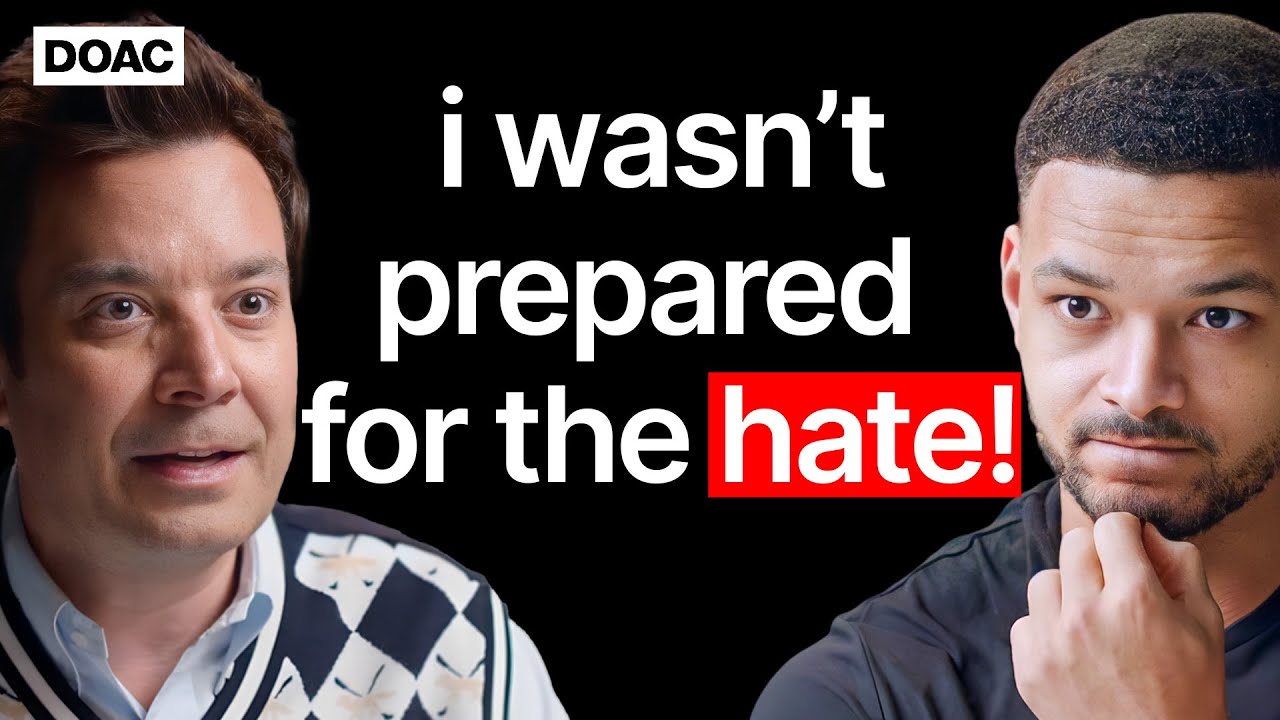
Fallon Credits Success to Early Mother Support and Overcoming Public Rejection
The Diary Of A CEO
The late-night host credits his career survival and creative drive to his mother's unconditional support and a lifelong need to entertain others despite relentless industry rejection.
## Background
This video was published on June 2, 2025, on YouTube by the channel The Diary Of A CEO, hosted by Steven Bartlett. According to the page description, the episode features comedian and 'Tonight Show' host Jimmy Fallon opening up about the personal toll of his comedy career, receiving public hate, his strict Catholic upbringing, and how his mother's unwavering support helped shape his pursuit of success.
## TL;DR
Jimmy Fallon reflects on his journey from a comedy-obsessed kid imitating impressions to landing his dream role on Saturday Night Live before age 25 and eventually hosting The Tonight Show. He discusses how his relentless need to please people and his strict Catholic upbringing fueled his ambition, while also detailing the emotional dark periods, self-doubt, and brutal rejections he faced along the way. Fallon candidly opens up about coping with public criticism, managing grief following the loss of his mother Gloria, and how fatherhood redefined his perspective on life, longevity, and success.
## Atmosphere & style
The interview is warm, deeply intimate, and emotionally rich, balancing playful comedic banter with raw vulnerability. Fallon shifts fluidly between high-energy storytelling—complete with expressive voice impressions and comedic anecdotes—and quiet, heartfelt reflection, particularly when discussing his early financial struggles and his mother's passing. Host Steven Bartlett creates a grounded, empathetic environment that allows Fallon to move past his familiar late-night persona into a sincere exploration of loss, ambition, and self-acceptance.
## Key takeaways
- [02:07](https://www.youtube.com/watch?v=yHCtfU3syM4&t=127s) Jimmy Fallon's relentless drive to entertain and please others stems from his early childhood and strict Catholic upbringing.
- [07:16](https://www.youtube.com/watch?v=yHCtfU3syM4&t=436s) His mother was his primary emotional anchor and biggest fan, deeply influencing his career and creative confidence.
- [16:55](https://www.youtube.com/watch?v=yHCtfU3syM4&t=1015s) Jimmy's stand-up set following Jerry Seinfeld at the Improv was saved by an improvised Seinfeld impression using a Troll doll.
- [20:55](https://www.youtube.com/watch?v=yHCtfU3syM4&t=1255s) Joining Saturday Night Live was a lifelong, singular focus for Jimmy, which he planned through impressions and training at The Groundlings.
- [27:54](https://www.youtube.com/watch?v=yHCtfU3syM4&t=1674s) Before breaking into comedy, Jimmy struggled in Los Angeles with severe financial hardship, self-doubt, and nearly 30 failed auditions.
- [50:53](https://www.youtube.com/watch?v=yHCtfU3syM4&t=3053s) Jimmy imposed a strict deadline on himself to make the cast of SNL before turning 25.
- [54:12](https://www.youtube.com/watch?v=yHCtfU3syM4&t=3252s) He secured his SNL spot during his second audition by breaking Lorne Michaels' signature stoic demeanor with an Adam Sandler impression.
- [01:02:33](https://www.youtube.com/watch?v=yHCtfU3syM4&t=3753s) Navigating sudden fame on SNL taught Jimmy that trying to change himself to satisfy public criticism is a trap.
- [01:06:06](https://www.youtube.com/watch?v=yHCtfU3syM4&t=3966s) One of Jimmy's favorite SNL memories was spontaneously pitching and performing the classic mirror reflection sketch with Mick Jagger.
- [01:09:32](https://www.youtube.com/watch?v=yHCtfU3syM4&t=4172s) Jimmy manages the demands of late-night TV by visiting guests before shows to build rapport and treating his preparation as daily hygiene.
- [01:16:06](https://www.youtube.com/watch?v=yHCtfU3syM4&t=4566s) The death of his mother in 2017 was the hardest emotional trial of Jimmy's life, taking an intense physical and emotional toll.
- [01:22:16](https://www.youtube.com/watch?v=yHCtfU3syM4&t=4936s) Turning 50 prompted Jimmy to adopt a disciplined approach to his health, diet, and longevity for the sake of his daughters.
- [01:26:33](https://www.youtube.com/watch?v=yHCtfU3syM4&t=5193s) Jimmy believes television and late-night shows remain as powerful as ever, as the fundamental human need for entertainment never changes.
- [01:29:14](https://www.youtube.com/watch?v=yHCtfU3syM4&t=5354s) All of Jimmy's ventures—from children's books to ice cream flavors and theme park rides—are driven by a unified desire to bring joy to people.
- [01:31:23](https://www.youtube.com/watch?v=yHCtfU3syM4&t=5483s) Becoming a father to his two daughters reshaped Jimmy's perspective on life, teaching him empathy and patience.
## Detailed walkthrough
### [00:00](https://www.youtube.com/watch?v=yHCtfU3syM4&t=0s) Introduction and the Need to Please
Jimmy Fallon opens by reflecting on a moments of deep mental breakdown, recalling writing a heartfelt letter to his best friend about feeling completely lost and unsure of what to do with his life.
The conversation transitions into Fallon's multi-faceted career—from founding a production company to creating his *The Tonight Dough* ice cream flavor—emphasizing that the driving force behind his diverse portfolio has always been a desire to bring happiness to others.
Fallon shares that his desire to please people stems from early childhood, where he constantly strived to satisfy family members, make others feel good, and ensure everyone around him was having a great time.
* **David Letterman Superlative:** In eighth grade, Fallon's classmates voted him "Most Likely to Replace David Letterman," a prophecy he eventually fulfilled.
* **Early Stand-up Days:** Fallon shares that he was obsessed with *Saturday Night Live* (SNL) and performed stand-up at the Improv, earning just $7.25 per night while living frugally—sometimes converting cardboard boxes on the street into temporary furniture.
* **Audition Pressure:** Fallon set a strict personal deadline: if he did not make the cast of SNL before turning 25, he felt his career and life trajectory would be completely derailed. He successfully joined the cast at age 23.
---
[02:07](https://www.youtube.com/watch?v=yHCtfU3syM4&t=127s) Earliest Memories and the Catholic Upbringing
Fallon explores how his fundamental urge to entertain and connect with people began at a very young age. Reflecting on his childhood, he considers whether his early desire to excel in grade-school sports or serve as an altar boy in the Catholic Church helped shape his performance style.
```
"Someone said to me once... maybe you got your first taste of wanting to be an entertainer from being an altar boy because you're up on stage... wearing a costume... it's kind of theater in a weird way."
```
Fallon was raised in a strict, traditional Catholic household where cursing, explicit language, and inappropriate media were strictly forbidden.
* **Censoring Comedy Records:** Fallon's father would take a key and physically scratch out curse words on vinyl records. As a result, when listening to comedians like Rodney Dangerfield, the audio would skip straight from the setup to the audience applause, leaving young Jimmy baffled by the punchlines.
* **Vetting Media:** His father carefully recorded late-night television music programs—such as *USA Night Flight* and *Friday Night Videos*—and pre-screened tape-to-tape edits to ensure no sexually explicit or offensive content reached the children.
---
[04:36](https://www.youtube.com/watch?v=yHCtfU3syM4&t=276s) Fallon's Parents: His Father's Toughness and His Mother's Support
Fallon describes his father as a hardworking, classic Brooklyn character who had been part of street corner doo-wop singing groups and minor neighborhood gang rivalries in the 1950s. While not overly emotional or given to frequent tears, his father was affectionate and supportive in his own grounded way.
In contrast, Fallon’s mother, Gloria, served as his emotional anchor, confidante, and biggest fan. She nurtured his creative confidence and cheered for every milestone.
* **Parental Namesake:** Fallon humorously notes his parents' lack of naming variety: his father is Jim, he is Jim (Jimmy), his mother is Gloria, and his sister is Gloria.
* **Daily Calls:** Throughout his adulthood and time on SNL, Fallon spoke with his mother daily, often multiple times a day, on her classic wall-mounted landline phone with an enormously stretched-out, tangled cord.
---
[09:41](https://www.youtube.com/watch?v=yHCtfU3syM4&t=581s) The Choking Incident: A Family Anecdote
Fallon shares a memorable, chaotic story illustrating his parents' distinct personalities and humor. After achieving success on SNL, Fallon returned home to New York and agreed to take his parents out to dinner at a local restaurant, begging his mother not to make a scene.
1. **The Delayed Order:** The restaurant served Fallon and his father, but accidentally forgot his mother's lamb chop order.
2. **Eating Out of Spite:** When the meal finally arrived, his mother began eating rapidly out of frustration, causing a piece of meat to lodge in her throat.
3. **The Escaped Lamb Chop:** As Fallon's father tried reaching down her throat to assist, a bystander who was a nurse rushed over, knocked over nearby tables, and performed the Heimlich maneuver. The piece of lamb dislodged, flying across the room and striking the wall.
4. **The Aftermath:** With the entire dining room staring, his mother sat crying while his father calmly suggested they simply sit back down and finish their meals—grumbling that the nurse "should have minded her own business."
---
[12:45](https://www.youtube.com/watch?v=yHCtfU3syM4&t=765s) Seeking Validation and the Relationship with Money
When asked whose approval he sought most between his two parents, Fallon points to his mother. Because she was such an enthusiastic fan of his comedy, showing her new sketches or routines felt like playing a new album for an appreciative critic whose feedback he deeply valued.
Fallon also reflects on his lifelong detachment from financial gain, emphasizing that money was never a primary motivator for entering entertainment.
```
"I never cared about money. I never did anything for money... I worked because I liked working. I worked since I was 13 because I enjoyed getting a paycheck... but I just loved the experience of it all."
```
* **Early Work Ethic:** Fallon began working at age 13, taking pride in putting in a full day's work and working overtime, partly out of admiration for his father's daily work routine.
* **Found Money:** His mother would frequently find $5 bills left in his jeans while doing laundry. When she warned him she would start keeping the money, Fallon casually told her to go ahead because he paid little attention to cash.
* **Priceless Stage Time:** During his early comedy days at the Improv on Melrose Avenue in Los Angeles, comedians received a total payout of only $7.25 per night. Fallon viewed the money as secondary to the invaluable stage time, which allowed him to refine his character work and build material for higher-paying weekend gigs.
Here is the detailed walkthrough of this portion of the transcript:
### [16:55](https://www.youtube.com/watch?v=yHCtfU3syM4&t=1015s) Following Jerry Seinfeld at the Improv
After putting in his dues at the comedy club—showing up for any weeknight slot whenever called upon—Jimmy Fallon built up a strong ten-minute stand-up act. On his very first Saturday night gig at The Improv, he spotted Jerry Seinfeld sitting in the club's restaurant with the owner, Bud Friedman. Stunned by the sighting during the peak of Seinfeld's sitcom fame, Jimmy rushed out to the payphone and made a 1-800-COLLECT call to his mother in New York (because he had no money to pay for the call himself). His mother was ecstatic over the news, gasping and asking if Seinfeld was going to perform. Jimmy wasn't sure at the time, but right before his set, Seinfeld unexpectedly took the stage to do a surprise performance.
Seinfeld received a massive standing ovation before even uttering a single word, going on to crush every famous joke in his repertoire—from the classic bit about missing socks in the dryer to his iconic "greatest hits." Upon finishing to another thunderous standing ovation, Seinfeld walked off, leaving the host scrambling to find someone to go on next. The first two comedians in line flatly refused to follow Seinfeld. When the host called out, "Who's Jimmy Fallon?" Jimmy reluctantly stepped up. Forced to follow one of the greatest comedians of all time during his first Saturday night set, Jimmy relied on his signature bit involving a Troll doll—a recurring prop he used to frame celebrity impressions under the premise of "Troll Productions Incorporated."
Jimmy quickly adapted his routine on the spot, adding a fresh Seinfeld impression that mocked the doll's design ("Okay people, look at these dolls! Their arms and legs don't move... He's not even wearing pants! What kind of a doll is this?!"). The bit landed, saving his set. Jimmy went on to finish his routine, pulling out his guitar to play songs with the Troll doll, which remained his core stand-up act for years.
* **1-800-COLLECT:** The collect calling service Jimmy used to call his parents from Los Angeles so he wouldn't have to pay for the long-distance call.
* **Bud Friedman:** The founder and owner of the Improv comedy club, who was eating with Jerry Seinfeld in the restaurant.
* **The Impersonations:** Jimmy performed a John Travolta impression and an improvised Jerry Seinfeld impression using the Troll doll prop.
* **Original Bit Intro:** "Hello, I'm Jimmy Fallon and welcome to the auditions for Troll Productions Incorporated. We're looking for a star or sponsor for our new line of Troll..."
---
### [20:55](https://www.youtube.com/watch?v=yHCtfU3syM4&t=1255s) Childhood Ambition and The Goal of SNL
Reflecting on his 12-year-old self in 1986, Jimmy describes himself as confident without being cocky or full of himself, an attitude strictly enforced by his parents and grandfather. In the eighth grade, his peers voted him "Most Likely to Replace David Letterman on *The Late Night Show*." Though he found the coincidence surreal in hindsight—since he eventually *did* host *Late Night* before moving to *The Tonight Show*—his true, unwavering childhood fixation was always *Saturday Night Live* (SNL). To him, SNL was the ultimate dream because it was electric, cool, edgy, and represented the absolute pinnacle of American comedy.
Jimmy outlines how every single birthday candle he blew out and every coin he tossed into a fountain carried the exact same wish throughout his childhood: to become a cast member on *Saturday Night Live*. His friend Frank Gentile once noted that he had never met anyone more relentlessly focused on a single goal. Rather than relying on passive manifestation, Jimmy reverse-engineered a concrete path to get onto the show:
* He focused heavily on celebrity impressions in his stand-up, knowing SNL always needed strong impressionists.
* He researched where SNL cast members came from and discovered many trained at The Groundlings improv school in Los Angeles, prompting him to move to LA and take classes there.
* He targeted the talent management firm **Brilstein-Grey**, which managed comedy legends from John Belushi to Adam Sandler, eventually securing representation with manager **Randy Siegel** (who had just left the firm).
---
### [25:35](https://www.youtube.com/watch?v=yHCtfU3syM4&t=1535s) Dropping Out of College and Moving to LA
Jimmy’s father, a dedicated career man at IBM, originally made a deal with Jimmy regarding higher education: if Jimmy went to college for four years, his father would cover two years and Jimmy would pay for the other two. Jimmy attended College of Saint Rose for three and a half years. However, during the final semester of his senior year, an opportunity arose to move to Los Angeles and pursue comedy full-time under the guidance of manager Randy Siegel.
The connection happened through a former boss from his time working as a receptionist at *Metroland*, a news weekly in Troy, New York. Jimmy used to handle phone duties and type out personal ads ("men seeking women"). When his boss moved to LA to become a music manager, Jimmy handed him a videotape of his stand-up act. Although the boss managed musicians, he passed the tape to Randy Siegel, who saw raw potential in Jimmy. She spoke directly to Jimmy's worried parents on the phone, reassuring them that while Jimmy was still "green" (like an unripe banana), he had real talent and could make it if he put in the work.
---
### [27:54](https://www.youtube.com/watch?v=yHCtfU3syM4&t=1674s) Facing Brutal Rejection in Show Business
Moving out to Los Angeles proved to be an overwhelming grind filled with self-doubt and financial hardship. Early on, Jimmy attempted to emulate James Dean by sitting silently in the back of acting classes without participating. His acting teacher confronted him, pointing out that stand-up comedians perform alone and desperately need to learn how to play off and listen to other actors. Recognizing the truth in this advice, Jimmy dove into acting training and auditioning, only to realize how brutally difficult the industry was.
Jimmy details the sting of constant rejection through his very first film audition—a one-line role playing a lifeguard in *The Brady Bunch Movie* sequel. Handed a line printed on thermal fax paper ("Get out of the pool!"), he followed the industry rule of holding the paper during the read so casting directors wouldn't assume he was set in his ways. The audition was met with complete awkward silence, culminating in a cold "Okay, bye-bye" from the casting director. His manager later called to deliver the feedback: they felt he was "too green."
After failing nearly 30 consecutive auditions for TV shows and movies, Jimmy completely ran out of money and reached a dark period where he faced the prospect of giving up and moving back in with his parents. Despite the depression and doubts from others who treated his goal as unrealistic fantasy, Jimmy persevered. When his first Groundlings instructor, Jim Wise, went around the room asking students their career aspirations, others gave broad answers like "sitcoms" or "movies." Jimmy stated flatly, "I want to be on *Saturday Night Live*." Even if he only lasted for a single episode or season, achieving that dream was all that mattered to him—comparing the show to playing for the ultimate sports team, like the New York Yankees or Manchester United.
[033:32] The *Saturday Night Live* Obsession
Jimmy Fallon describes his drive to get on *Saturday Night Live* (*SNL*) not merely as an ambition, but as a religious calling. Unlike young athletes who would be thrilled to play for any team in the league, Fallon had his eyes fixed exclusively on 30 Rockefeller Plaza. Growing up, *SNL* was a bonding ritual for his family—they were among the first in their neighborhood to own a VCR (or "a video cassette recorder," as he breaks it down for younger listeners). His parents taped the two-hour broadcasts so Jimmy could rewatch, study, and memorize sketches featuring legends like John Belushi, Dan Aykroyd, Bill Murray, Steve Martin, and Chris Farley. By high school, his fixation was so intense that he brought recorded tapes to parties to show off the week's best sketches, eventually opting to watch the show entirely alone because he couldn't stand it if anyone in the room failed to appreciate it.
His parents allowed him a six-pack of beer on Saturday nights if he stayed home—a arrangement that led him to joke, "I became an alcoholic at 16... drinking by myself watching *Saturday Night Live*." The ritual extended into his college years, where he refused to go to weekend parties until after the broadcast finished at 1:00 AM, rejecting friends' suggestions to just tape it because he *had* to experience it live.
* **The NBC Tour:** As a young man, Fallon took an NBC bus tour to New York City with his father. He was so overwhelmed with awe that he geeked out over the Art Deco decor, the entrance doors, the ceiling patterns, and the exact look of the building's interior.
* **Full-Circle Moment:** Reflecting on how 30 Rockefeller Plaza has been his workplace since 1998, he notes that while it is now just the door he walks through for work every day, he occasionally catches himself and tries never to lose that original sense of wonder.
---
[037:41] Rock Bottom and Cardboard Furniture in LA
When host Steven Bartlett brings up the double-edged sword of obsession—how it allows someone to bang their head against an immovable wall until it breaks—Fallon opens up about his darkest period. Struggling to break into the industry in Los Angeles, dealing with constant rejection, and running out of money, his mental health plummeted. He isolated himself, had no social life, and found himself constantly breaking down, wondering what he had done with his life and whether he could afford to keep failing when he couldn't even pay for gas or rent.
During this period, he wrote a desperate, emotionally raw letter to his best friend admitting that he was "losing it," regretting his move to LA, and missing the comfort of college and friendship. In a funny, lighthearted aside, Fallon notes that this same best friend now works on *The Tonight Show* and playfully threatens to sell the embarrassing, breakdown-filled letter on eBay if he ever needs cash.
```
"I'm proud of you, dude. Like, you're doing exactly what you have to do to become me. So, I'm so proud of you. So, keep it up."
```
When asked what he would tell his younger self sitting in that lonely apartment, Fallon says he would offer deep encouragement. He recalls scavenging new, discarded cardboard boxes from a nearby garage, draping sheets over them, and using them as end tables next to his bed. While it sounds depressing in hindsight, Fallon explains that at the time he was just trying to make his space look nice and "dormy," finding humor and resilience where he could.
* **The Gym Analogy:** Fallon compares those early struggles to grinding at the gym—it feels painful and unrewarding in the moment, but it builds the mental strength required for when you step into the ring later in life.
* **Reframing the Past:** Looking back, he finds charm in those hard times: "The biggest problem in your life was that you didn't do a great impression of Jerry Seinfeld."
* **Perspective on Time:** He notes how high school feels like 25 years when you are in it, whereas now four years flies by in an instant—a perspective shift he tries to keep in mind when listening to his daughters talk about their school drama.
---
[044:52] No Alternative Reality
When Bartlett asks whether Fallon could conceive of a reality where he turned 50 without ever making it onto *SNL*, Fallon refuses to even entertain the premise. He insists with absolute conviction that there was no alternative path—he would have found a way onto that stage no matter what, even if it meant sneaking on set as a background extra or walking across the frame.
* **Pretending for the Future:** Both Fallon and Bartlett bond over the fact that as young men, they used to tape cassette audio of themselves interviewing pretend guests or hosting radio countdowns long before they ever got real broadcast jobs.
* **Unshakeable Faith:** Fallon explains that he cannot fake an answer about failing to get on *SNL* because doing so would feel like a lie; in his mind, it was an absolute certainty that had to happen.
---
[047:15] The Contract Clause and the First Failed Audition
Fallon details how small breaks kept him afloat right when he was on the brink of giving up. He landed a development holding deal with Warner Bros. Television for a sitcom. Even though he wasn't interested in acting in standard sitcoms, he insisted on a specific clause in his contract: if *Saturday Night Live* came calling, he had to be allowed to leave the show legally. The executives admitted no one had ever asked for such a clause before, but they granted it because they assumed the opportunity would never arise anyway. The holding deal provided crucial financial cushion, giving him a few more months to stay in LA and hone his stand-up.
Eventually, his manager bombarded *SNL* with audition tapes until Fallon landed his first official audition at the Comic Strip in New York City.
* **The Outfit:** Fallon dressed in his single best outfit—a gap shirt and special-occasion Nike sneakers he saved only for critical moments.
* **The Performance:** Lorne Michaels was in the audience wearing his signature hat. Fallon went up with his troll doll bit, but his usual 10-minute set had been trimmed down to a high-pressure 3-minute clip.
* **The Bomb:** Within 20 seconds, Fallon could feel the room turning cold. Panic set in, he began to sweat, and the impression-heavy set completely fell flat.
Devastated after blowing his dream audition in front of Lorne Michaels, Fallon walked over to a neighboring diner with his manager to drink coffee, nurse his disappointment, and figure out his next move.
[50:53](https://www.youtube.com/watch?v=yHCtfU3syM4&t=3053s) The Second SNL Audition and the "25 or Else" Goal
When Jimmy Fallon initially learned he didn't get *Saturday Night Live*, he felt numb, but he immediately channeled his energy back into honing his stand-up routine. Driven by the belief that his first attempt hadn't shown his true potential, he held onto the hope of getting one more chance. That second chance came at age 23 when casting director Marci Klein called him back to audition again.
Around this time, Fallon had an intense, self-imposed deadline: if he didn't make it onto *SNL* before turning 25, he wrote down in a journal or computer file that he would "kill himself." While acknowledging how extreme that sounds, Fallon explains he felt so deeply certain that he was going to make the cast before 25 that it never felt like an actual threat to his life. Host Steven Bartlett notes a striking parallel in his own life, sharing that he had written a "before I'm 25" milestone on the front page of his personal diary when starting his early businesses.
- At age 12, Steven Bartlett started his first business, followed by several others throughout his teenage years (ages 14–18), forcing him to act as marketer, sales rep, finance team, customer service, and recruiter simultaneously.
- **Sponsor Break:** Bartlett introduces sponsor Shopify, highlighting its AI integrations that act like a full growth team—handling copywriting, site design, image editing, shipping, taxes, and inventory. Offers a $1/month trial at `[shopify.com/bartlett](https://shopify.com/bartlett)`.
[54:12](https://www.youtube.com/watch?v=yHCtfU3syM4&t=3252s) Breaking Lorne Michaels: The Famous Adam Sandler Impression
When Fallon returned for his second audition at age 23 or 24, the producers specifically asked him not to repeat his signature troll doll bit. Deprived of his core routine, Fallon adapted his material into a framework where he did various celebrity impressions under the guise of a charitable event or everyday scenarios.
Right before he stepped onto the Studio 8H stage, everyone—from the producer to the hair and makeup crew, and even the audio technician attaching his mic pack—repeated the exact same warning: *"Lorne Michaels doesn't laugh, so don't let that throw you."* Hearing this repeatedly only made Fallon wonder why a comedy show runner wouldn't laugh.
During the audition, Fallon launched into an impression of Adam Sandler—who had recently left *SNL* at the time, making the impression feel fresh and unexpected. As he performed Sandler's distinctive voice and mannerisms, Lorne Michaels put his head in his hands and visibly laughed. Even if he didn't get the job, Fallon remembers thinking, *"That's a cool story I'll tell my kids—I made Lorne Michaels laugh on the set of SNL."*
- Producer Marci Klein grabbed Fallon's hand immediately after the audition and told him: "Jimmy, that was fantastic. You've got to feel good."
- The show's producers initially passed on Fallon after his first audition because they were looking for a different direction, ultimately hiring Tracy Morgan for that slot.
[57:20](https://www.youtube.com/watch?v=yHCtfU3syM4&t=3440s) The Offer in LA and Calling His Mother
After waiting anxiously for two weeks, Fallon was told that Lorne Michaels wanted to meet him at his office on the Paramount Pictures lot in Los Angeles. Driving through the iconic Paramount gates, seeing actors in costume and movie sets around him, Fallon felt terrified yet exhilarated to be inside the heart of show business.
Walking into Michaels' all-white, almost heavenly office, Fallon sat across the desk for the meeting. Michaels opened by asking, *"Jimmy, do you wear wigs?"* Fallon defensively answered that he just spiked his real hair, prompting Michaels to clarify he meant for characters, before delivering the life-changing line: *"Because we want you for the show."* As Michaels kept talking about character work, Fallon's mind went into slow-motion shock. He shook Michaels' hand, said, "I hope I make you proud," and left.
Overwhelmed with emotion, Fallon pulled over to the first payphone he could find on the street and called his mother to tell her he made *SNL*. Reflecting on that moment decades later, Fallon gets visibly choked up, comparing the feeling to the triumph at the end of *Rocky*. It was the culmination of a lifelong dream shared with his mother, who had always been his biggest fan.
- Landing *SNL* launched Fallon's entire career trajectory: moving to Midtown Manhattan, performing on *SNL*, starring in feature films, meeting his wife, taking over *Late Night* from Conan O'Brien, and ultimately host of *The Tonight Show* succeeding Jay Leno.
[01:02:33](https://www.youtube.com/watch?v=yHCtfU3syM4&t=3753s) Dealing with Hate, Rejection, and the Need to Please
Joining *SNL* was everything Fallon had dreamed of—hearing the announcer say his name, receiving fan mail, and being recognized on the streets of New York City. However, he was completely unprepared for the dark side of fame: rejected sketches, harsh criticism, and media toxicity aimed at tearing him down.
As someone with an intense, lifelong desire to please others, receiving public hate was painful. His instinctual reaction was to ask, *"What can I do to make you like me?"* Over time, he came to realize that trying to change yourself to satisfy critics is a trap that only alienates your original supporters and leaves you hating yourself. He cites a favorite Beastie Boys line from Mike D—*"Be true to yourself and you will never fall"*—as his guiding philosophy for surviving public noise.
- Fallon didn't seek professional therapy or counseling to cope with sudden fame, choosing instead to head down, focus on the creative work, and keep moving forward.
- He emphasizes that public criticism is mostly background noise; the only way forward is to trust your talent and let your output speak for itself.
[01:06:06](https://www.youtube.com/watch?v=yHCtfU3syM4&t=3966s) Pitching Mick Jagger: The Legendary Mirror Sketch
Fallon illustrates the pure fun of his career through an anecdote about hosting Mick Jagger on *SNL*. Lorne Michaels invited the cast to pitch Jagger sketch ideas, but explicitly warned Fallon: *"Please don't do the mirror sketch where you're his reflection. It's been done by the Marx Brothers, it's been done by Lucille Ball—please don't do that."*
Intimidated to pitch the rock legend directly, Fallon went into Jagger's dressing room with a list of 10 alternative ideas, such as playing Keith Richards and Jagger working at a Sunglass Hut or an ice cream parlor. Jagger shot down every single pitch. In pure desperation as the list ran out, Fallon pitched the forbidden mirror idea: *"Or we could do something where you come into your dressing room and I'm your reflection in the mirror..."* To Fallon's shock, Jagger immediately loved it.
Fallon returned to Michaels' office with the update: *"Good news and bad news. Good news: Mick wants to do a sketch. Bad news: It's the mirror sketch."* Michaels relented, and the team pulled off an unprecedented turnaround for the show.
- The mirror sketch was written in a single night (Thursday), rehearsed just once on Friday, and performed live on Saturday night.
- The bit became an instant classic and remains one of Fallon's favorite highlights from his time on *Saturday Night Live*.
[01:08:18](https://www.youtube.com/watch?v=yHCtfU3syM4&t=4098s) Surreal SNL Moments and Connecting with Famous Guests
Jimmy Fallon reflects on one of his favorite *Saturday Night Live* sketches where he played Mick Jagger's mirror reflection. The sketch ended with Jagger giddily shaking Fallon's hand directly through the prop mirror frame. Feeling the studio floor shake from the audience's booming reaction was a surreal moment that exceeded even his wildest childhood dreams, especially since the sketch came together organically at the very last minute. These surreal experiences built up over time, leaving him in awe of his trajectory.
Transitioning to *The Tonight Show*, host Steven Bartlett notes that Fallon has interviewed industry leaders across every domain—from rock stars like Bruce Springsteen to sports figures like Floyd Mayweather. Fallon explains his tactical approach to rapid 10-minute late-night interviews:
* **Pre-Show Green Room Visits:** He drops by guests' dressing rooms beforehand to chat informally about everyday life, parents, or casual topics.
* **Building Trust:** This removes the high-stakes pressure, establishing a rapport so guests feel safe and comfortable enough to be themselves on air.
* **Long-Term Perspective:** Over 16 years in late night, Fallon has watched public figures cycle through marriages, divorces, children, and career highs and lows, forming an enduring familiarity with them.
---
[01:12:04](https://www.youtube.com/watch?v=yHCtfU3syM4&t=4324s) Staying Inspired and Avoiding Burnout
When asked how he keeps hosting fresh after more than a decade without getting bored, Fallon emphasizes continuous effort and adaptability. He points to Bartlett’s studio setup in New York, joking that behind the polished walls and lights, late-night production is fundamentally a daily grind requiring total presence.
> "If you stop trying, you get boring tomorrow... You always got to show up. You got to be there for your audience."
Fallon treats his work ethic like basic daily hygiene—comparing it to brushing his teeth multiple times a day—where brainstorms and show preparation become second nature.
---
[01:13:56](https://www.youtube.com/watch?v=yHCtfU3syM4&t=4436s) Creative Outlets Outside Late Night
To keep himself challenged outside the daily talk show structure, Fallon ventures into distinct personal projects:
* **Christmas Album:** Writing and releasing an album with 20 original holiday tracks, which proved challenging given the vast history of Christmas music.
* **Children's Books (*Dada* and *Mama*):** Inspired by his desire to get his daughters to say "Dada" first, he wrote a book repeating the word on every page. He followed up with *Mama* after receiving playful pushback from his wife and female fans who pointed out that babies inevitably say "Mama" first.
---
[01:15:22](https://www.youtube.com/watch?v=yHCtfU3syM4&t=4522s) Confronting the Loss of His Mother
Bartlett displays old photos from Fallon's past, including picture-perfect moments with his kindergarten teacher (Mrs. Fulling), college friends (Frank Gentile and Steve), and his late mother, Gloria Fallon, in their family kitchen. Gloria passed away in November 2017, leading Fallon to pay an emotional tribute on *The Tonight Show* where he called her his "best audience."
```
FALLON'S CORE ANCHORS
+-------------------------------------------------+
| Gloria Fallon (Mother) |
| - His ultimate comedic audience |
| - The "three hand squeezes" childhood ritual |
| - Home as a emotional sanctuary |
+-------------------------------------------------+
|
v
+-------------------------------------------------+
| Grief & Legacy Process |
| - Intense physical grief (chest/heart pain) |
| - Performing work still to make her proud |
| - Memories shifting from pain to gratitude |
+-------------------------------------------------+
```
Fallon candidly discusses how losing his mother was the hardest trial of his life:
* **The Physical Toll of Grief:** Encouraged by his wife, Nancy Juvonen, to weep freely, Fallon experienced grief as a heavy physical pressure—feeling as if there were a literal "hole in your heart and a hole in your lungs."
* **Memories and Music:** He unexpectedly remembers her during everyday moments, like hearing bands such as Duran Duran, transitioning over time from tears to warm nostalgia.
* **Missing Her Validation:** Beyond her humor, he misses calling her after shows to receive positive reinforcement or drawing comedic material from her daily observations.
Even years after her passing, Fallon keeps her memory at the forefront of his mind. Every comedic achievement or new endeavor is still evaluated through the lens of whether it would make his mother laugh or feel proud.
---
[01:22:16](https://www.youtube.com/watch?v=yHCtfU3syM4&t=4936s) Turning 50, Health, and Longevity
Reaching his 50th birthday and reflecting on his family history sparked a dramatic shift in Fallon’s attitude toward personal health and longevity. He contrasts his current routine with his parents' lifestyle, recalling that they drank and smoked heavily during an era when health risks were widely overlooked.
To ensure he remains active and financially stable for his two daughters, Fallon has adopted a far more disciplined routine:
* **Daily Movement:** Walking every day and incorporating regular gym workouts when schedule permits.
* **Nutritional Discipline:** Improving his overall diet and significantly cutting back on alcohol consumption.
* **Preventative Healthcare:** Scheduling regular medical checkups to monitor his long-term wellness.
<ElicitationsGroup message="What would you like to do next?">
<Elicitation label="Draft an executive summary of the transcript part" query="Draft an executive summary of the transcript part" query_intent="CLICKABLE_SUGGESTION" />
<Elicitation label="Generate unit test ideas for host interview prep" query="Generate unit test ideas for host interview prep" query_intent="CLICKABLE_SUGGESTION" />
<Elicitation label="Explore how parental influence shapes comedy" query="Explore how parental influence shapes comedy" query_intent="CLICKABLE_SUGGESTION" />
</ElicitationsGroup>
Here is the detailed walkthrough of part 6 of the transcript.
---
[01:24:14](https://www.youtube.com/watch?v=yHCtfU3syM4&t=5054s) Aging Gracefully, Sponsor Messages, and The CEO Circle
Jimmy Fallon jokes about getting older, noting that while he wants to live a long life, he wants to age alongside his peers rather than being the last one standing at 130 years old. He emphasizes that he wants to enjoy everything as time goes on and naturally takes its course.
Following this, host Steven Bartlett transitions into a brief sponsor message for PerfectTed, a company he has invested in that has launched barista-quality canned matcha lattes in flavors like vanilla and strawberry. Bartlett highlights how founder Marissa spent four years refining the product since 2021 to ensure long-lasting energy without the typical coffee crash. He then promotes "The CEO Circle" (daccircle.com), a private inner-circle community capped at 10,000 members where fans get direct access to behind-the-scenes footage, unreleased episodes, and interview briefs.
- **Matcha Product:** PerfectTed ready-to-drink canned matcha lattes available at Waitrose, Tesco, and Holland & Barrett (code STEVEN40 for 40% off).
- **The CEO Circle:** Limited to the first 10,000 members for exclusive content and direct interaction with the host.
---
[01:26:33](https://www.youtube.com/watch?v=yHCtfU3syM4&t=5193s) The Future of Television and Digital Entertainment
Steven asks Jimmy whether he envisions a chapter beyond television, given how drastically media is changing and noting Jimmy's massive social media presence across platforms like YouTube, Instagram, and X (Twitter). Jimmy admits he does not spend much time planning a life after late-night TV, explaining that talk shows actually improve as hosts get older—much like Johnny Carson, who hosted *The Tonight Show* for 30 years. He strongly rejects the narrative that traditional television is dying, maintaining that great entertainment will always find an audience regardless of the delivery platform.
Jimmy explains that whether people watch through traditional TV sets, streaming services like Netflix, podcasts, or future technology like smart glasses and contact lenses, the fundamental human desire for entertainment remains unchanged. Entertainment serves as a therapeutic escape or a form of active mental engagement—allowing people to pause their own life worries and focus on someone else's story.
> "I think TV is just as powerful as it ever was... For an hour of my life, I don't have to think about my problems, I'm thinking about their problems."
---
[01:29:14](https://www.youtube.com/watch?v=yHCtfU3syM4&t=5354s) Business Pursuits and the Common Thread of Pleasing Others
The conversation moves to Jimmy's extensive entrepreneurial ventures outside of late-night television. Beyond his production company, he has recorded comedy albums—including his holiday album *Holiday Seasoning*, where he humorously tried to coin "holiday seasoning" as a universal festive verb—and created *The Tonight Dough* ice cream flavor with Ben & Jerry's, which raises proceeds for the SeriousFun Children's Network charity. His ventures also range from a Universal Studios ride (*Race Through New York*) to custom MSCHF "Gobstomper" skate shoes designed to reveal distinct underlying color layers as the outer material wears down.
Steven points out that every single venture—from roller coasters to ice cream—shares one underlying thread: a relentless effort to make people happy. Jimmy readily agrees, admitting that making other people smile is what truly brings him personal joy.
- **Holiday Album:** *Holiday Seasoning*, attempting to create a new verb for celebrating winter holidays.
- **Charity Ice Cream:** *The Tonight Dough* supporting Paul Newman's SeriousFun Children's Network.
- **Custom Footwear:** Gobstomper sneakers that wear away to reveal unique colorways per user.
---
[01:31:23](https://www.youtube.com/watch?v=yHCtfU3syM4&t=5483s) Fatherhood and Giving Advice to His Daughters
Reflecting on fatherhood, Jimmy calls being a dad to his two daughters "the greatest thing" and chuckles at the absurdity of him being a parent. He tells Steven—who shares that he hopes to have children soon—that becoming a father completely reshaped how he views the world. To his surprise, having children made him drastically more empathetic toward other people's children and far more patient with struggling parents in public settings, like dealing with a crying baby in a restaurant.
When asked what life advice he would give his daughters for living a meaningful and successful life, Jimmy keeps his core philosophy simple: treat people well, give back, and pursue what genuinely excites you.
> "Be nice to people. Give when you can. Make people smile... If you do what you want to do, you'll be successful."
---
[01:33:45](https://www.youtube.com/watch?v=yHCtfU3syM4&t=5625s) Addressing Misconceptions and Jimmy's Epitaph
When asked how he feels misunderstood by the public, Jimmy addresses the common perception that he simply "laughs at everything" or floats through life without taking things seriously. He clarifies that while he genuinely enjoys himself, he puts immense hard work, careful thought, and intentional effort into every project he releases. When asked what he would want written on his gravestone, Jimmy offers a characteristically simple, positive line: "He had a good time."
Steven expresses deep gratitude for Jimmy's presence in entertainment, praising his radiant energy, purity of intent, and ability to maintain a safe haven of laughter and joy in a digital landscape that often feels like an online "war zone."
- **Common Misconception:** That he laughs at everything mindlessly rather than putting calculated hard work into his craft.
- **Epitaph Choice:** *"He had a good time."*
---
[01:36:23](https://www.youtube.com/watch?v=yHCtfU3syM4&t=5783s) The Tradition Question: Reality as a Simulation
Steven introduces the podcast's signature closing tradition, where the previous guest leaves a question for the next without knowing who will answer it. The question asks how Jimmy's self-view and behavior would shift if he discovered beyond a doubt that objective reality doesn't exist and only exists through his own actions. Laughing that "the edibles kicked in" for whoever wrote the prompt, Jimmy responds with characteristic humor, saying he wouldn't be shocked and would probably try to take credit for creating it all.
The two banter about the possibility of living in a simulation, joking that whoever is controlling the "Jimmy Fallon game" might have wandered off like the kids in *Toy Story*. Jimmy ends the interview by expressing how much fun he had in Steven's studio kitchen, before Steven closes the video by encouraging viewers to subscribe to the channel.
---
<ElicitationsGroup message="Explore more from this interview series:">
<Elicitation label="Summarize Jimmy Fallon's full trajectory on SNL" query="Summarize Jimmy Fallon's career on SNL based on this interview, including his audition process and breakthrough moments."/>
<Elicitation label="Analyze Fallon's reflections on grief and losing his mother" query="Detail what Jimmy Fallon shared about his mother, her support during his career, and how her passing affected him."/>
</ElicitationsGroup>
## Notable quotes
> [02:07](https://www.youtube.com/watch?v=yHCtfU3syM4&t=127s) Someone said to me once... maybe you got your first taste of wanting to be an entertainer from being an altar boy because you're up on stage... wearing a costume... it's kind of theater in a weird way. — Jimmy Fallon
> [14:48](https://www.youtube.com/watch?v=yHCtfU3syM4&t=888s) I never cared about money. I never did anything for money... I worked because I liked working. I worked since I was 13 because I enjoyed getting a paycheck... but I just loved the experience of it all. — Jimmy Fallon
> [16:55](https://www.youtube.com/watch?v=yHCtfU3syM4&t=1015s) Hello, I'm Jimmy Fallon and welcome to the auditions for Troll Productions Incorporated. We're looking for a star or sponsor for our new line of Troll... — Jimmy Fallon
> [37:41](https://www.youtube.com/watch?v=yHCtfU3syM4&t=2261s) I'm proud of you, dude. Like, you're doing exactly what you have to do to become me. So, I'm so proud of you. So, keep it up. — Jimmy Fallon
> [54:12](https://www.youtube.com/watch?v=yHCtfU3syM4&t=3252s) Lorne Michaels doesn't laugh, so don't let that throw you.
> [57:20](https://www.youtube.com/watch?v=yHCtfU3syM4&t=3440s) Jimmy, do you wear wigs? — Lorne Michaels
> [57:20](https://www.youtube.com/watch?v=yHCtfU3syM4&t=3440s) Because we want you for the show. — Lorne Michaels
> [01:02:33](https://www.youtube.com/watch?v=yHCtfU3syM4&t=3753s) Be true to yourself and you will never fall — Mike D
> [01:06:06](https://www.youtube.com/watch?v=yHCtfU3syM4&t=3966s) Please don't do the mirror sketch where you're his reflection. It's been done by the Marx Brothers, it's been done by Lucille Ball—please don't do that. — Lorne Michaels
> [01:06:06](https://www.youtube.com/watch?v=yHCtfU3syM4&t=3966s) Good news and bad news. Good news: Mick wants to do a sketch. Bad news: It's the mirror sketch. — Jimmy Fallon
> [01:12:04](https://www.youtube.com/watch?v=yHCtfU3syM4&t=4324s) If you stop trying, you get boring tomorrow... You always got to show up. You got to be there for your audience. — Jimmy Fallon
> [01:26:33](https://www.youtube.com/watch?v=yHCtfU3syM4&t=5193s) I think TV is just as powerful as it ever was... For an hour of my life, I don't have to think about my problems, I'm thinking about their problems. — Jimmy Fallon
> [01:31:45](https://www.youtube.com/watch?v=yHCtfU3syM4&t=5505s) Be nice to people. Give when you can. Make people smile... If you do what you want to do, you'll be successful. — Jimmy Fallon
## Mentioned
Jimmy Fallon, The Diary Of A CEO, Steven Bartlett, The Tonight Show, Saturday Night Live, SNL, Papa Doesn't Do Anything!, On Brand with Jimmy Fallon, David Letterman, The Improv, Rodney Dangerfield, USA Night Flight, Friday Night Videos, Gloria Fallon, Jerry Seinfeld, 1-800-COLLECT, Bud Friedman, John Travolta, The Late Night Show, Frank Gentile, The Groundlings, Brilstein-Grey, John Belushi, Adam Sandler, Randy Siegel, IBM, College of Saint Rose, Metroland, James Dean, The Brady Bunch Movie, Jim Wise, New York Yankees, Manchester United, 30 Rockefeller Plaza, Bill Murray, Steve Martin, Chris Farley, NBC, Warner Bros. Television, Lorne Michaels, Comic Strip, Marci Klein, Shopify, Tracy Morgan, Paramount Pictures, Conan O'Brien, Jay Leno, Beastie Boys, Mike D, Mick Jagger, Marx Brothers, Lucille Ball, Keith Richards, Sunglass Hut, Bruce Springsteen, Floyd Mayweather, Dada, Mama, Mrs. Fulling, Nancy Juvonen, Duran Duran, PerfectTed, Waitrose, Tesco, Holland & Barrett, The CEO Circle, Johnny Carson, Netflix, Holiday Seasoning, The Tonight Dough, Ben & Jerry's, SeriousFun Children's Network, Paul Newman, Race Through New York, Universal Studios, MSCHF, Gobstomper, Toy Story
Comedian and talk show host Jimmy Fallon traces his entertainment career to a lifelong drive to please others and an unwavering childhood fixation on joining Saturday Night Live. He reflects on enduring severe early rejections, the disorienting shock of public backlash, and navigating profound grief after the loss of his mother, who served as his primary emotional anchor.
Singular Obsession with Saturday Night Live (20:55)
Fallon explains that joining Saturday Night Live was not merely a professional goal but an exclusive fixation since childhood, where every wish and life decision was reverse-engineered toward 30 Rockefeller Plaza. Convinced that SNL always required strong impressionists, he enrolled at The Groundlings improv school in Los Angeles, focused his stand-up around impressions, and secured a special contractual clause in an early Warner Bros. sitcom holding deal that granted him immediate release if SNL ever made an offer.
During his leanest years in Los Angeles—living with makeshift cardboard furniture and surviving nearly 30 failed auditions—he established an intense personal deadline to make the cast before age 25. After bombing his initial three-minute audition before Lorne Michaels at the Comic Strip, he earned a second audition at age 23. Abandoning his standard troll doll prop routine, he secured the role by performing an impression of Adam Sandler that famously provoked laughter from the traditionally stone-faced Michaels.
Maternal Validation, Financial Detachment, and Grief (12:45)
Throughout his career, Fallon prioritized personal validation from his mother, Gloria, far above financial compensation, maintaining that he worked for the joy of the experience rather than monetary reward. He recalls earning only $7.25 a night at the Improv and routinely leaving cash forgotten in his clothing. His mother served as his chief comedic sounding board and confidante, receiving daily telephone calls across his adult life.
Gloria Fallon's death in November 2017 represented the hardest personal trial of his life, manifesting as a heavy physical grief in his chest and lungs. Fallon explains that he still frames his professional output and creative risks around whether the work would make his mother proud, keeping her memory as his ultimate comedic standard.
Navigating Public Hostility and People-Pleasing Instincts (62:33)
Fallon attributes his career to an innate urge to make others happy, a personality trait rooted in his strict Catholic upbringing. However, his breakthrough into mainstream fame on SNL exposed him to intense public criticism, unproduced sketches, and media toxicity that he was entirely unprepared to navigate.
Driven by an instinctual desire to please, his initial impulse was to ask critics what he could do to make them like him. Fallon eventually realized that altering his comedy to appease detractors risked alienating his original audience and compromising his identity. Choosing to bypass formal therapy, he adopted a mindset centered on creative momentum and staying true to his own instincts rather than internalizing negative public commentary.
Late-Night Longevity and Mission-Driven Ventures (72:04)
Across more than a decade hosting late-night television, Fallon refutes public perceptions that he merely coasts on easy laughter, describing daily show preparation as an intense hygiene routine required to prevent complacency. To establish trust, he visits guests in their green rooms before tapings to foster casual rapport outside the broadcast cameras. He also rejects predictions regarding the death of television, arguing that audiences will continually seek entertaining escapes regardless of the distribution medium.
This desire to bring happiness extends into his outside ventures, including his holiday album Holiday Seasoning, children's books, and his Ben & Jerry's ice cream flavor The Tonight Dough, which directs proceeds to the SeriousFun Children's Network. Turning 50 prompted him to cut back on alcohol and embrace daily exercise, aiming to ensure personal longevity for his two daughters.
While Fallon maintains that his work is defined by rigorous preparation and an enduring desire to provide comforting escapism, he acknowledges the lingering public misconception that he takes nothing seriously. As he balances longevity on late-night television with family life, his creative output remains anchored in the simple goal of leaving people with a positive experience.
精炼阅读摘要
Jimmy Fallon在访谈中回顾了自己的喜剧演艺生涯,指出贯穿其多元事业的核心动力始终是取悦他人并传递快乐。他坦言自己早年曾经历极端的执念与挫败困境,成名后更直面始料未及的舆论恶评与至亲离世的打击,最终在坚守创作本心与专业自律中建立起内心的平衡。
执念驱动的演艺突破与早期挫折 (20:55)
Fallon自幼便将加入全国广播公司(NBC)的《周六夜现场》(SNL)视为近乎宗教信仰般的终极梦想。八年级时他曾被同学票选为“最有可能接替David Letterman的人”,但他本人的目标高度明确:进入SNL是其童年与青年时期生日许愿和投硬币祈愿的唯一内容。他为自己逆向推演了清晰路径——苦练名人模仿、前往洛杉矶的The Groundlings学校进修即兴表演,并签约传奇喜剧经纪机构出身的Randy Siegel。大学三年级辍学奔赴西海岸后,他经历了近30次试镜接连受挫的艰难磨砺,一度在洛杉矶喜剧俱乐部The Improv每晚仅挣7.25美元,甚至捡拾纸箱套上床单充当简易家具。
面对经济拮据与心理压力,Fallon曾为自己设定了严苛的时限目标,在日记中写下若在25岁前无法入选SNL便认为生活被彻底摧毁。虽然他在纽约Comic Strip的首次正式试镜惨败收场,但凭借在华纳兄弟情景喜剧合约中破例加入的“若被SNL录用可自由解约”条款所争取的缓冲期,他于23岁迎来了第二次试镜机会。在制作人Lorne Michaels面前,Fallon顶住制作团队关于“Michaels从不发笑”的警告,凭借出其不意的Adam Sandler模仿打破了Michaels的严肃面孔,最终成功叩开30 Rockefeller Plaza的大门。
家庭纽带与母亲离世对精神底色的塑造 (4:36)
Fallon的成长环境受传统天主教家庭的严格规训,父亲不仅在黑胶唱片上用钥匙划掉粗口,还会严格预审录播电视节目的不良内容。尽管父亲性格刚毅务实,母亲Gloria则是Fallon最为关键的情感支柱与喜剧观众。Fallon表示,相较于金钱回报,母亲的反馈与肯定才是其创作追求的最高准则;他从13岁起打工以追随父亲的勤勉职业道德,但对现金报酬本身始终淡然,甚至母亲常在其换洗衣物中搜出遗落的钞票。
母亲于2017年11月辞世,成为Fallon一生中最沉痛的心理创伤。他回忆称,当时的悲痛带来了真实的生理压迫,仿佛“心脏与肺部被掏出了空洞”。妻子Nancy Juvonen鼓励他宣泄情绪,而随着时间推移,强烈的剧痛逐渐转变为温暖的感恩回忆。直至今日,Fallon仍将母亲视作衡量作品的终极标尺,在推出每一个全新企划或喜剧段落时,他依然会在内心探寻这是否能够博得母亲的一笑并让她感到自豪。
公众批评下的心理调适与本心坚守 (62:33)
加入SNL不仅让Fallon实现了事业腾飞,也让他首次直接暴露在公众恶评与媒体审判的残酷聚光灯下。由于骨子里拥有强烈的“取悦型人格”(Need to Please),面对网络与媒体的嘲讽时,Fallon早期的本能反应是试图迎合所有人,反复自问“我该怎么做才能让你喜欢我”。然而,他很快意识到迎合批评者是一场注定失败的陷阱,这种妥协不仅无法平息外界的敌意,还会疏离最初支持自己的核心受众,并最终导致自我厌恶。
为了在名利场的恶劣舆论中生存,Fallon选择不寻求外界心理咨询,而是将全部精力集中在创意打磨与具体执行上。他引用Beastie Boys成员Mike D的名言“真实面对自我,你便永不倒下”(Be true to yourself and you will never fall)作为人生座右铭。在Fallon看来,外界针对个人的公开仇恨与嘲讽多为杂音,面对恶评最有效的反击并非争辩,而是保持低调专注、信任自身才华,让持续产出的优质作品成为最好的答卷。
脱口秀专业主义与多元快乐创造 (68:18)
接掌《The Tonight Show》以来,Fallon主持深夜脱口秀长达十余载,他将日常内容筹备视为如同每日刷牙般的自律习惯,强调“一旦停止付出努力,节目次日就会变得乏味”。在面对不同领域名流的访谈中,他习惯在开播前造访嘉宾休息室闲聊家常,通过建立信任与安全感促使对方展现真实自我。面对传统电视衰退的论调,Fallon持不同看法,他坚信无论载体如何演进为流媒体、智能眼镜甚至隐形眼镜,人们对逃避现实压力、沉浸于优质故事的娱乐需求始终不变。
在深夜秀之外,Fallon将精力延伸至全方位的娱乐产品开发,包括创作涵盖20首原创歌曲的节日专辑《Holiday Seasoning》、以促使女儿先喊爸爸为由撰写的儿童绘本《Dada》与《Mama》、联合Ben & Jerry's为儿童慈善机构募资的“The Tonight Dough”冰淇淋,以及联名滑板鞋与环球影城主题游乐设施。针对外界认为他“对任何事都盲目傻笑”的误解,Fallon澄清自己对每项企划都投入了极具深度的思考与打磨,并希望自己的墓志铭能简短地概括为“他度过了一段美好时光”。
Jimmy Fallon的经历印证了高度专一的执念如何与严苛的职业自律相互赋能。然而,访谈也留下了待解的观察维度:在传播媒介碎片化与舆论极化日益加剧的当下,高度依赖合家欢取悦模式的传统深夜秀形式,能否在未来的受众迭代中持续维系其文化号召力,依然是娱乐产业有待检验的问题。
Detailed notes — zh
## Background
本期内容由 YouTube 播客频道《The Diary Of A CEO》于 2025 年 6 月 2 日发布,主持人为史蒂芬·巴特利特(Steven Bartlett)。视频简介指出,知名深夜脱口秀主持人兼喜剧演员吉米·法伦(Jimmy Fallon)在访谈中揭示了他构建喜剧帝国背后残酷的心路历程,深入探讨了他严苛的天主教成长背景、取悦他人的本能、成名后遭遇的恶意舆论,以及母亲的坚定支持如何给予他追梦的勇气。
## TL;DR
吉米·法伦回顾了自己从贫困潦倒的单口喜剧新人成长为《周六夜现场》(SNL)主力卡司及《今夜秀》当家主持的起伏人生。他坦承自己根深蒂固的“讨好型人格”与早年近乎自虐的追梦执念,分享了在洛杉矶面临绝望低谷、经历试镜惨败后如何绝地逆袭进入 SNL 的传奇过程。面对成名后的公众敌意与恶意审判,他学会了坚持本真并将恶意视为噪音;同时他也深情剖析了母亲的离世如何重塑自己的生命意义,以及迈入 50 岁后作为父亲对健康长寿、陪伴家人和用快乐治愈世界的全新理解。
## Atmosphere & style
访谈氛围在欢声笑语与深沉感伤之间自如流转,充满真挚、温暖且极具穿透力的人性光彩。吉米不仅展现了标志性的机敏幽默、即兴模仿与自嘲,还在触及母亲离世、早年精神崩溃等至暗时刻数度眼眶泛红、吐露脆弱,史蒂芬温和细腻的倾听则构筑了一个安全的倾诉场域。整场对话既像老友围炉夜话般松弛惬意,又兼具深刻的情感震撼,让观众在爆笑之余真切感受到一位喜剧巨星灵魂深处的纯粹与坚韧。
## Bulletin
- [51:43](https://www.youtube.com/watch?v=yHCtfU3syM4&t=3103s) 吉米·法伦(Jimmy Fallon)回顾早年闯荡经历,曾立誓若 25 岁前进不了《周六夜现场》(SNL)就自杀;经历了近乎崩溃的心理危机与首轮试镜失利后,他最终在 23 岁成功入选成为主力卡司。
- [47:15](https://www.youtube.com/watch?v=yHCtfU3syM4&t=2835s) 在洛杉矶打拼期间,法伦曾与华纳兄弟签下情景喜剧开发协议,但坚持在合约中加入“若获 SNL 录用必须无条件放人”的罕见解约条款以确保唯一终极目标的实现。
- [01:02:33](https://www.youtube.com/watch?v=yHCtfU3syM4&t=3753s) 面对成名后的恶评与公众敌意,具有严重“讨好型人格”的法伦意识到迎合批评者只会陷入自我厌恶,转而确立“坚守本真,把攻击当噪音,用优质作品说话”的心态准则。
- [01:17:04](https://www.youtube.com/watch?v=yHCtfU3syM4&t=4624s) 谈及母亲格洛丽亚(Gloria)2017 年的离世,法伦坦言经历了如同心肺被掏空般的剧烈生理与心理痛楚,至今无论在镜头前表演还是策划创意,依然以“逗母亲发笑、让她感到骄傲”为核心动力。
- [01:26:33](https://www.youtube.com/watch?v=yHCtfU3syM4&t=5193s) 面对媒体变革与“传统电视已死”的言论,法伦坚决否认转型意图,强调人类对叙事与精神减压的需求永存,并将其跨界版图(如游乐设施、童书绘本及 Ben & Jerry's 公益冰淇淋)的内核统一归结为“给人们带来纯粹的快乐”。
## Key takeaways
- [02:07](https://www.youtube.com/watch?v=yHCtfU3syM4&t=127s) 自幼根植于骨髓的“讨好他人(people pleaser)”本能,从天主教小学祭坛侍童的仪式表演,一路演变成为法伦日后喜剧与主持事业最核心的内在驱动力。
- [04:36](https://www.youtube.com/watch?v=yHCtfU3syM4&t=276s) 严苛保守的天主教成长环境对媒体进行严格审查(如父亲用钥匙划掉黑胶唱片中的脏话、逐帧剪辑录像带),而始终包容、认可法伦的母亲则成为他建立自信的最坚实基石。
- [13:41](https://www.youtube.com/watch?v=yHCtfU3syM4&t=821s) 对单口喜剧的热爱完全脱离金钱驱动,即便在 The Improv 一场仅拿 7.25 美元且连饭都吃不起,他也把锤炼台风的“舞台时间”视为无价资产。
- [20:55](https://www.youtube.com/watch?v=yHCtfU3syM4&t=1255s) 年仅 13 岁便被同学票选为“最有可能接替大卫·莱特曼主持《深夜秀》的人”,但他早期的全部战略重心完全押注在唯一的梦想跳板——《周六夜现场》(SNL)之上。
- [21:54](https://www.youtube.com/watch?v=yHCtfU3syM4&t=1314s) 为了挤进 SNL,法伦制定了极其清晰务实的进阶路径:主攻名人模仿满足节目刚需、加入 Groundlings 剧团系统进修即兴表演、签约能打通节目人脉的关键经纪人。
- [30:09](https://www.youtube.com/watch?v=yHCtfU3syM4&t=1809s) 初到洛杉矶时经历了连续 30 余部影视试镜全军覆没的残酷打击与资金见底的绝境,一度精神濒临崩溃并向挚友寄出求救信,但这段苦难也铸就了日后无所畏惧的心理韧性。
- [54:12](https://www.youtube.com/watch?v=yHCtfU3syM4&t=3252s) 在极度重视的首次 SNL 现场试镜中,因时间压缩与过度紧张遭遇滑铁卢,然而在 23 岁二度试镜时,他凭借对亚当·桑德勒的精准模仿打破了主创“罗恩·迈克尔斯绝不会笑”的魔咒。
- [01:02:33](https://www.youtube.com/watch?v=yHCtfU3syM4&t=3753s) 迅速走红后猝不及防面对媒体挑刺与公众恶意,这让渴望被所有人喜爱的法伦备受折磨,最终他领悟到迎合反对者徒劳无益,唯有屏蔽噪音、专注创作才能破局。
- [01:09:32](https://www.youtube.com/watch?v=yHCtfU3syM4&t=4172s) 在深夜脱口秀短兵相接的 10 分钟单次采访中,法伦的秘诀是在开场前亲自到休息室与嘉宾拉家常闲聊,通过消除算计与出丑的恐惧,在台上迅速建立信任感。
- [01:11:16](https://www.youtube.com/watch?v=yHCtfU3syM4&t=4276s) 保持长达十数年日播主持不产生倦怠的关键,在于把全力以赴的工作态度融为如同日常刷牙般的肌肉记忆,并在业余时间主动自设高难度课题(如创作 20 首原创圣诞歌曲、亲子绘本《Dada》)打破惯性。
- [01:20:48](https://www.youtube.com/watch?v=yHCtfU3syM4&t=4848s) 母亲离世带来了长久的悲恸,但法伦学会将其转化为积极动力,将余生所有的创意与表演延续为向天上的母亲致敬、争取让她骄傲的仪式。
- [01:22:16](https://www.youtube.com/watch?v=yHCtfU3syM4&t=4936s) 步入 50 岁的人生节点后,法伦反思上一代不良生活方式,开始通过洁净饮食、规律运动、大幅戒酒等举措追求健康长寿,其核心动力在于希望更长久地陪伴女儿成长。
- [01:26:33](https://www.youtube.com/watch?v=yHCtfU3syM4&t=5193s) 坚信脱口秀与电视娱乐形式不会消亡,载体虽会随科技发展由电视演变为移动终端或穿戴设备,但作为人类精神庇护所与冥想减压阀的优质娱乐叙事永远是刚需。
- [01:29:14](https://www.youtube.com/watch?v=yHCtfU3syM4&t=5354s) 商业投资与跨界创作(涵盖制作公司、节日专辑、变色滑板鞋、联名冰淇淋)的全部收益与趣味设计,背后唯一的逻辑闭环始终是给世人带去快乐与公益回馈。
- [01:31:23](https://www.youtube.com/watch?v=yHCtfU3syM4&t=5483s) 身为父亲让法伦获得了极大的同理心与社会耐心;面对大众对其“只会傻笑”的刻板误解,他强调每一次亮相都倾注了极高心血,并希望自己未来的墓志铭是“他度过了愉快的一生”。
## Detailed walkthrough
### [00:00](https://www.youtube.com/watch?v=yHCtfU3syM4&t=0s) 开场:残酷演艺路与近乎偏执的野心
在访谈的开篇片段中,吉米·法伦(Jimmy Fallon)直白地回顾了自己早年精神濒临崩溃的黑暗时刻:“我当时精神彻底崩溃了,心想自己到底在干什么?我不知道这辈子还能做什么。”他甚至给最好的朋友写信绝望地喊道:“兄弟,我快疯了。”然而,如今呈现在世人面前的他,坐拥庞大的商业与演艺帝国——不仅成立了制作公司、在环球影城拥有自己的游乐设施,还与 Ben & Jerry's 合作推出了标志性的“The Tonight Dough”冰淇淋。主持人史蒂芬·巴特利特(Steven Bartlett)指出,贯穿这一切的核心主线始终是“给人们带来快乐”。令人称奇的是,早在八年级时,吉米就在班级年鉴中被票选为“最有可能取代大卫·莱特曼(David Letterman)主持深夜秀的人”,而他最终竟然真的让这个预言成为了现实。
这份成功的背后,是一段近乎疯狂且极度自虐的追梦期。吉米回忆起自己当时对登上《周六夜现场》(Saturday Night Live,简称 SNL)有着近乎病态的执念。为了获得登台演出的机会,他在喜剧俱乐部 The Improv 工作,当时的薪水低得可怜,每张支票大概只有 7.25 美元,穷困潦倒时连饭都吃不起,甚至只能把街头捡来的废弃纸箱翻过来当桌子用。面对演艺圈无休止的拒绝与冷眼,他依然咬牙坚持,因为每一次登台的时间都是无价的。然而,当他终于获得梦寐以求的 SNL 试镜机会时,却遭遇了重大打击:“我记得自己走上台,做了第一个模仿秀,结果彻底搞砸了。那可能是我人生中最沮丧、最绝望的至暗时刻。”吉米甚至曾立下极端誓言,如果自己在 25 岁之前进不了 SNL,他就去自杀。最终,他在 23 岁那年不可思议地逆风翻盘,如愿入选节目录制。
---
### [02:07](https://www.youtube.com/watch?v=yHCtfU3syM4&t=127s) 取悦他人的本能:从教堂侍童到喜剧舞台
当被问及是什么样的童年成长背景塑造了今天的自己时,吉米坦言,自己从小到大最核心的驱动力就是“讨好他人(people pleaser)”。无论是面对父母、祖父母还是身边的朋友,他内心里永远渴望让周围的人感到开心与满足。如果在聚会上,他一定要全力以赴确保每个人都能尽兴,让聚会变成最棒的派对。他甚至用“pleasing or appeasing”(讨好或安抚)来形容自己深入骨髓的天性,而这份天性也自然而然延续到了如今的主持与喜剧生涯中。
追溯这种行为模式的最初记忆,吉米提到了自己在天主教小学当“祭坛侍童”(alter boy)的经历。他回忆道,自己甚至曾经一度认真想过要出家当神父,因为他觉得自己肯定能成为一个非常风趣、说话极具节奏感的神父。后来有人点醒他:或许正是侍童的经历让他第一次体会到了成为表演者的滋味。毕竟在教堂里,侍童也是站在高处的“舞台”上,面对着台下的一众“观众”,并且身穿专门的仪式长袍——这在某种怪诞的层面上与戏剧表演如出一辙。吉米表示,自己当时所做的一切都是为了让父母和祖父母为自己感到骄傲,那种希望取悦他人、赢得认可的心态早已深植于潜意识之中。
---
### [04:36](https://www.youtube.com/watch?v=yHCtfU3syM4&t=276s) 严苛的天主教家规与布鲁克林硬汉父亲
吉米的成长环境是一个极为保守、传统的严苛天主教家庭。家里严厉禁止脏话和任何与性相关的内容。为了不让年幼的吉米听到粗鄙词汇,酷爱喜剧唱片的父亲会拿出一把钥匙,在黑胶唱片上反复寻找脏话的凹槽,然后生生把带脏话的那一段刻划划掉。吉米苦笑说,当时他听罗德尼·丹杰菲尔德(Rodney Dangerfield)的单口相声,听着听着声音突然跳针,直接切到了观众哄堂大笑和鼓掌的声音,让他一头雾水:“我连笑点是什么都不知道,他们到底在笑什么?”不仅如此,父亲还会把《USA Night Flight》或《Friday Night Videos》等电视节目中的音乐录影带(MV)录制下来,每到周六便坐在两台录像机前一帧一帧地转录剪辑,过滤掉所有含有性暗示或少儿不宜的画面后,才允许孩子们观看。
吉米形容自己的父亲是个地道的纽约布鲁克林硬汉:风趣幽默、工作极其勤奋、是聚会上的灵魂人物,年轻时还在街头拐角唱街头和声(doo-wop)。在 20 世纪 50 年代,父亲甚至参加过街头帮派斗殴,属于典型的老派硬汉。父亲从来不在人前表露脆弱,吉米这辈子从未见过父亲掉过一滴眼泪。虽然父亲也会对他说“我爱你”并给予拥抱,但绝不属于情感外露型的人,情感抚慰的重任全落在了母亲身上。如今身为父亲的吉米则走向了另一个极端——他每天都会深情拥抱自己的女儿们,反复告诉她们自己有多爱她们、多为她们感到自豪。
- **家庭规矩**:绝对禁止脏话与性相关话题,黑胶唱片中的粗口被物理划伤抹去。
- **媒体审查**:父亲亲自录制并逐盘剪辑 MV,剔除所有不适宜儿童观看的镜头。
- **父亲的过往**:布鲁克林长大,唱过街头 doo-wop,曾卷入 50 年代街区帮派打架,性格坚韧克制。
---
### [07:17](https://www.youtube.com/watch?v=yHCtfU3syM4&t=437s) 母亲格洛丽亚:无可替代的头号粉丝
谈到已故的母亲格洛丽亚(Gloria),吉米言语中满是怀念与眷恋。他打趣道,家里的起名品味极其匮乏:母亲叫 Gloria,姐姐也叫 Gloria;父亲叫 Jim,自己也叫 Jim。但在吉米心中,母亲是他整个追梦路上无可替代的头号粉丝。在母亲眼里,吉米永远是完美无瑕的“天选之子”(golden child),无论吉米做什么,母亲都会由衷赞叹并全力支持,她的笑声和鼓励成了吉米成年后建立自信的最坚实基石。
成年后的吉米依然与母亲保持着极度亲密的日常联系,几乎每天都要通电话,有时甚至一天打好几通。吉米回忆,母亲极其健谈,家里那台有线电话的电话线因为她边聊边满屋子溜达而被拉扯得像两英里长的意大利面,在地上堆成一团,吉米常劝她赶紧换个无绳电话。后来吉米成名上电视,母亲无论看到他客串《艾伦秀》(The Ellen DeGeneres Show)还是其他节目,都会兴奋地打电话过来说:“我今天在电视上看到你了!”吉米总会哭笑不得地回应:“妈,我知道,因为那就是我啊。”
- **父母的晚年日常**:父母晚年听力双双严重衰退,两人在家里日常对话演变成无休止的“What?”和“Huh?”循环,直到吉米实在听不下去出面打断。
- **回家的约定**:在吉米加入《周六夜现场》成名后回到纽约索格蒂斯(Saugerties)老家,母亲坚持要带他出门下馆子庆祝。深知曼哈顿顶级餐厅无数的吉米原本只想吃一顿家常菜,但为了让母亲开心还是答应了,临出门前他再三叮嘱母亲:“出门可以,但千万别搞得大张旗鼓,别让我难堪。”母亲信誓旦旦地保证绝对不会让他难堪。
### [10:13](https://www.youtube.com/watch?v=yHCtfU3syM4&t=613s) 餐厅惊魂记:羊排、海姆立克急救法与古怪幽默的父母
吉米·法伦(Jimmy Fallon)生动地回忆了一次与父母外出的爆笑晚餐经历。当时他们走进一家餐厅刚坐下,母亲就抱怨说“感觉有穿堂风,有点冷”。吉米立刻劝阻:“别换桌子了,我们说好不把事情闹大,安安静静吃顿饭。”点餐时,父亲点了牛排,母亲点了羊排。然而服务员端上吉米和父亲的餐盘时,却把母亲的羊排给漏掉了。母亲当即赌气宣布自己不吃了,吉米无奈地苦苦哀求:“求你别把事情闹大,哪怕随便吃点什么都行。”
直到其他人都快吃完了,那盘羊排才被端上来。母亲带着一肚子怨气猛吃第一口,结果当场被食物噎住。吉米一开始还以为她在开玩笑,直到看到母亲惊恐地指着自己的喉咙直翻白眼。父亲急忙把手指伸进母亲喉咙里乱掏,周围一片混乱。就在这时,一位女顾客大喊“我是护士!”,撞翻了沿途的桌子飞奔过来,一把抱起吉米身材矮小的母亲施展海姆立克急救法(Heimlich maneuver)。伴随着母亲发出一种吉米从未听过的凄厉惨叫,一颗咬烂的“羊肉丸”直接从母亲口中喷射而出,啪地一声贴在餐厅的墙壁上。整间餐厅瞬间鸦雀无声,全场顾客目瞪口呆地看着他们一家。
母亲脱险后瘫在椅子上痛哭,而父亲却泰然自若地拿起叉子说:“行了,我们继续把饭吃完吧。”吉米崩溃地大喊:“还吃什么晚饭!买瓶好酒送给那位救命的女士,赶紧回家!”父亲反而嘟囔道:“那个女人真该少管闲事……说不定刚才就是你妈大限该走的时候呢。”吉米坦言,父母就是这样一对古怪、戏剧化却又充满幽默感的人,每次吉米在派对上把这桩糗事当段子讲,母亲都会乐不可支,因为这完完全全就是她的行事风格。
---
### [12:45](https://www.youtube.com/watch?v=yHCtfU3syM4&t=765s) 母亲:最严苛也最忠实的头号观众
当被问及在父母两人中,吉米更渴望得到谁的认可、最希望听到谁的一句“做得好”时,吉米毫不犹豫地选择了母亲。他解释道,自己从小就千方百计想逗母亲发笑,因为母亲的笑声非常感染人。更重要的是,母亲本质上是他的“狂热粉丝”,两人之间的互动就像一位摇滚乐手在向资深披头士(The Beatles)歌迷征询对新专辑《Sgt. Pepper》的评价一样。
吉米每创作一段新段子或写一首新歌,都会观察母亲的反应。如果母亲说“我很喜欢你这个新东西”或“你刚才那首歌很棒”,他就能得到最真实且珍贵的反馈。因为他心里清楚,母亲一直在认真地研究和关注着他演出中的每一个细微之处。
---
### [13:41](https://www.youtube.com/watch?v=yHCtfU3syM4&t=821s) 喜剧演员的疯狂:视金钱如无物的打工狂
主持人史蒂芬·巴特利特(Steven Bartlett)指出,选择投身单口喜剧行业在常人看来甚至带着一点“疯癫”(crazy/mental),因为这是一门风险极高、极难获得稳定经济回报的职业。吉米对此深表赞同,但他直言自己从始至终都对金钱毫无感觉,也从未为了赚钱而做任何事。
吉米回忆道,自己从 13 岁起就渴望工作,哪怕打零工也享受每天朝九晚五、甚至主动申请加班的充实感。这在一定程度上是受到父亲的影响——父亲每天清晨出门上班,晚上归家,在少年吉米心中树立了勤勉工作的模板。母亲洗衣服时经常从吉米的牛仔裤兜里掏出 5 美元钞票,母亲调侃说下次再发现就直接没收,吉米则毫不介意地说“尽管拿去,我根本无所谓”。父亲曾告诫他必须学会重视金钱,但吉米直到今天依然只在乎事情本身的体验和乐趣,而不是能挣多少报酬。
- **早年演出报酬**:在洛杉矶梅尔罗斯大道(Melrose Avenue)著名的“即兴喜剧俱乐部”(The Improv)工作时,平日登台演出一整场的薪酬仅为 7.25 美元。
- **舞台时间的价值**:7 美元微不足道,但能站上舞台锤炼台风、打磨角色人设和构建个人品牌的“舞台时间”(stage time)则是无价的。
- **周六黄金档**:经过数月熬夜随叫随到的积累,晋升到周六晚间演出时,报酬会涨到大约 20 美元,而且俱乐部还会提供一顿免费员工餐。这对于当时几乎揭不开锅、靠几美元硬撑的年轻吉米来说,已经是莫大的犒劳。
---
### [16:48](https://www.youtube.com/watch?v=yHCtfU3syM4&t=1008s) 噩梦般的开局:紧接在杰瑞·宋飞之后登台
吉米讲述了自己在洛杉矶闯荡大约六个月后,迎来的首个周六晚间黄金档演出。刚到俱乐部,他就震惊地发现情景喜剧泰斗杰瑞·宋飞(Jerry Seinfeld)正坐在餐厅里与俱乐部老板巴德·弗里德曼(Budd Friedman)交谈。当时处于《宋飞正传》(Seinfeld)的全盛巅峰期,极度兴奋的吉米跑到公用电话亭,拨打 1-800-COLLECT 对方付费电话打给远方的母亲报喜。母亲在电话那头激动尖叫,甚至询问宋飞是否会登台。
```mermaid
flowchart TD
accTitle: 吉米·法伦在 The Improv 首次周六黄金档演出的波折流程
accDescr: 图表展示了从杰瑞·宋飞惊喜登台压制全场,到资深喜剧演员纷纷退缩,最后吉米·法伦硬着头皮接场演出的戏剧化过程。
subgraph 巨星降临
A["杰瑞·宋飞空降舞台"] --> B["全场起立鼓掌,演出经典段子大获成功"]
B --> C["演出结束,全场观众情绪达到最高沸点"]
end
subgraph 后台退缩
C --> D{"后台主持人叫号安排下一位登台"}
D -->|"老牌演员 Mark"| E["'我才不要接在宋飞后面被碾压!'(拒绝上台)"]
D -->|"其他资深演员"| F["纷纷摆手推辞,无人敢上场"]
end
subgraph 菜鸟救场
D -->|"喊到吉米·法伦"| G["吉米硬着头皮上台:<br/>'孩子,下一位轮到你了!'"]
G --> H["拿出巨魔娃娃道具,开始模仿秀表演"]
end
```
就在吉米准备自己的模仿秀节目时,主持人突然宣布今晚有特别惊喜,宋飞毫无预警地走上舞台。甚至在开口讲段子之前,宋飞就赢得了全场起立欢呼。随后宋飞拿出了自己的全套招牌黄金段子(包括干衣机里莫名失踪的袜子等神级包袱),全场笑声几乎掀翻屋顶。表演结束后,宋飞在雷鸣般的掌声中潇洒退场。
回到后台,俱乐部控场人员询问谁来接场,资深演员马克(Mark)等人接连后退摇头拒绝:“我绝对不要跟在他后面自取其辱!”工作人员随即喊道:“谁是吉米·法伦?”初生牛犊的吉米刚应声,对方就直接推他上台:“好,孩子,下一个就是你了!”作为一个刚入行的新人,吉米不得不硬着头皮接在当时全美最火爆的喜剧大师后面表演。
史蒂芬·巴特利特此时当场拿出了一个标志性的“巨魔娃娃”(Troll Doll)道具,令吉米大吃一惊。吉米随即在访谈现场即兴还原了当年那套经典开场:他假扮成带有浓重英国口音的“巨魔制作有限公司”(Troll Productions Incorporated)试镜主持人,声称要为新款巨魔娃娃寻找明星代言人,接着瞬间切换声线与神态,惟妙惟肖地模仿起约翰·特拉沃尔塔(John Travolta)对着巨魔娃娃狂野发型碎碎念的滑稽模样。
### [20:00](https://www.youtube.com/watch?v=yHCtfU3syM4&t=1200s) 巨魔娃娃的脱口秀开场
吉米·法伦(Jimmy Fallon)回顾了他早年在单口喜剧舞台上的经典保留节目。在一次演出中,他紧接着杰瑞·宋飞(Jerry Seinfeld)登台。当时他一上场就调侃起宋飞的语气和标志性观察式幽默:“名人部分首先登场,宋飞!”接着便惟妙惟肖地模仿起宋飞的腔调:“好吧,大家看这些娃娃,胳膊和腿都动不了,这一点都不好玩。他连裤子都没穿!这算哪门子娃娃?”这个段子效果极佳,瞬间引爆全场,让他顺利接住了宋飞留下的火热气氛。
随后,吉米顺着自己的清单继续表演,最后掏出一把吉他,带着巨魔娃娃(Troll Doll)一起边弹边唱。这套独具风格的“巨魔娃娃”桥段成了他往后多年的招牌节目。他在台上的开场白总是:“我是吉米·法伦,欢迎来到巨魔制作公司(Troll Productions Incorporated)的试镜现场。还记得这些长着毛茸茸头发的小家伙吗?我们正在为全新巨魔娃娃广告征集一首广告曲……”
### [20:55](https://www.youtube.com/watch?v=yHCtfU3syM4&t=1255s) 年少自信与不可思议的预言
主持人史蒂芬·巴特利特(Steven Bartlett)将时间拉回 1986 年吉米 12 岁左右做“班级小丑”的时期,询问他当年是否是个自信的少年。吉米坦言自己当年确实挺自信,但绝不狂妄自大。在他的成长环境中,祖父和父母常常告诫他“千万不要自鸣得意”,家里人格外反感那些傲慢自大的孩子。因此,他保持着适度的自信,却没有演变成自负。
不可思议的是,吉米在 8 年级、年仅 13 岁时,就被全班同学投票选为“未来最有可能接替大卫·莱特曼(David Letterman)主持《深夜秀》(Late Night)的人”。回看这一幕,吉米感慨这简直匪夷所思,因为在很多年后,他真的接替了大卫·莱特曼主持《深夜秀》,随后又从《深夜秀》走上了《今夜秀》(The Tonight Show)的舞台。不过吉米强调,自己年少时的终极目标其实并不是脱口秀主持,而是成为《周六夜现场》(Saturday Night Live, 简称 SNL)的卡司成员;正是 SNL 为他打开了日后通往深夜脱口秀的大门。
### [21:54](https://www.youtube.com/watch?v=yHCtfU3syM4&t=1314s) 锚定《周六夜现场》:如何将梦想变为现实
谈到如何向下一代传授“锁定目标并最终达成”的原则时,吉米的朋友弗兰克·詹蒂莱(Frank Gentile)曾评价吉米是他见过“对人生目标最专注的人”。尽管吉米并不迷信流行的“显化法则”(Manifestation),但他的专注度确实像把梦想硬生生拽进了现实。从大约 12、13 岁起,身边同龄人和朋友的鼓励——“你很擅长这个”、“你以后一定会出名”、“你会成为一名喜剧演员”——让他开始真正相信自己的天赋。
在吉米眼中,《周六夜现场》充满电光石火般的刺激感、属于真正的演艺圈,同时前卫又酷炫,是无与伦比的终极梦想。为了这个目标,他给自己施加了极大的内在驱动力:每一次在喷泉里投下硬币,每一次吹灭生日蛋糕上的蜡烛,吉米许下的唯一愿望永远都是:“我想要登上《周六夜现场》。”
吉米没有空想,而是极其务实地倒推实现路径并制定战略步骤:
```mermaid
flowchart TD
accTitle: 吉米·法伦进军 SNL 的进阶路径
accDescr: 展示吉米从确立目标到通过单口模仿、加入即兴剧团及签约经纪人逐步靠近 SNL 的规划过程
subgraph S1["目标设定"]
A["确立终极目标:登上 SNL"]
end
subgraph S2["能力筹备"]
B["深耕单口喜剧与明星模仿<br/>(SNL 常年需要模仿人才)"]
C["前往洛杉矶 Groundlings 剧团<br/>(系统学习即兴表演)"]
end
subgraph S3["行业跳板"]
D["瞄准传奇经纪公司 Brilstein-Grey<br/>(代理大量 SNL 顶尖卡司)"]
E["签约刚离职的经纪人 Randy Siegel"]
end
A --> B
B --> C
C --> D
D --> E
```
- **明星模仿路线**:他意识到 SNL 永远需要能够模仿名人的演员,因此他主攻单口喜剧中的名人模仿作为切入点。
- **Groundlings 剧团磨练**:得知洛杉矶著名即兴表演团体 The Groundlings 是通往 SNL 的重要输送带,他便决定前往洛杉矶上课。
- **关键经纪人网络**:他深知传奇经纪公司 Brilstein-Grey 代理了从约翰·贝鲁西(John Belushi)到亚当·桑德勒(Adam Sandler)等几乎所有 SNL 明星。当得知曾在该公司工作的兰迪·西格尔(Randy Siegel)独立出来做经纪人时,他设法与对方签约,让专业人士为自己铺路。
### [25:35](https://www.youtube.com/watch?v=yHCtfU3syM4&t=1535s) 父母的协议与大学退学的抉择
当吉米向在 IBM 工作、讲求稳定的父亲提出想去洛杉矶追求喜剧和即兴表演时,父亲与他达成了一项协议:吉米必须至少保证上两年大学;如果读满四年,父亲出资两年学费,吉米自己负担剩下的两年。吉米在大学里念了三年半,直到最后一个学期,前往洛杉矶与经纪人会面的关键机会出现了。吉米毅然打电话给父母,表示自己决定退学前往洛杉矶全职打拼。
父母虽然担忧,但也展现了极大的理解与审慎,追问这位经纪人究竟是谁。吉米与兰迪·西格尔的结缘其实源于他在纽约州特洛伊(Troy)周报《Metroland》当电话接线员的经历。当时他还负责录入个人交友征婚广告,而他的一位主管后来搬去洛杉矶做音乐经纪人。临行前,吉米塞给这位主管一盘录有自己“巨魔娃娃”表演的录像带,拜托他如果有机会就帮忙转交。主管最终将录像带转给了兰迪·西格尔。兰迪看完后给吉米的父母通了电话,直言吉米非常有潜质,虽然目前还很“青涩”(green,宛如未熟的香蕉),但只要踏实下功夫,未来必定能闯出名堂。这通电话给了吉米父母放行的信心。
### [27:54](https://www.youtube.com/watch?v=yHCtfU3syM4&t=1674s) 洛杉矶的残酷现实与尴尬的初次试镜
搬到洛杉矶后,吉米经历了无数次自我怀疑与挫败。当进展停滞却又想向所有人证明自己能行时,那种现实的落差与连番的拒绝让人备受折磨。最初,吉米自视甚高地效仿詹姆斯·迪恩(James Dean)——他曾听说迪恩去上表演课只坐在后排旁观从不上台,吉米便也坐在教室后排默默观察。直到表演老师走过来严肃地对他说:“你是一个单口喜剧演员,习惯了一个人在舞台上表演。但在这里,你必须学会与其他演员合作、学会互相倾听与配合。”吉米这才如梦初醒,意识到自己并不是詹姆斯·迪恩,必须从零开始学习如何演戏。
随后,经纪人开始为他争取各种影视角色的试镜。他的第一次影视试镜是在电影《脱线家族2》(A Very Brady Sequel)中竞聘一个救生员的小龙套,全程只有一句台词:“从泳池里出来(Get out of the pool)。”当时试镜台词还是通过传真纸发过来的,业内规矩要求试镜演员拿着纸读台词,让考官觉得你还没完全背熟、后续还有提升空间。试镜房间里死一般寂静,气氛尴尬到了极点。吉米拿着传真纸紧张地喊道:“从泳池里出来!”选角导演面无表情地让他再来一遍,吉米又硬着头皮重复了一次。对方随即冷淡地打发他:“好吧,拜拜。”这次试镜让吉米真切体会到了好莱坞选拔的冷酷与艰难。
### [30:09](https://www.youtube.com/watch?v=yHCtfU3syM4&t=1809s) 试镜屡屡碰壁与演艺圈的残酷现实
在一次试镜结束后,对方一句冷淡的“再见”让吉米·法伦(Jimmy Fallon)当场羞愧得满脸通红。回到公寓后,经纪人打来电话告知残酷的反馈:“你没被录用,他们说你太稚嫩了(too green)。”经纪人鼓励他继续努力、寻找表演教练打磨台词,但这只是漫长打击的开始。吉米随后接连参加了大约30部电视剧和电影的试镜,结果却颗粒无收。演艺圈的竞争残酷到令人窒息,他坦言任何踏入这个行业的人都会被现实反复痛击,甚至陷入极度沮丧的深渊。
吉米深知这种精神煎熬,但他始终坚持一个信念:只要咬牙撑过去,生活最终自会安排好出路。即便最终成不了聚光灯下的演员,也可能成为一名出色的灯光师或片场置景人员,只要不断前行,努力终究会把你带到属于你的位置。然而在当时,最现实的危机是银行账户见底。吉米身无分文,甚至开始盘算不得不搬回父母家住,或者尝试申请重返大学把学位读完。一想到可能要放弃梦想回老家,他心里就极度难过,因为他心中真正渴望的目标只有那一个——登上《周六夜现场》(Saturday Night Live, SNL)。
### [32:05](https://www.youtube.com/watch?v=yHCtfU3syM4&t=1925s) “非它不可”:对《周六夜现场》近乎疯狂的执念
在即兴喜剧剧团 Groundlings 参加培训班时,第一任导师吉姆·怀斯(Jim Wise)挨个询问学员的未来志愿。其他同学纷纷表示想拍大银幕电影、演情景喜剧或黄金档美剧,唯独吉米直截了当地回答:“我想上《周六夜现场》。”老师听后感叹这个目标太具体,概率更是亿万分之一,以至于多年后每次见面导师都会重提这一幕。对吉米而言,SNL 是人生的终极天花板;哪怕只能作为卡司出演一季甚至仅仅一期,此生也再无遗憾,之后去干什么都无所谓。
主持人史蒂芬·巴特利特(Steven Bartlett)将这种追求比作年轻球员都想踢英超,但吉米却像是有宗教般的虔诚,只认曼联一家俱乐部。吉米解释称,SNL 在他心中是全美喜剧的最高殿堂,就如同棒球界的纽约洋基队。这档节目承载着他深厚的家庭记忆:
- **家庭仪式与录像带启蒙**:法伦家是较早购买家用录像机(VCR)的家庭之一。全家人每周必看并录制节目,吉米会用这些庞大的录像带一遍遍倒带重温,细细拆解分析约翰·贝鲁西(John Belushi)、丹·艾克罗伊德(Dan Aykroyd)、比尔·默里(Bill Murray)、史蒂夫·马丁(Steve Martin)等传奇喜剧大师的表演细节。
- **高中时期的狂热孤独**:升入高中后,吉米随身带着录满最佳小品的录像带去朋友派对播放(比如克里斯·法利 Chris Farley 的经典片段)。他对节目的狂热甚至演变成无法容忍身旁有人批评它。父母为了让他留在家中,会买一打(六听)啤酒给他;于是16岁的吉米每周六独自喝着啤酒、心无旁骛地拉片研究,“就像在16岁就喝成了独酌的小酒鬼”。
- **大学派对的“缺席者”**:进入大学后,朋友们周六晚上叫他去派对,他总是回答“我凌晨1点才去,因为我要看 SNL 直播”。大家劝他录下来再看,但他坚决不肯,一定要同步收看直播。
```mermaid
flowchart TD
accTitle: Jimmy Fallon's Journey to SNL
accDescr: 吉米·法伦追求登上SNL舞台的执念与历程
subgraph Obsession ["狂热启蒙与日常沉浸"]
A["家庭录像机反复拆解前辈小品"] --> B["高中独酌拉片 & 痴迷传播喜剧片段"]
B --> C["大学为了看SNL直播推迟社交"]
end
subgraph Hardship ["洛杉矶低谷与残酷碰壁"]
D["Groundlings培训班确立唯一目标"] --> E["连续30多次试镜全部被拒"]
E --> F["资金耗尽、陷入心理崩溃边缘"]
end
subgraph Breakthrough ["坚持与重聚"]
F --> G["给挚友写信倾诉绝望"]
G --> H["1998年终于入驻洛克菲勒中心NBC"]
end
Obsession --> Hardship
Hardship --> Breakthrough
```
### [36:13](https://www.youtube.com/watch?v=yHCtfU3syM4&t=2173s) 洛克菲勒中心的朝圣与如今的归宿
吉米对 SNL 的沉迷不仅停留在屏幕上。早年他和父亲曾乘坐大巴前往纽约市,参加了著名的 NBC 大楼导览游。当时吉米整个人兴奋又紧张,凝视着大楼的旋转门、标志性的装饰艺术(Art Deco)建筑风格、天花板的壁画与走廊墙面,他如数家珍,深陷其中无法自拔,甚至把参观大楼视作人生中最美好的一天。
令人感慨的是,自1998年正式加盟 SNL 以来,他在那座建筑里工作了二十多个年头,洛克菲勒中心早已成为他每天步行上班的“第二个家”。虽然后来穿过那扇大门已变得稀松平常,但他偶尔在上班路上仍会特意唤醒当年的敬畏感,提醒自己绝不要忘记最初的热爱与悸动。
### [37:41](https://www.youtube.com/watch?v=yHCtfU3syM4&t=2261s) 洛杉矶低谷期的心理崩溃与绝望求救信
当主持人谈到这种“撞向坚硬阻碍直到把墙撞开”的偏执时,吉米坦陈那段在洛杉矶苦苦挣扎的日子是他人生中的精神最低谷。平时性格极为积极开朗的他,当时面临着巨大的精神崩溃。他甚至曾四处打听看心理医生需要多少钱、心理咨询到底是怎么回事,但他连基础的咨询费都负担不起:
- **生活窘迫的现实危机**:吉米当时既没钱加汽油去赶场试镜,也没钱正常吃饭,更交不起公寓房租,陷入了“拿不出钱就无法维系失败”的恶性循环。
- **孤立无援的社交荒漠**:在洛杉矶的他几乎没有朋友,更无社交生活,每天醒来只有工作、磨炼脱口秀段子,焦虑如何挤进 SNL。
- **给最好朋友的崩溃信件**:在最绝望的时刻,吉米给最好的挚友写了一封信,信中彻底卸下防备,直呼自己“快要疯掉了”,不知道自己究竟做错了什么,更不知道如果喜剧之路走不通未来该何去何从。信中充满了对大学时光、朋友相伴以及过往单纯生活的无尽怀念。
如今,这位当年收到求救信的挚友也在吉米的节目团队中工作,并且一直妥善保存着那封见证他崩溃时刻的信件。好友甚至经常拿这封信开玩笑恐吓他:“要是哪天我缺钱了,我就把这封证明你曾经彻底崩溃的信放到 eBay 上公开拍卖”,吉米无奈又好笑地调侃道:“这才是真朋友会干出来的事。”
### [40:17](https://www.youtube.com/watch?v=yHCtfU3syM4&t=2417s) 对年轻时的自己说一句:“为你感到骄傲”
当主持人问及,如果能穿越时空回到刚搬去洛杉矶、陷入极度迷茫与后悔的岁月,会对当年的吉米说些什么时,吉米坦言最想传达的是一句笃定的“一切都会好起来的”。他更想拍拍那个年轻人的肩膀说:“嘿,兄弟,我为你感到骄傲。你正在做你必须做的事,唯有经历这些,你才能成为未来的我。继续坚持下去。”
吉米回忆起初到洛杉矶时的窘迫生活:他在隔壁车库旁捡拾别人扔掉的干净纸箱搬回公寓,在上面铺上床单充当床头柜。如今听来或许心酸凄凉,但吉米当时全然没有自怜,只觉得这样兼具创造力与大学宿舍般的酷劲。他指出,喜剧演员必须学会从低谷与狼狈中“挖掘幽默”;如果连住纸箱、独自挣扎的困境都能熬过,日后真正登上舞台与竞技场,就会化身为无所畏惧的猛兽。
- **坚持的底气**:面对家族与朋友圈中从未有人涉足的未知行业,吉米独自开辟道路,没有任何前人经验可供参考。
- **心理韧性的建立**:早年的所有苦痛就像在健身房举铁,虽然过程极度抗拒,但未来需要亮出肌肉时,强大的心智早已筑牢。
- **视角随岁月流转**:当年演砸一场脱口秀、没能模仿好杰瑞·赛恩菲尔德(Jerry Seinfeld)被视为天塌下来的灾难,如今看来反而成了生活美好的注脚与迷人的回忆。
- **时间的相对感受**:他提到女儿们现在会为学校里的人际烦恼痛苦万分,就像当年的自己;高中四年在身处其中时漫长如 25 年,而人到中年回望,四年不过弹指一挥间。
---
### [44:52](https://www.youtube.com/watch?v=yHCtfU3syM4&t=2692s) 无法设想的平行宇宙:除了登上《SNL》,别无可能
主持人抛出一个尖锐的假设:如果如今 50 岁的吉米从未登上过《周六夜现场》(Saturday Night Live,简称 SNL),生活会是什么模样?吉米给出了斩钉截铁的回答:这根本不可能发生。他表示无论如何自己都会找到出路,哪怕是做没有台词的群演、在背景里走过,也一定要挤进那个舞台。“对我而言从来没有‘去不了’这个选项,我无法撒谎去设想第二条路。”
两人探讨起这种深植于潜意识中的“命运必然感”。主持人回忆自己年少时曾自拍假装接受电视节目专访,而吉米也大笑表示自己干过一模一样的事——小时候他会用录音带录下自己假装在电台主持 Top 10 榜单的自言自语。这种强烈的愿景驱动力,使得吉米在面对事业的一切不确定性时,唯独对登上《SNL》抱有一种近乎盲目却坚如磐石的笃定。
```mermaid
flowchart LR
accTitle: 目标聚焦路径
accDescr: 展现吉米无论遭遇任何外部诱惑或挫折,均将《周六夜现场》设为唯一不可妥协终点的思维闭环。
subgraph 坚定信念
A["潜意识预演<br/>(录音带假装主持)"] --> B["笃定唯一路径<br/>(非 SNL 不可)"]
end
subgraph 严苛条款
B --> C["华纳兄弟开发协议<br/>(情景喜剧试映集)"]
C --> D["强行加入解约条款<br/>(若获 SNL 录用立即放行)"]
end
subgraph 最终导向
D --> E["纽约 Comic Strip<br/>首次现场试镜"]
end
```
---
### [47:15](https://www.youtube.com/watch?v=yHCtfU3syM4&t=2835s) 破例的合约条款与遭遇滑铁卢的首次试镜
从写信向朋友倾诉想放弃、想寻求心理咨询的谷底,到真正站在《SNL》的选角天平前,吉米凭借一系列机缘迎来了转机。华纳兄弟电视部(Warner Bros. Television)向他抛出了情景喜剧的预备开发合约(Holding Deal)。虽然吉米一心只想上《SNL》、对演情景喜剧毫无兴趣,但他依然接下了工作以赚取房租,同时提出了一个闻所未闻的要求:必须在合同中加入免责解约条款——一旦自己获得《SNL》的录用机会,华纳必须无条件放人。资方虽感到不可思议,但最终破例同意。这份薪水为他换取了宝贵的喘息空间与几个月的生存窗口。
随后,经纪人寄往节目的海量录像带终于换来了一次珍贵的机会:在纽约著名喜剧俱乐部 The Comic Strip 面向《SNL》主创进行现场试镜。吉米精心穿上自己唯一拿得出手的好行头——一件 Gap 衬衫和一双舍不得穿的耐克球鞋,带着标志性的巨魔娃娃(Troll Doll)道具登台。然而,当他看到台下坐着头戴标志性帽子的节目主创兼制作人罗恩·迈克尔斯(Lorne Michaels)时,巨大的压力与节奏失调席卷而来:
- **内容压缩失控**:原本长达 10 分钟的成熟单口喜剧段子被严苛地压至短短 3 分钟,吉米需要在极短时间内牢牢抓住观众。
- **开场即入冷宫**:仅仅开场 20 秒,吉米就意识到第一个模仿段子彻底哑火,完全没能带动观众情绪。
- **汗流浃背的惨败**:整场演出沦为一场令人汗颜的“车祸现场”,节奏崩盘。
- **赛后的沮丧反刍**:试镜结束后,吉米与经纪人坐在隔壁的小餐馆里默默喝着咖啡,满心绝望地意识到,自己倾注所有心血期待的“一击必中”,就这样被自己亲手搞砸了。
### [50:50](https://www.youtube.com/watch?v=yHCtfU3syM4&t=3050s) 第一次试镜失利与“25岁前登上《周六夜现场》”的执念
在第一次《周六夜现场》(Saturday Night Live,简称 SNL)试镜失败并回到洛杉矶后,吉米·法伦(Jimmy Fallon)得知自己并未入选。回想起当时的感受,法伦表示自己当时处于一种近乎麻木的状态。彼时的他正全身心投入到单口喜剧的打磨中,脑海中只有一个念头:必须再争取一次机会,向他们展示自己真正的实力,因为第一次的表现绝不是他的最佳水平。
不久之后,在法伦 23 岁时,他又接到了 SNL 选角负责人莎拉(Sarah)的电话。主持人史蒂文·巴特利特(Steven Bartlett)提到一个传闻:法伦曾声称如果自己在 25 岁之前进不了 SNL,就会选择自杀。法伦坦承自己确实在一份日记文件里敲下了这句话:“如果我 25 岁前上不了 SNL,我就自杀。”当被追问是否当真时,法伦笑着解释,他当时非常沉迷电脑,这话确实是打在某个文件里的,但某种程度上他又不是认真的,因为他内心始终有一种强烈的确信——自己一定会在 25 岁前登上 SNL,所以这并不构成真正的威胁。
巴特利特也深有共鸣地分享,在自己身后书架上的书里,印着自己当年日记首页的截图,上面同样写着“在 25 岁之前”必须达成的商业目标。两人感叹年轻时那种将特定年龄设为绝对死线的执着惊人地相似,而幸运的是,他们最终都在 25 岁前实现了各自的目标。
```mermaid
flowchart LR
accTitle: 吉米·法伦进军 SNL 的心理与行动轨迹
accDescr: 展示法伦从首试失败、立下誓言到二次试镜及最终被录取的全过程
subgraph 挫折与誓言
A["首试被拒,重返洛杉矶磨练脱口秀"] --> B["在日记立下誓言:25岁前必须登上 SNL"]
end
subgraph 突破与转机
B --> C["23岁迎来二次试镜机会"]
C --> D["打破常规:化用巨魔娃娃段子模仿亚当·桑德勒"]
D --> E["打破禁忌:在试镜现场逗笑罗恩·迈克尔斯"]
end
subgraph 梦想成真
E --> F["派拉蒙办公室面谈:正式受邀加入 SNL"]
end
```
---
### [54:12](https://www.youtube.com/watch?v=yHCtfU3syM4&t=3252s) 第二次试镜:“罗恩·迈克尔斯绝不会笑”的魔咒
当法伦在 23、24 岁左右迎来第二次试镜机会时,制作方提前告知他:“别再演巨魔娃娃(troll doll)了,我们已经看过了。”这让法伦顿时陷入恐慌,因为巨魔娃娃模仿秀几乎是他全部的看家本领。无计可施之下,他灵机一动,将巨魔娃娃的套路换了个包装,借用“明星慈善活动”的名义重新编排了一套模仿秀。
在这次试镜中,法伦拿出了决定他命运的核心杀手锏——模仿刚刚离开 SNL 不久的亚当·桑德勒(Adam Sandler)。当时桑德勒刚走,演艺圈几乎还没有人公开模仿他。法伦模仿桑德勒标志性的沙哑嗓音和腔调,演绎妈妈催促自己去锻炼、去陪妈妈逛杂货铺,而他则暴躁地回击:“你为什么不闭嘴?”
登台前,现场的气氛让法伦神经紧绷,更诡异的是来自工作人员接二连三的警告:
- 制片人走过来说:“吉米·法伦,跟我们来。先提醒你一下,罗恩·迈克尔斯(Lorne Michaels)试镜时是从来不笑的,表演时别被他影响。”
- 去做妆发时,由于试镜画面要实时卫星连线传输给加州的 NBC 高管,化妆师一边给他做头发补妆,一边再次低声关照:“提醒你一下,罗恩看试镜从不笑的,千万别慌。”
- 戴麦克风时,音响工程师一边整理麦克风发射包,一边凑过来支招:“给你个小建议,罗恩基本不笑的,你做你自己的就好。”
接连三次警告让法伦心里忍不住犯嘀咕:“这家伙到底有什么毛病?他做的是喜剧节目,居然从不笑,那他简直入错行了吧!”
---
### [56:17](https://www.youtube.com/watch?v=yHCtfU3syM4&t=3377s) 逗笑教父与派拉蒙总部的“假发之问”
真正走上 SNL 的演播舞台表演时,奇迹发生了。当法伦全力投入演出亚当·桑德勒的段子时,坐在台下的罗恩·迈克尔斯竟然用双手抱住头,抑制不住地大笑起来。那一瞬间法伦心想:“太酷了,就算我没被录取,这也是个能讲一辈子的精彩故事——我能在 SNL 的舞台上把罗恩·迈克尔斯逗笑,以后可以吹给我的孩子们听了。”试镜结束后,制片人玛茜·克莱因(Marci Klein)激动地冲过来紧握着法伦的手说:“吉米,太不可思议了,你现在感觉一定好极了!”
然而,接下来的几周又是漫长而难熬的等待。在第一次试镜时,节目组最终选择了特雷西·摩根(Tracy Morgan),走的是另一种风格路线;而这一次,数周后法伦终于接到了通知:罗恩·迈克尔斯要飞到洛杉矶,在派拉蒙片场的办公室与他面谈。
走进派拉蒙片场的大门,看着高耸的拱门、穿梭其间的演员和逼真的布景,法伦真切感受到了好莱坞电影工业的震撼与压迫感。罗恩的办公室通体全白,营造出一种近乎天堂般神圣的气场。两人隔桌对坐,罗恩开口问的第一句话却是:“吉米,你平时戴假发吗?”法伦一时发懵,摸着自己的头发结结巴巴地回答:“不戴啊,我这头发就是自己用发胶抓立起来的。”罗恩无奈地解释:“不是,我是说演角色的时候,你演过需要戴假发的角色吗?”法伦回答说没有。罗恩随即平静地说道:“因为我们想邀请你加入节目。”
那一瞬间,法伦的大脑一片空白,周遭的一切仿佛进入了慢动作。罗恩随后交代的话他一句也没听进去,满脑子都是“天呐,我做到了!我真的加入 SNL 了!”回过神来后,法伦握着罗恩的手,庄重地承诺:“我希望能让您为我感到骄傲。”
---
### [59:14](https://www.youtube.com/watch?v=yHCtfU3syM4&t=3554s) 公用电话亭的眼泪:《洛奇》式的胜利与人生转折
走出派拉蒙办公室,法伦迫不及待地把车停在路边找到的第一个公用电话亭,拨通了母亲的电话,激动地大喊自己被 SNL 录用了。回想起那个瞬间,法伦在访谈现场眼眶泛红、百感交集。他将那一刻比作电影《洛奇》(Rocky)结局时的呐喊:“我做到了!”这不仅是对自己多年执念的交代,更是对从始至终毫无保留支持他、相信他的头号粉丝——母亲的最好报答。
收拾行装告别洛杉矶的室友后,法伦搬回纽约,在曼哈顿中城租了公寓,正式开启了改变人生的职业篇章:
- **SNL 时期**:在节目中迅速走红,成为主力卡司;
- **大银幕探索**:涉足电影拍摄,并在此期间遇到了未来的妻子,法伦将其称作“发生在我身上最美好的事情”;
- **电视主持巅峰**:经历电影时期的短暂低谷后,罗恩·迈克尔斯力排众议邀请他接棒柯南·奥布莱恩(Conan O'Brien)主持《深夜秀》(Late Night),法伦全力以赴证明了自己;随后他又顺理成章地接替杰·雷诺(Jay Leno),成为全美标志性节目《今夜秀》(The Tonight Show)的当家主持。
面对巴特利特关于实现毕生最大目标后是否会产生“失落与反高潮”(anticlimax)的提问,法伦坚定地给出了否定的回答。因为当你为了那个不可动摇的目标拼尽全力并最终达成时,那种喜悦是纯粹且绵长的,它直接重塑了生命的全部轨迹。
### [01:01:49](https://www.youtube.com/watch?v=yHCtfU3syM4&t=3709s) 梦想照进现实与突如其来的声名大噪
当多年梦寐以求的愿望最终成真时,吉米·法伦(Jimmy Fallon)并未经历所谓的目标达成后的空虚与幻灭。对他而言,每一个细节都与长久以来的憧憬分毫不差,甚至更加不可思议。当传奇播音员在《周六夜现场》(Saturday Night Live, SNL)片头激昂地念出“Jimmy Fallon”的名字时,他真切地看着对方发声,心中涌起难以言喻的震撼与狂喜。他全心享受其中的每一秒。
```mermaid
flowchart LR
accTitle: 吉米·法伦成名初期的心理与处境演变
accDescr: 展示吉米从初登舞台的狂喜到遭遇恶意舆论后的应对转变过程。
subgraph Phase1["踏入聚光灯"]
A["实现 SNL 终极梦想"] --> B["全网粉丝信件与网站"]
B --> C["纽约街头被路人认出"]
end
subgraph Phase2["遭遇名气冲击"]
C --> D["短剧被砍与媒体唱衰"]
D --> E["讨好型人格的心理痛苦"]
end
subgraph Phase3["心态蜕变"]
E --> F["过滤外界噪音与恶评"]
F --> G["专注打磨作品,做真实的自己"]
end
```
彼时互联网正逐步普及,吉米的生活发生了翻天覆地的变化:雪片般的粉丝信件寄到手中,属于他的专属支持网页纷纷建立,知名度迅速爆发。不久之前,他漫步在纽约街头时还满心敬畏与胆怯,如今走在同样的街道上,迎面而来的行人们会热情地冲他高喊“吉米!”。那种从无名小卒瞬间被世界接纳的感觉既酷炫又令人飘飘然。
- **高光时刻**:在电视机前守候多年后,亲耳听到报幕员喊出自己的名字,每一分每一秒都与少年时期的幻想完全契合。
- **现实巨变**:互联网社区迅速成立个人粉丝站,纽约街头从令人不安的陌生环境转变为随处可见热烈欢呼的舞台。
---
### [01:02:33](https://www.youtube.com/watch?v=yHCtfU3syM4&t=3753s) 讨好型人格遭遇恶评:在公众审判中学会坚持自我
然而,成名背后的残酷代价让吉米猝不及防。他从未预料到自己会经历频繁的拒绝——苦心构思的短剧被无情删减、被批评“毫无幽默感”,以及铺天盖地的恶意抨击。在那个推特等现代社交媒体尚未诞生、网络环境相对原始的年代,公众的敌意依然具备毁灭性的力量。吉米原本天真地以为世界充满善意,所有人都会为他的成功喝彩,但现实却狠狠给了他一记耳光:有些人的全职工作就是挑刺唱衰、炮制负面新闻,千方百计想把他拉下神坛。
对于骨子里带有极强“讨好型人格”(people-pleaser)特质的吉米而言,这种敌意构成了巨大的心理折磨。他坦言自己“恨透了被人讨厌的感觉”,脑海中甚至会本能地哀求:“天啊,我到底该怎么做才能让你们喜欢我?”但经过痛苦的磨砺,他逐渐意识到试图取悦所有批评者是一个致命陷阱。如果为了迎合讨厌你的人而改变自我,原先支持你的人会感到背叛,新的讨厌者又会随之涌现,最终只会落入“自我厌恶”的深渊。
吉米援引了自己从小喜爱的野兽男孩乐队(Beastie Boys)成员 Mike D 的经典歌词:“坚守本真,你便永不倒下”("Be true to yourself and you will never fall")。他将恶评与外界攻击定义为不值得入心的“噪音”,选择埋头打磨创作。面对铺天盖地的审视与反馈,他从未寻求过心理医生的专业干预,而是依靠自我消化与抗压本能撑过风暴,坚信唯有持续拿出高水准的幽默作品,才能击碎一切流言蜚语。
- **舆论冲击**:意识到并非所有人都在为自己鼓掌,部分媒体与评论员的本职工作就是撰写负面报道、扳倒新星。
- **取悦者的困境**:试图改变自我去迎合反对者不仅徒劳无功,还会招致更广泛的厌恶,最终迷失自我。
- **应对准则**:坚持做真实的自己,把恶意视作无关紧要的杂音,用扎实的作品持续得分来证明价值。
---
### [01:05:39](https://www.youtube.com/watch?v=yHCtfU3syM4&t=3939s) 与滚石主唱 Mick Jagger 的经典“镜子短剧”诞生记
在谈及成名后的工作经历时,吉米分享了他在《周六夜现场》期间最引以为傲的即兴创作之一——与滚石乐队(The Rolling Stones)传奇主唱米克·贾格尔(Mick Jagger)搭档演出。当时节目制作人洛恩·迈克尔斯(Lorne Michaels)鼓励吉米去向米克提案。吉米原本提议做一个两人互照镜子的桥段,由他扮演米克在镜中的倒影,但洛恩当场严厉否决,认为这个老梗早在马克思兄弟(Marx Brothers)和露西尔·鲍尔(Lucille Ball)时代就被用烂了,坚决不准提。
吉米硬着头皮写了十个短剧方案走进米克的休息室。然而,无论是两人在太阳眼镜店(Sunglass Hut)分别扮演彼此,还是在冰淇淋店打工的剧情,都被米克冷淡地逐一回绝。眼看着手里的备选点子越来越糟糕,陷入绝望的吉米索性孤注一掷,提起了那个被洛恩明令禁止的“镜子倒影”概念。出人意料的是,米克双眼放光,当即兴奋地拍板:“哦,我喜欢这个!”吉米跑回洛恩办公室报告:“好消息是米克想合作演短剧,坏消息是他挑中了镜子短剧。”洛恩无奈之下只得放行。
```mermaid
flowchart TD
accTitle: 米克·贾格尔经典镜子短剧诞生流程
accDescr: 从最初被制作人否决,到提案绝境逆转,再到急速排演成功的全过程。
A["吉米构思'镜子倒影'概念"] --> B{"制作人洛恩·迈克尔斯否决<br/>(认为此梗已被老派喜剧用烂)"}
B --> C["吉米准备10个替代方案进入米克休息室"]
C --> D["墨镜店、冰淇淋店等创意被米克全盘否决"]
D --> E["绝望之下违规抛出'镜子短剧'点子"]
E --> F["米克·贾格尔极度赞赏并拍板决定"]
F --> G["周四通宵定稿 ➔ 周五排练一次 ➔ 周六直播炸场"]
```
这出被临时拯救的短剧创造了节目组的制作奇迹:周四晚通宵写出剧本,周五仅仅排练了一次,便在周六的全国直播中完美呈现。短剧引爆了全场,米克·贾格尔在舞台上兴奋得像个孩子,甚至在谢幕时穿过无形的镜框与吉米握手。那一刻整个演播室都在震颤,吉米深刻感受到一种超越梦想的战栗与自豪:原本并非既定剧本的冒险,最终成就了喜剧生涯中不可复制的传奇高光。
- **提案波折**:洛恩·迈克尔斯起初因桥段陈旧(马克思兄弟和露西尔·鲍尔曾多次使用)而严令禁止镜子短剧。
- **极限创作**:周四夜间完成剧本编写,周五只进行了一轮排练,周六便直接进行全美直播。
- **现场反响**:不仅短剧成为吉米整个 SNL 生涯的最佳作品之一,米克·贾格尔也因出色的喜剧互动在台上雀跃不已。
---
### [01:09:32](https://www.youtube.com/watch?v=yHCtfU3syM4&t=4172s) 深夜脱口秀的破冰之道:如何让巨星卸下防备
在《今夜秀》(The Tonight Show)主持的十余年间,吉米采访了全球各行各业的顶级人物,从摇滚巨星布鲁斯·斯普林斯汀(Bruce Springsteen)、好莱坞影星安吉丽娜·朱莉(Angelina Jolie)到不败拳王弗洛伊德·梅威瑟(Floyd Mayweather)。面对史蒂芬·巴特利特(Steven Bartlett)关于“与这些名利巅峰的人物接触如何改变人生观”的提问,吉米表示自己的出发点始终是对具体的人抱有最质朴的好奇心。
深夜电视节目的访谈节奏极其紧凑,通常每个嘉宾的核心对话时间只有短短十分钟左右,主持人必须在开场瞬间切入核心并建立信任。吉米深知嘉宾面对镜头往往带着戒备,担心主持人会设计圈套让他们出丑。因此,他的核心目标就是在开场的前五到七分钟内迅速营造一个安全、放松的场域,用幽默消除紧张感,让对方卸下面具展现最真实的自我;一旦破冰成功,随后的电影宣传或品牌公关话题便能顺理成章、行云流水地展开。
为了达成这种默契,吉米分享了自己雷打不动的工作秘诀:在正式录制前,他会特意前往嘉宾的化妆休息室串门寒暄。有时他在休息室聊的时间甚至比正式采访还要长,内容不涉及任何提纲,全都是关于日常生活、父母家庭等琐碎平实的闲聊。通过这种无拘无束的私下接触,当嘉宾随后真正踏上聚光灯照射的演播厅沙发时,彼此之间已经建立起熟络感,舞台上的压力与陌生感也就烟消云散。
- **时间限制**:深夜秀单次采访时长仅约 10 分钟,要求主持人在前 5 到 7 分钟内迅速完成破冰并奠定基调。
- **核心法则**:让受访嘉宾确信主持人绝不会让他们出丑,消除被算计的恐惧,方能引出真性情的流露。
- **幕后习惯**:录制前亲自前往嘉宾休息室闲聊,用拉家常式的生活话题提前释放压力,建立舞台信任。
### [01:11:16](https://www.youtube.com/watch?v=yHCtfU3syM4&t=4276s) 十六年主持生涯的人间百态与永不倦怠的秘诀
在主持脱口秀长达十六年的岁月里,吉米·法伦几乎见证了娱乐圈众生相的完整切片。他看尽了名人们处在人生最高光的荣耀时刻,也目睹过他们跌落谷底的落魄狼狈;看着他们与不合适的人分分合合,看着他们步入婚姻殿堂、孕育新生命。这种长线的人际见证让他感到妙趣横生。如今,即便某些明星嘉宾一年甚至几年才上一两次节目,彼此一见面依然能瞬间打破隔阂,亲切地寒暄,就如同昨天才刚在街角碰过面一样熟稔。
面对做《The Diary Of A CEO》播客已有四年的斯蒂芬·巴特利特关于“如何才能永远不对此感到厌倦”的请教,吉米笃定地表示,斯蒂芬绝不会感到厌倦,因为“这个世界上有太多形形色色、极具魅力的人,这种探索是永无止境的”。在吉米看来,做节目保持新鲜感的唯一秘诀就是毫不松懈地持续投入——“如果你一旦放弃努力,明天你的节目就会变得乏味透顶”。
吉米还幽默地指着眼前看似温馨舒适的录影环境打趣道,这个位于纽约的演播室架着十台专业摄像机,背后精致的墙壁、考究的灯光全是人工搭建的“假象”,而不是在伦敦自家的真实厨房;但正是这种为了观众毫无保留地在演播室“搭建现实”并全力以赴的工作态度,才让内容永葆生机。吉米将这种近乎一周七天无休的敬业状态比作“日常刷牙”:小时候或许需要别人耳提面命,而一旦它彻底融入骨血,你每天早晚刷上三四次牙便成了下意识的肌肉记忆,每天一睁眼脑子里唯一的念头就是“今天我还能做些什么”。
---
### [01:13:56](https://www.youtube.com/watch?v=yHCtfU3syM4&t=4436s) 自我加压的挑战:原创圣诞专辑与亲子绘本《Dada》
为了在日复一日的高强度主持中不断挑战自我,吉米习惯主动给自己揽下看似疯狂的新课题。写歌本就极难,而他却给自己立下过创作整整二十首原创圣诞歌曲的挑战,逼迫自己在前人写尽的题材里寻找前所未有的表达。与此同时,他也将脑海中天马行空的巧思延伸到了儿童绘本领域。
吉米的第一本童书《Your Baby's First Word Will Be DADA》诞生于一个极为滑稽且反传统的念头。全书几乎通篇只有“Dada”(爸爸)这一个词,吉米的逻辑是只要父母把整本书翻完、反反复复念上无数遍,婴儿耳濡目染之下势必会被“洗脑”,学会开口叫的第一声自然就会是“爸爸”。这本绘本大获成功后,吉米却遭到了妻子南希·朱沃宁(Nancy Juvonen)以及庞大女性粉丝群体的“严正抗议”:“你有两个女儿,竟然不写一本《Mama》?真实情况是孩子们开口闭口全是妈妈!”于是吉米顺水推舟推出了续作《Everything Is MAMA》,但书里的精髓依然延续着家庭育儿的真实荒诞——任凭爸爸在每一页费尽心机想引诱孩子喊“Dada”,孩子们却永远只是一脸天真地喊着“Mama”。
- **自设难题的创作实验**:吉米不满足于常规脱口秀,主动挑战写出二十首原创圣诞歌曲的庞大体量。
- **《Dada》的洗脑巧思**:利用亲子共读的心理战术,通篇重复单个单词,帮全天下的父亲争夺宝宝开口说的第一个词。
- **《Mama》的反转抗议**:迫于妻子和女性读者的呼声推出续集,诙谐呈现了现实中母亲永远无可替代的地位。
---
### [01:15:20](https://www.youtube.com/watch?v=yHCtfU3syM4&t=4520s) 珍藏的童年旧照与母亲 Gloria 的灵魂纽带
现场斯蒂芬展示了一组费心搜集到的吉米童年与青年时期的珍贵老照片。吉米惊讶地辨认着照片里的人物:天主教幼儿园的老师富林夫人(Mrs. Fulling)、大学时代一起在宿舍里并肩讲单口喜剧的好友弗兰克·金泰尔(Frank Gentile),以及负责艺术创作的舍友史蒂夫。而当看到母亲格洛丽亚(Gloria Fallon)在老家厨房里的照片时,吉米的语气瞬间变得无比柔和。那是吉米一家曾经度过无数派对欢聚时光的温馨角落。
斯蒂芬深情回忆起2017年11月格洛丽亚去世后,吉米在《今夜秀》(The Tonight Show)开场发表的那段感人肺腑的悼词。吉米当时动情地说母亲是他“最好的观众”,自己一生都在努力逗她发笑,并誓言“妈妈,我永远不会停止逗你笑”。吉米曾分享过小时候母子俩互捏对方手掌三次代表“我爱你”的亲密暗号。斯蒂芬坦言,面对聚光灯与公众瞩目带来的巨大噪音,唯有家庭与至亲是隔绝浮躁的真实避风港;失去这样一位无可替代的观众与精神支柱,必然给吉米的心灵带来了剧烈震荡。
---
### [01:17:04](https://www.youtube.com/watch?v=yHCtfU3syM4&t=4624s) 丧母之痛、永不磨灭的记忆与撕心裂肺的悲恸
谈及母亲的离世,吉米坦承这是他人生中跨越过的最大难关,至今只要静下心来依然会止不住对她的无尽思念。他分享了面对至亲离去时最深切的心理体会:在丧亲最初的一周里,人们往往会被一种巨大的恐慌吞噬,害怕自己随着时间推移会慢慢忘掉母亲的容颜与细节;但事实恰恰相反,逝去的人从未离开,她们早已融为生命的一部分。记忆总会在毫无防备的琐碎瞬间突袭而来——哪怕是在车里听电台随机播放杜兰杜兰(Duran Duran)的《Hungry Like the Wolf》或《Rio》,即便不确定母亲生前是否喜欢这支乐队,熟悉的旋律依然会瞬间将吉米拉回母子相处的画面,令人百感交集。
当被问及究竟最思念母亲的什么时,吉米坦率地流露出像孩子般的依恋:
> "She had a great sense of humor... I kind of miss the positive reinforcement, the feedback, positive feedback of something that I did that I kind of miss."
他无比怀念母亲极具感染力的幽默感,怀念自己兴冲冲向她炫耀新成就时母亲给予的积极肯定与赞许,怀念她那些饱含生活气息的抱怨和吐槽——那常常是吉米喜剧灵感的源泉——更怀念每年生日必定准时响起的问候电话。
对于斯蒂芬关于“父母老去、唯恐还有话未曾说出口”的隐忧,吉米感到庆幸的是自己从未在母亲面前有所保留。他频繁地与母亲通话、倾诉爱意,母子之间毫无遗憾。母亲走得十分迅速,虽然痛苦,但吉米庆幸她没有经受漫长病痛的折磨。在妻子的全力支持与陪伴下,吉米让自己彻底沉浸于哀恸之中放声痛哭。吉米用极其具象的生理痛楚来形容那段心碎的时光:失去母亲的那一刻,仿佛心脏与肺部被生生挖出了两个空洞,胸口剧痛难忍、无法呼吸,整个人虚弱得如同罹患重病,甚至一度产生必须被送往医院、自己也即将死去的窒息感。但唯有任由悲伤彻底倾泻,才能在眼泪流尽后重新收拾起破碎的心灵,带着母亲赋予的爱与欢笑继续前行。
### [01:20:48](https://www.youtube.com/watch?v=yHCtfU3syM4&t=4848s) 母亲离世后的悲伤转化:依然为了让她骄傲而工作
面对失去母亲的深切悲痛,吉米·法伦(Jimmy Fallon)谈到了治愈过程中的情绪流转。他认为悲伤是一个必须亲身经历、将所有负面情绪彻底宣泄释放的过程。随着时间的推移,内心深处的刺痛会慢慢被那些温馨、快乐的记忆所取代,尽管母亲无法常伴左右令人难过,但她生前给予的一切早已远超悲伤本身;如果一味沉溺于遗憾,生活就会变得过于沉重。
史蒂芬·巴特利特(Steven Bartlett)由此探讨起亲人离世对个人事业追求的影响。史蒂芬回忆起自己全身心扑在早期事业上的经历,坦言如果当时失去了生命中最重要的人,自己甚至不确定那份事业是否还具备同样的意义,因为在很大程度上,努力就是为了给他们看。吉米对此深有同感,并坦承自己至今在某种奇妙的层面上依然是在“为了母亲而工作”。每当吉米在镜头前构思创意、表演节目或做任何事情时,脑海里依然会第一时间闪过母亲的身影,想着“如果她看到这个肯定会兴奋极了”、“这肯定会让她为我感到骄傲”、“这绝对会把她逗得哈哈大笑”。母亲的笑容和认可,依然是他最核心的精神动力。
### [01:22:16](https://www.youtube.com/watch?v=yHCtfU3syM4&t=4936s) 五十岁的人生关卡:对健康、长寿与陪伴家人的重新思考
史蒂芬提到,母亲的离世加上吉米刚迈入50岁的人生节点,似乎彻底激发了他对健康与长寿(longevity)的强烈关注。吉米坦言,这一转变很大程度上源于对自己父母生活方式的反思。他的父母那一代人几乎没有任何现代健康概念,抽烟、酗酒是常态,家里甚至保留着一张母亲当年怀孕挺着大肚子时依然一手拿酒、一手抽烟的老照片。吉米对此打趣自嘲道:“不过瞧瞧,我长得还挺不错吧?好吧,或许没那么好,这大概是个反面教材。”
与父母那辈只注重当下的欢聚和支持不同,吉米现在更迫切地希望能够长久地陪伴自己的两个女儿,并在健康和财务上为她们构筑坚实的保障。他回忆童年时家里曾两次买过跑步机,试图全家一起锻炼,但最终谁也没坚持下去,器械只能闲置落灰。为了改变这种模式,吉米如今调整了自己的生活习惯:
- 严格管理饮食结构,吃得更加健康清洁。
- 戒除过度饮酒的习惯,大幅减少酒精摄入。
- 坚持每天徒步散步,利用碎片时间进行力量与体能锻炼。
- 规律进行身体健康体检,主动监测身体指标。
不过,吉米对寿命的态度十分通透。他并不渴望依靠极端科技活到130岁那种同龄人早已凋零的境地,也不希望别人指着他嘀咕“这家伙怎么还不死”。他所追求的健康长寿,是在正常的自然规律中保持高质量的生活状态,能够在陪伴家人的每一步中从容享受生命。
### [01:24:40](https://www.youtube.com/watch?v=yHCtfU3syM4&t=5080s) 中场赞助与社群公告:PerfectTed 抹茶拿铁与 CEO 日记核心圈
在此间歇,史蒂芬插播了本期节目的赞助信息与社群动态:
- **PerfectTed 罐装抹茶拿铁**:由史蒂芬投资的品牌最新推出了便携罐装香草抹茶拿铁与草莓抹茶拿铁。创始人玛丽莎(Marissa)带领团队历时四年打磨风味与工艺,力求还原顶级咖啡馆咖啡师现调的天然甘甜与顺滑口感,为消费者提供平稳持久、不产生断崖式疲惫的清洁能量来源,已在英国 Waitrose、Tesco、Holland & Barrett 及官网发售。
- **CEO 日记核心圈(The Inner Circle)**:史蒂芬宣布启动全新私人闭门社群,首批仅开放 10,000 个席位。入圈成员将享有直接与史蒂芬沟通的渠道、查阅节目录制时使用的 iPad 访谈提纲、观看未公开的幕后花絮以及从未面世的隐藏剧集。
### [01:26:33](https://www.youtube.com/watch?v=yHCtfU3syM4&t=5193s) 电视的未来:为何脱口秀不会消亡,娱乐永远是刚需
当被问及在媒体生态剧烈变革的当下,是否在考虑告别电视、开启人生的“下一篇章”时,吉米的回答出人意料地坚定。尽管史蒂芬指出吉米是率先拥抱互联网与数字媒体的先驱之一,在 YouTube、Twitter(X)和 Instagram 上坐拥超过一亿的庞大粉丝群体,但吉米明确表示,自己目前完全没有转型的想法。在他看来,深夜脱口秀主持人是一份“越年长反而越有韵味”的职业,正如传奇主持约翰尼·卡森(Johnny Carson)在位主持了长达30年之久。
针对行业内外“传统电视已死、收视率全线溃败”的悲观论调,吉米给出了强有力的反驳:
- **娱乐的本质超越载体名称**:无论人们将其称为传统电视、流媒体 Netflix 还是现场播客,人类对优质叙事和娱乐内容的需求从未减少。
- **不可替代的心灵庇护所**:娱乐是现代人精神生活中的冥想与减压阀。当人们疲于面对自身的生活重压时,打开屏幕看上一小时电影、剧集或真人秀,将注意力转移到别人的故事或问题上,能让紧绷的大脑获得喘息,同时依然保持思考与活跃。
- **显示介质的演化并非内容终结**:未来的画面输出形式可能会不断革新,从客厅的实体电视墙演进到智能眼镜、高科技隐形眼镜乃至手机等移动终端(吉米幽默补刀:“我看大概率不会是苹果那个笨重的 Vision Pro 护目镜,不过他们好歹敢于尝试”),但无论终端怎么变,人类对屏幕另一端精彩世界的向往永存。
```mermaid
flowchart TD
accTitle: Jimmy Fallon on the Continuity of Entertainment
accDescr: Diagram illustrating how external viewing mediums change while the core human need for entertainment remains unchanged.
subgraph HardwareEvolution ["媒介形式演进 (载体不断变化)"]
A["传统客厅电视机"] --> B["流媒体平台 (Netflix / YouTube)"]
B --> C["移动端与便携设备 (手机 / 平板)"]
C --> D["未来穿戴设备 (智能眼镜 / 隐形屏幕)"]
end
subgraph UnchangingCore ["娱乐核心价值 (永恒人类刚需)"]
E["精神喘息与冥想减压"]
F["暂时抽离自身现实烦恼"]
G["激发大脑思考与情感共鸣"]
end
HardwareEvolution -.-> |驱动与承载| UnchangingCore
```
### [01:29:14](https://www.youtube.com/watch?v=yHCtfU3syM4&t=5354s) 电视之外的商业版图:制作公司、节日专辑与公益冰淇淋
史蒂芬谈到吉米在电视荧幕之外极其庞大且活跃的商业投资版图。吉米不仅成立了自己的影视制作公司,参与开发制作了多部剧集、综艺与电影,还陆续推出了一系列喜剧音乐作品。
在谈及近期的节日音乐专辑《Holiday Seasoning》时,吉米透露了背后的幽默初衷。他希望用这张圣诞兼跨界节日专辑生造出一个全新的流行全民动词“holiday seasoning”,让大家无论是庆祝圣诞节(Christmas)、犹太光明节(Hanukkah)还是非洲裔丰收节(Kwanzaa),在岁末年初都能互致一句“你今天 holiday seasoning 了吗?”。尽管这个新造词在现实中并未如愿风靡,吉米依然乐观地打趣道:“或许等到2050年,大家走在街上就会开始这么说了。”
除了影视音乐,吉米还与著名冰淇淋品牌 Ben & Jerry's 联合打造了专属口味冰淇淋“The Tonight Dough”。该产品不仅深受大众喜爱,更重要的是,其产生的全部收益均被捐赠给由好莱坞传奇保罗·纽曼创立的 SeriousFun Children's Network(重疾儿童阳光营地)慈善机构。吉米自豪地表示,这不仅是一款极为美味的甜品,更为全球患有严重疾病的孩子们筹集了巨额公益资金,达成了商业与慈善的美好双赢。
### [01:30:19](https://www.youtube.com/watch?v=yHCtfU3syM4&t=5419s) 跨界创作的内核:用一切创意让世界快乐
在电视节目之外,吉米·法伦(Jimmy Fallon)涉足了极为广泛的创意领域。从他在奥兰多环球影城(Universal Studios)拥有的专属主题过山车项目,到各式各样奇思妙想的趣味产品,他的涉猎范围让人惊叹。其中最具代表性的是他参与设计的一款名为“Gobstomper”的滑板球鞋——这款鞋的设计灵感源自可以一层层含化变色的糖果,鞋面由多层不同颜色的皮革与织物复合而成,穿鞋的人玩滑板磨损得越多,露出的底色就越丰富多彩,最终世上没有任何两双鞋是完全相同的,每一双都会变成独属于主人的定制孤品。
面对吉米从冰淇淋、游乐设施到联名球鞋的庞大创造力,主持人史蒂芬·巴特利特(Steven Bartlett)一语道破其背后的主线逻辑:所有这些事情的唯一共通点,就是“让人感到快乐”。史蒂芬直言,这不仅是吉米商业项目的逻辑,更是他整个人生无可撼动的主线——一种近乎执念的、想要取悦他人、让周围所有人露出笑容的渴望。吉米毫不避讳地笑着承认:“我确实喜欢这样。我喜欢让大家开心,而这反过来也让我感到幸福。”
---
### [01:31:23](https://www.youtube.com/watch?v=yHCtfU3syM4&t=5483s) 父亲的身份:对世界的耐心与给女儿的人生建议
谈到如今已为人父、育有两个可爱女儿的生活,吉米流露出溢于言表的幸福与自豪感,甚至打趣道:“你能相信吗?像我这么不正经的一个人居然当爸爸了!”他由衷赞叹女儿们是全世界最棒的孩子,聪明、幽默、充满好奇心,常常能讲出逗人发笑的段子。当史蒂芬提到自己也在积极备孕、渴望成为一名父亲,并询问当父亲如何改变了人生的意义时,吉米调侃着说自己绝不提前“剧透”,因为为人父母的许多美妙感悟必须亲自经历后才能体会。
不过,吉米分享了一个成为父亲后让自己最意想不到的巨大心境转变:他开始发自内心地喜欢、关心别人的孩子了。
* **对孩子们的共情**:在公共场合看到别家的小朋友没人和他玩,或者被排挤孤立时,吉米心里会立刻咯噔一下,忍不住提醒身边的孩子“快去跟他打个招呼”、“大家要懂得分享”,因为他会瞬间联想到如果那是自己的女儿,自己该有多心碎。
* **对其他父母的包容与体谅**:年轻时如果去餐厅遇到啼哭不止的婴儿,大家的第一反应往往是烦躁不安,抱怨“谁来让那个孩子闭嘴”;但当了父亲后,吉米的心态彻底变成了极致的耐心与理解。他完全懂得带娃外出的不易与父母内心的焦灼,甚至恨不得主动走上前对那位疲惫的家长说:“把孩子交给我吧,我带着他在走廊里散散步哄哄他。”
当被问及如果女儿长大后向他请教“如何度过美好的一生”时,吉米给出了朴素却纯粹的处世哲学:
* **善待他人(Be nice to people)**。
* **在能力所及之时慷慨给予(Give when you can)**。
* **去逗人发笑、给别人带去阳光(Make people smile)**。
而如果女儿们问他“如何才能取得世俗意义上的成功”,他的回答同样简单有力:“去做你真正想做的事。只要你全心全意做自己热爱的事情,成功自然会随之而来。”
---
### [01:33:48](https://www.youtube.com/watch?v=yHCtfU3syM4&t=5628s) 被误解的“笑星”与墓碑上的墓志铭
尽管广受欢迎,但身为名人的吉米也承受着外界的刻板印象与误解。当聊到自己最容易被大众误解的地方时,吉米直言,很多人以为他是一个“对什么事情都毫无底线傻笑的人”,甚至觉得他只是在嘻嘻哈哈、浑浑噩噩地混日子,好像完全不知道自己在做什么。
吉米认真地澄清道,他虽然天性热爱欢乐、在节目中享受当下,但他绝非对任何事都盲目大笑。相反,他清楚地知道自己在做什么,也极其在乎自己的作品与大众的感受。每一次亮相、每一个创意和产品背后,他都倾注了极大的心血、严谨的思索与大量的幕后苦功,绝非表面看上去那般轻松随意。
随后史蒂芬问了一个充满哲理的问题:“如果让你自己亲手写墓志铭,你希望墓碑上刻着什么?”吉米沉思片刻,给出了一个极度契合他灵魂的简短回答:
* **“他度过了愉快的一生(He had a good time)。”**
---
### [01:34:45](https://www.youtube.com/watch?v=yHCtfU3syM4&t=5685s) 乱世中的快乐避难所:Steven 的致谢与心声
史蒂芬借此机会向吉米表达了由衷的敬意与谢意。史蒂芬动情地表示,在短短的接触中,任何人都能够强烈感受到吉米内心极其纯粹、善良与明亮的能量,这种让周围每一个人——无论是主持人还是幕后摄像团队——都感到快乐的渴望是发自内心的真实本能。
史蒂芬感慨道,在当今这个高度撕裂、互联网舆论如同惨烈交火战场的时代,全社会似乎都在对立与仇视中节节败退。正是因为现实充斥着戾气,世界才格外迫切地需要吉米·法伦这样的人。吉米用二十余载的屏幕生涯,在充满火药味的公众空间中维系了一个纯粹由笑声、温暖与人情味构建的“快乐避难所”。作为从小看着吉米节目长大的晚辈,史蒂芬坦言能坐在吉米面前主持这场对话是莫大的荣幸。而吉米则一如既往地谦逊幽默,转头对着演播室里的每一台摄像机挨个道谢:“谢谢你,谢谢你,谢谢你……”
---
### [01:36:23](https://www.youtube.com/watch?v=yHCtfU3syM4&t=5783s) 压轴传统提问:如果现实只存在于行动中,你如何看待人生这出“模拟游戏”?
节目进入《CEO日记》的标志性收尾环节:由上一位未曾谋面的嘉宾为下一位嘉宾留下一道匿名问题。留给吉米的问题深奥且极具存在主义色彩:“如果你确凿无疑地得知,现实世界并非客观存在,而仅仅由你的作为与行动构筑而成,你对自我的认知以及你的行为模式会发生怎样的改变?”
吉米听完瞬间爆笑,打趣道:“写下这道题的人,怕不是刚磕了致幻软糖(edibles)吧!”
笑过之后,吉米给出了一个非常“吉米·法伦式”的回答:
* **“我一点都不会觉得震惊”**:吉米坦言如果世界真的是这样,他甚至会厚脸皮地邀功说“我早就料到了!”
* **取悦操控者的“讨好型人格”**:他感叹如果整个人生真是一场以他的行动为核心的巨型实验,那这简直是一场精彩绝伦的体验。吉米戏谑地展现出自己的讨好型人格本质:“我只希望不管是谁在玩这场人生游戏,那位玩家都能在这场游戏里玩得开心、觉得过瘾。”
* **《玩具总动员》式的模拟假说**:史蒂芬和吉米顺着这个脑洞展开了幽默推演——也许高等文明的玩家一开始兴致勃勃地操控着他们,后来却像《玩具总动员》里的小男孩一样把玩具扔在一旁忘了关机,结果他们就像游戏里的NPC一样,在后台自动挂机打工、创业折腾了半天。吉米打趣道:“希望那位玩家不用再费心操作我了,因为我已经准备好通关晋级到下一阶段了!”
在欢声笑语中,吉米感谢史蒂芬的款待,还调侃拍摄现场像是温馨的厨房。访谈在极其融洽的气氛中落下帷幕,史蒂芬随后在尾声中向观众表达了感谢,并真诚呼吁长期收听节目的听众点击订阅支持团队的持续创作。
## Notable quotes
> [00:00](https://www.youtube.com/watch?v=yHCtfU3syM4&t=0s) 我当时精神彻底崩溃了,心想自己到底在干什么?我不知道这辈子还能做什么。 — 吉米·法伦
> [00:00](https://www.youtube.com/watch?v=yHCtfU3syM4&t=0s) 我记得自己走上台,做了第一个模仿秀,结果彻底搞砸了。那可能是我人生中最沮丧、最绝望的至暗时刻。 — 吉米·法伦
> [10:13](https://www.youtube.com/watch?v=yHCtfU3syM4&t=613s) 那个女人真该少管闲事……说不定刚才就是你妈大限该走的时候呢。 — 吉米·法伦的父亲
> [40:17](https://www.youtube.com/watch?v=yHCtfU3syM4&t=2417s) 嘿,兄弟,我为你感到骄傲。你正在做你必须做的事,唯有经历这些,你才能成为未来的我。继续坚持下去。 — 吉米·法伦
> [44:52](https://www.youtube.com/watch?v=yHCtfU3syM4&t=2692s) 对我而言从来没有‘去不了’这个选项,我无法撒谎去设想第二条路。 — 吉米·法伦
> [50:50](https://www.youtube.com/watch?v=yHCtfU3syM4&t=3050s) 如果我 25 岁前上不了 SNL,我就自杀。 — 吉米·法伦
> [01:02:33](https://www.youtube.com/watch?v=yHCtfU3syM4&t=3753s) 坚守本真,你便永不倒下 — Mike D
> [01:11:16](https://www.youtube.com/watch?v=yHCtfU3syM4&t=4276s) 如果你一旦放弃努力,明天你的节目就会变得乏味透顶 — 吉米·法伦
> [01:17:04](https://www.youtube.com/watch?v=yHCtfU3syM4&t=4624s) She had a great sense of humor... I kind of miss the positive reinforcement, the feedback, positive feedback of something that I did that I kind of miss. — 吉米·法伦
> [01:31:23](https://www.youtube.com/watch?v=yHCtfU3syM4&t=5483s) 善待他人。在能力所及之时慷慨给予。去逗人发笑、给别人带去阳光。 — 吉米·法伦
> [01:33:48](https://www.youtube.com/watch?v=yHCtfU3syM4&t=5628s) 他度过了愉快的一生(He had a good time)。 — 吉米·法伦
> [01:36:23](https://www.youtube.com/watch?v=yHCtfU3syM4&t=5783s) 写下这道题的人,怕不是刚磕了致幻软糖(edibles)吧! — 吉米·法伦
## Mentioned
吉米·法伦 (Jimmy Fallon), 史蒂芬·巴特利特 (Steven Bartlett), 格洛丽亚·法伦 (Gloria Fallon), 大卫·莱特曼 (David Letterman), 杰瑞·宋飞 (Jerry Seinfeld), 罗恩·迈克尔斯 (Lorne Michaels), 亚当·桑德勒 (Adam Sandler), 米克·贾格尔 (Mick Jagger), 南希·朱沃宁 (Nancy Juvonen), 兰迪·西格尔 (Randy Siegel), 罗德尼·丹杰菲尔德 (Rodney Dangerfield), 约翰尼·卡森 (Johnny Carson), 《周六夜现场》 (Saturday Night Live / SNL), 《今夜秀》 (The Tonight Show), 《深夜秀》 (Late Night), The Improv, The Groundlings, NBC, 华纳兄弟电视部 (Warner Bros. Television), 派拉蒙 (Paramount), Ben & Jerry's, The Tonight Dough, Your Baby's First Word Will Be DADA, Everything Is MAMA, Holiday Seasoning, Gobstomper, SeriousFun Children's Network, PerfectTed
## Video description
What if the price of every laugh was your own happiness? Jimmy Fallon reveals the shocking toll of his comedy empire.
Jimmy Fallon is host of ‘The Tonight Show’, Emmy-winning comedian and television personality, and former host of ‘Saturday Night Live’ (SNL). He is also the author of children’s and comedy books such as, 'Papa Doesn't Do Anything!’ and is set to launch a new innovative marketing show called ‘On Brand with Jimmy Fallon’ this Fall.
Jimmy discusses:
◽️ How he didn’t expect the entertainment industry to be so brutal.
◽️ Why his sense of humour became his secret weapon.
◽️ How he navigated receiving hate after achieving massive success in comedy.
◽️ How his strict Catholic upbringing shaped his relentless need to please others.
◽️ How his mother’s support gave him the confidence to chase his dreams.
00:00 Intro
02:07 What Made Jimmy the Way He Is Nowadays
03:20 The Earliest Memory of Jimmy Wanting to Please Others
04:36 Jimmy's Parents
07:17 Jimmy's Mother
12:45 Who Was Jimmy Trying to Impress More: His Mother or His Father?
14:11 Jimmy's Relationship With Money
16:48 Jimmy's Anecdote With Jerry Seinfeld
20:55 Was Jimmy a Confident Young Man?
21:54 Principles for Achieving Your Childhood Dream
25:35 How Did Jimmy's Parents React to His Career Plans?
27:54 Did Jimmy Ever Doubt Himself While Trying to Break Into Show Business?
33:35 Where Does Jimmy's Passion for SNL Come From?
37:41 Jimmy's Mental Health During the Auditioning Phase
40:24 What Would Jimmy Say to His Younger Self?
44:52 What Life Would Have Been Like If Jimmy Hadn’t Got on SNL
47:15 Jimmy's First SNL Audition
51:43 Getting on SNL Before Turning 25 – A Non-Negotiable Goal
53:16 Ads
57:20 Finally Getting SNL
01:01:44 Was There an Anticlimax When Jimmy Got on SNL?
01:02:33 Struggles With Public Criticism
01:05:39 How Did Jimmy Cope With Fame?
01:09:32 How Meeting Influential People Changed Jimmy’s Perspective
01:12:04 How to Never Get Bored of Hosting a Show
01:13:56 How Does Jimmy Keep Himself Challenged?
01:14:35 Dada and "Mama" Books
01:16:06 How Jimmy's Mother's Death Changed Him
01:18:44 What Jimmy Misses About His Mother
01:20:22 Jimmy's Grief After His Mother's Death
01:21:19 Would Jimmy Have Followed His Passion Without His Mother?
01:22:16 When Did Jimmy Start Being Concerned With Longevity?
01:26:33 Is There Another Chapter Beyond TV for Jimmy?
01:28:47 How Is Jimmy Misunderstood?
01:29:14 Jimmy's Pursuits Outside of TV
01:32:15 What Would Jimmy's Gravestone Say?
01:33:45 How Becoming a Father Shifted Jimmy’s Meaning of Life
01:34:28 Life Advice Jimmy Would Give to His Daughters
01:36:23 Question From the Previous Guest
Follow Jimmy:
Instagram - https://bit.ly/3HiDAs1
X - https://bit.ly/3Su5zrd
TikTok - https://bit.ly/3Hk24Bu
You can purchase Jimmy’s book, Papa Doesn't Do Anything!, here: https://amzn.to/3HgeQkc
The 1% Diary is back - limited time only:
https://bit.ly/3YFbJbt
The Diary Of A CEO Conversation Cards (Second Edition):
https://g2ul0.app.link/f31dsUttKKb
Get email updates: https://bit.ly/diary-of-a-ceo-yt
Follow Steven: https://g2ul0.app.link/gnGqL4IsKKb
Get access to exclusive Diary of a CEO content: https://www.youtube.com/channel/UCGq-a57w-aPwyi3pW7XLiHw/join
Sponsors:
Shopify - https://shopify.com/bartlett
Perfect Ted - https://www.perfectted.com with code STEVEN40 for 40% off
[Source](https://www.youtube.com/watch?v=yHCtfU3syM4)
Source quotes
[0:00] 吉米·法伦: 我当时精神彻底崩溃了,心想自己到底在干什么?我不知道这辈子还能做什么。
[0:00] 吉米·法伦: 我记得自己走上台,做了第一个模仿秀,结果彻底搞砸了。那可能是我人生中最沮丧、最绝望的至暗时刻。
[10:13] 吉米·法伦的父亲: 那个女人真该少管闲事……说不定刚才就是你妈大限该走的时候呢。
[40:17] 吉米·法伦: 嘿,兄弟,我为你感到骄傲。你正在做你必须做的事,唯有经历这些,你才能成为未来的我。继续坚持下去。
[44:52] 吉米·法伦: 对我而言从来没有‘去不了’这个选项,我无法撒谎去设想第二条路。
[50:50] 吉米·法伦: 如果我 25 岁前上不了 SNL,我就自杀。
[62:33] Mike D: 坚守本真,你便永不倒下
[71:16] 吉米·法伦: 如果你一旦放弃努力,明天你的节目就会变得乏味透顶
[77:04] 吉米·法伦: She had a great sense of humor... I kind of miss the positive reinforcement, the feedback, positive feedback of something that I did that I kind of miss.
[91:23] 吉米·法伦: 善待他人。在能力所及之时慷慨给予。去逗人发笑、给别人带去阳光。
[93:48] 吉米·法伦: 他度过了愉快的一生(He had a good time)。
[96:23] 吉米·法伦: 写下这道题的人,怕不是刚磕了致幻软糖(edibles)吧!
Source quotes
[2:07] Jimmy Fallon: Someone said to me once... maybe you got your first taste of wanting to be an entertainer from being an altar boy because you're up on stage... wearing a costume... it's kind of theater in a weird way.
[14:48] Jimmy Fallon: I never cared about money. I never did anything for money... I worked because I liked working. I worked since I was 13 because I enjoyed getting a paycheck... but I just loved the experience of it all.
[16:55] Jimmy Fallon: Hello, I'm Jimmy Fallon and welcome to the auditions for Troll Productions Incorporated. We're looking for a star or sponsor for our new line of Troll...
[37:41] Jimmy Fallon: I'm proud of you, dude. Like, you're doing exactly what you have to do to become me. So, I'm so proud of you. So, keep it up.
[54:12] Lorne Michaels doesn't laugh, so don't let that throw you.
[57:20] Lorne Michaels: Jimmy, do you wear wigs?
[57:20] Lorne Michaels: Because we want you for the show.
[62:33] Mike D: Be true to yourself and you will never fall
[66:06] Lorne Michaels: Please don't do the mirror sketch where you're his reflection. It's been done by the Marx Brothers, it's been done by Lucille Ball—please don't do that.
[66:06] Jimmy Fallon: Good news and bad news. Good news: Mick wants to do a sketch. Bad news: It's the mirror sketch.
[72:04] Jimmy Fallon: If you stop trying, you get boring tomorrow... You always got to show up. You got to be there for your audience.
[86:33] Jimmy Fallon: I think TV is just as powerful as it ever was... For an hour of my life, I don't have to think about my problems, I'm thinking about their problems.
[91:45] Jimmy Fallon: Be nice to people. Give when you can. Make people smile... If you do what you want to do, you'll be successful.
Original transcript
[0:00] [Music]
[0:00] I was just breaking down mentally of
[0:03] like what have I done? I have I don't
[0:05] know what else to do with my life. And I
[0:07] think I wrote a letter to my best friend
[0:09] like I'm losing it, dude. What did it
[0:11] say? It's a deep one. Jesus.
[0:15] [Applause]
[0:16] [Music]
[0:17] [Applause]
[0:19] Jimmy, I was reading through your
[0:20] business portfolio and it's extremely
[0:22] extensive. You found a production
[0:23] company, a ride shoes, you got the ice
[0:25] cream, the tonight dough. But the
[0:28] through line here is about making people
[0:30] happy. I've always wanted to please
[0:31] people since I was a kid. And in your
[0:33] eighth grade class, you were voted most
[0:34] likely to replace David Letterman on the
[0:36] Late Night Show. Is that crazy? Cuz I
[0:37] ended up doing that. Well, it does feel
[0:39] like you pulled that into existence
[0:41] somehow. Well, I was beyond obsessed. I
[0:43] wanted to be on Saturday a lot. So, I
[0:44] worked at the improv where I think the
[0:46] paycheck was
[0:47] $7.25. You didn't really eat much. Like,
[0:50] I would turn cardboard boxes on the
[0:52] street into tables. It's tough. It's a
[0:54] lot of rejection, but the stage time was
[0:57] priceless. And eventually, you get a
[0:59] phone call. I got an audition for Siren
[1:00] Live. This was my big opportunity. I
[1:03] remember going on stage, did my first
[1:05] impression, and I blew it. That was
[1:07] probably my lowest moment. It was very
[1:09] depressing. You'd said that if you
[1:11] didn't make it on SNL before the age of
[1:13] 25, I was going to kill myself. Did you
[1:16] mean that? Yeah, but I just knew that I
[1:18] would be on Sarah. It was going to
[1:20] happen. And against all odds, I did it.
[1:22] How old were you? 23. So crazy. Jimmy, I
[1:26] found some photos. Can you tell me about
[1:28] this one? Oh my
[1:32] god. Uh,
[1:35] wow. This has always blown my mind a
[1:37] little bit. 53% of you that listen to
[1:40] the show regularly haven't yet
[1:41] subscribed to the show. So, could I ask
[1:43] you for a favor before we start? If you
[1:45] like the show and you like what we do
[1:46] here and you want to support us, the
[1:47] free simple way that you can do just
[1:49] that is by hitting the subscribe button.
[1:51] And my commitment to you is if you do
[1:52] that, then I'll do everything in my
[1:54] power, me and my team, to make sure that
[1:56] this show is better for you every single
[1:57] week. We'll listen to your feedback.
[1:59] We'll find the guests that you want me
[2:01] to speak to, and we'll continue to do
[2:02] what we do. Thank you so
[2:04] [Music]
[2:07] much. Jimmy, what do I need to know
[2:10] about you to understand the man that you
[2:13] are? And when I ask that question, I'm
[2:14] specifically trying to understand your
[2:16] earliest context because you're in many
[2:20] respects an anomaly, but you're an
[2:22] anomaly that was very, very clear on
[2:24] where you wanted to go in your life from
[2:25] a shockingly young age. So, I'm
[2:28] wondering what gave you such clarity and
[2:29] what the context was that made made you
[2:33] the unique way that you are. Gosh,
[2:36] that's a great question. That's going to
[2:37] be the whole that's going to be the
[2:38] whole show right here because I want to
[2:40] find out. Uh I you know maybe uh um
[2:45] entertaining or being funny is probably
[2:47] or wanting to just satisfy people. I
[2:51] think you know wanting to please people.
[2:53] I've always wanted to please people
[2:56] since I was a kid. Like I don't know if
[2:57] it was my parents or my grandparents or
[3:00] I wanted to make people feel good and
[3:02] and give everyone or if I'm at a party I
[3:05] want to make sure it's the I'm it's the
[3:08] best party, you know, and I'm giving
[3:10] everything. I want to make sure. So,
[3:11] it's pleasing or appeasing, one of those
[3:14] words. But I think I've always wanted to
[3:17] do that. And that's kind of what I do
[3:19] now. Do you have like an earliest memory
[3:21] of that behavior?
[3:24] I think wanting to do good in like I
[3:27] don't know at at uh sports maybe or you
[3:31] know in grade school or or I I remember
[3:35] I was an alter boy you know. So I I I
[3:38] was uh at one point at one point in my
[3:40] life I want to be a priest. Yeah. Which
[3:42] I thought I think I'd be a pretty good
[3:43] priest. I would be funny and you know I
[3:46] could have good delivery. You know
[3:48] someone said to me once they said maybe
[3:50] you got your first taste of uh wanting
[3:53] to be an entertainer from being an alter
[3:55] boy because you're up on stage kind of.
[3:58] Yeah. Yeah. Technically and there's an
[4:00] audience. Yeah. And you're up kind of
[4:02] performing. I mean, walking around and
[4:04] you're wearing an outfit kind of, you
[4:07] know, wearing costume and, you know, so
[4:09] it's kind of theater in a weird way, but
[4:11] I remember just kind of wanting to do
[4:14] good for like be like make my parents
[4:18] proud or my grandparents proud or there
[4:21] was a kind of I mean it it all happened
[4:24] so fast that I don't I don't I don't
[4:28] have problems with it or or go back to
[4:30] it and go that was traumatic, you know?
[4:32] I just think that I was always like a
[4:34] people pleaser. Your parents were very
[4:36] strict. Yeah. Very Catholic, very
[4:39] strict. No
[4:40] cursing, no sex, you know, very
[4:43] Catholic, you know, no no dirty words,
[4:47] no my I would listen to comedy albums,
[4:50] you know, and my dad would take a key
[4:51] and scratch the curse words out of the
[4:54] record. He would find where the dirty
[4:56] word was and stopping and scratch it out
[4:58] of the record so I wouldn't hear it. So
[5:00] I would hear Rodney Dangerfield and it
[5:02] would skip to the end of the joke. It
[5:04] was like tell and then cut to people
[5:06] clapping and laughing. I go, "Well, I
[5:08] don't even know what the joke was." I
[5:09] mean, it kind of ruined it. I go, "Why
[5:11] are they laughing?" But I didn't quite
[5:13] But he would, my dad would tape music
[5:15] videos, you know, on these shows in
[5:19] America, you know, called like uh USA
[5:22] Nightflight or Friday Night Videos, and
[5:23] they he tape these music videos. He
[5:26] would watch them on Saturdays and go
[5:28] tape to tape of what videos we could see
[5:31] that wasn't offensive at all or sexually
[5:35] inappropriate or something too advanced
[5:37] for us or something. What was he like as
[5:39] a man? Funny, life at the party,
[5:43] hardworking, very Brooklyn, very New
[5:46] York. He sang in a doo-op group uh on
[5:49] the street corners. So he would go, you
[5:51] know, not professionally, but just that
[5:53] was one of the things he did in high
[5:55] school. And then he also fought in gangs
[5:58] like um not just beat each other up
[6:01] gangs. Like I don't think anyone killed
[6:03] each other, but this was back in the 50s
[6:05] where they just would one street corner
[6:08] would fight another street corner and
[6:09] they got together and just have a fist
[6:11] fight or something. Tough guy. He was a
[6:13] tough guy. Yeah, he's emotional. No, not
[6:17] emotional.
[6:18] Uh, I've never seen my dad cry or any of
[6:22] that stuff. Affectionate.
[6:25] Yeah. I mean, I got I love yous and hugs
[6:29] and stuff like that. Yeah. I mean, not
[6:31] overly. Not the way I think I am. I'm
[6:34] I'm hugging my kids every single day and
[6:38] telling them how proud I am of them and
[6:40] saying I love you and they say I love
[6:42] you back and you know I I'm I'm overly,
[6:45] you know, where I didn't have that, you
[6:47] know, I I think it was just my mom was
[6:50] more that and I think that was kind of
[6:52] put on my mom is you're the emotional,
[6:55] you know, you hug the kids and love them
[6:58] and he was just more like, "Yep, I I
[7:00] love you." You know, that's great. He
[7:02] was rooting for me always, you know, but
[7:06] you know, a little harsh, but not not
[7:09] crazy harsh like we, you know. Yeah. Not
[7:13] nothing that crazy.
[7:16] Gloria, your mother. Yeah. Gloria is my
[7:19] mom. Yeah. Uh, sadly passed away. Uh,
[7:23] miss my mom. My mom's name is Gloria. My
[7:26] sister names is Gloria. My dad's name is
[7:28] Jim. And I'm named Jim. very unoriginal
[7:31] parents. Couldn't come up with any other
[7:34] name. Like th those are the perfect
[7:36] names for you. But yeah, my mom was my
[7:40] she rooted for me. That was my number
[7:43] one fan. I was the golden child in her
[7:45] head, you know, like whatever I did, she
[7:47] was like, "That's that's my kid. That's
[7:49] my Oh my god, you're fantastic. You got
[7:52] to go. You're great." You know, and she
[7:54] would always root me on whatever it is I
[7:56] did. She would laugh, you know. And uh I
[7:59] I I miss her not being around, you know,
[8:01] cuz I would talk to her every day, you
[8:05] know, sometimes multiple times a day and
[8:07] you know, talk about Sarah Live and
[8:09] she'd watch the show and see Sketchers
[8:12] thought was funny. I mean, I would she
[8:13] was part of
[8:15] my life and I think part of what built
[8:18] my confidence even as an adult. Yeah,
[8:20] completely. You talk to her almost daily
[8:23] as an adult. Yeah. I would call her and
[8:25] just go, "What's going on?" You know,
[8:27] she loved to talk. That was her. She was
[8:29] great at that. She had one of those
[8:30] phones that had the phone cords that was
[8:33] so stretched out from walking all around
[8:35] the house and talking all day that the
[8:37] phone cord probably was 2 miles long. I
[8:40] mean, it's it was a pile of spaghetti on
[8:42] the floor. I'm like, it's so I go, gosh,
[8:46] you should get a cordless phone. You
[8:47] won't even believe how your life
[8:49] changes. You can go anywhere, Mom. Uh,
[8:51] but she loved to walk around and talk.
[8:53] So she could talk all day long. But then
[8:55] she would call me and she like I saw you
[8:57] on TV or you know if she saw I go I know
[8:59] mom. I'm on that show. But she was like
[9:01] you're on Ellen today. I know I I was
[9:04] there. I was that was me. I was on it,
[9:07] you know, but she was my number one fan
[9:09] and
[9:10] loved bits that I would do and she
[9:13] was one of the most interesting people
[9:16] ever and like they, you know, both of
[9:18] them together are kind of cartoon
[9:19] characters, you know, and by the end,
[9:22] you know, they both kind of would
[9:24] couldn't really hear each other, you
[9:26] know, it was a lot of like what? And my
[9:28] dad would go, "Huh?" You know, I said
[9:31] what? Huh? What? Huh? And they just say
[9:33] what? Huh? Until I interrupted. Go stop.
[9:35] just stop talking because let's just
[9:37] move on. You can't hear each other. This
[9:39] is uh insane. But I wish I can give you
[9:41] the best story of kind of what my mom
[9:45] was like. I mean, I remember going home
[9:48] to the house where I grew up in so New
[9:50] York after I was on Sarah Live and or
[9:53] maybe even during and I came home and
[9:54] mom's like, "Let's go out to dinner."
[9:56] And I go, "Okay." I go, "But I I don't
[9:59] really need to. I live in Manhattan.
[10:00] There's some of the best restaurants. I
[10:02] I come home because I want home-cooked,
[10:04] you know, meals, you know, but but I was
[10:06] I go, "Sure." I go I go, "But just don't
[10:08] make a big deal. Don't embarrass me."
[10:10] She's like, "I'm not going to embarrass
[10:11] you. I'm not." I go, "Okay, let's go."
[10:13] So, we go into this restaurant and we
[10:15] sit in and we sit down and she goes,
[10:18] "I'm kind of getting a draft." And I go,
[10:19] "No, no, no. We're not moving. We're not
[10:21] making a big deal. Remember, that's the
[10:22] deal. We're just not making a scene.
[10:25] We're having dinner like you said. We're
[10:26] going to go out." Okay, fine. So, we're
[10:28] sitting there and she goes, "Let's
[10:29] order." I go, "You're great." And she
[10:31] goes, "I'll have this." My dad's like,
[10:32] "I'll have steak." And I go, she goes,
[10:35] "I'll have the lamb chops or something."
[10:37] Great. So, we're waiting and they come
[10:39] over with my dad and my meal, but they
[10:42] forget my mom's meal. They go, "You
[10:44] know, we didn't put in the uh lamb."
[10:45] She's like, "Okay." So, we can't really
[10:48] eat. So, she goes, she go, "Thank you."
[10:50] As they leave, she goes, "I'm not going
[10:51] to eat." I go, "You can't do that
[10:53] because you're going to make a scene.
[10:54] You have to eat whatever." She goes,
[10:56] "No, I'm just I'm fine. I don't care." I
[10:58] go, "Please don't make a big deal." She
[10:59] goes, "I'm not making pizza. Just
[11:00] where's my thing? I ordered it." I'm
[11:02] like, "Okay." I go, "Don't make a big
[11:03] deal." Finally, they bring over this
[11:05] lamb thing after this whole thing. I go,
[11:07] "Great. Just eat it." She's like, "So,
[11:09] she's eating out of spite." And she
[11:11] takes the first bite and she
[11:13] goes, and I go, "Oh, oh my god. She's
[11:17] not joking." And she's like pointing at
[11:19] her throat. And I go, "Oh my god." So my
[11:21] dad sticks his finger down my mom's
[11:24] throat and he's like and she's like
[11:27] making these noises and I go, "Oh, this
[11:29] is a nightmare." And then some woman
[11:31] runs over. She goes, "I'm a nurse. I'm a
[11:33] nurse." And knocking over tables and
[11:35] knocking everything over and grabs my
[11:37] mom and picks up my mom and gives her
[11:38] the himlick. And my mom is making a
[11:40] noise that I've never heard anyone ever.
[11:43] She was making I've never heard my mom
[11:44] make this. She was going
[11:49] like and and then a and she pulled it
[11:52] and then a lambball flew out of my mom's
[11:54] mouth and hit the wall and the whole
[11:56] restaurant is just looking at us and
[11:58] they sit down and she's crying, you
[12:00] know, and she's, you know, alive. And my
[12:02] dad goes, "All right, let's just finish
[12:04] dinner." And I go, "Finish dinner. It's
[12:07] over. We're going home. We're we're
[12:10] buying a bottle of wine for that lady
[12:12] and we're getting out of here." My dad
[12:13] was like, "That lady should have minded
[12:14] her own business." I go, "What?" Maybe
[12:16] it was mom's time to go, you
[12:19] know,, you know, but it was it they were
[12:22] that weird and funny where they're like
[12:25] odd people, but always making jokes. But
[12:28] that was so and it was embarrassing.
[12:30] But, you know, I remember telling that
[12:33] story, you know, and she at a party and
[12:35] she would love to hear it because that
[12:37] was just very her and you know, she she
[12:40] she just did stuff like that where she's
[12:42] like, "H, this can't be real." A lot of
[12:45] that. Of both your parents, who are you
[12:47] trying to please the most, do you think?
[12:49] Who are you who are you waiting for the
[12:50] well done from the most?
[12:53] God, and that's a great question. I
[12:55] would say probably my my mom. I think
[13:00] she she I I would like to make her
[13:02] laugh, you know, because she had a great
[13:04] laugh. They both did, but I think of
[13:07] both of them, I think my mom would be
[13:10] the one cuz I was like she was a fan of
[13:12] mine. So, it's almost like going like,
[13:14] "Do you like my new song? Do you like
[13:16] the second record?"
[13:18] If you're a fan of the Beatles, you
[13:20] know, like, "Do you like Sergeant
[13:21] Pepper?" You know, you know, and she
[13:24] would be like, "I like it. I like this."
[13:26] You know, that because I could tell that
[13:28] she's a fan of mine. She's like, "Oh, I
[13:29] like this new thing you're doing, or I
[13:31] like the song you did." You know, I I
[13:34] think that was great because I could get
[13:36] feedback from someone I could tell was
[13:38] kind of studying what I was doing. For
[13:41] me, being a comedian and being comedic
[13:43] is
[13:44] so
[13:46] so I say this with the the most amount
[13:50] of respect, but it's so so strange
[13:52] because it's such a big risk and it's
[13:54] such a unique career to pursue with very
[13:56] little promise of it of financial return
[14:00] or any real Yeah. Yeah. notoriety. Like
[14:03] when I spoke to Jim uh Jimmy Carr and
[14:05] other comedians that I've interviewed,
[14:07] there's something a little bit
[14:11] Say it
[14:14] crazy. Crazy mental. Yeah. Crazy about
[14:16] it. You know, I never and I still to
[14:19] this day I don't care about money. I
[14:21] never cared about money. I never did
[14:23] anything for I don't I I just don't do
[14:26] it. I never did it for money. And I I
[14:28] was just I worked because I liked
[14:30] working, you know. I liked I worked
[14:33] since I was 13 because I
[14:36] enjoyed I guess getting a paycheck but
[14:39] you know and paying for things but I
[14:40] don't know what things I was paying for.
[14:42] I was 13 years old. But I mean, I I
[14:44] liked the idea of going into work and
[14:47] working a 9 toive day and, you know,
[14:50] doing overtime. And I I I looked forward
[14:53] to working wherever it was. And like
[14:55] maybe it was because I was trying to be
[14:57] my dad cuz he would go to work in the
[14:59] mornings and then I would see him at
[15:00] night, you know, when he came home. But
[15:02] I I remember just not caring about
[15:04] money. And my mom I would always put our
[15:07] laundry in the laundry basket or
[15:09] whatever and my mom would do the
[15:10] laundry. She go, "Jimmy, I found $5 in
[15:13] your jeans." And I go, "Okay." Yeah.
[15:15] Yeah. She go, "Thanks." She goes, "Next
[15:16] time I'm going to keep it." And I go,
[15:18] "Do it. I could care less. What am I
[15:21] going to do? I take" She's like, you
[15:23] know, and then my dad's like, "You got
[15:25] to start caring about money." I go, "I
[15:27] don't I don't I don't think I ever will.
[15:29] I just don't It never was a thing for
[15:31] me. I never cared about, oh, I got the
[15:33] most or I I got paid blah blah." I just
[15:36] loved the experience of it all. the
[15:38] experience of work uh of any work or any
[15:42] work it led to comedy as well as you
[15:45] know when I did comedy shows you know
[15:47] when you when you worked at the Improv
[15:49] in LA which is a great comedy club in
[15:52] Los Angeles on Melrose Avenue you would
[15:55] go up and I think the paycheck was
[15:59] $725 that's what you get paid total
[16:02] there's no way you could do that for the
[16:04] money because I mean it's worthless
[16:06] what's $7 going to do for you. But it
[16:08] was the getting on stage, the stage time
[16:11] that was priceless and building an act
[16:14] and trying to get a persona and build a
[16:16] brand and build a character and work in
[16:19] your act that could lead to a bigger act
[16:22] or a Saturday night gig. A Saturday
[16:24] night gig paid maybe
[16:27] $20 a a gig. And that was kind of okay
[16:31] money. And they would also feed you on a
[16:33] Saturday. So, which is great because I
[16:34] had no food, you know. I was just like
[16:36] living there going like, you know, I
[16:39] make got to $7. I can buy some things,
[16:42] but I you didn't really eat much.
[16:44] Saturday, they would feed you. And I
[16:47] remember my first Saturday gig at the
[16:50] improv. I go in, it's a big deal. And
[16:52] I'm brand new, uh, probably out in LA,
[16:55] maybe six months or something. And I
[16:58] worked my way. You have to do any week
[17:00] night, anytime they call, you have to be
[17:01] up there. And so I did that and I put my
[17:03] dues in for that and showed up and I had
[17:05] I did pretty well. I had a good
[17:06] 10-minute act and um Saturday night gig
[17:09] and I get there and I see Jerry Seinfeld
[17:11] in the restaurant. I go and I go out to
[17:14] the pay phone and I call my parents 1800
[17:17] collect. Do you know what that is? Yeah.
[17:19] At least just about. Yeah. It's like a
[17:21] way to make a collect call so that you
[17:23] don't pay for it if you have no money.
[17:25] So you would call 1800 collect and
[17:27] someone would have to pay for the my
[17:28] parents would pay for the phone call
[17:30] from LA. And I call my mom 1800 collect
[17:32] and she goes, "What's Hi, Jimmy." I go,
[17:35] "Mom, Jerry Seinfeld is at the club at
[17:37] the improv tonight." She's like, "Oh my
[17:39] god, Jerry Seinfeld. Oh my god, I can't
[17:42] believe it." Uh, she's like, "This is
[17:44] the peak of Seinfeld." She goes, "Is he
[17:46] going to go do stand up?" And I go, "I
[17:48] don't think so. I don't know. He's just
[17:49] eating at the restaurant. He's I know
[17:50] he's a fan of comedy." And uh the owner
[17:53] was name is Bud Freeman. And so he was
[17:55] there with Bud. So I go So I go in and
[17:57] I'm getting ready to do my act which is
[17:59] a lot of impressions and I'm waiting
[18:02] there and who goes on stage but Jerry
[18:04] Seinfeld. He just walks on they go we
[18:06] have a surprise for you tonight and he
[18:08] gets a standing ovation cr before he
[18:11] even says anything comes out does his
[18:13] greatest hits. I mean crushing every
[18:16] joke the famous ones the sock missing
[18:19] from the dry the whole bit. He did
[18:21] everything. Then he says, "Good night,
[18:23] standing ovation." And he leaves. And
[18:24] the guy goes, "Okay, who's on next?"
[18:27] "Uh, Mark." And this guy, Mark goes,
[18:29] "I'm not following that." And he goes,
[18:30] "Uh, how about uh you?" And he, you
[18:32] know, there's two other guys like uh uh
[18:35] Darl or No. He goes, "I'm not following
[18:37] that." He's like, "Who's Jimmy Fallon?"
[18:40] And I go, "That's that's me." He goes,
[18:42] "Yeah, you're up next, kid." I go, "Oh
[18:44] my gosh, my first Saturday night, I have
[18:47] to follow the greatest comedian of all."
[18:49] I mean, he was the hottest comedian.
[18:52] Might be one of the best comedians of
[18:53] all time now. I He's the greatest. I had
[18:55] to follow that was my first act. I'm
[18:57] like, and so I went up and I had this
[19:00] doll and I would do these impressions
[19:02] about a troll doll and different
[19:04] impressions of celebrities that would be
[19:06] the host of
[19:08] the like this one. Wow. You do your
[19:12] research. Unless you just carry that
[19:17] around like that one. So I would have
[19:20] this doll. Oh my gosh, this is my act.
[19:24] This is So I would have this and I go,
[19:25] "Hello, I'm Jimmy Fallon and welcome to
[19:27] the auditions for Troll Productions
[19:29] Incorporated. We're looking for a star
[19:31] or sponsor for our new line of Troll." I
[19:33] would do like a British accent. I don't
[19:34] know why. I thought that was cool for me
[19:36] at the time. Probably sounds terrible to
[19:37] you. Um, and I don't mean to be
[19:39] offensive. I go, "Uh, we're looking for
[19:40] a star or celebrity to sponsor our new
[19:42] line of Troll Dolls for our new uh line
[19:44] of commercials. Uh, first up, John
[19:47] Travolta." Then I go, "She's like, I
[19:50] swear to God." I mean, like, look at his
[19:51] hair. Like, who does this who does his
[19:53] hair? Like, it's so weird. Like, what
[19:54] kind of doll is this, right? I mean,
[19:56] like, I can't even like play with this
[19:58] thing over here, you know? You know,
[20:00] Sandy, you know, would do something like
[20:01] that. And but this time I came out and I
[20:04] go, "First up for the celebrities,
[20:06] Seinfeld." And I go, "Okay, people.
[20:08] Okay, look at these dolls. They don't
[20:11] Their arms and legs don't move. These
[20:13] aren't fun. He's got no pants on. He's
[20:16] not even wearing pants. What kind of a
[20:18] doll is this? And it worked. And I
[20:21] followed Jerry Cipha and I was like, and
[20:23] that was cool. And then I went down the
[20:25] list and I finished my act and I pulled
[20:27] out a guitar and I played guitar with
[20:29] the troll doll and that was my act for
[20:33] years. My name is Jimmy Fallon and
[20:34] welcome to the auditions for Troll
[20:36] Productions Incorporated. Remember these
[20:38] little guys with fuzzy hair. We're
[20:40] looking for like a jingle for our new
[20:42] line of throw doll commercials. First
[20:45] up, you
[20:48] two out on the street.
[20:51] [Music]
[20:55] Were you a confident young man?
[20:58] So if I zoom back to when you were 12
[20:59] and you were a class clown in 1986, were
[21:02] you a confident man? What was going on
[21:03] in your head? I think I was pretty
[21:05] confident. I wasn't cocky. I mean, I
[21:08] remember like my grandfather and my
[21:10] parents being like, "Hey, don't be too
[21:11] full of yourself." They didn't like kids
[21:13] that were too full of themselves or
[21:15] cocky. I was pretty, but I was
[21:18] confident. In your eighth grade class,
[21:20] you were voted by your peers most likely
[21:22] to replace David Letterman on the Late
[21:25] Night Show and you're 13 years old at
[21:28] the time. Is that crazy? Cuz I ended up
[21:30] doing that. Crazy. I ended up doing
[21:32] that. I replaced David Letterman. But
[21:34] you were aiming at that. I wasn't. you
[21:36] aiming at the SNL thing. Yeah, Saturday
[21:38] Night Live was my aim. I wanted to be a
[21:41] cast member on Saturday Night Live. Um,
[21:44] which I ended up doing, but then
[21:47] Saturday Night Live is what got me Late
[21:49] Night, you know, to which is Letterman's
[21:52] show. And then Late Night got me the
[21:54] Tonight Show. When you look back at how
[21:56] at that age you were aiming, you know,
[22:01] as a young man to be on SNL, which is
[22:03] exceedingly rare,
[22:05] but you also went on to, you know,
[22:07] replace David Letterman on the the late
[22:09] night show, when you look back in
[22:11] hindsight and go, so if you if one if
[22:13] your child came to you and said, "Dad,
[22:17] how does one aim at a goal and then
[22:18] accomplish it? And how did you aim at
[22:21] such a goal? And in hindsight, what were
[22:23] the factors that went into you
[22:24] accomplishing that goal? Are there like
[22:26] principles that you could transfer to
[22:28] somebody to make them accomplish such a
[22:31] goal? Because you know, one of your best
[22:32] friends, I think it was Frank Gentile,
[22:34] recalled that you are, he says, I've
[22:36] never met anybody more focused on what
[22:39] their goal was in life. It's, you know,
[22:42] I'm not a huge believer in manifestation
[22:44] as people often describe it, but it does
[22:45] feel like you pulled that into existence
[22:48] somehow. I remember just being I I don't
[22:51] know what it is. I I wasn't that well
[22:53] read or anything like that, but I just
[22:55] knew that what I wanted to do I think
[22:58] from around 12 or
[23:01] 13 and maybe it's because people said I
[23:04] was good at it or I was making people
[23:05] laugh, you know. So, I think when my
[23:08] peers and my friends said like you
[23:10] should do this like I I think you're
[23:12] going to be famous one day or I think
[23:13] you're going to be a comedian, you know.
[23:16] I think you start believing it and
[23:17] you're like, "Oh, maybe I am good at
[23:19] this." Like I don't even remember
[23:21] watching Late Night or David Letterman
[23:24] around that time. I knew Siren Live and
[23:26] I probably did watch Letterman and
[23:28] Johnny Carson the Tonight Show, but I
[23:31] think I started thinking, "Oh yeah,
[23:34] Siren Live will be that's what I want to
[23:35] do. That's that would be the ultimate
[23:37] dream." Because that felt exciting and
[23:40] electric and show business, but also
[23:42] cool and edgy. And I was like, if that
[23:45] would be my goal, like how would I do
[23:47] that? And I remember like secretly if I
[23:51] threw a coin in a fountain or if I made
[23:53] a wish on a birthday cake, you know,
[23:55] which I still do, you know, that's not
[23:58] my wish anymore. But I remember I would
[23:59] blow out the candles and I'd say, I want
[24:01] to be on Saturday Alive every year, all
[24:04] of my birthdays, any wish that I could
[24:06] make, that's what I wished, that I could
[24:09] be on Saturday live. And so maybe
[24:12] that pressure that I put on myself drove
[24:16] me to figure it out and see what were
[24:19] the right steps. I think, you know, my
[24:22] big
[24:23] decision, you know, was going into
[24:26] standup and doing impressions. I knew
[24:27] the show could always use impressions
[24:28] and people doing impersonations of
[24:30] celebrities, you know, and so I thought
[24:33] that was one way in. And so I remember
[24:36] doing that. And then I remember reading
[24:38] that people that uh study at the
[24:40] Groundlings, which is an improv troop,
[24:43] uh if they study there, some people go
[24:46] from the Groundlings Society Lab. So I
[24:48] moved out to LA and started taking
[24:51] classes at the Groundlings just in case
[24:53] that could help me. I also knew that
[24:55] there was a management company named
[24:57] Brilstein Gray that managed a lot of the
[25:00] people that were on Sarant Live. And if
[25:02] I could get seen by Brostein Gay, maybe
[25:04] they would put me in touch with, you
[25:07] know, the Adam Sandlers of the world or
[25:08] the, you know, people that, uh, you
[25:10] know, they they had everyone from, I
[25:12] think, Belushi on till, you know, they
[25:15] probably have people on the show now,
[25:17] but I remember getting a call from a
[25:20] manager who used to work at Broing Gray,
[25:23] just left. Her name was Randy Seagull,
[25:25] and she was great, and she was my
[25:27] manager. I moved out to LA with a
[25:29] manager and so I thought she would know
[25:32] how to guide me to Ser Live. What are
[25:35] your parents saying at this time?
[25:36] Because if you're if one's kid says,
[25:38] "I'm going to go out to LA to do comedy
[25:40] and improv and these kinds of things."
[25:43] Your dad was a a career man. He was
[25:45] working at IBM, I believe. Yes, he was
[25:47] working at IBM. And he said to me, I
[25:49] said, "Uh," he said, "Look, just
[25:51] guarantee me two years of college.
[25:55] just just go to college for at least two
[25:57] years. Uh, I think we made a deal where
[25:59] we said, "If you go for four years, I'll
[26:01] I'll pay for two years and you pay for
[26:04] two years." Like, okay, that was kind of
[26:06] a deal for us. And so, I remember going
[26:09] to college for three and a half years.
[26:12] And on that half of that last semester,
[26:15] I I got kind of an opportunity to go to
[26:18] LA to meet with this manager. And I
[26:21] said, I called my parents and I said, "I
[26:23] think I'm gonna drop out and move and go
[26:26] to LA." and go for it and just try to
[26:29] take acting lessons and take class at
[26:32] the Groundlings and try to get an
[26:34] audition for Saturday Live. And they
[26:37] were like, "All right,
[26:39] well, really think about this. You know,
[26:42] this is really what you did. Who is this
[26:44] person that you're going out to?" And I
[26:46] go, "Her name is Randy Seagull. She's a
[26:47] manager." And I had met her through a
[26:51] guy that I used to work for in in Troy,
[26:55] New York. I was a receptionist at a news
[26:57] weekly called Metroand. I used to answer
[27:00] the phones and I would also do the
[27:02] personal ads like, you know, men seeking
[27:04] women and blah blah blah. And I type
[27:05] those things out and I remember he moved
[27:07] to LA to be a music manager. And so I
[27:10] gave him my tape on his way out, a
[27:12] videotape of me doing my troll act. And
[27:14] I said, "Uh, if you see anybody," he
[27:16] goes, "I'm not doing comedy. I'm doing
[27:18] music." I go, "I know, but if you see
[27:20] anybody, maybe pass it along." And so he
[27:23] passed it along to this manager. So, she
[27:25] talked to my parents and they got a
[27:27] phone call where she was like, "I think
[27:29] Jimmy's got something. You know, he's
[27:31] green, but I think if he gets, you know,
[27:34] if he goes to work and puts in the work,
[27:36] I think that he'll get something. You
[27:39] know, I I I I think he'll be successful.
[27:41] He's
[27:42] green, amateur. He's, you know, he's not
[27:45] ready yet. If you, you know, you're not
[27:47] ripe. He's he's green. So if you're
[27:50] green, you're you're like uh you know a
[27:52] green banana, you know. You know, did
[27:54] you ever give up on yourself or did you
[27:56] ever doubt yourself while you were out
[27:58] in LA? Yeah, definitely a bunch of
[28:02] times. It's tough when you're just not
[28:05] getting the the it's not working and you
[28:08] want to tell everyone that it is
[28:10] working, but it's hard. It's a lot of
[28:11] rejection and you end up like you just
[28:15] trying so hard and you go I know what I
[28:17] want but it it takes it takes so much
[28:20] time to get there but in the meantime
[28:22] you have to take auditions. You you have
[28:24] to cuz I was like I I didn't want to
[28:26] take acting lessons cuz I read somewhere
[28:28] that James Dean would go to acting class
[28:30] and just watch and never do the acting
[28:32] lessons and I like James Dean for some
[28:34] reason. So I would go and I just sit in
[28:37] the back of the and watch everybody. And
[28:39] finally the acting teacher came up to
[28:41] me. He's like, "Are you sure you want to
[28:42] do this? Because I mean, you can get so
[28:44] much more out if you did this and
[28:47] started working with other actors. I
[28:48] think you should because you're a
[28:50] stand-up comedian. You don't perform
[28:52] with anyone. You're by yourself on
[28:54] stage. I think you should learn how to
[28:55] act with other other actors." And I was
[28:58] like, "Yeah, maybe he's right." Like I'm
[29:00] I'm not James Dean. So, I started acting
[29:03] and then you realize, "Oh gosh, I'm
[29:06] really not good at this. I got to learn
[29:07] how to do this. It's a skill to play off
[29:10] of other people and to listen to other
[29:11] people." So, then I started doing
[29:14] auditions because that's my manager
[29:15] would get me an audition for movies and
[29:18] stuff. And I think my first audition was
[29:20] to play a lifeguard in the Brady Bunch 2
[29:24] movie or something. And I had to say
[29:26] like one line like, "Get out of the
[29:28] pool." Something like that. And uh so I
[29:31] remember going and my my my line was
[29:35] printed on fax paper. They faxed it over
[29:37] when fax machines were a thing. And so I
[29:40] had and they they would tell you bring
[29:41] in the paper when you do the audition.
[29:43] Hold the lines so that they don't think
[29:45] that you're off book so they think that
[29:47] you have a chance of getting better. I
[29:49] go okay great. So I'd hold the paper and
[29:51] I go and action. I go get out of the get
[29:54] out of the pool. Go. Okay. You want to
[29:57] just do it one more time? I go,
[29:59] "Okay." It's quiet and it's just so
[30:01] awkward. And I go, "Get out of the
[30:04] pool." Or whatever it was. And she goes,
[30:07] "Okay. Uh, bye-bye." It actually said,
[30:09] "Bye-bye." And I was like, my face got
[30:12] red. I got so embarrassed. And I got
[30:14] back to my apartment and my manager
[30:16] called me and I go, "Uh, did you hear
[30:18] feedback?" She goes, "Yeah, you didn't
[30:20] get it. Uh, they said that." Weirdly,
[30:23] she goes, "They said you're uh too
[30:25] green." And I go, "Okay." She goes, "But
[30:28] we have to work on it, you know, just
[30:29] keep doing it and keep doing auditions
[30:31] and working on these lines and you
[30:33] should get an acting coach and go bring
[30:34] the lines to the acting class and go
[30:36] here's can you do get out of the pool,
[30:38] you know, whatever better." So, it just
[30:40] got over and over again you get rejected
[30:42] and you you wouldn't get parts. I got no
[30:45] parts. I probably auditioned for, you
[30:47] know, 30 shows and movies and stuff like
[30:50] that. And I you just kind of It's tough.
[30:54] It's really tough. say anyone going into
[30:56] the business or acting or or any of that
[31:00] stuff, the entertainment stuff, you're
[31:01] gonna get beat up. Really, it's going to
[31:03] be to the point where you're like, I'm
[31:05] so depressed I can't do it. But just
[31:06] know that if you can just get through it
[31:09] and keep working eventually, whatever it
[31:12] is is going to happen in life will work
[31:14] out. Maybe you won't even be an actor,
[31:16] but maybe you'll be a lighting director.
[31:20] Maybe you'll work on sets. Maybe maybe
[31:22] it won't be acting, but it will get you
[31:24] to where you're supposed to be if you
[31:26] just keep going and keep doing. I just
[31:29] kept kind of telling myself that. And I,
[31:32] you know, I ran out of money. And I was
[31:34] like, I'm going to have to go
[31:35] home to live with my parents and
[31:38] probably go back to college if I can if
[31:40] they can let me back in. And I think I
[31:43] even might have looked into it. But I
[31:45] was just so bummed out because that's
[31:47] not what I wanted at all. I wanted to be
[31:48] on Siren Live. And um you know it's just
[31:54] reality was like oh you almost didn't
[31:57] feel like of living in this world cuz
[31:59] it's like people couldn't believe that
[32:00] they're like that's not reality. You
[32:02] can't just say I'm going to be on
[32:03] Saturday live. I remember going to my
[32:05] ground's class my first teacher who's
[32:07] great. His name is Jim Wise and he goes
[32:10] uh what do you want to do? And he would
[32:11] go around the horn and people like I
[32:13] want to be in movies. I want to be in a
[32:15] TV show. I want to be in a sitcom. And I
[32:16] said I want to be on Saturday Night
[32:18] Live.
[32:19] like that's very specific. That's like
[32:23] it's one in a zillion. That's what I
[32:26] want. Like and he brought that up to me.
[32:29] He brings it up every like I'll never
[32:30] forget that you said that that's what
[32:32] you wanted to do. And that was my
[32:35] ultimate ultimate. I said if I do
[32:37] nothing else in life, that's all I
[32:39] wanted to do. And like even if that if I
[32:42] got on for one season or one episode,
[32:45] then I could do whatever I could. I I
[32:47] didn't care what I did after that. That
[32:49] was what was the fixation with Saturday
[32:50] Night Live? I think my parents loved it
[32:55] and and their friends loved it, but that
[32:57] was what they would watch and that was
[32:59] like the pinnacle of comedy. That was
[33:02] the best comedy show in America. And so
[33:05] that was the best. So it's like playing
[33:09] for the greatest team, you know, playing
[33:12] for the Yankees or, you know, whatever.
[33:15] I don't know soccer, but Arsenal, I have
[33:17] no idea.
[33:19] Manchester United. Oh, Manchester
[33:20] United. You couldn't help yourself. Oh
[33:23] my gosh. But yes, playing for that.
[33:25] You're playing you want to play play for
[33:28] the best. If you can make it
[33:30] there, that's the best team. Then you
[33:32] could do whatever for that if you play
[33:34] for Manu. But it's slightly different
[33:35] with you because a lot of upcoming
[33:37] football players would be happy to play
[33:38] for any Premier League team. Man United
[33:41] is, you know, of course great, but they
[33:43] would aim for any Premier League team
[33:44] ways. You seem to be like religiously
[33:47] intent on it being Saturday Night Live.
[33:49] Yeah. Had to be that because I think
[33:51] that's what we we would watch, we would
[33:53] talk about as a family. As kind of a
[33:56] family. Yeah. As a family. They would uh
[33:58] they would tape it. You know, we were
[34:00] one of the first families to have a VCR,
[34:02] which is uh anyone young listening to
[34:05] this podcast, a video cassette recorder.
[34:07] So, it would tape. It's like a DVR
[34:10] digital video recording. So, it's a
[34:12] video cassette and you would tape it on
[34:14] these giant tapes and they would record
[34:16] two hours, you know, on television. And
[34:19] so, we would tape the show and then you
[34:21] could rewatch it and then I would
[34:23] rewatch it and study it and watch the
[34:24] sketches over and over again and watch
[34:26] repeats and watch the greats and watch
[34:28] Belushi and Dan Akroyd and people I want
[34:31] Bill Murray and Steve Martin, people I
[34:33] wanted to be like. As it got into high
[34:35] school, I was taping it, watching the
[34:38] best sketches, and I would go to my
[34:39] friend's party and show the best sketch
[34:41] that week and go, "Oh, this is the best
[34:43] sketch. It's Chris Farley, and it's blah
[34:45] blah blah." Or, you know, I I I would be
[34:48] obsessed that way. I be almost became so
[34:51] obsessed in high school that I couldn't
[34:54] really hang out with anyone while I
[34:55] watched the show because I didn't like
[34:57] it if anyone didn't like the show. And
[35:00] my parents used to let me drink if I
[35:03] stayed in the if I stayed home. So if I
[35:05] didn't go out, they would buy me a
[35:07] six-ack of beer and I could drink at
[35:10] probably, you know, 16 or something or
[35:13] something like that. you know, not the
[35:15] smarts, but but they would, you know, I
[35:18] would hang out with my friends and they
[35:20] would say, "Yeah, they're gonna have a
[35:21] couple beers and, you know, but I would
[35:23] watch Siren Live with a six-pack and
[35:26] watch it and um study it." And I ended
[35:29] up just stopped watching it with anyone
[35:32] else. I, you know, I guess I still
[35:34] drank. That's sad to say. I drank by
[35:36] myself, but uh I became an alcoholic at
[35:39] 16. Uh uh but but it was it was a thing
[35:43] that I would do and I would just study
[35:46] it and I would every Saturday night and
[35:48] it continuing into college my friends
[35:50] would have parties and they go you got
[35:52] to come right I go I'll be there at 1:00
[35:55] they go you no the parties you got to
[35:57] come I go Saturday live can't go they go
[36:00] just tape it go I can't just tape it I
[36:02] have to watch it live obsessed yeah I
[36:06] was beyond
[36:07] obsessed obsessed Without a doubt, that
[36:10] was it. That was the pinnacle.
[36:13] Like even I went on like an NBC tour
[36:16] with my dad, like a bus trip to New York
[36:18] City and took me on a tour of NBC to see
[36:21] Siren Live and you know, this is I was
[36:24] older. I was just so nervous to go in
[36:26] the building and oh my gosh, this is the
[36:28] building. This is what it looks like.
[36:30] And this is the, you know, the the the
[36:32] the doorway and the revolving door. I
[36:34] know all this and I know everything. I
[36:36] know the what the walls look like. I
[36:38] know what the ceiling is painted like. I
[36:39] know art deco decor, you know, I knew
[36:42] everything. I geeked out and I was like,
[36:44] this is the best day just going on tour
[36:46] there. Now I've worked there for 20
[36:49] something years, you know, it's my home.
[36:52] I I've been working in that building
[36:55] since 1998. I don't even think about it
[36:58] anymore. That's the door I go into work.
[37:01] Every now and then I'll walk to you know
[37:03] I I walk to work almost every day but
[37:05] I'll get that feeling again like oh yeah
[37:07] don't lose that. This word obsession it
[37:10] seems to be earlier when I said you know
[37:12] the principles of all the
[37:14] characteristics that got you to to where
[37:16] you are today but clearly obsession is
[37:18] one of them. I mean you're you're
[37:20] obsessed to an extent that I didn't
[37:21] actually realize with becoming a host on
[37:24] Saturday Night Live. Yeah. An obsession
[37:26] is a powerful force isn't it? because it
[37:28] it means that one can bang their head
[37:31] against an immovable object over and
[37:33] over again until the immovable object
[37:35] moves out its way. And that's kind of
[37:37] what you found yourself doing in LA.
[37:38] You're sat you're going to these
[37:39] auditions. You're getting rejected. What
[37:42] was your mental health like in that
[37:43] period when you're in
[37:44] LA? Because you're dealing with constant
[37:47] rejection. You're you're running out of
[37:48] money. You're contending with having to
[37:50] go home. It wasn't the greatest and I'm
[37:53] a pretty positive guy in general, but I
[37:56] think that was probably my lowest
[37:59] looking back. I mean, I remember
[38:02] like, you know, trying to see what
[38:05] therapy was or if I could afford a
[38:08] therapist or what that meant or why
[38:11] because I was just breaking down
[38:14] mentally of like what what what have I
[38:18] what have I done? Like what have I done?
[38:20] And I' I've kind of made these decisions
[38:23] and I wasn't getting anywhere. And it
[38:26] was like I mean I
[38:28] had really kind of no friends and no
[38:31] social life. Just obsessed with work and
[38:34] obsessed with standup and trying to make
[38:37] my act better and trying to see if I can
[38:40] get on Saturday live and having no money
[38:42] and just going like what is this all
[38:44] about? You know, I can't I don't know if
[38:46] I could afford to keep failing. you
[38:48] know, I can't live in an apartment if
[38:51] you don't make money, you know, and I I
[38:53] can't can't afford gas to get to the
[38:56] audition. You can't eat. You you just
[38:58] like you just go, "Oh, yeah. I just got
[39:00] to keep doing gigs, but I'm running out
[39:02] of space, so maybe if I go home, I can
[39:06] go back to doing like these little clubs
[39:09] and make some money, save up money, then
[39:10] go back out and try again in LA." I
[39:13] remember they became a moment where I'm
[39:14] like, "Oh, I think I wrote a letter to
[39:17] my best friend like I'm losing it,
[39:19] dude." And in fact, I know I did because
[39:21] he still has the letter and he works for
[39:24] our show now. And he says, "I have it
[39:26] and I'll publish it one day. I'll give
[39:28] it to people if I need the money. I I'll
[39:31] I'll I'll release your letter you
[39:34] emotionally broken." I go, you know, but
[39:37] that's what best friends do. They hold
[39:39] it over your head. He's a sick dude.
[39:42] Yeah, exactly. I'll sell it on eBay. And
[39:44] I go, gosh. I mean, you know, it's one
[39:46] of those embarrassing things. I probably
[39:48] wish I didn't write that. But what did
[39:49] he say?
[39:52] I go, I I don't even ask, but I think it
[39:54] was something to the point like I'm
[39:56] losing it and I don't know if I can make
[39:58] it and I have I don't know what else to
[40:00] do with my life. And you know, something
[40:04] to that
[40:05] or effect or you know, I miss college. I
[40:09] miss my I miss you. I miss having
[40:12] friends. I miss going out. I miss, you
[40:14] know, I think it was that it was like
[40:17] maybe regretting my decision to to move
[40:21] to LA. Was there anything that this
[40:24] Jimmy might go back to that Jimmy and
[40:25] say to him at that time if you could
[40:28] to a message that maybe he needed to
[40:31] hear that he wasn't
[40:32] hearing? Maybe advice or Yeah. I mean,
[40:35] of course, the advice would be like,
[40:37] "It's going to be
[40:39] okay." You know? I I I I think probably
[40:44] the best would to go back and be like,
[40:45] "Hey, I'm proud of you, dude. Like,
[40:48] you're doing exactly what you have to
[40:51] do. You're doing what you have to do to
[40:53] become me. So, I'm so proud of you. So,
[40:57] keep it up." you know, you
[41:01] know, I mean, I would all the things
[41:04] that like I remember just in LA and like
[41:07] I remember like finding cardboard boxes
[41:10] that were thrown out in this garage next
[41:13] to me and bringing that in, not dirty or
[41:16] anything, but new boxes, and I would put
[41:18] sheets over and they would become
[41:19] tables. So, I would use that as like
[41:22] kind of an end table next to my bed,
[41:24] stuff like that. And you go, "Oh, yeah,
[41:26] those are It's creative. You know, it
[41:29] could you could look at it so sad to
[41:31] talk about now and go, "Oh my god,
[41:32] you're by yourself. You had cardboard
[41:34] boxes as tables and you go, I didn't
[41:37] think about that. I was just trying to
[41:38] be that would look nice if it had a
[41:40] sheet over it and that looks kind of
[41:42] cool." It was very kind of dormy, you
[41:43] know, but I think about I don't know why
[41:45] it just made me think about it now. I'm
[41:46] just so maybe I mean having cardboard
[41:49] furniture was depressing but you know
[41:52] you know I I think that's where you have
[41:54] to dig and see if you can make the find
[41:57] the funny in and go like if you can
[42:00] perform
[42:01] now then get ready when if you're if you
[42:04] get if you step in the ring you're an
[42:06] animal. Why I'm proud of you?
[42:12] You didn't quit. you didn't you're
[42:15] really like against all odds. You're
[42:17] doing something that no one in the
[42:19] family has done that none of your
[42:21] friends have done. You really don't know
[42:23] where this is going to end. And you're
[42:24] kind of in adventuring into an odd
[42:28] place. You're discovering all new stuff
[42:31] that's never been done. And it's it's
[42:33] it's it's great to do this because one
[42:37] day you'll get tested in a different way
[42:40] and you'll be mentally stronger. And so
[42:43] I I'm proud of you because this is all
[42:46] tough now, but it will pay off when when
[42:50] you need to show your strengths or you
[42:52] know, it's almost like you're going to
[42:54] the gym. You know, it will pay off one
[42:56] day. Like I don't want to do it. I don't
[42:58] want to run. I don't want to lift. I
[43:00] don't want to do anything. I don't want
[43:01] to eat. You go. I know. But the future
[43:04] me is telling you this is great that
[43:06] you're doing this because you're going
[43:08] to have a it's just going to be when
[43:09] when you need it, you'll be strong
[43:11] enough. And so I think I was becoming
[43:14] stronger as I was building it. And uh I
[43:18] look back and I I wouldn't change
[43:20] anything. You know, at the time, you
[43:23] know, if anything,
[43:25] I you know, I would say I want it to
[43:28] happen faster, but not really. I think
[43:31] you have to live through all the stuff
[43:33] and go, "Oh, now I remember that. That
[43:35] was cringey. Oh, that was rough. Oh, I
[43:38] remember that. That was bad. But that
[43:40] was a good one." And then you go, "Oh
[43:41] yeah, that was another great one." And
[43:42] then, "Oh, yeah." And then you start
[43:44] thinking of all these stuff that you
[43:45] thought was depressing then. It's kind
[43:48] of charming now. And you go kind of I
[43:51] love those days. And I love the days
[43:52] where you bombed and that was the
[43:54] biggest problem. The biggest problem in
[43:56] your life was that you didn't do a great
[43:58] impression of Jerry Seinfeld. Like that
[44:01] was the biggest problem in your life.
[44:03] Okay. Then I think your life is pretty
[44:06] good. Like, dude, you look back and go,
[44:09] that was it meant so much to me, though.
[44:11] You know, and I think about that now
[44:12] with my daughters, you know, they tell
[44:15] me stuff that's going on in school and
[44:16] stuff and to me, I'm like, you won't
[44:18] even see these kids. They mean this will
[44:20] mean nothing to you. These kids, maybe
[44:22] you'll be friends with them for life. I
[44:24] hope that' be great, but I don't think
[44:25] so. I don't remember anyone. I don't
[44:27] talk to anyone from my grade school, but
[44:29] it's the biggest thing in their life
[44:30] now. So, you can't say that because it's
[44:33] like, "Dad, this is my life. What are
[44:35] you talking about? This is the biggest
[44:37] thing. Like high school is so slow when
[44:39] you're in high school. Right now, four
[44:41] years is a joke. Four years is like a
[44:44] joke to me. I go, "Oh my god, I can do
[44:46] anything for four years." When you're in
[44:47] it, it's long. Four years feels like 25
[44:51] years. You know, could you have imagined
[44:53] a reality where you didn't end up
[44:55] getting on to SNL at some point? So, if
[44:57] we were sat here now, you're 50 years
[44:59] old and you're sat here and you'd never
[45:01] done it. I would have done it. But so
[45:05] this is what I'm I'm getting at is
[45:07] I would have found a way and done it and
[45:09] even just walked on or something. I
[45:12] would have found a way to get on it. I I
[45:15] would have found some way to either be
[45:17] an extra or walk in the background or do
[45:20] something or I I would have There's no
[45:24] way. There's no way. I I'd have to. But
[45:28] you're saying if I didn't, what would
[45:31] happen? or you saying I don't think it
[45:32] would ever
[45:33] happen. I had to be on it. I was going
[45:36] to make it happen and I had to do
[45:38] it. You know, I don't think there was an
[45:41] option. I don't think there I would have
[45:43] done it. I don't think there's ever an
[45:45] option. I wouldn't ever have been on
[45:46] that show. I asked the question because
[45:48] there are areas of my life where I
[45:51] sometimes reflect and go, I always
[45:53] thought that that was going to happen.
[45:55] And the consideration that that might
[45:56] not have happened makes it's almost like
[45:58] this like then life wouldn't have been
[46:00] real. Like then everything I believed
[46:02] would have been a lie. There's small
[46:04] things in my life that when you look at
[46:06] me as a young man and I'm filming myself
[46:09] pretending that a TV show have asked me
[46:11] to do something that ended up happening
[46:13] 10 years ago and I go it was that was
[46:15] always how in my brain I did that too.
[46:17] Yeah. Yeah. But I mean, I I think a lot
[46:19] of us performers have done this where
[46:22] you interview yourself and you pretend
[46:24] you're on a radio show and you go like,
[46:26] "Here I am. I'm counting down the top 10
[46:28] songs and here's the and I have
[46:31] cassettes of me doing that." You know, I
[46:33] think a lot of people do that. When I
[46:34] ask you the question about SNL, you are
[46:36] so convinced that that's always the way
[46:38] that it was going to go. And I'm like,
[46:40] that's what I'm trying to I wanted to
[46:42] see your reaction when I make you
[46:43] consider that it didn't go that way.
[46:46] I can't see it not happening. I had to
[46:49] It was going to happen. I I don't know.
[46:53] I I don't know if I can tell you
[46:55] honestly that I could imagine another
[46:58] path. I I don't even know if I could
[47:01] fake it cuz I would be lying. I know I
[47:04] would be on Sarah. I have to. I just
[47:07] That was I I can't even I can't lie and
[47:11] say, "Well, I guess I could have done
[47:13] it." I just know. So, how did you go
[47:17] from that kid who's writing the letter
[47:18] to his friend saying that he's
[47:21] considering giving up and seeking out
[47:23] therapy and those kinds of things? How
[47:25] did you get from that moment to that
[47:27] first Saturday Night Live audition? I
[47:30] think you get little things, little good
[47:34] things happen to you. You were going to
[47:36] use the word luck, right? It sounded
[47:38] like you paused on the word luck there,
[47:40] but uh I could use luck, but I I'm just
[47:44] going to say good things. I mean, it
[47:47] probably is luck. I I I feel like I am a
[47:50] lucky person, but I think they're just
[47:52] like uh like you I I think I got a
[47:56] holding deal at Warner Brothers
[47:59] television to do like to act for a
[48:01] sitcom or something. Even though I
[48:02] didn't want a sitcom, I remember putting
[48:04] in the contract
[48:06] that if I get Siren Live while I'm doing
[48:09] the sitcom that I can contractually get
[48:12] out. And they said, "No, that's the
[48:16] whole reason. No, no one can. You
[48:18] can't." I go, "Well, that's that's the
[48:20] only reason I could I have to get this
[48:21] in this clause in my contract." And they
[48:25] said, "No one's ever asked for that, but
[48:28] um okay." So, they put it in my
[48:30] contract. So if I was on the show, the
[48:32] show didn't get picked up. But if the
[48:34] show got picked up and I got a chance to
[48:36] audition for Sent Live, I could leave
[48:38] the show contractually cuz they were
[48:40] like, it's just no, it's not going to
[48:42] happen. But so I I ended up acting and
[48:44] getting a little money which is great
[48:47] because it actually I could stay at my
[48:49] apartment and actually still work on my
[48:52] goal of Sarah live you know while not
[48:55] doing I didn't want to act in sitcoms
[48:57] but that that helped
[49:00] me take a breath and like okay I got a
[49:03] couple more months
[49:05] of opportunity
[49:07] and eventually you get a phone call.
[49:11] Yes. Um, my manager sent tapes and tapes
[49:15] and tapes to Sant Live saying, "Can you
[49:18] know this is he really wants it, blah
[49:20] blah blah." And so I got an audition for
[49:22] Siren Live. This was my first of two
[49:25] auditions. Um, my first one I went to do
[49:29] standup, my troll bit on stage at the
[49:33] comic strip here in uh in in New York.
[49:37] And I remember going in and having my
[49:40] one outfit that I owned that I thought
[49:41] was the best and you know some shirt
[49:44] from the Gap or something and Nike
[49:46] sneakers that were like such a big deal.
[49:49] I only wore them on special occasions
[49:51] and this was it. And uh I went on stage
[49:54] with my troll doll and I saw Lauren was
[49:56] in the audience. He had his hat on. He's
[49:58] the founder creator. Yes. his creative
[50:00] siren live and now the late night on the
[50:03] Tonight Show. And I remember going on
[50:05] stage as soon as I did as I did my first
[50:08] impression, I knew it just didn't work
[50:10] if I didn't have the audience. It was
[50:13] cut down from a 10-minute act to I think
[50:15] 3 minutes. And I had to catch the
[50:17] audience, hook them in 3 minutes and
[50:19] leave. And I started the first 20
[50:22] seconds. I could tell this is bad. And
[50:25] it was sweaty. It was a bad audition.
[50:28] And I left and I go and we went to a
[50:31] diner next door to the club with my
[50:33] manager and I had coffee and it was very
[50:36] depressing like wow that was my this
[50:39] that was it that was my just for
[50:40] Saturday Night Live. Lauren Michaels
[50:42] who's the creator of the show was there
[50:45] that was my big opportunity and I blew
[50:48] it. All right, let me figure it'll be
[50:50] fine. Let's figure it out. Went back to
[50:53] LA. They said you didn't get it. How did
[50:56] that feel?
[50:58] For some reason at that point I don't
[51:02] remember I was a bit numb I think
[51:06] then and I think I was
[51:09] on I was starting to work on my act and
[51:13] really getting into standup and I just
[51:15] kind
[51:17] of kept thinking in my
[51:20] head I have to get another
[51:23] shot another chance
[51:25] at auditioning or showing them what I
[51:29] could really do because that was just
[51:30] not the best that I could do. But it
[51:34] wasn't too long after that where I got
[51:37] another phone call from Sarah. How old
[51:39] were you when you got that second call?
[51:41] 23.
[51:43] So I heard you had said um that if you
[51:46] didn't make it on SNL before the age of
[51:49] 25, you were going to I was going to
[51:51] kill myself. Were you actually? Yeah, I
[51:55] wrote that in something in some journal
[51:57] or something. You wrote what? If I don't
[52:00] get on Sent Live by the age of 25 that
[52:03] I'll I'll kill myself. Did you mean
[52:06] that?
[52:09] Yeah, I did. But again, I knew that I
[52:12] was going to be on Sar Live, so I guess
[52:14] I didn't really mean it because I I was
[52:18] going to be on Sar Live before I was 25.
[52:22] So crazy. I I just I I knew that I was
[52:25] going to be honest, so I wasn't really a
[52:27] threat. So funny. Do you know what's
[52:29] funny is the um actually it's in my book
[52:32] behind there. There's a screenshot of my
[52:33] diary and in the front page of my diary
[52:36] it says before I'm 25 and it has my goal
[52:39] written in the front of my diary and
[52:41] I've published it in my book which is on
[52:42] the shelf
[52:44] somewhere. Isn't that funny that I had
[52:46] the same thing where I'm like before I'm
[52:48] 25 years old I will have to do this.
[52:51] Yes. Yeah. And it's and and it happened
[52:54] thankfully. But did you think in your
[52:56] when you were typing? I didn't say I was
[52:58] going to kill myself, but yeah, I don't
[53:00] I think I typed it out, but again, I was
[53:03] into computers, so I think I typed it. I
[53:04] think it's on some file somewhere. Okay.
[53:07] I think I said I will kill myself. Um
[53:09] but uh I definitely said, you know,
[53:12] uh yeah, 25 was my thing. I started my
[53:16] first business at 12 years old and then
[53:18] I started more businesses at 14, 15, 16,
[53:21] 17 and 18. And at that time, what I
[53:24] didn't realize is that being a founder
[53:26] with no money meant that I also had to
[53:29] be the marketeteer, the sales rep, the
[53:31] finance team, customer service, and the
[53:33] recruiter. But if you're starting a
[53:35] business today, thankfully there's a
[53:37] tool that wears all of those hats for
[53:39] you, our sponsor today, which is
[53:41] Shopify. Because of all of its AI
[53:43] integrations, using Shopify feels a bit
[53:45] like you've hired an entire growth team
[53:48] from day one, taking care of writing
[53:50] product descriptions, your website
[53:52] design, and enhancing your products
[53:53] images, not to mention the bits you'd
[53:56] expect Shopify to handle, like the
[53:57] shipping, like the taxes, like the
[53:59] inventory. And if you're looking to get
[54:01] your business started, go to
[54:03] shopify.com/bartlet and sign up for a $1
[54:06] per month trial. That's
[54:09] shopify.com/bartlet.
[54:12] And you get the second call for the
[54:14] second audition around 23 24 years old.
[54:16] Yeah. So I then I said, "Do you want me
[54:19] to do the troll doll?" And they go, "No,
[54:22] we'd rather you not do the troll dolls
[54:24] cuz we've seen that already." Okay. Was
[54:26] that the end of the troll doll? Well,
[54:27] that was my whole act. I don't have any
[54:29] I don't have much more. That was that's
[54:31] all I did was the troll doll act. So I'm
[54:34] like, what do I do? So, I just kind of
[54:36] did the troll doll act under a guise of
[54:38] a different thing where it's like a
[54:41] celebrity charity or you know, so you
[54:44] know, I think it was a how you doing?
[54:46] Here we go. Uh, oh my god. You know, my
[54:48] mom always told me to, uh, get a lot of
[54:51] how you doing to get some exercise. And
[54:53] so she used to say all the time she'd
[54:55] say, "Why don't you go to the store with
[54:57] your mother?" And I skinny kid.
[55:02] And I would say, uh, I'd say, "Uh, why
[55:04] don't you shut up?"
[55:06] That That was the big That was my big
[55:08] moment. That was the biggest moment for
[55:10] me. That was That's crazy. That was the
[55:14] moment in the audition too that changed
[55:16] everything because I was doing a bunch
[55:18] of impressions and before I did
[55:21] that I'm so nervous. But now I'm on the
[55:23] actual stage and you're there and um uh
[55:27] the producer comes over and says Jimmy
[55:29] Fallon go yeah come with us. They go
[55:31] just to let you know Lauren Michaels
[55:33] doesn't laugh so don't let that throw
[55:34] you if you're doing your act. They go
[55:35] great thank you. And then they go now go
[55:38] get hair and makeup. I go wow cool hair
[55:40] and makeup. I go get hair and makeup.
[55:41] They're doing my hair. They're putting
[55:43] makeup on me because they're
[55:44] broadcasting my audition to California
[55:46] so that the heads of NBC can and the guy
[55:50] and girl doing my hair and makeup go
[55:52] just so you know Lauren doesn't really
[55:54] laugh in these auditions so don't let
[55:56] that throw you when I go okay yeah
[55:58] that's what I heard great thank you I go
[56:00] get your microphone on so they're
[56:01] putting a microphone on me and a mic
[56:04] pack and the audio goes just a little
[56:06] advice doesn't really laugh so if you do
[56:09] your thing I go what is this guy's
[56:10] problem why is he not laughing he's in
[56:12] the wrong business. I mean, he's in a
[56:14] comedy show. And so, as I was doing that
[56:17] audition, I did an impression of Adam
[56:19] Sandler, which was what you just played.
[56:22] And I remember at the time, it was kind
[56:24] of new because Adam just left Siren Live
[56:26] and no one was really doing Adam
[56:27] Sandler. And I was doing, you know,
[56:33] like whatever. And I remember Lauren
[56:35] started laughing and I go, "That's cool.
[56:38] That's a cool story. even if I don't get
[56:40] sire alive. But I just knew that he
[56:43] started laughing. He put his head in his
[56:45] hand and was laughing. And I go, "That's
[56:47] a good story. I'll tell my kids." I made
[56:49] Laura Michaels laugh and on on Sarah
[56:52] Live, on the set of Sarah Live. I wasn't
[56:54] really on the show, but I was on the set
[56:57] and uh uh I remember doing that and
[57:00] feeling good about the audition. Like I
[57:03] left that going, "That that went as good
[57:06] as it could go." You know, that was the
[57:09] best I can that's the best I can give
[57:11] him. That was it. And I remember one of
[57:14] the uh producers, Marcy Klein, came up
[57:17] to me and said, grabbed my hand. She
[57:19] goes, Jimmy, that was fantastic. You got
[57:22] to feel good. And I was like, and I just
[57:24] felt like, okay, if they're saying it, I
[57:27] feel good. Then you didn't hear I didn't
[57:29] hear back for a couple weeks or
[57:30] whatever. It's like it's crazy how long
[57:32] you wait cuz you and they go, "Look, we
[57:36] like Jimmy. We saw him at the comedy
[57:37] club. We were looking for a different
[57:39] direction, you know, for that audition.
[57:41] I think they hired Tracy Morgan. So,
[57:43] they were going in a different
[57:44] direction, the first audition. But this
[57:46] one, they called, they go, Lauren wants
[57:49] to meet you and talk to you. He's going
[57:51] to be out in LA. And he had an office on
[57:54] the Paramount lot. And so, I drove into
[57:58] the Paramount lot. I get my name to the
[57:59] front gate. It's a great It's a great
[58:03] studio. It It feels like you're in the
[58:05] business. I don't know if you've ever
[58:06] been to the Paramount Lot, but the giant
[58:07] gates and you you're it's a movie set
[58:10] and the gates open and you go to a
[58:11] parking spot like and there's actors
[58:13] walking around and it just feels like
[58:14] you're in the business and it's
[58:16] nerve-wracking. I went into Lauren's
[58:18] office. He had like a you know some
[58:20] office on the on the lot and I remember
[58:23] going into his office and everything was
[58:24] white and it kind of felt heavenly
[58:27] almost and you're just like and I sat
[58:29] across the desk from him and he goes,
[58:31] "Uh, Jimmy, do you wear wigs?" And I was
[58:34] like, "Oh, no. I just I do this to my
[58:36] hair. I just spike it up." He's like,
[58:38] "No, no, no. I'm saying like for
[58:39] characters and stuff like do you uh have
[58:42] you done characters like where you wear
[58:43] wigs and stuff?" I go, "Uh, no." He
[58:46] goes, "Because we want you for the
[58:47] show." And I just think, you know, with
[58:50] more practice and if you try to do
[58:52] different PE and as soon as he whatever
[58:54] he was saying, I couldn't hear. The rest
[58:56] was slow motion. I was like, "Oh my
[58:58] gosh." He just said, "I got some life. I
[59:01] did it. I got Sarah laughed. It's
[59:04] happening. I couldn't believe it. And I
[59:07] go, "Okay." And I shook his hand. I go,
[59:09] "I hope I make you
[59:11] proud." And I left.
[59:14] And I think I pulled over to the first
[59:17] pay phone I could get to and called my
[59:19] mom. I'm like, I just got sized. And it
[59:22] was like, you know, you
[59:25] know, you know, it was just, it's crazy.
[59:29] The whole thing is crazy. I'm coming
[59:30] back to New York because I'm going to be
[59:33] on the show that I tried to be on my
[59:36] whole life. I did it. It's happening.
[59:41] And here we go. And it was like, wow.
[59:44] And I said goodbye to LA and my
[59:46] roommates and everyone's just so happy
[59:48] for me.
[59:49] And and then I went to New York and got
[59:52] an apartment and in Midtown and it was
[59:56] the greatest uh thing. I took Silent
[59:59] Live and went from there and did a
[60:01] couple movies. I met my wife. It's the
[60:04] best thing that ever happened to me. And
[60:07] then uh I didn't work for a while after
[60:12] the movies and then Lauren asked me to
[60:15] be on to host Late Night and replace
[60:17] Conan O'Brien. I did. I worked hard at
[60:20] that and then I got asked to replace Jay
[60:23] Leno on the Tonight Show and I did that
[60:25] and here I am. and I'm host of the
[60:28] Tonight Show and crazy life and crazy
[60:33] opportunities and it's just so
[60:36] interesting and fun. There was a motion
[60:38] in your face where you talked about
[60:40] getting SNL and calling your mom. It's
[60:43] so interesting that it's decades ago.
[60:49] Yeah. You know, again, like it's the end
[60:54] of Rocky, you know, it's the thing. It's
[60:56] like, I did it. It's like,
[60:59] yes, you know, you you did it. That's
[61:03] insane. You you you got to be kidding
[61:06] me. You you you you did it. What we all
[61:10] said you were going to do, but you went
[61:12] and actually this is it's
[61:15] crazy. It's it's not many people get do
[61:19] this. And I was like, yeah. and to talk
[61:24] to your mom who was your biggest fan and
[61:27] always believed in
[61:29] you, you know, that's emotional and it's
[61:33] like it's just this is how can this be?
[61:37] It's just I don't know. It was just un
[61:40] it's just the whole thing is kind of
[61:42] crazy. It's it's it's amazing. Is there
[61:45] anticlimax?
[61:47] No. Because if you aim at that one goal
[61:49] and put it on a pedestal for that long
[61:51] in your life, no. It paid off. It was ex
[61:53] everything was what I dreamt. It was
[61:56] crazy. Everything. Uh the the announcer
[61:59] Jimmy Fall and him saying my name. I was
[62:02] like dreamt of it. He was really saying
[62:04] it. I could watch him. I enjoyed every
[62:06] second of it. Every bit. The internet
[62:10] was happening at the time. And then
[62:12] people started getting sending me fan
[62:14] letters and then web pages and it was
[62:17] just like you started getting famous.
[62:19] And here's the New York City street. I
[62:21] walked on not too long ago being kind of
[62:24] afraid and intimidated. Now I'm walking
[62:26] and people are going Jim, you know, and
[62:29] and it's and it's cool and you go,
[62:31] "Yeah." What weren't you prepared for?
[62:35] Getting
[62:36] rejection, you know, getting your
[62:38] sketches cut, being told you're not
[62:41] funny, you know, haters. This is before
[62:44] Twitter and all that stuff, which is a
[62:46] different ball game that I wasn't ready
[62:48] for either. But you you think that it's
[62:51] just going to be, oh, this is cool.
[62:52] Everyone will be great. But then just
[62:55] people not everyone's rooting for you.
[62:58] You some people want you to fail.
[63:00] People's jobs are to take me down, you
[63:03] know, and and to put bad press out and
[63:06] stuff. It's just that's their job. And
[63:08] that's and you're just like, oo, I
[63:10] didn't think it was I I don't live in
[63:13] that world. I don't believe that it's
[63:14] real, but it kind of is real. and you
[63:16] go, "Oh, people are just going to be
[63:18] mean." And you got to again just toughen
[63:21] up and get through it and just keep your
[63:23] head down and keep being funny and just
[63:25] keep doing things and keep keep being
[63:27] creative and just if you move that out,
[63:30] you realize it's not even real. That's
[63:32] not it's it's real, but it's noise and
[63:34] it's just it doesn't affect you. Uh you
[63:37] can only believe in yourself and and
[63:39] know that you have to keep going and if
[63:42] you keep scoring that will show. your
[63:45] work will show that that stuff I wasn't
[63:48] prepared for of of dealing with the
[63:50] overcoming that you know overcoming
[63:53] that.
[63:55] Yeah. Overcoming like hating on you or
[63:59] or you know saying you're not good or
[64:02] something. It's like you don't think
[64:04] that's going to happen, but it, you
[64:06] know, it will if you're successful
[64:09] because someone will be like,
[64:12] uh, you know, someone's not going to
[64:15] like you no matter what. As someone
[64:17] that's always trying to please, is that
[64:19] the antithesis of pleasing for for one's
[64:21] brain who is orientated towards making
[64:23] people happy? It's the worst. Yes, it is
[64:26] the absolute worst. You're I hate it. I
[64:30] I want everyone to like me. I I can't
[64:33] stand it. I go, "Oh my gosh, what can I
[64:35] do to make you like
[64:38] me?" I think the answer is you can't you
[64:42] can't make everyone like you. You just
[64:46] have to do what you do and do the best
[64:48] that you can at what you do and be happy
[64:51] with yourself.
[64:54] I mean, like, what's the what's the
[64:55] alternative? The alternative is you you
[64:57] quit. You Yeah. you quit or you you you
[65:00] change you to be I guess what the person
[65:04] who hates you likes and someone else
[65:06] will just hate that then what yeah the
[65:08] original people will will hate that that
[65:11] you change and you go oh yeah I mean I
[65:14] and then you'll hate yourself yeah I
[65:16] mean there's I used I I love music but I
[65:19] remember like I love the Beasty Boys um
[65:22] growing up and there's that one line
[65:24] Mike D says like um be true to yourself
[65:26] and you will never fall And it's like
[65:30] kind of is the
[65:31] move. It's just be that's be true to
[65:34] yourself. Then there's no everyone can
[65:36] say whatever they want. It's like that's
[65:38] who I am. How did you cope with that
[65:42] stardom being thrust into public
[65:44] spotlight? You're getting feedback from
[65:45] everywhere. You're getting the good, the
[65:46] bad, the ugly. You're someone that wants
[65:48] to please. Do you Did you seek any
[65:50] professional help? Did you get any
[65:52] support? No. No. I just kind of live
[65:55] through it and go like,
[65:57] "Yeah, I think I'll I'll figure it out."
[66:00] You know, I think fame was fun, you
[66:04] know? It's it's cooler. It's cooler than
[66:06] cool. It's like, "Wow, this is what I
[66:09] thought it would be." But it's
[66:10] also at the end of the day, it's it's
[66:13] the work and the the I than the stuff
[66:15] that you do and the stuff that comes out
[66:17] of it where I'm most proud of where I'm
[66:19] like, "Oh, I get to do this. I think
[66:21] this bit could be fun." You know, like I
[66:23] remember we had Mick Jagger on the show
[66:26] and Lauren said, "Mick, we'll do a
[66:28] sketch if anyone has an idea." And they
[66:29] go, "I could do an idea where I'm the
[66:31] reflection of Mick Jagger in the
[66:33] mirror." And I'm like, "You know what?
[66:34] Why don't shut that what?" And Lauren
[66:37] goes, "Please don't do that. Absolutely.
[66:39] Please, please don't do that." He goes,
[66:40] "It's been done. The Mark's brothers
[66:43] have done it. It's just Lucille Ball is
[66:45] just it's been done. Don't please don't
[66:47] do that." I go, "Okay." He goes, "But go
[66:48] pitch Mick ideas." I go, "I don't want
[66:50] to pitch him ideas. I'm You're the
[66:51] producer. I'm nervous. I don't I don't
[66:53] know MC Jagger. He's like, "Just go in
[66:55] and pitch me the ideas." I go, "So, I
[66:56] wrote out like 10 ideas." I'm like, "Uh,
[67:00] hi Mick." He's like, he's very nice. And
[67:02] uh and I go, "Um, you know, I was
[67:04] thinking maybe me and you uh I play you
[67:07] play Keith and I'm you and you know um
[67:10] we work at a you know, sunglass hut or
[67:13] something like that." And he's like,
[67:15] "Not that." And I go, "Uh, well, then I
[67:18] have this other idea, you know, where,
[67:20] you know, you and I work in an ice cream
[67:21] shop, but we're, you know, blah, blah,
[67:23] blah." And he's like, "Nah, nah, I don't
[67:25] really like that. I don't not I don't
[67:27] want to do that." And I go, "All right."
[67:29] Um, and I'm going down the list and the
[67:30] ideas are getting worse and worse. And
[67:32] I'm just like, "Oh my gosh." And then
[67:34] out of desperation, I go, "Or we could
[67:36] do something where you come in your
[67:38] dressing room and I'm your reflection in
[67:40] the mirror and you're like, "What? Why
[67:42] am I doing this shot? Done in the 70s
[67:43] and done in the ' 80s and what why am I
[67:45] doing that? Walmart that. And he goes,
[67:47] "Oh, I like that." And I go, "So I go
[67:51] back to Lauren's office. I go, "Good
[67:52] news, bad news. Good news. Mick wants to
[67:55] do a sketch. Bad news is it's the mirror
[67:57] sketch." And he So Lauren was like,
[68:00] "Okay, we'll do it." And uh we wrote it
[68:03] in a night, which never been done, I
[68:06] don't think, when I was on the show. We
[68:07] wrote it on a Thursday night, rehearsed
[68:11] it once on Friday, and did the show on
[68:14] Saturday. And it worked. And it really
[68:16] worked. It was might be the one of the
[68:18] best sketches I was ever in. And Mick
[68:20] was so happy that he like was so giddy.
[68:23] And he kind of shook my hand through the
[68:24] mirror, which is funny cuz we I'm
[68:27] supposed to be his reflection. And it
[68:28] was just kind of cool. And I I remember
[68:30] one of those things where I'm like the
[68:32] room was shaking and I go, "That's
[68:34] cool." Like, dude, that's beyond what I
[68:38] dreamt I I could do. You know, being on
[68:41] S Live is one dream, but now you you're
[68:44] doing it sketch with one of your rock
[68:47] idols, you know, and and scoring and
[68:50] it's great. It's really funny and
[68:52] everyone's having a good time. Like, you
[68:54] really like But that's something. And it
[68:55] was wasn't meant to be. It wasn't
[68:58] written. It was all just kind of
[68:59] happened last minute. And you know, but
[69:01] those little moments all kind of add up
[69:04] and you go, "Oh my gosh, this is so
[69:06] crazy that this is all happening." How
[69:08] was that? I was looking before you
[69:10] arrived at all the people you've
[69:11] interviewed going back more than a
[69:12] decade and it's just everybody. It's
[69:14] like Floyd Mayweather to you insert the
[69:18] name of the person who's at the top of
[69:20] an industry. You've sat with them.
[69:22] They've been on your show. I was
[69:23] thinking like how has that altered your
[69:26] perception of not just what fame is but
[69:28] like what life is about because you've
[69:31] met the best of the best, the top of the
[69:32] top, the richest of the rich, the most
[69:34] famous of the
[69:35] famous. I'm interested, you know, in
[69:39] people, whoever it may be, whether it's
[69:41] Bruce Springsteen or, you know, Angelina
[69:44] Jolie or something, you know, you're
[69:45] talking to them just
[69:47] like talk to me about this thing or what
[69:50] I don't know. It's like uh also with my
[69:53] show I got to jump right in. I have
[69:54] probably Yeah. 10 minutes interview, you
[69:59] know, which is you got to get in there
[70:01] fast and you go like I got to make them
[70:03] comfortable and know that I'm not going
[70:05] to make them look bad. I just want to
[70:08] talk to them and go like, "Hey, blah
[70:10] blah blah." Or I'll make a thing or I'll
[70:12] just say some joke or I don't know what
[70:14] I'll do. And they're like, "Really?" And
[70:16] then they'll be themselves. And then you
[70:18] go, "Now it's flowing." and you go,
[70:20] "Yeah, yeah, yeah." And then you can get
[70:21] into the movie talk and you know, you
[70:24] know, and sell the product or whatever,
[70:26] you know, which is whatever. But it's
[70:28] that first kind of five to seven minutes
[70:30] where you get in there and then you
[70:32] start playing with them and you start
[70:34] like if you can get a laugh out of Floyd
[70:38] Mayweather or something, it's cool. How
[70:40] do you make them feel comfortable? Is
[70:42] this You must have something that you
[70:44] have learned about what it is that makes
[70:46] someone feel comfortable. I don't know.
[70:48] Oh, I don't have an exact recipe. I I
[70:51] will tell you that I go in before the
[70:53] show to their dress room to say hello
[70:54] before the show. Okay. Just to say hi,
[70:57] how's it going? Then I'll just talk to
[70:58] them. Sometimes I talk to them longer
[71:00] than the interview cuz I we'll get
[71:02] talking about something or life or some
[71:04] bit or you know, you know, their parents
[71:07] or something, you know, just get into
[71:09] real life talk and by the time they come
[71:11] out, they feel like we've already
[71:13] talked. So, it's less pressure. I think
[71:16] also after 16 years of talking to I've
[71:20] seen everyone at their highest. I've
[71:23] seen everyone at their lowest. I've seen
[71:24] people date people they shouldn't date.
[71:26] I've seen people get married and have
[71:28] babies and just really fun to watch. And
[71:31] it's fun to go back and now even if I
[71:34] see these people once a year, twice a
[71:37] year, I feel like I know them a little
[71:38] bit and you're like, "Oh yeah, Floyd,
[71:40] good to see you. What's up?" Or Mick,
[71:43] you know, you know, how's it going? has,
[71:45] you know, has your kids what, you know,
[71:47] we can just talk and we're caught up and
[71:49] you're like, "Oh, yeah." And it's kind
[71:51] of feels like maybe it doesn't to them,
[71:54] but to me it's it's it feels like I just
[71:56] saw them yesterday and that we're, you
[71:58] know, even though it's probably I
[72:00] haven't seen them in a year, it feels
[72:01] like I just saw you. They go, "Oh,
[72:03] yeah." How do you stop it from getting
[72:05] old? And I say this because I um
[72:08] obviously have been doing this podcast
[72:09] now, really for about four years. That's
[72:11] really that I consider the starting
[72:12] point when we started on YouTube. And I
[72:14] wonder what I've got to do to make sure
[72:17] that I never get bored of doing this. I
[72:20] don't think you ever will. There's just
[72:21] so many interesting people. Yeah,
[72:23] there's so many people in this world and
[72:25] it's it it doesn't end. I mean, four
[72:28] years. I'm trying to think of where that
[72:30] was. That was round at the end of late
[72:32] night for me. I mean, you're just you're
[72:34] you're doing all the things. You're
[72:37] you're just expanding. I mean, but
[72:39] you're working hard. I mean, you're
[72:41] you're trying. I think just keep trying.
[72:44] If you stop trying, you get boring
[72:46] tomorrow. But here you are in New York
[72:48] with 10 cameras. I mean, you're not in
[72:50] London. You're not in your kitchen. This
[72:52] is fake. Don't Don't break the illusion.
[72:54] This is fake. This wall's not real. This
[72:57] is not This is There's a light here.
[72:59] This is all fake. This is all a fake
[73:02] thing. This is how This is how you don't
[73:04] make it old. You don't You have to work.
[73:07] This is all nothing here is real. This
[73:09] is all a studio. But that's how you make
[73:12] it now. Get old. This is Yes. But this
[73:14] is I think how you make it uh exciting
[73:17] is you you got to put the work in. Don't
[73:20] get tired. You got to show up and you
[73:22] you always got to show up. You got to be
[73:24] there and you got to be there for your
[73:26] uh audience. And you do that. You you
[73:29] show up. You you you do all the stuff. I
[73:32] mean, you have to. And that's like you
[73:34] said, it's kind of a seven days a week
[73:36] thing, but it's every day you go, what
[73:40] can I do? What can I do? What can I do?
[73:42] It just becomes part of your life. It's
[73:43] brushing your teeth. It's like, oh yeah,
[73:46] I guess brushing your teeth. Someone at
[73:48] one point told me I had to do that. You
[73:50] know, but now I do it every day, so I
[73:51] don't think about it. I brush them three
[73:53] times, four times a day. Now I'm like,
[73:56] how do you keep yourself challenged?
[73:59] Uh, is there something that you're doing
[74:00] to to push yourself? because you know we
[74:02] expand around the world. We go to
[74:03] different places. We have increasingly
[74:06] more interesting different guests and
[74:08] challenge ourselves in that way. But you
[74:09] when I looked at your show I was like he
[74:11] started with the biggest in the world. I
[74:12] know you started in the biggest city in
[74:14] the world. Start putting more pressure
[74:15] on yourself for any little challenges or
[74:17] trying something. You go like I've
[74:19] always wanted to put out a Christmas
[74:20] album, you know, uh and and and just
[74:24] come out with and and write original
[74:26] songs. You know, trying to write songs
[74:28] is hard enough. trying to write 20
[74:30] original Christmas songs. It's insane.
[74:33] And what's what's what hasn't been said?
[74:35] I have an idea for a kids book that I
[74:37] think could be funny, you know? Yeah,
[74:38] data was the first one that was a big
[74:40] deal. It's really the same word on every
[74:43] page. It's just getting your kid to say
[74:45] dada. So, I thought that no one's done
[74:48] this. So, I go basically if you get to
[74:50] the end of the book, it's you saying the
[74:52] word da so many times that I think your
[74:55] baby has to eventually just go da da.
[74:58] So, it'll work. But then you released
[75:00] Mama. I had to because my wife
[75:04] and and all my female fans were like,
[75:07] "Really? You have two daughters and
[75:08] you're not going to write mama because
[75:10] this is the real truth. Everything is
[75:12] mama." So, that's kind of the same book
[75:14] except I changed it to you want the kids
[75:18] to say dada and they just keep saying
[75:19] mama. I have a I found some wonderful
[75:22] photos of your childhood which I adored.
[75:25] Go these photos. You probably recognize
[75:28] quite a few of them. Did I post these?
[75:30] Where would you find these? I went
[75:31] through your house. Oh my god. This is
[75:34] my Catholic uh teacher, kindergarten
[75:36] teacher. Um that's Mrs. Fulling. That's
[75:41] Frank Gentiel we talked about earlier.
[75:43] Friend Steve Tabboutout. These are my
[75:46] dorm room friends. I would do stand up
[75:48] with Frank and Steve was kind of the
[75:50] artist in the group. Is that Gloria
[75:53] underneath? This is Yeah. Gloria. Yeah,
[75:57] that's my mom. That's my mom in our
[75:59] kitchen. Um where we spent many a time.
[76:04] We we parted many times in that kitchen.
[76:07] In November 2017 when she passed away,
[76:10] you said as a tribute on the Tonight
[76:12] Show, which I watched, the best
[76:14] audience, referring to your mother that
[76:16] she was the best audience. She was the
[76:17] one I was always trying to make laugh.
[76:20] Mom, I'll never stop trying to make you
[76:22] laugh. And I heard you talk about
[76:24] squeezing her hand three times when you
[76:25] were younger and her squeezing yours
[76:27] back. In a fraction of like public
[76:29] attention I've experienced, one of the
[76:31] things that acts as an insulator to all
[76:33] of that for me is knowing that I have a
[76:37] home to return to. And home for me isn't
[76:39] a place, it's people, you know? Yeah.
[76:42] And that's the thing that makes all of
[76:44] the noise feel fake and like it's not
[76:48] real and that there is something real.
[76:51] And so when I was thinking about all of
[76:52] that and you losing her and her being
[76:55] the audience, her being home for
[76:57] you,
[76:59] I I have to understand like how that
[77:02] changed
[77:04] you. Yeah. It's it's it was it's the
[77:07] toughest thing that I had to go through.
[77:09] I think see it. You know that it's going
[77:11] to come eventually, but it's just it was
[77:15] uh just so sad because just she was so
[77:17] much joy in my life.
[77:21] Uh, I just miss her. Yeah. But you don't
[77:25] stop thinking about the people, you
[77:28] know, and you think about all these
[77:31] things and you look at all these other
[77:33] photos and you go, "Yeah, that was
[77:35] probably she probably gave me the
[77:36] microphone. My mom was probably here
[77:39] giving me the microphone."
[77:40] And when you think about people dying,
[77:43] especially when it happens for the first
[77:46] week, you go, I'm going to forget about
[77:49] them and I can't. And you go, it's so
[77:53] sad. And then the truth is it just you
[77:56] don't you don't forget about them ever.
[77:58] They will never they're in your life.
[78:01] You think about them in the weirdest
[78:03] moments. And you'll hear a song and I'll
[78:06] hear like Duran Durant or something. I
[78:08] don't even know if my mom liked Randran,
[78:09] but something remind me of me and my mom
[78:12] listen, you know, think of my mom like,
[78:14] "Oh my god, can't believe I'm listening
[78:17] to Hungry Like the Wolf or whatever Rio
[78:20] and I'm thinking about my mom and
[78:21] getting sad." But you do you have those
[78:23] moments when it's like but but it's it's
[78:26] more happier moments and you don't get
[78:28] that emotional. You know, if I you know
[78:31] want to I can just start crying because
[78:34] I just miss her. But I I I I think of
[78:37] the best times and you know I think I
[78:42] wouldn't be who I am with without her.
[78:44] You know when you say that you miss her,
[78:46] you've said that a few times. What what
[78:48] precisely is it that you miss?
[78:51] She had a great sense of humor and she
[78:53] was always, you know, and I think
[78:56] there's so many things.
[78:58] uh talking
[79:01] about probably talking about myself a
[79:04] lot. I go like did you see the thing I
[79:06] did or the thing or I want her to bring
[79:08] it up like that thing you did was great
[79:10] and then it makes you feel good. So, I
[79:11] kind of miss the positive reinforcement,
[79:13] the feedback, positive feedback of
[79:15] something that I did that I kind of
[79:16] miss. And her, you know, complaining
[79:19] about something or talking about
[79:21] something she doesn't like or I feel
[79:22] like that would kind of give me material
[79:25] and I miss
[79:27] like, you know, calling on my birthdays
[79:29] and, you know, just she's so much love.
[79:33] She just loved me so much.
[79:36] I do worry about I worry about this
[79:38] because I I think sometimes we don't
[79:40] realize the importance of certain
[79:41] relationships until we lose them and my
[79:43] parents are getting older and I think I
[79:45] have some kind of like subconscious
[79:46] existential fear
[79:48] that there will be words unsaid or I
[79:51] will I will learn the hard way that
[79:54] there's things I should have said, you
[79:56] know. Yeah. Yeah. You kind of Yeah. I I
[79:59] think I said everything. I think I said
[80:01] everything. Sounds like you spoke to her
[80:02] a lot. I I did. I said everything. She
[80:04] knew that I loved her. And you know, it
[80:07] just it kind of happened fast, which I
[80:10] kind of hope uh I I think that was a
[80:13] good thing. I I hope it doesn't happen
[80:14] slow for you cuz I don't know if I could
[80:17] take that. This happened really quickly.
[80:20] And so I was like, are you able to
[80:23] grieve? Were you able to grieve? Yes, I
[80:26] went for it. My wife was really helpful
[80:27] with that. She was like, go for it. just
[80:30] you just cry and just grieve because
[80:33] eventually you actually just have to
[80:35] stop crying. There's no way you can keep
[80:38] crying. There's no way. But you feel
[80:39] like there's a hole in your heart and a
[80:42] hole in your lungs. You feel unhealthy
[80:44] and you feel like like you have to go to
[80:46] the hospital that you're going to die.
[80:48] You know, you just have to go through
[80:50] that and you go and then you
[80:52] just just get it out of your system. And
[80:55] then, you know, as time goes on, you
[80:58] just start be able to laugh at the
[81:00] things kind of happy memories, you know,
[81:02] and sad she's not here anymore,
[81:05] but glad for what she gave me. And when
[81:09] all the memories, I mean, it's way
[81:11] outweighs the the sad thing. I just wish
[81:14] it was around is the only thing. And if
[81:16] you harp on that, then it's too
[81:18] depressing. Did it change your
[81:20] perspective on your own work? Cuz it's
[81:22] funny. I I remember thinking about my
[81:24] old business when it was like the it was
[81:26] my entire life. I was thinking if I lost
[81:28] this person in my life now. I don't know
[81:31] if my business would mean the same to me
[81:32] because in part I'm doing this for them.
[81:36] Yeah. Yes. You still do it for
[81:40] them. In a weird way. I still do this
[81:43] for my mom. I I think of her when I do
[81:46] things. I go she would be she would be
[81:49] psyched. She would be proud. She would
[81:51] that would make her laugh. I still think
[81:52] of her for most things I do. Like she
[81:57] would love that. That would make her
[81:58] laugh. That would make her proud. She'd
[82:00] be like, "Oh, that's funny." Or, "That's
[82:03] that's good that you did that." Her
[82:05] loss, you turning 50. Yeah.
[82:09] putting all these pieces together, it
[82:11] seems like this might have inspired your
[82:13] increased concern and uh I guess drive
[82:17] for longevity and health because we
[82:19] talked just before we started recording
[82:20] and I asked you what's sort of front of
[82:22] mind for you at the moment and one of
[82:23] the things you mentioned was longevity
[82:25] and health. Yeah. When did
[82:28] that emerge? I maybe around I mean I'm
[82:32] 50 right now but I think you know I I
[82:35] think about my my parents are they were
[82:37] never healthy. you know, they used to
[82:39] drink a lot at the time they smoked, you
[82:42] know, when everyone smoked. I think
[82:44] there's a picture of my mom pregnant
[82:45] with me drinking and smoking. Um, which
[82:48] is fantastic. I mean, gosh, terrible.
[82:51] Um, but man, I turned out okay, right?
[82:54] Sure.
[82:56] Wink. We see listen to this back. Yeah,
[82:59] maybe I didn't turn out. Maybe this is a
[83:02] lesson. Uh but uh yeah, I think about uh
[83:06] being around for my kids and trying to
[83:09] be alive and kind of
[83:12] um uh financially stable for my kids,
[83:16] too. Cuz I I don't think my parents
[83:18] thought about any of that stuff. They
[83:19] just go, "No, this just have it was a
[83:22] lot of fun and like a lot of support and
[83:24] like we're that was a lot of the thing,
[83:26] you know, but they didn't really didn't
[83:28] work out. I think I think we bought a
[83:30] treadmill twice, you know, different
[83:32] times, just tried to make it something
[83:34] that we would all do and no one ever did
[83:36] it. So, what does that actually mean for
[83:38] you in terms of your longevity and
[83:39] health journey? Does it mean that you're
[83:40] you're going to the gym, you're thinking
[83:41] about what you're eating? Yeah, I'm
[83:44] definitely eating better. I'm I'm work
[83:46] out when I can. You know, I walk every
[83:49] day. Um I love walking. Um, but yeah, I
[83:53] try to uh, you know, I don't drink as
[83:57] much as I used to. And, you know, uh, I
[84:01] I get
[84:02] checkups. Not that I'm unhealthy, but I
[84:05] think, you know, I I I just want to be
[84:08] around for a long time. I don't even
[84:10] know how long I want to live, to be
[84:11] honest. I don't want to be that old that
[84:14] I'm older than everyone in my I mean, I
[84:16] want to have people my age. I don't want
[84:18] to be 130. Yeah. and no one else is
[84:22] like, "Dude, that guy won't die." I
[84:24] mean, eventually it's it should happen.
[84:26] I just want to be I want it to all
[84:29] happen kind of in the right way and then
[84:31] eventually as you get you go on and
[84:34] they'll all pass away, but I want to be
[84:36] able to be enjoying everything. Now, for
[84:40] anybody that likes matcha, for anybody
[84:41] that likes lattes, one of my companies
[84:43] has just launched canned matcha lattes.
[84:46] I was speaking with the founder,
[84:47] Marissa, and she said that creating this
[84:49] product has been no easy feat. They
[84:52] tried launching in 2021, but as is often
[84:54] the case in business, the development
[84:56] process turned out to be extremely
[84:58] complex. So, they've spent the last four
[85:00] years testing and refining every single
[85:02] detail to create this, which is a
[85:04] perfect Ted matcha vanilla latte and a
[85:07] perfect Ted matcha strawberry latte. So,
[85:10] what we have here in these cans is
[85:12] barista quality matcha straight from the
[85:14] can. And it tastes like it's just been
[85:16] made from your favorite cafe. Naturally
[85:18] sweet and naturally creamy in a can. And
[85:21] the reason why I've invested in this
[85:22] company and I drink matcha is because
[85:24] matcha as an energy source gives me
[85:26] lasting energy without the big crashes
[85:28] that I get from other products. Grab
[85:29] their ready to drink canned matcha
[85:31] lattes at Waitros, Tesco's, and Holland
[85:32] and Barrett and perfected.com where you
[85:35] can use code stephven 40 for 40% off
[85:37] your first
[85:39] order. Make sure you keep what I'm about
[85:41] to say to yourself. I'm inviting 10,000
[85:44] of you to come even deeper into the D of
[85:46] a CEO. Welcome to my inner circle. This
[85:49] is a brand new private community that
[85:51] I'm launching to the world. We have so
[85:52] many incredible things that happen that
[85:54] you are never shown. We have the briefs
[85:57] that are on my iPad when I'm recording
[85:58] the conversation. We have clips we've
[86:00] never released. We have behind the
[86:02] scenes conversations with the guest and
[86:03] also the episodes that we've never ever
[86:06] released. And so much more. In the
[86:09] circle, you'll have direct access to me.
[86:11] You can tell us what you want this show
[86:12] to be, who you want us to interview, and
[86:14] the types of conversations you would
[86:16] love us to have. But remember, for now,
[86:18] we're only inviting the first 10,000
[86:20] people that join before it closes. So,
[86:22] if you want to join our private closed
[86:24] community, head to the link in the
[86:25] description below or go to
[86:29] daccircle.com. I will speak to you
[86:30] there.
[86:33] Is there a next chapter in your mind
[86:35] that you're looking at already? Are you
[86:37] thinking about life beyond TV?
[86:42] Media is changing so much. I mean, you
[86:44] were one of the sort of real pioneers
[86:45] that rode the shift towards the internet
[86:47] and digital, and you've got more bloody
[86:50] followers on YouTube and Twitter and
[86:52] Instagram than anybody, I think, of I
[86:54] think you've got like 100 million
[86:55] followers or something crazy. Um, but
[86:58] are you thinking about the next wave of
[87:01] Jimmy?
[87:03] Not not really. I feel like this is a
[87:06] good gig for that type of aging. I think
[87:10] the older you get, the kind of the
[87:12] better the talk show gets. Like, you
[87:14] know, Johnny Carson did it for 30 years,
[87:18] I want to say. And, you know, I think I
[87:21] can do it as long as there's an
[87:23] audience. And I feel like there is
[87:24] always going to be an audience. I feel
[87:26] like I know everyone's like, "TV is
[87:28] dying. You know, the ratings are dying."
[87:31] But I don't think it is. I think TV is
[87:33] just as powerful as it ever was. I think
[87:36] they're making some of the best
[87:38] entertainment, the best shows are on
[87:41] television. If you call it something
[87:42] else, if you call it Netflix or if you
[87:44] call it, you know, live podcast or
[87:47] whatever it is, you're still watching,
[87:49] you need entertainment. And thank God
[87:51] for entertainment because you just find
[87:53] yourself when
[87:55] you're when you're needing some out
[87:59] outlet or creative or something or even
[88:01] a break, whatever you want to call it,
[88:03] meditation. Television is there for you.
[88:06] You can turn on television, watch a
[88:08] movie, watch a show, and you're like,
[88:10] "Ah, this is great. For an hour of my
[88:13] life, I don't have to think about my
[88:14] problems. I'm thinking about their
[88:16] problems." or watching a reality show,
[88:17] whatever show you it is you're watching,
[88:20] but your brain's moving. It's not like
[88:21] your brain's shut off. You're you're
[88:23] listening to this podcast. It's not
[88:25] you're not just zoning out going, you're
[88:28] actually thinking while you're listening
[88:29] to this and this is changing the way you
[88:32] think. You may not agree that I think
[88:35] you might think, oh, television's over
[88:36] what, but that's interesting. It's still
[88:38] your brain's moving and this is fun for
[88:40] people to listen to. And this is I think
[88:43] entertainment is always going to be
[88:45] there. has to be around. And I think
[88:47] it's it's just in it it it's moving this
[88:50] way and that way, but I still feel like
[88:53] eventually there's a screen in your
[88:56] house or wherever you're living that
[88:58] you're going to want to see things on.
[89:00] You know, whether it's going to be
[89:01] through your eyeglasses or if it's going
[89:03] to be through your, you know, contact
[89:06] lenses or uh your phone or whatever it
[89:08] is, you know, I don't think it's going
[89:11] to be the Apple goggles, but they have
[89:13] to try. Outside of um TV, you're very
[89:16] busy. I was reading through your
[89:18] business portfolio and it's extremely
[89:20] extensive. You founded a production
[89:22] company. Oh, yeah. Producing several
[89:25] shows, series, films. You made a comedy
[89:28] a series of comedy albums. Yeah. The
[89:31] last one was called Holiday Seasoning,
[89:34] which I I it's a it's a Christmas album,
[89:37] but I I wanted to create like a new verb
[89:40] like, hey, we're all we're all holiday
[89:43] seasoning. Like, are you holiday
[89:44] seasoning? I'm celebrating Hanukkah.
[89:47] I'm, you know, I'm celebrating Quanza.
[89:49] We're all holiday seasoning. Uh, it
[89:51] didn't take off, but you know what?
[89:53] Maybe in the future, maybe, you know, at
[89:56] 2050, people will all be saying, "Hey,
[89:58] are you holiday seasoning?" You know,
[89:59] yeah, we're all I don't know. I didn't I
[90:02] don't know if I created what I wanted to
[90:04] on that one, but but you got the ice
[90:05] cream, the Tonight D. Tonight dough ice
[90:08] cream. We've raised a lot of money for
[90:10] uh Serious Fun, which is a great
[90:13] charity. It's a great ice cream, by the
[90:15] way, but it's actually goes to a great
[90:16] cause, so it's win-win. Beautiful. I was
[90:19] reading about it before. It's really
[90:21] cool. Yeah. And outside of that, there's
[90:22] lots of other things from uh a ride at
[90:25] the Universal Studios to spinnies to
[90:28] Yeah, we got our own roller coaster.
[90:30] Yeah. Crazy. Gob God stompers skate
[90:33] shoes. Yes. Gobstoppers were a sneaker
[90:35] that um we came up with that the more
[90:38] you wear them, the more the leather
[90:40] wears down and they become different
[90:42] colors. So eventually every pair of
[90:46] shoes
[90:47] become unique to that person. There's no
[90:50] two pairs of the same shoe. The through
[90:52] line here, Jimmy, is about making people
[90:55] happy. from rides to ice cream to the
[90:59] creativity and the fun of the products
[91:00] that you've made. That's appears to be
[91:02] the through line. I like that. Yeah. But
[91:06] that's the through line of your life in
[91:08] many respects. It's it's a really
[91:11] relentless attempt to to please others
[91:14] and to make people smile and to make
[91:15] them happy. Yeah, I I I do. I like that.
[91:19] I like making people happy. It it makes
[91:22] me happy.
[91:23] And now you've got two beautiful
[91:24] children.
[91:26] It's the greatest thing. You're a dad.
[91:28] It's the greatest thing. I'm a dad. Can
[91:30] you believe that? This guy would be This
[91:33] guy would be a dad. This guy would be a
[91:35] dad. This is silliest. And I I think I'm
[91:38] a good dad. Uh they're the best kids. I
[91:42] love them so much. They're so fun.
[91:43] They're funny. They They make jokes.
[91:46] They're interesting. They're interested.
[91:49] How did that shift the meaning of life
[91:51] for you becoming a father? Because I I'm
[91:54] in the process of hopefully having
[91:55] children at some point. I'm I'm trying.
[91:58] You I'll tell you one thing that
[92:00] surprised me. I I don't want to tell you
[92:01] about your own kids cuz no
[92:05] spoilers. You're going to you're just
[92:08] going to figure it all out. And when
[92:09] they get to a certain age, we'll talk
[92:10] and you be like, "Dude, and they go,
[92:13] "Yeah, of course." I didn't I didn't
[92:14] want to ruin it for you. It's it's
[92:17] great. It's a lot. It's great. Um, but
[92:20] the one thing I didn't think I would
[92:22] happen to me is I like other kids more.
[92:25] I I actually appreciate other kids and
[92:27] they go, "Hey, are you not sharing with
[92:29] that or that kid's got no friends, go
[92:31] talk to that kid or cuz you go that
[92:34] could happen to me, my kid." So you
[92:36] start thinking about other hey no no no
[92:38] no be nice to him or he's you know it's
[92:41] like you and then the screaming baby in
[92:43] the restaurant that once when you were
[92:46] younger you go like will you shut that
[92:47] baby up now you go like dude give me the
[92:50] kid I'll take the kid for a walk I will
[92:52] shut the baby will cut I understand what
[92:54] it's like to get out and be a parent and
[92:56] you don't want the kid to cry and I I
[92:58] get all that now and you go oh I'm much
[93:01] more patient with that. What advice
[93:03] would you give your two daughters for
[93:04] life? A life
[93:06] well-lived. They said, "Dad, listen. How
[93:08] do we how do we live a good
[93:11] life?" Be nice to
[93:16] people. Give when you
[93:21] can. Make people smile.
[93:24] What if they say, "Dad,
[93:26] I I want to know how to be
[93:31] successful." Then go do what you want to
[93:35] do. I think that will make make you
[93:39] successful. Do what you want to
[93:41] do. If you do what you want to do,
[93:44] you'll be
[93:45] successful. How are you misunderstood?
[93:50] Because we're all misunderstood in some
[93:52] way, you know?
[93:55] Maybe someone that
[93:57] laughs at everything. I don't really
[94:01] laugh at everything. I do have a good
[94:03] time, but I don't laugh at everything. I
[94:06] think one way I'm misunderstood is maybe
[94:09] people don't think that I know what I'm
[94:11] doing or that I, you know, I'm just
[94:14] living through life like I don't know
[94:16] what's going on. But I do know what's
[94:18] going on. And uh I do care and and I I I
[94:21] put a lot of work into what I do and I
[94:24] really put a lot of thought and care
[94:26] into things that I put out. What does
[94:29] your gravestone say, Jimmy? If you could
[94:31] write it yourself,
[94:33] I would
[94:36] say he had a good
[94:41] time. That's not bad. I like
[94:45] that. Jimmy, thank thank you for
[94:49] doing what you do. Um, it's uh it's so
[94:51] unbelievably apparent to to me as
[94:53] someone that's just spent a little bit
[94:54] of time for you that in your
[94:57] heart you are an
[95:00] incredibly pure, well-intentioned,
[95:03] happy, radiant person who has a really
[95:07] authentic
[95:08] desire to spread that to other people.
[95:11] and in fact gains a tremendous amount of
[95:13] energy and happiness from making people
[95:16] like me and everyone that you met in my
[95:18] team behind the scenes happy. And we
[95:20] need more people like that in the world,
[95:22] especially in times like these where
[95:24] there's so much division and the the
[95:25] internet is an absolute war zone. It
[95:28] feels like everybody's frankly losing if
[95:29] I'm being honest because everybody's
[95:31] just firing shots at each other on both
[95:34] sides of the aisle, but just generally
[95:36] just all sides of life. So, it's
[95:38] wonderful to have people in the world
[95:39] and safe spaces and fun places that
[95:41] maintain a bubble of happiness and joy
[95:44] and humor. And you're one of those
[95:46] incredible spaces on the internet, but
[95:48] just generally in life as well. So,
[95:50] thank you. It's such an honor to have
[95:51] spent time with you and you're someone
[95:52] that I've looked up to forever. You
[95:53] know, I've you've been on screen for
[95:55] most of my adult life and I've before I
[95:57] was interviewing people and I had the
[95:59] privilege of doing this. So, you're one
[96:00] of my idols as well and so thank you for
[96:01] that as well. It's been um tremendous
[96:03] honor and I feel somewhat it's it's
[96:05] incredible that I'm like in New York and
[96:06] I'm sat across from you. It's really
[96:08] something special. Keep doing what
[96:10] you're doing. You're great. You're
[96:12] fantastic. And I had the greatest time.
[96:15] It was so fun. I want to say thank you
[96:16] to every camera. Thank you. Thank you.
[96:19] Thank you. Thank you. Thank you. Thank
[96:21] you. Thank you. Thank you. We have a
[96:23] closing tradition. Oh. Where the last
[96:25] guests leaves a question for the next
[96:27] guest not knowing who they're leaving it
[96:29] for. and we'll ask you to do the same.
[96:32] The question left for you is an
[96:33] interesting one. It was how would your
[96:35] view of yourself
[96:36] change and how would your behavior
[96:40] change if you learned beyond doubt that
[96:43] reality is not objective but exists
[96:49] only in what you do and your
[96:53] actions. God, the edibles kicked in
[96:56] whoever wrote that one. It's a deep one.
[97:00] Jesus. I wouldn't be
[97:03] shocked. I I wouldn't be shocked. I go,
[97:06] "Wow." I I probably would take credit
[97:09] for it. I'd probably say, "I knew
[97:11] that." And then you go, "Wait, what? You
[97:14] knew that?" You go, "Yeah, I wouldn't be
[97:16] shocked if if all of this was just my
[97:19] based on what I'm doing." It's
[97:22] fascinating I if that's the real truth.
[97:26] How fascinating that what a great
[97:28] experiment this was and I
[97:31] hope I can't I hope I I passed and again
[97:35] I'm a people pleaser. I I whoever is
[97:38] playing this game I hope they're
[97:40] enjoying the game they're playing. I
[97:42] sometimes think it's a simulation and we
[97:44] we think we've like banned that as a
[97:45] conversation and someone's playing us.
[97:47] Yeah. They're just like messing around.
[97:48] It would make sense. But do do you think
[97:51] whoever's playing us is enjoying
[97:53] themselves? Like we're we're good
[97:55] characters. Maybe they like started the
[97:57] game and they've like wandered off and
[97:59] they'll Oh no. It's like Toy Story. They
[98:01] don't play us anymore. Yeah. They just
[98:02] like they're off into things and they
[98:04] like forgot and we're like [ __ ]
[98:05] around. Yeah. And then they go I didn't
[98:07] play that in so long. Jimmy Fallon game.
[98:10] Oh god. Ste the No, we don't I didn't
[98:12] play that game anymore. Yeah. No, I had
[98:14] him create a business. They forgot to
[98:15] turn it off.
[98:17] Gosh. But yeah. Well, hopefully that you
[98:21] don't have to use You don't have to play
[98:22] me anymore. I'm going to get to the next
[98:23] level. You will, Jimmy. Thank you.
[98:26] You're the best. This was so fun. Thank
[98:27] you so much. I really enjoyed it. Thank
[98:29] you so much. Thank you so much. Thanks
[98:31] for having me in your in your kitchen.
[98:32] Oh my god. Really? I like what you've
[98:34] done with the place.
[98:37] This has always blown my mind a little
[98:39] bit. 53% of you that listen to this show
[98:41] regularly haven't yet subscribed to the
[98:44] show. So, could I ask you for a favor?
[98:45] If you like the show and you like what
[98:47] we do here and you want to support us,
[98:48] the free simple way that you can do just
[98:50] that is by hitting the subscribe button.
[98:52] And my commitment to you is if you do
[98:53] that then I'll do everything in my
[98:55] power, me and my team, to make sure that
[98:56] this show is better for you every single
[98:58] week. We'll listen to your feedback.
[99:00] We'll find the guests that you want me
[99:01] to speak to and we'll continue to do
[99:03] what we do. Thank you so much.
[99:08] [Music]
[99:18] Where?
[99:25] [Music]