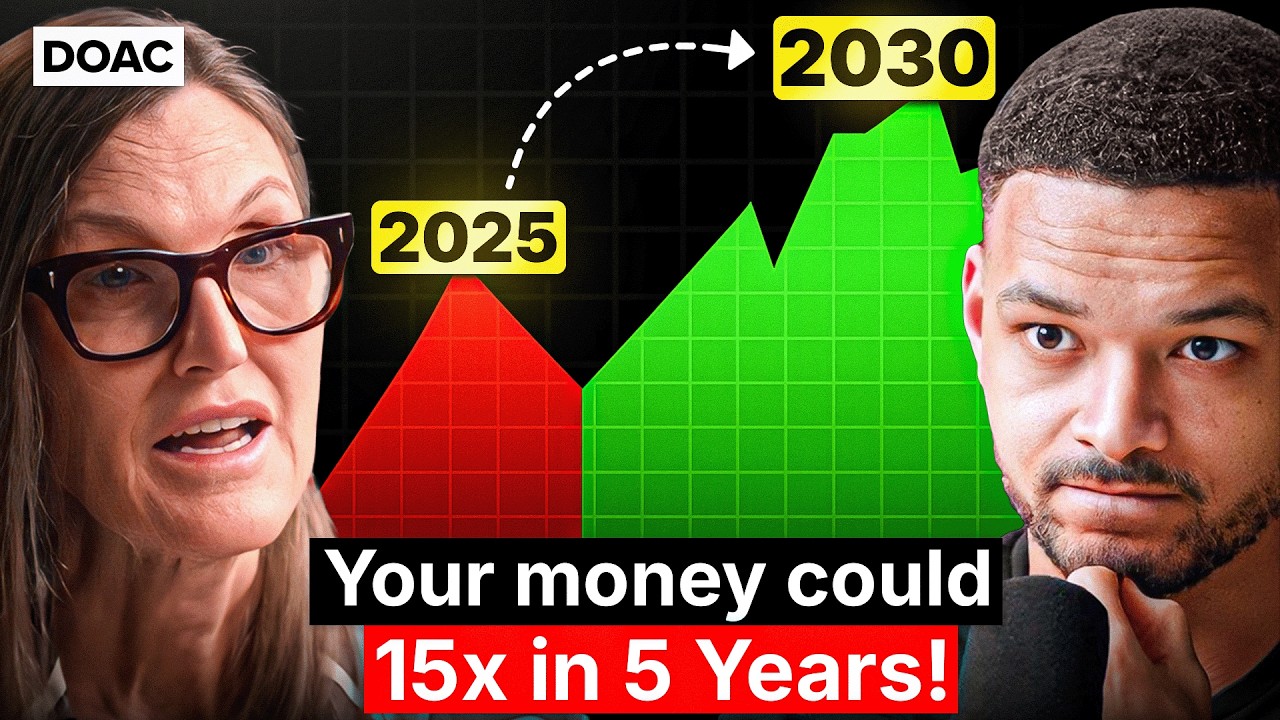
Cathie Wood Bets $10 Trillion Robotaxi Market Propels Tesla Share Price to $2,600
The Diary Of A CEO
ARK Invest CEO Cathie Wood forecasts a 15x rise in Bitcoin to $1.5 million by 2030 as institutional allocation meets a fixed supply, while predicting autonomous transport and AI convergence will push Tesla's valuation to $2,600 per share.
## Background
This video was published on YouTube by The Diary Of A CEO on June 5, 2025. According to the page description, Cathie Wood joins host Steven Bartlett to discuss disruptive investments, her prediction that Bitcoin will reach $1.5 million by 2030, Tesla's potential through autonomous taxis and humanoid robots, and strategies for financial independence over the next five years.
## TL;DR
Cathie Wood outlines ARK Invest's core thesis that five converging technology platforms—AI, robotics, energy storage, blockchain, and multiomic sequencing—will massively accelerate global GDP growth and disrupt traditional industries. She details high-conviction positions in Tesla's robotaxi and humanoid robotics initiatives, healthcare AI advances like CRISPR, and the institutional adoption driving Bitcoin's target price of $1.5 million by 2030. Wood also offers career strategies, dollar-cost averaging advice for individual investors, and reflections on her career mentorship under Arthur Laffer.
## Atmosphere & style
The interview features a thoughtful, highly analytical, and intimate dialogue between Steven Bartlett and Cathie Wood. The tone balances deep financial strategy with deeply personal reflection, shifting fluidly between high-level macroeconomic projections and emotional stories, such as Wood being moved to tears by a letter from her mentor. Steven provides an engaged, inquisitive presence—often testing ideas live on air—while Wood projects calm, unshakeable conviction, making the conversation feel both intellectually rigorous and warmly accessible.
## Key takeaways
- [00:00](https://www.youtube.com/watch?v=ZznpMh0DegE&t=0s) Cathie Wood points to Artificial Intelligence (AI) as the single largest technological disruption in history, driving major shifts across every industry.
- [05:33](https://www.youtube.com/watch?v=ZznpMh0DegE&t=333s) Traditional market leaders that fail to adapt face obsolescence; Apple is highlighted as a cash-cow risk due to lagging AI execution and missed autonomous vehicle opportunities.
- [06:09](https://www.youtube.com/watch?v=ZznpMh0DegE&t=369s) ARK Invest forecasts that autonomous taxi networks will generate $8 trillion to $10 trillion in global revenue over the next 5 to 10 years, with Tesla driving 90% of its valuation from its robotaxi platform.
- [18:30](https://www.youtube.com/watch?v=ZznpMh0DegE&t=1110s) The long-term market for AI-driven humanoid robots (such as Tesla's Optimus) could reach $26 trillion by leveraging shared battery, actuator, and vision tech.
- [20:02](https://www.youtube.com/watch?v=ZznpMh0DegE&t=1202s) The rise of natural language programming and 'vibe coding' is enabling customized software creation without human-written code, revolutionizing internal corporate workflows.
- [20:02](https://www.youtube.com/watch?v=ZznpMh0DegE&t=1202s) Driven by the convergence of AI, robotics, energy storage, blockchain, and multiomics, ARK projects real annual global GDP growth could accelerate to 7.3% over the next five years.
- [24:51](https://www.youtube.com/watch?v=ZznpMh0DegE&t=1491s) Traditional asset managers who simply 'hug benchmarks' like the S&P 500 face severe risk, as passive strategies and automated algorithms execute routine indexing more efficiently.
- [43:36](https://www.youtube.com/watch?v=ZznpMh0DegE&t=2616s) Cathie Wood projects Bitcoin will reach $1.5 million per coin by 2030, driven by a strict supply cap of 21 million and expanding institutional and global adoption.
- [49:24](https://www.youtube.com/watch?v=ZznpMh0DegE&t=2964s) Bitcoin layer-1 security has never been hacked since 2009, making it a distinct new rules-based asset class and store of value compared to traditional equities or gold.
- [50:33](https://www.youtube.com/watch?v=ZznpMh0DegE&t=3033s) Coinbase serves as a core institutional pillar for digital assets and stablecoins, benefiting from a 50/50 revenue split with Circle on USDC.
- [52:25](https://www.youtube.com/watch?v=ZznpMh0DegE&t=3145s) Palantir and TSMC represent high-conviction AI holdings, operating as critical software platform and hardware manufacturing hubs respectively.
- [59:34](https://www.youtube.com/watch?v=ZznpMh0DegE&t=3574s) A disciplined dollar-cost averaging strategy into innovation ETFs allows retail investors to capture 10x growth across disruptive tech platforms while mitigating individual stock volatility.
- [01:06:53](https://www.youtube.com/watch?v=ZznpMh0DegE&t=4013s) Wood unequivocally chooses Tesla as her top single stock pick due to its multi-platform convergence of autonomous robots, energy storage, and artificial intelligence.
- [01:16:47](https://www.youtube.com/watch?v=ZznpMh0DegE&t=4607s) Rather than eliminating human productivity, AI models serve as an ultimate 'sparring partner' to elevate human capabilities and strategic performance.
- [01:21:43](https://www.youtube.com/watch?v=ZznpMh0DegE&t=4903s) Open-source reasoning breakthroughs demonstrated by models like DeepSeek challenge the notion that late-stage AI progress requires continuous multi-trillion-dollar infrastructure spending.
- [01:25:27](https://www.youtube.com/watch?v=ZznpMh0DegE&t=5127s) Cathie Wood's early career philosophy was to make her boss look brilliant, building a foundation in macroeconomics that provided the confidence to manage disruptive innovation funds.
## Detailed walkthrough
Here is a detailed, faithful walkthrough of the provided transcript section:
[00:00](https://www.youtube.com/watch?v=ZznpMh0DegE&t=0s) Introduction and the Scope of Disruptive Innovation
Steven Bartlett introduces Cathie Wood, founder and CEO of ARK Invest, noting that after reviewing a decade of her research, he identified investment predictions with potential growth of at least 5,000%. Wood expresses high conviction in these figures based on her day-to-day work overseeing nearly $30 billion in assets. She discusses her career origins, starting at age 20 at Capital Group under the mentorship of renowned economist Art Laffer—creator of the Laffer Curve and advisor to U.S. presidents from Richard Nixon to Donald Trump.
Wood outlines ARK's core focus on five convergence innovation platforms:
* Artificial intelligence (AI)
* Robotics
* Energy storage
* Blockchain technology
* Multiomic sequencing (in life sciences)
She emphasizes that AI is the single largest technological disruption in history. While rapid change makes people uncomfortable, she argues that being on the "right side of change" will yield massive investment and career opportunities. Conversely, traditional market leaders risk obsolescence. She points to Apple—traditionally considered a safe stock due to its massive cash reserves and dominant smartphone profitability—as a prime candidate for AI disruption. She notes that Apple's revenue growth has slowed significantly toward mature "cash cow" status because they failed to capitalize on the ultimate mobile device: autonomous vehicles. After watching Apple suffer repeated management turnover in their failed electric vehicle project, ARK determined that Apple was not executing properly on AI.
---
[06:09](https://www.youtube.com/watch?v=ZznpMh0DegE&t=369s) Investing in AI Beyond Nvidia: Tesla and the Autonomous Ecosystem
When asked where investors should allocate money to capture the AI boom, Wood notes that many people initially checked the box by buying Nvidia for its GPUs. However, as Nvidia’s valuation soared relative to earnings, ARK shifted capital toward software and real-world AI applications, primarily Tesla (which represents the largest position in ARK's flagship ETF, ARKK) and Palantir. Wood describes Tesla as "the largest AI project on Earth"—a statement she posted on X (formerly Twitter) that received an approving like from Elon Musk.
Wood forecasts that the global ecosystem surrounding autonomous taxi networks will generate $8 trillion to $10 trillion in revenue over the next 5 to 10 years. For context, the entire current global GDP sits at roughly $130 trillion.
Because drastic price cuts inevitably drive up demand and road congestion, ARK anticipates transportation expanding into the skies via Electric Vertical Takeoff and Landing (EVTOL) aircraft. ARK holds a position in EVTOL maker Archer Aviation to capture this transition toward autonomous mobility across land, air, and sea.
* Tesla plans to launch Model Y-based autonomous rides in Austin, Texas, with dedicated "Cybercabs" expected the following year.
* Tesla owners will have the option to send their personal vehicles onto the autonomous network to earn passive income while at work or on vacation.
* ARK maintains a 5-year price target of $2,600 per share for Tesla stock (up from its current ~$270–$280 range), with 90% of that valuation driven by the robotaxi platform rather than hardware EV sales.
---
[10:47](https://www.youtube.com/watch?v=ZznpMh0DegE&t=647s) Healthcare Breakthroughs Driven by AI Convergence
Wood highlights healthcare as the most profound application of AI, driven by the convergence of three technologies: DNA/RNA/protein sequencing, CRISPR gene editing, and AI analytics. This combination is enabling early-stage cancer detection via simple blood tests before stage one, drastically raising survival rates.
She cites CRISPR Therapeutics (a major holding in the ARKG and ARKK funds) and Vertex Pharmaceuticals, which have developed a single-treatment therapy to cure sickle cell disease and beta-thalassemia. Although the preconditioning protocol is intense—resembling chemotherapy—it eliminates the need for patients to make 10 to 20 emergency room visits annually for life-saving blood transfusions.
---
[12:46](https://www.youtube.com/watch?v=ZznpMh0DegE&t=766s) Tesla’s Track Record and the Escalation of Humanoid Robotics
Reflecting on her early call in 2015 that Tesla would cross $4,000 per share (pre-split), Wood notes that the stock hit ARK's target two years earlier than expected. She recalls the 2018–2019 "production hell" period for the Model 3 when bankruptcy fears ran rampant and Elon Musk slept on the factory floor. ARK maintained its conviction because they reasoned that if Musk could land a reusable rocket on a ocean barge, he could master mass automotive manufacturing.
Looking past robotaxis, Wood explains that humanoid robots (such as Tesla's Optimus) represent an even larger financial opportunity. Humanoid robots leverage the exact same underlying technology stack: robotics/actuators, battery energy storage, and real-time vision AI.
* **Robotaxi Market Opportunity:** Estimated at $8 trillion to $10 trillion globally over the next 5–10 years.
* **Humanoid Robotics Market Opportunity:** Projected to reach a $26 trillion revenue market longer term.
* **Performance Benchmarks:** Musk's benchmark for fully functional humanoid robots is the fine-motor dexterity required to thread a needle.
Wood addresses recent footage of untethered humanoid robots dancing without remote control, pointing out how rapidly dexterity is advancing. While technology has historically been a net job creator, the unprecedented mobility and intellectual capacity of AI-driven humanoid robots is raising fundamental questions about the future role of human labor.
[20:02](https://www.youtube.com/watch?v=ZznpMh0DegE&t=1202s) "Vibe Coding" and the Rise of Natural Language Programming
The nature of software creation is undergoing a fundamental shift due to the advent of natural language programming. Rather than writing traditional lines of code, individuals can now engage in "vibe coding"—describing intent in plain English to AI systems like OpenAI's Codex, Replit, or Anthropic's models, which then generate the functional software. Within ARK Invest, this technology is already being deployed to replace off-the-shelf, third-party software with highly customized, internally built tools tailored precisely to the firm's operational needs.
This technological evolution is intersecting with a severe macroeconomic and demographic challenge across the developed world. Developed nations face shrinking youth populations and declining birth rates that fall well below replacement levels—a trend visible in China, Japan, the United States, Europe, and the UK. As the global working-age demographic contracts, automation, AI, and robotics will become vital economic imperatives to supply the productivity needed to sustain growth.
* Historical real global GDP growth averaged approximately 0.6% annually between 1500 and 1900.
* Following the Industrial Revolution—fueled by electricity, the telephone, and the internal combustion engine—real global GDP growth accelerated to an average of 3.0% annually over the last 125 years.
* ARK Invest projects that driven by five core disruptive innovation platforms, real GDP growth could accelerate to 7.3% annually over the next five years.
[24:51](https://www.youtube.com/watch?v=ZznpMh0DegE&t=1491s) Economic Displacement, Job Evolution, and Benchmark Hugging
Accelerating technological change inevitably raises concerns about job destruction and the speed at which old roles are replaced by new ones. While human-centric professions reliant on social interaction, physical presence, and community building—such as in-person wellness or breathwork instruction—will retain inherent value, legacy roles in traditional finance are increasingly vulnerable. Traditional asset managers who simply "hug benchmarks" like the S&P 500, MSCI World, or Nasdaq are performing routine tasks that passive index funds and automated algorithms execute far more efficiently.
To remain relevant, active managers and workers must offer genuine, original value that machines cannot easily replicate. ARK Invest approaches its research by evaluating potential technological shifts against three specific criteria that define a true innovation platform.
* **Wright’s Law (Learning Curves):** Measuring how rapidly unit costs decline as cumulative production doubles, driving technological deflation that translates into lower prices or superior performance.
* **Cross-Sector Applicability:** Ensuring the underlying technology cuts across multiple industries and economic sectors rather than remaining confined to a single niche.
* **Launchpad for Sequenced Innovations:** Serving as a foundational requirement for subsequent breakthroughs—such as short- and long-read DNA sequencing paving the way for CRISPR gene editing by identifying precise genomic mutations.
[29:53](https://www.youtube.com/watch?v=ZznpMh0DegE&t=1793s) Demographic Tailwinds, Career Cycles, and the Shift to Digital Assets
Assuming the economy avoids major policy blunders or a severe recession, structural unemployment over the next 5 to 10 years may remain flat or fall. The primary driver behind this dynamic is the mass retirement of the Baby Boomer generation, whose exit leaves a labor shortfall that the smaller demographic cohorts following them cannot fully replace.
At the same time, the traditional career trajectory—a decade of formal education followed by a steady 30-year climb up a corporate ladder—is being disrupted by rapid AI deployment and tools like vibe coding. Workers are increasingly forced to adapt, take risks, and experiment on their own. This shift aligns with decentralized autonomous organizations (DAOs) enabled by blockchain technology, alongside a broader migration into the digital assets ecosystem.
> "Crypto sounds nefarious. Digital assets is where... young people are spending more than half of their free time online. Property ownership online is becoming more important."
[32:32](https://www.youtube.com/watch?v=ZznpMh0DegE&t=1952s) Tesla, Elon Musk, and Political Involvement
Tesla remains the largest individual holding within ARK Invest's fund, making Elon Musk’s public ventures a central focus for the firm. Musk's involvement in politics—specifically leading the Department of Government Efficiency (DOGE) alongside Donald Trump to streamline federal spending—sparked intense public debate and consumer backlash. Instances of public hostility toward Tesla vehicles, alongside temporary dips in vehicle sales growth and Q1 financial performance, coincided with this period of heightened political visibility.
However, the primary cause of Tesla's first-quarter slowdown was broader macroeconomic contraction—reflected in negative real U.S. GDP growth during the quarter—rather than purely political pushback. Excess government spending acts as a form of delayed taxation or regressive inflation, making structural reform necessary for long-term fiscal stability. Musk's operational style relies on attracting top engineering talent, setting aggressive milestone timelines, and stepping in as a "troubleshooter-in-chief" only when targets are missed.
* ARK Invest first hosted Elon Musk on their podcast in 2019 during Tesla's model production challenges after Musk publicly liked autonomous vehicle research published by ARK analyst Tasha Keeney.
* Musk's overarching strategy across Tesla, SpaceX, and robotics focuses on solving fundamental engineering problems—such as sustainable energy and multi-planetary travel—that yield secondary technological breakthroughs on Earth.
* Despite widespread public perception that Musk operates without rest, he actively targets roughly seven hours of sleep per night to maintain focus.
[40:34](https://www.youtube.com/watch?v=ZznpMh0DegE&t=2434s) Early Bitcoin Investments and the Gold Standard Comparison
Cathie Wood shares the story of ARK Invest's entry into Bitcoin during the summer of 2015 when the price was hovering around $250. At the time, critics dismissed the move as a cheap marketing gimmick designed to attract attention to a newly launched fund company. Unbeknownst to the public, Cathie's team had conducted rigorous academic research on the asset. They tasked Cathie’s former USC professor and noted economist, Art Laffer, with reviewing their first official white paper evaluating whether Bitcoin could successfully fulfill the three core economic roles of money: a means of exchange, a store of value, and a unit of account.
Laffer's reaction transformed their investment thesis. He viewed Bitcoin as the exact rules-based global monetary system he had been waiting for since President Richard Nixon closed the US gold window in 1971, effectively ending the Bretton Woods system. When Cathie asked how massive this opportunity could be, Laffer contextualized it against the US monetary base, which sat at $4.5 trillion at the time, while Bitcoin’s total network value was a mere $6 billion. Due to early regulatory hesitation, Cathie could not immediately buy it for the fund, leading her to purchase a personal allocation at $250 that she has never sold. Eventually, the New York Stock Exchange permitted ARK to establish an initial 1% position via the Grayscale Bitcoin Trust (GBTC). Because regulators never mandated rebalancing, the position safely ballooned as Bitcoin's price surged.
- **Initial Purchase Price:** Approximately $250 per Bitcoin in summer 2015.
- **US Monetary Base vs. Bitcoin (2015):** The US monetary base stood at $4.5 trillion compared to Bitcoin's $6 billion market capitalization.
- **Initial Vehicle:** A 1% allocation in the grantor trust GBTC, which was left to grow without forced liquidation.
---
[43:36](https://www.youtube.com/watch?v=ZznpMh0DegE&t=2616s) Institutional Demand and the $1.5 Million Price Target
Cathie characterizes Bitcoin as the first genuinely new asset class the financial world has seen since equities emerged in the 1600s. It represents a category distinct from traditional stocks, bonds, commodities, and real estate because its unique behavior offers institutions true portfolio diversification. Now that Bitcoin commands a $2 trillion market cap, institutional interest has reached a tipping point, catalyzed by the SEC's approval of spot Bitcoin ETFs in January 2024. Cathie projects that Bitcoin will reach $1.5 million per coin by 2030, representing a 15x increase in value over five years.
This audacious forecast relies on a supply-and-demand mismatch. There are currently roughly 20 million Bitcoins minted by miners out of a hard-capped maximum of 21 million, leaving only 1 million coins left to be mined. As institutional managers handling trillions of dollars slowly complete their internal research and attempt to allocate capital into a remaining supply worth only around $100 billion, incremental demand will force prices sharply higher because long-term holders will refuse to sell. Cathie explains that the three main pillars driving this appreciation are expanding institutional adoption, the rising preference among younger generations for "digital gold" over physical gold, and its critical role in emerging markets. In countries plagued by hyperinflation and unstable fiscal policies like Venezuela, stablecoins pegged to the US dollar serve as transactional tools, while Bitcoin acts as an appreciating long-term insurance policy.
<FollowUp label="Want to look closer at Cathie Wood's $1.5 million Bitcoin valuation model?" query="Break down the specific building blocks and institutional capital allocation assumptions behind Cathie Wood's $1.5 million Bitcoin price target."/>
---
[49:24](https://www.youtube.com/watch?v=ZznpMh0DegE&t=2964s) Network Security and the Strategic Role of Coinbase
Addressing Bitcoin's fundamental architecture, Cathie stresses that it operates on the largest, most secure computer network in the world. Its base layer (layer one) has famously never been hacked since its release in 2009, a security record that very few modern internet infrastructures can match. Bitcoin, Ethereum, and Solana are essentially locked in a long-term race to become the native currencies of the internet, fundamentally transforming traditional financial services through automated smart contracts.
This macroeconomic shift explains ARK's heavy investment in Coinbase. Cathie defends Coinbase as the most regulatory-compliant digital asset exchange globally. While major competitors like Binance faced severe structural run-ins with global authorities and were effectively restricted from the US market, Coinbase systematically educated Washington policymakers. Coinbase helped lawmakers realize that crypto infrastructure simply provides the transactional and financial layer that early developers omitted from the internet in the 1990s. Furthermore, Coinbase is successfully expanding into the highly lucrative derivatives market, recently acquiring the major options exchange Deribit, while simultaneously building out next-generation global payments infrastructure.
---
[52:25](https://www.youtube.com/watch?v=ZznpMh0DegE&t=3145s) AI Chip Dynamics: Palantir, Nvidia, and TSMC
Moving into the public equities ecosystem, Cathie provides an update on ARK's artificial intelligence portfolio strategies. While ARK previously held a position in the communications platform Twilio, they exited the stock following a major management turnover. Instead, they remain highly focused on Palantir, a Platform-as-a-Service (PaaS) company that helps massive enterprises and government entities—such as the US Department of Defense—transition into the digital era. Palantir's structural advantage is its ability to layer on top of legacy technology systems without forcing organizations to undergo costly "rip and replace" overhauls. After Palantir experienced an extended upward run, ARK strategically took profits and reallocated those proceeds into Nvidia when its stock experienced a temporary pullback of more than 50%.
In the hardware layer, Cathie highlights Taiwan Semiconductor Manufacturing Company (TSMC) as an essential, platform-style monopoly. Because TSMC is the most advanced manufacturer of silicon chips on earth, it serves as a structural winner regardless of which individual chip designer triumphs in the marketplace. While Nvidia maintains the top spot in hardware, Cathie anticipates a wave of incoming specialized competitors. This includes private companies like Groq (spelled with a 'q'), an inference-focused chip architecture that both ARK's private fund and host Steven Bartlett have personally invested in. Cathie acknowledges the obvious geopolitical risks associated with TSMC's heavy concentration in Taiwan but notes the company is actively mitigating this exposure by diversifying its manufacturing footprint into the United States and Europe.
---
[54:56](https://www.youtube.com/watch?v=ZznpMh0DegE&t=3296s) High-Conviction Stock Picks: From CRISPR to Roblox
When pressed to name the top public equities in her portfolio, Cathie highlights several high-conviction names that are openly tracked on ARK Invest's website. Alongside anchor holdings like Tesla, Coinbase, Robinhood, and Shopify, she strongly defends Roku, calling it a deeply misunderstood operating system for connected televisions. In the healthcare sector, CRISPR Therapeutics stands out for its pioneering gene-editing work, which has successfully delivered functional cures for inherited blood disorders like sickle cell disease and beta thalassemia. In defense and transportation technology, the electric vertical takeoff and landing (eVTOL) company Archer Aviation recently joined ARK's top ten holdings after signing a highly lucrative, exclusive partnership with rapid-growth defense tech firm Anduril.
Cathie shines a spotlight on gaming platform Roblox to illustrate how user-generated content bypasses traditional media decay. Historically, gaming is the only entertainment medium that expands rather than disintegrates during major technology transitions. Roblox originally captured an audience under 13 years old, but 60% of its massive user base is now older than 13 because users grow up alongside the platform. Cathie shares an anecdote about a friend’s young daughter who opened her own virtual dress shop inside Roblox; through the gamified ecosystem, the child is unconsciously mastering core business mechanics and learning how to program via modern "vibe coding" methods.
- **ARK's Public Top 10 Holdings Include:** Tesla, Coinbase, Robinhood, Roku, CRISPR Therapeutics, Palantir, Archer Aviation, Shopify, and Roblox.
- **Roku's True Identity:** Not just a hardware streaming stick, but a foundational operating system for connected TVs.
- **Roblox User Demographics:** Transitioned from a children's app to a mature social platform where over 60% of the active user base is now over the age of 13.
---
[59:34](https://www.youtube.com/watch?v=ZznpMh0DegE&t=3574s) Dollar-Cost Averaging into Disruptive Innovation ETFs
When asked how an individual with just $1,000 should approach wealth creation, Cathie advises against buying individual stocks and instead champions the practice of regular dollar-cost averaging into Exchange-Traded Funds (ETFs). An ETF bundles dozens of distinct corporate equities into a single tradable asset, allowing everyday retail investors to buy a diversified basket of companies directly from their mobile phones.
Cathie explains the deliberate structural differences between ARK’s flagship funds. The primary US fund, ARKK, represents the team's highest-conviction ideas, spanning roughly 35 to 36 stocks that capture exposures across all five major disruptive innovation platforms. Conversely, the European counterpart fund, ARKI, maintains a narrower thematic focus, focusing almost exclusively on companies at the immediate convergence of artificial intelligence and robotics—a specific pairing that Cathie's research suggests will cause an explosive industrial transformation over the coming decade.
[01:01:13](https://www.youtube.com/watch?v=ZznpMh0DegE&t=3673s) Digital Assets, Healthcare AI, and Stablecoins
Cathie Wood expands on the investment scope of ARK's funds, highlighting ARKG, which focuses on AI applications in healthcare. She explains how regulators are increasingly recognizing the pivotal role AI will play in drug discovery, clinical trials, research, diagnostic testing, and curing diseases. When addressed about cryptocurrencies beyond Bitcoin—such as Ethereum—Wood notes that ARK holds them in their U.S. public funds, framing them not as a speculative "crypto revolution," but as a fundamental "digital assets revolution" forming the "finternet" (financial internet).
While expressing confidence in the "big three"—Bitcoin, Ethereum, and Solana—Wood remains clear that Bitcoin holds the greatest potential because it uniquely addresses three major structural revolutions: redefining the global monetary system, anchoring a new asset class, and serving as the most secure blockchain technology. When asked about stablecoins like USDC, Wood notes that while stablecoins behave essentially like cash, investors can capture their growth through equity in Coinbase, which shares USDC revenues 50/50 with Circle.
- **ARKG Focus:** Health care AI, drug discovery, clinical trials, and diagnostics.
- **The "Finternet":** Crypto framed as a digital assets revolution underpinning modern financial services.
- **The Big Three:** Bitcoin, Ethereum, and Solana are expected to succeed, with Bitcoin taking the largest share.
- **Stablecoin Exposure:** Coinbase shares USDC revenue 50/50 with Circle, providing public equity exposure to stablecoin growth.
---
[01:03:46](https://www.youtube.com/watch?v=ZznpMh0DegE&t=3826s) Investor Mentality and Dollar-Cost Averaging
Discussing the mindset required to be a successful investor, Wood emphasizes the discipline of "averaging in"—buying small, fixed amounts regularly over time on set schedules (such as every payday or weekly). She shares a personal anecdote about one of her daughters buying small fractional units of Bitcoin (Satoshis) every week within her budget constraints. Wood emphasizes that investing in high-growth, disruptive strategies requires taking a long-term view and trusting empirical research rather than reacting to short-term market noise.
> "Averaging in means, you know, buy a little every month, maybe every payday... And close your eyes. Like this is a long-term investment."
Wood notes that according to ARK's models, the converging technologies they research could experience more than a tenfold growth over the next five to ten years. However, both speakers explicitly reiterate that this research does not constitute personalized financial advice and that investors must do their own research on sites like `ark-invest.com` and `ark-funds.com`, recognizing that capital remains at risk.
- **Dollar-Cost Averaging:** Strategy of buying consistently regardless of short-term price fluctuations.
- **Growth Projections:** ARK's research projects disruptive tech platforms growing over 10x in 5–10 years.
- **Satoshi Strategy:** Example of accumulating Bitcoin incrementally via smallest fractional units.
---
[01:06:53](https://www.youtube.com/watch?v=ZznpMh0DegE&t=4013s) Trump Tariffs, Trade Policy, and Tesla as the Top Stock
When asked about President Trump's trade policies and economic moves, Wood reflects on the initial market surge driven by expectations of aggressive deregulation, tax cuts, and lower interest rates. However, she candidly admits that the chaotic rollout of tariffs initially "scared me silly," fearing it would paralyze corporate spending and trigger economic turmoil. Economists like Art Laffer, an advisor associated with ARK, voiced similar extreme concerns publicly during the height of the uncertainty.
Wood notes her confidence returned when Treasury Secretary Scott Bessent took a primary role in shaping policy, signaling a pragmatic push to dismantle foreign non-tariff trade barriers—such as historical Canadian tariffs on U.S. dairy (up to 250%) or UK restrictions on U.S. beef and ethanol. While describing Trump's negotiating style as deliberately volatile to gain leverage, she expresses optimism about the outcome. When pressed to select a single stock to hold, Wood unequivocally selects Tesla, citing its unique position at the intersection of three major technology platforms: autonomous robots, energy storage, and artificial intelligence.
> "If I had to give you one stock... It would be Tesla... Think about it. It is a convergence among three of our major platforms: robots, energy storage, AI."
- **Deregulation & Taxes:** The initial catalyst behind stock market optimism following political shifts.
- **Trade Barriers Target:** Example of Canada's ~250% tariffs on milk and European non-tariff trade barriers.
- **Single Stock Pick:** Tesla, driven by multi-platform convergence and upside in autonomous taxis and humanoid robotics beyond ARK's $2,600 price target base case.
---
[01:11:38](https://www.youtube.com/watch?v=ZznpMh0DegE&t=4298s) Economic Disruption and Society's Readiness
Reflecting on what keeps her up at night, Wood admits to being an inherent optimist, but voices concern over workers and traditional industries getting "caught out" by the rapid speed of technological disruption if they fail to adapt. She foresees sweeping changes across retail, transportation, and traditional healthcare. For instance, retail will shift from static storefronts to personal AI shopping assistants that anticipate consumer desires and source products globally, forcing physical retail to pivot into highly social, experiential destinations.
The host questions whether a widening divide will emerge between proactive urban tech adopters and rural or traditional populations who do not engage with tools like ChatGPT. Wood argues that while societal support is necessary, individual initiative and curiosity are crucial. She urges people to leverage free research and podcasts to educate themselves and prepare their children for an economy shaped by creativity and adaptation rather than outdated paradigms.
- **Retail Evolution:** Disintermediation by AI personal shoppers; physical retail shifting toward purely social experiences.
- **Economic Divide:** Risk of traditional workers being left behind versus those taking the initiative to learn AI tools.
- **Educational Empowerment:** Utilizing open-source research and media to prepare for shifting employment landscapes.
---
[01:16:47](https://www.youtube.com/watch?v=ZznpMh0DegE&t=4607s) Hiring in the AI Era and Lessons from AlphaGo
The host expresses his own anxieties as a business owner managing a 25,000-square-foot office with hundreds of employees, questioning what human roles will remain relevant when agentic AI and physical robotics converge across corporate workflows. Wood responds by recounting the famous story of Google DeepMind's AlphaGo defeating world champion Lee Sedol in the game of Go—a game far more complex than chess.
While Lee Sedol was initially crestfallen by his defeat against the machine, he eventually regained his "chutzpah" and began studying and playing alongside AI systems. Wood uses this story to illustrate that AI should not be viewed purely as a replacement for human endeavor, but as an ultimate sparring partner that elevates human capability, strategy, and performance to entirely new heights.
[01:19:09](https://www.youtube.com/watch?v=ZznpMh0DegE&t=4749s) AI vs. Human Intelligence and the Horizon of AGI
Steven and Cathie dive into a debate on the core nature of human performance versus artificial intelligence, starting with the analogy of chess grandmasters. While top human players still occasionally beat advanced machines, the broader public isn't interested in watching machines play against other machines—people crave human error, relatability, and inspiration. However, in the world of work, the sole driver is productivity. A humanoid robot with a "PhD in everything" won't get sick or fail at its desk, fundamentally altering workplace dynamics.
```
"My humanoid robot isn't going to get sick, and it's going to have a PhD in everything... I don't want to see a human failing at their desk."
```
Steven points out that AI is trained on past data to recognize patterns and make predictions, much like the human brain's neural networks. Cathie counters that ARK Invest deliberately focuses on "disruptive" innovation—situations where traditional historical patterns break down completely. While standard AI models rely on established data, true breakthrough research starts with a blank sheet of paper. Nevertheless, with Artificial General Intelligence (AGI) potentially only two years away according to Elon Musk, AI is rapidly advancing from simple pattern matching to generating original scientific models and superintelligence.
- **Human Preference vs. Economic Utility**: People value human imperfection in sports and entertainment, but businesses prioritize pure efficiency, error reduction, and uptime.
- **Disruptive Innovation**: Defined as breakthroughs that invalidate historical baseline patterns, requiring original research rather than simple extrapolations of the past.
- **AGI Timeline**: Elon Musk estimates AGI could arrive within two years, enabling systems that behave like elite scientists and researchers across multiple domains.
---
[01:21:43](https://www.youtube.com/watch?v=ZznpMh0DegE&t=4903s) Live Demonstration: Prompting DeepSeek/GPT for a SpaceX Financial Model
To test the capabilities of current AI models on complex forward-looking scenarios, Steven prompts a high-reasoning model live on air to generate an income statement for SpaceX through the year 2050, factoring in Elon Musk's goal to colonize Mars in the 2040s. While the model processes the multi-decade projection, Cathie notes the breakthrough in reasoning models pioneered by open-source developments like DeepSeek. DeepSeek achieved elite reasoning capabilities by training the model to iteratively ask itself questions to reach answers faster, utilizing a 50,000 GPU cluster for initial pre-training before completing its final fine-tuning step for just $6 million—a move that briefly wiped out a trillion dollars in market value across US tech stocks over hardware efficiency concerns.
The AI model finishes its generation live on screen, delivering a projected 2050 financial breakdown for SpaceX:
- **DeepSeek's Disruption**: Demonstrated that advanced reasoning logic could be refined via open-source approaches, challenging the belief that trillions in hardware spending are continuously required for late-stage LLM optimization.
- **Live Output**: The generated model estimates Starlink will generate more than double the revenue of core space launches by 2050 ($250B vs. $120B).
---
[01:25:27](https://www.youtube.com/watch?v=ZznpMh0DegE&t=5127s) Advice for Young Professionals: Making Your Boss Look Brilliant
Steven shifts the conversation to Cathie's career trajectory, noting that ChatGPT repeatedly names her the top female investor in the world. He asks how she achieved such success in an industry historically dominated by men. Cathie shares her core philosophy for anyone starting their career: make your boss look brilliant. Early in her career working under an economist, she taught herself ancient time-sharing mainframe technology just to create custom visual charts that her boss needed for his presentations, delighting him and opening doors for massive personal growth.
```
"My mission when I started was to make my boss look brilliant... If you do make him look good, you owe him a debt of gratitude if he turns around and gives you more growth opportunities."
```
Cathie stresses that bringing deep domain knowledge gives young professionals an unshakeable foundation of confidence. Studying macroeconomics under Arthur Laffer gave her an edge over almost everyone in the room when she moved into investment management. Even when senior colleagues doubted whether she was ready to step into a lead economist role after only three years in Los Angeles, her foundational knowledge allowed her to move to New York with confidence. She eventually transitioned into equity research at Jennison Associates under Sig Segalas, intentionally taking on complex cyclical companies and international stocks that nobody else wanted to research.
- **Career Accelerator Strategy**: Solve high-friction problems for leadership to gain trust, autonomy, and access to bigger opportunities.
- **Core Edge**: Deep expertise in macroeconomics provided the baseline confidence needed to challenge consensus views in boardrooms.
- **Taking the Hard Assignments**: Early willingness to cover non-US equities and complex cyclical sectors set her apart at Jennison Associates.
---
[01:30:20](https://www.youtube.com/watch?v=ZznpMh0DegE&t=5420s) The Mentor Letter: Arthur Laffer's Gratitude and his $1.5M Bitcoin Rejuvenation
Steven surprises Cathie by reading a personal letter written about her by her mentor, renowned economist Arthur Laffer (creator of the Laffer Curve). In the letter, Laffer fondly recalls "Cathy Duddy" whose "face was the map of Ireland and whose ambition was over the moon." He details how she aced his course, landed her first job at Capital Group in LA through his recommendation, and went on to become a star investor at Tupelo and AllianceBernstein before taking the entrepreneurial leap to found ARK Invest in 2014.
The letter visibly moves Cathie to tears as she reflects on their lifelong connection. When she started ARK Invest, she gifted Laffer a 1% equity stake in the company as a token of gratitude for believing in her first. She reveals that despite being 84 or 85 years old, wearing no smart devices, using a flip phone, and avoiding email, Art Laffer has been completely rejuvenated by Bitcoin and stablecoins. He recently joined X (formerly Twitter) to share economic insights after seeing ARK's 3.3 million combined followers, reigniting their professional collaboration around digital assets.
```
"There was this young lady named Cathy Duddy, later Cathy Wood, whose face was the map of Ireland and whose ambition was over the moon... She never has forgotten her now aged professor."
```
- **Early Mentorship**: Arthur Laffer helped land Cathie her first role at Capital Group, kickstarting her career in finance.
- **Equity Gift**: Cathie gave Laffer 1% of ARK Invest at its inception to honor his early backing.
- **Tech Adaptation**: Despite relying on a basic flip phone, Laffer embraced X to publish views on Bitcoin and stablecoin economics.
---
[01:33:07](https://www.youtube.com/watch?v=ZznpMh0DegE&t=5587s) Unconventional Thinking: From Flying Robots to Transformer House-Bots
Answering the signature closing question left by the previous guest—*"What is the craziest idea you ever had that turned out to be right?"*—Cathie explains that breakthrough thinking often feels crazy in the moment because it stems from technology convergence. Back in 2014, when she asserted in a research meeting that "autonomous vehicles are simply robots," her entire team argued against her. Today, the convergence of robotics, AI, and energy storage proves that self-driving cars are indeed mobile autonomous robots.
```
"Autonomous vehicles are robots... Everyone said, 'No, they're not.' And of course they are."
```
She shares recent internal debates at ARK, including a recent Friday brainstorming session where a contrarian team member argued that humanoid robots on "stilts" couldn't carry enough heavy weight to be practical. Cathie countered with the concept of "transformer robots"—bipedal humanoid bots that can fold down into tank-like tracks or wheeled configurations to haul heavy loads, before unfolding back into humanoids to clean a house. She draws a line back to her childhood trip to Disneyland at age 11 after moving from Ireland, where seeing early futuristic concepts on the *Carousel of Progress* taught her to imagine radical technical shifts without fearing judgment.
- **Convergence Framework**: Big platform shifts occur when distinct technologies (e.g., battery density, neural networks, and robotics) intersect simultaneously.
- **Transformer Form Factors**: Future robotics will likely adapt between humanoid shapes for dexterous task execution and collapsed, high-stability tracked shapes for heavy lifting.
- **Infrastructure on Mars**: Cathie notes that Elon Musk's Boring Company underground tunnels are fundamentally designed for harsh environments like Mars, where surface radiation makes subterranean travel necessary.
[01:37:10](https://www.youtube.com/watch?v=ZznpMh0DegE&t=5830s) A Multifaceted Expression of Gratitude
Steven Bartlett expresses his deep appreciation to Cathie Wood for her educational efforts and her willingness to open-source ARK Invest’s research. He shares that he first discovered her work years ago alongside his brother while researching innovation and long-term thesis-driven investing. He praises her for distilling complex market concepts into accessible language for the next generation, ensuring everyday investors are not caught off guard by rapid technological shifts. Additionally, Steven highlights how inspiring her career is, noting that she has achieved extraordinary success in a traditionally male-dominated finance industry, serving as an influential role model for both women and men.
Cathie warmly receives the compliment, expressing that it has been an honor to speak to his audience. She commends Steven on building a successful media platform and playfully reassures him that the fast-changing future he sometimes worries about will ultimately treat him and his business very well.
- **Open-Source Research**: Steven notes that ARK’s public-facing research serves a dual purpose of educating the public and drawing prospective investors into the fund.
- **Industry Representation**: Steven explicitly calls out Cathie's success in male-dominated finance as a beacon for aspiring investors across demographic lines.
---
[01:39:23](https://www.youtube.com/watch?v=ZznpMh0DegE&t=5963s) Closing Remarks and Channel Announcements
Following the interview, Steven introduces "The Diary Of A CEO" Conversation Cards, a card game created from questions left behind by previous guests in the show's diary. The deck consists of 51 questions categorized into three distinct tiers: the warm-up level, the open-up level, and the deep level. Each card includes the guest's question and a QR code linking directly to the video clip where the subsequent guest answers it.
Steven concludes the episode with a direct appeal to his audience, sharing a statistic about viewer subscriptions and inviting listeners to support the show.
- **Conversation Cards**: Designed for various settings ranging from corporate boardrooms to first dates and personal reflection, available at `thediary.com`.
- **Subscriber Request**: Steven reveals that **53%** of regular listeners have not yet subscribed to the podcast channel, and he promises that subscribing helps his team continuously improve guest selection and production quality.
## Notable quotes
> [29:53](https://www.youtube.com/watch?v=ZznpMh0DegE&t=1793s) Crypto sounds nefarious. Digital assets is where... young people are spending more than half of their free time online. Property ownership online is becoming more important. — Cathie Wood
> [37:46](https://www.youtube.com/watch?v=ZznpMh0DegE&t=2266s) Averaging in means, you know, buy a little every month, maybe every payday... And close your eyes. Like this is a long-term investment. — Cathie Wood
> [01:08:53](https://www.youtube.com/watch?v=ZznpMh0DegE&t=4133s) If I had to give you one stock... It would be Tesla... Think about it. It is a convergence among three of our major platforms: robots, energy storage, AI. — Cathie Wood
> [01:19:09](https://www.youtube.com/watch?v=ZznpMh0DegE&t=4749s) My humanoid robot isn't going to get sick, and it's going to have a PhD in everything... I don't want to see a human failing at their desk. — Steven Bartlett
> [01:25:27](https://www.youtube.com/watch?v=ZznpMh0DegE&t=5127s) My mission when I started was to make my boss look brilliant... If you do make him look good, you owe him a debt of gratitude if he turns around and gives you more growth opportunities. — Cathie Wood
> [01:30:20](https://www.youtube.com/watch?v=ZznpMh0DegE&t=5420s) There was this young lady named Cathy Duddy, later Cathy Wood, whose face was the map of Ireland and whose ambition was over the moon... She never has forgotten her now aged professor. — Arthur Laffer
> [01:33:07](https://www.youtube.com/watch?v=ZznpMh0DegE&t=5587s) Autonomous vehicles are robots... Everyone said, 'No, they're not.' And of course they are. — Cathie Wood
## Mentioned
Cathie Wood, Steven Bartlett, ARK Invest, Art Laffer, Arthur Laffer, Capital Group, Apple, Nvidia, Tesla, Palantir, Elon Musk, Archer Aviation, Model Y, Cybercab, CRISPR Therapeutics, Vertex Pharmaceuticals, Optimus, OpenAI Codex, Replit, Anthropic, Department of Government Efficiency, DOGE, Donald Trump, Tasha Keeney, SpaceX, Bitcoin, Grayscale Bitcoin Trust, GBTC, SEC, Ethereum, Solana, Coinbase, Binance, Deribit, Twilio, Taiwan Semiconductor Manufacturing Company, TSMC, Groq, Robinhood, Shopify, Roku, Anduril, Roblox, ARKK, ARKI, ARKG, Circle, USDC, Scott Bessent, ChatGPT, Google DeepMind, AlphaGo, Lee Sedol, DeepSeek, Starlink, Jennison Associates, Sig Segalas, Tupelo, AllianceBernstein, X, The Boring Company, The Diary Of A CEO
ARK Invest CEO Cathie Wood argues that the convergence of artificial intelligence, robotics, energy storage, blockchain, and multiomics will trigger massive economic restructuring and outsized capital appreciation for platforms solving physical and institutional bottlenecks. As automation counters declining global demographics, Wood asserts that legacy businesses and benchmark-hugging asset managers face severe disruption.
Platform Convergence and Macroeconomic Productivity (20:02)
Wood structures ARK’s investment thesis around five core platforms: artificial intelligence, robotics, energy storage, blockchain technology, and multiomic sequencing. To qualify as a true innovation platform under ARK's criteria, a technology must follow Wright’s Law of declining unit costs, demonstrate broad cross-sector utility, and serve as a foundation for sequenced technological breakthroughs. Wood argues that while global real GDP averaged 0.6% annually from 1500 to 1900 and 3.0% over the post-industrial era, technological convergence could accelerate real GDP growth to 7.3% annually over the next five years.
This growth projection is framed against severe demographic headwinds in developed nations, where birth rates have fallen below replacement levels. Wood contends that software advances—such as natural language "vibe coding" that enables internal tool development without legacy enterprise software—alongside physical automation will serve as necessary economic imperatives to offset the mass retirement of the Baby Boomer generation and sustain global productivity.
Autonomous Mobility and Humanoid Robotics Markets (6:09)
Tesla remains ARK's highest-conviction equity holding, which Wood categorizes as an AI and robotics project rather than an automotive manufacturer. ARK models the global autonomous taxi market at $8 trillion to $10 trillion in revenue over the next 5 to 10 years, predicated on projected travel costs falling from $2.00–$4.00 per mile for traditional rideshares to approximately $0.25 per mile for autonomous electric fleets. Based on this dynamic, ARK maintains a 5-year price target of $2,600 per share for Tesla, attributing roughly 90% of that valuation to its robotaxi platform.
Beyond passenger vehicles, Wood projects that humanoid robots (such as Tesla's Optimus) represent a $26 trillion market opportunity over the longer term. Because humanoid robots share the same underlying technology stack—actuators, battery storage, and real-time vision AI—rapid advances in motor dexterity and artificial general intelligence could fundamentally alter physical workplace labor, prioritizing continuous operational uptime and error reduction over human staffing.
Bitcoin Institutional Adoption and Supply Dynamics (43:36)
Categorizing Bitcoin as the first distinct asset class since equities emerged in the 1600s, Wood forecasts that Bitcoin will reach $1.5 million per coin by 2030. Her thesis centers on an imbalance between institutional demand and an inelastic supply: approximately 20 million of the hard-capped 21 million Bitcoins are already circulating, leaving only roughly $100 billion of remaining supply to be mined. Wood identifies three primary drivers for appreciation: institutional allocations following SEC spot ETF approvals in January 2024, younger demographics adopting "digital gold" over physical bullion, and emerging markets utilizing Bitcoin and stablecoins as protection against local currency inflation.
ARK reinforces this exposure through equity in digital asset infrastructure like Coinbase. Wood defends Coinbase's regulatory-first strategy in Washington, highlighting its 50/50 revenue-sharing agreement with Circle on the USDC stablecoin and its push into crypto derivatives via acquisitions like Deribit. She characterizes these platforms as the foundational financial plumbing ("finternet") originally omitted from the early internet architecture.
AI Applications Across Computing and Healthcare (10:47)
Wood identifies healthcare as a profound application of technological convergence, linking multiomic sequencing, CRISPR gene editing, and AI analytics. She cites CRISPR Therapeutics and Vertex Pharmaceuticals for producing one-time functional cures for sickle cell disease and beta-thalassemia, alongside blood tests capable of detecting cancer before stage one. Wood argues that this shift moves healthcare from costly, reactive hospital interventions to early molecular detection and functional cures.
In computing hardware and software, Wood advocates shifting capital beyond mega-cap chip designers whose valuations have expanded relative to earnings, such as Nvidia, toward real-world application layers like Palantir that integrate into legacy enterprise infrastructure. While recognizing Taiwan Semiconductor Manufacturing Company (TSMC) as a critical manufacturing monopoly and noting specialized inference architectures like Groq, Wood maintains that long-term enterprise value accrues to platforms deploying proprietary operational data.
Wood’s projections assume rapid technological adoption and seamless execution by market frontrunners, yet these forecasts remain subject to regulatory hurdles, geopolitical concentrations in silicon manufacturing, and potential labor friction as automation displaces traditional corporate and industrial roles.
## Background
本期内容由知名播客频道《The Diary Of A CEO》(主持人 Steven Bartlett)于 2025 年 6 月 5 日发布在 YouTube 平台。页面简介显示,本期邀请到方舟投资(ARK Invest)掌门人“木头姐”凯茜·伍德(Cathie Wood),深度解析 2025 至 2030 年颠覆性创新投资趋势、比特币冲击 150 万美元的逻辑、特斯拉 Robotaxi 与人形机器人的商业落地,以及普通人在 AI 浪潮中实现财务自由的策略。
## TL;DR
凯茜·伍德在节目中全面阐述了由人工智能、机器人、储能、区块链和多组学五大平台聚合引发的技术革命,并预言其将推动美国实际 GDP 增长率翻倍至 7.3%。她强调特斯拉将成为地球上体量最大的实体 AI 项目,其核心估值将由自动驾驶网约车网络及人形机器人驱动;同时重申比特币作为独立资产类别,在机构配置与全球去中心化需求推动下将于 2030 年达到 150 万美元。面对 AI 对传统就业市场的剧烈冲击,伍德指明了普通人定投优质主动型 ETF 的稳健路径,并分享了年轻一代借助自然语言“氛围编程”(Vibe Coding)与强化人际核心价值破局的生存心法。
## Atmosphere & style
整场对话在专业投研的硬核理性与跨世代人生智慧的温情流淌之间自如切换。史蒂文·巴特利特带着青年创业者在技术巨浪前的真实焦虑与犀利追问,而伍德则以四十载穿越周期的笃定与标志性的乐观主义给予从容拆解,双方甚至兴致勃勃地现场用 ChatGPT 实测推演 SpaceX 远期财务模型。当主持人念出 84 岁恩师阿瑟·拉弗写给伍德的深情信件时,现场气氛迎来动容高潮,让整期深度商业对谈兼具了未来主义的激荡与师徒传承的人文厚度。
## Bulletin
- [43:36](https://www.youtube.com/watch?v=ZznpMh0DegE&t=2616s) Cathie Wood 预测比特币将在 2030 年达到 150 万美元,核心驱动力来自现货 ETF 开启的机构资金配置潮、数字原生代对实物黄金的替代偏好,以及新兴市场抵御恶性通胀的避险需求。
- [14:41](https://www.youtube.com/watch?v=ZznpMh0DegE&t=881s) ARK Invest 设定特斯拉 5 年目标价为每股 2,600 美元,其中 90% 的估值来自自动驾驶 Robotaxi 网络,预计无人网约车每英里出行成本将骤降至 25 美分并催生 8 至 10 万亿美元年营收的超级生态。
- [02:16](https://www.youtube.com/watch?v=ZznpMh0DegE&t=136s) 当前全球正处于人工智能、机器人、储能、区块链与多组学测序五大底层技术平台同时交汇爆发的历史节点,ARK 模型测算未来五年美国实际 GDP 增速有望加速飙升至 7.3%。
- [17:00](https://www.youtube.com/watch?v=ZznpMh0DegE&t=1020s) 人形机器人市场未来 5 到 10 年内全球规模预计达 8 到 10 万亿美元,更长远阶段将演进为年营收 26 万亿美元的产业,且特斯拉现行 2,600 美元目标价中几乎尚未计入 Optimus 的估值贡献。
## Key takeaways
- [02:16](https://www.youtube.com/watch?v=ZznpMh0DegE&t=136s) 五大颠覆性创新平台(AI、机器人、储能技术、区块链、多组学测序)正罕见地同时聚合爆发,深度重塑劳动力市场、日常决策与财富分配机制。
- [04:18](https://www.youtube.com/watch?v=ZznpMh0DegE&t=258s) 守成巨头正面临严重被颠覆风险,苹果因未能底层搞定 AI 且自动驾驶造车团队动荡,极大概率退化为增长乏力的传统现金牛公司。
- [06:09](https://www.youtube.com/watch?v=ZznpMh0DegE&t=369s) 英伟达上游算力估值亢奋倒逼下游应用端诞生超级赢家,特斯拉以无人驾驶出租车(Robotaxi)和端到端 FSD 网络成为全球最大的落地 AI 项目。
- [09:59](https://www.youtube.com/watch?v=ZznpMh0DegE&t=599s) 自动驾驶大幅降本引发路面拥堵将催生低空立体交通,推动电动垂直起降飞行器(eVTOL)行业龙头(如 Archer Aviation)进入爆发期。
- [09:59](https://www.youtube.com/watch?v=ZznpMh0DegE&t=599s) AI 与生物技术融合开启治愈绝症纪元,结合多组学测序与 CRISPR 基因编辑已能商业化治愈镰状细胞贫血症和 β-地中海贫血。
- [14:41](https://www.youtube.com/watch?v=ZznpMh0DegE&t=881s) 特斯拉商业模式正从低频单次卖车全面转向高毛利的 Robotaxi 平台订阅,车主可将闲置车辆接入自主车队赚取被动收入。
- [20:20](https://www.youtube.com/watch?v=ZznpMh0DegE&t=1220s) 自然语言编程(Vibe Coding)重塑软件开发生态,结合 AI 与机器人是发达国家抵御人口老龄化与劳动力供给枯竭的唯一路径。
- [27:36](https://www.youtube.com/watch?v=ZznpMh0DegE&t=1656s) 颠覆性创新平台具备三大核心法则:遵循产量翻倍成本骤降的赖特定律、具备跨行业普遍适用性,并能充当衍生创新的发射台。
- [25:24](https://www.youtube.com/watch?v=ZznpMh0DegE&t=1524s) 紧抱基准指数的传统被动资产管理将面临大批淘汰,人类抵御机器替代的核心护城河在于线下信任、情绪共鸣与人际联结。
- [49:07](https://www.youtube.com/watch?v=ZznpMh0DegE&t=2947s) 比特币是自 1600 年代股票诞生以来首个全新独立资产类别,其底层 Layer 1 结算网络自 2009 年上线至今从未被黑客攻破。
- [50:33](https://www.youtube.com/watch?v=ZznpMh0DegE&t=3033s) Coinbase 通过收购 Deribit 发力期权衍生品并构建底层支付基础设施,以全球最高的合规性补齐上世纪 90 年代互联网缺失的金融协议。
- [59:34](https://www.youtube.com/watch?v=ZznpMh0DegE&t=3574s) 针对 1,000 美元起步的普通投资者,最佳建仓策略是定期定额定投(DCA)覆盖核心颠覆性资产的主动型 ETF(如 ARKK 与 ARKI)。
- [52:23](https://www.youtube.com/watch?v=ZznpMh0DegE&t=3143s) Palantir 凭借直接在现有基础设施上构建智能层的优势成为 AI 平台核心资产,而台积电则是全行业芯片代工不可动摇的共同底座。
- [01:25:27](https://www.youtube.com/watch?v=ZznpMh0DegE&t=5127s) 年轻人职场进阶的核心心法是主动运用新技术攻坚、“让你的老板显得无比卓越”,以此撬动更大的授权与成长空间。
- [01:36:50](https://www.youtube.com/watch?v=ZznpMh0DegE&t=5810s) 马斯克已在电动车、商业航天与人形机器人领域搭建起深厚长远的发展跑道,即便其个人离世,积蓄的工程与人才网络也足以推动人类迈向火星时代。
## Detailed walkthrough
### [00:00](https://www.youtube.com/watch?v=ZznpMh0DegE&t=0s) 预告与颠覆性创新的投资前瞻
节目开篇以高密度的快问快答拉开序幕。主持人史蒂文·巴特利特(Steven Bartlett)指出,自己翻阅了凯茜·伍德(Cathie Wood)过去十年的深度研究报告,试图找出未来能够让普通人实现财富跨越的核心资产,而伍德曾给出惊人预测——某项资产将在未来斩获至少 5,000% 的回报。伍德对此毫不迟疑地确认,并坦言这份坚定信心直接来自于她日复一日的底层研判与一线跟踪。作为掌管近 300 亿美元资金的掌舵人,伍德拥有超过 40 年的市场洞察力,被誉为最善于在趋势爆发前抢先布局的科技女股神。
面对普通投资者哪怕只有 500 美元本金的困惑,伍德强调,人工智能(AI)是整个人类历史上规模最大的技术颠覆浪潮,其迅猛的迭代节奏正在让很多人感到无所适从与焦虑。然而,只要站在变革的正确阵营,未来爆发的投资机会与就业红利将超乎想象。令人意外的是,伍德直言许多人眼中看似固若金汤的避风港(例如苹果公司)很可能会被 AI 彻底颠覆,而特斯拉才是全球体量最庞大的 AI 核心项目。
- **超高成长预期**:伍德预测顶级颠覆性资产未来具备 50 倍(5,000%)以上的增长潜力,入选标的在未来 5 到 10 年内预期增值将超过 10 倍。
- **重金押注特斯拉**:方舟投资(ARK Invest)在特斯拉上的持仓规模已超过 20 亿美元,视其为全球最大的实体落地 AI 项目。
---
### [02:16](https://www.youtube.com/watch?v=ZznpMh0DegE&t=136s) 掌管300亿美元的投资女王与五大核心创新平台
主持人好奇地询问伍德:“在当今地球上,还有没有女性在主动投资管理领域掌管着比你更多的资金?”伍德谦虚地回应,就个人主导的投资管理而言也许没有,尽管许多大型投资机构的团队中确实有女性共同管理着更庞大的规模。伍德自 20 岁起在著名资管公司 Capital Group 开始职业生涯,当时引荐她入行的正是著名供给学派经济学家、拉弗曲线的开创者阿瑟·拉弗(Art Laffer)。拉弗历任自尼克松以来多位美国总统的经济顾问,这一师承让伍德自年轻时起就习惯从宏观经济与生产力跃迁的全局视角来剖析技术趋势。
伍德明确界定了方舟投资的核心使命:只投资那些依靠技术赋能、并注定颠覆我们所认知世界的先锋企业。在她看来,当前世界正站在人类历史上罕见的“五大创新平台同时聚合爆发”的奇点之上。普通人必须理解这些底层技术,因为它们将彻底重构每一个人的职业生涯、日常决策以及财富分配机制。
```mermaid
flowchart TD
accTitle: 五大颠覆性创新平台
accDescr: 展示方舟投资关注的五大底层技术平台及其交汇关系
subgraph Platforms["ARK Invest 五大颠覆性技术平台"]
AI["人工智能 (AI)"]
Robotics["机器人技术 (Robotics)"]
Storage["储能技术 (Energy Storage)"]
Blockchain["区块链技术 (Blockchain)"]
Multiomics["多组学测序 (Multiomic Sequencing)"]
end
AI -->|"赋能物理世界"| Robotics
AI -->|"数据处理与靶点发现"| Multiomics
Storage -->|"动力基础"| Robotics
AI -->|"自动驾驶网络"| Storage
```
- **五大底层创新平台**:
1. 人工智能(Artificial Intelligence,通用计算的核心驱动器);
2. 机器人技术(Robotics,涵盖自动驾驶与具身智能);
3. 储能技术(Energy Storage,尤其是先进电池技术);
4. 区块链技术(Blockchain Technology,以比特币与智能合约为核心);
5. 多组学测序(Multiomic Sequencing,生命科学领域的深度底层解码)。
---
### [04:18](https://www.youtube.com/watch?v=ZznpMh0DegE&t=258s) 巨头面临颠覆:为何苹果在AI时代显露疲态
当被问及普通人为何需要关注这些技术时,伍德以比特币的崛起为例,说明传统金融世界正遭遇剧烈冲击。为了让听众更直观地理解“站在变革的对立面意味着什么”,伍德直接拿美股“六大科技巨头”(Mag 6)之一的苹果公司(Apple)进行剖析。市场普遍将苹果视为最稳健的防御性资产,因其拥有海量现金储备、全球忠诚度最高的客户群体,以及在智能手机行业中一骑绝尘的超高利润份额。但在伍德眼中,苹果正面临被 AI 巨浪掀翻的致命危机。
伍德透露,方舟研究团队很早就提出了一个根本性命题:“移动终端的终极形态究竟是什么?”他们的结论是:终极的移动智能设备绝非握在手中的手机,而是“自动驾驶汽车”(Autonomous Vehicle)。作为全球头号消费电子巨头,苹果理应全力拿下这一赛道,他们也曾重金立项研发自动驾驶整车。然而,伍德和她的分析师长期追踪后发现,苹果造车团队的高管与核心架构师频繁动荡、换帅不断。这种剧烈的人员流失暴露了一个残酷事实——苹果从底层就未能真正搞定 AI,战略定位出现了严重偏差。
"如果一家公司在 AI 领域无法做对做透,我们绝不会在那里投入资本。"伍德坦言,虽然苹果凭借充沛现金和忠实果粉依然可以维持运转,但其营收增速已几乎停滞,未来极大概率退化成一家增长乏力的传统“现金牛”。方舟投资只专注于技术驱动的高速成长型颠覆,绝不会留恋守成巨头的黄昏。
---
### [06:09](https://www.youtube.com/watch?v=ZznpMh0DegE&t=369s) 告别单一英伟达逻辑:特斯拉与8至10万亿美元的无人出租车网络
针对许多人“既然认同 AI 是最大机会,该如何配置资金”的疑问,伍德指出过去一段时间市场的做法极其简单粗暴——买入英伟达(Nvidia)。英伟达作为 AI 时代不可或缺的 GPU 芯片霸主,几乎成了机构“打卡配置”AI 的唯一标号。但这导致其估值(市盈率)被推升到了极其亢奋的高位。伍德反向思考:如果英伟达目前的超高估值在逻辑上能成立,那就必然倒逼下游应用端诞生规模更为惊人的商业赢家,否则这些昂贵算力将无法收回成本。
正因如此,方舟旗舰基金 ARKK 逐步获利了结英伟达,并将其资金调仓至真正的应用端垄断者:特斯拉(Tesla)和软件提供商 Palantir。伍德在社交平台 X 上直言“特斯拉是地球上最大的 AI 项目”,马斯克本人也点赞认可。在伍德构建的财务模型中,未来 5 到 10 年内,由自动驾驶驱动的 Robotaxi(无人出租车)网络将在全球催生一个年收入高达 8 到 10 万亿美元的超级生态系统。对比目前全球约 130 万亿美元的年 GDP 总量,单凭无人出租车这一项,就将对全球宏观经济产生极其剧烈的提振与重构。
伍德兴奋地分享了接下来的落地时间线:
- **运营首秀**:特斯拉计划于同年 6 月在得克萨斯州奥斯汀率先启动基于 Model Y 的网约车商业化车队;专属设计的专用无人出租车 Cybercab 则预计次年正式投产。
- **个人资产创收**:伍德透露自己正准备再买一辆 Model Y,因为在技术成熟后,车主早晨让汽车把自己送到公司,白天汽车可以自行上路接单接客赚取被动收入,夜晚再自动前来接车主下班,特斯拉负责提供运营网络并抽取平台分成。
```mermaid
flowchart LR
accTitle: 出行成本革命对交通形态的影响
accDescr: 展示自动驾驶导致每英里出行成本从数美元降至25美分,进而诱发路面拥堵并推动立体低空eVTOL的发展
A["传统网约车 (Uber)<br/>2 - 4 美元 / 英里"] -->|"自动驾驶规模化降本"| B["特斯拉无人出租车<br/>约 0.25 美元 / 英里"]
B -->|"诱导出行需求大增"| C["地面路网极度拥堵"]
C -->|"出行空间升维"| D["eVTOL 低空立体交通<br/>(如 Archer Aviation)"]
```
- **出行成本断崖式下跌**:目前美国网约车(以 Uber 为代表)的平均乘车成本约为每英里 2 到 4 美元;而在特斯拉完全无人化、规模化后,伍德预计其出行服务成本可骤降至 **每英里 25 美分(0.25 美元)**。
- **最大就业行业的重构**:涵盖出租车、各类卡车运输与终端配送在内的“交通运输”,是全球就业人数最庞大的单一产业体系,其自动化将重塑整个劳动力市场。
---
### [09:59](https://www.youtube.com/watch?v=ZznpMh0DegE&t=599s) 从低空飞行eVTOL到AI医疗革命与基因编辑突破
出行成本的大幅降低必然带来“诱导需求”——当乘车变得极其廉价,公众的出行频次会成倍增加,从而引发严重的地面交通大拥堵。这促使方舟投资将目光从路面延展至低空立体交通,大举布局电动垂直起降飞行器(eVTOL,俗称“空中的士”或载人无人机),并在投资组合中重点配置了行业领头羊 Archer Aviation。伍德强调,eVTOL 的飞行控制系统同样依赖高度自主的 AI 支持,并且这项技术不仅将彻底改变民用短途城际摆渡,还在军工国防领域发挥着关键作用,通过自主无人机系统最大程度减少士兵伤亡。
尽管自动驾驶与立体出行业务短期内将贡献最为庞大的现金流,但伍德神情严肃地指出,**AI 对人类社会最深刻、最动人的应用,注定发生在医疗健康领域**。得益于尖端 AI 与生物科技的跨界融合,医疗正在发生颠覆性的质变:
1. **癌症超早期筛查**:以往难以察觉的微量病变,如今只需通过一次普通的血液检测(液体活检),就能在**癌症一期(Stage 1)**甚至是一期之前被精准确诊。如果在第一阶段就截获肿瘤,绝大多数患者的生命都能够被彻底挽救。
2. **底层技术大交汇**:这一奇迹并非孤立发生,而是三大前沿科技的深度协同——涵盖 DNA、RNA 和蛋白质测序的多组学技术,负责提供庞大底图;高阶 AI 负责在天文级的生物序列中寻找疾病突变模式;而第三项革命性突破——CRISPR 基因编辑,则负责直接进行分子级修复。
3. **彻底根治绝症**:伍德以其旗帜基金 ARKK 前十大重仓、医疗基金 ARKG 核心重仓的 CRISPR Therapeutics 为例,该公司开创的突破性基因疗法已经能够实现从基因层面**彻底治愈镰状细胞贫血症(Sickle Cell Disease)和 β-地中海贫血(Beta Thalassemia)**这两种此前令人绝望的血液遗传病。AI 赋能的医疗不再只是缓解症状,而是人类有史以来首次真正走向了“治愈绝症”的新纪元。
### [12:08](https://www.youtube.com/watch?v=ZznpMh0DegE&t=728s) 基因编辑的商业化突破与特斯拉的远见押注
凯茜·伍德(Cathie Wood)谈及基因编辑疗法的震撼突破:对于镰状细胞贫血症等严重遗传病患者,仅仅一次治疗就能彻底根治。虽然前期的预处理过程极为残酷,近乎于高强度的化疗,但患者的需求依然极其迫切。这些患者在日常生活中,每年往往需要紧急送往急诊室接受10到20次输血来保命;为了过上正常人的生活,他们甘愿承受极其艰苦的治疗流程。如今,这项颠覆性疗法已经开始为 CRISPR Therapeutics 和 Vertex 两家公司带来实质性的商业营收。
主持人梳理了凯茜提到的几家颠覆性企业——开发 eVTOL(飞行汽车/空中出租车)的 Archer、基因编辑领域的 CRISPR Therapeutics,以及特斯拉(Tesla)。主持人指出,早在2015年几乎所有人都在质疑特斯拉时,伍德就做出了极其大胆的预测,认为特斯拉股票在拆股前将涨破4,000美元。而事实证明,特斯拉巅峰期的市值折算回拆股前相当于每股12,000至18,000美元,ARK 的判断比华尔街市场共识足足提前了两年兑现。
回想2018至2019年 Model 3 陷入“产能地狱(production hell)”期间,外界普遍断言特斯拉即将破产清算。伍德解释了当时坚定做多的底层逻辑:如果埃隆·马斯克(Elon Musk)能够造出可回收火箭并在海面驳船上稳稳降落,那么解决 Model 3 的规模化量产问题对他而言只是一个理所当然的技术推论。当时马斯克直接睡在工厂车间地板上,以近乎偏执的状态全面介入生产细节,最终成功突破瓶颈。
---
### [14:41](https://www.youtube.com/watch?v=ZznpMh0DegE&t=881s) 特斯拉5年目标价2600美元:Robotaxi商业模式与自动驾驶革命
伍德对特斯拉给出了极具震撼力的未来展望:特斯拉目前的股价约为270至280美元,而 ARK 对其未来5年的目标价设定为每股2,600美元。最关键的是,这一估值中有整整90%并非来自电动汽车本身的硬件销售,而是完全取决于 Robotaxi(无人驾驶出租车)自主网络平台。伍德指出,单纯销售电动汽车只是一锤子买卖,主机厂只能等待车主数年后换车才能产生二次收益;而 Robotaxi 则彻底打破了这一模式,转变为高频且源源不断的高毛利软件订阅与服务网络。
在具体的商业落地中,这一生态将同时重塑车主与乘客的用车体验。对于车主而言,私家车不再是闲置贬值的资产:当车主去度假时,只需在特斯拉 App 上点击一个按钮,车辆便能自动接入共享车队作为无人车营运赚钱;对于普通出行者而言,随时可以一键召唤一台没有人类司机的自动驾驶车,享受按需付费或月度订阅服务。欧洲和英国的公众目前对此仍抱有较大疑虑,主要原因在于当地监管机构尚未批准全自动驾驶(FSD)上路。而在 ARK 投资总部所在地佛罗里达州圣彼得堡,伍德每天通勤均可完全依赖 FSD 丝滑实现点对点导航。随着美国有望从“各州分散立法”迈向统一的联邦法规,无人驾驶商业化进程将迎来大幅提速。
```mermaid
flowchart TD
accTitle: 特斯拉商业模式从硬件销售向Robotaxi平台的演进
accDescr: 展示特斯拉传统单次卖车与Robotaxi高频网络服务的结构性差异。
subgraph Hardware["传统汽车商业模式"]
A["电动车单次销售"] --> B["车主个人日常自驾"]
B --> C["车辆90%以上时间闲置折旧"]
end
subgraph Robotaxi["Robotaxi 平台与生态网络"]
D["FSD 端到端自动驾驶网络"] --> E["一键接入自主运营车队"]
E --> F["车主闲置车辆自动营运变现"]
E --> G["乘客端按需召车 / 月费订阅"]
end
Hardware -.->|"估值重心重构(占未来估值90%)"| Robotaxi
```
- **目标价逻辑**:5年内目标价2,600美元,其中90%的估值由自动驾驶出租车网络支撑。
- **现阶段监管与技术状态**:尽管目前驾驶员仍需坐在方向盘后监管,但一旦系统在政策许可下全面放开,无人车队将迅速进入常态化运营。
---
### [17:00](https://www.youtube.com/watch?v=ZznpMh0DegE&t=1020s) 人形机器人Optimus:万亿美元级赛道与“穿针引线”的终极目标
令人意想不到的是,在特斯拉每股2,600美元的目标估值中,ARK 几乎尚未计入人形机器人 Optimus 的潜在价值,而这一领域的技术迭代速度远超伍德此前的预期。人形机器人的爆发本质上是三大创新平台聚合的产物:机器人学(执行器与机械运动)、储能技术(高能量密度电池系统)以及通用人工智能(AI视觉与多模态大模型)。正因底层技术与 Robotaxi 高度同源,特斯拉在该赛道上拥有巨大的先发优势。马斯克甚至深信,人形机器人未来的商业体量将彻底超越 Robotaxi。
ARK 预测,未来5至10年内,涵盖中国及全球生态在内的人形机器人市场空间将达到8万亿至10万亿美元,并在更长远阶段演变成一个年营收规模高达26万亿美元的超级产业。在早期的 Cybercab 发布会上,现场展示的人形机器人背后仍有线缆连接或部分由远程人工遥控;但近期社交平台上展现的机器人跳舞视频已彻底摆脱了缆线,实现了完全自主的灵巧运动。伍德透露了一个关键细节:“埃隆在这些机器人能够完成‘穿针引线’之前是绝不会善罢甘休的。”如此极致的灵巧度与运动能力一旦与高速进化的 AI 深度结合,势必引发人类社会对未来劳动力角色的深层拷问。
---
### [20:20](https://www.youtube.com/watch?v=ZznpMh0DegE&t=1220s) 氛围编程(Vibe Coding)、人口崩塌危机与生产力大跃升
面对机器取代人类工作的担忧,伍德回顾了科技发展史:技术创新在宏观历史上始终是净就业岗位的创造者,人类的创造力与独创性将催生从未想象过的新型产业。她提到了眼下正在硅谷爆发的技术新名词——“氛围编程(Vibe Coding)”。随着编程彻底步入自然语言时代,任何人只要掌握英语或母语,无需编写底层语法,即可通过 ChatGPT、Replit、Codex 或 Anthropic 等大模型直接生成软件。在 ARK 内部,团队已经开始利用自然语言自研专属工具,逐步替代外购的标准化商业软件,软件开发正迎来个性化、定制化与创造力的全面爆发。
更深层次的时代背景在于,AI 与机器人的崛起恰恰撞上了发达国家无法逆转的人口塌陷危机。美国目前失业率极低,欧洲和英国的失业率也降至多年罕见低点,全球真正面临的生存挑战并非“机器抢饭碗”,而是人口生育率崩盘带来的劳动力供给枯竭。马斯克最深重的忧虑正是发达国家、日本乃至中国的人口内爆与老龄化倒金字塔结构,人类必须依靠机器人填补生产力缺口。伍德援引 ARK 首席未来学家布雷特·温顿(Brett Winton)的研究指出:在公元1500年至1900年的400年间,全球年均实际 GDP 增长率仅有0.6%左右;直到工业革命引入内燃机、电力与电话后,过去125年的年均实际增长率跃升至3%,让人类生活水平实现质的飞跃。而在 AI 与机器人的驱动下,一场更宏大的生产力跃迁才刚刚拉开序幕。
### [24:04](https://www.youtube.com/watch?v=ZznpMh0DegE&t=1444s) 破坏性创新与 7.3% 的 GDP 增长潜力
Cathie Wood 指出,如果 ARK Invest 围绕五大创新平台所建立的研究模型是正确的,未来五年内美国的实际 GDP 增长率有望加速飙升至 7.3%,这是过去经济增速的两倍以上。这代表着极其惊人的财富创造力与经济活力。正因为如此,ARK 选择公开分享自己的研究成果,并通过播客等各种渠道向公众科普。这不仅是为了投资者本身,更是为了他们的下一代或孙辈。
面对这种技术大变局,Cathie Wood 的核心格言就是“站在变革正确的一边”(Get on the right side of change)。她呼吁大家必须抓住这个历史性的契机,迎接前所未有的投资回报与就业机会。
```mermaid
flowchart TD
accTitle: ARK Five Innovation Platforms Impact
accDescr: 展现ARK投资研发逻辑与宏观GDP加速增长的传递链条。
subgraph Drivers["核心驱动要素"]
P["五大创新平台"]
W["赖特定律降本增效"]
end
subgraph Macro["经济与社会效益"]
GDP["实际 GDP 增速预期达 7.3%"]
Opp["巨大财富生成与职业发展契机"]
end
P --> W
W --> GDP
GDP --> Opp
```
---
### [25:24](https://www.youtube.com/watch?v=ZznpMh0DegE&t=1524s) 机器替代与人类独存的价值阵地
主持人提出疑问:技术淘汰旧岗位的速度是否会远远快于新岗位的创造速度?许多尚无法预测的新岗位究竟需要何种“纯粹人类特质”?他举例说自己的女友是一名呼吸法(Breathwork)疗愈师,目前正线下带领多位女性学员练习,这种工作似乎很难被完全取代。Cathie 赞同这一观点,但也指出即便有人尝试借助 ChatGPT 自己练习,线下集体疗愈所带来的社交体验、信任感以及人际联结是机器永远无法复制的。
谈及金融与资产管理行业,Cathie 毫不留情地直言,大量从业者在未来将会失业。整个行业长期以来充斥着“紧抱基准指数”(Benchmark Hugging)的平庸行为,不论是追踪标普 500、MSCI 全球还是纳斯达克,这种纯粹的被动投资完全可以由机器高效执行。要在新世界中生存,从业者必须创造远超机器的高附加值。
- **被动投资替代危机**:紧盯基准的传统指数投资已被算法与自动化技术吞噬。
- **社交与情绪溢价**:人与人之间的线下信任、共鸣与社群归属感,成为抵御 AI 替代的核心护城河。
- **ARK 的差异化研究**:专注于基准指数之外的颠覆性标的,通过原创研究挖掘未来变革者。
---
### [27:36](https://www.youtube.com/watch?v=ZznpMh0DegE&t=1656s) 创新平台的三大核心法则与赖特定律
针对“AI 为什么不能通过历史模式识别直接替代 ARK 研究”的质问,Cathie Wood 详述了定义一个颠覆性创新平台的三大严苛标准:
1. **遵循赖特定律(Wright's Law)**:随着累计产量的翻倍,生产成本会呈现确定性的百分比下降。技术本质上是通缩性的,成本下降会转化为更低的产品售价或大幅提升的性能。
2. **跨行业渗透性(Cross-sector Application)**:该技术具备普遍适用性,能够横向切入并颠覆多个截然不同的经济行业,影响庞大的人群。
3. **充当衍生创新的发射台(Launching Pad)**:基础技术会孵化出全新的技术分支。例如,必须先有低成本的“DNA 测序”技术来识别人类基因组中的突变与编程错误,才可能有后来的“CRISPR 基因编辑”去精准修复错误。
Cathie 强调,尽管 AI 具备强大的数据模式识别能力,但它依赖历史数据;而面对 2014 年以前近乎科幻的自动驾驶出行、eVTOL(电动垂直起降飞行器)等全新领域,真正洞察趋势并提出关键问题的往往依然是人类。
---
### [29:53](https://www.youtube.com/watch?v=ZznpMh0DegE&t=1793s) 未来失业率与 Vibe Coding 重塑职业生态
对于未来 5 到 10 年的就业市场走向,Cathie 认为在排除政策失误和经济衰退的常态假设下,失业率很可能会保持稳定甚至进一步走低。这背后的核心支撑是宏观人口结构:庞大的“婴儿潮一代”(Baby Boomers)正陆续退出劳动力市场进入退休,而后继的年轻世代人口规模不足,使得整体劳动力供应趋紧。
主持人担忧传统长周期的职业晋升路径(如耗费 10 到 15 年求学考证成为会计师)正在被快速迭代的 AI 摧毁。Cathie 则认为,当前伴随 AI 爆发的“Vibe Coding”(氛围编码)浪潮将激发出极强的生产力。人们开始更勇于为自己冒险、开展微型创业,传统的公司雇佣制可能被彻底重塑。随着数字资产(Digital Assets)与分布式自治组织(DAO)的崛起,年轻人在虚拟网络中消耗超过一半的闲暇时间,线上数字资产的所有权正在成为不可忽视的全新经济实体。
---
### [32:32](https://www.youtube.com/watch?v=ZznpMh0DegE&t=1952s) 特斯拉政治风波与宏观环境冲击
特斯拉作为 ARK 旗下最大的重仓股,主持人问及马斯克深入政治圈、主导特朗普政府的“政府效率部”(DOGE)对投资者造成的困扰。主持人分享了自身经历:他在洛杉矶驾驶配备 FSD(全自动驾驶)的 Cybertruck 时体验惊艳,却因马斯克引发的极端政治对立,首次产生了“开这辆车可能在街头遭到袭击”的安全担忧,甚至在考虑换车。特斯拉在当年第一季度财报中出现的营收与销量放缓,某种程度上也印证了品牌政治化反噬消费意愿的担忧。
Cathie Wood 对此表达了双重看法:
| 关注维度 | 核心观察与观点 |
|:--- |:--- |
| **政府开支与债务危机** | 美国政府机构极其臃肿,债务风险严重威胁美元作为全球储备货币的地位。政府无度支出本质是隐性税收(未来加税或直接引发恶性通胀),马斯克用科技手段削减浪费的方向本身完全正确。 |
| **业绩下滑的核心根源** | 特斯拉第一季度承压,核心元凶是美国第一季度实际 GDP 出现负增长的宏观大环境,政治情绪叠加了负面效应,但并非唯一主因。 |
| **马斯克的角色调整** | 针对马斯克宣布将从政府效率部的工作中逐步抽身、重回旗下企业日常管理,Cathie 表示欣慰,并坚信新闻周期更替极快,大众心态会随着减税政策等红利的显现而迅速扭转。
### [36:00](https://www.youtube.com/watch?v=ZznpMh0DegE&t=2160s) 埃隆·马斯克的管理之道与“首席排障官”角色
凯西·伍德(Cathie Wood)谈及埃隆·马斯克(Elon Musk)独特的企业管理哲学。马斯克最核心的策略,就是吸引全世界最顶尖、最聪明的人才——不仅包括科学家与工程师,也涵盖顶尖的商业管理人才。这些人聚集在一起的共同动力,是渴望解决世界上最棘手、最具挑战性的问题。马斯克通常会设定一个在他看来合理的时间节点与里程碑计划。在推进过程中,他不会随意干预日常执行,可一旦团队开始延误时间表或错过关键里程碑,他便会果断介入,甚至大刀阔斧地就地撤换人员以重塑项目节奏。这种雷厉风行的作风在特斯拉(Tesla)以及他旗下的所有公司中屡见不鲜。正因如此,马斯克在公司确立战略方向后,实际扮演的角色是“首席排障官”(Troubleshooter-in-Chief)。
在回顾与马斯克的渊源时,伍德分享了一则生动的轶事。ARK Invest 坚持通过社交媒体向公众开源研究成果。2019 年特斯拉深陷“产能地狱”(Production Hell)之际,ARK 分析师塔莎·基尼(Tasha Keeney)发布了一篇关于自动驾驶的研究报告,马斯克在社交平台上对此表示赞赏。当时伍德正在打一通无法中断的重要电话,突然听到办公室外传来同事们兴奋的欢呼与尖叫,出来一问才知道是马斯克的互动。伍德当即拍板联系马斯克录制播客,并在短短一周内完成了录制。在伍德眼中,马斯克是当代的托马斯·爱迪生(Thomas Edison),拥有无与伦比的工程创新才华。更重要的是,在多次与他接触后,伍德坚信马斯克本质上是一个极具善心的人,一心想改善全人类的命运。从创办特斯拉推动环境保护,到建立 SpaceX 计划运送人形机器人乃至人类登陆火星,他不仅着眼于星际探索,更深知航天材料科学和技术突破最终将回馈并改变地球上的日常生活。
- 马斯克管理模式:招揽全球顶尖英才,制定严苛里程碑,仅在进度出现重大偏差时介入整顿,充当“首席排障官”。
- 首次播客合作契机:2019 年 ARK 分析师 Tasha Keeney 发表自动驾驶研究报告并获马斯克高度认可,双方一周内促成专访。
- 伍德对马斯克的评价:当代的托马斯·爱迪生,兼具卓越的工程智慧与改善人类福祉的强烈初心。
- 特斯拉累计投资规模:ARK Invest 在特斯拉上的投资总额已略超 20 亿美元。
---
### [40:36](https://www.youtube.com/watch?v=ZznpMh0DegE&t=2436s) 250 美元进场比特币:货币三重属性与拉弗理论
伍德讲述了自己在比特币上的传奇投资历程。ARK Invest 早在 2015 年夏天就以约 250 美元的单价买入比特币,而在访谈进行时,比特币价格已高达约 104,000 美元。彼时华尔街主流圈子对比特币嗤之以鼻,甚至嘲笑这只是 ARK 为吸引眼球而耍的新基金营销噱头。然而,批评者根本不了解 ARK 背后的深厚研究底蕴。伍德将首位比特币分析师克里斯·伯尼斯克(Chris Burniske)撰写的白皮书交由她的大学导师、著名经济学家阿特·拉弗(Art Laffer)审阅。该报告核心探讨了比特币能否承担传统货币的三重角色:
1. 交易媒介(Means of Exchange):日常交易中的流通支付手段。
2. 价值储藏(Store of Value):如同黄金一般的储值抗通胀功能。
3. 记账单位(Unit of Account):商品与服务以其作为定价尺度。
拉弗研读后为白皮书补充了大量宏观经济理论支持,并给出了高度评价:“这是我自 1971 年美国关闭黄金兑换窗口以来,一直在等待的东西——一个基于既定规则、全球化且无需主观干预的货币体系,就像布雷顿森林体系黄金兑换本位下的状态。”当伍德询问该体系的发展潜力时,拉弗指出当时美国基础货币体量约为 4.5 万亿美元,而比特币当时的市值(网络价值)仅为 60 亿美元。伍德立刻意识到这是一个蕴含巨大潜力的商业机遇。当时监管机构对在基金中配置加密货币心存疑虑,伍德便先用个人资金在 250 美元价位建仓并长线持有;随后纽约证券交易所终于放行,批准 ARK 将投资组合的 1% 配置于灰度比特币信托(GBTC)。由于监管没有强制要求定期调仓压回 1% 限额,这笔初始仓位在此后多年中如同滚雪球般迅速膨胀。
---
### [43:36](https://www.youtube.com/watch?v=ZznpMh0DegE&t=2616s) 独立资产类别崛起与 2030 年 150 万美元目标
伍德解释了比特币为何仍然是普通投资者的优质机会。如今比特币市值已达 2 万亿美元左右,达到了当初拉弗提到的 4.5 万亿美元基础货币目标的一半,但 ARK 的远期目标价却进一步大幅上调。伍德强调,比特币不仅是全球数字货币体系,更是自 1600 年代股票诞生以来真正出现的一个“全新资产类别”(New Asset Class)。它不同于股票、债券、大宗商品或房地产,其走势与传统市场相关度低,能为机构基金提供极佳的风险分散效果。在同行激烈竞争的业绩压力下,一旦有机构入局,其他机构就不得不跟进配置。
```mermaid
flowchart TD
accTitle: Bitcoin 2030 Price Target Drivers
accDescr: Three core pillars driving ARK Invest's 1.5 million dollar Bitcoin price forecast for 2030
subgraph Pillars ["三大核心增长支柱"]
A["机构资金入场<br/>(现货 ETF 获批后刚刚启动)"]
B["新一代数字黄金<br/>(年轻群体偏好数字化储值)"]
C["新兴市场避险保障<br/>(抗击法币恶性通胀与主权违约)"]
end
subgraph Dynamics ["供需基本面失衡"]
D["已开采近 2000 万枚<br/>仅余 100 万枚供应增量"]
E["机构万亿美元级资产体量<br/>追逐极度稀缺的流通盘"]
end
Target["2030 年目标价:150 万美元 / 枚"]
Pillars --> Dynamics
Dynamics --> Target
```
从供给端看,比特币总量上限为 2,100 万枚,目前已开采近 2,000 万枚,剩余开采配额仅剩约 100 万枚(以当前市价计仅相当于 1,000 多亿美元的市值增量)。反观需求端,美国证监会(SEC)在 2024 年 1 月正式批准比特币现货 ETF 后,坐拥数万亿美元资产的管理机构才刚刚开启调研与布局周期。庞大的增量资金涌入面对极其有限的筹码供给,必将推动持有者在更高价格才会考虑转让。伍德在此正式给出了 ARK 对 2030 年比特币价格达到 **150 万美元** 的核心预测,其底层支撑源于三大基石:
- **机构资金配置**:现货 ETF 打开合规大门,万亿级机构资产配置潮才初露端倪。
- **数字黄金储值**:年轻一代投资者相比实物黄金,对数字原生黄金展现出压倒性的信任度与偏好。
- **新兴市场经济保单**:在拉美等经常遭受财政失控、恶性通胀和国际货币基金组织(IMF)债务重组的新兴市场(如委内瑞拉),民众极度依赖以美债为抵押的稳定币进行日常支付结算,并依靠比特币作为免遭法币贬值收割的财富储蓄工具。
### [49:07](https://www.youtube.com/watch?v=ZznpMh0DegE&t=2947s) 比特币的底层价值与 15 倍增长逻辑
关于比特币的未来预期,主持人询问比特币是否真的可能在未来 5 年内实现 15 倍的惊人增幅。Cathie Wood 给出了非常明确的肯定答复。她解释称,虽然比特币在短期内不可避免地伴随着高波动性——这也是每一位投资者入场前必须认清的现实——但随着机构与散户投资者的基数不断壮大,这种波动性正在逐步减弱。更关键的是,它具备持续升值的本质特性,代表着一种全新的资产类别与全球货币体系,其战略地位截然不同于任何其他数字资产。
Cathie 指出,比特币的背后是全球规模最大的计算机算力网络。其 Layer 1(基础结算层)自 2009 年问世以来从未被黑客攻破过。她感慨道:“想想看,自 2009 年发布至今从未被黑客攻破,全世界能有几个系统敢这么说?”作为互联网原生技术的产物,比特币以及以太坊(Ether)、Solana 等数字资产之所以存在,是为了角逐互联网原生货币的地位并驱动智能合约,从而彻底重塑整个传统金融服务行业。
- **Layer 1 安全性记录**:自 2009 年上线运行以来,比特币的底层网络从未被黑客攻破。
- **5 年回报目标**:ARK 研判比特币在未来 5 年内具备实现 15 倍增值的长期潜力。
- **定位与使命**:比特币作为互联网原生资产,正与智能合约公链协同重构全球货币体系与金融基础设施。
---
### [50:33](https://www.youtube.com/watch?v=ZznpMh0DegE&t=3033s) 投资 Coinbase 与加密合规化征途
谈及为何重仓加密货币交易所 Coinbase,Cathie 强调这是一家不仅覆盖现货交易,且在衍生品领域持续扩张的全球化平台。Coinbase 不久前完成了对全球最大加密期权交易所 Deribit 的收购,并自营期货业务,积极切入交易量巨大的衍生品市场,进一步推动数字资产的合法化与成熟化。尤为重要的是,与屡遭全球监管机构打击、未能正式获批进入美国市场的 Binance 相比,Coinbase 是全球合规性最高、最受监管认可的数字资产交易所,并且正加速拓展底层支付基础设施业务。
Cathie 对 Coinbase 管理团队充满敬意,评价他们以极其出色的方式勇敢抗击监管阻力,并积极启蒙和教育立法决策者。在过去的严苛监管环境下,美国险些将这一颠覆性创新拱手让给其他国家。Coinbase 协助政策制定者理清了一个关键逻辑:上世纪 90 年代互联网开发初期,早期开发者并未将金融交易与商业底层设施写入网络协议中,因为当时没有人能预料到商业行为会在网上发生;而今日的数字资产正是为了补齐互联网缺失的金融基础设施,“事情就这么简单”。
```mermaid
flowchart TD
accTitle: Coinbase 业务版图与战略支柱
accDescr: 展示 Coinbase 从合规交易、衍生品布局到支付基础设施的三大核心支柱
subgraph Compliance["合规与政策壁垒"]
C1["全球最高监管合规度"] --> C2["抗击不合理监管 / 启蒙华盛顿政策制定者"]
C2 --> C3["弥补 90 年代互联网缺失的金融协议"]
end
subgraph Business["业务与衍生品扩张"]
B1["加密现货交易平台"] --> B2["收购 Deribit / 发力期权与期货市场"]
B2 --> B3["构建下一代全球加密支付基础设施"]
end
```
---
### [52:23](https://www.youtube.com/watch?v=ZznpMh0DegE&t=3143s) AI 投资版图:Palantir、芯片代工台积电与 Groq
在梳理人工智能领域的标的时,Cathie 坦言 ARK 曾持有 Twilio,但因其管理层剧烈变动而选择了清仓离场。相比之下,大数据与 AI 平台公司 Palantir 则是极具战略价值的 PaaS(平台即服务)核心资产。Palantir 不仅帮助美国国防部等政府机构跨入数字化时代,目前还在加速向其他部门及超大型企业客户渗透。Palantir 的核心护城河在于它不需要企业客户去“推倒重来”(rip and replace)原有的技术架构,而是直接在现有基础设施之上构建智能层,随着时间推移逐步替代传统遗留技术。由于 Palantir 经历了强劲的大涨,ARK 在高位部分套现,并将这笔获利重新加仓到当时股价遭遇超过 50% 大幅回调的英伟达(Nvidia)之中。
针对上游硬件与芯片制造环节,Cathie 指出台积电(TSMC)是全球芯片代工不可动摇的基础底座。无论上游芯片设计领域英伟达与未来的诸多竞争者谁胜谁负,所有厂商都必须依赖台积电进行生产。尽管台积电大部分产能仍位于台湾而面临地缘政治风险,但其目前正全力在美国和欧洲推进产能多元化布局。此外,主持人与 Cathie 还探讨了专注于 AI 推理(Inference)芯片的明星独角兽 Groq(名称带 Q 的 Groq),Cathie 确认 ARK 已通过旗下非上市私募风险基金对其进行了投资,并盛赞其在推理端的突出表现,主持人也笑称自己参与了该公司的早期投资。
- **Palantir 的赋能逻辑**:支持大企业与政府在不推倒重构原有 IT 资产的前提下叠加 AI 平台能力,逐步蚕食遗留系统市场。
- **交易战术调仓**:在 Palantir 估值高涨时逢高锁定利润,低吸回补当时跌幅超 50% 的英伟达。
- **台积电的底座价值**:作为全球工艺最先进的代工厂,是 AI 芯片军备竞赛的共同终点站;正通过欧美建厂对冲地缘风险。
- **Groq 的赛道定位**:在 AI 大模型从训练走向大规模部署阶段,主打超高响应速度的低延迟推理算力。
---
### [54:56](https://www.youtube.com/watch?v=ZznpMh0DegE&t=3296s) 木头姐的十大核心持仓公募股票清单
当被要求列举散户投资者即可直接参与的十大核心公募持股时,Cathie 逐一梳理了涵盖自动驾驶、金融科技、生物医药、尖端防务及数字互联等领域的先锋企业:
| 股票名称 | 核心赛道与商业逻辑 |
|:--- |:--- |
| **Tesla** | 自动驾驶出行网络、人形机器人与清洁能源技术的集成领导者。 |
| **Coinbase** | 全球合规数字资产综合交易基础设施,发力期权等高壁垒衍生品市场。 |
| **Robinhood** | 面向年轻一代投资群体的现代金融科技服务与散户经纪商平台。 |
| **Roku** | 联网智能电视(Connected TV)底层操作系统,被市场严重低估的广告与内容分发枢纽。 |
| **CRISPR Therapeutics** | 基因编辑治疗先驱,在镰状细胞贫血症和 β-地中海贫血症方面拥有突破性治愈疗法。 |
| **Palantir** | 企业级与政府国防级 AI 数据操作系统,不需颠覆旧系统即可赋能智能化决策。 |
| **Archer Aviation** | 电动垂直起降飞行器(eVTOL)龙头,近期进入前十,且与顶级防务科技公司 Anduril 签署了极具价值的双向独家战略合作协议。 |
| **Shopify** | 电商商业底层后端平台,正在全面接入 AI 工具赋能全网独立商家。 |
| **Roblox** | 全球规模最大的用户原创内容(UGC)游戏与社交虚拟平台。 |
Cathie 特别重点分析了 Roblox 的独特生命力:该平台最初面向 13 岁以下儿童群体,但如今 60% 以上的活跃用户年龄已经超过 13 岁,证明其对年轻一代拥有极强的生命周期粘性。她分享了身边朋友女儿的案例——这位小女孩在 Roblox 里开设了自己的虚拟服装店,在并不自知的情况下既学到了商业经营理念,又在当今流行的“氛围编程”(vibe coding)浪潮中自学了代码开发。Cathie 指出,游戏是过去历次技术大变革中唯一没有崩解甚至逆势扩张的娱乐媒介,老玩家不仅长期重温经典,更伴随技术迭代不断壮大生态,而以 Roblox 为代表的 UGC 创作模式正是下一个巨大的风口。
---
### [59:34](https://www.youtube.com/watch?v=ZznpMh0DegE&t=3574s) 手握 1,000 美元如何起步:定投主动型 ETF(ARKK 与 ARKI)
针对手中仅有 1,000 美元可用于起步的普通投资者,主持人提问在此阶段应抱持怎样的财富积累哲学。Cathie 建议的核心方法是:采取**分批平均建仓(Dollar-Cost Averaging,定投)**的策略,买入覆盖多元创新领域的 ETF(交易型开放式指数基金)。
针对公众可能对 ETF 产生的不解,Cathie 通俗地拆解道:ETF 将一篮子优质股票组合打包成单一代码进行买卖。投资者只需在手机端下载任意主流交易软件,就能以买入单只股票的方式完成一篮子配置。以 ARK 旗下旗舰基金 ARKK 为例,它精选了 35 至 36 只投研团队信念感最强(Highest Conviction)的高成长颠覆性股票,买入该 ETF 即意味着一键获得了跨越全部颠覆性创新平台的敞口。而在欧洲市场,ARK 推出的 ARKI 基金则更加高度聚焦于人工智能与机器人这两大前沿技术的大融合,团队坚信这两大底层技术的交汇碰撞在未来几年将释放出最具爆炸性的财富创造效应。
### [01:01:09](https://www.youtube.com/watch?v=ZznpMh0DegE&t=3669s) 医疗 AI 革命与加密货币版图:比特币、以太坊与稳定币
谈及方舟投资旗下的细分领域,凯茜·伍德(Cathie Wood)重点介绍了 ARKG 基金,该基金深度聚焦于 AI 在医疗健康领域的落地应用。她指出,监管机构正逐步意识到人工智能对新药发现、临床试验、诊断测试以及治愈疾病等全流程的颠覆性价值,AI 将重塑全球医疗健康格局。
当被问及除了比特币之外是否配置以太坊(Ethereum)等其他加密资产时,凯茜明确表示,ARK 在美国的公开基金中同时持有着比特币和以太坊。她强调,团队并不倾向于将这一浪潮简单称为“加密革命”(crypto revolution),而是更愿意将其定义为“数字资产革命”(digital assets revolution),甚至是整个金融互联网(finternet)的基础设施。在所有资产中,她对比特币的价格上涨潜力最为看好,主要源于三大支柱:
```mermaid
flowchart TD
accTitle: 比特币与主要数字资产定位对比
accDescr: 展示比特币的核心三大属性以及以太坊、Solana 和稳定币在数字资产版图中的不同角色定位。
subgraph BTC["比特币 (Bitcoin) - 核心核心地位"]
B1["全球货币体系革命 (独有属性)"]
B2["全新独立资产类别 (规模最大)"]
B3["最具安全性的底层区块链技术"]
end
subgraph Alt["其他头部主流资产"]
ETH["以太坊 (Ethereum) - 金融互联网底层"]
SOL["Solana - 高效公链生态"]
end
subgraph Stable["稳定币生态"]
USDC["USDC (Circle 发行)"]
CB["Coinbase (获得 50/50 收入分成)"]
USDC --- CB
end
BTC --> Alt
Alt --> Stable
```
- **三大主流币种**:凯茜将比特币、以太坊和 Solana 视为行业“三巨头”(Big Three),认为三者未来都会取得成功,但比特币的发展空间最大;市场上绝大多数数以百万计的微型代币最终都将走向归零。
- **稳定币投资路径**:稳定币功能类似于现金,投资者目前主要通过 Coinbase 进行间接布局——Coinbase 与 Circle 达成协议,在美国平分(50/50)Circle 发行 USDC 所产生的收益;此外 Circle 也已宣布上市计划。
---
### [01:03:46](https://www.youtube.com/watch?v=ZznpMh0DegE&t=3826s) 优秀投资者的心智模型:定投策略与十年十倍回报
针对如何培养优秀投资者的心理素质,凯茜强调关键在于认清自己所购买的资产类型。对于方舟这类“激进成长型”(aggressive growth)策略,最佳的方法是“分批定投”(averaging in),例如每月发薪日或每周买入一点,就像她女儿每周坚持购买一定数量的聪(Satoshi,比特币最小单位)一样,然后“闭上眼睛”长期持有。
根据方舟投资的研究测算,ARK 所聚焦的核心颠覆性技术将在未来 5 到 10 年内增长超过 10 倍(带来约 1000% 的潜在回报)。凯茜观察到,许多散户投资者在累积了足够的投资收益后,开始主动缩减全职本职工作,将更多精力投入投资中;只要站在“变革正确的一边”,个人完全可以通过投资实现自我赋能。
- **免责与独立调研**:凯茜与主持人一再提醒,这些测算基于公司研究报告,绝非无风险承诺或投资建议;投资者必须自行研究并承担本金全部亏损的风险。方舟特意将研究网站(ark-invest.com)与基金产品网站(ark-funds.com)分开,核心目的就是向公众透明传授研究逻辑。
---
### [01:06:53](https://www.youtube.com/watch?v=ZznpMh0DegE&t=4013s) 特朗普关税风波、内阁博弈与“疯狂制胜”策略
回顾特朗普(Donald Trump)当选后的资本市场,股市和成长型策略均迎来爆发式上涨,市场核心看好其带来的“去监管化”(deregulation)红利——凯茜直言当前美国企业正被过度监管勒得喘不过气,去监管深植于商业活力之中。此外,减税、降息和降低外部贸易壁垒也是长期预期。
然而,随后激进的关税政策执行过程极其混乱,一度让商界彻底陷入停滞瘫痪,凯茜承认当时自己“被吓傻了”(scared me silly),其经济顾问阿特·拉弗(Art Laffer)甚至公开表示这是他职业生涯中最恐惧的时刻。当时白宫内部在持强硬保护主义的彼得·纳瓦罗(Peter Navarro)与主张理性的财长斯科特·贝森特(Scott Bessent)之间角力:
- **政策核心意图**:贝森特最终在博弈中占据上风,证明特朗普的终极目标并非单向筑墙,而是以极其激进的施压手段摧毁全球针对美国商品的“非关税贸易壁垒”(如英国此前拒收美国牛肉和乙醇、加拿大对美国牛奶征收高达 250% 的关税)。
- **博弈风格评估**:凯茜坦言自己绝不会采用特朗普这种极端的行事风格,但他深知“唯有让自己看起来极度疯狂、让对手相信他真会做出疯狂之举,别人才会坐上谈判桌认真对待”。随着局势明朗,华尔街股市已开始嗅到贸易谈判软着陆与全面开放的信号。
---
### [01:10:48](https://www.youtube.com/watch?v=ZznpMh0DegE&t=4248s) 如果当下只能选一只股票:特斯拉的核心逻辑
当主持人要求在当前节点仅推荐一只个股时,凯茜毫不犹豫地选择了特斯拉(Tesla)。在她看来,特斯拉完美坐落在方舟核心研究框架中三大技术平台的交汇点:机器人(Robotics)、能源存储(Energy Storage)和人工智能(AI)。
特斯拉的增长曲线绝不会止步于自动驾驶出租车(Robotaxi)。方舟此前给出的 2,600 美元目标价中,甚至尚未计入人形机器人(Optimus)的估值贡献——此前模型仅将其视为研发投入阶段。但如今,特斯拉人形机器人不仅将率先为公司内部带来巨大的生产力提升,还将迅速转化为外部商业化收入。
---
### [01:11:38](https://www.youtube.com/watch?v=ZznpMh0DegE&t=4298s) 当前全球局势下的深层隐忧
作为一名坚定的长期乐观主义者,凯茜表示如果几周前被问及最大的担忧,她会毫不犹豫地指向关税战可能引爆全球经济崩溃;但随着局势转圜,该风险已显著缓解。
目前真正让她夜不能寐、深感焦虑的,是技术爆发速度远超人类适应能力所带来的阵痛——大批普通人很可能会在这场前所未有的技术剧变中措手不及,被高速演进的时代车轮远远抛在身后。
### [01:12:23](https://www.youtube.com/watch?v=ZznpMh0DegE&t=4343s) 颠覆性时代下的各行业重塑与主动性差距
面对即将到来的技术海啸,许多人不愿改变,但对于愿意拥抱变化的人而言,未来的机遇是极其庞大的。Cathie Wood 指出,方舟投资(ARK Invest)之所以坚持将所有研究成果免费公开、积极参与播客交流,正是为了向大众普及这些知识,唤醒人们的主动性。她警告称,那些墨守成规的人很可能会在行业剧变中被“杀个措手不及”。从交通到零售,近乎所有传统领域都在迎来推倒重来的时刻。以零售业为例,线下实体店必须全面转向提供更具社交性与沉浸感的个人化体验;而在日常购物层面,未来的个人 AI 购物助手将精准预判用户的需求与喜好,甚至在用户发现之前就主动筛选推荐,并跨越全球货源实现去中介化。对于讨厌逛街的人来说,这无疑是巨大的福音。同样,医疗行业也将迎来前所未有的良性颠覆,但那些固守旧模式的从业者将面临被淘汰的风险。
主持人 Steven Bartlett 表达了对社会认知鸿沟与教育不平等的深刻忧虑:在伦敦等大都市,可能超过半数的人都了解并使用过 ChatGPT;但若走进乡村,向普通村民打听,很多人甚至根本不在乎也不知晓这项技术。这种“主动性”(Initiative)的差距,可能导致大城市的精英在技术浪潮中全速狂奔,而美国中部或英国乡村的广大群体却全然未察觉危险的逼近。Cathie 回应称,面对不平等,人们往往习惯于归咎外部原因,除了确实需要社会托底援助的弱势群体外,任何身心健康的人都应当拥有对未来的自主掌控力。只要人们愿意保持好奇、发挥想象力并主动去了解新范式,就必然能在这个充满生机的未来中找到属于自己的位置,尤其是思维不受传统框架禁锢的年轻一代。
- **深度被颠覆的核心行业**:交通出行(自动驾驶网约车全面取代传统模式)、零售业(AI 个人购物助理去中介化)、医疗健康行业(AI 与精准医疗打破旧有诊断流程)。
- **适应变革的关键**:依赖个体探索的主动性(Initiative)与创造力,而非被动等待被环境淘汰。
---
### [01:16:47](https://www.youtube.com/watch?v=ZznpMh0DegE&t=4607s) 劳动力重组焦虑:当 AI 代理与人形机器人接管工作
```mermaid
flowchart TD
accTitle: AI 与人形机器人对劳动力的重塑流程
accDescr: 展示人类与 AI 协作进化的双向路径与挑战
subgraph Tech["前沿技术融合"]
A["Agentic AI / AI 代理"]
B["具身智能与人形机器人"]
end
subgraph Impact["职场冲击"]
Tech --> C["自动化重复与认知工作"]
C --> D["传统岗位招聘需求收缩"]
end
subgraph Dilemma["人类定位分歧"]
D --> E["人机协作路径<br/>借 AI 超级智能放大人类才能"]
D --> F["替代忧虑路径<br/>企业追求零失误与全天候生产力"]
end
```
谈及前沿技术的急剧收敛,主持人坦言自己在脑海中把 AI 和人形机器人叠加在一起时,内心充满了震撼与焦虑:“这真的会让人忍不住爆粗口(Fuck)——未来的我们到底该干什么?”作为一名管理着拥有 25,000 平方英尺办公室、数百名员工的企业家,Steven 表示他们目前正在以“AI 代理”(Agentic AI)的视角全面重审每一个招聘岗位。如果再叠加上不知疲倦、拥有各种领域全能知识的人形机器人,像媒体这类行业除了带有人情味的人对人销售(Human-to-Human Sales)之外,几乎找不出任何一个必须由人类履职的岗位。企业追求的是纯粹的生产力,人形机器人不会生病请假,更不会在工位上出现人为疏漏,相比之下人类的竞争优势似乎正在瓦解。
面对这种焦虑,Cathie 引用了古老围棋中“人机大战”的经典案例来阐述人机协作的本质。当 Alphabet 旗下 DeepMind 的 AlphaGo 击败韩国围棋世界冠军(李世石)时,棋手起初陷入了巨大的失落与沮丧;但他随后重整旗鼓,展现出顽强的斗志(Chutzpah),开始天天与机器对弈训练。结果,借助 AI 陪练,他的棋艺大幅精进,在后续的人类对抗赛中稳固了冠军地位。Cathie 认为,人类天生热爱观赏带有瑕疵、情感共鸣与励志色彩的人类竞赛,而非冷冰冰的机器互搏;虽然在职场中机器的高效不可阻挡,但 AI 的本质是赋予人类“超级智能”(Superintelligence),放大人类的原生潜力。
- **围棋的人机共生启示**:AI 虽不可战胜,却能作为终极训练工具,将人类的认知水平提升到全新高度。
- **职场演变的双刃剑**:机器人与 AI 代理抹平了生理限制与执行差错,倒逼人类重新定义自身在“纯生产力”之外的独特价值。
---
### [01:20:08](https://www.youtube.com/watch?v=ZznpMh0DegE&t=4808s) 模式识别与第一性原理:现场实测 ChatGPT 构建 SpaceX 财务模型
针对 AI 是否能够真正取代人类原创思考,双方展开了深入探讨。Cathie 认为,AI 与人形机器人的底层逻辑大多建立在对过往数据的海量摄入与模式识别(Pattern Recognition)之上;而方舟投资之所以聚焦“颠覆性创新”(Disruptive),是因为真正的颠覆意味着打破传统秩序与既有模式,面对的是一张毫无历史数据可循的“白纸”。Steven 随即提出异议:人类大脑的神经网络本质上也是基于既有信息进行预测,随着通用人工智能(AGI)的逼近,AI 同样能够推理并创造全新的信息。
Cathie 赞同 AGI 的演进速度极快,Elon Musk 曾预测距离 AGI 仅剩两年左右的时间,当前的大语言模型也确实已经展现出相当于博士或火箭专家的智力水平。不过,她好奇 AI 是否真能像方舟投资的顶级分析师那样,从零开始完成一份开创性的商业预测模型。她当即在播客现场提议做个趣味实验:让 AI 建立一套前瞻至 2050 年的 SpaceX 完整财务模型(涵盖利润表、资产负债表与现金流量表),以此匹配马斯克计划在 2040 年代(甚至更早)殖民火星的宏大远景,检验 AI 给出的预测假设究竟有多准确。
听到这个提议,Steven 兴致勃勃地立刻拿出手机打开 ChatGPT(选择当时最顶尖的推理模型),并在对话框中现场输入提示词。两位同为 SpaceX 私募基金投资人的嘉宾,在录音间里开始了一场即兴的“AI 财务建模”实测。
- **AGI 演进时间线**:行业主流及 Elon Musk 预估 AGI 距离现实仅有 2 年左右的时间窗口。
- **现场实测任务**:命令高级 AI 模型生成一份展望至 2050 年的 SpaceX 利润表,对比人类分析师在无历史参考数据下的开创性建模能力。
### [01:22:47](https://www.youtube.com/watch?v=ZznpMh0DegE&t=4967s) AI 测算 SpaceX 远期财务模型与 DeepSeek 的推理突破
主持人现场在屏幕上向 AI 提问,要求根据埃隆·马斯克(Elon Musk)关于前往并殖民火星等一系列公开预言,推演 SpaceX 从当下到 2050 年的完整损益表(Income Statement),进而推算公司的潜在市值。在等待 AI 深入思考的过程中,凯茜·伍德(Cathie Wood)指出,这种长周期的复杂推理任务往往需要耗费较长的计算时间。她特别谈到了 DeepSeek 在推理侧带来的突破:它通过在推理链条中不断自我提问,从而以更快的速度找到正确答案,由于 DeepSeek 采取开源路线,如今各大模型厂商都在吸收借鉴这一逻辑。
对于此前业界盛传 DeepSeek 仅花费 600 万美元、凭借高端工作站即可完成训练,从而引发美国市场剧烈震荡、甚至令英伟达(Nvidia)市值单日蒸发近万亿美元的传闻,伍德澄清了背后的真相。当时市场恐慌地以为未来不再需要耗费巨资搭建庞大的数据中心服务器,但实际上,该模型的预训练阶段是在其量化对冲基金(幻方量化)所拥有的 50,000 张 GPU 集群上完成的,所谓的 600 万美元仅仅是大型语言模型最后一步微调与推理优化的成本。
稍后,AI 给出了测算结果,展示了其预估的 2050 年 SpaceX 财务蓝图:
- **星链业务营收(Starlink Revenue)**:2,500 亿美元
- **发射与星舰业务营收(Launch and Starship Revenue)**:1,200 亿美元
- **总营业收入(Total Revenue)**:3,700 亿美元
- **主营业务成本(Cost of Goods Sold)**:1,720 亿美元
- **毛利润(Gross Profit)**:2,000 亿美元
- **运营费用(Operating Expenses)**:370 亿美元
- **营业利润(Operating Income)**:1,610 亿美元
- **税后净利润(Net Income)**:1,280 亿美元
伍德坦言自己也是第一次看到这套针对最终阶段的财务预测模型,对这组数据表现出极高的兴趣,并当场请主持人随后将完整的测算报告电邮给她。
---
### [01:25:27](https://www.youtube.com/watch?v=ZznpMh0DegE&t=5127s) 给年轻人的职场心法:让你的老板“显得无比卓越”
主持人提到,此前他曾向 ChatGPT 询问谁是当今世界上最顶尖的女性投资人,AI 反复给出的唯一答案正是凯茜·伍德。在一个由男性高度主导且竞争极其残酷的金融投资行业中,能够登顶堪称非凡成就。主持人借此提问:究竟是什么特质让她能够在这个行业脱颖而出并取得如此长青的成功?
伍德给出的首要建议——不仅面向刚步入第一份工作的年轻人,也适用于身处任何职业阶段的人——就是:“我的职业使命是让我的老板显得无比卓越(Make my boss look brilliant)。”她解释道,如今在这个技术充沛的时代,做到这一点其实比她刚入行时容易得多。在当年既没有个人电脑也没有智能手机的年代,她的第一位老板是一位经济学家,想要用直观的图表来表达分析观点,但当时市面上根本没有现成的图表工具。伍德便主动钻研古老的主机分时系统(Time-sharing system),自己摸索出制作图表的方法,给老板带来了意料之外的惊喜。
在伍德看来,通过极致的交付让主管大放异彩,不仅能让自己沉浸在学习新技术与专业知识的乐趣中,更是一种职场双赢:
- 如果老板因此给予你更多的成长空间和信任,你应该心怀感激;
- 如果老板对此视而不见、不予支持,那正是明确的信号,告诉你该寻找下一位能够赏识你、为你提供成长上升通道的领导。
```mermaid
flowchart TD
accTitle: 职场上升与成长飞轮
accDescr: 展现让老板卓越与个人能力沉淀的良性循环互动
subgraph ValueCreation["价值创造与交付"]
A["洞察领导痛点与核心诉求"] --> B["自主利用新技术/工具攻坚"]
B --> C["让领导与团队成果卓越"]
end
subgraph Feedback["评估与职业进阶"]
C --> D{"是否提供更多成长机会?"}
D -- "是" --> E["获得更大授权与晋升平台"]
E --> F["强化专业知识与高确定性信念"]
F --> A
D -- "否" --> G["果断转换环境,寻找新平台"]
end
```
---
### [01:27:50](https://www.youtube.com/watch?v=ZznpMh0DegE&t=5270s) 宏观洞察带来的底气:从拉弗曲线到华尔街研究生涯
伍德回顾道,自己在职业生涯初期之所以能拥有罕见的坚定信念(Conviction),很大程度上归功于她的导师、供应学派经济学大师阿瑟·拉弗(Art Laffer)。步入金融行业时,她在宏观经济学领域的理解远超同会议室里的绝大多数同侪,这种降维认知构成了她强大的自信源泉。
当她准备从洛杉矶跳槽前往纽约时,当时的上司曾试图劝阻,认为她从业仅仅三年,根本没有资格胜任纽约机构的主任经济学家职位。但伍德深信自己已经准备充分,而新东家也认可她的能力。临行前,同事和主管对她说:“记住,你在宏观经济学上的造诣超过房间里的任何一个人,带着这份底气前行。”抵达纽约后,恰逢罗纳德·里根(Ronald Reagan)推行减税政策,而美联储主席保罗·沃尔克(Paul Volcker)正通过极端紧缩的货币政策强力遏制通胀,美国经济陷入连续衰退,短期内政府税收并未如理论预言般增长。在当时的大环境下,华尔街对主张“降税反而能刺激增税”的“拉弗曲线”口诛笔伐,伍德甚至在公开场合连拉弗的名字都不能提。然而,她坚信经济运行的底层逻辑,随后 80 年代与 90 年代美国经济的长期繁荣彻底验证了这一前瞻判断。
随后,珍尼森投资顾问公司(Jennison Associates)的首席投资官西格·塞加拉斯(Sig Segalas)看中了伍德对经济周期的深刻见解以及极具说服力的坚定信念,破格将她引入股票研究领域。珍尼森本质上是一家重度聚焦科技成长的机构,为了再次“取悦老板”,伍德全力扑进科技前沿领域研究;并且在当时几乎无人愿意涉足非美国本土股票的背景下,她成为了全公司唯一一名主动承担海外科技股研究的研究员。
---
### [01:30:20](https://www.youtube.com/watch?v=ZznpMh0DegE&t=5420s) 导师阿瑟·拉弗的信物与 84 岁重新燃起的技术热情
访谈现场,主持人拿出了一封阿瑟·拉弗亲手写给伍德的信件,并在镜头前念出其中的段落:
> “当年有一位年轻的姑娘名叫凯茜·达迪(Cathy Duddy,后为凯茜·伍德),她生着一张爱尔兰式的面孔,怀揣着直冲云霄的雄心。作为一名极为严厉的教授,我对学生的要求近乎苛刻,凯茜起步时虽有踉跄,但转瞬之间便迎难而上,拿下了全班最高分。她的表现让我深感震撼。我帮助凯茜在洛杉矶的资本集团(Capital Group)获得了她的第一份工作,从那一刻起,属于她的传奇便正式打响。此后我一路密切关注着她的轨迹……在每一个阶段,她都是最耀眼的明星投资人。2014 年,凯茜迈出了惊人的创业步伐,创立并注资成立了方舟投资(ARK Invest)……她获得了巨大的成功,愿上帝保佑她,她从未忘记她那如今已然年迈的导师。”
读到此处,伍德眼眶湿润,流露出深厚的情感。她动情地透露,在创立方舟投资之初,她无偿将公司 1% 的股权赠予了拉弗教授,因为正是拉弗最早相信了她的天赋,给予了她改写人生的第一个重大机遇。
如今,84 岁高龄的拉弗与伍德依然保持着极其紧密的合作与精神共鸣。伍德笑着讲起令她备感欣慰的现状:
- **比特币带来的重获新生**:比特币的兴起彻底激活了拉弗的研究热情,如今两人正携手探索稳定币(Stablecoins)对全球货币体系的革新,拉弗迫切希望将这些理念传播到全世界。
- **拥抱社交媒体**:这位至今仍在使用翻盖手机(Flip phone)、从不收发电子邮件的耄耋老人,见证了方舟投资在 X(原 Twitter)等平台累计超过 330 万粉丝的巨大影响力后,近期竟然破天荒地在 X 平台上开通了自己的专属账号。
在节目的尾声,主持人抛出了由上一期神秘嘉宾留给伍德的终极问答:“你曾提出过最疯狂、但最终被证明是完全正确的想法是什么?”伍德回忆起方舟投资创立初期的一段经历,感叹在技术尚未成为共识时,真理往往显得离经叛道。她微笑着给出了当年震撼市场的核心推演第一句:“自动驾驶汽车,本质上就是具有轮子的移动机器人(Autonomous vehicles are robots)。”
### [01:33:41](https://www.youtube.com/watch?v=ZznpMh0DegE&t=5621s) 颠覆性创新的直觉:从变形机器人到火星地下交通
凯茜·伍德(Cathie Wood)回忆起方舟投资(ARK Invest)早期经历的质疑。早在 2014 年的一场投研会议上,当她提出机器人技术、人工智能(AI)与储能技术三者正在加速融合这一宏大命题时,团队成员的第一反应几乎全是否定:"不,这不可能发生。" 在当时,几乎没有人公开讨论这些前沿技术的跨界交汇,他们只能在黑暗中摸索前行。然而,历史反复证明,那些最初被视作疯狂的设想,往往正是解决重大实际问题的突破口。
类似的思维碰撞至今仍经常在 ARK 内部上演。凯茜分享了上周五头脑风暴会议上的趣事:团队里有一位扮演"爱唱反调者"(Curmudgeon)的研究员对人形机器人提出质疑,认为这种踩着"高跷"的双足结构根本无法胜任高负载搬运,"我不认为这会成为气候,我们需要的是能承载更大重量的重型设备。" 听到这番质疑,凯茜脑海中立刻闪现出"变形机器人"(Transformer Robots)的画面——它们平时可以拥有灵巧的双腿,而在需要负重时则能折叠变形为坦克般的履带式底盘。当她在会议上提出这个构想时,全场哄堂大笑。但凯茜坚信这终将成真。这种对未来的确信植根于她童年的经历:11 岁那年她刚随家人从爱尔兰移民到美国,在迪士尼乐园游览"进步之轮"(Carousel of Progress)展馆时,看到舞台上的人偶拿着便携电话,她便脱口而出"我将来一定会拥有一部"。在当时看似天方夜谭的幻想,如今早已成为日常。
不仅是机器人,凯茜对埃隆·马斯克旗下 Boring 公司的看法同样出人意料。当社交平台 X 上讨论该公司的地下隧道运输网络时,凯茜直接回复了两个字:"火星"(Mars)。许多人再次一笑置之,但深入推演后便会发现其内在逻辑:人类已经在地球表面交通上吸取了足够的教训,当未来在火星建立文明与交通系统时,避开地表严酷环境、直接在地下构建全封闭隧道网,正是最自然且合理的工程选择。
- **多技术融合(Convergence)**:机器人技术、AI 与储能技术的跨界叠加,构成了当今颠覆性创新的底层驱动力。
- **产品形态演进**:人形机器人的双足形态未来或与折叠履带/重载底盘结合,实现"变形机器人"式的多场景适配。
- **Boring 公司的终极场景**:地下隧道挖掘技术不仅用于解决地球地表拥堵,更是未来火星殖民地基础设施建设的核心技术储备。
```mermaid
flowchart TD
accTitle: 颠覆性技术收敛与前沿构想演进
accDescr: 展示三大技术收敛如何催生变形机器人与火星地下交通等颠覆性构想
subgraph Convergence["三大核心技术收敛"]
R["先进机器人学 (Robotics)"]
A["人工智能 (AI)"]
E["储能技术 (Energy Storage)"]
end
subgraph Manifestation["应用场景演进"]
TR["变形机器人 (Transformer Robots)<br/>双足灵巧与折叠重载底盘结合"]
BC["地下交通系统 (The Boring Company)<br/>从地球缓解拥堵到火星地下基础设施"]
end
R --> TR
A --> TR
E --> TR
Convergence --> BC
```
---
### [01:36:50](https://www.youtube.com/watch?v=ZznpMh0DegE&t=5810s) 假如埃隆·马斯克离世:人类技术演进的跑道与韧性
面对未来,史蒂文·巴特利特(Steven Bartlett)抛出了一个极具分量甚至略带沉重的问题:假如马斯克在人类成功登陆火星之前、或在未来十年内因任何意外离世,这是否会对太空探索、电动汽车以及人形机器人等领域的进化速度产生巨大冲击?
凯茜承认这种假设带来的心理冲击是极其深远的,但她对整体趋势抱有充分的信心。她指出,马斯克对现代科技产业最关键的贡献,在于他已经以无与伦比的驱动力将这些行业推进到了临界点之上。无论是电动车产业链的成熟、星舰(Starship)的工程突破,还是人形机器人的系统化研发,马斯克已经为全人类铺就了一条极其深厚且长远的"发展跑道"(Runway)。即便没有他本人的继续引领,这条跑道所积蓄的技术势能、工程规范与人才网络,也足以支撑整个生态在未来数十年内持续高速奔跑,推动人类稳步迈向 2040 年至 2050 年的火星时代。
---
### [01:37:17](https://www.youtube.com/watch?v=ZznpMh0DegE&t=5837s) 终章致谢:开源研究的价值与女性在金融领域的榜样力量
访谈临近尾声,史蒂文向凯茜表达了由衷的敬意与全方位的感谢。他特别强调,ARK 最令人敬佩之处在于其主动打破了传统华尔街的壁垒,坚持将大量高价值的深度投研报告完全向公众"开源"(Open-sourcing)。史蒂文回忆道,多年前正是他和哥哥一起研读 ARK 发布的未来投资报告,才第一次真正理解了颠覆性创新的投资逻辑。ARK 不仅通过开放研究吸引了全球投资者的资金,更承担了普及前沿科技的教育使命,将晦涩复杂的技术与商业演进拆解为新一代年轻人能轻松理解的语言,让大众不至于在汹涌而来的时代转型洪流中措手不及。
史蒂文还由衷赞叹了凯茜作为女性在投资界的非凡成就。尽管他不常在商业对话中主动提及性别话题,但在被男性绝对主导的金融投资行业中,凯茜凭借硬核的业绩与前瞻洞察建立起顶尖投资机构,其本身的存在就是一座灯塔。她树立的榜样力量,正在激励着无数女性以及像史蒂文一样的年轻创业者勇敢投身金融与投资领域。面对史蒂文的高度肯定,凯茜深受触动并真诚致谢,她盛赞史蒂文打造了一个极具深度与影响力的内容平台,并鼓励他不必对未来科技变革感到恐慌,坚信这个崭新的时代必将对敢于探索的人回以丰厚的回馈。
---
### [01:39:23](https://www.youtube.com/watch?v=ZznpMh0DegE&t=5963s) 尾声:对话卡牌与订阅呼吁
节目的最后,史蒂文回归节目传统,介绍了由《CEO 日记》(The Diary Of A CEO)团队研发的对话卡牌系列。每一位做客节目的嘉宾都会在日记本中留下一个专为下一位访客量身设计的深度问题。这套卡牌共收录了 51 个精选问题,并划分为三个层层递进的沟通维度:
- **热身级别(Warm-up level)**:打破僵局的基础提问,用于建立初始连接与轻松氛围。
- **敞开级别(Open-up level)**:激发真诚表达与情绪共鸣的过渡提问。
- **深层级别(Deep level)**:直击内心世界、触及人生关键抉择的核心问题。
每张卡牌一面印有具体问题及提问者姓名,扫描背面的二维码即可直接观看下一位嘉宾在节目现场解答该问题的精彩切片。史蒂文介绍,这套卡牌已被广泛应用于企业董事会会议、独自反思、甚至是初次约会等多样化社交场景中,观众可通过官方渠道获取。
在视频的最后几十秒,史蒂文向听众公布了一项让他感到意外的真实后台数据:在长期稳定收听该节目的听众中,有高达 53% 的人尚未点击订阅。史蒂文真诚地请求观众点击免费订阅按钮予以支持,并郑重承诺他和团队将倾听反馈、持续优化内容质量、邀请观众最期待的重磅嘉宾,全力打造每一期节目。
## Notable quotes
> [04:18](https://www.youtube.com/watch?v=ZznpMh0DegE&t=258s) 如果一家公司在 AI 领域无法做对做透,我们绝不会在那里投入资本。 — Cathie Wood
> [24:04](https://www.youtube.com/watch?v=ZznpMh0DegE&t=1444s) 站在变革正确的一边(Get on the right side of change)。 — Cathie Wood
> [17:00](https://www.youtube.com/watch?v=ZznpMh0DegE&t=1020s) 埃隆在这些机器人能够完成‘穿针引线’之前是绝不会善罢甘休的。 — Cathie Wood
> [40:36](https://www.youtube.com/watch?v=ZznpMh0DegE&t=2436s) 这是我自 1971 年美国关闭黄金兑换窗口以来,一直在等待的东西——一个基于既定规则、全球化且无需主观干预的货币体系,就像布雷顿森林体系黄金兑换本位下的状态。 — Art Laffer
> [49:07](https://www.youtube.com/watch?v=ZznpMh0DegE&t=2947s) 想想看,自 2009 年发布至今从未被黑客攻破,全世界能有几个系统敢这么说? — Cathie Wood
> [01:06:53](https://www.youtube.com/watch?v=ZznpMh0DegE&t=4013s) 唯有让自己看起来极度疯狂、让对手相信他真会做出疯狂之举,别人才会坐上谈判桌认真对待。 — Cathie Wood
> [01:25:27](https://www.youtube.com/watch?v=ZznpMh0DegE&t=5127s) 我的职业使命是让我的老板显得无比卓越(Make my boss look brilliant)。 — Cathie Wood
> [01:27:50](https://www.youtube.com/watch?v=ZznpMh0DegE&t=5270s) 记住,你在宏观经济学上的造诣超过房间里的任何一个人,带着这份底气前行。 — Cathie Wood 的前上司/同事
> [01:30:20](https://www.youtube.com/watch?v=ZznpMh0DegE&t=5420s) 当年有一位年轻的姑娘名叫凯茜·达迪,她生着一张爱尔兰式的面孔,怀揣着直冲云霄的雄心。作为一名极为严厉的教授,我对学生的要求近乎苛刻,凯茜起步时虽有踉跄,但转瞬之间便迎难而上,拿下了全班最高分。她的表现让我深感震撼。我帮助凯茜在洛杉矶的资本集团获得了她的第一份工作,从那一刻起,属于她的传奇便正式打响。此后我一路密切关注着她的轨迹……在每一个阶段,她都是最耀眼的明星投资人。2014 年,凯茜迈出了惊人的创业步伐,创立并注资成立了方舟投资……她获得了巨大的成功,愿上帝保佑她,她从未忘记她那如今已然年迈的导师。 — Art Laffer
> [01:33:00](https://www.youtube.com/watch?v=ZznpMh0DegE&t=5580s) 自动驾驶汽车,本质上就是具有轮子的移动机器人(Autonomous vehicles are robots)。 — Cathie Wood
> [01:33:41](https://www.youtube.com/watch?v=ZznpMh0DegE&t=5621s) 火星(Mars)。 — Cathie Wood
## Mentioned
Cathie Wood, Steven Bartlett, Elon Musk, Art Laffer, Chris Burniske, Tasha Keeney, Brett Winton, Sig Segalas, Peter Navarro, Scott Bessent, Paul Volcker, Ronald Reagan, 李世石, ARK Invest, Capital Group, Jennison Associates, Tesla, Cybercab, Model Y, Cybertruck, Optimus, SpaceX, Starlink, Starship, The Boring Company, Apple, Nvidia, Palantir, Archer Aviation, CRISPR Therapeutics, Vertex Pharmaceuticals, Coinbase, Deribit, Binance, Robinhood, Roku, Shopify, Roblox, TSMC (台积电), Groq, Twilio, DeepSeek, 幻方量化, OpenAI, ChatGPT, Replit, Anthropic, DeepMind, AlphaGo, Anduril, Circle, USDC, Bitcoin, Ethereum, Solana, Grayscale Bitcoin Trust (GBTC), ARKK, ARKG, ARKI, DOGE (政府效率部), SEC, IMF
## Video description
Cathie Wood joins me today. Is everything you thought you knew about investing is about to change forever? Cathie reveals the best investments to make in 2025 to get rich fast.
She explains:
▫️How there’s only 5 years until everything changes, and what you must do to prepare.
▫️Why she’s betting on Bitcoin hitting $1.5 million by 2030.
▫️The simple strategy that will skyrocket your passive income.
▫️How Tesla’s autonomous taxis and humanoid robots will reshape entire industries.
▫️The number one company that could make you financially free in 5 years.
The information in this episode is for educational purposes only and should not be considered financial advice. Always do your own research or speak to a licensed financial advisor before making any investment decisions.
00:00 Intro
02:16 Investing in the Most Disruptive Industries
05:33 Big Companies Will Crash If They Don’t Adapt Quickly
06:09 Where to Invest to Be Rich in the Next 10 Years
08:52 The Biggest Employer in the World
09:59 Flying Cars and EV Tools Will Shape the Future
10:47 Investing in AI Companies in the Health Care Industry
12:46 Why Tesla Will 10x in the Next 5 Years
15:13 Your Autonomous Car Will Make You Money
18:30 How Humanoid Robots Will Free Our Time
21:29 No Code Will Be Written by Humans
25:24 The Companies That Will Make Money in the AI Era
29:53 Will Unemployment Be Higher in 5 Years?
37:08 Meeting Elon Musk
40:36 Investing in Bitcoin at the Very Start
43:36 How Much of Your Portfolio Is Bitcoin?
46:05 Bitcoin Mining
50:33 Why Invest in Coinbase
54:56 Top 10 Public Investments People Should Consider
57:50 Ads
59:34 Where Would You Invest $1,000?
01:01:46 Investing in Other Cryptocurrencies Apart From Bitcoin
01:03:16 How to Invest in Stablecoins
01:03:46 The Mentality of a Good Investor
01:06:53 Trump’s Tariffs
01:11:38 What Keeps You Up at Night in the Current Situation
01:16:47 How to Hire in the Era of AI
01:25:27 Advice to Young People
01:30:20 Gratitude Letter From Cathie’s Mentor
01:36:50 If Elon Dies, Will It Impact the Progress of Human Evolution?
Follow Cathie:
Cathie’s Instagram - https://bit.ly/3ZhEOKt
Ark Invest Instagram - https://bit.ly/4ksY93T
LinkedIn - https://bit.ly/3ZQcsHg
ARK Invest Website - https://bit.ly/4kMQgWD
ARK Invest YouTube - https://bit.ly/4kqpl32
You can find out more about ARK Invest’s ‘Big Ideas 2025’ report, here: https://bit.ly/3Hr60jK
The 1% Diary is back - limited time only:
https://bit.ly/3YFbJbt
The Diary Of A CEO Conversation Cards (Second Edition):
https://g2ul0.app.link/f31dsUttKKb
Get email updates: https://bit.ly/diary-of-a-ceo-yt
Follow Steven: https://g2ul0.app.link/gnGqL4IsKKb
Sponsors:
Get your hands on the Diary Of A CEO Conversation Cards here: https://bit.ly/conversationcards-youtube
Linkedin Jobs - https://www.linkedin.com/doac "
[Source](https://www.youtube.com/watch?v=ZznpMh0DegE)
Source quotes
[4:18] Cathie Wood: 如果一家公司在 AI 领域无法做对做透,我们绝不会在那里投入资本。
[24:04] Cathie Wood: 站在变革正确的一边(Get on the right side of change)。
[17:00] Cathie Wood: 埃隆在这些机器人能够完成‘穿针引线’之前是绝不会善罢甘休的。
[40:36] Art Laffer: 这是我自 1971 年美国关闭黄金兑换窗口以来,一直在等待的东西——一个基于既定规则、全球化且无需主观干预的货币体系,就像布雷顿森林体系黄金兑换本位下的状态。
[49:07] Cathie Wood: 想想看,自 2009 年发布至今从未被黑客攻破,全世界能有几个系统敢这么说?
[66:53] Cathie Wood: 唯有让自己看起来极度疯狂、让对手相信他真会做出疯狂之举,别人才会坐上谈判桌认真对待。
[85:27] Cathie Wood: 我的职业使命是让我的老板显得无比卓越(Make my boss look brilliant)。
[87:50] Cathie Wood 的前上司/同事: 记住,你在宏观经济学上的造诣超过房间里的任何一个人,带着这份底气前行。
[90:20] Art Laffer: 当年有一位年轻的姑娘名叫凯茜·达迪,她生着一张爱尔兰式的面孔,怀揣着直冲云霄的雄心。作为一名极为严厉的教授,我对学生的要求近乎苛刻,凯茜起步时虽有踉跄,但转瞬之间便迎难而上,拿下了全班最高分。她的表现让我深感震撼。我帮助凯茜在洛杉矶的资本集团获得了她的第一份工作,从那一刻起,属于她的传奇便正式打响。此后我一路密切关注着她的轨迹……在每一个阶段,她都是最耀眼的明星投资人。2014 年,凯茜迈出了惊人的创业步伐,创立并注资成立了方舟投资……她获得了巨大的成功,愿上帝保佑她,她从未忘记她那如今已然年迈的导师。
[93:00] Cathie Wood: 自动驾驶汽车,本质上就是具有轮子的移动机器人(Autonomous vehicles are robots)。
[93:41] Cathie Wood: 火星(Mars)。
Source quotes
[29:53] Cathie Wood: Crypto sounds nefarious. Digital assets is where... young people are spending more than half of their free time online. Property ownership online is becoming more important.
[37:46] Cathie Wood: Averaging in means, you know, buy a little every month, maybe every payday... And close your eyes. Like this is a long-term investment.
[68:53] Cathie Wood: If I had to give you one stock... It would be Tesla... Think about it. It is a convergence among three of our major platforms: robots, energy storage, AI.
[79:09] Steven Bartlett: My humanoid robot isn't going to get sick, and it's going to have a PhD in everything... I don't want to see a human failing at their desk.
[85:27] Cathie Wood: My mission when I started was to make my boss look brilliant... If you do make him look good, you owe him a debt of gratitude if he turns around and gives you more growth opportunities.
[90:20] Arthur Laffer: There was this young lady named Cathy Duddy, later Cathy Wood, whose face was the map of Ireland and whose ambition was over the moon... She never has forgotten her now aged professor.
[93:07] Cathie Wood: Autonomous vehicles are robots... Everyone said, 'No, they're not.' And of course they are.
Original transcript
[0:00] I've read through a decade of your
[0:01] research to figure out what the best
[0:03] investment is, so anyone can get rich in
[0:05] the future. And you predicted that this
[0:07] will grow by at least 5,000%.
[0:10] Yes, and my conviction is so high
[0:12] because of what I do on a day-to-day
[0:14] basis. Is there a woman on planet Earth
[0:16] that manages more money from an
[0:18] investing capacity than you? Maybe not.
[0:21] I'm overseeing nearly $30 billion.
[0:24] Okay, so I might have $500. What should
[0:26] I be doing with that? So, this is all
[0:28] you need to know. Cathie Wood built a
[0:30] multi-billion dollar fund by spotting
[0:32] trends before anyone else. And now, with
[0:34] over 40 years of market insight, she's
[0:36] showing you how and where to invest,
[0:39] too. AI is the biggest technological
[0:42] disruption in history. And this
[0:44] incredible rate of change is making
[0:46] people uncomfortable. But if you are on
[0:49] the right side of change, investment
[0:51] opportunities and job opportunities are
[0:53] going to be enormous. But people don't
[0:55] know what to do. For example, many
[0:57] people think Apple is a very safe
[0:59] investment, but it's probably going to
[1:01] be disrupted by artificial intelligence.
[1:03] But yet, Tesla's going to be the
[1:05] biggest.
[1:06] You've invested just over 2 billion in
[1:08] Tesla. Yeah, because Tesla is the
[1:11] largest AI project on Earth. So, AI has
[1:15] to be a top priority, not an
[1:18] afterthought. Say I've got questions.
[1:20] What's your top 10 public stocks that
[1:22] anybody can invest in? What's the
[1:23] philosophy towards investing that will
[1:25] make one rich over time? And then, if I
[1:27] want to invest in AI, how should I be
[1:29] investing my money? According to our
[1:31] research, these investments will go up
[1:34] more than tenfold in the next 5 to 10
[1:37] years and create incredible
[1:39] opportunities for investors. So, number
[1:42] one,
[1:44] This has always blown my mind a little
[1:45] bit. 53% of you that listen to this show
[1:48] regularly haven't yet subscribed to this
[1:50] show. So, could I ask you for a favor
[1:52] before we start? If you like this show
[1:53] and you like what we do here and you
[1:54] want to support us, the free simple way
[1:56] that you can do just that is by hitting
[1:58] the subscribe button. And my commitment
[2:00] to you is if you do that, then I'll do
[2:01] everything in my power, me and my team,
[2:03] to make sure that this show is better
[2:05] for you every single week. We'll listen
[2:06] to your feedback, we'll find the guests
[2:08] that you want me to speak to, and we'll
[2:10] continue to do what we do. Thank you so
[2:12] much.
[2:16] Cathie Wood,
[2:17] is there a woman on planet Earth that
[2:20] manages more money from an investing
[2:21] capacity than you?
[2:23] Well, there's probably not someone
[2:27] overseeing Yes, nearly $30 billion.
[2:31] Uh but I know there are teams out there,
[2:33] including women, that manage maybe a lot
[2:37] more than that. What is it that you do?
[2:40] Invest in companies that are going to
[2:44] that are technologically enabled and
[2:47] that that are going to transform the
[2:48] world as we know it.
[2:51] Robotics,
[2:52] energy storage, artificial intelligence,
[2:56] blockchain technology, and multiomic
[3:00] sequencing in the life science space.
[3:02] The last is the most complicated. And
[3:05] how long have you been an investor? I
[3:07] started when I was 20 years old at a
[3:10] company called Capital Group, and I was
[3:13] introduced to the firm by Art Laffer.
[3:16] Now, Art Laffer, he's one of the most
[3:19] important economists of our time. He
[3:20] created something called the Laffer
[3:22] Curve. He's advised most presidents
[3:25] since President Nixon, and he's advising
[3:29] President Trump as well. And how is
[3:32] these five big innovation platforms that
[3:34] you speak of, how is that going to have
[3:37] an impact on
[3:39] the average person's life? Like, why do
[3:41] they need to know this stuff?
[3:43] How is it going to change their
[3:44] decision-making and change their career
[3:47] and Now that the world is moving so
[3:50] quickly into this new world,
[3:53] uh and Bitcoin has become so successful
[3:57] an investment, many people are trying to
[4:00] figure out, okay, how how do I get
[4:03] involved with the new world? And when I
[4:07] say get on the right side of change, we
[4:09] think there's going to be a lot of
[4:10] disruption to the traditional world
[4:13] order. And when I say that in terms of
[4:16] people understanding what I mean,
[4:18] I think many people think Apple is a
[4:20] very safe investment because huge hoard
[4:23] of cash, very successful smartphone, you
[4:27] know, number one market share of
[4:30] smartphones
[4:32] in terms of profitability, by far.
[4:36] And yet, we can tell you, and this is
[4:39] one of what's called the Mag 6 that led
[4:41] the stock market over the last few
[4:43] years.
[4:44] The top six stocks.
[4:45] The top six stocks, the market was very
[4:47] narrowly focused on this ilk of stock,
[4:50] and we were saying, you know what?
[4:53] Apple is probably going to be disrupted
[4:56] by artificial intelligence.
[4:58] And one of the reasons we started asking
[5:01] questions very early is what is the
[5:05] ultimate mobile device? Ultimately, it's
[5:08] going to be an autonomous vehicle.
[5:12] Apple should have been all over that,
[5:14] and they were trying, and we saw one
[5:16] management turnover after another. This
[5:19] is an AI project, and what we were
[5:22] learning as they were turning that team
[5:25] over
[5:26] time and again is
[5:29] they they weren't getting AI right. They
[5:31] were not positioning correctly. You're
[5:33] concerned for Apple?
[5:35] I think Apple
[5:37] it has so much cash, it has such a loyal
[5:40] customer base. Uh it will be fine, but
[5:44] maybe
[5:45] its revenue growth has slowed to almost
[5:48] nothing.
[5:49] And so, maybe it'll be a mature cash
[5:52] cow. That's not what we do. We invest in
[5:56] technologically enabled disruptive
[5:58] innovation. AI is the biggest
[6:01] technological disruption in history. And
[6:05] if they're not going to get it right,
[6:07] we're not going to be there. So, if I
[6:09] want to invest in AI, if I agree with
[6:11] you, Cathie, and I say to you, you know,
[6:12] I think I think you're right that AI is
[6:14] the biggest technological wave coming
[6:16] into shore and the biggest opportunity,
[6:19] how how should I be investing my money?
[6:22] In in in your view, how are you
[6:23] investing your money to capitalize on
[6:24] AI? Many people used to invest in AI
[6:28] through one stock. That was Nvidia. That
[6:31] was the check-the-box, I own the GPU,
[6:35] the chip manufacturer, which is the most
[6:38] important chip manufacturer in the AI
[6:42] age. And its valuation, meaning
[6:45] its
[6:47] price relative to earnings, um really
[6:50] got up to very heady levels. And we were
[6:53] saying at the time, well, if Nvidia's
[6:56] valuation is correct, there there there
[6:59] are going to be a lot of other winners.
[7:01] Who are they?
[7:03] Uh well, our largest position in the
[7:05] flagship strategy, ARKK, is Tesla.
[7:10] And as we were trying to help people
[7:12] understand why we were swapping away
[7:15] from Nvidia to stocks like Tesla and
[7:19] Palantir, which is a software provider,
[7:22] um we were trying to explain that this
[7:26] new world around AI is going to happen
[7:29] very quickly.
[7:30] And uh Tesla is the largest AI project
[7:35] on Earth. Uh I posted that on X, and
[7:38] Elon liked it, so it must be true.
[7:42] But it is true if our research is
[7:44] correct. Uh we believe that um
[7:48] the entire ecosystem associated with
[7:51] autonomous
[7:53] uh taxi networks is going to be worth 8
[7:57] to 10 trillion dollars in terms of
[8:00] revenue generation in the next 5 to 10
[8:03] years. And if you want to put that in
[8:05] context, the the entire GDP of the world
[8:08] today is about 130 trillion. So, 10
[8:12] trillion is going to move the needle.
[8:15] Tesla are launching their first cyber
[8:18] taxi, I believe, in Austin in June,
[8:20] potentially.
[8:20] Yes, it So, the cyber cabs will launch
[8:23] next year, but in Austin in June, those
[8:27] will be Model Ys. And I'm looking to buy
[8:31] another Model Y because it will in
[8:33] effect be a cyber cab. Okay. And if I
[8:36] chose to, I could have my
[8:39] Model Y drive me to work and then let it
[8:42] out for the day and earn money on it,
[8:45] have it pick me up at the end of the
[8:47] night. And some people will do that, and
[8:49] Tesla will provide the platform for
[8:51] that. I think a lot of people don't
[8:52] realize just how much of the economy is
[8:55] about driving. Yes.
[8:57] So, taxis, deliveries, all these kinds
[8:59] of things. It's a huge Is it the single
[9:01] I think it's the single biggest employer
[9:02] in the world. Yes, transportation,
[9:05] broadly defined. Yes. And And it's not
[9:08] just on the ground, of course.
[9:11] As we've studied autonomous taxis
[9:15] moving forward, we believe the cost of
[9:18] transportation will come down fairly
[9:19] dramatically. So,
[9:21] in the US today, an Uber costs roughly
[9:26] two to four dollars per mile.
[9:29] Um at scale, now this may not be for 5
[9:32] to 10 years, but this is the direction
[9:35] that Tesla certainly is headed. We
[9:37] believe that Tesla will be able to offer
[9:40] a service for 25 cents per mile.
[9:44] And because of that, we think there will
[9:47] be much more congestion in the roads.
[9:50] When you cut the price of something, you
[9:51] get more of it. And that led us into the
[9:55] air. And so, we've been studying
[9:58] studying EVTOLs. Um What's an EVTOL?
[10:00] EVTOL is an electric vehicle takeoff and
[10:03] landing.
[10:05] Like a drone type of
[10:06] but for for people. Yeah. So we own
[10:09] Archer in our portfolio. And of course
[10:12] AI is a part of this new world as well.
[10:15] Um and it's a part of the defense world
[10:18] as well as we are trying to save our
[10:22] soldiers and um
[10:25] and move out there with autonomous
[10:27] drones. So autonomous
[10:29] uh mobility on the ground, in the skies,
[10:32] ultimately on the water.
[10:35] So so Tesla. So that's one big We we
[10:38] think that's going to be the biggest in
[10:41] the short term in terms of revenue
[10:43] generation, the biggest application of
[10:45] AI. We think the most profound
[10:49] application of AI is going to be in
[10:51] healthcare.
[10:52] Because of AI, and this is already
[10:55] beginning to happen.
[10:57] Uh
[10:57] we are able to diagnose
[11:00] cancer with a blood test in stage one.
[11:06] Think about that. If you discover cancer
[11:08] in stage one, you can save most people.
[11:12] Crazy. Right? And maybe even before
[11:15] stage one. Why? This is the convergence
[11:18] of sequencing technologies. So DNA, RNA,
[11:23] protein sequencing
[11:26] uh technologies,
[11:28] and then the third uh technology that is
[11:32] breakthrough and already making a
[11:34] difference is CRISPR gene editing. The
[11:38] convergence of those three technologies
[11:41] is beginning to cure disease. So uh a
[11:45] company called CRISPR Therapeutics,
[11:48] which is one of the largest in our ARKG
[11:51] fund and in the top 10 in our ARKK fund,
[11:56] uh has developed a therapy
[11:59] uh to cure sickle cell disease with and
[12:03] beta thalassemia. Both of those are
[12:05] blood-related diseases
[12:08] with one treatment.
[12:10] Think about that. Now, the
[12:11] preconditioning for that is gruesome.
[12:13] It's It's It involves It's almost like
[12:16] chemotherapy, uh which is going to
[12:18] change. Uh but nonetheless, there's huge
[12:20] demand for it because, you know, these
[12:22] people go to the emergency room 10 to 20
[12:27] times per year for blood transfusions to
[12:30] save their lives.
[12:32] Of course they're going to go through a
[12:34] tough regimen. They want to live a more
[12:36] normal life. Uh so it's already
[12:38] generating revenue. Both Both of those
[12:40] are already generating revenue for
[12:43] CRISPR Therapeutics and a company called
[12:45] Vertex. So this this
[12:47] Well, there's three or four different
[12:48] companies you've mentioned here. Tesla,
[12:49] the other one was Archer.
[12:51] Archer is the EVTOL company, yes. So
[12:53] it's your flying cars, basically.
[12:55] They're your drone cars. Yes. And CRISPR
[12:57] and Tesla. So if I start with Tesla, you
[12:59] were bullish on Tesla. You were making
[13:02] big predictions about Tesla before
[13:03] pretty much anyone else out there. I
[13:05] think in 2015. Mhm. And at the time in
[13:08] 2015, you said that you believed the
[13:10] stock would get above 4,000, roughly.
[13:13] Right, on the old stock.
[13:14] Yeah, on the before the stock split. And
[13:16] you were right by some significant
[13:17] margin. Um
[13:19] I think you predicted it would be 4,000
[13:20] before the stock stock splits. And I
[13:22] think at its peak, that equates to about
[13:26] 18,000, maybe 12,000 at its peak. Yes,
[13:30] well
[13:30] region. We We We were right about two
[13:35] early years
[13:37] or Tesla got to where we believed it
[13:40] would go two years before most expected.
[13:44] You know, in 2018 and 19, many people,
[13:48] as Elon was dis discussing
[13:51] and describing production hell for the
[13:53] Model 3,
[13:55] um many people thought the company would
[13:57] go bankrupt.
[13:58] And uh and yet we knew
[14:02] that if Elon Musk
[14:04] could create a reusable rocket that
[14:08] could land on a barge
[14:11] in the water, he would be able to figure
[14:14] out how to produce at scale the Model 3.
[14:18] That was to us a simple um conclusion.
[14:22] Now, as in hindsight, as we're learning
[14:25] from Tesla, production hell, and they
[14:29] themselves were worried. That's why Elon
[14:31] slept on the floor in the production
[14:33] factory and just became maniacally
[14:35] involved, which is how he works uh as uh
[14:39] So yes, and now our prediction, the
[14:41] stock is I'm not going to be exactly
[14:44] right on this, 270 280 uh dollars. Uh
[14:48] our prediction in five years is 2,600.
[14:52] And 90% of that valuation comes not from
[14:57] the electric vehicle, but from this
[15:00] robotaxi platform. Uh because the
[15:04] electric car, if you think about it, is,
[15:08] you know, a one-shot sale. You know,
[15:10] sell and hope they come back when
[15:11] they're replacing their car. This
[15:13] essentially means that we'll be driving
[15:15] cars that we can
[15:18] click a button and then then it becomes
[15:20] an autonomous taxi. So I go on holiday,
[15:22] I have my my Tesla car at my house. When
[15:24] I go on holiday, the car turns into a
[15:26] taxi and starts chauffeuring people
[15:27] around. It makes me money. But also,
[15:29] from the consumer's perspective that are
[15:30] trying to hail a taxi, at any point I
[15:33] can go on my Tesla app, press a button,
[15:35] a autonomous car comes to me with no one
[15:38] driving it, and it takes me to my
[15:40] destination with no driver at all.
[15:42] Um and then the recurring revenue model,
[15:44] I believe, is you subs you subscribe.
[15:47] probably could It It could be a You
[15:50] could subscribe to the network or they
[15:52] could uh
[15:53] you know, maybe it could be either or,
[15:56] subscription or ala carte if you don't
[15:58] think you're going to use it that much.
[16:00] So
[16:02] now, when I'm here in the UK and Europe,
[16:05] many people do not believe what what you
[16:08] just said. And and they don't because
[16:11] your regulators have not allowed FSD
[16:15] here. I think they might I I
[16:18] Somewhere in Europe, I think they're
[16:20] beginning to consider it.
[16:22] Maybe even in the UK here, they have are
[16:24] considering it.
[16:26] Um in St. Petersburg, Florida, where
[16:28] we're based, um
[16:30] I can go from my house to anywhere,
[16:34] and
[16:36] flawlessly the car will take me there.
[16:38] Now, we still have to sit in the
[16:40] driver's seat for now, but in June uh or
[16:45] soon thereafter, when they turn the
[16:48] system on, if regulators permit. Right
[16:51] now, we're state by state. I think
[16:53] that's going to change so that we'll
[16:55] have federal regulations so that this
[16:57] can happen a lot faster. One other thing
[17:00] about Tesla, though, in that 2,600
[17:03] uh dollar number,
[17:04] we do not include much for humanoid
[17:07] robots.
[17:08] Now,
[17:10] I
[17:11] This And and this is happening faster
[17:13] than we thought.
[17:14] Um
[17:15] she And the reason it's happening faster
[17:17] is humanoid robots,
[17:20] they are the convergence of the same
[17:23] three technologies or innovation
[17:25] platforms as robotaxis.
[17:28] Robo robots, robotics. So actuators and
[17:33] so forth, getting them to work.
[17:35] Energy storage, battery operated. And
[17:37] AI. Mhm. So Tesla's way ahead of the
[17:41] game on humanoid robots. And yet we have
[17:43] very little. Now, Elon thinks that the
[17:47] humanoid robot business is going to
[17:50] dwarf the robotaxi business. And we
[17:53] think he's right, uh but longer term. So
[17:57] as I mentioned, we expect all in, around
[18:00] the world, including China, not just
[18:02] Tesla, but the entire ecosystem, an 8 to
[18:05] 10 trillion dollar market uh in the next
[18:09] five to 10 years for humanoid robots.
[18:13] Uh we expect a 26 trillion dollar
[18:16] revenue market. Now, that's going to be
[18:19] a little further along. Uh robotaxis
[18:22] will happen faster, but it may not be as
[18:26] distant as we were once thinking.
[18:30] For anyone that doesn't know, humanoid
[18:31] robots are basically robots that we'll
[18:33] have in our home and at work. Mhm. So
[18:36] these are There was a video that I think
[18:37] um Elon retweeted the other day showing
[18:39] one of the human humanoid robots
[18:40] dancing.
[18:41] Dancing, yes.
[18:42] Was that real? I was like looking at
[18:43] that video thinking, surely that's not
[18:44] real. But he confirmed, I believe, that
[18:46] it was real.
[18:47] Yes. Yes. Now, when we went to the
[18:50] cybercab event,
[18:52] uh there were some humanoid robots
[18:54] dancing there, but they were tethered
[18:56] and they were remotely controlled.
[18:58] Yeah. Uh now, cybercab, I think, was
[19:01] About a year ago.
[19:02] Yes, maybe. So since then,
[19:05] they've been able to untether them, and
[19:08] uh I do believe that those that dancing
[19:10] robot was was um
[19:13] not tethered and not remotely
[19:15] controlled. It was quite shocking to see
[19:17] a robot doing that, because if a robot
[19:20] can have that dexterity and mobility,
[19:24] and then you overlay that with the AI
[19:26] technologies that are accelerating
[19:27] rapidly, it begs the question.
[19:30] And the question is quite clear, which
[19:31] is what about humans? Yes.
[19:34] Um and just to put a finer,
[19:37] you know, note on this, um
[19:40] Elon will not be satisfied until these
[19:43] robots can thread a needle.
[19:46] So that's where we're going. What does
[19:48] that mean for humans? So, you know, the
[19:51] history of technology
[19:54] is that it has been a net job creator
[19:58] throughout history.
[19:59] But, humanoid robots are getting awfully
[20:02] close to what we do, right? So, it's a
[20:05] good question. I I think creativity is a
[20:08] big part of that, ingenuity and
[20:09] creativity. And, you know, I think
[20:12] there's going to be a
[20:13] they're going to be a
[20:14] lot of new inventions uh in the future.
[20:18] So, let's see what those are. But, even
[20:20] today, there's something called vibe
[20:22] coding. Have you heard of it?
[20:24] Okay.
[20:25] Because we've moved into the world of
[20:28] natural language programming. What is
[20:32] vibe coding for someone that doesn't
[20:33] know? It's
[20:34] Vibe coding means you know a natural
[20:37] language. I know We all know a natural
[20:40] language. Ours is English for the most
[20:42] part, but it could be any language. Um
[20:45] we're going to be able to go to chat GPT
[20:50] or to especially now, they just
[20:52] launched, I think, last week something
[20:53] called Codex, Replit, uh and Anthropic's
[20:58] fantastic for for um
[21:01] programming. And, we'll say, "This is
[21:03] what I'm attempting to do." in English
[21:05] language. And I And I've seen demos of
[21:07] this just internally. We We're going to
[21:10] replace some of our software that we're
[21:12] buying from outsiders and customize it
[21:15] for us because, you know, we don't have
[21:17] to buy off the shelf anymore. One size
[21:20] fits all. I think there's going to be a
[21:22] lot more customization and
[21:25] personalization
[21:26] and creativity explosion here. You know,
[21:29] it's interesting that this is happening
[21:31] when the demographic profile of the
[21:33] developed world is as it is. Uh we have
[21:37] a very low unemployment rate in the US.
[21:40] I know the unemployment rates in Europe
[21:41] and the UK have been dropping
[21:44] to much lower levels than where where
[21:46] they were stuck for years. I remember
[21:48] thinking, "Wow, double digits."
[21:50] Uh
[21:51] we have a demographic issue. I mean, if
[21:53] you if you watch what uh
[21:56] Elon Musk worries about the most, he he
[21:59] worries about the population implosion
[22:03] uh because
[22:04] Collapse? Uh collapse. Collapse in
[22:06] population in the developed world um
[22:09] because we're not uh
[22:11] uh
[22:12] we're not producing children above the
[22:14] fertility rate. We're We are setting up
[22:17] for a shrinkage with China's going
[22:20] there, Japan is going there.
[22:22] And so, we're going to need productivity
[22:26] uh
[22:27] productivity to help us if we can't find
[22:30] human beings.
[22:32] Uh okay. So, you're So, you're saying
[22:34] that the ro- robotics and AI could
[22:36] actually fill the gap that we lose in
[22:38] terms of productivity because our
[22:39] society's going to be like an inverted
[22:41] pyramid. It's going to be more um
[22:43] elderly people and less young people.
[22:44] Yes. Yes.
[22:46] are going to
[22:47] Yes, absolutely. It's Productivity is
[22:50] going to be essential. So, as we're
[22:52] looking at real growth ahead and mhm
[22:56] when you think about real growth
[22:59] uh you should be thinking, "Okay,
[23:00] somebody's benefiting from this." Um and
[23:04] I'm going to set what I I'm going to set
[23:06] up the number here uh by describing what
[23:09] has happened historically. If you look
[23:12] from 1500
[23:14] to 1900
[23:16] and you try and figure out what real GDP
[23:20] growth was back then, real economic
[23:22] growth
[23:23] um as best as uh Brett Winton, our chief
[23:27] futurist, in consultation with academics
[23:30] can determine.
[23:32] It was roughly 0.6%
[23:36] per year.
[23:37] And then we had the Industrial
[23:40] Revolution.
[23:41] Uh we had
[23:43] the internal combustion engine,
[23:44] telephone, electricity.
[23:47] And for the past 125
[23:49] years, real GDP growth has been 3%.
[23:55] And and most li- living standards have
[23:59] gone up over time. Some more than
[24:01] others. I know that's a debate, but most
[24:04] have gone up.
[24:06] If we as we look forward
[24:09] based on the five innovation platforms
[24:12] around which we have centered our
[24:13] research and investing
[24:15] if we're right, real GDP growth in the
[24:18] next five years could accelerate to
[24:20] 7.3%.
[24:23] And that gives you a sense of uh
[24:27] the economic uh
[24:29] activity, wealth generation out there.
[24:32] And
[24:33] what when we are presenting to
[24:37] investors, we are actually presenting to
[24:39] them not only because they're investors
[24:43] but because they have children or
[24:46] grandchildren who need to adapt to this
[24:48] new world. And our mantra in giving away
[24:51] our research, which we do
[24:53] is get on the right side of change. We
[24:56] also do podcasts.
[24:58] Um we we try We do a lot of outreach
[25:02] because we think this is a very
[25:04] important moment in time.
[25:06] Uh seize the moment, grab hold of these
[25:09] new technologies
[25:11] because that growth rate is more than
[25:14] twice where we've been. And if you are
[25:16] on the right side of change we think the
[25:19] opportunities are going to be enormous.
[25:21] Uh investment opportunities and job
[25:23] opportunities. Yeah, I feel like I've I
[25:26] feel like I'm
[25:29] I feel like I can't figure out what
[25:33] how the displacement rate
[25:35] meets the creation rate.
[25:38] So, the destruction rate of of current
[25:40] jobs will meet the creation rate of new
[25:42] jobs because many of these new jobs I I
[25:45] guess there's some of them we can't
[25:46] predict yet. I I understand that. But,
[25:48] even the ones that we can't predict yet
[25:50] would need to be inherently
[25:53] human, i.e. need the skills of a human
[25:57] for them to be occupied by by humans.
[26:00] Um so, what category of stuff is that?
[26:02] Like, my my girlfriend's a breathwork
[26:04] practitioner. She's upstairs now with 10
[26:06] women and she's teaching them
[26:07] breathwork.
[26:07] Okay. So, she's fine. Yeah? Like, cuz
[26:10] they're doing that in person, what
[26:11] whatever. She's fine.
[26:12] Well, and
[26:13] maybe she's not if people decide
[26:15] it on chat GPT. Yeah, on chat GPT. But,
[26:18] but if they want to be with a group of
[26:21] women
[26:22] Yeah. and, you know, learn from an
[26:26] expert whom they respect. There's as
[26:28] much the social experience. That's going
[26:30] to become more important. Relationships
[26:33] are going to become more important. Many
[26:34] people in our business
[26:36] I think are going to be out of jobs
[26:38] because
[26:39] uh the business has become really
[26:42] nothing I I shouldn't be this
[26:45] disrespectful. It's not quite right.
[26:47] But, uh at all. Uh but you know, so many
[26:50] are just hugging benchmarks
[26:53] uh whether it's S&P 500 or MSCI World or
[26:58] the Nasdaq that a machine can do that. A
[27:02] machine can do that easily. And that is
[27:04] what passive investing is is machines
[27:06] doing it.
[27:08] I think in order to earn a place in the
[27:10] new world, you've got to add a lot of
[27:13] value, more value than a machine can.
[27:16] So, in our case, we're saying "Okay,
[27:19] well, our stocks are not in those
[27:21] benchmarks." Uh and therefore
[27:25] you know, they're they're We are doing
[27:28] original research trying to figure out
[27:30] who they are and where they are, these
[27:32] these companies that are going to
[27:34] transform the world. Why can't AI
[27:36] replace what you're doing in terms of
[27:38] So, and we think about that all the
[27:40] time. So, AI
[27:42] can
[27:44] use pattern recognition. It's all based
[27:47] on history, right? Uh it can use pattern
[27:50] recognition, maybe, to do what we're
[27:53] doing.
[27:55] What are the three characteristics that
[27:58] define an innovation platform for us?
[28:01] The most important one is they follow
[28:04] something called Wright's Law, which
[28:07] measures the learning curve, how fast
[28:10] the costs are going to decline
[28:12] with this new technology. Technology is
[28:14] deflationary. Costs fall over time and
[28:18] they're passed through into lower prices
[28:20] or better performance, one or the other.
[28:23] Um
[28:24] that is the most important. A machine
[28:26] can figure that out, I'm sure. But,
[28:29] asking the questions uh are going to be
[28:32] important. Like
[28:34] there wasn't before 2014 when we started
[28:38] Arc much on autonomous mobility or
[28:42] eVTOLs
[28:43] or, for that matter, AI. AI had become
[28:46] science fiction. There weren't any
[28:47] breakthroughs in recent years. But, then
[28:50] we got some breakthroughs. So, could So,
[28:54] Wright's Law is the first, figure out
[28:55] that cost curve decline, and and see how
[28:58] quickly the technology can prolific
[29:00] proliferate across sectors. That's the
[29:03] other criteria criterion here. The
[29:07] technologies
[29:09] that we are following are going to cut
[29:12] across economic sectors and apply uh
[29:15] to more than one group of people. And
[29:19] then, the third is that these
[29:22] technologies serve as launching pads for
[29:24] new technologies. So, in the case of DNA
[29:29] sequencing, which was the base
[29:30] technology we needed that
[29:34] before CRISPR gene editing
[29:37] uh could be created. We needed to be
[29:40] able to understand what was mutating in
[29:44] the genome, where the programming errors
[29:46] were, so that gene editing could come in
[29:50] and edit out those programming errors.
[29:53] And do you think in 5 10 years from now
[29:55] that unemployment is going to be higher
[29:57] or lower?
[29:58] In 5 or 10 years,
[30:01] um
[30:02] let's let's assume we don't have a
[30:05] policy mistake and and a recession. So
[30:07] just just steady state,
[30:09] I think it will be the same or lower.
[30:14] And most of this is because those baby
[30:16] boomers are retiring.
[30:18] Uh they
[30:19] come out of the employment
[30:20] They come out of the labor force. And uh
[30:24] and the generations following them are
[30:27] smaller. Even now what's happening is
[30:31] uh we're we're passing through the baby
[30:34] boom echo, meaning the children of the
[30:36] baby boom. That cohort was
[30:40] I don't think it was any bigger than the
[30:42] baby boom uh
[30:44] baby boom population. Do you think
[30:46] there's because of the speed of and the
[30:48] acceleration of AI the like this the
[30:52] length of careers has radically reduced
[30:55] cuz you would go to like you'd go to
[30:56] school, then you go to university, you
[30:58] qualify as I know an accountant and
[31:01] that's like a 10-15 year process. You
[31:03] get a job as an accountant, you start
[31:04] working your way up. But now with AI
[31:05] coming in, these some of these jobs are
[31:07] being
[31:08] completely annihilated
[31:10] extremely quickly. At the same time vibe
[31:14] coding
[31:14] Yeah. is booming. So I think what's
[31:18] going to happen and this will be very
[31:21] healthy for productivity. We're going to
[31:22] have a lot more experimentation and
[31:24] people taking risks on themselves. Uh
[31:27] and maybe this idea of a corporation as
[31:30] we know it is going to change radically.
[31:32] You know, crypto is enabling distributed
[31:37] autonomous organizations.
[31:39] Uh just like Bitcoin, there's there's no
[31:43] no one governing it, right?
[31:47] The it's a distributed network.
[31:50] And you know, let's see how these do and
[31:54] how vibe coding
[31:57] and AI integrate into the crypto I and
[32:01] I'm going to stop calling it crypto
[32:03] because it should be called digital
[32:04] assets world, which legitimizes it more.
[32:07] Crypto sounds nefarious. Digital assets
[32:10] is where you know, more than
[32:13] young people and uh I'll say
[32:16] young people are spending more than half
[32:19] of their discretionary their free time
[32:21] online.
[32:22] And so property ownership online is
[32:25] becoming more important. It's it's being
[32:28] legitimized by the way people are
[32:30] spending their time. On this point of
[32:32] robotics and AI, your your biggest
[32:33] position I believe is Tesla, isn't it in
[32:35] your fund?
[32:36] Yes. Um
[32:37] but obviously Elon decided that he
[32:39] wanted to go into politics.
[32:41] He wanted to do
[32:42] Oh, Elon. the Department of Government
[32:44] Efficiency called Dodge. So teaming up
[32:46] with Trump to try and eliminate
[32:48] government waste. Now as an investor
[32:50] Mhm.
[32:51] you must
[32:54] not love that. Well, the I I have two um
[32:58] I have Cuz it did impact
[33:00] two points of view.
[33:00] performance of the company. Do you know
[33:01] I have I drive a Tesla when I go to
[33:03] America and it was the first time ever
[33:06] on the last trip to America in January.
[33:07] I live in LA now. Oh. Um what what I'm
[33:10] driving my you know, my cybertruck. It's
[33:12] the full self-driving. It's incredible.
[33:14] But it was the first time ever I
[33:15] thought, [ __ ] I like I could be
[33:17] attacked. So I probably shouldn't get a
[33:19] cybertruck. I should probably get
[33:21] something else cuz I had all these
[33:22] reports of people being attacked.
[33:23] Mhm. And so it was quite interesting to
[33:25] hear in the earnings report which I
[33:26] listened to that there's been this
[33:28] decline in revenue in profitability in
[33:31] vehicle sales growth etc. in Q1 of this
[33:34] year
[33:34] Mhm. which I think even Elon in that in
[33:36] that earnings call highlights is a
[33:38] consequence of him becoming political.
[33:42] Yes. Uh I think that surprised him. Uh
[33:45] um
[33:46] so
[33:47] I have many thoughts about this. Our
[33:49] government has become so bloated, it is
[33:53] scary. And uh our indebtedness is
[33:56] growing.
[33:58] And if we want to remain the reserve
[34:00] currency of the world we're at risk of
[34:03] of losing it and and on our tail is the
[34:06] whole
[34:07] digital asset world, right? So
[34:10] um
[34:11] government spending is taxation.
[34:15] It's either taxation that's going to
[34:17] happen immediately or will happen in the
[34:19] future
[34:20] or will happen through inflation, which
[34:22] is the most regressive tax at all. So I
[34:25] think his the the sentiment was was
[34:29] right in terms of you know, getting in
[34:31] there and seeing what technology can do
[34:34] for the government, which is really
[34:35] what's happening. I'm watching it in the
[34:37] FDA how they're starting to use AI. It's
[34:41] phenomenal what's happening.
[34:43] Uh so
[34:45] the question I usually get So I I'm very
[34:47] happy that uh
[34:50] half of the solution is understanding
[34:52] the problem, that someone is in there
[34:55] with that focus and determination. He of
[34:58] course has said he's stepping away uh
[35:00] this month as a matter of fact to spend
[35:03] more time with his companies. Which you
[35:05] must be happy about.
[35:06] Well, of course I'm happy about it, but
[35:08] I I have with the exception of this
[35:11] political dynamic, I don't think
[35:14] that Elon
[35:16] uh not being there on a day-to-day basis
[35:19] is what has caused the problem in the
[35:21] first quarter. It was much more macro.
[35:25] We had a negative quarter in real GDP
[35:28] growth in the first quarter. So macro
[35:31] which is hitting everyone and the
[35:33] overlay of this political dynamic. The
[35:36] news cycle, thank goodness, moves fast
[35:39] and so we'll we'll be through that I
[35:41] think. And by the way, there are news
[35:43] reports even this weekend saying those
[35:47] who were feeling about him you know,
[35:51] as it relates to Dodge and you know, one
[35:54] party are having a change of heart
[35:57] because tax rates are going to come down
[36:00] because we're being more disciplined on
[36:02] the on the government spending side.
[36:06] Elon's way of
[36:09] managing his companies is to attract the
[36:13] best and the brightest, not only
[36:16] scientists, engineers but also business
[36:19] people.
[36:21] Uh they these are people who want to
[36:23] solve the hardest problems in the world.
[36:26] Um he sets a timeline
[36:29] that seems uh reasonable to him for
[36:33] milestones to occur.
[36:35] And he doesn't interfere unless they
[36:38] start missing those milestones or the
[36:40] timing of those milestones. Then he gets
[36:43] involved and that's where you hear he'll
[36:45] go in and he'll just fire people
[36:47] wholesale and you know, and and you
[36:51] know, get the program going again. And
[36:53] he's he's done that certainly at Tesla.
[36:56] He's done that at all of his companies.
[36:59] And so he's really
[37:00] troubleshooter-in-chief.
[37:02] Once he understands and has set a
[37:04] strategy
[37:06] he then becomes troubleshooter-in-chief.
[37:08] Have you met him? Oh yes, we did
[37:10] actually. Our
[37:11] first podcast with him was in 2019. Oh I
[37:15] saw that podcast.
[37:16] production hell. Yeah. And uh we were so
[37:20] happy. So as you know, we have a social
[37:23] strategy, so we push our research out
[37:25] through social media as we give it away
[37:28] or as we're evolving it. And uh he liked
[37:34] a piece of research that Tasha Keeney
[37:37] had put out on autonomous back then. And
[37:40] I was on a phone call I couldn't get
[37:42] off, but I heard this whooping and
[37:44] screaming through the office and I I I
[37:47] thought it sounded good. It wasn't an
[37:48] emergency, so I I didn't have to leave
[37:50] that call, but I got out. I said, "What
[37:52] happened?" "Elon." And I said, "Okay,
[37:55] ask him if we can do a podcast." And we
[37:57] were there the next week. Oh,
[37:59] incredible. Yeah. What do you think of
[38:00] him as a entrepreneur?
[38:02] I think he's the Thomas Edison of our
[38:05] age in terms of uh in terms of his
[38:09] um
[38:11] in innovative ingenuity and
[38:16] I also think having met him a number of
[38:19] times, I think he's a very good person.
[38:22] He wants to do the right thing. If I had
[38:24] to say one thing, he wants to do the
[38:26] right thing to transform
[38:30] the lot of most of humanity. And he
[38:34] started
[38:35] uh with Tesla, SpaceX and Tesla
[38:40] Tesla, you know, was a an environmental
[38:43] move. Which I think a lot of people
[38:46] attacking his cars who are probably very
[38:49] um
[38:50] supportive of the environmental
[38:53] movement, uh they they've forgotten.
[38:56] Sending
[38:58] uh
[38:58] a rocket to Mars and with humanoid
[39:01] robots and ultimately people um he
[39:04] thinks will transform
[39:07] life on Earth as well because as we've
[39:10] learned from space history uh what we
[39:13] learn about material science and
[39:17] technologies that help us break through
[39:20] into these very difficult or problems to
[39:24] solve is going to help us here on Earth
[39:27] as well. Uh so I think he's a very good
[39:30] person and wants to do the right thing.
[39:33] That if I had to describe him, that's
[39:35] what I say other than genius of our
[39:37] time.
[39:39] I often wonder, right? You know, cuz
[39:40] he's had such a impact on the world in
[39:41] many, many ways through the companies he
[39:43] started. I think the uh the biggest risk
[39:46] really is just his own his own health.
[39:48] Doesn't seem to sleep much.
[39:50] You know though, he he says that he does
[39:52] sleep. I think he he he he recommends, I
[39:55] think, if I'm right on this, getting 7
[39:56] hours sleep a night.
[39:59] Uh
[40:00] uh and
[40:01] yes, but when when he is focused,
[40:05] uh you know it. And I mean, people even
[40:09] look and they they There were many
[40:12] pictures of him, whether it was
[40:14] standing, you know, with other policy
[40:16] makers,
[40:18] and then he zones into something you
[40:20] know he's zoned in and thinking about
[40:22] only that and a problem that he wants to
[40:25] solve. So, You've invested what, just
[40:27] over 2 billion in Tesla? Let's see. So,
[40:30] it would be roughly, yes. In that
[40:33] region?
[40:33] Mhm.
[40:34] Bitcoin. Mhm. You invested in Bitcoin
[40:37] very, very early. What was the the first
[40:39] price what you bought Bitcoin for in I
[40:42] think it was 2015?
[40:44] Yes. It was in
[40:47] um the summer of 2015.
[40:50] Uh we got in at roughly $250.
[40:54] Uh today it's $104,000,
[40:56] I think, roughly. So, we did get in very
[40:59] early.
[41:00] And we knew we were onto something
[41:04] uh really when people were making fun of
[41:06] us saying, "Okay, that's a marketing
[41:08] trick. You're you're new to our business
[41:10] and you know, new to our to the new fund
[41:13] world and uh you're trying to attract
[41:16] attention." And we were thinking, "Wow,
[41:17] they have no idea how much research
[41:19] we've done on this."
[41:21] And Art Laffer,
[41:23] uh my professor, again, from USC, we had
[41:26] him uh
[41:28] we had him read our first white paper on
[41:31] Bitcoin.
[41:33] Bitcoin, could it serve the three roles
[41:36] of money? So, means of exchange, what we
[41:39] use every day uh to to buy things,
[41:43] a store of value, uh like gold,
[41:47] and unit of account. Would prices be
[41:50] quoted in terms of Bitcoin?
[41:53] Chris Bradysky was our first analyst on
[41:55] Bitcoin,
[41:56] wrote the paper, Art Reddit,
[41:59] and you know, from a added to it
[42:02] enormously in terms of economic theory,
[42:05] which was great for us.
[42:07] And then he said to us, he said, "This
[42:09] is what I've been waiting for since the
[42:12] US closed the gold window in 1971.
[42:16] A rules-based
[42:19] global
[42:21] monetary system
[42:23] like Bretton Woods under the gold
[42:25] exchange standard."
[42:27] And I said, "Art, that's a very big
[42:30] idea.
[42:31] Uh how big is it?"
[42:33] And he said, "Well, how big is the the
[42:35] monetary base of the US?
[42:37] Uh back then it was 4 and 1/2 trillion.
[42:41] And Bitcoin's market cap or network
[42:44] value was 6 billion."
[42:46] And I said,
[42:48] "Okay, that's a very big idea."
[42:50] And we were trying to get it into our
[42:52] portfolios. Regulators were hesitant and
[42:56] but I bought it right then for for
[42:59] myself and haven't sold it and I'm very
[43:02] happy with it. You bought it for
[43:04] yourself personally?
[43:05] Personally, because we couldn't buy it.
[43:07] $250.
[43:09] Uh so, we couldn't buy it back then, but
[43:11] we finally got through the regulatory
[43:13] process and we were able to put the New
[43:17] York Stock Exchange said, "Okay, you can
[43:19] put a 1% position in the portfolio."
[43:23] And it was of a grantor trust called
[43:25] GBTC.
[43:26] So, we did. And we just never sold it.
[43:29] They didn't tell us we had to keep it at
[43:31] at 1%. So, Oh, it's risen to be more.
[43:34] Oh, yes, it it ballooned. And what is it
[43:37] about Bitcoin that you believe
[43:40] was and is still a a good investment
[43:43] opportunity for the average person? Yes.
[43:46] So,
[43:47] at this at this price, it's about a $2
[43:51] trillion uh market
[43:52] uh market cap.
[43:54] And so, halfway to that original 4 and
[43:57] 1/2 trillion,
[43:59] but our price target actually has
[44:01] expanded since then.
[44:03] Um because it's not just a global
[44:07] monetary system.
[44:10] It is a new asset class.
[44:13] And that's a very big idea as well. What
[44:16] makes a new asset class? And we haven't
[44:19] had one truly since
[44:22] equities in the 1600s. When you say a
[44:25] new asset class, you mean a completely
[44:26] new category of
[44:28] of funding companies, yes. Right?
[44:31] So, an asset class would be something
[44:32] like technology is an asset class,
[44:34] right? No, it would be like stocks,
[44:37] bonds, commodities,
[44:39] real estate.
[44:41] This is a new asset class and most
[44:44] people will agree with that. We we did a
[44:47] study on it.
[44:49] If this asset does not perform like
[44:53] other assets, in other words, it
[44:55] provides diversification for funds.
[44:59] And because it is behaving differently,
[45:04] institutions have to consider it
[45:06] uh because they're competing against
[45:08] each other and if one puts it in,
[45:11] they all know they're competing against
[45:13] each other. So, others have to consider
[45:15] it.
[45:16] And uh we believe that part of the
[45:20] opportunity has not been tapped. And
[45:23] just to put some numbers on this, right
[45:26] now,
[45:28] we're approaching 20 million Bitcoin
[45:31] outstanding. Which means the number of
[45:34] Bitcoin that
[45:35] uh have been minted
[45:38] over time
[45:40] uh by Bitcoin miners. So, there's 21
[45:43] million in total, right? There will be
[45:45] at the end of the minting process, 21
[45:49] million. So, we have only 1 million to
[45:52] go. Yeah. Uh 1 million would be
[45:57] what is that?
[46:00] That would be a hundred billion dollars
[46:02] worth, a little more than that, right
[46:04] now. So, just for someone that might not
[46:06] know much about Bitcoin, Bitcoin is
[46:07] mined using computers and so far they've
[46:10] mined 20 million of them and there's 1
[46:12] million of them left to mine. Mhm. Yeah.
[46:15] So, institutions
[46:18] really just started considering Bitcoin
[46:21] cuz the SEC gave the
[46:23] uh the the green light
[46:25] uh to Bitcoin with uh the the approval
[46:30] of the spot Bitcoin ETF in January of
[46:33] last year.
[46:35] And it takes a while for institutions to
[46:37] do their research and and commit.
[46:39] Uh and so, they're just now committing
[46:42] and there's only a hundred billion
[46:45] dollars
[46:46] of new ma- market cap uh that is going
[46:51] to be created, whereas they have
[46:55] trillions of dollars under management.
[46:58] Um and so, we think there will be a lot
[47:02] of incremental demand and uh to satisfy
[47:07] a lot of that demand, someone's going to
[47:09] have to sell.
[47:11] Which means the price goes up.
[47:12] Which yeah, if people don't want to sell
[47:15] because Bitcoin's been awfully good. And
[47:18] our forecast, right now it's um
[47:21] right now the Bitcoin's around a
[47:23] hundred, a hundred five thousand. Our
[47:26] forecast
[47:28] uh for 2030
[47:30] is 1.5 million dollars.
[47:34] And we do that uh
[47:37] uh
[47:38] the building blocks for that, the three
[47:40] biggest building blocks
[47:42] are institutional, which has barely
[47:44] started,
[47:46] uh store of value or digital gold. Young
[47:50] people
[47:51] are much more
[47:53] uh
[47:54] comfortable with digital gold than gold.
[47:58] So, on the institutional side, that
[48:00] means institutions, investment
[48:02] institutions start investing in it. Mhm.
[48:04] Young people start investing it in it as
[48:06] a way to save and store their money.
[48:07] Yes. Yes.
[48:09] And then uh the
[48:12] the the the the very important use case
[48:15] that many people do not discuss is how
[48:19] important Bitcoin and stablecoins, which
[48:23] are backed by US Treasuries,
[48:25] are going to become to the emerging
[48:28] markets.
[48:30] Uh in emerging markets, many of them are
[48:33] at the whim of policy makers who uh
[48:37] show no discipline in fiscal or monetary
[48:39] policy. And so, they they're used to
[48:42] going through booms and busts and booms
[48:44] and bailed out by the IMF and they need
[48:49] an insurance policy. So, if you're in
[48:51] Venezuela, you need a currency that's
[48:53] going to be stable.
[48:54] Exactly.
[48:55] Well, this Bitcoin is
[48:58] uh so, stablecoins are stable vis-à-vis
[49:01] uh the dollar.
[49:03] Uh Bitcoin is more of an investment
[49:07] because
[49:08] it does appreciate over time. Now, you
[49:12] go through it's volatile, no question,
[49:14] and that's the first thing people have
[49:15] to know about it. Uh but it is becoming
[49:18] less volatile as more and more
[49:21] investors hold it. So, you think Bitcoin
[49:24] will potentially
[49:26] multiply in value by 15 times in the
[49:29] next 5 years? Mhm.
[49:32] Wow, that'd be pretty crazy. It's a very
[49:34] big idea because it is a new asset
[49:36] class, it does represent a global
[49:39] monetary system unlike any other digital
[49:43] asset out there.
[49:45] Um it is backed by the largest computer
[49:48] network in the world. The the layer one,
[49:52] which is the base layer, has not been
[49:54] hacked. Think about that, since 2009
[49:57] when it was released, not been hacked.
[50:00] How many how how many systems can say
[50:04] that?
[50:05] And it is a technology. It is native to
[50:09] the internet. And again,
[50:12] digital assets or any Bitcoin, Ether,
[50:16] Solana,
[50:18] all of them exist because they're vying
[50:21] to be the native currencies to the
[50:23] internet. And to to enable smart
[50:27] contracts
[50:29] and really transform the financial
[50:32] services industry. Why did you invest in
[50:34] Coinbase?
[50:36] Coinbase is um
[50:39] an exchange
[50:41] for for digital assets.
[50:45] And uh and increasingly derivatives.
[50:49] It has just It has gone global.
[50:52] It just bought Deribit, which is the
[50:55] largest options uh exchange out there.
[50:59] Uh and it owns a futures. So, it's
[51:03] really going after uh
[51:05] the derivatives market where there's a
[51:07] huge amount of activity, which is
[51:09] fantastic because it's all legitimizing
[51:12] digital assets.
[51:14] And it is the most regulatory compliant
[51:17] exchange in the world. Um
[51:20] Binance is another major exchange, but
[51:24] has had more run-ins with regulators
[51:26] around the world and really hasn't been
[51:28] allowed into the United States.
[51:30] It also wants to become
[51:33] part of the new payments infrastructure.
[51:37] And so is evolving strategies that way
[51:39] as well.
[51:41] Um we've gotten to know management very
[51:43] well. They fought the fight against
[51:45] regulators in a magnificent way, and
[51:48] they have educated policy makers um
[51:52] importantly, who understand that this
[51:56] innovation we almost lost this
[51:57] innovation to the rest of the world
[51:59] because of our regulatory stance.
[52:01] Uh they've helped policy makers
[52:04] understand that, "Hey,
[52:06] you know, this this infrastructure is
[52:10] what developers did not build into the
[52:13] internet in the early '90s cuz they
[52:16] didn't know finance or commerce would
[52:18] take place. That's all this is. It's
[52:21] that simple, right?" So, if I'm trying
[52:23] to invest in just to summarize it, if
[52:25] I'm trying to invest in AI, that you'll
[52:27] keep positions there and you'll keep
[52:28] thoughts on companies like Tesla. I
[52:30] heard you invest in Twilio.
[52:32] Uh we we had invested in Twilio. They
[52:35] had a uh they had a management turnover,
[52:37] so we moved away from that. But uh
[52:40] Palantir Palantir?
[52:42] Yes, Palantir is a platform as a service
[52:45] company, which we think uh is not only
[52:48] going to help governance move
[52:50] governments move into the digital age,
[52:53] like our defense department, and now
[52:55] it's moving into other departments, but
[52:57] also these huge huge enterprises
[53:01] because it's not forcing them to rip and
[53:04] replace anything. They'll build on top
[53:06] of whatever technology infrastructure is
[53:08] there and over time just use usurp the
[53:11] role of the legacy technologies. So,
[53:15] very important company we think in uh
[53:18] the digital age. It's had a very big
[53:20] run. We have taken profits and, you
[53:23] know, while it was having a big run,
[53:25] Nvidia was selling off. It was down more
[53:28] than 50%. So, we put some of our
[53:31] Palantir proceeds in back into Nvidia.
[53:34] Is there anything else in the AI bucket
[53:36] when you're thinking about stocks? Well,
[53:38] when you're thinking about uh
[53:41] chip companies in particular,
[53:44] uh TSM is the platform for chip
[53:48] manufacturing. It doesn't matter who
[53:51] wins. We We do think there are going to
[53:54] be many more competitors to Nvidia.
[53:57] Nvidia is still number one. Have you
[53:58] heard about Grok?
[54:00] Oh, yes, Grok we are invested in in our
[54:03] um
[54:04] in our private fund. Oh, okay. So, just
[54:08] for people that might be confused. Do
[54:09] you mean Grok with a Q? Uh yes, that's
[54:11] that's in our private fund. We own We do
[54:13] own Grok. And that's a very important
[54:15] company on the inference side of um
[54:19] of the equation. I've invested in Grok
[54:21] as well.
[54:22] Yeah. I should probably disclaim that.
[54:24] Well, I think I think you're going to do
[54:26] very well. Um
[54:28] So, TSM though is where all the chip
[54:31] manufacturers go uh for production. It
[54:34] is the most sophisticated manufacturer
[54:36] of chips uh in the world. Uh there is
[54:39] geopolitical risk there. Most of its
[54:41] business is in Taiwan. It is
[54:44] diversifying into uh
[54:47] certainly into the US, and I think even
[54:49] into Europe. Uh so, I think uh that will
[54:53] continue to be a very important company
[54:55] as well. So, what are the What are you
[54:57] What's your top 10?
[54:59] In terms of public stocks that anybody
[55:00] can invest in.
[55:02] If you had to give me your top 10. So,
[55:04] I'd have to give you and they're listed
[55:06] on our website, and I won't go in order,
[55:09] I'm sure, but of course, Tesla,
[55:12] Coinbase,
[55:14] uh Robinhood, uh Roku is uh an operating
[55:19] system for connected TVs, highly
[55:22] misunderstood stock. CRISPR
[55:24] Therapeutics, which uh is
[55:27] Gene editing?
[55:28] Gene editing for sickle cell disease and
[55:31] uh beta thalassemia.
[55:33] Uh Palantir, I think I've mentioned uh
[55:36] in the AI software space. Archer just
[55:40] moved into the top 10. It's the EVTOL
[55:44] company, which and it also signed a
[55:46] deal, an exclusive deal on both sides,
[55:49] which was quite impressive, uh with
[55:51] Anduril, which Anduril, which is the um
[55:55] most sophisticated defense tech play uh
[56:00] and is growing like gangbusters. So, so
[56:03] that's terrific. Shopify,
[56:07] uh which is a shopping platform back end
[56:11] and really using uh AI. Roblox? Oh,
[56:16] that's the one we're missing. Roblox.
[56:19] Roblox.
[56:19] is a game, right? Yes, it's a
[56:21] user-generated gaming company.
[56:25] Uh the fascinating and it's also a
[56:26] social platform.
[56:28] Uh it started for children younger than
[56:31] 13 years old. And what's interesting
[56:35] about it is
[56:37] they've stayed with it because 60% of
[56:40] its user base now is above 13.
[56:42] Which is very interesting. It's the
[56:45] largest user-generated
[56:47] uh
[56:48] um
[56:48] content provider out there.
[56:51] And what is fascinating about it is I
[56:54] know one of my friend's daughter has
[56:57] started her own dress shop on Roblox,
[57:00] and what she doesn't understand is that
[57:02] she's she's learning about business, but
[57:04] she's also learning how to code,
[57:06] especially in this new vibe coding
[57:08] world. So, I think it's going to be a
[57:11] very important company going forward.
[57:13] Uh the the interesting thing about
[57:15] gaming
[57:17] and technology transitions is that it is
[57:20] the only entertainment median medium
[57:25] that has not fallen apart with
[57:28] technology transitions.
[57:30] Mhm.
[57:31] Um it has actually grown because those
[57:34] who love their games from 25 years ago
[57:38] still play them. It's grown with each
[57:40] technology revolution. So, uh and
[57:43] user-generated content in gaming is
[57:48] um the next big thing.
[57:50] A business is only as good as the people
[57:52] inside it. So, how do you make sure
[57:54] you're hiring the best? Our sponsor
[57:56] LinkedIn can help you find these
[57:57] applicants quickly. I believe in taking
[57:59] time to hire slowly, but I also
[58:01] understand that once you've decided to
[58:03] hire, you want to get the ball rolling
[58:05] and get the best candidates in front of
[58:07] you to start interviewing. And that's
[58:08] where paying to promote your role on
[58:09] LinkedIn makes all the difference
[58:11] because you'll get applicants seven
[58:13] times faster than if you post your job
[58:15] for free. And even though slower, more
[58:18] considered hiring is important, you
[58:20] never want your hiring platforms to be
[58:21] what's holding you back. LinkedIn keeps
[58:23] pace. It takes care of the heavy
[58:25] lifting, sending you highly skilled
[58:27] candidates that you wouldn't find
[58:29] anywhere else. So, when the time comes
[58:31] to make your next hire, make it count
[58:32] and promote your job on LinkedIn. Head
[58:34] to linkedin.com/doac.
[58:36] That's linkedin.com/doac,
[58:39] and terms and conditions apply.
[58:42] Make sure you keep what I'm about to say
[58:43] to yourself. I'm inviting 10,000 of you
[58:46] to come even deeper into the Diary of a
[58:47] CEO. Welcome to my inner circle. This is
[58:51] a brand new private community that I'm
[58:53] launching to the world. We have so many
[58:54] incredible things that happen that you
[58:56] are never shown. We have the briefs that
[58:59] are on my iPad when I'm recording the
[59:00] conversation. We have clips we've never
[59:02] released. We have behind-the-scenes
[59:04] conversations with the guest, and also
[59:05] the episodes that we've never ever
[59:08] released, and so much more. In the
[59:11] circle, you'll have direct access to me.
[59:13] You can tell us what you want this show
[59:14] to be, who you want us to interview, and
[59:16] the types of conversations you would
[59:17] love us to have. But remember, for now,
[59:20] we're only inviting the first 10,000
[59:22] people that join before it closes. So,
[59:24] if you want to join our private close
[59:26] community, head to the link in the
[59:27] description below or go to doac
[59:29] circle.com.
[59:32] I will speak to you then.
[59:34] If you had a thousand dollars to invest
[59:36] Mhm. and you had to invest it somewhere,
[59:39] where would you be investing it?
[59:43] Well,
[59:44] and how would you be like the general
[59:45] philosophy towards wealth creation at
[59:48] such a stage if you had a thousand
[59:50] dollars? How would you be thinking about
[59:51] creating wealth for yourself?
[59:54] A couple of things.
[59:56] Averaging into
[59:59] um
[60:00] either an ETF
[60:03] What's an ETF? ETF, exchange-traded
[60:06] fund. So, it treats a group of stocks
[60:10] like one stock. Mhm. So, ARKK
[60:14] is
[60:16] it's nearly it's 35 36 stocks,
[60:21] but you can buy them
[60:23] by purchasing ARKK. And you can do that
[60:26] on your mobile phone by downloading
[60:27] do it on your mobile phone.
[60:29] of different apps that allow you to just
[60:30] buy that one ETF, which means you own 35
[60:32] stocks. Yes. And
[60:35] And your team are basically choosing
[60:36] what those 35 stocks are
[60:38] Yes. based on your research. Right. And
[60:41] ARKK are our highest conviction stocks,
[60:45] uh and they they they offer an exposure
[60:48] to all of the innovation platforms that
[60:51] we've talked about. Whereas ARKI here in
[60:55] Europe is focused primarily on
[60:59] artificial intelligence and robotics.
[61:02] Because we think that convergence is
[61:04] going to be pretty explosive. What you
[61:06] don't get there
[61:09] uh and you do get in ARKK,
[61:13] we also have in another very focused
[61:16] fund, ARKG, which is really health care
[61:20] applications of AI. Um and and other
[61:23] health care other health care names that
[61:26] we think uh are going to be pretty
[61:28] transformative in the new world as
[61:31] regulators really understand how
[61:34] important AI is going to become to
[61:38] discovery,
[61:39] uh research, trials, development, uh to
[61:43] diagnostic tests, and to curing disease.
[61:46] Another question popped up, which is
[61:47] about Ethereum and these other
[61:48] cryptocurrencies. Do you invest in any
[61:50] of these these others? Yes, we have uh
[61:52] we have Well, in our public funds, we've
[61:55] put them. I I don't think we can own
[61:58] them here in the UK yet, but in the in
[61:59] the US, uh we have them in um
[62:03] some of our funds, both of them. Mhm.
[62:06] They're key to the financial services
[62:09] re- revolution. So,
[62:11] uh to get people to understand and feel
[62:13] comfortable with that, uh we don't call
[62:16] it the crypto revolution. It's the
[62:18] digital assets revolution, and it's
[62:20] simply the finternet, the financial
[62:23] internet. Okay, so that So, we do. We
[62:26] do. And do you believe Are you more
[62:27] bullish on the price potential of
[62:29] Bitcoin than Ethereum?
[62:31] Yes, we think Bitcoin is the biggest
[62:34] idea. It serves the three three
[62:37] revolutions. Global monetary system,
[62:40] they do not.
[62:41] Um
[62:43] New asset class, they are part of a new
[62:44] asset class, but Bitcoin's going to be
[62:46] the biggest. And new technology, it's
[62:49] the most secure
[62:51] uh blockchain technology out there.
[62:53] What about all these other Solana and
[62:54] all these other So, Ether and Solana, so
[62:56] the big three are the are those are the
[63:00] the big three. Um and we think they'll
[63:03] all be successful, all three of them.
[63:06] Bitcoin the most. We're very interested
[63:08] in stablecoins, but that's just like
[63:10] cash. Uh and you know, there are
[63:12] millions of crypto assets out there. We
[63:15] think most of them die. Is there any way
[63:17] to invest in stablecoins?
[63:20] Like how do you invest them in in the
[63:21] stablecoin?
[63:22] right now, it is through Coinbase. They
[63:24] have a deal with Circle.
[63:27] Um any any revenue that Circle
[63:30] generates, it's it's it's stablecoin is
[63:33] USDC.
[63:35] Yeah. Any revenue, they split 50/50
[63:38] uh in US.
[63:40] Uh Circle itself has announced that it
[63:42] is going public, and so we're looking
[63:45] forward to that.
[63:46] And what's what's the the sort of
[63:48] psychology or mentality one has to adopt
[63:50] to be a good investor?
[63:52] Depends what you've bought. If you buy a
[63:56] strategy like ours, which would be in
[63:58] the aggressive growth strategy,
[64:01] put it in you know, averaging in over
[64:04] time, just like with Bitcoin as I
[64:05] mentioned earlier.
[64:07] Uh averaging in over time
[64:08] What does averaging in mean? Averaging
[64:10] in means, you know, buy a little every
[64:13] month, maybe every payday.
[64:16] I think one of my daughters was buying
[64:18] Bitcoin every week, but not a Bitcoin.
[64:21] She couldn't do that. A Satoshi, you
[64:23] know, so
[64:24] And
[64:25] close your eyes. Like you're this is a
[64:28] long-term investment. If we're right, uh
[64:32] according to our analysis. Now, you This
[64:35] is our research, our analysis, no
[64:37] promises. We can't do that, but
[64:41] according to our research, the
[64:43] technologies around which we have
[64:44] centered our research
[64:47] uh and which have focused our
[64:48] investments,
[64:50] they we believe will go up more than
[64:54] tenfold in the next five to ten years.
[64:59] And that's how much explosive growth we
[65:02] have ahead of us as these technologies
[65:05] converge
[65:07] and create incredible opportunities for
[65:09] investors.
[65:11] And you know, I'm hearing a lot of
[65:12] invest a lot of people um as they get
[65:16] into investing, of course they have
[65:18] their day jobs, but once they have
[65:22] accrued enough,
[65:24] you know, they're making choices about
[65:27] dialing down their day jobs and spending
[65:29] more time investing. You asked, what are
[65:31] some of the jobs of the future going to
[65:32] be? I think individual investors
[65:35] are going to be providing for themselves
[65:38] if they are investing on the right side
[65:40] of change. So, if you're right, that
[65:42] means that by investing your fund, I'd
[65:43] make a thousand percent return roughly.
[65:46] Yes, no promises, but this is all based
[65:48] on research, and you can find it in our
[65:51] big ideas.
[65:53] Uh big ideas 2025 is on our website,
[65:57] ark-invest.com.
[66:00] Uh and you can find a lot more
[66:03] of information about our funds on
[66:07] ark-funds
[66:09] uh dot com. And I should probably say
[66:11] this is not in investing advice.
[66:13] It is not, and and I want to make sure
[66:16] Do your own research. You can lose all
[66:17] of your money. Yes. You can lose all of
[66:19] it if you decide to do any of these
[66:20] things. But that's why we put ark-invest
[66:23] separate from the fund site, because
[66:25] that's just research. Learn. Learn what
[66:27] you're investing in, or learn why we've
[66:31] invested uh the the way we have. You
[66:35] know, that's that's what we do all day
[66:38] long is we try and help Well, first of
[66:40] all, we're doing the research. We are
[66:42] making the investments, but I think one
[66:44] of the most important things we do
[66:47] is communicate what we're doing and why
[66:50] we're doing it.
[66:53] What do you think of Trump tariffs,
[66:56] everything that's going on in America at
[66:57] the moment? What's, you know, for the
[66:59] average person, should they be
[67:00] concerned? Are you bullish? Do you think
[67:02] Trump's got it right? If you look at
[67:04] what happened to the equity market when
[67:07] Trump was elected, the stock market. Uh
[67:09] yes, the stock market. It went crazy to
[67:12] the upside, as did our strategy.
[67:15] And why?
[67:17] The promise was
[67:19] deregulation, and that I think is
[67:21] underestimated uh how important it is,
[67:23] because we're strangling in regulation.
[67:25] It's just
[67:27] This is not our DNA. We We got to get
[67:29] out from under this.
[67:31] Lower taxes,
[67:34] lo- lower interest rates is what he
[67:37] wants, of course. Um and lower tariffs.
[67:42] What he didn't tell us
[67:44] was exactly how he was going to go about
[67:47] that process.
[67:48] And it has it has felt chaotic.
[67:53] And I've had to go out and explain
[67:56] what's going on, try to explain what's
[67:58] going on.
[68:01] And I I have to tell you, it scared me
[68:06] silly to see what was going on, because
[68:09] I knew that businesses
[68:12] were paralyzed, and that we could have a
[68:14] mess on our hands.
[68:17] And I certainly com- communicated
[68:19] through my channels. Art communicated
[68:22] through his channels. In fact, I think
[68:25] in one publication, he said, I have
[68:27] never been more scared in my career.
[68:31] We were trying to really get into
[68:36] Trump's head, and and I know President
[68:38] Trump listens to Art, but he also
[68:40] listens to a lot of other people. One of
[68:42] whom was Peter Navarro,
[68:45] who seemed to have
[68:47] a hold on Trump when it came to tariffs.
[68:51] And yet, when I saw Treasury Secretary
[68:54] Bessant really push aside Navarro, and
[68:57] that could only happen with Trump, I
[68:59] knew we were going to be okay. I knew we
[69:02] were going to be okay, because
[69:03] throughout all of this chaos,
[69:06] I think what he is trying to do is not
[69:10] only get tariffs on the US down
[69:15] throughout the world,
[69:17] but maybe more important, get non-tariff
[69:20] trade barriers down. Like for example,
[69:24] I didn't even know the UK would not
[69:26] accept our beef or ethanol.
[69:29] Well, Mhm.
[69:30] now you're accepting our beef and
[69:32] ethanol. I I don't know if I don't know
[69:34] if people in the supermarkets will buy
[69:36] it, but anyway, this was but other
[69:39] countries much many many more non-tariff
[69:43] trade barriers. And so he is just trying
[69:46] to bust that up, you know, make it more
[69:49] visible.
[69:51] You know, for example, Canada, I think
[69:53] they charged a 250% tariff on our milk.
[69:58] And one of President Trump's promises
[70:01] was to take care of the farmers. Okay?
[70:05] That's why you see the rhetoric around
[70:07] Canada. Now, do I agree with his style?
[70:12] I would never do it that way. I'd never
[70:14] do it that way. I and it was
[70:17] unfathomable, you know, for me because
[70:20] he is sensitive to business and he must
[70:23] have known that everything was going to
[70:24] stop.
[70:25] And
[70:27] but he also knows that he has to sound
[70:31] crazy for other people to take him
[70:33] seriously. And he has and people have to
[70:36] believe he will do crazy things in order
[70:39] for people to take him seriously. And he
[70:41] does do crazy things. So, do you think
[70:43] it's going to work out? I do. You do?
[70:45] And I think the stock market is
[70:47] beginning to smell it.
[70:48] If I if I just had to invest in one
[70:50] stock right now, what stock would you
[70:51] recommend I invest in?
[70:54] Okay, well, I have to give you our Your
[70:56] portfolio. So, it'd be Tesla.
[70:57] It would be Tesla if I if I had to give
[71:00] you one stock. Okay, interesting.
[71:03] Because think about it. It is it is a
[71:06] convergence
[71:08] among three of our major platforms. So,
[71:12] robots, energy storage, AI.
[71:15] And it's not stopping with robo-taxis.
[71:18] There's a story beyond that with
[71:19] humanoid robots. And our $2,600 number
[71:23] has nothing for humanoid robots. We just
[71:26] thought it'd be an investment period and
[71:28] you know, the re
[71:30] But I think he's going to start
[71:31] generating not only productivity gains
[71:34] internally,
[71:35] but revenues from humanoid robots. What
[71:39] are you concerned about?
[71:41] In terms of the way that the world is
[71:43] going and everything that's happening.
[71:44] What are the things that keep you up at
[71:45] night? I've got many of concerns, so
[71:48] got many unanswered questions and
[71:49] worries about how things might play out,
[71:51] but keen to hear yours.
[71:53] I am such an optimist. I really do have
[71:55] to dig down deeply. If you'd asked me
[71:58] this a few weeks ago, I would have said,
[72:00] you know, this tariff situation is going
[72:02] to blow the global economy up if we're
[72:05] if we're not careful. So, I'm much more
[72:09] settled about that right now.
[72:11] I'd have to say I am concerned
[72:15] that there are going to be people caught
[72:18] out
[72:19] um by these new technologies and for
[72:23] whatever reason not willing to adapt
[72:25] because there going to be huge
[72:27] opportunities if they do.
[72:29] And so one of the reasons we give away
[72:31] our research, you know, I'm very honored
[72:35] to do a podcast like this is to get that
[72:38] word out.
[72:40] There is so much information available.
[72:42] You can just go to our site and listen
[72:45] to our podcast. And if anything inspires
[72:48] you, go for it because it's going the
[72:52] opportunities are going to be enormous.
[72:55] When you say you're concerned people
[72:57] might get caught out? Caught out in
[73:00] you know, disrupted industries. I mean,
[73:03] we think the whole transportation
[73:04] industry is going to be disrupted. Um we
[73:09] think retail as we know it going to be
[73:11] disrupted as we are
[73:13] Retail is in like shops and stuff and
[73:15] Yes, although if they adapt with more
[73:18] social personal experiences, I think
[73:20] that anything physical you'll want to
[73:23] have a social dynamic associated with
[73:25] it. But in terms of what I think is
[73:28] going to happen to retail is we're going
[73:31] to have our personal shopping assistants
[73:34] and they're going to they're going to
[73:37] anticipate what we want, which I can't
[73:39] wait. I hate shopping. Uh anticipate
[73:41] what we want uh or basically flag
[73:45] something that they know we would like
[73:47] if we would knew it were available. And
[73:49] they'll be disintermediating
[73:51] all of the traditional sources because
[73:54] they can go anywhere in the world. Um so
[73:57] just think about almost every sector is
[74:00] going to be disrupted. Healthcare is
[74:02] going to be disrupted enormously, I
[74:04] think.
[74:05] For the better. For the better, but
[74:08] those who are wedded to doing things the
[74:10] old way are probably going to be
[74:13] disrupted, you know?
[74:16] Yeah, that is my concern as well.
[74:19] And and just how we handle that as a
[74:20] society.
[74:21] But I think if we can help people
[74:25] understand
[74:26] that they have a lot of control over
[74:29] this
[74:30] if they're willing to learn and dream
[74:33] and use their imaginations.
[74:35] Not everybody is though, as you know.
[74:36] Yes, but they have to do it for their
[74:37] children at least, right? If we took the
[74:39] general population in the London and
[74:41] said, "100 people, how many of you
[74:43] understand what AI is?" Or "How many of
[74:45] you use ChatGPT?" We'd have a certain
[74:47] percentage, maybe I don't know, 50% or
[74:49] more. If I went to
[74:51] the countryside Yes.
[74:54] and I stopped a lovely person shopping
[74:57] at in the local village and said, "Do
[74:58] you use ChatGPT?"
[75:00] It'd probably be significantly lower
[75:02] percentage. They be they they wouldn't
[75:04] care about that. What is that? Whatever.
[75:06] Um I I wo- wonder about the inequality
[75:09] of like
[75:11] education, but just initiative and how
[75:14] those that really do have a proclivity
[75:16] to lean in and to experiment and to mess
[75:18] around and to learn
[75:20] because maybe there's an incentive
[75:21] because they work in a city and their
[75:22] employer is asking them to or be off to
[75:25] the races with this disruptive
[75:26] technology. And there's just like a lot
[75:28] of the rest of society, of middle
[75:30] America and the countrysides and those
[75:32] types of people who
[75:35] are just not even going to see it
[75:36] coming.
[75:37] But that's why we're out there. And the
[75:40] the important word that you used was
[75:42] initiative because I really think uh you
[75:45] know, when people hear the word
[75:46] inequality,
[75:48] uh
[75:49] they like to blame something, right?
[75:51] There will be no reason for this. I'm
[75:55] sure someone's going to come back at me
[75:56] for saying that, but I I'm of course
[75:59] there are people who who we have to help
[76:00] along the way. No question about it. But
[76:03] for those who are healthy and uh are
[76:07] listening to this podcast
[76:10] and are saying
[76:11] uh you know, I don't I don't know
[76:14] exactly what she's talking about, but
[76:16] I'm going to start reading up on some of
[76:18] these
[76:19] new ways of doing things and make sure
[76:22] to at least understand it.
[76:25] I think within that kind of initiative,
[76:27] they'll find it. They just will find it.
[76:29] There's going to be so much opportunity.
[76:31] It's going to be so exciting. And I
[76:34] think
[76:35] again, creativity and you know,
[76:38] especially young people using their
[76:40] imaginations, you know, they're they're
[76:43] not held back by any preconceived
[76:45] notions. So, I ask all the questions I
[76:48] ask because I'm trying to like solve
[76:49] little question marks I have in my head
[76:50] about the future. And it's really
[76:52] difficult at this time to see around the
[76:53] corner because so much is changing so
[76:55] quickly. And there's all of these
[76:56] converging technologies as you described
[76:58] like robotics and AI. And then when I
[77:00] put robotics and AI together, you're
[77:01] like, "Fuck."
[77:05] Do you know what I mean? Cuz I go like
[77:07] there's like I keep coming back to this
[77:09] question of like, "What am I going to
[77:10] do?" And not in You know what's good
[77:12] about that? You know what's really good
[77:14] about that?
[77:16] That will motivate you.
[77:17] It does.
[77:18] Of course it does. It's great. It's
[77:20] great.
[77:21] me to ask people like you the question
[77:22] 17 times in a row.
[77:25] But it's a real point cuz I run
[77:27] businesses. We have at our headquarters,
[77:29] which is around the corner, it's about
[77:30] 25,000 square foot office. We have, you
[77:32] know, hundreds of people in that
[77:34] building. And I'm thinking about the
[77:36] roles that we're hiring for and I'm
[77:38] we're now looking at them through the
[77:39] lens of agentic AI, so AI agents. And
[77:42] And then if I overlay that with robotics
[77:44] and AI,
[77:45] you know, I'm going, "Oh, there's what
[77:47] roles
[77:48] would we need to hire in the future?"
[77:49] Because
[77:51] theoretically
[77:53] like can you name a single role in a
[77:55] media company that would when I'm
[77:57] talking about in the robotics era that
[77:59] would really need to be done by a human?
[78:00] I guess other than one could say
[78:03] human-to-human sales
[78:05] would still have some kind of element of
[78:07] human touch to them. You know though, I
[78:09] mean, we've learned a lot from the
[78:12] ancient game of Go. Yeah. So,
[78:17] you've heard about AlphaGo, which was uh
[78:20] Alphabet, Google.
[78:22] Um
[78:24] basically devising a program to compete
[78:27] against the Go champions. Go is much
[78:31] more complicated than chess. Yeah, it's
[78:33] like a game a board game, basically.
[78:35] Right.
[78:36] Uh so, I think the the champion of the
[78:38] world at the time was a South Korean.
[78:41] And he was sure he was going to beat
[78:43] this machine.
[78:44] Well, the machine beat beat him.
[78:47] And he was crestfallen.
[78:50] And
[78:51] then he got his
[78:53] chutzpah,
[78:55] to use a New York word, back. And
[78:58] he said, "Wait a minute.
[79:01] I'm going to start playing against
[79:02] machines."
[79:04] And so now
[79:06] he's playing against machines. His game
[79:09] is so much better that when he competes
[79:12] against humans, and those competitions
[79:15] are the more important ones.
[79:17] Right? When he competes against other
[79:20] human beings, the machine has kept him
[79:24] as his champion. And of course,
[79:25] everyone's using the machine. So, we're
[79:27] all
[79:28] we're going to artificial intelligence
[79:30] But he still can't beat a machine, can
[79:32] he? He still can't beat the best machine
[79:33] in the world. No, he can't. And and But
[79:36] I mean, he can occasionally. But but
[79:39] people don't want to go see machines
[79:41] competing against machines. I get that
[79:44] in because human humans like human error
[79:46] and they like to be able to relate and
[79:48] to aspire. But as it relates to the
[79:49] world of work, the incentive is
[79:51] productivity. And my
[79:53] my humanoid robot isn't going to get
[79:55] sick, and it's going to have a PhD in
[79:57] everything. So
[79:59] I don't want to see a human failing at
[80:01] their desk.
[80:02] Right. Oh, right, right, right, right,
[80:05] right, right. But then you you're your
[80:08] robot and your AI is really focused on
[80:12] the past, right? That's what it's
[80:14] ingested, It can make predictions there
[80:16] based on that past.
[80:18] Pattern recognition.
[80:19] how my brain works, right? Like a neural
[80:21] network.
[80:21] but
[80:23] that's why we chose the word disruptive.
[80:26] Disruptive means the traditional world
[80:29] order and patterns therefore that
[80:32] you know, the the robots and others will
[80:34] recognize is going to change.
[80:38] Right?
[80:40] Sorry, what does that mean? Is it So,
[80:42] what when we're doing our research we
[80:45] have a white sheet of paper. There's no
[80:47] history for this. Right? And so, we're
[80:50] doing a lot of original research. So, AI
[80:53] machines might use our research as that
[80:55] cuz we put it out there. But it is
[80:58] think differently to you to a human
[81:00] though? In terms of is I thought the
[81:01] human brain was building, you know,
[81:03] predicting essentially something based
[81:06] on lots of information. And AI is
[81:08] basically doing the same thing with
[81:10] neural networks. It's making a
[81:11] prediction based on lots of new
[81:12] information. And therefore, if we get to
[81:14] AGI, it can create new information.
[81:16] Yes. And and and it will. But I mean,
[81:19] AGI Elon will say it's
[81:22] two years away. And it does seem, you
[81:25] know, we're able to generate PhDs and
[81:29] rocket scientists now in the AI world.
[81:32] So, he's probably right. But I also
[81:35] think about this as giving us
[81:37] superintelligence. So, could ChatGPT do
[81:41] what we've done?
[81:43] Maybe, I don't know. Actually, it's a
[81:45] very interesting exercise. I'm going to
[81:47] ask our team to do that before I put it
[81:49] out. Uh to do to do a model, a SpaceX
[81:53] model, financial model, income
[81:55] statement, balance sheet, cash flow
[81:58] statement between now and 2050 when we
[82:01] have in 20 in the 2040s, Elon expects,
[82:05] if not sooner, to colonize Mars. Uh I'll
[82:10] see what kind of model it comes back
[82:12] with. In terms of how much In terms of
[82:14] how correct it is and what it uses to
[82:17] get there.
[82:19] Family man. Mhm. SpaceX.
[82:22] A financial model.
[82:24] Our income statement. Okay.
[82:27] Income statement.
[82:28] ask the really smart model, SD3.
[82:31] Make a
[82:33] SpaceX You're an investor in SpaceX?
[82:35] Yes, in the private fund, yes. So am I.
[82:38] Huh. Make a SpaceX
[82:40] income statement.
[82:47] Income statement based on Uh
[82:50] Elon's predictions? Yes. Based on Elon's
[82:52] predictions. Yeah.
[82:54] This will be very interesting.
[82:55] Now until 2050. Mhm.
[82:59] Okay, I'll put that on the screen so
[83:00] everybody can watch.
[83:02] And this is essentially going to look at
[83:03] everything he said about going to Mars
[83:05] and colonizing Mars
[83:07] and then tell you how valuable that
[83:09] company's going to be Yes.
[83:12] I'm not sure if you asked the question
[83:13] that way. Did you
[83:15] Did you say I just said make a SpaceX
[83:17] income statement based on Elon's
[83:18] predictions from now until 2050 and then
[83:20] I can ask it what the market cap would
[83:22] be.
[83:22] I wonder how long it's going to think.
[83:24] It's thinking for a while.
[83:24] Yeah, it's going to think a long time, I
[83:26] have a feeling. And then it's going to
[83:28] take you through and I think uh you
[83:31] know, it was interesting, DeepSeek
[83:34] uh the breakthrough it had
[83:36] on the reasoning side was it kept asking
[83:39] questions so it could get to the right
[83:41] answer faster. Mhm. I think they're all
[83:44] adopting it now cuz cuz DeepSeek is open
[83:46] source. Yeah. And they didn't need to
[83:48] spend much as much money on the training
[83:51] side because they
[83:51] That's what they said. They said $6
[83:53] million trained on a high-end
[83:56] workstation and that that of course
[83:58] caused a trillion dollars worth of
[84:01] damage in the US market with Nvidia, one
[84:05] of the biggest
[84:06] casualties because people said, "Well,
[84:09] wait a minute.
[84:10] We're doing these data centers.
[84:12] You mean we don't need all those big
[84:15] data center servers to to do this work?
[84:17] We could do a high-end workstation for
[84:20] $6 million?" The answer is the
[84:22] pre-training
[84:24] for that model was done on a 50,000 GPU
[84:29] cluster that the hedge fund had. Mhm.
[84:32] And the last step of the large language
[84:34] model was the $6 million step.
[84:39] Okay, it's made its mind up now.
[84:41] Oh.
[84:42] So, it says Starlink revenue in 2050
[84:46] would be 250 billion. Mhm. It says
[84:49] launch and Starship revenue would be 120
[84:52] billion. So, the total revenue would be
[84:55] 370 billion.
[84:58] Cost of goods sold would be 172 billion.
[85:00] Gross profit therefore would be 200
[85:03] billion. Operating expenses 37 billion.
[85:05] Operating income would be 161 billion.
[85:08] After tax, so the net income would be
[85:10] 128
[85:12] billion. All right.
[85:15] And I have to I to to be honest, I
[85:16] haven't seen the last stage of this
[85:19] model. We haven't That'd be very
[85:21] interesting. I'd love to get a a copy of
[85:24] that if you could send it to me. Can you
[85:25] Yeah.
[85:25] 100% I'll send it I'll email it to you
[85:27] straight after. You know, when I asked
[85:28] ChatGPT earlier, I said, "Who is the
[85:30] number one woman in the world in
[85:33] investing?" It repeatedly said your
[85:34] name. Mhm. So, that's a pretty
[85:37] remarkable thing to have accomplished,
[85:40] especially in a male-dominated industry
[85:43] where there isn't many women that manage
[85:44] to rise to the top of that industry.
[85:48] So, what what is it about you in
[85:50] hindsight? You know, it's difficult to
[85:52] be objective about oneself. But what is
[85:54] it about you that meant that you were
[85:56] successful in a male-dominated industry,
[85:59] in an industry that's incredibly
[86:00] difficult to be successful in?
[86:02] My advice to all young people getting
[86:05] into their first job especially, but
[86:07] even later jobs, is
[86:09] my mission when I started was to make my
[86:13] boss look brilliant. Now, why do I why
[86:17] do I say that? It's much more applicable
[86:20] today and possible today than it was
[86:23] back when there were no computers and no
[86:25] cell phones, which is when I started,
[86:27] right?
[86:28] But what did I do? My boss wanted to
[86:31] communicate, he was an economist, wanted
[86:34] to communicate in charts that you know,
[86:37] he couldn't find. So, I
[86:40] figured out a way. I went to our
[86:42] time-sharing system.
[86:45] That's all you could do back then.
[86:46] Time-sharing is an ancient mainframe
[86:48] technology. And I figured out a way to
[86:53] make these charts and delight him. And
[86:58] and and I loved doing it and I loved
[87:00] learning. I loved learning about
[87:01] technology. I learned tech and about
[87:04] economics through him. So,
[87:06] that was the first thing. And then
[87:09] Why is it important to make your boss
[87:10] look good?
[87:13] Well, I think because if you do make him
[87:17] look good, um first of all, you should
[87:21] you owe him a debt of
[87:22] of gratitude if he turns around and
[87:25] gives you more growth opportunities. So,
[87:28] but if he or she doesn't, then you know
[87:32] it's time to go to the next place where
[87:34] you make that next boss look brilliant
[87:36] and maybe you have the growth
[87:37] trajectory. I had bosses who they they
[87:41] loved the fact that I loved what I was
[87:44] doing, that I had such high conviction
[87:48] in what I was doing. And I I'm going to
[87:50] give Art Laffer a lot of credit for
[87:51] that. When I walked into the financial
[87:55] world,
[87:57] I knew more about economics than most of
[87:59] the people in the room.
[88:01] And that was a great source of
[88:03] confidence, a great source of
[88:05] confidence.
[88:06] And when I was leaving that firm,
[88:09] uh someone said my my boss at the time
[88:11] said, I was moving from LA to New York.
[88:15] My my boss said,
[88:17] "You've only been doing this for 3
[88:18] years. You're not ready to become their
[88:20] economist." And
[88:22] um
[88:23] and I just thought I was ready. And more
[88:25] important, the company to which I was
[88:27] going thought I was ready. And as I was
[88:30] leaving, um both he and and others said,
[88:34] "Remember, you know more about economics
[88:37] than anyone else in the room. You'll So,
[88:40] take that with you." And I did. And I
[88:42] think that sense of confidence
[88:45] and understanding the way the world
[88:47] works from a macroeconomic point of view
[88:50] was critically important. Now, when I
[88:52] got to New York,
[88:53] I could not even speak Art Laffer
[88:56] Laffer's name because the Laffer curve
[88:58] says, "If you cut tax rates that are too
[89:02] high, you will get more revenue."
[89:05] And what had happened is Ronald Reagan
[89:08] had cut tax rates.
[89:10] But Paul Volcker at the Fed was trying
[89:13] to starve the economy of inflation. So,
[89:15] we were in back-to-back recessions and
[89:18] no, the government wasn't getting more
[89:19] revenue. So,
[89:21] Art Laffer was, you know, on I couldn't
[89:25] say anything, but you know, that was
[89:27] fine. I knew he was going to be right
[89:29] and we were right. That was the story of
[89:31] the '80s and '90s. And that's why uh
[89:35] Jennison Associates and the Chief
[89:37] Investment Officer there, uh Sig
[89:39] Segalas,
[89:41] um gave me an opportunity to get into
[89:43] equity research. I wanted to grow. I
[89:45] loved the stock market and he loved my
[89:49] conviction and so he started me on
[89:52] cyclical companies, which of course I
[89:54] would know a lot about. But,
[89:57] Jennison was primarily a tech-oriented
[90:00] firm and of course, knowing that, I
[90:03] wanted to delight the boss. I wanted to
[90:04] get into the technologies and I made it
[90:07] my business to know as much about them
[90:09] and and I was the only one willing to uh
[90:15] research stocks outside the US. Think
[90:18] about that now.
[90:20] Art Laffer?
[90:22] Arthur Laffer? Yes. He wrote this
[90:24] letter.
[90:25] Oh, he did? He wrote this letter.
[90:27] Describing you. Oh, to you? To me. Oh.
[90:32] He said there was this young lady named
[90:34] Cathy Duddy, later Cathy Wood,
[90:36] whose face was the map of Ireland and
[90:38] whose ambition was over the moon. I was
[90:39] a tough teacher and grader and Cathy's
[90:42] first steps were shaky, but in short
[90:43] order she rose to the occasion and aced
[90:45] the course. Impressed as I was, and
[90:48] believe me, I was very impressed, I
[90:50] helped Cathy land her first job at
[90:52] Capital Group in LA and from that point
[90:54] in time it was game on. I followed her
[90:56] career closely after Capital Group, then
[90:58] on to Tupelo and her final job as an
[91:00] employee at at at Alliance
[91:03] Alliance Bernstein. As you may imagine,
[91:06] she was the star investor at each stage.
[91:09] In 2014, Cathy took a giant
[91:10] entrepreneurial leap in the founding and
[91:12] funding of ARK Invest.
[91:15] And the letter goes on
[91:16] to say she's a mega success and God
[91:18] bless her. She never has forgotten her
[91:21] now aged professor.
[91:24] Well,
[91:25] that was very nice of him. Um
[91:29] uh
[91:30] so, he he has been so important to my
[91:33] career. Now, I'm going to get a little
[91:35] weepy, but um
[91:36] I gave him 1% of my company when I
[91:39] started it.
[91:40] And uh
[91:42] so, he deserved it. He deserved it
[91:45] because he gave me a big big break. He
[91:47] believed in me first.
[91:49] Why does that make you emotional?
[91:51] I don't know. We have We've gone through
[91:54] our life together and what's so
[91:55] interesting now is
[91:58] um
[91:59] it's
[92:00] so interesting and and fun is
[92:04] Bitcoin has rejuvenated
[92:07] Art. He's 85 years old or 84
[92:11] and
[92:12] I'm seeing his excitement and he wants
[92:15] to spread the word around the world and
[92:17] now we're going into stablecoins
[92:19] together.
[92:20] And
[92:22] he just started an account on X. He has
[92:26] a flip phone.
[92:28] He doesn't do email and yet he has just
[92:31] started an account on X and so we now
[92:34] have this technology relationship
[92:36] because he wasn't going to technology,
[92:38] but he knows he's seen like
[92:41] ARK altogether, we have 3.3 million
[92:44] followers and he's seen the reach that X
[92:48] has and he's also, I think the other
[92:51] thing and I'm I'm haven't answered your
[92:53] question. It was just very nice of him
[92:55] to do that, you know, and I see it's a
[92:58] typed one page and very sweet. We have a
[93:01] closing tradition on this podcast where
[93:02] the last guest leaves a question for the
[93:03] next guest not knowing who they're
[93:04] leaving it for. And the question left
[93:05] for you is
[93:07] Hm? Great question for you. What is the
[93:09] craziest idea
[93:12] you ever had that turned out to be
[93:14] right?
[93:17] Well, there are just a a few One thing
[93:19] that it's it's not that crazy, but it
[93:22] just gives you a sense of how
[93:24] not obvious in the early days of ARK.
[93:30] I remember saying
[93:33] I remember saying
[93:35] well, you know,
[93:37] autonomous vehicles are robots.
[93:41] And I was in a research meeting and
[93:44] everyone said, "No, they're not."
[93:47] And of course they are. You know, it's a
[93:48] crazy idea, but and there was something
[93:51] I mean there
[93:51] some things I'll say
[93:53] and the reason that's important from our
[93:56] point of view is this convergence idea.
[93:59] Robotics, AI, energy storage. So, wait a
[94:03] minute, this is a very big idea. So, it
[94:06] seemed it seemed like no, it's like I
[94:09] think it is and and so it was like we
[94:12] were we were, you know, feeling our way
[94:14] in the dark cuz that was 2014 and
[94:17] nobody was really talking about them.
[94:20] And there's something like that very
[94:21] recently. Oh, we were talking it's not a
[94:24] crazy idea. It's it's just we're trying
[94:25] to solve problems. Um
[94:27] someone uh
[94:29] when as we were going on and on at our
[94:31] brainstorm on Friday about humanoid
[94:33] robots, uh someone he he's he's our um
[94:37] what do we call him? What do you call
[94:39] curmudgeon? Uh no, good way. In a good
[94:42] way.
[94:42] I don't even know what curmudgeon means.
[94:43] Curmudgeon means
[94:45] contrarian
[94:47] curmudgeon like
[94:48] yeah, yeah, yeah, that's not going to
[94:50] work, you know. Um
[94:52] he humanoid robots. He said he said, "I
[94:55] don't think that's going to be a thing."
[94:57] He said, "We really need robots that are
[95:01] going to be able to carry a lot more in
[95:04] terms of weight than those things will
[95:07] on those stilts." And in my mind kind of
[95:10] flashed
[95:12] um
[95:13] transformer robots. They'd have legs and
[95:16] all of that. You'd be able to fold them
[95:18] up so they look like a tamp tank. Mhm.
[95:21] And so that's what I said on uh I know
[95:24] this doesn't sound so crazy to you, but
[95:27] I don't
[95:27] I'm just imagining the future, going to
[95:29] Disneyland when I'm 11 years old. We had
[95:32] just come over
[95:33] uh from Ireland and seeing someone
[95:36] holding a phone on the Carousel of
[95:39] Progress and
[95:40] you know, saying, "I'm going to have one
[95:43] of those." Um it sounded crazy at the
[95:45] time and I felt a little crazy, but
[95:48] always So, you think we can have
[95:50] transformer robots? Yeah. So, the robot
[95:53] that cleans my house can transform and
[95:55] maybe become
[95:56] everybody laughed at me. But, I think
[95:58] that's going to happen.
[96:00] Another one was and this was on These
[96:03] are just little ideas in in terms of how
[96:05] things hit my brain, but
[96:09] uh someone was talking about Boring,
[96:11] which is another one of Elon's
[96:13] companies, the underground
[96:15] transportation. Big tunnels and stuff.
[96:17] Yeah. I forget what someone said in
[96:20] a post on X,
[96:23] but I my answer was
[96:26] Mars.
[96:27] Obviously. And people were laughing at
[96:30] that. And and then as they were talking
[96:32] about it, they're saying, "Of course
[96:34] they're going to put that transportation
[96:36] system underground. We learned why you
[96:38] shouldn't have it on top of the ground
[96:41] from Earth." So, just a little things
[96:44] catch me in a funny way. It's not the
[96:45] craziest. They're just like, "Oh, maybe
[96:47] that is the way things are going to
[96:49] work." I wonder if if Elon dies before
[96:51] we get to Mars or if he just dies in the
[96:53] next 10 years from anything, from any
[96:54] cause,
[96:55] how much of an impact that will have on
[96:57] our rate of progress
[96:58] generally with space and electric
[97:00] vehicles and humanoid robots? Could be
[97:02] quite profound.
[97:03] He is getting us so far along that, you
[97:08] know, there's just going to be a runway
[97:10] he's created for years and years. Think
[97:12] about it, Mars 2040, 50,
[97:15] you know.
[97:17] Cathy, thank you. Thank you for doing
[97:19] what you do and um
[97:20] that's a a sort of multifaceted point of
[97:23] gratitude because you do so much. Um you
[97:25] do so much in educating all of us in
[97:27] terms of innovation, investing and what
[97:31] the future looks like, but also from
[97:33] your funds perspective and your
[97:34] company's perspective, you do so much in
[97:36] open-sourcing and putting the research
[97:38] and the work that you guys do out into
[97:39] the world when you don't necessarily
[97:40] have to. But, uh as I've heard you say,
[97:42] it's a great benefit both to the world,
[97:44] but also so you do it because it also
[97:46] brings people to your fund, right? And
[97:49] it certainly did for me. That's how I
[97:50] came across you many, many years ago
[97:51] when I had was reading some research
[97:53] with my brother um around investing in
[97:55] the future and innovation and
[97:57] understanding your thesis around all of
[97:58] those things, but also from the
[98:00] education side, you're distilling this
[98:02] complex research into simple um
[98:05] language and information that the next
[98:07] generation can understand so that this
[98:09] moment of transition doesn't catch them
[98:10] off guard and that's an incredible
[98:11] thing. But I but I have to say as well,
[98:14] you're such an inspiration for the very
[98:15] fact that you have achieved what you've
[98:17] achieved in your life. It's it's exceed
[98:19] it's extremely rare for someone and I I
[98:22] don't always like to talk about gender
[98:23] or race or these those kinds of things,
[98:25] but it's a point of it's a particular
[98:26] point a pertinent point in this case
[98:28] because you have succeeded in a very
[98:31] male-dominated industry. And I think
[98:33] just your presence, your existence alone
[98:35] is going to inspire lots of women um and
[98:37] men, people like me, um to pursue
[98:41] finance and investing as a career. Oh.
[98:43] So, thank you so much for doing what you
[98:45] do and thank you for being who you are.
[98:46] It's incredibly important and you've
[98:47] demystified so many things for me over
[98:49] the years even though we've never met um
[98:51] but watching your videos and reading the
[98:53] research that you guys put out. So, I'm
[98:54] going to link all of that below. Link to
[98:56] your websites and your funds and all
[98:57] those things so people can learn more.
[98:59] But yeah, thank you. Thank you, Steven.
[99:01] Thank you for doing what you do and and
[99:03] it's been an honor and a privilege and I
[99:06] know you have an incredible audience.
[99:08] So, you've built a fantastic business
[99:10] here and I have a feeling uh
[99:13] that this new world that that you're
[99:15] fearing is going to be very good to you.
[99:17] I hope so.
[99:18] Yes. Thank you.
[99:23] The hardest conversations are often the
[99:25] ones we avoid. But what if you had the
[99:27] right question to start them with? Every
[99:29] single guest on the Diary of a CEO has
[99:31] left behind a question in this diary.
[99:34] And it's a question designed to
[99:35] challenge, to connect, and to go deeper
[99:37] with the next guest. And these are all
[99:39] the questions that I have here in my
[99:41] hand.
[99:42] On one side you've got the question that
[99:44] was asked, the name of the person who
[99:46] wrote it, and on the other side, if you
[99:47] scan that, you can watch the person who
[99:50] came after who answered it. 51 questions
[99:53] split across three different levels, the
[99:55] warm-up level, the open-up level, and
[99:57] the deep level. So you decide how deep
[100:00] the conversation goes. And people play
[100:01] these conversation cards in boardrooms
[100:03] at work, in bedrooms alone at night, and
[100:06] on first dates, and everywhere in
[100:08] between. I'll put a link to the
[100:10] conversation cards in the description
[100:11] below, and you can get yours at the
[100:13] diary.com.
[100:15] This has always blown my mind a little
[100:16] bit. 53% of you that listen to this show
[100:19] regularly haven't yet subscribed to this
[100:21] show. So could I ask you for a favor? If
[100:23] you like this show and you like what we
[100:24] do here and you want to support us, the
[100:25] free simple way that you can do just
[100:27] that is by hitting the subscribe button.
[100:29] And my commitment to you is if you do
[100:30] that, then I'll do everything in my
[100:32] power, me and my team, to make sure that
[100:34] this show is better for you every single
[100:36] week. We'll listen to your feedback,
[100:37] we'll find the guests that you want me
[100:39] to speak to, and we'll continue to do
[100:40] what we do. Thank you so much.