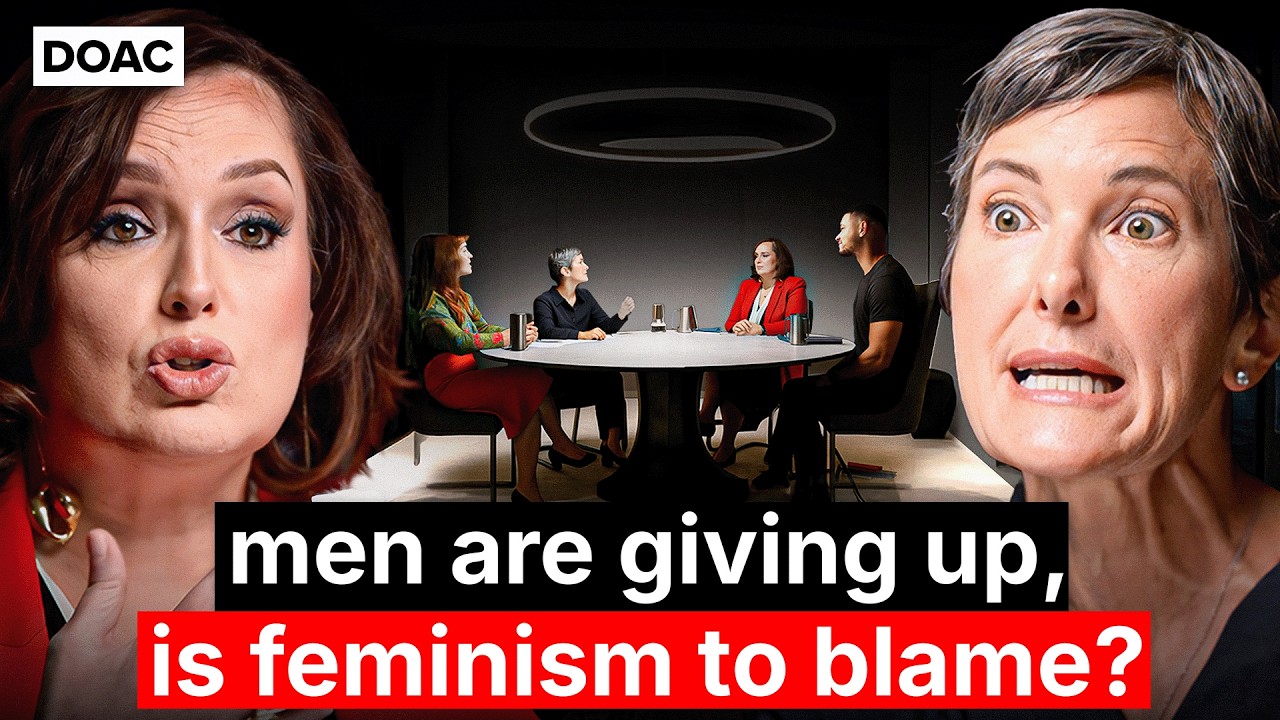
Frances-White, Perry, and Komisar Clash Over Sexual Revolution Impact
The Diary Of A CEO
The Sexual Revolution expanded female agency and workforce participation, but unregulated labor demands, digital pornography, and institutional childcare now undermine maternal attachment and collapse birth rates.
## Background
This episode of The Diary Of A CEO, hosted by Steven Bartlett and published on YouTube on June 19, 2025, presents a debate on whether modern feminism and the sexual revolution have fulfilled their promises to empower women. The show features a panel consisting of Deborah Frances-White (host of The Guilty Feminist), journalist Louise Perry (author of The Case Against the Sexual Revolution), and psychoanalyst Erica Komisar, discussing topics ranging from hookup culture and declining birth rates to parenting and traditional gender roles.
## TL;DR
The panel explores the unintended consequences of the sexual revolution and modern feminism on women's well-being, dating dynamics, and family structure. Louise Perry and Erica Komisar argue that hyper-individualism, casual sex culture, and the devaluation of early maternal care have led to widespread anxiety, demographic decline, and broken social bonds. Deborah Frances-White defends the core achievements of feminism, emphasizing bodily autonomy, legal rights, and economic freedom, while placing the blame for modern family strain on unregulated capitalism and economic pressures rather than women's choices.
## Atmosphere & style
The atmosphere of the debate is intellectually intense, deeply passionate, and at times sharply contentious, balanced by Steven Bartlett's structured moderation. Viewers experience a stark ideological clash: Deborah Frances-White brings energetic, personal, and fiery defense of feminist autonomy, while Erica Komisar and Louise Perry deliver grounded, clinical, and culturally provocative critiques. The discussion moves fluidly between personal trauma, biological research, and broad socio-economic critiques, creating a compelling and raw dialogue on modern womanhood.
## Key takeaways
- [07:27](https://www.youtube.com/watch?v=ZHuZ_8VYCWA&t=447s) Feminism and the sexual revolution brought essential agency, autonomy, and freedoms to women, though female guilt and modern societal expectations present ongoing challenges.
- [10:01](https://www.youtube.com/watch?v=ZHuZ_8VYCWA&t=601s) Unlimited sexual freedom creates safety risks and hyper-normalization of harmful sexual practices, prompting calls for legal boundaries around consent.
- [16:47](https://www.youtube.com/watch?v=ZHuZ_8VYCWA&t=1007s) Hookup culture disproportionately harms young women's emotional well-being and is shaped heavily by gender disparities on college campuses.
- [34:05](https://www.youtube.com/watch?v=ZHuZ_8VYCWA&t=2045s) Treating sex purely as casual recreation undermines the fundamental reasoning behind why sexual violation and non-consensual acts cause severe psychological trauma.
- [47:27](https://www.youtube.com/watch?v=ZHuZ_8VYCWA&t=2847s) Modern sex education focuses excessively on physical acts while failing to teach emotional connection, responsibility, and the value of primary attachments.
- [51:16](https://www.youtube.com/watch?v=ZHuZ_8VYCWA&t=3076s) The primary cause of youth anxiety and mental health struggles remains debated, with views split between relational structure breakdown and systemic economic or environmental pressures.
- [01:04:04](https://www.youtube.com/watch?v=ZHuZ_8VYCWA&t=3844s) The economic devaluation of male physical labor through automation and industrial shifts contributes significantly to young men feeling alienated and falling behind.
- [01:07:08](https://www.youtube.com/watch?v=ZHuZ_8VYCWA&t=4028s) Institutional daycare during the first three years of life can lead to chronic overstimulation and attachment issues compared to one-on-one maternal or family care.
- [01:18:17](https://www.youtube.com/watch?v=ZHuZ_8VYCWA&t=4697s) Tax frameworks and housing costs force dual-earner households, disincentivizing mothers who prefer staying home to raise young children.
- [01:23:28](https://www.youtube.com/watch?v=ZHuZ_8VYCWA&t=5008s) Biological and hormonal differences between mothers and fathers dictate complementary roles in attachment, emotional regulation, and childhood development.
- [01:40:36](https://www.youtube.com/watch?v=ZHuZ_8VYCWA&t=6036s) Modern corporate-focused feminism has historically devalued traditional caretaking and stay-at-home motherhood in favor of male career models.
- [01:58:34](https://www.youtube.com/watch?v=ZHuZ_8VYCWA&t=7114s) High-definition algorithmic pornography acts as an escalating super stimulus that desensitizes men to intimacy, fuels erectile dysfunction, and exploits performers.
- [02:03:07](https://www.youtube.com/watch?v=ZHuZ_8VYCWA&t=7387s) Feminists disagree sharply on whether pornography should be completely abolished as an abusive industry or regulated against extreme forms while retaining freedom of expression.
- [02:07:06](https://www.youtube.com/watch?v=ZHuZ_8VYCWA&t=7626s) Young men require constructive outlets, chivalrous expectations, and positive channels for aggression to transition safely from raw male energy into responsible family leadership.
- [02:19:05](https://www.youtube.com/watch?v=ZHuZ_8VYCWA&t=8345s) Disparities in higher education where women outnumber men risk collapsing marriage rates and increasing single-parent households, though proposed gender quotas remain controversial.
## Detailed walkthrough
### [00:00](https://www.youtube.com/watch?v=ZHuZ_8VYCWA&t=0s) Panel Intro and the Scope of the Debate
The panel opens with a stark preview of the ideological clash surrounding modern feminism, sexual liberation, and family dynamics. Host Steven Bartlett brings together three prominent voices with sharply contrasting views to unpack the trade-offs modern women face. The introductory clips highlight key tensions: statistics showing that roughly 50% of young women do not plan to have children, rising rates of anxiety following casual encounters, and intense debates over whether feminism has liberated women or simply pressured them to act like men at the expense of family life and maternal fulfillment.
Before diving into the core discussion, Steven pauses to directly address the audience regarding channel engagement. He notes that 53% of regular listeners have not yet subscribed to *The Diary Of A CEO*, asking for a quick subscription as a free way to support the show while promising in return to continuously improve content quality and bring on requested guests.
[02:14](https://www.youtube.com/watch?v=ZHuZ_8VYCWA&t=134s) Introducing the Panelists
Steven formally introduces the three panellists, asking each to share their professional background and the personal experiences that shape their worldview:
* **Louise Perry:** A journalist and author who describes her work as writing about ideas without carrying a partisan political agenda. She explains that she grew up taking the cultural norms of the sexual revolution for granted. However, during university and especially while working at a rape crisis centre, she observed a glaring disconnect between academic feminist theory and the harsh realities of sexual violence. This led her to adopt a highly nuanced stance on the sexual revolution, acknowledging both its achievements and its dark side.
* **Erica Komisar:** A psychoanalyst in private practice and author of books on parenting and child development, including *Being There* and *Chicken Little the Sky Isn't Falling*. She emphasizes the neuroscience of attachment, focusing on how a mother's presence during the first three years of a child's life builds the emotional security necessary for long-term mental health. Erica defines herself as a "maternal feminist"—a school of thought that elevates and honors the vital role of motherhood—and considers her stance centrist, appreciating where feminism expanded choices while remaining critical of where it harmed children.
* **Deborah Frances-White:** A comedian, author, and host of *The Guilty Feminist* podcast. She shares her personal background, describing herself as effectively a "time traveller" who experienced life before the sexual revolution. At age 14, her family joined a strict religious cult, depriving her of normal sexual development until she escaped in her mid-twenties. Having lived under an authoritarian patriarchy without agency or autonomy, she fervently defends the freedoms won by the sexual revolution, while acknowledging the immense guilt modern women carry as they try to balance careers, motherhood, and personal expectations.
[03:28](https://www.youtube.com/watch?v=ZHuZ_8VYCWA&t=208s) Defining the Sexual Revolution
Louise breaks down the "sexual revolution" into two distinct but overlapping shifts: an ideological wave and a material transformation. Ideologically, the movement in the 1960s and 1970s systematically challenged traditional and Christian norms regarding sex, marriage, and family.
Materially, technological and medical innovations completely altered daily life. Safe, legal abortion and the birth control pill detached sex from procreation, while labor-saving domestic appliances—such as the washing machine and central heating—drastically reduced the time required to manage a household. These material changes enabled women to enter the workforce *en masse*, fundamentally altering marriage rates, birth rates, and broad societal structures.
[07:27](https://www.youtube.com/watch?v=ZHuZ_8VYCWA&t=447s) The Three Pillars of Liberation: Agency, Autonomy, and Emotional Freedom
Deborah outlines what she views as the three fundamental gifts of the sexual revolution to women:
1. **Agency:** The ability to make moment-to-moment decisions in daily life.
2. **Autonomy:** The power to define the broader shape, direction, and choices of one's own life.
3. **Emotional Freedom:** The right to exist without suffocating shame or societal control.
However, Deborah concedes that true emotional freedom remains elusive due to the overwhelming guilt modern women face. Whether working, staying at home, pursuing a career, or attempting to balance both, women are constantly conditioned to feel inadequate. This pervasive guilt inspired her podcast and book, *The Guilty Feminist*, as she believes feminism should alleviate pressure rather than become yet another standard against which women judge themselves.
[10:01](https://www.youtube.com/watch?v=ZHuZ_8VYCWA&t=601s) Autonomy, Freedom, and Limits: The BDSM Law Debate
Louise challenges the notion that individual freedom and autonomy can be treated as absolute goods without considering their broader societal impact, quoting poet Matthew Arnold: *"Freedom is a very good horse to ride, but to ride somewhere."* To illustrate the limits of freedom, she shares her campaign work surrounding the law on BDSM (Bondage, Domination, Sadomasochism) in the UK.
She explains that sexual liberation advocates frequently campaign to loosen legal restrictions, arguing that consenting adults should be allowed to engage in extreme acts or severe bodily harm in private. However, Louise co-founded the group *We Can't Consent To This* after observing a alarming rise in cases where men killed women during sex—typically via strangulation—and successfully evaded murder charges by claiming the violence was a consensual sexual game ("the rough sex defense"). Louise argues that absolute sexual freedom for one person can directly destroy the safety and rights of another, demonstrating that individual choice must be balanced against protection, ethics, and social safeguards.
[13:29](https://www.youtube.com/watch?v=ZHuZ_8VYCWA&t=809s) Structure vs. Unlimited Freedom
Erica picks up on the tension between freedom and structure, asserting that unbounded freedom without boundary causes instability. Drawing an analogy to child-rearing, she notes that while respecting a child's will is vital, failing to provide firm boundaries makes children feel untethered, unloved, and insecure. She argues that society has swung too far toward absolute freedom, leaving adults feeling disconnected and unanchored in their intimate relationships.
Steven introduces a statistic tracking the shift in public perception regarding casual sex: in the UK, societal acceptance of casual sex rose dramatically from just 10% in 1999 to 42% in 2013 (alongside the rise of hookup culture), even as overall sexual activity among younger demographics has declined.
Deborah pushes back sharply against Erica's call for "structure," pointing out that adult women are not children. She warns against the dangers of romanticizing external rules, citing extreme examples such as Iran in the 1970s versus today, or modern-day Afghanistan, where strict societal structures strip women of basic rights—forbidding them from standing near windows, leaving home without a male chaperone, or speaking in public. Deborah stresses that modern secular society already provides substantial implicit structure through work obligations, financial pressures, and social expectations around monogamy and marriage.
[16:47](https://www.youtube.com/watch?v=ZHuZ_8VYCWA&t=1007s) Hookup Culture vs. Monogamy: Mental Health and Social Choice
Erica Komisar directly challenges the idea that modern society encourages monogamy, arguing instead that culture promotes "polygamy" in the sense of multiple casual partners among young people. Citing an article she wrote for the Institute for Family Studies, Erica references statistics showing that **72% of young men** and **82% of young women** experience depression, anxiety, embarrassment, regret, or low self-esteem following casual sexual encounters. Pointing out a Tinder advertisement with the slogan *"Meet the love of your night,"* she criticizes the hookup culture for stripping sex of its sacred, intimate nature and turning it into something emotionally and physically dangerous, including the ongoing risks of STDs and HIV/AIDS.
```
CASUAL SEX AFTERMATH
Percentage Reporting Negative Emotions
Women [=========================================] 82%
Men [====================================] 72%
```
In response, Deborah Frances-White counters the idealization of traditional monogamy by drawing attention to domestic abuse figures in the UK, where police receive a domestic abuse-related call every **30 seconds**, with less than **24%** of domestic abuse crimes reported. Highlighting that **one in four women** in England and Wales experiences domestic violence in her lifetime and nearly **two women per week** are killed by a current or former partner, Deborah rejects the notion that the past—such as the 1950s baseline illustrated in shows like *Mad Men*—offered a safe or fulfilling utopia for women. She argues that having the freedom and autonomy to choose singlehood, focus on careers, or engage in casual sex while searching for a compatible partner is a profound societal achievement.
- **Institute for Family Studies Stats:** 72% of young men and 82% of young women report anxiety or depression following casual hookups.
- **UK Domestic Violence Statistics:** Police receive a domestic abuse call every 30 seconds; 1 in 4 women experience domestic abuse in their lifetime; an average of nearly two women are killed every week in England and Wales.
- **Tinder Campaign Slogan:** *"Meet the love of your night."*
---
[21:24](https://www.youtube.com/watch?v=ZHuZ_8VYCWA&t=1284s) The Choice Paradox and Socio-sexuality
Addressing Steven Bartlett’s question on whether casual sex carries a higher psychological cost for women than men, Deborah acknowledges the "choice paradox"—comparing endless options on dating apps like Hinge to a supermarket putting out **800 varieties of jam versus 8**, where overabundance leads to paralysis and dissatisfaction. However, she rejects the claim that women inherently view sex as more sacred than men do.
Louise Perry introduces the psychological concept of **socio-sexuality**, explaining that men are generally more unrestricted in their socio-sexuality and more inclined toward multiple partners and rapid sexual encounters. She presents research from university campus dating dynamics:
* **Male-Majority Campuses:** Men are abundant and women are the scarcer resource, resulting in conservative sexual norms, longer waits before sex, and higher rates of monogamy.
* **Female-Majority Campuses:** Women outnumber men (increasingly common across higher education), allowing men to dictate terms and driving higher rates of casual hookup culture.
Louise argues that this campus data proves women en masse do not inherently prefer hookup culture, but rather conform to it because male preferences dictate the market when men are scarce. Deborah pushes back against using 18-year-old university students as the benchmark for sexual agency. She contrasts freshers who lack self-knowledge with a **32-year-old woman in London** who understands her body, works hard all week, and intentionally chooses a fulfilling hookup without regret.
- **Socio-sexuality:** The psychological term for an individual's willingness to engage in sexual relationships without closeness or commitment; typically more unrestricted in men.
- **Campus Sex Ratio Dynamics:** Male-skewed campuses lean conservative/monogamous; female-skewed campuses lean toward casual hookups.
---
[27:10](https://www.youtube.com/watch?v=ZHuZ_8VYCWA&t=1630s) Vulnerability of the Developing Brain and Freedom as Pressure
Erica emphasizes that societal pressure around sexual freedom can become its own form of constraint. Pointing to early feminists like **Mary Wollstonecraft** and **Mary Shelley** who fought patriarchy, Erica warns that pushing sexual liberation to an extreme creates a different form of cultural pressure on young people to give up their virginity early and accumulate experiences.
Focusing on developmental psychology, Erica notes that the period from **ages 9 to 25 (and up to 27 in young men)** represents the second critical period of brain development. During this window, young people are exceptionally vulnerable to relational experiences, environmental factors, and rejection.
> "Freedom can become its own prison... Have we created a society which pressures young women in its own way to be promiscuous to have lots of experiences? It's not all glorious freedom there." — **Erica Komisar**
- **Brain Development Window:** Ages 9–25 in women and up to age 27 in men mark the second major neurodevelopmental stage highly sensitive to emotional and relational impact.
- **Historical References:** Mary Wollstonecraft and Mary Shelley cited regarding early feminist resistance to patriarchal constraints.
---
[30:35](https://www.youtube.com/watch?v=ZHuZ_8VYCWA&t=1835s) Personal Testimony: The Costs of Forced Purity and Waiting
Deborah shares a deeply personal account of growing up within a strict religious movement where sex before marriage was forbidden, meaning anyone following the rules would sleep with only one partner for life. She reveals that this strict purity culture left her feeling "atrophied," lonely, empty, and severely disconnected from herself well into adulthood.
> "Because I had no option, I had no autonomy, I became more and more atrophied, more and more lonely, more and more empty, more and more disconnected from myself... It took me so long to heal, guys." — **Deborah Frances-White**
She explains that strict premarital sex bans prevented even basic, healthy teenage physical exploration—such as sitting on laps, stealing kisses, or making eye contact—because any gesture was viewed as a slippery slope toward sin. Losing her virginity much later in life than average created a painful imbalance with partners who had experienced normal, gradual sexual development. Consequently, Deborah strongly cautions against advising young people to refrain from sex until engagement, arguing that abstinence-only frameworks cause lasting psychological harm.
- **Effects of Purity Culture:** Deborah describes delayed sexual development, shame around basic eye contact or affection, and long-term struggles with physical intimacy.
---
[33:00](https://www.youtube.com/watch?v=ZHuZ_8VYCWA&t=1980s) [33:00](https://www.youtube.com/watch?v=ZHuZ_8VYCWA&t=1980s) Age of Marriage Increasing Over Time
Steven introduces a historical trend graph detailing marriage ages from the 1970s to the present day.
| Era | Average Female Marriage Age | Average Male Marriage Age |
|:--- |:--- |:--- |
| **1970s** | ~21 years old | ~23 years old |
| **Present Day (2020s)** | ~30 years old | Just over 30 years old |
Louise and Deborah identify the widespread availability of the **contraceptive pill in the late 1960s** as the primary catalyst for this shift. Prior to oral contraceptives, sexual activity carried a high probability of pregnancy, tying sex directly to early marriage. While Louise notes that modern contraception is not entirely foolproof—pointing out that approximately half of pregnancies in the UK remain unplanned—the pill detached sexual activity from mandatory marriage, fundamentally reshaping adulthood timelines.
[34:05](https://www.youtube.com/watch?v=ZHuZ_8VYCWA&t=2045s) The Emotional Consequences of Sex and the Myth of Unconditional Autonomy
Louise Perry argues that while the introduction of the contraceptive pill significantly reduced the physical risks of pregnancy, it created the dangerous illusion that sex could ever be truly consequence-free. From an evolutionary perspective, women have evolved to be highly selective about their sexual partners because pregnancy historically represented a massive, life-altering, and potentially dangerous investment. Even with modern technology, a woman's underlying biology still treats sex as a deeply intimate, high-stakes encounter—often triggering emotional bonding and sub-consciously framing a partner as the potential father of her children. Louise contends that feminists should acknowledge sex as having a uniquely special, intimate status rather than trivializing it as a mere leisure activity or skill set. She points out a fundamental ideological contradiction in modern thought: if sex is completely casual and unspecial (like playing a game of tennis), it becomes difficult to explain why sexual violation and non-consent (such as rape) are universally recognized as profoundly more traumatic than non-sexual assault or theft.
Deborah Frances-White pushes back against this framing, emphasizing that bodily autonomy is precisely what makes non-consensual penetration the ultimate violation of a person's inner self. However, she firmly rejects the notion that all sexual encounters must be heavy or reproductive, defending women's right to experience play, excitement, and casual fun. Drawing from her own life path after leaving a restrictive religious cult, Deborah shares how it took her multiple sexual encounters to discover her own sexual identity and preferences. She cautions that steering young people away from premarital sexual exploration risks trapping them in unfulfilling, compulsory missionary sex with the very first person they date. In response, Louise raises concerns about the premise of total agency, arguing that "agency" is not a universal given but a distinct personality trait. Because most people—especially socially attuned young women—tend to follow peer norms rather than act as fiercely independent agents, removing boundaries leaves less agentic individuals vulnerable to damaging cultural "scripts."
* **Biological Realities:** Sex retains emotional and evolutionary weight regardless of contraception, as female mate-selection strategies evolved to protect against high-investment risks.
* **The Contradiction of Trivializing Sex:** Treating sex as just another recreational activity logically undercuts why non-consensual sexual assault is uniquely violating compared to other forms of violence.
* **The Value of Exploration:** Deborah argues that rigid sexual timelines stifle self-discovery, leading to long-term sexual incompatibility and boredom.
* **Agency as a Spectrum:** Louise notes that young women are uniquely attuned to social status, fashion, and peer behavior, making them highly susceptible to mimicry rather than pure autonomous decision-making.
---
[39:36](https://www.youtube.com/watch?v=ZHuZ_8VYCWA&t=2376s) Trauma, Neurotic Repetition, and the Changing Dynamics of Young Dating
Erica Komisar shifts the conversation to a clinical perspective, emphasizing that emotional connection is essential for genuine sexual satisfaction. In her therapy practice, she has observed a dramatic shift in youth dynamics: young men are becoming increasingly vulnerable, lonely, and emotionally invested, while many young women have adopted traditionally male, detached approaches to dating (such as casually sleeping with multiple partners at once). Erica highlights how trauma heavily influences political and ideological movements through a process called "neurotic repetition"—where individuals endlessly recreate early relational disconnections, abuse, or attachment disorders. She observes that many early feminist pioneers were deeply traumatized women who grew up with abusive, alcoholic, or violent male figures, leading them to reject traditional male-female relationships entirely.
Deborah and Erica discuss how these individual backgrounds shape one's worldview, with Erica stressing that while feminism accomplished essential historical work, it heavily distorted the cultural importance of stable, loving relationships. While sex may be intensely passionate at the start of a relationship, the long-term foundation of any partnership rests on friendship, companionship, and emotional safety. Deborah argues that the solution to peer pressure and confusion is not imposing restrictive external rules, but expanding education to help young people listen to their own bodies, tune into their desires, and consult trusted adult mentors in their communities.
* **Gender Dynamic Reversal:** Therapists are noticing a trend where young men seek emotional attachment while young women engage in non-committal, multi-partner casual dating.
* **Neurotic Repetition in Movement History:** Early feminist leaders frequently suffered severe childhood trauma from abusive fathers or relatives, which heavily influenced the movement's skepticism toward men and traditional family structures.
* **The Trajectory of Long-Term Relationships:** Erica notes that initial passionate sex naturally gives way to friendship and companionship as the primary engine of a lasting union.
---
[47:27](https://www.youtube.com/watch?v=ZHuZ_8VYCWA&t=2847s) Reclaiming Sex Education, Female Pleasure, and Historical Balance
Turning to the state of modern education, Erica argues for clear distinctions between fully developed adults (30s and beyond) and developing adolescents, whose brains and personalities continue evolving until roughly age 25. She criticizes contemporary school sex-education programs for being overly explicit about physical acts and diseases—such as teaching nine-year-olds about explicit sexual practices and STI symptoms—while completely failing to teach the importance of emotional connection, family-building, and long-term commitment. As a result, many young people end up active yet feeling profoundly empty, anxious, and depressed.
Deborah counters by pointing out that standard sex education historically omitted an equally critical component: female pleasure. For generations, young women entered sexual encounters assuming their role was merely to accommodate male satisfaction. Teaching young women about their own anatomy and entitlement to pleasure is a vital step toward personal autonomy. The panel broadly agrees that society should neither retreat to the restrictive 1950s—an era when women lacked agency, choice, and basic knowledge of their own bodies—nor abandon the timeless human need for deep emotional bonding, taking the best lessons forward from both past traditions and feminist gains.
> "We don't want to go back to the 50s because women didn't have choice... We want to take the best of the highlights of the past and not leave all of the good parts of the past behind, and take the good parts of the feminist movement, too." — *Erica Komisar*
[51:16](https://www.youtube.com/watch?v=ZHuZ_8VYCWA&t=3076s) Is Sexual Freedom Making Us Happy?
The debate transitions into whether modern sexual liberation and feminist ideals have actually delivered on their promise of happiness. Clinical social worker and psychoanalyst Erica Komisar emphasizes that young people today are experiencing unprecedented levels of unhappiness, mental illness, and loneliness, despite having more sexual freedom than previous generations. Author and podcast host Deborah Frances-White immediately pushes back, warning against confusing correlation with causation. She points out that young people face a harrowing landscape of global existential threats—ranging from climate change and land wars to an out-of-control cost of living and the inability to buy a home without generational wealth. Deborah argues that attributing these deep-seated socio-economic anxieties to feminism is misguided, noting that human beings naturally find ways to be dissatisfied regardless of their circumstances, much like rock stars who achieve ultimate wealth and freedom only to climb a mountain seeking a guru to ask, "Is this all there is?"
Erica counters by highlighting a universal human need that she believes modern culture neglects: the primal craving for safety, security, and emotional stability from birth. Rather than teaching young people how to build secure, structured lives, society encourages them to be impulsive and live purely in the moment. While Erica acknowledges that second-wave feminism granted women vital choices, she notes from her clinical practice and audience feedback that many women today feel "bullied by this narrative of freedom." She asserts that second-wave feminism operated somewhat like a cabal—a small group dictating that every woman should want a career, external childcare, and casual sex—while ignoring the vast number of women who desire traditional, monogamous, marital relationships and want society to respect them for choosing to raise their children at home.
- **Global Stressors vs. Ideology:** Deborah cites housing affordability, climate change, and international conflicts as the primary drivers of youth mental health crises.
- **The Quest for Security:** Erica argues that human beings fundamentally crave emotional stability, which modern "impulsive" hookup culture fails to provide.
---
[53:36](https://www.youtube.com/watch?v=ZHuZ_8VYCWA&t=3216s) Feeling Bullied by the Narrative of Freedom
Deborah strongly contests the idea that women are forced into casual sex or careerism by a dominant feminist cabal, arguing that if women feel bullied by freedom, "they should try the alternative." From her viewpoint, the overwhelming cultural baseline remains the traditional "rom-com narrative"—the societal expectation that a woman should be married by age 30 in a white dress, have babies, and receive validation for achieving those milestones. She maintains that society does not pressure women to sleep around, but rather asks them to find "the one" and secure a fairytale ending.
To illustrate how drastically cultural tides are shifting among the younger generation, Deborah shares a story about revisiting a prestigious London state girls' school in 2025 where she had previously spoken in 2018. During the height of the 2018 Women's March movement, the students spoke passionately about body autonomy, resisting patriarchal standards, and refusing to be "slut-shamed." Returning seven years later, Deborah was astonished to hear the current teenage girls speaking fluent "manosphere" terminology—worrying about being a "high-value woman" and keeping a low "body count." Far from being pushed into sexual permissiveness, young women are increasingly absorbing conservative and male-centric talking points about sexual restraint.
> "If women feel bullied by freedom, I feel like they should try the alternative... The predominant narrative is still the rom-com one: you should be married by 30 with a white dress... That to me is still the main thing women are asked to aspire to." — **Deborah Frances-White**
---
[59:32](https://www.youtube.com/watch?v=ZHuZ_8VYCWA&t=3572s) The Manosphere, Tradwives, and the Lost Boys Report
Show host Steven Bartlett introduces data showing a massive surge in internet searches for the term "tradwife" (traditional wife) starting around 2024, connecting this phenomenon to the explosive rise of the "manosphere." Erica frames this trend as a natural reaction to a cultural pendulum that swung too far. In her view, society moved from a historic patriarchy where men dominated women to a modern system where women dominate men—pointing out that women now make up approximately 60% of college and graduate students. She argues that young men feel powerless and fearful in educational environments, which creates a deep societal imbalance. Because psychological research shows that women generally prefer to marry at or above their educational level while men tend to marry at or below theirs, the growing educational gap leaves millions of college-educated women unable to find compatible male partners.
Steven grounds this dynamic in concrete statistics from the 2025 "Lost Boys" report published by the Centre for Social Justice in the UK, which detailed how young men are falling behind at every stage of development. Journalists, commentators, and public figures have noted that this sense of alienation drives young men toward manosphere forums and websites focused on men's rights.
- **Early Development Deficit:** By age 5, 25% of boys in the UK fall behind in language and communication skills, compared to just 14% of girls.
- **Academic Performance:** At the GCSE level, boys average half a grade lower than girls across subjects.
- **Employment Crisis:** As of late 2024, 15.1% of young UK men aged 16–24 (roughly 550,000 individuals) were not in education, employment, or training (NEET), compared to 11% of young women.
- **Pay Gap Reversal:** Women aged 16 to 24 in the UK now earn nearly 10% more than their male peers, temporarily inverting the traditional gender pay gap for that demographic.
- **Mental Health Crisis:** The suicide rate for young men remains nearly 3.5 times higher than that of young women, alongside sharply rising rates of eating disorders.
- **Family Structure:** By age 14, nearly half of firstborn children in the UK do not live with both biological parents, compared to a small minority in 1970.
---
[01:04:04](https://www.youtube.com/watch?v=ZHuZ_8VYCWA&t=3844s) Technology, Economics, and the Provider Dilemma
Journalist and author Louise Perry offers a different perspective on the decline of male performance and the rise of the manosphere, asserting that the primary cause is not feminist ideology, but rather fundamental shifts in technology and economics. Since the Industrial Revolution, physical male strength has become progressively less valuable in the economy. Blue-collar manufacturing jobs have vanished or been automated, while the modern service sector, education, and administrative fields—environments where women statistically excel academically—have boomed. Louise argues that young men are turning to the manosphere because they feel "economically devalued," a structural shift that will only accelerate with the rise of artificial intelligence.
Louise adds that despite modern egalitarian ideals, most women still seek a partner who can act as an "insurance policy"—a man capable of stepping up as a provider when a woman is pregnant, nursing, ill, or taking care of young children. Because the current economy makes it difficult for average young men to achieve financial stability, men feel inadequate and women feel resentful. Deborah rejects this "biological essentialism," stating that she desires a true, equal partnership where both people support each other emotionally and financially during hard times, rather than relying on strict provider-protector roles. Steven closes the segment by pointing out that despite modern shifts, social research shows that a majority of women still prefer a male partner who earns more than they do, creating a persistent gap between modern economic realities and dating expectations.
> "I think what women really want is a man who provides excellent insurance... a man who when you've just had a baby and you can't work... can step up and look after your family. Unfortunately, the nature of the economy means that there actually aren't that many of those men." — **Louise Perry**
[01:07:12](https://www.youtube.com/watch?v=ZHuZ_8VYCWA&t=4032s) Income Expectations and the Choice to Prioritize Attachment
Steven presents data from a sweeping study of 1.8 million online dating profiles across 20 countries showing that higher-earning men receive 255% more expressions of interest on dating apps. While Steven admits he would prefer a world without this disparity, he notes that reproductive success for men remains deeply tied to being perceived as a provider.
Erica Komisar picks up on this data point to pivot the conversation directly to children, arguing that there is a vital reason women look for financial stability in a mate. A child requires a primary attachment figure—most often the mother—to be physically and emotionally present as much as possible during the critical first three years of life to ensure long-term mental health. To make that presence possible, women must be able to lean on a partner financially. Erica illustrates this through her own marriage: she and her husband operated as equal earners early on, but strategically agreed that she would scale back her work to raise their children while he handled the bulk of the earning. Now that their children are grown, she jokingly points out that she is out in the world taking over while he gets to sit by the pool.
```
┌────────────────────────────────────────────────────────────────────────┐
│ PRIMARY ATTACHMENT DEVELOPMENT │
│ │
│ 0 TO 1 YEAR 1 TO 3 YEARS 3+ YEARS │
│ ┌───────────────┐ ┌───────────────┐ ┌──────────────────────┐ │
│ │ Stress │ ──► │ Stress │ ──► │ 85% Right Brain │ │
│ │ Regulation │ │ System Slowly │ │ Developed; │ │
│ │ System │ │ Comes Online │ │ Internalized Self- │ │
│ │ OFFLINE │ │ │ │ Regulation │ │
│ └───────────────┘ └───────────────┘ └──────────────────────┘ │
└────────────────────────────────────────────────────────────────────────┘
```
Erica delivers a stark critique of institutional daycare, defining it as any group care setting for children under the age of three (distinguishing it from nursery school or preschool for ages three to five). She frames institutional daycare as "day orphanages," explaining that infants require skin-to-skin contact, the sound of their mother's voice, and immediate, moment-to-moment co-regulation when in distress. Because 85% of right-brain development occurs by age three, children forced into group settings with high caregiver ratios suffer from chronic overstimulation and unbuffered stress. Erica links the modern epidemic of anxiety, depression, and ADHD to these foundational failures in emotional regulation, arguing that society medicates symptoms rather than addressing early maternal separation.
- **Dating Income Boost:** Men with higher incomes receive **255% more interest** across 1.8 million analyzed dating profiles.
- **Critical Attachment Window:** The first **3 years** of life determine long-term emotional regulation capacity.
- **Brain Development Milestone:** **85% of right-brain development** is completed by age three.
- **Daycare Ratios:** Group daycare frequently places at least **5 infants per 1 caregiver**, making individual co-regulation impossible.
---
[01:12:08](https://www.youtube.com/watch?v=ZHuZ_8VYCWA&t=4328s) The Socioeconomic Dilemma: Alternatives to Group Daycare
Addressing the counterargument regarding low-income working mothers, Erica refutes the assertion that poor women have no choice but to rely on institutional daycare. She argues that society should promote community-based solutions, extended family involvement, or shared care arrangements over group institutions. Placing multiple crying infants under the care of a single worker creates a feedback loop of stress that damages a child's developing neurological architecture.
The discussion shifts to historical waves of feminism and their stance on motherhood. Erica contrasts first-wave feminists like Mary Wollstonecraft and Mary Shelley—who viewed mothering as powerful, vital work alongside their fight for equality—with second-wave figures like Betty Friedan. Friedan's famous framing of the home as a comfortable "concentration camp" marked a cultural turning point that devalued full-time mothering and led women to feel that staying home meant forfeiting social worth.
Deborah Frances-White challenges Erica's narrative by detailing the brutal financial realities facing modern working families. She describes university-educated friends who are trapped in rental cycles, unable to afford homes, and forced to move constantly. Pointing to UK nurses who rely on food banks despite working full-time for the NHS, Deborah stresses that many parents simply cannot afford to stop working. However, Deborah agrees with Erica that structural policy should support parents who wish to take time off, noting the immense real-world skills gained from raising children.
- **Feminist History Contrast:** First-wave feminists elevated motherhood as valuable work; second-wave figure Betty Friedan infamously referred to the traditional suburban home as a "concentration camp with comforts."
- **Economic Realities:** Essential workers, including full-time NHS nurses in London with two children, are actively utilizing local food banks to survive.
- **Parental Skill Equivalence:** Managing and negotiating with a toddler for three years builds high-level interpersonal skills directly applicable to corporate environments.
---
[01:18:17](https://www.youtube.com/watch?v=ZHuZ_8VYCWA&t=4697s) State Policy, Economic Incentives, and Institutionalized Childcare
Louise Perry joins the conversation, sharing that reading Erica’s work persuaded her and her husband to move "heaven and earth" to keep their children out of institutional daycare. This choice required financial sacrifices that cause others to view them as crazy, but it aligned with their conviction to avoid group care.
Louise highlights how post-millennial government policies in the UK and US leverage female labor primarily to expand GDP. Referencing David Goodhart’s book *The Care Dilemma*, Louise describes the mass entry of mothers into the 40-hour work week as a "one-time boost to GDP" that state treasuries now actively protect. Rather than supporting maternal choice, tax codes punish single-earner families by taxing a single income more heavily than an equivalent household income split between two partners. Additionally, state subsidies are strictly tied to institutional daycare, prohibiting parents from using funds for nannies, grandparents, or extended family care.
> "Governments at about the turn of the millennium seem to have cottoned on to the fact that they can use women to boost GDP." — Louise Perry
Deborah argues that these policy frameworks reflect the pressures of unregulated capitalism rather than true feminist principles, warning against placing a double burden of guilt on women who are simply reacting to economic mandates.
- **UK Maternal Preference:** Survey data shows **66% of UK women** would prefer to stay home or work significantly less to care for their young children if financially feasible.
- **Tax System Penalization:** UK tax policy taxes single-earner households at higher effective rates than dual-earner households with the same total income.
- **Subsidy Restrictions:** Government childcare subsidies exclusively fund accredited institutional daycare settings, explicitly excluding nannies, relatives, or informal home-care networks.
[01:21:58](https://www.youtube.com/watch?v=ZHuZ_8VYCWA&t=4918s) Would Steven Take a Three-Year Career Break?
The debate turns directly to host Steven Bartlett as Deborah Frances-White asks if he could or would take a three-year career break to raise children. Steven admits that while it is technically possible for him due to his financial means, it would not be his choice to step away from his work for three years, acknowledging he would struggle to do so. Deborah highlights that society does not judge Steven for this answer because men are not expected to stop working, whereas a woman saying the exact same thing would face public shock and harsh judgment.
```
┌─────────────────────────────────────────┐
│ THE 3-YEAR CAREER BREAK │
└────────────────────┬────────────────────┘
│
┌──────────────────────────┴──────────────────────────┐
▼ ▼
STEVEN BARTLETT DEBORAH FRANCES-WHITE
• Financially possible • Highlights the double standard
• Choice: "I would not want to" • Society expects mothers to pause
• Acknowledges he would struggle • Calls for acknowledging female guilt
```
Deborah argues that this intense societal expectation and the resulting maternal guilt must be acknowledged. Louise Perry counters that society also holds strong expectations for men, noting that if Steven said he refused to financially support his wife and child, people's jaws would drop. The panel agrees that while men and women face different social expectations, the discussion should move beyond simplistic clichés.
- Steven acknowledges that taking three years off work to solely raise children is not something he would want to do.
- Deborah points out the social double standard and guilt women face when expressing reluctance toward full-time caregiving.
- Louise highlights the reciprocal gender expectation that men remain financially responsible for their families.
---
[01:23:28](https://www.youtube.com/watch?v=ZHuZ_8VYCWA&t=5008s) Hormones, Brain Science, and Nurturing Behaviors
Erica Komisar brings biological and hormonal evidence into the discussion, explaining that men and women are hardwired differently when it comes to parenting. Mothers release high levels of oxytocin during childbirth, breastfeeding, and caregiving, which directly lowers cortisol levels in both the mother and baby, fostering deep emotional attachment and right-brain-to-right-brain connection. Fathers also produce oxytocin when caregiving, but it activates a different part of the brain, leading to playfulness, physical stimulation, and encouraging risk-taking. Additionally, fathers produce higher levels of vasopressin, known as the "protective-aggressive hormone."
To illustrate these evolutionary wiring differences, Erica cites a UK sleep study where parents lay in bed together while monitoring sound triggers:
* **Baby Crying:** Mothers woke up almost every time to the sound of a crying infant, while fathers slept through it.
* **Predatory Threats:** Fathers instantly woke up at the sound of leaves rustling outside the window, while mothers slept through it.
Erica stresses that while fathers can learn to be sensitive nurturers, society must recognize population-level biological differences rather than pretending men and women are identical. Louise Perry agrees, pointing out that human traits follow overlapping bell curves and that 66% of UK women (and 60% of US women) express a desire to stay home with their children if financially able. Louise notes that when fathers are unemployed, it often harms their self-esteem and damages relationships, demonstrating that most people naturally aspire to traditional gender roles with built-in flexibility.
- **Oxytocin in Mothers:** Lowers stress/cortisol, fosters emotional regulation, empathy, and primary attachment.
- **Oxytocin in Fathers:** Promotes playful stimulation, rough-and-tumble play, and exploration.
- **Vasopressin:** Drives protective and territorial behaviors in men.
- **Statistical Preference:** 66% of women in the UK and 60% in the US prefer the opportunity to stay home with their children.
---
[01:27:57](https://www.youtube.com/watch?v=ZHuZ_8VYCWA&t=5277s) Public Policy and the "Two-Income Trap"
Deborah Frances-White argues that broad statistical trends cannot dictate individual lives, pointing out that overall averages (like men being taller than women) tell you nothing about specific individuals. However, Louise Perry insists that public policy cannot remain neutral because societies do not operate solely on individual choices. She points to current UK policies that subsidize government funding only if a child is placed in formal daycare, effectively penalizing parents who choose to stay home.
To explain how systemic shifts strip away genuine choice, Louise cites Elizabeth Warren's book *The Two-Income Trap*:
Louise explains that once dual-income households became the economic baseline, property prices and rents skyrocketed, making it nearly impossible for a family to survive on a single salary (such as a nurse's wage). What was framed as a new choice quickly became a compulsory mandate, forcing both parents into full-time employment just to pay basic living costs.
- Current UK government policies subsidize daycare enrollment while offering no direct financial support for stay-at-home parents.
- Banking policy changes in the 1990s allowed mortgages to be calculated on two incomes rather than one, drastically driving up housing costs.
- Structural economic shifts transformed the two-income lifestyle from an optional choice into a economic necessity.
---
[01:30:24](https://www.youtube.com/watch?v=ZHuZ_8VYCWA&t=5424s) The Narrative That Having Children Is Miserable
Deborah Frances-White describes the heavy burden of full-time parenting, sharing that many of her friends view having a child as "becoming an unpaid Uber driver for someone who doesn't want to go to karate and hates you anyway." She emphasizes that primary caregivers urgently need personal, creative, and intellectual outlets outside the home to stay sane, rather than being expected to derive complete fulfillment solely from child-rearing.
Erica Komisar strongly rejects this framing, calling it a toxic "narrative of misery" that discourages people from experiencing the unparalleled joy of parenthood. She argues that modern society is producing adults who are emotionally fragile and incapable of enduring discomfort, sacrifice, or responsibility:
> "We are producing women and men who cannot deal with discomfort. They cannot deal with frustration. They cannot deal with sacrifice or hardship or responsibility... You don't get the good stuff unless you put in the work."
Erica clarifies that staying home does not have to be an all-or-nothing proposition—women can combine home life with part-time work or remote jobs—but insisting that raising children is pure misery misrepresents the fundamental nature of family life.
---
[01:32:12](https://www.youtube.com/watch?v=ZHuZ_8VYCWA&t=5532s) Maternal Guilt, Narcissism, and Childhood Neglect
The debate intensifies over the concept of maternal guilt. Erica Komisar asserts that a moderate amount of guilt is a healthy sign that a mother's ego is functioning properly and that she is attached to her child. She warns that when mothers feel no remorse or discomfort about leaving very young infants for long periods, it signals a breakdown in the crucial attachment bond:
> "If we stop feeling badly for our children when we leave them, you break the bond. You can't turn off attachment. So a little bit of guilt means your ego is functioning. It's a good sign."
Erica references child psychologist Penelope Leach's warning: *"Don't have children if you don't want to care for them."*
```
THE NARCISSISM CYCLE
Infant Neglect / Early Absence ──► Defense Mechanisms Form in Child
│ │
▼ ▼
Adult Narcissistic Disorders ──► Addictions, Eating Disorders, Anxiety
```
Deborah Frances-White pushes back passionately against labeling working mothers or using the word "narcissistic," citing low-paid public sector workers like NHS nurses who rely on food banks and work exhausting shifts out of necessity, not self-absorption. Deborah describes a nurse who desperately wanted to hold the hand of a dying patient to give them a peaceful death, arguing that society demands far too much of women while piling on unearned guilt.
Erica clarifies that she is not attacking struggling individual mothers, but diagnosing a widespread societal condition. She explains that rising mental health struggles—including addictions, eating disorders, and personality issues—are fundamentally rooted in early childhood emotional neglect when infants are separated from primary caregivers during their most critical development years.
- **Healthy Guilt:** Viewed by Erica as a biological sign of active emotional attachment and functioning empathy.
- **Root of Narcissistic Disorders:** Defined psychoanalytically as defense mechanisms developed in response to early childhood abandonment or neglect.
- **Systemic Strain:** Deborah highlights the immense pressure on frontline workers who face financial hardship while caring for others.
[01:36:57](https://www.youtube.com/watch?v=ZHuZ_8VYCWA&t=5817s) Biological Determinism, Motherhood, and the "Male" Standard
Louise Perry observes that feminism—particularly since the 1960s—has maintained a deeply uneasy relationship with motherhood. This friction arises because modern feminism often relies on an ideological commitment to "gender sameness," deliberately underplaying biological differences. Motherhood fundamentally challenges that premise by starkly highlighting those physical and psychological differences. Many young women enter adulthood unaware of how intensely they will desire to be with their infants, largely because society fails to educate them about that emotional reality. Perry argues that a dominant strain of feminism pushed women to emulate men in every arena—professionally, culturally, and sexually (echoing the *Sex and the City* ideal of "having sex like a man" without emotional attachment).
This push toward male-centric emulation extends even to physical body image, where teenage girls often aspire to adolescent male frames by rejecting curves, hips, and breasts. Rather than dismantling patriarchy, Perry asserts, feminists inadvertently idolized it by seeking to inhabit it while rejecting everything traditionally feminine. Maternal feminism, by contrast, seeks to reclaim and elevate the feminine, asserting that motherhood is just as valuable as a career and demanding policies and education that honor it.
```
"Feminists were trying to reject patriarchy, but they ended up idolizing it and wanting to be it and then rejecting everything feminine." — Louise Perry
```
Erica Komisar points out that stay-at-home mothers face immediate social dismissal in modern circles; mentioning stay-at-home parenting at a cocktail party often leads to listeners turning their backs. Second-wave feminism framed domestic life as unmitigated drudgery, creating a cultural climate that ultimately birthed hostile digital spaces like "scary mommy" forums where women express overt hatred for pregnancy, breastfeeding, and their own children. While feeling frustrated or bored is normal, Komisar warns that unchecked hostility toward mothering threatens the very continuation of society.
- **The Cocktail Party Test:** Both men and women frequently dismiss stay-at-home mothers in professional or social settings, signalling a loss of societal admiration.
- **Extreme Online Hostility:** Komisar highlights "scary mommy" style websites as symptoms of a culture that has denigrated child-rearing to an unhealthy degree.
- **The Core Premise of Maternal Feminism:** Revaluating caretaking, biological realities, and maternal bonds as fundamentally equal in worth to professional achievements.
---
[01:40:36](https://www.youtube.com/watch?v=ZHuZ_8VYCWA&t=6036s) The Backlash Against Childfree Choices and the Caretaking Vacuum
Deborah Frances-White pushes back on the idea that mothers are universally vilified, noting that choosing *not* to have children often triggers severe hostility. She recalls hosting an episode of *The Guilty Feminist* with comedian Susan Calman, who spoke openly about never wanting children. Frances-White shared her own experience of trying and failing to have children while maintaining rich, nurturing relationships in other areas of life. The backlash to the episode was fierce, with listeners flooding her inbox with angry messages labeling them "monsters." Frances-White agrees that full-time parenting is genuine work that deserves high celebration for all genders, but she emphasizes that non-mothers are equally scrutinized.
```
"I have never had more fury in my inbox. Like, we were monsters because we weren't mothers." — Deborah Frances-White
```
Komisar connects the hostility surrounding motherhood directly to declining global fertility rates, noting that around 50% of young women currently state they do not want children. She argues that second-wave feminism fractured female solidarity by stripping women of their historical function as the social and emotional "keystone species" of human communities. For millennia, women managed local caretaking—checking on the elderly, feeding the needy, and raising children. Pulling women out of these roles to focus strictly on corporate productivity, GDP, and material wealth caused the surrounding social ecosystem to shrivel, driving up mental illness and community isolation.
Frances-White counters this framing, arguing that basic community care should never be categorized strictly as "women's work." It is the responsibility of the entire community, and sons should be raised with the exact same obligation to check on elderly neighbors or volunteer at soup kitchens. She illustrates her point through her own experience in film and television writing rooms: if society insists women belong at home maintaining unpaid local networks while men occupy creative and decision-making spaces, media will remain overwhelmingly male-dominated, continuing to tell stories that exclude female perspectives.
---
[01:44:02](https://www.youtube.com/watch?v=ZHuZ_8VYCWA&t=6242s) Rights, Responsibilities, and the Unpaid Labor Dilemma
Perry addresses the balance of gender roles, arguing that traditional frameworks provided both specific privileges and heavy responsibilities for both sexes. While feminists rightly highlighted historical male privileges, they often overlooked the corresponding burdens placed on men—such as backbreaking physical labor, economic pressure, and the expectation to die in battle. Conversely, women historically benefited from societal protections (such as the "women and children first" rescue protocol, polite deference, and the psychological "women are wonderful" bias) in exchange for the grueling responsibilities of childbearing and unpaid caretaking.
```
"Both sexes want the privileges without the responsibilities. And you see that within the manosphere as well... I'm afraid sometimes feminism is like this as well." — Louise Perry
```
Perry critiques both modern online male movements (the "manosphere") and certain branches of modern feminism for demanding traditional privileges while shedding traditional duties. Modern culture struggles to value child-rearing because capitalism measures worth almost exclusively through monetary compensation. Because mothering and caretaking cannot easily carry a market price tag, society systematically undervalues them compared to high-earning corporate careers.
Komisar adds that raising emotionally and physically healthy children for the next generation is arguably the single greatest human accomplishment, yet society treats leaving the house for paid work as superior simply because it is easier than managing the chaotic, unglamorous hours of full-time parenting.
- **The "Women Are Wonderful" Effect:** A documented cognitive bias where people default to perceiving women more favorably and prioritizing their safety over men in life-threatening scenarios.
- **The Financial Disparity:** Komisar notes how difficult it is to explain to children why high-finance executives earn vast fortunes while essential caretakers—teachers, nurses, and social workers—receive minimal compensation.
- **Economic Invisibility:** Because nurturing holds no direct GDP price, market-driven societies default to treating it as second-class work.
---
[01:48:29](https://www.youtube.com/watch?v=ZHuZ_8VYCWA&t=6509s) Defending Feminism and Meeting the Modern Political Moment
Frances-White directly confronts the ongoing narrative that feminism is responsible for society's current dysfunctions. She reminds the panel that without the historical feminist movement, none of the women present would even have a seat at the table to express their opinions, as male media hosts in earlier decades would never have hosted a three-woman panel on major broadcast platforms. Basic economic and legal autonomy—such as women opening independent bank accounts, obtaining mortgages, or securing credit cards—were legally restricted until recent decades, and marital rape was not fully outlawed until the 1990s.
```
"Instead of blaming feminism, which has got us around this table... we should look at: okay, feminism got us here, and now what would we like next?" — Deborah Frances-White
```
Rather than framing feminism as a destructive force that "pulled a lynchpin," Frances-White argues that the blame lies with unfettered capitalism and rigid governmental structures that failed to adapt to women entering the workforce. She calls for a constructive feminism that advocates for fair pay and career respect while simultaneously guaranteeing financial security, safety, and institutional support for mothers at home.
Closing the segment with an urgent warning, Frances-White points to the immediate political threats facing women's rights globally, including the overturning of *Roe v. Wade* in the United States and the rise of far-right political narratives that openly advocate for stripping women of individual voting rights in favor of single-head-of-household votes cast by men.
- **Historical Credit Limits:** Women in major Western nations could not reliably secure independent bank accounts or credit cards without a male co-signer until the mid-to-late 20th century.
- **Legal Milestones:** Marital rape was only recognized as a criminal offense in UK case law in the early 1990s.
- **Emerging Political Backlash:** Frances-White warns against political figures and religious movements actively calling for women's subjection and the rollback of basic democratic rights.
[01:52:08](https://www.youtube.com/watch?v=ZHuZ_8VYCWA&t=6728s) "Fertile Feminism" and the Demographic Collapse Debate
Deborah Frances-White appeals to both Louise Perry and Erica Komisar as professional, intelligent women to acknowledge that feminism has brought society far and can take it even further, warning that constantly blaming feminism provides ammunition for clips on the manosphere. Erica advocates for a "maternal feminism" where all women—whether working in the home or outside it—are equally respected.
Louise argues that a form of feminism that cannot reproduce itself literally will inevitably die out. In low-fertility societies, if feminist cultures discourage motherhood and only ultra-conservative, highly traditionalist enclaves accommodate children, then those conservative groups will win demographically over time.
```
Political & Religious Birth Rate Divergence:
- Historical: Democrats and Republicans had roughly equal birth rates.
- Current Trend: Religious, highly conservative groups significantly outpace secular progressives.
- Societal Impact: Cultural and partially heritable personality traits shift society rightward over generations.
```
Louise frames her position as centrist, insisting that anyone who values female agency, voting rights, and financial independence must support a "fertile feminism." Deborah responds candidly about her own life, noting that while she is personally childfree and content, all the feminists she knows actively support mothers in their communities. However, Louise points out that secular, progressive cohorts are demographic anomalies functioning far below population replacement levels. Deborah counters that progressives often refrain from having children due to acute concerns over climate change, economic precarity, housing costs, and systemic stress.
* "If feminism cannot reproduce itself literally... then feminism dies out. Feminist societies die out; they wither and die." — Louise Perry
* "I'm as barren as fuck, Steve. So I can't help with this... I have an amazing life, and in the end, think this was probably the better thing for me." — Deborah Frances-White
* "Unless we're going to create conditions that people want to live in that make us happy... what are we having [children] for?" — Deborah Frances-White
---
[01:58:34](https://www.youtube.com/watch?v=ZHuZ_8VYCWA&t=7114s) The Impact of Modern Pornography and "Super Stimuli"
Steven Bartlett shifts the panel toward pornography and its broader societal implications. Erica Komisar argues that modern digital consumption, particularly through smartphones, causes dissociation, addictive traits, and emotional dysregulation. When asked if pornography is a net negative, Deborah considers it a moot point because human sexual expression and erotica have existed throughout history.
Erica and Louise draw a sharp distinction between two-dimensional historical erotica—such as Playboy magazines or Pompeii murals—and modern digital video pornography. Modern porn functions as an intense "super stimulus" engineered by unregulated capitalism to exploit male visual biology. Louise explains how this overstimulation desensitizes users to real human intimacy, mirroring how junk food ruins an appetite for normal food, and frequently manifests as pornography-induced erectile dysfunction in young men.
* **Two-Dimensional vs. Modern Video:** Historical print left room for imagination, whereas high-definition algorithmic video acts as a hyper-realistic super stimulus.
* **Erectile Dysfunction:** Compulsive porn use trains the brain and body to respond solely to artificial, extreme visual stimuli and masturbation rather than human interaction.
* **Ethical Exploitation:** Louise highlights horrific industry realities, referencing the extreme abuse, high suicide rates among performers, and cases of severe physical hospitalization resulting from viral sex stunts.
* "Modern porn is a super stimulus... It's not like Playboy of the 50s because it left room for fantasy. It's so explicit that it leaves no room for fantasy." — Erica Komisar
* "If you've trained your brain to enjoy the super stimulus, the normal stimulus becomes less exciting." — Louise Perry
---
[02:03:07](https://www.youtube.com/watch?v=ZHuZ_8VYCWA&t=7387s) The Feminist Divide Over Anti-Pornography Regulation
The debate turns explosive over whether pornography should be abolished or regulated. When Steven asks if the panelists would press a hypothetical button to eradicate porn forever, Louise unequivocally states she would, viewing it as an inherently abusive, anti-feminist industry. Deborah pushes back on where the line is drawn, raising examples of ancient art like Pompeii's erotic murals or Michelangelo's *David*, arguing that erasing all explicit material risks trying to erase human sexuality itself.
Louise accuses mainstream liberal feminism of dropping the ball by prioritizing "sexual liberalism" and high-status individual preferences over the real-world sexual torture and exploitation of vulnerable women. She notes that high-profile feminist media figures are often unrepresentative of average women, leading to ideological hypocrisy when defending the adult entertainment industry.
```
Panel Positions on Pornography:
- Louise Perry: Absolute abolitionist stance; views porn as inherently harmful to women and a failure of liberal feminism.
- Deborah Frances-White: Acknowledges the need for regulation against violence and harmful tropes (e.g., hentai/Lolita content), but warns against total censorship that erases human sexual art.
- Erica Komisar: Highlights psychological harm, citing studies that show greater visual realism in media directly correlates with psychological damage in teenagers.
```
* "Porn is all bad... In the same way that I would ban some hideously unethical industry that had nothing to do with sex... It is so bad for women I cannot understand how feminists could endorse it." — Louise Perry
* "This is a rhetorical trick to avoid the fact that this is the least feminist industry we can conceptualize." — Louise Perry
* "If we can't start from the premise that the sexual torture of women for profit is bad, then what are we doing?" — Louise Perry
---
[02:06:02](https://www.youtube.com/watch?v=ZHuZ_8VYCWA&t=7562s) Redefining Masculine Virtues and Channeling Male Energy
Steven prompts the panel for their perspectives on modern masculinity, asking how parents should raise young men to be constructive, virtuous individuals in harmony with human evolutionary nature. Louise takes the floor first, asserting that every functional civilization must address the raw, potent energy of young men.
Louise explains that young men possess an extraordinary drive that can be directed toward either remarkable societal creation or destructive violence. Throughout history, young men have been responsible for both the greatest scientific achievements and the vast majority of violent crime. Constructive masculinity requires clear boundaries, purpose, and positive channels to harness this energy for protection and leadership rather than destruction.
* **Dual Nature of Male Energy:** High risk-taking and ambition drive technological breakthroughs, but unchanneled aggression leads to societal decay.
* **Societal Responsibility:** Culture must provide young men with meaningful roles, structure, and moral codes to prevent falling into destructive behaviors or toxic online subcultures.
[02:07:06](https://www.youtube.com/watch?v=ZHuZ_8VYCWA&t=7626s) Sublimating Aggression and "Cad vs. Dad" Mode
Louise Perry argues that every society faces a fundamental dilemma regarding what to do with young men and how to channel their energy in a pro-social rather than anti-social direction. While modern society pacifies men to some degree with pornography and video games—making them less outwardly dangerous than in prior eras—it fails to properly deploy male talents or encourage men to become good husbands and fathers. Referencing Scott Galloway's framework of men aspiring to be "providers, protectors, and procreators," Louise agrees with the sentiment and explains her own writing on "cad mode" versus "dad mode." A "cad" is an old-fashioned term for a man who sweeps in on a motorbike—a "bad boy"—and society needs clear cultural mechanisms to encourage men to reject that impulse and embrace fatherhood instead.
When host Steven Bartlett asks if he should hold doors open or pay on a first date, Louise defends chivalry, stating that rejecting it was a mistake. While she acknowledges that core human virtues should be demonstrated by both sexes, she believes certain traits require specific focus depending on gender. In raising her own young sons with her husband, Louise emphasizes instilling specifically masculine virtues, such as using combat sports to help young men regulate, sublimate, and constructively channel innate male aggression.
- **Cad vs. Dad:** Louise's framework for shifting male behavior from predatory or reckless individualism to responsible family stewardship.
- **Masculine Virtues:** Utilizing structured physical outlets like sports and combat training to channel young male aggression into constructive discipline.
---
[02:09:16](https://www.youtube.com/watch?v=ZHuZ_8VYCWA&t=7756s) Shared Humanity vs. Biological Differences
Deborah Frances-White forcefully rejects the idea of raising boys and girls differently based on gendered expectations, advocating instead that children be taught to find their shared humanity and empathy. She references research from her book, *Six Conversations We're Too Scared To Have*, noting that while she expected social media to simply destroy empathy, it actually forces people every day to show intense empathy to an increasingly narrow group. Comparing this online tribalism to her own past experience in a cult, she warns that radicalizing young men to believe "women have taken our place" is damaging. Rather than telling young girls to step back or give up university spots—when true equality has not even been reached—society should invest in supporting struggling boys without reinforcing rigid gender roles. She shares an anecdote about visiting a school where a boy admitted he would be mocked just for bringing knitting to class, illustrating how arbitrary social norms restrict children.
Steven pushes the panel on whether fundamental biological and neurological differences mean boys and girls require distinct parenting approaches. Deborah responds that while hormonal differences exist from birth, society should not exacerbate them by forcing children into restrictive boxes. She believes telling boys and girls "you're like this" pushes gender relations back by decades.
- **Online Tribalism:** Deborah compares modern social media echo chambers to her time in a cult, where empathy is reserved strictly for the in-group while outsiders are vilified.
- **School Anomaly:** A student noted that simple, harmless acts like a boy knitting in school would invite ridicule due to arbitrary gender conditioning.
---
[02:12:45](https://www.youtube.com/watch?v=ZHuZ_8VYCWA&t=7965s) Re-evaluating Chivalry, Dating, and Evolutionary Roles
Addressing chivalry and dating etiquette, Deborah argues against gendered obligations. While she considers holding doors a general act of human kindness, she explains that historic pushback against chivalry occurred because treating women as "gentle creatures needing help" prevented them from being viewed as capable entrepreneurs or CEOs. Regarding first dates, she rejects the rule that men must pay, suggesting whoever extends the invitation should cover the bill—joking to Steven that since he is far richer than her, he should pay regardless of gender.
Steven questions whether evolutionary psychology hardcodes women to seek providers and men to seek fertility, citing dating shows like *Pop the Balloon* where women systematically eliminate any man under six feet tall. Deborah calls such superficial filters destructive, arguing that human evolution is about transcending base instincts rather than leaning into them. Just as humans evolved away from primate violence, society should teach young people to look past superficial status symbols.
Erica Komisar strongly disagrees with Deborah, arguing that thousands of years of evolution cannot be undone in fifty years. She states that boys are biologically and neurologically more fragile than girls at birth, making them more vulnerable to stress, emotional volatility, and distractibility (such as ADHD-like behaviors). Forcing young boys to sit quietly in circle time like little girls leads to them being unfairly mislabeled with attentional disorders, when they actually require more movement and physical expression.
- *Pop the Balloon* Example: A dating show trend where women instantly reject men under six feet tall, which Steven uses to highlight evolutionary mate selection and Deborah dismisses as a superficial status trap.
- **Neurological Fragility:** Erica contends that male infants and boys are biologically more sensitive to early stress and require different educational environments to thrive.
---
[02:19:05](https://www.youtube.com/watch?v=ZHuZ_8VYCWA&t=8345s) Educational Quotas and the "Single Parent" Social Crisis
To remedy the growing educational disparity where young women significantly outperform men in higher education, Erica proposes a radical solution: mandatory 50/50 gender quotas in colleges. Drawing an analogy to how preschools balance classrooms between boys, girls, and different personality types, she warns that if higher education continues to skew heavily female, marriage rates will collapse due to women's preference for marrying at or above their educational level. This, she argues, will lead to a surge in single-mother households where children grow up without fathers.
Deborah challenges the logistics of college quotas, pointing out that capping female attendance at 50% effectively strips deserving academic places from high-achieving young women to make room for less academic boys. Erica lightheartedly quips that institutions should simply expand overall capacity—making room for "60% girls and 60% boys" to reach 120%—while reiterating that society must actively correct the imbalance to prevent long-term social breakdown.
> "If we don't balance the odds so girls and boys have equal opportunity in college and graduate school, we are going to have a huge social dilemma because nobody's marrying and we have single parents." — **Erica Komisar**
---
[02:21:02](https://www.youtube.com/watch?v=ZHuZ_8VYCWA&t=8462s) Final Reflections on the Sexual Revolution
Closing out the discussion, Steven asks the panel for their final, summarized thoughts on the sexual revolution. Louise Perry cites author Mary Harrington's book, *Feminism Against Progress*, explaining that feminism naturally resurfaces during periods of massive material and technological disruption. Just as previous industrial shifts altered family structures, the current digital revolution is forcing a wholesale renegotiation of how men and women relate to one another. Despite their deep disagreements throughout the debate, Louise concludes on a pragmatic note: men and women ultimately have no choice but to find a way to get along, if only to ensure the continued survival and reproduction of the human species.
[02:21:55](https://www.youtube.com/watch?v=ZHuZ_8VYCWA&t=8515s) Final Thoughts on Freedom, Agency, and Women's Solidarity
Closing out the discussion, Erica Komisar frames her philosophy around fundamental choice, emphasizing that individual freedoms should never cause harm to children. Citing Sigmund Freud's belief that a person needs both love and meaningful work, she argues that love—whether for children, a spouse, parents, or neighbors—must always take priority over career pursuits, challenging the modern trend of putting work first. She advocates for mutual respect, stating that while she supports all individual choices, non-traditional lifestyle choices should not diminish or demean the choice to prioritize family.
Deborah Frances-White argues that the sexual revolution provided women with essential agency, autonomy, and emotional freedom, though she notes that much work remains globally for women whose agency has eroded. Calling on women to act as their own "guiding light," she asserts that modern feminism should inherently encompass maternal choices without needing separate labels. She cautions against infighting among women, warning that unregulated capitalism—not feminism—is responsible for economic pressures on mothers, and urges solidarity to resist political threats from far-right Christian nationalists.
- **Freud's Core Needs**: Erica references Freud’s framework of "love and meaningful work," insisting that loving relationships must take precedence.
- **Capitalism vs. Feminism**: Deborah highlights that unregulated capitalism extracts value from families, rather than feminism stripping away family structure.
- **Call for Unity**: Deborah emphasizes that women must unite rather than divide to defend rights against political extremism.
---
[02:24:07](https://www.youtube.com/watch?v=ZHuZ_8VYCWA&t=8647s) Host Wrap-Up and Panelist Projects
Steven Bartlett thanks the guests for an insightful debate, emphasizing that meaningful progress relies on breaking out of echo chambers and confronting conflicting viewpoints respectfully. He notes that listening to the panel altered his own perspectives on several aspects of the debate and encourages viewers to check out the extensive bibliography authored by all three speakers.
Each panelist shares where viewers can find their ongoing work:
- **Louise Perry**: Hosts the podcast *Maiden Mother Matriarch*, where she explores themes around sexual politics, birth, sex, violence, death, and religion.
- **Erica Komisar**: Offers clinical services through `ericakomisar.com` and leads *Attachment Circles*, a non-profit educational and community platform supporting early child development and parenting.
- **Deborah Frances-White**: Continues to host *The Guilty Feminist* podcast and announced her new grassroots initiative, *Road to Gilead*, aimed at protecting abortion access and LGBTQ+ rights against right-wing political encroachment.
---
[02:26:56](https://www.youtube.com/watch?v=ZHuZ_8VYCWA&t=8816s) Outro and Audience Appeal
Steven concludes the episode with a direct appeal to the audience, noting a striking statistic about the show's viewership base and making a personal pledge to maintain high production and editorial standards in exchange for subscriber support.
- **Subscriber Metric**: **53%** of regular *The Diary Of A CEO* listeners are not yet subscribed to the channel.
- **Host Commitment**: Steven promises to continuously improve guest selection, incorporate direct audience feedback, and elevate the show's overall quality for every subscriber.
## Notable quotes
> [10:01](https://www.youtube.com/watch?v=ZHuZ_8VYCWA&t=601s) Freedom is a very good horse to ride, but to ride somewhere. — Louise Perry
> [16:47](https://www.youtube.com/watch?v=ZHuZ_8VYCWA&t=1007s) Meet the love of your night.
> [27:10](https://www.youtube.com/watch?v=ZHuZ_8VYCWA&t=1630s) Freedom can become its own prison... Have we created a society which pressures young women in its own way to be promiscuous to have lots of experiences? It's not all glorious freedom there. — Erica Komisar
> [30:35](https://www.youtube.com/watch?v=ZHuZ_8VYCWA&t=1835s) Because I had no option, I had no autonomy, I became more and more atrophied, more and more lonely, more and more empty, more and more disconnected from myself... It took me so long to heal, guys. — Deborah Frances-White
> [47:27](https://www.youtube.com/watch?v=ZHuZ_8VYCWA&t=2847s) We don't want to go back to the 50s because women didn't have choice... We want to take the best of the highlights of the past and not leave all of the good parts of the past behind, and take the good parts of the feminist movement, too. — Erica Komisar
> [53:36](https://www.youtube.com/watch?v=ZHuZ_8VYCWA&t=3216s) If women feel bullied by freedom, I feel like they should try the alternative... The predominant narrative is still the rom-com one: you should be married by 30 with a white dress... That to me is still the main thing women are asked to aspire to. — Deborah Frances-White
> [01:07:08](https://www.youtube.com/watch?v=ZHuZ_8VYCWA&t=4028s) I think what women really want is a man who provides excellent insurance... a man who when you've just had a baby and you can't work... can step up and look after your family. Unfortunately, the nature of the economy means that there actually aren't that many of those men. — Louise Perry
> [01:07:08](https://www.youtube.com/watch?v=ZHuZ_8VYCWA&t=4028s) Governments at about the turn of the millennium seem to have cottoned on to the fact that they can use women to boost GDP. — Louise Perry
> [01:30:24](https://www.youtube.com/watch?v=ZHuZ_8VYCWA&t=5424s) We are producing women and men who cannot deal with discomfort. They cannot deal with frustration. They cannot deal with sacrifice or hardship or responsibility... You don't get the good stuff unless you put in the work. — Erica Komisar
> [01:32:12](https://www.youtube.com/watch?v=ZHuZ_8VYCWA&t=5532s) If we stop feeling badly for our children when we leave them, you break the bond. You can't turn off attachment. So a little bit of guilt means your ego is functioning. It's a good sign. — Erica Komisar
> [01:40:29](https://www.youtube.com/watch?v=ZHuZ_8VYCWA&t=6029s) Feminists were trying to reject patriarchy, but they ended up idolizing it and wanting to be it and then rejecting everything feminine. — Louise Perry
> [01:48:29](https://www.youtube.com/watch?v=ZHuZ_8VYCWA&t=6509s) Instead of blaming feminism, which has got us around this table... we should look at: okay, feminism got us here, and now what would we like next? — Deborah Frances-White
> [01:58:34](https://www.youtube.com/watch?v=ZHuZ_8VYCWA&t=7114s) Modern porn is a super stimulus... It's not like Playboy of the 50s because it left room for fantasy. It's so explicit that it leaves no room for fantasy. — Erica Komisar
> [02:03:07](https://www.youtube.com/watch?v=ZHuZ_8VYCWA&t=7387s) Porn is all bad... In the same way that I would ban some hideously unethical industry that had nothing to do with sex... It is so bad for women I cannot understand how feminists could endorse it. — Louise Perry
> [02:19:05](https://www.youtube.com/watch?v=ZHuZ_8VYCWA&t=8345s) If we don't balance the odds so girls and boys have equal opportunity in college and graduate school, we are going to have a huge social dilemma because nobody's marrying and we have single parents. — Erica Komisar
## Mentioned
Steven Bartlett, Louise Perry, Erica Komisar, Deborah Frances-White, The Diary Of A CEO, Being There, Chicken Little the Sky Isn't Falling, The Guilty Feminist, Matthew Arnold, We Can't Consent To This, Institute for Family Studies, Tinder, Hinge, Mary Wollstonecraft, Mary Shelley, Mad Men, Women's March, Lost Boys report, Centre for Social Justice, Betty Friedan, David Goodhart, Elizabeth Warren, Penelope Leach, Susan Calman, NHS, Roe v. Wade, The Care Dilemma, The Two-Income Trap, Sex and the City, Playboy, Michelangelo's David, Scott Galloway, Six Conversations We're Too Scared To Have, Pop the Balloon, Mary Harrington, Feminism Against Progress, Sigmund Freud, Maiden Mother Matriarch, Attachment Circles, Road to Gilead
Frances-White、Perry 与 Komisar 就性革命的影响发生交锋
性革命扩大了女性的能动性与劳动参与度,但不受约束的劳动力需求、数字色情制品以及机构化育儿如今正在削弱母婴依恋并导致生育率骤降。
该研讨小组探讨了性革命和现代女权主义对女性福祉、约会动态及家庭结构带来的意料之外的后果。Louise Perry 和 Erica Komisar 认为,过度个人主义、随意性行为文化以及对早期母职抚育价值的贬低,导致了普遍的焦虑、人口减少和社会纽带的破裂。Deborah Frances-White 则为女权主义的核心成就辩护,强调身体自主权、法律权利和经济自由,并将现代家庭面临的压力归咎于不受监管的资本主义和经济压力,而非女性的选择。
女权主义和性革命为女性带来了至关重要的能动性、自主权与自由,但女性的负罪感和现代社会期望仍带来持续的挑战。 (7:27)
无限制的性自由带来了安全风险,并使有害的性行为过度常态化,从而引发了针对知情同意设立法律界限的呼吁。 (10:01)
随意勾搭的性文化对年轻女性的情感健康造成了不成比例的伤害,并深受大学校园性别比例差异的影响。 (16:47)
将性纯粹视为随意的娱乐活动,削弱了性侵犯和非自愿行为之所以会造成严重心理创伤的根本逻辑。 (34:05)
现代性教育过度聚焦于生理行为,却未能传授情感联结、责任感以及初级依恋的价值。 (47:27)
Reading summary
In a debate hosted by Steven Bartlett on The Diary Of A CEO, Deborah Frances-White, Louise Perry, and Erica Komisar clash over whether modern feminism has expanded genuine liberation or generated severe social, psychological, and demographic strains. Frances-White defends autonomy and blames market pressures for family hardship, while Perry and Komisar argue that ignoring biological differences and childhood attachment needs has created widespread instability.
The Sexual Revolution: Autonomy Versus Vulnerability (10:01)
Deborah Frances-White defines the core benefits of the sexual revolution as agency, autonomy, and emotional freedom, arguing that modern distress stems from lingering societal guilt rather than liberation itself. Drawing on her own background in a strict religious movement, she contends that rigid purity rules cause lasting trauma and warns that external social structures often mask oppression. She also points to severe rates of domestic abuse to challenge the romanticization of traditional monogamy.
Conversely, Louise Perry and Erica Komisar argue that unrestrained sexual liberation creates acute vulnerabilities. Perry contends that chemical contraception fostered the illusion of consequence-free sex while biological asymmetries remain; she cites her work with We Can't Consent To This against the legal "rough sex defense" as proof that absolute personal freedom can erode basic physical safety. Komisar highlights data showing that 82% of young women and 72% of young men experience negative emotions following casual sex, arguing that brains between ages 9 and 25 remain developmentally fragile and ill-suited to detached hookup culture.
Attachment Neuroscience and the Motherhood Debate (83:28)
Erica Komisar advocates for "maternal feminism," asserting that early childhood development requires a primary attachment figure—typically the mother—to be consistently present during the first three years of life. She points to hormonal divergence, noting that maternal oxytocin lowers infant cortisol, whereas paternal care triggers vasopressin and stimulates risk-taking. Komisar argues that group daycare elevates infant stress, warning that absent early care fosters adult emotional disorders, and frames moderate maternal guilt as a healthy attachment response.
Deborah Frances-White rejects this perspective as biological determinism that imposes unearned guilt on women, especially lower-income workers like NHS nurses who work out of necessity. She emphasizes that primary caregivers need external intellectual and creative outlets to maintain mental health, while also highlighting the social hostility faced by childfree women. Perry adds that post-1960s feminism erred by pursuing an ideology of "gender sameness" that pushed women to emulate male work and detachment models, thereby undervaluing motherhood.
Economic Structures and the Two-Income Trap (87:57)
The panel explores how macroeconomics has diminished family choice. Perry references Elizabeth Warren’s concept of the "two-income trap" alongside David Goodhart’s The Care Dilemma, explaining that once dual-earner households became the banking baseline for mortgages in the 1990s, soaring living costs made dual employment compulsory rather than voluntary. Furthermore, Perry argues that UK tax codes actively favor two-earner couples using institutional childcare over single-earner households to maximize gross domestic product.
Frances-White agrees that families face brutal financial strains, but insists this is a failure of unfettered capitalism and rigid labor structures rather than feminism. She reminds the panel that historical feminist campaigns secured essential economic survival tools, including independent credit, bank accounts, and legal protections against marital rape. In her view, systemic reform should provide universal family support and fair wages without rolling back female workforce participation.
Male Disillusionment, Educational Imbalances, and Demographics (59:32)
Steven Bartlett highlights UK data from the 2025 "Lost Boys" report showing young men falling behind at every stage of education, alongside dating studies where higher-earning men receive 255% more interest. Perry attributes rising male alienation and the surge of the "manosphere" to technological automation that devalues physical labor, arguing that society must provide moral codes and chivalric rituals to transition young men from destructive "cad mode" to stable "dad mode."
Noting that women now comprise approximately 60% of college graduates and typically avoid marrying downward educationally, Komisar proposes a mandatory 50/50 gender quota in higher education to avert collapsing marriage rates and sole-parent households. Frances-White firmly opposes quotas, arguing they unfairly punish high-achieving women and that chivalry historically barred women from leadership roles. Perry concludes with a demographic warning: because religious and traditionalist subcultures maintain high fertility while secular progressives face demographic collapse, feminism must become "fertile" and family-supportive to avoid being demographically erased.
The debate demonstrates an unresolved divide between those who view personal liberation as primary and those who argue that biological constraints and child-rearing duties must limit individual autonomy. While the participants remain split on state intervention, pornography abolition, and affirmative quotas for men, they converge on the recognition that modern economic arrangements fail both working parents and the developmental needs of children.
精炼阅读摘要
本期节目围绕现代女权主义、性解放与家庭结构的利弊展开辩论。嘉宾针对性革命是否赋予女性真正的自由、无拘束的选择是否损害了心理健康与儿童依恋,以及现代经济与文化应如何平衡职业抱负与母职价值等核心议题表达了截然不同的立场。
自由的代价:性解放与心理健康争议 (7:27)
Deborah Frances-White 认为性革命赋予女性三大支柱:行动力、自主权与摆脱羞耻的情感自由;尽管无处不在的内疚感仍阻碍着彻底的情感自由,但不能因噎废食,绝不可退回到剥夺女性选择权的极端规训中。她引用英国数据指出,警方每30秒接到一起家暴报案,英格兰和威尔士四分之一的女性一生中遭遇过家暴,说明传统婚姻框架同样伴随暴力与压迫。然而,精神分析师 Erica Komisar 提出,无边界的自由会导致心理失序,文化过度倡导随意性行为剥夺了性的神圣感,并援引其发表在家庭研究所的文章数据称,72%的年轻男性和82%的年轻女性在随意性接触后感到抑郁、焦虑、尴尬或悔恨。Louise Perry 则从法律与进化心理学角度指出绝对自由的弊端,例如施暴者利用“粗暴性行为抗辩”为谋杀开脱;她强调性行为在生物学上本就具有高情感风险,随意性行为文化往往受男性偏好主导,例如在女多男少的大学校园中,随意约会文化更为盛行。
性别失衡与“男子气概”危机 (59:32)
针对互联网上“传统妻子”搜索量的剧增与男性网络社区的兴起,Erica Komisar 认为是文化钟摆矫枉过正的必然反应。她指出高等教育中女性占比已达约60%,而女性倾向于向上择偶、男性倾向于向下择偶,这种教育落差导致数以百万计的高学历女性难以找到合适的伴侣。Steven Bartlett 援引2025年英国社会正义中心的“迷失男孩”报告补充,25%的男孩在5岁时就出现了语言和认知发展滞后。Louise Perry 强调男性困境的主因是技术与经济变迁:工业革命以来体力价值降低,现代服务业兴起,男性深感经济贬值;同时,绝大多数女性在生育抚育期仍本能地希望伴侣能承担经济支柱角色。Deborah Frances-White 则驳斥了生物决定论,主张建立基于平等的相互支持关系,反对对男性和女性施加刻板的性别预期,并警惕将男性激进化归咎于女性地位的提升。
早期依恋科学与全职母职的制度困境 (67:12)
Erica Komisar 依据依恋神经科学指出,儿童生命最初三年高度依赖主要照料者(主要是母亲)的在场,以建立调节皮质醇的催产素回路并奠定心理健康根基,因此集体日托所中多名婴儿哭泣产生的压力反馈圈不利于大脑发育。她批评第二波女权主义贬低了全职母亲的社会价值,强调母亲在离开婴儿时适度的内疚感是正常依恋的体现。Louise Perry 赞同母职在生理上的独特性,批评现代女权主义试图通过让女性模仿男性来追求平等;她指出英国税收与托儿补贴体系严重惩罚单收入家庭,并引用《双薪家庭的陷阱》一书说明,双职工模式成为经济基准后推高了房价,反而剥夺了父母一方留在家中照料的选择权。Deborah Frances-White 则强烈反对将外出工作的母亲贴上“自恋”或疏于照料的标签,强调公立医院护士等低薪女性工作是出于生计所迫而非自我中心,且没有孩子的女性在社会中同样面临被污名化为怪物的巨大偏见。
色情制品、教育配额与女权主义未来
对于如何修复当前的社会断裂,辩论双方展现出激烈分歧。在对待色情制品方面,Louise Perry 主张彻底取缔色情产业,痛批自由派女权主义为残害和剥削女性的产业链背书;Deborah Frances-White 则强调需在禁止暴力虐待内容与保护成人艺术表达之间划出界线。面对大学男生落后的现象,Erica Komisar 甚至提出了实行高校男女50/50录取配额的激进方案,警告若不平衡将引发单亲家庭危机和更广泛的社会崩溃,但 Deborah Frances-White 反驳此举将直接剥夺高分优秀女性的升学名额。在总结展望时,Louise Perry 警告称,如果一种女权主义无法在人口学上完成自我繁衍,最终将被生育率更高的保守群体在代际竞争中取代,因此必须发展重视生育与母职的“生育女权主义”;Deborah Frances-White 则坚决捍卫女权运动带来的基本人权与经济独立,呼吁女性内部保持团结,共同对抗极右翼保守势力的倒退以及不受节制的资本主义压力。
本场辩论展示了自由派女权主义与母职中心立场之间难以弥合的思想裂痕。双方一致承认现代社会在生育支持与性别关系上陷入了系统性困境,但在“应当顺应生物进化与家庭结构分工”还是“应当破除性别规范并依靠政策减轻资本主义剥削”这一根本路径上,依旧未达成共识。
Detailed notes — zh
## Background
本期视频由 YouTube 频道《The Diary Of A CEO》的主持人史蒂文·巴特利特(Steven Bartlett)于 2025 年 6 月 19 日发布。节目围绕“现代女权主义是否背叛了女性”这一核心命题展开辩论,邀请了播客主持人黛博拉·弗朗西斯-怀特(Deborah Frances-White)、记者兼作家路易斯·佩里(Louise Perry)与精神分析师艾丽卡·科米萨尔(Erica Komisar),共同探讨性自由、约炮文化、育儿危机、两性关系衰退以及现代择偶对女性自我价值的深远影响。
## TL;DR
整场辩论聚焦于性革命与现代女权主义对当代社会、两性亲密关系及家庭养育的复杂遗产。路易斯·佩里与艾丽卡·科米萨尔从演化心理学、反性侵一线经验及儿童依恋神经学出发,尖锐指出绝对放任的约炮文化、对母职劳动的系统性贬低以及过早机构化托育,正在给年轻女性、迷惘男性与婴幼儿带来沉重的情感创伤与心理危机。黛博拉·弗朗西斯-怀特则坚决捍卫女性通过女权抗争赢得的自主权、身体掌控力与选择权,力证生育率下滑与家庭压力本质上是不受监管的资本主义制度、高昂生活成本及极右翼保守反扑的结果,绝不能将系统性危机倒果为因归咎于女权主义。三方在性教育、色情工业剥削、男性气质重塑及大学性别配额等议题上交锋激烈,既揭示了现代自由叙事的边界与陷阱,也重申了在多元社会中权衡权利与责任的必要性。
## Atmosphere & style
全场对话节奏紧凑、火花四溅,始终笼罩在一种知性交锋与深层焦虑交织的高压张力之中。三位嘉宾各自带着鲜明的个人经历与专业底色——黛博拉从宗教邪教逃离的警惕与激情、路易斯在危机中心见证残酷现实后的冷峻审视,以及艾丽卡基于诊室临床案例的沉痛呼吁,在主持人史蒂文冷静尖锐的追问下激烈碰撞。现场既有观点尖锐对立时的针锋相对与情绪激昂,也不乏女性间坦诚自嘲与理性倾听的温情默契,让观众仿佛置身于一场没有非黑即白预设立场、直击当代文明痛处的真实思想搏击。
## Bulletin
- [15:08](https://www.youtube.com/watch?v=ZHuZ_8VYCWA&t=908s) 约炮文化与心理健康:英国调查显示公众对随意性行为的接受度从1999年的10%飙升至2020年的42%,但临床数据显示高达82%的年轻女性在随意性行为后经历抑郁与焦虑等负面情绪。
- [01:09:59](https://www.youtube.com/watch?v=ZHuZ_8VYCWA&t=4199s) 母婴依恋与神经发育:精神分析师埃丽卡·科米萨指出,婴儿生命前三年人脑右半球完成85%的发育,若过早送入机构化日托中心,因缺乏母亲一对一的情绪调节与抚慰,将显著增加日后患上抑郁、焦虑和ADHD的风险。
- [01:01:15](https://www.youtube.com/watch?v=ZHuZ_8VYCWA&t=3675s) 年轻男性危机与网络男权圈:高校生源中女性占比已达60%,年轻男性自杀率高达女性的3.5倍,面对学业与经济贬值感,大批年轻男性转向带有反女权倾向的网络男权圈(Manosphere)。
- [01:27:50](https://www.youtube.com/watch?v=ZHuZ_8VYCWA&t=5270s) “双职工陷阱”推高生存门槛:西方信贷政策将房贷审批从单职工转为双职工捆绑计算,导致房价飙升,不仅剥夺了家庭依靠单一收入全职育儿的可行性,还进一步加剧了发达社会的生育率崩溃危机。
## Key takeaways
- [03:28](https://www.youtube.com/watch?v=ZHuZ_8VYCWA&t=208s) 性革命由20世纪60至70年代颠覆传统道德的意识形态变革,以及口服避孕药普及、安全堕胎合法化与家电现代化等物质变革共同驱动,重塑了全球婚姻与劳动力格局。
- [09:50](https://www.youtube.com/watch?v=ZHuZ_8VYCWA&t=590s) 绝对自由主义的法律漏洞:路易斯·佩里指出,倡导将知情同意推向极端的性自由导致多起施暴男性以“自愿BDSM事故”为由在杀害女性后脱罪,证明自由必须存在法律红线以保护弱者。
- [22:45](https://www.youtube.com/watch?v=ZHuZ_8VYCWA&t=1365s) 大学校园的性文化取决于男女供需博弈:心理学显示男性的社会性取向总体比女性更不受限;当女生占多数时校园会迅速倒向约炮文化,男生占多数时则偏向保守与一夫一妻制。
- [33:00](https://www.youtube.com/watch?v=ZHuZ_8VYCWA&t=1980s) 避孕药并未解除性行为的情感后果:数百万年的演化使女性在性行为中天然具备严谨的伴侣筛选和情感绑定机制,现代技术无法抹平性行为带来的深层心理联结与情感代价。
- [43:13](https://www.youtube.com/watch?v=ZHuZ_8VYCWA&t=2593s) 主体性(Agency)是一种少数人具备的人格特质,大众普遍具有模仿和顺从倾向,性解放叙事假定人人都拥有高主体性,实际上容易将缺乏边界感的年轻女性推入有害的流行脚本。
- [51:12](https://www.youtube.com/watch?v=ZHuZ_8VYCWA&t=3072s) 年轻女性心理危机归因分歧:埃丽卡认为极端自由叙事削弱了传统依恋与安全感,而黛博拉强调气候危机、地缘战争和失控的生活成本才是导致年轻人痛苦的真正根源。
- [01:01:15](https://www.youtube.com/watch?v=ZHuZ_8VYCWA&t=3675s) 英国《迷惘男孩》报告揭示年轻男性在语言发育、GCSE成绩和就业率上全面落后于女性,传统男子气概在后工业经济中失去价值,演变为男权网络圈崛起的土壤。
- [01:09:59](https://www.youtube.com/watch?v=ZHuZ_8VYCWA&t=4199s) 日托中心存在机构化照护弊端:三岁以下婴儿的压力调节中枢在生理上处于未成熟状态,常规日托所一对多的照料模式难以满足婴儿即时平复情绪的需求。
- [01:18:55](https://www.youtube.com/watch?v=ZHuZ_8VYCWA&t=4735s) 政府公共政策偏向机构托育以追求GDP和税收,通过税收制度惩罚单职工家庭且补贴仅限托儿所,实际剥夺了母亲全职留在家中育儿的经济自主权。
- [01:23:28](https://www.youtube.com/watch?v=ZHuZ_8VYCWA&t=5008s) 两性抚育机制存在生物学与荷尔蒙差异:分娩与哺乳使女性分泌大量催产素用于情感共振和安抚,而男性更多受血管加压素主导,更擅长防御、身体逗弄与引导孩子探索。
- [01:27:50](https://www.youtube.com/watch?v=ZHuZ_8VYCWA&t=5270s) 信贷放宽引发“双职工陷阱”:银行按夫妻双薪审批抵押贷款直接推高了房价与租金,使双职工从一种自由选择异化为普通家庭生存的强制刚需。
- [01:36:54](https://www.youtube.com/watch?v=ZHuZ_8VYCWA&t=5814s) 母职女权主义批判“性别趋同”偏差:激进女权试图让女性在职场、性生活和体态上全盘效仿男性,反而神化了男性标准并贬低了母职与照顾劳动的社会尊严。
- [01:43:52](https://www.youtube.com/watch?v=ZHuZ_8VYCWA&t=6232s) 现代性别矛盾源于传统契约中特权与责任的割裂:男性渴望保留威权却推卸供养保护责任,女性渴望保留被优先礼遇的特权却推卸照料育儿责任,造成信任危机。
- [01:52:38](https://www.youtube.com/watch?v=ZHuZ_8VYCWA&t=6758s) 低生育率危及进步主义的长期存续:世俗进步派的生育率远低于更替水平,若现代女权主义不能兼容母职与生育,未来人口结构将必然由高生育率的宗教保守派主导。
- [02:00:12](https://www.youtube.com/watch?v=ZHuZ_8VYCWA&t=7212s) 现代网络色情是一种“超级刺激”:算法推送的露骨视听内容过度提升神经多巴胺阈值,导致年轻男性现实性功能障碍(ED),且背后产业充斥着对女性身体的严重虐待与剥削。
- [02:17:12](https://www.youtube.com/watch?v=ZHuZ_8VYCWA&t=8232s) 教育体系改革与配额制争议:埃丽卡提议大学设立50/50男女配额以纠正男孩被女性化教育边缘化并维持适婚匹配;黛博拉坚决反对削减成绩优异女性的机会,主张消除性别定型与超越生物本能。
## Detailed walkthrough
### [00:00](https://www.youtube.com/watch?v=ZHuZ_8VYCWA&t=0s) 观点交锋先导:现代女性与性革命的危机
整场辩论在一系列激烈交锋的快节奏片段中拉开序幕,迅速勾勒出当代女性、两性关系以及家庭结构所面临的深层裂痕。现场嘉宾抛出了一连串充满张力的论断:女权运动并没有团结女性,反而撕裂了女性群体;约有50%的年轻女性不再渴望生儿育女,转而沉浸于赚钱与物质主义之中;然而整个社会仍在持续向女性施压,指责她们在各个维度都“本该做得更好”。有观点尖锐地指出,女权主义有时要求优先保障女性权益,导致男女双方都只想索取特权而不愿承担相应责任。
随后镜头切至更为尖锐的社会现实与心理创伤数据:性革命表面上赋予了女性自由,避孕药与家电的普及让性行为看似免除了后顾之忧,第二波女权主义更是宣扬“每个女性都该追求性自由”或“每个女性都该回归职场并将孩子送进日托所”。然而残酷的数据显示,高达82%的年轻女性在经历随意性行为(casual sex)后感到抑郁与焦虑;将幼童过早送入全日制托儿机构,也在情感层面对下一代造成了难以挽回的损害。更有嘉宾指出,当代某种激进思潮试图让女性全盘男性化,如今在大学校园中女性学生比例已高达60%,年轻男性甚至开始畏惧女性及其手中的权力。对此,另一方则激烈反驳,认为将这些社会危机一股脑归咎于女权主义完全是荒谬无稽的指责。
* **50% 的年轻女性**:如今表示不打算生育孩子,生活重心严重向物质追求倾斜。
* **82% 的年轻女性**:在随意性行为后报告出现抑郁与焦虑等负面情绪体验。
* **60% 的大学在读生**:当前由女性群体占据,引发了男性边缘化与两性权力失衡的广泛讨论。
---
### [02:14](https://www.youtube.com/watch?v=ZHuZ_8VYCWA&t=134s) 路易斯·佩里:从反性侵危机中心走出的审视者
主持人史蒂文·巴特利特(Steven Bartlett)首先邀请记者兼作家路易斯·佩里(Louise Perry)介绍自己的专业背景与思想历程。路易斯表示,作为一名靠剖析社会观念为生的记者,她并没有固定的党派政治议程,只是坚持陈述自己认为真实的事物。她坦言,自己从小在充斥着性革命各种预设立场的文化氛围中长大,这些观念就像“鱼生活在其中的水”一样自然且不容置疑。直到步入大学,她才开始逐步拆解、反思这些不假思索全盘接受的信条。
真正让她观念发生深刻转折的,是大学毕业后在反性侵危机中心(Rape Crisis Centre)的一线工作经历。在那里,她亲眼目睹了残酷的现实,发现大学象牙塔里学到的很多女权主义理论在现实生活面前根本无法成立。此后转型为全职记者,她继续深入探究这些现象,并最终形成了极为复杂的审视态度:她认为性革命的历史遗产绝非非黑即白,它既带来了历史性的解放,同时也带来了不可忽视的负面后果与社会代价。
---
### [03:28](https://www.youtube.com/watch?v=ZHuZ_8VYCWA&t=208s) 究竟何为“性革命”:意识形态与物质现实的双重剧变
应主持人的要求,路易斯·佩里为全场核心概念“性革命”(Sexual Revolution)给出了严谨的定义。她指出,性革命本质上是由两股交织的力量构成的。第一股力量发生在20世纪60至70年代,是一场深刻的意识形态剧变。这场运动不仅冲击了两性亲密关系,还全面质疑并颠覆了一切传统道德观念——尤其是传统基督教对于性与婚姻的规范。发展至今日的进步主义文化中,甚至形成了一种默认前提:任何传统观念生来就是可疑的、必须被挑战和打破的。
第二股力量则是与意识形态同步爆发的物质与技术变革。口服避孕药的普及让生育控制成为可能;安全堕胎技术的成熟与随后的去罪化,终结了历史上危险堕胎的阴影;与此同时,洗衣机、集中供暖等现代化家用电器的出现,大幅削减了维系家庭运转所需的时间成本,使得女性大规模涌入劳动力市场成为现实。结婚率和生育率应声暴跌,劳动市场结构发生根本性重塑。佩里感慨道,这些物质变化对人类社会的重塑幅度之巨大,以至于身处2025年的现代人由于早已习以为常,反而很难真正体会当年这场剧变给社会秩序带来的震撼冲击。
```mermaid
flowchart TD
accTitle: 性革命的双重驱动模型
accDescr: 展示性革命由意识形态颠覆与物质技术变革两大支柱共同推动的演进过程。
subgraph Ideological["意识形态变革 (1960s-1970s)"]
A["质疑传统与基督教性道德"] --> B["预设传统必有瑕疵需被颠覆"]
end
subgraph Material["物质与技术变革"]
C["避孕药普及与安全堕胎合法化"]
D["洗衣机/集中供暖等家电普及"]
C & D --> E["家务时间削减与生育脱钩"]
end
B & E --> F["女性大规模进入职场"]
F --> G["结婚率与生育率剧降、亲密关系重构"]
```
---
### [05:10](https://www.youtube.com/watch?v=ZHuZ_8VYCWA&t=310s) 艾丽卡·科米萨尔:“母性女权主义”与幼童情感依恋
随后发言的是从业多年的执业精神分析师、育儿畅销书作家艾丽卡·科米萨尔(Erica Komisar)。她最为人熟知的代表作是探讨母职神经科学的《陪伴》(*Being There*)。艾丽卡开宗明义地指出,儿童生命最初三年的母爱陪伴,对于建立情感安全感(emotional security)起着至关重要的神经学基础作用,而这正是人类成年后心理健康的基石所在。她坦言,自己从不反对女权,甚至认为自己也是一名女权主义者,但她更倾向于把自己定义为一名“母性女权主义者”(Maternal Feminist)。
艾丽卡解释称,母性女权主义源于一个旨在高度赞颂、肯定女性母职劳动的学术流派,它将培育下一代视为极具崇高社会价值的重要工作,而非女性自我实现的枷锁。她坚决主张女性应当拥有自由选择权,但在本场辩论中,她的立场偏向务实的中间派。她高度认可女权运动为女性个体争取到的权利与发展空间,但直言不讳地指出,女权主义在推进某些极端主张的过程中,确实在很大程度上忽视甚至伤害了儿童的心理健康发育。
---
### [06:28](https://www.youtube.com/watch?v=ZHuZ_8VYCWA&t=388s) 黛博拉·弗朗西斯-怀特:从宗教邪教出逃后的自主权与内疚牢笼
播客《愧疚的女权主义者》(*The Guilty Feminist*)主持人黛博拉·弗朗西斯-怀特(Deborah Frances-White)接过了话头。她提到自己的新书《我们不敢触及的六种对话》(*Six Conversations We’re Too Scared To Have*),指出当下进步主义阵营内部正变得极度好斗,左翼与右翼之间已经丧失了坐在一起进行艰难而诚恳对话的能力。面对路易斯关于“性革命前或许也有好处”的反思,黛博拉自嘲自己就像一个“时空穿越者”——因为她在14岁青春期伊始,家庭便加入了一个严苛的宗教邪教(cult),直到二十多岁中叶她才拼死逃脱。在那个充满男权压迫的封闭组织里,她完全被剥夺了正常的性发育与个人意志,因此她比任何人都深知失去自由的滋味,断言“女性绝不可能想退回过去”。
结合这一极端人生遭遇,黛博拉将性革命与女权主义的核心价值提炼为三大要素:
* **能动性(Agency)**:个体在日常生活中、时时刻刻能够自主做出行为选择的能力。
* **自主权(Autonomy)**:自主定义整个人生轨迹、掌控人生蓝图与选择空间的宏观权力。
* **情感自由(Emotional Freedom)**:摆脱外界强加的耻辱感与自我苛责的能力。
黛博拉尖锐地指出,性革命虽然赋予了女性前两项权利,却唯独没有给女性带来“情感自由”。当下的女性依旧深陷巨大的愧疚感泥潭:在职场打拼时,会为没有留在家中陪伴孩子而内疚;留在家里照顾孩子时,又会焦虑自己没有提供足够的经济支持、或担心日后无法重返职场;即使两方面都做得无可挑剔,女性还会苛求自己是否是个孝顺的女儿、合格的朋友,甚至还要强迫自己去跑一场慈善半程马拉松。“女权主义”在不知不觉中竟异化成了压在女性心头的另一张内疚清单,这也正是她播客命名的由头。黛博拉强调,唯有摆脱羞耻感与过度自责,当女性在创造力和精神世界中获得充盈时,她才能成为更好的伴侣、更出色的母亲以及更优秀的社会公民。
### [09:50](https://www.youtube.com/watch?v=ZHuZ_8VYCWA&t=590s) 自由的边界与代价:BDSM与“我们无法对此表示同意”运动
主持人史蒂芬·巴特利特(Steven Bartlett)将自主权(autonomy)、情感自由(emotional freedom)和个人能动性(agency)归纳为性革命的核心产物,并询问路易丝·佩里(Louise Perry)是否认同。路易丝给出了一个“亦是亦非”的审慎回答。为了揭示“自由究竟属于谁、为何而存在”的深刻困境,她引用了诗人马修·阿诺德(Matthew Arnold)的名言:“自由是一匹极好的坐骑,但你总得骑着它去往某个地方(Freedom is a really good horse to ride, but to ride somewhere)”——换言之,自由必须具备目的性。
```mermaid
flowchart TD
accTitle: 极端性自由倡导与司法现实的冲突
accDescr: 展示以绝对同意为名的性自由诉求如何催生法律漏洞并危及女性生命安全
subgraph FreedomArg["绝对自由主义主张"]
A["成年人私域知情同意"] --> B["要求放宽BDSM法律限制"]
B --> C["允许对严重身体伤害与暴力'同意'"]
end
subgraph RealConsequences["司法与现实后果"]
D["女性在性行为中死亡(如窒息)"]
C -.-> D
D --> E["施暴男性主张'性游戏事故/对方同意'"]
E --> F["逃脱谋杀指控,获得过失杀人等极轻判决"]
end
subgraph CounterAction["女权主义反制"]
G["成立运动组织:我们无法对此表示同意"]
F --> G
G --> H["推动法律设定不可逾越的伤害底线"]
end
```
路易丝以极其沉重的英国 BDSM(绑缚、调教与施虐受虐)法律演变作为切入点。在现行法律下,当事人只能在一定伤害限度内表示同意,一旦超出法定伤害红线,当事人便需承担刑事责任。然而,性自由的倡导者多年来持续推动松绑这些法规,主张成年人在私密领域有权对严重的暴力行为甚至身体毁损表示同意,质问公权力凭什么介入成年人的卧室。针对这种论调,路易丝与同行女权主义者创立了名为“我们无法对此表示同意”(We Can't Consent to This)的行动组织。她们注意到英国乃至全球范围内频繁出现令人胆寒的案件:大量女性在性行为(通常为窒息勒颈)中丧生,而施暴男性却在法庭上以“这只是一场双方自愿的性爱游戏”为由成功开脱,躲过谋杀罪指控,甚至仅因轻微的误杀罪被轻判。路易丝直言,如果将绝对的“性自由”捧为至高无上的价值,社会就必须面对这种残忍的现实恶果——自由与能动性固然是美德,但它们绝不能脱离与其他美德的权衡,有时社会恰恰需要部分“非自由主义”的法律底线来保护弱者。
### [13:29](https://www.youtube.com/watch?v=ZHuZ_8VYCWA&t=809s) 自由与秩序的张力:儿童教养的比喻与过度自由的危机
心理分析师埃丽卡·科米萨尔(Erica Komisar)赞同路易丝对自由边界的警惕。她指出,虽然没有人想要剥夺人类的自由,但“缺乏任何框架与秩序的过度自由对人而言并非幸事”。埃丽卡援引自己在儿童养育领域的专业经验作为类比:在养育孩子时,父母应当尊重他们的意志与个性,提供适度的微小选择(例如早餐吃煎蛋还是华夫饼,穿绿色裤子还是蓝色裤子);但如果父母彻底放弃规则与结构,孩子非但不会感到自由,反而会丧失安全感、稳定感以及被爱的确信。
埃丽卡警告称,当下的性革命正在滑向极端的失控境地。过度的自由让人陷入无拘无束、缺乏锚定的漂浮状态(untethered and unbound),剥夺了人与人之间最深沉的亲密联结。就在此时,史蒂芬补充了一组关于当下社会性观念剧烈变迁的宏观数据,点出了现代约会文化的矛盾转向:尽管年轻一代的实际性行为发生频率在下降,但整个社会对“随意性行为”(casual sex)的接纳度却出现爆炸式增长。
- **随意性行为接受度激增**:在英国,公众对随意性行为的接受比例从 1999 年的仅 10% 飙升至 2020 年的 42%。
- **自由与结构的心理学定义**:缺乏界限的绝对自由往往伴随情感解离与亲密关系的空心化。
### [15:08](https://www.youtube.com/watch?v=ZHuZ_8VYCWA&t=908s) 规则是对女性的压制还是保护?伊朗、阿富汗与快餐式性文化
“规则”(rules)与“结构”(structure)这两个词立刻引发了德博拉·弗朗西斯-怀特(Deborah Frances-White)的强烈警惕。德博拉直言,儿童固然需要规则引导,但“成年女性绝不是小孩子”。在她看来,用秩序和规矩去规范成年女性是一条极其危险的滑坡道路。德博拉举出了令人不寒而栗的历史与现实对照:20世纪70年代的伊朗,女性身着迷你裙、出任议员、畅享性革命的成果;而如今的伊朗以及塔利班统治下的阿富汗,女性被层层严苛的“规则”彻底禁锢——不能站在窗边、无人陪伴不得出门、被剥夺公共发声与歌唱的权利。德博拉尖锐地指出,现代职场与社会早已充斥着令人喘不过气的框架(努力谋生、寻找命中注定的另一半、生 2.4 个孩子),女性最不需要的就是打着秩序旗号卷土重来的规训。
```mermaid
flowchart LR
accTitle: 现代两性亲密关系发展路径的分歧观点
accDescr: 对比埃丽卡视角的快餐式性文化恶果与德博拉视角的单身自主探索
subgraph EricaView["埃丽卡:泛滥的多伴侣文化"]
E1["约会软件文化<br/>'Meet the love of your night'"] --> E2["神圣亲密性被商品化/贬值"]
E2 --> E3["心理创伤、焦虑、抑郁与STD风险"]
end
subgraph DeborahView["德博拉:当代寻爱与自主路径"]
D1["探索性满足与自主掌控"] --> D2["作为通向长期亲密关系的阶段"]
D1 --> D3["享受充实快乐的单身生活"]
end
```
埃丽卡对此迅速反驳,明确表示当今社会根本没有在倡导一夫一妻制,反而是在系统性地鼓励“多伴侣制”(polygamy / 多伴侣随意约炮)。她引用自己为美国家庭研究所(Institute for Family Studies)撰写的文章及调研数据指出,快餐式约炮文化(hookup culture)正在对年轻人的心理健康造成毁灭性打击,伴随而来的是自尊崩塌、强烈的悔恨、羞耻以及严重的抑郁与焦虑。约会软件 Tinder 甚至打出“遇见你今夜挚爱(meet the love of your night)”这样轻佻的广告语,将本该神圣且深度的亲密关系降格为廉价、危险的消遣。埃丽卡强调,这不仅带来了身体健康风险(性传播疾病与艾滋病并未消失),更带来了严重的情感内伤。
- **约炮文化下的心理创伤比例**:调查数据显示,在随意性行为发生后,有 72% 的年轻男性与高达 82% 的年轻女性感到抑郁和焦虑。
- **埃丽卡主张的性结构**:年轻人可以探索性,但必须建立在“彼此真诚关怀(care about each other)”的前提之上,而非肉体的机械碰撞。
### [18:34](https://www.youtube.com/watch?v=ZHuZ_8VYCWA&t=1114s) 撕破传统单一配偶制的乌托邦神话:家暴与《广告狂人》的反思
面对埃丽卡对神圣性爱与传统婚恋模式的呼唤,德博拉毫不客气地打破了这种将单一配偶制浪漫化的幻想。德博拉列举了一系列严酷的现实犯罪数据,直接揭开所谓家庭温情背后的残酷真相:
- **英国报警频率**:英国警方平均每 30 秒就会接到一起与家庭暴力相关的报警电话。
- **家暴报案率极低**:据官方估算,实际发生的家庭暴力犯罪中,向警方报案的不足 24%。
- **女性受暴概率**:英格兰和威尔士有四分之一的女性在其一生中会遭遇家庭暴力。
- **家暴致死率**:在英国,平均每周有近两名女性被伴侣或前伴侣杀害;而在枪支泛滥的美国以及澳大利亚,这一情况同样普遍甚至更严峻。
德博拉强调,历史绝非非黑即白的选择题,过去的女性绝没有因为丈夫出门养家就生活得幸福圆满。她以经典美剧《广告狂人》(*Mad Men*)中的男主角唐·德雷珀(Don Draper)为例:在20世纪50年代看似光鲜的传统体制下,男性在外事业有成、四处寻花问柳,然后若无其事地回到家中;妻子在家中闻着丈夫身上残留的香水味,心知肚明却因经济与制度附庸地位不得不忍气吞声,甚至时刻面临被丈夫传染性病的风险,直到精神彻底崩溃。德博拉总结道,认为传统的从一而终是一座避难乌托邦纯属无稽之谈。如今的年轻人即便在约炮,绝大多数也是在寻找长期伴侣的过渡期中寻求合法的性满足,或者选择独立充实的单身生活,这本身就是女性夺回身体自主权与生活掌控权的体现。
### [20:26](https://www.youtube.com/watch?v=ZHuZ_8VYCWA&t=1226s) 选择的自由与“选择过载”的心理代价
Deborah 热情洋溢地赞美了现代女性所拥有的广阔空间、自由与自主权。她由衷欣慰于如今的女性可以说出“我单身非常快乐”,而不必再委曲求全去将就一个不够好或不合适的人。无论女性是将重心放在事业、友谊、旅行,还是渴望探索自我,当代社会都赋予了多元的选择。Deborah 强调,她希望观看节目的所有女性都能充分珍视并享受这些选择:如果想保持单身并享受随性的约炮(hook up),或者在寻觅真爱的同时体验性自由,那就放手去体验;如果渴望传统的从一而终、找到一生挚爱并组建家庭生两个孩子,那也完全值得支持。
随后,主持人 Steven 抛出了一个直击要害的问题:这种随性约炮文化(hookup culture)是否真如 Erica 所暗示的那样,存在深层的心理代价?这种代价对女性的负面影响是否显著高于男性?Deborah 承认,人类确实会饱受“选择过载”(too much choice)的折磨。正如经典的消费心理学实验所证实的:当超市货架上摆出 800 种果酱时,人们反而买得更少,因为选择太多导致大脑陷入混乱甚至放弃;而如果只摆出 8 种,人们买得更多。同样地,当一个年轻人在酒吧里进行 Hinge 约会,对方刚起身去吧台点酒,这个人就在手机上滑动寻找“外面是不是还有更好的选择”,这种心态对人类整体而言无疑是有害的,无论男女或非二元性别者都会受其侵蚀。但针对 Erica 先前提到的“性的神圣性”,Deborah 明确反驳称,没有任何证据表明女性比男性觉得性更加神圣。
---
### [22:45](https://www.youtube.com/watch?v=ZHuZ_8VYCWA&t=1365s) 社会性取向与大学校园的“供需”博弈
Louise Perry 从演化与心理学视角切入,指出约炮文化在本质上更契合男性的平均偏好,而非女性。心理学将这一维度称为“社会性取向”(sociosexuality)。在整体分布上,男性的社会性取向往往比女性更不受限(unrestricted),即倾向于拥有更多性伴侣、更快进入身体关系。因此,约炮文化实际上是在偏袒那些社会性取向极度不受限的人群。为了佐证这一点,Louise 举了大学校园这一封闭环境的真实案例:大学充斥着荷尔蒙旺盛、时间充裕的年轻人。在男生多于女生的校园里,女性属于“稀缺资源”,此时主导的性文化往往更加保守、推崇一夫一妻制,大家会等待更久才发生性关系;相反,在女生多于男生的校园(这也是目前绝大多数高校的现状),由于男性成为稀缺资源并掌握了博弈规则的主导权,整个校园便会迅速倒向约炮文化。Louise 认为,这在宏观层面充分证明了大部分女性并非发自内心热爱约炮文化,而是在大环境胁迫下被动参与。
```mermaid
flowchart TD
accTitle: 校园性别比例对性文化的影响机制
accDescr: 展示男女比例如何通过资源稀缺性改变校园内的性文化走向
subgraph CampusGenderRatio ["大学校园性别供需结构"]
MaleSurplus["男生占多数<br/>(女性为稀缺资源)"]
FemaleSurplus["女生占多数<br/>(男性为稀缺资源)"]
end
subgraph CulturalOutcome ["主导性文化走向"]
ConservativeCulture["性文化趋向保守<br/>• 偏向一夫一妻与排他性<br/>• 推迟发生性关系的时机"]
HookupCulture["约炮文化盛行<br/>• 男性制定关系游戏规则<br/>• 迎合非限制性社会性取向"]
end
MaleSurplus --> ConservativeCulture
FemaleSurplus --> HookupCulture
```
针对 Louise 的校园模型,Deborah 提出了强烈反驳。她认为 Louise 观察的样本仅仅是刚离开原生家庭、初尝禁果的 18 岁大一新生(freshers)。在那个阶段,男孩被同侪文化灌输“不上床就不是酷哥”,女孩则背负着“伴侣数不能太高否则会被荡妇羞辱(slut-shamed)”的道德枷锁,双方都极度缺乏自我认知与沟通能力。但如果把视角转向一位 32 岁生活在伦敦的成熟女性——她完全了解自己的身体和喜好,知道什么样的男性会令自己兴奋,并且能坦率沟通需求——当被问及是否后悔周末的约炮时,她会直言:“我这周工作极其辛苦,我整周都在期待这次约会,那次体验棒极了。”只有当问及她大一时的混乱经历时,她才会感慨当年根本不懂自己想要什么。因此,Deborah 认为不能用大一新生的青涩困境来否定成年女性所拥有的健康性自主。
---
### [25:40](https://www.youtube.com/watch?v=ZHuZ_8VYCWA&t=1540s) 放任文化下的双重道德夹缝与避坑退场
Louise 进一步剖析了现代性文化的剧变。从祖父母那一辈到今天,避孕药的普及彻底颠覆了规则,如今的文化氛围不仅是自由主义,甚至可以说是彻底的“纵欲放任”(libertine)。在这个新秩序中,传统的范本被粉碎,每个人都被迫在没有清晰指引的情况下自己摸索。尽管许多人最终的目标依然是一夫一妻和养育子女,但社会却形成了一种新的潜规则:在步入婚姻之前,你“理应”积累一些性实验经验,新婚之夜仍是处女反倒成了异类。
这种转变使得现代年轻女孩陷入了更为险峻的双重夹缝之中:她们一方面仍面临被骂“荡妇”的风险,另一方面如果拒绝随波逐流,又面临比过去任何时代都严苛的被斥为“冷感/性冷淡”(frigid)的社交指责。人类对彼此的性选择本能地带有评判倾向,想要彻底摆脱社会审判是不现实的幻想。Louise 严肃质疑,将毫无防备的年轻女孩推向这种残酷的约炮文化体验,从根本上就是极其不明智的。对此,Deborah 补充指出,现在的现实中其实已有不少年轻人正主动“退出”(opting out)约会软件,拒绝参与这种游戏。
---
### [27:14](https://www.youtube.com/watch?v=ZHuZ_8VYCWA&t=1634s) 当自由沦为枷锁:脑发育脆弱期与约炮文化之殇
心理治疗师兼青少年心理专家 Erica Komisar 随即介入并声援 Louise。她指出,“自由”本身已经异化为一种无形的社会高压,迫使年轻人不得不去追逐所谓的自由体验。Erica 坦言,在她的临床咨询、演讲现场以及专著读者中,有大量年轻人正在承受这种压力。她界定道,“约炮文化”这个词最主要指涉的人群正是 15 岁至 30 岁之间的青年。虽然 32 岁的成熟女性完全有权自主决定与谁发生关系,但在神经和心智尚未发育完全的阶段,随性约炮对年轻男女的杀伤力是巨大的。海量临床研究证实,约炮文化带来了极高比例的孤独感、抑郁症、焦虑症、无尽的悔恨、羞耻感以及自我价值感的崩塌。
Erica 从女权主义历史切入进行反思:像玛丽·沃斯通克拉夫特(Mary Wollstonecraft)和玛丽·雪莱(Mary Shelley)这样的早期先驱,反抗的是剥夺女性自主权的父权制枷锁;但当自由的钟摆荡向另一个极端时,极左与极右在终点交汇,催生出了另一种形式的父权压迫。社会的症结不在于剥夺女性的自主选择权,而在于全社会正在以一种畸形的方式向年轻女性施压,逼迫她们过早告别处女身份、追求频繁的多伴侣经验。
- **第二大脑发育黄金期(9岁至25岁/男性至27岁左右)**:这是人类大脑发育的第二关键期,年轻人在此阶段对人际关系体验和外部环境极度敏感脆弱。
- **自由的囚笼效应**:原本用来解放女性的“性自由”叙事,沦为逼迫年轻人证明自己“思想前卫”的心灵枷锁。
- **心理负面反馈链**:过多的选择与被迫的滥交体验不仅没有带来预期的解放与快乐,反而留下了极度的空虚、迷茫与长期的情感创伤。
### [30:35](https://www.youtube.com/watch?v=ZHuZ_8VYCWA&t=1835s) 终身单一性伴侣的代价:禁欲宗教下的亲密关系萎缩
辩论从对路易丝·佩里(Louise Perry)此前观点的追问展开。德博拉·弗朗西丝-怀特(Deborah Frances-White)指出,路易丝曾在播客中建议人们“订婚前不要发生性关系”,但订婚往往紧接着步入婚姻,这意味着一个人一生可能只与这唯一的伴侣发生性关系。德博拉明确表示自己绝不支持这种理想模式,并坦诚分享了自己的成长创伤:她早年生活在一个将婚前禁欲视为唯一准则的严苛宗教环境中。在那个群体里,她没能遇到合适的人,结果导致亲密能力极度萎缩,陷入漫长而噬骨的孤独。
德博拉承认,随性的勾搭(casual sex)确实可能让人事后感到空虚,就像“吃了一顿中餐半小时后又觉得饿”,但生活中本就不存在完美的乌托邦,只有不同的选择。而当年身处毫无自主权的禁欲文化中,她整个人变得枯萎、空虚,与内在自我彻底断联。那种窒息的氛围甚至剥夺了正常的青春期社交——普通青少年会坐在彼此膝盖上嬉闹、尝试亲吻,而在她的环境中,人们连正常的眼神交流都不敢维持,生怕引发逾矩的念头。这种创伤花费了她极为漫长的时间才得以疗愈。她以极大的年龄才失去童贞,面对已经拥有健康正常性发育历程的伴侣,她甚至难以清晰表达自己的欲望。因此,她坚决反对“直到准备结婚前都不发生性行为”的规训。
```mermaid
flowchart TD
accTitle: 性观念两极对比及其心理后果
accDescr: 对比绝对婚前禁欲与过度随性社交对个体心理与亲密能力产生的不同影响。
subgraph 禁欲模式 ["绝对婚前禁欲(德博拉亲历)"]
A["缺乏试错与选择权"] --> B["青春期正常社交被压抑"]
B --> C["眼神与肢体接触障碍"]
C --> D["亲密能力萎缩与深度孤独"]
end
subgraph 探索模式 ["适度自主探索(德博拉倡导)"]
E["自主性与避孕选择"] --> F["了解自身性偏好与兼容性"]
F --> G["学会沟通与设立边界"]
G --> H["迈向健康充实的长期亲密"]
end
```
### [33:00](https://www.youtube.com/watch?v=ZHuZ_8VYCWA&t=1980s) 避孕药的幻觉:性行为从未真正“免除后果”
主持人史蒂芬·巴特利特(Steven Bartlett)展示了一组结婚年龄的历史数据:在 1970 年代,女性平均初婚年龄约为 21 岁,男性约为 23 岁;而如今男女的初婚年龄均已大幅攀升至 30 岁以上。史蒂芬提出,初婚年龄的激增与性革命在时间上高度吻合,两者之间显然存在深刻的联系。
路易丝·佩里接续这一现象分析道,过去人们发生性行为必须面对怀孕的现实风险。避孕药在 1960 年代末普及后,带给大众一种“性可以免除后果”的错觉。但实际上,无论避孕技术如何发展,意外怀孕依然屡见不鲜(全英约有一半女性经历过非计划妊娠)。更关键的是,性在情感与心理层面上从未摆脱后果。数百万年的人类演化史并未因为半个世纪前的药物发明而改变,女性在性行为中更容易建立情感联结,潜意识中依然会将伴侣视为潜在的“孩子父亲”。因为繁衍对于女性来说代价极其高昂、凶险且耗费生命,女性在演化中天然形成了严格筛选伴侣的机制,绝不希望随便怀上“某个蠢货”(some bozo)的孩子。
- **1970年代初婚年龄**:女性约 21 岁,男性约 23 岁。
- **现代初婚年龄**:男女均已突破 30 岁大关。
- **演化心理学现实**:避孕药解除了生理繁衍的必然性,但未能抹平数十万年演化而来的情感绑定与伴侣筛选机制。
### [35:19](https://www.youtube.com/watch?v=ZHuZ_8VYCWA&t=2119s) 性的神圣性 vs. 身体自主权:关于强奸与随性欢愉的激烈交锋
路易丝进一步强调,即便避开具有强烈宗教色彩的“神圣”(sacred)一词,女权主义者也必须承认性具有“特殊地位”(special status)。性绝不同于普通的日常社交,它不能被降格为聊天或打网球;它是人类最亲密的体验之一。路易丝由此犀利发问:为什么强奸在法律和道德上被判定为远重于盗窃或普通人身伤害的恶行?正是因为强奸将人类最极致的亲密扭曲成了残暴的侵犯。路易丝指出,现代随性文化一边试图将性贬低为一种可以在他人身上随意操练的闲暇消遣(leisure activity),另一边又极力强调知情同意(consent)不可侵犯,这两者之间存在不可调和的逻辑矛盾。
德博拉对此强烈反驳,情绪激昂地指出两者的核心界限正在于“自主权”(Autonomy)。尤其是在插入式性行为中,未经同意的体内侵犯是世界上最恶劣、最可怕的暴行;但这并不等于女性不能拥有纯粹出于吸引、当下欢愉与玩乐(play)的性冲动。“玩乐”对人类至关重要。德博拉直言,离开禁教后,她正是通过多段探索才弄清楚自己的性特质。如果不给年轻人探索的机会,指望他们与初恋直接结婚,一旦彼此性不合又不懂沟通,换来的很可能是一辈子枯燥乏味的传教士体位。尽管偶尔在音乐节上的激情邂逅可能事后不再联系,但这绝不等于在淡化强奸的严重性,将两者混为一谈极其令人不安。避孕药赋予女性的是真正的自主选择权——去尝试、去试错、去寻找彼此合拍并在床上默契的真正伴侣。
### [39:36](https://www.youtube.com/watch?v=ZHuZ_8VYCWA&t=2376s) 逆转的角色与创伤重复:迷茫的年轻男性与早期女权创伤
心理治疗师埃丽卡·科米萨尔(Erica Komisar)随即介入调解。她认同女性无需和第一个性伴侣结婚,但从其长期的临床心理实践来看,缺乏情感联结的性正在给年轻人带来极大的痛苦。埃丽卡观察到一个耐人寻味的临床趋势:年轻男女的情感角色正在发生逆转。过去的随性与情感抽离常出现在男性身上,而如今的年轻女性拥有了大量选择权,开始采取过去男性的情感模式,甚至出现“同时跟五个男生上床且拒绝恋爱承诺”的情况。结果是年轻男性在情感上变得比女性更脆弱、更孤独,常常在发生关系后渴望确立恋爱关系,却惨遭抛弃。
埃丽卡坚持认为,拥有情感联结的性体验远比无联结的肉体欢愉更为充实。与此同时,她引入了精神分析中的“强迫性重复”(neurotic repetition)理论来审视女权主义历史。许多早期的激进女权倡导者以及当代在性关系中挣扎的人,往往自身承受过早期的重大创伤(创伤后应激障碍 PTSD、早期情感剥夺、被虐待或遭受暴力)。这种未愈合的心理创伤会导致个体在成年后的关系中,不断无意识地重演断联与自我保护的防御模式。
### [41:02](https://www.youtube.com/watch?v=ZHuZ_8VYCWA&t=2462s) 创伤与关系:早期女性主义背后的心理创伤与亲密关系的价值
埃里卡·科米萨(Erica Komisar)延续了关于依恋障碍的讨论,指出幼年时期形成的心理创伤往往会在一个人的一生中不断重演。她观察到,早期女性主义的先驱们多数在成长过程中经历过严重的创伤——她们的父亲往往有身体虐待或酗酒问题,有些甚至遭遇过叔伯等亲近男性的性侵,其母亲的角色往往也极度扭曲或带有虐待倾向。因此,在这些女性的生活史中,男性普遍充当了可怕的施害者角色。一个人的生命体验和意识形态走向,在很大程度上取决于其幼年所处的参照体系;若目睹过父亲虐待母亲,日后自然会对男性和亲密关系敬而远之。
埃里卡正在撰写一本关于离婚的著作。尽管她坚信长期关系的价值,但她坦承离婚在现实中难以避免,因此更需要引导父母在家庭破裂的处境下健康抚养子女。她警示当下的社会正在滑向一种断裂的极端:一种认为“伴侣关系不再重要、唯有性本身重要”的浅薄认知。埃里卡对年轻人强调,性虽然重要,但它在一段长期关系中其实只占很小的比重——在最初阶段它可能炽热无比,但随着漫长岁月的日常相处,真正维系两人的是友谊、情感联结与伴侣情谊。她高度肯定女性主义运动为女性争取到的生存空间与不可抹杀的功绩,强调“若没有那些勇于冒险的先驱女性,我们今天谁都不可能坐在这里”,但她同时尖锐指出,这场运动也扭曲了人们对两性亲密关系核心价值的理解。
---
### [43:13](https://www.youtube.com/watch?v=ZHuZ_8VYCWA&t=2593s) 主体性是人格特质还是既定权利?流行脚本对盲从者的影响
路易丝·佩里(Louise Perry)接过了关于“自主性与主体性(agency)”的议题。她认为将主体性简单视为所有人类都平等具备的二元属性是片面的,更准确的视角是将其视为一种“人格特质”。现实中确实有一小部分人拥有极高的主体性:他们目标极度明确,能独立做出决断并不惜一切代价去执行,这类人极其反感任何限制其自由的边界。然而,路易丝强调,这类高度自主的人在人口中是少数;绝大多数人其实具有从众性、被动性与漂移性,他们习惯“顺水推舟”,根据周围人的行为来定义什么是“正常”,并盲目套用时代呈现给他们的模板。
```mermaid
flowchart TD
accTitle: 主体性分布与性解放叙事的影响
accDescr: 对比高自主性群体与顺从性群体在面对性解放无限制选择时的不同遭遇
subgraph Trait ["人格特质分层"]
A["高自主性个体 (少数)"]
B["从众与顺从个体 (多数)"]
end
subgraph Reality ["面对性解放叙事"]
A --> C["清晰界定个人边界<br/>自主筛选与拒斥不合理环境"]
B --> D["高度依赖社会脚本与模仿<br/>易受流行潮流裹挟"]
end
subgraph Outcome ["现实困境"]
D --> E["缺乏规范指引<br/>陷入不良脚本与情感伤害"]
end
```
这种顺从的人性特质本身并非坏事,但它意味着大众面对糟糕的社会剧本时极其脆弱。路易丝指出,性解放叙事的核心致命伤在于它预设了“每个人都拥有极高主体性”,以为每个人面对眼花缭乱的选择时,都能从容地挑选对自己最有利的生活。特别是在年轻群体乃至年轻女性中,这种假定尤为危险。心理学研究证实,年轻女性在社交感知上高度敏感,极具模仿倾向(mimetic),无论是体态语言、流行俚语还是时尚风向,女性往往比男性更快捕捉并模仿高声望群体的行为。路易丝认为,对这些年轻女性轻飘飘地说一句“好消息,你拥有绝对自由,想怎么做就怎么做”,然后就甩手不管,本质上是极其不负责任的;社会不能放弃给予一定的引导与规范框架(prescriptive)。
---
### [45:38](https://www.youtube.com/watch?v=ZHuZ_8VYCWA&t=2738s) 规则倒退还是赋能教育:倾听身体与建立支持系统
黛博拉·弗朗西丝-怀特(Deborah Frances-White)随即表达了强烈的异议。她反驳称,与性革命之前相比,现代女性的整体主体性显然得到了前所未有的提升,当代女性拥有更多的自主权,也更频繁地行使这种权利。如果担忧年轻女孩容易受同辈群体的盲从影响,正确的解决之道绝不是重新设立陈腐的规则,而是提供有针对性的深度教育,去探讨同辈群体内部正在发生什么。
黛博拉并不反对引导青少年审慎思考亲密关系,也不反对探讨“我的身体到底想不想接受这种触碰”等核心感受,但她坚决反对用刚性的戒律去压制他们:
- **倾听内心与身体感受**:青少年需要学会感知自己的真实欲望、身体界限和相处节奏,而不是服从外界规定;
- **构建成熟的信任网络**:青少年往往不愿直接向父母倾诉身体冲动,社区必须提供更多年长、负责且值得信赖的倾听者;
- **拒绝教条化倒退**:针对“必须订婚后才能发生性行为且终身绑定”的说辞,黛博拉警告这种倡导会将历史倒退数代人,过去的女性绝非更幸福,她们只是在缺乏选择的制度下默默忍受了更多苦难。
---
### [47:27](https://www.youtube.com/watch?v=ZHuZ_8VYCWA&t=2847s) 学校性教育的偏差:空洞的生理知识与缺位的“情感联结”
埃里卡介入讨论,主张必须将尚未成熟的青少年与成年女性明确区隔开来,直言两者在心理发展阶段上“甚至算不上同一物种”。人类大脑与人格的塑造在青春期处于剧烈重构中,而这一过程会一直延续到 25 岁甚至 32 岁左右才基本定型。成年人如果觉得自由的性体验和多伴侣关系让自己愉悦,那是其心智成熟后的自由选择;但针对身心处于成长阶段的青少年,必须给予特殊的关注与保护。
埃里卡对学校教育的现状提出了严厉批评。她认为现在的性教育陷入了严重的生理技术化偏差——学校甚至在给九岁儿童讲解极端性行为和生殖器疱疹等病理知识,这种知识完全超出了这一年龄段的心智承受范围。与此同时,教育体系中彻底缺席了关于“情感联结、伴侣关系、家庭构建以及人生成长弧度”的教导。社会放任性信息的泛滥,却不告诉年轻人如何去爱与被爱,导致大批年轻人沉溺于毫无温度的随意性行为,随后陷入空虚、孤独、抑郁与焦虑的深渊,却全然不知问题的根源何在。
---
### [49:19](https://www.youtube.com/watch?v=ZHuZ_8VYCWA&t=2959s) 欢愉缺失与走出1950年代的误区:向前看而非走极端
黛博拉接过话茬,指出了英国与西方性教育中的另一大盲区——对“女性欢愉(pleasure)”的避而不谈。在现行的性教育中,极少有人正视性体验所能带来的美好享受,更极少向适龄女性普及她们自身的愉悦权。现实中,许多年轻女性在初次涉足性体验时,往往误以为性只是单向满足男性的工具,自己只需被动应付。学会倾听自己身体的欢愉体验,意识到性能够作为维系终身亲密关系的桥梁,本身是一件美好而富有生命力的事情。
埃里卡对此表示赞同,并澄清自己的立场绝不是鼓吹复古。她直言没有任何理性的人会想回到 20 世纪 50 年代——常常有人误解她的书,指责她想让女性重新“赤脚回到厨房当全职孕妇”。在 50 年代,女性毫无选择权,不知道什么是性高潮,也不知道性可以是双方共同享有的快乐。她主张社会应当向前迈进,既汲取过去的家庭伦理与深层联结的精髓,又保留女性主义所赢得的身体自觉与权利,而不是走向任何一个极端。在讨论的尾声,现场就“年轻女性”与“年长女性”的划分展开了幽默的调侃:当埃里卡顺口提及“年长女性”时,黛博拉立刻笑着提醒“可别指着我”,埃里卡随后自嘲自己也是年长的一员,黛博拉则打趣承认自己“刚好过了 32 岁”,在机智的笑声中化解了此前紧张的辩论氛围。
### [51:12](https://www.youtube.com/watch?v=ZHuZ_8VYCWA&t=3072s) 性自由是否真的让人幸福?因果倒置之辩
讨论由对年轻一代心理健康现状的反思拉开序幕。埃里卡·科米萨(Erica Komisar)指出,许多 25 岁以下的年轻女性正在迷茫中寻找通往幸福的“秘密配方”,然而现在的年轻人却陷入了前所未有的痛苦之中——精神疾病、抑郁与孤独感的数据指标达到了历史高点。她提出质疑:当社会赋予了女性充分的性自由与女权主义理想时,为何年轻女性反而如此不快乐?
对此,黛博拉·弗朗西丝-怀特(Deborah Frances-White)坚决反驳,认为这纯粹是把“相关性”误当成了“因果性”。她直言当今世界本身就病入膏肓,年轻一代不仅面临气候变化的生存威胁、此起彼伏的地缘土地战争,更深陷失控的生活成本危机之中——如果不靠父母资助巨额财富,普通年轻人几乎终身买不起房。面对如此灰暗漫长的前途,年轻人的绝望并非来自女权主义,将这些困境归咎于女权主义是完全被误导了。
埃里卡解释称这只是拼图的一块,并坦言自己的视角来自于接诊寻求情感咨询的病患。黛博拉随即指出,这恰恰证明样本存在认知偏差(Selection Bias),因为只有关系不幸的人才会走进诊室。黛博拉进一步剖析人类总有对现状不满的倾向:如果不是因为现有的自由而焦虑,就会因为过去的禁锢而痛苦——比如过去许多人困在没有性生活、互不说话又无法离婚的苦涩婚姻里。即便拥有名望、财富和无尽选择的摇滚巨星或好莱坞演员,也常常跑上雪山向大师求索“难道人生仅此而已”。历史反复证明,那种“只要换一种生活方式就能全员幸福”的假设根本站不住脚。
```mermaid
flowchart TD
accTitle: 现代年轻人心理危机根源分歧
accDescr: 对比埃里卡与黛博拉对年轻女性心理危机与不幸福根源的不同归因逻辑
subgraph Erica["埃里卡观点:文化与规范失衡"]
E1["性自由与激进女权叙事"] --> E2["削弱传统依恋与安全感"]
E2 --> E3["焦虑、孤独与幸福感缺失"]
end
subgraph Deborah["黛博拉观点:结构性危机与人性本质"]
D1["气候危机、战争与高昂房价"] --> D3["现实压力与未来迷茫"]
D2["人性的永恒不满足本质"] --> D3
D3 --> D4["与女权主义无必然因果关系"]
end
```
### [53:36](https://www.youtube.com/watch?v=ZHuZ_8VYCWA&t=3216s) 被“自由叙事”绑架的女性与第二波女权反思
埃里卡提出,从婴儿期开始,人类对安全感、稳定性和确定性的渴望就是与生俱来的,而现代文化却在教导人们“随心所欲、活在当下”,从未教导年轻人如何去规划并构筑真正意义上的良善生活。她肯定女性运动赋予了女性追求想要生活的权利,但也强调:如今有大量女性正在被这种“必须追求自由”的主流叙事所霸凌(Bullied by the narrative of freedom)。
埃里卡进一步尖锐地指出,第二波女权主义在某种程度上像是一个“小集团”(Cabal),少数群体自上而下地规定所有女性都应该想外出工作、把孩子送进托儿所、享受无拘无束的性关系。但现实中,大量女性向往的是相互尊重、亲密深情的一夫一妻制婚姻,渴望能全职在家抚养孩子并获得社会的由衷赞赏。现在许多女性恰恰是因为被裹挟进一种“抛弃稳定关系、追求无界限自由”的生活模式中,才感到被压榨与不适。
黛博拉针锋相对地表示:“如果女性觉得自己被自由所霸凌,那她们真应该去试试自由的反面。”她认为当今社会压倒性的主流叙事依然是“浪漫喜剧”(Rom-Com)式的套路——要求女性在 30 岁前穿上白纱结婚生子,只有完成这些世俗标准才会被认定为成功。她驳斥了“女性整天被鼓吹上街随便找人睡觉”的说法,并以自己走访一所伦敦顶尖公立女子中学的经历为例:2018 年前后,女孩们游行呼吁反荡妇羞辱(No slut-shaming)、身体自主和自我决定;而到了几年后的今天,新一代学生受男权网络社群(Manosphere)影响,开口闭口谈论的竟是成为“高价值女性”(High-value woman)以及不能有太高的“性伴侣数量”(Body count)。
### [59:32](https://www.youtube.com/watch?v=ZHuZ_8VYCWA&t=3572s) 男性网络社群崛起与男女权力的“钟摆失衡”
主持人史蒂芬·巴特利特(Steven Bartlett)将话题引向网络新趋势,展示了一张显示 2024 年以来搜索词“传统妻子”(Tradwife)热度呈爆发式增长的图表,并询问这与“男权网络圈”(Manosphere)的崛起及年轻男孩的心理脆弱性有何内在联系。
埃里卡分析指出,当前整个社会的性别生态已经“乱了套”(Out of whack)。上世纪 50 年代社会过度偏向男性压迫女性的父权制;经过修正后,天平却走极端滑向了另一端,演变成一种女性对男性的压制局面,导致社会失去平衡。当黛博拉追问女性究竟在何处“统治支配”(Dominating)了男性时,埃里卡列举了具体事实与现象:
- **高校生源比例倾斜**:当前高校大学生及研究生群体中,女性占比已经达到了 60%。
- **恐惧与指控权力**:在大学校园内,年轻男性极度恐惧女性手中掌握的指控权力,生怕被轻易毁掉学业或名誉。
- **极端摇摆的社会权力**:社会改革本该寻找中间地带,如今却从男性集权矫枉过正变为女性独占主导,直接造成许多年轻男性陷入无权感与被边缘化的焦虑之中,这也是男权网络社群爆火的重要心理诱因。
### [01:01:15](https://www.youtube.com/watch?v=ZHuZ_8VYCWA&t=3675s) 学历倒挂与英国“迷惘男孩”危机:男性圈(Manosphere)的崛起
埃丽卡·科米萨(Erica Komisar)指出,任何社会变革运动往往都会走入极端,女性主义运动为了颠覆旧秩序也必须采取极端姿态,但社会终究需要在男女之间找到某种平衡。如果女性摆出“亚马逊女战士”的姿态宣称不再需要男人,现实中的婚配机制却不会凭空消失——大量研究表明,女性倾向于寻找教育水平“相当或更高”的伴侣,而男性则倾向于寻找教育水平“相当或略低”的伴侣。随着如今大学和研究生阶段的男性数量持续减少,女性越来越难找到心仪的伴侣。
```mermaid
flowchart TD
accTitle: 教育错配与择偶困境
accDescr: 展示男性受教育程度下滑与传统择偶偏好如何共同导致婚配困境
subgraph Edu["教育与劳动力市场变动"]
A["高等教育中男性比例显著下降"]
B["蓝领岗位与体力劳动价值缩水"]
end
subgraph Dating["传统择偶期待"]
C["女性倾向上嫁:同等或更高学历/收入"]
D["男性向下兼容或同等"]
end
subgraph Crisis["社会连锁后果"]
E["婚配市场断层:适婚优质男性稀缺"]
F["男性边缘化与失落感:涌向男性圈 (Manosphere)"]
end
A --> E
B --> F
C --> E
D --> E
E --> F
```
史蒂文(Steven Bartlett)随即切入英国社会正面临的严峻现实,提到了英国社会正义中心(Centre for Social Justice)在2025年发布的重磅报告《迷惘男孩》(*The Lost Boys*)。该报告揭示了大批年轻男孩在学业中步履维艰、心理健康危机频发,并因缺乏正面榜样而陷入孤立无援的境地。这种普遍的挫败感促使大批年轻男性投向“男性圈”(Manosphere,剑桥词典将其定义为关注男性权利且往往带有反女权倾向的网络论坛和讨论社群)。史蒂文列举的一系列冰冷数据令现场气氛骤然沉重:
- **语言发展落后**:在英国,5岁男童中有25%在语言沟通技能上落后,而女童仅为14%。
- **学业成绩劣势**:在英国初中毕业考试(GCSE)中,男生的平均成绩比女生低整整半个等级。
- **心理健康恶化**:年轻男性的自杀率是年轻女性的近3.5倍,饮食失调症在年轻男性中的发病率也在急剧攀升。
- **就业与失学危机**:截至2024年底,英国16至24岁青年中,未处于受教育状态的男性比例达到15.1%(约55万人),而女性仅为11%。
- **年轻群体薪酬倒挂**:在16至24岁年龄段,年轻女性的平均收入比同龄男性高出近10%,传统的性别薪酬差距在青年世代中发生戏剧性逆转。
- **家庭结构瓦解**:与1970年相比,如今近半数头胎孩子在年满14岁时已不再与亲生双亲共同生活。
史蒂文感慨道,“男性圈”的崛起很大程度上是社会天平在过去几十年摆动过猛后的必然反弹。
---
### [01:04:04](https://www.youtube.com/watch?v=ZHuZ_8VYCWA&t=3844s) 技术的重塑与男性的“经济贬值”:谁来提供生活安全网?
路易丝·佩里(Louise Perry)对此提出了不同的观察维度。她认为,尽管历史上的意识形态争论喋喋不休,但人类社会最深刻的变化往往是由技术与物质基础驱动的,思想仅仅是跟在技术尾巴后的一串涟漪。年轻男性今天遭遇的崩盘,本质上并非女权主义造成的,而是工业革命以来技术与经济演进的后果。在现代经济体系中,男性的传统体能优势迅速失去经济价值,蓝领工作的薪资待遇与岗位数量大幅萎缩;相反,服务业、教育行业等更契合女性优势的领域爆发式增长。
路易丝指出,年轻男性转向“男性圈”的根源在于强烈的“经济贬值感”(feeling economically devalued)。尽管部分激进女权主义者对男性的衰落拍手称快,但这种结构性变迁并非某种女权阴谋,未来随着人工智能(AI)的推进,这种撕裂还将进一步加剧。更关键的矛盾在于择偶:女性内心深处渴望的未必是旧式的威权型“供养者”(provider),而是一份强有力的“生活保险”——当女性经历生产、身体虚弱或希望全身心陪伴婴儿时,伴侣能够站出来挑起家庭重担。然而,现实经济的萧条使得具备这种经济兜底能力的男性愈发稀缺,这让男性倍感无能与屈辱,让女性滋生怨恨,进而造就了现代两性关系的系统性失灵。
黛博拉·弗朗西斯-怀特(Deborah Frances-White)对此表达了强烈反对。她反感将两性角色锁死在“男人负责在外保护与供养”的生物决定论(biological essentialism)中:“我想要的是一个真正的合伙人(partner)——当他身处低谷时我在他身边,当我陷入困顿是他守护我,而不是这种陈旧的角色分工。”
---
### [01:06:55](https://www.youtube.com/watch?v=ZHuZ_8VYCWA&t=4015s) 择偶中的经济现实与育儿责任:日托所是“日间孤儿院”吗?
面对黛博拉对“平等合伙人”的向往,史蒂文直言不讳地指出了现实与理想之间的鸿沟。史蒂文表示,作为一名男性,他依然能深切感受到社会强加的压力——如果自己收入更高、能支付账单,就更有可能获得女性青睐。数据也佐证了这种残酷的择偶本能:一项跨越20个国家、涵盖180万份约会软件个人资料的大型研究显示,收入较高的男性在应用上获得女性示好的概率高出整整255%,大约70%的女性依然期望男方收入明显高于自己。
埃丽卡·科米萨随即把话题引向了全场争论的死角——“我们坐在这里谈了这么久成年人的自由与独立,却从没谈过孩子!”埃丽卡指出,女性看重男性的经济能力并不是拜金,而是源于最底层的育儿现实。所有心理学研究都表明,儿童在生命最初的3年里,迫切需要一位“首要依恋对象”(通常是母亲)尽可能全天候地陪伴,这是建立未来健全心智的基石。在母亲暂停工作、全身心投入育儿的阶段,如果缺乏足够的个人积蓄,她必须能在经济上完全依赖伴侣。
埃丽卡以自己的婚姻为例:在要孩子之前,她与丈夫都是高收入者,彼此平等分担开销;但为了孩子,他们制定了战略分工——埃丽卡在孩子幼年期尽可能减少工作,由丈夫承担主要的经济供给;如今孩子长大,埃丽卡重返事业巅峰,丈夫则可以悠闲地在泳池边放松,这种在人生不同阶段的轮流托底才是真正的“团队协作”。埃丽卡直言,任何人都可以选择不生孩子,但一旦将新生命带到世上,父母对孩子的责任就必须凌驾于任何个人欲望之上。
在主持人史蒂文追问母亲是否必须在最初几年全职陪伴时,埃丽卡对现代托幼机构发出了极其尖锐的批评。她严格区分了概念:3岁以上的属于幼儿园(preschool / nursery school),而3岁以下所谓的日托(daycare)在心理学意义上本质就是“日间孤儿院”(day orphanages)。她情绪激动地强调,3岁以下的婴儿需要母亲的皮肤触碰、母亲的声音、母亲的眼神以及随时随刻的情绪共鸣来安抚其神经系统。过早将幼童塞入群体托管,是对婴儿情绪调节系统的暴力剥夺。
### [01:09:59](https://www.youtube.com/watch?v=ZHuZ_8VYCWA&t=4199s) 情绪调节与托儿所危机:母亲在神经发育中的不可替代性
埃里卡·科米萨(Erica Komisar)深入剖析了母职在生物神经学上的核心功能:母亲能够为孩子缓冲外界压力,并协助其完成情绪调节。在婴儿生命的第一年,大脑中负责应对压力的系统在生理机制上本应保持“离线”状态,并在随后的两年里极缓慢、安静地逐步启动。然而现代社会的做法却恰恰相反——过早将嗷嗷待哺的婴儿送入机构化的日托中心,埃里卡甚至尖锐地将其形容为“机构孤儿院”。日托环境充满过度刺激与高压,走进任何一家托儿所,耳边充斥的往往是此起彼伏的婴儿啼哭声。在生命的最初一年,婴儿本不该经历频繁的剧烈哭泣,他们需要的是被母亲紧贴身体抱在怀中。
这种早期照料的缺失直接诱发了当下的群体性心理危机。埃里卡指出,当代儿童、青少年以至成年人普遍面临的抑郁症、焦虑症和注意缺陷与多动障碍(ADHD),其本质全都是“情绪调节障碍”。整个社会面对这一危机,只是一味开药填补空缺,却从未追问情绪调节能力的根源何在。人类情绪调节能力的底层基石正是在婴儿早期打下的:当孩子处于痛苦或惊恐中时,母亲时刻给予的安抚与即时回应,塑造了孩子的大脑回路。在大脑右半球发育完成 85% 的三岁节点之前,孩子完全无法内化自我调节情绪或承受逆境压力的能力。
- **压力系统启动时序**:婴儿大脑的压力调节中枢在生命第一年处于生理“离线”状态,在随后的两到三年内才渐进式发育上线。
- **关键发展节点**:人脑右半球在三岁时已完成 85% 的发育;在此之前,个体几乎完全依赖母亲这一外在客体来缓冲压力与平复情绪。
- **心理健康危机的本质**:抑郁、焦虑和 ADHD 均指向同一种早期发展赤字——未能内化情绪调节机制,而医药干预治标不治本。
---
### [01:12:08](https://www.youtube.com/watch?v=ZHuZ_8VYCWA&t=4328s) 针对工薪阶层母亲的替代方案与对第二波女性主义的反思
面对如果母亲在孩子前三年不在家是否会造成创伤的质问,埃里卡直言,过早分离“违背了自然规律”。当代社会沉溺于自恋、自我中心与个人利益至上,完全无视儿童不可缩减的发展需求(irreducible developmental needs)。埃里卡明确表示自己并非狂热的“催生主义者”,女性完全可以选择不生孩子,去创业、盖房子、建立亲密关系;但一旦决定育儿,就必须认清“生下就送托跑路”对婴儿造成的伤害。针对舆论常拿“底层穷苦母亲别无选择”的反驳,埃里卡表示反对将机构托儿所当成贫困家庭的唯一出路。
埃里卡提出,工薪阶层女性完全有比托育机构好得多的替代路径:组建互助社区同住分担照料、优先依托亲属羁绊(亲属在情感投入上更接近母亲),或者两位母亲合雇一位全职保姆共享照护。只要是一对一或固定代理依恋对象,都远胜于让三岁以下的婴儿身陷机构环境。在常规日托中,一名看护人员往往要同时照料至少五个三岁以下甚至一岁以下的婴儿;只要一个婴儿开始嚎哭,就会迅速引发连锁反应,根本没有任何看护人员能够同时安抚五个处于崩溃中的婴儿。埃里卡进而将批判矛头指向第二波女性主义:第一波女性主义者如玛丽·沃斯通克拉夫特(Mary Wollstonecraft)和玛丽·雪莱(Mary Shelley)在争取平等的同时,将母职尊崇为伟大而崇高的工作;然而以贝蒂·弗里丹(Betty Friedan)为代表的第二波女性主义者,却将全职居家育儿恶评为“装潢舒适的集中营”,彻底扭转了社会叙事,让热爱育儿的女性背负被压迫的污名,迫使女性只有涌入劳动力市场才能被赋予社会价值。
```mermaid
flowchart TD
accTitle: 婴幼儿照护方案优劣层级图
accDescr: 展示埃里卡·科米萨提出的三岁以下婴幼儿照料环境从最理想到底层的排序
subgraph Optimal["理想层:自然本能与稳定依恋"]
A["母亲全职陪伴与即时安抚<br>(生命前三年缓冲压力)"]
end
subgraph SubOptimal["次优层:低成本替代方案"]
B["亲属照料 (Kinship Bonds)"]
C["单一代孕依恋对象 / 育儿嫂"]
D["工薪母亲互助组 / 拼单合雇保姆"]
end
subgraph Harmful["破坏层:机构化环境"]
E["机构日托中心 (Daycare)<br>1名看护对5名以上婴儿,情绪交叉崩溃"]
end
Optimal --> SubOptimal
SubOptimal --> Harmful
```
- **师资配比失衡**:托育机构中常出现一名照料者看护五名以上婴儿的状况,一旦发生群体啼哭,看护人员在生理上根本无法提供及时情绪安抚。
- **女权代际转向**:第一波女权主义肯定母亲职业的崇高社会地位;第二波女权主义代表人物贝蒂·弗里丹将家庭主妇生活定性为“舒适的集中营”,导致留家育儿被污名化。
---
### [01:15:08](https://www.youtube.com/watch?v=ZHuZ_8VYCWA&t=4508s) 经济现实与育儿假困境:全职护士为何走向食物银行
黛博拉·弗朗西丝-怀特(Deborah Frances-White)随后提出了强烈的现实质疑。她指出婴儿潮一代能够普遍由全职母亲抚养,完全是因为当时的经济基础迥然不同。如今的危机不仅限于极端贫困群体,大量接受过高等教育的专业人士也深陷困顿:他们终生无力购房、被迫频繁搬家忍受失修的供暖设备;在伦敦,即便享有正式编制的全职国民保健署(NHS)护士,也因为薪资赶不上物价、需要抚养两个孩子,而在下班后排队领取食物银行的救济粮。黛博拉指出,埃里卡过去在节目中建议父母“降低消费档次、放弃度假和第二套住房”,完全脱离了当今年轻一代的现实——如今普通人连买第一套首套房都是奢望,何谈放弃“第二套房”的奢侈。
面对这一尖锐反驳,埃里卡表示赞同,澄清自己正是因此才呼吁社会讨论针对工薪阶层母亲的托育替代方案,并批评缺乏带薪育儿假的制度漏洞。黛博拉赞同建立深层依恋的重要性,并举例匈牙利等国支持父母全职居家三年的福利政策。她特别强调,提供主要照料的未必要拘泥于母亲,父亲或同性伴侣同样能建立起绝佳的亲子关系。黛博拉呼吁企业应当正视全职育儿三年所磨砺出的超凡能力:“能在家里和情绪崩溃的三岁幼儿成功谈判三年,转身重返金融街什么硬仗打不赢?”然而由于缺乏监管的资本主义和政府的漠视,带薪休假体制严重缺位,女性往往在生育后直接被职场边缘化。埃里卡也坦言,自己十年来一直在美国国会山游说推动带薪产假立法,至今仍步履维艰。
- **现实贫困下沉**:拥有稳定工作的专业人士(如英国 NHS 全职护士)在扣除房租和开销后无法温饱,必须依赖食物银行救济,根本无法脱离职场全职育儿。
- **代际经济鸿沟**:当今年轻工薪家庭彻底告别了“缩减开支、放弃度假和第二套房”的旧模式,面临的是首套房无望、被房东频繁驱逐的生存困境。
- **制度性缺失与育儿价值**:全职父母培养出的危机处理与沟通斡旋能力在企业招聘中常年遭到贬低;美国等国家至今尚未实现联邦法定的带薪育儿假。
---
### [01:18:17](https://www.youtube.com/watch?v=ZHuZ_8VYCWA&t=4697s) 身处育儿前线的艰难抉择:路易丝拒绝机构托育的真实代价
史蒂文·巴特利特(Steven Bartlett)将目光投向了正处于育儿实战阶段的路易丝·佩里(Louise Perry),询问她作为身在“育儿战壕”中的母亲,如何看待女性主义对母职的影响。路易丝坦陈,自己正是读了埃里卡的书并在自己的播客中与埃里卡长谈后,做出了极为艰难的决定:她和丈夫决定“倾尽全力、翻天覆地”,无论如何也要避免将年幼的孩子送进日托机构。
这一选择付出了实打实的财务代价与精力透支。路易丝表示,为了避开机构托育,家庭不得不采取极具挑战性的非常规分工,家庭收入也远远低于原先应有的水平。然而,在如今的社会观念中,他们夫妇坚持不送机构托儿所的举动反而被周围人视为异类甚至不可理喻,许多人投来不解的目光,质疑他们“何苦把生活搞得这么复杂”。路易丝直言,正是这种将反思机构育儿视为怪异、将制度化早教奉为唯一的社会舆论,构成了现代育儿中令她最感不适的文化阻力。
### [01:18:55](https://www.youtube.com/watch?v=ZHuZ_8VYCWA&t=4735s) 推动母亲就业以拉动 GDP:被扭曲的女性主义政策
Louise Perry 指出,自千禧之交以来,英国以及美国等国家的政策制定者似乎意识到,可以通过动员女性进入职场来大幅拉动 GDP。她援引好友兼作家 David Goodhart 在新书《照护困境》(*The Care Dilemma*)中的观点,将这一历史进程称为“一次性且不可复制的 GDP 提振”。尽管性革命发生得更早,但全职工作的职业母亲群体出现爆发式增长正是在 20 世纪 90 年代。这种要求女性每周离家工作 40 小时、将孩子送入全日托儿所的观念实际上非常新颖,而政府之所以青睐这种模式,核心驱动力在于希望女性纳税。
Louise 批评某些偏离母职关怀的“非母职女性主义”(non-maternal feminism)过于天真,盲目认为只要政府资助日托就必然有益于女性。然而,无论是在育儿群组还是社交媒体上,大量研究与现实反馈都表明,许多母亲非常抗拒在婴儿几个月大时就重返职场。更严重的问题在于税收与补贴制度的不公:英国当前的税制在惩罚单职工家庭,同一收入水平下单职工家庭需缴纳更高的税费;与此同时,政府补贴仅限用于正规日托机构,不可用于雇佣保姆,也不能用来支付给帮忙照看孩子的祖父母或亲属。这种看似冠以“女性主义”名号的政策,实际上通过经济杠杆剥夺了女性的选择权。Deborah Frances-White 则反驳称,这本质上是“不受监管的资本主义政策”,绝不是真正的女性主义,并指责将此归咎于女性主义只会给女性带来双重负罪感。
```mermaid
flowchart TD
accTitle: 政府托育补贴与税收政策对家庭的影响
accDescr: 展示政府通过税收惩罚与单一托育补贴引导女性进入劳动力市场的机制。
subgraph Policy ["政策驱动机制"]
A["政府追求 GDP 增长与税收"] --> B["推行单一托育机构补贴"]
A --> C["单职工家庭税率高于双职工"]
end
subgraph Impact ["对家庭与母亲的影响"]
B --> D["排斥保姆与亲属隔代照料"]
C --> E["经济压力迫使母亲重返职场"]
D & E --> F["剥夺女性留在家中的真实选择权"]
end
```
### [01:22:20](https://www.youtube.com/watch?v=ZHuZ_8VYCWA&t=4940s) 职场脱节与育儿内疚:Steven 的坦白与双重标准
Deborah 将话题转向现场主持人 Steven Bartlett,直截了当地询问他是否愿意为了抚养孩子暂停自己的事业整整三年。Steven 坦率承认,尽管自己拥有足够的经济条件和特权能够负担得起,但在心理和情感层面上,他完全不愿意停下工作全职在家带娃,并承认自己若真这么做必然会备受折磨。
Deborah 随即指出这种态度背后赤裸裸的社会双重标准:当 Steven 公开承认自己不想当全职奶爸时,没有一个人会以此苛责他;但如果换作一位女性说出“我无法停工三年全职在家抚养婴儿”,外界的反应必定是震惊与严厉审判。她强调,男性从不被社会要求为育儿全面牺牲事业,女性面临的这种不成比例的社会期待与沉重内疚感必须得到正面承认。Louise 则补充辩称,如果 Steven 当场宣称“我拒绝在经济上抚养我的妻子和孩子”,社会的下巴同样会掉在地上,这反映出两性在社会分工中承担了截然不同但同样固化的期待。
### [01:23:28](https://www.youtube.com/watch?v=ZHuZ_8VYCWA&t=5008s) 哺育荷尔蒙与哺乳动物天性:男女抚育机制的生物学差异
Erica Komisar 坚决反对将两性差异简单矮化为“男人来自火星,女人来自金星”的通俗调侃,而是列举了一系列生物学与神经荷尔蒙研究证据。女性在分娩、母乳喂养及抚育后代时会分泌大量的催产素(Oxytocin),这种荷尔蒙能有效降低皮质醇(压力荷尔蒙),通过母婴右脑对右脑的情感共振建立紧密依恋,使母亲对婴儿的痛苦发出高度共情与敏锐感知。相反,全职在家的父亲分泌催产素时源自不同的大脑区域,这使男性在育儿中更偏向于身体接触、逗弄、抛接等探索性互动,鼓励孩子冒险与适应分离,但在婴儿早期提供情感稳定与情绪调节方面,父亲的生理机制无法完全等同于母亲。
为了证明生物进化的差异,Erica 援引了一项英国进行的睡眠监测研究:
- 当婴儿在深夜啼哭时,母亲几乎每次都会瞬间惊醒,而身边的父亲却依然沉睡;
- 但当窗外出现树叶沙沙声等潜在掠食者动静时,受到血管加压素(Vasopressin,保护/攻击性荷尔蒙)主导的父亲会立即醒来,母亲则安然入睡。
Erica 强调人类终究是哺乳动物,千万年的进化塑造了差异化的生理分工。尽管这并不意味着父亲不能通过后天学习成为富有同理心的照顾者,但如果社会拒绝承认两性在人口统计学意义上的重叠正态分布差异,就无法真正实施有效的家庭与育儿教育。
### [01:26:11](https://www.youtube.com/watch?v=ZHuZ_8VYCWA&t=5171s) 传统性别分工的民意与个体差异
讨论进一步延展至现实数据与群体倾向。Erica 与 Louise 引用调查指出,有 66% 的英国女性和 60% 的美国女性在条件允许的情况下希望能够留在家中或增加居家陪伴孩子的时间。相比之下,愿意全职居家的男性比例极低。Louise 补充道,许多现实数据表明,当父亲长期失去收入时,往往会极大地损害男性的自尊并破坏伴侣关系(尽管其中可能存在健康恶化或抑郁症等混杂因素)。她认为,绝大多数普通人内心深处渴望的依然是“兼具一定弹性的传统性别分工”,政策制定应当顺应人类的这一真实本性以减轻现实妥协的痛苦,而非将其视为绊脚石。
Deborah 对此表示认同,但坚持认为这恰恰证明了个人自主权(Agency)和自由选择的重要性。她打了个形象的比方:“男性总体上比女性高是一个可观察的统计事实,但这并不能提供关于我和汤姆·克鲁斯(Tom Cruise)之间身高差别的任何信息。”她强调,宏观的人口趋势绝不代表微观个体的必然,绝不能排除某位男性在第一次抱起婴儿时出于天性驱动,自愿且享受地放下工作成为全职照顾者的可能。
### [01:27:50](https://www.youtube.com/watch?v=ZHuZ_8VYCWA&t=5270s) 公共政策的选择与“双职工陷阱”
讨论从个体抉择转向了系统性政策层面。Louise Perry 指出,社会无法在政策上保持绝对中立,单纯宣称“给人们尽可能多的选择”在现实中完全是一纸空谈,因为社会运作机制绝非个体选择的简单叠加。以英国现行政策为例,政府的财政补贴基本只流向把孩子送进托儿所的家庭,全职在家带娃的父母则得不到任何补贴,这种制度设计本身就是在用真金白银引导一种特定的生活方式。
```mermaid
flowchart TD
accTitle: 双职工陷阱机制图
accDescr: 展示双职工房贷资格放宽如何推高房价并迫使全职父母消失的因果链条。
subgraph LegalChange ["金融制度变革 (1990年代)"]
A["仅凭父亲单一收入借贷"] --> B["改为基于夫妻双职工收入借贷"]
end
subgraph MarketReaction ["房地产与租金市场"]
B --> C["家庭借贷能力提高,购房预算增加"]
C --> D["房价暴涨,租金水涨船高"]
end
subgraph SocietalConsequences ["社会与家庭后果"]
D --> E["单职工家庭无法承担房贷/租金"]
E --> F["双职工从‘自由选择’变成‘生存刚需’"]
end
```
Louise Perry 援引了 Elizabeth Warren 在成为知名政客前撰写的著作《双职工陷阱》(*The Two-Income Trap*),阐释了房价飙升背后的结构性诱因。20 世纪 90 年代英国及其他西方国家的银行法律发生关键转变:贷款机构不再单纯依据丈夫一人的收入审批抵押贷款,而是将夫妻双方的两份薪水捆绑计算。这一变化瞬间推高了购房者的总购买力,进而导致房价与下游租金如火箭般暴涨。其结果是毁灭性的——一旦双职工购房成为市场常态,单靠一人工作糊口或抚养孩子的家庭模式便在经济上被逼入绝境。普通人即便有心选择回归家庭,也不得不面对高昂的生活成本与住房压力,仅靠在家开个 Etsy 网店做手工艺品根本杯水车薪。
- **《双职工陷阱》(*The Two-Income Trap*)**:书中指出信贷政策从“单收入抵押”转向“双收入抵押”是推高住房成本的核心推手之一。
- **公共政策偏向**:英国现行的育儿补助偏向日托机构,不资助全职在家育儿的父母,从而剥夺了家庭低成本全职带娃的现实可行性。
---
### [01:30:24](https://www.youtube.com/watch?v=ZHuZ_8VYCWA&t=5424s) 育儿的“痛苦叙事”与心理承受力
Deborah Frances-White 补充道,社会的当务之急是政府提供托底政策,企业也应出台支持性制度(例如允许员工因育儿离岗三年后重返岗位)。她强调,无论父母中哪一方选择成为主要照料者,都必须在家庭之外拥有能够滋养情感、智力与创造力的窗口。Deborah 直言,很多朋友对育儿的真实体会是:自己沦为了“一个无薪的 Uber 司机,专门接送一个根本不想去练空手道、而且还讨厌你的小鬼”,过程极其磨人且枯燥。
Erica Komisar 随即对这种观点予以猛烈反击,斥责当前文化中大行其道的“育儿痛苦叙事”(narrative of misery)。她认为把育儿描摹成无尽的苦役正是问题根源所在,养育固然艰辛,但它也是人世间最美妙、最充沛的爱意体验。Erica 尖锐地指出,现代社会正在批量制造“心理脆弱的人”,他们完全丧失了忍耐不适、挫折、牺牲与责任的能力,只想要唾手可得的轻松。出去工作固然比在家里照顾孩子更省心,因为孩子对父母的情感索取更为彻底,但这绝不意味着育儿是非黑即白的二选一——例如有 66% 的女性希望留在家里,完全可以通过兼职或居家办公来兼顾,根本无须将其割裂为极端的全职或精英化特权。
---
### [01:32:12](https://www.youtube.com/watch?v=ZHuZ_8VYCWA&t=5532s) 母亲的负罪感与社会自恋问题
针对此前 Deborah 指责其言论让职场母亲深感内疚,Erica Komisar 阐释了心理学层面上“负罪感”的积极意义。她认为适度的内疚感是自我(Ego)功能运转良好的健康表现。如果女性只关注自身的欲望与自恋式诉求,而在离开极幼小的婴儿时毫无波澜,那才真正切断了母婴依恋的纽带。离开需要自己的孩子时感到难过,恰恰证明内心的依恋机制没有坏死。她引用儿童发展专家 Penelope Leach 的名言强调:“如果你不想亲自照顾孩子,就不要生孩子”——一个人完全可以在没有孩子的情况下过上极其充实、高产且富有创造力的一生,可一旦选择带生命来到世上,照顾他们就是不可推卸的责任。
Deborah 对“自恋”(narcissistic)这个词被套用在普通母亲身上表达了强烈愤怒。她情绪激动地提起自己在慈善食物银行(food bank)遇见的护士们:一位护士要养育九岁的孩子,另一位带着两个幼童,她们为了微薄的薪水四处奔波,甚至在病房里为了让没有家人的临终病人能握着温热的手、体面离世而竭尽全力。Deborah 质问,这样充满同理心、在残酷社会中艰难求生的女性,凭什么还要被扣上“自恋”的帽子?社会早已对女性苛求过甚,她们每天都被沉重的负罪感压得喘不过气,根本不需要专家再来上一堂“健康的负罪感”道德课。
```
“女性无时无刻不在承受着巨大的内疚。根本没有人会担心女性内疚得不够,她们已经拼尽了全力,而这个世界却变得越来越充满不平等。”
—— Deborah Frances-White
```
面对反驳,Erica 澄清自己并未单指某位护士,而是直指整个社会普遍弥漫的自恋文化——无论是男性还是女性,都在将自我置于孩子之前。从精神分析视角看,酗酒、药物滥用、进食障碍等成瘾行为本质上都属于自恋型障碍(narcissistic disorders),其发病率激增的根源在于童年期遭受的忽视与情感抛弃。正是因为父母在孩子最需要陪伴的关键年份缺席,孩子为了应对被抛弃感才演化出防御机制,最终在青少年和成年阶段爆发为广泛的心理障碍。
---
### [01:35:48](https://www.youtube.com/watch?v=ZHuZ_8VYCWA&t=5748s) 对政客与某些女权主义分支的批判
主持人 Steven Bartlett 随后转向作为两个小男孩母亲的 Louise Perry,询问她如何看待 Deborah 所说的“育儿就像无薪 Uber 司机”的厌烦体验,以及当前讨论的自恋与个人主义困境。
Deborah 插话解释,自己的意思并非全职育儿不成立,而是许多全职父母如果精神生活完全局限在家里,会感到窒息与枯竭,因此哪怕在经济宽裕的情况下,也需要家庭之外的喘息空间。Louise Perry 回应称,在所有造成护士与普通家庭生活艰难的推手中,自己“首先最痛恨的是政客”,正是无能且短视的公共政策给普通家庭强加了不必要的磨难。但与此同时,她也准备深入探讨另一个不可忽视的推手——某些女权主义流派在发展过程中究竟走入了怎样的误区,从而共同铸成了今天的困局。
### [01:36:54](https://www.youtube.com/watch?v=ZHuZ_8VYCWA&t=5814s) 母职女权主义与对“男女趋同”意识形态的审视
讨论转向了母职女权主义(maternal feminism)。Louise Perry 坦言自己也是一名母职女权主义者,并指出自 20 世纪 60 年代以来,主流女权主义与“母亲身份”之间一直存在着极为别扭和紧张的关系。如果一种意识形态坚定地奉行“性别完全同一”(gender sameness),极力淡化男女之间的生理差异(甚至将指出差异视为“生物决定论”加以批判),那么“成为母亲”这一现象就会成为该意识形态难以自洽的巨大障碍。生理事实清晰摆在眼前,但现代许多年轻人对此一无所知——例如,大量女性在生育前根本无法预料自己会有多么强烈地渴望陪伴在新生婴儿身边。
Louise 指出,这一问题根植于女权主义内部的一种极端倾向:试图在各个维度上让女性“变得和男性一样”。女性被要求在职场上像男人一样拼搏,甚至在性生活上也像男人一样——正如美剧《欲望都市》(*Sex and the City*)中的经典表述“像男人一样做爱”,追求没有情感连接的纯粹约炮与身体欢愉。甚至连青春期少女的身体审美都在向少年靠拢,抗拒乳房和丰满的臀部曲线,追求平坦中性的身形。女权主义原本旨在反抗父权制,却在无形中神化了男性特质,反倒将所有具有女性气质与母职特征的事物贬低和抛弃。相比之下,母职女权主义试图证明女性特质与母职具有独立的崇高价值,绝不逊色于职场成就,制度与教育理应给予其尊重与奖赏。
```mermaid
flowchart TD
accTitle: 女权主义对待女性特质的异化逻辑
accDescr: 展示了激进性别趋同思维如何从反抗父权转向贬低女性特质,而母职女权主义主张纠正此偏差。
subgraph Divergence["性别同一性偏差"]
A["追求性别绝对同一<br/>(否定生理差异)"] --> B["全盘效仿男性标准<br/>(职场打拼/约炮文化/体态中性)"]
B --> C["排斥贬低传统女性特质<br/>(视母职为累赘与束缚)"]
end
subgraph Correction["母职女权主义主张"]
D["承认生理与情感差异"] --> E["重塑母职与照顾劳动的社会尊严"]
end
```
### [01:39:06](https://www.youtube.com/watch?v=ZHuZ_8VYCWA&t=5946s) 母亲角色的污名化与“可怕妈妈”现象
Erica Komisar 顺着话题探讨了当今社会对全职母亲的冷落。在现代社交派对上,一旦一位女性介绍自己是“全职妈妈、在家里抚育孩子”,周围无论男女往往会立刻对她失去兴趣、转身离开。母职不仅被边缘化,更遭受了深层的贬低与轻蔑。第二波女权主义常把母职描述为枯燥、恶心和毫无意义的繁重苦役;如今互联网上充斥着各类“可怕妈妈”(scary mommy)网站,充斥着“我讨厌母乳喂养”、“我讨厌怀孕”、“我讨厌我的孩子”等极端言论。Erica 认为母亲产生沮丧和无聊情绪是完全正常的,但整个社会蔓延出对抚养孩子、甚至对孩子本身的敌意,令人不寒而栗。
Deborah Frances-White 则表达了截然不同的现实感受。她回忆自己在主持播客《内疚的女权主义者》(*The Guilty Feminist*)时,邀请喜剧演员 Susan Calman 共同讨论“从未想过要成为母亲”的心路历程。Deborah 坦言自己曾尝试受孕却未能成功,但她非常喜欢孩子,也维持着很多充满关爱的抚养型关系。然而那一期节目播出后,她的收件箱被愤怒的批评邮件彻底淹没,许多听众指责她们不生孩子“简直就是怪物”。Deborah 强调,全职在家带娃是一份极为辛苦的工作,任何选择留在家里的女性或男性都应当受到社会的赞扬与认可,但这绝不意味着应当将非生育女性妖魔化。
- Erica 警示:如果社会继续丧失对母亲身份的敬意与崇敬,未来的生育意愿将彻底崩溃,最终甚至会“不再有母亲存在”。
- Deborah 呼吁:女权主义的核心应是“选择权”——既赞赏选择留在家中陪伴孩子的母亲,也同样尊重选择不育的女性,同时男性参与育儿也应获得等同的肯定。
### [01:41:27](https://www.youtube.com/watch?v=ZHuZ_8VYCWA&t=6087s) 生育率断崖与女性作为“关键物种”的抽离
Erica 进一步将话题与人口危机挂钩,指出调查显示已有近 50% 的年轻女性不打算生育。在她看来,第二波女权主义非但没有团结女性,反而撕裂了女性群体。数千年来,女性在人类社区中一直扮演着核心照顾者的角色:探望孤寡老人、救济穷人、抚养幼童。这就像生态系统中的“关键物种”(keystone species),一旦将女性从这一枢纽角色中骤然抽离,整个社会的生态环境便开始迅速退化和枯萎。Erica 认为,这正是如今社会心理疾病急剧上升的深层原因:女性全盘卷入对金钱、物质主义和 GDP 增长的追逐,不再去当地教会分发食物或照看邻里,传统的社区关怀网络因此彻底崩解。
Deborah 随即提出了强烈反驳。她直言,去社区施粥所帮忙或者照看孤寡老人,难道只能是女性的天然职责吗?这分明是整个社会的公共责任,男孩和女孩应当从小接受相同的教育去承担这些公民义务。Deborah 动情地分享了自己的经历:
> “我现在就在一个编剧室工作,我热爱这份工作,我在那间屋子里的表现不比任何男人差!我从中获得了巨大的快乐。如果我们说:‘女权主义夺走了女性作为社区枢纽的看护角色,害得我不能去施粥所、不能去敲邻居的门’,而男人们却依然可以坐在编剧室里创作动画电影,就像 50、60、70、80 年代那样——那对我公平吗?”
Deborah 质问,凭什么男性可以负责去撰写激动人心的电影剧本、塑造面向下一代的故事,而女性就活该被局限在社区关怀的无偿劳动中?
### [01:43:52](https://www.youtube.com/watch?v=ZHuZ_8VYCWA&t=6232s) 传统性别角色的“特权与责任”对等协议
面对 Deborah 与 Erica 之间的激烈交锋,Louise 介入调解并提出了更宏观的社会学框架。她指出,无论是男性还是女性(包括此前讨论的男性网络空间 Manosphere),现代人在反思传统性别角色时往往忽略了一点:传统性别分工是“特权与责任相互捆绑”的契约。
- **男性的契约**:拥有显而易见的社会特权与主导地位,但代价是背负着极其残酷的责任——在战争中为国家或家庭牺牲生命,从事最危险、最繁重的体力劳动。
- **女性的契约**:拥有“妇孺优先”(women and children first)的逃生特权,享受良性性别歧视(benign sexism)带来的绅士礼遇,以及心理学上著名的“女性皆美好效应”(women are wonderful effect,在陌生男女落水时,绝大多数人会本能选择先救女性);但对应的责任是承担繁重的照料看护,以及冒着巨大的身体危险去怀孕与繁育后代。
Louise 深刻地总结道,当代文化最大的危机之一,就在于无论男性还是女性,许多人都在陷入一种“自恋”的心理陷阱:双方都极度渴望保留传统角色中的全部“特权”,却千方百计地想要推卸附带的所有“责任”。这种责任与权利的割裂,正是当下性别矛盾与家庭瓦解的根源所在。
### [01:45:48](https://www.youtube.com/watch?v=ZHuZ_8VYCWA&t=6348s) 男权网络空间、职场成就与育儿价值的贬低
讨论从对网络男权圈(Manosphere)的批判切入:他们渴望拥有传统男性的全部特权,却拒绝承担任何相应责任——既不想承担养家糊口的养育重担,不愿从事艰苦繁重的工作,也不愿为了任何事去冒安全风险。然而,这种“只要权利、不要责任”的心态有时也渗透到了女权主义中。部分声音期望女性被迁就、被置于优先地位,却认为“我没时间为别人做这些琐事,这太荒谬了,我应该去写电视剧剧本”。诚然,写电视剧固然很棒,但这并不是维系社会的基石工作;相比之下,抚育下一代和保卫社区才是真正不可或缺的核心劳动,而且这项重任需要男女两性共同承担。
问题的根源在于,现代社会无法为育儿这项极其重要的工作精准定价。因为它是无偿劳动,而整个社会又极度侧重有偿劳动,导致抚育儿童的尊崇地位被彻底边缘化。埃莉卡·科米萨(Erica Komisar)提到,她的孩子们小时候常对她说:“这太不公平了,金融从业者赚那么多钱,而医生、护士、社工和教师赚得却那么少。”面对孩子稚嫩的提问,埃莉卡当时很难给出合理的解释,只能无奈地回答“这个世界本来就不是公平的”,但她自知这并不是一个令人满意的答案。
社会舆论与叙事重心已彻底倒向外部职场、有偿雇佣以及世俗成就,而忽视了眼前最重要的事情——培养出在身心、情绪各方面健康健全的下一代,这本该是人类为了种族繁衍与延续所能取得的最伟大成就。埃莉卡坦言,如果说她上这个播客有一个核心目标,那就是让大众明白:社会贬低了人类能从事的最重要的工作,而不是去尊崇它。去公司上班、把孩子留给日托中心或保姆(这里指有选择余地的家庭),在很大程度上比全天留在家中面对乏味、挫败、睡眠匮乏与艰辛要容易得多。因此,社会更应该钦佩那些选择留在家中承担这一重任的女性。
### [01:48:29](https://www.youtube.com/watch?v=ZHuZ_8VYCWA&t=6509s) 妖魔化女权主义,还是资本主义与制度的滞后?
黛博拉·弗朗西斯-怀特(Deborah Frances-White)对此表达了认同与反驳交织的复杂立场。她完全同意养育子女是极其繁重且极具价值的工作,照护者理应获得应有的尊重,并且资本主义社会应当通过税收减免或育儿津贴等政策机制为其赋予金钱价值。但她坚决反对将社会联结解体的责任推给女权主义:女权主义之所以将女性从繁重的社区无偿杂务中解脱出来,是因为走访邻里、维系社区本就是全社会的共同责任,所以才叫“社区”,而不是“女性的专属劳动”。女性有权进入编剧工作室工作,男性也应兼顾社区与家庭责任。
黛博拉指出,两位对话嘉宾在言谈中频繁流露出一种倾向,似乎在无意间将所有问题归咎于女权主义,声称“女权主义把事情搞砸了”或“女权主义抽掉了关键枢纽”。她尖锐地反问:如果没有女权主义的争取,今天桌边的三位女性根本不可能坐在这里,主持人史蒂文·巴特利特(Steven Bartlett)也不会给她们提供平等的发声平台——如果是在20世纪50年代,任何主流媒体的男性主持人绝不可能邀请三位专业女性坐在一起侃侃而谈。
```mermaid
flowchart TD
accTitle: 现代女性困境归因争议
accDescr: 对比传统批判女权主义视角与制度滞后视角的逻辑差异
subgraph Critique ["指责女权主义视角"]
A["女权主义走得太远"] --> B["忽视家庭与育儿价值"]
B --> C["生育率崩塌与社区解体"]
end
subgraph Reform ["制度滞后视角(黛博拉)"]
D["女权主义争取基本人权"] --> E["女性获得职场与经济独立"]
E --> F["资本主义与政府政策未跟进配套"]
F --> G["缺乏育儿补贴与照护保障制度"]
end
end
```
针对埃莉卡“女权主义带来了很多益处,但走得太远了”的观点,黛博拉质问道:问题真的是女权主义走得太远,还是资本主义与政府机制未能及时调整,以适应当下明显对女性更为公正的新现实?就在几十年前,女性甚至无法独立申请信用卡、开设独立银行账户或办理房屋贷款;甚至婚内强奸直到20世纪90年代才在判例法中被正式定罪。与其一味苛责赋予女性权利的女权主义,不如探讨如何推动女权主义进一步完善制度——既要确保女性在职场获得公平的薪酬与尊严,也要确保女性在育儿照护时享有经济安全与社会兜底。
### [01:51:34](https://www.youtube.com/watch?v=ZHuZ_8VYCWA&t=6694s) 倒退的现实危机:从“罗诉韦德案”覆灭到男权圈的狂欢
黛博拉进一步提醒现场嘉宾审视当下的严峻现实:当前女性正处在一个权利大幅倒退的危险节点上。“罗诉韦德案”(Roe v. Wade)已被正式推翻,极右翼基督教民族主义势力正在迅速抬头,企图剥夺女性已有的权利。在美国,甚至已经有人公然宣称“每个家庭应该只有一张选票,且必须由男性代为投出”;白宫的前信仰顾问宝拉·怀特(Paula White)也公开宣扬“女性顺从男性是上帝的安排”。黛博拉情绪激动地强调,自己亲身经历过那种压迫,绝不会再走回头路。
她直视着埃莉卡与路易丝·佩里(Louise Perry),言辞恳切地呼吁:两位都是高知专业女性、出版过著作的学者,如果连她们也在公开场合不断将社会问题归咎于女权主义,网络男权圈就会直接剪辑这些片段大做文章,宣称“看吧,连女性自己都在批判女权主义”。
- **罗诉韦德案被推翻**:标志着生殖权利的重大倒退,女性身体自主权遭受直接冲击。
- **极端保守叙事抬头**:极右翼主张剥夺女性独立投票权(主张“一户一票且归男性”),推行男尊女卑的神权顺从观。
- **话语被舆论武器化**:男权圈极度热衷于截取知识女性反思女权主义的言论,用来为厌女叙事提供背书。
### [01:52:38](https://www.youtube.com/watch?v=ZHuZ_8VYCWA&t=6758s) “母性女权主义”与生育率危机:保守派会凭借繁衍获胜吗?
埃莉卡与路易丝·佩里对此提出了“母性女权主义”(Maternal Feminism)的概念,主张不论女性选择全职操持家务还是外出工作,都应当享有同等的尊重。路易丝提出了一项尖锐的现实困境:如果女权主义无法在生理层面完成自我繁衍——即如果一个女权主义社会必然沦为极低生育率的社会、鄙视母职并认为生孩子是在剥夺个人自由——那么女权主义社会最终将会自然衰退乃至灭亡。届时,唯有那些能够容纳生育的极度保守社会才会留存下来并取得最终胜利。
路易丝援引人口学趋势指出,在当前低生育率社会中,决定个体生育数量的最关键指标就是宗教虔诚度与政治保守程度。在过去,美国民主党人与共和党人的生育率基本持平;而如今,共和党选民的生育率已大幅超越民主党选民。由于政治倾向、世界观乃至某些人格特质(如宗教倾向)在很大程度上具有文化传承性甚至部分基因遗传性,社会的长期人口演变轨迹必然是向更加保守的方向倾斜。路易丝强调,作为一个珍惜独立银行账户、投票权和选择权的人,必须认识到:如果想要保住这些来之不易的权利,就必须构建一种“具备生育繁衍能力的现代女权主义”。
听到路易丝高呼“我们需要具备生育能力的女权主义”,黛博拉以标志性的自嘲幽默打破了现场紧绷的气氛,直白地笑称:“听着,史蒂夫,我本人可是像荒漠一样彻底不孕(as barren as fuck),所以这事我可帮不上忙!”她补充道,自己对当下的无子生活感到非常满足与充实,大家不必为她感到遗憾。同时黛博拉指出,自己身边的女权主义者要么为人父母,要么在社区中极度支持并关怀着身边的母亲们,因此她并不认可外界关于“女权主义在天然排斥母职”的指控。
### [01:55:10](https://www.youtube.com/watch?v=ZHuZ_8VYCWA&t=6910s) 进步主义者的生育困境与现实焦虑
对谈承接了政治立场与生育率的讨论。Deborah Frances-White 提出反驳,指出自己在伦敦参加女权主义游行时,现场到处都是孩子,以此质疑“进步人士不生孩子”的说法。然而,Steven Bartlett 和数据均明确表明,世俗进步群体的生育率已严重低于世代更替水平。Steven 追问:“从数据来看,如果不开始生孩子,这类人就要绝种了,你对此怎么回应?”
```mermaid
flowchart TD
accTitle: 进步派与传统派生育心态差异
accDescr: 展现进步主义者因气候、经济压力等顾虑推迟生育,与传统宗教观念下乐观生育的对比
subgraph Progressive ["进步主义视角 (现实忧虑)"]
A["气候变化与未来不确定性"]
B["高税负与财富不足以育儿"]
C["住房负担过重与过度加班"]
D["生育率持续走低"]
A --> D
B --> D
C --> D
end
subgraph Traditional ["传统/宗教视角 (神定秩序)"]
E["笃信上帝会拯救一切"]
F["乐观期待后代前景"]
G["维持高生育意愿"]
E --> G
F --> G
end
```
Deborah 坦言,这背后存在非常实际的社会与心理原因。如果一个人思想更进步,往往对气候变化有极高的危机感,更有可能老老实实缴纳沉重税负,从而缺乏抚养下一代的过剩财富;他们会不断自我叩问:“我们究竟要把孩子带到一个怎样的世界里?”相比之下,如果你坚信“上帝会拯救一切”,只要照着特定方式投票万事就会好起来,或许就会源源不断地生孩子。
Deborah 进而发出了直击当代青年痛点的追问:“我们真的必须生更多孩子吗?生他们的目的是什么?”当今世界生存日益艰难,年轻人买不起房,甚至租不起一套稳定舒适的公寓;人们日以继夜地疯狂工作,在育儿与生计之间筋疲力尽;网络男权圈(Manosphere)崛起,男孩深陷抑郁,女孩深感被物化与敌视。Deborah 认为,除非社会能够先创造出让人们愿意生活、能让人幸福的良性环境,否则盲目催生毫无意义。
### [01:56:48](https://www.youtube.com/watch?v=ZHuZ_8VYCWA&t=7008s) 中场赞助与社群公告
Steven 插入了一段中场独白,向听众介绍了两项专属内容:
- **DOAC Circle(核心社群)**:向全球前 10,000 名加入者开放的私人社群,提供节目录制时的 iPad 提纲、从未公开发布的剪辑片段、嘉宾幕后交流以及被雪藏的整期播客,成员可直接向 Steven 反馈想要探讨的议题与采访人选。
- **DOAC 话题卡牌(Conversation Cards)**:汇集了过往每位嘉宾留下的 51 个深度问题,分为“热身级(warm-up)”、“敞开级(open-up)”与“深度级(deep)”三个层次,正面印有提问人与问题,背面附带扫码观看前人作答的视频。
### [01:58:34](https://www.youtube.com/watch?v=ZHuZ_8VYCWA&t=7114s) 色情内容是否属于社会的“净负面”?
Steven 开启了当期播客的最后一个重磅议题:色情作品(Pornography)对男性、女性、儿童以及女权主义产生了怎样的影响?
Erica Komisar 首先指出,越来越多的临床与心理学证据显示,人类过度沉迷于手机屏幕所做的一切,都在导致情感解离(disassociation)、行为成瘾、情绪失调,进而摧毁了现实社会中正常的面对面人际沟通。
Steven 随即抛出一个尖锐的思想实验:“如果眼前有一个红色按钮,按下去就能让色情内容从世界上永远彻底消失,这会让社会在幸福感或整体指标上变得更好还是更坏?”
Deborah 认为这是一个无意义的假想,因为色情自古有之,从未断绝,“这就像问你能不能按下一个按钮彻底抹去人类的性欲一样”。她认为人们自古以来就会在没有媒介时用图画表达性冲动。然而,Erica 与 Louise Perry 迅速指出了现代色情与历史涂鸦的本质差异:
- **二维画作与三维视频的冲击力不可同日而语**:过去男孩子藏在床底或偷看父亲的《花花公子》(Playboy)杂志是二维的静态图片,为个人幻想留下了心理空间;而现代网络视频极度露骨、逼真,完全剥夺了想象力。
- **电子游戏与视听现实主义的研究佐证**:Erica 引用研究指出,电子游戏越逼真,对青少年的心理与行为危害就越显著。
### [02:00:12](https://www.youtube.com/watch?v=ZHuZ_8VYCWA&t=7212s) 超级刺激、产业残害与“消除按钮”的思想实验
Louise 严厉批判了现代色情工业,将其定性为“不受监管的资本主义野兽”(unregulated capitalism):
```mermaid
flowchart LR
accTitle: 现代色情对现实性爱与从业者的双重损害
accDescr: 现代网络色情作为超级刺激导致现实性功能障碍,同时其产业对女性从业者造成严重身心创伤
A["现代超刺激色情 (Super Stimulus)"] --> B["多巴胺阈值暴涨"]
B --> C["现实性刺激缺乏吸引力 (垃圾食品效应)"]
C --> D["男性勃起功能障碍 (ED)"]
E["无节制剥削产业链"] --> F["澳洲 OnlyFans 极端虐待事件"]
F --> G["从业人员极高自杀率"]
G --> H["女权主义对色情工业的道德清算"]
```
Louise 强调,现代色情是一种针对大脑回路量身定制的“超级刺激”(super stimulus)。它极度夸张、高度视觉化,精准绑架了人类最深层的生物欲望:
- **现实生活中的“垃圾食品效应”**:如果大脑被超强烈的刺激所驯化,现实中温和正常的伴侣性爱就会变得索然无味,就像常年吃高糖高油垃圾食品的人很难再体会到蔬菜的美味。
- **男性勃起功能障碍(ED)**:大量临床与经验数据显示,强迫性色情消费直接导致年轻男性在面对真人时出现勃起功能障碍,因为他们的神经与身体已被规训为只能对屏幕刺激与自慰产生反应。
- **从业者的生存悲剧与女权背叛**:面对 Steven 的提问,Louise 毫不犹豫地回答:“我当然会立刻按下那个消除色情按钮!”色情工业充斥着骇人听闻的剥削,从业者的自杀率触目惊心。她列举了当时轰动新闻的极端案例:一名号称“澳大利亚最放荡的女性”的 OnlyFans 模特,单日内与 583 名男性发生性关系,随后被送进医院抢救。Louise 愤怒地表示:“这完全是一个残忍可憎的产业,对女性伤害至深,我根本无法理解为什么会有女权主义者去支持它。”
### [02:02:28](https://www.youtube.com/watch?v=ZHuZ_8VYCWA&t=7348s) 庞贝春宫画、暴力动漫与内容监管边界
Deborah 与 Louise 就艺术、性表达与剥削的界限展开了激烈交锋。Deborah 质问,如果真的全面消灭色情,难道连庞贝古城遗址中出土的罗马春宫壁画也要彻底抹杀吗?
- **庞贝壁画 vs. 现代色情**:Erica 和 Louise 均表示,古代二维壁画与当代算法驱动的流媒体完全不可同日而语。但 Louise 补充道,即便如庞贝壁画那般温和的艺术,也绝不应该被堂而皇之地挂进学校教室;社会即使不诉诸法律,也必须依靠道德与社交规范对性的展示加以边界限制。
- **暴力虐待与年轻化倾向的恶魔化产品**:Deborah 阐述了自己的立场。她认为如果是健康的伴侣出于爱意记录真实性爱,某种程度上展现的是健康示范;然而现实中最泛滥的是对女性实施暴力的内容,以及她在此前研究中震惊发现的日式变态动漫(Hentai)——那些将幼态萝莉风格的女孩与极度暴力结合的动漫色情。
- **监管的共识与边界的模糊**:Deborah 强调,现代色情行业必须受到极其严苛的法律监管与公众讨论,但她警惕将所有性意象一网打尽的冲动。对话最后停留在艺术与色情的经典悖论上:从庞贝壁画一路延伸到米开朗基罗的《大卫像》,人类对“纯粹的裸体”与“性剥削制品”之间的边界界定,依然充满巨大分歧。
### [02:04:14](https://www.youtube.com/watch?v=ZHuZ_8VYCWA&t=7454s) 女权主义内部的撕裂与行业现实的脱节
路易丝·佩里(Louise Perry)直言不讳地指出,色情与性产业是人们所能想象到的“最反女权的行业”(least feminist industry)。她批评许多女权主义者在这一议题上严重失职(dropped the ball),为了维护自身的社会地位以及对性自由主义(sexual liberalism)的意识形态承诺,宁愿牺牲那些在行业中遭受性虐待和身体摧残的真实女性。这让她感到极其愤怒。佩里解释道,自己的愤怒很大程度上源于过去与受害者接触的工作经历,更源于这种意识形态中充斥的矛盾与虚伪。
佩里强调,眼前的讨论本质上是一场“女权主义内部的争论”(intrafeminist argument)——大家的根本出发点是一致的,即保护女性与儿童的利益并促进其福祉,分歧仅在于实现的路径。然而,如果连“为了利润而对女性进行性虐待是错误的”这一底线都无法达成共识,女权运动便失去了根基。她犀利地指出,女权主义长期以来的一个顽疾在于:那些能够晋升到高位并在媒体上发声的代表性女性(她坦承自己也属于这类人),其个性特质、能动性水平乃至生育意愿,与占绝大多数的普通女性截然不同,无法代表广大女性的真实偏好。
### [02:06:02](https://www.youtube.com/watch?v=ZHuZ_8VYCWA&t=7562s) 危机与引导:年轻男性的能量、“渣男”模式与父亲角色
主持人史蒂芬·巴特利特(Steven Bartlett)将话题引向一个切身的困惑:在现代世界定义剧烈变迁的背景下,究竟怎样才算是一个“好男人”(good man)?他向嘉宾们提问,当下的男性气质(masculinity)究竟意味着什么?无论是正在收听节目的男性,还是家中有男孩的父母,应当如何顺应或调和进化本能来培养年轻男性?
路易丝·佩里率先作答。她指出,任何社会面临的核心课题,都是如何引导年轻男性的巨大能量。这种能量具有双刃剑的特质——世界上绝大多数伟大的科学发现和探索是由年轻男性创造的,但与此同时,绝大多数暴力犯罪也由他们犯下。如今的社会并没有妥善开发男性的潜能,反而在很大程度上用色情制品和电子游戏将他们“温驯化”(pacify),虽然降低了社会危险性,却未引导他们成为合格的丈夫与父亲。
对于学者斯科特·加洛韦(Scott Galloway)提出的男性应当成为“提供者、保护者、繁衍者”(provider, protector, procreator)的三重叙事,佩里表示认同,并提到自己在书中探讨的“浪子/渣男模式”(CAD mode)与“父亲模式”(dad mode)的抗衡:
- **浪子模式(CAD mode)**:指那些骑着摩托车或开着跑车呼啸而来、缺乏责任感与承诺的“花花公子”形象。
- **父亲模式(DAD mode)**:勇于承担养育、守护家庭和融入社会的成熟男性角色。
关于“骑士精神”(chivalry)如为伴侣开门、首约买单等举止,佩里认为抛弃骑士风度是一个错误,尽管它不是最核心的男性美德。佩里提到,她与丈夫在养育年幼的儿子们时,会刻意培养某些具体的男性特质。例如面对男孩天生的高攻击性,行之有效且经受过时间检验的方法是通过对抗性体育运动(combat sports)或竞技体育,引导他们将攻击冲动升华、调节并转化为建设性而非破坏性的社会力量。
```mermaid
flowchart TD
accTitle: 两种男性行为模式的社会引导路径
accDescr: 对比年轻男性能量被引导至浪子模式与父亲模式的不同后果及社会调控手段。
subgraph Energy["年轻男性的原生能量"]
E1["高探索力 / 突破性创造"]
E2["高攻击冲动 / 暴力风险"]
end
subgraph CAD["浪子模式 (CAD Mode)"]
C1["逃避长期承诺"]
C2["沉溺色情与游戏消磨被动钝化"]
C3["反社会风险与破坏性行为"]
end
subgraph DAD["父亲模式 (Dad Mode)"]
D1["提供者、保护者、繁衍者"]
D2["恪守责任与骑士精神"]
D3["通过对抗性体育升华攻击性"]
end
Energy -->|缺乏责任导向与过度放任| CAD
Energy -->|良性制度塑造与家庭引导| DAD
```
### [02:09:16](https://www.youtube.com/watch?v=ZHuZ_8VYCWA&t=7756s) 拒绝性别定型:共情力、人性本位与现代教养
戴博拉·弗朗西斯-怀特(Deborah Frances-White)对佩里的观点提出了坚决反对,直言“那完全不是我的世界观”。她主张,教育不应因性别而设限,核心应当是培养孩子的“共有的人性与同理心”(humanity and empathy)。戴博拉在调研其著作《我们不敢谈论的六个话题》(*Six Conversations We're Too Scared To Have*)时发现,社交媒体非但没有单纯减少同理心,反而要求人们对极少数特定群体极度共情,对圈子以外的人则冷酷孤立——这种机制如同邪教。当下互联网上蔓延着针对女性的敌意叙事,鼓吹“女性抢走了男性的位置”。戴博拉反驳称,男性的迷茫绝不是通过让女孩不去上大学、退回私人领域来解决的,我们必须大力投资和扶持身边的年轻男孩,同时绝不能让女性的平等步伐倒退。
面对男孩与女孩是否存在生理和激素差异的追问,戴博拉承认荷尔蒙差异的客观存在,但坚决反对人为加剧并固化这些角色模式:
- **拒绝刻板教条**:强制向男孩灌输“提供者、保护者”的宏大包袱,或向女孩灌输既定的家庭模板,是在剥夺个体自由。如今男性可以回归家庭带娃,女性可以外出探索世界、在辩论和智力上展现同等才能,时代不应开历史倒车。
- **校园中的真实困境**:戴博拉分享了一次深入校园与男生们讨论性别规范的经历。当问及“男生做什么无害的事会被认为奇怪”时,一名男生回答是“织毛衣(knitting)”,因为带毛线去学校会被全班嘲笑,尽管另一个男生酷酷地回应“我敢带,我不在乎”。这证明了陈旧的性别标准对男孩自身也是一种荒谬的压抑。
当被问及男性在约会中是否该主动开门、支付首顿账单时,戴博拉认为礼貌与照顾不应局限于男性展现骑士精神,而是所有人与人之间都应当共享的温情互动。
### [02:13:00](https://www.youtube.com/watch?v=ZHuZ_8VYCWA&t=7980s) 绅士风度、约会买单与进化本能的碰撞
辩论从探讨男性为女性开门的传统“绅士风度”(Chivalry)延伸开来。Deborah Frances-White 明确表示,女性曾经反感这种礼节,是因为过去人们总认为女性更娇弱、需要保护,这阻碍了社会将女性视为有能力的创业者或 CEO。当一个男人不对同性开门、单单为女性开门时,传递的潜台词是将女性弱化或性化。但在如今,若有人顺手帮她拉住门,她只会觉得很有礼貌,不再视为原则问题。谈及首次约会谁该买单,Deborah 认为谁主动邀请谁付账即可;她还打趣对主持人 Steven Bartlett 说:“你比我有钱多了,所以或许你应该买单,但这与性别无关。”
Steven 随即提出进化心理学的挑战:回顾人类祖先历史,男性的养家能力(Provider)对女性更具吸引力,而女性的生育特征对男性更具吸引力。Steven 指出,如果年轻男性不去努力提升自己的经济与供养能力,年长后择偶面将大幅缩减——正如前文引用的数据,缺少经济基础的男性被女性选中的概率会暴跌 250%。这一系列标准是否早已在漫长的演化史中写入人类基因?
Deborah 对此感到痛心。她认为,现代社会男性完全不必背负这种必须当“养家支柱”的巨大沉重压力。她以 Steven 在节目《龙穴之创业投资》(Dragons' Den)中与著名女创业家 Deborah Meaden 并肩而坐为例,证明女性同样是极其优秀的创业者与财富创造者,两性都能承担育儿与养家重任。虽然 Steven 强调“这就是我们身处的社会现实”,Deborah 却主张不能坐以待毙:“那就让我们去重塑社会,教育下一代跳出这种陈旧的思维定势。”
---
### [02:15:03](https://www.youtube.com/watch?v=ZHuZ_8VYCWA&t=8103s) 择偶偏好是生物演化还是文化建构?
为了证明女性择偶受进化本能驱使,Steven 举出近期 Netflix 热播的相亲节目《戳破气球》(Pop the Balloon):十位男性或女性手握气球站成一排,异性嘉宾出场评估。许多女嘉宾一走出来,就毫不犹豫地顺着队伍逐一戳破所有身高低于 6 英尺(约 183 厘米)男性的气球,理由直截了当就是“太矮了”。Steven 认为这正是自然选择、寻找强壮基因生存繁衍的体现,包括跨文化研究也显示男性偏好特定腰臀比、女性偏好宽肩等身体信号。
Deborah 坚决反对这种“基因决定论”的宿命观:
- **超越动物本能**:大卫·爱登堡(David Attenborough)的自然纪录片常拍到灵长类近亲将同类活生生撕碎,但人类的进化恰恰体现在克服野蛮兽性、展现更高尚的道德本性。
- **审美的社会建构性**:择偶身材标准本质上是社会地位的象征(Status Symbol)。不同时代、不同文化对于美的标准千差万别,男性往往追求的是当前社会文化所界定的“成功标志”。
- **教育引导力量**:Deborah 强调自己的丈夫就比她矮,人们完全有能力教育年轻男孩、女孩及非二元性别者超越外貌这类肤浅的生理指标。
面对 Steven“进化本能真的能在脑中被抹去吗”的追问,Deborah 直截了当地回应:“如果这真是进化残留,那就去克服它、迈过去、超越它!”
---
### [02:17:12](https://www.youtube.com/watch?v=ZHuZ_8VYCWA&t=8232s) 男孩的神经脆弱性与大学配额制争议
Erica Komisar 明确表示自己几乎完全反对 Deborah 的观点,并从儿童发展神经学与现实教育机制切入:
1. **男孩神经学上的脆弱性**:Erica 指出,虽然出生的男婴略多于女婴,但男孩在神经和情感发育上远比女孩脆弱,婴儿期存活率也相对较低。男孩对压力更敏感,更容易表现出攻击性、行为失调以及类似 ADHD 的注意力分散症状。
2. **应试教育对男孩的压制**:现代学校强制男孩像女孩一样安静围坐在地毯上(Circle Time),剥夺了男孩白天所需的大量体能释放,直接导致男孩被过早贴上“注意力障碍”的标签。男孩与女孩的学习模式不同,神经发育节奏也不一致,她甚至主张幼年教育应考虑男女分班,以匹配不同的成长需求。
3. **数千年的进化力量**:人类千百年来赖以生存的性别分工与本能机制,不可能在区区 50 年的平权运动中被彻底抹去。
紧接着,Erica 提出了一个激进的主张——**在高等教育中设立 50/50 的男女配额制**:
```mermaid
flowchart TD
accTitle: 大学录取性别失衡带来的连锁社会后果
accDescr: 展示男孩在现行教育中处于劣势,导致大学男女失衡、适婚率暴跌及单亲家庭增多的恶性循环。
subgraph EDU["教育阶段困境"]
A["教育模式女性化<br/>男孩神经脆弱/体能受限"] --> B["男孩学业掉队<br/>大学录取率显著低于女性"]
end
subgraph SOCIETY["社会与家庭连锁反应"]
B --> C["高学历女性择偶受限<br/>(女性倾向同等或更高学历)"]
C --> D["传统婚姻模式瓦解<br/>未婚率与单身率飙升"]
D --> E["单亲母亲家庭激增<br/>儿童缺失父亲关爱与陪伴"]
end
```
- **婚姻崩塌的危机**:由于女性普遍倾向于“向上择偶”,只愿意嫁给学历相当或高于自己的男性,大学中男性比例不断萎缩将直接促使婚姻制度加速走向瓦解。
- **配额与名额的交锋**:Deborah 尖锐地反驳,如果强行推行 50/50 配额,等于让成绩较差的男生挤占原本凭学术能力考上的 10% 优秀女生的名额。Erica 则回应称,大学应当扩大招生总容量(“如果是 60% 与 60%,名额扩充到 120% 我完全没意见”),关键在于必须校正失衡、给男孩平等的成功通道,避免未来大量孩子在缺失父亲的环境下成长。
---
### [02:21:02](https://www.youtube.com/watch?v=ZHuZ_8VYCWA&t=8462s) 终场总结:性革命与数字时代的新博弈
在节目尾声,Steven 邀请嘉宾用两句话总结对“性革命”(Sexual Revolution)的核心思考。
Louise Perry 引用了其好友、作家 Mary Harrington 在著作《反对进步的女权主义》(*Feminism Against Progress*)中的洞见:
- **历史周期的规律**:女权主义与性别争议往往在物质基础和生产方式发生剧烈变革的历史关口集中爆发。每当社会结构出现重大转型,两性关系都会经历一次彻底的重新审视与再协商。
- **数字革命的震荡**:当前人类正经历由“数字革命”引发的剧烈动荡,互联网与社交媒体重塑了人际交往逻辑,促使两性不得不再次摸索彼此共处的边界。但无论观点如何分歧,男性与女性最终都必须学会在现实中相互理解、携手共存。
### [02:21:55](https://www.youtube.com/watch?v=ZHuZ_8VYCWA&t=8515s) 结语陈词:爱与家庭的优先权对阵女性自主权
在整场辩论的收尾阶段,嘉宾们各自阐述了核心信念。Erica Komisar 强调,她坚信选择的自由,但这种自由的前提是“不能伤害儿童”。她明确主张儿童和家庭必须始终排在人生第一位。Erica 引用弗洛伊德的话指出,人需要“爱与有意义的工作”,但爱永远应该高于工作——无论是对孩子、配偶、父母,还是情同手足的邻里好友,爱都是核心基石。然而,当今世界却本末倒置地将工作置于爱之上。Erica 总结道,她尊重人们作出的各种选择,绝不会去贬低或否定他人的决定,但反过来,其他人也不应贬低或否定选择回归家庭、以育儿为重心的人。
```mermaid
flowchart TD
accTitle: 辩论各方核心立场与主张对比
accDescr: 展现 Erica Komisar 的关怀优先论与 Deborah Frances-White 的自主联合论。
subgraph Erica["Erica Komisar:关怀优先论"]
E1["爱与家庭高于工作"] --> E2["儿童利益为首要前提"]
E2 --> E3["尊重多元选择,不贬低育儿决定"]
end
subgraph Deborah["Deborah Frances-White:自主联合论"]
D1["性革命赋予能动性与自主权"] --> D2["反对资本主义剥削而非反对女权"]
D2 --> D3["警惕极右翼威胁,女性阵营必须团结"]
end
```
紧接着,Deborah Frances-White 总结了女性主义的深远价值。她认为性革命为女性带来了极为宝贵的能动性、自主权和情感自由,尽管目前女性的情感自由仍然不够充分。她指出,放眼全球,许多地方的女性所拥有的自主权甚至还不如一百年前,因此必须继续为她们抗争。Deborah 坚信“当女性拥有自由时,一切都会变得更好”,女性有能力建立属于自己的社会秩序,必须成为指引自己人生的明灯。她向观众喊话:听完所有观点后,应当由女性自己来决定究竟想要开阔自由的生活,还是想要规则秩序。
Deborah 进一步强调,所有女性主义本质上都应当包含对母职的关怀与支持,并不需要特意加上“母职女性主义”这一区分前缀。她呼吁全场正视:正是女权主义赋予了大家围坐在此平等探讨的权利,真正侵蚀女性福祉的是“不受监管的资本主义”,而非女权主义。她强烈呼吁女性群体内部决不能分裂,面对来自极右翼基督教民族主义的严峻威胁,所有女性和女权主义者必须团结一致。
### [02:24:07](https://www.youtube.com/watch?v=ZHuZ_8VYCWA&t=8647s) 主持人致谢:打破信息茧房与跨立场对话的价值
主持人 Steven Bartlett 对三位嘉宾的到来表达了诚挚的感谢。他指出,真正的社会进步正是始于这种直接而深刻的面对面对话。当今社会的许多辩论都被困在彼此隔绝的信息茧房(silos)和回音室中,导致群体的既有认知不断被确认偏误强化。三位立场各异的嘉宾能够同台而坐,以文明、尊重且充满交锋的方式探讨分歧,展现了推动社会进步最为关键的姿态。Steven 坦言,在整个对话过程中,他自己的许多观点也在不断受到触动与演变,这正是这场长对话的成功之处。
### [02:24:43](https://www.youtube.com/watch?v=ZHuZ_8VYCWA&t=8683s) 嘉宾项目推荐与节目结语
辩论结束时,嘉宾们分别介绍了各自的工作动态与联络渠道,主持人也承诺将把所有书籍与链接放置在节目简介中:
- **Louise Perry**:推介了自己的播客节目《Maiden Mother Matriarch》,该节目可在 YouTube 及各大音频平台收听。节目专注于探讨性别政治,核心议题涵盖“生育、性、暴力、死亡以及宗教”。
- **Erica Komisar**:介绍了个人官方网站(ericakomisar.com),观众可在该平台预约线上咨询。同时,她特别宣传了自己创办的非营利组织“Attachment Circles”,该平台致力于围绕依恋理论进行公众教育与社区建设,呼吁大众关注并提供支持。
- **Deborah Frances-White**:除了继续宣传其著名播客《The Guilty Feminist》(有罪的女权主义者)外,她重点介绍了自己正在发起的一项名为“走向基列之路”(Road to Gilead)的草根运动。她表示,面对极右翼势力企图剥夺堕胎权与 LGBTQ+ 权利的现实威胁,她正联合学者与活动家展开行动,听众可前往 guiltyfeminist.com 订阅通讯获取最新进展。
在节目的最后,Steven Bartlett 面对镜头分享了一组数据:常态化收听节目的受众中,有 53% 尚未订阅频道。他真诚呼吁喜爱内容的观众点击订阅,并承诺团队将持续倾听观众反馈、邀请重磅嘉宾,持续输出高水准的深度对话。
## Notable quotes
> [09:50](https://www.youtube.com/watch?v=ZHuZ_8VYCWA&t=590s) Freedom is a really good horse to ride, but to ride somewhere — Louise Perry (引用 Matthew Arnold)
> [15:08](https://www.youtube.com/watch?v=ZHuZ_8VYCWA&t=908s) Meet the love of your night — Erica Komisar (引用 Tinder 广告语)
> [30:35](https://www.youtube.com/watch?v=ZHuZ_8VYCWA&t=1835s) 吃了一顿中餐半小时后又觉得饿 — Deborah Frances-White
> [01:04:04](https://www.youtube.com/watch?v=ZHuZ_8VYCWA&t=3844s) 我想要的是一个真正的合伙人——当他身处低谷时我在他身边,当我陷入困顿是他守护我,而不是这种陈旧的角色分工。 — Deborah Frances-White
> [01:15:08](https://www.youtube.com/watch?v=ZHuZ_8VYCWA&t=4508s) 能在家里和情绪崩溃的三岁幼儿成功谈判三年,转身重返金融街什么硬仗打不赢? — Deborah Frances-White
> [01:26:11](https://www.youtube.com/watch?v=ZHuZ_8VYCWA&t=5171s) 男性总体上比女性高是一个可观察的统计事实,但这并不能提供关于我和汤姆·克鲁斯之间身高差别的任何信息。 — Deborah Frances-White
> [01:32:12](https://www.youtube.com/watch?v=ZHuZ_8VYCWA&t=5532s) 女性无时无刻不在承受着巨大的内疚。根本没有人会担心女性内疚得不够,她们已经拼尽了全力,而这个世界却变得越来越充满不平等。 — Deborah Frances-White
> [01:32:12](https://www.youtube.com/watch?v=ZHuZ_8VYCWA&t=5532s) 如果你不想亲自照顾孩子,就不要生孩子 — Erica Komisar (引用 Penelope Leach)
> [01:41:27](https://www.youtube.com/watch?v=ZHuZ_8VYCWA&t=6087s) 我现在就在一个编剧室工作,我热爱这份工作,我在那间屋子里的表现不比任何男人差!我从中获得了巨大的快乐。如果我们说:‘女权主义夺走了女性作为社区枢纽的看护角色,害得我不能去施粥所、不能去敲邻居的门’,而男人们却依然可以坐在编剧室里创作动画电影,就像 50、60、70、80 年代那样——那对我公平吗? — Deborah Frances-White
> [01:52:38](https://www.youtube.com/watch?v=ZHuZ_8VYCWA&t=6758s) 听着,史蒂夫,我本人可是像荒漠一样彻底不孕,所以这事我可帮不上忙! — Deborah Frances-White
> [02:15:03](https://www.youtube.com/watch?v=ZHuZ_8VYCWA&t=8103s) 如果这真是进化残留,那就去克服它、迈过去、超越它! — Deborah Frances-White
> [02:21:55](https://www.youtube.com/watch?v=ZHuZ_8VYCWA&t=8515s) 当女性拥有自由时,一切都会变得更好 — Deborah Frances-White
## Mentioned
Deborah Frances-White, Louise Perry, Erica Komisar, Steven Bartlett, Matthew Arnold, Mary Wollstonecraft, Mary Shelley, Betty Friedan, David Goodhart, Elizabeth Warren, Tom Cruise, Penelope Leach, Susan Calman, Scott Galloway, Paula White, Mary Harrington, Sigmund Freud, David Attenborough, Deborah Meaden, The Guilty Feminist, The Case Against the Sexual Revolution, Being There, Chicken Little the Sky Isn't Falling: Raising Resilient Adolescents in the New Age of Anxiety, Six Conversations We're Too Scared To Have, The Care Dilemma, The Two-Income Trap, Feminism Against Progress, Mad Men, Sex and the City, Dragons' Den, Pop the Balloon, Tinder, Hinge, OnlyFans, Playboy, Etsy, We Can't Consent to This, Institute for Family Studies, Centre for Social Justice, The Lost Boys, NHS, Attachment Circles, Road to Gilead, DOAC Circle, Stan Store, KetoneIQ
## Video description
Has modern feminism betrayed the very women it promised to empower? Deborah France-White (Guilty Feminist), Louise Perry, and Erica Komisar go head-to-head on sexual freedom.
Deborah Frances-White is a bestselling author and host of The Guilty Feminist podcast, Louise Perry is a journalist and author of The Case Against the Sexual Revolution, and Erica Komisar is a clinical social worker, psychoanalyst, and author of books such as, ‘Chicken Little the Sky Isn't Falling: Raising Resilient Adolescents in the New Age of Anxiety’.
◽️ In this heated debate, they discuss:
◽️ What casual sex is really doing to women.
◽️ Why relationships are declining.
◽️ The parenting crisis that no one’s talking about.
◽️ Why fewer people are having children.
◽️ How modern dating is affecting female self-worth.
—
⏱ Timestamps:
00:00 Intro
02:14 Introducing the Panel
03:28 What Is the Sexual Revolution?
10:01 Autonomy, Freedom, and Agency as a Byproduct of the Sexual Revolution
14:48 Casual Sex and Hookup Culture
30:47 One Sexual Partner for Life
33:00 Age of Marriage Increasing Over Time
33:40 Emotional Consequences of Sex
39:36 Feminists Typically Have Had Trauma
43:13 Agency as a Personality Trait
47:27 Sex Education in Schools
49:19 Female Pleasure
51:12 Is Sexual Freedom Making Us Happy?
53:36 Feeling Bullied by the Narrative of Freedom
57:29 Ads
59:32 Manosphere and Tradwives
01:06:55 Do Women Want Men to Be Providers?
01:07:46 Children and Gender Roles
01:12:08 Poor Mothers Looking After Children
01:18:17 The Role Feminism Has Had on Motherhood
01:22:20 Would Steven Take 3 Years Off Work to Raise Children?
01:23:28 Men and Women's Nurturing Hormones
01:27:57 We Can't Be Neutral About Policies
01:30:24 The Narrative That Having Children Is Miserable
01:32:12 Female Guilt
01:33:20 Parenthood and Narcissism
01:41:27 Birth Rates Declining
01:42:51 Traditional Gender Roles
01:48:29 Demonizing Feminism
01:52:38 Link Between Political Stance and Number of Children
01:56:48 Ads
01:58:33 Pornography
02:06:02 Masculine Virtues
02:11:16 Do Boys and Girls Need to Be Parented Differently?
02:12:45 Chivalry
02:13:50 Evolutionary Differences
02:19:05 Quotas in Education
02:21:02 Final Thoughts
Deborah:
◽️ Instagram - https://bit.ly/3ZZFB39
◽️ Deborah’s book, ‘Six Conversations We’re Too Scared To Have’, here: https://bit.ly/45ufBAh
Follow Erica:
◽️ Instagram - https://bit.ly/4lchbvi
◽️ Erica’s book, ‘Chicken Little the Sky Isn’t Falling: Raising Resilient Adolescents in the New Age of Anxiety’, here: https://bit.ly/3G2OhyI
Follow Louise:
◽️ X - https://bit.ly/3I1aHRu
◽️ Louise’s book, ‘The Case Against the Sexual Revolution: A New Guide to Sex in the 21st Century’, here: https://bit.ly/4kN5QSD
The Diary Of A CEO:
◽️ Join DOAC circle here -https://doaccircle.com/
◽️ The 1% Diary is back - limited time only: https://bit.ly/3YFbJbt
◽️ The Diary Of A CEO Conversation Cards (Second Edition): https://g2ul0.app.link/f31dsUttKKb
◽️ Get email updates - https://bit.ly/diary-of-a-ceo-yt
◽️ Follow Steven - https://g2ul0.app.link/gnGqL4IsKKb
Sponsors:
Stan Store - Visit https://link.stan.store/joinstanchallenge to join the challenge!
KetoneIQ - Visit https://ketone.com/STEVEN for 30% off your subscription order
[Source](https://www.youtube.com/watch?v=ZHuZ_8VYCWA)
Source quotes
[9:50] Louise Perry (引用 Matthew Arnold): Freedom is a really good horse to ride, but to ride somewhere
[15:08] Erica Komisar (引用 Tinder 广告语): Meet the love of your night
[30:35] Deborah Frances-White: 吃了一顿中餐半小时后又觉得饿
[64:04] Deborah Frances-White: 我想要的是一个真正的合伙人——当他身处低谷时我在他身边,当我陷入困顿是他守护我,而不是这种陈旧的角色分工。
[75:08] Deborah Frances-White: 能在家里和情绪崩溃的三岁幼儿成功谈判三年,转身重返金融街什么硬仗打不赢?
[86:11] Deborah Frances-White: 男性总体上比女性高是一个可观察的统计事实,但这并不能提供关于我和汤姆·克鲁斯之间身高差别的任何信息。
[92:12] Deborah Frances-White: 女性无时无刻不在承受着巨大的内疚。根本没有人会担心女性内疚得不够,她们已经拼尽了全力,而这个世界却变得越来越充满不平等。
[92:12] Erica Komisar (引用 Penelope Leach): 如果你不想亲自照顾孩子,就不要生孩子
[101:27] Deborah Frances-White: 我现在就在一个编剧室工作,我热爱这份工作,我在那间屋子里的表现不比任何男人差!我从中获得了巨大的快乐。如果我们说:‘女权主义夺走了女性作为社区枢纽的看护角色,害得我不能去施粥所、不能去敲邻居的门’,而男人们却依然可以坐在编剧室里创作动画电影,就像 50、60、70、80 年代那样——那对我公平吗?
[112:38] Deborah Frances-White: 听着,史蒂夫,我本人可是像荒漠一样彻底不孕,所以这事我可帮不上忙!
[135:03] Deborah Frances-White: 如果这真是进化残留,那就去克服它、迈过去、超越它!
[141:55] Deborah Frances-White: 当女性拥有自由时,一切都会变得更好
Source quotes
[10:01] Louise Perry: Freedom is a very good horse to ride, but to ride somewhere.
[16:47] Meet the love of your night.
[27:10] Erica Komisar: Freedom can become its own prison... Have we created a society which pressures young women in its own way to be promiscuous to have lots of experiences? It's not all glorious freedom there.
[30:35] Deborah Frances-White: Because I had no option, I had no autonomy, I became more and more atrophied, more and more lonely, more and more empty, more and more disconnected from myself... It took me so long to heal, guys.
[47:27] Erica Komisar: We don't want to go back to the 50s because women didn't have choice... We want to take the best of the highlights of the past and not leave all of the good parts of the past behind, and take the good parts of the feminist movement, too.
[53:36] Deborah Frances-White: If women feel bullied by freedom, I feel like they should try the alternative... The predominant narrative is still the rom-com one: you should be married by 30 with a white dress... That to me is still the main thing women are asked to aspire to.
[67:08] Louise Perry: I think what women really want is a man who provides excellent insurance... a man who when you've just had a baby and you can't work... can step up and look after your family. Unfortunately, the nature of the economy means that there actually aren't that many of those men.
[67:08] Louise Perry: Governments at about the turn of the millennium seem to have cottoned on to the fact that they can use women to boost GDP.
[90:24] Erica Komisar: We are producing women and men who cannot deal with discomfort. They cannot deal with frustration. They cannot deal with sacrifice or hardship or responsibility... You don't get the good stuff unless you put in the work.
[92:12] Erica Komisar: If we stop feeling badly for our children when we leave them, you break the bond. You can't turn off attachment. So a little bit of guilt means your ego is functioning. It's a good sign.
[100:29] Louise Perry: Feminists were trying to reject patriarchy, but they ended up idolizing it and wanting to be it and then rejecting everything feminine.
[108:29] Deborah Frances-White: Instead of blaming feminism, which has got us around this table... we should look at: okay, feminism got us here, and now what would we like next?
[118:34] Erica Komisar: Modern porn is a super stimulus... It's not like Playboy of the 50s because it left room for fantasy. It's so explicit that it leaves no room for fantasy.
[123:07] Louise Perry: Porn is all bad... In the same way that I would ban some hideously unethical industry that had nothing to do with sex... It is so bad for women I cannot understand how feminists could endorse it.
[139:05] Erica Komisar: If we don't balance the odds so girls and boys have equal opportunity in college and graduate school, we are going to have a huge social dilemma because nobody's marrying and we have single parents.
Original transcript
[0:00] The feminism movement didn't unite
[0:02] women. It split women. I feel totally
[0:04] listen. 50% of young women don't want to
[0:06] have children. They're really
[0:07] preoccupied with making money and
[0:09] materialism. But we're still looking at
[0:12] a society that is increasingly telling
[0:14] women where they could be better. But
[0:16] sometimes feminism expects women to be
[0:18] prioritized and both sexes want the
[0:20] privileges without the responsibilities.
[0:22] Can I just add we are producing women
[0:24] and men who are and I'll tell you what I
[0:26] mean by that. It'll be an interesting
[0:28] discussion. We're joined by three
[0:30] leading and outspoken voices in female
[0:32] societal issues with very different
[0:33] opinions to unpack the choices and
[0:35] consequences women face in modern
[0:37] society. The sexual revolution gave
[0:39] women freedom. But things like the
[0:41] washing machine, women entering the
[0:43] labor force, the pill had enormous
[0:45] social changes. For instance, it gave
[0:46] the illusion that sex was
[0:48] consequencefree. But the second wave of
[0:50] the feminist movement was every woman
[0:52] should want free sex. And yet 82% of
[0:55] young women are depressed and anxious
[0:57] after casual sexual encounters or every
[1:00] woman should want to go out to work and
[1:02] leave their children in daycare. But we
[1:04] are doing terrible damage to our
[1:06] children by putting them in daycare.
[1:07] This strain of feminism has basically
[1:10] aspired as much as possible to make
[1:11] women like men. And now gender roles are
[1:13] changing. And we've gone so far. So we
[1:16] have women dominating men. How are we
[1:17] dominating men? Oh my goodness. 60% of
[1:20] college students are women.
[1:22] dominating. No, let me finish. Young men
[1:24] are afraid of women and the power they
[1:26] have over them. Oh god. To blame
[1:29] feminism for those things. I mean, it's
[1:30] insane. But there are solutions. I'm
[1:33] just going to jump in there and talk
[1:34] about a report that came out in 2025,
[1:35] and this was really shocking. What are
[1:37] your thoughts about this? Okay, so first
[1:39] of all,
[1:43] this has always blown my mind a little
[1:44] bit. 53% of you that listen to the show
[1:47] regularly haven't yet subscribed to the
[1:49] show. So, could I ask you for a favor
[1:51] before we start? If you like the show
[1:52] and you like what we do here and you
[1:53] want to support us, the free simple way
[1:55] that you can do just that is by hitting
[1:56] the subscribe button. And my commitment
[1:58] to you is if you do that, then I'll do
[2:00] everything in my power, me and my team,
[2:02] to make sure that this show is better
[2:03] for you every single week. We'll listen
[2:05] to your feedback. We'll find the guests
[2:07] that you want me to speak to and we'll
[2:09] continue to do what we do. Thank you so
[2:10] much.
[2:14] Let's start with some introductions.
[2:16] Louise, what is your professional
[2:18] background and what do I need to
[2:19] understand and know about your
[2:21] experiences that feed into your
[2:22] perspective on this subject? So, my
[2:25] professional background, I'm a
[2:26] journalist. Um, I write about ideas for
[2:30] a living. I don't have like a political
[2:32] agenda. I'm just I just write and say
[2:34] things that I think are true. In terms
[2:36] of how I arrived at some of my views on
[2:39] what we're going to talk about today,
[2:40] sexual revolution, I think I was raised
[2:43] with a lot of the assumptions around
[2:46] the sexual revolution, which are sort of
[2:48] like the water that we swim in now
[2:49] culturally. And it wasn't until I got to
[2:52] university that I started gradually
[2:54] unpicking them.
[2:56] After I was I left university, I worked
[2:59] in a rape crisis center which was quite
[3:01] formative for me in that I saw some of
[3:04] the ways in which some of the feminist
[3:06] theory that I had learned at university
[3:08] didn't quite map onto reality.
[3:11] And then I after leaving that job I
[3:13] became a journalist. Again I kept
[3:15] thinking about these things and I guess
[3:17] I've reached a point where
[3:20] I take a very mixed view of this
[3:23] history. I think there are good things.
[3:25] I think there are bad things that have
[3:26] come out of the sexual revolution.
[3:28] Louise, can you define for me what you
[3:30] mean by sexual revolution for anybody
[3:32] that doesn't know because it's going to
[3:33] be quite an important term today. Right.
[3:34] So I think that there are two things
[3:37] really the ideological event really of
[3:40] the 1960s and 1970s. So this was a a
[3:44] period of not just in relation to sexual
[3:46] relationships, but all sorts of things.
[3:48] A period of really questioning and
[3:51] challenging traditional ideas and
[3:52] particularly traditional Christian ideas
[3:54] about how what sexual relationships
[3:57] ought to look like. I think actually the
[4:00] the the point that we've reached in
[4:02] terms of progressive culture is the
[4:03] assumption that those traditional ideas
[4:05] are necessarily questionable, are
[4:07] necessarily
[4:09] fit to be challenged. I think that's the
[4:10] ideological thing that we're talking
[4:11] about. But there's this other thing that
[4:13] happens at the same time which is
[4:15] partially connected which is a material
[4:17] change. So you have the introduction of
[4:19] the pill, the advent of safe abortion.
[4:23] Remember historically abortion is not
[4:25] safe. So you have the advent of safe
[4:27] abortion and of course it's
[4:27] decriminalization. You have things like
[4:30] the washing machine and central heating
[4:34] and all sorts of other domestic
[4:35] appliances, domestic technologies which
[4:38] actually have been enormously important
[4:39] in changing such relationships because
[4:41] all of a sudden it means that that
[4:42] basically takes less time to run a home
[4:45] and so it becomes more possible for
[4:46] women to enter the workforce. So then
[4:48] you see this wave of not only changing
[4:51] marriage rates and birth rates but also
[4:54] women entering the labor force on mass
[4:56] and really some enormous social changes
[5:00] like so enormous that it can be a little
[5:02] bit hard in 2025
[5:05] to realize how enormous they were
[5:07] because we've become used to them. We'll
[5:09] talk about all of that today going
[5:10] clockwise then Erica same question to
[5:12] you about your background and h the work
[5:14] that's fed into the perspective you
[5:15] have. I'm a psychoanalyst in private
[5:18] practice. I'm an author. I write books
[5:20] about parenting. And the book I'm
[5:22] probably most well known for is my book,
[5:25] Being There. And it's basically about
[5:28] the neuroscience of attachment or the
[5:30] importance of mothers in the first three
[5:32] years of a child's life to create
[5:34] emotional security, which lays down the
[5:37] foundation for mental health in the
[5:38] future. And so from my perspective, I
[5:41] guess the conversation we're going to
[5:42] have, I should say right off the bat,
[5:45] um, I consider myself a feminist. Um,
[5:48] but I consider myself a term that I like
[5:51] better and that my community uses, the
[5:53] people that I work with, and which is I
[5:56] consider myself a maternal feminist.
[5:58] Basically, there was a a school of
[6:00] thought called maternal feminism, which
[6:01] really elevated women in their work as
[6:04] mothers and really talked about it as
[6:06] very important work. Um, and so I'm not
[6:09] an anti-feminist and I'm certainly for
[6:11] women to have choice. So, it's uh it'll
[6:14] be an interesting discussion. I guess
[6:16] you could say I'm more of a centrist on
[6:17] this topic. As Louise said, um, there
[6:20] are parts of feminism that I think
[6:22] really helped women and there are parts
[6:24] that really did a lot of harm to
[6:25] children. And lastly, Deborah. Yes. Same
[6:29] question to you. So, I am best known as
[6:32] the host of the Guilty Feminist podcast,
[6:35] and I started that podcast to learn
[6:38] about feminism,
[6:40] and I have since researched a lot. I
[6:43] wrote a book called The Guilty Feminist.
[6:44] I've just written a book called six
[6:46] conversations we're scared to have,
[6:47] which does also challenge some of the
[6:49] directions that we've gone, but more in
[6:52] in about how combative we've become as
[6:54] progressive people to each other and how
[6:56] difficult it is to talk to people on the
[6:58] right now and how we need to get back in
[7:00] rooms and we need to be having difficult
[7:01] discussions like this. So, it's
[7:04] interesting what Louise says about being
[7:07] raised in a progressive household but
[7:09] then being disillusioned and thinking
[7:12] that there was there's some ways in
[7:14] which life was better before the sexual
[7:15] revolution. Um, because I'm effectively
[7:18] a time traveler. I did live before the
[7:21] sexual revolution because when I was 14,
[7:24] just coming into my puberty, my family
[7:28] joined a religious cult.
[7:31] I didn't have any normal sexual
[7:34] development and I didn't get out. I
[7:36] didn't escape that patriarchal cult till
[7:38] I was in my mid 20s. So I know what it
[7:43] is
[7:45] and I do not believe women want it. I
[7:47] know what it is to not have autonomy, to
[7:51] not have agency, and to not have
[7:53] emotional freedom. And those are the
[7:55] three big things that I think the sexual
[7:57] revolution gave women.
[7:59] First of all, agency. I think it's just
[8:02] agency is so important. So agency is
[8:05] just the ability to go around and choose
[8:07] what you do moment to moment. And
[8:11] autonomy is can I can I decide what my
[8:15] life looks like, the shape of my life,
[8:18] what what choices do I have? And
[8:21] emotional freedom is the third one. And
[8:22] I don't think the sexual revolution did
[8:24] did give us emotional freedom because I
[8:27] think we're still sitting in a lot of
[8:28] guilt as women as to like if I'm at
[8:32] work, I should be at home with my
[8:33] children. If I'm at home with my
[8:35] children, I'm am I providing for them
[8:36] financially well enough or am I am I
[8:38] going to have a career when I go back to
[8:40] work? Um if I'm doing both of those
[8:42] things very well, am I a good enough
[8:44] daughter, friend? Am I running a half
[8:46] marathon for charity? Like we are in a
[8:48] stage of such guilt. That's why my show
[8:50] and my one of my books is called the
[8:51] guilty feminist because I felt that
[8:53] feminism had become another thing to
[8:55] feel guilty about. And so anything to me
[8:58] that engenders more shame in women or
[9:01] more guilt in women
[9:04] or takes their autonomy away even
[9:07] emotionally. For me, I would like to
[9:10] move far away from that because in my
[9:13] life, every year I've been away from
[9:15] that cult and I have had more autonomy
[9:19] and more emotional freedom. I have felt
[9:22] more spaciousness
[9:24] and I have become a better person, a
[9:27] better partner. I have maternal roles in
[9:30] my life. It makes me so much better in
[9:33] those roles if I'm filled up, if I'm
[9:35] creatively fulfilled.
[9:38] And it also makes me a better person in
[9:41] my community in every way. So that's for
[9:44] me what feminism is. So autonomy,
[9:47] emotional freedom, and agency. I also
[9:49] want to touch on the word guilt as well
[9:50] because I remember that being pertinent
[9:51] to our conversation. But if if I reflect
[9:54] on those three words, Louise, autonomy,
[9:55] emotional freedom, and agency as the the
[9:57] byproduct of the sexual revolution.
[10:00] Would you agree with that? Yes and no.
[10:02] So I think that
[10:06] can I give an example that is like quite
[10:09] dark but I think throws us immediately
[10:12] into like some of these really difficult
[10:14] questions about freedom and who's
[10:15] freedom right there's this line from
[10:17] Matthew Arnold that I really like
[10:18] freedom is a really good horse to ride
[10:20] but to ride somewhere like freedom is
[10:22] ought to have a purpose right and so an
[10:26] example from my professional life which
[10:27] I think highlights some of the issues
[10:29] about sexual revolution promoting
[10:31] freedom
[10:33] the law around BDSM. I won't go into the
[10:36] details because it's boring, but there's
[10:38] like complicated law around BDSM
[10:40] basically like so so this is um bondage,
[10:42] domination, soda massarchism. So people
[10:44] basically doing um consensually
[10:48] violent or abusive things in sex. So
[10:51] stuff that would be illegal if there
[10:52] weren't consent pretty much. And the law
[10:55] around it is complicated. The law
[10:57] basically says that you can consent up
[10:59] to a certain level of harm and then
[11:01] above that level of harm, you're
[11:02] criminally liable and if something goes
[11:04] wrong, like you're done for it. And
[11:06] there's been ongoing campaigns by
[11:08] proponents of sexual freedom to loosen
[11:10] these laws and to make it so that you
[11:12] can consent to more than what you
[11:14] legally can at the moment. So consent to
[11:17] like serious body modifications as a sex
[11:20] thing or consent to quite serious
[11:21] violence as a sex thing. like if
[11:22] something goes wrong at the moment, you
[11:25] might be criminally liable.
[11:27] So me and a bunch of other feminists set
[11:30] up a group called we can't consent to
[11:32] this. The reason we did this is because
[11:34] there were an increasing number of cases
[11:35] in the UK. This isn't unique to the UK
[11:37] of women who had died during sex and
[11:40] their partners claimed that they had
[11:42] consented to the violence that killed
[11:44] them. So this was normally
[11:45] strangulation, but there were other like
[11:47] horrible ways in which these women died.
[11:49] And these men were getting away with
[11:51] this in the sense that they were
[11:53] successfully claiming, no, no, no, this
[11:54] was all just a sex game. And they were
[11:57] successfully avoiding a murder
[11:58] prosecution and sometimes getting very
[12:01] light sentences for manslaughter. And I
[12:03] think this is a really really good
[12:04] example of freedom for who and freedom
[12:07] for what because you can completely see
[12:10] why
[12:11] some campaigners would want the law in
[12:14] BDSM to be much more liberal. And they
[12:17] would say and they do say, you know, I'm
[12:19] a consenting adult. Who are you to tell
[12:21] me that I can't do XY Z in the bedroom?
[12:24] Who are you to tell me that the law
[12:26] ought to step in and try and criminalize
[12:27] what adults do in the privacy of their
[12:29] own homes?
[12:31] and you can see their argument. But then
[12:32] I say, okay, but the problem is we're
[12:35] all connected to one another and your
[12:38] freedoms impact on mine and this all,
[12:41] you know, a society is greater than the
[12:42] sum of its parts. And if you're going to
[12:45] say that sexual freedom is the
[12:48] preeminent value,
[12:50] then I don't know what we do in these
[12:52] cases, these concrete cases where it
[12:55] seems to me that a terrible wrong has
[12:57] been done to this woman. And if we don't
[13:00] have
[13:02] illiberal laws, at least partially
[13:04] illiberal laws, then men who make this
[13:07] defense are going to get away with it.
[13:09] And I I I'm sorry this is a dark example
[13:11] to like kick off the conversation with,
[13:12] but I just think it's a pertinent
[13:13] example of how freedom is difficult and
[13:16] agency is difficult and choice is
[13:18] difficult and we can say that these
[13:20] things are are good generally. I think
[13:23] they are good generally, but they are
[13:25] virtues that need to be balanced against
[13:27] other virtues. And that's the challenge.
[13:29] Freedom is a wonderful thing. No one
[13:31] would want to take freedom away from
[13:33] human beings. But excessive freedom
[13:35] without structure is not good for human
[13:38] beings. So I'll just I'll use the
[13:39] example because I talk about children a
[13:42] lot. If you raise your children with
[13:46] respect for their will, that is a good
[13:49] thing, right? You don't want to raise,
[13:50] you don't want to quash their will. You
[13:53] want to
[13:55] support their individuality and support
[13:58] their choices and and even when raising
[14:00] children, you're going to give them
[14:01] choices. Do you want eggs or waffles for
[14:03] breakfast? Do you want to wear your
[14:05] green pants or your blue pants? No more
[14:06] than that with small children. But if
[14:08] you don't provide any structure for
[14:12] them, they don't feel loved. They don't
[14:14] feel secure. They don't feel stable. And
[14:17] so what I'm afraid of is that we went
[14:20] too far. It's not that freedom isn't a
[14:23] good thing. It's that excessive freedom,
[14:25] without any structure at all, can also
[14:28] make us feel untethered, unbound,
[14:32] without connections to the people that
[14:35] we're most intimate with. And that's my
[14:38] concern. So, it's not that sexual
[14:40] freedom isn't a good thing. It's that in
[14:42] my mind, it may have gone too far.
[14:47] Just just add to that before you jump in
[14:49] there. Um despite the general decline in
[14:53] sex, especially amongst younger people,
[14:55] societal acceptance of casual sex has
[14:58] grown quite rapidly. In the UK, approval
[15:00] of casual sex rose from just 10% in 1999
[15:03] to 42% in 200. The hookup culture. Yeah.
[15:08] So when you say rules and structure,
[15:11] Erica, I'm really interested in that
[15:13] turn of phrase because of course
[15:15] children need rules and structure, but
[15:17] women aren't children. Well, we're all
[15:19] children. Men are children, too. From a
[15:22] psychoanalyst perspective, there's a
[15:24] child in everyone, of course. But I
[15:27] think when we're talking about rules and
[15:30] grown women, we are really, really in
[15:33] dangerous water because we are
[15:39] looking at a society that is
[15:42] increasingly closing down on women and
[15:44] telling women where they could do
[15:47] better, be better. If we're looking at
[15:49] an extreme example, we're looking at
[15:52] Iran in 1970s and women in parliament
[15:55] and women walking around part of the
[15:57] sexual revolution in miniskirts and
[15:59] having a wonderful time. And then you're
[16:00] looking at women in Iran now. You're
[16:02] walk looking at women in Afghanistan
[16:04] now. Women in Afghanistan now have rules
[16:07] and they have structure. They can't
[16:10] stand near a window. They can't leave
[16:12] the house without a man.
[16:14] They can't uh raise they can't use their
[16:17] voice in public. They can't sing. Like
[16:21] anything that says rules to me, I'm
[16:23] immediately like firstly our society has
[16:25] plenty of structure. We have a lot of
[16:26] structure. We all have to work to make a
[16:29] living. We are all encouraged into
[16:33] monogous relationships and there's a
[16:35] feel that you're successful if you find
[16:37] the one and get married and have 2.4
[16:39] children. There's so much structure in
[16:42] our lives. there's very little time for
[16:44] relaxation or even considering what we
[16:47] really might want to do.
[16:49] I would be very intrigued to know what
[16:51] you mean by women should have rules.
[16:54] Yeah. What what do you mean? So, first
[16:56] of all, I don't agree with you if I can
[16:58] just uh say that I don't agree that we
[17:00] are encouraging monogamy. I think we're
[17:02] encouraging polygamy. Um and I don't
[17:05] mean marriage polygamy. I mean multiple
[17:07] partners, young people are hooking up.
[17:10] Um, I wrote an article for the Institute
[17:12] for Family Studies on why the statistics
[17:15] on the hookup culture and what it's
[17:17] doing to young people in terms of their
[17:18] mental health. It's causing them to feel
[17:22] um more depressed, more anxious, more
[17:25] embarrassed, having more regrets,
[17:27] self-esteem issues. It's got some major
[17:30] implications. And we're talking the
[17:31] statistics say 72 to 82% 72% of young
[17:36] men and 82% of women uh young women are
[17:40] feeling depressed and anxious after
[17:42] these casual sexual encounters. Tinder
[17:46] has an ad that says meet the love of
[17:49] your night. Um it it what it does is it
[17:53] takes something so sacred and intimate
[17:55] and it turns it into something um not
[17:59] just casual but it turns it into
[18:01] something
[18:03] irrelevant, unimportant and dangerous if
[18:06] you ask me. Um emotionally dangerous and
[18:09] it can be physically dangerous. If
[18:11] you're having casual sex, you could get
[18:12] a sexually transmitted disease. AIDS is
[18:15] still around. I think in a way what
[18:18] we've taught our kids and what I
[18:20] encourage the young people that I work
[18:22] with is that um experiment with sex,
[18:27] care about the people that you're
[18:29] experimenting with, find people who care
[18:31] about you and who you care about. So
[18:34] that structure. Can I just counter about
[18:37] this sort of idyllic option of monogamy
[18:41] in the United Kingdom? The police
[18:43] receive a domestic abuse related call
[18:44] every 30 seconds. Yet it's estimated
[18:47] that less that less than 24% of domestic
[18:50] abuse crime is reported to the police.
[18:53] One in four women in England and Wales
[18:56] will experience domestic abuse in her
[18:58] lifetime.
[19:01] On average, nearly two women are killed
[19:02] a week in this country. And I know that
[19:04] America has a similar story, but
[19:06] probably worse because there's guns.
[19:09] That is, this is around the world. It's
[19:10] the same in Australia.
[19:12] It is not an eitheror. It's not that
[19:15] women were so happy and fulfilled in the
[19:17] 1950s because their husbands would go to
[19:20] work and I mean watch Madmen which is a
[19:23] you know it's a sort of researched idea
[19:25] of how things often were for women then
[19:28] and men and how you know Don Draper
[19:32] would go off into the city. He would
[19:33] have a fulfilling career. Then he would
[19:35] sleep with any number of women and come
[19:37] home to his wife who knew he was having
[19:39] affairs, who could sense it, who could
[19:40] vibe it, who could smell the perfume,
[19:43] and had to just put up with it until she
[19:45] couldn't any longer. And she was at risk
[19:48] of of STDs because he was going out and
[19:51] doing whatever he wanted.
[19:54] The idea that a sort of monogamy is this
[19:59] utopia. And since we've gone into a more
[20:02] hookup culture, I still think there's a
[20:04] hell of a lot of pressure for people to
[20:05] find the right one. Yes, people hook up
[20:07] before they find the right one, but
[20:10] there is pressure to have the romcom
[20:12] ending. Most people, if they're hooking
[20:14] up, are hooking up to have sexual
[20:16] satisfaction
[20:18] while they are looking for a longerterm
[20:21] relationship or they're not and they're
[20:23] really happy single and they're finding
[20:25] fulfillment. And that is the
[20:26] spaciousness and the freedom and the
[20:29] autonomy to do that. I love that women
[20:31] can choose that now. I love that women
[20:35] can say, "I'm really happy single. This
[20:39] settling for someone who's not good
[20:40] enough for me or it doesn't suit me or
[20:42] it doesn't fit me doesn't have to happen
[20:45] for me anymore. I can live my full self
[20:48] and maybe my career is more important to
[20:50] me or fulfilling or my friendships or my
[20:52] desire for travel." I love that we have
[20:55] options.
[20:56] I want the women watching this
[21:00] to appreciate
[21:02] all the options that they have.
[21:06] All the options that they have. If they
[21:07] want to be single and they want to hook
[21:09] up, if they're looking but in the
[21:11] meantime having that that that sexual
[21:12] freedom, I want them to have it all. But
[21:14] if the what they want is this monogamy
[21:16] that you're talking about to find the
[21:18] love of their life and settle down and
[21:20] have two children or whatever they want,
[21:22] I want them to have that too. Deborah,
[21:24] can I ask? Do do you think that there is
[21:25] a cost to hookup culture and casual sex
[21:28] in regards to the implications it has on
[21:31] women as Erica was implying
[21:33] psychologically? And is that more
[21:35] adverse in women than men? I think human
[21:37] beings
[21:39] can suffer from too much choice. Like we
[21:42] know that if you put 800 varieties of
[21:44] jam out on a supermarket shelf, people
[21:47] will buy less jam than if you put out
[21:48] eight because they get confused and they
[21:50] just think, "Oh god, I I don't know none
[21:52] of it then." And they walk away. I think
[21:56] the fact that we have young people
[21:58] sitting in a bar on a on a hinge date
[22:01] and while the that person goes to the
[22:03] bar, they're like, "What else is out
[22:05] there?" I think that's bad for human
[22:08] beings.
[22:09] I think that is bad for women, for men,
[22:13] for non-binary people. That's bad for
[22:15] everybody. But the sort of sacredness,
[22:17] Erica was alluding to a sacredness of
[22:18] sex itself. Yes, I think that is not a
[22:22] thing that we are somehow finding women
[22:24] find sex more sacred than men. I
[22:29] But I didn't say that women find it. I
[22:31] think it's sacred for men and women. But
[22:34] yeah, you were speaking to sort of
[22:36] sacredness to it. And I know Louise, in
[22:38] your work, you've you've talked about
[22:40] how there's different implications for
[22:41] men and women as it relates to casual
[22:43] sex. So I think that hookup culture
[22:45] basically is better suited to the
[22:47] average preferences of men than of
[22:49] women. So the a preferences of men are
[22:52] more likely to be uh towards the having
[22:55] lots of partners, jumping into bed
[22:56] really quickly into the spectrum
[22:58] basically. And this is what um
[23:00] psychologists call um socioexuality. So
[23:03] men are generally more unrestricted in
[23:05] their socioexuality than are women. And
[23:07] hookup culture favors the highly
[23:09] socioexual. And actually you can see
[23:11] this if you look at campus dating
[23:14] cultures and sexual cultures which are
[23:16] interesting because in a way university
[23:17] campuses are almost a closed
[23:18] environment. You've got all these young
[23:20] horny people hanging out, not very much
[23:22] to do and like interacting with one
[23:24] another. And on campuses which have more
[23:29] men than women. So the women are the
[23:31] scarcer resource basically assuming
[23:33] everyone's heterosexual, right? Um they
[23:36] tend to have more uh more conservative
[23:40] sexual cultures, so more monogamy, less
[23:42] hooking up, people wait longer to have
[23:44] sex, etc. On campuses where there are
[23:47] fewer men and more women, which
[23:49] increasingly is true of all universities
[23:51] actually because exactly, you have the
[23:54] opposite. you have more hookup culture
[23:55] because basically the men are the scarce
[23:57] resource and they can set the terms and
[23:59] men prefer more hookup culture. There
[24:01] are obviously exceptions. You know, this
[24:03] is all true, but at the population
[24:04] level, I think that's really good
[24:06] evidence that actually women on mass
[24:09] don't like hookup culture and are
[24:11] actually engaging with it because they
[24:13] sort of have to. What you're talking
[24:15] about there is very young women who have
[24:20] just left home. It's their first
[24:22] exploration into sex. Now, if you ask a
[24:26] 32-year-old woman in London who knows
[24:28] her body, who knows her preferences, who
[24:30] knows what kind of man turns her on, who
[24:33] can talk about these things and
[24:34] communicate, and you ask her, "Do you
[24:36] regret that hookup?" She'll be like,
[24:38] "No, I was look, you know, I worked
[24:40] really hard this week. I was literally
[24:41] looking forward to it, and it was
[24:43] wonderful." If you ask that same woman,
[24:46] "Do you regret any of the hookups you
[24:47] had when you were a fresher?" She'll be
[24:49] like, "Oh my god, I didn't know myself.
[24:51] I didn't know how to ask what I wanted.
[24:53] The boys were terrible at it because
[24:55] they didn't know themselves." I don't
[24:57] think universities are a great place to
[24:59] get this information because that is
[25:00] when you are literally just exploring
[25:02] and going, "Is this anything?" And we're
[25:05] all too embarrassed to say what we want
[25:07] or to say how that we like. So, you've
[25:11] got to put into that mix.
[25:14] Boys are told you got to get laid. you
[25:17] got to get laid as as you're not cool.
[25:20] Women, young women are told you don't
[25:22] want too high a body count. You you're
[25:24] going to get [ __ ] shamed. Um so you're
[25:27] talking about 18 year olds don't know
[25:28] themselves yet. And you're saying when
[25:31] there's when the men are scarce a
[25:33] resource, it's one way, women another
[25:34] way. That is exactly what I expect to
[25:36] see. You're talking about 18-year-olds
[25:38] that don't know themselves yet.
[25:40] what we are currently experiencing in
[25:43] our sexual culture where yes there's
[25:46] some structure yes there are some rules
[25:48] but we are much much more sexual
[25:50] sexually not just liberal but even
[25:52] libertine than say the the sexual
[25:55] culture of our grandparents or whatever
[25:56] I think everyone everyone ought to be
[25:57] able to agree on that there clearly is a
[25:59] change now in the sexual culture from
[26:00] previous generations and it and it's
[26:02] mostly to do with the pill as I argue
[26:04] but um
[26:06] the expectation
[26:08] is kind of as You say that you just have
[26:11] to figure it out. Like there isn't a
[26:13] very clear template. Yes, maybe there
[26:15] isn't. I think that I think that
[26:16] Deborah, you are actually right that
[26:17] most people do in the end aspire to
[26:19] monogamy and having children and
[26:21] everything, but there's also an
[26:23] expectation that you're supposed to um
[26:25] experiment a bit in the meantime and
[26:26] it's kind of actually weird to be a
[26:28] virgin on your wedding night. And I
[26:29] think that yes, I mean girls have to
[26:32] tread this really difficult tight route
[26:33] where on the one hand they are at risk
[26:34] of [ __ ] shaming, but they're also at
[26:35] risk of being called frigid if they're I
[26:37] mean they they are much much more at
[26:40] risk actually of being called frigid
[26:41] than in previous generations and they
[26:43] just I mean the idea that we can escape
[26:45] from social judgment around our sexual
[26:48] choices is probably not realistic. I
[26:49] think that basically that's what humans
[26:51] are like. We do just tend to be
[26:52] judgmental about this. But anyway, I
[26:55] don't think it's very wise to
[27:01] subject girls to this experience is how
[27:03] I would put it to say that you have to
[27:06] go through the hookup culture.
[27:10] They're opting out. I know young people
[27:12] who are absolutely opting out. They're
[27:13] not at all. I'm going to agree with her
[27:15] and say freedom has become a pressure.
[27:18] There's become a societal pressure to be
[27:20] free. So I know many young people who
[27:22] are opting out of the apps. I'm a I'm a
[27:24] therapist and I see so many young people
[27:26] and I give lectures and people come up
[27:29] to me. So I can say and I write books
[27:31] about adolescence. And I'm going to say
[27:32] that mostly the term hookup culture is
[27:34] used between 15 and 30. So you're
[27:37] correct in saying a 32 year old woman
[27:39] should have the right to have sex with
[27:40] whoever the hell she wants to have sex
[27:42] with. And I'm right there with you. She
[27:43] should have choice whatever. But young
[27:46] women, young men who are developing
[27:50] emotionally, mentally should not have
[27:52] the right. No. No. That's No, no. Let me
[27:55] Can I finish? Yeah. Yeah. Sorry. Sorry.
[27:57] So, you interrupted so I didn't get to
[27:58] finish. Sorry. Okay. So, they're more
[28:01] vulnerable. They are more vulnerable
[28:04] emotionally to what the hookup culture
[28:06] does to them. There's a lot of research
[28:07] to say that it causes loneliness,
[28:11] depression, anxiety, tons of regret,
[28:15] embarrassment, shame, self-esteem
[28:17] issues. Um, and so, of course, we want
[28:21] freedom. In fact, I'm probably more in
[28:23] agreement with you on most things than
[28:24] you think. But in this, I say that
[28:28] freedom can become its own prison. So if
[28:32] you think about the early feminists,
[28:36] the really early feminists, Mary
[28:37] Wallstonecraft,
[28:40] uh Mary Shelley, those women were
[28:42] fighting patriarchy. They were fighting
[28:45] a system that said they had to be a
[28:49] certain way. So of course I don't accept
[28:51] what Iran does to women. I mean that you
[28:53] know but what's happened is if the
[28:56] pendulum swings too far you have a
[29:00] different kind of patriarchy on the
[29:01] other side you know we say the extreme
[29:04] left and the extreme right actually meet
[29:06] in the middle and so have we just not we
[29:10] never want to take choice away the idea
[29:12] of taking choice away from women to have
[29:15] sex with whoever they want to have sex
[29:16] with that's not the point of this it's
[29:19] have we created a society which
[29:22] pressures young women in its own way to
[29:26] be promiscuous to have lots of
[29:28] experiences. It's not all glorious
[29:31] freedom there. It is glorious, but it's
[29:33] also not all glorious. And it can be a
[29:36] it can be a pressure on young people to
[29:39] get rid of their virginity, to have lots
[29:41] of sexual experiences,
[29:44] and it's not all it's cracked up to be
[29:46] for them. It really isn't. In terms of
[29:48] their mental health, again they are more
[29:50] um we say 9 to 25, early 27 in young men
[29:55] is the second critical period of brain
[29:57] development where they are very
[29:59] susceptible to their relational
[30:01] experiences and their environment. And
[30:04] so in that period of development, which
[30:06] is mostly what we use the the term
[30:08] hookup culture for, it's in that very
[30:10] young developmental period. Uh it's not
[30:12] just in college, it's throughout their
[30:14] 20s, you know, until that woman becomes
[30:16] 32. Uh that's a very vulnerable brain.
[30:20] And so we have created a culture that
[30:22] confuses that brain that offers too many
[30:26] choices that pressures them into having
[30:28] multiple partners and many experiences
[30:31] and leaves them feeling empty and
[30:33] lonely.
[30:35] Can I just say though again to the time
[30:37] traveler piece I did not you recommend
[30:42] Louise because I I heard you talking on
[30:44] this podcast before that people don't
[30:45] have sex till they're engaged. But if
[30:48] you're engaged,
[30:50] the next step is marriage. So presumably
[30:52] you're going to marry that person. I.e.
[30:53] you're going to sleep with the first
[30:55] person you sleep with if you take that
[30:56] advice is your partner. So you're going
[30:59] to have one sexual partner for life.
[31:03] I do not recommend that ideally because
[31:08] I came from a religion where that was
[31:12] the only option. And because I didn't
[31:15] meet anybody,
[31:17] I
[31:19] atrophied. I had no intimacy.
[31:22] I felt so lonely. Now, you're saying
[31:24] sometimes people have a hookup and they
[31:26] feel lonely afterwards. Totally. Of
[31:28] course. That's happened to everyone
[31:29] who's ever had casual sex in any
[31:32] quantity where you feel a bit like, oh,
[31:34] that didn't fill me up. It's like, you
[31:36] know, when they say you go and have a
[31:37] Chinese meal and you feel hungry half an
[31:38] hour later and you were wanting more.
[31:40] There is no utopia here. There's only
[31:44] options.
[31:45] And what happened to me? Because I had
[31:47] no option. I had no autonomy.
[31:50] I became more and more atrified, more
[31:52] and more lonely, more and more empty,
[31:54] more and more disconnected from myself.
[31:56] To this day, I struggle with that. I
[31:59] struggle with intimacy with a with with
[32:01] because we were in such a culture of you
[32:03] can't have sex before you get married
[32:04] that you didn't really make eye contact
[32:06] with people. You know, normal teenagers
[32:07] will sit on each other's laps and just
[32:09] experiment a little bit or they might
[32:10] have a little kiss or whatever. If you
[32:12] don't have anything like that, you can't
[32:15] really look at people properly because
[32:18] you know, oh, it might lead to
[32:19] something.
[32:20] It took me so long to heal, guys. And
[32:23] however old you think I was when I lost
[32:25] my virginity, I was older
[32:28] and it was tough because if you're
[32:30] losing your virginity very late,
[32:33] the person you're losing it with has had
[32:37] a more regular healthy, in my opinion,
[32:40] sexual development. They've had their
[32:42] first girlfriend or boyfriend. They've
[32:44] they've experienced a few things.
[32:48] It's still hard for me to say what I
[32:51] want.
[32:53] So, I don't recommend the other thing
[32:55] either, which is don't have sex with
[32:57] anyone until you're ready to prepared at
[32:59] least to marry them. I've got a graph
[33:01] here that somewhat dovetales into this
[33:03] conversation about when you should have
[33:06] sex and also marriage as a subject. And
[33:08] it shows that from the 197 in 1970s
[33:11] roughly women would get married at about
[33:13] 21 years old. And now this graph will be
[33:17] on the screen. It's about 30. Men used
[33:19] to get married at around 23 years old
[33:23] and now it's just over 30, which is a
[33:25] pretty crazy climb. So it feels to me if
[33:28] the sexual revolution took place in
[33:30] around this era where we see this rapid
[33:32] climb, maybe the two are somewhat
[33:33] interlin, i.e. the age in which we'd be
[33:36] getting married or having sex under
[33:37] Louis's, you know, potential advice that
[33:40] it's worth kiss.
[33:42] That's why that happened. It's because
[33:44] it used to be that if you were having
[33:46] sex with someone, you were risking
[33:48] pregnancy. And now that's not I mean it
[33:50] is still true because actually all
[33:52] contraception fails and something like
[33:54] half of women in this country get
[33:55] pregnant. didn't mean to or whatever.
[33:57] So, the the idea that it's foolproof is
[33:59] not true. But what the pill did when it
[34:03] arrived on the scene in the late '60s
[34:05] was it gave the illusion that sex was
[34:07] consequencefree.
[34:10] And it isn't on a physical level. Not
[34:12] really. It's less it's less
[34:14] consequential than it was because of the
[34:15] pill, but the physical the physical
[34:17] consequences are still there. But I
[34:19] think just as importantly, it became no
[34:22] less emotionally consequential. Just
[34:24] because you're on the pill or using
[34:26] condoms or whatever, your mind, I'm
[34:29] thinking particularly of women who, as
[34:30] we talked about, bond more quickly, your
[34:32] mind still thinks that this person could
[34:35] well become the father of my child.
[34:39] you are still experiencing sex as in the
[34:43] way that all of our ancestors did for
[34:45] all of human history up until 5 minutes
[34:47] ago until we invented this new
[34:48] technology. And I think that's why it
[34:52] has to I the reason that women have
[34:53] evolved to be picky about who they have
[34:55] sex with is because
[34:59] getting pregnant is an extraordinarily
[35:01] consequential thing for women. It's
[35:03] dangerous. It's difficult. It's a huge,
[35:05] you know, investment of their time and
[35:08] of their life. And you don't want to get
[35:11] pregnant by some bozo, right? That's why
[35:14] women tend to be very selective about
[35:16] who they're willing to have sex with and
[35:17] feel really bad. And I mean, I've got to
[35:19] say, I'm leaving aside words like sacred
[35:22] because they're obviously difficult
[35:23] because the religious implications. I
[35:25] think that we should as feminists
[35:28] describe sex as at least special, like
[35:30] having some kind of special status. It's
[35:33] not like other kinds of socializing.
[35:35] It's not like having a conversation with
[35:36] someone or playing tennis with someone.
[35:39] And we can tell that it's been doing it
[35:41] wrong. Well, but we can tell. Well, it's
[35:43] we could call it one of the most
[35:45] intimate experiences you can have as a
[35:47] human being. And that's why rape is so
[35:49] bad, right? That's why feminists
[35:52] bastardizes the most intimate experience
[35:55] by making it into by turning it into
[35:56] violence. Rape is worse than theft, for
[35:59] instance. or race rape is worse than
[36:02] assault like nonsexual assault and law
[36:05] and the law recognizes that and we all
[36:06] socially recognize that because there is
[36:08] something uniquely intimate and
[36:10] therefore uniquely violating about
[36:12] having sex without consent. And I think
[36:14] that it's really hard actually to hold
[36:15] those two things simultaneously in mind
[36:17] and say sex is unimportant. It's
[36:21] basically just like a skill set that you
[36:23] can practice on other people that it's a
[36:25] leisure activity. All this kind of
[36:27] trivializes, right? and then also say,
[36:29] "Ah, but consensus is extraordinarily
[36:31] important." Like, why do do you not see
[36:33] the contradiction there?
[36:36] Autonomy. If I want it,
[36:40] if I want somebody, especially
[36:41] penetrative sex, you're talking about
[36:42] rape, you're talking about penetrative
[36:44] sex, there's nothing worse than somebody
[36:46] inside your body violating your actual
[36:51] insides.
[36:52] Nothing worse than that.
[36:55] That does not mean
[36:57] that women do not have sexual urges that
[37:01] are exciting. I know I'm finished
[37:04] sentence. That was that women don't have
[37:06] sexual urges that are just about
[37:08] attraction and a moment and fun and
[37:11] play. Play is so important to human
[37:14] beings.
[37:16] When I left that cult, it took me a long
[37:20] time and a number of different sexual
[37:22] experiences to find out what kind of
[37:25] sexuality I even had. You can't
[37:28] necessarily find it with the first
[37:29] person you meet. They may not be
[37:31] sexually compatible with you. And you
[37:34] may not know how to communicate well
[37:36] with them and end up having a life of
[37:37] very boring missionary position sex. If
[37:40] you encourage young people just to have
[37:42] sex with the first person they meet and
[37:44] stay with that person, which I'm not
[37:46] saying you're saying, but I am saying if
[37:49] you don't have sex before you're
[37:50] engaged, well, engagement leads to
[37:52] marriage, you may end up with very
[37:56] little sexual fulfillment compared to
[37:59] what you could have had. You might not.
[38:00] You might get lucky. The first person
[38:02] you meet might just be amazing in bed
[38:04] with you and you find your space
[38:05] together and it might be wonderful. But
[38:07] I would say that is unlikely. And I
[38:09] would say that the reason that the pill
[38:13] changed how much sex women had and with
[38:15] with what variety of partners is because
[38:18] it gave them autonomy. It gave them
[38:21] agency. Suddenly I can. And guess what?
[38:25] When I can, I choose to try. When you
[38:28] give women the choice, which the pill
[38:30] did, to have some experience,
[38:32] we see that most women want some
[38:35] experience, want to find themselves
[38:36] sexually, want to feel, oh, this or not
[38:39] that or yeah, or oh, oh my god, this
[38:42] one, this is amazing. I could be with
[38:44] this guy forever. We hit it off. He's
[38:47] great in bed. We're, you know, we're
[38:48] we're working together. Oh, we've got a
[38:50] little problem now, but we'll work
[38:51] through it together because we love each
[38:52] other. Most people do some version of
[38:56] that. and maybe they hit a point in that
[38:58] monogamy where this relationship isn't
[38:59] working anymore or something terrible
[39:01] happens and they have another go at
[39:04] that. That's that's a a large pattern.
[39:06] Now, how much of that is because that's
[39:07] what society expects, I don't know, but
[39:10] that is what most people tend to do. So
[39:13] for me
[39:15] saying that because one night at a music
[39:18] festival I had a really passionate
[39:20] exciting encounter with somebody who I
[39:22] never saw again that I am somehow
[39:25] minimizing rape is very disturbing. Can
[39:29] I just interject and just say that um
[39:32] you're you're right in turning to me and
[39:34] saying I didn't mean that you have to
[39:36] marry your first partner. Um, but
[39:39] there's something very important about
[39:41] the emotional connection
[39:43] and that's coming from maybe me being a
[39:46] therapist and knowing and seeing the
[39:48] pain that the young people who come to
[39:49] me are in when there's no emotional
[39:52] connection and they give their bodies
[39:54] over. By the way, young men, too. I
[39:57] think young men I think it's shifting
[40:00] actually. It's interesting what I'm
[40:02] seeing in my practice. Young men are
[40:03] more vulnerable than women now. Women
[40:06] have taken on the role that young men
[40:08] used to have emotionally. And so, you
[40:12] know, women have all these choices and
[40:14] now they're leaving young men in the
[40:16] dust. And the young men are feeling
[40:17] lonely and, you know, they they have sex
[40:20] with a girl and they want to date her
[40:22] and she says, "No, I'm dating. I'm
[40:24] sleeping with five guys at the same
[40:25] time." And these are kids in their 20s.
[40:28] But sex is better with emotional
[40:32] connection. That doesn't mean you have
[40:33] to marry the first guy that you have sex
[40:35] with. I also want to say that there is
[40:37] something called neurotic repetition.
[40:41] A lot of the early feminists had a lot
[40:43] of trauma. You had trauma. A lot of
[40:45] people have had trauma. And what happens
[40:49] with trauma is it tends to be like PTSD.
[40:54] if we have disconnection early on or
[40:58] abuse or violence against us, um,
[41:02] attachment disorders as I've talked
[41:04] about in your other podcasts when you're
[41:06] very young, it gets reenacted and
[41:09] repeated throughout your life over and
[41:11] over and over and over again. So,
[41:14] interestingly, the early feminists were
[41:16] mostly traumatized women. If you look at
[41:18] the histories of them, they had
[41:20] physically abusive fathers, alcoholic
[41:22] fathers, they had um uncles who raped
[41:25] them. They had I mean terrible even
[41:27] their mothers too. I mean just really
[41:28] abusive parents, but mostly the men in
[41:30] their life were horrible. And so a lot
[41:33] of this whole experience depends on
[41:35] where you come from and what you had. If
[41:38] you've had good models, I mean it's why
[41:40] I sort of talk about I'm writing a book
[41:42] about divorce. Why am I writing a book
[41:44] about divorce if I believe in
[41:46] relationships?
[41:47] Because divorce is going to happen and
[41:49] we need to help parents to know how to
[41:52] raise healthy children in spite of it.
[41:54] But relationships matter. They matter in
[41:57] the raising of children. So when we have
[42:00] a disconnected society where we say
[42:03] relationships don't matter, just sex
[42:05] matters. Sex, sex, sex. Of course sex
[42:08] matters. But what I say to young people
[42:10] is sex is a very small part of a
[42:12] relationship. It really is because in
[42:14] the beginning it's hot, hot, hot. And
[42:16] then as you get to know each other and
[42:18] you have the daily comeings and goings
[42:20] of life, it's the friendship, it's the
[42:23] connection, it's the companionship, it's
[42:25] the relationship. But if you've had a
[42:27] lot of trauma, then you are not going to
[42:30] turn towards relationships. And you are
[42:32] not going to turn towards men. If men
[42:34] traumatized you and you saw a man abuse
[42:37] your mother, of course you're not going
[42:38] to want men in your life. So a lot of it
[42:41] I think I think the feminist movement
[42:44] does something which it it's first of
[42:47] all I'm going to say it's done a lot of
[42:49] good. I wouldn't be here. None of us
[42:51] would be here without it. Those women
[42:53] that took the risks we have to be
[42:55] grateful toward. But I mean what it also
[42:59] did is it it distorted a lot of the
[43:03] importance of relationships and how
[43:07] important male and female relationships
[43:09] are. I'll stop there because I've talked
[43:12] too much. But can I say something about
[43:14] agency because this word came up earlier
[43:17] and I've been thinking about a lot about
[43:18] it recently and I just find it
[43:21] interesting as a subject. So I I think
[43:23] that actually a better way of thinking
[43:26] about agency than is this binary thing
[43:29] that you know humans have agency etc is
[43:31] um is it's kind of more of a personality
[43:34] trait. I think that some people are very
[43:37] agentic.
[43:38] Some people are able to
[43:42] set their minds on doing something and
[43:43] they just make it happen. Those people
[43:46] are very well suited to making their own
[43:47] decisions. Those people hate the idea of
[43:54] any kind of limits on their freedom.
[43:57] But they are unusual people. Most people
[43:59] actually they go with the flow. They
[44:00] kind of do what other people around them
[44:02] are doing. They drift a little bit.
[44:04] They're a little bit passive. They kind
[44:06] of make decisions based on what seems
[44:08] normal. They follow the template as it
[44:11] appears to them in their moment. You
[44:12] know, that's not necessarily a bad
[44:13] thing, but it does mean that those
[44:15] people are more vulnerable to
[44:18] bad scripts. The problem with the sexual
[44:22] liberation narrative is it assumes that
[44:24] everyone is highly agentic.
[44:27] It assumes that everyone is capable of
[44:29] being faced with all these various
[44:31] choices and saying, "I'm going to choose
[44:32] this one and that one and making it
[44:33] happen rather than what I think is more
[44:35] realistic and particularly when you're
[44:37] talking about young people." And I think
[44:38] even more talking about young women, I
[44:39] think young women are particularly
[44:40] mimemetic and particularly I mean there
[44:44] are studies showing this that women for
[44:45] instance more likely to like imitate
[44:46] other people's body language. They're
[44:48] more likely to they pick up slang more
[44:50] quickly than men do. Like young women
[44:53] are very uh socially attuned like more
[44:56] than any other group. They're very uh
[44:58] alive towards high status and low status
[45:00] and like keen to imitate it. You also
[45:02] see this with fashion, all sorts of
[45:03] things, right? I think to just say to
[45:06] those young women, good news, you can
[45:08] choose anything you want. You can do
[45:10] anything you want. Obviously, if you are
[45:12] highly agentic, I think you mentioned
[45:14] Deborah, young people who are just like,
[45:16] no, I'm not into this off the apps, not
[45:17] doing it. They're highly agentic. That's
[45:20] very impressive, but it's rare. Like
[45:22] most people actually are basically going
[45:23] to do what their peers do. And so that's
[45:25] why I think just saying everyone give
[45:27] everyone choice and kind of close close
[45:30] the lid and say good luck. I think that
[45:32] doesn't work. I think that actually we
[45:34] need to be a bit more
[45:36] prescriptive.
[45:38] Women were less agentic before the
[45:40] sexual revolution. Overall, as a
[45:43] population, we are more agentic now. We
[45:45] have more agency and we flex that agency
[45:48] more frequently.
[45:50] If you are worried that young women seem
[45:53] to you to be mimemetic, i.e. in
[45:56] influenced by their peer group, then we
[45:58] need education for what what's happening
[46:01] in that peer group. I don't disagree
[46:03] with you that thinking about intimacy,
[46:04] thinking about do I really want to do
[46:06] this with my body, do I want to let this
[46:08] boy touch me here or there or this girl,
[46:10] you know, do this or that with me or
[46:12] whatever. Of course, but that's
[46:14] education so they can have agency and
[46:17] that's the discussion that the parents
[46:19] have ideally the schools are having. We
[46:22] desperately need that. That's what we're
[46:23] doing here, right? We're trying to Yeah.
[46:25] But rather than saying they need rules,
[46:29] I would say they need to be further
[46:31] attuned to their own desires, their own
[46:33] body, their own environments,
[46:36] relationships. You know, how long does
[46:39] it feel right to me? Listening to my own
[46:41] body, listening to my own mind, having
[46:44] confidants that they can talk to who are
[46:47] older and more responsible if they don't
[46:49] feel comfortable talking to their
[46:50] parents cuz some kids, of course,
[46:51] teenagers don't necessarily go, "Mom, I
[46:53] had this urge." Do you provide other
[46:54] people in their community who they might
[46:56] have that conversation with? There are
[46:58] all sorts of ways that we can make sure
[47:02] our girls and our boys have agency and
[47:06] listen to themselves. But when I hear
[47:07] rules, when I hear it's just better for
[47:10] them not to until they're engaged and
[47:13] then just stick with that person for
[47:15] life ideally, I fear that is going
[47:19] taking us back generations. And women
[47:23] 100% were not happier then. They put us
[47:26] put up with more. I I do want to
[47:28] separate um young people from what you
[47:31] were talking about adult women. I I want
[47:33] to separate them because they're not the
[47:35] same species. Um there's so much
[47:37] development going on in adolescence. And
[47:39] adolescence, as I said, goes on till 25.
[47:41] So by the time you're an adult woman,
[47:43] you are for the most part developed. by
[47:46] the time you get to 32, you know,
[47:48] there's going to be stuff going on, but
[47:50] the major part of your personality and
[47:52] character development is is pretty much
[47:54] set. And so that developing period is
[47:57] really more my concern. It's not that
[48:00] I'm not concerned about my older
[48:01] patients who come to me and talk about
[48:04] how free sex and, you know, multiple
[48:07] partners makes them feel good. I would
[48:08] say great, it's your choice. You know,
[48:10] if that makes you feel good, wonderful.
[48:12] But in young people where they're
[48:14] developing, I agree with you that we
[48:16] need more education. Um I I'm all for
[48:20] more education, but I'm for education
[48:25] right now in schools. Too much sex
[48:27] education if you ask me. Um it uh we're
[48:31] teaching 9-year-olds about anal sex.
[48:33] We're teaching them about genital warts.
[48:36] That's not something a nine-year-old
[48:37] needs to know, you know, in school. So,
[48:39] but I think we're not teaching them
[48:41] about emotional connection, about
[48:44] relationships, about family, about about
[48:47] the arc of a life that if you want to be
[48:49] single and you want to have multiple
[48:51] partners and you want to be free, that's
[48:53] your choice. I have no problem with
[48:55] that. But we're not teaching about the
[48:58] importance of connection and emotional
[49:02] connection and building families. And
[49:04] so, what do we have? We have a bunch of
[49:06] young people out there who are having
[49:08] sex but feeling empty and lonely and
[49:11] depressed and anxious and and not
[49:13] knowing why because we are teaching sex
[49:16] but we're not teaching about connection.
[49:19] Can I also say and I don't know that
[49:21] it's true that in the UK that we're
[49:23] teaching nine-year-olds about anal by
[49:24] the way but the thing that's lacking in
[49:27] sex education often here is pleasure.
[49:31] They do not talk about how how
[49:34] pleasurable how pleasurable it can be or
[49:38] that girls should be when they have
[49:40] their first sexual experience ideally as
[49:43] young women that not girls of course
[49:46] they should be young women they should
[49:47] be of age
[49:49] that their pleasure matters
[49:52] there's so many young women who at the
[49:54] first just go I guess I have to do this
[49:57] and he has to find pleasure in it But
[50:00] learning what makes your own body
[50:04] feel pleasure is a wonderful wonderful
[50:06] thing. Knowing that it it it can give
[50:08] you great intimacy and it can be a
[50:11] lifelong relationship partner and all.
[50:13] So that's a 1950s idea. The 1950s were a
[50:16] time I mean nobody wants to go back to
[50:18] the 1950s. You know when I the books
[50:20] that I write people come up to me and
[50:22] they say you want women to go back to
[50:24] being pregnant and barefoot in the
[50:25] kitchen. I'm like what? No, we don't
[50:27] want to go back to the 50s because women
[50:29] didn't have choice and women didn't know
[50:31] about orgasm and they didn't know about,
[50:33] you know, that sex could be pleasurable
[50:34] and um so we don't want to go back. We
[50:37] want to move forward. We want to take
[50:39] the best of the highlights of the past
[50:43] and not leave all of the good parts of
[50:44] the past behind and, you know, take the
[50:48] good parts of the feminist movement,
[50:49] too. But there's a lot of it that's not
[50:51] so good. And I'm going to a agree with
[50:54] Louise that there are so many young
[50:57] women and older women, but let's just
[50:59] say young women. Don't point at me and
[51:00] say older women. No, no, no. I'm old,
[51:02] too. Older. I over 32. I'll admit to
[51:06] over 32, Erica, and that's all I can
[51:07] say. But that's all we're doing. That's
[51:09] all we're doing. You're older than 25.
[51:12] There are so many young women who um are
[51:16] looking to understand the secret sauce.
[51:20] what what is going to make them the
[51:22] happiest? You know, I don't love the
[51:23] word happy, but I think our young people
[51:26] are so very unhappy. They have never
[51:30] been so unhappy. The statistics on
[51:33] mental illness and unhappiness and
[51:35] loneliness are we have all this sexual
[51:38] freedom. We have all of these feminist
[51:40] ideals and yet young women are so very
[51:44] unhappy. I think we've got a causation
[51:47] correlation problem there. I think the
[51:49] world is not well. We are we are really
[51:53] looking down the barrel of climate
[51:55] change, land wars, cost of living is out
[51:58] of control. Young people will never own
[52:00] a home unless their parents give them an
[52:03] enormous amount of money. There are so
[52:06] many factors feeding into the
[52:07] unhappiness of people of all ages. And
[52:10] young people look at this long future
[52:12] and go, "What is this going to be for
[52:14] me?" I think to blame feminism for that
[52:18] uh is misguided. It's a piece of the
[52:21] puzzle. And remember that my lens is a
[52:24] lens of seeing patients who come to me
[52:26] for relational issues. So therefore,
[52:28] you're you've got a biased set of
[52:31] information. The people that are unhappy
[52:33] with their relationships come to you.
[52:34] Yes, everything's a piece of the puzzle.
[52:36] But if it wasn't this, it would be that.
[52:39] And what that was was, you know, oh, I'm
[52:42] stuck with this person now that I'm
[52:44] we're not having sex and it's a
[52:45] miserable time and he doesn't talk to me
[52:47] and I don't talk to him, but I can't
[52:49] really get out of it. Human beings find
[52:51] ways to be dissatisfied with their lot
[52:53] in life. Somebody who we look at and go,
[52:56] "My god, they're so fortunate. They've
[52:58] got everything they want." Is probably
[52:59] one of the unhappiest people, you know,
[53:01] because they're going, "Is this all
[53:02] there is?" You know, that's why often
[53:04] you'll see like a a rock star or a movie
[53:07] star get absolutely everything they want
[53:09] and they have to go up a mountain to
[53:10] talk to a guru because they're like,
[53:12] "Well, I was hoping that I'd be super
[53:14] successful and wealthy and, you know,
[53:17] have all this choice and now I've got
[53:19] that and I'm still not happy." And
[53:23] the idea that we can look at unhappiness
[53:25] with what is here and then say if this
[53:29] wasn't here but that was here those same
[53:31] people would be blissfully happy is
[53:34] doesn't bear out with history. So I
[53:37] actually think what does bear out is
[53:39] that human beings universally from birth
[53:42] crave security. We know that they crave
[53:45] safety and security and stability from
[53:48] birth. And we don't teach that. We say
[53:51] just be impulsive, be in the moment. And
[53:55] I think that's a lot of what's causing
[53:57] the unhappiness is that we don't help
[53:59] educate and strategize what a good life
[54:02] means to you. Now, maybe for you, a good
[54:04] life is just being free and, you know,
[54:06] having a great career. And I have no
[54:08] problem with that. I'm I'm the first one
[54:10] to say the women's movement gave women
[54:14] choice to have the life they want to
[54:16] have. Absolutely. I think there's a lot
[54:19] of women who feel bullied by this
[54:23] narrative of freedom. They feel bullied
[54:25] by it. And I listen I I hear it in my
[54:27] practice. I see it online on my uh you
[54:30] know uh my Instagram following and
[54:32] people writing and you're right I have a
[54:35] particular lens. So people may come to
[54:37] me because of that. But what I will say
[54:39] is that there is
[54:42] it the feminist movement at least the
[54:44] second wave of the feminist movement was
[54:47] a little bit of a cabal in a sense that
[54:49] it was a small group of women saying
[54:51] every woman should feel this way. Every
[54:54] woman should want to go out to work and
[54:56] leave their children in daycare. Every
[54:58] woman should want free sex. And the
[55:00] bottom line is a lot of women don't. A
[55:03] lot of women want the choice to be
[55:05] respected, to have intimate and loving
[55:08] and marital relationships and monogamy,
[55:10] and they want to be able to stay home
[55:12] with their children and have society
[55:14] say, "You are amazing." and admire them
[55:16] for it. And and what I know is that
[55:19] there's a lot of young women and adult
[55:21] women who are feeling um pressured to
[55:26] live a life that isn't making them
[55:27] happy, that is without relationships,
[55:29] that's without having one intimate
[55:31] partner, that is um you know freedom
[55:34] without any limits.
[55:37] If women feel bullied by freedom, I feel
[55:40] like they should try the alternative. I
[55:42] I I
[55:45] still feel the predominant narrative is
[55:46] the romcom one. The predominant
[55:49] narrative is you should be married by 30
[55:52] with a white dress. Everyone should
[55:54] stand around and say you've done it now.
[55:57] You should have babies. That to me is
[55:59] still the predominant narrative that you
[56:01] are successful if you have achieved
[56:03] these things. Now it is true that um
[56:05] many women feel also they should have
[56:07] some kind of career. That is very true.
[56:10] But I feel like a the main thing that
[56:14] women are asked to aspire to, if you
[56:15] really look around, it is still find the
[56:19] one, have the romcom ending. And I do
[56:23] not see this idea that women are told
[56:26] the whole time we should be out on the
[56:28] town sleeping with everyone in town. Far
[56:29] from it. And I I know this isn't true
[56:32] because I I went to a school that's a
[56:36] very very good girl school. It's a state
[56:38] school but a very very high-end one in
[56:40] London in 2018 when we were all out
[56:42] marching in the street the women's march
[56:43] recently I went back and all those girls
[56:45] are talking about being a high value
[56:47] woman which is from the manosphere and
[56:49] not too high having having not too high
[56:51] a body count these are obviously
[56:52] different girls the ones 2018 went off
[56:54] to university
[56:56] that's in seven years they were saying
[56:59] you know in 20 in 2018 2019 around that
[57:04] time they were saying no [ __ ] shaming
[57:06] listen to your body. They weren't saying
[57:08] run around and have sex with everybody
[57:09] or I've got to have a lot of lovers.
[57:11] They were saying I I I make my own
[57:14] decisions. I don't, you know, listen to
[57:17] patriarchal ideas about how I need to
[57:19] live my life. I am going to go to
[57:21] university. I'm going to meet people and
[57:23] make meaningful relationships and some
[57:25] of those will be friendships. They are
[57:26] now talking manosphere talk. I made the
[57:30] biggest investment I've ever made in a
[57:31] company because of my girlfriend. I came
[57:34] home one night and my lovely girlfriend
[57:36] was up at 1:00 a.m. in the morning
[57:38] pulling her hair out as she tried to
[57:40] piece together her own online store for
[57:43] her business. And in that moment, I
[57:45] remembered an email I'd had from a guy
[57:47] called John, the founder of Stanto, our
[57:50] new sponsor and a company I've invested
[57:52] incredibly heavily in. And Stanto helps
[57:54] creators to sell digital products,
[57:56] courses, coaching, and memberships all
[57:58] through a simple customizable link in
[58:00] bio system. and it handles everything.
[58:02] Payments, bookings, emails, community
[58:04] engagement, and even links with Shopify.
[58:06] And I believe in it so much that I'm
[58:09] going to launch a Stan challenge. And as
[58:12] part of this challenge, I'm going to
[58:14] give away $100,000 to one of you. If you
[58:17] want to take part in this challenge, if
[58:18] you want to monetize the knowledge that
[58:20] you have, visit steenbartlet.stan.store
[58:24] to sign up. And you'll also get an
[58:25] extended 30-day free trial of Stanto if
[58:28] you use that link. Your next move could
[58:30] quite frankly change everything. Because
[58:32] I talked about ketosis on this podcast
[58:34] and ketones, a brand called Ketone IQ
[58:37] sent me their little product here. And
[58:39] it was on my desk when I got to the
[58:40] office. I picked it up. It sat on my
[58:42] desk for a couple of weeks. Then one
[58:43] day, I tried it. And honestly, I have
[58:47] not looked back ever since. I now have
[58:49] this everywhere I go. When I travel all
[58:52] around the world, it's in my hotel room.
[58:53] My team will put it there. Before I did
[58:54] the podcast recording today that I've
[58:56] just finished, I had a shot of Ketone
[58:59] IQ. And as is always the case when I
[59:00] fall in love with a product, I called
[59:02] the CEO and asked if I could invest a
[59:03] couple of million quid into their
[59:05] company. So, I'm now an investor in the
[59:07] company as well as them being a brand
[59:08] sponsor. I find it so easy to drop into
[59:11] deep focused work when I've had one of
[59:13] these. I would love you to try one and
[59:15] see the impact it has on you, your
[59:17] focus, your productivity, and your
[59:18] endurance. So, if you want to try it
[59:19] today, visit ketone.com/stephven for 30%
[59:22] off your subscription. Plus, you'll
[59:24] receive a free gift with your second
[59:26] shipment. That's ketone.com/stephven.
[59:30] I'm excited for you. I am. Manosphere
[59:33] talk. Um, I was I found this graph as
[59:35] well, which just shows the sort of
[59:36] explosion in people searching tradife,
[59:39] which means traditional wife. Yeah. And
[59:41] it seems from
[59:43] 2024,
[59:45] there's been this real explosion in
[59:46] people searching for this trend. And you
[59:49] said something a second ago, Erica,
[59:50] about young boys in particular being
[59:53] more vulnerable I think with your words
[59:55] than the young girls that you're seeing.
[59:57] Yeah. So, how do these ideas come
[59:59] together to to and also link in and
[60:01] parlay into this word manosphere because
[60:03] this subject of manosphere has been at
[60:06] the very forefront of conversation. It's
[60:08] everything's a little out of balance.
[60:09] Everything's a little out of whack. So,
[60:11] it was out of whack in the 50s and so we
[60:13] fixed it and now it's out of whack in a
[60:15] different way. Uh we went from the
[60:16] patriarchy of men dominating women to
[60:19] now we have the patriarchy of women
[60:21] dominating men. I mean, what we need to
[60:23] do is not go back, but come to the
[60:25] middle. We need to It just makes common
[60:27] sense. How are we dominating men,
[60:29] though? Oh my goodness. Um, that 60% of
[60:33] college students are women and graduate
[60:35] students.
[60:37] Dominating. Let me finish. Let me
[60:39] finish. Young men are afraid of women
[60:42] and the power they have over them to
[60:43] accuse. No, it's true. In universities,
[60:46] it's a real thing. I know because I have
[60:48] two sons and um you know there is again
[60:53] the correction was necessary. We needed
[60:56] to course correct in society.
[60:58] Absolutely. But we've gone so far. So we
[61:01] took so the men were powerful and the
[61:04] women weren't. So the women said give us
[61:06] some power. So now the women took the
[61:08] power and now the men feel powerless.
[61:11] You need a society that's balanced. It
[61:13] needs to be balanced. And the idea was
[61:15] that where we wanted to go and and the
[61:17] truth is that all movements often go to
[61:19] extremes. The women's movement, those
[61:22] women had to go to extremes because to
[61:24] change society, you have to do that,
[61:26] right? So should some women not go to
[61:29] university? Is that what you're saying?
[61:31] No. But actually, I think there needs to
[61:33] be a balance in society of men and
[61:36] women. If we say that we are going to be
[61:39] like Amazon women and not need men
[61:42] anymore, the truth is that the way it
[61:45] works is that by the research is that um
[61:48] women will marry at their educational
[61:51] level or above and men will marry at
[61:53] their educational level or below. That
[61:56] means that because we have fewer men in
[61:58] college and graduate school, women are
[62:00] not finding partners. I'm just going to
[62:02] jump in there and talk about a report
[62:03] that came out in 2025 which um sent
[62:05] shock waves across the UK. It was called
[62:07] the Lost Boys report. I think we we
[62:09] might have talked about this uh in a
[62:10] previous episode, but it was a report by
[62:12] the Center of Social Justice which
[62:14] highlighted how many young men are now
[62:15] struggling in school, facing increased
[62:16] mental health problems and lacking
[62:18] positive role models, leaving them lost
[62:19] and isolated. And as a result, they said
[62:22] they suggested that many of them are
[62:23] turning to what we call the manosphere.
[62:25] And to give a definition to the
[62:26] manosphere because I didn't actually
[62:27] know what it was. The definition I have
[62:29] from Cambridge dictionary is manifir
[62:31] includes websites and discussion groups
[62:33] focused on men's rights which often
[62:35] oppose feminism in some way. And just to
[62:38] give a sort of a a topline look at some
[62:41] of the stats around this. By age 5, 25%
[62:44] of boys in the UK are falling behind in
[62:46] language communication skills compared
[62:47] to just 14% of women. At GCSE level boys
[62:50] results are on average half a grade
[62:52] lower than girls. The same applies for
[62:55] mental health and wellbeing. Obviously,
[62:56] we know about the suicide rates in young
[62:57] men. Um, with nearly three and a half,
[63:00] they're nearly three and a half times
[63:02] higher than those of young women. Eating
[63:04] disorders have risen as well in young
[63:05] men. And from an employment perspective,
[63:07] as of late 2024, 15.1% of men aged 16 to
[63:11] 24 were not in education. Um, compared
[63:14] to 11% of women, which equates in the UK
[63:16] to about 550,000 men. And lastly, um,
[63:20] young women are between the age of 16
[63:22] and 24 now earn nearly 10% more than
[63:24] their male peers, reversing the
[63:25] traditional gender pay gap in this age
[63:28] group.
[63:29] And I could go on and on and on.
[63:31] Specifically, the things that I've kind
[63:32] of not talked about are just how family
[63:34] dynamics have changed. And by by age 14,
[63:37] nearly half of firstborn children do not
[63:39] live with both natural parents compared
[63:41] to 1970.
[63:43] And this was this was really shocking.
[63:45] And I think it really rose an argument
[63:46] which I saw play out in I saw the Sunday
[63:48] Times do a big piece about it. I saw it
[63:50] on LinkedIn which is what is going on
[63:52] here. And is this a clue as to why we
[63:54] now have this term manosphere? It's a
[63:56] reaction manosphere is a reaction to the
[63:59] the pendulum swinging too far. The
[64:01] pendulum needed to swing for sure. I
[64:04] slightly disagree. So I think I spoke at
[64:07] the beginning about the sexual
[64:08] revolution being two things. So one is
[64:10] the ideological thing we've we've spoken
[64:12] about quite a lot and the other is the
[64:13] material changes which no one designed
[64:17] really like this wasn't coordinated by
[64:18] anyone. This just happened. This is just
[64:20] how technology goes. And I think in
[64:22] general that history should best be
[64:24] understood as technology with everything
[64:27] else kind of running along in its wake
[64:28] including ideology. I actually think a
[64:31] massive thing that that's going on with
[64:33] young men, it's not actually feminism
[64:37] that has messed them up. It's actually
[64:40] technology and economics. So it's that
[64:44] one of the
[64:46] the most consequential things of the
[64:47] 20th century and before this is really
[64:49] industrial revolution onwards is male
[64:51] strength became less important
[64:53] economically.
[64:56] Blue collar work is less valuable than
[64:58] it used to be. It's less available than
[64:59] it used to be. It turns out America was
[65:02] saying that girls um predominate at
[65:03] universities. girls actually tend to be
[65:06] better suited to a lot of work which has
[65:08] flourished in this era. So say service
[65:11] sector work or um uh working in
[65:14] education and things like that. there's
[65:16] basically been a boom in um areas of
[65:21] life which are better suited to women
[65:23] professionally and the opposite has
[65:25] happened with men and I really think
[65:27] that a lot of what's going on with men
[65:29] say turning to the manosphere is this
[65:31] feeling of being
[65:34] economically devalued
[65:37] and there are feminists who cheer that
[65:39] on but that's not basically that's that
[65:41] pretty much has actually nothing to do
[65:43] with ideology it's actually to do with
[65:45] just much bigger changes in the world
[65:48] and we should expect by the way I mean
[65:50] if AI continues a pace we should expect
[65:52] to see the same sort of social effects
[65:53] happening that this this when you change
[65:55] how people earn their money and
[65:57] particularly when we're talking about
[65:59] people matching up like women tend to
[66:01] want to marry a man who I think being a
[66:03] provider is not quite right I think what
[66:06] women really want though is a man who
[66:08] provides excellent insurance a man who
[66:11] when you've just had a baby and you
[66:12] can't work or you're ill or you want to
[66:15] spend more time home your children,
[66:17] whatever. You want a man who can step up
[66:18] and can look after your family. And
[66:20] unfortunately, the nature of the economy
[66:22] means that there actually aren't that
[66:23] many of those men. And that that makes
[66:26] men feel really bad and it makes women
[66:29] feel resentful and it creates a lot of
[66:31] dysfunction. And it's not really
[66:32] anyone's fault. It's just what's
[66:34] happened. I want a partner. I want
[66:36] someone that when things are going badly
[66:39] for them, I'm there. when things are
[66:41] going badly for me, they're that they're
[66:44] there for me. Like, I want a partner. I
[66:47] don't want this biological essentialism
[66:50] of he's got to step up and be the
[66:52] provider and the protector. I don't want
[66:54] that. Deborah, can I ask to that point
[66:56] then on that partnership? Um, as a man,
[66:59] I still kind of assume that a woman is
[67:02] more likely to choose me if I have more
[67:03] money than her and I can pay the bills
[67:05] and I take care of And so I looked into
[67:06] some of the research around that and
[67:07] there's still an expectation amongst
[67:09] women that their their male partner will
[67:10] earn much more than them. And when they
[67:12] did they did this this big I think it's
[67:14] about 70%. I'll put the right stat on
[67:16] the screen. When they did this big
[67:17] analysis of dating behavior where they
[67:19] looked at 1.8 million online dating
[67:20] profiles across 20 different countries
[67:22] if you earned more so if you had higher
[67:25] income you are 255% more likely to get
[67:28] an indication of interest on these
[67:30] applications. And so I I would love to
[67:34] live in a world where that wasn't the
[67:36] case. But it seems that women are still
[67:38] choosing men that earn much more money
[67:40] and that expectation of therefore being
[67:42] the provider is so inherent in
[67:44] reproductive success as a man. There's a
[67:47] reason for that though. So what we
[67:48] haven't talked about, can we talk about
[67:50] children now? Sure. We can talk about
[67:51] whatever you like. Um if you want to
[67:54] raise children and be the primary
[67:56] attachment figure for your children and
[67:58] it's usually the mother. Sometimes it's
[68:00] the father now, but it's still usually
[68:02] the mother. Children need a primary
[68:05] attachment figure as present as possible
[68:07] in the first 3 years if they are going
[68:08] to be mentally healthy in the future.
[68:10] All of the research shows that if you're
[68:13] going to be as physically present as
[68:14] possible, unless you've saved a lot of
[68:16] money as a woman, you need to depend on
[68:18] your partner, on your team member. My
[68:21] husband and I were a team before we had
[68:24] children. We both earned a lot and
[68:26] worked really hard and spent our money
[68:28] equally. But then we decided it was a
[68:30] strategy. We were going to have children
[68:32] and I was going to work as little as
[68:34] possible so I could be there for them.
[68:37] And he did the bulk of the earning. And
[68:39] now the joke is I'm out in the world and
[68:42] I'm going to be taking over and he's
[68:43] going to be sitting by the pool, you
[68:45] know, and I'd be fine with that. But
[68:47] that's what teamwork is. But the idea
[68:49] that I could lean on my husband
[68:50] financially in those years and not have
[68:52] to earn money and be able to be present
[68:54] for my children, there is a very good
[68:57] reason why that is critical for
[68:59] children. And we don't talk about
[69:00] children. We're sitting here. This is
[69:02] the first time we talked about children.
[69:04] We're talking about adults uh and and
[69:07] individuals and no children are
[69:09] dependent on us. If you you don't have
[69:11] to have children to be happy, but if you
[69:13] are going to bring children into this
[69:15] world, you have a responsibility to
[69:16] those children. And it surpasses any
[69:19] individual desire you may have. And
[69:22] you're saying the mother should be there
[69:23] in those opening years. The primary
[69:25] attachment figure who's usually the
[69:26] mother. Daycare is terrible for
[69:29] children. Let's define daycare. Daycare
[69:31] is anything under the age of three.
[69:33] Otherwise we call it preschool. We used
[69:35] to call it nursery school. 3 to five
[69:37] before kindergarten. Okay. So anything
[69:39] under the age of three where you put
[69:41] your child in group care is daycare. And
[69:44] what it really is, they're day
[69:45] orphanages. You separate a baby who
[69:48] needs skin-to-skin contact, the sound of
[69:51] their mother's voice, her eyes, her
[69:53] physical and emotional presence to soo
[69:56] that baby when they're in distress from
[69:57] moment to moment to help to regulate
[69:59] their emotions. So, two things mothers
[70:01] do. They buffer children from stress,
[70:04] which is so important because the part
[70:05] of their brain that regulates stress is
[70:08] meant to remain offline for the first
[70:10] year and very quietly slowly come online
[70:13] for the next two years. So what are we
[70:15] doing? We're throwing babies into these
[70:17] institutional orphanages. It's
[70:19] overstimulating. It's stressful. If you
[70:21] walk into any daycare, you are going to
[70:23] hear many, many children crying.
[70:25] Children are not meant to cry much in
[70:28] the first year. They're meant to be held
[70:30] by their mothers and and held against
[70:32] their mother's bodies. So they buffer
[70:34] children from stress and they regulate
[70:36] their emotions. So what we're seeing as
[70:39] a mental health crisis is a crisis of
[70:41] emotional regulation issues in children,
[70:44] adolesccents and adults. Depression,
[70:47] anxiety, ADHD, these are all emotional
[70:50] regulation issues. That means people
[70:52] cannot regulate their emotions. And so
[70:54] we're just giving them pills. We're not
[70:56] saying where does emotional regulation
[70:58] come from? What's the origin of it? And
[71:00] the origin of it is in the very early
[71:02] days of your life. If you had a mother
[71:05] who soothed you when you were in
[71:07] distress from moment to moment, it
[71:08] regulates your emotions. So it's only
[71:11] after three, 85% of the right brain is
[71:14] developed by three. It's only after
[71:16] three that you internalize the start to
[71:18] internalize the ability to regulate your
[71:20] own emotions or to deal with stress and
[71:22] adversity in the future. So does that
[71:24] mean that if I'm not home as a mother
[71:26] for those early 3 years, you think
[71:27] there's possible chances that my child
[71:30] might grow up to be somewhat traumatized
[71:31] or have some kind of It is not what
[71:34] nature intended for us. And so we have
[71:37] made social changes that are about
[71:40] narcissism and self-orientation and me
[71:43] me and don't involve an understanding of
[71:46] children's irreducible developmental
[71:48] needs. And if we did, then maybe more
[71:51] women wouldn't have children. And that
[71:53] would be fine. I have no problem. I'm
[71:54] not a pronatalist. You don't have to
[71:56] have children to be happy. You can, you
[71:58] know, build businesses, build houses,
[72:00] have loving, intimate relationships, not
[72:02] have children. But if you're going to
[72:03] have children, you need to know that
[72:06] drop dropping and running, putting them
[72:08] in daycare, or now, let's talk about
[72:12] very poor women because this is always
[72:15] going to come back at me. What about
[72:16] very poor women? There are so many
[72:19] solutions
[72:20] for very poor women that do not involve
[72:23] daycare. And I hate when people say poor
[72:25] women have to rely on daycare. Why
[72:27] should they have to rely on daycare when
[72:29] rich women don't have to rely on
[72:30] daycare? And the truth is there are
[72:32] other solutions. Poor women can live
[72:34] together and support one another and
[72:36] form communities. They can share care of
[72:39] a caregiver. It's far better to have a
[72:42] single surrogate attachment figure, a
[72:44] babysitter who is a full-time babysitter
[72:47] than putting a child in daycare. So, if
[72:49] you can't be there and you're poor and
[72:51] you have to work, then it's far better
[72:53] to have first kinship bonds, someone
[72:55] who's related to you because it's going
[72:56] to be a more similar investment in that
[72:58] child than anyone else. Secondly, a
[73:01] single surrogate caregiver, a babysitter
[73:03] or nanny. If you can't afford it, share
[73:05] the care with another mother because
[73:07] that's still going to be better for that
[73:09] child than uh than putting them into an
[73:12] institutional group environment. Because
[73:14] what you're doing is you're basically
[73:16] putting uh usually no less than five
[73:19] children with one caregiver under the
[73:22] age of three. In in some cases, it's
[73:24] under the age of one. And if you've ever
[73:27] had a baby crying, you know that that
[73:30] baby is going to get the other babies
[73:31] crying. And now you have five babies
[73:33] crying. There's no way you can soo them
[73:35] in when they're in distress. There's no
[73:36] way you can regulate all those babies
[73:38] emotions. We are doing terrible damage
[73:41] to our children by putting them in
[73:42] daycare. Now, daycare was the feminist
[73:45] agenda. It was about the the second wave
[73:48] of feminism. They said, "Put your babies
[73:50] in daycare. It's the only way you're
[73:52] going to go back back to work and work
[73:54] work." And and they didn't talk about
[73:56] children. The first wave of feminists,
[73:58] they talked about children. Um Mary
[74:01] Shelley and Mary Wstonecraft, they
[74:04] believed that mothering was powerful
[74:06] work. It was work. It was a career. It
[74:09] was admired. It was elevated. They also
[74:12] believed in fighting the patriarchy.
[74:14] They believed in equality. But they
[74:16] didn't forget about mothering. The
[74:18] second wave of feminists, I think it was
[74:20] Betty Friedan said that um staying at
[74:23] home with your children was she called
[74:25] it a concentration camp with comforts.
[74:28] That was the beginning of the tide.
[74:30] That's when the tide turned for women
[74:32] where the narrative changed. So women
[74:34] felt women who were loving being mothers
[74:37] and loving raising children suddenly
[74:40] were told that they were in a
[74:42] concentration camp and that they were
[74:43] prisoners and oppressed. And some of
[74:46] them were and some of them probably
[74:48] shouldn't have had children. And many of
[74:51] them weren't. And even today me we
[74:54] people write me every day and say thank
[74:56] you for saying what you say because
[74:59] society's narrative is so uh much about
[75:03] we have no value unless we go out into
[75:06] the workforce. So can I ask you
[75:08] genuinely want to know what
[75:11] baby boomers tended to be raised by
[75:13] stay-at-home mothers because financial
[75:16] world was totally different then like
[75:18] you know we're not when you talk about
[75:20] very poor women I have university
[75:23] educated friends who cannot afford to
[75:25] buy a property anywhere they don't have
[75:28] parents that can give them money they're
[75:29] never going to be able to save that much
[75:30] money and they move out of a rented
[75:32] property probably once a year because
[75:34] the landlord moves them on and then the
[75:36] boiler is not working and so on and so
[75:37] on and so on. And I have a local food
[75:40] bank that I donate food to and I often
[75:42] get chatting to people. There are
[75:43] nurses, full-time nurses who live in
[75:46] London who have two children at home who
[75:50] the the hospital cannot have any more
[75:52] nurses leave because there is there are
[75:54] not enough nurses. It's a real problem
[75:56] that the NHS is so understaffed. Various
[75:58] reasons for that in America too. But the
[76:00] nurses can't give up their job because
[76:03] their children would have nothing to
[76:05] eat. They are at food banks with a
[76:07] full-time nursing job. So, we're not
[76:09] talking about, you know, I don't really
[76:11] know what you mean by very poor women. I
[76:13] There are women with professional roles
[76:16] who will never own own their own home,
[76:18] who are struggling to keep the lights
[76:19] on, struggling to put food on the table.
[76:22] Now, when I heard you talk on Steven's
[76:24] podcast before, you said, "Well, look,
[76:27] you know, people don't want to
[76:27] downscale, and when when my children
[76:30] were young, we did without things like
[76:31] second homes and vacations." And Erica,
[76:35] there is no hope for a second home now
[76:37] for anyone. And I understand that's
[76:39] different. Your generation was
[76:40] different. No, but that's why I said
[76:42] women who are workingass and must work.
[76:44] There are solutions for those women that
[76:46] don't involve putting their children in
[76:48] daycare. And we're not discussing those
[76:51] solutions. But do you see, listen, I
[76:53] would love if the government of every
[76:56] government would say, "Here's the option
[76:58] to stay home for 3 years. Here's here."
[77:01] Well, and great, they should Hungary,
[77:05] there are some and that is amazing. And
[77:07] I think lots of parents, and for me, I
[77:10] don't think it has to be the mother, and
[77:12] I've got friends who are same-sex
[77:14] parents and who have the most incredible
[77:17] uh relationships with their children. I
[77:19] don't think it has to be a mother, but I
[77:20] I feel like there's lots and lots of
[77:22] parents who would love to stay home for
[77:24] three years with their children and be
[77:25] able to afford that and to be able to
[77:27] afford to get and and that that
[77:29] corporations would then go, you know,
[77:32] there's a lot of evidence that if you
[77:33] take three years off to raise your
[77:35] child, when you come back, you've got a
[77:36] whole new skill set. You Yeah, there's
[77:39] books written about that. Oh my god. You
[77:40] go back into the financial district,
[77:42] you've negotiated with a toddler for
[77:43] three years, step inside. Absolutely.
[77:46] And yet often that is not recognized.
[77:48] women are pushed out of the workforce.
[77:49] So, I am 100% with you that attachment
[77:53] is important and that many parents would
[77:56] love to take three years off and this is
[77:58] not being made possible by unregulated
[78:00] capitalism by governments who do not
[78:02] care. Agree. And I'm from America where
[78:05] we don't have any paid leave at all.
[78:07] Absolutely. You know, I just I go I go
[78:09] and advocate on the hill for this. I
[78:11] mean, I've been advocating for a decade
[78:13] for paid leave and I don't seem to be
[78:15] getting anywhere, but I'm trying. What
[78:17] are your thoughts on this, Louise, in
[78:18] terms of the role that feminism has had
[78:20] on mother mothers and motherhood and
[78:23] someone in the trenches? So, we I I
[78:25] mean, I should say I partly as a
[78:27] consequence of reading Erica's work and
[78:28] also having you on my podcast. Um, we
[78:31] have moved heaven and earth to not put
[78:32] our children in daycare, which has
[78:34] involved quite a lot of like creative
[78:36] thinking and we are poorer than we would
[78:38] otherwise have been, you know, and and
[78:40] people look at us like we're crazy
[78:41] sometimes and think, why why have you
[78:43] made your life so complicated? And it's
[78:45] because um me and my husband both have
[78:46] this really strong feeling that we don't
[78:48] want to put them in institutional
[78:50] childare. And that is weird. And one of
[78:52] the things that I really don't like in
[78:55] the UK policy space and I this is true
[78:58] in other countries like the US too is
[79:00] that governments at about the turn of
[79:03] the millennium seem to have cottoned on
[79:06] to the fact that they can use women to
[79:08] boost GDP.
[79:10] And um David Goodhart, who's a a friend
[79:13] and author, he wrote a book recently
[79:15] called The Care Dilemma. And he
[79:16] described this this uh historical event
[79:20] as a one-time boost to GDP. It's not
[79:23] replicable. But in really the 1990s,
[79:26] obviously the sexual revolution predates
[79:27] this, but really the 1990s is when you
[79:29] see this massive surge of working
[79:31] mothers. This idea that you should be
[79:33] out of the house 40 hours a week,
[79:35] children daycare, that's pretty new. and
[79:38] governments like this because
[79:40] governments like women paying taxes.
[79:42] Mhm. And I think that to some extent
[79:45] some should we say non-maternal feminism
[79:48] has been a little bit naive about this
[79:51] and thinking that if we can get the
[79:55] government to support daycare based
[79:58] initiatives that that's good for women.
[80:00] There's so much research on this showing
[80:02] that actually most women find it really
[80:04] really hard and it's a it's a very
[80:06] common thing in mom's groups and on
[80:07] social media and and so on and women
[80:09] thinking I do not want to leave my my
[80:10] 66% of women in UK want to stay home if
[80:13] they bring all want to work stay home
[80:15] more yeah and what I object to is the
[80:19] current arrangement that we have in the
[80:20] UK and elsewhere where the government
[80:23] does nothing for you if you're a
[80:25] stay-at-home mother the government
[80:26] actually punishes families in the tax
[80:28] system if you're a single earner a
[80:30] family, you will earn you will pay more
[80:32] tax than if you earn the same amount but
[80:34] across two incomes. You are directly
[80:37] punished. This was deliberately
[80:39] established as a quote unquote feminist
[80:41] policy so that it would so that it would
[80:44] channel women back into the workforce
[80:45] after they'd had children. I also don't
[80:48] like the fact that the only setup that's
[80:49] available in terms of getting any kind
[80:51] of funding from the government is for
[80:53] daycare. You can't put money towards a
[80:54] nanny. you can't put money towards
[80:56] having your a grandparent or an aunt or
[80:58] something help. Yeah. The only way that
[81:00] you can get any kind of subsidy is
[81:02] through daycare. And I think that I mean
[81:05] talking about choice that's removing
[81:07] choices from women and most women don't
[81:09] want to take that choice and they're
[81:11] doing it because they're being channeled
[81:12] in that direction by economic forces
[81:14] which I object to. But I don't think
[81:15] that's that's to call it a feminist
[81:17] policy. It feels like guilting women
[81:19] twice. what I said at the top about
[81:21] relieving women from this emotional
[81:23] burden of guilt. I feel like if that's a
[81:26] that's a cap an unregulated capitalist
[81:28] policy, that is not a feminist policy. I
[81:31] I think what she which if I heard her
[81:33] correctly, she said that they were using
[81:35] feminism in a way. They used it um as a
[81:38] as a banner, but it's actually the
[81:40] government wanting the GDP. I mean,
[81:42] that's what I heard. I don't know. Yeah.
[81:44] Well, and also it's a policy. The thing
[81:45] is that women disagree on stuff, right?
[81:46] So, including, you know, present company
[81:49] included. Um,
[81:51] some women I mean this is kind of the
[81:53] whole story of the second wave. There
[81:55] are some women who for temperamental or
[81:58] life circumstance reasons have benefited
[82:02] from this. For instance, pushing daycare
[82:06] as one example. I could I could list
[82:08] loads.
[82:10] There are some women who are more
[82:12] temperamentally inclined to work
[82:14] full-time, who don't like being stay at
[82:16] home moms, who find it boring,
[82:18] frustrating, whatever it is. Can I ask
[82:20] you a question, Stephen? Go ahead. Would
[82:22] you take a three-year career break?
[82:25] Would you be able to do that? Would I be
[82:27] able to take a threeear emotionally,
[82:29] mentally? So, I would be It's possible,
[82:32] but my
[82:34] would that be my choice? No. It's
[82:37] obviously possible because I have the
[82:38] means to. So, I'm a different person.
[82:40] I'm slightly more privileged person to
[82:42] ask. But would I want to take three
[82:44] years off my career, stop doing this um
[82:47] to
[82:48] solely raise children? I would I would
[82:50] not want to. You would struggle. And and
[82:52] the thing is men aren't expected to. So,
[82:56] we have different nurturing hormones. We
[82:58] have a biology that's really different.
[83:00] I I think we just need to take into
[83:02] account
[83:04] that no one is judging Steven for saying
[83:07] that.
[83:09] But if I said just couldn't do it,
[83:11] people would be like
[83:14] and that societal expectation and that
[83:17] societal guilt needs to be acknowledged.
[83:20] But men and women are different. They
[83:22] are different. Steven could say other
[83:23] things which would have people's jaws on
[83:25] the floor like I don't want to
[83:26] financially support my wife and child. I
[83:27] think people would be quite shocked by
[83:28] that. I mean we just have different
[83:29] expectations from I just don't want to
[83:31] go back to men are from Mars and women
[83:32] are from Venus. No no I want to give
[83:34] some evidence of that. So there is
[83:36] hormonal research to show that men and
[83:38] women respond to nurturing differently.
[83:41] We have different hormones, different
[83:42] amounts of hormones. They come, it comes
[83:44] from different parts of our brain. Uh
[83:46] women produce when they give birth, when
[83:48] they breastfeed, when they nurture their
[83:50] young, they produce a ton of oxytocin if
[83:53] they're healthy. Oxytocin helps you to
[83:55] attach to your baby. And it also is is
[83:59] inversely connected to cortisol. So it
[84:01] lowers the baby's stress. It lowers your
[84:03] stress and it raises the well-being of
[84:05] the baby and the well-being in you. And
[84:08] so what we know is that oxytocin is
[84:10] passed back and forth between babies and
[84:12] mothers. Right brainto right brain
[84:14] connection. Oxytocin makes mothers
[84:16] sensitive empathic nurturers. It makes
[84:18] them very attuned to the distress of
[84:20] their babies. When fathers produce
[84:22] oxytocin when they stay home, it comes
[84:24] from a different part of their brain and
[84:26] it makes them more playful tactile
[84:27] stimulators of babies. They tickle the
[84:29] babies. They throw them up in the air.
[84:30] They chase them around. They encourage
[84:32] uh risktaking. They encourage
[84:34] exploration. They're great with uh with
[84:36] separation. But in terms of providing
[84:39] that emotional security and that
[84:41] emotional regulation in those early
[84:42] days, mothers do it differently. Fathers
[84:46] produce a lot of vasopressin. It's
[84:47] called the protective aggressive
[84:49] hormone. There was a study that was done
[84:51] where fathers and mothers lay in bed
[84:53] together. It was done in the UK. And
[84:56] when the baby cried, almost nearly every
[84:59] time the mother woke up in the middle of
[85:01] the night to the baby's cries and the
[85:02] father slept through it. But when there
[85:04] was way, listen, when there was a
[85:06] rustling of leaves outside the window,
[85:08] the fathers woke up and the mother slept
[85:10] through it because of the predatorial
[85:12] threat. We are wired. We are mammals. We
[85:15] are not better than mammals. We are
[85:17] mammals. And mammals have been doing
[85:19] this for thousand for millennium. And
[85:21] evolutionarily there's there's a reason
[85:23] why we have different responses,
[85:26] different nurturing behaviors that are
[85:28] correlated with our hormones. We are not
[85:30] the we are equal in so many ways, but we
[85:33] are not the same in terms of our
[85:35] nurturing behaviors. That doesn't mean a
[85:36] father can't learn. It doesn't mean a
[85:39] father who wants to be the stay-at-home
[85:40] dad can't learn to be a sensitive,
[85:43] empathic nurturer, but if we can't
[85:45] acknowledge that we're different, then
[85:46] we can't teach what we need to teach.
[85:48] You said we need education. We need all
[85:51] kinds of education, but you can't
[85:52] educate a father that he's different
[85:54] than a mother if you're not admitting
[85:55] that he's different than a mother. We
[85:58] are different with exceptions. We're
[86:00] we're it's not it's not men from Mars,
[86:03] women from Venus. It's overlapping B
[86:04] curves. So, there are outliers, but but
[86:07] at the population level, which is what
[86:08] we're talking about, you have to
[86:10] acknowledge that there are differences.
[86:11] Did you say that six, what was that
[86:13] number you cited? 66% of women would
[86:15] like the opportunity to be able to stay
[86:17] at home. That's a UK figure. 60% in
[86:19] America, 66% in the UK. I don't know the
[86:22] numbers on men, but I would guess that
[86:23] it's really low. And that I know that
[86:26] there are other statistics around
[86:29] when fathers aren't earning that can
[86:31] cause I mean it's kind of difficult to
[86:33] because there are obviously confounding
[86:34] factors. Maybe fathers aren't earning
[86:36] because they are very depressed or
[86:37] because they're have poor health or
[86:39] something like that. But when fathers
[86:40] aren't earning that tends to be bad for
[86:42] relationships, bad for men's
[86:44] self-esteem. Like I think
[86:47] whether this is a good thing or a bad
[86:49] thing, I think the truth is that most
[86:52] people
[86:53] aspire to something like kind of
[86:57] traditional gender roles with some
[86:59] flexibility. And I don't think that we
[87:01] should consider that to be like some
[87:03] inconvenient problem. I think that if
[87:05] that's what human beings are like, then
[87:07] our politics ought to accept that and
[87:10] allow people to flourish and allow
[87:12] people to have the things that they want
[87:15] while trying to ameliate the trade-offs.
[87:16] So, you're you're agreeing with me that
[87:18] we need agency and autonomy and people
[87:21] need to choose because men are taller
[87:23] than women, right? That's an observable
[87:26] fact. Overall, it doesn't give you any
[87:29] information at all about me and Tom
[87:31] Cruz.
[87:32] So, we're talking about trends. We're
[87:36] not talking about the first time Steven
[87:38] holds his baby and nurtures it and
[87:40] thinks, "Bloody hell, I'm going to take
[87:41] a year off cuz I can afford to and wants
[87:44] to do that." It it the all we can ever
[87:47] talk about is trends. We cannot talk in
[87:50] absolutes because we don't have any
[87:51] information about what I as a if I were
[87:54] a mother, what I should do or what
[87:56] Steven should do as a father. But what
[87:57] about policy? So, like the example I
[87:59] gave, right? The fact that at the moment
[88:00] you basically will not get any money
[88:02] from the British government unless you
[88:04] put your child in daycare. They will not
[88:05] give you money for being a stay home
[88:06] parent etc. That's a policy choice and
[88:08] we can't be neutral about that. We have
[88:10] to decide are we going to incentivize
[88:12] one thing or another. In practice it's
[88:14] fantastical to say we just need to give
[88:17] people as many choices as possible.
[88:18] That's not how humans work and it's not
[88:19] how societies work because societies are
[88:21] greater than the sum of their parts. So
[88:23] another example, Elizabeth Warren of all
[88:26] people wrote a book called the two
[88:29] income trap. I forget when the '9s I
[88:32] think this was before she became a
[88:33] really prominent American politician
[88:35] where she argued that one of the really
[88:37] important things in boosting house
[88:39] prices in America and this is true
[88:41] elsewhere. There are other factors too
[88:42] like mortgage interest rates and stuff.
[88:44] But one of the reasons why house prices
[88:46] have rocketed and have made it more
[88:48] difficult to be a single earner family
[88:51] or to be a nurse and feed your children,
[88:53] you know, as we were talking about is
[88:55] because banks started giving mortgages
[88:58] based on two incomes. And it became
[89:00] possible to this this crucial legal
[89:02] change in in Britain happened in the
[89:04] 1990s similar elsewhere.
[89:06] Basically, instead of just borrowing
[89:08] against the father's income, you're
[89:09] borrowing against both incomes. And then
[89:11] all of a sudden, house prices go up
[89:15] because people have more money to spend.
[89:17] And it becomes disastrous for a family
[89:20] who are paying their mortgage based on
[89:22] and of course rent because rent is all
[89:24] just downstream of property prices
[89:26] paying their mortgage on the expectation
[89:27] that they have two incomes. This is a
[89:29] really good example of why you can't
[89:32] just think at the individual level. It
[89:33] would be really easy to say, well, just
[89:35] give women choices. with fine. The
[89:37] problem is when it becomes the norm and
[89:39] when it becomes public policy for a
[89:42] certain choice to be made, suddenly
[89:44] everyone has to make that choice or they
[89:46] suffer serious consequences. And of
[89:47] course, people can be weird and there
[89:49] are people I know them who look at the
[89:51] property price problem and say, "No, I
[89:53] want to be a stay at home mother. I'm
[89:54] going to move house. I'm going to like
[89:58] take up some cottage industry job at
[90:01] home." Like, you can do it, but you have
[90:03] to be agentic. But also, can you can you
[90:05] live on an Etsy shop and to have a
[90:07] slightly smaller house? That's not what
[90:09] I know. I I people are really
[90:11] struggling, guys. We need these
[90:13] governments to step up a and allow this.
[90:16] And we need corporations to say, you
[90:18] know, you can have a three-ear break and
[90:19] come back if this is the ideal thing.
[90:22] What I would also say is I think it's
[90:25] extremely important for whichever parent
[90:29] decides to be the primary carer to have
[90:31] windows outside where they get fed
[90:34] emotionally, intellectually, creativ
[90:36] creatively. If what floats their boat is
[90:40] early childhood development and that's
[90:42] enough for them, that's great. That's
[90:45] that's autonomy. That's awesome. But
[90:48] that is not most people's experience. A
[90:50] lot of my friends tell me that
[90:51] effectively having a child is becoming
[90:54] an unpaid Uber driver for someone who
[90:56] doesn't want to go to karate and hates
[90:58] you anyway. And it's hard hard work. But
[91:01] that's that is a narrative that I'm
[91:03] going to push back on, which is part of
[91:05] the problem, which is that it's the
[91:07] narrative of misery, which has been
[91:09] promoted. And it's not miserable to have
[91:12] children. It's joyful. It's the most
[91:14] incredible love you'll ever experience
[91:16] in your life, but it's also really hard.
[91:19] And I think we have a bunch of [ __ ]
[91:21] actually, right? We are producing, we
[91:24] are producing women and men who are
[91:27] [ __ ] And I'll tell you what I mean
[91:28] by that. They cannot deal with
[91:30] discomfort. They cannot deal with
[91:32] frustration. They cannot deal with
[91:34] sacrifice or hardship or responsibility.
[91:37] They want it to be easy. Who said
[91:39] raising children was easy? You don't get
[91:41] the good stuff unless you put in the
[91:43] work. And it's the same if you're out in
[91:46] the world. Of course, it's easier to go
[91:47] to a job than it is to stay home with a
[91:50] child because a child demands more of
[91:52] you, but it also gives back more. And
[91:55] I'm going to say this is not a binary
[91:57] equation here. So, 66% may want to stay
[92:00] home, but they may want to stay home and
[92:01] have part-time work or do some work from
[92:03] home. It may not be as binary as as
[92:05] you're making it out to be. It's not
[92:07] like you have to stay home for three
[92:08] years. And it's not an elitist idea. So,
[92:11] can I just answer the guilt question
[92:13] because I didn't get to answer that
[92:15] because you said you're making a lot of
[92:17] women feel guilty. So, guilt is actually
[92:20] quite a healthy emotion
[92:23] in small supply. Guilt is a very
[92:25] healthy. It means that your ego is
[92:27] functioning. So, if we're not just
[92:29] preoccupied as women on our own needs
[92:32] and desires and self-orientation and
[92:35] narcissistic
[92:37] uh sort of wishes, then listen listen
[92:41] then we have no you I mean if we're not
[92:44] just concerned with ourselves then when
[92:46] we leave our very very very young
[92:48] children we should feel badly
[92:51] because we those children need us. If we
[92:55] stop feeling badly for our children when
[92:57] we leave them, you break the bond. You
[93:01] can't turn off attachment. So, a little
[93:03] bit of guilt means your ego is
[93:05] functioning. It's a good sign. Now, the
[93:09] response to that may not be that you can
[93:11] stay home with your children, even
[93:12] part-time, but at least it informs you.
[93:15] So, whatever time you have with your
[93:17] children, you spend it wisely. I mean, I
[93:21] think it was um it was Penelopey Leech
[93:24] who said well before me that don't have
[93:27] children if you don't want to care for
[93:29] them because you can have a very
[93:31] productive and creative life without
[93:33] having children. But if you're going to
[93:34] have children, you need to care for them
[93:37] and they're your responsibility. Can I
[93:39] push back on the word narcissistic?
[93:41] Because I'm thinking of those nurses
[93:43] that I met down at the food bank. One of
[93:45] them had a I think a nine-year-old and
[93:46] the others had the other had two small
[93:48] ones. the idea that that woman is
[93:51] narcissistic in any way. I just You've
[93:53] used it a couple of times and that she
[93:56] should feel guilty when she drops that
[93:58] child off. I I feel so sad that it's
[94:02] another layer of oh, it's this healthy
[94:04] guilt. Women feel so much guilt all the
[94:07] time. Nobody is worried that women
[94:10] aren't feeling guilty enough. They are
[94:13] trying so hard and this world is
[94:17] becoming more and more and more and more
[94:20] and more fraught with inequality.
[94:23] That nurse is running around desperately
[94:25] trying to give people. One of them said
[94:27] to me at one point, I want to give
[94:29] people even a good death. I don't want
[94:32] to leave them. I have to go over here
[94:33] and throw medicine at this person. This
[94:35] person is dying. I want to sit with them
[94:36] and hold their hand because they don't
[94:37] have any family or they're not here.
[94:39] We're talking about this the most
[94:42] empathetic person. I think we're asking
[94:45] too much of women. Well, evidently, but
[94:47] to say that that you use the word
[94:49] narcissistic because she's going to do
[94:51] her job as a I didn't call that woman
[94:53] narcissistic. I said there's a
[94:54] tremendous amount of narcissism out
[94:57] there in women and in men that they do
[95:00] not think about their children first.
[95:01] They think about them. Now that doesn't
[95:03] mean that nurse that nurse may be the
[95:05] exception and there's a lot of
[95:07] exceptions but the truth is we have a
[95:09] very narcissistically oriented society.
[95:12] We do that's why we have all these
[95:13] narcissistic disorders. What do you
[95:15] think addictions are? Eating disorders,
[95:18] alcoholism, drug addiction, these are
[95:20] all narcissistic disorders. So why are
[95:23] they on the rise? Because narcissism
[95:26] doesn't make you a bad person. A
[95:28] narcissistic disorder means you were
[95:30] neglected as a child and you form
[95:32] defenses to help you to cope with that
[95:33] neglect and that abandonment. And we are
[95:36] neglecting and abandoning our children
[95:38] on a very fundamental level in the years
[95:40] that they need us most. And they are
[95:42] developing as a result narcissistic
[95:44] disorders in childhood, adolescence, and
[95:46] adulthood. Louise, I want to just bring
[95:48] you into this for a second because I
[95:49] know you're a mother of two two young
[95:51] boys. There was a comment made earlier
[95:53] about many women consider parenthood and
[95:55] I don't want to mischaracterize anything
[95:56] you said Deborah but to be why would
[95:58] they want to be an unpaid Uber driver. I
[96:00] was saying that like that's sometimes
[96:02] the experience. It's not just all roses
[96:04] and happiness and joy. So therefore you
[96:07] need something outside for your head
[96:09] space. That's what I mean. I don't mean
[96:10] you can't be a full-time parent. I do
[96:12] mean
[96:14] mo a lot of people don't just find it a
[96:16] a singular joy and they just need a
[96:18] little something outside even if they
[96:20] can afford to stay home which most
[96:21] people can't. That's what I mean. So to
[96:24] that point and then also to the point
[96:25] about narcissism and individualism. What
[96:27] are your thoughts here? I'm primarily
[96:29] angry with politicians. Okay. In terms
[96:33] of making the life of say this nurse
[96:34] really difficult unnecessarily. Though
[96:37] the thing that I also
[96:40] want to draw attention to is the extent
[96:43] to which
[96:45] branches of feminism have made a mistake
[96:49] like there have been feminism is very
[96:50] complex. It's also very old. It didn't
[96:52] start in the 1960s but um you know Eric
[96:54] is talking about maternal feminism. I
[96:56] would also call myself a maternal
[96:57] feminist and I think that feminism has
[96:59] had a a really difficult relationship
[97:01] with motherhood certainly since the 60s
[97:04] because motherhood is really difficult
[97:06] because it particularly if you got if
[97:08] you're ideologically committed to the
[97:09] idea of gender sameness underplaying the
[97:13] differences biological differences
[97:14] between men and women sometimes called
[97:16] biological determinism
[97:18] then motherhood is a real problem for
[97:20] you because it really highlights those
[97:22] differences and I think that there are a
[97:24] lot of just facts about men and women
[97:26] that we don't actually know widely and a
[97:29] lot of young people certainly don't
[97:31] know. One of the things that a lot of
[97:32] women don't know is how much they're
[97:35] going to want to be with their babies
[97:37] because we don't really talk about this.
[97:39] And it is a difficult fact for the idea
[97:43] of men and women being basically the
[97:45] same with different different like bits
[97:47] and bulbs. And that is partly because
[97:48] we're not properly educating women about
[97:50] what the experience is like. But it's
[97:52] also because unfortunately there has
[97:54] been this this strain of feminism. It's
[97:56] not all feminism at all which has
[97:58] basically aspired as much as possible to
[98:00] make women like men. And that includes
[98:03] women being like men professionally,
[98:04] women having sex like men. That's the
[98:06] expression they use in Sex in the City,
[98:07] having sex like a man, right? Basically
[98:09] enjoying hookups without any real
[98:11] emotional connection. And I think that's
[98:13] a real trap for feminism is to assume
[98:15] that women should want to be as much
[98:19] like men as possible. Even women's
[98:20] bodies, even if you look at teenage
[98:22] girls bodies, they all aspire to be like
[98:25] adolescent boys, you know, they don't
[98:27] want breasts, they don't want hips, they
[98:29] they want to be right. So, so it is it's
[98:31] almost as if we elevated
[98:34] in a funny way. Feminists were trying to
[98:36] reject patriarchy, but they ended up
[98:38] idolizing it and wanting to be it and
[98:41] then rejecting everything feminine. And
[98:43] that's a problem, and it's certainly a
[98:45] problem for motherhood, you know. And I
[98:46] think what maternal feminism says is
[98:49] actually maybe women are all right and
[98:51] maybe actually this feminine stuff is
[98:52] good and maybe motherhood is actually
[98:54] just as valuable as your professional
[98:57] life and we should aspire to feminist
[99:01] ideas, policy, education, whatever,
[99:04] which
[99:06] prizes that and how how much do you see
[99:09] women elevated who are mothers? I mean,
[99:11] do you you go to a cocktail party and
[99:12] you ask a woman what she does and she
[99:14] says, "I'm a stay-at-home mom and I'm
[99:16] raising my children, the back will turn
[99:18] on her, whether it's a woman or a man."
[99:21] And so that means that we've denigrated
[99:23] and not just deprioritized, we've
[99:25] depprioritized, we've denigrated it,
[99:27] we've dismissed it, we've turned it into
[99:29] something less than. And so remember
[99:32] that what helped women to feel valuable
[99:35] in society was the admiration for them.
[99:38] Feminism has to get to a place where it
[99:41] says you have choice. We admire your
[99:44] choice to stay home with your children
[99:46] and admire our choice not to have
[99:48] children. Um, you know, but the idea
[99:51] that the second wave of feminism, it was
[99:54] about it's all drudgery and it's
[99:56] disgusting and boring and it made it
[99:59] into this. And now you have these
[100:01] websites which are frightening to me,
[100:03] the the scary mommy websites where you
[100:06] have women saying, "I hate breastfeeding
[100:08] and I hate pregnancy and I hate my
[100:10] children." And it's so disturbing to me
[100:12] because what have we done to those
[100:14] women? What have we done to society that
[100:16] we have those websites? It's okay to
[100:19] feel frustrated, to feel bored, to have
[100:22] many feelings about mothering, but the
[100:24] hostility towards mothering, the
[100:26] hostility towards children, the
[100:28] hostility towards raising children. If
[100:31] we don't admire mothers again, there
[100:34] will be no mothers in the future. I feel
[100:36] totally the opposite of that. It's so
[100:38] interesting because I'm not a mother. I
[100:40] had a Guilty Feminist podcast episode
[100:43] where Susan Calman, who's a a comedian,
[100:46] came on and we said, "What do you want
[100:47] to talk about?" And she said, "I want to
[100:48] talk about the fact that I've never
[100:49] wanted to be a mother." I said, "I've
[100:50] tried to have children, couldn't, but I
[100:52] have lots of nurturing relationships,
[100:54] love children. I have never had more
[100:59] fury in my inbox." Like, we were
[101:02] monsters because we weren't mothers. So,
[101:04] what you're saying is true that
[101:05] sometimes someone, oh, you're a
[101:07] stay-at-home mom. And I despise it. Be
[101:10] staying being a stay at home parent is a
[101:12] job of work. And I want women to be
[101:14] celebrated for staying home with their
[101:16] children. I want men to be celebrated.
[101:18] Uh men tend to be celebrated more if
[101:20] they do that work. I want women to be
[101:21] celebrated. I want all parents of any
[101:23] gender to be celebrated for that. We
[101:25] agree on that. Have we have we got a you
[101:28] said something there which links to the
[101:30] next thing I wanted to talk about which
[101:31] is if we don't correct this in some way,
[101:33] we're not going to have mothers. And
[101:34] when we look at the birth rates and the
[101:36] fertility rates, this 50% of young women
[101:38] don't want to have children. So, you
[101:40] know, again, I'm all for choice and I'm
[101:42] I think women have to come together. So
[101:45] in a way the feminism movement didn't
[101:47] unite women, it split women in many ways
[101:50] the second wave of feminism. Women were
[101:53] historically for millennium the
[101:56] caretakers of a community, the community
[101:58] leaders. They would check on the
[102:00] elderly. They would feed the poor. They
[102:03] would take care of the children. Right?
[102:05] So what happened is that we took them
[102:09] out of their caretaking roles and it was
[102:12] like taking a keystone species out of
[102:14] the environment. Much of the environment
[102:17] degraded and shriveled up. That's why
[102:19] we're seeing 50%. That's why we're
[102:21] seeing, in my opinion, that's why we're
[102:23] seeing such a rise in mental illness.
[102:25] Women aren't going to check on their
[102:27] neighbors anymore. They're not feeding
[102:30] the poor at their local church. They're
[102:32] really preoccupied with making money and
[102:34] materialism and the GDP and and a world
[102:38] in which they are no longer caretakers.
[102:41] Now, not everybody's meant to be a
[102:42] caretaker, but the point is once we lose
[102:46] that that lynch pin, the the society
[102:50] degrades, the ecosystem, it it it
[102:52] degrades. Is it our job to be down at
[102:56] the soup kitchen and checking on the
[102:57] elderly neighbor? Surely that's the
[102:58] community's job. We should raise our
[103:00] sons and daughters to do that. All
[103:02] children should be raised to check on.
[103:04] It's not women's job. I work in a
[103:06] writer's room at the moment and I love
[103:08] it and I am not less good in the room
[103:11] than any man. I get so much joy from it.
[103:14] It's so exciting. If we say, "Oh,
[103:17] feminism took away my key lynchpin role
[103:21] where I have to like go to a soup
[103:22] kitchen and then check on a neighbor and
[103:24] check on the graph." While men still get
[103:26] to go into the writer's room and create
[103:27] an animated feature film like it was in
[103:29] the 50s or the 60s or even the 70s or
[103:31] the 80s or the damn 90s, let's be
[103:33] honest, I don't get to do that. The film
[103:36] gets to be more male. It tells the story
[103:38] to the next generation and the boys get
[103:39] to make that film and the stories go on
[103:41] and on and on that my role is checking
[103:43] on the elderly neighbor and the man's
[103:46] role is to go and write the exciting
[103:48] movie and create that's not the
[103:50] counterpart. Men do pro-social things,
[103:52] too. They don't just write TV shows.
[103:54] They fight fires. They earn money. They
[103:56] chop wood. They I mean I'm being really
[103:58] talking about what Erica was saying
[103:59] about the unpaid labor of checking. So
[104:02] can I say I think that one of the
[104:04] problems we have in the contemporary
[104:05] world and this applies just as much to
[104:06] men as to women. We talk about the
[104:07] manosphere earlier is that
[104:10] gender roles contain both privileges and
[104:12] responsibilities both of them. So men do
[104:15] other pro-social things, right? And I
[104:17] think that generally one of the problems
[104:18] that we have in contemporary culture
[104:21] having rejected so much of traditional
[104:23] gender ideas is that gender roles
[104:26] traditionally contain both privileges
[104:27] and responsibilities. So for men the
[104:29] privileges are kind of obvious like
[104:31] feminists have drawn a lot of attention
[104:33] to these. But men also have counterpart
[104:34] responsibilities which includes things
[104:36] like dying for their country or for
[104:37] their family which includes doing
[104:39] backbreaking labor. uh you know there
[104:41] are all sorts of hard things that men
[104:43] are expected to do in exchange I think
[104:47] this is the unwritten agreement in
[104:49] exchange for those responsibilities
[104:51] those privileges rather women have that
[104:53] too so women have some privileges you
[104:57] get to uh the women and children first
[104:59] principle when it comes to saving lives
[105:01] women are often the beneficiaries of
[105:04] what's called benign sexism so men being
[105:06] kind of uh differential to women like
[105:09] nice gentlemanly men being differential
[105:11] to women. There's this cognitive bias
[105:13] called the women are wonderful principle
[105:15] where people will actually if you ask
[105:17] someone to do you want to save a a woman
[105:22] that you don't know or a man that you
[105:23] don't know from drowning people will
[105:24] overwhelmingly choose to save the woman.
[105:26] So there are those privileges. There are
[105:28] also responsibilities and they include
[105:30] things like caring work which is hard
[105:32] and the danger and difficulty of
[105:34] childbearing which is really hard. And I
[105:36] think that one of the problems, and
[105:38] maybe this is narcissistic, I don't
[105:39] know, this is a this is a touchy word,
[105:40] but maybe this is narcissistic, is that
[105:43] both sexes want the privileges without
[105:45] the responsibilities. And you see that
[105:47] within the manosphere as well. That's
[105:48] what the manosphere want. They want all
[105:49] the privileges of masculinity without
[105:50] any of the responsibilities. They don't
[105:52] want to have to be the breadwinner for
[105:54] their families or to do difficult work
[105:56] or to risk their safety doing anything.
[105:59] And I'm afraid sometimes feminism is
[106:00] like this as well that we expect women
[106:03] to be given to be deferred to and to be
[106:06] prioritized, but we say, "I don't have
[106:08] time to do all this stuff for other
[106:09] people. That's ridiculous. I should be
[106:11] like writing TV shows." I mean, that
[106:12] that's not the counterpart, right? Like
[106:14] writing TV shows is great, but it's not
[106:15] like essential work to society, whereas
[106:19] raising children and protecting your
[106:20] community really is. And we do need
[106:22] people to do that of both sexes. Problem
[106:23] is, we can't put a price on on it. And
[106:26] that's the problem is that we can't put
[106:27] a price on how important it is to raise
[106:29] children. There's there it's unpaid
[106:32] work. And because we focus so much in
[106:35] society on paid work, we can't put a
[106:37] price on how elevated women's work
[106:40] should be. Meaning how elevated
[106:42] nurturing children should be in society.
[106:45] You know, I mean, my kids always say,
[106:47] again, I'm going to get a lot of help
[106:48] for this, too, but my kids always say,
[106:50] "It's not fair that people in finance
[106:52] are earning all that money and doctors
[106:54] and nurses and social workers and
[106:57] teachers earn so little." And they used
[106:59] to say that when they were little and I
[107:01] had a hard time explaining to them why
[107:03] that was. And all I could say was the
[107:05] world is not a fair place. But that's
[107:07] not a very good response. And so, you
[107:10] know, I think the idea that we have
[107:13] shifted this narrative towards working
[107:16] out in the world and paid labor and and
[107:19] accomplishments out in the world and
[107:20] achievements out in the world as opposed
[107:22] to what's right in front of you. The
[107:25] accomplishment which is maybe the
[107:27] greatest accomplishment of raising
[107:29] emotionally, mentally, physically
[107:31] healthy children that you put out into
[107:33] the world for the next generation. I
[107:36] mean, we have to survive as a species.
[107:38] And so that's every all of that paid
[107:41] work is also important and you should
[107:42] have the choice to do that or nurture or
[107:46] some of both. But if I were going to say
[107:48] my one goal out of this podcast would be
[107:51] to to to help people understand that we
[107:53] have denigrated
[107:55] maybe one of the most important work you
[107:57] can do instead of elevating it. Instead
[108:00] of admiring women for staying home and
[108:02] dealing with the boring moments and
[108:04] dealing with the hardships and dealing
[108:06] with the sleeplessness and the
[108:07] frustration, it's much easier to go to
[108:09] work. It is much easier to leave your
[108:11] children in daycare or with a nanny, not
[108:13] the women that have to, believe me. But
[108:16] it is much easier if you have a choice
[108:18] to go to work because being out of the
[108:20] house is it's harder work staying home.
[108:23] So why aren't we admiring the women who
[108:25] are staying home and doing that hard
[108:26] work and having those boring moments? I
[108:29] I I agree that parenting is difficult
[108:32] work. I agree that raising the next
[108:34] generation is extremely valuable. I
[108:37] agree that the people who do it, whoever
[108:40] they are, should be uh respected and
[108:44] should be it be paid in in the way that
[108:47] we live in a capitalist society. And if
[108:49] we don't put a value on it or we don't
[108:51] create tax breaks around it or you know
[108:55] have child endowment around it, we then
[108:58] say it's not important. So I I
[109:00] absolutely agree with all of that. I do
[109:03] not agree that women we pull feminism
[109:07] pulled a lynch pin out when it said
[109:10] women women shouldn't have to be the
[109:13] ones that visit the neighbor and do the
[109:16] do all the unpaid labor around in the
[109:18] community. I think that should be unpaid
[109:20] labor in the community is important but
[109:22] that's what why they call it community
[109:24] and not women's work. It's a community
[109:27] effort. So, I should do it, but I should
[109:29] also get to go to work in the writer's
[109:31] room and my husband should do it and he
[109:33] should go and get to do his job. So, I
[109:36] don't think I think a lot of times today
[109:40] I don't know I think maybe I don't know
[109:42] maybe without meaning to I've heard from
[109:45] both of you even though we agree on many
[109:47] things feminism really did a number on
[109:49] us or feminism pulled the lynch fing or
[109:51] it's feminism's fault. Without feminism,
[109:54] none of us would be around this table
[109:56] because Steven wouldn't value our
[109:59] voices. Absolutely. Like in the nicest
[110:02] possible way, if you were in a man in
[110:04] the 50s, would you invite three women on
[110:06] effectively like a TV, radio show,
[110:09] whatever media was available? 100%. It's
[110:12] why I said feminism did a lot of good,
[110:13] but it went too far. And so that that's
[110:16] me saying I I respect the women that
[110:19] came before us that created uh a
[110:22] paradigm that allows us to work out in
[110:24] the world to have a voice to have
[110:26] choices to have control. But why is it
[110:28] feminism not going too far and
[110:29] capitalism not accommodating and our
[110:32] government's not accommodating the new
[110:34] world that we live in that is obviously
[110:36] better for women? We none of us could
[110:38] get a credit card a couple of dec few
[110:40] decades ago. conjugal rape was still
[110:42] legal in this country till like what I
[110:44] don't know you would know better than me
[110:45] like the 90s something technically in
[110:48] case law you know I it just
[110:51] we wouldn't have been able to go and get
[110:53] a mortgage or a bank account on our own
[110:55] we couldn't have anything so instead of
[110:57] blaming feminism which has got us around
[110:59] this table so frequently I feel we
[111:02] should look at okay feminism got us here
[111:05] and now what would we like next feminism
[111:08] has got us this far so what Can how can
[111:11] we encourage instead of damning
[111:13] feminism, encourage feminism to make
[111:17] sure we admire and respect and pay
[111:21] properly the women in our workplaces and
[111:24] also admire and respect and pay properly
[111:27] or make sure that women are in safety
[111:29] and security when they parent. How can
[111:31] we do both? I I agree with that. I feel
[111:34] when you keep saying well feminism did
[111:36] this, feminism did this. At this time,
[111:37] this is this is we got to meet this
[111:38] moment. women, we have to meet this
[111:41] moment. And do you know what this moment
[111:42] is? This moment is a moment where Row
[111:45] versus Wade has been overturned.
[111:48] Where far-right Christian nationalists
[111:50] are rising up to take away our rights.
[111:53] There are people in America right now
[111:55] saying there should be one vote per
[111:56] household and that should go to the man.
[111:58] I have seen Paula White who is the faith
[112:01] zar of at the White House saying it's
[112:03] God's arrangement that women be in
[112:05] subjection to men. I have lived that. I
[112:08] will not go back. You are both
[112:10] professional women, intelligent women.
[112:13] You have written books. Please come with
[112:16] me and say feminism has got us this far
[112:19] and feminism can take us further. If you
[112:22] keep saying feminism's to blame, the
[112:24] manosphere are watching and they take
[112:25] those clips. They take those clips. They
[112:27] go see women are saying feminism is so I
[112:30] think the idea is I believe in maternal
[112:32] feminism where all women are respected
[112:35] whether they work at home or they work
[112:36] outside the home L. So I think that that
[112:39] is exactly why we need to be thinking
[112:41] about maternal feminism because if
[112:44] basically if feminism cannot reproduce
[112:46] itself literally if it if it if it is
[112:49] the case that a feminist society is a is
[112:52] a very very low fertility society which
[112:55] has no which does not respect motherhood
[112:58] which discourages women from having
[112:59] children because it's limits your
[113:01] freedom etc then feminism dies out
[113:04] feminist societies die out they wither
[113:06] and die and conservative
[113:08] very conservative, not the kind of
[113:09] conservative I'm okay with, like the
[113:10] very conservative societies, if they are
[113:12] the only ones that can accommodate
[113:15] children,
[113:17] then they win. At the moment, the best
[113:20] predictors of within within low
[113:23] fertility societies like ours, the best
[113:25] predictors of how many children you have
[113:27] is basically how religious you are and
[113:28] how conservative you are. It used to be
[113:30] up until relatively recently that
[113:32] Democrats and Republicans had basically
[113:34] the same birth rate. Now Republicans are
[113:36] massively outstripping Democrats. And
[113:38] the thing is that all of this stuff is
[113:40] is at least to some extent heritable.
[113:42] People are to some extent they they
[113:44] adopt the politics and the world views
[113:47] of their parents. Not always obviously
[113:49] people rebel but in general you imitate
[113:51] the culture you were raised in. And also
[113:53] some of this stuff is actually heritable
[113:55] like there are personality traits which
[113:57] make you more religious or make you
[113:59] inclined to certain politics which are
[114:01] heritable partially. So basically
[114:04] current the current trajectory while
[114:06] we're kind of arguing about the rights
[114:08] and wrongs of this stuff the current
[114:09] trajectory is for a societyy's become
[114:10] much more conservative and that's what
[114:13] the birth rates phenomenon spells for
[114:16] everyone. And I mean I and I genuinely
[114:18] think as someone who likes being able to
[114:20] have my own bank account and vote and
[114:21] whatever I actually choices Yeah. Right.
[114:23] Like I I'm a centrist here. Okay. And I
[114:26] actually think that if we care about any
[114:29] of that stuff, then we have to find a
[114:31] way of having a feminism that is
[114:34] fertile. Deborah, we need a fertile
[114:35] feminism according to Louise. Listen,
[114:38] I'm as barren as [ __ ] Steve. So, I
[114:40] can't help with this. However, um I'm
[114:43] fine about it. Don't worry that I don't
[114:46] want you to feel sorry for me. I I uh I
[114:48] have a an amazing life and in the end
[114:51] think this was probably the better thing
[114:52] for me. But um all the fe I don't think
[114:56] we need to call it maternal feminism.
[114:58] All the feminists I know either have
[115:00] children or really support the mothers
[115:03] in their community including me. I uh I
[115:07] don't I don't recognize this guys. I
[115:10] don't recognize it. I feel like
[115:13] I go on marches, feminist marches in
[115:16] London. There's children everywhere.
[115:18] secular progressive people are so so
[115:21] below replacement just on the data. How
[115:24] do you respond? I'm talking about we're
[115:26] going to run out of these people if they
[115:27] don't start having kids. I mean makes it
[115:31] it I there's probably reasons for it
[115:33] like if you're more progressive, you're
[115:35] more aware of climate change. You're
[115:37] more you're less you're more likely to
[115:39] pay your taxes. You're less likely to
[115:41] have um e excess wealth to raise the
[115:44] next generation. You're going to be more
[115:45] aware of like what am I bringing the
[115:47] children into? If you have a vision of
[115:49] the world that God's going to save
[115:52] everything and you, you know, you're
[115:54] just going to vote this way and
[115:55] everything is going to be great, maybe
[115:57] you pump out more children if you think
[115:58] that, you know, your God, whoever that
[116:01] is, is going to save the day. I don't
[116:02] know. Do we need to be having more
[116:04] children though? Because my my concern
[116:06] about it is is what are we having them
[116:09] for? If the world is getting more
[116:13] difficult to live in, if it's if people
[116:15] can't afford a home, even like a nice
[116:17] rented property that feels quite stable,
[116:19] if they can't afford a home, if they're
[116:21] working millions of hours and not being
[116:24] able to balance parenthood and feeling
[116:26] very stressed and, you know, the the
[116:30] manosphere is rising and it's it's boys
[116:32] are so depressed and girls feel like
[116:34] this and all of that. What are we having
[116:36] it what are we doing it for? Unless
[116:38] we're going to create conditions
[116:40] that people want to live in that make us
[116:44] happy or at least, you know, no one to
[116:45] be happy all the time, but what are we
[116:47] what are we doing it for? Make sure you
[116:49] keep what I'm about to say to yourself.
[116:51] I'm inviting 10,000 of you to come even
[116:54] deeper into the D of a CEO. Welcome to
[116:56] my inner circle. This is a brand new
[116:59] private community that I'm launching to
[117:01] the world. We have so many incredible
[117:02] things that happen that you are never
[117:05] shown. We have the briefs that are on my
[117:06] iPad when I'm recording the
[117:08] conversation. We have clips we've never
[117:10] released. We have behind the-scenes
[117:11] conversations with the guests and also
[117:13] the episodes that we've never ever
[117:15] released and so much more. In the
[117:18] circle, you'll have direct access to me.
[117:20] You can tell us what you want this show
[117:22] to be, who you want us to interview, and
[117:23] the types of conversations you would
[117:25] love us to have. But remember, for now,
[117:28] we're only inviting the first 10,000
[117:30] people that join before it closes. So if
[117:32] you want to join our private close
[117:33] community, head to the link in the
[117:34] description below or go to
[117:35] daccircle.com.
[117:39] I will speak to you there.
[117:41] The hardest conversations are often the
[117:43] ones we avoid. But what if you had the
[117:45] right question to start them with? Every
[117:47] single guest on the diio has left behind
[117:50] a question in this diary. And it's a
[117:53] question designed to challenge, to
[117:54] connect, and to go deeper with the next
[117:56] guest. And these are all the questions
[117:58] that I have here in my hand. On one
[118:01] side, you've got the question that was
[118:02] asked, the name of the person who wrote
[118:04] it, and on the other side, if you scan
[118:06] that, you can watch the person who came
[118:09] after who answered it. 51 questions
[118:12] split across three different levels. The
[118:14] warm-up level, the openup level, and the
[118:16] deep level. So, you decide how deep the
[118:18] conversation goes. And people play these
[118:20] conversation cards in boardrooms at
[118:22] work, in bedrooms, alone at night, and
[118:25] on first dates, and everywhere in
[118:27] between. I'll put a link to the
[118:28] conversation cards in the description
[118:30] below and you can get yours at the
[118:31] diary.com.
[118:34] I want to talk about one last subject.
[118:36] Um, which is the subject of pornography.
[118:40] You left this for the end. Cool. We're
[118:42] not perfect. Yeah. I just I'm I'm
[118:44] interested to see how you all think that
[118:46] the impacts and implications of
[118:47] pornography impact everything we've
[118:48] talked about today, whether it's men,
[118:49] it's women, it's children, etc. And also
[118:52] how that ties into feminism.
[118:54] I would say there is there is increasing
[118:57] evidence that everything we do alone on
[118:59] our phone excessively is causing us to
[119:03] disassociate, is causing us to get some
[119:06] kind of addiction property from it, is
[119:09] causing us to disregulate, is causing
[119:12] the breakdown of regular communication
[119:14] in society. So do you think porn is a
[119:17] net negative for society?
[119:20] I I think it's it's a moot point because
[119:22] it's always been there and it's always
[119:24] going to be there. But I would like But
[119:27] if you could press a button and get rid
[119:28] of it and pressing that button, would
[119:30] that cause society to be better or worse
[119:33] in terms of happiness if we use that as
[119:34] a metric? And any of the metrics that
[119:36] one would use?
[119:39] Honestly, it's like
[119:42] saying, can you press a button and get
[119:44] rid of human sexuality? I I don't know
[119:46] what what the world would look like if
[119:48] people weren't seeking it out. But where
[119:51] there is no before we had porn, people
[119:52] always drew things through. Can I say
[119:55] that when it was two-dimensional, when
[119:56] you had when boys had a Playboy magazine
[119:58] under their bed or they stole their
[120:00] father's Playboy magazine, that was
[120:02] actually less harmful than the the the
[120:05] movies and the video because um it
[120:07] two-dimensional isn't as powerful as the
[120:11] I guess video. Video I mean, I'm saying
[120:12] films. Yeah. Modern porn is a super
[120:14] stimulus. Yeah, it's a completely It's
[120:16] not like real action is not saucy murals
[120:20] in Pompei, right? It's it's designed to
[120:24] be incredibly stimulating like in in and
[120:28] it's very clever actually like the way
[120:30] that the the the porn platforms work.
[120:32] It's really it's a clever product and
[120:33] like we're talking about unre
[120:34] unregulated capitalism like this is the
[120:36] preeminent example. It's designed to tap
[120:39] in to our most profound desires. Uh, I
[120:43] mean, particularly for men using it,
[120:44] it's like hyper visual. Everything's
[120:46] exaggerated. It's I mean, one of the
[120:49] reasons why it's a bad idea to use porn
[120:51] in general, aside from it being super
[120:52] unethical as an industry, is um it will
[120:55] make the rest of your sex life worse
[120:57] generally because it will mean that real
[120:59] sex will not measure up. If you've
[121:01] trained your brain to enjoy the super
[121:04] stimulus, the normal stimulus becomes
[121:06] less exciting. Like how if you eat junk
[121:09] food then it becomes less attractive to
[121:11] eat vegetables or whatever. Like it's
[121:14] it's not like Playboy
[121:16] of the 50s cuz it left room for fantasy.
[121:19] There's no I mean it's it's so explicit
[121:21] that it leaves no room for fantasy. Even
[121:23] your own fantasy and is it harming men
[121:25] as well, Luis? Yeah, absolutely. I mean,
[121:27] not least, one of the things that is uh
[121:30] certainly anecdotally a massive problem
[121:32] with compulsive porn use is erectile
[121:34] dysfunction when you're actually trying
[121:35] to have sex with a real human being
[121:37] because you've trained your brain and
[121:39] you've also trained the rest of your
[121:40] body to only respond to this particular
[121:43] stimulus and to masturbation. If I put
[121:44] the button in front of you, like I said
[121:46] to Deborah, would would you press it to
[121:48] porn forever? Of course I would. Porn is
[121:50] all bad for not least the porn forwards.
[121:53] I mean even just on that basis in the
[121:55] same way that I would ban some hideously
[121:57] unethical industry that had nothing to
[121:59] do with sex because people I mean like
[122:01] the suicide rate among poor performs is
[122:03] appalling or like I can't remember her
[122:05] name but the the most the most
[122:08] promiscuous woman in Australia that only
[122:09] fans model who last just last week had
[122:12] sex with 583 men in one day and was
[122:14] hospitalized subsequently right this is
[122:16] what we're talking about in practice
[122:18] this is like a hideous industry it is so
[122:20] bad for women I cannot I cannot
[122:23] understand how feminists could endorse
[122:24] it. I just can't. It's one of my
[122:25] strongest opinions. Can you would you
[122:28] ban saucy murals in Pompei? I can't. No,
[122:32] you can't ban anything. So, would you
[122:34] But but there's the button. Saucy murals
[122:36] in Pompei,
[122:37] which by the way is number five on the
[122:40] They're They're too They're
[122:41] two-dimensional. I don't mind two
[122:42] dimensional. It's funny. I don't mind
[122:44] two dimensional. Um it's when it it's
[122:46] live action and they actually with video
[122:48] games uh they did studies to show that
[122:51] um the more realistic the video games
[122:54] the more harmful they were to to
[122:55] teenagers and so there's something about
[122:58] so the murals were two-dimensional and
[123:00] maybe they would be considered art. So
[123:02] you would press the button to end the
[123:04] threedimensional porn there and you
[123:06] would you wouldn't press the button. I
[123:07] mean I I just think the button's right
[123:09] there. What you do? You can press it. No
[123:10] one's watching. Okay. that the wholesome
[123:12] couple who were really into each other.
[123:14] I thought this is modeling something
[123:17] that I think is very healthy people
[123:20] doing violent things to women and like
[123:23] hentai porn which I discovered in my
[123:25] research. Um which is animated porn with
[123:28] like Lolita style girls that look really
[123:30] young and violent stuff. I we obviously
[123:34] we need regulation and we need
[123:37] discussion. I am not the person to lead
[123:39] it, but you know, if if you would press
[123:43] the button to get rid of the saucy
[123:44] murals in Pompei, then it's kind of
[123:47] erasing human sexuality, I think. And I
[123:49] don't know what Well, would you or not?
[123:51] Would you leave those up as a sort of
[123:54] little racing artifact? What would you
[123:55] do, Louis? I think I would put it up in
[123:57] a school room. I mean like I think
[123:59] everyone accepts that even that really
[124:02] mild stuff needs to be like what about
[124:04] limited if not if not it needs to be
[124:07] limited if not legally then socially.
[124:09] What about statue of David? What about
[124:11] just the naked form?
[124:14] No, I would not ban that. But I Deborah,
[124:16] I think that this is a rhetorical trick
[124:17] to avoid the fact that this is the least
[124:19] feminist industry we can conceptualize.
[124:22] And a lot of feminists have really
[124:25] dropped the ball on this and have
[124:26] actually decided to prioritize their own
[124:29] their own status and their own
[124:31] commitment to sexual liberalism over
[124:33] actual real women who have been sexually
[124:35] tortured within this industry. And it
[124:36] makes me really angry. And I think that
[124:40] I mean this is true in all all sorts of
[124:42] areas of feminism. I mean what we're
[124:43] doing here is an intrafeminist argument,
[124:44] right? Like we're all basically starting
[124:46] from the same position which is we think
[124:47] that women's interests ought to be
[124:48] protected that women's flourishing ought
[124:50] to be promoted children's too. What
[124:52] we're arguing about is over how to do
[124:54] that and that's an argument that's going
[124:56] to go on forever and has gone on forever
[124:58] and I think it's good. We should have
[124:59] these arguments but if we can't start
[125:01] from the premise that like the sexual
[125:02] torture of women for profit is bad then
[125:04] what are we doing? Why does it make you
[125:06] angry and and what part of it makes you
[125:08] angry as it relates to feminism?
[125:09] possibly is partly from having worked
[125:11] with victims, I think. But
[125:15] I guess it's the
[125:20] I guess it's the dishonesty I just don't
[125:21] like. I'm not accusing of being
[125:23] dishonest, but I just think that this
[125:24] ideology is just so riven with
[125:26] contradictions. Where did Where did
[125:28] feminism drop the ball in prioritizing
[125:32] the interests of a small
[125:33] unrepresentative group of women over the
[125:35] interests of other women? And I don't
[125:37] just mean in terms of like class or
[125:39] wealth, although that is a factor. I
[125:41] mean a lot of it is to do with
[125:42] personality. We've talked about agency.
[125:44] We've talked about some people are more
[125:46] maternal than others. You know, I think
[125:48] that one of the one of the perennial
[125:49] problems with feminism is that the women
[125:51] who tend to sort of rise to the top and
[125:53] get media careers. I do realize I'm in
[125:55] this category are not representative of
[125:57] other women and will often have
[126:00] preferences that are very different
[126:01] which are just not shared by everyone
[126:02] else. I want to ask you all a question
[126:04] just for me which is something that I
[126:05] contend with now that the world has
[126:07] shifted and changed and definitions have
[126:09] shifted which is about masculinity and
[126:11] what it is to be a good man. I aspired
[126:13] to be a good man. Um and I'd like you
[126:16] all to tell me one by one what
[126:18] masculinity now means to you and how all
[126:21] of the the men that have gotten to this
[126:23] point in the podcast and and also the
[126:25] mothers of men and fathers of men should
[126:27] be raising their young boys to be good
[126:30] men. And how does that sort of
[126:32] contradict or how is that in harmony
[126:35] with our evolutionary nature? So
[126:37] starting with Louise,
[126:40] I think that
[126:42] the key task that every society has to
[126:44] set itself is how to young men in
[126:48] particular have this incredible energy
[126:51] that can be put to good things and to
[126:52] bad. Like the the the greatest
[126:55] discoveries in the world have
[126:56] overwhelmingly been made by young men
[126:57] and young men also commit the vast
[126:59] majority of violence, right? It's this
[127:01] this particular group is contains the
[127:04] most incredible opportunity and also the
[127:06] most incredible danger and every society
[127:09] faces this problem like what do we do
[127:10] about these guys like how do we how do
[127:12] we cor correctly channel that in a way
[127:14] that's pro-social or antisocial
[127:17] and I don't think our society is doing
[127:19] an especially good job of that I mean to
[127:21] some extent we do pacify men with porn
[127:23] and video games so they're less
[127:24] dangerous than they have been in
[127:26] previous eras but at the same time I
[127:28] don't think that we're deploying male
[127:30] male talents as well as we could. And I
[127:32] don't think that we are um encouraging
[127:35] men to become good husbands and fathers.
[127:39] What about the provider, protector,
[127:40] procreator narrative? Scott Galloway has
[127:42] talked about that men should aspire to
[127:43] be providers, protectors, procreators.
[127:45] Is that accurate? Yeah, that sounds
[127:47] about right. Yeah. I mean, I I've
[127:48] written about CAD and dad mode as well,
[127:51] like how do we encourage men to reject
[127:54] CAD mode and embrace dad mode? What is
[127:56] CAD mode? I like that. A CAD, you Oh,
[127:58] he's a cat. Kind of an oldfashioned word
[128:00] for a man who would sweep in on a
[128:03] motorbike or a car
[128:06] boy. Yes, I wasn't going to say that,
[128:08] but you know.
[128:10] So, is there So, okay. So, just to make
[128:12] sure I've completed your my perspective
[128:13] of how you think about masculinity. So,
[128:15] should I be holding the door open for my
[128:18] partner and should I be paying the bill
[128:20] on the first date? I think chivalry is
[128:21] great. I think that rejecting chivalry
[128:23] was a mistake. Yeah. Okay. Um but also
[128:26] it's not the most important masculine
[128:27] virtue. I mean I most of the most of the
[128:30] virtues
[128:32] should be demonstrated by both sexes.
[128:35] Yeah. You know honestly whatever but
[128:37] there are some which I think maybe men
[128:38] need to focus on more and women need to
[128:40] focus on more. And I certainly with
[128:42] raising my boys who are very little at
[128:43] the moment but we've we've me and my
[128:45] husband have talked a lot and thought a
[128:46] lot about how do we encourage
[128:47] specifically masculine virtues. And
[128:49] sometimes that means parenting boys
[128:51] slightly different from girls. In what
[128:53] way? give me an example of a masculine
[128:54] virtue you're trying to bring out like
[128:55] this question about how what to do about
[128:57] young male aggression. I think a tried
[128:59] and tested way of doing that which we're
[129:01] certainly going to try with our kids is
[129:03] um combat sports or sports in general or
[129:06] basically teaching young men how to
[129:07] sublimate and regulate and and channel
[129:10] effectively those feelings of aggression
[129:12] in a way that is constructive and not
[129:14] destructive. Deborah,
[129:16] how do you agree disagree with that
[129:18] perception? That's not at all my
[129:21] worldview.
[129:23] I think we should be
[129:25] teaching our children to find their
[129:28] humanity and their empathy no matter
[129:31] their gender. When I researched my book,
[129:34] Six Conversations We were scared to
[129:36] have, I thought that it was going to
[129:37] show me that the internet and especially
[129:39] social media made us less and less
[129:41] empathetic. You know, we think about
[129:42] keyboard warriors and they can't see
[129:43] your face and all that. But what I
[129:45] discovered is in fact every single day
[129:49] social media asks us to be more and more
[129:52] empathetic to fewer and fewer people.
[129:55] That is a cult. I was in a cult. You
[129:58] have to be very empathetic to the people
[129:59] in it. And the second someone steps
[130:01] outside, they're dead to us. And that is
[130:03] what I see on the internet. I see it in
[130:06] I think we're all in a big series of
[130:07] cults. So I I see now this rise of young
[130:11] men being told women are dreadful. Women
[130:15] have taken our place which is just it is
[130:19] not for girls not to go to university to
[130:22] make things more fair for boys. It is
[130:24] for us to nurture our boys to make sure
[130:26] if they're feeling lost or they're
[130:27] feeling that they they can't compete or
[130:30] they're out in the world and they
[130:31] they're flailing around, we need to
[130:33] build them up. We do not need to tell
[130:35] girls to step back. that is we've we
[130:38] haven't got equality yet. We're nowhere
[130:39] near it, much less pulling ourselves
[130:41] back to make more space for boys at this
[130:43] point. We desperately need to invest in
[130:46] our brothers, in our in the boys in our
[130:49] community in any way we can. I went into
[130:51] a school and chatted to the boys about
[130:53] gender norms and how they felt about it
[130:55] and what impositions they felt or what
[130:58] random things were weird. And I said to
[131:00] them, what what would be weird if a boy
[131:02] did it for no reason? Like there's no
[131:04] And one of them said knitting. He said
[131:06] if I brought my knitting knitting to
[131:08] school, he said, you know, not that he
[131:09] knitted. He said, everyone would laugh
[131:11] at me and why? There's no reason for it.
[131:13] And another boy just went, I'd bring
[131:14] knitting in. I wouldn't care. Are boys
[131:17] and girls fundamentally, biologically,
[131:19] physiologically, neurologically
[131:20] different? And therefore, do they need a
[131:23] different approach? They're hormonally
[131:25] different. We kind of understand that.
[131:26] We all agree with that from birth. So,
[131:28] do they need to be raised differently to
[131:31] cater to that difference? I wouldn't
[131:33] exacerbate it. I would say we all should
[131:35] be I as I said I want a partner and I
[131:38] think we should be raising both of our
[131:40] go both our girls and our boys and any
[131:43] children that feel that they're neither
[131:45] to aspire to their humanity to their
[131:47] empathy to look out for each other I
[131:50] think exacerbating roles and telling
[131:53] boys you're like this and girls are like
[131:55] that is pushing us further away and it's
[131:58] it's it's pushing us back decades and
[132:01] generations. Should a man, a young boy
[132:03] be a provider, a procreator, a
[132:05] protector? Should should we instill
[132:07] those values in young boys? No. Why?
[132:11] Because there's this there's this heavy
[132:13] imposition on boys and there's a heavy
[132:16] imposition on girls that their life
[132:18] should look a certain way. And we've got
[132:20] to a point where men can stay home and
[132:23] raise their children. Where women can go
[132:25] out and explore new territory, where we
[132:29] see that women are as clever as men, as
[132:32] talented as men, as able to debate as
[132:36] men. Why would we push this back and go,
[132:38] well, girls, it's really more feminine
[132:40] if you do this and boys, girls will
[132:42] fancy you more if you do this. So, what
[132:45] does what does a young man, what should
[132:47] his virtues be? You said empathy and
[132:49] those kinds of things. And then on the
[132:50] chivalry side of things, should I be
[132:52] holding the door open for every woman
[132:54] that walks through one? Should I be
[132:55] paying that bill on the first day? I
[132:58] think it's lovely when all human beings
[133:00] hold doors open behind them for other
[133:02] human beings. I I really disagree that
[133:04] we should not when we issued chivalry,
[133:08] what was going on was that there was a
[133:11] period of time where it was like she's
[133:13] more gentle. She needs help. And it
[133:15] stopped people seeing us as people who
[133:17] could be entrepreneurial CEOs. So, so
[133:20] women said, "Look, could you just not do
[133:22] that?" Because if you're not holding the
[133:23] door open for any of the guys, then you
[133:24] hold it open for me, they see me as
[133:26] somehow less than sweet, sexualized. So,
[133:30] we said, "No." Now, I think, look,
[133:32] honestly, if a man holds the door open
[133:33] for me, very, that's very nice,
[133:34] whatever. I don't think people see me
[133:36] that way anymore. I don't think it's a
[133:37] big deal anymore. I don't like the idea
[133:39] that you have to pay on the first date.
[133:42] I I think you know if I've invited you
[133:45] out, I'll pay. If you've invited me out,
[133:47] you'll pay. I mean, you're much richer
[133:48] than me, so probably you should pay. But
[133:50] that's nothing to do with gender. Steve,
[133:52] is there not something evolutionary in
[133:53] that if we look back through our
[133:55] ancestry that the the qualities of
[133:58] fertility are more attractive to to men
[134:01] and the qualities of being a provider
[134:03] and more attractive to women. So if I if
[134:06] I don't sort of invest in becoming a
[134:09] provider as a young man, I'm actually
[134:11] going to do much worse when I get older.
[134:13] According to the the some of the data we
[134:14] referenced earlier, 250% less women are
[134:17] going to opt for me. So if I if I don't
[134:20] sort of build a base and become a
[134:22] provider, am I not am I going to be a
[134:24] disadvantage as a man in the society
[134:25] that we live in? But also, if we look
[134:27] back through our evolutionary history,
[134:28] is that not hardcoded into us? makes me
[134:31] feel so sad that boys feel this huge
[134:35] responsibility when we are now at a
[134:37] point when it is it is evident that you
[134:41] do dragons and you sit next to Deborah
[134:42] Megan who's every bit as good an
[134:44] entrepreneur as you. So why is it your
[134:47] responsibility? Why is it men's
[134:49] responsibility? We can both raise
[134:51] children. We can both we've we've
[134:53] demonstrated we can both raise children.
[134:55] I've got the society I live in. But we
[134:57] let's reshape it. Let raise your
[134:59] children to think differently and
[135:01] reshape it. Is the society we live in a
[135:03] consequence of our evolutionary survival
[135:06] of the fittest, natural selection, pick
[135:08] a good partner so that you can reproduce
[135:10] past and you know you see this in women
[135:12] where I watching this dating show called
[135:13] Pop the Balloon which I love which has
[135:14] just gone to Netflix and it's so crazy
[135:17] that when so basically Pop the Balloon
[135:19] is 10 men stand in a line with a balloon
[135:21] um or 10 women stand in a line with a
[135:23] balloon and then a man or woman walks
[135:25] out. So when a woman walks out and she
[135:26] looks at the lineup, she will go down
[135:29] the lineup and pop every balloon of a
[135:31] man that's below six feet tall. Just
[135:32] like that. It's crazy. Every And just
[135:34] they'll say, "Why did you pop his
[135:35] balloon?" "Uh, small, short. Why did you
[135:37] pop his balloon?" Short short short.
[135:41] This is just part of I know it's it's so
[135:43] destructive though. Like look, we can
[135:44] talk about evolution, but I've seen
[135:46] David Atenburgh shows wi where our
[135:48] shared ancestors who are primates um are
[135:52] ripping each other apart. They a chimp
[135:54] comes up and they rip the chim limb
[135:55] chimp limb from limb. What human beings
[135:58] have done is evolved to be better when
[136:01] we are when we war we are not better.
[136:04] But we know our better nature and our
[136:05] better self doesn't do that. Are we are
[136:08] we fighting against I remember hearing
[136:10] someone on the podcast tell me that
[136:11] across across cultures men and women
[136:14] typically go for the same thing. So like
[136:16] men are going for a certain hip ratio
[136:18] whatever and women are going for a
[136:19] certain like shoulder ratio. Are these
[136:22] things not like fundamentally
[136:23] evolutionary? It's a status symbols.
[136:24] Like my husband's shorter than me. It's
[136:26] a status. And status is an evolutionary
[136:28] desire. It it is, but we can be better
[136:30] than that, can't we? Can't we teach our
[136:32] girls and boys and non-binary young
[136:35] people that that that these are these
[136:38] superficial things aren't what we should
[136:40] be like aspiring to. We should be
[136:42] aspiring to get past them. The idea like
[136:44] a lot of it is we know this because
[136:47] different cultures have different beauty
[136:49] standards. different times in here in
[136:51] history have had different beauty
[136:52] standards and men tend to go for the
[136:55] beauty standard of the time they're in
[136:57] or the location they're in and therefore
[137:00] it is social it's hey that one means
[137:03] that you're a successful guy in no way
[137:05] evolutionary in your mind I think if it
[137:07] is evolutionary get over it get past it
[137:10] get beyond it good luck what do you
[137:12] think I'm going to say I don't know I
[137:14] have no idea I disagree with almost
[137:16] everything she said Um so boys are
[137:20] neurologically more fragile than girls.
[137:23] Uh more uh boys are born in the world
[137:27] and more girls survive. They don't
[137:28] survive because uh boys don't survive uh
[137:32] as much because they are incredibly
[137:34] neurologically fragile, emotionally
[137:36] fragile too. What that means is they're
[137:38] more prone to aggression, behavioral
[137:41] problems, ADHD like behaviors which is
[137:44] distractability. They're more sensitive
[137:46] to stress from a very young age. Um,
[137:49] they are not the same as girls. They
[137:51] don't learn the same way as girls. They
[137:53] need lots of physical expression during
[137:56] the day. If they don't get it and
[137:58] they're forced to sit in circle time
[137:59] like little girls can sit in circle
[138:01] time, little boys go off the rails and
[138:03] then they're labeled as having
[138:04] attentional issues. And so we are
[138:07] educating little boys today like little
[138:09] girls which is why they can't keep up.
[138:11] So if you ask me, we should separate
[138:12] little boys and little girls. So, in
[138:15] terms of the neurological fragility,
[138:17] they need that attachment figure even
[138:19] more than the little girls. When it
[138:20] comes to going to school, maybe we
[138:22] should separate little boys and little
[138:23] girls when they're little so we can
[138:26] cater to their individual needs. Uh, and
[138:28] it and it is different. Um, and in terms
[138:31] of going forward, men and women are not
[138:34] exactly the same. And even if we try to,
[138:37] thousands of years of evolution are not
[138:39] going to be turned around in 50 years.
[138:41] So we may make some of these changes,
[138:43] but that's not realistic. What's
[138:45] realistic is that we've functioned in a
[138:47] way that is based on survival for
[138:50] thousands millennium. And and we're
[138:52] going to keep functioning that way to a
[138:54] certain extent. There may be some people
[138:56] who branch off and try to do it
[138:58] differently. You know, the other thing
[138:59] is that young men today are not they're
[139:02] they're at a disadvantage when it comes
[139:04] to school. And I'm going to say we need
[139:07] quotas. And this may sound radical, but
[139:09] when it comes to college, it should be
[139:11] 50/50. So my kids went to a school and
[139:13] when it came to nursery school, they
[139:15] balanced the class. That means if you go
[139:18] to any preschool, they have half girls
[139:20] and half boys. That's just the way they
[139:22] do it. They balance it in other ways,
[139:24] too. Alpha girls and beta girls and
[139:27] alpha boys. You can't have all the same
[139:29] kind of kid. But the idea that we have
[139:31] to balance the odds otherwise we're g
[139:33] marriage is also going to come to an end
[139:34] because of that statistic that women are
[139:36] only going to marry at their educational
[139:38] level or above. So we're going to
[139:39] marriage will end too. So which girls
[139:41] shouldn't go though? It's not which
[139:44] girls shouldn't go. It's giving boys
[139:46] advantage to succeed. And it's saying
[139:49] you know what we have uh 50% girls and
[139:52] 50% boys in this college in this class.
[139:55] So in America we have a lot of
[139:57] universities. I don't know the UK
[139:59] system. It's not my country, but in
[140:01] America, there's a lot of different
[140:02] places you can go. But the idea that all
[140:05] it's like funneling the all the kids are
[140:08] being funneled in this way. And what I
[140:10] will say is that if we don't balance the
[140:11] odds, so girls and boys have uh equal
[140:15] opportunity in college and graduate
[140:17] school, we are going to have a huge
[140:19] social dilemma because nobody's marrying
[140:22] and we have single parents. Then women
[140:24] are going, "I can't find a man." And
[140:26] they're having children on their own and
[140:28] that's causing a social problem because
[140:29] now we have little boys and little girls
[140:31] that don't have fathers. So all I'm
[140:33] saying is we need to balance the odds.
[140:36] That's it. Well, you have to make more
[140:37] spaces because if maybe that's the
[140:40] solution. If 60% because otherwise what
[140:42] you're saying is boys who are less
[140:45] academic get the places of the 10% of
[140:47] girls that now can't go in. So is
[140:50] America going to create more spaces?
[140:52] there's less funding. I'm not great at
[140:54] math, but I'll I'll say we can have 60
[140:56] and 60. I don't mind 120.
[140:59] Okay. Um,
[141:02] thank you all so much for being here. I
[141:04] just want to give you an opportunity
[141:05] just to summarize your thoughts on the
[141:07] sexual revolution in two sentences if
[141:08] you can. I'm going to repeat the insight
[141:11] of a great friend of mine, Mary
[141:13] Harrington, who's also an author. She
[141:14] wrote this amazing book called Feminism
[141:15] Against Progress. She says that feminism
[141:20] kind of bubbles up at moments of big
[141:23] societal change when things have really
[141:25] changed materially and there's like a
[141:27] reassessment of gender relations. And I
[141:29] think that's the reason why we're seeing
[141:30] this right now. It's because we it's
[141:31] because of the digital revolution. So so
[141:35] much has changed, so much is in flux.
[141:37] We're having this like renegotiation of
[141:39] how men and women are supposed to relate
[141:40] to one another. And this always happens.
[141:43] And I think that it's it's good to talk
[141:45] about it and
[141:48] one way or another men and women are
[141:49] going to have to learn to get along cuz
[141:51] otherwise we won't reproduce the
[141:53] species.
[141:55] Erica, so I believe in freedom of
[141:58] choice. Um but not if that choice
[142:03] is to do harm to children. So I believe
[142:05] that children should always come first
[142:07] in our lives. Our family should always
[142:09] come first. Freud said, "You need love
[142:12] and meaningful work, but your love
[142:14] should always come first." If it's your
[142:16] children, if it's your spouse, if it's
[142:18] your parents, if it's your next door
[142:21] neighbors who are your best friends, uh
[142:23] love always has to come first. And so,
[142:25] we have become a world where we put work
[142:28] first. And so, what I would say is I
[142:29] believe in choice of all kind. Uh I
[142:32] don't believe in demeaning or
[142:33] diminishing someone else's choice. If
[142:35] they make that choice, I'm fine with it.
[142:36] But don't demean or diminish my choice.
[142:40] your practice.
[142:42] I think the sexual revolution has given
[142:45] women in spades agency, autonomy, and
[142:49] emotional freedom. We don't yet have
[142:51] enough emotional freedom. There are many
[142:53] women around the world who have less
[142:55] agency and autonomy than they did 100
[142:58] years ago. We must fight for them. And I
[143:03] think everything is better when women
[143:05] are free. I think we can create our own
[143:08] structure and we need to be desperately
[143:10] need to be our own guiding light. So any
[143:13] women watching this,
[143:15] take everything we've said on board and
[143:18] then decide for yourself. Do you want
[143:21] that spaciousness in your life or do you
[143:23] want rules? And I believe that feminism,
[143:28] all feminism should be maternal
[143:30] feminism. I don't think we need the word
[143:31] maternal in it. And I really, really,
[143:34] really want all of us around this table
[143:38] who believe that feminism has given us
[143:40] the right to sit at it to say that
[143:43] feminism has given us a lot. And
[143:47] unregulated capitalism has taken and
[143:50] that the next stage is to work together
[143:54] because if we divide as women and as
[143:57] feminists, there is no hope. There is so
[144:01] much coming our way from the farright
[144:03] Christian nationalists. We must stand
[144:05] together.
[144:07] Thank you so much. Um I want to just
[144:10] appreciate all of you for being here
[144:11] because I think progress starts with
[144:13] these kinds of conversations and I think
[144:16] all too often in society these
[144:17] conversations happen in little silos and
[144:19] echo chambers. So everyone's belief just
[144:21] ends up being reinforced. You you just
[144:23] confirmation bias just doubles down on
[144:25] whatever you think. And it's it's not
[144:26] easy to step into these environments
[144:28] when there's going to be people watching
[144:30] this that sit on different sides of this
[144:32] table in terms of their perspective. So
[144:33] I applaud you for doing the thing that I
[144:35] think is most most sort of conducive
[144:36] with progress, which is having the
[144:38] conversation and being respectful in the
[144:40] ways that you disagree about that. So
[144:42] thank you so much. You all have
[144:43] incredible books. There's I mean there's
[144:44] so many that I can't even I can't even
[144:46] put them all on on on the table or hold
[144:48] them all, but I'm going to link all of
[144:49] the books below. So, if you want to hear
[144:51] more from all of these wonderful people
[144:52] at the table, Erica, Louise, and
[144:54] Deborah, about what they think on these
[144:56] subjects, please do go and buy their
[144:57] books. Um, going to link all of them
[144:59] below for you. And where else can we
[145:02] find you, Louise? Where's the best place
[145:03] to hear more from you about what you
[145:04] think? So, I have a podcast called Made
[145:07] My Matriarch. Um, MM, you can find it on
[145:10] YouTube, all the other podcast
[145:12] platforms. I've had Erica on before.
[145:13] Maybe Deborah anytime. You're very
[145:15] welcome. Um, I talk about sexual
[145:17] politics, but also
[145:20] I mean I say that the things that I'm
[145:22] mostly interested in are um, birth, sex,
[145:24] violence, and death. So that's what the
[145:26] podcast is about. And religion. I'll
[145:28] link that below as well, Erica. Uh,
[145:30] www.comomasar
[145:32] komar.com.
[145:33] Um, you can find everything I do on
[145:36] there. You can make an appointment with
[145:37] me because I do virtual appointments.
[145:39] Um, and I also started a nonprofit
[145:42] called Attachment Circles, which is an
[145:44] educational platform, but a community
[145:46] building platform. So, please, you know,
[145:48] go to Attachment Circles and join and if
[145:51] you feel generous, donate because we
[145:54] need the resources to get the community
[145:55] building going. I'll link all of that
[145:57] below as well. Then, Deborah, I do the
[146:00] podcast, The Guilty Feminist. So, if
[146:01] everyone could um subscribe and uh do
[146:05] all those things, that would be great.
[146:06] But I'm also starting uh a new
[146:09] grassroots movement called the road to
[146:10] Gilead because there are moves in this
[146:13] country from far-right American
[146:16] Christian nationalists to take our uh
[146:18] abortion rights and to take our LGBTQ
[146:21] plus rights and I'm really scared about
[146:23] it and I've been talking about it around
[146:25] the country on the book tour and I've
[146:27] discovered other academics and people
[146:29] who are very worried are also talking
[146:31] about it. So, if you would like to hear
[146:32] more about Road to Gilead, you can sign
[146:34] up to the mailing list at
[146:35] guiltyfeminist.com and you will get the
[146:37] occasional email about uh the shows
[146:39] we're doing, but also Road togilead
[146:41] grassroots
[146:42] um uh projects coming up. I shall link
[146:46] all of that below, too. Thank you so
[146:47] much. This is a very long conversation,
[146:48] but it's exactly what I was hoping it
[146:50] would be, and I I found my opinion
[146:51] shifting and changing throughout. So,
[146:53] that's success for me. This has always
[146:56] blown my mind a little bit. 53% of you
[146:58] that listen to this show regularly
[147:00] haven't yet subscribed to the show. So,
[147:02] could I ask you for a favor? If you like
[147:04] the show and you like what we do here
[147:05] and you want to support us, the free
[147:06] simple way that you can do just that is
[147:08] by hitting the subscribe button. And my
[147:10] commitment to you is if you do that,
[147:11] then I'll do everything in my power, me
[147:13] and my team, to make sure that this show
[147:15] is better for you every single week.
[147:16] We'll listen to your feedback. We'll
[147:18] find the guests that you want me to
[147:19] speak to and we'll continue to do what
[147:21] we do. Thank you so much.
[147:28] [Music]