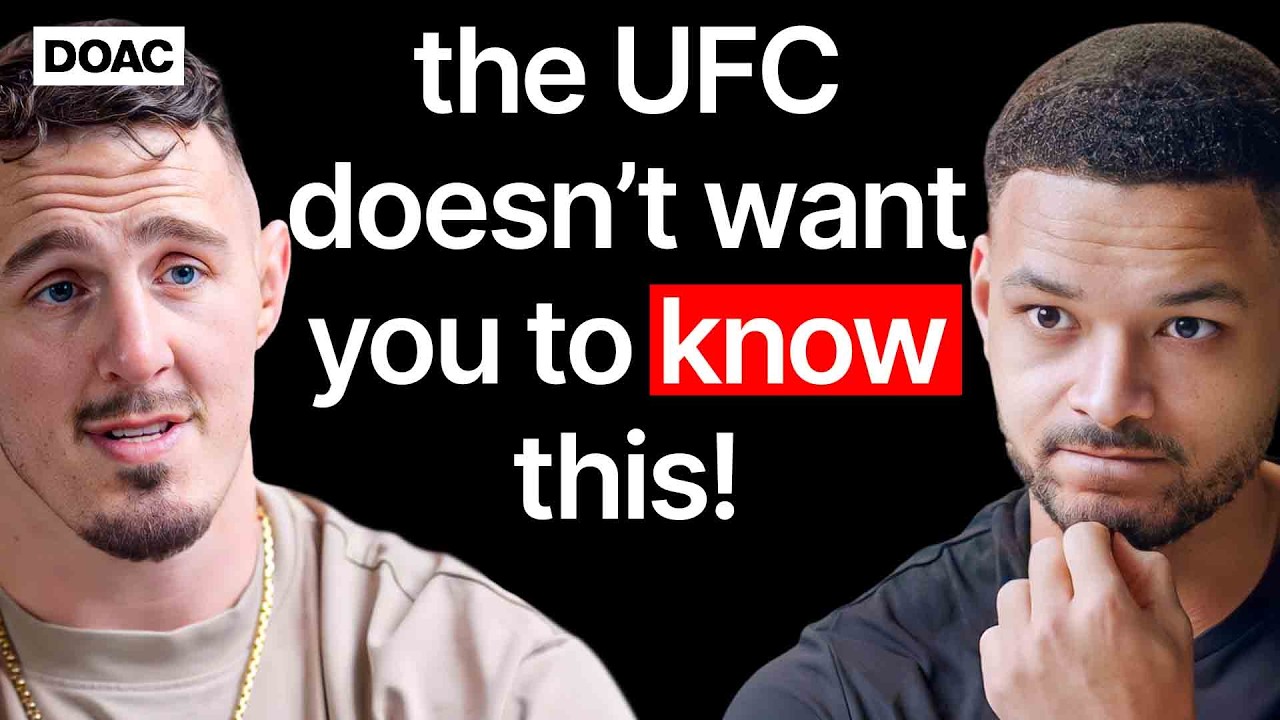
Aspinall Outlines Strategy to Defeat Jones in Heavyweight Unification
The Diary Of A CEO
El campeón interino de peso pesado de la UFC sostiene que sus ventajas tácticas, juventud y la falta de metraje de sus peleas lo posicionan para derrotar a Jon Jones.
## Background
Published by The Diary Of A CEO on YouTube on June 26, 2025, this video features UFC Heavyweight Champion Tom Aspinall. The page description outlines his reaction to Jon Jones' retirement, his champion mindset, managing fear, and the harsh realities of life behind the scenes as a professional fighter.
## TL;DR
Tom Aspinall breaks down his journey to becoming the UFC Heavyweight Champion, recounting his struggles with early financial hardship, raising three children with no stable income, and overcoming a career-threatening knee injury. He provides insight into his tactical advantages over legends like Jon Jones and explains how embracing fear and using hypnotherapy have shaped his mental toughness. Additionally, Aspinall discusses his family life, including navigating an autism diagnosis for his son and maintaining a strict recovery routine to sustain elite athletic performance.
## Atmosphere & style
The conversation is deeply reflective, grounded, and intensely honest, balancing the raw grit of elite combat sports with vulnerable personal revelations. Aspinall speaks with candid humility as he transitions from describing rock-bottom moments of financial desperation and severe injuries to discussing parenting an autistic child and mastering pre-fight anxiety. Hosted in an intimate podcast setting, the narrative carries an inspiring yet realistic arc that reveals the human vulnerability beneath a world-class fighter's intimidating exterior.
## Key takeaways
- [48:41](https://www.youtube.com/watch?v=puc5pZVsFPY&t=2921s) Tom Aspinall entrenó durante 23 años antes de conseguir su primera bolsa de seis cifras al aceptar la pelea por el título interino contra Sergei Pavlovich con solo dos semanas de aviso.
- [52:42](https://www.youtube.com/watch?v=puc5pZVsFPY&t=3162s) A la edad de 23 y 24 años, atravesó una severa crisis económica sin ingresos estables mientras cuidaba de sus tres hijos en Atherton, sintiendo un fuerte sentimiento de desmasculinización.
- [50:08](https://www.youtube.com/watch?v=puc5pZVsFPY&t=3008s) Aspinall considera que la constancia y resistir en el deporte son factores más determinantes para el éxito que el talento natural.
- [01:05:01](https://www.youtube.com/watch?v=puc5pZVsFPY&t=3901s) Su grave lesión de rodilla a los 15 segundos de su pelea contra Curtis Blaydes en la O2 Arena representó el punto más bajo de su vida, pero sirvió como el principal catalizador de su crecimiento personal y profesional.
- [01:12:43](https://www.youtube.com/watch?v=puc5pZVsFPY&t=4363s) Respecto a un posible enfrentamiento con Jon Jones, Aspinall respeta su legado pero sostiene que tiene ventajas tácticas por ser más joven, atlético y tener un estilo impredecible con el tiempo de pelea promedio más corto de la UFC.
- [01:23:40](https://www.youtube.com/watch?v=puc5pZVsFPY&t=5020s) Su filosofía de golpeo no se basa en la fuerza bruta, sino en el tiempo y el disimulo para golpear a los oponentes cuando no ven venir el impacto.
- [01:23:40](https://www.youtube.com/watch?v=puc5pZVsFPY&t=5020s) Aplica una regla del 50% de recuperación activa y toma una siesta obligatoria de hora y media al día para mantener un rendimiento de élite.
- [01:31:12](https://www.youtube.com/watch?v=puc5pZVsFPY&t=5472s) Utiliza la hipnoterapia dos veces por semana para regular su sistema nervioso y gestionar la ansiedad y el TOC que padece desde la infancia.
- [01:38:28](https://www.youtube.com/watch?v=puc5pZVsFPY&t=5908s) Buscó una diagnosis privada de autismo para uno de sus hijos gemelos tras una larga espera en el NHS, logrando desbloquear el apoyo educativo y los recursos necesarios.
- [01:52:19](https://www.youtube.com/watch?v=puc5pZVsFPY&t=6739s) Según rumores internos de la UFC, el cinturón de campeón oficial está valorado en unos $300,000 y cuenta con rubíes añadidos por cada defensa exitosa del título.
- [01:53:46](https://www.youtube.com/watch?v=puc5pZVsFPY&t=6826s) Aspinall sostiene que alcanzar el título, la fama y el dinero no elimina las luchas mentales internas ni la ansiedad previa.
- [01:58:23](https://www.youtube.com/watch?v=puc5pZVsFPY&t=7103s) Critica la costumbre de la clase trabajadora de recomendar 'ser realista' y aconseja fijar los objetivos en lo más alto desde el principio.
- [02:04:31](https://www.youtube.com/watch?v=puc5pZVsFPY&t=7471s) Adopta una técnica aprendida de Georges St-Pierre para proyectar una postura física relajada y una sonrisa antes de pelear, engañando a su cerebro para controlar el miedo.
## Detailed walkthrough
### [00:00](https://www.youtube.com/watch?v=puc5pZVsFPY&t=0s) Intro: The Mentality of a Champ and the Phone Call
The interview opens with a intense hook where Tom Aspinall reveals his candid thoughts on fear, admitting that even as the top heavyweight in the world, he is "scared to fight everybody"—including Jon Jones. Rather than letting fear paralyze him, he uses it as fuel to drive his preparation. Steven Bartlett sets the stage by introducing Tom as the newly crowned undisputed UFC Heavyweight Champion following Jon Jones' sudden retirement. Steven gives a preview of their initial phone call recorded just hours after the news broke, followed by their in-studio conversation recorded weeks earlier.
* **Mindset on Fear:** Aspinall views fear as an essential tool that sharpens his focus; he asserts he would be "an idiot" not to respect the danger of his opponents.
* **Initial Shock:** The announcement of Jon Jones' retirement came earlier than expected, catching Tom and his team by surprise ahead of International Fight Week in Las Vegas.
* **Core Advice for Young Men:** Aspinall emphasizes that consistency, outlasting others, and total 100% obsessiveness are what turn years of silent struggle into an "overnight success."
---
[02:52](https://www.youtube.com/watch?v=puc5pZVsFPY&t=172s) Immediate Reaction to Jon Jones' Retirement
Connecting via a live phone call shortly after the breaking news, Steven asks Tom for his initial, honest gut reaction to learning that Jon Jones had retired. Tom explains that rumors had been swirling around Jon's lifestyle, indicating he was no longer training or living like an elite top-level athlete. While Tom anticipated an official decision from the UFC during his upcoming trip to Las Vegas for International Fight Week, the promotion unexpectedly released the news early.
> "I am very happy to get this part of my career behind me in the rearview mirror now."
While Steven notes that Tom clearly wanted to add a legend like Jon Jones to his fighting resume, Tom clarifies his true motivation. He was never solely chasing Jon Jones as an individual; he was relentlessly chasing the undisputed UFC heavyweight belt. Holding the title and proving he is the single best heavyweight on the planet was always the primary objective, with fighting Jones merely being a desirable bonus for legacy and financial reasons.
---
[05:21](https://www.youtube.com/watch?v=puc5pZVsFPY&t=321s) Was Jon's Decision a Strategic Dodge?
Addressing whether Jones' retirement was a strategic move to avoid facing a dangerous contender, Tom stays grounded and avoids letting his ego dictate his response. He emphasizes that Jones has accomplished far more in the sport than he has and is fully entitled to make his own choices. However, speaking purely from a fighter's perspective, Tom admits his own ego couldn't take stepping away from such a massive, publicly demanded matchup.
> "My ego side of my brain is like, 'Yep, I've kind of beat him without fighting him.' And I did say that... I'm going to retire him without fighting him."
* **Patience Wasted:** Tom highlights the frustration of sitting healthy on the sidelines for nearly a year waiting for the division to clear up while remaining in peak gym condition.
* **Leaving the Past Behind:** Rather than obsessing over whether Jones "dodged" him, Tom is focused on stepping back into the cage to build his own active legacy.
---
[07:29](https://www.youtube.com/watch?v=puc5pZVsFPY&t=449s) Potential Comeback and What Changes Overnight
When asked if he would accept a fight if Jones decides to un-retire down the line, Tom doesn't rule it out. Given Jones' legendary status, Tom acknowledges that Jones could likely "jump the queue" at any point for an immediate title shot. If Jones watches Tom's upcoming fights and spots a weakness he thinks he can exploit, Tom would welcome the matchup with open arms.
The conversation pivots to what changes practical-wise now that Tom is the sole undisputed champion. Tom explains that because he already held the interim belt, he was already receiving major championship perks such as pay-per-view points.
| Aspect | Interim Champion Status | Undisputed Champion Status |
|:--- |:--- |:--- |
| **Financial Perks** | Receives pay-per-view cut (e.g., $2–$5 per buy based on contract) | Retains top-tier pay-per-view points and sponsorship leverage |
| **Division Clarity** | Co-existed with another belt holder (Jon Jones) | Single undisputed face and authority of the heavyweight division |
| **Roster Dynamic** | The Hunter (chasing unified recognition) | The Hunted (all top contenders target him) |
Tom shares his relief that the UFC heavyweight division no longer mirrors boxing, where dozens of sanctioning bodies (WBO, WBC, IBF, IBO) create multiple diluted titles. Having "one face, one name, and one guy" restores clarity to mixed martial arts.
---
[09:47](https://www.youtube.com/watch?v=puc5pZVsFPY&t=587s) Future Contenders and Next Steps in the Octagon
Embracing his new role as the champion, Tom expresses that he prefers being "the hunted" rather than chasing reluctant opponents. Having already defeated several top-10 fighters—such as Alexander Volkov—he identifies potential future matchups, including French contender Ciryl Gane and Brazilian fighter Jailton Almeida. He notes that Gane was previously "ducking and diving," making a fight between them long overdue.
> "I don't like chasing fights. I like just being the guy and everyone comes to me. That's fantastic."
* **Return Schedule:** Tom plans to fight twice before the end of the year, eager to make up for lost time spent waiting on the sidelines.
* **Vegas Trip & Sponsorships:** Flying to Las Vegas for International Fight Week, Tom is balancing media appearances, meeting fans, and fulfilling commitments for his long-term sponsor, Champion.
* **Need for Routine:** Tom admits he dislikes leaving his strict home environment because staying grounded in his daily training regimen is what keeps him winning fights.
---
[13:05](https://www.youtube.com/watch?v=puc5pZVsFPY&t=785s) Family Reaction to Becoming Undisputed Champion
Steven asks how Tom's close-knit family reacted to the life-changing news of his undisputed title status. Tom humorously reveals that his family's reaction was completely understated. Because everyone close to him already viewed him as the true champion over the past year, the official announcement didn't alter their daily routine.
His six-year-old twins are too young to understand the gravity of the belt, while his nearly nine-year-old eldest son took the news with extreme nonchalance. Tom recounts telling his eldest son about Jones' retirement simply so he wouldn't be caught off guard when classmates brought it up at school. His son casually replied, "Oh, okay, thanks," illustrating the grounded, no-nonsense environment Tom's family maintains away from the spotlight.
[15:00](https://www.youtube.com/watch?v=puc5pZVsFPY&t=900s) A Message to Jon Jones and a New Champion's Duty
Addressing Jon Jones directly, Tom Aspinall expresses complete respect for the legend's career, acknowledging that if Jones truly feels at peace with his decision to walk away, he has nothing left to prove to anyone. Aspinall wishes him well in enjoying his life, family, and extraordinary legacy. Host Steven Bartlett then takes a moment to congratulate Aspinall on behalf of fans across the UK and the globe. He notes how much the UFC heavyweight division has needed a champion who is active, willing to face anyone, and deeply relatable—proving that a normal guy from humble beginnings can rise to the absolute peak of combat sports.
Aspinall warmly responds to Bartlett's support, issuing a friendly warning that whenever he steps into the cage, anything can happen in heavyweight MMA. The conversation transitions into Aspinall's early roots, as Bartlett sets up the pre-recorded deep-dive interview by asking what young Tom dreamt of becoming before he ever reached the top of the UFC.
* "I think he's had an amazing career and I think he should enjoy the rest of his life."
* "He doesn't need me or anybody else to tell him how good he's done. He'll know it himself."
* "Anytime I fight, you got to strap in. Be ready for anything because it's heavyweight MMA at the highest level."
---
[17:00](https://www.youtube.com/watch?v=puc5pZVsFPY&t=1020s) The 9-Year-Old Dream and Roots in Greater Manchester
Aspinall reveals that from the time he was nine years old, he knew with absolute certainty that he wanted to be the UFC Heavyweight Champion. His passion was sparked the moment he stepped into a local gym and realized that adults were making a living simply by training every day and fighting every few months without needing a regular 9-to-5 job.
Tracing his origin story, Aspinall explains that he was born in Salford before moving to Atherton in Greater Manchester—a modest, blue-collar town where most parents worked in factories, mechanics' shops, or plumbing. His father originally worked in IT, but after taking a redundancy payout, he took a massive risk by opening a full-time grappling club over 20 years ago, a time when the grappling scene in the UK was virtually non-existent.
* **Childhood Dream:** Target set at age 9 to become UFC Heavyweight Champion.
* **Hometown Origins:** Born in Salford, raised in Atherton (Greater Manchester).
* **Family Transition:** His father left an IT career using redundancy money to teach grappling full-time.
---
[19:00](https://www.youtube.com/watch?v=puc5pZVsFPY&t=1140s) Growing Up in the Gym and the Inclusive Culture of Martial Arts
Because child-specific MMA classes did not exist when Aspinall was eight or nine years old, he grew up surrounded by adults in the gym. He recall rolling on the mats with 40-year-old men whenever a smaller guy was available, or otherwise just kicking a football around the mats. He only began training with serious intent around age 13 or 14. A key turning point arrived when he realized adult training partners stopped holding back and letting him positionally win; when they started actively fighting back, leaving them sweating and exhausted, young Tom realized he was actually becoming genuinely good.
Though he experimented with popular regional sports like rugby league, Aspinall always felt drawn back to the martial arts gym. He explains how the gym environment acts as a rare equalizer where age, gender, race, profession, and background disappear, leaving only mutual respect. Furthermore, as a shy kid, he found he could express himself fully in an individual sport where success depended entirely on personal accountability rather than relying on teammates.
* "There can be 10 guys in the room... one guy can be 12 years old, the other guy can be 65 years old... It doesn't matter. Everyone just respects each other."
* "With team sports... I could never shake that. I always liked control... being in charge of my own thing."
* "You will get your ego checked literally on a daily basis if you're not doing what you need to do."
---
[23:50](https://www.youtube.com/watch?v=puc5pZVsFPY&t=1430s) Family Dynamics and Why His Mum Avoided His Fights
Describing his mother as "the nicest woman that has ever walked the face of the earth," Aspinall admits that despite him being the interim champion and top-ranked heavyweight, his recent fight in Manchester was the very first time she had ever watched him compete live. She had always deliberately stayed away from the violent side of his career, preferring to simply be a supportive mother.
Aspinall explains that he never forced her to attend because MMA is an extraordinarily unpredictable and terrifying sport for loved ones to watch. However, knowing he might never fight in Manchester again and holding the philosophy that he would rather retire "a little bit too early than a little bit too late," he urged her not to miss what could be her only chance to see him live—and to her credit, she ended up enjoying the experience.
* "She is just a mom, which is great. That's amazing."
* "I'm under the notion that I would rather retire a little bit too early than a little bit too late because I've seen the way people get late in the career."
---
[26:00](https://www.youtube.com/watch?v=puc5pZVsFPY&t=1560s) Guidance for Young Men: Discipline, Self-Defense, and Facing Fear
Addressing the modern epidemic of purposelessness and mental health struggles among young men, Aspinall strongly advocates that every person should practice martial arts. He explains that stepping onto the mat confronts you with an immediate "hit in the face with reality," forcing a person to build structure, consistency, and discipline to avoid being hit harder next time.
Additionally, Aspinall points out the practical necessity of basic self-defense given rising crime rates. He shares how his 32-year-old friend and social media manager, Charlie, recently took up training at his urging. Aspinall argues that whether you are protecting a house, children, or a partner, every person should know how to protect themselves. Even as the top heavyweight on the planet, Aspinall candidly confesses that fighting is deeply frightening and that he is scared to fight anybody—highlighting fear as a major, taboo subject among professional combat athletes.
* "Every time you step onto a mat to train, you're getting hit in the face with reality constantly."
* "You don't need to be a world champion... but you need to have a general idea of how to defend yourself if it ever happens."
* "I'm the number one heavyweight in the world right now and I'm scared to fight somebody."
[30:17](https://www.youtube.com/watch?v=puc5pZVsFPY&t=1817s) Overcoming Fear and the "Gym Warrior" Phenomenon
```
┌───────────────────────────────┐
│ 80% Physical / 20% Mental│ <-- In the Gym
├───────────────────────────────┤
│ 80% Mental / 20% Physical│ <-- On Fight Night
└───────────────────────────────┘
```
Admitting to feeling fear is rare for a top-tier athlete, yet Tom Aspinall openly acknowledges that he is scared to fight anybody—even as the number one heavyweight in the world. He views fear not as a weakness, but as an essential fuel source that propels his performance. In MMA culture, fighters often talk about the concept of a "gym warrior": someone who spars brilliantly during practice, but freezes or underperforms once they step into the lights. Aspinall attributes this gap to a fundamental lack of understanding of fear. By making peace with his own fear, he has unlocked a level of focus that turns high-pressure moments into his greatest asset.
Standing in an arena packed with over 20,000 cheering fans while a guy across the cage has trained for 10 weeks to knock you out is objectively terrifying. With millions watching globally, Aspinall points out that anyone claiming not to feel scared in that moment is either lying to themselves or is a "complete idiot." When the officials clear out and the cage door snaps shut, the dynamic of combat shifts entirely. Aspinall believes that training is roughly 80% physical and 20% mental, but on fight night under the bright lights, those proportions completely flip to 80% mental and 20% physical.
- **Fighter Preparation:** Aspinall spends 3 to 5 hours daily on pure physical training, alongside additional time dedicated to stretching, nutrition, sleep, physio, and saunas.
- **The Mental Discrepancy:** Despite elite fighters agreeing that fighting is predominantly mental on fight night, most dedicate almost zero time to mental conditioning compared to their grueling physical regimens.
---
[34:40](https://www.youtube.com/watch?v=puc5pZVsFPY&t=2080s) Mental Gym: Visualization and Hypnotherapy
To fix the disparity between physical and mental prep, Aspinall treats his mind like a gym. He collaborates with a hypnotherapist and practices mental "drilling"—a term borrowed from MMA technique practice, where he repeatedly visualizes scenario after scenario. By mentally walking out to the Octagon 10,000 times before actually taking a step in real life, the high-stakes environment feels completely routine when he finally steps under the lights.
Knowing that he is closer to the end of his fighting career than the beginning gives him a heightened sense of gratitude. Instead of wishing away the fear or letting the pressure consume him, Aspinall makes a conscious effort to stay present and savor the moment. His goal is to be 60 years old, sitting with his future grandkids, and recounting the adrenaline and magic of those moments rather than remembering them as a blur of anxiety. He finds that he performs at his absolute best when he is genuinely enjoying himself rather than fixating strictly on the fight's outcome.
> "When I'm physically walking out, mentally I've walked out 10,000 times before I've actually physically walked out. So, by the time I'm there physically, I've been there so many times mentally that it feels quite normal to me."
---
[37:05](https://www.youtube.com/watch?v=puc5pZVsFPY&t=2225s) Writing Things Down and Managing Limbo
Aspinall dismisses the idea that visualization has to be "woo woo" stuff involving crystals or meditation music. For him, it is as straightforward as taking a piece of paper and writing down clear, grounded intentions, such as "This year I will win two fights. I will enjoy both of them and I will perform to my best." He keeps these notes on his bedside table to read periodically, letting the goals settle into his subconscious without rigid structures like vision boards.
Recently, he found himself writing affirmations to cope with career uncertainty surrounding potential superfights and UFC politics, specifically regarding Jon Jones. Accustomed to having his schedule mapped out with specific fight dates and training camps, being stuck in limbo felt unnatural and induced negative overthinking. To counter the feeling that things were stalling, he wrote down a reassuring reminder that everything was going to work out fine. Reading that note upon waking up keeps his head clear while waiting for a potential text message from Dana White offering a fight on six weeks' notice.
- **Handling Limbo:** Writing simple affirmations helps Aspinall avoid negative self-talk and spiraling thoughts during prolonged periods of promotional inactivity.
- **Fan Demand:** Aspinall embraces the pressure of massive fight rumors, recognizing that a potential showdown with Jon Jones is the fight fans are most thirsty to see in combat sports.
---
[40:33](https://www.youtube.com/watch?v=puc5pZVsFPY&t=2433s) The Harsh Financial Reality of Professional Fighting
Despite the glamour surrounding top UFC fighters traveling the world and earning massive paychecks, Aspinall stresses that the vast majority of a fighter's journey is grueling and unlucrative. Early in his career, he fought in front of barely a hundred people, walking away with just £100 cash in hand. When parents ask him for advice about their children pursuing MMA, his honest response is always to have a solid backup plan, as making a sustainable living in the sport is statistically improbable.
```
┌─────────────────────────────────┐
│ 95% of fighters never make more │
│ than £5,000 for a fight │
└─────────────────────────────────┘
```
Aspinall illustrates this grim reality using a local UK show he is attending, which features a 20-fight card with 40 fighters total. He notes that if even one of those 40 athletes manages to eventually earn enough money from fighting to buy a house, he would be genuinely surprised. In the UK, only a select group—such as Conor McGregor, Ian Machado Garry, Paddy Pimblett, and Leon Edwards—have achieved financial security through the sport.
```
Career Stage Typical Earnings
──────────────────────────────────────────────────
Amateur Career £50 - £100 per fight
Early Pro Circuit £200 per fight
Entry-Level UFC $10,000 Show / $10,000 Win
```
- **Amateur Career Pay:** Across 9 amateur fights, Aspinall made roughly £50 to £100 per fight, earning money primarily through ticket sales commission (keeping £5 for every £30 ticket sold).
- **Early Professional Pay:** In his professional MMA debut, Aspinall earned £200, making roughly £2,000 total across his 7 pre-UFC regional fights.
- **Entry-Level UFC Contracts:** Entry-level UFC fighters coming off regional circuits typically sign contracts structured around $10,000 to show up and an additional $10,000 to win ($10k/$10k).
- **Fastest Average Time:** Aspinall progressed through higher-paying UFC contracts quickly due to holding the record for the fastest average fight time in UFC history, delivering fast, fan-friendly knockouts that draw crowds.
Here is a detailed, faithful walkthrough covering the provided transcript section.
---
[46:04](https://www.youtube.com/watch?v=puc5pZVsFPY&t=2764s) UFC Contract Structures and Fighter Earnings
Tom Aspinall breaks down the typical compensation model for entry-level fighters joining the UFC. Initial contracts typically start with a base show money offer between \$10,000 and \$15,000 per fight, accompanied by a win bonus of equal value (e.g., $10,000/$10,000, $12,000/$12,000, or $15,000/$15,000). While these standard entry-level contracts usually span four fights, the UFC retains the right to terminate them at any point—even if a fighter wins—if the fight is deemed "a bit of a stinker" or boring.
If a fighter completes a four-fight contract winning every bout, their incremental pay progression might scale up to roughly \$80,000 in total purse earnings, scaling slightly higher with each consecutive victory ($10k/$10k, $12k/$12k, $14k/$14k, $16k/$16k). Conversely, if a fighter loses, they only receive their show money. A loss after a win can also bump their base pay back down to a lower tier. Aspinall notes that he was particularly fortunate when entering the promotion from Cage Warriors due to his heavy British fanbase and exciting finishing style. After securing two consecutive first-round finishes on his initial deal, the UFC renegotiated his contract early into a significantly higher tier rather than forcing him to finish all four scheduled fights.
- **Standard Entry-Level Deal**: $10k–$15k show money, with an equal matching win bonus.
- **Contract Duration & Terms**: 4 fights listed, but UFC can cut fighters at any point for unentertaining performances.
- **Pay Escalation**: Winning raises the show/win amounts incrementally; losing drops pay back down to base levels or show-only payouts ($40k floor for four losses).
- **Aspinall's Early Career**: Entered from Cage Warriors on roughly $10k/$10k or $12k/$12k, but got renegotiated after 2 first-round finish wins.
[48:41](https://www.youtube.com/watch?v=puc5pZVsFPY&t=2921s) Breaking Into Six-Figure Paydays and Short-Notice Opportunities
Aspinall explains that crossing the threshold into substantial six-figure fight purses depends heavily on fan engagement and marketability rather than purely winning fights. While winning is essential, fighters must make the public actively want to watch them fight. For Aspinall, his first major breakthrough came when he accepted a short-notice interim heavyweight title fight against Sergei Pavlovich in November 2023 at UFC 295. Because the original title bout fell through with only two weeks' notice, Aspinall stepped in to save the card, giving him significant leverage to negotiate a far higher payday.
Host Steven Bartlett highlights the stark reality of Aspinall's journey: from starting combat sports training around age seven or eight to securing his first six-figure payout against Pavlovich at age 30, it took 23 years of grueling effort to achieve financial success at the highest level of the sport. Aspinall agrees, noting that his payday for taking the Pavlovich fight on short notice was "more than double" any previous purse he had earned, and his financial standing grew even further in his subsequent title defense.
> "It's just as much about do people want to watch you fight. That's... it's not just about winning fights. Winning fights is extremely important, but you got to make people want to see you."
- **Pavlovich Fight**: Took the interim heavyweight title fight on two weeks' notice in November 2023.
- **Payday Growth**: The short-notice title fight resulted in his first six-figure purse, which was more than double his previous highest payout.
- **Career Timeline**: Required 23 years of dedicated training (ages 8 to 30) before reaching a six-figure fight payday.
[50:08](https://www.youtube.com/watch?v=puc5pZVsFPY&t=3008s) The Long Road to "Overnight Success" and Wanting to Quit
Reflecting on the trajectory of his career, Aspinall describes it as a long, flat line that suddenly turned upward, epitomizing the phrase "it takes years to become an overnight success." He attributes much of his ability to reach the top level to pure consistency and outlasting others. Throughout his journey since age eight, there were numerous moments where he felt overwhelmed by injuries and lack of fight opportunities, causing him to quit the sport multiple times.
Each time he stepped away or wanted to give up, his father—along with his mother and close inner circle—pushed him to reconsider, reminding him of the decades he had already invested into his dream. Aspinall points out that while many parents would have encouraged their child to walk away after set-backs to pursue a safer life, his dad always held unwavering belief in his potential. He contrasts his current position—where he holds a belt, defends titles, and commands multi-million dollar fights—with his earlier years when nobody cared if he fought or not, leaving him financially destitute.
- **Consistency**: Credits outlasting opponents and staying consistent as more vital than raw talent.
- **Support System**: His father and family repeatedly talked him out of permanently quitting MMA during injury layoffs and career lulls.
- **The Shift**: Moving from times where "nobody cared if I fought or not and I had no money" to headlining massive pay-per-view events.
[52:42](https://www.youtube.com/watch?v=puc5pZVsFPY&t=3162s) Struggling with Poverty, Family Responsibilities, and Demasculination
Aspinall opens up about the most difficult period of his life, which occurred around ages 23 to 25. Having his first child at 23 with his wife, Justina, and then finding out they were expecting twins shortly after at age 24, left him managing three young children with zero income. Living in Atherton, Greater Manchester, he found himself trapped in a crushing contrast: dreaming of becoming an international superstar earning millions, while literally being unable to afford fuel for his car or buy diapers while his newborn babies wept upstairs.
This period caused severe mental strain and feelings of demasculination. He felt the intense pressure of being a husband and father who was completely failing to provide financially. Exhausted from daily training, getting his fights canceled at the last minute for tiny purses like £600, and having to borrow money from his dad and friends just to put gas in his car to drive to the gym, he felt like those around him viewed his MMA career as a delusion. He describes living in pure "survival mode," unable to even remember much of the twins' first year because the mental and financial strain was so overwhelming.
> "I'm living on that dream... but I'm in Atherton, Greater Manchester. It's raining outside. I can't afford to put fuel in my car and I've got three kids upstairs crying... I felt a little bit demasculated... I'm here with this wife and kids and I ain't providing nothing."
- **Family Demographics**: Had his first child at 23 (wife was pregnant at 22); welcomed twins at age 24/25.
- **Financial Low Point**: Borrowed small sums of money from friends and family just for gas and diapers, hoping to make £600 from local fights to pay back £20 loans.
- **Mental Toll**: Describes entering a state of survival mode, feeling immense guilt and demasculination over his inability to provide for his young family.
[58:45](https://www.youtube.com/watch?v=puc5pZVsFPY&t=3525s) Family Support and the Uncertain Reality of MMA Careers
Despite the extreme pressure on his relationship during those early years, Aspinall credits his wife, Justina, for holding their family together and keeping his fighting dream alive. Having been together since they were both 19, Justina understood his goals and actively stopped him from quitting MMA on numerous occasions. Aspinall stresses that his family is the absolute priority in his life, noting how humbling it is to raise three distinct children while trying to give them a positive upbringing.
Aspinall compares mixed martial arts to professional football (soccer) to highlight how terrifyingly uncertain an MMA career is. In football, structured youth academies provide clear career pathways from a young age, whereas MMA fighters spend 95% of their early careers "shooting in the dark" with no guaranteed income or progression. He considers himself extraordinarily lucky to have had a steadfast support system—his wife, parents, and close friends—who believed in him through years of flatline earnings before his career finally erupted onto the world stage.
- **Relationship**: Met his wife Justina at age 19; credits her as instrumental in preventing him from quitting the sport.
- **MMA vs. Football Path**: Football offers structured academy systems and developmental pathways, whereas early MMA is a high-risk gamble without safety nets.
- **Generational Shift in UFC**: Notes that the "old guard" of champions is transitioning out, making room for a new generation of fighters like himself to take over the division.
[01:02:08](https://www.youtube.com/watch?v=puc5pZVsFPY&t=3728s) The Knee Injury That Changed Everything
Steven presents Tom with a mysterious black box representing a critical turning point in his fighting career. Inside is a simple knee pad—a seemingly mundane object that Tom admits "probably stinks," though he jokes it is clean enough. This pad carries the heavy history of a chronic physical issue that haunted Tom long before he ever made it to the UFC. Back when he was struggling financially and far from the top ranks, Tom knew he could not afford to take time off to heal. He chose to train through the severe pain because he was desperate to break into the promotion.
Once inside the UFC, Tom kept winning despite the handicap. He adapted his style to fight practically on one leg—refraining from ever kicking with that limb, taking shots on that knee, or placing any weight on it during practice. Terrified of turning down fights and losing momentum, Tom pushed forward, continuously taking on new contracts while managing a hidden, ticking time bomb in his leg.
[01:03:28](https://www.youtube.com/watch?v=puc5pZVsFPY&t=3808s) Rock Bottom at the O2 Arena
The inevitable collapse came during a massive title-eliminator fight at London's O2 Arena in front of 25,000 cheering home fans. Just 15 seconds into the bout against Curtis Blaydes, Tom's knee completely gave out. He collapsed onto the canvas, unable to stand, and was forced to submit to surgery with no guarantee that his fighting career would survive. Tom describes the emotional devastation of that moment: losing a fight after giving your all in a back-and-forth war is something a fighter can live with, but having your body break down immediately leaves a deep, unresolved ache.
Sitting on the octagon mat with his leg hoisted in the air, watching thousands of fans who had bought tickets for him start filing out of the arena, marked the ultimate rock bottom of his life. Yet, as devastating as it felt, Tom views that horrific injury as the single most important catalyst for personal and professional growth he has ever experienced.
* **Fight details:** Title eliminator against Curtis Blaydes at the O2 Arena in London in front of a 25,000-person home crowd.
* **Duration:** The knee gave out just 15 seconds into the first round.
[01:05:01](https://www.youtube.com/watch?v=puc5pZVsFPY&t=3901s) Rebuilding a Fighter: Cutting Out the Noise
The forced six-month recovery period on the sofa gave Tom time to slow down and audit every area of his life. Before the injury, his career had moved at a breakneck pace—filled with non-stop media requests, growing fame, rapid financial gain, and back-to-back fights. That speed prevented him from seeing the flaws in his environment. Superstitious because things were going well, Tom had avoided changing anything, even though he knew he was surrounded by toxic people, training with the wrong partners, and slacking on his diet and recovery.
The injury stripped away all momentum and forced him to confront those flaws. Tom underwent a complete physical and mental rebuild. He ruthlessly excised every negative influence, toxic individual, or wasteful training session that did not directly serve his path toward becoming the undisputed heavyweight champion of the world. Standing on two healthy legs after surgery, Tom emerged from the ordeal as an entirely different man and athlete.
> "The Tom Aspinall before and after that moment completely different people. I feel like I completely rebuilt myself, not only physically... but mentally the growth has been enormous."
[01:08:13](https://www.youtube.com/watch?v=puc5pZVsFPY&t=4093s) Overcoming Doubt and the Online Haters
During his six months immobilized on the couch, Tom hit a low point where he genuinely considered throwing in the towel on his fighting career. He had secured enough money to buy a house and achieve relative financial stability, and he questioned whether pushing his body further was worth the risk. The mental strain was compounded by public skepticism; because the bout ended so abruptly, many fans online accused him of faking the injury or looking for an easy way out against a dangerous opponent like Blaydes.
Though Tom tried to avoid reading negative comments, seeing people write him off ultimately ignited a powerful chip on his shoulder. When well-meaning friends suggested he retire and pivot to commentary or punditry, Tom realized he was letting "regular people" inject ordinary, safe thoughts into his mind. Driven by the core belief that he is an elite, special athlete, he used the online hate as rocket fuel to fight his way back to the very top.
* **Financial baseline:** Made enough money prior to the injury to buy a home and achieve basic financial comfort, leading him to briefly consider quitting.
* **Media alternatives:** Friends and commentators urged him to transition into MMA punditry due to his charisma and media experience.
[01:11:10](https://www.youtube.com/watch?v=puc5pZVsFPY&t=4270s) Settling the Score: The Road to Redemption
Despite the loss on his record, Tom's confidence remained intact because he knew the outcome was driven by a structural body failure rather than a defeat in skill. However, two non-negotiable goals consumed him during his rehab: he needed a rematch against Curtis Blaydes, and he needed to headline the O2 Arena once again to wipe away the traumatic memory of his injury.
Tom explains that he could not function peacefully as a human being with the "unfinished business" of a fight that never really happened. He eventually achieved both milestones, returning to the O2 Arena and knocking out Blaydes in their rematch to erase all lingering doubts about his standing in the division.
[01:12:43](https://www.youtube.com/watch?v=puc5pZVsFPY&t=4363s) Decoding the Brilliance and Strategy of Jon Jones
When the conversation shifts to Jon Jones, Tom sighs with a mix of respect and exhaustion, noting that he is "sick of talking about him" simply because every interviewer asks the same questions. Still, Tom gives credit where it is due, calling Jones an absolute legend and one of the greatest fighters to ever step into the octagon. Tom openly admits to feeling fear at the prospect of fighting Jones, arguing that anyone who wouldn't fear such an accomplished martial artist is an idiot.
Analyzing Jones's fighting style, Tom praises his unmatched fighting IQ and tactical genius. Jones excels at distance management—using his exceptional height and reach to keep opponents on the outside—and possesses a rare ability to dictate the pace and force opponents to play his game entirely. Moreover, Tom points out Jones's sharp business savvy outside the cage, noting how strategically he has chosen matchups against stylized opponents or fighters past their absolute physical prime, such as a 42-year-old Stipe Miocic or Ciryl Gane.
* **Jon Jones's heavyweight wins:** Defeated Ciryl Gane (a striker with minimal ground game) and Stipe Miocic (at 42 years old with significant mileage).
* **Key fighting attributes:** Outstanding distance management, exceptional timing, high-level wrestling, and elite fight IQ that forces opponents out of their comfort zone.
Here is a detailed, faithful walkthrough covering the provided transcript section:
[01:18:05](https://www.youtube.com/watch?v=puc5pZVsFPY&t=4685s) Analyzing Jon Jones' Technique and Tom's Strategic Advantages
Tom expresses deep appreciation for Jon Jones as a martial artist, describing it as "beautiful" to watch him execute techniques under elite-level pressure. While today's mixed martial artists must be proficient in all areas—kicking, punching, wrestling, and grappling—Tom emphasizes that Jones' true distinction lies in his ability to fight entirely on his own terms. Every fighter at the professional level can execute the foundational skills, but Jones imposes his will when opponents least expect it, making him elite among the elite.
Despite recognizing Jones' skill set, Tom breaks down why he believes he holds the structural and tactical upper hand. Tom points out that he is significantly larger than anyone Jones has previously fought, is approaching his physical prime (estimating he is still about a year away from his peak), and possesses athleticism that is "head and shoulders above any other heavyweight." Beyond physical traits, Tom highlights his decision-making as his elite attribute. While any heavyweight can score a knockout, Tom argues that his fight IQ sets him apart from legacy fighters like Stipe Miocic, who is over a decade older and carries significant wear and tear.
- **Fighter Comparisons:** Stipe Miocic is noted as being 11 to 12 years older than Tom with "a million miles on the clock."
- **The Mystery Advantage:** Addressing his UFC record for the shortest average fight time (just over two minutes), Tom rejects the notion that he is purely an aggressive rusher. He enjoys that opponents and analysts view him as a mystery, noting that fans mistakenly assume he lacks conditioning or late-round experience simply because his fights end so quickly.
- **Nullifying Film Study:** Jon Jones is renowned for meticulous film study. Tom points out that Jones has virtually no game film on him lasting longer than three or four minutes, creating a massive psychological and strategic hurdle for Jones.
[01:23:40](https://www.youtube.com/watch?v=puc5pZVsFPY&t=5020s) Power, Secrecy, and the Science of Knockouts
When asked if he mentally rehearses a specific strategy against Jones, Tom acknowledges that he constantly runs mental simulations for every heavy-hitting contender in his division, even those without an immediate fight scheduled. However, he declines to reveal specific tactical blueprints on air, keeping his exact fight plans strictly confidential between himself and his coaching staff.
Tom explains the fundamental law that guides his striking power: if he lands a clean punch at full force on any human being, they will go unconscious. Rather than relying purely on raw power scores generated by punching machines, Tom's secret lies in timing and disguise. He focuses on striking opponents when they do not see the blow coming. While he shares general advice and martial arts concepts on his YouTube channel and his Skool platform community, he explicitly keeps his personal tactical game plan concealed.
[01:25:24](https://www.youtube.com/watch?v=puc5pZVsFPY&t=5124s) Elite Recovery and Nutrition Habits
Transitioning to training routines, Tom breaks down the health habits required to sustain elite-level performance as a heavyweight athlete. As he ages and accumulates years of physical strain, he emphasizes that recovery must match the intensity of training. His primary rule is to dedicate 50% as much time to recovery as he spends actively training.
- **The 50% Recovery Rule:** If Tom completes a 4-hour training day, he commits to 2 hours of deliberate recovery, including stretching, breathwork, saunas, swimming, steam rooms, and jacuzzis.
- **Heavyweight Weight Management:** Unlike lighter weight classes that undergo severe dehydration and weight cutting to make weight, heavyweights only need to remain over 93 kg (205 lbs), allowing Tom to focus purely on performance nutrition rather than drastic cuts.
- **Dietary Experimentation:** Tom began tracking his nutrition rigorously around age 27 or 28. He recommends keeping a food log, eliminating single variables, and noting energy levels to determine the ideal intake of carbohydrates around intense training sessions.
- **Disciplined Napping:** Tom prioritizes post-workout sleep. Returning home to three active children who want to play video games, eat snacks, or play outside requires tremendous self-discipline to set boundaries and take a mandatory 1.5-hour nap to facilitate recovery.
Host Steven Bartlett delivers a brief promotional segment highlighting the benefits of ketone supplementation for focus, productivity, and physical endurance, followed by an introduction to The Diary Of A CEO conversation card deck designed to prompt deeper discussions.
[01:31:12](https://www.youtube.com/watch?v=puc5pZVsFPY&t=5472s) Hypnotherapy and Managing Life Stress
Returning to the conversation, Steven asks Tom to elaborate on his use of hypnotherapy. Tom discloses that he is intensifying his hypnotherapy sessions to twice a week to manage both professional fighter anxiety and personal stress. He shares that a recent hospitalization involving one of his children triggered intense anxiety, making it difficult for him to switch off and relax.
Tom clarifies that modern hypnotherapy is not the stereotypical "stage hypnosis" seen on television where subjects are made to act like animals. Instead, it serves as a practical mental tool that regulates his nervous system, reduces baseline anxiety, improves sleep quality, and restores tranquility. In a high-stakes, high-stress sport like mixed martial arts, achieving mental calmness provides a distinct competitive edge inside and outside the cage.
[01:32:57](https://www.youtube.com/watch?v=puc5pZVsFPY&t=5577s) Using Hypnotherapy and Subconscious Mindset Coaching
Tom explains that his experience with hypnotherapy is far removed from the theatrical tropes of falling unconscious or losing control. In reality, he sits or lies down in a room with a practitioner while keeping his eyes closed, listening as the therapist sets a relaxing scene or tells a guided story. Initially, Tom felt intense pressure to pay attention to every single word over the course of a 45-minute session, worrying that he would ruin the process if his mind wandered or if he couldn't maintain strict focus.
When he voiced these concerns to his hypnotherapist, he was reassured that his conscious focus didn't actually matter. The practitioner explained that the subconscious mind is constantly listening and processing information regardless of where the conscious mind drifts—or even if Tom falls asleep, which frequently happens after heavy physical training. Learning to stop fighting fatigue or forcing concentration allowed Tom to treat hypnotherapy as a space to unwind, letting his mind wander while still absorbing mental cues. He attributes this practice directly to helping him manage anxiety, cultivate positive thinking, and maintain a healthier mindset.
---
[01:34:39](https://www.youtube.com/watch?v=puc5pZVsFPY&t=5679s) Navigating Anxiety and OCD Triggers
When asked about his history with mental health, Tom shares that anxiety and obsessive-compulsive tendencies have been lifelong companions. He views OCD and anxiety as intertwined conditions, recalling how severely his OCD manifested during childhood compared to today. As a kid, he could not relax in a room unless everything was arranged with precise symmetry and order—curtains drawn to an exact position, drawers fully closed, all objects facing forward, and the television angled just right. This was driven by a deep-seated fear that something catastrophic would happen if the room was out of alignment.
Although he gradually gained control over these compulsions as he grew older, Tom acknowledges that severe stress can easily retrigger them. A recent medical emergency involving his son brought his anxiety flooding back, causing his old OCD habits to resurface as a coping mechanism. Competing in high-stakes mixed martial arts naturally introduces massive amounts of performance anxiety, but Tom views it as a common human experience rather than an isolated burden.
- **Social Media Off-Switch:** During fight camps, Tom completely deletes social media off his devices to prevent himself from spending all day reading comments or dwelling on his opponents.
- **Training Camp Phone:** For upcoming fights, Tom plans to switch to a strict "camp phone" accessible only to his essential corner/coaching team and immediate family (his wife, mother, and father) to block out external noise entirely.
---
[01:38:28](https://www.youtube.com/watch?v=puc5pZVsFPY&t=5908s) Raising an Autistic Child and Fighting for a Diagnosis
The conversation shifts to fatherhood and the profound perspective shift that comes with family emergencies. Tom clarifies that while one of his sons was recently hospitalized with an undiagnosed health scare, it is one of his twin sons who is autistic. He expresses deep gratitude for the NHS's immediate 24/7 care during acute physical emergencies, yet feels the system is severely failing families when it comes to neurodevelopmental support and autism services.
Born right before the COVID-19 lockdowns, Tom's twins spent their first two years largely isolated at home. Around age two, Tom and his wife noticed stark differences in how the twins were meeting milestones—one was progressing rapidly while the other struggled with speech, eye contact, and social responsiveness. Tom admits he was initially in heavy denial, rationalizing the developmental delays as a temporary side effect of lockdown isolation rather than a deeper neurodivergent condition.
```
Timeline of Autism Diagnosis Journey
├── Age ~2: Noticed sharp differences between twins in speech and eye contact; attributed to COVID lockdowns.
├── Media Trigger: Watched Paddy McGuinness's documentary on autism, recognizing matching traits in his son.
├── GP System Obstacles: Joined a year-long NHS waitlist with minimal direction or progress.
├── Turning Point: Connected with McGuinness on "A Question of Sport", obtaining a private specialist contact.
└── Resolution: Paid out-of-pocket for a private assessment, securing a 1-on-1 teaching assistant at a mainstream school.
```
Tom credits a documentary by TV presenter Paddy McGuinness for forcing him to confront the truth. While watching McGuinness discuss his three autistic children, Tom recognized identical behaviors in his own son. After a frustrating experience with his local GP resulted in an indefinite waiting list, Tom later met McGuinness on the set of *A Question of Sport* and asked for advice. McGuinness provided the contact info for a specialist, allowing Tom to pay privately to secure an official diagnosis.
Today, his son thrives in a mainstream school with a dedicated one-to-one teaching assistant. However, Tom highlights the systemic crisis facing parents who lack the financial means to bypass the NHS queue. Thousands of families remain stuck on four- to seven-year waiting lists, leaving children without adequate educational support and pushing parents into overwhelming emotional distress.
- **UK & US Autism Statistics:** Over 700,000 individuals are diagnosed with autism in the UK. In the US, approximately 2.5% of the population is diagnosed, with the condition occurring roughly four times more frequently in boys than girls.
- **Diagnostic Spike:** Diagnostic rates have seen an approximate 787% increase over the past two decades, driven by both rising public awareness and potential environmental/lifestyle factors under debate.
- **Why Diagnosis Matters:** Securing a formal diagnosis is essential because it unlocks legally mandated educational support, funding for dedicated classroom aides, and tailored developmental frameworks that prevent children from regressing in public school systems.
<ElicitationsGroup message="Explore related topics from the interview:">
<Elicitation label="Walk through Tom's complete mental prep routine on fight day" query="Walk through Tom Aspinall's full mental preparation routine on fight day from the interview."/>
<Elicitation label="Summarize Tom's perspective on retiring early to avoid CTE" query="Summarize Tom Aspinall's thoughts on retiring early to prevent brain damage and CTE."/>
</ElicitationsGroup>
[01:48:54](https://www.youtube.com/watch?v=puc5pZVsFPY&t=6534s) The Crucial Role of an Autism Diagnosis and Financial Support
Tom Aspinall emphasizes how essential obtaining a formal autism diagnosis was for navigating his family’s journey. Without a diagnosis, he describes the feeling as being completely stuck: "you're just kind of like treading water... stuck in one place flailing around." A diagnosis provides a clear, actionable roadmap for parents to help their child progress step by step. Crucially, it unlocks access to essential government funding and institutional support—such as classroom aides, home support, sensory rooms, and tailored sensory toys. While Tom acknowledges his fortunate financial situation means he does not personally depend on state funding, millions of families rely on these resources to survive and thrive.
Steven Bartlett validates this perspective by sharing an anecdote about a close friend and long-time employee who was diagnosed with autism as an adult. His friend experienced an overwhelming sense of relief and direction—as if "someone turned the lights on"—allowing him to make better decisions without feeling held back. Tom acknowledges that discussing public health policies might cause some viewers to question "who is this knucklehead talking about autism diagnosis," but stresses that he is speaking from lived experience to advocate for thousands of families in similar situations who lack adequate support.
- Formal diagnosis unlocks school aides, sensory equipment, and specialized home assistance.
- Aspinall stresses that a diagnosis is not about fitting a statistic, but about unlocking concrete help.
---
[01:52:19](https://www.youtube.com/watch?v=puc5pZVsFPY&t=6739s) Examining the Heavyweight Championship Belt
The conversation turns to the physical UFC Heavyweight Championship belt sitting on the table. Steven marvels at its weight, noting that while the studio piece is a replica, Tom possesses the genuine belt at home. Tom explains why he left the real belt in a safe location: internal UFC rumors suggest the official championship belt costs roughly $300,000, and fighters must sign a contract agreeing to personally pay for it if it ever goes missing or gets stolen.
```
+-------------------------------------------------------+
| UFC CHAMPIONSHIP BELT FEATURES |
+-------------------------------------------------------+
| Main Plate | Custom name plate & event details |
| Side Plates | Set with gemstones for title defenses |
| Ruby Markers | 1 Ruby inserted per successful defense |
| Valuation | Estimated $300,000 replacement value |
+-------------------------------------------------------+
```
Tom walks Steven through the unique design elements of the UFC belt, including the side plates set with small gemstones. Every time a champion successfully defends their title, a red ruby is added to one of the slots. Having successfully defended his title once (against Curtis Blaydes at UFC 304), Tom’s official belt features one ruby, with empty slots waiting to be filled by future defenses.
- UFC titleholders must sign an agreement accepting financial responsibility if the belt is lost.
- The replica in studio displays details from UFC 304: *Edwards vs. Muhammad 2*, whereas Tom's official belt features his own name plate.
---
[01:53:46](https://www.youtube.com/watch?v=puc5pZVsFPY&t=6826s) Winning the Title, Fighting on Short Notice, and Post-Success Reality
Tom reflects on the immediate aftermath of capturing the interim UFC Heavyweight Championship against Sergei Pavlovich. He reveals that he didn't sleep for nearly three days after the fight due to pure excitement. He accepts the victory with humility, admitting he took the fight on extreme short notice straight off a friend's stag party, meaning he was nowhere near peak physical condition when he answered the UFC's call.
Despite achieving his lifelong dream, Tom addresses the inevitable anti-climax that follows massive success. Achieving fame, titles, and money does not magically cure internal struggles or quiet the mind: "money, fame, and titles doesn't change much in terms of what goes on inside your brain." While financial success eliminated his past anxieties about paying rent and buying petrol, it introduced a new set of complex challenges that money simply cannot solve.
> "Money, fame, and titles doesn't change much in terms of what goes on inside your brain... I still have the same struggles as I did before."
---
[01:55:30](https://www.youtube.com/watch?v=puc5pZVsFPY&t=6930s) Life After Fighting and Planning Financial Longevity
Looking toward the future, Tom admits to feeling genuine anxiety about what his life will look like once his fighting career ends. Because elite fighting encompasses every hour of his day—including recovery, stretching, breathwork, diet, and sleep—he worries about the void left when that intense routine disappears. Acknowledging that he is in the second half of his fighting career, he notes that heavyweights typically retire around age 40 (citing Stipe Miocic as an example).
To prepare for life after the Octagon, Tom works closely with his management team to secure long-term financial stability. Rather than relying solely on upfront cash payouts, he negotiates equity shares in businesses alongside his sponsorship deals. Additionally, Tom plans to transition into sports media and broadcasting. He has already begun hosting his own fight-breakdown show on TNT Sports, building a foundation to remain an active voice in MMA as a pundit and educator long after hanging up his gloves.
- Heavyweight fighters tend to compete longer into their 30s and early 40s than lighter weight classes.
- Aspinall leverages sponsorship negotiations to secure equity stakes in growing businesses.
- He currently hosts an analytical breakdown show on TNT Sports to prepare for a seamless transition into full-time broadcasting.
---
[01:58:23](https://www.youtube.com/watch?v=puc5pZVsFPY&t=7103s) Blue-Collar Mentality and the Power of Unshakable Ambition
When asked how his father reacted to him winning the UFC world title, Tom admits that his father was not surprised at all. His father held an unwavering belief in Tom's potential long before Tom believed in himself. Coming from a traditional blue-collar, working-class town, Tom criticizes the societal tendency to crush young people's big dreams under the guise of "being realistic."
Tom argues that children from working-class communities are frequently encouraged to lower their sights rather than aim for extraordinary goals like becoming a Hollywood actor or world champion. He strongly advocates for shooting for the absolute highest peak first: if you fall short, you can adjust your goalposts later, but you should never start by limiting your ambition.
> "Shoot as high as you can. Your first option should be the highest of the high. And if you land any lower, then you readjust... But the first thing is shoot as high as you can."
---
[02:01:03](https://www.youtube.com/watch?v=puc5pZVsFPY&t=7263s) Harnessing Fear as a Superpower Under Pressure
When asked if he considers himself special, Tom acknowledges both his natural physical gifts and his exceptional mental fortitude. His greatest asset is his ability to perform at an elite level under extreme, high-stakes pressure. Rather than trying to suppress or ignore fear, Tom actively embraces it—describing his process as "bathing in the fear."
To illustrate how fear unlocks latent human capability, Tom shares an anecdote about a friend building a wardrobe. A massive, heavy wooden wardrobe accidentally fell onto the friend's infant child. Though the friend was a slight, skinny man who was home alone, panic and fear enabled him to instantly lift the heavy furniture off his child. Minutes later, after the child was safe, the man tried to move the wardrobe across the room and found it completely impossible to lift on his own. Tom points out that fear provided the hysterical strength needed to accomplish the impossible.
```
+-------------------------------------------------------+
| THE TWO FIGHTS IN THE OCTAGON |
+-------------------------------------------------------+
| OLD APPROACH | Fighting the opponent + Fighting fear |
| NEW APPROACH | Accepting fear as fuel -> Elite output |
+-------------------------------------------------------+
```
Tom explains that early in his career, he fought two battles in the cage: one against his opponent and another internal battle trying to block out fear. Once he accepted fear as an essential physiological catalyst—much like running faster when fleeing for your life—it transformed into his greatest strength, allowing him to maintain composure in the Octagon.
- Fear triggers physiological responses that allow individuals to achieve feats impossible under normal conditions.
- By embracing fear rather than trying to suppress it, Tom transformed pre-fight anxiety into heightened operational focus.
[02:04:31](https://www.youtube.com/watch?v=puc5pZVsFPY&t=7471s) Mental Prep on Fight Day and the "GSP Method"
Tom reflects on one of his absolute MMA heroes, Georges St-Pierre (GSP), praising him not only as one of the best fighters to ever lace up the gloves, but as one of the finest human beings in the sport. Having met GSP and had deep conversations with him, Tom learned about a mental technique GSP used to handle extreme fear. Though Tom isn't sure if there is formal scientific evidence backing it—calling it a bit of "bro science"—he swears by its effectiveness. The concept is simple: when you physically present yourself as calm, confident, and relaxed, your mind eventually follows your body's lead.
On fight day, the absolute last thing Tom feels like doing is smiling or feeling relaxed. He is acutely aware that he is about to step into an octagon in front of millions of people to fight another human being, facing the very real possibility of being "separated from his own consciousness." Despite feeling scared to death internally, he intentionally walks around with a fake smile, head held high, shoulders back, and a friendly demeanor. By forcing his physical body into a relaxed posture, his mind eventually catches up and settles down.
By design, this physical embodiment creates a stark contrast inside the cage. While his opponent looks across the octagon looking like he wants to kill him, Tom stands there looking like he's simply "in the queue for a sandwich." Even during the walkout—surrounded by a million fans throwing beer, shouting in his face, flipping him off, and telling him he is going to die—Tom deliberately looks like he just woke up and took the dog for a walk.
[02:07:20](https://www.youtube.com/watch?v=puc5pZVsFPY&t=7640s) The Tradition Question from MrBeast
Steven introduces the podcast's closing tradition, where the previous guest leaves a question for the next without knowing who it will be. He chuckles at the question, noting how hilarious and telling it is given who left it: *"Why don't you work harder?"* Steven reveals the question came from YouTube creator MrBeast.
Tom laughs and considers the question, admitting that while he thinks he works as hard as he can, anyone looking in the mirror could probably find room to push a bit more. He jokes that the only thing holding him back is that he probably "likes sleep a little bit too much." Every waking hour is dedicated to being the best he can be, so rest is his only real downtime. Steven points out that proper sleep actually enables harder work, to which Tom agrees, concluding that getting enough rest still counts as working hard in his book.
[02:08:24](https://www.youtube.com/watch?v=puc5pZVsFPY&t=7704s) Final Praise and What It Truly Means to Be "Special"
Steven praises Tom as an incredible inspiration, highlighting his grounded nature and admiring his honest admission that he considers himself "special." Steven contrasts Tom's authentic confidence with the "fake humility" often seen in public figures, emphasizing that Tom's working-class background and sheer dedication prove that anyone can achieve greatness through obsession, focus, and belief. He also commends Tom for using his platform to advocate for shorter NHS autism diagnosis wait times to help other families.
Tom clarifies his thoughts on being special, explaining that he was not born inherently superior or better than anyone else. Coming from the most regular background imaginable, he firmly believes that *anyone* can become special if they work relentlessly and refuse to quit on themselves.
- Georges St-Pierre (GSP) shared the body-language trick with Tom to trick the brain into feeling calm before a fight.
- The previous podcast guest who left the closing question was MrBeast.
- MrBeast's question for Tom was: "Why don't you work harder?"
- Tom jokingly identifies his love for sleep as the main thing keeping him from working even more hours.
- Steven highlights Tom's advocacy work regarding NHS autism diagnosis wait times for parents.
## Notable quotes
> [48:41](https://www.youtube.com/watch?v=puc5pZVsFPY&t=2921s) It's just as much about do people want to watch you fight. That's... it's not just about winning fights. Winning fights is extremely important, but you got to make people want to see you. — Tom Aspinall
> [52:42](https://www.youtube.com/watch?v=puc5pZVsFPY&t=3162s) I'm living on that dream... but I'm in Atherton, Greater Manchester. It's raining outside. I can't afford to put fuel in my car and I've got three kids upstairs crying... I felt a little bit demasculated... I'm here with this wife and kids and I ain't providing nothing. — Tom Aspinall
> [01:05:01](https://www.youtube.com/watch?v=puc5pZVsFPY&t=3901s) The Tom Aspinall before and after that moment completely different people. I feel like I completely rebuilt myself, not only physically... but mentally the growth has been enormous. — Tom Aspinall
> [01:53:46](https://www.youtube.com/watch?v=puc5pZVsFPY&t=6826s) money, fame, and titles doesn't change much in terms of what goes on inside your brain — Tom Aspinall
> [01:53:46](https://www.youtube.com/watch?v=puc5pZVsFPY&t=6826s) Money, fame, and titles doesn't change much in terms of what goes on inside your brain... I still have the same struggles as I did before. — Tom Aspinall
> [01:58:23](https://www.youtube.com/watch?v=puc5pZVsFPY&t=7103s) Shoot as high as you can. Your first option should be the highest of the high. And if you land any lower, then you readjust... But the first thing is shoot as high as you can. — Tom Aspinall
> [02:03:40](https://www.youtube.com/watch?v=puc5pZVsFPY&t=7420s) Why don't you work harder? — MrBeast
## Mentioned
Tom Aspinall, Steven Bartlett, UFC, Cage Warriors, Sergei Pavlovich, Justina Aspinall, Atherton, Greater Manchester, Jon Jones, Curtis Blaydes, Stipe Miocic, Ciryl Gane, Paddy McGuinness, Georges St-Pierre, MrBeast, O2 Arena, NHS, TNT Sports, A Question of Sport, The Diary Of A CEO
UFC Heavyweight Champion Tom Aspinall explains how embracing fear, surviving extended financial precarity, and applying rigorous mental conditioning enabled his ascent to the peak of mixed martial arts. He also examines the realities of UFC contracts, his transition to undisputed champion, and his family's push for timely neurodevelopmental healthcare.
Embracing Fear and Mental Visualization (30:17)
Aspinall rejects the traditional fighter trope of invulnerability, openly acknowledging that he is frightened before every bout. In his view, while training is 80% physical and 20% mental, the ratio completely flips to 80% mental once stepping into the cage. Rather than suppressing panic, he treats fear as an essential performance fuel. To bridge the gap between gym performance and fight night, he attends hypnotherapy sessions twice weekly to regulate his nervous system and manage lifelong anxiety and OCD tendencies.
To normalize intense pressure, Aspinall utilizes mental drilling, visualizing his walk to the Octagon thousands of times before the event. He also adopts a physical composure method learned from former champion Georges St-Pierre: projecting deliberate outward relaxation through upright posture and smiling. According to Aspinall, intentionally forcing a relaxed physical state eventually tricks the brain into calmness, keeping him composed when facing knockout power.
Becoming Undisputed Champion and Division Clarity (7:29)
Following Jon Jones' sudden retirement, Aspinall moved from interim titleholder to undisputed UFC Heavyweight Champion. While he would have welcomed a legacy fight against Jones, Aspinall maintains his primary goal was always unified title recognition rather than any single opponent. He appreciates that Jones' departure eliminates the fragmentation common in professional boxing, restoring a single champion to the division.
Now embracing the role of the targeted champion rather than chasing reluctant contenders, Aspinall targets two title defenses before the end of the year, pointing to Ciryl Gane and Jailton Almeida as prospective challengers. While acknowledging Jones' tactical fight IQ and distance management, Aspinall remains open to facing him should Jones decide to un-retire and jump the queue.
Economic Realities, Injury, and Lifestyle Rebuild (40:33)
Aspinall challenges the perception of mixed martial arts as a swift route to wealth, noting that roughly 95% of fighters never earn more than £5,000 for a bout. Standard entry-level UFC contracts begin at $10,000 to $15,000 to show, with an equal win bonus. Between ages 23 and 25, while raising three young children in Greater Manchester, Aspinall experienced intense financial strain, often fighting for £600 purses and borrowing fuel money from family. His first six-figure payday arrived only at age 30 when he accepted an interim title fight against Sergei Pavlovich on two weeks' notice, concluding a 23-year progression from his childhood training.
A pivotal turning point occurred when Aspinall suffered a catastrophic knee injury against Curtis Blaydes, leaving him bedridden for six months. The enforced layoff forced him to evaluate his environment, eliminate toxic relationships, and overhaul his preparation. He established a strict rule of dedicating 50% as much time to active recovery—such as sleep, saunas, and mobility—as he does to training, before returning to avenge the loss by knocking out Blaydes.
Autism Advocacy and Life Beyond Fighting (98:28)
Aspinall emphasizes that commercial success and championship belts do not eliminate personal stress. Navigating developmental delays in one of his twin sons exposed him to lengthy National Health Service waitlists for autism assessments. Aspinall stresses that a formal diagnosis provides a vital roadmap and unlocks critical state support, such as sensory equipment and classroom aides. While his fighting income provides financial independence, he advocates publicly for shorter assessment delays on behalf of families who rely on public services.
Recognizing that combat sports careers are finite—with heavyweights typically competing into their late thirties or early forties—Aspinall is actively planning for his post-fight transition. To protect against the loss of daily routine and future income drops, he negotiates equity stakes in commercial partnerships and hosts a fight-breakdown program on TNT Sports to establish a long-term foundation in broadcasting.
Aspinall's trajectory illustrates that sustained success in combat sports depends as heavily on emotional regulation, family stability, and commercial planning as on physical capability. Even at the pinnacle of the heavyweight division, he treats active competition as a temporary phase, directing his platform toward healthcare advocacy while preparing for an eventual transition into sports media.
[48:41] Tom Aspinall: It's just as much about do people want to watch you fight. That's... it's not just about winning fights. Winning fights is extremely important, but you got to make people want to see you.
[52:42] Tom Aspinall: I'm living on that dream... but I'm in Atherton, Greater Manchester. It's raining outside. I can't afford to put fuel in my car and I've got three kids upstairs crying... I felt a little bit demasculated... I'm here with this wife and kids and I ain't providing nothing.
[65:01] Tom Aspinall: The Tom Aspinall before and after that moment completely different people. I feel like I completely rebuilt myself, not only physically... but mentally the growth has been enormous.
[113:46] Tom Aspinall: money, fame, and titles doesn't change much in terms of what goes on inside your brain
[113:46] Tom Aspinall: Money, fame, and titles doesn't change much in terms of what goes on inside your brain... I still have the same struggles as I did before.
[118:23] Tom Aspinall: Shoot as high as you can. Your first option should be the highest of the high. And if you land any lower, then you readjust... But the first thing is shoot as high as you can.
[123:40] MrBeast: Why don't you work harder?
Original transcript
[0:00] I'm the number one heavyweight in the
[0:01] world right now and I'm scared to fight
[0:02] everybody. What about John Jones? I'd be
[0:04] an idiot otherwise. But now that I
[0:06] understand fear and what it does for me,
[0:07] it just fuels me so much in a way that
[0:09] nothing else can. So, I'll be prepared
[0:11] to do whatever I need to do. But I just
[0:13] don't like what he's doing because I
[0:16] can't function knowing that I trained
[0:18] for a fight and didn't actually fight
[0:20] somebody.
[0:22] Jon Jones is officially retired. Tom
[0:24] Aspenol is the heavyweight champion of
[0:26] the UFC. Did you see this coming? And do
[0:29] you have any idea when you'll be back in
[0:31] the octagon? I do. Yeah. Yeah. Tom,
[0:33] you're the only ever British heavyweight
[0:35] champion of the UFC. So, what advice can
[0:37] you give young men that are struggling
[0:39] to find that sense of purpose? It takes
[0:40] years to become an overnight success.
[0:42] I've been going since I was 8 years old
[0:44] and I've been up against so many tests
[0:46] from career ending injuries to financial
[0:48] struggles to mental struggles and at one
[0:50] point we had three kids at the age of 25
[0:52] and I had no money. I mean, my first pro
[0:54] fight I got 200 quid. I felt the
[0:56] pressure trying to be a young guy but
[0:58] having all this responsibility on me.
[1:00] Having to borrow money from friends to
[1:02] buy nappies for my kids so I can keep
[1:04] living on this dream. But outlasting
[1:06] people and consistency is massively
[1:09] underrated. And in today's day and age,
[1:11] people just have a lot of options. But
[1:12] that obsessiveness of being 100% focused
[1:16] on something, you win. Tom, there's this
[1:18] black box in front of me which contains
[1:20] something which represents a pivotal
[1:22] moment in your career. What is the story
[1:23] behind this?
[1:26] It was the most devastating thing that
[1:28] happened in my whole career.
[1:32] So, ahead of showing you that interview
[1:33] which we recorded a while ago, I wanted
[1:35] to call Tom and get his first reaction
[1:38] to the news that he's now the UFC's
[1:40] undisputed heavyweight champion of the
[1:41] world. So, what I'm about to show you is
[1:43] a conversation I had with Tom hours
[1:45] after the news was announced that he's
[1:46] now the undisputed heavyweight champion
[1:48] of the world. And then I'm going to play
[1:50] the long form interview that me and Tom
[1:51] had several weeks ago right here in the
[1:53] studio. Enjoy. Tom, did you um did you
[1:57] see this coming?
[2:01] Uh yes, but I just didn't expect it. Um
[2:06] when it happened, I expected it. So,
[2:08] next week I'm going to Vegas. I'm going
[2:10] for the Well, they say it's the biggest
[2:13] fight card of the year, a fight card
[2:14] called International Fight Week.
[2:17] And I knew that I had some news coming
[2:19] on International Fight Week. We got wind
[2:22] that Jon Jones is gonna retire and
[2:24] they're going to announce it on
[2:25] International Fight Week, but for some
[2:26] reason they announced it um last night.
[2:29] I don't know what that reason is. It
[2:30] took me by surprise at least. Um but
[2:33] they announced it last night. What was
[2:34] your initial honest gut reaction when
[2:36] you found out he was retiring? Where
[2:38] were you? What was your first feeling
[2:40] when you heard that news?
[2:44] Well, I only knew 100% actually last
[2:46] night. It was always like rumors of him
[2:49] retiring. He's putting stuff out on the
[2:50] media saying that he's retiring because
[2:53] MMA especially at elite level is quite
[2:55] there's not many people like you hear
[2:57] rumors a lot. So I heard rumors from
[2:59] people close to him that he's going to
[3:01] retire and that he's not living like an
[3:03] athlete um who's fighting at the top
[3:06] level anymore and that he's not
[3:07] interested and he's not in the gym and
[3:09] etc. But I knew that there was going to
[3:11] be a decision made by the UFC coming
[3:12] soon whether he's going to continue and
[3:15] um we got it last night for sure. We we
[3:17] finally got it confirmed last night. So,
[3:19] I am uh very happy to get this part of
[3:22] my career behind me in the rearview
[3:24] mirror now.
[3:26] But, but how did you feel? Because I
[3:28] think from the conversation we had,
[3:30] which we're going to play in a second,
[3:32] it was clear to me that you wanted to
[3:34] have Jon Jones on your record. You
[3:36] wanted to fight him. What I really
[3:38] wanted is is the undisputed title.
[3:40] That's really what I was chasing the
[3:41] whole time. I was never really chasing
[3:42] one guy. Jon Jones was always just a
[3:44] bonus because of the sto because of the
[3:47] resume that he's got and because of the
[3:48] name that he has and the the status that
[3:50] he holds within the within the sport.
[3:52] Like he's so well respected. I think
[3:53] that would have been a great scalp for
[3:56] me to have on my resume. But uh
[3:59] ultimately I was chasing the belt. I was
[4:00] chasing being the number one heavyweight
[4:02] fighter in the world, which uh I am and
[4:04] I can say that I am now, especially with
[4:05] John not around and he's retired and
[4:07] that's behind us. But um ultimately the
[4:10] thing that I wanted really was was the
[4:12] belt. the fact that John's left the
[4:13] sport. Obviously, it would have been
[4:15] better for me career-wise to have that
[4:17] name. Financially, it would have been
[4:18] great as well, but um the thing that I
[4:20] was ultimately chasing was uh the
[4:23] heavyweight title. And how do you think
[4:25] about John's decision? Do you do you
[4:27] view it as a strategic dodge or do you
[4:30] view it as a genuine sort of closing of
[4:32] that chapter in his uh of his legacy?
[4:38] I think that he's entitled to do
[4:39] whatever he wants to be honest. I'm not
[4:42] um he's done way more in the sport than
[4:44] I have. So, he should do whatever he
[4:46] feels is right. I speaking as as just a
[4:49] fighter here. If it was if it was so
[4:52] public
[4:54] for me personally, I don't know if my
[4:56] ego could take it having not done it. Um
[4:59] but that's that's honestly that's his
[5:01] prerogative. I don't hold any ill will
[5:03] against him for it. And I'm I'm happy to
[5:06] move on with my career now that it's
[5:08] over. Because you got to remember, I've
[5:10] not fought for nearly a year now because
[5:13] of this. And I've been healthy the whole
[5:16] time. I've been in the gym the whole
[5:17] time. I've been doing exactly what I'm
[5:18] supposed to do as a high level operating
[5:21] athlete at the elite level. So I'm glad
[5:24] that that is behind us. Well, do you in
[5:27] part, I guess, take this as a bit of a
[5:28] compliment that there was such huge
[5:30] public pressure for him to fight you and
[5:32] actually the route that he chose was to
[5:34] retire instead of fighting you? I mean,
[5:35] that's quite a compliment for someone of
[5:37] Jon Jones stature.
[5:41] Uh, I try not to let my ego take control
[5:44] of me. Um, I could see why people would
[5:47] think that, but to me it's just like
[5:49] maybe when I've retired I'll cons when
[5:51] I've retired myself, which is not going
[5:52] to happen in the next couple of years at
[5:54] least. Um, I'll think about that kind of
[5:56] stuff. But for right now, it's just like
[5:58] we got to focus on another fight. We've
[6:00] got to get me active. We got to get me
[6:01] back out there and doing what doing what
[6:03] I'm supposed to be doing. Cuz right now,
[6:04] I've been thinking about that whole
[6:06] situation and being held up and
[6:07] frustrated for almost a year. And it's
[6:09] not it's what I love doing. I've been
[6:11] I've been held back for the whole time
[6:12] and it's not been very fun to be honest
[6:14] with you. So my the the ego side of my
[6:17] brain is like, "Yep, I've kind of beat
[6:19] him without fighting him." And I did say
[6:20] that. I've said that the whole time that
[6:22] I'm going to retire him without fighting
[6:24] him. Uh but I don't kind of want to harp
[6:26] on about that really. I want to kind of
[6:28] just put that behind me and move forward
[6:30] on my own path. Now I hear and you know,
[6:33] John Jones is a an unpredictable
[6:35] individual. So there's still a
[6:36] possibility that that retirement wasn't
[6:38] a legit retirement and that he might get
[6:40] a bit bored and end up, you know,
[6:42] deciding that he wants to come back and
[6:43] fight you. Is that something that you
[6:44] would consider if that were to happen?
[6:47] I'm sure with where he's at, he can like
[6:50] jump the queue anytime he wants. So, you
[6:53] know, this time a year down the line,
[6:55] we'll have another three or four
[6:57] contenders knocking on for a title shot,
[6:58] I'm sure. But anytime someone like him
[7:01] wants to step up and say, "Listen, I
[7:02] want to fight again." They're going to
[7:03] get an immediate title shot. So, uh, I'm
[7:06] never going to count that out. And I'm
[7:07] sure that maybe he's, you know, I'm in a
[7:10] spot in my career where there's not all
[7:12] that much footage out there on me. Maybe
[7:14] he sees something on me in the next few
[7:16] fights and he thinks, you know what, I
[7:17] can beat this guy. I'm going to come
[7:18] back and beat him. So mentally, I'm
[7:20] never counting that out. I think the the
[7:22] the fight is always it could always pop
[7:25] back up and come back around on me. So
[7:27] that's something that I would obviously
[7:28] accept. But as I said before, I think a
[7:31] lot of people get it confused over the
[7:33] last kind of 10 monthsish is that I was
[7:36] chasing Jon Jones. That was never the
[7:37] case. I was chasing the the undisputed
[7:39] heavyweight title. That's it. So, if I
[7:42] can if I do get the opportunity to put
[7:43] Jon Jones on my resume, of course, I'll
[7:45] I'll accept that with open arms. But if
[7:47] not, I'm content. I'll move forward and
[7:49] I'll uh create my own legacy without
[7:52] him. And what what has changed
[7:54] overnight? Is there as a UFC fan, is
[7:56] there anything that I'm unaware of that
[7:58] changes when Dana announces you as the
[8:00] Undisputed? Does your contract change?
[8:01] Does Does there anything that changes
[8:05] other than the fact that you've now got
[8:06] a sort of a clear path and you're now
[8:08] the one being chased? You're no longer
[8:09] chasing. Well, I was on uh cuz I was an
[8:12] interim champ cuz I was a champion in my
[8:13] own right as well. So, I I I was already
[8:15] getting a lot of the uh a lot of the
[8:19] perks that come with being a champion.
[8:21] stuff like pay-per-view points is
[8:22] something that you get when you're a
[8:24] champion. You also get, you know, uh
[8:26] pay-per-view points is where you get a
[8:27] cut of the pay-per-view sales. Okay? So,
[8:31] I don't want to go into the details of
[8:32] my contracts, of course, but you'll get
[8:34] if someone pays, you know, $60 for a
[8:36] pay-per-view, you might get $2, you
[8:38] might get $5 per bar, you might get 10
[8:40] people, different people have different
[8:43] um different perks in the contract. So,
[8:44] I I was already having that cuz I was a
[8:46] I was a champion in my own right anyway.
[8:48] But yeah, not nothing actually really
[8:50] changes. Just the fact that there isn't
[8:52] two belts anymore in the division, which
[8:54] is great. There's one face, one name,
[8:56] and one guy in in the division. And to
[8:58] me, that is what that's what separates
[9:01] uh MMA from other sports, other fight
[9:03] sports at least, is that for example, in
[9:05] boxing, you can have like five, six,
[9:07] seven, eight, even sometimes different
[9:10] organization. You got the WBO, the WBC,
[9:12] the IBO, the IBF, and all these
[9:15] different ones that I don't even know
[9:16] about. and they all have different
[9:18] champions in each organization. Whereas
[9:21] generally speaking, the number one guy
[9:24] in the world is the UFC champion. And
[9:27] before Jon Jones retired, there was two
[9:29] of us in the division, which is a little
[9:30] bit of a strange strange conundrum that
[9:33] I wasn't comfortable being in. I think
[9:34] that there should be one guy in every
[9:36] division. And uh now that that John's
[9:38] gone, obviously we didn't get to fight
[9:40] about it, which I would have liked. Um,
[9:42] but at least there's one guy and uh I'm
[9:45] I'm happy with that moving forward. And
[9:47] who's the who's the number one contender
[9:49] now? You're now being chased, right? You
[9:51] were doing a little bit of chasing in
[9:52] terms of trying to get that um unified,
[9:54] but but who in your mind is the number
[9:56] one contender now for the heavyweight
[9:58] title belt. Oh, that's uh that's I'm I'm
[10:02] more than happy being chased. That's
[10:04] fantastic. I I would rather be the
[10:07] hunted as opposed to the Hunter because
[10:09] I' i've been chas I don't like chasing
[10:10] fights. I like just being the guy and
[10:12] everyone comes to me. That's fantastic.
[10:14] So, most the I've actually fought a lot
[10:16] of the top 10. Um, one of the guys I've
[10:18] not fought is uh Sir Gana, French guy.
[10:21] That's a a fight that I was look I was
[10:22] actually chasing that fight a few times
[10:24] before. He was he was ducking and diving
[10:28] around himself a little bit. So, he is
[10:29] due a little bit of a beating off me. I
[10:31] look forward to that. Um, couple more
[10:34] guys down the rankings. A Brazilian guy
[10:36] Jelton Almeida I've not fought. There's
[10:38] a guy I've already beat called Alexander
[10:40] Vulkov who's doing really well for
[10:42] himself as well. So, who knows? You
[10:44] never know in the heavyweight division.
[10:45] There's a couple of up andcoming guys
[10:46] who I've not mentioned as well. So,
[10:48] there's some some good fights to be made
[10:50] over the next couple of years for sure.
[10:51] If I were to say myself, it'd be great
[10:53] to see you fight gone in uh in London or
[10:56] in the UK somewhere um as your next
[10:58] fight. Do do you have any idea what
[11:00] you're doing next and when you'll be
[11:01] back in the Octagon?
[11:05] I do, but I also want to keep I also
[11:08] want to keep my job, so there's not much
[11:10] I can say it to be honest. Um, but yeah,
[11:13] this year, yeah, I'm going to be
[11:15] fighting hopefully twice this year.
[11:17] That's that's my plan at least. I think
[11:18] I think I've wasted enough time um now.
[11:21] So, um, we're looking for a quick we're
[11:24] we're looking to get a fight booked
[11:26] quick and it's looking like it's going
[11:28] to be, you know, pretty soon anyway. Um,
[11:30] and then hopefully if everything goes
[11:32] well in the first one, um, I'm
[11:34] uninjured, which is, you know, it's
[11:36] easier said than done, uh, getting
[11:38] through a fight with with a guy my size
[11:40] and and coming out with no injuries.
[11:42] But, um, if I if I can do that, I would
[11:44] like to fight at the end of the year as
[11:45] well. That'd be perfect.
[11:48] And, uh, are you off to training now?
[11:50] Are you you're flying out to Vegas, so
[11:51] I'm assuming you're you're going to the
[11:53] UFC center out there and starting
[11:54] training?
[11:56] No. So, I'm I'm training constantly
[11:58] regardless if I've got a fight or not.
[12:00] The only thing that changes for me is
[12:01] basically intensity in uh in the
[12:04] sessions, but I'm actually going to
[12:06] Vegas for well, I am the heavyweight
[12:08] champion of the world, so they're going
[12:09] to want me at the big shows. Uh so, I'm
[12:11] going to I'm going to be showing my face
[12:12] there, doing a little bit of media and
[12:14] stuff. I will, of course, be doing a
[12:15] little bit of training, you know, ju
[12:16] just different stuff. I'm working with a
[12:18] new sponsor who I'm going to be with
[12:19] till the end of my career, which is
[12:20] Champion. So, I'll be working with them
[12:22] out there and uh just doing bits for the
[12:25] UFC, meeting fans and and doing bits of
[12:27] training, just being around the scene.
[12:28] And I don't often, to be honest, I'm so
[12:31] routine and I'm so routine based and
[12:35] goal focused that I don't like to leave
[12:37] my home routine and training regimen
[12:40] that often. So, uh, when I go to the US
[12:42] and do things like this, I like to do as
[12:44] much in a short space of time as
[12:45] possible so I can get back to my, uh,
[12:47] cuz I know what I know what I need to do
[12:49] to to be good and to win fights and, uh,
[12:52] that's be at home and be in my routine
[12:54] and and be focused. So, I don't like to
[12:56] leave my routine too much and go
[12:58] overseas and do all this other stuff.
[13:00] So, I'll be killing as many birds with
[13:02] one stone in this trip as possible.
[13:05] You're um, you're a family man, Tom. I
[13:07] got a real understanding of that in the
[13:09] conversation that I'm about to play. Um,
[13:10] your family very close to you. You're a
[13:12] father. What's the reaction been like
[13:14] with your your partner, your your your
[13:16] kids, your your father, your your
[13:17] parents over the last couple of hours
[13:19] since you've been crowned as the
[13:20] undisputed.
[13:22] Uh, to be honest, um, it didn't really
[13:25] make much of a difference. I think a lot
[13:26] of people said the same thing outside of
[13:28] my family as well. It was like you were
[13:30] kind of the champion anyway cuz I think
[13:32] the way that Jon Jones played it the
[13:34] last year or so, it just didn't a lot of
[13:36] people didn't see him as the the unified
[13:39] heavyweight champion anyway. So, I think
[13:41] a lot of people close to me, like I told
[13:43] my kids this morning, they were just
[13:44] like not bothered at all. Didn't make
[13:48] didn't make the slightest bit of
[13:49] difference. I said, "Look, I'm only
[13:51] telling you so when your friends tell
[13:52] you at school, you'll know." And they
[13:54] were like, "Okay, fair enough." That
[13:55] that was it. There was no there was no
[13:57] great reaction there. Say to them, what
[13:59] did you say to them? Well, it was just
[14:01] my my it's mainly my oldest son because
[14:03] my my twins, they're a little bit too
[14:04] young to really understand. They've just
[14:06] turned six, so they don't really get it.
[14:07] But my oldest son's nine almost. Um his
[14:10] friends are following MMA a little bit
[14:13] more. So, he kind of they started
[14:14] thinking it's cool now. So, I told my
[14:16] son, I was like, "Listen, I just let you
[14:18] know, Jon Jones retired. I'm the
[14:20] undisputed champion now. I've got, you
[14:22] know, this one." And he was just like,
[14:24] "Oh, okay." And I was like, I'm just I
[14:26] know you're not that bothered. I'm just
[14:28] letting you know. So if your friends say
[14:29] anything, you know. And he was like,
[14:30] okay, thanks. John's probably watching
[14:33] this. Um he has undoubtedly had one of
[14:36] the greatest careers in the history of
[14:37] the UFC up there with the likes of Kabib
[14:39] and many of the legends through history.
[14:41] What would you say to him if he was
[14:43] watching this now?
[14:47] That's it's a great question. I I don't
[14:49] I don't know if he will be watching
[14:50] this. I'm not sure. But if he if he is,
[14:53] uh I think he's had an amazing career
[14:55] and I think he should enjoy the rest of
[14:57] his life. I think if he if he truly
[15:00] feels like he's done enough, which he
[15:02] keeps saying that he does, he will be at
[15:04] peace. He doesn't need me or anybody
[15:06] else to tell him uh how good he's done.
[15:09] He should he'll know it himself. So uh I
[15:12] hope that he's he's enjoying his life.
[15:14] He's enjoying his family and he's
[15:16] celebrating his career because it's been
[15:17] amazing. Tom, uh congratulations. I
[15:20] think I speak on behalf of a lot of
[15:22] Brits and really people all around the
[15:24] world when I say that um you're the
[15:26] champion I think the UFC especially at
[15:28] that the heavyweight division has really
[15:30] been longing for someone who wants to be
[15:32] active someone who is um seeking the
[15:36] biggest fights someone who is willing to
[15:38] fight anybody but also someone that's
[15:40] just really really relatable and I think
[15:42] sends a message to all of all of us that
[15:44] what I'd class as a very normal guy from
[15:47] humble beginnings can reach the very top
[15:49] of the professional um pyramid as it
[15:52] relates to sports and entertainment. So,
[15:54] thank you so much for representing the
[15:56] UK in UF in the UFC, especially at the
[15:59] heavyweight level, which we've never had
[16:00] before. But, I will all be rooting for
[16:02] you uh for so many reasons because of
[16:04] who you are, but also because of the
[16:06] exciting way that you've um conducted
[16:08] yourself in and outside of the octagon.
[16:10] So, I'm going to let you go. Um we're
[16:12] going to play the interview now that we
[16:13] recorded a little while ago, but um
[16:15] yeah, going to be watching your career
[16:16] very, very closely and um going to be
[16:17] ringside whenever you fight next. Uh, I
[16:19] know there's a lot of people that are
[16:20] going to turn out to support you. So,
[16:22] thank you so much, Tom. Thank you very
[16:24] much for having me. And, uh, if you're
[16:27] there, as always, cuz we know each other
[16:30] now. And I know it's difficult when you
[16:32] know somebody personally. Um,
[16:35] anytime I fight, you got to strap in. Be
[16:37] ready for anything because it's
[16:38] heavyweight MMA at the highest level and
[16:42] anything can happen. So, thank you for
[16:44] having me, Stephen, and I look forward
[16:45] to uh to seeing you there. Thank you.
[16:51] Tom, if I had met you when you were a
[16:53] kid and I'd asked you, what do you want
[16:56] to be when you're older, what would you
[16:58] have said to me?
[17:00] Well, it depends on the age, of course,
[17:03] but I think if you would have asked me
[17:04] from the age of being
[17:08] 9 years old and above, I would have said
[17:11] that I'm going to be UFC heavyweight
[17:12] champion at 9 years old. Yeah. As soon
[17:15] as I kind of like went to a gym and I
[17:19] realized there's people in this gym who
[17:22] are adults and they don't have a regular
[17:25] job and they're just showing up to the
[17:26] gym every day and fighting every few
[17:28] months and getting money for it. Like I
[17:31] was I was literally like this is what I
[17:33] want to do. So take me back. So where do
[17:36] you where did you come from for someone
[17:38] that doesn't know who you are? They
[17:39] don't know your story. They don't know
[17:40] Tom Aspenol's origin. Where did you come
[17:43] from? Um, so I'm from a place I was born
[17:46] in Sulford, which is like Greater
[17:48] Manchester, and then I moved to a
[17:50] different part of Greater Manchester, a
[17:52] place called Allison. There's not a lot
[17:53] of stuff going on there to be honest. I
[17:55] mean, it's just like a normal
[17:57] workingass blue collar place. Do you
[18:00] know what I mean? A lot a lot of
[18:02] families like the parents work in
[18:04] factories, they
[18:07] mechanics, they
[18:10] plumbers. And what were your family in
[18:12] that context? So, my dad originally
[18:16] worked in IT. He got paid some
[18:19] redundancy money and then he decided to
[18:22] start teaching grappling full-time,
[18:24] which we're talking when we're talking
[18:26] like 20 years ago, the grappling
[18:29] industry in the UK was non-existent. And
[18:33] obviously, I was quite a I was a
[18:36] budding, but I wasn't I wasn't even like
[18:38] a budding prospect at the time. My dad
[18:40] had no fights at the time, but I was
[18:42] training and I was enjoying my training
[18:43] and my dad wanted to spend more time
[18:45] perfecting me to help me do what I enjoy
[18:47] a little bit more. So, was he the
[18:49] inspiration for you to go to the gym the
[18:51] first time and start training or So,
[18:53] it's difficult to say because I had like
[18:55] a bit of a blurred line as to where I
[18:57] started actually training martial arts.
[19:00] So, I started training when I was young,
[19:02] but it was my dad's thing more and I
[19:03] just used to go with my dad like to
[19:05] spend some time with my dad and cuz I
[19:06] didn't really have much else to do. But
[19:08] I used to always go down to the gym and
[19:10] when I started training there were no
[19:11] like kids classes. Like now you can go
[19:13] to the end of the road and there'll be
[19:14] an MMA gym with kids classes on with 20
[19:17] kids in the class. Like that wasn't my
[19:18] case when I started at 8 n years old.
[19:21] Like I used to go to the gym there used
[19:22] to be 10 40 year old guys rolling around
[19:25] on the floor with each other and I just
[19:27] used to jump in when there was a smaller
[19:29] guy available. Otherwise I'd just be
[19:31] like kicking the football around the gym
[19:33] or something like that. Like basically
[19:34] I've grown up in in gyms. But when I
[19:37] actually started training seriously,
[19:39] that was probably when I was like 14,
[19:41] 13, 14, something like that. And was
[19:43] there ever a moment in those early years
[19:44] where you realized or someone said
[19:48] something to you that you can still
[19:49] remember that proved to you that you
[19:51] were better than normal people at this
[19:53] thing? I do remember a few instances.
[19:56] Like I said, I used to train with adults
[19:58] even when I was a child.
[20:00] And I was quite aware even from being
[20:03] young that the adults were like taking
[20:05] it easy on me, you know, like they were
[20:07] letting me get position and letting me
[20:09] do certain things on them and they
[20:11] weren't really trying as much. And uh I
[20:14] remember
[20:16] feeling like the adults are starting
[20:19] going harder on me. Do if that makes
[20:21] sense. Does that make sense? I remember
[20:23] I used to just have all my own way in
[20:25] training because the adults a lot of the
[20:26] time were like my dad's friends and his
[20:28] students and then they would I would
[20:30] always be around the gym so they'd know
[20:31] me and they take it easy and stuff like
[20:33] that. And then I remember like a couple
[20:35] of the couple of the guys who I trained
[20:37] with, like I said, I was like 11, 12
[20:38] years old. And I remember a couple of
[20:40] the guys like it became a lot more
[20:43] physical training. Like it became a lot
[20:45] more competitive whereas before they
[20:46] were just like letting me do my thing
[20:47] and then they started fighting back a
[20:50] little bit more. And then I remember
[20:51] thinking, ah, well, I must be all right.
[20:52] like if if they're trying I remember
[20:55] realizing that people actually started
[20:57] trying against me and then they finish
[20:58] around and look like they'd done a
[21:01] workout a little bit rather than just
[21:02] played with a kid if that makes sense.
[21:04] And was that I'm trying to figure out as
[21:06] well the the thing that encouraged you
[21:09] to keep going at that point because at
[21:11] that age you can end up playing
[21:12] football, you can end up going and
[21:13] joining this club, you can end up
[21:14] focusing on some drama class that you're
[21:16] doing but there must have been something
[21:18] that kind of held you in this habit. I
[21:20] mean I definitely tried all that stuff.
[21:22] I definitely um I mean my area is like
[21:24] quite a big rugby area. So like rugby
[21:26] league we play up there and uh I
[21:28] definitely delved in that a little bit
[21:30] but I just never really was my thing you
[21:32] know. I think cuz my dad and my brother
[21:35] was heavily involved with martial arts
[21:37] and that's just where I always felt like
[21:39] safe to a degree is like in the gym. I
[21:42] know it sounds really weird, but I felt
[21:44] like when you're involved in martial
[21:46] arts, it's almost like there can be 10
[21:47] guys in the room and they can all be
[21:49] from different backgrounds,
[21:51] male, female, one guy can be 12 years
[21:54] old, the other guy can be 65 years old.
[21:57] One guy's retired, the other guy's at
[21:58] college, one guy's black, the other
[22:00] guy's Chinese. It doesn't matter. Like
[22:02] when you're in there, it none of that
[22:04] matters. And everyone just respects each
[22:06] other and gets on regardless of like
[22:08] race, gender, age,
[22:11] what the job is. And none of that stuff
[22:13] matters. Everyone just respects each
[22:14] other the same. And I was always like
[22:16] drawn to that more than anything. I was
[22:18] that's where I always felt my most
[22:20] comfortable. And especially cuz I was a
[22:21] bit more of a shy kid. I felt like I
[22:24] could really express myself through
[22:27] martial arts. And something else about
[22:28] martial arts is like cuz it's an
[22:30] individual sport. it's like always on
[22:33] you if you do well or not. And I
[22:36] realized like the more time I put in,
[22:38] the more I got out of it, like mentally
[22:41] and physically, like I would get better
[22:44] the more I did it. Whereas with team
[22:46] sports, especially rugby because that's
[22:48] the team sport I've done the most. Like
[22:50] there would be games where I personally
[22:54] had had like an amazing game, but the
[22:56] team had lost and I could see the next
[22:59] guy not trying as hard as me. or
[23:01] sometimes vice versa. Sometimes they'd,
[23:03] you know, I'd had a terrible game, but
[23:05] the team had won and everyone would be
[23:06] really happy and I'd be like, "Oh, I had
[23:08] a bad game." And I couldn't I could
[23:10] never shake that. I'd always like want
[23:11] to I always liked control. Control.
[23:14] Yeah. Being in charge of like my own
[23:17] thing. And MMA in particular is very
[23:19] much that it's like if you're not
[23:21] putting the work in, like you will get
[23:23] exposed. You will get your ego checked
[23:25] literally on a daily basis if you're not
[23:27] doing what you need to do. And I love
[23:29] that like it gives you a sense of like
[23:31] accountability for
[23:33] just your everyday habits like your
[23:36] thought process, what you're putting in
[23:38] your body, how much recovery you're
[23:39] getting, how many reps are you doing in
[23:41] the gym, everything like everything is
[23:44] accounted for publicly and I quite like
[23:47] that. I quite love that actually. Um,
[23:49] your mother in this picture, where does
[23:50] she fit into this picture you've painted
[23:52] for me? And who is she? Uh, she first of
[23:54] all, she is the nicest woman that has
[23:56] ever walked the face of the earth. I
[23:58] think she is such a lovely person. Yeah,
[23:59] there is literally, you know, when
[24:01] someone says the term, oh, she's not got
[24:02] or they've not got a bad bone in the
[24:04] body, that literally applies to my mom.
[24:07] But as far as So, my last fight that I
[24:10] had, which is in Manchester, my home my
[24:12] hometown. That was the first fight that
[24:14] my mom's ever been to really. And I'm
[24:16] already like number one in the world.
[24:18] I'm like, bloody hell, mom, you've lived
[24:20] it this long. But yeah, she she is she
[24:23] just stays away from the MMA side of
[24:25] things. She is just a mom, which is
[24:27] great. That's amazing. She is a really
[24:29] really uh lovely person. Why was that
[24:32] the first fight she'd ever come to? Cuz
[24:34] it's scary. And I You didn't want her to
[24:37] come or No, it's not No, it's not that I
[24:39] didn't want her to. I I was It's never
[24:42] been like her thing. So, I would never
[24:44] like be like, "Oh, mom, can you please
[24:45] come?" Because I know it's I know like
[24:48] firsthand, even from like teammates
[24:51] fighting, how scary it is for me to be
[24:53] in attendance. So, I would never like
[24:56] drag along someone who loves me because
[24:57] it's it's horrendous to be honest with
[24:59] you. Like, it's such an unpredictable
[25:00] sport that
[25:02] you just never know. So, but I think my
[25:05] mom came because I was like, "Look, Mom,
[25:07] I don't want to tell you to come or not
[25:09] come, but this is probably the only time
[25:12] I'm ever going to fight in Manchester.
[25:14] Like, I don't know how many fights I've
[25:16] got left. And I'm I'm under the notion
[25:18] that I would rather retire a little bit
[25:21] too early than a little bit too late
[25:22] because I've seen the way people get
[25:25] late in the career. And I don't I don't
[25:26] want to be like that. So I'm not saying
[25:28] I'm going to retire anytime soon. But
[25:30] I'm just saying like most of my fights
[25:32] are in the US now and I don't think
[25:34] you'll ever have a chance to see me
[25:36] fight live again. So I think you should
[25:38] come to this one. And uh she came and
[25:40] apparently she enjoyed it. Um, as you're
[25:43] talking about the role that martial arts
[25:45] has played in your life, it got me
[25:46] thinking about about young men in
[25:48] general because young men in general
[25:50] seem to be really struggling at the
[25:51] moment when we look at a lot of the
[25:52] statistics around like suicidal
[25:54] ideiation and purposelessness and um it
[25:57] made me as you were speaking I was like
[26:00] damn I need to do martial arts. So if
[26:03] there is young men listening to this
[26:05] that are struggling in their lives in
[26:06] any way, what advice would you give them
[26:09] in terms of martial arts or those early
[26:13] life decisions or even later life
[26:15] decisions about you know something that
[26:17] they can do to find that sense of
[26:18] purpose that you so clearly found?
[26:21] I mean let me first of all start by
[26:22] saying I would be completely lost
[26:24] without it. I think everybody should do
[26:26] it honestly because I think that
[26:30] it puts your ego in check massively
[26:32] because you constantly like every time
[26:34] you step onto a mat to train you're
[26:36] getting a you're getting hit in the face
[26:38] with reality constantly and if you
[26:40] haven't been
[26:43] like for me it's like you're getting hit
[26:44] in the face with reality and if you're
[26:46] not consistent that reality will hit you
[26:49] harder and harder each time. So it
[26:51] creates a sense of like purpose in your
[26:54] life. You're almost like scared. It's
[26:57] not it's not fear, but it's like you
[27:01] don't want to miss because you don't
[27:03] want to get hit with the reality. Like
[27:04] you don't want to be inconsistent with
[27:05] your training because you don't want to
[27:08] be hit harder by the reality next time
[27:09] you go. If that makes sense. Makes
[27:11] perfect sense. I just think that it
[27:12] gives you just a massive structure in
[27:14] your life. Not only that, not not to
[27:16] mention the stuff like look, I'm not
[27:19] going to sit here and talk about crime
[27:20] rates or anything like that because I
[27:22] don't know the the statistics, but I
[27:25] know that in this country especially,
[27:27] crime is pretty high right now. Mhm. So,
[27:29] my friend who's come with me who's
[27:31] upstairs, Charlie, he does my social
[27:33] media and he's also a close close friend
[27:36] of mine as well and he's a similar age
[27:39] to me. is 32 and he's literally just
[27:42] started training because I literally
[27:44] said to him like Charlie I say this to
[27:46] everybody who's not involved in martial
[27:48] arts
[27:50] if you need to and I'm not saying you
[27:51] need to be a world champion you need to
[27:53] train every but you need to have a
[27:55] general idea of how to defend yourself
[27:57] if it ever happens like you don't need
[28:00] to be good you don't need to have a
[28:02] fight you don't need to be preparing to
[28:04] fight someone in a ring in a cage or
[28:05] whatever but I think everybody should be
[28:08] comfortable with the general eneral idea
[28:10] of how to defend theel if they need to.
[28:12] Whether that be if you own a house, if
[28:14] you have children, if you have a
[28:16] girlfriend or a boyfriend or whatever,
[28:18] if you have somebody who you might need
[28:20] to protect who can't protect the self or
[28:22] something that you might need to
[28:23] protect, you need to have some kind of
[28:25] idea on on how to protect that in my
[28:28] that's that's my opinion. Um because
[28:31] fighting is a scary thing at the best.
[28:33] It's like I'm the number one heavyweight
[28:35] in the world right now and I'm scared to
[28:36] fight somebody. So, like I wouldn't like
[28:40] to be completely clueless because it
[28:43] must be so scary and I think that it
[28:45] would be I I would recommend it to
[28:46] anybody of any age to do some kind of
[28:49] martial arts. So, there's a couple of
[28:51] things you said there which I'm most
[28:52] certainly going to ask you about. The
[28:54] first thing you said was about how
[28:56] martial arts brings the consequence of
[28:58] like a lack of discipline Yeah. up close
[29:01] but also increases the consequence. And
[29:03] I was I was thinking as you were saying
[29:04] that I was thinking, "Oh my god, this is
[29:05] so true." Because if I if I'm a
[29:08] 18-year-old guy and I'm sat this on the
[29:10] sofa at home doing nothing with my life,
[29:12] the consequence of that is quite hard to
[29:14] see in the short term. What you're
[29:16] saying is by doing martial arts, the
[29:17] consequence becomes weekly and becomes
[29:20] you're going to get your [ __ ] nose
[29:21] broken. Yeah. So, so that's motivating
[29:24] to get you get your life together. And
[29:25] then the other thing you said is I'm the
[29:27] number one in the world and even I'm
[29:29] scared to fight somebody. Yeah. Who?
[29:31] Who? Yeah. Everybody.
[29:33] I don't want to fight anybody. I don't I
[29:35] mean I want to fight professionally. I
[29:37] love doing that. But I mean as far as
[29:38] like a a confrontation with somebody.
[29:41] That's the last thing I'm trying to do.
[29:42] I don't want to do that with anybody. So
[29:44] you weren't saying that you're scared to
[29:46] fight a particular person. Well, yeah.
[29:47] Yeah. I mean Yeah. I'm scared to fight
[29:49] everybody. Yeah. And I think that that
[29:52] for for professional
[29:55] combat athletes across the board,
[29:58] whether that's boxing, kickboxing,
[30:00] wrestling, MMA, whatever you're into, I
[30:02] think that's like a very very uh taboo
[30:05] subject is like fear because everybody
[30:08] wants to be this like big like I'm a
[30:10] freaking 6'5,
[30:12] 115 kilo guy with like cauliflower ears
[30:15] and everything like tattoos and the
[30:17] whole lot. It's pretty difficult to sit
[30:19] here and say like I'm scared to fight
[30:21] anybody and like have that and be and be
[30:24] literally the number one heavyweight in
[30:26] the world. But kind of the realization
[30:28] of the fear that I've got
[30:31] now that I understand fear and what it
[30:33] is and what it does for me, it just
[30:35] fuels me so much to do what I do. In
[30:37] MMA, we have terms like a gym warrior.
[30:41] people call it like a someone who spars
[30:44] in the gym really really well and then
[30:46] they get under the lights and they don't
[30:48] fight anywhere near what they do in the
[30:51] gym. Now, generally speaking, that is
[30:53] because they don't understand fear
[30:55] properly. And I think I've got in a
[30:58] place where I completely understand that
[31:00] fear fuels me in a way that nothing else
[31:03] can fuel me and I'm completely
[31:04] comfortable with it. I'm super intrigued
[31:07] by this. So I want to talk about this um
[31:10] this idea of fear but also the journey
[31:12] that you've been on with fear. Yeah. So
[31:14] have you always been fearful to fight
[31:16] people? Yeah. And I think that if you're
[31:19] not, you're either lying to yourself or
[31:21] you're a complete idiot. Yeah. I think I
[31:24] think
[31:25] if you are going to sit in an arena and
[31:28] the arena's packed to the rims with 20
[31:30] plus thousand people and there's another
[31:33] guy over the other side of the arena
[31:35] waiting to fight you who's trained for
[31:36] the last 10 weeks and you've got to meet
[31:38] him in the center of the octagon with
[31:40] millions of people watching around the
[31:42] world and know that you can get
[31:44] separated from your own consciousness
[31:45] and you're not scared. You're either
[31:47] lying to yourself or you're just a
[31:49] complete idiot with your mom watching
[31:52] for the first time ever.
[31:57] Yeah. I mean,
[31:59] I see you guys do the walk outs and I'm
[32:01] just like,
[32:04] wow. Yeah, it's crazy. It's hard to ever
[32:06] comment on someone being good or bad at
[32:08] something that it takes that much
[32:10] courage to do that I've clearly not
[32:12] demonstrated in my own life. So, so
[32:14] fear. So, you've always been scared to
[32:16] you've always had fear when faced with
[32:18] an opponent, but you also alluded to the
[32:20] fact that there's work that you've done
[32:22] to overcome that fear or to put it into
[32:24] perspective, I guess. Yeah. What's that
[32:25] work? The the gym warrior and the guy
[32:29] who's under the lights is can be two
[32:31] different people. And I've seen it a lot
[32:33] over the years. I've seen it so much.
[32:35] Um, still see it now. Still see it all
[32:37] the time. See, when you train, this is
[32:39] this is my personal opinion. This is not
[32:41] fact, but this is my personal opinion.
[32:44] I would say the training aspect is
[32:45] probably around 80% physical and 20%
[32:48] mental. The training aspect
[32:51] on fight night when you are in that
[32:54] arena and you are you have got them
[32:56] bright lights beaming down on you and
[32:58] you can hear the crowd going crazy and
[33:00] you know that there's millions of people
[33:02] watching you. You've got them tiny
[33:03] gloves on. There's another massive guy
[33:05] stood across from you with his shirt
[33:06] off. I believe it completely flips and
[33:10] becomes about 80 plus% mental. I
[33:14] remember somebody, I actually can't
[33:16] remember who it was, it might have even
[33:17] been on a podcast or something saying,
[33:19] "Look, we spend all this time preparing
[33:21] physically because to be an MMA fighter,
[33:23] you have to dedicate a lot of time, and
[33:25] I mean a lot of time to preparing
[33:26] physically." So that that can be
[33:29] you know I train around about between
[33:32] three and five hours a day possibly on
[33:34] the physical training and that's not to
[33:36] mention the stretching, the eating, the
[33:38] sleeping, the physio,
[33:41] the sauners, the all the other stuff
[33:43] that comes with becoming a good athlete.
[33:45] So I'm probably dedicating a solid
[33:47] most of the 24 hours a day if you're
[33:49] going to count sleeping as well, which I
[33:51] believe is a part of being a
[33:52] professional athlete
[33:55] is dedicated to me becoming the best
[33:57] version an athlete of myself as
[33:59] possible. Now you're dedicating all that
[34:01] time to training physically.
[34:04] How much are you dedicating to mental
[34:06] the mental aspect? And if you would ask
[34:10] most fighters, especially at the top
[34:12] level, you're talking top 10 guys in the
[34:14] world, what do you think is the most
[34:15] important aspect, the physical side or
[34:17] the mental side? I will guarantee at
[34:18] least 50% of them guys would say the
[34:21] mental side. Now, if you're comparing
[34:24] mental and physical, we're spending this
[34:26] much time on the physical side, but this
[34:29] much time on the mental side, next to
[34:31] nothing. And uh I could see a massive
[34:35] discrepancy in that. And I wanted to
[34:38] bring the bring the mental side up. So
[34:40] you're in the mental gym, too. Oh, all
[34:42] the time. And what is that? A lot of uh
[34:44] a lot of visualization. Okay. So, talk
[34:46] me through this. Give me I want as much
[34:48] detail as possible. Okay. Okay. So, I
[34:51] work with a hypnotherapist, which I
[34:52] think is very important. Yeah. I write
[34:54] stuff down.
[34:56] I have stuff where I can see it. I'll
[35:00] look at that a lot. Even stuff like I'm
[35:04] just a massive daydreamer. massive
[35:06] daydreamer
[35:08] and
[35:09] I can just see in my mind clearly this
[35:12] is something that's programmed into me
[35:13] for years and years and it's almost like
[35:16] mental see in MMA we have a term and I
[35:18] don't know if this goes across the board
[35:19] but we call it drilling so like if
[35:21] there's a technique if you're practicing
[35:23] like a want to and you're doing it
[35:25] repeatedly you call it drilling you're
[35:27] drilling a want to drilling is like
[35:29] repetition repetition I like mentally
[35:32] drill situations so when you're talking
[35:35] about the walk out. When I'm physically
[35:37] walking out mentally, I've walked out
[35:40] 10,000 times before I've actually
[35:42] physically walked out. So, by the time
[35:44] I'm there physically, I've been there so
[35:46] many times mentally that it feels quite
[35:49] quite normal to me. And then I
[35:52] constantly tell myself that I got to
[35:54] enjoy it because I'm completely aware
[35:56] now, especially
[35:58] I'm closer to the end than I am the
[36:00] beginning now. Definitely. I don't know
[36:01] when I'm going to retire. I have no
[36:02] plans to retire right now, but I'm
[36:04] definitely close to the end than I am
[36:05] the beginning. And the moments that we
[36:08] have, these walk out moments, these fear
[36:11] moments of being stood in the cage with
[36:12] another guy who stood in the cage with
[36:14] me. And we know that once these
[36:17] officials get out of the ring and they
[36:18] close that cage, we are going to fight
[36:20] and someone is going to win and
[36:22] someone's going to lose. Like those are
[36:23] really special moments and you have to
[36:25] enjoy them because when I'm 60 years old
[36:28] and I hopefully I've got grandkids and I
[36:31] can I want to be telling them about
[36:32] these special moments and not wishing
[36:34] them away and really really enjoying
[36:36] them. And that's something that mentally
[36:38] I try and practice being in the moment
[36:41] and enjoying it a lot. And I feel like a
[36:43] lot of fighters they just
[36:46] they're just so stressed about the end
[36:48] result that they can't even focus on
[36:50] enjoying the self in the right now. And
[36:51] I know for me personally
[36:54] when I'm enjoying myself that's when I
[36:56] do my best. So I want to enjoy myself. I
[36:59] want to talk to you about a few things
[37:00] you said there. You talked about
[37:01] visualization was what you mentioned
[37:03] first and writing things down. What kind
[37:06] of things do you write down and like
[37:08] what what's your pro your whole process
[37:09] there? Cuz I'm sure there's people at
[37:10] home that would love to understand some
[37:12] of these practices so that they can
[37:13] implement them in their own life and
[37:14] then also speak to the the value that
[37:16] it's brought to your life doing these
[37:17] kind of things. You talk about
[37:18] visualization. People think about this
[37:20] like weird woo woo kind of thing. Sit
[37:22] sitting there with crystals on you and
[37:24] weird music and meditate. It's not like
[37:26] that. It's as simple as getting a piece
[37:28] of paper, writing down this week I will
[37:32] do this and enjoy it. That as simple as
[37:35] that. That that's all I do. This year I
[37:38] will win two fights. I will enjoy both
[37:40] of them and I will perform to my best.
[37:43] And just reading it every so often. And
[37:44] how often do you do that? Is it
[37:46] something you do at the start of the
[37:46] year or is it just like sporadically?
[37:48] really I'm not it's not something I I'm
[37:51] not the kind of guy who goes right the
[37:52] beginning of the year this is my uh
[37:55] visualization board or anything like
[37:56] that. Not that there's anything wrong
[37:57] with that. That's just not what I do
[37:59] personally. I just write when I feel
[38:00] like writing stuff I'll write it and
[38:02] most of the time I've got it in my
[38:03] bedside table or I've got it somewhere
[38:05] that I can see it and I'll pick it up.
[38:07] I'll read it a few times the same
[38:09] sentence. I'll put it down and I feel
[38:11] like it's in there. I wrote recently
[38:14] that things are working for me.
[38:18] because I'm in a really weird situation
[38:20] with my career that I've never really
[38:21] been before
[38:23] where um there's a lot of politics
[38:25] involved in my my kind of next move with
[38:28] John Jones. Yeah. I think I said to you
[38:29] like off camera he's like usually it's
[38:31] like right get off at the fight work
[38:34] towards the fight
[38:36] fight's over little bit of downtime
[38:38] another fight work towards that fight
[38:40] over blah blah blah. Whereas now I'm
[38:42] just kind of like a little bit in limbo
[38:44] when I don't know what's happening and
[38:45] I'm just like ah usually I'm used to
[38:48] like having my life mapped out as to
[38:50] when I need to dedicate more time to
[38:52] this and how much what training partners
[38:54] coming there and what I need to focus
[38:56] on. But now I'm just in a little bit
[38:58] limbo where I don't know really what's
[38:59] going on and I wanted to really write
[39:02] down just to solidify that
[39:05] all this is happening cuz I think when
[39:07] when you are in those kind of situations
[39:09] I know me personally I start to like
[39:13] conspire in my own like that everyone's
[39:15] conspiring against me like oh this is
[39:17] not working out for me and I start
[39:18] thinking negatively but I think
[39:20] sometimes you just got to write down
[39:21] like this is going to be all right like
[39:23] this is whatever's happening right now I
[39:25] don't know what it is and I I don't
[39:26] know. I can't fix it personally cuz it's
[39:28] nothing to do with me, but I know that
[39:30] it's going to work. It's going to end up
[39:31] all right and it's going to work out for
[39:32] me. So, a couple of weeks ago, I
[39:34] remember just writing that down, putting
[39:35] it in the thing next to my bed. And uh
[39:38] sometimes when I'm waking up, I'm
[39:39] feeling a bit stressed. I'll just read
[39:40] it, put it away, and then that's it. So,
[39:43] any moment, maybe today, maybe now,
[39:44] maybe your phone upstairs could have a
[39:46] text message on it from Dana White
[39:47] saying, "We're good to go." Yeah, pretty
[39:50] much. I am now like training. I'm I
[39:52] mean, I'm always training anyway.
[39:54] training is a massive part of my life,
[39:55] but I could get a text at any moment
[39:57] telling me I'm gonna fight in six weeks
[39:59] and that would be amazing. Um, and it
[40:01] would be the biggest fight of all time.
[40:03] Yeah, but I don't think that's going to
[40:04] happen because they are giving it that
[40:07] it's the definitely in my opinion
[40:09] there's a few massive fights to be made
[40:11] at the moment in MMA. Uh, but I think as
[40:14] far as thirst from fans, this is the one
[40:18] that people want to see the most. Um,
[40:20] when I say that, does it make you
[40:21] nervous? Uh everything I just said when
[40:24] I said it was the biggest fight of all
[40:25] time. I love it. Yeah. Yeah. That's what
[40:28] I want to do. Yeah. That's what I want
[40:29] to be involved with. Yeah. That's that's
[40:31] why we do this thing. We don't like I
[40:33] have had a lot of fights
[40:36] that nobody cared about in all honesty.
[40:39] Like I've had a lot of fights. I think
[40:41] don't people don't realize like they see
[40:45] me and other guys at the top of the
[40:46] division. You know, we're traveling the
[40:48] world. We're making money. We're winning
[40:49] titles. We're doing all this good stuff.
[40:51] Honestly, most of my fights there was a
[40:54] hundred people there and I came away
[40:56] with 100 quid cash and nobody gave a
[41:01] [ __ ] either way. Yeah, that's uh and
[41:04] that's that's the realization of it.
[41:06] Like MMA is such a tough sport to like a
[41:10] lot of kids, not a lot of kids, but a
[41:12] lot of parents if I meet a parent on the
[41:13] street whose kids involved in MMA or
[41:15] whatever, a lot of the time will say
[41:17] like, "Oh, what advice have you got
[41:19] for?"
[41:20] And in all honesty, a lot of the time
[41:24] I'm like have a backup plan because it's
[41:28] so difficult to make any money out of uh
[41:32] or any like I was saying I'm going to an
[41:34] event tomorrow actually. It's a local
[41:35] show. I was a amateur champion on the
[41:37] show. It's a great show. Do you know
[41:38] what I mean? There'll be there'll be a
[41:39] couple of thousand people there tomorrow
[41:41] and it's a there's got a big fight card.
[41:44] Like there's maybe 20 fights on. So
[41:47] there's 40 fighters fighting tomorrow
[41:48] night. I'm going to it. And uh I was
[41:51] chatting to to my friend last night
[41:53] actually said, "Oh, is there anyone uh
[41:55] decent on the couch?" "Yeah, yeah,
[41:56] there's a couple of guys on." And he
[41:58] said, "Oh, will will anybody go to the
[42:00] UFC?" And we just got chatting about
[42:01] that and and how that looks and how it
[42:04] looks to get in the UFC. And and I said
[42:07] to be honest with you, if one person out
[42:10] of the 40 can buy a house from MMA,
[42:14] I would be very surprised. And that's
[42:17] one in 40 decent level. Like it's just
[42:20] so hard to make a living out I've ever
[42:22] made. There is absolutely no career path
[42:24] to doing it really, especially in this
[42:26] country. Like it's getting tougher and
[42:28] tougher. And I'm trying to I'm trying to
[42:31] raise as much awareness about MMA as
[42:34] possible. I want kids to be able to look
[42:37] at guys like me and other guys and be
[42:40] like, if he's making a career out of it,
[42:43] I can. But it is so hard in this
[42:45] country. That's why I'm doing as much as
[42:48] I can to try and get this thing as
[42:49] mainstream as possible. I mean, even in
[42:52] the UK, if I think there's been what,
[42:53] hundreds of thousands of kids that
[42:54] probably practiced MMA over the last
[42:56] couple of years, and how many of them
[42:59] really get to the point where they could
[43:00] buy a house from it, you know, you can
[43:02] name them like, you Conor McGregor, Ian
[43:06] Garry, Patty Pimlet, Leon Edwards. I
[43:10] mean, there there's definitely guys who
[43:11] who have made a lot of money out of it
[43:13] and and have a good living, but
[43:15] honestly, like I've been around gyms all
[43:17] my life, and I would say 95% of people
[43:22] have never made more than five grand for
[43:24] a fight. How much were you getting paid
[43:26] throughout your amateur career? Cuz you
[43:27] were an amateur fighter up until the
[43:30] point where you basically ran out of
[43:31] people you could fight. Y um I think you
[43:33] had nine amateur fights, right? Nine,
[43:35] which at the time was quite a lot. I
[43:37] would always recommend get as much as
[43:39] much experience as you can as an amateur
[43:41] before you move on to pro. But yeah, so
[43:43] as as an amateur, I was obviously
[43:44] getting ticket money. So I'd sell sell
[43:47] So the way it worked when I was fighting
[43:49] as an amateur at least it was like if
[43:51] you would sell a ticket for 30 quid, you
[43:53] would get a fiverr of it. So the the
[43:55] promoters would work off that like a
[43:57] little percentage thing going. So of
[43:58] those nine amateur fights, how much you
[44:00] think you all together?
[44:02] I was maybe making between 50 and 100
[44:05] quid a fight. Okay. Okay. So, that's
[44:07] nearly a grand. Yeah. Nearly. Yeah.
[44:09] Nearly a grand on that. And then you
[44:11] went you had a professional run as well.
[44:13] Was it seven fights as a professional in
[44:14] MMA?
[44:16] Before I got to the I have no idea.
[44:18] Before I got to the UFC, probably Yeah,
[44:19] maybe seven. Yeah. Down as seven. So, I
[44:21] remember my first pro fight, I got 200
[44:23] quid. Okay. So, you you doubled doubled
[44:25] it. Smashing it. I was absolutely
[44:27] smashing it then. So, so that's Yeah.
[44:30] Another So, you probably made two grand
[44:32] or something there. And then the UFC
[44:34] pays much better. Much better. much
[44:36] better, which is when you can start to
[44:37] make a living from it. Yeah. I mean,
[44:39] they start off pretty good. Uh the thing
[44:42] I'm really lucky in the fact that I've
[44:44] got a fan friendly style, so people want
[44:47] to see me fight, especially
[44:48] heavyweights. People want to see a lot a
[44:50] lot of the people like who are not
[44:54] they've not got a technically trained
[44:55] eye. They want to see two guys punching
[44:59] each other and one guy unconscious. That
[45:01] that's that's the brutality of it. And
[45:02] that's the that's the reality of it. And
[45:04] my style, generally speaking, brings
[45:07] that. Well, I mean, generally speaking,
[45:09] don't you hold the world record for the
[45:11] average fastest time I do. Yeah. That a
[45:13] fight ends. Yes. Yeah. Which is pretty
[45:15] crazy. So, I mean, that's why you're
[45:17] such a draw, right? Cuz you're knocking
[45:19] everyone out within 2 minutes on
[45:20] average. Yep. Yeah. So,
[45:23] like you I progress through contracts
[45:25] and money quite quickly because of my
[45:27] style, but not everybody does. So,
[45:29] generally speaking, you get in the UFC,
[45:31] you get what's called show money, which
[45:33] is your money to show up, which is what
[45:36] what can you tell me? Usually, it's 10
[45:38] grand. Yeah. Dollars. Yeah.
[45:41] And I mean, people's contracts are
[45:44] different, but I'm just speaking
[45:45] generally. People start off at 10 and
[45:47] 10. They get show money, win money. So,
[45:50] generally speaking, and this this varies
[45:53] amongst, you know, if someone's got a
[45:55] career in another big organization,
[45:58] sometimes they'll sign him for more than
[46:00] that, but I was coming off a regional
[46:02] show, so I I think I I either got 10 and
[46:04] 10 or 12 and 12, I can't remember. But
[46:06] generally speaking, it's like you get
[46:08] your show money, which is between 10 and
[46:10] 15k dollars, and then your win bonus is
[46:15] double your show money usually. So, 10
[46:18] and 10, 12 and 12, 15. How long are you
[46:21] on that contract? They usually do four
[46:23] fights. Okay. But the thing is they can
[46:25] terminate that at any time. So if you're
[46:28] in like a fight that's boring, it's a
[46:30] bit of a stinker. Even if you win, they
[46:32] can just be like, "Yeah, we're done.
[46:34] Done with that." Interesting. Yeah. So
[46:36] if it's four fights, you're getting 10
[46:38] and 10. You could earn that's 80k. If
[46:42] you win, you usually go up. So it' be
[46:43] like 10 and 10, 12 and 12, 14 and 14, 16
[46:47] and 16, something like that. Okay. The
[46:49] low end is you could make 80K from those
[46:51] first. Yeah. But if you lose, you're
[46:53] just getting 10. That's the uh Oh, yeah.
[46:56] You can make 40K. Yeah. And generally
[46:57] speaking, like if you go 10 and 10, you
[47:00] win. You go 12 and 12, you win. You go
[47:04] 14 and 14, but you lose that one, you go
[47:07] back to 12 and 12. Does that make sense?
[47:09] Okay. But if you have an exciting style
[47:13] and the UFC like you, see, I'm very
[47:15] lucky because I'm from the UK and people
[47:18] from the UK get behind the fighters a
[47:19] lot of the time and I'm very lucky that
[47:21] I've got that myself. So I did
[47:25] 10 and 10 and then I think
[47:28] 12 and 12 if I remember rightly. And
[47:29] then they resigned me then because I had
[47:31] two first round finishes. Oh. So they
[47:33] resigned me for a bigger contract then
[47:35] which was great. And then I they sign me
[47:37] for another four fights and then you
[47:38] know you win a couple more in exciting
[47:40] fashion and you can you can get bigger
[47:41] contracts. You don't have to stay for
[47:43] the four. So after two fights you got a
[47:45] new deal. Yes. And that drastically
[47:47] changes the money. Yes. Yeah. Like from
[47:50] still in the tens. Still in the tens.
[47:52] Yeah. Bigger tens. 50s. Yeah. Yeah.
[47:54] Yeah. Cuz I thought it was 50. I thought
[47:56] that I thought um someone like Ian Gary
[47:59] who came in from uh what's the
[48:01] organization he came in? Cage Warriors.
[48:02] Cage Warriors. I also came in from Cage
[48:03] Warriors. Oh, okay. So he must have been
[48:05] I thought he was on 50. I mean he might
[48:07] have been he might have been like yeah
[48:10] maybe he was I don't know like I say it
[48:11] varies from person to person but from my
[48:13] experience I came in is either 10 and 10
[48:15] or 12 and 12. I can't remember exactly.
[48:17] And when does the big the big like six
[48:19] figure show money begin? So
[48:23] I got a a good contract because I took
[48:27] the title fight on two weeks notice. So
[48:30] I was in a bit of a position there where
[48:31] like I could kind of like save the card
[48:34] because there was a title fight on the
[48:35] card. Somebody pulled out. They asked me
[48:38] to step in. So you know I was in a
[48:40] position that the UFC was kind kind of
[48:42] like needed me a little bit then. So um
[48:45] but to answer the question, everyone's
[48:47] different with that. But with the money
[48:50] aspect, it's like when you start
[48:52] becoming popular and winning fights that
[48:54] when people want to see you basically.
[48:55] That's it's just as much about do people
[48:58] want to watch you fight. That's that's
[49:01] like a bit it's not just about winning
[49:03] fights. Winning fights is extremely
[49:05] important, but
[49:07] you you got to make people want to see
[49:09] you. So that was against Ser Sergey
[49:12] Pavlovich. That's right. In that was in
[49:14] the the end of 2023. Yes. November. And
[49:18] that was your first six figure payday
[49:20] because you took that massive fight on
[49:22] short notice. Yes. It was your biggest
[49:25] payday? It was my biggest paid uh at the
[49:26] time. I got a bigger one in my last
[49:28] fight. Oh, but it was your biggest
[49:29] payday up until that point? By far. By
[49:31] far. By far. By how much far? By more
[49:35] than double. More than double. Okay. And
[49:37] that was a six figure payday. Yes. Okay.
[49:40] The reason why that's so surprising and
[49:42] interesting is because you were fighting
[49:43] at that point for the interim
[49:45] heavyweight title. Yeah.
[49:48] So, I'm thinking about those kids back
[49:49] in Sulford. Yeah. And if they if they
[49:51] want to get a life-threatening six
[49:54] figure, cuz that's what it is. Six
[49:56] figure payday. Then the journey that you
[49:59] went on is from the age of what? Seven
[50:02] years old. You started seven, eight,
[50:03] something like that. Yeah. Till you were
[50:06] 30 years old. Yeah. So, 23 years for you
[50:09] to get a six figure payday from a
[50:12] heavyweight UFC title. It's a long time.
[50:16] It's a lot of work. Yeah, it's a whole
[50:18] lot of work. Yeah. I was thinking about
[50:20] your story arc and if if you were to
[50:21] like paint it on a graph, like draw on a
[50:23] graph. Am I right in thinking it's like
[50:26] slow, flat, and then quite sudden? Oh,
[50:29] yeah. There's a lot Yeah. Yeah. Yeah.
[50:30] Yeah. There's there's a lot of that gone
[50:31] on. They say, don't they something like
[50:34] it takes years to to become an overnight
[50:36] success or whatever. And that's exactly
[50:39] what I'm dealing with. Yeah. Yeah. It's
[50:41] crazy. Like you say, I've been going
[50:42] since I was 8 years old. And the stuff
[50:44] that I've gone through in that time is
[50:47] unbelie I'm a massive believer in like
[50:50] just outlasting people like just being
[50:54] consistent and outlasting people a lot
[50:56] of the time overtakes
[50:58] anything else like there's so many times
[51:02] and a lot of it is down to my dad as
[51:04] well is like I've wanted to quit and
[51:06] he's just remind don't get me wrong I I
[51:08] have quit a couple of times uh with MMA
[51:11] and uh it's been like, "Tom, I think you
[51:16] really need to think about this because
[51:19] you've been spending your whole life
[51:20] doing it. Like, don't quit now." You
[51:22] know what I mean? Like, there's been a
[51:23] lot of that from my dad. And, uh, I
[51:26] think a lot of other dads would have
[51:27] just been like, "Yeah, you've done
[51:28] enough now. You've tried your best. Just
[51:30] leave it at that." Whereas, it's always
[51:32] been, you know, my dad's always believed
[51:34] in me. Uh, and my mom as well, not not
[51:36] just my dad. And a lot of close people
[51:38] around me as to be honest. I'm very
[51:39] lucky in that regard that uh people have
[51:42] pushed me to continue which is great.
[51:44] When was the first time you quit? I've
[51:46] quit quite a lot of times mate to be
[51:48] honest.
[51:49] A lot of different reasons. Um so many
[51:51] of the reasons injuries. Yeah. Tough.
[51:54] Very very very tough to deal with
[51:55] injuries as a professional athlete. Not
[51:57] getting regular fights is also tough.
[52:00] See now I'm like was complaining to you
[52:02] a minute ago about I've not got a fight
[52:05] this that and the other. But I'm going
[52:06] to get a fight. the the thirst from the
[52:08] fans is there that the UFC want me to
[52:10] fight. I've got a belt I got to defend.
[52:12] We got to unify this. There's there's
[52:14] millions of dollars at stake here. Like
[52:15] I'm gonna fight soon. I don't know when
[52:17] it's going to be. But at one point,
[52:20] nobody cared if I fought or not. And I
[52:22] had no money. And that that I think the
[52:25] the toughest time for me was so I I had
[52:28] my first kid when I was 23. Wife was
[52:31] pregnant when she was 22. When we were
[52:33] 22 and first kid at 23.
[52:36] And then when I was 24, we found out
[52:40] that she was pregnant again and which
[52:43] I'm very happy about, of course. I don't
[52:44] want to seem like it's a negative thing.
[52:46] And that we're having twins.
[52:49] And
[52:51] we had the twins. Everything's great.
[52:54] And I had no money. And I mean, I didn't
[52:59] have any money at all. And I'm like
[53:01] living on this dream of
[53:04] me
[53:06] becoming this global superstar with
[53:08] these millions of pounds in the bank and
[53:10] with these titles and travel. I'm living
[53:11] on that dream,
[53:14] but I'm in Athen Greater Manchester.
[53:16] It's raining outside. I can't afford to
[53:18] put fuel in my car and I've got three
[53:20] kids upstairs crying. Do you know what I
[53:23] mean? That that's that's what I was on.
[53:25] And I really felt like at the time
[53:29] I don't I don't want to say like I'm
[53:31] some big masculine guy or anything, but
[53:33] I felt a little bit demasculated if
[53:36] that's all right. I felt like I'm here
[53:39] with this wife and kids and I ain't
[53:40] providing nothing like and that was
[53:43] really tough for me mentally at that
[53:44] time where I'm like how am I going to
[53:48] provide for all these people like I got
[53:50] to do something else because and I felt
[53:52] I don't think that people around me were
[53:57] like
[53:58] Tom's living in a dream world he needs
[54:00] to get a proper job and earn some money
[54:02] for his family and kids. I don't think
[54:03] people cuz there was a lot of people
[54:04] around me who actually believe believed
[54:06] in the dream as well which is amazing
[54:08] but I felt the pressure I felt like
[54:11] people felt like that a little bit even
[54:13] if they weren't saying it. So uh that I
[54:15] think for me was the the toughest time
[54:18] for me I think is when just after I've
[54:20] had my kids I'm away training every day.
[54:23] I'm I'm barely spending any time at the
[54:25] at home. When I am spending time at home
[54:27] I'm completely exhausted from training.
[54:29] The kids have me up all the time.
[54:30] They're crying. My wife's not happy.
[54:32] I've got no money. I train all this
[54:34] time, go to fight, then it gets canceled
[54:37] a week before. Do you know what I mean?
[54:38] That was really, really tough to deal
[54:40] with at the time. How do you from a
[54:42] mental health perspective, how how were
[54:45] you during that season of life? Not
[54:47] great. Very, very tough. I think
[54:51] first of all,
[54:53] I mean, everybody's different, but
[54:55] having three kids at the age of 25 is
[54:58] quite tough. I don't think I was well I
[55:01] wouldn't change it for the world. I
[55:02] absolutely love being a dad. Love my
[55:04] kids to death. They're the most
[55:05] important thing in my life. Um I
[55:08] wouldn't change it for the world. But I
[55:10] think now looking back of me like seven
[55:12] years ago having three children. I don't
[55:15] know how I did it. It was really really
[55:16] tough. Like I think that's really young
[55:19] and like I was very underdeveloped
[55:21] mentally to have that kind of
[55:23] responsibility and raise children and a
[55:25] family and a house and have a wife and
[55:28] try and get my career off the ground.
[55:30] Like it was really really tough at the
[55:31] time. So I think I was just in survival
[55:33] mode to be honest with you. Actually
[55:34] it's funny you should say cuz I've been
[55:36] having these conversations recently with
[55:37] a couple of friends. He's like my friend
[55:41] now is having twins. He's just found
[55:43] out. He asked me, "What's it like?" And
[55:46] I said, "To be honest with you, and I'm
[55:48] going to be really honest because I I
[55:49] pride myself as a nice person. It was
[55:52] the hardest thing I've ever done. I
[55:54] can't even remember the first year. And
[55:55] I can't because it was so difficult."
[55:58] And it wasn't just the twins. It was
[55:59] also
[56:02] the money situation, fact is not going
[56:04] anywhere, the stress I was under, just
[56:07] the trying to be a young guy, but having
[56:09] all this responsibility on me. But like
[56:11] I said, I absolutely wouldn't change it
[56:12] for the world. It's it's literally
[56:14] shaped me into the person that I am
[56:16] today, and I'm really really proud of
[56:17] where I am now. But uh at the time, it
[56:19] it was very tough for me mentally. Was
[56:22] there was there a hardest moment that
[56:24] you reflect on? Cuz sometimes when we
[56:26] think back to our lives, we can remember
[56:27] like a vivid rock bottom where something
[56:29] happened, we went to put petrol in the
[56:30] car or and or when we we were alone and
[56:34] our mind started saying dark things to
[56:36] us. Was there a rock bottom in that
[56:38] period of life?
[56:41] I don't I I was still like aware of how
[56:44] um lucky I was to have like three
[56:47] beautiful children and and still be
[56:49] chasing the dream that I was on, but I
[56:52] think I just hated owing anybody money.
[56:55] Like I felt like I just hate going to
[56:58] people and asking them for money. Like
[57:00] that was like my worst nightmare. And I
[57:02] had to lend like borrow a lot of money
[57:04] off my dad. uh to borrow some money off
[57:06] friends just to put fuel in the car to
[57:07] get to the gym to be living in what I
[57:10] thought at the time was like a
[57:11] makebelieve I I didn't think it was a
[57:13] makebelieve dream but I think I feel
[57:14] like the people on the outside thought
[57:18] what is he doing like what is this guy
[57:20] doing like he needs to like look after
[57:22] his family like I felt I felt that a lot
[57:25] and a lot of that might have just been
[57:26] in my own psyche to be honest with you a
[57:28] lot of it I don't think came from my
[57:30] close circle but I remember like having
[57:32] to borrow money from friends to like put
[57:35] fuel in my car, buy nappies for my kids
[57:38] and stuff like that just so I can like
[57:40] keep living on this dream of having a
[57:41] fight in 6 weeks, getting 600 quid and
[57:44] being able to give him 20 quid back.
[57:46] Like that was it's to it was tough. Does
[57:48] that not put a lot of pressure on the
[57:49] relationship? Cuz I mean, bloody hell,
[57:51] relationships are hard enough without
[57:54] twins, another child, um, and everything
[57:57] else that makes life in relationships
[57:59] difficult. So, it's quite remarkable
[58:01] that, you know, being in a relationship
[58:03] is not easy in in any in any
[58:07] in any in any regard. Being in a
[58:09] relationship and sharing your life with
[58:10] somebody isn't easy. Um,
[58:13] yeah, it did. It did. But, you know
[58:15] what? We got through it and we're really
[58:16] strong and I'm really uh happy with the
[58:19] family unit that we've built. I try and
[58:21] be the best dad that I can be. Like,
[58:23] that's more important than anything else
[58:24] to me. Um, is just spending time and
[58:26] making my kids um as good as I can. And
[58:29] I'm aware that as a dad and as a parent,
[58:31] you can't
[58:33] control as such what your kids, you
[58:35] can't mold a kid into what you want it
[58:38] to be. You can't say like cuz I got
[58:41] three kids and they're all completely
[58:42] different. They're all brought up
[58:43] exactly the same, but they're all
[58:44] completely different. And you can never
[58:45] say this is what my kid's going to be
[58:48] and this is who he's going to be and how
[58:49] he's going to be. But just to be able to
[58:52] hopefully bring some kind of positive
[58:54] outlook on their life and and hopefully
[58:56] give them a positive experience on this
[58:58] earth is uh what I'm looking to do. Your
[59:01] your partner, you're married to Justina.
[59:03] Yeah. Did she understand? Oh, she
[59:04] understands more than anybody. Yeah.
[59:06] Absolutely. Yeah. If it wasn't for her,
[59:08] my dad, my mom, couple of friends
[59:11] around, I would have been Yeah. I would
[59:13] have been a mess. Absolute mess. Yeah.
[59:15] She was very understanding because I
[59:17] know that most women
[59:20] they would have been putting the
[59:21] pressure on big time. Yeah, she was it's
[59:23] because when we met I've been with her
[59:24] since I was 19. She was 19 also were the
[59:26] same age. Um that was my dream from the
[59:29] beginning. So she like got on board with
[59:31] that. Um and she's kept me she's stopped
[59:34] me from quitting a lot of times as well.
[59:36] She stopped me from quitting so many
[59:37] times. Yeah. is this sport's tough and
[59:39] like I said there's no so in football
[59:42] for example I know a little bit about
[59:43] football
[59:45] you start from a grassroots team as a
[59:47] kid then you go to an academy and then
[59:48] you can get signed at the age of like 12
[59:50] 13 and start playing for the under 13s
[59:53] and professional club and there's a
[59:54] place where you can go and obviously
[59:56] football's a tough game they can cut you
[59:57] off like that as well but at least
[60:00] there's a career path of what you're
[60:01] going to do and where you're going to go
[60:02] whereas MMA you're basically shooting in
[60:04] the dark for 95% of it Um, and I'm very
[60:08] lucky to have people like my wife, my
[60:11] family, my uh mom and dad, and the
[60:13] people around me who believe in me as
[60:14] well. Yeah, it's I mean, we started
[60:16] talking about this because of that that
[60:17] kind of graph of your career where it's
[60:19] kind of flat relative to what then
[60:23] happened and then quick all of a sudden.
[60:25] And even when you think about the
[60:26] financials, it's like very very little.
[60:28] And then if you get all the right forces
[60:31] behind you in terms of like personality
[60:33] and timing and then someone drops out
[60:35] here, you get the interim shot, you win,
[60:38] then things take off. And that is it's
[60:39] also remarkable to me that it's happened
[60:40] in such a short period of time. Um
[60:43] relative to how long you've been doing
[60:45] this because yeah, when I looked down
[60:46] and I saw that this was 2023. Yes. But
[60:48] you got that shot, you're kind of a new
[60:51] face on the scene to some degree
[60:52] relative to some of some of these other
[60:53] guys. Yeah, definitely. Definitely. I
[60:55] think the new generation is definitely
[60:57] coming in now in in uh like the old
[61:00] guard, the old champions are kind of
[61:01] they're at the back end of the career
[61:02] and now it's time for um new guys which
[61:06] is that's progression. That's that's
[61:07] great. Quick one. I want to talk about
[61:09] something we all need to take seriously
[61:11] which is cyber security. Whether you're
[61:13] a first-time founder facing your very
[61:15] first audit or a seasoned professional
[61:17] who's been through it all, staying
[61:18] compliant is getting more critical than
[61:20] ever and more complicated I have to say.
[61:22] And that is where Vanta comes in, who is
[61:24] a sponsor of this podcast. Vanta takes
[61:26] the pain out of security compliance,
[61:28] automating the tedious but essential
[61:30] process of proving your business is
[61:32] secure across over 35 frameworks like
[61:34] SOCK 2, ISO 2701.
[61:38] Centralize your workflows, answer
[61:40] security questions up to five times
[61:41] faster, and protect your business
[61:43] without losing focus on growth. And this
[61:45] is really a critical part of this. A new
[61:48] IDC white paper found that companies
[61:50] using Vant save over $535,000
[61:54] a year and it pays for itself in just 3
[61:57] months. For a limited time, my community
[61:59] gets $1,000 off Vanta at
[62:00] vanta.com/stephven.
[62:02] That's van.com/stephven
[62:05] for $1,000 off.
[62:08] So Tom, there's this black box in front
[62:09] of me which um contains something which
[62:12] represents a pivotal moment in your
[62:13] career. What is in the box? We remove
[62:17] the belt. I mean, it's not I'll be
[62:18] honest, mate. It's not that exciting.
[62:20] Interesting. It probably stinks as well.
[62:21] You probably smell it from over there.
[62:22] I'm okay. It's clean. It's clean,
[62:24] actually. It's not too bad. This is a
[62:27] This is a knee pad. Okay. I
[62:32] What is the story behind the knee pad?
[62:34] Why did you bring that? So,
[62:38] first of all, I've had a knee problem
[62:39] for a long time. I started the knee
[62:42] problem when we were talking about the
[62:43] things that we've just been talking
[62:44] about, the financial struggles, and I
[62:46] knew that I was never kind of like one,
[62:49] two fights away from getting to the UFC.
[62:53] So, I wanted to train through the knee
[62:55] problems. Then I got to the UFC.
[62:58] I'm training. I I fight, I win. Oh, my
[63:01] knees knees all right. I'm doing like
[63:03] I'm doing pretty well here. like I can
[63:04] fight with one knee, fight again, I win.
[63:06] Then I get a new contract and then I
[63:10] fight, they offer me another fight. I
[63:11] don't want to say no to the UFC. I'm on
[63:13] this roll. I've still got this bad knee.
[63:14] I'm training with one leg. And you're
[63:16] training with one leg? Yeah, I train
[63:17] with one leg for a long time. Yeah,
[63:18] pretty much. I never kicked with the
[63:20] leg. I never went on the knee ever or
[63:22] anything like that. Anyway, this kept
[63:24] going and going. I was fighting with one
[63:26] leg.
[63:28] Then the most devastating thing that
[63:31] happened in my whole career was my knee
[63:35] just give out in front of 25,000
[63:38] home fans in the Ult arena in London
[63:42] in what was a title eliminator fight. So
[63:45] if either of us would have won that
[63:47] fight, we would have got a title shot
[63:49] next. So it's a massive fight with with
[63:50] title implications.
[63:53] And not only did I lose the fight
[63:56] because of the injury, uh losing the
[63:59] fight is one thing. Like if I go in
[64:00] there, I have a good fight, I I show off
[64:03] all my training, but I get knocked out,
[64:05] for example. Like even though I'm going
[64:06] to be sad that I've lost the fight, I am
[64:08] relatively satisfied that I went in
[64:10] there,
[64:12] I had a go, came up short. Like I I can
[64:15] live with that.
[64:17] Whereas with the knee, I went in there,
[64:22] got injured straight away. The knee was
[64:25] down. I couldn't walk. I had surgery and
[64:29] then I was unsure whether my career was
[64:32] going to be over or not. And that was a
[64:33] massive massive turning point in um in
[64:37] my life. Not just in my career, but in
[64:39] my life. um that really really gave me a
[64:41] chance to think and slow down and figure
[64:44] out what's important and what isn't. And
[64:47] uh that all came because of one of the
[64:50] biggest worst thing that's happened in
[64:52] my life, but one of the most important
[64:54] things as well. And one of the I got the
[64:55] most growth from that knee injury than
[64:57] I've got from anything else in my life,
[64:59] I think. What kind of growth emerged
[65:01] from that? At the time, I was doing a
[65:03] lot of things wrong in my personal life
[65:06] and in my professional life. like I had
[65:08] a lot of people around me that shouldn't
[65:10] have been there. I was doing some
[65:11] training sessions and training with
[65:14] people that I shouldn't have really been
[65:15] training with. Um
[65:18] I wasn't living a good lifestyle in
[65:20] terms of diet and my recovery. I wasn't
[65:23] 100% focused and I should have been but
[65:25] because everything was going so well and
[65:27] I'm a little bit
[65:30] uh what's like superstitious. I didn't
[65:32] want to change anything because I'm like
[65:34] well it's going well. I don't want to
[65:35] start changing it. And I knew that there
[65:37] was a lot of things wrong. I knew that
[65:38] there were people that I shouldn't have
[65:39] been surrounding myself with. I knew
[65:41] that there were training sessions that
[65:43] were just wasting my time really. And
[65:45] there were um toxic people around me
[65:48] that shouldn't have been there. And and
[65:49] I need they needed to go, but I didn't
[65:51] want to change everything because it was
[65:54] all going so well. And when when you
[65:57] talk about like a rock bottom moment,
[66:00] when you sat on the floor of the UFC
[66:03] octagon in the old arena with your leg
[66:05] up in the air and there's 25,000 people
[66:10] who are there for you um start leaving
[66:13] the building, it's a bad feeling. It's a
[66:16] really bad feeling. So that really rate
[66:19] made me like reassess um some of the the
[66:22] decisions I was making at the time. and
[66:24] the Tom Aspenol before and after that
[66:26] moment completely different people. I
[66:28] feel like I completely rebuilt myself,
[66:31] not only physically cuz I think you can
[66:33] look you can look at me physically in
[66:36] fights before and see a physical change
[66:38] just in terms of my physique and the way
[66:40] I'm moving around. Obviously I had one
[66:42] leg before and I've got two legs now
[66:44] which is way better. But mentally the
[66:46] growth has been enormous is that I
[66:49] completely cut out anything negative
[66:52] that was in my life. Anything that
[66:53] wasn't anything or anyone that wasn't
[66:56] serving me to become like run parallel
[66:59] with my journey to becoming the best
[67:00] heavyweight in the world I completely
[67:02] cut off and because because I was so
[67:06] superstitious I think. But but why
[67:09] why did you why was it so important for
[67:12] you to remove those people at that
[67:14] particular moment? As an athlete, I
[67:18] needed to and not only as an athlete, as
[67:20] as a as a man, I needed to really slow
[67:24] down cuz I was on this like fast track.
[67:27] It's like I got in the UFC and it was
[67:28] just like fight fight fight and every
[67:30] time it's like more and more popular,
[67:32] more interviews, more media, more fame,
[67:34] more money, more this that and and I
[67:36] didn't really have time to like assess
[67:39] really what was around me and I didn't
[67:41] have time to like start cutting people
[67:43] off and start changing this and tweaking
[67:45] this and doing I just didn't see it
[67:47] because I was on this like I was just
[67:50] going and going and going and when I had
[67:52] that and next minute I'm sat on the
[67:54] couch for six months with this big cut
[67:56] on my I can't walk. I'm doing physio and
[67:59] doing all the rest of it. And um yeah, I
[68:02] just feel like as an athlete and a man,
[68:04] I really had that time to slow down and
[68:07] and really assess my life and be like,
[68:09] "This isn't working. It needs to
[68:11] change." That was actually the closest
[68:13] point where I was pretty close to
[68:16] throwing in the towel then to be honest
[68:17] on my career because
[68:20] at that point I'd not made like mega
[68:23] money or anything but I'd made enough
[68:25] money to like be comfortable and
[68:29] I bought a house at that time. I'd made
[68:31] some decent money, but nothing like
[68:32] life-changing. But I'd made enough money
[68:34] to then,
[68:36] I don't know, be living my life to an
[68:39] all right, you know, standard for
[68:41] however long. Um, I was like, well, I'm
[68:44] financially comfortable now. I've had
[68:45] some fights in the UFC. I've had some
[68:47] success. I was I think I was just
[68:48] outside the top five at that time or
[68:50] something, maybe top 10. You know, I've
[68:53] gone way further than a lot of people
[68:54] have done. Maybe I'll just like leave it
[68:56] there. Was there an element of you that
[68:58] wondered if the public would ever want
[69:01] to see you again? Oh, of course. Yeah.
[69:03] Yeah. Of course. Yeah, definitely.
[69:05] Because I didn't have an actual fight. I
[69:07] felt like people thought I faked the
[69:09] injury or something. So, I think like a
[69:11] lot of people thought, yeah, he didn't
[69:13] he didn't really want to be in there
[69:14] with that opponent. I felt because
[69:17] especially my opponent at the time,
[69:18] Curtis Blaze, he was like running
[69:19] through everybody. Um, and I felt like a
[69:22] lot of people were like Tom just didn't
[69:25] want to fight. So I felt like very
[69:27] insecure about myself at the time and I
[69:29] really like when I came back I really
[69:32] had like a chip on my shoulder and I
[69:33] still got it that like I want to I want
[69:35] to prove to everybody that like I'm the
[69:37] best heavyweight in the world. You got
[69:39] six months on the sofa. Did you read
[69:41] things people are saying? I tried not to
[69:43] but I always do.
[69:45] I try not to but um yeah but I think I
[69:50] think it's quite healthy in a way though
[69:51] as well. I think it that fueled me a lot
[69:54] as well is that people started quitting
[69:56] on me and stuff and a lot of people even
[69:59] like people were like yeah you know you
[70:00] got a lot of ways to make money now like
[70:02] you've already done loads of media you
[70:04] know you're good you're good on the mic
[70:05] and stuff you can maybe be a pundit and
[70:07] stuff like that for a time I was like
[70:09] yeah maybe I can maybe I can just like
[70:12] you know be a pundit and you know I've
[70:14] been in there I've main evented a couple
[70:16] of times and stuff I've been fought
[70:17] almost the elite level yeah maybe I
[70:20] maybe I can just do that but And I
[70:22] started reading these negative comments
[70:24] and I was like actually I want to fight
[70:27] like what what is this? Well, like where
[70:29] am I going? I'm letting these regular
[70:31] people like speak like talk to me and
[70:34] and put regular thoughts in my mind and
[70:37] I'm not a regular person. So, I'm I'm an
[70:40] elite special athlete and I always have
[70:44] that belief in myself that I'm not
[70:46] regular and I don't want to be regular
[70:48] and I can't let regular people tell me
[70:50] how to uh how to function. And I was
[70:54] almost at the point where I were I was
[70:56] letting regular people tell me how to
[70:57] function. And the the the kind of like
[71:00] online haters spurred me to be like,
[71:04] nah, I've got to I've got to come back
[71:07] and win this sit. there's no chance this
[71:08] is going to be the end of me. Did it
[71:10] knock your confidence at all even though
[71:12] even though the nature of the loss and
[71:14] it's your first and only loss in the UFC
[71:16] and you went on to beat this guy in a
[71:19] rematch. Um did it knock your confidence
[71:21] at all even though it was via injury?
[71:24] Yeah. No. No. Because I was really
[71:26] particular that
[71:28] so there was two things that I really
[71:30] wanted to do after the fight. So I lost
[71:33] to a guy called uh Curtis Blades. That's
[71:35] when I injured my knee in 15 seconds. In
[71:37] 15 seconds. Yeah. Right at the beginning
[71:38] of the fight. So I wanted to fight
[71:42] Curtis again. That that was really
[71:43] important to me is that I fight him
[71:45] again because
[71:46] I can't function as a human being
[71:50] knowing that I trained for a fight and
[71:52] didn't actually fight somebody. If I
[71:54] would have lost, at least I can like
[71:56] look myself in the mirror and be like, I
[71:58] tried my best. That's all I can do. But
[72:02] I I seriously had unfinished business.
[72:04] And the other thing was that the injury
[72:06] happened at the Alter Arena,
[72:09] which from anyone from the UK knows that
[72:12] that is like a prestigious ar like if
[72:15] you're if you're a UFC fighter and
[72:17] you're English, you want to fight at the
[72:18] O2, especially headline the O2. That's
[72:21] unbelievable experience. And I couldn't
[72:24] then never fight at the O2 Arena again.
[72:27] I had to fight at the O2. like they were
[72:29] the two things I wanted to fight Blades
[72:31] again and I wanted to fight at the O2
[72:33] just so I can like mentally just tick
[72:36] them two things off and then move
[72:38] forward and uh I did both of them and I
[72:40] won both fights so happy with that. John
[72:43] Jones. Yeah.
[72:46] How do you feel about him? I'm sick of
[72:47] talking about him. I bet you are. Yeah.
[72:49] Because that's what people want to talk
[72:50] about. Yeah. Yeah. I mean a lot of
[72:52] people now they think like all Tom does
[72:54] is talk about John and
[72:57] it's not the case. I don't want to talk
[72:59] about John, but that's all people ask me
[73:01] about. Do you know what I mean?
[73:02] Everybody, like I said before, it's what
[73:04] it's probably one of the most
[73:06] anticipated fights in UFC history, me
[73:08] and Jon Jones. So, obviously that's the
[73:11] subject that people want to talk about.
[73:13] That's what people are interested in.
[73:14] So, um
[73:17] John is an absolute legend of the sport
[73:19] to answer the way I feel about him
[73:22] personally is quite relevant. the the
[73:24] stuff that he's done in the UFC, he will
[73:26] be absolutely immortal forever. He will
[73:28] always be known as one of the best ever
[73:31] and I really um as a mixed martial arts
[73:35] fan really really respect what he's done
[73:38] in the sport. Are you fearful of
[73:40] fighting him? Oh, absolutely.
[73:42] Absolutely. I mean, I'd be an idiot
[73:44] otherwise. Like, he's the best um one of
[73:47] the best to ever put a pair of UFC
[73:50] gloves on. And I think, like I say,
[73:52] regardless
[73:54] of what he's done outside the octagon,
[73:58] and for anyone watching who doesn't
[74:01] know, I am referring to these legal
[74:03] issues that he's got. And that's not
[74:05] that's nothing to do with me. I I have
[74:06] no idea about any of that. I don't know
[74:08] him personally. Um
[74:11] I think inside the octagon, he is 100%
[74:14] one of the best people to ever do it.
[74:17] What do you admire about John Jones in
[74:19] terms of his fighting style? He's
[74:22] extremely smart. Extremely smart. The
[74:25] way he
[74:27] goes about his business in the octagon,
[74:30] but also
[74:32] his uh business outside the octagon and
[74:36] the matchups that he's chose for
[74:37] himself. Uh very smart. Very, very
[74:40] smart. the way that he's chose
[74:43] guys who he matches up stylistically
[74:46] really well with or who are well past
[74:50] the prime. I think it's genius. I think
[74:52] it's absolute genius. Are you saying
[74:53] that he's avoided people that would
[74:55] might have beat him? I'm not saying
[74:57] that. I'm saying that he's he's chose
[75:00] very well. He's chose very very wisely
[75:03] the right opponents at the right time,
[75:05] which is super smart.
[75:09] So to answer your question, yeah, I
[75:10] probably am saying that I'm saying that.
[75:13] So what about his you admire that his
[75:16] his sort of fighting IQ? Yeah, he's so
[75:19] one of the smartest fighters to ever
[75:20] fight in in Yeah. Explain that to me.
[75:22] Like I'm a muggle, so I don't Okay. Um
[75:26] he
[75:29] will he has a certain way of making
[75:33] fighters fight his style, if that makes
[75:36] sense. So he will constantly keep his
[75:39] opponent guessing
[75:42] with kind of like
[75:44] different things that like he will
[75:46] always have a style that suits him
[75:49] really well and he will force his
[75:52] opponent to fight that way if that makes
[75:54] sense. It does like I guess it's kind of
[75:56] difficult if you're uneducated on it but
[75:58] he has his style and he will never come
[76:03] out of that and risk fighting somebody
[76:04] else's style ever. He will constantly
[76:07] force elite guys to fight his style
[76:10] which is really really difficult to do
[76:11] in in a technical perspective. Kind of
[76:14] saw that against uh Stipe I thought
[76:16] because yeah but Stipe is also 42 years
[76:18] old with a million miles on the clock.
[76:19] You have to remember that. But you are
[76:21] right. You're definitely right. But uh
[76:23] from seeing it up close cuz I was sat
[76:26] really like I was almost in touching
[76:27] distance at the octagon. Stipe was more
[76:30] than offbeat in that fight in terms of
[76:34] how how far he is away from his prime.
[76:37] What is it? What is what is it that Jon
[76:39] Jones is doing there? Because you see
[76:40] these great athletes who have their own
[76:42] really clearly defined style. Then you
[76:44] see them get in the ring with Jon Jones
[76:46] and suddenly their like their style
[76:49] seems to have vanished or they're scared
[76:52] or or he's doing something to keep them
[76:56] out like on the back foot in outside of
[76:58] their zone of comfort so they can never
[77:00] really get into the rhythm so they play
[77:01] his game. Yeah. What is it he's doing
[77:03] there? Like is it Well, first of all, he
[77:05] Jon Jones is a light heavyweight. Yeah.
[77:07] So he's now moved up to heavy. He's had
[77:08] two fighters heavyweight but
[77:09] traditionally he's a light heavyweight.
[77:10] for a light heavyweight is extremely
[77:12] long in terms of wingspan and and leg
[77:15] length
[77:16] and when you're that much taller and
[77:19] this is not I'm not saying anything
[77:21] about but most of the guys he's fought
[77:24] are from middleweight coming up so he's
[77:27] generally the taller guy and keeps
[77:30] people at the end of his reach so well
[77:32] like his distant distance distance
[77:33] management is one of the best ever he
[77:36] does that really well and then when he's
[77:38] moved up to heavyweight he's fought a
[77:39] guy in Surrogan who, no disrespect to
[77:42] him, doesn't have a ground game. Yeah,
[77:44] John Jones, one of the best wrestlers
[77:46] ever in in MMA and a 42-y old Stipe. So,
[77:50] he's chose really really well what he
[77:52] does. But he just uses his distance
[77:55] management and his timing is incredible.
[77:58] like the way he uses the attributes that
[78:01] he's got is honestly like from from
[78:05] somebody who's studied martial arts from
[78:07] like I said eight years old. It's like
[78:10] it's it's almost like beautiful for me
[78:13] to watch the way he expresses
[78:16] different techniques under that much
[78:19] pressure against a league competition.
[78:20] It's amazing to watch. He's got an
[78:22] incredible set of skills in that regard
[78:24] because he can kick, he can punch, he
[78:26] can grapple, he can wrestle. I think in
[78:29] today's mixed martial arts, everybody
[78:33] has to do all that. Arguably, everybody
[78:35] has to be almost elite in everything.
[78:38] The thing that he does really well is he
[78:40] does everything on his terms inside the
[78:43] octagon. Like everybody can do all all
[78:46] the stuff that you just listed. Punch,
[78:47] kick, elbow, knee, wrestle, grapple,
[78:49] choke, arm bar, whatever.
[78:51] But he does it all on his terms. And
[78:54] that is something that is the elite of
[78:56] the elite. And like I say, all of us,
[78:59] all of us. And when I say us, I'm
[79:01] talking about the professional MMA
[79:02] fighter who's had one fight to Jon
[79:05] Jones. All of us. Everything in between
[79:07] that can do everything really well. You
[79:10] have to be able to to be able to swim.
[79:13] But he just does it on his terms when
[79:15] his opponent is not expecting it. And
[79:17] that is unbelievable. So, you must be
[79:20] thinking about how you stop that. Oh,
[79:23] absolutely, absolutely. It's difficult
[79:26] because I don't want to over obsess
[79:27] about it because there's no contract
[79:28] with my name and his name signed. Yeah.
[79:30] But in the back of my mind when I'm
[79:32] training, of course, I'm thinking about
[79:33] that kind of stuff. But I think what I
[79:35] bring to the table is I'm way bigger
[79:36] than anyone he's ever fought.
[79:39] I'm close to my prime. I don't think
[79:41] I've reached it quite yet. I think I've
[79:42] still got maybe a year or so before I
[79:44] get there.
[79:46] And I think I'm just really I I don't
[79:50] want to say I'm athletically gifted
[79:51] because I'm def I've definitely put a
[79:53] lot of work into it, but I think when it
[79:56] comes to um athleticism for a big guy, I
[79:59] think I'm like I I don't want to sound
[80:02] like I'm blowing my own trumpet, but I'm
[80:03] just being real. I think that I'm like
[80:05] head and shoulders above any other
[80:06] heavyweight. And my not only that my
[80:09] decision- making I think that's the
[80:12] difference is like a lot of people like
[80:13] any heavyweight put a pair of gloves on
[80:15] them they can knock anybody out that
[80:16] goes without saying we're massive guys
[80:18] but my decision making
[80:21] is elite like elite elite the best some
[80:24] of the best in MMA and I hate to sit
[80:26] here with a load of cameras around me
[80:28] and look you in the face and tell you
[80:29] that but it's the honest truth I believe
[80:30] that I'm also almost in my prime I'm
[80:34] hungry and I bring all these physical
[80:36] and technical astron attribute to the
[80:38] table which somebody like for example
[80:40] Steepoic who's 11 12 years older than me
[80:44] and a million miles on the clock doesn't
[80:46] bring. So when people see your fighting
[80:47] style and they hear that you've got the
[80:48] world record for the lowest average time
[80:52] to end fights something just over two
[80:54] minutes on average your fights last
[80:56] before you knock the guy out. They're
[80:58] going to be thinking right. So Tom's
[80:59] strategy here is he's going to storm uh
[81:02] Jon Jones and throw that that hand and
[81:04] knock him out. And Jon Jones is going to
[81:06] be thinking the same. John Jones is
[81:07] going to be like, "Right, he's going to
[81:08] try and finish me quick. That's his
[81:09] game. There's literally a world record
[81:11] that says that's his game." Yeah, I love
[81:13] that. Like, if people think that's all I
[81:16] bring to the table.
[81:18] Like, I like
[81:20] being a bit of a mystery. I absolutely
[81:22] love that. Like, there's so much of my
[81:25] game that I've not had the opportunity
[81:26] to show yet. And I I absolutely love it,
[81:30] you know, when people like critique the
[81:31] fact that I've not been into the later
[81:34] rounds or maybe I've not got the
[81:36] conditioning that other guys have got or
[81:39] look, that's not my problem. That's the
[81:41] problem of my of my opponents. They
[81:43] can't deal with what I'm throwing. I
[81:44] never ever go out there to finish the
[81:46] fight quick. It just happens. And that
[81:49] isn't actually an issue for me. That's
[81:50] the issue for the guy standing across
[81:52] the octagon from me because
[81:55] I have never been in a fight where I'm
[81:58] trying to finish really. I'm just trying
[81:59] to go out there, do my thing, see what
[82:01] comes and see what's what. Like and the
[82:04] fact that people are doubting what I can
[82:05] do and just because they don't know
[82:08] because they're not seeing it with their
[82:08] own eyes. They think I can't do it,
[82:10] which to me is a humongous advantage.
[82:14] Humongous advantage. Like John Jones for
[82:16] example is known
[82:19] for his
[82:21] film study. Like he loves watching his
[82:24] opponent and seeing how they move,
[82:26] seeing the patterns that they bring up.
[82:27] And like good luck with doing that with
[82:30] me, mate, because the footage isn't out
[82:32] there. And I think that's also part of
[82:34] the reason why he's not quick to sign
[82:35] any contracts or to agree on anything.
[82:37] Yeah, the money's a factor, of course.
[82:39] Yeah, he's right at the end of his
[82:40] career and he he might want to retire. I
[82:41] don't know. I don't know how John's mind
[82:43] works, but definitely somewhere it's an
[82:45] insecurity of his that there isn't any
[82:47] footage out there of me that you can
[82:48] watch for longer than 3 or 4 minutes.
[82:51] And that is just a humongous advantage
[82:53] for me. Massive. Because you finished
[82:56] the fight so quick. Yeah. Yeah. Yeah.
[82:58] There's so much of my game that I've not
[83:01] even been close to showing. And
[83:05] I I'm very excited to surprise some of
[83:07] these guys when I when I do show it. I
[83:09] can't imagine how many times you must
[83:11] have played over in your head. You were
[83:12] talking about drilling earlier
[83:15] that fight. Yeah.
[83:17] Talk to me about that. Yeah, I've
[83:20] definitely replay like played it a lot.
[83:22] Um, but I do that with all opponents
[83:24] even even guys in the in the division
[83:26] right now who have not got any pro
[83:28] prospects of fighting at the moment. I
[83:30] think about that a lot. Like I think
[83:32] about how I match up physically and
[83:34] mentally with them. So So if you're
[83:35] playing that over in your head, run me
[83:37] through the tape. You're playing Well,
[83:39] that's top secret. Is that really the
[83:41] case that there's a particular
[83:44] strategy that you're replaying in your
[83:46] head over and over again? Absolutely.
[83:48] But there's there's one thing that I
[83:51] know for sure. This this is nailed on
[83:54] guaranteed. And this goes for any human
[83:56] being in the world. And this has been
[83:58] proved time and time again. Even though
[84:00] sometimes I don't believe that it can
[84:02] happen, but now I know if I
[84:06] punch a human being in the face as hard
[84:08] as I can and it lands, they will be
[84:11] unconscious. I know it because it's been
[84:13] proved at the elite level multiple
[84:16] times. So, I need one and that's it.
[84:19] Well, I wanted to test that. So, we've
[84:21] got Jack here who is
[84:26] I won't punch you, Jack. Yeah. Just not
[84:28] not today.
[84:31] Have you had your punch power tested?
[84:33] Yeah, I I have had it tested. Um, there
[84:36] are guys that are have more punch power
[84:38] than me on the machine. Mhm. And
[84:41] probably in real life as well. What?
[84:42] Whatever. But I think see I don't want
[84:45] to tell you because I don't want people
[84:46] to watch it and and know my secrets. But
[84:49] I punch people when they're not
[84:51] expecting it and they're the one they're
[84:52] the ones that hurt. And I disguise it in
[84:55] a certain way.
[84:57] You know, I do bits on my YouTube
[84:58] channel and stuff about me explaining
[85:00] techniques and and doing different
[85:02] things and now I've got something called
[85:05] a school platform which I know you had
[85:07] Alex Hormosi on the channel as well who
[85:09] who has shares in school and I show
[85:11] different techniques and stuff like that
[85:12] but I'll never show my game if that
[85:15] makes sense. I'll show a generalization
[85:18] of what to do and strategy and what to
[85:20] focus on and not. But my personal game
[85:22] or what I do for my style, I'll never
[85:24] show it because that's something for
[85:26] only me and my coaches to know. And when
[85:28] you think about your routine for those
[85:29] six weeks, yeah, what advice can you
[85:31] give to like an average person about the
[85:35] health routine that you go through to
[85:37] get into elite elite shape? What other
[85:38] tips and tricks you've learned that you
[85:40] could impart on me as someone that's not
[85:41] necessarily a fighter, but Well,
[85:42] something that I'm learning as I'm
[85:43] getting a little bit older, and I'm not
[85:45] saying I'm old by any chance, by any
[85:46] stretch of the imagination, but as I'm
[85:48] getting older and I'm getting more I've
[85:50] been training a long time, even though
[85:51] I'm not um up there in age, but I can
[85:55] definitely
[85:57] feel more on my body than I used to,
[85:59] especially being a bigger guy. Um,
[86:01] generally we carry more injuries. But I
[86:05] think that if you're training, for
[86:08] example, 4 hours a day,
[86:10] what I found is doing at least half of
[86:12] that time recovering
[86:14] is what I'm aiming to do. So, however
[86:17] the recovery looks to you, whether
[86:19] that's stretching, breathing exercises,
[86:22] sauna, swimming, steam room, jacuzzi,
[86:26] you know, there's there's a whole you
[86:27] Google recovery from exercise. There'll
[86:29] be a million things that you can do, but
[86:31] I like to try and do 50% of my training.
[86:35] The easiest way I can say is if I'm
[86:36] training for four hours, I try and do
[86:38] two hours worth of recovery. Um, and I
[86:40] think that has helped me a lot. Not to
[86:42] mention, massively, massively
[86:44] underrated. And as a heavyweight, I can
[86:46] kind of eat what I want really if I want
[86:47] to like Well, I don't have uh the
[86:50] smaller weights, they all have to be
[86:52] under a certain weight. So, weight
[86:53] cutting is like a big thing in MMA.
[86:55] People, they do extreme diets and then
[86:57] cut a lot of water out the last week and
[86:59] try and get, you know, squeeze as much
[87:01] as they can to get under this weight
[87:03] division. They weigh in, then they put
[87:05] the weight back on. I just have to be
[87:07] over 93 kilos and I do that no problem.
[87:10] But, but doesn't your nutrition have an
[87:11] impact on your performance? Of course.
[87:13] Of course. So that's that's kind of what
[87:14] I'm getting to is like it is so
[87:16] important what you put in your body.
[87:18] Like I didn't realize that until I was
[87:21] maybe 28 years old, 27, 28 years old. Um
[87:26] and it needs to be monitored. Like
[87:30] again going back to writing stuff down
[87:32] like write down what you eat in a day
[87:36] and eliminate one thing for the next day
[87:38] and write how you feel. Like that's what
[87:40] I did a lot is like and now I'm at the
[87:42] point where like I will eat similar
[87:44] things at similar times every day
[87:47] because I know how my body functions on
[87:48] that and I know that if I'm doing an
[87:51] intense session there I need a little
[87:52] bit more carbs before and after and what
[87:55] kind of carbs is something that I've
[87:56] worked out to how I feel before and
[87:58] after. And again it's just a lot of
[88:01] every person's body is different. So, I
[88:03] would never like to sit here and I'm not
[88:04] a nutrition expert and and start going
[88:07] on about what people need to eat because
[88:09] that's not my expertise. But I know from
[88:12] a personal point of view that writing
[88:14] things down and experimenting, taking
[88:16] this out and adding this in and then
[88:17] writing notes on how you feel and doing
[88:19] that every day has been massive for me.
[88:22] What about sleep? You mentioned sleep
[88:24] early on. I do like to sleep a lot. I'm
[88:27] just a big napper. Like if I if I train
[88:29] in the morning, I'm going to sleep
[88:30] straight after. And that takes a lot of
[88:33] discipline, you know? Like it takes a
[88:35] lot of discipline for me to be like, I'm
[88:38] coming home from training. I'm going to
[88:39] shower, eat, and sleep, and nothing's
[88:42] coming in the way of that. Like it takes
[88:44] so especially like with kids. Like if
[88:46] I'm coming home and if I've done a
[88:48] two-hour session in the morning, I'm
[88:50] coming home, the kids are excited to see
[88:52] me. This guy's wants to play on the
[88:54] Xbox, the other one wants to play
[88:55] outside, this one wants a snack, and
[88:57] that one wants to play outside. And then
[88:59] it's just madness. And then one of them
[89:01] spilled a drink. You got to clean this
[89:02] up. And then one wants this on the TV.
[89:04] It's just a constant thing for me to
[89:06] then walk in and be like, I'm going to
[89:09] bed. I'll be up in an hour and a half.
[89:12] You know what I mean? Like that's that's
[89:13] discipline as well. That's But all these
[89:16] little increments, they just pay off
[89:18] massively. Because I talked about
[89:20] ketosis on this podcast and ketones, a
[89:22] brand called Ketone IQ sent me their
[89:25] little product here and it was on my
[89:26] desk when I got to the office. I picked
[89:28] it up. It sat on my desk for a couple of
[89:29] weeks. Then one day I tried it and
[89:33] honestly I have not looked back ever
[89:35] since. I now have this everywhere I go.
[89:38] When I travel all around the world, it's
[89:39] in my hotel room. My team will put it
[89:41] there. Before I did the podcast
[89:42] recording today that I've just finished,
[89:44] I had a shot of Ketone IQ. And as is
[89:47] always the case when I fall in love with
[89:48] a product, I called the CEO and asked if
[89:50] I could invest a couple of million quid
[89:51] into their company. So, I'm now an
[89:53] investor in the company as well as them
[89:55] being a brand sponsor. I find it so easy
[89:57] to drop into deep focused work when I've
[90:00] had one of these. I would love you to
[90:01] try one and see the impact it has on
[90:03] you, your focus, your productivity, and
[90:05] your endurance. So, if you want to try
[90:06] it today, visit ketone.com/stephven for
[90:09] 30% off your subscription. Plus, you'll
[90:11] receive a free gift with your second
[90:13] shipment. That's ketone.com/stephven.
[90:17] I'm excited for you. I am. The hardest
[90:20] conversations are often the ones we
[90:22] avoid. But what if you had the right
[90:24] question to start them with? Every
[90:26] single guest on the diary of a co has
[90:27] left behind a question in this diary.
[90:31] And it's a question designed to
[90:32] challenge, to connect, and to go deeper
[90:34] with the next guest. And these are all
[90:36] the questions that I have here in my
[90:38] hand. On one side, you've got the
[90:40] question that was asked, the name of the
[90:42] person who wrote it, and on the other
[90:44] side, if you scan that, you can watch
[90:46] the person who came after who answered
[90:49] it. 51 questions split across three
[90:51] different levels. The warm-up level, the
[90:53] open up level, and the deep level. So,
[90:55] you decide how deep the conversation
[90:57] goes. And people play these conversation
[90:59] cards in boardrooms at work, in
[91:01] bedrooms, alone at night, and on first
[91:04] dates, and everywhere in between. I'll
[91:06] put a link to the conversation cards in
[91:07] the description below and you can get
[91:09] yours at the diary.com.
[91:12] You mentioned a term earlier on that we
[91:14] didn't go into, which was hypnotherapy.
[91:17] Yes. For someone that doesn't know what
[91:19] hypnotherapy is. Can you give me like a
[91:21] broad idea of what it is and how the
[91:23] role that it's played in your life and
[91:26] any evidence you might have seen that it
[91:27] actually works? Yeah. So, I'm going like
[91:29] quite hard on the hypnotherapy now. I
[91:31] actually spoke to my hypnotherapist
[91:33] yesterday. I'm going to start doing uh
[91:35] twice a week now.
[91:38] Um
[91:40] a few different reasons really, both
[91:41] personal and professional. I had a
[91:44] situation recently uh with my kid where
[91:47] uh my kid was in hospital and it really
[91:50] kicked off my anxiety massively and
[91:52] since then I'm struggling to relax a
[91:54] little bit more than than I would
[91:55] usually struggling to switch off. So, I
[91:57] think that for me personally, again, I
[92:00] don't want to sit here and preach about
[92:01] hypnotherapy cuz it's not my expertise
[92:03] at all, but for me personally, it brings
[92:05] my anxiety down a lot. So, it helps with
[92:08] that. Um, it also helps with sleep. It
[92:11] also helps with just being just in a
[92:14] more tranquil place in general. And
[92:20] when you
[92:22] add that those qualities into what can
[92:26] be a very anxietyfilled anxietyfilled
[92:29] sport, I think that's just a massive
[92:32] advantage. Not to mention the other
[92:33] stuff that we talked about like life and
[92:35] and just general stressiness as well.
[92:38] For someone that doesn't know anything
[92:39] about the hypnotherapy that you do, they
[92:41] might think that it's like, you know, in
[92:42] back in the day it was like swinging the
[92:44] thing in front of your face and then you
[92:46] fall asleep and they tell you you're a
[92:47] dog and you bark and stuff. used to be
[92:48] on TV when I was younger. But but it's
[92:51] not that, is it? It's What is it? Again,
[92:54] people are going to start thinking it's
[92:55] like some like like you say some woo woo
[92:57] thing where you start like going
[92:58] unconscious and doing all it's nothing
[93:00] like that. It's like
[93:03] essentially you're just in a room the
[93:05] way that I do it at least. I'm in a room
[93:07] with a guy talking to me. I'm completely
[93:09] relaxed. Lay down or sat up, doesn't
[93:11] matter. Usually with my eyes closed. And
[93:13] usually he'll take you through a story
[93:15] of like you go into a place, you're
[93:16] walking down a street or what he'll set
[93:18] the scene kind of thing. And I used to
[93:20] think I need to listen and focus in on
[93:23] every word he's saying. Like I need to
[93:25] put myself exactly where, you know,
[93:28] follow the story, quote unquote story
[93:31] exactly as he's telling me to follow it.
[93:33] Mhm. And I actually spoke to him about
[93:36] it and I was like, I'm struggling to
[93:39] like listen for that long and because it
[93:41] goes on like 45 minutes. I'm struggling
[93:43] to like follow the path that you're
[93:45] leading me down for that long. And he's
[93:47] like, listen, don't worry. You can be
[93:50] thinking about whatever you want. You
[93:51] don't have to follow what I'm telling
[93:53] you. He said, cuz your subconscious is
[93:54] listening all the time. It's same. It's
[93:56] the same when a couple of times I was
[93:58] like fighting to stay awake cuz I was
[93:59] tired and most of the time I do it after
[94:01] training as well. So I'm tired. like
[94:02] fighting to stay awake and I said,
[94:04] "Look, I'm fighting to stay awake. I'm
[94:06] like getting really tired." And he's
[94:07] like, "Look, if you fall asleep, doesn't
[94:08] matter. Your subconscious is still
[94:09] listening, so it doesn't matter what's
[94:11] going on." And a lot of the time, I'm
[94:13] just there. I'm just like chilling out.
[94:15] I'm listening to what he's saying, but
[94:16] I'm also drifting off of my own
[94:17] thoughts. And I don't know how, again,
[94:20] I'm not like a psychologist,
[94:22] hypnotherapist, or anything like that.
[94:23] But I only know from my own personal
[94:24] perspective that when it comes to like
[94:28] anxiety and positive thinking and just
[94:31] generally being in a better place
[94:33] mentally, I just believe in it a lot. I
[94:36] think it really helps me. Anxiety? What
[94:39] journey have you been on with your
[94:40] anxiety? Um, it's something that I've
[94:44] always kind of dealt with, but I think
[94:46] it's not uncommon to deal with it. And I
[94:48] think that a lot of people think it
[94:51] think it is uncommon. Like I uh I'm a
[94:54] little bit OCD and I think that OCD and
[94:57] anxiety goes hand in hand. Like I think
[95:00] that and it used to be a lot worse to be
[95:02] honest. I used to I struggled with it uh
[95:04] when I was a child and still struggle
[95:05] with it now. But I used to be a lot
[95:07] worse when I was younger. And how did
[95:09] that manifest? Oh, at one point at one
[95:11] point it was like I couldn't sit in a
[95:14] room unless the room was the way I
[95:15] wanted it to look. Like unless the
[95:18] curtains were closed the right way, the
[95:21] drawers were shut perfectly, everything
[95:22] was facing forward, the TV was on a
[95:25] certain angle, like I couldn't rest. Oh,
[95:27] really? Uh because of like I would think
[95:29] like something bad is going to happen
[95:31] unless all that's right. But after after
[95:35] a while, I kind of grew out of that a
[95:37] little bit and got a hold on it. But it
[95:40] still creeps back, mate. Sometimes I try
[95:41] and keep it at bay. Does it come out at
[95:44] certain moments when certain things
[95:45] happen? Yeah. Yeah, it does. it gets
[95:46] worse. Um, again, like I said, I've been
[95:49] through something quite traumatic
[95:50] recently where my son was in hospital
[95:52] and that's a whole another story of its
[95:54] own, but at one point we were really
[95:56] concerned about like my son's health
[95:58] really. Um, and that was a big traumatic
[96:01] thing for me and I noticed a lot that my
[96:03] OCD starts to come back and I want to do
[96:06] certain certain stuff again because my
[96:09] anxiety is creeping up and just got to
[96:11] really try and keep it at bay. And
[96:13] anxiety separate to that. So um your
[96:16] your anxiety
[96:19] is always been something in the
[96:21] background in your life but it it flares
[96:22] up in certain situations. Yeah. So I
[96:24] mean I'm in a an anxietyfueled sport.
[96:29] So um I think naturally there's a lot
[96:33] going on because of that. But it's just
[96:35] something I think everybody deals with
[96:36] it. I don't think I'm I don't think I'm
[96:38] uncommon to anybody else. I think
[96:40] especially these days it's a lot more
[96:41] accepted to be like talking about it and
[96:44] stuff. Um, it's super common, isn't it?
[96:46] It's very common. Very, very common. I
[96:48] think social media doesn't help with
[96:51] that. Especially for like I mean for
[96:53] myself it's like I have a thing now I've
[96:55] only done for the last couple of fights
[96:57] where social media is gone for my life
[96:59] when I've got a fight date because there
[97:02] is no chance that I'm thinking about my
[97:04] opponent all day and I'm also scrolling
[97:06] and reading all comments all day. It's
[97:07] just not I just won't deal with it. And
[97:10] for the next fight, I'm actually going
[97:11] to uh have like a training camp phone,
[97:15] okay? Where only people who are actually
[97:18] involved in my training camp or personal
[97:21] life. And when I say personal life, I'm
[97:23] talking about my wife, my mom, and dad.
[97:25] And probably that's it, are going to be
[97:27] involved. Like, I don't want to have any
[97:29] outside noise coming in at all. Your
[97:31] son's doing okay now. Son's doing okay
[97:33] now. Yeah. Yeah. Yeah. Thankfully,
[97:36] everything's good. puts things in
[97:38] perspective, doesn't it? Honestly,
[97:41] unbelievably. Um,
[97:43] yeah. I mean, it wasn't really really
[97:46] bad without going into too too many
[97:48] details, but uh spent a stay in hospital
[97:52] um with something that we wasn't sure
[97:54] what it was at first and yeah,
[97:56] massively. Absolutely. like nothing else
[97:58] really matters if as long like as long
[98:00] as you got your health and you know your
[98:04] family's health like you're in a pretty
[98:06] good spot I think because it's just a
[98:08] horrible place to be in. Is this the son
[98:11] that received an autism diagnosis? No,
[98:13] this is my So one of my twins has
[98:15] autism. Yeah. Yeah. This is the non
[98:18] autistic. Okay. Tell me about your son
[98:21] that was received the autism diagnosis
[98:23] and the sort of journey you've been on
[98:24] there. I I think this is really really
[98:26] important because I've done this podcast
[98:28] a while. Yeah. And I get so many DMs
[98:31] from parents who have an autistic child
[98:34] asking me to talk more about this
[98:35] subject because they just don't feel
[98:37] like the information is out there and
[98:39] they there's a number of feelings that
[98:40] they feel. I think one of them that I
[98:41] see in my DMs expressed is a bit of
[98:43] guilt to some degree, which is an
[98:44] interesting one, but also just a lack of
[98:46] people talking about the experience. So
[98:49] take take me on the journey from when
[98:51] that child was born and um the path to
[98:55] the diagnosis. I mean I I'll give as
[98:58] much detail as possible because like you
[99:00] say I think parents
[99:03] need details and there isn't a lot out
[99:07] about it. And now for me
[99:12] recently, like I say, I've been through
[99:13] something traumatic with another one of
[99:17] my kids. And the NHS has been absolutely
[99:20] nothing short of unbelievable. Like, we
[99:24] were in an emergency situation where we
[99:26] needed emergency treatment. And my kid
[99:28] got 24 hours a day looking after while
[99:31] there was an emergency going on. And it
[99:33] was unbelievable. We came away me and my
[99:35] wife being like we are so lucky to live
[99:37] in this country cuz my wife isn't from
[99:39] this country as well. True. So we both
[99:42] came away being like we are so lucky to
[99:44] live here in a place where you can get
[99:46] free everything
[99:49] in an emergency level straight away. So
[99:53] I'm not trying to throw the NHS under
[99:55] the bus at all because when there's an
[99:57] emergency it's amazing. That being said,
[100:01] as far as the autistic community,
[100:04] we are being failed. And I don't know if
[100:07] that's from the NHS, from the
[100:09] government. I don't know who that's
[100:11] from, but I was in a spot. So, five, my
[100:15] my twins are nearly six. They're coming
[100:16] up to six. Um, so I was in a spot like
[100:19] my twins were born and they were born
[100:21] just before the lockdown. Then COVID
[100:24] hit, everything like the world went to
[100:26] [ __ ] as we know. And then my kids got in
[100:29] in a place where, you know, we had a
[100:32] child before and we're aware that kids
[100:36] hit milestones. We got twins, so they
[100:39] they're hitting the milestones at
[100:40] different stages. Um then we start to
[100:43] notice like may maybe two year the kids
[100:47] are maybe two years old. We start to
[100:49] notice like one kid is a fair bit beyond
[100:53] the other one in in terms of speech, in
[100:56] terms of how responsive he is, in terms
[100:58] of
[101:00] eye contact, in in terms of law. We we
[101:02] could see something's different.
[101:05] But me personally, as a dad, I was kind
[101:07] of like in denial as to
[101:11] right, this is a lockdown's fault. This
[101:13] kid is 2 years old. He's been in the
[101:15] house. He's been around me, my wife, and
[101:18] his two brothers, sometimes grandparents
[101:20] when the government would would let us.
[101:22] And that's it for like two years. He's
[101:24] not in social situations. He's not
[101:25] around other kids. And that kind of went
[101:28] on for a bit. I was kind of like heavily
[101:31] in denial about it. Even though now
[101:33] looking back, I could clearly see that
[101:36] things weren't moving normally,
[101:39] especially because he's got this twin
[101:40] and the twin's like, you know, he's
[101:43] moving at a different rate. So, it was
[101:45] right there in front of my face. Um, but
[101:47] I'm just like in this denial. He'll
[101:49] catch up. It's just a lockdown's fault.
[101:51] The government's keeping us all locked
[101:53] inside. Blah blah blah. Patty McInness,
[101:55] funny enough, who's a guy from uh my
[101:58] area, like from a similar area. Don't
[102:00] know Patty at all. Never met him. Um,
[102:02] but he had this program um and it was
[102:04] about autism. And I don't know why. One
[102:07] day me and my wife we sat down and
[102:08] watched this program and he I believe
[102:11] has three autistic children. all of his
[102:13] all of his three children are diagnosed
[102:14] with autism. So anyway, I'm watching
[102:17] this documentary and he's he's talking
[102:19] about all the different
[102:21] symptoms because it's a massive spectrum
[102:23] autism. There's there's a million
[102:25] different things. And I'm watching he's
[102:27] talking about this one kid. He does
[102:29] this. This is this is the way that
[102:31] autism presents himself in this
[102:33] particular kid. And in my mind, I'm
[102:35] thinking my my son does do that a little
[102:38] bit. And then he's talking about a
[102:40] different kid who who also is diagnosed
[102:42] with autism the way that the the child
[102:44] does this. And I'm thinking
[102:46] anyway, he's he's going through talking
[102:48] about his different children. And I'm
[102:50] thinking, wow, he like my my child ticks
[102:55] a lot of these boxes
[102:57] and then I Google it. I don't I know
[102:59] nothing about autism at the time. And
[103:01] obviously that is the worst thing you
[103:02] can ever do. and I'm going through these
[103:04] symptoms being like, "Wow, this is when
[103:07] I don't know what to do. Like, we need
[103:09] to try and try and get help."
[103:12] So, anyway, we make a doctor's
[103:13] appointment at the GP and that is a
[103:16] complete mess. It's difficult to get an
[103:19] appointment. We go in, they put us on a
[103:20] waiting list. Anyway,
[103:23] a year or so goes by,
[103:26] the the child
[103:28] isn't developing at the speed of his
[103:31] twin. We can see this clearly. We are
[103:33] worried about what's going on and um
[103:37] we don't know what to do. Like we are
[103:39] literally
[103:41] we have no idea about what's going on,
[103:43] how to progress this child,
[103:45] what his future's going to look like. We
[103:48] know nothing about autism, me and my
[103:49] wife at the time. Absolutely zero about
[103:52] it. We don't know. It's just so such
[103:55] anxiety.
[103:57] like you don't know what your child's
[103:59] future's going to look like and how to
[104:00] help him or her on how to progress as a
[104:04] human being. That is some of the worst
[104:07] anxiety that you can ever have. You've
[104:09] brought this kid to this earth
[104:13] and you can't even point them in the
[104:15] right direction of where to go on how to
[104:20] navigate the way through life and it's
[104:22] it's a really really difficult thing.
[104:23] Anyway, I go on a question of sport the
[104:26] show. Patty McInness is the host.
[104:30] Me and P me and Patty are chatting a
[104:31] little bit and uh after the show,
[104:34] whatever. And I said, "Look, Patty, if
[104:35] you don't mind me asking, uh I I watch
[104:38] your show about um autism." I said, "I'm
[104:42] trying to get my kid diagnosed. I've
[104:43] been I've been on the waiting list a
[104:44] year. Like, what should we do?" So,
[104:47] anyway, he gives me the number to the to
[104:49] the specialist. I call the specialist.
[104:51] We go in for a meeting. Long story
[104:53] short, paid for the diagnosis,
[104:57] got this kid diagnosed, and now my child
[105:01] is in a mainstream school. He has a
[105:04] one-to-one one-to-one teacher. He's
[105:08] getting the help he needs. He's doing
[105:10] really well. He's progressing.
[105:13] How the future's going to look, we don't
[105:15] know. We we're dealing with it dayto
[105:17] day. And now I am completely aware
[105:21] that as a person in a good financial
[105:23] situation I have the ability to do that
[105:26] is to go pay the money and get that. And
[105:30] now there is so many people so so many
[105:34] people who and I mean I get hundreds of
[105:38] messages about it. Hundreds of people
[105:40] stopping me on the street about it
[105:42] because I've spoke a little bit about
[105:43] autism who they are going to the GP.
[105:46] They're going for assessments and they
[105:49] cannot get a diagnosis. They're on a
[105:51] three, four, five year waiting list. And
[105:54] these kids are getting sent to
[105:55] mainstream schools and the kids are just
[105:58] regressing and regressing and regressing
[106:01] because they don't have any help and the
[106:03] parents of the kids have zero direction
[106:07] and they don't know what to do. And
[106:09] we're in a really tough spot with it in
[106:11] this country where like I said, we've
[106:13] got this amazing NHS. I don't know if
[106:16] it's the NHS that's holding this or the
[106:18] government, but and I don't know what's
[106:19] causing autism. There's a million things
[106:21] out there about vaccinations, about
[106:24] diet, about things that they're watching
[106:25] on TV, about the toys that they play
[106:27] with. You know, there's a load of
[106:28] different theories on it. Me personally,
[106:30] I don't know what it is. Obviously, I'm
[106:32] not a specialist with that, but I know
[106:34] that autism is getting bigger and bigger
[106:36] each year. There's more and more people
[106:39] trying to get diagnosed. There's more
[106:41] and more people getting diagnosed.
[106:44] and the help just isn't there. The help,
[106:47] especially in schools, like I'm so lucky
[106:49] that my son has an amazing one-to-one
[106:50] teacher. Every day he goes and he enjoys
[106:53] school and he progresses a little bit.
[106:54] And we know what we're in a position
[106:57] where we've had help as parents that we
[107:00] know what kind of direction and where to
[107:03] navigate him in sometimes. Now, there's
[107:06] so many parents out there who've been
[107:08] on, like I say, three, four, five, six,
[107:10] seven year waiting list. their kids are
[107:12] just getting worse and worse and worse
[107:15] and as a penalty to that the parents
[107:17] life are then getting worse and worse
[107:19] and worse and they have absolutely no
[107:21] direction of where to go and what to do
[107:24] and it's a serious serious crisis that
[107:27] we've got in this country at the moment
[107:28] there are in this country there are
[107:30] 700,000 autistic adults and children um
[107:34] but in the US roughly 2.5% of the US
[107:36] population has been diagnosed with
[107:37] autism and it is four times more common
[107:40] in boys than girls and there was a 787%
[107:46] rise in the number of autism diagnosis
[107:48] over the last roughly two decades um
[107:51] which is on one hand awareness being is
[107:54] higher. So people are going and getting
[107:55] a diagnosis but some think there might
[107:57] be other factors that are actually
[107:58] increasing the amount of people that are
[108:00] autistic. Why for someone that doesn't
[108:03] understand autism and the process that
[108:05] and the plight of a parent that has an
[108:06] autistic child is the diagnosis so
[108:08] critical? Is it because you then get
[108:10] additional support and guidance and you
[108:12] can access that support if you have a
[108:14] diagnosis? So I was under the notion
[108:16] that if my kid is diagnosed autistic or
[108:19] not, doesn't matter. That was that was
[108:22] my original thing. Doesn't matter. He's
[108:24] still my kid. I'm still going to love
[108:25] him. I'm still going to guide him
[108:26] through whatever he needs to in life.
[108:29] Now I completely respect anybody who's
[108:32] doing that. He has 100% respect from
[108:34] from me and I'm sure everybody else. But
[108:37] the biggest issue is like me personally,
[108:40] I'm a professional athlete. It's like I
[108:44] know that for this many hours a day, I
[108:46] need to be in the gym and training. When
[108:48] I'm not in the gym, I need to be
[108:49] recovering. When I'm not in the gym, I
[108:50] need to be eating the right things. And
[108:52] I have this process of of things that
[108:54] make me successful. That's how I work in
[108:56] my life.
[108:57] If you don't have a diagnosis of autism,
[109:00] the only way I can describe it, because
[109:02] I've been there, is you're just kind of
[109:04] like treading water. You're just stuck
[109:07] in one place flailing around and not
[109:11] really knowing how to do them steps and
[109:14] progress your family life in your
[109:16] child's life. That's the way that I look
[109:18] at it personally. I'm speaking 100% for
[109:21] myself, but if you not got a diagnosis,
[109:24] first of all, you're not getting any
[109:26] funding, which like I said, I'm in a
[109:28] financial position where I don't need
[109:29] any funding, but there's a lot of people
[109:31] out there who do need funding. And
[109:34] funding looks like
[109:36] outlets for the child,
[109:39] help in school, help at home, help for
[109:42] the parents, help for the friends,
[109:45] sensory rooms in school, sensory toys,
[109:48] you know, there's a whole host of things
[109:50] that can help autistic children or
[109:52] autistic people. And without that
[109:55] diagnosis, if you don't if you're a
[109:56] parent and you don't have that for your
[109:58] child, from my personal experience, it
[110:01] feels like you're treading water. I feel
[110:03] like I needed a process of this is these
[110:07] are the steps that we have to take to
[110:09] help my child progress. And I think that
[110:12] it's what we need is it's not about
[110:17] another number on the statistics that
[110:20] you've read out. It's not about that.
[110:22] It's not about me saying I've got an
[110:24] autistic child or whatever. It's about
[110:26] the help that your child can get. And
[110:28] right now we definitely don't have
[110:31] enough help in this country. I had one
[110:33] of my best friends was diagnosed with
[110:34] autism. Um he's been one of my best
[110:36] friends for a long time. He's actually
[110:37] also worked at my company um for for
[110:40] many many years. And he spoke to me
[110:42] about the sense of relief that he
[110:45] experienced when he got his diagnosis.
[110:46] But also it was kind of like like you're
[110:49] describing there was suddenly a sense of
[110:51] direction and understanding like someone
[110:53] turned the lights on and with the lights
[110:54] on he was able to make better decisions
[110:57] and it's not held him back in any If
[110:59] anything, it's done the opposite. It's
[111:00] helped him to understand himself. But I
[111:02] think for for some of us who don't
[111:04] understand, haven't been through that,
[111:06] we either don't can't relate, but but
[111:08] also we have no no idea that there's
[111:10] additional I had no idea until you just
[111:12] said it just then that there's
[111:13] additional support given in schools and
[111:15] stuff like that to kids who have that
[111:16] diagnosis. So, it's critically important
[111:18] and I'm so glad that you share that with
[111:20] us because hopefully there's some people
[111:21] watching in the government but also
[111:23] parents that can get together and that
[111:25] are presumably getting together to
[111:28] change this. Yeah. I mean, it's a tough
[111:30] thing for me to talk about because I'm
[111:33] completely aware that there will be
[111:35] people watching this and thinking who is
[111:37] this knucklehead talking about like
[111:41] autism diagnosis and what the government
[111:43] needs to go through. But it's also an
[111:46] experience that I've lived and it's also
[111:48] an experience that I'm still living.
[111:50] Mhm. And that I'm fully aware just from
[111:53] my local area and my circle of friends
[111:55] and people around me that there is a
[111:58] [ __ ] ton of people who are in the same
[112:00] boat as I am and need help. And uh I
[112:04] feel extremely lucky and grateful that
[112:05] I've got the help and that we are
[112:07] progressing. But I know that there's a
[112:09] lot of people who don't and that are
[112:10] struggling. So I want to try and speak
[112:12] for those people if I can. Thank you for
[112:14] doing that. That's there's a lot of my
[112:16] audience that are going to be very very
[112:17] grateful for that. There's something sat
[112:19] next to me on the table here, which is
[112:21] this this belt. It's very very heavy. I
[112:23] know this is just a replica, but you do
[112:25] have the real one at home. And the
[112:27] reason why um you only bought me the
[112:29] replica instead of the real thing. Um is
[112:33] because the real thing costs a lot of
[112:35] money apparently. Apparently.
[112:37] Apparently. So I I heard rumors online
[112:39] that the real thing actually costs about
[112:42] 300 grand. Yeah. And you have to sign a
[112:44] contract when you receive this belt that
[112:46] if you lose it, then you have to
[112:48] personally pay. If it goes missing, I'm
[112:50] paying for it. So hopefully that won't
[112:53] that won't happen. But it's in a very
[112:55] safe spot, so it won't it won't go
[112:56] missing. I'm not going to ask you where
[112:58] you keep it cuz there's people
[112:58] listening. But um just what are these
[113:01] flags around it? I've actually never
[113:03] seen one before. So I'm not too sure. I
[113:05] know this bit this bit here. The side.
[113:08] Yeah. So these these little um these
[113:12] stones whatever they are uh you get one
[113:15] of those are the different so they're
[113:16] all I think on the real one the diamonds
[113:18] and this is a is is it a ruby or
[113:20] something? A ruby it looks like you get
[113:22] a ruby when you defend it. So I defended
[113:24] it once so I got one and then obviously
[113:26] that fills up the more you do it. Oh, so
[113:28] if you defend it one two three four five
[113:30] six seven times it's going to be all
[113:32] eight rubies. Yeah. Okay. What what does
[113:34] that say there? It says UFC 304 Edwards
[113:37] versus Muhammad 2. My personal one has
[113:40] my like my name on it and the the proper
[113:42] details but cuz this is a replica. And
[113:44] when you won that interim heavyweight
[113:46] championship
[113:47] and then you woke up the next day, how
[113:50] did you feel
[113:52] honestly? Well, I woke up about 3 days
[113:55] later.
[113:57] I didn't sorry I didn't sleep for about
[113:59] 3 days after uh cuz I was very excited.
[114:02] Um, yeah, pretty good. Pretty I mean I I
[114:05] won it in weird circumstances. So that
[114:08] fight I took on really short and I will
[114:09] say I actually wasn't in shape for that
[114:10] fight at all. Um I actually just come
[114:13] back off a off a stagd do so I wasn't uh
[114:16] in my best shape when I when I answered
[114:18] that call. Um was there any anti-limax
[114:21] to it? No. No, but
[114:26] there's definitely an anti-limax a
[114:28] little bit to um
[114:32] like being quote unquote successful
[114:34] because you still feel the same like as
[114:37] you you still have the same um issues
[114:41] like issues as you had before like
[114:45] money, fame and titles doesn't change
[114:48] much in terms of what goes on inside
[114:50] your brain in my opinion. Maybe it does
[114:52] change some for some people, but uh for
[114:54] me, I still have the same struggles as I
[114:55] did before. It doesn't change anything
[114:56] in that regard. I think when you're
[114:58] younger, especially, I don't know. It's
[115:00] like young people, they think that rich
[115:02] people have no problems, and it just
[115:04] isn't true. It's just it's just so far
[115:07] from the truth. You know that. Yeah.
[115:10] Well, you know, they say more money,
[115:11] more problems, but it's just a different
[115:12] set of problems than some of the other
[115:14] Well, that's it. That's it. I mean, at
[115:15] one point, as we spoke about in detail,
[115:18] a big problem was of mine was I couldn't
[115:20] pay my rent and I couldn't pay fuel to
[115:22] put in the car. That's gone. But there
[115:24] there's more problems that have arose
[115:26] since um the money won't fix. Do you
[115:29] know what I mean? Are you at all
[115:30] concerned that when you when your time
[115:31] does come, you want to retire relatively
[115:33] early so you don't get any cognitive
[115:34] issues or have to fight beyond your
[115:36] time. Are you at all concerned about
[115:38] what you do next? Cuz we've seen people
[115:40] like Tyson Fury sort of really struggle.
[115:42] I I am a little bit to be honest. I'd be
[115:44] lying if I said otherwise. Um,
[115:47] just because it takes up so much of my
[115:49] time. Takes up so much of my time and
[115:52] the time that I'm not actually actually
[115:54] physically training like I'm not in the
[115:56] gym training. I am doing other stuff
[115:58] towards it. I.e.
[116:01] even stuff like breathing exercises I
[116:03] would class as part of my training.
[116:05] Stretching, eating right, sleep like I
[116:07] would class this all as part of my
[116:09] training routine.
[116:11] So when I've not got that,
[116:15] what will my life look like? I don't
[116:17] know. I I don't know. And that's
[116:18] something
[116:20] as we spoke about before, I'm aware that
[116:22] I'm on the second half of my career now.
[116:24] When that's done, how does it look? And
[116:27] I don't know if anything can ever
[116:30] replace that in all honesty. What about
[116:32] the money side of things? So are you
[116:34] having to think now? Cuz what's the
[116:36] average age of a UFC fighter retiring? I
[116:38] mean, most people don't even get there,
[116:39] but if you do really, really well, you
[116:41] might fight until if you're really
[116:42] really lucky, you might do Stipes's age
[116:45] 40ish. 40. Yeah. Yeah. Bigger guys tend
[116:48] to go longer. I don't know why that is,
[116:49] but yeah, generally the heavyweights
[116:51] usually 40ish. So, how do you think
[116:53] about financial longevity? And are you
[116:56] investing your money? Have you got
[116:58] people that help you? I do. I do. I'm
[117:00] looking to um invest all the time.
[117:03] actually my team has actually been
[117:06] really um
[117:09] really good with that kind of stuff.
[117:11] Like a lot of my uh not a lot but a few
[117:13] of my sponsorships I actually have uh
[117:16] shares in business as well as the
[117:18] sponsorship and also I want to do more
[117:21] stuff. I really love the sport of MMA so
[117:23] I'm always like even though I'm retired
[117:25] from fighting I will never be involved
[117:27] I'll never be retired from MMA if that
[117:29] makes sense. I've definitely made
[117:32] mistakes in the media space before,
[117:36] definitely, but I'm learning. And I
[117:38] definitely think there's a place for me
[117:40] somewhere in the future to educate
[117:42] people on MMA, however that looks,
[117:45] whether it's punditry,
[117:47] whether it's podcasts, whether it's I
[117:49] don't know some something somewhere. I
[117:51] definitely think that I will give some
[117:53] kind of insight to somebody where people
[117:55] can um hopefully learn something from me
[117:57] in that regard. I think you're more than
[117:59] capable of doing that. I'd love to see
[118:00] you give uh breakdowns. I've seen some
[118:03] of the stuff you're doing with school as
[118:04] well. So, you know, a Thank you. I've
[118:05] also I've also uh they've I don't know
[118:08] why, but they g my own show now on TNT
[118:10] Sport as well, breaking down fights. So,
[118:12] this is uh this start. I'm just getting
[118:14] the foot in the door. It's not something
[118:15] that I'm focusing on full-time now
[118:17] because I'm obviously really busy with
[118:19] other stuff, but um when I'm done,
[118:21] that's what I want to do. What does your
[118:23] dad think of all of this? He's been such
[118:24] a central figure in your in your life.
[118:27] this whole Jon Jones situation. You went
[118:29] in the this belt that sits in front of
[118:32] me here. You must have like blown his
[118:34] mind. I don't think so. Really? Yeah. I
[118:38] think that he had this firm belief. He
[118:41] believed in me way before I believed in
[118:43] myself. I always say and I think that
[118:46] this is also his dream as well. But I
[118:49] don't think for any of us, and this is
[118:50] going to sound super arrogant, but it's
[118:52] the truth. I don't think any of us are
[118:54] surprised by it. I think that in some
[118:58] way uh it was like written for us to do
[119:01] it. I don't know. I I I can't explain it
[119:03] any more than that. Like I feel like we
[119:05] were both expecting to be here and uh
[119:08] this is where we are and and this is
[119:10] where we're going to be till till I'm
[119:11] done. Did he ever tell you you were
[119:13] going to be here? Yeah. What did he say?
[119:15] Just just little. He was never like
[119:17] you're going to be that. But it was
[119:19] like, look, if you keep doing this, this
[119:21] is where you're going to go. If you if
[119:23] you keep being dedicated to training and
[119:25] keep living your life right and keep
[119:26] focused, you can be heavyweight champion
[119:28] of the world. And I think that
[119:30] especially cuz I'm from like a smaller
[119:33] town, a blueco collar town for sure, a
[119:35] workingass town that that belief is shut
[119:40] down so much from a young age by not
[119:43] just parents but pe other people
[119:46] surrounding in the community. Like
[119:48] listen, maybe don't maybe don't
[119:51] don't think you're going to be a
[119:52] Hollywood actor because you're not.
[119:54] Maybe maybe try and be a bit more
[119:56] realistic and do something a bit No, if
[119:59] you think you're going to be a Hollywood
[120:02] actor, you go for it. Like you you go
[120:05] 100% at that and don't let anything
[120:08] waver from where you're going. And I
[120:10] think that that is not told to
[120:12] especially the younger generation
[120:14] enough. I think that like I say I'm from
[120:17] a very very blue collar humble town and
[120:22] from my town there aren't many people
[120:24] who've done anything of great magnitude
[120:28] in in terms of sport and otherwise. Um,
[120:30] and I think a lot of that, not not all
[120:33] of it of course, but I think a lot of it
[120:35] comes from the mentality of, yeah, maybe
[120:38] don't maybe don't aim for that. Aim for
[120:40] something a bit lower. And that that
[120:42] shouldn't be encouraged in my opinion.
[120:44] Always
[120:46] your first option should be the highest
[120:48] of the high. And if you land any lower,
[120:50] then you readjust. You change the goal
[120:51] post a little bit. But the first thing
[120:53] is shoot as high as you can. Are you
[120:56] special? Yes.
[121:03] Why are you special?
[121:07] I think that
[121:10] I have an First of all, I think I'm
[121:13] really physically gifted. Mhm. In terms
[121:16] of uh athleticism, but it's something
[121:18] that I have worked on a lot as well.
[121:20] It's not I didn't just wake up like
[121:21] this. I've definitely worked a lot over
[121:23] the years of it. But I think that aside,
[121:26] I think I've got a gift mentally and
[121:30] this this has been
[121:33] horned a lot by the people around me
[121:36] through the years. Like I said, there's
[121:37] been a lot of people supporting me. But
[121:39] I think I've got a gift to
[121:44] perform really, really well under
[121:46] massive pressure. Under massive
[121:49] pressure. And I don't think, like I say,
[121:53] it's been honed a lot for sure by my dad
[121:55] and the other people around me,
[121:56] definitely. But I think that I I have a
[122:00] God-given gift or whoever universe given
[122:02] gift or whoever you believe in that I
[122:06] can perform extremely well under the
[122:09] highest pressure situations possible.
[122:11] Even though you feel the fear. Even
[122:13] though I feel the fear because I accept
[122:14] the fear. I bathe in the fear.
[122:18] I think uh it's not the first time
[122:20] you've said that. No, it's something
[122:21] that someone told me. It's something
[122:23] that someone told me recently. I thought
[122:25] it was funny. So, when you feel that
[122:26] fear, is there something you say to
[122:27] yourself? Is there like a mantra or a
[122:29] system? Well, I I always say that I used
[122:31] to have two fights. I used to be
[122:32] fighting my opponent. I used to be
[122:34] fighting myself. I used to be trying to
[122:36] block out the fear trying to like But
[122:38] you know what? I just I just took it on
[122:40] board and I accepted that this this is
[122:41] going to help me like you. There's so
[122:43] many examples over the years. I I like
[122:45] to give this example because uh this
[122:48] actually happened to one of my close
[122:49] friends. So, he's putting a wardrobe up
[122:52] and the wardrobe is like a really heavy
[122:54] wardrobe fell on his kid who was like
[122:57] not even walking at the time
[123:00] and he he's he's a skinny guy like he's
[123:02] a small slight guy. He was on his own
[123:05] and he he pulled the wardrobe off the
[123:08] kid, right?
[123:10] And then anyway, everything was fine.
[123:13] The kid was fine. everything, whatever.
[123:15] 5 minutes later, he went to move the
[123:17] wardrobe to another part of the room and
[123:18] realized that he couldn't pick it up.
[123:20] And there's only one thing that's made
[123:22] him pick that wardrobe up, and his fear.
[123:24] Fear that that kid is going to get
[123:26] crushed under that really heavy
[123:27] wardrobe. And when he actually went to
[123:30] pick the wardrobe up without that, there
[123:32] was no way he could have done it. He had
[123:34] to he had to wait till somebody came and
[123:36] and helped him move the wardrobe across
[123:37] the room. There was no way that he could
[123:39] have done it without the fear. And
[123:40] there's so many situations like if
[123:42] you're running for your life, 100%
[123:45] guaranteed that you're running way
[123:46] quicker than you would if you were just
[123:48] running down the street goes without
[123:50] saying because that fear fuels you in
[123:53] ways that you nothing else will and I
[123:56] have accepted that and took it on board
[123:58] and used it to help me. Because as
[124:01] someone that's watched your fights both
[124:02] on screen but in person, I one of the
[124:05] things that I remember about you more so
[124:07] than other fighters I've seen is how
[124:11] calm you look in the ring. Y and I don't
[124:13] I'm like does he just know he's like
[124:16] amazingly good or is there something
[124:18] he's doing? Because you kind of look how
[124:19] I look when I get to the office
[124:22] and I don't have some 6'5 guy that's
[124:24] trying to kill me. Oh, it's all it's all
[124:26] by design though. Really? It's by
[124:27] design. Yeah. Um, so one of my one of my
[124:31] absolute heroes in the sport of MMA is a
[124:33] guy called GSP, George St. Pierre. He's
[124:35] one of the best fighters to ever lace up
[124:37] the gloves. But not only that, he's one
[124:38] of the best humans as well. I'm lucky
[124:40] enough to have met him a few times and
[124:41] had some deep discussions with him. And
[124:44] he's someone I've studied a lot inside
[124:47] and outside of the octagon over the
[124:49] years. Um, and
[124:52] thing with GSP is he like me has always
[124:56] admitted how scared he was. And that's
[124:58] something that I've watched countless
[124:59] interviews and podcasts with him and how
[125:01] he talks about it and stuff. and he used
[125:03] a method and he actually told me about
[125:05] the method where I'm not sure what the
[125:07] method's called and I don't I don't even
[125:09] know if there's any scientific evidence
[125:10] behind it but it works for him and it's
[125:13] worked for me on multiple occasions
[125:15] where if you physically present yourself
[125:18] in a way that even if mentally you don't
[125:21] feel like that like on fight day for
[125:23] example the last thing I feel like doing
[125:27] is smiling in all honesty I'm not in a
[125:30] smiley mood but when you smile you feel
[125:32] good. You relax. You enjoy yourself.
[125:34] You're confident. So, I will walk around
[125:37] fake smiling with my head held high and
[125:40] my shoulders back like there's nothing
[125:42] bothering me in the world. Not because
[125:45] there isn't anything bothering me
[125:46] because trust me, on fight day there's a
[125:48] lot of stuff bothering me. I have to get
[125:50] in there in front of millions of people
[125:51] and have a fight with someone and it's
[125:54] highly likely that I'm going to be
[125:56] separated from my own consciousness in
[125:57] front of millions of people. The last
[125:59] thing I want to do is walk around with a
[126:01] smile on my face, with my shoulders
[126:02] back, with my head up high, being
[126:04] friendly and nice to people and being in
[126:06] a good mood and being relaxed. That's
[126:07] the last thing I feel. But I purposely
[126:11] walk around like that all day in every
[126:13] situation that I can possibly be in. And
[126:15] sooner or later, believe it or not, my
[126:18] mind will actually start to follow my
[126:21] body's lead. And it's unbelievable. It's
[126:24] unbelievable the way that that can
[126:25] happen. And like you say, you'll see me.
[126:28] I'm stood there in the octagon and I am
[126:30] scared to death. My opponent is looking
[126:32] at me across the octagon like he wants
[126:34] to kill me. And I'm looking back like
[126:36] I'm in the queue for a sandwich. By
[126:39] design. By design, I do it. The same
[126:42] with the walk to the octagon.
[126:45] There's a million people throwing beer
[126:47] on me, shouting in my face, booing me,
[126:49] sticking fingers up in my face, saying
[126:51] that I'm going to die literally while
[126:53] I'm walking to fight another human
[126:55] being.
[126:56] And I look like I've just woke up and
[126:58] taken the dog for a walk by design
[127:01] because if your body does it sooner or
[127:05] later your mind will start to follow and
[127:08] like I say this is like a bro science
[127:10] thing probably but this is something
[127:12] that I've experienced a lot myself and
[127:14] it's proven at least to me and and to to
[127:17] George as well that uh it can be done.
[127:20] We have a closing in on this podcast
[127:21] where the last guest leaves a question
[127:22] for the next guest not knowing who
[127:23] they're going to be leaving it for. This
[127:24] question is hilarious as far as I'm
[127:26] concerned and it kind of reveals who
[127:29] left the question, right? The question
[127:31] is, it's weird saying this to you.
[127:34] Why don't you work harder?
[127:37] That's a good question. Who Who's left
[127:38] that? Can you Can you figure it out from
[127:40] what we said? I know. So, this was the
[127:42] last guest. I told you I was in America.
[127:45] Oh, Mr. Beast. Mr. Beast,
[127:50] why don't you work harder? That's a good
[127:52] question. It's a It's a good question. I
[127:54] like to think I work as hard as I can,
[127:56] but I think if everybody looks in the
[127:58] mirror,
[128:00] I think everybody could work a bit
[128:01] harder. I think I probably like sleep
[128:04] too much
[128:06] is the reason that I don't I think
[128:07] that's the only thing holding me back
[128:09] cuz everything when I'm awake,
[128:11] everything's geared towards me being the
[128:13] best that I can be. So, I think maybe I
[128:15] like sleep a little bit too much. Well,
[128:17] sleep makes you work harder. It does.
[128:18] That's what I thought. That's what I
[128:19] thought. Oh, that that that's uh that's
[128:22] still working hard as far as I'm
[128:23] concerned. Tom, thank you so much. Um
[128:25] you are such an incredible inspiration
[128:26] for so many reasons mainly because
[128:29] you're so remarkably down to earth but
[128:33] at the same time able to confidently
[128:36] say on camera which I by the way really
[128:38] really admire and respect that you think
[128:40] you're special. And I think there's a
[128:42] certain nonchalantness that sometimes
[128:44] people come with because they're trying
[128:45] to be like fake humble. Yeah. But I
[128:47] really respect people that say, "No, no,
[128:49] no, I think I'm special." And to be able
[128:50] to say that with such humility, but also
[128:52] with such a track record to justify that
[128:54] claim is in tremendously spiring because
[128:57] you come from, as you say, like a blue
[128:59] collar area. You come from a normal
[129:01] place. You're a normal guy that has just
[129:03] committed himself to something despite
[129:05] the any short-term or medium-term
[129:08] rewards in your life because you loved
[129:10] it and you believed in yourself. And I
[129:12] think that for for anybody listening
[129:13] should be evidence enough that we we all
[129:16] have a chance at at least something. It
[129:18] might not be being the heavyweight
[129:19] champion of the world because you
[129:20] acknowledge you have physical gifts that
[129:22] you know myself I don't I wasn't born
[129:24] with but um but we can all do something
[129:26] with that obsession with that focus with
[129:29] a supporting group of people around us
[129:30] with the right mentality and with a
[129:32] commitment to it despite um the
[129:35] objective reality that we're going
[129:36] through. But also, I admire you so much
[129:38] because of everything you've said about
[129:40] your child with autism and the work
[129:42] you're doing to push harder for um to to
[129:45] reduce the diagnosis times in the NHS at
[129:47] the moment, which so many parents out
[129:49] there are going to really appreciate. Um
[129:51] and we are all behind you as a nation.
[129:54] You're a good guy. You'd be the first
[129:57] ever to do to unify the belts in such a
[129:59] way um as a British guy. And uh
[130:04] wouldn't that be something?
[130:06] Listen, if anybody can do it and and
[130:09] just saying about the special thing.
[130:10] Mhm.
[130:13] I wasn't born special. And like you
[130:15] said, I am from the most regular
[130:17] background that you can come from. And I
[130:21] don't mean to say I'm not saying I'm
[130:24] special that in the fact that like I'm
[130:25] better than anybody else because I
[130:26] believe that anybody can be special. And
[130:30] I think more people need to believe it.
[130:32] You know what I mean? I think that more
[130:33] people
[130:35] if they work hard enough and don't quit
[130:38] on themselves, they can be special as
[130:40] well. And uh I think we'll leave it at
[130:42] that. Amen. Thank you so much, Tom.
[130:44] Thank you.
[130:48] [Music]
[131:05] [Music]