O'Leary Caps Housing Spending, Trims Tech Profits to Fund Crypto
The Diary Of A CEO
Long-term wealth creation requires capping housing expenses at one-third of total income and maintaining strict single-stock limits while reallocating capital into dividend assets and crypto.
## Background
This episode of The Diary Of A CEO was published on YouTube by Steven Bartlett on June 30, 2025. According to the show notes, Shark Tank investor Kevin O'Leary reveals truths about wealth, business, investing, saving, marriage, Steve Jobs, Elon Musk, and getting rich, sharing rules to significantly increase income without working harder.
## TL;DR
Kevin O'Leary breaks down his core philosophy on entrepreneurship, personal finance, and long-term wealth accumulation. He shares key operational lessons learned from tech visionaries Steve Jobs and Elon Musk, emphasizing the importance of maximizing signal-to-noise ratio and maintaining strict financial discipline. O'Leary outlines non-negotiable rules for investing, managing debt, evaluating business partners, and navigating modern disruptions like AI and cryptocurrency. Throughout the discussion, he stresses that true freedom—not money—is the ultimate goal of an entrepreneurial journey.
## Atmosphere & style
The conversation carries a pragmatic, sharp, and intensely candid tone, characteristic of O'Leary's 'Cold Hard Truth' persona. The dynamic between Steven Bartlett and O'Leary balances deep mutual respect with provocative, high-stakes business insights. Listening to the dialogue feels like a masterclass in relentless pragmatism, shifting seamlessly between humorous historical anecdotes and unyielding, practical financial advice.
## Key takeaways
- [05:10](https://www.youtube.com/watch?v=mpAZehPviLQ&t=310s) Financial freedom is the core motivation for true entrepreneurs, offering independence rather than just monetary wealth.
- [07:23](https://www.youtube.com/watch?v=mpAZehPviLQ&t=443s) High-performing leaders succeed by maintaining a high signal-to-noise ratio, focusing strictly on top daily priorities while ignoring non-essential tasks.
- [16:16](https://www.youtube.com/watch?v=mpAZehPviLQ&t=976s) Early-stage venture capital is inherently risky, with 6 to 8 out of 10 investments failing, requiring broad diversification and strict execution to achieve returns.
- [18:08](https://www.youtube.com/watch?v=mpAZehPviLQ&t=1088s) Female-led startups frequently outperform because women tend to set achievable growth targets, resulting in lower executive turnover and greater stability.
- [19:08](https://www.youtube.com/watch?v=mpAZehPviLQ&t=1148s) Silence is a powerful negotiation tool that forces counterparties to reveal key information and compromise faster.
- [26:11](https://www.youtube.com/watch?v=mpAZehPviLQ&t=1571s) Founders must master their business's key financial metrics, unit economics, and core value proposition to maintain credibility with investors.
- [29:08](https://www.youtube.com/watch?v=mpAZehPviLQ&t=1748s) Radical meritocracy and performance-based contractor models ensure top talent is selected while avoiding arbitrary corporate hiring metrics.
- [50:43](https://www.youtube.com/watch?v=mpAZehPviLQ&t=3043s) Building long-term wealth relies on discipline, automated dividend-paying investments, strict diversification limits, and living well below one's means.
- [01:03:32](https://www.youtube.com/watch?v=mpAZehPviLQ&t=3812s) Housing expenses, including mortgage payments and maintenance, should strictly remain under one-third of total income to avoid severe financial strain.
- [01:13:32](https://www.youtube.com/watch?v=mpAZehPviLQ&t=4412s) Financial misalignment and excessive debt are primary drivers of divorce, making premarital financial transparency and shared money management essential.
- [01:20:30](https://www.youtube.com/watch?v=mpAZehPviLQ&t=4830s) Modern businesses can leverage artificial intelligence to drastically reduce operational costs, optimize marketing, and generate precise market research.
- [01:46:00](https://www.youtube.com/watch?v=mpAZehPviLQ&t=6360s) Maintaining long-term brand equity and personal integrity requires turning down lucrative offers or sponsorships that do not authentically align with core values.
## Detailed walkthrough
### [00:00](https://www.youtube.com/watch?v=mpAZehPviLQ&t=0s) Introduction and the Defining Moment
Kevin O'Leary, widely known as "Mr. Wonderful," opens by discussing his straightforward, direct approach to money and life. He acknowledges that while many people dislike his blunt tone regarding financial mistakes—such as wasting money on $28 lunches or overextending on mortgages—he believes clear truths are necessary to avoid perpetual debt. Host Steven Bartlett introduces the premise of the episode, noting Kevin's background as a self-made entrepreneur and investor who has built and sold companies for billions, before asking for a high-level overview of his journey.
When asked to identify the defining moment of his career, Kevin shares the origin story of his entrepreneurial drive: getting fired on his very first day working at an ice cream shop during high school. He had taken the job primarily because a girl he was interested in worked at a nearby shoe store, hoping to hang out with her after his shift. At the end of the day, after scooping ice cream, the store owner instructed him to get down on his knees and scrape hardened chewing gum off the Mexican floor tiles. Embarrassed at the prospect of the girl seeing him on his knees with a scraper, Kevin argued that he was hired as a "scooper, not a scraper." The owner promptly fired him.
```
[ Defining Moment: Fired at Ice Cream Shop ]
│
┌─────────────┴─────────────┐
▼ ▼
[ Owners of the Store ] [ Floor Scrapers ]
│ │
└─────────────┬─────────────┘
▼
"Realized I had to decide which one to be."
```
That dismissal served as an epiphany. He realized that the world is divided into two types of people: those who own the store, and those who scrape the floor. To drive the memory home, Steven presents Kevin with an actual Mexican tile with black gum stuck to it as a symbolic gift. Kevin recounts that years later, after achieving vast financial success—to the point where he could afford to buy and "bulldoze the whole mall"—he attempted to return to the store to thank the owner for pushing him onto his entrepreneurial path, only to find the shop replaced by a bodega.
- **Mortgage Rule:** Never let your mortgage and total housing maintenance costs exceed **1/3** of your income.
- **Divorce & Money:** Financial stress is a leading cause of divorce, destroying marriages far more frequently than infidelity.
- **Long-Term Investing Potential:** Disciplined, consistent automated investing over a career can yield over **$1,500,000**.
---
[05:10](https://www.youtube.com/watch?v=mpAZehPviLQ&t=310s) Can Anyone Be an Entrepreneur?
Addressing whether anyone can become a successful entrepreneur, Kevin gives a firm "No." Drawing from his real-world investments over several decades and his experience as an Executive Fellow teaching cohorts at Harvard Business School, he estimates that only about **1/3** of people have the capacity to become successful entrepreneurs.
During his lectures to classes of 120 Harvard students, Kevin observes that two-thirds of the class aspire to become corporate consultants—a career path he critically characterizes as choosing a "life of mediocrity" where individuals advise rather than make high-stakes, consequential decisions. While the remaining two-thirds of society can build successful, stable lives as corporate employees without experiencing the volatile stresses of business ownership, Kevin emphasizes that true personal freedom is exclusively reserved for the entrepreneurial third.
- **Classroom Demographics:** In a standard class of **120** Harvard students, roughly **2/3** aim for consulting careers.
- **Core Entrepreneurial Traits:** Requires high risk tolerance, intense focus, and a significant degree of luck (referencing Napoleon’s preference for "lucky generals").
- **Core Objective:** Entrepreneurship is not about greed or the pursuit of money for its own sake, but rather an "undying love of freedom."
---
[07:23](https://www.youtube.com/watch?v=mpAZehPviLQ&t=443s) Lessons from Steve Jobs and the Signal-to-Noise Ratio
Kevin reflects on working with Steve Jobs during the early 1990s, developing educational software titles like *The Oregon Trail*, which was deployed across 110,000 school buildings. He describes quarterly meetings with Jobs alongside venture capitalist Heidi Roizen. When Kevin proposed spending $12 million to $15 million on market research to survey students, teachers, and parents about feature updates, Jobs bluntly rejected the idea, telling the room: *"I don't give a [__] what the students want or the parents think... They don't know what they want till I tell them what they want."*
> "Steve, you sound like such an [__]. You have no idea what that sounds like."
> He says, "No, no. That's how it is, Kevin. Now, are you making money with me?... Then [__] shut up and do what I say."
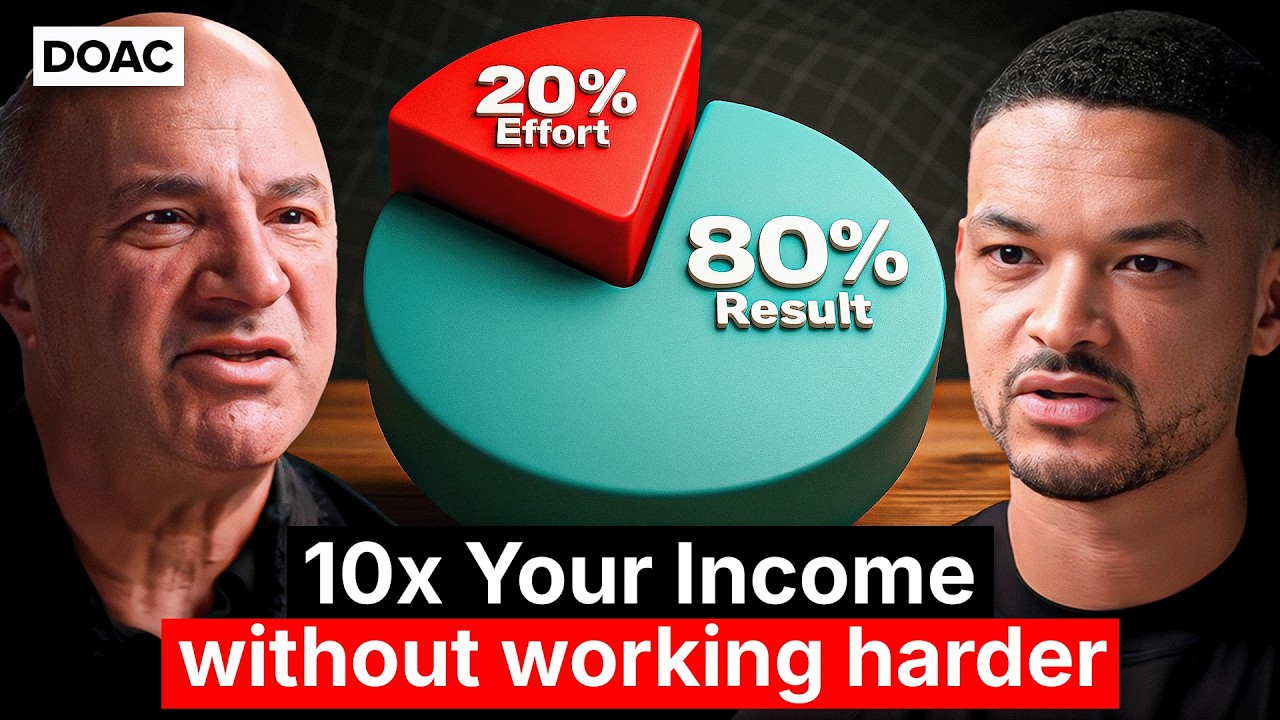
Through this intense dynamic, Kevin learned Jobs' core operating framework: the **signal-to-noise ratio**. In this framework, "signal" represents the critical 3 to 5 tasks that must be accomplished during the 18 hours an individual is awake on a given day. "Noise" encompasses every distraction, secondary goal, or non-essential interaction that prevents those core goals from being completed. Jobs operated at roughly an **80/20** signal-to-noise ratio, routinely sending emails at 2:30 AM expecting immediate execution.
```
STEVE JOBS' FRAMEWORK:
┌──────────────────────────────────────────────────────────┐
│ SIGNAL (80%) │
│ Top 3–5 critical tasks for the next 18 hours │
└──────────────────────────────────────────────────────────┘
┌────────────────────────────────────────┐
│ NOISE (20%) │
│ Distractions, extra input, market research, low priority │
└────────────────────────────────────────┘
```
Kevin notes that the only person he has witnessed operating with an even higher signal ratio is Elon Musk, whom he describes as maintaining nearly **100% signal** during his waking hours. While this extreme hyper-focus leads to incredible operational execution, Kevin notes it creates severe social awkwardness, as normal human interactions—spending casual time with family, listening to friends, doom-scrolling social media, or playing an instrument—are fundamentally categorized as "noise." He also references Jeff Bezos, who deliberately avoids making major decisions after 1:00 PM because he recognizes his personal signal-to-noise ratio degrades later in the day.
---
[12:27](https://www.youtube.com/watch?v=mpAZehPviLQ&t=747s) Balancing High-Stakes Chaos and Creative Outlets
Kevin contrasts the extreme, unyielding focus of figures like Jobs and Musk with how he personally manages his life and selects CEOs for his portfolio. While business operations require absolute adherence to binary outcomes (making money versus losing money), Kevin believes sustainable success requires balancing operational discipline with creative outlets like music, photography, painting, or watch collecting. He shares that on the night of the interview, he plans to meet late with a master watchmaker to design a "piece unique" timepiece—an artistic, two-year project that allows his mind to reset away from daily business friction.
He illustrates the extreme emotional volatility inherent in an entrepreneur's day-to-day life with an example from his own morning: within a single 30-minute span, he received a phone call informing him that one of his portfolio investments was going bankrupt (costing him $10 million), followed immediately by news that another company was going public, yielding a **450X** return on his investment once shares unlock in the fall.
- **Daily Focus System:** Kevin writes his top **3 to 5** critical daily targets on sticky notes stuck to his bathroom mirror every morning.
- **Emotional Management:** The key skill of a top executive is distinguishing whether an unexpected crisis or opportunity is actionable **signal** or irrelevant **noise**, and maintaining emotional stability through sudden swings between loss and euphoria.
[16:16](https://www.youtube.com/watch?v=mpAZehPviLQ&t=976s) Signal vs. Noise and the Reality of Startup Failure Rates
Addressing what separates successful leaders from the rest, Kevin O'Leary emphasizes that beyond prioritization, the defining trait of an effective founder is the sheer "force of execution" to get things done. Crucially, an entrepreneur must be able to filter signal from noise and aggressively shield their focus from distractions. Drawing a direct parallel between his long-standing role on *Shark Tank* in the United States and Steven Bartlett's position on *Dragon's Den* in the UK, O'Leary demystifies early-stage venture capital. When an investor puts $\$500,000$ or $\$1,000,000$ into a nascent startup, the harsh reality is that 6 to 8 out of 10 will inevitably fail, and no one can predict which ones will succeed at the outset.
O'Leary pulls no punches when criticizing young venture capital analysts who claim they can spot winners immediately. Calling them "so full of [___]," he highlights that these analysts lack actual operational experience in running a business and simply rely on portfolio diversification, hoping that 1 or 2 hit companies over a 5 to 7-year horizon will cover the losses of all their other mistakes. The serendipitous nature of entrepreneurial success is brutal, requiring strong execution skills and what he describes as business "karma."
- Most early-stage seed and Series A investments require 5 to 7 years before a true outcome or exit is known.
- A balanced VC strategy relies on broad portfolio diversification across sectors to hedge against the inherent 60% to 80% failure rate of early-stage startups.
[18:08](https://www.youtube.com/watch?v=mpAZehPviLQ&t=1088s) Why Female-Led Companies Outperform in Early-Stage Portfolios
Reflecting on decades of seed and Series A investments across all 11 sectors of the economy, O'Leary shares a striking observation: the vast majority of his top-performing portfolio companies 5 to 7 years post-investment are run by women. Despite operating independently in completely different industries without communicating with one another, these female CEOs consistently deliver superior long-term results due to two specific management traits.
First, female leaders set realistic, achievable target growth rates—typically aiming for around 15% to 16% annually, compared to male entrepreneurs who often target aggressive 30% growth rates. While men in his portfolio hit their targets roughly 65% of the time, female CEOs hit their targets over 90% of the time. This consistent achievement fosters team stability, keeps staff motivated, and significantly reduces attrition among key personnel like heads of finance or marketing during critical early growth phases.
- **Growth Target Realism:** Male founders tend to set 30%+ targets (hitting them ~65% of the time), whereas female founders set 15–16% targets (hitting them 90%+ of the time).
- **Employee Retention:** Lower turnover in executive roles directly correlates with meeting reasonable, steady growth goals rather than overpromising.
[19:08](https://www.youtube.com/watch?v=mpAZehPviLQ&t=1148s) The Power of Silence and Listening in High-Stakes Negotiations
The second major attribute O'Leary learned from his female executives is the practice of active listening over speaking. He recounts how one of his female CEOs bluntly challenged him a few years ago, saying, *"You know, Kevin, you talk too much. You talk two-thirds, you listen one-third. Why don't you try reversing the ratio?"* Accepting her advice, O'Leary discovered that remaining silent yields critical information that would otherwise remain hidden.
To illustrate, O'Leary shares a real-time example that occurred just minutes before arriving at the interview studio. Involved in a long, drawn-out litigation, he attended a settlement meeting where he deliberately sat across from the opposing party and remained completely silent, staring directly at them without speaking. After roughly 90 seconds of uncomfortable silence, the opposing party blurted out information they shouldn't have revealed, instantly exposing their settlement price and saving two hours of grueling negotiations.
> "There is something going on in silence... He showed his hand. So, we saved ourselves two hours, you know. It's an attribute that many people can't do because they can't stand the social uncomfort of it. I have no problem with it. I can sit here and look at you for 10 minutes—it wouldn't matter to me."
[21:28](https://www.youtube.com/watch?v=mpAZehPviLQ&t=1288s) Reading the Room: Evaluating Entrepreneurial Aura on *Shark Tank*
Reflecting on the hundreds of pitches he evaluates, O'Leary details his instinctive "spidey sense" for identifying winners before a single word is spoken. On the set of *Shark Tank*, when entrepreneurs walk down the hallway onto the carpet, the stage director (Eric) holds them in place for up to two minutes while the camera jibs zoom in for setup shots. Positioned just 12 feet away, O'Leary stares at the entrepreneurs without smiling, blinking, or frowning, assessing their posture, eye contact, and presence.
He estimates he can judge whether someone is a winner or a loser with 99% accuracy in those initial silent moments. Under the intense pressure of 20+ cameras and panel members representing over a billion dollars in capital, unprepared entrepreneurs crumble under the gaze, looking down or shifting uncomfortably. In contrast, successful founders project confidence through their eyes and posture, asserting their "aura" and demonstrating they are ready for battle.
- **The Pitch Test Structure:**
1. **The First 60–90 Seconds:** The entrepreneur must clearly articulate the big idea/product concept in simple terms.
2. **The Operator Fit:** They must prove why *they* are uniquely qualified to execute the business (industry expertise, past failures analyzed, domain authority).
3. **Knowing the Numbers:** The absolute dealbreaker; founders must know their unit economics cold.
[26:11](https://www.youtube.com/watch?v=mpAZehPviLQ&t=1571s) The Unforgivable Sin: Not Knowing Your Numbers
While great ideas are "a dime a dozen," the ultimate test of leadership and business viability comes down to financial literacy. O'Leary stresses that if a founder successfully projects confidence and explains their unique operational background but fails when asked about financial metrics, they lose all credibility. Entrepreneurs must immediately know their market size, growth rate, gross margins, competitive landscape, and exact break-even month.
O'Leary passionately argues that wasting a pitch opportunity without knowing basic business arithmetic is an insult to other hard-working entrepreneurs who deserved that platform. In his view, combining a commanding physical presence, an execution mindset, and complete command of financials represents the true definition of leadership.
> "If you get the first two right and you don't know your numbers, you deserve to burn in hell and I'll put you there myself... You should have brought somebody that understands the language of business because those three together are the definition of leadership right there."
[27:23](https://www.youtube.com/watch?v=mpAZehPviLQ&t=1643s) How to Build and Project Executive Aura
When asked whether this commanding business "aura" can be cultivated or taught, O'Leary asserts that it can be learned through deliberate self-awareness and practice. He advises entrepreneurs to look critically in the mirror and practice how they present themselves before stepping into high-stakes environments, such as pitching for a million-dollar line of credit. Dressing for success, maintaining unyielding eye contact, and projecting steady calm signal respect and competence to investors, bankers, and future employees alike.
- **Mirror Practice:** Analyze body language, eye contact, and facial expressions in advance.
- **Intentional Eye Contact:** Keeping eyes focused on the speaker signals that information is being absorbed and respected, setting the foundation for long-term professional relationships.
[29:08](https://www.youtube.com/watch?v=mpAZehPviLQ&t=1748s) Radical Meritocracy and the Contractor Hiring Framework
Addressing his executive hiring strategy, O'Leary reveals that his operating companies are staffed almost entirely by women, particularly Asian women, purely as a result of radical meritocracy. Dismissing rigid corporate DEI programs, he asserts that he evaluates candidates strictly on execution and performance, regardless of background, gender, or race.
To eliminate hiring risks and ensure culture fit, O'Leary never hires employees straight into full-time roles. Instead, candidates are initially brought on as independent contractors for a 4-to-6-month trial period at a significantly higher base rate (compensating for the lack of immediate stock options and benefits). This trial tests how well the candidate handles asynchronous, project-based work alongside global teams spanning London, Dubai, Abu Dhabi, and beyond.
- **Contractor Trial Model:** 4 to 6 months of contract work before offering full-time employment with benefits/equity.
- **Project-Based Work Culture:** Abandoning traditional 9-to-5 schedules in favor of strict deadline enforcement (e.g., tax filings delivered on time regardless of when or where the work is completed).
- **Swiss Apprenticeship Influence:** Inspired by the Swiss model (where companies like Nestlé or Pfizer take on 14-year-old apprentices out of high school), O'Leary uses short-term operational trials to evaluate candidate DNA before making long-term commitments.
[32:20](https://www.youtube.com/watch?v=mpAZehPviLQ&t=1940s) Out-of-Left-Field Winners: The Basepaws Story
Reflecting on his expansive investment portfolio from *Shark Tank*, O'Leary notes that predicting which company will yield a massive financial exit is notoriously difficult. He highlights the story of **Basepaws**—a feline DNA sequencing company founded by CEO Anna Skaya—which initially appeared bizarre to the panel.
Despite initially thinking the idea of a DNA test for cats was "a joke," O'Leary invested in the business. Basepaws went on to deliver a massive exit when it was acquired by Zoetis, proving that wildly successful business outcomes often emerge from unexpected categories led by exceptional female founders.
- **Company:** Basepaws (Cat DNA testing kit)
- **Founder:** Anna Skaya
- **Outcome:** Highly lucrative acquisition/exit despite initial skepticism from investors during the original pitch.
Here is a detailed, faithful walkthrough of this section of the interview:
[32:52](https://www.youtube.com/watch?v=mpAZehPviLQ&t=1972s) The Data Play in Business and Tesla's Hidden Value
Kevin O'Leary reflects on a massive startup exit from *Shark Tank* history—a cat DNA testing company that achieved the highest internal rate of return (IRR) in the show’s history within just 36 months. He notes that the enterprise was acquired for an extraordinary all-cash figure that required a strict non-disclosure agreement (NDA) between Sony and the acquiring pharmaceutical company. O'Leary explains that the buyer did not acquire the company for the DNA testing service itself, but rather for its massive, unique dataset on America's 110 million cats, collected rapidly during the pandemic. Armed with this dataset, the pharmaceutical company could leverage emerging AI to develop specialized animal feeds and medicines.
This leads O'Leary to draw a direct parallel to Tesla. When his son landed an internship at Tesla, he advised O'Leary to buy the stock, insisting, "It's not a car company, it's a data company." Though O'Leary initially dismissed it as too expensive, he eventually followed his son's advice, and Tesla went on to become his most successful investment. Over time, as the stock surged, he had to continually sell down his position to maintain a 5% portfolio allocation, bringing his cost basis down to zero.
- The cat DNA testing startup was acquired in under 36 months, generating the highest IRR in *Shark Tank* history under an NDA so strict O'Leary cannot state the nine-figure sum.
- America has an estimated 110 million cats, making the startup's pandemic-era pet data immensely valuable for AI-driven animal health products.
- O'Leary's son worked at Tesla for 5 years after convincing his father to invest by reframing it as a data company.
---
[34:21](https://www.youtube.com/watch?v=mpAZehPviLQ&t=2061s) Taking Entrepreneurial Risks in Your 20s and Surviving Failure
Steven Bartlett brings up the viewers who sit on their sofas dreaming about entrepreneurship, noting that many approach him in the street about starting a business. O'Leary bluntly states that two-thirds of them will never actually do it. He strongly urges aspiring founders to take the leap in their 20s before taking on heavy financial burdens like mortgages and families. He emphasizes that initial ventures are likely to fail—as his own have—but you only need a single major success to transform your life.
To illustrate the stark reality of corporate risk, O'Leary shares a candid story from earlier that very morning. While riding in a limousine with Bartlett’s assistant, O'Leary was on a conference call with fellow shareholders deciding the fate of a distressed portfolio company facing bankruptcy. He presented them with a binary choice: either let the company go under, or wipe out existing equity through a "cram-down round" at a fraction of a cent and inject millions to assume total ownership. O'Leary emphasizes that every CEO will face bad outcomes, but the ultimate key to survival is ensuring that no single failed business defines who you are. In contrast to that distressed deal, he mentions receiving another call that day about an impending IPO where his shareholders stand to make a 400x return.
> "Learn to live with the idea that you are going to fail. You are going to lose money by taking risk... Never put yourself in a situation where one bad outcome defines who you are."
---
[37:47](https://www.youtube.com/watch?v=mpAZehPviLQ&t=2267s) Steve Jobs, the Queen Bee Analogy, and U.S. Semiconductor Policy
O'Leary credits Steve Jobs with permanently altering his life, admitting that while Jobs was difficult and often unlikable, his sheer genius and execution were undeniable. Reflecting on Jobs and Steve Wozniak, O'Leary highlights how the two founders needed each other, using their dynamic to present an analogy regarding current U.S. semiconductor trade policy toward China and Russia.
He describes the computer chip or operating system as the "queen bee" and the global developer community as the "honeybees." Jobs understood that the ultimate key to market dominance was attracting every developer ("honeybee") to write software ("honey") exclusively for Apple's platform. O'Leary argues that Washington's current bans preventing companies like Nvidia, AMD, Intel, and Broadcom from selling AI chips to foreign adversaries is flawed policy. By locking American chips out of international markets, regulators create a vacuum that allows foreign competitors like Huawei to introduce their own "queen bee" chips, forcing global developer talent to build on alternative platforms. Instead, he believes the U.S. should keep foreign developers hooked on American firmware and hardware ecosystem standards.
- O'Leary criticizes restrictions on export chips like Nvidia's, arguing it encourages foreign markets to adopt local alternatives like Huawei.
- He emphasizes that software developers and AI engineers act as the "honeybees" that build value around the central hardware "queen bee."
- He shares that he frequently travels to Washington, D.C., to lobby policymakers on AI and technology strategies because his investment portfolio depends heavily on American software infrastructure.
---
[41:14](https://www.youtube.com/watch?v=mpAZehPviLQ&t=2474s) Advice for 21-Year-Old Founders and the Truth About Leadership
For a 21-year-old eager to embark on a decade-long entrepreneurial journey, O'Leary outlines a clear, non-negotiable step: work for 24 months as an apprentice in a sector you are passionate about, even if you have to work for free. Understanding the inner mechanics of an industry dramatically increases the odds of success when launching a startup later with initial friends-and-family capital.
Addressing the common misconception that leaders must be aggressive or cruel to emulate Steve Jobs, O'Leary dismisses the debate over "kind" versus "brash" leadership styles as superficial. He stresses that workplace teams are not social clubs or families, but groups assembled to execute specific mandates for customers. He warns heavily against workplace nepotism, noting that the most successful multi-generational private dynasties—such as Tetra Pak and IKEA—prohibit family members from running operations, keeping them on boards while hiring professional management.
> "The team you're building are not your friends. They are the team you're building to execute on a mandate. Your customers come first."
---
[46:02](https://www.youtube.com/watch?v=mpAZehPviLQ&t=2762s) Testing Talent, Embracing Eclectic Employees, and Personal Wealth
When asked about building exceptional teams, O'Leary reveals his biggest hiring mistake: bringing people on without road-testing them first. Resume credentials mean little until a candidate demonstrates they can make high-stakes decisions independently without constant managerial hand-holding. Furthermore, rather than hiring workaholics or "psychopaths," O'Leary actually prefers eclectic employees who pursue intense, unconventional personal passions outside of work—such as riding motorcycles or bicycles across the desert for days at a time. He finds that these creative, well-rounded individuals consistently outshine rigid, robotic workers.
Transitioning to personal finance, O'Leary reflects on how he learned the principles of wealth accumulation from his mother, Georgette, which later inspired him to build an index investment business. Seeing her photo on screen briefly moves O'Leary to tears. He recounts how his mother, a woman of Lebanese descent who worked in accounting for her father's business, insisted on absolute financial independence from men. Every week upon getting paid in cash, she automatically set aside 20% of her pay, split into two primary asset classes: large-cap dividend-paying stocks and long-term 7-year telecom bonds yielding 6.5% to 8%.
- O'Leary requires potential executives to be road-tested to ensure they can make autonomous decisions within budget parameters (e.g., up to $1,000,000).
- He prefers hiring creative, eclectic thinkers over single-minded workaholics because they offer fresh, out-of-the-box solutions.
- O'Leary's mother, Georgette, saved 20% of every paycheck throughout her life, allocating it specifically to dividend-paying stocks and high-yielding telecom bonds.
Here is a faithful walkthrough of the transcript segment.
---
[50:43](https://www.youtube.com/watch?v=mpAZehPviLQ&t=3043s) Georgette's 55-Year Investment Blueprint and Portfolio Rules
Kevin O'Leary reflects on the extraordinary financial legacy left by his mother, Georgette. She held her investment portfolio for 55 years, keeping her accounts entirely secret from both of her husbands to maintain complete financial independence. Georgette followed two simple, unyielding rules: **never allocate more than 5% of her portfolio to any single stock or bond**, and **never put more than 20% into any single sector**. Whenever a stock appreciated beyond 5%, she disciplined herself to sell it down. O'Leary stresses that this was not sheer financial genius, but strict, systematic diversification. Over more than five decades, she never touched the principal—only spending the dividends and interest—which paid for Kevin and his brother to go to college and provided a safety net for relatives during hard times.
When Georgette passed away, O'Leary—acting as the executor—was called down to the lawyer's office. Expecting modest middle-class assets, he was stunned by the size and performance of the portfolio, which had outperformed top hedge funds over its 55-year life. Upon seeing those results, O'Leary adopted her exact strategy for the rest of his career. He adheres to the 5% individual stock limit and the 20% sector cap across his liquid holdings. The only exception he makes is real estate, which comprises approximately one-third of his net worth. He warns that when investors make massive bets—putting half their wealth into a single stock or sector because they believe they are right—they inevitably end up getting wiped out.
- **Georgette’s Portfolio Structure:** Contained roughly 28 "boring" large-cap names and rudimentary dividend-paying mutual funds.
- **Sector Allocation:** Built during an era when the market had only 10 recognized sectors (prior to real estate becoming an official 11th sector).
- **Core Principle:** Never spend principal; live strictly off generated dividends and interest.
[53:27](https://www.youtube.com/watch?v=mpAZehPviLQ&t=3207s) The 90-Day Financial Gut Check and The $28 Lunch Habit
O'Leary shares a story about a multi-billionaire woman who reached out to him during her divorce. overwhelmed by financial advisors competing for her business after separating from her husband, she asked O'Leary to manage her money. He declined, but offered a simple piece of advice: sit down with a blank sheet of paper—no computers, no spreadsheets—and list every dollar spent over the last 90 days alongside all income generated from her assets (stocks, bonds, land, gold). When they completed the exercise, she was shocked to discover she was bleeding hundreds of thousands of dollars a week and losing millions per quarter on unnecessary purchases. O'Leary emphasizes that regardless of whether someone is a billionaire or earns an average salary of $56,000 to $68,000 a year, they must never outspend their income over a 30- or 60-day cycle.
Translating this rule to young professionals, O'Leary expresses intense frustration with 20-somethings making $70,000 a year who spend $28 on daily lunches. He advises looking at that $28 through the lens of compound growth—invested in an index fund earning 8% to 10% annually over 50 years, those small expenditures compound into massive wealth. He suggests young adults conduct a simple audit: walk into their closet and look at their clothes. Most people regularly wear only 20% of their wardrobe while wasting money on the remaining 80%. Recalling his mother's approach, he notes she only bought two high-end, handmade Chanel jackets per year. Because of their classic design and quality, those vintage 1950s jackets maintained and increased their value over decades, eventually triggering a chaotic "cat fight" among the family's women over who would inherit them when she died.
- **The Beanstocks App:** An app O'Leary built that automatically sweeps 15% of a user's salary into two buckets (S&P 500 index ETFs and fixed-income bonds).
- **The Power of 15% Saving:** A 25-year-old earning $70,000 who consistently invests 15% into an S&P 500 index fund will accumulate over $1.5 million by age 65.
- **Custom S&P Index:** O'Leary created a custom version of the S&P 500 index that strips out companies with poor balance sheets.
[58:50](https://www.youtube.com/watch?v=mpAZehPviLQ&t=3530s) Luxury Goods, Dividend Stocks, and Alternative Assets
The conversation turns to luxury assets and watches, as host Steven Bartlett notices O'Leary wearing a watch on each wrist. O'Leary explains that every timepiece in his extensive collection marks a significant milestone in his life—a closed deal, the birth of a child, or a graduation. He keeps the exact size of his collection private due to insurance constraints, but notes that fine watches function as strong alternative assets. Some pieces he bought for $200,000 are worth over $1 million today.
O'Leary outlines his core approach to equities, emphasizing his strong preference for dividend-paying stocks. A dividend represents a mature, profitable company sharing its operational success directly with shareholders. While tech stocks historically avoided paying dividends, major tech behemoths now offer them to satisfy an aging global demographic demanding income. Outside of traditional stocks and fixed income, O'Leary holds alternative assets, including gold, luxury watches, and cryptocurrency.
- **Dividend Sectors:** Dividend payers have expanded beyond traditional utilities into almost every market sector, including mega-cap tech.
- **Alternative Investments:** Combined holdings in physical gold, luxury watches, and digital assets.
[01:00:26](https://www.youtube.com/watch?v=mpAZehPviLQ&t=3626s) The Evolution of Crypto: Stablecoins, Bitcoin, and Portfolio Allocation
O'Leary clarifies his stance on cryptocurrency, distinguishing between speculative tokens and utility-driven digital payment systems. He highlights the "Genius Act" (the Stablecoin Act), a bill he worked on two years prior that recently cleared the Senate. He uses a practical example: buying a timepiece from master watchmaker Simon Birch. Traditionally, transferring $100,000 USD to Swiss francs involves cumbersome "Know Your Customer" (KYC) friction, takes a full week, and costs roughly 200 basis points in fees. Using USDC—a stablecoin backed by US dollar Treasury bills—the transaction completes in under a second for a fraction of a cent.
While O'Leary views Bitcoin as "digital gold" subject to high volatility, he views the broader crypto ecosystem as an infrastructure layer destined to become the 12th sector of the S&P 500 by providing productivity gains to all other 11 sectors. His investment strategy focuses on infrastructure, exchanges, and regulated entities. He reflects on surviving the volatile era of "crypto cowboys," noting that he testified before the US Senate and House while many early bad actors ended up in prison.
- **Total Crypto Allocation:** O'Leary’s portfolio maintains a 19.1% overall crypto allocation (marked-to-market), kept strictly below his 20% sector limit.
- **Holdings Breakdown:** Includes spot Bitcoin, USDC, and equity in infrastructure companies and exchanges like Circle and WonderFi (which was acquired by Robinhood).
- **Yield on USDC:** Holding USDC in designated accounts currently yields around 4.1% interest.
[01:03:32](https://www.youtube.com/watch?v=mpAZehPviLQ&t=3812s) Real Estate and The One-Third Mortgage Rule
Addressing the common belief that buying a house is the primary path to building wealth, O'Leary outlines a strict rule inherited from his mother: **housing costs—including the mortgage, taxes, and maintenance—must never exceed one-third (33%) of your total income**. Exceeding that threshold means buying "too much house." He warns that many buyers fell into a trap when interest rates were ultra-low (under 4% or 3.2%), purchasing massive homes they can no longer afford. As those homeowners face refinancing at interest rates above 7%, housing costs spike to 60%, 70%, or 80% of their income, creating severe financial strain.
O'Leary advises younger buyers to start small—perhaps with a 1,900-square-foot home in an entry-level neighborhood or a property where a portion can be rented out. The objective is to build equity and learn property management without suffocating the ability to invest elsewhere. A house is only an asset to the extent of its equity; heavy debt burdens negate its value. His overarching goal for any investor is to enter their 40s actively eliminating mortgage debt while maintaining a diversified investment portfolio that compounds steadily toward retirement.
- **Primary Asset Myth:** A home is only a true asset if the equity heavily outweighs the debt attached to it.
- **Refinancing Trap:** Homeowners who bought large homes during the low-rate era face major disruption as mortgages roll over at 7%+ rates.
- **Long-Term Target:** Strive to be completely mortgage-free in your 40s.
---
<ElicitationsGroup message="Where would you like to go next with Kevin O'Leary's insights?">
<Elicitation label="Summarize Kevin's rules on divorce and love languages of money" query="Summarize Kevin O'Leary's rules on how money impacts relationships, divorce, and the love languages of money."/>
<Elicitation label="Break down Kevin's views on AI, Apple, and Steve Jobs" query="Break down Kevin O'Leary's thoughts on AI, Steve Jobs, and whether Apple is dying."/>
</ElicitationsGroup>
Here is a detailed, faithful walkthrough of the provided transcript segment:
[01:06:00](https://www.youtube.com/watch?v=mpAZehPviLQ&t=3960s) Rethinking Homeownership and the Power of Financial Discipline
Kevin O'Leary breaks down the common trap of rushing to buy a home with a small down payment. If someone puts down 10% on a house using a 90% mortgage, they only truly own that 10% equity at market value, and housing markets can stay flat for long periods. When asked if a single 25-year-old earning $70,000 whose goal is to make money should buy a house, O'Leary gives an emphatic no. He argues that buying a home makes sense primarily when getting married and starting a family. Renting properties out as income investments—such as managing student housing portfolios—is a separate business model altogether that requires focused execution. For a single person looking to build wealth, O'Leary advises putting money into a diversified investment portfolio first to build a solid nest egg.
O'Leary emphasizes that true wealth creation boils down to a single word: **discipline**. It is the ability to resist impulsive purchases and keep capital working for you. He notes that financially independent people, even lifelong employees, achieved their status by having the discipline to say no to unnecessary clutter. Addressing his own reputation for luxury, O'Leary clarifies that no one should ever go into debt for a watch. To model this for younger audiences, he frequently wears watches priced under $500—such as a $265 Timex—to demonstrate that getting into horology does not require spending $50,000.
- Purchasing a house with 10% down leaves the buyer only owning that fraction of the equity, exposing them to market stagnation.
- Real estate as an active business (e.g., student housing portfolios) works well for dedicated operators, but differs from buying a primary residence.
- Wealth creation hinges on the single core principle of **discipline**—choosing to keep money working rather than spending it on items not needed.
- O'Leary cautions against taking on debt for luxury items, highlighting accessible timepieces like a $265 Timex.
---
[01:08:40](https://www.youtube.com/watch?v=mpAZehPviLQ&t=4120s) The Harsh Reality of Relationships and Entrepreneurship
When asked how much a life partner impacts financial success, O'Leary declares, "It's everything." For an entrepreneur striving to scale a business, finding a partner who understands the reality of the grind is non-negotiable. He dismisses the concept of work-life balance as total nonsense, explaining that competing globally requires working tirelessly. A spouse in an entrepreneurial household must tolerate long absences and shoulder raising the family during those intense early building years.
O'Leary gets candid about the realities of marriage, stating that "marriage is a business" and that "the first child you're going to have is money." He stresses that money sits at the family table every single day; without basic financial stability, marriages struggle to survive. Reflecting on his own long-term marriage, he shares that although he and his wife were separated for a couple of years, family values brought them back together. Because they started with nothing, they make major financial decisions together with mutual respect. He acknowledges that while his wife spent more time reading stories to their children while they were young—a trade-off he acknowledges missing—his role was to provide, and their kids have since successfully launched into their own careers without relying on unearned inheritance.
- Work-life balance in early-stage global competition is unrealistically framed; success requires extreme dedication.
- Marriage functions fundamentally as an economic union where financial stability serves as a foundational element.
- Spouses must communicate openly and make major material financial decisions together.
- Parental success involves guiding children to launch their own independent careers without relying on financial entitlement or massive gifts.
---
[01:11:32](https://www.youtube.com/watch?v=mpAZehPviLQ&t=4292s) The Financial Impact of Divorce and Premarital Due Diligence
O'Leary explains why choosing a spouse is the single most important financial decision a person will ever make. Divorces cause a massive, geometric destruction of wealth. Beyond splitting assets with an ex-spouse, liquidating holdings to separate assets often triggers substantial capital gains taxes owed to the government, potentially wiping out up to two-thirds of a person's accumulated wealth. He quips that if someone finds themselves getting married for a third time, "It's not them. It's you," advising serial divorcees to simply date rather than entering into legally binding economic unions. If a person is happy 51% of the time in their marriage, they should stay.
Drawing on research from top divorce attorneys in New York and Boston while writing his book *Cold Hard Truth: On Family, Kids and Money*, O'Leary uncovered a surprising reality: most divorces are not caused by infidelity, which many couples survive, but by financial stress. People fall in love during a euphoric honeymoon period without conducting any due diligence on their partner's spending history, credit debts, or family financial background. Friction begins when one partner consistently outspends their means, accumulating high-interest credit card debt (e.g., $100,000 at 23% interest) to keep up with the Joneses. To prevent this, O'Leary highlights his investment in HelloPrenup, a platform that normalizes prenuptial agreements to force upfront financial transparency and disclosure before marriage.
- Divorce liquidations frequently forfeit up to two-thirds of built-up wealth between asset splitting and capital gains taxes.
- Top divorce attorneys confirm that financial stress—not infidelity—is the primary driver behind broken marriages.
- Unchecked spending habits, like carrying $100,000 in credit card debt at 23% interest, create destructive friction in relationships.
- Prenuptial agreements act as a necessary due diligence mechanism to reveal financial histories during the early, euphoric stages of a relationship.
---
[01:15:56](https://www.youtube.com/watch?v=mpAZehPviLQ&t=4556s) The 5 Financial Personality Types and the Third-Date Rule
Reviewing O'Leary's framework for how different personalities handle money, the conversation details five distinct financial archetypes to watch out for when dating:
1. **The Mooch:** Refuses to pay for anything and relies entirely on others for financial support.
2. **The Spendaholic:** Insists on paying for everything to project status, driven by insecurity disguised as cash spending.
3. **The Loafer:** Completely lacks ambition or financial drive; O'Leary advises avoiding them "with extreme prejudice."
4. **The Thief:** Steals or acts dishonestly, which warrants zero tolerance.
5. **The Meanie:** A disciplined, balanced spender who lives comfortably within their means.
O'Leary urges people to "marry a meanie," as shared financial discipline is what builds lifelong marriages. He recommends bringing up financial goals as early as the **third date**. By the third date, mutual romantic interest is established, making it the ideal time to ask about long-term ambitions and financial values. Framed correctly, inquiring about a partner's financial mindset isn't an interrogation—it's essential exploration for a potential life partnership.
- Financial compatibility hinges on recognizing harmful behavior patterns early in dating.
- The ideal life partner is a "meanie"—someone who lives within their means and respects capital discipline.
- Open conversations about long-term goals and money values should occur by the third date to evaluate genuine alignment.
The host breaks to highlight two primary show sponsors:
- **GoodNotes:** A dynamic note-taking application on iOS and Mac used by the host to store episode research and take real-time notes during interviews. The app features **Ask GoodNotes**, an AI companion capable of instantly searching through hundreds of pages of handwritten or typed notes. The host offers a 30-day free trial at `[goodnotes.com/doac](https://goodnotes.com/doac)` or an annual subscription for $9.99 per year.
- **JustWorks:** An HR and administrative platform designed for early-stage founders and growing businesses. It automates payroll, manages health insurance benefits, provides 24/7 human HR support, and scales with companies as they expand nationally or internationally.
[01:20:30](https://www.youtube.com/watch?v=mpAZehPviLQ&t=4830s) Practical AI Applications and Economic Disruption
Artificial intelligence has entered the room, fundamentally altering the equations of money, investing, and business building. When host Steven Bartlett asks how someone starting out or working in a white-collar profession like law should view this moment, Kevin O'Leary declares that AI is "immense" and "bigger than the internet." To ground the massive topic, O'Leary shares real-world use cases from his own portfolio. In a post-pandemic economy, direct-to-consumer strategies have surged, yielding massive amounts of granular customer data. O'Leary points to his wine business—a Shark Tank company that partners with QVC and sells over three million bottles annually. Previously, understanding regional consumer taste preferences across thousands of retail channels required months and upwards of $1,000,000 in market research. Using an AI tool, O'Leary's team discovered for just $18,000 that the top varietal among women aged 44 to 64 in Southern Florida was sweet Moscato—a wine O'Leary personally hates ("I think it tastes like [ __ ] I don't care what I think"). Armed with this data six months in advance, they allocated capital expenditure and inventory precisely, eliminating excess stock and financial risk for the summer.
```
TRADITIONAL RESEARCH vs. AI DATA ANALYTICS
┌───────────────────────────────┬──────────────────────────────────────────┐
│ Traditional Market Research │ AI Data Analytics (Direct-to-Consumer) │
├───────────────────────────────┼──────────────────────────────────────────┤
│ Cost: ~$1,000,000 │ Cost: ~$18,000 │
│ Timeline: Months │ Timeline: Near Real-Time │
│ Output: Lagging trends │ Output: Predictive demand forecasting │
└───────────────────────────────┴──────────────────────────────────────────┘
```
O'Leary details a second example involving media production. Typically, shooting a high-end commercial in Los Angeles with a green screen and post-production editing costs upwards of $250,000 to $400,000. Recently, O'Leary flew to Dubai to shoot in a studio equipped with a 6K digital wall where AI synced his script dynamically to the background. The entire shoot was completed in four hours with zero post-production needed. What truly freaked him out was that the production team subsequently generated an entirely new commercial without him present using an AI avatar ("Kevin Agent") for a mere $9,000. When he wanted adjustments, the AI modified the footage instantly and offered automatic translations into Spanish, Japanese, or Arabic.
- **Direct-to-Consumer Shift:** Before the pandemic, typical direct-to-consumer sales averaged 27%; post-pandemic figures hover near 50%, providing companies with direct data streams.
- **Wine Sales Volume:** O'Leary's wine enterprise sells over 3,000,000 bottles per year.
- **Cost Efficiency:** AI-driven consumer insight research dropped market analysis costs from $1,000,000 down to $18,000.
- **Commercial Production Savings:** Producing a traditional video ad package costs $250,000–$400,000; an AI-generated avatar ad cost $9,000.
- **Multi-Platform Validation:** O'Leary's team cross-checks AI insights across multiple competing platforms (ChatGPT, Claude, etc.) to analyze variances before acting on data.
---
[01:26:20](https://www.youtube.com/watch?v=mpAZehPviLQ&t=5180s) The Geopolitics of AI, Chips, and National Defense
Behind all these AI breakthroughs is hardware infrastructure, specifically high-performance graphics processing units. O'Leary emphasizes that the video wall and AI rendering platforms rely entirely on Nvidia chips rather than foreign alternatives. He describes the brilliant mathematicians and engineers running these technical setups as essential "honeybees." O'Leary cautions that democratic nations must maintain control over this foundational technology, stressing that the AI race is fundamentally a defense and geopolitical issue rather than just a commercial tool.
```
THE GEOPOLITICAL AI RACE
┌──────────────────────────────────────────────────────────────────────────┐
│ CHIP LEADERSHIP │
│ (e.g., Nvidia GPUs) │
└────────────────────────────────────┬─────────────────────────────────────┘
│
▼
┌──────────────────────────────────────────────────────────────────────────┐
│ DATA CENTER INFRASTRUCTURE │
│ (Engineered by high-level talent) │
└────────────────────────────────────┬─────────────────────────────────────┘
│
▼
┌──────────────────────────────────────────────────────────────────────────┐
│ NATIONAL DEFENSE │
│ (Next-gen warfare: AI, autonomous drones, robotics) │
└──────────────────────────────────────────────────────────────────────────┘
```
When addressing public anxiety surrounding job loss in white-collar professions—such as accounting, legal work, and media editing—O'Leary advises everyone to "chillax," framing AI as an evolutionary tool. He draws a historical parallel to the advent of television, which critics predicted would kill radio, yet radio remains a massive industry today. However, his main area of grave concern is warfare. Future military conflicts will be decided by whichever country possesses the most advanced chip technology, data centers, and AI systems powering autonomous drones and robotics. In his dialogues with U.S. Senators, O'Leary uses his "honeybee analogy" to argue that the world will ultimately divide into two digital spheres: one powered by Western democratic AI ("our honey") and one powered by authoritarian state AI ("Chinese honey").
- **National Security Anchor:** O'Leary views chip dominance and data center infrastructure as vital national security imperatives rather than purely economic assets.
- **Historical Analogy:** Compares AI fear-mongering to early predictions that television would eliminate radio.
- **The Superpower Split:** Asserts that global AI leadership will be a binary contest between the United States and China.
---
[01:28:36](https://www.youtube.com/watch?v=mpAZehPviLQ&t=5316s) Apple, Steve Jobs, and the Power of Ecosystems
When Bartlett questions whether Apple is a dying company due to perceived slowdowns in innovation, O'Leary rejects the notion completely. He traces Apple's enduring power back to the core philosophy imparted by Steve Jobs: "They don't know what they want until I tell them." O'Leary recalls challenging Jobs directly in meetings, asking him how he could possibly know what consumers wanted before they did, to which Jobs replied, "Show me where I'm wrong." O'Leary admits he never could.
```
APPLE'S BRAND FLYWHEEL
┌──────────────────────────────────────────────────────────────────────────┐
│ COMMODITY HARDWARE COMPETITOR │
│ • Equivalent raw processing power (~$330) │
└────────────────────────────────────┬─────────────────────────────────────┘
│
│ Lacks Ecosystem
▼
┌──────────────────────────────────────────────────────────────────────────┐
│ THE APPLE ECOSYSTEM (~$1,800) │
│ • Unified OS across hardware • Cross-device messaging sync │
│ • Integrated AppleCare support • High-friction platform retention │
└──────────────────────────────────────────────────────────────────────────┘
```
O'Leary explains that Apple's true strength lies not in raw hardware specs, but in its ecosystem and brand moat. A consumer can purchase a third-party laptop with equivalent raw processing power for $330, yet millions willingly spend $1,800 on a MacBook. They do so because they are buying into the seamless ecosystem—where the operating system, messaging, files, and AppleCare integrate across all devices. Apple often allows competitors to pioneer new market categories, only to enter later and dominate through superior integration and brand loyalty. Recalling the early days of the iPhone, O'Leary remembers telling Jobs that he was out of his mind to think people would run business software on a small phone screen; Jobs simply told him to rewrite all his company's software vertically.
- **Hardware Price Disparity:** $330 baseline PC laptop vs. $1,800 Apple MacBook with comparable core compute power.
- **Foundational Insights:** Jobs incorporated natural aesthetics, Japanese scripture, and typography (such as the original scalable Mac fonts) to make technology feel intuitive and human.
- **Academic Context:** O'Leary shares these real-world lessons during his lectures at Harvard Business School, where roughly one-third of the student body consists of international students.
---
[01:33:23](https://www.youtube.com/watch?v=mpAZehPviLQ&t=5603s) Visionary Leadership: Steve Jobs and Elon Musk
O'Leary draws a direct line between Steve Jobs and Elon Musk, classifying both as generational visionaries who redefine entire industries—whether through SpaceX, Tesla, Neuralink, or Starlink. He notes that Musk operates on "100% signal," filtering out non-essential noise to focus entirely on first-principles execution. O'Leary argues that figures like Musk and Jobs are rare national treasures whose contributions to societal advancement and global competitiveness far outweigh personal political opinions or personality quirks.
Reflecting on his personal interactions with Jobs during board meetings alongside venture capitalist Heidi Roizen in Cupertino, O'Leary speaks with visible emotion. He admits that working with Jobs was intense; Jobs was constantly demanding, never seemed happy, and was always "barking" orders. Yet, O'Leary felt a profound respect for him because Jobs's vision was consistently proven right over time.
- **Cross-Industry Impact:** Musk's initiatives span electric vehicles (Tesla), space exploration (SpaceX), brain-computer interfaces (Neuralink), and satellite communications (Starlink).
- **Executive Dynamics:** O'Leary recalls negotiating tens of millions of dollars (e.g., an $18,000,000 software contract) in high-stakes meetings with Jobs at Apple headquarters in Cupertino.
> "He used to say to my team over and over again... 'They don't know what they want until I tell them.' And I always [said], 'Steve, how the [ __ ] do you know that?'... He said, 'Show me where I'm wrong.'... It hasn't happened yet, Steve." — **Kevin O'Leary**
Here is the detailed walkthrough of this portion of the transcript:
[01:36:00](https://www.youtube.com/watch?v=mpAZehPviLQ&t=5760s) Lessons from Steve Jobs: Uncompromising Standards vs. "Noise"
Kevin O'Leary wraps up an intense story illustrating Steve Jobs's volatile, unyielding nature during corporate negotiations. O'Leary recounts how Jobs reduced one of his top product managers—who ran massive, multi-million-dollar software franchises like *The Oregon Trail* across 110,000 American schools—to tears simply because she wanted to conduct market research. Jobs rejected the idea outright, insisting that they would do exclusively what he dictated. After ejecting O'Leary's team from the meeting, Jobs hung out of an old-fashioned four-inch hotel window slot to continue yelling down at them while they loaded their Hertz rental car to drive back to San Francisco. Shortly after, Apple executive Heidi Roizen called O'Leary's brick mobile phone to report, "Okay, he'll do it for $12 million." When O'Leary asked why they had to endure such abuse, Roizen simply replied, "Why is the sky blue? Just get back on the plane and go do it."
Reflecting on the exchange, O'Leary compares Jobs to a brilliant hit-song producer: even if an artist hates working with a crazy producer, they tolerate it because the producer delivers hits. When asked if Jobs could have simply been nice, O'Leary responds that being "nice" was completely absent from Jobs's DNA; Jobs viewed social niceties as pure "noise" that distracted from the mission. Despite the harshness, O'Leary stresses that his limited time with Jobs left an indelible mark on his career. To this day, whenever faced with a critical business decision, he asks himself, *"What would Steve do?"*—a ghost that he believes still haunts the executive suites at Apple.
- **Key Figure Mentioned:** Heidi Roizen (Apple executive who brokered the deal).
- **Software Franchise:** *The Oregon Trail* (deployed across 110,000 U.S. schools).
- **Financial Terms:** Deal closed at $12 million following the contentious meeting.
- **Key Philosophy:** "Being nice is noise"—Jobs's total disregard for consensus or feelings in pursuit of excellence.
---
[01:39:06](https://www.youtube.com/watch?v=mpAZehPviLQ&t=5946s) Happiness, Aging, and the Driven Mindset
Moving to personal reflection, host Steven Bartlett asks O'Leary if he is truly happy. O'Leary shares that he grows happier as he gets older because he has reached a state of deep comfort and autonomy. He recalls the turmoil of his 30s, when he struggled to figure out his identity while managing dyslexia—a condition he now views as a superpower rather than an affliction. Today, O'Leary measures his happiness by a simple metric: he does not spend a single moment of his day doing things he doesn't want to do, simply because he has the freedom to say no. Even agreeing to a two-hour interview stems entirely from a genuine desire to be there.
When Steven notes that O'Leary's wife often questions why he continues flying 300 hours a year and visiting up to five cities in a single day when they do not need more money, O'Leary explains that he is fueled by pure passion. He rejects the idea of being "dragged" by success, asserting that real achievement requires relentless drive. Nothing excites him more than being told something is impossible. He highlights his recent venture into watch insurance—a sector critics claimed he could never launch due to state-by-state compliance and international regulatory hurdles—as proof that tackling impossible challenges is what keeps him energized.
- **Dyslexia:** Reframed from a childhood affliction into an entrepreneurial "superpower."
- **Travel Schedule:** Logs over 300 flight hours per year, occasionally visiting up to 5 cities in a single day.
- **Current Venture Example:** Launching a global watch insurance company despite compliance hurdles in the U.S., U.K., and Middle East.
---
[01:42:41](https://www.youtube.com/watch?v=mpAZehPviLQ&t=6161s) Protecting Your Brand and the Cost of Inauthenticity
Directing his focus to Steven Bartlett, the 32-year-old host, O'Leary offers a crucial piece of advice: an entrepreneur's or creator's real value lies in the audience that trusts them. He warns that as influence grows, countless companies will offer massive paychecks to leverage that network. However, accepting a deal for a product one does not personally use or believe in is fatal. The moment an audience senses inauthenticity, the entire brand collapses. O'Leary shares his own rule: he only backs, promotes, or invests in products that he personally uses and owns equity in—down to the wines he crafts with his wife and drinks at his own family table.
Steven strongly validates this principle, revealing that he recently walked away from a £6 million ($8 million) sponsorship renewal for his podcast because his lifestyle had evolved away from the product, and he was preparing to invest in its direct opposite. He also mentions turning down a $4 million offer from a foreign government to promote their nation. O'Leary commends Steven's discipline, noting that turning down millions to protect trust is rare for someone in their 30s, but essential for long-term survival. O'Leary adds that young leaders should prioritize longevity—focusing heavily on diet, exercise, and sleep early on—to sustain a career that could span decades.
- **Sponsorship Refusal:** Steven Bartlett turned down a £6 million (~$8 million) offer to renew a podcast sponsor that no longer aligned with his personal habits.
- **Government Offer:** Turned down $4 million from a foreign government to preserve authenticity.
- **O'Leary's Personal Rule:** Only endorse/promote brands where he is a user, shareholder, and true believer.
- **Longevity Focus:** Urges entrepreneurs in their 30s to invest in health, sleep, and nutrition to support long-term performance.
---
[01:47:37](https://www.youtube.com/watch?v=mpAZehPviLQ&t=6457s) Defining Happiness and Filtering the Noise
Closing out the podcast, Steven reads a traditional final question left by the previous anonymous guest: *"Where do you believe happiness really comes from?"* O'Leary answers without hesitation: happiness comes from consistently achieving your goals. He emphasizes that happiness is never a static destination; it is an ongoing journey. Setting goals—whether eliminating noise or executing long-term business strategy—and systematically hitting them brings fulfillment, while failing to achieve them leads to unhappiness.
The conversation loops back to O'Leary's core philosophy of radical prioritization and gut instinct. Steven admits to struggling with deciding which opportunities deserve his 18-hour workdays when so many lucrative offers flood in. O'Leary advises relying on an intuitive "gut check." He shares a story from just days prior, where a party offered him a massive sum of money—and subsequently a 2.5% equity stake in their company—to back a project. Because the project felt complex, distracting, and unaligned with his values, O'Leary turned it down as "noise." He warns that taking the wrong deal for short-term payout can permanently taint a brand and block life-changing opportunities in the future.
> "Happiness is not a destination, it's a journey. That's what it is... Consistently achieving those goals, you will be happy."
> "It's never about the money. Never... You're the captain of your brand. You have to define yourself right through the journey."
The Principle of Integrity and the Five Million Dollar Nest Egg
Steven Bartlett presses on the idea that at a certain level of success, financial compensation should no longer dictate one's choices, emphasizing that if your gut says no, no amount of money should sway you, especially given what Kevin O'Leary has already achieved. Kevin agrees, noting that you no longer need to buy a guarantee because you have already secured your position, assuming you have managed to put some away. He breaks it down simply, stating that having five million dollars in the bank allows you to do whatever you want. While some might think he would always want more, he affirms that five million is enough under certain conditions and shares his personal financial rule: "Always have an account that just sits there with five million bucks in it in T-bills." He explains that he never touches this particular account, as it serves as his ultimate foundational nest egg. The conversation concludes warmly as Steven expresses his gratitude, and Kevin replies in kind before the interview wraps up.
By the way, to unlock the full functionality of all Apps, enable [Gemini Apps Activity](https://myactivity.google.com/product/gemini).
## Notable quotes
> [07:23](https://www.youtube.com/watch?v=mpAZehPviLQ&t=443s) Steve, you sound like such an [__]. You have no idea what that sounds like. — Kevin O'Leary
> [07:23](https://www.youtube.com/watch?v=mpAZehPviLQ&t=443s) No, no. That's how it is, Kevin. Now, are you making money with me?... Then [__] shut up and do what I say. — Steve Jobs
> [19:08](https://www.youtube.com/watch?v=mpAZehPviLQ&t=1148s) There is something going on in silence... He showed his hand. So, we saved ourselves two hours, you know. It's an attribute that many people can't do because they can't stand the social uncomfort of it. I have no problem with it. I can sit here and look at you for 10 minutes—it wouldn't matter to me. — Kevin O'Leary
> [26:11](https://www.youtube.com/watch?v=mpAZehPviLQ&t=1571s) If you get the first two right and you don't know your numbers, you deserve to burn in hell and I'll put you there myself... You should have brought somebody that understands the language of business because those three together are the definition of leadership right there. — Kevin O'Leary
> [34:21](https://www.youtube.com/watch?v=mpAZehPviLQ&t=2061s) Learn to live with the idea that you are going to fail. You are going to lose money by taking risk... Never put yourself in a situation where one bad outcome defines who you are. — Kevin O'Leary
> [41:14](https://www.youtube.com/watch?v=mpAZehPviLQ&t=2474s) The team you're building are not your friends. They are the team you're building to execute on a mandate. Your customers come first. — Kevin O'Leary
> [01:28:36](https://www.youtube.com/watch?v=mpAZehPviLQ&t=5316s) They don't know what they want until I tell them. — Steve Jobs
> [01:28:36](https://www.youtube.com/watch?v=mpAZehPviLQ&t=5316s) Show me where I'm wrong. — Steve Jobs
> [01:36:00](https://www.youtube.com/watch?v=mpAZehPviLQ&t=5760s) Why is the sky blue? Just get back on the plane and go do it. — Heidi Roizen
> [01:47:37](https://www.youtube.com/watch?v=mpAZehPviLQ&t=6457s) Happiness is not a destination, it's a journey. That's what it is... Consistently achieving those goals, you will be happy. — Kevin O'Leary
> [01:47:37](https://www.youtube.com/watch?v=mpAZehPviLQ&t=6457s) It's never about the money. Never... You're the captain of your brand. You have to define yourself right through the journey. — Kevin O'Leary
> Always have an account that just sits there with five million bucks in it in T-bills. — Kevin O'Leary
## Mentioned
Kevin O'Leary, Steven Bartlett, Steve Jobs, Heidi Roizen, Elon Musk, Jeff Bezos, Anna Skaya, Georgette O'Leary, Steve Wozniak, Simon Birch, The Oregon Trail, Basepaws, Tesla, Sony, Zoetis, Nvidia, AMD, Intel, Broadcom, Huawei, Tetra Pak, IKEA, Nestlé, Pfizer, Shark Tank, Dragon's Den, Harvard Business School, Apple, Circle, WonderFi, Robinhood, SpaceX, Neuralink, Starlink, USDC, Bitcoin, HelloPrenup, GoodNotes, JustWorks, QVC, Timex, ChatGPT, Claude
奥利里限制住房开支,削减科技股获利以注资加密货币
长期财富积累需要将住房开支限制在总收入的三分之一以内,并保持严格的个股持仓上限,同时将资金重新配置到分红资产和加密货币中。
Kevin O'Leary 深入剖析了他在创业、个人理财及长期财富积累方面的核心哲学。他分享了从科技远见者 Steve Jobs 和 Elon Musk 身上汲取的关键运营经验,强调了最大化信噪比和保持严格财务纪律的重要性。O'Leary 概述了在投资、债务管理、评估商业伙伴以及应对人工智能和加密货币等现代变革时不可违背的准则。在整个讨论中,他强调真正的自由而非金钱,才是创业历程的终极目标。
财务自由是真正创业者的核心动力,带来的是独立自主而不仅仅是金钱财富。 (5:10)
高绩效领导者的成功之道在于保持高信噪比,严格专注于每日首要任务,同时忽略非核心事项。 (7:23)
早期风险投资本身具有高风险性,每10项投资中就有6到8项面临失败,必须通过广泛的分散投资和严格的执行力来获取回报。 (16:16)
女性领导的初创企业往往表现更优,因为女性更倾向于设定可实现的增长目标,从而实现更低的高管流动率和更高的稳定性。 (18:08)
沉默是一种强大的谈判工具,能促使谈判对手透露关键信息并更快达成妥协。 (19:08)
Reading summary
Investor Kevin O'Leary argues that financial independence and entrepreneurial success depend on disciplined capital allocation, rigorous operational execution, and aggressive elimination of non-essential distractions.
Systematic Asset Allocation and Personal Financial Discipline (50:43)
O'Leary bases his core personal finance principles on a 55-year portfolio model inherited from his mother, Georgette. The strategy enforces strict risk limits: setting aside 20% of income, capping exposure to any single stock or bond at 5%, and restricting any single market sector to 20% of liquid assets. He adheres to this model while leaving principal untouched and living solely on dividends and interest, making an exception only for real estate, which accounts for roughly one-third of his net worth. Outside traditional equities and bonds, his holdings include gold, watches, and a 19.1% allocation to crypto infrastructure, USDC, and spot Bitcoin. To preserve personal security and decision-making independence, he maintains a dedicated $5 million reserve held entirely in Treasury bills.
He argues that personal wealth creation fails without strict spending control. He advises auditing expenses every 30 to 90 days to prevent lifestyle inflation, criticizing everyday expenditures like $28 lunches through the lens of lost compound growth (8% to 10% annually over decades). On housing, he recommends that all costs—including mortgage, taxes, and maintenance—remain under 33% of income, cautioning that buying with low down payments exposes owners to refinancing shocks at 7%+ interest rates.
The Signal-to-Noise Operating Framework (7:23)
Grounded in early experiences working with Steve Jobs at Apple on educational titles like The Oregon Trail, O'Leary identifies the "signal-to-noise ratio" as the primary driver of execution. Signal represents the critical 3 to 5 tasks required each day, while noise encompasses extraneous requests, meetings, and distractions. O'Leary structures his mornings around 3 to 5 targets written on sticky notes and manages sudden volatility—such as an investment writing down $10 million while another sets up a 450x public return—by evaluating whether events require actionable execution or merely distract from core mandates.
He applies this filtering process across leadership and public positioning. Leaders like Jobs and Elon Musk operate with uncompromising focus on product and platform adoption over social pleasantries. Furthermore, O'Leary cautions entrepreneurs against taking short-term endorsements or sponsorships for brands they do not personally believe in, warning that public inauthenticity quickly destroys customer trust.
Operational Realities and Talent Evaluation (16:16)
Addressing venture investing, O'Leary notes that 6 to 8 out of 10 early-stage startups fail, taking 5 to 7 years to yield clear outcomes. He views command of financial metrics—such as unit margins, break-even timing, and market sizing—as a non-negotiable test during business pitches. In his portfolio, female CEOs have consistently outperformed male counterparts because they set conservative 15% to 16% growth targets that they meet over 90% of the time, resulting in higher employee retention compared to aggressive 30% targets hit only 65% of the time.
To manage organizational risk, O'Leary avoids hiring full-time staff immediately. Instead, candidates undergo 4-to-6-month trial periods as independent contractors at higher pay rates to prove their capacity for autonomous decision-making and deadline execution. In business negotiations, he advocates active listening and comfortable silence, noting that letting counterparties fill conversational pauses often exposes critical settlement terms and strategic intentions.
Strategic Platform Moats and Data Aggregation (32:52)
O'Leary emphasizes that the underlying value of modern technology enterprises lies in proprietary data and integrated developer ecosystems. Drawing an analogy to Steve Jobs's strategy, he frames foundational computing hardware as a "queen bee" and software developers as "honeybees" producing platform value. In this context, he criticizes U.S. export bans on advanced processors like Nvidia's, arguing that restricting foreign markets incentivizes international rivals such as Huawei to create alternative ecosystems and attract global engineering talent.
At the enterprise level, proprietary datasets frequently outweigh traditional operational services. He cites a Shark Tank investment in pet DNA testing firm Basepaws, which achieved the show's highest internal rate of return within 36 months when acquired by a pharmaceutical company specifically for its data on 110 million cats. Similarly, he notes that early direct-to-consumer data analytics in his own wine business reduced market research costs from $1,000,000 to $18,000, enabling precise inventory allocation based on regional consumer demand.
Relational Alignment and Economic Exposure (68:40)
Viewing marriage fundamentally as an economic partnership, O'Leary identifies choosing a spouse as a critical financial decision. Premarital financial incompatibility often triggers severe wealth destruction through divorces, which he notes can eliminate up to two-thirds of accumulated assets through asset division and mandatory capital gains taxes upon liquidation. Drawing from legal research, he argues that the majority of marital failures stem from concealed debts, misaligned spending habits, and lifestyle competition rather than infidelity.
He recommends screening for financial values by the third date to assess personal spending discipline. Classifying financial personalities into archetypes—including the spendaholic, mooch, loafer, thief, and the disciplined "meanie"—he advises partnering exclusively with individuals who naturally live within their means. Furthermore, to mitigate long-term conflict, he recommends prenuptial agreements to mandate complete financial transparency before formalizing legal and economic unions.
O'Leary's philosophy balances extreme operational intensity with rigid downside protection, yet it assumes an individual possesses the uncommon risk appetite required to withstand severe startup failure rates and the discipline to maintain cash flow restrictions through market shifts.
[7:23] Kevin O'Leary: Steve, you sound like such an [__]. You have no idea what that sounds like.
[7:23] Steve Jobs: No, no. That's how it is, Kevin. Now, are you making money with me?... Then [__] shut up and do what I say.
[19:08] Kevin O'Leary: There is something going on in silence... He showed his hand. So, we saved ourselves two hours, you know. It's an attribute that many people can't do because they can't stand the social uncomfort of it. I have no problem with it. I can sit here and look at you for 10 minutes—it wouldn't matter to me.
[26:11] Kevin O'Leary: If you get the first two right and you don't know your numbers, you deserve to burn in hell and I'll put you there myself... You should have brought somebody that understands the language of business because those three together are the definition of leadership right there.
[34:21] Kevin O'Leary: Learn to live with the idea that you are going to fail. You are going to lose money by taking risk... Never put yourself in a situation where one bad outcome defines who you are.
[41:14] Kevin O'Leary: The team you're building are not your friends. They are the team you're building to execute on a mandate. Your customers come first.
[88:36] Steve Jobs: They don't know what they want until I tell them.
[88:36] Steve Jobs: Show me where I'm wrong.
[96:00] Heidi Roizen: Why is the sky blue? Just get back on the plane and go do it.
[107:37] Kevin O'Leary: Happiness is not a destination, it's a journey. That's what it is... Consistently achieving those goals, you will be happy.
[107:37] Kevin O'Leary: It's never about the money. Never... You're the captain of your brand. You have to define yourself right through the journey.
Kevin O'Leary: Always have an account that just sits there with five million bucks in it in T-bills.
Original transcript
[0:00] That is the stupidest thing you can ever
[0:02] do.
[0:02] Well, what is the most important thing
[0:03] for someone who's just trying to grow
[0:04] their money?
[0:05] So, I learned this from my mother and I
[0:06] actually built a whole company around
[0:08] it. Yeah, there she is. So,
[0:15] I haven't seen that picture in a while.
[0:23] Damn. I mean, what she did, the
[0:25] performance was extraordinary. And with
[0:27] that, did she put my brother and I
[0:28] through college? She took care of our
[0:30] family when they
[0:31] fell on hard times.
[0:33] When I saw the results, I said, "That's
[0:35] it. That's how I'm going to invest for
[0:37] the rest of my life."
[0:38] So, talk me through this one as much
[0:39] detail as possible.
[0:40] Okay, let's start with this. Kevin
[0:42] O'Leary, aka Mr. Wonderful, is the
[0:45] self-made millionaire and investor who's
[0:47] built and sold companies for billions.
[0:49] There's a lot of people don't like me
[0:51] for my bluntness. I don't care because
[0:53] there's people that don't think ahead
[0:54] and find themselves mired in debt, but
[0:56] then pissing away money, spending $28
[0:58] for lunch. I mean, that's just stupid.
[1:01] What about a house? The mistake that
[1:03] people make is they buy too much house.
[1:05] Never let the mortgage and the cost of
[1:07] maintaining the house be more than 1/3
[1:10] of your income. And how much does the
[1:12] person that you fall in love with have
[1:13] an impact?
[1:14] You're kidding? It's everything. And I
[1:16] did some research and most marriages can
[1:18] survive infidelity. They can't survive
[1:20] financial stress. But, if everybody
[1:22] that's listening does this one thing,
[1:24] you will have over a million and a half
[1:25] dollars.
[1:27] Kevin, can anybody be an entrepreneur?
[1:28] No, only a third of people can become
[1:31] successful entrepreneurs because there's
[1:33] a couple of things that you must achieve
[1:35] to be successful. First,
[1:40] Kevin, I'm going to ask you to do
[1:41] something which is quite difficult
[1:42] because I'd find it quite hard if
[1:43] someone asked me to do this. But, before
[1:45] we get into the detail, can you give me
[1:48] a 30,000 ft view on your
[1:52] entrepreneurship and investing career?
[1:54] Just the just the three bullet points
[1:56] that are most pertinent before we dig
[1:57] into those
[1:58] specifics. Every entrepreneur I've ever
[2:00] talked to that finds himself where I am
[2:03] today has has a defining moment where
[2:05] they are
[2:06] pushed into this path. It's It's
[2:08] something they can remember and they
[2:10] remember it in perpetuity. And I'll
[2:11] remember my moment getting fired in an
[2:14] ice cream store.
[2:15] That simple. First day on the job, asked
[2:18] to serve and scoop ice cream.
[2:21] And um
[2:22] I did that all day, but when people
[2:24] sample ice cream, they get a taster and
[2:27] they take their gum out and they throw
[2:28] it on the floor.
[2:29] Somebody's got to scrape the gum off the
[2:30] floor at the end of the day.
[2:32] I only took that job because I was very
[2:34] interested in a girl who was working in
[2:35] the shoe store and I figured
[2:38] I could you know, hang out with her
[2:40] afterwards. And I saw her waiting for me
[2:43] and the
[2:44] woman who owned the store said, "You've
[2:45] got to scrape the gum off the floor."
[2:47] And I didn't want her to see me on my
[2:50] knees with a scraper. It'd be bad for my
[2:52] brand. I was in high school. And uh
[2:56] she said, "No, no, you have to do it."
[2:57] And I said, "You know, you hired me as a
[2:59] scooper, not a scraper."
[3:00] She said, um
[3:02] "How about you're fired?"
[3:04] And I didn't even know what that meant
[3:05] and it was the defining moment for me
[3:07] because I realized there's two kinds of
[3:09] people in the world. There's people
[3:11] that own the store and there's people
[3:13] that scrape the [ __ ] off the floor. And
[3:15] you have to decide who you are and I'm
[3:16] not saying being employed is a bad
[3:18] thing, not at all. But for me, um it it
[3:22] hit me. It just hit me. Kevin, there's a
[3:24] present for you. We give a present to
[3:26] all of our guests. Really? Underneath
[3:28] that black Can I open it?
[3:30] You can open it.
[3:30] I just take this out?
[3:32] Oh, look at that.
[3:35] You've heard the story.
[3:37] That is exactly how it looked, except it
[3:39] was black gum. And that was exactly the
[3:42] tile. It was just like that Mexican
[3:43] tile.
[3:44] That's really freaking me out. So, you
[3:46] were asked to scrape gum off a Mexican
[3:48] tile.
[3:48] Yes, just like that. And in order to do
[3:50] that, you got to get down on your knees
[3:52] and do it. And um I just couldn't do it.
[3:55] And I And I And
[3:56] And then you know the rest of the story.
[3:58] I eventually could afford to bulldoze
[4:00] the whole mall if I wanted to. And we
[4:01] went back to meet her and thank her for
[4:04] her pushing me off the treadmill into
[4:06] that direction. And she was gone and
[4:09] there was a bodega there instead. You
[4:11] said that that you realized that there's
[4:13] kind of two people in life. There's the
[4:15] entrepreneur, there's the person that
[4:16] owns the ice cream parlor, and there's
[4:18] the person that scrapes it off the
[4:19] floor.
[4:19] Yeah.
[4:20] That provoked a question in me, which is
[4:21] do you think anybody can own the ice
[4:23] cream parlor? I do you think anybody can
[4:25] be an entrepreneur? No.
[4:27] I've
[4:28] tried to teach it um
[4:31] and I mentor it all the time to the CEOs
[4:33] that I work with.
[4:35] Uh there are some attributes of people
[4:37] that can do this. A certain element of
[4:39] risk tolerance, uh a certain element of
[4:42] focus.
[4:44] And then the other element which I've
[4:46] really started to believe in of late is
[4:48] karma.
[4:49] Luck.
[4:50] You need to be lucky. You need It's like
[4:52] Napoleon was once asked,
[4:55] "Who are your favorite generals?" And he
[4:56] said,
[4:57] "My favorite generals are lucky
[4:59] generals, my lucky generals." And I'm
[5:01] starting to think that in life um
[5:04] particularly entrepreneurship, you look
[5:06] at the difference to the path of success
[5:08] and failure and I Nobody's exposed to it
[5:10] more than I am in terms of how many
[5:12] investments I made I've made over the
[5:13] decades.
[5:17] I think if you want a percentage, and
[5:20] then I teach these cohorts in in at
[5:21] Harvard,
[5:23] I'm an executive fellow there. I'm very
[5:24] proud of that work.
[5:26] You get a class of 120 people in a room.
[5:30] Two-thirds of them want to become
[5:31] consultants. That's why they're there.
[5:34] And lead
[5:35] a life of mediocrity and never make a
[5:37] decision of consequence in their lives.
[5:39] And after 24 months, they are tainted
[5:42] with that disease forever. They'll
[5:43] always be good consultants, but they
[5:45] will never achieve greatness in any way.
[5:47] In life, only a third of people can
[5:49] become successful entrepreneurs. That's
[5:51] it. And the rest can be very successful
[5:53] employees, and there's nothing wrong
[5:54] with that. You can have a fantastic
[5:56] life.
[5:58] You won't be shackled to the you know,
[6:00] the the ups and downs of
[6:02] entrepreneurship, the challenge of it,
[6:03] how hard it is.
[6:05] But, you will never be free.
[6:07] And that's the debate. That's it right
[6:09] there. Do you want personal freedom?
[6:10] It's the only path. That's it. It's the
[6:13] only path. It is the only path. I mean,
[6:15] you can't I I've always said it's not
[6:17] about the pursuit of money. It's not
[6:18] about the pursuit of greed. You will
[6:19] fail if you do that. It's It's the
[6:21] undying love freedom.
[6:24] So, that 1/3 of people that you say will
[6:26] be successful, they'll pursue their
[6:28] their dreams, they'll build a business,
[6:30] whatever it might be.
[6:31] Yeah.
[6:32] Do you think it's possible for us in
[6:33] this conversation to increase the
[6:35] probability of their success? You said
[6:37] you don't think you can you can make
[6:38] someone an entrepreneur.
[6:40] But, is there things you can do to
[6:41] increase their probability of success?
[6:43] Yes, there are a couple of things that
[6:45] you must achieve to be successful. And
[6:48] let me explain what they would be. And
[6:50] this is not some academic study. This is
[6:52] real data from real situations of real
[6:56] CEOs I've worked with and learned from,
[6:58] because I used to work for guys like
[6:59] Steve Jobs and others
[7:01] in my career.
[7:04] Let me um
[7:06] Let me give you one that I think's very
[7:07] important. We'll start with this one. I
[7:09] used to work for Steve Jobs in the early
[7:11] '90s making all of his educational
[7:13] software. And it was just Yeah, there
[7:15] they are. My goodness, you guys do good
[7:17] research. Those are the kind of things
[7:19] that we did for him.
[7:21] You know,
[7:22] yeah.
[7:23] Yeah, all of that. It's hard to find.
[7:25] Those are CD-ROMs.
[7:27] But, you know,
[7:28] in developing that software,
[7:31] we used to go quarterly. Um Heidi Roizen
[7:34] was there in the room. She's still a
[7:36] very famous venture capitalist.
[7:39] And
[7:40] I would say, "Steve, you know,
[7:43] we got to do some market research on
[7:44] Oregon Trail. I mean, it's a huge title.
[7:46] It's in 110,000 school buildings. We got
[7:48] to do an update. It's going to cost you
[7:50] 12, 15 million bucks.
[7:52] We want to find out what the students
[7:53] want. We want to find out what the
[7:54] teachers want. We want to find out what
[7:55] the parents want. Steve would say, by
[7:58] the way,
[8:00] not a nice guy.
[8:01] Not a nice guy.
[8:04] He would say to a room full of people,
[8:06] "Kevin, I don't give a [ __ ] what the
[8:08] students want or the parents think or
[8:10] anybody thinks. It's what I want. They
[8:13] don't know what they want till I tell
[8:15] them what they want."
[8:17] And I said, "Steve, you sound like such
[8:19] an [ __ ] You have no idea what that
[8:22] sounds like." He says, "No, no.
[8:24] That's how it is, Kevin. Now, are you
[8:26] making money with me? Are we Are you Am
[8:28] I your fastest growing OEM?
[8:31] Have we not been wildly successful and
[8:32] continue to be?"
[8:34] I said, "Yes, Steve, that's true." He
[8:35] said, "Then [ __ ] shut up and do what
[8:37] I say." That's how he would talk to you?
[8:40] 100%
[8:42] and
[8:44] here's what I learned.
[8:46] Look how wildly successful he was.
[8:50] But, here's why.
[8:53] There's a concept that he understood
[8:55] that very few people focused on back
[8:57] then in the early '90s of
[8:58] signal-to-noise ratio.
[9:02] What was so brilliant about Jobs
[9:06] that I tell every CEO now, and I don't
[9:08] care if you're an S&P 500 CEO or you're
[9:09] just starting a business.
[9:11] His vision of signal was the top three
[9:15] to five things you have to get done in
[9:16] the next 18 hours. Not your vision for
[9:19] the business next week or next month or
[9:21] next year. Just the next 18 hours you're
[9:24] awake.
[9:26] You're going to get those three things
[9:28] or those five things done that you have
[9:29] deemed critical for your mission. They
[9:32] must get done today.
[9:34] Anything that stops you from doing that
[9:36] is the noise.
[9:38] So, the signal-to-noise ratio to be
[9:40] successful for Steve Jobs
[9:42] was 80/20. 80 signal, 20 noise.
[9:47] And I knew that to be true with him
[9:48] because he would email me at 2:30 in the
[9:50] morning, expect me to get back to him
[9:51] because back then we didn't have texts.
[9:53] It was all email.
[9:56] He was right. He was right.
[9:58] And the only other person that I've seen
[10:00] that has a higher ratio than that
[10:03] is Elon Musk. He has no noise.
[10:06] He does not deal with noise. He is 100%
[10:08] signal 24 seconds of, you know, every
[10:11] cycle. I mean, the guy is just 60
[10:13] seconds of every minute, 60 minutes of
[10:15] every hour,
[10:17] the 18 hours he's awake, it's all
[10:19] signal.
[10:20] And look what he's achieved. Now, that's
[10:21] very awkward for him socially
[10:24] because
[10:25] noise is dealing with your family
[10:27] sometimes, or noise is saying hi to a
[10:28] friend, or noise is is is listening to
[10:31] some doom scrolling on, you know, some
[10:34] social media app that just takes your
[10:36] mind, or maybe playing your guitar. But,
[10:38] very few people on Earth, and if you go
[10:40] back in history, you're going to find
[10:42] out that the geniuses of their time
[10:44] were close to 100% signal.
[10:46] And so, I can really sort of summarize
[10:48] this for my audience. Signal is the most
[10:51] urgent thing you should be focused on
[10:52] right now, and noise is basically
[10:54] everything else.
[10:54] No, the goals you set for that the the
[10:56] way the that you were awake. If you're
[10:58] going to be awake 18 hours, Yeah.
[11:00] and you've determined that there's three
[11:01] things you have to get done,
[11:03] you're going to get those done. No
[11:04] matter what it takes, you're going to
[11:06] get those done. And you're not going to
[11:07] let anything distract you from the three
[11:09] to five things.
[11:10] If you're a CEO, and you achieve that,
[11:13] and you can get those done with 80% of
[11:15] your time based on that,
[11:17] you're extraordinarily successful. You
[11:19] are absolutely And you're Steve Jobs, or
[11:21] you're an Elon Musk, or you're somebody
[11:24] If you If you even talk to Bezos, I
[11:27] don't know him personally, but I've
[11:28] heard in many interviews, like I knew I
[11:30] I know, I've I've met Elon just a few
[11:32] times. I spent a lot of time with Jobs.
[11:34] But they say the same thing.
[11:37] Bezos will not make a decision after
[11:40] 1:00 in the afternoon because he felt
[11:42] that the noise was too high.
[11:44] The signal for him was in the morning
[11:45] hours. If this is a crucial aspect of
[11:49] success that that I now understand to be
[11:52] the ability of
[11:54] defines
[11:56] an entrepreneur. A man or woman that
[11:58] understands the signal noise ratio that
[12:00] focuses on that
[12:02] they'll be successful.
[12:04] The ones that can't that get down to a
[12:05] 50/50 signal noise, they'll fail. It's
[12:07] that simple.
[12:09] And it's a very simple concept.
[12:12] You know
[12:13] you made one of your things today this
[12:15] interview. You're going to get it done.
[12:16] You're going to all these people around
[12:18] and everything else. This is one of the
[12:19] three to five things you're going to get
[12:21] done. I have five things today. I'm
[12:22] going to get them done. I'll do the same
[12:23] thing tomorrow. And the day after that.
[12:26] And you have to decide how much signal
[12:30] you need to get those three to five
[12:32] things done.
[12:34] And for Jobs it was 80%.
[12:36] What's the opposite of that? Sometimes
[12:38] looking at the opposite helps us to
[12:40] understand something. So the opposite of
[12:42] having Well, I hire managers and CEOs
[12:44] that have a balance in life between the
[12:46] discipline the binary aspect of business
[12:48] which is I make money I lose money.
[12:51] And the chaos of the arts or some other
[12:53] pursuit dance, painting, photography
[12:56] collecting crystals, whatever it is that
[12:58] that they that they have that balance
[13:01] you you need you need the yin and yang
[13:03] in your mind to make correct decisions.
[13:05] It doesn't mean it takes you off the
[13:07] signal. The signal is you got to get
[13:09] stuff done. But how do you live your
[13:11] life? And so I spend a fair amount of my
[13:13] time practicing my guitar or working
[13:16] with my photography or my my watch you
[13:19] know I
[13:20] tonight very late tonight I will meet a
[13:22] master watchmaker and we will deal with
[13:25] the design of a new piece unique is
[13:26] going to make for me and I'm going to
[13:28] love that moment. That's going to be
[13:29] something completely different to what I
[13:30] did all day long and we'll start our
[13:32] journey together over the next 2 years
[13:33] to make this piece unique. And
[13:36] that's something that just takes me away
[13:38] from all the [ __ ] I'm going to be
[13:39] dealing with today. And I also tell
[13:41] successful entrepreneurs
[13:43] in the same day you'll get a and I this
[13:46] happened to me today. It happens every
[13:48] day.
[13:49] You're going to get a call from some
[13:50] aspect of of your
[13:52] what you do you call it your empire
[13:53] whatever you want where your this
[13:55] company's going bankrupt. It's just
[13:56] going to go bankrupt and you're going to
[13:58] lose
[13:59] I don't know 10 million bucks on that
[14:01] deal.
[14:03] And that's a piece of information you're
[14:04] dealing with.
[14:06] Half an hour later
[14:08] this actually happened to me today.
[14:11] One of my company's going public.
[14:13] It's a 450X for me.
[14:16] The stock will get unlocked sometime in
[14:19] the fall but
[14:22] how can how do you
[14:24] how do you fit that together?
[14:26] Utter catastrophe, destruction, woe,
[14:28] loss
[14:30] utter euphoria
[14:32] half an hour later.
[14:34] That's
[14:36] that's what my life is like. That's
[14:37] entrepreneurship. Obviously on a
[14:39] different scale for most founders.
[14:41] Well, the founders deal with the same
[14:42] thing. They get disastrous news. They
[14:44] lose a an account like a Costco or
[14:46] something if it's consumer goods or
[14:47] service and they get something else.
[14:49] The the the ebb and flow is is the
[14:52] management of expectations and your
[14:54] ability emotionally to navigate those
[14:57] ups and downs is part of what
[14:59] entrepreneurship is but it goes back to
[15:02] the signal.
[15:03] It can't take you off the signal. This
[15:05] is what Steve taught me.
[15:07] Yes, it's great news. Yes, it's bad news
[15:09] but focus on the signal O'Leary. Focus
[15:13] on the signal.
[15:14] That's it. Where does this analogy come
[15:16] from of signal and noise? It was his
[15:19] genius of a of of making it so simple.
[15:21] What are the three things you got to get
[15:23] done today? What are they? What are
[15:25] they? How do you know what they are?
[15:28] They will make themselves apparent. They
[15:29] will definitely make themselves
[15:30] apparent.
[15:32] They will make themselves apparent and
[15:34] you will realize I have to deal with
[15:36] that. You may have them set up from the
[15:37] day before. I actually still use sticky
[15:39] notes on my mirror.
[15:41] Got to get these three things done.
[15:43] And or five thing or whatever it is, but
[15:44] then something else will hit.
[15:46] That's the skill of understanding. Is
[15:48] that noise hitting me or is that signal?
[15:51] There is the essence of the great
[15:54] entrepreneur, the great manager, the
[15:56] great leader.
[15:58] Is that signal or is that noise? What is
[16:00] it?
[16:01] That's what you're looking for. You're
[16:02] hiring somebody that can actually
[16:04] distinguish signal and noise.
[16:06] Because it could be noise. It could be
[16:08] irrelevant.
[16:10] You have to determine only you makes
[16:12] that decision.
[16:14] That's the key right there. This is what
[16:16] I teach
[16:19] entrepreneurs and engineers and
[16:22] This is the most important thing. It's
[16:24] not judgement of prioritization but then
[16:26] the sort of force of execution to get it
[16:28] done.
[16:29] Can you interpret signal and noise?
[16:31] And can you keep the noise away from
[16:34] from the things you got to get done?
[16:36] That's one. The other which is something
[16:39] that I've learned over the last five
[16:40] years.
[16:42] And this you might find this interesting
[16:44] but most of my particularly the nascent
[16:47] startups and you're you're involved in
[16:48] the same format I am. You're Dragon's
[16:50] Den in England. I'm Shark Tank in the
[16:52] US.
[16:54] I you know, you put up 500,000 or a
[16:56] million bucks into somebody's business.
[16:58] Eight eight out of 10 are going to fail,
[17:00] maybe six out of 10 depend you just
[17:01] don't know.
[17:03] And
[17:04] I love it when people tell me, oh, I I
[17:07] know
[17:08] when I make an investment it's going to
[17:09] work.
[17:12] They are so full of [ __ ] They They have
[17:14] I'm talking about startups. They have no
[17:17] idea what's going to work and you won't
[17:19] know for 5 to 7 years, which is why you
[17:21] need diversification in the portfolio,
[17:23] but
[17:25] I would go as far to say now,
[17:27] you know, when I meet um
[17:30] venture capital firms and young analysts
[17:32] that work there and they think they're
[17:33] so damn smart, they've never operated a
[17:35] business. They don't know nothing. They
[17:37] have no idea what they're doing. They're
[17:39] going to hope that one or two of their
[17:40] portfolio is going to work out in 7
[17:43] years and pay for all the other
[17:44] mistakes.
[17:45] But the serendipitous nature of success
[17:47] in entrepreneurship is brutal. It is.
[17:51] So that does that mean though that it's
[17:53] I guess I was going to say does that not
[17:54] mean that it's highly luck? If
[17:56] investing's highly luck,
[17:57] entrepreneurship must be. Well, I said
[17:59] karma, you know, I call it karma, but
[18:01] you need execution skills, but here's
[18:03] another skill that I think we should
[18:05] talk about. Um
[18:08] when you look at at least my experience
[18:11] over decades of making these
[18:14] uh
[18:15] nascent these early stage investments,
[18:17] these A round investments,
[18:19] remarkably, and I've done them in all 11
[18:21] sectors of the of the economy, the
[18:23] majority of the successes 5 to 7 years
[18:25] later are companies run by women.
[18:27] Why is that? Why is that?
[18:31] And so
[18:33] they don't know each other, they're in
[18:34] different sectors, they never meet each
[18:36] other. Why is that? And I have come to
[18:39] the conclusion
[18:40] um
[18:41] two things. They set goals that they can
[18:44] achieve so that in the early stage of
[18:45] their businesses,
[18:47] they put growth rate targets like 15,
[18:49] 16% versus men at 30% very often. Men
[18:52] hit their target 65% of the time at
[18:54] least in my portfolio and and women 90
[18:56] [ __ ] plus per time percent of the
[18:58] time. And that keeps the
[19:00] the team very sticky. They want to be
[19:01] part of a so they don't have a lot of
[19:03] attrition when they're small. They don't
[19:04] lose the head of finance, head of
[19:06] marketing. That that works. But they
[19:08] have another attribute and this was
[19:09] pointed out to me by one of my female
[19:11] CEOs a few years ago to me. She said,
[19:13] "You know, Kevin, you talk too much.
[19:15] You talk too much. Um
[19:17] you talk 2/3, you listen 1/3. Why don't
[19:19] you try reversing the ratio?" She said
[19:21] that to you?
[19:22] Yeah. Yeah.
[19:27] I'm very thankful, actually, cuz I tried
[19:29] it.
[19:30] And um she's right. If you don't talk
[19:33] and you listen, you become far more
[19:35] effective as a manager or an investor in
[19:37] my case
[19:38] by getting information that
[19:40] you weren't going to get by talking. And
[19:41] so, if you go into a room
[19:44] I just did this a few minutes ago before
[19:46] I came here. I'm involved in a
[19:47] litigation.
[19:48] And we decided to attempt settlement
[19:50] talks.
[19:52] Which is why I was a few minutes late.
[19:54] And um
[19:56] you know, we knew we were going in there
[19:58] to settle.
[19:59] And it it's long protruded, you know, a
[20:02] long It's a long long long
[20:05] uh
[20:05] litigation.
[20:08] And I remembered her as we sat at the
[20:10] table like this. There were other people
[20:11] in the room, but
[20:12] the two uh
[20:14] you know,
[20:15] we were across from each other.
[20:17] I just looked at him. I didn't say
[20:19] anything.
[20:21] For a long time.
[20:23] A long time.
[20:25] And
[20:26] it gets uncomfortable and no one else is
[20:28] talking.
[20:31] You know, just looking.
[20:33] And um
[20:37] maybe after 90 seconds, he blurted out
[20:39] something he shouldn't have said.
[20:43] And I knew exactly what the price was.
[20:45] Right there.
[20:47] That was the end of it.
[20:50] You learn that as a podcaster.
[20:52] You learn that there's actually
[20:53] something going on in the silence. There
[20:55] is something going on in silence and
[20:56] it's it's
[20:58] it's the number that he was going to
[20:59] settle at.
[21:01] He showed his hand. So, we saved
[21:02] ourselves 2 hours, you know.
[21:04] It's a It's an attribute that many
[21:05] people can't do cuz they can't stand the
[21:07] social uncomfort of it. I have no
[21:09] problem with it. I can sit here and look
[21:10] at you for 10 minutes. It wouldn't
[21:12] matter to me.
[21:13] And I've actually found it to be a very
[21:15] useful piece of information. It's not
[21:16] just in negotiating, but to listen to
[21:18] employees, listen to investors, listen
[21:20] to financiers, listen to alternate ideas
[21:23] to yours,
[21:25] and become more powerful from it.
[21:28] You're in the very business of people
[21:29] selling to you and pitching to you. We
[21:30] both sit on a similar show and my people
[21:33] come in and pitch to us. You're seeing
[21:35] at times 10 to 12 a day. So, you've
[21:38] developed this muscle over the last
[21:40] couple of decades now.
[21:42] Almost this instinctive spidey sense of
[21:44] when an entrepreneur
[21:46] will be successful, at least in the
[21:47] context of securing investment. What
[21:50] have you come to learn about the the
[21:51] attributes of the ones that are
[21:53] successful? Is there is there anything
[21:54] one can take from that?
[21:56] In the moment when that entrepreneur
[21:58] comes out on the carpet in the context
[22:00] of Shark Tank or Dragon's Den even,
[22:03] they need the set up shot of the product
[22:05] with the entrepreneur and they have a in
[22:06] our case a steady cam or a a jib that
[22:09] comes down and shoots it. So, the the
[22:11] stage director
[22:13] Eric uh is his name. I've worked with
[22:15] him for years.
[22:17] Says to the
[22:18] entrepreneurs I've never met, usually
[22:20] it's a team or it's a family or it's
[22:22] whatever, three or four, two people,
[22:23] whatever.
[22:24] Hold. Hold.
[22:27] Hold.
[22:28] Don't speak. Hold. Hold.
[22:31] Don't mind the camera coming into your
[22:32] face. Hold. Hold.
[22:36] Maybe for
[22:37] 2 minutes.
[22:39] And I'm right there in front of them.
[22:40] I'm 12 ft from them and I just look at
[22:42] them.
[22:43] Not smiling, not blinking, not frowning,
[22:46] just looking at them.
[22:48] And before they say a single word, I
[22:50] know if they're winners or losers.
[22:52] Just like that.
[22:54] And why is that? Why is that?
[22:59] When
[23:00] and I'm right probably 99% of the time.
[23:03] Maybe I get it wrong one out of 100. I
[23:06] doubt it though.
[23:08] You walk in a room, even though you've
[23:10] practiced, you know, you're in the
[23:13] context of of Shark Tank, 20 plus
[23:15] cameras,
[23:17] a billion plus dollars in in the five
[23:19] chairs there. You've been practicing for
[23:22] months your pitch, but it wasn't the
[23:24] real deal.
[23:26] Here you are. Cameras are rolling, tape
[23:28] is running.
[23:29] You know you've only got so many
[23:31] minutes.
[23:34] This is your moment. And you're on
[23:36] national television, 100 plus million
[23:38] people will see you in syndication. It's
[23:39] all in your mind. It's all in your mind.
[23:42] It's going through your head.
[23:46] Can you project
[23:48] who you are with your eyes and the way
[23:50] you're standing? Can you project your
[23:52] confidence?
[23:53] Are you looking at the ground? Are you
[23:55] looking away from me cuz you can't stand
[23:57] me looking at you directly without
[23:59] saying anything to you?
[24:01] Or do you push back? Or do you say I'm
[24:03] going to I'm going to stake my aura. I'm
[24:05] going to stake my ground here. I'm going
[24:08] to show you I'm ready.
[24:10] See what I'm getting at?
[24:11] Yeah.
[24:12] And I can feel it. I can see that
[24:15] they're ready to do battle. They're
[24:16] ready to answer. They're ready to
[24:17] present. They're ready, ready, ready,
[24:19] ready, or they're not. And
[24:22] I've taken that out of the Shark Tank. I
[24:24] see that every day in life. I see it.
[24:26] So, you have to learn how to project
[24:29] yourself in front of your peers or who's
[24:32] who you want to you want to lead or
[24:35] teach or if you're a general or a
[24:37] preacher,
[24:39] that is maybe
[24:42] an innate
[24:43] something you're born with or maybe you
[24:45] can learn that. I don't know. I don't
[24:46] care. But if you don't have it, you're
[24:49] going to fail. And you're just that's
[24:52] before a word is spoken.
[24:54] It'll before the first word is spoken.
[24:57] And so, then what has to happen?
[25:01] Then Eric says, "Go.
[25:03] You're on."
[25:05] And everybody's just sitting there
[25:06] looking at you.
[25:08] Can you articulate your idea in 90
[25:11] seconds or less? Can you, whatever props
[25:14] you have or whatever you're going to
[25:15] say, can I get the big idea right away?
[25:21] The ones that had that aura generally
[25:23] get there. 30 seconds later, I get it.
[25:26] I get what they're here for. I
[25:27] understand their product. Okay, that's
[25:29] good. Unfortunately, great ideas are
[25:31] dime a dozen.
[25:33] I mean, there's millions of them.
[25:35] The next phase begins. This is after 90
[25:38] seconds. Can you explain why you're the
[25:41] right person
[25:43] to execute on this idea and create a
[25:45] business from it because you know
[25:48] something about this space. You worked
[25:49] for a competitor. You've tried three
[25:51] times before and failed. You figured out
[25:52] what you did wrong. What is it about you
[25:54] or your team that can take this
[25:58] idea and make it happen?
[26:01] Now, we get those two things together,
[26:03] you can feel the aura of the room.
[26:06] The isotope is sizzling because you've
[26:08] de-risked a great idea. You got an
[26:09] operator in it and they But then the
[26:11] third thing, this is the killer. This is
[26:13] the killer.
[26:15] I've seen it so many times in real life
[26:17] and Shark Tank's real life it is, but
[26:21] you got to know your numbers.
[26:23] How big is the market? How fast is it
[26:24] growing? What's the gross margin? I've
[26:25] said this a million times to people. I
[26:26] teach this every day.
[26:28] How many competitors are there? When are
[26:30] you going to break even? What month?
[26:32] If you get the first two right and you
[26:33] don't know your numbers, you deserve to
[26:34] burn in hell and I'll put you there
[26:36] myself.
[26:37] I mean, you wasted an opportunity for an
[26:38] entrepreneur that did know their numbers
[26:40] that could have been in that spot that I
[26:41] could have invested in. You don't know
[26:42] your numbers.
[26:44] I'd take you out behind the barn and
[26:45] shoot you. You should have brought
[26:46] somebody
[26:48] that understands the language of
[26:50] business because those three together
[26:51] are the definition of leadership right
[26:53] there.
[26:54] I've never heard someone talk about aura
[26:56] in entrepreneurship quite like that. And
[26:59] I was I was just trying to
[27:01] for the people listening that
[27:02] are either trying to figure out if they
[27:03] have an aura or to grow that aura, what
[27:06] does it what does it look and feel like?
[27:08] Is it physically? Is it shoulders back?
[27:10] Is it You said it's eye contact.
[27:13] Or is it indescribable? And do you think
[27:15] you could take someone who doesn't have
[27:17] that aura
[27:18] in business and
[27:20] teach them it? Does business give you
[27:22] that aura?
[27:24] I think you can teach it. I certainly
[27:26] try and teach it to my children. Um
[27:28] I try and teach it to my students.
[27:33] And the best way to do it is to look at
[27:36] yourself in the mirror sometime. You
[27:38] know, just
[27:39] what do you look like to yourself?
[27:42] You know, if you're going to go make a
[27:43] presentation to take down a
[27:44] million-dollar line of credit or
[27:46] something, you want to dress the part,
[27:48] obviously.
[27:50] But you're going to walk in a room with,
[27:51] you know, a loan officer and maybe an
[27:52] assistant, maybe one other, depending on
[27:54] the size of the deal.
[27:56] And they all never met you, probably.
[27:58] And you're going to have to project
[28:00] yourself in those seconds as you're
[28:01] walking up to shake their hands.
[28:04] What does that take? It takes an aura of
[28:06] confidence, and it's in the eyes, it's
[28:08] in the way you're you're standing, it's
[28:10] in how the way you're dressed. It's It's
[28:12] not a joke to be dressed for success.
[28:15] You know, it's it's um
[28:17] it's
[28:19] but it's it's something about presenting
[28:22] yourself
[28:23] and
[28:24] keeping your eyes focused on who's
[28:26] talking to you, so that they know that
[28:29] you're absorbing the information, that
[28:30] you respect the information, that you're
[28:33] about to get into a narrative with them
[28:34] of respect, even though there may be
[28:36] disagreements. All of this is happening
[28:39] in the first 60 seconds, and it's
[28:42] setting up for the rest of
[28:44] your life with that person. It could be
[28:47] who you're going to marry, it could be
[28:48] who you're going to work with, it could
[28:49] be your partner in business, it could be
[28:50] your banker, it could be anybody. It
[28:52] could be a soldier that's going to give
[28:53] up their life for you. It's sort of
[28:57] Who are you?
[28:58] That's it. Just closing off on the point
[29:00] you made about women being your most
[29:01] successful investments and the companies
[29:03] that have given you the greatest returns
[29:05] tend to be led by women. Does that mean
[29:07] that you focus on hiring women into
[29:10] executive roles? Yeah, I'm practically
[29:12] all women, um particularly Asian women.
[29:15] I am a uh you know, this whole thing
[29:18] about
[29:19] DEI and all this stuff, I've always had
[29:21] diversity because I only hire on merit.
[29:24] I don't care
[29:25] if what sex you are or what you call
[29:27] yourself or what where you came from or
[29:30] the color of your skin or what planet
[29:31] you were born on. I couldn't give a
[29:33] [ __ ] Can you execute?
[29:37] And the way I hire people, and that's
[29:38] why I have such a diverse staff in my
[29:40] operating company,
[29:42] I don't hire you. I say, "Look, you
[29:44] sound good and
[29:46] you look great on paper,
[29:48] but that doesn't mean anything if you
[29:50] can't work within the team. So,
[29:52] I know you want a job and you want
[29:54] benefits and all that stuff, but I'm not
[29:56] going to do that. If you want to be part
[29:57] of my universe, you're going to work for
[29:59] 4 to 6 months as a contractor at a much
[30:02] higher salary
[30:04] cuz you're not going to get any stock
[30:05] options, you're not going to get any
[30:07] benefits,
[30:08] but I just want to see what it's like
[30:10] for you to work with all of the people
[30:12] that we deal with every day, all the
[30:14] lawyers, all the bankers, all of the
[30:17] you know,
[30:18] the CEOs that we have investments in and
[30:20] and your co-workers because I don't
[30:23] do 9:00 to 5:00 anymore. I do
[30:25] project-based work. I don't care where
[30:27] you live. We have people working in
[30:28] Dubai, Abu Dhabi,
[30:30] uh
[30:31] England. I mean, everywhere, everywhere.
[30:33] And and you know, we meet we try and
[30:35] find an hour every week where we can see
[30:37] each other, but we're just constantly
[30:39] communicating using modern-day tools
[30:41] today.
[30:42] But,
[30:45] you know,
[30:46] can you actually be given a mandate
[30:50] and execute on it?
[30:51] That's it. I don't care when you do it.
[30:53] If you have to get the financials out,
[30:54] let's say you're running in finance, you
[30:55] got to get them out the 15th for taxes.
[30:58] I don't care when you do it, but if you
[31:00] miss the 15th, I care.
[31:02] So, I I need to find out if those people
[31:04] can fit into that kind of an
[31:05] environment. Some of them make it, some
[31:06] of them don't. Some sometimes we know
[31:08] right away after 90 days, you know,
[31:10] let's hire him, bring him in the team,
[31:11] and you know, let's give him the whole
[31:12] package. And sometimes after a month we
[31:14] say, "No, it's not going to work."
[31:16] Here's like, you know, that's it. I
[31:18] think I think more companies should do
[31:19] that, actually. It's more like the Swiss
[31:22] apprentice system. They bring you into a
[31:24] lot like it, you know, my stepfather's
[31:26] Swiss. I've been going to Switzerland
[31:27] for 50 years. So, if you're a giant
[31:29] company, like a Pfizer or a Nestle, you
[31:31] pull them out of high school at 14.
[31:34] You give them a job in the afternoon.
[31:36] They become an apprentice. They want to
[31:38] learn. They want to work. They want to
[31:39] understand what it's like. And then you
[31:41] find the the winners at while they're
[31:44] still in high school. Then you give them
[31:45] summer jobs, and then you bring them
[31:47] into the company.
[31:48] That's where I got the idea from. The
[31:50] Swiss are genius that way. Cuz you're
[31:52] sort of mitigating the risk, I guess.
[31:54] You're taking less of a a risk on this.
[31:55] No, but you're also finding out if their
[31:57] their DNA is going to fit with your
[32:00] I mean, I want my team to make a ton of
[32:02] money. I I just I want them to be
[32:04] successful.
[32:05] I want every person to be proud to work
[32:07] with the other and and just
[32:10] we're almost invincible. We're so damn
[32:11] good at what we do. You have the same
[32:13] thing here. You you don't have people
[32:14] that don't work for you well, you get
[32:16] rid of them. You whack them. I'm more
[32:18] just formal about it. Boom, you're gone.
[32:20] With with the investments that you've
[32:22] made, how many investments, how many
[32:23] offers have you done on Shark Tank now?
[32:24] Probably like Oh, I just We don't even
[32:26] count it anymore. We look at the
[32:27] portfolio rolling over 5 to 7-year
[32:30] period.
[32:31] A lot. Yeah, like a lot. And And the
[32:34] thing is the thing what I've learned is
[32:37] you get a you get an exit like uh
[32:39] Basepaws from 5 years ago or something
[32:42] Anaya from remarkable woman. That was
[32:45] the the cat DNA Cat DNA thing. I mean,
[32:47] nobody saw that coming. I thought the
[32:49] thing was a joke.
[32:50] Um I was so wrong. I mean, that's the
[32:52] whole point and and she she had the
[32:55] highest IRR in in I think in the whole
[32:57] format's history. Nobody's made her she
[32:59] was around for 36 months.
[33:01] And taken out at such an extreme number
[33:02] in all cash that there was an NDA signed
[33:05] between Sony and the the pharmaceutical
[33:07] company. I can't even tell you what it
[33:08] was. It was extraordinary. It was an
[33:11] extraordinary Was it nine figures?
[33:14] Believe me, it's a
[33:16] tough NDA because and I understand why
[33:18] they did it.
[33:20] They didn't buy it for the cat DNA
[33:23] testing. They bought it for the data.
[33:25] Mhm.
[33:27] With AI didn't really wasn't emerging
[33:30] then. It would existed, but it wasn't
[33:32] With the data they have now
[33:34] they can develop products for animals
[33:37] that are extraordinary in terms of feeds
[33:39] and medicines. Yeah. And nobody had that
[33:42] much data on the 110 million cats in
[33:45] America because she got it all during
[33:46] the pandemic. Thousands and thousands
[33:49] and thousands of of you know
[33:52] It was it was never about it was it was
[33:55] a data company. It's like my son telling
[33:57] me when he got his internship at Tesla.
[33:59] Hey Dad, it's not a car company. It's a
[34:01] data company. Mhm.
[34:03] Buy the stock. I said never mind the
[34:04] stock. It's too joke. It's so expensive.
[34:06] He said, "You're an idiot. It's not a
[34:07] car company." So I bought the stock. And
[34:10] he was right.
[34:11] It became my most successful investment.
[34:12] I I had to keep selling it down to 5%.
[34:15] Uh my cost base is zero on Tesla now.
[34:17] [ __ ] you. Yeah, but before it split and
[34:19] he worked there for 5 years.
[34:21] One of the personas that I have that
[34:23] watches this show a lot are young people
[34:25] not always young, but that are
[34:28] on the sofa thinking about being an
[34:30] entrepreneur and they talk about it a
[34:31] lot. You know, they they come up to me
[34:33] in the street 2/3
[34:34] will never do it. 2/3 will never do it.
[34:36] You you might as well do it when you
[34:38] have less burdensome risk like a
[34:41] mortgage and a family. You might as well
[34:42] do it in your 20s.
[34:43] You're going to fail the first time,
[34:45] maybe the second, maybe the third. You
[34:46] only need one success.
[34:49] You know, I had plenty of failures and I
[34:50] I still have failures. I mean, it's
[34:52] just, you know, that what I I talked
[34:54] about this morning. It's, you know, when
[34:55] I
[34:56] I I, you know, I I tell I said to the
[34:58] largest shareholders as as as as in the
[35:00] car and your assistant was, you know,
[35:01] looking at me in the limo. I was telling
[35:03] the other two shareholders, "Listen,
[35:04] guys,
[35:06] it's it's a binary decision. As soon as
[35:08] I get out of this interview, we're going
[35:09] to make a decision.
[35:11] This company's going bankrupt. Oh, on
[35:13] the bankrupt company.
[35:14] Yeah, that yeah. And so, if we want to
[35:16] save it, everybody's going to have to
[35:17] pony up X million.
[35:19] And um
[35:21] we're going to own the whole thing.
[35:22] We're just going to own it all. We're
[35:24] going to We're just going to do a
[35:25] cram-down round at a fraction of a cent.
[35:27] We're going to own the whole thing. You
[35:27] want to do that or you want to let it go
[35:29] bankrupt? You guys choose. I'm 1/3 of
[35:31] it, so it's going to have to be, you
[35:33] know,
[35:35] two against one. And I'll do whatever
[35:36] they want because that's how I am. But
[35:38] it's, you know, you want to get yourself
[35:40] in a position in life that I think most
[35:42] CEOs understand this.
[35:45] You are going to have bad outcomes.
[35:47] They're going to be bad outcomes.
[35:49] But never put yourself in a situation
[35:51] where one bad outcome defines who you
[35:53] are.
[35:54] I mean,
[35:56] for those shareholders, they're going to
[35:57] be unhappy.
[35:59] But then I got the call on the IPO.
[36:02] Those shareholders may be very happy.
[36:03] They're going to make 400 400X. So, it
[36:06] and that was one of my deals. And so,
[36:07] it's sort of like
[36:11] learn to live with the idea that
[36:15] you are going to fail. You are going to
[36:17] lose money by taking risk.
[36:21] Will it change relationships
[36:23] permanently? Maybe. But if there if
[36:25] you're respected and you're honest and
[36:27] you're transparent,
[36:29] probably not.
[36:31] I think there's a lot of people don't
[36:32] like me for my bluntness. I don't care.
[36:35] I think a lot of people respect me for
[36:37] my bluntness. They may not like me.
[36:39] And you know, it's sort of um
[36:42] it doesn't matter because the only
[36:44] people that really matter to me are
[36:45] probably my 20 is closest friends and my
[36:47] family. Do you think if you hadn't
[36:49] worked with the known Steve Jobs, you
[36:50] would be a different person?
[36:52] 100%. Steve changed my life. There's no
[36:55] question.
[36:57] I didn't like him.
[36:58] But
[37:01] I feel so bad that he he didn't have to
[37:03] die that way.
[37:05] He just wouldn't go with the modern
[37:06] medicine at the time. That's my view.
[37:09] But he was a freaking genius.
[37:13] He was so smart in terms of
[37:17] keeping on track to get getting stuff
[37:19] done and look what he did achieved. But
[37:23] he was
[37:25] difficult.
[37:28] Difficult cuz he wasn't always right.
[37:31] But he was right so much that the
[37:32] mistakes just didn't matter.
[37:35] And I thought, you know, the people that
[37:38] spent enough time with him
[37:40] know what I'm talking about. Um
[37:45] You know, it occurred to me cuz I know
[37:47] Wozniak too, not as well as Jobs, but
[37:49] they really needed each other.
[37:51] They really needed each other.
[37:54] Because Woz understood
[37:57] he was he understood
[37:59] what the
[38:00] Let me draw an analogy here for you. I
[38:02] think it's a good one.
[38:05] Take the situation going on right now
[38:07] with
[38:09] Nvidia, AMD, to a certain extent Intel,
[38:14] um
[38:15] maybe Broadcom,
[38:17] where policy makers in Washington have
[38:19] decided that we can't sell those chips
[38:22] to countries like China or Russia or
[38:25] whatever the list is of adversaries.
[38:29] That's bad policy.
[38:31] And here's why. What I learned from
[38:35] from Jobs was
[38:39] the the computer, the chip, is the queen
[38:42] bee.
[38:43] It's It's the It's the queen bee.
[38:46] But it has no value without the
[38:48] honeybees, which are the programmers
[38:50] around that form a community that spend
[38:52] all of their energy
[38:55] writing code that works with the queen
[38:59] bee, which is the chip,
[39:00] that
[39:02] pushes out its influence because every
[39:04] coder that
[39:05] becomes familiar with that firmware,
[39:08] that Wozniak computer, writes to that
[39:10] platform
[39:12] is part of the honeybees.
[39:16] Jobs understood that. He said, "I've got
[39:18] to get every honeybee writing for the
[39:20] Mac,
[39:22] writing for the OS of Apple."
[39:26] It's the same with
[39:29] the Nvidia chip.
[39:31] We need to sell it to everybody. Every
[39:34] Even adversaries because within
[39:37] that country of Russia or China is some
[39:41] genius kid. You don't know who he is or
[39:44] she is that's going to write the next
[39:46] piece of firmware or advance AI
[39:50] from the queen bee,
[39:52] the chip, the American queen bee.
[39:56] The minute you shut down a market and
[39:58] you don't
[40:00] your adversary sends their queen bee in,
[40:02] which is Huawei.
[40:04] We can't let that happen because I don't
[40:06] think the lawmakers understand what Jobs
[40:08] understood.
[40:10] You create the hive with the queen in
[40:11] the middle. That's the chip.
[40:14] You convince every bee around
[40:18] to make the honey,
[40:19] which is the software and is the AI
[40:21] right in this in this case. You make it
[40:23] off that chip and when you advance the
[40:25] chip again, everybody knows how to take
[40:28] that set
[40:29] and
[40:30] stay within the American chip that
[40:33] you're advancing.
[40:35] Maybe you keep them one generation
[40:37] behind, maybe. Maybe that's the policy,
[40:39] but you don't ever let an adversary put
[40:42] their queen bee in the middle of the
[40:43] hive. You see what I'm saying? Of
[40:45] course. I mean And that is what Jobs
[40:47] did. That was the war between Gates and
[40:49] Jobs on the OS, on the operating system.
[40:52] thinking about the App Store and
[40:54] Yeah, it's the same thing. Yeah.
[40:55] It's exactly the same thing. And so so
[40:56] when I see this policy now,
[41:00] I go out of my mind. I mean,
[41:02] the first thing I do is get on a plane
[41:03] and go to Washington because
[41:05] AI is so important for all of the
[41:07] investments I've made. I do not want to
[41:09] be putting Chinese honey into my
[41:11] companies at all.
[41:12] It's that simple.
[41:14] So for that person that's stewing over
[41:15] their ideas now, if they had just a
[41:18] couple of minutes with you
[41:20] and they and they asked you the
[41:21] question, Kevin, I'm about to start this
[41:23] business. I'm about to go on this
[41:24] journey of trying to go from zero to
[41:26] something in my life.
[41:28] Is there anything else that I need to
[41:30] know as I set up upon this sort of next
[41:32] 10 years of my life? I'm 21 years old.
[41:34] What what I cuz I think every
[41:35] entrepreneur has like their principles.
[41:37] You you talked about one which is the
[41:38] signal versus noise thing. Are there any
[41:40] other foundational principles that you
[41:41] think are conducive with success?
[41:46] That you might have learned
[41:47] Yeah, I mean I've what I'm telling 20
[41:49] 21-year-olds now is look,
[41:53] go work for 24 months in a sector you
[41:55] love that you're passionate about, even
[41:57] if they don't pay you.
[41:59] Go in there and be an apprentice. Um
[42:01] if you're that passionate, you're going
[42:03] to be able to convince some manager to
[42:04] go work for free in there. You're just
[42:06] they're going to recognize your passion
[42:07] and
[42:08] they're going to bring you in.
[42:10] Do that first.
[42:12] Most
[42:13] young entrepreneurs say, "Nah, nah, I
[42:14] don't want to work for anybody." I said,
[42:15] "Yeah, you do actually. You you do want
[42:17] to work for somebody. You want to just
[42:18] understand how all the cogs move." Just
[42:21] 24 months.
[42:22] And after that,
[42:24] launch.
[42:25] The first one will probably fail.
[42:27] You're going to start with your parents
[42:28] giving you 10,000 bucks or whatever it
[42:30] is, friends and family.
[42:32] But you will have the baseline knowledge
[42:34] of your industry. You will know who the
[42:35] participants are. You will understand
[42:37] how it works.
[42:38] And you'll have a much higher
[42:39] probability of success. But the key is
[42:41] to launch sort of in your
[42:44] in your mid to early 20s because you
[42:46] need to burn a few years failing. And
[42:49] and that that matters.
[42:51] On the point of how to lead people,
[42:54] when people hear about Jobs' approach,
[42:56] they
[42:57] sometimes assume that you also have to
[42:59] be an [ __ ]
[43:00] And this is the this is the conflicting
[43:02] thing because the world has changed
[43:03] since Jobs was in a leadership position.
[43:05] Things have gone a little bit more
[43:07] soft,
[43:09] shall one say.
[43:11] Have you seen all all types of
[43:12] leadership win out in that regard? The
[43:14] direct, you know, signal-focused,
[43:17] kind of brash approach, but also the
[43:19] kind approach.
[43:23] I know that kind works. I think respect
[43:25] works. I I
[43:27] The same number of [ __ ] are out
[43:28] there being successful now as they were
[43:30] back in the '90s.
[43:31] Um
[43:33] it doesn't matter
[43:35] um
[43:35] whether you're an [ __ ] or whether
[43:37] people like you or not. I mean, people
[43:38] get so stuck on this stuff.
[43:40] It It's
[43:43] the team you're building
[43:45] are not your friends.
[43:47] They are the team you're building to
[43:49] execute on a mandate.
[43:50] Your customers come first. They're more
[43:52] important. And then, of course, the
[43:54] employees and how are they respected or
[43:56] not. There are people that work for me I
[43:58] don't like.
[44:00] It doesn't matter. I respect them. I
[44:01] respect their ability
[44:03] to execute. And that above all is the
[44:06] most important thing. If you start
[44:07] getting into interpersonal
[44:09] relationships, you will fail because you
[44:11] may have to fire that person one day.
[44:13] People that hire family take huge risk.
[44:17] Nepotism is a horrible disease.
[44:19] It's It's uh some of the greatest uh
[44:22] private companies on Earth
[44:24] never let the kids run them. They just
[44:26] put them on the board and they hire
[44:28] professional management. That's how they
[44:29] keep wealth multi-generational.
[44:32] Think about Tetra Pak, for example.
[44:34] People may not know that name, but it's
[44:35] a massive successful company. IKEA. I
[44:38] mean, you know, it's sort of you have to
[44:39] learn those lessons.
[44:41] It's It's um
[44:44] It's about respect
[44:46] in both directions. It's not about
[44:48] likeability
[44:50] or softness or
[44:52] some social
[44:54] met- metric. It really isn't.
[44:57] And
[44:59] trying to redefine leadership that way
[45:02] because it's on trend,
[45:04] it's not going to work.
[45:05] I started my first business at 12 years
[45:07] old, and then I started more businesses
[45:09] at 14, 15, 16, 17, and 18. And at that
[45:12] time, what I didn't realize is that
[45:15] being a founder with no money meant that
[45:17] I also had to be the marketer, the sales
[45:19] rep, the finance team, customer service,
[45:22] and the recruiter. But if you're
[45:24] starting a business today, thankfully,
[45:26] there's a tool that wears all of those
[45:27] hats for you. Our sponsor today, which
[45:30] is Shopify. Because of all of its AI
[45:32] integrations, using Shopify feels like
[45:35] like you've hired an entire growth team
[45:37] from day one, taking care of writing
[45:39] product descriptions, your website
[45:41] design, and enhancing your product's
[45:43] images. Not to mention the bits you'd
[45:45] expect Shopify to handle, like the
[45:47] shipping, like the taxes, like the
[45:48] inventory. And if you're looking to get
[45:50] your business started, go to
[45:52] shopify.com/bartlett
[45:54] and sign up for a $1 per month trial.
[45:58] That's shopify.com/bartlett.
[46:02] What about finding the definition of the
[46:04] word company as a of people? So, in
[46:05] terms of finding great people,
[46:08] is there anything that you can offer to
[46:09] entrepreneurs that are listening about
[46:10] how you've done that and what you've
[46:11] learned over time, the mistakes you've
[46:13] made with assembling your group of
[46:15] people?
[46:16] Yeah, hiring them without testing them
[46:18] first. I've made that mistake.
[46:19] So, so you now test them first. Yeah.
[46:22] Just cuz someone says they can execute
[46:24] doesn't mean they can. I mean, it's of
[46:26] course in your interview, you're not
[46:27] going to say I can't execute. You know,
[46:29] you're looking at their past you're
[46:30] saying this looks terrific. Looks like
[46:32] you can fit in, but it's on a piece of
[46:33] paper. They haven't been road tested.
[46:35] They haven't put in a situation where
[46:37] they have to make individual decisions
[46:39] that that have consequence. The people
[46:41] you want are able to make decisions that
[46:43] have consequence. Good bad good
[46:45] consequence bad consequence. You don't
[46:46] know yet, but they have to have be able
[46:49] to make that decision on their own
[46:52] without calling you up because you gave
[46:54] them that mandate. Maybe you put a set
[46:56] of parameter you can spend a million
[46:58] bucks no more, but they're calling me,
[46:59] but whatever it is.
[47:01] I don't want to hear from them. I just
[47:03] want the outcome.
[47:04] What about resilience and hard work? How
[47:06] much does that matter to you? Cuz I know
[47:08] you said they can work when, you know,
[47:09] they as long as they get the job done,
[47:11] but are you trying to figure out if they
[47:13] are
[47:14] a bit of a psychopath in terms of hard
[47:15] work? If they're possessed themselves.
[47:17] find the ones that are psychopaths hard
[47:19] worker actually the most successful.
[47:21] It's not the case. I find the ones that
[47:23] are eclectic people that have other
[47:26] pursuits that are nothing to do with the
[47:29] business they're in.
[47:31] That
[47:33] do crazy stuff. You know, maybe it's
[47:36] riding motorcycles in the desert. I
[47:38] don't know you know, these are the
[47:39] examples I'm just using cuz I'm living
[47:41] with them.
[47:42] And say, look, I've got to go and ride a
[47:43] bicycle across the the desert.
[47:46] Okay. How many days you're going to be
[47:47] gone?
[47:48] I don't know, maybe three. Okay. Is
[47:50] there anything that is immediate?
[47:52] That tells me that
[47:55] if you look at if you look at the year's
[47:57] outcome from that person, you're going
[47:58] to find that they probably outperformed.
[48:01] You You want You want You want the
[48:03] eclectic ones. You want the ones
[48:06] that are not just robots working. It's
[48:09] It's going to be cheaper to get a robot
[48:11] if you want a robot. I'm going to buy
[48:12] those two when they come available. But,
[48:15] I want people that have creative
[48:19] and
[48:21] unusual solutions
[48:24] that, you know, just think outside of
[48:25] the box.
[48:28] It's It's really interesting that way.
[48:29] The other thing that, um,
[48:31] everybody wants to hear from you about
[48:33] is how to keep and grow your wealth.
[48:36] Because, you know, making wealth I kind
[48:38] of understand through the lens of
[48:38] entrepreneurship, take a big bet,
[48:41] um, hopefully have an exit or, you know,
[48:43] draw a dividend or make profit from a
[48:44] company you started. But, in terms of
[48:46] what you did and your relationship with
[48:49] your money, what are the most important
[48:50] things for someone to understand who's
[48:51] just trying to grow their money? Yeah,
[48:53] yeah, and I learned this from my mother,
[48:55] and I actually built a whole indexing
[48:56] company around it. When I was very
[48:58] young, I found out something, uh, that,
[49:00] um,
[49:02] So, she, um,
[49:04] was fiercely independent. She was one of
[49:06] three daughters, uh, of Lebanese
[49:08] descent. My Irish was father My father
[49:11] My original father, biological father,
[49:12] was Irish.
[49:14] She didn't Yeah, there she is, Georgia.
[49:17] So,
[49:43] I haven't seen that picture in a while.
[49:49] Okay.
[49:54] She was very independent.
[49:57] And
[49:59] she never ever wanted a man to control
[50:01] her life. So, she
[50:03] started at an early age when she was
[50:05] working for her father.
[50:08] They paid the girls, the family all
[50:09] worked there, and she worked in the
[50:11] accounting department
[50:13] and billing, but she got paid cash. And
[50:16] so, she
[50:19] would take 20%
[50:21] of that cash each week.
[50:23] And
[50:25] she would put it into two asset classes.
[50:29] Stocks that paid dividends, large cap
[50:32] stocks,
[50:33] and Telco bonds.
[50:36] Seven-year Telco bonds paid about 6 and
[50:39] 1/2 to 8% back then.
[50:41] She bought the long bonds.
[50:43] And she had that portfolio for 55 years.
[50:46] Wow. Um she never spent any of the
[50:49] principal. Only the dividends and the
[50:51] interests. She put my brother and I
[50:53] through college, and you know, she took
[50:55] care of her family and her sisters when
[50:57] they
[50:58] fell on hard times.
[51:00] But her rule was very simple.
[51:02] No more than 5% in any one stock or bond
[51:04] of the portfolio, and no more than 20%
[51:07] in any one sector, ever.
[51:09] Ever. So, when a stock ran up past five,
[51:11] she'd sell it down. This is not genius.
[51:13] This is just diversification.
[51:16] And
[51:18] when she passed and I I was the older
[51:20] brother and I saw the portfolio,
[51:22] cuz the lawyer said, "Listen, you got to
[51:24] come down here. You're the executor of
[51:25] the will." And I said, "Yeah, but you
[51:27] know, my mother was middle class."
[51:30] He said, "No, you got to come down here.
[51:32] Um she kept her accounts secret from
[51:35] both of her husbands.
[51:37] She wanted her own independent money.
[51:39] And back then you could do that.
[51:41] And um
[51:43] damn, I mean, what that portfolio did.
[51:46] The performance was extraordinary. It
[51:48] was beyond any
[51:50] hedge fund guy or anything.
[51:52] 55 years.
[51:55] When I saw the results, I said, "That's
[51:56] it. That's how I'm going to invest for
[51:58] the rest of my life." Exactly the way
[51:59] Georgette did. No more than 5%
[52:03] in any one stock ever, no matter no
[52:05] matter what it is, and no more than 20%
[52:09] in any one sector with the exception of
[52:11] real estate, which is a very large part
[52:13] of what I have in net worth. And I
[52:17] That's a It's a third. So, that's broken
[52:19] the rule, but there's reasons for that,
[52:20] and I'm very happy with that portfolio.
[52:23] But, um that if she if you if everybody
[52:26] that's listening to this does that,
[52:29] they will maintain and grow their
[52:30] wealth. But, it's people bet they make
[52:32] big bets. They're just They think
[52:34] they're so damn right, they put half
[52:36] their net worth into one sector or one
[52:37] stock, and they get wiped out. That's
[52:39] what happens.
[52:40] So, would your mother pick the stocks
[52:43] herself, or would she invest in an index
[52:45] fund or She indexed. She used to So,
[52:48] okay.
[52:48] Even even back then, you know, they
[52:50] didn't have ETFs, but they had mutual
[52:53] funds that said their own only stock in
[52:56] this mutual fund is doesn't have any
[52:58] debt, and it pays dividends, you know,
[53:00] whatever. They were very rudimentary
[53:01] back then. They were just collections of
[53:03] stocks. I think she had like
[53:06] thir- 28 names or something like that in
[53:09] the portfolio. But, if you looked at
[53:11] them, they were really boring large cap
[53:13] names. But, they were sec- totally
[53:15] diverse. There wasn't 10 sectors back
[53:17] then. There was only There there wasn't
[53:18] 11, there was 10.
[53:19] So, they didn't have real estate as a
[53:20] sector. So, but you know, I looked at it
[53:23] saying, "Wow, these are really boring."
[53:25] You learned a lot about money from your
[53:27] early upbringing, right? From your that
[53:29] early context. Yeah, because what she
[53:31] said to me was, "Look,
[53:34] you know,
[53:36] I I even do this today with wealthy
[53:38] people call me up all the time and say,
[53:39] "Look, um
[53:42] you know, they get divorced. It's really
[53:44] I I This is a very wealthy woman got
[53:45] divorced recently and she said, "Look, I
[53:47] you know, I'm divorcing and
[53:50] she was a billionaire. She was divorcing
[53:51] She was more multi-billionaire and so
[53:53] she said, "Look, I I I'm getting
[53:55] Everybody's calling me up um
[53:57] to be my advisor cuz I'm separating from
[54:00] my husband and it's all his guys that
[54:02] did all the management of our family
[54:03] wealth.
[54:05] "Would you be my advisor?" I said, "No,
[54:06] I don't do that. Um
[54:08] but you know, I can
[54:10] I can just give you some basic advice
[54:12] and you can hire people to stick on the
[54:15] mandate." And I gave her Georgette's
[54:16] strategy, but she I I had to do
[54:18] something else, too. I said, "Let's get
[54:19] a piece of paper. You're a billionaire.
[54:22] Let's put everything on this piece of
[54:24] paper on the last 90 days that you've
[54:26] spent on whatever the hell it is. I
[54:28] don't care.
[54:29] And let's put on No computer, no
[54:31] spreadsheet. On this Let's look at all
[54:32] the income that you've made off your
[54:35] portfolio as it stands now, whether it's
[54:37] gold you have or land or stocks or
[54:40] bonds.
[54:41] Let's just do a gut check
[54:44] on
[54:45] do you outspend yourself?
[54:48] She said, "Why would I give a shit?" I
[54:49] said,
[54:50] "Wouldn't you like to know
[54:52] how much money you're burning living
[54:54] your lifestyle the way you live it? Just
[54:56] out of interest. Maybe you have enough
[54:57] for the rest of your life, but maybe you
[54:59] want to give some of it to your family
[55:01] when they are or give it to charity.
[55:02] Wouldn't you like to know?
[55:04] Because one of my rules is never
[55:05] outspend yourself on any 30- or 60-day
[55:07] cycle, ever. Just ever. I don't have any
[55:10] debt. So So I'm very careful about that.
[55:13] And we went through this little thing.
[55:15] She freaked out. She was
[55:18] pissing away money.
[55:20] Just bleeding
[55:22] hundreds of thousands of dollars a week.
[55:26] I mean, I don't care how rich you are.
[55:27] You don't want to be stupid. And
[55:30] I said, "Does that shock you? One of the
[55:32] things that has to happen I mean, you're
[55:34] you're losing millions of dollars a
[55:36] quarter. Like
[55:38] Why?
[55:39] Why?
[55:40] Like you don't you have you've had
[55:42] nobody restrict what you do with your
[55:44] money cuz you're going to have to sell
[55:46] stocks at some point or sell gold or
[55:48] sell land to keep this up.
[55:50] And are you really that happy? Like what
[55:53] do you what's all this [ __ ] you're
[55:54] buying? Like what is all this crap that
[55:57] you don't need? It was an eye-opener for
[55:59] her. So I My point is most people don't
[56:00] do that exercise. I don't care if you're
[56:02] only making 56,000 a year or 68 the
[56:04] average salary.
[56:06] So are you in the camp that you
[56:07] shouldn't spend money on the small
[56:09] things like the coffee if you don't need
[56:11] it you should make the coffee at home?
[56:12] Is that kind of I I just I can't stand
[56:14] it when I see kids that are making 70
[56:16] grand a year
[56:17] spending $28 for lunch.
[56:20] I mean that's just stupid. It's just
[56:23] think about that in the context of that
[56:25] being put into an index and making 8% 8
[56:28] to 10% a year for the next 50 years.
[56:30] What's an index for someone that doesn't
[56:32] So okay. I mean
[56:33] you know
[56:34] I even have it I even built an app for
[56:36] this purpose just so I could There's
[56:38] many apps out there you don't have to
[56:39] use mine. Mine's called Beanstocks but
[56:41] you just allocate 15% of your salary and
[56:44] it automatically puts it into two
[56:46] buckets some stocks and some bonds. The
[56:48] stocks are ETFs exchange-traded funds
[56:50] that just track the S&P 500 very simply.
[56:53] Mine's a little The S&P 500 is the top
[56:55] 500 stocks.
[56:56] Yeah so it's just you know people will
[56:58] tell me oh I can beat the S&P P I can
[56:59] pick stocks. They're so full of crap.
[57:01] Not over the long period they can. So
[57:03] it's better you might as well just own
[57:04] ETFs. I have a version of the S&P that I
[57:06] designed with other people that strips
[57:08] out all the crappy balance sheets but
[57:10] that's just me. You can just buy the
[57:11] index that you want you know the ETF and
[57:14] then you pay low fees and then over time
[57:16] it appreciates and then if you buy some
[57:18] treasury bills or what fixed income you
[57:20] get that. You should have less of those
[57:22] when you're young and more of them when
[57:23] you're older just just diversification.
[57:25] But
[57:26] you you know
[57:28] the best test I do with my kids' friends
[57:29] too. Go into a closet. Go into your
[57:32] closet, and look at how much [ __ ] you
[57:35] have you don't wear.
[57:36] Because you either bought it cuz you
[57:38] thought you were going to wear it
[57:40] and never wore it or wore it once, and
[57:42] you end up wearing 20% of your portfolio
[57:44] all of the time and 80% you you pissed
[57:47] away.
[57:48] I mean, that's really stupid. And so,
[57:51] for a young person, a young woman or
[57:52] man,
[57:53] don't do that. Start putting in just
[57:57] buy the minimum stuff. And another thing
[57:59] in my life with my mother, this is
[58:00] interesting cuz I saw it happen at her
[58:02] death.
[58:03] She,
[58:05] you know, would buy two Chanel jackets a
[58:09] year. Really expensive Chanel jackets.
[58:12] Handmade Chanel jackets.
[58:14] I do business with Chanel because of,
[58:15] you know, the legacy of my mother and
[58:17] the whole Coco Chanel thing and watches.
[58:18] I love those guys.
[58:20] And
[58:22] her theory was, this will never get old.
[58:25] And it never did. A classic vintage
[58:28] Chanel jacket from the '50s, this
[58:30] well-kept,
[58:31] is worth a fortune today. The classic It
[58:35] still wears beautifully. They're so well
[58:36] made. So, she wouldn't buy crap. She'd
[58:38] buy really good stuff, but a little just
[58:40] small amounts of it. And over the years,
[58:41] she'd built up this portfolio of amazing
[58:43] clothing. And when she died, the women
[58:45] in in our family had a cat fight over
[58:47] her portfolio. Unbelievable. Is that in
[58:50] part why you have so many watches? I've
[58:52] noticed you have a watch on either wrist
[58:53] right now.
[58:55] Yeah, I'm pretty big in watches. I mean,
[58:56] but but watches to me,
[58:59] every piece I have
[59:01] marks something in my life that was
[59:03] important. A deal, a child, graduation,
[59:07] um
[59:07] you know, something. Every piece. I've
[59:09] got a lot of watches. How many have you
[59:11] got? I I don't even say anymore cuz of
[59:13] the insurance policy I have. I got a
[59:14] lot.
[59:15] Do you invest in You You're talking
[59:17] about your your mother's investing
[59:18] strategy, and one of the things you said
[59:20] is she invested in dividend stocks.
[59:21] Yes. What is a dividend stock, and
[59:24] should I be investing in dividend
[59:25] stocks? Yeah, I mean, you know, a if
[59:28] it's profitable and it's operating and
[59:29] its business plan is working and it's
[59:31] growing market share, at some point
[59:33] says, "I'm going to distribute some of
[59:34] the success of our profits to our
[59:36] shareholders." That's a dividend.
[59:38] And so, they send that cash to you and
[59:40] you can either redeploy it in other ways
[59:42] or live off it or whatever. Many tech
[59:45] stocks until recently did not pay
[59:46] dividends, but now the behemoth tech
[59:48] stocks do pay dividends because the
[59:50] demand of an aging population is I need
[59:53] to eat. And so, I like to own the stock
[59:55] for growth, but I also want to get some
[59:56] of the profits. And so, dividend-paying
[59:58] stocks used to be utilities, but not so
[60:01] today. Every Every sector has
[60:03] dividend-paying stocks, so I prefer to
[60:04] own dividend-paying stocks, div payers.
[60:07] And then I also own fixed income
[60:09] products. I also own crypto now and I
[60:11] own alternative assets like gold and
[60:12] watches. My watch collection's actually
[60:15] done quite well, even though there's
[60:16] been a correction. There's volatility,
[60:17] but I have some watches that have, you
[60:19] know, I bought for
[60:22] 200,000 and worth over a million today.
[60:24] Crypto. So,
[60:26] are you still bullish on crypto as an
[60:28] investment? I am actually, but people
[60:30] get crypto confused with its real
[60:32] potential. Um
[60:34] Uh
[60:35] let's talk about digital payment systems
[60:38] because what's about to pass first,
[60:40] we're days away from this happening, is
[60:42] the Genius Act, which is actually the
[60:43] stable coin act. It was just passed by
[60:45] the Senate 48 hours ago. It's going back
[60:47] to the house. I I actually worked on
[60:49] that bill 2 years ago. So, if that bill
[60:52] passes, it's really nothing to do with
[60:53] speculating on crypto. It's a new form
[60:55] of payment. So, if I wanted to order a
[60:57] watch in from Simon Birch, who's
[60:59] somebody I buy watches from, he's a
[61:01] master watchmaker,
[61:02] right now I have to take US dollars.
[61:04] I've got to get through a know your
[61:05] client prerogative. I'm treated like a
[61:07] criminal by transferring 100,000 dollars
[61:10] over, turn it into Swiss francs. Takes
[61:12] about a week. I get screwed for about
[61:13] 200 basis points in the whole thing.
[61:16] If I If he accepted USDC, which is
[61:18] actually
[61:20] a stable coin backed by the US dollar,
[61:21] just went public, very successful IPO. I
[61:23] was a shareholder in that company, too.
[61:25] That's one of my best IPOs in in the
[61:27] last 2 years. The transaction would
[61:28] happen in less than a second.
[61:31] And
[61:33] the fees would be a hundredth of what
[61:34] the costs are right now. So, it's a
[61:36] digital payment system. The price
[61:38] doesn't
[61:39] It's not It's not It's no speculation on
[61:41] it. It's backed by the US dollar
[61:43] Treasury bills.
[61:44] So, it's sort of
[61:46] a new form of of digital payment.
[61:49] That's different than Bitcoin, which is
[61:51] a speculation. It's If you believe in
[61:54] Bitcoin, you think it's a digital gold,
[61:56] and you live through the volatility.
[61:59] I believe in both. I believe that that
[62:01] crypto will be the
[62:02] 12th sector of the S&P in some period of
[62:05] time because it provides productivity to
[62:07] all 11 other sectors. So, the way I own
[62:10] it is I own
[62:12] the exchanges.
[62:13] My exchange of in one called WonderFi up
[62:15] in Canada just got acquired last week or
[62:18] 2 weeks ago by Robinhood.
[62:20] I'm happy cuz I think Vlad who runs
[62:22] Robinhood is great. And now he's got a
[62:24] million plus accounts in Canada in
[62:26] market that he'd never participated in.
[62:28] But the point is
[62:29] this is never going away. It's going to
[62:32] stay forever. So, how do you
[62:33] participate? You can buy some Bitcoin,
[62:35] just like you can buy gold, buy it in
[62:36] ETF or actually own it yourself. You can
[62:38] buy the exchanges. You can use
[62:42] um you know, you can buy Circle stock
[62:43] now it's public. You can Circle makes
[62:45] USDC. You can buy USDC in in an account
[62:49] and make 4.1% interest on it right now.
[62:51] So, there's a lot of ways to
[62:52] participate, but yes, I'm here to stay.
[62:54] But I've grow I've grown up. I was
[62:55] around during the period where the
[62:57] crypto cowboys lived. And and I survived
[63:00] that all. And I even testified in front
[63:01] of the Senate and the House and whatever
[63:03] else the testimonies were during the the
[63:05] tumultuous period. And most of those
[63:07] guys went to jail. Your portfolio in
[63:10] terms of Bitcoin allocation or crypto
[63:11] allocation, what is it now? It's at
[63:13] about all in. Uh
[63:15] we we marked to market last month, it
[63:17] was 19.1%.
[63:18] 19.1%?
[63:19] Yeah, we have to keep it under 20. It's
[63:21] a sector, so. But remember, in that is
[63:23] the cryptos itself, Bitcoin, the USDC,
[63:25] and the shares of the infrastructure
[63:28] companies, like Circle and everything
[63:30] else. I've got, you know, it was a very
[63:31] successful IPO. One of the first things
[63:33] most people do when they get a bit of
[63:34] money, usually from their their job, is
[63:37] they get a mortgage on a house.
[63:40] Because we're kind of taught as we grow
[63:41] up that the best way to make or that
[63:43] not maybe the best, but the most obvious
[63:45] way to create wealth is to buy your
[63:47] first home.
[63:50] Yeah, there's a very basic rule for
[63:52] that, and I understand it, and I did the
[63:54] same thing.
[63:55] But what I made sure again from my
[63:56] mother was
[63:58] never let
[63:59] the mortgage and the cost of maintaining
[64:02] the house be more than 1/3
[64:05] of your income.
[64:06] 1/3 of your income.
[64:09] If it's more than 1/3, you bought too
[64:10] much house.
[64:11] So, it's better to buy a house that's
[64:14] maybe it's only going to be 1,900 square
[64:15] feet to start in a neighborhood that you
[64:17] may not want to stay in for the rest of
[64:19] your life, but
[64:20] start to accrue the benefit of real
[64:21] estate from that point of view, learn
[64:23] how to manage it, maybe you rent part of
[64:24] it out or whatever, but it can't be more
[64:26] than a third of your income. The mistake
[64:28] that people made and they're starting to
[64:30] suffer from it now is when money was so
[64:31] cheap, mortgage mortgage rates were
[64:33] under 4%, they were 3.2% some of them.
[64:36] They bought massive houses.
[64:38] And now they're running into having to
[64:40] refinance those houses at much higher
[64:42] rates, more than 7%.
[64:44] And it's becoming 60, 70, 80% of their
[64:47] income. They're screwed.
[64:49] They bought too much house. So, it's
[64:50] about making sure that you can manage
[64:52] that, and also you want some
[64:54] diversification. Yes, a mortgage is
[64:56] okay,
[64:57] particularly if you're having a family,
[64:59] cuz you're going to pay rent or you're
[65:00] going to pay a mortgage, one of the two.
[65:02] But you want some diversification and to
[65:04] starting to build up that
[65:06] investment account for when you retire,
[65:09] so that you have something to live off.
[65:11] If you only put aside 15%. If you're
[65:13] you're making 70,000 a year and you put
[65:15] 15% aside from when you're 25,
[65:18] you'll have over a million and a half
[65:20] dollars if you just invested it in the
[65:21] stock index, in the S&P 500. That's what
[65:24] That's what history has told you. In
[65:26] what time frame?
[65:28] Your whole career. I mean, you're going
[65:29] to be 65. You're 25, 65. You just stick
[65:33] with that protocol and you'll watch it
[65:34] grow. You'll watch it grow. You go up
[65:36] and down as the market goes up and down.
[65:38] Some years it'll go flat, whatever, but
[65:40] it's the people that don't even think
[65:41] ahead and find themselves at 45 mired in
[65:43] debt including a mortgage. You want to
[65:45] get rid of your mortgage in your 40s.
[65:47] Most people's primary investment asset
[65:48] is the house they buy.
[65:51] Is that a small
[65:51] Yes, it is, but it's also the debt they
[65:53] own. It's a primary asset. How much debt
[65:55] does it have on it? It's only the equity
[65:57] value is the asset. So, if you're buying
[66:00] a house that's too big and it's you've
[66:02] only put down 10% and it's a 90%
[66:04] mortgage, what do you really own? You
[66:07] really own the 10%
[66:09] at whatever price it is. Sometimes
[66:11] housing goes flat for a while.
[66:13] It's
[66:14] It's okay, but it's not okay if it's too
[66:17] much house. If you're a 25-year-old and
[66:20] you're on that 70k that you talked
[66:21] about,
[66:22] and your objective was to make money,
[66:25] you don't have kids, you don't you don't
[66:26] have a relationship,
[66:28] would you buy a house? No.
[66:30] No, I wouldn't because why do I need a
[66:32] house if I'm only unless I'm renting it
[66:34] as an income property. I'm buying a
[66:36] house because I'm getting married and
[66:37] I'm going to raise a family. I need a
[66:38] house. I mean, that Is that the use case
[66:40] for buying a house you thought? I think
[66:41] it is. People But you know, it's not
[66:43] There are many people that say, "Oh, I
[66:44] love real estate. I'm going to buy three
[66:46] houses. I'm going to rent them out."
[66:47] That's a different business. And I know
[66:48] people in their 20s that do that. In
[66:50] fact, they're successful. That's all
[66:52] they do. And so, that their job is to
[66:54] find houses, buy them, fix them up, and
[66:56] rent them. And they manage that
[66:58] geographically tight portfolio. It
[67:01] happens a lot in student housing, for
[67:02] example.
[67:03] I've got a good friend who's involved in
[67:04] student housing. He's very successful.
[67:06] He just focuses on one aspect, buildings
[67:09] that rent to students, and he manages
[67:10] it. And he, you know, raises a family,
[67:13] he's successful, but that's one thing he
[67:15] does. That's not the same as saying I'm
[67:16] going to buy a house cuz I'm I just got
[67:18] married, and I'm going to raise I'm
[67:19] going to have a child in the next 24
[67:20] months.
[67:21] Then you should have a house. But if
[67:23] you're You said to me, "I'm single, I
[67:24] want to make money." I wouldn't buy a
[67:25] house. That's not the number one asset
[67:27] class, I think. I'd get a diversified
[67:28] portfolio,
[67:30] and just ride the pony with that for a
[67:32] while until I meet that special person
[67:34] I'm going to, you know, raise a family
[67:36] with,
[67:37] and then I'd have a little nest egg I
[67:38] can work with. I mean,
[67:41] wealth creation
[67:44] comes down to one word, discipline.
[67:47] That's it.
[67:49] The ability to look at something and
[67:50] say, "I'm not going to buy that.
[67:53] I'm going to keep that money working for
[67:55] me."
[67:56] Not many people have that discipline.
[67:59] Wealthy people have that discipline. You
[68:02] meet them later in life,
[68:03] you realize when they were young and had
[68:05] nothing,
[68:07] even the ones that were employees their
[68:08] whole lives that are now financially
[68:09] free, had the discipline to say no.
[68:13] There's so much stuff you don't need.
[68:15] And you should never buy a watch unless
[68:17] you can afford it, ever go in debt for a
[68:19] watch cuz people hear this stuff say,
[68:20] "I'm going to buy watches like O'Leary's
[68:21] red bands." No, you're not. That's why I
[68:24] wear watches now that cost under $500 to
[68:26] show kids, you want to get into
[68:28] horology, you don't have to spend, you
[68:29] know,
[68:30] $50,000. Here's a
[68:32] Here's a Timex for $265. It looks
[68:35] beautiful. Get that.
[68:36] You said, you know, don't buy the house
[68:38] until you meet your partner, etc.
[68:40] How much does the person that you fall
[68:42] in love with have an impact on your
[68:44] finances, your money, your chance of
[68:46] success in your view? It's everything.
[68:48] Are you kidding? I mean, it's it's
[68:50] everything. If you read I mean, think
[68:51] about this.
[68:54] You need to find somebody. If you're an
[68:55] entrepreneur, so that's for the We're
[68:57] talking about the third now that want to
[68:58] go on the rocket ship ride.
[69:01] You better find somebody that's willing
[69:02] to tolerate the fact that you're never
[69:04] home for the first 10 years. They're
[69:06] going to raise a family by themselves
[69:08] because
[69:10] there's no balance in life. That that
[69:11] idea of balance is complete [ __ ] I
[69:13] mean, it's just [ __ ]
[69:15] You have to work so hard to compete
[69:17] globally these days in every sector.
[69:19] You're going to work your ass off and
[69:21] it's not going to happen over I mean,
[69:22] Anna Sky did it in 3 years, but she had
[69:24] worked much harder previously. It was
[69:26] not her first deal.
[69:28] But she was just lucky. I mean, she Was
[69:30] this the cat DNA?
[69:31] Cat DNA. I mean, she she she she she But
[69:33] she's you know, she's she's working
[69:35] again. She's back She wants to work. I
[69:37] mean, that's what happens. You never
[69:38] stop working. But the thing is
[69:41] that partnership
[69:43] and this is what people don't get about
[69:45] marriage.
[69:47] Marriage is a business. I know people go
[69:50] nuts when I say that, but it's a
[69:52] business and
[69:53] the first child you're going to have is
[69:55] money.
[69:57] It's going to be the first child and
[69:59] it's going to sit at the table with you
[70:00] every day. It's It's there. Sitting
[70:02] there.
[70:04] If you don't have money, you don't have
[70:05] a marriage. I mean, the reason people
[70:07] get married is to form a form of
[70:09] financial stability so that they can
[70:11] afford a family.
[70:13] And you have to figure out
[70:16] you know, I'm I'm I've been with my wife
[70:17] a long time and we've been separated for
[70:19] a couple of years, but you know, family
[70:21] is very important to me, so I we got
[70:22] back together again and we and you know,
[70:23] our daughter got back together. I'm very
[70:25] happy we did it. But it's
[70:28] we make financial decisions together. We
[70:31] we always check in.
[70:33] You know, anything that's material
[70:36] you know, if we're going to do a
[70:37] renovation or something and and I
[70:39] respect her for that. I have a lot of
[70:40] respect for her because she doesn't just
[70:42] spend money. We didn't have any money
[70:44] when we started. We had nothing. And so
[70:47] that's why a great marriage can work
[70:48] because you build it together. You
[70:49] really care about it. You care about
[70:50] your family. You also care about what
[70:51] you you've created in wealth. And I
[70:53] consider my money her money. Like it's
[70:55] cuz she was the family that let me go
[70:57] and do the stuff. Now, I don't have the
[70:59] same relationship with our kids that she
[71:01] does because she raised them. But that's
[71:03] the thing you give up and you have to
[71:05] give something up. That's it. You can be
[71:07] a great father, great provider, but
[71:08] you're never going to have the closeness
[71:09] that she had reading them stories when
[71:11] they were young. I wasn't there. But,
[71:14] you know, the outcome has been good. I
[71:15] think everybody looks at that and says,
[71:16] "All right, that's great."
[71:19] But my mother never believed in
[71:20] entitlement and so I don't believe in it
[71:22] either. I'm not gifting my kids a ton of
[71:24] money.
[71:25] You know,
[71:26] I I want them to launch and they've done
[71:28] that successfully. They got to They got
[71:30] to work, you know, they got to do their
[71:31] thing.
[71:32] I've heard you say before that the most
[71:33] important financial decision you'll ever
[71:35] make is who you'll marry. Yes. Why?
[71:39] Because think of the geometric loss of
[71:41] wealth. Every time you get divorced,
[71:45] you pay the woman that you divorced or
[71:48] man and you pay the government
[71:51] a third often through capital gains and
[71:54] liquidation because you can't separate
[71:57] all the assets without liquidating them
[71:59] sometimes. So you've got the government
[72:01] sitting there, you've got the other
[72:03] spouse sitting there. This is the
[72:05] stupidest thing you can ever do. It took
[72:07] your whole life to
[72:09] to actually create this nest egg. Could
[72:12] be, you know, you're 45 or whatever.
[72:14] You've You've got a comfortable life and
[72:15] all of a sudden you don't like your wife
[72:17] or husband.
[72:18] Think about that for a while.
[72:20] Because you are going to wipe out up to
[72:23] two-thirds of your wealth. You better
[72:25] really like somebody else a lot.
[72:28] And frankly,
[72:30] sometimes it's not the other person that
[72:33] you're divorcing. It's you. You're the
[72:36] problem. If you're getting married for
[72:38] the third time, you're a guy or woman,
[72:40] it's not them. It's you. There's
[72:42] something wrong with you and you should
[72:44] probably not get into another economic
[72:46] union. You should probably just date
[72:48] till you drop dead because it's stupid.
[72:51] Marriages are tough. I mean, they're
[72:52] tough. Anybody who's been married for
[72:54] more than 20 years knows exactly what
[72:55] I'm talking about. But they have they
[72:57] accrue more benefit than than, you know,
[73:00] anything. So it is like if you're happy
[73:02] 51% of the day with your wife, stay with
[73:05] him or her, husband or wife. You That's
[73:07] very important. How often do you think
[73:09] divorces are a result of money issues?
[73:13] Well, you may be shocked at this.
[73:16] I wrote a book
[73:17] um about this and I decided uh men,
[73:20] women, and money a long time ago, 10
[73:22] years plus. Right. There it is.
[73:24] And I did some research and I
[73:27] I uh went to meet some of the top um
[73:29] divorce lawyers in North America
[73:32] in New York, in Boston,
[73:34] and other cities.
[73:36] And I said, "Look, I I want to kind of
[73:38] do a pie chart of the reasons for
[73:40] divorce that seemed to 50% seemed to end
[73:42] in divorce within 5 to 7 years."
[73:45] Every one of them, they didn't know each
[73:46] other, said, "It's not infidelity.
[73:49] Nothing to do with it. Most marriages
[73:50] can
[73:51] uh survive infidelity.
[73:54] They can't survive financial stress.
[73:57] And so what happens invariably is
[73:59] you fall in love, but you didn't do any
[74:01] due diligence on that person's spending
[74:03] habits or their financial history
[74:06] because l'amore is so wonderful in the
[74:09] early days, you didn't do any diligence
[74:12] on their family or them or their brother
[74:17] or bankruptcy in the past or whatever it
[74:19] is.
[74:21] And then you get married and, you know,
[74:23] the euphoria starts to wear off and you
[74:25] notice that
[74:26] the other is outspending you.
[74:29] Just buying a lot of stuff.
[74:32] Beyond your means.
[74:35] And that starts the first friction.
[74:38] And then that credit card comes in with
[74:39] a $100,000 on it at 23% interest and
[74:43] another
[74:45] purse was bought or whatever the hell it
[74:46] is.
[74:48] And you're you're starting to sink
[74:50] because you may have married somebody
[74:52] who can't stop spending. This is just a
[74:55] typical
[74:57] There are people that can't have no
[74:59] discipline. They just can't. They got to
[75:01] have the boat, they got to have this,
[75:03] they got to have that, and they pressure
[75:04] their other to say, "Look, I want to
[75:05] keep up with the Joneses next door."
[75:07] even though they may only each have a
[75:08] salary of a hundred grand each.
[75:11] Can't do it. And they have kids and
[75:12] they're trying to put them through
[75:13] college.
[75:15] That's divorce. That's why
[75:18] almost 90% of of unions break up is is
[75:22] is that classic
[75:24] financial pressure. And divorce gets
[75:28] them out of that mess because they can
[75:30] no longer spend on your credit card
[75:31] anymore, but it's a horrible way to go.
[75:34] So, I've you know, I'm I'm an investor
[75:35] in a company called HelloPrenup that
[75:36] does divorces for uh does um
[75:39] uh prenups for women. And prenups force
[75:42] during the euphoric period diligence.
[75:45] It's that simple.
[75:47] You're going to find out if that person
[75:48] has a financial problem going into the
[75:50] marriage. They have to disclose
[75:53] their financial background.
[75:56] So, you you talk about these five love
[75:57] languages of money.
[75:59] The mooch, someone who won't pay for
[76:01] anything. Right. Should I date someone
[76:03] like that? It's a warning signal. It's a
[76:06] problem. It's a problem so
[76:07] Or they don't really want you for
[76:09] companionship. They just want you for
[76:11] financial support.
[76:13] The spendaholic, someone who always
[76:14] offers to pay for everything to appear
[76:16] popular and successful.
[76:18] Bad warning sign. Huge. I mean, that
[76:21] isn't that is insecurity measurable by
[76:24] cash outlay.
[76:26] The loafer, someone who has no ambition
[76:28] and drive for money. Avoid with extreme
[76:30] prejudice.
[76:33] The thief, someone who steals. You can
[76:35] have no tolerance for that. And the
[76:37] meanie, a balanced spender who lives
[76:39] within their means. Love that. Marry a
[76:42] meanie.
[76:43] That's it. That's That's the Those are
[76:45] the marriages that last an entire life.
[76:47] That's it. That's what you're looking
[76:49] for. That's great advice right there.
[76:52] Whatever the book costs, that's that's
[76:53] the best value right there.
[76:55] And then ask yourself, am I dating one
[76:57] of these or not?
[76:59] You know?
[77:01] You know, you should talk about money on
[77:02] the third date. Think about a date Think
[77:04] about dating.
[77:05] First date, oh my goodness, this is a
[77:06] really interesting person. Um or not.
[77:09] Then there's your second date. Second
[77:10] date, I want to learn more.
[77:13] I'm really interested. You're going into
[77:15] a third date, there's something going
[77:16] on. There's something going on. You both
[77:18] want to meet again.
[77:20] That's the first time you should say,
[77:21] "Look, I know this is crazy,
[77:24] but
[77:25] we're here together a third time because
[77:27] something's going on here. And I'm just
[77:29] wondering,
[77:31] what are your long-term goals? I mean,
[77:32] it's not about our marriage or anything
[77:34] else other than we're having a great
[77:35] time, but what are your ambitions? I'm
[77:37] really interested in you. I'd like to
[77:38] know what you think."
[77:40] And then maybe the woman says or the guy
[77:41] says, "What are you checking me out?"
[77:42] You say, "Yeah.
[77:44] Yeah, I'm really interested in you."
[77:45] It's a form of
[77:47] finding out if the connection, you know,
[77:49] I I I should be a marriage counselor.
[77:51] That's what I think. I mean, it's it's
[77:53] really
[77:55] Dating is is the is the dance, but it
[77:57] should involve exploring where we're
[78:00] going financially.
[78:03] For many years, you've probably seen
[78:04] this iPad sat in front of me. You've
[78:05] probably wondered what's on it, and I'm
[78:07] going to tell you today because they're
[78:08] now our show sponsor, thankfully. It's
[78:10] an app called Goodnotes, and it's where
[78:11] I store all of my research, all of my
[78:13] information, but also where I take notes
[78:15] in real time when the guest is speaking
[78:16] to me. I love this app because it's so
[78:19] dynamic, but also because of this new
[78:21] feature, which is called Ask Goodnotes.
[78:24] It's basically my AI companion. I can
[78:26] search the 200 pages sometimes of notes
[78:29] and information that I have in front of
[78:30] me in just seconds. I can type into the
[78:33] Ask Goodnotes feature, "What was the
[78:35] name of Kevin's mother?" I'm speaking to
[78:38] Kevin O'Leary on the podcast. He starts
[78:40] talking about his mother. I have a
[78:41] couple of seconds to figure out what
[78:43] she's called so I can ask him a question
[78:44] about her in a polite way. Ask GoodNotes
[78:47] to look through all of my notes, respond
[78:48] back to me in seconds. If you're someone
[78:51] that loves taking notes but your notes
[78:53] are a mess and you can't read your own
[78:54] handwriting, I may, I think GoodNotes
[78:57] might be the solution for you. And Ask
[78:59] GoodNotes, which is their new AI
[79:00] feature, might just be the tool that
[79:02] turns you into an organized person.
[79:04] That's certainly how it feels for me. So
[79:06] I asked GoodNotes if they would give my
[79:08] listeners a 30-day free trial to try it
[79:10] out and they've given us one on iOS and
[79:12] Mac. So if you want to use that 30-day
[79:14] free trial, go to goodnotes.com/doac
[79:18] or sign up now for your yearly
[79:19] subscription for just $9.99 per year.
[79:23] That's $9.99 per year. Go to
[79:25] goodnotes.com/doac.
[79:28] I've built companies from scratch and
[79:30] backed many more. And there's a blind
[79:32] spot that I keep seeing in early-stage
[79:34] founders. They spend very little time
[79:36] thinking about HR. And it's not because
[79:38] they're reckless or they don't care.
[79:39] It's because they're obsessed with
[79:41] building their companies and I can't
[79:43] fault them for that. At that stage
[79:44] you're thinking about the product, how
[79:45] to attract new customers, how to grow
[79:47] your team, really how to survive. And HR
[79:50] slips down the list because it doesn't
[79:51] feel urgent. But sooner or later, it is.
[79:54] And when things get messy, tools like
[79:56] our sponsor today, JustWorks, go from
[79:58] being a nice-to-have to being a
[80:00] necessity. Something goes sideways and
[80:02] you find yourself having conversations
[80:03] you did not see coming. This is when you
[80:05] learn that HR really is the
[80:06] infrastructure of your company and
[80:07] without it, things wobble. And JustWorks
[80:10] stops you learning this the hard way. It
[80:12] takes care of the stuff that would
[80:13] otherwise drain your energy and your
[80:15] time, automating payroll, health
[80:17] insurance benefits, and it gives your
[80:18] team human support at any hour. It grows
[80:22] with your small business from startup
[80:23] through to growth, even when you start
[80:25] hiring team members abroad. So if you
[80:27] want HR support that's there through the
[80:29] exciting times and the challenging
[80:30] times, head to just works.com now.
[80:33] That's justworks.com.
[80:37] One of the bigger protagonists in the
[80:38] story of many things we discussed,
[80:39] money, investing, building businesses
[80:41] now is this thing called artificial
[80:43] intelligence which you mentioned
[80:44] earlier.
[80:44] Yes. It's like entered the room. Yes.
[80:46] And it's changing lots of these
[80:47] equations in a really profound way.
[80:49] Again, for that person who is maybe at
[80:52] the start of their career or even, you
[80:53] know, they're they're a lawyer right
[80:54] now.
[80:55] How are you thinking about AI? What
[80:57] should they be thinking about? Because I
[80:58] don't think we've seen something quite
[81:00] like this. Not certainly not in my
[81:01] lifetime. I've not seen disruption of
[81:02] this scale. I wasn't around for the dot
[81:04] com boom. I was too young. I was 10 or
[81:05] something. I was eight. Yeah.
[81:07] So so how should we be thinking about
[81:09] this moment? Is it a huge opportunity
[81:11] for wealth creation or Yeah, it's
[81:13] immense. It's bigger than the internet
[81:14] and I'll tell you why.
[81:16] I want to keep it down to earth because
[81:19] I'm actually using it now in use cases.
[81:22] There's every sector of the economy,
[81:24] every aspect of research, every aspect
[81:26] of business has a huge opportunity here.
[81:28] But let's just take use cases that you
[81:30] would understand, everybody listening
[81:31] would understand.
[81:33] In today's post-pandemic world
[81:37] most businesses have developed, large or
[81:39] small, direct-to-consumer strategies
[81:41] where they try and build relationships
[81:42] with customers and sell them product
[81:44] direct. Yeah, they still use retail.
[81:46] Say you're Nike or something. And
[81:49] you we were 27%
[81:51] you know, direct-to-consumer before the
[81:53] pandemic, you're now 50%. And and
[81:55] direct-to-consumer gets you higher
[81:56] margins but also gets you data. Gets you
[81:58] information about the preferences of
[82:00] your customer base, what they like, what
[82:01] they don't like, the flavors and what
[82:02] they buy, when they buy, where they buy
[82:04] it, all that stuff.
[82:05] That's very interesting that data.
[82:07] And
[82:09] let me give you an example, wine
[82:10] business.
[82:11] If you think about
[82:15] the wine business, the challenge of a
[82:17] thousand-year-old business.
[82:19] You don't know what the weather's going
[82:20] to be like. You don't know what
[82:21] varietals to to to grow because you
[82:23] don't know what the preference of the
[82:25] customer is because you're selling it
[82:26] through multiple tiers of distribution.
[82:28] During the pandemic, 43 states in
[82:30] America opened up direct-to-consumer
[82:32] sales from the wineries in the West
[82:34] Coast. For the first time ever, the
[82:35] wineries found out
[82:37] what people buy,
[82:39] where they buy it, when they buy it,
[82:40] what they drink, what varietals. And I'm
[82:42] in the wine business. I sell over 3
[82:43] million bottles a year of wine.
[82:45] One of my companies, actually a Shark
[82:47] Tank company. Um and we partner with a
[82:49] company called
[82:50] QVC. We sell online. And And so,
[82:54] I can tell you today,
[82:56] this month, this week, the number one
[82:59] varietal in Southern Florida for women
[83:01] ages 44 to 64 is Moscato, a sweet wine.
[83:06] I think it tastes like [ __ ] I don't
[83:08] care what I think.
[83:09] It's the number one wine right now. And
[83:11] I knew that to to make that varietal
[83:13] available
[83:14] 6 months ago, so that I would be able to
[83:16] ship it and put the inventory, the CapEx
[83:19] in the right place at the right time to
[83:21] support that demand for the rest of this
[83:24] summer.
[83:25] A sweet, cold Moscato wine.
[83:28] That means I spent a lot less money
[83:30] and a lot less risk. I don't have any
[83:32] varietals they don't want this summer. I
[83:34] have exactly what they want. That was
[83:35] AI.
[83:37] It cost me virtually nothing to get that
[83:41] data.
[83:42] 5, 10 years ago would have cost me a
[83:44] million bucks to go do all the market
[83:45] research. I got that for $18,000.
[83:49] So, that's using an AI tool. Here's
[83:51] another example. So, do I use that tool?
[83:53] 100%. And there's many tools. You don't
[83:56] have to just use chat There's many
[83:57] different competing platforms. So, we
[84:00] use them all. We check the assumptions
[84:01] by checking it all on all of them to see
[84:03] the little variances. Number two.
[84:06] I have to shoot an ad.
[84:07] I have to shoot a commercial.
[84:10] I'm going to shoot it here in LA. I'm
[84:11] going to do it in a studio like this
[84:13] with a green screen. And I'm going to
[84:16] spend, you know, $250,000 for a 30 you
[84:19] know, 15, a 30, and a 60 out of the same
[84:22] shoot.
[84:23] And I'm then going to go into post with
[84:26] the green screen and I'm going to spend
[84:27] more money in post. I'm going to add
[84:28] whatever I need, whatever background I'm
[84:30] going to need.
[84:31] Or
[84:32] I could fly to Dubai
[84:35] where they have a giant studio with a 6K
[84:38] digital wall
[84:41] where AI links up your script
[84:46] to the background.
[84:47] There is no post-production. You
[84:49] basically shoot the commercial
[84:52] in 4 hours
[84:54] and it's done. The background's perfect.
[84:57] The imagery's perfect. Your script is
[84:59] perfect.
[85:00] And I did that 2 weeks ago for the first
[85:02] time. I'd never seen that before. We did
[85:05] it for a fraction of the cost of what it
[85:07] would have cost to do it in the old way
[85:08] in post-production.
[85:10] But then I'll tell you what freaked me
[85:11] out.
[85:13] They reshot the commercial without me
[85:16] there using Kevin agent.
[85:20] An AI of you. I wasn't even there.
[85:23] And just to show that they could produce
[85:27] a new commercial with the same
[85:28] background
[85:30] for $9,000.
[85:33] That would have cost $400,000 from
[85:36] scratch. So there's going to be a lot of
[85:38] job disruption then because as you said
[85:40] that
[85:40] You don't say. But on the other hand,
[85:42] I've now got content for that particular
[85:46] business I was shooting that you know,
[85:47] I've got content for that particular
[85:48] business I was going to shoot that
[85:50] commercial for.
[85:51] And I said, "Guys
[85:54] let's tweak it and shoot it again." He
[85:55] said, "Yeah, we'll do it in 2 seconds.
[85:57] We'll send you the the 15 seconds back."
[85:59] I said I I I don't like what I said
[86:00] there. Can I change what I said? He
[86:02] says, "Yeah, well, do you want it in
[86:03] Spanish? You want it in Japanese? You
[86:04] want it in Arabic?"
[86:07] That's the power, the productivity that
[86:09] we're going to get. We're going to Our
[86:10] budgets for producing content
[86:13] are going to drop dramatically over the
[86:15] next
[86:15] And software and everything else, right?
[86:17] Creating everything is going to get
[86:18] Now full circle to your your thing about
[86:20] the chips,
[86:21] that all came from Nvidia chips.
[86:24] That not That's not from Chinese chips.
[86:26] Whoever controls the chip and the
[86:27] honeybees that The honeybees are Those
[86:30] guys are all Indians and Pakistanis.
[86:31] They're genius mathematicians. That's
[86:33] the team over there running off that
[86:35] platform.
[86:36] If we had let Anyways, I don't want to
[86:38] I'm just freaked out that we got to
[86:39] control that.
[86:41] We We need democracy to control that.
[86:43] Your children, what are you saying to
[86:45] them though about their professional
[86:47] ambitions in a world where creating
[86:49] stuff like that and, you know, whether
[86:51] it's Who do you want to do your your
[86:52] taxes? An accountant or an AI? Who do
[86:54] you want to do your legal documents? Who
[86:56] do you want to do
[86:57] your any sort of like white-collar job,
[86:59] your make your videos, edit your videos?
[87:02] I I tell them, you know, everybody's got
[87:03] a lot of anxiety. I I I tell them,
[87:05] "Listen,
[87:06] everybody chillax. It's a tool.
[87:09] You know, it's the same classic thing
[87:11] where
[87:13] radio was going to be displaced by
[87:16] television. Radio's bigger than it ever
[87:17] has been.
[87:19] It It just It doesn't matter. The one
[87:21] thing I concern myself with with AI is
[87:24] warfare.
[87:25] And I think the country that has the
[87:27] best AI and data centers
[87:30] and the most advanced chip technology
[87:32] will win the wars of the future, which
[87:34] will be fought by drones and robots. I
[87:36] know that sounds kind of crazy. That's
[87:37] where it's happening now and that's
[87:39] where it's going to go. So So when I
[87:42] when I solicit the ear of a senator, I
[87:45] try and explain to them my honeybee
[87:46] analogy saying this is about defense.
[87:49] I don't want to live under
[87:51] authoritarian, you know, I know we
[87:53] debate the whole political environment
[87:55] these days, but
[87:57] I don't want to live around Chinese
[87:58] honey.
[87:59] I just don't. And those are going to be
[88:00] the two superpowers. You both You're in
[88:03] one vertical. Either you let the Chinese
[88:05] make the honey
[88:06] on AI or we make the honey and let the
[88:10] Chinese buy some honey from us.
[88:12] I know where I want to live. I know what
[88:13] I want to do, and I think I can convince
[88:15] a lot of senators the same idea because
[88:17] you got to understand the Wozniak Jobs
[88:20] analogy that we that you brought out
[88:22] earlier.
[88:23] That was the genius of Jobs.
[88:25] Make the honey,
[88:27] but know who the queen bee is. The
[88:28] genius of Jobs brings me to a question
[88:30] I've wanted to ask someone like you for
[88:31] a long, long time, which is do you think
[88:33] Apple is dead? No. You don't? No, I'll
[88:36] tell you why. I'll tell you why. You
[88:38] know, it's so interesting. Uh people
[88:40] don't understand the genius of Apple
[88:41] because this is again came from Jobs.
[88:45] You know, he used to say to my team over
[88:48] and over again, and I mentioned earlier,
[88:49] they don't know what they want until I
[88:51] tell them.
[88:53] And I always just just as close as you
[88:55] and I are right now, you're Steve.
[88:58] I say, Steve,
[89:01] how the [ __ ] do you know that?
[89:04] How do you know that? You don't know
[89:06] that.
[89:07] You don't know what you don't know.
[89:10] He said, show me where I'm wrong. Show
[89:12] me one instance of us working together
[89:14] I'm wrong. I said, it hasn't happened
[89:15] yet, Steve. Doesn't mean it won't.
[89:19] Get back to work.
[89:20] Don't worry about it. I'll worry about
[89:22] it. You make the software. I have the
[89:24] chips. Make the software. Go make the
[89:27] honey.
[89:28] I have the queen bee. Don't worry about
[89:30] it. And
[89:31] that
[89:34] is pretty interesting because
[89:37] you got to prove it that he
[89:40] was wrong. Let's take Let's accelerate.
[89:41] He's dead now. But the philosophy of
[89:43] Apple, and I'll give you them what the
[89:45] way you win at you look at it.
[89:47] I can go buy
[89:48] a $330
[89:50] laptop right here
[89:53] with the same processing power of this
[89:56] $1,800 Mac laptop.
[90:00] Why would I been spend 1,800 when I
[90:03] could buy this for 300?
[90:05] Why?
[90:07] Brand.
[90:08] I want to be part of this universe.
[90:11] This honey right over here.
[90:14] The AppleCare, the fact that the OS
[90:17] works on all the platforms, and the
[90:18] messages are shown on all platforms
[90:20] simultaneously. All the OS, all the
[90:22] honey.
[90:24] That platform
[90:26] is the power of brand.
[90:27] It's I'm not leaving this universe. And
[90:31] Apple is
[90:32] one of the world's largest
[90:34] companies.
[90:35] And you may say, "Oh, an innovation is
[90:37] going to make everybody leave that
[90:38] platform." I don't think so. They let
[90:40] other people sometimes bring in a new
[90:42] market, and then they take it over. And
[90:44] I saw Steve do that multiple times.
[90:47] He did it um
[90:48] with the phone. I was around for that.
[90:50] That was crazy. I mean,
[90:54] he had the vision that we would someday
[90:56] run our software on the phone. I said,
[90:58] "You're out of your mind. It's The
[90:59] screen's too small." He said, "No.
[91:02] You're going to go vertical. You're
[91:03] going to rewrite all this crap
[91:04] vertically."
[91:06] I mean, I can't fault him
[91:08] on anything, although I kept telling
[91:10] him,
[91:11] "You're going to get it wrong one day.
[91:13] You're not going to be right all the
[91:14] time." I can't find when he wasn't
[91:16] right. That That's That's the
[91:18] frustration, because I teach this,
[91:20] you know, to a hard bunch of really
[91:21] smart kids at Harvard, of which by the
[91:23] way a third are international students.
[91:25] And
[91:28] they say, "Well, when did you catch
[91:29] him?"
[91:31] I said, "I didn't."
[91:32] What was he doing?
[91:33] Was Did he have a practice or or
[91:35] principles that allow him to see around
[91:37] the corner?
[91:39] He spent a lot of time at night um
[91:44] you know,
[91:46] even
[91:47] studying fonts and looking at art, and
[91:50] um
[91:51] focusing on the signal.
[91:53] I think his wife talked about that a
[91:54] lot. He I mean, she spent more time with
[91:56] him than anybody else, although Woz
[91:58] talks about a lot, because those guys
[91:59] spent countless hours together.
[92:02] And
[92:04] but but
[92:06] Jobs defined
[92:08] he would take
[92:10] instances from nature
[92:12] into his head or from Japanese,
[92:15] you know, scripture or text or imagery
[92:20] and redefine it into technology in a way
[92:23] that no one else was doing. And that's
[92:25] the idea of the honey and the bee and
[92:27] the queen and all that stuff. It kind of
[92:29] comes from his view of the world.
[92:32] And
[92:33] I don't know if you can understand this,
[92:34] but because it was so
[92:37] it came from nature, it was easy for
[92:39] people to assimilate it. It wasn't
[92:41] foreign. When they looked at the imagery
[92:43] and the design, he he tried to pull from
[92:47] from pleasing images from nature. Like
[92:49] the fonts on the first Mac.
[92:52] I remember when we were writing the code
[92:53] for that thing, Steve, this is not what
[92:56] people are used to seeing
[92:58] on a computer screen. He said, "No, it
[93:00] isn't.
[93:01] That's why it's going to work." You If
[93:03] you think about the very first scalable
[93:05] fonts,
[93:06] I saw that first.
[93:08] And I said,
[93:09] "See, this is this is almost foreign."
[93:11] He said, "Well, how's it make you feel?"
[93:12] I said, "It makes me feel pretty good.
[93:13] It just looks like it's on a piece of
[93:15] paper." If you I don't think you weren't
[93:17] even born when this stuff was happening.
[93:19] But it was
[93:20] it he was so far ahead.
[93:23] And this is the same way Elon is
[93:25] redefining whether it's, you know,
[93:27] SpaceX or whether it's
[93:29] what he's doing in neurosurgery or Tesla
[93:32] or, you know,
[93:34] all of these initiatives, uh, you know,
[93:36] his satellite technologies,
[93:38] they are the same, those guys, except
[93:41] you know, Elon's 100% signal. I said
[93:43] that earlier.
[93:44] They are the same and they should be
[93:45] they're treasures. They're national
[93:46] treasures. It doesn't matter if you like
[93:48] them. It doesn't matter what their
[93:50] politics are. It's It's irrelevant. The
[93:52] contributions they're making to society
[93:54] and to America, frankly, into
[93:56] competitive competitive nature of of of
[93:59] countries. That's why I thought it was
[94:00] so important that Trump make up with
[94:02] Elon. The
[94:03] most powerful man on Earth should have a
[94:05] a very
[94:06] good relationship with the most the
[94:08] richest man on Earth because he's the
[94:09] largest industrialist on Earth. Maybe
[94:11] there's like an inherent inability by
[94:13] way of them being who you just said they
[94:15] are. The most powerful
[94:17] But they know, they're smart enough to
[94:18] know. It's the same way I felt about
[94:21] Jobs. I'm getting back on the plane this
[94:23] quarter. I know he's going to beat me on
[94:25] but it doesn't matter. It It's the
[94:27] greater good is that we get this
[94:29] software out there advancing
[94:30] you know math and reading scores.
[94:32] Was he happy?
[94:34] Steve. I don't know the answer to that
[94:36] question.
[94:36] he was a happy person? I don't know. He
[94:38] I've never I never saw him happy. He was
[94:40] always barking at me. I never saw him
[94:41] happy. I don't think I ever saw him
[94:42] laugh.
[94:45] I don't
[94:46] He may not have been, you know, that I
[94:48] mean, that's probably something
[94:50] his wife would know, but he looked like
[94:52] a tortured guy to me.
[94:54] But um
[94:57] you know, that may have been his curse.
[94:59] I You know, you some some you
[95:01] Do you love him?
[95:02] Yeah.
[95:03] I can see it in your face.
[95:06] 100%.
[95:07] I saw a lot of emotion in your face the
[95:09] first time you spoke about him and I
[95:10] thought that's surprising for someone
[95:11] that barked at you.
[95:13] Well, he respected me. That's for sure.
[95:17] He wouldn't execute on my ideas.
[95:19] He expected me to execute on his, but he
[95:21] was never wrong. Where did the emotion
[95:23] stem from?
[95:25] Oh, you know, it brings me back into
[95:26] that room with Heidi Roizen and all the
[95:28] crazy crap. I mean, it was just nuts.
[95:30] And you know, the
[95:31] you know, I'd have to spend a lot of
[95:32] time
[95:33] The only the only meeting I really
[95:35] remember um
[95:36] the the one that's really sticks in my
[95:38] mind
[95:39] when we were in Cupertino and we were
[95:42] just
[95:43] I think I don't know we're going after
[95:44] him for 18 million or something and
[95:47] Heidi was there.
[95:49] Who's Heidi? Heidi Roizen, um she's a
[95:51] famous um
[95:54] venture capitalist, but she was also
[95:55] kind of the
[95:57] muse, the person that could actually
[96:00] deal with Jobs all day long
[96:02] at Apple
[96:04] and bring him back to earth when he was
[96:05] out of his mind. I'll give you an
[96:06] example how that would work.
[96:08] And I've seen her since, you know, it's
[96:10] it's it's I don't even know if she
[96:12] remembers this particular
[96:14] Anyways, we leave.
[96:15] He's barking at me. He's he and he's got
[96:17] one of my product managers in tears cuz
[96:19] she wanted to do the market research and
[96:20] he said, "No way. We're just going to do
[96:22] what I say." And she just felt like her
[96:24] job was useless.
[96:25] And and for him it was. I mean, he just
[96:27] didn't give a [ __ ] what she thought.
[96:28] Although she ran the universe of Oregon
[96:31] Trail or something, some massive title,
[96:32] like a huge multi-million dollar title
[96:34] on the Mac in every 110,000 schools in
[96:37] America.
[96:38] And
[96:40] he he was so pissed that, you know, that
[96:42] in these old buildings
[96:44] they have the little window where you
[96:46] have a little knob and it only opens up
[96:48] 4 inches so you can't jump out of it in
[96:49] a hotel or something.
[96:51] So, we were we had a Hertz rental and
[96:53] we're the whole team's going out. I'm
[96:54] going to drive the car back to San
[96:56] Francisco. I'm going to fly back to
[96:57] Boston.
[96:58] And he he undos the window and he's got
[97:01] his head stuck in there and he's yelling
[97:02] at me from from
[97:09] I'm looking up at him and saying,
[97:11] you know,
[97:11] what the [ __ ] Like
[97:13] what what more can we we what you
[97:16] already kicked us out, you know? And
[97:17] then on the way we had these old brick
[97:19] the earliest cell phones, these brick
[97:21] phones.
[97:23] Heidi calls me says, "Okay,
[97:25] he'll do it for 12 million."
[97:27] I said, "Heidi, why do we have to go
[97:28] through all that [ __ ] Like
[97:31] why do we even have to get abused?" She
[97:32] said,
[97:34] "Why is the sky blue?
[97:35] You know?
[97:37] Just get back on the plane and go do
[97:39] it." Like it was a huge hit. Like it's
[97:41] just, you know, it's a huge hit. Like
[97:42] it's just the guy was if you looked at
[97:44] it like
[97:45] he he he could he could write the hit
[97:47] songs. what he did. He write the hit
[97:49] songs. So you know what, even if you
[97:50] hate the producer, you want the the guy
[97:51] that can do the hit songs, right? If
[97:53] you're an artist, you put up with a
[97:54] crazy producer. Could he not have been
[97:55] nice, do you think?
[97:59] Not in his DNA.
[98:00] No.
[98:01] Do you think if he was a nice person, he
[98:03] wouldn't
[98:03] You know what he would say about that?
[98:05] That's noise.
[98:06] Who gives a [ __ ] Yeah, he doesn't give
[98:07] a [ __ ]
[98:08] No, I being nice is noise. That's for
[98:10] him.
[98:11] I mean, we spent a lot of time talking
[98:12] about him, but I think there's a lot of
[98:13] lessons learned from him that I think
[98:15] managers today, parents today, uh
[98:18] certainly CEOs today, uh you know, your
[98:21] your about this show is about CEOs, um
[98:24] I wish every CEO had spent the time the
[98:28] minimal time that I spent with Jobs had
[98:30] such an impact on me.
[98:32] I mean, it it it I I'm I owe a lot of my
[98:34] success to him cuz I think I always
[98:36] think, "What would Steve do?"
[98:39] And I make decisions like that. It's
[98:41] amazing. The guy's still around. I bet
[98:43] you if you talk to, you know, any of the
[98:45] management at Apple, they they have that
[98:47] ghost in those rooms, for sure.
[98:53] Including the current CEO, who I think
[98:54] is doing a phenomenal job.
[98:56] He he spent so many hours with Jobs. He
[98:58] knows exactly what I'm talking about.
[99:01] Nobody spent more time in business than
[99:03] that guy, for sure. I was just about to
[99:04] go there. First, Steve Jobs was happy,
[99:06] but are you happy?
[99:08] I get happier the older I get and
[99:11] because um I've I've I'm very
[99:13] comfortable. I found a place
[99:15] um
[99:17] you know, uh
[99:18] that I'm
[99:20] And I I this may be just what
[99:22] aging does. I mean, it's just, you know,
[99:25] in in when I was in my 30s, I had a lot
[99:27] of trauma and turmoil and and just, you
[99:30] know, um
[99:31] hard time to find it trying to figure
[99:33] out who I was and I also suffered from
[99:35] dyslexia, which I've come to think of as
[99:37] a superpower, not not an affliction. But
[99:40] it it was kind of like
[99:42] it's hard to know what journey you're
[99:44] going to be on until you find it. And
[99:46] then I found it, and then I started on a
[99:48] new journey. And and
[99:51] you know
[99:52] it's um
[99:56] it's something where
[99:58] you know you you you ask yourself
[100:00] every day goes by and you know with this
[100:02] the noise and signal thing and how much
[100:04] of this day was I happy doing the things
[100:07] that I wanted to do. And I am very happy
[100:09] if you if I measure it by
[100:11] is there anything that I spend my time
[100:14] doing that I don't want to do today? The
[100:16] answer is no, because I don't have to.
[100:18] And so
[100:20] I don't waste my time. I do you know
[100:22] even coming here to spend two hours with
[100:24] you
[100:25] when I first you know heard about it, I
[100:27] went online and said oh yeah this guy
[100:29] this guy's great. I'd love to work with
[100:30] him. You know that kind of thing
[100:33] you you allocate your time. This is this
[100:35] is I'm happy to do this. I want to be
[100:37] here. And I think you know we had a very
[100:38] interesting couple hours together. But
[100:41] that's
[100:43] the definition of happiness. What
[100:44] concerns me and my wife often says to me
[100:48] we don't need any more money. Why are
[100:50] why are you flying 300 hours a year on
[100:53] an airplane? What are you doing?
[100:56] I said I'm happy. Like
[100:59] you know I'm I'm happy doing this. I
[101:00] want to do this stuff. You know I
[101:02] sometimes I do five cities in a day.
[101:04] It's freaking crazy. And that's the
[101:06] wonderful thing about you know air
[101:07] travel today you can do that.
[101:09] But
[101:10] it's It's spooky.
[101:13] It's it's it's so interesting. I get so
[101:15] many interesting opportunities. I can't
[101:16] turn them down. They're just such
[101:19] you know Are you driven or are you
[101:20] dragged? You know you used the word
[101:22] trauma there and I often ask myself that
[101:23] question because I I came from a all
[101:25] white area. I was the black kid with the
[101:27] strange hair and the strange family. I
[101:28] was insecure. And I think that resulted
[101:31] in this this force of will to try and
[101:34] crack the insecurity or to prove
[101:35] something to myself which then resulted
[101:38] in success.
[101:39] there is no drag, there's only driven.
[101:41] I don't understand being dragged.
[101:43] Drag insinuates that
[101:46] you don't care about performance, you
[101:47] don't care whether you succeed or not,
[101:49] you're just being sucked into the void
[101:50] of success. You might be able to say
[101:52] that for a rock star that gets a hit
[101:54] song, but um
[101:56] most of them doesn't last. I mean, you
[101:58] need massive amounts of of drive.
[102:02] And I love the most the most exciting
[102:04] thing I like to do is when someone tells
[102:05] me
[102:07] "You can't do that." Like watch
[102:09] insurance. You will never
[102:11] launch a watch insurance company. It you
[102:13] will never do that. You will never get
[102:15] around the compliance state by state.
[102:16] You will never launch in the Middle
[102:18] East. You will never launch in England.
[102:20] [ __ ]
[102:21] That's exactly what I did. I found the
[102:23] right team. I found the right partners.
[102:25] I figured it out. I I was passionate
[102:27] about it. And I think I'm going to kick
[102:30] ass. I think I'm I think in two or three
[102:32] years from now, you won't be able to
[102:33] catch up with me. That's right. I'm 32
[102:36] years old. What what is the advice that
[102:37] you wish you got at 32 years old, Kevin?
[102:41] What I have learned, and this is
[102:43] something that you should really think
[102:45] about for yourself.
[102:49] Your real value, your real brand,
[102:53] are your followers. This army of people
[102:56] that have decided to invest their time
[102:58] in you.
[103:00] You know, you've cut across a a vast
[103:03] swath
[103:05] of people. So, you influence
[103:10] very successful managers, CEOs,
[103:13] and a lot of young entrepreneurs want to
[103:16] hear what you have to say because they
[103:18] they're expecting you to deliver
[103:19] valuable information
[103:22] across
[103:23] multiple sectors. And you also have your
[103:26] own data, but men and women. And so,
[103:29] where do you take that? Because, you
[103:31] know, it's
[103:32] Do you want to launch a clothing line?
[103:34] Do you want to sell burgers? Do you want
[103:36] to do consulting? You know, it's it's
[103:40] You have all those opportunities, but
[103:41] what fits your brand?
[103:43] And so,
[103:45] I have
[103:47] and you'll get to do this. You'll get to
[103:48] do this.
[103:50] You'll be approached by a lot of people
[103:51] that want to ride that network you've
[103:53] built.
[103:54] And my advice to you is
[103:57] cuz this has really worked for me.
[104:00] Is this a product or service that I
[104:02] personally would use?
[104:05] That I would actually use.
[104:09] Because
[104:10] you'll get offered a lot of money
[104:12] to talk about one brand or another
[104:14] brand. They will, and you may be weak
[104:17] and take it.
[104:18] But
[104:20] the minute
[104:23] anybody in your
[104:26] network, in your
[104:28] community thinks you're not authentic,
[104:29] you're [ __ ]
[104:31] And you know that. Yeah.
[104:33] And so,
[104:34] you better be authentic, you better be
[104:36] transparent, you better be honest even
[104:38] when turmoil hits, whatever it's going
[104:39] to be.
[104:40] I found that saved my ass so many times
[104:43] by just saying, "Here's what I know.
[104:45] Here's what happened." And that actually
[104:47] bonds them even closer to you. And And
[104:49] that's
[104:51] that's the difficulty you're going to
[104:52] have is how much
[104:54] do you want to take next? Cuz you're
[104:55] going to have that opportunity. But if
[104:57] you stay authentic and say, "I'm going
[104:58] to do I'm going to support this brand
[105:00] cuz I use it."
[105:02] Every single brand or commission I have
[105:06] in supporting a business, I use myself.
[105:09] I'm a shareholder in it and I believe in
[105:12] it, and I use the product or, you know,
[105:15] whatever. Like the wines I make myself
[105:17] with my wife, we drink them in our
[105:19] family and everybody knows that. So, you
[105:22] if it's I wouldn't drink it if it's [ __ ]
[105:23] wine. So, it's it's sort of like
[105:26] that's my advice to you because
[105:28] I meet a lot of people, but you're very
[105:30] rare. You What you've built, maybe by
[105:34] happenstance that it occurred. Whatever.
[105:37] Alchemy occurred, you have it now. It's
[105:40] yours to lose. Don't [ __ ] it up.
[105:45] Now, everything you said is so true and
[105:47] um
[105:47] obviously the things that I uh the
[105:49] things that we talk about on the show in
[105:50] terms of brands that I promote, pretty
[105:52] much all of them I've invested my own
[105:53] money into. Yeah. And this is like what
[105:55] I talked about my Whoop. Yeah. Um
[105:58] if you look at the investments I have
[105:59] and the things I talk about, there's a
[106:00] really clear through line through them.
[106:02] So, there's a really clear through line
[106:03] and it's actually reflective of just
[106:04] where I am in my life. There's actually
[106:06] a sponsor I used to have on the show
[106:07] that I was very big on and I just
[106:08] stopped um I stopped consuming the
[106:10] product. They offered me 6 million
[106:12] pounds, which is about what 8 million
[106:14] dollars, to continue for another year
[106:15] and a half. And I said like it just
[106:17] wouldn't I'm about to basically start um
[106:21] talking about and investing in
[106:23] the antithesis of what you do. Yeah. So,
[106:25] I had to turn down that 7 million
[106:27] dollars, which is a lot of money for
[106:28] anybody. Yeah. But, it's because my life
[106:30] shifted and I shifted in a different
[106:32] direction. People don't see those
[106:33] things. They they don't see that the
[106:35] this foreign government comes along and
[106:37] offers you 4 million dollars to go and
[106:39] talk about their country or to go do the
[106:41] diversity in their country. They don't
[106:42] see those decisions that you make, but I
[106:44] think hopefully if you listen to me long
[106:45] enough, you'll see a through line
[106:46] between the things that are authentic to
[106:48] me. Yeah, and I think that So, you've
[106:50] already figured it out. And the other
[106:51] thing that I would do and say anybody
[106:53] your age and because I wish I'd done it
[106:55] is start focusing on longevity in your
[106:57] 30s. Start thinking about what you eat
[106:59] and what you drink and how much sleep
[107:00] you do and how much exercise you have.
[107:02] You're you could live to 120 years old.
[107:05] I mean
[107:06] You know, it's sort of if if you
[107:07] understand If you're wearing a Whoop,
[107:08] you know what I'm talking about. It's
[107:09] sort of I'm very, very uh focused on
[107:12] what I do and exercise and what I eat
[107:14] and all that. Um
[107:15] but uh that makes you feel healthier and
[107:18] and more and just better about the your
[107:20] day as you go through it. But, the fact
[107:22] that you figured that out at your age,
[107:24] because most people at your age would
[107:25] have taken the 7 million pounds or
[107:27] whatever it was, that would have been a
[107:28] huge mistake. Because
[107:30] now the next product that you do
[107:32] endorse, I will know with certainty that
[107:34] you use it because you told me this.
[107:37] We have a closing traditional in this
[107:38] podcast where the last guest leaves a
[107:39] question for the next guest not knowing
[107:40] who they're leaving it for. And the
[107:41] question that was left for you, funnily
[107:43] enough, I feel like I might have asked
[107:44] it, is where do you believe happiness
[107:46] really comes from?
[107:55] You know, I think the answer is very
[107:57] simple. Consistently achieving your
[107:59] goals.
[108:00] Because happiness is not a destination,
[108:03] it's a journey. That's what it is.
[108:06] So, you have to set those goals, whether
[108:08] it's noise to signal, going full circle,
[108:10] what we talked about, or long-term,
[108:13] whatever it is, it's consistently
[108:15] achieving those goals,
[108:17] you will be happy.
[108:18] Consistently not achieving them, you'll
[108:20] be unhappy. Because it is not
[108:24] a destination. Happiness is not a
[108:26] destination. Ever. It's a mistake that's
[108:30] so elusive.
[108:32] I mean,
[108:34] it's just not a destination, it's a
[108:35] journey. That's it.
[108:36] This is one of the great things you've
[108:37] taught me today. I'm reaffirmed for me
[108:39] today is this idea of like signaling
[108:41] noise and radical prioritization because
[108:43] kind of dovetailing into what we were
[108:44] just talking about, when you have a lot
[108:45] of opportunity,
[108:47] it gets even harder, I think, to know
[108:50] which one should be taking your 18 hours
[108:52] a day. This is something I struggle
[108:54] with.
[108:54] should feel it. You know, you're you're
[108:56] you're kind of a weird dude, cuz you're
[108:57] like a 70-year-old man in a 30-year-old
[108:59] body.
[109:00] You've got You've got the intellect of
[109:01] of experience, which most people don't
[109:03] have at your age. But, deals,
[109:06] there's a certain feeling that you if if
[109:10] you should feel that it's a good deal.
[109:13] It should It should be in your gut. And
[109:14] I've learned this. There's many deals
[109:16] that sound great that
[109:18] when I just do the gut check, I don't
[109:20] participate in. They just don't give me
[109:25] And that came from experience, but you
[109:27] seem to have that in some
[109:29] weird way to avoid that one we just
[109:31] talked about. That's
[109:33] it it's it's it's intuitive feeling that
[109:35] you generally get by having a lot of
[109:36] winners and losers over time.
[109:38] Mhm.
[109:38] But you seem to have accelerated that
[109:40] somehow.
[109:41] It's an intuitive nature of where you
[109:43] want to get to and
[109:45] what it's going to take to get there,
[109:47] and there's going to be sacrifice along
[109:48] the way.
[109:50] It's never about the money. Never. It's
[109:53] not about the money.
[109:55] It's
[109:56] you know,
[109:58] it's do I want to achieve that goal?
[110:03] You know, I'm having a it's it's just a
[110:04] weird thing because I'm
[110:06] I had a similar situation just a couple
[110:08] of days ago.
[110:10] You know, when somebody approached me
[110:11] and said, "Look, can you get behind this
[110:13] and
[110:14] and back it, and I'll pay you
[110:18] a ton, like just a crazy amount of
[110:19] money." And I thought,
[110:22] "Do I actually want to spend 1 hour
[110:23] pursuing that?"
[110:27] And I went back to him and said, "Look,
[110:28] um
[110:29] no. I I just it's just not interesting.
[110:31] I I just I don't I can't see my I I
[110:33] can't see myself getting involved in
[110:35] that narrative." Which was it was a
[110:36] complicated situation, but
[110:40] And then he said, "Look,
[110:42] how about I give you 2 and 1/2% of the
[110:43] company?"
[110:46] I said, "No."
[110:48] I I just don't want to be associated I
[110:50] you know, it's just it's same idea. It
[110:51] would intuitively
[110:54] It was noise. Yeah, and what that would
[110:56] do is some opportunity you don't know
[110:59] about down the future that you have you
[111:01] you you you pursued some goal that
[111:03] somehow tainted your brand, and that
[111:05] opportunity never comes to you. You
[111:07] you're you're the you're the captain of
[111:09] your brand. You you to
[111:11] you have to define yourself right
[111:13] through the journey. It's hard.
[111:16] It's really hard. You know, it's it's uh
[111:21] it's really hard. And that And that if
[111:23] if there's going to be a downfall for
[111:24] you, you will have
[111:25] chosen unwisely somewhere.
[111:28] But it better not be for money.
[111:30] That's
[111:32] there should never be an amount that you
[111:33] would
[111:34] take because
[111:36] if your gut says no, it doesn't matter
[111:39] what the money is. Not after what you've
[111:40] achieved.
[111:42] I mean, you don't need to buy a
[111:43] guarantee anymore. You got it.
[111:46] I'm assuming you've put some away.
[111:48] I mean, it's very simple.
[111:50] If you've got 5 million bucks in the
[111:52] bank, you can do whatever you want now.
[111:55] I mean, it's
[111:57] may sound I want more, but that is
[111:59] enough under ca-
[112:01] Always have Always I have an account
[112:04] that just sits there with 5 million
[112:07] bucks in it in T-bills.
[112:09] I never touch it.
[112:12] That's my nest egg.
[112:15] Kevin, thank you. You got