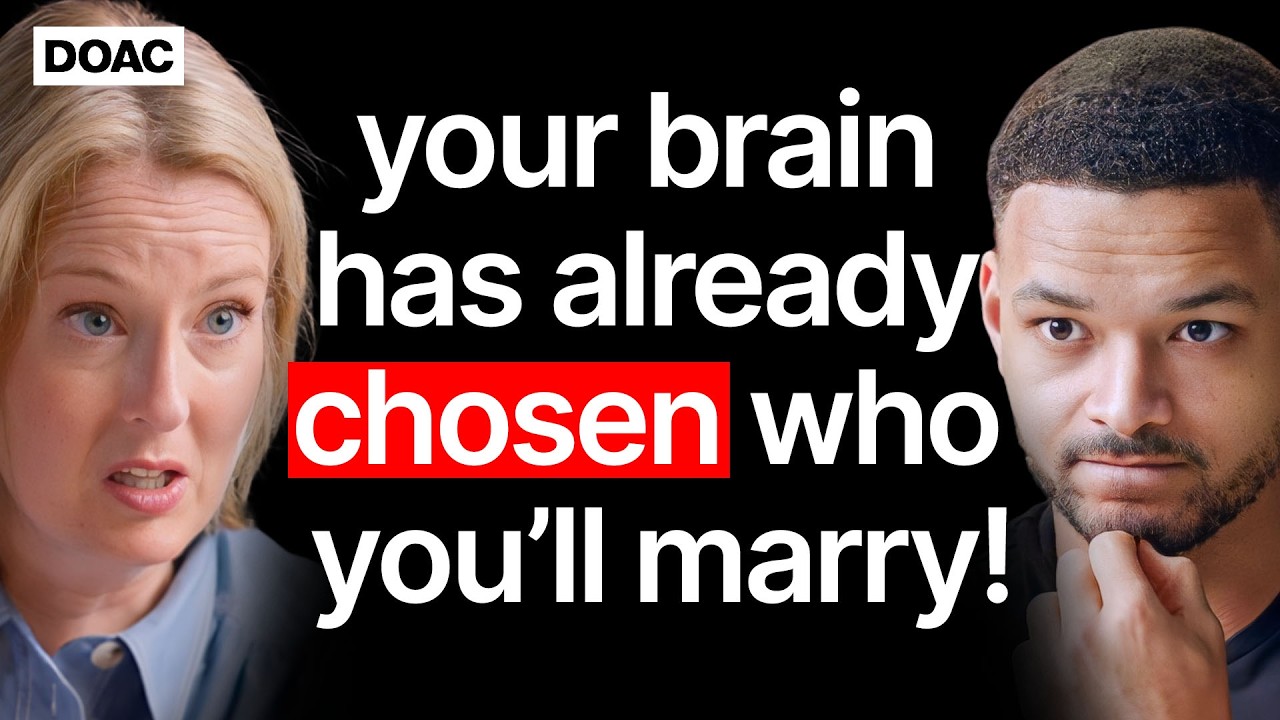
ANNA MACHIN DISSECTS MONOGAMY MYTHS AND PATERNAL BIOLOGY
The Diary Of A CEO
Monogamy functions as a social construct rather than a biological imperative, while active fatherhood fundamentally alters male neurochemistry to drive child development.
## Background
This episode of The Diary Of A CEO was published on YouTube on July 33, 2025 by Steven Bartlett. The show notes describe a deep-dive conversation with evolutionary anthropologist and relationship scientist Dr. Anna Machin regarding the evolutionary science of love, monogamy, cheating, and the critical biological role of modern fatherhood.
## TL;DR
Dr. Anna Machin breaks down the biological, neurochemical, and evolutionary mechanisms driving human connection, attraction, and romantic relationships. She challenges the idea that sexual monogamy is a hardwired human imperative, presenting it instead as a cultural construct alongside insights into polyamory and attachment styles. The discussion explores the transformative neurological impact of fatherhood, emphasizing how paternal care and rough-and-tumble play shape early childhood development. Ultimately, the walkthrough highlights how deep, in-person social connections remain the single most vital factor for human health and longevity.
## Atmosphere & style
The dialogue feels intellectually stimulating, grounded, and candid as Dr. Machin translates complex evolutionary anthropology into accessible personal insights. Steven Bartlett maintains an engaging, curious presence, prompting deep discussions that balance rigorous scientific data with real-world relationship dynamics. The atmosphere strikes a thoughtful balance between empathetic validation of modern dating struggles and direct, evidence-based mythbusting.
## Key takeaways
- [02:15](https://www.youtube.com/watch?v=hxsnk90VwCo&t=135s) Love, trust, and close social relationships are fundamental biological and evolutionary necessities that serve as the primary predictor of human health, mental well-being, and longevity.
- [07:13](https://www.youtube.com/watch?v=hxsnk90VwCo&t=433s) Human fatherhood is an evolutionary rarity among mammals, evolving to provide critical developmental scaffolding, resilience, and emotional regulation for children.
- [28:07](https://www.youtube.com/watch?v=hxsnk90VwCo&t=1687s) Modern dating app culture and choice overload strip away crucial subconscious biological data, causing people to hyper-fixate on minor flaws like 'the ick'.
- [33:45](https://www.youtube.com/watch?v=hxsnk90VwCo&t=2025s) Monogamy is largely a social construct reinforced by historical property structures rather than a biological hardwiring, explaining high rates of infidelity and the existence of alternative relationship models like polyamory.
- [51:50](https://www.youtube.com/watch?v=hxsnk90VwCo&t=3110s) New fathers experience dramatic neural and hormonal shifts—such as up to a 30% drop in testosterone alongside spikes in oxytocin and vasopressin—to facilitate bonding and caregiving.
- [01:09:45](https://www.youtube.com/watch?v=hxsnk90VwCo&t=4185s) Non-biological father figures and stepfathers undergo the exact same neurochemical rewiring and bonding processes as biological fathers when stepping into a primary parenting role.
- [01:29:46](https://www.youtube.com/watch?v=hxsnk90VwCo&t=5386s) Synthetic 'love drugs' and oxytocin manipulation carry complex ethical risks, as oxytocin can amplify ethnocentrism or bigotry depending on genetic variants.
- [01:42:58](https://www.youtube.com/watch?v=hxsnk90VwCo&t=6178s) Attachment styles formed during early childhood can be transformed later in life into 'earned security' through self-awareness, therapeutic work, or a stable partner.
- [17:09:33](https://www.youtube.com/watch?v=hxsnk90VwCo&t=61773s) Dopamine dysregulation in neurodivergent brains (such as in ADHD) can make long-term companionate love feel challenging once the initial novelty of dating fades.
- [17:18:04](https://www.youtube.com/watch?v=hxsnk90VwCo&t=62284s) AI and care robots cannot replicate biobehavioral synchrony—the automatic alignment of heart rates, brain patterns, and neurochemistry that occurs during real human interaction.
## Detailed walkthrough
### [00:00](https://www.youtube.com/watch?v=hxsnk90VwCo&t=0s) Monogamy, Polyamory, and Decoding Love Science
The social construct of monogamy is often treated as the gold standard of human relationships, yet evolutionary evidence paints a far more nuanced picture. Sexual monogamy is not an optimal evolutionary strategy, which explains the persistently high rates of extramarital affairs across human history. Research reveals no significant difference in psychological well-being or relationship satisfaction between individuals in polyamorous relationships and those in monogamous ones. Oxford-trained evolutionary anthropologist Dr. Anna Machin has spent two decades studying the neuroscience and biology of human connection,attachment styles, love addiction, and fatherhood.
Attraction begins long before conscious awareness takes over. Human mate selection involves two distinct stages in the brain: an unconscious sensory assessment and a conscious evaluation. In the unconscious stage, women possess a unique sensory capability: the ability to literally smell genetic compatibility in a prospective partner. While men can smell women, their olfactory system does not process signals regarding genetic compatibility in the same way. When a female brain registers a favorable genetic match, core chemical systems suppress fear centers and activate motivation pathways to drive connection.
- Monogamy is socially constructed rather than biologically hardwired.
- Poly and monogamous relationships show comparable levels of overall satisfaction and well-being.
- The neurochemistry that underpins love shares complex overlaps with neurodivergence like ADHD and autism.
---
[02:15](https://www.youtube.com/watch?v=hxsnk90VwCo&t=135s) Why Love Is the Core of Being Human
Love sits directly at the center of the human experience. Once basic physiological requirements for food and water are met, close relationships become the primary biological and psychological necessity. Humans are exceptionally unique as a species because they experience multifaceted forms of love across diverse social ties, pet relationships, and community networks. Long-term scientific studies demonstrate that the quality of these close relationships serves as the single strongest predictor of physical health, mental well-being, emotional happiness, and overall longevity.
In an era increasingly shaped by rapid technological advances, digital connectivity, and artificial intelligence, understanding the biological reality of human connection becomes critical. Love is far more than a mere feeling; it is tied directly to personal identity and core evolutionary design. Anthropologists study the human species along a spectrum from cultural dynamics to evolutionary genetics. By utilizing brain scans, genetic mapping, and behavioral observations, researchers can answer why love evolved as a survival mechanism in early human history.
- Love and relationship quality rank as the primary indicators of lifelong health and longevity.
- Evolutionary anthropology combines genetic analysis and brain imaging to map human attachment.
---
[07:13](https://www.youtube.com/watch?v=hxsnk90VwCo&t=433s) The Forgotten Role of Fathers
Modern culture frequently devalues, misrepresents, or minimizes the evolutionary necessity of fathers, framing them as secondary or even redundant. Historically, the prevailing cultural narrative assumed that men underwent no significant biological or psychological changes upon becoming parents, and that a father’s bond was fundamentally less intense than a mother’s. However, investing fatherhood is exceedingly rare in the animal kingdom: humans are among only **5%** of mammals—and the only living ape species—where fathers actively invest time, resources, and emotional care into raising offspring. An evolutionary trait this rare and costly could only persist if it provided a massive survival advantage.
The cultural devaluation of fathers is not universal. In the Aka community of the Congo Basin, fathers are among the most hands-on parents in the world, maintaining direct physical contact with their children for roughly **50%** of the day. Aka fathers carry their infants through the forest while hunting, sleep alongside them, sing to them, and will even offer a nipple for comfort while waiting for the mother to nurse. The modern Western view of the distant or incompetent dad is largely a recent cultural artifact—rooted in Victorian-era gender divides, industrial work structures, and media tropes like "Daddy Pig"—rather than a reflection of human biology.
- Human fathers are the only ape dads that actively invest resources and care into their children.
- Aka fathers in the Congo maintain physical contact with their children for **50%** of the day.
- Historical shifts during the Victorian era detached Western fathers from hands-on infant care.
---
[09:10](https://www.youtube.com/watch?v=hxsnk90VwCo&t=550s) Individualism and the Current State of Love
Modern societal structures have shifted dramatically toward individualism, reshaping how adults navigate romantic relationships. Historical marriages were frequently pragmatic arrangements driven by financial survival and strict social expectations, whereas modern individuals prioritize personal autonomy and self-actualization. Today, women are increasingly finding emotional support, physical safety, and practical help within "chosen families" and deep female friendships rather than traditional romantic pairings.
```
HISTORICAL MARRIAGE DYNAMICS MODERN INDIVIDUALIST DYNAMICS
+------------------------------------+ +------------------------------------+
| - Financial survival requirement | | - Personal autonomy & freedom |
| - Rigid social/cultural pressure | | - Reliance on "chosen families" |
| - Marriage as primary security | | - High female-initiated divorce |
+------------------------------------+ +------------------------------------+
```
Demographic shifts highlight this major societal transformation:
- Only **38%** of single women are actively looking to date, compared to **61%** of single men.
- Projections indicate that **45%** of women aged 25 to 44 will be single by 2030.
- In England and Wales, a record **40%** of adults have never married, with that figure reaching nearly **60%** for women aged 30 to 34.
- Women initiate approximately **70%** of all divorces, reflecting a far higher willingness to exit unfulfilling unions.
A distinct spike in divorces occurs among post-menopausal women over the age of 50. With modern healthcare extending post-menopausal life expectancy by **20** to **50** years, many women re-evaluate their long-term partners once child-rearing duties conclude, choosing independence or new pursuits over staying in legacy marriages. While marriage as a social ritual will endure, the underlying reasons for staying in a lifelong relationship have fundamentally changed.
- Single men (**61%**) are significantly more likely to actively seek dates than single women (**38%**).
- Roughly **70%** of divorces are initiated by women.
- Post-50 divorces have surged as women experience longer, healthier post-menopausal years.
---
[13:42](https://www.youtube.com/watch?v=hxsnk90VwCo&t=822s) The Unconscious Mechanics of Attraction
When people enter the dating landscape, attraction operates across two distinct mental phases: an unconscious biological filtering process and a conscious cognitive evaluation. The unconscious phase relies heavily on primitive brain regions that process sensory input—such as body odor, visual cues, and subtle behavioral traits—to calculate genetic compatibility without conscious thought.
If the brain's unconscious scan registers a high-quality match, it triggers a surge of neurochemicals deep in the brain stem and limbic system. This chemical wave effectively shuts down the brain's fear response while spiking motivation and focus toward the potential partner. Once this subconscious baseline is established, control shifts to the prefrontal cortex, where conscious decision-making, personal preferences, and long-term values take over to shape the relationship.
[14:03](https://www.youtube.com/watch?v=hxsnk90VwCo&t=843s) The Neuroscience of First Impressions and Chemical Chemistry
Human love is uniquely complex because it simultaneously engages two distinct areas of the brain: the ancient limbic system and the modern neocortex. Attraction begins deep within the unconscious limbic area, an evolutionary structure millions of years old that governs emotions, attachment, and nurturing behaviors. When locking eyes with someone across a room, the brain instantly processes vast amounts of sensory data—evaluating visual cues like physical movement and body shape to assess health and evolutionary value.
For women, this non-conscious assessment includes a powerful olfactory component: sniffing out genetic compatibility. Through the major histocompatibility complex (MHC)—a complex set of genes that underpins both the immune system and the olfactory system—women sub-consciously detect how closely a male's genetic profile aligns with their own. Evolutionary pressure incentivizes women to seek genetic distance: reproducing with someone too genetically similar increases inbreeding risks, whereas a distant genetic match equips offspring with a robust, diverse immune system. This chemical evaluation happens entirely beneath conscious awareness, unaffected by perfumes or aftershaves.
- **The T-Shirt Test:** The famous study involved men wearing plain t-shirts for 24 hours without showering or using deodorant. When placed in Ziploc bags and given to women to smell, participants consistently rated the scent of men with the most genetically distant MHC profiles as the most attractive.
- **Modern Genotyping:** Swiss specialized companies now offer commercial genetic compatibility testing, allowing couples to mail in DNA samples to analyze their MHC distance directly.
- **Asymmetry of Evolutionary Risk:** Men did not evolve the capability to smell MHC compatibility because the reproductive cost of a genetic mistake is vastly higher for women. A woman commits nine months of pregnancy plus initial infant care, effectively removing her from the reproductive pool during that time, whereas a man's biological investment in a single mating event is minimal.
---
[16:50](https://www.youtube.com/watch?v=hxsnk90VwCo&t=1010s) Biological Market Value and Visual Cues
While processing sensory data, the brain runs a complex internal algorithm to compute a potential partner's "biological market value"—an evolutionary measure of how likely that individual is to successfully reproduce and rear healthy offspring to maturity. From an evolutionary standpoint, the drive to pass on genes takes absolute priority over individual personality. Humans make rapid, subconscious calculations of this biological potential using visual cues, vocal pitch, and scent.
```
Biological Market Value Drivers:
├── For Men Evaluating Women: Waist-to-Hip Ratio (~0.7)
└── For Women Evaluating Men: Shoulder-to-Waist Ratio (~1.6)
```
Eye-tracking experiments reveal that when men look at women, their initial, split-second gaze zeroes in on the waist-to-hip ratio before even looking at the face. Across diverse global cultures, a waist-to-hip ratio of **0.7** (the classic hourglass shape) is universally preferred. This preference operates independently of cultural body-weight ideals because the ratio directly correlates with fertility and health: a **0.7** ratio signals high circulating estrogen, youth (as the ratio shifts toward **1.0** after menopause due to falling estrogen and rising testosterone), and a lower risk for chronic conditions like diabetes, heart disease, and certain cancers.
Conversely, eye-tracking studies show women evaluate men based on physical markers of protection, provision, and fitness, specifically targeting a shoulder-to-waist ratio (a V-shaped torso). The evolutionary ideal is **1.6**, a ratio typically achieved only by elite Olympic athletes. Broad shoulders coupled with a lean waist demonstrate upper-body strength, low abdominal fat (a marker of cardiovascular health in men), and high testosterone levels. Because testosterone promotes competitiveness, it is directly linked to social and financial success in human societies.
- **Dopamine and Oxytocin Spike:** When the brain calculates a high biological market value, the nucleus accumbens—a deep-brain structure packed with dopamine and oxytocin receptors—fires intensely.
- **The Fear Suppressor:** Oxytocin quietens the amygdala (the brain's fear center), lowering social inhibitions and silencing the internal self-doubting monologue that warns of potential rejection.
- **The Motivation Engine:** Dopamine provides the drive and motivation required to act on the feeling, propelling someone to walk across a room and initiate a conversation rather than remaining passively seated.
---
[21:51](https://www.youtube.com/watch?v=hxsnk90VwCo&t=1311s) Dating Hacks and the Role of the Prefrontal Cortex
To "hack" a first date and trigger the brain's ideal neurochemical cocktail—releasing beta-endorphins, dopamine, and oxytocin—couples can engage in specific targeted activities. Partner dancing (such as tango or ballroom) is particularly effective because physical touch triggers oxytocin and beta-endorphins, physical movement releases exercise-induced endorphins, and the shared clumsiness or shared laughter of learning a move stimulates dopamine. Following up an activity with spicy food further enhances this high; because beta-endorphins originally evolved as natural painkillers, mild gut irritation from spicy foods triggers an additional chemical release that promotes feelings of euphoria and relaxation. Similarly, going to a comedy show for a deep belly laugh produces a substantial hit of beta-endorphins.
> "I always say the brain is the sexiest organ in the body, because ultimately it's what you express with your brain that is going to really determine whether or not this love is going to go anywhere."
While unconscious attraction operates identically across all mammals, human attraction changes drastically the moment a prospective partner opens their mouth. Neural activity shifts heavily to the neocortex, specifically the prefrontal cortex—the seat of complex social reasoning, trust, reciprocity, and long-term planning. The conscious brain communicates directly with the unconscious striatum and the mentalizing/empathizing network at the back of the brain (which reads intentions, assesses empathy, and screens for potential deception). If a person expresses something cruel, arrogant, or fundamentally incompatible, the conscious prefrontal cortex can instantly override the initial biological spark and shut down attraction entirely.
- **The Ultimate Turn-off:** Cross-cultural data shows that the single most required trait in a long-term partner is kindness. Expressing casual cruelty, such as treating restaurant staff or waiters poorly, serves as an immediate red flag that signals flawed core values.
- **Value Alignment:** Expressing views that clash with deeply held moral beliefs—such as homophobic or racist remarks—instantly overrides physical attraction, signaling to the prefrontal cortex that long-term compatibility is impossible.
[28:07](https://www.youtube.com/watch?v=hxsnk90VwCo&t=1687s) Dating App Culture, the Prefrontal Cortex, and "The Ick"
The discussion opens with an anecdote about a woman who rejected a potential partner simply because she noticed storage boxes stacked on top of his wardrobe in the background of his dating profile photo. She rationalized this by assuming he was un-settled or perhaps living with his mother. This extreme surface-level exclusion highlights a modern shift in behavior, prompting a question about whether this hyper-scrutiny is the prefrontal cortex executing its executive function or something else entirely.
The prefrontal cortex is indeed attempting to do its job, but it is doing so poorly. Social media has accelerated a highly obsessive culture centered around "the ick" and hyper-fixating on supposed "red flags." Because digital dating strips away critical sensory information, users become hyper-focused on minute visual details. Human attraction and long-term compatibility are incredibly complex and heavily reliant on real-time biological data that a digital interface simply cannot replicate.
- Famous relationship scientist Helen Fisher argues that these platforms should not be labeled "dating apps," but rather "introduction apps."
- Their primary evolutionary function is to broaden the initial pool of potential matches, not to serve as the venue for evaluating true compatibility.
- Prolonged digital interaction acts as a handicap; individuals should transition to an in-person environment as quickly as possible to let half a million years of evolved biological processing take over.
---
[29:52](https://www.youtube.com/watch?v=hxsnk90VwCo&t=1792s) The Paradox of Choice and the Psychology of Sunk Cost in Modern Dating
A growing paradox exists where individuals frequently go on up to 100 dates a year without finding a suitable partner, despite the statistical likelihood that someone compatible exists in that pool. This friction is driven by two distinct psychological and structural phenomena: the vanishing cost of matching and the psychological weight of personal investment.
Historically, dating required significant upfront investments of time, energy, and money. Finding a date meant coordinating through mutual friends, workplaces, or social venues, which demanded substantial psychological preparation and serious intent. Because modern introduction apps allow users to swipe effortlessly while multi-tasking—such as on the subway, while cooking, or watching television—the low barrier to entry severely diminishes how much an individual values any single interaction.
- **The Psychology of Investment:** Psychological studies demonstrate a direct correlation between how much effort a person invests in a process and how much they appreciate the final outcome. In a classic study, participants who were granted automatic, frictionless entry into a boring forum evaluated it as inherently dull. Conversely, a separate group forced to endure a rigorous, demanding testing process to enter the exact same forum reported high levels of satisfaction, demonstrating how upfront labor artificially elevates perceived value.
- **The In-Person Filter:** In a physical room of 100 people, the human brain rapidly and unconsciously filters out the vast majority of individuals based on real-time sensory inputs. On a digital app, this organic filtering mechanism is broken, forcing users to go on dozens of physical dates just to perform the basic triage that the brain would normally execute in seconds.
- **The Paradox of Choice:** Human brains are biologically unequipped to process an endless array of options. When attractive users face a "smorgasboard" of continuous matches, their decision-making apparatus paralyzes.
- **Historical Comparison:** One hundred years ago, a person's romantic pool was strictly limited to their immediate village. If they owned a horse, that pool expanded slightly to the next neighboring town, creating a naturally manageable choice architecture.
- **The Restaurant Analogy:** This decision fatigue mirrors dining experiences. In a restaurant with an overwhelming, multi-page catalog style menu, customers spend up to 45 minutes agonizing over basic food choices. In contrast, high-end venues offer a tightly curated, limited selection that eliminates choice fatigue and streamlines decision-making.
---
[33:45](https://www.youtube.com/watch?v=hxsnk90VwCo&t=2025s) Deconstructing Monogamy: Social Constructs vs. Biological Realities
To accurately assess human partnerships, a strict distinction must be drawn between sexual monogamy—being physically exclusive to one partner—and social monogamy, which entails cohabitating and cooperatively managing a household or raising offspring together. While social monogamy is highly visible in modern Western societies, true sexual monogamy is exceptionally rare from an evolutionary standpoint.
```
┌───────────────────────────────┐
│ HUMAN PARTNERSHIPS │
└───────────────┬───────────────┘
│
┌────────────────────────┴────────────────────────┐
▼ ▼
┌─────────────────────────────────┐ ┌─────────────────────────────────┐
│ SOCIAL MONOGAMY │ │ SEXUAL MONOGAMY │
├─────────────────────────────────┤ ├─────────────────────────────────┤
│ • Cohabitation & shared home │ │ • Absolute sexual exclusivity │
│ • Cooperative child-rearing │ │ • Extremely rare in nature │
│ • Ubiquitous across societies │ │ • Est. 50% infidelity rate │
└─────────────────────────────────┘ └─────────────────────────────────┘
```
Monogamy is largely a social construct rather than a biological imperative. Research indicates that a mere 0.002% of animal species on Earth practice true genetic or sexual monogamy. Humanity reflects this natural trend; statistical data reveals that global infidelity rates hover consistently around 50%, demonstrating a deep divide between socially mandated structures and underlying biological drives. From an evolutionary perspective, absolute sexual exclusivity is inherently disadvantageous because it artificially restricts an organism's gene pool.
- **The Gibbons Example:** Longitudinal studies conducted on gibbons—long celebrated as the gold standard for primate monogamy—revealed that while they maintained strictly monogamous social households, both males and females regularly engaged in extra-pair copulations "behind the rocks."
- **Evolutionary Drivers:** This behavior satisfies complementary genetic strategies: a female gibbon may seek out superior genetics from a highly attractive male while relying on a dependable, nurturing social partner to raise the resulting offspring. Meanwhile, the male increases his reproductive success by mating widely, as doing so incurs very little biological cost.
- **Civilization and Social Control:** Strict legal and religious monogamy was imposed alongside the rise of early agricultural civilizations and urban centers. Authoritarian institutions and early states required highly predictable populations to manage property inheritance, child legitimacy, and resource allocation. Forcing individuals into strictly bounded pairs prevented the social chaos that would stem from uninhibited biological impulses.
- **Cross-Cultural Variations:** Many global cultures operate successfully without prescribing monogamy. Examples include specific Islamic societies where polygyny is practiced, and distinct tribal communities across South America and Africa.
- **Polyandry in Nepal:** In certain high-altitude Himalayan communities in Nepal, fraternal polyandry exists, where one woman marries a group of brothers. This structure is fundamentally economic; because land is passed down through male lineages, splitting a small family farm among five brothers would render the plots unviable. Marrying one woman keeps the estate intact across generations.
---
[38:45](https://www.youtube.com/watch?v=hxsnk90VwCo&t=2325s) Polyamory, Open Dynamics, and the Ethics of Non-Monogamy
Because human biology frequently strains against socially enforced monogamy, proponents of consensual non-monogamy argue that open or polyamorous dynamics represent a more authentic and ethically consistent way of living. If a person maintains a strict facade of monogamy while engaging in clandestine affairs, they are actively deceiving those they claim to love. Conversely, non-monogamous frameworks rely on radical transparency regarding natural human desires.
A clear distinction must be made between open relationships and polyamory. Open relationships—such as swinging or casual non-monogamy—are defined primarily by outside sexual encounters without expanding one's core emotional intimacy. Polyamory is far more complex, requiring an individual to manage multiple sexual and deeply intimate emotional relationships simultaneously. This dual layer of emotional vulnerability makes polyamory exceptionally challenging, as it directly collides with deeply ingrained social conditioning and personal jealousy.
- **The Burden of Social Stigma:** Interviews with individuals navigating polyamorous relationships reveal that while internal relationship satisfaction and stability are often high, managing external social judgment remains incredibly difficult. Polyamorous individuals frequently hide their relationship structures from older family members, creating stressful scenarios where they must selectively present only one "official" partner at public events like weddings.
- **Perceptions of Morality:** Empirical studies show that mainstream society often views polyamorous individuals as cold, unloving, or inherently immoral. Critics assume that distributing affection among multiple partners dilutes its quality, operating under the assumption that love is a zero-sum game.
- **The Polyamorous Philosophy:** Polyamorous communities reject the zero-sum model of affection, arguing that human emotional capacity is expansive. They note that society naturally accepts a person's capacity to love multiple children or friends simultaneously without experiencing a dilution of care. Consequently, they view their lifestyle as deeply moral, relying on continuous communication to renegotiate boundaries, check in on emotional safety, and ensure mutual consent.
- **Genetic Variations:** While many individuals struggle against the confines of monogamy due to ancestral evolutionary programming, preliminary genetic data suggests that human inclination toward monogamy or non-monogamy exists on a spectrum, with some individuals being biologically and structurally wired to feel genuinely safer and happier in exclusive pairs.
---
[42:06](https://www.youtube.com/watch?v=hxsnk90VwCo&t=2526s) Monogamy, Polyamory, and Gender Differences
Contrary to popular belief, love research reveals no significant difference between men and women regarding their suitability for monogamy or polyamory. Dr. Anna Machin explains that comfort with a relationship structure is dictated by core personality, attachment style, life experiences, and genetics—not gender.
Furthermore, studies measuring relationship satisfaction across monogamous and polyamorous couples show identical levels of well-being and happiness. Host Steven Bartlett quips that he finds monogamy much easier, prompting Dr. Machin to share a common joke within the polyamorous community:
> "The only thing polyamorous people say is you have to have a cracking Google Calendar."
* Relationship satisfaction scales yield identical scores for monogamous and polyamorous partners.
---
[43:09](https://www.youtube.com/watch?v=hxsnk90VwCo&t=2589s) The First 1,000 Days and Defining "Father"
The first 1,000 days of a child's life are crucial for long-term development. Dr. Machin counters the historical assumption that fathers are "surplus to requirements" beyond serving as financial providers. She clarifies that "father" does not strictly mean a biological father. In her research, it refers to any male figure who steps up—including stepfathers, adoptive fathers, grandfathers, uncles, or older brothers.
Young people raised without a supportive male role model face significantly higher risks of negative life outcomes. These include a higher prevalence of antisocial behavior, criminal activity, substance abuse, and mental health struggles.
* Children without male role models face heightened risks of:
* Antisocial behavior and crime
* Addiction and mental health issues
* Relationship difficulties later in life
---
[44:49](https://www.youtube.com/watch?v=hxsnk90VwCo&t=2689s) The Evolutionary Role of Fathers Across Cultures
Fatherhood is a "facultative role," meaning it is flexible and adapts to environmental risks, whereas motherhood is tightly anchored by biology (pregnancy and childbirth). Across global cultures, fathering takes distinct forms depending on societal needs:
* **High-Risk/Survival Environments:** In war zones or regions with severe disease, a father's role centers strictly on physical survival.
* **Economic/Pastoral Environments:** In societies where survival is stable but economic standing is fragile, fathers teach children practical skills, negotiation, and how to build social networks in the marketplace.
* **Modern Western Societies:** Fathers focus on "social survival"—teaching kids how to navigate complex social structures.
Across all environments, a father’s universal function is **scaffolding**—building the neural, biological, and psychological foundation that allows a child to transition from the family home into the wider world.
---
[46:47](https://www.youtube.com/watch?v=hxsnk90VwCo&t=2807s) Nurture vs. Challenge: How Mothers and Fathers Bond Differently
While maternal and paternal bonds are equally strong, they operate differently:
* **Mother-Child Attachment (Nurture & Protection):** Highly inward-looking, focusing on safety, holding the child close, and building an exclusive, protective environment.
* **Father-Child Attachment (Nurture & Challenge):** Outward-looking. The father acts as a secure base, turning the child toward the world to foster resilience, independence, and social skills.
Fathers play an indispensable role in developing a child's pro-social behaviors—such as sharing, helping, emotional regulation, and impulse control. While both parents contribute equally to academic success, fathers have a unique impact on instilling classroom learning behaviors, such as cooperation and emotional control.
---
[48:54](https://www.youtube.com/watch?v=hxsnk90VwCo&t=2934s) Rough and Tumble Play and Brain Chemistry
Beginning around six months of age, fathers naturally engage in "rough and tumble play"—chasing, wrestling, tossing children in the air, and bouncing on sofas. This high-energy play serves two primary functions:
1. **Rapid Hormonal Bonding:** Because fathers miss out on the initial hormonal surge of childbirth, physical play induces a flood of dopamine, beta-endorphins, and oxytocin in both parent and child.
2. **Social Skill Development:** It teaches reciprocity (give-and-take), empathy (reading when the other person is no longer enjoying the game), and risk assessment.
Pioneering research by Ruth Feldman in Israel demonstrates that fathers and children have co-evolved to prefer playing together:
* **Moms:** Experience their peak oxytocin release through nurturing and cuddling. Children similarly get their oxytocin peak when receiving cuddles from mom.
* **Dads:** Experience their peak oxytocin release through active play. Children get their highest oxytocin surge when playing with dad.
---
[51:50](https://www.youtube.com/watch?v=hxsnk90VwCo&t=3110s) Hormonal and Neural Changes in New Fathers
Human fatherhood is exceptionally rare in nature, occurring in only about 5% of mammal species. Over the last half-million years, male biology evolved specific hormonal shifts to prepare men for fatherhood:
* **Testosterone Drop:** When entering a long-term relationship, a man's testosterone drops to shift focus away from mate-seeking. Upon becoming a father, testosterone drops by up to **30%**.
* **Chemical Unblocking:** High testosterone blocks bonding hormones like oxytocin and dopamine. The dramatic post-birth drop in testosterone allows these attachment chemicals to take effect.
* **Caregiving Motivation:** Men with lower testosterone exhibit greater empathy and motivation to soothe a crying baby, whereas men with higher testosterone perceive baby cries as largely aversive and frustrating.
Dr. Machin notes that evolutionary "social monogamy" likely lasted only long enough to ensure child survival—typically through early childhood (ages 5 to 10)—rather than the lifelong monogamy expected in modern culture. Additionally, fathers living with a pregnant partner experience a natural rise in oxytocin throughout the pregnancy to begin forming an early bond.
[55:57](https://www.youtube.com/watch?v=hxsnk90VwCo&t=3357s) Neurochemical Changes and Emotional Shifts in New Fathers
Dr. Anna Machin outlines the intense hormonal shifts that occur in men as they prepare for and enter fatherhood. Alongside a decline in testosterone, vasopressin levels rise; in non-human mammals, vasopressin drives nest defense, whereas in human males, it inspires a strong protective motivation toward the infant. Simultaneously, prolactin—a parenting hormone strictly seen in males of species with investing fathers—increases to motivate nurturance.
Many men worry that lower testosterone will erode their physical strength or athletic performance. Dr. Machin dispels this myth, pointing out that countless Olympic athletes thrive as parents without losing their physical edge. Instead, the real effect is a sharp rise in emotional vulnerability and empathy. Dads frequently report feeling far more sensitive to emotional triggers, often finding themselves moved to tears by tragedy on the news when they previously wouldn't have batted an eye.
When Steven asks if a father's testosterone ever recovers to pre-baby levels, Dr. Machin clarifies that it stays suppressed for as long as the man maintains contact with his child. Across cultures—including societies where fathers do not live in the same residence—regular contact preserves this reduced state to keep the father attuned to caring for his child. Testosterone levels only return to baseline if a man completely loses contact with his offspring, as evolutionary mechanisms reset his drive toward seeking new mating opportunities.
* **Vasopressin & Prolactin:** Vasopressin heightens protective instincts; prolactin directly motivates caring behaviors and only appears in male species where fathers actively invest in raising young.
* **Physiological Reality:** Lower testosterone does not degrade muscle mass, physical capacity, or athletic performance.
* **Emotional Trade-Off:** In exchange for a slight dip in testosterone and increased emotional vulnerability, fathers gain a deeply rewarding neurochemical bond with their children.
---
[58:22](https://www.youtube.com/watch?v=hxsnk90VwCo&t=3502s) Father Involvement, Resilience, and How Children Measure Love
Fathers play an irreplaceable role in building their children's long-term mental resilience. Through early rough-and-tumble play and ongoing, stimulatory activities as the child grows, dads provide the foundational scaffolding that helps children navigate complex social dynamics. Consequently, a strong, secure attachment with a father serves as a powerful protective shield against common adolescent struggles that manifest in social spheres, including social anxiety, eating disorders, self-harm, depression, and chronic loneliness.
```
+-----------------------------------------------------------------------+
| How Children Measure Parental Importance |
+-----------------------------------------------------------------------+
| MOTHERS' IMPORTANCE | FATHERS' IMPORTANCE |
| Measured through practical care, | Measured through dedicated |
| daily routines, and logistics | time and shared enthusiasm |
| (making favorite meals, washing | (doing activities together, |
| sports gear, handling playdates). | being present, taking interest). |
+-----------------------------------------------------------------------+
```
Children naturally evaluate their importance to each parent in remarkably distinct ways. When kids are asked how they know they matter to their mothers, they typically point to acts of practical care—like having their favorite cereal stocked, getting picked up from school, or having clean sports kit. Conversely, when asked how they know they matter to their fathers, children consistently answer: "He spends time with me." Because traditional cultural structures often mean fathers spend more hours away at work, a child perceives a father’s time as his most valuable asset; when he freely gives that time and shares genuine enthusiasm for the child's interests, it builds a deep reservoir of self-esteem.
---
[01:00:05](https://www.youtube.com/watch?v=hxsnk90VwCo&t=3605s) Sponsor Interludes: Ketone-IQ and Shopify
The discussion briefly pauses as host Steven Bartlett shares personal endorsements for two podcast sponsors:
* **Ketone-IQ:** Steven describes discovering Ketone-IQ when a sample bottle was delivered to his desk. After trying it, he integrated it into his daily global travel routine to foster deep focus, productivity, and endurance. He loved the product so much that he personally reached out to the company's CEO to invest several million pounds.
* **Shopify:** Reflecting on starting his first business at age 12 and launchings others throughout his teens, Steven recalls the burden of having to serve as marketer, sales representative, customer service lead, and recruiter simultaneously. He highlights Shopify as an all-in-one platform powered by AI integrations that act like a full growth team—handling product descriptions, image enhancement, shipping, taxes, and inventory management.
---
[01:02:00](https://www.youtube.com/watch?v=hxsnk90VwCo&t=3720s) Brain Plasticity in Primary Caregivers and Same-Sex Parenting
Addressing the broader societal shift toward women advancing in higher education and the workforce, Steven raises the topic of absent or working mothers who place children in full-time daycare. Dr. Machin notes that while her primary research fills the gaps on fatherhood, human child-rearing does not require a rigid, single-parent vacuum. Outside of single-mother households, children naturally recruit and identify key father figures in their broader social circles—such as uncles, grandfathers, sports coaches, teachers, or a friend’s father—even when mothers do not explicitly track these male influences.
When examining brain activity in scanners, mothers and fathers in heterosexual relationships show complementary patterns:
```
+-------------------------------------------------------------------------+
| Neurological Activation Patterns |
+-------------------------------------------------------------------------+
| MOTHER'S BRAIN ACTIVATION | FATHER'S BRAIN ACTIVATION |
| Dominates in ancient subcortical | Dominates in the neocortex |
| limbic structures responsible for | (prefrontal/orbitofrontal |
| unconscious nurture, attachment, | cortex) handling social skills|
| and risk detection. | empathy, and mentalizing. |
+-------------------------------------------------------------------------+
```
Remarkably, in gay male primary-caregiver fathers, brain scans reveal extraordinary neuroplasticity. Without a mother present, a gay father's brain exhibits peak activation in *both* the ancient subcortical limbic regions and the social neocortical regions simultaneously. Neuroscientists discovered a brand-new, direct neural connection between these two areas, enabling seamless communication between subcortical nurturing instincts and neocortical social processing.
Dr. Machin explains that human children are among the most resource-intensive and helpless offspring in the animal kingdom, rivaled only by a few marine mammals and primates. To ensure infant survival, the human parenting brain possesses astonishing evolutionary plasticity; it structurally reorganizes itself so that whoever steps into the primary caretaking role delivers every neural and emotional resource the child requires.
* **Subcortical vs. Neocortical Attachment:** Maternal attachment draws on millions of years of ancient, subcortical evolutionary history; paternal attachment relies on a evolutionary younger (roughly 500,000 years old) neocortical social processing structure.
* **Equal Capacity:** The brain's adaptive capacity proves that neither sex holds a monopoly on nurturance or social development—the primary caregiver's brain adapts dynamically to meet the child's needs.
* **Co-Residence is Not Required:** A child does not strictly need a biological, co-residing father in the household to thrive, provided they have consistent access to supportive, invested father figures in their broader community network.
<FollowUp label="Want to explore how fathers influence language development and social skills?" query="What does Dr. Anna Machin's research say about how fathers specifically impact a child's language development and social intelligence?"/>
[01:09:45](https://www.youtube.com/watch?v=hxsnk90VwCo&t=4185s) The Growing "Fatherless" Trend and the Rise of Father Figures
The discussion turns to societal shifts in family structures, specifically whether Western society is experiencing an increase in fatherlessness. Dr. Anna Machin confirms that, regarding biological fathers, there is an alarming upward trend. To combat this issue, she recently became a trustee for the **Center for Research into Men and Boys**, a policy unit focused on supporting fathers and ensuring boys have strong male figures. Increased divorce rates, longer lifespans leading to changing relationship dynamics, and shifting cultural norms mean fewer children are growing up with a biological father under the same roof. Dr. Machin emphasizes that this issue is equally pressing in the US, where she collaborates with scholar **Richard Reeves** on finding creative solutions to redefine what constitutes a father figure.
Because biological fathers may not always be present, community involvement, supporting single mothers, and scaling initiatives like the UK organization **Lads Need Dads** are vital. These programs provide mentorship by matching boys with positive adult male role models. When asked if anything is superior to a biological father, Dr. Machin answers directly: *"A father."* Fatherhood isn't defined by genetic lineage or conceiving a child; it is forged purely through active interaction, caretaking, and showing up every day.
- **Neurological and Hormonal Adaptations:** Stepfathers and non-biological father figures undergo the exact same neural rewiring, hormonal fluctuations, and psychological shifts as biological dads because these changes are triggered by direct interaction with the child.
- **The "Lost Boys" Study:** A study by the **Centre for Social Justice** titled *Lost Boys* highlights the heightened statistical risk of adverse life outcomes for young men raised without a father figure.
- **Support for Non-Traditional Families:** Dr. Machin advises lesbian couples to ensure male father figures (mentors, uncles, or trusted male friends) are integrated into their child's life. Similarly, gay male parents should proactively involve key female figures to provide maternal input.
---
[01:13:37](https://www.youtube.com/watch?v=hxsnk90VwCo&t=4417s) Why the Dad-Daughter Bond Is Critical for Long-Term Success
While society often focuses on the importance of father figures for young boys, emerging scientific data shows that the relationship between a father and his daughter is just as—if not more—critical. Dr. Machin points out that human fatherhood evolved because children are biologically designed to be raised by an entire cooperative network rather than a single individual. When daughters grow up with a secure attachment to a father figure, the positive ripple effects extend into almost every facet of their adult lives.
- **Academic and Career Achievement:** Daughters with secure paternal attachments show higher rates of educational attainment and career success.
- **Mental Health and Well-Being:** A strong father-daughter relationship correlates directly with higher emotional resilience, better mental health outcomes, and overall higher self-reported well-being scores.
- **Relationship Dynamics:** Daughters raised with strong, loving father figures are significantly less likely to engage in high-risk sexual behaviors and are much more likely to establish stable, healthy romantic partnerships in adulthood.
---
[01:14:48](https://www.youtube.com/watch?v=hxsnk90VwCo&t=4488s) The 1.8 Million-Year Evolutionary Reason Dads Matter from Day One
Addressing child-rearing opinions raised by authors like **Erica Komisar**—who argue that mothers are paramount for the first two years while fathers only become critical around age two during the play phase—Dr. Machin strongly disagrees. She shares an anecdote about meeting a community worker for fathers who mistakenly believed he was useless for the first 18 months beyond changing diapers. She refutes this notion, explaining that a father's presence is essential from the second a baby is born due to human evolutionary biology.
Human infants are born months earlier than they ideally should be because of an evolutionary bottleneck that occurred roughly 1.8 million years ago. As early humans adapted to **bipedalism** (walking on two legs), the female pelvis narrowed. Simultaneously, human encephalization skyrocketed—our brains expanded to six times the size expected for a mammal of our body mass, folding densely into our skulls unlike the smooth brains of smaller mammals. Had human infants stayed in the womb until their brains were fully developed like chimpanzees, neither mother nor baby would survive childbirth. Consequently, human babies are born extremely helpless, requiring a massive surge of social brain growth after birth.
Because the prefrontal cortex undergoes intense social wiring immediately after delivery, a father's active sensory input—through touch, smell, voice, and interaction—is just as vital as a mother's. While mothers often take on the initial caregiving burden due to lactation and recovery from physical childbirth, capitalism and economic demands have falsely dictated that fathers should leave the home to earn money rather than engage in immediate co-parenting.
---
[01:19:28](https://www.youtube.com/watch?v=hxsnk90VwCo&t=4768s) Shaping the Baby's Environment and Conflict Resolution
When evaluating whether the primary caregiver is the sole factor shaping a baby's attachment style, Dr. Machin emphasizes that an infant absorbs their entire social environment. A child's psychological development is not merely a product of who feeds them, but is heavily influenced by the relationship dynamics between the parents themselves.
- **Conflict Management:** Dr. Machin advocates integrating relationship preparation into antenatal courses. Rather than aiming to eliminate arguments entirely, parents must learn healthy reconciliation and resolution techniques, as infants pick up on parental tension and stress.
- **Navigating Parenting Differences:** Couples must proactively discuss and accept that they will naturally possess different parenting styles, transforming potential friction into a balanced dynamic.
- **The Extended "Village":** Modern parenting relies on a broader network—including relatives, friends, and early childhood professionals—that collectively shapes the child's environment.
---
[01:21:11](https://www.youtube.com/watch?v=hxsnk90VwCo&t=4871s) Designing the Optimal Scenario for New Parents
As host Steven Bartlett reflects on his own upcoming journey into parenthood and asks how to structure his life amidst a demanding, travel-heavy career, Dr. Machin offers reassuring advice: *"Happy parents make happy babies."* While newborns have fundamental needs for warmth, nutrition, and secure attachment, they ultimately thrive when their caregivers are mentally healthy and stable.
Dr. Machin criticizes the UK's standard statutory paternity leave policy—which currently offers employed fathers just two weeks—as *"frankly laughable."* Organizations are actively pushing the UK government to expand statutory paternity leave to at least six weeks, though Dr. Machin argues that an ideal system would mirror Scandinavian models, such as Sweden, where fathers receive up to a year of leave. Regardless of career demands, both parents must find a balanced schedule that allows for meaningful, multi-sensory input from both mother and father.
[01:23:09](https://www.youtube.com/watch?v=hxsnk90VwCo&t=4989s) Balancing Career and Fatherhood in the First Two Years
The transition to parenthood presents significant psychological and practical challenges for both partners, particularly following childbirth. While some women manage to race back to work almost immediately, most need a dedicated period of time off to recover physically and psychologically. If the mother is breastfeeding, she is even more tied to the baby as the primary source of nutrition, making extended work trips or early returns to the office particularly difficult. In those vulnerable early weeks, direct support is vital; for instance, when Dr. Machin's self-employed husband could only take two days of paternity leave, her own mother stepped in to help. In an ideal scenario, however, fathers are encouraged to step up and design their lives flexibly so they can take on caretaking responsibilities, allowing the mother to transition back to work as appropriate.
For men, spending time with a newborn isn't just helpful for the family—it is fundamentally transformative for their own mental health and identity. While mothers typically undergo the psychological transition to parenthood over the nine months of pregnancy, the process takes most working Western dads roughly two years. This delay occurs because a father’s identity adoption relies heavily on building a sense of parental competency, which is hard to achieve when long work hours prevent them from caring for their baby. When fathers are given the opportunity to handle care routines early on, they gain confidence faster, absorb the identity of being a dad more comfortably, and build a protective barrier against paternal postnatal depression.
- **Transition to Parenthood:** Takes roughly 2 years for working Western dads versus 9 months for mothers, largely dependent on reaching parental competency through hands-on care.
- **Paternal Postnatal Depression:** Men who struggle with the identity transition are at a significantly higher risk, which negatively affects the partner and child.
- **Breastfeeding Realities:** Although express pumps exist, a mother’s biological tie during breastfeeding often makes prolonged separation early on challenging.
---
[01:26:03](https://www.youtube.com/watch?v=hxsnk90VwCo&t=5163s) How Dads Can Bond With Their Newborns
Building an attachment bond with a infant requires active interaction. Because mothers get a biological head start through pregnancy, childbirth, and oxytocin-releasing lactation, fathers often feel sidelined by a baby that seems exclusively mom-focused. To bridge this gap and prevent dads from withdrawing out of frustration, experts recommend creating dedicated daily rituals that belong specifically to the father. Activities such as reading books, taking charge of bath time, or practicing baby massage serve as powerful bonding touchpoints. Touch triggers a flood of bonding hormones in both father and infant, while the close physical proximity allows the baby—whose vision is still blurry—to register the father’s distinct smell.
```
┌─────────────────────────────────────────────────────────┐
│ Building the Father-Infant Bond │
└─────────────────────────────────────────────────────────┘
│
┌────────────────────────────┼────────────────────────────┐
▼ ▼ ▼
Baby Massage Daily Rituals Sensory & Play
• Releases bonding hormones • Bath time routines • Scent recognition (early)
• Prevents paternal PPD • Early book reading • Smiling (6-8 weeks)
• Calms baby sensory system • Direct interaction • Gentle rough & tumble (6 mos)
```
Preparing men for the natural delay in emotional bonding is essential. Society often perpetuates the ideal that parents feel an instantaneous "flood of love" the moment a baby is born. While dads typically feel a conscious "recognition of connection"—acknowledging their genetic child and their duty to protect it—the deep emotional love builds gradually through shared interaction. When fathers compare their initial feelings to the mother's biologically primed state, they often feel like failures, which can cause them to pull away. However, by six months of age—as the baby begins smiling, giggling, and engaging in gentle rough-and-tumble play—fathers routinely report feeling a profound, categorical love that has developed naturally over time.
- **Baby Massage:** Highlighted as one of the few proven interventions that effectively prevents paternal postnatal depression while stimulating the baby's tactile and olfactory development.
- **Developmental Milestones for Bonding:** Babies begin smiling directly at parents at around 6 to 8 weeks, with gentle rough-and-tumble play becoming appropriate around 6 months.
- **Hormone Disparity:** Women receive physiologically driven hormones from gestation and nursing, whereas men must generate their oxytocin and bonding chemistry entirely through physical interaction.
- "She's the gold standard of bonding... I'm failing. My baby doesn't like me. I'm rubbish at this."
---
[01:29:46](https://www.youtube.com/watch?v=hxsnk90VwCo&t=5386s) Love Drugs: Oxytocin, MDMA, and the Ethics of Synthetic Connection
Humankind's quest for an "elixir of love" spans recorded history, driven by a desire to gain control over love's unpredictable nature. Today, relationship scientists and neuroscientists are close to understanding the neurochemistry of affection well enough to manipulate it artificially. Such chemical interventions could theoretically help individuals feel more socially confident on dates, enhance their attractiveness, or rescue struggling long-term relationships by restoring lost affection.
Currently, research centers on two main chemical candidates for synthetic love:
1. **Oxytocin:** Synthetically produced and traditionally used to induce labor, intranasal oxytocin sprays (including short-lived commercial products like "Oxy Love") quiet the amygdala to increase empathy, warmth, and social openness. However, a major biological hurdle remains: while oxytocin fosters bonding in most people, it triggers heightened ethnocentrism, bigotry, and racism in a significant minority who carry a specific oxytocin receptor gene variant. These individuals end up bonding more fiercely with their perceived "in-group" while becoming hostile to "out-groups."
2. **MDMA (Ecstasy):** Long known in recreational settings for inducing feelings of deep empathy, MDMA is currently undergoing clinical trials in the United States as an adjunct to marriage therapy. By microdosing MDMA under supervision, entrenched partners who have lost empathy can temporarily lower their defenses and see each other's perspectives.
The therapeutic potential of MDMA comes with heavy ethical considerations. Scientists still do not fully understand the long-term consequences of chronic use or what happens to a relationship if the drug is stopped. If a relationship is established or sustained under the influence of MDMA, ending the drug could cause the affection to vanish—raising serious moral questions about informed consent if one partner is unaware the bond was chemically inflated. Anecdotal stories from club culture tell of individuals falling deeply in love while taking ecstasy on weekends, only to find the romantic connection evaporating once they stop taking the substance and face real life together.
- **Ethnocentrism Danger:** Oxytocin can inadvertently fuel prejudice depending on individual genetics, halting its safe commercial release.
- **Marriage Therapy Trials:** MDMA microdosing is showing promising results in clinical trials designed to break communication deadlocks between estranged couples.
- **Long-term Uncertainty:** Unanswered questions remain regarding whether feelings generated by MDMA persist after usage ends or if relationships collapse once the drug wears off.
[01:35:44](https://www.youtube.com/watch?v=hxsnk90VwCo&t=5744s) The Commercialization and Ethical Risks of "Love Drugs"
Dr. Anna Machin paints a vivid, cautionary scenario regarding synthetic love drugs like MDMA/ecstasy. She shares a cautionary tale of a man who takes ecstasy with a woman on a weekend, feels intensely in love, and convinces her to relocate her entire life to be with him. However, during the workweek when he is off the drug, he abruptly realizes he does not actually love her, causing immense emotional upheaval. While he did not cause this harm intentionally, it highlights the grave danger of pharmacological manipulation in romance. Furthermore, Dr. Machin warns of sinister scenarios involving power imbalances—such as an abusive partner covertly dosing someone with a love drug to trap them in a relationship. Despite these serious ethical dilemmas, she predicts that if love drugs receive commercial approval, they will inevitably hit the market due to the massive profit potential in the multi-billion-dollar relationship industry.
Dr. Machin tests public perception during her live lectures by asking audiences if they would take a drug that induces or maintains love; initially, around 50% raise their hands. Even after she outlines the severe ethical risks and side effects, roughly 20% still say they would take it. The discussion also turns to SSRIs (selective serotonin reuptake inhibitors), which mute emotional intensity, suppress libido, and diminish feelings of love. While some suggest engineering SSRIs to help people process romantic trauma—recalling the premise of the movie *Eternal Sunshine of the Spotless Mind*—Dr. Machin clarifies that drugs cannot wipe memories, though they might reduce "negative salience." She issues a stark warning about the misuse of such treatments, pointing to instances cited in the book *Love Drugs* where extreme religious communities used SSRIs on young men displaying homosexual tendencies to suppress their sexual orientation. Given that homosexuality remains illegal in 72 countries, she stresses that society must confront the ethics of neurotechnology before it causes profound harm to human health and freedom.
- **Audience Poll Results**: 50% of audience members initially raise their hands to take a love drug, and 20% remain willing even after learning the ethical risks.
- **Global Context**: Homosexuality remains illegal in 72 countries worldwide, multiplying the potential for misuse of mind-altering pharmaceuticals.
- **Pop Culture Reference**: *Eternal Sunshine of the Spotless Mind* is cited as an example of the desire to erase or dull painful romantic memories.
---
[01:38:35](https://www.youtube.com/watch?v=hxsnk90VwCo&t=5915s) What Attachment Styles Are and How They Shape Us
Turning to attachment theory, Dr. Machin outlines what makes attachment relationships distinct: they are exceptionally rare, highly intense, and limited to early caregivers (especially during the first two years of life), romantic partners, and occasionally best friends. Attachment relationships are "developmentally significant" because they alter psychology and, in early childhood, directly shape brain architecture. Because babies are born with under-developed brains that grow rapidly over the first two years, the early caregiving environment underpins the physical structure of the brain. In adulthood, romantic attachments mold psychology by dictating two fundamental dimensions: anxiety over abandonment and comfort with proximity (emotional and physical intimacy).
To illustrate how attachment styles can evolve, Dr. Machin candidly shares her personal story. When she first met her husband, she suffered from immense abandonment anxiety and coped by becoming "monumentally clingy." Over nearly 25 years of marriage, her husband consistently disproved her fears of being left, gradually shifting her psychology into a secure attachment style. She notes that scientists categorize people into four quadrant styles based on their levels of abandonment anxiety and proximity-seeking behavior:
* **Secure**: Low anxiety over abandonment and high comfort with proximity. Secure individuals maintain a strong sense of individuality while benefiting deeply from intimacy; they do not depend on the relationship to define their identity.
* **Preoccupied (Anxious-Preoccupied)**: High anxiety over abandonment and high craving for proximity. Preoccupied individuals cope with fear by clinging tightly to their partners to keep constant tabs on them.
* **Fearful-Avoidant (Disorganized)**: High anxiety over abandonment combined with a strong avoidance of proximity. They find intimacy uncomfortable and cope with the fear of rejection by avoiding relationships altogether so they cannot be hurt.
* **Dismissing-Avoidant**: Low anxiety over abandonment and low interest in proximity. Making up the smallest portion of the population, dismissing-avoidant individuals operate like "islands"—they prefer self-reliance and simply do not care to seek intimate relationships.
Dr. Machin emphasizes that while scientists use distinct categories for data analysis and behavior tracking, attachment exists on a continuous spectrum.
---
[01:42:58](https://www.youtube.com/watch?v=hxsnk90VwCo&t=6178s) Modern Isolation, the Dopamine Trap, and "Daddy Issues"
The conversation shifts to how modern society shapes human attachment, with Dr. Machin observing that people are becoming increasingly uncomfortable with real-world intimacy. Because individuals can now work, order food, and interact with friends entirely from their sofas, they lack the practice required for face-to-face connection. Citing data following the COVID-19 pandemic, she explains that people became accustomed to their isolated "bubbles." Over time, staying indoors causes a biological "cold turkey" effect: without in-person contact, the brain stops receiving the social neurochemicals—particularly beta-endorphin—that drive the desire to socialise. Consequently, socialising begins to feel daunting, breeding widespread avoidant behaviors.
Steven Bartlett asks whether the easy availability of home-based dopamine hits—such as social media, pornography, or substances—contributes to this withdrawal. Dr. Machin agrees, pointing out a major misconception about dopamine. While dopamine provides a short-lived reward hit, it does not support social relationships, the immune system, or long-term health on its own. True social bonding and health benefits require the full cocktail of all four primary social neurochemicals (oxytocin, dopamine, serotonin, and beta-endorphin). People who engage in serial dating—such as going on 100 dates without intending to build a true bond—typically exhibit avoidant attachment styles, using dating for superficial hits while protecting themselves from real connection.
Addressing the concept of "daddy issues" or "mommy issues," Dr. Machin explains the underlying neurological impact of early parental abandonment or absence. When a parent leaves during a child's formative years, the growth of the prefrontal cortex—the seat of social cognition—is physically altered.
- **Neurological Effects of Early Abandonment**:
- Decreased volume of gray and white matter in the prefrontal cortex.
- Reduced neuronal density in areas controlling social cognition.
- Lower baseline levels of circulating neurochemicals required to motivate and reward relationship-building in adulthood.
- **Changing Your Attachment Style**:
- **Earned Security via Partners**: Having a secure partner continuously disprove abandonment fears over time.
- **Self-Awareness and Social Accountability**: Recognizing repetitive negative patterns (e.g., running away when things get intense) and asking friends to call out those behaviors.
- **Professional Support**: Working with specialized attachment counselors to process past experiences.
- **Open Communication**: Vocalizing one's attachment style and triggers directly to a romantic partner so both can navigate relationships with mutual understanding.
[01:49:14](https://www.youtube.com/watch?v=hxsnk90VwCo&t=6554s) Navigating Attachment Dynamics and Partner Mutual Awareness
Steven Bartlett notes that developing mutual awareness around attachment styles has transformed his own relationship. By openly vocalizing their needs rather than just becoming individually self-aware, he was able to reframe his partner's need for constant reassurance and presence—which he might have previously perceived as irrational or overly clingy—into a valid attachment need. This understanding allowed him to respond with genuine empathy rather than feeling overwhelmed.
Dr. Anna Machin validates this experience, emphasizing that understanding how a partner attaches is essential for preventing triggers, especially given that insecure attachment styles interact in distinct ways:
* **Dismissing Avoidant and Preoccupied:** Highly volatile and difficult to maintain long-term. The avoidant's need for distance triggers the preoccupied's anxiety, creating a claustrophobic, "roller coaster" dynamic.
* **Preoccupied and Fearful Avoidant:** Surprisingly functional in certain contexts. The preoccupied partner's tendency to stay intensely close satisfies the fearful avoidant's deep-seated fear of abandonment.
* **Secure with Insecure:** The ideal pairing. Secure individuals act as emotional anchors, easily absorbing both clingy and pushy behaviors without feeling threatened or defensive.
---
[01:51:12](https://www.youtube.com/watch?v=hxsnk90VwCo&t=6672s) The Overlapping Neuroscience of Love and Neurodiversity
The conversation shifts to neurodiversity—which affects roughly 25% of the population—and its profound impact on romantic relationships. Dr. Machin explains that the neurological and genetic architecture underpinning romantic love heavily overlaps with that of neurodivergence, particularly autism and ADHD. Because love and neurodivergence share identical neurochemical pathways and brain regions, neurodivergent traits manifest heavily in social and romantic contexts.
Key biological overlaps and cognitive factors include:
* **Shared Neurochemistry:** The oxytocin receptor gene (featuring 26 point mutations affecting social behavior) is implicated in both attachment and autism. Similarly, dopamine and serotonin regulate both the initial high of falling in love and the core mechanics of ADHD.
* **Altered Executive Function:** Executive functioning—encompassing attention, working memory, and emotional inhibition—operates differently in neurodivergent brains. Poor working memory makes tracking details hard, while impaired emotional regulation can lead to swift escalations in conflict or extreme emotional highs and lows.
* **Sensory Processing Differences:** Autistic individuals process sensory information at different speeds and may experience hyper-sensory overload or hypo-sensory under-stimulation. This alters the brain's internal attraction algorithm and turns typical date environments—such as loud restaurants, pubs, or comedy clubs—into overwhelming, stressful environments.
* **Heightened Vulnerability to Abuse:** Neurodivergent individuals are statistically more likely to end up in abusive relationships due to impulse-driven partner choices and a lifetime of "masking"—suppressing their natural traits to fit into a neurotypical world. After years of denying their own needs to fit in, they struggle to set healthy boundaries or demand kindness from a partner.
* **Reevaluating Empathy:** Countering the diagnostic myth that autistic individuals lack empathy, Dr. Machin clarifies that they often experience hyper-empathy, shutting down due to emotional overload. Research shows that neurodivergent individuals empathize seamlessly with one another, but communication barriers arise when a neurodivergent person attempts to cross-empathize with a neurotypical partner.
---
[01:57:33](https://www.youtube.com/watch?v=hxsnk90VwCo&t=7053s) ADHD, Novelty Seeking, and the Myth of Infidelity
Steven asks whether the core features of ADHD—impulsivity, high novelty seeking, poor emotional regulation, and impaired long-term foresight—statistically incline individuals with ADHD to cheat. Dr. Machin references a 2015 study indicating adults with ADHD reported higher rates of infidelity, but she cautions against drawing blanket conclusions, as the effect size was modest. She warns against scapegoating neurodivergent partners as the sole "problem" in a relationship, asserting that all romantic partnerships are dynamic interactions where both individuals must adapt.
However, she acknowledges that the underlying neurobiology of ADHD directly conflicts with long-term relationship maintenance. Because ADHD involves dopamine dysregulation—where dopamine is reabsorbed before taking full effect—individuals naturally engage in dopamine-seeking behaviors.
Steven shares the story of a close friend in his late 30s who struggled for years with short-term, highly impulsive dating habits because he explicitly "loved the chase." Diagnosed with ADHD at age 35, he looked back at school report cards and relationship patterns, realizing his endless dates were simply a drive for dopamine. Dr. Machin explains that the initial "chase" phase of a relationship provides a massive dopamine surge. As a relationship matures into companionate love, dopamine fades into the background while beta-endorphin and oxytocin take over. For a brain hardwired for dopamine, this natural transition feels like a loss of excitement, making long-term commitment a daily struggle.
Addressing how individuals and couples can manage these challenges, Dr. Machin emphasizes that while taking ADHD medication is a deeply personal choice, it can be a vital tool when executive dysfunction or dopamine seeking fundamentally destabilizes someone's life. However, medication and personal effort are only half the equation.
Rather than placing the sole burden of change on the neurodivergent individual, the healthiest outcomes occur when neurotypical partners actively educate themselves on neurodivergent brain chemistry. Understanding *why* a partner craves spontaneity, struggles with attention, or reacts intensely fosters mutual compassion over frustration. "The best relationships are ones where we take the time to really understand who our partner is," Dr. Machin notes, highlighting that empathy and education must flow both ways.
Here is a detailed, faithful walkthrough of the provided transcript section.
---
[02:02:51](https://www.youtube.com/watch?v=hxsnk90VwCo&t=7371s) Sex, Novelty, and Neurodivergence
The conversation touches on how neurodivergence and high impulsivity influence a person's need for novelty in their sexual relationships. People who are neurodivergent or genetically predisposed to novelty-seeking—a trait tied to specific dopamine receptor genes—can quickly grow bored with routine sex. However, Dr. Anna Machin points out that fulfilling a desire for variety doesn't necessarily require seeking out multiple sexual partners. If a person's existing partner is open-minded and willing to explore new experiences together, that need for novelty can be satisfied within a single monogamous relationship.
---
[02:03:48](https://www.youtube.com/watch?v=hxsnk90VwCo&t=7428s) Relationships as the Biggest Factor in Health and Longevity
Dr. Machin shifts to what she considers the single most crucial topic: the overwhelming body of scientific research showing that human relationships are the primary determinant of long-term health, well-being, and longevity. She highlights a landmark 2010 meta-analysis conducted by Julianne Holt-Lunstad, which pooled data across numerous studies to assess how social connection impacts outcomes like mental health, chronic disease risk, and surgical recovery rates. The findings revealed that quality social connections outweigh traditional health metrics—including smoking status, body weight, physical exercise, and diet—as a predictor of how long and how well we live.
Despite living in an increasingly health-conscious culture fixated on fitness and nutrition, society continues to neglect in-person relationship maintenance. In a fast-paced world dominated by digital communications and shiny screens, humans attempt to manage relationships "efficiently" online. However, human brains evolved in tight-knit physical communities. While digital tools are attractive, relying on them at the expense of face-to-face interaction degrades our overall health and physiological resilience.
- Julianne Holt-Lunstad's meta-analysis demonstrated that relationship quality impacts health outcomes more than quitting smoking, maintaining a healthy weight, or regular exercise.
- Digital efficiency and screen-based interactions fail to satisfy our evolutionary need for close, in-person social bonding.
---
[02:05:47](https://www.youtube.com/watch?v=hxsnk90VwCo&t=7547s) AI, Care Robots, and Parasocial Relationships
The discussion transitions to the rapid rise of artificial intelligence in intimate and caregiving contexts. Dr. Machin acknowledges that AI chatbots serve a useful purpose for specific groups, such as individuals with severe social anxiety or autistic people practicing social interactions in a zero-judgment environment. However, real danger arises when AI begins replacing genuine human or animal contact.
When interacting with a chatbot or audio AI, the prefrontal cortex recognizes that the entity is non-human. As a result, the brain fails to trigger the cascade of neurochemicals (like oxytocin) that underpin mental health, physical well-being, and immune function. Users may form strong emotional attachments to AI entities, but these remain one-sided "parasocial relationships"—similar to a fan's connection with a celebrity—yielding none of the biological benefits of true social connection. Dr. Machin expresses particular concern over proposed "care robots" meant to assist vulnerable populations, noting that true caregiving requires genuine empathy and complex biological alignment that synthetic entities cannot replicate.
- AI chatbots offer safe environments for practicing social skills, particularly for people with autism or social anxiety.
- Interactions with non-human AI fail to activate the brain's neurochemical rewards that support the immune system and physical health.
- AI attachments function as parasocial relationships, lacking reciprocal neurobiological value.
---
[02:08:24](https://www.youtube.com/watch?v=hxsnk90VwCo&t=7704s) Biobehavioral Synchrony: How Close Relationships Fuse Us
Dr. Machin explains the scientific concept of **biobehavioral synchrony**, an essential biological process that occurs in close human relationships and forms the foundation of deep love. When two closely bonded individuals interact in person, their body language, vocal tones, and gestures naturally mimic one another. More remarkably, their physiological baselines—heart rates, blood pressure, and body temperature—align and synchronize within five minutes of sitting together.
On a neurological level, brain activation patterns converge, meaning both individuals begin perceiving the world in the exact same way. Simultaneously, their neurochemical levels (such as oxytocin) equalize. Through biobehavioral synchrony, two distinct people temporarily function as "one organism." This biological fusion is essential for human health and bonding. AI systems cannot replicate biobehavioral synchrony because it requires a physical body with a circulatory system and a "wet brain."
- **Biobehavioral synchrony** synchronizes heart rates, blood pressure, body temperature, brain activation patterns, and oxytocin levels between close partners within minutes.
- This physiological alignment operates as the core fundamental basis of close human love and cannot occur with AI or artificial entities.
---
[02:10:04](https://www.youtube.com/watch?v=hxsnk90VwCo&t=7804s) Brain Activations across Different Types of Love
Reviewing neuroimaging data comparing brain responses across different forms of connection—such as romantic love, parental love, friendship, pet attachments, and love for nature—Dr. Machin analyzes how the brain processes these experiences. Romantic love and parental love spark the most intense, widespread neurological activity, firing deeply in both the limbic system (the emotional core) and the neocortex (governing empathy and social behavior). Romantic love uniquely triggers opioid-like activations in the brain, producing a distinct euphoria and addictiveness absent in platonic friendships.
```
+------------------+------------------------------------------------------------+
| Love Type | Neurological Characteristics |
+------------------+------------------------------------------------------------+
| Romantic Love | Deep limbic & neocortical activation; opioid/reward pathways |
| Parental Love | Heavy limbic system activity; nurturing/attachment focus |
| Friendship | Complex neocortical activity; lacks opioid euphoria/intensity|
| Love for Nature | Cortical engagement; minimal emotional/limbic activity |
| AI Interactions | Surface cortical processing; lacks limbic attachment |
+------------------+------------------------------------------------------------+
```
Analyzing a 2024 *Cerebral Cortex* study by Pärttyli Rinne et al. brought up on screen, Dr. Machin notes surprise at its finding that pet love showed virtually no limbic (unconscious attachment) activation, as previous studies demonstrated that human-dog love closely mirrors parental attachment. Regarding love for nature, the lack of activity in the striatum and amygdala shows that loving non-sentient concepts is a conscious, low-emotion cognitive process rather than a deep bond. She warns that AI relationships mirror these lower-tier activations, lacking the limbic and prefrontal engagement required for authentic emotional bonding.
- Romantic love is unique in its activation of brain pathways that mirror opiate usage, creating euphoric and addictive feelings.
- Human love for non-sentient entities (nature, AI) lacks the limbic and amygdala activations reserved for sentient social bonds.
---
[02:14:07](https://www.youtube.com/watch?v=hxsnk90VwCo&t=8047s) Career Milestones and the Mission to Support Fathers
Answering the traditional closing question left by the previous guest—whether there was a specific moment she felt she had "made it"—Dr. Machin admits she struggles to celebrate achievements, usually focusing immediately on what comes next. However, joining the University of Oxford to conduct research alongside evolutionary anthropologist Robin Dunbar stood out as an academic peak, placing her at the absolute forefront of her field.
Looking ahead, Dr. Machin defines true success not by academic accolades, but by the public impact of her work on fatherhood. Much of the crucial research regarding fathers remains trapped inside "fusty old journals" that the public never reads. Her ultimate goal is to translate this science into accessible books that reach diverse readers worldwide, legitimizing the vital role fathers play and reassuring men that their presence in their children's lives is fundamentally necessary.
- Working with Robin Dunbar at the University of Oxford marked a pivotal career milestone in evolutionary anthropology.
- Dr. Machin's overarching mission is to make scientific research on fatherhood accessible to everyday readers to help men understand their vital role.
[02:16:10](https://www.youtube.com/watch?v=hxsnk90VwCo&t=8170s) The Legal Bias and Cultural Misunderstanding of Fatherhood
Dr. Anna Machin highlights a major point of frustration for many fathers: feeling secondary, sidelined, or reduced to a minor role—such as a "bag carrier" or the person who simply makes the tea—especially during antenatal classes and the birth process. This underlying societal attitude carries directly into legal settings. Host Steven Bartlett shares a personal encounter with a London cab driver who spent a half-hour ride recounting how he had marched for fathers' rights after having his child taken away, arguing passionately that legal custody battles in the UK are fundamentally unfair toward fathers.
Dr. Machin validates the cab driver's frustration, pointing out that British family courts continue to operate on outmoded, non-evidence-based cultural assumptions. Instead of starting from a baseline presumption of 50/50 joint custody, the legal system routinely swings decisions in favor of mothers whenever a minor obstacle arises—such as a father living slightly further away or having a demanding job. She emphasizes that these rulings stem from a complete failure to grasp the scientific evidence showing how crucial a father is to a child's psychological and biological development.
* Dr. Machin regularly receives emails from fathers asking her to serve as an expert witness in family court proceedings to educate judges on fatherhood science.
* The legal system's reluctance to grant equal custody reflects a broader cultural misunderstanding that treats fathers as optional rather than biologically essential.
---
[02:18:11](https://www.youtube.com/watch?v=hxsnk90VwCo&t=8291s) Redefining the Role of Fathers and Closing Thoughts
Steven expresses deep gratitude to Dr. Machin for shattering long-held cultural narratives that position fathers merely as distant financial providers or surplus figures. He reflects on his own family, sharing how his older brother made the conscious decision to step away from the corporate world to prioritize raising his three children under six. Witnessing his brother's active involvement revealed not only the profound positive impact on the children's development but also the profound sense of purpose and meaning it brought to his brother's life.
Steven notes how Dr. Machin's interdisciplinary research—spanning evolutionary anthropology, neuroscience, and biology—dismantles old stereotypes and gives future parents an evidence-backed framework for active caregiving. By grounding fatherhood and love in rigorous science, her work promises to improve developmental outcomes for countless children.
* Steven credits Dr. Machin's work with reframing his personal expectations for when he becomes a father himself.
* Dr. Machin's research highlights that a father's presence is rooted in evolutionary biology, neurobiology, and psychological necessity rather than just social convention.
## Notable quotes
> [21:51](https://www.youtube.com/watch?v=hxsnk90VwCo&t=1311s) I always say the brain is the sexiest organ in the body, because ultimately it's what you express with your brain that is going to really determine whether or not this love is going to go anywhere. — Dr. Anna Machin
> [42:06](https://www.youtube.com/watch?v=hxsnk90VwCo&t=2526s) The only thing polyamorous people say is you have to have a cracking Google Calendar. — Dr. Anna Machin
> [01:09:45](https://www.youtube.com/watch?v=hxsnk90VwCo&t=4185s) A father. — Dr. Anna Machin
> [01:21:11](https://www.youtube.com/watch?v=hxsnk90VwCo&t=4871s) Happy parents make happy babies. — Dr. Anna Machin
> [01:26:03](https://www.youtube.com/watch?v=hxsnk90VwCo&t=5163s) She's the gold standard of bonding... I'm failing. My baby doesn't like me. I'm rubbish at this.
> [17:13:43](https://www.youtube.com/watch?v=hxsnk90VwCo&t=62023s) The best relationships are ones where we take the time to really understand who our partner is — Dr. Anna Machin
## Mentioned
Dr. Anna Machin, Steven Bartlett, Helen Fisher, The Diary Of A CEO, Aka community, Google Calendar, Ruth Feldman, Ketone-IQ, Shopify, Center for Research into Men and Boys, Richard Reeves, Lads Need Dads, Centre for Social Justice, Lost Boys, Erica Komisar, Eternal Sunshine of the Spotless Mind, Love Drugs, Julianne Holt-Lunstad, Robin Dunbar, Pärttyli Rinne, University of Oxford, Cerebral Cortex
Anna Machin 剖析一夫一妻制迷思与父职生物学
一夫一妻制更多是一种社会建构而非生物本能,而积极的父职参与能从根本上改变男性的神经化学机制以促进儿童发育。
Anna Machin 博士深入剖析了驱动人际联结、性吸引力与浪漫关系的生物学、神经化学及进化机制。她质疑了性一夫一妻制是人类天生本能的观点,指出它更像是一种文化建构,并分享了关于多元之爱和依恋风格的见解。讨论探讨了父职对神经系统的变革性影响,强调父亲的照料以及打闹嬉戏如何塑造幼儿的早期发育。最终,这场探讨强调了面对面的深度社交联结依然是决定人类健康与长寿最至关重要的单一因素。
爱、信任与亲密的人际关系是基本的生物学和进化需求,是预测人类身体健康、心理福祉及长寿的最主要指标。 (2:15)
人类父职在哺乳动物中属于进化上的罕见现象,其进化旨在为孩子提供关键的发育支架、心理韧性与情绪调节能力。 (7:13)
现代约会软件文化与选择过载剥夺了关键的潜意识生物学信息,导致人们过度关注微小的瑕疵(如产生“the ick”反感反应)。 (28:07)
一夫一妻制在很大程度上是由历史财产结构巩固的社会建构,而非生物学本能,这解释了为何出轨率居高不下以及多元之爱等替代性关系模式的存在。 (33:45)
新手父亲会经历剧烈的神经与激素变化——例如睾酮水平最高可下降30%,同时催产素和加压素激增——以促进亲子纽带与照料行为。 (51:50)
Reading summary
Evolutionary anthropologist Dr. Anna Machin argues that human romantic attraction and parental bonds are governed by ancient biological mechanisms rather than social conventions, challenging modern assumptions about sexual monogamy and the role of fathers.
Biological Realities of Monogamy and Attraction (33:45)
Dr. Machin distinguishes between social monogamy—cohabiting and cooperatively raising offspring—and sexual monogamy, noting that strict sexual exclusivity is documented in only 0.002% of animal species. With global human infidelity rates around 50%, research indicates that relationship satisfaction and psychological well-being are equivalent between monogamous and polyamorous couples. She asserts that comfort with either relationship model is shaped by personality, attachment styles, and genetics rather than gender.
Mate selection operates in two phases: an unconscious sensory evaluation followed by conscious processing. In the unconscious phase, women detect genetic compatibility via the major histocompatibility complex (MHC) to ensure immune diversity in potential offspring. Subconscious cues also assess biological market value; men across cultures universally prefer a 0.7 waist-to-hip ratio, an indicator of estrogen levels and youth, while women prioritize markers of strength and protection. Conscious evaluation occurs only when conversation begins, shifting neural processing to the prefrontal cortex.
The Evolutionary and Neurochemical Basis of Fatherhood (7:13)
Humans are among only 5% of mammals—and the sole living apes—where fathers actively invest in raising offspring. Because a pelvic bottleneck roughly 1.8 million years ago forced human infants to be born neurologically underdeveloped, cooperative care became essential. When men become fathers, their testosterone drops by up to 30%, which removes chemical inhibition on bonding hormones such as oxytocin and dopamine. Simultaneously, protective and nurturing drives are supported by increases in vasopressin and prolactin.
While maternal attachment focuses primarily on protection, paternal bonding centers on challenge and outward exploration. Research cited from Ruth Feldman shows fathers achieve their peak oxytocin release through active 'rough and tumble' play rather than cuddling. This interaction teaches children risk assessment, empathy, and emotional regulation, shielding adolescents from social anxiety and depression. Brain imaging shows that heterosexual fathers primarily utilize the neocortex for empathy and social processing, whereas gay male primary-caregiver fathers show neural adaptation across both limbic and cortical structures.
Digital Dating and Social Isolation Traps (28:07)
Modern dating culture and digital interfaces distort evolutionary mate-selection mechanisms. By stripping away biological sensory data such as scent, apps cause users' prefrontal cortexes to over-analyze superficial details, leading to obsessive fixations on 'red flags' and 'the ick.' Relationship scientist Helen Fisher categorizes these platforms as 'introduction apps' that should quickly transition to in-person meetings. Furthermore, the absence of upfront effort diminishes appreciation for prospective matches, as psychological studies demonstrate that perceived value corresponds directly with invested friction.
Isolation is compounded by modern digital reliance. Staying indoors creates a biological deficit of social neurochemicals—most notably beta-endorphins—which diminishes the motivation to interact face-to-face. While solitary digital activities trigger quick dopamine spikes, Dr. Machin emphasizes that dopamine alone cannot support immune health or long-term well-being without oxytocin, serotonin, and beta-endorphins. This deficiency is particularly acute because landmark meta-analyses, such as Julianne Holt-Lunstad's 2010 study, show that social connection is a stronger predictor of longevity and health than diet, exercise, or smoking cessation.
Neurodiversity, Attachment, and Synthetic Connection (89:46)
Romantic love and neurodivergence share overlapping neural structures and chemical pathways. ADHD involves dopamine dysregulation that drives novelty seeking, which can cause conflict when the high-dopamine phase of early dating fades into companionate bonding. Similarly, oxytocin receptor gene variations are linked to both attachment behavior and autism. Effective partnership requires mutual understanding of these biological differences rather than assuming one partner is inherently defective.
Technological and pharmacological shortcuts fail to replace authentic connection. While intranasal oxytocin and MDMA are being studied to facilitate bonding, oxytocin can promote ethnocentrism in individuals carrying specific genetic variants, and MDMA risks synthetic attachment without genuine long-term compatibility. Similarly, interactions with artificial intelligence or caregiving robots register in the prefrontal cortex as non-human, leaving users in one-sided parasocial relationships that do not trigger the limbic hormonal cascades necessary for physical and psychological health.
Dr. Machin argues that institutions have failed to keep pace with evolutionary science, pointing to UK family court biases against paternal custody and inadequate two-week statutory paternity leave as policies grounded in outdated cultural assumptions rather than biological evidence.
## Background
本期访谈由知名播客频道《The Diary Of A CEO》(主持人 Steven Bartlett)于 2025 年 7 月 3 日发布在 YouTube 平台。节目邀请了演化人类学家与关系科学家 Anna Machin 博士,基于脑科学与演化人类学视角,深入探讨了单配偶制的演化真相、出轨劫持大脑的机制、现代父职的生物学重要性,以及神经化学与 DNA 如何塑造人类的爱、信任与依恋模式。
## TL;DR
Anna Machin 博士从神经生物学与演化机制出发,系统解析了人类亲密关系与育儿联结的本质。对话揭示了父亲与新生儿建立联结的神经学规律及其对孩子前额叶发育的深远影响,同时探讨了催产素、多巴胺及情感药物干预的潜力与伦理风险。此外,内容深入剖析了依恋类型在科技时代的异化、ADHD 与神经多样性对恋爱冲动与忠诚的生理影响,并借助“生物行为同步性”证明了真实人际交互对寿命与健康的决定性价值,AI 无法在神经层面取而代之。
## Atmosphere & style
对谈整体兼具硬核神经科学的严谨客观与对复杂人性的温情关怀,节奏扎实且直击痛点。Dr. Anna Machin 展现出学者的沉稳与打破浪漫滤镜的直率坦诚,Steven Bartlett 则以极具同理心与探究欲的追问,将枯燥的脑区与激素理论拉入日常婚恋困惑与创伤反思。整场氛围既有解构爱情神话时的冷静清醒,又在探讨人际归属与深层生物连接时散发出强烈的共鸣与治愈感。
## Bulletin
- [02:03:48](https://www.youtube.com/watch?v=hxsnk90VwCo&t=7428s) 高质量人际关系对人类寿命和健康的影响力超越戒烟、运动与饮食控制,是决定长期生存率的首要因素。
- [02:08:13](https://www.youtube.com/watch?v=hxsnk90VwCo&t=7693s) 面对面深度互动能在5分钟内引发“生物行为同步性”,使双方心率、脑区激活及催产素水平完全同频,而缺乏生理递质的AI伴侣无法激活这些滋养免疫系统的机制。
- [01:44:20](https://www.youtube.com/watch?v=hxsnk90VwCo&t=6260s) 婴儿出生头两年的忽视或照料缺失会直接削弱前额叶皮质的灰白质容积与神经元密度,从硬件层面损伤成年后建立健康依恋关系的能力。
- [01:51:10](https://www.youtube.com/watch?v=hxsnk90VwCo&t=6670s) 约25%的神经多样性人群(如ADHD和自闭症)因神经递质系统变异而在恋爱中面临独特机制,ADHD对多巴胺的渴求易被误读为不忠,但两者的直接效应量十分微弱。
## Key takeaways
- [01:26:03](https://www.youtube.com/watch?v=hxsnk90VwCo&t=5163s) 绝大多数父亲在剪脐带瞬间不会立即产生父爱,普遍存在“联结滞后”,通常需持续互动至婴儿约6个月大时深层爱意才被完全唤醒。
- [01:26:03](https://www.youtube.com/watch?v=hxsnk90VwCo&t=5163s) 婴儿按摩与专属日常仪式能促使父婴双方大量分泌催产素,不仅加深依恋,还能显著预防男性产后抑郁。
- [01:29:46](https://www.youtube.com/watch?v=hxsnk90VwCo&t=5386s) 当代神经科学虽具备制造催产素等“爱情药物”的能力,但催产素变异会加剧排外偏见,且伴侣间暗中使用存在严重伦理争议。
- [01:33:15](https://www.youtube.com/watch?v=hxsnk90VwCo&t=5595s) MDMA与SSRI等药物在婚姻治疗与创伤剥离中展现潜力,但也存在消解情感、情感钝化以及被极端社群滥用压抑性取向的风险。
- [01:38:36](https://www.youtube.com/watch?v=hxsnk90VwCo&t=5916s) 成人的依恋类型属于连续谱系,由抛弃焦虑与亲密渴望两个维度决定,其神经架构深植于婴儿期前两年的抚养经历。
- [01:42:58](https://www.youtube.com/watch?v=hxsnk90VwCo&t=6178s) 居家办公和屏幕社交使人陷入缺乏β-内啡肽刺激的“戒断”状态,廉价单向的多巴胺刺激进一步加剧了现代人的回避型依恋倾向。
- [01:44:20](https://www.youtube.com/watch?v=hxsnk90VwCo&t=6260s) 在约会软件上无限刷选却逃避进入真实关系的人,底层通常具备轻视-回避型或恐惧-回避型依恋特质。
- [01:46:42](https://www.youtube.com/watch?v=hxsnk90VwCo&t=6402s) 依恋风格可通过与安全型伴侣建立长期稳固关系、提高自我认知反思或专业心理咨询实现后天重塑。
- [01:54:41](https://www.youtube.com/watch?v=hxsnk90VwCo&t=6881s) ADHD患者因多巴胺重吸收过快而持续渴求新鲜刺激,在恋爱初期的强烈刺激消退进入内啡肽主导阶段时容易感到乏味。
- [01:54:41](https://www.youtube.com/watch?v=hxsnk90VwCo&t=6881s) 自闭症人士并非缺乏共情,大多属于情绪超载的高敏感共情者,常因感官过载而触发防御性心理关机。
- [01:57:33](https://www.youtube.com/watch?v=hxsnk90VwCo&t=7053s) 成人ADHD的出轨率在统计学上仅略高且效应量微弱,新鲜感需求完全可通过在既有忠诚关系内探索新体验来满足。
- [02:03:48](https://www.youtube.com/watch?v=hxsnk90VwCo&t=7428s) Julianne Holt-Lunstad的元分析证实,人际纽带质量在预防早逝方面的效果显著优于戒烟、减重与体育锻炼。
- [02:03:48](https://www.youtube.com/watch?v=hxsnk90VwCo&t=7428s) AI聊天机器人仅能构建单向准社交依恋,无法激活大脑分泌催产素或内啡肽等有益身心的“湿系统”化学反应。
- [02:08:13](https://www.youtube.com/watch?v=hxsnk90VwCo&t=7693s) 面对面沟通中产生的“生物行为同步性”会让两人宛如单一生物体运转,这种生理同步是硅基交互永远无法复制的。
- [02:15:50](https://www.youtube.com/watch?v=hxsnk90VwCo&t=8150s) 司法与医疗体系仍普遍存在忽视父亲不可替代性的系统性偏见,需要结合现代神经科学重新确立父亲在抚育中的对等地位。
## Detailed walkthrough
### [00:00](https://www.youtube.com/watch?v=hxsnk90VwCo&t=0s) 预告集锦:打破专一神话与重新审视父职
在访谈开篇的精彩剪辑中,牛津大学进化学人类学家安娜·梅钦博士(Dr Anna Machin)抛出了一系列颠覆传统认知的科学论断。她直言人类在生物进化层面上并非纯粹的一夫一妻制物种,所谓的严格单偶制(Monogamy)很大程度上只是一种社会建构。从进化生物学的角度来看,绝对的性专一往往并非最佳生存策略,这也是为何婚外情在现实中有着不低的发生率。对于非传统亲密关系(如多边恋/非单偶制)与单偶制在幸福感与满意度上的对比,梅钦博士基于自己过去二十年的神经科学研究明确表示,两者在幸福指数上并没有本质差异。
梅钦博士进一步揭示了大脑在择偶过程中不为人知的运作机制。当我们寻找伴侣时,大脑的潜意识阶段正在大量摄入感官信息。例如,女性能仅凭嗅觉去辨识对方与自己在基因层面的兼容性,而男性闻女性的气味却无法获取这种基因信息;一旦大脑接收到积极信号,神经递质就会迅速抑制恐惧感并激发强烈的追求动机。此外,支配爱情的神经化学机制与神经多样性(如 ADHD 与自闭症)紧密交织,深刻影响着个体的亲密关系体验。谈及父职,梅钦博士指出当代文化中充斥着对父亲角色的偏见与贬低,然而在人类进化史上,父亲对孩子的生存、繁衍与心理健全发挥着不可替代的关键作用。
- 进化生物学表明人类并非天生的性单偶制生物,所谓单偶制在很大程度上属于社会建构。
- 女性能通过气味潜意识评估男性的基因兼容性,而男性嗅觉则无法提取女性的该类基因信息。
- 仅有约 5% 的哺乳动物存在父亲投资(Investing Fathers)行为,人类是现存唯一拥有父亲全情抚育后代的类人猿。
---
### [02:15](https://www.youtube.com/watch?v=hxsnk90VwCo&t=135s) 爱的本质与进化人类学家的毕生使命
节目正式开启后,主持人史蒂文·巴特利特(Steven Bartlett)首先探讨了梅钦博士将过去二十年人生倾注于人类亲密关系研究的初衷。作为一名进化人类学家,梅钦博士认为爱是人类之所以为人的核心基石。当剥离掉现代社会的所有附加物后,人类只要满足了食物和水等基本生理需求,最紧迫的需求必然是人际联结与爱。在所有物种中,人类非常幸运地能够以极其丰富和复杂的方式,与不同的人乃至其他生命形式建立起爱的纽带。大量实证科学表明,爱与亲密关系是决定一个人身心健康、寿命长短、幸福感以及整体福祉的首要因素。
面对科技日新月异、AI 深度介入以及生活节奏不断加快的现代社会,梅钦博士认为人类更迫切需要回归本质,看清爱究竟是什么,因为“爱在本质上构成了你的身份认同”。在解释自身学科时,她澄清进化人类学属于人类学中偏向硬科学的一端。相较于侧重社会文化维度的学者,进化人类学家更聚焦于探索进化机制如何塑造了现代人类,利用脑部扫描、神经遗传学等前沿科学工具,去解答诸如“爱为何会进化出现”、“父亲角色为何会诞生”等根本问题。
---
### [04:06](https://www.youtube.com/watch?v=hxsnk90VwCo&t=246s) 产房里的创伤:促使学者转向父亲研究的契机
桌上摆放的除了梅钦博士探讨爱的著作外,还有一本专注于父亲角色的专著。谈及两者的内在联系,梅钦博士分享了一段刻骨铭心的私人经历。在经历备孕、产检、超声波检查等一切看似美满的准备后,她迎来了生产时刻,然而分娩过程演变成了一场突如其来的医疗灾难。梅钦博士严重大出血,生命垂危,新生女儿也情况危急。由于产妇在极度危险中陷入昏迷,她醒来后几乎记不得任何创伤细节。但她的丈夫却全程清醒地站在一旁,亲眼目睹了生命中最深爱的两个人陷入“一场慢动作车祸般的致命灾难”。
在整个危机处理过程中,没有任何医护人员向这位濒临崩溃的新生儿父亲解释发生了什么。医护人员止血、清理产房后,迅速将危重婴儿送往新生儿重症监护室,并将梅钦博士留在房间,只留丈夫独自一人守在床边。当时梅钦博士呼吸极其微弱,丈夫陷入了巨大的恐惧。当一名清洁工进屋打扫时,惊恐万分的丈夫甚至颤抖着询问对方:“你觉得她死了吗?”清洁工回答道:“哥们儿,我觉得没有,如果她死了他们肯定会通知你的。”这场创伤让丈夫在此后长达两年的时间里无法提及分娩过程,甚至对再生育产生严重恐惧。
```mermaid
flowchart TD
accTitle: 产房危机中被忽视的父亲心理创伤
accDescr: 流程图展示了分娩危机发生时,医院对母亲提供心理干预,而父亲被孤立并遭受严重心理创伤的过程。
subgraph Crisis["严重医疗危机"]
A["产妇严重大出血/昏迷"]
B["新生儿病危送入NICU"]
end
subgraph HospitalCare["医疗系统响应"]
C["产妇醒后获得多项心理疏导与复盘"]
D["父亲被完全孤立,缺乏信息沟通"]
end
subgraph TraumaOutcome["后果与转折"]
E["向清洁工询问妻子是否死亡<br/>长达两年的心理创伤与回避"]
F["推动梅钦博士开启<br/>长达二十年的父亲科学研究"]
end
A --> C
A & B --> D
D --> E
E --> F
```
这起事件激怒了梅钦博士——明明是夫妻共同孕育生命,但当危机发生时,父亲却被体制像无关紧要的垃圾一样随手丢弃在一旁。随着女儿逐渐长大,梅钦博士见证了丈夫与女儿之间建立的深厚情感联结及其在孩子生命中不可或缺的分量。当她重返牛津大学展开研究时,惊讶地发现学界对于正常家庭中常驻父亲的研究几乎一片空白:既往文献要么研究缺席的父亲对后代的消极后果,要么充斥着对年轻未成年父亲的刻板印象。主流学界在二十年前甚至普遍奉行一种荒谬的信条:认为男性成为父亲后不会经历生理或心理变化,父亲与孩子的纽带绝不可能达到母亲那样深刻的依恋强度。基于这一学术空白,梅钦博士招募了15位伴侣怀孕三个月的新手父亲,正式开启了探寻父职进化奥秘的科研征程。
---
### [07:13](https://www.youtube.com/watch?v=hxsnk90VwCo&t=433s) 文化偏见的产物:被低估的父亲角色与阿卡人的启示
面对主持人关于“究竟是什么源头机制导致现代社会系统性低估父亲角色”的提问,梅钦博士明确指出,这种现象完全是文化建构的产物,绝非源自人类的生物学本能。在世界各地的其他文化中,父亲扮演着极其核心且亲密的抚育角色。最为典型的例子便是生活在刚果盆地的阿卡族(Aka)原住民。
在阿卡人部落中,父亲堪称全世界最深度参与育儿的榜样。父亲每天大约有 50% 的时间与婴儿保持着直接的肢体接触;在森林中进行狩猎采集时,是父亲将婴儿一路背在身上;晚上不是母亲,而是由父亲与孩子同床共眠;父亲负责给孩子唱歌、讲故事。甚至在西方人看来不可思议的是,当婴儿哭闹而母亲尚未准备好哺乳时,阿卡族父亲甚至会主动将自己的乳头提供给婴儿吮吸以安抚情绪。
梅钦博士分析指出,现代西方社会对父亲的边缘化,很大程度上继承自维多利亚时代的文化遗毒。在维多利亚时代的家庭观念中,父亲被严格限定为严厉的纪律执行者和唯一的经济供养者,育儿职责被完全推给女性;随后的政治与经济结构长期将女性阻隔在劳动力市场之外,进一步固化了这种性别分工。然而,科学研究证明,这些文化假设没有任何生物学依据作为支撑。
### [08:26](https://www.youtube.com/watch?v=hxsnk90VwCo&t=506s) 父亲角色的边缘化与文化刻板印象
在当今社会,现代女性早已拥有了避孕措施,能够完全自主地掌控生育节奏;女性可以独立赚钱、保护自己并照料自身的一切生活需求。从某种狭隘的角度来看,人们难免会产生一种疑问:“既然女性能够独立完成过去由男性承担的所有历史功能,那父亲到底还有什么用?”这种思潮在社会中不断蔓延,甚至演变成了一种“我们根本不再需要男人”的流行口号。Dr. Anna Machin 提到,她甚至参加过一些学术讲座,主讲人公然宣称 Y 染色体未来终将退化消失,人类迟早甚至连受孕都不再需要父亲的参与——在她看来,这种论调荒谬至极。
然而,这种对父亲角色的轻视早已深深根植于大众媒介之中。在各类流行文化和影视作品里,父亲的形象往往被刻画得笨拙可笑、毫无用处或是习惯性缺席。最典型的例子莫过于动画片中的“猪爸爸”(Daddy Pig),他被塑造成了一个终极的窝囊、笨拙且无能的父亲典范,而全社会却习以为常地将其视作笑料。这种文化层面的潜移默化,不仅加剧了父亲角色的边缘化,也深刻影响了当下两性对伴侣价值的认知。
---
### [09:10](https://www.youtube.com/watch?v=hxsnk90VwCo&t=550s) 现代爱情危机与个人主义崛起
随着女性经济实力的全面提升,男性在传统一夫一妻制关系中似乎正变得“愈发多余”,这直接引发了两性结合方式的结构性剧变。Steven Bartlett 分享了一组令人触目惊心的数据:
```mermaid
flowchart TD
accTitle: 现代单身与婚恋现状数据图
accDescr: 展示两性约会意愿、未婚率及离婚主导率的统计对比
subgraph Dating["约会意愿鸿沟"]
A["单身女性约会意愿: 38%"]
B["单身男性约会意愿: 61%"]
end
subgraph Future["未来趋势预测"]
C["2030年预期: 45%的25-44岁女性将处于单身状态"]
D["英格兰及威尔士: 近40%成年人从未结婚<br/>(30-34岁女性未婚率接近60%)"]
end
subgraph Separation["婚姻破裂主导"]
E["约70%的离婚由女性主动提起"]
end
Dating --> Future
Future --> Separation
```
- **约会意愿断层**:目前仅有 38% 的单身女性在积极寻求约会,而单身男性的这一比例高达 61%。
- **未来单身预测**:摩根士丹利(Morgan Stanley)预测,到 2030 年,年龄在 25 岁至 44 岁之间的女性中将有 45% 处于单身状态。
- **结婚率历史新低**:在英格兰和威尔士,从未结婚的成年人比例创纪录地接近 40%;而在 30 至 34 岁的年轻女性群体中,未婚率更是逼近 60%。
- **离婚主导权**:大约 70% 的离婚是由女性主动提出的,这凸显出女性在面对不满意或低质量的婚姻时,展现出远高于男性的退出意愿。
- **教育背景倒挂**:女性在大学文凭等高等教育水平上已全面超越男性。
Steven 讲到了自己身边的一个生动案例:他最近和一位女性朋友聊天,询问她的人生目标是什么。对方回答说,她现在养了大约 150 盆绿植,目标是扩充到 250 盆。当 Steven 追问她想不想结婚、生子时,她直截了当地表示毫无兴趣:“我唯一的愿望就是实现财务自由,买一套属于自己的房子,然后养超过 200 盆植物。”这种回答看似幽默诙谐,却代表了当下极为普遍的心态转变——过去那种结婚成家、共同筑巢的人生蓝图,正在被高度个人主义的自我追求所取代。
Dr. Anna 解释道,现代社会已经彻底转向个体主义模式,大家更关注“我个人到底想要什么”,而非传统集体主义社会所强调的“我能为家庭与社群贡献什么”。在过去,婚姻对女性而言是生存层面的硬性约束:非婚生子在社会层面不可容忍,唯有进入婚姻才能换取经济保障,许多结合与其说是基于爱情,不如说是纯粹务实的生存搭伙。如今女性已从这些生存枷锁中解脱,并且逐渐意识到,浪漫爱情绝非亲密关系的唯一形态。女性的“关键生存核心关系”(key survival critical relationship)——即在情感、生理和实际生活层面提供兜底支持的港湾——正越来越转向女性朋友和自主选择的“契约家庭”(chosen families)。尽管一夫一妻的长久同居伴侣形式面临冲击,但 Dr. Anna 认为婚姻并不会彻底消亡,人类对浪漫关系的仪式化确立将以不同形式持续存在。
---
### [12:50](https://www.youtube.com/watch?v=hxsnk90VwCo&t=770s) 50岁后的“银发离婚潮”与两性需求重塑
这种对伴侣关系的重估在经历绝经期(post-menopausal)的中老年女性群体中表现得尤为剧烈。从进化史和人类寿命来看,女性在 50 岁绝经后拥有长达数十年健康生命的现象是极近期才出现的。在一百年前,50 岁的人如果还活着就已经算十分侥幸;然而在当今医疗条件下,绝经后的生命跨度可以长达 20 年、30 年甚至 50 年。
生命周期的急剧延长引发了 50 岁以上“银发离婚潮”(silver splitters)的爆发式增长,且绝大多数由女性发起。步入 50 岁大关的女性在审视枕边人时,心态往往会发生颠覆性的转变:“在过去养育子女、组建家庭的人生阶段,你确实是一个非常称职的父亲,这也是我当初选择你的原因;但我看着现在的你,不得不问自己——你真的是那个能陪我走完人生下一阶段的人吗?”随着育儿任务的终结,女性的人生诉求截然不同,促使大量中老年女性毅然决然地选择推倒重来,无论后续是重新寻觅契合的新伴侣,还是彻底拥抱单身生活。
听到这里,Steven 开玩笑地插话,追问两性在不同人生阶段的核心需求到底有何差异:“我得赶紧搞清楚这些需求到底差在哪儿,免得我的另一半一到 50 岁就把我给甩了。”
---
### [13:46](https://www.youtube.com/watch?v=hxsnk90VwCo&t=826s) 爱情的双重脑机制与女性通过体味挑选基因
人类寻找浪漫伴侣的吸引力机制极其复杂,且由截然不同的两套大脑神经系统主导。第一阶段是无意识的本能阶段(与所有哺乳动物共享),由古老的**边缘系统**(limbic area)掌管;第二阶段则是意识层面的理性评估阶段,由高度演化的人类**大脑新皮层**(neocortex)深度参与。
```mermaid
flowchart LR
accTitle: 爱情吸引力的双脑演化架构
accDescr: 展现从边缘系统无意识基因筛选到新皮层理性评估的双阶段机制
subgraph Stage1["第一阶段:无意识动物本能 (边缘系统)"]
direction TB
A["感官初筛<br/>(视觉体态/健康度/运动状态)"]
B["嗅觉检测<br/>(主要组织相容性复合体 MHC)"]
A --> C["潜意识基因匹配度评分"]
B --> C
end
subgraph Stage2["第二阶段:意识理性评估 (大脑新皮层)"]
direction TB
D["长期价值权衡<br/>(社会地位/共同目标/价值观)"]
end
C --> D
```
当两个人在拥挤的房间里四目相对时,边缘系统会瞬间搜集海量的感官信息:对方的体态传递了什么生存价值?步态是否协调?气色看起来是否健康?更为惊人的是,女性会在完全不自知的情况下,通过嗅觉完成深度的“基因兼容性体检”。
这种化学筛选的核心在于**主要组织相容性复合体**(Major Histocompatibility Complex,简称 **MHC**)。MHC 是一组庞大且高度多态的基因群,不仅是脊椎动物免疫系统的核心基石,还奇妙地与嗅觉感受系统紧密相连。女性能够通过气味精确嗅探出男性 MHC 基因与自身的相近程度:
- 女性本能地偏好那些与自身 MHC 基因差异巨大、距离更远的男性体味。
- 基因距离越远,不仅能从根本上避免近亲繁殖的遗传缺陷,更能确保未来繁衍的后代继承高度多样化的抗病免疫系统。
- 这种嗅觉处理完全发生在潜意识层面,无论男性是否喷洒古龙水或止汗喷雾,都无法掩盖底层 MHC 信号的释放与解码。
科学界早在一系列经典实验中证实了这一机制,其中最著名的便是“汗味 T 恤测试”(Sweaty T-shirt Test):研究人员让一群男性连续 24 小时穿着同款纯棉 T 恤,期间严禁洗澡、严禁使用香水或除臭剂。随后将这些充满原生汗液与皮脂气味的 T 恤密封在保鲜袋中,让蒙在鼓里的受试女性进行盲嗅盲测。基因测序结果铁证如山:女性认为气味最迷人、最有吸引力的 T 恤,其主人的 MHC 基因恰恰与该女性自身差异最大。如今这项技术已高度成熟,瑞士甚至有专门的商业基因检测机构,情侣双方只需各自采集唾液样本邮寄送检,即可精确测算出两人的 MHC 基因匹配度。
当 Steven 疑惑为何男性没有演化出这种通过嗅觉辨别基因兼容性的能力时,Dr. Anna 从进化生物学的角度点破了其中的残酷逻辑:这完全源于**繁衍沉没成本的巨大不对称**。在漫长的人类进化史中,女性一旦选错基因、怀上近亲受孕或免疫缺陷的孩子,需要承担整整 9 个月的妊娠期以及后续漫长而脆弱的育儿期,其付出的时间、生理和生存代价极其高昂;相比之下,男性的繁衍成本微乎其微,因此进化并没有在男性身上施加如此严苛的基因嗅探压力。
### [16:47](https://www.youtube.com/watch?v=hxsnk90VwCo&t=1007s) 生物学市场价值与潜意识里的身体比例偏好
大脑在接收来自感官的所有信息后,内部精密复杂的演化算法便会飞速运转,计算出眼前之人的“生物学市场价值”(biological market value)。从演化生物学的冰冷视角来看,个体的核心意义在于繁衍——无论主观上是否渴望孩子,演化本身对你的个性毫不关心,它只想要你的基因能够传递下去,并要求你找到一位能将健康后代抚养至成熟繁殖期的伴侣。因此,大脑会通过外貌、音调以及体味等线索,无休止地评估对方的繁殖成功率。
眼动追踪实验揭示了一个令人惊讶的事实:男性在街头观察异性时,即便完全没有被告知测试目的,潜意识里的第一眼也并非落在对方的脸上,而是瞬间扫向腰臀比(waist-to-hip ratio)。跨文化研究显示,全球普遍公认最具吸引力的女性腰臀比是 0.7,也就是经典的沙漏型身材。Dr Anna Machin 强调,这一偏好与体重绝对值无关——某些文化崇尚丰腴,某些文化偏爱纤细——但对 0.7 比例的偏爱是跨文化一致的。因为 0.7 的腰臀比与高雌激素水平高度挂钩,代表女性正处于生殖旺盛期且远离绝经期(绝经期后因雌激素锐减、睾酮上升,腰臀比会逐渐趋向于 1),同时也意味着较低的糖尿病、心血管疾病及特定癌症风险。男性潜意识里实际上是在盘算:若我为了她脱离择偶市场,她是否有足够的生育力和健康度来孕育后代。
```mermaid
flowchart TD
accTitle: 择偶吸引力的双向演化评估模型
accDescr: 展示男女在潜意识层面对身体比例的评估指标及其对应的演化生物学信号。
subgraph Male["男性观察女性"]
M1["评估指标:腰臀比(理想值 0.7)"] --> M2["生理信号:高循环雌激素、高生育力"]
M2 --> M3["健康指征:低心血管疾病/糖尿病风险、远离绝经期"]
end
subgraph Female["女性观察男性"]
F1["评估指标:肩腰比(理想倒三角 1.6)"] --> F2["生理信号:躯干脂肪少、较高睾酮水平"]
F3["社会信号:竞争力、保护与提供资源的能力"]
F2 --> F3
end
```
相比之下,女性对男性的视觉审视机制略有不同。女性的吸引力判断并不完全依赖视觉,但若从视觉维度来看,女性重点锁定的是男性的“肩腰比”(shoulder-to-waist ratio),即宽肩窄腰的倒三角体态。其黄金理论值是 1.6(即上身肩宽比例是腰围的 1.6 倍)。主持人 Steven 随后开玩笑根据自己的数学水平推算:“如果我的腰围是 100,肩部就得达到 160?”Dr Anna 笑着肯定了他的算法,但连忙宽慰大众千万别急着拿软尺自测,因为 1.6 这种极值基本只有奥林匹克运动员才能达到。在演化上,这一倒三角体格代表着腹部没有堆积象征不良健康状况的内脏脂肪、具备充沛的身体力量以承担保护与养育职能,同时也是较高睾酮水平的体征。而在现代人类社会中,睾酮带来的强烈竞争倾向,往往直接关联着男性的社会与财务成功。
---
### [20:22](https://www.youtube.com/watch?v=hxsnk90VwCo&t=1222s) 神经化学狂欢:伏隔核、催产素与多巴胺的二重奏
当大脑深处的演化算法打出高分,确认对方拥有优质的生物学市场价值后,大脑核心区域的伏隔核(nucleus accumbens)便会被彻底激活。在脑成像屏幕上,这个布满多巴胺和催产素受体的结构会“陷入疯狂”,引发一场汹涌的神经化学风暴:
- **催产素(Oxytocin)打破社交戒备**:催产素是拉近亲密关系的荷尔蒙,它的首要机制是通过平息杏仁核(amygdala)的活动来消除恐惧。杏仁核是恐惧与焦虑的驻地;缺乏自信时,脑海里那个自怨自艾的独白(“你不行,你走过吧台去打招呼只会被当众羞辱”)正是杏仁核在作祟。催产素抑制了这一区域,让人感到极度松弛、惬意并充满自信。
- **多巴胺(Dopamine)提供行动驱动力**:单有催产素的松弛并不足够,因为过度的惬意可能会让人懒洋洋地瘫在吧台高脚凳上一动不动。此时多巴胺作为“动机荷尔蒙”介入,驱动个体迈开脚步穿过人群,主动上前搭讪开场。两者协同作用,不仅激发出求偶行为,还增强了大脑的神经可塑性。
---
### [21:51](https://www.youtube.com/watch?v=hxsnk90VwCo&t=1311s) 科学破解初次约会:内啡肽、交谊舞与吃咖喱
针对 Steven Bartlett 提出的疑问——单身人士如何利用脑科学机制降低对方的恐惧感、激活对方的催产素与多巴胺以提升吸引力?Dr Anna 给出了一个极具实操性但略显硬核的“初次约会黑客指南”。其核心逻辑在于人为创造能诱发“β-内啡肽(beta-endorphin)、多巴胺与催产素”三重释放的场景:
1. **双人交谊舞(如探戈或华尔兹)**:肢体接触直接刺激催产素与 β-内啡肽的释放;身体运动带来规律的内啡肽回馈;更妙的是,新手往往笨手笨脚、错误百出,彼此相视大笑的窘迫与快乐,正是这三类化学物质的最佳催化剂。
2. **共进辛辣咖喱**:β-内啡肽在演化初期是人体的天然镇痛剂,后来才被社交系统所借用。由于肠道分布着疼痛受体,微辣刺激(切忌选择完全不辣的温和款)会让肠道受到轻度刺激,进而促使身体泵出内啡肽,带来强烈的欣快感与放松感,让约会对象在不知不觉中将这种愉悦归因于你的陪伴。
3. **观看脱口秀(Comedy Club)**:Steven 随之提议去喜剧俱乐部,Dr Anna 极为赞同,因为发自肺腑的捧腹大笑同样是促使身体大量释放 β-内啡肽的高效途径。
---
### [23:44](https://www.youtube.com/watch?v=hxsnk90VwCo&t=1424s) 从哺乳动物本能到新皮层的理性博弈
下丘脑和纹状体驱动的无意识吸引是所有哺乳动物共有的底层机制,个体在此过程中几乎完全受本能支配。然而人类与其他哺乳动物的分水岭在于:一旦双方开口交谈,大脑外层的进化新区——新皮层(neocortex),尤其是前额叶皮层(prefrontal cortex)便会迅速卷入战场。
前额叶皮层掌管着人类高级的社交功能,包括信任、互惠意识、关系的长期维系能力,以及对未来恋爱蓝图的抽象幻想。在人类爱情中,无意识的纹状体(striatum)与掌管意识的前额叶皮层紧密联动,实现了本能吸引与理性考量的结合。与此同时,大脑后侧的“心智化”(mentalizing)与共情区域也扮演着关键角色——共情让人感知并回应对方的情绪波折,而心智化(即“读心”能力)则用于推演对方的真实意图、预测其下一步行动,并在两性博弈中提防潜藏的欺骗者。然而讽刺的是,在坠入爱河的初期,这个负责看穿谎言的心智化区域往往会遭遇暂时性的功能抑制,为人性盲目的迷恋埋下了伏笔。
### [25:20](https://www.youtube.com/watch?v=hxsnk90VwCo&t=1520s) 大脑是最性感的器官:意识对本能吸引的否决
当一个人开口说话的瞬间,大脑的意识层面便会立刻介入审视,而这种理性思考往往能彻底推翻此前无意识产生的生理吸引。安娜·马钦(Dr Anna Machin)指出,你可能在穿过酒吧时感受到极其强烈的性冲动与化学反应,满心觉得“这个人太迷人了”;然而对方一开口,若说出了不可理喻、粗鲁无礼的话,或者表现得毫无幽默感与同理心,你的意识系统便会立刻喊停,将先前的本能冲动全盘否决。
安娜强调:“大脑其实是人体最性感的器官。”从进化人类学来看,决定人类成为地球上最成功物种的核心并非肩腰比或腰臀比,而是大脑。在寻找长期伴侣时,人类本能上渴望为下一代寻找最富创造力、适应力、幽默感以及高情商的基因,而这一切最终都通过伴侣的言行举止与思维表达体现出来。
### [26:36](https://www.youtube.com/watch?v=hxsnk90VwCo&t=1596s) 约会中最致命的言行:不善良与价值观冲突
针对史蒂文·巴特利特(Steven Bartlett)关于“约会中彻底劝退对方的最糟糕言论是什么”的提问,安娜基于长期伴侣研究的大量数据指出,最致命的莫过于展现出“不善良”(unkind)。无论外在条件如何诱人,绝大多数人在寻找长期伴侣时最看重的底层特质始终是善良。
在约会场景中,这通常表现为对他人刻薄挑剔,例如对餐厅服务员态度恶劣。史蒂文对此深表共鸣,坦言自己极度反感对服务生无礼的人。安娜解释道,对待服务人员的方式直接折射出一个人的内在本质。此外,如果对方公然发表与自身核心信仰冲突的观点——例如严重的种族歧视或恐同言论——也会立刻触发预警机制,让人毫不犹豫地判定“此人绝不适合我”。
### [27:36](https://www.youtube.com/watch?v=hxsnk90VwCo&t=1656s) “致命倒胃口”(Icks)的兴起与约会软件的感官缺陷
两人随后探讨了当代约会文化中普遍存在的“ick”(令人瞬间下头/反感的小细节)。史蒂文分享了身边一位 37、38 岁且从未谈过恋爱的好友的真实经历:她在约会软件上向史蒂文求助,展示了一位外表极具吸引力且言谈非常温和友善的优质男性,但她最终却滑了拒绝,理由竟是“对方照片背景中衣柜上方堆着箱子”。这种根据极其微小、表面的细节将人全盘否定的现象,在当今单身男女中已演变为一种普遍风气。
安娜分析,这本质上是前额叶皮层(prefrontal cortex)在错误运转:
- **社交媒体催生的审判文化**:所谓的“ick”是社交媒体催生的产物,促使人们过度沉迷于寻找所谓的“红旗警告”(red flags)。
- **感官信息极度匮乏**:约会软件剥离了真实互动中的嗅觉、微表情与肢体语言等丰富感官信息,导致大脑算法无从下手,用户便开始病态地用放大镜审视照片中的微小元素(例如衣柜顶上的箱子)。
- **介绍软件而非约会软件**:著名人类学家海伦·费舍尔(Dr Helen Fisher)曾指出,这类工具本质上只是“引见软件”(introduction apps),它们的作用仅限于拓宽接触池。用户不应试图在屏幕上评判一个人,而应尽快进入现实空间,释放人类大脑进化了 50 万年的本能评估机制。
```mermaid
flowchart TD
accTitle: 现代约会软件与现实接触的评估机制差异
accDescr: 对比约会软件中因信息缺失导致的微小缺陷放大,与现实互动中进化大脑的全感官自然评估。
subgraph AppEvaluation["约会软件(介绍工具)"]
A["仅有二维照片与零碎文字"] --> B["剥离嗅觉、声音、神态等感官数据"]
B --> C["前额叶皮层病态聚焦表面细节<br/>(如衣柜顶上的箱子/寻找Icks)"]
C --> D["过早且武断地排除潜在优质伴侣"]
end
subgraph RealLifeEvaluation["现实面对面接触"]
E["置身于同一物理空间"] --> F["调动50万年进化形成的大脑算法<br/>(气味、微表情、谈吐互动)"]
F --> G["多维度评估底层兼容度<br/>(性格、幽默感、真实价值观)"]
G --> H["做出符合进化生物学的精准判断"]
end
```
### [29:46](https://www.youtube.com/watch?v=hxsnk90VwCo&t=1786s) 沉没成本与去价值化:为何一年相亲百次依然无果
史蒂文提到,越来越多的人一年约会近百次却依然找不到合适的对象,从概率学上看这极不合理。安娜指出,造成这一现象的首要原因在于现代约会软件的“极低投入成本”(low cost)。
在传统约会时代,去见一个人需要巨大的时间和精力投资:通过工作、酒吧或朋友牵线认识,双方需提前数天规划穿搭、预定场所、承担经济开销并全神贯注投入一个晚上。如果不是出于认真态度,没有人愿意放弃和朋友去酒吧或留在家里的时间。相比之下,如今人们可以在搭地铁、做饭甚至刷 Netflix 的碎片时间内随意滑动匹配,毫无门槛。
史蒂文补充了一项心理学实验来佐证“投入感决定珍惜度”:
- **论坛准入门槛实验**:研究人员让两组人加入一个内容枯燥的讨论组。免试直接进入的一组随后评价该论坛“极度无聊”;而另一组必须通过极其严苛测试才能加入的人,即便面对同样乏味的内容,事后却一致评价论坛“非常棒”。
- **个人青涩经历**:史蒂文回忆自己 14 岁初次去电影院约会时,提前三天思考穿搭,怀揣着紧张与微薄积蓄精心准备,正是那种全身心投入的过程,让他几乎在见面的瞬间就无可自拔地陷入爱河。
### [31:49](https://www.youtube.com/watch?v=hxsnk90VwCo&t=1909s) 现实过滤的丧失与“选择悖论”
安娜进一步阐述了导致现代约会瘫痪的另外两个核心原因:
1. **线下快速筛选机制的失效**:如果处于现实生活的一个百人群体中(如办公室咖啡机旁或酒吧),人类大脑能在短短数秒内凭直觉迅速筛掉 98% 的人,仅留一两个潜在对象。然而在软件上缺乏这种感官筛选通路,人们必须冒着巨大的试错成本去逐个线下约会,才能完成大脑本来瞬间就能做完的过滤。
2. **选择悖论(Paradox of Choice)的压垮**:人类大脑根本无法处理海量选择。一百年前,择偶范围仅限于同村从小一起长大的熟人;若家里有匹马,搜索半径最多扩展到邻近村镇。如今只要打开定位,屏幕便会呈现成百上千张面孔构成的“无限自助餐”(smorgasbord)。这种选择过载严重阻碍了决策能力,就像去泰国餐厅点餐时面对厚如产品目录的菜单一样,选项过多反而让人无所适从、无法抉择。
### [33:26](https://www.youtube.com/watch?v=hxsnk90VwCo&t=2006s) 约会选择过载与单配偶制的定义
谈话从过度选择的困境切入:就像走进一家声称“什么都能做”的平价餐馆,客人在鱼、鸡肉和鸡蛋之间纠结45分钟也拿不定主意;相反,伦敦的高档餐厅往往菜单极简,只专注做好少数招牌菜。现代交友软件给人的过量选择,导致许多人疲于奔命去参加成百上千次约会,却始终无法和任何人建立长期关系,因为他们完全失去了过滤和专注的能力。
随后,对话转向了核心议题——单配偶制(Monogamy)与多边恋/多元之爱(Polyamory)。针对外界普遍认为“单配偶制关系一定比多边恋关系更幸福”的直觉,Anna Machin 博士明确予以否定,指出两者的关系满意度在统计上其实大致持平。她进一步解构了单配偶制的内涵,强调必须将其区分看待:
```mermaid
flowchart TD
accTitle: 单配偶制与多边关系的类型划分
accDescr: 图表展示了单配偶制的两种形态,以及多边恋和开放式关系的界定标准。
subgraph Monogamy["单配偶制 (Monogamy)"]
SM["性单配偶制 (Sexual Monogamy)<br/>仅与单一伴侣发生性行为"]
SoM["社会性单配偶制 (Social Monogamy)<br/>共同居住并抚养后代,但可能存在婚外性行为"]
end
subgraph NonMonogamy["知情同意的非单一伴侣制 (CNM)"]
Open["开放式关系 / 换偶<br/>仅共享性关系,情感不分流"]
Poly["多边恋 (Polyamory)<br/>同时维系多个深层情感与性伴侣"]
end
SoM -. 现实裂痕: 出轨率约50%.-> SM
```
- **性单配偶制(Sexual Monogamy)**:在性层面对单一伴侣保持绝对排他,不与任何他人发生性关系。
- **社会性单配偶制(Social Monogamy)**:仅在生活安排上与单一伴侣绑定,例如在英国,绝大多数育儿家庭在物理空间上是两人共同生活并抚养后代,但这并不代表双方在性层面保持排他。
- **大众语境中的单配偶制**:通常指集情感专一、性排他以及共同居住于一体的理想化两性契约。
### [34:54](https://www.youtube.com/watch?v=hxsnk90VwCo&t=2094s) 进化的谎言:长臂猿的秘密与50%的出轨率
Anna Machin 直言,严格的单配偶制本质上是一种社会建构,人类根本不是天生单配偶的物种。放眼整个自然界,真正践行性单配偶制的物种微乎其微,有研究显示其比例甚至仅占全球动物物种的 0.002% 左右。无论是野生动物还是人类社会,最普遍存在的其实是“社会性单配偶制”——表面上共同搭伙过日子,但现实中人类家庭的婚外情发生率长期徘徊在 50% 上下,意味着半数家庭并未在生理上践行性专一。
从进化生物学的角度来看,绝对的性单配偶制在繁衍策略上极其冒险且低效,因为它将个体的后代基因完全锁死在一个狭窄的基因池中。Anna 回忆起自己读硕士时导师对长臂猿的研究:长臂猿曾长年被学界奉为灵长类中“从一而终”的单配偶典范,然而其导师通过长期的野外追踪,首次戳破了这个神话——长臂猿夫妻虽然共同生活,但背地里常常趁对方不注意“溜到岩石后面和其他个体偷情”。雌性长臂猿的算盘很现实:身边的常住伴侣是个顾家的好父亲,但基因未必最优秀,因此她会偷偷跑去跟岩石后面更英俊强壮的雄性交配以获取优质基因,再让老实本分的伴侣承担育儿劳作;而对于雄性来说,与路过的雌性交配几乎无需付出额外成本,自然也乐得广撒网。
- **0.002%**:自然界中真正严格遵循单配偶制的物种占比极低。
- **50% 出轨率**:人类社会虽然维持着双亲家庭的外壳,但性排他性在现实中经常破裂。
- **进化的基因博弈**:优质抚养(Parenting)与优质基因(Genetics)在进化驱动下往往被个体拆分寻求。
### [36:13](https://www.youtube.com/watch?v=hxsnk90VwCo&t=2173s) 权力的枷锁:单配偶制作为统治与继承工具
单配偶制在西方社会的制度化,并非源于生物本能,而是文明与阶级统治强加的控制手段。随着人类文明从原始部落走向复杂的城市定居生活,统治阶层和宗教势力面临着管理庞大人口的挑战。如果每个人都完全听凭原始冲动行事——随意交配、多头繁衍、孩子归属不明,社会将陷入难以预测的混乱。为了让平民阶层的行为变得可预测、便于管理,统治者通过宗教戒律与世俗法律(例如严禁重婚罪)强制推行单配偶制,并由此派生出复杂的婚生子女合法性与财产继承法则。
即便在当代世界,单配偶制也远非普世唯一的解法,非单配偶文化依然在许多地区运转良好:
- **伊斯兰部分教派与非洲、南美原住民部落**:长期合法存在一夫多妻制(Polygyny)。
- **喜马拉雅山脉(尼泊尔)高山社群的一妻多夫制(Polyandry)**:当地存在特殊的土地继承与经济算盘。高山耕地极其贫瘠稀缺,若一个家庭的五兄弟各自娶妻生子分家,家庭农场将被切碎为无法自给自足的微薄地块;因此五兄弟会共同迎娶一名妻子,使家族土地与财富得以完整传承。
文化制度的演变始终与经济基础和阶级控制深度捆绑,单配偶制只是特定历史阶段为了稳定财产秩序而设计的人工规范。
### [38:37](https://www.youtube.com/watch?v=hxsnk90VwCo&t=2317s) 欺骗与真实:多边恋与开放式关系的道德辩护
既然单配偶制在很大程度上违背了人类漫长进化塑造的生理驱动,社会上便不可避免地出现大量挣扎与婚外情。多边恋(Polyamory)与开放式关系(Open Relationships)的支持者则提出了一种尖锐的道德辩词:他们认为压抑本能、维持单配偶虚伪表象并在背地里出轨,是对深爱之人的背叛与谎言;相反,开诚布公地坦白自身欲望,在彼此知情同意的前提下探索多重关系,才是“更为诚实且道德的人性表达”。
Anna 澄清了两种非单一伴侣模式的关键差别:
- **知情同意的非单配偶制 / 开放式关系(Consensual Non-Monogamy / Open Relationships / Swinging)**:核心在于身体层面的性自由,参与者不会将宝贵的深层情感依恋与浪漫投资分散给多个人,感情纽带依然留在核心伴侣之间。
- **多边恋(Polyamory)**:不仅包含多重性关系,更要求在同一时期内维系多个具有深层情感亲密、彼此投入的爱恋关系。
多边恋之所以极难驾驭,正是因为它同时挑战了人类在情感投资上的妒忌心,并打破了西方社会以“双人配对”为最小单元的核心叙事。
### [40:08](https://www.youtube.com/watch?v=hxsnk90VwCo&t=2408s) 污名、隐秘生活与“心胸不设限”之爱
现实生活中,多边恋践行者往往承受着巨大的世俗道德审判。Steven 分享身边的一组朋友:由两对伴侣组成的四人多边恋家庭虽然内部关系融洽稳定,却因害怕外界目光而被迫长期隐瞒。Anna 证实,她在为新书访谈多边恋群体时发现,伴侣内部的幸福度往往非常高,最大的折磨反而来自外界的指责与家庭社交的割裂。
例如,一位受访女性在出席家族婚礼等传统场合时,永远只能固定带其中一位伴侣现身,必须对保守的长辈完全隐瞒另一位伴侣的存在。实证调查表明,公众对多边恋群体普遍存在刻板印象,认为他们“不道德”、“冷血无情”、“不可能真正爱任何人”,断定他们将真心拆碎分给众人必定廉价。然而,多边恋者给出了截然相反的哲学反驳:
- **爱不是零和博弈**:人们可以同时深爱多个孩子或多位密友,对孩子的爱并不会因为生了二胎就从 100% 稀释成 50%/50%;同理,多边恋者认为每接纳一个新伴侣,自己的心房就会随之扩大,而不是把有限的爱切块瓜分。
- **极致透明的沟通**:多边恋关系建立在高度严密的边界确认与情感复盘之上,伴侣间需要不断反复核对:“每个人现在依然开心吗?当前的边界是否感到舒适?有没有人感到被冷落或受伤?”
针对“我们是否都在假装单配偶”的追问,Anna 总结道,人类的忠诚偏好存在先天的基因异质性——确实有一部分人在基因层面上更契合、更能享受单配偶制的生活,但对相当一部分人而言,维持绝对的专一无疑是一场与自身生物本能的痛苦搏斗。
### [42:06](https://www.youtube.com/watch?v=hxsnk90VwCo&t=2526s) 一夫一妻制中的性别误区与“谷歌日历”式的多边关系
大众普遍认为男女在对待一夫一妻制(Monogamy)的态度上存在天壤之别,究竟是男性还是女性更难坚守专一,常常是公众争论的焦点。然而,安娜·马钦博士(Dr Anna Machin)指出,爱情研究领域最大的认知误区之一,就是夸大男女之间的差异。实际上,两性在面对从一而终的亲密关系时并没有根本区别。一个人是否适应一夫一妻制,主要取决于其内在本质——依恋风格、性格特质、过往人生经历以及基因构造,而非性别本身。
与此同时,科学研究证实,在关系满意度与心理幸福感方面,一夫一妻制与多边恋(Polyamory,非排他性多元之爱)的伴侣之间没有任何统计学差异。研究人员采用完全相同的关系满意度量表对各维度进行评估,两组人群给出的幸福指数毫无二致。听到这里,史蒂芬·巴特利特(Steven Bartlett)笑着隔空向伴侣表忠心,打趣道:“亲爱的,顺便说一句,我对咱们的关系非常满意,我觉得专一过日子轻松省心多了。”安娜博士也默契地笑着补充,非单配偶制虽然可行,但实践起来极其耗费精力,多边恋圈子里常流传一句话:“要想搞好多边恋,你必须得拥有一个神级好用的谷歌日历(Google Calendar),才能排得开那密密麻麻的时间表。”
---
### [43:09](https://www.youtube.com/watch?v=hxsnk90VwCo&t=2589s) 重新定义“父亲”与生命最初一千天的关键影响
随着话题推进,对话聚焦于儿童早期发育中极为关键的“最初一千天(The First 1,000 Days)”,以及长期被社会低估的父亲角色。传统刻板印象总认为父亲是“多余的零部件”,仿佛只要男性在外打拼、给家里提供经济保障,日常育儿哪怕完全缺位也无关痛痒。安娜博士严正否定了这种陈旧偏见,指出来自父亲的陪伴与投入是孩子健全成长的基石。不过,她首先对“父亲”的概念做出了现代人类学意义上的精准重塑。
西方社会长期执念于“生物学父亲(Biological Father)”的概念,习惯将其奉为“真正的父亲”,即便他从未尽过抚养之责;而安娜博士定义的父亲,是所有真正承担育儿责任的男性角色——包括继父、养父,以及祖父、舅舅、年长兄长或挚友等“社会学父亲(Social Fathers)”。实证数据表明,缺乏男性榜样参与成长的孩子,面临更严峻的负面发展风险:
- **反社会行为显著增加**:更容易走向叛逆、对抗规则;
- **违法犯罪率与成瘾倾向更高**:涉足犯罪或药物滥用的概率成倍上升;
- **心理健康受损**:更容易出现抑郁、焦虑等心理问题;
- **亲密关系困难**:成年后在恋爱、社交乃至职业合作中更难建立良性联结。
```mermaid
flowchart TD
accTitle: 父亲在不同环境风险下的角色演变模型
accDescr: 展示父亲角色如何随外部生存环境与风险类型的变化而展现其适应性功能
subgraph Envs ["不同生存环境与主要风险"]
E1["极端环境<br>(战争冲突 / 致命疾病)"]
E2["传统农业或牧业社会<br>(生计边缘 / 经济脆弱)"]
E3["现代发达社会<br>(温饱有余 / 依赖人际网络)"]
end
subgraph Roles ["适应性父职核心机制 (Facultative Role)"]
R1["护卫生命<br>确保孩子生存下来"]
R2["传授技能与网络<br>带入田间、市集学习交易与协作"]
R3["社会化脚手架<br>培养社交智商、情绪调控与抗挫力"]
end
E1 --> R1
E2 --> R2
E3 --> R3
```
与母亲受制于怀孕、分娩等生物学生理机制不同,人类学将父亲的角色定义为“兼性角色(Facultative Role)”。这意味着父职具有极高的弹性与环境适应性:在战乱和重病肆虐的极端地带,父亲的首要任务是保全孩子的性命;在经济脆弱的畜牧农耕社会,父亲虽不贴身照看,却负责带孩子下地干活、去集市谈判社交以掌握生存手艺;而在现代社会,父亲则转变为帮助孩子融入外部社会的支柱。
---
### [46:27](https://www.youtube.com/watch?v=hxsnk90VwCo&t=2787s) 搭建社会化脚手架:母爱的内向呵护与父爱的外向挑战
无论文化形态如何变迁,父亲都在儿童成长中扮演着同一核心角色——为孩子走向家庭以外的广阔世界搭建“脚手架(Scaffolding)”。父亲帮助孩子发育应对外部竞争所需的大脑神经回路、生理适应机制与抗逆力,而这种深层作用从婴儿降生起便悄然启动。母亲与父亲对孩子的依恋同样深厚,但在功能与表现机制上却截然不同。
母亲的依恋以滋养和保护为核心,关系往往高度专注甚至排他。母亲倾向于把孩子紧紧搂入怀中,目光向内,构筑起温暖安全的庇护所;而父亲的依恋机制则是“滋养与挑战(Nurture and Challenge)”的结合体。父亲通过滋养为孩子提供安全基地,但紧接着,他会把孩子推向世界,潜台词是:“有我兜底,你是安全的;现在去看看外面的大千世界吧,去见识它的精彩,受了挫随时回我这儿来。”母亲给予温柔抚慰,父亲则带来刺激与探索。正因如此,父亲往往是帮助孩子建立亲社会行为(如分享、助人、同理心)和情绪自我调节的关键引路人。面对挫折与愤怒,孩子必须学会克制情绪冲动,才不至于在课堂或职场中“一不顺心就尖叫失控”。在学业上,父母虽然在知识传授上作用相当,但父亲在培养合作规范、遵守课堂秩序等学习习惯上发挥着更显著的影响。
---
### [48:43](https://www.youtube.com/watch?v=hxsnk90VwCo&t=2923s) “粗暴打闹式玩耍”:生理联结与社交规则的起点
那么,父亲究竟是通过什么方式来塑造孩子的社会化能力?马钦博士指出,这不仅关乎言传身教,更是由深层的化学与生理机制共同驱动的。大约在孩子出生六个月左右,绝大多数男性都会自然而然地采用一种极为特殊的互动方式——“粗暴打闹式玩耍(Rough and Tumble Play)”。当让父亲去陪孩子时,多数爸爸往往不会选择坐下来画画,而是迫不及待地把孩子抱到户外抛向空中、在院子里疯狂追逐、把孩子举在头顶当“人体飞机”,或者在客厅沙发上摔跤打滚,伴随着一阵阵尖叫与大笑。
这种充满力量感的玩耍具有两重不可替代的进化价值:
- **高效催生亲子依恋荷尔蒙**:父亲缺乏母亲分娩时那场由催产素等构成的“荷尔蒙海啸”,他们必须通过后天的互动来建立联结。打闹玩耍中高密度的身体触碰、开怀大笑与心跳加速,能瞬间释放出大量的多巴胺(Dopamine)、催产素(Oxytocin)与β-内啡肽(Beta-endorphin),在极短时间内让父子两颗大脑同步激发出强烈的情感纽带;
- **社交技能与同理心的微型演练场**:所有社会性行为的底层逻辑都是“互惠与权衡(Reciprocity: Give and Take)”。打闹要想持续好玩,力量就必须保持动态平衡。孩子在微痛与对抗的边缘中,必须敏锐感知“对方是否还觉得好玩”或“我是不是玩过火了”,由此在潜移默化中学会同理心、边界感以及如何从容面对外界的挑战与未知风险。
### [50:15](https://www.youtube.com/watch?v=hxsnk90VwCo&t=3015s) 父亲与玩耍:催产素与协同演化的化学机制
在日常互动中,父亲会通过设立挑战、让孩子评估风险来促进其大脑神经发育,同时以身作则传授社交技巧与“互惠性”(Reciprocity)。Dr Anna Machin 重点引用了以色列神经科学家鲁丝·费尔德曼(Ruth Feldman)开创性的研究成果——她发现,父亲与孩子在演化过程中形成了彼此偏好“共同玩耍”的协同机制。虽然父母在陪伴孩子时通常都会分泌催产素(除了孩子闹脾气的时候),但不同性别的激素激发点完全不同:父亲只有在与孩子尽情玩耍时,体内的催产素才会迎来爆发峰值;对孩子而言同样如此,当他们和父亲玩耍时催产素释放最高,而父亲单纯的拥抱并不会引发强烈的神经化学峰值。
相比之下,母亲在抚育和拥抱孩子时会迎来催产素峰值,孩子在接受母亲拥抱时也会释放大量催产素,而非在与母亲玩耍时。这就解释了为什么孩子天生在想玩耍、寻找刺激时会本能地奔向父亲,而父亲也更倾向于选择兼具体能互动和感官刺激的活动。社会往往将父亲戏称为“负责搞笑好玩的家长”(The fun parent),但这种身体碰撞与玩耍绝非可有可无的游戏,它是儿童社交神经发育以及建立父子深厚依恋关系的核心基石。
```mermaid
flowchart TD
accTitle: 父母与孩子玩耍及抚育时的催产素释放差异
accDescr: 对比父亲与母亲在陪伴孩子时不同的行为模式以及所激发的催产素峰值机制
subgraph FatherDynamics["父子互动模式"]
F1["父亲与孩子玩耍 / 身体碰撞游戏"] --> F2["父亲体内的催产素激增"]
F1 --> F3["孩子体内的催产素激增"]
F3 --> F4["建立神经坚韧性与社交互惠能力"]
end
subgraph MotherDynamics["母子互动模式"]
M1["母亲抚育与拥抱孩子"] --> M2["母亲体内的催产素激增"]
M1 --> M3["孩子体内的催产素激增"]
M3 --> M4["提供安全感与舒缓安抚"]
end
```
- **协同演化特征**:父亲与孩子天然倾向于身体性、刺激性的打闹玩耍,双方在此过程中均会获得最大的神经奖励。
- **性别分工的激素表现**:母亲通过温柔抚触和拥抱获得催产素峰值;父亲则通过游戏与体能交互激发神经化学连结。
---
### [51:50](https://www.youtube.com/watch?v=hxsnk90VwCo&t=3110s) 成为父亲后的生理剧变:睾酮暴跌与协同激素
当 Steven Bartlett 询问如果自己现在生孩子、身体和大脑会发生什么变化时,Dr Anna Machin 指出,人类父亲的角色在整个哺乳动物界极为罕见(仅占大约 5%)。为了让男性做好为人父的准备,过去 50 万年的演化赋予了男性一整套深刻的生理与神经准备机制。其中最显著的生物学变化就是睾酮水平的剧烈下降。
Machin 透露,当男性进入一段稳定的长期伴侣关系时,睾酮就已经开始下降了。Steven 听后立刻否认:“不,我可没有。”Machin 笑着回击:“不,你绝对有。”她解释称,睾酮是一剂强大的竞争性激素,在择偶阶段能提升男性魅力与求胜心,但一旦确立稳定关系,演化机制就需要男性将目光从远方的猎物收回,专注于眼前这位将共同繁衍后代的伴侣。而当孩子真正降生后,新晋父亲的睾酮会经历二次跳水,降幅最高可达 30%。这种暴跌有两大关键作用:
1. **强制转移注意力**:防止男性继续在外界寻觅其他交配对象,确保其将精力完全投入到脆弱脆弱的婴儿与家庭之中。
2. **解除依恋激素的阻断**:过高的睾酮会抑制催产素(Oxytocin)和多巴胺(Dopamine)的敏感度。母亲经历了漫长的怀孕和分娩过程,体内早已充盈着催产素、多巴胺和内啡肽,而父亲在生理连结上先天滞后,睾酮暴跌恰好移除了生化阻碍,让催产素与多巴胺能迅速发挥作用,促成父子联结。
大量实验表明,即便在未生育的男性中,睾酮偏高者在听到婴儿哭闹时也会表现得极其烦躁排斥,倾向于“赶紧把它拿开”;而睾酮较低的男性则更具安抚意愿,不仅负面情绪较少,还会主动抱起婴儿进行照料。
除睾酮下降外,男性在伴侣怀孕直至产后还会经历其他激素的协同上调:
- **催产素(Oxytocin)**:当与怀孕伴侣同居时便开始攀升,既加固伴侣之间的紧密信任以应对育儿压力,也为产后对婴儿的爱意打下基础。
- **精氨酸加压素(Vasopressin)**:在其他哺乳动物中负责“保卫巢穴”,在人类男性体内则深度激发对伴侣和孩子的护卫本能与保护动机。
- **催乳素(Prolactin)**:作为典型的育儿激素,仅存在于具有“亲代投资”(Investing fathers)行为的雄性物种中,它直接唤醒男性的照顾本能。
---
### [56:35](https://www.youtube.com/watch?v=hxsnk90VwCo&t=3395s) 睾酮下降的现实影响:力量、共情与能否恢复
针对男性对雄风受损的普遍焦虑,Dr Anna Machin 澄清,许多新手父亲常私信向她担忧地求证:“我热爱举铁健身,睾酮暴跌会不会毁掉我的力量?”她的回答是斩钉截铁的“绝不会”。世界上有无数顶尖的奥运选手同样也是父亲,日常的肌肉量与竞技力量并不会因此瓦解。睾酮下降主要改变的是情绪机制:父亲在孩子出生后往往变得更具同理心,在面对情感冲击时会显得更加脆弱柔软。许多父亲会发现,过去看到新闻上的苦难毫无波澜,如今却会忍不住感触落泪。
Steven 追问:“那睾酮水平之后还能恢复到以前的峰值吗?”Machin 给出了冷酷的演化答案:只要你持续与孩子保持接触与互动,睾酮就永远不会完全回到育前的原始水平。跨文化研究证实,这一规律甚至不受是否同住的影响——只要父亲保持参与照顾,激素状态就会长期维持在育儿模式。睾酮重新飙升的唯一情况,就是父亲彻底失去了与孩子的接触,此时演化本能会重新判定该男性处于自由择偶状态,从而推高睾酮以促使他重新繁衍。
尽管睾酮的下降换来了攻击倾向的减退和情绪防线的柔化,但父亲所获得的回报,是与孩子之间那种无与伦比、深度奖赏的情感连结。Machin 强调,这正是演化过程中的精妙权衡(Swings and roundabouts);而正是这种父亲深度的情感参与,构成了孩子未来步入青春期时心理抗逆力(Mental resilience)的最核心支柱。
- **体能不受实质损害**:睾酮下降不等于肌肉退化或力量丧失,日常生活与高强度运动均不受负面牵连。
- **情绪转变显著**:攻击性行为趋势降低,换来更强的共情能力、情绪敏感度与亲社会行为。
- **不可逆的抚养机制**:在孩子成长的漫长岁月中,只要父职没有中断,睾酮便会稳定保持在较低的育儿基线水平。
### [58:37](https://www.youtube.com/watch?v=hxsnk90VwCo&t=3517s) 父亲的陪伴与青少年心理韧性的建立
父亲在孩子心理韧性(mental resilience)与社会适应能力的培养中扮演着“脚手架”(scaffolding)般的支撑角色。青少年时期频发的诸多心理障碍——包括社交焦虑、进食障碍、自残、抑郁以及孤独感——几乎都深植于社交情境之中。研究表明,如果孩子与父亲之间建立起安全型依恋(secure attachment),遭遇上述心理困境的概率就会大幅降低。这背后的核心因素在于父亲在孩子身上投入的实际时间与精力。
孩子感知父母之爱的方式存在着耐人寻味的心理差异。如果问一个孩子:“你怎么知道自己对妈妈很重要?”他们通常会罗列母亲为自己操持的具体事务,比如准备爱吃的麦片、按时接送放学、安排玩伴聚会或清洗运动服。但如果问孩子:“你怎么知道自己对爸爸很重要?”他们的回答往往只有简单的一句话:“他花时间陪我。”这种差异很大程度上源于文化分工:在传统分工中,父亲常常在外工作,因此男性所能给予的最宝贵之物便是时间。当父亲放下工作,全心全意陪伴孩子投入他们热衷的事务中,并由衷接纳与鼓励孩子的个性时,这种被重视的感觉便构成了孩子健康自尊心与抗挫力的基石。
- **社交领域心理障碍**:社交焦虑、进食障碍、自残倾向、抑郁和孤独感均与社会交往密切相关,父亲的安全型依恋是关键抵御防线。
- **父母角色的感知对比**:孩子通过母亲的“日常事务照料”(生活保障、后勤支持)感受母爱,而通过父亲的“时间投入与专注陪伴”(共同参与爱好、个性接纳)确认自身价值。
---
### [01:00:05](https://www.youtube.com/watch?v=hxsnk90VwCo&t=3605s) 中场赞助与创业工具分享
在此段对谈的间歇,Steven 分享了节目赞助商的产品体验。首先是外源酮饮料品牌 Ketone-IQ:Steven 提到在节目中探讨生酮状态后,该品牌曾将样品寄到他的办公室。起初这瓶产品在桌上闲置了数周,直到试饮后体验到深度专注,如今他全球差旅或节目录制前都会随身携带。基于对其提升工作专注度、生产力及耐力效果的认可,Steven 甚至主动联系该品牌首席执行官,直接向其注资数百万英镑,从用户转变为品牌投资人。
随后 Steven 回忆起自己从 12 岁起步、贯穿青少年时期的多次创业经历。在没有资金的创业初期,创始人往往不得不一人身兼营销、销售、财务、客服与招聘数职。而如今的电商平台 Shopify 借助其 AI 集成功能,使初创者在创业第一天起便如同拥有了一支完整的增长团队,不仅能协助撰写商品描述、设计店铺网页、优化产品图片,还能高效打理物流运输、税务核算和库存管理等基础运营环节。
---
### [01:02:00](https://www.youtube.com/watch?v=hxsnk90VwCo&t=3720s) 母亲角色的缺位与广泛存在的“隐形父亲”
随着现代社会性别角色的转变,受过高等教育并投身职场的女性比例显著提升,现代办公室结构与每周工作制的设定也让母亲不在孩子身边的时间变得更多。当 Steven 问及母亲缺位(如全职工作或托育机构照料)会对孩子造成何种影响时,Anna Machin 博士坦言自己的核心研究领域聚焦于填补过往对“父亲”研究的空白。在异性恋家庭的演化过程中,父母双方的角色并非彼此镜像克隆,而是高度互补的共生关系。
针对单一照料者家庭,Machin 博士指出了两个关键事实。首先,即便表面上是单亲抚养,孩子的生活外围往往存在未被母亲充分注意到的男性榜样。一项极具说服力的调查显示,当研究人员绕过母亲,直接询问孩子“你生命中最重要的男性是谁”时,孩子们会脱口而出足球教练、数学老师或好友的父亲。即使未冠以“父亲”之名,孩子们也能敏锐地捕捉并建立起这类能够给予支持、值得仰望的男性长辈联结。
```mermaid
flowchart TD
accTitle: 异性恋与同性伴侣育儿中的大脑激活与神经可塑性
accDescr: 对比母亲、父亲以及同性伴侣男性照料者在注视孩子时激活的大脑脑区和神经连接变化。
subgraph Hetero["异性恋父母大脑激活模式"]
M["母亲视角"] --> M_Core["古老无意识核心脑区<br/>(情感滋育、依恋、危险侦测)"]
F["父亲视角"] --> F_Neo["新皮质与社交脑区<br/>(前额叶、眶额皮质、心智化与共情)"]
end
subgraph Adaptation["同性恋主要男性照料者"]
GF["无母参与的全职男同父亲"] --> GF_Dual["双区域高强度同时激活<br/>(父亲社交脑 + 母亲滋育脑)"]
GF_Dual --> GF_Plasticity["形成全新神经通路连接<br/>(古老核心脑区 ⟷ 新皮质社交脑区)"]
end
```
---
### [01:03:49](https://www.youtube.com/watch?v=hxsnk90VwCo&t=3829s) 育儿大脑的双轨分工与同性父亲的神经重塑
通过功能性磁共振成像(fMRI)扫描观察异性恋父母观看自己孩子视频时的大脑反应,可以清晰看到男女两性在神经层面的分工机制:
- **母亲的大脑激活模式**:激活峰值出现在深层的古老核心脑区。母亲角色的演化历程与生命繁衍同样久远,该区域属于古老且潜意识的脑部架构,主导情感滋育(nurture)、深层依恋建立以及危险侦测(risk detection)。
- **父亲的大脑激活模式**:尽管父亲同样具备滋养与保护的本能反应,但其神经激活峰值却位于更为年轻的新皮质(neocortex)——即意识脑区,这印证了父亲角色仅有约 50 万年演化史的事实。其主要兴奋点集中在前额叶皮质(prefrontal cortex)及眶额皮质(orbitofrontal cortex),这里掌控着社交技巧;大脑后侧与共情(empathy)及心智化(mentalizing,即推测他人意图、识别欺诈谎言的能力)相关的脑区也会强烈激活。
这种神经差异决定了异性恋家庭中“母亲负责滋育依恋,父亲负责社交心智拓展”的天然互补。然而,当科学家扫描那些没有母亲参与照料、独自承担主育责任的男同性恋父亲时,发现了惊人的“神经可塑性”(neural plasticity):男同性恋主育父亲的大脑中,代表父亲的新皮质社交脑区与代表母亲的古老滋育脑区会以同等强度同时点亮,甚至在这两块此前独立的脑区之间新生出了一条专属的神经连接通道。人类婴儿出生时极为弱小脆弱,需要耗费巨大的照料资源才能存活;正是为了确保婴儿获得全面的生存保障,人类大脑演化出了超凡的适应力——无论家庭结构是由单亲、双母还是双父组成,主育者的大脑都会发生自我重塑以补足孩子成长所需的一切要素。
### [01:06:50](https://www.youtube.com/watch?v=hxsnk90VwCo&t=4010s) 大脑可塑性与同性育儿中的互补适应
当史蒂文·巴特利特(Steven Bartlett)提到父亲在儿童玩耍以及语言表达能力上的显著促进作用时,他提出了一个尖锐的疑问:如果两个女性同样可以抚养孩子,这是否意味着父亲并非不可或缺?安娜·马钦博士(Dr Anna Machin)指出,这一逻辑也可以反推到男同性恋育儿家庭中“是否需要母亲”的争论上。在传统的异性恋育儿中,男女双方展现出的是生物学与心理学上的“互补性”(complementarity);而在同性育儿中,人类大脑展现出了惊人的可塑性与适应能力。
马钦坦言,科学界目前的研究大多仍局限于异性恋家庭,对同性育儿的长期机制研究严重不足,这是一个巨大的缺憾。因此,学界尚无法断言两个父亲的家庭是否会因缺少女性输入而缺失某种特质,或者两个母亲的家庭是否会因缺少直接的男性影响而有所遗憾。但在现实生活中,几乎没有任何一个同性育儿家庭是完全与异性隔绝的——男同家庭周围往往有女性亲友参与,女同家庭中也通常会有男性长辈或朋友的介入。相关研究所揭示的最令人震撼的真相,是大脑为了确保婴儿生存和发育所表现出的强大神经重塑能力:哪怕一个男性从未经历怀孕与分娩,也没有古老的母性本能,当他承担起主要抚养责任时,大脑相关区域依然会被强势激活。
```mermaid
flowchart TD
accTitle: 育儿模式与大脑适应
accDescr: 异性恋育儿互补性与同性育儿大脑可塑性对比
subgraph Hetero["异性恋家庭模式"]
M1["母亲生理与情感投入"] --- C1["互补性育儿输入"]
F1["父亲探索与互动支持"] --- C1
end
subgraph Adapt["同性育儿与社会支持"]
P1["主要抚养人交互行为"] --> B1["大脑神经重塑与激素适应"]
S1["社区与扩展亲属角色"] --> C2["全面性别角色输入"]
B1 & C2 --> D1["满足儿童核心发展需求"]
end
```
### [01:09:20](https://www.youtube.com/watch?v=hxsnk90VwCo&t=4160s) 重新定义“父亲”:从共同居住到社区榜样
针对“我们是否需要父亲”的追问,马钦给出了斩钉截铁的肯定回答。但她强调,大众对于“父亲”的定义往往过于狭隘。现实社会中极少有孩子完全接触不到男性形象;这里的父亲并不局限于生活在同一屋檐下的生物学父亲,它可以是祖父、叔舅、教师、教练,甚至是一群在孩子不同成长阶段接力介入的男性团队。正是这种持续的男性榜样输入,构成了功能意义上的“父亲”。
马钦特别指出,许多人将“不住在一起”直接等同于“缺席父亲”(absent father),这种武断的标签常常让她感到恼火。在世界上许多文化中,父母共同居住并非唯一范式;只要父亲持续参与孩子的生活,即便分居也不算真正缺席。然而,西方现代社会中生理学父亲的流失确实正在加剧。由于离婚率上升、寿命延长以及亲密关系稳定度下降,越来越多的孩子面临父爱真空。马钦以新近加入的智库机构“男性与男孩研究中心”(Center for Research into Men and Boys)的理事身份,以及与理查德·里夫斯(Richard Reeves)的合作为例,呼吁社会必须以更具创造性的方式解决这一危机,例如通过英国的“Lads Need Dads”等公益组织,为缺乏父爱的男孩提供男性导师和生活榜样。
### [01:11:08](https://www.youtube.com/watch?v=hxsnk90VwCo&t=4268s) 生物学父亲与父职角色的解绑
在探讨“亲生父亲是否优于继父或养父”时,马钦打破了血缘的神圣光环。她指出,仅仅提供精子受孕并不能天然赋予一个人成为合格父亲的神秘能力。从儿童发展心理学和神经生物学的角度来看,生父与后天悉心照料孩子的“戴夫叔叔”(Dave)之间并不存在阶级高低,两者甚至毫无差别。
抚育过程中伴随的全部身体变化——包括睾酮水平的调节、催产素的上升、大脑神经回路的重塑以及心理认知模式的转变——并非由血缘基因凭空激活,而是纯粹由与婴儿日复一日的实际互动所驱动。只要任何一个男性全心投入到这项工作中,且互动方式是积极、健康、充满关爱的,他就会经历完全相同的生理与心理蜕变。父职不是一项生理特权,而是一份靠实际行动挣来的岗位职责:“只要你胜任这份工作,并且做得出色,你就是父亲。”
- 亲子联结的核心机制:父职带来的激素改变与大脑结构变化完全依托于日常抚育与高频互动,与是否存在血缘关系无关。
- 负面风险的统计现实:根据英国司法中心(Center for Justice)发布的《迷途男孩》(Lost Boys)研究报告,童年期彻底缺乏健康男性榜样的男孩,日后遭遇负面人生结局的概率显著增高。
### [01:12:42](https://www.youtube.com/watch?v=hxsnk90VwCo&t=4362s) 父女联结的力量与同性伴侣的家庭建议
这种对男性角色的需求不仅限于男孩。马钦提出,虽然很多舆论认为父亲对男孩建立男子气概尤为关键,但最新的科学数据表明,父亲对女儿成长的塑造力同样强大,甚至在某些维度上更为关键。拥有健康父女依恋关系的女孩,在未来的学业成就、职业晋升、心理健康指标以及整体幸福感上均有更为优异的表现;更为重要的是,她们在成年后卷入危险性行为的几率大幅降低,拥有稳定且高质量亲密关系的可能性显著提升。
正因如此,马钦在面对女同性恋育儿咨询时,始终坦诚建议她们一定要在孩子的生活圈中引入健康的男性长辈或榜样;同样,男同性恋伴侣在育儿时,也应当积极邀请女性亲友深度参与。人类自古以来的进化机制就是依托群体(alloparenting)共同抚育后代,多维度的性别榜样输入能够为孩子提供最稳健的情感安全网。马钦深知此类言论有时会招致关于“性别刻板印象”的攻击,但她坚信从人类演化史和多文化人类学的角度来看,多重抚育角色的存在是儿童健康成长的客观基石。
### [01:14:48](https://www.youtube.com/watch?v=hxsnk90VwCo&t=4488s) 父亲介入的时间线争论:出生即关键
话题随后转向现代育儿模式的反思。史蒂文提到了精神分析学者埃丽卡·科米萨(Erica Komisar)的观点——科米萨强烈反对过早将婴儿送入托儿所,主张母亲在孩子生命最初的两年里扮演不可替代的核心角色,而父亲只需在两岁左右、孩子进入游戏与探索阶段时再重点介入。
马钦对此提出了直接的反驳与异议。她明确表示,自己坚决反对“父亲在两岁之后才变得重要”的论调。从婴儿呱呱坠地的那一瞬间起,父亲的在场与投入就已经具有不可替代的关键价值。当听到社会上依然有新晋父亲抱着“等孩子大一点、会跑会玩了我再参与”的想法时,她感到既痛心又焦急,因为这种认知彻底忽视了父亲在婴儿生命最初期所能建立的深刻神经连接与情感纽带。
### [01:15:29](https://www.youtube.com/watch?v=hxsnk90VwCo&t=4529s) 人类婴儿早产与父亲角色不可替代的神经生物学原因
安娜·马钦博士(Dr Anna Machin)分享了一段令她深感震惊的真实经历:一位专门从事男性社区工作、专门辅导年长儿童父亲的专业工作者,在其六个月大的孩子出生后对她说:“我知道在宝宝至少一岁半到两岁之前,我并没有那么重要,我现在就只是换换尿布,没起太大作用。”马钦博士听后大为震惊,直言这种观念存在根本性的生物学误解。从婴儿出生的那一刻起,父亲的角色就是绝对关键的,因为人类大脑的神经发育在出生时才刚刚拉开序幕。
从进化人类学的视角来看,人类婴儿实质上比正常哺乳动物早产了数个月,这源于人类演化史上的两大约束:直立行走(Bipedalism)与大脑高度脑化(Encephalization)。约在 180 万年前,人类祖先完全实现了双足行走,双腿内收导致女性骨盆和产道变得极为狭窄;与此同时,成年人类的大脑体积演化到普通同等体重哺乳动物的 6 倍之大,大脑皮层布满复杂沟回以塞入颅骨。相比黑猩猩等四足灵长类动物较宽的产道,如果人类胎儿等到大脑接近发育成熟才降生,母婴双方都会死亡。因此,人类在进化上选择了“早产方案”,导致人类新生儿毫无自理能力——无法抬头、无法聚焦视线、无法自主协调肢体,其大脑的激增式发育完全转移到了体外。
```mermaid
flowchart TD
accTitle: 人类演化困境与早产适应机制
accDescr: 展示人类直立行走与脑化如何导致骨盆狭窄和早产适应,进而要求后天环境与父母双向投入。
subgraph 演化冲突
A["双足直立行走 (约180万年前)"] --> B["双腿内收 / 产道急剧变窄"]
C["大脑高度脑化 (体积达同体重动物6倍)"] --> D["胎儿头颅体积激增"]
end
B & D --> E["产科困境:足月分娩将导致母婴死亡"]
E --> F["演化适应:胎儿提前数月早产"]
F --> G["婴儿极其脆弱无助,大脑在体外极速发育"]
G --> H["前额叶皮层激增,极度依赖父母双方的感觉输入"]
```
在婴儿出生后的快速发育期中,生长最迅猛的是负责社交认知的前额叶皮层(Prefrontal Cortex)。这种发育高度依赖外界环境,尤其是感官输入(触觉、气味与抚触),而父亲的独特互动方式不可或缺。
- **直立行走的产道代价**:两足行走向内收紧了骨盆结构,使得人类分娩机制与四足大猩猩相比极为狭窄凶险。
- **脑容积倍率**:完全发育的人类大脑体积是同等体型哺乳动物标准脑容量的 6 倍,表层折叠极其密集;相比之下小鼠的大脑表面完全光滑。
- **初生行动力对比**:黑猩猩幼崽一出生便具备较强运动机能和抓握能力,而人类婴儿出生时甚至连头部支撑和视线对焦都无法独立完成。
---
### [01:18:24](https://www.youtube.com/watch?v=hxsnk90VwCo&t=4704s) 母亲并不比父亲更重要:资本主义分工与全村育儿
针对史蒂文提出的疑问——在婴儿 0 至 2 岁期间母亲是否自然更重要,马钦博士给出了明确否定的回答:“并不,因为父母承担着完全不同的职能。”母亲在生物学层面需要经历分娩创伤并承担哺乳任务,在身心极度耗竭后客观上需要漫长的恢复期,因而物理上留在家中的时间更长。但这绝不代表母亲的重要性压倒父亲;在许多传统文化中,新生儿从出生起就是由父母双方共同照料。现代社会之所以出现“父亲缺席”的常态,完全是由于资本主义工时制度要求其中一人必须外出谋生。
进而谈及“主要照顾者(Primary Caregiver)是否对依恋风格起决定性作用”时,马钦博士指出,将父母区分为“主要”与“次要”照顾者本身就具有局限性。婴儿大脑吸收的生长环境,远不仅是“谁在喂奶或抱自己”,他们更敏锐地在感知双亲之间的互动氛围。因此,在备孕和产前课程(Antenatal classes)中,最核心的一环应当是父母关系的冲突管理:
> “问题不在于你们会不会吵架——你们肯定会吵架;关键在于争吵之后的和解与解决方式。”
人类自古以来就是“全村合力养育(Raised by a village)”的物种。现代家庭尽管与大家族或亲属社群地理阻隔较远,但无论是由伴侣、亲属、朋友还是专业人员构成支持网络,婴儿的健康成长绝不可能仅靠一个孤独的主要照顾者来承担。
---
### [01:21:11](https://www.youtube.com/watch?v=hxsnk90VwCo&t=4871s) 走向育儿的最佳方案:自我宽恕与陪产假的制度现实
当史蒂文探讨自身面临的现实处境——自己与伴侣事业繁忙、常年需要跨国飞行,面对即将到来的育儿阶段究竟何为“最优配置”时,马钦博士给出了务实而充满共情的建议。她告诫新手父母切勿陷入自责与内耗,因为“快乐的父母才能培养出快乐的孩子(Happy parents make happy babies)”。在满足婴儿对关爱、陪伴和安全依恋等情感需求的同时,父母同样需要维持家庭的经济稳定与自身的身心健康,家庭分工必须寻找最适合彼此现实情况的平衡点。
在谈到理想的育儿状态时,马钦博士尖锐批评了当前的休假制度:
- **英国现行法定陪产假(Paternity Leave)**:雇员仅享有两周陪产假,自雇人士甚至毫无保障,马钦博士直斥其“简直可笑(frankly laughable)”。
- **政策倡导目标**:相关倡导组织目前正努力推动政府将男性陪产假延长至六周,但这仅仅是妥协下的底线要求。
- **理想与国际对比**:马钦博士心目中父亲陪伴婴儿发育的理想假期“至少从六个月起步”;例如在瑞典等北欧国家,父亲能够享有一整年的育儿假。这种充分的制度保障,才能够让父亲在异性恋双亲家庭中从早期就稳定提供不可替代的发展输入。
### [01:23:07](https://www.youtube.com/watch?v=hxsnk90VwCo&t=4987s) 产后分工与父亲的身份过渡:为什么男性需要两年才能适应做父亲?
在孩子出生后的初期阶段,家庭必须找到一种真正适合自身处境的协同模式。通常情况下,刚经历分娩的母亲需要一段充分的休整时间;尽管极少数女性在产后能以令人惊叹的速度重返职场,但对绝大多数人来说,无论是身体修复还是心理调适都极其艰难。特别是当母亲选择母乳喂养时,她与婴儿的物理绑定会更深——即便频繁使用吸奶器吸奶,哺乳期的母亲也几乎不可能抛下新生儿去外地出差一周。在最初的关键几周里,母亲迫切需要伴侣或家人的有力支持。安娜(Dr Anna Machin)分享了切身体会:她的丈夫是一名自雇人士,在孩子出生后仅仅休了两天陪产假就不得不重返工作岗位,当时全靠外婆及时伸出援手。但在理想状态下,伴侣的陪伴对婴儿的发展有着无可替代的益处。
当史蒂文(Steven Bartlett)谈及自己或许身处相对从容、能够自由规划日程的优越境遇时,安娜强调,如果客观条件允许,男性应该尽可能多地陪伴婴儿并承担育儿杂务。从神经与心理发展来看,男性在成为父亲时所经历的心理蜕变被称为“向父母身份过渡”(Transition to Parenthood)。对于大多数身处职场的男性而言,这一心理认同过程通常需要耗时整整两年,而母亲一般只需大约九个月。造成这一巨大时间差的核心因素之一在于“胜任感”(competency)——你觉得自己作为一名父母有多称职?绝大多数西方男性因为产后很快就要上班,缺乏亲自照顾新生儿的日常实操机会,因而很难迅速建立起育儿胜任感。反之,那些能够深入参与育儿的男性,胜任感形成得更快,对“父亲”这一新身份的认同与接纳也更迅速。
这种身份过渡虽然受大脑结构重塑与激素水平变化的生物学生理支持,但其本质是一种深层的心理重塑过程,旨在将“父亲”这一全新角色内化为自我认知的一部分。安娜警告,那些在身份过渡中遭遇严重心理阻碍的男性,患上男性产后抑郁症的风险会显著攀升,而父亲的产后抑郁不仅会重创伴侣关系,还会对孩子的长期认知与情感发展造成深远的负面影响。
- **适应周期差异**:母亲通常在孕期及产后约 9 个月内完成向母亲角色的心理转变,而常规全职工作的西方父亲通常需要长达 2 年才能完全建立起做父亲的心理认同与胜任感。
- **胜任感的核心作用**:频繁的动手照料能快速赋予男性育儿信心,这是加速身份认同、抵御男性产后抑郁的关键保护屏障。
```mermaid
flowchart TD
accTitle: 父母角色过渡机制对比
accDescr: 对比母亲与父亲在建立亲子联结与身份认同上的不同生理及心理路径。
subgraph MotherPath["母亲的联结路径(约9个月)"]
M1["生理孕育与分娩"] --> M2["催产素等激素天然激增"]
M2 --> M3["迅速建立深层认同与联结"]
end
subgraph FatherPath["父亲的联结路径(全职在职约2年)"]
F1["理性认知:血缘关系确认"] --> F2["主动照料与身体互动"]
F2 --> F3["积累胜任感与激发神经激素"]
F3 --> F4["完成心理重塑与深层联结"]
end
```
---
### [01:26:03](https://www.youtube.com/watch?v=hxsnk90VwCo&t=5163s) 父亲如何与新生儿破冰:专属仪式、婴儿按摩与打败“联结滞后”
在婴儿出生后的头几周,由于新生儿对母乳和母亲气味的极度依赖,许多新手爸爸往往会感到沮丧和茫然,觉得母子之间密不透风,自己“完全插不进去”。对此,安娜给出的科学建议是:父亲必须为自己开辟专属的互动领域。无论是承担每天的洗澡时间、给新生儿读绘本(阅读永远不会嫌早),还是进行“婴儿按摩”(baby massage),都能起到关键作用。触觉是人类机体释放结合激素(如催产素)最强大的物理通道。当父亲给婴儿做按摩时,双方体内都会大量分泌这类促进情感依恋的激素。此外,新生儿出生时视力发育尚不成熟,但哺乳动物本能带来的嗅觉却异常灵敏;近距离按摩能够让婴儿迅速熟悉父亲独特的气味,从而建立起安全感依恋。多项实证研究表明,婴儿按摩是目前已知极少数能显著预防男性产后抑郁的有效干预手段之一。
随着婴儿逐渐成长,父子互动会变得愈发丰富:
- **6 至 8 周**:婴儿开始出现自发的社交性微笑。“一旦他们对你笑,你就会原谅他们做过的任何折腾”。
- **约 2 至 3 个月**:婴儿开始对父亲的进门产生明确的欣喜反应,随后发展出咯咯笑声。
- **约 6 个月**:父亲可以开始引入轻柔的“打闹游戏”(rough-and-tumble play),以此进一步加深双方的情感共鸣。
安娜特别提醒,所有新手爸爸必须对“联结滞后”(bonding delay)建立清醒的心理预期。流行文化中常常描绘婴儿一出生、父母脑海中便会“电光火石般涌现无尽母爱与父爱”的奇迹时刻,但现实中绝大多数男性并不会在婴儿剪断脐带的瞬间感受到这种冲击。在初期,父亲的感受往往偏向于理性的认知:“这是我的孩子,与我有基因关联,我是父亲,我会抚养保护它。”许多父亲在孩子两周大时会产生强烈的内疚与自卑,看着与婴儿天然亲近的伴侣,心想:“她是育儿的黄金标准,而我太差劲了,孩子根本不喜欢我。”这种挫败感常常导致父亲情绪性地退缩,从而掉入减少互动的恶性循环。但追踪数据显示,只要保持耐心与身体接触,到了孩子 6 个月大时,所有坚持互动的父亲都会深情地感叹自己对孩子产生了刻骨铭心的爱。史蒂文总结道:母亲的亲子纽带很大程度源于生理激素的先行启动,而父亲的荷尔蒙分泌与深层爱意,则完全是在日复一日的实际互动中“被唤醒并打磨出来的”。
---
### [01:29:46](https://www.youtube.com/watch?v=hxsnk90VwCo&t=5386s) 揭秘“爱情魔药”:现代神经科学与人类对失控爱情的执念
随着话题转向两性神经机制,史蒂文提起了录制前两人聊到的一个神秘概念——“爱情药物”(love drugs),并好奇这是否类似于 MDMA 等作用于共情与神经递质的精神药物。安娜给予了明确肯定的答复。她指出,当代神经科学对爱情背后的神经生物学与神经化学回路——包括催产素、多巴胺、内啡肽和血清素等化学信使的交互作用——已经掌握了相当深刻的机制认知。从理论与技术层面而言,人类如今已经完全有能力制造出传说中的“爱情魔药”(elixir of love)。
自人类学会用文字记录文明以来,神话与古籍中就充斥着关于爱情灵药和迷惑药水的记载。安娜解释,人类之所以跨越千年对“人为操控爱情”抱有如此狂热的执念,根源在于爱情本质上的极端“不可预测性与不可控制性”(unpredictable and uncontrollable)。人类在演化心理上极度渴望掌控感,而在爱情那蛮不讲理、不可捉摸的化学力量面前,理智往往会溃不成军,这种失控状态令人类本能地感到焦虑,从而驱使科学与巫术不断试图去解构并控制这一终极情感。
### [01:30:27](https://www.youtube.com/watch?v=hxsnk90VwCo&t=5427s) 爱情药剂的科学前景与合成催产素的双刃剑
人类天然渴望对未来拥有掌控感,因而长久以来一直梦想着能否有一款药丸或饮品:在周五晚上外出聚会时服下,就能让自己成为全场焦点、瞬间提升对异性的吸引力,甚至让别人爱上自己,或者拯救一段濒临破裂的长期关系。随着当代神经科学的发展,这种设想在技术上已逐渐具备可行性,许多科研团队正致力于寻找能够模拟人类爱情神经化学机制的化合物。
目前研究中最突出的化学物质之一便是催产素(Oxytocin)。催产素不仅已被人工合成并广泛用于产科催产,而且在实验室的人类社交行为研究中,研究人员通常通过鼻喷雾的方式给受试者给药。在绝大多数人体内,催产素能显著抑制杏仁核的活动,减轻恐惧感,从而使人更加自信、共情能力更强、更乐于社交并对周围的人展现出更积极的态度——其效果就像出门前喝了两杯红酒一样让人放松。数年前,在亚马逊和 eBay 上甚至曾出现过名为“Oxy Love”的鼻喷剂产品。然而,催产素商业化面临的致命缺陷在于其效果的不确定性:
```mermaid
flowchart TD
accTitle: 催产素受体基因差异对社交行为的影响
accDescr: 展示常规受体人群与受体变异人群摄入催产素后的不同神经与行为反应
A["合成催产素 (鼻喷给药)"] --> B{"催产素受体基因型"}
subgraph Norm ["绝大多数人群"]
B -->|"常规基因型"| C["抑制杏仁核恐惧反应"]
C --> D["提升共情能力、社交自信与亲和力"]
end
subgraph Mut ["显著少数人群"]
B -->|"受体基因变异"| E["强化内群体 (In-group) 偏好"]
E --> F["对外部群体产生民族中心主义与排外偏见"]
end
```
- **内群体与外群体效应**:研究表明,催产素不仅能强化爱,还会加剧群体隔阂。具有特定催产素受体基因变异的人群在摄入后,对他们眼中的“内群体”产生更深的依恋,但对“外群体”成员则表现出更强烈的偏见、种族歧视和排外心理(Ethnocentrism)。
- **上市障碍**:在科学界彻底查明并解决因基因差异引发的排外副作用之前,催产素绝对无法作为普适性药物推向消费市场。
---
### [01:33:15](https://www.youtube.com/watch?v=hxsnk90VwCo&t=5595s) MDMA 在伴侣治疗中的应用、道德困境与停药风险
相比催产素,神经科学界目前认为更有前景的物质是俗称“摇头丸”的 MDMA。长期以来,娱乐性使用者的亲身体验表明,MDMA 能引发排山倒海般的爱意与强烈的联结感;实验室数据也证实,规律摄入 MDMA 会永久性地改变大脑神经机制,长期提升共情能力,其生化机制类似于维系长期伴侣关系的β-内啡肽(Beta-endorphin)。目前美国正在开展临床试验,探索利用微剂量 MDMA 辅助婚姻治疗。许多面临婚姻破裂的夫妻因长期积怨而丧失了同理心,但在受控临床环境中借助微量 MDMA,双方能重新放下防御、体会对方的立场,从而取得显著的治疗进展。
然而,MDMA 伴随着极度复杂的伦理道德问题与长期健康未知数:
- **知情同意与伴侣欺瞒**:如果一段感情是建立在某一方使用药物所产生的情感之上,当事人是否应当告知对方?这是否构成了对伴侣人生轨迹的人为操弄?
- **停药即破裂的风险**:缺乏长期追踪研究,医学界尚不清楚一旦停止服药,因药物催生的爱意是否会随之烟消云散。曾有一个典型案例:一名男子每逢周末回老家俱乐部服用摇头丸时结识了一位女孩并迅速坠入爱河,女孩为了他辞职搬到他的工作城市同居;然而在工作日不摄入 MDMA 的日常状态下,男子很快发现自己根本不爱她,导致女孩的生活陷入巨大的混乱。
- **权力失衡与滥用风险**:在存在虐待或严重不对等的依附关系中,处于强势地位的一方可能会暗中给伴侣下药,利用药物诱发的依恋感将其困在有毒关系中。
---
### [01:36:12](https://www.youtube.com/watch?v=hxsnk90VwCo&t=5772s) 暴利驱动的商业化前景与抗抑郁药(SSRI)的阴暗面
尽管面临伦理与健康风险,这类“爱情药剂”在未来被商业化推出的概率依然极高,核心原因在于爱情与婚恋产业背后惊人的暴利。在公开演讲中进行现场调查时,Dr. Anna Machin 发现,仅凭“这种药物能让你更受欢迎或坠入爱河”的描述,就有高达 50% 的听众举手表示愿意服用;即便随后详细剖析了该药潜在的伦理困境、排外风险和戒断后果,依然有至少 20% 的人坚持愿意尝试。只要监管出现一丝缝隙,资本对巨额利润的追逐就极可能促成其商业化。
另一方面,医学界也在探索利用抗抑郁药——选择性五羟色胺再摄取抑制剂(SSRI)来干预情感创伤。SSRI 已知会钝化情感反应、抑制性欲并削弱爱意体验,因此有人提出将其改造成缓解“失恋创伤”或走出虐恋关系的药物,降低负面记忆的情绪唤起度(Salience)。但这种干预手段潜藏着极其严重的社会道德危机:
- **压制同性恋倾向的滥用**:在世界上仍有 72 个国家将同性恋定为非法的现实背景下,《Love Drugs》一书揭露,已有极端宗教社群试图强迫表现出同性恋倾向的年轻男子服用 SSRI,以此压抑其性取向。
- **亟待前置的社会共识**:无论是合成荷尔蒙、MDMA 等爱情药剂,还是介入人际关系的 AI 伴侣技术,人类社会都必须立刻展开公开且严肃的伦理讨论。一旦在涉及亲密关系的神经干预手段上出现偏差,将对人类的身心健康与未来发展带来深远的负面冲击。
### [01:38:36](https://www.youtube.com/watch?v=hxsnk90VwCo&t=5916s) 依恋关系的本质与四大依恋类型
史蒂文·巴特利特将话题引向依恋理论(Attachment Styles)及其与单配偶制、神经多样性的关联,并请安娜·马钦博士为观众系统梳理依恋类型的本质。安娜指出,依恋关系(Attachment Relationships)在人的一生中其实极为罕见且异常强烈:人一生通常只在婴儿期前两年与主要抚养者建立初级依恋,随后在成年后与极少数浪漫伴侣或极个别挚友建立依恋。依恋关系的独特之处在于它具备“改变个体发展”的深远力量。在婴儿出生的头两年,大脑发育极不成熟,正处于急速生长的关键期,此时照料环境与抚养者能否回应需求,会从物理层面奠定大脑的底层神经架构;而在成年后的浪漫关系中,依恋则会深刻重塑个体的心理机制,尤其是重构一个人对“被抛弃的焦虑感”以及对“身心亲密度的耐受力”。
为了说明这种心理的可塑性,安娜坦诚分享了自己的亲身经历:当年刚结识丈夫时,她内心对被抛弃充满恐惧,应对这种焦虑的方式就是变得“极度黏人”("monumentally clingy")。而在两人相伴近25年的婚姻岁月中,丈夫用日复一日的稳定陪伴彻底打破了她内心关于“对方终将离去”的恐慌预设,最终让她从焦虑不安蜕变为了安全型依恋。安娜解释道,在科学分类上,浪漫关系中的依恋类型是通过两个核心维度来划分的:其一是**对被抛弃的焦虑程度**(Anxiety about Abandonment),其二是**对维持亲近与亲密感的渴求程度**(Comfort with Proximity/Intimacy)。基于这两个坐标轴,人群被划分为四个象限:
- **安全型(Secure)**:对被抛弃缺乏焦虑,同时在身心亲密接触中感到极度自如。他们既能享受深度的亲密关系并获益良多,又拥有坚定的自我独立性,无须依赖关系的存在来定义自我。
- **狂热/焦虑型(Preoccupied / Anxious)**:对被遗弃高度焦虑,极度渴求身体与情感上的高亲密度。他们通过死死抓牢、形影不离来缓解失控感,“因为只要我时刻盯着你,一切就会没事”。
- **恐惧-回避型(Fearful Avoidant)**:内心极度害怕被遗弃,却在亲密接触中感到难以忍受的不适。这类人选择回避亲密关系作为一种防御机制——“只要我不建立关系,你就无法伤害我”。
- **冷漠/轻视-回避型(Dismissing Avoidant)**:在总人口中占比最低。他们既不担心被遗弃,也对亲密感毫无兴趣,如同与世隔绝的“孤岛”,甚至完全不需要亲密关系的存在。
针对史蒂文关于这些类型是否属于连续谱系的提问,安娜确认所有人格特质本质上都是连续分布的谱系(Spectrum),科学家将其划分为四个象限仅仅是为了便于进行严谨的数据分析、界定不同群体的行为模式,并寻找帮助个体向安全型过渡的干预路径。
```mermaid
flowchart TD
accTitle: 依恋类型的二维坐标模型
accDescr: 横轴为亲密舒适度,纵轴为遗弃焦虑度,交织出四大依恋象限。
subgraph LowAnx["低遗弃焦虑(Low Anxiety)"]
Secure["安全型依恋 (Secure)\n· 自立且享受亲密\n· 信任关系与自我"]
Dismissing["轻视-回避型 (Dismissing Avoidant)\n· 情感孤岛\n· 无需依赖他人"]
end
subgraph HighAnx["高遗弃焦虑(High Anxiety)"]
Preoccupied["狂热/焦虑型 (Preoccupied)\n· 极度黏人\n· 靠紧迫盯人换取安心"]
Fearful["恐惧-回避型 (Fearful Avoidant)\n· 渴望爱却逃避亲密\n· 怕受伤害而先推开"]
end
Secure --- Preoccupied
Dismissing --- Fearful
```
---
### [01:42:58](https://www.youtube.com/watch?v=hxsnk90VwCo&t=6178s) 现代社会如何助长“回避型依恋”与多巴胺陷阱
史蒂文提出一个发人深省的问题:当下的现代社会结构与科技生活方式,是否正在系统性地“批量培养”某种特定的依恋类型?安娜对此深表赞同,并指出当今社会正在让人们对“真实亲密”越来越感到生疏和恐惧。其核心原因在于人们严重缺乏与他人近距离相处的人际实践。现代人坐在自家的沙发上就能完成几乎一切活动:从沙发上居家办公、动动手指点外卖,甚至试图仅凭手机屏幕在沙发上维系友情,完全不必与任何人身处同一物理空间。安娜援引大量数据指出,尤其在新冠疫情后,人们对面对面社交的兴趣骤降;即便内心深处依然渴望有人陪伴,但一旦真要走出家门见人,心理上便会产生强烈的社交焦虑。
安娜从神经生物学角度揭示了这种社交退缩的成瘾性机制:人际交往需要神经化学物质的驱动与正向反馈。当我们长期脱离线下社交习惯,身体便无法获得促使我们走出门去的化学刺激,尤其是无法分泌像β-内啡肽(Beta-endorphin)这种带来深度连接感与微醺依赖感的生化物质。久而久之,人就如同在经历一场缓慢的“戒断”("cold turkey")。从生物学上看,体内失去了驱动社交的动力源;从心理学上看,面对面交往反而变得令人生畏,最终促使越来越多人退缩进防御性的回避行为中。
史蒂文随即联系到多巴胺(Dopamine)的作用:多巴胺原本驱动人们穿上鞋子走出家门探索世界,但如今充斥家中的社交媒体、色情内容(Pornography)以及各种易得的刺激物,都能轻易触发廉价的多巴胺峰值。安娜对此发出严厉警示:
- **多巴胺的局限性**:多巴胺仅提供短暂的奖励反馈,其本身单打独斗时对构建社会关系或亲社会行为没有任何促进作用,更无法滋养免疫系统或提升身心健康。
- **四重社交神经化学鸡尾酒**:人类真正从亲密联结中获益,必须依赖催产素、多巴胺、五羟色胺和β-内啡肽这“四大金刚”构成的复合神经化学鸡尾酒;仅凭屏幕带来的单次多巴胺刺激,绝对无法带来持久的幸福。
---
### [01:44:20](https://www.youtube.com/watch?v=hxsnk90VwCo&t=6260s) 约会软件上的无限刷选与童年创伤的大脑印记
史蒂文将话题拉回到现代都市的恋爱乱象:那些在约会软件上不断安排约会、见了一百个人却从未打算真正走入亲密关系的人,在依恋维度上究竟属于哪一类?安娜指出,这类习惯性无限刷选、流连于短期约会的人本质上属于**回避型**——他们要么是毫无亲密需求的轻视-回避型,要么是内心极度脆弱、害怕陷入依赖而受伤的恐惧-回避型。
谈及民间俗称的“恋父情结”(Daddy issues)或“恋母情结”(Mommy issues)——即个体在幼年时期经历过父亲或母亲的抛弃与缺席,史蒂文询问这是否会导致其成年后更大概率呈现恐惧-回避型依恋。安娜给出了肯定的回答,并从神经发育层面深入剖析了童年早期创伤对大脑器质性结构的破坏:
- **敏感窗口期的印刻**:在出生后的头两年,婴儿大脑经历着剧烈的突触生长,照料环境直接塑造脑回路。如果父母在这一敏感期离开或严重失职,其创伤印记将深深刻入神经系统。
- **前额叶皮质(Prefrontal Cortex)的结构性改变**:父母缺席会直接阻碍主管高级社交认知(Social Cognition)的前额叶皮质发育。受创儿童的前额叶灰质(Gray Matter)与白质(White Matter)容积均会变小,神经元密度显著降低,支撑亲社会行为的神经化学递质水平也相对低下。
- **成年关系的先天劣势**:这种大脑发育上的结构性受损,导致个体成年后在生理机制上缺乏经营健康人际关系的充足“神经硬件”,从而使他们极易滑向不安全依恋模式,在面对亲密与承诺时表现出退缩、恐惧与破坏性行为。
### [01:46:42](https://www.youtube.com/watch?v=hxsnk90VwCo&t=6402s) 不安全依恋的生理根源与重塑依恋风格的路径
童年成长环境对依恋模式的塑造具有深刻的神经生物学根基。在不稳定或缺乏安全感环境中长大的人,往往缺乏支撑安全依恋的大脑物理架构,体内循环的基础神经化学递质水平也存在差异。这导致他们在开启亲密关系时,无法像在安全环境中长大的人那样自然获得内在的动力与奖励反馈,如同在硬件上就缺失了相应“设备”。通常人们所说的“恋父情结”或“童年创伤”(daddy issues),从本质上讲,相当一部分就是由特定依恋风格驱动的——例如因父亲早年缺席而形成某种不安的依恋模式。不过,人的行为与逃避关系的倾向同样受到遗传等多重因素交织影响。
依恋风格并非一成不变,其重塑通常有几种关键途径:
- **安全型伴侣的反向印证**:这是最自然甚至不自觉的转变途径。当不安全型个体与一位安全型伴侣长久相处,对方持续、稳定的回应会逐渐“渗透进你的大脑”,用活生生的现实证据打破你原有的恐慌认知,证明你以往的灾难化预判是错的。Anna 幽默地坦白,自己多年前就经历过这种转变,当时她甚至还没开始研究依恋理论,自嘲那时自己“大概还在树林里追猴子呢”。
- **提升自我觉察与打破循环**:Anna 强调“世界上没有所谓的‘错误’依恋风格”,只要你在其中感到舒适自在就无可厚非;只有当这种模式对当下的生活造成痛苦和阻碍时,才构成问题。关键在于察觉自己在关系中重复上演的固定剧本(比如关系一旦变得亲密激烈就本能逃跑,或是因为过度患得患失而把人推得越来越远)。
- **外部支持与专业咨询**:当你意识到自己的行为模式后,可以主动寻求身边亲友的监督与情绪支撑,明确告诉他们:“如果看到我又在做这件事,请立刻提醒我,帮我跨过这个坎。”若模式积习太深,则可以求助于专业的依恋咨询师,系统梳理依恋风格的童年成因并进行矫正;而对于最极端的依恋障碍(attachment disorders),则必须依赖专业医疗介入。
---
### [01:49:04](https://www.youtube.com/watch?v=hxsnk90VwCo&t=6544s) 坦诚公开依恋风格:伴侣匹配与相处动态
Steven 结合自身经历提出,改变关系困局非常有效的一个方法是直接向伴侣坦白自己的依恋风格,并倾听对方的原生模式。这种“双向的公开觉察”能让双方在发生摩擦时跳出非理性的指责。Steven 坦言自己的伴侣在亲密关系中更需要即时的确定感与陪伴保证(他谨慎地避免使用“粘人”这种带有评判色彩的词汇)。在过去,他可能会觉得对方的某些强烈反应不可理喻,但一旦将其放入依恋风格的认知框架下,就能从语境中建立深度共情,理解对方行为背后的恐慌。
Anna 对此深表赞同,指出理解彼此的依恋机制是避免关系踩雷的核心。对于回避型个体而言,伴侣的过度粘人会带来强烈的窒息感与心理警报,直接触发防御机制。在依恋风格的组合动态中,不同类型的碰撞会产生截然不同的化学反应:
```mermaid
flowchart TD
accTitle: 依恋风格组合动态与互动模式
accDescr: 展示安全型伴侣的包容作用、疏离回避与痴迷型的冲突,以及痴迷型与恐惧回避型的互补机制。
subgraph SEC["安全型主导"]
S["安全型伴侣"]
I["任何不安全型个体"]
S -- "包容、承接情绪\n无论对方推开或粘人" --> I
end
subgraph HIGH_RISK["高难度组合"]
DA["疏离回避型"]
P1["痴迷/焦虑型"]
DA <-. "窒息与逃跑交替\n宛如过山车,极难维系".-> P1
end
subgraph DUAL_NEED["特定互补组合"]
P2["痴迷/焦虑型\n(需要无缝隙陪伴)"]
FA["恐惧回避型\n(核心恐惧是被遗弃)"]
P2 -- "形影不离地黏在一起\n消除被抛弃的顾虑" --> FA
end
```
- **疏离回避型(Dismissing Avoidant)与痴迷/焦虑型(Preoccupied)**:这是极难维持的组合。痴迷型的索取与回避型的抽离会互相刺激,令长期关系如同坐过山车般剧烈震荡,维系起来异常辛苦。
- **安全型与其他不安全型组合**:安全型伴侣是关系中的“减震器”。他们内心极其笃定,无论是面对伴侣的患得患失、过度依赖,还是下意识的冷漠疏离,都能稳定地包容吸收这些负面反馈。
- **痴迷型与恐惧回避型(Fearful Avoidant)**:这一组合在某种特殊层面上反而运转良好。恐惧回避型内心深处最剧烈的恐惧是“你终究会抛弃我离去”,而痴迷型恨不得时时刻刻贴在对方身上的行为模式,恰恰直接打消了恐惧回避型被遗弃的疑虑,让其确信对方绝对不会离开。
---
### [01:51:10](https://www.youtube.com/watch?v=hxsnk90VwCo&t=6670s) 神经多样性对亲密关系的重塑:当爱情遭遇 ADHD 与自闭症
讨论随之延展至神经多样性(Neurodiversity)对亲密关系的深层重塑。Steven 提到,人群中大约有 25% 的个体属于神经多样性范畴,他自己也曾被诊断出患有注意力缺陷多动障碍(ADHD),这让他开始思考:除了依恋风格之外,神经发育差异是否也是导致很多人在维系爱情时步履维艰的核心诱因?
Anna 从演化神经生物学角度指出,支配人类爱情的大脑机制与基因通路,与神经多样性的生物学基础存在大量重叠。这也是为何自闭症(Autism)和 ADHD 患者的特质,往往会在复杂的社交与亲密关系领域表现得尤为明显:
- **共同的神经递质与基因靶点**:催产素受体基因上有 26 个影响个体社交行为差异的单核苷酸突变位点,其中很多位点同时与自闭症密切相关;多巴胺系统和五羟色胺系统不仅是构建浪漫爱情不可或缺的神经递质通道,也正是 ADHD 神经失调的核心发生区域。
- **执行功能(Executive Function)的差异**:执行功能涵盖注意力调控、情绪抑制(emotional inhibition)和工作记忆(working memory),是人类在复杂社会中生活的基本能力集合。ADHD 人群的工作记忆往往较弱,在提取信息与长期专注上存在困难,情绪调节容易出现陡峭曲线,比如比常人更快积累到愤怒爆发点;自闭症个体则常经历极端的情绪体验。伴侣面对这种突如其来的强烈情绪对抗,极易产生严重的信任与沟通危机。
- **感官处理(Sensory Processing)的异构**:在恋爱初期的吸引阶段,大量感官信息需要输入边缘系统进行计算匹配。然而自闭症个体的感官处理速度通常较慢,且大多呈现出“超敏”(感受极其强烈甚至难以承受)或“低敏”的极端两极。这不仅从根本上改写了大脑评估心动信号的算法,还让常规约会场景变得困难重重——大部分人喜欢的餐厅、酒吧、脱口秀俱乐部等嘈杂声光环境,对自闭症患者来说可能是一场感官过载的折磨。
- **易受伤害的脆弱处境**:统计数据显示,神经多样性个体在现实中卷入受虐待亲密关系(abusive relationships)的概率显著更高。深入分析其根源,以 ADHD 为例,其生理机制本质上正是大脑多巴胺系统的功能紊乱。
### [01:54:41](https://www.youtube.com/watch?v=hxsnk90VwCo&t=6881s) ADHD的多巴胺机制、伪装行为与共情差异
Dr Anna Machin 深入剖析了注意力缺陷多动障碍(ADHD)的神经机制:大脑虽然会释放多巴胺,但在其产生充分作用之前就被过快重吸收了。因此,ADHD 人群往往处于持续的“多巴胺追寻”(dopamine seeking)状态中,倾向于从事能快速带来多巴胺刺激的活动。Anna 分享了自己女儿的例子——她同时患有 ADHD 和自闭症,她的多巴胺追寻方式是购物,因为购物能带来强烈而美妙的多巴胺冲刺。然而,恋爱的开端也是一种极其强烈的多巴胺刺激源。正因如此,ADHD 人群极易在短时间内迅速陷入一段感情,甚至来不及仔细审视对方是否真正适合自己,这种冲动性本质上是由开端期多巴胺奖励驱动的。
与此同时,神经多样性人群(neurodivergent)普遍面临严重的“伪装”(masking)现象。由于常年需要适应普通人(neurotypical)的世界,他们被迫学会隐藏自己的特质。例如自闭症女性往往确诊较晚,原因就在于她们在成长过程中极其擅长观察和学习社交潜规则。为了避免在社交中出现沉默、缺乏妥善回应或说错话,她们花费整个童年去死记硬背“在某种情境下该怎么做”,强行掩饰自闭倾向,这不仅极易导致精神耗竭(burnout),更会让人形成长期的自我压抑习惯。一旦进入一段亲密关系,尤其对方强势甚至带有虐待倾向时,她们会继续否定自己的需求,甚至认为自己不配得到温柔以待,极难在伴侣面前坦露真实诉求。
关于自闭症人群缺乏共情的说法,Anna 直言这完全是一个过时的误区,遗憾的是它至今仍停留在部分诊断标准中。实际上,很多自闭症人士是“高敏感共情者”(hyper-empaths),他们对他人的情绪感受过于强烈,以至于大脑陷入极端的情绪过载而触发防御性关机(shut down),外在表现反而像是冷漠无反应。此外,最新研究表明共情存在神经模式的匹配问题:当两个神经多样性人群在一起,或者两个典型神经人群在一起时,彼此间的共情效果都非常出色;但当典型神经人群与非典型神经人群相处时,由于大脑运作机制不同,彼此很难准确感知对方的情绪诉求,这为双方构建深层联结带来了巨大挑战。
```mermaid
flowchart TD
accTitle: ADHD与神经多样性在亲密关系中的行为与神经机制
accDescr: 展示多巴胺追寻、伪装行为和双向共情障碍如何影响恋爱关系
subgraph S1["ADHD 神经奖赏"]
A["多巴胺过快重吸收"] --> B["多巴胺匮乏 / 持续追寻"]
B --> C["被恋爱初期的强烈刺激吸引"]
C --> D["快速冲动进入关系"]
end
subgraph S2["社交伪装与情绪表达"]
E["学习典型世界社交规则"] --> F["长期压抑真实自我"]
F --> G["在伴侣面前隐藏真实诉求"]
end
subgraph S3["双向共情差异"]
H["共情过载导致防御性关机"]
I["异质大脑沟通壁垒"]
end
D & G & H & I --> J["亲密关系面临摩擦与挑战"]
```
---
### [01:57:33](https://www.youtube.com/watch?v=hxsnk90VwCo&t=7053s) ADHD 与伴侣出轨:冲动性、新奇刺激与“追逐战”
主持人 Steven Bartlett 结合自己被确诊为 ADHD 的个人背景提出疑问:ADHD 人群具备更高的冲动性、对新奇事物的狂热追求、情绪调节困难以及执行功能受损(导致缺乏深思熟虑和对后果的预见性),这是否意味着他们更容易出轨?虽然 2015 年的一项研究显示患有 ADHD 的成年人报告不忠行为的比例略高,但其效应量(effect size)并不显著。Anna 对此持审慎态度,她指出不能轻易将神经多样性人群标签化为亲密关系中的“问题根源”。关系是两方互动的投射,每个人都有自己的课题;ADHD 人群确实往往拥有更多段短暂的恋爱,且容易在冲动驱使下出现高风险性行为,但归咎于不忠仍需更充分的研究复现,因为出轨背后往往有极为复杂的心理诱因。
为了说明这种特征,Steven 分享了一位年近四十的好友的真实经历。这位朋友在 35、36 岁确诊 ADHD 后,才彻底想通了自己半生的行为模式。翻阅当年的学生评语和恋爱历史,他的所有感情几乎全是极其短暂且充满冲动的——他去过的约会次数比 Steven 见过的任何人都多,因为他发自内心地沉迷于恋爱中的“追逐过程”(the chase)。一旦追求成功、尘埃落定,激情便迅速消退。
Anna 从神经科学角度解释了这种现象:在恋爱初期,多巴胺占据绝对主导地位,带来极大的兴奋和快感;但随着感情走向长期阶段,多巴胺逐渐退居幕后,催产素下降,而代表长期伴侣之爱的内啡肽(beta-endorphin)开始发挥作用。这种从“激情之爱”(passionate love)到“伴侣之爱”(companionate love)的转变,意味着刺激感不可避免地降低。对于极度依赖多巴胺刺激的 ADHD 大脑而言,这种平淡会演变成难以忍受的乏味,从而驱动他们不断回到起点寻找新的“猎物”。
- 2015 年的研究虽指出成人 ADHD 与较高出轨报告率相关,但数据关联度微弱,不能作为定性依据。
- 长期恋爱由内啡肽主导,缺乏初期的大脑多巴胺高频刺激,导致 ADHD 个体更难维持长久专注。
- 冲动性与寻求新鲜刺激(novelty seeking)是促使 ADHD 人群频繁开启短期关系的核心诱因。
---
### [02:01:43](https://www.youtube.com/watch?v=hxsnk90VwCo&t=7303s) 维系亲密关系:药物治疗的权衡与伴侣理解的责任
Anna 提到在一次关于“女性与 ADHD”的学术研讨会上,绝大多数参会女性都坦言自己要么无法维持亲密关系,要么长久相处的过程就是一场对抗注意力分散与寻求新鲜感的每日苦战;更有女性表示自己常常被伴侣指责“太让人吃不消了”(too much),其雷厉风行、冲动不安与对即兴刺激的需求常让典型神经伴侣感到筋疲力尽。面对这种情况,Steven 询问究竟该如何应对。
在干预方式上,Anna 强调自己绝不会向任何人强行推销药物,服药是一个极其严肃且私人的选择。但她的基本衡量法则是:如果 ADHD 的症状已经从根本上严重扰乱了你的日常生活与幸福感,那么药物治疗绝对是值得认真考虑的选项。这绝非单纯通过心理咨询、谈话治疗或梳理依恋风格就能解决的心理困境,而是一种真实的“神经化学层面失衡”。
此外,维持健康关系的关键还在于伴侣的态度。在神经多样性与典型神经结合的异质关系中,典型神经伴侣应当主动去学习和理解非典型大脑的工作机制,明白对方为何会产生某些情绪反应或行为举止。绝不能把改变和适应的全部负担单方面压在神经多样性人群身上,强求他们违背天性去伪装迎合。“最好的亲密关系,从来都是双方愿意花时间去真正读懂彼此是谁”,无论大脑神经机制是否存在差异,理解与包容始终是长久相处的基石。
### [02:02:48](https://www.youtube.com/watch?v=hxsnk90VwCo&t=7368s) 神经多样性、多巴胺与性生活中的“新鲜感”追求
史蒂文与安娜·马钦博士探讨了依恋风格与亲密关系的沟通方式。安娜指出,伴侣之间坦诚讨论各自的依恋风格至关重要,这不仅能明确彼此的核心需求,还能合理解释日常生活中的行为动机。紧接着,史蒂文将话题引向了性、新鲜感与自发性:如果一个人属于神经多样性人群(例如患有 ADHD),或者天生具有更高的冲动性和对新鲜感的渴望,他们是否会更快对常规的性生活感到厌倦?
安娜坦言,虽然性行为并非她最主要的研究领域,但两者的关联在科学上是成立的。人类在基因层面就存在对新鲜感偏好的个体差异——某些人携带着特定的多巴胺受体基因变异,使其天生对“求新”有更强烈的驱动力,因此更倾向于追求多样化的性体验。然而,安娜强调,这种对新鲜感和变化的渴望并不意味着必须通过出轨或频繁更换伴侣来实现。只要伴侣双方愿意敞开沟通、共同探索与尝试,高度丰富且充满变化的性生活完全可以在一段忠诚的单一关系内部实现。
---
### [02:03:48](https://www.youtube.com/watch?v=hxsnk90VwCo&t=7428s) 终极健康法则:人际关系对寿命与健康的决定性影响
当史蒂文询问在马钦博士的所有研究与未来计划中,哪一个最重要的话题尚未被充分探讨时,安娜毫不犹豫地指出了首要议题:**人际关系才是决定人类健康、长寿与整体幸福感的最关键因素**。安娜痛心地表示,在当今被数字通信主导的世界里,人们越来越不擅长维系线下的深度人际联系,试图以最“高效”的方式敷衍关系,但人类大脑并非为了屏幕而进化,而是为了生活在物理距离极近的社群中而设计的。
安娜特别引用了心理学家朱莉安娜·霍尔特-伦斯塔德(Julianne Holt-Lunstad)在 2010 年发表的开创性大型元分析(Meta-analysis)。这项汇总了海量跨学科数据的研究考察了社交网络与亲密关系对健康结局的深远影响——包括心理疾病发病率、罹患慢性病的风险、重大疾病的康复速度以及外科手术后的恢复周期:
- **凌驾于一切常规健康指标之上**:高质量人际关系对长寿和健康的影响,显著超越了戒烟、保持健康体重、规律锻炼以及健康饮食(多吃蔬菜)等传统健康建议。
- **健康认知的巨大盲区**:现代社会充斥着各种健身博主、养生博主和严苛的生活习惯指南,大众在追求身体指标时,却忽略了最根本的基石——面对面的人际纽带。
- **“效率陷阱”的代价**:人类天生被发光的新屏幕和便捷工具吸引,试图用数字互动替代真实接触,但失去线下滋养的代价直接体现在免疫系统和身体健康的大幅度滑坡上。
---
### [02:05:46](https://www.youtube.com/watch?v=hxsnk90VwCo&t=7546s) AI 伴侣的隐忧:缺乏神经化学奖赏的准社交依恋
安娜提出的第二项核心议题,是人工智能(AI)正以前所未有的速度侵入人类的情感与亲密关系。安娜在此强调的不仅是性爱机器人,更是能够提供情感抚慰的 AI 聊天伴侣以及未来的机器照护者(AI caretakers)。她发出警告:我们必须在这些技术全面普及前展开伦理与科学层面的公开对话,因为一旦“潘多拉的魔盒”被打开,就再也无法收回。
安娜客观地指出,AI 聊天机器人并非一无是处。对于患有社交焦虑症的人群或自闭症谱系人士而言,AI 提供了一个绝佳的“低风险社交训练场”——AI 不会做出批判性的表情,不会感到尴尬,也不会让对方承受社交压力。然而,真正的危险在于人们开始用机器全面替代真实的人际互动:
```mermaid
flowchart TD
accTitle: 真实人际互动与AI伴侣的神经机制对比
accDescr: 对比展示面对面人类互动能激活前额叶并分泌免疫健康神经递质,而AI仅能产生单向的准社交依恋且无神经化学奖赏。
subgraph HumanInteraction ["真实人际面对面互动"]
A["面对面真实社交"] --> B["前额叶皮层识别:真实人类"]
B --> C["神经化学物质级联释放<br/>(催产素、多巴胺、内啡肽)"]
C --> D["构筑免疫系统屏障与身心健康"]
end
subgraph AIInteraction ["AI 聊天机器人 / 虚拟伴侣"]
E["与 AI 交互交流"] --> F["前额叶皮层识别:非人类机器"]
F --> G["神经化学奖赏机制未被激活"]
G --> H["形成单向'准社交依恋'<br/>(缺乏生理保护与健康收益)"]
end
```
即使如今的 AI 在语音语调上能够营造出极为自然、舒适且专注的谈话氛围,人类的前额叶皮层依然能够敏锐地识别出对方并非人类。正因为缺乏对“同类”的真实感知,大脑根本不会启动释放那些维系身心健康与免疫功能的积极神经化学物质。这种依恋实质上是一种与追星无异的“准社交关系”(Parasocial relationship),人虽然倾注了真实情感,肉体却得不到任何实质性的神经生理反哺。
---
### [02:08:13](https://www.youtube.com/watch?v=hxsnk90VwCo&t=7693s) 生物行为同步性:真正亲密关系如何将两人融为“同一有机体”
针对用机器替代人类照护者的构想,安娜表达了强烈的科学担忧。她解释道,真正的“关怀与照料”极其复杂,它深深扎根于高度演化的共情机制以及一种专属的神经生物学现象——**生物行为同步性(Biobehavioral Synchrony)**。这种现象构成了人类深层亲密爱意的生理基石,也是维系免疫系统稳态的核心力量,而这是任何缺乏血肉和循环系统的机器人绝对无法复制的。
```mermaid
flowchart LR
accTitle: 生物行为同步性的四重生理演进
accDescr: 展示两人在面对面交流5分钟内,从行为姿态、自主神经生理指标、脑区激活模式到催产素水平逐步趋于完全同步的过程。
A["行为层级<br/>肢体动作、语调与用词同频"] --> B["生理层级<br/>心率、血压与体温参数校准"]
B --> C["神经层级<br/>前额叶等脑区激活模式重合"]
C --> D["神经化学层级<br/>外周与中枢催产素水平同步"]
D --> E["合二为一<br/>作为一个单一生物体运作"]
```
安娜详尽解析了当两个人处于高度亲密的关系中,仅仅坐在一起交谈 5 分钟,其身体会发生怎样惊人的重构:
- **行为与外在表征同频**:不仅肢体语言和手势会下意识相互模仿,连声音语调和遣词造句也会趋向高度一致。
- **自主神经生理指标校准**:即便两人走进房间时基础生理状态截然不同,在短短 5 分钟内,两人的**心率**、**血压**和**体温**就会完全拉齐,进入同频节律。
- **大脑感知与神经激活对齐**:脑成像显示,双方大脑内部原本差异巨大的神经激活模式会转变为完全一致的映射,意味着两人在以完全相同的方式感知外部世界。
- **神经化学水平同步**:以最易测量的催产素(Oxytocin)为例,两人进入房间时浓度各异的基线水平,在交谈后会调整至同一数值。
安娜感叹道:“在深厚的人类纽带中,你们在生物学上真正融合成了一个单一有机体(operating as one being)。”对话最后,史蒂文展示了一幅关于大脑与爱的大脑成像图谱,安娜证实,从神经科学的角度看,人类对待宠物与对待人类所激发的大脑深度完全不同,其中尤以**浪漫之爱**与**父母之爱**在大脑神经回路中所激发的活跃度最为强烈且深刻。
### [02:10:29](https://www.youtube.com/watch?v=hxsnk90VwCo&t=7829s) 爱在脑区中的映射:从浪漫爱情、友谊到宠物与大自然
Dr Anna Machin 看着展示大脑激活模式的扫描图,深入剖析了不同形式的“爱”在神经生物学上的本质区别。在大脑核心区域,也就是边缘系统(limbic system),以及新大脑皮层(neocortex)中,与社交行为、同理心、关系维系和信任密切相关的复杂神经网络会被广泛点亮。神经科学视角下,对朋友的爱在复杂程度上几乎与浪漫爱情(romantic love)不相上下,但二者存在一个关键且迷人的差别:浪漫爱情会激活类似服用阿片类药物(opiates)时的大脑奖赏回路,带来强烈的成瘾感和狂喜感(euphoria),而友谊中绝不会出现这种模式;此外,除非是极度亲密的挚友,普通友谊中通常也不会发生“生物行为同步性”(biobehavioral synchrony)。友谊之爱同样是爱,但缺乏那种毁灭性的成瘾与狂热。
```mermaid
flowchart TD
accTitle: 爱在大脑中的神经机制差异
accDescr: 对比浪漫之爱、友谊、对宠物的爱以及对大自然或AI的情感在大脑边缘系统与皮层的激活差异
subgraph Romantic["浪漫之爱 (Romantic Love)"]
R1["边缘系统核心激活"]
R2["新皮层:信任、同理与维系"]
R3["阿片类物质成瘾回路(狂喜/成瘾)"]
R4["高度生物行为同步性"]
end
subgraph Friendship["友谊之爱 (Friendship Love)"]
F1["新皮层高度复杂激活"]
F2["无阿片类成瘾样激活"]
F3["仅极亲密关系中出现同步性"]
end
subgraph Nature_AI["自然/AI情感 (Nature & AI)"]
N1["皮层理性处理"]
N2["缺乏边缘系统/杏仁核参与"]
N3["无具身湿系统:无法实现共情同步"]
end
```
随后,现场展示了一项发表于《大脑皮层》(*Cerebral Cortex*,2024 年 Rinne 等人)的研究图表,对比了朋友、爱人、宠物与陌生人激发的大脑区域。Anna 对图表上宠物未能点亮潜意识滋养抚育区域(边缘系统)表示困惑与怀疑,因为既往大量研究均表明人类对宠物的爱与对子女的父母之爱(parental love)极其相似,且能建立牢固的依恋纽带。针对“对大自然的热爱”,扫描图在纹状体(striatum)和杏仁核(amygdala)处毫无动静,Anna 解释称,人类真正深刻的依恋情感只会在面对“具有感知力的存在”(sentient beings)时被唤醒。对大自然的爱更偏向意识层面的审美与联结,而非边缘系统主导的原始深层依恋。
- 浪漫爱情独有的神经印记:类似阿片类药物激活的狂喜与成瘾机制,驱动伴侣之间强烈的生理渴求。
- 友谊的大脑映射:在新皮层呈现近乎等同的同理心与信任网络,但情绪烈度较低,罕见自发性阿片类奖赏激增。
- 对宠物的争议数据:尽管部分新研究(如 Rinne et al., 2024)呈现较弱的边缘系统响应,但主流实证文献普遍证实人宠联结能诱发类似亲子关系的依恋生理机制。
---
### [02:13:05](https://www.youtube.com/watch?v=hxsnk90VwCo&t=7985s) 人工智能与爱的错位:“湿系统”与认知共情的不可替代性
面对针对非人类存在的情感反应,Anna 表达了对当下人工智能(AI)与人类伴侣关系走向的深层忧虑。如果扫描一个人对 AI 聊天机器人或机器宠物的爱,其大脑模式很可能与面对大自然或无生命物体相似——仅有大脑皮层的信息处理,却完全缺失边缘系统与前额叶深层区域的情感依恋共振。
Anna 尖锐地指出,目前科技界热衷于讨论“为机器编写同理心程序”,但他们严重低估了同理心的复杂性。大多数动物仅具备初级的情感共情(emotional empathy),而人类拥有极其复杂的认知共情(cognitive empathy)。更根本的障碍在于生物学层面:除非拥有充满神经递质、荷尔蒙与生化反应的“湿系统”(wet system),否则绝不可能产生真正的“生物行为同步性”。冰冷的硅基芯片与算法并不具备这种生物基础,即便 AI 飞速演进,人机之间所谓的情感联结也注定缺乏人类之爱中最核心的生物学纽带。
---
### [02:13:57](https://www.youtube.com/watch?v=hxsnk90VwCo&t=8037s) 播客传统提问:职业生涯中“觉得自己成功了”的时刻与未来抱负
依照节目惯例,上一位未具名嘉宾给 Anna 留下了一个问题:“在你的职业生涯中,是否有那么一个瞬间,你对自己说‘我终于成功了’(I have made it)?”Anna 坦承自己非常不擅长停下来庆祝成就,每次办成一件事,她转头就会跟丈夫说:“接下来做什么?”这种不断向前追逐的心态非常符合人性,也让她习惯在事后用严苛的标准重写记忆,总觉得“那还不够好,继续做下一件事”。
如果一定要挑出一个里程碑,那就是她进入牛津大学、与知名进化人类学大师罗宾·邓巴(Robin Dunbar)并肩共事的时刻。在学术层面上,那几乎代表了所在领域的顶峰。而展望未来,Anna 认为真正能让她感觉“功成名就”的标准不再是纯粹的学术头衔,而是公众科学教育的普及。她希望自己的著作能打破学术象牙塔,走出那些无人翻阅的泛黄期刊,触达更广泛、更多元的读者群体,彻底颠覆并重塑大众对“父亲角色”的认知与重视。
---
### [02:15:50](https://www.youtube.com/watch?v=hxsnk90VwCo&t=8150s) 父亲们未被听见的困境:从产房边缘人到家庭法庭的不公审判
当 Steven 问及 Anna 每天收到海量邮件和私信中,现代父亲最普遍的呼声是什么时,Anna 用父亲群体的口吻给出了极其沉痛的总结:“我被当成无足轻重的人,被当成次要家长(secondary parent),就像一个帮忙拿包的仆人,或者一个在产房边上负责倒茶的人。”特别是在怀孕和分娩期间,整个医疗与社会支持系统彻底忽视了父亲的存在,剥夺了他们的参与感与价值感。
```mermaid
flowchart LR
accTitle: 现代父亲面临的系统性困境
accDescr: 描绘父亲在社会文化观念以及司法制度中遭遇的边缘化与误解
subgraph Culture["文化与社会偏见"]
C1["产前/分娩期被视为'倒茶拿包'的次要家长"]
C2["流行叙事将父亲物化为单纯的'提款机'"]
end
subgraph Judiciary["家庭司法系统偏见"]
J1["过时的母职本位假设(陈旧文化观念)"]
J2["拒绝遵循50/50对等抚养权推定"]
J3["无视前沿脑科学与进化育儿证据"]
end
Culture --> Judiciary
Judiciary --> Outcome["侵害儿童长远健康与父权纽带"]
```
Steven 随即分享了一个触动他的亲身经历:几天前他在伦敦坐出租车,那位司机师傅花了半个多小时向他倾诉自己刚参加完一场父亲维权游行,并诉说孩子如何被法庭强行判离身边,控诉现行法律对父亲极度不公。Anna 完全印证了司机的经历,她直言英国乃至更多地区的家庭法庭依然运行在极其陈旧、未经科学验证的文化偏见之上:
- **陈腐的抚养假定**:法庭死守“母亲才是孩子首要依恋对象”的过时理论,一旦父亲居住地稍远或工作繁忙,法官便会轻易推翻 50/50 的对等监护权推定,将抚养权全面倒向女方。
- **缺乏科学循证支撑**:司法系统严重脱离前沿发展心理学与神经科学,拒绝采纳关于“父亲对儿童大脑发育与心理韧性不可替代”的实证科学依据。
- **专家的无力感**:Anna 每周都会收到大量父亲请求她出任法庭专家证人的求助信,但因精力有限根本无法逐一介入,这暴露出整个文化体系对父职价值的系统性贬抑。
节目尾声,Steven 对 Anna 的研究表达了极大的感激,直言其工作颠覆了包括他自己在内的千万人对父职的认知。社会叙事常把父亲贬低为可有可无的提款机,但 Steven 谈到自己年长一岁、育有三个未满六岁孩子的亲哥哥——他主动放弃了高薪的企业高管生涯,将全部重心转移到育儿之中。Steven 亲眼见证了父亲的全身心投入给孩子们带来的惊人成长,同时也赋予了这位父亲自身生命无比深邃的意义。
### [02:18:55](https://www.youtube.com/watch?v=hxsnk90VwCo&t=8335s) 重新定义父职:打破传统偏见与终章致谢
斯蒂芬·巴特利特(Steven Bartlett)在播客结尾动情地分享了自己的深刻感悟。他提到身边有人将三个可爱的孩子带到这个世界上,而安娜·梅钦博士(Dr Anna Machin)的研究彻底颠覆了他对父亲角色的固有刻板印象与预设。在传统的叙事里,父亲往往被描绘成一种“若即若离、偶尔出没、只负责提供物质供养”的疏离角色;但安娜的研究将这种陈腐观念彻底击碎,让斯蒂芬清醒地意识到,当未来自己成为一名父亲时,究竟应该承担起怎样真正重要且深远的责任。
斯蒂芬进一步强调,安娜博士的研究之所以如此震撼人心且不可或缺,正是因为她不是停留在空洞的道德说教,而是从人类学、演化生物学以及神经生物学等多个扎实严谨的科学维度,全面剖析了父亲在育儿中的核心地位。他坚信,正是因为这项研究对传统父职观念的重塑,未来将有无数的孩子因此获得更优质的成长发育环境与人生发展轨迹。最后,斯蒂芬由衷地鼓励安娜继续坚持这项伟大的事业,并对她即将出版的新书表达了极高的期待,两人在真挚的致谢与互道感谢中为本期对话画上了圆满的句号。
- **击碎传统偏见**:安娜·梅钦的研究彻底打破了“父亲只是偶尔在家、单纯负责赚钱养家的疏远提供者”这一传统刻板叙事。
- **跨学科的科学支撑**:从人类学、演化视角、神经科学及生物学等多重科学证据出发,证实父亲在儿童成长过程中具有不可替代的生理与心理纽带作用。
- **深远的现实意义**:重塑父职认知将直接改善下一代的身心发育成果,为更多家庭带来积极深远的改变。
## Notable quotes
> [01:26:03](https://www.youtube.com/watch?v=hxsnk90VwCo&t=5163s) 联结滞后(bonding delay) — 安娜·马钦 (Dr Anna Machin)
> [01:29:46](https://www.youtube.com/watch?v=hxsnk90VwCo&t=5386s) 爱情魔药 — 安娜·马钦 (Dr Anna Machin)
> [01:38:36](https://www.youtube.com/watch?v=hxsnk90VwCo&t=5916s) 极度黏人(monumentally clingy) — 安娜·马钦 (Dr Anna Machin)
> [01:42:58](https://www.youtube.com/watch?v=hxsnk90VwCo&t=6178s) 彻底戒断状态(cold turkey) — 安娜·马钦 (Dr Anna Machin)
> [01:46:42](https://www.youtube.com/watch?v=hxsnk90VwCo&t=6402s) 关系的减震器 — 安娜·马钦 (Dr Anna Machin)
> [01:54:41](https://www.youtube.com/watch?v=hxsnk90VwCo&t=6881s) 防御性关机(shut down) — 安娜·马钦 (Dr Anna Machin)
> [02:01:43](https://www.youtube.com/watch?v=hxsnk90VwCo&t=7303s) 太过火、令人招架不住(too much) — 安娜·马钦 (Dr Anna Machin)
> [02:08:13](https://www.youtube.com/watch?v=hxsnk90VwCo&t=7693s) 宛如作为单一生命体在运作(operating as one being) — 安娜·马钦 (Dr Anna Machin)
> [02:08:13](https://www.youtube.com/watch?v=hxsnk90VwCo&t=7693s) 湿系统 — 安娜·马钦 (Dr Anna Machin)
> [02:13:57](https://www.youtube.com/watch?v=hxsnk90VwCo&t=8037s) 我终于成功了(I have made it) — 安娜·马钦 (Dr Anna Machin)
> [02:15:50](https://www.youtube.com/watch?v=hxsnk90VwCo&t=8150s) 倒茶拿包者 — 安娜·马钦 (Dr Anna Machin)
## Mentioned
安娜·马钦博士 (Dr Anna Machin), 史蒂芬·巴特利特 (Steven Bartlett), 罗宾·邓巴 (Robin Dunbar), 朱利安·霍尔特-伦斯塔德 (Julianne Holt-Lunstad), Oxy Love, MDMA, SSRI, 爱情药物 (Love Drugs), 大脑皮层 (Cerebral Cortex), 《我们为何去爱:人际关系背后的新科学》(Why We Love: The New Science Behind Our Closest Relationships), 《父亲的生活:现代父亲的塑造》(The Life of Dad: The Making of a Modern Father), 牛津大学 (Oxford University)
## Video description
World Renowned Fatherhood Expert Dr Anna Machin reveals the #1 lie about monogamy, how cheating hijacks human brains, and the evolutionary truth behind love, trust, and fatherhood!
Dr Anna Machin is an evolutionary anthropologist and relationship scientist known for her groundbreaking research on human connection, love, fatherhood, and attachment. She is also the author of Why We Love: The New Science Behind Our Closest Relationships.
What you’ll learn:
◽️ How cheating hijacks the brain like an addictive drug
◽️ The evolutionary lie about monogamy & true love
◽️ Why modern fatherhood is more important than ever
◽️ The real reason we fall for the wrong person
◽️ How oxytocin, dopamine & DNA shape who we love and trust
—
⏱ Timestamps:
00:00 Intro
02:15 Why Love Is the Core of Being Human
07:13 The Forgotten Role of Fathers
09:10 Individualism and the Current State of Love
14:44 Women Find Their Right Partner by Smelling Them
20:22 Testosterone Is Linked to Success in Men
21:51 How to Increase Your Attractiveness (Backed by Science)
26:23 Never Say This on a Date
27:36 Are “Icks” Red Flags We Should Listen To?
29:58 We’ve Got Too Many Dating Options
33:45 Monogamy and Polyamory
40:07 Why People in Polyamorous Relationships Hide It
41:49 Are We All Pretending to Be Monogamous?
43:09 Why the First 1000 Days Are Critical for a Baby
48:54 Rough and Tumble: The Parenting Technique Every Parent Should Teach
51:50 How Your Brain and Body Change When Becoming a Dad
54:25 Why Some Dads Don’t Instantly Bond With Their Kids
58:22 Mental Health Issues From Lacking a Father Figure Early On
1:02:00 Implications of an Absent Mother
1:11:08 Biological Fathers vs. Father Figures
1:12:42 Father Figures in Lesbian Couples
1:14:48 Are Parents Needed in the First Two Years?
1:21:11 The Optimal Scenario to Raise a Child
1:26:03 How Dads Can Bond With Their Newborns
1:29:46 Love Drugs
1:38:35 Understanding Attachment Styles
1:42:58 Is Modern Society Pushing Us Toward a Specific Attachment Style?
1:44:20 Doomscrolling on Dating Apps? This Is Your Attachment Style
1:47:27 How to Change Your Attachment Style
1:51:26 How ADHD May Impact Your Love Life
1:57:32 Do People With ADHD Cheat More Often?
2:01:43 How to Contain Your Impulses
2:03:02 Sex Life and Neurodivergence
2:03:48 Relationships as the Biggest Factor in Health and Longevity
2:10:04 What Happens to the Brain When It's in Love
2:14:07 When Did You Feel Like You’d Made It?
The Diary Of A CEO:
◽️ Join DOAC circle here - https://doaccircle.com/
◽️ Buy The Diary Of A CEO book here - https://smarturl.it/DOACbook
◽️ The 1% Diary is back - limited time only: https://bit.ly/3YFbJbt
◽️ The Diary Of A CEO Conversation Cards (Second Edition): https://g2ul0.app.link/f31dsUttKKb
◽️ Get email updates - https://bit.ly/diary-of-a-ceo-yt
◽️ Follow Steven - https://g2ul0.app.link/gnGqL4IsKKb
Dr Anna:
◽️ Instagram – https://bit.ly/45ElU4p
◽️ Website – https://bit.ly/3GcTT9S
◽️ You can purchase Dr Anna’s book, ‘Why We Love: The New Science Behind Our Closest Relationships’, here: https://bit.ly/3GjfOfo
◽️You can purchase Dr Anna’s book ‘The Life of Dad: The Making of a Modern Father’, here: https://bit.ly/4lbtE2A
—
Sponsors:
KetoneIQ - Visit https://ketone.com/STEVEN for 30% off your subscription order
Shopify - https://shopify.com/bartlett
[Source](https://www.youtube.com/watch?v=hxsnk90VwCo)
Source quotes
[86:03] 安娜·马钦 (Dr Anna Machin): 联结滞后(bonding delay)
[89:46] 安娜·马钦 (Dr Anna Machin): 爱情魔药
[98:36] 安娜·马钦 (Dr Anna Machin): 极度黏人(monumentally clingy)
[102:58] 安娜·马钦 (Dr Anna Machin): 彻底戒断状态(cold turkey)
[106:42] 安娜·马钦 (Dr Anna Machin): 关系的减震器
[114:41] 安娜·马钦 (Dr Anna Machin): 防御性关机(shut down)
[121:43] 安娜·马钦 (Dr Anna Machin): 太过火、令人招架不住(too much)
[128:13] 安娜·马钦 (Dr Anna Machin): 宛如作为单一生命体在运作(operating as one being)
[128:13] 安娜·马钦 (Dr Anna Machin): 湿系统
[133:57] 安娜·马钦 (Dr Anna Machin): 我终于成功了(I have made it)
[135:50] 安娜·马钦 (Dr Anna Machin): 倒茶拿包者
Source quotes
[21:51] Dr. Anna Machin: I always say the brain is the sexiest organ in the body, because ultimately it's what you express with your brain that is going to really determine whether or not this love is going to go anywhere.
[42:06] Dr. Anna Machin: The only thing polyamorous people say is you have to have a cracking Google Calendar.
[69:45] Dr. Anna Machin: A father.
[81:11] Dr. Anna Machin: Happy parents make happy babies.
[86:03] She's the gold standard of bonding... I'm failing. My baby doesn't like me. I'm rubbish at this.
[1033:43] Dr. Anna Machin: The best relationships are ones where we take the time to really understand who our partner is
Original transcript
[0:00] We are not a monogous species. It's a
[0:02] social construct. And I get attacked for
[0:04] saying things like this. But sexual
[0:06] monogamy from an evolution point of view
[0:07] is not a good idea. That's why we have a
[0:09] reasonably high rate of people who have
[0:10] extramarital affairs. So do you think
[0:12] we're all somewhat pretending to be
[0:13] monogous? Who do you think struggles
[0:15] with it more, men or women? And you said
[0:16] that there's not a difference in
[0:18] well-being and satisfaction between
[0:20] polyamory or monogamy. Absolutely not.
[0:22] How do we know this? Because we've done
[0:23] studies on it. And I've committed the
[0:25] last two decades of my life to
[0:26] understand the neuroscience of love. Dr.
[0:29] animation is the Oxford trained
[0:30] evolutionary anthropologist using
[0:32] science to decode attraction, attachment
[0:35] styles, love addiction, and now the
[0:37] crucial roles of the father. So, here's
[0:39] the thing. When we look for a partner,
[0:41] we don't know we're doing it, and it
[0:43] involves two very distinct areas of the
[0:45] brain. So, there's the unconscious
[0:47] stage. That's where you take in loads of
[0:49] sensory information about them. So, for
[0:50] example, if you're a woman, you can
[0:52] smell genetic compatibility. Wait, so
[0:55] men can't smell women, but women can
[0:56] smell them? You can smell them, but it's
[0:58] not going to give you any information
[0:59] about genetic compatibility. So, your
[1:01] brain is going to help you assess
[1:02] whether they're any good for you. If you
[1:04] get a good ping, certain chemicals, the
[1:06] very core of the brain take away the
[1:07] fear. It gives you motivation. Now,
[1:09] human love is so complicated. So, for
[1:11] example, the chemistry that underpins
[1:13] love is also involved in
[1:14] neurodeiversity. So, if I have ADHD or
[1:16] autism, how am I more likely to struggle
[1:19] in love? This is really, really
[1:20] important. First of all,
[1:23] Dr. Machan, why are you talking about
[1:25] fatherhood? The way our culture treats
[1:27] fathers is wrong. The myths we carry
[1:29] about fathers are wrong. Men have a very
[1:31] specific role in child development. And
[1:33] I wasn't expecting to find this when I
[1:35] first started, but it's fundamental for
[1:37] a child to thrive and survive and be
[1:39] successful. So, what we're finding is
[1:43] this has always blown my mind a little
[1:45] bit. 53% of you that listen to this show
[1:47] regularly haven't yet subscribed to the
[1:49] show. So, could I ask you for a favor
[1:51] before we start? If you like the show
[1:52] and you like what we do here and you
[1:54] want to support us, the free simple way
[1:55] that you can do just that is by hitting
[1:57] the subscribe button. And my commitment
[1:59] to you is if you do that, then I'll do
[2:01] everything in my power, me and my team,
[2:02] to make sure that this show is better
[2:04] for you every single week. We'll listen
[2:06] to your feedback. We'll find the guests
[2:07] that you want me to speak to and we'll
[2:09] continue to do what we do. Thank you so
[2:11] much.
[2:15] Dr. Anna Machan, what is the the mission
[2:18] you've so far committed your life to?
[2:20] And and I guess adding to that, why I've
[2:23] committed the last two decades of my
[2:25] life to understanding human love and
[2:27] understanding human close relationships.
[2:29] Because as an anthropologist, I
[2:32] understand that love sits at the center
[2:34] of what it is to be human. If you strip
[2:37] everything else away and you just you've
[2:39] got your food, you've got your water,
[2:40] the next thing you need are your
[2:42] relationships, is your love. And we are
[2:45] so lucky as a species to experience love
[2:46] in quite a complex way with many
[2:48] different types of people and beings.
[2:50] And we know that it's like the number
[2:52] one thing in terms of your your health,
[2:54] mental, physical, your longevity, your
[2:56] happiness, your well-being. And I think
[2:58] we need to understand it particularly in
[3:00] a world where we're starting to get a
[3:02] lot of input in terms of technology and
[3:04] AI and the world is getting quicker. We
[3:07] need to go back to who we are really at
[3:09] our core and what love really is. is and
[3:10] and I suppose that's what I've I've
[3:12] given my life over to is to really
[3:14] explain to people who are you because
[3:16] your love is your identity essentially.
[3:20] And you use the word anthropologist
[3:21] there. What is an anthropologist? Okay.
[3:23] So an anthropologist is somebody who
[3:25] studies the human species. I'm an
[3:26] evolutionary anthropologist which means
[3:28] I sit at the scientific end of it. You
[3:30] consider sort of the cultural end or the
[3:31] scientific end. And I study how
[3:33] evolution has shaped us and also why
[3:36] things evolved. So for example, why did
[3:38] love evolved? Why did fatherhood evolve?
[3:40] Um, and I use lots and lots of different
[3:42] techniques, scanning and genetics and
[3:44] all these different things to be able to
[3:45] answer that question. I've got another
[3:47] book sat in front of me here which is I
[3:49] guess somewhat linked to love which is
[3:50] about fathers. Yeah. So, how did how did
[3:54] these two things come together? We've
[3:55] got a book here about love and then
[3:56] we've got a book about fatherhood and
[3:58] you're you're very well known for
[3:59] talking on the subject of fatherhood.
[4:01] What what is the link? How did the link
[4:03] come to be and why why are you talking
[4:06] about fatherhood? We have the wrong idea
[4:08] about fathers. The way our culture deals
[4:10] with fathers, treats fathers is wrong.
[4:12] The myths we carry about fathers are
[4:14] wrong. The influence they have on their
[4:16] children and ultimately on our society
[4:18] is fundamental. So the link came because
[4:21] I had a child and like most couples who
[4:24] have a baby, you know, we talked about
[4:25] it. We were like, we're going to going
[4:26] to start trying to have a baby. Then we
[4:28] became pregnant, which was great. Did
[4:29] the pregnancy test together. Went to the
[4:31] antiatal classes, went to the scans, all
[4:32] wonderful. went in to have the baby and
[4:36] it didn't turn out how it was supposed
[4:37] to. I was very, very ill. I lost a lot
[4:39] of blood. My daughter was poorly when
[4:40] she was born. And afterwards, I was
[4:43] offered loads of counseling. Would you
[4:44] like a debrief? Would you like? And I
[4:45] was like, well, to be absolutely honest,
[4:47] I'm okay cuz I passed out. I literally
[4:48] don't remember anything. But my husband
[4:51] witnessed it all. And he basically saw a
[4:55] car crash in slow motion with two people
[4:56] in it who he loved very deeply. Um, and
[4:59] I completely understand why it was a
[5:01] very stressful information. But nobody
[5:03] explained to him what was happening. And
[5:05] so they mopped me up, took my baby, took
[5:08] her to neonatal care and left him in the
[5:09] room on his own. And I was breathing
[5:12] very shallowly and he was scared. And
[5:14] the cleaner came in and said and was
[5:16] cleaning away. And he just said um to
[5:18] the cleaner, do you think she's dead?
[5:22] Cuz I was breathing so shallowly. And
[5:23] the cleaner went, no, I don't think so,
[5:25] mate. I think they would have told you
[5:26] if she was dead. But after that, he
[5:29] couldn't talk about the birth. He
[5:30] couldn't imagine the birth. He couldn't
[5:32] deal with the emotions from the birth
[5:33] for a good two years afterwards. And he
[5:35] was really worried about having another
[5:37] kid. And this made me really angry
[5:40] actually cuz I was like, hold on, we
[5:41] went into this together and he's
[5:43] literally been discarded like he doesn't
[5:45] matter. And to me, he's fundamentally
[5:47] important. And then as our daughter
[5:48] grew, I saw the amazing bond he built
[5:50] with her, how integral he was to her
[5:52] life. And so when I went back to
[5:53] university at Oxford to study and to do
[5:55] my work, I thought, well, I'm an
[5:57] anthropologist. Okay, let's look up what
[5:58] do we know about fathers in our society.
[6:01] And there's literally nothing. There was
[6:03] a lot of work on absent fathers. Uh, and
[6:06] their impact is is fundamental. We know
[6:09] that. And there was a lot of quite
[6:10] stereotypical work on young fathers,
[6:12] teenage fathers. Nothing on the majority
[6:14] of dads who whether they co-reside or
[6:16] not stick around. So I started with some
[6:19] really simple questions. uh what happens
[6:21] to a man when he becomes a father? Does
[6:22] he alter biologically, psychologically?
[6:25] How does he build his bond with his
[6:26] child? What's the nature of that bond?
[6:28] Does he have a role in child development
[6:30] separate to that to mom? Because when I
[6:32] started 20 years ago, the mantra was
[6:35] dads didn't undergo any changes. Uh dads
[6:38] did not have a bond like mom to their
[6:39] children. It was not as intense and it
[6:41] certainly wasn't an attachment
[6:42] relationship, which we all know are
[6:43] really intense, important relationships.
[6:45] And as an evolutionary anthropologist, I
[6:48] was like that that can't be right
[6:49] because human fatherhood is rare. We are
[6:51] one of only 5% of mammals that have
[6:54] investing fathers and we're the only ape
[6:56] now. For something that rare to evolve,
[6:59] it has to have had a purpose because it
[7:01] led to amazing anatomical social
[7:04] upheavalss. So that's what I began to do
[7:06] 20 years ago. I started asking those
[7:07] questions. I recruited my first group of
[7:09] 15 firsttime fathers when their partners
[7:11] were three months pregnant and off we
[7:12] went. So the question that's front of
[7:14] mind for me is is what is it upstream
[7:17] that made us devalue the role of a of a
[7:20] father? Where did that come from?
[7:22] Because fathers are somewhat seen as
[7:24] surplus a requirement I think. Where did
[7:27] that come from? It's cultural. It's
[7:29] entirely cultural because there are
[7:30] cultures in the world who don't think
[7:31] that and fathers are very very integral.
[7:33] So in fact one of the most hands-on
[7:35] fathers in the world is from the aka
[7:36] tribe in the Congo. They keep physical
[7:38] contact with their children for 50% of
[7:40] the day. They carry them around. They
[7:41] co-sleep. Not the mom. They co-s sleep
[7:43] with the with the child. They are the
[7:45] one that that carries the far the child
[7:47] through the jungle when they're hunting
[7:48] and gathering. They are the one that
[7:49] sings to the child, reads stories to the
[7:51] child. They even and this is the bit
[7:52] that always gets the headlines. They
[7:53] even will offer a nipple to soo the
[7:55] child until the mother is ready to
[7:56] breastfeed. So, it's cultural. We have
[7:59] this idea that and it's partly it partly
[8:02] came very much from the Victorian period
[8:04] where fathers were seen to be
[8:06] disciplinarians and and providing the
[8:08] money and that was the Victorian idea of
[8:10] being a father. It's also to do with our
[8:12] with our with our politics in society
[8:14] for a long time. So women weren't able
[8:16] to go out to work and that's where we've
[8:18] remained till very very recently. But
[8:20] there's no biology behind that. That's
[8:23] entirely cultural. And I think also it's
[8:26] very much the case. Yes, women today we
[8:27] have contraception so we can control our
[8:30] our production of children. We can earn
[8:33] our own money. We can protect ourselves.
[8:34] We can look after ourselves. So actually
[8:36] in one sense you think well yeah what's
[8:37] the dad for? because I can do all those
[8:39] things which historically the father had
[8:41] to do when women's positions were
[8:43] different. But and we've sort of carried
[8:45] on with that and there's become this
[8:46] mantra of actually then we just we just
[8:48] don't need them. I mean I've even been
[8:49] to lectures where they've decided that
[8:50] the Y chromosome is going to become
[8:52] obsolete and that we really won't need
[8:54] dads at all even to conceive children at
[8:56] some point and which to me sounds
[8:58] ludicrous and that's where it's come
[9:00] from and we've embedded that and we
[9:01] embedded it in our media. So dads were
[9:03] always bumbling or useless or absent.
[9:05] you know, Daddy Pig is the ultimate
[9:07] bumbling, useless father, and we laughed
[9:09] at it. We think it's funny. Maybe the
[9:11] way that these these two subjects
[9:13] initially do sort of dovetail into each
[9:15] other, is when we think about the state
[9:18] of love and the role of men and women,
[9:20] you touched a bit on there when you
[9:22] talked about how women are earning more
[9:23] and more, so men are becoming a little
[9:25] bit more apparently obsolete in what
[9:28] they can offer to a monogous
[9:30] relationship. There were some stats that
[9:32] I was looking at before you arrived, and
[9:33] I'll read them out to you. The stats say
[9:36] that only 38% of single women are
[9:38] actively looking to date versus 61% of
[9:41] single men. Um, which is a huge gap.
[9:44] Morgan Stanley projects that 45% of
[9:46] women aged 25 to 44 will be single by
[9:49] 2030.
[9:51] Um, in England and Wales, a record
[9:53] almost 40% of adults have never married.
[9:56] For women aged 30 to 34, the figure is
[9:59] now almost 60%.
[10:01] Which is the lowest ever. Women initiate
[10:04] roughly 70% of divorces, showing a
[10:07] greater willingness to exit marriages
[10:09] that are unsatisfying than men. And
[10:11] obviously, I think one of the points you
[10:13] were sort of touching on there is that
[10:15] women are now much more educated um as
[10:17] it relates to things like college
[10:19] degrees compared to men. There's this
[10:22] bigger picture around relationships and
[10:24] love that kind of sits in the background
[10:25] of this and women's rise in
[10:27] independence, which I think we could all
[10:28] agree is is always going to be a
[10:30] positive thing. But downstream from that
[10:32] is a clear issue in how we form monogous
[10:36] heterosexual relationships these days.
[10:38] And also like
[10:41] you know part of the reason one of many
[10:43] reasons I wanted to speak to you is I
[10:44] was I was thinking about my friendship
[10:46] group and the women that I know and more
[10:48] I spoke to a friend of mine a couple of
[10:50] couple of weeks ago and I I said to her
[10:53] like what like what are your goals and
[10:56] she said I currently have about 150
[10:58] plants and I want to get to about 250
[11:00] plants. I I said to her do you want you
[11:03] want to get married? You want to have
[11:04] kids? She went no interest in that. What
[11:06] I want is I want to get to the point
[11:07] where I have financial freedom. so I can
[11:08] buy a house and I want to get over 200
[11:10] plants. Yeah. And this is it sounds kind
[11:13] of funny, but it's an increasingly
[11:16] familiar story that I'm hearing which is
[11:18] once upon a time the goal would have
[11:20] been get married, you know, have kids,
[11:22] build a life together. Now it's more
[11:25] individualistic.
[11:27] What's your thoughts here? What is the
[11:28] state of love at the moment? Well, it's
[11:30] definitely more individualistic. We've
[11:31] become a more individualistic society.
[11:33] So we are looking more at yes what do I
[11:35] want rather than what what in a way
[11:37] contributes to community which is what
[11:38] collectivist societies do women in the
[11:41] past had to get married you couldn't
[11:42] have children out of wedlock that was
[11:44] definitely not acceptable you had to get
[11:45] married because uh that's where your
[11:47] financial security was and that's what
[11:49] you did quite often those marriages
[11:50] weren't based on love they were based on
[11:52] very pragmatic decisions about this is
[11:54] where I need to be so women have been
[11:55] freed from that they don't have to do
[11:57] that anymore the other thing to say is
[11:59] they've realized that romantic love
[12:00] isn't the only love in the box what we
[12:03] call their key survival critical
[12:05] relationship in many cases. So the
[12:06] relationship that's going to support
[12:07] them emotionally, physically,
[12:09] practically, all those sorts of things
[12:10] are their female friends, their chosen
[12:13] families and that's who they're turning
[12:15] to. And that's why we're seeing less and
[12:16] less women saying that romantic love is
[12:18] a priority or parental love is a
[12:19] priority. And in one sense, that's great
[12:22] because actually it's showing that all
[12:23] these loves are equal and I can I can
[12:25] love in that way. And I think that's
[12:27] wonderful in one sense, but yes, it does
[12:28] mean that we're turning away from that
[12:30] idea of long-term cohabiting
[12:32] companionship. And so when people say to
[12:35] me, for example, is marriage going to
[12:37] die? Are we going to end? No, I don't
[12:39] think it is. We will always, for
[12:40] example, have a ritualistic marking of a
[12:42] romantic relationship, whatever sex you
[12:44] are and whatever sexuality you are, I
[12:46] think that will always exist. But we're
[12:48] going through a bit of a sea change.
[12:50] We're also seeing it in older women,
[12:51] post-menopausal women, because it's only
[12:54] really very recently that we've got to a
[12:56] point where we have a long
[12:57] post-menopausal lifespan as women.
[12:59] Usually, you know, 100 years ago, if you
[13:00] got to 50, which is the age for
[13:02] menopause, the standard age, you were
[13:05] lucky if you were still alive. But now
[13:07] that period of time could be 20, 30, 40,
[13:09] even 50 years. So I think women post 50
[13:12] and they there's been a massive uptick
[13:14] in post50 divorces instigated by women
[13:17] is they look at their partner and they
[13:19] think you were a great dad. I selected
[13:21] you when when that's what I wanted to
[13:23] do. I wanted to have children. I wanted
[13:24] to build fun. But I look at you now and
[13:26] I think but is this the person I want to
[13:27] do the next phase of my life with
[13:29] because that's a very different set of
[13:31] needs. And so we're seeing women
[13:33] actually looking no do you know what I'm
[13:35] going to start a fresh? I'm going to do
[13:36] something different. And it might be
[13:37] they look for a different relationship
[13:38] or they might be yeah they decide I'm
[13:39] not going to have another romantic
[13:40] relationship. What is the difference
[13:42] that needs just out of curiosity? I want
[13:44] to make sure that my partner doesn't
[13:44] dump me when she hits 50. Okay. The
[13:46] difference is so when we when we are
[13:48] younger and we look for a partner for a
[13:50] romantic relationship we don't know
[13:52] we're doing it. There are two stages of
[13:54] attraction in romantic love. There's the
[13:55] unconscious stage which we share with
[13:57] all the mammals and then there's the the
[13:59] conscious stage which is very different.
[14:01] That involves your neoortex which
[14:03] looking at this is this big wnup bit on
[14:04] the outside. Human love is special
[14:07] because it involves two very distinct
[14:09] areas of the brain. So this is the
[14:11] limbic area of your brain. This bit in
[14:12] the center here, that's your unconscious
[14:14] brain. That's where your emotions sit,
[14:16] where nurturing behaviors sit, where
[14:18] attachment behaviors been. It's very
[14:19] evolutionarily ancient. It's been around
[14:21] for millions and millions of years. And
[14:23] this is where initially attraction
[14:24] starts. And what you do is you lock eyes
[14:27] with someone across a crowded room and
[14:29] you take in loads of sensory information
[14:31] about them. So you take in visual
[14:33] information. What do they look like?
[14:34] What does their body shape tell me about
[14:35] their value? How are they moving? Do
[14:37] they look healthy? If you're a woman,
[14:39] you will give them a good sniff. Um, and
[14:42] you can smell genetic compatibility.
[14:44] Wait, so men can can't smell women, but
[14:47] women can smell them. Well, you can
[14:48] smell them, but it's not going to give
[14:49] you any information about genetic
[14:50] compatibility. So, what what happens is
[14:52] a woman, the major hystocompatibility
[14:55] complex, what's that? It underpins your
[14:57] immune system. It's a complex set of
[14:59] genes. And bizarrely that set of genes
[15:02] also underpins your smell, your ability
[15:04] to smell your olfactory system. Okay?
[15:06] And in women they can smell how
[15:09] genetically close a male's MHC is major
[15:11] hystocompatibility complex. How close it
[15:14] is to theirs because you don't want too
[15:15] close because you don't want to breed.
[15:17] Also you want it distant because then
[15:19] your child gets a really lovely diverse
[15:21] immune system because they've got a
[15:22] diverse set of genes underpinning it. So
[15:24] you smell them. It's not a conscious
[15:26] thing. So people say to me, "Oh, but you
[15:28] know what about after shave? What about
[15:29] perfumes? Or it's not conscious. You do
[15:31] not know you're doing it. And one of the
[15:33] things that will be fed into your limbic
[15:35] area is the result of that little test.
[15:37] If you're a woman, what what do they
[15:39] smell like? How do they know this? Have
[15:41] they tested this? Okay, we've tested
[15:42] this in several ways. There was the very
[15:44] famous t-shirt test which tell people
[15:46] love. Um where you make a load of men
[15:48] put on a very plain t-shirt. They're not
[15:50] allowed to wash. They're not allowed to
[15:51] use deodorant. Not allowed to do
[15:53] anything. Wear it for 24 hours. Then we
[15:55] put it in some ziploc bags and we went
[15:58] get some poor unsuspecting woman to
[16:00] sniff them all. And the idea is that the
[16:02] one she finds most attractive to sniff
[16:04] is the one which is genetically furthest
[16:05] away from her. And it does work. It
[16:07] works. When you genotype her, you can
[16:09] see that they are different. We don't
[16:11] have to do that anymore. We have very
[16:12] sophisticated genotyping technology now.
[16:15] If you really wanted to, there's a
[16:16] company in Switzerland that will do it
[16:17] for you. So you can spit on something,
[16:19] send it off with your partner, and they
[16:21] will tell you how close your major
[16:22] hystocompatibility complexes are. I'm
[16:24] just wondering why men didn't evolve to
[16:27] be able to do that. We think it's
[16:28] probably because the cost to a woman of
[16:30] getting it wrong and having a baby who
[16:34] is basically too genetically close is
[16:36] much greater than it is for a man
[16:37] because she is basically taking herself
[16:39] out of that opportunity to to reproduce
[16:41] for nine months plus the bit after to
[16:43] look after that child. And so that's a
[16:45] really long period of time. Whereas a
[16:47] man, it's not that costly. Okay. So
[16:50] you've taken in all that information
[16:51] from the sensors. It's all woring around
[16:53] in here. And what your brain is actually
[16:55] doing is your brain has got a very
[16:56] complicated algorithm which is working
[16:58] out the biological market value of the
[17:01] person in front of you. Now the
[17:03] biological market value is how likely
[17:06] that person is to be reproductively
[17:08] successful. Because from an evolutionary
[17:10] point of view, that's the whole point of
[17:12] your existence. Whether you want kids or
[17:13] not, guys, that's the point is you have
[17:16] to reproduce. Have some lovely, healthy
[17:18] kids, raise them to maturity so they can
[17:20] reproduce because we just want your
[17:22] genes from an evolutionary standpoint.
[17:23] We're not interested in you as a
[17:24] personality. And so you want somebody
[17:27] who has got the highest likelihood of
[17:28] being good at that. And we can tell that
[17:30] from lots of things to do with how
[17:31] someone looks, the pitch of their voice,
[17:34] how they smell. What men actually do is
[17:36] they look at the waist hip ratio. You
[17:38] don't know you're doing it, but
[17:39] eyetracking experiments show that men do
[17:41] it. They don't know that it's completely
[17:43] unconscious. Wonderful studies been done
[17:45] with people walking down the street with
[17:47] we not mentioning to them what we're
[17:49] looking for. They're wearing eyetracking
[17:51] uh technology and what they do is the
[17:53] first thing they glance at even if they
[17:55] don't know it is the waist tip ratio
[17:56] before. For example, they will look at
[17:57] the face and what they're calculating is
[18:00] what that ratio is because we know
[18:02] cross-culturally the most attractive
[18:04] ratio is a 7. And that is actually a
[18:07] classic hourglass
[18:09] cross-culturally. Cross-culturally if we
[18:10] go and it's nothing to do with weight
[18:12] because some cultures like bigger
[18:14] weights than other cultures. Nothing to
[18:16] do with weight. It's to do with the
[18:16] ratio. And so if we were show if we show
[18:19] that ratio to different cultures, they
[18:21] will go it's that one. And the reason
[18:23] for that is there is a direct link
[18:24] between that ratio and for example
[18:26] fertility. So if a woman has that it
[18:28] shows she's got high circulating
[18:29] estrogen. It shows she's not near
[18:31] menopause because when we go to
[18:32] menopause we we get more of a male
[18:34] figure. It goes towards one the ratio
[18:35] because of the drop in estrogen and the
[18:37] and the buildup in testosterone. So we
[18:39] know that there's a link between 7 and a
[18:41] range of illnesses uh chronic illnesses
[18:44] such as diabetes, heart disease, certain
[18:46] forms of cancer. So actually what you're
[18:48] assessing there is how healthy how
[18:50] fertile is this woman? So, if I take
[18:52] myself off the market for a period of
[18:54] time, am I going to end up with some
[18:55] kids? And is she healthy to raise them?
[18:58] In those eyetracking studies, what do
[19:00] women look at? Women look at slightly
[19:02] different things. And for women, what's
[19:04] really interesting is it's not as
[19:06] visual. So, women look at the at the
[19:09] shoulder waist ratio. So, that's Yes,
[19:12] there we go. And what you're looking for
[19:14] as a woman is a triangle. So, nice broad
[19:17] shoulders, narrow waist. Okay. Okay. Now
[19:20] the ideal there is 1.6.
[19:23] What I will say before men rush off and
[19:25] measure their weight is really only
[19:27] Olympic athletes have 1.6. 1.6 meaning
[19:30] the top half should be 1.6 bigger than
[19:32] than your waist. Okay. So if my waist is
[19:36] let's say 100. Yes. That's how bad my
[19:38] math is. Yes. This needs to be 160. 160.
[19:41] Okay. So my waist is 100. The top is
[19:43] 160. Yes. Okay. Okay. But that's
[19:46] actually really only Olympic athletes.
[19:47] Please everyone don't rush off and
[19:49] worry. Um but what that's showing is
[19:52] that shows certain things which are
[19:53] desirable in a male. Um so things like
[19:57] physical strength. So if you have a big
[19:59] upper body and a narrow waist, first of
[20:01] all, it shows you're not holding fat
[20:02] around here, which is a real sign of ill
[20:04] health for men. It shows you that you're
[20:06] very fit around here. It shows that
[20:06] you've got very broad shoulders. You are
[20:08] muscular. You are able to to protect and
[20:10] provide. It's a sign of reasonably high
[20:12] testosterone. Testosterone is linked to
[20:14] success in men. Okay? So it shows that
[20:17] I'm I'm a successful person in our
[20:19] society that's successful socially and
[20:20] successful financially. Testosterone is
[20:22] linked to success in men. Yes. Yes.
[20:24] Because it makes you very competitive.
[20:26] Okay. So we get all these things. You
[20:28] take all that in. You take in that
[20:29] visual information. You do your little
[20:31] algorithm in your brain which obviously
[20:32] you don't know is happening. If you get
[20:34] a good ping as in yes this person has a
[20:36] good biological market value. I like
[20:38] that. What happens is in the very core
[20:40] of the brain in the middle. So this is
[20:41] this is the very core of the brain here.
[20:43] There's a a structure in there called
[20:44] the nucleus cumbent. It's full of
[20:46] dopamine and oxytocin receptors that
[20:49] fires off, goes completely mad if we
[20:52] look at it on the screen. And dopamine
[20:53] and oxytocin flood that system. And the
[20:55] reason why they are important is in a
[20:57] way they are the hormones of attraction.
[20:59] So oxytocin lowers your inhibitions to
[21:02] starting new relationships. Okay? So it
[21:04] takes away the fear. And the way it does
[21:06] that is it quietens your amydala. So the
[21:08] amigdula is a tiny little structure down
[21:09] here at the bottom and it it's where
[21:12] fear sits and that's the thing that if
[21:15] you're not feeling confident has that
[21:16] monologue in the back of your head going
[21:17] okay you're just you're just not very
[21:19] good at this. You're going to walk
[21:20] across the bar. You're going to say
[21:21] hello and they're going to humiliate
[21:23] you. So it quietens that area. We see
[21:25] less activity there. So you've got more
[21:26] confidence. Also oxtoin makes you feel
[21:28] quite chilled. It's quite nice. And then
[21:30] dopamine is also released because
[21:32] dopamine is your hormone of motivation.
[21:35] And if you just had oxytocin, you might
[21:37] be so chilled, you sat on the barcel and
[21:39] you did not move because you're having a
[21:40] lovely time. So dopamine is there to go,
[21:42] no, you actually have to go across the
[21:44] bar and you have to say hello. And so
[21:45] they work really, really well together.
[21:48] And they also work together to make your
[21:49] brain more plastic. So I have to ask you
[21:51] then, if I'm a single person, yes, and
[21:54] with what you've just told me about the
[21:56] brain, I'm trying to increase the
[21:58] probability that someone will be
[21:59] attracted to me and form a relationship
[22:02] to me. M what kind of behavior do I need
[22:05] to be embodying to cuz I want to I want
[22:07] to reduce the fear part of their brain
[22:09] so that they're they're more comfortable
[22:10] and I want that oxytocin and dopamine to
[22:12] be firing. Yes, absolutely. So quite
[22:15] often people say to me how can I hack my
[22:17] first date? So the way you can hack your
[22:19] first date is you can do an activity
[22:22] which releases betaendorphine and
[22:24] dopamine and oxytocin. The best one I
[22:26] have found which I I appreciate is a
[22:28] niche interest is some form of dancing
[22:30] in couples. ballroom dancing, you know,
[22:33] tango, whatever it is, because first of
[22:35] all, you're touching. So, you get
[22:38] released oxytocin and betaendorphine.
[22:40] They're both released by touch. You're
[22:41] moving around. As any gym bunny knows,
[22:44] exercise produces betaendorphine.
[22:46] Hopefully, you're not that great at
[22:47] this. So, you're going to laugh a lot
[22:49] because you're actually a little bit
[22:50] rubbish. Okay? So, you're releasing lots
[22:52] and lots of lovely oxytocin dopamine and
[22:54] betendorphine doing that. Then
[22:56] afterwards, you need to go and have a
[22:57] curry. Okay? Because betaendorphine
[23:00] evolved initially as your body's
[23:02] painkiller. That's stellar role it has.
[23:04] Over time it's been co-opted into our
[23:06] social uh sphere. But we know you have
[23:09] pain receptors in your gut. So if you
[23:12] have a curry, your gut gets a little bit
[23:13] irritated because it's a little bit
[23:14] spicy. So don't have a coma. And it
[23:17] produces
[23:19] and and we know that that will also help
[23:21] you help you feel more euphoric, help
[23:23] you feel more relaxed and help that
[23:25] person be more attracted to you because
[23:27] they will also get a hit of it. So that
[23:28] that's your ideal date. I appreciate
[23:30] it's very niche and not everyone will
[23:32] want to do that, but there are ways and
[23:34] then I'm going to take her to the comedy
[23:36] store. Yeah. And have a really good
[23:37] belly laugh. A proper laugh produces
[23:39] beta endorphin. Okay. Yeah. Had we
[23:42] finished with the Well, so what you're
[23:44] doing, your biological market value
[23:45] comes out. As I say, you hit dopamine
[23:46] oxytocin. Your amydala quietens. You
[23:49] feel much more confident. You feel much
[23:51] more chilled. Dopamine motivates you to
[23:53] walk across the bar and off you go and
[23:54] you strike up conversation. And that is
[23:57] the way attraction works in all mammals.
[23:59] It's completely unconscious. So you
[24:01] don't know any of this is happening.
[24:03] What's different in humans is very
[24:04] quickly after that, particularly once
[24:06] they've opened their mouth, it all
[24:07] starts kicking off in the outer area of
[24:09] the brain. So your neoortex. So the
[24:12] major social area of the brain is here.
[24:14] This is your prefrontal cortex. And your
[24:16] prefrontal cortex is where all those
[24:18] social uh abilities sit, you know. So um
[24:22] trust uh reciprocity ability to maintain
[24:25] ability to abstract about your
[24:26] relationship or ability to daydream
[24:29] about what it's going to be and that's
[24:30] where all that sits. So we start seeing
[24:32] firing off here and what's really what's
[24:34] really important for human love is there
[24:36] is a connection between this area of the
[24:38] brain which is known as the striatum
[24:40] which is unconscious and this area of
[24:42] the brain the prefrontal cortex. So your
[24:43] unconscious brain and your conscious
[24:44] brain can work together in attraction
[24:47] and also this area of the brain at the
[24:49] back which is known as the mentalizing
[24:52] empathizing area of the brain. So we
[24:54] need to have empathy in relationships.
[24:55] It's the basis of love. So understanding
[24:58] someone's emotional state and being able
[24:59] to respond to it appropriately and also
[25:02] mentalizing. So mentalizing is mind
[25:03] readading. What's their intention? What
[25:05] are they going to do next? You need it
[25:07] for conversation. You also need it to
[25:09] spot a cheat
[25:11] because you need to check someone's
[25:13] intention. So the mentalizing area of
[25:14] the brain is important. The sad bit and
[25:16] I'll explain this in a minute is is
[25:18] unfortunately that bit shuts down a
[25:19] little bit which isn't very helpful but
[25:20] we'll talk about that. So then as soon
[25:22] as they open their mouth you start to
[25:23] contemplate them consciously and what
[25:26] you contemplate consciously in terms of
[25:27] your attraction can actually override
[25:29] the unconscious bit. So you might have
[25:31] had this amazing feeling of, you know,
[25:33] lust and chemistry as you walk across
[25:35] the bar thinking, "Wow, this person's
[25:37] amazing. I'm feeling astonishing." They
[25:40] open their mouth and they say something
[25:41] to you which is just, you know,
[25:43] unconscionable or awful or they've got
[25:46] no sense of humor or they're really
[25:47] unkind or whatever it might be and
[25:49] suddenly that bit will step in and go,
[25:51] "Uh-uh, nope, this person is not for
[25:53] me." And that can override the biology.
[25:55] But that's why what we say and I always
[25:57] say the brain is the sexiest organ in
[25:59] the body because ultimately it's what
[26:00] you express with your brain that is
[26:02] going to really determine whether or not
[26:04] this love is going to go anywhere. And
[26:06] that's what you say. Because ultimately
[26:08] as humans the thing that makes us the
[26:09] most successful species on the planet is
[26:11] our brain. Not your shoulder waist
[26:13] ratio, not your waist hip ratio. It's
[26:15] actually your brain. Because you want
[26:17] your kid to have the most creative,
[26:19] flexible, funny, intelligent,
[26:21] emotionally intelligent brain they can
[26:23] have. And that's what you're looking for
[26:24] in a partner in the long term. So based
[26:26] on what you know about attraction and
[26:28] falling in love and all those things,
[26:30] what is like the worst thing one could
[26:31] say in terms of the themes, the types of
[26:34] things someone could say that would just
[26:35] completely put you off. So I think
[26:37] probably the absolutely worst thing you
[26:38] can say and this comes from a lot of
[26:40] data saying what's the most important is
[26:42] to say something unkind.
[26:44] So we know regardless of everything
[26:47] else, the one thing that people want in
[26:49] a long-term relationship is somebody
[26:51] kind.
[26:52] So something critical of somebody else
[26:54] in the room, particularly something crit
[26:55] I mean, you don't know what that
[26:56] person's interests are, but something
[26:57] critical about something that's very
[26:59] important to them. Don't be alarmed. The
[27:01] waiter, waitress. Yeah. Exactly. That's
[27:03] why how people treat I mean, personally,
[27:05] I find people who treat waiters
[27:07] enraging, you know, badly enraging. Um,
[27:10] that's why because it's a rare
[27:11] representation of who you are at your
[27:12] core or they express a value which goes
[27:15] completely against a value that you have
[27:18] because we know in terms of long
[27:19] long-term compatibility, it's things to
[27:21] do with personality, it's things to do
[27:23] with long-term values or beliefs that
[27:25] are the most important things. So, let's
[27:28] say somebody said something horrendously
[27:30] homophobic or something like that or
[27:32] something racist, that's an immediate
[27:34] right. No, this person is not for me.
[27:36] What about Ix? Because I see seem to
[27:38] have emerged as like a it's so it's got
[27:41] a friend of mine who's she's never been
[27:43] in a relationship. She's um she's just
[27:46] 37 years old, 38 years old. And I
[27:48] remember one day she was like, "Steve,
[27:49] what am I doing wrong?" And I'm not
[27:51] listen I was never really a dater. So I
[27:52] have no right to to tell someone what
[27:54] they're doing right or wrong. But she
[27:55] showed me her dating profile. And in a
[27:57] dating profile she said to me, I said no
[27:59] to this guy and I looked at this guy
[28:01] he's like a he's like a stud.
[28:03] He's beautifully good-looking. was
[28:05] really really kind in the messages he
[28:07] had sent. She goes, "But if you look in
[28:09] the background of his photo, there's
[28:11] boxes on top of his wardrobe." And she
[28:13] was like, "So I said no." Right now,
[28:16] from an evolutionary perspective, you
[28:17] can go, "Okay, maybe he's living at his
[28:18] mom's house. Maybe he's just moved in.
[28:19] Maybe what? Whatever. Maybe he's not a
[28:21] settled person." But really, there is
[28:24] become a culture of women and men
[28:26] excluding each other based on extremely
[28:29] surface level things. Now I'm like, does
[28:30] that is that the preffrontal cortex
[28:32] doing its job or is that something else?
[28:34] It is the prefrontal cortex doing its
[28:35] job. I would say it's not doing its job
[28:38] terribly well. The ick is a really
[28:40] recent thing that was generated by
[28:42] social media. And this idea of narrowing
[28:44] in closer and closer and closer and what
[28:47] people like to call red flags and you
[28:49] don't get a lot of information from
[28:50] online dating because you don't get a
[28:52] lot of sensory information to help you
[28:54] make a decision. So people become more
[28:56] and more obsessive. What's in the image?
[28:57] What's in the image? What can I get
[28:59] about this person? And they start to
[29:00] become obsessed with tiny tiny things.
[29:02] What ultimately people find attractive
[29:05] is very very complicated. It's there are
[29:07] so many different things that feed into
[29:09] attraction. Whether or not somebody has
[29:10] boxes on top of their wardrobe is very
[29:12] unlikely to be even vaguely important in
[29:15] terms of compatibility. I don't think
[29:17] they should be called dating apps. I
[29:18] think they should be called introduction
[29:19] apps. And that's actually what the great
[29:20] Helen Fcher said. She said they're
[29:22] introduction apps. They broaden your
[29:23] pool. They make more people available to
[29:25] you. That's it. You're not having a date
[29:27] on that app. You're not learning about
[29:28] that person on that app. You're
[29:30] literally seeing them for the first
[29:31] time. And as soon as you can get in the
[29:33] room with them and you can let your
[29:34] brain do what it's really good at, half
[29:37] a million years of evolution, that's
[29:39] what you should do because they handicap
[29:41] your brain. They give you very little
[29:42] information to go into that algorithm.
[29:44] You said something really interesting
[29:46] there which kind of dubtales into what I
[29:48] was saying about my friend who's never
[29:49] dated but is struggling in dating. I
[29:52] know a growing number of people that are
[29:53] going on like a hundred dates a year and
[29:56] having no luck. And just like
[29:57] mathematically I go surely there must
[30:00] have been someone suitable in that pool
[30:02] of 100 people a year that you've met.
[30:03] Yeah. What is going on here? It's two
[30:06] things I think. First of all, as I've
[30:08] said, it's the low cost of dating apps.
[30:09] So in the old days when I was dating,
[30:12] going on a date was a real investment of
[30:15] time and energy. So you would probably
[30:17] meet someone at work, you'd meet someone
[30:18] at a bar, you'd meet someone through a
[30:19] friend, which was a real blind date. And
[30:22] you'd, you know, spend your time
[30:23] thinking, what am I going to wear? and
[30:24] I've got to go somewhere with this
[30:25] person and spend some time with this
[30:26] person, probably some financial
[30:28] investment as well, get myself all
[30:29] ready, spend an evening with them. And
[30:31] that was how you were going to meet
[30:32] somebody. So, you invested time and you
[30:34] weren't going to do that unless you were
[30:37] serious, to be honest. Because
[30:38] otherwise, I'll stay at home. I'll do
[30:40] something else. I'll go to the pub with
[30:41] my friends. Whereas now, because we can
[30:43] do it, we can literally go on a dating
[30:45] app anywhere on the tube, while we're
[30:47] cooking dinner, while we're watching
[30:48] Netflix, anytime we want. It's low cost,
[30:51] low investment. I read a study that
[30:54] showed it was in a different context,
[30:55] but it essentially showed that the
[30:57] amount you invest in something
[30:59] correlates to the amount that you
[31:00] appreciate the thing. Absolutely. They
[31:02] did this study where they let people
[31:04] into a boring um forum without having to
[31:07] pass any entry test and then they asked
[31:10] them how much they appreciated the
[31:11] boring forum and people said it's it's
[31:13] uh it's boring. Yes. And then they got
[31:14] another group of people, they made them
[31:16] go through this sort of rigorous test to
[31:17] get into this boring forum and then they
[31:19] asked them how much do you appreciate
[31:20] the forum. They said it's great. Yeah.
[31:21] I'm obviously paraphrasing there, but it
[31:23] just showed this link between the amount
[31:24] you invest in a process is the more you
[31:26] you appreciate it. And I think back to
[31:28] being I don't know 14 years old going on
[31:30] my first date and the the whole process
[31:32] of getting ready to go to the cinema and
[31:35] thinking about my outfit for 3 days and
[31:37] then going there and being nervous and I
[31:38] didn't have much money so this was like
[31:39] a big thing and then how much you know I
[31:41] almost felt like I fell in love with the
[31:43] person irrespective just because of the
[31:45] effort I'd put in I feel like I fell in
[31:47] love with them. So So yeah. So that's so
[31:49] so it's partly the low cost thing. It's
[31:50] partly because all those people that
[31:54] if you were doing it in person, your
[31:55] brain would filter out. Let's say there
[31:57] were 100 people in the room, your brain
[31:59] would quite quickly filter out most of
[32:01] them as no no no no no no maybe one or
[32:04] two might because you can't filter in
[32:06] that way on an app. You kind of take the
[32:09] punt on all these dates because you're
[32:10] like otherwise how else am I going to
[32:12] actually meet this person? you can't
[32:13] just have a casual chat by the coffee
[32:15] machine at work or you know meet them
[32:17] through some friends in the pub where
[32:18] you would do that assessment without
[32:20] really making that much effort whereas
[32:23] because on a dating app the only way you
[32:24] can meet that person is to actually go
[32:26] on a date with them and do all that you
[32:29] will end up going on a hundred to do
[32:30] that filtering process. So it's partly
[32:32] that as well and the last thing is the
[32:35] paradox of choice. Yeah. So, we are
[32:37] really, really bad at making choices
[32:39] when there's a lot of options. And the
[32:41] paradox of choice is very powerful in
[32:44] relation to dating apps because
[32:45] literally, particularly if you're
[32:47] good-looking and you get a lot of
[32:48] matches, there's like a smorggas board
[32:51] of people out there that you can carry
[32:52] on flipping or you can make a choice.
[32:54] And it's our brains are not set up for
[32:56] that. You know, a 100 years ago when we
[32:58] were trying to find a partner, you would
[32:59] maybe have the people in your village
[33:01] who you grew up with to choose from. If
[33:03] you had a horse, you could maybe have
[33:04] the people in the next village or even a
[33:06] town. Wow. And that was who you chose
[33:08] from and it was a very small pool. Now
[33:10] you can go anywhere in the world, turn
[33:12] on your dating app and possibly have,
[33:14] you know, hundreds of people to meet and
[33:16] your brain can't do that. I mean, we can
[33:18] all think about it as well in the
[33:19] context of restaurants. If you go to
[33:20] Thailand, Yeah. they give you like a a
[33:23] catalog. Yes. The menu is a catalog.
[33:26] They're like, "We will make anything."
[33:27] Yeah. And you sit there for like Yeah.
[33:29] 45 minutes thinking, "Do I want fish,
[33:30] chicken, eggs?" But then you go to like
[33:32] a London fancy restaurant and there's
[33:34] like we do this. This is it. So that's
[33:37] why you end up with people who Yes. go
[33:39] on 100 dates and don't actually
[33:42] end up with anybody because they haven't
[33:44] had that opportunity to filter. Monogamy
[33:46] and polyamory. Yes. So can you define
[33:49] both of those words? And um the thing
[33:51] that I found really striking is I think
[33:53] I heard you say that satisfaction in
[33:56] either dynamic there polyamory or
[33:59] monogamy is roughly the same because I
[34:02] thought people in monogous relationships
[34:04] were supposed to be way more happy than
[34:05] people that are in polyamorous
[34:06] relationships. No, not at all. So
[34:09] monogamy is a relationship state where
[34:11] there are two people who are
[34:14] we okay we have to find two sorts of
[34:16] monogamy. There's sexual monogamy that
[34:19] is you are exclusive to that other
[34:20] person sexually. You have sex with
[34:22] nobody else and there is social monogamy
[34:24] and that is you live with that person
[34:26] exclusively. So within the UK, most
[34:29] people, let's say if they have children,
[34:31] are socially monogous. They live in a
[34:33] household with their children with two
[34:34] people in it. Whereas sexual monogamy,
[34:37] you can be socially monogous and not
[34:39] sexually monogous. So they're two
[34:41] different things. But monogamy, if we
[34:42] talk about it in sort of lay terms, is
[34:45] two people who are exclusive to each
[34:47] other in terms of love, in terms of sex,
[34:49] and in terms of possibly living
[34:51] together. Monogamy itself is a social
[34:54] construct mostly. We are not a monogous
[34:57] species. There are in fact very few
[34:58] monogous species in the world. Maybe I
[35:01] think I read a book the other day. It
[35:02] says something like 0.002%
[35:05] of the animals on this planet are
[35:06] monogous because what you will see in
[35:09] the wild and what you see mostly with
[35:10] humans is social monogamy. They live
[35:12] together but we know that the infidelity
[35:15] rate is sits generally at around 50%. So
[35:18] 50% of those households are not sexually
[35:20] monogous. Um and in fact from an
[35:22] evolutionary point of view being
[35:24] sexually monogous is a really quite bad
[35:26] idea because um you are limiting
[35:28] yourself to a very narrow gene pool and
[35:31] that's why there are very few creatures
[35:33] in the world that are truly sexually
[35:34] monogous. I when I was doing my masters
[35:36] my professor studied gibbons. Gibbons at
[35:38] the time were known to be the monogous
[35:40] ape and he studied he did a really
[35:42] longitudinal study and he was the first
[35:43] to realize that no they weren't. They
[35:44] were all sneaking off and doing it
[35:46] behind the rock with somebody else but
[35:47] they were living together. But the
[35:50] female was going to find some better
[35:51] jeans somewhere else. This guy,
[35:53] brilliant parent, not great jeans. I'm
[35:55] going to go behind a rock and mate with
[35:56] this really good-looking gibbon over
[35:58] here because I'm going to get some good
[35:59] jeans and then he's going to raise the
[36:00] kid. And the and the guy is like, well,
[36:02] you know, I'm obviously going to have
[36:03] offspring here, but actually, you know,
[36:05] mating with another female is not
[36:07] particularly costly to me. So, I'll just
[36:08] go and do that over there and let's hope
[36:10] she can raise them on her own or maybe
[36:11] her partner will raise them for me. So,
[36:13] there are very few. So we have monogamy
[36:16] in in mainly in the west um because it's
[36:19] a socially prescribed
[36:21] form of organization and it was imposed
[36:24] because it is a form of control. It
[36:26] mainly sits in terms of rules
[36:28] particularly in religion but also there
[36:30] were many legal rules. For example in in
[36:32] Britain you can't be you can't have two
[36:33] marriages. You can't be a bigamist. And
[36:35] it's about making everybody control.
[36:37] Because if we if we all just gave in
[36:39] constantly to precisely what our drives
[36:41] were saying, there'd be kind of chaos.
[36:43] And those in power wouldn't be able to
[36:46] predict what anybody is going to do
[36:47] because actually I'm just going to go I
[36:49] feel, you know, sexually attracted to
[36:50] whoever that is over there. I'm going to
[36:51] go marry with them, but I'm going to
[36:52] come back and live here, but then I've
[36:53] got a kid over there and it's it's all
[36:54] really really confusing. So over time
[36:57] when civilization first arose the more
[36:59] complex we got and as we started to live
[37:01] together in cities those in control were
[37:03] like okay I really needed to be able to
[37:05] predict what these lesser beings are
[37:06] going to do so I'm going to impose
[37:08] monogamy you can only live with one
[37:10] person and basically have sex with one
[37:12] person nobody actually ever only had sex
[37:13] with one person but we're going to look
[37:15] like we do and those are the rules and
[37:17] that's why we have legitim legitimacy
[37:18] rules about children and inheritance and
[37:20] all that kind of thing because it
[37:22] maintains control. So monogamy is yeah
[37:25] simply a social construct. It's not
[37:27] something that we've biologically
[37:29] evolved to do. And we know that part you
[37:31] know there are many countries in the
[37:32] world where monogamy isn't what is
[37:35] prescribed. How are those cultures
[37:37] getting on the ones that aren't
[37:38] monogous? Fine. What what cultures are
[37:41] those? So you tend to get so so for
[37:43] example in certain religions. So in
[37:45] certain forms of Islam for example men
[37:47] can have many wives. There are certain
[37:49] um tribes which exist within sort of
[37:51] South America and in certain areas of
[37:53] Africa where you can have many wives.
[37:55] For example, there are some um groups in
[37:57] Nepal in the Himalayas where we have
[37:59] what's known as polyandry. So one woman
[38:01] has many husbands. Um usually the reason
[38:05] why these different um groupings evolved
[38:07] like monogamy is it's something to do
[38:08] with economics generally. So for example
[38:11] in Nepal in these areas because they
[38:14] still have um male inheritance of land.
[38:17] If let's say we've got a family farm and
[38:20] there's five brothers if all of those
[38:22] five brothers split the inheritance then
[38:24] that farm would become uneconomic. You
[38:26] wouldn't be able to farm it and make
[38:27] money. So over time what's involved is
[38:29] one woman will marry all the brothers so
[38:31] that when they inherit the farm they
[38:33] will all get it will carry on passing
[38:35] down essentially. So if it goes against
[38:38] our evolutionary design to be in
[38:40] monogous relationships, doesn't that
[38:42] mean that there's a lot of people who
[38:43] are
[38:45] struggling against their Yeah,
[38:47] absolutely. And that's why we have a a
[38:50] reasonably high rate of people who have
[38:51] extrammarital affairs. It's also why
[38:53] people who are polyamorous or indeed
[38:55] have open relationships say actually
[38:57] it's the more truthful way of being
[39:00] human because all they're doing is
[39:02] following their drives and they actually
[39:03] believe that it's more moral because if
[39:06] you put forward a monogous front and you
[39:08] have an affair, you are lying to people.
[39:10] You are keeping a secret from people you
[39:12] profess to love. Whereas if you're
[39:14] polyamorous or you're in an open
[39:15] relationship, you're actually openly
[39:16] saying this is my drive. This is the
[39:19] reality and I'm being truthful with
[39:21] everybody about it. you can enter a
[39:22] relationship with me or not on the basis
[39:24] of truth. And that's what a lot of
[39:26] polyamorous people particularly will
[39:28] argue is that they're really
[39:29] representing what is for most people an
[39:32] ancestral state. Polyory is difficult
[39:35] because unlike open relationships, open
[39:37] relationships such as such as swinging
[39:39] or or being open, we call them
[39:41] consensual non- monogamy. That's just
[39:43] based on sex. So you're not spreading
[39:45] your love relationship, that emotional
[39:47] investment, that emotional intimacy
[39:48] amongst more than one person. Polyamory
[39:50] is uh being open and having several
[39:53] sexual partners and also having several
[39:55] emotionally intimate relationships at
[39:57] the same time. And I think people
[39:58] struggle more with that because of the
[40:00] issues of of jealousy um and the fact
[40:02] that that goes quite strongly against
[40:05] even our social ideas about monogamy
[40:07] where we all sort of live in pairs. I've
[40:09] got a friend of mine that's uh secretly
[40:12] in an open polyamorous relationship
[40:14] basically where there's two couples and
[40:17] they are together. Yeah. So there's four
[40:20] of them basically. But they they don't
[40:22] talk about it publicly because of the
[40:24] judgment. Yeah. And I think maybe part
[40:26] of the issue is that judgment that
[40:28] that's for the polyamorous people I I've
[40:30] interviewed particularly for my book
[40:31] that was the major thing is that they
[40:34] were very happy in the relationship. The
[40:36] relationships were going really really
[40:37] well. But what was difficult was being
[40:39] open about it. Particularly with for
[40:40] example I'm talking to one woman who was
[40:42] like like older members of the family.
[40:44] So she was going to a family wedding.
[40:46] She was and when she went to these
[40:48] occasions with this family, she could
[40:50] only ever take one of her partners. It
[40:52] always had to be the same partner
[40:53] because they had no idea the other
[40:55] partner existed because that would be
[40:57] very difficult for them to take. Also,
[40:58] we know from studies that have been done
[41:00] looking at people's attitudes to
[41:02] polyamorous people. It they are seen as
[41:04] immoral. They are seen as um unloving.
[41:08] They're seen as cold because they have
[41:10] this ability to love lots of many. They
[41:12] can't truly love anybody because they're
[41:14] splitting their heart between all these
[41:15] different people. Polyamorous people
[41:17] look at it the other way. As I've said,
[41:18] they actually think it's very moral
[41:19] because they're being truthful.
[41:21] Polyamorous relationships tend to be
[41:22] based on very open communication. That's
[41:24] one of the rules is that is everybody
[41:26] still happy? Is everybody still happy
[41:28] with where the boundaries are? Has
[41:29] anybody upset anybody else? So, it's
[41:31] it's very very open. And they also
[41:34] believe that and in some ways the
[41:36] support from this, you know, we are able
[41:37] to to love many friends at once. We're
[41:39] able to love many children at once. They
[41:41] say actually they don't split their
[41:42] their heart. It's not a zero- sum game
[41:44] that you get 50% and you get 50%.
[41:46] Actually, that each time they take
[41:47] somebody into their lives, their heart
[41:49] just gets bigger. Do you think we're all
[41:51] somewhat pretending to be monogamous?
[41:53] I think some people are
[41:57] happier with monogamy. We know that
[41:59] partly from a genetic point of view. Um,
[42:03] so there are some people, no, I don't
[42:04] think struggle with it, but I do think a
[42:06] reasonably significant number of people
[42:08] probably do. Who do you think struggles
[42:10] with it more, men or women? It really
[42:11] depends. Do you know something that one
[42:13] of the major misnomers in love research
[42:15] is that there is much difference that
[42:17] there's this major difference between
[42:18] men and women. There really isn't. There
[42:20] really isn't. It's more about who you
[42:22] are at your core. More about attachment
[42:24] style, personality, your life
[42:26] experience, your genetics, all these
[42:27] sorts of things are much more of a
[42:28] factor in whether or not you will be
[42:30] comfortable with monogamy or any of
[42:32] those aspects than whether or not you're
[42:34] male or female. And again, you said that
[42:36] there's not not a difference between
[42:39] well-being and satisfaction levels
[42:41] versus monogous and polyamorous
[42:43] relationships. No, absolutely not. How
[42:44] do we know this? Because we've done
[42:46] studies on it. We've we've asked we've
[42:47] done we use the same satisfaction scales
[42:49] about, you know, um how satisfied are
[42:51] you in your relationship with various
[42:53] aspects of that relationship? And they
[42:54] come out as being absolutely no
[42:55] different. For what it's worth, babe,
[42:56] I'm I'm happy with our relationship. I'm
[42:59] more than happy being monogamous. I I
[43:01] find it to be a much much easier life.
[43:04] Well, the only thing polyamorous people
[43:05] say is you have to have a cracking
[43:06] Google calendar. Yeah. The time. Yeah.
[43:09] Yeah. Let's talk about the first
[43:10] thousand days. So, you really believe
[43:13] that the first thousand days of a
[43:15] child's life are the most critical. Yes.
[43:17] And linked to this is the role of both
[43:19] the mother and the father. It's long
[43:22] been assumed that the father is surplus
[43:26] to requirements that they're not really
[43:27] that important. as long as they're, you
[43:28] know, in the stereotypical context. As
[43:30] long as they're providing for the
[43:31] family, they don't really need to be
[43:32] around.
[43:34] Is that true? And what do we need to
[43:36] know about how formative those first
[43:38] thousand days are for a child? Okay,
[43:40] first of all, no, it's not true. Um, h
[43:42] it's absolutely fundamental, I think,
[43:45] for a child to get some input from a
[43:47] father. I'm going to define father.
[43:50] In the west, we're a bit obsessed with
[43:52] the term biological father. And we
[43:54] always describe that as the real father.
[43:56] Even if he's not around, even if that
[43:57] child has been brought up by a
[43:59] stepfather, an adoptive father, what we
[44:00] call a social father, which is a
[44:02] grandfather, an uncle, a best friend, an
[44:04] older brother. When I say father, people
[44:06] assume I mean biological father. I
[44:07] don't. I mean the man or men who have
[44:10] stepped in and done the job. That is the
[44:12] father. So I want to make that very
[44:13] clear. essful. We know that young people
[44:16] who grow up without that input, the
[44:18] risks of having negative outcomes uh is
[44:22] much higher without having a male role
[44:24] model or some male role models in your
[44:26] life. We know that they are much more
[44:28] likely to display antisocial behavior.
[44:31] They are much more likely to turn to
[44:33] crime. They are much more likely to have
[44:35] addiction issues. They are much more
[44:36] likely to have mental health issues. and
[44:39] their outcomes in terms of relationships
[44:41] going through their life with in other
[44:42] aspects of their lives are much more
[44:44] negative and there is a reason for that.
[44:47] So
[44:49] men have a very specific role in child
[44:52] development and I wasn't expecting to
[44:54] find this when I first started but I've
[44:56] looked at fathering around the world in
[44:58] many many different cultures and how men
[45:01] arrive at that role is very different.
[45:03] Um the the fathering role is much more
[45:04] diverse than the mothering role. It's
[45:06] partly because the mother's role is very
[45:07] tight by biology, by pregnancy, child
[45:09] birth, etc. Whereas men, we call it a
[45:11] facultative role. And what that means is
[45:13] it's much more flexible. It's much more
[45:14] open to responding to changes in the
[45:16] environment and adapting to them to help
[45:17] the family survive. And we see that all
[45:19] the way around the world. So dads do it
[45:21] lots of different ways. It really
[45:22] depends in your environment what the
[45:23] major risk is. So in our environment,
[45:25] you know, we don't really have survival
[45:27] risks in our environment, not to the
[45:29] extent that they do in some cultures. So
[45:30] as a dad in in societies where survival
[45:33] day-to-day survival is a is a problem
[45:35] whether it's a war zone or whether there
[45:37] are major major disease issues then a
[45:40] dad's role there is to keep that kid
[45:42] alive. If we look at other environments
[45:44] where survival is reasonably secure but
[45:46] economic survival is very on edge then
[45:49] in those environments we tend to see
[45:50] fathers again not particularly hands-on
[45:52] in terms of caretaking or nurturing.
[45:54] they are the um person in that kid's
[45:55] life who's going to teach them the
[45:57] skills they need to go forward and be
[45:59] economically successful. So if you live
[46:00] in a pastoral uh environment then they
[46:03] will be taken into the fields and they
[46:04] will be taught how to do that role and
[46:06] then they will be taken to the markets
[46:07] and they will be taught how to negotiate
[46:09] and build the social networks they need.
[46:11] And then in our environment where
[46:13] economics is reasonably secure
[46:14] comparatively survival is reasonably
[46:16] secure comparatively then we are social
[46:19] survival is important in our world. It
[46:21] really is who you know. But what I found
[46:23] regardless of how you were doing it was
[46:25] all fathers have one major major role
[46:27] and and it's a bit of a technical term
[46:28] and I'll explain what it is. They
[46:30] scaffold the child's entry into the
[46:31] world beyond the family. And what that
[46:34] means is they are the parent when it
[46:36] comes to developing the skills, the
[46:40] neural connections, the biology, the
[46:41] physiology that enables you to leave
[46:44] your family and go out into the world
[46:46] and be successful, to thrive and
[46:47] survive. And it starts when a baby is
[46:50] born. So the attachments that a dad and
[46:53] a mom build to that baby are just as
[46:55] powerful as each other but they are
[46:57] different. So a mom's attachment is
[46:59] based upon nurture. And uh what we tend
[47:03] to say with a mom and child attachment
[47:04] is it's quite exclusive. So if you
[47:05] imagine um a mother her major role with
[47:08] that child is to nurture and protect.
[47:11] And so when she's with that child she
[47:13] will hold that child to her. It's very
[47:15] inwardlooking. With dads, they do
[47:17] nurture. Absolutely. They nurture. They
[47:19] do all that kind of thing. But they use
[47:21] that nurturing to build confidence in
[47:23] that child as a secure base, which is
[47:25] what attachment's about. And what they
[47:26] actually do is they turn the child to
[47:28] the world and they go, "Okay, you're
[47:29] safe with me. I am always here. But I'm
[47:33] going to give you a push and you're
[47:34] going to go out into the world and
[47:36] you're going to see what the world is
[47:37] like. And I'm going to be the person who
[47:38] gives you the resilience and gives you
[47:40] the social skills and gives you what you
[47:41] need to be able to do that. And you can
[47:43] always come back to me when it goes
[47:44] wrong." So what we say with a with a
[47:46] father's attachment is it's based on
[47:47] nurture and challenge. Mom is very
[47:50] nurturing. Dad is stimulation. I'm going
[47:51] to stimulate you and you're going to go
[47:53] and do something amazing. And and that
[47:56] is why you need fathers because those
[47:58] outcomes we have for kids who don't have
[48:00] an input from a father figure. The
[48:02] reason why they struggle with antisocial
[48:04] behavior is it's because dads are the
[48:05] ones that underpin social behavior.
[48:07] Pro-social behavior like helping,
[48:09] sharing, caring, emotional regulation
[48:11] and inhibition. You need to learn to
[48:13] regulate your emotions and inhibit them
[48:15] appropriately to get on in this world.
[48:16] You can't go into school and you cannot
[48:18] go into the workplace screaming your
[48:20] head off when you get angry. That's not
[48:21] how it works. We know that fathers when
[48:23] it comes to education, both moms and
[48:24] dads have a pretty equal input in terms
[48:27] of academic success. But fathers have a
[48:29] greater role in instilling appropriate
[48:31] learning behavior, being in the
[48:33] classroom, taking in what's going on,
[48:35] cooperating with other people,
[48:36] cooperating with the teacher, not
[48:38] disturbing everybody else, that kind of
[48:40] thing. They are the ones that underpin
[48:41] that. How do they do that? Is it
[48:43] chemically or is it It's several things.
[48:45] It's partly chemical. So, we know that
[48:48] ch one of the earliest behaviors you
[48:50] will see a father do with a child from
[48:52] about six months on is a thing called
[48:53] rough and tumble play. Rough and tumble
[48:55] play. Okay? And men seem to be drawn to
[48:58] it. Not all men do it, and we'll talk
[48:59] about the people who don't find it
[49:00] comfortable, but most men when we just
[49:02] tell them to go and do something with
[49:03] their kid, they're not going to do some
[49:04] coloring. They're going to take the kid
[49:06] outside. They're going to throw it in
[49:07] the air. They're going to chase it
[49:08] around the garden. They're going to
[49:09] airplane it over their head. They're
[49:11] going to come in. They're going to
[49:11] bounce on the sofa. They're going to do
[49:12] a little wrestling. There's lots of
[49:13] shrieking. There's lots of energy. And
[49:16] we see pretty much all western fathers
[49:19] do that. And the reason for it is
[49:20] twofold. First of all, it's a very quick
[49:23] way of bonding with your child. Dads
[49:24] have to bond through interaction. They
[49:26] don't have the head start of child's
[49:28] birth, which is a whole tsunami of
[49:29] bonding hormones. So, they do it through
[49:31] interaction. And rough and double play
[49:33] is a really timeefficient way to do it.
[49:34] You you get a massive tidal weight of
[49:37] bonding hormones because it's because
[49:38] it's so physical. So you get betrayphin
[49:41] because uh there's lots of touch,
[49:42] there's lots of giggling. So all of
[49:44] these things release dopamine, betray,
[49:45] oxytocin. They bond you tightly to the
[49:47] child you're playing with and the child
[49:48] gets them as well. But also it's
[49:50] starting to underpin some teaching about
[49:53] social skills because the basis of all
[49:54] social um behavior is reciprocity is
[49:57] give and take. And when we play with
[49:59] someone, it only remains fun if that
[50:00] reciprocity is reasonably balanced. You
[50:03] learn empathy because you've got to work
[50:04] out, is this stuff fun for the other
[50:06] person or are they no longer enjoying
[50:07] this? Have I gone too far? You learn to
[50:09] deal with challenge. Rough and tumble
[50:11] play can be pretty extreme. It can be a
[50:12] little bit painful. It can be a little
[50:14] bit risky. And so you're saying to the
[50:15] kid, assess the risk. Assess the risk.
[50:17] Here's the challenge. Can you deal with
[50:18] the challenge? And all of that underpins
[50:21] that child's neural development first of
[50:24] all, but also you're showing by example
[50:26] social skills. I'm saying reciprocity.
[50:28] But what's really interesting, and I
[50:29] love this piece of research, and this
[50:31] came out from a group in Israel headed
[50:33] by Ruth Feldman, who is a pioneer of
[50:34] neuroscience in terms of children and
[50:36] their parents. she um she found that
[50:39] dads and children have co-eolved to
[50:41] prefer to play with each other.
[50:44] Okay. So, when you're a parent, you will
[50:47] get a peak in oxytocin from certain
[50:49] behaviors you do with your child. You'll
[50:51] always get a bit of oxytocin because
[50:52] anything you do with them is probably
[50:53] very nice apart from maybe the tantrums.
[50:56] But if you're a dad, that peak in
[50:57] oxytocin comes from playing with your
[50:59] kid. And then when we look at kids when
[51:02] they the peak in um oxytocin release
[51:05] they get when they're playing with their
[51:06] dads again isn't when daddy gives me a
[51:08] cuddle which is nice but you know I
[51:09] don't get a big release it's when I play
[51:11] with daddy. So is that different to
[51:13] women? Yes. So women get their peak in
[51:15] activate of oxytocin released from
[51:17] nurturing their children particularly
[51:18] from hugging them. And kids get their
[51:20] peak in oxytocin when they interact with
[51:22] mom from mom's cuddles not from playing
[51:23] with mom. So naturally kids kind of
[51:26] gravitate towards dads when they want to
[51:28] have fun. And dad, that's the kind of
[51:31] thing he will choose to do with his
[51:32] child. Something that's um physical,
[51:35] something that's stimulatory. And that's
[51:37] what's really interesting. And that's in
[51:38] a way why dad's kind of got the moniker
[51:40] of, oh, you're the fun parent. You do
[51:41] all the fun stuff. But actually, play is
[51:44] fundamental to a child's development.
[51:46] Absolutely fundamental to their social
[51:47] development and also building that
[51:49] really critical bond with dad. If I was
[51:51] to have a baby now, how would my body,
[51:54] my my brain, my my body, how would it
[51:57] change? Okay, it would change in two
[52:01] ways. There's the biological changes you
[52:03] would undergo. So this is something that
[52:04] we didn't know about 20 years ago and I
[52:07] and other colleagues around the world
[52:08] have have looked into this and the
[52:10] reason why we looked into it is because
[52:12] as I said very rare to have human
[52:14] fathering really rare 5% of mammals and
[52:16] the way evolution works is it generally
[52:17] doesn't cause a whole new behavior to
[52:20] evolve without giving you some sort of
[52:22] head start in being able to do it. And
[52:24] so over time, in the last half a million
[52:26] years, as fatherhood evolved, men's
[52:28] brains change, their psychology changes,
[52:31] their hormones change when they become
[52:33] fathers to to give you that that prep to
[52:36] be a parent. Um, so first of all, we see
[52:38] hormonal changes. The the most studied
[52:41] and I think probably the most
[52:42] significant is the drop in testosterone
[52:43] that occurs when you become a father. So
[52:46] you will have already experienced a drop
[52:47] in testosterone because you're in a
[52:48] long-term relationship. No, no, I
[52:50] haven't. Yes, you have.
[52:53] So, when a man enters a long-term
[52:54] relationship for a first for the first
[52:56] time, he will experience a drop in
[52:58] testosterone because testosterone is a
[53:00] really great chemical uh if you're
[53:02] dating because it makes you more
[53:03] competitive and it makes you more
[53:06] attractive if you if you're in a
[53:07] heterosexual relationship. So, it makes
[53:08] you more attractive. But when you start,
[53:11] you know, living with someone or being
[53:12] in a long-term relationship, we kind of
[53:13] need you to shift your focus from the
[53:15] horizon and looking for another date.
[53:17] and we need you to focus on that that
[53:19] one person because from an evolutionary
[53:20] point of view that person is going to be
[53:21] the person you have kids with and we'd
[53:23] quite like you to stick around and look
[53:24] after those kids. So that happens when
[53:26] you become a father for the first time
[53:28] it drops again and it can be up to 30%.
[53:31] So you lose a third of your testosterone
[53:33] and the reason for that again is we need
[53:35] you to focus in on the family. We we
[53:37] can't have you looking to the horizon
[53:39] for another mate. We need to focus
[53:40] because we know that children need input
[53:43] from just more than just mom to survive.
[53:44] This sounds all very monogous. I'll talk
[53:47] about it in a minute. Okay. So, this is
[53:49] so so you focus in on that child.
[53:52] Testosterone is also um when it's very
[53:54] high, it blocks the bonding hormones.
[53:57] So, dopamine and oxytocin in particular
[53:59] have less of an effect. So, the
[54:02] testosterone drops also to enable you to
[54:04] start bonding with that child because
[54:06] you are you are behind in terms of
[54:08] bonding with that child because mom's
[54:09] gone through pregnancy in in most cases
[54:11] and given birth. So, she's had a head
[54:13] start. She's had a load of oxytocin,
[54:14] dopamine, and beta endorphin during the
[54:16] birth process. You haven't. So, so we
[54:19] need to like release those hormones as
[54:20] soon as we can. One of the ways we do
[54:22] that is testosterone drops. So, oxytocin
[54:24] and dopamine are more effective, which
[54:26] explains why some fathers say that they
[54:27] don't feel bonded to their child in the
[54:29] early stages or before. Yeah, I'll
[54:31] explain why that is as well in a minute.
[54:32] So, that's oxytocin, dopamine. We also
[54:34] know just generally from studies whether
[54:35] men are fathers or not, men with lower
[54:37] testosterone tend to be more motivated
[54:38] to care for children. So even if you're
[54:41] not a father, if we present you with a
[54:43] crying baby, men with very high
[54:46] testosterone, the reaction to that is
[54:48] mainly aversive, like okay, just take it
[54:50] away from me. And also they get quite
[54:52] frustrated. They find it quite quite
[54:54] difficult to deal with as a noise. Men
[54:55] with low testosterone tend to be more
[54:57] motivated to pick the baby up, try and
[54:58] soo the baby and deal with it. And and
[55:00] whilst it's a difficult noise to hear,
[55:02] they tend not to experience negative
[55:04] emotions in relation to it. That drop in
[55:06] testosterone is really really important.
[55:09] Over evolutionary time
[55:12] we think that people were probably
[55:13] socially monogous for a period of time
[55:16] which matched the period of time they
[55:18] needed to ensure that our child's going
[55:19] to survive. So whilst in our you know in
[55:22] our um culture it's like no you will
[55:24] marry till you die, you will be monogous
[55:26] till you die. In evolutionary history
[55:28] that probably wasn't the case. Fathers
[55:29] might have stuck around for probably at
[55:32] least until uh childhood which is
[55:35] between about 5 and 10. They might have
[55:37] stayed along into into the teenage years
[55:39] depending upon how difficult the
[55:40] environment was. And also this doesn't
[55:42] mean they weren't having sex somewhere
[55:44] else. So this is social monogamy. We
[55:47] also see changes in oxytocin rises. Uh
[55:49] if you live with your pregnant partner,
[55:51] it will start to rise in pregnancy as
[55:53] well your partners. Um, and that's there
[55:55] to make sure first of all that your bond
[55:57] to your partner tightens because you're
[55:58] about to introduce somebody new into
[56:00] your relationship and it's not going to
[56:01] be easy. So, we need that to be tight,
[56:03] but it's also to start preparing you for
[56:04] after birth. We know that vasop prein
[56:07] also rises. Vasopressin is a sort of
[56:09] form of oxytocin, but in non-human
[56:12] mammals, it's associated with defense of
[56:14] the nest. And we think in in male
[56:17] humans, it's to do with protection and
[56:20] motivation to protect that child. And
[56:22] finally, we see an increase in a in a
[56:23] parenting hormone known as prolactin.
[56:25] And prolactin is only seen in males in
[56:28] species that have investing fathers. And
[56:29] prolactin again is a parenting hormone
[56:31] that motivates you to care. So you go
[56:33] through this massive change in hormones.
[56:35] A lot of men say they don't notice the
[56:37] drop in testosterone in terms of things
[56:39] like strength. So I get a contact by a
[56:40] lot of men saying, "But I I love weight
[56:42] training. Is this going to ruin my No,
[56:44] it's not. It doesn't do anything like
[56:45] that. Think of the number of Olympic
[56:46] athletes who have kids. You're fine."
[56:48] Um, what it does do is it it it
[56:50] increases your emotional vulnerability.
[56:52] So quite often with fathers, you will
[56:54] hear they're more empathetic after birth
[56:57] and also they find it harder to deal
[56:58] with emotionally difficult things
[56:59] particularly like on the news. Suddenly
[57:01] things on the news will make them cry
[57:02] when they never cried before. Will they
[57:04] ever get their testosterone levels back?
[57:06] Only if you don't have contact with your
[57:08] child.
[57:09] So if you don't have contact with your
[57:11] child, you don't have to co-reside with
[57:12] your child. These studies have been done
[57:13] across cultures including cultures where
[57:15] co-resident doesn't occur. Um, as long
[57:17] as you are in contact with your child,
[57:18] no, they won't because you you are still
[57:21] maintained in looking after that child.
[57:23] If you lose contact with your child,
[57:24] yes, they will go back up because the
[57:26] evolutionary drive is to then reproduce
[57:28] again. So, if I have a kid and then I
[57:31] stick around and raise the kid,
[57:34] assuming I stick around, my testosterone
[57:37] levels will never get back to the level
[57:38] it was before I had the kid. No, never.
[57:40] I mean that's slightly I mean I you know
[57:42] I'll love my future kid I'm sure I will
[57:45] say to dads because they do worry about
[57:46] and I understand why they worry about it
[57:48] because they believe very much that
[57:48] testosterone is the male hormone. It is
[57:51] and it isn't you know women have
[57:52] testosterone and it's it's one of the
[57:54] sex hormones. It's not it really isn't
[57:56] associated with things like stress. You
[57:59] might find things like your
[58:01] if you have a tendency to aggression,
[58:03] you might find that drops a little bit
[58:05] and as I say, you become more empathetic
[58:06] and you become more emotionally
[58:07] vulnerable, but it's really it's not
[58:10] going to impact a huge amount
[58:12] physiologically in you. So really don't
[58:13] worry about it. And also you get the
[58:15] most amazing rewarding bond with your
[58:16] kid in return. So you drop the
[58:18] testosterone, but you get this
[58:19] astonishing bond. So it swings and
[58:22] roundabouts. You said earlier that if
[58:23] the father's not around, there's
[58:24] implications for teenage mental health.
[58:27] Yes. So because fathers underpin
[58:29] resilience through starting with rough
[58:31] and tumble play but carrying on through
[58:32] that child's life and doing stimulatory
[58:34] activities with that kid. They're the
[58:36] ones that underpin mental resilience.
[58:37] And obviously mental resilience is
[58:39] particularly key for mental health also
[58:41] because they underpin scaffolding the
[58:43] child's ability to operate in the social
[58:45] world. A lot of the disorders we see in
[58:47] teenage um young people are associated
[58:50] with social situations. So social
[58:52] anxiety, eating disorders, self harm,
[58:54] depression, loneliness, they tend to all
[58:56] exist within the social sphere. And
[58:58] because of that, that's why it's
[59:00] actually the relationship you have with
[59:01] your dad, particularly the attachment
[59:03] relationship you have. So if it's a nice
[59:04] secure attachment relationship, you are
[59:06] much less likely to suffer from those
[59:09] disorders and also particularly you know
[59:12] how much time your dad spends with you
[59:14] and inputs into you is important. So
[59:16] kids are really interesting. They
[59:17] measure their importance to their
[59:19] parents in different ways. If you say to
[59:21] them, "How do you know you're important
[59:22] to your mom?" They'll say, "Well, my mom
[59:24] does stuff for me. She makes sure I've
[59:25] got my favorite cereal. She makes sure
[59:27] that I get picked up from school and I
[59:29] can have my playdates and she, you know,
[59:31] makes sure my sports kit is washed." And
[59:33] I mean, it's all terribly gender
[59:34] specific. I do apologize, but this is
[59:35] this is the data. If you say to the kid,
[59:38] "How do you know you're important to
[59:39] your dad? He spends time with me." And
[59:41] we think it's probably cultural because
[59:43] in our culture, dads are still more
[59:45] likely to be out at work. So, the
[59:47] precious thing you you have as a man is
[59:49] your time. And if I give my time to you
[59:51] as a child, particularly if I do
[59:53] something you're interested in and I
[59:55] accept you as an individual and say,
[59:56] "Yeah, let's be enthusiastic about what
[59:57] you want to do, then that is what
[60:00] underpins how you feel, how that how
[60:02] important that child feels, and that
[60:03] underpins their self-esteem." Because I
[60:05] talked about ketosis on this podcast and
[60:07] ketones, a brand called Ketone IQ sent
[60:10] me their little product here and it was
[60:11] on my desk when I got to the office. I
[60:13] picked it up. It sat on my desk for a
[60:15] couple of weeks. And one day I tried it
[60:18] and honestly I have not looked back ever
[60:20] since. I now have this everywhere I go.
[60:23] When I travel all around the world, it's
[60:25] in my hotel room. My team will put it
[60:26] there. Before I did the podcast
[60:28] recording today that I've just finished,
[60:29] I had a shot of Ketone IQ. And as is
[60:32] always the case when I fall in love with
[60:33] a product, I called the CEO and asked if
[60:35] I could invest a couple of million quid
[60:37] into their company. So I'm now an
[60:39] investor in the company as well as them
[60:40] being a brand sponsor. I find it so easy
[60:43] to drop into deep focused work when I've
[60:45] had one of these. I would love you to
[60:47] try one and see the impact it has on
[60:49] you, your focus, your productivity, and
[60:50] your endurance. So, if you want to try
[60:52] it today, visit ketone.com/stephven
[60:54] for 30% off your subscription. Plus,
[60:56] you'll receive a free gift with your
[60:58] second shipment. That's
[61:00] ketone.com/stephven.
[61:02] I'm excited for you. I am. I started my
[61:05] first business at 12 years old and then
[61:07] I started more businesses at 14, 15, 16,
[61:10] 17 and 18. And at that time, what I
[61:13] didn't realize is that being a founder
[61:15] with no money meant that I also had to
[61:18] be the marketeteer, the sales rep, the
[61:19] finance team, customer service, and the
[61:22] recruiter. But if you're starting a
[61:24] business today, thankfully there's a
[61:26] tool that wears all of those hats for
[61:28] you, our sponsor today, which is
[61:30] Shopify. Because of all of its AI
[61:32] integrations, using Shopify feels a bit
[61:34] like you've hired an entire growth team
[61:37] from day one, taking care of writing
[61:39] product descriptions, your website
[61:40] design, and enhancing your products
[61:42] images, not to mention the bits you'd
[61:45] expect Shopify to handle, like the
[61:46] shipping, like the taxes, like the
[61:48] inventory. And if you're looking to get
[61:50] your business started, go to
[61:51] shopify.com/bartlet
[61:53] and sign up for a $1 per month trial.
[61:57] That's shopify.com/bartlet.
[62:00] We talked at the top of this
[62:01] conversation about how gender roles have
[62:03] shifted and how more women are college
[62:05] educated and more women are in work and
[62:07] they're climbing the economic ladder.
[62:09] This also means that mothers are more
[62:11] likely to be around less in such a world
[62:13] especially when we consider the way that
[62:15] the offices have been designed and the
[62:17] working week has been designed. Have you
[62:19] thought much about the implications of
[62:20] an absent mother? Because we talked a
[62:22] lot about the absent father. Yeah. But
[62:24] an absent mother or a mother who puts
[62:26] their child into into daycare or is
[62:28] working five five days a week. I must
[62:30] admit I haven't because I I don't study
[62:32] mothers. Mothers is a massive amount of
[62:34] work done on uh and I'm kind of filling
[62:36] the gaps in terms of fathers to be
[62:38] absolutely honest. The roles of a mom
[62:39] and a dad in a heterosexual relationship
[62:41] have evolved to kind of complement each
[62:42] other. So they don't mirror each other.
[62:44] They don't do the same thing. Um they
[62:46] complement each other. So what happens
[62:48] when we take one of those away for that
[62:49] child? There are two things to say to
[62:51] that. First of all, in most children's
[62:54] lives, we talk about single parent
[62:55] families and what we're talking about is
[62:56] a single parent raising that child. But
[62:59] actually, if we look outside that that
[63:01] particular diad, that particular couple,
[63:03] and we look at who else is inputting
[63:04] into that child's life. So quite often,
[63:06] I study it as obviously in relation to
[63:08] absent fathers, what we tend to find is
[63:11] that child has other people in their
[63:13] life who are men who input, even if the
[63:15] mom hasn't recognized it. One of the
[63:16] most powerful studies I read wasn't
[63:19] saying to a mom, "Where are the father
[63:21] figures in your child's life?" It was
[63:22] saying to the kid, "Who are the
[63:23] important men in your life?" And the kid
[63:25] would go, "Oh, my football coach or my
[63:27] math teacher or my mate John's dad or
[63:31] they often recognize father figures.
[63:33] They don't call them that, but they
[63:34] recognize men in their lives who they
[63:36] look up to, who support them, who the
[63:38] parents or the mom doesn't even think
[63:40] about. So that's the first thing to say.
[63:42] Secondly, we know with gay fathers where
[63:44] a mom isn't in a caretaking role, the
[63:47] brain adapts.
[63:49] Okay. So, what happens if we put um a
[63:52] heterosexual couple in a scanner? Yeah.
[63:54] And we say, "Look, look at look at this
[63:56] video of your child." We see different
[63:59] peaks in activation in the brain. So, in
[64:01] mom, we see a peak in activation at the
[64:03] core of the brain here. Okay? Very
[64:05] ancient. It's partly there because
[64:07] mothering is as old as time. So, it's in
[64:10] the ancient unconscious part of the
[64:11] brain. This is where nurture is,
[64:12] attachment, risk detection, all those
[64:14] things you need to be able to do.
[64:16] Uh, and then we get that peak there.
[64:18] However, if we look at dad's activation,
[64:22] he does have some activation here.
[64:23] Obviously, he does. He's very capable of
[64:24] nurturing and protecting. But actually,
[64:26] the peak in activation is in the
[64:28] neoortex. This is this bit of the brain.
[64:30] This is the conscious brain. It's much
[64:31] younger. Um, and that shows you that
[64:34] fathering is younger. It's about half a
[64:35] million years old. And we see activation
[64:37] here in the social part of the brain.
[64:39] Okay. So this is the prefrontal cortex
[64:41] which is here and the orbital frontal
[64:43] cortex which is kind of above your eyes
[64:44] and that's where all your social skills
[64:46] sit your ability to do everything
[64:47] socially. And then at the back of the
[64:49] brain we have two areas at the back of
[64:50] the brain which are linked to empathy
[64:52] which is the basis of relationships and
[64:54] mentalizing. So that's that ability to
[64:56] know someone's intention. You need it
[64:58] just to have a conversation but you also
[65:00] need it uh to spot somebody who's going
[65:02] to maybe do you bad in some way, cheat,
[65:04] lie, whatever those sorts of things.
[65:05] Again important in the social world and
[65:07] his peing activations are there. Again,
[65:09] mom does have some peaks in activ some
[65:11] activation here, but it's not as
[65:13] intense. And that underpins those two
[65:15] different roles. So, dad's attachment is
[65:18] neo. Mom's attachment is very ancient
[65:20] and nurturing. If you have a gay primary
[65:22] caretaking father without a mother
[65:24] involved, what you see is you see both
[65:26] bits light up at the same intensity. So,
[65:29] he gets the dad activation obviously
[65:31] being a man, but he also gets the mom's
[65:33] activation. And what's really absolutely
[65:36] fascinating is if we look at that brain,
[65:38] there is a new a brand new neural
[65:41] connection between
[65:43] this bit of the brain here and this bit
[65:46] of the brain here. So they can
[65:47] communicate. So is the is a woman not
[65:50] playing a unique role at all in raising?
[65:53] Well, arguably neither is a man because
[65:55] if we look in if we were to look in
[65:56] probably uh a gay woman's brain, we'd
[65:59] see the same thing. And it's not saying
[66:00] that they're not paying unique roles in
[66:02] a heterosexual relationship. They
[66:04] absolutely do. But what it's showing
[66:06] you, human children are incredibly
[66:09] difficult to raise. They are pretty
[66:11] much, apart from maybe dolphins and and
[66:13] a bit of an ape, um the most intense kid
[66:16] to raise because they're because they're
[66:17] born so helpless. Okay? And the only way
[66:21] a human baby can survive is if it gets
[66:23] enough input. So the human brain, the
[66:26] human parenting brain is astonishingly
[66:28] plastic and it will adapt to make sure
[66:31] that that child gets what it needs. And
[66:33] so where we've got one of the adults
[66:35] missing, mom or dad, it will adapt to
[66:38] say, okay, the remaining adult or
[66:39] whether even if there's two dads or two
[66:41] moms, that primary caretaking one, their
[66:44] brain will alter to make sure that kid
[66:45] start gets what it needs. It kind of
[66:46] goes to the top of what we were saying
[66:47] about do you need dads then? Because if
[66:49] you know, we talked about the role that
[66:50] dads play in play, but also I've read
[66:52] your research around the impact that a
[66:54] father has on um a kid's ability to
[66:58] speak. Yes.
[67:00] is better in children who had a father
[67:02] present. But if you could just have two
[67:05] women doing it, doesn't that mean that
[67:07] we don't necessarily need the father?
[67:09] It's not that you don't necessarily need
[67:10] the father. I mean, the same argument
[67:11] say you don't necessarily need a mother
[67:12] in a gay parenting relationship with the
[67:14] fathers. What it's saying is
[67:18] in a heterosexual relationship we get
[67:20] this complimentarity. We can't get that
[67:22] in a gay relationship. So what we've got
[67:24] instead is this slice to adaptation.
[67:26] Unfortunately, the studies haven't been
[67:28] done sufficiently on gay parenting,
[67:31] which is which is a massive omission.
[67:33] I'm afraid science always starts with
[67:35] heterosexual. Yeah. Um and narrows it
[67:37] down. Um that we don't know exactly
[67:40] whether for example
[67:42] a gay parent, two male parents, maybe
[67:44] there's a little bit missing because of
[67:46] a lack of female input or whether with
[67:47] two female parents is a lack of because
[67:49] there's no male direct male input. The
[67:51] other thing to say is around these
[67:53] families you pro you know I can there
[67:55] are very few gay parenting families
[67:56] where there are no women involved at all
[67:58] and there are very few lesbian couples
[68:00] who have no male involvement at all. So
[68:02] we it's a very complex mess really in
[68:05] terms of what the inputs are. But I
[68:06] think the the the study that discovered
[68:08] this were just astonished at the amazing
[68:11] plasticity of the brain that that a man
[68:14] who did not go through pregnancy and
[68:17] childirth and is does not have this
[68:19] evolutionarily ancient instinct in terms
[68:22] of motherhood could actually adopt this
[68:25] role and we would see this activation.
[68:26] That's in a way the biggest takehome
[68:28] from it is that it will adapt in such a
[68:31] powerful way to make sure that child
[68:32] gets what it needs. So do we need
[68:33] fathers? Yes.
[68:36] Why? What is it that the fathers bring
[68:38] that can't be done by some other means
[68:40] though? Because we don't yet know first
[68:43] of all whether these adaptations in the
[68:45] female brain for example are enough
[68:48] because that research hasn't been done
[68:50] and secondly there are very few children
[68:52] who don't have a father actually if you
[68:54] look at their social grouping. Now it
[68:56] might not be a father who co-resides. It
[68:58] might not be a father who they see that
[68:59] frequently, but it could be, you know,
[69:02] and when we remember we're talking about
[69:03] grandfathers, uncles, teachers, coaches,
[69:06] whoever it might be. It might be a whole
[69:07] team of men who step in and out at
[69:09] different times. It's very rare that a
[69:11] child doesn't have any male input in
[69:14] their life. And that is what a father
[69:16] is. It's not your biological father.
[69:20] So, is it that we need a father figure
[69:22] around, but we don't necessarily need a
[69:25] father in the home? you do not have to
[69:27] co-reside. One of the things that drives
[69:29] me slightly around the bend is when
[69:31] people talk about absent fathers.
[69:33] Um sometimes the father is truly absent.
[69:36] Absolutely. But in some cases he's not.
[69:38] He just doesn't live there. And that's
[69:40] what we've got to be very clear about.
[69:42] You do not have to co-reside. And there
[69:44] are cultures in the world where
[69:45] co-resident is not the norm. And so it's
[69:48] about being in your child's life. You do
[69:50] not have to live with them. Are we
[69:52] getting more fatherless as a western
[69:54] society?
[69:56] It would seem so at the moment in terms
[69:58] of biological fathers. Yes.
[70:00] Unfortunately, and that's one of the
[70:02] things that we really need to to focus
[70:04] on. I've recently become a trustee of a
[70:06] new policy unit which is the center for
[70:09] research into men and boys. And my role
[70:10] there is to look at the role of fathers,
[70:12] how we support fathers, how we support
[70:15] boys in having male figures in their
[70:16] lives. because we are seeing because
[70:19] divorce has become more culturally
[70:21] acceptable possibly because of longer
[70:23] lifespans and relationships aren't
[70:24] lasting as long. There's lots of reasons
[70:26] why we are getting more children who do
[70:28] not have fathers in their lives. It's
[70:30] also a major issue in the US. I you know
[70:33] I know you know Richard Reeves and I
[70:34] work with Richard Reeves on it and that
[70:37] is issue and that's why we have to start
[70:40] looking in a creative way about what a
[70:42] father is because those kids don't
[70:44] necessarily have their biological father
[70:46] in life but they need somebody and that
[70:48] might be encouraging links within the
[70:50] community. It might be helping single
[70:52] mothers identify those male figures
[70:54] within their environment and supporting
[70:56] those male figures and coming forward.
[70:58] It might be that we need more
[70:59] organizations like Lads and Need Dads
[71:01] which is an organization in the UK that
[71:03] provides male father figures, mentors to
[71:06] boys who don't have a father in their
[71:08] life. Is there anything better than a
[71:10] biological father? Yes, a father. There
[71:12] is. So even if it's a sort of a
[71:14] stepfather or if it's because you don't
[71:16] get to become a father indeed you don't
[71:17] get to become a mother just because you
[71:19] happen to conceive a child. So from a
[71:21] development perspective, it doesn't
[71:22] matter if there's no difference in
[71:24] biological fathers versus, you know,
[71:27] Dave who took took care of me because
[71:28] the changes we spoke about happen
[71:30] whether you're biologically related to
[71:32] that child or not because they happen
[71:34] through interaction. So any man who
[71:37] steps in and does the job well see the
[71:39] hormone changes, we'll see the brain
[71:40] changes which we we haven't spoken
[71:41] about, um we'll see the psychological
[71:43] changes, they will see them all because
[71:45] they happen through interaction. So you
[71:47] don't you're not as a biological father
[71:49] the moment you conceive that child
[71:50] suddenly get this mysterious ability to
[71:52] be a father. You don't it happens
[71:54] because you happen to be interacting and
[71:56] live and and and inputting into that
[71:57] child's life. So no there is no
[72:00] hierarchy.
[72:02] It's are you doing the job? Yes I am.
[72:04] Are you doing it in a good and healthy
[72:06] and positive way? Yes I am. Okay. You
[72:08] get to be dad. So you really you're
[72:10] making the case for father figures.
[72:11] Yeah. in a child's life versus and and a
[72:16] and a child growing up without a father
[72:18] figure at all, yes, is going to have
[72:20] worse outcomes. There is a risk. They
[72:22] won't necessarily, but the statistics
[72:24] are quite powerful in terms of those
[72:26] outcomes. There was a study done
[72:27] recently in the UK by the Center for
[72:29] Justice called Lost Boys and that was
[72:31] looking at and and one aspect of that
[72:33] was looking at boys and their outcomes
[72:34] if they don't have a father figure and
[72:36] it is quite powerful in terms of the
[72:39] increased risk of having negative
[72:40] outcomes. So if you're in a lesbian
[72:43] relationship
[72:45] and you're so two women,
[72:48] are you saying that you really
[72:52] should make sure that the child is
[72:55] exposed to a father figure? Yeah, I
[72:58] would say that. I would say that. I
[72:59] mean, some people I get attacked for
[73:01] saying things like that and I'm not
[73:02] trying to say there are gender roles or
[73:04] any of those sorts of things, but we h
[73:06] children have evolved. The reason why
[73:07] human fatherhood evolved is because
[73:09] children evolved to be brought up by a
[73:11] group of people. And part of that group
[73:12] of people was a father figure. Now, as
[73:15] we see from cultures around the world,
[73:16] it does not have to be the biological
[73:18] father, but they have a father figure or
[73:21] a team of father figures. It doesn't
[73:22] have to be one person. It could be
[73:23] several people. And does that go the
[73:25] other way? If you're in if two men
[73:27] married, I would always advise that that
[73:29] that's how children to have those two
[73:31] inputs. So, find those women in your
[73:33] life and and ask them to step in and do
[73:35] that. And and another anomaly that we
[73:37] hear a lot is that it's particularly
[73:39] important for boys. Actually,
[73:42] it is critical for boys, but arguably
[73:45] it's kind of touch and go as whether
[73:46] it's more critical for girls. Um the
[73:49] data coming out about
[73:51] daughters and the impact that fathers
[73:53] have on daughters is pretty powerful
[73:56] stuff. And so it's it's not just that we
[73:58] need these father figures so boys know
[74:00] how to grow up to be, you know, positive
[74:04] masculine figures, to be men, whatever
[74:06] it might be. It's also really critical
[74:08] for girls that they have a father figure
[74:10] around. What's the the data coming out
[74:12] regarding the dad daughter bond? So what
[74:14] we're finding is um daughters who grow
[74:17] up with uh a secure attachment to their
[74:19] father um they have increased abilities
[74:24] in or increased success in terms of
[74:26] academics in terms of education. They
[74:28] have increased career success. They tend
[74:31] to have much better me uh mental health.
[74:33] They tend to be much better at
[74:35] relationships. They tend to have less
[74:37] risky particularly sexual relationships.
[74:40] And they have just better well-being
[74:42] scores. And they are much more likely as
[74:44] I said to have stable good relationships
[74:45] in their in their older life in their
[74:47] adult life. When you think about society
[74:49] and how we're forming our relationships,
[74:51] especially around child rearing. Yes.
[74:54] What are we increasingly getting wrong
[74:56] here? I spoke to Erica Commisser. And
[75:00] she's very passionate about the
[75:02] detrimental impact of daycare, right?
[75:05] because she feels that the mother's
[75:09] plays a critical role in those first two
[75:11] years and then the father plays a
[75:12] critical role beyond from about two
[75:14] years onwards when the kid starts to get
[75:16] into that play phase. I would argue with
[75:17] her on that point but okay which point
[75:18] would you argue on the second point?
[75:20] Yeah, that is critical from the moment
[75:22] that child is born. Um and I I get quite
[75:25] upset when I get father s I met a father
[75:27] the other day at an event. He I think
[75:29] his baby was six months old and he was a
[75:31] he was a a dad worker this guy. He
[75:34] worked with dads. He was a he was a
[75:35] community worker who worked with with
[75:37] dads with older kids. He said, "Oh, I've
[75:38] had my I was like, "Congratulations." He
[75:40] went, "Yeah, but you know, I know I'm
[75:42] not particularly important until, you
[75:43] know, until baby's like, you know, at
[75:44] least 18 months, two years." So, I'm
[75:46] just changing nappies, but I know that
[75:47] I'm not I'm not really doing much. And I
[75:48] was just like, "Oh my god, I literally
[75:50] cannot believe this man is saying this,
[75:52] bearing in mind what he does for a
[75:52] living." I was like, "You are absolutely
[75:54] critical. From the moment that baby is
[75:55] born, you are critical." Why? Because
[75:58] the baby's brain is growing. babies are
[76:01] b so human babies are born months before
[76:03] they should be and the reason for that
[76:05] is because two anatomical anomalies we
[76:08] are bipedal and we have an enormous
[76:09] brain at full size our brain is six
[76:11] times bigger than it should be for a
[76:13] mammal of our body weight it's highly
[76:15] encphilized so enphilization is all this
[76:17] folded and folded and folded so it's
[76:18] folded like this because we've got a ram
[76:20] it into our skull if you look at the
[76:21] brain of a mouse it's smooth so when we
[76:23] became bipeedal about fully bipedal
[76:26] about sort of 1.8 8 million years ago.
[76:28] Bipedal meaning two legs. If you look at
[76:30] at something that walks on four legs,
[76:31] like an ape, a chimp, who's our close,
[76:33] their their legs are quite wide apart,
[76:35] so their birth canal is really broad.
[76:37] Um, ours is really narrow because we've
[76:39] had to come in like this to to maintain
[76:41] being able to stand upright. So, if we
[76:43] tried to birth our babies when their
[76:44] brains were nearly fully grown, like
[76:45] happens in other apes, mom would die,
[76:47] baby would die, and our species would
[76:49] have died out a very long time ago. So,
[76:51] about 1.8 8 million years ago, we we
[76:53] reached a threshold where the brain had
[76:55] to do some growing after we were born.
[76:58] And the way that we dealt with that was
[76:59] we birthed our babies early. We selected
[77:01] to birth our babies early. And that's
[77:03] why they're so completely helpless.
[77:04] Because if you look at a chimp baby, a
[77:07] chimp baby's pretty mobile just after
[77:08] it's born. It's got pretty good motor
[77:10] function. It can hold on to stuff. It
[77:12] can do various things. Can't feed
[77:13] itself, but it can. Um whereas human
[77:16] babies, they can't do anything for
[77:17] themselves. They literally can't. They
[77:19] can't focus. They can't hold their head
[77:21] up. They can't move. They can't
[77:22] coordinate their limbs. They can't clean
[77:24] themselves. They can't do anything. And
[77:26] that's because they're born far too
[77:28] early. They should be in months longer
[77:29] essentially. So, we have this period of
[77:31] rapid brain growth after we're born. And
[77:34] because the main bit of the brain that's
[77:35] growing at this point is this massive
[77:37] preffrontal cortex, which is the social
[77:40] bit. Um, the environment in which you
[77:43] grow up is critical. And who is really
[77:45] important in the social bit? The dad. So
[77:48] from the moment your baby is born and
[77:49] this is growing, dad needs to be having
[77:52] an input because this is where it's
[77:54] growing. Mom is also obviously vital,
[77:56] but we have to have both parents
[77:58] involved or you have to have that input
[78:00] at that point. So these dads who believe
[78:02] or people who believe that dad's only
[78:03] important after two years, I'm I'm
[78:04] sorry, you have a fundamental
[78:05] misunderstanding of how the brain
[78:06] develops and of child development
[78:08] because you need to start teaching that
[78:11] child by inputting into that child by by
[78:15] giving that sensory input in particular.
[78:16] Human babies need a lot of touch. They
[78:18] need a lot of smell. They need a lot of
[78:19] all that kind of thing. You need to be
[78:21] doing that as early as possible because
[78:22] this is growing from the moment it comes
[78:24] out. Is it fair to say that in that 0ero
[78:27] to2 phase, mothers are more important?
[78:30] No, because they do different things.
[78:32] They do different things. Mothers tend
[78:34] to be more involved partly because of um
[78:38] the fact that from a biological point of
[78:40] view, women give birth. Um if you're
[78:43] breastfeeding, they're the only ones who
[78:44] can do that. So we are tied in terms of
[78:48] um having to do that. The other thing I
[78:49] would say is also giving birth is a
[78:50] really really tricky thing to do and
[78:52] it's physically and emotionally utterly
[78:54] draining. So you need a period of
[78:56] recovery um and therefore you you are
[78:59] the one who's basically at home
[79:01] particester
[79:04] context a baby from the moment it's born
[79:06] generally in some cultures will be cared
[79:08] for by both mom and dad. It's only
[79:09] because we have this capitalist system
[79:12] where someone's got to go and earn some
[79:13] money that dads don't. So I wouldn't
[79:15] necessarily argue moms are more
[79:16] important. They are in a position from a
[79:17] biological point of view that they're
[79:18] going to be there. They are just going
[79:20] to be there. And in our system that
[79:21] means somebody else it doesn't have to
[79:22] be there and that's dad and he'll go and
[79:24] earn the money to support the family.
[79:26] But you they need the input from both.
[79:28] Is it fair to say then that the primary
[79:30] caregiver is the most important? And
[79:32] what I mean by that is the baby's going
[79:34] to form strongest attachment to the
[79:35] person taking most care of it and
[79:37] therefore its attachment style will be
[79:40] shaped by the relationship to that
[79:41] primary caregiver. It's really tricky to
[79:43] say because yes, primary caregivers are
[79:45] really important in terms of being most
[79:47] of the environment of development in
[79:49] those early days, particularly if this
[79:50] what we call I don't really like calling
[79:51] them secondary care, but the other
[79:52] parent is out and about and therefore
[79:54] not present. The environment in which a
[79:57] baby grows isn't just about who's
[79:59] caretaking them, who's giving them a
[80:01] hug. One of the things I really always
[80:03] talk to parents to be about is your
[80:06] relationship builds that environment as
[80:07] well. So parents are actually babies are
[80:09] also actually taking on board the
[80:11] dynamics between their parents.
[80:13] And one of the things that I always um
[80:16] try to get into anti courses is
[80:17] preparing the parenting relationship
[80:20] because actually you need to build an
[80:22] environment which is
[80:24] as calm and as reciprocal and as safe as
[80:28] you can do for that child. And that
[80:29] means for example before you have a baby
[80:31] learning good conflict management style.
[80:33] You're going to have an argument. Okay?
[80:34] It's not about having an argument. It's
[80:36] about the reconciliation of that
[80:37] argument. It's about the resolution of
[80:38] that argument. So, it's about that. It's
[80:40] about understanding difference. You're
[80:41] going to parent in different ways. That
[80:43] can be really challenging to some
[80:44] couples. They find it very difficult.
[80:46] So, you prepare them for that. So, the
[80:48] environment is not just the primary
[80:49] caretaker. And that's what's fascinating
[80:51] about humans is human babies is it's a
[80:54] nap saying, it's a true saying are
[80:55] raised by a village. So, the environment
[80:57] of development isn't just the primary
[80:59] caretaken parent. It's everybody who's
[81:01] around that child as well. And in our in
[81:04] our world that might be family, that
[81:05] might be friends where we live greater
[81:07] distances from our family. So sometimes
[81:08] that's more professionals that have an
[81:10] input into that child's life. I guess
[81:12] I'm trying to figure out what's optimal
[81:13] in my relationship cuz I'm probably
[81:15] about to head into parenthood. Yeah. And
[81:17] I'm trying to understand, you know, I'm
[81:18] trying to understand how what I should
[81:20] configure my situation. Yes. In those
[81:23] early years um with my partner and me,
[81:26] we both work. Um my job is requires me
[81:30] to fly a little bit more than hers. um
[81:33] but just just because that's the way
[81:34] that I've chosen my my career to be. She
[81:36] spends more time at home but still very
[81:38] very busy, still flying around the world
[81:39] doing her own thing. So I'm thinking
[81:41] when that baby arrives, what should we
[81:43] based on everything you know about
[81:44] humans and human history and the human
[81:46] brain and everything that's
[81:47] interconnected? What's the optimal
[81:49] optimal scenario for me and my partner?
[81:52] Do you know something? It's really hard
[81:53] because what I always say to parents
[81:54] because parents are really good at
[81:55] beating themselves up is happy parents
[81:57] make happy babies. So, first of all, you
[82:00] have to do what works for you and
[82:01] everybody's circumstances are different.
[82:03] And there are needs that everybody's
[82:05] going to have. So, yes, your baby has
[82:06] needs in terms of nurturance, in terms
[82:08] of support, in terms of building
[82:10] attachments, but your baby also needs a
[82:12] roof over their head, and they need food
[82:14] on the table, and they need all that,
[82:15] and they need whoever's caring for them
[82:16] to be healthy. So, it really depends
[82:18] upon what works for you. In an ideal
[82:20] world, somebody asked me the other day,
[82:21] because at the moment in the UK, we're
[82:23] having a lot of campaigns about
[82:25] paternity leave. Um, in the UK at the
[82:26] moment you can have two weeks, which is
[82:28] frankly laughable. Um, and the dad can
[82:31] have two weeks. The dad can have two
[82:32] weeks. Not if you're self-employed, but
[82:34] if you're employed, um, if you're
[82:35] self-employed, you're kind of on your
[82:36] own. We're trying to push the government
[82:38] to take it to six weeks, which isn't our
[82:40] ideal, but it's how far we think we
[82:42] might be able to push them. Somebody
[82:44] asked me the other day, what would be
[82:45] the ideal for a dad? I'm afraid I
[82:48] started at 6 months. Please, that would
[82:50] be lovely. In places like Sweden, the
[82:53] dad gets a year. Um because babies
[82:58] develop with different inputs from
[82:59] different people. I know you're in a
[83:00] heterosexual couple. So he your baby
[83:03] will need your dad's input and mom's
[83:04] input and they will need those in every
[83:07] whatever configuration works for you. So
[83:09] it might be that at some period
[83:10] particularly after child birth and
[83:12] stuff, your partner is going to have to
[83:14] have time off. She is not going to, you
[83:16] know, it's very hard to race back to
[83:17] work after you've had a baby. Some women
[83:18] manage it. I think they're astonishing.
[83:20] I certainly couldn't have done it. So
[83:22] that's fine. You go do that. but that
[83:24] she's going to need a period of time.
[83:25] But then are you in a situation where
[83:27] you can work a little bit flexibly? So
[83:29] is there is there a point where you can
[83:30] say okay you go and do some work and
[83:32] I'll take the baby for a bit and you
[83:34] switch that way. Now obviously if the
[83:36] mom is breastfeeding it's harder because
[83:37] she is tied more to the baby. You can
[83:39] express milk as much as you like but
[83:41] it's quite difficult as a breastfeeding
[83:42] mother to go off on a work trip for a
[83:44] week. So so the first point there is
[83:46] really that she's probably going to need
[83:47] to take some time. She is going to need
[83:48] to take some time unless she is in a
[83:51] position where she really thinks that
[83:52] she is going to be capable of physically
[83:54] and psychologically going back to work.
[83:56] I've met women who do it, but it's
[83:58] really hard. Now, particularly when in
[84:00] those first early weeks, actually, she's
[84:02] going to need you or she's going to need
[84:04] someone to help her. My husband is
[84:06] self-employed. Um, my husband actually
[84:09] only managed to have two days of
[84:10] paternity leave before he had to go back
[84:12] to work. So, my wonderful mom stepped
[84:13] in. But, she's going to need somebody
[84:15] there. In an ideal world, as long as you
[84:17] were happy to do that, that would be you
[84:18] because your baby would really benefit
[84:20] from that. And then from there, you have
[84:22] to take it the way it works for you in
[84:24] terms of your career because whoever
[84:26] looks after that baby, it doesn't have
[84:27] to be mom or or dad. It can be a mixture
[84:29] of both. But but I'm able to make
[84:31] concessions. Maybe I'm I'm in a
[84:33] privileged position where I can make I
[84:35] can kind of design my life a little
[84:36] Well, from a from an ideal point of view
[84:38] then you will at that point try and be
[84:40] with your baby as much as you can and do
[84:43] that and do as many of the tasks with
[84:44] your baby you can because actually from
[84:45] your point of view as a man men the
[84:48] psychological changes that a man goes
[84:50] through when he becomes a father it's
[84:51] known as the transition to parenthood in
[84:53] most men who work it takes two years and
[84:57] one of the reasons it takes two years
[84:58] whereas in a mother it takes about nine
[84:59] months is because one of the factors in
[85:03] how quickly you transition to adopting
[85:05] that identity And how comfortable you
[85:07] feel with that identity is down to
[85:08] competency. How competent do you feel as
[85:10] a parent? Now many western dads, they
[85:13] don't get the opportunity to reach
[85:14] competency very quickly because they
[85:16] have to go to work. So they don't get to
[85:17] care for their baby. And that's one of
[85:19] the things we know that men who get that
[85:21] chance transition to parenthood much
[85:22] quicker because they reach competency
[85:24] quicker. They absorb the identity of
[85:26] being a dad quicker and that is better
[85:27] for them. This transition to parenthood,
[85:29] is that a biological thing? It's it's
[85:32] underpinned by the biology by the by the
[85:34] um brain changes and hormone changes
[85:36] you're going to undergo. But it's a
[85:37] psychological state. So it's about
[85:39] configuring your identity and absorbing
[85:43] that particular new aspect of your
[85:45] identity into who into your sense of
[85:46] being and also feeling comfortable with
[85:50] that. We know men who struggle with that
[85:51] transition are much more likely to
[85:53] suffer from postnatal depression for
[85:55] example. And postnatal depression has a
[85:57] fundamental impact not only on your
[85:58] partner but also on your child. So, we
[86:01] want to be protective against that. So,
[86:03] she needs some time. Um, she's going to
[86:06] need me for supportive reasons in those
[86:08] early weeks. And then the more time I
[86:10] can spend with my child, the more I'm
[86:12] going to psychologically adjust to and
[86:14] the more and the quicker you're going to
[86:15] build your bond because as I said
[86:16] earlier, you build your bond through
[86:18] interaction
[86:19] and your your partner's going to have a
[86:20] head start. She just is because of
[86:22] pregnancy and ch and if she's
[86:23] breastfeeding as well, breastfeeding is
[86:25] really good for releasing oxytocin. You
[86:27] have to do it through interaction. And
[86:28] in those early weeks with a baby,
[86:30] they're very dependent. And particularly
[86:31] if your partner is breastfeeding,
[86:32] they're very mom focused because she is
[86:34] the source of food. And newborn babies
[86:36] feed for ages. So a lot of men say to
[86:39] me, I want to build a relationship, but
[86:40] I literally cannot find an end. So what
[86:42] we say is make something special. So
[86:44] make something that's yours. It could be
[86:45] bath time. It could be reading your baby
[86:48] a book. It's never too early to begin
[86:49] reading your baby a book. Or a really
[86:51] good one is baby massage. Baby massage
[86:54] is great because touch is is the biggest
[86:56] releaser of bonding hormones there are.
[86:58] If you massage your baby, your baby's
[87:00] getting all those lovely hormones and so
[87:02] are you. So, you're building that bond
[87:03] between you. You're close enough that so
[87:04] your baby's getting sensory input,
[87:06] particularly sense of smell. So, baby's
[87:08] vision is not great when they're born,
[87:10] but their sense of smell is brilliant
[87:11] because they're little mammals. So,
[87:12] they're starting to really get your
[87:14] smell and that's going to help them
[87:14] attach to you. We also know baby massage
[87:17] is one of the only really good
[87:19] interventions that prevents postnatal
[87:21] depression in men. So, I love that. I
[87:23] just had this little flash in my head of
[87:25] all the babies that just got a massage
[87:27] because you said that. Yeah. And they're
[87:29] all blissed out. I mean, there's some
[87:31] brilliant videos on YouTube. Oh, if you
[87:32] want to learn, you don't have to go to a
[87:33] class. Watch. There's wonderful videos
[87:35] of baby massage and whole classes of men
[87:37] massaging babies. I mean, it's
[87:39] brilliant. So, you also want to be there
[87:41] because you need to build that bond. And
[87:42] the only way you're going to do that is
[87:43] interaction. And so, and as your baby
[87:45] develops, that interaction becomes
[87:46] easier because the baby will start
[87:48] babbling. They'll start smiling. in
[87:49] about six to eight weeks they'll start
[87:50] smiling and they'll start smiling at
[87:52] you. Um and that's just you know that's
[87:54] you can forgive them anything when they
[87:55] do that. Um and then they'll start you
[87:57] know really reacting when you come in
[87:59] being pleased to see you then they'll
[88:01] start giggling and then at about 6
[88:02] months if you are a rough and tumble dad
[88:04] you can start doing very gentle rough
[88:06] and tumble play with them and and you
[88:08] can just take it from there. The
[88:09] interaction grows more and more and
[88:10] more. One of the things we have to
[88:11] prepare men for which I do a lot when I
[88:13] work with men uh during pregnancy is the
[88:16] delay in bonding. So, we have this idea
[88:19] that baby's going to come out and we're
[88:21] going to feel a flood of love and it's
[88:22] going to be it's going to be like, you
[88:24] know, shining, amazing, wonderful. That
[88:27] doesn't happen for women a lot of the
[88:28] time, but men find it very difficult
[88:31] because because they grow their bond
[88:33] through interaction. When the baby comes
[88:34] out, they they tend to have a
[88:36] recognition of connection. It's like,
[88:37] yes, that's my baby. That's my genetic
[88:39] baby. It's genetically related to me. I
[88:40] am a father. I will look after it. But
[88:42] it's very conscious. When I talk to my
[88:44] dads quite often when I visit them at
[88:46] two weeks, a lot of them are worrying
[88:47] about the bond because they're not
[88:48] feeling how they thought they would
[88:50] feel. They're looking at their partner
[88:52] who's had a head start and thinking,
[88:54] "Well, she's the gold standard of
[88:56] bonding. She's amazing at it. I'm
[88:58] failing. My baby doesn't like me. I'm
[89:00] rubbish at this." And that's not good
[89:01] for their mental health. And what they
[89:02] tend to do is withdraw from the baby,
[89:04] which is the worst thing you can do. But
[89:06] then when I speak to them when at six
[89:07] months with the baby, they all say, "I
[89:10] love my baby deeply." and it's
[89:12] categorically different to how I felt at
[89:14] the start and that's because they've had
[89:16] to interact for that time to build that
[89:17] bond. Is it fair to say that the woman's
[89:19] bond comes more hormonally and the
[89:23] father's reaction comes more from
[89:25] interaction? Yeah, because you will get
[89:26] your hormones from your interaction.
[89:28] Whereas she has got her hormones mostly
[89:31] uh at the start from being pregnant and
[89:33] giving birth and breastfeeding. And
[89:34] breastfeeding. So she's getting lots of
[89:36] physiologically based hormones and she
[89:38] will also get hormones from interaction.
[89:40] Obviously she will, but she's ahead of
[89:41] you. You're going to have to massage
[89:42] that baby to go get You are really going
[89:44] to have to massage that baby or play
[89:45] with them. I guess that's the other
[89:46] thing you said. Yeah. You mentioned
[89:47] something before we started recording
[89:48] which was curious to me and I've never
[89:50] heard of before, which is you mentioned
[89:51] um love drugs. Yes. I've never heard of
[89:54] that before. Okay. I mean, what's that
[89:56] like MDMA or something? Yes. So, we kind
[89:59] of probably know just about enough about
[90:01] the neuroscience of love now,
[90:02] particularly the neurochemicals which
[90:03] underpin it, that should we wish to, we
[90:07] could finally produce the elixir of
[90:09] love. So, since we've written things
[90:10] down, we have been fascinated with
[90:12] finding the elixir of love. There's
[90:14] loads of ancient texts about potions
[90:16] that will make you fall in love. It's
[90:18] something that as humans, we've always
[90:19] wanted and it's partly because love is
[90:23] unpredictable and uncontrollable and
[90:25] humans really can't deal with that. We
[90:27] we like to know what is going to happen
[90:30] and we like to be able to control it as
[90:31] far as we can. So, wouldn't it be great
[90:34] if you could pop a pill or drink
[90:36] something which meant that when you went
[90:37] out on a Friday night, you were really
[90:40] good at either being like the the bell
[90:42] of the ball and attracting people or you
[90:44] could somehow get to be more attractive
[90:46] to people or if you were in or you could
[90:48] make someone fall in love with you or if
[90:50] you're in a long-term relationship with
[90:51] a struggling there was some pill that
[90:52] would help that long-term relationship.
[90:54] And we are kind of at that stage now
[90:56] with the neuroscience where that would
[90:58] potentially be possible. And there are
[91:00] certainly research groups who are
[91:01] looking into what chemicals are already
[91:04] out there which kind of mimic that
[91:06] neurochemistry. Now there are two big
[91:09] ones that we already have. The first is
[91:11] oxytocin. Of course oxytocin is
[91:13] synthesized. We use it in child birth.
[91:14] It induces child birth. Um, and in
[91:17] studies where we wanted to work out the
[91:19] impact of oxytocin on social behavior in
[91:21] humans in labs, we squirt it up people's
[91:23] noses. You can squirt it up people's
[91:25] noses and see what oxytocin and what it
[91:27] does if you want to know in most people
[91:29] is it makes them more empathetic. It
[91:31] makes them more open to chatting to
[91:32] people. It makes them more sociable. It
[91:33] makes them more positive about the
[91:35] people around them from a social
[91:36] context. So brilliant. So one of the
[91:39] possibilities is you produce synthetic
[91:41] oxytocin and you sell it to people. And
[91:43] in fact, a few years ago, and I think
[91:44] they've taken it down now, there was a
[91:46] drug on Amazon and eBay called Oxy Love.
[91:50] It's a little thing like a like an eye
[91:52] drop thing. What it would do if you
[91:54] squirted up your nose is hopefully it
[91:57] would do what oxytocin does in the
[91:59] normal biological context. It would
[92:01] quiet your amydala. It would make you
[92:02] more confident. Uh it would make you
[92:04] feel more open to starting
[92:06] relationships. You'd be better at
[92:07] chatting to people. So, it's it's kind
[92:09] of like, you know, the you know, a
[92:10] couple of glasses of wine before you go
[92:12] out. makes you feel a little bit more
[92:13] confident. It would be a little bit like
[92:14] that. And that's one of the things
[92:15] they're looking into. The issue with it
[92:18] is that you cannot guarantee the outcome
[92:21] of using it. So what has been found is
[92:24] in the vast majority of people it does
[92:26] what it should. But there is a
[92:28] significant minority of people where it
[92:30] does exactly the opposite and it
[92:32] actually increases e basically what we
[92:35] call ethnosentrism, racism, bigotry.
[92:37] Because what happens is they become more
[92:39] tightly bonded to people they think are
[92:41] in their ingroup. But if they perceive
[92:43] you to be in their out group, they
[92:45] become more racist. So it makes you
[92:48] identify more with what you perceive to
[92:49] be your ingroup. Now until you can iron
[92:51] that out, that is not a drug you can
[92:53] release onto the market because that is
[92:55] not something you want to happen.
[92:56] investigations seem to have shown that
[92:58] it's something to do with genetics that
[93:00] some people's oxytocin receptor gene is
[93:02] slightly different and it's those people
[93:04] who will get the um ethnosentrism result
[93:07] rather than the socially confident
[93:09] result. So that's a problem and you
[93:11] can't go any further with oxytocin until
[93:13] you are now that particular problem. The
[93:15] second one which is more encouraging
[93:17] from a from a scientific point of view
[93:19] is MDMA, ecstasy. And for many years,
[93:23] people have, you know, anecdotally
[93:24] reported who use ecstasy recreationally
[93:26] that it makes you feel overwhelming
[93:28] sensations of love. It makes you feel
[93:29] very bonded to everybody you're with. We
[93:31] know from from lab studies that people
[93:32] who take ecstasy on a regular basis
[93:34] actually become more empathetic over
[93:35] time. It actually seems to permanently
[93:37] alter something. So, it seems to be
[93:39] possibly something a bit like beach
[93:41] endorphin, which it underpins long-term
[93:43] love. Great. So they're engineering MDMA
[93:46] at the moment to try and find out what
[93:48] the dosage should be and how we could
[93:50] give it to people. And it's being used
[93:51] in marriage therapy in the US at the
[93:53] moment as a trial to see if it can
[93:55] assist in marriage therapy because a lot
[93:56] of people who go to marriage therapy are
[93:58] very entrenched in their position.
[93:59] They've lost empathy. They've lost the
[94:01] ability to see the other point of view.
[94:02] And so if you micro dose ecstasy, which
[94:05] I don't suggest anybody does without
[94:06] clinical support, you go into the
[94:08] session, it opens up your empathy and
[94:10] you make progress because of it. And
[94:11] there's been reasonably good results
[94:12] from marriage therapy in a clinical
[94:14] setting. The issue with MDMA isn't that
[94:17] it has different outcomes for people to
[94:19] be honest. Some people it works on some
[94:21] people it just doesn't. So you could
[94:22] take it for that reason and it just
[94:23] wouldn't do what it's supposed to do.
[94:25] Fine. The issue with MDMA is more around
[94:28] ethics
[94:30] because MDMA is a powerful drug and we
[94:34] don't know yet what its long-term
[94:35] consequences would be. For example, if
[94:37] you did take it for many, many years.
[94:38] The second thing we don't really know is
[94:40] what happens if you stop. So let's say
[94:42] you started a relationship taking MDMA.
[94:45] Um first ethical question, should you
[94:48] tell the person you're in the
[94:48] relationship with? Secondly, what
[94:50] happens if you stop? You get to the
[94:52] point where for whatever reason you
[94:53] decide to stop. Is that love going to go
[94:55] away? And again, if you haven't told the
[94:58] person, you're kind of, if it does go
[94:59] away, mcking around with their life
[95:01] without them actually realizing that
[95:02] that relationship was based upon an
[95:04] artificial stimulant. essentially we
[95:06] have anecdotal um we don't actually know
[95:09] whether it would stop because we haven't
[95:10] done long-term enough studies
[95:11] anecdotally from the recreational
[95:13] community there have been stories about
[95:16] people who have started relationships
[95:17] whilst clubbing uh taking ecstasy
[95:20] particularly one guy who um used to go
[95:23] back to his hometown every weekend take
[95:25] ecstasy go clubbing met a girl but used
[95:27] to go away to work during the week so
[95:29] every time he saw his girlfriend in the
[95:31] first few months it was at the weekend
[95:32] they were both he he was on she wasn't
[95:35] and he fell fell in love with her and
[95:36] this was wonderful and they carried on
[95:37] and eventually they decided that
[95:39] actually no we need to stop this long
[95:40] distance thing she needs to move and and
[95:43] come with me we think this has got a
[95:44] future she does that trouble is during
[95:46] the week he's not allowed on ecstasy and
[95:49] quite quickly he realizes he doesn't
[95:51] love her now he has uplifted you know
[95:54] upheaval of her whole life now he didn't
[95:57] do that on purpose he did not know that
[95:58] that was what the impact would be but if
[96:00] that's the impact of a love drug we have
[96:02] a problem what do you do in
[96:03] relationships with power imbalances is
[96:05] what if you're in an abusive
[96:06] relationship and somebody gives it you
[96:08] without you knowing and keeps you in
[96:11] that relationship because of it. So
[96:12] there are lots of ethical questions. I
[96:14] think the issue with love drugs is they
[96:17] will probably come because they will be
[96:20] hugely commercially successful if they
[96:24] if they get a commercial license. When I
[96:26] do talks and I get to this bit before
[96:27] I've even mentioned what I I ask people
[96:29] to raise their hand and say if a drug
[96:32] could do this would you take it? 50% of
[96:34] the audience raise their hand and say
[96:35] yes I would. So then you tell them what
[96:37] all the problems are and you tell them
[96:38] what the ethics might be and at the end
[96:40] I say again would you take it at least
[96:42] sell 20% of the audience would. Now
[96:45] because love and dating is such a
[96:46] multi-billion dollar industry
[96:49] if we get to the point where this can be
[96:52] commercially produced someone is going
[96:53] to make a lot of money and that's why I
[96:56] think it's probably on the horizon
[96:57] unless the rules are so strict that it's
[96:59] only in clinical settings and even then
[97:01] people get around rules. So that's the
[97:03] issue with love drugs. Um the other one
[97:06] is the SSRIs which are depress for
[97:09] depression. People who are on SSRIs
[97:11] realize that they um they reduce your
[97:14] emotional abilities. They reduce your
[97:16] libido. They reduce sensations of love.
[97:18] And so it has been suggested again that
[97:20] SSRIs are engineered in some way to help
[97:22] people deal with love trauma. So people
[97:23] who have experienced very bad
[97:25] relationships and not that you can
[97:27] forget it. Do you remember the filter
[97:29] eternal sunshine? I didn't say that.
[97:31] Right. Okay. It's about a guy who wants
[97:32] to wipe his brain in terms of a really
[97:35] bad relationship. And that's kind of
[97:36] what suggested this could do. SSRIs
[97:38] can't do that. You cannot wipe a memory,
[97:40] but they could maybe take away some of
[97:41] the salience, some of the negative
[97:43] salants. The issue again with that is
[97:45] that there are 72 countries in the world
[97:48] where homosexuality is still illegal.
[97:51] And we know there are certain uh this
[97:53] was a brilliant book called love drugs
[97:55] talked about a very extreme religious
[97:57] community which was giving young men who
[98:00] had had shown homosexual tendencies
[98:03] SSRIs to reduce their homosexual
[98:06] tendencies and that in itself is I
[98:10] believe ethically unacceptable and
[98:12] therefore again we've got to be aware
[98:13] that if we produce drugs what could they
[98:16] possibly be used for which is actually
[98:18] unacceptable and how are we going to
[98:20] deal with that as a as a population. So
[98:21] I think anything which comes into our
[98:23] intimate relationships like love drugs
[98:25] or AI or whatever, we have to have that
[98:27] conversation now because getting it
[98:31] wrong has profound impacts on our
[98:33] futures and on our health.
[98:36] Let's talk about attachment styles and
[98:41] monogamy and the neurodiversity
[98:43] components of this. So if we start with
[98:44] attachment styles, there's been so much
[98:46] said about attachment styles. Can you
[98:48] sort of give my viewers a overview of
[98:52] what attachment styles are and what we
[98:53] need to know about attachment styles as
[98:55] it relates to falling and holding on to
[98:56] love? Okay. I think the first thing you
[98:58] need to understand is what is an
[98:59] attachment relationship? Attachment
[99:00] relationships are very rare in your
[99:02] life. Um, you will have had them with
[99:04] whoever brought you up, whoever cared
[99:06] for you, particularly in the first two
[99:08] years of life. That's particularly
[99:09] significant. You will have them with
[99:11] romantic partners. They're not all
[99:12] romantic partners. And you might have
[99:15] one with a best friend. They're very
[99:17] emotionally intense. We recognize them
[99:19] for several criteria. First of all,
[99:21] they're developmentally significant. So,
[99:23] attachment relationships have the
[99:25] ability to change your psychology. Now,
[99:28] as a child, they actually have the
[99:29] ability to change your your actual brain
[99:31] architecture as well, particularly in
[99:33] those first two years because babies are
[99:35] born without their brains fully
[99:36] developed. That's why they're so
[99:38] helpless. And in the first two years,
[99:40] your brain is growing very rapidly. and
[99:41] the environment to which you are raised
[99:43] is going to fundamentally underpin the
[99:46] architecture of your brain. So that's
[99:48] developmentally very significant. That
[99:49] first attachment relationship you have
[99:51] with your parents, parents, carers,
[99:53] whoever it has, whoever's bringing you
[99:55] up. Babies will attach to literally
[99:56] anybody who's meeting their needs to be
[99:58] honest. Um and that will fundamentally
[99:59] alter your brain and either in a good
[100:01] way or unfortunately in a less good way
[100:03] depending on how you're brought up. When
[100:04] you have a romantic relationship, what
[100:06] they can do is they can alter your
[100:08] psychology, particularly how anxious you
[100:11] are about being abandoned in that
[100:12] relationship and how comfortable you are
[100:14] with emotional and physical intimacy.
[100:16] Because I will tell you a story when I
[100:18] met my husband, I was very worried about
[100:22] him leaving me, him abandoning me. And I
[100:26] dealt with that by being monumentally
[100:28] clingy. And over time, we've been
[100:29] married for nearly 25 years. I became
[100:31] secure because he disproved my fear that
[100:35] he was going to leave and I am now
[100:36] secure. So he fundamentally changed my
[100:38] psychology. So they can do that and in
[100:41] romantic relationships there are four
[100:43] types of attachment relationship and we
[100:45] place you in one of those sectors based
[100:47] upon two different factors. The first is
[100:51] how anxious you are about abandonment.
[100:53] Okay, that's the first one. We ask you
[100:55] lots of questions to work out how
[100:56] anxious you are about that. The second
[100:57] one is how much you want to maintain
[101:00] proximity. So again, we'll ask you
[101:02] questions about how close you like to be
[101:04] to the person, whether you maintain
[101:06] closeness because you're anxious, or
[101:07] whether you maintain closeness because
[101:08] you love intimacy, or whether you run
[101:09] away from intimacy at a rate of not. And
[101:12] depending on how you answer, we put you
[101:13] in one of four categories. So if you are
[101:15] not anxious in relationships about
[101:17] abandonment, but you are very
[101:19] comfortable with proximity, emotional,
[101:21] physical intimacy, then you're secure.
[101:23] And it's what it sounds like. you are
[101:25] very comfortable in your individuality.
[101:27] You gain huge benefits from being in
[101:29] that relationship but you don't need
[101:30] that relationship to exist to define
[101:33] you. The next one is people who are
[101:35] highly anxious about abandonment and
[101:37] crave proximity and that was me
[101:39] preoccupied. So they are very anxious
[101:42] about being left and the way they deal
[101:43] with it like I did was to cling to to
[101:46] maintain because if I keep an eye on you
[101:48] it's going to be okay. Then we have the
[101:50] two um avoidant attachment styles. So
[101:53] first of all, we have people who are
[101:54] very anxious about being abandoned but
[101:57] don't maintain proximity. They find
[101:59] intimacy very uncomfortable. And the
[102:01] reason for that, they're known as
[102:02] fearful avoidant people. And the reason
[102:04] they do that is the way they cope with
[102:06] the stress of possibly being left is
[102:08] they just don't have relationships
[102:10] because then I can't be hurt if you do
[102:12] that. And finally, we have dismissing
[102:14] avoidant. dismissing avoidant people are
[102:15] the smallest part of the population
[102:17] generally and they um aren't worried
[102:20] about abandonment but they also don't
[102:22] like proximity to be honest they're
[102:24] islands they're not that bothered about
[102:26] being in a relationship and one of the
[102:28] drivers for that might be that they're
[102:30] not very comfortable with intimacy but
[102:32] some people literally just not bothered
[102:34] can you be shades so could you could you
[102:36] is you know the avoidant category does
[102:38] that exist on a spectrum and the yes it
[102:41] does the reason I mean all attachments
[102:43] are a spectrum the reason Why we
[102:44] categorize them is typical scientists we
[102:46] like a category because when we've got a
[102:48] category we can do data analysis and we
[102:50] can decide the sorts of behaviors for
[102:52] example that these four quarters perform
[102:54] or we can put somebody in one and help
[102:56] them change to another for example. Do
[102:58] you think the way that modern society is
[103:01] is breeding a certain group of
[103:04] attachment styles? Do you understand the
[103:06] question what I'm trying to I do. I
[103:07] think
[103:10] we are getting less comfortable with
[103:12] intimacy
[103:14] and I think that's partly because we are
[103:16] not as practiced at it as we used to be
[103:17] because we are not as we're not forced
[103:20] to be in close contact with a lot of
[103:21] people as much as we used to be. You can
[103:24] pretty much do everything from your
[103:25] sofa. You can work from your sofa. You
[103:27] can order food from your sofa. You can
[103:28] try and maintain your relationships with
[103:30] your friends from your sofa. You don't
[103:31] actually have to be in a room with
[103:32] anyone. after COVID there's a lot of
[103:35] data showing that people found it people
[103:37] are much less interested now in meeting
[103:38] up they kind of got used to being in
[103:40] that little bubble and even though they
[103:41] had the yearning of I don't have anyone
[103:43] with me they become much they became
[103:46] much more anxious about going out and
[103:48] actually seeing anybody and it wasn't
[103:49] just because they were worried about
[103:50] COVID we got out of the habit and if you
[103:53] get out of the habit you don't get any
[103:55] of the chemicals which encourage you to
[103:57] go out you certainly don't get any of
[103:59] the addictive chemicals like
[104:00] betaendorphine so you kind of go a bit
[104:02] cold turkey Turkey slowly and you just
[104:04] don't have that draw to go and see
[104:06] people anymore from a biological point
[104:08] of view and from a psychological point
[104:10] of view it becomes a little bit scary.
[104:13] So you just stay where you are. So I
[104:14] think we are seeing more avoidant
[104:17] behaviors in people than we used to. You
[104:20] talked about the role of dopamine in
[104:23] getting us to like you know get up and
[104:24] put our shoes on and get out the house.
[104:25] And obviously there's lots of things now
[104:27] at home that are giving us dopamine
[104:28] whether it's social media or it's
[104:30] pornography or if it's uh I guess you
[104:33] know there's other substances that give
[104:34] us dopamine and I wondered if that's if
[104:36] you thought that maybe that's playing a
[104:37] role in I think that is playing a role
[104:39] because we get that hit and dopamine is
[104:42] nice. It gives you a reward. The problem
[104:43] it has is on its own it has no bearing
[104:46] on social relationships or social
[104:47] behavior. You need to have the full
[104:49] cocktail. So that's what I say to people
[104:51] about social media when they say you
[104:53] know but I'm getting a dopamine hit.
[104:55] It's like, yeah, you are, and that's
[104:56] great, but dopamine is very
[104:58] shortlasting. On its own, it doesn't
[105:00] underpin your immune system or your
[105:02] health in any way. You need the full
[105:04] lot. You need the full four social
[105:06] chemicals to get any advantage out of
[105:08] it. So, that is the problem. And I think
[105:10] people because we've heard a lot about
[105:12] dopamine think that that dopamine alone
[105:14] is going to make you happy and it's not.
[105:17] You know, earlier we talked about these
[105:18] people that go on 100 dates and maybe
[105:19] they don't have the true intention to
[105:21] actually form a relationship.
[105:23] Speaking sort of broadly, what what
[105:26] attachment style do you think those kind
[105:28] of people fit into? Those people are are
[105:30] avoidance. So they're either dismissing
[105:31] avoidant, which means um they don't have
[105:34] any of the anxiety associated with
[105:36] relationships, or they're fearful
[105:37] avoidance. So they they they avoid them
[105:39] because they're scared of being hurt. So
[105:41] when people talk about daddy issues or I
[105:44] guess you could say mommy issues where
[105:46] the father has
[105:48] abandoned
[105:50] that child at an early age.
[105:53] Do do you think generally those people
[105:56] have a higher probability of being
[105:57] fearful avoidant? They certainly have a
[106:00] higher probability of having an insecure
[106:01] attachment style because as I mentioned
[106:04] in the first two years of life when your
[106:06] brain is growing the environment in
[106:08] which you're being cared for is going to
[106:09] shape that brain. Particularly if for
[106:11] example a parent leaves during that time
[106:12] or even later on when it's still quite a
[106:14] sensitive brain that's going to impact
[106:18] how your brain grows particularly in
[106:20] that prefrontal cortex. So the bit right
[106:21] at the front here okay where all your
[106:23] social cognition is and it's going to
[106:26] have less gray and white matter in that
[106:28] area. Uh it's going to have less density
[106:30] of neurons and less of a high level of
[106:32] neurochemistry which underpins social
[106:34] behavior. And because of that, when
[106:36] you're an adult, you're just not as
[106:38] equipped to be good at relationships
[106:40] because your brain, you don't actually
[106:42] have the brain architecture to underpin
[106:44] it. So that's one of the reasons why we
[106:45] see people who grow up in that
[106:47] environment being more insecure because
[106:49] they don't have the brain architecture
[106:50] or indeed the neurochemical the baseline
[106:52] neurochemical levels circulating in
[106:54] their body which is going to motivate
[106:56] and reward them for starting
[106:58] relationships. So they just don't have
[107:00] the equipment that people who maybe grew
[107:02] up in a secure environment do. So that's
[107:04] one of the problems. And so when people
[107:05] say daddy issues, partly what they're
[107:08] talking about is attachment style. It's
[107:10] the fact that I have this attachment
[107:11] style and I've identified I have this
[107:13] attachment style because my father left
[107:15] whenever I when I was however old. Now
[107:17] whether that's the entire reason, there
[107:19] are other reasons why people um behave
[107:22] the way they do and might not want
[107:23] relationships. There are genetic
[107:24] reasons. So there are lots of reasons
[107:26] why attachment styles can change. Oh,
[107:29] completely. And the way that they change
[107:31] is is it accurate to say someone gives
[107:34] you evidence that counteracts that's one
[107:35] of the ways and in one sense that's the
[107:37] easiest way because in a way I didn't
[107:39] know it was happening. I this happened
[107:40] long before I studied attachment styles.
[107:42] I think I was still chasing monkeys at
[107:44] this point but um
[107:47] so that's the easiest way is literally
[107:49] you end up with someone who's secure and
[107:50] over time they just get into your brain
[107:52] and they show you you are wrong. Other
[107:55] ways are being conscious about what your
[107:58] attachment style is and being conscious
[108:00] about how it doesn't work for you. There
[108:01] is no wrong attachment style. That's
[108:03] what I want to say. If it if you feel
[108:05] comfortable in your attachment style,
[108:06] brilliant. That's great. It's when it
[108:09] doesn't work for you that there's a
[108:10] problem. And so there I always think
[108:12] everyone should kind of keep an eye on
[108:13] what their attachment style is. Um I
[108:15] think it's quite an important thing to
[108:17] to to realize if you see yourself, for
[108:20] example, repeating the same things over
[108:21] and over again in relationships. So it
[108:23] gets to a certain point and you le it
[108:24] for example it's all getting a bit
[108:25] intense I'm now going to run away or you
[108:28] always end up pushing people away for
[108:29] example maybe because you're too
[108:30] preoccupied or whatever and it's good if
[108:32] you see that pattern if you are
[108:34] conscious enough to rec recognize that
[108:35] pattern then you can do work on yourself
[108:37] or you can ask your friends to help you
[108:39] okay if you see me do this you need to
[108:41] flag it you need to tell me you're doing
[108:43] it again you need to step beyond that
[108:45] and it will need support you'll need
[108:46] emotional support either just from
[108:48] friends and family or you might need
[108:49] professional help there are attachment
[108:50] counselors who will help you or
[108:52] understand where your attachment style
[108:53] came from and they will help you do the
[108:55] work, okay, to shift. So, you can do it
[108:57] that way. Uh, and then obviously at the
[108:59] very extreme end of attachment disorders
[109:00] and they always need input from a
[109:03] professional. One of the things that I
[109:05] found to be particularly useful is
[109:06] vocalizing my attachment style to my
[109:08] partner and her doing the same back so
[109:10] that we can both kind of hold understand
[109:12] the other person even though it might
[109:14] not be us and we don't understand that
[109:15] clingy behavior or that avoidant
[109:17] behavior. vocalizing it in the way that
[109:18] you've said, not not just becoming
[109:20] self-aware, but like mutually aware has
[109:23] really helped us because I can now
[109:24] understand her behavior. She's she's
[109:26] much more on the
[109:28] I don't want to say clingy, but she
[109:30] needs that sort of reassurance and of my
[109:33] presence and Yes. And now behavior that
[109:37] I might have thought in the past was a
[109:39] bit irrational, I now understand more
[109:42] contextually. Yeah. And therefore, I'm
[109:43] able to be more empathetic and more and
[109:45] that's really important. It's really
[109:47] important to do that because you know we
[109:48] all attach in different ways and by
[109:50] understanding that it helps you as you
[109:52] say if someone's really clingy it can
[109:54] feel quite claustrophobic but if you
[109:55] understand actually that's especially if
[109:57] you're avoidant it's like triggering
[109:59] well it's really triggering and that's
[110:00] what we know we know there are certain
[110:01] attachment styles that work better
[110:02] together than others. So we know
[110:05] particularly a dismissing avoidant
[110:06] person with a preoccupied person. Yeah.
[110:08] That's really tricky to keep going. that
[110:10] is that is a long-term relationship
[110:12] which is if it can carry on is going to
[110:15] be very hard work and probably quite uh
[110:18] roller coastery I would say whereas you
[110:20] know if any of the of the insecure so
[110:22] I'm doing this because it's a grid any
[110:23] of the insecure attachment styles if you
[110:25] can find yourself somewhere insecure
[110:27] brilliant secure people are amazing
[110:28] because they will absorb all that stuff
[110:30] because they're so secure in themselves
[110:32] whether you're clingy whether you're
[110:34] pushing them away they absorb it and
[110:36] they're good at it preoccupied and
[110:38] fearful avoidant that works quite well
[110:41] in one sense because the preoccupied
[110:42] person wants to stick with the fearful
[110:44] avoidant person and the thing that's
[110:46] really really troubling the fearful
[110:47] avoidant person is you're going to
[110:48] leave. So if you literally sit on top of
[110:50] them which is what you're doing if
[110:51] you're preoccupied then that's great in
[110:52] one sense because they will think oh
[110:54] okay they're literally not going
[110:55] anywhere because they're there all the
[110:57] time. Um so there are partnerships that
[111:00] work better and I do I agree with you. I
[111:02] think it's good to be aware of what each
[111:03] of within a partnership is because then
[111:05] you can understand some of the quirks
[111:07] and behavior. you can understand some of
[111:08] your reactions to that behavior.
[111:10] Neurodeiversity.
[111:12] In the last couple of weeks, I was
[111:14] thinking, it might be my attachment
[111:16] style, but it also might be the fact
[111:17] that I was diagnosed with ADHD, which
[111:18] I'm not sure if I have, but I was
[111:20] diagnosed with it. Um, I was thinking
[111:22] about how a neurodeiverse person might
[111:25] struggle in love and holding on to
[111:27] relationships because of their
[111:28] neurodiversity. Before we started
[111:30] talking, you said that roughly, I think
[111:31] 25% of the population are classified as
[111:34] neurodyiverse.
[111:35] If I have ADHD or autism, how am I
[111:38] likely or more likely to struggle in
[111:41] love? Firstly, because the big the
[111:44] biggie is that the neuroscience and
[111:45] genetics of love are very like the neuro
[111:49] the neuroscience and genetics of
[111:51] neurodeiversity. So the chemistry that
[111:53] underpins love is also implicated in
[111:55] neurodeiversity.
[111:57] Some of the areas of the brain which are
[111:59] activated in love are also involved in
[112:01] neurodeiversity. And that is why
[112:03] particularly with autism but also with
[112:04] ADHD the issues that that people who are
[112:08] autistic or ADHD have express themselves
[112:10] a lot in the social sphere because it's
[112:13] the same neurochemistry and genetics
[112:15] essentially. So for example the oxytocin
[112:17] receptor gene which has 26 point
[112:19] mutations on it which impact your social
[112:21] behavior um and and individual
[112:24] differences in social behavior. A lot of
[112:26] those are implicated also in autism.
[112:28] Dopamine uh is implicated obviously in
[112:30] ADHD. Serotonin is implicated in ADHD.
[112:33] Those are both chemicals which are
[112:35] involved in in love, one of the
[112:37] neurochemicals of love. So there is some
[112:39] major crossovers between the two. There
[112:41] are several reasons why neurodiversity
[112:43] is difficult. For example, um the way
[112:47] the neurodeiverse brain works, things
[112:49] like executive function is different in
[112:52] people with neurodyiverse brains. What
[112:54] does that mean? Executive function is
[112:55] things like attention, uh emotional
[112:57] inhibition, and working memory. It's
[112:59] kind of the set of skills that allow you
[113:01] to operate within the world. Um that's
[113:04] implicate that's impacted in ADHD and in
[113:06] autism. The processing speeds and also
[113:09] the way that you process those
[113:11] particular three elements is different.
[113:13] For example, people with ADHD, their
[113:15] working memory generally isn't great.
[113:17] They find it difficult to recall things
[113:19] or hold on to things. Uh emotional
[113:21] regulation is difficult. So, for
[113:22] example, people with ADHD might build to
[113:25] anger quicker than people who don't have
[113:27] it. Um, people with autism tend to have
[113:29] quite extreme extremes of emotional
[113:32] experience for example and all of that
[113:33] is very difficult in a relationship
[113:35] because if you live with someone who has
[113:37] extreme emotional reactions or gets very
[113:39] angry and conflicts very quickly that's
[113:41] tricky to deal with. We also know things
[113:43] like sensory processing particularly in
[113:45] autism is affected. So that has two
[113:47] implications. First of all, when we're
[113:50] using all that sensory information in
[113:51] the attraction stage, so all that
[113:52] sensory information that's going into
[113:54] your limbic area, the sensory processing
[113:56] speeds in people with autism tend to be
[113:58] slower, but they also tend to be either
[114:01] hyper sensory, which means they feel all
[114:03] the senses very intensely, or they tend
[114:06] to have different experiences sensors,
[114:08] or they tend to have very low sensory
[114:10] experience. And all of that will impact,
[114:12] first of all, how that algorithm
[114:13] operates in your brain. It will also
[114:15] impact just simply things like the
[114:16] environment in which you might go on a
[114:18] date. So most people want to go on a
[114:20] date to a restaurant or a pub or a
[114:22] comedy club or wherever. For autistic
[114:24] people that's really hard
[114:26] to deal with. We also know unfortunately
[114:28] the people who are neurodeiverse are
[114:30] more likely to be in abusive
[114:33] relationships
[114:34] and there are reasons for that. If we
[114:36] look at ADHD, ADHD is um a dysfunction
[114:40] in the dopamine system in the brain. So
[114:41] what happens is you release dopamine but
[114:43] it's re it's taken back up into the
[114:45] brain before it has enough of an effect.
[114:47] So what people with ADHD tend to do is
[114:49] they dopamine seek. They do activities
[114:51] which give them a hit of dopamine. Um so
[114:54] you know I have my daughter I hope she
[114:56] she should she doesn't mind my
[114:57] daughter's ADHD autistic. Um her
[114:59] dopamine seeking is shopping. She
[115:02] dopamine sinks by shopping because you
[115:03] get a lovely dopamine hit when you do
[115:04] it. But unfortunately start of
[115:06] relationships is a dopamine C. You get
[115:08] lots of lovely dopamine in start of
[115:10] relationship. So what you'll tend to
[115:11] find with ADHD people is they will go
[115:13] into relationships really quickly
[115:14] without really considering is this
[115:16] person right for me. So there's there's
[115:17] that impulsivity that comes with ADHD as
[115:19] well because they're getting that hit of
[115:20] dopamine at the start. We also know that
[115:23] for example if you are neurodeiverse you
[115:26] tend to mask a lot. You've got used to
[115:29] in life masking to fit in with the
[115:31] neurotypical world. What's masking?
[115:32] Masking is knowing the rules of the
[115:34] neurotypical world. So for example,
[115:36] autistic girls, the reason why autistic
[115:38] girls tend to be diagnosed later is they
[115:40] become very good at learning the social
[115:41] rules. So all those things that they
[115:43] would naturally want to do in a social
[115:44] situation, you know, be mute or not
[115:47] reciprocate properly or, you know, not
[115:49] say the right thing, they learn what the
[115:52] rules are. It's why they burn out
[115:53] generally is because they've spent their
[115:54] whole childhood studying it and going,
[115:56] "Okay, so in that circumstance I do this
[115:58] and in that circumstance I do this." And
[115:59] they hide the autism. Now, so not only
[116:02] is that incredibly stressful, but if
[116:03] you've got used to in life denying who
[116:06] you are, if you go into a relationship
[116:08] with someone, particularly if they're
[116:09] particularly dominant or they're
[116:10] abusive, you carry on denying who you
[116:12] are, denying that you have a right, for
[116:14] example, to be with someone who's kind.
[116:16] Mhm. Deny, you know, deny the fact that
[116:18] you have needs. And so, we know that
[116:20] people who mask find it much much harder
[116:23] to express what they want in a
[116:26] relationship. So it is it is really
[116:30] incredibly tricky I think and you know
[116:32] we also have issues with empathy for
[116:33] example there's a myth particularly
[116:35] autistic people don't empathize that's
[116:37] not true it's unfortunately still in the
[116:39] diagnostic criteria and it shouldn't be
[116:41] the issue is is that um they empathize
[116:44] in a different way and um so either they
[116:47] are actually hypermpaths
[116:49] which means that they feel the other
[116:51] person's emotions so strongly that they
[116:54] shut down and so they don't actually
[116:55] respond to the person because they can't
[116:58] cope with the extreme emotional overload
[117:00] they've had. Or the other reason is they
[117:02] do empathize, but they empathize with a
[117:04] neurodeiverse brain. And there's been a
[117:05] recent study looking at this and saying
[117:07] actually if you put two new
[117:08] neurodyiverse people together and ask
[117:09] them to empathize with each other,
[117:10] they're brilliant. Two neurotypical
[117:12] people together, ask them brilliant. Ask
[117:14] a neurodyiverse person and a
[117:15] neurotypical person to empath they it's
[117:17] hard because the brain operates in a
[117:18] different way. So empathy is the basis
[117:21] of of relationships. So if you um are in
[117:25] a mixed relationship, neurotypical and
[117:26] neurodyiverse, that can be tricky
[117:28] because it can be very hard to empathize
[117:30] with the other person and know what
[117:31] their emotional needs are.
[117:33] On this point then if if we accept that
[117:37] people with ADHD, I've been diagnosed
[117:40] with ADHD so everything I say is within
[117:42] that context. um have higher impulsivity
[117:45] and they have higher novelty seek
[117:47] seeking behavior, novelty seeeking
[117:49] behavior and they have struggles with
[117:51] emotional
[117:53] regulation. Yes. And they have some
[117:55] executive function which is going to
[117:56] impair their ability to think about sort
[117:58] of like the stakes and foresight and all
[118:00] these things.
[118:02] Does that mean that people with ADHD are
[118:04] more likely to cheat on you? There's
[118:06] actually a study which um looked at this
[118:08] in 2015. It suggested that adults with
[118:11] ADHD were more likely to report
[118:12] infidelity than nonADHD peers.
[118:16] However, the effect size was not
[118:19] overwhelming. Yes, I I'm always wary of
[118:22] studies like that because first of all,
[118:23] if the effect size is not overwhelming,
[118:25] I think we have to be very careful of
[118:27] labeling neurodyiverse people as the
[118:29] problem in a relationship. Um, and I'm
[118:30] very aware of that. I do a lot of
[118:32] training on this particularly for
[118:33] therapists. And I think we need to be
[118:34] aware that all relationships are a
[118:38] interaction between two people and they
[118:39] will each bring their issues. And I
[118:41] think the labeling of people with
[118:42] neurodiversity as the problem is is not
[118:44] on. We all whether we're neurodyiverse
[118:46] or not have to learn to adapt to the
[118:48] other person. And we have to educate
[118:49] ourselves about how their brain works,
[118:50] attachment, whatever it might be. And
[118:52] therefore, I need think we need to be
[118:53] careful. I think with ADHD, what we do
[118:56] know is people with ADHD are more likely
[118:58] to have many more short-term
[119:00] relationships because they get bored
[119:02] quite easily. They are also much more
[119:04] likely to undertake risky sexual
[119:06] behavior, cheating maybe um because they
[119:10] are that because of the impulsivity. So
[119:12] it might be I would want to see that
[119:14] study replicated many times before I
[119:16] think we say that's a that's a
[119:17] fundamental issue. And I would also
[119:19] question you know if it's got a very
[119:20] small effect size there's many other
[119:22] reasons why people cheat. So, do you
[119:24] know I think in part the reason why I
[119:25] asked that question is because again one
[119:27] of my very good friends um has struggled
[119:29] in this regard for many many years. He's
[119:31] approaching his 40s now and he's what
[119:34] what what part of the relationship is
[119:35] well it's not necessarily what he
[119:37] struggled with. It's what he loves. He
[119:38] loves as he says to me the chase. Yes.
[119:40] He says I love the chase. Yes. And when
[119:43] you when you really just love the chase
[119:45] and you maybe don't love the part after
[119:47] it as much you're not going to have a
[119:48] great relationship. and he got to I
[119:50] think about 35 36 years old and he was
[119:52] diagnosed with ADHD and it put the rest
[119:54] of his life in context and it was I mean
[119:56] of all the people that I know that have
[119:57] ADHD most certainly he fits the the sort
[120:00] of criteria and um he looked back
[120:02] through his old report cards and he look
[120:04] mapped the behavior that he had had in
[120:05] relationships. It was very impulsive. It
[120:07] was very very short term. He loves he
[120:09] goes on more dates than anyone I've ever
[120:11] met in my entire life because he loves
[120:12] the as he says the chase. And I I
[120:15] thought, you know, maybe there is a link
[120:18] there with his neurodiversity.
[120:19] Obviously, I would say there probably
[120:20] is. I mean, he's dopamine seeking. Yeah.
[120:22] Essentially, that's what he's doing
[120:23] because the early stages, you know, when
[120:25] you get lot um when you get further into
[120:28] a relationship, dopamine takes more of a
[120:29] back seat. Um and come in. So, betray is
[120:32] the chemical of long-term love. Dopamine
[120:35] is much more in the background at that
[120:37] point. So, we get the major part of our
[120:40] dopamine hits in relationships at the
[120:42] start. And that's probably why he gets
[120:44] to a point where the dopamine starts
[120:45] tailing off. The oxytocin starts to tail
[120:47] off and beta endorphine starts kicking
[120:49] in and it becomes less exciting. That's
[120:51] when we move from passionate love to
[120:53] companionate love and it's just not as
[120:55] exhilarating maybe. So if you have a
[120:57] brain like that that's highly dopamine
[120:59] seeking. You're going to theoretically
[121:02] struggle to have long-term
[121:05] relationships. And we know that. We know
[121:06] that. I I recently um did a conference
[121:08] which was on women in ADHD and we had a
[121:10] workshop and most of the women in that
[121:12] room said I either don't have
[121:15] relationships or I struggle or I'm in a
[121:17] long-term relationship but it is a daily
[121:20] struggle to maintain it because it's so
[121:23] hard to keep your attention on that
[121:25] relationship to not look for the novelty
[121:27] elsewhere and also for the other person
[121:29] particularly if they're neurotypical to
[121:31] deal with. I mean, one woman said to me,
[121:32] "I'm always told I'm too much. I'm too
[121:34] much to go out with because of the
[121:36] impulsivity and the rushing around and
[121:39] the lack of attention and the lack of
[121:41] calmness and the need for spontaneity, I
[121:43] guess." Yeah. What can one do about it?
[121:46] I I don't like pushing drugs on anybody.
[121:48] And I think whether you take um
[121:50] medication for ADHD is a very personal
[121:52] decision. But I think if I the mantra I
[121:56] have is if your ADHD is fundamentally
[122:00] upsetting your life and you feel that
[122:02] then it's something you maybe need to
[122:04] consider. It's very difficult to do just
[122:06] off your own back. It's not a therapy
[122:08] issue. It's not you know an attachment
[122:11] issue. It's very likely to be a
[122:12] neurochemical issue. And that's the
[122:14] different thing. I would also say it's
[122:16] also about the people who you go out
[122:18] with. I've spoken to lots of couples
[122:19] which are mixed in terms of
[122:20] neurodiversity and neurotypical and it's
[122:22] about the person who's neurotypical
[122:24] really educating themselves about how
[122:25] the neurodyiverse brain works. So they
[122:27] have an understanding also about why is
[122:29] that person reacting like that? Why are
[122:30] they doing that? And that's also really
[122:32] really important. I don't think we want
[122:34] to put the burden always on
[122:35] neurodyiverse people to change because I
[122:37] don't think that's really an acceptable
[122:38] thing to ask them to do. I don't think
[122:40] it's really any different from any
[122:42] relationship. The best relationships are
[122:43] ones where we take the time to really
[122:45] understand who our partner is. That's
[122:48] the way it works best. So you saying you
[122:50] and your partner talk about your
[122:51] attachment styles. That's really
[122:53] important. You're fundamentally
[122:56] making it clear that that's important to
[122:57] you and that your partner has an
[122:59] understanding and you're explaining your
[123:00] behavior. And I think that's important.
[123:02] I wonder how this dubtales into the
[123:04] subject of sex and novelty and
[123:06] spontaneity as it relates to sex. If
[123:07] you're a neurody divergent person or you
[123:10] just have a higher, you know, impulse
[123:13] desire, I guess, or impulsivity, need
[123:15] for novelty,
[123:17] you probably get bored of sex pretty
[123:19] quick, possibly. Yeah. I mean, it's not
[123:21] an area I study particularly, but I
[123:22] think yes, you probably do. And and we
[123:24] know that humans, some humans are
[123:26] genetically neurode divergent or not,
[123:28] some humans are genetically predisposed
[123:30] to like novelty more than others. It's
[123:31] part of the of one of the dopamine
[123:33] genes. And so some people yes they are
[123:35] more likely to seek out novelty and want
[123:36] for example yes a very varied sex life.
[123:39] Um but you know that's something you can
[123:40] have with one individual. You don't
[123:41] necessarily have to go out and you know
[123:43] if that individual is willing to to go
[123:45] down that route with you. It's not
[123:46] something you necessarily have to seek
[123:47] elsewhere. As it relates to all the work
[123:49] that you do and the future work that
[123:51] you're going to go on to do. What is the
[123:52] most important thing we haven't talked
[123:54] about that maybe we should have talked
[123:55] about? Um two things. I really really
[123:59] want to emphasize the body of work which
[124:01] says that your relationships are the
[124:04] biggest factor in your health, your
[124:06] longevity and your well-being. And the
[124:08] reason why I want to emphasize that is
[124:09] because in a world of digital
[124:11] communication we have become much less
[124:13] good at nurturing our relationships much
[124:15] less good at impact inputting into our
[124:17] relationships maintaining our
[124:18] relationships in the way they should be
[124:20] maintained which is in person. And that
[124:22] has consequences for our health. you
[124:24] know a wonderful study the first study
[124:25] of its kind in 2010 there have been many
[124:27] since by Julie Halt Lunstead she but she
[124:30] did a massive meta analysis which is
[124:32] lots and lots of studies coming together
[124:33] looking at the impact of your social
[124:35] network your relationships all those
[124:37] sorts of things on outcomes health
[124:39] outcomes things like the likelihood that
[124:41] you would have poor mental health the
[124:42] likelihood that you would suffer from
[124:44] certain chronic diseases the likelihood
[124:46] that you would recover from certain
[124:47] illnesses or how long it would take you
[124:48] to come back round after having an
[124:50] operation in terms of getting better and
[124:52] she found and it's been even more
[124:54] impressive since then that that your
[124:55] relationships are the biggest factor in
[124:58] your health, well-being and longevity
[125:00] above all else from don't smoke,
[125:02] maintain a good weight, do your
[125:03] exercise, eat your vegetables, all those
[125:05] sorts of things. Above all of that sit
[125:07] your relationships. So when we in this
[125:09] very healthconscious world where we have
[125:11] lots of health influences and all that
[125:12] kind of thing,
[125:14] we're still missing that point and we're
[125:17] still trying to do our relationships
[125:20] efficiently in this busy busy world. And
[125:22] I understand why. And the tools we've
[125:25] been given to do it are attractive. You
[125:27] know, they're attractive. We love a new
[125:28] shiny thing, humans, and they're they're
[125:30] great. But what's happened is we've
[125:32] we've forgotten who we are and how we
[125:35] need to do it. And our brains did not
[125:36] evolve with the shiny screen. Our brains
[125:37] evolved in a world where we all lived
[125:38] very very close together. And we need to
[125:40] kind of in a way go back to that if you
[125:42] want to f have that fulfilling life. So
[125:45] I think that's my first point. I think
[125:47] the second one is the role for AI. Uh,
[125:49] and you've probably talked about AI in
[125:51] so many different contexts, but AI in
[125:53] our intimate relationships, and I don't
[125:54] mean just sexually intimate, I mean
[125:55] emotionally intimate. So, any
[125:56] relationship you have based on love is
[125:59] something we need to talk about because
[126:02] there is work towards, for example, we
[126:04] know about AI chatbots already. Uh, and
[126:07] we know that there's going to be work
[126:09] towards having AI caretakers, for
[126:11] example, people who care for people,
[126:12] robots who care for people, or even, you
[126:14] know, you could even possibly have a
[126:15] relationship. I'm not talking about sex
[126:17] bots, but I'm talking about a full
[126:18] relationship with a robot. Again, all of
[126:20] these things, we need to understand the
[126:21] implications and we need to have a
[126:24] conversation now because when you
[126:25] unleash these things, if you haven't had
[126:26] that conversation, it's very hard to put
[126:28] them back in the box. And we know
[126:30] already things like chat bots are out
[126:31] there and I'm not the sort to say
[126:33] something is entirely negative. So, chat
[126:35] bots have their place. They've been
[126:37] shown to be really, really good for
[126:38] particularly with people who have social
[126:40] anxiety or people who are, for example,
[126:41] autistic and want to practice being
[126:43] social. They're really good. You're not
[126:45] going to get any criticism from the
[126:46] chatbot. You're not going to get a funny
[126:48] face pulled or make them feel
[126:49] uncomfortable. It's great. You can have
[126:51] a good old and that's brilliant. It's
[126:53] when you replace real human contact.
[126:56] Absolutely. It's
[126:58] it makes the conversation feel a lot
[127:00] more comfortable and natural. Um, and
[127:03] you can really focus on the chat itself,
[127:05] distractions. It uh it definitely helps
[127:07] keep the vibe positive. Isn't it crazy
[127:09] how much that's progressed? Yeah, it is.
[127:13] But what scares me about it is that
[127:15] person talking to you there. Your brain
[127:18] at the moment because we haven't
[127:19] advanced enough in AI and maybe well
[127:21] knows that's not human. And because it
[127:23] knows it's not human, it's not releasing
[127:25] any of the positive chemicals that come
[127:27] with social interaction in your brain.
[127:29] And it's those chemicals that underpin
[127:30] your health, your mental health and your
[127:32] physical health. Be sure often underpins
[127:34] your immune system. So that's the
[127:36] problem. Your prefrontal cortex at the
[127:39] moment is not recognizing that as human.
[127:41] So it's not going to kick off anything.
[127:42] And that is the problem. Now maybe a
[127:44] robot, you know, an AI guy would say to
[127:46] me, "Oh, we'll get there." Okay, if you
[127:48] can get there, great. But at the moment,
[127:50] we're not. And we have people who are
[127:52] starting to build really strong
[127:53] attachments to these things. You can
[127:55] build an attachment to a chatbot. It's a
[127:56] parasocial relationship. Same as
[127:58] building a relationship to a celebrity
[128:00] you've never met, but you're not getting
[128:02] any of the positive benefits. So have
[128:04] them in their life. Have them as part of
[128:06] your social network. if you want to
[128:07] spend time, but do not replace humans
[128:10] with them or even dogs with them. Um,
[128:13] care robots scare me because um again
[128:16] it's about replacing humans in a context
[128:18] which is very very complicated from a
[128:22] neuroscientific point of view. Care
[128:24] requires empathy. It requires um a thing
[128:28] called which occurs in very close human
[128:30] relationships again underpins our um
[128:31] immune system and our health known as
[128:33] biobehavioral synchrony. So bio
[128:35] behavioral synchrony, we won't have it
[128:37] now. I'm really sorry. We're not close
[128:38] enough. But you will have it with your
[128:40] partner. So when you're with your
[128:41] partner, if I were to observe you, your
[128:43] body language and maybe the gestures you
[128:46] use and the and your vocal tone and
[128:48] maybe the language you use would start
[128:49] kind of matching each other. We all know
[128:51] this from management training. You know,
[128:52] you match people to make them feel
[128:53] closer to you. Fine. It's what humans
[128:55] do. It makes us feel close to each
[128:56] other. But if we were to look into your
[128:57] body, you and your partner would have
[128:59] entered that room at different baseline
[129:02] levels of physiological measures such as
[129:03] your blood pressure, your heart rate,
[129:04] your body temperature. Okay? If you sat
[129:06] together and had a chat for five
[129:07] minutes, those would all come into
[129:09] synchrony. So your heart rates would
[129:11] synchronize, your body temperature and
[129:12] your blood pressure. And then if we were
[129:14] to look into your brain, two things
[129:15] would have happened. First of all,
[129:17] having come into the room again with
[129:18] different activation patterns in your
[129:20] brain, we would look in your brain and
[129:22] your activation patterns would be the
[129:23] same. So you would be perceiving the
[129:25] world in the same way. And finally, if
[129:28] we looked at your neurochemical levels,
[129:29] so we generally look at oxytocin because
[129:30] it's easiest to access. Again, we all
[129:32] have baseline levels of oxytocin.
[129:34] They're different from each other. You
[129:36] would have walked in with different
[129:37] levels. After 5 minutes, they would have
[129:39] synchronized. They would be the same. So
[129:41] what actually happens when you're with
[129:42] someone you're close to to develop that
[129:44] bond is you become one organism.
[129:47] You are literally operating as one
[129:49] being. And we think that's that in a way
[129:52] is the absolute fundamental basis of
[129:54] human close love and it's the fundament
[129:56] and you don't get that at the moment
[129:58] with an AI robot. And I can't imagine it
[130:00] being easy because you need a wet brain
[130:02] and you need a circulatory system. This
[130:04] um this picture I have here which talks
[130:05] about the brain and love. What is that
[130:08] showing? That's showing that we can I'll
[130:09] throw it up on the screen but yes it's
[130:11] showing that we can't get the same depth
[130:14] of love as it relates to neuroscience
[130:16] that then we can from a human versus
[130:18] like a pet. Yes. So what's happening
[130:20] here? So we've got the different sorts
[130:21] of love. So we've got romantic love and
[130:24] parental love. Now these two arguably
[130:26] are the most intense forms of love.
[130:29] Okay? Uh that's why you see such
[130:30] amazingly complex areas of the brain
[130:32] lighting up. You've got a lot happening
[130:33] in the core of the brain here. This is
[130:34] the lyic system. And you've got
[130:36] happening neoccortically as well in
[130:37] relation to areas related to um social
[130:40] behavior but also things like
[130:41] empathizing, okay, and maintenance and
[130:43] trust and all those sorts of things.
[130:45] Love for a friend is from a
[130:47] neuroscientific point of view nearly as
[130:49] complicated as romantic love. But what
[130:52] it doesn't actually have which is really
[130:54] interesting is in romantic love the
[130:56] difference is we actually get some
[130:57] activations which mirror the activations
[130:59] you get if you're on an opiate. Mhm.
[131:01] That sort of addictive euphoric um
[131:03] sensation. You get that you get that
[131:05] pattern in romantic love. You don't get
[131:07] it in friendship love. You also don't
[131:09] generally get biobehavioral synchrony in
[131:11] friendship unless it's a really close
[131:13] friend. So friendship love is just less
[131:16] intense. It's a love but it's not as
[131:18] intense. I wouldn't describe this as
[131:20] love for a stranger. What you can see
[131:22] the reason why I say that is can you see
[131:24] how little unconscious activation there
[131:26] is? This is the limbic area. Well that's
[131:28] the same with the pet. So so we get
[131:30] we're not getting any unconscious
[131:33] nurturing attachment behaviors which you
[131:35] wouldn't expect to get with a stranger.
[131:37] with a pet. I'm surprised to look at
[131:38] this and I don't know where this came
[131:40] from because other studies have shown
[131:41] that pet love is very like parental
[131:44] love. Oh, really? Yeah. So, I don't know
[131:46] which study this is and I don't know
[131:49] what they looked at or how many people
[131:50] they looked at. So, that's interesting.
[131:53] But what I would expect to see more more
[131:55] actually here in the nurturing area
[131:56] because we do know that um you can build
[131:58] an attachment relationship with a pet.
[132:00] So, it's very surprising that there's
[132:03] nothing there.
[132:04] The research you have there looked at
[132:06] the differences between friends, loves,
[132:08] pet strangers. Um, it's from Renee Atel
[132:12] cerebral cortex, a 2024 study. Okay.
[132:15] Okay. That's interesting. I mean, with
[132:17] science, you sometimes get different
[132:19] answers because you've done different
[132:20] methodology or you've got different
[132:22] populations. We tend to like to see
[132:24] things replicated for them to be
[132:26] converted. So, I'm a bit surprised by
[132:27] this. Also, in my book, I talk about
[132:28] some really good studies that have been
[132:30] done looking at dog human love. So I'm
[132:33] surprised by that. I'm not surprised
[132:34] that it's got quite a a bit of cortical
[132:35] action. I'm really surprised it has
[132:37] nothing in the limbic area because
[132:38] that's where attachment is. And love for
[132:40] nature. Um again this is really
[132:42] interesting because again this is this
[132:43] is the striatum and the amydala and this
[132:46] is where human love like to another
[132:48] sentient being would be. And again we've
[132:50] got nothing. So love for nature is a
[132:52] much more it's not a conscious thing
[132:56] but it's a much less emotional thing.
[132:59] It's it's different. And and we only
[133:00] really see patterns like this if you're
[133:03] interacting with another sentient being.
[133:05] And this is what kind of worries me
[133:07] about AI because if you did this with
[133:08] AI, you would probably get something
[133:10] like this. If you really loved your AI
[133:12] robot at the moment or your chatbot, you
[133:14] would get this. But you I would be very
[133:18] surprised if you got anything in the
[133:19] limbic area. And and and the studies so
[133:21] far show that we don't because you you
[133:24] don't develop that loving relationship
[133:25] and you certainly don't get anything in
[133:26] the prefrontal cortex. And that's the
[133:28] problem. Now AI might go on in leaps and
[133:30] bounds, but I at the moment when they
[133:33] talk about programming empathy, empathy
[133:35] is so complicated and particularly the
[133:37] empathy we have, we have cognitive
[133:39] empathy. Most animals have emotional
[133:40] empathy. So cognitive empathy is much
[133:42] more complex. It's very hard to do and
[133:45] the fact you can't get biobehavioral
[133:48] synchrony unless you have a wet system.
[133:50] And robots so far don't have wet
[133:52] systems. So that's what worries me. But
[133:54] it's going to come and we have to have
[133:55] that conversation.
[133:57] We have a closing tradition where the
[133:59] last guest leaves the question for the
[134:00] next guest knowing not knowing who
[134:02] they're leaving it for. Okay. And the
[134:06] question that's been left for you, was
[134:08] there a moment in your career when you
[134:11] said to yourself, I have made it.
[134:16] Um I think I'm not good at doing that
[134:20] actually. I said to my husband the other
[134:21] day, I'm not good at celebrating when I
[134:23] do something. So I tend to go, what's
[134:25] next?
[134:27] um very human. I suppose one of the
[134:29] times I thought I probably had made it
[134:30] was when I started at the University of
[134:32] Oxford and I was working with Robin
[134:33] Dumbar and then I thought from an
[134:36] academic point of view this is like the
[134:39] pinnacle of where you can work with a
[134:40] team of people who are at the forefront
[134:42] of what they're doing. So I think that
[134:44] was probably a moment but I'm really
[134:47] good in retrospect at kind of rewriting
[134:49] that and going yeah but that wasn't good
[134:50] enough so let's go and do the next
[134:51] thing. So so if we look forward then sat
[134:54] here now
[134:56] What do you think the moment will be in
[134:57] your future where you think you've made
[134:59] it? Although you probably when you
[135:00] arrive there, you'll think, you know,
[135:01] there's another goal.
[135:04] I think
[135:06] it's partly to do with the spreading of
[135:08] education. I think if my next book
[135:11] reaches a lot of people and reaches
[135:13] enough people, I will think I've made it
[135:14] and I've done my mission to share what
[135:18] we know about dads because there's so
[135:22] much written and it stays in fusty old
[135:23] journals and nobody reads it. And I want
[135:26] to share that because it fundamentally
[135:28] changes
[135:30] how who dads think they are and how they
[135:32] do it. I get so many emails from people
[135:33] saying, you know, wow, I've read your
[135:35] book and it like legitimizes so much for
[135:38] me. It makes me understand what I'm
[135:39] going through or it makes me realize
[135:40] that I am needed. And I think if I can
[135:42] get a book that has a really diverse
[135:44] readership, then that will be the moment
[135:46] where I think yes, I've done what I want
[135:48] to do. And what is the um unheard plight
[135:50] of dads? Because you'll be on the
[135:51] receiving end of so many messages and
[135:52] emails and stuff. What if you could
[135:54] summarize how dads are feeling at the
[135:57] moment and why your work is resonating?
[135:59] How would you summarize if if you were
[136:02] speaking as a dad, a dad who represents
[136:05] the average of the dads that contact
[136:06] you? What would those sentences be? It
[136:10] would be, I'm made to feel unimportant.
[136:13] I am made to feel like a secondary
[136:16] parent, like a bag carrier or the person
[136:18] who makes the tea. That's particularly
[136:19] in relation to like birth and antiatal
[136:21] stuff. So, it's all about them not
[136:25] feeling like they are important or that
[136:27] they're needed. and they are so wrong.
[136:29] Is the law slightly biased towards Do
[136:32] you know how why I asked that question?
[136:33] I was in a cab the other day and I got
[136:35] in this taxi in uh in London and the cab
[136:38] driver um spent about 30 minutes telling
[136:41] me that he'd been at a march in London
[136:44] for dads and that he had had his child
[136:48] taken off him, I believe. Mhm. and he
[136:50] was proceeded to tell me for the next
[136:52] sort of 20 minutes that the laws are
[136:54] unfair as it relates to dad's right to
[136:56] to see and take care of their kids.
[136:58] Yeah, you probably know the laws better
[137:00] than I do, but it is and we I've spent a
[137:03] long time and I'm still not there yet
[137:04] wanting to go into the family courts in
[137:06] Britain and inform them about this
[137:08] because at the moment they're operating
[137:10] on out modded um understandings that the
[137:13] primary person a child needs is their
[137:15] mom and therefore if there's any
[137:19] possible reason why dad they don't think
[137:22] dad is appropriate, whatever it might
[137:23] be, it might be that dad's living too
[137:25] far away or dad's job doesn't allow for
[137:27] it. They will not stick to the
[137:28] presumption of 50/50 custody and they
[137:30] will swing it all over in terms in in
[137:32] favor of mom, for example. And that is
[137:34] because they do not fundamentally
[137:36] understand how important that father is
[137:38] to that child. And that's because
[137:40] they've not kept up. They're literally
[137:41] they're operating on very outmoded
[137:44] completely culturally based, not
[137:45] evidencebased at all assumptions about
[137:48] who a father is. So he's right. He's
[137:50] absolutely right. And there are many men
[137:53] who are in that position. I get emailed
[137:54] all the time from men doing and all the
[137:56] time from people saying, you know, well,
[137:57] you come and be my expert witness, et
[138:00] and I can't I can't do it. I I don't
[138:01] have time to do it. But yeah, there's a
[138:03] fundamental misunderstanding of how
[138:04] important fathers are, but that's just
[138:06] reflecting a wider cultural problem.
[138:11] Thank you. Thank you so much for doing
[138:12] the work you're doing because you're
[138:13] certainly opening millions and millions
[138:15] of people's eyes. You've opened my eyes
[138:17] in a a bunch of profound ways, both on
[138:19] the subject of love, but also on the
[138:21] importance of fatherhood. And it is very
[138:22] easy to to believe the sort of broader
[138:24] social narrative that as a father you
[138:26] are surplus to requirements or you're
[138:28] some I don't know you're there to to pay
[138:31] for things or you're um less important
[138:33] in some way. But you know I've got a
[138:35] brother who's a year older than me and
[138:36] he's got three kids under the age of six
[138:38] and um he's really managed to design his
[138:40] life around being there for those kids.
[138:42] And I've seen both the impact that
[138:44] that's had on those kids and their
[138:45] development but also the impact it's had
[138:47] on him and the meaning he has in his
[138:49] life. and he's one of those fathers that
[138:52] um walked away from the corporate world
[138:53] and made a decision to prioritize the
[138:55] three little children that he's brought
[138:57] into this world. And it's really like
[138:59] kind of blew open my own I guess
[139:02] stereotypes and presumptions that I had
[139:03] about the role that I have when I become
[139:05] a dad. And now much of the reason I have
[139:07] these conversations and enjoy your work
[139:09] so much is because it's a further
[139:11] reminder that um the narrative I've
[139:13] believed around fathers being this you
[139:15] know kind of distant uh being that
[139:17] floats in and out in provides you blow
[139:20] it open and you blow it open from a
[139:23] anthropological perspective and
[139:25] evolutionary perspective and a
[139:26] neuroscience and biological perspective
[139:28] which I think is really critical and I
[139:29] think because of that there's going to
[139:30] be so many kids that have better
[139:33] development outcomes and so please do
[139:35] keep doing the work you're doing and I'm
[139:36] very excited for your upcoming book.
[139:37] Thank you so much. Thank you for being
[139:39] here. Really appreciate you. Thank you.
[139:40] Thank you.
[139:43] [Music]
[140:00] [Music]