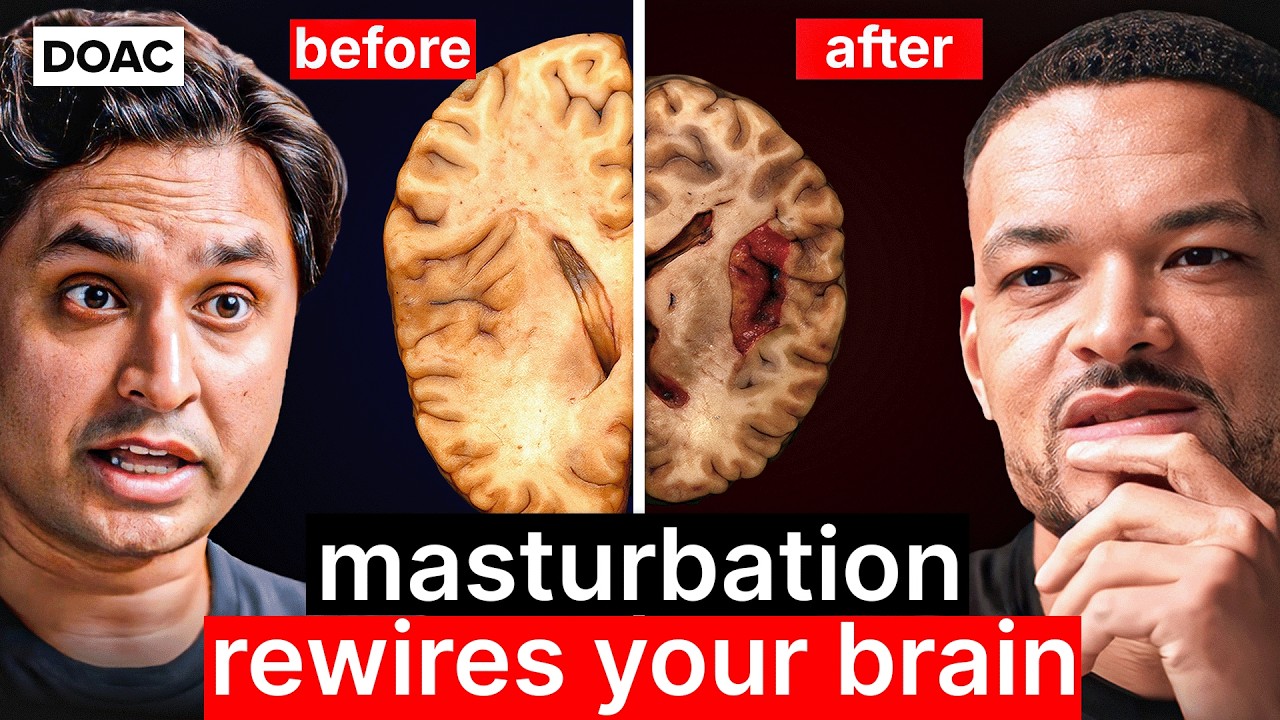
Dr. K Says Internal Mastery Beats External Control in Addiction Fight
The Diary Of A CEO
Pornography and artificial stimulation temporarily suppress negative emotions, leading to long-term emotional numbness and a collapse in real-world relationship formation among young adults.
## Background
This episode of The Diary Of A CEO, hosted by Steven Bartlett and published on YouTube on July 7, 2025, features world-renowned addiction expert and Harvard-trained psychiatrist Dr. Alok Kanojia (Dr. K). According to the video description, the interview explores the hidden truths behind pornography addiction, dopamine burnout, societal shifts in dating, and why a significant portion of young men feel single, lost, and emotionally numb.
## TL;DR
Dr. K examines how pornography, digital overstimulation, and modern technology hijack the brain's reward system, isolating individuals from genuine human connection and fueling a broader crisis of male alienation. He explains the neurobiology of dopamine, post-nut clarity, and why raw willpower often fails in overcoming addiction, offering insights into Eastern philosophy, internal self-mastery, and spiritual growth. The conversation also explores the risks of AI relationships, the double-edged sword of psychedelics, and practical strategies for cultivating true purpose through internal work rather than external control.
## Atmosphere & style
The conversation carries a grounded, deeply introspective, and intellectually candid atmosphere, balancing rigorous psychiatric insights with ancient Eastern philosophy. Steven Bartlett's probing, vulnerable questioning creates an intimate space where raw personal reflections, warm humor, and serious societal critiques naturally intertwine. Watching or listening feels like eavesdropping on a late-night, unvarnished dialogue between two thoughtful peers striving to unpack complex human struggles without judgment or superficial self-help tropes.
## Key takeaways
- [02:32](https://www.youtube.com/watch?v=dm2qDrb3UVo&t=152s) Attempting to control external variables leads to mental exhaustion, whereas directing energy inward builds personal resilience and self-mastery.
- [07:30](https://www.youtube.com/watch?v=dm2qDrb3UVo&t=450s) Altering a bad mood requires specific mental tools and techniques rather than assuming a negative state inevitably ruins an entire day.
- [09:51](https://www.youtube.com/watch?v=dm2qDrb3UVo&t=591s) Using raw willpower to suppress desires is inefficient; effective addiction recovery relies on sublimation and accurate diagnosis of underlying causes.
- [13:08](https://www.youtube.com/watch?v=dm2qDrb3UVo&t=788s) Pornography provides dense, low-effort dopamine that mimics high-density evolutionary rewards, bypassing normal relationship-building mechanisms.
- [14:32](https://www.youtube.com/watch?v=dm2qDrb3UVo&t=872s) Sexual arousal suppresses prefrontal cortex functions linked to risk assessment and critical judgment to prioritize procreation.
- [19:46](https://www.youtube.com/watch?v=dm2qDrb3UVo&t=1186s) Pornography isolates sexual drive from emotional vulnerability, which eliminates immediate motivation to seek genuine human connection.
- [22:46](https://www.youtube.com/watch?v=dm2qDrb3UVo&t=1366s) The combination of modern dating dynamics, financial independence, and technology has contributed to reduced marriage rates and widespread male alienation.
- [40:06](https://www.youtube.com/watch?v=dm2qDrb3UVo&t=2406s) A significant portion of chronically isolated young men lack the internal psychological foundation required for emotional connection due to unaddressed trauma.
- [01:01:56](https://www.youtube.com/watch?v=dm2qDrb3UVo&t=3716s) Overcoming addiction involves directly confronting pain rather than continually trying to escape emotional or physical discomfort.
- [01:10:54](https://www.youtube.com/watch?v=dm2qDrb3UVo&t=4254s) Publicly sharing high-level personal spiritual milestones can create unhelpful expectations and hinder personal meditative progress.
- [01:15:50](https://www.youtube.com/watch?v=dm2qDrb3UVo&t=4550s) Psychedelics put the brain into a state of heightened neuroplasticity, which can entrench negative neural patterns if experienced during panic or disorientation.
- [01:19:35](https://www.youtube.com/watch?v=dm2qDrb3UVo&t=4775s) Aligning actions with dharma (duty or purpose) activates neural circuits that make enduring hardship easier compared to chasing external desires.
- [01:27:30](https://www.youtube.com/watch?v=dm2qDrb3UVo&t=5250s) Continuous noise and sensory stimulation prevent individuals from processing internal emotions, leading to built-up anxiety and guilt.
- [01:39:35](https://www.youtube.com/watch?v=dm2qDrb3UVo&t=5975s) Half-hearted resistance to cravings can accidentally train the brain to generate stronger withdrawal symptoms and pain signals.
- [01:47:03](https://www.youtube.com/watch?v=dm2qDrb3UVo&t=6423s) Over-relying on AI tools can lead to cognitive atrophy, reinforcement of personal cognitive biases, and reduced critical retention.
## Detailed walkthrough
### [00:00](https://www.youtube.com/watch?v=dm2qDrb3UVo&t=0s) Introduction and the Neurological Trap of Pornography
Dr. Alok Kanojia (aka Dr. K) opens with a heavy truth about how pornography and sexual stimulation interact with the brain. Whenever a person engages with porn, masturbates, or seeks sexual stimulation, the emotional circuit—specifically the amygdala—is temporarily suppressed. Negative emotions like fear, anxiety, and self-doubt are muted. However, suppressed emotions do not vanish; they grow over time. This creates a vicious neurological cycle: feeling guilty or like a loser fuels emotional distress, making dating harder and self-worth decline, which ultimately drives the person back into pornography to escape those very feelings.
Dr. K emphasizes that all forms of addiction are rising across society, pointing to a systemic issue. Podcast host Steven Bartlett highlights the broader context of the conversation: modern mental health, dopamine burnout, and non-traditional paths to recovery. Dr. K notes that because of a widespread "dating and mating crisis," many people lack vital sexual and emotional connections, leaving a fundamental part of the human brain starved. Using a vivid metaphor, he explains that using porn as a relationship substitute is like filling your stomach with junk food—you might not crave broccoli because your belly is full, but your body remains severely malnourished. This vacuum fuels extreme societal pressures, angry subcultures like the incel movement, and existential anxieties among young adults trying to figure out how they will ever form families.
* **Emotional Suppression Mechanism:** Engaging in sexual stimulation directly suppresses the amygdala, muting real-time feelings of fear and anxiety.
* **The Vicious Cycle:** Suppressed emotions compound over time, worsening feelings of inadequacy and increasing reliance on pornography for relief.
* **The Malnutrition Analogy:** Consuming pornography fills the brain's sexual appetite with low-value stimulation, eliminating the immediate drive to seek genuine human connection while leaving emotional needs unmet.
* **Societal Consequences:** The collapse of traditional dating and mating leads to severe loneliness, resentment, and broader demographic challenges.
---
[02:32](https://www.youtube.com/watch?v=dm2qDrb3UVo&t=152s) Who Is Dr. K?
Steven Bartlett prompts Dr. K to introduce himself and his core philosophy for those unfamiliar with his work. Dr. K introduces himself as a Harvard-trained psychiatrist and the founder of Healthy Gamer, whose main objective is helping people truly understand themselves. He observes that modern life bombards individuals with massive, uncontrollable variables—ranging from war, inflation, and AI to the ongoing dating crisis. Because no single individual can control these sweeping existential threats, energy is best spent mastering the internal world.
Reflecting on his personal path, Dr. K shares that before his medical career, he spent years studying in India to become a monk. That period taught him a foundational lesson: mastering one's own mind renders the chaotic external world far more manageable and, ideally, effortlessly navigable.
> "There's lots of stuff happening around us that affects our lives that we have no control over... All you can really control is like the bounds of what's in here, right? That's like literally the only thing that you have control over."
---
[03:33](https://www.youtube.com/watch?v=dm2qDrb3UVo&t=213s) Understanding You Can Only Control Yourself
When Steven asks about the first step toward achieving internal control, Dr. K answers with dry humor: the necessary step one is trying to control external circumstances and "failing miserably time after time after time." People routinely exhaust immense mental energy trying to manipulate others—trying to get a boss to act differently, forcing a partner to change, or agonizing over a text message reply from someone they are dating.
Dr. K argues that modern technology exacerbates this tendency. Society has engineered a culture where individuals demand that their environment adapt to them rather than adapting to their environment. He uses air conditioning as an everyday example: rather than expanding personal tolerance for heat, people expect the temperature of an entire room to be manipulated for their comfort.
* **External Control Trap:** Expending energy trying to shape other people or outside circumstances leads to constant frustration.
* **Technological Accommodations:** Modern convenience conditions people to expect external conditions to bow to their personal preferences.
---
[04:47](https://www.youtube.com/watch?v=dm2qDrb3UVo&t=287s) Risk of Wanting to Change Our External Environment
Expanding on the dangers of external hyper-focus, Dr. K points out that forcing the outer world to conform inevitably triggers relational and societal friction. When two individuals meet, each demanding that the room temperature suit their individual preference, conflict over the thermostat is inevitable.
At a macro level, this dynamic underpins global warfare. Wars occur when two opposing factions hold rigid, conflicting views on where national borders should lie. Instead of burning vital energy trying to reshape an unyielding world, Dr. K advocates redirecting that energy inward to cultivate personal resilience and self-mastery.
---
[05:44](https://www.youtube.com/watch?v=dm2qDrb3UVo&t=344s) Internal Work Will Manifest Outward
Dr. K challenges popular ideas surrounding productivity, career, and personal satisfaction. He criticizes the conventional concept of "work-life balance," arguing that it falsely implies work and life are fundamentally opposed forces requiring continuous sacrifice. In reality, psychological research demonstrates that happiness, productivity, and success are deeply intertwined.
He highlights the contradictory, cliché advice often given to young people:
1. *"Do what you love, and you'll never work a day in your life."*
2. *"Never turn your passion into your job, or you'll grow to hate it."*
Because external advice is inherently conflicting, genuine stability must be cultivated internally. Internal well-being directly alters external reality in concrete ways: an individual who approaches work or relationships from a place of genuine internal clarity naturally performs better, builds healthier relationships, and communicates more effectively.
* **Work-Life Balance Myth:** Viewing work and life as a zero-sum trade-off ignores how internal happiness directly boosts performance and satisfaction across both domains.
* **Concrete Outward Impact:** Internal self-development is not merely abstract spirituality; a positive internal state measurably improves workplace productivity and social attraction.
---
[07:30](https://www.youtube.com/watch?v=dm2qDrb3UVo&t=450s) How to Stop Having a Bad Day
Steven notes how easily people get dragged down by circumstance—waking up after a terrible night's sleep, falling into a bad mood, and letting it ruin their entire day. Dr. K breaks down the flawed logic behind this experience using a driving analogy: if you notice your fuel tank is low on the highway, running out of gas is logical only if you choose to ignore the exit for the gas station.
Most people treat a bad mood leading to a bad day as an unavoidable, inevitable causal chain because they lack the tools to "visit the gas station." Altering that internal trajectory requires understanding the mechanics of one's mind—recognizing specific habits, mental exercises, or physiological adjustments that break negative momentum. Mastering these levers transforms what feels like an impossible struggle into a straightforward task, much like solving a Rubik's cube once the algorithm is understood.
> "Literally the difference between something hard and something easy is whether you know how to do it."
---
[09:51](https://www.youtube.com/watch?v=dm2qDrb3UVo&t=591s) Getting Rid of Desire and Temptations
Dr. K states that trying to suppress or control desires through raw willpower is exhausting, inefficient, and unpleasant. A far superior approach is *sublimation*—understanding the root cause of a desire so thoroughly that the urge naturally dissolves on its own.
Applying this principle to pornography addiction, Dr. K references a fundamental rule in medicine: **"Good diagnosis precedes good treatment."** Just as a physician must accurately diagnose a disease or a plumber must locate the precise source of a leak before fixing it, an individual must identify why they rely on pornography. He breaks porn addiction down into five core layers:
1. **Societal Layer:** All forms of addiction are rising simultaneously, proving that systemic changes in social connectivity—rather than just the allure of explicit content—are driving the crisis.
2. **Neurological & Physiological Layer:** Pornography acts as a potent emotional coping mechanism, explicitly designed to quiet stress centers in the brain.
3. **Dopamine & Reinforcement Layer:** Orgasm triggers massive dopamine release, creating behavioral loops that bind pleasure directly to future cravings.
4. **Efficiency Mechanism:** Human physiology evolved to seek high-density rewards with minimal energy expenditure.
5. **Risk & Perception Alteration:** Sexual arousal selectively dampens critical judgment and risk assessment.
* **Diagnostic Priority:** Overcoming an addiction requires identifying its precise psychological function rather than relying solely on willpower.
* **Sublimation over Suppression:** Transmuting or eliminating the underlying trigger is far more effective than attempting to fight persistent urges through force.
---
[13:08](https://www.youtube.com/watch?v=dm2qDrb3UVo&t=788s) Addiction to Pleasure
Diving deeper into the neurobiology of dopamine, Dr. K addresses what he calls "the curse of humanity." When the brain secretes dopamine into the nucleus accumbens during a pleasurable experience, it triggers three interconnected neurocircuitry functions: pleasure, craving, and future motivation.
Enjoying a pleasant stimulus automatically program the brain to crave and seek out that same stimulus in the future. Because pornography delivers an extraordinarily dense, effortless surge of dopamine, the brain naturally prioritizes it over activities that require high effort for low or uncertain rewards. Humans evolved to prioritize efficiency—just as calorie-dense foods kept ancestors alive in environments of scarcity, hyper-stimulating digital content easily hijacks basic survival mechanisms.
* **Dopamine's Triad:** Dopamine release simultaneously processes immediate pleasure, creates immediate craving, and builds long-term behavioral motivation.
* **Evolutionary Misalignment:** Brain circuits designed to conserve energy and pursue high-density survival rewards are easily exploited by modern digital media.
---
[14:32](https://www.youtube.com/watch?v=dm2qDrb3UVo&t=872s) Why Ignoring Red Flags Favours Evolution
Dr. K explains how sexual arousal fundamentally alters brain function and decision-making. From an evolutionary standpoint, procreation is the ultimate drive for species survival. Consequently, when sexual attraction or arousal circuits switch on, the brain intentionally suppresses the prefrontal cortex regions responsible for risk assessment and critical judgment.
Steven asks for a practical explanation of this phenomenon. Dr. K illustrates that when people experience intense romantic or sexual desire, they frequently overlook obvious personal defects or danger signs—a state commonly referred to as "pre-nut fog" or blinded romance. Evolution intentionally designed the brain to ignore red flags in order to prioritize reproduction, leaving modern individuals particularly vulnerable to hyper-stimulating artificial sexual inputs.
* **Suppression of Risk Assessment:** Arousal selectively dampens the cognitive structures that evaluate long-term consequences and social red flags.
* **Evolutionary Logic:** Lowering critical judgment during moments of mating potential historically maximized reproductive success, though it leaves modern brains vulnerable to digital exploitation.
[15:11](https://www.youtube.com/watch?v=dm2qDrb3UVo&t=911s) The Evolutionary Purpose of Ignoring Red Flags
Dr. K explains that human brain circuitry is evolutionarily wired to shut down rationality during attraction. He presents a thought experiment contrasting a hypothetical human ancestor who fell in love and behaved entirely rationally with one who fell in love and "did stupid things." From a purely evolutionary standpoint, the ancestor willing to overlook risks is the one far more likely to procreate.
As a concrete example of a "stupid thing," Dr. K describes a scenario where an individual who has just achieved hard-won financial stability falls in love with someone carrying massive credit card debt. Entering that relationship is objectively a terrible idea, yet humans routinely ignore such major warning signs. This selective blindness is a deliberate feature of biological wiring; if individuals remained strictly rational, the friction of real-world complications would prevent them from pairing up and passing on their genes.
[15:56](https://www.youtube.com/watch?v=dm2qDrb3UVo&t=956s) Post-Nut Clarity and the Objectification of Partners
The inhibition of the brain's rational thinking areas by lustful circuits directly accounts for the phenomenon known as "post-nut clarity." Steven Bartlett shares a personal anecdote from his early 20s when, around 2:00 or 3:00 AM, driven by intense sexual desire, he was arranging a long drive to meet a person he was only vaguely interested in. Deciding to masturbate instead, he experienced an immediate, jarring shift in consciousness. Within seconds, it felt as though a completely different, highly rational person inhabited his body, leaving him baffled as to why he had been willing to disrupt his sleep to drive nearly an hour for someone he had no genuine interest in.
When Steven recalls trying to explain this psychological shift to a woman, she became deeply offended. Dr. K validates that reaction, explaining that women's offense is rooted in a correct intuition: during moments of intense lust, a man is biologically driven to objectify his partner. The brain stops viewing her as a complex human being with distinct thoughts and feelings, reducing her strictly to a sexual object. While admitting this truth is uncomfortable and politically incorrect, Dr. K insists that total honesty about human biology is the only baseline from which real solutions can be reasoned out.
[19:15](https://www.youtube.com/watch?v=dm2qDrb3UVo&t=1155s) Sex Differences in Post-Coital Psychology
Steven references a 2021 study published in the *Journal of Sex Research* to contrast the male experience of post-nut clarity with female post-coital psychology. The study highlights a distinct gender split:
- **Women:** More likely to feel deeply emotionally connected, vulnerable, and express a strong desire for post-coital closeness, such as cuddling or talking, due to the heavy release of oxytocin.
- **Men in long-term relationships:** Reported feeling similarly bonded and open to cuddling, which Steven notes aligns with his own experience with his partner of seven years.
Dr. K adds that when a man understands the underlying neurological mechanics of post-nut clarity, he can learn to cultivate that clear-headed, objective state of mind willfully over time, without needing to rely on the physical act of ejaculation to clear his thoughts.
[19:46](https://www.youtube.com/watch?v=dm2qDrb3UVo&t=1186s) The "Slice" of Pornography vs. The Full Package of Relationships
Dr. K bridges the conversation into a broader societal issue: the breakdown of male-female relationships is starving the male brain of vital emotional and sexual connections. When the brain is starved of a natural necessity, it actively seeks any substitute to satisfy that hunger. Under healthy conditions, the brain craves an entire "package"—much like a hungry person desires a complete, structured meal rather than raw calories. In a real relationship, the drive toward procreation is naturally bundled with emotional vulnerability, an intimate bond, and a mutual feeling of safety.
The core danger of pornography is that it artificially extracts a single "slice" of what the brain craves—sexual gratification—while completely omitting the emotional substance. Once a man satisfies his procreative drive through porn, the immediate neurological motivation to pursue a partner and endure the sacrifices required to build a real relationship completely evaporates. Dr. K uses a vivid nutritional analogy to illustrate this phenomenon:
> "It's sort of like if I fill up your stomach with just unhealthy food... let's say I just give you straight calories like some highly processed hamburger wrapped in donuts... drizzled with artery-clogging stuff. After you eat that, you don't have any fiber, you don't have any micronutrients, but you're not going to crave broccoli."
[22:46](https://www.youtube.com/watch?v=dm2qDrb3UVo&t=1366s) The Mating Crisis and the App Economy
When asked about the current friction between men and women, Steven highlights several monumental cultural and structural shifts:
- **Economic and Social Independence:** Due to the historical successes of feminism, the sexual revolution, and the introduction of the birth control pill, women no longer rely on men for societal stability or survival.
- **Dating App Dynamics:** The modern dating landscape creates a damaging illusion of infinite choice. Because users feel there are thousands of alternative options just a swipe away on their phones, relationships are treated as fundamentally disposable. The moment friction arises, people decide the heavy emotional investment required to make a relationship work is no longer worth the return.
- **Growing Resentment:** These compounding factors have resulted in lower marriage rates, less sexual activity overall, and pockets of deep, bitter resentment festering across various male spaces on the internet.
[23:46](https://www.youtube.com/watch?v=dm2qDrb3UVo&t=1426s) The Disparity in Societal Support for Young Men
To ground the discussion, Dr. K asks Steven what advice he would give to his own 18-year-old nephew who is struggling to get dates. Steven answers that an 18-year-old man must focus entirely on self-improvement—reading, learning, going to the gym, and building up the tangible capacity to protect and provide for a future partner. However, when Dr. K presses on what happens when a young man tries all of this and still fails, he points out a harsh societal reality: when men voice their struggles, the overwhelming response from society is a unsympathetic command to "work harder" or "try harder," occasionally accompanied by cruel labels like "creep."
Dr. K argues that modern society operates under a heavy bias that men do not require systemic help, treating a man's failure purely as an individual defect. He presents a stark financial data point regarding collegiate support in the United States to highlight this institutional imbalance:
- Out of roughly **$4.9 billion** in private scholarship funding distributed in the U.S., female-only scholarships vastly outnumber male-only scholarships outside of athletics (where men receive higher funding).
- This funding asymmetry persists despite the fact that women make up approximately **60%** of current college students and graduates.
Because institutional support heavily favors women, young men facing isolation are left without a roadmap. This systemic abandonment forms the bedrock of the intense anger, entitlement, and alienation found within the modern incel and polarized "alpha vs. beta male" internet movements.
[27:05](https://www.youtube.com/watch?v=dm2qDrb3UVo&t=1625s) The Existential Cry of Men and Natural Selection
Dr. K describes the profound ideological divide between genders as an "existential cry coming from men which can manifest as anger." This tension is vividly illustrated by the viral social media debate asking women whether they would prefer to be left alone in a forest with a wild bear or a man; the fact that many women choose the bear demonstrates a profound, pervasive fear of male anger. This gender division is altering global demographics, notably causing plummeting birth rates in countries like South Korea, where gender animosity has turned deeply political.
From a biological standpoint, a fundamental power imbalance exists: a woman can independently choose to pass her genes along via a sperm bank without a partner, whereas a man cannot procreate without a willing woman. Because of this, Dr. K suggests that society is currently witnessing a literal "mass extinction event"—a process of natural selection filtering out a massive cohort of men who have run out of romantic options.
Dr. K reflects on his own youth, admitting, "Many years ago, I was a loser." He explains that his generation was saved because the physical structure of the pre-digital world fundamentally forced men into "third spaces." Even though he was naturally terrible at interacting with girls, his environment provided no escape hatch:
- Attending college in person forced daily social proximity.
- Working his first job serving ice cream required mandatory public communication.
- Participating in summer camps forced him to confront his anxieties and converse with the opposite sex.
The modern environment has completely eliminated these forced interactions. The aftermath of the COVID-19 pandemic acted as an environmental trigger point, causing a massive spike in social anxiety. Today, technology allows an isolated individual to work from home, order food to their door, and turn to pornography for artificial sexual release. Because young men can comfortably retreat into a digital existence, they are no longer forced to brave the painful, messy, and necessary real-world social interactions required to develop social competence. Natural selection occurs when an environment drastically changes, and right now, the modern digital environment is selecting against men who choose total isolation over real-world discomfort.
[30:31](https://www.youtube.com/watch?v=dm2qDrb3UVo&t=1831s) The Evolutionary Extinction of Men and Standard Advice Failure
Dr. K paints a vivid picture of the modern dating and social crisis by drawing a direct parallel to ecological collapse. Just as a specific species of bird might die out if the desert cacti it relies on disappear—leaving the birds completely unable to procreate in their altered habitat—a whole generation of young men is currently facing a modern extinction event. We are watching men in their early to mid-30s effectively die out in real time as they fail to find partners or pass on their genes, a phenomenon underscored by South Korea's staggering fertility rate dropping to roughly 0.7. In the language of "alpha" and "beta" internet culture, legacy and procreation are constantly fixated upon; Dr. K posits that when the human subconscious senses its genetic line is ending, it triggers an intense existential panic, angst, aggression, and entitlement.
```
[ Historical Model ] [ Modern Reality ]
Forced In-Person Interaction No Environmental Forcing
(High School, Social Gathering) (Digital Isolation, Apps)
│ │
▼ ▼
Social Skills Developed Binary Split Emerges
(Losers learned to adapt) (Naturally gifted vs. Unadapted)
│ │
▼ ▼
Broader Mating Success Mass Genetic Extinction
```
In the pre-COVID world, people who were awkward or considered themselves "losers" in high school were forced into physical social environments where they had to develop interpersonal skills to interact with women. In a post-COVID world, those physical buffer spaces have vanished, leaving behind a stark dichotomy between men who naturally connect and those who are left stranded. Dr. K references Darwin's finches on the Galápagos Islands: if you put those finches on Twitter, the successful ones would simply tell the struggling ones to "just crack a nut" or "go to the gym." However, this generic self-help advice completely ignores structural differences in psychology, social anxiety, neuroticism, face shape, or underlying attachment styles. Sitting across from these young men in clinical settings feels like watching someone undergo a slow, protracted process of dying rather than living. When standard, promised-to-work self-improvement advice fails them, immense existential dread and terror set in, driving them straight into the arms of pornography to cope with spiritual emptiness and an aimless existence.
* **South Korea's Fertility Crisis:** The birth rate in South Korea has plummeted to approximately 0.7, serving as a primary real-world baseline for this genetic collapse.
* **Correlates of Pornography Addiction:** The two strongest statistical variables correlating with porn addiction are a profound sense of **meaninglessness in life** and having unstructured, empty hours in the day with nothing to live for.
* **The "Dying Out" Psychological Trap:** Men who try therapy, improve professionally, and use dating apps still fail due to fixed traits (facial architecture, deep-seated anxious attachment, being on the autism spectrum) that impede eye contact and emotional bonding under modern dating app conditions.
---
[35:52](https://www.youtube.com/watch?v=dm2qDrb3UVo&t=2152s) Societal Responsibility vs. Individual Agency in the Mating Crisis
Steven Bartlett asks whether society or governments have a fundamental responsibility to intervene and correct this systemic isolation. Dr. K remains skeptical of the abstract phrase "societal responsibility," arguing that "society" as a conscious entity does not exist—it consists entirely of individual human beings. He illustrates this point through the classic psychological phenomenon of bystander apathy, citing the famous historical case of a woman being publicly sexually assaulted while neighbors watched from their windows without calling for help, each assuming someone else would step up. Blaming "society" often serves as a dangerous psychological defense mechanism to avoid taking personal responsibility.
Nevertheless, geopolitical entities are beginning to react to the demographic cliff out of raw self-preservation. In South Korea, severe cultural friction between the feminist "4B Movement"—where women explicitly refuse marriage and childbirth—and a rising conservative male movement has forced the issue into the political arena. Similarly, nations like China are actively implementing financial incentives and paying citizens to have children. Dr. K notes that if society fails to act, natural selection will simply run its course: a massive demographic of men aged 15 to 50 will die out without passing on their lineage, while the surviving gene pool will consist strictly of those adapted to post-COVID digital landscapes.
* **The Reality of Who Procreates:** Contrary to the internet belief that only hyper-attractive "Tinder studs" reproduce, a visit to any public playground reveals that average-looking men with median incomes and "dad bods" are the ones actually having children, because they possess the internal psychological capacity to form stable emotional bonds.
* **The Bystander Phenomenon:** Relying on collective intervention creates a diffusion of responsibility where no individual takes action.
---
[40:06](https://www.youtube.com/watch?v=dm2qDrb3UVo&t=2406s) The Right to Reproduce and the Limits of Generic Advice
The conversation pivots to the philosophical debate over whether natural selection should be allowed to take its course or if intervention is morally required. Bartlett questions why society aggressively treats medical conditions like cancer or viruses, or uses IVF to help infertile couples procreate, yet hesitates to intervene when millions of men are socially dying out. Dr. K pinpoints the crucial distinction: medical treatments or IVF involve consenting individuals or established couples fighting a biological ailment. In contrast, solving a man's inability to find a partner touches upon the fundamental question of whether individuals have a "right" to reproduce.
> "My right to reproduce never trumps someone's right to not want to reproduce with me."
Because male reproduction strictly requires the explicit consent of another person, no societal intervention can force partnership without violating individual autonomy. Furthermore, women possess unique reproductive autonomy through sperm banks, whereas men cannot reproduce unilaterally. Dr. K emphasizes that the reason standard self-improvement advice—like "hit the gym" or "make more money"—completely fails these struggling men is because it is given by people who already possess the baseline psychological infrastructure for intimacy. Roughly one-third of the men Dr. K treats do not fundamentally know how to **give or receive love**, a deeply rooted issue tied to childhood trauma and attachment that cannot be fixed by adjusting a Tinder profile or accumulating wealth.
* **IVF vs. Social Infertility:** Medical technology like IVF assists consenting couples with physical blockages, whereas social isolation cannot be cured by force because it intersects with another person's consent.
* **The Root Cause:** A full third of chronically isolated young men lack the internal framework to give or receive emotional love, rendering surface-level financial or physical self-improvement ineffective.
---
[44:06](https://www.youtube.com/watch?v=dm2qDrb3UVo&t=2646s) Unpacking Emotional Blind Spots and Fear of Commitment
When treating these men on an individual basis, Dr. K does not start by trying to teach them "love"—a concept too foreign and overwhelming at the outset—but by helping them map and understand their own suppressed emotions. Human behavior is frequently governed by unconscious psychological patterns that drive choices without any conscious awareness.
To illustrate how these hidden dynamics operate, Dr. K shares a classic example regarding commitment issues in relationships. Women often complain about dating men who are "afraid of commitment," placing the entire blame on the male partner to "step up and be a man." However, clinical experience reveals a counter-intuitive mirror dynamic: many women repeatedly select men who are terrified of commitment specifically because **they themselves are secretly afraid of commitment**. By picking an unreliable partner, they can safely demand commitment while blaming the man for failing to provide it. When Dr. K works with the male partner in therapy and helps him successfully overcome his fear of commitment, the dynamic suddenly shifts—the female partner often panics, retreats, and starts inventing new flaws in the relationship because her own hidden boundary has been breached.
> "The moment that he conquers his fear of commitment, the woman will retreat. They'll get terrified... First of all, understand your emotions. Then you will understand your patterns."
* **Clinical Therapy Process:** Interventions begin with emotional literacy rather than grand relationship goals.
* **Unconscious Dynamic:** People often seek out partners with specific relational flaws (e.g., fear of commitment) to protect themselves from facing their own identical, unacknowledged fears.
[046:00] Breaking the Cycle of Relationship Patterns and Emotional Avoidance
Dr. K explains that emotional awareness requires recognizing not just surface feelings, but deep-seated psychological patterns. He illustrates this through a common dynamic where people repeatedly choose partners who are afraid of commitment. In reality, the individual themselves fears commitment; by picking an undateable or emotionally unavailable partner, they can point fingers and blame the other person while completely avoiding their own fear.
True emotional regulation comes from seeing these patterns clearly and taking responsibility for them. Once someone understands their emotional landscape, the next step is discovering healthy ways to process those emotions rather than resorting to destructive short-term desires like pornography or other addictive behaviors that sabotage long-term goals.
[046:47] Practical Strategies for Treating Pornography Addiction
When Steven asks for actionable advice on handling cravings, Dr. K outlines his practical clinical framework for treating pornography addiction. Counterintuitively, his first recommendation is to actually **schedule** pornography usage rather than trying to quit cold turkey. Digital addictions act like an invasive species that fill every small crack in a person's routine, gradually widening those cracks until they swallow whole days. Restricting usage to a single, dedicated hour per day—and logging out of all secondary devices—contains the behavior to a controlled space.
```
+-----------------------------------------------------------------------+
| PRACTICAL ADDICTION RECOVERY FRAMEWORK |
+-----------------------------------------------------------------------+
| 1. Schedule Usage | Limit porn to 1 designated hour per day; |
| | log out of all non-essential devices. |
| 2. Pre-Plan Responses | Innovate coping strategies BEFORE distress |
| | strikes; build the "fire hydrant" early. |
| 3. Practice Urge | Observe cravings without acting; allow them |
| Surfing | to peak and naturally dissipate over time. |
| 4. Regulate Physiology | Use Alternate Nostril Breathing (Nadi Shodhana)|
| | to calm down the nervous system quickly. |
+-----------------------------------------------------------------------+
```
Next, individuals must anticipate the emotionally challenging parts of their day and design alternative coping strategies in advance. Dr. K emphasizes a core principle of brain mechanics: when the brain is in acute distress or survival mode, it relies strictly on reflexes and cannot innovate new solutions. You cannot search for a fire hydrant while your house is actively burning down. Therefore, emotional regulation tools must be practiced continuously when calm so they are ready for deployment during a crisis.
* "Reflexes and innovation are at two opposite ends of the spectrum."
* "You have to innovate before you need to use it... We need to have a fire hydrant in our house before the fire starts."
[048:18] Urge Surfing and the Nature of Unfed Desires
Dr. K introduces a psychological technique known as **urge surfing**, which often confuses people because it challenges how we view desire. He asks Steven if he wants anything right now; Steven mentions putting an offer on a house and feeling slightly hungry. Dr. K points out that if those desires are left unfulfilled, they inevitably fade away on their own. Even an intense craving for a house or food will peak, weaken, and vanish if ignored, because human desires cannot sustain themselves indefinitely without fuel.
Urge surfing is the practice of recognizing that you do not need to aggressively conquer or fight an addiction; you simply need to wait it out. Cravings operate like ocean waves: they rise, peak in intensity, and roll back out.
* "People don't realize that if you do not give into your desire, it'll disappear on its own."
* "Urge surfing is recognizing that you don't need to conquer your addiction. You need to wait it out."
To help manage the physical stress that accompanies cravings, Dr. K recommends a yogic technique called alternate nostril breathing (*Nadi Shodhana*). Cravings trigger feelings of dissatisfaction and stress, causing a spike in cortisol that activates the sympathetic nervous system. Alternate nostril breathing directly alters the autonomic nervous system, rapidly shifting the body into a calmer, parasympathetic state.
Dr. K leads Steven through an interactive exercise using his hand to alternate blocking the left and right nostrils with each breath cycle. The practice forces absolute mental focus because it involves specific, unnatural physical mechanics. While standard deep breathing allows the mind to wander back to worries, hunger, or cravings, alternate nostril breathing anchors attention entirely to the physical movement.
When Steven feels disoriented and completely forgets what topic they were discussing prior to the exercise, Dr. K laughs in satisfaction. He notes that healthy people undergo a natural shift in nasal dominance roughly every 90 minutes. By temporarily disrupting the craving cycle with this breathing exercise, the brain learns that an alternative solution exists beyond giving into the habit loop.
* "Anytime we have an urge for something, we feel unsatisfied. When we feel unsatisfied, it creates stress. Stress causes a spike in cortisol."
* "The whole reason we get trapped in a cycle of addiction is because we have one solution to one problem. The moment that we create a second solution, a lot of things change."
[052:52] How Willpower Works and the Illusion of Relapse
Building a new coping mechanism requires consistent daily training—roughly 5 to 15 minutes a day—so the skill becomes second nature during intense cravings. Moving beyond basic urge surfing, Dr. K breaks down the neurobiology of willpower. He demystifies the experience of relapsing, explaining that people often engage in a brief internal battle ("Should I do it or not?"), make a silent decision to give in, and then briefly pretend to continue fighting before executing the behavior.
Neurobiologically, the anterior cingulate cortex is responsible for both monitoring internal conflict and exerting willpower. Therefore, the feeling of internal conflict **is** willpower actively operating. Addiction wins only when an individual steps out of the ring and stops monitoring the conflict. By maintaining conscious awareness of that inner fight, a person retains control.
* "That internal conflict is willpower... The anterior cingulate cortex is what monitors your internal conflict and gives you willpower."
* "As long as you are monitoring your internal conflict, the only way an addiction can win is when you leave the ring."
[056:13] The Need for an Internal "Why" and Spiritual Growth
For long-term recovery, practical exercises must be supported by deeper internal purpose. Dr. K observes that many men attempt to stop watching pornography purely to keep their romantic partner from getting angry. However, external pressure is rarely sufficient to cure an addiction; instead, it causes the addiction to mutate into secrecy and deception. If the driving motivation is merely avoiding a partner's wrath, the addict's brain rationalizes that using pornography in secret solves the problem without triggering an argument.
True freedom requires an intrinsic, personal reason to quit ("a why"), discovered through self-reflection, psychotherapy, or meditation. On a broader scale, Dr. K proposes that the current societal rise in addictions is driving a wave of spiritual growth. People who successfully overcome addictions often emerge with extraordinary spiritual strength, internal discipline, and resilience against adversity.
* "Keeping my partner from getting mad at me is not a sufficient reason to conquer the addiction... The addiction will then use deception."
* "Anytime I have a patient with an addiction, once they're on the other side, they are absolute beasts on the spiritual level... Addiction is on the path to meditation and spiritual growth."
[058:03] Sponsor Interlude: Justworks
Steven Bartlett transitions into a brief sponsor message for Justworks, highlighting a common blind spot among early-stage business founders. Founders often neglect HR infrastructure because they are preoccupied with product development and initial survival. However, as teams expand, automated payroll, benefits administration, and compliance tools become vital to prevent operational breakdown.
[059:03] Karma, Trauma, and the Flaw in Fear-Based Recovery
Returning to the conversation, Steven notes that almost every deeply spiritual person he has interviewed started their journey by battling an addiction. Dr. K agrees, comparing addiction to signing up for a spiritual "boot camp" before birth—a karmic weight intended to forge self-mastery.
Steven offers a counter-narrative based on psychological trauma: a child grows up with an abusive father shouting at him, uses addiction to manage high cortisol and emotional distress, eventually faces an ultimatum from a spouse, and finally enters rehab because the pain of staying the same exceeds the pain of changing.
Dr. K directly challenges Steven's scenario, stating that a person operating under that logic will inevitably relapse. Quitting an addiction purely because the external consequences or pain have become too severe means the individual is acting out of force and fear rather than internal transformation. If recovery is framed as a cost-benefit calculation to minimize external pain, it lacks the spiritual or internal shift required for permanent change.
Here is the detailed, faithful walkthrough covering Part 5 of the transcript.
---
[01:01:56](https://www.youtube.com/watch?v=dm2qDrb3UVo&t=3716s) Surrender, the Laws of Existence, and Karma
Dr. K explains that as long as a person is giving in to the part of themselves that simply wants to lessen their pain, their addiction will inevitably continue. In his clinical experience, the only way to genuinely defeat an addiction is to embrace the discomfort directly: to say, "Fuck it. There's going to be pain. I'm going to embrace that pain. I don't need to run away from pain anymore." Rather than choosing the "lesser evil" of immediate relief or coping mechanisms, one must choose the "greater evil" of sitting through full-blown suffering because it is the right thing to do. Steven Bartlett characterizes this mindset as "surrender," to which Dr. K adds that it is a combination of surrender and active challenge. Surrender in this context means allowing oneself to walk the difficult path rather than remaining trapped by the constant compulsion to minimize immediate emotional or physical pain.
```
┌─────────────────────────────────────────┐
│ Compulsion to Lessen Pain │
│ (Feeds the cycle of addiction) │
└────────────────────┬────────────────────┘
│
▼
┌─────────────────────────────────────────┐
│ Surrender & Challenge │
│ (Embrace discomfort; walk hard path) │
└────────────────────┬────────────────────┘
│
▼
┌─────────────────────────────────────────┐
│ Law of Cause & Effect │
│ (Chains of causality / Karma) │
└─────────────────────────────────────────┘
```
Shifting the discussion toward deeper existential layers, Dr. K introduces a fundamental question that scientific consensus generally avoids: *Why were you born into your specific family?* He argues that there is clear order in the universe governed by precise laws, yet our current scientific frameworks are insufficient to fully answer why a person manifests in a specific place and circumstances. Genetics explains a piece of it—for instance, a person's genetic tendency for baldness is predetermined before birth—which aligns closely with what the eastern theory of karma suggests. Karma posits that vast aspects of life are already set before an individual ever shows up.
Tracing cause and effect back through physical reality reveals an endless chain. To illustrate, Dr. K uses a sequence of dominoes: knocking over three dominoes shows the preceding cause, but the finger pushing them was caused by the movement of the shoulder, which was caused by the head, which was caused by his presence in the studio trying to explain a principle. Following causality backward leads to a singular origin point. This parallels modern physics' Big Bang theory, where cause and effect originated from a single singularity. Fascinatingly, ancient Eastern texts describe the birth of the universe emerging from a point called *bindu visarga*—literally defined as a point of infinite energy, matter, and consciousness that exploded into the physical universe.
* **Key takeaway on addiction recovery:** Real healing requires abandoning the urge to lessen pain, voluntarily choosing to endure emotional suffering as a necessary step forward.
* **The domino analogy:** Demonstrates how every immediate action is linked to a cascading chain of prior causes that stretches back to fundamental origins.
* **Bindu Visarga:** Ancient textual concept describing the universe expanding outward from a point of infinite matter, energy, and consciousness, directly echoing the modern scientific concept of the Big Bang singularity.
---
[01:05:04](https://www.youtube.com/watch?v=dm2qDrb3UVo&t=3904s) Conceptions of God and the Non-Linear Nature of Time
When Steven asks directly whether he believes in God, Dr. K answers affirmatively, though he reframes what "God" means through resolution and perspective. Just as a human being exists on multiple concurrent levels—Steven has a physical body, a bank account, and a brand, all of which are validly "Steven"—there exists a macro-resolution of reality that people naturally label as God. Dr. K agrees that there is an intentional higher power underlying existence. When Steven asks what created that higher power, Dr. K points out a fundamental division between Western and Eastern philosophies regarding the structure of time.
```
WESTERN MODEL (Linear) EASTERN / YOGIC MODEL (Circular)
In Western thought, time is viewed as strictly linear, moving in one direction like sand falling through an hourglass. In contrast, yogic traditions view time as fundamentally circular. To illustrate the illusion of linear origins, Dr. K asks Steven to identify the first season. When Steven answers "Spring," Dr. K counters by asking if Winter didn't come before Spring, demonstrating that in a cyclical system, searching for an absolute "first" point is like asking whether the chicken or the egg came first. While physics observes that entropy and macroscopic time move in one direction, intuitive and spiritual states reveal a deeper circularity to existence.
* **Multilayered identity analogy:** A person is simultaneously their physical body, financial footprint, and public identity; similarly, "God" represents the higher-resolution layer of collective existence.
* **Cyclical vs. linear time:** Challenges Western assumptions of absolute beginnings by showing that natural processes (seasons, life cycles) operate in self-referential loops.
---
[01:06:47](https://www.youtube.com/watch?v=dm2qDrb3UVo&t=4007s) Credibility vs. Truth and Meditation as a Subjective Microscope
Dr. K touches on a major personal realization from his own "midlife crisis," contrasting the pursuit of credibility with the pursuit of absolute truth. Credibility involves shaping language to fit the existing knowledge or limitations of an audience—saying what is believable rather than what is real. Believability depends entirely on the audience's perception, whereas truth exists independently of opinion. He realized that if his primary goal were to be famous and widely accepted, he would stick strictly to highly credible statements. However, if he wants to speak unfiltered truth, he must accept that his public reputation or brand might suffer, and that some people may dismiss him as an idiot. Choosing truth over credibility requires dismantling the ego.
To explain spiritual and subjective experiences, Dr. K draws a direct comparison between physical technology and meditative practices. Science developed physical instruments like telescopes and microscopes to extend our baseline physical senses, allowing us to see distant stars or microscopic bacteria that are otherwise invisible to the naked eye. In contrast, standard neuroscience approaches subjectivity obliquely. For instance, when brain imaging shows increased blood flow in the amygdala, scientists only know the subject is feeling anxiety because they ask the person to subjectively report their internal state.
Meditation serves as the spiritual equivalent of a microscope or telescope, extending human *subjectivity* inward. By systematically directing attention away from the outer physical world, an individual can perceive internal states and subtle phenomena that are entirely hidden from ordinary consciousness. Far from being supernatural, Dr. K asserts that these inner experiences are fully natural and will eventually be reducible to scientific understanding once our models catch up.
* **Credibility vs. Truth:** "Credibility is about changing your language to fit the ignorance of the audience." True authenticity requires putting one's reputation at risk to state what is actually real.
* **The Subjective Microscope:** Just as scientific tools expand physical vision, deep meditation expands internal perception to reveal subtle realities not accessible through daily awareness.
---
[01:10:54](https://www.youtube.com/watch?v=dm2qDrb3UVo&t=4254s) Why Dr. K Protects His Spiritual Experiences
Steven notes how rare it is for Dr. K to refuse a question, asking why he declines to detail his specific personal spiritual experiences on air. Dr. K outlines several precise reasons for his silence:
1. **Energy Depletion:** Sharing high-level spiritual experiences depletes *prana* or spiritual energy immensely.
2. **Inflation of Ego:** Discussing personal spiritual milestones subtly feeds the ego (e.g., projecting an image of "I have been to the other side"), which directly undermines the humility required for authentic practice.
3. **Loss of Progress:** Dr. K reveals that on the rare occasions in his life when he shared these deep personal experiences publicly, it completely wiped out his meditative progress, taking up to five years of disciplined practice just to regain those states.
4. **Creation of Distorting Expectations:** Describing these states creates detailed expectations and mental imaginations in listeners. Once the mind forms an expectation, it will artificially construct or fabricate fake versions of those experiences during practice, actively blocking genuine spiritual discovery.
> "The moment that there's an expectation in the mind, the mind will reproduce that experience."
Rather than trusting an authority figure or relying on second-hand accounts, people should embark on their own direct internal exploration. While humanity has mapped almost the entire physical globe, the internal subjective universe remains largely unexplored by the average individual. Meditation is a process of "involution"—turning all sensory perceptions inward. By shutting out external light, sound, and physical sensations, one directs raw attention toward the subjective self. Achieving profound insights through this method requires years or even decades of consistent, dedicated practice.
* **Pranic depletion:** Publicly broadcasting advanced meditative states drains subtle spiritual energy and resets internal progress.
* **Involution:** The process of withdrawing outward-facing senses to direct 100% of conscious attention into internal subjective reality.
* **Self-exploration over authority:** Dr. K urges listeners not to blindly trust his credentials or claims, but to practice meditation for a decade to verify subjective realities for themselves.
---
[01:15:50](https://www.youtube.com/watch?v=dm2qDrb3UVo&t=4550s) The Risks of Psychedelics and Neuroplasticity
When Steven asks whether taking psychedelics like psilocybin or ketamine offers a shortcut to these experiences—especially for individuals suffering from treatment-resistant depression—Dr. K strongly advises against it for the vast majority of people. In his psychiatric practice, the number of patients who have been severely destabilized or damaged by psychedelics far exceeds those who have been helped by them. He routinely treats patients in their early 30s who had no history of mental illness but developed persistent panic disorders, generalized anxiety, or severe post-traumatic stress after bad trips.
Dr. K explains the core mechanism behind this danger: psychedelics temporarily force the brain into a state of heightened **neuroplasticity**, placing the neural circuitry into an active "edit mode." While this can allow for positive rewiring under strictly controlled, expert therapeutic conditions, it equally allows the brain to be edited in destructive ways. If an individual experiences intense fear, panic, or disorientation while their brain is in this hyper-malleable state, those negative patterns become deeply entrenched, leading to long-term psychiatric distress.
* **Clinical observation:** Dr. K sees significantly more patients suffering from long-term harm (panic attacks, PTSD, flashbacks) due to recreational or unguided psychedelic use than those who experience lasting healing.
* **The double-edged sword of neuroplasticity:** Neuroplasticity simply puts the brain in "edit mode"—if the input during that window is chaotic, traumatic, or terrifying, the brain locks in bad code that can take years to reverse.
[01:17:34](https://www.youtube.com/watch?v=dm2qDrb3UVo&t=4654s) Guided Psychedelic Therapy vs. Unsupervised Trips
Dr. K emphasizes that the therapeutic success of psychedelics hinges almost entirely on "set and setting," alongside structured professional guidance. While psychedelics promote rapid neuroplasticity and allow access to a vast sense of self, taking high doses alone or without proper context can easily backfire. In the history of plant medicine, shamans served as essential guides to navigate these altered states safely. Without an experienced shepherd, individuals facing deep emotional pain who experiment with high doses—sometimes called a "heroic dose"—risk triggering intense, traumatic nervous system reactions. Dr. K notes that he has seen patients enter trips in an effort to heal, only to encounter terrifying "demons" that continue to haunt them even after the substance wears off.
Clinical trial protocols demonstrate how structured this process must be to yield genuine healing. Rather than offering a quick fix, effective trials typically feature 13 weeks of psychotherapy, with only two drug sessions positioned in the middle. The most crucial phase is the post-trip integration, where a therapist helps the patient channel profound mystical realizations—such as feeling connected to the universe—into actionable life decisions, like navigating an ongoing divorce. While Dr. K describes himself as "cautiously optimistic" about psychedelics, he stresses that their clinical utility depends entirely on preserving this rigorous, guided structure.
- **The Danger of Solo Trips:** High-dose unsupervised experiences can cause severe psychological distress, leading to persistent post-trip anxiety or terrifying visual disturbances.
- **The Role of the Guide:** Historically fulfilled by shamans and modernly by trained therapists, guides prevent panic and keep the experience constructive.
- **Clinical Trial Structure:** Standard therapeutic models involve roughly 13 weeks of talk therapy with just two psychedelic dosing sessions embedded in the middle.
- **Integration Is Key:** The core benefit relies on translating non-ordinary insights ("vastness of self") into real-world choices and emotional resolution.
---
[01:19:35](https://www.youtube.com/watch?v=dm2qDrb3UVo&t=4775s) Cultivating Your "Why" and the Power of *Dharma*
Shifting the conversation back to behavioral change and overcoming addiction, Steven notes that internal discipline is driven by an overarching "why." Using his own routine as an example, he explains that while running on a treadmill is uncomfortable, having a strong core purpose makes the choice effortless in hindsight. Dr. K agrees, contrasting Western psychology—where a therapist actively performs an intervention on a passive patient—with Eastern traditions, which offer "DIY systems" for self-directed transformation. In Eastern philosophy, the concept equivalent to a deep personal "why" is ***dharma***, the Sanskrit word for duty or intrinsic purpose.
To illustrate how *dharma* fundamentally alters human decision-making, Dr. K shares a vivid thought experiment about threat perception. If a stranger points a gun at him, his natural survival instinct is to turn and run. However, if that same gun is pointed at his child, he will immediately step into the bullet's path without a second thought. "When doing *dharma*, gun is easy," Dr. K explains. Chasing external desires (like money or status) creates constant inner friction because the mind alternates between wanting the reward and dreading the effort required to get it. In contrast, discovering one's *dharma* unlocks a distinct neurological circuit that allows a person to embrace hardship willingly.
- **Western Therapy vs. Eastern Self-Cultivation:** Western psychology often positions the practitioner as the actor (similar to a surgeon), whereas Eastern traditions like Yoga and Buddhism provide frameworks for individuals to work on themselves.
- **Definition of *Dharma*:** A Sanskrit term translating to duty, righteousness, or fundamental purpose, serving as an internal compass distinct from selfish desire.
- **Desire vs. Duty:** Pursuing goals out of greed or Delayed Gratification still leaves a person vulnerable to frustration when tasks become difficult. *Dharma* removes this friction by reframing hardship as necessary service.
- **The Protective Instinct Analogy:** Stepping in front of a gun to protect one's child demonstrates how duty instantly overrides comfort, self-preservation, and fear.
---
[01:23:28](https://www.youtube.com/watch?v=dm2qDrb3UVo&t=5008s) What You Think You Want vs. What You Actually Want
Uncovering your *dharma* is exceptionally difficult in modern society because people rarely know what they truly want. Instead, we absorb external desires manufactured by advertising, social media, and cultural expectations. Dr. K points out that young men frequently parrot a standard template of success—wanting to get ripped, start a podcast, buy a house, and find a girlfriend—without realizing these goals are external scripts rather than personal truths. When we pursue goals to satisfy external expectations (often framed as "shoulds"), we internalize external criteria rather than listening to our internal self.
> "When I see a sexy dude with a sexy girl and I say, 'I want that'—that's what I *think* I want... What I want is to feel loved. I want to feel secure."
```
THE TRAP OF CRAFTED ATTRACTION
[ Craft External Image ] ──► [ Attract Partner ]
│ │
▼ ▼
(Rich, Famous, Handsome) (Doubt Her Motives)
│ │
└───────────┬─────────────┘
│
▼
"Does she love ME, or
the persona I built?"
```
This misalignment creates deep psychological turmoil when people actually achieve their goals. Dr. K shares that he has worked with numerous clients who achieved wealth and status only to remain deeply unfulfilled. If a man crafts an impenetrable persona of wealth and good looks to force others to love him, he becomes trapped in self-doubt, wondering whether his partner loves *him* or merely the lifestyle he constructed. Steven resonates with this deeply, admitting that when he was 18 and broke, a girl rejected him; years later, after he achieved success and she became interested, he felt resentful and treated the relationship as cold and transactional.
- **The External Illusion:** Most desires are absorbed from external cues (advertisements, peers, societal pressure) rather than originating internally.
- **The Hidden Psychological Need:** Physical goals (wealth, attractive partners) are often superficial proxies for deeper, unaddressed emotional needs like security and validation.
- **The Impostor Trap in Relationships:** Constructing an idealized persona to win affection breeds insecurity, leaving the individual unsure if they are loved for who they truly are.
- **Resentment from Past Rejection:** Reaching success often triggers bitterness toward those who only show interest once external status has been achieved.
---
[01:27:50](https://www.youtube.com/watch?v=dm2qDrb3UVo&t=5270s) Noise, Distraction, and the Fear of Silence
Discovering true motivation requires turning down external input, but modern life keeps people in a state of continuous sensory overload. Steven reflects on his own past habits—listening to podcasts while walking, reading on the train, and playing lectures during workouts—realizing he systematically eliminated every pocket of silence. Dr. K notes that genuine inspiration and clarity arise from within, often during periods of isolation. Recalling his own mountaineering expeditions on Mount Kilimanjaro and peaks across Colorado, Dr. K describes how hours of intense physical exertion leave no breath for conversation, forcing a person into complete, raw presence with themselves.
People actively avoid silence because sitting alone with their thoughts feels deeply uncomfortable. Steven brings up a famous psychological study where participants chose to give themselves mild electric shocks rather than sit quietly in a room with their own thoughts for 15 minutes. Dr. K compares this impulse to self-harming behaviors like cutting, where physical pain acts as an immediate reset button to wipe out mental noise. Because most people continuously suppress anxiety, guilt, existential dread, and unfulfilled ambitions, their internal world becomes a hostile environment. Consequently, devices, news, or pornography are used as constant buffers to avoid facing themselves.
- **Constant Sensory Assault:** Modern habits (podcasts during walks, videos in bed, continuous media consumption) prevent individuals from processing their internal experiences.
- **Insight Through Isolation:** Deep solitude—such as long mountain ascents or silent reflection—forces a person inward where *dharma* and authentic purpose naturally surface.
- **The Shock Experiment:** Research shows people often prefer physical pain over sitting alone in silence with an unstructured mind.
- **Mental Trash Accumulation:** Avoiding quiet causes suppressed emotions, guilt, and unresolved anxieties to stack up, making the mind an uncomfortable place to inhabit.
---
Key Takeaways
- **Guided Psychedelics vs. Solo Use:** Psychedelics are powerful tools for neuroplasticity and emotional processing, but using high doses without structured therapeutic guidance ("set and setting") risks severe psychological trauma.
- **Finding Purpose Through *Dharma*:** Western psychology often treats patients passively, whereas Eastern frameworks focus on cultivating *dharma* (duty). *Dharma* replaces friction-heavy desire with deep intrinsic commitment, making difficult tasks manageable.
- **Superficial Desires vs. Real Needs:** External goals like wealth, fame, or physical transformation are often superficial substitutes for deeper emotional needs like love and security. Achieving them without self-awareness can lead to insecurity and bitterness.
- **Overcoming the Fear of Quiet:** Most people avoid silence because unaddressed anxieties, guilt, and external pressures flood the mind when distractions are removed. True clarity requires learning to sit through this initial discomfort.
[01:32:31](https://www.youtube.com/watch?v=dm2qDrb3UVo&t=5551s) Bedtime Traps and the Paradox of Avoiding Avoidance
Steven confesses a deep-seated anxiety about going to bed and staring at the ceiling doing nothing. He fears that without an audio buffer—like a fun thriller or true-crime podcast—his mind will spin out of control with intense thoughts, forcing him to get out of bed and start building a PowerPoint presentation.
Dr. K reassures Steven that he should give himself a break: "Cut yourself a break, bro. You're doing so much." He explains that self-development does not require extreme self-punishment—"If you're going to flagellate yourself, you don't have to flagellate yourself in the nuts." Steven asks what flagellate means, and Dr. K clarifies that it means whipping oneself, emphasizing that Steven works plenty hard and is allowed to choose safer, easier paths like listening to a podcast at bedtime.
However, Dr. K highlights a fundamental cognitive trap Steven falls into: the belief that having a thought strictly requires taking action. The mind becomes a dangerous place only because Steven feels compelled to get up and execute on every idea that surfaces.
To help cultivate focus, Dr. K recommends a yogic meditation practice called *Trataka* (fixed-point gazing at a candle flame for 60 to 300 seconds without blinking, followed by focusing on the lingering afterimage with eyes closed). When Steven reflects that his partner—a yogi—can fall asleep peacefully without listening to true-crime audio stories, Dr. K exposes the core philosophical paradox: Steven is attempting to "avoid avoidance."
> "You're saying, 'Oh, I'm avoiding my thoughts.' And then you come to me and you're like, 'Dr. K, teach me how to avoid avoiding my thoughts.' It's the same thing... You want to avoid avoidance. Doesn't work."
Dr. K notes that overcoming this requires cracking the pattern through Zen-like realization rather than force. He advises Steven to simply go to bed and observe himself with self-compassion and humor, accepting whether he wins or loses that night rather than waging an internal war.
---
[01:37:48](https://www.youtube.com/watch?v=dm2qDrb3UVo&t=5868s) Sponsor Break: SimplySafe & DOAC Circle
Steven presents a brief message from the episode sponsor, SimplySafe, recounting how a break-in at *The Diary Of A CEO* studio resulted in stolen cameras and hard drives. He details how SimplySafe's Active Guard Outdoor Protection deters intruders before they enter the building and shares an exclusive 50% discount offer for listeners. He also promotes the DOAC Circle—an exclusive inner-community capped at 10,000 members—offering behind-the-scenes access, unreleased clips, and direct feedback channels.
---
[01:39:35](https://www.youtube.com/watch?v=dm2qDrb3UVo&t=5975s) Why Resistance Amplifies Addiction: Lessons from Opioid Cravings
Steven brings up a quote by Sun Tzu referenced in one of Dr. K’s videos on the dangers of quitting porn: *"He will win who knows when to fight and when not to fight."* Dr. K explains how this principle applies to overcoming addiction. In porn addiction, as with substance abuse, raw resistance is often counterproductive.
Drawing from his clinical experience with opioid addiction, Dr. K illustrates the mechanics of craving cycles. When an addicted individual fights a craving, the body experiences stress and pain. If they hold out for hours through mounting agony only to eventually cave, their brain learns a destructive lesson: sending a 10% pain signal gets ignored, but escalating to an 80% pain signal yields the reward. Consequently, the next time a craving arises, the brain jumps straight to maximum severity.
> "Your body literally learns what signals do I need to send this dumbass to give me what I need. And so the more that you resist addiction, the stronger the withdrawal will become... If you're going to give in, you need to give in early. Otherwise, it'll get harder and harder and harder... If you decide that you're going to not use pornography, then it needs to be like you're dying on that hill no matter what."
Dr. K emphasizes that individuals must carefully choose when to engage in the battle—either committing to absolute surrender of the habit within a structured environment (such as rehab) or avoiding the cycle of half-baked resistance that trains the mind to intensify cravings.
---
[01:43:47](https://www.youtube.com/watch?v=dm2qDrb3UVo&t=6227s) AI Girlfriends and Variable Reinforcement Schedules
When asked how artificial intelligence alters addiction dynamics, Dr. K asserts that AI simply amplifies existing vulnerabilities by exploiting unmet human needs. Observing a rising trend graph for "AI girlfriend" search queries, Dr. K predicts that the industry will evolve beyond purely agreeable companions.
He forecasts that AI companions will become far more addictive once developers introduce unpredictable behavior—such as an AI girlfriend getting annoyed or turning cold once a month. Steven points out that this mirrors basic behavioral psychology, specifically B.F. Skinner's variable-ratio reinforcement schedule (such as the classic pigeon experiment where unpredictable treats yield the highest level of compulsive behavior) and compares it to video game loot boxes.
- **AI Evolution Prediction:** Initial AI companions cater to total gratification, but future iterations will utilize volatility to maximize psychological stickiness.
- **Intermittent Reinforcement:** Unpredictable responses create stronger compulsion loops than constant positive feedback.
Dr. K warns that while interacting with AI is friction-free, it cannot replicate the neurochemical and physiological connections formed between human beings. Steven highlights a study from MIT examining the impact of AI tools like ChatGPT on cognitive function, noting several striking observations:
- **80% Memory Recall Loss:** Nearly 80% of participants who used ChatGPT to write an essay could not recall a single sentence of what they had generated, unlike those using search engines or their unassisted brains.
- **Decline in Quality:** Objective observers categorized the AI-generated outputs as fundamentally "soulless."
- **Brain Atrophy:** Neural connectivity during tasks dropped significantly in AI users, demonstrating how quickly cognitive pathways regress when unused.
Here is a detailed, faithful walkthrough covering the final section of the conversation.
---
[01:47:03](https://www.youtube.com/watch?v=dm2qDrb3UVo&t=6423s) Skill Atrophy and Cognitive Biases in AI Usage
The human body is fundamentally designed for energy conservation, shedding anything it deems unnecessary. Dr. K highlights how skills naturally decay through a "use it or lose it" design principle: just as riding electric wheelchairs all day causes leg muscles to atrophy, relying on artificial intelligence degrades critical thinking and writing abilities. Steven Bartlett shares a recent study where individuals who wrote essays using ChatGPT performed significantly worse on subsequent unassisted writing tasks than those who had never used the tool, having internalized AI speech patterns and syntax.
Beyond skill atrophy, Dr. K warns that large language models act as echo chambers for cognitive biases. He describes an informal experiment conducted on stream alongside two fellow psychologists where they submitted clinical patient histories to AI. In a case involving a deeply narcissistic parent complaining about an ungrateful daughter, human therapists immediately picked up on the implicit red flags and missing perspectives. The AI, however, simply validated the user's narrative, attributing the issue to "empty nest syndrome" and offering soothing platitudes. Because LLMs mirror whatever inputs they receive, they make users feel validated rather than delivering difficult truths.
While precise prompt engineering can guide an AI toward accuracy, Dr. K stresses the catch-22: users rarely know the right questions to ask if their foundational premise is skewed.
* People who rely on AI to write essays display a noticeable drop in unassisted writing quality and unconsciously mimic AI phrasing.
* When presented with a clinical history of a narcissistic patient, AI validated the patient's perspective, whereas human therapists immediately spotted the underlying pathology.
* AI reinforces existing cognitive biases by feeding back what the user wants or expects to hear.
[01:51:06](https://www.youtube.com/watch?v=dm2qDrb3UVo&t=6666s) The Social Impact of AI and "Dead Internet" Dynamics
When Steven asks whether AI will harm our capacity to build real-world relationships, Dr. K clarifies that while AI can efficiently disseminate information, it cannot cultivate interpersonal skills. Skill loss happens at the functional level, and offloading human interactions to automation inevitably leads to relational atrophy. He predicts dating platforms will soon integrate AI to auto-generate and tweak flirtatious text messages, mirroring a trend already corrupting the job market.
In employment settings, algorithmic screeners initially parsed job applications. Today, applicants deploy AI bots to write resumes tailored specifically to trick those screeners. Dr. K characterizes this automated exchange as a "dead internet" scenario where bots communicate exclusively with other bots, entirely bypassing genuine human connection. Rather than advocating a total ban on AI—which would leave users at a competitive disadvantage—he compares its proper usage to caffeine or elevators. Taking an elevator makes a single trip easy, but skipping the stairs repeatedly makes every future climb harder. AI should refine human thought rather than replace it.
> "Think of ChatGPT like taking the elevator... It will make things easy for you, but it will make every single trip that you take after it harder because there's some atrophy by not taking the stairs."
* Dating apps are poised to offer AI tools to rewrite and optimize personal text messages.
* The job market has degenerated into a "bot-versus-bot" dynamic, where AI resume generators submit applications to AI screening software.
* AI usage should be balanced like caffeine or physical exercise: over-reliance weakens core cognitive capabilities over time.
[01:53:49](https://www.youtube.com/watch?v=dm2qDrb3UVo&t=6829s) "Mother's Day Eve" and the Closing Tradition
Following the show’s traditional format, Steven reads a question left behind by the previous guest without knowing who would receive it: *"What is the most powerful love in your life and why?"* Dr. K answers without hesitation, citing the deep love he holds for his nuclear family—his wife and two daughters. He describes how they spend quality time playing Dungeons & Dragons together and highlights a custom family tradition they invented called "Mother's Day Eve."
Instead of treating Mother's Day as a hurried morning affair with breakfast in bed, the family throws a party the night before dedicated entirely to his wife's favorite activities and foods. Dr. K encourages listeners to adopt both "Mother's Day Eve" and "Father's Day Eve" as meaningful, uncommercialized opportunities to celebrate parents.
Steven closes the episode by expressing heartfelt gratitude, explaining that conversations with Dr. K serve as a personal "reset" or "baptism" amidst the chaos of life. He recalls a fan approaching him during a workout in New York just to show him Dr. K's podcast on her phone, requesting his return. Steven shares his desire to explore his own spiritual path under Dr. K's trusted influence. Dr. K playfully jokes about avoiding a back-and-forth "mutual appreciation club," concluding that their dialogue forms a unique "dyad" that creates something truly special for the audience.
* Dr. K identifies his nuclear family (his wife and two daughters) as the most powerful love in his life.
* The Kanojia family invented "Mother's Day Eve," a non-commercialized celebration taking place the night before Mother's Day focused entirely on the mother's favorite pastimes.
* A fan in New York interrupted Steven's workout specifically to request Dr. K's return to *The Diary Of A CEO*.
* Dr. K views their podcast dynamic as a collaborative "dyad" where both host and guest bring out insights neither could generate alone.
## Notable quotes
> [02:32](https://www.youtube.com/watch?v=dm2qDrb3UVo&t=152s) There's lots of stuff happening around us that affects our lives that we have no control over... All you can really control is like the bounds of what's in here, right? That's like literally the only thing that you have control over. — Dr. Alok Kanojia
> [07:30](https://www.youtube.com/watch?v=dm2qDrb3UVo&t=450s) Literally the difference between something hard and something easy is whether you know how to do it. — Dr. Alok Kanojia
> [09:51](https://www.youtube.com/watch?v=dm2qDrb3UVo&t=591s) Good diagnosis precedes good treatment. — Dr. Alok Kanojia
> [19:46](https://www.youtube.com/watch?v=dm2qDrb3UVo&t=1186s) It's sort of like if I fill up your stomach with just unhealthy food... let's say I just give you straight calories like some highly processed hamburger wrapped in donuts... drizzled with artery-clogging stuff. After you eat that, you don't have any fiber, you don't have any micronutrients, but you're not going to crave broccoli. — Dr. Alok Kanojia
> [40:06](https://www.youtube.com/watch?v=dm2qDrb3UVo&t=2406s) My right to reproduce never trumps someone's right to not want to reproduce with me. — Dr. Alok Kanojia
> [01:01:56](https://www.youtube.com/watch?v=dm2qDrb3UVo&t=3716s) Fuck it. There's going to be pain. I'm going to embrace that pain. I don't need to run away from pain anymore. — Dr. K
> [01:06:47](https://www.youtube.com/watch?v=dm2qDrb3UVo&t=4007s) Credibility is about changing your language to fit the ignorance of the audience. — Dr. K
> [01:10:54](https://www.youtube.com/watch?v=dm2qDrb3UVo&t=4254s) The moment that there's an expectation in the mind, the mind will reproduce that experience. — Dr. K
> [01:19:35](https://www.youtube.com/watch?v=dm2qDrb3UVo&t=4775s) When doing dharma, gun is easy. — Dr. K
> [01:23:28](https://www.youtube.com/watch?v=dm2qDrb3UVo&t=5008s) When I see a sexy dude with a sexy girl and I say, 'I want that'—that's what I think I want... What I want is to feel loved. I want to feel secure. — Dr. K
> [01:32:31](https://www.youtube.com/watch?v=dm2qDrb3UVo&t=5551s) You're saying, 'Oh, I'm avoiding my thoughts.' And then you come to me and you're like, 'Dr. K, teach me how to avoid avoiding my thoughts.' It's the same thing... You want to avoid avoidance. Doesn't work. — Dr. K
> [01:39:35](https://www.youtube.com/watch?v=dm2qDrb3UVo&t=5975s) He will win who knows when to fight and when not to fight. — Steven Bartlett
> [01:39:35](https://www.youtube.com/watch?v=dm2qDrb3UVo&t=5975s) Your body literally learns what signals do I need to send this dumbass to give me what I need. And so the more that you resist addiction, the stronger the withdrawal will become... If you're going to give in, you need to give in early. Otherwise, it'll get harder and harder and harder... If you decide that you're going to not use pornography, then it needs to be like you're dying on that hill no matter what. — Dr. K
> [01:51:06](https://www.youtube.com/watch?v=dm2qDrb3UVo&t=6666s) Think of ChatGPT like taking the elevator... It will make things easy for you, but it will make every single trip that you take after it harder because there's some atrophy by not taking the stairs. — Dr. K
> [01:53:49](https://www.youtube.com/watch?v=dm2qDrb3UVo&t=6829s) What is the most powerful love in your life and why? — Steven Bartlett
## Mentioned
Dr. Alok Kanojia (Dr. K), Steven Bartlett, Healthy Gamer, The Diary Of A CEO, Journal of Sex Research, Twitter, 4B Movement, Mount Kilimanjaro, Trataka, Sun Tzu, SimplySafe, DOAC Circle, B.F. Skinner, ChatGPT, MIT, Dungeons & Dragons
Dr. K:对抗成瘾,内在掌控胜过外部控制
色情内容与人造刺激虽能暂时压抑负面情绪,却会导致长期的情感麻木,并使年轻人群体的现实人际关系构建走向瓦解。
Dr. K 深入探讨了色情内容、数字过度刺激及现代科技如何劫持大脑的奖赏系统,使个体脱离真实的人际连接,并加剧了更广泛的男性疏离危机。他解释了多巴胺的神经生物学机制、“贤者时间”(post-nut clarity),以及为何单纯依靠意志力往往无法战胜成瘾,并结合东方哲学对内在自我掌控和精神成长提供了独到见解。对话还探讨了 AI 关系的潜在风险、迷幻剂的双刃剑效应,以及通过内在修行而非外部控制来培养人生真正目标的实用策略。
试图控制外部变量会导致精神耗竭,而将精力转向内在则能建立个人韧性与自我掌控力。 (2:32)
改善不良情绪需要具体的心理工具与技巧,而非理所当然地认为负面状态必然会毁掉整整一天。 (7:30)
单靠意志力强行压抑欲望效率低下;行之有效的成瘾康复依赖于心理升华以及对根本原因的精准诊断。 (9:51)
色情内容以极低付出提供高浓度的多巴胺,模拟了进化上的高密度奖赏,从而绕过了正常的恋爱与社交构建机制。 (13:08)
性唤起会抑制与风险评估及批判性判断相关的前额叶皮层功能,以优先服务于繁衍目标。 (14:32)
Reading summary
Psychiatrist Dr. Alok Kanojia (Dr. K) argues that rising pornography addiction and male social isolation stem from modern environments short-circuiting natural human drives, requiring internal emotional mastery rather than mere external avoidance.
Neurological Traps and Evolutionary Drivers of Pornography (0:00)
Dr. K explains that engaging with pornography temporarily suppresses the brain's emotional center, specifically the amygdala, muting negative emotions such as anxiety and self-doubt. Because suppressed feelings resurface and intensify, individuals enter a cycle of guilt and low self-worth that drives them back to pornography. Dopamine release into the nucleus accumbens triggers a triad of immediate pleasure, craving, and future motivation. Because pornography provides dense dopamine with minimal effort, the brain prioritizes it over high-friction activities.
From an evolutionary standpoint, sexual arousal deliberately dampens prefrontal cortex circuits responsible for critical judgment and risk assessment to encourage reproduction. In real-world relationships, procreative drives naturally bundle with emotional vulnerability and security. Pornography artificially isolates sexual gratification from this complete package. Dr. K likens this to eating junk food: it temporarily blunts hunger while leaving the user emotionally malnourished.
The Male Isolation Crisis and Institutional Asymmetry (23:46)
Dr. K frames the modern dating crisis as an ecological collapse, comparing young men unable to find romantic partners to bird species facing extinction after their natural habitat disappears. He points to South Korea's fertility rate dropping to roughly 0.7 as an extreme real-world indicator. In the past, physical 'third spaces' such as in-person schooling and workplaces forced socially awkward individuals to develop interpersonal skills. Digital isolation has eliminated these forcing functions, leaving unadapted cohorts isolated.
Dr. K contends that generic advice like going to the gym or earning more money fails because it assumes individuals possess baseline psychological infrastructure for intimacy, whereas about one-third of the men he treats do not know how to give or receive affection. He also highlights an institutional imbalance in the United States, noting that out of roughly $4.9 billion in private college scholarships, female-only scholarships vastly outnumber male-only funding outside of athletics, even though women constitute approximately 60% of college students and graduates. Dr. K notes that reproduction legally and morally requires mutual consent, meaning individual struggles cannot simply be solved by systemic mandates.
Clinical Interventions and Internal Willpower
Rather than relying on cold-turkey cessation or raw willpower, Dr. K outlines practical clinical strategies to address cravings. Counterintuitively, he recommends scheduling pornography consumption to a single dedicated hour per day and logging out of secondary devices to contain behavioral creep. To manage physical arousal and stress-induced cortisol spikes, he teaches alternate nostril breathing (Nadi Shodhana), which engages the autonomic nervous system to shift the body into a calmer, parasympathetic state while disrupting craving loops.
Neurobiologically, Dr. K notes that the anterior cingulate cortex monitors internal conflict and drives willpower; feeling internal tension means willpower is actively functioning rather than failing. However, permanent recovery cannot rely on external pressure, such as avoiding a partner's anger, which typically breeds secrecy. Instead, long-term freedom requires an intrinsic purpose or duty, akin to the Eastern philosophical concept of *dharma*. Recovering from addiction requires choosing to sit with discomfort rather than constantly seeking immediate pain relief.
Technological Enablers: AI Companions and Cognitive Atrophy (103:47)
Dr. K warns that modern digital tools amplify existing psychological vulnerabilities by exploiting the human brain's tendency toward energy conservation. He forecasts that AI companions will become significantly more addictive once developers move beyond pure agreeableness and introduce unpredictable friction, mirroring B.F. Skinner's variable-ratio reinforcement schedules. However, AI interactions lack the true neurochemical bonding of human connection.
Dr. K also warns of functional skill atrophy under the 'use it or lose it' biological principle. He highlights studies showing that reliance on large language models degrades unassisted writing and critical thinking abilities. Furthermore, in clinical testing, AI systems tended to uncritically validate user narratives—such as rationalizing a narcissistic parent's complaints—rather than identifying red flags, reinforcing cognitive biases through easy agreement.
Dr. K maintains that attempting to fix internal suffering by manipulating external environments or leaning on convenience technologies inevitably backfires. Sustainable recovery and emotional health require confronting underlying distress, cultivating deliberate purpose, and preserving friction-heavy human interactions.
精炼阅读摘要
哈佛大学精神科培训背景的Dr. K(Alok Kanojia)指出,现代色情内容成瘾与社交退缩并非单纯的个人自控力失败,而是神经生物学奖赏机制、情感回避以及深层两性关系结构性崩溃共同作用的产物。他主张解决成瘾需超越单纯的压制手段,通过理解深层心理动因、提升生理调节能力并确立内在职责使命(Dharma)来实现自我掌控。
神经生物学陷阱与色情成瘾机制 (0:00)
Dr. K解释,色情和性刺激在神经层面会暂时抑制杏仁核等情绪回路,压制恐惧、焦虑和自我怀疑等负面感受。然而,被压抑的情绪并未消失,反而会随时间推移而积聚,迫使个体在自责与低自尊中反复借助色情逃避痛苦。在多巴胺系统中,伏隔核释放的多巴胺同时激发即刻快感、渴望与未来行为动机;人类大脑在进化中形成了以最低能量消耗获取高密度奖赏的节能倾向,因此色情内容极易劫持这种机制。此外,性唤起会选择性抑制前额叶皮层对风险的评估与批判性思维,这种演化机制虽有助于繁衍,但在现代数字环境中使人更易过度屈从于人工刺激。
在真实的伴侣关系中,性驱动力与情感脆弱性、亲密联结及安全感捆绑在一起,而色情制品仅人工截取了单独的性快感切片。这种割裂的替代品类似于垃圾食品,尽管暂时填饱了欲望,却让大脑深层的情感与社交联结需求长期处于匮乏状态,进而削弱了个体在现实中结识伴侣的现实动机。
两性交往危机与系统性支持失衡 (23:46)
针对年轻男性的社交困境,Dr. K指出传统自律建议(如健身、增加收入)经常失效,因为约三分之一面临社交障碍的求助男性缺乏建立亲密关系的基础心理架构。当男性表达求偶挫败感时,社会往往倾向于将其归咎于个人缺陷,伴随严厉批评甚至侮辱性标签。他以美国高校资助数据为例,指出在全美约49亿美元的私人非体育奖学金中,女性专项奖学金数量远超男性专项,即便目前女性已占大学在读生和毕业生的约60%,这表明系统性支持存在严重不对称。
Dr. K认为,实体社交“第三空间”的消亡阻断了适应性社交技能的锻炼途径,缺乏环境强制社交促成了现代意义上的“自然选择淘汰”。从生物学维度来看,两性存在繁殖自主权的不对称,女性可通过精子库独立生育,而男性繁殖则完全依赖对方意愿;因此没有任何社会干预能够在不侵犯个人意愿的前提下强推配对。这种无解的孤立演化出深层的生存焦虑,并在韩国等生育率跌至约0.7的国家催化了剧烈的性别政治对立。
成瘾干预实操与内在动机转化
在戒断色情依赖的临床干预上,Dr. K反对直接采用意志力硬抗的断绝法,主张通过排期使用来防止成瘾行为无序侵占全天生活,如限制在每天固定的1小时内并登出副设备。针对渴望引发的皮质醇升高和交感神经亢奋,他推荐练习瑜伽左右鼻孔交替呼吸法(Nadi Shodhana),通过强制专注的物理呼吸动作扰乱习惯回路,促进自主神经系统转入副交感神经主导的平稳状态。在神经机制上,大脑的前扣带回负责监控内在冲突与输出意志力,接纳并注视内心冲突的过程本身就是意志力的体现,只有当个体彻底放弃审视时成瘾才会获胜。
Dr. K强调,仅凭恐惧或取悦伴侣等外部压力戒瘾极易诱发隐蔽欺骗与复发。长效恢复必须建立在东方哲学所称的“Dharma”(内在职责或生命意义)之上,即超越趋乐避苦的直觉,主动拥抱戒断过程中的痛苦。相比于单纯出于消除痛苦的自救,出于更宏大责任感的抉择能使冲突迎刃而解,促使经历成瘾折磨的个体在精神层面构建出更坚韧的自我掌控力。
技术异化、AI伴侣与认知退化风险 (103:47)
探讨新兴技术时,Dr. K警告人工智能伴侣正在利用未满足的情感需求加剧成瘾问题。他预测未来的AI伴侣将引入间歇性冷淡或不可预测的负面反馈,从而契合斯金纳箱的可变比率强化原理,构建出黏性更强、更具强迫性的心理依赖回路。尽管AI提供了无摩擦的虚假陪伴,但它无法复制人际之间真实的神经化学联结,长期依赖会导致现实交往能力的废退。
从更广泛的认知能力来看,人体与神经遵循“不用则废”的规律。将撰写与思考外包给大型语言模型不仅直接削弱批判性思维,还会强化用户的认知偏差。在心理测试实验中,AI往往只会盲目顺应并美化用户的片面陈述,无法像专业人类治疗师那样识别潜在的病理防卫机制。若在职场或婚恋沟通中普遍采用生成式技术代笔,将导致“死网”现象,即机器与机器在算法层面虚假互动,彻底绕过并侵蚀人类原生的沟通与共情机能。
Dr. K总结认为,面对战争、通胀与技术颠覆等不可控的宏观变量,个体唯有停止向外强求环境顺从自身,转而深入理解情绪图景与神经机制。然而,在两性断裂与人工智能快速渗透的现实下,如何界定个体反省的边界与集体制度性救济的责任,仍是一个尚未完全解决的社会学议题。
Detailed notes — zh
## Background
本期内容由知名播客频道《The Diary Of A CEO》(主持人 Steven Bartlett)于 2025 年 7 月 7 日发布在 YouTube 平台。节目特邀哈佛出身的精神科医生、成瘾医学专家兼 Healthy Gamer 创始人 Dr. Alok Kanojia(Dr. K),深入探讨现代年轻群体面临的色情成瘾危机、多巴胺倦怠、两性择偶困境以及背后的神经生物学与精神机制。
## TL;DR
Dr. K 从脑科学与临床医学出发,深刻剖析了色情制品如何通过抑制杏仁核与狂轰多巴胺沦为负面情绪的廉价“止痛药”,并阐明这种虚假满足感如何扼杀年轻男性的现实行动力与真实情感联结。对话直面当代年轻男性的择偶大溃败、非自愿独身(Incel)现象与达尔文式的繁衍筛选危机,指出仅凭意志力硬抗或盲信“提升自我”往往会加剧精神内耗。为此,他系统性地提出了包括时间局部化、左右鼻孔交替呼吸法与“冲动冲浪”等实操戒瘾框架,并结合东方哲学中的“达摩(Dharma)”与臣服理念,引导个体在静默中找回坚不可摧的人生使命;最后,对谈还前瞻性地警告了过度依赖生成式 AI 与 AI 伴侣对人类认知和亲密关系能力的潜在侵蚀。
## Atmosphere & style
整场对谈呈现出一种兼具临床医学严谨度与深刻灵性反思的沉浸式对话氛围。Steven Bartlett 带着创业者的现实困惑与深层不安全感坦诚抛出尖锐问题,而曾有修道经历的 Dr. K 则以极具穿透力且不失幽默的洞察层层剥开人性的防御机制。对谈的情绪弧线从对现代社会普遍精神荒原的残酷诊断,逐渐过渡到充满自嘲与接纳的禅意开解,最后升华为对家庭温情与真理探索的崇高共振,带给听众一种犹如精神“受洗”般清醒而踏实的触动。
## Bulletin
- [10:01](https://www.youtube.com/watch?v=dm2qDrb3UVo&t=601s) 现代色情成瘾不仅是多巴胺奖赏回路的劫持,其神经机制更能直接抑制杏仁核活动,成为个体压抑焦虑与现实挫败的“神经香薰水疗”。
- [28:24](https://www.youtube.com/watch?v=dm2qDrb3UVo&t=1704s) 后疫情时代的社交隔离与“第三空间”消亡,导致大量缺乏现实情感联结能力的年轻男性面临残酷的达尔文式生殖淘汰,陷入存在性焦虑与愤怒。
- [01:39:02](https://www.youtube.com/watch?v=dm2qDrb3UVo&t=5942s) 依赖意志力强行抵抗成瘾往往适得其反;在极度痛苦时妥协会训练神经系统在下一次发作时释放更剧烈的痛苦信号,唯有在预设边界内主动接纳痛苦(臣服)并践行使命(Dharma)才能真正破局。
- [01:46:07](https://www.youtube.com/watch?v=dm2qDrb3UVo&t=6367s) 过度依赖生成式 AI 正在导致人类认知肌肉萎缩,MIT 研究显示使用 ChatGPT 辅助写作会导致大脑神经连接强度减弱约 50%,且 AI 盲目迎合人类认知偏误的特质会进一步恶化现实交往技能。
## Key takeaways
- [03:33](https://www.youtube.com/watch?v=dm2qDrb3UVo&t=213s) 我们唯一能绝对掌控的只有自己的内心与意识,试图迫使外部环境适应自己(如争夺空调温度)是冲突与内耗的根源。
- [19:26](https://www.youtube.com/watch?v=dm2qDrb3UVo&t=1166s) 色情制品剥离了亲密关系的微量营养素,仅提供高浓缩的多巴胺快感,如同高热量垃圾食品扼杀了人们进入真实关系的动力。
- [14:32](https://www.youtube.com/watch?v=dm2qDrb3UVo&t=872s) 演化为了确保繁衍,使人在情欲高涨时关闭理智与风险评估;高潮后的“贤者时间”(post-nut clarity)是大脑理性中枢重启的生理客观机制,非道德品质问题。
- [27:20](https://www.youtube.com/watch?v=dm2qDrb3UVo&t=1640s) 现代社会中女性可脱离男性独立繁衍,而男性繁衍权必须基于他人知情同意,这种生物与制度不对等加剧了部分年轻男性的基因灭绝恐慌。
- [42:40](https://www.youtube.com/watch?v=dm2qDrb3UVo&t=2560s) 世俗导师宣扬的“提升外在、健身赚钱”属于成功者的幸存者偏差,无法解决深层“缺乏爱与被爱能力”及潜意识回避亲密的核心创伤。
- [46:47](https://www.youtube.com/watch?v=dm2qDrb3UVo&t=2807s) 戒除成瘾的第一步是设定物理与时间边界(行为局部化),并利用“冲动冲浪”认知与“左右鼻孔交替呼吸法”在生理层面平息交感神经的兴奋。
- [52:52](https://www.youtube.com/watch?v=dm2qDrb3UVo&t=3172s) 意志力的神经学本质就是“监测内心冲突”;成瘾复发往往发生在当事人主动编造借口、解除交战状态的瞬间,保持觉察冲突即是行使意志力。
- [59:10](https://www.youtube.com/watch?v=dm2qDrb3UVo&t=3550s) 基于“避痛算计”的戒瘾注定会复吸,战胜成瘾需要“臣服”——放下趋利避害的算计,甘愿选择承受更大的痛苦来行正确之事。
- [01:08:25](https://www.youtube.com/watch?v=dm2qDrb3UVo&t=4105s) 冥想是探索主观意识维度的“望远镜与显微镜”,其技术核心在于屏蔽外在感官输入并将注意力纯粹内收,需经年累月修持而非依赖致幻剂走捷径。
- [01:23:19](https://www.youtube.com/watch?v=dm2qDrb3UVo&t=4999s) 现代人追逐的往往是外界广告与社会植入的伪欲望;唯有剥离外界噪音、在极度寂静与专注中,源自内在责任与天职的“达摩”(Dharma)才会浮现。
- [01:32:27](https://www.youtube.com/watch?v=dm2qDrb3UVo&t=5547s) 与自我独处的痛苦源于白天压抑的消极思绪在寂静中集中爆发;强行去“逃避逃避”只会陷入死循环,唯有建立无评判的觉察、解绑念头与行动才能获得平静。
- [01:39:37](https://www.youtube.com/watch?v=dm2qDrb3UVo&t=5977s) 《孙子兵法》在戒瘾中的启示是“知可以战与不可以战者胜”;盲目抵抗会激增压力并反向喂养对成瘾物的渴求,必须选好战场且不可半途而废。
- [01:43:50](https://www.youtube.com/watch?v=dm2qDrb3UVo&t=6230s) 未来成瘾性最强的 AI 伴侣将结合不可预测奖赏(随机强化机制),但其缺乏真实的催产素与神经生理交互,无法替代真实的人类亲密关系。
- [01:49:50](https://www.youtube.com/watch?v=dm2qDrb3UVo&t=6590s) AI 会盲目迎合用户的认知偏误并给予极强的情绪认同,使用户错把想听的话当成真相,削弱真实沟通与深度反思的技能。
## Detailed walkthrough
### [00:00](https://www.youtube.com/watch?v=dm2qDrb3UVo&t=0s) 导语与开场:色情、多巴胺回路与现代成瘾危机
每当我们观看色情片、自慰并获取性刺激时,大脑中负责恐惧、焦虑等负面情绪的区域就会被强行压制。然而,被压抑的情绪并不会凭空消失,反而会随着时间推移在暗中不断累积。这随即引发了一场神经生物学层面的恶性循环:一个人感到越内疚自责,就越觉得自己是个失败者;在现实中约会就变得越发艰难,对自我的评价也跌至谷底;而为了逃避这种痛苦,他只能进一步沉溺于色情刺激中。
现代社会的各类成瘾现象正在全方位激增。由于当代恋爱与择偶危机的蔓延,人们正在失去真实的情感联结与性联结,而性作为人类底层的本能需求,一旦长期匮乏,大脑就会陷入“饥饿”状态。这种匮乏感正是滋养成瘾的肥沃土壤。这正如用没有任何微量营养素的垃圾食品填饱肚子:你的胃虽然被塞满了,却再也提不起胃口去渴望真正健康的西兰花。当代社会正是用色情片充当了真实亲密关系的替代品,随之而来的是严峻的社会危机——不自愿独身(Incel)群体日益愤怒,32岁的年轻一代完全不知道未来该如何繁衍后代,女性甚至觉得身处野外面对一只熊都比面对一个男人更安全。成瘾之所以让人深陷其中,是因为我们面对特定的痛苦只有“这唯一的解法”;一旦能开辟出第二种解法,困局才会真正打破。
```mermaid
flowchart TD
accTitle: 成瘾与负面情绪的神经回路循环
accDescr: 展示色情与自慰如何压抑情绪并导致恶性成瘾循环的流程图
subgraph Suppression["情绪逃避机制"]
A["负面情绪激增<br/>(恐惧、焦虑、挫败)"] --> B["色情刺激与自慰行为"]
B --> C["大脑神经活动被压抑<br/>(负面情绪暂时隐蔽)"]
end
subgraph Escalation["现实后果与恶性积累"]
C --> D["压抑情绪在潜意识累积发酵"]
D --> E["现实挫败加剧<br/>(社交退缩、择偶困难)"]
E --> A
end
```
---
### [01:41](https://www.youtube.com/watch?v=dm2qDrb3UVo&t=101s) 频道互动:斯蒂芬的主持人开场白
在正片正式展开前,主持人斯蒂芬·巴特利特(Steven Bartlett)坦诚地向老听众们表达了歉意。他坦言自己和观众一样,极其讨厌在节目一开始就插播求关注的口播。但后台的数据却让他感到深深的无奈与困扰:在经常收听播客的核心听众中,竟然有高达 56% 的人尚未点击订阅。许多听众甚至在评论区留言惊讶地表示“我一直以为自己早就订阅了”。
斯蒂芬向听众解释,点击订阅对于独立制作团队而言,相当于对节目的免费赞助与燃料支持,唯有这样节目才能保持长期的高质量运作。他诚恳地向观众承诺,只要大家顺手点击订阅支持团队,节目组就会持续输出最具深度与价值的对谈内容。
---
### [02:30](https://www.youtube.com/watch?v=dm2qDrb3UVo&t=150s) Dr. K 的核心哲学:在不可控的现实中回归内心掌控
对话正式开始,斯蒂芬热络地与 Dr. K 打招呼,并邀请他为初次接触他的听众介绍自己的身份与使命。Dr. K 概括自己是一名精神科医生,其核心工作是帮助人们真正理解自己。当今时代给每个人上了一堂极其残酷的课:外界环境中充斥着无数深刻影响我们生活、但我们却根本无能为力的剧变——从地缘战争、通货膨胀,到男女择偶危机、人工智能崛起等各种生存层面的威胁。
面对这些宏大而失控的外力,个体人类根本无法凭一己之力改变客观世界。每个人唯一能真正绝对掌控的边界,仅仅是自己头脑和内心的一方天地。Dr. K 分享了自己早年为了成为一名印度僧人而潜修数年的经历。在那段修道岁月里,他领悟到的最核心人生功课便是:只要一个人学会如何彻底驾驭自己的内心与意识,外部纷乱的世界即便再复杂,也会变得容易应对得多,甚至在很多时候能游刃有余。
---
### [03:33](https://www.youtube.com/watch?v=dm2qDrb3UVo&t=213s) 第一步:经历向外控制的彻底失败与“空调困境”
当斯蒂芬询问“掌控内心”的第一步该如何迈出时,Dr. K 给出了一个充满反讽却极其真实的答案:“第一步,就是拼尽全力去试图控制身外之物,然后在一次又一次的尝试中一败涂地。”
绝大多数人的本能反应,都是将全部精力耗费在塑造外部世界上:试图让老板按自己的意愿行事、试图改变伴侣的行为习惯,乃至在发微信时焦躁地想要迫使对方秒回。这种向外控制的执念也深刻映射在现代科技的发展逻辑中——人类不再愿意提升自身的耐受力,而是倾其所有去改变环境以迎合自身。以空调为例:
- 我们不再试图提高自己对炎热的生理耐受度;
- 我们选择改变整个房间的气温来让自己感到舒适;
- 当两个人处在同一空间时,双方都试图按自己的偏好重塑环境,冲突便因此爆发(“争夺空调遥控器”)。
这种“控制外部环境以契合自我”的诉求一旦放大到群体层面,便是地缘冲突与战争的根源——两方阵营都想按照自己的意志重画国境线。人类将浩瀚的时间与精力浪费在“迫使世界适应自己”这项根本不可能完成的虚妄任务上;倘若将这股庞大的精力收回,投注于对内在自我的雕琢,整个人生体验就会产生质的飞跃。
---
### [05:44](https://www.youtube.com/watch?v=dm2qDrb3UVo&t=344s) 重新审视工作生活平衡:由内而外的良性循环
Dr. K 进一步从神经科学与心理学角度拆解了“内心掌控”对现实生活的影响。他指出现代人最严重的认知误区之一就是盲目追捧“工作与生活的平衡”(Work-Life Balance)。这种提法本身就预设了一个错误前提:工作与生活是零和博弈,选择其一就必须牺牲另一方。然而大量的心理学研究表明,幸福感、生产力与现实成功三者之间其实是深度重叠、相互促进的。
现实生活中的职场人往往陷入两种相互矛盾的流行鸡汤中动弹不得:
- **观点 A**:“把热爱的事变成工作,你这一生就再也不用工作了。”
- **观点 B**:“千万别把爱好变成工作,否则你很快就会憎恨自己的爱好。”
在这两种截然对立的说辞之间,普通人根本找不到赢的出路。Dr. K 指出,真正的破局之法完全发生于个体内部。如果一个人内心充盈着痛苦与怨气,无论他换到多么完美的职位,或者进入一段多么理想的关系,最终都会把事情搞砸。相反,当你完成了内部状态的调适,心流状态(Flow State)便会自然涌现。这种内在的转变绝非唯心主义的空谈,而是具有极其坚实的现实反馈——当你带着由内而外的从容与快乐去工作时,同事和客户会更喜欢你,你的实际产出效率也会显著提高。
---
### [07:30](https://www.youtube.com/watch?v=dm2qDrb3UVo&t=450s) 如何打破“糟糕的一天”:给心灵找加油站
针对这种“转向内心”的提议,斯蒂芬提出了极为现实的困惑:向内掌控自身状态听起来很美好,但在实操中极度艰难。现代人每天都在被多巴胺受体和身体欲望牵着鼻子走,常常前一天晚上没睡好,早晨醒来情绪恶劣,紧接着整个白天就彻底沦为一场不可挽回的灾难。
Dr. K 用一个非常生动的开车比喻回应了这种宿命论情绪:
> “这就像我今天早晨启动汽车,看了一眼油表,发现油量已经见底了。接着我不管不顾开上高速公路,最后车在半路彻底抛锚没油了。逻辑上这看似是顺理成章、不可避免的因果关系,但解决这个问题的办法是什么?是去加油站。”
大部分人之所以会放任“睡眠糟糕”直接演变成“糟糕的一整天”,核心死穴在于**没有人知道人类精神世界的‘加油站’究竟建在哪里**。人们把情绪低落和状态滑坡视为不可抗力的连锁反应,误以为坏心情就必须导致坏结果。但事实是,这两者之间的因果链条完全可以被斩断。从身体的生理调节练习,到特定的饮食调整与心智工具,存在着一整套能够给精神迅速“补给回血”的科学技术,只是现代教育从未教给大众如何操作。
### [08:55](https://www.youtube.com/watch?v=dm2qDrb3UVo&t=535s) 认清内在因果律:为何用意志力硬抗欲望注定失败
Dr. K 强调,改变自身行为的第二步是彻底看清内在的“因果链”(chain of causality)。人们之所以觉得戒除坏习惯或掌控生活极其艰难,纯粹是因为不明白其内部机制;这就像解魔方,“困难与容易之间的区别,仅仅在于你是否掌握了方法”。一旦你摸清了内心的杠杆与齿轮是如何联动的,改变就会变得轻而易举。
许多人陷入的误区是试图依靠意志力去“硬抗”或压制欲望。Dr. K 直言自己非常讨厌去克制欲望,因为那需要耗费巨大的纪律性和意志力,过程极其痛苦且容易反弹。相比于硬碰硬的压制,真正有效的方法是去探寻欲望与诱惑的源头,并将其“升华”(sublimation)或从根源上化解——即彻底弄清楚内在成因,从而让欲望自然消解,而不是在它爆发时徒劳地筑堤拦截。
### [10:01](https://www.youtube.com/watch?v=dm2qDrb3UVo&t=601s) 诊断先于治疗:色情成瘾的神经机制与“大脑香薰”
针对如何戒除色情成瘾这一问题,Dr. K 提出了医学界的第一性原理:“良好的诊断先于良好的治疗”(Good diagnosis precedes good treatment)。大众普遍认为医生的核心职责是治病,但实际上医学训练中 50% 以上的精力都在学习如何精准诊断。这与水管工修水管同理——唯有先找出漏水点的真正源头,更换零件才能奏效。要解决色情成瘾,首先必须解构其背后的多重成因。
色情成瘾的第一层是社会层面。当今社会所有成瘾现象(不仅限于色情)都在急剧攀升,这表明人类与社会的联结模式发生了根本性病变,而非色情内容本身的单一问题。第二层则是神经生理学机制。从演化角度来看,生命的核心本能是繁衍后代,因此大脑在接收到性刺激和潜在繁衍机会时,会强制将其他一切生理与心理事务边缘化。
更深层的原因在于,色情扮演了极其强大的“情绪应对机制”。人类大脑中的杏仁核(Amygdala)负责掌管恐惧、焦虑等负面情绪与生存危机预警;然而,一旦开启色情内容,强烈的性刺激会瞬间直接抑制杏仁核的活动。Dr. K 指出,这解释了大众对色情成瘾者的常见误解:人们以为成瘾者整天都在手淫,但现实中极多成瘾者只是把色情影片长时间挂在屏幕一侧播放,甚至看上数小时也并不动手。此时的色情内容犹如一种“神经香薰水疗”(aromatherapy for the brain),纯粹被用来压制焦虑、抚平情绪风暴并寻求即时镇静。
```mermaid
flowchart TD
accTitle: 色情刺激对大脑回路的双重劫持机制
accDescr: 展示色情刺激如何同时抑制情绪恐惧中枢并激活奖赏强化循环
subgraph SensoryInput ["感官刺激输入"]
Porn["接触色情内容 / 性刺激"]
end
subgraph EmotionalCircuit ["情绪与生存回路"]
Amygdala["杏仁核 (恐惧/焦虑/生存危机)"]
Suppression["神经活动被深度抑制<br/>(产生类似镇静香薰效果)"]
end
subgraph RewardCircuit ["多巴胺奖赏回路"]
NucleusAccumbens["伏隔核释放多巴胺<br/>(高潮与极度愉悦)"]
Reinforcement["三位一体神经绑定:<br/>快感 + 渴求 + 未来动机"]
end
Porn -->|关闭生存警报| Amygdala
Amygdala --> Suppression
Porn -->|触发演化繁衍奖赏| NucleusAccumbens
NucleusAccumbens --> Reinforcement
Reinforcement -.->|强化下一次行为| Porn
```
### [12:47](https://www.youtube.com/watch?v=dm2qDrb3UVo&t=767s) 多巴胺的强化陷阱:浓缩的高热量神经快感
色情成瘾难以自拔的另一神经机制在于多巴胺的暴增。性高潮会带来极致的快感,促使伏隔核(Nucleus accumbens)大量分泌多巴胺。Dr. K 称这是“人类的诅咒”:在大脑回路中,快感(pleasure)、渴求(craving)与行动动机(motivation)是三位一体、不可分割的。只要你在喝某种饮料或看色情片时感受到了愉悦,神经系统就会不可逆转地为你“预购”下一次的渴求与驱动力。
这种神经强化让成瘾者陷入了无法逃脱的高效陷阱:
- **极致的演化效率**:人类在生理层面上被设计为追求极高效率。正如远古人类偏爱一口就能提供 300 卡路里的高热量食物以维持生存,色情内容就是一种“高神经卡路里密度的多巴胺核爆”,用最低的身体成本换取峰值刺激。
- **替代疗法的匮乏**:因为色情在“抑制负面情绪”与“提供神经快感”两方面的效率登峰造极,现实生活中几乎没有任何健康行为能在纯粹的多巴胺浓度和镇静速度上与之抗衡。
### [14:32](https://www.youtube.com/watch?v=dm2qDrb3UVo&t=872s) 演化为何让人盲目:从“色迷心窍”到“圣人模式”(贤者时间)
为了确保物种繁衍,演化机制专门设计了一套能够在情欲高涨时“切断理性思考回路”的神经系统。Dr. K 解释道,在演化长河中曾存在两类人:一类人在坠入爱河时依然保持冷静理性、不做傻事;另一类人陷入情网时则智商骤降、做出各种荒唐蠢事。最终成功繁衍并将基因传递下来的,绝大多数是后者。在繁衍冲动面前,大脑会主动关闭风险评估区域,让人选择性忽视各种致命的“危险信号”(Red flags)——例如一个人刚刚实现财务独立,却会因为情欲上头而义无反顾地与一个身负巨额信用卡债务的人结合。
这种神经机制完美解释了男性普遍经历的“圣人模式 / 贤者时间”(Post-nut clarity)。在性兴奋的高峰期,被戏称为“射精前迷雾”(Pre-nut fog)的欲望回路会强行抑制前额叶皮层等理智中枢;而当高潮结束、性欲骤然熄火的瞬间,被压制的思维器官重新上线,人便会立即恢复绝对的清醒。
```mermaid
flowchart LR
accTitle: 欲望高涨与圣人模式的认知转换
accDescr: 对比射精前理智被压制与射精后理智瞬间恢复的认知状态差异
subgraph PreNut ["兴奋期 / 射精前迷雾 (Pre-nut Fog)"]
LustOn["情欲回路极度亢奋"]
LustOn -->|关闭| RationalOff["理智思考与风险评估中枢被抑制"]
RationalOff --> Objectify["忽视风险警报 / 将对象过度工具化"]
end
subgraph PostNut ["释放后 / 圣人模式 (Post-nut Clarity)"]
Climax["高潮宣泄完成"]
Climax --> LustOff["情欲回路骤然平息"]
LustOff --> RationalOn["理智与前额叶重新掌舵"]
RationalOn --> Shock["瞬间找回清醒与真实边界感"]
end
Objectify --> Climax
```
主持人 Steven Bartlett 分享了一段极为真实的亲身经历:在他 21 岁左右的某天凌晨两三点,他被强烈的性冲动驱使,正筹划着从床上爬起来,开上整整 55 分钟的车去见一个他其实根本谈不上有多大兴趣的暧昧对象。就在出发前,他决定先手淫解决;完事后的短短几秒钟内,他感觉自己的身体仿佛被另一个完全陌生的人夺舍了,内心震惊地暗骂:“你他妈刚才到底发什么疯?大半夜凌晨三点爬起来开近一个小时车去见一个你毫无感觉的人?!”10 分钟前的自己与 10 分钟后的自己判若两人。
Steven 提到自己曾试图向女性解释这种“贤者时间”带来的断崖式兴趣暴跌,结果对方感到极其被冒犯。Dr. K 深刻地指出,女性感到被冒犯是完全合情合理的:因为在强烈的性冲动支配下,大脑会完全剥离对方作为“一个拥有独立思想与情感的复杂人类”的属性,将其纯粹降级为满足生理繁衍冲动的“性客体 / 性工具”。而一旦狂热褪去,那层由欲望编织的虚幻兴趣瞬间瓦解,男人真实暴露出的冷淡与抽离,恰恰印证了那种非人化的工具属性。
### [18:17](https://www.youtube.com/watch?v=dm2qDrb3UVo&t=1097s) 贤者时间、催产素与亲密关系的生理机制
Steven Bartlett 与 Dr. K 谈到,男性在射精后产生的“贤者时间”(post-nut clarity)首先是一种完全客观的生理反应,绝不意味着这个男人本质上是“坏人”。Dr. K 强调,要找到真正的解法,必须彻底摈弃政治正确的粉饰,直面生理与心理现实:评判一个人好坏的关键,不在于身体出现何种生理机制,而在于你如何觉察并管理这种机制。一旦我们真正理解了“贤者时间”在大脑中的运作原理,就能学会在不依赖射精的情况下,主动调控并培养这种清醒与冷静的心理状态。
Steven 随即提出一个延伸疑问:女性在性高潮后是否会经历相反的体验?他提到《性研究期刊》(Journal of Sex Research)2021 年发表的一项研究,指出性行为中释放的大量催产素(Oxytocin)往往让女性在事后感到更加情绪连结、脆弱,并产生强烈的“事后温存”(postcoital closeness,如拥抱或交谈)渴望。然而研究同样发现,处于长期稳定关系中的男性在性爱后报告的情感联结感与女性极其相似。Steven 笑着拿自己举例说,这恰恰解释了为什么他也很享受事后依偎,因为他与伴侣已经相守了整整七年。
```mermaid
flowchart TD
accTitle: 真实关系与色情成瘾对大脑奖赏机制的影响对比
accDescr: 展现真实关系满足完整身心需求,而色情制品仅满足单一欲望并扼杀后续动力的对比流程
subgraph Real["真实亲密关系(完整包)"]
R1["身体渴望与繁殖冲动"] --> R2["性满足 + 情感连接 + 安全感"]
R2 --> R3["催产素分泌:深化长期纽带"]
end
subgraph Porn["色情制品代偿(单一碎片)"]
P1["性冲动触发"] --> P2["单方面生理高潮释放"]
P2 --> P3["情感联结为零 / 伴随内疚与空虚"]
P3 --> P4["动机清零:放弃付出努力进入真实关系"]
end
```
---
### [19:26](https://www.youtube.com/watch?v=dm2qDrb3UVo&t=1166s) 色情制品的“垃圾食品”效应与社会脱节
Dr. K 顺势将话题引向更深层的社会学与脑科学危机。两性关系的建立正变得愈发艰难,男性的性联结与情感联结同时陷入匮乏饥渴。大脑在本质上倾向于寻求“一整套完整的身心体验”,就像饥饿时人体不仅需要热量,还会渴望各种具体的食物与微量元素,以此维持健康运作。然而,色情制品(Pornography)仅仅剥离并提供了大脑渴望中极窄的一小块碎片——纯粹的性刺激。
这种“切片式满足”引发了极具破坏性的恶性循环:
- **情感营养被剥离**:在通过色情获得生理释放后,男性的情感连结、归属感和安全感依然是一片荒漠,随之而来的往往是自责、懊悔与羞耻。
- **行动动机被彻底扼杀**:繁衍冲动一旦被虚假满足,大脑便失去了忍受妥协、付出代价去追求真实伴侣的核心动力。“完事之后进入贤者时间,我觉得自己根本不需要任何人,也不想为任何人做出牺牲。”
- **犹如狂吞垃圾食品**:Dr. K 打了个生动的比方,这就像在肚子里塞满了包裹着甜甜圈、浇透高热量油脂的油炸汉堡。哪怕身体严重缺乏纤维素和微量元素,此时你也绝不可能再对一盘西兰花(代表需要付出心力的真实关系)产生任何食欲。色情制品成为了真实关系的劣质替代品,在社会层面造成了广泛的情感麻木与动力衰退。
---
### [22:46](https://www.youtube.com/watch?v=dm2qDrb3UVo&t=1366s) 约会市场的崩塌:从自我提升到陷入迷茫
当被问及眼下男女关系的发展趋势时,Steven 观察到几项剧烈变化:伴随避孕药普及、女性主义与性解放,女性在经济与社会层面不再像过去那样依附于男性;两性之间的性行为与结婚率均在下滑;而在互联网某些角落,男性对女性的怨恨情绪明显加剧。此外,约会软件(Dating apps)营造出一种“无限选择”的虚假繁荣,让人觉得如果不合适,手机里还有成千上万个候选人可以随意替换,导致两性都把对方视为随时可弃的消耗品。当一段关系所需的投入成本与预期回报不再匹配时,越来越多人直接放弃了进入关系的尝试。
为了剖析年轻男性的现实困境,Dr. K 现场对 Steven 做了一个角色扮演测试:
> “假设我是一个 18 岁的普通男生,把你当成崇拜的叔叔——你是一个心智成熟、事业有成、外貌出众且感情稳定的成年男人。我跑来对你说:‘Steven,我约不到女生,在恋爱上受尽挫折,我该怎么办?’”
Steven 坦言自己的第一反应是“先投资自己”:读书学习、去健身房锻炼、积累养家糊口和保护伴侣的能力(这也是他自己 18 岁时的真实路径,他笑称自己一辈子其实只正式约会过大约五次)。然而 Dr. K 随即抛出了更犀利的拷问:如果这个年轻人照做了,依然得不到约会机会,依然找不到女朋友,社会又会对他说什么?
---
### [25:04](https://www.youtube.com/watch?v=dm2qDrb3UVo&t=1504s) 现代男性的孤立无援与性别支持鸿沟
Dr. K 直指当代年轻男性面临的残酷舆论场:当一个男生倾诉自己“已经拼尽全力却依然找不到对象”时,网络和现实往往不会给予共情,反而充斥着居高临下的苛责——“你还不够努力”、“去去对的地方”、“你连跟女生说话都不会吗”、“别像个怪胎(creep)一样”。在社会潜意识中,始终根深蒂固地存在着一种偏见:男性不需要帮助,男人的困难只能由男人自己扛。
Dr. K 随后列举了教育和奖学金领域的鲜明对比,展现了系统性支持的错位:
- **奖学金资源倾斜**:在美国,民间每年发放约 49 亿美元的非政府奖学金。除体育类项目外,面向女性的专项奖学金数量与金额远高于男性专项奖学金。
- **高等教育人口倒挂**:在高等院校中,大学在读及毕业生中有大约 60% 是女性。数据表明男性在学业上面临更大的掉队风险、更需要基于性别的针对性扶持,但社会机制却完全缺乏这一维度的响应。
长期的孤立无援、情感压抑以及求助无门的羞辱感,直接催生了互联网上日益膨胀的暴戾风气。从非自愿独身者(Incel)群体、激进的“红丸”(Red Pill)与“阿尔法男/贝塔男”(Alpha/Beta male)理论,到两性之间不断升级的敌意与防备,双方的裂痕越来越深。Dr. K 提到了网络上引发广泛争议的热门提问:“如果独处森林,你宁愿遇到一头熊还是一个男人?”这一荒诞却引来大批女性选择“熊”的现象,深刻折射出女性内心的极度恐惧与男性群体积压的普遍愤怒。
### [27:20](https://www.youtube.com/watch?v=dm2qDrb3UVo&t=1640s) 森林中的“熊与男人”悖论与两性繁衍的权力失衡
对话从网络上极具争议的话题切入:当被问到在森林里遇到熊还是男人更安全时,许多女性坦言宁可选择野熊。这一现象映射出两性之间极度紧张的信任危机,而男性群体内部则充斥着一种深层的存在主义哀鸣,这种焦虑在外部往往转化为强烈的愤怒与受害者心态。在韩国等出生率暴跌(生育率甚至跌至 0.7 左右)的国家,这种撕裂尤为突出,年轻男性普遍感受到强烈的被剥夺感与愤怒。
Dr. K 强调,要理解这种社会现象,必须正视生物学层面残酷的事实:在现代社会的技术与机制下,女性将基因延续下去在生理与制度上完全可以脱离与具体男性的亲密关系——女性可以去精子库受孕,或者更容易找到愿意使其怀孕的异性;而男性若没有愿意为其怀胎十月的伴侣,就绝不可能传递自己的基因。这种根本性的权力不对等(power balance)造就了当下的结构性困境:我们正在经历一场针对特定男性群体的“自然选择与大规模淘汰事件”。
```mermaid
flowchart TD
accTitle: 现代两性繁衍权力不对等与男性自然选择困境
accDescr: 展示女性与男性在现代生殖选择上的不对等路径,以及环境变迁如何导致缺乏社交适应力的男性面临淘汰。
subgraph PowerBalance["现代生殖机制不对等"]
W["女性 (Females)"] --> W1["精子库 / 辅助生育"]
W --> W2["极低门槛的受孕机会"]
M["男性 (Males)"] --> M1["必须找到愿意怀胎的伴侣"]
end
subgraph SelectionCrisis["环境变化驱动的自然选择"]
ENV["外部环境剧变<br/>(远程办公 / 第三空间消失)"] --> TRAP["缺乏应对机制的男性群体"]
M1 --> TRAP
TRAP --> OUT["基因断绝与缓慢消亡感"]
end
PowerBalance --> SelectionCrisis
```
---
### [28:24](https://www.youtube.com/watch?v=dm2qDrb3UVo&t=1704s) 消失的“第三空间”与后疫情时代的自然淘汰
Dr. K 回顾了自己的成长经历:当年他也曾是个在社交上一败涂地的“loser”,极度不擅长与女孩交流。然而过去的社会结构逼迫他必须进入“第三空间”:在大学校园生活、打第一份工卖冰淇淋、参加夏令营……无论他在异性面前多么笨拙、感到多么痛苦,旧世界的设计剥夺了他退缩的选项,强迫他在真实的试错中磨练社交技能。
后疫情时代的剧变彻底瓦解了这一防线。这场变迁并非传统意义上的肉体生死淘汰,而是一场适应性筛选:
- 社交焦虑症(social anxiety)呈爆发式增长;
- 远程办公使人们可以终日足不出户;
- 无限供给的色情内容与虚拟娱乐,为恐惧社交的人提供了完美的避难所。
自然选择并非简单的“强者生存、弱者淘汰”,而是个体的特质与突变的环境是否匹配。正如达尔文雀(Darwin's finches)的隐喻:喙坚硬厚实的雀鸟善于嗑开坚果,而喙细长锋利的雀鸟擅长从仙人掌花深处夹出昆虫。一旦环境突变导致所有仙人掌灭绝,那些依赖仙人掌生存的细喙雀鸟并不会突然进化,它们只能坐视自己的族群走向衰亡。
---
### [30:45](https://www.youtube.com/watch?v=dm2qDrb3UVo&t=1845s) 基因断绝的终极恐惧与色情成瘾的精神空虚
在当前的“阿尔法男(Alpha male)/ 贝塔男(Beta male)/ 非自愿单身(Incel)”等亚文化狂潮中,男性不断狂热地争论繁衍、血统与遗产(legacy)。Dr. K 提出一个深刻的生物学假说:当一个人类个体的潜意识察觉到自己的基因线即将走到尽头并彻底灭绝时,大脑深处会触发怎样的生理反应?答案正是眼下正在发生的一切——极度的存在性恐慌(existential panic)、无名狂怒、攻击性以及畸形的理所当然感(entitlement)。
面对困境,网络上轻描淡写的主流建议(“去健身房吧”、“提升自己吧”、“把自己展现出去”)往往让陷入困境的人更加绝望。这就像达尔文雀在 Twitter 上指责细喙雀“你为什么不去嗑坚果一样荒谬”:
- 许多年轻男性拥有难以逆转的神经发育特质(如处于自闭谱系障碍、难以保持眼神接触与情感同频);
- 根深蒂固的不安全依恋模式(attachment styles)、极高的神经质或外貌条件的客观劣势;
- 哪怕他们拼尽全力去接受心理治疗、提升职业技能、努力在交友软件上展示自己,现实却依然无情地给出零反馈。
当标准疗法彻底失效时,人们体会到的绝望犹如癌症患者面对失效的化疗方案。Dr. K 动情地描述,坐在咨询室里看着这些年轻男性,感觉就像在目睹一个人处于漫长、缓慢且痛苦的“消亡过程”(slow protracted process of dying)。
为了止痛,色情内容趁虚而入:
- 数据表明,与色情成瘾相关性最强的两大变量之一,就是对“生命毫无意义感”(meaninglessness)的体会;
- 当一个人没有在真实生活里参与任何事物,下班回到空无一人的房间,在交友软件上刷不到任何回应,一天中大把无所事事的空白时间没有值得为之奋斗的目标,“那还不如自慰”。
针对这一严峻现状,Steven 追问这究竟是个人自律与方法的问题,还是社会有责任像救助其他弱势边缘群体那样进行干预。Dr. K 则给出了耐人寻味的回应:他从未真正见过所谓抽象的“社会”能够承担起责任,面对这一危机,究竟谁才能代表社会去做出干预?
### [36:58](https://www.youtube.com/watch?v=dm2qDrb3UVo&t=2218s) “社会责任”的陷阱与年轻男性的“基因大灭绝”
当谈及塑造社区与应对危机时,Dr. K 提出了一个直击本质的反问:人们口中的“社会”到底是什么?通常大家的回答是“政府”,但政府归根结底也是由具体的人组成的。Dr. K 认为,动辄将问题推给抽象的“社会责任”,往往正是问题无法解决的根源。他举了一个经典的旁观者效应案例:一名女性在夜间的街道上遭遇公开性侵,周围许多邻居都心知肚明,却没有任何一个人报警呼救,原因在于人人都以为别人会打这通电话。“究竟是谁的责任?‘哦,社会应该来解决这个问题。’可一旦我们说出这句话,个体的责任感就彻底停摆了。”除非有人挺身而出竞选公职并推行实质变革——比如在韩国,男女对立极度激化,女权群体发起了拒绝结婚育儿的“4B 运动”,而保守派男性诉求也催生了政界的强烈响应;又如中国政府为应对低生育危机开始发放生育补贴——全球多地政府确实在尝试干预这场配偶危机。
在 Dr. K 看来,如果社会放任自流,接下来的结局非常残酷且简单:人类正在目睹一场“大规模物种灭绝事件”(mass extinction event)。在 15 岁到 50 岁的男性群体中,将有相当庞大的一部分人终其一生都不会繁衍后代,他们的基因将彻底断绝,从人类基因库中物理性地消失。而那些最终留下后代的人,则是能够适应后疫情世界社交法则的适者。
但 Dr. K 澄清了一个极大的公众误区:很多人以为能在进化中胜出的是那些在 Tinder 上如鱼得水、动辄能与十几个对象发生关系的魅力男性。事实上,只要去老年人聚会看看那些子孙满堂的祖父辈,就会发现其中半数人要是放在今天的 Tinder 上根本不可能成功配对;哪怕去儿童游乐场观察,映入眼帘的也大多是长相普通、挺着普通“啤酒肚”(dad bod)、赚着中位数薪资的平凡男人。这些男人之所以能结婚生子,并非因为拥有极致的财富或外貌,而是其内在具备某种允许他们与他人建立深层情感联结的心理机制。
```mermaid
flowchart TD
accTitle: 现代男性基因筛选与繁衍分化机制
accDescr: 展示推卸个体责任如何导致部分男性断代,以及适应心理机制如何实现后代繁衍生息。
subgraph SocietalTrap ["社会责任的旁观者陷阱"]
A["危机发生: 择偶困境与孤立"] --> B["推卸责任: 寄希望于'社会与政府'解决"]
B --> C["个体责任缺失与行动瘫痪"]
end
subgraph Divergence ["进化分水岭: 适应性断层"]
C --> D{"内在心理与社交适应力"}
D -- "缺乏情感联结能力" --> E["无法繁衍的年轻男性 (15-50岁)"]
D -- "具备深层联结能力" --> F["现实中普通但能建立关系的男性"]
end
subgraph Outcome ["最终结局"]
E --> G["基因从人类基因库中淘汰 (基因灭绝)"]
F --> H["成功组建家庭并传递基因"]
end
```
---
### [40:06](https://www.youtube.com/watch?v=dm2qDrb3UVo&t=2406s) 人究竟有没有“繁衍的权利”?
面对这群无法传递基因、被自然选择残酷淘汰的男性,许多人轻描淡写地将其归结为“这就是进化”。主持人提出疑问:社会是否应当强行干预并建立系统,帮助这些在互联网阴暗角落滋生怨气、演变为“非自愿独身者”(Incel)的男性找到伴侣?Dr. K 没有直接定性,而是用一系列医学伦理场景展开了层层递进的辩证推导:
- 如果大批人群死于癌症,社会是否应该干预?答案是毫无疑问的肯定。
- 如果大批人群因致命病毒或种族灭绝而消亡,社会是否必须出手?所有文明社会都会全力干预。
- 但如果问题并非关乎“肉体死亡”,而是关乎达尔文式的“自然选择”(即无法传递基因、制造健康的下一代),干预的标准便开始模糊。医学上,若一对夫妇因囊性纤维化(cystic fibrosis)等疾病无法生育,现代医疗会通过试管婴儿(IVF)等辅助生殖技术倾力相助;单身男女因生理疾病丧失生育能力,医学也会介入治疗。
然而,眼下的两性危机引出了一个前所未有的根本性伦理难题:**人究竟有没有“繁衍的权利”?**
Dr. K 明确指出,答案在现实中其实是否定的——因为对于男性而言,繁衍必须建立在另一个人的知情同意基础之上。“我个人的繁衍权利,永远不能凌驾于他人‘不想与我繁衍’的自由之上。”这就是两性之间不可逾越的生物学与伦理学差异。女性如果想生育,理论上可以绕过男性直接求助精子库;男性则无法单方面完成这一过程。这种困境成了文明前所未遇的全新社会难题。
Dr. K 直言自己并非社会学家,无法开出全社会维度的制度良药,但他从临床精神医学中发现,这些无法适应现代择偶环境的男性并非无药可救。最大的障碍在于,社会现有的指导思想充斥着“用赢家的经验去教输家”的谬误。
---
### [42:40](https://www.youtube.com/watch?v=dm2qDrb3UVo&t=2560s) 盲目的主流建议与匮乏的爱之能力
Dr. K 强调,当前各类约会导师和世俗建议完全是在混淆概念:“成功者的解法,对失败者而言根本毫无作用,这完全是苹果和橙子的差别。”
许多人包括 Dr. K 自己,拥有美满的婚姻和两个孩子,但如果把自己的人生经验直接包装成建议推给这些男性,在临床上无异于毒药。主流舆论总是轻飘飘地指责他们:“去健身房练块儿、多赚点钱、优化一下 Tinder 头像。”但这些物质和外在层面的修补完全没有触碰核心。Dr. K 剖析,自己之所以能走进婚姻,本质是因为童年时期充分体验过被爱,内在心理结构早已掌握了“如何去爱与如何接纳爱”的底层机制。
反观他临床接诊的年轻男性,整整有三分之一的人**在根本上既不懂得如何付出爱,也不懂得如何接受爱**。当一个人在情感内核上是一片荒漠时,外在的肌肉和银行账户根本解决不了任何根本问题,这也正是他们深陷择偶绝境的死结所在。
---
### [44:06](https://www.youtube.com/watch?v=dm2qDrb3UVo&t=2646s) 心理治疗的切入点与“承诺恐惧”的潜意识投射
当被问及在个体治疗中如何化解这种情感盲区时,Dr. K 表示,他绝不会一上来就空谈“去学会爱与被爱”,因为对这些内心封闭的男性而言,这些概念宛如天方夜谭。他干预的第一步,永远是引导他们**理解自身的潜意识情绪机制**。
人往往被体内深层、未察觉的情绪驱动着做出各种破坏性的重复行为模式,而对背后的动力学一无所知。Dr. K 举了一个两性交往中极为普遍的现象——“承诺恐惧症”(fear of commitment):
在常规叙事中,常常有女性抱怨自己遇到了非常优秀的男性,但对方总是抗拒承诺,舆论随即会站在道德高地指责男性应该“像个男人一样站出来承担责任”。然而在临床个案中,Dr. K 洞察到了完全相反的人性真相:**许多女性之所以反复选择那些有承诺恐惧的男性,是因为她们自己内心深处同样极度害怕承诺。**
这种潜意识的防御机制非常隐蔽:通过选择一个注定不敢做出承诺的男人,女性便可以巧妙地将感情无法推进的责任完全推卸到对方身上,从而安全地回避自己内心的恐惧。Dr. K 在诊疗中反复见证过极富戏剧性的一幕:当那名男性在心理咨询室里真正战胜了内心的承诺恐惧、鼓起勇气准备迈出长久承诺的一步时,对面的女性反而会瞬间陷入惊恐并步步退缩,开始在对方身上挑出各种莫名其妙的毛病来破坏关系。无论男女,如果不看清这些隐藏在潜意识深处的情绪运行规律,就只会永远在互害与逃避的关系泥潭中打转。
### [45:57](https://www.youtube.com/watch?v=dm2qDrb3UVo&t=2757s) 觉察情绪背后的行为模式
想要打破恶性循环,第一步是理解自己的内在情绪,进而看清外在的行为模式。人们常常抱怨自己总是在重复糟糕的模式,比如反复挑选那些害怕做出承诺(commitment)的伴侣。Dr. K 指出,其本质原因往往是“你自己本身就在害怕承诺”——挑选一个同样害怕承诺的人,便能把问题归咎于对方,从而彻底逃避面对自己内心的承诺恐惧。因此,情绪的觉察、对行为模式的识别,以及调节情绪的能力,是走出行为困局的基石。
当面对色情成瘾或其他成瘾冲动时,核心任务是找到替代色情制品的健康情绪应对方式。许多人往往屈服于短期欲望,最终破坏了自己的长期生活目标。
```mermaid
flowchart TD
accTitle: 情绪觉察与成瘾替代路径
accDescr: 展示从情绪觉察到建立替代方案的治疗循环
subgraph Awareness["情绪与模式觉察"]
A["识别内在情绪"] --> B["看清行为模式<br/>(例如害怕承诺、逃避痛苦)"]
end
subgraph Problem["传统成瘾循环"]
B --> C["遭遇压力与情绪痛苦"]
C --> D["唯一的条件反射:<br/>色情/成瘾行为"]
end
subgraph Solution["健康应对策略"]
C --> E["预先练习新方案:<br/>呼吸调节 / 冲动冲浪"]
E --> F["打破单一依赖,建立自主掌控"]
end
```
---
### [46:47](https://www.youtube.com/watch?v=dm2qDrb3UVo&t=2807s) 治疗色情成瘾的实操策略与“冲动冲浪”
针对戒除色情成瘾,Dr. K 给出了极具实操性的干预框架。首先看似反常识但极其有效的第一步,是**对色情使用进行明确排期**(schedule pornography usage),例如每天限定在特定的一个小时内,并从所有设备中退出登录,只保留一台设备使用。色情制品最可怕的地方在于它会侵入生活中的每一处缝隙,并随着时间推移将这些裂缝不断撕大。对于数字成瘾,一刀切的直接戒断(cold turkey)往往极其困难,因此先用边界将其限制在一天中的某个固定片段是更稳妥的策略。
第二步是**提前预判生活中的艰难时刻**。人脑在承受痛苦或面临威胁时,会立刻激活求生本能和条件反射,而“反射”与“创新思考”处于大脑光谱的两极——身处危机时大脑根本无法凭空创造新的解决方案。就像灭火器必须在着火前就备好在家里一样,情绪调节技巧必须在平时就千锤百炼。
Dr. K 重点推荐了“冲动冲浪”(urge surfing)这一认知概念。很多人对欲望存在根本误解,以为成瘾必须靠外力彻底攻克。事实上,欲望就像海浪,它会升起、增强、到达峰值,如果不对其妥协,它最终一定会自行消散:
- 哪怕是买房的渴望或饥饿感,如果不去满足它,体内的冲动信号并不会无限上升,而是会在到达顶点后逐渐退去。
- 成瘾者面对欲望时,并不需要“打败”它,只需要打赢这场**等待游戏**(waiting game),静待波峰过去。
---
### [49:35](https://www.youtube.com/watch?v=dm2qDrb3UVo&t=2975s) 左右鼻孔交替呼吸法的生理调节机制
为了平息渴望引发的生理应激,Dr. K 现场带领 Steven Bartlett 练习了“左右鼻孔交替呼吸法”(Alternate Nostril Breathing)。当欲望袭来且无法得到满足时,身体会产生挫败感与压力,导致皮质醇激增并激活交感神经系统。通过改变呼吸模式,可以直接影响自主神经系统,唤醒副交感神经系统以强制身心平复。
Dr. K 指导的具体练习步骤如下:
1. 伸出一只手,竖起大拇指,其他手指向内弯曲或各就各位;
2. 用大拇指按住右侧鼻孔,通过左侧鼻孔深吸气;
3. 吸满气后切换手指,按住左侧鼻孔,通过右侧鼻孔彻底呼气;
4. 保持右鼻孔开放,顺势深吸气;
5. 换回大拇指按住右鼻孔,从左侧呼气;
6. 依此循环往复。
练习几轮后,Steven 甚至当场有些“断片”,忘记了刚才讨论的话题。Dr. K 解释,这正是该练习的神奇之处:普通的深呼吸往往无法阻止大脑胡思乱想,而交替呼吸法要求手脑配合、步骤略显繁琐,这种高度专注会强行锚定注意力。当你忙于思考“该换哪只手指、吸哪边”时,大脑便没有余力去纠缠色情念头。生理状态平复后,眼前的欲望洪峰也就随之退去。这套练习不仅适用于色情成瘾,也适用于任何形式的即时冲动,建议每天固定练习 5 到 15 分钟,把这项“防身技能”练成肌肉记忆。
---
### [52:52](https://www.youtube.com/watch?v=dm2qDrb3UVo&t=3172s) 意志力的脑科学真相:内心冲突本身就是意志力
很多人认为“意志力”意味着在思想斗争中赢得胜利并消灭欲望,但脑科学的研究揭示了一个完全相反的事实:**负责行使意志力的大脑区域,恰恰就是负责监测内心冲突的区域**。
内心的纠结、犹豫、抗争——“我到底该不该看?”“该做还是不该做?”——这种拉扯本身,就是意志力正在全力运作的物理体现。
成瘾之所以会复发,并不是因为意志力在正面对抗中输了,而是因为当事人“退出了拳击台”:
- 很多成瘾者都有类似的经历:在复发前的某一瞬间,内心深处其实已经悄悄做出了妥协的决定。
- 随后,他们会佯装挣扎片刻,大脑迅速编造出各种开脱借口(“就这一次吧”),冲突随即停止,紧接着内心里甚至会泛起一阵放松感。
- 一旦内心冲突消失,大脑解除了战斗状态,破戒便自然而然地发生了。
因此,对付成瘾的关键心法是:**保持内心的冲突与觉察,不要停止交战**。只要你还在纠结、还在监控这场内心拉扯,意志力就在持续输出;只要你不主动投降离场,成瘾冲动就绝对无法战胜你。如同在蛮族入侵前先练好剑法一样,通过提前预判困难、熟练运用交替呼吸法与冲动冲浪,人们完全可以在欲望的风暴中夺回对生活的掌控权。
### [55:31](https://www.youtube.com/watch?v=dm2qDrb3UVo&t=3331s) 戒除色情成瘾的核心:行为局部化、人生意义与摆脱外在动机
针对色情和数字化成瘾,Dr. K 提出了一套高度务实的分步干预策略。第一步是防止成瘾行为侵蚀生活的每个角落,将其“局部化”(localize)在固定且隔离的特定时间段内。例如,提前预估当天的情绪挑战,为可能面临的困难谈话做好心理准备;随后只有当预先分配好的时间到来时,才允许自己观看色情内容。这种设定边界的做法在物质成瘾上或许难以奏效,但在数字成瘾领域效果显著。一旦生活边界得以重新确立,下一步便是逐步缩减使用时间,进而过渡到隔天一次,最终彻底剥离。然而,要真正根除成瘾,深层的内在修养不可或缺——必须找到生命的崇高意义(purpose)。现实中,许多人之所以能战胜色情成瘾,是因为他们全情投入于有意义的事业,忙碌到“根本没有时间留给它”。
单纯以“这对我身体不好”作为戒断动机注定会失败,因为这无法提供持久的情感驱动力。成瘾者必须找到一个坚如磐石的“核心理由(Why)”。这也解释了为什么许多男性在“伴侣对此感到不满”时试图戒色,往往最终都会走向复吸。Dr. K 犀利地指出,将“不让伴侣发火”当作戒断理由是远远不够的;在成瘾机制的运作下,大脑会立刻开启“欺骗模式”——成瘾者的大脑会狡黠地盘算:“只要她不知道,我就既能维系伴侣的认可,又能继续享受刺激。”要彻底击碎这种心理循环,就必须建立源于自身的内在诉求,这也正是心理治疗、深度内省、徒步静心和冥想等精神探索所要解决的核心课题。
```mermaid
flowchart TD
accTitle: 色情与数字化成瘾戒除路径
accDescr: 展示从行为边界建立、寻找生命意义到内在动机转变的递进戒除机制。
subgraph Phase1["第一阶段:边界局部化"]
A["评估每日情绪挑战与压力"] --> B["划定专属限制时间窗口"]
B --> C["阻断对全天生活的全面侵蚀"]
end
subgraph Phase2["第二阶段:内在动机觉醒"]
D["摆脱'防止伴侣生气'的外部借口"] --> E["警惕大脑'隐蔽欺骗'的复吸陷阱"]
E --> F["确立坚不可摧的个人人生意义 (Why)"]
end
subgraph Phase3["第三阶段:深层转化"]
F --> G["心理内省与冥想修行"]
G --> H["自我掌控与前扣带回皮层强化"]
end
Phase1 --> Phase2
Phase2 --> Phase3
```
- 戒除色情的第一原则是划定物理与时间边界,而非立即要求用意志力全天对抗。
- 依赖外部监督(如迎合伴侣)会导致大脑产生欺骗行为,只有发自内心的动机才能实现持久戒断。
---
### [57:07](https://www.youtube.com/watch?v=dm2qDrb3UVo&t=3427s) 成瘾的本质是精神层面的“新兵训练营”
Dr. K 观察到,当今社会成瘾问题之所以呈现爆发式增长,根本原因在于整个人类文明正处于必须实现“精神升华”的关键节点。当既有的社会制度和心理支柱纷纷崩塌,现代人迫切需要掌握一种全新的心智技能。那些在精神层面极为强大的人——即便并非寺院中的苦修僧侣,而是普通的世俗个体——绝大多数都有过战胜某种成瘾的切身经历。
在临床实践中,Dr. K 见证了无数成瘾患者在彻底跨越这道关卡后的蜕变:他们宛如精神层面上的“绝对猛兽(absolute beasts)”,能够从容应对世间的各种逆境,因为他们已经彻底驯服并掌握了自我。成瘾绝非单纯的业力惩罚,它的存在更像是一场灵魂上的重塑之旅;正如举重训练虽然痛苦却能撕裂并强化肌肉一样,心智在经受成瘾的淬炼后同样不会报废,反而会变得前所未有的强韧。
- 战胜成瘾需要大脑前扣带回皮层(anterior cingulate cortex, ACC)的深层重构,该脑区专门负责监控内在冲突与输出自控意志力。
- Dr. K 将成瘾比喻为“降生时为自己报名的地狱新兵训练营”,跨越它便能获得常人难及的精神掌控力。
---
### [58:02](https://www.youtube.com/watch?v=dm2qDrb3UVo&t=3482s) 中场赞助:Justworks 人力资源平台
节目主持人 Steven Bartlett 分享了自己作为创业者与天使投资人的经历。他观察到初创期创始人普遍存在一个致命盲区:将全部精力倾注在打磨产品、获取用户和公司生存上,而将人力资源(HR)视作次要事务。然而,一旦团队遭遇人事危机,创始人往往不得不面对毫无预警的棘手局面。赞助商 Justworks 能够为成长型企业提供自动化薪酬计算、健康保险、员工福利及全天候人工支持,成为规避组织风险的基础设施保障。
---
### [59:10](https://www.youtube.com/watch?v=dm2qDrb3UVo&t=3550s) 多米诺骨牌辩论:创伤避痛还是彻底臣服?
Steven 提出了一条关于“成瘾至觉醒”的因果多米诺骨牌假说:第一块骨牌是早年创伤(例如三岁时父亲在面前歇斯底里地吼叫辱骂);第二块骨牌是为了应对由此引发的皮质醇激增与巨大压力,个体发展出成瘾行为作为多巴胺缓冲器;第三块骨牌是成瘾彻底摧毁了生活与亲密关系;第四块骨牌则是当事人痛苦地计算得出“改变的痛苦小于维持现状的痛苦”,于是前往康复中心寻求救赎。
```mermaid
flowchart LR
accTitle: 创伤避痛模型与Dr. K臣服模型的对比
accDescr: 对比基于减少痛苦的失败戒断模式与接纳痛苦的彻底臣服模式。
subgraph Ineffective["规避痛苦模型 (注定复吸)"]
direction TB
A1["童年精神创伤"] --> B1["发展成瘾以缓解压力"]
B1 --> C1["生活受挫 / 伴侣威胁离开"]
C1 --> D1["理性算计:改变的痛苦 < 现状的痛苦"]
D1 --> E1["本质仍是屈服于避痛本能"]
end
subgraph Effective["臣服与挑战模型 (真正康复)"]
direction TB
A2["前世业力 / 既定存在秩序"] --> B2["陷入成瘾困局"]
B2 --> C2["放弃趋利避害的算计心"]
C2 --> D2["'去他的,我直面痛苦'"]
D2 --> E2["选择更大的痛苦以行正确之事"]
end
```
Dr. K 随即打断并明确反驳了这一推论。他指出,凡是基于“两害相权取其轻”的理性痛苦算计而戒毒的人,临床上必然会面临复吸。因为如果戒断的出发点依然是“如何将自我的总痛苦降到最低”,那么当事人本质上仍旧是在向内心那个“想要逃避痛苦的脆弱自我”妥协。只要这种避痛机制还在运转,成瘾就会伺机卷土重来。真正能够彻底斩断瘾癖的强者心态,是一种近乎决绝的豪赌:“去他的,痛苦在所难免,我将毫无保留地拥抱它。我不再逃避,我不再去挑比较轻松的坏路走,我偏要选择那条最艰难的痛苦之路,只因为那是唯一正确的事情。”这种境界即是“臣服(surrender)”——不是认输放弃,而是放下趋利避害的心思,甘愿迈入淬炼意志的艰难荆棘中。
- 依仗“避痛算计”戒瘾的人,其决策核心依然是被痛苦牵着鼻子走的被动选择。
- 真正的心智自由来自于主动迎击痛楚,“选择更大的痛苦,只因这是正道”。
---
### [01:02:42](https://www.youtube.com/watch?v=dm2qDrb3UVo&t=3762s) 存在的秩序:业力、奇点与梵文中的宇宙起源
面对 Steven 的因果链条,Dr. K 补充了最为关键的“第零块多米诺骨牌”:为什么你恰好出生在这样一个充满创伤的家庭?他直言,现代还原论科学往往将此归结为不可知或纯粹随机,但这在解释力上是严重不足的。科学已经证实,许多生理特征(例如脱发倾向)在受精卵阶段就已完全注定,这与东方哲学中的“业力(Karma)”理论完全契合——生命中大量的前置参数早在我们出场之前就已编排完毕。
Dr. K 坚信宇宙内部存在着高度精密的绝对秩序。他用推倒骨牌的比喻解释道:多米诺骨牌倒下是因为手指施加了力,手指移动源自肩部与大脑运动皮层的指令,而动作的产生是因为自己身处录影棚试图向观众阐明哲理。每一个“因”的背后都叠着更深层的“因”,沿着因果链一路倒推,必然会触及一切因果关系的起点——即物理学中的宇宙大爆炸“奇点(singularity)”。令人震撼的是,数千年前的古印度东方经典早已精准预言了这一图景:古代文献将宇宙的最初发端定义为“滴度显现(Bindu Visarga)”,将其明确描述为一个蕴含着“无限能量、物质与纯粹意识”的终极原点,随后发生剧烈暴胀并演化成了森罗万象的宇宙。在被问及是否相信上帝存在时,Dr. K 给出了肯定回答,并进一步剖析了神圣本质与人类意识之间的交织关系。
- 科学与业力论在先验决定性上高度一致:大量人生初始预设在出生前便已被客观编码。
- 东方哲学概念 **Bindu Visarga** 与现代宇宙学大爆炸奇点在定义上展现出惊人的一致性,均描述为集无限物质、能量与意识于一体的微小原点。
### [01:05:15](https://www.youtube.com/watch?v=dm2qDrb3UVo&t=3915s) 存在的层级、神的定义与循环时间观
Dr. K 从探讨人的多重维度切入对“神”与“更高力量”的定义。他以主持人 Steven 本人为例指出,一个人是由多个层级构成的:物理层面上,Steven 拥有肉身;经济层面上,Steven 拥有银行账户;社会与传播层面上,Steven 是一个公众品牌。“这当中哪一个才是真正的 Steven?全部都是真正的 Steven。”依此类推,Dr. K 认为在某种特定的解析度(resolution)之下,人们口中所说的“神”或具备意图的更高力量确实是存在的。
面对 Steven 关于“更高力量由谁创造”的追问,Dr. K 指出西方传统思维习惯将时间视为线性的,而在瑜伽士(Yogi)的哲学体系中,时间本质上是循环的。他用四季轮替反问 Steven:“哪一个季节是第一季?”当 Steven 回答“春季”时,Dr. K 随即指出冬季排在春季之前,那么冬季是否才是第一季?这种追问揭示了线性时间观的局限。虽然物理学中存在“沙漏中的沙子只能单向流动”这一关于时间箭头的反驳,但 Dr. K 坦言自己并非物理学家,他不从物理学角度辩论,而是依靠在深层冥想状态下获得的直观体验——在那些状态中,个体能够感知到超越常规现实维度的存在。
```mermaid
flowchart TD
accTitle: 物质与主观维度的认知工具对比
accDescr: 对比人类在物质客观世界与精神主观世界中,如何借助工具突破基础感知局限的结构图。
subgraph Objective["物质客观世界(外向探索)"]
A1["基础肉眼感官"] --> B1["外置科技仪器<br/>(望远镜 / 显微镜)"]
B1 --> C1["微观与宏观未知<br/>(细菌 / 遥远星辰)"]
end
subgraph Subjective["精神主观世界(内向探索)"]
A2["基础主观意识"] --> B2["内在技术工具<br/>(冥想训练 Meditation)"]
B2 --> C2["深层意识维度<br/>(超越常规认知的真相)"]
end
```
---
### [01:07:11](https://www.youtube.com/watch?v=dm2qDrb3UVo&t=4031s) “可信度”与“真理”的撕裂:放下自我与大众认可
当 Steven 试图追问 Dr. K 究竟亲身经历过什么具体现象时,向来无话不谈的 Dr. K 罕见地当场拒绝:“我不谈论这个。”在 Steven 的追问下,Dr. K 坦诚剖析了自己近期经历中年危机时的深刻反思——他意识到自己过去长期将“可信度”(credibility)置于“真理”(truth)之上。
Dr. K 尖锐地指出,可信度与真理是两码事。可信度意味着你必须说出别人愿意相信的话,因此“所谓的可信度,本质上是在调整自己的语言去迎合受众的无知”。如果追求功成名就与维护权威人设,就必须时刻保持高度的可信度;但如果要坦白说出真理,就必须做好心理准备,哪怕自己的品牌和公众形象彻底崩塌、被所有人当成傻瓜也在所不惜。他强调,害怕被别人视作愚蠢只是“自我”(ego)在作祟,而他现在宁愿选择冒着被当成疯子的风险去说出真知,也不愿继续为了维持权威形象而迎合大众的认知边界。
---
### [01:08:25](https://www.youtube.com/watch?v=dm2qDrb3UVo&t=4105s) 主观维度的望远镜:冥想作为意识探索的技术
为了阐明这些体验的真实性,Dr. K 拆解了人类存在的两面性:客观存在的肉体与心智,以及科学至今无法彻底解析的主观体验能力。他指出,现代科学界在研究心理机制时玩了一个非常隐蔽的把戏:科学家测量杏仁核的血流量或通过脑电图(EEG)记录电活动,并宣称“焦虑源自杏仁核”;但神经科学之所以能得出这一关联,完全是因为研究人员必须询问活生生的人——“当功能性磁共振成像(fMRI)显示该区域血流加速时,你主观上感受到了什么?”答案是“我感到焦虑”。这意味着主观体验是不可还原的核心基础。
Dr. K 提出了一个精辟的比喻:在物质世界的探索中,人类肉眼的感知能力极其有限,因此发明了望远镜观测星辰、发明了显微镜观测细菌,利用技术拓展了生理极限;而在主观意识的领域中,“冥想就是探索主观世界的显微镜与望远镜”。通过冥想这项内在技术,人类能够探索超出日常主观基线之外的事物。他坚信这些现象绝非荒谬的超自然迷信,其背后完全遵循科学规律,只是现有的科学手段尚未发展到能够解析它们的阶段。
---
### [01:11:01](https://www.youtube.com/watch?v=dm2qDrb3UVo&t=4261s) 坚守缄默:为何绝口不提个人灵性体验?
对于为何对自己的冥想体验守口如瓶,Dr. K 列举了三层极其深刻的戒律与原因:
- **消耗灵性能量(Shakti)**:在灵修传统中,过多向外宣扬或展示这些状态会剧烈耗散自身积累的精神能量(Shakti)。
- **滋生极其隐微的傲慢(Subtle Ego)**:公开谈论类似“我已经去过彼岸”的经历,会悄然在内心滋长优越感与特殊感。Dr. K 透露,在他人生的过往岁月中,曾有一两次忍不住向外人分享过这些体验,结果直接导致他的冥想修行境界倒退了整整五年,耗费数年苦功才得以重新恢复。
- **防止受众陷入意淫与预期偏差**:灵修导师早就告诫过他,一旦向外界描述某种境界,听众的脑海中就会立刻产生预设与想象。心智会根据这种预期去伪造、模拟出类似的虚假体验,从而彻底封死真正体验的大门。
面对 Steven 的质疑——“听众信任你,如果得知你见证过的彼岸世界,或许能帮他们做出更明智的人生抉择”,Dr. K 坚定地反驳道,过多的言语不仅无法提供实质帮助,反而会制造神化他的光环,促使人们盲目跟风猎奇。现代社会的一大悲哀在于地球已经被完全探明,绝大多数普通人终其一生也无缘去深海或太空探索边界;然而,每个人自身的主观意识领域,正是一片向所有人开放、完全未被驯服的终极边疆,唯有通过个人亲身的实践,才能触及真正的答案。
### [01:14:14](https://www.youtube.com/watch?v=dm2qDrb3UVo&t=4454s) 内向探索与冥想的真正门槛
Dr. K 强调,内在世界的探索是极其私密的体验,没有人能替代你完成。"如果你渴望像麦哲伦那样开辟新航路,渴望像宇航员一样探索无人见过的领域,那你就应该去冥想。" 他坦然自嘲道,尽管自己是一名受过哈佛医学院正统训练的精神科医生,但在外人眼里他也可能只是个加入了某种教派、经历过古怪体验的"疯子";因此,听众根本不需要盲目相信他的话,唯一的检验方式就是亲自去实践。
这种探索绝非坐上几分钟就能有所斩获,它要求的尺度往往是一整年、甚至数十年。Dr. K 解释,冥想的核心在于彻底摆脱物质层面的羁绊与锚点。如果有身体发痒等外界干扰,必须完全抽离注意力,将其彻底内收。他将这比作一种"内卷/内向演化"(involution)的过程:就像闭上眼睛时听觉会变得更加敏锐,或者闭眼闻香时嗅觉更加浓烈一样,当你屏蔽掉所有的感官输入后,唯一剩下的就是纯粹的注意力。只要将其全部投射向内部,并且坚持数年乃至数十年的刻苦修行,就可能触碰到难以置信的体验。但也正因所需的时间尺度如此漫长,很多人根本难以坚持,甚至怀疑其真实性。
```mermaid
flowchart LR
accTitle: 冥想的内向专注过程
accDescr: 展示从屏蔽外在感官输入到纯粹注意力内收的冥想转化路径。
subgraph 外在抽离
A["感官输入<br/>(视觉/听觉/躯体感觉)"] --> B["屏蔽外界干扰<br/>(放弃物质锚点)"]
end
subgraph 内向演化
B --> C["注意力内收<br/>(Involution)"]
C --> D["深层主观体验<br/>(需历经数年甚至数十年)"]
end
```
### [01:15:58](https://www.youtube.com/watch?v=dm2qDrb3UVo&t=4558s) 迷幻药能替代修行吗?神经可塑性的双刃剑
针对能否用致幻蘑菇(赛洛西宾,Psilocybin)或氯胺酮(Ketamine)作为走捷径的替代方案,Dr. K 直言:药物确实能带来体验,但你根本无法控制体验的内容,更无法确证其真假。对于是否建议难治性抑郁症患者尝试致幻剂,他的普遍态度是"不推荐"。其根本原因在于,在他的临床实践中,因滥用或不当使用致幻剂导致精神受创的患者数量,远远超过了真正获得治愈的人数。
Dr. K 详细列举了致幻剂潜藏的毁灭性风险:
- **精神创伤与闪回**:LSD 会导致严重的恶劣旅程(bad trips)、闪回反应(flashbacks),甚至直接诱发创伤后应激障碍(PTSD)。
- **新发焦虑与惊恐障碍**:不少患者在 32 岁前从未有过心理问题,仅仅因为 6 个月前尝试了一次致幻剂,便开始频繁遭受严重的惊恐发作。
- **编辑模式下的神经可塑性**:致幻剂在神经生物学上的核心机制是诱导"神经可塑性"(neuroplasticity)。这意味着大脑进入了可被修改的"编辑模式"(edit mode);如果在此状态下遭遇了创伤性体验,大脑就会被错误地重写。
- **"英雄剂量"与无向导风险**:许多人盲目服用超高剂量(所谓的"英雄剂量",heroic dose),导致神经系统受到剧烈创伤。患者在幻觉中遭遇恶魔追逐撕咬,甚至在清醒之后,只要一闭眼依然能看到那只恶魔盘踞眼前。
Dr. K 总结道,致幻剂在历史上一直由经验丰富的萨满引导使用;而现代临床试验之所以有效,是因为它包含了长达 13 周的专业心理治疗,致幻剂仅在中间辅助给药两次。治疗师最关键的任务是在致幻体验后,协助患者将"感受到的自我宽广与万物联结"整合(integrate)回现实挑战中(例如如何面对正在经历的离婚官司)。没有受控的心态与环境(set and setting)以及专业向导的护航,盲目尝试致幻剂无异于在毫无安全防护下重写大脑。
### [01:19:42](https://www.youtube.com/watch?v=dm2qDrb3UVo&t=4782s) 追寻"为什么":从欲望驱动到责任(Dharma)
对话随后回溯到核心议题:如何戒除成瘾,以及如何建立支撑自我的深层底层逻辑("Why")。主持人 Steven Bartlett 指出,人们常谈论"自律",但自律的本质往往来自于内心那个坚不可摧的"为什么"——比如去健身房跑步虽然枯燥甚至令人痛苦,但长远的目标会支撑人战胜即刻的不适。
对此,Dr. K 从东西方心理学范式的根本差异切入分析:
- **西医模式与治疗师客体化**:西方心理学沿袭了弗洛伊德式的医学传统,如同外科医生开刀一样,治疗师是施术者,患者是被动接受治疗的对象。
- **东方修行系统的自主性(DIY)**:佛陀或瑜伽士从不替任何人打坐修行;东方的精神传统是一套完全靠自我实践的修行体系,导师传授法则,道路全由个人亲自践行。
Dr. K 引入了梵文概念 **Dharma(达摩/职责)** 来对应这种终极的"Why"。他阐明,如果一个人仅靠"延迟满足"来抵御诱惑,其内核依然受制于欲望——为了拿到 10 美元而放弃眼前的 1 美元,驱动行为的本质依然是贪婪(greed),而欲望随时会因为环境的艰苦而发生动摇。唯有 Dharma 能赋予人类主动选择痛苦与艰难的无上力量。
为了生动说明这一点,Dr. K 提出了一个极具冲击力的对比隐喻:
> "如果有人拿枪指着我,我的本能反应绝对是拔腿就跑,因为枪代表死亡和伤残;但如果有人拿枪指着我的孩子,我会毫不犹豫地替他挡在枪口前面,没有丝毫犹豫与怀疑。如果子弹飞出枪膛,我只希望它击中的是我。"
在这个场景中,面对枪口不再需要痛苦地权衡利弊或强迫自己"自律",因为捍卫孩子的职责(Dharma)瞬间超越了一切趋利避害的本能。Dr. K 总结道,人若一味被私欲牵着鼻子走,想赚钱却不想吃苦,就会永远在贪婪与退缩之间内耗撕裂;唯有看清并承担起属于自己的 Dharma,人生中所有原本看似难以逾越的苦难,才会变得清晰且容易承受。
### [01:23:19](https://www.youtube.com/watch?v=dm2qDrb3UVo&t=4999s) 什么是达摩(Dharma):为何我们总不知道自己真正想要什么
当面对危险与挑战时,人的本能往往是逃避——就像面对枪口时,没有任何人会主动迎上去。然而,Dr. K 指出,“达摩”(Dharma,意指内在的天职、使命或崇高职责)能够激活大脑中一条完全不同的回路,使人能够主动拥抱苦难与艰难。当 Steven Bartlett 顺势追问普通人究竟该如何培养自己的达摩时,Dr. K 直言,达摩之所以极难被感知和培养,核心根源在于“我们根本不知道自己想要什么,我们只知道这个世界命令我们去想要什么”。
人类的欲望在很大程度上是被外界植入的。人们之所以渴望某样东西,往往只是因为看见别人拥有了它。Steven 随之以商业广告举例:自己渴望吃华夫饼或奥利奥,正是因为在广告里看到了它们。Dr. K 赞同道,这正是广告能够成为庞大产业的底层逻辑——外界早已摸透了操纵人类欲望的机制。Dr. K 观察到,尤其是当下的年轻男性群体(十年前这在年轻女性身上更显著,如今两者在趋同),一旦被问及人生目标,给出的答案清一色是对外界表象的复制:“我想做播客,我想成为 Steven 那样的人,我想练出一身肌肉,我想买豪宅,我想找个漂亮女友。”这些看似热切的渴望,没有一个源自个体的灵魂深处,因而绝不是达摩。要找到真正的使命,第一步必须是彻底清空(evacuate)所有从外部灌输进来的欲望。
```mermaid
flowchart TD
accTitle: 从外在虚假欲望到内在核心渴求的剥离过程
accDescr: 展示外界植入的欲望如何通过内省追溯到深层心理需求,并最终指向达摩。
subgraph External["外界植入层 (外部驱动)"]
A["社会与广告灌输<br/>'你应该买大房子 / 变壮 / 有名望'"]
B["将外部期望内化为伪欲望<br/>'我以为我想要这些'"]
end
subgraph Root["心理本质层 (内在匮乏)"]
C["追问内省:我内心真正饥渴的是什么?"]
D["核心心理需求<br/>渴望被爱 / 获得安全感"]
end
subgraph Misguided["错误应对与困境"]
E["打造不可挑剔的完美外壳<br/>财富 / 名声 / 帅气外表"]
F["陷入存在性怀疑与怨恨<br/>'他们爱的是人设还是真实脆弱的我?'"]
end
subgraph Dharma["内在觉察 (达摩)"]
G["剥离外界噪音并在寂静中自处"]
H["达摩 (内在真正的 Why) 显现"]
end
A --> B
B --> C
C --> D
D --> E
E --> F
C --> G
G --> H
```
---
### [01:24:50](https://www.youtube.com/watch?v=dm2qDrb3UVo&t=5090s) 外在欲望的心理根源:“完美人设”与亲密关系的隐秘陷阱
面对 Dr. K 的观点,Steven 坦言自己产生了强烈的困惑:当听到买房子的例子时,他在心底不禁怀疑,自己究竟是真的想买,还是社会让他觉得自己需要一套房子?Dr. K 解释称,外在输入往往会披上“我应该(should)”的伪装。当人们在生活中被“我应该做这件事”深深困扰时,它必然属于被内化的外部期望,而非发自本心的渴望——如果真的是内在欲求,人们使用的是“我想要(want)”而不是“应该”。
不过,外界引发的欲望并非完全毫无意义,它们其实是一面折射镜。你所被吸引的外部表象,往往连接着内心深处的某种真实心理匮乏。例如,一个男人看到英俊富有的人挽着美女,脱口而出“我也想要那个”,但他真正追逐的并非美女本身,而是其背后的“被爱感”与“安全感”。Dr. K 指出,许多人在不知不觉中踏入了一个危险的陷阱:
- 为了获得爱与认可,他们拼尽全力将自己打造成一个无可挑剔的形象——成为富翁、名人、练就完美身材;
- 然而一旦真的有人因此外貌与光环爱上他们,巨大的心理危机随之降临:对方爱上的究竟是这个精心打造的完美壳囊,还是那个内心深处自卑软弱的“失败者(loser)”?
- 这种深层的怀疑往往会导致未来的婚姻和亲密关系布满裂痕。
此外,未被审视的欲望还会演变成隐秘的怨恨与报复心理。许多男性在功成名就后追到了曾经可望而不可即的女性,内心却毫无满足感,反而充满怨气:“当年我一无所有时你弃我如敝履,如今我飞黄腾达了你倒贴上来。”这种心态容易催生工具化的冷漠报复——仅仅为了上床,随后便将其彻底拉黑(ghost)。Steven 在此深有共鸣地证实,自己在18岁穷困潦倒时曾被一个心仪的女孩拒绝,几年后当自己的事业顺风顺水时,女孩重新表达了好感,而自己当时体验到的正是这种冷酷的怨恨与报复欲。
---
### [01:27:43](https://www.youtube.com/watch?v=dm2qDrb3UVo&t=5263s) 在感官过载的世界中找回寂静:乞力马扎罗山的启示
要真正触及个体内在的达摩,Dr. K 给出了两条清晰的路径:
1. **顺藤摸瓜回溯欲求**:审视自己追逐的每一件事物,向内深挖它究竟对应着内心深处的哪种饥渴。
2. **彻底切断外界刺激,保持全然的静默**:让所有外部声音退去,观察内心到底会浮现出什么。
Dr. K 强调,人生的“终极理由”(the why)永远只能从内部生长出来,外部的说教毫无意义。就像他的父母曾竭尽全力用各种现实理由试图说服他成为一名医生,或者外界不断催促一个人“为什么该结婚”,这种由外而内的灌输从来不会奏效。然而,现代人极其难以找到自己的“Why”,因为大家生活在一个感官遭受24小时全天候无间断轰炸(sensorally bombarded)的世界。Dr. K 拿自己当年的经历举例:走去火车站的路上在听播客,上了火车在读书,出了车厢又戴上耳机听播客,到了教室听讲座,甚至健身时耳边也塞着音频——人们将这种病态的感官填塞美化为“追求效率”,结果导致灵魂从未有机会与真实的自己独处一分一秒。
真正的灵感与使命感往往在极度安静或极致专注中萌发。艺术家所称的灵感,即便由外在事物激发,其诞生的源泉依然在内心。Dr. K 分享了他甚少提及的登山经历:他曾登顶乞力马扎罗山,也攀登过多座科罗拉多州的雪山。登山是一段每天长达14小时完全与自我相处的残酷旅程。在距离乞力马扎罗顶峰还有8小时的路程中,空气稀薄得让人根本没有多余的气力开口说话,每迈出一步双腿都沉重如铅,全部的呼吸与意念都被压缩在当下。在那种隔绝一切外界杂音的极度深沉状态中,你只能面对纯粹的自己,而那个深埋心底的“Why”才会悄然破土而出。
---
### [01:30:15](https://www.youtube.com/watch?v=dm2qDrb3UVo&t=5415s) 为何我们无法忍受与自己独处:消极思绪的洪流与病态逃避
当 Steven 提出那个困扰现代人的核心问题——“为什么我们如此讨厌与自己独处?”时,Dr. K 给出了解释:因为从来没有人真正教过我们如何以正确的方式与自我相处。
Steven 联想到了一项著名的心理学实验:研究人员让大学生独自坐在一个没有任何刺激的空房间里面对自己的思绪,并提供了一个电击按钮。结果令人震惊,大量受试者宁可按下按钮遭受剧烈电击,也不愿独自忍受哪怕十几分钟的清空与独处。
```mermaid
flowchart LR
accTitle: 现代人逃避内心独处的心理循环
accDescr: 解释为何个体白天压抑情绪导致夜晚爆发,进而迫使人们依赖外部刺激甚至自毁行为来逃避自身。
A["白天的压抑与外界麻痹<br/>(刷屏/游戏/忙碌)"] --> B["独处的空隙<br/>(床前/静止状态)"]
B --> C["被压抑的消极洪流爆发<br/>(焦虑/内疚/羞耻/存在危机)"]
C --> D["自我体验极度痛苦<br/>'做自己糟透了'"]
D --> E["寻求剧烈刺激冲刷思绪<br/>(电击/自残/色情/重口味播客)"]
E --> A
```
Dr. K 剖析道,这种宁受皮肉之苦也不愿面对内心的现象,在心理机制上与抑郁症患者的“自残自伤行为”(如割伤、烫伤)如出一辙——剧烈的肉体疼痛能瞬间形成强烈的注意力夺取,将人从脑中汹涌的意识风暴中解脱出来。对大多数现代人而言,“感知自我”几乎等同于一种纯粹的负面体验:
- **消极情绪的喷涌**:许多人白天沉迷于网络游戏或琐碎忙碌,一旦夜晚躺在床上无法立刻入睡,日积月累被压抑的情绪垃圾便化作山洪猛兽扑面而来——悔恨、焦虑、内疚、羞耻感以及对失败的恐惧;
- **成瘾行为的温床**:色情片成瘾的本质,往往是在生活出现的短暂“间隙”中,个体无法面对内心那个焦虑、渺小且充满存在危机的自己;
- **伪积极性焦虑**:不仅是负面情绪,脑中还会充斥着各种混乱的野心与杂音,例如“AI 会取代我的工作”、“我是不是应该立刻搞一个 AI 创业项目”、“我必须证明给别人看”。
正因脑海中堆满了这般混乱嘈杂的精神垃圾,人的内心成了一个极度不适的居所。最后,Steven 坦承了自己的睡前怪癖:每当躺在床上,而伴侣早已在没有任何刺激的情况下安然入眠时,他自己却必须塞上耳机听真实的“连环杀手罪案记录”或是滚动新闻,必须借助这种强烈的外部声音来压制意识,才能勉强入睡。
### [01:32:27](https://www.youtube.com/watch?v=dm2qDrb3UVo&t=5547s) 睡前焦虑与念头解耦:自我提升不需要残酷的自我鞭笞
Steven 敞开心扉,坦白了自己内心深处的一种真实恐惧:一想到上床后什么都不做地平躺着,整个人就会感到无法入睡的焦虑。他担心一旦陷入寂静,脑海中就会涌现出无数念头,甚至会驱使他从床上爬起来打开电脑去做一份 PowerPoint 演示文稿。面对 Steven 的这种焦虑,Dr. K 并没有给出严苛的自律戒律,反而温和地宽慰他:如果现在睡前需要听惊悚小说或悬疑案件播客才能放松入眠,那就继续听下去,完全没必要强行改变。Dr. K 提醒他要对自己宽容一点("cut yourself a break, bro"),因为他平时的工作量已经极其庞大。在自我提升的道路上,人们往往陷入一种盲目的受虐倾向,但 Dr. K 幽默地比喻道:“如果你非要自我鞭笞(flagellate),至少别专挑要害去抽打。”自我探索完全可以通过更温和、更安全的方式进行。
对于“一旦安静下来脑海中就会思绪翻涌”的问题,Dr. K 明确指出,直面内心杂念的工作确实需要做,但绝不应该挑在睡前这个最需要休息的时段,而是可以在白天或者海滩等放空的环境中练习。更重要的是,Dr. K 指出了 Steven 陷入的一个典型思维误区:大脑之所以变得像一个充满威胁的危险之地,并非念头本身有毒,而是因为他对念头的反应方式出现了偏差。Steven 潜意识里默认“只要冒出一个念头,我就必须立刻起身付诸行动”。正是这种“必须响应念头”的强迫感绑架了他。Dr. K 强调,获得内心真正自由的关键,在于打破念头与行动之间的必然绑定——任由念头浮现,看着它来,也看着它走,意识到自己“并不非得从床上跳起来”。当然,偶尔半夜被灵感唤醒并记下来也不是坏事,Dr. K 自己也常在深夜记录灵感,从而达成“第二本书刚完稿时第三本书就已准备就绪”的高产,但学会平静地与自己独处才是核心能力。
为了帮助建立不被杂念裹挟的专注力,Dr. K 推荐了一种名为“烛光凝视法”(Trataka)的古老冥想练习:
- **凝视练习**:在舒适安全的前提下,凝视蜡烛火焰 60 到 300 秒尽量不眨眼,过程中眼睛可能会稍有不适或酸胀。
- **内观残像**:闭上双眼,此时视网膜会保留蜡烛火焰清晰的余像(after-image),将全部注意力集中于这个内在残像上。
- **感官锚定**:这种练习具有极强的感官吸引力,能够自然而然地把意识牢牢锚定在当下,Dr. K 经常带着自己的孩子们一起练习,非常适合作为冥想入门的第一步。
---
### [01:35:41](https://www.youtube.com/watch?v=dm2qDrb3UVo&t=5741s) 逃避的悖论与禅宗顿悟:不要试图“逃避逃避”
Steven 进一步反思,自己之所以对听播客入眠心存芥蒂,是因为他潜意识里把这种行为定性为了“对现实思绪的逃避”。尤其是当他转头看着自己的伴侣时,这种心理落差更加明显——他的伴侣是一位深度的瑜伽修行者(Yogi),能够安详自如地瞬间入睡,既不需要听任何凶杀犯罪播客,清晨醒来还能从容冥想。Steven 坦言,伴侣的心灵显然比自己平静得多,因而自己对“逃避”产生了强烈的道德批判。
听到这里,Dr. K 直指问题的核心死结,现场笑声随即爆发。Dr. K 剖析道,这正是一个绝妙的认知死循环:“你意识到自己在逃避思绪,于是跑来找我说:‘Dr. K,请教教我怎么才能不去逃避思绪。’这本质上不就是在试图‘逃避逃避’吗?”这种把逃避本身当成对抗目标的思维,永远不可能奏效,只会让人在“想逃避”和“避免逃避”的无尽套娃中耗尽心力。
```mermaid
flowchart TD
accTitle: 逃避的认知死循环
accDescr: 展示试图逃避逃避如何导致无休止的自我对抗,以及禅宗觉察如何破局
subgraph Trap["对抗的死循环"]
A["产生杂念与负面情绪"] --> B["通过外部刺激逃避(如听播客)"]
B --> C["自我评判:认为逃避是软弱的表现"]
C --> D["强行压制逃避:试图“逃避逃避”"]
D --> B
end
subgraph Zen["禅宗式的破局"]
E["无评判的自我觉察"] --> F["平静接纳状态:今天选择赢还是输?"]
F --> G["在荒谬中体会自嘲与幽默"]
G --> H["认知顿悟:不再需要强求与抵抗"]
end
```
Dr. K 借用东方禅宗的智慧来拆解这个悖论:禅宗之所以充满了看似不讲理的公案与悖论,是因为真正的超越性领悟(transcendental understanding)从来不是靠蛮力“硬抗”出来的。当内在的开关真正被触动时,你自然而然就不再需要播客了,但这个契机绝不会通过自我对抗诞生。Dr. K 建议 Steven 今晚临睡前不妨做个极简的观察实验:不要去评判好坏,只要带着超然的心态问问自己:“今天晚上,我是打算向这部分渴望刺激的自我妥协,还是打算做得更好一点?”在这个静静观照的过程中,人往往会体会到一种奇妙的幽默感与荒谬感——“行吧,今天我认输听播客;或者今天我赢了硬扛着,但搞不好‘赢’的感觉比‘认输’还要糟糕得多。”学会在自嘲与坦然中与这份荒谬共处,对抗的张力才会真正消散。
---
### [01:37:48](https://www.youtube.com/watch?v=dm2qDrb3UVo&t=5868s) 中场赞助与社群招募:Simply Safe 与 DOAC Circle
在节目插播环节,Steven 结合自身经历分享了本期赞助商以及个人社区项目:
- **Simply Safe 安防系统**:Steven 讲述了数年前《The Diary Of A CEO》工作室遭遇入室盗窃的惨痛经历。当时盗贼洗劫了录音室,偷走了全部摄像器材以及存有珍贵素材的核心硬盘。虽然工作室当时装有安保设施,但旧系统只有在入侵者彻底破门破窗进入室内后才会触发警报。Simply Safe 的“Active Guard”室外主动防护系统能在可疑人员于建筑外徘徊时即刻通知用户和实时监控中心,安保人员可远程拉响警报或开启聚光灯进行主动驱离。平台为美国听众提供系统 50% 折扣及首月免费监控服务(专属通道:simplysafe.com/doac)。
- **DOAC Circle 私密核心社群**:Steven 正式对外开放名为“DOAC Circle”的专属私密社群,首批仅限前 10,000 名用户加入。社群成员享有前所未有的特权,包括查阅录制时 Steven 个人 iPad 上的独家访谈提纲、观看从未公开发布的幕后花絮和未删减剧集,并能直接向 Steven 提议未来的访谈主题与嘉宾名单(专属通道:doaccircle.com)。
---
### [01:39:37](https://www.youtube.com/watch?v=dm2qDrb3UVo&t=5977s) 《孙子兵法》与成瘾治疗:为什么强行“抵抗”反而是最糟糕的做法
话题重新回到成瘾机制,Steven 提到了 Dr. K 过去一期题为《为什么戒除色情可能很危险》(How Quitting Porn Can Be Dangerous)的代表性视频,并询问其中引用的《孙子兵法》名言所蕴含的深意。
Dr. K 引用了孙子的经典军事哲学:“知可以战与不可以战者胜”("He will win who knows when to fight and when not to fight.")。他阐述道,战胜成瘾的底层逻辑绝不是盲目地去硬碰硬,而在于极其精明地“挑选你的战场”,并在开战前穷尽一切手段确保自己处于必胜的局势中。大众在面对色情成瘾时往往陷入极大的误区,以为单凭钢铁意志死撑去“抵抗”就是唯一的出路。然而在临床医学和戒瘾实战中,强行用意志力去压制冲动往往是“你能做的最糟糕的事情之一”。
Dr. K 结合自己过去在临床中救治阿片类药物(Opioids)成瘾患者的经验展开推演:
- 假定一位成瘾者毒瘾发作,内心产生了强烈的吸食冲动;
- 如果他此时咬紧牙关、依靠意志力去死死“抵抗”这种冲动,身体和心理上立刻会经历剧烈上升的**压力(Stress)与焦虑**;
- 然而,阿片类药物在生理上最核心的药理作用,恰恰就是**强效消除痛苦与压力**;
- 这种机制导致成瘾者“越是抵抗,压力越大;而压力越大,大脑对药物/多巴胺刺激的渴求就呈指数级飙升”,最终让原本用来抵御成瘾的防御体系彻底崩塌,把个体逼入必然复吸的绝境。对抗行为本身,反向喂养了成瘾机制。
### [01:41:02](https://www.youtube.com/watch?v=dm2qDrb3UVo&t=6062s) 抵抗成瘾的陷阱:为何半途而废会强化渴求
Dr. K 详细拆解了成瘾戒断中的恶性循环。他以阿片类药物(Opioids)作为典型范例:当患者在术后感到压力并渴望药物时,身体会产生强烈的渴求(Cravings);如果选择硬抗数小时而不满足它,强烈的戒断反应便会接踵而至,引发弥漫全身的剧烈疼痛。一旦患者在这种“极度痛苦”的临界点败下阵来、重新服药,身体就会习得一个致命的反馈模式——身体发现“让你承受 10%、20% 或 40% 的痛苦时,你并不会妥协;但只要痛苦被推升到 80%,你就会彻底缴械投降”。
这种神经生理层面的学习机制,会导致下一次渴求发作时,身体直接跳过轻微不适,直奔 80% 甚至更高强度的剧痛与煎熬。身体在不断测试“究竟需要发送多激烈的痛苦信号,才能逼迫这个傻瓜就范”。Dr. K 强调,如果一个人打算放弃成瘾行为,就必须在戒除的一开始“选好战场”(pick your battles)。要么在一开始就直接屈服,要么建立如专业戒断中心那样绝对无法获取成瘾物的封闭环境,死守阵地直至彻底跨越戒断期。若在反复抵抗并承受剧烈痛苦后再次破戒,不仅会输掉当下的抵抗,更会让大脑的渴求机制成倍升级,最终输掉整场对抗成瘾的战争。
```mermaid
flowchart TD
accTitle: 戒断对抗与痛苦升级循环
accDescr: 展示成瘾者在抵抗后妥协如何训练大脑在下一次戒断中直接提升痛苦强度
subgraph Cycle["渴求与妥协循环"]
A["产生渴求与冲动"] --> B["用意志力死撑对抗"]
B --> C["痛苦与戒断反应逐步升级"]
C --> D["在极度痛苦时妥协复吸"]
end
subgraph Feedback["神经系统的致命学习"]
D --> E["大脑建立反馈机制<br/>'必须施加极端痛苦才能得偿所愿'"]
E -->|下一次发作| F["跳过轻微不适<br/>直接激发80%以上的剧烈痛苦"]
F --> B
end
```
- **阿片类戒断机制**:患者在停止用药后的数小时内,身体会经历由神经系统反跳引发的全身性疼痛与剧烈戒断反应。
- **阈值被动拉高**:在抵抗到最痛苦时屈服,相当于用多巴胺奖励了“极端痛苦信号”,促使神经系统将未来的痛觉信号直接调至最高档。
- **应对准则**:在色情成瘾或药物依赖的戒除中,必须抱持“死在这座山头也不退让”(dying on that hill no matter what)的决绝态度,否则半途而废的抵抗只会强化成瘾机制。
---
### [01:43:50](https://www.youtube.com/watch?v=dm2qDrb3UVo&t=6230s) AI 女友与随机强化:不可预测的奖赏心理学
当主持人 Steven Bartlett 询问人工智能是否会改变成瘾的基本面貌时,Dr. K 直言 AI 并没有改变底层逻辑,而是正在加剧现有的趋势。色情内容的泛滥本质上反映了人类某种根本性情感与生理需求未被满足。针对网络上“AI 女友”(AI Girlfriend)搜索量持续飙升的现象,Dr. K 提出了一个前瞻性预测:最初版本的 AI 女友往往会对用户百依百顺、迎合所有幻想;但很快就会有开发者发现,最令人上瘾的并不是绝对完美的伴侣,而是一个“每月会莫名其妙跟你发一次火、偶尔拒绝理你”的 AI 女友。
Steven 随即指出,这完全符合心理学中的“不可预测奖励”(Unpredictable reward)与随机强化机制(Random reinforcement schedule)。就像经典的鸽子实验一样,比起每次按压杠杆都获得食物,只有在随机、不可预测的间隔下获得奖励的鸽子,才会对按压行为产生极度痴迷和成瘾。Dr. K 认同这一观点,并将未来的 AI 女友比作具有成瘾性抽卡机制的“战利品箱”(Loot box)。虽然与 AI 交流轻而易举,但由于缺乏真实人际互动中的神经化学与生理联结,它永远无法真正满足人类深层的亲密渴求,反而会让人陷入更深的空虚与神经混乱之中。
- **随机强化效应**:行为主义心理学证实,不可预测的奖励比恒定不变的奖赏能激发更高频率、更难以消退的强迫性行为。
- **真实连接的缺失**:虚拟 AI 无法合成催产素等维持人类真实亲密关系的神经递质与生理生理反馈,只能提供廉价的情绪代糖。
---
### [01:46:07](https://www.youtube.com/watch?v=dm2qDrb3UVo&t=6367s) 认知肌肉萎缩:过度依赖 AI 的思维退化代价
关于 AI 对人类认知的影响,Steven 提到了一项麻省理工学院(MIT)的研究:研究人员在四个月内跟踪了约 54 名参与者,将其分为仅凭大脑思考、使用 Google 搜索、以及使用 ChatGPT 辅助写作的三组。测试结果显示,使用 ChatGPT 写论文的受试者中,有约 80% 的人连自己刚刚生成的文章中的一句话都记不住;客观评估人员更将他们的文本描述为“毫无灵魂”(soulless);脑部扫描甚至显示其大脑神经连接强度减弱了约 50%。不仅如此,习惯使用 AI 的人在脱离工具后,独立写作与思考的能力出现显著倒退,并在语言表达上开始高度内化、模仿 AI 的说话方式。
Dr. K 从演化生理学角度解释了这一现象:人体本质上是一个极度讲求效率的“能量节约机制”,任何不再使用的功能都会被系统无情淘汰。正如长时间不讲的语言会被遗忘、不锻炼的肌肉会萎缩一样,如果所有人每天坐在电动轮椅上数小时,双腿就会丧失行走机能。AI 代替人类完成了组织观点、撰写论文的过程,大脑便会果断弃用批判性思维网络。这种“不用即弃”(Use it or lose it)的铁律,正在导致人类批判性思考与深度表达能力的实质性萎缩。
- **记忆留存崩塌**:依赖生成式 AI 的人对刚刚输出的内容毫无记忆印记,彻底丧失了知识内化的过程。
- **思维模式同质化**:过度使用者不仅认知能力下降,其思维逻辑和语言习惯也会被大型语言模型的行文模式潜移默化地同化。
- **能耗节约本能**:大脑占人体耗能的极高比例,一旦有外部工具能够代劳认知负荷,大脑神经元连接的活跃度与密度便会迅速下调。
---
### [01:48:43](https://www.youtube.com/watch?v=dm2qDrb3UVo&t=6523s) AI 临床咨询实验:病态自恋的盲区与认知偏误迎合
为了检验 AI 在深层心理洞察上的真实水平,Dr. K 分享了他与两位心理学家朋友所做的实验。他们将真实病历中的临床个案隐去隐私后逐字输入给 AI,并将人类专业治疗师的评估与 AI 的回答进行对比。在常规案例中,AI 的推论与人类专家尚算接近;但在涉及高度自恋型人格障碍(Narcissistic Personality Disorder)的复杂案例中,两者的表现出现了天壤之别。
在实验的一个典型案例中,一位极度自恋的母亲前来咨询,满口抱怨女儿不再与自己说话,并大肆宣扬自己为女儿做出了多么巨大的牺牲与奉献,将所有家庭矛盾全盘归咎于女儿。人类治疗师凭借敏锐的专业直觉,瞬间就能捕捉到叙述中的异样,意识到这位母亲掩盖了关键事实,其自恋特质正是问题的核心。然而,AI 却对自恋者的表层叙事照单全收,不仅未能识别出背后的操控倾向,反而顺着这位母亲的情绪大加抚慰,附和道:“这种处境确实很艰难,你患上了‘空巢综合征’,有时候孩子们就是这么不懂得感恩。”Dr. K 指出,AI 这种盲目迎合用户认知偏差的特质极其危险,它不仅无法触及真实问题,反而会在不知不觉中强化用户的病态信念。
### [01:49:50](https://www.youtube.com/watch?v=dm2qDrb3UVo&t=6590s) AI 迎合认知偏差的陷阱与提问的艺术
Dr. K 深入剖析了生成式人工智能在人际与认知层面的隐蔽威胁:AI 本质上是你输入内容的镜子。如果你内心带着极强的认知偏差去和 AI 交流,它只会将这种偏差原汁原味地反射回给你,这也是为什么人们在和 AI 对话时常常觉得“它说得太对了”。就像你跑去对世界上最自恋的人大夸特夸:“天啊,你真美丽、真聪明、真绝顶、你就是最棒的”,那个自恋狂一定会看着你惊呼:“天呐,这个人太有远见了!”这就是 AI 的真正危机所在——它给你的并不是客观真相,而是你渴望听到的东西;而当你深陷认知偏差时,你最想听的恰恰就是你预设的“真相”。
更危险的是,AI 确实有能力给出正确答案,但前提是你必须懂得如何提问。Dr. K 指出,在所谓的提示词工程(Prompt Engineering)中,一旦提问的方向稍微跑偏,得到的输出就可能滑向极端自恋。人们根本无从知晓自己当下的提问到底是不是对的,还是仅仅在朝着强化偏见的方向越走越远。AI 会在不知不觉中满足用户的已有偏见,让人误以为自己学到了很多,同时给予极高强度的情绪认同(Validation)。这种虚假的被认可感和认知闭环,远比直接的错误信息更具迷惑性。
```mermaid
flowchart TD
accTitle: AI认知偏差闭环
accDescr: 展示用户输入认知偏差后AI给予回音与情绪认同从而导致认知萎缩的过程
subgraph UserBias ["用户心智模式"]
A["固有的认知偏差 / 倾诉欲"]
B["自以为是的提问与提示词"]
end
subgraph AIResponse ["AI 交互反馈"]
C["镜像反射用户的偏见"]
D["极高强度的情绪认同与附和"]
end
subgraph Consequence ["长期后果"]
E["强化偏见:错把想听的当真相"]
F["人际沟通与批判性思维技能退化"]
end
A --> B
B --> C
C --> D
D --> E
E --> F
F -.-> B
```
### [01:51:06](https://www.youtube.com/watch?v=dm2qDrb3UVo&t=6666s) AI 是否会使我们建立关系的能力退化?
当 Steven 询问这种依赖是否会使人类建立现实关系的能力发生萎缩——比如让人彻底遗忘如何独立思考和沟通时,Dr. K 斩钉截铁地表示赞同。批判性思维是与异性建立良好健康关系的核心基石。目前的 AI 处于可以向大众普及某些重要知识的阶段,它确实擅长传播有效信息,但它永远无法赋予人类“技能”(Skills)。知识本身不会萎缩,技能才会因缺乏使用而丧失功能(Loss of Function)。随着这种退化加剧,未来势必会有约会软件整合 AI 来代写消息,帮用户润色出无比体贴、机智的回复。
Dr. K 用招聘领域的现状作了生动的类比:起初是雇主使用 AI 工具和算法来筛选简历、剔除不合格者;现在随着 ChatGPT 等工具普及,求职者也用 AI 代写简历,形成了一种诡异的“死网”(Dead Internet)景象——一边是求职者的 Bot 在生成简历,另一边是雇主的 Bot 在过滤简历,纯粹沦为机器与机器之间的虚空对话。
面对 Steven 关于“我们是否应该完全弃用大语言模型”的提问,Dr. K 认为在激烈的社会竞争中因噎废食并不可行,完全不用的人会被善用者淘汰。他将 AI 形象地比作咖啡因或乘电梯:
- **咖啡因比喻**:适量饮用或许能提神助益,但若对能量饮料产生重度成瘾,身体必受反噬。
- **电梯比喻**:使用 ChatGPT 就像坐电梯。对于当下这一趟旅程而言,它确实省力轻便;但由于你放弃了走楼梯锻炼心肺与肌肉,它会导致肢体机能萎缩,进而让你未来的每一次出行都变得更加沉重艰难。他建议可以借助 AI 进行一定的润色与提炼,但绝对不能让 AI 替代自己的大脑去思考。
### [01:53:49](https://www.youtube.com/watch?v=dm2qDrb3UVo&t=6829s) 压轴问题:你生命中最强大的爱是什么?
节目进入收尾阶段,Steven 提出了《CEO 日记》的传统环节——上一位未透露姓名的嘉宾留给下一位嘉宾的神秘问题:“你生命中最强大的爱是什么?为什么?”
Dr. K 毫不迟疑地回答:毫无疑问,是他对自己核心家庭(Nuclear Family)的爱。这种爱并非单独倾注在某一个人身上,而是流动在妻子、两个女儿和他共同组建的家庭场域中。最近他们一家人开始一起玩《龙与地下城》(Dungeons & Dragons),全家还共同开创了一个特别的传统节日——“母亲节前夜”(Mother's Day Eve)。
- **母亲节前夜的仪式**:类似于圣诞夜,他们会在母亲节前一天的晚上提前准备好妻子所有热爱的事物,一家人聚在一起彻夜欢庆派对,尽情做妻子喜欢的事,而不是等到第二天早上敷衍地端上一盘“床前早餐”。
- **节日倡议**:Dr. K 幽默地向观众推荐,如果想找一个尚未被过度商业化裹挟的温馨节日,“父亲节前夜”和“母亲节前夜”是绝佳的选择——在节日前一晚盛大庆祝对方的所有付出,这种纯粹的家庭温情构成了他生命中爱的最深厚载体。
### [01:55:16](https://www.youtube.com/watch?v=dm2qDrb3UVo&t=6916s) 终局对谈:互相成就的心灵重置与精神引路
对谈接近尾声,Steven 向 Dr. K 表达了极具分量的感激之情。他坦言每次与 Dr. K 交流,都像是一场精神上的“受洗”和“重启”,能将他从繁杂现实生活的烦恼与消耗中彻底拉回来。世界各地的听众也深受共鸣,Steven 分享了数周前在纽约健身房中途锻炼时,一位女士特意走过来亮出手机屏幕,激动的表示自己正戴着耳机收听 Dr. K 的节目,并央求一定要再次邀请他来。Steven 感慨自己一直渴望探索自身尚待发掘的精神世界,而 Dr. K 是他全心信任的领路人,引领他走向此前有些迟疑涉足的新维度。
Dr. K 随后真诚打破了两人互道溢美之词的客套,指出这种播客体验之所以非同凡响,是因为他们共同构成了一个稳固的“二元互动组”(Dyad)。节目所碰撞出的思想火花并非他单方面的输出,而是 Steven 独特的主持能量与他的心理学洞见深度结合的产物。正是因为彼此的相遇与交互,才孕育出了独一无二的智慧结晶。在温暖融洽的相互致谢中,整期深度对话画上了圆满句号。
## Notable quotes
> [03:33](https://www.youtube.com/watch?v=dm2qDrb3UVo&t=213s) 第一步,就是拼尽全力去试图控制身外之物,然后在一次又一次的尝试中一败涂地。 — Dr. K
> [07:30](https://www.youtube.com/watch?v=dm2qDrb3UVo&t=450s) 这就像我今天早晨启动汽车,看了一眼油表,发现油量已经见底了。接着我不管不顾开上高速公路,最后车在半路彻底抛锚没油了。逻辑上这看似是顺理成章、不可避免的因果关系,但解决这个问题的办法是什么?是去加油站。 — Dr. K
> [10:01](https://www.youtube.com/watch?v=dm2qDrb3UVo&t=601s) 良好诊断先于良好治疗。 — Dr. K
> [36:58](https://www.youtube.com/watch?v=dm2qDrb3UVo&t=2218s) 究竟是谁的责任?‘哦,社会应该来解决这个问题。’可一旦我们说出这句话,个体的责任感就彻底停摆了。 — Dr. K
> [40:06](https://www.youtube.com/watch?v=dm2qDrb3UVo&t=2406s) 我个人的繁衍权利,永远不能凌驾于他人‘不想与我繁衍’的自由之上。 — Dr. K
> [42:40](https://www.youtube.com/watch?v=dm2qDrb3UVo&t=2560s) 成功者的解法,对失败者而言根本毫无作用,这完全是苹果和橙子的差别。 — Dr. K
> [01:07:11](https://www.youtube.com/watch?v=dm2qDrb3UVo&t=4031s) 所谓的可信度,本质上是在调整自己的语言去迎合受众的无知。 — Dr. K
> [01:19:42](https://www.youtube.com/watch?v=dm2qDrb3UVo&t=4782s) 如果有人拿枪指着我,我的本能反应绝对是拔腿就跑,因为枪代表死亡和伤残;但如果有人拿枪指着我的孩子,我会毫不犹豫地替他挡在枪口前面,没有丝毫犹豫与怀疑。如果子弹飞出枪膛,我只希望它击中的是我。 — Dr. K
> [01:23:19](https://www.youtube.com/watch?v=dm2qDrb3UVo&t=4999s) 我们根本不知道自己想要什么,我们只知道这个世界命令我们去想要什么。 — Dr. K
> [01:32:27](https://www.youtube.com/watch?v=dm2qDrb3UVo&t=5547s) 如果你非要自我鞭笞,至少别专挑要害去抽打。 — Dr. K
> [01:39:37](https://www.youtube.com/watch?v=dm2qDrb3UVo&t=5977s) 知可以战与不可以战者胜。 — Dr. K
## Mentioned
Dr. Alok Kanojia (Dr. K), Steven Bartlett, Healthy Gamer, The Diary Of A CEO, Justworks, SimpliSafe, DOAC Circle, ChatGPT, Tinder, 麻省理工学院 (MIT), 哈佛医学院, 《龙与地下城》(Dungeons & Dragons), 《孙子兵法》, How to Raise a Healthy Gamer, Journal of Sex Research
## Video description
World-Renowned Addiction Expert Dr. K reveals the SHOCKING truth about masturbation, pornography, dopamine burnout, incels, and why 60% of men under 30 are single. Dr K from Healthy Gamer!
Dr. Alok Kanojia (aka Dr. K) is a world-leading addiction expert, Harvard-trained psychiatrist, and founder of Healthy Gamer, the platform helping young adults break free from porn addiction, dopamine burnout, and emotional numbness. He hosts unfiltered mental health conversations on Twitch and is the author of the book, ‘How to Raise a Healthy Gamer’.
He explains:
◽️ The deadly trap that fuels loneliness
◽️ How to rebuild your brain and reclaim your energy from dopamine burnout
◽️ How social media is hijacking your brain’s reward system
◽️ Why so many young men feel lost and emotionally numb
◽️ How to reconnect with purpose when life feels empty
—
⏱ Timestamps:
00:00 Intro
02:32 Who Is Dr. K?
03:33 Understanding You Can Only Control Yourself
04:47 Risk of Wanting to Change Our External Environment
05:44 Internal Work Will Manifest Outward
07:30 How to Stop Having a Bad Day
09:51 Getting Rid of Desire and Temptations
13:08 Addiction to Pleasure
14:32 Why Ignoring Red Flags Favours Evolution
15:56 Post-Nut Clarity
19:26 Societal Impact of Porn
22:46 Mating Crisis: What's Happening Between Men and Women?
27:56 Are Men Disappearing From Society?
35:52 Can Society Take Responsibility for Current Issues?
40:06 Do People Have a Right to Reproduce?
44:06 Helping Patients With Commitment Issues
46:22 Treating Addiction
49:35 Alternate Nostril Breathing Practice
52:00 Why People Are Addicted to Porn and How to Overcome It
52:52 How Willpower Works in the Brain
56:13 When Your Partner Has a Problem With You Watching Porn
57:05 Why Addiction Is on the Rise in Society
58:03 Ads
59:03 Why People With Past Addictions Seem Spiritual
01:00:07 Addiction Example
01:01:38 Intersection of Addiction and Spirituality
01:02:49 Laws of Existence: Why Were You Born in Your Family?
01:04:57 Do You Believe in God?
01:06:47 Meditation, Ego Death, and Otherworldly Experiences
01:10:54 Why Don’t You Share Your Own Spiritual Experiences?
01:15:50 Should People With Depression Use Psychedelics?
01:18:41 What Happens After Death?
01:19:35 How to Cultivate Your “Why”
01:23:28 What You Think You Want vs. What You Actually Want
01:30:07 Why We Don’t Like Being With Ourselves in Silence
01:32:02 Tips for Your Self-Development Journey
01:35:41 Avoidance of Emotions
01:37:48 Ads
01:39:37 Why Resistance Doesn’t Heal Addiction
01:43:47 AI Girlfriends
01:45:49 ChatGPT Feeds Into Your Cognitive Biases
01:51:06 Will AI Hinder Our Ability to Form Relationships?
01:53:49 What Is the Most Powerful Love in Your Life?
Dr K:
◽️ Find Dr.K's YouTube channel here: http://bit.ly/4kwiWTg
The Diary Of A CEO:
◽️ Join DOAC circle here - https://doaccircle.com/
◽️ Buy The Diary Of A CEO book here - https://smarturl.it/DOACbook
◽️ The 1% Diary is back - limited time only: https://bit.ly/3YFbJbt
◽️ The Diary Of A CEO Conversation Cards (Second Edition): https://g2ul0.app.link/f31dsUttKKb
◽️ Get email updates - https://bit.ly/diary-of-a-ceo-yt
◽️ Follow Steven - https://g2ul0.app.link/gnGqL4IsKKb
Research Document: https://stevenbartlett.com/wp-content/uploads/2025/07/DOAC-Dr-K-Independent-Research-further-reading.pdf
Sponsors:
Justworks - http://Justworks.com
SimpliSafe - https://simplisafe.com/doac to claim 50% off a new system with a professional monitoring plan and get your first month free.
[Source](https://www.youtube.com/watch?v=dm2qDrb3UVo)
Source quotes
[3:33] Dr. K: 第一步,就是拼尽全力去试图控制身外之物,然后在一次又一次的尝试中一败涂地。
[7:30] Dr. K: 这就像我今天早晨启动汽车,看了一眼油表,发现油量已经见底了。接着我不管不顾开上高速公路,最后车在半路彻底抛锚没油了。逻辑上这看似是顺理成章、不可避免的因果关系,但解决这个问题的办法是什么?是去加油站。
[10:01] Dr. K: 良好诊断先于良好治疗。
[36:58] Dr. K: 究竟是谁的责任?‘哦,社会应该来解决这个问题。’可一旦我们说出这句话,个体的责任感就彻底停摆了。
[40:06] Dr. K: 我个人的繁衍权利,永远不能凌驾于他人‘不想与我繁衍’的自由之上。
[42:40] Dr. K: 成功者的解法,对失败者而言根本毫无作用,这完全是苹果和橙子的差别。
[67:11] Dr. K: 所谓的可信度,本质上是在调整自己的语言去迎合受众的无知。
[79:42] Dr. K: 如果有人拿枪指着我,我的本能反应绝对是拔腿就跑,因为枪代表死亡和伤残;但如果有人拿枪指着我的孩子,我会毫不犹豫地替他挡在枪口前面,没有丝毫犹豫与怀疑。如果子弹飞出枪膛,我只希望它击中的是我。
[83:19] Dr. K: 我们根本不知道自己想要什么,我们只知道这个世界命令我们去想要什么。
[92:27] Dr. K: 如果你非要自我鞭笞,至少别专挑要害去抽打。
[99:37] Dr. K: 知可以战与不可以战者胜。
Source quotes
[2:32] Dr. Alok Kanojia: There's lots of stuff happening around us that affects our lives that we have no control over... All you can really control is like the bounds of what's in here, right? That's like literally the only thing that you have control over.
[7:30] Dr. Alok Kanojia: Literally the difference between something hard and something easy is whether you know how to do it.
[9:51] Dr. Alok Kanojia: Good diagnosis precedes good treatment.
[19:46] Dr. Alok Kanojia: It's sort of like if I fill up your stomach with just unhealthy food... let's say I just give you straight calories like some highly processed hamburger wrapped in donuts... drizzled with artery-clogging stuff. After you eat that, you don't have any fiber, you don't have any micronutrients, but you're not going to crave broccoli.
[40:06] Dr. Alok Kanojia: My right to reproduce never trumps someone's right to not want to reproduce with me.
[61:56] Dr. K: Fuck it. There's going to be pain. I'm going to embrace that pain. I don't need to run away from pain anymore.
[66:47] Dr. K: Credibility is about changing your language to fit the ignorance of the audience.
[70:54] Dr. K: The moment that there's an expectation in the mind, the mind will reproduce that experience.
[79:35] Dr. K: When doing dharma, gun is easy.
[83:28] Dr. K: When I see a sexy dude with a sexy girl and I say, 'I want that'—that's what I think I want... What I want is to feel loved. I want to feel secure.
[92:31] Dr. K: You're saying, 'Oh, I'm avoiding my thoughts.' And then you come to me and you're like, 'Dr. K, teach me how to avoid avoiding my thoughts.' It's the same thing... You want to avoid avoidance. Doesn't work.
[99:35] Steven Bartlett: He will win who knows when to fight and when not to fight.
[99:35] Dr. K: Your body literally learns what signals do I need to send this dumbass to give me what I need. And so the more that you resist addiction, the stronger the withdrawal will become... If you're going to give in, you need to give in early. Otherwise, it'll get harder and harder and harder... If you decide that you're going to not use pornography, then it needs to be like you're dying on that hill no matter what.
[111:06] Dr. K: Think of ChatGPT like taking the elevator... It will make things easy for you, but it will make every single trip that you take after it harder because there's some atrophy by not taking the stairs.
[113:49] Steven Bartlett: What is the most powerful love in your life and why?
Original transcript
[0:00] Anytime we watch pornography, masturbate
[0:02] and get sexual stimulation, our negative
[0:04] emotions like fear and anxiety, that
[0:06] part of your brain just gets suppressed.
[0:08] And this is where people get into a lot
[0:09] of trouble because suppressed emotions
[0:10] just grow over time. So the more guilty
[0:12] I become, the more of a loser I become,
[0:14] the harder it is to date, the worse I
[0:16] feel about myself, the more I fall into
[0:17] pornography. So this becomes a
[0:19] neurological cycle. But here's the real
[0:22] problem. All addictions are on the rise.
[0:24] And this is why
[0:25] Dr. K is back and the Harvard trained
[0:28] psychiatrist is breaking down modern
[0:30] mental health, addiction, and the
[0:32] non-traditional ways to break away from
[0:34] their cycles. There's lots of stuff
[0:36] happening around us that affects our
[0:38] lives that we have no control over. For
[0:40] example, because of the dating and
[0:41] mating crisis, we no longer have sexual
[0:44] connections, emotional connections, and
[0:46] there's a part of the brain that is
[0:48] getting starved because sex is so
[0:49] important. So, there's something missing
[0:51] in our lives, and that's what is
[0:53] necessary for addiction to grow. And
[0:54] this is creating huge problems because
[0:56] it's sort of like if I fill up your
[0:58] stomach with unhealthy food. You don't
[1:00] have any micronutrients, but you're not
[1:02] going to crave broccoli. So that's
[1:03] what's happening in our society. We're
[1:04] using porn as a substitute for
[1:06] relationships. And that's creating these
[1:08] really strong societal pressures,
[1:10] including a mass extinction event
[1:12] because we've got 32-year-olds who do
[1:14] not know how they're going to ever have
[1:15] children. Men are getting really, really
[1:17] angry. There's like this incel movement.
[1:18] Like women feel safer with a wild bear
[1:21] than they do with a man. I mean there's
[1:22] there's a lot that I'm thinking about
[1:24] like what do you do about this?
[1:25] The whole reason we get trapped in a
[1:27] cycle of addiction is because we have
[1:28] one solution to one problem. The moment
[1:31] that we create a second solution, a lot
[1:33] of things change and we'll get to that.
[1:35] What what about psychedelics?
[1:36] So here's the real problem with
[1:38] psychedelics.
[1:41] Listen to my regular listeners. I know
[1:43] you don't like it when I ask you to
[1:44] subscribe at the start of these
[1:45] conversations. I don't like saying I
[1:46] don't like it being in there. None of us
[1:47] like it. It's frustrating. Do you know
[1:50] what's also frustrating? It's also
[1:51] frustrating when I go into the back end
[1:53] of the YouTube channel and I see that
[1:54] 56% of you that listen frequently to
[1:56] this podcast haven't yet subscribed and
[1:58] so many of you don't even know that you
[1:59] haven't subscribed because I see in the
[2:01] comment section you say to me, you go,
[2:02] "I didn't even realize I didn't
[2:03] subscribe." And that actually fuels the
[2:05] show. It's basically like you're making
[2:06] a donation to the show. So that's why I
[2:08] ask all the time because it enables us
[2:10] to build and build and build and build
[2:11] and we're going for the long term here.
[2:13] So, all I'd ask you is if you've seen
[2:15] this show before and you like it, help
[2:16] me, help my team here. Hit the subscribe
[2:18] button and we'll continue to build this
[2:20] show for you. That's my promise. Thank
[2:22] you to all of you guys that do
[2:23] subscribe. Means the world to me. Let's
[2:25] get on with the show.
[2:27] [Music]
[2:30] Dr. K, Stephen, what's up, dude?
[2:32] We've obviously met several times
[2:33] before, but for those of you that might
[2:35] not be familiar,
[2:37] who are you and what do you do? I'm a
[2:39] psychiatrist and what I try to do is
[2:42] help people understand themselves
[2:45] because one of the harsh lessons of the
[2:47] world that we live in today is there's
[2:48] lots of stuff happening around us that
[2:51] affects our lives that we have no
[2:53] control over. So if you look at
[2:55] fundamentally, you know, there's like
[2:57] war, there's inflation, there's like a
[2:59] dating and mating crisis, like whatever,
[3:02] there's AI, there all these like
[3:03] existential threats, but like you as a
[3:05] human can do nothing about any of that.
[3:07] All you can really control is like the
[3:09] bounds of what's in here, right? That's
[3:12] like literally the only thing that you
[3:14] have control over. And so, um, one of
[3:17] the lessons I learned very early on, I I
[3:20] spent years studying to become a monk,
[3:21] was that if I can learn how to master
[3:24] this, then the rest of the world becomes
[3:28] way more manageable um, at a minimum and
[3:31] hopefully incredibly easy.
[3:33] Is there a step one in understanding
[3:35] that this is all we can control and
[3:37] taking control of just this? Is there a
[3:39] first step that you went through?
[3:40] Yes, absolutely. Yeah. The first step is
[3:43] uh trying to control things outside of
[3:45] me and failing miserably time after time
[3:47] after time.
[3:48] Check
[3:49] because I think it's wild, right? So I I
[3:51] think it's like most people will try to
[3:54] get their boss to do something, try to
[3:56] get their boyfriend to do something, try
[3:57] to get their girlfriend, and forget
[3:58] about boyfriend, girlfriend, this person
[4:00] that I am texting, right? Try to get
[4:03] them to respond. And we spend so much of
[4:06] our energy trying to shape the world to
[4:10] fit us.
[4:12] And this has also been the direction of
[4:14] like technology too where we don't want
[4:16] to change anymore. We want the things
[4:19] around us to adapt to our environments
[4:22] like air conditioning. I don't want to
[4:24] change my tolerance to heat. I want to
[4:27] change the entire space that I live in
[4:30] to be more comfortable for me. And this
[4:33] is creating huge problems because I want
[4:36] to change the environment to suit my
[4:37] preferences. you want to change the
[4:39] environment to suit your preferences and
[4:41] then we have to be in the same room. So
[4:43] this is why we fight over where the
[4:46] climate control is.
[4:47] And what's the risk there then of of us
[4:50] having this focus on changing our
[4:51] external environment? Obviously we're
[4:52] going to fight, but is there any other
[4:54] risk in that? Is it just going to be
[4:55] that me and you our relationship's going
[4:56] to fray when you want a certain
[4:57] temperature and I want a different
[4:58] temperature?
[4:59] That's a huge problem, right? So I think
[5:01] if we look at like conflict in the
[5:02] world, it is two groups of people
[5:05] wanting the world to be different. So I
[5:08] want the boundaries of my country to be
[5:10] here. You want the boundaries of you
[5:13] want to move that line somewhere else.
[5:14] And this is literally why wars start.
[5:16] So I I think that what we spend a lot of
[5:19] time and energy in is trying to shape
[5:22] the world towards us. But that is not
[5:25] fundamentally possible. And so instead
[5:28] like we could be investing that energy
[5:31] into ourselves. learn how to craft
[5:34] myself into let's say perfection
[5:38] loaded word which carries a lot of stuff
[5:39] but then the moment that you do that
[5:41] things become really really easy
[5:44] things become really easy
[5:45] yeah so I think if you look at like um
[5:47] you know there's a ton of research that
[5:49] shows that you know happiness
[5:51] productivity success all of these three
[5:54] things like come together so the one of
[5:57] the biggest mistakes I think people make
[5:58] in society is like they talk about work
[6:00] life balance like that's wrong. Work
[6:03] life balance implies that you have to
[6:05] make a sacrifice for the other thing,
[6:07] right? That these two I I don't think
[6:09] that that's actually technically true.
[6:11] If you if you look at the way that
[6:12] society really I mean the way that a
[6:14] human being really works, people who are
[6:17] happy with their work will feel happy
[6:20] and they will work the best, right? The
[6:22] outcomes from their productivity will be
[6:24] higher. This is not a trade-off that we
[6:26] need to make. The biggest problem is
[6:28] that most people are forced to make
[6:31] trade-offs and then what they try to do
[6:33] is they try to find the perfect job. And
[6:35] this is what's so silly, right? People
[6:36] will say do what you love for work and
[6:39] you'll never work a day in your life,
[6:41] right? Like people will say like if your
[6:44] passion becomes your job, like you'll
[6:45] never work a day in your life. And then
[6:47] there are other people who also say, you
[6:49] know, keep your passion is your passion
[6:51] because the moment it becomes your job,
[6:52] you'll start to hate it.
[6:54] And that's like how can both of these
[6:56] things be true? It's and it kind of is
[6:58] like there's no way to win. So I think
[7:00] that's where like winning happens
[7:01] internally and once you start doing that
[7:03] and there's tons of research about flow
[7:05] state and things like that that once you
[7:07] become happy internally even in terms of
[7:09] relationship success you know if you
[7:11] carry a lot of unhappiness with you in a
[7:13] relationship it won't work well. So
[7:16] internal work like will manifest outward
[7:18] and I don't mean that in a spiritual
[7:20] sense I mean that like in a I mean that
[7:22] that is true but in in like a very
[7:24] concrete sense right if you show up at
[7:26] work and you feel happy like people will
[7:28] like you more
[7:29] you'll be more productive
[7:30] and is so is there a second step so I
[7:32] understand I tried to control the world
[7:33] I wasn't successful step two is to focus
[7:37] that energy inwards and take control of
[7:40] my internal state which is difficult
[7:43] because it feels to us like We're very
[7:45] much being dragged often by our
[7:47] temptations, the dopamine receptors in
[7:49] our brain or something.
[7:50] Yeah.
[7:51] And we have a bad night's sleep, we wake
[7:52] up in a bad mood, and then we have a bad
[7:54] day.
[7:56] That's how it feels.
[7:57] So So, and I I think if we sort of think
[7:59] about it, right? So, it's like uh you
[8:02] know, I I started my car this morning. I
[8:04] I looked at the gas tank. There was only
[8:07] a little bit of gas left and then I
[8:09] ended up on the highway without any gas.
[8:11] I ran out of gas. Right? That's one
[8:13] follows the other. Like that's how it
[8:15] feels, right? Like I just I left and I'm
[8:16] like, "Oh no, I'm running low on gas."
[8:18] And then I run out of gas. That's what
[8:19] happens logically, right?
[8:21] So how do you fix that problem?
[8:23] Go to the gas station.
[8:24] Absolutely.
[8:25] The whole problem is if I ask you what
[8:28] is go to the gas, what's the equivalent
[8:30] in that analogy for a human being? No
[8:32] one knows. You're like, right? So if I
[8:35] were to ask you, okay, you wake up, you
[8:36] slept poorly, you wake up, now you're in
[8:39] a bad mood, therefore you have a bad
[8:41] day. you're assuming that those two
[8:43] things are connected. Those two things,
[8:46] I mean, are connected, but only if you
[8:49] don't know how to go to the gas station.
[8:51] So, they're literally everything from
[8:52] like practices to things you can eat to
[8:55] all kinds of things to alter that chain
[8:57] of causality. So, I think the second
[8:59] step is first of all understanding what
[9:02] is going on inside you. How how do how
[9:04] can you move the levers? What is the
[9:06] internal chain of causality? And once
[9:09] you understand that, then you can start
[9:10] to implement change. And that's when it
[9:12] becomes easy. So if you sort of think
[9:14] about it like I know it sounds weird
[9:15] because it sounds really hard but
[9:17] literally the difference between
[9:19] something hard and something easy is
[9:20] whether you know how to do it.
[9:23] Right.
[9:23] Yeah.
[9:24] It's like oh like the Rubik's cube is
[9:25] hard. Like a Rubik's cube is hard but if
[9:28] you know how to do it it becomes easy.
[9:30] So it's about really understanding where
[9:32] do my desires come from? Where do my
[9:35] temptations come from? And here you are
[9:36] trying to control them. Forget about
[9:38] controlling them. Like I don't like
[9:40] controlling my desires. I hate it. It's
[9:42] hard. It requires a lot of discipline.
[9:44] It requires a lot of willpower. What
[9:46] works way better is sublimating them.
[9:48] What does that mean?
[9:49] Getting rid of them.
[9:51] How would how would you put it in the
[9:52] context of pornography in terms of
[9:53] controlling that desire and being
[9:56] productive and not letting it consume
[9:58] you.
[9:58] Let's start with PR first principle.
[10:01] Good diagnosis precedes good treatment.
[10:04] Right? So in medicine, the quality, this
[10:06] is what a lot of people think. Doctors
[10:07] are about treating people, right?
[10:09] Medicine is about treating things. But
[10:10] actually 50% or more of our training is
[10:14] in diagnosis. So you have to understand
[10:16] the problem. And this is not just true
[10:18] of doctors. This is like if I have a
[10:20] plumber who's coming to my house,
[10:22] whether they can fix what the problem is
[10:24] depends on whether they can find the
[10:26] problem, right? What's actually causing
[10:27] the leak. Then you replace that. So
[10:30] that's true of life in general. So if
[10:31] you have a problem like pornography, the
[10:33] first thing that you have to do is
[10:35] understand
[10:36] why you were addicted to it because
[10:39] that'll show you what you need to fix.
[10:41] And with pornography, I think there are
[10:43] basically like five layers to it. The
[10:45] first is a societal layer. There's a
[10:48] reason why all addictions are on the
[10:50] rise. There is a fundamental change in
[10:54] society, in the way that we connect with
[10:56] society that makes us more addicted to
[10:58] stuff. So if it was in the substance
[11:00] itself like in pornography itself then
[11:02] what we would see is there's a rise only
[11:04] in pornography addiction. But since
[11:06] there's a rise in everything that means
[11:08] that something is fundamental is going
[11:10] on. We can get to that a little bit
[11:11] later. Next thing that we need to do
[11:13] about understanding about pornography
[11:14] addiction is understand physiology
[11:16] neuroscience and psychology. So if we
[11:19] look at pornography addiction
[11:22] first thing is that it is a very
[11:24] powerful emo emotional coping mechanism.
[11:26] So the way that our brain is designed is
[11:29] like procreation kind of is the point,
[11:31] right? We can sort of say that like the
[11:33] reason that life exists, the purpose of
[11:35] life is to procreate,
[11:37] which means to have kids.
[11:38] Yeah. Right. So So this is where if you
[11:40] kind of look at like the way that our
[11:41] body and our brain are designed, it's
[11:44] like if the opportunity for sexual
[11:46] relations and procreations is there,
[11:49] then we're going to push everything else
[11:50] to the side.
[11:52] So anytime we watch pornography or we
[11:55] get sexual stimulation, our amygdala,
[11:57] which is our emotional circuit of the
[11:59] brain, experiences negative emotions
[12:00] like fear and anxiety. It's also our
[12:02] survival center of the brain. And you
[12:04] turn on porn. That part of your brain
[12:07] just gets suppressed. And this is why a
[12:09] lot of people don't realize what a
[12:11] pornography addict looks like. A lot of
[12:13] people think it means like I'm watching
[12:15] porn and masturbating a lot. But most
[12:18] pornography addicts will watch it and
[12:20] not even necessarily masturbate or
[12:23] they'll watch it for hours throughout
[12:24] the day and aren't necessarily
[12:26] masturbating during that time. And
[12:29] that's because once you have that
[12:30] stimulation on the side, it's kind of
[12:32] like aromatherapy for your brain. It's
[12:34] kind of suppressing your amydala. It's
[12:36] kind of calming you down because it has
[12:38] that neurologic effect. The reason that
[12:40] it has that neurologic effect is because
[12:41] sex is so important, right? So these
[12:43] circuits of the brain are very
[12:45] powerfully activated. The other thing
[12:47] that is really addictive about
[12:50] pornography is that it does cause a
[12:51] dopamine secretion. So orgasm feels
[12:55] really good. And so anytime we have an
[12:58] orgasm, we get a a surge of dopamine. We
[13:01] get a surge of pleasure. It feels really
[13:03] really good. And then the other problem
[13:05] that that creates and this is the curse
[13:07] of humanity is that anytime we get
[13:09] pleasure we also buy ourselves craving
[13:12] and motivation. So when we secrete
[13:14] dopamine in the nucleus ccumbent, it
[13:17] doesn't just do one thing. These three
[13:19] functions are fundamentally tied
[13:21] together in our neurosircuitry. So if I,
[13:24] you know, drink this and I enjoy it, I
[13:26] will want it tomorrow. That's like
[13:28] there's no way to escape that effect. So
[13:31] when I gain pleasure from pornography, I
[13:33] am buying myself craving. I am buying
[13:36] myself motivation towards it
[13:38] in the future.
[13:39] In the future 100%. Right? So it's it's
[13:41] behavioral reinforcement.
[13:43] And then what happens is so these are
[13:45] the two fundamental pieces at a
[13:47] neuroscience level. Then what happens is
[13:50] we kind of find ourselves like in a trap
[13:52] because since it is so good at these two
[13:55] things nothing else is as effective. And
[13:59] we as human beings if you look at like
[14:01] what we're designed to do on a
[14:02] physiologic level it is to be efficient.
[14:05] So why do we love unhealthy food?
[14:08] because we evolved in in areas where if
[14:10] there's one bite that has 300 calories,
[14:13] like that bite will save you, right?
[14:15] That's that's what allows you to
[14:17] survive. So, what we sort of got is like
[14:20] a a calorie dense neurological
[14:23] dopamine surge from pornography. And
[14:26] it's also like suppresses our emotions
[14:29] really, really, really deeply. And this
[14:31] is like like literally true. So, I don't
[14:33] know if you've ever, you know, if you've
[14:35] been in love or like you've known
[14:37] friends who who are in love, but like
[14:38] when you're in love and you're like
[14:40] horny for something, right? There's like
[14:42] this idea of postnut clarity and like
[14:44] pre-nut fog, I guess. So, literally the
[14:47] way that our our lust circuitry works is
[14:49] it suppresses all of these other parts
[14:52] of the brain. It suppresses the part of
[14:54] our brain that assesses risk.
[14:56] For someone that doesn't know what that
[14:57] means, could you be a bit bit more sort
[14:59] of direct?
[15:00] Yeah. So like when you fall in love on
[15:02] the less vulgar side. So when you fall
[15:04] in love like you start to do stupid
[15:06] things,
[15:07] right? Like you do stupid things when
[15:09] you're in love. And that's not a
[15:11] mistake. That's the way that it's wired
[15:13] because evolutionarily there were
[15:15] basically two human beings. Okay. One
[15:18] who would fall in love and did not do
[15:20] stupid things and one who did fall in
[15:23] love and did do stupid things. Which one
[15:26] of those two do you think is more likely
[15:27] to procreate? When you say stupid
[15:29] things, give me an example.
[15:31] Uh, I'm gonna ignore my job. I've just
[15:34] gotten financially stable and I've
[15:37] fallen in love with someone who has a
[15:38] pile of credit card debt. This is a
[15:40] terrible idea to enter a relationship
[15:42] with them because I've just gotten all
[15:43] my [ __ ] sorted out and they don't have
[15:45] any of their [ __ ] sorted out. So, there
[15:47] are all kinds of red flags that we
[15:49] ignore
[15:50] on purpose because if if we didn't
[15:52] ignore those red flags, then we wouldn't
[15:54] end up procreating.
[15:55] Got you. We don't want to be rational in
[15:57] that moment because rationality would
[15:59] say and and that's literally what
[16:00] happens. So we have circuits of the
[16:02] brain that will actually inhibit and
[16:05] shut off the rational parts of our
[16:07] brain. And this is where we get to
[16:09] postnot clarity which is this experience
[16:11] that many men have where after you
[16:14] finish the sexual act you feel like very
[16:17] clear-headed right and so then what
[16:19] happens is now what's and why is that?
[16:21] That's because the lustful parts of your
[16:23] brain, we're inhibiting, like literally
[16:26] inhibiting and and and shutting off the
[16:28] thinking parts of your brain. And once
[16:30] the lustful part shuts off,
[16:33] then we start thinking again.
[16:35] Probably in my early 20s was the first
[16:37] time I experienced postnut clarity. And
[16:38] it was, I think it was 2 3 a.m. in the
[16:41] morning. Here's me talking about my
[16:43] masturbation. It was like 2 3:00 a.m. in
[16:46] the morning. And there was this person
[16:48] that I was like vaguely interested in.
[16:50] I'm like super horny. I'm arranging to
[16:52] meet them at like 3:00 a.m. I think I'm
[16:54] like 21 years old. And I decide to
[16:56] masturbate instead. And immediately
[16:59] after I masturbated instead, it was like
[17:01] a completely different person inhabited
[17:03] my body. I was like, why? Within
[17:05] seconds, I was like, why the [ __ ] were
[17:08] you going to get out of bed at 3:00 a.m.
[17:09] in the morning and drive for 55 minutes
[17:11] to meet someone you have really no
[17:13] interest in? And it was like that person
[17:15] could not recognize the person I was 10
[17:17] minutes earlier. And I I I remember one
[17:20] day trying to explain this to um a woman
[17:23] and she couldn't understand it. And I
[17:25] actually think she was quite offended by
[17:26] it because it's quite an offense
[17:28] offensive concept I imagine to a woman
[17:30] to hear that men experience a a drop in
[17:34] interest potentially sometimes
[17:37] um after they masturbate.
[17:39] Yeah. And I I think the reason it's
[17:41] offensive to women is because in that
[17:43] moment the dude is objectifying her,
[17:45] right? Like it's like the the woman
[17:46] becomes a sexual object. It's you're not
[17:48] a human anymore. And like the reason
[17:50] they're offended is because that's
[17:52] exactly what happens. In that moment,
[17:54] there are such powerful drivers in our
[17:56] brain to drive us to procreate that like
[17:59] we don't view them as a complex human
[18:02] being with thoughts and feelings, right?
[18:04] We are just really really horny. And
[18:06] that's literally what happens like in
[18:08] our brain. We stop viewing them as
[18:09] complex objects. And so the reason they
[18:11] get offended is is sort of because
[18:13] they're right. and we start to view them
[18:15] that way and but that's also like
[18:17] biological there are absolutely like
[18:19] societal and psychological things that
[18:20] we can get into in a minute but like
[18:22] that that make things that worse but I
[18:24] think it's like it's understandable and
[18:26] it's also like how we work
[18:27] yeah it's which is difficult to say you
[18:29] just I just want to be honest about it
[18:31] because I think if we start from a place
[18:32] of like total honesty about these things
[18:34] we can actually reason up to some real
[18:36] solutions if we're trying to be
[18:37] politically correct or whatever we're
[18:38] never going to get to real answers here
[18:40] absolutely and all all men I I hope will
[18:43] experience postnut clarity and also like
[18:46] that doesn't make us bad men. It's a
[18:49] it's a physiologic thing. And I think
[18:51] the key thing about whether you're good
[18:53] or bad is the way that you manage it,
[18:56] right? And that's kind of what I'm
[18:57] talking about is like you have to
[18:58] understand what is happening in your
[19:00] brain in order to then willfully take a
[19:03] step back and and sort of like think
[19:06] about what am I feeling? And then
[19:08] eventually once we understand where
[19:09] postnut clarity comes from, we can
[19:11] cultivate it without
[19:14] having to not
[19:15] just just this is I know we're on a
[19:16] little bit of a tangent here, but do
[19:18] women experience the inverse of postnut
[19:20] clarity because there's a lot of
[19:21] oxytocin released when we have sex. So I
[19:25] was just just reading a study from 2021
[19:27] in the journal of sex research and it
[19:29] found that women were more likely to
[19:30] feel emotionally connected, vulnerable
[19:31] and have a desire for postcoidal
[19:34] closeness like cuddling or talking.
[19:36] However, men who are in long-term
[19:38] relationships reported feeling similarly
[19:40] bonded to women, which is probably
[19:42] explains actually why I'm also down to
[19:44] cuddle after because she's been my
[19:45] partner for seven years.
[19:46] Yeah. So, there is so much there. So,
[19:49] the now we're getting I mean, if you
[19:50] want to go into that, that's the
[19:52] societal element, right? So there is the
[19:55] neuroscience of
[19:58] pornography addiction, what it does to
[19:59] your brain, but there is a fundamental
[20:02] societal issue which is driving men
[20:05] towards pornography and also addresses
[20:08] this kind of thing where relationships
[20:10] between men and women are getting
[20:12] harder. And as relationships between men
[20:15] and women are getting harder, there's a
[20:17] part of the the the brain more often the
[20:20] male brain that is getting starved for
[20:23] something because we no longer have
[20:25] sexual connections, emotional
[20:27] connections with women. And so when we
[20:29] get hungry for something, then the brain
[20:31] will try to find what it can to satisfy
[20:34] it.
[20:35] Right? Right. So there there's a part of
[20:37] our brain that you know that drives us
[20:39] towards procreation but often times in a
[20:42] real relationship it comes with a lot of
[20:44] other things.
[20:45] Yeah.
[20:45] Right.
[20:46] The problem is that when we're and this
[20:49] gets a bit technical but when our brain
[20:50] wants something it usually wants a whole
[20:53] package. So for example like if you feel
[20:56] hungry you don't want calories. I want
[20:58] to eat this and I want to eat this and I
[21:00] want to drink this and I want to have
[21:02] some of this. Right? So there are lots
[21:03] of different things that my brain wants
[21:05] or my body wants and they're usually all
[21:07] they all come together in in a real
[21:09] healthy way in in a sorry in a natural
[21:11] way which is why it's healthy. Not that
[21:13] natural is healthy but that's what we've
[21:14] adapted to. The problem with pornography
[21:17] is that it gives us a slice of what our
[21:20] brain craves. And the problem is once it
[21:23] gives you a slice once you get that
[21:24] sexual gratification your emotion your
[21:27] emotional connection is not met. You
[21:29] have no bond. You have no feeling of
[21:31] safety nothing like that. that often
[21:32] times you're filled with like regret and
[21:34] all kinds of guilt and things like that.
[21:36] And so even though you're satisfying
[21:38] that sort of procreative drive, all of
[21:40] the stuff that comes with it stays
[21:42] unsatisfied.
[21:43] And then the real problem is once we
[21:45] satisfy the procreative drive, the
[21:48] motivation to go and get all of those
[21:51] other things disappears,
[21:55] right? So once I nut postnut clarity, I
[21:58] don't need a relationship with anyone
[21:59] else.
[22:01] Right? I'm not willing to sacrifice to
[22:03] deal with this person. So, so it's it's
[22:06] kind of like it's sort of like if I if I
[22:08] fill up your stomach with just unhealthy
[22:11] food, like let's say I just give you
[22:13] straight calories like some highly
[22:15] processed like hamburger
[22:17] wrapped in donuts or whatever and
[22:19] drizzled with take your pick of artery
[22:22] clogging stuff. After you eat that, you
[22:25] don't have any fiber, you don't have any
[22:27] micronutrients, but you're not going to
[22:28] crave broccoli.
[22:29] Yeah.
[22:30] Right. So that's what's happening in our
[22:31] society is we're using porn as a
[22:33] substitute for relationships and that's
[22:36] creating these really strong societal
[22:38] pressures and being driven by. So what
[22:42] have you seen happening between men and
[22:44] women right now? H um women I think
[22:49] don't need men as much as they used to
[22:51] and I think this is in part because of
[22:53] this whole sexual revolution and the
[22:55] pill and the feminism and all these
[22:57] things which is has you know tremendous
[22:59] upsides. I think that women and men are
[23:03] having less sex, they're getting married
[23:05] less. Men's attitude towards women has
[23:08] become
[23:10] a little bit more resentful in certain
[23:12] pockets of the internet.
[23:15] They perceive relationships with the
[23:17] other sex to be
[23:20] disposable more than ever before.
[23:22] Men's spe view women
[23:24] I would say both. And I think in part
[23:26] that's because of dating apps. Just the
[23:27] perception of choice. The feeling that
[23:29] if you don't work out there's another
[23:30] thousand people on my phone that I could
[23:32] give a shot to. I think the equation of
[23:35] a relationship when we think about the
[23:39] investment it takes for it to work and
[23:41] what you get from it, people now
[23:42] perceive the equation not to be worth
[23:44] it.
[23:45] Okay. I think there's a lot of great
[23:47] stuff there. So, so you're like a fully
[23:49] formed adult man, right?
[23:51] I think so. I hope so.
[23:52] Yeah. Like you're you're like you're
[23:53] like a man.
[23:54] You're not like a kid. You're not like a
[23:56] like a dude in early stages of
[23:58] development. You've like you've got a
[23:59] career. You've got a relationship.
[24:01] You're buying a house. Like you were an
[24:03] adult.
[24:04] Yeah.
[24:04] So if I was an 18year-old.
[24:06] Yeah.
[24:07] And I came to you and let's say I'm your
[24:08] nephew or something like that and I'm
[24:10] like Stephen, fully formed adult,
[24:13] handsome man in relationship. I'm
[24:15] struggling to date.
[24:17] Yeah.
[24:18] What should I do?
[24:19] You want me to give you advice? [ __ ]
[24:22] Um I think you should work on yourself.
[24:24] Okay.
[24:25] Especially as an 18-year-old man because
[24:26] I think you need to, especially at that
[24:28] age, create some advantages. is. And so
[24:30] working on yourself could be learning,
[24:32] reading, going to the gym, building up
[24:34] the ability to provide for someone else
[24:36] and to protect somebody else. That's
[24:38] kind of really where I'd start. And
[24:39] again, that's biased because that's what
[24:40] I did at 18 years old. I actually didn't
[24:42] date. I think I've been on five dates my
[24:43] entire life.
[24:44] Okay. So, let's say I do that.
[24:46] Yeah.
[24:47] And it doesn't work.
[24:49] Yeah.
[24:49] Okay. So, I'm like, "Hey, I'm on this
[24:51] growth journey." And I'm sure you've
[24:53] encountered this and there are going to
[24:54] be people in the audience who are like,
[24:56] "The reason they're watching this
[24:57] podcast is because they're trying to do
[24:58] that. They're still not getting dates,
[25:00] right? It's still hard to find a
[25:01] girlfriend.
[25:02] Then what do you have to say to them?
[25:04] I would assume that the reason it's not
[25:08] working is because they're not in this
[25:10] frame of mind to find love.
[25:13] And when someone says when a dude says,
[25:17] I I'm trying to do everything right,
[25:19] what is the most common response that
[25:21] they get? Right. So like
[25:22] try harder or like
[25:24] Yeah. Right. If you kind of like look at
[25:26] Twitter, what you'll find is people will
[25:28] be like, "It's impossible to find a good
[25:30] woman." And then like men will be and
[25:32] let's say a dude says that or a woman
[25:34] says that doesn't. It's on both sides.
[25:36] It's impossible to find a good man. And
[25:38] then people won't be like, "Yeah, it's
[25:40] impossible to find a good man." Maybe
[25:41] some people will be supportive. So
[25:42] you'll have a woman who says it's
[25:44] impossible to find a good man. You know,
[25:45] they'll there are a lot of people who
[25:47] are like, "Yeah, like like men are
[25:48] trash." Fine. And then a lot of people
[25:50] will be like, "You're not trying hard
[25:51] enough. You're not going to the right
[25:53] places." is that's that gets we as men
[25:55] get that a lot more because there's a
[25:56] societal bias that men don't need help.
[25:58] Right? So if if if you look at like the
[26:01] the comparison of scholarships, male
[26:03] only scholarships versus female only
[26:05] scholarships, there's about $4.9 billion
[26:08] worth of scholarships given out in the
[26:09] United States from private sources. Uh
[26:12] female scholarships outside of athletics
[26:14] are way higher than ma male
[26:15] scholarships. So if you look at
[26:16] athletics, the number is way higher for
[26:18] men. But the really weird thing is that
[26:20] like 60% of people who graduate from
[26:22] college or in college somewhere in there
[26:24] are women. So the the people who need
[26:26] more gender-based support are men, but
[26:28] we don't really do that. We're usually
[26:30] like if a man has a problem, this is a
[26:33] man's problem to solve. And when a man
[26:36] goes out and says, "I'm having trouble
[26:37] dating." But what people will say is men
[26:40] will say, "Work harder, try harder." You
[26:43] know, people will like like and people
[26:45] will really be nasty about it. They're
[26:46] like, "Do you not know how to talk to
[26:47] women? stop being a creep, things like
[26:49] that. And then the other thing that
[26:51] we're sort sort of starting to not
[26:52] starting, we're really seeing is that
[26:54] there is like this very very like deep
[26:56] anger, entitlement. There's like this
[26:58] incel movement. Um, you know, there's
[27:00] this like alpha male, beta male kind of
[27:02] thing. And I don't know if you kind of
[27:03] get this, but there's like a deep sense
[27:05] of like anger, right? There's like a in
[27:07] men, and I think women feel it too. This
[27:09] is why women are so terrified. This
[27:11] whole thing about would you rather be in
[27:13] a forest with a bear or a man? You did
[27:16] you hear about this? So like people
[27:18] would ask this question on Twitter to
[27:19] women. It's like would you be rather be
[27:20] in a forest with like a bear or a man?
[27:22] And like women feel safer with a wild
[27:24] bear than they do with a man. So I think
[27:27] people are picking up on this like
[27:29] existential and I don't know if that
[27:31] makes sense to you, but there's like an
[27:33] existential like cry coming from men
[27:36] which can manifest as anger. I think
[27:38] we're also seeing reflections of this
[27:40] like in South Korea with like dropping
[27:42] birth rates, right? Where like men are
[27:44] getting really really angry. They feel
[27:45] really entitled. And I think this is
[27:47] where it's important to understand a
[27:48] biological difference. And we'll get to
[27:50] what I think is going on.
[27:52] So a woman does not need a man in order
[27:55] to pass her genes along, right? So I
[27:57] mean like literally, I know it sounds
[27:58] weird, but like if you're a woman, you
[28:00] can just go to a sperm bank and you can
[28:01] get pregnant.
[28:02] Yeah.
[28:02] You can just have a child without you
[28:05] can also argue that it's easier for
[28:06] women to find a man who is willing to
[28:08] impregnate them than it is for a man to
[28:11] find a woman willing to carry their
[28:12] child. But I mean literally we live in a
[28:14] society where women can just procreate
[28:16] if they feel like it and men cannot. So
[28:20] there's a fundamental power balance
[28:21] there. I'm not saying it's right or
[28:22] wrong. I'm just saying it is what it is.
[28:24] So I think what we're starting to see is
[28:27] actually like a mass extinction event.
[28:29] We are seeing natural selection for a
[28:32] group of men who have no options. Many
[28:36] years ago, I was a loser. And the the
[28:39] world that we lived in
[28:42] necessitated my entry into third spaces.
[28:46] I had trouble talking to girls, but I
[28:48] was forced into college. When I got my
[28:50] first job, it was serving ice cream. I
[28:52] was forced to interact with girls. I was
[28:54] active in a s summer camp where I met
[28:56] girls, was forced to talk to girls. So,
[28:58] I sucked at talking to girls, but the
[29:01] world that I lived in was structured so
[29:04] that I still had to talk to girls. I had
[29:06] no option to retreat from interaction
[29:09] and painful interaction with the
[29:11] opposite sex. I think literally what
[29:13] we're seeing because all this stuff
[29:14] started to get really bad during CO. So,
[29:17] what happened in CO was actually like a
[29:19] natural selection event, but it wasn't a
[29:22] natural selection event about life and
[29:25] death. That's what people think natural
[29:27] selection is. What happened during CO?
[29:28] Sure, a lot of people died and that's
[29:30] bad. But the postcoid world, some people
[29:33] were able to adapt to it and some people
[29:36] are not. We're seeing a spike in social
[29:38] anxiety. Now I can work from home. Now I
[29:41] have pornography. Now I have all this
[29:43] stuff going on to where I'm not forced
[29:46] to learn how to interact with women.
[29:48] Does that kind of make sense?
[29:49] Yeah.
[29:50] So now you can live your whole life at
[29:52] home. And I think what's starting to
[29:53] happen is literally natural selection.
[29:55] And the way that natural selection works
[29:57] is people think it's like, oh, if I'm
[29:59] natural, natural selection means I'm
[30:01] weak and someone is strong. That's not
[30:02] technically correct. Natural selection
[30:04] is you were made a certain way, someone
[30:08] else is made a different way and then
[30:10] the environment changes.
[30:12] Which one of these two is suited to?
[30:15] It's not even adaptation because all the
[30:17] adaptations have been made. And I think
[30:19] the best example of this is like
[30:20] literally Darwin's finches. So, you've
[30:22] got like, you know, one finch that has
[30:24] like a hard beak that can crack a nut.
[30:26] You've got another finch that has a very
[30:27] sharp beak that can get like a a a bug
[30:31] out of like a cactus like that has these
[30:33] very like tight tight flowers. And so,
[30:35] if something happens and all the cacti
[30:37] die out, the birds that rely on the
[30:39] cacti bugs will start to die out too.
[30:41] They don't know how to procreate in this
[30:43] world anymore. And I think what we're
[30:45] seeing with like all these alphas,
[30:46] betas, incelss, what we're seeing in
[30:48] South Korea is there is a whole
[30:50] generation of men that is like we are
[30:53] literally watching them die out in real
[30:57] time because we've got 32 year olds,
[30:59] 35year-olds who do not have children, do
[31:01] not know how they're going to ever have
[31:03] children. And this is where like I know
[31:05] this sounds bizarre, but so that's
[31:06] actually happening. That's not bizarre.
[31:08] That's birth rate in South Korea is like
[31:09] 7. So there's a bunch of men who will
[31:12] never pass on their genes in the alpha
[31:15] male, beta male, whatever. Like, you
[31:17] know, in that kind of language, they
[31:19] talk a lot about like procreation and
[31:21] legacy and stuff like that. But I I
[31:24] almost wonder is there a mechanism in a
[31:28] human being that if your genes know
[31:31] they're dying out, what would they
[31:34] trigger in your mind?
[31:36] Right? And I think what they would
[31:37] trigger is exactly what we're seeing.
[31:39] This like existential panic, angst, even
[31:43] aggression, entitlement, because if
[31:46] these men do not behave in this way,
[31:48] they are literally going to die out. So
[31:50] what we see in this postcoid world is
[31:52] that people like maybe you or me who
[31:55] were like losers and didn't know how to
[31:56] talk to chicks in high school, we were
[31:58] forced into social interaction where we
[32:00] basically like that's where we developed
[32:03] uh in in order so that we could talk to
[32:05] girls. But in this postcoid world, all
[32:07] those spaces are gone. There's no
[32:10] forcable interaction. So then there are
[32:12] some people for whom it's natural to
[32:14] talk to girls. And that's why like we
[32:16] see this dichotomy where it's almost
[32:19] like you know some people like just put
[32:20] yourself out there, just work out, work
[32:22] on yourself and things will work out.
[32:24] And then there are a lot of other people
[32:25] who are like that's not working. And I
[32:28] imagine if you went back like 200 years,
[32:31] went back to the Gapagos Islands and you
[32:33] took Darwin's finches and you put them
[32:35] on Twitter, you would see that what
[32:38] exactly what we're seeing. Some people
[32:40] are like, "Oh, like you have trouble
[32:41] getting bugs, just crack a nut. Like
[32:44] just get better at cracking nuts." But
[32:47] they have something in their makeup,
[32:49] something in their attachment style,
[32:51] something in in their their tendency for
[32:53] social anxiety, something in their
[32:55] neuroticism, something in their
[32:57] circumstances, something in their
[32:59] support structure that allows them to
[33:01] put forth effort and succeed. And then
[33:05] there are these other people over here
[33:07] who will go to therapy, who will work on
[33:10] themselves professionally,
[33:12] who will show up on dating apps and
[33:15] because of the shape of their face which
[33:18] cannot be fundamentally altered or some
[33:21] other thing which they're not even aware
[33:22] of, they grew up with a certain
[33:24] attachment style that they're not aware
[33:26] of. they grew up with on the spectrum
[33:30] and their capacity to make eye contact
[33:32] and emotional connections is very
[33:34] difficult. So there's this whole crop of
[33:37] people who I think are trying really
[33:39] hard. I don't think they're losers. I
[33:41] don't think they're like pathetic or
[33:42] anything like that. I think there's
[33:44] something about the architecture of how
[33:46] these people are built so that standard
[33:49] advice does not apply to them. And what
[33:52] I feel when I sit with these people is
[33:54] like someone who is dying out. Like
[33:56] that's what it feels like to sit with
[33:58] this this person's life. They're not
[34:00] living a life. They're in a slow
[34:03] protracted process of dying. And when
[34:06] you are in a slow protracted process of
[34:08] dying, pornography shows up. And then
[34:11] you've got this weird thing that goes on
[34:13] where you get this spurt of dopamine,
[34:15] this existential dread of like I am not
[34:19] getting to participate in life. There
[34:21] are all these people out there that are
[34:22] participating. They tell me, "Oh, you
[34:24] should do this, but it doesn't work."
[34:26] And it's just imagine how terrifying it
[34:28] is if someone gives you advice
[34:32] that's supposed to work and it doesn't
[34:33] work for you. How [ __ ] are you? Right?
[34:36] Because that's the answer. It's like
[34:38] some people have cancer, we give them
[34:40] cancer treatment, they get better. But
[34:43] if some people have cancer and
[34:44] everyone's like, "Hey, do this
[34:45] chemotherapy." And it doesn't work, then
[34:48] how screwed are you? You're very
[34:50] screwed. So this is, I think, what we're
[34:52] seeing. This deep existential loss, this
[34:56] desire for connection is somehow like
[34:59] intersecting with pornography. Because I
[35:02] think pornography addiction has a
[35:03] spiritual component, too. And if you
[35:05] talk to people who are addicted to
[35:07] pornography, they can feel it. They feel
[35:10] like spiritually like empty. They're
[35:12] like, I'm not doing anything in with my
[35:14] life. So, one of the two variables that
[35:17] correlates with pornography addiction,
[35:19] the two strongest variables that
[35:20] correlate with pornography addiction,
[35:22] one of them is a sense of
[35:23] meaninglessness in life. And there's a
[35:26] weird spiritual angle that I talked
[35:28] about, but the other really simple thing
[35:30] is, you know, if you want to stop
[35:31] watching porn, you need to have a reason
[35:33] to stop watching porn. And the problem
[35:35] with porn is that you can be kind of
[35:36] like living your life and then in the in
[35:39] between hours when you're like back from
[35:41] work and before you go on a date or
[35:43] maybe you're swiping on Tinder and no
[35:45] one's really answering or whatever, like
[35:47] you just have these hours in the day
[35:48] where there's nothing going on. You're
[35:49] not living for anything. So, you might
[35:51] as well jerk off.
[35:52] I mean, there's there's a lot that I'm
[35:53] thinking about. The first is if we go
[35:55] back up to your point about this being a
[35:57] bit bit of an extinction event, it poses
[36:00] a question about like what do you do
[36:02] about that? M
[36:03] um you said also people are trying to
[36:06] implement the advice but it's not
[36:08] working.
[36:08] Now does that mean that that's a
[36:10] question of like motivation, discipline?
[36:13] Is it um is it bad advice? What do we do
[36:17] there? And um the third I guess question
[36:20] that comes to mind is does society have
[36:23] a responsibility to intervene in some
[36:25] way to correct this?
[36:28] So I I think does society have a
[36:30] responsibility? I don't think that is a
[36:33] real thing. So I have never seen society
[36:37] take a responsibility. I don't think
[36:39] society can take a responsibility.
[36:41] Right? So if like like how do I get
[36:43] society like who do I talk to?
[36:46] But but if you think about other people
[36:48] that are in marginalized groups, society
[36:51] intervenes to make the world
[36:53] the governments and the way that we make
[36:55] our laws and the way that we give out
[36:56] money and grants and the way that we
[36:58] shape our communities.
[36:59] Yeah. So I I understand the question but
[37:01] I I think like this and this is just the
[37:03] way that I think. So if I ask you what
[37:05] is society you say the government and
[37:07] then who is the government? What is the
[37:09] government? It's people.
[37:10] Yeah.
[37:10] So I think this comes down to forget
[37:12] about societal responsibility and I
[37:14] think this is one of the problems. Not
[37:16] to say that it is the problem but this
[37:18] is just the way that I think. There was
[37:20] a case, I don't remember her name, of a
[37:21] woman who was being sexually assaulted
[37:23] in public like on a street at nighttime
[37:26] and there were a bunch of neighbors who
[37:29] were like aware that the sexual assault
[37:31] was happening and no one called for
[37:33] help.
[37:34] And the reason no one called for help is
[37:35] because everyone assumed that somebody
[37:37] else would call for help. You know whose
[37:40] problem is it? Oh, society should fix
[37:42] this. And the moment that we say society
[37:45] should fix this, we stop taking
[37:47] individual responsibility. And the
[37:49] moment that we stop taking individual
[37:51] responsibility, like unless someone
[37:53] shows up and runs for office and says,
[37:56] "My goal is to do this," which by the
[37:58] way is happening in like South Korea. So
[38:00] like conservatives that are very like
[38:02] there's this huge tension in South Korea
[38:04] right now between men and women and this
[38:06] 4B movement where women are like we're
[38:07] not going to have kids anymore. And then
[38:09] there's like this conservative kind of
[38:11] like pro-masculine kind of movement that
[38:13] is moving into government and says like
[38:15] this needs to change. we see governments
[38:17] responding to this mating crisis. Um,
[38:20] right. So, I think like China is now
[38:21] paying people to have children. So,
[38:23] there's all kinds of like moves that are
[38:25] happening. So, is it society's
[38:27] responsibility? Like, I don't know. So,
[38:30] I think if society doesn't do anything,
[38:32] what's going to happen will be really
[38:33] simple. And that's what I mean by we're
[38:34] we're witnessing a mass extinction
[38:36] event. We have a group of young men who
[38:38] are somewhere between 15 to 50 who will
[38:42] just never procreate and then they will
[38:44] literally die out, right? their genes
[38:46] will not be passed on and for the people
[38:48] who do procreate they will have been
[38:51] adapted to the postcoid world.
[38:54] Yeah.
[38:54] Right. So they know how to form they
[38:56] they succeed on Tinder. Whereas like if
[38:58] you go and you look at like if you go to
[39:00] like um some kind of senior event and
[39:04] you look at all the people who have
[39:06] grandkids, half the men there would not
[39:08] have succeeded on Tinder.
[39:10] Yeah.
[39:10] Right. And this is something that really
[39:12] like shocks people when I kind of tell
[39:13] them this, but if you want to see like
[39:15] who's succeeding, it's not the the dudes
[39:17] on Tinder who are getting laid 15 times.
[39:19] Like go to like a I mean, this is
[39:21] sometimes a little creepy, but like if
[39:22] you go to a playground, you're going to
[39:24] see like a lot of like averagel looking
[39:26] men with like average looking dad bods,
[39:28] which with average median incomes who
[39:31] are like having kids, and that's what's
[39:33] really happening. But even those men are
[39:37] adapted in some way, right? because
[39:39] they're not exceptionally attractive.
[39:40] They're not exceptionally rich, but they
[39:42] have something going on in their
[39:44] psychological makeup which allows them
[39:46] to form bonds and procreate.
[39:49] You just said that a huge amount of men
[39:51] between the age of 15 and 50 will not
[39:53] pass on their genes. They will
[39:54] effectively die out of the gene mating
[39:57] pool. So, people will hear that and many
[40:00] people will go, "Well, that's
[40:01] evolution."
[40:02] Yeah.
[40:03] And but I want to understand if there's
[40:05] a counterpoint to that. it should should
[40:07] society intervene should why is you know
[40:10] in the short term we're going to have a
[40:11] lot of men who are disillusioned that
[40:13] become incel find themselves in pockets
[40:15] of the internet are resentful all those
[40:17] kinds of things but should society
[40:19] intervene to course correct that should
[40:21] we put systems in place to make sure
[40:23] that those men meet partners I
[40:24] I'm going to I'm going to answer that
[40:26] question with a question
[40:27] okay
[40:28] if let's say a huge swath of people are
[40:31] dying out from cancer yeah
[40:33] should we intervene with that
[40:34] yes
[40:35] if a huge swath of people are dying out
[40:37] from like a virus should we intervene
[40:39] 100% yes
[40:40] if a huge swath of people are dying out
[40:42] from genocide should we inter intervene
[40:44] with that
[40:45] yes
[40:46] so I think there are two important
[40:47] things one
[40:48] it's slightly different though isn't it
[40:49] because it's just it's whether you
[40:50] so one is about death
[40:53] right so one is like if if a human being
[40:55] is dying
[40:56] we should step in but natural selection
[40:59] isn't necessarily about death this is
[41:01] what's really tricky about it this is
[41:02] why I think it gets hard natural
[41:04] selection is about passing on your genes
[41:06] Yeah,
[41:06] right. It's about creating viable
[41:08] offspring. And this is where if someone,
[41:11] you know, and I think we also say yes,
[41:13] like if there's, you know, a couple that
[41:15] wants to have a child and that child has
[41:17] cystic fibrosis, should we help that
[41:19] couple? Should we help a couple
[41:20] procreate? We also say yes.
[41:22] Yeah.
[41:23] So that's why we have IVF and things
[41:24] like that. So I think the the tricky
[41:26] thing about the reason that this is
[41:27] different is because that's a couple. If
[41:29] if a woman is unable to have kids, even
[41:31] if we say if a man is unable to have
[41:33] kids, should we medically intervene so
[41:35] that it they're capable of having kids?
[41:38] Yes. Right. So, if we're talking about a
[41:40] couple, if we're talking about a human
[41:42] being and there's a medical problem or
[41:44] if we're talking about protecting people
[41:45] from death, the answer is yes. This is a
[41:48] new question
[41:50] which is do people have the right and I
[41:53] don't know if right is and maybe that's
[41:55] the right word to reproduce and this is
[41:58] what's so challenging about it is like
[42:00] the answer is basically no because for
[42:02] men that requires the consent of someone
[42:05] else and my right to reproduce never
[42:08] trumps someone's right to not want to
[42:11] reproduce with me. I think we sort of
[42:13] accept that right that that's correct.
[42:16] Now, this is where the fundamental
[42:17] biological difference comes in because a
[42:20] woman doesn't need a man to reproduce. I
[42:22] can go to a sperm bank.
[42:24] And once again, you can argue that you
[42:26] can get laid if you want to, but I that
[42:27] hasn't been my experience. I think women
[42:29] struggle with loneliness and finding
[42:30] sexual partners and stuff quite a bit as
[42:32] well. There's some really bad
[42:33] perceptions on the internet. So, I think
[42:35] this is like a new problem for society,
[42:37] which is why it hasn't been solved.
[42:40] Now, that's why the the the track that I
[42:42] take, I don't know what the societal
[42:43] answer is. I'm not a sociologist. So
[42:46] what I have found thankfully we don't
[42:48] need to sol I don't think we need to
[42:50] solve that problem. Does it need to be
[42:51] solved? Sure. Should someone solve it? I
[42:53] think so. But I think what what what I
[42:55] found works really well is that usually
[42:58] the problem that these men are failing
[43:00] to adapt to I is can be fixed. But the
[43:05] problem is that the solutions that work
[43:07] for the people who are successful
[43:10] will not work for the people who are
[43:12] unsuccessful. These are apples and
[43:13] oranges right? So like and this is the
[43:16] big mistake is that when when I say okay
[43:18] I am happily married with two kids but
[43:22] the thing that I did won't work for
[43:24] these people that's been my clinical
[43:26] experience my advice does not work for
[43:29] them your advice won't work for them
[43:32] what we need is a different system that
[43:35] addresses their fundamental problems
[43:39] right cuz I had what it takes internally
[43:41] I was loved as a child like f like this
[43:44] is how deep it runs. So, I knew how to
[43:48] give love and receive love. A third of
[43:51] the men that I meet do not know how to
[43:53] give love and do not know how to receive
[43:55] love. Has nothing to do with their
[43:56] Tinder profiles, that's why they're
[43:57] [ __ ] And when people can say, "Go to
[44:00] the gym, make more money." But if you do
[44:02] not know how to fundamentally give or
[44:03] receive love, then like that's a huge
[44:05] problem.
[44:06] Is that where you start when you're
[44:08] trying to solve this on an individual
[44:09] basis?
[44:10] Uh, yeah. So I mean I start giving and
[44:12] receiving love is not where I start
[44:14] because that's like so foreign to them
[44:15] that they don't know how to do that.
[44:17] Okay?
[44:17] Right? So I think there are a couple of
[44:19] things. Uh the first place that I start
[44:21] with most men is in understanding their
[44:24] emotions.
[44:25] So we have all kinds of patterns that we
[44:28] engage in that are driven by different
[44:31] parts of us that we have no insight
[44:32] into. And usually this is like where the
[44:35] money is. So I I was I had had a great
[44:37] conversation yesterday with a buddy of
[44:38] mine and you know he he gave me this
[44:40] fantastic example which I've seen so
[44:42] many times. So you know there's a a lot
[44:44] of women will talk about men who are
[44:46] afraid of commitment.
[44:47] Yeah.
[44:47] You know so it's like oh like I'm dating
[44:50] this person he's great but he's afraid
[44:51] of commitment. He's afraid of
[44:52] commitment. And then and then then it
[44:54] kind of becomes like oh like the dude is
[44:55] like he like needs to step up and he
[44:57] needs to like be a man and needs to like
[44:58] learn how to commit. So we sort of put
[45:00] put the onus on the man. You're afraid
[45:02] of commitment. You need to fix that.
[45:04] It's a really funny thing is if you look
[45:06] at like women that I've worked with,
[45:08] they sort of fall into this pattern
[45:10] where they date men who are afraid of
[45:11] commitment and that's why they're
[45:13] looking for commitment because they
[45:14] haven't found it yet, right? And so the
[45:15] really funny thing is sometimes women
[45:18] will select for a man who is afraid of
[45:21] commitment because deep down they are
[45:23] afraid of commitment.
[45:25] So true. So I I'm going to find someone
[45:28] who I know is afraid of commitment and
[45:30] therefore I can blame them for never
[45:33] committing. And this is how I know this
[45:35] because sometimes the dude will come
[45:37] into my office and he will work on his
[45:39] fear of commitment and he will conquer
[45:41] it. And the moment that he conquers his
[45:43] fear on commitment, the woman will
[45:44] retreat. They'll get terrified. They'll
[45:47] start to find all kinds of problems. And
[45:49] it's not just like men and it's not just
[45:50] women are guilty of this. So there are
[45:52] all kinds of patterns that people will
[45:55] engage in that they have no insight
[45:57] into. First of all, understand your
[45:58] emotions. Then you will understand your
[46:00] behaviors. Oh, like why do I keep on pe
[46:03] selecting people who are afraid of
[46:04] commitment? Because I'm afraid of
[46:06] commitment. And if I can find somebody
[46:08] else who's afraid of commitment, I can
[46:10] blame them from it. And I never have to
[46:12] deal with my lattering up my fear of
[46:14] commitment. So there's a lot of stuff
[46:15] that comes with emotions. So awareness
[46:17] of emotions, awareness of your your
[46:18] patterns, the ability to regulate them,
[46:21] and I'd say that kind of ties it up.
[46:23] So step one is understanding one's
[46:25] emotions, and then step two is sort of
[46:27] giving them a way to deal with those
[46:28] emotions that isn't the pornography or
[46:30] the addictive behavior or the short-term
[46:31] desire that might be destructive for
[46:33] their long-term their long-term goals.
[46:35] I think so.
[46:36] And and what is that? How do I deal with
[46:38] the emotions? So if I'm if I'm if I have
[46:40] a craving to to engage in some kind of
[46:43] addictive behavior like pornography,
[46:46] what should I do instead?
[46:47] So, so if we're getting super practical,
[46:49] I can give you kind of like my paradigm
[46:51] for treating pornography addiction.
[46:53] So, the first thing is that I know this
[46:54] sounds kind of weird, but the first
[46:56] thing that I recommend people do is
[46:58] schedule their pornography usage. So,
[47:00] pick one hour of the day where they
[47:02] watch pornography. So, if we look at
[47:04] like one of the problems with
[47:06] pornography, it's that it invades all
[47:08] the cracks in your life. And then over
[47:10] time, what it does is it widens those
[47:12] cracks. So, the first thing that you've
[47:14] got to do is like move it to like one
[47:16] part of the day. I know a lot of people
[47:18] are fans of like cold turkey and like
[47:20] like you know sobriety and things like
[47:23] that. I think for the digital addictions
[47:24] that's harder. So, log out of all of
[47:26] your devices. Restrict it to one hour of
[47:29] the day. Next thing that you need to do
[47:31] is anticipate what are going to be the
[47:33] hard parts of your day. So, what are the
[47:36] parts where you're going to feel really
[47:38] bad about something and what's your
[47:40] plan? What's your alternative in those
[47:43] moments? So the other really tricky
[47:45] thing about the brain is that when we
[47:48] are suffering, we cannot create new
[47:50] solutions.
[47:52] So usually when we get attacked by
[47:54] something, our survival instincts kick
[47:56] in. Our reflexes kick in. Reflexes and
[47:59] innovation are at two opposite ends of
[48:01] the spectrum.
[48:02] So you have to innovate before you need
[48:04] to use it. Right? We need to have a fire
[48:06] hydrant in our house before the fire
[48:09] starts. You can't go finding a fire
[48:11] hydrant. That's a big mistake that a lot
[48:12] of people make. So, your emotional
[48:14] regulation techniques, you need to be
[48:16] practiced, whether that's meditation.
[48:18] Um, I really like something called urge
[48:20] surfing. So, urge surfing is something
[48:22] that's confuses a lot of people. So, if
[48:25] you have a desire, Stephen, like, do you
[48:27] want anything right now?
[48:28] That house I've put an offer in.
[48:30] Okay, great.
[48:30] Or I'm I'm getting a little bit hungry.
[48:32] So, maybe some
[48:33] In either case, if you don't get those
[48:35] things, the desire will disappear over
[48:37] time, right? So if you don't get the
[48:40] house 40 years from now, there may be a
[48:42] seed of desire left, but you're not
[48:45] going to like want that house 40 like
[48:47] you know that's what's really confusing
[48:49] for people is people don't realize that
[48:51] if you do not give into your desire
[48:52] it'll disappear on its own and people
[48:55] sort of know this if you've been hungry
[48:56] and you'll notice that you feel hungry
[48:58] but if you don't feed yourself the
[49:00] hunger goes away. It'll come back
[49:02] because your s it'll be get recreated
[49:04] stronger by certain signals in your
[49:06] body. But the desire disappears if you
[49:09] don't give into it. So urge surfing is
[49:11] recognizing that you don't need to
[49:14] conquer your addiction. You need to wait
[49:16] it out.
[49:18] So if you have a desire for pornography,
[49:22] the desire will start, it'll increase,
[49:24] it'll peak, and then it'll disappear on
[49:27] its own. any addictive substance, you
[49:30] just need to play the waiting game. So,
[49:32] it can help to have an emotional
[49:33] regulation technique. So, the the
[49:35] technique that I recommend for most of
[49:36] my patients is alternate nostril
[49:38] breathing. So, there's something about
[49:40] our nose that when we change the way
[49:43] that we breathe, it alters our
[49:45] sympathetic and parasympathetic nervous
[49:47] system and causes us to calm down.
[49:49] Anytime we have an urge for something,
[49:52] we feel unsatisfied. When we feel
[49:54] unsatisfied, it creates stress. Stress
[49:57] causes a spike in cortisol. Cortisol
[50:00] will then activate our nervous system.
[50:02] So when you want something, it's like I
[50:04] I want it. So you need to just calm
[50:06] yourself down. So alternate nostril
[50:08] breathing is a great way to do that. We
[50:10] start that by taking your hand, do this.
[50:12] Okay?
[50:13] And then thumb is out. Great. Then what
[50:16] we're going to do is take your thumb,
[50:18] block the right nostril, breathe in.
[50:22] Now with a full breath of air, switch.
[50:25] There you go. Breathe out.
[50:29] Breathe in through the same nostril.
[50:34] Switch. Breathe out.
[50:41] In.
[50:44] Switch. Out.
[50:51] In.
[50:54] Switch.
[50:56] out.
[50:59] We'll do one more. So, breathe in
[51:00] through the same nostril.
[51:04] Switch and out.
[51:10] So, if you do that practice,
[51:12] you'll notice a couple things. One is
[51:14] that one of your nostrils is more closed
[51:15] than the other. That's completely
[51:17] normal. It'll alternate about every 90
[51:19] minutes if you're healthy. Okay?
[51:22] So this practice if we sort of think
[51:24] about it, what were we talking about
[51:25] again?
[51:28] Can't remember.
[51:29] Exactly.
[51:32] Right. So this practice is interesting
[51:34] because it forces our attention. If I
[51:36] just tell you to take deep breaths, that
[51:37] doesn't work well because the mind can
[51:39] continue to be engaged. Right? The mind
[51:42] can think about whatever it wants to. We
[51:44] can talk about marriage. We can talk
[51:45] about your house. We can talk about what
[51:47] you want to eat. And if I'm just sitting
[51:48] there meditating, observing my breath,
[51:50] it doesn't anchor the mind. So alternate
[51:53] nostril breathing is really good for a
[51:54] couple of reasons. The first is that it
[51:56] requires you to pay attention. And if
[51:58] you're concentrating, because we're
[51:59] doing all this weird stuff, right?
[52:00] You're kind of screwing up. That's the
[52:02] point
[52:03] because then you're not thinking about
[52:04] something else. So then something really
[52:07] cool happens. I feel like watching
[52:08] pornography. I do this for a while.
[52:10] Which which bre which one? Which one
[52:12] again? And then you do it for a little
[52:14] while. Calms down the physiology. You'll
[52:15] feel a little bit calmer. And now the
[52:17] urge has disappeared. It'll come back.
[52:20] It'll come back stronger. But your brain
[52:23] has learned an alternative. The whole
[52:25] reason we get trapped in a cycle of
[52:27] addiction is because we have one
[52:29] solution to one problem. The moment that
[52:32] we create a second solution, a lot of
[52:34] things change. Now, we have to train
[52:36] that a little bit ahead of time. It's
[52:38] hard to do that for the first time when
[52:40] you have a craving. So, you need to
[52:41] practice it for like maybe 5 to 15
[52:43] minutes every single day. as you get
[52:45] good at it. If you have a craving pornog
[52:47] for pornography, you can use that
[52:49] practice.
[52:49] And can you use that practice for other
[52:51] types of cravings?
[52:52] 100%. You can use it for anything.
[52:54] Is there a longer term piece of work I
[52:56] would need to do to get over that
[52:57] craving though? Because, you know,
[52:58] yes and no. So, so start by logging out
[53:01] of all your devices that you watch
[53:03] pornography on. Use only one device and
[53:06] schedule one amount of time for the day.
[53:10] Practice urge surfing. Urge surfing is
[53:12] just the awareness that urges will
[53:14] disappear. I would encourage you to like
[53:16] pay attention to other things. So, if
[53:17] you sit down to eat a meal and you want
[53:19] a soda, you've got your food in front of
[53:21] you. It's really weird. Just don't eat
[53:23] and don't do anything for a little bit
[53:24] and just watch the desire for the soda.
[53:26] You'll see it peak and then as you
[53:28] observe it, you will see it disappear.
[53:31] So, this is what's really weird. Okay,
[53:34] I'm going to say this. I don't know if
[53:35] this is going to make sense.
[53:37] When you relapse,
[53:40] you know you're going to relapse and
[53:41] then you stop thinking about it. Like
[53:44] you have this internal struggle like
[53:46] should I do it? Should I not do it?
[53:47] Should I do it? Should I not do it? And
[53:49] then something happens and you're like,
[53:50] oh, like I'm going to do it. And then
[53:53] you like let the fight happen for a
[53:55] little while and then it kind of
[53:56] disappears from your mind. You know what
[53:57] I mean?
[53:58] So what a lot of people don't realize is
[54:00] that internal conflict is willpower.
[54:04] They think willpower means winning the
[54:06] internal conflict. That's technically
[54:08] not the case. If we look at the part of
[54:10] our brain that exerts willpower, it is
[54:13] the same part of our brain that monitors
[54:15] internal conflict. If you are internally
[54:19] conflicted, that is your willpower
[54:21] acting. That's you fighting. That's the
[54:23] willpower itself. So, as long as you are
[54:26] monitoring your internal conflict, the
[54:28] only way an addiction can win is when
[54:30] you leave the ring. Literally. Are you
[54:33] saying keep the conflict going?
[54:35] Keep the conflict going and you will win
[54:38] 100% of the time. And if people have
[54:40] struggled with addiction, they're going
[54:41] to know. In the back of your mind, you
[54:43] make a decision and then you pretend to
[54:45] fight for a little while. You've already
[54:47] decided and then you feel really good.
[54:49] You're like, "Oh yeah, we're going to
[54:50] just do it." Some justification happens.
[54:52] And then you stop the fight. And then
[54:54] you don't even do it right away. You
[54:56] don't do it like right away. You're
[54:57] like, "Wait." And then it just happens
[54:58] on its own. But if you really pay
[55:00] attention to your internal process,
[55:01] you'll see that going on. Okay. So, urge
[55:04] surfing, alternate nostril breathing
[55:06] practiced ideally ahead of time so that
[55:09] when you are doing it, you know, it's
[55:11] like
[55:12] if I want to learn, if I want to defend
[55:14] myself with a sword, I don't want to
[55:16] pick it up for the first time when
[55:18] barbarians are attacking me, right? I
[55:19] need to practice. Same is true of
[55:21] cognitive skills. So, we want to do
[55:23] those cognitive skills and then when we
[55:25] have those urges, we want to deal with
[55:27] them. The other thing that we need to do
[55:29] is anticipate the hard emotional parts
[55:31] of our day. So, am I going to have this
[55:34] conversation? Is this going to be hard?
[55:36] And then prepare yourself for that
[55:37] emotion. Then when the allotted hour
[55:40] comes in, you can use pornography. So,
[55:43] the first thing that we want to do is we
[55:44] want to like not have it invade every
[55:46] part of your life. Just just localize it
[55:48] to a particular thing. And this may not
[55:50] work for substances, but I think it
[55:52] works for digital addictions way better.
[55:54] And then over time, you can reduce it.
[55:56] you can start skipping a day. And is
[55:58] there internal deeper work? Absolutely.
[56:00] So finding a sense of purpose. So people
[56:03] have conquered pornography addiction
[56:05] when they have no time for it anymore.
[56:08] So there's like deeper work about
[56:09] finding your purpose in life. That will
[56:12] help you a lot. Overcoming an addiction
[56:14] requires a why. So everyone's like, "Oh,
[56:16] like I got to do it. Why? It's because
[56:18] it's bad for me." That's not that's not
[56:20] going to motivate you. You need like a
[56:22] real reason to do it.
[56:24] This is also why a lot of men will
[56:26] relapse with pornography when their
[56:28] partner has a problem with it. Because
[56:32] keeping my partner from getting mad at
[56:34] me is not a sufficient reason to conquer
[56:37] the addiction. Usually what'll happen is
[56:39] the addiction will then use deception.
[56:44] So if if if I if I'm trying to give up
[56:46] pornography to keep my partner happy, my
[56:48] addict's brain will be like if she
[56:50] doesn't know, I can check that box and I
[56:53] can use. Does that kind of make sense?
[56:55] Yeah.
[56:55] So you need an internal reason why you
[56:57] need to give it up.
[56:59] And that enters the realm of maybe
[57:01] psychotherapy, maybe a lot of
[57:02] introspection, hiking, meditation, and
[57:05] then there's a spiritual component, too.
[57:07] The reason we're seeing an increase in
[57:10] addictions is because we as a society
[57:13] need to grow spiritually.
[57:17] And anyone, you'll notice this, people
[57:20] who are like spiritually powerful, not
[57:23] necessarily monks, but like a lot of
[57:24] like the regular people have overcome an
[57:27] addiction. And anytime I have a patient
[57:29] with an addiction,
[57:31] once they're on the other side, they are
[57:34] like absolute beasts on the spiritual
[57:36] level. They can handle all kinds of
[57:38] adversity because they have mastered
[57:40] themselves.
[57:41] So I think there's some weird thing
[57:43] going on in the universe right now where
[57:45] like everyone is meditating. We all need
[57:48] growth. Our systems are falling apart
[57:50] and like we need this new skill set. And
[57:52] I think addiction is on the path to
[57:54] meditation and spiritual growth.
[57:58] It's what really gets people started. So
[58:00] even then, it's not karmically like bad.
[58:02] I've built companies from scratch and
[58:04] backed many more. And there's a blind
[58:06] spot that I keep seeing in early stage
[58:08] founders. They spend very little time
[58:10] thinking about HR. And it's not because
[58:12] they're reckless or they don't care.
[58:14] It's because they're obsessed with
[58:15] building their companies. And I can't
[58:17] fault them for that. At that stage,
[58:18] you're thinking about the product. How
[58:20] to attract new customers, how to grow
[58:21] your team, really how to survive. And HR
[58:24] slips down the list because it doesn't
[58:25] feel urgent. But sooner or later it is.
[58:28] And when things get messy, tools like
[58:30] our sponsor today, just works go from
[58:32] being a nice to have to being a
[58:34] necessity. Something goes sideways and
[58:36] you find yourself having conversations
[58:37] you did not see coming. This is when you
[58:39] learn that HR really is the
[58:40] infrastructure of your company. And
[58:42] without it, things wobble. And Just Work
[58:44] stops you learning this the hard way. It
[58:46] takes care of the stuff that would
[58:47] otherwise drain your energy and your
[58:49] time, automating payroll, health
[58:51] insurance, benefits, and it gives your
[58:53] team human support at any hour. It grows
[58:56] with your small business from startup
[58:58] through to growth even when you start
[58:59] hiring team members abroad. So if you
[59:01] want HR support that's there through the
[59:03] exciting times and the challenging times
[59:05] head to justworks.com now. That's
[59:08] just.com.
[59:10] I've interviewed a lot of people who are
[59:11] deeply spiritual and pretty much all of
[59:13] their stories seem to start with an
[59:15] addiction.
[59:16] Yeah.
[59:16] I'm really trying to understand what
[59:17] what the the domino effect I guess is
[59:19] there.
[59:20] Yeah. So I think what's so there are
[59:21] different ways to think about it. One is
[59:23] that if you randomly have an addiction
[59:25] and you conquer it, that requires an
[59:28] internal work like an internal like
[59:30] strengthening of your anterior singulate
[59:32] cortex which is what monitors your
[59:34] internal conflict gives you willpower.
[59:36] You have to master yourself in some way.
[59:37] So I think that
[59:38] but does it stop before the addiction
[59:40] because
[59:40] yes I I think so. So so I I think an
[59:43] addiction is like a karmic
[59:46] it's like signing yourself up for a boot
[59:49] camp when you're getting born. So you
[59:52] like come into this earth prone to
[59:54] addiction and then if you conquer that
[59:57] addiction you will be a different
[59:59] person. And so I I see a huge karmic
[60:01] kind of thing where like we are given
[60:03] these addictions to spiritually grow
[60:05] right. So when I lift a weight it's not
[60:08] easy but it makes me stronger. So I
[60:10] think we sometimes forget that the mind
[60:13] doesn't wear out.
[60:14] Can you challenge what I'm about to say
[60:15] then? Okay. So the way that I would
[60:18] think about it is that you would
[60:20] something might happen in your life. Now
[60:22] you might think this would happen in a
[60:23] in a past life or in some other form
[60:25] some kind of early trauma I guess
[60:27] your dad screams in your face that
[60:29] you're a piece of [ __ ]
[60:30] when you're 3 years old
[60:32] and because of that
[60:34] I don't know you develop some sort of
[60:35] addictive behaviors to deal with the
[60:37] stress and the dopamine the cortisol
[60:39] that's running through your body.
[60:40] So that becomes domino number two.
[60:42] Great.
[60:43] And then you struggle and battle the
[60:45] addiction. It ruins your life.
[60:46] One domino. Okay.
[60:47] Okay.
[60:48] Yeah.
[60:48] It ruins your life. Um your partner says
[60:51] she's going to leave you because of this
[60:52] addiction that you have. So you decide
[60:55] that the pain of making a change is
[60:58] greater than the pain of staying the
[61:00] same. So you you go to rehab and you go
[61:02] on the journey. You overcome it. And
[61:08] maybe there is still
[61:12] a hole or a gap. there is you will not
[61:16] overcome it. The scenario you described
[61:18] that person will relapse.
[61:20] Okay. So,
[61:21] okay. So, so the scenario that you said
[61:24] okay was you realize that the pain of
[61:28] not giving up the addiction hurts more
[61:31] than the pain of giving it up. That's
[61:34] not going to work. So, the moment that
[61:36] if you say okay the consequences of the
[61:39] addiction are so high that I have to
[61:42] give it up. The reason that doesn't work
[61:44] is because you're being forced.
[61:46] Mhm.
[61:47] Right. So if the goal of this is to give
[61:50] into myself and reduce my total amount
[61:53] of pain. If it's a calculation to reduce
[61:56] my pain, I'm still giving into the part
[62:00] of myself that wants to lessen pain. You
[62:02] with me?
[62:03] Yeah.
[62:04] If I'm giving into the part of myself
[62:06] that wants to lessen pain, the addiction
[62:07] will continue. Not 100%. But that's like
[62:11] honestly my clinical experience. The way
[62:13] to beat it is saying, "Fuck it. There's
[62:16] going to be pain. I'm going to embrace
[62:18] that pain. I don't need to run away from
[62:20] pain anymore. I don't need to choose the
[62:22] lesser evil. I'm going to choose the
[62:24] greater evil because it's the right
[62:25] thing to do."
[62:26] Surrender.
[62:27] Surrender and challenge. Right? So,
[62:30] that's what's kind of confusing for
[62:31] people. Surrender. Surrender in this
[62:32] case means allowing yourself to walk the
[62:36] hard path. Not being trapped by I have
[62:39] to lessen the pain in my life. The
[62:42] domino that I would add at the beginning
[62:44] would be why were you born in that
[62:46] family?
[62:48] Right? So that presumes
[62:51] a layer of reality that we do not
[62:54] generally speaking scientifically
[62:55] accept.
[62:56] Why why do you believe in that layer of
[62:59] reality and what is that layer of
[63:02] reality?
[63:03] Two reasons. One is because I think that
[63:05] I think that there is order in the
[63:07] universe. I think we have abundant
[63:09] evidence that there are laws that govern
[63:12] existence. Okay. And the laws that we
[63:15] have so far are generally speaking in my
[63:18] opinion insufficient to answer the
[63:22] question why someone is born in a
[63:25] particular place.
[63:27] We have a piece of that. We have a piece
[63:30] of why you're born the way you are
[63:32] because of things like genetics. Right?
[63:34] So, we know that like your tendency for
[63:36] baldness is like determined before
[63:38] you're even born, right? That's what the
[63:40] theory of karma kind of says. It's like
[63:42] there's a lot of stuff about your life
[63:43] that is determined before you even show
[63:45] up.
[63:47] So, that's one reason. So, I I think we
[63:49] need a system that is sufficiently
[63:52] explanatory.
[63:54] And for me, there are other arguments
[63:55] like biological reductionism and like
[63:57] you can say there's no broader purpose
[63:59] to anything or whatever. I think that's
[64:00] fair to say. But I I do think that
[64:03] there's order to things. And I think if
[64:06] we have a reason why if I have three
[64:08] dominoes,
[64:11] right?
[64:14] And and I knock them over. This is the
[64:17] cause. But this the finger is the cause.
[64:19] And then what is the cause of the finger
[64:21] moving? It's the shoulder. It's the
[64:23] head. It's that I am here in this room
[64:26] trying to explain a principle. So the
[64:28] causes keep on going back and back and
[64:29] back and back and back
[64:31] until you reach a
[64:33] until you reach a singularity, right?
[64:36] Which is what big bang theory says is
[64:38] that cause and effect basically kind of
[64:41] got created. I don't know maybe maybe
[64:43] physicists understand this better than I
[64:44] do but what's really fascinating is if
[64:47] you look at some of these old eastern
[64:49] texts they say that the universe is born
[64:52] out of a point called bindu visaraa
[64:54] which is literally described as a point
[64:56] of infinite
[64:58] energy matter and consciousness which
[65:01] then explodes into the universe.
[65:04] Do you believe in a god?
[65:08] Uh sure. So I I think that what we call
[65:12] a god. So if you look at like a person,
[65:15] a person has like layers, right? So if I
[65:17] ask like who is Steven? Steven has a
[65:19] body. So there's a certain level of
[65:21] Steven that is a physical form. There's
[65:23] a certain level of Steven that is a bank
[65:24] account. There's a certain level of
[65:25] Steven that is a brand.
[65:28] Which one of those is really Steven?
[65:29] They're all really Steven. So I think
[65:31] there is something at the resolution
[65:33] that people would call a god that does
[65:35] exist.
[65:36] So you think there's a higher power that
[65:38] is somewhat intentional?
[65:39] Yes. Obviously the question becomes what
[65:42] created that?
[65:44] Um so this is what's really interesting.
[65:46] In the west we think of time as linear.
[65:49] So if you ask a yogi he'll say time is
[65:52] circular.
[65:53] So what's the first season?
[65:56] Spring.
[65:57] I'm I'm confused. But doesn't winter
[65:59] come before spring? So is winter the
[66:01] first season?
[66:03] I see I see what you mean.
[66:04] Right. So we have this conception that
[66:06] time moves linearly.
[66:08] But there are a lot of conceptions of
[66:09] time that are quite circular.
[66:11] What comes first, the chicken or the
[66:13] egg? So I I think that there's a
[66:15] circularity to time which there's a very
[66:17] like simple argument against which is
[66:19] that we cannot move backward in time,
[66:21] right? Like so time seem like the sand
[66:23] in the hourglass only goes one way.
[66:25] Yeah.
[66:27] So this is where I'm not an expert in
[66:29] physics. So I wouldn't make an argument
[66:31] of this based on physics.
[66:33] But I just want to know what your
[66:34] intuition tells you. It's not so
[66:36] experience,
[66:37] right? So I I think when you experience
[66:39] certain states of meditation, you have
[66:41] experiences of things outside of the
[66:44] normative reality. Now, you can also
[66:47] make a biological reductionist argument
[66:49] that those are just illusions,
[66:51] hallucinations created by neurons. I
[66:53] don't think that that's true.
[66:54] What specifically you referring to that
[66:56] you've experienced?
[66:57] I don't talk about it.
[67:01] uh you can ask me a more specific
[67:03] question and then maybe I can say
[67:04] something but
[67:05] what is the right question to ask you
[67:07] so I'll try to explain so this is going
[67:11] to get weird okay so I realized recently
[67:14] that I used to value credibility over
[67:18] truth
[67:20] you understand credibility and truth are
[67:22] two fundamentally different things so
[67:24] credibility
[67:26] is saying something that is believable
[67:29] Right.
[67:29] Mhm.
[67:30] So believability
[67:33] depends on you, not on me.
[67:35] Yeah.
[67:35] So what I realized recently is that
[67:37] credibility is about changing your
[67:40] language to the to fit the ignorance of
[67:42] the audience. Like literally. So I was
[67:44] thinking about this recently in in my
[67:46] own midlife crisis. And I was like, what
[67:48] am I here to do? Am I here to be famous
[67:50] and successful? If so, then I should be
[67:53] credible. But if I want to speak the
[67:55] truth, then I need to allow my brand or
[67:58] whatever the [ __ ] it is to like fall
[68:00] apart and be like not credible for
[68:02] people to think that I'm an idiot. And I
[68:04] think that is more important, right?
[68:06] Because that's ego. Like people can
[68:07] think I'm dumb. I would rather speak the
[68:09] truth than be credible in this moment
[68:13] and in some limited ways. That's number
[68:16] one. So I acknowledge that what I'm
[68:18] about to say doesn't make sense. And I
[68:20] think if you want to understand this,
[68:21] you have to experience it. And we'll
[68:23] explain why in a second. So if you look
[68:25] at your existence in the world, you have
[68:28] a body, you have a mind, but then you
[68:30] have this other thing which I think
[68:32] science sort of like acknowledge, we
[68:34] sort of acknowledge, we don't really
[68:35] know what it is, but the capacity for
[68:37] experience. We have this subjective part
[68:38] of you, right? So I can see objectively
[68:40] what you are, but you have an element of
[68:43] subjectivity. Does that make sense?
[68:45] Yeah.
[68:46] Do you think?
[68:47] Yeah.
[68:47] How do I know?
[68:49] You don't.
[68:49] Do I think?
[68:50] I don't know. I assume so. Exactly
[68:52] right. It's kind of weird. So even when
[68:54] we're like scientists and we say anxiety
[68:56] comes from the amygdala, it's kind of
[68:58] we're doing something really really
[68:59] sneaky. We don't know that anxiety comes
[69:01] from the amydala. We can measure blood
[69:03] flow in the amydala. We can measure
[69:05] electrical activity using an EEG. How do
[69:07] we know that anxiety is comes from the
[69:09] amydala? Because we ask a human being,
[69:13] hey, when there's blood flow going over
[69:14] here in this fMRI, what are you feeling?
[69:17] I'm feeling anxious. So there is a level
[69:20] of human existence that is subjective.
[69:24] You with me?
[69:24] Yeah.
[69:26] So what science has done is we developed
[69:28] telescopes and microscopes to take our
[69:31] physical eyes and extend them. So my
[69:34] physical eyes with the baseline
[69:38] sensory organs I can perceive certain
[69:40] things and I cannot perceive other
[69:41] things. But if I develop an instrument
[69:45] I can see a star. If I develop an
[69:48] instrument, I can see a bacteria. So,
[69:50] I'm taking my natural physical ability
[69:52] and I am enhancing it with technology
[69:54] with me.
[69:57] Meditation is doing that for your
[69:59] subjectivity. So, if I take like the
[70:01] material realm, which is observable,
[70:03] objective, and I use a telescope and I
[70:06] use a microscope, I can go further than
[70:08] where I started. Does that make sense?
[70:09] Yeah.
[70:10] So, now the question is for the
[70:11] subjective realm, can you go further in
[70:14] the opposite direction? And when you do
[70:16] that through meditation, you will
[70:19] discover things that are not available
[70:22] to the basic subjective experience. So
[70:26] like with the naked eye, you can't see a
[70:27] bacteria, but if you use this
[70:29] instrument, you can see it. There's
[70:30] there's basically an a spiritual
[70:32] equivalent, a subjective equivalent of a
[70:34] microscope and a telescope that allow
[70:36] you to perceive things using your
[70:38] baseline subjective experience that are
[70:40] not perceivable by normal means. That
[70:43] doesn't mean that they're supernatural.
[70:45] We call them supernatural, but I think
[70:47] this is all reducible to science. We
[70:49] just haven't figured it out yet. I think
[70:51] that I have seen enough stuff through
[70:53] personal experiences, through the
[70:55] clinical value of working on these
[70:58] things where I think like some of this
[71:00] stuff is real.
[71:01] When earlier when I asked you about your
[71:03] experience, you said I don't talk about
[71:04] it.
[71:04] Yes.
[71:05] Which is extremely rare for you to say
[71:07] because you talk about everything it
[71:08] seems like pretty much most things. I
[71:10] mean there's not a question I've ever
[71:10] asked you where you said I don't talk
[71:11] about it. So I'm curious as to why you
[71:15] don't talk about it.
[71:16] Two or three reasons. One is that it
[71:18] depletes shi immensely.
[71:21] It depletes energy. So as you as you
[71:23] accumulate spiritual energy, there are
[71:25] certain practices that you can do
[71:27] including helping people that will
[71:29] deplete your energy. Second thing is
[71:32] anytime I talk about it, I think it it
[71:34] it induces a subtle form of ego, right?
[71:37] So it's like, oh, I have been to the
[71:39] other side even like talking about not
[71:40] talking about it. So that's why like I
[71:42] won't show up on a podcast and be like,
[71:44] "Oh, like I've had all these experiences
[71:46] that I'm not going to tell you about.
[71:47] It's real, but by the way, so so I think
[71:49] there's a subtle form of ego that I
[71:51] really wrestle with and I've just
[71:52] learned." So there are one or two times
[71:54] in my life where I've shared these
[71:55] experiences and it wipes away like my
[71:58] meditative progress for like 5 years. So
[72:01] it'll it'll take me years of practice to
[72:03] get back to having those experiences.
[72:06] And I I I think I've also been told by
[72:08] my teachers and now I'm understanding. I
[72:10] didn't understand back when they told me
[72:11] but I I think there it's not and there's
[72:13] other reasons too. So it creates
[72:15] expectations it creates an imagination
[72:18] the moment that there's an expectation
[72:20] in the mind the mind will reproduce that
[72:23] experience.
[72:24] Obviously the viewer is thinking listen
[72:26] Dr. K I trust you and you're s you're
[72:29] suggesting you've been to the other side
[72:31] and seen something and I haven't been
[72:33] there but that knowledge that you have
[72:35] might help me make more informed choices
[72:37] of my life. So tell tell me what you see
[72:42] experience.
[72:42] Yes and no. So so let's understand.
[72:44] Okay. So
[72:46] any help that I can give I'm going to
[72:49] give. So like my understanding of this
[72:52] mass extinction event that is happening
[72:55] right now is like a spiritual sense and
[72:58] I think some people may resonate with
[73:00] that and some people may not. So that's
[73:02] the first thing. Second thing is
[73:05] if I can help you I will. I don't think
[73:07] this is going to help you. I think all
[73:09] it's going to do is gonna it's going to
[73:11] create ego. It's going to create an aura
[73:13] around me. I don't want that. It's going
[73:16] to create people hunting for this which
[73:18] will inhibit it. The more I say, the
[73:22] harder it will be for it to help you.
[73:24] So, the best thing to do is if you're
[73:26] interested in this stuff, I mean, like
[73:27] literally like what are we talking about
[73:29] here? Let's just stop and think about
[73:30] this. This is crazy. This guy is saying
[73:32] there's stuff after death. There's like
[73:33] these beings out there, right? Right?
[73:36] Like this is wild. This is dumb. This is
[73:39] unbelievable. Exactly. So if you really
[73:42] want to know, and this is what I love
[73:44] about this work, this is the reason I I
[73:45] say it.
[73:48] One of the great tragedies of the world
[73:50] today is that it's it's explored. We
[73:53] know what's behind every nook and
[73:54] cranny. We've mapped the earth. There's
[73:56] no exploration. Maybe deep sea is what's
[73:58] left. Space is what's left. It's so
[73:59] exciting to explore. But most human
[74:01] beings on the planet do not have the
[74:03] opportunity to explore the frontiers of
[74:06] the universe. Right? The known universe.
[74:08] The cool thing is that I don't know if
[74:10] this is going to make sense. In the
[74:12] realm of subjectivity,
[74:14] no one can explore for you.
[74:18] You have to do the exploration yourself.
[74:20] And if you are hungry to be in Mellin's
[74:24] shoes, if you're hungry to be an
[74:25] astronaut and explore something that no
[74:28] one has ever seen before, then you
[74:30] should meditate.
[74:32] And I'm a crazy person. Like sure, am I
[74:35] a am I a Harvard medical school trained
[74:38] psychiatrist? Yes. But like I could be a
[74:41] crazy person. I had some experiences. I
[74:43] maybe joined a cult and like that. Like
[74:46] you can't trust me. Exactly. So don't
[74:48] trust me. You go see for yourself,
[74:51] right? Go and meditate. Take take a
[74:55] moment to sit, not a moment, take a
[74:56] year, take a decade to sit and look at
[75:00] that subjective experience of self and
[75:02] see how far you can take it.
[75:05] Try to get rid of all of the anchors of
[75:08] the material realm. If you're got an
[75:10] itch, you need to not focus on that.
[75:11] Just focus your attention fully inward.
[75:13] It's not a process of evolution. It's a
[75:15] process of involution. Put all of your
[75:18] attention, all of your sensory input. So
[75:20] if I close my eyes, what I hear is
[75:22] louder, right? If I smell and close my
[75:25] eyes, I smell something more intensely.
[75:27] Remove all of your sensory perceptions
[75:30] and all you're left with is attention
[75:31] and put it inward.
[75:34] If you do that, you'll discover things
[75:37] if you practice consistently enough. And
[75:39] this is why it's so hard. This is why
[75:40] it's so unbelievable for people. I mean,
[75:42] the order, the time scale that we're
[75:43] talking about is years, if not decades.
[75:46] So if you do like solid esoteric
[75:49] spiritual practice for years and
[75:52] decades,
[75:54] hopefully it'll happen to you. Maybe it
[75:56] won't. I haven't figured that out.
[75:58] What What about if I do some magic
[75:59] mushrooms or some kettle instead?
[76:01] Uh so then you'll get some experiences,
[76:04] right? But you won't control what those
[76:05] experiences are. What are those
[76:07] experiences? Are they real? Are they not
[76:08] real? Like we're not sure.
[76:10] Do you think more people should try
[76:14] especially people that are suffering
[76:15] from treatment resistant depression or
[76:16] other things or struggling in their
[76:17] lives should try things like psilocybin
[76:19] which is the active compound in magic
[76:20] mushrooms?
[76:22] Uh generally speaking no and there's a
[76:24] really important reason for that. So all
[76:27] these things so the number of people who
[76:29] have been that I've seen in my office
[76:31] who have been messed up by psychedelics
[76:34] far outweighs the number of people who
[76:36] have been helped.
[76:37] Really?
[76:37] Yes. So LSD, you like we know this,
[76:40] right? There's bad trips with LSD. It
[76:42] lives in your spine. You have like LSD
[76:44] flashbacks. Uh I've seen PTSD from
[76:48] trips. I've seen uh new anxiety
[76:50] disorders, panic disorders from
[76:53] psychedelic uh substances induced. So
[76:56] these are people that'll come to me
[76:57] like, I'm 32 years old. I was fine for
[76:59] my whole life. Six months ago, I used
[77:02] psychedelics and now like I'm having
[77:04] panic attacks. Here's the key thing to
[77:07] understand. Psychedelics, what we know
[77:10] scientifically, forget about all the
[77:11] whether the beings exist or not,
[77:13] whatever, Dr. K's crazy. What we know is
[77:15] that they induce neuroplasticity.
[77:18] Now, here's the problem. Neuroplasticity
[77:20] means my brain is in edit mode. Okay?
[77:27] Which means that if you edit it in the
[77:29] wrong way, you'll mess up your brain.
[77:32] So, what we know is that this is what's
[77:34] really interesting. If we look at the
[77:35] therapeutic effects of psychedelics, set
[77:38] and setting matter a lot. You need to
[77:40] have like people with you who can like
[77:44] shepherd you through the journey because
[77:46] if you just do it on your own, you'll
[77:47] potentially get worse. All of those
[77:49] negative whatever emotions or whatever
[77:51] with the psychedelic experience and
[77:52] neuroplasticity, you you'll sometimes
[77:54] get you know people will call it I
[77:57] forget it's called um the heroic dose,
[77:59] right? So there was some guy who kind of
[78:01] coined that term. So, a super high dose
[78:03] which will activate your nervous system
[78:05] in a potentially traumatic way. So, if
[78:08] you look at the history of psychedelics,
[78:09] the way that they've been used, you're
[78:11] you're helped by like a shaman.
[78:13] Yeah.
[78:13] Right. So, there's someone who knows how
[78:15] to like do it in a way that is positive.
[78:18] And unfortunately, what I've seen is
[78:20] I've had plenty of patients who will
[78:21] like experiment with it when they're
[78:22] feeling really bad because they hear it
[78:25] as healing, but it just messes them up
[78:27] even more because now they're just going
[78:29] in, they're editing, they have a
[78:30] traumatic experience, some demon is
[78:32] there, it's hounding them, they can't
[78:34] escape, they like wake up from the trip
[78:36] and that like the demon is like there
[78:37] when they close their eyes and like all
[78:39] kinds of weird stuff. So I think you it
[78:41] has to be done in the right way which
[78:42] the studies also support that
[78:44] psychedelic it's not you just take
[78:46] psilocybin and you're healed. What
[78:48] happens is you'll have a trial that has
[78:50] 13 weeks of therapy with two doses of
[78:53] psychedelics in the middle. And one
[78:55] really important part is after the
[78:56] psychedelic the therapist will talk to
[78:58] you about integrating what you learned
[79:00] into your life. Now that you've had this
[79:03] experience of a vastness of self and you
[79:05] feel connected with other people, what
[79:07] are you going to do about this divorce
[79:10] that you're going through? So I think
[79:12] there's elements that make it clinically
[79:14] useful. There are elements that can
[79:17] heal, but you need shephering. I think
[79:19] there's a lot of data to support that.
[79:21] So you're pro- psychedelics, but in the
[79:24] context where it's guided with a a
[79:26] trained professional and the certain
[79:27] setting is controlled. I I I would say
[79:29] that I am optimi cautiously optimistic
[79:32] about psychedelics and if we want to
[79:34] talk about their benefits, we need to
[79:36] pay attention to the way in which the
[79:38] trials are conducted and the traditions
[79:40] in which they're conducted.
[79:42] I want to go back up to the top of the
[79:44] uh the top of the river here to where we
[79:46] were we were before we took this um this
[79:49] turn and we were talking about the
[79:51] importance of cultivating a why
[79:54] so that you can overcome an addictive
[79:56] behavior. And I actually think this is
[79:58] super important because our wise seem to
[80:00] run our life. They seem to really be
[80:02] actually what we refer to as discipline.
[80:04] I think it's people think of like I am
[80:05] disciplined. I'm not disciplined. But
[80:06] actually it's for me in my life anyway.
[80:08] It's when I have a really really strong
[80:10] why then I make the decision in
[80:14] hindsight I wanted to make. So like
[80:16] going to the gym is a easy example.
[80:19] Going to the gym requires time. It's not
[80:21] always super comfortable. I don't love
[80:22] the running machine. But there's this
[80:24] overarching why that gets me there and
[80:26] gets me to do it. So I wanted to a pause
[80:29] and reflect is like is that accurate?
[80:31] But also how does one go about
[80:33] cultivating a why if it really is that
[80:35] important?
[80:36] I think yes is the short answer. Why is
[80:38] incredibly important? Um and I lean on
[80:42] eastern systems of cultivation because
[80:45] if you look at the difference between a
[80:46] yogi and a therapist, a therapist does
[80:49] something to you. Our system of
[80:51] psychology is designed with like a
[80:54] patient that I therapize, right? They
[80:56] have to do some work on their own. But
[80:58] like Freud was doing the analysis in the
[81:01] same way that a surgeon is doing the
[81:03] surgery. So in the west we have this
[81:04] idea that like I'm trained. I'm going to
[81:07] do something. I'm going to therapize
[81:09] you. So if you want to DIY it, do it
[81:12] yourself. That's where the Eastern
[81:14] traditions come in because no one was
[81:16] ever meditating for the Buddha, right?
[81:18] The Buddha was like, "I'm going to teach
[81:20] you something. You're going to do it
[81:21] yourself." So, I think the cultivation
[81:23] of if you were want to do stuff on your
[81:25] own, the spiritual traditions and I
[81:26] think that's why they're so powerful
[81:27] because like it's a DIY system. No one
[81:31] was a yogi was working by themselves.
[81:33] They weren't working with anybody else.
[81:36] So, they get taught things and then you
[81:37] do it yourself. So, I would use the word
[81:40] dharma. So, dharma is the Sanskrit word
[81:42] for duty. And cultivating dharma in your
[81:46] life is what I would correlate with a
[81:48] why. And the reason is is exactly kind
[81:51] of what you described is that there are
[81:53] some things in life that are painful but
[81:55] we choose to do them. And we have to be
[81:58] a little bit careful because if we're
[82:00] delaying gratification,
[82:03] then we're still giving into desire,
[82:05] right? It's just like like my desire for
[82:07] $10 instead of $1 means that I'm going
[82:09] to work two days and then I'm going to
[82:11] get 10 bucks. But it's still greed
[82:12] that's driving us. So the thing about
[82:14] dharma or duty is it allows us to choose
[82:18] hard things.
[82:20] So the analogy that I use if someone is
[82:22] like pointing a gun at me, I'm going to
[82:23] run away from it. Gun means death. It
[82:25] means disability. It means all kinds of
[82:27] stuff. Someone points a gun at my kid,
[82:28] I'm stepping into that path. No
[82:30] question, no doubt.
[82:32] And it makes sense to everybody, right?
[82:34] Gun bad. But when doing dharma, gun is
[82:37] easy. Like I'll take that gun every
[82:39] single if a bullet leaves that gun. I
[82:41] want it to hit me.
[82:43] And it's that simple that once you
[82:46] discover what your dharma is,
[82:49] then all of the difficult things in life
[82:53] become easy. The things that if you're
[82:56] chasing fundamentally greed, I want
[82:58] something. I want money, but I don't
[83:00] want to work. Why is that such a
[83:02] problem, right? Because I'm always
[83:04] chasing my own betterment. So, I want
[83:07] money because I want this, but then when
[83:09] I start to work, it feels bad. So, I
[83:11] want to go home. So, I'm always being
[83:13] pulled by my wants, being pulled by my
[83:15] wants. But if you ask me, do I want the
[83:18] gun? Do I want to step into the path of
[83:19] the gun? No, absolutely not. I want to
[83:21] run away from the gun. But dharma allows
[83:23] me to do the things that I don't want to
[83:26] do. It activates a different circuit
[83:29] that allows me to embrace difficulty.
[83:33] So that's what the why is. Now, go
[83:35] ahead.
[83:36] You know what I'm going to say, which is
[83:37] like, how do I cultivate dharma?
[83:39] Excellent. The reason dharma is hard to
[83:41] cultivate is because we don't know what
[83:43] we want. Instead,
[83:47] we know what the world tells us to want.
[83:50] It's like if you think about the things
[83:52] that you want,
[83:54] how did you learn that you want those
[83:56] things? Because you saw somebody else
[83:57] doing it.
[83:58] Like an advert. I saw the the waffle or
[84:00] the Oreos in an advert. And
[84:02] absolutely right. That's why advertising
[84:04] is an industry because we've figured out
[84:07] as human beings that I can control your
[84:09] wants. So when I work with like young
[84:12] men, used to be young women, it's
[84:14] slightly different, but this is a bigger
[84:16] issue for I think women maybe 10 years
[84:18] ago some somehow it's gotten better, but
[84:20] for young men right now if I ask them
[84:22] what they want, they want what they see.
[84:25] Also true of women. It's balancing some.
[84:28] But like I I want to be I want to be
[84:30] like I'm going to start a podcast. I'mma
[84:32] be like Steven. I'mma get ripped. I'mma
[84:35] buy a house. I'm gonna get a girlfriend.
[84:37] I want this. I want one want. None of
[84:40] those voices are coming from you.
[84:41] They're not dharma. So, the first thing
[84:44] that you have to do is evacuate
[84:46] anything that you want that came from
[84:49] outside of you.
[84:50] Sometimes it's hard to tell where it
[84:51] came from. No, cuz it almost feels on
[84:53] the surface like cuz when you just said
[84:54] then I want a house, I'm like [ __ ] do I
[84:56] actually want that house or is the
[84:58] reason I want that house?
[84:59] Yeah. So this is the problem is that
[85:01] when we want something from the outside
[85:03] we internalize it right so this is like
[85:05] if you say you should do something right
[85:08] oh everyone in the world is struggling
[85:11] with what they should do that's not what
[85:13] you want otherwise you would use the
[85:14] word want so should is externalized
[85:18] expectations that we then internalize
[85:20] even a lot of our desires are of those
[85:23] kinds of qualities so it didn't come
[85:24] from you weren't sitting there still on
[85:27] a mountaintop and be like ah I want that
[85:29] house and then the question so first
[85:31] thing you have to do is if you like saw
[85:33] someone getting it and you wanted it
[85:36] that's not really what you want
[85:39] but what you will find is that that
[85:41] triggered something deeper within you so
[85:44] that what you saw someone else when I
[85:47] don't know if this kind of makes sense
[85:48] but like the things that we gravitate
[85:51] towards connect to what we really want
[85:53] but it's a version of it so when I see
[85:55] like you know a sexy dude with a sexy
[85:58] girl and I say, "I want that. That's not
[86:01] that's what I think I want." And this is
[86:03] the whole problem is I've worked with
[86:05] tons of people who've gotten what they
[86:06] wanted, chased these things, and were
[86:09] still unhappy. You get the first girl,
[86:11] and then you need the second, and then
[86:12] you need the third, and it's like, "What
[86:13] are you even chasing here?" That's where
[86:15] you get to the the psychological root of
[86:17] like, "Okay, what I want is to feel
[86:18] loved. I want to feel secure." And this
[86:21] is where people get into a lot of
[86:22] trouble because if I want to feel loved
[86:24] and I craft myself
[86:27] into something that cannot be denied,
[86:29] I'm rich, I am famous, I am handsome,
[86:32] and then someone chooses to love me,
[86:34] then I'm [ __ ]
[86:36] because who do they love? Do they love
[86:40] this crafted version of me or do they
[86:42] love the loser me? I don't know. And
[86:45] then their marriage has all kinds of
[86:47] problems. So the external desires that
[86:50] you have will will if you follow them
[86:53] within yourself, you really ask yourself
[86:55] what what about this do I want? Why do I
[86:58] want this? What is the thing that is
[87:00] hungry within me? Because often times
[87:02] even when you get the girl, you're
[87:03] resentful towards her. You're like, you
[87:06] rejected me when I was a loser, but now
[87:08] you want to date. Okay, let's go. Let's
[87:10] have a transactional relationship where
[87:12] I'm going to get laid and I'm going to
[87:13] ghost you.
[87:15] I did that.
[87:16] Yeah, a lot.
[87:17] I did that. this girl this girl I met
[87:18] when I was 18 when I was a broke I was a
[87:20] loser and um she was she was not
[87:24] interested in me and then a couple years
[87:26] later she's interested in me when things
[87:29] are going well in my life and it was
[87:30] exactly what you described it was like
[87:32] there was a part of me that knew that
[87:34] this was I guess I was resentful towards
[87:36] it
[87:36] absolutely right and and so even getting
[87:39] what you wanted back then doesn't
[87:41] satisfy you
[87:43] so your dharma is what I would say is
[87:44] like that's one thing so look at the
[87:46] things that you want, what do they track
[87:48] back to within you? And then the last
[87:50] thing that works really, really, really
[87:52] well is to be silent to try to find as
[87:55] much quiet as you can to remove all the
[87:58] external influences and just see what
[88:00] comes up because the things that the
[88:03] wise always come from within. They can
[88:06] never people can try and go people my
[88:09] parents tried to convince me to become a
[88:11] doctor, right? They tried so hard. They
[88:13] said why? And I was like why? And
[88:14] they're like because this and this and
[88:16] this and this and this and so and people
[88:18] like people are going to be telling them
[88:20] why they should do this. It's this
[88:21] reason, this reason, this reason,
[88:22] why I should get married.
[88:23] The why you should get married, right?
[88:25] And it's never going to work. So the why
[88:28] literally comes from within. And this is
[88:29] why it's so hard to find the why because
[88:32] we live in a world where we are
[88:34] sensorally bombarded. We are under
[88:36] assault 24 hours a day, 7 days a week.
[88:40] In my case, it was like efficiency. So
[88:42] podcast when I'm walking to the train,
[88:45] read a book on the train, podcast when
[88:47] I'm leaving the train, sitting down in
[88:49] class, lectures in the ear when I'm
[88:52] working out, constantly sensorally
[88:55] bonded bombarded. And so you never get
[88:57] to spend time with yourself,
[89:00] right? So once you get rid of all of
[89:01] that, something will float up. And if
[89:04] you talk to people who are artists and
[89:06] inspiration, right? You look at
[89:08] something else and I feel inspired.
[89:12] I'm inspired by that.
[89:15] But even if you listen to the language,
[89:16] the inspiration arises in here. It is
[89:19] triggered by the outside thing. Does
[89:21] that kind of make sense? So you have to
[89:22] look really look within. And the best
[89:25] way to do that is just be silent.
[89:27] So I I talk a lot about my spiritual
[89:30] journey in India and things like that.
[89:31] But what I don't talk a lot about is
[89:33] like I climb mountains like climbed to
[89:35] Kilamanjaro, climbed all these mountains
[89:37] in like Colorado and stuff like that.
[89:39] And like climbing is great. Like you're
[89:41] just with yourself for 14 hours a day
[89:43] and at the top of Kilamanjar, not the
[89:45] top, eight hours from the top. You have
[89:46] no breath to talk. It requires all of
[89:50] your energy, all of your concentration.
[89:51] You're huffing and puffing. You are just
[89:53] with yourself in a very deep way. You
[89:56] can't pay attention to what anyone else
[89:58] is saying or doing because each leg, my
[90:00] leg feels like it's made of lead.
[90:04] I'm just with myself so so so deeply.
[90:09] And when you're with yourself deeply in
[90:11] that way, the why will come.
[90:15] Why is it we
[90:17] don't like being with ourselves?
[90:20] Because no one taught us how to in the
[90:22] right way.
[90:25] That study comes to mind where they put
[90:27] college kids in a room and asked them if
[90:29] they would rather sit alone or
[90:31] electrocute themselves. And the college
[90:33] students, many of them decided they'd
[90:35] rather electrocute themselves than sit
[90:37] alone with their thoughts and wait.
[90:39] Yeah.
[90:41] Why is that?
[90:42] For the same reason that people engage
[90:44] in self-injurious behavior. So people
[90:46] cut, right? Burn. So when people are
[90:49] very mentally unhealthy, they will
[90:51] engage in these behaviors because pain
[90:54] wipes me free from all the thoughts in
[90:56] my head. I don't have to be with myself.
[90:58] Most people their experience of
[90:59] themselves is negative. Because if like,
[91:02] you know, I experienced this a lot where
[91:03] I would play video games all day and
[91:05] then if I went to bed without falling
[91:08] asleep immediately, this torrent of
[91:11] negative negativity would come up,
[91:12] anxiety, regret, guilt, shame, whatever,
[91:16] right? And and so if you sort of think
[91:17] about it like being with us is normally
[91:20] a ne a very negative place and the
[91:21] reason it becomes a negative place is
[91:23] because we suppress all this negativity.
[91:25] So my mind becomes an unhealthy place to
[91:27] be. I don't want to be there. It sucks
[91:29] being me. That's why we get addicted to
[91:30] pornography because in the in between
[91:33] spaces of my life, if I have to sit with
[91:35] myself, it's [ __ ]
[91:37] I'm worried. I'm guilty. I'm pathetic.
[91:40] There's this existential crisis. AI is
[91:42] going to take take my job. And it's not
[91:44] just negativity. It's also positivity. I
[91:46] should be using AI. I should start an AI
[91:48] startup. I'm not doing this. I really
[91:50] should be doing this. Right? But if you
[91:52] just like sit with yourself, you'll
[91:54] notice there's all kinds of like trash
[91:57] desires and wants and ambitions and want
[92:01] to teach people a lesson and oh my god,
[92:03] the world is such a terrible place. It's
[92:05] like just not a good place. So no one
[92:07] ever teaches us how to sit with
[92:09] ourselves.
[92:09] I have this habit where I get in bed, my
[92:12] partner, she uh falls asleep very very
[92:14] quickly. She doesn't need any kind of
[92:16] stimulation. And I sit there and I like
[92:17] listen to this sounds crazy, but I
[92:20] listen to like serial killer stuff or I
[92:21] listen to the news. I just need to I'm
[92:24] conscious of saying the word need. I
[92:25] choose to listen to things to kind of
[92:27] preoccupy my mind. And I think what I'm
[92:29] scared of, if I'm being honest, is the
[92:31] thought of going to the to bed and
[92:32] laying there
[92:34] and doing nothing
[92:37] is just like it's just makes me feel
[92:40] that there would just I wouldn't be able
[92:42] to sleep. I don't know if that's true,
[92:43] but I just feel like they I'd start
[92:45] thinking so much and then the thoughts
[92:47] might make me,
[92:48] I don't know, get out of bed and start
[92:50] writing a PowerPoint presentation or
[92:52] something.
[92:53] Yeah. So, in your case, I just continue
[92:55] listening to your fun thriller podcast
[92:58] before you go to bed. You don't need to
[92:59] change that. Okay? You just keep doing
[93:01] that.
[93:01] So, don't worry. I'm gonna give you But
[93:04] be kind. Like, cut yourself a break,
[93:06] bro. You're doing so much. Like, if you
[93:07] just want to help you get what I'm
[93:09] saying and I'll help you with the issue.
[93:12] Yeah.
[93:12] But so this is really important on the
[93:16] road of self-development.
[93:18] You don't have to like if you're going
[93:20] to flagagillate yourself, you don't have
[93:21] to flagagillate yourself in the nuts.
[93:24] What does flagagulate mean?
[93:25] It's like when you whip yourself, you
[93:26] know this like old like you know like I
[93:28] you don't have to do it the hardest way.
[93:31] You are allowed to do it in safer,
[93:33] easier ways. And I think bedtime is like
[93:35] if that's what you like to do like you
[93:37] work plenty hard, Stephen. And if you
[93:39] want to listen to something for just do
[93:40] that.
[93:41] All right.
[93:41] Now, your issue of if I feel like it was
[93:45] empty or if I didn't have a podcast or
[93:47] something like all this stuff would come
[93:49] up. So, I think you should do that work.
[93:50] You just don't have to do it before bed.
[93:53] And we've talked about this before that,
[93:54] you know, like I think sitting on a
[93:55] beach is hard for you doing nothing,
[93:57] right?
[93:58] Yeah. So, like I think like there are
[93:59] other places where you can sit and kind
[94:01] of do nothing.
[94:03] The other thing that I would a couple of
[94:04] things that I would tell you is one is
[94:06] whatever comes up needs to come up.
[94:09] Okay. So, just let whatever is coming up
[94:11] coming up. It's kind of like your mind
[94:12] is so full of stuff. There's another
[94:15] kind of mistake that you're making is
[94:16] that you assume
[94:19] that when a thought comes up, you will
[94:21] get up and work on it. So, the reason
[94:24] that your mind is a dangerous place for
[94:27] you is because of the way that you
[94:29] respond to your thoughts. If I have this
[94:31] thought, then I have to act. You notice
[94:33] that like I have to get up. You said
[94:35] that
[94:36] the moment that you don't have to get up
[94:39] is the moment that you'll be free in
[94:41] your mind, right? So, let let it come
[94:43] up. Okay. It's a thought. It's okay to
[94:45] get up. Sometimes I do, too. I get up.
[94:47] I'll I'll write things down. That's how
[94:48] we get to, you know, book three is ready
[94:51] at the same time that book two is ready.
[94:52] Like like because I you there's a good
[94:54] part of that. But I I think it's it you
[94:56] know, learning how to sit with yourself
[94:57] is very important. And this is also
[95:00] where I I'd recommend a practice called
[95:03] thratika to you if you want to meditate.
[95:05] It's fixed point gazing on a candle
[95:07] flame. And the key thing about that
[95:09] practice is when you close your eyes,
[95:11] you'll see so you stare at a candle
[95:12] flame for like 60 to 300 seconds without
[95:15] blinking. Whatever feels safe and
[95:17] comfortable to you. It'll feel a little
[95:18] bit uncomfortable. And then when you
[95:19] close your eyes, you'll see an after
[95:21] image of the candle. And then you just
[95:23] concentrate on that. So the first step
[95:25] is like being able to do a meditative
[95:28] practice and like not feel bad. Like
[95:32] it's cool. Like I I I I do this practice
[95:34] with my kids because it gives them a
[95:36] sensory experience that is like
[95:39] gripping. So it kind of concentrates
[95:41] your your awareness in the present. But
[95:43] I think you don't need to worry so much
[95:45] about like the bedtime.
[95:48] Yeah. Yeah, I was going to say I think
[95:49] it's more so that I think I've
[95:51] associated that behavior with some kind
[95:54] of avoidance. So I think and especially
[95:56] cuz I look over at my partner and she's
[95:57] like a yogi so she's doing everything
[96:00] um differently. I was going to say well
[96:04] but again that's passing judgment on
[96:05] that. She's just doing everything
[96:06] differently. She she can fall asleep
[96:08] like this. She doesn't need to listen to
[96:10] some someone getting murdered or
[96:11] something. She she wakes up. She does
[96:13] her meditation. And do I think that she
[96:16] has a more peaceful mind than me? I
[96:18] probably I think she most certainly
[96:19] does.
[96:20] Yeah. So, here's what I would say. This
[96:21] is going to get hard. Okay. So, it's
[96:24] avoidance.
[96:25] What's wrong with that? So, here you
[96:28] are. You're saying, "Oh, like I'm
[96:30] avoiding my thoughts." And then you come
[96:32] to me and you're like, "Dr. K, teach me
[96:35] how to avoid avoiding my thoughts."
[96:38] [Laughter]
[96:41] It's the same thing.
[96:43] Yeah.
[96:43] Oh, now you're going to avoid the
[96:45] avoidance of your thoughts. No. never
[96:47] going to work. You'll do it a million.
[96:49] You can go back as far as you want. You
[96:50] see what I'm saying? Now you're like,
[96:52] "Oh, teach me how to like not avoid. I
[96:54] want to avoid avoidance." Doesn't work.
[96:56] That's why I'm saying like with this
[96:57] what I you just do this. Just go to bed
[97:00] and just look at yourself
[97:02] today. Are you going to listen to a
[97:04] podcast or not? Just just ask yourself
[97:06] that. I know it's like really
[97:07] unsatisfying, but that's really So the
[97:09] problem is like there's this paradox of
[97:10] like if I'm avoiding avoidance, that's
[97:13] just falling into the same pattern. So
[97:15] you need to like crack it.
[97:18] Like this is why the Zen tradition is
[97:20] really beautiful because they have all
[97:21] these paradoxes and there's this like
[97:23] weird like transcendent transcendental
[97:25] understanding where it'll click for you
[97:26] and then you'll realize you don't need
[97:28] to listen to the podcast anymore.
[97:30] But it's not going to come through the
[97:31] resisting.
[97:32] Exactly. So just when you go to bed
[97:35] today, am I going to give in to this
[97:38] part of myself or do I need to be
[97:40] better? And what you'll discover, what I
[97:41] found is that there's a lot of laughter
[97:43] there, right? is like the absurdity of
[97:46] it's like, "All right, I'm going to lose
[97:48] today. I'm going to win today. Oh man,
[97:50] winning feels way worse than losing."
[97:52] There's a certain like humor to it that
[97:54] you just have to sit with. There's no
[97:56] safe like Simply Safe, the sponsor of
[97:58] today's episode. A few years ago,
[97:59] someone broke into the Diary of a SEO
[98:01] studio and stole all of our cameras and
[98:03] a few key hard drives. And it was
[98:05] devastating and one that led us on a
[98:07] quest to figure out how we could secure
[98:08] our building. And through this, we
[98:10] discovered Simply Safe. Interestingly,
[98:12] we did have security at the time, but
[98:14] the type that we had only triggered an
[98:16] alarm once intruders were inside the
[98:18] building. What I like about Simply Safe
[98:20] is their active guard outdoor protection
[98:22] notifies you and their live monitoring
[98:25] agents when suspicious characters are
[98:27] outside, but it also means that guards
[98:29] can trigger alarms or turn on spotlights
[98:32] to deter someone from entering your
[98:33] building. If we had had Simply Safe, we
[98:35] would have known earlier that intruders
[98:37] were trying to get in. So maybe this is
[98:38] your reminder to make sure your home and
[98:40] workplace is secure. Simply Safe is
[98:42] offering my listeners in the United
[98:43] States an exclusive discount of 50% off
[98:46] their new Simplysafe security system
[98:48] when you sign up by visiting
[98:49] simplysafe.com/doac
[98:52] to claim 50% off your new system with a
[98:55] professional monitoring plan and get
[98:57] your first month free. That's
[98:58] simplysafe.com/doac.
[99:01] There's no safe like simply safe. Make
[99:03] sure you keep what I'm about to say to
[99:05] yourself. I'm inviting 10,000 of you to
[99:07] come even deeper into the diary of a
[99:09] CEO. Welcome to my inner circle. This is
[99:12] a brand new private community that I'm
[99:14] launching to the world. We have so many
[99:16] incredible things that happen that you
[99:18] are never shown. We have the briefs that
[99:20] are on my iPad when I'm recording the
[99:22] conversation. We have clips we've never
[99:24] released. We have behindthe-scenes
[99:25] conversations with the guests and also
[99:27] the episodes that we've never ever
[99:29] released. And so much more. In the
[99:32] circle, you'll have direct access to me.
[99:34] You can tell us what you want this show
[99:36] to be, who you want us to interview, and
[99:38] the types of conversations you would
[99:39] love us to have. But remember, for now,
[99:42] we're only inviting the first 10,000
[99:44] people that join before it closes. So,
[99:46] if you want to join our private close
[99:47] community, head to the link in the
[99:48] description below or go to
[99:50] daccircle.com.
[99:53] I will speak to you there.
[99:55] There's this quote that I found in one
[99:57] of your videos from Sunsu.
[100:01] The video is titled how quitting porn
[100:03] can be dangerous.
[100:05] What is that Sunu quote and can you
[100:07] explain it to me?
[100:08] So Sunzu has a great quote. He will win
[100:11] who knows when to fight and when not to
[100:13] fight. And a big part of like overcoming
[100:16] addiction is choosing your battles and
[100:19] making sure doing everything that you
[100:21] can to make sure
[100:24] that you're going to win when you fight.
[100:26] So this is something that really
[100:27] confuses people about pornography
[100:29] addiction.
[100:30] So, one of the things that I I'll tell
[100:32] people is that
[100:34] resisting pornography is one of the
[100:36] worst things you can do. So, I'll
[100:39] explain this to you. So, this I learned
[100:40] when I was dealing with people with o
[100:42] who had opioid addiction.
[100:44] So, let's say I'm addicted to opiates
[100:46] and so I feel like using opiates. Okay.
[100:50] Now, I don't know how much you know, but
[100:51] we'll just find out. If I resist my
[100:54] opioid addiction, what will I
[100:56] experience?
[100:58] Stress. Absolutely. And then what will I
[101:00] what do opioids do?
[101:02] Do you know why we give them?
[101:04] No.
[101:04] We give them for pain relief. Okay. So
[101:07] like you have a dental surgery. So then
[101:09] you I feel stressed and then I want it
[101:12] more and then if I don't give my body
[101:14] opioids, what do you think happens?
[101:16] What for what period of time?
[101:18] Like in the next hour, two hours, three
[101:20] hours. Brilliant question.
[101:21] You get cravings?
[101:22] Absolutely. I get cravings. And if I
[101:23] don't give into them, what happens?
[101:25] For what period of time? four hours,
[101:27] five hours, six hours, basically what
[101:30] happens is the cravings intensify
[101:32] and then opioid addicts especially start
[101:34] to feel pain. So they start to feel this
[101:36] like whole body pain. You start to go
[101:38] into withdrawal and so the craving
[101:40] intensify. Does does that make sense? I
[101:42] start to feel worse and then if I use
[101:44] opioids then it all gets better. You
[101:46] with me?
[101:47] Yeah.
[101:48] So then if you follow that cycle of
[101:51] resisting, resisting, resisting and then
[101:53] caving.
[101:55] Okay,
[101:56] your body learns a very, very bad
[101:59] lesson. It says, "Making him hurt 10%, I
[102:03] don't get what I want." Making him hurt
[102:05] 20%, I don't get what I want. Making him
[102:08] him hurt 40%, I don't get what I want.
[102:10] Making him hurt 80%, then he gives me
[102:13] what I want.
[102:15] The second time around, you'll jump
[102:17] straight to 80%.
[102:19] So, you will start to suffer more.
[102:23] So your body literally learns
[102:26] what signals do I need to send this
[102:29] dumbass to give me what I need. And so
[102:33] the more that you resist addiction,
[102:37] the stronger the addiction will like the
[102:39] the stronger the withdrawal will become.
[102:42] Now here's what I mean by resist. If you
[102:45] cave,
[102:46] then it'll intensify.
[102:49] But it so so if you're going to give in,
[102:53] you like need to give in early.
[102:54] Otherwise, it'll get harder and harder
[102:56] and harder and the cravings will
[102:57] intensify, intensify, intensify as you
[102:59] try to give it up, which is why it's
[103:01] really important to pick your battles.
[103:03] So once you make a decision or you
[103:06] create a structured environment where
[103:08] you go into rehab so that like you can't
[103:11] give in and then if you can make it all
[103:14] the way on the other side of the craving
[103:15] and the craving disappears and then
[103:16] you're like you finish the withdrawal
[103:18] process then you'll be really strong.
[103:20] But literally I've seen this principle
[103:22] time and time and time again where if
[103:24] you resist something and end up losing
[103:26] the craving will only intensify over
[103:27] time and it'll be you'll lose one battle
[103:30] and you'll start losing the war.
[103:33] So instead, what you really need to do
[103:34] is pick and choose when you are going to
[103:37] fight that battle, when you're going to
[103:39] give in. And and if you decide that
[103:41] you're going to not use pornography,
[103:43] then it needs to be like you're dying on
[103:45] that hill no matter what. Otherwise, the
[103:48] cravings will intensify and it'll become
[103:49] harder.
[103:50] What about artificial intelligence? Does
[103:52] that change the picture at all in your
[103:54] view?
[103:54] No. I think artificial intelligence is
[103:57] like just building on a lot of these
[103:59] trends. So what we're seeing with things
[104:02] like pornography is that there is a
[104:04] fundamental need that is not being met.
[104:06] I'm looking at this graph here. Okay.
[104:07] And it's the search volume for people
[104:10] searching for an AI girlfriend.
[104:11] Yep.
[104:12] Which is going up and to the right.
[104:14] I don't know if I did this on your
[104:15] podcast, but I made this prediction a
[104:18] few years ago that we're going to get
[104:20] some this is going to get worse before
[104:22] it gets better, I think. So here's the
[104:25] next prediction is the first version of
[104:26] AI girlfriends will be everything that
[104:29] you want. Then someone is going to
[104:32] figure out that it is more addicting to
[104:34] have an AI girlfriend who gets pissed at
[104:36] you once a month. So every now and then
[104:39] like the AI girlfriend is not going to
[104:40] want to talk to you and that's the one
[104:42] that people are going to stick with.
[104:43] That's my next prediction.
[104:44] That maps in terms of addiction
[104:46] psychology, doesn't it? If there's
[104:48] what's it called? Unpredictable reward.
[104:51] Yeah. Random reinforcement schedule. So,
[104:53] it's going to be like an AI girlfriend.
[104:55] That's a loot box.
[104:57] That's what my girlfriend's like.
[104:59] Exactly. Why? It's going to be
[105:00] addictive, right? Because if she was
[105:02] nice to you all the time, like, you'd go
[105:05] crazy.
[105:06] I'm thinking of the um the pigeon study
[105:08] that I learned about when I was 16 in
[105:09] psychology classes of, you know, the
[105:11] study where they give the p pigeon the
[105:13] reward at random intervals. And the
[105:15] pigeon that's most addicted to
[105:17] performing the behavior per se is the
[105:19] pigeon who gets given the treat
[105:20] randomly, not in a predictable scheduled
[105:24] way. So random rewards seem to reinforce
[105:27] engagement with behavior.
[105:29] Absolutely 100%.
[105:30] So our AI girlfriends and boyfriends are
[105:32] going to be volatile. Yeah, I think
[105:36] they're going to learn to be volatile
[105:37] because what's going to happen is
[105:38] someone is going to give you an AI that
[105:40] it gives you the answers that you want
[105:42] all the time and then someone's going to
[105:43] give you an AI that gives you the
[105:44] answers that you want some of the time.
[105:46] And I think what we're seeing with AI
[105:47] girlfriends is in the same way as
[105:49] pornography, we are craving these things
[105:52] and it's so much easier to talk to an
[105:54] AI, but I think that over time it's
[105:56] going to mess us up. I I don't think
[105:58] that it will be able to create the
[106:00] neurochemical and physiological
[106:03] connection that real humans do that will
[106:06] really satisfy us. I mean, you've
[106:08] probably heard of the study from MIT
[106:10] which showed that essentially using
[106:12] chatbt is making our brains atrophy. For
[106:15] context, they had roughly 54
[106:18] participants, I think it was, over four
[106:20] months. And they allowed some of them to
[106:22] use just their brain, some of them to
[106:23] use Google search, and some of them to
[106:24] use chatbt. And they found a bunch of
[106:27] different interesting findings. One of
[106:28] them was that roughly 80% of people that
[106:31] use chatbt to write an essay could not
[106:33] remember a single sentence from what
[106:34] they just produced. um versus the brain
[106:36] group and the Google group who could
[106:38] remember pretty much everything that
[106:40] they had written. The other finding was
[106:42] that the the communication was soulless
[106:44] described as soulless by objective
[106:47] observers. And the last thing is just
[106:48] the impact it had on the brain. They
[106:49] found that the connections in the brain
[106:51] I think were roughly 50% weaker um
[106:55] because they hadn't been using their
[106:56] brain. And you think about this atrophy.
[106:58] So like we talk about go to the gym, you
[107:01] use it. If you don't use it, you lose
[107:03] it. but also um as it relates to the
[107:06] brain and maybe our skills to form
[107:08] relationships, maybe there's going to be
[107:09] an atrophy there. Oh, there absolutely
[107:12] is. So, I I think it's really simple to
[107:14] understand. The the human body is
[107:18] efficient more than anything else. It is
[107:20] an energyconserving mechanism beyond
[107:23] anything else. So, anything that it
[107:26] doesn't need, it's going to get rid of.
[107:28] So, this is why we forget languages that
[107:31] we don't use. skills atrophy over time.
[107:34] That is not a problem. That's the way
[107:36] we're designed. Our brain is like, if
[107:37] you don't need it, get rid of it. So, if
[107:40] Stephen, everyone was were to be riding
[107:43] around in electric wheelchairs
[107:46] for hours and hours a day instead of
[107:48] walking, what would happen?
[107:50] We'd lose our legs.
[107:51] Absolutely. Right. So, and and our brain
[107:53] is like, "Hey, we don't need these
[107:54] muscle." Our body is like, "We don't
[107:55] need these muscles." And so, what we're
[107:57] seeing is an atrophy of critical
[107:59] thinking skills. Absolutely. with AI
[108:02] usage. And the reason is because we
[108:04] don't need them anymore. The real
[108:06] question and this gets this is what
[108:07] because the AI does it for us, right?
[108:09] Why do I need to learn how to write an
[108:11] essay if an AI can if I can click I can
[108:13] just put a prompt in and then it gives
[108:15] me an answer.
[108:16] They actually found that in the study. I
[108:17] was reading about it last night. They
[108:18] found that people who then tried to
[108:21] write an essay without chatt was
[108:24] significantly worse at that than those
[108:26] who had never used it.
[108:27] Absolutely. So, but that
[108:29] and also they started thinking and
[108:31] speaking like the the AI.
[108:33] So, it said that they internalized the
[108:35] way that the AI was speaking when they
[108:36] wrote their own essays.
[108:37] It makes a lot of sense. So, I think
[108:39] there's there's a couple of even scarier
[108:41] things going on.
[108:44] The first is that when we use an AI
[108:47] uh so I I did a really fun experiment
[108:49] with a couple of friends of mine. We
[108:51] like streamed this thing where we
[108:52] basically gave the AI clinical cases.
[108:55] So, it was me and and two psychologist
[108:57] friends of mine and we basically like I
[108:59] I wrote up like a clinical history,
[109:01] pulled some things from my notes and I
[109:02] put it into AI. So, when I asked my
[109:05] friends, you know, what here's the
[109:07] clinical history word for word. I read
[109:08] it aloud. I got their thoughts on it and
[109:11] then I put it into the AI and and some
[109:13] some situations they were pretty close.
[109:16] But there are a couple of really great
[109:17] cases of of uh patients who are
[109:19] incredibly narcissistic who will like
[109:22] come in will say, "My daughter doesn't
[109:24] want to talk to me anymore. She does
[109:25] this and she does this. I try my best. I
[109:28] make sacrifices. I do this. I'm like
[109:30] basically she's like incredibly
[109:31] narcissistic. Talks about how our
[109:33] daughter is the problem." So immediately
[109:34] the two therapists pick it up and
[109:35] they're like, "This person sounds a
[109:37] little bit I I think this person is
[109:39] missing something. We're missing some
[109:40] part of the equation here." Whereas the
[109:42] AI is like, "Oh yeah, like sometimes
[109:44] this is hard. you've got emptiness nest
[109:45] syndrome. Sometimes kids aren't grateful
[109:48] to you. You're like you're not doing
[109:50] anything wrong. It can be useful to like
[109:52] share with them how you feel, right? So
[109:54] the AI reflects back what you give it.
[109:59] So the AI,
[110:00] if you have a really strong cognitive
[110:02] bias, the AI will just reflect that back
[110:05] to you, which is why it feels so right.
[110:08] If I take the most narcissistic person
[110:10] on the planet and I tell them, "Oh my
[110:12] god, you are beautiful. You're
[110:13] intelligent. you're brilliant, you're
[110:14] the best. That person will look at me
[110:16] and say, "Oh my god, this guy is
[110:18] brilliant."
[110:20] So, this is the real problem with with
[110:22] AI is that it's going to just give you
[110:25] whatever you're looking for. It won't
[110:27] give you the truth. And the problem is
[110:30] if you have a strong cognitive bias,
[110:32] what you want to hear is what you think
[110:34] the truth is.
[110:36] The really scary thing is the AI can
[110:38] give you the right answer, but you have
[110:41] to know how to ask it. Yeah.
[110:43] So, what I'm what I'm seeing is that
[110:45] prompt engineering. So, if we play
[110:47] around with what I ask the AI with that
[110:49] case, it starts to get closer and closer
[110:52] to narcissism.
[110:54] But here's the real problem is that you
[110:56] don't know how do you know what to ask
[111:00] the AI. The real skill of AI usage is in
[111:03] asking the right questions because that
[111:05] will I think get you the closest to the
[111:07] truth. But we don't know if it's the
[111:09] right question. So, you can ask it one
[111:10] question. Is that the right question or
[111:12] could you ask it better? Are you moving
[111:14] in the right direction with your prompt
[111:15] engineering or the wrong direction with
[111:17] your prompt engineering? So, I think
[111:18] this is what's really scary about it is
[111:21] it it can just let you feed into your
[111:24] existing cognitive biases, make you
[111:26] think you're learning a lot, give you a
[111:28] lot of sense of validation, and it's
[111:30] incredibly validating by the way.
[111:31] And do you think it's going to atrophy
[111:33] our ability to form relationships?
[111:35] Because one of them is just we're like
[111:36] forgetting how to communicate and think
[111:38] for ourselves. Absolutely. critical
[111:39] thinking's key to having a good good
[111:41] relationship with the opposite sex.
[111:42] It it will absolutely atrophy our so
[111:44] it'll give us right now it's at a phase
[111:46] where it can teach us a couple of really
[111:48] important things. So I think it's really
[111:50] good at disseminating some good
[111:52] information but it will never give us
[111:55] skills and atrophy is on the level of
[111:57] skill not knowledge like knowledge
[112:00] doesn't atrophy atrophy really applies
[112:02] to a loss of function. So, it'll get
[112:05] worse and worse. And then what'll
[112:06] absolutely happen is some uh dating app
[112:10] will will collaborate with an AI to have
[112:12] you text. It'll like modify your texts
[112:15] to be really really responsive. And then
[112:17] what'll happen, we're already seeing
[112:18] this in the employment space. So
[112:20] employers used to use like tools like AI
[112:24] to filter through applications, right?
[112:26] We can have a bunch of applications. I
[112:28] can scan it. I can filter based on this.
[112:30] Now that we have access to AIS like chat
[112:32] GPT, it's just some weird dead internet
[112:35] kind of thing where the employer has a
[112:37] bot and now I'm submitting a bot with a
[112:40] res like I have a resume writing a bot.
[112:42] So it's just bots talking to bots
[112:45] and employers are like we're getting all
[112:47] these AI generated resumes whereas
[112:49] they've been using like computing to get
[112:51] rid of résumés and filter things out for
[112:52] a long time.
[112:55] So what's the advice then? Is it to not
[112:57] use AI, not use large language models or
[113:00] No, I mean I So I think this is what's
[113:01] really tricky is you have to use AI now
[113:03] because you're going to be out competed
[113:04] by the people who don't. So I I would
[113:07] kind of think about it like, you know,
[113:09] caffeine where it's like a certain
[113:11] amount is probably good for you, but if
[113:13] you get really addicted to energy drinks
[113:15] and things like that, you're doing
[113:16] yourself a disservice. So what I tend to
[113:18] what I would recommend for people is
[113:20] that you don't let it do your thinking
[113:21] for you but you you can let it do so I
[113:24] let it do some refining for me but every
[113:27] refining that I let it do
[113:31] it weakens my ability to refine.
[113:34] So the way actually maybe the best
[113:35] analogy is think of chat GPT like taking
[113:38] the elevator.
[113:39] So for this trip, it will make things
[113:43] easy for you, but it will make every
[113:45] single trip that you take after it
[113:47] harder
[113:48] because there's some atrophy.
[113:50] Absolutely.
[113:50] By not taking the stairs,
[113:52] right? And I sometimes take the elevator
[113:54] and I sometimes take the stairs.
[113:59] Dr. K, thank you. We have a closing
[114:01] tradition on this podcast where the last
[114:03] guest leaves a question for the next
[114:04] guest, not knowing who they're leaving
[114:05] it for. And a question that's been left
[114:07] for you is
[114:09] What is the most powerful love in your
[114:13] life and why?
[114:16] The most I mean I I would have to say
[114:18] it's my the love for my nuclear family
[114:20] like hands down and without a doubt. Um
[114:23] and I think it's kind of interesting
[114:25] because it's not localized on one
[114:26] person. So, I have two daughters and I I
[114:29] have a wife and we started playing
[114:31] Dungeons and Dragons recently.
[114:33] And we also I create we created a new
[114:35] holiday called Mother's Day Eve, which
[114:38] is like Christmas Eve, but for Mother's
[114:40] Day. And I love this holiday. So, it's
[114:42] basically like a chance like we we
[114:43] prepare and we get all the stuff that my
[114:46] wife loves like ready for her. And
[114:47] instead of like Mother's Day being like,
[114:48] oh, like here's breakfast in bed, like
[114:50] we we like party basically doing all of
[114:52] her favorite things. So, I'd say the mo
[114:54] the biggest love in my life, I don't
[114:56] remember exactly what the question is,
[114:57] but I think it's encapsulated with
[114:58] Mother's Day Eve. And I think if y'all
[115:00] are listening to this and you want a
[115:02] really fun holiday that has not been
[115:04] overly commercialized, Father's Day Eve
[115:06] and Mother's Day Eve are are the two.
[115:09] Just like make a celebration of all the
[115:11] things that this person does. Do it at
[115:12] night the night before, not the morning.
[115:14] And it's great.
[115:16] Thank you.
[115:16] Yeah. Thank you.
[115:17] I really appreciate this these
[115:18] conversations. I mean, I don't have to
[115:19] tell you, but um every single time it
[115:21] it's kind of like a reset in my life
[115:24] speaking to you for so many reasons
[115:25] because it helps me brings me back from
[115:28] whatever [ __ ] has consumed me since
[115:30] we last spoke.
[115:31] Yeah. I I
[115:32] And uh it's really it's almost like a
[115:34] baptism. That's the way I would describe
[115:37] it. But I know it is for my listeners,
[115:38] too, cuz they come up to me in the
[115:39] streets. I was I was saying to you
[115:40] before we started recording, they come
[115:42] up to you all over the world. I remember
[115:43] a lady in New York a couple of weeks ago
[115:45] came over to me midworkout and told me
[115:47] um what she was like I'm listening to
[115:49] Dr. K right now and showed me her phone
[115:50] and was like can you get her back on the
[115:52] podcast? Um, and it's it's it's
[115:55] incredible and I actually aspire to be
[115:57] like you in so many ways because I think
[115:58] there's a spiritual component to me that
[116:00] I'm yet to explore. And I think spending
[116:01] time with you as someone I trust so much
[116:04] in so many areas really is a handheld
[116:09] into a new realm which I'm a little bit
[116:11] sort of hesitant to investigate.
[116:14] Do I get to respond?
[116:15] No, I'm joking. Of course, you do.
[116:17] No, I mean sometimes we get into this
[116:18] last word game where it's like meeting
[116:20] of the mutual appreciation club. So
[116:22] Stephen, I what I love about you and I I
[116:24] really do love coming here. They say,
[116:27] "Oh, you should have me back on the
[116:28] podcast." What we create here is a diad.
[116:33] There is a component that you bring. I
[116:35] could not do this without you, right?
[116:38] Right. So, like there's something that
[116:39] you and I meet and then we make
[116:41] something that is unique and I think
[116:44] you're really good at making it with a
[116:45] lot of people and you and I are going to
[116:47] make our own kind of baby, you know,
[116:50] and so it's it's honestly it's a blast.
[116:53] Thank you.
[116:55] [Music]
[117:15] [Music]