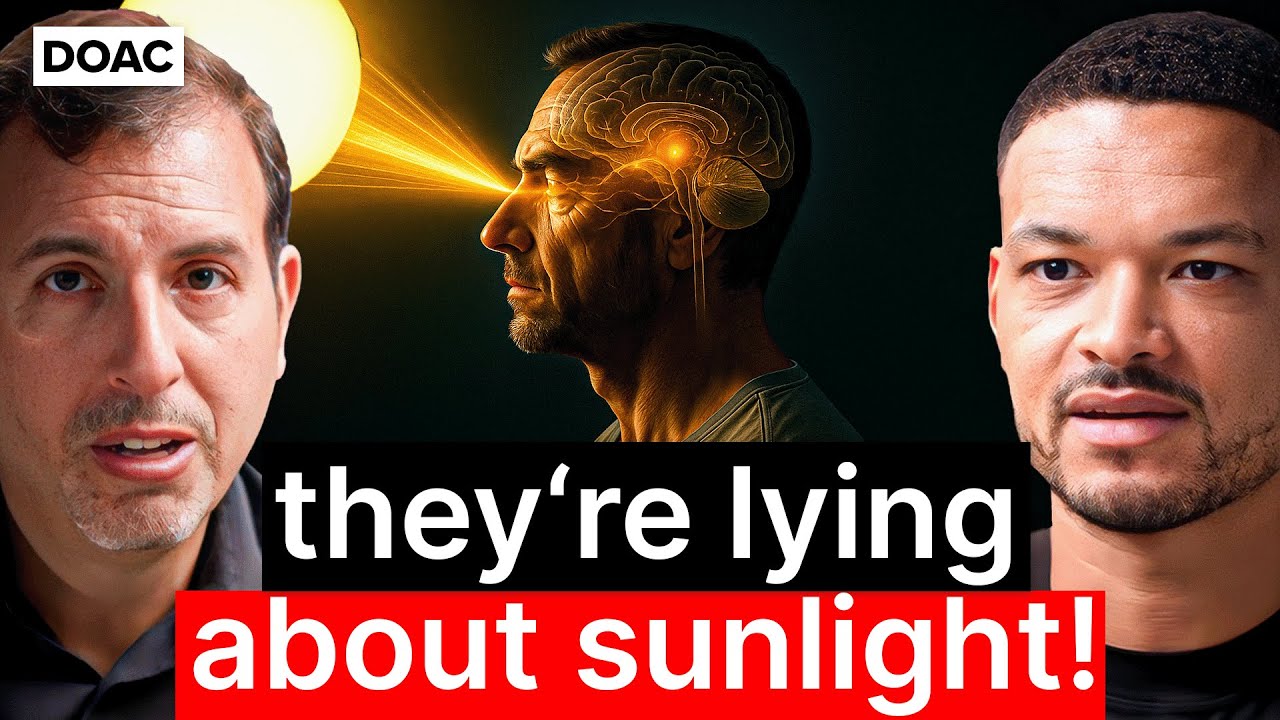
## Background
This episode of The Diary Of A CEO was published by Steven Bartlett on YouTube on July 17, 2025. The video features double-board-certified internal medicine physician Dr. Roger Seheult, who explores how daily habits surrounding sunlight, caffeine, sleep, and nutrition directly impact mitochondrial health, cancer risk, and long-term longevity.
## TL;DR
Dr. Roger Seheult outlines the eight NEWSTART pillars of health—Nutrition, Exercise, Water, Sunlight, Temperance, Air, Rest, and Trust—emphasizing how modern indoor lifestyle deficits impair mitochondrial function. He details the biological mechanisms of near-infrared light and subcellular melatonin production, highlighting how photobiomodulation and daylight exposure mitigate inflammation and chronic disease. The conversation also addresses the role of hydration and fever in innate immunity, proper light hygiene for circadian health, the nuances of vitamin D supplementation, and the profound impact of faith, forgiveness, and medical humility in patient care.
## Atmosphere & style
The discussion is deeply clinical yet warm, blending rigorous medical science with compassionate, humanistic storytelling. Dr. Seheult speaks with grounded expertise and genuine humility, shifting effortlessly from precise biological mechanisms to evocative clinical encounters, such as an miraculous recovery from brain injury and the outdoor sunlight protocol for a critically ill patient. Hosted by Steven Bartlett, the episode maintains an intimate, introspective energy that balances urgent health warnings with practical, hopeful guidance.
## Key takeaways
- [03:13](https://www.youtube.com/watch?v=wQJlGHVmdrA&t=193s) Dr. Roger Seheult focuses on translation of medical science into preventive lifestyle interventions through the eight NEWSTART pillars: Nutrition, Exercise, Water, Sunlight, Temperance, Air, Rest, and Trust.
- [00:00](https://www.youtube.com/watch?v=wQJlGHVmdrA&t=0s) Natural sunlight exposure and photobiomodulation (red/near-infrared light therapy) can stimulate mitochondrial recovery and aid in clearing severe, life-threatening infections.
- [08:58](https://www.youtube.com/watch?v=wQJlGHVmdrA&t=538s) Hospital architecture historically utilized natural sunlight to heal patients, and modern research confirms that proximity to window light significantly accelerates patient discharge and clinical outcomes.
- [20:34](https://www.youtube.com/watch?v=wQJlGHVmdrA&t=1234s) Aging reduces mitochondrial energy output by roughly 70%, which manifests as localized organ dysfunction, including fatty liver disease, congestive heart failure, and cognitive decline or dementia.
- [23:15](https://www.youtube.com/watch?v=wQJlGHVmdrA&t=1395s) Near-infrared sunlight penetrates deeply into human tissue to stimulate subcellular melatonin production within mitochondria, acting as a local antioxidant to reduce oxidative stress.
- [27:31](https://www.youtube.com/watch?v=wQJlGHVmdrA&t=1651s) Vitamin D blood levels act primarily as a surrogate marker for total sunlight exposure rather than a complete replacement for sunlight's complex health benefits.
- [33:40](https://www.youtube.com/watch?v=wQJlGHVmdrA&t=2020s) Photobiomodulation using specific red and near-infrared light wavelengths can enhance mitochondrial ATP production, lower blood glucose levels, and improve clinical recovery in respiratory illnesses.
- [45:04](https://www.youtube.com/watch?v=wQJlGHVmdrA&t=2704s) Epidemiological studies indicate that severe sunlight avoidance carries a mortality risk comparable to smoking, and geographic exposure correlates strongly with lower all-cause mortality.
- [52:33](https://www.youtube.com/watch?v=wQJlGHVmdrA&t=3153s) Modern indoor environments and LED lighting create severe light spectrum deficits, stripping away essential near-infrared light needed for optimal cellular health.
- [01:09:11](https://www.youtube.com/watch?v=wQJlGHVmdrA&t=4151s) Bright morning light exposure resets circadian rhythms and improves mood, whereas late-night exposure to artificial screens suppresses pineal melatonin and disrupts sleep architecture.
- [01:25:20](https://www.youtube.com/watch?v=wQJlGHVmdrA&t=5120s) Water, hydrotherapy, and heat therapies like saunas boost innate immunity by elevating body temperature and significantly increasing interferon production to fight infections.
- [01:35:55](https://www.youtube.com/watch?v=wQJlGHVmdrA&t=5755s) Exposure to nature and plant phytoncides via forest bathing increases natural killer (NK) cell activity, while reducing environmental CO2 improves executive cognitive performance.
- [01:40:22](https://www.youtube.com/watch?v=wQJlGHVmdrA&t=6022s) Spiritual trust, faith, and extending unconditional forgiveness are strongly correlated with lower rates of anxiety, reduced depression, and better overall mental resilience.
- [01:54:20](https://www.youtube.com/watch?v=wQJlGHVmdrA&t=6860s) Large doses of melatonin supplements should be avoided long-term due to side effects like mood irritability and potential suppression of natural endogenous melatonin production.
- [01:55:51](https://www.youtube.com/watch?v=wQJlGHVmdrA&t=6951s) The NEWSTART lifestyle framework parallels fundamental architectural and biological principles, emphasizing that long-term preventive care is essential for sustained longevity.
## Detailed walkthrough
### [00:00](https://www.youtube.com/watch?v=wQJlGHVmdrA&t=0s) Introduction and the Story of Henry
The conversation opens with a dramatic medical story: a 15-year-old boy, Henry, diagnosed with lymphoblastic leukemia (a blood cancer), developed a severe, flesh-eating fungal infection in his lung while undergoing chemotherapy. Chemotherapy had severely suppressed his immune system, allowing the aggressive fungal infection to take hold. Doctors at a tertiary care hospital in Minnesota were forced to surgically remove his left lung, but the infection soon spread to his remaining right lung. Facing a terminal trajectory, the medical team informed his mother, Amy, that he had merely two days to live and recommended making him "Do Not Resuscitate" (DNR).
When asked how he wished to spend his final two days, the teenager made a single request: he wanted to go outside. Moving a critically ill patient on specialized respiratory equipment (a BiPAP machine) outdoors required immense effort from the hospital staff, who set up his bed outside as a compassionate final wish. In addition to natural sunlight exposure, they used a "Firefly" phototherapy device (a red/near-infrared light device applied for five minutes, three times a day). Miraculously, without any changes to his heavy antifungal drug regimen (which included amphotericin B and posaconazole), Henry’s condition turned around rapidly:
* **Day 1–2:** His white blood cell count dropped steadily, indicating a reduction in system-wide inflammation and infection, and his oxygen requirement began to fall.
* **Day 5:** He was completely off the BiPAP ventilator and breathing on a standard nasal cannula.
* **Follow-up CT Scan:** A repeat scan revealed that $60\text{–}70\%$ of the fungal infection in his remaining right lung had cleared.
Henry survived, was discharged home, and eventually went on to receive a Make-A-Wish experience while continuing his cancer therapy. Dr. Roger Seheult highlights this story as a turning point in how he views light, photobiomodulation, and hospital design.
---
[02:12](https://www.youtube.com/watch?v=wQJlGHVmdrA&t=132s) Dr. Roger Seheult's Mission and Clinical Background
Dr. Roger Seheult explains that beyond his daily clinical duties, his primary goal is to translate complex scientific concepts into actionable, easily understandable health tools that allow people to live longer and healthier lives. As a board-certified internal medicine physician double-specialized in pulmonary disease, critical care medicine, and sleep medicine, Dr. Seheult deals directly with the sickest individuals in the intensive care unit (ICU)—handling life-support, central lines, vasopressors, and mechanical ventilation. Because he sees patients at the end stage of severe diseases, he focuses heavily on preventive lifestyle interventions that stop organ failure before it begins.
---
[03:13](https://www.youtube.com/watch?v=wQJlGHVmdrA&t=193s) The 8 Pillars of Health and the "Chain Link" Metaphor
To explain how chronic disease develops and how to prevent it, Dr. Seheult uses the metaphor of a chain where every link represents a core organ system (the heart, lungs, kidneys, liver, brain, etc.). Over a lifetime of strain, stress, and poor lifestyle habits, individual links begin to erode. Eventually, one link becomes the weakest point—frequently the cardiovascular system in developed countries like the US and UK—leading to a clinical diagnosis.
Dr. Seheult emphasizes a key medical truism: **all pharmaceutical medications have side effects**. In acute emergency medicine, physicians leverage the rest of the body to save the weakest link—such as administering tissue plasminogen activator (tPA) or tenecteplase (TNK) to break up a blood clot during an acute ischemic stroke, accepting the side effect risk of bleeding elsewhere in order to save brain tissue. However, Dr. Seheult argues that if a physician saves a life in the ICU but fails to address the underlying lifestyle causes that eroded the organ in the first place, the job remains incomplete.
To keep all links strong without incurring pharmaceutical side effects, he outlines the eight preventive pillars of health:
1. **Nutrition:** Proper fuel prevents metabolic erosion across all organ systems.
2. **Exercise:** Unlike drugs that carry side effects, exercise carries "side benefits." Beyond building strength and endurance, regular physical activity directly reduces stroke risk, prevents depression, and enhances cardiovascular and brain function simultaneously.
3. **Water (Hydration & Hydrotherapy):** Hydration is essential, but external applications of water (hot and cold therapy, such as saunas and cold plunges) yield profound physiological benefits. Data out of Finland—where saunas are ubiquitous—demonstrate a clear dose-response relationship between regular sauna use and a significant reduction in cardiovascular mortality.
4. **Sunlight & Light Exposure:** Sunlight is far more than just a mechanism for synthesizing vitamin D. Infrared light from the sun penetrates deep into human tissue (up to $8\text{ mm}$), stimulating subcellular mitochondrial melatonin production, which protects against cellular damage, cardiovascular disease, and neurodegenerative conditions like dementia.
5. **Air (Air Quality & Forest Bathing):** Clean indoor air and outdoor exposure (such as spending time in nature once a week) lower stress hormones and bolster immune function.
6. **Temperance / Rest & Sleep:** Proper circadian alignment and adequate sleep allow cellular repair mechanisms to function optimally.
7. **Trust / Stress Management:** Mind-body connection, faith, and psychological trust play a tangible role in lowering stress hormones and improving overall longevity metrics.
---
[08:58](https://www.youtube.com/watch?v=wQJlGHVmdrA&t=538s) Reimagining Hospital Design and Light Benefits
Reflecting on Henry's recovery, Dr. Seheult discusses how early 20th-century hospitals were designed with open verandas so bedridden patients could be rolled directly out into the fresh air and sunlight (a practice widely used during the 1918 influenza pandemic and sanatorium eras). Today, modern hospital infrastructure keeps critically ill patients isolated indoors under artificial light. Dr. Seheult notes that he is actively working across three hospitals to establish protocols that allow ICU patients to get outside, though staffing constraints remain a major hurdle.
Studies show a direct measurable impact of light on hospital recovery:
* Patients assigned to a bed closer to a window in a two-bed hospital room are, on average, discharged faster than patients in the inner bed.
* Patients in hospital rooms with larger windows report higher satisfaction scores and experience better clinical outcomes, highlighting the direct physiological effect of natural daylight on healing.
[15:56](https://www.youtube.com/watch?v=wQJlGHVmdrA&t=956s) The Final Pillars of Health: Temperance, Air, Rest, and Trust
Continuing through the eight pillars of health, Dr. Roger Seheult transitions from physical movement and outdoor exposure to **temperance**—a somewhat old-fashioned term that he defines simply as moderation and the strict avoidance of internal toxins. As a practicing pulmonologist (a specialist in lung health) and critical care intensivist in Southern California, Dr. Seheult routinely witnesses the devastating, real-world consequences of toxic exposures: lung cancer from cigarette smoking, acute liver failure from alcohol abuse in the ICU, and severe systemic damage from methamphetamine abuse. Eliminating these harmful substances acts as a high-leverage multiplier, instantly strengthening every other physiological system.
Moving to the next pillar, **air**, Dr. Seheult dismantles a common misconception. He admits that he used to believe optimal air simply meant pure, sterile nitrogen and oxygen. Today, research shows that high-quality air must carry natural outdoor elements. Much like the human gut relies on a diverse microflora to function correctly, the air we inhale needs its own natural bio-microenvironment, which is best found directly outdoors rather than inside sealed, climate-controlled buildings.
```
THE NEWSTART FRAMEWORK
N - Nutrition T - Temperance
E - Exercise A - Air
W - Water R - Rest
S - Sunlight T - Trust
```
The discussion then turns to **rest** and its complementary relationship with exercise. While it may seem paradoxical that both exertion and rest are core pillars, longevity depends on mastering the timing of both. Beyond daily sleep—a domain where sleep medicine reveals the critical importance of duration, sleep architecture, and treating underlying sleep disorders—Dr. Seheult emphasizes the necessity of a **weekly rest**. Steven Bartlett interjects, asking if he simply means taking the weekend off. Dr. Seheult responds with a emphatic "Yeah, absolutely," pointing out how rarely modern professionals actually disconnect on weekends. People almost never put down their smartphones or stop checking emails, depriving their mental and cellular systems of true recovery.
The final pillar is **trust**. Dr. Seheult addresses the traditional divide between the scientific community and faith. He points to a rapidly growing body of scientific literature showing that individuals who cultivate spiritual faith or trust in God demonstrate significantly greater psychological resilience, coping mechanisms, and lower rates of anxiety and depression when facing severe stress.
- Dr. Seheult notes that these eight pillars—Nutrition, Exercise, Water, Sunlight, Temperance, Air, Rest, and Trust—form the acronym **NEWSTART**.
- The framework was popularized and operationalized into structured lifestyle programs by Weimar University in Northern California.
---
[20:34](https://www.youtube.com/watch?v=wQJlGHVmdrA&t=1234s) Why Sunlight is the Lowest-Hanging Fruit & The Reality of COVID-19 ICUs
When asked which of the eight NEWSTART pillars offers the most immediate impact, Dr. Seheult single-out **sunlight** as "the lowest-hanging fruit." His path to this realization was forged during the front lines of the COVID-19 pandemic. As an ICU intensivist, early public health warnings led him to expect a flood of primary respiratory failures—patients with underlying lung conditions like asthma or COPD. However, what he actually observed in the ICU was strikingly different: the patients dying around him were those suffering from metabolic and systemic conditions, such as obesity, cardiovascular disease, kidney failure, and dementia.
This stark contrast forced him to look for the unifying mechanism behind these seemingly disparate chronic illnesses. The common thread is **mitochondrial dysfunction**. Mitochondria exist in virtually every human cell except mature red blood cells and are classically taught in high school biology as the "powerhouse of the cell." What standard biology textbooks fail to emphasize, however, is that as human beings age, the energy output of these cellular batteries drops by roughly **70%**.
To illustrate this dramatic decline, Dr. Seheult asks Steven to imagine trying to run a household on 70% less electrical power:
> "Can you imagine running your house on 70% less energy? How fundamentally that would change what happens in your house? Like, you could not run the laundry the same way. You could not run the microwave and the laundry at the same time."
When Steven asks what this energy drop looks like in terms of physical symptoms, Dr. Seheult explains that the clinical outcome depends entirely on the specific tissue affected:
- **In the liver:** Decreased cellular energy leads to fatty liver disease.
- **In the heart:** Reduced energy causes congestive heart failure.
- **In the brain:** Insufficient energy manifests as cognitive decline and dementia.
---
[23:15](https://www.youtube.com/watch?v=wQJlGHVmdrA&t=1395s) The Physics of Light: How Near-Infrared Sunlight Cools the Mitochondria
To explain how sunlight directly restores mitochondrial health, Dr. Seheult highlights a groundbreaking 2019 scientific paper co-authored by Dr. Russell Reiter (executive editor of *Melatonin Research* at the University of Texas) and Scott Zimmerman (a light engineer). Sunlight is not a single uniform beam; it spans a broad spectrum of electromagnetic radiation. At one extreme is short-wavelength **ultraviolet B (UVB)** light, which stimulates vitamin D synthesis in the skin but cannot penetrate deeply into tissue. At the opposite end lies long-wavelength **red and near-infrared (NIR) light**, which penetrates remarkably deep into human tissue.
To explain wave physics, Dr. Seheult uses the analogy of sitting in a car at a stoplight next to someone playing loud music with heavy bass:
> "How does that sound to you in your car? It's very boom, boom, right? Muffled. And the reason why is because low-wave frequency has the ability to travel very far."
Just as low-frequency bass waves easily pass through metal car doors or the deep thunder of a distant thunderstorm rumbles across the Grand Canyon long before high-pitched cracks are heard, longer wavelengths of light pass right through human skin. According to Scott Zimmerman’s research, near-infrared light from the sun can penetrate **up to 8 centimeters** (over 3 inches) into human body tissue, directly striking deep-seated mitochondria in organs, muscles, and brain tissue.
When mitochondria produce energy (ATP), they generate damaging byproducts known as **oxidative stress**—the cellular equivalent of internal heat produced by a car engine. An internal combustion engine requires a radiator, water pump, and coolant fluid to prevent heat from warping the metal and shutting down the motor. Similarly, mitochondria require an internal antioxidant cooling system to neutralize oxidative stress.
For decades, medicine assumed melatonin was exclusively a hormone produced by the pineal gland in the brain at night to induce sleep. However, Reiter and Zimmerman demonstrated that mitochondria synthesize their own **subcellular melatonin** on-demand to act as a powerful targeted antioxidant. Crucially, exposure to near-infrared sunlight is what stimulates and upregulates this subcellular melatonin production, effectively "cooling" the cellular engine and boosting its energy output.
- Ultraviolet B (UVB) light has short wavelengths that act primarily at the skin surface to produce vitamin D.
- Near-infrared (NIR) light features long wavelengths capable of penetrating up to **8 cm** into deep body tissue.
- Subcellular melatonin produced within the mitochondria acts as a localized antioxidant, distinct from the circulating pineal melatonin that regulates sleep cycles.
---
[27:31](https://www.youtube.com/watch?v=wQJlGHVmdrA&t=1651s) The ACE2 Receptor, COVID-19, and the Vitamin D Illusion
This cellular cooling mechanism explained two major anomalies Dr. Seheult observed in the ICU during the pandemic. First, the SARS-CoV-2 virus enters human cells by binding to the **ACE2 receptor**. The primary physiological function of the ACE2 receptor is mitigating cellular oxidative stress—it is a vital component of the cell’s internal cooling system. When the virus latches onto and internalizes the ACE2 receptor, it effectively destroys the cell's ability to cool itself down.
Using his engine analogy, Dr. Seheult describes a line of cars attempting to climb a steep mountain pass labeled "COVID-19":
- Healthy individuals with cool-running, well-maintained engines easily make it over the hill.
- Patients with chronic diseases (like diabetes or dementia) already have engines running dangerously hot due to baseline mitochondrial dysfunction.
- When COVID-19 strips away their remaining ACE2 cooling capacity, their engines overheat and fail completely, stranding them on the side of the road with steam pouring from the hood.
Second, early pandemic data clearly established that hospitalized patients with high blood levels of **vitamin D** had dramatically better survival rates than those with vitamin D deficiencies. However, when doctors administered oral vitamin D supplements to deficient patients upon hospital admission, it failed to produce the expected therapeutic benefit or significantly improve outcomes.
Dr. Seheult argues that vitamin D was never the direct therapeutic agent saving those lives; rather, it was a biological proxy or **surrogate marker** for sunlight exposure. Patients with high vitamin D levels were people who spent significant time outdoors in natural sunlight, absorbing massive amounts of deep-penetrating near-infrared radiation. That infrared light was actively boosting their subcellular mitochondrial melatonin and cooling their cellular stress. Giving a patient a vitamin D pill supplied the marker, but completely missed the therapeutic near-infrared light that was actually doing the physiological heavy lifting.
[32:18](https://www.youtube.com/watch?v=wQJlGHVmdrA&t=1938s) Broad-Spectrum Sunlight and Winter Vitamin D Deficiencies
Dr. Roger Seheult breaks down how natural outdoor light spans a massive biological spectrum, ranging from the longest far-infrared wavelengths all the way down to shortwave ultraviolet B (UVB), which stimulates vitamin D synthesis in the skin. When stepping outside, the human body naturally absorbs this balanced, full-spectrum light. During the winter months—particularly in high-latitude regions like England—the sun sits lower on the horizon. This oblique angle forces sunlight to travel through a much thicker layer of the Earth's atmosphere, effectively scattering and blocking shortwave UVB rays. As a result, people residing at higher latitudes produce little to no vitamin D naturally during winter and often require dietary supplementation.
Crucially, Dr. Seheult points out a vital distinction: even when winter sunlight lacks sufficient UVB to produce vitamin D, its longer, highly penetrating infrared wavelengths still successfully pass through the atmosphere. This means that even on cold or overcast days when vitamin D synthesis is off the table, being outdoors still provides significant infrared exposure to the body.
* Natural sunlight spans a full biological light spectrum from far-infrared down to shortwave UVB.
* Low sun angles in winter filter out UVB light, necessitating vitamin D supplementation at higher latitudes.
* Long-wave infrared light continues to penetrate the atmosphere even during winter months when UVB is absent.
---
[33:40](https://www.youtube.com/watch?v=wQJlGHVmdrA&t=2020s) Red and Infrared Light Therapy, Mitochondria, and Systemic Health
The discussion turns to commercially available photobiomodulation devices, such as red and infrared light panels and facial masks. Dr. Seheult clarifies a common misconception: visible red light is not technically infrared light. While red light operates around 670 nanometers and remains visible to the eye, true infrared light sits farther down the electromagnetic spectrum and is entirely invisible, though consumer panels often emit both simultaneously. He cites groundbreaking research by Prof. Glen Jeffery at University College London (UCL) demonstrating that 670-nanometer red light significantly enhances mitochondrial efficiency in randomized controlled trials. Because the human retina is densely packed with mitochondria, red light exposure at this wavelength has been shown to improve declining eyesight as well as clear systemic blood glucose more rapidly by stimulating cellular energy output.
Dr. Seheult explains the dermatological benefits of these devices, noting how host Steven Bartlett’s wife uses a Bon Charge light mask. As people age, skin fibroblast cells produce progressively less collagen—the structural matrix that keeps skin soft, supple, and firm. Red and near-infrared light penetrate deep into tissue (up to several centimeters), stimulating the mitochondria within fibroblasts to produce the ATP necessary for robust collagen synthesis, thereby firming the skin.
When asked whether light therapy should be applied to the entire body, Dr. Seheult highlights Prof. Jeffery’s work on systemic mitochondrial communication. In one study, young adults given a heavy glucose load were randomized to receive red light exposure applied purely to their backs. The light-exposed group experienced significantly lower blood sugar spikes and exhaled higher concentrations of carbon dioxide—a direct byproduct of accelerated mitochondrial respiration. This reveals that mitochondria can communicate systemically across the body, meaning localized light application can yield broad, systemic metabolic benefits. Dr. Seheult notes that cellular photobiomodulation triggers a biological "switch" within just 15 to 20 minutes—a response observed across species from fruit flies and bees to humans—after which additional light duration yields no added benefit.
> "After about 15 to 20 minutes of this type of light... there is a switch that turns on and you don't need further stimulation. Further stimulation doesn't do anything more."
* Prof. Glen Jeffery's research at UCL proves 670 nm red light improves retinal mitochondrial function, eyesight, and glucose clearance.
* Deep-penetrating red light reaches up to 8 cm into tissue, driving fibroblast ATP production and collagen deposition.
* A systemic trial demonstrated that shining red light exclusively on a subject's back reduced blood glucose spikes and increased exhaled $CO_2$.
* Photobiomodulation achieves its maximum biological signaling effect within 15 to 20 minutes of exposure.
---
[39:03](https://www.youtube.com/watch?v=wQJlGHVmdrA&t=2343s) Infrared Light and COVID-19: Clinical Breakthroughs and Outdoor Therapy
Drawing from his frontline experience as a critical care physician during the height of the COVID-19 pandemic, Dr. Seheult describes realizing that severe COVID-19 was fundamentally a metabolic and mitochondrial crisis rather than a simple respiratory infection. While standard oral vitamin D supplements failed to save critically ill ICU patients, emerging research pointed toward the therapeutic power of targeted infrared light. He highlights a pivotal clinical study from Brazil where hospitalized, non-intubated COVID-19 patients were fitted with custom-built jackets lined with invisible 940-nanometer infrared LEDs. In a double-blinded, randomized controlled trial of 30 patients, those who wore active infrared jackets for just 15 minutes a day over 7 days experienced statistically significant improvements across every clinical marker—including improved oxygen saturation, deeper breathing, better white blood cell counts, and stabilized heart and respiratory rates.
The most extraordinary outcome of the Brazilian study was its impact on hospital stay duration. Patients in the sham group averaged 12 days in the hospital, whereas those receiving 15 minutes of daily infrared light were discharged in an average of just 8 days—a massive 4-day reduction. Inspired by these results but lacking access to the specialized Brazilian LED jackets, Dr. Seheult recognized that natural sunlight natively contains the 940-nanometer infrared wavelength. He immediately put this concept to the test with a severely ill patient in his hospital who was consuming 35 liters per minute of 100% high-flow oxygen, sitting in a pitch-black isolation room, depressed and asking, "Doc, how much time have I got?"
```
[Patients on High-Flow Oxygen]
│
┌────────────────┴────────────────┐
▼ ▼
[Standard ICU Isolation] [15-20 Min Daily Sunlight]
│ │
• Avg Stay: 12 Days • Avg Stay: 8 Days
• High Oxygen Dependency • Rapid Oxygen Titration
```
Dr. Seheult rallied his charge nurse and respiratory therapist, Kim, rigged portable oxygen tanks, and wheeled the wheelchair-bound patient outside into bright sunshine for 15 to 20 minutes daily. The result was remarkable: after a single day in the sun, the patient's oxygen requirement plummeted from 35 liters down to 15 liters, steadily dropping to 12, 8, and 5 liters over subsequent days. By day 5, the patient was discharged home entirely off supplemental oxygen. Dr. Seheult emphasizes that while this case is an anecdote, the near-zero risk and immense biological plausibility make natural light exposure an imperative clinical tool that warrants large-scale randomized trials.
> "He walked into the room... the room was completely dark, the blind was closed... and the first words out of his mouth to me was 'Doc, how much time have I got?'... We wheeled him outside... In 5 days he was discharged home without oxygen."
* A randomized double-blinded trial in Brazil using 940 nm infrared jackets reduced COVID-19 hospital stays by 4 full days (from 12 days down to 8 days).
* Infrared treatment significantly improved oxygen saturation, respiratory dynamics, and white blood cell metrics.
* Dr. Seheult successfully replicated these clinical gains by wheeling a high-flow oxygen-dependent patient outdoors into natural sunlight for 15 minutes daily.
---
[45:04](https://www.youtube.com/watch?v=wQJlGHVmdrA&t=2704s) Sunlight, Latitude, and Mortality: The 20-Year Swedish Study
To determine why COVID-19 surges followed seasonal patterns, European researchers analyzed environmental variables including temperature, humidity, and geographic latitude. The data revealed that latitude was the single greatest predictor of autumn 2020 COVID-19 outbreaks across Europe. Surges began in high-latitude northern regions like Finland and swept progressively southward across the continent, ending in Greece—mirroring the movement of the seasonal sun as it receded toward the Southern Hemisphere. Similarly, observational studies conducted by the University of Edinburgh across the northern United States, England, and Italy consistently demonstrated that regions receiving higher levels of winter sunlight experienced significantly lower COVID-19 mortality rates, completely independent of vitamin D status.
This led Dr. Seheult to highlight a landmark 2011 Swedish epidemiological study that tracked between 20,000 and 30,000 Swedish women over a 20-year period. Researchers categorized the participants based on their sun exposure habits: low, moderate, or high exposure. By tracking all-cause mortality and specific causes of death across two decades, the researchers uncovered an astonishing finding: women who spent the greatest amount of time outdoors in the sun had the lowest overall cancer and all-cause mortality rates.
* Autumn viral surges across Europe in 2020 tracked precisely with geographic latitude, starting in Finland and terminating in Greece.
* University of Edinburgh studies across the US, UK, and Italy confirmed that higher solar exposure directly correlated with reduced COVID-19 mortality, independent of vitamin D levels.
* A 20-year prospective Swedish study of ~30,000 women revealed that maximum sun exposure strongly correlated with reduced all-cause and cancer mortality.
[48:29](https://www.youtube.com/watch?v=wQJlGHVmdrA&t=2909s) Sunlight vs. Smoking: The Swedish Mortality Study
Dr. Roger Seheult discusses a pivotal Swedish epidemiological study that examined the correlation between outdoor light exposure and overall mortality. The study evaluated women over a prolonged period and tracked deaths from both cardiovascular and non-cardiovascular causes. The results revealed that women who spent the least amount of time outdoors had the highest mortality rates. Most strikingly, the magnitude of this difference was so pronounced that Swedish women who spent the maximum time outside *and* smoked had a mortality rate equivalent to women who avoided the sun and did *not* smoke. Essentially, avoiding outdoor sunlight presented a risk factor for premature death comparable to smoking cigarettes.
```
+-------------------------------------------------------+
| SWEDISH MORTALITY STUDY |
+-------------------------------------------------------+
| High Sun Exposure + Smoker = EQUAL MORTALITY RISK |
| Low Sun Exposure + Non-Smoker |
+-------------------------------------------------------+
| Conclusion: Avoiding sunlight carries a health risk |
| comparable to smoking cigarettes. |
+-------------------------------------------------------+
```
Addressing Steven Bartlett's question regarding how researchers established potential causation in an observational study without confounding variables like exercise, Dr. Seheult explains the Bradford Hill criteria. While association alone does not equal causation, establishing a clear dose-response curve—where incremental increases in exposure consistently yield proportional shifts in outcome—provides compelling evidence for a causal link. This identical methodological framework was historically used to prove that smoking causes lung cancer, given that randomized controlled trials assigning people to smoke for decades were ethically impossible.
- A massive UK Biobank study led by dermatologist Dr. Richard Weller evaluated roughly 300,000 to 400,000 men and women using solar radiation data and questionnaires.
- Dr. Weller’s research confirmed the Swedish findings across both genders, demonstrating that higher light exposure correlated with lower overall and cancer-related mortality.
- Crucially, the UK Biobank study showed **no statistically significant increase in melanoma incidence** from increased sun exposure, but it did show a clear reduction in non-skin cancer mortality.
- Following these findings, Dr. Weller authored a influential op-ed titled *"Sunlight: Time for a Rethink"* in the *Journal of Investigative Dermatology*, encouraging public health authorities to re-evaluate strict sun-avoidance messaging.
[52:33](https://www.youtube.com/watch?v=wQJlGHVmdrA&t=3153s) The Modern Scurvy: Sunlight Deficiency and Infrared Light
Dr. Seheult draws a vivid historical parallel between modern indoor living and 18th-century scurvy aboard British naval vessels. Just as sailors suffered from a severe lack of vitamin C that could be cured by a simple citrus fruit, 21st-century humans suffer from a chronic lack of natural light. Modern populations spend the vast majority of their lives inside climate-controlled environments, avoiding thermal discomfort, swapping outdoor sports for screen-based gaming, and sitting behind specialized window glass designed to block infrared radiation.
```
+-------------------------------------------------------------------+
| THE Scurvy PARALLEL |
+-------------------------------------------------------------------+
| 18th Century Navy: Vitamin C Deficiency ---> Fixed by Citrus |
| 21st Century Society: Sun & Infrared Lack ---> Fixed by Light |
+-------------------------------------------------------------------+
```
Dr. Seheult highlights the unique physical properties of near-infrared light from the sun. Unlike visible light, near-infrared light easily penetrates clothing, skin, and deeper subcutaneous tissue. When individuals stand outside with their eyes closed, they can instantly sense where the sun is located because near-infrared radiation penetrates deep enough to trigger thermal receptors beneath the surface of the skin. This deep penetration is precisely what stimulates cellular mitochondria to function efficiently.
- **Indoor Living Statistics:** Studies show that average Americans spend **93%** of their lives indoors, while average Brits spend approximately **92%** indoors.
- **Vegetation and Infrared:** Green vegetation and trees are highly reflective of near-infrared light.
- Deforestation in the Amazon rainforest is monitored via satellite imagery specifically by tracking reflected infrared light off the canopy.
[57:16](https://www.youtube.com/watch?v=wQJlGHVmdrA&t=3436s) The Power of Green Spaces: The GreenHeart Study
To prove that the health benefits of nature are not merely driven by socioeconomic status or secondary lifestyle factors, Dr. Seheult details the groundbreaking **GreenHeart Study** conducted in South Louisville, Kentucky. Researchers isolated a 4-square-mile urban area and baseline-tested approximately 700 residents for high-sensitivity C-reactive protein (hs-CRP)—a key systemic biomarker for internal inflammation directly linked to heart attacks and strokes.
```
+-------------------------------------------------------------------+
| GREENHEART STUDY |
+-------------------------------------------------------------------+
| Action: Planted 8,000 mature trees in a 4-square-mile urban zone |
| Result: 13% to 20% drop in hs-CRP inflammation markers (2 yrs) |
| Impact: Equivalent to a 10% to 15% reduction in stroke risk |
+-------------------------------------------------------------------+
```
The researchers then purchased and planted **8,000 mature, leafy trees** throughout the 4-square-mile neighborhood. Two years later, they re-tested the same 700 individuals. Without any changes to the residents' income levels, diet, or formal exercise routines, their hs-CRP levels dropped by **13% to 20%**, representing a calculated **10% to 15% reduction in stroke risk**. This interventional study directly proved that exposure to natural green environments causes measurable, biological improvements in human health.
- Living in green environments consistently correlates with reduced incidence of diabetes, hypertension, clinical depression, and overall mortality.
- Infrared light reflecting off tree leaves delivers direct biological advantages that cannot be replicated inside a typical home.
[59:52](https://www.youtube.com/watch?v=wQJlGHVmdrA&t=3592s) Light Therapy, Cloud Cover, and Artificial Spectrum Deficits
Addressing red and infrared light devices (such as LED face masks and panels), Dr. Seheult notes that while natural sunlight is the ideal source, light therapy devices are a reasonable option for individuals who cannot get outside. However, he points out an overarching physiological principle: if a person already gets optimal sunlight exposure, extra light supplementation yields diminishing returns—much like giving extra lemons to a sailor who already eats a diet rich in fresh produce. For indoor shift workers or healthcare providers working 12-hour shifts, targeted light therapy or stepping outside during lunch breaks provides vital compensation.
On cloudy or overcast days, water molecules in atmospheric cloud cover absorb a significant portion of incoming near-infrared radiation. However, Dr. Seheult emphasizes that being outside on a cloudy day still delivers vastly more infrared light than staying inside behind glass windows.
Furthermore, modern energy-efficiency regulations have phased out broad-spectrum incandescent light bulbs in favor of narrow-spectrum LEDs and fluorescents. While efficient, these modern bulbs strip away infrared wavelengths to save electricity, leaving humans exposed—for the first time in evolutionary history—to isolated, narrow-band visible light (particularly blue light) without the protective, balancing effects of near-infrared light.
- Incandescent bulbs provided a wide, continuous spectral output ranging from near-blue down into deep infrared.
- Specialized incandescent bulbs (such as appliance or accent lighting) remain available, but standard high-wattage general service bulbs (e.g., A19/A90 standard screw-ins) have been largely phased out by law in both the US and UK.
---
<ElicitationsGroup message="To take this further:">
<Elicitation label="Explore the next part of the walkthrough" query="Please provide the next part of the transcript walkthrough."/>
<Elicitation label="Deep-dive into the Bradford Hill criteria" query="Can you explain the Bradford Hill criteria in detail and how scientists use them to establish causation?"/>
</ElicitationsGroup>
[01:04:18](https://www.youtube.com/watch?v=wQJlGHVmdrA&t=3858s) Mitochondrial Health and Light Spectrum Effects
Dr. Roger Seheult discusses a preprint study conducted by Professor Glen Jeffery involving 22 individuals working under standard LED lighting. When those LED bulbs—which emit high levels of blue light—were replaced with traditional incandescent bulbs, the participants demonstrated a 25% improvement in color differentiation. This visual enhancement stems from the physiology of the retina's cone cells, which are among the most metabolically active tissues in the human body and contain an exceptionally high concentration of mitochondria to support constant neural signaling to the brain.
As people age, mitochondrial energy output naturally declines, limiting the functional capacity of these sensory cells. Targeted exposure to 670-nanometer red light for just three minutes in the morning was shown to boost mitochondrial output, thereby enhancing visual perception. Dr. Seheult notes that this single mechanism illustrates a broader biological truth: mitochondrial energy deficits manifest as distinct diseases depending on the affected tissue—causing visual decline in the eye, or cognitive failure and dementia in the brain.
* **Preprint study finding:** Switching blue-heavy LEDs to incandescent bulbs yielded a **25% improvement** in color differentiation.
* **Retinal cone physiology:** The retina features the highest concentration of mitochondria in the body due to continuous metabolic demands.
* **Targeted therapy:** A 3-minute morning exposure to **670 nm red light** measurably improved visual performance.
---
[01:06:55](https://www.youtube.com/watch?v=wQJlGHVmdrA&t=4015s) Daylight Duration and Seasonal Mortality Patterns
A striking public health pattern links seasonal light exposure to mortality rates across the globe. In the United States and across the Northern Hemisphere, daily death rates from diverse causes—including cardiac disease, respiratory illness, kidney disease, influenza, and pneumonia—consistently peak within the month following the shortest day of the year (December and January). While observers often attribute this winter spike to holiday gatherings and increased germ transmission during Thanksgiving and Christmas, data from the Southern Hemisphere disproves that hypothesis.
In Australia, the longest day of the year occurs in December, coinciding with their lowest annual mortality rates despite holding identical holiday gatherings. Conversely, peak mortality in Australia occurs during their winter months of June and July. This inverse correlation demonstrates that day length serves as a direct proxy for total sunlight exposure. Dr. Seheult points out that shift workers on 7:00 a.m. to 7:00 p.m. schedules during midwinter can go weeks without seeing the sun at all, severely depriving their systems of necessary light spectrums.
* **Northern Hemisphere peak:** Maximum deaths from infectious and non-infectious conditions occur in **December and January** (within a month of the winter solstice).
* **Southern Hemisphere evidence:** Australia experiences its lowest death rates during December (its summer) and highest during **June and July** (its winter).
* **Shift work impact:** 12-hour winter shifts (7 a.m. to 7 p.m.) can result in weeks of zero natural sunlight exposure.
---
[01:09:11](https://www.youtube.com/watch?v=wQJlGHVmdrA&t=4151s) Optimizing Sunlight and Light Therapy Devices
To balance the cellular benefits of sunlight with skin safety, timing is key. Early morning and late afternoon sunlight provide high proportions of beneficial infrared light while ultraviolet (UV) radiation remains low, as UV wavelengths cannot easily penetrate the atmosphere at oblique angles. When the sun is directly overhead at midday, infrared levels peak, but UV radiation peaks simultaneously. For those spending time outside at midday without prior sun adaptation, wide-brimmed hats and clothing offer effective protection because standard clothing blocks UV light while allowing infrared wavelengths to pass through to the skin.
When considering body surface exposure, location on the skin does not matter for mitochondrial infrared absorption. However, setting the brain's master clock—the circadian rhythm—requires direct light exposure through the eyes.
```
┌────────────────────────────────────────────────────────────────────────┐
│ Light Therapy Summary │
├──────────────────┬─────────────────────────────┬───────────────────────┤
│ Light Mechanism │ Target Area │ Primary Benefit │
├──────────────────┼─────────────────────────────┼───────────────────────┤
│ Infrared / Sun │ Any exposed skin / body │ Mitochondrial energy │
│ SAD Light │ Eyes (photoreceptors) │ Circadian & Mood │
└──────────────────┴─────────────────────────────┴───────────────────────┤
```
For individuals with limited daylight access or high-latitude living, Seasonal Affective Disorder (SAD) light panels offering 10,000 lux can set circadian timing and treat depression by stimulating the brain's perihabenular nucleus.
* **Target dosage:** Circadian reset requires approximately **3,000 lux-hours** (achievable via **20 minutes** under a **10,000-lux** lamp placed 11–16 inches from the face).
* **Neurological pathway:** Morning ocular light stimulates the **perihabenular nucleus**, helping alleviate depressive symptoms.
* **Window glass limitation:** Standard modern window glass reduces total lux and is explicitly engineered to filter out beneficial infrared wavelengths.
---
[01:14:11](https://www.youtube.com/watch?v=wQJlGHVmdrA&t=4451s) The Biology of Darkness and Nighttime Light Hygiene
Achieving optimal health requires balancing intense daytime light with total nighttime darkness—a stark contrast to modern life's pattern of "dark days and bright nights." Exposure to artificial light and electronic screens at night causes two primary physiological disruptions: it suppresses the pineal gland's production of melatonin (a critical systemic antioxidant) and tricks the brain into shifting its internal clock. When ambient light strikes the eyes at 10:00 p.m., the circadian master clock assumes it miscalculated the time and delays sleepiness, shifting sleep onset by hours over time.
While device settings (such as night-mode red spectrum shifts) and blue-blocking glasses offer slight improvements, they are insufficient complete solutions. Light bleeds around blue-blocker frames, and eyelids are translucent, allowing ambient room light to reach ocular photoreceptors even while sleeping. Dr. Seheult warns that even tiny light sources—such as nightlights, LED displays on clock radios, or air conditioners—cause significant "light pollution" in the bedroom. To protect sleep architecture, he strongly advocates for complete darkness, sleep masks, and avoiding electronic e-readers like Kindles before bed.
> "We have dark days and we have bright nights, and what we really should be having is bright days and dark nights."
* **Screen impact:** E-readers delay sleep onset, shift circadian timing, and suppress nocturnal melatonin production significantly more than reading a physical book under a bedside lamp.
* **Bedroom light pollution:** Digital displays, nightlights, and ambient city light pass through closed eyelids, suppressing melatonin output.
* **Lighting hierarchy at night:** Total darkness is best, non-blue lighting is second best, and standard blue-heavy lighting is the worst. Candlelight provides a safe spectrum, provided fire risks are managed.
[01:19:08](https://www.youtube.com/watch?v=wQJlGHVmdrA&t=4748s) Do Vitamin D Supplements Work?
Dr. Roger Seheult affirms without hesitation that vitamin D supplements genuinely work, noting that he has tested them himself alongside evaluating rigorous medical literature. He cites a meta-analysis of randomized controlled trials (RCTs) published by Adrian Martineau in the *British Medical Journal* prior to 2020, which demonstrated that daily vitamin D supplementation significantly reduced the risk of acute respiratory/chest infections. Additionally, another trial evaluating 2,000 IU daily showed a statistically significant reduction in all-cause autoimmune conditions, including rheumatoid arthritis, Crohn's disease, and ulcerative colitis. Addressing Steven's observation that many oral supplements fail to enter the bloodstream or body effectively, Dr. Seheult explains that vitamin D is uniquely both a vitamin and a fat-soluble hormone that directly interacts with cellular DNA to regulate gene transcription across various tissues.
However, Dr. Seheult cautions that because vitamin D is fat-soluble and stored in tissue, it is possible—though rare—to over-supplement and trigger hypercalcemia (excessively high blood calcium levels), which disrupts calcium metabolism. Thus, anyone taking regular supplements should periodically get their blood levels checked. Monitoring blood levels is also essential because individual synthesis rates vary dramatically based on body habitus, geographic latitude, and skin pigmentation. Darker skin contains more melanin, making it much harder to synthesize endogenous vitamin D from sunlight, particularly for people living at high latitudes like the United Kingdom.
- **Deficiency Rates:** Approximately 1 billion people worldwide are estimated to have a true vitamin D deficiency, and roughly 50% of the global population suffers from vitamin D insufficiency.
- **Modern Causes:** Industrialization and climate-controlled living encourage people to remain indoors at comfortable temperatures, depriving them of natural solar exposure.
- **Dietary Sources:** For those seeking vitamin D without sun exposure or pills, certain food sources—such as specific types of mushrooms and fatty fish—contain natural vitamin D.
- **Sleep and Cravings:** When asked if the body instinctively craves foods rich in nutrients it lacks (like mushrooms for vitamin D), Dr. Seheult notes there is little evidence for that specific mechanism. However, sleep-deprived individuals exhibit a distinct psychological predilection toward high-carbohydrate foods, explaining why poor sleep closely correlates with unwanted weight gain.
---
[01:25:20](https://www.youtube.com/watch?v=wQJlGHVmdrA&t=5120s) Water, Innate Immunity, and the Science of Fevers
Transitioning to the "NEWSTART" health framework, Dr. Seheult shifts the conversation from drinking water to the therapeutic external application of water and heat (hydrotherapy) to modulate body temperature and immunity. To explain how heat therapy works, he breaks down the immune system into two primary branches: the adaptive immune system and the innate immune system. While the adaptive immune system relies on highly specific antibodies fitting into antigens like "a key with a keyhole" (a concept widely discussed during the COVID-19 pandemic), it often struggles when pathogens rapidly mutate. In contrast, the innate immune system acts as the body's immediate, non-specific first line of defense, employing circulating white blood cells like monocytes and natural killer (NK) cells to identify and clear foreign molecular patterns.
The primary effector mechanism of the innate immune system is a powerful signaling protein called **interferon**. Dr. Seheult describes interferon as "the security guard at the bank," pointing out that virtually every successful human virus must carry a built-in defense mechanism against interferon to cause disease. Crucially, human interferon production is thermal-dependent, scaling up dramatically when core body temperature rises.
When a person contracts an infection, the brain's internal thermostat resets higher—moving from normal ($37^\circ\text{C}$ or $98.6^\circ\text{F}$) up to a fever threshold ($38^\circ\text{C}$ or $100.4^\circ\text{F}$). Because actual body temperature lags behind the elevated thermostat setting, the person feels cold, develops chills, and shivers to generate internal heat. Once the infection resolves and the thermostat resets downward, the patient breaks a sweat to cool off.
- **Thermal Suppression:** High temperatures slow viral replication directly, as viruses (including SARS-CoV-2) reproduce inefficiently at elevated temperatures.
- **Interferon Induction:** A mouse study evaluating immune pathways found that five key regulatory proteins driving interferon production spiked significantly when core body temperature rose from $37^\circ\text{C}$ to $38^\circ\text{C}$.
- **Rethinking Antipyretics:** Dr. Seheult argues that routinely suppressing mild-to-moderate fevers with medication simply to relieve discomfort "cuts the legs out from our immune system." Fevers should generally be allowed to run their course unless dangerously high or causing severe complications (such as seizures or dangerous tachycardia).
- **Variant Invariance:** Unlike adaptive antibodies, which lost neutralizing efficacy as SARS-CoV-2 mutated from Alpha to Delta to Omicron, the innate interferon response remains equally effective against every variant.
---
[01:32:37](https://www.youtube.com/watch?v=wQJlGHVmdrA&t=5557s) Hydrotherapy, Saunas, and Hyperthermia
Because water possesses a remarkably high specific heat capacity, applying hot water or moist heat to the human body transfers thermal energy extremely efficiently. Dr. Seheult explains that inducing artificial fevers through hot baths, saunas, hot towels, or steam rooms stimulates the body's innate immune pathways much like a natural fever would. Laboratory studies on isolated human lymphocytes revealed that raising ambient temperature to $38^\circ\text{C}$–$39^\circ\text{C}$ yielded an "off-the-charts" 10-fold increase in interferon production. In clinical observational data from COVID-19 patients, high endogenous interferon levels consistently correlated with mild illness, whereas suppressed interferon levels correlated with severe disease and ICU admission.
This thermal mechanism underpins the long-term longevity benefits documented in Finnish sauna culture. Longitudinal studies demonstrate that frequent sauna bathers experience significantly lower cardiovascular mortality and all-cause mortality compared to infrequent users.
- **Sauna Frequency:** Finnish population data shows that individuals using a sauna 4 to 7 times per week have lower risks of fatal cardiovascular disease compared to those using a sauna only once a week.
[01:34:20](https://www.youtube.com/watch?v=wQJlGHVmdrA&t=5660s) Thermal Therapy: The Physiology of Hot and Cold Contrast
Dr. Roger Seheult explains the physiological mechanism behind following a prolonged heat session, such as 20 minutes in a sauna, with a brief burst of cold exposure. The primary objective of the hot phase is to elevate the body's core temperature. Applying cold water at the end triggers immediate superficial vasoconstriction. This narrowing of outer blood vessels prevents heat loss through the skin, effectively trapping the heat and keeping the core body temperature elevated for much longer after exiting the sauna.
The second critical benefit of cold-induced vasoconstriction is a phenomenon known as "demargination." In a normal state of circulation, numerous white blood cells adhere to the inner walls of blood vessels. When the vessels constrict rapidly due to cold exposure, these attached white blood cells are dislodged back into main circulation, where they actively patrol and enhance immune function. A brief exposure to cold—lasting only about one minute—is sufficient to trigger these lasting physiological benefits.
- **Contrast duration:** ~20 minutes of heating followed by just ~1 minute of cold exposure.
- **Core temperature retention:** Vasoconstriction prevents rapid heat loss from the skin, prolonging the hyperthermic benefits.
- **Immune effect (demargination):** Blood vessel contraction detaches white blood cells clinging to vessel walls, mobilizing them throughout the bloodstream.
---
[01:35:55](https://www.youtube.com/watch?v=wQJlGHVmdrA&t=5755s) Forest Bathing and Plant Phytoncides
Moving to the "Air" pillar of health, Dr. Seheult notes that breathing clean air is about more than avoiding pollution; natural environments actively provide immune-boosting aromatic compounds known as phytoncides. Research originating from Japan highlights the profound biological impact of walking in native Hinoki cypress forests. In landmark studies, corporate executives were taken into these mountain forests, and blood testing revealed that their natural killer (NK) cells—a critical line of defense against viruses and cancer—increased significantly in both overall number and intracellular enzyme activity.
To test whether this effect was driven by chemical exposure rather than mere psychological relaxation, researchers brought the subjects back into city hotels and diffused isolated plant phytoncides into their rooms. The subjects exhibited nearly identical boosts in immune markers, proving that forest plants emit functional airborne chemicals that actively bolster human immunity and induce relaxation.
- **Phytoncides:** Aromatic compounds released by trees and plants that directly interact with the human immune system.
- **Natural Killer (NK) cells:** Showed marked increases in total count and activity levels after forest exposure.
- **Duration of benefit:** A single day spent in nature can elevate natural killer cell counts and immune markers for up to seven days.
---
[01:38:29](https://www.youtube.com/watch?v=wQJlGHVmdrA&t=5909s) Indoor Air Quality and Carbon Dioxide Accumulation
The discussion shifts to indoor environments, where unventilated spaces quickly accumulate high concentrations of carbon dioxide ($\text{CO}_2$), leading to notable drops in cognitive performance. Host Steven Bartlett reflects on his early podcast recording days in a small, windowless UK studio without air conditioning, where long conversations led to heavy $\text{CO}_2$ buildup. Dr. Seheult references insights shared on his MedCram channel by Dr. Joseph Allen from the Harvard T.H. Chan School of Public Health, demonstrating how simple interventions can dramatically improve air quality.
Monitoring and managing indoor $\text{CO}_2$ is straightforward, as carbon dioxide acts as a direct surrogate for overall ventilation. Simple actions such as cracking a window open slightly, opening doors safely, rolling down car windows, turning off the air recirculation button while driving, or using dedicated indoor air monitors can quickly flush out stale air and optimize cognitive clarity.
- **Cognitive impact:** Elevated indoor $\text{CO}_2$ levels directly impair executive function and mental performance.
- **Simple fixes:** Cracking a window open even a fraction of an inch allows trapped $\text{CO}_2$ to escape rapidly.
- **Automotive air:** Turning off the cabin air recirculation button prevents exponential $\text{CO}_2$ buildup during drives.
---
[01:40:22](https://www.youtube.com/watch?v=wQJlGHVmdrA&t=6022s) Trust, Faith, and Mental Health Outcomes
Addressing the "Trust" pillar of health, Dr. Seheult focuses on how religious faith and spirituality provide structured coping mechanisms for managing chronic stress and anxiety. Observational literature across various faith traditions shows that individuals who maintain a strong trust in a supportive higher power consistently report lower rates of depression and anxiety, while benefiting from supportive faith communities. While these findings reflect epidemiological associations rather than double-blind randomized control trials, the link between faith and psychological resilience is robust.
Various religious practices throughout history naturally integrate foundational health habits. For instance, Hindu morning rituals encourage early daylight exposure, Islamic traditions incorporate structured fasting during Ramadan, and many historical religious practices embrace thermal contrast or hydrotherapy. However, the psychological benefits of faith are heavily dependent on how the divine is perceived; believing in a punitive or vindictive deity is associated with adverse mental health outcomes.
- **Epidemiological findings:** Supportive faith environments correlate with lower incidence of depression and clinical anxiety.
- **Integrated health practices:** Traditional religious protocols often incorporate morning sunlight exposure, periodic fasting, and structured thermal practices.
- **Perception matters:** Belief in a supportive, caring deity lowers psychological distress, whereas belief in a vindictive God increases psychological harm.
---
[01:42:27](https://www.youtube.com/watch?v=wQJlGHVmdrA&t=6147s) The Science of Unconditional Forgiveness
Dr. Seheult outlines compelling research conducted by Dr. Neal Krause at the University of Texas regarding the psychological and physical impacts of different forgiveness styles. The research divided subjects into those who forgive conditionally (requiring an apology, penance, or act of contrition) and those who forgive unconditionally (releasing resentment regardless of whether the offender apologizes or makes amends). The study revealed that individuals practicing unconditional forgiveness suffered from significantly less depression, fewer feelings of inadequacy, and lower end-of-life anxiety. In contrast, conditional forgivers exhibited higher rates of somatized depression and physical symptoms.
When searching for what predicted whether an individual would forgive unconditionally, one factor stood out with an odds ratio of approximately 2.5: whether the individual believed that God had forgiven them. Those who felt personally forgiven by a higher power were 2.5 times more likely to extend unconditional forgiveness to others. In therapeutic settings, clinical trials show that incorporating a patient's personal faith background into standard cognitive behavioral therapy (CBT) significantly enhances the therapy's overall effectiveness.
- **Conditional vs. Unconditional:** Conditional forgiveness requires an apology or penance; unconditional forgiveness releases resentment independently.
- **Health outcomes:** Unconditional forgivers experience substantially less depression and lower rates of somatic illness.
- **Predictive factor:** Believing that one has been forgiven by God increases the likelihood of forgiving others unconditionally by an odds ratio of 2.5.
- **CBT integration:** Faith-adapted cognitive behavioral therapy outperforms standard CBT when applied to religious patients with their consent.
---
[01:47:19](https://www.youtube.com/watch?v=wQJlGHVmdrA&t=6439s) End-of-Life Realities and Patient Autonomy
Drawing from his extensive career as a critical care and pulmonary specialist, Dr. Seheult reflects on the inevitability of death and the primary role of modern medicine. "Death is inevitable, and all we do in medicine is delay the inevitable," he observes, emphasizing that the focus in intensive care must often shift toward ensuring patients pass away with dignity while honoring their personal choices.
Dr. Seheult shares his experiences observing how different individuals face the end of life. While medical teams possess the artificial means to prolong life—such as mechanical ventilation and vasopressors—some relatively stable patients make the conscious choice to decline invasive interventions. When fully informed patients decide to let nature take its course, medical professionals must respect their autonomy rather than forcing non-beneficial prolongations of life.
- **Physician's role:** Balancing life-extending interventions with the responsibility to ensure dignity and honor patient wishes.
- **Patient choice:** Fully informed individuals sometimes explicitly opt out of mechanical ventilation or artificial life support.
---
[01:48:59](https://www.youtube.com/watch?v=wQJlGHVmdrA&t=6539s) A Miraculous Recovery: Severe Anoxic Brain Injury
Dr. Seheult recounts a pivotal early-career case that fundamentally altered his view on prognosticating medical outcomes. Early in his training, he treated a young man in his twenties who had suffered an acute cardiac arrest at home. The patient’s family had performed prolonged CPR before paramedics arrived, but by the time he reached the intensive care unit, he had suffered profound anoxic brain injury due to lack of oxygen. The initial diagnostic workup painted a grim picture: magnetic resonance imaging (MRI) of the brain revealed extensive hyperintensities and swelling, indicative of irreversible, catastrophic brain damage.
Multiple neurological experts evaluated the young man and unanimously concluded that he would remain in a persistent vegetative state with zero chance of meaningful recovery. Based on these definitive assessments, the medical team held sensitive discussions with the family regarding the withdrawal of life support. However, because the patient's mother held steadfast faith and requested more time, the team agreed to maintain supportive care. What followed defied every established medical expectation and serves as a profound lesson in medical humility.
- **Patient profile:** A man in his early 20s who suffered out-of-hospital cardiac arrest and prolonged oxygen deprivation.
- **Diagnostic findings:** Brain MRI showed severe, widespread changes typical of permanent, irreversible anoxic encephalopathy.
- **Consensus prognosis:** Multiple specialists agreed the patient had no chance of regaining consciousness or neurological function.
[01:48:59](https://www.youtube.com/watch?v=wQJlGHVmdrA&t=6539s) A Miraculous Story: Anoxic Brain Injury Recovery
Dr. Roger Seheult reflects on the humility required in medicine, sharing a profound story from his residency days that challenged everything he had been taught. He quips that if doctors are taught how to deliver grim prognoses like "you'll never walk again" or "you have two years to live," he must have missed that day in medical school. He recalls a young man in his 20s who underwent successful surgery for testicular cancer. Tragically, during the operation, the patient suffered anoxic brain deprivation and emerged with severe, widespread brain injury. The ICU team managed his ventilator while attending neurologists delivered a definitive verdict based on brain scans: the damage was irreparable, and he would never wake up.
Every day during morning rounds, the medical team saw the patient lying in bed as a shaking, non-responsive mess with rolling eyes. His young wife, however, refused to give up. A Hispanic couple, she stayed faithfully at his bedside, asking the medical team to add a homemade natural concoction into his feeding tube. While the doctors quietly believed she was in deep denial, they humored her. One morning, she walked in beaming with an immense sense of peace. Speaking through a translator, she joyfully announced that she had a dream the previous night in which her husband came home, fully convinced of his recovery. The medical staff privately wrote her off as delusional.
```
+----------------------------------------------------+
| Anoxic Brain Injury (Post-Surgical Oxygen Loss) |
+-------------------------+--------------------------+
|
v
+----------------------------------------------------+
| Prognosis: Severe damage; experts predict "Never" |
+-------------------------+--------------------------+
|
v
+----------------------------------------------------+
| Intervention: Family devotion & natural tube feed |
+-------------------------+--------------------------+
|
v
+----------------------------------------------------+
| Outcome: Gradual neural recovery & full walking |
+----------------------------------------------------+
```
The story took an unexpected turn weeks later. While walking around the central round nursing station, Dr. Seheult glanced into the room and noticed the patient’s eyes tracking slightly. Dr. Seheult raised his hand as a test; to everyone’s shock, the young man slowly raised his own trembling hand in response. Over the next six months, against every medical prediction, the young man made a full recovery. Half a year later, he walked back into the ICU on his own two feet alongside his wife to deliver a gift basket to the nursing staff.
- **Patient Demographics & Condition:** Man in his early 20s with severe post-surgical anoxic brain injury following testicular cancer surgery.
- **Medical Consensus:** Multiple attendings and neurologists declared he would remain vegetative indefinitely.
- **Outcome:** Full neuroplastic recovery; walked into the unit six months post-discharge without visible neurological deficits.
- **Dr. Seheult's Retrospective Reflection:** Acknowledges that while youth and neuroplasticity played a role, the event felt like a genuine miracle driven by love and belief. He estimates that even if he possesses 5% to 10% of medical knowledge, humanity understands less than 1% of total world knowledge, leaving the remaining 80% to 90% as unexplained domain.
---
[01:54:20](https://www.youtube.com/watch?v=wQJlGHVmdrA&t=6860s) Melatonin Supplements: Uses, Dosing, and Potential Side Effects
Steven shifts the conversation to melatonin supplements, a popular over-the-counter sleep aid taken by millions. Dr. Seheult explains that while melatonin supplementation can be useful under specific circumstances, it should not be taken routinely in large doses. Small doses (5 mg or lower) can effectively advance a delayed circadian rhythm, assist individuals struggling to fall asleep, and alleviate jet lag or specific diagnosed sleep disorders.
However, Dr. Seheult warns that taking exogenous melatonin is not without drawbacks, emphasizing his core philosophy that "everything has side effects." High doses of melatonin can cause mood disruptions, specifically making individuals noticeably more irritable and easily set off. Furthermore, while conclusive clinical trial evidence is still emerging, there is ongoing concern in the sleep medicine community that heavy long-term supplementation might suppress the pineal gland's natural endogenous melatonin production.
- **Recommended Maximum Dose:** No more than 5 mg for acute sleep onset issues or circadian shifts.
- **Key Indications:** Jet lag, circadian rhythm advance, select sleep disorders.
- **Side Effects:** Psychological irritability, heightened emotional sensitivity, potential pineal gland suppression (theoretical/under study).
---
[01:55:51](https://www.youtube.com/watch?v=wQJlGHVmdrA&t=6951s) Longevity, the "NewStart" Model, and the Bible as Scientific Blueprint
When asked to summarize his holistic approach to health, Dr. Seheult stresses that while pharmaceuticals are useful for patching broken links in a failing medical chain at the end of life, true longevity comes from strengthening the entire system through lifestyle principles, which he encapsulates in the acronym **NEWSTART** (Nutrition, Exercise, Water, Sunlight, Temperance, Air, Rest, and Trust).
Prompted by the podcast's signature closing question—asking what topic he is dying to talk about but rarely asked—Dr. Seheult reveals his passion for analyzing ancient Biblical texts through a modern scientific lens. He points specifically to Paul’s New Testament statement in 1 Corinthians, "your body is the temple of the Holy Spirit," and contrasts it with the detailed architectural blueprint of the Wilderness Sanctuary given to Moses in Exodus 25–30. Dr. Seheult notes that these ancient writers possessed no knowledge of modern cellular biology, heart circulation (William Harvey, 1600s), or microscope technologies (Antonie van Leeuwenhoek, 1600s), yet the structural parallels are striking:
| Sanctuary Component | Anatomic / Cellular Equivalent | Physiological Function |
|:--- |:--- |:--- |
| **Altar of Sacrifice** | Vascular System (Blood) | Circulatory blood flow |
| **Laver (Water Basin)** | Interstitial Fluid | Fluid buffer surrounding cells |
| **Sanctuary Veil** | Plasma Membrane | Selective barrier regulating entry |
| **Outer Room (Holy Place)** | Cytoplasm | Intracellular fluid containing organelles |
| **7-Branch Candlestick** | Mitochondria | Uses lipids/fat (olive oil) to generate cellular energy |
| **Most Holy Place / Ark** | Cell Nucleus | Encapsulates the core instruction set |
| **2 Stone Tablets of Law** | Double-Stranded DNA | Molecular code; alterations cause mutation/disease |
Dr. Seheult concludes by explaining that just as breaking the moral law in Biblical theology leads to decay, altering or mutating the nucleic code on double-stranded DNA—discovered only in the 1950s—directly yields disease and cellular death. He finds these ancient structural allegories and Paul's description of "one body made of many parts" (foreshadowing 19th-century cell theory) to be a fascinating intersection of ancient wisdom and hard science. Steven thanks Dr. Seheult for his extraordinary ability to make complex medical science accessible to millions of viewers worldwide.
<FollowUp label="Want to break down the NEWSTART lifestyle pillars and how to apply them daily?" query="Explain the 8 NEWSTART health pillars by Dr. Roger Seheult and how to practically implement each one."/>
[02:04:36](https://www.youtube.com/watch?v=wQJlGHVmdrA&t=7476s) Channel Subscription Outro and Message to Viewers
Steven Bartlett closes the episode with a personal note to the audience regarding the podcast's ongoing growth and direction. He urges listeners to double-check whether they are subscribed to the channel, highlighting that doing so frequently is a key way to support the show and keep it on its current trajectory. Expressing heartfelt appreciation, Steven notes that the viewers are a vital component of the show's story, telling them, "in a strange way you are you're part of our history and you're on this journey with us."
* The host requests viewers to double-check their subscription status to help sustain the show's momentum.
* He emphasizes gratitude to the audience for participating in the ongoing history and journey of the podcast.
## Notable quotes
> [20:34](https://www.youtube.com/watch?v=wQJlGHVmdrA&t=1234s) Can you imagine running your house on 70% less energy? How fundamentally that would change what happens in your house? Like, you could not run the laundry the same way. You could not run the microwave and the laundry at the same time. — Dr. Roger Seheult
> [23:15](https://www.youtube.com/watch?v=wQJlGHVmdrA&t=1395s) How does that sound to you in your car? It's very boom, boom, right? Muffled. And the reason why is because low-wave frequency has the ability to travel very far. — Dr. Roger Seheult
> [33:40](https://www.youtube.com/watch?v=wQJlGHVmdrA&t=2020s) After about 15 to 20 minutes of this type of light... there is a switch that turns on and you don't need further stimulation. Further stimulation doesn't do anything more. — Dr. Roger Seheult
> [39:03](https://www.youtube.com/watch?v=wQJlGHVmdrA&t=2343s) He walked into the room... the room was completely dark, the blind was closed... and the first words out of his mouth to me was 'Doc, how much time have I got?'... We wheeled him outside... In 5 days he was discharged home without oxygen. — Dr. Roger Seheult
> [01:14:11](https://www.youtube.com/watch?v=wQJlGHVmdrA&t=4451s) We have dark days and we have bright nights, and what we really should be having is bright days and dark nights. — Dr. Roger Seheult
> [01:47:19](https://www.youtube.com/watch?v=wQJlGHVmdrA&t=6439s) Death is inevitable, and all we do in medicine is delay the inevitable — Dr. Roger Seheult
> [01:55:51](https://www.youtube.com/watch?v=wQJlGHVmdrA&t=6951s) your body is the temple of the Holy Spirit — Dr. Roger Seheult
> [02:04:36](https://www.youtube.com/watch?v=wQJlGHVmdrA&t=7476s) in a strange way you are you're part of our history and you're on this journey with us — Steven Bartlett
## Mentioned
Dr. Roger Seheult, Henry, Amy, Steven Bartlett, Dr. Russell Reiter, Scott Zimmerman, Prof. Glen Jeffery, Kim, MedCram, Weimar University, University College London (UCL), University of Texas, University of Edinburgh, Bon Charge, Firefly, BiPAP, ACE2 receptor, Melatonin Research, Dr. Richard Weller, UK Biobank, GreenHeart Study, Dr. Adrian Martineau, British Medical Journal, Dr. Joseph Allen, Harvard T.H. Chan School of Public Health, Dr. Neal Krause, NEWSTART, William Harvey, Antonie van Leeuwenhoek
Roger Seheult博士将太阳近红外光与线粒体健康相关联
每天接触自然阳光和近红外光可促进线粒体生成褪黑素,从而减少细胞氧化应激并降低全因死亡风险。
Roger Seheult博士概述了健康生活的八大NEWSTART支柱——营养、运动、水、阳光、节制、空气、休息和信赖,并强调了现代室内生活方式的不足如何损害线粒体功能。他详细阐述了近红外光与亚细胞褪黑素生成的生物学机制,重点介绍了光生物调节和日间光照如何减轻炎症和慢性疾病。对话还探讨了水分补充与发热在先天免疫中的作用、有益于昼夜节律健康的科学用光习惯、补充维生素D的细节差异,以及信仰、宽恕和医学谦卑在患者护理中的深远影响。
Roger Seheult博士专注于通过NEWSTART八大支柱(营养、运动、水、阳光、节制、空气、休息和信赖),将医学科学转化为预防性的生活方式干预措施。 (3:13)
接触自然阳光和进行光生物调节(红光/近红外光疗法)可促进线粒体恢复,并有助于清除严重且危及生命的感染。 (0:00)
历史上医院建筑曾利用自然阳光来治疗患者,现代研究也证实,靠近窗户采光能显著加快患者出院并改善临床结果。 (8:58)
衰老会使线粒体能量输出减少约70%,这表现为局部器官功能障碍,包括脂肪肝、充血性心力衰竭以及认知能力下降或痴呆。 (20:34)
太阳近红外光能深入穿透人体组织,刺激线粒体内的亚细胞褪黑素生成,发挥局部抗氧化剂的作用以减少氧化应激。 (23:15)
Reading summary
Intensive care physician Dr. Roger Seheult argues that modern lifestyle mismatches—most notably chronic indoor deprivation of natural, broad-spectrum sunlight—drive baseline mitochondrial dysfunction, elevating susceptibility to severe infections and chronic disease. While acute pharmaceuticals are necessary to manage failing organ systems in the ICU, long-term longevity requires preventive lifestyle practices that restore cellular resilience.
Near-Infrared Light and Cellular Energy Regulation (23:15)
Dr. Seheult posits that aging and diverse chronic conditions, such as diabetes, cardiovascular disease, and dementia, share a unifying mechanism: mitochondrial dysfunction, which reduces cellular energy output by approximately 70% while elevating baseline oxidative stress. Citing research by Dr. Russell Reiter and light engineer Scott Zimmerman, he explains that sunlight spans a wide electromagnetic spectrum. While shortwave ultraviolet B (UVB) stimulates cutaneous vitamin D synthesis, long-wavelength red and near-infrared (NIR) light penetrates up to 8 centimeters into tissue, stimulating deep-seated mitochondria and triggering cellular antioxidant pathways.
This cellular mechanism was observed during the COVID-19 pandemic, where vulnerable patients had baseline mitochondrial strain. The SARS-CoV-2 virus binds to the ACE2 receptor, eliminating a primary cellular mechanism that cools oxidative stress. While oral vitamin D supplements administered upon hospital admission did not rescue critical patients, photobiomodulation trials yielded direct clinical improvements. In Brazil, a double-blind randomized controlled trial using 940-nanometer infrared LED jackets on COVID-19 patients significantly improved oxygenation and reduced hospital stays from 12 days to 8 days, corroborating laboratory findings by Prof. Glen Jeffery at UCL that 670-nanometer red light enhances mitochondrial ATP generation.
Sunlight Exposure, Latitude, and the Vitamin D Proxy (45:04)
Epidemiological data demonstrates a strong link between ambient solar exposure and population-level mortality. Autumn 2020 COVID-19 surges in Europe tracked geographic latitude, initiating in northern latitudes like Finland before moving southward toward Greece as the sun receded. Across both hemispheres, peak mortality from cardiac, respiratory, and infectious diseases consistently clusters within the month following the winter solstice, independent of holiday gatherings.
This correlation is highlighted by a 20-year Swedish study of 20,000 to 30,000 women, which found that those with the highest sun exposure had the lowest all-cause and cancer mortality rates; women who avoided sunlight carried a mortality risk equivalent to smokers who had high sun exposure. Dr. Seheult contends that while daily vitamin D supplementation modestly lowers risks of acute chest infections and autoimmune disorders, high circulating vitamin D in healthy cohorts often acts as a surrogate marker for broader sunlight exposure. Winter sun angles at high latitudes block UVB rays, but long-wave infrared light continues to penetrate the atmosphere, delivering benefits independent of vitamin D synthesis.
Indoor Confinement, Spectral Deficits, and Environmental Stress (52:33)
Modern populations spend approximately 92% to 93% of their lives indoors inside sealed environments behind window glass that filters out infrared radiation. Furthermore, the transition from broad-spectrum lighting sources (the sun, fire, and incandescent bulbs) to narrow-spectrum, blue-heavy LEDs deprives humans of cellular infrared exposure. Modern light hygiene also suffers from bright nights and dark days; ambient bedroom light pollution and evening e-readers disrupt circadian timing and suppress endogenous nocturnal melatonin, a critical systemic antioxidant.
Environmental interventional studies confirm the physical benefits of natural outdoor exposure. In Louisville's GreenHeart Study, planting 8,000 mature trees across a four-square-mile urban area lowered resident high-sensitivity C-reactive protein (hs-CRP) levels by 13% to 20% over two years, calculated as a 10% to 15% reduction in stroke risk without changes to diet or income. Similarly, Japanese studies demonstrated that inhaling tree-derived phytoncides increased natural killer (NK) cell counts and activity for up to seven days, while elevated indoor carbon dioxide significantly impairs executive function unless resolved through simple cross-ventilation.
Hydrotherapy, Immune Mobilization, and Holistic Health Pillars (85:20)
To build systemic resilience against illness, Dr. Seheult frames preventive health around the NEWSTART model (Nutrition, Exercise, Water, Sunlight, Temperance, Air, Rest, and Trust). Within hydrotherapy, heat applications such as hot baths or saunas induce hyperthermia, mirroring natural fevers. In laboratory studies, elevating lymphocyte temperatures to 38°C–39°C triggered a 10-fold increase in interferon production, the innate immune system's primary antiviral defense. Long-term Finnish observational data supports this, showing that sauna use 4 to 7 times weekly substantially reduces fatal cardiovascular events and all-cause mortality. Following heat with roughly one minute of cold exposure locks in core heat via vasoconstriction and prompts demargination, releasing marginated white blood cells into the bloodstream.
Finally, under the trust pillar, psychological and spiritual factors correlate with measurable health improvements. Observational research by Dr. Neal Krause indicates that practicing unconditional forgiveness significantly reduces depression and somatic symptoms compared to conditional forgiveness. Notably, individuals who believed they were forgiven by a higher power were 2.5 times more likely to forgive others unconditionally, demonstrating how cognitive and spiritual frameworks alter psychological stress pathways.
Dr. Seheult emphasizes that while invasive pharmaceutical and mechanical interventions remain vital for life support in critical care, they cannot counteract decades of chronic organ erosion driven by indoor confinement and lifestyle neglect. Unresolved questions center on whether modern clinical guidelines and hospital infrastructure can practically incorporate outdoor daylight exposure, targeted photobiomodulation, and ventilation protocols into standard patient care.
精炼阅读摘要
重症医学与肺病学专家 Roger Seheult 博士指出,现代慢性疾病与急性感染重症的核心诱因常源于线粒体功能障碍,而自然阳光中的近红外光是细胞维持代谢与抗氧化应激的关键要素。他强调,口服维生素 D 在重症救治中更多是日照暴露的替代标志物而非万能药,公众应建立以全光谱光照、昼夜节律调控和温热疗法为代表的综合预防机制。
近红外光对线粒体的深层修复机制 (23:15)
Dr. Seheult 结合 ICU 救治经验与 Russell Reiter、Scott Zimmerman 的研究指出,自然日光并非单一射线,其中穿透力强的红光与近红外光(NIR)可穿透人体皮肤与深层软组织达 8 厘米,直接作用于各深层器官及大脑内的线粒体。随着人体老化,线粒体能量输出平均衰退约 70%,并伴随基线氧化应激上升。近红外光在细胞内诱导线粒体合成褪黑素,充当类似内燃机的“冷却液”,中和能量代谢产生的破坏性自由基。
在临床实践中,Seheult 观察到严重 COVID-19 患者的病理实质是线粒体与代谢崩溃,病毒通过结合具有抗氧化冷却功能的 ACE2 受体,使原本处于亚健康或老化的细胞彻底“过热”。他援引了一项在巴西开展的双盲随机对照试验:未插管的新冠住院患者每日接受 15 分钟波长为 940 纳米的红外光照射,连续 7 天后,平均住院时间从对照组的 12 天缩短至 8 天,氧合与炎症指标显著改善。此外,一名罹患淋巴母细胞白血病合并侵袭性真菌肺感染的 15 岁少年 Henry,在常规抗真菌药难以逆转衰竭且面临临终关怀时,通过转至户外接受日光与红光/近红外光设备照射,数日内脱离无创呼吸机,复查 CT 显示肺部真菌病灶减少了 60% 至 70%。
光照缺乏危机与流行病学死亡风险 (48:29)
现代城市人群面临普遍的室内“光饥渴”。统计显示,美国人与英国人平均分别有 93% 和 92% 的生活时间在室内度过,日常接触的多为缺乏红外波段的高蓝光 LED 与荧光灯。伦敦大学学院(UCL)Glen Jeffery 教授的研究显示,将蓝光 LED 更换为全光谱白炽灯后,受试者视网膜锥细胞的色彩辨别力提升了 25%;晨间接受 3 分钟 670 纳米红光照射亦能显著刺激线粒体供能并辅助清除血糖。
大规模流行病学调研显示了规避阳光与全因死亡之间的量效关系。一项对 20,000 至 30,000 名瑞典女性追踪 20 年的前瞻性队列发现,经常接受日照的女性全因死亡率与癌症死亡率最低;数据表明,极度规避阳光的非吸烟女性与经常日照的吸烟女性死亡风险持平,显示长期缺乏户外光照的危害程度与吸烟相当。全球死亡统计同样呈现光照相关性:北半球在冬至后的 12 月至 1 月迎来各类非传染与传染性疾病死亡峰值,而处于南半球的澳大利亚则在 6 月至 7 月(其冬季)迎来死亡高峰、12 月(其夏季)死亡率最低。在肯塔基州路易斯维尔开展的“GreenHeart”研究则证实,在 4 平方英里城市社区栽种 8,000 棵成熟树木后,当地居民在未改变生活方式的前提下,高敏 C 反应蛋白(hs-CRP)水平下降了 13% 至 20%,估算对应中风风险降低 10% 至 15%。
维生素D补充剂的疗效与替代物局限 (79:08)
针对维生素 D 的疗效争论,Dr. Seheult 肯定了其作为脂溶性类固醇激素的药理价值。Adrian Martineau 在《英国医学杂志》(BMJ)发表的随机对照试验荟萃分析表明,规律口服维生素 D 能显著降低急性呼吸道感染风险;另一项评估每日 2,000 国际单位(IU)剂量的试验亦证实其对类风湿关节炎、克罗恩病等自身免疫病具有明确的预防收益。但他提醒,维生素 D 储存于脂肪组织中,盲目过量摄入有诱发高钙血症的风险,长期补充者需定期监测血清浓度,尤其是高纬度地区和肤色深、黑色素阻碍内源合成的人群。
然而,Seheult 明确指出了临床中存在的“维生素 D 错觉”:尽管住院 COVID-19 患者血液中高浓度的维生素 D 与极高的生存率密切关联,但对缺乏患者入院后临时大剂量补充口服制剂却无法扭转病程。他解释称,在重症场景下,血清维生素 D 实际上是充足户外日光暴露的“生物替代标志物”(Surrogate Marker)。自然阳光除刺激合成维生素 D 外,还通过大面积红外线深度穿透提供抗炎与线粒体修复效益,这是单一口服补剂无法直接复刻的。
昼夜节律重塑、热疗与健康八要素 (74:11)
Seheult 将整体防病体系归纳为 NEWSTART 框架(营养、运动、水、阳光、节制、空气、休息、信任),主张现代健康必须纠正“白昼昏暗、黑夜过度明亮”的异常节律。睡前暴露于屏幕和夜间微光会严重抑制松果体合成褪黑素并推迟生物钟;外源性褪黑素虽然可小剂量(不超过 5 毫克)用于应对时差或急性入睡障碍,但高剂量使用可能导致易怒情绪,且长期滥用可能对松果体自身内源分泌产生潜在抑制。保持夜间卧室绝对黑暗、白天借助 10,000 勒克斯的 SAD 光照仪是更安全的昼夜对齐方案。
在外部水热疗法上,Seheult 阐述了发热的先天免疫价值。体外实验证实,将人体淋巴细胞培养温度升高至 38°C–39°C 会促使抗病毒信号蛋白干扰素(Interferon)的产生量飙升 10 倍;芬兰长期队列研究也显示,每周进行 4 至 7 次桑拿的人群心血管死亡率显著偏低。若在约 20 分钟的热暴露后进行约 1 分钟的冷水刺激,外周血管收缩不仅能锁住核心体温,还能诱发白细胞“去边缘化”(Demargination),促使附着在血管内壁的白细胞重回循环巡逻。此外,接触森林散发的植物杀菌素(Phytoncides)可使自然杀伤(NK)细胞活性升高并维持长达 7 天,而改善室内密闭环境、开窗稀释二氧化碳聚集则是维持大脑认知表现的基础措施。
Dr. Roger Seheult 总结认为,现代药物在重症抢救中不可或缺,但所有药物均伴随副作用;降低全因死亡率与延长寿命的根本在于借助自然界的全光谱光照、温度刺激和环境微生态强化器官基础耐受力。不过,有关大剂量近红外光疗的具体临床照射参数、长期补充褪黑素对内源腺体的抑制程度,以及日照防病与皮肤紫外线损伤的最佳暴露界限,仍有待更多前瞻性随机临床研究进一步细化界定。
Detailed notes — zh
## Background
本期内容由知名播客频道《The Diary Of A CEO》(主持人 Steven Bartlett)于 2025 年 7 月 17 日在 YouTube 平台发布。节目特邀内科、肺病学、重症医学与睡眠医学专家、MedCram 联合创始人罗杰·塞霍尔特博士(Dr. Roger Seheult),深入探讨阳光照射、昼夜节律、线粒体代谢以及日常生活习惯如何深刻影响癌症风险、认知障碍预防与整体长寿健康。
## TL;DR
塞霍尔特博士基于自身在重症监护室(ICU)的一线救治经验与前沿医学文献,阐述了阳光对人体的全光谱修复机制,揭示了红外线深度穿透人体刺激线粒体褪黑素合成、消除氧化应激并改善细胞机能的底层生物学原理。他指出口服维生素 D 无法完全替代自然日照,缺乏阳光不仅显著拉高全因死亡率,其危害甚至堪比长期吸烟。结合自身提出的“NEWSTART”(营养、运动、水、阳光、节制、空气、休息、信念)八大健康框架,塞霍尔特博士详细剖析了冷热温差水疗(人工发热上调干扰素)、大自然芬多精免疫增强、避开夜间蓝光光污染以及无条件宽恕等生活方式干预对强化免疫防线与身心韧性的决定性价值。
## Atmosphere & style
整场访谈散发着兼具严密循证医学与人文温情的专业磁场,兼具临床一线的紧迫感与哲学层面的深沉洞察。主持人 Steven Bartlett 提问敏锐直率,不时穿插风趣的生活化追问与质疑,而塞霍尔特博士则以极富感染力的生动比喻(如汽车水箱与发动机爆缸、古代圣殿与细胞微观架构),将艰深晦涩的生物物理学和病理学原理化繁为简。从濒死重症少年晒太阳康复的震撼奇迹,到面对死亡尊严时的从容反思,对话在理性的学术思辨与感性的生命敬畏之间自然流淌,带给观众极强的警醒、豁然开朗的启发与深切的情感共鸣。
## Bulletin
- [31:11](https://www.youtube.com/watch?v=wQJlGHVmdrA&t=1871s) 阳光的生理收益远超维生素D:太阳光中的近红外线可穿透深层组织并激活线粒体生成亚细胞褪黑素以对抗氧化应激,血液中高维生素D水平往往只是充足户外红外光暴露的“生物替代标志物”,单纯口服药丸无法复现全光谱日光的保护效应。
- [48:29](https://www.youtube.com/watch?v=wQJlGHVmdrA&t=2909s) 瑞典近3万人长达20年的随访队列研究显示,长期回避阳光的致死风险堪比每天吸烟,日照暴露极少且不吸烟者的全因死亡率与日照最多但吸烟者相当;英国生物样本库大样本数据亦证实充足光照能降低全身癌症与全因死亡率,且未增加黑色素瘤发病率。
- [38:38](https://www.youtube.com/watch?v=wQJlGHVmdrA&t=2318s) 巴西针对住院COVID-19患者的随机对照试验证实,每日仅需穿戴特制940nm近红外线夹克照射15分钟、连续干预7天,即可使患者平均住院时间从12天显著缩短至8天,表明光生物调节疗法具备强大的抗炎与呼吸功能修复效力。
- [58:16](https://www.youtube.com/watch?v=wQJlGHVmdrA&t=3496s) 现代室内环境正在剥夺人体修复机能:节能LED灯完全剔除了红外波段且蓝光过剩,加剧视网膜与全身线粒体疲劳;而在社区密集种植8,000棵成树的干预实验使居民hs-CRP炎症水平下降13%至20%,对应中风风险降低10%至15%。
## Key takeaways
- [03:13](https://www.youtube.com/watch?v=wQJlGHVmdrA&t=193s) 现代急救医学药物常伴随副作用与多器官代偿代价,而基于NEWSTART的生活方式干预则能产生系统性的全身附带获益。
- [12:05](https://www.youtube.com/watch?v=wQJlGHVmdrA&t=725s) 15岁急性淋巴细胞白血病伴严重肺部真菌感染患者在药物失效、下达病危通知后,转至户外接受自然日照与局部光疗,肺部病灶在短期内奇迹般消退60%至70%。
- [20:59](https://www.youtube.com/watch?v=wQJlGHVmdrA&t=1259s) 衰老与慢性退行性疾病的共同底层病理在于线粒体功能障碍:随着年龄增长线粒体能量输出平均下跌约70%,在不同器官分别表现为痴呆症、心衰或代谢异常。
- [25:13](https://www.youtube.com/watch?v=wQJlGHVmdrA&t=1513s) 长波红外线可深入组织达8厘米,刺激线粒体在原位合成高浓度亚细胞褪黑素,充当专属“冷却液”清除自由基并防止能量衰竭。
- [31:11](https://www.youtube.com/watch?v=wQJlGHVmdrA&t=1871s) 高纬度冬季即使缺乏合成维生素D所需的短波UVB,穿透力极强的长波红外线依然能穿透大气层直达人体发挥基础代谢保护。
- [33:40](https://www.youtube.com/watch?v=wQJlGHVmdrA&t=2020s) 670nm红光疗法对线粒体电子传递链复合物IV存在约15至20分钟的激活饱和阈值,局部照射背部即可通过胞际通信网络引发全身血糖改善与代谢增强。
- [50:18](https://www.youtube.com/watch?v=wQJlGHVmdrA&t=3018s) 英国生物样本库30至40万人数据显示,充足日照显著削减非皮肤癌死亡率与全因死亡率,彻底挑战了传统公共卫生界将阳光视作绝对致癌物的偏见。
- [01:02:04](https://www.youtube.com/watch?v=wQJlGHVmdrA&t=3724s) 现代室内环境将人类变为“21世纪坏血病”受害者:阻隔红外线的隔热玻璃窗与缺乏红外缓冲的窄光谱LED灯,导致视锥细胞及全身组织出现能量亏空。
- [01:07:33](https://www.youtube.com/watch?v=wQJlGHVmdrA&t=4053s) 全因死亡率与白昼长度高度吻合:无论南北半球,心血管与肾病死亡顶峰均精准对应当地日照最短的严冬季节,而非单纯由节日聚集病毒传播引发。
- [01:09:11](https://www.youtube.com/watch?v=wQJlGHVmdrA&t=4151s) 光线对人体存在双重平行通路:重置生物钟与抗抑郁必须由眼睛视网膜及视周缰核接收,而激活线粒体产能只需身体任意裸露皮肤吸收红外线。
- [01:13:46](https://www.youtube.com/watch?v=wQJlGHVmdrA&t=4426s) 现代人深陷“暗日明夜”的生理错位:日间室内采光不足叠加夜间屏幕蓝光与环境微光,持续压制松果体褪黑素分泌并强行后延睡眠节律。
- [01:20:59](https://www.youtube.com/watch?v=wQJlGHVmdrA&t=4859s) 维生素D本质上是能够入核调控数千基因转录的脂溶性类固醇激素,高剂量补充虽能显著降低自身免疫病风险,但需定期监测血液浓度以规避高钙血症。
- [01:27:05](https://www.youtube.com/watch?v=wQJlGHVmdrA&t=5225s) 发热是激活先天免疫与广谱抗病毒干扰素分泌的关键生理信号,盲目滥用退烧药会削弱免疫应答,而水疗或桑拿诱发的人工发热可使干扰素产量提升达10倍。
- [01:34:24](https://www.youtube.com/watch?v=wQJlGHVmdrA&t=5664s) 冷热交替疗法中长时间受热(约20分钟)后紧跟短时间冷水刺激(约1分钟),可在血管剧烈收缩时促使附壁白细胞脱落进入血液循环增强巡逻。
- [01:35:55](https://www.youtube.com/watch?v=wQJlGHVmdrA&t=5755s) 森林环境中树木释放的芳香族化合物“芬多精”能显著提高自然杀伤(NK)细胞活性与溶酶水平,单次森林漫步带来的免疫增强可持续约7天。
- [01:43:13](https://www.youtube.com/watch?v=wQJlGHVmdrA&t=6193s) 心理学与信仰实证研究表明,坚信被赦免的人群更倾向于给予“无条件宽恕”,进而显著降低抑郁症躯体化表现与临终焦虑。
## Detailed walkthrough
### [00:00](https://www.youtube.com/watch?v=wQJlGHVmdrA&t=0s) 濒死少年的奇迹与阳光疗愈力量
一段震撼人心的临床经历揭开了本场对话的序幕:一名年仅15岁的少年被确诊患有血癌,在治疗过程中肺部不幸继发了致命的食肉性真菌感染。在医学判定他只剩下最后两天生命、几乎回天乏术的至暗时刻,少年提出了一个最朴素的临终心愿——他想离开冰冷的病房,到户外晒晒太阳。令人难以置信的医学奇迹随之发生:在户外接受阳光照射仅仅两天后,他肺部原本被判定无解的严重感染竟然消退了60%到70%。这个病例彻底颠覆并重塑了罗杰·塞霍尔特医生(Dr. Roger Seheult)对阳光与人体生理机能的认知。
在医学观察中,自然光线的影响无处不在,例如医院里靠近窗户床位的病患往往康复更快、出院时间显著提前。塞霍尔特医生指出,阳光的功效远不止合成维生素D那么简单:太阳发出的近红外光能够穿透人体组织深达约8毫米,直接刺激并上调细胞内的褪黑素合成,进而对预防认知障碍、心血管疾病及糖尿病发挥极为关键的防御作用。面对阴天或高纬度多云地区的日照局限,医学上同样有清晰且可操作的替代策略。结合水疗(如芬兰桑拿对心血管死亡风险的大幅降低)、清新空气(每周仅需一天接触户外自然即可激活免疫并缓解压力),以及精神层面的信任与信仰,构筑起现代人抵御慢性疾病与退行性病变的核心防线。
```mermaid
flowchart TD
accTitle: 阳光与健康的多维度作用链路
accDescr: 展示太阳光照射人体后在细胞和生理层面带来的系统性益处。
subgraph 光线摄入与穿透
A["自然阳光 / 近红外光"] --> B["深层穿透人体组织 (最深约 8mm)"]
end
subgraph 细胞与生理机制
B --> C["线粒体受刺激"]
C --> D["细胞内褪黑素上调"]
end
subgraph 系统性健康获益
D --> E["预防认知障碍症 (Dementia)"]
D --> F["保护心血管系统"]
D --> G["抗感染与免疫系统重塑"]
end
```
---
### [02:12](https://www.youtube.com/watch?v=wQJlGHVmdrA&t=132s) 重症监护医生的使命:从重症抢救到生活方式干预
作为一名拥有内科、肺科与重症医学三重专业认证的资深临床专家,塞霍尔特医生在日常工作中直面的是生命最脆弱的极端状态。当重症病患被送入重症监护室(ICU)时,他的职责是通过中心静脉置管、大剂量血管活性药物(vasopressors)维持循环、紧急气管插管等激进的抢救措施将病人从死亡边缘拉回。日复一日目睹生命在终点线上的挣扎,让他比普通医师更清楚疾病是如何在数年甚至数十年间逐步恶化至不可逆境地的,也更深刻地认识到早期预防对于延长健康寿命的决定性意义。
离开病房与ICU的高压环境,塞霍尔特医生的终极目标是将晦涩复杂的医学原理转化为公众触手可及的健康工具。现代公共卫生往往只强调最基础的建议,比如避免摄入超加工食品和保持规律锻炼,但在这些老生常谈之外,隐藏着诸多被大众甚至传统医学长期低估与忽视的关键生理维度。
---
### [03:13](https://www.youtube.com/watch?v=wQJlGHVmdrA&t=193s) 身体的“器官链条”与现代药物的代价
为了让大众直观理解疾病的发展规律,塞霍尔特医生提出了“器官链条”模型。人体的生理机能就像一条由多个环扣相连的锁链,每个环扣代表一个独立的器官系统——心脏、肺部、肝脏、肾脏等。随着年龄增长与不良生活习惯的积累,这些环扣会逐渐被侵蚀磨损。在人生的某一节点,侵蚀最严重的那一环会率先出现病变,演变成具体的临床诊断;在欧美等现代工业化国家,这个薄弱环节往往是心血管系统。
当某一环濒临断裂时,现代急救医学的干预手段不可避免地伴随着权衡与代价。塞霍尔特医生强调了一条不可动摇的医学公理:"所有药物都具有副作用"("All medications have side effects")。在急诊抢救中,医生必须牺牲其他健康环扣的代偿能力来强行保护最脆弱的那一环:
- **急性缺血性脑卒中(中风)抢救**:患者突发偏瘫入院,医生可在黄金时间窗内注射溶栓药物阿替普酶(tPA)或替奈普酶(TNK),以迅速溶解脑血管中的血栓、恢复脑血流并逆转神经功能缺损。
- **代价与风险**:强效溶栓药物在溶解脑部栓子的同时,也可能破坏体内其他部位的保护性凝血块,引发致命的自发性大出血。
- **医学的反思**:在急性危机解除后,如果医生仅仅把患者送回家,而没有向其解释中风背后的生活方式诱因,没有指导患者如何通过源头干预来修复整个生命链条,那么这种医疗就是严重缺位的。
```mermaid
flowchart LR
accTitle: 器官链条侵蚀与医学干预模型
accDescr: 对比紧急药物治疗的权衡取舍与全系统生活方式干预的区别。
subgraph 链条磨损机制
A["整体健康锁链"] --> B["单一部位侵蚀 (如心脑血管)"]
B --> C["急性临床危机 (如缺血性脑卒中)"]
end
subgraph 现代急诊干预
C --> D["强效药物介入 (如 tPA / TNK 溶栓)"]
D --> E["牺牲其他器官代价 (全身性出血风险)"]
end
subgraph 根本性预防解决之道
E -.-> F["追溯生活方式根源"]
F --> G["八大健康支柱全面强化各器官环扣"]
end
```
---
### [06:21](https://www.youtube.com/watch?v=wQJlGHVmdrA&t=381s) 八大健康支柱初探:运动、水疗与阳光的深层价值
塞霍尔特医生提出了系统强化人体所有器官环扣的“八大健康支柱”。与处方药物拆东墙补西墙的副作用截然相反,健康的生活方式干预往往伴随着全身性的“附带益处”(side benefits)。
- **营养(Nutrition)**:摄入机体的食物构成了细胞修复的基础原料,大量严谨研究证实饮食质量直接决定生理稳态。
- **运动(Exercise)**:药物会带来有害副作用,而运动带来的全是有益的附带获益。它不仅提升体能与心肺耐力,更在无需牺牲任何器官的前提下,大幅降低中风发生率、有效改善抑郁情绪,实现对所有器官环扣的同步加固。
- **水(Water)与外用水疗法**:水的价值不仅体现在口渴时的饮用补水,更体现在外部水热干预对生理机能的调节。以芬兰的全国性桑拿研究为例,高频次使用桑拿浴与心血管疾病死亡率的下降呈现出明确的剂量反应曲线。更重要的是,在应对急性病毒感染及增强先天免疫系统(innate immune system)反应方面,冷热温差刺激展现出了不可低估的临床价值。
- **阳光(Sunlight)与维生素D的常见误区**:大众普遍存在一个巨大的认知盲区,即错误地认为“阳光就等同于维生素D”。许多人以为只要日常口服补充了维生素D药剂,就可以终日足不出户、避开阳光。塞霍尔特医生明确指出,尽管他本人也支持并践行维生素D补充,但阳光照射带给线粒体、免疫调节及神经递质水平的深远生化效应,是口服药丸绝对无法替代的。
---
### [08:58](https://www.youtube.com/watch?v=wQJlGHVmdrA&t=538s) 亨利的生死抉择:白血病化疗与致命肺部感染
关于阳光治愈力的颠覆性启示,始于一位名叫艾米·海因迈耶(Amy Heinmeyer)的母亲和她15岁儿子亨利(Henry)的真实医疗经历。亨利此前被确诊患有急性淋巴细胞白血病(Acute Lymphoblastic Leukemia, ALL)这一严重的造血系统恶性肿瘤。在入院接受高强度化疗期间,由于化疗药物极度摧毁了他的免疫屏障,原本用于抗癌的治疗过程引发了极其致命的并发症——致命的肺部真菌感染迅速侵蚀他的呼吸系统,将这名年轻少年的生命推向了不可逆转的绝境。
### [09:21](https://www.youtube.com/watch?v=wQJlGHVmdrA&t=561s) 濒死少年的临终心愿:走出重症监护室
罗杰·塞霍尔特(Dr. Roger Seheult)讲述了一个发生在 2024 年 6 月的震撼病例。在美国明尼苏达州的一家三级甲等转诊医院里,一名年仅 15 岁、名叫亨利(Henry)的男孩正在接受血液肿瘤的化疗。不幸的是,高强度的化疗彻底摧毁了他的免疫系统,导致肺部感染了一种极其凶险的食肉性真菌感染。随着病情急剧恶化,常规药物完全无法控制溃烂,外科团队为了保命,不得不切除了亨利的整个左肺。手术后,仅剩右肺的亨利情况不仅没有稳定,复查的 CT 扫描更显示出令人绝望的结果:真菌病灶已经蔓延扩散到了他唯一仅存的右肺。
负责该病例的艾米(Amy)在电话中向罗杰医生转述这段经历时数度哽咽。当时亨利虽然戴着类似睡眠呼吸暂停使用的 BiPAP 无创呼吸机维持通气,但意识极其清醒,对周围发生的一切心知肚明。医生们已经竭尽所能,最终只能将家属召集起来召开紧急家庭会议。医疗团队坦言:“我们不可能再切掉他的右肺,也不能给他上体外膜肺氧合(ECMO / 心肺机),因为这场救治已经看不到任何转机的终点。”医生建议不再进行有创气管插管,并签署“拒绝心肺复苏”(DNR,Do Not Resuscitate)协议。当家属强忍悲痛询问孩子还剩多少时间时,医生的回答只有残酷的“两天”。
面对一个心智健全却生命垂危的 15 岁少年,家人不得不艰难地问他:“生命只剩最后两天了,你最想做什么?”这个在户外和农场长大的男孩给出了一个极其朴素却震撼人心的答案:“我想去外面,我只想去户外待着。”对于重症监护室中看惯生死却依然心碎的医护人员来说,当面对一个生命进入倒计时的孩子最后的临终心愿时,所有人决定“倾尽全力移开天地间的障碍”去满足他。呼吸治疗师和护士们通力合作,推着沉重的病床、挂满监护仪和呼吸管路,把生命垂危的亨利推向了阳光明媚的室外。
---
### [12:05](https://www.youtube.com/watch?v=wQJlGHVmdrA&t=725s) 阳光与光疗的奇迹:从两日寿命到病灶清除70%
医护人员将亨利推到户外并非出于任何治疗预期,纯粹是为了兑现一个垂死少年的最后心愿。与此同时,他们还配合使用了一款名为 Firefly 的特定波长光疗仪器,每天照射三次,每次大约 5 分钟。在此之前,亨利已经在不见天日的封闭病房里连续躺了整整 6 周,即便医生持续给他静脉注射两性霉素B(Amphotericin B)和泊沙康唑(Posaconazole)等临床上效力最强的抗真菌“王牌重武器”,真菌扩散依然势不可挡。
然而,奇迹就在他接触户外大自然的瞬间发生了:
```mermaid
flowchart TD
accTitle: 亨利接受户外光照后的临床转折示意图
accDescr: 展现垂死真菌感染患者接触户外阳光与光疗后的各项生命指征改善过程
subgraph Phase1["常规ICU救治陷入绝境"]
A["6周封闭病房<br/>强效抗真菌药失效"] --> B["切除左肺后<br/>右肺再度严重感染"]
B --> C["下达DNR通知<br/>预估仅剩2天寿命"]
end
subgraph Phase2["移至室外与光线干预"]
C --> D["推病床至室外草坪接触阳光"]
D --> E["配合多波长光疗<br/>每日3次/每次5分钟"]
end
subgraph Phase3["临床指征逆转与康复"]
E --> F["第1-2天:白细胞骤降<br/>氧合需求显著降低"]
F --> G["第5天:撤除BiPAP机<br/>改为普通鼻导管吸氧"]
G --> H["CT复查:病灶消除60%-70%<br/>最终彻底康复出院"]
end
```
来到户外的第一天,亨利的白细胞计数(反映体内严重感染和炎症状况的核心指标)就开始明显下降;到了第二天,白细胞计数进一步骤降,机体对氧气的依赖程度大幅减轻。到了第五天——早已远远超过医生断言的两天死期——亨利彻底撤下了笨重的 BiPAP 呼吸机,仅仅佩戴普通鼻导管吸氧即可平稳呼吸。困惑不解的医生们立刻为他安排了急诊肺部 CT 复查。当扫描影像在荧幕上弹出时,读片室里的医生们甚至震惊得当场爆了粗口:尽管左肺已不复存在,但他右肺里原本密密麻麻、致命的真菌病灶竟然神奇地消失了 60% 到 70%。最终,亨利体内的病灶彻底被清除并顺利出院,前不久还获得了“喜愿基金会”(Make-A-Wish)的癌症圆梦资助,继续平稳接受原发病的后续治疗。
- **用药背景**:在整个好转过程中,医院并未调整任何抗真菌药物方案,两性霉素B和泊沙康唑的剂量均保持原样。
- **唯一变量**:唯一的改变就是打破了长达 6 周的室内禁锢,让患者直接接触户外的真实自然光照与新鲜空气,并配合局部光疗。
---
### [14:52](https://www.youtube.com/watch?v=wQJlGHVmdrA&t=892s) 医院为何应该回归自然?窗边病床与阳光疗愈的证据
这个震撼的真实案例道出了罗杰·塞霍尔特当下职业生涯的核心驱动力与使命。作为在三家不同医院执业的重症与肺病专家,他目前正竭力推动医院系统建立常态机制,让住院患者能够定期移至户外接触阳光。罗杰指出,推行这一举措的最大阻力其实并非医疗理念,而是极其紧张的护士与照护人员编制——带一名连着管线和监护仪的重症患者出门需要耗费大量人力。
然而从医疗史来看,“让病人接触自然”并非现代激进理念,而是医学的古老传统。在 20 世纪初抗生素发明之前建造的医院,普遍都设计有宽阔的阳台或走廊(Veranda),每天护士都会把病床成排推到户外接受日光浴。罗杰引用多项现代医院建筑与临床研究指出:
1. **靠窗病床的优势**:在双人病房中,随机分配到靠近窗户一侧病床的患者,其平均出院速度和恢复速度显著快于靠走廊内侧的患者。
2. **患者体验与医院评级**:拥有大窗户、充足自然采光视野的病房,患者满意度调查得分显著提高,而现代医疗体系(如美国医疗保险制度)直接将医保报销额度与患者满意度调查挂钩,这本应促成医院管理层、医生与患者“三赢”的改革。
听到这里,主持人史蒂芬·巴特利特(Steven Bartlett)忍不住插科打诨开玩笑道:“看来我今天回家就得跟女朋友换一下睡觉的床侧,她现在睡在靠窗有阳光的那一边!”
---
### [16:17](https://www.youtube.com/watch?v=wQJlGHVmdrA&t=977s) 健康支柱:节制(Temperance)与真正有益的“活空气”
话题随之回归到健康基石的讨论。当提到“节制”(Temperance)这个略带古风的词汇时,罗杰解释道,现代人常将其等同于温和或适度,但在临床生理学和养生语境下,它的真谛是“主动避开破坏身体平衡的外来毒素”。作为常年深耕肺病科与重症监护室的专家,罗杰目睹了太多触目惊心的悲剧:吸烟直接导致的恶性肺癌、常年嗜酒引发的急性终末期肝衰竭,以及在他行医的南加州地区极为猖獗的安非他命(中枢神经兴奋剂)滥用。健康长寿的前提,正是通过严格的节制将这些高危毒素拒之门外,从而保全免疫系统链条的完整。
在谈到健康支柱中的“空气”(Air)时,罗杰承认自己早年的认知存在严重误区。以前作为医生,他曾理所当然地认为最优质的空气就是“绝对纯净”的无菌气体——最好只有 78% 的氮气和 21% 的氧气,没有任何杂质。但现代微生态学研究彻底颠覆了这种机械论观点:
- **呼吸微生态**:正如人体肠道拥有庞大且至关重要的肠道菌群一样,人类的呼吸道同样需要与自然环境中的微生物菌群及植物挥发物(如芬多精)保持良性交互。
- **最佳空气来源**:最有利于增强免疫和维持呼吸道稳态的空气绝非密闭空调房或滤网制造的无菌死气,而是来自大自然户外生机盎然的空气。
---
### [17:54](https://www.youtube.com/watch?v=wQJlGHVmdrA&t=1074s) 节律与休息:从每日睡眠、每周休止到信仰的力量
针对“运动”与“休息”(Rest)同为健康支柱的看似矛盾之处,罗杰解释这完全取决于对生命生物节律与时机的掌控。作为一名持有专业执照的睡眠医学专家,罗杰强调优质睡眠的重要性无论如何强调都不为过。除了医学界常讨论的睡眠时长、睡眠结构分期以及各类睡眠障碍(如呼吸暂停)的诊治之外,他还提出了一个现代人极其匮乏的休息维度——“每周休止”(Weekly Rest)。
现代人即便到了周末,视线也几乎从未离开过智能手机,手指仍在机械地刷新未读工作邮件,大脑始终处于高压警戒状态。罗杰倡导必须效仿古老的安息节律,每周抽出固定的时间彻底断绝电子屏幕与工作杂务,真正让神经系统实现深度离线与再生。
在健康支柱的最后一环“信任与信仰”(Trust)上,罗杰直言不讳地指出,虽然当代科学研究与宗教信仰长期被割裂在各自互不相通的狭隘阵营(Silos)中,但现代实证医学已经无法忽视二者之间的深刻联系。越来越多的同行评议流行病学与临床证据表明,那些拥有坚定信仰、全心信赖超越自身力量(如上帝)的人群,在面对重大疾病、压力负荷与创伤应激时,普遍表现出更强韧的心理弹性、更低的全身皮质醇水平以及更优异的临床预后。
### [19:33](https://www.youtube.com/watch?v=wQJlGHVmdrA&t=1173s) NEWSTART健康框架与“最低悬的果实”:阳光
在探讨如何应对压力、抑郁和焦虑时,罗杰·塞霍特博士(Dr. Roger Seheult)指出,生活方式干预具有扎实的科学依据。他此前罗列的八大要素并非随意排列,其首字母拼在一起恰好组成了单词“NEWSTART”(新起点):营养(Nutrition)、运动(Exercise)、水(Water)、阳光(Sunlight)、节制(Temperance)、空气(Air)、休息(Rest)以及信任或信念(Trust)。塞霍特博士解释,这一套健康框架虽然没有版权保护,但北加州的威玛大学(Weimar University)率先将其系统化整合为“NEWSTART计划”,如今已在国际医学和健康领域得到广泛应用。
当主持人史蒂文·巴特利特(Steven Bartlett)询问在这八个支柱中应该先从哪一个切入时,塞霍特博士毫不犹豫地选择了“阳光”。尽管他对每一个要素都充满热情,但他强调阳光是所有人唾手可得的“最低悬的果实”(lowest-hanging fruit)。阳光不仅极易获取,而且对人类生物学底层机制的改善效果立竿见影。
- **NEWSTART 健康八大支柱**:
- **N**utrition(营养)
- **E**xercise(运动)
- **W**ater(水)
- **S**unlight(阳光)
- **T**emperance(节制)
- **A**ir(空气)
- **R**est(休息)
- **T**rust(信任/信念)
---
### [20:59](https://www.youtube.com/watch?v=wQJlGHVmdrA&t=1259s) COVID-19重症监护室的启示:线粒体功能障碍与衰老
塞霍特博士聚焦于阳光的契机,源于他在COVID-19大流行期间作为重症监护室(ICU)专科医生的痛苦经历。最初公共卫生界普遍预测该病毒主要侵袭患有基础呼吸道疾病的人群,这本是他作为肺病专科医生的专业强项。然而现实情况却完全不同:ICU里真正濒临死亡、大量逝去的患者,普遍患有肥胖、心脏病、肾脏疾病、阿尔茨海默病(认知障碍)以及各种慢性病。
这一临床现象促使他深入反思:这些看似毫不相干的慢性疾病究竟有何共同点?答案指向了细胞底层的核心瓶颈——**线粒体功能障碍(mitochondrial dysfunction)**。线粒体被称为“细胞的能量工厂”,除红细胞外存在于人体所有细胞中。令人震惊的现代科学发现是:随着人类年龄增长,我们细胞内这些“微型电池”的能量输出平均会暴跌约70%。“想象一下,如果维持整个家庭运转的电力突然骤降了70%,你家里会发生什么?”塞霍特博士生动地类比道,“你根本无法正常洗衣服,更不可能同时打开微波炉和洗衣机。”
当线粒体输出断崖式下跌时,不同器官会暴露出不同的病变表象:
- **肝脏**:脂质代谢停滞,发展为脂肪肝;
- **心脏**:泵血无力、能量匮乏,发展为充血性心力衰竭;
- **大脑**:神经元能量枯竭,表现为认知退化与痴呆症;
- **全身代谢**:整体代谢率急剧下降,诱发各类慢性退行性疾病。
```mermaid
flowchart TD
accTitle: 线粒体功能衰退与器官病变机制
accDescr: 展示随着年龄衰老,线粒体输出能量下降70%如何在不同器官诱发具体的慢性疾病。
A["衰老与环境应激"] --> B["线粒体能量输出骤降 70%"]
subgraph OrganImpact ["不同器官病理表现"]
B --> C["肝脏: 脂肪堆积 / 脂肪肝"]
B --> D["心脏: 心肌收缩乏力 / 心力衰竭"]
B --> E["大脑: 神经退行性病变 / 痴呆症"]
B --> F["代谢系统: 胰岛素抵抗 / 糖尿病"]
end
```
---
### [23:15](https://www.youtube.com/watch?v=wQJlGHVmdrA&t=1395s) 穿透身体的光波:红外光与深层细胞作用
改变塞霍特博士认知的关键转折点,是2019年发表的一篇重磅学术论文。该论文由德克萨斯大学《褪黑素研究》(*Melatonin Research*)期刊执行主编拉塞尔·雷特(Russell Reiter)与光学工程师斯科特·齐默曼(Scott Zimmerman)共同撰写。他们从物理学与生物物理学角度重新审视了太阳光谱:太阳光并非单一光线,而是一个由极短波到极长波构成的复合光谱。
短波端的紫外线(如UVB)虽然能促进皮肤合成维生素D,但由于波长极短,穿透深度极浅,仅能停留在表皮浅层。为了阐释波长与穿透力的物理法则,塞霍特博士打了两个极其生动的比方:
1. **路口的低音炮**:在路口等红灯时,旁边车里放着重低音嘻哈音乐,传进你车厢里的声音一定是闷闷的“咚、咚、咚”重低音。因为低频长波具有穿透障碍物和远距离传播的能力。
2. **大峡谷的雷声**:远处的暴风雨最初传来的永远是低沉沉闷的轰鸣长波,只有当雷雨云逼近时,清脆尖锐的高频声波才能被听见。
同样的物理定律也主宰着光线:光谱另一端的红光与近红外光(Infrared Light)拥有极长的波长。齐默曼指出,太阳光中的红外线能够穿透人体深达8厘米,这意味着它不仅作用于皮肤表面,更能直接穿透软组织、骨骼甚至内脏器官,与深层细胞内部的线粒体产生直接的生物物理相互作用。
---
### [25:13](https://www.youtube.com/watch?v=wQJlGHVmdrA&t=1513s) 线粒体的“水箱冷却系统”:亚细胞褪黑素
红外线对线粒体究竟做了什么?塞霍特博士将线粒体比作汽车发动机:发动机运转输出动力让车轮旋转,但伴随做功必然产生巨大的高温废热。如果不加控制,发动机很快就会因过热而效率低下乃至彻底烧毁拉缸。因此,所有内燃机都必须配备完善的“冷却系统”——水箱散热器、水泵和机油底壳。
对于细胞内的线粒体而言,做功产生的不是物理热量,而是**氧化应激(oxidative stress)与自由基**。如果不能被及时清除,氧化应激就会摧毁线粒体自身结构,进而诱发糖尿病、心血管疾病及痴呆症。科学界对这一病理机制早已达成共识,真正引发革命性突破的是雷特和齐默曼指出的解决方案:**线粒体自身具备一套独立且强大的“水箱冷却系统”,其核心冷却液就是褪黑素(Melatonin)**。
大众常把褪黑素等同于大脑松果体在夜间分泌、释放入血诱导睡眠的激素,但塞霍特博士澄清了一个重大认知误区:
- **循环褪黑素**:由大脑松果体在黑暗中分泌,进入血液循环调节昼夜节律;
- **亚细胞线粒体褪黑素**:直接在线粒体内部产生,浓度远高于血液中的水平,它不进入体循环催眠,而是作为人体最强效的原生抗氧化剂,专门就地中和氧化应激,防止线粒体被“烧毁”。
雷特与齐默曼的研究表明,太阳光谱中的红外辐射能够深度穿透人体,直接刺激并上调线粒体内部褪黑素的生成,激活这套内置冷却系统,从而极大地恢复和提升线粒体的能量输出。
---
### [27:36](https://www.youtube.com/watch?v=wQJlGHVmdrA&t=1656s) ACE2受体与引擎过热:为何慢性病患者在COVID中更脆弱
这一机制彻底解开了塞霍特博士在ICU面临的医学谜团。SARS-CoV-2新冠病毒侵入人体细胞的核心通道是ACE2受体(血管紧张素转化酶2)。很多人以为ACE2受体只是一个碰巧被病毒当成入侵大门的把手,但它在人体中原本承担着至关重要的生理功能——**抑制与缓解氧化应激**。换言之,ACE2正是细胞抗氧化“冷却系统”不可或缺的防线之一。
当新冠病毒与ACE2结合并内吞进入细胞时,会直接摧毁或剥夺ACE2正常的抗氧化保护功能,相当于瞬间拆掉了线粒体的散热水箱,迫使全身体内所有发动机全部在超负荷的高温下干烧:
- **健康人群**:基础代谢良好,平时线粒体冷却系统充沛,体内发动机原本在凉爽状态下运转;即便感染病毒导致散热受损,整体温度仍在安全阈值内。
- **慢性病人群**(肥胖、心脏病、糖尿病):线粒体本就处于慢性功能障碍中,其体内的发动机平日就已经在红线边缘“过热”运转。
塞霍特博士最后用开车爬坡的场景进行了极具画面感的总结:所有人正驾驶着各自的车辆行进,眼前突然出现了一座陡峭险峻的高山,名字就叫“COVID-19”。健康人的水箱正常,咬咬牙就能翻过陡坡;而那些患有慢性病、引擎原本就已经濒临沸腾开锅的车辆,一旦面对这种极端负荷,发动机就会瞬间彻底爆缸瘫痪。这也正是为什么慢性退行性病变患者在病毒冲击下死亡率急剧飙升的底层生理逻辑。
### [29:10](https://www.youtube.com/watch?v=wQJlGHVmdrA&t=1750s) 汽车引擎的比喻与维生素D补充剂的临床困惑
Dr. Roger Seheult 用了一个极其生动的汽车比喻来解释重症病房里的生死线:那些能顺利翻越陡峭山坡的人,就像拥有强悍冷却系统、水温运行平稳的汽车;而那些翻不过去的人,发动机温度表早就飙到了红线,最终在半山腰动力耗尽,只能瘫在路边,掀开引擎盖冒着滚滚白烟。这恰恰解释了为什么在疫情最严峻的时刻,重症监护室(ICU)里收治的并非外界最初预期的单纯呼吸道疾病患者,反而充斥着阿尔茨海默病等痴呆症患者、糖尿病患者以及肾脏衰竭患者——这些人的基础代谢与线粒体早已处于过热与耗竭的临界点。
在疫情早期,临床上还有一个毫无争议的鲜明现象:入院时体内维生素D水平较高的人恢复极好,死亡概率极低;相反,那些维生素D水平匮乏的患者,死亡率高得惊人。置身于一线的医生们不断看到这种强相关性,最直觉的反应自然是迅速给患者开具高剂量的维生素D补充药片,试图强行拉高他们血液中的指标。Dr. Seheult 自己每天早上也坚持吃维生素D片,毕竟这种补充剂极难过量,在危急关头“何乐而不为”。然而,冷酷的现实很快摆在面前:给病患直接口服维生素D药片,在降低死亡率和逆转重症上几乎没有带来实质性效果。这一矛盾让临床医生们陷入了深思。
### [31:11](https://www.youtube.com/watch?v=wQJlGHVmdrA&t=1871s) 阳光的全光谱奥秘:维生素D只是红外线暴露的标志物
为什么直接吞服维生素D药片无法复刻高维生素D人群的生存优势?Dr. Seheult 指出,问题的核心在于混淆了相关性与因果关系。血液中较高的维生素D水平很可能并不是救命的根本原因,它只是一个“生物替身”或暴露标志物(Marker)——它真实记录的是这个人平时是否经常走出室内、沐浴在充足的户外阳光下;而极低的维生素D水平,本质上无声宣告了患者长年幽居室内、严重缺乏自然光照。
真正为人体细胞承担抗氧化重任、发挥决定性保护作用的,是阳光中极为丰富的红外线辐射(Infrared radiation)。包括 Scott Zimmerman 和 Russell Reiter 在内的诸多前沿科学家均证实,红外线能在细胞线粒体层面极其高效地遏制氧化应激。在自然的户外环境中,人体接触的是包含长波远红外线到短波中波紫外线(UVB)的完整生物光谱。短波UVB负责在皮肤表面催化合成维生素D,而长波近红外与红外光则深层穿透组织滋养线粒体。
这一机制在高纬度地区的冬季表现得尤为明显。以英国等高纬度地区为例,冬季太阳入射角极低,光线必须以极其倾斜的角度穿透厚重的大气层。波长较短的紫外线(如UVB)在大气中被严重散射和吸收,几乎无法到达地面,导致人体无法在冬季依靠阳光合成足够的维生素D,此时确实必须依赖外源性补充剂。然而,即便太阳位置很低、UVB几乎为零,穿透力极强的长波红外线依然能够穿透大气层直达人体。
```mermaid
flowchart TD
accTitle: 阳光光谱作用机制与维生素D标志物假说
accDescr: 展示阳光全光谱中UVB与红外线的不同生理路径,解释维生素D为何只是户外红外光暴露的标志物。
subgraph Sunlight["自然太阳全光谱"]
UVB["短波 UVB<br/>(穿透力弱,受季节纬度影响大)"]
IR["长波 红外线 / 近红外光<br/>(穿透力极强,四季皆存)"]
end
subgraph Pathway["生理反应机制"]
VitD["表皮合成维生素D<br/>(血液中的生化标志物)"]
Mito["深层穿透组织细胞<br/>(激活线粒体 / 消除氧化应激)"]
end
subgraph Outcome["临床效果对比"]
OralSupp["单纯口服维生素D药片<br/>(指标升高,但缺少红外光支持)"]
ICUSurvival["线粒体代谢与抗压能力提升<br/>(ICU重症存活率显著提高)"]
end
UVB --> VitD
IR --> Mito
Mito --> ICUSurvival
VitD -. "仅作为户外暴露标志".-> Mito
OralSupp -. "无法复现全身红外光疗效".-> ICUSurvival
```
- **全光谱生理分工**:UVB处于短波端,主要停留在表皮激活维生素D生成;远红外至近红外光处于长波端,负责深入组织参与能量调控。
- **冬季光照悖论**:高纬度冬季缺乏UVB导致维生素D合成中断,但长波红外辐射仍然能对人体细胞发挥基础修复功能。
- **因果倒置陷阱**:临床观察到的“维生素D保护效应”,本质上是“经常在户外接受全光谱红外照射”所带来的全身代谢红利。
### [33:40](https://www.youtube.com/watch?v=wQJlGHVmdrA&t=2020s) 670nm红光疗法与线粒体:15分钟触发的代谢“开关”
随着对话深入,主持人拿起正在使用的红光理疗面罩打趣起来。Dr. Seheult 随即严谨地厘清了概念:肉眼能看到的鲜红色光芒属于可见光范围,并非真正的红外线,因为物理学意义上的红外光是完全不可见的;但这类高品质理疗设备通常会同时发射可见红光与不可见的近红外光。来自伦敦大学学院(UCL)的 Glen Jeffery 教授在这一领域开展了开创性的随机对照试验(RCT),专门研究 670 纳米(nm)波长的红光。该研究证实,即便处于可见红光波段,670 nm 的光线也能极其显著地提升线粒体的工作效率,在改善视网膜功能(视网膜是全身线粒体密度最高的组织之一)和调控葡萄糖代谢方面表现尤为突出。
在皮肤美容抗衰层面,红光能深层穿透表皮直达真皮层,激发成纤维细胞内部的线粒体产生大量三磷酸腺苷(ATP)。成纤维细胞获得充沛能量后,会加速分泌并沉积胶原蛋白,从而重塑皮肤的紧致弹力支架。在穿透深度上,不可见的近红外光甚至能穿透人体深达约 8 厘米,而 670 nm 的可见红光虽然穿透深度稍浅,但其穿透力依然远超黄光和蓝光,足以直达皮下关键组织。
更不可思议的是红光的全身性(Systemic)联动反应。Jeffery 教授曾在一项临床试验中给健康的年轻受试者摄入大剂量葡萄糖,随后仅将 670 nm 的红光照射在受试者的背部。令人惊讶的是,仅仅照射后背,受试者体内的血糖峰值就出现了全身性的显著削减;检测进一步显示,受试者呼气中的二氧化碳(CO₂)浓度显著上升——由于二氧化碳是线粒体氧化代谢的最终产物,这直接证实了全身线粒体都在加速运转。这证明线粒体之间存在着人类尚未完全解析的远程通信网络,局部组织的红光刺激足以触发全身维度的代谢协同。
当谈及这种光疗需要照射多长时间时,Dr. Seheult 透露了一个来自 Jeffery 教授实验室的颠覆性结论:研究人员在果蝇、蚊子、蜜蜂乃至人类体内观察线粒体,发现其生物学规律高度一致——每次仅需暴露在特定红光下大约 15 至 20 分钟,线粒体内就像有一个生物“开关”被彻底拨通。一旦这个开关开启,额外的照射并不会带来更多的线粒体收益,光疗并不遵循“时间越长越好”的线性累积规则。科学界目前推测,这一神奇的开关阈值很可能定位于线粒体内膜呼吸链上的细胞色素C氧化酶(复合物IV / Complex IV)之中。
- **670 nm 关键波长**:经随机对照试验证明可显著改善视力、优化糖耐量并激活线粒体呼吸。
- **穿透深度差异**:近红外光可深入人体约 8 厘米,红光虽略浅但穿透力远超蓝绿短波光,能充分抵达真皮成纤维细胞与浅层肌肉。
- **全身代谢溢出效应**:仅需局部照射背部皮肤,即可经由线粒体胞际通讯降低全身血糖峰值,并提高呼气末二氧化碳排出量。
- **15分钟饱和阈值**:照射 15 到 20 分钟后电子传递链复合物IV即达激活极限,过量照射并不提供额外代谢收益。
### [38:38](https://www.youtube.com/watch?v=wQJlGHVmdrA&t=2318s) 光生物调节疗法与巴西红外线夹克临床试验
Dr. Roger Seheult 指出,科学界有一个专门研究光对生物体作用的领域,称为“光生物调节”(photobiomodulation)。许多研究团队正在探索这一机制,而通常每天仅仅需要 15 分钟的暴露就能产生显著效果。重症监护室(ICU)的救治经历让他深刻意识到,对于重症感染患者而言,单靠补充维生素 D 往往无法扭转病情,COVID-19 在许多患者身上本质上是一场严重的代谢风暴与代谢危机。随着疫情第一波病患潮稍有回落,他开始寻找其他辅助疗法,并将目光投向了近红外线(Infrared Light)。
一项在巴西开展的双盲随机对照临床试验带来了极具震撼力的证据。研究团队针对 30 名需要住院接受治疗、但尚未恶化到必须在 ICU 插管的 COVID-19 患者展开测试。他们特制了一种内衬 LED 灯泡的夹克,能够精确发出波长为 940 纳米(nm)的近红外线。这项设计极为精妙:人体肉眼无法察觉 940 纳米波长的光线,且 LED 发出的热量微乎其微,因此患者完全无法判断自己的夹克是否通电,实现了完美的盲法对照。
```mermaid
flowchart TD
accTitle: 巴西940纳米红外光夹克临床研究设计与结果
accDescr: 展示30名住院COVID-19患者接受每日15分钟、为期7天的940nm红外夹克干预后的临床差异。
subgraph StudyDesign ["研究设计 (30名住院患者)"]
A["住院COVID-19患者"] --> B["特制940nm LED红外线夹克"]
B --> C1["干预组 (15人): 通电照射15分钟/天,持续7天"]
B --> C2["对照组 (15人): 未通电假照射,持续7天"]
end
subgraph Outcomes ["临床终点结果"]
C1 --> D1["血氧饱和度与呼吸肌力显著提升"]
C1 --> D2["白细胞、心率与呼吸频率显著改善"]
C1 --> D3["平均住院时间:8 天"]
C2 --> E1["平均住院时间:12 天"]
end
```
在这项试验中,患者连续 7 天、每天穿戴夹克照射 15 分钟。结果显示,干预组在所有观察终点上均取得了统计学意义上的显著改善:不仅血氧饱和度明显回升、吸气力量更强更深,白细胞计数、心率和呼吸频率也全面好转。最令人震惊的数据体现在平均住院天数上:对照组患者平均住院 12 天,而通电照射红外线的患者平均住院时间仅为 8 天,整整缩短了 4 天。许多抗病毒药物历经数年研发并获得 FDA 批准,仅仅是为了将流感症状缩短 24 小时;而简简单单的 15 分钟光照,竟然让重症患者提前整整 4 天康复出院。
- **受试样本与分组**:共纳入 30 名住院患者,随机分为通电治疗组(15人)与假照射对照组(15人)。
- **治疗参数**:波长 940 nm 近红外光,每日单次照射 15 分钟,连续干预 7 天。
- **住院时间缩减**:对照组平均住院 12 天 vs 治疗组平均住院 8 天(净减 4 天),具备显著的经济与临床价值。
---
### [42:29](https://www.youtube.com/watch?v=wQJlGHVmdrA&t=2549s) 临床奇迹:把高流量吸氧患者推向户外阳光
尽管巴西研究所用的 940 纳米 LED 夹克无法在市场上直接买到,但 Dr. Roger Seheult 敏锐地意识到:自然阳光的光谱中本就天然包含丰富的 940 纳米波段近红外光。既然科学证据已经证实红外光对肺部和全身代谢具有强大的修复潜力,那么最直接、成本最低的解决方案就是将患者带到户外接受自然日光。
这个机会很快在病房里出现。一位老年 COVID-19 患者病情急剧恶化,正通过鼻导管接受高达每分钟 35 升、浓度为 100% 的高流量纯氧支持,即便如此,血氧饱和度依然在临界线上挣扎,病房主管医生甚至已经准备将其转入 ICU 进行气管插管。Dr. Roger Seheult 穿着全套防护服走进那间昏暗压抑的隔离病房,百叶窗拉得严严实实,室内毫无自然光。患者的女儿在一旁焦虑守候,老人看到医生走进来,绝望地问出了第一句话:"Doc, how much time have I got?"(“医生,我还有多少时间?”)。面对处于昼夜节律崩溃与极端消沉之中的患者,Roger 医生立刻召集呼吸治疗师和护士长,决定利用氧气瓶把轮椅上的老人推到户外的明媚阳光下。
```mermaid
flowchart LR
accTitle: 重症患者接受户外阳光照射后的氧流量滴定曲线
accDescr: 患者经连续户外日照后高流量氧气需求迅速下降的过程。
A["入院极危状态:<br>35 L/min (100%纯氧)"] --> B["日照第1天后:<br>骤降至 15 L/min"]
B --> C["日照第2-3天:<br>降至 12 L/min -> 8 L/min"]
C --> D["日照第4-5天:<br>降至 5 L/min"]
D --> E["第5天出院:<br>完全脱离吸氧"]
```
这一尝试带来了戏剧性的转机。老人事后回忆说,当温热的阳光照射在身上的那一瞬间,整个人感到了前所未有的舒畅。在连续 7 天安排每天 15 至 20 分钟的户外阳光照射后,老人的氧气依赖以肉眼可见的速度被成功下调:从第一天推回病房后氧流量就从 35 升骤降到 15 升,随后几天降至 12 升、8 升、5 升,短短 5 天后,老人竟奇迹般地完全脱离了氧气支持,顺利康复出院。虽然这只是个别临床案例,但考虑到接受 15 到 20 分钟温和日照几乎没有任何副反应和风险,这种零成本的干预为医学界反思阳光对人体自愈力的影响打开了一扇大门。
- **患者基线状态**:经鼻高流量给氧 35 L/min,吸入氧浓度 100%,处于濒临插管的危重状态。
- **给氧剂量下调轨迹**:户外日照 1 天后降至 15 L/min,随后按 12 L/min → 8 L/min → 5 L/min 逐级撤机。
- **转归结果**:干预第 5 天完全停止给氧并顺利出院。
---
### [44:53](https://www.youtube.com/watch?v=wQJlGHVmdrA&t=2693s) 纬度与日光:爱丁堡大学的跨国流行病学研究
个案奇迹促使 Dr. Roger Seheult 深入挖掘更大规模的流行病学证据。在回顾 2020 年秋季欧洲暴发的新一波疫情时,研究人员原本猜测病毒扩散主要受环境温度或相对湿度的驱动,但统计建模否定了这两个假设。真正能够精确预测各国疫情峰值爆发时间的核心指标居然是“纬度”。随着秋季太阳直射点向南半球偏移、阴影笼罩欧洲大陆,疫情暴发最早在纬度最高的芬兰出现,随后像波浪一样自北向南推进,希腊则是整个欧洲大陆最后一个迎来该轮疫情爆发的国家。
面对主持人关于“是否因为阳光杀死了桌子上的病毒而减少了接触传播”的疑问,Roger 澄清道,COVID-19 绝大多数情况下是通过气溶胶空气传播,而非物体表面接触。英国爱丁堡大学(University of Edinburgh)进行的一项跨国多中心研究为此提供了关键解释:
1. **剔除维生素 D 的混杂因素**:研究人员分析了美国冬季的死亡率数据,特意排除了阳光充足的南部各州,专门针对冬季紫外线强度根本无法在人体皮肤内合成维生素 D 的北部各州进行统计。
2. **严苛的跨国交叉验证**:研究人员随后在冬季全境均无法合成维生素 D 的英国本土进行复制试验,接着又在意大利进行了相同分析。
3. **一致的独立保护效应**:在所有三个国家中,无论是否能合成维生素 D,在阳光暴露水平较高的区域,COVID-19 患者的病死率均呈现出统计学上极显著的下降。
爱丁堡大学的科学家在发表的论文中明确指出,这一因果联系揭示了一种完全不依赖于维生素 D 生成的全新公共卫生干预机制——阳光中蕴含的其他光谱(尤其是近红外线)正在人体细胞内发挥着深层次的免疫防御与抗炎功效。
- **纬度相关性**:2020 年秋季欧洲疫情自高纬度向低纬度波浪式演进,北欧芬兰最先爆发,南欧希腊最后爆发。
- **爱丁堡大学核心发现**:在美国北部、英国全境及意大利的冬季,在人体无法合成维生素 D 的自然前提下,阳光暴露量越多的地区 COVID-19 死亡率越低。
- **机制提示**:日光的防护效益存在独立于维生素 D 之外的直接生物学路径。
---
### [47:35](https://www.youtube.com/watch?v=wQJlGHVmdrA&t=2855s) 瑞典近三万人20年随访研究:阳光暴露与全因死亡率
对话随后延伸到现代医学关于阳光与健康的最重量级长期队列研究——瑞典黑色素瘤流行病学综合研究(MISS 研究)。该研究追踪了约 20,000 至 30,000 名瑞典女性长达 20 年的生活方式与健康轨迹。
研究团队根据受试者平时的日照暴露习惯,将其细分为三组:极少接触阳光组、适度接触阳光组以及高日照暴露组。在长达 20 年的严密随访中,科研人员精确记录了每一位受试者的死亡时间及其具体死因。最终的统计数据彻底颠覆了传统皮肤医学“应极力躲避阳光”的教条:那些平日户外活动时间最长、接受阳光照射最多的女性,在包括癌症全因死亡率在内的多项生存指标上,表现出了令人震惊的最低死亡风险。这一里程碑式的长期临床随访,为探讨阳光对人体寿命和全身抗肿瘤免疫力的保护作用奠定了坚实基础。
### [48:29](https://www.youtube.com/watch?v=wQJlGHVmdrA&t=2909s) 不晒太阳的致命危害等同于吸烟:从相关性到因果关系
在分析瑞典长期随访研究的数据时,罗杰·塞霍尔特医生(Dr. Roger Seheult)指出了一个极其震撼的对比:户外日照时间最少的人群,死于心血管疾病和非心血管疾病的风险最高。这项研究的对照差距之大令人咋舌——在瑞典女性群体中,**户外暴露时间最长且吸烟的女性,其死亡率居然与那些户外时间极少但完全不吸烟的女性持平**。换句话说,长期将自己封闭在室内避开阳光,所带来的全因死亡风险与每天吸烟相当。
史蒂文·巴特利特(Steven Bartlett)立刻敏锐地提出了科学质疑:“研究人员怎么知道这不是因为运动导致的?既然这是一项观察性研究,他们是如何确立因果关系而非单纯的相关性?”塞霍尔特医生赞许了这一提问,并坦言流行病学关联研究本身确实无法直接等同于因果结论。然而,依据流行病学经典的布拉德福德·希尔标准(Bradford Hill criteria),只要存在明确的“剂量-反应曲线”(dose-response curve)——即随着暴露变量的阶梯式递增,健康结局呈现规律性的阶梯式变化,就能为因果关系提供极为强有力的佐证。
塞霍尔特医生类比指出,医学界当年确立“吸烟导致肺癌”这一铁律时,走的正是完全相同的逻辑路径。在伦理上,科学家根本不可能开展随机对照试验(RCT),把人群强行分成一组吸烟几十年、另一组不吸烟来观察谁先得肺癌。正是因为吸烟与肺癌之间展现出了压倒性的剂量-反应关联,医学界才确信吸烟就是诱发肺癌的元凶。同样的剂量-反应模式,在日照时长与降低死亡率之间也得到了充分验证。
```mermaid
flowchart TD
accTitle: Bradford Hill 因果推断逻辑在阳光与健康中的应用
accDescr: 展示为何大规模关联研究能够通过剂量反应曲线推导出因果关系并与吸烟致癌进行对比
subgraph Logic ["布拉德福德·希尔标准 (Bradford Hill Criteria)"]
A["观察性关联研究<br/>(Association Study)"] --> B["检测剂量-反应曲线<br/>(Dose-Response Curve)"]
B --> C["阶梯式变量变化产生规律性结局"]
C --> D["确立高度拟然的因果推论<br/>(Causation)"]
end
subgraph Historical ["历史验证案例"]
E["吸烟与肺癌<br/>(伦理上无法进行RCT强制吸烟)"] -.-> D
end
subgraph Sunlight ["阳光暴露研究"]
F["日照时间梯度递增<br/>vs<br/>死亡率阶梯式下降"] -.-> D
end
```
- **瑞典女性研究核心数据**:高日照+吸烟者的死亡率,与低日照+不吸烟者完全一致;缺乏日照成为与吸烟同等级别的重大死亡风险因素。
- **因果判定逻辑**:在无法进行强制人体暴露试验的前提下,严密的多梯度剂量-反应曲线是推导因果机制的最强医学依据。
---
### [50:18](https://www.youtube.com/watch?v=wQJlGHVmdrA&t=3018s) 英国生物样本库研究与黑色素瘤迷思:重新审视阳光
为了验证瑞典研究结论的普适性,英国爱丁堡大学的皮肤病学专家理查德·韦勒博士(Dr. Richard Weller)开展了一项规模大上十倍的重磅研究。该研究利用了英国生物样本库(UK Biobank)庞大的数据库,样本量高达三十万至四十万人,不仅囊括了女性,还将男性一并纳入追踪。韦勒博士结合参与者的生活问卷、日光浴浴房(solarium)使用习惯以及其居住地的实际太阳辐射监测数据,得出了与瑞典研究如出一辙的结论:**接受光照越充足的人群,其全因死亡率与癌症死亡率越低**。
针对大众和皮肤科学界最根深蒂固的恐惧——“晒太阳会导致黑色素瘤(Melanoma,一种恶性皮肤癌)”,该研究给出了极具颠覆性的关键数据:在如此庞大的样本中,日光辐射暴露的增加**在统计学上并没有导致恶性黑色素瘤的发病率显著上升**,然而它却**显著降低了非皮肤癌死亡率**。面对这一数据权衡,哪怕生活在常年阴雨连绵的英国,走出户外的整体健康获益也远远超过了潜在风险。
这促使韦勒博士在权威医学期刊《调查皮肤病学杂志》(*Journal of Investigative Dermatology*)上发表了题为《阳光:是时候重新审视了》(*Sunlight: Time for a Rethink*)的重磅社论。长期以来,全球公共卫生机构一直将阳光渲染成一道“致命的激光武器”(deadly laser),警告公众必须不惜一切代价涂抹防晒霜、躲避日照;而这项划时代的研究让全球医学与公共卫生组织开始反思这一偏激的传统教条,正视自然日光对人体健康的不可替代性。
| 观察维度 | 传统公共卫生观念 | 英国生物样本库(30-40万人)最新实证 |
|:--- |:--- |:--- |
| **黑色素瘤风险** | 视阳光为诱发恶性皮肤癌的头号致命元凶 | 日光暴露增加**并未**导致黑色素瘤发病率出现统计学上的显著上升 |
| **全身癌症死亡率** | 普遍忽略日照对内脏癌症的防御潜能 | 充足光照使**非皮肤癌死亡率**(各类内脏器官癌症)显著下降 |
| **全因死亡率** | 倡导全面防晒,强调紫外线损伤 | 光照越充沛,全因全病因死亡率越低 |
| **公共卫生指引** | “阳光是致命激光,应当竭尽全力躲避” | 呼吁重新反思(Time for a Rethink),平衡光照收益与晒伤防范 |
---
### [52:33](https://www.youtube.com/watch?v=wQJlGHVmdrA&t=3153s) 21世纪的坏血病:缺乏阳光与现代室内的自我封闭
史蒂文听后深受震撼,试图用最直白的语言提炼这一机制:“也就是说,每天在阳光下沐浴15分钟,就相当于在人体内部打开了一个开关,能够全面激活线粒体功能,进而对人体的各项健康指标产生连锁反应,是这个意思吗?”塞霍尔特医生毫不犹豫地给予了肯定,并用生动的医学历史进行了类比:如果在300年前的一艘英国远洋帆船上,有人指着一颗小小的黄色果实(柠檬或青柠)对船员说,只要吃一点这个水果,船上弥漫的全身溃烂、牙龈出血和离奇暴毙就会彻底消失,当时的船员肯定会觉得这不可思议、荒谬绝伦——然而,坏血病确实就此被攻克了。塞霍尔特医生严肃地宣告:**“缺乏阳光,就是21世纪的坏血病。”**
在现代社会中,人类几乎全天候地将自己锁在建筑物内,陷入了一种前所未有的“避害病态”:人们极力逃避任何身体不适,容不下稍高的气温,也受不了稍低的气温;原本在户外奔跑对抗的体育运动,变成了坐在沙发上低头对着平板电脑搓击虚拟游戏。更耐人寻味的是建筑设计的变迁:以南加州等地为例,现代住宅和办公楼的玻璃窗都经过了精密的特殊涂层处理,专门用来阻隔近红外光(Infrared Light),原因仅仅是红外线透入后会使室内升温、增加空调负荷。
塞霍尔特医生分享了一个每个人都能亲身体验的直观实验:只要走出室外、闭上双眼,你立刻就能准确感知到太阳位于身体的哪一侧。这种立竿见影的灼热感,正是近红外光所带来的神奇物理效应——近红外光不仅能穿透空气,还能轻易穿透衣物和人体浅层表皮,直接与潜藏在皮下深层的热感受器发生相互作用,在细胞深处启动生物学保护程序,而现代建筑却将这种天然修复力量完全阻挡在外。
- **历史与现实隐喻**:维生素C缺乏引发坏血病,21世纪室内人缺乏天然阳光同样正在诱发全身性的慢性退行性退化。
- **近红外光的强穿透性**:无需脱光衣服,近红外波长能轻松穿透日常织物与皮肤浅层,直达深层组织并激活热受体与线粒体。
- **现代建筑的弊端**:追求节能隔热的现代窗户涂层(如 Low-E 玻璃),在阻挡热量的同时也系统性地剥夺了室内人群获取有益红外线波段的机会。
---
### [54:22](https://www.youtube.com/watch?v=wQJlGHVmdrA&t=3262s) 商业中插:红光面罩的日常应用与职业培训赞助
对话中插入了两位赞助商的信息。首先是护肤光疗品牌 Bon Charge 的红光面罩:史蒂文与团队成员互动,展示了这款主打抚平细纹、改善瑕疵与皮肤质感的穿戴设备。史蒂文分享了一段生活趣事:最初是他妻子在夜晚佩戴这个面罩,一连几晚把他吓得够呛,他原以为这纯粹是个用来吓人的整蛊面具,后来才了解到红光能够深入皮肤刺激胶原蛋白生成,如今自己也已经坚持每天使用了一年半。该品牌提供全球寄送、轻松退换及一年质保服务,使用折扣码 `DIARY` 可享全站 25% 优惠。
紧接着是来自 TurboTax 和 QuickBooks 母公司 Intuit 的职业发展平台赞助。Intuit 正在其专业财税网络中扩大招募税务与簿记专业人员,无论行业新手还是资深从业者,都可以通过其自学培训平台 Intuit Academy 获取职业认证。平台提供经验丰富的专业人士团队进行成长辅导,并支持完全灵活的工作制(涵盖全职、兼职、纯线上远程或现场办公,甚至支持自主设定工时),求职者可通过其专属页面了解详情。
---
### [56:13](https://www.youtube.com/watch?v=wQJlGHVmdrA&t=3373s) 93%的室内囚徒:绿色空间、树木反射红外光与绿色心脏研究
在插播结束后,史蒂文抛出了一个发人深省的问题:“现代普通美国人和英国人一生中到底有多少时间是在室内度过的?人类天生难道不是为了生存在大自然户外的吗?”塞霍尔特医生给出的统计数据触目惊心:**美国人平均有93%的时间被困在室内,而英国人也高达92%**。人类的基因和生理构造无疑是为户外演化而来的。塞霍尔特医生指出,走出户外不仅意味着补充阳光,更是自然打通了他此前总结的“NEWSTART”健康法则中的其他关键支柱——在户外,人们会不由自主地增加运动量,并呼吸到真正符合生命需求的新鲜空气。
塞霍尔特医生进一步揭示了一个惊人的自然物理现象:**树木和绿植对近红外光具有极高的反射率**。植物利用可见光进行光合作用,但会将大量未使用的近红外光谱高效反射回周围空间。人类利用人造卫星监测亚马逊热带雨林的乱砍滥伐,核心原理正是利用红外传感器捕捉地表反射的红外光强度变化。这也意味着,身处被郁郁葱葱树木包围的大自然中,人体吸收到的有益红外线剂量,远比身处充斥着水泥与沥青的钢筋混凝土丛林要高得多。
数十年来,医学流行病学反复观察到一个稳固规律:居住在绿地空间(Green spaces)周围的人群,其糖尿病发病率、高血压患病率、全因死亡率以及抑郁症发生率均显著优于其他人群。长期以来,学术界一直习惯性地将其归因于混杂因素,质疑这仅仅是“财富相关性”——因为能住在公园和绿树环绕街区的人往往经济地位更高、医疗资源更好。为了彻底排除这种社会经济偏差,科学家在肯塔基州南路易斯维尔(South Louisville, Kentucky)启动了一项名为“绿色心脏研究”(GreenHeart Project)的划时代实验。研究团队在这个占地 4 平方英里的高度城市化街区内展开了前所未有的环境介入尝试,旨在用确凿的干预数据揭开自然植被对人体心血管系统深层重塑的真正秘密。
- **室内时间占比**:现代美国人 93%、英国人 92% 的生命在封闭建筑内消耗殆尽,几乎与自然生态系统彻底脱节。
- **植物的红外反射机制**:绿色植被不吸收红外线,反而将其大量反射到空气中,形成天然的“红外浴”微环境。
- **环境流行病学突破**:肯塔基州南路易斯维尔展开的 4 平方英里“绿色心脏研究”(GreenHeart Project),旨在直面“富人区绿化好”的质疑,以严密的受控干预探寻绿植环境对心血管代谢指标的真实因果作用。
### [58:16](https://www.youtube.com/watch?v=wQJlGHVmdrA&t=3496s) 城市绿化实验:种植8,000棵树与炎症及中风风险的骤降
罗杰·塞休尔特(Dr. Roger Seheult)分享了一项极具震撼力的真实研究,探讨自然绿植对人类生理健康的直接影响。研究人员最初对大约700名居民测量了高敏C反应蛋白(hs-CRP)。hs-CRP是医学上公认的关键系统性炎症标志物,其指标升高与心脏病发作、中风等致命心血管事件密切相关。随后,研究团队展开了一项非同寻常的干预:他们采购了8,000棵枝繁叶茂的成年大树,挖坑并将其密集种植在一片4平方英里的社区区域内。
两年后,研究人员重新随访并复查了这700名居民的血液指标。在所有居民的社会经济地位没有任何改变、且没有推行任何新增运动计划的前提下,受试者的hs-CRP水平普遍下降了13%至20%,这一降幅在统计上直接对应了约10%到15%的中风风险降低。塞休尔特医生指出,这一结果彻底粉碎了“绿地带来的健康收益只是因为富人区环境更好或运动更多”的怀疑,确凿证明了户外成熟树木对人体具有不可替代的保护作用。然而,这种来自绿植和大自然的益处,关在水泥房屋内是绝对无法获得的。
- **hs-CRP核心数据**:两年内受试者体内的炎症标志物下降13%~20%,直接对应10%~15%的中风发生率下降。
- **干预细节**:在4平方英里范围内栽种8,000棵带叶成树,未调整受试者的经济状况或生活运动模式。
---
### [59:52](https://www.youtube.com/watch?v=wQJlGHVmdrA&t=3592s) 红光面罩真的有用吗?自然阳光与阴天户外的红外线真相
斯蒂芬·巴特利特(Steven Bartlett)顺着话题引出了现代流行的红光理疗设备(如红光面罩、红光桑拿毯等),并坦言自己最初完全是个坚定的怀疑论者。他曾认为这类设备纯属伪科学和营销噱头("woo-woo stuff"),但因为女友每天坚持佩戴且“总能先于时代潮流并证明自己是对的”,他出于好奇查阅了大量科学文献,惊讶地发现红光和近红外光的医学证据异常扎实,最终自己也成了忠实拥趸。
塞休尔特医生对此给出了严谨的医学评价:使用红光设备是完全合理的,但如果一个人已经通过阳光获取了充足的自然红外线,额外使用设备的增益就会出现边际效应递减,就像“在一艘遍布坏血病患者的船上,如果你本身饮食就富含蔬果,多吃一个柠檬并不会带来显著改变”。然而现实中,许多医生或上班族需要从早上7点一直工作到傍晚,全天困在室内,这时利用午休在阳光下散步15分钟至关重要。
当被问及“阴雨连绵的阴天该怎么办”时,塞休尔特医生解释道,云层中的水分子确实会吸收相当大一部分红外光,这正是对线粒体最有益的波段;但即便在厚云遮蔽的阴天,走到户外所接收到的红外线总量,依然远高于足不出户的室内环境。
```mermaid
flowchart TD
accTitle: 光照环境与线粒体红外线摄入对比
accDescr: 对比户外阳光、阴天户外与封闭室内环境的红外线暴露水平
subgraph Outdoors["户外环境(自然光源)"]
A["晴天直射阳光"] -->|"提供全光谱+充足红外线"| OPT["线粒体能量最佳充盈"]
B["阴天多云户外"] -->|"水分子吸收部分红外线\n但仍显著高于室内"| MED["维持基本红外线刺激"]
end
subgraph Indoors["室内环境(人工光源)"]
C["传统白炽灯"] -->|"宽光谱覆盖近红外"| INC["微弱红外补充"]
D["现代LED/荧光灯"] -->|"窄光谱:蓝光过剩\n红外线为零"| DEF["线粒体能量枯竭与视网膜疲劳"]
end
OPT -.-> RES["健康防线"]
MED -.-> RES
DEF -.-> SICK["慢性退行性病变 / 视力下降"]
```
---
### [01:02:04](https://www.youtube.com/watch?v=wQJlGHVmdrA&t=3724s) 现代照明危机:为什么只照LED蓝光会损害视网膜与线粒体?
塞休尔特医生深入剖析了现代室内人造光的隐形健康危机。为了追求能源利用效率,英美等国普遍立法淘汰了传统的白炽灯泡,全面转向LED和荧光灯。白炽灯虽然耗电,但能发出从近蓝光一直连续延伸到深红外光的宽广全光谱;而节能LED为了省电,直接剥离了肉眼看不见的红外光能量,仅保留极窄的可视光谱。
这是人类历史上第一次在没有红光和红外线缓冲的情况下,全天候暴露在大量孤立的高能蓝光之下。在人类漫长的演化史中,无论是日光、烛光还是煤油灯,火光与自然光永远是全光谱的,“人类从未经历过只有蓝光而没有红光的时代”。
针对这一现象,伦敦大学学院(UCL)的格伦·杰弗里(Glenn Jeffery)教授进行了一项前沿预印本研究:
- **实验设计**:研究纳入了22名在典型LED环境下工作的受试者,将他们工作环境中的LED灯泡全部替换回传统的白炽灯。
- **实验结果**:受试者的颜色分辨能力(color differentiation)直接提升了25%。
塞休尔特医生解释了背后的生理机制:人眼视网膜后方的视锥细胞代谢极其旺盛,是人体全身线粒体密度最高的组织,因为它们需要时刻不停地处理视觉信号并向大脑发送神经冲动。随着年龄增长,视网膜线粒体的产能效率不可避免地下滑;如果此时缺乏红外线修复,细胞就会能量不足。杰弗里此前的临床试验进一步证实,只需在早晨用670纳米的红光照射眼睛3分钟,就能显著激活视网膜线粒体,从而迅速逆转色觉衰退、提升视力。
---
### [01:06:26](https://www.youtube.com/watch?v=wQJlGHVmdrA&t=3986s) 线粒体功能低下与全因死亡率的“冬季高峰”
从眼睛的视锥细胞延伸开来,塞休尔特医生回扣了访谈的核心主旨:线粒体能量输出不足的后遗症,完全取决于该线粒体位于人体的哪个组织器官。
- 如果线粒体能量枯竭发生在**眼底视网膜**,表现出来的就是视觉感知模糊与色觉辨识障碍;
- 如果发生在大脑神经元,表现出来的就是认知障碍与**老年痴呆症(阿尔茨海默病)**;
- 如果发生在心血管或免疫系统,则会导致广泛的机能失调与组织衰竭。
塞休尔特医生向所有人提出了一项严峻的统计学挑战:只要查阅美国公共卫生部门按日历天绘制的年度全因死亡曲线,就会发现一个令人不寒而栗却高度一致的规律。无论是心血管疾病、呼吸系统疾病、肾衰竭、肺炎,还是各种感染性与非感染性重疾,全年中死亡率最高的顶峰时刻,无一例外精准出现在一年中白昼最短的冬至后约一个月内(即12月下旬至次年1月)。正是在这几个月中,人体暴露于自然阳光与红外线的时间被压缩到极致,线粒体处于全年最严重的能量亏空状态,最终导致流感与各类慢性病致死率达到全年的峰值。
### [01:07:33](https://www.youtube.com/watch?v=wQJlGHVmdrA&t=4053s) 日照长短与季节性死亡率的秘密
在一年当中的特定季节,人们会观察到全因死亡率的剧烈波动,尤其是心脏疾病与肾脏疾病相关的死亡人数在此期间显著攀升。许多人下意识地认为,这是因为欧美国家在深秋与初冬适逢感恩节和圣诞节,亲友聚会频繁导致病毒与细菌大范围传播。然而罗杰·塞赫尔特(Dr. Roger Seheult)指出,这一假设在南半球的数据面前完全站不住脚。如果观察位于南半球的澳大利亚,当地一年中白天最长、阳光最充足的月份正是十二月——即便澳大利亚人在十二月同样会大规模聚集庆祝圣诞,但该国的死亡人数反而在此时降至全年的最低点。
反之,澳大利亚乃至整个南半球死亡率最高的时期发生在六月和七月,那正是南半球寒冷阴暗的冬季。由此可见,全因死亡率与白昼的长度呈现出高度的相关性,这也是为何统计机构在发布全年死亡数据时必须进行“季节性调整”(seasonally adjust)。白昼长度本质上是人体获取阳光照射总量的直接指代。对于现代都市人群,特别是需要上轮班制(例如早七点到晚七点)的上班族来说,在十二月或一月往往会面临上班前天未破晓、下班后夜幕早已低垂的窘境,甚至可能连续数周完全见不到一丝自然阳光。
- **季节性死亡率对比**:北半球在严冬(11月至次年1月)经历心血管与肾脏疾病死亡高峰;澳大利亚等南半球国家则在6月至7月(当地冬季)达到死亡顶峰,12月(盛夏及圣诞节)死亡率最低。
- **轮班工作者的光饥饿**:清晨 7:00 到晚上 7:00 的轮班模式会导致工人长达数周处于完全见不到太阳的极端缺乏日照状态。
---
### [01:09:11](https://www.youtube.com/watch?v=wQJlGHVmdrA&t=4151s) 最佳日照时段与光线对身体不同通路的激活
面对日光,人们常问是否存在一个获取日照的最佳时段。塞赫尔特医生解释称,对于那些担心紫外线(UV)引起皮肤光老化或损伤的人群而言,清晨太阳升起以及傍晚太阳落山是最佳窗口期。在此时段,太阳处于低角度,紫外线光波较短,在大气层中斜向穿透时衰减极大,无法有效穿透大气层到达地面;相反,长波长的红外光则能顺畅穿透。因此,晨曦与落日时分不仅能提供最柔和的光照,还具有极高比例的红外线与最低剂量的紫外线辐射。
而在正午时分,虽然阳光中的红外线总量达到顶峰,但垂直射入的紫外线辐射同样极为强烈。如果一个人的皮肤长期缺乏日晒耐受力,此时就应当采取适当防护,例如佩戴宽檐帽或添置衣物遮蔽。衣物能够完全阻挡有害的紫外线穿透,同时却允许具有修复作用的近红外线穿过织物作用于深层组织。
在受光部位上,不同生理机制对光照的接收路径有着本质区别:
- **线粒体与代谢通路**:身体任何部位的皮肤接收红外光均可发挥生物学效应;即便佩戴宽檐遮阳帽遮挡了面部与双眼,只要双腿或手臂裸露受光,体内的线粒体照样能被激活并产生能量。
- **昼夜节律与内分泌系统**:昼夜节律的调节必须经由眼睛捕获光信号才能启动,身体皮肤的受光对重设生物钟并不起作用。
```mermaid
flowchart TD
accTitle: 阳光对人体健康的作用通路
accDescr: 区分光线作用于眼睛(调节昼夜节律与情绪)与作用于皮肤(刺激线粒体产生能量)的两条平行通路。
subgraph Sunlight["阳光照射 (Sunlight)"]
A["低角度日光(清晨/傍晚)<br/>高红外线 / 极低紫外线"]
B["正午强光<br/>红外线与紫外线均达到峰值"]
end
subgraph Receptors["人体接收器"]
C["眼睛 (Retina)"]
D["皮肤组织 (Skin/Legs/Arms)"]
end
subgraph Pathways["生理效应通路"]
E["视周缰核与视交叉上核<br/>重设生物钟 / 抗抑郁"]
F["线粒体呼吸链<br/>刺激 ATP 生成与深层修复"]
end
A --> C
A --> D
B --> C
B --> D
C --> E
D --> F
```
---
### [01:10:39](https://www.youtube.com/watch?v=wQJlGHVmdrA&t=4239s) 10,000 勒克斯的 SAD 疗光灯与视周缰核
针对现代人的昼夜节律失调与高纬度地区冬季的阳光匮乏,塞赫尔特医生现场介绍了一种专门用于改善季节性情绪失调的疗光设备——SAD 灯(Seasonal Affective Disorder light)。人脑中控制所有生理机能时钟机制的“总发条”,其最强有力的物理校准工具正是通过视网膜的光线刺激。如同给机械表拨针调校时间一样,进入眼球的高强度光线能够即刻重新设定生物节律,晨间光照不仅能将人体节律对齐自然昼夜,还能显著缓解抑郁症状。
这种抗抑郁机制有着精确的神经解剖学基础:大脑深处存在一个名为“视周缰核”(perihabenular nucleus)的区域,负责接收来自视网膜的特定光信号输入。如果该核团长期得不到足够亮度的光线刺激,就会诱发抑郁情绪。生活在高纬度偏远寒冷地区、早出晚归的打工人,在亚马逊等平台上仅花费约 20 美元便能购入一台标准的 SAD 疗光灯来补充光照。
- **亮度与剂量标准**:标准的 SAD 疗光灯亮度约为 10,000 勒克斯(lux)。健康成年人晨间所需的有效光照剂量为 3,000 勒克斯·小时(lux-hours)。
- **使用距离与时长**:将灯具放置在距离面部约 11 至 16 英寸(约 28–40 厘米)的位置。由于设备输出达 10,000 勒克斯,每天清晨仅需照射约三分之一小时(即 20 分钟)即可达标。
- **无法替代阳光的局限**:SAD 灯仅能提供明亮可见光以重置神经节律与改善情绪,绝无法产生天然太阳光所富含的近红外线,因此无法取代户外日照对线粒体带来的深层代谢益处。
- **隔窗晒太阳的误区**:普通窗户玻璃不仅会削减射入光线的勒克斯亮度,现代建筑玻璃更会特意加入阻隔红外线的镀层,隔窗晒太阳的效果远不及真正的户外环境。
---
### [01:13:46](https://www.youtube.com/watch?v=wQJlGHVmdrA&t=4426s) 现代人的致命错位:“暗日明夜”与褪黑素抑制
在生活方式医学著名的“NEWSTART”(新起点)健康框架中,“休息”(Rest)与“运动”(Exercise)互为表里、相辅相成;光照与黑暗的关系亦是如此。塞赫尔特医生指出,医学界近期发表了一项极具震撼力的研究,标题直指当今社会的通病——《昏暗的白昼与明亮的黑夜》(Dark Days and Bright Nights),该研究证实这种失常的光环境与全因死亡率的上升密切相关。
大多数现代都市人完全颠倒了进化历程中演化出来的生存环境:白天被困在光照不足的室内办公室(暗日),夜晚则将自己浸泡在人工照明与电子屏幕的蓝光之下(明夜)。人类亟需回归“明亮的白昼与漆黑的夜晚”。夜间直射眼球的屏幕光线会在生理层面上造成毁灭性的双重打击:
第一,它会强行阻断松果体分泌褪黑素。褪黑素绝非仅仅是一种睡眠荷尔蒙,它更是人体内极其强效的抗氧化剂,对清除体内自由基至关重要。第二,强光会彻底扰乱并误导大脑内部的生物钟。在人类数百万年的进化基因中,“光亮”直接等同于“正午白昼”。当视网膜在晚上 10 点依然捕获到刺眼的人造光时,大脑中枢会误判当前的内部时间:“我原本以为现在是夜里 10 点,但我显然错了,如果真到了 10 点怎么可能有光?现在肯定才傍晚 6 点。”于是,节律中枢强行将内源性节律延后,推迟疲惫感和困意。日复一日的恶性循环,最终彻底摧毁了人体的深度修复与免疫防线。
### [01:16:08](https://www.youtube.com/watch?v=wQJlGHVmdrA&t=4568s) 屏幕蓝光、防蓝光眼镜与褪黑素的抑制
现代电子设备发射出大量的蓝光,使人们到了深夜毫无睡意,往往拖到凌晨一点才能入睡。针对将屏幕调节为夜间红光模式(Night Shift)的做法,罗杰·塞霍尔特(Dr. Roger Seheult)解释道,虽然很多设备能够根据时间自动切换为偏红的光谱以减少蓝光发射,但这种做法并不能彻底解决问题。人眼内部的光敏感受器虽然对蓝光最为敏感,但也同样对其他波长的可见光产生反应。因此,最好的解决办法依然是直接关掉光源;退而求其次的选择才是红移光谱,或是佩戴防蓝光眼镜。
面对史蒂芬·巴特利特(Steven Bartlett)关于防蓝光眼镜是否完全管用的追问,塞霍尔特指出了物理局限:即便镜片本身阻挡了蓝光,周围的光线依然会从眼镜上方和侧边的缝隙漏入眼眶。只要有光线渗入,就足以触发光感受器,进而向大脑发出信号阻断褪黑素的分泌。塞霍尔特直言,眼睛就如同人体感知昼夜时间的“晴雨表”(barometer),防蓝光眼镜固然“比不关灯强”,但光线的漏入仍会让生物钟出现延迟。
```mermaid
flowchart TD
accTitle: 夜间光线对褪黑素与睡眠的影响层级
accDescr: 展示不同光源及防护手段对眼睛光感受器和褪黑素分泌的干扰程度
subgraph Light_Interventions ["夜间控光策略等级"]
A1["最佳:完全关灯(无光环境)"]
A2["次优:红移光谱 / 佩戴防蓝光眼镜(仍有漏光)"]
A3["最差:直视电子屏幕蓝光"]
end
subgraph Physiological_Response ["生理响应机制"]
B["眼部光感受器(不仅感应蓝光,对全光谱均敏感)"]
C["抑制松果体褪黑素分泌"]
D["昼夜节律后移(迟至凌晨产生睡意)"]
end
A3 --> B
A2 -. 边缘漏光.-> B
B --> C --> D
A1 -- 阻断刺激 --> E["正常分泌褪黑素 / 准时入睡"]
```
### [01:17:16](https://www.youtube.com/watch?v=wQJlGHVmdrA&t=4636s) 打造极致黑暗的睡眠环境:眼罩、夜灯与烛光阅读
即便闭上双眼,眼睑本身是半透光的,依然会有相当一部分光线穿透眼皮到达视网膜。塞霍尔特因此非常推崇优质的遮光睡眠眼罩,尤其是在城市环境中,即便拉上百叶窗也无法阻挡街灯和霓虹灯的穿透,眼罩能提供决定性的防护。塞霍尔特对卧室内的微弱光线持零容忍态度,强烈建议剔除所有夜灯:“哪怕是带 LED 显屏的收音机闹钟,或是空调面板上的指示灯,对你的卧室而言都是彻头彻尾的光污染。”卧室的终极目标应当是伸手不见五指的完全黑暗。
当巴特利特问及床头那些号称“无蓝光”的暖光灯时,塞霍尔特给出了明确的优先级排序:第一名是绝对无光,第二名是剔除蓝光的暖光,最糟糕的则是冷色蓝光。谈到睡前阅读方式,塞霍尔特引用了一项对比实验:研究人员比较了在床头灯下阅读纸质书与使用 Kindle 等自发光 LED 电子阅读器的效果,发现电子屏幕发出的光线强度和光谱远高于纸质书反射的灯光,足以显著抑制褪黑素分泌并使生物节律向后推迟。相比之下,烛光本身几乎不含蓝光,是非常理想的睡前微弱照明,唯一的顾虑只是读者不小心睡着后可能引发的火灾隐患。
### [01:19:08](https://www.youtube.com/watch?v=wQJlGHVmdrA&t=4748s) 维生素 D 补充剂的真实功效:从呼吸道感染到自身免疫疾病
关于口服补充剂是否真能被人体吸收的普遍疑虑,塞霍尔特斩钉截铁地证实,维生素 D 补充剂确实非常有效,且有大量严谨的临床证据支持。早在 2020 年之前,研究学者马蒂诺(Adrian Martineau)就在《英国医学杂志》(BMJ)上发表过一项大型随机对照试验(RCT)的荟萃分析,证实每日规律补充维生素 D 的人群,其急性呼吸道感染(Acute Chest Syndrome)的发病风险显著降低。
不仅如此,近年来一项原本旨在探索心脏疾病的大规模双盲临床试验(包含 Omega-3 脂肪酸与维生素 D 分组)公布了令人瞩目的次要终点结果:每日补充 2,000 国际单位(IU)维生素 D 的人群,罹患各类自身免疫性疾病的风险出现了统计学上极其显著的下降,这涵盖了类风湿性关节炎、克罗恩病(Crohn's disease)以及溃疡性结肠炎等顽疾。塞霍尔特曾在其医学科普频道 MedCram 上深度拆解过该项重磅研究,指出这有力反驳了“维生素补充剂全都会随尿液白白流失”的偏见。
### [01:20:59](https://www.youtube.com/watch?v=wQJlGHVmdrA&t=4859s) 脂溶性激素的机制与过量风险:肤色、纬度与检测的重要性
塞霍尔特强调,维生素 D 绝不仅仅是一种普通的微量营养素,从生物化学本质来看,它其实是一种“类固醇激素”(Steroid Hormone)。由于它是脂溶性分子,能够直接穿透细胞膜与核膜进入细胞核内部,与核受体结合后附着在 DNA 上,直接调控上千个基因的转录与表达,因此它在调节免疫系统与钙磷代谢中扮演着底层总开关的角色。然而,正因为其脂溶性特质会在体内蓄积,塞霍尔特提醒道:“如果你决定服用维生素 D 补充剂,请务必定期去抽血检测血液浓度。”
尽管极度罕见,但超大剂量过量摄入维生素 D 确实会导致高钙血症,引发严重的钙代谢紊乱。定期监测指标的另一个核心原因在于个体差异极大,人体的实际合成能力深受体型、肤色以及居住纬度的影响:
- **深色皮肤与紫外线穿透**:黑色素会阻挡 UVB 紫外线,导致深色皮肤人群自身合成维生素 D 的效率大幅低于浅色皮肤人群,需要更长的户外日照时间。
- **地理纬度的地理屏障**:如巴特利特长年生活在英国等高纬度地区,冬季阳光极其稀缺,单纯靠自然日晒几乎不可能合成足额的维生素 D,此时针对性的科学补充尤为关键。
### [01:23:45](https://www.youtube.com/watch?v=wQJlGHVmdrA&t=5025s) 全球缺乏现状、食物来源与睡眠剥夺引起的食物渴求
根据巴特利特团队调取的全球数据,全世界约有 10 亿人处于维生素 D 临床缺乏状态,更有高达 50% 的全球人口体内维生素 D 水平不足。塞霍尔特对此完全不感意外,他将这一现象归咎于现代工业化生活模式:人类变得越来越富有,建造了高度封闭的建筑并普及了空调,天性使然地避开所有环境极端。无论是室内恒温还是汽车内的自动恒温空调系统(Climate Control),人们既怕冷又怕热,彻底远离了户外的自然烈日,身体也随之承受缺乏日晒的现代病后果。除了晒太阳和吃补充剂外,富含维生素 D 的天然食物相对有限,主要集中在蘑菇以及特定多脂鱼类中。
在聊到食物时,巴特利特提出了一个饶有兴味的问题:人体是否拥有一套本能的感应系统,会在缺乏某种营养素时主动产生对该食物的食欲?塞霍尔特坦言,目前并没有确凿证据表明缺乏维生素 D 就会让人疯狂想吃蘑菇,但他指出了一个确凿无疑的生理关联:当人类长期睡眠不足时,大脑会产生强烈的代偿机制,诱导机体对高碳水化合物食物产生极度强烈的渴求。这也是目前医学界公认的睡眠匮乏与不良饮食习惯、体重急剧增加之间最直接的生物学驱动纽带。
### [01:25:20](https://www.youtube.com/watch?v=wQJlGHVmdrA&t=5120s) 重新审视“水”的作用:从内部饮水到外用与免疫系统
在 NEWSTART(八大健康支柱)的讨论卡片中,罗杰·塞霍尔特(Dr. Roger Seheult)毫不犹豫地选择了“水”(Water)。史蒂文·巴特利特(Steven Bartlett)对此感到好奇,指出大多数人听到“水”只会轻描淡写地认为“我平时水喝得够多了”。塞霍尔特首先纠正了这一误区:绝大多数人其实连基础饮水量都未达标;但更关键的是,大众普遍只关注水的“内服”,却忽视了水在“外用”(水疗、体温调控)上惊人的生理治疗价值。水对人体体温与免疫系统的深刻影响,构成了现代预防医学中极其重要却被严重低估的一环。
为了阐明水如何通过温度调控影响机体,塞霍尔特先梳理了人体免疫系统的底层架构。免疫系统主要分为两大防线:适应性免疫(Adaptive Immune System)与先天免疫(Innate Immune System)。在新冠疫情期间,公众的注意力几乎全被适应性免疫所占据——铺天盖地讨论的都是抗原、抗体结合的“钥匙与锁孔”机制、病毒突变以及疫苗抗体是否依然匹配。然而,过度聚焦适应性免疫,导致人们彻底忽视了作为机体第一道防线的先天免疫。
先天免疫系统依赖单核细胞(monocytes)、自然杀伤细胞(NK cells)等各类巡逻细胞,它们全天候在体内巡视,通过识别入侵病原体的分子模式,一旦发现外来异常分子,便立即将其吞噬消灭。这种防御机制不依赖以往的接触记忆,而是时刻处于战备状态。
```mermaid
flowchart TD
accTitle: 免疫系统的两大分支及其核心作用
accDescr: 对比先天免疫与适应性免疫在作用速度、特异性及核心效应物上的差异。
subgraph Innate["先天免疫系统 (第一道防线)"]
A["巡逻细胞: 单核细胞 / NK细胞"] --> B["识别外来病原体分子模式"]
B --> C["核心效应分子: 干扰素 (Interferon)"]
C --> D["广谱抑制病毒复制"]
end
subgraph Adaptive["适应性免疫系统 (后续精准防御)"]
E["B细胞与T细胞"] --> F["针对特异抗原产生抗体"]
F --> G["锁钥结合中和病毒"]
end
```
---
### [01:27:05](https://www.youtube.com/watch?v=wQJlGHVmdrA&t=5225s) 干扰素与发热机制:人体对抗病毒的“保安”
先天免疫系统最关键的效应分子是干扰素(Interferon)。塞霍尔特形容,干扰素在人体抗病毒防线中具有绝对的威慑力,以至于“任何有尊严的病毒在入侵人体前,都必须有一套应对干扰素的预案”。他用了一个极为生动的比喻:干扰素就是银行门口荷枪实弹的保安,如果你想抢银行,首要解决的就是保安;否则根本不可能接近金库。
病毒与干扰素之间时刻上演着激烈的博弈。塞霍尔特回顾了历史:2002年SARS暴发时,疫情之所以能被迅速控制在有限范围内,是因为几乎所有感染者都会迅速发高烧,医护人员能够轻松通过体温筛查识别患者并进行隔离救治。然而,SARS-CoV-2以及普通感冒病毒的棘手之处在于,许多感染者并不会发烧,从而神不知鬼不觉地在人群中扩散。这揭示了一个核心生理学事实:发热(Fever)与干扰素的生成紧密相连。
当机体遭遇病毒感染时,下丘脑的体温调定点会从正常的 37°C(98.6°F)上调至 38°C(100.4°F)或更高。在体温上升的过程中,实际体温低于调定点,人体会感到寒战、发冷,促使人钻进被窝并颤抖产热;而当感染被控制、调定点下调时,体温高出调定点,身体才会通过出汗来散热,也就是常说的“退烧出汗”。高温不仅直接抑制包括 SARS-CoV-2 在内绝大多数病毒的复制活力,更是启动干扰素大爆发的直接信号。
一项小鼠实验(小鼠体温与人类相同)显示,体内存在 5 种调控蛋白,最终共同导向干扰素的合成;当体温从 37°C 升至 38°C 时,这些调控蛋白全部出现激增。塞霍尔特严肃指出,现代人动辄使用退烧药来缓解不适,这种做法无异于“砍断自身免疫系统的双腿”;除非体温过高引发心动过速或抽搐惊厥等并发症,否则盲目退烧只会削弱机体合成干扰素的抗病能力。
---
### [01:31:38](https://www.youtube.com/watch?v=wQJlGHVmdrA&t=5498s) 先天免疫的广谱防御与桑拿水疗的人工发热效应
在应对多变病毒时,先天免疫展现出了适应性免疫无法比拟的优势。适应性免疫高度依赖抗体与变异株表位的精准结合,当面对阿尔法(Alpha)、德尔塔(Delta)乃至奥密克戎(Omicron)这类频繁变异的毒株时,抗体的中和能力往往会大幅打折。但对于先天免疫的干扰素而言,病毒突变完全无关紧要——干扰素对抗奥密克戎的效力,与对抗早期的阿尔法或德尔塔毒株完全相同。
这也正是“水的外用”大显身手的切入点。水的物理特性在于其极高的比热容(specific heat),这意味着水能极为高效地吸收和传递热量。通过热水浴、热敷毛巾、水疗SPA以及蒸汽桑拿,人们可以在体外安全地加热身体,诱发“人工发热”(artificial fever)。体外淋巴细胞研究证实:
- 当环境温度达到 38°C 至 39°C 时,细胞内干扰素的产量呈现“爆表式”增长,提升幅度达 **10 倍(10-fold)**。
- 临床观察显示,体内干扰素水平较高的患者感染 COVID-19 后症状通常十分轻微,而干扰素水平低下的患者则更容易转为危重症。
针对巴特利特关于桑拿频率的提问,塞霍尔特结合芬兰桑拿的大规模长期人群研究指出,热疗绝非伪科学,其益处有扎实的流行病学数据支撑:
- 在芬兰,每周蒸 1 次桑拿是常规习惯;
- 每周使用桑拿 **4 至 7 次**的人群,其心血管疾病死亡风险显著低于每周仅使用 1 次的人群。
通过主动提升体温来诱导干扰素分泌与心血管适应,正是水疗与桑拿能够筑牢防线的深层科学机理。这也顺理成章地引出了巴特利特的下一个疑问:为什么养生与运动康复界常常提倡将“冷热交替疗法”结合起来使用?
### [01:34:24](https://www.youtube.com/watch?v=wQJlGHVmdrA&t=5664s) 冷热疗法结合:血管收缩与白细胞游离
```mermaid
flowchart TD
accTitle: 冷热疗法对机体核心温度与白细胞分布的生理影响机制
accDescr: 展示长时间热暴露后紧接短时间冷水刺激对血管、核心温度以及附壁白细胞释放到循环系统中的具体作用过程。
subgraph Phase1["第一阶段:长时间热暴露(如桑拿 20 分钟)"]
A["身体长时间受热"] --> B["升高核心体温"]
B --> C["外周血管扩张充血"]
end
subgraph Phase2["第二阶段:短时间冷刺激(约 1 分钟)"]
C --> D["表层血管迅速收缩 (Vasoconstriction)"]
D --> E["减少皮肤热量散失,维持核心高温更久"]
D --> F["血管内壁发生变形收缩"]
F --> G["附壁白细胞脱落进入血液循环 (Demargination)"]
end
```
罗杰·塞休尔特(Dr. Roger Seheult)博士指出,冷热交替疗法有着超过100年的医学文献支撑。这种方法的核心逻辑在于:先进行长时间的热暴露(例如在桑拿房中蒸上大约20分钟),让整个身体充分受热,从而大幅提高核心体温;随后在结束时,进行一段极其短暂的冷刺激(比如冲一分钟左右的冷水澡)。
这短暂的一分钟冷水会带来两个至关重要的生理效应:
1. **外周血管收缩(Vasoconstriction)与锁住热量**:冷水刺激使人体表层浅表血管迅速收缩。看似矛盾的是,这反而防止了体温通过表皮血液循环过度散失,从而让核心高温在体内维持更长的时间,达到预期的热疗效益。
2. **白细胞游离(Demargination)**:在正常血液循环中,有大量白细胞是附着、滞留在血管内壁表面的。当血管在冷刺激下猛烈收缩时,这些滞留的白细胞会被“抖落”并踢入血液循环的主流之中,迅速奔赴机体各处执行免疫巡逻和抗病任务。
- **核心配比**:长时间热暴露(约20分钟桑拿)+ 极短时间冷暴露(约1分钟冷水)。
- **两大生理收益**:延长体内核心高温维持时间;促进白细胞游离(Demargination),激活免疫循环。
---
### [01:35:55](https://www.youtube.com/watch?v=wQJlGHVmdrA&t=5755s) 森林环境与芬多精:大自然对免疫力的深远影响
谈及健康八大支柱中的“空气(Air)”时,塞休尔特博士强调,新鲜空气绝不仅仅意味着“没有毒素”,它还包含了对人体极其有益的主动成分。除了充足的氧气和低二氧化碳之外,植物和树木还会释放出名为“芬多精”(Phytoncides)的天然芳香族化合物。这些物质能直接与人体免疫系统产生积极互动,不仅提升免疫功能,还能让神经系统深度放松。
在日本关于“森林浴”的文献中,研究人员曾对日本扁柏森林(Hinoki cypress forests)进行过经典试验。他们招募了一批处于高压工作状态下的企业高管(CEO),将他们从日常工作中带入扁柏林中漫步。随后的血液检测显示,不仅他们体内负责杀伤病毒和异常细胞的自然杀伤细胞(NK 细胞)数量显著增加,而且这些细胞内部用于裂解病原体和疾病的特定酶类水平也大幅上升。更引人注目的是,当研究人员将受试者带回城市并安置在封闭的酒店房间中,仅仅向室内空气中喷洒人工提取的纯天然树木芬多精时,依然复现了几乎完全相同的免疫增强效果。
这种来自大自然的免疫增益具有惊人的持续性:研究发现,仅需一次森林漫步,其带来的 NK 细胞提升效果就可以在体内维持约7天之久。这意味着每周抽出一整天走向户外绿植与森林,就足以给免疫系统提供长效屏障。
---
### [01:38:29](https://www.youtube.com/watch?v=wQJlGHVmdrA&t=5909s) 室内二氧化碳浓度与认知表现的优化
主持人史蒂芬·巴特利特(Steven Bartlett)对此深有共鸣,他提到自己长期在录音棚内工作。早年在英国创业时,录音室空间狭小且没有空调通风,他和嘉宾一坐就是几个小时,彼此不停吸入并循环呼出的废气。后续阅读的科学文献让他大吃一惊:室内高浓度的二氧化碳(CO₂)会对大脑认知能力和工作表现造成严重的负面打击。
塞休尔特博士证实了这一点,并提到他的医学科普频道 MedCram 曾邀请哈佛大学陈曾熙公共卫生学院的约瑟夫·艾伦博士(Dr. Joseph Allen)做客。艾伦博士在现场手持 CO₂ 监测仪进行了直观演示:只需将窗户稍微推开一条小缝,就能迅速让积聚的二氧化碳排出室外,读数随即大幅回落。针对长期待在办公室、长途差旅或住高层封闭酒店的人群,塞休尔特建议:
- 只要条件允许且安全,尽量将窗户或门打开一条缝通风;
- 开车时务必注意关掉车内空气内循环(Recirculation)按键,引入室外新风;
- 随身或在办公室内备一个小型二氧化碳监测仪(如 Aranet4 等),随时掌握周围环境的空气质量。
---
### [01:40:22](https://www.youtube.com/watch?v=wQJlGHVmdrA&t=6022s) 精神信任与宽恕心理学对身心健康的防护
在讨论完锻炼、营养与节制等常规健康支柱后,塞休尔特博士转向了八大支柱中最容易被忽略的一环——“信任(Trust)”。这里所指的信任,包括宗教信仰或一种能帮助个体有效应对压力与焦虑的超然信念体系(如《圣经》或其他宗教教义)。虽然这一领域的证据多来自观察性关联研究,难以展开严格的双盲随机对照试验(RCT),但大量文献一致表明:拥有坚定、支持性信仰体系并归属于良性互助群体的人群,其抑郁症和焦虑症的发生率显著偏低。
当人相信有一位眷顾自己、站在自己这边的造物主或更高力量时,这种心理联结便能起到抵抗生活压力的缓冲作用。塞休尔特博士进一步援引了德克萨斯大学研究员克劳斯(Krause)发表的一项经典心理学调查。该研究探讨了基督徒群体中的“宽恕方式”,并将其划分为两大截然不同的类型:
- **有条件的宽恕(Conditional Forgiveness)**:只有在伤害方主动道歉、表现出道歉懊悔或做出某种补偿行为时,受害者才愿意给予原谅;
- **无条件的宽恕(Unconditional Forgiveness)**:即便对方从未道歉、未表现出任何悔意,甚至此后再也未曾谋面,当事人依然在内心选择彻底原谅对方,卸下仇恨的心理枷锁。这种截然不同的心理处事机制,对机体承受的长期应激水平有着极为深刻的影响。
### [01:43:13](https://www.youtube.com/watch?v=wQJlGHVmdrA&t=6193s) 无条件宽恕与身心健康:信心的力量
一项引人深思的研究探讨了宽恕方式对人类心理与生理状态的差异影响。研究人员将受试者分为两组:“无条件宽恕”(Unconditional Forgiveness)与“有条件宽恕”(Conditional Forgiveness)。结果显示,能够做到无条件宽恕的人群,抑郁症状明显更少,自我不足感(feelings of inadequacy)更低,面对临终与死亡时的焦虑也显著减轻;相比之下,那些只愿意进行有条件宽恕的人,抑郁症状在身体层面的躯体化反应(somatization)更为严重。这些结论并非主观臆断,而是通过医学界公认且经过严密验证的诊断问卷和评估量表得出的硬性数据。
```mermaid
flowchart TD
accTitle: 宽恕方式与心理生理结局关联图
accDescr: 展示无条件宽恕与有条件宽恕对抑郁、躯体化和焦虑的不同影响,以及上帝赦免信念所起的关键作用。
A["宽恕的心态模式"] --> B["无条件宽恕"]
A --> C["有条件宽恕"]
subgraph Pos["积极身心结果"]
B --> D["更少抑郁与自我怀疑"]
B --> E["更低的临终与死亡焦虑"]
end
subgraph Neg["消极身心结果"]
C --> F["显著的抑郁躯体化症状"]
end
G["核心驱动因素:<br/>相信自己已被神赦免 (OR = 2.5)"] -.-> B
```
面对这一反差,研究人员进一步探究:究竟是什么决定了一个人能够给出无条件的宽恕?在排查了多项变量后,唯独一个问题的答案脱颖而出,其优势比(Odds Ratio, OR)高达约 2.5——那就是:“你是否相信上帝(或神)已经赦免了你?”只要一个人坚信自己所信奉的神已经赦免了自己,他们无条件宽恕他人的概率就会飙升 2.5 倍,进而连锁带动抑郁与焦虑水平的大幅下降。
在临床治疗领域,这种信念的疗效同样得到了随机对照试验(RCT)的证实。例如在针对焦虑症的认知行为疗法(CBT)中,如果患者本身拥有宗教信仰,并在 CBT 疗程中适度融入其信仰要素,其治疗效果会显著优于标准疗法。Dr. Roger Seheult 强调,这种灵性支持必须建立在绝对自愿的基础之上,绝不能强加于人;在医疗环境中,他绝不会擅自去为非信徒祈祷,一切都要先征得病人的许可。
- 无条件宽恕者表现出更低的抑郁发生率、更轻的不足感以及更少的临终焦虑。
- 有条件宽恕者更容易将心理抑郁转化为生理上的躯体化症状。
- 相信“神已赦免自己”是预测个体能否无条件宽恕的最关键因素(优势比达 2.5 倍)。
- 将个体的既有信仰合理融入认知行为疗法(CBT),可显著提升心理治疗的效果。
---
### [01:45:40](https://www.youtube.com/watch?v=wQJlGHVmdrA&t=6340s) 信仰、社群纽带与古老宗教的健康智慧
当被问及“有宗教信仰的人通常是否更健康”时,Dr. Roger Seheult 指出流行病学数据确实呈现出积极关联:与教会及上帝保持健康关系的人群,整体患病风险更低。不过他也严谨地指出,从因果关系的角度来看,目前尚难完全理清究竟是因为信仰本身带来了健康,还是因为积极参与教会活动的人天然拥有更强大的社交网络、更多朋友与社会支持,抑或是本身身心更健康的人更容易维系信仰生活。但不可否认的是,“相信有一股更高维度的力量在看顾自己”能带给人内心难以替代的平静力量。
许多古老宗教的教义与传统,恰好在客观上暗合了现代医学极力提倡的健康法则:
- **阳光接触**:印度教徒拥有清晨迎着日出祈祷(welcoming the sun)的悠久传统,正好践行了早晨获取红外线与自然光照的生理需求。
- **断食与营养**:穆斯林在斋月期间遵循严格的间歇性断食,这在现代医学中已被证实对代谢、线粒体修复与长寿具有深远益处。
- **冷热疗法**:历史上各大宗教流派中也普遍存在各式冷水洗礼或发汗净化等冷热交替习俗。
然而,这种保护效应完全取决于个体与信仰的“互动关系模式”。研究同样发现,如果一个人眼中的神是充满报复心理的(vindictive)、时刻紧盯着要惩罚自己、或者设定苛刻条件逼迫人顺从,这种病态且充满恐惧的宗教关系反倒会对身心健康产生严重的负面反噬。
---
### [01:47:19](https://www.youtube.com/watch?v=wQJlGHVmdrA&t=6439s) 面对死亡的终极尊严与医疗干预的局限
作为一名在重症监护室(ICU)和临终关怀一线工作多年的医生,Dr. Roger Seheult 常常成为病人在这个世界上见到的最后一个人。面对生命的终点,他深刻体会到死亡是不可避免的,“现代医学所做的一切,本质上不过是在延缓这必然的结局”。因此,他和团队在临床中非常注重让生命以有尊严的方式落幕,尊重患者自己的意愿去庆祝、告别这一生。
人在临终之际的心境展现出极大的反差与深邃的内省(circumspect)。有些病人觉得自己已经圆满完成了来到这个世界的使命,从容地做好了离开的准备。即便面对医学上轻而易举就能纠正的小问题,或是靠呼吸机、特殊药物能够继续延缓生命的情况,有的患者依然会明确拒绝人工干预,坚定地选择自然拥抱死亡。面对这种情况,医生有责任向其客观说明所有后果,但一旦患者充分知情,医疗团队必须完全尊重他们拒绝过度干预、选择死亡的自主权利。
---
### [01:48:59](https://www.youtube.com/watch?v=wQJlGHVmdrA&t=6539s) 奇迹苏醒:打破医学预判的缺氧性脑损伤案例
在见证过无数死亡之后,Dr. Roger Seheult 分享了一起早期行医生涯中彻底颠覆他医学世界观的真实“奇迹”,正是这个案例让他再也不敢轻易扮演对病人下断言的“预言家医生”(prognosticating physician)——妄断谁永远站不起来、谁只剩几个月生命。
事情发生在他担任住院医师期间。一名年仅 20 多岁的年轻男性患者接受了睾丸癌手术。切除肿瘤的手术本身非常成功,然而术中却发生了意外的缺氧事故,导致该男子遭受了极度严重的缺氧性脑损伤(anoxic brain injury)。术后患者处于深昏迷状态,依靠呼吸机维持生命。在医学层面上,无论是 ICU 主治医师还是权威神经科专家的会诊结论都高度一致且冰冷绝望:通过脑部影像学扫描和体征判断,这名男子的脑部遭受了毁灭性打击,“这个年轻人绝对不可能再醒过来了”。
每天查房时,年轻男子的状态都极其糟糕,身体只是不断抽搐颤抖,双眼无意识翻转,对外界没有任何反应。然而,他年轻的西班牙裔妻子却从未放弃。她每天寸步不离地守在病床边悉心照料,坚信丈夫一定会醒过来回到自己身边。她甚至自己调配了自制的特制营养液,恳求医生通过鼻饲胃管喂给丈夫。尽管医疗团队为了安慰她答应了请求,但上级主治医生们私下里直摇头,认为她完全是处于否认现实的心理创伤中,“根本不明白丈夫永远无法苏醒的严酷事实”。
直到某一天,这位年轻妻子神采奕奕地走进病房,脸上带着不可思议的宁静与灿烂笑容。通过翻译大家才得知,她前一天晚上做了一个极其逼真的梦,梦见丈夫完全康复回到了家中。她坚信这个梦必将成真。当时所有医护人员只觉得她沉溺在幻想中,甚至觉得这名女子快要精神失常了。
然而奇迹在数周后开始萌芽。当时病房采用中央护士站环绕式布局,周围是一圈病房。Dr. Roger Seheult 正在跟随团队绕圈查房,隔着病房门,他无意中往里瞥了一眼,敏锐地察觉到了一丝异样——那个终日抽搐、毫无神志的年轻人,眼球似乎正在缓缓聚焦,表现出了前所未有的自主意识。一段打破所有顶尖神经学专家断言的生命奇迹,正悄然在他们眼前展开。
### [01:52:14](https://www.youtube.com/watch?v=wQJlGHVmdrA&t=6734s) 奇迹康复与医学认知的谦逊
罗杰·塞霍特医生(Dr. Roger Seheult)接续讲述那位遭受缺氧性脑损伤(anoxic brain injury)年轻患者的转折点。当他在患者床边举起手示意时,那位被所有专家认定毫无希望的年轻人竟然颤抖着抬起手回应,随后又缓缓放下。这个不可思议的微小动作打破了原有的死局。随后的救治耗费了数月时间,但这名原本毫无生机的患者最终奇迹般地自己走出了医院。六个月后,他与深爱着他的妻子重返重症监护病房,步态自如得就像从未遭遇过重创一样,并送来一大篮鲜花向医护团队致谢。
塞霍特医生内心非常清楚,在漫长而煎熬的救护过程中,大部分医护人员起初只是出于满足患者家属意愿而按部就班地维持其基本生命体征。直到康复迹象真正浮现,整个团队的心态才发生彻底震动。这段经历深刻重塑了塞霍特的行医生涯,让他明白医学并非全知全能。从生理角度看,患者年仅22岁,年轻大脑极高的神经可塑性(neuroplasticity)是支撑他挺过极端损伤的重要生理基础;但在常规科学之外,妻子坚定不移的爱与信念,以及某种超越身体和心智的灵性力量,共同铸就了这场所有专家都认为不可能发生的奇迹。
面对这起病例,塞霍特医生直言医学界必须保持深切的谦卑。他坦言自己即便掌握了世界上5%到10%的医学知识,那也仅占世界整体知识的极小一部分(可能不足1%),许多难以解释的生命现象恰恰存在于现代医学尚未探明的80%到90%的盲区之中。“世界上有我们知道自己知道的事,更有我们根本不知道自己不知道的事。”
- 患者年龄:22岁,极强的神经可塑性为脑功能修复提供了生理可能。
- 康复周期:历经数月治疗后独立出院,并在6个月后完全康复返回病房探视致谢。
- 专家预后冲突:包括神经专科在内的多方会诊此前均断定患者无法恢复,但事实颠覆了既有临床判断。
---
### [01:54:31](https://www.youtube.com/watch?v=wQJlGHVmdrA&t=6871s) 褪黑素补充剂的利弊权衡与副作用
话题随后转回睡眠与激素调节的核心物质——褪黑素(Melatonin)。主持人提问,当下大量人群依靠口服褪黑素补充剂助眠,这种习惯究竟是好是坏。塞霍特医生指出,褪黑素只应在特定临床情境下短期使用,绝不推荐无节制地大剂量常规服用。在面临难以入睡或倒时差(jet lag)时,微量补充(不超过5毫克)有助于将向后拖延的昼夜节律向前推进调整;部分睡眠障碍也能从中获益。
然而,任何外源性摄入都伴随着代偿与代价。如果长期摄入高剂量褪黑素,最显著的负面表现之一就是导致精神易怒(irritability)和情绪不稳定,日常小事极易诱发情绪失控,形成类似情绪障碍的反应。此外,尽管目前尚无决定性临床定论,医学界普遍担忧长期外源性大剂量补充可能会抑制松果体(pineal gland)自身分泌内源性褪黑素的能力。
- 推荐安全剂量:若确有需求,补充剂量严禁超过 5 mg。
- 适用场景:严重入睡困难、需要前移昼夜节律、倒时差(jet lag)以及特定睡眠疾病。
- 核心副作用:高剂量易导致心理及情绪上的高度易怒(mental irritability),并存在干扰松果体自身分泌功能的潜在风险。
---
### [01:55:51](https://www.youtube.com/watch?v=wQJlGHVmdrA&t=6951s) 健康的完整链条与《圣经》中的生物学隐喻
在回顾整体健康构架时,塞霍特医生重申了身体健康的“链条理论”:药物往往只是通过拆解或牺牲其他链条环节的资源来暂时强化某处薄弱环节,这在濒危抢救时至关重要;但若追求健康长寿与生命质量,必须依靠如“NEWSTART”(营养、运动、水、阳光、节制、空气、休息、信念)等整体性生活方式来加固整条链条。随后,主持人引出播客的传统收尾提问——上一位嘉宾留下的神秘问题:“你最渴望探讨、却几乎从未被人问及的研究领域是什么?”
塞霍特医生的回答出人意料:他最渴望探讨的是《圣经》中所隐藏的现代科学证据。作为具有深厚信仰背景的临床医生,他乐于用科学实证去检验古老文本,例如保罗在《新约·哥林多前书》中对信徒所言的著名论断——“岂不知你们的身子就是圣灵的殿吗?”("Don't you understand that your body is the temple of the Holy Spirit?")。塞霍特医生提出假设:在公元一世纪保罗写下此话时,人类根本不知细胞为何物(直到17世纪列文虎克发现细胞),也不知血液循环系统的奥秘(直到17世纪威廉·哈维提出);然而古代会幕/圣殿的精密空间构造,却与现代微观人体生物学及药代动力学层级存在着惊人的一致性。
```mermaid
flowchart LR
accTitle: 古代圣殿构造与人体微观生物学层级映射
accDescr: 展示出埃及记中旷野圣殿的三重进阶构造与人体循环系统到细胞核的严格对应关系
subgraph Temple["古代圣殿构造 (Exodus)"]
direction TB
T1["燔祭坛<br/>(Altar of Sacrifice: 血)"]
T2["铜洗濯盆<br/>(Laver: 水)"]
T3["圣所与会幕幔子<br/>(Holy Place: 密闭建筑/灯台)"]
T4["至圣所与约柜<br/>(Most Holy Place: 法版)"]
T1 --> T2 --> T3 --> T4
end
subgraph Biology["人体微观生理层级"]
direction TB
B1["血管系统<br/>(Vascular System: 循环血液)"]
B2["组织间隙液<br/>(Interstitial Fluid: 水环境)"]
B3["细胞质与细胞器<br/>(Cytoplasm: 线粒体氧化供能)"]
B4["细胞核与遗传密码<br/>(Nucleus: 双螺旋DNA)"]
B1 --> B2 --> B3 --> B4
end
T1 -.->|物质对应| B1
T2 -.->|介质对应| B2
T3 -.->|膜与产能对应| B3
T4 -.->|生命法典对应| B4
```
塞霍特医生详细拆解了《出埃及记》(Exodus)25至30章中摩西在旷野建造会幕的递进层次,并逐一对应现代生理结构:
1. **外院的燔祭坛与血管循环**:祭坛是处理祭物鲜血之地,对应人体心血管系统内部奔流的血液。
2. **铜洗濯盆与组织间隙液**:跨过血的祭坛后是盛满清水的洗濯盆,对应药理学中物质从血液渗透进入的组织间质液(interstitial space)。
3. **不可随意穿透的幔子与细胞膜**:圣所外部有严格隔断的幔子,唯有特定资格方可穿入,正如细胞膜(plasma membrane)由脂质双分子层和膜蛋白通道严格控制进出。
4. **圣所内部器皿与细胞器功能**:进入圣所内部后摆放着七分支金灯台(seven-branched candlestick),通过燃烧橄榄油释放光与能量,这与细胞质中线粒体通过脂肪酸β-氧化(beta oxidation)产生三磷酸腺苷(ATP)如出一辙。
5. **至圣所的约柜与细胞核DNA**:穿过内层幔子进入“至圣所”,其核心是存放两块摩西十诫法版的约柜(Ark of the Covenant)。法版由上帝亲手刻写,代表维持生命秩序与公义的终极法则(破法则带来病痛与死亡);而在人体微观世界的最深处——细胞核中,恰恰安放着构成生命底层编码的两条DNA双螺旋链。
### [02:01:41](https://www.youtube.com/watch?v=wQJlGHVmdrA&t=7301s) 古代经文与现代生物学的奇妙呼应:DNA、细胞与身体的奥秘
罗杰·塞休尔特(Dr. Roger Seheult)顺着信仰与生命科学的话题继续深入,探讨了遗传密码与古老文字之间令人惊叹的隐喻重合。他指出,DNA 链条上的核苷酸序列正是生命的代码;一旦该代码遭到人为随意篡改或破坏,就会引发基因突变,进而导致疾病与死亡。然而,直到 1950 年代人类才真正揭开 DNA 的双螺旋结构,但在两千年前,使徒保罗(Paul)就曾跨越时代提出过“人的身体是圣灵的殿”(your body is the temple of the Holy Spirit)这一论述。塞休尔特坦言此前从未有人与他聊过这一角度,但当被问及信仰与医学时,这一联想便油然而生。
在古代文献中,类似的科学投射比比皆是。保罗在经文中探讨“基督的身体”时,将其描绘为一个拥有诸多肢体器官的统一有机体——有手、有脚,各司其职。尽管当时的人类根本不知道何为“细胞”,但这恰恰是现代人体生物学的精准写照:单一的整体由无数微观部分协同构成。直到 17 世纪列文虎克(Antonie van Leeuwenhoek)通过显微镜观察到微生物,19 世纪细胞学说(Cell Theory)才正式确立。古老文本中往往潜藏着超越其时代的深刻意涵,这种跨越千年的科学映射令塞休尔特着迷不已。
```mermaid
flowchart TD
accTitle: 古代隐喻与现代生物学发展对应图
accDescr: 对比古代经文隐喻与近现代微观生物学重大里程碑的发现历程
subgraph Ancient ["古代文献隐喻(公元 1 世纪)"]
A1["身体即圣灵的殿<br>生命内在神圣法则"]
A2["单一身体由多重肢体组成<br>器官与部分的精妙协同"]
end
subgraph Modern ["近代与现代生命科学里程碑"]
M1["1950年代:发现 DNA 双螺旋<br>核苷酸代码控制生命、突变致病"]
M2["1600年代:列文虎克显微观察<br>1800年代:确立细胞学说"]
end
A1 -.->|"微观秩序映射"| M1
A2 -.->|"多层级组成映射"| M2
```
- **遗传学历史对照**:人类直到 1950 年代发现 DNA 结构后,才理解核苷酸代码受损与基因突变、病变之间的分子机理。
- **细胞理论演进**:列文虎克于 1600 年代首次观测到微生物与微观细胞结构,而系统性的细胞学说直到 1800 年代才形成。
---
### [02:02:53](https://www.youtube.com/watch?v=wQJlGHVmdrA&t=7373s) 将晦涩医学带给大众:史蒂文的致谢与告别
对话尾声,主持人史蒂文·巴特利特(Steven Bartlett)向罗杰医生表达了由衷的敬意与感谢。史蒂文由衷赞叹罗杰身上拥有一种极其难得的才能——他能够将极其晦涩、复杂的深奥医学与科学课题转化为通俗易懂的常识,拥有真正的“简化艺术”(a real art for simplifying)。在信息闭塞的传统学术体系中,许多关乎人类生死与健康的关键研究成果往往被锁在象牙塔的学术论文与专业期刊的高墙之内,普通大众难以触及。
史蒂文特别提到,罗杰的 YouTube 频道(MedCram)已拥有数百万订阅者,凭借这种清晰生动的科普表达,罗杰帮助全球数百万人重新掌握了自己的健康主动权。史蒂文相信这些知识已经并且将继续深远地改变无数人的生活,观众也会对此心怀感激。面对这番高度赞誉,罗杰谦逊地向史蒂文表达了谢意,感谢史蒂文提供这一极具影响力的平台,让他有机会将这些前沿的医学洞见分享给全球广大的受众群体。
---
### [02:03:29](https://www.youtube.com/watch?v=wQJlGHVmdrA&t=7409s) DOAC Inner Circle 与订阅呼吁
在访谈收尾阶段,史蒂文向观众发布了一项限时招募计划,正式推出专属的私密社群“DOAC Inner Circle”。他透露,节目制作过程中有大量未曾公开的内容,包括他在录制访谈时 iPad 上的深度背景资料与访谈提纲、从未对外发布的视频片段、与嘉宾在镜头之外的幕后私密交流,以及数期从未面世的完整节目。进入该社群的成员将获得与史蒂文直接互动的渠道,并能深度参与节目的未来策划,包括投票决定受邀嘉宾、建议探讨的核心主题等。目前该社群仅对首批加入的 10,000 名用户开放,用户可通过描述栏链接或访问 `doaccircle.com` 申请加入。
随后,史蒂文向长期收听和观看节目的观众发起了真诚的订阅呼吁。他提到经常在评论区看到有观众留言,表示一直常看节目却没意识到自己并未点击订阅。史蒂文提醒大家花几秒钟检查一下是否已订阅该频道,并强调这一简单且完全免费的举动,是对团队维持高质量产出、保持节目持续前行最强有力的支持。他动情地感谢每一位关注者:“你们不仅是见证者,更是在以独特的方式成为我们历史的一部分,与我们一路同行。”
- **DOAC 独家权益**:首批限额 10,000 人;开放未剪辑绝密片段、主持人 iPad 独家提纲、幕后花絮及选题建议权。
- **互动网址**:社群唯一入口为 `doaccircle.com`。
## Notable quotes
> [03:13](https://www.youtube.com/watch?v=wQJlGHVmdrA&t=193s) All medications have side effects — Dr. Roger Seheult
> [09:21](https://www.youtube.com/watch?v=wQJlGHVmdrA&t=561s) 我想去外面,我只想去户外待着。 — Henry
> [42:29](https://www.youtube.com/watch?v=wQJlGHVmdrA&t=2549s) Doc, how much time have I got? — 患者
> [50:18](https://www.youtube.com/watch?v=wQJlGHVmdrA&t=3018s) Sunlight: Time for a Rethink — Dr. Richard Weller
> [52:33](https://www.youtube.com/watch?v=wQJlGHVmdrA&t=3153s) 缺乏阳光,就是21世纪的坏血病。 — Dr. Roger Seheult
> [01:02:04](https://www.youtube.com/watch?v=wQJlGHVmdrA&t=3724s) 人类从未经历过只有蓝光而没有红光的时代 — Dr. Roger Seheult
> [01:17:16](https://www.youtube.com/watch?v=wQJlGHVmdrA&t=4636s) 哪怕是带 LED 显屏的收音机闹钟,或是空调面板上的指示灯,对你的卧室而言都是彻头彻尾的光污染。 — Dr. Roger Seheult
> [01:27:05](https://www.youtube.com/watch?v=wQJlGHVmdrA&t=5225s) 任何有尊严的病毒在入侵人体前,都必须有一套应对干扰素的预案 — Dr. Roger Seheult
> [01:52:14](https://www.youtube.com/watch?v=wQJlGHVmdrA&t=6734s) 世界上有我们知道自己知道的事,更有我们根本不知道自己不知道的事。 — Dr. Roger Seheult
> [01:55:51](https://www.youtube.com/watch?v=wQJlGHVmdrA&t=6951s) Don't you understand that your body is the temple of the Holy Spirit? — Dr. Roger Seheult
## Mentioned
Dr. Roger Seheult, Steven Bartlett, MedCram, The Diary Of A CEO, Weimar University, Russell Reiter, Scott Zimmerman, Glen Jeffery, Richard Weller, Joseph Allen, Adrian Martineau, Bon Charge, Intuit, Intuit Academy, TurboTax, QuickBooks, Firefly, Aranet4, UK Biobank, GreenHeart Project, Make-A-Wish Foundation, University of Edinburgh, University College London (UCL)
## Video description
Is your daily routine ruining your health? Is THIS habit silently triggering dementia?
Vitamin D Expert Dr. Roger Seheult reveals how sunlight exposure, caffeine intake, and sleep can impact cancer risk, accelerate dementia, and fry your dopamine brain!
Dr. Roger Seheult is a world-leading doctor in internal medicine, lung health, critical care, and sleep medicine. As co-founder of MedCram, he’s helped millions understand how vitamin D, sunlight, mitochondria, and circadian rhythms impact disease, brain health, and longevity.
In this powerful interview, he explains:
◻️How just 2 minutes of morning sunlight can boost dopamine by 250%.
◻️The daily habit increasing your cancer risk (and how to fix it).
◻️What caffeine does to your sleep, hormones, and mental clarity.
◻️How red and infrared light boost your mitochondria.
◻️How sleep, light, and nutrition create a blueprint for longevity.
⏱ Timestamps:
00:00 Intro
02:12 What Is Roger Aiming to Accomplish?
03:13 The 8 Pillars of Health
08:58 Story of Henry: A Fungal Lung Disease Patient
20:25 Why Our Mitochondria Need Sunlight
27:31 Sunlight and Viruses: Impact on COVID-19
29:45 Vitamin D and Lower Risk in COVID Patients
33:40 Benefits of Using Infrared Light Devices
47:35 Could More Sunlight Help You Live Longer?
51:05 Does the Sun Really Cause Melanoma?
54:22 Are Humans Meant to Live Outside?
57:16 Is It Worth Wearing an Infrared Light Mask?
59:16 How to Get Infrared Light on a Cloudy Day
01:07:59 Optimal Time of Day to Get Sunlight
01:09:19 Circadian Rhythm and Light Exposure
01:11:13 Benefits of SAD Light Therapy
01:12:47 Can Looking Through a Window Help Circadian Rhythm?
01:14:56 Why Should We Avoid Bright Screens at Night?
01:17:16 Should the Bedroom Be Completely Dark at Night?
01:19:08 Do Vitamin D Supplements Work?
01:20:59 Possible Consequences of Vitamin D Overdose
01:21:47 The Role of Vitamin D in the Body
01:23:45 Do Cravings Signal Nutrient Deficiencies?
01:25:20 Water’s Role in the Body
01:27:05 Interferons and the Innate Immune System
01:32:37 Importance of Hydration for Fighting Infections
01:34:20 Should We Use Hot and Cold Therapy Together?
01:35:55 Impact of Tree Aromas on Immunity
01:38:29 Do Indoor CO₂ Levels Matter?
01:39:15 How Can We Optimize Indoor Air Quality?
01:40:22 Faith as a Way to Deal With Stress and Anxiety
01:42:27 Conditional vs. Unconditional Forgiveness and Stress
01:45:40 Are People Who Believe in God Generally Healthier?
01:47:19 Roger’s Experience Witnessing Death
01:48:59 A Miraculous Story: Anoxic Brain Injury Recovery
01:59:02 Should Hospital Patients Be Taken Outside?
01:59:42 Are Melatonin Supplements Good for Sleep?
02:00:30 Side Effects of Melatonin Supplements
Follow Dr Roger:
Youtube - https://bit.ly/452IbrP
X - https://bit.ly/3Udq5NA
Instagram - https://bit.ly/3UgDLaA
💡You can find out more about the light therapy lamp mentioned, here: https://amzn.to/4lXsUyc
💡You can find out more about the Aranet4 CO₂ meter mentioned, here: https://bit.ly/4lIvRmk
📃 Research document: https://bit.ly/44Kh1pL
The Diary Of A CEO:
⬜️Join DOAC circle here - https://doaccircle.com/
⬜️Buy The Diary Of A CEO book here - https://smarturl.it/DOACbook
⬜️The 1% Diary is back - limited time only: https://bit.ly/3YFbJbt
⬜️The Diary Of A CEO Conversation Cards (Second Edition): https://g2ul0.app.link/f31dsUttKKb
⬜️Get email updates - https://bit.ly/diary-of-a-ceo-yt
⬜️Follow Steven - https://g2ul0.app.link/gnGqL4IsKKb
Sponsors:
Bon Charge - http://boncharge.com/diary?rfsn=8189247.228c0cb with code DIARY for 25% off
Intuit - https://shorturl.at/jEbgm
Stan Store - https://stevenbartlett.stan.store/
[Source](https://www.youtube.com/watch?v=wQJlGHVmdrA)
Source quotes
[3:13] Dr. Roger Seheult: All medications have side effects
[9:21] Henry: 我想去外面,我只想去户外待着。
[42:29] 患者: Doc, how much time have I got?
[50:18] Dr. Richard Weller: Sunlight: Time for a Rethink
[52:33] Dr. Roger Seheult: 缺乏阳光,就是21世纪的坏血病。
[62:04] Dr. Roger Seheult: 人类从未经历过只有蓝光而没有红光的时代
[77:16] Dr. Roger Seheult: 哪怕是带 LED 显屏的收音机闹钟,或是空调面板上的指示灯,对你的卧室而言都是彻头彻尾的光污染。
[87:05] Dr. Roger Seheult: 任何有尊严的病毒在入侵人体前,都必须有一套应对干扰素的预案
[112:14] Dr. Roger Seheult: 世界上有我们知道自己知道的事,更有我们根本不知道自己不知道的事。
[115:51] Dr. Roger Seheult: Don't you understand that your body is the temple of the Holy Spirit?
Source quotes
[20:34] Dr. Roger Seheult: Can you imagine running your house on 70% less energy? How fundamentally that would change what happens in your house? Like, you could not run the laundry the same way. You could not run the microwave and the laundry at the same time.
[23:15] Dr. Roger Seheult: How does that sound to you in your car? It's very boom, boom, right? Muffled. And the reason why is because low-wave frequency has the ability to travel very far.
[33:40] Dr. Roger Seheult: After about 15 to 20 minutes of this type of light... there is a switch that turns on and you don't need further stimulation. Further stimulation doesn't do anything more.
[39:03] Dr. Roger Seheult: He walked into the room... the room was completely dark, the blind was closed... and the first words out of his mouth to me was 'Doc, how much time have I got?'... We wheeled him outside... In 5 days he was discharged home without oxygen.
[74:11] Dr. Roger Seheult: We have dark days and we have bright nights, and what we really should be having is bright days and dark nights.
[107:19] Dr. Roger Seheult: Death is inevitable, and all we do in medicine is delay the inevitable
[115:51] Dr. Roger Seheult: your body is the temple of the Holy Spirit
[124:36] Steven Bartlett: in a strange way you are you're part of our history and you're on this journey with us
Original transcript
[0:00] He was literally two days away from
[0:02] dying. So, this is a story where a
[0:04] 15-year-old boy was diagnosed with blood
[0:06] cancer, but he developed a flesh-eating
[0:08] infection in his lung. He wasn't going
[0:10] to make it. So, he has one request. He
[0:13] wants to go outside, and that's exactly
[0:14] what they do. And this was actually
[0:16] mind-blowing to me. After the second
[0:18] day, the infection is probably 60-70%
[0:20] gone, and it became clear to me that
[0:22] sunlight has so many important benefits.
[0:25] For instance, if you're the bed closer
[0:27] to the window, you get discharged from
[0:28] the hospital faster. So, I want you to
[0:30] give me any any information you have as
[0:32] it relates to light health. For example,
[0:34] do you recommend these kinds of things?
[0:38] Dr. Roger Seholt is a board-certified
[0:40] critical care physician who breaks down
[0:42] complex science into clear, life-saving
[0:44] advice. I see people at the very end of
[0:46] their lives, so I know what prevents
[0:48] them from getting this ill and how to
[0:50] extend life. So, let's distill it down
[0:52] into eight pillars. The first thing that
[0:54] exercise, it reduces stroke, it reduces
[0:57] depression. Next, sunlight. Did you know
[0:59] that infrared lights from the sun is
[1:01] able to penetrate up to about 8 mm and
[1:04] stimulate and upregulate melatonin,
[1:06] which prevent a lot of diseases like
[1:07] dementia, cardiovascular disease,
[1:09] diabetes.
[1:10] >> What if you live in a cloudy country?
[1:11] >> There's some very actionable things that
[1:13] you can do, and we'll talk about that.
[1:15] Next one, water. For instance, people
[1:16] who use sauna are more likely to have
[1:19] less death from cardiovascular disease.
[1:21] Next, air. There are studies that show
[1:23] that just going out one day a week can
[1:25] elevate our immune system and make us
[1:27] more relaxed. And then there's
[1:30] But finally, trust. This is something
[1:31] that can't be ignored because studies
[1:34] have shown that people who have a good
[1:36] faith and trust in a God are good.
[1:41] I see messages all the time in the
[1:43] comment section that some of you didn't
[1:44] realize you didn't subscribe. So, if you
[1:46] could do me a favor and double-check if
[1:48] you're a subscriber to this channel,
[1:49] that would be tremendously appreciated.
[1:50] It's the simple, it's the free thing
[1:52] that anybody that watches this show
[1:54] frequently can do to help us here to
[1:55] keep everything going in this show in
[1:57] the trajectory it's on. So, please do
[1:59] double check if you subscribed and uh
[2:01] thank you so much because in a strange
[2:02] way you are you're part of our history
[2:05] and you're on this journey with us and I
[2:06] appreciate you for that. So, yeah, thank
[2:08] you.
[2:12] Dr. Roger Schwelt.
[2:14] With the work that you do, what is it
[2:16] that you're aiming to accomplish?
[2:19] Outside of my clinical duties, uh and
[2:21] maybe even part of that, I would like to
[2:24] clearly
[2:25] explain
[2:28] very easily graspable tools that can be
[2:31] implemented to make people live their
[2:34] best life and it's specifically in terms
[2:36] of their health and their well-being.
[2:38] And as we dig down into health and
[2:39] well-being cuz that's quite a broad
[2:41] Yeah.
[2:41] >> basket, what is it within health and
[2:43] well-being that you've spent your
[2:44] career, your life focusing on? So, I'm a
[2:47] board-certified internal medicine
[2:49] specialist. Then I did an extra 3 years
[2:51] of training uh here in the United States
[2:53] on pulmonary and critical care. So, I
[2:55] deal with all of the issues that are
[2:56] related to the lungs and the critical
[2:58] care aspect. So, if you are uh
[3:00] if you were admitted to a hospital and
[3:02] you're critically ill, you'd go to the
[3:04] intensive care unit. I'm the doctor that
[3:05] you see. So, I'm putting in, you know,
[3:08] the lines, putting them on vasopressors,
[3:10] intubating them. Uh I worked in the
[3:12] clinic this morning.
[3:13] And what are some of the unappreciated
[3:15] things that most people don't think of
[3:16] cuz we think of, you know, don't eat
[3:18] processed food and exercise. But, is
[3:20] there things outside of that that you
[3:22] don't think the average person
[3:24] appreciates enough? Yes, absolutely.
[3:26] What are those things? So, if we look at
[3:28] those things that extend life
[3:32] and are beneficial, we could put them
[3:35] into what I call eight pillars of
[3:37] health. If you can imagine your life is
[3:41] uh a chain with a bunch of links, okay?
[3:43] And I'm talking medically.
[3:45] Each one of those links is an organ
[3:47] system.
[3:48] So, your heart is a link. Your lungs are
[3:51] a link. Your liver is a link. Your
[3:52] kidneys, etc., etc.
[3:54] As you go through life, imagine those
[3:56] links starting to erode.
[3:59] So that at some point in your life,
[4:01] you're going to get some sort of a
[4:02] disease or a diagnosis that focuses on
[4:05] one organ system of your life. For many
[4:07] here in the United States and in the UK,
[4:09] it's the heart.
[4:10] And as that link gets more eroded,
[4:14] we can see very clearly that this is
[4:15] going to be the link that's going to
[4:16] break first. And therefore attention is
[4:18] paid to that link. For many, that
[4:21] diagnosis comes with medications. So
[4:24] here here is where the first truism that
[4:26] I would say going forward, all
[4:28] medications have side effects.
[4:31] And what the aim is to do in modern
[4:33] medicine is to utilize the knowledge of
[4:36] those medicines and their effect on the
[4:39] human body so that we leverage the other
[4:42] links to protect that weakest link. So I
[4:45] could go through a whole bunch of
[4:46] medications that I give all the time to
[4:48] patients in the intensive care unit,
[4:50] where I'm focused on saving their life
[4:52] because I can clearly see which link is
[4:54] the weakest,
[4:55] but I'm doing it knowing that there's
[4:57] side effects because I'm trying to save
[4:59] that link to save that life. And I'm
[5:02] leveraging those other things. For
[5:03] instance,
[5:04] somebody comes in with a stroke.
[5:06] And
[5:08] they have they've they've lost weakness
[5:11] on the on the right side of their body
[5:13] or on the left side, whichever side.
[5:14] I can give them a medication
[5:17] immediately that will break up all of
[5:20] the clots in their body. It's called TPA
[5:22] or TNK. And it will restore blood flow
[5:25] to the brain and it will reverse many of
[5:27] their symptoms. If they come in soon
[5:28] enough, we can do this.
[5:31] What's What's amazing is that that
[5:33] medication has an effect that can do
[5:35] that, but it also has a pretty
[5:37] significant side effect in that it could
[5:38] break up clots somewhere else and cause
[5:40] bleeding.
[5:41] So we have to be careful about what it
[5:43] is that we're doing.
[5:45] Clearly there, what we're doing is we're
[5:47] saving one link at the expense of other
[5:49] links, but that's what you have to do in
[5:50] an emergency situation. But if after
[5:53] that, I simply send that patient home
[5:56] without telling them why they had that
[5:58] stroke and what they need to do to
[6:00] prevent themselves from getting that
[6:02] stroke again, and what are the lifestyle
[6:04] factors that caused that to happen,
[6:07] I haven't done my job. So, what is what
[6:09] are the interventions that we can do
[6:11] hopefully early on in life
[6:13] so that we don't have those links
[6:15] eroding, so that all of the links are
[6:16] strong, and as we get older, we can
[6:19] continue to strengthen all of the links.
[6:21] Here are the eight. So, nutrition.
[6:22] That's That's nutrition. Basically, you
[6:25] know, we know there are studies that
[6:27] have done that showed that that
[6:28] depending on what we put into our bodies
[6:30] as food can have a dramatic impact in
[6:33] terms of our well-being. Okay? So,
[6:34] that's nutrition. Exercise.
[6:37] As I was saying, exercise not only I
[6:39] mean, drugs and things have side
[6:41] effects. Exercise have side benefits.
[6:43] So, exercise obviously is going to make
[6:45] you more fit. It's going to make you
[6:46] have better endurance.
[6:48] But did you know that it reduces stroke?
[6:50] Did you know that it improves
[6:53] uh well-being? It reduces depression.
[6:55] There's so many benefits. So, all of
[6:57] these links are actually improving.
[6:59] There's no leveraging here.
[7:01] Exercise is incredible.
[7:03] Water.
[7:04] So, this may sound obvious, right? Like
[7:06] you drink because you're thirsty. Where
[7:08] I would like to go today is to talk a
[7:10] little bit about what the effect of
[7:11] water externally on your body can do.
[7:13] And you're talking there about like hot
[7:15] and cold
[7:15] >> Exactly. usage. Exactly.
[7:18] >> or cold plunges, saunas, that kind of
[7:19] thing?
[7:20] >> Exactly. Okay. And we'll get into the
[7:21] actual evidence for this. We'll get into
[7:23] it later, but what is the potential
[7:25] >> system.
[7:26] Which changes your probability of
[7:27] diseases and stuff like that.
[7:29] >> Correct. Absolutely. Especially in the
[7:30] acute setting. Especially. So, not only
[7:32] in the acute setting, but we also have
[7:34] pretty good data from Finland, where
[7:36] they have more saunas than almost than
[7:39] people,
[7:40] uh where they've actually done the
[7:41] research and and shown with dose
[7:43] response curves that this is actually
[7:44] very beneficial. We won't get into too
[7:46] much of that, but what I want to focus a
[7:47] little bit more on because of my job in
[7:50] the intensive care unit
[7:52] and what we're seeing right now with
[7:53] viruses and mutations and the innate
[7:55] immune system, why something like this
[7:57] may actually be very important, uh, as
[8:00] we look forward. Interestingly, as we
[8:02] look forward to future famous pandemics,
[8:06] we can look backward and see what we had
[8:08] done in the past. And we've got some
[8:09] really actually really good information
[8:10] on that. Let's go to
[8:13] sunlight. This is something that, um,
[8:16] I've really become more and more
[8:17] involved with because of some of the
[8:20] benefits that that this can do.
[8:22] A very big misconception that people
[8:24] have is that sunlight equals vitamin D.
[8:27] And therefore, if you take a vitamin D
[8:29] supplement, you don't need to go in the
[8:31] sun.
[8:32] This is really something that's uh, now,
[8:35] um,
[8:35] being debunked. Sunlight has far more
[8:38] benefits than just vitamin D. Not saying
[8:41] that vitamin D is is not something that
[8:43] you want to supplement with. I
[8:45] supplement with vitamin D. I think it's
[8:47] there's a benefit to supplementing with
[8:48] vitamin D, no question. But sunlight has
[8:51] so many important things and I and I
[8:53] really would like to spend the bulk or
[8:55] the lion's share of the time talking
[8:56] about this because this is really
[8:57] important. Okay.
[9:00] Um,
[9:01] this is a this is this is amazing. Uh,
[9:04] and it really made me think about
[9:06] sunlight.
[9:07] So, this is a story
[9:09] by a lady by the name of Amy Hanmeyer.
[9:11] Her 15-year-old boy
[9:13] was diagnosed with lymphoblastic
[9:15] leukemia, went into uh, the hospital,
[9:18] actually started chemotherapy for it.
[9:20] Which is blood cancer.
[9:21] >> It's a blood cancer, yeah. And so, this
[9:24] the treatment for blood cancer is
[9:26] chemotherapy, which he started. The side
[9:28] effect of chemotherapy is suppressing
[9:31] the immune system.
[9:32] And unfortunately, he didn't realize it,
[9:35] but he developed uh, he didn't realize
[9:37] it immediately, but he developed a a
[9:40] fungus flesh-eating infection in his
[9:42] lung.
[9:43] And went into the hospital in June of
[9:45] 2024.
[9:47] Uh this is in Minnesota, tertiary care
[9:49] hospital.
[9:51] And he
[9:53] got worse and got worse and got worse to
[9:56] the point where the only way that they
[9:58] could control this infection was to
[9:59] actually remove his left lung, which
[10:02] they did.
[10:03] So, this is a 15-year-old boy.
[10:05] He is without his left lung. He only has
[10:08] a right lung.
[10:09] And he starts to decline even after
[10:11] that. They do a CT scan and it shows
[10:14] that now the infection has moved to the
[10:15] his remaining right lung.
[10:18] They have a family conference.
[10:20] And as Amy is telling me this story, I
[10:22] could hear her choking up. She's telling
[10:24] me this on the phone.
[10:25] She's saying that he's 15, he's
[10:27] completely awake, he's completely alert.
[10:29] He knows everything that's going on
[10:31] around him. He's on a ventilator like a
[10:33] a machine that they use for for sleep
[10:35] apnea. It's like a BiPAP machine that's
[10:37] breathing for him. It's not intubation,
[10:38] but it's on his on his mouth.
[10:41] And the doctors, you know, have done
[10:43] everything they possibly can and they
[10:45] say, "Look, he's getting worse. We can't
[10:47] take Obviously, we can't take the right
[10:49] lung out. We can't put him on a
[10:51] heart-lung machine because there's no
[10:53] sort of destination to where he's
[10:54] going."
[10:56] Uh
[10:56] we recommend not intubating him and
[10:58] making him what they call DNR, do not
[11:00] resuscitate.
[11:03] So, they're like, "Wow." They were not
[11:05] expecting this coming. So, they have a
[11:06] big conference. Somebody they they call
[11:08] in help to like, "How do you explain to
[11:10] a 15-year-old boy that you're dying?
[11:12] And how how's that going to feel?"
[11:15] So, they asked the doctors, "How how
[11:17] much time does he have?" They say, "2
[11:18] days."
[11:20] So,
[11:21] in this in this situation,
[11:24] they ask this boy,
[11:26] "Okay, you're going to die.
[11:28] What do you want to do with your life in
[11:30] the in the next 2 days? What do you want
[11:31] to do?
[11:32] And surprisingly, he says, "I want to go
[11:36] outside."
[11:38] "I just want to go outside."
[11:40] This this guy grew up probably on a farm
[11:42] or something and he spent his time
[11:43] outside. So, he wants to go outside.
[11:46] So, you know how
[11:47] I mean, I don't know if you know this,
[11:48] but like if you're a nurse or you're a
[11:50] doctor
[11:52] and you've done everything you can and
[11:54] this and you're just completely
[11:56] horrified at the fact that this
[11:57] 15-year-old is going to die and he has
[11:59] one request, you're going to move heaven
[12:01] and earth
[12:03] to fulfill that one request. And that's
[12:05] exactly what they do. They
[12:07] get this boy the hospital bed outside.
[12:10] He's on a BiPAP machine the respiratory
[12:12] therapists have put together. So, this
[12:14] guy is outside.
[12:16] And they're not putting him outside to
[12:18] get better.
[12:19] He's just this is his dying wish. They
[12:21] also use this thing called a Firefly.
[12:23] It's like a a light device that they
[12:25] were using. I to I'll be honest, I don't
[12:27] know which did it. The Firefly was the
[12:30] It's a It's a light device that gives
[12:31] off light at different wavelengths and
[12:33] they would use that for about three
[12:35] times a day for 5 minutes.
[12:39] This guy
[12:40] does not die.
[12:42] After the first day
[12:44] his white count starts to come down.
[12:46] That's like a a measure of the infection
[12:48] that's going on in the lung.
[12:49] And and and by the way, they do a CT
[12:51] scan of his lung before this all starts
[12:52] and the and it's just the the the
[12:55] remaining lung on the right is just
[12:57] filled with infection. It's horrible.
[13:00] By the By the second day, the white
[13:02] count comes down even more. And and by
[13:04] the way, they haven't changed any of the
[13:05] other treatment. He's been in By this
[13:06] point, he's been in for 6 weeks.
[13:08] He has not seen the light of day.
[13:10] And and he's still getting the powerful
[13:13] antifungal medication amphotericin B and
[13:16] posaconazole. All of these things are
[13:18] are really high-powered drugs that that
[13:20] just completely fight fungus, but it's
[13:22] not working. He's getting worse.
[13:24] But now, he's out for the second day.
[13:26] The white count's coming down, which is
[13:28] good. That's a good sign.
[13:30] His oxygen requirement is coming down.
[13:32] That's a good sign. He's requiring less
[13:33] and less oxygen. By the time he gets to
[13:35] day five,
[13:37] okay, we're already past two days.
[13:39] He's off the BiPAP. He's on regular
[13:42] just nasal cannula oxygen that you see
[13:44] people wearing on their nose.
[13:47] The doctors are scratching their head.
[13:49] They're like, we we should get a CT scan
[13:50] to see what's going on.
[13:52] So So, Amy tells me that they they get a
[13:54] CT scan of this guy, and they're in the
[13:56] room. And some some even like swear
[13:58] under their breath. Like they they're
[13:59] completely
[14:01] amazed.
[14:03] Because on the CT scan, obviously the
[14:05] left lung is still gone.
[14:06] But the right lung,
[14:08] the disease is probably 60 70% gone. And
[14:14] he he's still alive.
[14:16] He goes home. There's no sign of the
[14:18] disease after after treatment. And he he
[14:22] uh I I just she just uh communicated
[14:25] with me to tell me that he just got his
[14:26] Make-A-Wish
[14:28] uh thing for for his cancer. He's
[14:30] continuing treatment.
[14:32] And to And she just can't believe that
[14:35] he was literally two day two days away
[14:37] from dying.
[14:39] They changed nothing. They changed none
[14:41] of his treatments. The only thing that
[14:42] they did was they took him outside and
[14:45] they they were using this Firefly before
[14:48] inside, but they were using it more
[14:49] consistently when he got outside.
[14:52] Maybe hospitals should be outside.
[14:54] >> This is exactly what
[14:56] Okay, so if you wanted to know what my
[14:57] drive was, what what it is my purpose
[14:59] that I'm doing right now, I'm working at
[15:01] three different hospitals. And
[15:04] I'm trying to work in each of those
[15:05] three different hospitals to try to get
[15:07] patients outside. The biggest barrier
[15:09] that we have is staff taking those
[15:11] patients outside. That's the thing
[15:12] that's the hardest. But this is what we
[15:14] used to do.
[15:16] Steven, this is what we used
[15:17] When we built hospitals at the turn of
[15:19] the century, we had hospital rooms where
[15:21] beds could be taken out onto the veranda
[15:24] and people could get sunlight. I would
[15:26] love to see a time where we could go
[15:27] back to that type of effect. There are
[15:29] studies that have been done. People in a
[15:31] two-bed room,
[15:32] if you're the bed closer to the window,
[15:35] you get discharged from the hospital
[15:36] faster, on average.
[15:39] Really? Yes.
[15:42] I need to swap sides of the bed with my
[15:44] girlfriend.
[15:45] She's on the sunny side.
[15:46] >> There There's so much evidence for this.
[15:48] People who are in hospitals that are
[15:50] have bigger windows, they give better
[15:52] surveys.
[15:53] And hospitals
[15:54] reimbursement is tied
[15:56] to the surveys that they get from
[15:58] patients. So, it's literally a
[16:00] win-win-win. If hospitals started to, I
[16:03] believe, get patients outside. And And
[16:05] they're already doing this. There
[16:06] I don't want to say that this isn't
[16:08] happening. There are hospitals that are
[16:09] have programs to get patients outside.
[16:12] Um I think we just ought to be doing it
[16:14] a lot more.
[16:16] Um
[16:18] temperance. Temperance? What does that
[16:20] mean?
[16:20] >> It's an old term, isn't it? It really
[16:23] means
[16:24] moderation. And And I I would say in
[16:26] this sense, temperance really means to
[16:30] avoid toxins in the body.
[16:32] Um As somebody who is a pulmonologist,
[16:34] who is What's a pulmonologist?
[16:36] >> is someone who takes care of the lungs.
[16:39] And so, as a result of that, I see a lot
[16:41] of issues with lung cancer
[16:45] related to smoking.
[16:47] Um I see it in the intensive care unit,
[16:48] people with liver failure as result of
[16:51] alcohol abuse. I also see people
[16:54] on amphetamines. Here in Southern
[16:55] California, where I reside and where I
[16:58] work, we we have quite a bit of that.
[17:00] And uh temperance, if if you want to
[17:02] live a long and wholesome life, there
[17:05] are some toxins that you want to avoid.
[17:07] And uh And And And understanding that is
[17:10] really important. So, this is something
[17:11] that, if you stop some of those things
[17:14] that we're talking about, all of those
[17:16] links are going to be improved.
[17:19] Air.
[17:20] Seems kind of obvious. Early on I used
[17:23] to think that that what this meant was
[17:25] getting pure air with absolutely nothing
[17:28] in it except for just nitrogen and
[17:30] oxygen.
[17:32] That's not true anymore.
[17:33] We now understand that for you to have
[17:36] the best type of air,
[17:38] it actually has to come with some things
[17:40] in it. Just like our our gut has a
[17:43] microflora that you may have heard
[17:44] about, so too does the air that we
[17:47] breathe also must have that. And the
[17:49] best type of air that you can have is
[17:52] actually outside.
[17:54] Rest.
[17:56] This is really interesting because we
[17:57] just mentioned that exercise was a
[17:59] pillar, but rest also is. How can rest
[18:02] and exercise at the same time be pillars
[18:05] of health? And it really comes down to
[18:08] knowing when to do what. Sleep, which is
[18:11] also part of rest. So we're not just
[18:13] talking about a daily rest when you go
[18:16] to sleep. And and as a sleep physician I
[18:17] can tell you quite a bit. We have lots
[18:20] of information about how long we should
[18:21] sleep, the quality of sleep, some of the
[18:23] diseases that prevent us from sleeping.
[18:26] Sleep is so important. I can't I I
[18:29] couldn't over express it enough. Not
[18:31] just a a daily rest, but I would also
[18:34] say and and venture out we can talk more
[18:36] about this, a weekly rest. A weekly
[18:39] rest?
[18:40] >> A weekly rest.
[18:41] What do you mean weekend? Yeah. Yeah,
[18:44] absolutely. How many times do we even on
[18:47] the weekend do we put down our our
[18:48] phone? Never. Or we stop reading emails.
[18:53] And we take the time out to do things
[18:54] that we would never be able to do.
[18:56] Finally, trust.
[18:58] So this is something that really just
[19:00] can't be ignored. And and I'll say this
[19:03] up front that um
[19:07] in the world of research and science
[19:09] there is a there is a silo of science
[19:12] and there is a silo of faith. But,
[19:15] what's what we can't ignore is the
[19:18] growing body of evidence
[19:20] from the scientific world that's peeking
[19:22] over and looking at faith, that people
[19:25] who have faith and people who have faith
[19:27] in God,
[19:28] uh whether that is uh their God in in
[19:31] that particular denomination, are better
[19:33] apt and able to deal with stress and
[19:36] depression and anxiety.
[19:38] So, this is something scientifically
[19:40] that has been shown. Now,
[19:42] if you you may have noticed that I I did
[19:44] these in a particular order.
[19:47] Um and if you go through them, you've
[19:49] got nutrition,
[19:51] you've got exercise, you've got water,
[19:54] you've got sunlight, you've got
[19:56] temperance, you have air, you have rest,
[19:59] and finally you have trust. You put that
[20:01] together and it spells out NEWSTART.
[20:04] So, interestingly, these these
[20:06] particular topics are not copyrighted,
[20:09] but there is a um there is a university
[20:11] in Northern California called Weimar
[20:12] University that has actually put these
[20:14] together in that very pattern as called
[20:17] it NEWSTART. They actually have a
[20:17] NEWSTART program.
[20:19] Um and so, this is something that uh
[20:21] that is actually being used uh
[20:24] internationally.
[20:25] So, of these subjects that you just went
[20:28] through there for this NEWSTART um
[20:30] framework,
[20:32] where do you want to start?
[20:34] I think actually sunlight is is one of
[20:37] those things where I'm excited about all
[20:39] of those, but I think sunlight is
[20:42] is really where we have It's the Let's
[20:44] put it this way, it's the lowest-hanging
[20:45] fruit. Okay. Explain to me why sunlight
[20:48] is the the place where your focus is at
[20:51] the moment.
[20:52] It's a long trip that has gotten me to
[20:55] that. Um and I and I think part of it
[20:57] has to has goes through right through
[20:58] COVID.
[20:59] So, as a critical care intensivist, when
[21:02] I heard that there was this virus that
[21:04] was coming, they all told us that it was
[21:07] going to be people with respiratory
[21:09] illnesses, which I was certainly
[21:11] comfortable with.
[21:12] But, that's not what it turned out to
[21:14] be. We certainly saw people with
[21:15] respiratory illnesses, but what we saw
[21:17] in the intensive care unit, the people
[21:18] that were dying around me
[21:21] were people with obesity, people with
[21:23] heart disease, people with kidney
[21:25] disease, people with dementia, people
[21:27] with chronic diseases.
[21:29] And it made me think, why was that the
[21:30] case?
[21:32] All of those things
[21:34] have one thing in common.
[21:36] And many other things, too. But,
[21:38] specifically, they're rooted in
[21:41] something called mitochondrial
[21:42] dysfunction. So, let me unpack that for
[21:44] you.
[21:45] And and this has to do with longevity,
[21:47] this has to do with aging. This is a
[21:48] huge topic that is now just emerging.
[21:51] And we're we're now finding more about
[21:53] this. So, what when we were when I was
[21:55] in high school biology, when I was in
[21:58] college, uh we all learned about this
[22:00] little organelle in all of our cells,
[22:02] except for red blood cells, called the
[22:03] mitochondria. And and and I have to say
[22:05] it, what is the mitochondria? It's the
[22:07] powerhouse of the cell, right? So, it's
[22:09] the thing that makes energy.
[22:11] What we didn't know at the time is that
[22:13] as we get older, the output from these
[22:15] batteries in our cells drops by about
[22:17] 70%. Damn. Can you imagine running your
[22:21] house on 70% less energy? Well, how
[22:23] fundamentally that would change what
[22:25] change what happens in your house? Like,
[22:27] you could not run the laundry the same
[22:28] way. You could not run the microwave and
[22:30] the laundry at the same time.
[22:32] >> And what does that look like in terms of
[22:33] symptoms? Excellent question, because
[22:35] what it looks like is depending on the
[22:37] cell type that we're talking about,
[22:38] that's going to have the issue. So, if
[22:40] we're talking about the liver, the
[22:41] liver's going to get more fatty. If
[22:43] we're talking about the heart, the
[22:44] heart's going to is going to become more
[22:45] congested. If we're talking about the
[22:46] brain, it's going to have more dementia.
[22:49] And so, what's what's happening here is
[22:51] that as we get older, the batteries in
[22:54] our cells are not working the same way
[22:56] as they used to. Metabolism is slowing
[22:58] down.
[22:59] And and so, these are these are huge
[23:01] issues.
[23:02] And all of these diseases that I just
[23:03] talked about, all the ones that we saw
[23:05] in COVID, if you look in a lot of these
[23:08] diseases, they are rooted in
[23:09] mitochondrial dysfunction. So, the
[23:11] question is is why is that the case and
[23:13] what can we do about it?
[23:15] So, there was a paper that came out in
[23:17] 2019
[23:19] that fundamentally changed the way I saw
[23:21] this. It was written by Russell Reiter
[23:23] who is the
[23:25] executive editor of melatonin research.
[23:28] It's a he's out of University of Texas.
[23:31] And Scott Zimmerman who's a light
[23:32] engineer. And what they set forth was to
[23:34] show that basically
[23:37] sunlight
[23:39] is
[23:40] made up of so many different types of
[23:42] wavelengths. You've got ultraviolet on
[23:44] one end which of course makes vitamin D.
[23:47] And it's very beneficial. It it it's the
[23:49] type of light from the from the sun that
[23:51] is very short wave
[23:53] and but cannot penetrate very deeply.
[23:55] Let let me let me back up a little bit
[23:56] and explain.
[23:57] You pull up to a stop sign and somebody
[24:00] pulls up next to you and they're playing
[24:01] the latest hip-hop music. How does that
[24:04] sound to you in your car?
[24:06] It's very boom boom, right?
[24:08] >> Yeah, muffled. It muffled. And the
[24:10] reason why is because low wave frequency
[24:14] has the ability to travel very far.
[24:18] Go to the Grand Canyon and there's a
[24:19] thunderstorm at the other end of it.
[24:20] What do you hear? It's like a rumbling.
[24:22] And then as it gets closer, you hear the
[24:24] higher pitched sounds. This is a
[24:25] fundamental physics
[24:27] principle. And so when the sun is is
[24:30] shining, there's very short wavelengths,
[24:33] ultraviolet B involved in vitamin D. But
[24:36] at the other end, there's this infrared
[24:37] light which we'll talk about or red
[24:39] light. It's very long wavelength and it
[24:42] can penetrate very very deeply.
[24:45] That's very important because what we're
[24:46] talking about is the human body. And if
[24:48] the sun is going to have an effect on
[24:49] the human body, it's got to be more than
[24:51] just the skin.
[24:53] So, that's exactly what what this paper
[24:55] showed is that basically
[24:57] infrared lights
[25:00] from the sun
[25:01] is able to penetrate probably up to
[25:03] about 8 cm according to Scott Zimmerman
[25:06] in this article.
[25:07] And it fundamentally interacts with
[25:10] specifically the mitochondria.
[25:12] And what does it do to the mitochondria?
[25:13] So let's let's back up and talk about
[25:15] the mitochondria cuz this is central.
[25:17] The mitochondria to the cell is like the
[25:20] engine in your car.
[25:21] The engine produces locomotion that
[25:25] causes this the wheels to spin. But in
[25:27] the process of doing it
[25:29] it causes heat to surround the engine.
[25:32] And if you don't deal with that heat
[25:34] it will shut down the engine. It will
[25:36] make it more inefficient and eventually
[25:38] it will shut it down. So what do all
[25:40] internal combustion engines have? They
[25:42] have a cooling system. They have a
[25:43] radiator. They have a an oil pan. They
[25:45] have a water pump. And that's exactly
[25:47] what the cell has to have for the
[25:49] mitochondria. It's not heat in the
[25:51] mitochondria. It's called oxidative
[25:53] stress. And it's specifically oxidative
[25:55] stress that causes destruction and
[25:59] and yeah, destruction of the
[26:01] mitochondria and leads to these types of
[26:03] diseases. So oxidative stress causes the
[26:05] mitochondria not to work well. This
[26:07] leads to diabetes. Oxidative stress
[26:09] makes the mitochondria not work so well.
[26:11] This leads to dementia. So there's a
[26:13] This has already been laid out. This is
[26:14] not that controversial. The
[26:16] controversial part is what do we do
[26:17] about it? So what these guys in this
[26:20] paper showed
[26:21] was that and and not just them but look
[26:24] reviewing the literature is that the
[26:26] mitochondria makes its own cooling
[26:28] system.
[26:29] And that cooling system is melatonin.
[26:33] Now you might think be thinking, wait a
[26:34] minute, melatonin, isn't that the isn't
[26:36] that the stuff that we take that our
[26:38] brain makes right before we go to sleep?
[26:40] Yeah, that you're it's absolutely
[26:41] correct. That's what happens.
[26:44] The problem is is that this is not
[26:46] melatonin that's made in the brain. This
[26:47] is not melatonin that goes through the
[26:49] blood supply and goes to It through our
[26:51] blood and tells us it's time to go to
[26:52] sleep. This is melatonin that's made in
[26:55] the cell in the mitochondria.
[26:57] And it's a powerful antioxidant that
[26:59] basically prevents the oxidative stress
[27:02] from occurring.
[27:03] What Scott Zimmerman and Russell Reiter
[27:05] showed and and proposed in this was that
[27:08] basically the infrared radiation that's
[27:10] coming in
[27:11] to the body is able to stimulate and
[27:14] upregulate melatonin and a number of
[27:16] other factors that keep the mitochondria
[27:19] cool and can actually improve the energy
[27:22] output of the mitochondria.
[27:24] So this is This was actually
[27:26] mind-blowing to me and I'll tell you why
[27:28] I resonated with this as a critical care
[27:30] physician because there was two things
[27:31] that bothered me the most. Number one.
[27:36] SARS-CoV-2 virus. When it comes into the
[27:39] body, it interacts with something called
[27:40] the ACE2 receptor. You may have heard
[27:42] about the ACE2 receptor. Okay. This is
[27:44] where the the virus actually latches on
[27:47] to the cell
[27:48] and gets internalized. So what is this
[27:51] ACE2 receptor? Is this Was this there
[27:53] for all of humanity just to be a
[27:55] receptor or does it actually have a
[27:56] role?
[27:57] It turns out it actually has a role and
[27:59] mind-blowingly
[28:01] the ACE2 receptor is involved in
[28:03] mitigating oxidative stress.
[28:06] So in other words, it's another part of
[28:08] the cell's cooling system for the
[28:09] mitochondria.
[28:11] What
[28:12] what's happening is that the
[28:15] the virus when it attaches to the cell
[28:18] is basically eliminating that action.
[28:21] And so
[28:23] imagine you have a bunch of people with
[28:25] various different engines running at
[28:27] different temperatures. In other words,
[28:29] you've got some people with chronic
[28:30] disease and we know their engines are
[28:31] running hot. We have some other people
[28:33] who are completely healthy and they're
[28:35] doing quite well. Their engines are nice
[28:37] and cool. They have no problems at all.
[28:39] Now imagine COVID comes and SARS-CoV-2
[28:42] is infecting everybody.
[28:45] What that tendency is to do is because
[28:47] it's knocking out everybody's ACE2
[28:49] receptor, which has the ability to cool
[28:51] down the engine if in other words, it's
[28:53] causing everybody's engine to run hot.
[28:56] Right? So, but in somebody So, in other
[28:57] words, picture it this way. You're
[28:59] You're You're driving along in your car
[29:01] and your thermometer is there and all of
[29:02] a sudden there's this big hill that you
[29:03] have to climb, called COVID-19. Who's
[29:06] going to make it over that hill and
[29:08] who's not going to make it over that
[29:09] hill?
[29:10] The people that make it over the hill
[29:12] are those with great cooling engines
[29:14] that whose temperatures are running
[29:15] great. The ones that don't make it over
[29:17] that hill are the ones that have the
[29:19] thermometer on their engine running hot.
[29:22] Those are the ones that poop out at the
[29:23] top and can't make it and they're
[29:24] they're the ones pulled over to the side
[29:26] of the road with the hood up and the
[29:27] steam coming out of the out of the
[29:29] engine. Do you understand what I'm
[29:30] saying?
[29:30] >> yeah. So, this makes perfect sense to me
[29:32] why I wasn't seeing what they were
[29:34] predicting, which is respiratory
[29:35] patients coming into the ICU. Who was I
[29:37] seeing in the ICU? I was seeing people
[29:39] with dementias, as we talked about,
[29:40] diabetes, kidney disease. These are the
[29:43] ones that were that that were sick. The
[29:45] other thing that that really hit me
[29:47] and resonated with this
[29:50] was and this was this was not even
[29:52] controversial. We knew early on in the
[29:54] pandemic that people who came into the
[29:56] hospital and had higher levels of
[29:59] vitamin D
[30:00] did really well.
[30:02] They didn't die.
[30:05] They They didn't have the same chances
[30:07] of dying. People who had low vitamin D
[30:09] levels, they had much higher levels
[30:12] chances of dying.
[30:14] So, we would check these vitamin D
[30:15] levels. And so,
[30:17] think about this. You're You're there at
[30:18] ground zero and you're taking care of
[30:20] these patients and you see this data
[30:22] over and over and over again that
[30:24] vitamin D is very predictive of who's
[30:27] going to die. Obviously, what are you
[30:29] going to do? Even though this is an
[30:30] associative study, that association
[30:32] doesn't mean causation, you're going to
[30:33] be giving people vitamin D
[30:35] and try to get those levels up.
[30:38] The problem is is that we gave vitamin D
[30:40] and it really didn't have much of an
[30:42] effect.
[30:44] So, you gave it in supplement tablets.
[30:46] >> Yeah, when people would come into the
[30:48] hospital exactly.
[30:50] Exactly, just like that. In fact, I was
[30:51] supplementing myself. I mean, what have
[30:53] you got to lose, right?
[30:58] I already took my vitamin D tablet this
[31:00] morning. I don't There's not There's
[31:01] very hard to overdose, but it's
[31:02] possible. So, you noticed that it was
[31:05] hard to treat people with vitamin D, but
[31:07] giving them a a tablet didn't really do
[31:08] much. That's correct. Why?
[31:11] Well, this is what I believe is the is
[31:12] the is the fact is we saw that people
[31:15] with high levels of vitamin D or normal
[31:17] levels of vitamin D did better than
[31:19] those that had low levels. I believe
[31:21] that that was a marker of something
[31:23] else.
[31:25] In other words, people who had higher
[31:28] levels of vitamin D meant
[31:30] that they were out in the sun more. They
[31:32] were outside more.
[31:35] Than those the people that had very low
[31:36] vitamin D levels. The people with low
[31:38] vitamin D levels were telling me these
[31:40] are people that were not getting outside
[31:42] into the sun. And so, what's the real
[31:44] factor here? What's doing the heavy
[31:46] lifting? And I would propose and Scott
[31:48] Zimmerman and Russell Reiter would
[31:49] propose, and I can tell you a number of
[31:51] other scientists that would agree with
[31:52] me on this,
[31:54] is that infrared radiation
[31:56] from the sun
[31:58] is causing an effect at the
[32:00] mitochondrial level in terms of
[32:02] oxidative stress.
[32:04] And that vitamin D was just the marker
[32:07] of who was getting the infrared light
[32:08] and who was not. Who was going outside
[32:11] and who was not going outside. So, when
[32:13] the sun is shining for the most part,
[32:16] you're getting infrared light. You're
[32:18] getting the entire the entire biological
[32:20] spectrum from the sun. We can go to the
[32:22] longest wavelength, which is far
[32:24] infrared,
[32:25] all the way to the shortest wavelength,
[32:27] which is ultraviolet B, okay, which
[32:30] makes vitamin D.
[32:31] So, in other words, when you are outside
[32:33] in a natural environment, you're getting
[32:35] a very broad spectrum of light.
[32:38] And so, because of that, if you're
[32:40] getting infrared light, you're also
[32:42] going to be making vitamin D.
[32:43] Yeah, you're getting both.
[32:45] Um
[32:47] Now, that can change because in the
[32:49] wintertime
[32:51] when the sun is lower in the sky,
[32:53] especially, you know, in England, this
[32:55] is this is a special issue at that
[32:57] latitude. When the sun is low in the
[32:59] sky, it's got the light has to penetrate
[33:01] through obliquely through the
[33:03] atmosphere. And because of that,
[33:05] shortwave
[33:07] radiation from the sun, like ultraviolet
[33:09] B, does not make it very well. So,
[33:11] there's times of the year where you're
[33:13] not getting enough ultraviolet B or
[33:15] maybe even no ultraviolet B from the
[33:17] sun. Which makes the vitamin D. Which
[33:19] makes the vitamin D. And that you're
[33:21] you're going to be deficient, you need
[33:22] to supplement. However,
[33:24] during that same period of time
[33:26] when you're not getting enough vitamin D
[33:28] because there's no ultraviolet B
[33:29] radiation, that sun is low, but that's
[33:32] it's still enough to allow that long
[33:35] wavelength penetrating infrared light to
[33:38] still come through. So, is the longwave
[33:41] infrared light the type of thing that we
[33:44] see
[33:45] these gadgets doing? Absolutely. And and
[33:48] I would say just to be specific is
[33:50] because you can see that as red light
[33:53] there, that's not infrared light because
[33:55] you can see it.
[33:56] So, infrared light technically is
[33:58] completely invisible. But this these do
[34:01] give out infrared light, but you just
[34:02] can't see it.
[34:03] >> So, it's toward that red end of the
[34:05] spectrum. And people like Glen Jeffery
[34:07] out of UCL
[34:09] is actually doing research at 670
[34:11] nanometers of red light and has shown
[34:14] in randomized controlled trials that
[34:16] that type of light right there at 670,
[34:18] the type that you can even see,
[34:19] actually does improve mitochondrial
[34:22] efficiency. He's shown this in a number
[34:23] of randomized controlled trials. It
[34:25] improves eyesight. And and you have to
[34:27] realize that the retina at the back of
[34:28] your eye is very rich in mitochondria.
[34:32] He's shown this in terms of managing
[34:34] glucose and and output for mitochondria.
[34:38] And and the reason why these things work
[34:40] so well is because what's going on here
[34:42] is as you get older, your skin starts to
[34:45] become more saggy because the the
[34:48] fibroblast or the cells in your skin,
[34:50] they're designed to make collagen and
[34:52] collagen is the skeleton that makes your
[34:55] skin soft and subtle. Yeah. Don't mind
[34:58] me. Please carry
[34:59] >> No, no. So this is this is exactly My
[35:01] wife uses the same thing. This is a fun
[35:03] charge one day.
[35:04] >> So what what's going on right now is
[35:05] that red light
[35:07] which can penetrate very deeply down is
[35:09] going into the skin and it is activating
[35:12] the mitochondria in your fibroblast to
[35:14] produce more energy which those cells
[35:16] need to deposit collagen. And so when
[35:19] you deposit collagen, that's going to
[35:20] give the skin a more tight uh feel
[35:24] because as you get older, that collagen
[35:25] deposition is going to get less and less
[35:27] and less.
[35:28] >> So this is going to help keep me looking
[35:29] young. That's the whole point of it. And
[35:31] you're saying that the the light in
[35:33] these penetrates what, 6 or 7 cm or is
[35:36] it
[35:37] >> does about 8 cm. Uh this red light would
[35:39] be a little bit less because this
[35:41] light obviously you can see it, so it is
[35:43] a little bit shorter wavelength, but
[35:44] yes, this light, the red light can
[35:46] penetrate deeper than for instance
[35:48] yellow light or blue light. And it's
[35:50] this light particularly that interacts
[35:52] with the mitochondria to increase that.
[35:54] So should we be putting this all over
[35:56] our body because okay, it's good for my
[35:57] skin, but if it's penetrating deeper,
[35:59] presumably those other parts of my body
[36:01] that would benefit from that, another
[36:02] mitochondria. It's interesting you say
[36:04] that. Um the the the study that I'm
[36:07] referring to with Glenn Jeffery out of
[36:09] University College London, he took uh
[36:12] young people in this study. He gave them
[36:14] a a bunch of glucose. And everybody who
[36:17] gets a bunch of glucose should have a
[36:18] spike in their blood sugar.
[36:21] And he randomized them on their backs
[36:24] to see what would happen when he shined
[36:26] red lights uh on their backs. And the
[36:28] people that got the red light had lower
[36:30] spikes. In other words, it seemed as
[36:32] though the mitochondria
[36:34] were metabolizing faster, which caused
[36:36] less of a spike of the glucose in their
[36:38] blood. The way he confirmed that is
[36:41] looking for the byproducts of the
[36:43] mitochondrial metabolism, which is
[36:45] carbon dioxide. So, when we breathe,
[36:47] when we metabolize, we're breathing out
[36:49] carbon dioxide, which is the result of
[36:51] of a mitochondrial metabolism. And in
[36:54] fact, in those people that had the light
[36:57] on,
[36:58] it showed a higher level of carbon
[37:00] dioxide in the exhaled breath. The whole
[37:02] point of that is to get back to your
[37:04] question is whether we should putting
[37:05] this all over your body. He was able to
[37:07] get that effect systemically with just
[37:10] putting the light on the back.
[37:13] Um that was a that was a systemic
[37:15] ability. What We don't understand
[37:17] everything about the mitochondria, but
[37:18] what we do seem to understand is that
[37:20] they can communicate with each other.
[37:22] And that you don't need to have this all
[37:25] over the body to have systemic effects.
[37:28] In this particular case though, if you
[37:29] want to have the skin here to be more
[37:33] you know, younger-looking, then it makes
[37:36] sense that this is where you need to
[37:37] have it. If you want to have a
[37:38] particular other part of your body to
[37:39] look younger, then then perhaps that
[37:41] that's where the light needs to go. So
[37:43] interesting. So how long did it take in
[37:45] those studies to see the effect of red
[37:47] light therapy like this? Well, that's a
[37:49] very good question. If you talk to Glenn
[37:51] Jeffery, which I have, he noticed a an
[37:53] improvement in 15 minutes.
[37:55] 15 15 minutes? What did he notice in 15
[37:58] minutes? He said he has studied the
[38:00] mitochondria in fruit flies and in
[38:03] mosquitoes and bees and in human beings
[38:05] and it's the same every time. He says
[38:07] after about 15 to 20 minutes of this
[38:10] type of light in that type of setting,
[38:12] there is a switch
[38:14] that turns on and it and you and you
[38:16] don't need further stimulation. Further
[38:18] stimulation doesn't do anything more.
[38:21] It's a it's a very bizarre thing. You
[38:22] would think that the more light that you
[38:24] gave, the more the effect would be. It's
[38:26] not. After about 15 minutes, it it
[38:29] there's something that changes in the
[38:30] mitochondria.
[38:32] There are certain theories about where
[38:33] this might be. This might be in the
[38:34] electron transport chain
[38:36] complex four. Uh these are very
[38:38] technical things. There's a lot of
[38:39] studies that are actually There's a
[38:40] number of groups that are actually
[38:41] looking at this.
[38:42] Uh there's a whole area of science
[38:44] called photobiomodulation, which is
[38:46] looking at this. But, 15 minutes is
[38:50] really what it takes. So, we're not
[38:51] we're not talking about a long period of
[38:53] time.
[38:55] This is really really interesting. So,
[38:57] getting back to my
[39:00] experience in the intensive care unit.
[39:03] The vitamin D wasn't working.
[39:05] These patients were dying, and it became
[39:07] clear to me that COVID was a metabolic
[39:10] issue
[39:11] for these patients.
[39:13] By the time I had realized this,
[39:16] the sir I mean, the pandemic arguably is
[39:18] still going on because people are still
[39:20] becoming infected, but the rush to come
[39:22] into the hospital and the and the number
[39:24] of bodies that we were seeing
[39:25] circulating through the intensive care
[39:27] unit had dropped dramatically.
[39:29] And at that point, I was able to
[39:33] see that potentially
[39:35] infrared lights may be very beneficial
[39:39] in these patients with COVID-19. Now,
[39:42] there was a study in Brazil. They took
[39:45] COVID patients
[39:46] that were that were sick enough to be
[39:49] admitted to the hospital, but not too
[39:50] sick to be intubated in intensive care
[39:52] unit.
[39:53] And they did something tremendous. They
[39:55] actually manufactured a jacket that they
[39:58] could put on patients. And on the inside
[40:00] of this jacket were these LED bulbs that
[40:03] gave off
[40:04] infrared radiation at exactly 940
[40:07] nanometers. They put the jackets on,
[40:10] and they randomly randomized assign
[40:13] which jacket was turned on and which
[40:15] jacket was turned off. It was blinded
[40:16] because the light coming from this
[40:18] jacket could not be seen by the human
[40:20] eye. It wasn't even enough to produce
[40:21] enough heat.
[40:22] And so they they did this on 30 subjects
[40:25] and they randomized them. 15 did it 50
[40:27] 50 all 15 had or all 30 had the jackets
[40:30] on. 15 had it turned on, 15 did not have
[40:33] it turned on. And they watched them.
[40:34] What happens to these patients?
[40:37] Every single endpoint that they looked
[40:38] at was statistically significant.
[40:41] And What does that mean?
[40:42] >> It means that the differences between
[40:44] these two groups could not have been
[40:46] from chance.
[40:47] There was a real difference.
[40:50] The group that had the jacket turned on
[40:52] had improvement in their oxygen
[40:54] saturation.
[40:56] Had could take breaths in more deeply
[40:59] and stronger. Had improvements in their
[41:02] blood white blood cells.
[41:04] Um and not only that, had improvements
[41:06] in their heart rate, their respiratory
[41:08] rate, all of these statistically
[41:09] significant. But the most important and
[41:11] mind-blowing statistic was the length of
[41:14] stay in the hospital.
[41:15] So,
[41:16] they had these jackets on
[41:18] for 15 minutes
[41:21] once a day
[41:22] for 7 days.
[41:25] In the group that did not have the
[41:27] jacket turned on, their average length
[41:29] of stay was 12 days in the hospital.
[41:31] For those that had the jacket turned on,
[41:33] it was eight days. That was four day
[41:37] difference. That's tremendous when you
[41:39] realize that it costs thousands of
[41:41] dollars
[41:43] to hospitalize patients.
[41:45] It's it's a huge amount when you think
[41:47] about the fact that there are certain
[41:49] drugs that get FDA approved for
[41:52] influenza for instance by just cutting
[41:54] short the symptoms for 24 hours. This is
[41:57] not just 24 hours for people were
[41:59] discharged
[42:00] from the hospital four days faster. When
[42:03] I saw that study, that was enough for me
[42:05] to convince me. I mean obviously it was
[42:06] 30 subjects, right? We should do a
[42:08] bigger study. We should do a hundred a
[42:09] couple hundred, right? That would be
[42:11] that would be ideal to do. But the fact
[42:12] that with just 30 patients they could
[42:15] show statistical significance. That was
[42:16] enough for me to say every patient from
[42:19] now on that I see
[42:20] that comes in with COVID-19 that's
[42:22] hospitalized, that they're asking me to
[42:24] go intubate, to bring to my ICU, these
[42:27] patients are going to get outside.
[42:29] I don't have that jacket that they made
[42:30] in Brazil.
[42:31] I I I don't even know how I would make
[42:33] that jacket. They made it for the study.
[42:35] And it's not commercially available.
[42:36] There's no 940 nanometer lights, which
[42:39] is what they did in the study. But I do
[42:41] know this. I do know that sunlight has
[42:43] 940 nanometers in it.
[42:46] And if I could just take these patients
[42:47] outside
[42:49] maybe they could improve. So I had I got
[42:51] my wish.
[42:53] I had a patient on the floor.
[42:56] He was on 35 liters a minute.
[43:00] 100% oxygen through high flow. Through
[43:03] his nose. Through his nose. Barely
[43:05] barely saturating because he had
[43:06] COVID-19.
[43:08] And uh I was asked to go see him because
[43:10] he was potentially needing to be
[43:11] intubated or brought to the intensive
[43:13] care unit. I could not believe it cuz I
[43:15] had not seen one of these in months. So
[43:17] I went down, walked into the room,
[43:18] opened the door. It was in isolation. I
[43:20] had a mask on, the whole nine yards. The
[43:22] room was completely dark. The blind was
[43:24] closed. His daughter was there. And the
[43:26] first words out of his mouth to me was
[43:29] "Doc, how much time have I got?"
[43:32] I mean, it was a catastrophe. Like
[43:34] there's no light, no circadian rhythm.
[43:36] This guy was depressed.
[43:38] I immediately called my respiratory
[43:39] therapist, immediately called the charge
[43:41] nurse. We got everybody together. And I
[43:44] said, "We need to get this guy outside."
[43:45] It was a bright and sunny day.
[43:47] How are we going to get this guy
[43:48] outside? 35 liters, 100%. We My
[43:50] respiratory therapist, Kim, managed to
[43:53] put a couple of oxygen tanks together.
[43:55] And we were able to get this guy into a
[43:57] wheelchair.
[43:58] And we wheeled him outside.
[44:00] And uh he told me this uh weeks later.
[44:04] But he says, "You know, that first day
[44:06] that you got me outside in the sun cuz
[44:08] we did this for like 7 days in a row.
[44:10] He said, "That felt so good."
[44:13] Um he after just 1 day dropped down from
[44:16] 35 L to 15 L.
[44:18] 15 L of of oxygen. And then down to 12,
[44:21] and then down to 8 the next day, and
[44:23] then down to 5. 5 days The amount of
[44:25] oxygen he was inhaling to keep him
[44:27] alive. Correct. So, in other words, we
[44:29] were titrating down the amount of oxygen
[44:30] that we had to give him to maintain a
[44:32] saturation in the 90s. In 5 days he was
[44:35] discharged home without oxygen.
[44:38] Now, obviously that's an anecdote,
[44:40] right? That's not a study. But, I'm
[44:42] looking at the risks of getting people
[44:44] out in the sun for 15-20 minutes.
[44:46] There's not a lot of risk to that. And
[44:48] if there's a benefit, I thought it was
[44:49] worthwhile doing. We we need to have
[44:51] larger randomized controlled trials, but
[44:54] it got me down the road to looking to
[44:55] see what what was it
[44:58] about sunlight
[45:00] that was affecting this change. And you
[45:01] know what? There was There's There's
[45:03] ample data.
[45:04] There There was a study actually that
[45:06] was done
[45:07] in in Europe where they looked They
[45:09] said, "Okay, here's COVID. COVID's going
[45:12] up. When does COVID go up? Is it because
[45:15] of temperature that changes? Is it
[45:17] because of humidity?" And the answers to
[45:18] both of those were no. Do you know what
[45:20] predicted when countries were to have
[45:22] their first surge in the autumn of 2020?
[45:24] There was a study that was actually done
[45:25] on this.
[45:26] It was latitude.
[45:28] It started in Finland
[45:30] and then real it went down the entire
[45:32] continent. The last country in the in
[45:34] the autumn of 2020 to have a COVID surge
[45:37] was Greece.
[45:38] So, as the sun is literally pulling down
[45:41] into the southern hemisphere, as the
[45:43] shadow starts to go over Europe, that's
[45:45] when we start to see
[45:47] COVID surges one by one by one. There
[45:49] was Yeah. Is that Is that because COVID
[45:53] and the sun aren't friends? So, if I it
[45:55] makes it harder to spread because, you
[45:57] know, if I put COVID on this table and
[45:58] then I put sunlight on the table, the
[46:00] COVID is going to die. Yeah, it's
[46:01] possible. Although we now know that
[46:04] COVID probably doesn't spread too much
[46:06] through contact. It's it's more of an
[46:08] airborne thing. So there there was a
[46:10] study that was done at the University of
[46:12] Edinburgh.
[46:13] And they looked at this very question
[46:16] that we had talked about earlier about
[46:17] vitamin D. They looked at the United
[46:19] States in the in the wintertime.
[46:21] So and they eliminated the southern part
[46:23] of the United States because in the
[46:24] southern part of the United States you
[46:25] can actually get some vitamin D in the
[46:27] wintertime. So they just looked at the
[46:29] sort of the northern portion of the
[46:30] United States and they were able to show
[46:32] that the more sunlight there was in
[46:36] particular areas, the lower the
[46:38] mortality from COVID-19.
[46:41] So they said, "Well, this is
[46:42] interesting.
[46:43] What about in England?" So they they did
[46:45] the exact same study in England and and
[46:47] sure enough of course they didn't have
[46:49] to eliminate any part of England because
[46:50] the whole country doesn't get in any
[46:52] vitamin D in the wintertime. What they
[46:54] showed was that again, certain parts of
[46:56] the country in England as you know, get
[46:58] more sunlight than other parts. Well,
[46:59] those areas that got more sunlight had
[47:01] lower
[47:03] mortality from COVID-19. Then they took
[47:05] the same
[47:07] They predicated the same study and they
[47:08] looked in Italy.
[47:10] Exactly the same finding and they
[47:12] published this. And they said in their
[47:14] study and this is what really amazed me.
[47:16] They said,
[47:18] "The fact if this is causal,
[47:20] they say." They said that
[47:23] this might actually show a possible
[47:27] public health intervention. The fact
[47:29] that it is completely independent of
[47:31] vitamin D means that there's something
[47:33] else going on.
[47:35] There was a study in 2011 in Sweden.
[47:38] Yes.
[47:39] Is that linked to this?
[47:40] >> No, this is a completely different
[47:42] study. But that that's also a very
[47:43] important study. So the Swedish study is
[47:45] is is groundbreaking. Um
[47:48] This was a study where they asked 20,000
[47:51] 20 to 30,000 Swedish women
[47:54] about their habits in sunlight.
[47:56] And they divided these women into three
[47:59] categories. Those women that did not get
[48:01] a lot of sun, those that got a moderate
[48:03] amount of sun, and those that got a lot
[48:05] of sun. And they followed them for 20
[48:07] years. And they they kept a track of
[48:10] each one that died and what they died
[48:12] of.
[48:13] And when they were done with that, they
[48:14] were astonished because what they found
[48:16] was that
[48:17] the women who had spent most spent the
[48:20] large amount of their time outside or
[48:21] that spent the most amount of time
[48:22] outside
[48:24] had
[48:25] the least amount of mortality from
[48:27] cancer,
[48:29] from cardiovascular disease, and
[48:30] non-cardiovascular disease. And those
[48:32] that spent the least amount of time
[48:34] outside had the highest levels of that.
[48:36] The magnitude difference between those
[48:38] two was so much
[48:41] that they were able to show that women
[48:43] who in Sweden
[48:46] who spent the most amount of time
[48:47] outside and smoked
[48:51] had the same mortality as those women
[48:53] that did not spend as much time outside
[48:56] and did not smoke.
[48:59] They were equal. They were equal. In
[49:01] other words,
[49:02] being in that category of not spending
[49:04] much time outside in the sun was the
[49:07] same risk factor for death as smoking.
[49:10] How do they know it wasn't linked to
[49:12] exercise? How are they able to establish
[49:14] causation cuz that's a You're absolutely
[49:16] That's an excellent question. So, the
[49:18] the difference here as you go up is this
[49:20] is a this is an association study, okay?
[49:23] So, the question is is how can you get
[49:25] causation from association? You can't.
[49:28] But, if you look at the Bradford Hill
[49:30] criteria, there is a way that you can
[49:33] potentially make a a strong argument for
[49:36] causation if there's something called a
[49:37] dose-response curve. In other words, if
[49:41] you can show you're not just comparing
[49:43] two things, but you're comparing three
[49:45] or more, if you can show that as you
[49:48] increase
[49:49] the variable, that there is a change in
[49:51] the
[49:53] the outputs that is strongly suggestive
[49:55] of potentially causation. By the way,
[49:56] this is exactly what we did to show that
[49:58] smoking causes lung cancer. Obviously,
[50:00] we can't do a randomized control trial
[50:02] here. You get to smoke, you don't get to
[50:04] smoke. We'll follow up in 20 years to
[50:05] see who has lung cancer. This is exactly
[50:07] what we did. We showed that that there
[50:09] was such a strong association with
[50:11] cancer risk with smoking that we were
[50:13] able to say through association that
[50:15] smoking causes lung cancer. By the way,
[50:18] Richard Weller
[50:20] was a dermatologist in England uh did
[50:23] just last year a very similar study as
[50:25] to the Swedish study except it was 10
[50:26] times bigger
[50:28] and he did it with both men and women.
[50:31] He found the same results.
[50:34] It was a UK Biobank study.
[50:36] What did he discover? He discovered that
[50:39] either from
[50:40] from solariums or from um or being
[50:44] outside using solar radiation data
[50:47] uh he was able to show both on their
[50:50] their questionnaire and also where they
[50:51] lived
[50:53] that the more light that they had the
[50:55] lower their risk as of of um mortality
[50:58] uh and um and cancer mortality. So, the
[51:01] question was
[51:02] does it increase melanoma?
[51:05] What's melanoma? Melanoma is is a skin
[51:07] cancer. So, that's the big risk. That's
[51:09] the big risk that everybody's concerned
[51:10] about. You go out into the sun sun and
[51:12] you're going to get skin cancer.
[51:13] And he was able to show in that study
[51:15] this was like three three 400,000 people
[51:19] in this study. UK Biobank study, Richard
[51:21] Weller.
[51:22] He was able to show that
[51:24] there was no increased there's no
[51:26] statistical increased risk of melanoma
[51:29] incidence but there was
[51:32] a reduction in non-skin cancer
[51:35] mortality.
[51:37] Okay, so so here's the trade-off. If you
[51:39] want to go out into the sun in England
[51:42] okay?
[51:43] The benefits are you're going to have a
[51:45] reduction
[51:47] in non-skin cancer mortality. So,
[51:49] everything other than skin cancer?
[51:51] >> Correct.
[51:52] On the other hand, there's no increase
[51:54] in melanoma incidence. So, that caused
[51:57] him to write an a an op-ed and publish
[52:00] it. And actually, you can look up this
[52:02] op-ed. It's a great op-ed. Uh it
[52:04] published in a um
[52:05] in the Journal of Investigative
[52:07] Dermatology called Sunlight: Time for a
[52:10] Rethink. Where he goes through the
[52:12] arguments. And he's actually shown And
[52:14] there's been a number of changes that
[52:16] people have making around the globe. So,
[52:18] public health uh
[52:20] organizations that are saying now, you
[52:23] know, before we have said
[52:25] that, you know, the the sun is a deadly
[52:27] laser.
[52:29] And you should avoid it at all costs.
[52:31] We may need to rethink that.
[52:33] So, you telling me that essentially 15
[52:35] minutes in the sun every day turns on a
[52:37] switch in my body that improves my
[52:40] mitochondrial function, which is going
[52:42] to impact a variety of different parts
[52:44] of my health. Is that essentially what
[52:46] you're saying? Essentially, yes. Uh and
[52:48] and we're we're looking And this is in
[52:50] an environment where where we are
[52:52] spending less and less and less time.
[52:55] To give To give you To put in
[52:56] perspective, if we were on a British
[52:58] ship 300 years ago, and I came to you
[53:01] and I said, "Do you see this little
[53:02] yellow fruit? Just by eating a little
[53:05] bit of this yellow fruit, all of this
[53:06] disease that you're seeing around you
[53:07] with your fellow shipmates is going to
[53:09] go away." That that would seem almost
[53:10] incredulous, right? But, that's exactly
[53:12] the case.
[53:14] We We are
[53:16] The scurvy of the 21st century is the
[53:18] lack of sunlight.
[53:20] Everything is inside.
[53:23] Uh we we avoid the outside. We avoid
[53:25] discomfort. We avoid high temperatures.
[53:27] We avoid low temperatures. We uh are We
[53:30] used to go out and play sports. We now
[53:32] are are playing virtual sports on on
[53:35] pads.
[53:36] We have windows
[53:38] that are specifically designed,
[53:39] especially here here Southern
[53:40] California, to eliminate infrared
[53:43] lights. Because why? Infrared lights
[53:45] comes in and it heats up. One of the
[53:47] interesting things we didn't mention
[53:49] this about infrared light is the way
[53:50] that we interact with infrared light.
[53:52] You can You can tell this on your own.
[53:53] You go outside
[53:55] and
[53:56] close your eyes. You can tell which side
[53:59] of your body the sun is on. And the
[54:00] reason is is because that infrared light
[54:03] not only can penetrate through your
[54:04] body, it's also penetrating through
[54:06] clothes
[54:07] very easily.
[54:08] And you can feel that. That That heat
[54:10] that you're feeling is the infrared
[54:12] light going through this going through
[54:14] the clothes, going through the skin, and
[54:15] interacting with your heat receptors
[54:17] that are well below the surface.
[54:19] Um so all of this
[54:22] All right, guys. Pretty good. I got
[54:23] Steve. The guest is here.
[54:25] Ready? Come in. OH MY GOD, STEVE.
[54:28] LOOK.
[54:29] WE DID IT. THIS IS a the Boncharge face
[54:31] mask. It's good for blemishes, wrinkles.
[54:34] Uh clears up the skin. It's red light.
[54:36] Have you not used it before? No. You
[54:38] tried this before? It's um
[54:40] It's really, really good. It shines red
[54:42] light on your face, which helps increase
[54:44] and boost collagen production. I
[54:46] actually found it out cuz of the missus.
[54:47] Seeing her wearing it, she terrified me
[54:48] a couple of nights in a row. Um I
[54:50] thought it was to scare people with, but
[54:52] actually it's really, really good for
[54:53] your skin. So
[54:54] they are a sponsor of the podcast and uh
[54:56] I've been using it every day for about a
[54:58] year and a half now.
[55:00] You're glowing. Well, Steve, he's
[55:01] glowing.
[55:01] >> It's great. Yes. And then Boncharge
[55:03] ships worldwide with easy returns and a
[55:05] year-long warranty on all of their
[55:06] products. So visit boncharge.com/diary
[55:09] for 25% off on any product sitewide. But
[55:12] you have to order through that link.
[55:14] That's boncharge.com/diary
[55:17] with code diary. Whether you are a
[55:19] novice or you've been in the tax and
[55:21] bookkeeping industry for years, if you
[55:22] want to work with an experienced team of
[55:24] professionals who are invested in your
[55:26] learning and growth, there's a real
[55:27] career opportunity with our sponsor
[55:29] Intuit, the maker of TurboTax and
[55:31] QuickBooks. Their self-paced training,
[55:33] Intuit Academy, presents you with a
[55:35] pathway to gain the necessary skills
[55:37] that you'll need to feel confident
[55:39] expanding your career within tax and
[55:41] bookkeeping. And their team is extremely
[55:43] supportive, too, with a large network of
[55:45] experienced, credentialed professionals
[55:47] right by your side as you learn and gain
[55:49] experience. On top of all of this
[55:51] upskilling, they also offer flexible
[55:53] working schedules, whether that's
[55:54] full-time, part-time, virtual, on-site,
[55:56] or even letting you select your hours to
[55:57] grow at the pace that you want to grow
[55:59] at. Intuit's currently growing their
[56:00] network of tax and bookkeeping
[56:01] professionals. So, if you want to build
[56:03] a career with them on your own terms,
[56:05] just head to intuit.com/expert.
[56:08] I'll put that on the screen. That's
[56:09] intuit.com/expert.
[56:13] How long does the average American spend
[56:15] indoors? Does the average Brit spend
[56:16] indoors? Good question. They're almost
[56:19] identical. I think the Brits spend a
[56:21] little bit more time outside than
[56:22] Americans. The The last number for
[56:25] Americans was 93%
[56:27] and uh Brits is 92%.
[56:29] >> Were we born to be outside? I think so.
[56:32] You think our ancestors probably spent a
[56:33] huge amount of time outside? Yeah. And
[56:35] And And if you think about when I say
[56:37] outside, that also brings into play a
[56:40] number of other of the new start letters
[56:42] that we haven't talked about. Uh
[56:44] exercise. You're much more likely to do
[56:46] good exercise outside. You're much more
[56:48] likely to get air that's that's the
[56:51] right type of air outside.
[56:53] The other aspect about infrared light,
[56:55] briefly,
[56:56] is that trees
[56:58] are highly reflective of infrared light.
[57:01] In other words, if you're in an
[57:02] environment where there are trees are
[57:04] present, you're going to get much more
[57:06] of this beneficial infrared light than
[57:08] if you're in a concrete jungle.
[57:10] So So So plants like this. In fact, the
[57:14] way that we measure the deforestation of
[57:16] the Amazon is through satellite imaging
[57:19] that looks at infrared light because it
[57:21] reflects infrared light back. So,
[57:24] the best thing best situation to be in
[57:27] is to be outside
[57:29] on a green
[57:30] on a day where where there's lots of
[57:32] green trees. We've known for We've known
[57:34] for decades that people who live in
[57:36] green spaces
[57:38] do much better in terms of diabetes, do
[57:40] much better in terms of hypertension,
[57:42] mortality, all of these things.
[57:44] >> Depression. Depression, all of these
[57:45] things, yeah.
[57:46] And And when you think about this, um
[57:50] you bring up a point in terms of of
[57:52] correlation. How do we know it's not
[57:53] depression? We used to say, "Well,
[57:55] people who live in green spaces have
[57:57] more money."
[57:58] that people have They have more access
[58:00] to things. Maybe that's what we're
[58:01] saying.
[58:02] I just have to tell you this study.
[58:03] There was something called the
[58:04] GreenHeart study in South Louisville,
[58:06] Kentucky. They did an amazing thing.
[58:08] They took this 4-square-mile area
[58:11] in South Louisville, Kentucky, urbanized
[58:14] area.
[58:16] And they measured everybody's hs-CRP.
[58:19] What is hs-CRP? Highly sensitive
[58:22] C-reactive protein. It's a marker of
[58:25] inflammation, and it's been correlated
[58:27] to bad things like stroke and heart
[58:29] attack. So, if you have high levels of
[58:31] CRP, that's not good.
[58:34] So, they measured every They measured
[58:35] about 700 people.
[58:37] And then they did something
[58:39] extraordinary. They purchased 8,000
[58:43] mature trees,
[58:45] dug holes, and planted 8,000 trees into
[58:48] 4-square-mile area. And these are trees
[58:50] with leaves on them.
[58:52] 2 years later, they come back and they
[58:54] measure all 700 people in their study.
[58:57] Repeat the hs-CRP.
[58:59] Dropped by 13 to 20%, which correlated
[59:02] to about a 10 to 15% reduction in
[59:04] strokes.
[59:05] These people didn't change their
[59:07] socioeconomic status. They didn't
[59:09] institute an exercise program. And so,
[59:12] really, it kind of shoots in the heart
[59:14] the idea that the advantage that we see
[59:17] with green spaces has to do with
[59:19] something else that we're not measuring.
[59:20] I actually believe that we'll talk about
[59:23] fresh air, too, that things like
[59:26] these plants,
[59:28] but much bigger. This is kind of like a
[59:29] bonsai plant. But But trees outside,
[59:32] they actually have a benefit. And what
[59:34] they represent, again, is
[59:37] these things that
[59:40] don't leverage the other parts of your
[59:42] body in the in terms of the chains uh
[59:45] that make all of the chains bigger cuz
[59:46] they're they're they're they're having a
[59:48] benefit. But you can't get the benefit
[59:49] of this if you're inside a house. So,
[59:52] what should we do about this in terms of
[59:54] how what changes should I make in my
[59:56] life to capitalize on this? Um this is a
[59:59] This brand here is called Bon Charge.
[60:01] They do these Yeah. these red light
[60:03] devices. They do like red light saunas,
[60:05] blankets, um masks. They're actually a
[60:07] sponsor of mine because I I started
[60:09] wearing this and I think they they found
[60:10] out. And I started wearing it because of
[60:13] my girlfriend. Yeah. She was wearing it
[60:15] every day and I got curious. And so, I
[60:16] as I always do, I'm always super
[60:17] skeptical. Sure. So, I went on online
[60:20] and started looking at some of the
[60:21] research. And I was shocked. Yeah.
[60:23] >> It made no intuitive sense to me that a
[60:25] red light mask or any like red light
[60:27] device could have a profound like what I
[60:29] see is a profound impact on my health.
[60:30] Like I didn't believe it Yes.
[60:32] >> to start with. Yes.
[60:33] >> like woo-woo stuff to me. I I Yeah.
[60:34] >> But I couldn't disprove it. Right. All
[60:36] the studies, many of which you've
[60:37] referenced, um supported that it was
[60:40] having a profound impact. And as I said
[60:41] on this podcast before, my girlfriend's
[60:42] always right.
[60:44] She's like always ahead of the curve and
[60:45] always right. So, I started wearing her
[60:47] mask and now I have my own from Bon
[60:48] Charge.
[60:49] >> Yeah. Ish. Do you recommend these kinds
[60:50] of things? I I think it's reasonable to
[60:53] do. I will say this. Um if you are
[60:56] getting enough infrared light from the
[60:58] sun,
[60:59] what we find in studies, not
[61:01] particularly with the mask, but we find
[61:02] in other things, is that these these
[61:04] other areas don't have as much efficacy.
[61:07] It's almost to say, if you're on a ship
[61:09] with a bunch of people with scurvy and
[61:10] you already have a diet that's rich in
[61:12] vegetables and fruits, eating an extra
[61:14] lemon is not going to be that
[61:15] beneficial. So, what do you do? Like a
[61:17] lot of doctors do, we have shifts that
[61:19] go from 7:00 a.m. to the p.m. So, you're
[61:21] in the hospital, you're not going to get
[61:22] outside. So, at lunch, I try to get
[61:24] outside as much as I possibly can into
[61:26] the sun for my 15 minutes.
[61:28] >> What if you live in a cloudy country?
[61:30] So, that's a good point. Uh clouds,
[61:33] because they are water molecules, will
[61:35] absorb a lot of the infrared lights. And
[61:38] the problem is is that that's the
[61:40] exactly the type of light that you want
[61:42] to get. However, even on a cloudy day,
[61:44] being outside, you're going to get more
[61:46] infrared lights than if you were inside.
[61:49] Okay, so I still get the light I need
[61:53] when it's cloudy, but I just don't get a
[61:55] lot.
[61:56] Yes, exactly.
[61:57] >> Is there anything I can do to get if
[61:59] it's super cloudy and I know I'm going
[62:01] to be indoors,
[62:03] what do I do then? Yeah. So, the light
[62:05] the type of lights that we have inside,
[62:07] like these ones? Like these. Uh and and
[62:10] and actually, I think the UK and the
[62:12] United States are very similar in this
[62:13] regard, is that we really can't get the
[62:16] old incandescent bulbs. We're on LED or
[62:19] or fluorescent. And if you think about
[62:21] what they've done in terms of of these
[62:23] bulbs,
[62:26] the old incandescent bulbs used to give
[62:29] you a very broad uh
[62:31] spectrum. So, all the way from, you
[62:33] know, just near blue all the way down
[62:36] into the into the infrared. The way that
[62:38] they've made the bulbs more efficient,
[62:40] they said, "Hey, let's stop using energy
[62:43] to give off this light that we can't see
[62:46] and give a very narrow spectrum of light
[62:48] that we can see."
[62:50] So, think about what they've done. They
[62:51] have for the first time in the history
[62:53] of humanity,
[62:55] they are now we are now being exposed to
[62:57] light
[62:59] in a very narrow spectrum without
[63:01] anything else. Whatever in the history
[63:03] of of humankind, when we light a candle,
[63:06] when we would go outside into the
[63:08] sunlight, when we would have a kerosene
[63:10] lamp,
[63:11] we were getting full spectrum.
[63:13] In other words, we were never getting
[63:15] blue lights without red lights. Now,
[63:18] we're starting to get blue light without
[63:19] red light.
[63:20] So So do I change my bulbs?
[63:23] It's difficult to do that because you
[63:25] can't pick up in these incandescent
[63:27] bulbs. Which brings me to I mean at
[63:29] least at least in the United States, we
[63:31] have laws now that outlaw the regular
[63:33] selling of incandescent bulbs because of
[63:36] energy efficiency. Oh yeah. I'm on
[63:38] Google now and I've typed in
[63:39] incandescent bulb. So there's something
[63:41] called a general service lamp, which is
[63:43] what the type of bulbs that you could
[63:44] plug in. But if you decide that you want
[63:47] to get a
[63:48] bulb that you put into your microwave or
[63:50] a bulb that you would do into a type of
[63:52] chandelier that's a special type of
[63:54] chandelier, those are still available.
[63:56] You can still get incandescent bulbs for
[63:57] those. What about these kinds of bulbs?
[64:00] Is that an incandescent bulb? That's a
[64:03] That is a That is an incandescent bulb.
[64:04] Again, for these special type of lights,
[64:06] but I'm I'm talking about the light like
[64:09] the like the the good old fashioned A90,
[64:11] I think it's called, light bulb that you
[64:12] just screw in.
[64:13] Those are
[64:15] the 120 watts, those are getting more
[64:16] difficult. You It's harder to find. You
[64:18] can't go down to your Home Depot and and
[64:20] find them there. So Glenn Jeffrey um and
[64:24] this is this is a preprint that he is
[64:26] he's done. He actually took
[64:29] people
[64:30] with that were working in this
[64:31] environment with LED bulbs. He's
[64:33] actually It's not peer-reviewed, it's
[64:35] not published yet, but it's a preprint,
[64:37] it's available on the internet, so I'm
[64:38] not speaking out of class.
[64:40] And what he did with 22 people is he
[64:43] switched out
[64:45] these LED bulbs and put in incandescent
[64:48] bulbs.
[64:49] And there was a there was a 25%
[64:51] improvement in in color differentiation
[64:53] in his study.
[64:54] What does that mean? They were able to
[64:57] distinguish colors 25% better than they
[65:00] were when they were exposed to LED LED
[65:03] When I say LED bulbs, these are the
[65:04] bulbs that are high on the blue end.
[65:08] Um so why would that be?
[65:10] The retina, which is the back of your
[65:12] eye, where in the light is coming in,
[65:13] there's these cones that are
[65:16] tremendously metabolically active.
[65:19] They're constantly updating, sending
[65:21] neural signals to the brain.
[65:23] And there's It's the It's the one tissue
[65:25] in your body with the most amount of
[65:26] mitochondria. And it's because they have
[65:28] to supply a lot of energy. As somebody
[65:30] gets older,
[65:33] that mitochondria is not producing the
[65:35] same amount of energy. And so, the the
[65:37] ability of the energy that those cones
[65:40] have to draw on to do their work is
[65:42] less. And so, they're not going to do
[65:43] the job as well.
[65:45] If you can perhaps increase the
[65:47] the
[65:48] the amount of output of energy from
[65:50] those mitochondria, you could improve
[65:53] the the the ability to visually
[65:56] perceive. And and and
[65:58] Glenn Jeffery has done this study
[65:59] already, where he
[66:01] for just 3 minutes,
[66:03] 670 nanometer light, very similar to
[66:05] that mask, in the eye, only in the
[66:07] morning,
[66:09] improved
[66:11] those people's ability to to to to
[66:14] visualize and actually see.
[66:16] And what does that mean for the broader
[66:18] picture of our health?
[66:19] >> would be able to distinguish colors
[66:21] better and actually improve their
[66:22] vision.
[66:24] That's basically what it means.
[66:26] Um and so, the question goes back to the
[66:27] first question that you had at the very
[66:29] beginning of the podcast, which is what
[66:31] is the effect of low
[66:33] energy output from the mitochondria.
[66:34] Well, it depends on what tissue the
[66:35] mitochondria is in. And so, if it's in
[66:37] the eye,
[66:40] then it's going to be a bit better
[66:42] visual perception. If it's in the brain,
[66:43] it's dementia. If it's You know, you see
[66:45] You see what I'm saying? So, what we
[66:47] start to see
[66:48] is we start to see that a myriad of
[66:51] different diseases are affected by the
[66:53] sun.
[66:55] I I challenge anyone to do this. If you
[66:57] look at a publication in the United
[67:00] States, I've seen it, where they map out
[67:02] the amount of deaths
[67:04] per in a calendar day.
[67:07] Cardiac disease,
[67:08] respiratory disease, kidney disease,
[67:11] pneumonia,
[67:13] all sorts of diseases, infectious
[67:15] diseases, non-infectious diseases. You
[67:17] will see a very clear pattern.
[67:20] The maximum amount of deaths every year
[67:23] occurs
[67:24] within a month after the shortest day of
[67:26] the year.
[67:28] So, we're talking December, January.
[67:32] We see the most amount of influenza
[67:33] deaths at that time. We see the most
[67:36] amount of cardiac deaths at that time.
[67:39] We see the most amount of kidney deaths
[67:41] at that time.
[67:42] So, you might ask, well, that that's
[67:44] because
[67:45] that's because people get together at
[67:47] Christmas time and they spread the germs
[67:49] around more and we have Thanksgiving in
[67:51] late November here in the United States
[67:53] and and and and that's what's going on.
[67:55] The problem is is if you look at
[67:57] Australia,
[67:58] which is on the other end. So, when is
[68:00] their longest day of the year?
[68:02] Their longest day of the year is in
[68:05] December.
[68:06] And that's when they have the least
[68:07] amount of deaths, despite the fact that
[68:09] they're all getting together for
[68:10] Christmas in December. So, that doesn't
[68:12] fly.
[68:14] It's exactly the opposite. The most
[68:16] amount of deaths occur in Australia, in
[68:19] the Southern Hemisphere, in June to
[68:21] July. That's their winter.
[68:23] And so, what you see is deaths are
[68:27] correlated to the length of the day.
[68:29] This is the reason why whenever they
[68:30] have to whenever they show you deaths in
[68:33] the year, they always have to seasonally
[68:35] adjust it. And the length of the day is
[68:37] a proxy for the amount of sunlight.
[68:39] >> Absolutely. You're much more you're much
[68:41] more likely to get sunlight
[68:44] on the longest day of the year than the
[68:45] shortest day of the year, especially
[68:46] when and and this is well known. There
[68:49] there are some months, especially in
[68:51] people who are doing shift work, like
[68:53] 7:00 a.m. to 7:00 p.m., there's
[68:55] literally like December and January, you
[68:56] will not see the sun because you are
[68:58] going off to work before the the gets up
[69:00] and you're you're coming home after the
[69:02] sun is long set.
[69:04] So, you're not you're not able to see
[69:05] the sun, and so you could go literally
[69:07] weeks
[69:08] without seeing the sun at all.
[69:11] Is there an optimal time of day to get
[69:14] sunlight? Yes.
[69:16] So, optimal time of day to get sunlight
[69:18] would be for those that are concerned
[69:20] about getting damage from ultraviolet
[69:23] radiation. As we talked about, when the
[69:26] sun is low in the sky, that's going to
[69:29] be beneficial because the ultraviolet
[69:31] cannot penetrate obliquely through the
[69:33] atmosphere as well as long wavelength
[69:35] radiation. So, when the sun is coming
[69:37] up,
[69:38] So, in the mornings? In the mornings,
[69:39] and when the sun is going down in the
[69:41] evenings. That's going to be the time
[69:43] where you're going to get proportionally
[69:44] more infrared light and
[69:47] the least amount of ultraviolet light.
[69:48] Now, when the sun is directly overhead
[69:50] at noon, you're going to be getting the
[69:52] most amount of infrared light at that
[69:53] time, but you're also going to be
[69:55] getting a lot of ultraviolet radiation.
[69:56] And so, if you're not someone that's
[69:58] gone out into the sun a lot, you may
[70:00] want to avoid this period of time. Or,
[70:03] as we talked about,
[70:05] put on a broad-brimmed hat, put on
[70:07] clothes. I mean, more clothes because
[70:10] as we said, ultraviolet light does not
[70:12] penetrate through clothes very well.
[70:15] But, infrared light can. Does it matter
[70:16] where the sun is hitting on my body?
[70:18] Shouldn't. So, if I go outside and I'm
[70:20] wearing a big hat, it's obviously going
[70:22] to cover my eyes, my face, Yes. but
[70:24] it'll be hitting my legs. For the
[70:25] purposes of we're talking about with the
[70:27] mitochondria, it will not matter.
[70:28] However, if we're talking about
[70:30] circadian rhythm, if we're talking about
[70:33] getting circadian rhythm, that pathway
[70:35] is through the eyes. So, you want to
[70:37] maximize light through the eyes. Yeah,
[70:39] so so this type of a light is called the
[70:41] SAD light. So, your question had to do
[70:43] with what part of the body does it need
[70:44] to touch?
[70:45] So, or need to be
[70:47] touching. So, for the effect of the
[70:49] mitochondria and and the metabolic
[70:51] effects, it it should not matter, okay?
[70:54] For this type of a light though, what
[70:56] we're looking at is circadian rhythm.
[70:58] And that's a that's a completely
[71:01] different system that we're talking
[71:02] about. That's not mitochondrial. That
[71:04] has to do with the internal clock that's
[71:06] in your brain that is regulating when
[71:08] all of these things in your body
[71:09] happens. And this light is about 10,000
[71:13] lux. Lux is a way of measuring the
[71:14] brightness of light. And what studies
[71:17] have shown is that when you shine this
[71:19] type of a light into your eyes, it had
[71:22] it it's the way of of adjusting your
[71:25] circadian rhythm. You don't have to If
[71:26] you have a clock and it's not set to the
[71:27] right time, there's a little thing at
[71:28] the back that you can pull out and you
[71:29] can change the time. Yeah. That pulling
[71:32] out and and changing the time about when
[71:34] things happen in your body is affected
[71:36] most
[71:37] by light. And light can actually shift
[71:40] it one way or the other depending on
[71:42] when you're shining that light. If
[71:43] you're shining the light in the morning
[71:45] time,
[71:46] and this is what a lot of people do is
[71:47] they'll use these these what they call
[71:49] SAD lights. SAD stands for seasonal
[71:51] affective disorder.
[71:53] These lights, especially in the morning,
[71:55] have a way of of not only setting your
[71:58] circadian rhythm and making sure it's on
[72:00] track, but also reducing depression.
[72:04] There's a there's a portion of your
[72:05] brain that receives light information.
[72:07] It's called the perihabenular nucleus.
[72:10] It's a long name, but it's it's it's
[72:11] back there. And if it doesn't get
[72:13] stimulated, it can cause depression.
[72:16] And so so for people who live at high
[72:18] latitudes,
[72:19] uh further away, closer to the poles,
[72:22] where the sun is getting up very late in
[72:24] the morning, they're already off work
[72:25] inside, this can actually be very
[72:27] beneficial. So, what I would recommend
[72:29] doing, you can pick these up pretty
[72:30] cheaply on Amazon for about 20 bucks.
[72:33] But they should generally be about 11 to
[72:35] 16 in from your face.
[72:37] And uh what people should be getting is
[72:39] about 3,000 lux hours.
[72:42] Uh and what I mean by lux hours is you
[72:44] multiply the lux times the amount of
[72:47] hours that you're wearing it. So, 3,000
[72:49] is where you ought to be. Because this
[72:51] is 10,000 lux, you only have to look at
[72:54] it for about a third of an hour or 20
[72:56] minutes, and that should be enough. So,
[72:58] is this a replacement for going outside?
[73:00] It's a replacement for going outside
[73:02] because of the fact that you're living
[73:04] at a very high latitude and the sun is
[73:05] not up, and because of the job that you
[73:07] have,
[73:08] it's going to uh it's going to have that
[73:10] effect, but realize that this will not
[73:12] replace the effect that the sun has on
[73:14] your mitochondria. This is only to
[73:16] affect the effect that lack of sunlight
[73:19] has on depression. Okay. What if I'm
[73:21] looking at the sun out of a window?
[73:24] It depends on the window. So, you're not
[73:26] still the window is going to be reducing
[73:28] the amount of lux, so I would not
[73:29] recommend if you can, I would not
[73:31] recommend I would not say that staying
[73:33] inside looking out the window is the
[73:34] same as going outside. That's number
[73:36] one. The other thing that you have to
[73:38] understand is a lot of these windows,
[73:39] especially if they're modern windows,
[73:42] will be specifically designed to reduce
[73:44] infrared light. I want you to give some
[73:46] me any information you have yeah as it
[73:48] relates to light health Yeah. that will
[73:51] improve my life, things that I can act
[73:52] actionably do tomorrow. Obviously, one
[73:54] of them is that I'm going to go outside
[73:55] and make sure I get some sunlight
[73:56] ideally in the morning. Yes. We talked
[73:58] about this sad lamp
[74:00] for people especially that live in
[74:02] certain countries which it which have
[74:04] less sunlight
[74:05] >> Correct. to set their circadian rhythm
[74:06] and to help with things like mental
[74:08] health. Is there anything else I should
[74:09] be thinking about or can do or change?
[74:11] Yes. So, just like we had in our
[74:15] mnemonic of new start, rest and exercise
[74:17] both at the same time and then yet the
[74:19] short of opposite of each other, it's
[74:21] important to have darkness.
[74:24] Okay. It's important to have darkness,
[74:25] and this is a real issue. This is one of
[74:27] the biggest issues is the fact uh there
[74:29] was a study that was published recently
[74:31] and the title was dark days and bright
[74:33] nights,
[74:35] and that correlated with
[74:37] uh increased mortality.
[74:39] I mean, that's how most of us live.
[74:40] That's the problem. We have dark days
[74:42] and we have bright nights, and what we
[74:43] really should be having is bright days
[74:45] and dark nights. So, just as important
[74:49] as it is to have bright sunlight and
[74:51] getting outside in the middle of the
[74:52] day, we also need to start working on
[74:54] getting darker nights as well. And how
[74:56] do we do that? Turning things off.
[74:59] Uh getting the screens away from our
[75:01] eyes. Um these are really important
[75:03] because the screens have a lot of light
[75:06] and the light what's going on here? This
[75:08] is the reason why it's important.
[75:09] There's two reasons actually. Is the
[75:11] light that's going into our eyes is is
[75:14] doing two things at night. Number one,
[75:16] it is shutting down melatonin production
[75:18] from the pineal gland. And as we just
[75:20] talked about, melatonin's a very
[75:21] powerful antioxidant that's very
[75:23] beneficial.
[75:25] The second thing that it's doing is it's
[75:27] confusing your circadian rhythm. You
[75:29] see, your circadian rhythm is designed
[75:31] to see light as day.
[75:33] If your If your eyes are seeing light,
[75:36] your brain thinks it's the day. So, if
[75:38] it's 10:00 at night and your eyes are
[75:41] seeing light, your circadian rhythm is
[75:43] saying, "I must have made a mistake. I
[75:45] thought it was 10:00. It must not be
[75:47] 10:00 because look, there is light."
[75:49] And so, what it's going to do is it's
[75:51] going to adjust itself
[75:53] and delay everything because it's
[75:55] saying, "Well, it can't be 10:00 at
[75:56] night. It must be 6:00."
[75:59] And so, therefore, when you would
[76:00] normally feel tired and sleepy at 10:00
[76:04] at night,
[76:06] after a number of days of doing this,
[76:08] you're not going to feel sleepy until
[76:09] 1:00 in the morning.
[76:11] These devices we have, they spit out a
[76:13] lot of blue light, right?
[76:14] >> Yes. Is there a way to like turn that
[76:15] off? Yeah, actually a lot of these come
[76:18] with uh with with tied to the clock
[76:21] where after a certain time of night, it
[76:23] will shift its its uh spectrum to a more
[76:27] red spectrum. So, it's giving you less
[76:30] blue light. The problem is is that while
[76:33] the sensor in your eyes are tuned more
[76:37] to blue light, it's not just blue light.
[76:39] So, really the solution The best
[76:41] solution is to turn off the lights.
[76:43] The next best solution is to have more
[76:45] of a red shift
[76:47] or you know, put these glasses on at
[76:49] night.
[76:50] So, these are blue blockers. They're
[76:52] trying to eliminate blue, but I'm I'm
[76:55] still getting light in and that's enough
[76:56] light to shut down melatonin production.
[76:59] Even with those on?
[77:00] >> Yeah. Absolutely. But you're telling me
[77:02] these help? They're better than not
[77:04] turning off the light.
[77:05] And you're saying I still get light in
[77:07] because there's light coming over the
[77:08] top.
[77:08] >> Even even that light there is still
[77:10] going to bleed and it's going to bleed
[77:13] into that part of the spectrum and cause
[77:14] melatonin to be shut down. Yeah.
[77:17] So, it's just the eyes are the sort of
[77:19] the barometer for Correct.
[77:20] >> what time of day it is.
[77:21] >> Correct. And and the problem is is that
[77:23] even when you close your lids,
[77:25] light can still get through the lids.
[77:27] What do you think of these sleep masks?
[77:29] >> I think they're I think they're great
[77:31] in terms of the fact that we now know
[77:33] that closing your eyelids still can
[77:37] allow some light to go in. So, if you're
[77:39] in if you're sleeping in an environment
[77:41] where, you know, light is out of your
[77:43] control. If you're living in the city
[77:45] and you can close your blinds but
[77:46] there's still light that's coming in,
[77:48] these things could actually be very
[77:49] beneficial. I don't recommend
[77:51] nightlights in bedrooms. You don't
[77:54] recommend
[77:54] >> not. I Even even clock radios or air
[77:57] conditioners with LED displays on them.
[78:00] That's that's just like total light
[78:01] pollution to your bedroom. Your bedroom
[78:03] should be as dark as possible. What if I
[78:05] have those lamps that don't have blue
[78:07] light in them?
[78:08] Cuz I think my girlfriend puts some of
[78:10] those by the bed. Yeah. Do they do
[78:13] they still not great?
[78:14] >> Again, the best thing is no light. The
[78:16] second best thing is light with no blue
[78:18] light in it and then the worst is, you
[78:21] know, blue light.
[78:23] What about candle light?
[78:25] That's interesting.
[78:26] Um there was a study that was done
[78:29] where they compared someone reading at
[78:31] night with a book with a light bulb
[78:34] shining on it versus the LED, uh you
[78:37] know, like a Kindle or whatever, okay?
[78:39] What they found was that there was a lot
[78:41] more light coming out of the Kindle than
[78:43] there was just reading the book with the
[78:44] with the lamp. And it and it delayed
[78:48] sleep onset.
[78:49] So Which delayed sleep onset? The
[78:51] Kindle. The Kindle. Yeah. It delayed
[78:53] sleep on enough to actually shut down
[78:55] actually delay the circadian rhythm and
[78:57] shut down melatonin production. So the
[78:58] answer to your question is is candle
[79:00] light's great. The only thing I'd be
[79:01] concerned about is just the fire risk.
[79:03] Yeah, cuz you fall asleep with that
[79:05] thing.
[79:05] >> Exactly. So the adjacent topic there was
[79:07] vitamin D which we we touched on a
[79:09] little bit. Do vitamin D supplements
[79:11] work? Oh yeah, certainly. They do work.
[79:13] I've tested them. Yeah, there's a number
[79:15] of studies that have come out. Martineau
[79:17] actually published in the British
[79:19] Medical Journal. This is back
[79:21] before 2020.
[79:23] It was a meta-analysis of randomized
[79:25] controlled trials showed that people who
[79:26] supplement every day with vitamin D had
[79:28] lower risks of acute chest syndrome.
[79:31] The other one there was a recent study
[79:33] that came out that showed that people
[79:34] who supplemented with 2,000
[79:36] international units a daily of vitamin D
[79:39] had a lower risk of all cause autoimmune
[79:42] conditions. We're talking rheumatoid
[79:43] arthritis,
[79:45] Crohn's disease, ulcerative colitis, you
[79:48] name it.
[79:49] That was that was a
[79:51] study that came out that we actually
[79:52] reviewed that on our on our Med Cram
[79:54] channel. Cuz I've heard before in the
[79:55] past that a lot of vitamin supplements
[79:57] we take don't even get into our
[79:59] bloodstream and into our bodies.
[80:01] Yeah, so so vitamin D is very
[80:03] interesting.
[80:05] It is a supplement and it is a vitamin
[80:07] but it's also a hormone.
[80:09] Okay. It's it's it actually manipulates
[80:12] um
[80:14] DNA production. So it's it is quite
[80:16] interesting. But these these are are
[80:18] well described randomized controlled
[80:19] trials. So if you're looking at the
[80:21] autoimmune condition, this was actually
[80:22] a study that was designed looking at
[80:24] cardiac disease. They actually had two
[80:27] arms, one with
[80:28] omega fatty acids and and vitamin D and
[80:31] they showed that in the vitamin D group,
[80:34] there was a statistically reduction
[80:37] statistically significant reduction in
[80:40] autoimmune conditions.
[80:42] I supplement with vitamin D. I just
[80:44] Here's the
[80:44] Here's the concern I have is if you are
[80:47] going to supplement with vitamin D,
[80:50] make sure that you get your levels
[80:51] checked.
[80:52] Why?
[80:53] The reason is just because it is a
[80:55] fat-soluble vitamin and it is possible
[80:57] to take too much.
[80:59] What happens if you take too much? It
[81:01] can affect calcium metabolism and you
[81:04] can have issues with calcium, too high
[81:06] of levels of calcium.
[81:08] It's very rare,
[81:10] um but it can happen.
[81:12] And I don't mean to say that in a sense
[81:14] that I would I dissuade people from
[81:15] supplementing because I think
[81:17] supplementation can be good, but it at
[81:19] some point you want to get a level
[81:20] checked to see where you are. The other
[81:22] reason is is because
[81:23] based on your body habitus, based on
[81:26] your skin color, because people with
[81:28] darker skin, it's harder for them to
[81:29] make their own vitamin D. They need to
[81:31] be more time outside, especially if
[81:33] they're at high latitudes. So, like me
[81:35] living in the UK.
[81:36] >> Exactly. I need to be outside more. It's
[81:38] going to be harder for you to make as
[81:40] much vitamin D as as somebody who for
[81:43] instance if you were living at a lower
[81:45] latitude or if you had lighter skin,
[81:46] yeah. What is vitamin D doing in my
[81:49] body? Ah, good question. Lots of things.
[81:52] So, vitamin D if you were to look at the
[81:54] the structure of vitamin D. Actually, I
[81:56] actually did research on this
[81:58] interestingly in college. I used to make
[81:59] starting material for the graduate
[82:01] students. It's It's a lipid-soluble
[82:03] molecule and because it's lipid-soluble,
[82:06] it's able to go right through into the
[82:08] nucleus and actually go onto the DNA and
[82:12] combine with proteins that actually
[82:14] affects the transcription of your DNA.
[82:17] So, in other words, depending on which
[82:19] cell type we're talking about, it can
[82:20] cause a lot of interesting changes. So,
[82:23] it affects calcium metabolism. There's
[82:25] vitamin D receptors on your immune
[82:27] system.
[82:29] So, uh it affects your immune system,
[82:31] affects calcium metabolism, a whole host
[82:33] of things. My team did some research and
[82:35] found that approximately 1 billion
[82:37] people globally have a vitamin D
[82:39] deficiency. Not surprising.
[82:41] >> 50% of the global population has
[82:43] insufficient levels of vitamin D.
[82:46] Absolutely.
[82:48] Yeah.
[82:49] Yeah, so the the issue is is that as the
[82:51] world becomes more industrialized, as
[82:54] the world becomes more well-off,
[82:57] they're able to create dwellings and
[82:59] they're able to air condition those
[83:00] dwellings. And we, as human beings, tend
[83:03] to avoid extremes. We don't like things
[83:06] too hot, we don't like things too cold.
[83:08] Well, I mean, let's face it, in our cars
[83:09] we have something called climate
[83:10] control. We can set the We can set the
[83:13] temperature and that's what the
[83:15] temperature is going to be. There is
[83:16] this other implications which we can
[83:17] talk about in terms of hydrotherapy,
[83:19] perhaps, if we get to that. But, um the
[83:22] issue is is we don't like those
[83:24] extremes. We don't like going out into
[83:25] the sun. And when we don't do that, we
[83:28] we suffer the consequences. Is there a
[83:30] way for me to get vitamin D without
[83:32] supplementation and without going into
[83:33] the sun? Yes. Yeah, it's in uh certain
[83:35] foods as well. Mushrooms, for instance,
[83:37] uh certain types of fish. They're um
[83:40] they're they they have vitamin D in them
[83:42] as well.
[83:44] This is a strange question. But, do you
[83:46] think our body knows
[83:48] which foods we're deficient in?
[83:51] And really what I'm saying there is
[83:53] if I'm vitamin D deficient, do you think
[83:55] there's a part of my body that knows
[83:56] that I I need to eat mushrooms?
[83:58] >> a good question.
[83:58] >> makes me hungry for mushrooms. I don't
[84:00] know about that particularly. I can say
[84:02] this, though. In people who don't get
[84:04] enough sleep,
[84:06] we tend to have a predilection to eating
[84:09] more carbohydrate-rich foods.
[84:12] That one we do know. Okay. And and we
[84:14] can and this is the reason why people
[84:15] who
[84:16] This is the reason why many scientists
[84:18] believe that people who don't get enough
[84:19] sleep tend to have food choices that
[84:22] tend to put weight on.
[84:24] Every single one of you watching this
[84:26] right now has something to offer,
[84:27] whether it's knowledge or skills or
[84:28] experience, and that means you have
[84:30] value. Stan Store, the platform I
[84:32] co-own, who are one of the sponsors of
[84:34] this podcast, turns your knowledge into
[84:36] a business through one single click. You
[84:39] can sell digital products, coaching,
[84:40] communities, and you don't need any
[84:42] coding experience, either. Just the
[84:44] drive to start. This is a business I
[84:46] really believe in, and already $300
[84:49] million has been earned by creators, and
[84:51] entrepreneurs just like you have the
[84:53] potential to be on Stan Store. These are
[84:54] people who didn't wait, who heard me
[84:56] saying things like this, and instead of
[84:58] procrastinating, started building, then
[84:59] launched something, and now they're
[85:01] getting paid to do it. Stan is
[85:03] incredibly simple and incredibly easy,
[85:04] and you can link it with a Shopify store
[85:06] that you're already using if you want
[85:08] to. I'm on it, and so is my girlfriend
[85:09] and many of my team. So, if you want to
[85:11] join, start by launching your own
[85:12] business with a free 30-day trial. Visit
[85:15] stevenbartlett.stan.store
[85:17] and get yours set up within minutes.
[85:20] Of these cards that we have left in
[85:21] front of us from the New Start
[85:23] framework,
[85:24] which one are you compelled to talk
[85:25] about next? Water.
[85:27] Water. Yeah. Okay, so tell me what you
[85:30] mean by water, cuz people will think,
[85:31] "Yeah, I drink enough water." Well,
[85:33] first of all, we I don't think we do
[85:34] drink enough water, but
[85:36] I what what everyone talks about, you
[85:38] know, the internal use of water, and it
[85:40] makes sense.
[85:41] But, as I was talking about before, the
[85:43] the external use of water can actually
[85:45] be very impressive. And it has to do
[85:48] with uh body temperature, and it has to
[85:50] do with the immune system.
[85:51] So, we'll talk about water, but let's
[85:53] sort of set the framework for that
[85:54] conversation.
[85:56] Your immune system is broken up into two
[85:58] into two types. There's the innate
[86:00] immune system and the adaptive.
[86:02] We've become very familiar with the
[86:04] adaptive immune system during COVID,
[86:06] because all the talk was about
[86:07] antibodies and antigens, and the fact
[86:10] that SARS-CoV-2 was mutating, and would
[86:13] the vaccines that made antibodies
[86:15] against them be uh still functional. All
[86:18] of that, where we have like where we
[86:20] literally have a key with a keyhole that
[86:23] it fits into and turns the lock and
[86:24] these antibodies and they fit, that's
[86:26] all the adaptive immune system. It's
[86:28] very important, but it completely
[86:31] eliminates or or removes from discussion
[86:33] the innate immune system. The innate
[86:35] immune system is really the body's first
[86:38] defense.
[86:39] And what's happening there is there's
[86:41] these cells that are circulating, cells
[86:43] like monocytes and natural killer cells
[86:47] and a number of other other cells which
[86:49] scour the body always looking for
[86:51] something that looks
[86:53] foreign to it. And it can tell based on
[86:56] the molecular patterns of these of these
[87:00] invaders that they're not supposed to be
[87:02] there and they should be eaten up.
[87:05] The major effector of this innate immune
[87:08] system is something called interferon.
[87:12] Interferon is a very
[87:14] important molecule in the body and it is
[87:18] effective it is so effective
[87:21] at preventing viral infections that just
[87:24] about every single viral infection that
[87:27] plagues the human body today has a
[87:30] defense mechanism against interferon. It
[87:32] is it is a prerequisite. There's no
[87:35] self-respecting
[87:37] virus that can think it it can infect a
[87:40] human body without dealing with the
[87:42] issue of interferon.
[87:45] Period. Think about interferon
[87:48] as the security guard at the bank. And
[87:50] if you are want to rob a bank, you've
[87:52] got to have a plan for how you're going
[87:54] to deal with the security guard.
[87:55] Otherwise, you're not getting the money.
[87:57] Does that make sense? Yeah.
[87:58] So, there was actually an article that
[88:00] was published a couple of years ago
[88:02] where they talked about this this battle
[88:04] between interferon and emerging viruses
[88:07] and what viruses are doing to try to get
[88:09] around interferon.
[88:10] You may recall that back in 2002, we had
[88:14] an outbreak of something called SARS,
[88:16] which especially was pretty bad in
[88:18] China, but also in Canada. The reason
[88:20] why we were able to secure that outbreak
[88:24] was because that everybody who came down
[88:26] with SARS
[88:28] developed a fever.
[88:29] And so it was easy to tell who those
[88:31] people were,
[88:32] and and we were able to hospitalize and
[88:35] isolate them.
[88:36] The issue with SARS-CoV-2, and indeed
[88:38] many infections like the common cold, is
[88:41] that you don't necessarily get a fever.
[88:44] And
[88:45] fever is really important. And you're
[88:47] like, what does this have to do with
[88:48] water? We're going to talk about this.
[88:50] Interferon
[88:52] production goes up with temperature.
[88:55] And in fact, the body's
[88:57] fever mechanism is one of the ways that
[89:02] it tells the body that it needs to
[89:04] increase interferon to deal with the
[89:06] viral infection. Is that why you feel
[89:08] hot? You feel hot You may actually feel
[89:10] cold. And the reason why you may feel
[89:12] cold and even have chills is because the
[89:15] way you feel is a product of what your
[89:18] temperature is and what your thermostat
[89:20] in your body is set to. So, if your body
[89:22] and your if your body's thermostat is
[89:25] saying, "Okay, here we are at 98.6
[89:28] or I guess in in terms of Celsius, 37°
[89:32] and you develop an infection, the body's
[89:34] going to say, "Whoa, we have an
[89:36] infection and we need to increase the
[89:38] body temperature. We're going from 37°
[89:40] or 98.6 up to 38° or or 100.4."
[89:45] Because your actual body temperature is
[89:47] below where your body wants it to be,
[89:49] you're going to feel cold. You're going
[89:51] to shiver to try to increase that
[89:52] temperature, so you go up with that.
[89:55] Now, once the fever is done and the
[89:56] infection is done
[89:58] and it comes down, you're going to have
[89:59] you're going to break a sweat. So,
[90:01] that's that's why when someone Oh, he's
[90:03] sweating. That means the fever is
[90:04] breaking. That means your temperature is
[90:05] coming down. So, you're typically you'll
[90:07] feel cold, you'll feel like you're
[90:09] shivering, you'll want to get into bed
[90:11] and and and put the covers on, and
[90:13] that's when your temperature goes up.
[90:14] That and and that's for a reason.
[90:16] Because what happens when the
[90:17] temperature goes up in your body is that
[90:20] creates an environment where the virus
[90:22] that can't replicate very well. All
[90:24] viruses really cannot replicate very
[90:27] well at high temperatures, including
[90:28] SARS-CoV-2. It's also a signal
[90:32] to your body to produce more interferon.
[90:35] So, there was a study that was published
[90:37] last year where they looked in mice,
[90:40] which by the way have the same body
[90:41] temperature as we do, and they found
[90:43] that there was like five different
[90:45] regulatory proteins, all of which led to
[90:48] one endpoint, and that was to produce
[90:50] this thing called interferon.
[90:52] All of them jumped in production when
[90:54] your body went from
[90:56] 30
[90:58] 7° to 38°. That's basically right below
[91:03] a fever,
[91:04] right? So,
[91:06] the point the take-home point that I got
[91:07] from all of that was that we should not
[91:10] really be treating fevers unless they're
[91:12] so high that there's other complications
[91:14] that could occur like, you know, uh
[91:17] racing heart rates or or um or having
[91:20] seizures. But, we do this all the time.
[91:22] We treat fevers because it feel makes us
[91:25] feel bad, and we think that by treating
[91:27] the fever we'll feel better, but what
[91:28] we're actually doing is we're we're
[91:30] cutting the legs out from our immune
[91:31] system because part of the immune system
[91:34] response is to generate a fever, and the
[91:36] and the fever generates interferon. Now,
[91:38] I I don't want to overstate this, but
[91:41] let's compare the innate immune system
[91:43] to the adaptive immune system. The
[91:45] adaptive immune system is pretty
[91:47] specific for a particular variant of a
[91:49] virus. And for a virus that mutates very
[91:52] rapidly like SARS-CoV-2,
[91:54] the immunization may be very good in
[91:56] terms of binding,
[91:58] but if that
[91:59] that virus mutates,
[92:01] that binding is going to be affected in
[92:04] some way. It may not affect
[92:05] hospitalization, but maybe in terms of
[92:07] of preventing infection. Do you know you
[92:08] understand what I'm saying? So, the
[92:10] different variants, we had the alpha
[92:11] variant, then we had the the delta
[92:13] variant, then we had omicron, etc.
[92:17] Those
[92:18] are material changes for the adaptive
[92:20] immune system.
[92:22] For the innate immune system, for
[92:23] interferon,
[92:25] it doesn't matter.
[92:26] Interferon is just as effective against
[92:28] alpha as it was for delta as it would be
[92:30] for omicron. So, so let's set this up
[92:32] again.
[92:34] Water.
[92:36] We said that water has a very high
[92:39] specific heat, which means that if I
[92:41] apply hot water
[92:44] onto the human body, it's able to
[92:46] transfer heat. This is why people get
[92:48] burned with boiling water.
[92:50] We don't obviously want to burn anybody,
[92:51] but if we're able to put them into a
[92:53] sauna, if we're able to put them into a
[92:54] spa, if we're able to use hot towels and
[92:57] apply to the human body to heat up their
[92:59] body to cause a sweat,
[93:01] in other words, if we're able to induce
[93:03] artificial fevers in patients who have
[93:05] these infections,
[93:07] there seems to be evidence that the
[93:10] interferon response will be will be
[93:12] better. Uh there was a study that was
[93:14] done looking at lymphocytes and taking
[93:16] them out of the human body and at
[93:17] different temperatures, once it hit
[93:19] about 38, 39°, there was off-the-charts
[93:23] uh 10 10-fold increase in interferon,
[93:26] which is exactly what you would want to
[93:28] have. Now, how do I know that interferon
[93:31] levels are so important in things like
[93:32] COVID-19? Well, there was a study that
[93:34] was done that showed that high levels of
[93:36] interferon
[93:38] correlated with more mild
[93:42] uh
[93:42] uh SARS-CoV-2 infections and that people
[93:44] that had low interferon levels had very
[93:47] severe COVID-19 infections. So, you're
[93:50] suggesting that we should
[93:52] be in the sauna more often? Yes, and
[93:54] it's based on data
[93:56] that is
[93:58] has been well documented in in the
[94:00] Finnish sauna
[94:03] realm.
[94:04] So, people who use sauna
[94:07] four, five, six, seven times a week are
[94:10] more likely to have less
[94:12] uh death from cardiovascular disease
[94:14] than people who use sauna once a week.
[94:17] And and in Finland, once a week is kind
[94:19] of the standard. And why do they say to
[94:21] do hot and cold therapy together?
[94:24] So, they would
[94:26] I would argue that the reason why it has
[94:29] been argued to do this, and this goes
[94:30] back to uh a number of papers that have
[94:32] been written back over 100 years ago, is
[94:35] what you're doing when you're doing hot
[94:36] for a long period of time, let's say 20
[94:38] minutes in the sauna. And what you're
[94:40] doing is you're heating up the body,
[94:42] and uh and and the whole purpose of that
[94:44] is to increase the body temperature.
[94:46] What the What the cold at the end does
[94:49] is it does two things, they believe. The
[94:51] first thing that it does is it causes
[94:53] vasoconstriction. So, you put a brief
[94:55] amount of cold onto the body, it's going
[94:58] to cause vasoconstriction superficially,
[95:00] so that when you're done,
[95:03] you're not going to lose as much heat
[95:05] through those blood vessels. And so,
[95:07] you're going to keep the core body
[95:08] temperature higher for longer, which is
[95:10] exactly what you want to do. The other
[95:12] thing that cold water does, again, is
[95:14] the vasoconstriction. When you It's well
[95:16] known that when you take a cold shower,
[95:18] your blood vessels constrict, and when
[95:20] when you look at a blood vessel on end
[95:23] in in a person who's living and
[95:25] circulating, there are a number of white
[95:27] blood cells that are latched on to the
[95:29] inside surface of that blood vessel.
[95:32] When that blood vessel contracts, a lot
[95:34] of those white blood cells that were
[95:36] stuck get kicked off into circulation,
[95:39] and they go off, and they do whatever it
[95:40] is that they're going to do. It's called
[95:41] demargination. So, two things for cold
[95:44] right at the end. Doesn't have to be
[95:45] very long, maybe just a minute.
[95:47] It causes uh actually to keep your body
[95:49] temperature higher for longer,
[95:51] ironically, and number two,
[95:53] demargination.
[95:55] So, that's water, which is the W. Um
[95:59] of these,
[96:01] which one do you want to pick next?
[96:02] Which one do you find most compelling?
[96:05] Let's talk about air.
[96:06] Uh real briefly. So, we said that air is
[96:11] not just the lack of toxins, but
[96:13] actually benefits. So, first of all, we
[96:15] want to have good oxygen. We want to get
[96:17] rid of carbon dioxide, especially in
[96:19] buildings when there's no ventilation.
[96:21] That's not good. But, there's been
[96:23] actually a number of studies looking at
[96:24] plants and trees and the fact that they
[96:27] can give off things like phytoncides.
[96:29] What's that? These are are aromatic
[96:31] compounds that the tree actually gives
[96:34] off. And when we look to see the effect
[96:38] of these compounds on the human body,
[96:40] they're actually very beneficial. They
[96:41] interact with our immune system and
[96:43] elevate our immune system and actually
[96:44] can make us more relaxed. There's a
[96:46] There's a lot of data in the Japanese
[96:48] literature on on this in the what they
[96:50] call the hinoki cypress forests, where
[96:53] they looked at um these CEOs.
[96:57] There's a podcast about CEOs. There's
[96:59] these CEOs in Japan, and they took them
[97:01] from their their jobs and basically took
[97:04] them up into the mountains of the hinoki
[97:06] cypress and had them walk around, took
[97:08] blood tests, and they found that the
[97:10] natural killer cells, which are so
[97:12] important in terms of immunity, were not
[97:14] only increased in number, but they were
[97:17] also the the um
[97:19] the the enzymes within them that break
[97:21] down diseases or viruses were also
[97:24] increased.
[97:26] So, when they brought them back down to
[97:29] uh
[97:29] the city in Japan, they put them up in
[97:32] hotels, and they infused
[97:34] some of these uh these chemicals, these
[97:37] um naturally produced uh phytoncides,
[97:40] they're called, and they had almost
[97:42] exactly the same effects in in these uh
[97:45] in these uh subjects.
[97:47] So, you think plants and being out in
[97:48] nature could actually be giving us much
[97:50] more than just clean air. It's giving us
[97:52] chemicals which help us fight disease.
[97:54] >> Absolutely. So, so again, here's this
[97:56] dichotomy, inside versus outside. What
[97:58] do you get when you're outside? We've
[98:00] already talked about exercise. We've
[98:02] already talked about uh sunlight. And
[98:05] now we're adding to it fresh air. Not
[98:08] just the fact that you have uh
[98:10] low pollutants, which is certainly very
[98:12] important, but the fact that when you're
[98:14] around green plants, when you're around
[98:15] green trees, there could actually be a
[98:17] benefit. By the way, the benefit that
[98:19] they found lasted for about 7 days. So,
[98:23] just going out one day a week um can
[98:26] actually have that benefit.
[98:28] I think a lot about carbon dioxide at
[98:30] you cuz obviously cuz I I spend a lot of
[98:31] time sat in the studio recording and um
[98:34] this is our big LA studio, but uh
[98:36] in the UK, it started in a really small
[98:39] room and there wasn't air conditioning.
[98:41] And obviously I sit here sometimes for
[98:42] several hours with a guest and we're
[98:44] recycling CO2 at that point. And then I
[98:47] read a couple of studies that showed the
[98:48] impact that would have on my cognitive
[98:50] performance and
[98:51] That's all true. We actually had on our
[98:53] on our channel uh with uh Meg Cran, we
[98:55] had Dr. Joseph Allen out of the Harvard
[98:58] uh public school of health.
[99:00] Um and he he showed us. I mean, he
[99:02] literally uh had the the CO2 meter and
[99:05] just by cracking the window uh just a
[99:07] little bit allowed carbon dioxide to
[99:10] escape and brought down those carbon
[99:11] dioxide levels. So, very important,
[99:13] absolutely.
[99:14] And for people that work in offices or
[99:16] you know, travel in hotel rooms or are
[99:18] inside a lot, what should they be
[99:19] thinking about and how can they go about
[99:21] making sure that the air quality is
[99:22] optimal?
[99:24] Well, uh
[99:25] the surrogate for that is carbon dioxide
[99:27] as we mentioned. So, cracking open a
[99:29] window if they're able to, if there's a
[99:30] door that they can uh open up safely
[99:32] without, you know, compromising
[99:33] security. These are all things that uh
[99:36] would be very very beneficial. Even
[99:38] rolling down the window uh in in uh
[99:41] in in car and and maybe taking making
[99:43] sure that we're taking the uh that
[99:45] recirculation button off when we're when
[99:47] we're driving. I got friends that won't
[99:49] won't stay in certain hotel rooms unless
[99:50] the window opens cuz you know in a lot
[99:52] of hotel rooms, especially ones that are
[99:53] high up, you can't open the windows. And
[99:55] there's also a bunch of devices that we
[99:57] um
[99:58] in our UK studio, which is smaller,
[100:00] we found on Amazon for a you know, not
[100:02] super expensive, that we just sometimes
[100:04] put on the floor in the studio just to
[100:05] see Yeah. how we're doing. I'll link
[100:07] some of that stuff on screen if anyone's
[100:08] interested in getting seeing what the uh
[100:10] CO2 are in whatever room you're working
[100:12] in. Yeah. What is uh what's next on your
[100:14] list then here?
[100:15] >> Well, we've talked about I mean,
[100:16] exercise, nutrition, temperance, these
[100:18] are things that a lot of people talk
[100:19] about. Not many people talk about trust.
[100:22] When you say trust, you really mean
[100:23] religious faith and
[100:25] >> Religious faith uh
[100:26] something that would give you a a way of
[100:30] of dealing with uh stress and and
[100:32] anxiety. That's really where this comes
[100:34] down. And there's been actually a number
[100:35] of studies that have looked at that. So,
[100:38] yeah, basically the Bible. Um or it
[100:40] doesn't have to be the Bible as well.
[100:42] There's there's other faith um
[100:44] denominations that that look into this
[100:47] as well. Number of studies that have
[100:48] looked at trust in God and how that
[100:52] relates
[100:53] to anxiety. So, a number of studies have
[100:55] shown that people who have a good
[100:58] faith and trust in a God that is uh or
[101:01] or in a religion that is supportive and
[101:03] not non-supportive, they have less
[101:06] anxiety, less depression, have a faith
[101:08] community that they can uh engage with
[101:11] and and be supportive.
[101:12] Um and I think that that's that the
[101:14] literature is uh where where as you have
[101:17] it this the science behind that is not
[101:19] as strict as it would be for like a
[101:21] randomized placebo control trial.
[101:23] There's a lot of associations that you
[101:24] have to say here. Um that it certainly
[101:26] is one of those pillars that I believe
[101:28] helps with all of the those links. What
[101:30] do you think's going on there? So, you
[101:31] were telling me that from what the
[101:33] literature's saying, people
[101:35] >> who have a faith in a God Yes.
[101:39] are insulated from depression and
[101:41] anxiety in some interesting way. Yeah,
[101:44] that that's a question that a lot of
[101:45] people have tried to answer and and they
[101:47] believe that it comes down to if you
[101:49] have a trust in in a God that is looking
[101:52] out for you
[101:53] and is there on your side uh then that
[101:57] type of relationship does lead is
[101:59] associate let's say I shouldn't say does
[102:02] lead to because that implies causation.
[102:03] Let's say it's associated with
[102:06] a reduction in depression, a reduction
[102:08] in anxiety particularly.
[102:10] Um there's there's an there are some uh
[102:12] studies that have been done particularly
[102:14] in uh in Christianity where there was a
[102:17] study that was published. This is Krauss
[102:19] and uh out of I believe University of
[102:22] Texas where he did a survey and he asked
[102:25] people
[102:26] how they forgive.
[102:28] And he he divi- he basically divided
[102:31] them to two different groups. There were
[102:33] people that would forgive give
[102:35] conditionally and people that would
[102:36] forgive unconditionally. Let me put it
[102:38] into practical terms. Someone does
[102:39] something to you.
[102:40] And you say oh that's okay, I forgive
[102:42] you.
[102:43] The question is would you forgive that
[102:45] There's some people that would only
[102:46] forgive if that person came back and and
[102:49] you know, did some sort of act of
[102:50] contrition. Like okay, I'll forgive that
[102:52] person they came back and apologized or
[102:55] I'll forgive that person they came back
[102:56] and they did you know, whatever it is.
[102:58] That would be considered conditional
[102:59] forgiveness.
[103:01] The other type is unconditional
[103:03] forgiveness. So in other words, someone
[103:04] does something to you, you don't see
[103:06] them again. Or or they've never
[103:08] expressed any kind of you know, being
[103:10] apologetic for what they did. They still
[103:13] get forgiven. So that's unconditional
[103:15] forgiveness.
[103:16] What they found in the study when they
[103:17] divided that is that the people
[103:20] that forgave unconditionally
[103:23] had less
[103:26] depression.
[103:27] They had less feelings of inadequacy.
[103:29] They had less anxiety regarding uh end
[103:32] of life. They had all They had all of
[103:34] these They had more The people that
[103:36] forgave conditionally
[103:38] had more somatization of depression.
[103:41] So, these were real medical
[103:44] you know, things that they could
[103:44] actually diagnose with surveys and and
[103:47] and tests that are well validated. And
[103:49] and what what would decide between these
[103:51] two was how they forgave.
[103:54] So,
[103:55] they were puzzled by this. They said,
[103:56] "Well, what Well, what then what
[103:57] determines whether or not someone is
[103:59] going to forgive conditionally versus
[104:00] unconditionally?" So, they looked at a
[104:02] bunch of factors and none of them stood
[104:04] out except for one. And and the odds
[104:06] ratio on this was like 2.5.
[104:09] And and it boiled down to this one
[104:10] question.
[104:11] Do you believe
[104:13] that God has forgiven you?
[104:16] That was That was the major thing. If if
[104:19] somebody believed that the God that they
[104:21] had faith in had forgiven them, they
[104:24] were two and a half times more likely
[104:26] to to forgive somebody unconditionally.
[104:29] Which then meant Which then was
[104:31] associated with all of these other
[104:33] things being low, like low less
[104:35] depression, less anxiety.
[104:38] So,
[104:39] to me that that's an that's that's
[104:40] fascinating that that in their minds
[104:44] this is what's actually happening. And
[104:46] so, there have been randomized
[104:47] controlled trials where they have When
[104:49] people are doing therapy, like let's you
[104:51] say have you have anxiety. There is
[104:53] cognitive behavioral therapy that we can
[104:54] do for those people.
[104:57] But, what has been shown in a randomized
[104:59] placebo controlled fashion is that if
[105:01] somebody is of a faith
[105:04] and you inject into that cognitive
[105:06] behavioral therapy aspects of that
[105:09] faith,
[105:10] the cognitive behavioral therapy is even
[105:12] more effective.
[105:16] So,
[105:17] I guess I should preface this by saying
[105:20] I don't believe that any of this stuff
[105:23] should be placed on people without their
[105:25] permission. So,
[105:27] I'm working I work in a healthcare
[105:28] environment. So,
[105:30] do I go and pray for people
[105:32] who don't believe? No. This is something
[105:35] that that always has to be done
[105:38] it has to be asked permission.
[105:39] Do you think
[105:40] >> Yeah.
[105:41] people who believe in God are
[105:44] healthier generally?
[105:46] All other factors It would seem the data
[105:48] would indicate that
[105:51] people who
[105:52] have a healthy relationship with their
[105:54] church, who have a healthy relationship
[105:56] in God, are associated with less
[105:59] disease. Cuz from a causation point of
[106:01] view, you could say well Causation,
[106:02] yeah. So, this this is what we don't we
[106:04] They probably have more friends. They
[106:05] probably have Yeah. So, the question is
[106:07] is whether or not people who are
[106:11] healthier and have more friends are more
[106:13] likely to be religious or is it the
[106:16] other way around? And and sometimes it's
[106:18] difficult to tell those things.
[106:20] But I imagine there's a great calming
[106:22] force that comes from believing in a
[106:23] higher power.
[106:24] Absolutely. And and the other thing that
[106:26] the other thing that's interesting about
[106:27] all of these like new start stuff is
[106:29] when you look at other particular
[106:31] religions,
[106:33] how a lot of these things are actually
[106:35] incorporate in this. Like for instance,
[106:37] the Hindus are very famous for getting
[106:39] up in the morning and welcoming the sun.
[106:41] And we just talked about the benefits of
[106:43] of sunlight. We didn't talk too much
[106:45] about nutrition, but fasting is is an
[106:46] important part of that and and and
[106:48] Muslims are are obviously um
[106:51] part of their religion is actually doing
[106:52] fasting during Ramadan. So, religions
[106:55] have a hot and cold practice as well,
[106:56] don't they? Yes, yeah. At least through
[106:58] history. And on the flip side of that, I
[107:00] would say that it's also shown that if
[107:02] you have a unhealthy relationship, like
[107:04] if you have if you believe in a God who
[107:06] is vindictive or who's out to get you or
[107:08] who's going to do something to you
[107:10] unless you do something else, that has
[107:12] also been shown to be negatively
[107:14] impactful.
[107:16] So, it depends on the relationship that
[107:18] you've got. What do you see in your
[107:20] practice? Because you said something
[107:21] earlier that you you're often there at
[107:23] the end of people's lives. Yeah. Uh some
[107:25] unfortunately sometimes I'm the last
[107:27] person they see.
[107:29] And and it's
[107:32] you start to realize that you cannot I
[107:34] mean that death is inevitable.
[107:36] And all we do in medicine is delay the
[107:39] inevitable.
[107:40] So, what we try to do
[107:43] and um and and I have a colleague uh
[107:45] who's very philosophical about this is
[107:48] we try to make sure that when these
[107:50] things happen that they happen with
[107:51] dignity and we celebrate the person's
[107:53] life and and making sure that it's done
[107:56] in the way that they would want to have
[107:57] it done. What do people say as they're
[108:00] about to die?
[108:02] People become very
[108:03] it's very different uh for for different
[108:05] people, but uh they can become very
[108:07] circumspect and and uh
[108:10] I've seen such such contrasts. People
[108:12] are ready to go. People feel like
[108:14] they've they've done what they've come
[108:16] to do. And uh they don't want anything
[108:19] further to do. Like we're we're there to
[108:21] to to to to to delay death, right? We're
[108:23] there to put them on a ventilator or to
[108:25] give them this medication. And you would
[108:27] be surprised people who are look, you
[108:31] know, relatively healthy, but and
[108:32] something is happening that we could
[108:33] easily correct. They're like, "No, I I
[108:36] I don't want that. I I I choose not to
[108:38] have that." And we have to respect
[108:39] obviously what they
[108:41] what they choose. Obviously, we have to
[108:42] educate them to make sure that they're
[108:44] making the right choice, but once once
[108:46] they have given all the information
[108:47] ultimately they're the one that makes
[108:49] the decision. So, you see people choose
[108:51] death.
[108:52] When we can intervene in artificial
[108:55] ways, they would rather not have that
[108:57] and they would choose death, yes. Are
[108:58] there any particular cases that changed
[109:00] you?
[109:01] Yeah.
[109:02] Yeah, there's there's there's a case
[109:03] that changed me. But not in the way that
[109:06] we've just been talking about where it
[109:07] was horrible. This is this is actually a
[109:09] miracle.
[109:10] I've actually seen a miracle happen. And
[109:12] for me it happened early in my training.
[109:15] So, it it it made me think twice about
[109:18] being a prognosticating physician. A
[109:20] prognosticating physician?
[109:21] >> Yeah, saying oh
[109:22] you're never going to walk again or or
[109:24] you've only got 2 years to live. I I I
[109:26] must have missed that day in med school.
[109:28] I just didn't show up that day. This was
[109:30] a young guy. He was he had he had
[109:33] testicular cancer.
[109:35] And he went to the operation. The
[109:37] testicular cancer surgery was a success.
[109:39] Unfortunately, during the operation
[109:42] something happened. He didn't get enough
[109:43] oxygen to the brain and he came out of
[109:45] the operation with with anoxic injury of
[109:48] the brain.
[109:49] This guy must have been in his 20s. And
[109:52] he had a young wife.
[109:54] Um and uh
[109:57] I had come onto the rotation as a as a
[109:59] as a as a resident. And uh
[110:02] we had attendings and you have to
[110:03] realize in medicine you have attendings
[110:05] above you and what they say is just, you
[110:07] know, that's that's the word. That's
[110:08] what happens and and the ICU attending
[110:10] we were the ones that were sort of
[110:11] taking care of the patient cuz he was on
[110:13] a ventilator but there was the neuro
[110:14] neurologist who looked at everything and
[110:16] says, "Look, this guy is not waking up.
[110:18] He has severe anoxic brain injury. We've
[110:21] looked at the scans. This is what's
[110:22] going to happen."
[110:24] And so um
[110:28] everyday we'd round on this guy and he
[110:30] was just he was just a shaking mess. He
[110:32] was just there and he was just kind of
[110:33] shaking. His eyes were rolling. No
[110:34] response. Nothing.
[110:36] And everyday his wife would come in.
[110:38] Young wife. And she uh
[110:42] she just didn't believe that this guy
[110:44] was going to be like this for the rest
[110:45] of his life. He was going to wake up
[110:46] eventually and so she he would she would
[110:48] be at his bedside like attending to him
[110:51] and making sure this that and the other.
[110:53] And even asking us to put, you know,
[110:55] some special concoction that she made at
[110:57] home into his tube feeding so that this
[110:59] could go and help him make him better.
[111:01] And we would we would go along with her
[111:03] but I was looking into my attendings and
[111:04] they're like, "She's she does she
[111:05] doesn't understand what's going on. She
[111:07] doesn't understand that he's never going
[111:08] to wake up."
[111:10] So, this is this is what I'm seeing. Uh
[111:12] one day she came in and she's and she
[111:14] just had this
[111:16] smile on her face. She was just uh so at
[111:19] peace and a smile. And uh they they were
[111:22] Hispanic couple, so we had to ask a
[111:23] translator what was going on. And she
[111:25] told us, she said, um
[111:28] I had a dream last night.
[111:30] I had a dream that he was going to come
[111:32] home.
[111:33] And she was convinced.
[111:36] Just absolutely happy, beaming. And
[111:38] we're like, man, this lady
[111:40] is is crazy. She doesn't understand
[111:42] what's going on.
[111:44] Well,
[111:45] days went on, weeks went on, and uh
[111:48] one day uh and and where I was rounding,
[111:50] it was it's just in this round nursing
[111:52] The nursing station's in the middle, and
[111:54] the doors to the rooms are all around in
[111:55] a periphery.
[111:57] And we were going around the circle
[111:58] rounding on the patients, and I could
[111:59] look in, and I saw him, and he was kind
[112:02] of shaking, but he was kind of opening
[112:03] his eyes.
[112:04] And I said,
[112:06] he seems to be focusing a little bit.
[112:08] His eyes seem to be focusing a little
[112:09] bit more than they would be.
[112:11] And he kind of I I just said, I just
[112:14] kind of put my hand up like this, and I
[112:15] just kind of
[112:16] and sure enough,
[112:18] he put his hand up like this shaking.
[112:20] And he put it back down again. I'm like,
[112:22] what?
[112:23] >> at you. Yeah.
[112:24] What?
[112:26] And I said,
[112:27] let's go check this out again.
[112:30] Long story short,
[112:31] took months,
[112:34] but that guy walked out of that
[112:35] hospital.
[112:37] 6 months later, he and his wife came
[112:40] back.
[112:41] Walked onto the unit like like there was
[112:43] nothing wrong with the guy.
[112:44] And he gave us a big basket of flowers
[112:47] to thank that unit for what they had
[112:49] done for him. In my mind, I knew
[112:52] that for most of that staff, for most of
[112:54] that time,
[112:56] they the people were just going through
[112:57] the motions
[112:58] keeping him alive, cuz that's what she
[112:59] wanted.
[113:01] Obviously, when when there were signs
[113:02] that this guy was recovering, it was it
[113:04] was complete shift. People were amazed.
[113:06] And so, what that did to me in my career
[113:11] was it made me think twice.
[113:13] Like,
[113:15] what why did this guy get better? Now,
[113:17] he was 22, he was young. And And
[113:19] typically, if something like that is
[113:21] going to happen, it's going to happen in
[113:22] someone who's very young, whose mind is
[113:24] plastic, who can who can survive that
[113:26] type of a situation.
[113:29] But it really
[113:30] it was a miracle.
[113:32] I can't I can't say anything else. I
[113:33] mean, it's not something that we would
[113:34] know. All of the experts said that this
[113:36] wasn't going to happen, but it happened.
[113:38] What do you think happened?
[113:40] I think he had a loving wife
[113:42] who believed in him.
[113:44] And something happened outside of the
[113:46] physical and the mental.
[113:48] Maybe the spiritual. I don't know.
[113:52] It happens. It's very rare. And when it
[113:55] does happen, it happens in young people.
[113:56] That would be what the medical part of
[113:58] my brain would say.
[113:59] But the other part of my brain says,
[114:01] "You know what? I only know about 10%,
[114:04] maybe 5% of the world's knowl- No.
[114:06] World's knowledge? 1% of the world's
[114:08] knowledge. Maybe I have 5 to 10% of all
[114:10] of the medical knowledge in this world.
[114:12] And I would say probably the explanation
[114:14] is somewhere in that other 80 to 90%
[114:17] that I just don't know.
[114:19] I think what it taught me was is that we
[114:21] have to be humble
[114:22] about what it is that we know.
[114:24] There's things that we know we know, and
[114:26] there's things that we don't know
[114:28] that we don't know.
[114:31] We talked a little bit about this
[114:32] chemical earlier on, melatonin. Yeah. I
[114:34] just wanted to close this off because I
[114:35] had a question on it. Um a lot of people
[114:37] take melatonin supplements
[114:39] at night time to help them sleep. Yes.
[114:42] Good, bad, and different?
[114:44] I think it's good in certain situations.
[114:46] So, if you're having difficulty falling
[114:48] asleep, a little tiny dose of melatonin,
[114:50] no more than 5 mg, can be actually very
[114:53] beneficial. If you're wanting to shift
[114:55] your circadian rhythm back instead of it
[114:57] being pushed back, but you want it to be
[114:59] advanced forward, melatonin can be very
[115:02] beneficial. It's very beneficial for jet
[115:04] lag. It's also beneficial for a few
[115:06] sleep diseases, but I would not
[115:08] recommend routinely for no other reason
[115:10] taking large doses of melatonin. What's
[115:12] the trade-off?
[115:14] You said earlier on that everything has
[115:15] side effects, right? And it impacts
[115:16] another part of So, taking high doses of
[115:18] melatonin can actually make you more
[115:20] irritable.
[115:21] And have irritable? Irritable, yeah.
[115:23] >> In what regard? Just mentally irritable.
[115:26] Yeah. What does that look like?
[115:28] Things set you off,
[115:30] um eat more easily. So, like a a mood
[115:32] disorder?
[115:32] >> Yeah, absolutely. Anything else with
[115:34] melatonin that you're aware of?
[115:36] Not that we have studies for. People
[115:38] have concerns that sometimes taking too
[115:40] much melatonin may actually affect the
[115:44] melatonin secretion from the pineal
[115:45] gland itself. I don't have evidence of
[115:47] that as yet to see if that if that's
[115:49] actually the case.
[115:51] Dr. Rogers, is there anything else that
[115:53] we haven't discussed that we should have
[115:54] discussed?
[115:56] We've discussed a lot.
[115:58] Um
[115:58] I think I think putting it all together
[116:01] is
[116:02] again, the links.
[116:05] And if we have those links,
[116:08] medications have their place, but the
[116:10] way that they work is by breaking down
[116:13] other parts of the chain to strengthen
[116:15] the weak chain. That can have an effect,
[116:17] especially at the end of life if you
[116:19] want to sustain life. But if you're
[116:21] interested in longevity, if you're
[116:23] interested in making and living the best
[116:25] life,
[116:26] then you want to strengthen all of those
[116:28] chains. And I believe the key to doing
[116:30] that is something called NewStart.
[116:33] We have a closing tradition on this
[116:34] podcast where the last guest leaves a
[116:36] question for the next guest not knowing
[116:37] who they're leaving it for. And the
[116:38] question that was left for you is what
[116:41] is the area of your focus that you are
[116:43] most dying to talk about which you are
[116:46] almost never asked about?
[116:50] This book, the Bible.
[116:52] Uh which is my uh which is my tradition.
[116:57] Evidence for
[117:01] science
[117:02] in the Bible.
[117:04] What do you mean?
[117:07] This we we what we've been talking about
[117:09] is
[117:11] the body
[117:12] and the health of the body.
[117:14] Um I'd like to put to to the test some
[117:17] of the statements in the Bible to see if
[117:19] they work scientifically.
[117:21] Like turning water into wine?
[117:23] No, well, potentially.
[117:25] Uh that's a miracle.
[117:26] What I was referring to is is this. And
[117:29] this is what I've actually done and it's
[117:31] actually quite interesting.
[117:32] Is uh you know, Paul, who is one of the
[117:35] New Testament writers in the Bible,
[117:37] wrote to the Corinthians, "Don't you
[117:39] don't you understand that your body
[117:42] is the temple of the Holy Spirit?"
[117:46] I said, "That's that's a really
[117:47] interesting statement."
[117:50] How would he come to that conclusion?
[117:51] Like what does that mean, the temple of
[117:53] the Holy Spirit? So,
[117:55] the only temple at that time was the
[117:57] temple in Jerusalem where they would
[117:59] have the sacrifices and things. So, what
[118:01] I did was I went back and this is and
[118:04] this is answering the question is
[118:06] I'm looking for evidence of scientific
[118:09] truth
[118:10] probably unknowingly
[118:12] by some of the writers in the Bible to
[118:14] see whether or not there is truth. Does
[118:16] Does that make sense what I'm saying?
[118:18] So,
[118:19] if you look and most of Exodus 25
[118:22] through 30
[118:23] is this painstakingly detailed
[118:26] description of the sanctuary that Moses
[118:29] built in the wilderness that he
[118:30] supposedly he got from God. This is what
[118:32] he says.
[118:33] So, here's a great way to see whether or
[118:35] not this this all flashes out. Moses is
[118:38] saying, "Here's the description of the
[118:39] pattern that I got for the temple."
[118:41] And Paul is saying,
[118:43] "Your body is a temple." So, here's my
[118:46] hypothesis.
[118:47] If we look at the pattern in the temple,
[118:50] should it match
[118:52] the human body that they had no
[118:54] understanding of at the time that Paul
[118:56] wrote this. I We didn't know about cells
[118:58] until Van Leeuwenhoek in the 1600s. We
[119:00] didn't know about the circulation of the
[119:02] heart
[119:03] until the 1600s with um with
[119:07] William Harvey, okay?
[119:09] Yet,
[119:11] if you look in the human body, you have
[119:14] the blood system. You have blood
[119:15] circulating around in the vascular
[119:16] system. And then it And then it goes
[119:18] into the interstitial fluid.
[119:21] And then the interstitial fluid then
[119:23] goes to the cell, which is There's a
[119:25] There's a There's a plasma membrane on
[119:27] the cell that you can't penetrate
[119:28] through, but unless you actually have
[119:29] the proteins to go. And then it goes
[119:31] into the cell, which is a compartment
[119:34] with two compartments within it, right?
[119:35] You got the cell and the nucleus, right?
[119:38] This is exactly the same structure that
[119:41] Moses was given in in the wilderness.
[119:43] And And by the way, uh Hindu temples are
[119:45] actually similarly designed. They're
[119:47] sort of this three-part situation. So,
[119:50] you have this altar of sacrifice,
[119:53] which is where the blood is.
[119:55] That's That's the blood in the human
[119:57] body. Next, you move to the laver,
[120:00] which is this
[120:01] container full of water.
[120:03] And that's the interstitial space after
[120:05] you go from the blood into the
[120:06] interstitial space. Any pharmacologist
[120:08] will know that this is the exactly the
[120:10] pattern that you move to. The next thing
[120:12] that comes is this structure
[120:14] that has a veil that you can't penetrate
[120:16] through unless you you go through it.
[120:19] That's the cell cuz this this structure
[120:21] is the building and it's got a room
[120:23] within a room.
[120:25] And that's exactly what the cell is. The
[120:26] cell is this nucleus surrounded by the
[120:28] cytoplasm. Well, in this room that you
[120:31] go into it first,
[120:33] there's pieces of furniture in there
[120:34] that are very similar to the types of
[120:37] organelles that you see in the in the in
[120:40] the cytoplasm of the cell. For instance,
[120:42] there's this seven-branch candlestick
[120:44] that's in there that's burning olive oil
[120:46] and producing energy. That's like beta
[120:48] oxidation producing energy. That's
[120:49] exactly what you see in the
[120:50] mitochondria. But the final thing is you
[120:53] move into the nucleus. And this temple
[120:55] has something called the most holy place
[120:58] where there's this altar of
[121:01] where there's this ark of the covenant.
[121:02] You've seen Indiana Jones, right?
[121:03] >> Yeah. And and the first Raiders of the
[121:05] Lost Ark, there's this ark and you open
[121:08] it up and this is where the two tablets
[121:10] of stone, the 10 Commandments, rested.
[121:13] So, in
[121:15] that area you have two tablets of stone
[121:19] written by the hand of God
[121:22] the code
[121:24] of life.
[121:25] And according to Jewish and and
[121:27] Christian belief that this is the law
[121:29] and if you break the law that's how sin
[121:31] is and the consequences of sin is
[121:33] disease and death.
[121:35] Well, when we get to the nucleus of the
[121:37] human body
[121:39] you have two strands of DNA.
[121:41] And on the strands of DNA is the code.
[121:45] The nucleotides of which is the code of
[121:47] life. If you manipulate that code that
[121:49] leads to mutations which leads to
[121:52] disease and death.
[121:55] None of this was known until 1950 when
[121:58] they discovered DNA. And yet
[122:00] we have Paul
[122:02] who's making this jump and saying your
[122:05] body is the temple of the Holy Spirit.
[122:07] I just I just find that fascinating.
[122:10] Nobody ever asked me about that. But
[122:11] that's what As soon as you ask that
[122:13] question, that's the first thing that
[122:15] By the way, there's so many other places
[122:17] in in in the scriptures where I see that
[122:20] alluded to. Um
[122:22] it's fascinating. Paul Paul talks about
[122:23] the body of Christ and how it's
[122:26] one body, but it's made up of parts.
[122:29] There's the hand, the foot. He didn't
[122:30] know about cells, but that's exactly
[122:32] what the human body is. The human body
[122:33] is one body made up of many parts. Van
[122:36] Leeuwenhoek didn't discover that until
[122:37] the 1600s. We didn't have cell theory
[122:40] until the 1800s.
[122:42] So, this is it's interesting to me how
[122:44] statements are made in ancient texts
[122:47] which have scientific relevance far
[122:49] below the surface.
[122:51] I just find that interesting.
[122:53] Thank you so much and I hope to speak to
[122:54] you again very, very soon. And thank you
[122:55] for all the work you're doing because
[122:56] you've made some of these difficult
[122:58] scientific subjects so unbelievably
[123:00] accessible. You have a real art for
[123:04] simplifying.
[123:05] And simplifying in a way that means that
[123:07] millions of people you've got millions
[123:09] of subscribers on your YouTube channel.
[123:11] Millions of people can access this
[123:12] information which is often confined
[123:14] within the walls of some academic study.
[123:16] So, thank you for the work you're doing
[123:17] because it's going to it's I'm sure it's
[123:18] already had a profound impact on many,
[123:20] many millions of people's lives and I'm
[123:22] sure my audience are deeply
[123:23] appreciative. So, thank you so much
[123:24] Roger. I appreciate you. Thank you
[123:25] Steven. Thank you for having me on and
[123:26] having this opportunity.
[123:29] Make sure you keep what I'm about to say
[123:31] to yourself. I'm inviting 10,000 of you
[123:34] to come even deeper into the Diary of a
[123:35] CEO. Welcome to my inner circle. This is
[123:39] a brand new private community that I'm
[123:41] launching to the world. We have so many
[123:42] incredible things that happen that you
[123:44] are never shown. We have the briefs that
[123:47] are on my iPad when I'm recording the
[123:48] conversation. We have clips we've never
[123:50] released. We have behind-the-scenes
[123:52] conversations with the guest and also
[123:53] the episodes that we've never, ever
[123:55] released and so much more. In the circle
[123:59] you'll have direct access to me. You can
[124:01] tell us what you want this show to be,
[124:02] who you want us to interview and the
[124:04] types of conversations you would love us
[124:06] to have. But, remember for now we're
[124:08] only inviting the first 10,000 people
[124:10] that join before it closes. So, if you
[124:12] want to join our private closed
[124:13] community, head to the link in the
[124:15] description below or go to
[124:16] doacircle.com.
[124:19] I will speak to you there.
[124:23] I see messages all the time in the
[124:25] comment section that some of you didn't
[124:27] realize you didn't subscribe. So, if you
[124:29] could do me a favor and double-check if
[124:30] you're a subscriber to this channel,
[124:31] that would be tremendously appreciated.
[124:33] It's the simple, it's the free thing
[124:35] that anybody that watches this show
[124:36] frequently can do to help us here to
[124:38] keep everything going in this show in
[124:40] the trajectory it's on. So, please do
[124:41] double check if you subscribed and uh
[124:43] thank you so much because in a strange
[124:45] way you are you're part of our history
[124:47] and you're on this journey with us and I
[124:49] appreciate you for that. So, yeah, thank
[124:50] you.