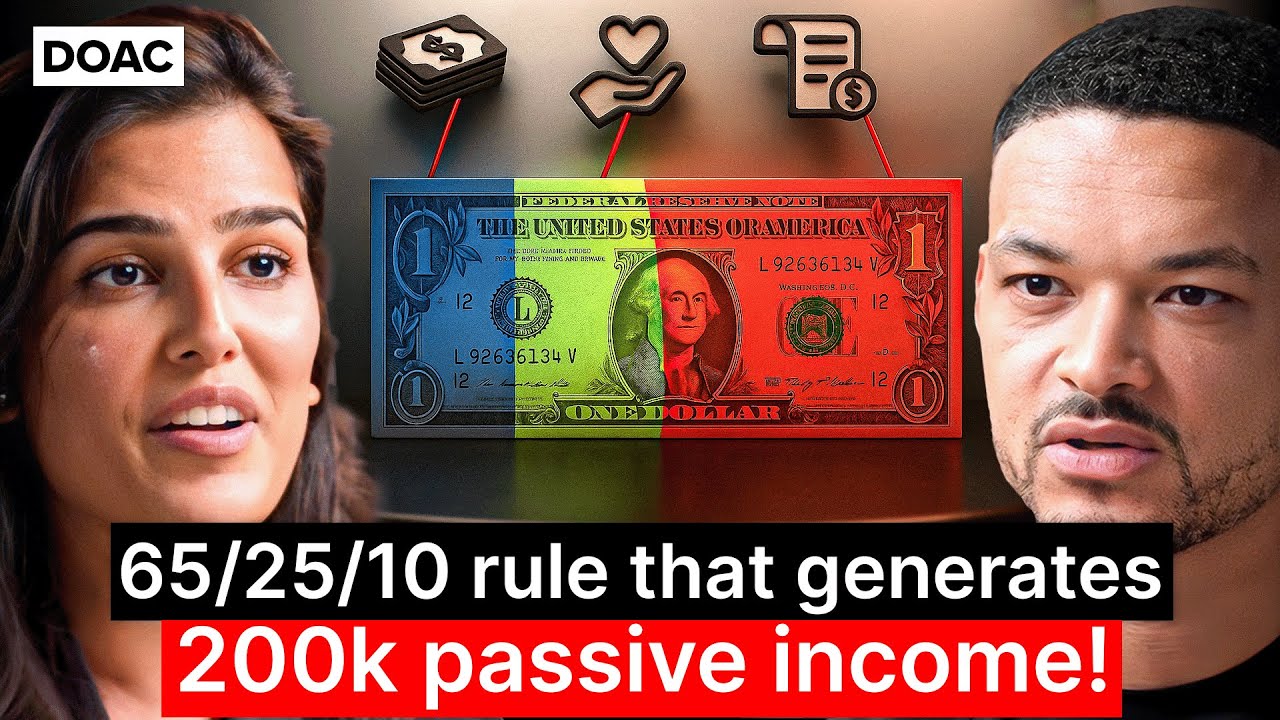
Nischa Shah Urges Index Funds Over Early Home Buys to Build Net Worth
The Diary Of A CEO
Financial advisor Nischa Shah advocates allocating income into low-cost index funds and high-yielding skills rather than locking up capital in real estate and lifestyle inflation early in a career.
## Background
This episode of The Diary Of A CEO, hosted by Steven Bartlett, features personal finance expert, qualified accountant, and former investment banker Nischa Shah on YouTube on July 21, 2025. According to the show notes, Shah breaks down her 65-20-15 money framework, strategies for passive income and index fund investing, credit card traps, and why saving for a home can sometimes hinder financial freedom.
## TL;DR
Nischa Shah outlines actionable strategies for taking control of personal finances, covering foundational steps like building emergency funds, clearing high-interest debt, and implementing her 65-20-15 budget rule. She demystifies long-term wealth creation through low-cost index funds and smart portfolio allocation, while examining common pitfalls like status spending, lifestyle inflation, and dealership car traps. Shah also delves into practical money management for relationships, modern AI tools for budgeting, and the mindset shift needed to achieve financial independence.
## Atmosphere & style
The conversation strikes a grounded balance between rigorous financial strategy and deeply personal storytelling. Steven Bartlett leads an intimate, peer-to-peer dialogue that transitions effortlessly from analytical breakdowns of wealth-building rules to raw discussions about corporate burnout, immigrant guilt, and identity loss. The atmosphere feels pragmatic, encouraging, and unvarnished, validating the emotional baggage surrounding money while offering clear, actionable guidance.
## Key takeaways
- [59:07](https://www.youtube.com/watch?v=NxTsA72O5x0&t=3547s) The 65-20-15 framework categorizes net take-home pay into 65% for fundamentals, 20% for fun spending, and 15% for future savings and investments.
- [48:16](https://www.youtube.com/watch?v=NxTsA72O5x0&t=2896s) Investment success is primarily driven by personal behavior and avoiding panic-selling rather than individual stock selection.
- [48:16](https://www.youtube.com/watch?v=NxTsA72O5x0&t=2896s) Fidelity research revealed that the top-performing investment accounts belonged to individuals who had died or forgotten about their accounts.
- [01:02:04](https://www.youtube.com/watch?v=NxTsA72O5x0&t=3724s) Car purchases are largely emotional decisions; buying a 3-to-5-year-old used vehicle helps buyers avoid the steepest initial depreciation hit.
- [01:06:11](https://www.youtube.com/watch?v=NxTsA72O5x0&t=3971s) Lifestyle inflation can neutralize financial growth, making it essential to save or invest at least 10% of any income before increasing personal spending.
- [01:13:49](https://www.youtube.com/watch?v=NxTsA72O5x0&t=4429s) Couples can protect both their personal identity and financial clarity by using a shared 'Team Fund' for bills and individual 'Me Funds' for personal discretionary choices.
- [01:17:02](https://www.youtube.com/watch?v=NxTsA72O5x0&t=4622s) True passive income requires significant initial effort, with broad-market index funds serving as the most accessible form for most individuals.
- [01:29:45](https://www.youtube.com/watch?v=NxTsA72O5x0&t=5385s) Applying AI tools like ChatGPT can assist in organizing budgets and identifying high fees, but users must remain vigilant against potential mathematical errors.
- [01:36:33](https://www.youtube.com/watch?v=NxTsA72O5x0&t=5793s) Improving credit scores involves actionable steps like registering on the electoral roll, increasing total available credit limits, and negotiating terms with lenders.
- [01:39:12](https://www.youtube.com/watch?v=NxTsA72O5x0&t=5952s) Switching companies mid-career generally produces higher salary increases (20% to 30%) than staying internally for routine raises (3% to 5%).
- [01:48:57](https://www.youtube.com/watch?v=NxTsA72O5x0&t=6537s) Nischa Shah walked away from a six-figure investment banking career to build her content business, prioritizing personal alignment over corporate golden handcuffs.
- [02:04:09](https://www.youtube.com/watch?v=NxTsA72O5x0&t=7449s) Most career moves are reversible decisions, whereas the most common deathbed regret is failing to live a life true to oneself.
## Detailed walkthrough
### [00:00](https://www.youtube.com/watch?v=NxTsA72O5x0&t=0s) Rethinking Wealth and Financial Freedom
The traditional narrative around money tells young professionals that buying real estate is the ultimate prerequisite for security. However, Nischa Shah—a former high-profile investment banker turned financial mentor—argues that there are alternative, highly effective ways to build wealth without getting trapped in the property game. In a world where relentless marketing, rising inflation, and an increasing cost of living constantly drain personal bank accounts, maintaining control over one's money requires deliberate, intentional action. Following society’s predefined blueprint often leads to a cycle of high consumption and zero freedom, leaving individuals feeling stuck despite working hard.
```
+-----------------------------------------------------------------------+
| THE 65-20-15 MONEY FRAMEWORK |
+-----------------------------------+-----------------------------------+
| 65% Core Needs & Expenses | Housing, food, bills, transport |
| 20% Wealth Building & Investing | Index funds, retirement, growth |
| 15% Personal Wants & Lifestyle | Guilt-free spending, hobbies |
+-----------------------------------+-----------------------------------+
```
Nischa recounts her own realization that continuing down society's default path meant sacrificing long-term freedom and choices. By stepping away from standard expectations, she transformed her own relationship with money, unlocking strategies that extend far beyond simply surviving paycheck to paycheck.
- **The Modern Reality**: Constant commercial messaging combined with structural inflation creates an environment designed to separate people from their savings.
- **The Core Objective**: Shifting from society's version of status and spending toward genuine financial independence.
[02:33](https://www.youtube.com/watch?v=NxTsA72O5x0&t=153s) Nischa's Mission: Translating Jargon into Action
Having built a YouTube audience of nearly two million subscribers in a short period, Nischa clarifies that her overriding goal is simple: demystifying the financial world. Money influences virtually every decision in daily life—from career choices and housing locations to how weekends are spent. Yet, traditional schooling and home life rarely equip people with basic financial literacy. Nischa leverages her background as a qualified chartered accountant and former investment banker to translate dense corporate finance jargon into practical, actionable tips for everyday individuals.
The foundational rules of personal finance remain surprisingly uniform regardless of whether someone earns $50,000 or $500,000 a year. While higher incomes scale the numbers, the core mindset and habits required to retain and grow wealth do not change. With widespread public frustration surrounding inflation, stagnant wages, and high living expenses, straightforward financial guidance has become an urgent necessity rather than a luxury.
- **Background**: Qualifications as a chartered accountant, a degree in finance, and nine years of experience in investment banking.
- **Mission**: Removing complexity from personal finance to empower individuals across all income brackets.
[04:33](https://www.youtube.com/watch?v=NxTsA72O5x0&t=273s) Money Psychology, Traumas, and the Catalytic Moment
Our individual relationships with money are heavily dictated by childhood experiences and family dynamics—an "invisible backpack that we carry" without even realizing it. Whether through direct financial struggle or simply overhearing parental arguments about bills, these early emotional impressions shape how adults earn, spend, save, and invest. For years after graduating university, Nischa followed the standard "blueprint"—working hard, getting a prestigious job, and spending money on lifestyle upgrades and vanity items to project success externally.
```
Traditional Corporate Blueprint The Shift to Ownership
+---------------------------------+ +--------------------------+
| Go to School -> Get a Job | | Understand Money |
| Climb Ladder -> Buying Status | --> | Cut Unnecessary Costs |
| Vulnerable to Redundancies | | Build Passive Income |
+---------------------------------+ +--------------------------+
```
The turning point occurred roughly halfway through her corporate banking career. Nischa was working exhaustive hours alongside an accomplished female mentor on multi-billion-dollar corporate transactions. Despite her mentor's intense dedication to the firm, she was abruptly made redundant overnight during a major deal, and Nischa was asked to step into her role the very next day. This sudden event shattered Nischa’s belief in corporate security, bringing home a stark realization: "if you give someone else the power to feed you, you're also giving them the power to starve you." Recognizing the flaw in relying on a single employer for stability, she took control of her financial destiny, mastered personal asset building, and launched her YouTube channel to teach others.
- **The Ostrich Effect**: A cognitive bias where people intentionally avoid looking at negative financial information (like unread bills or bank apps after a night out) out of fear of how it will make them feel.
- **Key Realization**: True security comes from individual financial literacy and asset ownership, not from job titles or corporate employers.
[08:39](https://www.youtube.com/watch?v=NxTsA72O5x0&t=519s) The 4 Steps to Financial Control: Peace of Mind Fund
For those feeling overwhelmed and avoidant about their bank balances, taking back control starts with a psychological step rather than a purely mathematical calculation. Step one is establishing a "Peace of Mind Fund." While not mathematically optimal for wealth growth, it provides the emotional foundation necessary to break the cycle of anxiety.
```
+------------------------------------------------------------------------+
| PEACE OF MIND FUND BENCHMARKS |
+-----------------------------------+------------------------------------+
| Calculation | 1 Month of Core Living Expenses |
| US Benchmark | Beats 59% of US Adults |
| UK Benchmark | Beats 30% of UK Adults |
+-----------------------------------+------------------------------------+
```
To calculate this number, an individual reviews the past 30 days of bank statements and adds up core living costs—rent or mortgage, utilities, basic groceries, minimum debt commitments, and transportation. Saving this exact single-month buffer ensures that when unexpected disruptions occur, such as a broken boiler or a car breakdown, the situational stress isn't compounded by immediate financial panic.
> "Saving that one month of living costs puts you ahead of 59% of Americans and 30% of people living in the UK."
- **Implementation**: Calculate one month of mandatory survival costs; park this cash strictly for unexpected emergencies.
- **Statistical Context**: 59% of Americans cannot cover an unexpected $1,000 expense, while 30% of UK residents lack one month of living expenses in reserve.
[12:03](https://www.youtube.com/watch?v=NxTsA72O5x0&t=723s) Step 2: Stopping Financial Bleeding and High-Interest Debt
Once the Peace of Mind Fund is established, the second step shifts to pure mathematical optimization: eliminating high-interest debt. Keeping thousands of dollars in a low-yield savings account while carrying high-interest credit card debt is counterproductive. Nischa compares this to "pouring water into a bucket with holes in it and wondering why it's not going to fill up."
```
DEBT PAYOFF PRIORITIZATION
[Credit Card Debt (20% APR)] ---> THROW ALL EXTRA CASH HERE FIRST
|
v
[Personal Loan (10% APR)] ---> PAY SECOND
|
v
[Low Interest Debt (<8% APR)] ---> MAINTAIN MINIMUM PAYMENTS ONLY
```
The proper strategy involves listing all non-mortgage debts ranked by interest rate. After maintaining minimum payments across all accounts to avoid penalties, every available extra dollar should be funneled directly into paying down debts carrying interest rates above 8%. Credit cards can be useful financial tools for earning rewards, points, and consumer protection, but *only* if the balance is paid off in full every single month.
> "Use credit cards, but use it in a way that stacks up in your favor, not in the credit card company's favor."
- **High-Interest Threshold**: Any debt with an interest rate exceeding 8% should be prioritized for rapid payoff.
- **Golden Rule of Credit Cards**: Never use credit cards for non-essential purchases unless you hold the equivalent cash in hand to pay the statement balance immediately.
[14:00](https://www.youtube.com/watch?v=NxTsA72O5x0&t=840s) Step 3: Expanding to a True Emergency Buffer
The third step in the financial framework is scaling the initial one-month buffer into a robust, multi-month emergency cushion. This buffer is designed to insulate individuals from major life disruptions, such as job losses, sudden medical emergencies, or family care requirements. The required size of this emergency reserve depends on personal circumstances and income predictability:
```
+------------------------------------------------------------------------+
| EMERGENCY BUFFER SIZING |
+-----------------------------------+------------------------------------+
| 3 Months of Expenses | Single individuals with stable, |
| | predictable income streams |
+-----------------------------------+------------------------------------+
| 6 Months of Expenses | Primary breadwinners, mortgage |
| | holders, or variable income earners|
+-----------------------------------+------------------------------------+
```
Citing research from Vanguard, Nischa emphasizes that holding three to six months of expenses in reserve contributes more to a person's overall emotional well-being and psychological stability than earning an annual salary over $200,000 without savings. This safety net provides breathing room and directly reduces underlying, chronic stress.
- **Vanguard Study Insight**: Having a 3 to 6-month financial buffer significantly improves daily workplace productivity and overall mental health.
- **Relativity of Money**: High earners without an emergency fund often suffer from the same chronic financial anxiety as lower earners living paycheck to paycheck.
[15:10](https://www.youtube.com/watch?v=NxTsA72O5x0&t=910s) The Delusion of High-Income Security and Stopping the Saving Habit
A critical trap that many high earners fall into is assuming that a massive monthly income equals financial security. The reality for many millionaires is that their overheads scale directly with their earnings, leaving them running monthly expenses in the millions. Because their cash outflow is so high, they remain just one or two bad months away from complete financial collapse. While their day-to-day lifestyle and subjective quality of life appear elevated, their underlying financial anxiety and stress levels remain virtually identical to those living paycheck to paycheck on a modest salary.
```
+-------------------------------------------------------------------+
| THE 4-STEP FINANCIAL CONTROL FRAMEWORK |
+-------------------------------------------------------------------+
| Step 1: Peace of Mind Fund --> 1 Month of Core Expenses |
| Step 2: Cut the Bleeding --> Pay Off High-Interest Debt |
| Step 3: Emergency Fund --> 3-6 Months of Core Expenses |
| Step 4: Wealth Building --> Stop Oversaving, Start Investing |
+-------------------------------------------------------------------+
```
Transitioning into step four requires overcoming the instinct to continuously hoard cash in standard bank accounts. Cash hoarding beyond basic reserves actively erodes wealth due to inflation. Beyond emergency reserves, cash should only be held in bank accounts if it is earmarked for short-term goals occurring within the next five years, such as buying a car or saving for a house deposit.
- **Step 1 (Peace of Mind Fund):** Reserve exactly 1 month of core living expenses.
- **Step 2 (Cut the Bleeding):** Systematically pay off high-interest debt.
- **Step 3 (Emergency Fund):** Save 3 months of core expenses if single, or 6 months if supporting dependents.
- **Step 4 (Investing):** Stop saving excess cash and allocate funds toward compounding assets.
- **The 5-Year Saving Rule:** Cash in savings accounts should be strictly restricted to emergency buffers or specific capital purchases planned within a 5-year window.
---
[17:14](https://www.youtube.com/watch?v=NxTsA72O5x0&t=1034s) Core Survival Expenses vs. The Danger of Premature Investing
Before allocating a single dollar or pound toward market investments, ensuring that steps one through three are fully established is critical. Investing without a dedicated cash buffer forces individuals to liquidate stock positions at a loss during sudden market downturns or personal financial emergencies. Core living expenses must strictly reflect raw survival needs—rent or mortgage, heating, basic groceries, and essential utilities. It excludes lifestyle additions like season tickets for sports clubs or designer apparel.
> "If you start investing before you've got from steps one to three... and the market goes down and you have an emergency, you're going to have to pull that money out at a loss."
- **Core Expenses Definition:** Absolute minimum capital required for basic survival during job loss or crisis.
- **Excluded Items:** Discretionary choices like luxury apparel, dining out, and entertainment subscriptions.
- **Risk Mitigation:** Completing the emergency buffer prevents relapse into high-interest debt during sudden income disruptions.
---
[18:45](https://www.youtube.com/watch?v=NxTsA72O5x0&t=1125s) Employer-Sponsored Retirement Plans and Workplace Matching
Saving alone can no longer fund a viable retirement due to rising living costs and systemic inflation. Achieving long-term financial independence requires investing capital early to maximize compounding over time. The primary entry point for individual wealth creation begins with workplace retirement programs, such as a 401(k) in the US or an auto-enrolled workplace pension in the UK.
Employer-sponsored schemes allow employees to contribute pre-tax dollars directly from their paycheck, reducing overall taxable income while growing capital within a tax-deferred structure. Furthermore, many companies match contributions up to a specific percentage (e.g., 3%). Failing to contribute enough to claim the full employer match means turning down guaranteed, non-taxable funds.
- **US Retirement System:** Employees must verify enrollment details through HR, typically utilizing a 401(k) framework.
- **UK Retirement System:** Eligible workers are automatically enrolled into workplace pensions by law.
- **Employer Match Strategy:** Contribute at least up to the maximum match limit to secure 100% immediate return on that tier of capital.
---
[20:17](https://www.youtube.com/watch?v=NxTsA72O5x0&t=1217s) Trade-offs, Status Signals, and the Hedonic Treadmill
Choosing how to utilize money involves navigating distinct long-term trade-offs between current status signaling and future autonomy. During her early days on a banking graduate scheme, Nischa observed two opposing approaches to wealth:
```
+---------------------------------------------------------------------------------+
| TWO PATHS TO WEALTH |
+---------------------------------------------------------------------------------+
| THE STATUS TRAP (Colleague) | THE AUTONOMY PATH (Phil) |
+--------------------------------------+------------------------------------------+
| • Drove a Ferrari to work | • Brought packed lunches to office |
| • Weekend trips to Michelin venues | • Wore a simple, repeatable wardrobe |
| • High income matched by high spend | • Invested aggressively pre-tax |
| • Bound to banking indefinitely | • Achieved early retirement in countryside|
+--------------------------------------+------------------------------------------+
```
Neither path is inherently wrong, but both carry distinct consequences. Spending high earnings on status symbols often traps individuals on a "hedonic treadmill"—a cycle where each purchase yields temporary satisfaction before requiring an even larger purchase to maintain the same baseline feeling. Conversely, living below one's means purchases time, flexibility, and early retirement.
> "Happiness and external validation, they're like cousins... but they're not the same guy. They look like they're kind of of the same family, but one of them's their dysfunctional sibling."
- **Status Treadmill:** Equalizing spending with rising income removes financial choices and enforces prolonged employment.
- **Autonomy Focus:** Prioritizing high savings rates converts active labor into early retirement, geographical freedom, and time sovereignty.
---
[25:05](https://www.youtube.com/watch?v=NxTsA72O5x0&t=1505s) Individual Tax-Advantaged Accounts: ISAs and Roth IRAs
Once employer-matched options are utilized, the next priority is individual tax-advantaged accounts. In the UK, this is the Stocks & Shares ISA; in the US, it is the Roth IRA or traditional IRA. These vehicles provide structural tax shelters that eliminate capital gains and dividend taxes on asset growth, accelerating wealth accumulation over extended timeframes.
| Account Feature | UK Individual Savings Account (ISA) | US Roth IRA |
|:--- |:--- |:--- |
| **Funding Source** | Post-tax income | Post-tax income |
| **Annual Limit (approx.)** | £20,000 | $7,000 ($8,000 if age 50+) |
| **Tax Treatment on Growth** | 100% Tax-Free (No CGT/Dividend Tax) | 100% Tax-Free growth and withdrawals |
| **Withdrawal Flexibility** | Flexible withdrawal rules | Penalty-free principal access; earnings tied to age rules |
- **Tax Efficiency:** Shields compounding interest, capital gains, and dividend distributions from annual tax collection.
- **Contribution Caps:** UK limits stand at a flat £20,000 annually, whereas US limits sit near $7,000 per year for standard workers under 50.
- **Priority Ranking:** Tax-advantaged accounts should generally be capped out before placing funds into fully taxable brokerage accounts.
---
[27:41](https://www.youtube.com/watch?v=NxTsA72O5x0&t=1661s) Simple Long-Term Investing: Index Funds and Capital Allocation
When choosing assets within an individual investment account, simple broad-market index funds outperform complex trading strategies over long time horizons. An index fund functions as a single wrapper containing fractional shares of hundreds of top-performing corporations. Investing in index funds provides instant diversification, protecting capital if an individual company falters.
```
INDEX FUND DIVERSIFICATION
+----------------------------+
| S&P 500 / FTSE 100 |
+-------------+--------------+
|
+-----------------------+-----------------------+
| | |
[ Company A ] [ Company B ] [ Company C ]
(Tech Sector) (Healthcare) (Consumer Goods)
```
For those starting with small amounts (e.g., £2,000 or $2,000 saved slowly over five years), allocation should be split between psychological conditioning and increasing active earning power. Investing a modest £100 introduces the real-world emotional experience of market fluctuations, while preserving the remaining bulk of capital to upskill and increase primary income.
> "Think of your income as a river and your specific milestones, life milestones, as buckets across the river."
- **S&P 500 Index:** Represents the top 500 public US enterprises.
- **FTSE 100 Index:** Tracks the 100 largest listings on the London Stock Exchange.
- **Historical Returns:** Broad market indices have historically returned an annual average of 8% to 10% over multi-decade holding periods.
- **Small Portfolio Allocation:** Allocate a tiny fraction (e.g., $100) to build market habits, while redirecting larger sums into skills that drive active earning power.
<ElicitationsGroup message="Explore related financial strategies from Nischa Shah's interview:">
<Elicitation label="Cover the 65-20-15 budget rule breakdown" query="What is Nischa Shah's 65-20-15 money framework and how does it split income between expenses, investments, and savings?"/>
<Elicitation label="Examine house buying vs renting calculations" query="Why does Nischa Shah argue that buying a house can ruin your path to financial freedom?"/>
</ElicitationsGroup>
[30:05](https://www.youtube.com/watch?v=NxTsA72O5x0&t=1805s) Increasing Your Income First vs. Long-Term Compounding
Nischa Shah uses a river and bucket analogy to illustrate how cash flow dictates financial progress. Life consists of various savings buckets—a house deposit, a car payment, or emergency reserves. How quickly those buckets fill depends directly on the width and speed of the river feeding them, which represents your income. If your income stream is merely a trickle, filling those buckets takes an agonizingly long time. For this reason, Nischa advises that if you only have a modest lump sum (such as £2,000 to £5,000) and it took a long time to save, your immediate priority should be reinvesting that money into skills and leverage to increase your income before putting it into the stock market.
Conversely, if you already have a steady flow of disposable income, you should harness the power of long-term compounding growth immediately. While automated monthly index fund investments take 25 to 30 years to build true wealth, they provide leverage that a standard day job simply cannot offer: money working continuously for you without requiring your direct physical time and presence.
[31:14](https://www.youtube.com/watch?v=NxTsA72O5x0&t=1874s) Negotiating a Salary Raise and Strategic Job Switching
When focusing on increasing income, Nischa outlines two primary paths. The most immediate option is negotiating a salary raise within your current company by building an evidence-based case. Rather than relying on silent hard work, an employee must explicitly map out their value, expanded responsibilities, and market value. Recounting her own tenure in investment banking, Nischa demonstrates how to anchor performance reviews to previously agreed-upon targets, presenting concrete metrics, 360-degree peer feedback, and areas where they went above and beyond before asking if a salary bump is fair.
Addressing the gender wage gap and workplace taboos, Nischa acknowledges studies showing women are statistically less likely to ask for raises and less likely to receive them. She advocates overcoming this through radical financial transparency and practical workplace steps:
- **Consult HR directly:** Ask HR whether your pay aligns with the internal average for your specific tier and role to establish if you are underpaid.
- **Find an internal ally or mentor:** Cultivate trusted colleagues to benchmark compensation, breaking the societal taboo around discussing salaries openly.
- **Switch companies strategically:** Citing a widely referenced *Forbes* study, Nischa points out that employees who stay at a single company for more than two years earn, on average, 50% less over their lifetime. Reflecting on her nine-year banking career, her own largest pay leaps came exclusively from switching firms.
Steven Bartlett echoes this from an employer's perspective, noting that leaders are often receptive to market rate corrections—especially in newly emerging industries like podcasting where clear benchmarks are historically sparse—provided the conversation focuses on shared company goals rather than blunt demands.
[37:14](https://www.youtube.com/watch?v=NxTsA72O5x0&t=2234s) Homeownership Myths, the S&P 500, and Renting
The conversation shifts to the deep-seated cultural belief that buying a home is the primary milestone of wealth creation. Nischa explains that much of this mindset is inherited from prior generations. For example, when her immigrant parents moved to the UK, purchasing their first home represented the ultimate tangible proof of stability, safety, and social mobility. Culturally, homeownership functions as a "forced mechanism of saving" because mortgage payments are mandatory equity contributions that prevent discretionary overspending.
However, running the cold financial numbers often reveals a different reality. Studies across nine out of twelve regions in the UK show that renting can be significantly cheaper than owning an equivalent property when accounting for the total costs of ownership—mortgage interest, property taxes, stamp duty, repairs, maintenance, and insurance. If a renter is disciplined enough to take the monthly price difference and invest it into the stock market automatically, they can build equal or superior wealth without holding real estate.
- **Nischa's Property vs. Index Fund Case Study:**
- **Property Purchased:** North London flat bought in 2017 for £530,000 with a ~£50,000 initial down payment plus stamp duty.
- **Property Appreciation:** Value grew roughly 10% (~£50,000 gain) over eight years to ~£580,000.
- **S&P 500 Comparison:** Over that same timeframe (2017–2025), the S&P 500 delivered average annual returns of 10%–12%, more than doubling in value (and growing over 90% in a single 5-year span alone despite the COVID-19 crash and 2022 pullback).
- **Conclusion:** Investing the down payment and fees directly into an S&P 500 index fund would have yielded significantly higher financial returns than the physical property.
Despite the mathematical advantage of index funds, Nischa emphasizes the unquantifiable "invisible side" of real estate: the psychological peace of mind, security, and emotional comfort that comes from owning a piece of land where no landlord can issue an eviction notice.
[44:49](https://www.youtube.com/watch?v=NxTsA72O5x0&t=2689s) Understanding Opportunity Cost in Financial Decisions
Steven introduces the concept of **opportunity cost**, recalling advice from his brother—an LSE graduate and former investment banker—who consistently challenges Steven's spending urges (such as buying a property in Cape Town) by asking him to evaluate the trade-offs. Nischa defines opportunity cost as the fundamental truth that every pound or dollar spent today is one less unit of capital available to build compound wealth somewhere else.
Because humans naturally focus on tangible objects placed right in front of them, they frequently ignore the invisible trade-offs. Evaluating opportunity cost forces an investor to recognize that choosing one financial asset or purchase always means saying "no" to the potential returns of another.
<ElicitationsGroup message="Where would you like to explore next?">
<Elicitation label="Analyze renting vs. buying math" query="Can you break down the full financial math comparing renting and investing the difference versus buying a home with a mortgage?"/>
<Elicitation label="Explore salary negotiation strategies" query="What are the best step-by-step strategies and scripts for asking for a salary raise during a performance review?"/>
<Elicitation label="Understand index fund investing basics" query="How do index funds like the S&P 500 work for beginners, and how does compound interest build long-term wealth?"/>
</ElicitationsGroup>
[46:06](https://www.youtube.com/watch?v=NxTsA72O5x0&t=2766s) The Reality of Opportunity Cost: Lunch vs. Compound Growth
Steven Bartlett illustrates the concept of opportunity cost with a concrete, personal example. He mentions buying lunch for his team at an LA salad bar the day prior, which cost $100. While $100 seems negligible at first glance, Steven points out that if that same $100 were invested in the S&P 500 at an average annual return of 10% over 40 years, it would grow to nearly $5,000. Therefore, the true opportunity cost of buying that lunch was effectively $5,000 in future wealth.
Nischa Shah acknowledges this calculation but presents the counter-argument to keep perspective. Skimping on the team lunch might save $5,000 for the future, but it sacrifices invisible, present-day benefits: team morale, shared memories, employee motivation, and company culture. Nischa and Steven debate the classic tension between living for today versus saving for retirement. Referencing an earlier anecdote about a man driving a Ferrari who might die young, Steven notes that if someone dies early, spending money to enjoy life in the present could actually be viewed as playing the game of life correctly.
To balance this, Nischa highlights that financial planning shouldn't feel like total self-deprivation. By establishing a clear allocation framework—securing the future first—you can spend money in the present guilt-free, without constantly stressing over what that spending costs in lost interest down the road.
- **The $100 Salad Bar Example:** $100 invested at a 10% annual compound return for 40 years yields approximately **$5,000**.
- **Living for Today vs. Future Security:** A healthy financial plan explicitly allocates funds for current enjoyment so that spending today doesn't trigger financial anxiety or constant opportunity-cost math.
---
[48:16](https://www.youtube.com/watch?v=NxTsA72O5x0&t=2896s) Homeownership vs. Stocks: The Behavioral Reality of Investing
When asked whether people should buy a home strictly to build wealth, Nischa advises evaluating alternatives like tax-free investment accounts—such as a Stocks and Shares ISA in the UK—rather than putting oneself under immense pressure to save a massive housing deposit. She highlights a striking statistic: roughly 75% of the UK population is not actively investing, missing out on accessible wealth-building tools.
```
+-----------------------------------------------------------------------+
| BEHAVIORAL LESSONS FROM FIDELITY |
+-----------------------------------------------------------------------+
| 1. Active Traders (Worst Performance): |
| • Reacted to fear and market dips by panic-selling. |
| • Bought high, sold low, underperforming the funds they held. |
| |
| 2. Forgotten Accounts (2nd Best Performance): |
| • Investors forgot they owned the fund and left it untouched. |
| |
| 3. Deceased Investors (Best Performance): |
| • Portfolio performance was highest because they couldn't touch |
| or emotionally react to the market. |
+-----------------------------------------------------------------------+
```
Nischa explains that investment performance is driven far more by behavior than by choosing the "next big stock." Citing a famous Fidelity study, she notes that individual retail investors often underperform the very funds they invest in because emotional panic causes them to buy high and sell low. Surprisingly, Fidelity found that the single best-performing group of investors were **dead people**, followed closely by people who forgot they held an account. Because they didn't touch their portfolios, they let compound growth work uninterrupted.
Steven relates this to his own early experience in his 20s, when he downloaded an investment app without having an emergency fund. Panicking during a market dip, he sold at a loss of a couple hundred pounds, only to watch that same asset skyrocket over the next seven years. Later in life, when investing in crypto (Ethereum and Bitcoin), Steven adopted a clever anti-panic tactic: he split his private keys in half, gave each piece to a different trusted person, and rendered himself physically incapable of panic-selling. Taking emotion out of the equation turned it into one of his highest-returning investments.
- **UK Investment Gap:** Approximately **75% of people in the UK** do not invest in stocks or funds.
- **Key Behavioral Takeaway:** The emotional discipline to "set it and forget it" beats active trading and attempts to time the market.
- **Initial Portfolio Advice:** Nischa recommends taking a tiny, inconsequential amount (like $100 or £100) to invest in an index fund simply to desensitize your emotions to normal market swings.
---
[54:27](https://www.youtube.com/watch?v=NxTsA72O5x0&t=3267s) Breakdown of Nischa Shah’s Asset Portfolio
Nischa breaks down her personal asset allocation, illustrating how she translates her core financial principles into practice. Rather than chasing volatile short-term gains, her wealth distribution emphasizes broad diversification, automation, and controlled risk exposure:
| Asset Class | Percentage | Strategy & Details |
|:--- |:--- |:--- |
| **Index Funds & Broad Markets** | **40%** | Heavily diversified across the S&P 500, international markets (UK, emerging, developed sectors), and Target Date Retirement Funds. |
| **Real Estate** | **30%** | Property holdings focused exclusively within the UK. |
| **Business Reinvestment** | **25%** | Reinvested directly into expanding her personal brand, channel, and business operations. |
| **Crypto, Cash & Reserves** | **~5%** | Crypto represents **less than 2%** of her total portfolio. The rest is kept as liquid cash and emergency peace-of-mind reserves. |
Nischa goes into detail about **Target Date Retirement Funds**, explaining them as automated, all-in-one portfolios. A buyer selects a fund tied to their target retirement year (e.g., a "2050 Target Date Fund"). As the target date approaches, the fund automatically shifts its asset mix from aggressive, growth-oriented stocks to conservative, capital-preserving bonds to guard against market crashes late in life.
Steven and Nischa both stress that the single best investment anyone can make is in themselves—upgrading skills, knowledge, and earning potential—because higher earnings dramatically accelerate the capital available to feed into all other investments.
- **Crypto Allocation Safety Rule:** Nischa caps her crypto holdings at under **2%** of her net worth, treating it strictly as a speculative play where losing the entire principal would have zero impact on her lifestyle.
Steven Bartlett takes a brief break to highlight podcast sponsor Fiverr. He discusses the fast-evolving landscape of running a business like Flight Story, where technical skills like vibe coding, AI agent development, and generative engine optimization are suddenly required. Steven recommends using Fiverr's platform to hire reliable, vetted, long-term expert freelancers across 750+ categories, directing listeners to `[fiverr.com/diary](https://fiverr.com/diary)` with promo code `DIARY` for 10% off.
---
[57:36](https://www.youtube.com/watch?v=NxTsA72O5x0&t=3456s) Book Recommendations & Money Mindset
When Steven asks Nischa to name the single most transformative book for advancing financial literacy, she surprising highlights two titles that focus on mindset and foundational storytelling rather than dry financial formulas:
1. ***Think and Grow Rich* by Napoleon Hill:** While not a practical accounting guide, Nischa praises it for rewiring internal money mindsets and ambition.
2. ***The Richest Man in Babylon* by George S. Clason:** Nischa considers this the perfect starting point for complete beginners. Because traditional personal finance books can feel dry, Clason uses parables and ancient storytelling to teach simple, timeless rules about saving, budgeting, and spending.
Nischa emphasizes that the core rules of building personal wealth do not change over decades—they always start with mastering basic cash flow and spending habits.
- "The underlying principles when it comes to money don't really change much, and it really starts at the basics when it comes to saving and spending."
---
[59:07](https://www.youtube.com/watch?v=NxTsA72O5x0&t=3547s) The 65-20-15 Framework for Net Income
Nischa presents her core budgeting blueprint for monthly cash flow: the **65-20-15 Rule**. Crucially, she emphasizes that these percentages apply to **net income** (take-home pay after taxes and state contributions), not the gross salary stated on a job offer letter.
* **65% — Fundamentals (Core Living Costs):** Housing (rent/mortgage), utility bills, groceries, minimum required debt payments, and transportation/car payments.
* **20% — Fun Spending (Present Enjoyment):** Spontaneous activities, concert tickets (like Glastonbury), hobbies, pottery workshops, and fitness classes.
* **15% — Future You (Wealth & Security):** Contributions direct to savings, stocks/index funds, and aggressive debt reduction.
Nischa acknowledges that for individuals living paycheck to paycheck or facing steep UK housing costs, reaching 65% on essentials may be difficult initially. In those scenarios, she advises dialing back the "Fun" category temporarily, or starting small with whatever is possible—even if it's saving 2% or 3%—just to establish the psychological muscle memory of paying "Future You" first.
- **Net vs. Gross:** Always run budget formulas on take-home pay, not gross contract salary.
- **Habit Over Amount:** If 15% for "Future You" is impossible today, starting at 1% or 2% builds the discipline required to ramp up when income increases.
---
[01:01:20](https://www.youtube.com/watch?v=NxTsA72O5x0&t=3680s) The Emotional Trap of Buying Cars
Moving to specific spending traps, Nischa single-outs car ownership alongside housing as one of the two main areas where people ruin their personal finances. The core issue is that car purchases are almost never driven by pure math—they are driven by emotion, status, and how the vehicle makes the driver feel or look to others.
Nischa candidly shares her own past mistake: upon securing her very first job, she immediately walked into a dealership to upgrade her car. Within an hour, driven purely by the desire to look cool, she signed a contract and drove off the lot without running the actual numbers or calculating the long-term impact on her wealth.
- **Status Spending:** Cars are a rapidly depreciating asset that people routinely overspend on for external validation rather than practical transportation needs.
[01:02:04](https://www.youtube.com/watch?v=NxTsA72O5x0&t=3724s) Buying vs. Leasing Cars and Avoiding Dealership Pitfalls
Nischa warns that car dealerships deliberately manipulate monthly payment figures to coax buyers into purchasing far more vehicle than they can actually afford. Falling into this trap is one of the quickest ways to destroy your chances of building real wealth. For most people, the smartest financial move is to buy a used car that is three to five years old. At that stage, the previous owner has already absorbed the sharpest drop in value, meaning the car won't depreciate nearly as fast while you own it. Leasing only makes sense for wealthy individuals who want a new vehicle every couple of years and consciously accept that it is a poor financial trade-off.
When Steven asks Nischa what kind of car she drives, she reveals that she currently doesn't own one at all. After running the calculations for her current lifestyle and travel patterns, she determined that taking Ubers and taxis everywhere is actually more economical than paying for car ownership and maintenance. While she notes that her preferences might change in five or ten years, keeping her transport costs low right now allows her to deploy that money far more effectively elsewhere.
* **Car Buying Recommendation:** Buy vehicles that are 3 to 5 years old to avoid taking the initial heavy depreciation hit.
* **Leasing Use-Case:** Best reserved for high-net-worth individuals who prioritize driving a new vehicle every few years over optimal financial returns.
* **Nischa's Transport Strategy:** Uses ride-share services like Uber instead of owning a car because her current travel frequency makes public transit and taxis significantly cheaper.
---
[01:03:53](https://www.youtube.com/watch?v=NxTsA72O5x0&t=3833s) Hidden Marketing Traps, Impulse Buys, and Diminishing Returns
Everyday consumer choices are surrounded by subtle marketing traps designed to drain wallets without consumers even realizing it. Even a routine trip to the grocery store is a battle against clever layout strategies: essential items like milk, bread, and eggs are placed at the back of the store so shoppers must walk past hundreds of other products, premium items are placed directly at eye level, and sugary treats are positioned low down at children's eye level. To combat overspending on basic necessities, Nischa recommends shopping with a strict list and evaluating whether switching from high-end supermarkets like Waitrose or M&S to budget options like Aldi makes sense for your budget.
Beyond groceries, friction-free payment methods—such as Apple Pay and Buy Now, Pay Later (BNPL) options—make impulse buys dangerously effortless. When deciding whether to upgrade tech devices like iPhones or iPads, Nischa advises keeping the "law of diminishing returns" in mind. The jump from having no smartphone to getting your first one brings a massive leap in utility and joy; however, each incremental annual upgrade offers progressively smaller boosts in happiness while costing substantial amounts of money.
* **Grocery Store Tactics:** Basics (milk, eggs) are in the back, premium brands are at adult eye level, and kids' treats are placed low down on shelves.
* **Cost-Saving Grocery Advice:** Always shop with a list and consider switching to discount grocers (e.g., Aldi over M&S or Waitrose).
* **Law of Diminishing Returns in Tech:** Joy peaks with the initial purchase of a device type; subsequent annual model upgrades offer drastically lower marginal happiness for the cost.
---
[01:06:11](https://www.youtube.com/watch?v=NxTsA72O5x0&t=3971s) Intentional Spending, Lifestyle Inflation, and Budget Tracking
Nischa clarifies that she does not advocate for extreme frugality or cutting out every simple pleasure. Personal care items—such as getting nails done, dyeing hair, or purchasing a nice bag—should absolutely be enjoyed, provided you allocate a dedicated percentage of your income for "fun" and aren't sacrificing your future 5- to 10-year financial goals. The real danger to long-term wealth building is "lifestyle inflation": the natural tendency for spending to scale up at the exact same pace as income increases, effectively masking luxury upgrades as absolute necessities. To build true wealth, the gap between what you earn and what you spend must widen over time, rather than stay the same or narrow.
When it comes to tracking money, Nischa notes that you don't need complex, grueling spreadsheets if you aren't mathematically inclined. Most modern banking apps automatically categorize monthly expenses to give a clear ballpark picture. The single non-negotiable rule is ensuring you save or invest a **minimum of 10%** of your income first. For those who want more real-time clarity on what they have left to spend each month, Nischa uses and shares a custom Excel-based budget tracker.
* **Lifestyle Inflation Definition:** The practice of increasing your living expenses in lockstep with salary raises, hiding luxuries under the guise of "necessities."
* **The Core Rule:** Ensure you save/invest at least 10% of your income first; how you distribute the remaining cash on personal enjoyment is up to you.
* **Tracking Tools:** Use modern banking apps with built-in spending categorization, or clean budget templates that calculate real-time remaining allowance for the month.
---
[01:09:17](https://www.youtube.com/watch?v=NxTsA72O5x0&t=4157s) Navigating Money and Relationships: The Questions to Ask
Financial friction and arguments over money are, alongside sex, one of the top reasons couples end up in divorce court. Nischa emphasizes that the root causes of money conflicts in relationships are a lack of transparency, hidden debts, and conflicting financial values. Rather than grilling a prospective partner about their exact credit score or debt utilization on a first date, you can ask subtle, revealing questions to gauge their core financial beliefs and money attachments.
Nischa breaks down three distinct layers of money conversations for couples:
1. **Early Stage / Values Test:** Ask, *"If you won $10,000 tomorrow, how would you spend it?"* An answer like buying or renting a luxury car signals that they value status, whereas saving it or booking a trip reveals a preference for security or experiences.
2. **Deeper Understanding / Empathy:** Ask, *"Where did your beliefs about money come from?"* Learning about a partner's upbringing helps you understand whether they tend toward impulse buying or extreme frugality out of past trauma, replacing judgment with compassion.
3. **Long-Term Planning:** Ask, *"What do our 2-, 5-, and 10-year financial goals look like, and how will we manage our money together?"*
---
[01:13:49](https://www.youtube.com/watch?v=NxTsA72O5x0&t=4429s) The "Team Fund" vs. "Me Fund" Architecture and Prenups
When Steven asks whether couples should fully merge their finances, Nischa gives a firm answer: *"My straight answer to this is no."* Because adults get married later in life with deeply set habits—and because financial opposites (savers and spenders) frequently attract—completely combining all bank accounts often leads to resentment and loss of autonomy. Nischa recommends a hybrid model containing two distinct buckets:
> "I recommend having a Team fund and then a Me fund. Team fund is for the grown-up adult stuff, the joint expenses, mortgage, rent, bills, council tax. And this isn't 50/50. You both pay into that proportionate of your income... And then you have the Me fund. And this is for your own individual personality to stay alive."
If one partner brings in 90% of the total household income, they cover 90% of the joint bills, leaving the rest for individual allocation. The "Me Fund" allows each partner to buy what they love without judgment or permission—whether it's an expensive watch or an addiction to matcha—maintaining personal independence. Nischa notes this financial independence is especially crucial for women, having seen cases where individuals in failing or unsafe relationships felt trapped simply because they lacked independent access to money.
Regarding prenuptial agreements, Nischa views them as essential clarity. In essence, everyone already has a prenup—it's either a custom one you draft together, or the default legal framework dictated by the state. While legal enforceability varies by jurisdiction (for instance, UK courts may review prenups to determine basic fairness rather than treating them as strictly binding), having open, honest discussions about asset distribution provides valuable alignment.
* **Team Fund (Joint):** Covers shared living costs (rent, mortgage, council tax, household utilities) and is funded **proportionately** based on each partner's share of total household income.
* **Me Fund (Personal):** Individual accounts for personal spending, hobbies, and savings that require zero approval or oversight from the partner.
* **Prenuptial Perspective:** You either design your own customized prenup or accept the state's default legal split in the event of a divorce.
Here is a detailed, faithful walkthrough of this section of the interview:
[01:17:02](https://www.youtube.com/watch?v=NxTsA72O5x0&t=4622s) Demystifying Passive Income and Building Scalable Income Streams
Nischa defines true passive income as money earned without actively trading ongoing time or labor. However, she stresses that the term "passive income" is widely overused and romanticized—people frequently overlook the massive amount of upfront work required to set up any supposedly hands-off income stream. When exploring how an average person working a 9-to-5 can increase their cash flow, Nischa explains that the absolute easiest, most accessible route to genuine passive income is investing in index funds, such as the S&P 500.
Every other avenue for boosting income requires some level of active effort, time, or energy. Nischa divides non-investment income strategies into two main categories:
1. **"Tap-and-Go" Income:** Immediate, active hustle that trades time directly for money—such as renting out a spare room on Airbnb, walking dogs, or driving for Uber. While these provide instant liquidity, they are inherently capped because you are limited by hours in a day and are not leveraging any unique advantage.
2. **Value and Skill-Based Income:** Leaning into your personal strengths, expertise, and individuality to create scalable businesses (for example, creating content or digital products). While these can eventually become semi-passive, they require a significant initial investment of time and money before generating any meaningful return.
Steven highlights the explosive potential of digital products as a side hustle for working professionals, bringing up **Stan Store** (a platform he co-owns). He shares a case study of a creator who had only 1,000 followers and helped women overcome binge eating and eating disorders; in just 30 days, she earned $4,000 to $5,000 by selling roughly 40 digital guides and PDFs. Nischa agrees that millions of professionals are sitting on a "mountain of knowledge" from their day jobs without realizing its market value. To discover your own monetizeable skill, she advises asking friends and colleagues: *"What is it that you'd come to me for advice on?"* Whether it's organizing events, creating Excel formulas, or managing back pain, those inquiries signal your unique market advantage. Nischa notes that this exact mindset was how her own channel started—as a simple online diary sharing financial lessons, which eventually evolved into a multi-million dollar full-time career.
* **Immediate active options:** Airbnb, dog walking, driving for Uber (fast cash, but strictly time-bound and capped).
* **Scalable skill options:** Digital products, online courses, specialized content creation (high upfront effort, but high upside).
* **Stan Store Case Study:** A creator with 1,000 followers generated $4,000–$5,000 in 30 days selling niche health PDFs.
* **Sponsor Shoutouts / Ad Breaks:**
* **Stan Store:** Promotes a 30-day free trial via `stevenbartlett.stan.store`, noting that creators on the platform have earned over $300 million selling digital products, coaching, and communities without needing coding skills.
* **Intuit (TurboTax & QuickBooks):** Highlights career and upskilling opportunities for tax and bookkeeping professionals through Intuit Academy (`[intuit.com/expert](https://intuit.com/expert)`), offering flexible full-time, part-time, or virtual hours.
[01:23:53](https://www.youtube.com/watch?v=NxTsA72O5x0&t=5033s) Transitioning from Corporate Banking to Making Millions on YouTube
Steven asks Nischa about her journey from corporate finance to becoming a full-time creator with 151 YouTube videos, asking directly if it is safe to say her media business has made her millions. Nischa candidly confirms: "Yeah." Looking back, she finds it surreal that her current reality began by sitting in her spare bedroom recording videos. For a long time, she lived a dual life: Monday through Friday was filled with the glitz, glamour, and client meetings of corporate banking, while her evenings and weekends were spent in her spare room googling basic editing terminology like "A-roll," "B-roll," and "color grading."
She resigned from her banking job just over two years ago. Although YouTube began purely as a creative outlet, her sense of purpose exploded when the channel hit a viral inflection point—surging from 1,000 to 50,000 subscribers in a few days, and reaching 100,000 just weeks later. Reading comments from viewers saying they bought their first index fund or negotiated a salary raise because of her advice gave her a level of internal fulfillment that no corporate salary could match.
Steven references a popular video Nischa published titled *"5 Things I Did to Stop Wasting My Evenings After Work."* Nischa explains that working in banking required strict discipline. The core message of the video is urging people to snap out of "autopilot mode"—coming home, collapsing onto the couch, and mindlessly watching Netflix or TV just out of habit.
Steven compares managing time to budgeting money: your hours are your central point of leverage, and how you spend them compounds over decades. Deciding to read a personal finance book or learn a high-value skill instead of watching *Love Island* sets off a subtle, invisible trajectory shift that yields life-changing compound interest 10 to 30 years down the line. When asked about her present happiness, Nischa shares that doing this work is "the happiest I've been since starting a career in banking," emphasizing that earning a living while helping others master their money is one of the most rewarding pursuits imaginable.
* **Timeline:** Quit her corporate banking job two years prior after growing her channel during evenings and weekends.
* **Growth Spurt:** Skyrocketed from 1,000 to 50,000 subscribers in days, hitting 100,000 shortly after.
* **Time Budgeting Concept:** Treating evening hours as an asset rather than default relaxation time; small shifts in daily habits compound into vastly different long-term life outcomes.
[01:29:45](https://www.youtube.com/watch?v=NxTsA72O5x0&t=5385s) Leveraging AI for Personal Finances and Budgeting
The conversation shifts to Artificial Intelligence and its sweeping impact on hiring, careers, and creative production. Nischa views the rise of AI tools as a net positive for financial literacy, noting that information which was previously gatekept or difficult to aggregate is now accessible instantly at anyone's fingertips.
When Steven asks if someone could simply use ChatGPT as a personal monthly accountant—inputting their salary, recurring expenses, and financial goals to receive customized advice—Nischa agrees that AI is a fantastic starting point for beginners who feel clueless. An AI prompt can immediately offer 3 or 4 tailored budgeting frameworks based on your specific income and spending metrics.
However, Nischa issues a crucial caveat: AI tools can hallucinate or output mathematical errors, so information must always be verified with a pinch of salt. More importantly, financial decisions are heavily driven by human emotions, such as fear and greed. While AI can optimize numbers and structure data, it cannot replace the human emotional self-awareness required to manage money successfully.
* **AI for Budgeting:** Effective as an initial, personalized financial consultant for beginners to outline budget models and saving strategies.
* **Limitations:** Prone to factual or mathematical errors; lacks the capacity to manage the psychological and emotional triggers (fear, greed, emotional spending) inherent in financial decisions.
[01:31:45](https://www.youtube.com/watch?v=NxTsA72O5x0&t=5505s) Doing Your Finances With AI
A podcast team member shares a personal system of using ChatGPT as a personalized financial advisor. By feeding the AI screenshots of bank statements and investment accounts, the custom prompt calculates monthly spend, flags high investment fees, and creates tailored action plans. When the producer asked whether to dump all savings into Tesla stock—a strategy inspired by previous guest Cathie Wood—ChatGPT delivered a reality check: "Look, you're not Cathie Wood. You don't have enough in your emergency funds. Top that up first." It recommended building a baseline emergency cushion first before putting speculative investments into separate custom "pies" on platforms like Trading 212.
Nischa highlights how AI excels at cutting through generic advice by adapting specifically to an individual's personal risk profile and immediate numbers. While high-interest savings accounts (like 4%) might seem simple, they often get overlooked in favor of flashier stock tips on social media or dedicated finance channels. However, reliance on automated tools should serve as a foundational starting point to help establish strong financial habits rather than a permanent replacement for long-term self-education and aligned financial principles.
- **ChatGPT Financial Review Strategy:** Screenshotting bank statements and investment accounts to calculate monthly expenses, identify fee overcharges, and highlight gaps in emergency savings.
- **Investment Management Platforms:** Using tools like Trading 212 to separate money into designated "pies" (e.g., safe investments, speculative assets, and high-interest savings).
- **Cathie Wood Stock Debate:** A stark prompt reminder that retail investors without fully funded emergency buffers shouldn't mirror high-risk portfolio allocations seen in institutional growth funds.
---
[01:36:33](https://www.youtube.com/watch?v=NxTsA72O5x0&t=5793s) The Importance of Your Credit Score
Steven reflects on how he completely ruined his credit score at 18 and 19 years old due to a total lack of financial literacy. After defaulting on credit cards and overdrafts, he received two County Court Judgments (CCJs) and experienced the shock of having his card swallowed by an ATM. Many young adults fail to grasp that credit scores dictate future borrowing costs; for example, two people purchasing the exact same vehicle in a showroom will end up with drastically different monthly payments based purely on their individual credit histories.
Nischa emphasizes that tracking and fixing your credit report early—using free online checking services—is vital for major life purchases like buying a car or a home. Simple actions can yield immediate improvements: register on the electoral roll to prove your address, and request a credit limit increase to lower your overall credit utilization ratio. If high interest rates on existing debt become overwhelming, individuals can actively negotiate directly with lenders to request interest reductions by presenting a clear 12-to-18-month debt repayment plan.
- **County Court Judgments (CCJs):** Legal judgments recorded against an individual for unpaid debts that severely damage credit ratings for years.
- **Credit Utilization Ratio:** Increasing total credit limits while maintaining low spending drops usage (e.g., from 50% down to 20%), signaling responsible financial behavior to lenders.
- **Electoral Register:** Being registered to vote is a quick, free step that instantly validates identity and boosts credit scores.
- **Lender Negotiation Strategy:** Contacting creditors to negotiate lower interest rates over a structured 12-to-18-month payoff window.
---
[01:39:12](https://www.youtube.com/watch?v=NxTsA72O5x0&t=5952s) Tailoring Advice Across Life Stages: Three Personas
Steven introduces three hypothetical personas to test whether the core 65-20-15 framework applies across different life stages:
1. **Andy (Early 20s):** Early in his career, wanting a new phone and a better car. Nischa notes that in your 20s, time is your greatest asset. It's okay if living expenses take up 70% to 75% of take-home pay, but starting small, recurring investments early harnesses decades of compound growth. Steven adds that young people without mortgages or dependents should "roll the dice" and embrace high-upside career risks, like working at an AI startup, because early-stage skills yield high future returns and there is ample time to bounce back from mistakes.
2. **Lisa (Mid-Career High Earner):** Earning approximately £140,000 per year with a mortgage and solid savings, but frozen by fear when it comes to investing. Nischa advises maintaining a dedicated emergency fund and ensuring mortgage interest isn't eating away returns. For beginners overwhelmed by choice, 100% of the portfolio should remain in simple, low-cost index funds or target-date retirement funds rather than speculative stock-picking.
3. **Matt (Single Parent):** Earning £60,000 per year, spending over 50% of his income on rent, and holding £1,500 in credit card debt. High-interest credit debt acts like "running with weights on your ankles" and must be cleared immediately after establishing a basic peace-of-mind buffer. Given his tight schedule as a father, the most efficient way to boost income without losing extra hours is negotiating a raise or changing companies—noting that moving between organizations historically yielded 20% to 30% salary increases compared to 3% to 5% internal raises. Secondary options include non-capital income tactics like selling secondhand items or listing a spare room on Airbnb.
- **Persona Breakdown:**
- **Andy:** Entry-level worker; focus on high-yielding skill acquisition, risk-taking, and early dollar-cost averaging ("decades over dopamine").
- **Lisa:** High earner (£140,000/year); focus on overcoming analysis paralysis through 100% allocation in index or target-date funds.
- **Matt:** Single parent (£60,000/year, £1,500 debt, >50% rent burden); priority on debt clearance, negotiating pay raises, or changing jobs for 20%–30% salary bumps.
---
[01:45:25](https://www.youtube.com/watch?v=NxTsA72O5x0&t=6325s) What I Refuse to Spend Money On
Reflecting on her past choices, Nischa reveals that she hasn't purchased a single designer item in over two years—a massive shift from her previous lifestyle when she was "dripped out" in luxury wear. She explains that her core sense of validation moved inward and through her work achievements, rendering expensive designer logos redundant. Spending a premium price purely to market another company's brand, rather than purchasing an item for its functional utility, no longer aligns with her financial mindset.
[01:46:01](https://www.youtube.com/watch?v=NxTsA72O5x0&t=6361s) Intentional Spending, Books, and Eliminating Decision Fatigue
Continuing their discussion on spending habits, Nischa Shah clarifies her stance on high-end luxury items. She explains that if a branded or designer piece provides actual utility—meaning the design or quality works noticeably better—she will buy it. However, buying luxury goods purely for status or external validation is a firm "no-go" for her now, as she would much rather direct those funds toward things that bring genuine fulfillment. Asked whether she buys fast fashion instead, Nischa declines, stating she avoids fast fashion unless it is an emergency, last-minute purchase. Instead, she invests in a high-quality "capsule wardrobe" of versatile pieces she can mix and match repeatedly.
When Steven Bartlett asks about books, Nischa’s energy lights up, calling reading an area where she loves to spend because it offers an "infinite return." She recalls reading *Rich Dad Poor Dad* early on, which fundamentally shifted her mindset by teaching her the difference between assets and liabilities. She emphasizes that books, podcasts, and YouTube videos serve as a vital equalizer for people who do not have direct access to high-achieving networks. By consuming content from inspiring figures, you capture the "averaging effect" of being surrounded by the five people you spend the most time with, gaining knowledge equivalent to sitting down with them for an hour.
Steven lightheartedly jokes about whether viewers should subscribe to channel content, to which Nischa agrees with a laugh. Observing that they both frequently wear black, Steven asks if her wardrobe choices are intentional. Nischa explains that when she was balancing a full-time investment banking job while launching her YouTube channel, she needed to eliminate unnecessary decision-making to build consistent systems rather than relying on fleeting motivation. She reduced her clothing options to roughly four black outfits to save mental bandwidth. Though black still makes up about 60% of her wardrobe today, it remains a conscious strategy to keep her focus on high-priority tasks.
- **Fast Fashion vs. Quality:** Nischa avoids fast fashion in favor of a durable, interchangeable capsule wardrobe.
- **Impact of Reading:** Cites *Rich Dad Poor Dad* as her foundational finance book; views books and educational media as a proxy network for those lacking high-level mentorship.
- **Wardrobe Strategy:** Wears black (60% of her closet) to eliminate decision fatigue and build reliable daily routines.
---
[01:48:57](https://www.youtube.com/watch?v=NxTsA72O5x0&t=6537s) The Words from Her Father That Changed Everything
Steven pivots to the show's tradition of asking a question left by the previous guest: *"Who is the one person that was or is responsible for the person that you are today and the reason why you are sitting here?"* Nischa immediately names her father, becoming noticeably overcome with emotion. She recalls the early days of starting her YouTube channel when peers were whispering and questioning what she was doing. Despite her early videos receiving only 9 or 10 views, her father watched them and offered unwavering encouragement, telling her: "What you're doing is so good for the world. Your education is going to help so many people. Don't stop."
Holding back tears as producer Jack hands her tissues, Nischa reflects on how a few timely words of support can completely alter the trajectory of a person's life. She shares that her dad might not fully grasp the extent of his impact, though she recently sent him a message reminding him of those early days filming in her dining room with poor lighting and weak delivery. For her father—who raised three daughters as an immigrant wanting nothing more than job security for them—watching Nischa later walk away from a lucrative career was frightening and hard to digest.
Nischa reveals the staggering scale of her career transition: quitting her banking role meant taking an immediate **84% pay cut**, walking away from a base salary of £220,000 (roughly $300,000) just two months before a negotiated six-figure bonus was set to land. When Steven asks why she didn't just wait two more months to collect the massive bonus, Nischa explains that in corporate life, there is always another "carrot" being waved to keep you on the default path—promising another bonus or promotion if you just wait a few more months or years until retirement. Recognizing that her side project was exploding and receiving heartfelt DMs from viewers whose lives were changing, she ran her numbers, confirmed her reduced income could still cover her mortgage and basic living expenses, and took the leap.
```
Corporate Salary (£220K / ~$300K) ---> [ 84% Pay Cut ] ---> Full-Time Creator (Covered Basic Living Expenses)
*Walked away 2 months prior to a negotiated six-figure bonus.
```
- **Early Support:** Her father's belief during her single-digit view count kept her filming through early self-doubt.
- **The Financial Leap:** Left a £220k ($300k) corporate salary, accepting an 84% pay cut and sacrificing an impending six-figure bonus.
- **The "Carrot" Trap:** Warns against delaying life-changing opportunities for corporate golden handcuffs that continuously move the goalposts.
---
[01:58:02](https://www.youtube.com/watch?v=NxTsA72O5x0&t=7082s) Overcoming External Noise, Identity, and Corporate Pain
Reflecting on the psychological toll of leaving corporate finance, Nischa admits that the hardest part wasn't the pay cut, but shedding the identity she had built over nine years in banking. Her job title had given her instant external validation at dinner tables, and letting go of that safety net required deep mental work. She outlines practical strategies for anyone feeling trapped in an unfulfilling career:
1. **Move from Interest to Obsession:** Spend more time immersing yourself in the path you want to pursue than around people who doubt it. Being merely interested leads to casual effort, but obsession provides the courage to make hard choices.
2. **Amplify Your Inner Voice:** Keep a written record (she used Apple Notes) contrasting external comments with your inner drive. Read your inner voice repeatedly so it drowns out surrounding skepticism.
3. **Recognize the Source of Mockery:** When her channel gained traction, former acquaintances shared her videos in WhatsApp group chats with subtle mockery. She reminded herself that being transparent about her numbers was necessary to genuinely help people.
As Steven gently asks where this deep reservoir of emotion is coming from, Nischa reveals that her career involved immense pain and feelings of being trapped. Her personal finance content usually stays tactical and educational, but reflecting on her origin brings back memories of how claustrophobic she felt and how hard she had to fight to free herself. She emphasizes that while others might judge your choices in the moment, you alone have to live with the long-term consequences of staying in a job, relationship, or life path out of fear.
- **Identity Detachment:** Overcame the reliance on a prestigious corporate title for self-worth.
- **Dealing with Cynicism:** Ignored WhatsApp group gossip and subtle mockery from peers by focusing on her mission of radical transparency.
- **Living with Consequences:** Emphasizes that you—and only you—have to live with the "what ifs" of unfulfilled potential.
---
[02:01:26](https://www.youtube.com/watch?v=NxTsA72O5x0&t=7286s) The Hardest Day and the Immigrant Guilt
When Steven asks her to pinpoint the single hardest moment of her transition, Nischa describes the morning she e-mailed her manager to schedule a Zoom call, officially resigning from banking and turning down her six-figure bonus. Visualizing her younger self in her late 20s, she sees a woman turning her back on guaranteed wealth and a predictable career path to step into total uncertainty—driven entirely by the tangible impact she knew she could have on everyday individuals rather than corporate or sovereign clients.
Steven brings up the unique pressure experienced by first- and second-generation immigrant children, where parents prioritize stable careers like medicine, law, or finance as the ultimate proof of security. Nischa agrees whole-heartedly, explaining the immense guilt associated with walking away from a career her parents sacrificed so much to make possible. Quitting felt almost like telling them their hard work was being thrown away. Because the pressure and guilt were so intense, Nischa reveals that she couldn't bring herself to tell anyone she was resigning until after the deed was done—with her then-boyfriend (now husband) being the only person who knew beforehand.
- **The Catalyst Moment:** Resigning on a Zoom call in her late 20s, walking away from safety toward purpose.
- **Immigrant Guilt:** Balanced the heavy emotional weight of departing a "secure" professional field after her parents sacrificed to help her achieve it.
- **Secrecy:** Kept her resignation completely secret from family and friends—telling only her partner—until after she officially handed in her notice.
[02:04:09](https://www.youtube.com/watch?v=NxTsA72O5x0&t=7449s) Reversible Decisions and Leaving Career Traps Behind
Nischa reveals that she did not tell her parents she was quitting her investment banking career until after the deed was done. She explains that she deliberately kept them in the dark because she feared their input might sway her or make her doubt her decision. When she finally broke the news, her parents supported her—largely because they realized it was already too late to stop her, though Nischa notes they likely would have nudged her to stay for the sake of job security had they known earlier.
Steven Bartlett reflects on this, noting that when faced with monumental life decisions where you alone bear the consequences and the regret, seeking consensus or consulting a "focus group" of external voices often just complicates things. He frequently advises people in similar positions—such as someone trapped in a high-paying corporate finance job dreaming of playing the violin in Peru—to ask themselves a critical question: *"Could you go back if you're wrong?"*
Drawing on business strategy, Steven explains that if a choice is reversible, it is a "Type 1 decision" (or reversible door). It is a shame that so many people spend decades paralyzed in front of doors they could easily walk back through. Nischa agrees that making these reversible leaps eliminates the agonizing weight of "what if."
* **Type 1 Decisions:** Most career pivots—including leaving corporate finance or investment banking—are reversible. Roughly 95% of people Steven asks admit they could re-enter their old field if their venture failed.
* **The Number One Regret:** Steven cites Bronnie Ware’s famous study on palliative care patients, which revealed that the top regret of people on their deathbeds is "not living the life that I think I could have lived."
---
[02:06:05](https://www.youtube.com/watch?v=NxTsA72O5x0&t=7565s) Closing Words and Channel Outro
Steven expresses deep gratitude to Nischa for her work, praising how her wildly popular YouTube channel addresses a massive unmet demand for clear, accessible financial education. He commends her genuine warmth, clear intentions, and willingness to leave high-status security behind to make a real difference in people's lives. After Nischa thanks Steven and hints at an upcoming book, the episode transitions into Steven's closing host messages.
* **Subscriber Call to Action:** Steven shares that 53% of regular listeners are not yet subscribed, asking viewers to hit the subscribe button as a free way to support the show.
* **DOAC Conversation Cards:** Steven highlights *The Diary Of A CEO* Conversation Cards, which feature guest-written questions ranked by depth (Levels 1 to 3). Each card includes a QR code allowing users to watch the original guest answer the question in real time.
## Notable quotes
> The underlying principles when it comes to money don't really change much, and it really starts at the basics when it comes to saving and spending. — Nischa Shah
> [01:13:49](https://www.youtube.com/watch?v=NxTsA72O5x0&t=4429s) My straight answer to this is no. — Nischa Shah
> [01:13:49](https://www.youtube.com/watch?v=NxTsA72O5x0&t=4429s) I recommend having a Team fund and then a Me fund. Team fund is for the grown-up adult stuff, the joint expenses, mortgage, rent, bills, council tax. And this isn't 50/50. You both pay into that proportionate of your income... And then you have the Me fund. And this is for your own individual personality to stay alive. — Nischa Shah
> [01:17:02](https://www.youtube.com/watch?v=NxTsA72O5x0&t=4622s) What is it that you'd come to me for advice on? — Nischa Shah
> [01:23:53](https://www.youtube.com/watch?v=NxTsA72O5x0&t=5033s) Yeah. — Nischa Shah
> [01:31:45](https://www.youtube.com/watch?v=NxTsA72O5x0&t=5505s) Look, you're not Cathie Wood. You don't have enough in your emergency funds. Top that up first. — ChatGPT
> [01:48:57](https://www.youtube.com/watch?v=NxTsA72O5x0&t=6537s) What you're doing is so good for the world. Your education is going to help so many people. Don't stop. — Nischa's Father
> [01:48:57](https://www.youtube.com/watch?v=NxTsA72O5x0&t=6537s) Who is the one person that was or is responsible for the person that you are today and the reason why you are sitting here? — Steven Bartlett
> [02:04:09](https://www.youtube.com/watch?v=NxTsA72O5x0&t=7449s) Could you go back if you're wrong? — Steven Bartlett
> [02:04:09](https://www.youtube.com/watch?v=NxTsA72O5x0&t=7449s) not living the life that I think I could have lived. — Bronnie Ware
## Mentioned
Steven Bartlett, Nischa Shah, S&P 500, Fidelity, UK, Stocks and Shares ISA, Fiverr, Napoleon Hill, George S. Clason, Stan Store, Intuit, TurboTax, QuickBooks, ChatGPT, Trading 212, Apple Pay, Uber, Airbnb, Flight Story, Intuit Academy, Think and Grow Rich, The Richest Man in Babylon, Waitrose, M&S, Aldi, Netflix, Love Island, Bitcoin, Ethereum, Tesla, Cathie Wood, Rich Dad Poor Dad, Jack, Apple Notes, Bronnie Ware, The Diary Of A CEO Conversation Cards
Former investment banker Nischa Shah argues that conventional markers of success, such as homeownership and corporate ladder-climbing, often foster high consumption rather than financial independence. She outlines a structured framework prioritizing behavioral discipline, debt elimination, index fund compounding, and scalable earning.
The Four Steps to Financial Control (8:39)
Shah cautions against investing before building a solid liquidity base, arguing that sudden market downturns or life emergencies can force individuals without reserves to liquidate equity positions at a loss. Her framework starts with an emotional baseline: a 'Peace of Mind Fund' covering one month of core survival costs, which she notes places an individual ahead of 59% of US adults and 30% of UK adults. The second step requires eliminating debt with interest rates exceeding 8%, which she compares to trying to fill a leaking bucket.
The third step expands liquidity into an emergency buffer of three to six months of essential expenses. Citing Vanguard research, Shah observes that holding such reserves provides greater emotional well-being and psychological stability than earning an annual salary over $200,000 without savings. Only once these safety buffers are secure does step four begin: transitioning surplus capital away from cash hoarding—which is steadily eroded by inflation—into growth-focused investment vehicles.
Cash-Flow Allocation: The 65-20-15 Framework (59:07)
To manage monthly cash flow, Shah proposes allocating net take-home income into three distinct tiers: 65% for fundamentals (rent or mortgage, groceries, utilities, and minimum debt payments), 20% for guilt-free fun spending, and 15% for 'future you' (investments, extra debt payoff, and savings). She stresses that these proportions apply to net earnings after tax rather than gross contract figures, noting that individuals facing high living expenses or modest wages may temporarily need to trim discretionary spending to balance their core costs.
Shah emphasizes that building sustainable wealth requires widening the gap between earnings and expenses over time, resisting the lifestyle inflation that traps high earners. To illustrate, she details her own asset allocation: 40% in broad-market index funds and target-date retirement funds, 30% in UK real estate, 25% reinvested into her media business, and approximately 5% split between liquid reserves and crypto (with crypto kept below 2%).
Homeownership Realities and Long-Term Market Compounding (37:14)
Shah challenges the cultural consensus that buying a house is mandatory for wealth accumulation, viewing it largely as an inherited generational habit and a forced savings mechanism. When accounting for mortgage interest, property taxes, stamp duty, insurance, and routine maintenance, renting is often cheaper across nine of twelve UK regions. Renters who systematically invest the monthly difference into equity markets can achieve comparable or superior returns without real estate illiquidity. As an example, Shah contrasts her North London flat—which appreciated roughly 10% from £530,000 to £580,000 between 2017 and 2025—against the significantly higher performance of the S&P 500 over that identical window.
Shah advocates maximizing tax-advantaged wrappers, such as UK Stocks & Shares ISAs (£20,000 annual cap) and US Roth IRAs (around $7,000 annual limit), to protect compounding returns from capital gains and dividend taxes. Referencing Fidelity account studies, she notes that retail investors routinely underperform the market through emotional trading, whereas untouched or forgotten accounts perform best. She also identifies vehicle purchases as an acute financial trap, recommending buyers avoid steep upfront depreciation by purchasing cars three to five years old or utilizing transport services instead of incurring ongoing ownership overhead.
Income Scaling and Relationship Finance (30:05)
Because savings allocations are limited by the overall volume of cash flow, Shah advises those with modest savings (such as £2,000) to invest in upskilling and expanding their primary income rather than relying strictly on market compounding. She notes that workers who change companies every two years earn up to 50% more over their careers than those who remain in single roles, according to Forbes data. For scalable earnings, she differentiates linear 'tap-and-go' tasks like ride-sharing from high-leverage endeavors built on unique skills and digital products.
On personal relationships, Shah rejects fully merged finances, suggesting instead a hybrid model consisting of a joint 'Team Fund' and separate 'Me Funds.' Household essentials are funded proportionately based on each partner's respective earnings rather than an arbitrary 50/50 split. The separate individual accounts provide financial autonomy and reduce friction over personal spending, a safeguard she highlights as especially critical for female independence.
Corporate Exit and Identity Shedding
Shah recounts transitioning out of a nine-year investment banking career after realizing corporate loyalty offered minimal security, catalyzed by watching a valued senior mentor made redundant overnight during a multibillion-dollar transaction. Leaving corporate finance required taking an immediate 84% pay cut and forgoing a six-figure bonus, a move that initially triggered substantial immigrant guilt given her family's emphasis on traditional professional safety.
Beyond the financial sacrifice, Shah found that the primary obstacle was shedding the external validation and identity tied to an elite corporate title. Bartlett and Shah conceptualize such transitions as reversible 'Type 1' decisions, arguing that professionals frequently remain paralyzed in corporate positions despite the ability to re-enter their previous industry if an entrepreneurial venture fails.
Shah’s framework relies heavily on disciplined behavioral adherence, automated investing, and deliberate cash-flow allocation. However, she acknowledges that high housing costs can strain the 65% fundamentals cap for low earners, and tools like AI budget prompts still lack the emotional judgment required to prevent panic selling during volatile market cycles.
## Background
本期节目由 YouTube 知名播客频道《The Diary Of A CEO》于 2025 年 7 月 21 日发布。视频由主持人 Steven Bartlett 深度对话前投资银行家兼个人理财导师 Nischa Shah,页面简介指出,Nischa 将拆解普通人积累被动收入与财富的 65-20-15(或 65-25-10)预算框架、破除买房必定致富的执念,并分享指数基金定投、规避信用卡陷阱与实现提前退休的实战策略。
## TL;DR
Nischa Shah 结合自身从九年投行高管转型为全职财商导师的经历,提出了夺回财务自主权的四步法:先建立一个月核心支出的安心基金,再集中清偿高息债务,随后扩充 3 至 6 个月的应急缓冲垫,最终果断转向免税账户与低成本指数基金定投。她深入剖析了传统买房与租房定投的机会成本博弈,揭示了消费主义背后追逐外在认可的享乐跑步机陷阱,并针对不同人生阶段给出了 65-20-15 的税后收入分配规则。此外,对话还探讨了伴侣间建立团队基金与自我基金的财务管理模式、借助 AI 工具优化个人收支,以及克服职场与原生家庭羁绊、在理性测算下勇敢承担职业转型风险的心路历程。
## Atmosphere & style
整场对谈兼具华尔街金融专家的冷静严谨与直击人心的真诚共情。前半段节奏明快,两人通过情景模拟加薪谈判、拆解真实投资组合与机会成本账本,充满了极具实操性的干货与商业洞察;后半段则在探讨原生家庭期待、移民二代愧疚感以及 Nischa 放弃六位数奖金毅然离职时迎来情感高潮,甚至数度落泪。听众能清晰感受到一种从体制内焦虑中挣脱、凭借理性逻辑与决断力夺回人生掌控权的温和而坚定的力量。
## Bulletin
- [13:07](https://www.youtube.com/watch?v=NxTsA72O5x0&t=787s) 建立 3 至 6 个月的基础应急储备缓冲金,对个体心理健康和情绪安宁的提升效果,甚至超过年薪跃升至 20 万美元带来的边际效用。
- [39:33](https://www.youtube.com/watch?v=NxTsA72O5x0&t=2373s) 买房并非唯一且最优的致富捷径;在英国大部分区域,租房并将省下的差额每月自动定投标普 500 指数,其长期复利回报远超持有实体房产。
- [49:01](https://www.youtube.com/watch?v=NxTsA72O5x0&t=2941s) 富达投资研究证实,表现最出色的散户投资者群体竟然是“已故者”与“遗忘账户密码的人”,频繁追涨杀跌的情绪化操作是散户跑输市场的根本原因。
- [01:51:38](https://www.youtube.com/watch?v=NxTsA72O5x0&t=6698s) 前投行高管 Nischa Shah 在年薪 22 万英镑且即将领取六位数奖金前毅然降薪 84% 辞职转型全职内容创作,强调错失一生一次的自媒体爆发窗口期才是最大风险。
## Key takeaways
- [07:44](https://www.youtube.com/watch?v=NxTsA72O5x0&t=464s) 理财的第一步是战胜“鸵鸟效应”,先建立相当于 1 个月核心开销的“安心基金”,随后优先偿还年利率高于 8% 的高息债务。
- [18:45](https://www.youtube.com/watch?v=NxTsA72O5x0&t=1125s) 在当今通胀环境下,单靠储蓄绝对无法安享退休;尽早启动税前雇主退休账户并拿满 100% 雇主资金匹配(Employer Match)是第一位的无风险红利。
- [24:51](https://www.youtube.com/watch?v=NxTsA72O5x0&t=1491s) 顶格用满免税投资账户(如英国 ISA 的 20,000 英镑额度或美国 Roth IRA)可以彻底免除资本利得税和股息税,实现最大化复利增长。
- [29:04](https://www.youtube.com/watch?v=NxTsA72O5x0&t=1744s) 河流与水桶理论指出:若可支配资金极其有限(如 2,000 英镑),首要任务应是将大头资金再投资于自身技能以拓宽收入之“河”,而非指望小钱在股市中暴富。
- [33:05](https://www.youtube.com/watch?v=NxTsA72O5x0&t=1985s) 职场薪酬存在“50% 定律”——在同一家公司任职超过两年的员工,其终身收入平均比合理跳槽者低 50%;主动谈薪需建立在客观交付事实与市场中位数数据之上。
- [36:40](https://www.youtube.com/watch?v=NxTsA72O5x0&t=2200s) 老一辈执着于买房的核心逻辑在于房贷提供了不可挪用的“强制储蓄机制”,但若能自律地将租房差额定投优质资产,可以创造更具流动性且回报更高的财富体系。
- [44:49](https://www.youtube.com/watch?v=NxTsA72O5x0&t=2689s) 机会成本是金钱决策的核心法则:花出去的每一笔资金不仅代表当下的消费,更意味着放弃了该资金在长周期内通过复合增长膨胀数十倍的潜在价值。
- [58:36](https://www.youtube.com/watch?v=NxTsA72O5x0&t=3516s) 践行“65-20-15”税后预算分配模型:65% 覆盖基础生存开销,20% 用于即时悦己消费,15% 坚决投入未来自我(储蓄、投资与加速还债)。
- [01:01:19](https://www.youtube.com/watch?v=NxTsA72O5x0&t=3679s) 购车是消耗普通人财富的重大陷阱,最佳财务方案是购买车龄 3 至 5 年、折旧基本平缓的二手车,或根据日常出行里程测算全打车出行的经济性。
- [01:06:11](https://www.youtube.com/watch?v=NxTsA72O5x0&t=3971s) 警惕“生活方式通胀”,不要让消费随着收入增长而同比飙升;保持财富增长的关键在于主动拉大收入与支出之间的“剪刀差”。
- [01:13:34](https://www.youtube.com/watch?v=NxTsA72O5x0&t=4414s) 伴侣之间不建议全盘合并财务,推荐采用按收入比例承担家庭公共开销的“团队基金”,并各自保留完全独立支配、互不干涉的“自我基金”。
- [01:31:42](https://www.youtube.com/watch?v=NxTsA72O5x0&t=5502s) 利用 ChatGPT 等生成式 AI 输入银行账单截图,能够千人千面地诊断出高费率平台、阻断盲目投机冲动,并自动生成分级的预算与资产配置方案。
- [01:36:33](https://www.youtube.com/watch?v=NxTsA72O5x0&t=5793s) 重视信用评分的维护:通过选民登记、提升信用总额度以稀释使用率,以及主动致电机构协商利率,可以显著降低大额借贷成本。
- [01:45:25](https://www.youtube.com/watch?v=NxTsA72O5x0&t=6325s) 彻底摒弃为外部认可买单的奢侈品消费,推崇通过极简基础款消除决策疲劳;同时将资金无限倾斜于书籍与深度内容等能带来最高认知回报的领域。
- [02:02:42](https://www.youtube.com/watch?v=NxTsA72O5x0&t=7362s) 多数看似冒险的职业转型本质上属于“可逆决策”(Reversible Decision),随时存在退回原点的通道,不应因害怕外界评判而活在他人期待中。
## Detailed walkthrough
### [00:00](https://www.youtube.com/watch?v=NxTsA72O5x0&t=0s) 破除买房神话与财富框架概述
现代社会常常给刚步入职场的年轻人施加巨大压力,让人觉得一参加工作就必须立刻挤上“买房阶梯”(property ladder)。然而,积累财富绝非只有炒房或买房这一条路。每个人在管理个人财务时,都应该掌握三组核心数字比例——“65-20-15”(或 65-25-10 框架)。只要建立起这种财务意识,就能彻底改变生活轨迹。
前资深投资银行家、现财务导师 Nischa Shah 指出,在生活成本不断上涨、物价飞涨的今天,各路营销手段无孔不入,时刻都在掏空你的钱包。在传统消费主义陷阱下,存下辛苦赚来的钱变得愈发艰难。很多人沿着社会既定的轨道生活,直到猛然惊醒:如果继续这样盲目消费,追求的自由、选择权与人生退路将彻底化为泡影。
- 单靠死存钱无法实现体面退休,唯有投资才是让财富增长的最简单途径。
- 建立初期的心理安全垫与应急储备资金,对情绪健康的积极影响甚至超过年入 20 万美元。
---
### [02:33](https://www.youtube.com/watch?v=NxTsA72O5x0&t=153s) 普及实用理财思维与战胜通胀挑战
金钱深度介入了人类生活的方方面面,左右着人们住在哪里、从事什么工作,乃至周末如何度过。Nischa Shah 创立了拥有近两百万订阅者的 YouTube 频道,其核心使命就是将晦涩高深的金融行话剥离成简单实用、任何人都能上手执行的理财技巧。无论月入数千还是年入数十万,金钱底层运行的底层逻辑和心态是完全通用的。
学校和家庭教育普遍缺乏对真实财商的系统培养,导致多数人成年后面临通货膨胀和生活成本危机时手足无措。商业社会的广告和不断膨胀的人为欲望,每时每刻都在把人们的双手从自己的钱包上拉开。作为一名先在大学研读金融、随后考取特许公认会计师(Chartered Accountant)、并在投行工作了九年的专业人士,Nischa 致力于让金融知识真正平民化。
---
### [04:33](https://www.youtube.com/watch?v=NxTsA72O5x0&t=273s) 金钱依恋风格与“看不见的背包”
每个人对待金钱的方式都带有深刻的心理印记乃至创伤反应。这种金钱依恋风格大多根植于原生家庭与童年经历,宛如每个人背上背着的一个“看不见的背包”。不管是童年时期亲身遭遇的匮乏,还是无意间在门缝旁听到父母为账单争吵,这些隐形记忆都在潜移默化中决定了你日后如何看待金钱、如何赚钱、花钱、存钱与增值财富。
大学毕业后的很长一段时间里,Nischa 自身也不懂得金钱对自己的真正定义。她盲从于社会的虚荣标准,疯狂购买各种能彰显地位、让外表光鲜靓丽的奢侈品,试图用消费来装饰生活品质。这种随波逐流的生活持续了多年,直到她深刻反思:如果为了外界认可而继续挥霍,就永远无法触及真正的人生自由。
```mermaid
flowchart TD
accTitle: 童年创伤对金钱行为的塑造逻辑
accDescr: 展示从童年潜意识经历到负面金钱习惯再到财务受困的传导链条
subgraph Origin["潜意识形成"]
A["童年经历与家庭金钱对话"] --> B["背负'看不见的隐形背包'"]
end
subgraph Behavior["社会化行为"]
B --> C["盲从社会标准与外在光鲜消费"]
C --> D["陷入逃避现实与被动财务陷阱"]
end
subgraph Trap["人生困境"]
D --> E["丧失选择权、自由与抗风险能力"]
end
```
---
### [05:55](https://www.youtube.com/watch?v=NxTsA72O5x0&t=355s) 投行裁员梦醒:“给别人喂饱你的权力,就等于给他饿死你的权力”
过去 Nischa 对传统人生蓝图坚信不疑:“好好上学,找份体面工作,努力往上爬,安全感自会降临”。但在长达九年的投行职业生涯过半时,一件极具冲击力的变故打破了她的幻想。当时,她正与一位优秀的女性导师并肩作战,为了连续数周、涉及数十亿美元的巨额交易通宵达旦地加班。
就在那笔极为庞大的交易推进到最关键时刻,这位被视作职场榜样的导师竟在一夜之间惨遭解雇并裁员。更具讽刺意味的是,公司第二天就要求 Nischa 接替导师的职位。站在导师曾坐过的位置上,Nischa 浑身冰冷:一个对职场安全感坚信不疑、把既定蓝图贯彻到极致的高管瞬间出局,下一个难道不就是自己?
这次事件让她第一次看到了体制坚固外壳下的深刻裂痕,悟出了残酷的职场生存法则:
> "If you give someone else the power to feed you, you're also giving them the power to starve you."(“如果你赋予他人喂饱你的权力,你同时也赋予了他将你活活饿死的权力。”)
意识到自己深陷在依附体系的牢笼后,她决定夺回对人生的主动权。她凭借深厚的金融知识背景,重构了自己对储蓄、消费、预算与投资的认知体系,并正式开启了传播理财知识的自媒体之旅。
---
### [07:44](https://www.youtube.com/watch?v=NxTsA72O5x0&t=464s) 鸵鸟效应与走出财务逃避的第一步
多数人在面对糟糕的财务状况时往往选择“把头埋进沙子里”,不敢打开手机银行 App,不敢拆开堆在桌上的账单信封,彻夜狂欢后更不敢查看银行余额。这种认知偏差在心理学上被称为“鸵鸟效应”(Ostrich Effect)——人们因为恐惧负面信息带来的情绪痛苦而选择刻意回避,幻想假装看不见问题就会自动消失。然而,这种无序和逃避只会让人在财务深渊中越陷越深。
要打破这种恶性循环、夺回财务控制权,第一步绝不是埋头去算繁复的数学题,也不是立刻追求数学模型上的最优解,而是建立心理层面的防御机制——去打造属于自己的“安心基金”(Peace of Mind Fund)。理财首先是一场直面恐惧的心理战,只有先消除情绪焦虑,才能在稳健的基石上逐步实现财富增长。
### [09:10](https://www.youtube.com/watch?v=NxTsA72O5x0&t=550s) 第一步:设立“安心基金”(一个月核心生活开支)
财务问题不仅仅关乎数字,更关乎情绪。理财的第一步,是翻看自己过去30天的银行账单,精确计算出一个月的生存成本——房贷或房租、水电气等账单、最低债务还款额、汽车月供等。所有这些最基础开销的总和,就是必须立刻建立的“安心基金”(peace of mind fund)。
```mermaid
flowchart TD
accTitle: 个人财务四步走规划图
accDescr: 展示从安心基金、消除高息债务、建立紧急储备到最终投资的递进式流程
subgraph Phase1["基础防御"]
A["计算近30天核心开销<br/>(房租/账单/最低还款)"] --> B["第1步:建立安心基金<br/>(储备1个月核心生活开支)"]
end
subgraph Phase2["止血与巩固"]
B --> C["第2步:遏制财务失血<br/>(按利率排序,还清>8%高息债务)"]
C --> D["第3步:扩充紧急储备缓冲金<br/>(单身稳定: 3个月 / 家庭波动: 6个月)"]
end
subgraph Phase3["财富增值"]
D --> E["第4步:开启投资与复利<br/>(停止过度储蓄,抵御通胀)"]
end
```
如果一个月核心生活成本是1000美元,那就必须专款专用地存下这1000美元。这笔钱不能用来投资,也不能拿去度假,其唯一的使命是应对生活无常抛出的“变化球”:无论是星期一清晨汽车抛锚,还是家里的锅炉突然坏掉,最糟糕的莫过于在承受事件本身的压力之外,还要背负拿不出钱的财务焦虑。仅仅存下一个月的核心开支,就能让你超越大部分人群:
- **59% 的美国人**:遇到紧急情况时连1000美元的突发支出都掏不出来。
- **30% 的英国人**:无法承担哪怕仅一个月的紧急生活费用。
### [10:45](https://www.youtube.com/watch?v=NxTsA72O5x0&t=645s) 第二步:遏制财务失血(全力偿还高息债务)
许多人账户里躺着4000或5000英镑/美元的存款,常常困惑于该如何打理。对此,首要问题是:“你身上有高息债务吗?”如果存款放在银行享受4%的利息,信用卡却背着20%的高昂利息,这就像“往一个布满窟窿的桶里倒水,还纳闷为什么装不满”。在收益率远低于借贷成本的情况下,资金是在加速流失而不是增值。
面对债务时,最具数学效益的策略是按年利率从高到低排序:
1. **全面保底**:对名下所有债务按期支付最低还款额。
2. **重点爆破**:将所有多余的储蓄全力砸向年利率高于 8% 的那一笔最高息债务。
3. **逐级清偿**:彻底解决最高利息的债务后,再依次向下推进。
信用卡借款利息通常按月计收。虽然使用信用卡可以赚取积分、奖励和开卡礼,但前提是**每月必须全额还清**。信用卡公司的核心盈利模式正是依赖消费者遗漏还款并产生滚存利息。除非用于房产、医疗或教育等能创造回报或维持生计的特定资产,否则任何日常消费在刷卡前都必须自问:“我能否立刻用现金全款买下它?”如果做不到就不要刷卡,避免陷入刺激过度消费的陷阱。
### [13:07](https://www.youtube.com/watch?v=NxTsA72O5x0&t=787s) 第三步:建立真正的紧急储备缓冲金(3至6个月)
还清高息债务后,下一步是在一个月安心基金的基础上,扩充为长期的“紧急储备缓冲金”(emergency buffer):
- **单身且收入稳定**:储备相当于 **3个月** 的核心生存开支。
- **身为一家之主、背负房贷或收入不稳定**:储备相当于 **6个月** 的核心生存开支。
先锋领航集团(Vanguard)的一项调研得出了极具启发性的结论:拥有相当于3至6个月生活开支的储蓄缓冲,对个体心理健康的改善程度,甚至超过年薪突破20万美元带来的效用。它不仅买到了应对失业、重病或家庭赡养责任的宝贵缓冲时间,更提供了人类底层最核心的安全感与稳定感。这种安全感直接体现在工作效率的提升上。相反,即使是年入六位数甚至百万的高收入群体,若月度开销同样巨大、没有防御垫,他们离财务归零也往往仅有短短一两个月,同样时刻生活在隐秘而强烈的焦虑之中。
### [15:58](https://www.youtube.com/watch?v=NxTsA72O5x0&t=958s) 第四步:划定储蓄终点,迈向投资阶段
很多人容易卡在第三步无法自拔,陷入“只存不投”的误区。储蓄的合理目的仅有两种:
1. 储备上述的应急资金(包括一个月的安心基金与3至6个月的紧急缓冲金)。
2. 为未来5年内的明确目标准备资金(例如购房首付或购车首付款)。
除此之外,多余的钱绝不能长期任由其躺在银行账户里,否则购买力会被通胀无情蚕食。完成前三步后,就必须停止过度储蓄,果断开启第四步——**投资**。
如果跳过前三步贸然去投资,一旦遇上市场下行叠加突发意外,投资者将陷入极其被动的两难境地:要么被迫在低点割肉变现遭受实际亏损,要么再次借入高息债务。紧急储备锁定的仅是“生存必需”——涵盖取暖、账单、最基础食物与房租,坚决剔除曼联季票、奢侈品外套(如 Louis Vuitton)或社交派对等享乐型消费。只有筑牢这一生存护城河,后续的投资才能真正从容不迫。
### [17:51](https://www.youtube.com/watch?v=NxTsA72O5x0&t=1071s) 财务掌控第四步:光靠“存钱”无法养老,必须尽早投资
聊到财务掌控的第四个关键步骤,Nischa 指出了大众普遍存在的一个致命认知误区:我们从小到大常听到“为退休存钱(save for retirement)”这句话,但在当今生活成本飞涨、通货膨胀持续侵蚀购买力的大环境下,“你根本不可能单靠存钱存出一个体面的退休生活”。等真正到了退休年龄,所需的开支将远超想象,单纯把钱放在银行账户里只会被通胀慢慢蚕食,唯一的出路是必须把资金投入到具有增值能力的资产中去。
绝大多数人都心知肚明自己“应该去投资”,但行动上却总是一拖再拖。借口永远层出不穷:“等明天吧”、“等下周再说”、“等明年”、或者“等我变成有钱人之后再开始”。然而,当人们终于下定决心入场时,往往已经错失了手里最强有力的杠杆——时间。投资的精髓正在于“尽早且持续(early and often)”,哪怕每次投入的金额微不足道,只要给它足够漫长的时间,复利的雪球就会呈现出指数级的爆发式增长。
```mermaid
flowchart TD
accTitle: 核心投资路径对比
accDescr: 雇主养老金计划与个人税收优惠投资账户的运作机制及对比
subgraph Avenue1["渠道一:雇主赞助养老计划(如 UK Workplace Pension / US 401k)"]
A["税前薪资 Pre-Tax"] --> B["雇主代扣并自动投资"]
B --> C["雇主资金配比匹配 Company Match<br/>(白送的免费资金)"]
C --> D["锁定至法定退休年龄提取"]
end
subgraph Avenue2["渠道二:个人税收优惠账户(如 UK ISA / US Roth IRA)"]
E["税后收入 Post-Tax"] --> F["存入个人投资账户<br/>(年度有限额)"]
F --> G["免资本利得税、免股息税复利增长"]
G --> H["灵活提取 / 退休免税支取 Tax-Free"]
end
```
---
### [18:45](https://www.youtube.com/watch?v=NxTsA72O5x0&t=1125s) 渠道一:雇主赞助的退休计划与“白送的钱”
具体到实操路径,Nischa 梳理了普通人起步投资的两个核心渠道。第一条路径是雇主赞助的退休金计划(Employer-sponsored retirement account)。在英国,雇员会被依法自动纳入(Auto-enrolment);而在美国,则需要向公司 HR 确认并自行注册。其运作原理非常纯粹:公司在向你的银行账户发放薪水之前,会预先扣除你指定比例的一笔钱,直接以税前(Pre-tax)的形式打入投资账户代为投资。这意味着你当期无需为这部分收入缴纳所得税,资金能够在免税的状态下全额启动复利增值。
除了税收红利,这类计划最诱人之处在于雇主匹配机制(Employer Match)。大部分雇主都会承诺提供一定比例的配比资金——例如,只要你自掏腰包缴纳薪资的 3%,雇主就会同样拿出 3% 补贴进你的账户。Steven 问及是否有上限以及如何操作,Nischa 建议直接咨询 HR,并强调现阶段甚至不需要缴付超过匹配上限的金额,关键是一定要缴足能够拿满雇主配比的额度:因为这不仅有税收减免,“更是在白拿雇主给你的免费资金,千万别把属于自己的钱留在桌上不要”。虽然这笔钱被锁定在盒子里,必须等到法定的退休年龄才能取出,但其本质正是“今天的你,在为未来的自己播下种子”。
- **操作建议**:向公司 HR 查明退休金方案的具体细则与匹配比例。
- **核心原则**:优先缴足拿到雇主全额配比(Match)的门槛,获取 100% 的即时无风险回报。
- **资金性质**:税前扣除、延税复利,作为长期兜底的退休基石。
---
### [20:17](https://www.youtube.com/watch?v=NxTsA72O5x0&t=1217s) 两种人生选择:开法拉利的同事 vs 带便当的 Phil
面对“退休离我还差五十年,我何必把钱锁死在盒子里,为什么不活在当下享受人生”的典型质疑,Nischa 讲述了自己在投行毕业生培训计划(Graduate scheme)时的亲身经历。当时她所在的工位两边坐着两个生活方式截然相反的人。
坐在她正对面的同事每天开着法拉利跑车上班,每逢周一晨会复盘周末时,话题永远围绕着刚打卡的高档米其林三星餐厅、说走就走的意大利豪华度假,电脑壁纸常年挂着他看中的下一辆超级跑车。而坐在 Nischa 左手边的则是后来成为她人生导师的 Phil。Phil 每天规规矩矩带着家里做好的盒饭,身上的衬衫和领带搭配单调到“自己闭着眼都能凭记忆画出来”;Phil 也会去度假旅行,但他挑选目的地极其挑剔克制。
时隔多年,Nischa 在去洛杉矶前专门去拜访了 Phil。如今的 Phil 和妻子、两个孩子以及爱犬住在宁静的乡村大宅里,早已过上了惬意自在的提前退休生活。Nischa 由此深刻意识到:
- **对面开法拉利的同事**追求的是当下的体面、谈资、身份地位与高光回忆,为此付出的代价是不得不将一生都绑定在高压的银行工作中,由于支出随着收入同步飙升,他失去了掌控时间、自由选择的权利;
- **带便当的 Phil** 购买的则是提前退休、人身自由、时间自主与选择权,为此他选择在年轻时放弃部分即时享受。
Nischa 强调,这两种道路本身没有绝对的对错之分,但两者都必须承担相应的取舍(Trade-offs)。很多人往往只看到眼前事物带来的即时快感,却意识不到这会让自己在人生的后半程付出失去自由的巨大代价。“错误的决定并不是选了哪条路,而是在整个过程中,你甚至根本不知道自己原本是有得选的”。
---
### [23:01](https://www.youtube.com/watch?v=NxTsA72O5x0&t=1381s) 虚荣的囚徒与享乐跑步机:幸福 vs 外部认可
当 Steven 追问那位开法拉利的同事内心深处是否隐藏着不安全感和对外部认可的渴求时,Nischa 坦言确有这种可能,自己曾经也走过类似的弯路。当一个人不清楚究竟什么能让自己内心真正充盈时,最容易坠入的陷阱就是向外抓取,用金钱购买能带来“外部认可(External validation)”的符号。
Nischa 打了个生动的比方:“幸福与外部认可就像是一对堂兄弟,虽然来自同一个家族、长相颇为相似,但其中一个其实是个问题缠身的怪胎。”路人看到开法拉利的人,第一反应往往是“哇,他一定很幸福”,对方脸上也确实挂着笑容,但这往往不是真正的内心安宁,而是一种转瞬即逝的虚荣多巴胺。
当一个人试图靠买东西来获取快乐时,就已经踏上了“享乐跑步机(Hedonic treadmill)”:买了一件奢侈品,快乐片刻即逝,接着就必须买下一件更大、更贵的东西来维持刺激,永远无法获得持久而深层的满足感。相反,普适来看,绝大多数人灵魂深处真正渴望的终极财富,其实是“自由、选择权与支配自己时间的权利”,这远比任何冰冷的地位象征更能带来长久的幸福。
---
### [24:51](https://www.youtube.com/watch?v=NxTsA72O5x0&t=1491s) 渠道二:个人税收优惠账户(ISA 与 Roth IRA)
聊完心态与雇主养老金,Nischa 转向了普通人必须掌握的第二个核心投资渠道:个人专属的税收优惠投资账户(Individual tax-advantaged account)。
在英国,这一工具被称为股票与份额 ISA(Stocks and Shares ISA);在美国,对应的则是 Roth IRA。不同于雇主养老金的税前扣除,这类账户是使用你拿到手的税后资金进行充值。但其最为强悍的杀手级优势在于**全流程免税增长**:
1. **免资本利得税(Capital Gains Tax)**:不管你的本金在未来翻了多少倍,上涨带来的收益政府一分钱不收。
2. **免股息红利税(Dividends Tax)**:投资期间产生的所有分红直接免税再投资。
3. **支取极为灵活**:在英国 ISA 框架下,你无需等到法定退休年龄,无论是 5 年后、10 年后还是退休时取钱,连本带利全部免税入账。
Steven 举例算了一笔账:“如果我把税后收入存入英国的 ISA 账户,卡着 2 万英镑的限额存满,假设投资非常成功暴涨到了 10 万英镑,这整整 10 万英镑全都不需要交一分钱税吗?”Nischa 给出了斩截的肯定答复:“是的,完全免税,你不需要缴任何资本利得税和分红税。”这也正是为什么对于任何想要在常规退休金之外建立财富积累的人来说,顶格用足这个账户的免税额度是绝对的第一优先级。
- **英国 ISA 额度**:每年免税充值上限为 £20,000。
- **美国 Roth IRA 额度**:当前常规上限为 $7,000;年满 50 岁及以上的群体追加限额为 $8,000(具体金额每年微调,可通过网络查询最新官方标准)。
- **核心法则**:充分利用政策赋予的免税空间,在不给税务局打工的前提下让复利全速奔跑。
### [26:48](https://www.youtube.com/watch?v=NxTsA72O5x0&t=1608s) 退休账户类型与投资标的选择:雇主计划 vs 个人自选
Steven Bartlett 与 Nischa Shah 首先对比了美英两国的免税与退休账户额度。在讨论中提到,美国标准雇员的退休金缴纳上限为 23,000 美元,而英国个人免税储蓄账户(ISA)目前的固定上限则是 20,000 英镑。针对 Steven 提出的疑问——在人人皆可开设的免税 ISA 中,投资者是否必须亲自挑选具体的投资产品——Nischa 详细拆解了“雇主资助计划”与“个人账户”在运作方式上的本质差异。
在雇主赞助的退休账户中,投资机制通常是自动化的。雇员往往只需评估并选择自己的风险承受等级(例如偏好高风险激进型或保守稳健型),后台系统便会自动代为进行分散化配置并完成投资。正因如此,绝大多数普通上班族甚至根本没有意识到自己早已在通过公司参与市场投资。而个人独立账户(如 ISA)则要求投资者拥有完全的主动权,必须由个人亲自挑选具体的投资标的。当 Steven 进一步追问初学者具体该买什么时,Nischa 给出了她的核心投资信条:“保持简单,专注长期”。她最为推崇的两大工具是**指数基金(Index Funds)**和**目标日期退休基金(Target-date Retirement Funds)**。
```mermaid
flowchart TD
accTitle: 投资账户选择与配置流程
accDescr: 展示雇主资助计划与个人账户在投资决策机制上的不同路径。
subgraph 雇主计划["雇主赞助退休账户"]
A["设定风险偏好档案<br/>(高风险 / 低风险)"] --> B["系统全自动托管与投资<br/>(雇员无需手动选股)"]
end
subgraph 个人账户["个人独立账户 (如 ISA)"]
C["投资者自主挑选标的"] --> D["低门槛长期策略"]
D --> E["指数基金 (Index Funds)<br/>标普 500 / 富时 100"]
D --> F["目标日期退休基金<br/>(Target-date Funds)"]
end
```
- **美国与英国额度对比**:美国标准雇员退休账户供款上限为 23,000 美元;英国 ISA 免税账户现行上限为每年 20,000 英镑。
- **雇主赞助计划机制**:用户仅需匹配风险偏好模型,资金自动由基金管理方进行分配,无需日常打理。
- **个人投资账户机制**:需要个人自主筛选标的,核心建议是摒弃复杂选股,拥抱宽基指数与目标日期基金。
---
### [27:54](https://www.youtube.com/watch?v=NxTsA72O5x0&t=1674s) 什么是指数基金?用标普 500 打造底层资产与收益预期
为了帮助所有对金融术语感到困惑的普通人,Nischa 用通俗的语言解释了指数基金的本质运作逻辑。所谓“指数”,本质上就是一份企业名单:例如标普 500(S&P 500)代表了全美规模最大、流动性最好的 500 家上市公司名单;富时 100(FTSE 100)则是伦敦证券交易所排名前 100 的上市公司汇总。而所谓“指数基金”,就是一个汇聚了投资者资金的资金池,严格按照这份名单去按比例买入各家企业的股票。
因此,当普通人买入标普 500 指数基金时,实际上就是瞬间持有并拥有了全美前 500 家巨头企业的极微小份额。这种架构带来了天然的风险分散效益:即便其中某一家甚至几家公司业绩暴跌甚至破产,名单中的其他优质公司也会将其整体拉升回来,投资者绝不会因为单一黑天鹅事件而血本无归。关于预期收益率,Nischa 指出,从历史长期数据来看,标普 500 的年化平均回报率大约在 **8% 到 10%** 之间(具体取决于所选的历史时间跨度)。她特别强调,这一数据绝不等同于单年度收益——在短短的一年周期内,市场波动剧烈,涨跌完全不可预测;但只要拉长持有周期,投资者获得该年均复合回报率的确定性就会显著提升。
---
### [29:04](https://www.youtube.com/watch?v=NxTsA72O5x0&t=1744s) 8% 到 10% 能让人暴富吗?河流与木桶理论:小额资金应先投资增收
当听到 8% 到 10% 的年化回报时,Steven 尖锐地发问:“Nischa,年化 8% 到 10% 真的能让我暴富吗?”Nischa 并没有直接给出非黑即白的定论,而是反问投资者打算持有多少年,并以一个生动的资金场景切入:假设一个人历经整整五年才辛苦攒下一笔 2,000 英镑的结余,并打算全部拿去投资,她会给出完全逆向的建议——**将其中的 1,900 英镑留下来用于提升个人赚钱能力,仅拿出 100 英镑去投入市场**。
Nischa 解释道,拿出 100 英镑去投资的目的,不是为了指望它能让人一夜暴富,而是为了让初学者亲身感受资金随时间增值的情绪体验,在早期建立起投资的“肌肉记忆”和好习惯;而剩下的 1,900 英镑,必须全力投入到增加主动收入的杠杆中。她提出了著名的**“河流与水桶”隐喻**:
- **河流(River)**:象征着个人的主动收入现金流,是整个财富系统的源头水源;
- **木桶(Buckets)**:象征着各个特定的人生财务目标,比如退休储备、购房首付、买车分期等。
如果一个人进账的“河流”狭窄且干涸,摆放在河道两旁的所有木桶可能需要耗费大半辈子才能填满;唯有拓宽拓深收入这条河流,流水奔涌之下,各项财务目标的木桶才能以极快的速度蓄满。因此,对于耗费极长时间才攒下一小笔钱(如 2,000 至 5,000 英镑)的早期阶段人群,首要任务绝非盲目死守投资账户,而是应当将资本优先再投资于自身技能以实现收入跃升。唯有当个人已经拥有了稳定的每月可支配现金流,才应当通过指数基金去最大化发挥“长期复利”的威力——利用这种无需肉身出场的杠杆,花 25 到 30 年的时间建立不依赖日常工作的被动财富。
---
### [31:14](https://www.youtube.com/watch?v=NxTsA72O5x0&t=1874s) 职场主动加薪的科学逻辑与实战复盘
当谈及如何具体提升主动收入时,Nischa 指出最直接、阻力相对最小的路径是在现有岗位上争取加薪。许多职场人常犯的致命错误,是误以为“只要自己默默低头拼命苦干,老板就一定会主动看到并给予加薪”。然而在现实中,“如果你不主动去要,你就什么也得不到(If you don't ask, you don't get)”。在投行工作长达九年的时间里,Nischa 曾数次通过严密的谈判策略成功争取到薪资上涨。
为了将抽象的方法具象化,Steven 在现场化身老板,与 Nischa 进行了一场加薪沟通的现场情景模拟:
> **Steven**:“假设我是你的老板,Nischa,我们坐在绩效评估会上,你会对我怎么说?”
> **Nischa**:“我会说:‘嗨,Steven。3 个月前(或 6 个月前),我们曾经讨论过我若要获得晋升或加薪需要达成的指标。当时我们明确了 X、Y、Z 三项具体目标。现在,我已经全额完成了这些要求,这里是各方反馈的成果报告。不仅如此,在这些具体领域中,我还超出了原定预期,这是其他部门同事给出的 360 度跨职能反馈总结。回到我们最初约定的薪酬涨幅区间,您认为按此进行调整是否合理?’”
这种谈判方式的关键,在于提前设定清晰的里程碑、用数据与书面证据说话,并在整个评估过程中不断追踪交付,最终以事实驱动让加薪变成水到渠成、合情合理的诉求。
---
### [33:05](https://www.youtube.com/watch?v=NxTsA72O5x0&t=1985s) 克服薪酬禁忌与职场跳槽的“50% 定律”
谈及薪酬谈判的现实阻碍,Steven 指出统计研究表明女性往往更少主动提出加薪,且在提出时相比男性同事更难获得同等对待。Nischa 深表认同,并分享了自己对抗这种职场不公平的具体操作策略:
1. **主动寻求 HR 薪酬中位数对齐**:先去私下询问部门 HR,核实自己的薪酬水平是否偏离了该级别和职能的市场与部门平均中位数。如果明显低于平均值,HR 的基准线往往是最有力的官方佐证。
2. **在职场内部建立盟友(Ally)与导师机制**:找到能够坦诚交流的工作伙伴。她特别呼吁大家破除对谈论金钱的文化禁忌,因为“薪酬透明化”能够赋能每一个被低估的劳动者。
紧接着,Nischa 强调了提升主动收入的第二种、且往往也是幅度最大的一种方式:**跳槽换工作**。引用《福布斯》(Forbes)广为人知的一项研究数据,**在同一家公司工作超过两年的员工,其职业生涯的终身总收入平均要比频繁跳槽者低 50%**。回顾自己在投行工作长达九年间制作的薪资复盘视频,她证实自己职场中几次幅度最惊人的薪酬暴涨,无一例外全都是通过更换雇主跳槽实现的。
作为资深企业雇主,Steven 对此完全赞同并补充了自己的用人视角:过去十年中,很多员工曾拿着行业薪酬报告找他沟通,指出同城市、同资历、同岗位水平下的市场薪资区间并寻求校正,而他几乎每次都欣然接受。因为很多时候雇主并非恶意压榨,而仅仅是“不知情”——随着播客等新兴行业的崛起,大量全新岗位根本没有历史薪酬参考。但 Steven 同样提醒职员:提出薪资诉求时,务必“以自己为企业带来的增量价值开道”,切忌态度生硬地单向索取要求,唯有兼顾人性与商业价值的理性沟通,才能达成双赢的结果。
### [036:40] 谈薪谈判与房产投资迷思的源起
谈及如何向雇主争取加薪,对话强调了“基于事实与证据”沟通的关键力量。与其空谈主观意愿,不如清晰列出自己取得的具体成果、主动承担的额外职责,并对照行业薪资平均水平,向管理层真诚表达对公司的热爱与长期留任的意愿:“我很喜欢在这里工作并希望长期留下来,不知能否就我的薪酬进行一次探讨?” Steven Bartlett 补充指出,更高级的做法是将个人产出紧密锚定在公司的核心业务目标上,向雇主证明自己所做的每一项交付都是在直接助力公司达成目标。这一成熟的沟通范式无疑能让任何管理者欣然接受。
随后,话题自然过渡到了大众财富神话中最坚固的一环——买房。在社会既定的“人生剧本”里,多数人工作攒钱后的第一要务就是背负房贷买房。Nischa Shah 剖析道,人们对买房或租房的执念往往根植于上一辈人的成长轨迹。以她的父母为例,作为来到英国的第一代移民,购置人生第一套房产在当时就是“成功的终极象征”——那是一笔看得见、摸得着、能真切感受到的实体财富,代表着绝对的稳定与安全感。后来家庭从联排住宅搬迁到两个车站之间的一处优质学区房,让 Nischa 和姐妹们得以进入更好的学校,这构成了父母人生中最大的幸福与里程碑。
老一辈人坚信买房能创造财富,其核心奥秘在于房产充当了一种“强制储蓄机制”(forced mechanism of saving)。房贷支出是不可逾越的刚性支出,无法被挪作日常消费挥霍;每一期月供都在实打实地转化为房屋净值,并随漫长时间被动积累出可观财富。因此,对于那些有着深思熟虑的长期规划、亲自计算过各项财务指标且切实适合自身需求的人,买房确实是一个扎实的选择。然而,当下社会过早给年轻人施加了必须“跨上房产阶级阶梯”(property ladder)的巨大精神枷锁,而事实上,通过非房地产途径实现财富自由的路径不仅存在,往往回报更甚。
- **谈薪核心原则**:摆事实列成就、对齐公司核心目标、展示行业基准水平、表达留任诚意。
- **上一代买房观本质**:看得见摸得着的安全感载体,以及不可挪用的强制储蓄机制。
---
### [039:33] 租房与买房的真实财务博弈:“投资差额”策略
针对很多人在心理层面觉得“交房租就是在白扔钱给房东,而还房贷最终能落下一块混凝土砖头”的普遍认知,Nischa 提出了犀利的反驳。英国相关研究表明,在全英 12 个大区中有将近 9 个大区的租房成本显著低于同地段等规格房产的持有成本;在世界许多其他成熟都市同样如此。买房绝非仅仅是每月还本付息,它还伴随着沉重的显性与隐形成本链条:巨额契税/印花税(Stamp Duty)、财产税、房屋维修折旧、日常保养以及各类房屋保险等。
如果一个人通过精细核算,发现租房的总支出确实低于买房,那么真正的财富分水岭就在于是否具备“将差额进行投资”的自律与智慧。Nischa 指出,租房者应当为自己建立一套专属的“人造房贷机制”:将租房省下的差价每月自动转入投资账户,长期定投指数基金,以此打造出与买房效果相当甚至更优的强制储蓄管道。
```mermaid
flowchart TD
accTitle: 租房与买房财富积累路径对比
accDescr: 对比传统买房与租房后定投指数基金的两种财富积累方式及隐性成本考量
subgraph BuyingPath ["传统买房模式"]
A["每月高昂房贷支出"]
B["沉重附带成本<br/>(印花税 / 维修费 / 保险)"]
C["积累砖瓦实体资产<br/>(流动性弱,受地域周期限制)"]
A --> C
B --> C
end
subgraph RentingPath ["智慧租房与差额定投模式"]
D["相对较低的每月租金"]
E["精算节约出的差额现金流"]
F["自动化定投指数基金<br/>(如 S&P 500 指数)"]
G["长期复利增长<br/>(高流动性全球优质资产)"]
D --> E
E --> F
F --> G
end
```
- **买房的全部隐形成本**:除房贷利息外,还包含印花税(Stamp Duty)、房屋维修基金、日常保养维护费与多重房产保险。
- **替代财富策略**:租房若成本更低,必须自律地将两者的差额设立自动化定投机制,建立属于自己的“人造房贷”。
---
### [041:18] 北伦敦公寓 vs 标普500:亲历的真实回报悬殊
为了更具说服力地破除“买房必定暴富”的滤镜,Nischa 毫无保留地分享了自己的亲身买房经历。2017 年,她在伦敦北部购买了一套自住公寓,总价为 53 万英镑,当时采用按揭贷款方式购入,首付加上印花税等前期投入大约为 5 万英镑。持有了整整 8 年时间,这套公寓的市场价值仅上涨了大约 10%(约 5 万英镑),目前市值在 58 万英镑上下。
Steven 随即以敏锐的商业视角调取了同期美股大盘的数据进行残酷对比:在同样的 2017 年至 2025 年区间,标普 500 指数(S&P 500)保持着年均 10% 至 12% 的复合回报率,整体市值早已翻倍以上;即便利空经历了 2020 年初的新冠熔断暴跌与 2022 年的高通胀加息回撤,在科技板块巨头的强劲拉动下,仅过去 5 年标普 500 的涨幅就达到了惊人的 90% 左右。如果将当初投入房产的首付款及相关税费全额定投在指数基金中,其带来的财富增值将数倍于这套伦敦公寓。
然而,Nischa 也客观地承认,房产拥有着金融数字无法完全度量的无形价值——即“内心的安定感”(psychological comfort and peace of mind)。拥有一套属于自己的砖瓦住宅,意味着再也不会收到房东突如其来的搬迁通知,可以在规则许可范围内自由装点修缮,拥有这个世界上真正属于自己的一方天地。许多人在做决策时往往只盯着冷冰冰的数字回报,却忽略了房产带来的情感依托,但如果纯粹从资本增值与财富效率的逻辑出发,买房绝非通往财务自由的唯一甚至最佳捷径。
| 资产类型 | 2017-2025 周期表现 | 关键驱动因素与特征 | 心理/非财务属性 |
|:--- |:--- |:--- |:--- |
| **北伦敦自住公寓** | 8 年总涨幅约 10%(从 53 万镑增至 58 万镑) | 本地房地产市场平缓,流动性差,维护与税费成本持续发生 | 拥有确定居所、免受房东驱逐、拥有极高的心理安全感 |
| **标普 500 指数 (S&P 500)** | 累计涨幅超 100%(仅近 5 年即录得近 90% 涨幅) | 科技板块强劲增长,具备极强复利效应与即时流动性 | 纯粹的账面数字资产,无实体占有感,需承受市场短期波动心理压力 |
---
### [044:49] 机会成本:每一次选择背后的无形代价
Steven 随后联想到了自己的亲身经历:他的哥哥曾是一名优秀的投资银行家,毕业于伦敦政治经济学院(LSE),是家族里公认的学术智囊与金融行家,如今全职协助管理 Steven 的财富与商业公司。每当 Steven 冒出大额消费或投资念头时——例如之前打算在开普敦豪掷数百万买下一套豪宅——他哥哥总会第一时间挡在面前,反复追问一句:“你考虑过这笔钱的机会成本(Opportunity Cost)了吗?”这句口头禅常常让原本冲动的消费念头踩下刹车。
针对 Steven 对“机会成本究竟是什么、为何在用钱时至关重要”的提问,Nischa 给出了精辟的定义:“我们花出去的每一英镑或每一美元,都意味着我们失去了将它用于其他任何事物的可能性——这在本质上就是机会成本。”
人类天生在决策中缺乏对机会成本的敏感度,因为大脑习惯性地只盯着眼前具体、具象的事物。当 Steven 看到开普敦那栋令人心驰神往的豪宅时,他所感知的是即时、可视的美好体验,甚至会本能地怀疑“如果把这笔钱拿去投资别的,我真的能赚到钱吗?”然而,机会成本的残酷真谛恰恰在于“看得见的事物与看不见的事物之间的永恒博弈”——每一个明确说“是”的决定,背后都必然以对其他潜在收益说“不”为沉重代价。
- **机会成本法则**:资金具有排他性,投入于眼前可见之物的每一笔钱,都放弃了它在未来通过优质资产复利增值的潜在巨大红利。
- **心理认知盲区**:人倾向于过度关注眼前具象的存在,而忽视远期看不见却更庞大的资本成长可能。
### [46:04](https://www.youtube.com/watch?v=NxTsA72O5x0&t=2764s) 机会成本的双刃剑:100美元午餐与当下生活的平衡
史蒂文(Steven Bartlett)举了一个生动的例子来说明机会成本的概念。前一天在洛杉矶,他花了100美元为团队购买沙拉午餐。表面上看,100美元微不足道,但按照 Nischa 前面提到的复利逻辑计算,如果把这笔钱投入标普500指数基金(假设年化回报率为历史平均的10%),40年后这笔钱将膨胀至近5,000美元。换言之,请团队吃一顿午餐的潜在机会成本实际上高达5,000美元。史蒂文半开玩笑地调侃:“这大概是团队最后一次吃到免费午餐了。”
Nischa 随即指出这种计算方式的另一面:金钱带来的隐性回报同样不可忽视。省下那100美元换来40年后的5,000美元,代价是失去了团队共进午餐时的美好情绪、当下的凝聚力、团队文化的建设以及共同创造的回忆。史蒂文联系到此前提到买法拉利的人:如果一个人开着法拉利而在今天意外离世,从某种意义上说,他反而是“正确通关了人生”,因为他真正体验并享受了生活。
两位对谈者探讨了长期主义与活在当下之间的张力。一些人坚持把钱死死锁在65岁或70岁的退休账户里,而另一些人则选择活在当下,过度追求眼前体验。Nischa 强调,解决这一冲突的根本在于建立平衡:明确划分好资金配比,一部分专门用于当下的生活与享受,其余部分稳步投入未来。当你确信“未来的自己”已经得到了充分保障时,当下的消费不仅不会带来内疚感,更不会让你时时刻刻被“这顿饭到底消耗了多少潜在投资收益”的焦虑所折磨。
---
### [48:16](https://www.youtube.com/watch?v=NxTsA72O5x0&t=2896s) 买房还是投资股市?从免税投资账户(ISA)起步
针对很多人将“买房”视为唯一赚钱和积累财富途径的执念,史蒂文提出疑问:如果目标是赚钱,人们到底该买房还是转向标普500以及免税的股票投资账户?Nischa 明确表示,很多人背负着巨大的精神与经济压力去凑首付,误以为唯有买房才能致富。对于尚不具备买房实力的人,理智的第一步应该是利用免税的股票与份额 ISA(Stocks and Shares ISA)开始投资。
令人吃惊的是,在英国大约有75%的人口根本没有涉足任何股票市场投资。Nischa 极力建议大家放下买房的单一执念,先把免税投资账户开设起来,迈出让财富产生复利的第一步。
---
### [49:01](https://www.youtube.com/watch?v=NxTsA72O5x0&t=2941s) 行为金融学的残酷真相:表现最好的投资者竟然是“死人”
在谈到资产配置与风险分散时,史蒂文提到一边是像轮盘赌一样剧烈波动的加密货币,另一边是相对稳健的标普500指数。Nischa 指出,投资收益不仅取决于标的本身的回报率,更取决于**行为心理学(Behavioral Concepts)**。决定市场投资成败的核心因素,除了持续定投的资金,就是投资者的情绪管控。
富达投资(Fidelity)曾做过一项耐人寻味的研究:绝大多数持有基金的散户,其实际收益率远远跑输了他们所买入的基金本身。这听起来极度不可思议,但背后的原因正是恐惧与贪婪驱使下的“追涨杀跌”。每当市场大跌、恐慌蔓延时,散户急于割肉离场;而市场暴涨时又狂热追高。这种频繁进出的行为,彻底毁掉了原本可以享受到的市场平均收益。
更讽刺的是富达关于“哪类客户投资回报最高”的调查结果:
- **表现第一名**:已经去世的人。因为死人无法操作账户,做到了绝对的“买入并持有(Buy and Hold)”,避开了所有人性弱点;
- **表现第二名**:彻底忘记自己曾经开过账户、买过基金的人。
```mermaid
flowchart TD
accTitle: 投资心态与最终收益对比
accDescr: 对比死人、遗忘账户者与频繁操作散户的投资回报路径差异
subgraph EmotionDriven["频繁操作的散户"]
A["市场波动产生恐慌/贪婪"] --> B["追涨杀跌 / 频繁进出"]
B --> C["投资表现大幅跑输基金大盘"]
end
subgraph Disciplined["最佳表现群体"]
D["已故投资者 / 遗忘账户者"] --> E["彻底无操作 / 机械定投并持有"]
E --> F["完美吃满长期复合收益"]
end
```
Nischa 指出,设定资产配置比例的核心,在于找到那个“即便遭遇市场暴跌也能让你睡得着觉、坚持不割肉”的舒适点。以她自己为例,高风险的加密货币在她的整体投资组合中占比**不足2%**——就算这笔钱完全归零,也不会影响她的现实生活;如果暴涨,则是意外惊喜。在75%的人因为“害怕亏钱”或“不知从何入手”而不敢投资的现状下,必须先打好稳健的底层财务基础,再去碰投机性资产。
---
### [52:36](https://www.youtube.com/watch?v=NxTsA72O5x0&t=3156s) 克服心魔:从丢失密码到拆分私钥的被动暴富
史蒂文分享了自己早期投资的教训与离奇收获。二十出头刚接触投资时,他下载了交易软件投了点钱,随后每天神经质般地紧盯盘面波动。仅仅三四个月后,在心态崩溃下割肉离场,净亏了几百英镑。然而在接下来的五到七年里,那只被他抛售的资产价格一路冲上了天。
史蒂文透露,他人生中最成功的一笔投资,恰恰印证了富达的研究——因为他**把登录密码给弄丢了**。由于无法登录账户进行任何操作,他只能被迫旁观资产历经数轮大起大落,却在五年时间里实现了难以置信的暴涨。吸取这个教训后,当他后来开始投资以太坊(Ethereum)和比特币(Bitcoin)时,他采取了极其极致的策略:将私钥一分为二,分别交给他信任的两个人保管。这样即便他自己因市场恐慌想卖,客观上也无法操作。这种剥离了情绪的被动持有,最终成了他收益最辉煌的投资之一。
史蒂文反思,年轻时之所以拿不住资产,是因为当时根本没有“应急保障金”(Emergency Fund),每一分钱都有现实用途,资产一跌自然极度恐慌;而到了人生后期,投资的钱就算亏光也无关痛痒,心态便无比沉稳。他认同 Nischa 的建议:新手哪怕先拿出微不足道的100美元或100英镑丢进标普500,去真切体会涨跌带来的心理波动,也是极具价值的情绪脱敏训练。
---
### [54:31](https://www.youtube.com/watch?v=NxTsA72O5x0&t=3271s) Nischa 的真实投资组合与目标日期退休基金
当史蒂文询问 Nischa 自己的真实投资组合如何配置时,Nischa 透露其资产中有 **40% 配置在各类基金**中。她的投资高度分散:
- **核心指数**:标普500指数基金;
- **全球与新兴市场**:覆盖英国、成熟市场及新兴市场的多元化指数,横跨各大行业板块;
- **目标日期退休基金(Target-Date Retirement Funds)**:具有自动再平衡功能。
Nischa 向听众详细科普了“目标日期退休基金”的运作逻辑:这是一种高度省心的全包型基金。投资者在各交易平台上搜索该产品时,会看到基金名称末尾带有具体的年份(如2050、2060等)。投资者只需挑选与自己预期退休年份最接近的基金,基金内部就会随着时间的推移,自动完成高风险股票向稳健固定收益资产的平衡调整。
### [55:18](https://www.youtube.com/watch?v=NxTsA72O5x0&t=3318s) 资产配置逻辑与 Nischa 的投资组合分解
在谈到目标日期退休基金(Target-date Fund)时,Nischa 解释了这类基金的核心机制:投资者根据自己预期的退休年份(例如 2050 年)选择相应产品,基金内部会自动进行动态再平衡(Rebalancing)。随着退休年龄的逼近,投资组合会自动降低股票等高波动资产的比重,转向更为保守稳健的固定收益类资产(Risk-off)。这种自动化机制为投资者提供了极大的保护,因为年轻人拥有数十年时间去承受并抚平股市的周期性震荡,而临近退休时则无法承担本金大幅缩水的风险。
随后,Nischa 详细拆解了自己当前的个人投资组合配置:
- **40% 指数与目标日期基金**:作为核心底仓,追求长期复利。
- **30% 房地产**:全部集中在英国本土市场。
- **约 25% 商业再投资**:作为创业者,将可观的资金重新注入自身发展迅速的商业与内容业务中。
- **剩余约 5% 加密货币与现金**:包含流动性现金储备与少量加密资产。
谈到“自我投资”(Investing in yourself)时,Nischa 斩钉截铁地表示,在人生任何阶段都不应该停止对自己投资。将资金用于技能精进与认知升级,能直接拉升个人收入天花板并增加自身市场价值,进而对储蓄、投资乃至整个资产配置产生无可替代的强大连带增益效应。
```mermaid
flowchart TD
accTitle: Nischa Shah 的资产配置构成图
accDescr: 展示 Nischa Shah 个人资产配置的四个主要板块占比
subgraph Portfolio["Nischa Shah 个人投资组合分布"]
A["指数与退休基金<br/>40%"]
B["英国房地产<br/>30%"]
C["个人商业再投资<br/>约 25%"]
D["加密货币与现金储备<br/>约 5%"]
end
```
---
### [56:44](https://www.youtube.com/watch?v=NxTsA72O5x0&t=3404s) 商业赞助插播:未来技能与自由职业者平台 Fiverr
主持人 Steven Bartlett 插播了本期节目的赞助商 Fiverr。他分享了管理旗下企业 Flight Story 的切身体会:如今商业环境演进极快,诸如“Vibe Coding”、AI Agent(智能体)开发、生成式引擎优化(GEO)等数月前尚不存在的前沿技能,如今已成为企业保持竞争力的刚需。Flight Story 团队通常通过 Fiverr 对接各领域经过严格背景审核的高水准自由职业者,不仅用于处理日常零散任务,更深入用于由领域专家主导的复杂长期项目开发。
---
### [57:36](https://www.youtube.com/watch?v=NxTsA72O5x0&t=3456s) 财商启蒙必读书籍推荐:《思考致富》与《巴比伦富翁》
Nischa 曾制作过一期关于自己读过的 40 本财商书籍的视频。当 Steven 问及哪本书对普通人而言最通俗易懂、最能带来颠覆性的财商跃升时,Nischa 首先推荐了拿破仑·希尔(Napoleon Hill)的经典著作《思考致富》(*Think and Grow Rich*)。她指出,严格来说这本书并不专注于具体的财务实操技巧,而是重在彻底重塑一个人的“金钱心智”(Money Mindset)。
针对纯粹的财务素养启蒙,Nischa 强烈推荐了乔治·克拉森(George S. Clason)的《巴比伦富翁》(*The Richest Man in Babylon*):
- 很多人之所以抗拒学习理财,是因为传统的财经书籍往往枯燥乏味。
- 《巴比伦富翁》巧妙地将深刻的财富法则编织在生动的寓言故事之中,极具可读性。
- 无论时代如何变迁,有关消费与储蓄的底层金钱规律历久弥新,这本书正是构建稳固财富基石的最佳起点。
---
### [58:36](https://www.youtube.com/watch?v=NxTsA72O5x0&t=3516s) 掌握发薪日规则:经典的 65-20-15 预算金律
谈及每月发薪日的资金规划,Nischa 强调每个人都必须清晰掌握自己的“基准参考点”(Reference point),搞清楚赚来的钱具体流向了哪些容器。她提出了每个人都应当牢记的 **65-20-15** 个人财务分配法则。这一比例的计算基准并非雇佣合同上的税前年薪,而是实际到账的**税后净收入**(Net take-home pay):
- **65% 核心生存支出(The Fundamentals)**:涵盖维持基本生活不可或缺的刚性开支,包括房租或房贷、水电气账单、超市食品杂货、最低债务还款、基本车贷通勤费用等。
- **20% 享乐消费(Fun Spending)**:用于犒劳当下的自我,让生活充满乐趣的弹性支出,如临时起意的陶艺绘画体验、Glastonbury 音乐节门票、普拉提健身私教课等。
- **15% 未来的自己(Future You)**:今天的你为明天的自己播下财富种子,专门用于应急储蓄、指数基金等长期投资,以及加速偿还高息债务。
```mermaid
flowchart LR
accTitle: 65-20-15 净收入分配框架
accDescr: 显示发薪后税后净收入如何被划分进三大资金桶
Net["税后净收入<br/>(Take-home Pay)"]
Net --> C1["65% 核心生存支出<br/>房贷/房租、账单、生活必需品"]
Net --> C2["20% 享乐消费支出<br/>娱乐、演出门票、健身爱好"]
Net --> C3["15% 投资未来自我<br/>长期储蓄、指数投资、加速还债"]
```
针对处于“月光”(Paycheck to paycheck)困境、住房与按揭成本可能已占据收入 80% 至 90% 的人群,Nischa 建议不可死搬硬套。此时应大幅压缩 20% 的享乐比例;哪怕初始阶段只能挤出 2% 或 3% 的余钱留给“未来的自己”,也必须迈出第一步,核心目标在于尽早养成储蓄与投资的肌肉记忆。
---
### [01:01:19](https://www.youtube.com/watch?v=NxTsA72O5x0&t=3679s) 汽车消费陷阱:买车、租车还是打车?
在探讨大众最容易超支的领域时,Nischa 明确指出汽车是吞噬普通人财富的头号杀手之一。买车往往是一场被情绪主导的冲动决策,人们购买的不是冰冷的代步工具,而是投射在车上的虚荣与幻想——“开这辆车看起来有多酷”、“周围人会怎么看我”、“能创造多少美好的家庭回忆”。
Nischa 坦率剖析了自己早年的教训:拿到人生第一份正式工作后,她的第一反应就是去车行换车。为了展现光鲜形象,她未经深思便相中了一辆车,短短一个小时内就签下合同把车开走。她当时完全没有核算月供与实际财务承受力,导致随后数月不得不狼狈拆借以维持收支平衡。她警示道,汽车经销商深谙这种心理,擅长通过拉长贷款周期来伪造“低月供”假象,诱导消费者买下远超自身财力的高配豪车。如果不懂得背后的财务逻辑,买车将是摧毁个人财富积累最立竿见影的陷阱。
关于购车策略,Nischa 提出了清晰的评估路径:
- **普通人的最优解**:直接购买车龄 **3 至 5 年**的优质二手车。此时前任车主已经承担了新车下地后断崖式的折旧损失(Depreciation),后续持有期间车辆的贬值速度会大幅放缓。
- **长租(Lease)的适用人群**:仅适用于资产极其充裕、完全不在意折旧损失,或者偏好每隔两三年就换开新款豪车,并清醒认识到这并非明智财务决策的高净值人士。
- **Nischa 的个人做法**:目前她名下**没有私家车**。通过严格计算日常出行里程与持车固定成本,她发现全程呼叫出租车或 Uber 反而更具经济效益,不仅免去了保养、保险和折旧烦恼,还能将沉淀资金调配到收益更高的领域。
---
### [01:03:41](https://www.youtube.com/watch?v=NxTsA72O5x0&t=3821s) 隐形消费陷阱与超市心理学套路
生活中的消费暗坑几乎防不胜防,甚至深入到最基本的日常食品杂货采购中。Nischa 指出,消费者踏入超市的那一刻,实际上就已经置身于一场与顶尖营销心理学博弈的阵地战之中:
- **动线诱导**:牛奶、鸡蛋、面包这类每家必买的基础主食,无一例外被设置在卖场最深处的角落,迫使顾客必须穿越琳琅满目的货架通道。
- **视线陷阱**:利润率最高的高端品牌和加工食品,精准陈列在成人双眼平视的黄金货架高度(Eye level)。
- **儿童心理攻势**:包装花哨的高糖零食与玩具,则被特意安放在儿童视线所及的低矮货架上,诱发冲动购买。
为了打破这种潜意识营销操控,Nischa 建议去超市采购前必须列出清晰明确的购物清单并严格执行,同时应当横向比对住宅周边各大超市的价格水平,选择性价比最优的平价超市采购日常物资。
### [01:04:52](https://www.youtube.com/watch?v=NxTsA72O5x0&t=3892s) 冲动消费陷阱与边际效用递减:为什么最新款 iPhone 不会让你更快乐
现代商业社会充满了诱惑人冲动消费的机制。日常杂货采购中,选择去高端的玛莎百货(M&S)或维特罗斯(Waitrose),还是去平价折扣超市奥乐齐(Aldi),对于依靠每期薪水过活、精打细算的人群来说差异巨大。如今消费变得前所未有的轻而易举,无论是“先买后付”(BNPL)、手机轻触即可支付的 Apple Pay,还是五花八门的消费信贷工具,都在无形中放大消费者的负债欲望并迫使人们支付更多费用。看清自己的真实账目与预算,明确自己究竟有多少可用资金,是抵抗外界各种掏空钱包诱惑的最佳武器。
当被问及人们是否应该每年追逐新款 iPhone、iPad 等电子产品时,Nischa 提出了“边际效用递减规律”(Law of diminishing returns)。首次拥有某样物品时,对幸福感的提升是巨大的——比如人生中第一次拿到智能手机,拿在手上四处把玩会觉得新奇又酷炫。然而在此之后,每一次微小的迭代升级,所带来的快乐曲线都会迅速趋于平缓。与其为微不足道的硬件升级买单,不如在掏钱包前认真审视:这次升级真的是必需品,还是完全可以省下的冲动?每一次更新换代,幸福感的增幅都在急剧递减。
- **冲动消费推手**:无缝衔接的 Apple Pay、各大平台的先买后付(BNPL)机制以及各种债务分期工具,降低了花钱的痛感。
- **电子产品升级建议**:从无到有的初次购买最具价值与幸福感,但后续频繁升级的心理效用会迅速见顶,应理性克制升级欲望。
---
### [01:06:11](https://www.youtube.com/watch?v=NxTsA72O5x0&t=3971s) 取悦自己与警惕“生活方式通胀”:拉大收入与支出的差距
对于做美甲、染发、做发型等个人变美消费,Nischa 明确表示自己绝不属于“处处都要极度克扣”的极端省钱流派。她坚定主张每个人都应该在预算中拿出一笔专属比例,分配给那些真正带给自己快乐的“悦己支出”。无论是做头发、做指甲,还是买一只梦寐以求的名牌包,只要喜欢就完全值得去尽情享受。关键前提在于:这些当下的享受绝不能以牺牲“五年后或十年后的自己”为代价,不能侵蚀未来的长期财务安全。
```mermaid
flowchart LR
accTitle: 收入增长与生活方式通胀对照图
accDescr: 对比错误的生活方式通胀与正确的财富积累路径
subgraph Trap["生活方式通胀陷阱"]
A["收入提升"] --> B["消费同步水涨船高"]
B --> C["奢侈品被包装为‘刚需’"]
C --> D["储蓄结余无增长甚至赤字"]
end
subgraph Wealth["良性财富增长路径"]
E["收入提升"] --> F["适度奖励自我"]
F --> G["严控消费增幅"]
G --> H["收入与支出差额持续拉大"]
end
```
这种平衡的核心在于警惕“生活方式通胀”(Lifestyle inflation)。所谓生活方式通胀,是指随着个人收入增加,消费支出以同样的幅度水涨船高。最隐蔽之处在于,人们往往误以为那些新增的开销是生活必需品,但实质上它们不过是被伪装成刚需的升级与奢侈品。对抗生活方式通胀的有效方法,绝不是完全禁止犒劳自己,而是严格控制开支增长的节奏。当薪水攀升时,你的消费也可以适度提升,但决不能与收入增速持平;真正的财富秘诀是让收入与支出之间的“剪刀差”随着赚钱增多而越来越宽,而不是越来越窄。
- **悦己预算原则**:无需对喜爱的事物严苛自虐,应在总收入中划分固定比例用于娱乐和嗜好。
- **生活方式通胀本质**:支出与收入等速膨胀,将非必需的升级消费错当成日常必需。
- **健康财务剪刀差**:伴随收入跃升,最重要的目标是让结余差额呈放大趋势。
---
### [01:07:35](https://www.youtube.com/watch?v=NxTsA72O5x0&t=4055s) 极简财务追踪法:守住 10% 储蓄底线与实用预算工具
面对复杂的财务追踪,许多缺乏数学基础或对 Excel 电子表格充满排斥的人常常感到无所适从。对此 Nischa 建议,现代手机银行大多已经内置了自动记账与分类统计功能,能够直观展示每项支出的去向。即使是作为财务专家的她自己,也绝不会坐在电脑前逐笔记账每一个月的每笔细碎交易,而是在脑海中依据银行应用形成一个大体的宏观账目概念。理财的核心不是纠结于“旅途中是不是多花了几十英镑”或“某项杂支是否略微超标”,而是死守一条硬性底线——每个月最少存下薪水的 10%。
一旦把必须储蓄的 10% 先行扣除并存下来,剩下的钱如何支配完全由个人自由决定。将管理财务的视角从“严苛限制”转变为“保障底线后的自由”,会让整个理财过程变得轻松解脱。如果日常银行应用无法实时显示当月剩余可用额度,Nischa 透露她自己开发了一套实用的预算追踪 Excel 工具。虽然没有关联银行接口,但只要输入对应数字,就能动态计算出当月剩余天数里还能花多少钱。主持人当即表示索取这份表格并承诺附在节目下方,供所有需要的听众下载使用。
- **核心底线原则**:无论如何分配其他账目,最核心的动作是确保税后收入的 10% 作为不可触碰的最低储蓄底线。
- **思维转换**:摆脱每一分钱都精细对账的自责感,用“先储蓄后消费”带来财务掌控感与心理自由。
- **动态预算工具**:利用简易模板明确当月剩余可自由支配额度,避免月尾超支。
---
### [01:09:17](https://www.youtube.com/watch?v=NxTsA72O5x0&t=4157s) 金钱与爱情的碰撞:如何开启伴侣间的金钱对话
金钱与两性亲密关系的碰撞是许多人面临的共同痛点。主持人提到此前采访著名投资人 Kevin O'Leary 时对方曾直言,夫妻感情破裂走向离婚的主因之一正是财务不安全感、经济压力以及由此引发的剧烈争吵。在 Nischa 收到的海量粉丝求助中,关于“如何自然地开启金钱话题”以及“如何在维持个人独立性的同时打造共同财务生活”占据了极大比例。统计与经验表明,伴侣争吵的两大核心引爆点通常是金钱与性生活;而在金钱问题上,导火索往往是“缺乏透明度”、“缺乏坦诚沟通”以及“缺乏共同的长期目标”。
开启金钱对话并不意味着在第一次约会时就唐突地盘问对方的信用评分或信用卡负债率,而是需要循序渐进地抛出合适的问题,借此洞察对方深层的金钱观念。Nischa 提供了一个适合破冰的进阶提问测试:“如果你明天突然赢了或者捡到了 10,000 美元,你会怎么花这笔钱?”面对主持人的打趣回答“去租两个月兰博基尼”,Nischa 分析指出,这清晰地表明当事人极其看重“社会地位与身份认同”(Status);而如果有人回答“把钱全部存起来”,则代表其更看重安全感。
- **伴侣矛盾根源**:金钱矛盾主要源于信息不透明、逃避沟通以及缺乏共同财务远景,而非单纯钱多钱少。
- **对话破冰测试**:通过假设获得一万美元横财的去向,无痛探测对方的底层价值观。
- **去评判化倾听**:金钱是个人价值观的投射符号;获取答案的目的大于审判,在于评估彼此思维模式能否长久相处。
---
### [01:11:46](https://www.youtube.com/watch?v=NxTsA72O5x0&t=4306s) 匹配彼此的金钱价值观:从原生家庭信念到财务共识
在伴侣探讨金钱时,答案本身并没有绝对的对错之分。如果一个人回答“全存起来”,表面上看似追求稳健安全,但若其伴侣是热爱探索世界、希望花钱带亲友去旅行体验生活的人,两人的观念同样可能产生脱节。真正关键的是双方的金钱价值观是否能够契合互补,还是处于水火不容的状态。如果一方将所有资金挥霍于炫耀性身份象征且毫无储蓄习惯,而另一方是极具忧患意识的储蓄者,在生活遭遇变故(例如失业、降薪或养育子女面临预算承压)时,这种冲突必将演化为巨大的家庭危机。
为了建立更深层次的同理心,Nischa 建议向伴侣提出一个触及灵魂的追问:“你对金钱的观念最初来自哪里?”每个人的金钱心理很大程度上继承自童年经历与父母的言传身教——有的人因原生家庭的贫困而具有冲动补偿性消费倾向,有的人对债务极度恐惧,还有的人养成了极致省吃俭用的习惯。探寻金钱信念的起源,能促使伴侣双方用理解与同情代替指责与批判,从而顺理成章地共同协商对债务的看法,并制定出一套双方认可且可持续运行的家庭财务协作体系。
- **观念冲突预警**:极端的享乐炫耀型与极端的保守储蓄型结合,在遇到收入中断或育儿开支等外部压力时最易引发家庭震荡。
- **溯源原生家庭**:探寻对方父母对待金钱的方式与成长环境,是化解金钱争吵、建立情感共情的关键切入点。
- **长期财务协作**:在理解彼此金钱心理创伤与偏好的基础上,求同存异地规划共同储蓄与债务偿还策略。
### [01:13:34](https://www.youtube.com/watch?v=NxTsA72O5x0&t=4414s) 伴侣是否该合并财务?“团队基金”与“自我基金”的解法
在亲密关系中,涉及家庭、育儿以及长远规划时,往往会进入更深层的财务探讨,比如询问彼此:“我们的2年、5年、10年目标是什么?如果我们合并财务,那会是什么样子?”面对主持人 Steven Bartlett 抛出的核心疑问——“伴侣之间到底该不该合并财务?”Nischa 的回答斩截了当:“我的直接回答是不应该(No)。”她解释道,每个人都有极其独特的金钱个性与消费习惯,尤其现代人普遍步入婚姻较晚,此时个人的金钱性格早已根深蒂固。正如恋爱中常说“异性相吸”,在金钱世界里亦是如此:“储蓄型的人通常会吸引挥霍型的人,而挥霍型的人也往往吸引储蓄型的人。”一旦储蓄者辛苦攒下的钱被挥霍者花掉,即便家庭并不缺钱,金钱也会沦为争吵不休的导火索。
为了兼顾家庭合作与个人独立,Nischa 提出了“团队基金(Team Fund)”与“自我基金(Me Fund)”并行的分配模型:
```mermaid
flowchart TD
accTitle: 伴侣财务分配模型
accDescr: 伴侣将总收入按比例投入公共团队基金,剩余资金归个人自主支配
subgraph Income ["双方收入来源"]
A["伴侣 A 收入"]
B["伴侣 B 收入"]
end
subgraph Split ["财务分配体系"]
C["团队基金 (Team Fund)<br/>按收入比例分摊<br/>(房贷、租金、账单、税费等共同开支)"]
D["伴侣 A 自我基金 (Me Fund)<br/>完全自主支配,互不干涉"]
E["伴侣 B 自我基金 (Me Fund)<br/>完全自主支配,互不干涉"]
end
A -->|"按收入比例 (如 70%)"| C
B -->|"按收入比例 (如 30%)"| C
A -->|"剩余留存"| D
B -->|"剩余留存"| E
```
- **团队基金(Team Fund)**:用于承担成年人的刚性共同开销,如房贷、房租、公用事业账单、市政税(Council Tax)等。出资绝非僵化的 50/50 平均分摊,而是“按收入比例投入”——若你赚取全家 90% 的收入,你就承担 90% 的开销;若你只带进 30% 的家庭收入,则承担 30%。
- **自我基金(Me Fund)**:保留个人金钱天性与消费习惯的自留地。这笔钱的花销完全独立,无需向伴侣报备,“如果你对抹茶上瘾,尽管去喝;如果你想买一块名表,放手去买”。如果想存起来也随你心意。
Nischa 强调,这种架构既创造了共同生活的凝聚力(Unity),又保障了财务自主权(Autonomy)。这一点对伴侣双方都很重要,但对女性尤为关键。她亲眼见过许多将财务全盘合并的案例,一旦感情破裂或关系陷入不安全境地,由于缺乏独立的资金支配权,往往陷入进退维谷的绝境。
谈及婚前协议(Prenup),Nischa 认为每个人其实都有婚前协议,“无论你是否意识到,你要么拥有一份量身定制的婚前协议,要么就得接受法律替你决定的财产分割规则”。在不同司法管辖区,婚前协议的法律效力大不相同。以英国为例,婚前协议并未被赋予绝对的完全法定约束力,虽然在某些情况下极具参考价值,但法院在最终裁决时依然会穿透协议,以判定对夫妻双方何为真正的“公平”。
---
### [01:17:02](https://www.youtube.com/watch?v=NxTsA72O5x0&t=4622s) 被滥用的“被动收入”神话与增收路径
“被动收入(Passive Income)”近年来成了一个极其流行的热门词汇。但在 Nischa 看来,被动收入的严格定义是“无须付出时间或体力工作就能持续获得的金钱”。现实中这个词被严重滥用与美化,人们往往只看到源源不断的进账,却忽视了任何被动收入渠道在早期都需要投入海量的前期心血与精力。
对于普通上班族而言,在朝九晚五之余想要获取真正门槛最低的被动收入,Nischa 认为首选依然是**指数投资(如标准普尔 500 指数 / S&P 500)**——这是唯一真正省心、人人皆可触及的纯粹被动形式。除此之外,任何增收途径都不可避免地要消耗时间与精力。若想提高收入,通常有两条主路:一是在现有工作中争取加薪;二是开创副业。而副业又被她清晰地划分为两类:
1. **即时变现型收入(“Tap-and-Go”)**:比如出租 Airbnb 空置房间、帮人遛狗或开 Uber。这类副业的优点在于“立竿见影”,付出时间就能马上换取金钱;致命缺点在于存在明显的“收入天花板”,并且它无法发挥个人独特的市场竞争优势(USP)。
2. **基于价值与技能的收入(Value and Skill-Based Income)**:立足于个人的独特性与专业长板,围绕核心技能搭建可规模化(Scalable)的商业模型,例如通过内容创作销售数字化产品。这种模式虽然具备实现长期被动收益的潜力,但劣势在于变现周期漫长,在前期需要投入大量的时间甚至资金,承受相当长一段没有回报的沉没期。
---
### [01:19:28](https://www.youtube.com/watch?v=NxTsA72O5x0&t=4768s) 发掘个人技能:把“认知盈余”转化为数字资产
Steven 分享了自己作为联合所有人的创作者平台 Stan Store 的案例。在他们最近举办的 30 天创作者挑战赛中,有一个案例令他印象深刻:一位专注于帮助女性克服暴食症(Binge Eating)等饮食障碍的博主,全网仅有 1000 左右的粉丝,但在 30 天内仅凭销售指导手册、PDF 等数字化产品和社群服务,就达成了四五千美元的收入,卖出了大约 40 件数字产品。Steven 感慨,对于在特定行业摸爬滚打 10 年、20 年并积累了扎实专业经验的大多数人来说,这是一个尚未被充分发掘的巨大财富机遇。
Nischa 极为赞同这种“将本职工作中所学沉淀转化为可规模化副业”的思路,并指出这并不等同于每个人都必须成为抛头露面的视频网红。很多人往往“坐拥一座知识的金矿却浑然不觉”,直到跳脱出来审视自己才恍然大悟。对此,Nischa 给出了一个极具实操性的测试方法:
> “去问问你身边的朋友:‘你们通常会因为什么事情特意来找我寻求建议?’我就经常有朋友因为特定领域来找我——有人要筹办活动会问‘我该怎么做’;有人遇到 Excel 函数难题会问‘能帮我看看这个公式吗’;有人背痛了也会发 WhatsApp 问我该怎么处理。去发现别人总来向你请教什么,这正是市场向你发出的强烈信号,告诉你别人渴望从你身上学习什么。”
这正是 Nischa 自身经历的真实写照。当年她创立自媒体时的个人标语是“分享我所知道的一切,以及沿途所学的一切,去创造我热爱的人生”。起初这只是一个公开记录学习与思考的线上日记,最终却彻底重塑了她的生活轨迹,演变成她的全职事业。Steven 总结道,每位观众其实都拥有独特的知识、经验与技能价值;而 Stan Store 等零代码工具正是为了打破技术门槛,让创作者无需编写一行代码,一键即可销售电子书、咨询陪跑与会员社群,目前该平台已帮助全球创作者与创业者累计创收超过 3 亿美元。
### [01:22:40](https://www.youtube.com/watch?v=NxTsA72O5x0&t=4960s) 商业赞助:创作者变现平台与财务专业培训
节目在此插入了两则赞助商信息。首先是为创作者提供的一站式数字化变现工具 Stan Store,Steven 介绍该平台操作极其简便,能够与创作者现有的 Shopify 店铺无缝集成。不仅他本人在使用,他的伴侣以及团队的多位成员也都在借此拓展副业,观众可通过专属链接获取 30 天免费试用。随后推荐的是 TurboTax 与 QuickBooks 的母公司 Intuit 提供的职业发展机遇。无论初入行业还是深耕多年的财会人员,都可以通过 Intuit Academy 的自学课程提升专业技能,并在资深持证专家的指导与支持下,灵活选择全职、兼职、远程或驻场的工作模式,自由规划个人职业路径。
- **Stan Store**:提供创作者销售数字产品与链接 Shopify 的轻量级解决方案,配有 30 天免费试用(`stevenbartlett.stan.store`)。
- **Intuit Academy**:为税务与簿记(Bookkeeping)人员提供系统化培训网络,支持自由选择工时的弹性工作制(`intuit.com/expert`)。
---
### [01:23:53](https://www.youtube.com/watch?v=NxTsA72O5x0&t=5033s) 从闲置卧室到数百万收益:YouTube 频道的蜕变之旅
Steven 转换话题,询问 Nischa 的自媒体成长历程是否比预期更快、达到的成就更高,并指出她已在 YouTube 上发布了 151 个视频,直接询问:“可以说这让你赚了数百万吗?” Nischa 坦率承认了这一事实。她感慨自己从未想过在闲置卧室里录制视频能走得这么远。回忆起最初兼职创作的时光,周一到周五她必须身处充满光鲜亮丽氛围的投行去会见大客户,享受那份体面感;而到了周末和夜晚,她却独自窝在闲置卧室里,在 Google 上搜寻着“什么是 A-Roll、什么是 B-Roll、如何调色”这些视频剪辑的基本概念。
两年前,Nischa 彻底辞去了投行全职工作。起初这只是一处充满热情的创意宣泄口,但随着频道以惊人速度爆发——从 1,000 订阅突破至 50,000 仅用了几天,几周内便迅速跨越 100,000 订阅大关——她的使命感也随之成倍增长。观众的反馈彻底重塑了她的人生追求:“嘿,因为你说的内容,我刚完成了人生第一笔投资”或者“看完你们的对话后,我终于在工作中提出了加薪”。Nischa 动情地表示,日常全职工作带来的物质回报,在这些真实的生命改变面前毫无可比性,“曾经的外部认同彻底转变为内心的充实感”,即便现在不给任何报酬,她也会毫无保留地坚持做下去。
- **频道规模与历程**:累计发布 151 支视频,已创造数百万收入;曾于几天内从 1,000 订阅暴增至 50,000,并在随后的几周内达到 100,000。
- **全职转型**:在保持自媒体创作作为副业多年后,于两年前正式辞职全职投入。
- **核心动机转变**:从投行所提供的“光鲜亮丽的外部满足感”,转向通过改善观众财务现实所获得的“内在充实与使命感”。
---
### [01:25:55](https://www.youtube.com/watch?v=NxTsA72O5x0&t=5155s) 夺回下班时间:时间的复利与预算策略
Steven 提到 Nischa 几个月前发布的一支爆款视频《下班后我停止浪费夜晚所做的五件事》,并探究其核心理念是否在于把时间当作一种资产来进行管理。Nischa 解释称,自己在投行高压工作期间,必须极其严苛地管理个人时间。绝大多数人往往深陷在“自动驾驶模式”中而不自知——每天下班拖着疲惫身躯回家,毫无节制地打开电视播放 Netflix,瘫坐在沙发里,日复一日地重复这种舒适的惯性。
```mermaid
flowchart TD
accTitle: 时间复利选择模型
accDescr: 对比下班时间在自动驾驶模式与主动预算模式下的长期复利差异
subgraph ModeA["下班自动驾驶模式"]
A1["陷在沙发刷剧 / 观看娱乐节目"] --> A2["维持现状与焦虑惯性"]
A2 --> A3["10-30年后毫无改变"]
end
subgraph ModeB["时间预算与投资模式"]
B1["主动规划夜晚与周末小时"] --> B2["学习技能 / 阅读理财 / 拓展副业"]
B2 --> B3["复利效应悄然积累"]
B3 --> B4["10-30年后实现人生轨迹跨越"]
end
```
Nischa 强调,如果一个人对现状不满、讨厌现有的工作或渴望结交新朋友,就必须跳出惯性,审视周末和夜晚那些被浪费掉的小时。Steven 将其精准概括为“时间的预算编制(Budgeting your time)”。他们共同探讨了时间的“复利效应”:就像 100 美元投入标普 500 指数每年享受约 10% 的复利增长一样,把看相亲真人秀《爱之岛》(Love Island)的一个小时,换成去读一本理财好书、或者像 Nischa 当年那样学习调色剪辑,所引发的连锁决策将在 10 年、20 年、30 年后彻底改变人生的宏观轨迹。虽然时间投资的收益在当下微小而无形,但时间才是个人最具影响力和控制力的根本货币。
- **摆脱被动消耗**:反对将业余时间完全拱手让给 Netflix 与被动娱乐,倡导将每小时对齐长远的人生愿景。
- **时间的不可逆货币属性**:时间是个人掌握的最强大货币,微小的日常选择具备与指数基金相同的长期复合增长效应。
---
### [01:28:41](https://www.youtube.com/watch?v=NxTsA72O5x0&t=5321s) 真正幸福感的来源:用专业知识回馈社会
当被问及当前的生活究竟带给她多少幸福感时,Nischa 毫无保留地分享道,现在的状态是她自步入投行职业生涯以来最快乐的时期。这种幸福并非单纯来自财富数字,而是源于找到了生命的终极意义与使命。
在她看来,能够依靠“帮助他人掌握理财、改善生活”来谋生,几乎是世间最理想、最具满足感的事业。通过个人独特的专业知识、经验以及差异化价值为社会带来正向改变,其回报感无可替代。虽然经历了漫长的自我探索与高压挑战,但她认为这一路走来的所有曲折都无比值得。
---
### [01:29:45](https://www.youtube.com/watch?v=NxTsA72O5x0&t=5385s) AI 与个人理财:技术赋能与不可替代的人性温度
对话随后转向了颠覆各行各业的生成式人工智能(AI)。Steven 提到 AI 正在深刻改变招聘、内容创作乃至播客制作模式,并询问 Nischa 如何看待 AI 在个人财务领域的渗透。Nischa 指出,如今越来越多人开始借助 AI 获取理财建议,这是一种积极的降门槛趋势——相比于 20 年前、5 年前甚至 1 年前,普通人学习金融通识(Financial Literacy)的信息获取成本已被彻底压缩至指尖。
然而,Nischa 特别给出了关键警示:“千万不要忽视金钱背后的情绪属性。” 财务决策从来不是冰冷的数学题,贪婪、恐惧等深层心理机制时刻左右着资金运作,这是纯算法无法完全感知的“人性组成部分(Human component)”。针对 Steven 提出的“能否直接把 ChatGPT 当作全职个人会计,输入收支与目标并让其定期输出建议”,Nischa 给予了务实的肯定:对于毫无头绪的新手,将自己的收入与支出结构喂给 ChatGPT,让其梳理三到四种切实的预算分配方案,是一个极佳的破冰起点;但必须带着审慎态度(Take it with a pinch of salt),因为模型依然存在幻觉与差错。节目的最后,Steven 还透露团队成员 Jack 最近也已深度使用 AI 来辅助个人的财务决策。
- **AI 作为理财入门工具**:适合零基础人群构建初步预算方案、理清收支框架及获取多元化理财策略。
- **局限与警惕**:AI 无法消除计算差错或事实错误,更无法处理人在面对金钱诱惑与市场恐慌时的贪婪与恐惧等非理性情绪。
### [01:31:42](https://www.youtube.com/watch?v=NxTsA72O5x0&t=5502s) 用 ChatGPT 充当私人财务顾问的实战经验
现场工作人员 Jack 分享了自己利用 AI 管理个人财务的亲身经历。他设计了一套 ChatGPT 提示词,让 AI 扮演“世界上最懂我的顶尖独立财务顾问”(world's best financial adviser),并要求它保持“极度诚实”(brutally honest)。随后,Jack 将自己的全部银行流水账单截图上传给 ChatGPT。虽然每次跟别人谈起把银行账单毫无保留地截给 AI 时,大家都会因为隐私和 GDPR(通用数据保护条例)合规问题而感到担忧或倒吸一口凉气,但这套方法对他来说却产生了立竿见影的颠覆性效果。
```mermaid
flowchart TD
accTitle: AI 个人财务诊断与配置流程
accDescr: 展示用户将账单喂给 ChatGPT 并获得收支分析、费用优化及分级资产配置的完整链路
subgraph Input["数据输入与提示词设定"]
A["设定 Prompt:极度诚实的顶尖财务顾问"]
B["上传银行流水与投资账户截图"]
A --> B
end
subgraph AI_Analysis["ChatGPT 财务体检与诊断"]
C["收支梳理:每月花销与可投资结余"]
D["费用优化:识别投资账户费率过高并建议更换"]
E["风险把控:指出应急储备金不足,制止激进单票投机"]
B --> C
B --> D
B --> E
end
subgraph Portfolio["落地执行策略"]
F["高息储蓄账户(4% 年化利率)"]
G["Trading 212 饼图组合:稳健底仓"]
H["Trading 212 饼图组合:高风险卫星仓(如 Tesla)"]
C & D & E --> F
C & D & E --> G
C & D & E --> H
end
```
通过扫描账单,ChatGPT 精准梳理出 Jack 每月的支出明细与剩余可支配资金,指出了清晰的改进路径:
- **揪出高额手续费并优化平台**:AI 审查了他的投资账户截图,明确指出他正承担过高的管理费,建议立即换到费率更具竞争力的券商平台。
- **制止盲目跟风与单票投机**:Jack 曾在录制播客时听到嘉宾“女股神”凯茜·伍德(Cathie Wood)极力推崇特斯拉(Tesla),一时兴奋便询问 ChatGPT 是否该把所有资金都押注特斯拉。AI 毫不客气地当头棒喝:“别傻了,规矩点,你可不是凯茜·伍德(Look, you're not Cathie Wood)。”
- **确立优先级:先补足应急基金**:AI 严肃提醒他现阶段的储蓄缓冲垫严重不足,必须先暂停激进投资,将资金优先注入年化约 4% 的高息储蓄账户以建立基础防线。
- **多账户精细化管理**:在补足安全垫之后,Jack 在 Trading 212 平台上利用其“饼图”(Pies)功能搭建了清晰的仓位层级:一个高息储蓄账户、一个稳健型底仓组合(Safe Pie),以及一个小额的高风险进取组合(Not so safe Pie,用于配置特斯拉等波动较大的资产)。
---
### [01:33:40](https://www.youtube.com/watch?v=NxTsA72O5x0&t=5620s) Nischa 点评 AI 财务的优势与信息甄别法则
听到 Jack 的实践,Nischa 给予了高度评价,认为这完美展现了当今 AI 技术的强大威力。她指出,AI 在个人理财中有两大极为亮眼的优势:
1. **千人千面的精准画像**:AI 从 Jack 上传的账单、储蓄余额及收支结构中,迅速测算出他的实际风险承受能力与财务基本面,从而给出完全契合其当下境遇的定制化建议,而非千篇一律的宏观理论。
2. **重拾被普遍忽视的理财基石**:很多投资主题的播客或 YouTube 视频往往只聚焦于热门股票或高回报策略,却常常漏掉最简单、最基础的动作——例如将流动资金存入高息储蓄账户。高息存款本质上就是最轻松、零门槛的被动收入,AI 能够不偏不倚地抓取并优先推荐这一策略,极为难能可贵。
面对海量自媒体理财内容的轰炸,Nischa 提醒大家要建立独立的信息筛选标准。打开社交媒体,信息往往充斥着极端对立:前一条短视频在叫嚣“梭哈特斯拉或加密货币,一战暴富”;下一条却在制造焦虑,声称“买一杯拿铁就会让你穷困潦倒而死”;紧接着可能刷到 Nischa 自己的专业解析视频。用户如果缺乏主见,很容易陷入“上一秒刚被骗,下一秒谁也不敢信”的信任危机。因此,理财的核心在于寻找那些核心原则、逻辑框架与自身价值观深度契合的创作者或工具;AI 恰恰帮助用户过滤掉了外界的情绪杂音,给出了适合个人的清晰行动方案。
---
### [01:36:33](https://www.youtube.com/watch?v=NxTsA72O5x0&t=5793s) 信用评分(Credit Score)的残酷现实与修复技巧
随后,Steven Bartlett 分享了自己年轻时因无知而“彻底毁掉信用评分”的惨痛教训。他在 18、19 岁时对金钱运作一无所知,银行批了信用卡,他便随意透支、产生跳票违约(default),甚至连 ATM 提款卡都被机器当场吞掉没收。更严重的是,他当时背上了两项县法院判决(County Court Judgments,简称 CCJ),在完全不清楚信用体系为何物时,信用评分就已经“跌进了垃圾桶”。
Nischa 深刻赞同,并指出年轻人通常只有在人生需要进行重大消费或贷款(如买房、按揭买车)时,才会猛然惊醒信用评分有多致命:
- **同车不同价的现实差距**:两个人走进同一家汽车展厅挑选完全一样的车型,仅仅因为信用历史和评级的不同,最终所承担的贷款利率和总购车成本会有天壤之别。
- **定期自查与纠错**:用户完全可以通过各类官方认证的线上平台免费查询自己的信用报告。一旦发现个人资料不匹配或存在异常记录,应第一时间申请异议修正。
对于改善与维护信用分数,Steven 与 Nischa 提供了若干立即可执行的实用策略:
- **进行选民登记(Register to Vote)**:Steven 提到自己首次查分时低至 45 分,报告列出的主因之一竟然是“未登记选民名单”。选民登记能帮助信贷机构快速核实居住地址与真实身份,是提升信用分最简单却最易被忽略的冷知识。
- **主动申请提高信用额度以降低使用率(Utilization Rate)**:主动联系发卡行提升总授信额度。例如原本额度下欠款占了 50%,当总额度提升后,负债使用率便稀释至 20%。机构看到借款人并未过度依赖杠杆维持生计,会显著上调信用评价。
- **主动致电机构协商利率**:若当前背负高息债务,切忌逃避。持卡人完全可以主动致电客服,坦白自身偿债计划(例如明确给出未来 12 到 18 个月内还清债务的执行方案),并据此协商降低贷款或信用卡的年利率。
---
### [01:39:12](https://www.youtube.com/watch?v=NxTsA72O5x0&t=5952s) 65-20-15 财务法则在人生不同阶段的动态调整
针对 Steven 提出的“不同人生阶段的三种人群画像,是否都能套用 65-20-15 财务法则”的问题,Nischa 阐明了这一框架的灵活性:无论处于哪个人生阶段,个人财务底层逻辑基本都脱离不开 65-20-15(65% 必需支出、20% 投资/储蓄、15% 自由享乐消费)的大框架,但必须根据现实收入水平动态适配。
以刚刚步入职场的新人 Andy 为例:
- 他初出茅庐,薪资处于职业生涯起步阶段,远低于 10 年或 20 年后的潜在收入。
- 在大城市独自承担房租、通勤或购置第一辆车时,其刚性生活成本极有可能超过 65%,被推高至 70% 甚至 75%。
- Nischa 强调,对于初入职场的年轻人,比例上的小幅波动不是致命问题,Andy 拥有年长者无法比拟的最大资本——**时间**。哪怕起步阶段只能挤出小比例的资金,只要尽早启动储蓄与复合增长投资,时间价值就会发挥无可估量的杠杆作用。
### [01:39:58](https://www.youtube.com/watch?v=NxTsA72O5x0&t=5998s) 年轻人的财务策略:安迪的长期博弈与大胆试错
在探讨年轻案例代表“安迪”(Andy)时,Nischa 指出,年轻人在面对换新手机等诱惑时,必须时刻牢记每一笔消费决策背后都存在“权衡取舍”(trade-off)。如果某样东西并非绝对必需或迫切急需,当下花掉的这几千块钱,在十到二十年的复利增值下可能会变成一笔相当可观的财富。她并不反对消费,前提是必须先划拨好用于储蓄和投资的资金;只要预算充裕,安迪完全可以用剩余资金买手机享受生活。
Steven 看着安迪的画像(外表大约处于十几岁末或二十岁出头),提出了更激进的建议:他认为这个年纪的人风险承受能力应该拉到最高,“兄弟,放手一搏去掷骰子吧,你没有任何后顾之忧,既没有房贷也没有孩子”。Steven 主张年轻人应大胆去 AI 初创企业这类机构闯荡,用高回报的实用核心技能填满自己的认知蓄水池。Nischa 对此深表赞同,强调二十岁阶段完全可以打一场长期仗。虽然处于二十岁时,人们常常觉得一切都迫在眉睫——急着升职、急着投资、急着加薪,但务必牢记“着眼于数十年的长期主义胜过当下的多巴胺刺激”(decades over dopamine)。年轻时学到的技能、承受的风险与做过的投资实验,即便遭遇挫折也有大把时间触底反弹;而且从投资维度看,漫长的时间复利和市场的整体上行趋势本身就是抵御短期波动的天然护城河。
- **年轻阶段的投资心智**:二十岁是做微型实验(tiny experiments)并像海绵一样全面吸收知识的最佳时期。
- **机会成本意识**:非必要消费占用的数千元现金,其十年或二十年后的潜在增值幅度往往远超实物本身带来的短暂满足。
---
### [01:41:41](https://www.youtube.com/watch?v=NxTsA72O5x0&t=6101s) 高收入者的投资起步:丽莎的极简指数基金之路
讨论转向了中间画像“丽莎”(Lisa)。丽莎年收入约 14 万英镑,背负着房贷,有不错的储蓄余额,并且非常渴望开始投资,却困在“不知道从何下手”的迷茫中。Nischa 指出,现实中大量高收入人群都处于类似丽莎的状态:手里明明躺着一笔可观的闲置储蓄,整体财务状况优异,但由于对未知市场的恐惧与自我怀疑,迟迟不敢迈出投资的第一步。
```mermaid
flowchart TD
accTitle: 丽莎的资金配置决策流程
accDescr: 展示高收入者面对房贷、储蓄与投资时的资金分配优先级决策树。
Start["评估财务现状<br/>(高收入/有存款)"] --> Buffer["确立应急保障金<br/>(Peace of Mind Fund)"]
Buffer --> DebtCheck{"房贷利率是否 > 8%?"}
DebtCheck -- 是 --> PayMortgage["优先偿还房贷"]
DebtCheck -- 否 --> InvestMarket["转入市场投资<br/>(获取更高回报)"]
InvestMarket --> Portfolio["100% 配置极简组合<br/>(指数基金 / 目标退休基金)"]
```
针对丽莎这类人群,Nischa 给出了明确且克制的实操路径:
1. **备足应急基金**:确保手头有足够的“安心资金”,同时确认除房贷外无其他高息负债。
2. **比较房贷利率与投资回报**:若当前房贷利率未超过 8%,将资金投入长期市场的预期收益通常会高于提前还贷的利息节省,因此应果断启动投资。
3. **极简化投资组合**:新手切忌盲目追求复杂资产,情绪和行为偏差是投资初期的最大敌人。建议将资产组合的 100% 投入指数基金(Index Funds)或目标退休基金(Target-Date Retirement Funds)。
4. **进阶路径**:唯有随着资历增长、职场收入进一步扩大且投资心智成熟后,再考虑涉足其他风险资产。
---
### [01:43:00](https://www.youtube.com/watch?v=NxTsA72O5x0&t=6180s) 单亲高压家庭的破局:马特的债务减负与主动增收
第三个画像是单亲父亲“马特”(Matt),年薪约 6 万英镑,超过 50% 的收入用于支付房租,同时背负着 1,500 英镑的信用卡债务,既想开辟副业增收,又因抚养孩子与全职工作而分身乏术。Nischa 诊断其现状后严肃指出:背负高利率债务就像“双脚绑着沙袋在跑步”,行动的第一要务必须是在留出基础应急金后,倾尽全力拔掉这根刺,迅速还清信用卡欠款。
在时间与精力极度匮乏的情况下,盲目投入高不确定性的创业只会加速耗竭。Nischa 建议通过以下梯度循序渐进地提升收入:
| 增收梯度 | 具体执行方式 | Nischa 的亲身经历与收益预期 |
|:--- |:--- |:--- |
| **第一选择:主业加薪** | 在现有岗位争取晋升或调薪谈话 | 同一家机构内部调薪通常仅为 3% 至 5%,获得晋升时约为 10%。 |
| **第二选择:外部跳槽** | 在具有向上薪资空间的行业跨公司跳槽 | 只要行业存在通道,换工作带来的薪资涨幅普遍可达 20% 至 30%。 |
| **第三选择:轻资本即时变现** | 出售闲置物品、Airbnb 转租多余空房 | 无需投入启动资金,能立竿见影产生现金流,直接用于对冲房租和填补债务。 |
Nischa 补充道,在自己过去的银行业生涯中,虽然跳槽拿高薪有一定幸运成分,但对于抚养孩子的工薪族而言,主业增收的最大优势在于无需额外牺牲有限的育儿时间。如果前两项途径受阻,再选择出卖碎片化时间但能即刻拿到现钱的轻量方式补足生活安全垫。
---
### [01:45:25](https://www.youtube.com/watch?v=NxTsA72O5x0&t=6325s) 消费观的重塑:告别奢侈品牌与拥抱极简胶囊衣橱
当 Steven 问及生活中绝对不会把钱花在什么地方时,Nischa 毫不犹豫地回答是“奢侈品设计师品牌”(designer items)。她坦言自己已经整整两年没有购买过任何奢侈品,而这在过去简直不可思议——曾经的她浑身上下都是名牌大牌("dripped out in the designer wear")。这一转变源于心理认同的根本迁移:她已经成功将对自我价值的认可从外界的目光转向了内在成就与事业实践。
Nischa 犀利地剖析了奢侈品的溢价逻辑:如果是为了极致的实用功能(utility)——即某款特定品牌的设计或材质确实品质更优、使用寿命更长,为之买单完全合理;但如果仅仅是为了向外界炫耀或帮大牌免费做行走的广告牌,这种溢价就毫无意义。谈到日常穿着,她同样拒绝快速时尚(fast fashion),除非是极其罕见的紧急应急。她推崇“胶囊衣橱”(capsule wardrobe)理念,倾向于购买少量高品质、可反复组合搭配的基础单品,其核心目的并非追赶时髦,而是为了在忙碌的工作流中彻底消除无谓的“决策疲劳”(decision-making)。
---
### [01:46:53](https://www.youtube.com/watch?v=NxTsA72O5x0&t=6413s) 无限回报的投资:书籍的力量与精神圈子的重构
与克制购买奢侈品形成鲜明对比的是,Nischa 最热衷投资的领域是书籍。她将其定性为能够带来“无限投资回报率”(infinite return)的载体。她人生中的多次认知破局均直接脱胎于书籍,例如早期阅读罗伯特·清崎的《富爸爸穷爸爸》(*Rich Dad Poor Dad*),仅凭建立起“资产与负债”的核心差异认知,就彻底颠覆并重塑了她的底层思维模型。
```mermaid
flowchart LR
accTitle: 认知圈层与信息输入的镜像效应
accDescr: 说明书籍、播客与视频如何成为优质导师圈层的等效平替。
A["传统社交环境受限<br/>(无法接触顶级圈子)"] --> B["高质量内容输入<br/>(书籍 / 播客 / 优质视频)"]
B --> C["镜像'密友五人定律'<br/>(产生拉高均值的认知效应)"]
C --> D["认知升级与人生破局"]
```
Nischa 深入阐述了认知环境的构建困境。俗话说“你身边走得最近的五个人决定了你的终局”,许多人轻飘飘地建议“换一个能督促你进步的高层次社交圈”,但在现实中绝大多数普通人根本无法触达这类资源。此时,书籍、播客和高品质 YouTube 视频就充当了“五人平均法则”的平替与镜像桥梁。只要花上一个小时阅读大师的著作或聆听深度对话,其产生的思维同频与知识传授,完全等同于面对面与业界顶级翘楚促膝长谈。Steven 借机幽默打趣:“所以你的意思是大家一定要订阅本播客?”Nischa 笑着接梗:“永远不要错过潜意识植入营销。”
---
### [01:48:15](https://www.youtube.com/watch?v=NxTsA72O5x0&t=6495s) 决策疲劳的消除与播客传统收尾问题
Steven 留意到 Nischa 和自己一样经常身着全黑衣服,便询问这是否是刻意为之的设计。Nischa 坦承这一习惯最初是在她一边在投行担任全职高压工作、一边创办 YouTube 频道的时期养成的。当时她的精力被两份繁重的工作高度压缩,为了强迫自己坚持创作,她必须建立一套“不依赖意志力与即时动力驱动”的极简系统。她准备了大约四套可以无脑替换的全黑服饰,彻底消除了每天起床挑选衣服的心智消耗。这一习惯一直沿用至今,黑色目前仍占据她衣柜的 60% 左右。
随着对话进入尾声,Steven 引入了《CEO日记》(The Diary Of A CEO)的经典传统:每一期嘉宾离开前,都会在不知晓下一位嘉宾身份的情况下在日记本上留下一个手写问题。上一位嘉宾留给 Nischa 的深刻问题正是:“在你的整个人生旅程中,谁是那个对你现在的成就产生最关键影响/负有最大责任的人?”("Who is the one person that was/is responsible...")。问题一出,现场氛围随之沉淀,引出了 Nischa 即将讲述的深层成长故事。
### [01:49:10](https://www.youtube.com/watch?v=NxTsA72O5x0&t=6550s) 父亲的一句话改变了一切
当被问及“谁塑造了今天的你,谁是你今天能坐在这里的原因”时,Nischa 动情地提到了她的父亲。刚开始做 YouTube 视频时,外界充满了质疑和噪音,很多人冷嘲热讽:“她到底在干什么?这有意义吗?”真正让她坚持下去的,是父亲给予的坚定支持。父亲看了那些早期视频后对她说:“你正在做的事情对这个世界非常有益。你的财经知识会帮助到非常多的人,千万不要停下来。”正是这句话,支撑着她在每期视频仅有 9 到 10 个播放量、灯光简陋、表达生涩的极早期阶段坚持了下去。
在访谈现场,Nischa 难掩激动甚至落泪,工作人员递上了纸巾。她回忆起几个月前曾给父亲发过一条信息,提醒他当年坐在餐厅里录视频、播放量寥寥时,是他的一句“继续把教育传递下去”才成就了今天。虽然平时父女俩并不经常把深情的话挂在嘴边,但父亲的信任成为了她人生轨迹中最关键的转折点。
- 早期视频是在自家餐厅拍摄,设备与打光都非常简陋,单期播放量仅有 9 至 10 次。
- 父亲的核心信念:“你传授的知识将帮助无数人,绝不要停下脚步。”
---
### [01:51:38](https://www.youtube.com/watch?v=NxTsA72O5x0&t=6698s) 降薪 84%:放弃六位数奖金与体制的“胡萝卜”
对 Nischa 的父亲而言,一份安稳的工作曾是最大的安全感象征。作为家里的二女儿,父亲一直希望三姐妹都能找到好工作、过上稳定的生活,因此 Nischa 决定辞去高薪投行工作并接受断崖式降薪时,父亲一开始很难接受。当时 Nischa 的年薪高达 22 万英镑(约合 30 万美元),更关键的是,她刚刚花费数月谈判敲定了一笔高达六位数的巨额年终奖,却在奖金发放前整整两个月毅然提交了辞呈。
面对主持人“为什么不能多等两个月”的追问,Nischa 解释道,职场永远会在你眼前悬挂胡萝卜:先是让你“再等两个月”,接着就是“再等一年”、“再等五年、十年”,直到你满头白发熬到 60 岁。这根胡萝卜会彻底把你困在按部就班的既定轨道上。当时她的副业频道正处于爆发期,大量观众发来长篇私信讲述视频如何改变了他们的财务生活。经过严密测算,即便降薪 84%,剩余的收入也足以覆盖房贷和基本生活开销。在她看来,人生最大的风险绝不是辞职,而是让一生仅有一次的机遇擦肩而过,并在日后陷入无尽的后悔。
```mermaid
flowchart TD
accTitle: 放弃胡萝卜与掌控人生的决策逻辑
accDescr: 描绘面对诱人的六位数奖金与自媒体事业爆发时,两种完全不同的人生路径选择。
subgraph Trap["常规轨道:胡萝卜陷阱"]
A["高薪职位与六位数奖金"] --> B["'再等两个月'的心态"]
B --> C["递延至5年、10年直至退休"]
C --> D["永远留在既定轨道与身份认同中"]
end
subgraph Leap["主动破局:掌控人生"]
E["副业出现历史性爆发契机"] --> F["精密计算基本底线:覆盖房贷与生活费"]
F --> G["放弃 84% 薪酬果断离职"]
G --> H["实现深层自我价值与财务自由赋能"]
end
```
- 离职时的薪资损失幅度:**84%**。
- 辞职前的基本年薪:**22 万英镑**(约 30 万美元)。
- 放弃的利益:已谈判完成、原定两个月后到账的**六位数年终奖金**。
- 核心权衡:财务底线能够支撑房贷与基础开支,真正的风险是错失人生独一无二的窗口期。
---
### [01:54:02](https://www.youtube.com/watch?v=NxTsA72O5x0&t=6842s) 剥离头衔认同与对抗外界杂音的方法论
离开工作了 9 年的金融界,最艰难的部分不仅是金钱,更是剥离包裹已久的“身份认同”。在过去,金融从业者的头衔让她在各种社交聚餐中享受着外界的艳羡与认可,放下这个光鲜的标签需要极其漫长的内心重塑。针对身处不快乐的环境、想尝试新路径却害怕社会评判的人群,Nischa 总结了帮助自己跨越障碍的关键方法:
1. **将精力完全沉浸在目标路径上**:不要在人群中三心二意。泛泛的“感兴趣”只会让人应付差事,唯有彻底的“痴迷”才能提供做出艰难抉择的勇气。
2. **在备忘录里对比“外界噪音”与“内心声音”**:用手机记下身边人的风言风语,并在下方写清自己真正的内心主张。当内心力量尚显微弱时,必须反复阅读它,使其音量彻底压倒周围的质疑。
当 Nischa 的频道开始走红时,视频被转发到熟人和朋友的 WhatsApp 群聊中,换来的往往是冷嘲热讽和微妙的取笑:“她怎么把自己的具体收入发到网上了?哈哈太可笑了吧。”Nischa 坦言公开自己 9 年间的每一笔薪酬数字极其需要勇气,但她始终用内心的声音提醒自己:这种极致的透明度能够真正打破壁垒,帮助普通人清晰看懂金钱运作的真相。
- 9 年的银行家身份曾是主要的外部价值感来源,打破虚荣认同需要漫长的心理重塑。
- 对抗熟人圈嘲讽的关键工具:利用手机备忘录让“内在动机”的音量盖过“社交噪音”。
---
### [01:58:02](https://www.youtube.com/watch?v=NxTsA72O5x0&t=7082s) 职业生涯的深层痛感与使命觉醒
随着对话深入,Nischa 罕见地展现出极具感染力的脆弱面,解释了眼泪背后的深层情绪。她在过去的职业生涯中承受了巨大的痛苦,曾无数次感到被系统牢牢困住、动弹不得。正因为经历过那种走投无路的压抑,当看到成千上万的观众同样深陷职场与财务泥潭时,她将“帮助他人摆脱受困状态、通过金钱获取自由”视为了自己的终极人生使命。
Nischa 强调,每个人最终都只能独自承担人生的所有后果。外界的评头论足不过是一时片刻的闲谈,但每天必须去一家讨厌的公司打卡上班的是你,必须与不合适的人朝夕相处的也是你。到了晚年,在“原本可以、原本应该”的遗憾中悔恨度日的,依然只有你自己。她希望以自己的亲身经历作为实证,鼓励大家在备足应急资金、做好精细测算的前提下勇敢承担风险,让金钱真正为人生选择服务,而不是沦为捆绑自由的枷锁。平时她很少在理财视频中袒露这些私人痛苦,但正是这些真实的痛感,构成了她推动财经通识教育的全部底层动力。
- 痛苦的本质:长年在光鲜体系内体验到的深深被困感与逃离无门。
- 决策的绝对责任:世人只看热闹,而日复一日承担妥协代价的只有自己。
- 风险承担法则:必须基于理性测算(如预留充足的应急基金),将财务规划与人生追求紧密对齐。
### [02:00:47](https://www.youtube.com/watch?v=NxTsA72O5x0&t=7247s) 转型路上最艰难的一天:拒绝奖金,离开投行
谈及一路走来的蜕变过程,Nischa 回顾了那些在不同阶段给予她支持的人——她的伴侣、母亲、父亲、姐妹以及生命中的导师。投身创业与内容创作很容易让人产生“管窥视线”(tunnel vision),在奔波中遗忘最初为何启程、遗忘沿途扶持过自己的人,因此经常停下来回溯初心与机缘至关重要。当 Steven 问及这趟旅程中“最艰难的一天”是什么时刻时,Nischa 毫不犹豫地指出:那是她向投行主管发出邮件、约在 Zoom 线上通话并当面拒绝奖金的那天早晨。
如果当时能有第三人在场旁观,他们会看到一个二十多岁后期的年轻女孩,果断对一条极度确定、高薪且完全符合社会主流默认模板的道路说“不”。面对前途未卜、能否赚到钱全然未知的未来,她毅然迈出了这一步,唯一支撑她的是内心深处对真正社会影响力的渴望。在投行摸爬滚打的近十年里,她经手的所有业务不是服务于跨国企业就是面向主权机构,从未感受到自己的工作能真正改变任何具体普通人的日常生活。即便不知道未来会将自己带向何方,她依然选择离开。
```mermaid
flowchart LR
accTitle: Nischa的职业转型抉择
accDescr: 展示Nischa从传统投行高薪轨道转向未知内容创作轨道的决策动因与心理对比
subgraph Banking["传统投行轨道(确定性)"]
A["高薪与丰厚奖金"]
B["服务企业与主权实体"]
C["缺乏对普通人的现实影响力"]
end
subgraph Content["自媒体与财务教育(不确定性)"]
D["收入与未来完全未知"]
E["直接改变大众的财务认知"]
F["践行真正的个人使命感"]
end
Banking --"提出离职 / 拒领奖金"--> Content
```
### [02:02:42](https://www.youtube.com/watch?v=NxTsA72O5x0&t=7362s) 移民家庭的期望、愧疚感与决断的勇气
Steven 谈到第一代与第二代移民家庭普遍存在的身份压力。在许多移民家庭中,父母往往将成功狭隘地定义在少数几个职业之中(如医生、律师、会计或金融);一旦子女试图打破框架,在家庭语境中往往等同于“沦为失败者”。Nischa 补充道,这种痛苦其实来自两个层面:除了偏离父母定义的成功之外,更深沉的是内疚感——“看到父母为了给你铺就一条通往职业安全感的道路付出了多少心血,你却转身对他们说‘你们确实很努力,但我打算把这一切丢掉’,这会带来巨大的负罪感。”
正是因为这种沉重的愧疚感,Nischa 直到正式提交辞呈之后才敢将离职消息告知父母。在作出决定的整个过程中,唯一知情并陪伴在她身边的只有当时的男友(现任丈夫)。她解释道,之所以选择向父母隐瞒,是因为深知自己内心的动摇:“如果他们当时说了什么劝阻的话,我可能真的会改变主意。”当她终于将既成事实告知父母时,父母选择了支持与包容。
- **隐瞒离职的原因**:重大的人生转折往往由自己承担全部代价与后悔,外界的声音(哪怕来自至亲)只会增加决策噪音。在关键时刻,倾听内心的声音往往比寻求家庭共识更重要。
- **可逆决策(Reversible Decision)与风险思维**:许多人在金融城等体制内苦苦挣扎多年,渴望追求艺术或创业梦想却止步不前。Steven 指出,现实中约有 95% 的人如果创业失败,完全有能力重返投行原本的岗位;这种随时能够原路退回的“可逆大门”,根本不值得耗费数年甚至数十年去犹豫不决。
- **临终前的人生遗憾**:临终关怀护士 Bronnie Ware 的研究显示,绝大多数人生命终点最大的遗憾,莫过于“没有按自己真正想要的方式活着,而是活在他人期待的生活里”。只要退路尚存,就应当尽可能快速地推门迈步,不给人生留下“如果当时”(what if)的煎熬。
### [02:06:08](https://www.youtube.com/watch?v=NxTsA72O5x0&t=7568s) 结语致谢与对话卡牌寄语
在对谈尾声,Steven 对 Nischa 所做的事业表达了由衷的敬意与感谢。她的频道之所以能在短时间内引发数百万人的共鸣与追随,不仅是因为填补了公众在个人理财知识上的巨大缺口,更因为她凭借接地气、通俗易懂的方式将复杂的金融概念拆解开来。更重要的是,她在屏幕前流露出的真实情感证明了她的初心不是为了追逐流量,而是发自内心地渴望用金融智慧赋能大众。从令人艳羡的高声望投行精英毅然跃入未知,最终转化为实实在在造福社会的知识力量,展现了非凡的胆识。
Steven 随后向长久以来的播客听众发出呼吁:数据显示有高达 53% 的常态收听观众尚未点击订阅,而点击免费的订阅按钮正是支持播客持续产出高品质内容、邀请顶尖嘉宾的最大动力。节目最后还特别推荐了历经多次售罄的《The Diary Of A CEO》官方深度对话卡牌(Conversation Cards)。该卡牌源自每位到访嘉宾在离开前为下一位受访者写下的亲笔提问,分为一到三级不同的沟通深度;用户扫描卡牌背面的专属 QR 码,即可调取对应嘉宾现场亲自作答的原始视频,是家庭聚会、同事破冰或个人日记写作反思的绝佳工具。
## Notable quotes
> [05:55](https://www.youtube.com/watch?v=NxTsA72O5x0&t=355s) If you give someone else the power to feed you, you're also giving them the power to starve you. — Nischa Shah
> [31:14](https://www.youtube.com/watch?v=NxTsA72O5x0&t=1874s) If you don't ask, you don't get — Nischa Shah
> [44:49](https://www.youtube.com/watch?v=NxTsA72O5x0&t=2689s) 我们花出去的每一英镑或每一美元,都意味着我们失去了将它用于其他任何事物的可能性——这在本质上就是机会成本。 — Nischa Shah
> [01:13:34](https://www.youtube.com/watch?v=NxTsA72O5x0&t=4414s) 储蓄型的人通常会吸引挥霍型的人,而挥霍型的人也往往吸引储蓄型的人。 — Nischa Shah
> [01:13:34](https://www.youtube.com/watch?v=NxTsA72O5x0&t=4414s) 无论你是否意识到,你要么拥有一份量身定制的婚前协议,要么就得接受法律替你决定的财产分割规则 — Nischa Shah
> [01:19:28](https://www.youtube.com/watch?v=NxTsA72O5x0&t=4768s) 去问问你身边的朋友:‘你们通常会因为什么事情特意来找我寻求建议?’……去发现别人总来向你请教什么,这正是市场向你发出的强烈信号,告诉你别人渴望从你身上学习什么。 — Nischa Shah
> [01:29:45](https://www.youtube.com/watch?v=NxTsA72O5x0&t=5385s) 千万不要忽视金钱背后的情绪属性。 — Nischa Shah
> [01:31:42](https://www.youtube.com/watch?v=NxTsA72O5x0&t=5502s) Look, you're not Cathie Wood — ChatGPT (via Jack)
> [01:39:58](https://www.youtube.com/watch?v=NxTsA72O5x0&t=5998s) decades over dopamine — Nischa Shah
> [01:49:10](https://www.youtube.com/watch?v=NxTsA72O5x0&t=6550s) 你正在做的事情对这个世界非常有益。你的财经知识会帮助到非常多的人,千万不要停下来。 — Nischa Shah 的父亲
## Mentioned
Nischa Shah, Steven Bartlett, The Diary Of A CEO, Vanguard (先锋领航集团), Fidelity (富达投资), S&P 500 (标普 500), FTSE 100 (富时 100), Stocks and Shares ISA, Roth IRA, 401(k), Workplace Pension, Target-date Retirement Funds (目标日期退休基金), Stan Store, Fiverr, Intuit, TurboTax, QuickBooks, ChatGPT, Trading 212, Cathie Wood, Tesla, Apple Pay, Aldi, Marks & Spencer (M&S), Waitrose, Napoleon Hill, 《思考致富》(Think and Grow Rich), George S. Clason, 《巴比伦富翁》(The Richest Man in Babylon), Robert Kiyosaki (罗伯特·清崎), 《富爸爸穷爸爸》(Rich Dad Poor Dad), Bronnie Ware, Kevin O'Leary, London School of Economics (LSE)
## Video description
Personal Finance Expert Nischa Shah breaks down the 65-20-15 hack to making money, why saving for a house might RUIN your path to financial freedom, and how to build REAL wealth through passive income, smart money habits, and beginner-friendly investing strategies.
Nischa Shah is a qualified accountant and ex-investment banker who walked away from a 6-figure career to teach millions how to take control of their money. She’s the creator of the fast-growing YouTube channel @nischa with over 1 million subscribers, where she breaks down debt, saving, and investing.
She explains:
◻️The 65-20-15 money framework that generates passive income without a job.
◻️How to invest in index funds and retire early with compound interest.
◻️Why your job might be making you poorer every day.
◻️The dangerous lie about “saving = security” and what to do instead.
◻️Why the credit card trap is costing you thousands without you realising.
⏱ Timestamps:
00:00 Intro
02:33 My Mission to Spread Actionable Money Tips
04:33 Trauma and the Link to Money Attachment Styles
08:39 The 4 Steps to Take Control of Your Finances
12:03 Paying Your Debts
14:00 The Emergency Financial Buffer We All Need
15:12 What to Do With Saved Money
17:14 Do These 3 Things Before Investing
20:05 Why You Should Save for Retirement
23:01 Spending Money for External Validation
27:41 What to Invest In
31:14 How to Get a Salary Raise
44:49 What Is Opportunity Cost?
48:59 Should You Split Your Investments?
53:47 What Does Nisha's Portfolio Look Like?
56:45 Ads
57:36 The Best Book to Learn About Finance
01:01:19 Should I Buy or Lease a Car?
01:04:40 Should We Sacrifice Some of Our Enjoyments?
01:07:35 What's the Best Way to Track Your Numbers?
01:11:16 The Role of Money in Relationships
01:16:23 What Is Passive Income and How to Get It
01:22:02 Ads
01:23:53 Making Millions With YouTube
01:29:45 Doing Your Finances With AI
01:36:33 The Importance of Your Credit Score
01:45:25 What Would You Not Spend Money On?
01:48:57 My Dad's Words Changed Me
01:58:02 I Felt So Much Pain During My Career
02:01:26 Your Hardest Day
Follow Nischa:
YouTube - https://bit.ly/4kHiVMl
Instagram - https://bit.ly/3Ui6eNd
💡You can find out more about Nischa’s ‘Intentional Spending Tracker’, here: https://bit.ly/3GR5gEC
The Diary Of A CEO:
⬜️Join DOAC circle here - https://doaccircle.com/
⬜️Buy The Diary Of A CEO book here - https://smarturl.it/DOACbook
⬜️The 1% Diary is back - limited time only: https://bit.ly/3YFbJbt
⬜️The Diary Of A CEO Conversation Cards (Second Edition): https://g2ul0.app.link/f31dsUttKKb
⬜️Get email updates - https://bit.ly/diary-of-a-ceo-yt
⬜️Follow Steven - https://g2ul0.app.link/gnGqL4IsKKb
Sponsors:
Stan Store - https://stevenbartlett.stan.store/
Fiverr - https://www.fiverr.com/diary with code DIARY for 10% off your first order
Intuit - https://shorturl.at/jEbgm
[Source](https://www.youtube.com/watch?v=NxTsA72O5x0)
Source quotes
[5:55] Nischa Shah: If you give someone else the power to feed you, you're also giving them the power to starve you.
[31:14] Nischa Shah: If you don't ask, you don't get
[44:49] Nischa Shah: 我们花出去的每一英镑或每一美元,都意味着我们失去了将它用于其他任何事物的可能性——这在本质上就是机会成本。
[73:34] Nischa Shah: 储蓄型的人通常会吸引挥霍型的人,而挥霍型的人也往往吸引储蓄型的人。
[73:34] Nischa Shah: 无论你是否意识到,你要么拥有一份量身定制的婚前协议,要么就得接受法律替你决定的财产分割规则
[79:28] Nischa Shah: 去问问你身边的朋友:‘你们通常会因为什么事情特意来找我寻求建议?’……去发现别人总来向你请教什么,这正是市场向你发出的强烈信号,告诉你别人渴望从你身上学习什么。
[89:45] Nischa Shah: 千万不要忽视金钱背后的情绪属性。
[91:42] ChatGPT (via Jack): Look, you're not Cathie Wood
[99:58] Nischa Shah: decades over dopamine
[109:10] Nischa Shah 的父亲: 你正在做的事情对这个世界非常有益。你的财经知识会帮助到非常多的人,千万不要停下来。
Source quotes
Nischa Shah: The underlying principles when it comes to money don't really change much, and it really starts at the basics when it comes to saving and spending.
[73:49] Nischa Shah: My straight answer to this is no.
[73:49] Nischa Shah: I recommend having a Team fund and then a Me fund. Team fund is for the grown-up adult stuff, the joint expenses, mortgage, rent, bills, council tax. And this isn't 50/50. You both pay into that proportionate of your income... And then you have the Me fund. And this is for your own individual personality to stay alive.
[77:02] Nischa Shah: What is it that you'd come to me for advice on?
[83:53] Nischa Shah: Yeah.
[91:45] ChatGPT: Look, you're not Cathie Wood. You don't have enough in your emergency funds. Top that up first.
[108:57] Nischa's Father: What you're doing is so good for the world. Your education is going to help so many people. Don't stop.
[108:57] Steven Bartlett: Who is the one person that was or is responsible for the person that you are today and the reason why you are sitting here?
[124:09] Steven Bartlett: Could you go back if you're wrong?
[124:09] Bronnie Ware: not living the life that I think I could have lived.
Original transcript
[0:00] We put a lot of pressure on people today
[0:01] that as soon as they start working, they
[0:03] need to get onto that property ladder.
[0:04] But there's ways to build wealth that
[0:06] don't require you to be in the real
[0:08] estate game, including three numbers
[0:09] that everyone should know when it comes
[0:10] to their personal finance 65 20. Just
[0:14] knowing that creates a better life for
[0:16] yourself.
[0:16] >> Nisha Shaw is the former high-profile
[0:18] investment banker turned financial
[0:20] mentor
[0:21] >> whose content has helped millions
[0:23] rethink their relationship with money,
[0:24] >> break free from crippling debt,
[0:26] >> and take the first steps toward building
[0:28] lasting wealth. Everything is trying to
[0:30] pull you away from your money. Cost of
[0:31] living going up, prices going up,
[0:33] fighting against marketing to keep your
[0:35] money in your pocket.
[0:36] >> You earned this.
[0:37] >> So, it's becoming harder and harder. And
[0:39] I've gone through this. I followed
[0:40] society's version of money until I
[0:42] realized that if I continue living this
[0:44] way, the freedom, the choice, the
[0:46] options that I want aren't going to
[0:47] exist.
[0:49] Um, hold on, give me a second.
[0:53] And I felt really trapped at times, but
[0:55] I don't know how to escape. And I know a
[0:58] lot of people are probably hearing this
[0:59] and thinking I'm also in that place. And
[1:01] so I really feel like my purpose is to
[1:04] help as many people to go from feeling
[1:06] trapped to freeing themselves and using
[1:09] money to do that.
[1:11] Wasn't expecting that.
[1:13] Okay. So people are hungry for easy
[1:16] money tips and these stay the same
[1:18] regardless of how much you earn. So we
[1:20] could talk about the peace of mind fund
[1:21] and doing that puts you ahead of 59% of
[1:24] Americans. Then there's building your
[1:25] emergency buffer and this does more for
[1:28] your emotional well-being than earning
[1:30] over 200k. But with the way cost of
[1:32] living is going, you cannot save your
[1:34] way to retirement. So this is when you
[1:35] want to move on to investing. That is
[1:37] the easiest way to make money. And my
[1:39] principle with investing is very very
[1:41] simple and it's just
[1:45] >> listen to my regular listeners, I know
[1:47] you don't like it when I ask you to
[1:48] subscribe at the start of these
[1:49] conversations. I don't like saying I
[1:50] don't like it being in there. None of us
[1:51] like it. It's frustrating. Do you know
[1:54] what's also frustrating? It's also
[1:55] frustrating when I go into the back end
[1:56] of a YouTube channel and I see that 56%
[1:59] of you that listen frequently to this
[2:01] podcast haven't yet subscribed. And so
[2:02] many of you don't even know that you
[2:03] haven't subscribed because I see in the
[2:05] comment section you say to me, you go,
[2:06] "I didn't even realize I didn't
[2:07] subscribe." And that actually fuels the
[2:09] show. It's basically like you're making
[2:10] a donation to the show. So that's why I
[2:12] ask all the time because it enables us
[2:13] to build and build and build and build
[2:15] and we're going for the long term here.
[2:17] So all I'd ask you is if you've seen the
[2:19] show before and you like it, help me
[2:21] help my team here. Hit the subscribe
[2:22] button and we'll continue to build this
[2:24] show for you. That's my promise. Thank
[2:26] you to all of you guys that do
[2:27] subscribe. Means the world to me. Let's
[2:29] get on with the show.
[2:33] Misha Sha with your YouTube channel
[2:36] which has accumulated almost 2 million
[2:39] subscribers in a incredibly short period
[2:41] of time. What is the goal? What is the
[2:45] mission that you're on? What is it
[2:46] you're trying to do?
[2:47] Money touches almost every part of our
[2:50] life and impacts so many choices from
[2:53] where we choose to live, uh what we
[2:55] choose to do for a living, what our
[2:57] weekends even look like. So my mission
[2:59] is really simple. It's take the
[3:01] complicated financial jargon and turn it
[3:04] into easy, practical, actionable money
[3:08] tips that anyone can implement and
[3:10] understand.
[3:11] >> And what kinds of people and what kinds
[3:13] of financial situations? Because
[3:14] obviously we've got millionaires on one
[3:16] end and then we've got people like me at
[3:17] 18 years old that are struggling to even
[3:20] get a couple of quid together to feed
[3:22] myself.
[3:23] >> The principles of money stay the same
[3:25] regardless of how much you earn. And
[3:27] although my mission is to help make
[3:31] money more accessible, the principles,
[3:33] the underlying thinking, the mindset can
[3:35] be applied whether you're making 50,000,
[3:37] 500,000 or more.
[3:39] >> And we don't really learn about money.
[3:41] >> We don't.
[3:42] >> We don't. Nobody in school was teaching
[3:43] me about money. My parents didn't teach
[3:44] me about money growing up either. So
[3:48] someone like you who can simplify some
[3:51] of these big complicated words or terms
[3:53] or strategies I think is um is of the
[3:56] moment but also more needed now than
[3:57] ever because people are complaining
[3:59] about cost of living crises and prices
[4:01] going up and inflation and all these
[4:03] kinds of things. Is that is that what
[4:05] you're seeing?
[4:06] >> Absolutely. And at the same time, it's
[4:08] becoming harder and harder to save our
[4:10] hard-earned money
[4:12] >> because everything,
[4:15] whether it's marketing, whether it's
[4:17] needs going up, everything is trying to
[4:20] pull you away from your money.
[4:22] >> And who are you?
[4:23] >> I'm a qualified accountant. So I I
[4:26] studied finance at university initially,
[4:28] then I qualified as a chartered
[4:30] accountant, and then I spent nine years
[4:32] in banking. And do you do you think your
[4:35] sort of psychological or emotional or I
[4:38] don't know trauma response to money
[4:40] plays a role in our relationship with
[4:42] money?
[4:42] >> Absolutely. We definitely all have our
[4:44] unique relationship with money. And a
[4:47] lot of it comes from our upbringing.
[4:49] It's like an invisible backpack that we
[4:51] carry that we don't even realize that
[4:52] we're carrying it. And it could be fed
[4:55] through us through what we've
[4:56] experienced firsthand or whether we've
[4:58] just been on a a fly on a wall. Hearing
[5:00] a conversation between our parents
[5:03] >> and what might feel invisible at the
[5:05] time has such a big impact on the way
[5:08] you see money, how you use it, how you
[5:10] earn it, grow it, spend it, save it,
[5:12] everything.
[5:13] >> But that said, you can understand what
[5:17] to do to start making it and turning it
[5:19] into your favor.
[5:20] >> What was your relationship like with
[5:21] money when you went to university? I
[5:22] didn't understand what money meant to
[5:24] me. So I followed society's version of
[5:27] money. So I bought all the things to
[5:32] make me look better. All the things to
[5:34] make my lifestyle look better. And I did
[5:36] that after graduating for years and
[5:39] years and years. That was the path that
[5:41] I followed for a very long time until I
[5:44] realized that if I continue living this
[5:47] way and spending my money this way, the
[5:50] freedom, the choice, the options I'm
[5:52] have or that I want aren't going to
[5:53] exist.
[5:55] >> Was there like a catalyst moment where
[5:56] you realized that or was it just an
[5:58] accumulated feeling?
[6:00] >> So for a long time I believed in this
[6:03] blueprint. Go to school, get a job,
[6:05] climb the ladder and security will
[6:06] follow. And I did that to the tea for
[6:10] almost a decade,
[6:11] >> nine years in banking. And I'll say I
[6:13] was about halfway into my career where I
[6:17] was
[6:19] we me I met this amazing woman. She was
[6:21] basically my mentor. And we were working
[6:23] on multi-billion dollar transactions
[6:25] late into the nights for weeks in a row
[6:29] at times. And we were in the middle of
[6:32] one of the largest deals that we've
[6:33] done. And overnight she lost her job.
[6:37] Overnight she was made redundant and the
[6:39] very next day I was asked to replace
[6:41] her.
[6:43] And I remember thinking at the time that
[6:45] this person believed in financial
[6:46] security. This person believed in the
[6:49] blueprint and it was taken from her. And
[6:52] now I'm in her shoes. What's to say that
[6:54] the same won't happen to me? And that
[6:57] was the first time I saw a crack in the
[6:58] system and I realized
[7:01] if you give someone else the power to
[7:04] feed you, you're also giving them the
[7:06] power to starve you. And that's when I
[7:08] really understood, okay, I need to learn
[7:10] about money. I need to stop spending it
[7:12] in the way that I'm spending it. I need
[7:13] to stop having this mindset around money
[7:16] because what it's done right now is it's
[7:18] kind of trapped me. So what I did is
[7:20] took it took the power back in my own
[7:21] hands. did everything I needed to learn
[7:23] how to save, spend, invest, budget. And
[7:25] it came very easily to me because I was
[7:27] in banking. That was it was financial
[7:29] lingo and I could simplify it very very
[7:31] easily for me. And that's really where
[7:35] my mindset or my change in thinking
[7:37] around money changed. And that's the
[7:40] same moment where I started my YouTube
[7:41] channel.
[7:42] >> Oh, okay.
[7:43] >> That was it.
[7:44] >> Cuz a lot of people bury their heads in
[7:46] the sand. I was looking at some stats
[7:48] earlier on that said the vast majority
[7:49] of people just have this sort of
[7:50] avoidant relationship with their
[7:52] financial situation, with financial
[7:54] literacy, with their bills, with their
[7:55] bank statements. I mean, there's like
[7:57] long-standing jokes from the internet
[7:58] that
[7:59] >> people just don't open their banking
[8:00] apps. They just don't look at it.
[8:02] >> Yeah. Yeah. There's there's even a
[8:04] terminology for this and it's called the
[8:05] uh ostrich effect and it's a cognitive
[8:08] bias that explains people will avoid
[8:11] looking at negative financial
[8:12] information because of the fear of how
[8:14] it makes them feel. It's the same reason
[8:16] why we don't check our bank account
[8:18] after a night out or we don't open
[8:20] there's a a pile of bills on our table
[8:23] and we don't check them.
[8:25] But it's that thing avoiding it thinking
[8:28] that oh it's just going to disappear if
[8:30] I don't look at it. It's that thing that
[8:31] keeps you stuck. It's that thing that
[8:34] makes you realize I don't even know
[8:35] which direction I'm going. It's a
[8:37] disorganized finances. Yeah.
[8:39] >> So someone's listening to this right now
[8:40] and they resonate with this idea of
[8:43] they're slightly avoidant. They don't
[8:44] really have a plan. and they're kind of
[8:45] just they get paid, they they they
[8:47] answer their bills, and then they wait
[8:49] till the next payday. They're not being
[8:51] intentional with their money. Is there a
[8:53] step one in taking back control?
[8:56] >> The very first thing number one that I
[8:58] would say to do is build a peace of mind
[9:00] fund.
[9:02] >> A peace of mind fund.
[9:04] >> This is not about maths. It's not the
[9:06] mathematically optimal thing to do, but
[9:08] it is the psychological because as we've
[9:10] discussed, money is as much about
[9:12] emotions as is it as as it is about
[9:14] numbers.
[9:17] So, what I'll say is go through the last
[9:20] 30 days of your bank statements and
[9:23] calculate exactly how much it costs for
[9:26] one month of your living. So, mortgage,
[9:30] rent, utilities, bills, minimum debt
[9:33] payments, car payments, whatever that
[9:35] total is, that's the amount that you
[9:37] want to saved up for your peace of mind
[9:38] fund.
[9:40] >> Okay. So, I go through my last uh 30
[9:42] days of my bills. I find out that it's
[9:44] cost me, let's say, $1,000.
[9:47] >> Okay. That's one month of your core
[9:49] living expenses.
[9:50] >> Yeah. So, I need to save $1,000.
[9:52] >> You don't need to invest it. You don't
[9:55] need to save it. You don't need to It's
[9:56] not for a holiday. The reason why you
[9:58] want to save this is because when life
[10:01] does what it does best, which is throw
[10:02] curve balls, you want to make sure that
[10:05] you have it handled. If a boiler broke,
[10:07] breaks, your car dies on a Monday
[10:09] morning, the last thing you want on top
[10:10] of the stress of dealing with that thing
[10:12] is the financial stress of how you're
[10:14] going to pay for it.
[10:15] >> That's what this thing covers. It tells
[10:17] you, I've got peace of mind. Whatever
[10:19] life throws at me, I can handle it. And
[10:22] saving that one month of living costs
[10:25] puts you ahead of 59% of Americans and
[10:29] 30% of people living in the UK. 59% of
[10:32] Americans unfortunately can't pay for a
[10:35] $1,000 expense.
[10:38] And 30% of people in the UK can't cover
[10:40] one month of their living expenses if
[10:42] something happened.
[10:43] >> What is what is step two in that regard?
[10:45] >> Step two, this is where we do move into
[10:46] the mathematical optimal thing. This is
[10:48] you cut the financial bleeding.
[10:51] >> Okay.
[10:52] >> And what I mean by that is I get so so
[10:54] many times people ask me, Nisha, I have
[10:57] 4,000 5,000 sitting in my bank account.
[10:59] What should I do with it? And my first
[11:00] question back to them is, do you have
[11:02] any high interest rate debt? Because if
[11:05] you have savings of $2,000 earning 4%,
[11:10] but you also have credit card debt at
[11:12] 20%. You're leaking money more than
[11:15] you're making it. It's like pouring
[11:17] water into a bucket with holes in it and
[11:18] wondering why it's not going to fill up.
[11:20] >> So, what you want to do is you want to
[11:21] take all of your debt that you have,
[11:23] rank it from highest to lowest
[11:25] >> in terms of interest,
[11:26] >> in terms of interest rate, and then
[11:28] everything above 8%. You you want to
[11:30] make minimum payments across everything
[11:32] first. And then everything above 8%, you
[11:33] want to throw your extra savings into
[11:36] the highest interest rate first, the
[11:38] debt with the highest interest rate, and
[11:39] then move down in that order.
[11:41] >> And interest rate, is that paid monthly
[11:42] or yearly?
[11:43] >> It's paid monthly.
[11:44] >> It's paid monthly. So, if I have a
[11:46] £1,000 loan on a credit card and the
[11:49] interest rate is 10%. I'm paying
[11:51] >> £100
[11:53] >> paid monthly over the year they're going
[11:54] to pay 100. Okay.
[11:55] >> But that's split out into monthly
[11:57] payments assuming that they're not
[11:58] drawing down more on that credit card.
[12:00] >> And are you against credit cards?
[12:03] >> Credit cards are good if you're using
[12:05] them the right way. Really good if
[12:06] you're using them in the right way. And
[12:08] that means the points that you're using,
[12:10] the rewards that you get for it, the
[12:11] bonuses that you get from it, all really
[12:13] helpful. only if you're paying them off
[12:15] in full every single month. If you're
[12:17] not using that or if you're not doing it
[12:19] in that way, which is kind of what they
[12:21] want you to do because they want you to
[12:22] miss these payments because that's how
[12:24] credit card companies make money by your
[12:26] missed payments. If you're not doing
[12:28] that, then the benefits just don't weigh
[12:29] up.
[12:30] >> Okay?
[12:30] >> It doesn't make sense. Use credit cards,
[12:32] but use it in a way that stacks up in
[12:34] your favor, not in the credit card
[12:35] company's favor.
[12:36] >> It's almost paradoxical that you'd use a
[12:38] credit card, but only if you can afford
[12:39] to use a credit card.
[12:41] Yeah, that's exact. Yeah, you got to you
[12:43] got to think about it. Can I can I pay
[12:44] for this thing outright in cash?
[12:46] >> If I can, then I can ship put it on my
[12:48] credit card.
[12:48] >> And that's the the anomaly is property.
[12:50] If you're using it to make money,
[12:52] healthare, education, but for anything
[12:54] else, unless it's making you money,
[12:56] yeah, you that's the way you want to
[12:58] think about it because it does encourage
[13:00] extra spending otherwise.
[13:01] >> Okay. So, I'm going to pay off my high
[13:03] interest debts first with any spare cash
[13:05] that I have.
[13:06] >> Yeah.
[13:07] >> What's number three? Number three is
[13:09] build your emergency buffer.
[13:12] >> Okay,
[13:13] >> so this this is your core living
[13:15] expenses that we've already calculated
[13:17] in step one. And you want to times that
[13:19] by three if you are single, you have um
[13:24] predictable income.
[13:26] >> Mhm.
[13:27] >> Or you want to times it by six if you
[13:28] are head of household, you have a
[13:30] mortgage, you have unpredictable income.
[13:32] That's your emergency cushion and it
[13:34] protects you from the bigger life
[13:36] things. It's a very It's the third thing
[13:38] you want to do. It's protects you if you
[13:39] lose your job, if you have a health
[13:41] scare, if there are dependents that you
[13:43] need to care for. This kind of buys you
[13:45] that time. But there's really
[13:48] interesting research from Vanguard that
[13:50] actually showed saving 3 to six months
[13:53] of your living expenses
[13:55] does more for your emotional well-being
[13:57] than earning over 200k.
[14:00] >> So, just the peace of mind again,
[14:02] >> it's that breathing room. Yeah. 3 to 6
[14:04] months of breathing room in your bank
[14:05] account. It just moves the needle. It's
[14:07] the peace of mind. It's the security.
[14:08] It's the stability.
[14:11] One of the core human needs. And it's
[14:13] interesting because we we're kind of
[14:14] looking at making more money and earning
[14:16] more. And we're chasing the next number.
[14:19] And actually, the thing that's going to
[14:20] have the biggest impact or move the
[14:22] needle on our financial well-being is
[14:25] at this stage having that 3 to six
[14:26] months of living expenses saved up.
[14:28] >> It's all relative, right, at the end of
[14:30] the day. So if and it's it's incredibly
[14:33] stressful and I've been there when you
[14:34] don't know if you can pay this month's
[14:36] rent if you don't know if you can feed
[14:37] yourself. Um but also the sort of un
[14:41] back of the mind knowledge that if
[14:42] something were to happen you'd be
[14:45] screwed. It's incredibly stressful way
[14:47] to live and you might not even realize
[14:48] the stress consciously but you might
[14:50] just feel it. It might just be an angst
[14:51] in your life.
[14:52] >> Yeah. And I I this applies at any income
[14:54] level. Even people earning six figures
[14:56] who are living paycheck to paycheck
[14:57] >> who don't have that emergency buffer in
[15:00] place. They have that anxiety. And also
[15:02] that same report showed that having that
[15:04] 3 to six months with the the people that
[15:06] they surveyed their productivity at work
[15:08] was better just from knowing that they
[15:10] didn't have that financial stress. I
[15:12] know millionaires, people that have a
[15:14] lot of money that are in a similar
[15:16] position in the sense of they are
[15:18] stressed and anxious because their
[15:19] overheads are also in the millions every
[15:22] month and there's a lot of money coming
[15:24] in but there's a lot of money going out.
[15:25] So they're still sometimes just one or
[15:26] two months away from being at zero.
[15:29] >> Yeah.
[15:29] >> Um it's a different type of stress
[15:31] because their sort of subjective
[15:32] experience and lifestyle is better on a
[15:34] dayto-day. But it's interesting that
[15:36] it's it's really relative to your your
[15:38] outgoings.
[15:39] >> Exactly.
[15:40] >> What's the what's the fourth point then?
[15:41] So, I've got so far I've got have a
[15:43] peace of mind fund um which is one
[15:45] month's expenses. Number two is pay off
[15:48] high interest rate debt. Number three is
[15:50] build an emergency fund which is three
[15:52] times your monthly expenses if you're
[15:54] single and six times if you're in a
[15:55] relationship and and there's people
[15:57] depending on you.
[15:58] >> Yeah, most people actually stay here.
[16:01] >> Okay.
[16:01] >> A lot of people just save save. And I
[16:03] just want to before we move on to step
[16:04] four, I want to say that if you're
[16:05] saving, you only want to save for one of
[16:07] two things. the emergency fund and the
[16:09] piece of fund mage fund that we spoke
[16:11] about. And the second thing is for any
[16:13] goals that you have in the next five
[16:15] years, whether that's a house deposit,
[16:17] car pay, car deposit. Other than that,
[16:20] you don't want to be saving that money.
[16:22] It's going to be
[16:25] the value is going to be eaten away
[16:26] quicker with inflation if you're just
[16:28] keeping it saved in a bank account. So
[16:30] that's when you want to move on to step
[16:31] four and that is investing.
[16:33] >> Okay? So you don't want to save, you
[16:35] don't want to oversave.
[16:36] >> You don't want to oversave. know when to
[16:37] stop saving and start investing.
[16:40] >> And when does one start investing and
[16:42] stop saving?
[16:43] >> After they've saved the three to six
[16:44] months of the living expenses. Okay,
[16:46] that's the third step. At that point,
[16:47] once they've done step one to three,
[16:49] this is the point. And the reason why I
[16:50] say this, Stephen, is because if you
[16:52] start investing before you've got from
[16:53] steps one to three and you don't have
[16:55] your savings set aside and the market
[16:57] goes down and you have an emergency,
[17:00] you're going to have to pull that money
[17:01] out at a loss.
[17:03] >> Yeah. or you're going to have to go into
[17:05] debt, which is why that was step two,
[17:07] cut the financial bleeding.
[17:08] >> So, it's really important to have steps
[17:10] one to three done before you even think
[17:13] about investing.
[17:14] >> Okay?
[17:15] >> Those 3 to six months, it's your core
[17:16] living expenses. So, it's forget all
[17:20] your spending on the things that you
[17:22] love or the things that make make life
[17:23] good. It's just the things that you need
[17:25] to absolutely survive because if you do
[17:27] job lose your job, you're not going to
[17:29] be out partying and spending loads of
[17:31] money. You're going to think, okay, how
[17:33] do I pay my bills for the next 3 months?
[17:35] How do I survive for the next month?
[17:37] That's the thing that's going to cover
[17:38] that off.
[17:39] >> Okay. Right.
[17:40] >> Yeah.
[17:40] >> So, it's not like the season ticket at
[17:42] Manchester United or the Louis Vuitton
[17:43] jackets. It's
[17:44] >> No. No.
[17:45] >> It's just your your your heating, your
[17:46] bills, your food, survival.
[17:49] >> Yeah.
[17:49] >> So, number four is investing.
[17:51] >> Number four is investing. For a while,
[17:53] we've heard of the phrase save for
[17:56] retirement.
[17:57] >> Yeah.
[17:58] >> Saving for retirement. You cannot save
[17:59] your way to retirement with the way cost
[18:01] of living is going, with the way
[18:03] inflation is going, with the price
[18:05] retirement is going to cost by the time
[18:07] you get there. Saving is just not
[18:08] enough. You have to be investing your
[18:10] money. And there are two main ways that
[18:15] you can invest. But before I even say
[18:17] that, most people know that they should
[18:18] be investing, but they don't do it. They
[18:22] say, "I'll do it tomorrow or next week
[18:23] or next year
[18:24] >> or when I'm rich
[18:25] >> or when I'm rich." And then by the time
[18:27] they do start, they've missed out on the
[18:29] most powerful lever that they had going
[18:31] for them, which is time. That is one of
[18:34] the most important things when it comes
[18:35] to investing
[18:38] because of the way when you start
[18:40] investing with small recurring amounts,
[18:41] it just compounds over time. So early
[18:43] often when it comes to investing,
[18:45] there's two avenues to invest through.
[18:47] The first is through your employer
[18:49] sponsored retirement account
[18:52] >> and the second is through your own
[18:53] individual
[18:55] uh tax advantaged account.
[18:57] >> What are those two things?
[18:59] >> The first is done through your employer.
[19:02] So what they do is they invest on behalf
[19:04] of you. In the UK, you're automatically
[19:06] enrolled into it. In the US, you'll have
[19:08] to check check with your HR and get
[19:10] yourself enrolled into it. And what this
[19:11] does is your company before you it pays
[19:14] you or puts money into your bank
[19:15] account. It takes a small percentage you
[19:17] could decide how much and it puts it
[19:19] towards investments
[19:21] for you on behalf of you pre-tax. So
[19:23] you're not paying tax on that amount.
[19:25] You're putting into an investment
[19:26] account and then that money is
[19:27] compounding for you pre-tax.
[19:29] >> Do all employees do this?
[19:31] >> Most employers do it. Not all employers
[19:32] do it. And some employers have a match
[19:35] which means if you put some money in,
[19:37] they will also match that amount that
[19:38] you're putting in. So, how do I know if
[19:40] my employee does this?
[19:41] >> Check with your HR.
[19:42] >> And is there a cap?
[19:43] >> There is a cap to how much they will
[19:45] match.
[19:45] >> Yeah.
[19:46] >> Um, so say if they match up to 3%, then
[19:49] you want to put in the 3%. But then you
[19:50] could keep going, but at this stage, you
[19:52] don't even need to go over the match at
[19:54] this point of the the steps. You just
[19:56] want to put in enough to meet that match
[19:58] because you're getting the tax benefit
[20:00] and then you're also getting free money
[20:02] from your sponsored plan on top of that.
[20:04] You don't want to leave that on the
[20:05] table.
[20:05] >> And when can I pull that money out? when
[20:08] you retire at retirement. So, this is
[20:10] for your retirement. You're looking
[20:12] after your future self. It's today's you
[20:14] planting seeds for future you. That's
[20:16] what this is about.
[20:17] >> What about people that say, "Listen,
[20:18] retirement's a long way away."
[20:20] >> Yeah.
[20:20] >> You know, I'm going to be what, 65, 75.
[20:24] It's just a long way away. I want to
[20:25] live a good I want to live it up now,
[20:29] >> I don't want to be putting money in a
[20:30] box that I can't open for 50 years.
[20:32] >> And you want to spend the money now to
[20:34] live the good life.
[20:36] I the most important thing when it comes
[20:39] to money is understanding what you want
[20:41] and then making sure your money backs
[20:43] those decisions. And I say this because
[20:45] when I was in the graduate scheme, there
[20:47] were two very different people who
[20:48] worked in my team. And the first person
[20:51] who sat opposite me on the bank of seats
[20:53] in front of me, he used to come in in
[20:55] his Ferrari and he on Monday morning
[20:58] when we were talking about what we did
[20:59] over our weekend, what we did on the
[21:01] weekend, he would talk about the
[21:02] Michelin star restaurants he tried, the
[21:04] last minute trip to Italy and his
[21:05] computer screen was the next car that he
[21:07] wanted. And on my left was Phil, who
[21:11] later become my mentor. And he came in
[21:13] with his pack lunch. He wore the same
[21:16] shirt tie combo that I could probably
[21:18] remember it and sketch it from memory.
[21:20] And he had his holidays, he had his
[21:23] vacations, but he was a lot more
[21:24] selective about them.
[21:27] And I didn't see it at the time, but now
[21:30] it's so clear to me that they were
[21:32] chasing very different things. The
[21:34] person opposite of me, he was chasing
[21:36] this good life, the stories, the status,
[21:39] the memories, and that was important to
[21:40] him, and he went for it. But Phil, and I
[21:44] visited him just before I came to LA,
[21:46] him, his wife, um, his two kids, dogs in
[21:49] their countryside home, and he was
[21:51] enjoying the retired life. He was
[21:55] loving life. He bought what he wanted,
[21:57] which was early retirement, freedom,
[21:59] time, choice.
[22:02] Neither path is wrong, but both paths,
[22:05] both people required taking a series of
[22:07] trade-offs.
[22:10] >> Both had to make some sacrifices. And I
[22:12] think that's the thing that people miss.
[22:13] Sometimes it's so easy to say yes to the
[22:15] thing right in front of you because the
[22:17] benefit is there. The benefit is
[22:18] immediate. You don't realize what you're
[22:20] going to miss out on later on in life.
[22:22] >> So the guy that was sat opposite you
[22:24] with the Ferrari, what was the
[22:25] trade-offs he was making?
[22:26] >> He was probably going to be end up
[22:28] working for the until he had retirement
[22:31] money to spend. He was going to spend
[22:33] his life at banking, but he was going to
[22:34] live it big, but he wouldn't have the
[22:36] freedom, the choice, the time because
[22:38] his spending and his income matched each
[22:41] other.
[22:42] >> And so what I want to just say is for
[22:44] anyone saying, "Oh, I just want to live
[22:46] it big. I want to enjoy the money." Find
[22:48] out what is the thing that's most
[22:50] important to you. And make sure your
[22:52] your money choices stack that decision
[22:55] because the wrong choice isn't choosing
[22:57] the wrong path. It's just not knowing
[22:59] that you even had a choice in this whole
[23:00] thing. Do you think the guy that's sat
[23:02] opposite you with the Ferrari was in any
[23:05] way insecure? Was there an element of
[23:08] seeking validation?
[23:10] >> There might have been. Yeah, there might
[23:11] have been. That's that that might been
[23:13] what made him happy. But I think it's
[23:14] also not having the self-awareness to if
[23:17] that made him happy, then by all means.
[23:19] But if it didn't make him happy, and a
[23:21] lot of people do that do this, me
[23:23] included. I've I've gone through this.
[23:25] I've done it. When you don't know what
[23:26] makes you happy, you end up just doing
[23:28] things that gets you that external
[23:30] validation. And for some people, it
[23:32] might mean, okay, you know what? I
[23:33] actually do enjoy this new car. It does
[23:35] bring me happiness. But for others, it
[23:38] might just be a facade. And later on,
[23:40] they later on in life, they just
[23:41] realized that actually no one really
[23:42] cared. The only person who cared was me.
[23:44] And although I did it for other people,
[23:47] it's uh now I realize that all the
[23:49] trade-offs I had to make as a result of
[23:51] it. Because happiness and external
[23:53] validation, they're like cousins.
[23:56] >> Yeah.
[23:56] >> But they're not the same guy. Do you
[23:59] know what I mean? They're like they look
[24:00] they're kind of like of the same family,
[24:02] but one of them's they're like
[24:03] dysfunctional sibling,
[24:05] >> but they kind of look the same. You
[24:07] know, you look at that guy in his in his
[24:08] Ferrari, you go, "Oh, must be happy."
[24:10] >> And he comes in and he's probably got a
[24:12] smile on his face because he's talking
[24:13] about his Ferrari.
[24:14] >> Yeah. Yeah. Yeah. That's what he's built
[24:16] himself on, I guess.
[24:18] >> But I don't know if that's happiness.
[24:19] You know, the guy without the Ferrari
[24:21] might be.
[24:22] >> I think universally most people what
[24:24] they want is
[24:26] the freedom and the choice and the time.
[24:28] I think more people are after that and
[24:31] that can make more people happier than
[24:34] any status symbol
[24:36] >> because when you do end up going down
[24:37] the route of buying something to make
[24:39] your make you happy, you're on a hedonic
[24:42] treadmill. you're then buying the next
[24:43] thing and the next thing and the next
[24:44] thing and you get those spikes of
[24:47] happiness. There never is really long
[24:49] lasting fulfilling happiness.
[24:51] >> So investing strategy number one is
[24:52] asking your employer about their
[24:54] investment scheme.
[24:55] >> Finding out if your employer has yeah an
[24:57] retirement plan and making sure that
[24:59] you're invested into it enough to cover
[25:02] the match that they offer.
[25:03] >> What's strategy number two?
[25:05] >> The strategy number two is your own
[25:07] individual tax advantaged investment
[25:09] account. This is ISA in the UK and this
[25:12] is where you put your own money after
[25:14] tax into an investment account and then
[25:18] the money grows over time taxfree. So
[25:22] when you pull it out at the end you
[25:24] could with um the UK you could pull it
[25:26] out in 5 years and 10 years or in
[25:29] retirement then you could withdraw that
[25:31] money taxree. So both of them have
[25:33] taxable advantages. One is when you put
[25:35] the money in, you're getting the tax
[25:36] advantages. The other one's when you
[25:37] draw the money out, but they both have
[25:38] tax advantages. And so you're putting
[25:40] the money in and it's growing taxfree.
[25:42] That's really a big deal. That's huge.
[25:44] That's that's money that's compounding
[25:45] for you and you're not paying tax on
[25:47] that.
[25:48] >> But there's a limit.
[25:49] >> There's a limit uh annually it's 20,000.
[25:52] But
[25:52] >> in the UK and the US,
[25:53] >> it changes um year. at the moment I
[25:56] believe at $7,000 but with a quick
[25:58] Google search you could stay on top of
[25:59] whatever the current limit is for the
[26:01] account or the taxable advantage account
[26:03] that you're investing in.
[26:04] >> So I get paid I put it into my in the UK
[26:06] it's called an ISA.
[26:08] >> Yeah.
[26:08] >> And the the limit is 20k. So if I put
[26:11] 20k in let's say
[26:12] >> Yeah.
[26:13] >> If it goes to a 100k because the
[26:15] investments go really well is the whole
[26:18] 100k taxree.
[26:19] >> Yeah. You're not paying capital gains
[26:20] tax. You're not paying interest. I mean
[26:23] sorry dividends tax. So pretty much
[26:25] that's the first place everyone should
[26:26] really be investing if they want an
[26:28] alternative to investing in their
[26:29] pension.
[26:30] >> Yeah, that's the first thing you want to
[26:31] cap out because of the taxable benefits
[26:33] that come with it.
[26:35] >> Is it called a Roth IRA in the US?
[26:37] >> That's right.
[26:38] >> So it's max contribution is $7,000 to
[26:41] $8,000 a year if you're 50 or older.
[26:46] >> Yeah. The specific amounts depending on
[26:48] >> who you are. Standard employee
[26:49] contribution limit of $23,000.
[26:51] Interesting.
[26:52] >> Whereas in UK it's just a flat
[26:54] 20,000 is the current.
[26:57] >> And with my ISA, this taxfree ISA that
[27:00] everyone is eligible to invest in, do I
[27:02] then have to pick the things it invests
[27:05] in?
[27:06] >> Yes.
[27:06] >> Okay.
[27:07] >> This is the next Oh, we could talk about
[27:08] this now actually. Yeah. So, when you
[27:10] are deciding what to invest in, this is
[27:13] with the employer sponsored account, the
[27:14] employee sponsored retirement account,
[27:16] you actually just choose what risk
[27:18] profile you have and it will do that
[27:20] investing for you. So you'll say I'm I
[27:22] feel really risky or I'm not very risky
[27:24] at all. Yeah.
[27:25] >> And it does it for you
[27:25] >> and it does it will invest on behalf of
[27:27] you.
[27:28] >> Yeah.
[27:28] >> And so most people don't even realize
[27:29] that they're investing but they are
[27:30] investing through their company if they
[27:31] have that employer sponsor plan.
[27:34] >> Then the individual account is you doing
[27:37] the investing yourself. You're picking
[27:39] what to invest in.
[27:40] >> Yeah.
[27:41] >> And what shall I invest in?
[27:42] >> My principle with investing is very very
[27:45] simple and it's just keep it keep it
[27:48] simple and do it for the long term. So I
[27:49] say index funds and target date
[27:51] retirement funds is what you want to
[27:53] invest in.
[27:53] >> What's that?
[27:54] >> An index fund. Let's put it out. An
[27:56] index, think of it as a list of
[27:59] companies. So the S&P 500 is a list of
[28:03] the largest the top 500 companies to
[28:05] keep this really simple. Footsie 100 is
[28:08] the top 100 companies in the on the
[28:10] London Stock Exchange. The fund is a pot
[28:14] of money that invests in the companies
[28:17] on that list.
[28:19] So by investing in an S&P 500, you've
[28:22] invested in a small piece of the top 500
[28:24] companies in the US. That's what an
[28:27] index fund is. And so even if one
[28:29] company goes down, you're diversified.
[28:32] And so there'll be another company that
[28:34] will and the other companies will bring
[28:36] it back up again.
[28:38] >> And what kind of performance can I
[28:39] expect from investing in the S&P 500?
[28:42] Historically speaking, um the long-term
[28:45] average has been 8 to 10% per year
[28:48] depending on the years and the time
[28:50] frame that you're looking at. That is
[28:53] different to a one-year holding period.
[28:55] It could go up, it could go down, you
[28:57] just don't know. So, the longer you
[28:58] invest for, the chances of you getting
[29:01] that 8 to 10% on average increase.
[29:04] >> Is 8 to 10% going to make me rich
[29:06] though, Nisha?
[29:07] >> How long are you doing it for?
[29:09] >> You tell me. If you have a lumpsum
[29:12] amount that you're like, "Okay, you know
[29:12] what? I have 2,000 that I want to
[29:14] invest. What should I do with it and
[29:16] it's taking me five years to invest
[29:18] this?"
[29:19] I would say 1,900 of that. Don't invest
[29:24] it. 100 of it. Invest. And I'll I'll say
[29:28] why I'm saying this. 100. I want you to
[29:31] invest it for anyone listening. I want
[29:32] you to listen. I want you to invest that
[29:33] because I want you to see and feel the
[29:37] emotions when you see your money go up
[29:39] over time. Sure, it's going to be small.
[29:41] It's not going to make you rich
[29:43] investing that, but you're going to
[29:45] instill that good habit early on. And
[29:47] you're going to remember that because
[29:49] the remaining amount, you're going to
[29:51] put that towards increasing your income.
[29:54] That's the first thing you're going to
[29:55] do. Think of your income as a river and
[29:59] your specific milestones, life
[30:01] milestones, as buckets across the river.
[30:03] So, you have retirement, you have your
[30:05] house deposit, you have your car payment
[30:08] that you're all saving up for. Those
[30:11] buckets will fill up faster the quicker
[30:14] and wider that river is. That is your
[30:16] income that's coming through. If you
[30:18] don't have much of an income coming
[30:19] through, those buckets are going to take
[30:21] ages to fill up. That's why I say if
[30:22] it's taken you a long time to save that
[30:24] amount, I actually would recommend you
[30:26] putting that money towards increasing
[30:27] your income first before investing it.
[30:31] If however you have disposable income,
[30:34] you have an reoccurring amount that you
[30:36] can invest monthly,
[30:39] use that to your advantage. Harness the
[30:42] power of long-term compounding growth
[30:44] because that is the thing that is going
[30:45] to make you rich. Sure, it will take 25,
[30:48] 30 years, but that is leverage that you
[30:50] don't get through your day job. It's
[30:51] your money working for you without you
[30:53] having to be there. So you would suggest
[30:56] if you're really at that early level to
[30:58] focus on increasing your income,
[31:00] investing in increasing your income.
[31:01] >> Yeah, that's the first thing. If you're
[31:03] figuring out, okay, I need to increase
[31:04] my income. It's taking me a while to
[31:06] earn this amount and I only have a lump
[31:09] sum of 2,000 5,000. Focus on increasing
[31:11] your income. Yeah, that's what I would
[31:13] say.
[31:14] >> And how does one focus on increasing
[31:15] their income?
[31:16] >> There are a couple of ways to do this.
[31:18] So the easiest way to increase your
[31:22] income is asking for a pay rise,
[31:26] increasing your responsibility, the work
[31:28] that you do, your contributions, and
[31:31] saying to your boss or your manager,
[31:33] this is the value that I've bought. This
[31:35] is the responsibility that I've taken
[31:36] on. This is what the market is paying
[31:38] for a similar role, and this is why a
[31:40] pay rise is fair.
[31:43] >> The other option,
[31:44] >> did you ever ask for a pay rise?
[31:45] >> Multiple times. multiple multiple times
[31:48] >> when you're in investment banking.
[31:49] >> Yeah. It's one of those things where
[31:54] if you don't ask, you don't get. Of
[31:56] course, you'll get, but you sitting
[31:59] there and thinking the hard work is
[32:00] going to show without you asking for it.
[32:03] It's unlikely. You're going to have to
[32:06] build a case and say, "Okay, these are
[32:08] the things I've done. These are the
[32:10] things that we said we were going to do
[32:12] or I wanted to work on in my performance
[32:14] review," which is what I had. get to the
[32:16] end of the performance review and these
[32:17] are the things that I actually did and
[32:18] this is where I went above and beyond.
[32:20] >> So if I'm your boss Nisha. Yeah. If we
[32:21] just replay one of those conversations
[32:23] you had.
[32:24] >> Yeah.
[32:24] >> You were sat in a performance review and
[32:27] what did you say to me?
[32:29] >> I would say hey Stephen. Hey,
[32:32] >> 3 months ago or 6 months ago, we spoke
[32:35] about um the things that I needed to do
[32:38] to get promoted or to get a pay rise.
[32:42] And we mentioned XY Z and I've done all
[32:45] of those things here and here is the
[32:48] feedback that I've got. Here is where
[32:50] I've gone above and beyond. And this is
[32:52] some extra things that other people or
[32:55] the 360 feedback that I've done. And
[32:56] that this is what it says.
[33:00] Yeah. And that's when I was like, do you
[33:02] think that this is the bracket that we
[33:03] discussed? Do you think that's fair?
[33:05] >> Research shows that women are much less
[33:08] likely to ask for a pay rise and when
[33:11] they do, they are less likely to get one
[33:13] compared to men.
[33:15] Is that kind of what you found?
[33:17] >> Yeah, I've seen those facts and I think
[33:19] it's really such a shame that when a
[33:22] woman asks for a pay rise, it may not be
[33:23] seen in the same way as when a male
[33:26] counterpart asks for the payriseise. And
[33:30] the factors that we can control are the
[33:34] being prepared,
[33:35] having the book of all the things that
[33:37] you've done. But I recommend and this is
[33:39] things that I done when I was in an
[33:40] organization or when I felt like even I
[33:43] was being paid less than my male
[33:45] counterpart is speaking firstly if
[33:48] there's a HR team in your department
[33:51] speaking to them and asking am I online
[33:53] or am I aligned to the average for my
[33:56] department and for what my role is. they
[33:59] can give you a really good guideline as
[34:00] to whether you are underpaid or whether
[34:02] you deserve a bump to be more aligned to
[34:06] the general pay in in that role. And the
[34:10] second thing is have an ally or have
[34:12] someone in your workplace that you'd
[34:13] always speak to, whether it's a mentor,
[34:15] whether it's a colleague. And it's worth
[34:18] always speaking to other people about
[34:20] money. It's such a taboo topic.
[34:22] >> Yeah,
[34:23] >> we hate it. We hate talking to someone
[34:25] else about their salary, what they're
[34:27] making, but the more financial
[34:29] transparency that we encourage, the more
[34:32] we can learn from each other.
[34:33] >> Yeah.
[34:34] >> Openly ask the person next to you, hey,
[34:36] this is what do you get paid? As much as
[34:38] hard as that is, open up that
[34:40] conversation. But the other way to
[34:43] increase your income is actually through
[34:44] switching jobs, switching companies.
[34:48] Because there's so much research that's
[34:50] been done,
[34:52] and the most popular one is actually one
[34:54] cited by Forbes that says
[34:58] people who stay at the same company for
[35:00] two years or more on average earn 50%
[35:03] less over their lifetime.
[35:06] And I've made a video on my salary year
[35:10] by year over the last over the nine
[35:13] years I spent in banking. And the
[35:15] biggest pay jumps that I saw were from
[35:18] switching
[35:20] companies.
[35:22] So those are the the two ways that I
[35:24] would actually say yeah increase your
[35:25] income by asking for more by switching.
[35:28] I do think one of the most effective
[35:29] ways that I've seen as well is just
[35:30] looking at the industry as well and
[35:33] presenting a case from the industry and
[35:34] people have done that to me several
[35:35] times. They've over the last 10 years
[35:37] they've come to me and said the industry
[35:39] pay for my role and my seniority level
[35:42] in this part of the world in this city
[35:44] is this I'm currently on this um is can
[35:47] we have a conversation about about this
[35:50] to rectify it and
[35:53] I can't think of an instance where I
[35:54] haven't been receptive to that
[35:56] especially if it's justified you know
[35:57] because actually sometimes the employee
[35:58] doesn't know the employee doesn't know
[36:00] that they might be underpaying you um
[36:01] that's a a genuine possibility I know
[36:04] that sounds like crazy talk But
[36:05] sometimes employees don't know because a
[36:07] lot of roles that we're hiring for these
[36:09] days are new roles. They're not roles
[36:10] that existed 10 years ago. Even in
[36:13] podcasting, like there's it's hard to
[36:15] find benchmarks for what people were
[36:16] paid in podcasting 10 years ago for
[36:18] different roles that now exist in our
[36:20] industry. So it's worth having a convers
[36:22] an honest conversation. And I do think I
[36:25] do think from the employer standpoint
[36:27] it's worth leading with the value that
[36:31] you've brought like you've said versus
[36:34] blunt demands because humans are human
[36:37] beings and you can turn someone's nose
[36:40] up or their backup by the way in which
[36:42] you deliver your message but delivering
[36:43] it from an evidence-based perspective
[36:46] and saying this these are kind of the
[36:47] accomplishments that I've made and these
[36:49] are the responsibilities I've taken on
[36:51] and this is like the industry um average
[36:54] and I love being here and I want to stay
[36:56] here. Um so I was wondering if it'd be
[36:57] possible to have a conversation about
[36:59] >> my salary. I'd receive that very very
[37:02] well.
[37:03] >> And even aligning it to your company's
[37:05] objectives. This is what I was doing.
[37:07] Yeah. Exactly. Here is what I've done
[37:09] aligned to your objectives that you're
[37:11] looking for.
[37:12] >> Exactly.
[37:12] >> And you talked about um saving for a
[37:15] house as well. Is do you see buying a
[37:18] house as a good investment? Because it
[37:20] is it is the first thing most people do,
[37:21] right? It's like the first thing we're
[37:23] told as part of the like script of life.
[37:25] When you get some money, save it up, get
[37:28] a mortgage.
[37:29] >> A lot of our view about buying or
[37:31] renting or buying a house is actually
[37:34] formed from what we saw our parents do
[37:36] and what we saw the generation before us
[37:37] do. And so even looking at my life
[37:43] formed from the way my parents thought
[37:46] they came to the UK as immigrants and
[37:48] when they bought their first house it
[37:50] was like the epitome of success.
[37:54] They had this thing that they can
[37:58] that represented wealth for them that
[38:01] they could touch, they could see, they
[38:02] could feel. It represented stability,
[38:04] security. And then when we moved out of
[38:07] that terrace home into another home, it
[38:09] was between two stations in a catchment
[38:11] area. So me and my sisters got access to
[38:13] better schools. That was then their
[38:14] happiness. That was then their goal and
[38:17] the milestone achieved.
[38:20] And for the previous generation
[38:25] and still the way people see it today
[38:27] when people say, "Oh, we need to build
[38:29] buy a house for wealth building." It's
[38:31] because a big factor of it is that it
[38:34] was a forced mechanism of saving.
[38:38] So when you're buying a house or paying
[38:40] for a mortgage, that's not optional. You
[38:42] have to pay it. You then can't then
[38:45] spend that money on anything else. And
[38:47] so as a result, those monthly payments
[38:50] are going towards building your equity
[38:52] and building this house's value. And as
[38:55] a byproduct, it's building wealth for
[38:57] you. So for someone listening to this,
[39:00] if they're hearing this conversation,
[39:01] they say, "Okay, you know what? I have I
[39:03] have a goal to buy and they run the
[39:05] numbers, it makes sense for them,
[39:07] they're doing it for the long term."
[39:10] Then I would say that's a really good
[39:11] goal to have. Go for it. But I think we
[39:15] put a lot of pressure on people today
[39:17] that they need to buy a house and as
[39:19] soon as they start working that they
[39:21] need to get onto that property ladder.
[39:23] So, if you're listening to this and
[39:24] thinking that I don't have a goal to buy
[39:27] a house, then there are also ways to
[39:30] build wealth that don't require you to
[39:32] be in the real estate game.
[39:33] >> I think there's something psychological
[39:35] about paying rent that you never see
[39:36] again. That makes you think that it's a
[39:39] terrible idea.
[39:39] >> Yeah.
[39:40] >> And sometimes when you look at the
[39:41] mortgage payment versus the rental
[39:42] payment, you go, "Well, they're the same
[39:44] and I'll end up owning this chunk of
[39:46] concrete,
[39:47] >> so I might as well go for the chunk of
[39:48] concrete."
[39:49] >> Yeah. But if you are choosing to rent
[39:51] and actually there's been studies that's
[39:53] done on this almost nine out of 12
[39:56] regions in the UK and the same applies
[39:58] for other areas in the world as well.
[40:00] It's renting is or can be cheaper than
[40:03] buying in that equivalent neighborhood.
[40:04] And so if you are renting and you're
[40:07] saving money on that difference then
[40:09] you've got to be disciplined and
[40:11] sensible enough to know that
[40:14] you need to invest the difference.
[40:16] >> What you mean? So, if your rent is 1,500
[40:20] and to get that mortgage and you've
[40:22] checked the mortgage payments and you've
[40:23] realized that with the interest that
[40:25] you're going to be paying on the
[40:26] mortgage, all the other things that come
[40:27] into buying a house, so the stamp duty
[40:29] that you're paying, the property tax,
[40:31] the repairs, the maintenance, the
[40:32] insurance, if you factor in the cost of
[40:34] both, and you do run the numbers and you
[40:37] say, "Okay, renting is cheaper than
[40:39] buying than getting a home." That
[40:41] difference is what you want to be able
[40:44] to invest. It's kind of a way for you to
[40:47] say, "I'm creating my own forced
[40:49] mechanism of saving. This is my own
[40:51] version of a mortgage. I'm the man I'm
[40:53] saving. I'm going to set up an
[40:54] investment account and I'm going to
[40:56] automate it and I'm going to put money
[40:57] into it every single month."
[40:58] >> Mhm.
[40:59] >> And that's the way you're going to build
[41:00] wealth. That's just as legitimate. And
[41:03] actually, I've I've went onto the
[41:05] property ladder and the money that I put
[41:07] in towards that flat
[41:10] hasn't grown as near as much as the
[41:13] money that I made through the stock
[41:14] market
[41:15] >> by investing in the S&P 500.
[41:18] >> So, tell me about that. So, you you
[41:20] bought a property in London or somewhere
[41:22] in the world
[41:22] >> in North London.
[41:23] >> Okay.
[41:24] >> Um to live in.
[41:25] >> Okay.
[41:26] >> And I bought it in 2017.
[41:29] >> Okay.
[41:29] >> Yeah.
[41:30] and it's gone up in value I'd say about
[41:34] 10%.
[41:35] >> Okay,
[41:36] >> I've had about eight years. Then you
[41:39] compare that to the stock market. So
[41:41] sure, there's a numbers side of it where
[41:42] people think, okay, I need to buy a
[41:44] house to build wealth, but that's what
[41:45] I'm trying to explain that actually if
[41:48] you save that money and you invested it,
[41:49] you might be better off financially. But
[41:51] coming back to your point, yes, there's
[41:52] that psychological thing of okay, do I
[41:55] want to pay that money on rent or do I
[41:57] want to buy? The other psychological
[42:00] part of it is also
[42:02] the comfort of knowing that you have
[42:04] somewhere. And this is a big reason as
[42:06] to why I bought. The comfort of knowing
[42:08] that no matter what happens, you have
[42:10] this place. It's yours. The landlord
[42:13] can't serve you notice. You can do
[42:15] whatever you want to the
[42:17] flat within certain restrictions and
[42:20] rules. And you have this piece of the
[42:22] earth that belongs to you. And so that's
[42:24] the psychological comfort that came from
[42:25] it. Sure, we could talk about the
[42:26] numbers and what investing will do and
[42:28] how much you can make on that, but the
[42:29] bit that often gets forgotten about is
[42:31] the invisible side, which is
[42:34] the peace of mind, the psychological
[42:36] comfort of just owning a home.
[42:39] >> So, can I ask how much did your
[42:42] apartment cost in London?
[42:44] >> 530.
[42:47] >> So, you spent 530k on it? Yeah.
[42:49] >> Um, presumably on like a mortgage or
[42:51] something at the time.
[42:52] >> Yeah, it was on a mortgage. Yeah.
[42:53] >> So, 530K. It's gone up 10%.
[42:56] >> Yeah, it's gone up about 50k.
[42:59] >> About 50k. So, it's now worth 580.
[43:02] >> But if you'd put that amount of money
[43:04] into the S&P 500.
[43:06] >> Well, the thing with the house in a flat
[43:08] is you could use the mortgage, you
[43:10] wouldn't put that full amount in it
[43:11] because you had the mortgage. But if you
[43:13] put that deposit amount into it.
[43:14] >> Yeah. The deposit amount. Yeah.
[43:16] >> Yeah. The the amount that you would have
[43:17] put on just a down payment. Um the stamp
[43:19] duty that I would have also paid. If I
[43:21] saved that amount and then put it put
[43:22] that amount whatever it was and invested
[43:25] that that's the comparison that I would
[43:27] have made.
[43:28] >> So how much was that in total that you
[43:29] paid into the
[43:31] >> um
[43:31] >> property?
[43:33] >> I put about
[43:35] 50 I think K.
[43:38] >> 50k and probably the net return on that
[43:42] if it's gone up
[43:45] >> 10%.
[43:45] >> Yeah. So tank
[43:46] >> 55k.
[43:47] >> Yeah. And the S&P 500 in the same time
[43:51] has delivered roughly 10 to 12% per year
[43:54] on average. It has more than doubled in
[43:58] value since 2017.
[44:01] So you would have probably got
[44:03] >> there you go.
[44:04] >> Pretty incredible return on the S&P 500.
[44:06] Even in the last 5 years, the S&P 500
[44:08] has grown 90%.
[44:09] >> Yeah, makes sense.
[44:10] >> So it's almost doubled in the last 5
[44:11] years alone, which which means you would
[44:12] have basically doubled your money just
[44:14] investing it in an index fund.
[44:15] >> Are you looking at that from the lows of
[44:17] the co? Yeah, it says even with the co
[44:19] lows, it says so um it has more than
[44:21] doubled in value since 2017 driven by
[44:23] strong growth in technology despite the
[44:25] co crash and 2022 pullback
[44:29] >> last years.
[44:30] >> Case in point that we we're we're
[44:34] looking at building wealth just through
[44:36] one mechanism
[44:38] that feels like it's urgent and needs to
[44:40] be done by everyone. But actually, if
[44:43] you're looking at it purely from a
[44:45] numbers and building wealth perspective,
[44:46] there are other ways to do that.
[44:49] >> My brother is was an investment banker.
[44:51] He now works full-time um helping with
[44:54] my money and helping in my my companies.
[44:56] He went to LSC. He's a very smart guy.
[44:58] He's always been like the buffin in the
[45:00] family. He always talked to me about
[45:02] this ter opportunity cost. So, when I
[45:05] told him I said, I want to buy this
[45:06] house in Cape Town. He was like, you
[45:08] know, this is going to cost you X
[45:09] millions. Um, think about the
[45:11] opportunity cost.
[45:12] >> Yeah.
[45:12] >> And he always every time I say I want to
[45:14] do this, he's like, think about the
[45:15] opportunity cost. And he he basically
[45:16] stands in the way of it. What is
[45:18] opportunity cost? And why should why
[45:20] should people be thinking about this
[45:21] when they're spending their money?
[45:24] >> So every pound or dollar that we spend
[45:26] is one less that we could use on
[45:28] something else. And that is the
[45:30] opportunity cost in essence.
[45:33] And we often
[45:35] don't think about life in terms of
[45:36] opportunity costs because we only look
[45:38] at the thing that is in front of us. So
[45:40] your brother was telling you about how
[45:42] you can make more money investing
[45:45] somewhere else. But what you saw is this
[45:46] one thing in front of you and you
[45:47] thought no, I don't even know if I'm
[45:49] going to make this money elsewhere. I
[45:50] don't know if that's going to happen.
[45:51] This thing is right in front of me.
[45:53] >> And that's the thing with the with
[45:54] opportunity cost is always a a trade-off
[45:56] of what you can see and what you can't
[45:58] see. But with every decision you make,
[45:59] there's something else that you're
[46:00] saying no to. is coming at the cost of
[46:02] something else.
[46:03] >> I was thinking about that as you you
[46:04] were talking and just to give a bit of
[46:06] color to this for people at home and a
[46:09] good example of opportunity cost. So
[46:10] like yesterday I bought lunch for the
[46:12] team, right? And the lunch cost $100. It
[46:14] was like the salad bar in in Los Angeles
[46:16] cost me $100. Fine. $100, who cares? But
[46:19] then when I think about the numbers you
[46:21] shared earlier on, if I'd taken that
[46:23] $100 and put it into the S&P 500 in 40
[46:26] years, assuming I got 10% return a year,
[46:28] which is like the average of the S&P,
[46:30] >> that is almost $5,000.
[46:33] >> So in terms of opportunity cost, buying
[46:34] the team lunch for $100 has effectively
[46:37] cost me in opportunity $5,000 that I
[46:40] would have had um presuming that return
[46:43] in 40 years from now. So that lunch
[46:45] yesterday actually cost me potentially
[46:47] roughly $5,000.
[46:49] >> Yeah. And I guess for you it's
[46:52] >> that's the last time the team get lunch.
[46:54] >> But on the other side, you might have
[46:56] missed out on how the team felt
[46:58] >> going to that lunch and the invisible
[47:00] benefits that you might have got from
[47:02] that. Whether it was just the memories
[47:03] at that moment in time, whether it's the
[47:05] motivation,
[47:06] >> whether it's the culture that you're
[47:08] bringing in, that's the thing that you
[47:10] might miss out on if you choose that
[47:12] $5,000 in X years of time. And I guess
[47:15] it's a balancing act as well. Like you
[47:16] know, I was thinking about the guy you
[47:17] mentioned with a Ferrari and if he were
[47:19] to die today, one could argue that in
[47:23] fact he played life correctly.
[47:25] >> Absolutely.
[47:26] >> Because he lived it. He saw it. He did
[47:28] it.
[47:29] >> And this is I think the difference you
[47:30] see in people. Some people have that
[47:32] long-term view where they think, "No, I
[47:33] want my money when I'm 65 or 70 in my
[47:35] pension fund." And other people play a
[47:37] bit more short term in their life and
[47:38] go, I just want to have good experiences
[47:39] now.
[47:41] And so it's hard to understand who's
[47:43] right because we don't know how this
[47:44] story ends, I guess.
[47:45] >> Yeah. And I think there's a fine line,
[47:46] but there's also a way to balance living
[47:49] in the present with planning with for
[47:50] the future by understanding that you are
[47:53] going to allocate a specific amount of
[47:55] the money that comes in towards the here
[47:57] and now. And then the rest you are going
[48:00] to look use towards the future you
[48:02] because there's something very rewarding
[48:04] about spending now. When you know the
[48:07] future you has already been looked
[48:08] after, it makes you want to spend it
[48:12] without thinking, oh, what is this
[48:13] coming at the opportunity cost of?
[48:16] >> Do you think people should buy a house
[48:18] if their objective is to make money or
[48:20] do you think there are other
[48:23] opportunities like the S&P 500, like
[48:25] using your tax-free ISA? A lot of people
[48:28] listening probably don't have or on
[48:30] their way to building a deposit or
[48:32] working their way to have the money for
[48:33] a deposit. If they're putting themselves
[48:35] under pressure and they think that
[48:36] they're just buying a house to build
[48:38] wealth, I would say actually look into
[48:42] investing through that stocks and shares
[48:44] ISA as a start that is taxfree. If you
[48:47] haven't even started investing through
[48:48] that stocks and shares is which by the
[48:50] way 75%
[48:52] roughly of people in the UK aren't
[48:53] investing.
[48:55] So yeah, I would definitely say open
[48:57] that up first.
[48:59] >> And do you think one should split a
[49:01] proportion of their investments into
[49:03] different categories of risk
[49:06] because you got like crypto on the one
[49:08] side of it which sometimes feel like
[49:09] being at roulette table and then you've
[49:11] got things that are typically safe like
[49:12] the S&P 500.
[49:14] >> Yeah, I'm going to say with the stocks
[49:16] and shares actually when you invest in
[49:17] and a lot of people also want to invest
[49:19] in crypto but they also want to invest
[49:20] in individual stocks as well. Should I
[49:22] go after the next big winning company
[49:24] stock? Should I invest in this stock?
[49:26] Um, what I want to say is that there's
[49:28] two parts to think about the returns but
[49:33] also the behavioral concepts.
[49:35] How you feel when it comes to investing
[49:38] because
[49:39] your one of the biggest impacts on
[49:42] market performance
[49:44] is your contributions but also your
[49:47] behavior.
[49:49] So,
[49:52] Fidelity did a re found that
[49:59] people who invested in funds
[50:04] underperformed the fund that they were
[50:06] in.
[50:08] It sounds impossible.
[50:10] How can you be underperforming a fund
[50:12] that you're in? But then when they
[50:13] looked into it, they found that when
[50:17] fear and anxiety took over, when the
[50:18] market dropped, these people bought sold
[50:20] bought sold. They essentially danced in
[50:22] and out of the fund as a result
[50:25] underperforming the fund that they were
[50:26] already holding.
[50:28] >> Okay. So it went when it went down, they
[50:30] sold.
[50:30] >> Yeah. When it went down, they sold. When
[50:32] they went up, they bought. And so what
[50:34] you want to do is you want to invest in
[50:36] something that makes you buy and hold.
[50:38] Fidelity looked into the groups of
[50:41] people that had invested in their funds
[50:42] to see which group performed the best.
[50:46] And when they looked into it, they found
[50:48] one group significantly outperformed all
[50:50] other groups when it came to investment
[50:52] returns. And that was dead people. Dead
[50:56] people outperformed the living when it
[50:58] came to investment returns
[51:00] because they didn't touch their
[51:02] investment account. They just said it,
[51:05] forget it. They didn't chase the next
[51:07] company stock. They don't go after the
[51:08] thing that's going to go up really
[51:09] quickly and down really quickly. And
[51:11] that all ties into the behavior.
[51:14] You're not letting your emotions drive
[51:17] the investments. And by the way, this
[51:18] they found the second best performing
[51:20] group were the people who forgot that
[51:21] they had a fund in the first place. So
[51:23] when it comes to deciding what
[51:25] allocation you want your portfolio to
[51:26] be, it's understanding, okay, what is
[51:28] going to give you the returns, but also
[51:30] what is the thing that's going to help
[51:31] you stay the course even when the market
[51:34] goes and drops?
[51:37] What will make you feel like, okay, I
[51:39] could still stay and hold my position?
[51:41] That's how to decide what kind of
[51:43] percentage portfolio you want for
[51:44] yourself. And I've done that with my
[51:47] portfolio. There's with crypto, it's
[51:50] less than 2% of my overall portfolio.
[51:52] I've invested the amount that I feel
[51:53] like it won't make a difference if I
[51:56] lose it. And if it goes to the moon,
[51:57] great. And that's how when I say
[52:01] somewhere here, the last thing I want to
[52:02] do is encourage people before they've
[52:04] even set up the financial foundations to
[52:06] invest in something that can go up and
[52:09] come go down when 75% of the population
[52:11] isn't investing.
[52:12] >> Mhm.
[52:13] >> And the reason why they're not investing
[52:15] is because, and I keep hearing this from
[52:17] time and time again from the people I
[52:18] speak to, is either they're really
[52:19] scared they're going to lose money or
[52:22] they don't know where to start. And so
[52:24] when it comes to losing money, I always
[52:27] say do the foundations first, set up
[52:30] your portfolio there, and then move on
[52:32] to speculative assets should you want to
[52:34] go down that path. I remember the first
[52:36] time I invested and I I downloaded this
[52:38] app and I put some money in there and
[52:39] then I watched it and I was watching it
[52:41] so much and it was going up and down and
[52:43] up and down and like three four months
[52:44] later I sold it and I didn't really make
[52:47] a I think I lost a couple of a couple
[52:48] hundred quid or whatever and then I
[52:50] watched that same investment over the
[52:54] next five, six, seven years just go to
[52:57] the moon.
[52:57] >> Yeah,
[52:57] >> it went up and I remember thinking,
[52:58] I should have just kept it in
[53:00] there. And then the best investment I
[53:01] ever made correlates to what you were
[53:03] saying because I lost my password.
[53:05] >> I like lost the password to log in.
[53:07] >> Yeah. Yeah. Yeah. Yeah.
[53:08] >> And so I couldn't do anything about it
[53:10] anyway. And I watched it and it went
[53:11] down and up and down and up and down and
[53:12] up. But over 5 years it went really
[53:14] really high. And so when I first started
[53:16] investing in crypto and I invested in
[53:18] Ethereum and now Bitcoin, my strategy
[53:20] was the same. My strategy was get the
[53:22] the private keys and give half of them
[53:25] to one person that I trust and half of
[53:27] them to the other person that I trust.
[53:28] And even if I want to, I can't do
[53:30] anything about it. And that's proven to
[53:31] be one of my greatest returns in
[53:33] investing because I just
[53:35] >> I don't even know what's going on with
[53:36] it. I'm not paying attention.
[53:37] >> Yeah. And that's the thing, you've just
[53:39] taken the motions out of the equation.
[53:40] >> Yeah.
[53:41] >> There's no fear, greed. There's nothing
[53:42] else that controls your financial
[53:44] decisions other than logic.
[53:46] >> I think actually on that first
[53:48] investment I made when I was like must
[53:49] have been in my early 20ies, I needed
[53:52] the money.
[53:53] >> Like I didn't have the emergency fund or
[53:55] a peace of mind fund. So when it started
[53:56] to go down a little bit naturally you
[53:58] kind of panic. So I think in that the
[54:01] second season of life where I started
[54:02] investing in Ethereum and Bitcoin it
[54:03] didn't really matter if I lost the
[54:04] money. So it made it easier to hold my
[54:06] nerves. And I think nerves are such a
[54:07] huge part of investing. Um, it goes to
[54:10] what you said earlier, like it's worth
[54:11] taking $100 or £100 or whatever you can,
[54:14] which is a really inconsequential number
[54:15] of money, and putting it into some kind
[54:18] of S&P 500 or even a stock just to feel
[54:21] that almost to like train your
[54:22] psychology and emotions of like what the
[54:24] ups feel like and what the down feel
[54:26] like.
[54:26] >> Yeah, exactly.
[54:27] >> So, your investment strategy, your
[54:29] portfolio, you mentioned it there.
[54:30] >> Yeah.
[54:31] >> What does it look like?
[54:33] >> It's 40% funds.
[54:36] >> Okay. What kind of funds? index funds,
[54:39] >> S&P 500, uh I also do international
[54:41] markets, so UK um so emerging developed
[54:45] uh across all sectors I also do and I
[54:48] keep it very very diversified S&P 500
[54:51] target date retirement funds that
[54:54] automatically rebalance. So target date
[54:56] retirement fund for anyone who's
[54:57] listening and wondering what it is, it's
[55:00] essentially a fund that has different
[55:03] types of investments within it. So you
[55:07] could go on to a platform of your choice
[55:09] that you use to invest and you could
[55:11] type in target date retirement fund and
[55:12] at the end of every fund will have a
[55:14] year and so you want to pick the year
[55:16] that is the closest to the year that you
[55:18] plan to retire. So if you plan to retire
[55:20] in 2050, that's the year that you will
[55:22] pick. And what that fund does is it
[55:25] rebalances
[55:28] and the
[55:32] the percentage of different investments
[55:34] changes to become more conservative as
[55:36] you approach retirement.
[55:38] >> So it starts to protect you a little bit
[55:40] more.
[55:40] >> Exactly.
[55:40] >> So it goes risk off. it kind of goes
[55:42] less risky or
[55:43] >> it becomes less risky because you don't
[55:45] want to be investing the same when you
[55:46] don't have that much time as you if
[55:49] you're investing in your 20s 30s you
[55:50] have enough time to ride out the stock
[55:52] market waves
[55:53] >> so that's 40% of your portfolio
[55:54] >> that's 40% 30% is real estate
[55:57] >> okay in all parts of the world
[55:59] >> no just in the UK
[56:00] >> just in the UK
[56:01] >> yeah then I'll say about 25% I'm putting
[56:06] back into my business at the moment
[56:08] >> okay
[56:10] >> and then the remaining is between crypto
[56:12] to and cash cash and cash reserves.
[56:15] >> Okay. What about investing in yourself?
[56:18] Because because you know we think about
[56:20] education and skills and stuff like
[56:22] that. Should we be investing a small
[56:23] amount of money into our selves in some
[56:26] capacity?
[56:27] >> 100%. I think you just don't stop
[56:30] investing in yourself at any point in
[56:32] time. It goes down to increasing your
[56:35] income, increasing your skills,
[56:37] increasing your value, which then has a
[56:39] knock on effect on everything else that
[56:42] you're investing into.
[56:44] >> It's a really interesting time to be
[56:46] leading a business. New skills are
[56:47] constantly being invented, and ones that
[56:49] didn't exist a few months ago are now
[56:50] all of a sudden essential. Our team at
[56:53] Flight Story thrives on staying ahead of
[56:55] emerging tech and innovation. So
[56:56] whenever we need to plug into those
[56:58] skills of the future like vibe coding,
[57:00] AI agent development, generative engine
[57:02] optimization, all of the technical
[57:03] things we've talked about on the show
[57:05] before, we always go to the same place,
[57:07] which is Fiverr, our show sponsor, and
[57:10] the place where that future focused
[57:11] talent quietly shows up before the rest
[57:13] of the world catches on. Their
[57:15] freelancers are reliable, high
[57:16] performing, and also highly vetted. And
[57:19] you'll find them in over 750 categories.
[57:22] Fiverr isn't just for quick jobs. We use
[57:24] their talent more on complex long-term
[57:26] projects, ones that require an expert to
[57:28] take charge. And you can tap into
[57:30] tomorrow's talent at fiverr.com/diary.
[57:32] And for 10% off your first order, use
[57:34] code diary. You actually you made a
[57:37] video um about 40 books that you've read
[57:40] that improve your own financial
[57:42] literacy. If there was one book that you
[57:44] recommend people to read
[57:47] that you think is most accessible and
[57:48] will advance their financial literacy in
[57:50] the most profound way that did that for
[57:52] you, what book would you recommend?
[57:54] >> Think and Grow Rich by Napoleon Hill.
[57:56] It's not actually about financial
[57:59] literacy, but it's around money mindset.
[58:02] And the other book to start with when it
[58:05] comes to financial literacy is also The
[58:07] Richest Man in Babylon. when people
[58:09] don't learn about money is because they
[58:12] find it quite boring
[58:14] >> and not very interesting. So, Richest
[58:16] Man in Babylon does a good job in
[58:18] intertwining a novel into financial
[58:22] literacy concepts.
[58:23] >> I've not read that book. I've heard a
[58:25] lot about it though.
[58:26] >> It's the underlying principles when it
[58:28] comes to money don't really change much
[58:30] and it's really starts at the basics
[58:32] when it comes to saving and spending.
[58:34] So, it's it's a good starting point. Are
[58:36] there any other principles of of
[58:38] building wealth that we haven't talked
[58:40] about? I mean, we we haven't talked
[58:41] about payday routines. Um, but I've
[58:45] heard you talk at length about what we
[58:47] should do when we get paid every single
[58:48] month. Some of the things we've talked
[58:50] about already, like uh knowing your
[58:53] reference point, which is was point one,
[58:56] right?
[58:57] >> That was your piece of mind fund. I
[58:58] guess knowing your reference point is
[59:00] essentially just
[59:02] >> understanding where your finances break
[59:04] down and what buckets they fall into.
[59:07] >> So I would
[59:10] actually say this is really important
[59:11] for anyone to know and it's the three
[59:14] numbers. It's called the 65205
[59:18] and it's three numbers that anyone
[59:19] should know when it comes to money and
[59:22] their own personal finance.
[59:24] >> Okay. 65205. Okay. And the way it works
[59:28] is you want to the idea of it is to take
[59:30] your
[59:32] net income. This is your take-home pay
[59:35] after you pay taxes, not the number on
[59:37] your job description,
[59:38] the number after you paid state
[59:40] contribution, all other taxes. And you
[59:42] want to split that into three buckets.
[59:45] The fundamental, which is your core
[59:47] living expenses, everything that is
[59:50] essential to your living costs. mortgage
[59:52] or rent, utilities, groceries, minimum
[59:56] debt payments,
[59:58] car payments, all of that should make up
[60:01] approximately 65% of your net income.
[60:05] >> Okay?
[60:07] >> The 20% that's for your fund spending.
[60:11] These are for the pottery painting that
[60:15] you booked last minute, the Glastonbury
[60:17] tickets, the Pilates class. That should
[60:19] make up about 20% of your take-home pay.
[60:22] And the remaining 15% that's for your
[60:25] future you. That's today's you planting
[60:28] seeds for tomorrow's you. And that
[60:30] should go to savings, investments, and
[60:32] extra debt payments. And those are three
[60:35] good numbers that I think everyone
[60:36] should know and understand as a good
[60:38] starting point to try and benchmark your
[60:41] numbers or your income against those
[60:45] spending categories. I would say however
[60:47] if you are someone who's living closer
[60:49] to paycheck to paycheck
[60:50] >> those numbers might look slightly
[60:51] different and it might be that you're
[60:55] you want to dial down that fund
[60:58] percentage to have enough saved over for
[61:00] the future you so you can continue
[61:02] contributing to your savings investments
[61:04] or if you're finding that your housing
[61:05] and mortgaging is higher than 80 90%
[61:10] start with when it comes to future you
[61:12] start with what you can whether it's
[61:14] saving 2% 3% % start somewhere. You just
[61:17] want to build that habit.
[61:20] >> And in terms of spending, should I, you
[61:22] mentioned cars earlier and we talked
[61:23] about houses briefly. Should I be buying
[61:25] a car? Should I be leasing a car?
[61:28] >> A car is, let me just say, it's one of
[61:31] the two areas that most people
[61:32] overspend.
[61:34] And it's because we don't just buy the
[61:37] numbers. We buy the emotions of the car.
[61:40] How the car might make us feel, how
[61:41] we'll look like in the car, the family
[61:44] memories we'll create in the car.
[61:46] And I know cuz I did this when I um
[61:51] got my first job. The very first thing I
[61:53] did was upgrade my car. I went into a
[61:55] car showroom, found a car that I thought
[61:57] I'd look cool in, walked out with the
[61:59] car an hour later, drove out with the
[62:01] car, and didn't run my numbers, didn't
[62:04] check if I could afford the monthly
[62:05] payments, and for the next couple of
[62:07] months was figuring out how I was going
[62:08] to make the rest of my finances meet.
[62:11] And car dealerships know this. So they
[62:13] will manipulate the monthly payments in
[62:15] a way that makes you buy more car than
[62:17] you can afford. And if you don't
[62:19] understand how the numbers work, this is
[62:22] probably one of the
[62:24] quickest ways to destroy your chance of
[62:27] building real wealth. The way I
[62:29] recommend buying a car is to buy
[62:31] something that's 3 to 5 years old
[62:33] straight.
[62:34] And I say 3 to 5 years old because at
[62:37] that point it's enough it's depreciated
[62:40] enough as someone else's expense and
[62:42] won't depreciate as much during the time
[62:44] that you have it. But if you are someone
[62:47] who is wealthy and you don't mind taking
[62:50] that hit on the depreciation or you want
[62:52] a nice car every couple of years and you
[62:54] want to trade it in and you don't mind
[62:56] that fact that it's not the best
[62:58] financial choice then lease. That's how
[63:00] I think of the buy the lease situation.
[63:02] Then you also want to think about how
[63:03] much can you reasonably afford as a
[63:05] monthly payment when it comes to um the
[63:07] proportion of your income that you're
[63:09] spending towards it.
[63:10] >> So what do you do you buy new cars or do
[63:12] you
[63:13] >> No, I actually at the moment it was more
[63:16] economical for me to get a taxi
[63:17] everywhere. So I don't have a car.
[63:18] >> So you've run the numbers and thought
[63:20] >> the amount I'm traveling away from home
[63:22] makes more sense just to
[63:23] >> get a taxi an Uber every time. Yeah. I'm
[63:25] saving on the for me and
[63:29] it makes sense for this point in my
[63:30] life. It might be in 5 years, 10 years
[63:32] time that I want a nicer car and I don't
[63:34] want to restrain myself from having it.
[63:36] But for now with the numbers, I can use
[63:38] that num that amount somewhere else.
[63:41] >> What about other things we spend money
[63:42] on? Where are the big sort of traps in
[63:44] spending that that we haven't mentioned?
[63:46] So we talked about cars, talked about
[63:47] houses. What about uh iPhones and iPads
[63:52] and technology?
[63:53] >> I think there's traps in spending in
[63:55] almost everything that we do that we
[63:56] don't even see. going to a grocery shop,
[63:59] which is a fundamental living cost for
[64:02] everyone. You're fighting against
[64:05] marketing to keep your money in your
[64:07] pocket. You walk to a shop, a grocery
[64:10] store, they have the eggs, the milk, the
[64:12] bread right at the back, which makes you
[64:14] walk through the the shop to get there.
[64:16] They have the premium products eye
[64:18] level,
[64:19] the sweets for the kids at the kids eye
[64:22] level. So these are also areas where you
[64:24] don't even realize that you're
[64:25] overspending because there's these
[64:27] subliminal marketing messages around
[64:29] you.
[64:29] >> Mh.
[64:30] >> So that's one area where people spend
[64:32] where it's just like spending on the
[64:33] necessities but not even realizing that
[64:35] there's a way to
[64:37] um save there.
[64:40] >> So what you suggest going in going into
[64:41] those supermarkets with a shopping list?
[64:44] >> Yeah, I mean that's one way shop going
[64:45] into going into the going into the
[64:47] supermarkets with shopping list. Also
[64:48] checking if you're shopping at the
[64:50] cheapest supermarket near you. I mean,
[64:52] shopping at M&S and Waitro is different
[64:54] to shopping at Audi if that's where you
[64:56] want to save your money and you're more
[64:57] paycheck to paycheck and you're thinking
[64:58] about where where to save your money.
[65:00] Other areas where people overspend is
[65:04] everything now can be bought as an
[65:06] impulse buy. You could buy now pay
[65:08] later. There's Apple Pay on your phone.
[65:11] There's so many debt financing methods
[65:14] that make you pay more. And so just
[65:17] understanding
[65:19] running this budget, running these
[65:21] numbers, understanding what you actually
[65:22] have available to spend towards these
[65:24] things is a really good way of fighting
[65:26] against everything else that is trying
[65:28] to take your money away from you.
[65:30] >> What about like iPhones and iPads and
[65:32] stuff like that? Do you think people
[65:33] should be getting new ones or
[65:35] >> The way I think about this is the law of
[65:37] diminishing returns. When you first get
[65:39] something, there's a really big impact
[65:42] on your happiness. When you first get
[65:45] like an iPhone and you don't have an
[65:46] iPhone, that's good. That's big. You're
[65:48] like walking around your iPhone, this is
[65:50] pretty cool. Then with every upgrade,
[65:53] that diminishing return starts to
[65:56] plateau.
[65:56] >> It's not as exciting. So actually
[65:58] thinking about, do I need the next
[66:00] upgrade or is that something I could
[66:03] pass up on? But always remembering that
[66:05] the first time you buy something is
[66:06] worth it. The upgrades after that, the
[66:08] happiness doesn't increase as much.
[66:11] And what about hair, nails,
[66:14] dying your hair, and all those kinds of
[66:16] things? Do you think people should be
[66:18] trying to sacrifice those kinds of
[66:19] things as well? Or
[66:20] >> I'm not in this camp of trying to save
[66:22] money on everything. I really do believe
[66:24] that you should have a percentage that
[66:26] you allocate towards the fun things in
[66:29] your life and not being restrictive
[66:30] about what it is that you love. If it is
[66:34] getting your nails done, getting your
[66:35] hair done, getting a new bag, go for it.
[66:38] Enjoy it. as long as on the other side
[66:41] that's not at the opportunity cost of
[66:44] you in five years or you in 10 years
[66:46] >> because you talk about this term
[66:47] lifestyle inflation.
[66:49] >> Yeah.
[66:49] >> Which I've never heard before. What is
[66:50] lifestyle inflation?
[66:52] Lifestyle inflation is when as your
[66:55] income increases, your spending also
[66:58] increases in a way that you think might
[67:03] be necessary, but actually they are all
[67:09] necessities being hidden away as just
[67:11] upgrades and luxuries. It's essentially
[67:14] your spending rising at the same place
[67:15] that your income is increasing. And what
[67:17] you want to do to counteract lifestyle
[67:20] inflation is you want to make sure that
[67:22] your spending increases. Sure, you want
[67:23] to treat yourself. You want to reward
[67:25] yourself, but not at the same pace that
[67:26] your income increases. You want to make
[67:28] sure that the gap between your income
[67:30] and your spending is getting wider as
[67:33] you earn more money, not narrower.
[67:35] >> What's the best way for someone to track
[67:36] their money? Because there's lots of
[67:37] figures here. Some people aren't
[67:39] mathematically literate.
[67:40] >> Yeah.
[67:41] >> Um, many people don't want to be in
[67:43] Excel documents. Are there simple tools
[67:45] or an app that I could use to track my
[67:48] spending and saving and income?
[67:50] >> So many bank accounts nowadays have
[67:52] categorized spending within them
[67:54] >> and it will tell you what you're
[67:55] spending and what you're spending on. So
[67:57] if you are someone that even me, I don't
[68:00] sit every single month and
[68:03] track every single transaction, but I do
[68:05] have a ballpark figure in my mind based
[68:07] on my banking apps about what I'm
[68:08] spending and where. And the key isn't,
[68:11] oh, should I be allocating this much
[68:13] here? I've over spent here. Oh, I spent
[68:15] a little bit more on my trip than I
[68:17] needed to. The key is, are you saving
[68:20] 10% minimum of your salary? Whatever you
[68:24] decide to do with everything else,
[68:26] that's up to you.
[68:27] >> And when you think about it that way,
[68:29] you think of this whole budgeting,
[68:31] managing finances is a lot more freeing
[68:33] than something that's restricting you.
[68:36] If you're someone who doesn't want to
[68:37] sit in the spreadsheets, spit in the
[68:39] numbers, just think, what am I saving
[68:40] and what am I spending? Am I sp saving
[68:42] the right percentage? Cool. Doesn't
[68:44] matter how I'm allocating the rest.
[68:46] That's what I recommend for those
[68:47] people.
[68:48] >> Oh, they're like budget trackers that
[68:49] are already built that I can use
[68:50] because, you know, my bank might tell me
[68:51] how much I'm spending, but it doesn't
[68:53] necessarily
[68:55] doesn't necessarily inform me in real
[68:56] time of how much money I have left.
[68:58] >> Yeah. I mean, I have a budget tracker
[69:00] which actually tells you in real time.
[69:01] It's not connected to your bank
[69:03] accounts, but when you put your numbers
[69:04] into it, it will tell you what you have
[69:06] left to spend for the remaining of the
[69:08] month.
[69:08] >> And what is that? Is that an Excel
[69:09] document?
[69:10] >> It is an Excel document. Yeah.
[69:12] >> Can I have your Excel document?
[69:13] >> Yeah, sure. I
[69:14] >> I'll link it below so people can use it
[69:16] if they want to use it.
[69:17] >> What about um money and love and how
[69:20] these two worlds collide? Because I I
[69:22] was speaking to Kevin Olri recently on
[69:24] the show and he was telling me that one
[69:26] of the reasons people end up in divorce
[69:27] is because of financial insecurities and
[69:30] pain and friction and arguments. Do you
[69:33] get a lot of messages from people about
[69:34] money, love, joint bank accounts and all
[69:36] these kinds of things? I have a lot of
[69:38] questions about from people asking
[69:41] firstly how to
[69:44] bring up the conversation of money and
[69:46] secondly how to manage their finances
[69:49] with a partner in a way that keeps the
[69:52] autonomy but still makes it feel like
[69:55] you have a shared life.
[69:57] >> What are those big questions
[69:58] >> when it comes to how to bring up a
[70:00] conversation? Yeah, I guess with your
[70:01] partner. This is really important
[70:03] because the top two reasons why people
[70:06] argue or why couples argue is money and
[70:09] sex. And when it comes to money, it's
[70:12] lack of transparency, lack of openness,
[70:16] and lack of shared goals together.
[70:21] And that's not to say, yeah, you should
[70:24] go on a first date and ask someone what
[70:25] their credit score or debt utilization
[70:27] is. But it is to say having those
[70:31] conversations, asking the right
[70:32] questions in a way that can help you
[70:35] understand someone else's money beliefs
[70:40] in a way that can
[70:42] help you create a financial life
[70:44] together.
[70:45] >> So, what should I be asking my partner?
[70:47] I'm your partner. Okay.
[70:48] >> What do you what do you say to me and
[70:49] when do you say it?
[70:51] >> I think there's levels of the questions
[70:53] that you could ask someone. Mhm.
[70:54] >> And if you're just getting to know
[70:55] someone, you can ask them something
[70:58] along the lines of if you found or if
[71:02] you won 10,000 tomorrow, how would you
[71:05] spend it?
[71:06] >> Lamborghini.
[71:07] >> That will tell you a lot about what they
[71:09] value. So then that that automatically
[71:11] tells you that they probably value
[71:12] status.
[71:14] >> If you say, "Oh, I'll probably save it."
[71:16] >> If I said Lamborghini, I'm going to rent
[71:18] a Lamborghini for for two months.
[71:19] >> Yeah.
[71:21] >> What should you then do about that? You
[71:24] take that information and you understand
[71:26] this is what the person values. Yeah.
[71:27] >> Because money is just a symbol for what
[71:29] the person values and if they if they
[71:31] want to spend it on a Lamborghini that's
[71:33] not to say you should then judge the way
[71:35] they're spending but you take that
[71:36] information you understand what do you
[71:37] want to do with it. Is this
[71:40] way of thinking something that you want
[71:42] to have a life with?
[71:44] >> Okay.
[71:46] Is there is there a good answer to that
[71:47] question? M
[71:48] >> I think it comes down to understanding
[71:49] because even if someone says I just want
[71:51] to save
[71:52] >> you might think okay this is great it's
[71:54] stability security but you might be
[71:56] someone who wants experiences you want
[71:58] to spend on flights to take your friends
[72:00] and family away around the world
[72:02] >> so it's just about understanding how
[72:04] your money values fit in with their
[72:06] money values and are they completely in
[72:07] conflict with each other or are they
[72:09] actually do they marry up and can you
[72:11] see yourselves creating a financial life
[72:14] together because if someone's like oh
[72:15] I'll spend all my money on
[72:19] like status symbols and not save
[72:22] anything and you're a saver, that is
[72:23] going to be a cause for arguments.
[72:25] >> Yeah. Especially if uh you get bad news
[72:28] >> and things get tight. You know, someone
[72:30] loses their job and then when things get
[72:33] tight, you're really going to be focused
[72:34] on the money or you have kids and you
[72:36] know any sort of pressure on the budget.
[72:38] >> Exactly. and like other questions and
[72:40] that those kind of questions come down
[72:41] further further down the line actually I
[72:43] guess as well when it comes to financial
[72:45] goal setting but I guess another
[72:47] question you could ask someone is and it
[72:49] comes back to what we spoke about at the
[72:50] start of the podcast is where did your
[72:52] beliefs about money come from
[72:55] because so much of the way we think
[72:56] about money is inherited through what we
[72:59] saw our parents do what we saw during
[73:01] our upbringings and it has an impact on
[73:04] the way we are with money it might be
[73:05] that we're an impulse spender as a
[73:07] result of it might be that we see debt
[73:09] in a certain way. It might be that we're
[73:10] really frugal. But what that does is it
[73:13] opens up a conversation of empathy and
[73:15] compassion rather than judgment. And
[73:19] that automatically can lead to more
[73:21] conversations about okay, how do you
[73:22] view debt? How can we manage our
[73:24] finances
[73:26] based on your views and my views and how
[73:28] can we work together as a whole to make
[73:31] this sustainable? And then the the next
[73:34] question is when it comes to family and
[73:36] kids and how you're going to manage your
[73:37] finances there. That's when it comes to
[73:39] like the third layer of questions where
[73:41] you ask asking someone what does our
[73:43] 2year, 5year, 10 year goal look like?
[73:45] And if we were to merge our finances
[73:47] together, what would that look like?
[73:49] >> Should we merge our finances together?
[73:50] Nisha,
[73:52] >> my straight answer to this is no. We
[73:56] have very unique individual money
[73:59] personalities and habits and we are
[74:02] getting married later in life where
[74:03] these personalities are really set in
[74:05] stone.
[74:06] And you know how they say opposites
[74:08] attract in a relationship. The same goes
[74:11] with money. Savers typically attract
[74:13] spenders and spenders typically attract
[74:15] savers.
[74:16] So if you have a saver saving and then a
[74:19] spender who's spending the savings,
[74:20] that's going to be a cause for arguments
[74:22] regardless of if there's financial
[74:23] shortcomings. Mhm.
[74:25] >> So, what I recommend is having a team
[74:28] fund and then a Mi fund.
[74:32] Team fund is for the grown-up adult
[74:35] stuff, the joint expenses, mortgage,
[74:39] rent, bills, council tax. And this isn't
[74:44] 50/50. You both pay into that
[74:46] proportionate of your income. 90% of
[74:49] your household income that you're
[74:51] making. You pay 90% of the expenses.
[74:54] You're bringing in 30% of the household
[74:56] income. You're paying for 30% of the
[74:57] expenses.
[74:59] That's a team fund. And then you have
[75:01] the MI fund. And this is for your own
[75:03] individual personality to stay alive.
[75:04] Your own money habits. No one else can
[75:07] see the way you're spending here. If you
[75:10] have a match addiction, go for it. If
[75:11] you want to buy that nice watch, go for
[75:13] it. You can do whatever you want. Spend
[75:16] this money however you want. If you want
[75:18] to save it, save it. But that way,
[75:20] you're creating that
[75:22] unity, but also having that autonomy.
[75:24] And I think this is really, really
[75:25] important for both parties, women and
[75:27] men, but specifically for women. They
[75:29] want to, you want them to have their
[75:31] independent access to their finances.
[75:34] And I've seen situations, I've spoken to
[75:36] people who have merged their finances,
[75:39] and
[75:41] it's when the relationship has turned
[75:43] sour unsafe. They haven't been able to
[75:49] know what to do because they haven't had
[75:50] the independent access to their money.
[75:52] >> Do you think people should be getting
[75:54] prenups?
[75:55] >> Did you get You're married, aren't you?
[75:57] >> I am. I think everyone has a prenup
[76:01] whether you know it or not.
[76:06] Prenups, you could either have your
[76:10] own customized prenup.
[76:12] >> Mhm. Or you could have what the state is
[76:17] telling you as what's going to happen if
[76:20] you decide to go your separate ways.
[76:23] Depending on where you are, the prenup
[76:27] holds different values. So some areas
[76:30] might not look beyond what the couple
[76:32] agree and they just say, "Okay, this is
[76:34] what the couple's agreed. this is how
[76:36] the finances are going to be split or
[76:40] the assets are going to be split in the
[76:42] UK and I'm not a divorce lawyer or
[76:45] anything. I don't believe that the
[76:46] prenup is fully legally binding.
[76:49] >> Mhm.
[76:50] >> So, it's useful to have in some
[76:52] circumstances, but it's the courts will
[76:56] still look past it and see what is fair
[76:58] as a couple.
[76:59] >> This term passive income is quite a
[77:01] popular term.
[77:02] >> What is passive income? The way I see
[77:04] passive income, it's money that you do
[77:07] not have to work
[77:10] or to invest time in to make. And in all
[77:16] honesty, I think the word passive income
[77:18] gets thrown around a lot and people
[77:20] forget that
[77:22] the things that you do see that might be
[77:25] passive income streams required a lot of
[77:28] work upfront to start with. What are
[77:32] some passive income ideas that you think
[77:33] some people could pursue? Like the the
[77:35] average person could potentially pursue
[77:37] on top of their their 9 toive job?
[77:41] >> I would go back to the easiest way for
[77:43] someone to pursue passive income is
[77:45] through investing
[77:46] >> from like the S&P 500 and stuff like
[77:47] that.
[77:48] >> That is the easiest way if you want to.
[77:50] Everything else and this is how I see
[77:52] it. Everything else requires some level
[77:54] of time or energy because you could
[77:55] increase your income through a couple of
[77:57] avenues if that's what you're looking to
[77:59] do. You can, like we spoke about, ask
[78:02] for a pay rise at work. You can, if
[78:04] that's not available to you, set up side
[78:06] businesses
[78:07] >> to increase your income. And there's two
[78:09] ways to do that. There's the tapand go
[78:12] that I like to call it, and it's ways to
[78:15] increase your income that you can do
[78:17] immediately. This isn't passive. This is
[78:20] things like putting a spare room on
[78:22] Airbnb or um an dog walking or Ubering.
[78:27] They require your time. M
[78:29] >> for money, but they are immediate. The
[78:32] downside is there is a cap to how much
[78:34] you could earn because it's not leaning
[78:36] into your unique advantages, your market
[78:39] advantage, your unique selling points.
[78:42] The other side is value and skill-based
[78:45] income. And this is where you lean into
[78:48] your individuality, your unique selling
[78:50] point. You tap into your skills and you
[78:54] create businesses around that that can
[78:56] scale. The downside with that, even if
[78:58] it is passive, say if you want to create
[79:01] um content and then through that sell
[79:04] products which you could then earn
[79:05] passively with that kind of income
[79:08] stream, there's always it always takes
[79:11] longer to make that money. And there's a
[79:13] time period where you are putting in
[79:15] more time or even more money before you
[79:17] start earning that. So when I talk about
[79:19] passive income, that's when I say sure,
[79:21] there are avenues for passive income,
[79:22] but the easiest one that's accessible to
[79:24] everyone is investing. Everything else
[79:26] does require some upfront time or
[79:28] energy.
[79:28] >> Yeah. I was we obviously we were talking
[79:31] before we started recording about
[79:32] Standtore, which is a company I've
[79:34] become a co-owner in, and that business
[79:36] allows you to sell digital products
[79:37] online. And we did this 30-day challenge
[79:39] and I was looking through the results of
[79:40] how much money people had made and also
[79:42] how much how much of a following they
[79:43] had because I think digital products are
[79:45] really like interesting entrepreneurial
[79:47] opportunity. And there was this one, I
[79:49] was going through all of them yesterday
[79:51] over in the studio and there was like so
[79:52] many people, but there's this one that
[79:54] stood in mind because she had a thousand
[79:55] followers and she's helping women to get
[79:58] control of binge eating and other sort
[80:01] of eating disorders by selling like
[80:03] digital products and information and
[80:05] really like a community. She had like a
[80:07] thousand followers or something. And in
[80:09] the last 30 days, she's made4 or 5,000
[80:12] doing that. She sold like 40 like
[80:14] digital products and like basically PDFs
[80:16] and stuff like that. I just thought this
[80:18] is a massive untapped opportunity for
[80:20] the vast majority of people who have
[80:21] spent 10 years, 20 years in a career and
[80:23] know something, have some kind of
[80:25] expertise.
[80:26] >> Yeah. Using what you've learning through
[80:27] your day job and turning it into a
[80:30] business on the side that can be
[80:31] scalable.
[80:32] >> Mhm.
[80:33] >> Not necessarily through creating
[80:34] content, which is what I think a lot of
[80:35] people think that they need to do. Mhm.
[80:37] >> Yeah.
[80:38] >> I imagine like everybody knows something
[80:40] and there's a demand now for people to
[80:42] buy that expertise that you know if
[80:44] especially if you've been in the working
[80:45] world for like a couple of years.
[80:47] >> Yeah. I'd say if you want to figure out
[80:49] what it is that that expertise is for
[80:51] you cuz sometimes we're sitting on a
[80:53] mountain of knowledge but we don't even
[80:54] know it until we kind of take a step
[80:55] back and then look to see what that
[80:57] thing is. Ask your friends what is it
[81:00] that you'd come to me for advice on?
[81:03] Because I know I have people in my life
[81:05] who I go to for advice on specific areas
[81:08] or if I want planning for an event, hey,
[81:11] what should I do? How should I do this?
[81:13] >> If I need help with Excel, hey, can you
[81:15] help me with this formula? If I've got
[81:16] back pain,
[81:18] >> just a quick message or WhatsApp to
[81:19] someone saying, hey, what can I do in
[81:20] this situation? Find out what are people
[81:22] coming to you for advice on. Mhm.
[81:24] >> That kind of will give you a signal as
[81:26] to what people want to know about you,
[81:28] what people want to learn from you, and
[81:31] see if there's a way to turn that into
[81:32] an income stream.
[81:33] >> I mean, it's very much what you did.
[81:35] >> Yeah, it is exactly what I did. It's
[81:37] turning the finance knowledge, which at
[81:40] the time my tagline was sharing
[81:41] everything I know and I'm learning along
[81:43] the way to create a life that I love.
[81:46] And it was me kind of doing it as an
[81:48] online diary, sharing this is what I'm
[81:50] learning, this is what I'm doing. And
[81:51] then it ultimately ended up into
[81:53] something that I do full-time.
[81:56] >> And that's changed your life in a pretty
[81:58] profound way.
[81:59] >> I wouldn't be here if I if I didn't take
[82:01] the bet.
[82:03] >> Every single one of you watching this
[82:04] right now, has something to offer,
[82:06] whether it's knowledge or skills or
[82:07] experience. And that means you have
[82:09] value. Stand, the platform I co-own, who
[82:11] are one of the sponsors of this podcast,
[82:13] turns your knowledge into a business
[82:15] through one single click. You can sell
[82:18] digital products, coaching, communities,
[82:19] and you don't need any coding experience
[82:21] either. Just the drive to start. This is
[82:24] a business I really believe in. And
[82:26] already $300 million has been earned by
[82:29] creators, coaches, and entrepreneurs
[82:30] just like you have the potential to be
[82:32] on Stan's store. These are people who
[82:33] didn't wait, who heard me saying things
[82:35] like this, and instead of
[82:36] procrastinating, started building, then
[82:38] launched something, and now they're
[82:40] getting paid to do it. Stan is
[82:41] incredibly simple and incredibly easy,
[82:43] and you can link it with a Shopify store
[82:45] that you're already using if you want
[82:46] to. I'm on it and so is my girlfriend
[82:48] and many of my team. So, if you want to
[82:49] join, start by launching your own
[82:51] business with a free 30-day trial. Visit
[82:53] stevenbartlet.stan.store
[82:56] and get yours set up within minutes.
[82:58] Whether you are a novice or you've been
[83:00] in the tax and bookkeeping industry for
[83:02] years, if you want to work with an
[83:03] experienced team of professionals who
[83:05] are invested in your learning and
[83:06] growth, there's a real career
[83:07] opportunity with our sponsor, Intuit,
[83:10] the maker of Turboax and QuickBooks.
[83:12] Their self-paced training, Intuit
[83:14] Academy, presents you with a pathway to
[83:16] gain the necessary skills that you'll
[83:18] need to feel confident expanding your
[83:20] career within tax and bookkeeping. And
[83:22] their team is extremely supportive, too,
[83:24] with a large network of experienced,
[83:26] credentialed professionals right by your
[83:28] side as you learn and gain experience.
[83:30] On top of all of this upskilling, they
[83:32] also offer flexible working schedules,
[83:33] whether that's full-time, part-time,
[83:35] virtual, on-site, or even letting you
[83:36] select your hours to grow at the pace
[83:38] that you want to grow at. Intu is
[83:40] currently growing their network of tax
[83:41] and bookkeeping professionals. So if you
[83:43] want to build a career with them on your
[83:44] own terms, just head to
[83:46] intuitit.comexpert.
[83:48] I'll put that on the screen. That's
[83:49] intuitit.com/expert.
[83:53] Talk to me about that journey. Was it um
[83:55] was it faster than you expected? And was
[83:58] it are you in a place that is higher
[84:00] than you expected when you started?
[84:02] You've done 151 videos on YouTube.
[84:04] >> Yeah. And is it safe to say it's made
[84:08] you millions?
[84:09] >> Yeah.
[84:11] I would never have thought I was in the
[84:14] place that I am now
[84:17] through sitting in my spare bedroom and
[84:22] creating videos. Monday to Friday I'll
[84:24] be going to work glitz and glamour
[84:27] meeting clients. There was a kind of
[84:29] allure to it. And then the weekends I'll
[84:32] be spend spending in my spare bedroom
[84:35] googling what's a-roll, what's B-roll,
[84:38] how do I do color grading,
[84:40] >> which are all terms in terms of editing
[84:42] videos.
[84:42] >> It's all terms of editing videos cuz
[84:43] that's what I was doing on my weekends
[84:45] and evenings
[84:46] >> while you were still at work.
[84:47] >> Yeah, I quit my day job just over two
[84:49] years ago. And so for a very long time,
[84:53] this was just a creative outlet for me
[84:55] and I loved it. I found so much
[84:59] interest in it, but my purpose for it
[85:03] really grew as the channel grew. It grew
[85:06] very quickly from 1,000 to 50,000 within
[85:10] a few days and then 100,000 within a few
[85:14] weeks of that. And as the channel grew,
[85:18] I saw the comments that were coming in.
[85:19] Hey, I've just invested in this for the
[85:21] first time because of what you've said
[85:23] here or I've just asked for a pay rise
[85:26] at work because of this conversation.
[85:29] And
[85:30] when you see something like that come
[85:33] through, there is no amount of money
[85:36] that can be made through a day job that
[85:37] beats that. There is nothing. What was
[85:40] previously external fulfillment for me
[85:43] turned into internal fulfillment. So, it
[85:47] has been the best thing I've done, hands
[85:49] down, and it is the thing that I would
[85:52] continue to do, even if I wasn't making
[85:53] money from it.
[85:55] >> You made one video seven months ago
[85:56] about
[85:59] things you stop doing to waste your
[86:01] evenings after work. The video is
[86:02] titled, "Five things I did to stop
[86:03] wasting my evenings after work."
[86:05] >> Yeah.
[86:07] Because I had to be really disciplined
[86:09] with my time when I uh was working in
[86:11] banking.
[86:12] >> So, what is it what is the essence of
[86:14] that video? Is it telling people to use
[86:16] their their time as an asset more
[86:18] effectively? And
[86:20] >> so often we just are living in autopilot
[86:22] mode. We don't even think about the time
[86:24] that we're using and how we're using it.
[86:26] We are just coming home after work and
[86:29] turning on the TV and watching Netflix
[86:30] and sinking into the couch because we've
[86:32] done that the day before and the day
[86:33] before and it's comfortable.
[86:36] And the essence of that video is to say
[86:40] there there's probably more out there.
[86:43] If you're sitting there and you're in a
[86:45] place where you're thinking, I don't
[86:47] really like my job. I don't really like
[86:48] what I'm doing. I'm not really happy. I
[86:51] want to meet new people, but I'm not
[86:53] doing that. Then this video is about
[86:56] saying, "Hey,
[87:00] come out that autopilot mode that you
[87:02] might be in and you have hours maybe on
[87:06] the weekend, maybe in the evening that
[87:08] you can use to create a better life for
[87:10] yourself."
[87:11] >> It's almost like budgeting your time.
[87:12] >> It is budgeting your time. Exactly. That
[87:15] thinking about how you can spend each
[87:18] hour in a way that brings you closer to
[87:22] the version of the life that you want. I
[87:24] think about that a lot because
[87:26] ultimately our time is the center point
[87:28] of our influence. Like it's the thing
[87:29] that's going to determine our long-term
[87:30] outcomes pretty much more than anything
[87:32] else. Whether we spend it reading a book
[87:34] that's going to educate us or learn how
[87:35] to color grade for YouTube videos like
[87:37] you did or whether we spend it, you
[87:39] know, watching Love Island.
[87:41] >> Yeah.
[87:42] >> On the TV or something like in the same
[87:45] way that that $100 is going to compound
[87:46] at 10% a year in the S&P 500, that
[87:49] choice is going to compound.
[87:51] >> Like so let's play that out. So instead
[87:53] of watching Love Island, I decide to
[87:55] read that book you recommended about
[87:56] money. And then that means that I make a
[87:59] series of different decisions which
[88:01] change the trajectory of several areas
[88:03] of my life. I maybe stop spending as
[88:05] much. I start budgeting a little bit. I
[88:06] go and educate myself in a new skill.
[88:09] And if you zoom out on that as a graph
[88:11] over like 10, 20, 30 years, you're in an
[88:13] entirely different position because you
[88:14] used one hour differently 30 years ago,
[88:17] but you'll like never see the return
[88:18] because it's so compounding is so hard
[88:21] to see. It's invisible
[88:22] >> in the moment. But
[88:23] >> yeah,
[88:24] >> I really think about this a lot. I I try
[88:26] and remind myself on a frequent basis
[88:27] that like the actual currency I'm
[88:29] spending is these these hours that I
[88:30] have
[88:31] >> and how intentional and wellplaced and
[88:33] aligned they are to my long-term goals
[88:35] is maybe maybe the most important thing.
[88:38] >> And it's the most powerful thing that
[88:39] you have.
[88:40] >> Mhm.
[88:41] >> Exactly.
[88:41] >> What about your happiness? What is um
[88:43] what makes you happy, Nisha?
[88:45] >> The way I'm living right now, which is
[88:47] doing what I'm doing for a living is
[88:50] making me extremely happy. And it's the
[88:52] happiest I've been since starting a
[88:55] career in banking.
[88:57] >> It comes back to finding a meaning in a
[89:01] purpose in what you're doing. And to say
[89:04] that I make money from
[89:07] helping people get better with their
[89:09] finances.
[89:12] I don't think there there's stuff and
[89:14] you can't get much better than that. I
[89:16] don't think there's many jobs in life
[89:19] that are more rewarding than giving back
[89:21] in some way.
[89:23] However that looks like for you through
[89:26] your own skills, your own
[89:30] expertise, your own unique selling
[89:32] points.
[89:34] I can't imagine a like a better place
[89:36] for me myself to be in. And it's taken a
[89:40] long time to get to that. But it's been
[89:42] good. It's been a it's been a journey,
[89:43] but it's it's been a good one.
[89:45] >> AI is this, you know, the the topic of
[89:48] the moment because it's just impacting
[89:50] everything. It's impacting people's
[89:52] ability to get jobs. It's impacting how
[89:54] I'm hiring as a employer. It's impacting
[89:57] how I do my creative work and even me as
[89:59] a podcaster as well. I was wondering if
[90:01] you what you're doing, how you're
[90:03] thinking about AI.
[90:04] >> I'm seeing more and more people leaning
[90:06] into AI to get money tips and money
[90:09] advice. Mhm.
[90:10] >> And I think that's great because it's
[90:11] everything's at the expertise. If you're
[90:13] looking at what was available 20 years
[90:15] ago versus what was available 5 years
[90:16] ago versus what was available a year ago
[90:18] to what is available now, there's so
[90:20] much more information that is vastly
[90:22] available at your fingertips for you to
[90:23] learn financial literacy
[90:25] >> and be prepared for it.
[90:27] >> The thing that I'd always ask people to
[90:28] remember is
[90:30] don't forget the emotional side of money
[90:32] because greed, fear, that all comes into
[90:36] how you're managing your finances as
[90:38] well.
[90:38] >> Yeah. So, use AI, use it to your
[90:41] advantage. I think it's brilliant and I
[90:43] think you always need to lean into it.
[90:44] Um, but there's a there's the human
[90:47] component that can never be taken out of
[90:49] the equation, especially when it comes
[90:50] to money and finance.
[90:52] >> Could I not just go on like chat GPT and
[90:54] ask it to be my personal accountant
[90:56] every month and tell it my situation,
[90:58] tell it my goals, and then tell it to
[90:59] give me advice every every day, week,
[91:01] month on what I should be doing. I think
[91:04] that would be a great starting point to
[91:06] understand what do I need to do if I'm
[91:07] absolutely clueless.
[91:10] That's not to say cha cha GPT is always
[91:12] correct. Um, as you probably know,
[91:14] there's some errors in it. So, take it
[91:16] with a pinch of salt. But if you're
[91:17] starting from scratch, even saying,
[91:19] "Hey, this is my income. This is my
[91:22] spending. How do you recommend I budget?
[91:24] Give me three or four ways to consider
[91:26] it."
[91:27] Yeah, that would be a a way for you to
[91:31] take if that's a way for you to take
[91:32] that next step, then I definitely think
[91:34] that's a avenue to be explored.
[91:36] >> Jack, you were telling me um the other
[91:38] day that you're now using AI a lot for
[91:40] financial support and advice.
[91:42] >> Mhm.
[91:42] >> What are you What are you doing? Um, so
[91:45] I got like this prompt on on chat GPT
[91:48] where I've I've asked it to be the
[91:50] world's best financial adviser for me
[91:52] and uh I screenshotted all my bank
[91:55] statements and I every time I tell
[91:57] people this they kind of went because
[91:58] it's like a lot a window into your life
[92:00] and I don't kind of know the GDPR or
[92:02] whatever around it but it's been so
[92:04] useful. So, I've screenshotted
[92:05] everything on my bank statement, and
[92:08] then it tells me how much I spend a
[92:09] month, how much I can put into
[92:11] investments and stuff. And I also
[92:12] screenshotted this investment account I
[92:14] had, and it told me that I was
[92:15] overpaying on my investment account, and
[92:18] that I should switch to another one
[92:20] because the fees were better. And then
[92:22] it was like, you
[92:24] don't have enough in savings, so you
[92:26] should stop investing and put your money
[92:28] into savings.
[92:30] gave me a advice on a savings account to
[92:33] put it into with a high interest like 4%
[92:35] interest and it's actually been
[92:37] gamechanging because it's kind of a base
[92:38] knowledge that I wouldn't have had an
[92:40] understanding towards and I get very
[92:42] excited when I listen to these podcasts
[92:44] cuz I sit here and they tell you like
[92:46] ones to invest in and I think it was a
[92:49] particular guest we had on and she said
[92:51] you should invest in this kind of stock
[92:53] and I said like oh what do you think
[92:54] about this stock and it was just like
[92:55] don't be silly you're not this person
[92:58] and it's just been really helpful for me
[92:59] to kind of understand it's it's um
[93:02] advice changes and adjusts.
[93:04] >> Oh, was that Kathy Wood?
[93:05] >> Yeah.
[93:05] >> It was it was it Tesla?
[93:07] >> Yeah.
[93:07] >> Well, it told you to behave. It was like
[93:09] behave yourself.
[93:10] >> Cuz I asked it to be brutally honest
[93:11] about all the advice it gave me. And I
[93:13] was like, Kathy Wood had this advice.
[93:15] Tell me tell me should I put in should I
[93:18] put all my money into Tesla? And it was
[93:20] like, look, you're not Kathy Wood. Like,
[93:22] you don't have enough. It's kind of what
[93:23] you said about um having emergency
[93:25] funds. Yeah. It's like you don't have
[93:26] enough in your emergency funds. Top that
[93:28] up first. And that's like if you want to
[93:30] invest in Tesla, we'll have another pot.
[93:32] So the new one I've done trading 212.
[93:34] Yeah.
[93:34] >> And you can do pies. So I've got a safe
[93:36] one
[93:37] >> and a not so safe one and then a high
[93:39] interest account.
[93:40] >> That's really interesting, Jack, that
[93:42] that that you've done that. And I think
[93:44] that's that just shows the power of AI
[93:46] now. And there's two really interesting
[93:48] things that I picked up on then. first
[93:50] is that it's very tailored based on you
[93:54] which with AI it's probably understood
[93:58] who you are as a person from the
[94:00] information that you fed to it your risk
[94:02] profile your amounts the bank statement
[94:04] had your savings and from that it
[94:07] derived a profile and gave you the
[94:09] correct information based on
[94:13] your current situation
[94:15] >> and the second thing that probably
[94:17] doesn't get mentioned in maybe podcasts
[94:22] that you've done so far, Stephen, is the
[94:24] the savings, the putting it into a high
[94:26] interest savings account. It's a very
[94:28] easy basic personal finance tips that
[94:31] actually do make a difference when it
[94:33] comes to habits, but also it's easy.
[94:35] That's passive income for you, but it
[94:37] would get missed out on a lot of the
[94:38] advice if you're watching a specific
[94:40] investing focused YouTube video
[94:43] >> or podcast. So, it just harnesses the
[94:47] power of chat GPT. I don't know yet if
[94:51] or I don't know if we have any
[94:52] information about how much information
[94:53] we can actually feed into chat GPT and
[94:55] where that goes but it sounds like it's
[94:57] just you've given it the underlying
[94:58] framework or this is my current
[94:59] situation and it's given you the correct
[95:02] um initial guidance at least and then
[95:04] you've been able to say okay that makes
[95:06] sense for me or no I'm not going to
[95:08] listen to this.
[95:10] >> Yeah I think the the I keep asking it
[95:12] like am I on track and it changes its
[95:15] advice. So although it's been really
[95:17] good initially, I think I'm now with
[95:19] that base knowledge just going to go and
[95:21] sort of and everything I've learned on
[95:23] these podcasts as well, just kind of go
[95:24] and run with it.
[95:25] >> Yeah.
[95:25] >> Yeah. And that's really important thing
[95:27] because you know there's there's so much
[95:28] information online when it comes to
[95:30] money that you don't actually know who
[95:32] to listen to and who to get advice from
[95:35] and who to trust because you could be
[95:38] scrolling through Tik Tok and the first
[95:40] video you see is put all your money into
[95:42] Tesla or crypto or one asset or you
[95:46] could see another one that says, "Oh,
[95:47] stop buying lattes so otherwise you'll
[95:49] die broke." And then the next video
[95:50] might be mine and you might think, "Oh,
[95:52] the last two people just told me BS. Why
[95:54] should I listen to this person?
[95:56] And so finding a person who
[96:00] whose principles and philosophy align
[96:02] with your way of thinking is a way that
[96:04] will keep you motivated and inspired to
[96:07] want to keep getting better with
[96:09] finances. And so you've probably got
[96:11] that information from chat GPT and it
[96:14] said to you, hey, based on your profile,
[96:16] this is what's important. And you've
[96:19] kind of leaned into the leaned into that
[96:21] and thought, this is right for me.
[96:23] Actually, this makes sense. and you've
[96:24] probably actioned it. And so it's it's a
[96:27] um fine line between finding someone who
[96:28] you resonate with and also understanding
[96:30] that their principles align with yours,
[96:32] I would say to that.
[96:33] >> And how much do you think about credit
[96:34] scores? Because I absolutely butchered
[96:35] my credit score before I even realized
[96:37] it existed and my credit score was in
[96:39] the bin. I I got uh two CCJs, which are
[96:42] county court judgments, which is where
[96:43] you really up
[96:44] >> because I didn't know a thing about
[96:45] money when I was 18, 19 years old, and
[96:47] they gave me these credit cards and I
[96:49] had overdraft and defaulted and didn't
[96:51] pay them back and went to an ATM, put it
[96:53] in, it didn't come back out.
[96:54] >> Yeah.
[96:55] >> Um and then I found out that I had
[96:56] destroyed my credit rating before I knew
[96:57] what it was. And I hear this quite a lot
[96:59] from people. They don't understand the
[97:00] importance of it or, you know,
[97:03] >> you don't realize the importance of it
[97:04] until you're looking to buy something
[97:07] big.
[97:07] >> Yeah. because that's what it impacts the
[97:09] credit score. It two people can go into
[97:12] a car showroom and choose the same car
[97:14] and the amount they pay for it will be
[97:16] completely different based on the
[97:18] history.
[97:18] >> Yeah.
[97:19] >> The credit background and so there are
[97:21] it is something that you need to think
[97:23] about. It is something that you need to
[97:24] make sure you're paying off in time in
[97:26] full your credit card for instance. And
[97:28] it is definitely one of the main things
[97:30] or one of one of the things people
[97:32] should always look at and consider. And
[97:34] you can check your credit rating online
[97:37] for free.
[97:39] >> There are websites that do that and you
[97:41] can check it just make sure all of your
[97:42] details are correct. If there's any
[97:44] anomalies, correct that. But most
[97:47] importantly, just make sure and it
[97:49] really comes down to are you paying the
[97:50] things that are outstanding on time.
[97:53] >> I think most people, especially younger
[97:54] people, don't actually realize that they
[97:56] have a credit score and that they can
[97:57] check it right now for free. And they
[97:59] also probably don't realize that things
[98:00] like being registered to vote has an
[98:02] impact on their credit rating. Cuz I
[98:04] remember the first time I logged in to
[98:05] check my credit score and I was like
[98:07] >> 45 and it said the reason why one of the
[98:10] reasons why it's low is because you
[98:11] haven't registered to vote. I was like
[98:13] what the hell?
[98:13] >> Yeah. You register to vote that that's
[98:16] one of the things even something like
[98:17] you could call up your credit card
[98:18] company or your uh the company that you
[98:21] have a debt at and say hey can you
[98:22] increase the amount that I have
[98:24] available. What that does is it reduces
[98:27] your utilization when you're using debt.
[98:29] >> And by just saying, okay, you have
[98:31] instead of utilizing 50% of your credit
[98:33] available, you're now using 20%.
[98:35] >> What companies now see is, oh, okay,
[98:37] then they're being sensible, they're not
[98:40] really relying on this debt on their
[98:42] day-to-day living. So, there's a couple
[98:44] of things that you can take into
[98:46] account, but even if you do, and again,
[98:48] people don't realize this, even if you
[98:49] do have interest rates because you're
[98:52] not paying your debt off in time, you
[98:53] can negotiate that. You can call up the
[98:55] company and say, "Okay, this is the
[98:58] interest rate I'm paying, but this is
[99:00] what I have planned. This is how I plan
[99:02] to pay off my debt, and I want to do it
[99:04] over the next 12, 18 months. Can you
[99:07] reduce or can you look at reducing my
[99:10] interest rate?"
[99:12] >> I have these personas here. There's
[99:13] three of them. And I was wondering,
[99:15] there are three different people at
[99:16] three different stages of life. When you
[99:17] think about the advice you'd give these
[99:18] people, does it come back to this
[99:20] framework, this 65, 20, 15 framework
[99:24] really regardless of what stage they're
[99:26] at?
[99:26] >> You know what? Most things in finance do
[99:28] come back to that framework, the 65,
[99:30] 2015 or even a variation for it. With
[99:33] Andy, he's just started his job. He's
[99:35] early on in his career. He's making less
[99:38] now than he will in 10 years, 20 years
[99:40] time. So it may not be that his paycheck
[99:42] allows for 65% to go towards his rent
[99:45] and his car, which is what he wants
[99:47] something new of. It might be that it
[99:48] might be 70 or 75%. But the key is,
[99:52] especially at this stage, the most
[99:53] important thing that he has going for
[99:54] him is time. So save, invest early, do
[99:58] it recurringly, which is often, and
[100:00] harness the power of long-term growth is
[100:02] what I'll say to Andy. When it comes to
[100:03] the new phone, remember that there is a
[100:06] trade-off for every decision you're
[100:07] making. If it's not an absolute
[100:08] necessity or an urgency, that can be
[100:11] spent and the value of that maybe
[100:14] thousands today can be worth
[100:17] significantly more in 10 years or 20
[100:19] years time.
[100:19] >> Mhm.
[100:20] >> So balance that together. Again, if
[100:24] there's budget with his after he's put
[100:26] down the money for his savings
[100:27] investing, if he wants to spend that on
[100:28] the fund, then go ahead.
[100:30] >> With him though, do you think his risk
[100:31] appetite should be a little bit higher?
[100:32] Cuz I when I look at uh Andy here, he
[100:35] looks like he's early 20s, maybe late
[100:38] teens or something.
[100:39] >> Yeah.
[100:39] >> With him, I think you need to take risk.
[100:42] You need to go work at an AI startup
[100:45] because he wants to fill that bucket of
[100:48] knowledge with like really high
[100:49] yielding, relevant skill.
[100:52] >> Yeah.
[100:52] >> So, I don't know. I think of him. I go,
[100:54] "Bro, roll the dice. You got nothing to
[100:56] lose. You ain't got a mortgage yet. You
[100:57] ain't got kids."
[100:58] >> In your 20s, you can play the long-term
[101:00] game. Absolutely. Everything feels like
[101:02] it's urgent in your 20s. You feel like
[101:04] you need the promotion. You feel like
[101:05] you need to invest straight away. You
[101:06] feel like you need the pay rise
[101:07] immediately. But decades over dopamine
[101:11] and he's got a long time and the the
[101:13] things that he learns now, the things
[101:15] that he invests in, the skills and the
[101:17] risks that he take, he can bounce back
[101:19] from that.
[101:20] >> And even when it comes to investing,
[101:21] actually, when you're in your 20s, you
[101:23] can be more risk averse because you have
[101:25] the upward trend of the market
[101:28] that will see you through.
[101:30] >> Mhm. So 20s is the time to take the
[101:32] risk, take all the tiny experiments,
[101:35] and just be a sponge where you absorb
[101:38] everything.
[101:39] >> Yeah, that's what I'll take.
[101:41] >> What about Lisa in the middle, though?
[101:42] >> Lisa is she's got a mortgage, she's got
[101:46] an income, and she's got a good amount
[101:47] of savings, and she is keen to start
[101:51] investing, but she doesn't know where to
[101:52] start. And this is where a lot of people
[101:56] fall into. They have their savings
[101:58] setting aside. Um, and this is she's
[102:00] doing really well, someone like in
[102:02] Lisa's position. But if anyone listening
[102:06] to this is similar to Lisa's position,
[102:09] it chances are they're not investing
[102:11] because they are scared and fearful of
[102:15] what to do and they don't know where to
[102:17] start. So Lisa, I would say have your
[102:20] emergency fund in place. Pay off any
[102:23] debt. It doesn't look like you have any
[102:24] debt. If your mortgage isn't over 8%,
[102:27] you can make more from instead of paying
[102:30] down your debt, you can make more
[102:31] investing. So, you're great to start
[102:33] wanting to invest. And I would say keep
[102:35] it simple. Do it for the long term. Keep
[102:38] it simple. You want to if especially if
[102:40] you're just starting out, your emotions
[102:42] and the behavior is going to play a key
[102:44] part in your investing. So, 100% of your
[102:48] portfolio, stick to index funds and
[102:50] target date to retirement funds at the
[102:51] moment. And then if you are ready as you
[102:55] get more senior, you haven't increased
[102:57] your income, then you can dip into other
[102:59] assets should you want to.
[103:00] >> And we've got Matt over there who's a
[103:02] single parent earning about So Lisa was
[103:04] earning roughly 140,000 a year. Yeah.
[103:07] >> Matt's earning60,000 a year.
[103:10] >> Over over 50% of his income is going
[103:11] towards his rent. He has credit card
[103:13] debt of 1,500. The first thing I would
[103:15] say looking at someone in Matt's
[103:17] position is if you've already saved for
[103:19] your peace of mind fund, you the first
[103:21] thing you want to do is pay off that
[103:23] high interest rate debt. It is like
[103:26] running with weights on your ankles. You
[103:27] want to take them off so you can start
[103:30] moving on to the next path of your
[103:32] financial journey. So focus on paying
[103:34] off that credit card debt. He wants to
[103:36] increase income income sources but has
[103:37] little time outside of work and being a
[103:39] dad. So that says to me that he probably
[103:43] doesn't have time or energy to spend on
[103:47] trying to see if something's going to
[103:48] work and see what comes out of it. He
[103:50] wants to um make an immediate source of
[103:54] income. So the easiest way to increase
[103:57] your income is getting an increase in
[103:59] your current job,
[104:01] getting a pay rise, and if not switching
[104:04] companies to see if you get a pay rise
[104:05] that way. When I'm looking at my own
[104:06] career, when I stayed at the same
[104:08] organization, it was the increase was
[104:10] between
[104:11] 3% 5% sometimes a bit higher if I got
[104:14] promoted to 10%. And then when I
[104:16] switched companies, it was always
[104:17] between 20 and 30% when I moved. And I
[104:20] know that is I I was in a lucky place
[104:22] where I had the movement to get those
[104:24] pay jumps and to get that salary
[104:26] increase. And not everyone's in that
[104:28] position. Um but if you have or if
[104:30] you're in an industry which there is a
[104:33] there is more path to earn more then I
[104:35] would definitely say first and foremost
[104:36] increase your income. You don't have to
[104:38] put in any more time towards it given
[104:40] you also have uh children to look after
[104:42] as well.
[104:44] If you've
[104:46] stopped, if you've already exhausted
[104:48] those two avenues, then the next thing
[104:50] I'll say if you want an immediate income
[104:52] is picking up income streams that
[104:54] unfortunately might be tied to your
[104:56] time, but they will have an immediate
[104:58] impact on your income because that's
[105:00] probably what you might be looking to do
[105:02] because your rent and I'm guessing your
[105:04] other living expenses are taking up a
[105:05] lot of your take-home pay. So, you want
[105:06] to find out that extra buffer to start
[105:08] paying towards the debt that you have.
[105:10] things like
[105:11] >> so this could be things like uh selling
[105:13] secondhand stuff online um selling
[105:16] products online renting out a spare room
[105:18] if you have that on Airbnb um things
[105:21] that you don't actually need to put
[105:22] capital in to make money straight away
[105:25] from
[105:25] >> are there things you never spend money
[105:27] on
[105:28] >> at this point in my life me specifically
[105:30] I don't think I bought a designer
[105:32] >> item in two years which is a lot for me
[105:36] because I was dripped out in the
[105:37] designer wear beforehand I've found
[105:40] that my validation in life has come
[105:44] through by work and through internally
[105:46] and it took me on a journey to do that
[105:48] and I just don't believe in
[105:52] the premium prices that you pay for
[105:55] promoting another product or a brand
[105:58] if it's for utility. If you're buying a
[106:01] branded item or a designer for utility,
[106:03] i.e. this design or this brand
[106:07] works better, then go for it. But if
[106:10] you're doing it purely to show, then for
[106:13] me at this point in my life, it's just a
[106:15] no-go. I could spend that money in other
[106:17] ways that brings me a lot more um
[106:19] fulfillment in different ways.
[106:21] >> Do you spend on fast fashion instead of
[106:25] the luxury high-end stuff?
[106:26] >> Oh, that's a good question. No, I don't
[106:28] spend on fast fashion unless it's a
[106:29] really urgent last minute buy and I
[106:31] haven't found anything else. But I tend
[106:34] to have a capsule wardrobe which means I
[106:36] could play around. I spend
[106:37] >> a good amount on quality pieces
[106:39] >> and that's important to me. Quality
[106:41] pieces I could use time and time again
[106:43] and can switch in and out of. And I I
[106:45] think for me when it comes to clothing,
[106:48] it's more just okay
[106:50] with work. It's what can remove the
[106:52] decision- making for me.
[106:53] >> What about books?
[106:54] >> I think that is one area that I love
[106:57] spending money on. There's an infinite
[106:59] return. There really is. And actually
[107:00] some of the breakthroughs I've had have
[107:03] come from the books I've read. Even the
[107:06] first book I read which was Rich Dad
[107:08] Poor Dad that just that concept of
[107:10] understanding assets versus liabilities.
[107:14] Just knowing that from an early age can
[107:16] start changing your thinking in a way
[107:18] that you wouldn't be able to having a
[107:20] normal conversation because the people
[107:22] you hang around with, the people who you
[107:24] spend time with, they have a massive
[107:26] impact on where you end up. And I think
[107:32] it's easy to say just hang out with
[107:34] another crew or just hang out with a new
[107:36] crowd that pushes you. But actually for
[107:40] a lot of people, they don't have access
[107:42] to that. And that's where books,
[107:46] podcasts, YouTube videos, it almost has
[107:50] that averaging effect of the five people
[107:54] around you.
[107:55] >> It mirrors that effect. So even if you
[107:58] don't have access to the people who you
[108:00] want to learn from by reading their
[108:02] book, watching the videos, listening to
[108:04] the podcasts, you can still gain that
[108:06] knowledge and it's almost equivalent to
[108:08] you sitting with them for an hour.
[108:09] >> So you're saying people should
[108:10] definitely subscribe?
[108:12] >> Always
[108:14] subliminal messaging.
[108:15] >> You wear black a lot like me. Is that an
[108:18] intentional choice? It started off
[108:22] because when I was doing my YouTube
[108:23] channel alongside working in banking, I
[108:26] had to find every way possible to
[108:29] eliminate any sort of decision- making
[108:32] that will stop me from doing the thing.
[108:34] >> Yeah.
[108:35] >> And so it was a way for me to create a
[108:37] system, not rely on motivation. So there
[108:40] was about four outfits of black that I'd
[108:41] always change from and it made my life a
[108:44] lot easier. Now this has carried
[108:47] through. It's been a lot of just it just
[108:49] makes me think about things less. But
[108:51] no, I do also wear other colors just as
[108:53] much. It just happens to be that black
[108:55] is 60% of my wardrobe.
[108:57] >> Nisha, we have a closing tradition on
[108:58] this podcast where the last guest leaves
[108:59] a question for the next not knowing who
[109:01] they're leaving it for. And the question
[109:03] that's been left for you is who is the
[109:06] one person that was slash is responsible
[109:10] for the person that you are today and
[109:12] the reason why you are sitting here?
[109:15] It goes back to the person who when I
[109:18] started my YouTube videos
[109:21] and I got a lot of noise and a lot of
[109:24] people saying, "Oh, like what is she
[109:27] doing? Does this make sense?" The person
[109:29] who really kept me going was my dad.
[109:34] Yeah. He saw my videos and he said to
[109:37] me, "What you're doing is so good for
[109:39] the world. Your education is going to
[109:42] help so many people. don't stop.
[109:46] And I didn't.
[109:49] So,
[109:51] thanks, Dad, for believing me when there
[109:55] was like nine or 10 views on my videos.
[110:03] Wasn't expecting that.
[110:11] It's crazy how someone just saying a few
[110:14] words at the right moment can be so sort
[110:16] of pivotal to your like trajectory.
[110:21] Does he know how much he inspired all of
[110:24] this?
[110:26] >> I don't think he knows the extent to it.
[110:28] I sent him like a message maybe a few
[110:31] months ago
[110:33] um telling him like, "Hey, remember that
[110:36] day when I showed you my YouTube video
[110:38] and it was just me in my dining room and
[110:41] I couldn't even speak properly and it
[110:43] was set up in a weird lighting and it
[110:45] was getting nine or 10 views and you
[110:47] said, "Don't stop. Keep passing this
[110:49] education down." And I said to him, I
[110:52] did send that message to him and said,
[110:54] "I'm so glad you did that because I've
[110:55] continued because of that." And we're
[110:57] not really wordy with each other, but I
[111:00] think he heard it. I don't know if he
[111:02] knows the extent, but I think he'll be
[111:05] happy to know the extent of it now.
[111:09] You got the tissues, Jack.
[111:13] >> Thank you.
[111:15] >> Thanks. Yeah, I think we're good.
[111:20] >> Who is the one person that was is
[111:22] responsible for the person that you are
[111:23] today and the reason why you're sitting
[111:24] here now? And that is dad.
[111:27] That is dad.
[111:29] >> He must be pretty shocked to some
[111:32] degree. Like no one could have imagined
[111:33] and
[111:35] your channel would be this big and you'd
[111:37] be reaching this many people.
[111:38] >> He didn't expect it. I didn't expect it.
[111:41] I think he
[111:44] believed that
[111:46] for him he believed
[111:50] that a job was security for us. I'm one
[111:52] of three girls. I'm the middle sister.
[111:54] And all he wanted was for us to get a
[111:57] good job and be secure. And so whilst
[111:59] this is beyond I could ever expect, when
[112:00] I quit and I quit taking a big pay cut,
[112:04] that was hard for him.
[112:05] >> How big was the pay cut?
[112:06] >> 84%.
[112:08] >> So you were on
[112:10] >> 220.
[112:12] >> Yeah.
[112:12] >> Which is about $300,000.
[112:14] >> Yeah. And I was just about to get a a
[112:17] six figure bon. So I left before a six
[112:19] figure bonus. Just before the biggest
[112:21] bonus of my career. I negotiated it. I
[112:25] spent months negotiating it. And two
[112:27] months before that six figure bonus
[112:30] landed, I resigned.
[112:32] >> Why didn't you just wait?
[112:35] >> There's always going to be a carrot
[112:37] waved in front of your face. And that
[112:40] carrot's going to come in different
[112:41] shapes, sizes, forms,
[112:44] and it's going to be a distraction to
[112:47] keep you on the default path.
[112:51] The carrot for me was that bonus
[112:56] telling me, "Hey, just wait. Just wait
[112:59] another two months and then wait another
[113:00] year and another year and 5 years and 10
[113:03] years and just wait till you're 60." And
[113:05] I had this once in a-lifetime
[113:08] opportunity
[113:10] that was just exploding on the side.
[113:13] And with it came all these people
[113:16] saying, "Hey, I'm so thankful for all of
[113:19] this." And I was getting DMs from people
[113:22] just pouring their life story to me.
[113:25] And there is no monetary value that
[113:27] beats that. There really isn't. And so I
[113:30] like took a step back. I ran my numbers.
[113:33] It was 84% pay cut. I thought it still
[113:36] covers my mortgage. It covers my like
[113:38] basic living expenses.
[113:41] The biggest risk isn't quitting my job.
[113:43] The biggest risk is letting this once in
[113:46] a lifetime opportunity pass me by and
[113:48] never knowing where that path could have
[113:50] taken me. That was the biggest risk. And
[113:53] the hardest part was actually just
[113:56] letting go of the identity that I
[113:58] wrapped myself in.
[114:02] Yeah.
[114:03] >> What was identity?
[114:08] >> I
[114:10] my title was my identity. I'd worked in
[114:13] banking for nine years and I could sit
[114:15] at a dinner table, cling on to my title,
[114:19] say I worked in finance and feel
[114:20] externally validated.
[114:23] And so that move to quit at the time
[114:27] that I did from a career, a corporate
[114:29] career which I've worked so hard for,
[114:33] it's
[114:35] like it's what I wanted for so long. and
[114:38] then just let go of that and say
[114:43] I'm letting go of that identity. It took
[114:45] so much reframing in my mind and so much
[114:48] mind work and so many things I had to do
[114:51] to make myself feel comfortable to say
[114:53] okay I'm not letting anything else
[114:54] dictate the way my life goes from here.
[114:57] It was a lot of work. And I would say if
[115:00] anyone else is listening to this
[115:02] thinking,
[115:03] I'm in a place where
[115:06] I'm unhappy. I really want to do
[115:09] something new, but I'm scared and I
[115:10] don't know what other people are going
[115:11] to say and
[115:13] what's society going to say if I quit or
[115:16] take this other path.
[115:18] I could say the things that I did that
[115:20] really helped me.
[115:23] And the first is
[115:27] spend more time on
[115:30] the path that you want to go down than
[115:33] around the people that are telling you
[115:35] otherwise.
[115:37] Because so often we're half in half out.
[115:41] We're interested in something but we're
[115:43] not obsessed with it. And when you're
[115:45] interested, you just kind of just do
[115:46] whatever needs to be done. But when
[115:49] you're obsessed,
[115:51] you're going to do whatever it takes.
[115:53] And this applies to anything to
[115:56] changing your career to being a parent
[115:58] to being an entrepreneur.
[116:01] Become obsessed with that thing that you
[116:02] want to do cuz that will give you the
[116:04] courage to make the hard decisions when
[116:06] they come.
[116:08] The second thing,
[116:10] and I think I made a video on this too,
[116:12] I I wrote down on my phone on on an
[116:15] Apple notes,
[116:17] and I wrote down all the things people
[116:19] were saying to me, the external noise.
[116:22] And underneath it, I had what my inner
[116:24] voice was saying.
[116:27] And it's really easy when your inner
[116:30] voice isn't loud for it to be diluted by
[116:32] what everyone else around you is saying.
[116:36] that at that point if anyone said
[116:37] anything or if anyone is saying anything
[116:39] to plant seeds of doubt in your head
[116:41] look at what your inner voice is saying
[116:43] read it repeat it let that be louder
[116:45] than anything else that is happening
[116:48] around you
[116:50] >> and what was the external voices saying
[116:53] >> well when my channel started picking up
[116:56] it was
[116:58] being shared into um WhatsApp groups of
[117:02] people I know and friends of friends and
[117:04] friends and friends and it was just,
[117:07] you know, when you're just starting
[117:08] something new and someone is breaking
[117:09] barriers, it's just trying to
[117:11] >> pull them back.
[117:11] >> Pull them back a little bit. This isn't
[117:13] you.
[117:14] >> Mocking them subtly.
[117:15] >> Yeah. Why are you saying your numbers
[117:18] online? What are you doing? Lol. And
[117:22] you've just got to remember the reason
[117:23] why I'm saying my numbers online. That
[117:25] is hard to do. It's hard to sit there
[117:27] and say this is my salary over 9 years.
[117:30] It's hard to do that. But I I remind
[117:33] myself it's to be transparent. It's to
[117:37] help people make the decisions that help
[117:40] them with money.
[117:44] It's the same reason why I came back and
[117:46] said, "I want to say this because it's
[117:48] the transparency."
[117:50] And I think the third thing
[117:53] I think everyone should like kind of
[117:56] take into account when
[117:58] they're making um Hold on, give me a
[118:01] second.
[118:02] >> Where's where's this emotion coming
[118:04] from? It's very deep inside you.
[118:11] There was a lot of pain
[118:14] during my career
[118:18] and I felt really trapped at times but I
[118:20] don't know how to escape
[118:22] but also cuz I know a lot of people are
[118:24] probably hearing this and thinking I'm
[118:25] also in that place
[118:29] and so I really feel like my purpose is
[118:32] to help as many people to go from
[118:35] feeling trapped to
[118:38] freeing themselves and using money to do
[118:40] that. And so I guess that's why I'm
[118:42] feeling like
[118:44] it's bringing it all out because this is
[118:45] just alignment for me.
[118:50] And it's just like bringing back the
[118:52] memories of what where I was at that
[118:54] time and what I had to do to
[118:58] like just take that cup because at the
[119:01] end of the day, no one else has to deal
[119:02] with your
[119:05] with the decisions you make in life more
[119:07] than you. They have to deal with maybe
[119:10] the consequence of a moment. But only
[119:11] you have to deal with the consequences
[119:13] of all the decisions that you make in
[119:14] life. Only you have to go to a job and
[119:18] whe a company that you don't want to
[119:19] work in. Only you have to live that day.
[119:23] Only you have to
[119:26] be with a partner if that's the reason
[119:29] you chose. If if you chose because
[119:31] everyone else is saying it, only you
[119:33] have to do that. Only you have to grow
[119:36] old with the memories of what could
[119:38] have, should have, would have been
[119:43] and live with the what if. And that's
[119:45] why I I guess there's so many people
[119:47] that I know and that probably listening
[119:49] to this that know deep down there's
[119:50] something more out there. And I just
[119:54] want to if anything give them the
[119:55] courage to say
[119:58] take that risk. It's usually a
[120:01] calculated risk. And if it's to do with
[120:03] your money and finances, spend some
[120:06] time, make sure you have your emergency
[120:09] fund or whatever it is that's needed,
[120:11] but align your money to match your life
[120:14] decisions
[120:16] cuz it can really be freeing.
[120:20] >> Have you spoken much about the pain?
[120:24] >> Why?
[120:26] >> It's my content is personal finance.
[120:28] It's not really about me. It's about
[120:30] personal finance. I'm just trying to
[120:32] educate people. Um, yeah,
[120:36] I didn't
[120:39] I probably wouldn't have spoken about it
[120:40] here if you didn't ask me the question
[120:42] about
[120:43] where it's come from. It's taking me
[120:45] back to the start. And sometimes you go
[120:47] into a journey and you get tunnel vision
[120:48] and you forget why you did it and you
[120:50] forget why you started. And
[120:58] you forget all the people that helped
[120:59] you on that journey. And there was a lot
[121:01] of people that helped me and at
[121:02] different points.
[121:04] My partner, my mom, my dad, my sisters,
[121:06] like they've all helped me at different
[121:08] points. And the people I learned from,
[121:12] my mentors, like it's just all
[121:17] a reminder as to
[121:21] how it started and how different things
[121:24] have lined up.
[121:26] >> What was the hardest day when you look
[121:28] back through that transition that you've
[121:29] been on? What was was there a hardest
[121:30] day, a hardest moment?
[121:32] >> The hardest day was that morning when I
[121:37] emailed my manager to get on a Zoom call
[121:40] and I said, "I'm turning down that
[121:43] bonus.
[121:44] I'm leaving banking." That was the
[121:46] hardest.
[121:48] >> If I was a fly on the wall,
[121:50] >> yeah.
[121:50] >> What would I have seen that day?
[121:53] You'd see
[121:55] a girl in her late 20s
[121:59] taking or saying no to a path that could
[122:03] make money and that was very certain and
[122:06] that followed the default path
[122:09] to go to a path where she wasn't sure if
[122:11] she was going to make money. She didn't
[122:13] know how it would turn out, but she did
[122:15] it because it meant so much to her and
[122:17] she did it because she saw the impact
[122:19] she was having.
[122:21] And in her 10 years or nine years in
[122:23] banking, she's never felt like she's had
[122:26] that impact on individuals. It's been on
[122:28] for corporates or for sovereigns. It's
[122:30] never been for
[122:32] specific people or day-to-day people who
[122:34] need it.
[122:36] And she did it and she didn't know where
[122:39] it was going to lead her.
[122:42] >> Is there an element of
[122:45] being a first or second generation
[122:47] immigrant that ties into this? Because I
[122:49] hear so often when people come up to me
[122:51] in the in the gym and you know their
[122:53] their mother's African like my mother's
[122:54] African and and I was born in Africa and
[122:57] so my mother's Nigerian and put
[122:58] tremendous weight on you know going to
[123:01] university and becoming a success in the
[123:03] eyes of the public and then I hear a lot
[123:05] from sort of more Asian
[123:07] first generation immigrants or second
[123:08] generation immigrants that they feel you
[123:10] know the doctor lawyer can't remember
[123:12] what the third one was doctor lawyer
[123:13] something
[123:14] >> accountant I don't know
[123:15] >> maybe finance
[123:16] >> do you think that plays a role
[123:18] >> into why you go down a certain path.
[123:20] >> Yeah. In in terms of like if you're at
[123:22] home and you're you have first
[123:24] generation immigrant parents and they
[123:26] see success as like one of three jobs,
[123:29] it becomes harder to break out. Like
[123:32] breaking out is basically makes you a
[123:34] failure at home.
[123:35] >> I think there's two things. I think it's
[123:37] definitely that's a big part of it. but
[123:39] also seeing what your parents did and
[123:42] how hard they worked to get you onto a
[123:44] path of security, which is a job, and
[123:46] then saying, "Yeah, you worked really
[123:48] hard and I'm throwing that away."
[123:51] There's a lot of guilt that comes with
[123:52] that.
[123:53] >> Mhm.
[123:54] >> So, I think it's I think it's both. I
[123:56] think it's
[123:57] >> Did you feel that guilt?
[123:58] >> I did at the time. Massive guilt.
[124:02] >> Massive guilt. I couldn't tell anyone
[124:04] that I was quitting until after I quit.
[124:06] The only person who knew was my then
[124:08] boyfriend, now husband.
[124:09] >> Your parents didn't know.
[124:10] >> They didn't know till after I quit. I
[124:12] couldn't tell them.
[124:14] >> Why?
[124:15] >> Cuz I knew that if they said something,
[124:18] I might have just changed my decision.
[124:21] >> And you think they would have said
[124:22] something?
[124:24] >> I don't know. But when I told them, they
[124:27] supported it because they knew it was
[124:29] also too late. I think they might have
[124:32] just said, "Hey, this is secure." Well,
[124:35] maybe there's something in that. Maybe
[124:36] in those big decisions where, as you
[124:38] say, you're going to deal with the
[124:39] consequences yourself, both the upside
[124:41] and the regret. Maybe consensus and
[124:44] focus groups aren't needed in such a
[124:46] moment when we should be tuning into the
[124:48] voice inside. Because yeah, external
[124:51] voices will just complicate those
[124:52] things. But I also think, you know, I
[124:55] say this to people a lot when they come
[124:56] up to me and they say, "I'm in this
[124:58] situation. I'm in finance. I'm working
[124:59] in the city. I've got this dream of
[125:01] being a violin player in Peru."
[125:03] The first question I often ask them is
[125:04] like, could you go back if you're wrong?
[125:07] Because if you could go back if you're
[125:08] wrong, then that's what we call a I
[125:11] think it's a type one decision in
[125:12] business, which is a door that is
[125:14] reversible. And so many people spend one
[125:17] year, 3 years, 5 years, 10 years, 20
[125:19] years of their life stood in front of a
[125:22] type one decision, a door that they
[125:24] could walk back through if they're
[125:25] wrong. And actually, it's just like such
[125:27] a crazy shame not to make those type one
[125:29] decisions at speed
[125:30] >> if if it's reversible. And it's so crazy
[125:32] because like 95% of the time when I ask
[125:34] someone that question, they respond.
[125:36] They said, "Yeah, I could go back to
[125:37] investment banking if I was wrong."
[125:39] Yeah.
[125:39] >> I'm like, "Go do the violin thing then.
[125:40] Go up, fail. It might work out,
[125:42] whatever, but come back here if you're
[125:44] if you can." So
[125:46] >> yeah, you won't have that pain of what
[125:47] if anymore.
[125:48] >> The what if. Yeah. And I I remember
[125:49] reading that study from Bon Bronny
[125:51] Bronnyware.
[125:52] >> Yeah.
[125:53] >> Palative nurse who interviewed people on
[125:54] their deathbeds. And it was um I think
[125:56] the number one regret is not living the
[125:59] life that I think I could have lived.
[126:01] And I've always remembered that. I
[126:02] thought, okay, so if it's reversible,
[126:04] then maybe go through that door as fast
[126:05] as you can. Nisha, thank you so much for
[126:08] doing what you do. It's really um it's
[126:09] really incredibly important. And I think
[126:10] the very fact that your channel has been
[126:12] so resonant and so far reaching speaks
[126:14] to an unmet demand in people's
[126:16] understanding of finance, but also
[126:18] having a voice that they can very much
[126:20] relate to that um simplifies, makes
[126:23] things complicated things accessible,
[126:24] but also just a human being that is um
[126:28] relatable in many forms. your intentions
[126:30] of why you're doing what you're doing
[126:32] are so abundantly clear and I could see
[126:34] that in the emotion. I could see that
[126:36] you really really do care about other
[126:38] people and actually your decision to
[126:39] take a leap from the world of investment
[126:40] banking which was much more secure and
[126:42] high status in many people's eyes at
[126:44] that moment in time was one also
[126:46] inspired by the fact that you want to do
[126:49] good for the world and that is exactly
[126:50] what you're doing. So I highly recommend
[126:52] everybody goes and checks out your
[126:53] channel. and I'm going to link it below
[126:54] um if they want to continue this
[126:56] conversation because you make very
[126:57] actionable, concise, clear videos on all
[127:00] the subjects we've talked about, but
[127:01] many more. Um and also to go follow you
[127:03] on social media, which I'll also link
[127:05] everywhere else. Um but I just want to
[127:06] thank you for your time and hope
[127:08] hopefully we can talk again soon when
[127:10] you've uh written a book and the the
[127:11] book comes out.
[127:12] >> Thank you so much, Stephen. It's been a
[127:14] pleasure.
[127:16] >> This has always blown my mind a little
[127:17] bit. 53% of you that listen to this show
[127:20] regularly haven't yet subscribed to the
[127:22] show. So, could I ask you for a favor?
[127:24] If you like the show and you like what
[127:25] we do here and you want to support us,
[127:27] the free simple way that you can do just
[127:28] that is by hitting the subscribe button.
[127:30] And my commitment to you is if you do
[127:32] that, then I'll do everything in my
[127:33] power, me and my team, to make sure that
[127:35] this show is better for you every single
[127:37] week. We'll listen to your feedback.
[127:39] We'll find the guests that you want me
[127:40] to speak to and we'll continue to do
[127:42] what we do. Thank you so much. We
[127:44] launched these conversation cards and
[127:45] they sold out. And we launched them
[127:46] again and they sold out again. We
[127:47] launched them again and they sold out
[127:48] again because people love playing these
[127:50] with colleagues at work, with friends at
[127:52] home, and also with family. And we've
[127:54] also got a big audience that use them as
[127:55] journal prompts. Every single time a
[127:58] guest comes on the diary of a CEO, they
[128:00] leave a question for the next guest in
[128:02] the diary. And I've sat here with some
[128:03] of the most incredible people in the
[128:04] world. And they've left all of these
[128:06] questions in the diary. And I've ranked
[128:09] them from one to three in terms of the
[128:11] depth. One being a starter question. And
[128:14] level three, if you look on the back
[128:16] here, this is a level three, becomes a
[128:18] much deeper question that builds even
[128:20] more connection. If you turn the cards
[128:22] over and you scan that QR code, you can
[128:25] see who answered the card and watch the
[128:28] video of them answering it in real time.
[128:30] So, if you would like to get your hands
[128:31] on some of these conversation cards, go
[128:33] to the diary.com or look at the link in
[128:35] the description below.
[128:40] Heat. Heat. N.
[128:42] [Music]
[128:56] [Music]