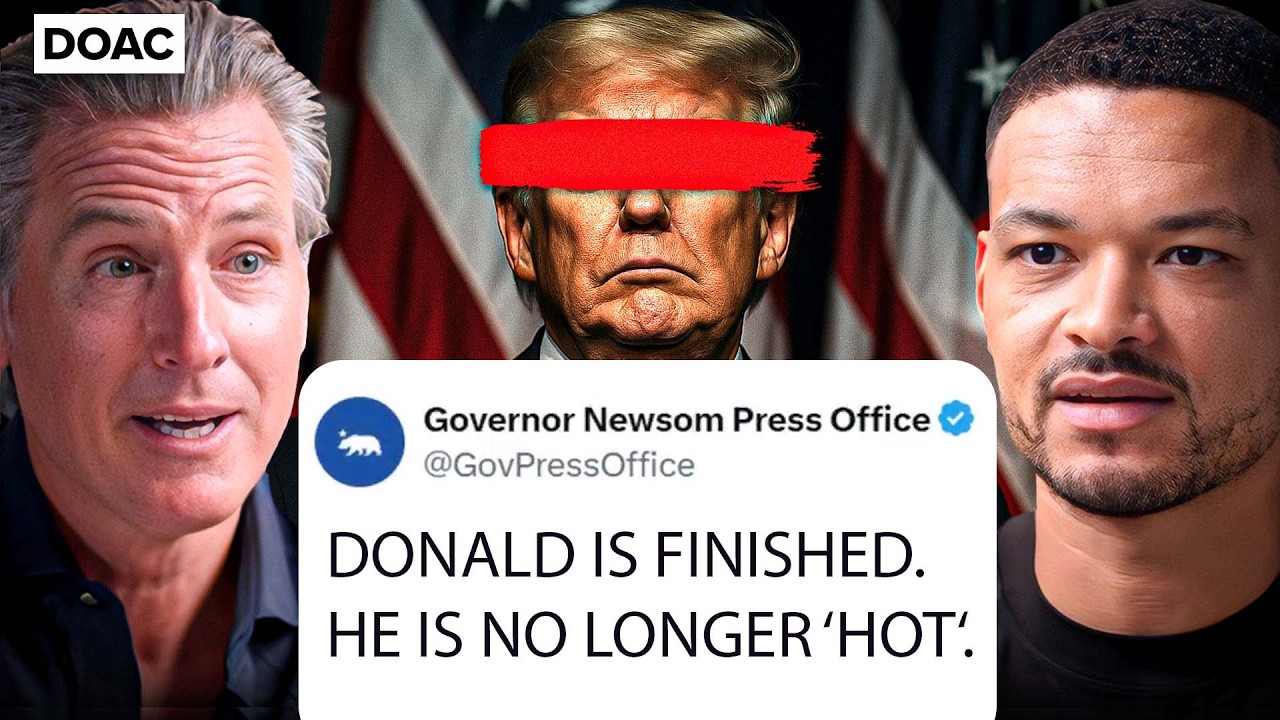
Gavin Newsom Accuses Trump of Exploiting Epstein Files to Retain Power
The Diary Of A CEO
Governor Gavin Newsom warns that US democracy faces an existential threat from Donald Trump's authoritarian overreach while urging Democrats to embrace business growth and address the economic alienation of young men.
## Background
The YouTube channel The Diary Of A CEO published the video titled 'America Is at Breaking Point, Is Gavin Newsom America’s Next President?' on July 24, 2025. According to the page description, the episode features California Governor Gavin Newsom breaking his silence on the 2028 U.S. presidential campaign, discussing the Epstein files, recounting what Trump told him after calling him 'Newscum', and covering topics ranging from his personal background and family struggles to young men in crisis, immigration, homelessness, and his critique of the Democratic Party.
## TL;DR
In this extensive interview with Steven Bartlett, California Governor Gavin Newsom reflects on his childhood struggles with dyslexia, his entrepreneurial career, and his transition into San Francisco politics, including his pioneering same-sex marriage stance in 2004. He addresses national political tensions, including his interactions and ongoing rivalry with Donald Trump, the challenges facing young men, and his own party's past missteps regarding business and economic messaging. Newsom also shares deeply personal stories about his mother's assisted dying, reflects on the Democratic transition involving Joe Biden and Kamala Harris, and touches upon policy issues such as California's homelessness crisis and the handling of the Epstein files.
## Atmosphere & style
The conversation carries a raw, candid, and high-stakes tone, blending intense political introspection with deeply personal vulnerability. The dynamic between host Steven Bartlett and Governor Gavin Newsom is direct, fast-paced, and unfiltered, moving fluidly from heavy political criticisms and constitutional anxieties to poignant reflections on grief, family history, and childhood bullying. It feels like an unscripted, soul-searching confessional mixed with a high-level political strategy session, creating an atmosphere of urgent reflection on the state of American democracy and modern leadership.
## Key takeaways
- [00:00](https://www.youtube.com/watch?v=1NLoTuRR3hE&t=0s) Newsom characterizes the handling of the Epstein files as a 'vandalization' of the rule of law and warns that US democracy faces severe political retaliation and threats.
- [06:08](https://www.youtube.com/watch?v=1NLoTuRR3hE&t=368s) Newsom shares his personal background of growing up with severe dyslexia, working early manual jobs, and being raised by a single mother who worked three jobs to survive.
- [14:30](https://www.youtube.com/watch?v=1NLoTuRR3hE&t=870s) After being bullied as a child and called 'Newscum,' Newsom recounts a phone call where Donald Trump bragged about inventing the same nickname.
- [15:23](https://www.youtube.com/watch?v=1NLoTuRR3hE&t=923s) Before politics, Newsom built a business empire with over 20 businesses and 1,000 employees, creating innovative practices like a monthly 'Failure Award' to encourage risk-taking.
- [27:38](https://www.youtube.com/watch?v=1NLoTuRR3hE&t=1658s) In 2004, inspired by President Bush's call for a constitutional ban on same-sex marriage, Mayor Newsom opened San Francisco City Hall early to issue marriage licenses to same-sex couples, facing severe backlash from Democratic Party leadership.
- [32:03](https://www.youtube.com/watch?v=1NLoTuRR3hE&t=1923s) Newsom describes the emotional impact of his mother's death through doctor-administered assisted suicide following her battle with recurring breast cancer.
- [52:28](https://www.youtube.com/watch?v=1NLoTuRR3hE&t=3148s) Addressing the crisis facing young men, Newsom argues that Democrats created an empathy vacuum by ignoring young men's social and economic isolation, allowing Republicans and the 'manosphere' to win them over.
- [55:28](https://www.youtube.com/watch?v=1NLoTuRR3hE&t=3328s) To reach across political divides, Newsom hosts conservative figures like Charlie Kirk, Steve Bannon, and Newt Gingrich on his podcast, arguing that long-form conversation is vital to rebuilding human connection.
- [01:05:32](https://www.youtube.com/watch?v=1NLoTuRR3hE&t=3932s) Newsom criticizes Donald Trump for abusing executive power, testing constitutional boundaries like seeking additional presidential terms, and monetizing the presidency.
- [01:16:41](https://www.youtube.com/watch?v=1NLoTuRR3hE&t=4601s) Highlighting economic data, Newsom asserts that Democrats have created 50 million of the last 52 million net new jobs, but admits the party has done a terrible job engaging with entrepreneurs and business leaders.
- [01:19:28](https://www.youtube.com/watch?v=1NLoTuRR3hE&t=4768s) Newsom expresses deep frustration with Democratic anti-business sentiment, warning that the party cannot be pro-job while remaining anti-business or hating wealthy innovators.
- [01:28:45](https://www.youtube.com/watch?v=1NLoTuRR3hE&t=5325s) Recounting the aftermath of Joe Biden's debate performance, Newsom describes the immediate party panic, emergency meetings, and his own steadfast commitment to loyalty until Biden stepped aside.
- [01:33:50](https://www.youtube.com/watch?v=1NLoTuRR3hE&t=5630s) Quoting Bill Clinton's dictum that Americans prefer a leader who is 'strong and wrong' over 'weak and right,' Newsom urges Democrats to drop passive defense on culture-war topics and aggressively message their legislative achievements.
- [01:41:04](https://www.youtube.com/watch?v=1NLoTuRR3hE&t=6064s) Addressing homelessness in California, Newsom emphasizes that clearing sidewalk encampments is necessary, asserting that true compassion requires pairing clean streets with behavioral health housing and supportive services.
- [01:44:48](https://www.youtube.com/watch?v=1NLoTuRR3hE&t=6288s) Newsom pledges that he would support releasing the full Epstein files unless doing so directly compromised critical foreign intelligence or national security.
## Detailed walkthrough
### [00:00](https://www.youtube.com/watch?v=1NLoTuRR3hE&t=0s) Epstein, Trump, and the Political Darkness
The segment opens with a sharp, high-stakes reflection on the current political climate, focusing on Donald Trump, the Jeffrey Epstein files, and the state of American democracy. Gavin Newsom points out that Elon Musk had tweeted that Trump’s name was on the Epstein list, only for the list to disappear a few days later, raising serious questions about whether these revelations were dangled purely to manipulate voters. Newsom characterizes this as a form of "vandalization" of the rule of law and warns that America is in a dark and dangerous place.
He warns that unless the political game is rigged, Donald Trump faces the prospect of losing power, which makes him even more dangerous. Newsom asserts that people close to Trump have sent unsettling signals to California officials, hinting at extreme political retaliation and an intention to undermine democratic norms.
- Elon Musk publicly claimed Trump was on the Epstein list before the topic was abruptly dropped.
- Newsom emphasizes that the current political climate poses a fundamental threat to the rule of law and American democracy.
[02:27](https://www.youtube.com/watch?v=1NLoTuRR3hE&t=147s) Can You Believe Your Life?
Host Steven Bartlett asks Newsom to reflect on his journey—from a difficult childhood to governing California, state that has grown into the fourth-largest economy in the world. Newsom admits that if anyone had told his 10-year-old self where he would end up, he would have thought it was impossible, unable to tell whether such a future was a dream or a nightmare.
```
CALIFORNIA'S GDP RANKING
1st 2nd 3rd 4th 5th
+-------+ +-------+ +-------+ +-------+ +-------+
| USA | | China | |Germany| | CA | | Japan |
+-------+ +-------+ +-------+ +-------+ +-------+
```
When confronted with the fact that oddsmakers list him as a top contender for the 2028 U.S. presidential race, Newsom responds with a mixture of surreal disbelief and humility. He acknowledges that while he would be deeply honored to serve as President if the moment called for it, he has no interest in simply "going through the motions." He emphasizes that a presidential run requires a deep, authentic drive, a sense of accountability, and a core belief that one can deliver for millions of people.
- California's economy ranks as the 4th largest GDP globally.
- Newsom addresses 2028 presidential speculation, noting he will only run if there is a genuine, core alignment with the nation's needs.
- He notes that he is currently facing his seventh recall effort as Governor of California, which has only hardened his resolve.
[06:08](https://www.youtube.com/watch?v=1NLoTuRR3hE&t=368s) Childhood, a Single Mom, and "Okay to Be Average"
Newsom opens up about his upbringing, describing a childhood marked by struggle and contrast. His mother became pregnant with him at 19 and was soon left to raise two children alone with no wealth or safety net. Her own father was a World War II prisoner of war who later committed suicide. To keep the family afloat, his mother worked two to three jobs at a time—waitressing, taking in boarders, and even renting out her own bedroom while sleeping on the couch.
```
THE CONTRAST IN GAVIN NEWSOM'S UPBRINGING
MOTHER'S HOUSEHOLD FATHER'S CIRCLE
+--------------------------+ +--------------------------+
| - 2-3 jobs to survive | | - Wealthy lifestyle |
| - Swanson's frozen dinners| vs | - Friends with ultra-rich|
| - Renting out bedrooms | | - No personal wealth |
+--------------------------+ +--------------------------+
```
In contrast, his father moved in wealthy social circles, creating a surreal juxtaposition between the hardship at home and the surrounding affluence. Newsom recalls eating Swanson frozen dinners and Kraft Macaroni & Cheese while working paper routes and construction jobs to buy basic items like a basketball hoop. During this time, he struggled severely in school due to undiagnosed learning disabilities, while his sister excelled effortlessly. In a poignant moment, his mother, overwhelmed while trying to help him read, told him, "It's okay to be average." Though painful, Newsom realized she said it out of love to relieve his pressure, and it ultimately drove him to overcompensate and prove he could achieve far more.
- His mother worked up to three jobs simultaneously and rented out her bedroom to support her children.
- Newsom scored a 960 on his SATs, while his sister effortlessly achieved a 1380.
- He held early jobs including a paper route, construction work for Jeff Hicks Construction, and working as a restaurant busboy.
Newsom shares the unusual way he discovered he had dyslexia. His mother never told him directly, fearing that knowing the diagnosis would lead him to use it as an excuse or a "crutch." One day, returning home early from school, Newsom stumbled upon an open file on his mother’s desk and saw the word "dyslexia" written across his records. When he confronted her, she told him to put it away, explaining that she didn't want him to feel stigmatized or define himself by a label.
Looking back, Newsom deeply appreciates his mother’s decision. He believes it forced him to develop resilience and find creative workarounds rather than adopting a victim mentality. Even today, his dyslexia affects how he processes information: he cannot read directly from a speech script, must meticulously underline and re-read texts to digest them, and relies heavily on deep comprehension rather than rote reading.
- Newsom discovered his dyslexia by accident after finding his educational assessment file on his mother's desk.
- His mother deliberately hid the diagnosis to prevent him from using it as an excuse.
- To digest written material today, Newsom must highlight, underline, and re-read text before he can fully internalize it.
[14:30](https://www.youtube.com/watch?v=1NLoTuRR3hE&t=870s) Being Bullied and "Newscum"
The discussion turns to childhood bullying, where Newsom recalls being targeted by other kids on Baltimore Street in Corte Madera, California, often mocked for his bowl-cut hairstyle (resembling the "Dutch Boy" paint mascot). He recounts a recent, surreal telephone conversation with Donald Trump, who frequently taunts him in public with the nickname "Newscum."
During the call, Trump bragged about the nickname, asking, "Pretty original, right?" Newsom replied directly to the former President: "It's not, Mr. President... the bully on Baltimore Street in Corte Madera used to call me 'Newscum' when I was seven or eight. You're 79, Mr. President." Newsom notes with humor that as soon as he pointed out the age comparison, Trump immediately pivoted and changed the subject.
- Newsom grew up in Corte Madera, California, on Baltimore Street.
- Trump routinely calls him "Newscum," a nickname Newsom pointed out was originally used by primary school bullies.
<FollowUp label="Want to hear how Newsom transitioned from business into politics?" query="How did Gavin Newsom transition from starting the PlumpJack Group to entering San Francisco politics?"/>
[15:23](https://www.youtube.com/watch?v=1NLoTuRR3hE&t=923s) Lessons from Childhood Bullying and the Dyslexic Mindset
Governor Gavin Newsom reflects on his childhood, looking at a photo from his youth where he sports a classic Irish Catholic school appearance with a distinct haircut, sailor outfit, and knee-high black socks. Growing up in a strict Irish Catholic environment where his father had attended Catholic schools, Newsom was a prime target for kids on the bus. Host Steven Bartlett notes that a missing father figure, combined with early childhood struggles, creates a setup for trauma, pointing out that Newsom later faced personal battles with alcohol. Newsom candidly agrees, revealing a deep family history of addiction: his grandfather died by suicide and was an alcoholic, while his mother also struggled with self-medication.
For Newsom, alcohol served as a form of self-medication that eventually intersected with his career when he entered the wine business right out of college. Starting with a single wine store in 1992, Newsom built an empire that grew to 22 or 24 businesses and roughly 1,000 employees at its peak, encompassing four wineries, multiple hotels, and up to nine restaurants. He reflects on how being the sole full-time employee for the first two years taught him invaluable lessons for both life and politics. Central to his entrepreneurial ethos was embracing failure—a trait he directly attributes to his dyslexia. In fact, he created a $500 monthly bonus for the biggest workplace mistake, celebrating employees who took initiative and "failed forward fast."
To illustrate this philosophy, Newsom shares a memorable story from a vintage motel he owned in Squaw Valley near Lake Tahoe. Built in 1959 for the 1960 Winter Olympics, the motel lacked air conditioning, leaving doors open and swarming with summer mosquitoes. A well-meaning night clerk decided to solve the problem by buying catfish and dumping them into nearby ponds to eat mosquito larvae. Instead, at 4:00 AM, raccoons went on a feeding frenzy, running through the open motel rooms with "flying fish in their mouths" and leaving a chaotic mess. Rather than firing the clerk as the engineer demanded, Newsom celebrated the clerk's proactive attempt to solve a problem and created the company's "Failure Award"—which his sister later renamed the "Magical Moment Award" when she took over the company. Newsom emphasizes that this mindset was inspired by Tom Peters’ book *The Pursuit of Wow*, which advocated for empowering frontline workers, advancing workplace diversity, and prioritizing meaning and purpose over mere profits.
- **Business Empire Scale**: Started in 1992; grew to 22–24 businesses, peak of ~1,000 employees, 9 restaurants, and 4 active wineries.
- **The Tahoe Mosquito Incident**: A night clerk bought catfish to eat mosquito larvae in ponds around a 1959 Squaw Valley Olympic motel; raccoons raided the ponds and dragged fish through open hotel rooms at 4:00 AM.
- **Incentive Program**: Created a $500 monthly "Failure Award" (later "Magical Moment Award") to encourage creative problem-solving and risk-taking.
- **Key Influence**: Tom Peters’ book *The Pursuit of Wow*, focusing on hiring for attitude, empowering frontline staff, and advancing diversity.
[22:26](https://www.youtube.com/watch?v=1NLoTuRR3hE&t=1346s) The Champagne Moment and Entering San Francisco Politics
When asked why he left a thriving business empire for politics, Newsom shares a defining moment from his early days running his first wine store. One evening, right before closing, a nervous man rushed in looking for a cold bottle of champagne. Newsom recommended a bottle and wrapped it up. Thirty minutes later, the man returned with a woman and knocked on the glass door. Newsom opened up, thinking he had made a mistake, only for the man to introduce his new fiancée—he had just proposed down the block at the Palace of Fine Arts. Deeply moved, Newsom sat in his store crying after they left, realizing that business wasn't just a transactional exchange, but a way to build meaningful relationships and participate in life's most sacred moments.
Despite finding his "bliss" in hospitality, Newsom’s career trajectory changed dramatically with an unexpected phone call from San Francisco Mayor Willie Brown. Newsom had been quoted in local newspapers complaining about the slow process of securing city permits and parking for his businesses. Brown called him directly, saying, "Come on down next Wednesday, I'm going to put you on the Film Commission." However, when 26-year-old Newsom arrived at City Hall for the swearing-in ceremony among 20 to 30 people, Mayor Brown unexpectedly announced him as the new Chair of the Parking and Traffic Commission instead. Newsom had no prior warning, didn't even know what a commission chair did, but threw himself into learning the role with humility and dedication.
Nine months into his commission role, a vacancy opened on the San Francisco Board of Supervisors (the city council). Impressed by Newsom's performance, Mayor Brown appointed him to the open seat, making him the young, business-minded supervisor on the board. Newsom served on the board for nearly eight years while continuing to scale his private enterprises with a dedicated management team. In 2003, at age 33, when Willie Brown was term-limited, Newsom entered a crowded mayoral race as an underdog pulling third or fourth in early polls, adopting the mindset to "miss 100% of the shots you don't take" and ultimately winning the election.
- **The Proposal**: A customer bought cold champagne at Newsom's store to propose at the Palace of Fine Arts and returned with his new fiancée to express gratitude.
- **Political Origin**: Mayor Willie Brown called Newsom after reading his public complaints regarding city business permits.
- **Surprise Appointment**: Promised a spot on the Film Commission, Newsom was publicly sworn in as Chair of the Parking and Traffic Commission at age 26 without prior notice.
- **Board of Supervisors**: Appointed to the San Francisco Board of Supervisors nine months later, serving roughly 7 to 8 years before running for mayor at age 33.
[27:38](https://www.youtube.com/watch?v=1NLoTuRR3hE&t=1658s) San Francisco Mayoralty and the 2004 Same-Sex Marriage Stand
As Mayor of San Francisco, Gavin Newsom gained national prominence in 2004 by taking a bold, highly controversial stance on marriage equality. At the time, the Democratic Party leadership was largely opposed to same-sex marriage, favoring domestic partnerships instead. The catalyst for Newsom's action occurred during a trip to Washington, D.C., where House Speaker Nancy Pelosi offered him her husband's extra ticket to sit in the gallery for President George W. Bush’s State of the Union address. During the speech, President Bush called for a federal constitutional amendment to ban same-sex marriage, triggering widespread applause in the chamber.
Leaving the Capitol, while standing in line to retrieve his cell phone, Newsom overheard a couple next to him praising the president's speech and expressing disgust over the "homosexual agenda." Offended and motivated by the pejorative exchange, Newsom immediately called his chief of staff from his cell phone outside the building, declaring, "We need to do something about it." Upon returning to San Francisco, Newsom made the historic decision to challenge the legal status quo under the Defense of Marriage Act by issuing marriage licenses to same-sex couples at City Hall.
The very first couple Newsom married were legendary LGBTQ activists Phyllis Lyon and Del Martin, who had been together for nearly 50 years. Knowing opponents were preparing a legal challenge to obtain a temporary restraining order when the courts opened at 9:00 AM, Newsom used his mayoral authority to open City Hall early at 8:00 AM. Lyon and Martin were married before the court opened. At 9:00 AM, the presiding judge ruled that there was no "irreparable harm," allowing San Francisco to continue performing same-sex marriages in a landmark moment for the civil rights movement.
- **Catalyst Event**: Hearing President George W. Bush call for a constitutional ban on same-sex marriage during the State of the Union address, followed by anti-gay comments in the phone retrieval line.
- **Historical First Couple**: Del Martin and Phyllis Lyon, partners for nearly 50 years, were the first same-sex couple married by San Francisco under Newsom's order.
- **Legal Strategy**: Newsom opened City Hall an hour early at 8:00 AM on February 12, 2004, to complete the marriage ceremony before court injunctions could be filed at 9:00 AM.
- **Court Ruling**: The judge determined there was no "irreparable harm," permitting City Hall to continue issuing licenses to thousands of same-sex couples.
[30:42](https://www.youtube.com/watch?v=1NLoTuRR3hE&t=1842s) The "Winter of Love" and Political Backlash
Fast-forwarding to February 2004, Gavin Newsom reflects on what he calls San Francisco's "Winter of Love." During this pivotal period, 4,036 couples from 46 states and eight countries came to San Francisco to say "I do." Newsom describes it as a magical, core-shaking experience, yet it completely disrupted his relationship with his own party. The establishment Democratic Party was furious with his decision to sanction same-sex marriages. Leaders he admired and revered—the same ones who had advised him to simply "do what you think is right"—confronted him angrily, asking, "Who the hell are you to do what you just did?" This intense pushback shook his confidence in national politics and left him questioning his path, making for a tumultuous start to his political career.
* **Couples Married:** 4,036 couples traveling from 46 states and 8 countries.
* **Political Fallout:** Faced severe anger and pushback from Democratic Party leadership despite earlier generic advice to "do the right thing."
---
[32:03](https://www.youtube.com/watch?v=1NLoTuRR3hE&t=1923s) His Mother's Final Days and Assisted Suicide
Amid winning the 2003 San Francisco mayoral race, Newsom was simultaneously grappling with his mother's terminal cancer diagnosis. His mother had strongly opposed his entry into politics, viewing it as the catalyst for her divorce after her ex-husband suffered financial loss, a breakdown, and two failed political campaigns for State Senate and County Supervisor. While working as Newsom's bookkeeper in his business, she pleaded with him, even on her deathbed, not to walk down that political path.
Her breast cancer returned, metastasizing after a period of remission. Newsom recalls receiving a jarring voicemail where she casually informed him that next Thursday she wouldn't be around, asking him to visit on Wednesday for her final day. Newsom and his sister were at her bedside as she took prescribed medication prior to a doctor administering the lethal dose for an assisted suicide. Together, they flipped through old childhood photo albums while waiting. As she began gasping for her final breaths, his sister ran out of the room, leaving Newsom holding his mother's hand alone in silence. Though end-of-life options were legally ambiguous at the time in California, Newsom was proud to later help change the law. Her last words to him were, "Don't forget me."
> "She left a voicemail... 'Hi honey, it's your mother. I know you haven't seen me in a while, but next Thursday I won't be around, so you may want to come next Wednesday because it will be my last day.'"
* **Mother's Career Preference:** Preferred Newsom staying in business; worked as his bookkeeper at PlumpJack.
* **Father's Political Record:** Lost elections for State Senate and County Supervisor, leaving him in debt and leading to divorce.
* **Charitable Legacy:** Newsom and his sister created a foundation through PlumpJack to raise funds annually for cancer research in his mother's memory.
---
[39:03](https://www.youtube.com/watch?v=1NLoTuRR3hE&t=2343s) Becoming Governor and Personal Reflection
Newsom shares how deeply he wishes his mother could have lived to see his four children—Montana, Dutch, and his two other kids—and his wife, Jennifer. He fondly remembers his gubernatorial inauguration speech, where his three-year-old son ran onto the stage holding a pacifier and a blanket. Unwilling to break his gaze from the teleprompter, Newsom instinctively lifted his son into his arms, where the toddler fell fast asleep against his shoulder throughout the remainder of the speech. He reflects on how no one remembered his words, but everyone remembered the emotional moment. He regrets taking his mother for granted during her lifetime and only fully realized the immense sacrifices she made after becoming a parent himself.
* **Children Mentioned:** 15-year-old Montana, 9-year-old Dutch, and his youngest, who ran on stage as a 3-year-old during his inauguration.
* **Wife:** Jennifer Siebel Newsom.
---
[42:15](https://www.youtube.com/watch?v=1NLoTuRR3hE&t=2535s) "Young Man in a Hurry" and Personal Imperfections
Reflecting on his rapid political rise in his 30s as one of San Francisco's youngest mayors, Newsom points to an *Economist* article headline that labeled him a "Young Man in a Hurry"—a title he chose for his upcoming memoir. During this period, he struggled with a lack of emotional maturity and situational awareness. He recalls a transformative dinner at Delancey Street with close friend Mimi Silbert, who bluntly told him to start acting like the mayor of San Francisco rather than just an entrepreneur trying out new things.
This period of intense public scrutiny coincided with compounding personal crises: a public divorce from his first wife, the death of his mother, high-profile political decisions, and excessive drinking. Newsom candidly acknowledges making severe personal mistakes, including an extramarital affair with a friend's wife (when he was divorced, though she was married). The fallout left him deeply humiliated, particularly after his father reprimanded him, saying, "You go home with the one who brought you to the dance." Newsom takes full responsibility for his past lack of maturity and views admitting those mistakes as essential to growing up.
> "She goes, 'You're the mayor in San Francisco.' I said, 'Yeah, I know.' She goes, 'Well then start acting like it.'"
* **Memoir Title:** *Young Man in a Hurry: A Memoir of Discovery*.
* **Key Mentor Mentioned:** Mimi Silbert, co-founder of the Delancey Street Foundation.
[47:21](https://www.youtube.com/watch?v=1NLoTuRR3hE&t=2841s) Rebuilding After Personal Failure
Reflecting on past personal mistakes, Gavin Newsom describes how crucial it was for him to face his failures, pull himself together, and make things right with his family. He admits that he embarrassed his father and himself by not acting like who he truly was, but notes that he was able to turn things around "on a dime." He credits his friend and mentor, Mimi Silbert of the Delancey Street Foundation, as a "rock star" figure who confronted him directly during that dark period, insisting he come over immediately so they could fix the situation together.
* Newsom stresses that reconciling with his father and repairing his personal integrity was one of the most profoundly important parts of his life journey.
Steven Bartlett highlights a common blind spot for early-stage startup founders: neglecting HR while remaining laser-focused on product development, customer acquisition, and survival. He notes that HR serves as the underlying infrastructure of a company, and when unpredictable issues arise, tools like Justworks transition from a "nice-to-have" to an absolute necessity. Justworks automates payroll, manages health insurance benefits, provides 24/7 human support, and accommodates international hiring as small businesses scale.
---
[49:01](https://www.youtube.com/watch?v=1NLoTuRR3hE&t=2941s) The Global Crisis Facing Young Men and Boys
The conversation shifts to the modern struggles of young men, who are increasingly grappling with a lack of purpose, meaning, and direction. Newsom points out that his wife, Jennifer Siebel Newsom, was a decade ahead of the curve on this issue; after her acclaimed 2011 documentary *Miss Representation* (about media depictions of women), she released *The Mask You Live In* in 2015 to examine toxic masculinity and the unspoken crisis among boys. She highlighted early trend lines—such as rising suicide rates, "deaths of despair," and declining educational attainment—that have now escalated into full-blown national headlines.
Newsom calls the situation a "code red" crisis across the country and the globe. He argues that if a similar decline were happening to any recognized minority group, the Democratic Party would treat it as an urgent priority. However, because men historically hold structural power and occupy top positions in society, many progressive leaders have been timid or reluctant to acknowledge their systemic struggles.
```
Crisis Indicators Facing Young Men
┌──────────────────────────────────────────────┐
│ • Soaring Suicide Rates & Overdoses │
│ • Falling College Graduation Rates │
│ • Pervasive Loneliness & Isolation │
│ • Lack of Male Role Models in Education │
└──────────────────────────────────────────────┘
```
* **UC System Graduation Trend:** Newsom notes that in California's University of California system, women are on track to outnumber men two-to-one among college graduates within six years.
* **Executive Order Initiative:** Newsom reveals that he spent six months drafting an executive order focused on recruiting more male teachers into early childhood and elementary education, encouraging male caregiving roles, and implementing targeted interventions for boys.
* **Key Thought Leaders:** He cites the work of scholars and authors like Richard Reeves and Scott Galloway, who actively write about the social and economic isolation of young men.
---
[52:28](https://www.youtube.com/watch?v=1NLoTuRR3hE&t=3148s) Where the Democratic Party Missed the Mark
Bartlett and Newsom discuss how the Democratic Party fundamentally misread the plight of young men, exhibiting a distinct "lack of empathy, care, and compassion." Newsom explains that many party leaders, particularly women who have spent years fighting against gender pay gaps, the glass ceiling, and sexual misconduct, struggle to feel sympathy for men's issues. When presented with alarming data regarding male isolation, addiction, or academic failure, their initial reaction is often skepticism or pushback.
This empathy vacuum allowed the Republican Party, Donald Trump, and figures in the "manosphere" to step in. Rather than ignoring young men, the conservative movement acknowledged their frustration and offered them a sense of mission and belonging. Newsom emphasizes that male grievance is not restricted to white men; it is multicultural and multi-ethnic, making it a critical political and moral blind spot for Democrats.
> "If it was happening to any minority group, particularly in my party, the Democratic party, we'd be all over it. Instead, we've been timid about it because men have this sort of hierarchical benefits in society... But when you see all what's happening underneath, it is a crisis."
---
[55:26](https://www.youtube.com/watch?v=1NLoTuRR3hE&t=3326s) Party Rebranding and the "Glass Box" Era of Politics
Addressing the Democratic Party's historically low approval ratings, Newsom stresses that the party must exercise genuine humility and grace rather than dismissing voters' feelings. In the aftermath of recent election losses, pundits rushed to blame single factors like inflation, wokeness, foreign policy, or specific media appearances. Newsom argues that the true issue is deeper: voters feel disconnected from an out-of-touch party brand.
To better understand this phenomenon, Newsom launched his own podcast (*This Is Gavin Newsom*), bringing on ideological opponents like Turning Point USA founder Charlie Kirk and former Trump advisor Steve Bannon. He praises Kirk's deliberate strategy of showing up on college campuses without filters, engaging in raw, unscripted debates, and posting the unedited footage online.
Bartlett contrasts this transparent "glass box" strategy with the traditional "black box" political approach, referencing reports that Kamala Harris's campaign hesitated to appear on long-form, unscripted shows like *The Joe Rogan Experience*. Newsom agrees that voters no longer trust polished PR spin; they crave unfiltered authenticity, even if it comes with flaws or controversial statements.
* **Charlie Kirk Engagement:** Newsom interviewed Charlie Kirk specifically to pick his brain on how he successfully mobilized young male voters in record numbers for Donald Trump.
* **Democratic Approval:** Newsom points out that Democratic Party brand approval hit a dismal 27% in certain national polls following recent election cycles, signaling an urgent need for self-reflection.
* **The Appeal of Trump:** Bartlett notes that Donald Trump's willingness to speak without a PR filter—even when saying imperfect or shocking things—creates a perception of predictability and raw honesty that voters trust more than carefully manufactured political personas.
[01:02:28](https://www.youtube.com/watch?v=1NLoTuRR3hE&t=3748s) Empathy, Ideals, and the Soul of America
Governor Gavin Newsom reflects on how the political media landscape distorts public perception, noting that critics on platforms like Fox News or One America News often portray him as a out-of-touch elitist who grew up with a trust fund, completely ignoring his self-made background and early financial struggles. Moving beyond individual narratives, Newsom addresses the broader national mood, arguing that America is currently experiencing a deep identity crisis. He credits Donald Trump’s political style for making people feel comfortable attacking and "shoving" each other again, effectively pulling the country away from its "better selves." Emphasizing ideas inspired by historian Jon Meacham regarding the "soul of America," Newsom laments that core human needs—connection, love, and basic respect—are being eroded by toxic discourse where people talk past and demean one another.
To counter this polarization, Newsom explains why he actively platforms political opponents on his own podcast, including figures like former House Speaker Newt Gingrich, who previously spearheaded the recall effort against him. While he respects that good people can hold fundamentally different views, Newsom draws a firm line against the bullying and scapegoating of vulnerable communities. He traces his intense distaste for bullies back to his mother, who worked multiple jobs to support their family—including a role with Aid to Adoption of Special Kids (AASK), founded by the DeBolt family. Accompanying his mother as a child allowed him to bond with children facing severe physical and intellectual disabilities. That experience formed his core political philosophy: "standing up for ideals and striking out against injustice." He expresses profound worry over political rhetoric that mocks disabled individuals or uses immigrants as political pawns, fearing that Trump has pushed the Overton window so far that it will be difficult to restore shared humanity.
- **Jon Meacham's Influence:** Newsom references historian Jon Meacham's work on the "soul of America" to describe the current institutional and cultural crisis.
- **Newt Gingrich on his Podcast:** Newsom invited Newt Gingrich onto his podcast to foster dialogue despite Gingrich having led the campaign to recall Newsom as Governor of California.
- **Influence of Aid to Adoption of Special Kids (AASK):** His mother's work with the DeBolt family's organization exposed young Newsom to kids with disabilities, shaping his lifelong stance against bullying and scapegoating.
- **Core Value:** Newsom summarizes his defining motto—personal and professional—as "standing up for ideals and striking out against injustice."
[01:05:32](https://www.youtube.com/watch?v=1NLoTuRR3hE&t=3932s) "He Doesn't Care If He's the Heel or the Hero": Understanding Trump
When asked who Donald Trump ultimately cares about, Newsom responds plainly: "Himself. Period. Full stop." He observes that Trump doesn't mind whether he plays the "heel or the hero" in the media narrative, so long as he remains the undeniable star of the show. Drawing on his unique experience as a Democratic governor who interacted with Trump extensively during his first presidential term—especially throughout the COVID-19 pandemic—Newsom shares that Trump's second term exhibits an unconstrained, megalomaniacal shift. He warns that Trump no longer feels bounded by traditional constitutional limits, co-equal branches of government, or congressional oversight, arguing that the Speaker of the House has entirely abdicated duty, leaving the courts and "we the people" as the sole remaining lines of defense.
To illustrate the stark shift in executive power, Newsom points out that within the first six months of his second term, Trump deployed 5,000 military personnel directly into the streets of Los Angeles—aiming armed force at American cities rather than foreign adversaries. Yet when discussing their personal interactions, Newsom describes an almost surreal duality. Privately, Trump is "unbelievably cordial." Newsom recalls a warm, collaborative phone conversation with Trump the night before the president federalized the National Guard in California. Trump handed out a direct cell phone number and urged Newsom to call anytime he needed anything. Just eight hours later, Newsom woke up to headlines where Trump publicly branded him "Newscum" and falsely claimed to have "read him the riot act." Newsom characterizes this behavior as a calculated, derivative, and increasingly dangerous political show.
- **Military Deployment in LA:** Newsom highlights that 5,000 military troops were stationed in Los Angeles streets within the first six months of Trump's term, framed by the White House as fighting a "war within."
- **The "Newscum" Incident:** Right after a warm late-night phone call offering direct cell access, Trump posted publicly that he had chewed out "Newscum" before federalizing the National Guard.
- **Contrast with Past Republicans:** Newsom fondly contrasts current dynamics with past political rivalries under George H.W. Bush, George W. Bush, and Ronald Reagan, citing Reagan’s final Oval Office address about Lady Liberty’s torch and welcoming immigrants.
[01:08:46](https://www.youtube.com/watch?v=1NLoTuRR3hE&t=4126s) Testing Constitutional Boundaries and the Threat to 2028
Addressing claims that his warnings are mere hyperbole, Newsom insists that the current political moment is fundamentally different from typical policy transitions. He points to Trump's systematic dismantling of democratic safeguards, such as eliminating the auditing capacity of Inspectors General, removing key non-partisan officials, replacing them with unquestioning acolytes, and even publicly calling for Newsom’s own arrest simply for winning an election. Newsom cites a fresh example that he learned that very morning: Trump personally telephoned Texas state legislators to push for an immediate gerrymandering redistricting effort to secure five additional House seats ahead of the midterms, explicitly aiming to lock in congressional power.
Newsom reveals the chilling atmosphere surrounding Trump's orbit regarding executive terms. Allies of the President went so far as to send Governor Newsom a physical hat reading "Trump 2028." Recalling a 90-minute meeting in the Oval Office during Trump's first term, Newsom describes looking at portraits of historical presidents like Franklin D. Roosevelt, prompting Trump to turn to him and tease, "What do you think? Three terms, four terms?" While delivered with a laugh, Newsom notes that Trump constantly "iterates" and tests boundaries to normalizes radical ideas. He points to Trump pardoning January 6th participants, calling it a "day of love," and highlights unidentified, masked agents detaining people at car washes across the country based on skin color as proof that constitutional boundaries are being aggressively tested.
- **Texas Redistricting Push:** Trump directly lobbied Texas lawmakers to redraw congressional maps mid-cycle to gain five extra seats and safeguard his legislative majority.
- **The "Trump 2028" Hat:** Insiders close to Trump sent an official "Trump 2028" hat directly to Newsom's gubernatorial office.
- **FDR Oval Office Exchange:** During a 90-minute Oval Office meeting, Trump gestured to FDR's portrait and asked Newsom what he thought about serving "three terms, four terms?"
- **January 6 Pardons:** Newsom underscores Trump pardoning individuals involved in the January 6 Capitol attack after publicly describing the event as a "day of love."
[01:12:40](https://www.youtube.com/watch?v=1NLoTuRR3hE&t=4360s) The Financial Grift, Election Integrity, and the 2028 Outlook
When asked if Trump will attempt to illegally remain in office past 2028, Newsom assesses that on the balance of probability, Trump will likely not—primarily due to his advanced age rather than a sudden respect for constitutional norms ("if he was 69, not 79," it would be a different story). Instead, Newsom characterizes Trump’s second term as the ultimate monetary "grift." Unlike his first term, Trump and his family are aggressively monetizing the presidency on an unprecedented scale through cryptocurrency schemes, branded cell phones, foreign real estate, and direct corporate favors. Newsom points to a reported $400 million presidential library project featuring $1 billion in upgrades funded by Qatari interests, alongside hundreds of millions in excess campaign cash that will ensure a lifetime of luxury once he steps down.
Despite believing age may force Trump's exit, Newsom warns that the danger to democracy remains critical. If Republicans retain control of the House through voter suppression and gerrymandering, they will attempt to institutionalize their power and install a hand-picked successor to keep the financial and political grift alive. Newsom reflects on Trump’s recorded phone call to Georgia election officials demanding they "find" extra votes as undeniable proof of his willingness to manipulate elections. However, Newsom finds hope in organic grassroots resistance, citing the "No Kings Day" protests where five million citizens mobilized on Trump's birthday to oppose authoritarianism. Quoting Supreme Court Justice Louis Brandeis, Newsom reminds listeners that "in a democracy, the most important office is not office of president, governor, mayor—it's the office of citizen."
- **Monetization of the Presidency:** Newsom argues Trump is using his second term to build personal wealth through crypto ventures, branded merchandise, and foreign donations—including a Qatari-backed presidential library deal.
- **Georgia Phone Call:** Newsom highlights Trump’s recorded call asking Georgia’s Secretary of State to find "a few thousand votes" as hard evidence of election rigging attempts.
- **No Kings Day Demonstrations:** Five million people turned out across the nation on Trump's birthday for "No Kings Day" protests against executive overreach.
- **Louis Brandeis Quote:** Newsom cites Justice Brandeis: "The most important office is... the office of citizen."
[01:16:41](https://www.youtube.com/watch?v=1NLoTuRR3hE&t=4601s) The Democratic Party's Blindspot with Entrepreneurs
Transitioning to economic strategy, host Steven Bartlett asks Newsom how the Democratic Party is faring with business founders and innovators. Newsom candidly admits that the party's performance has been "terrible." Despite representing California—and having served as Mayor of San Francisco, the global epicenter of tech innovation and venture capital—Newsom acknowledges a widespread perception that Democrats are hostile toward business, whereas the Republican Party is viewed as the natural home for enterprise. He notes that many of his own entrepreneurial friends admit in private that they lean Republican because of taxation, regulation, and messaging.
- **San Francisco Context:** As former Mayor of San Francisco, Newsom acknowledges the irony that the birthplace of tech innovation is politically disconnected from traditional business rhetoric.
- **Candid Admission:** Newsom freely admits his own party has done a "terrible" job appealing to entrepreneurs, allowing Republicans to dominate the narrative as the pro-business choice.
[01:17:05](https://www.youtube.com/watch?v=1NLoTuRR3hE&t=4625s) Economic Reality vs. Party Perception
Governor Gavin Newsom provides a stark statistical breakdown to counter the common belief that Republicans are inherently better for business and job creation. Pointing out historical data since 1989 (the end of the Cold War), Newsom highlights that 50 million out of 52 million net new American jobs were created under Democratic administrations, compared to just 1.9 million under Republican presidents. He notes that the last three Republican administrations all coincided with economic recessions, whereas Joe Biden’s administration oversaw 16.6 million jobs created. Despite these macro-level figures—and California’s status as a dominant global economic powerhouse with four of the world's top seven market cap companies, including Nvidia—there remains a persistent perception gap where the public views the Democratic Party as anti-business.
Steven Bartlett challenges Newsom by bringing up why high-profile entrepreneurs feel alienated by the state's policies and tax structure. Newsom acknowledges that major business figures like Elon Musk moved official corporate headquarters to states like Texas primarily to avoid capital gains and income taxes after benefiting from decades of California taxpayer subsidies and regulatory environments that nurtured their industries. However, Newsom stresses that Musk's key assets—including xAI, SpaceX operations, Tesla's primary R&D headquarters, and top engineering talent—remain rooted in California.
- **52 Million Jobs:** Total net jobs created in the U.S. between 1989 and late 2024.
- **50 Million vs. 1.9 Million:** The breakdown of jobs added under Democratic vs. Republican presidential administrations over that timeframe.
- **16.6 Million Jobs:** Created during Joe Biden's presidency, far exceeding recovery to pre-COVID baselines within 18 months.
- **California's Economic Footprint:** Represents the 4th largest economy in the world and hosts 32 of the top 50 AI companies globally.
---
[01:19:28](https://www.youtube.com/watch?v=1NLoTuRR3hE&t=4768s) The Democratic Disdain for Success and the Truth About Elon Musk
Addressing Bartlett's critique of the Democratic Party’s public hostility toward wealthy innovators, Newsom candidly admits that this disdain is "the worst part of my party" and something he personally "cannot stand." He argues that one cannot be truly pro-job while simultaneously being anti-business. Retelling his own admiration for bold entrepreneurs like Sir Richard Branson, Newsom expresses deep frustration with how the party ceded the narrative of supporting "dream makers" and risk-takers to Donald Trump.
```
"You cannot be pro-job and anti-business, period. And we need to say that and we need to demonstrate that."
```
When asked directly about his personal relationship with Elon Musk, Newsom describes himself as having been Musk's fiercest public champion for over two decades, even taking delivery of one of the very first production Teslas off the factory floor. While he defends Musk’s early pioneer spirit and agrees with his critiques of rolling back green-energy investments in favor of outdated technology, Newsom expresses sadness over how Musk’s character has shifted in recent years. He warns that Trump’s approach to business represents a dangerous return to "command and control crony capitalism," where corporate leaders must "kiss the ring," purchase crypto, or offer foreign real estate deals to secure tariff exemptions and policy favors.
- **Early Tesla Supporter:** Newsom was among the first state leaders to buy and publicly promote Tesla vehicles directly from the early manufacturing line.
- **Corporate Relocation Reality:** Tesla shifted its legal headquarters to Texas, but retained its global R&D engineering headquarters in California.
- **Crony Capitalism Warning:** Newsom cautions that transactional politics under Trump subvert free-market enterprise through arbitrary tariffs and political backscratching.
---
[01:23:11](https://www.youtube.com/watch?v=1NLoTuRR3hE&t=4991s) Reclaiming the American Dream and Entrepreneurial Ambition
Envisioning how he would govern from the White House, Newsom emphasizes the necessity of actively celebrating entrepreneurial ambition rather than begrudging personal or commercial success. He frames the core mission of American leadership as fostering "social mobility"—creating an economic environment where limitlessness is accessible, individuals feel seen, and individual achievement becomes "irresistible."
```
"My job as governor—and my job in any position—would be to create the conditions where people feel included, feel seen, where they can live their lives out loud and we create the conditions where their success becomes inevitable or irresistible."
```
Newsom reiterates that effective governance is about setting the right climate for growth rather than imposing heavy-handed control over private enterprise. By championing open competition over political favor-currying, he believes the nation can rebuild a vibrant, inclusive economy that inspires the next generation of builders.
---
[01:27:13](https://www.youtube.com/watch?v=1NLoTuRR3hE&t=5233s) Global Instability and the Unraveling of the Biden Debate
Transitioning to foreign policy and national stability, Newsom describes the current global landscape as far more unpredictable than in previous eras, highlighting growing anxieties surrounding nuclear proliferation and unregulated artificial intelligence. When Bartlett brings up Joe Biden’s disastrous debate performance against Donald Trump, Newsom reflects on that evening from his perspective as Biden's chief campaign surrogate in the debate hall.
Newsom recalls the exact moment Biden walked onto the stage in Atlanta, revealing how he physically stood up in the backstage green room, turned to his staff, and said, "Something's off." Having previously observed a similar moment of extreme fatigue at a private fundraiser following Biden’s back-to-back transatlantic trips to Europe, Newsom initially hoped it was simply severe jet lag or a temporary illness. However, the performance quickly triggered a massive, real-time crisis across the Democratic establishment.
- **Role at Debate:** Newsom served as Joe Biden’s primary post-debate surrogate representing the campaign in the press spin room.
- **Behind the Scenes:** First noticed Biden’s unusual frailty during a private event after grueling international travel across time zones.
---
[01:28:45](https://www.youtube.com/watch?v=1NLoTuRR3hE&t=5325s) The Panic, the Phone Trees, and Biden's Exit
Newsom pulls back the curtain on the intense 24-hour aftermath of the debate, describing how text strings, phone trees, and emails "blew up" in a state of full-fledged party panic. What began as urgent inquiries into the president's physical health rapidly escalated into high-stakes discussions among party leadership, congressional figures like Nancy Pelosi, and Democratic governors gathered at the White House. Newsom details sitting around the table with President Biden as several governors directly challenged the incumbent on his path to victory and realistic campaign strategy.
Despite Biden's firm personal belief that he was uniquely qualified to defeat Trump again—citing historically low unemployment figures for Black, Hispanic, and female workers, cooling inflation, and landmark legislation like the CHIPS and Science Act and the Inflation Reduction Act—the overwhelming pressure ultimately led to his withdrawal from the race and the endorsement of Vice President Kamala Harris.
- **Immediate Aftermath:** Panic across the party triggered emergency meetings between Democratic governors and President Biden inside the White House.
- **Biden's Defense:** Biden pointed to his record, including 400 bipartisan bills passed, record-low unemployment across key demographics, and cooling inflation from its 9.1% peak.
- **The Decision:** Unprecedented internal political pressure eventually forced Biden to step aside in favor of his Vice President.
[01:31:07](https://www.youtube.com/watch?v=1NLoTuRR3hE&t=5467s) Loyalty, Biden’s Departure, and the 2024 Transition
Governor Gavin Newsom reflects candidly on the chaotic period leading up to and immediately following Joe Biden’s decision to drop out of the 2024 presidential race. Despite heavy media speculation surrounding his own name, Newsom asserts that he remained entirely committed to campaigning for Biden when others turned away. Citing a core lesson from Willie Brown—that loyalty is the true "coin of the realm" in politics—Newsom explains that he felt a deep obligation to back Biden without quietly eyeing the nomination for himself.
The immediate aftermath of Biden’s exit brought both chaos and surprise. Newsom admits he was initially angry and embarrassed because he received no advance heads-up; his phone began blowing up while sitting in a room full of people. When Vice President Kamala Harris called, the voicemail went unread for roughly six hours because it came from an unknown number. Once aware of her campaign launch, he issued a press release backing her candidacy within hours. Looking back, Newsom rejects counterfactual debates about whether the party should have held an open contest, pointing out the brief runway, the necessity of utilizing the existing Biden-Harris infrastructure, and the risk of turning the process into a "circular firing squad."
* **Key Political Rule:** "The coin of the realm in politics is loyalty. Period. Full stop."
* **Harris Voicemail:** Newsom missed Kamala Harris's initial outreach call for six hours because it came from an unrecognized number while he was in a meeting.
* **Party Transition:** Newsom quickly endorsed Kamala Harris, acknowledging that attempting an open convention with such a short runway would have triggered an internal party fallout.
---
[01:33:50](https://www.youtube.com/watch?v=1NLoTuRR3hE&t=5630s) Perception of Strength vs. Weakness and Shaping the Narrative
Shifting from individual candidates to broader party dynamics, Newsom argues that the Democratic Party’s core challenge lies in the voter perception of strength versus weakness. Citing a famous assessment by Bill Clinton after a difficult midterm election, Newsom notes that when given a choice, the American public consistently gravitates toward a leader who appears "strong and wrong" over one who seems "weak and right." He argues that Donald Trump projects an image of strength—even if it is ultimately "weakness masquerading as strength"—whereas Democrats frequently appear overly defensive, fragmented, and vulnerable.
Newsom urges Democrats to abandon passive defense against manufactured conservative culture-war talking points (such as CRT, ESG, and DEI) and adopt a aggressive offensive strategy. Referencing President Barack Obama’s advice, Newsom stresses that in modern politics, "illusion rules" and facts alone do not win arguments when propaganda outlets constantly weaponize grievance. He argues that Democrats must learn to target messages effectively, sell their legislative accomplishments like the CHIPS and Science Act, and shift from a defensive "scarcity mindset" to an "abundance mindset" focused on growth and shared aspiration.
> "Given the choice... the American people always support strong and wrong versus weak and right." — *Bill Clinton (as quoted by Newsom)*
* **Framing Culture Wars:** Quoting the Governor of Utah regarding trans athletes, Newsom notes: "Never has so much attention been focused on so few."
* **Messaging Shortfalls:** Newsom argues Democrats fail to effectively communicate major legislative victories, pointing out that voters rarely understand technical achievements like the CHIPS and Science Act without clear branding.
* **Repetition Strategy:** Referencing a phrase popularized by his friend Marshawn Lynch, Newsom emphasizes that shaping public narrative requires repeating core messages "over and over and over and over."
---
[01:39:44](https://www.youtube.com/watch?v=1NLoTuRR3hE&t=5984s) The Abundance Mindset and Reclaiming the American Dream
To counter political polarization, Newsom advocates for a national vision anchored in an "abundance mindset," drawing inspiration from policy thinkers like Ezra Klein. Rather than viewing national resources and growth as a zero-sum game, he believes leaders must spark inspiration through dynamic economic policy, innovation, and civic obligation. Newsom proposes that national or public service should become a shared expectation, fostering a sense of communitarianism and collective purpose across the country.
Channeling the political rhetoric of the 1960s and his personal hero, Robert F. Kennedy, Newsom stresses the importance of unifying the country around ambitious, shared goals rather than division. He asserts that the Democratic proposition must offer an optimistic journey toward tackling systemic challenges like poverty, disease, and inequality. Ultimately, he argues that despite deep political divides between red and blue states, Americans must find a way to reconcile, emphasizing that "divorce is not an option."
* **Political Inspirations:** Newsom cites Robert F. Kennedy and Sargent Shriver as foundational influences who used politics to inspire collective national journeys.
* **Civic Policy Proposal:** Newsom expresses support for making public service or national service a broad expectation to build community connection.
* **National Cohesion:** Reinterpreting the unique branding of the "California Dream" alongside the "American Dream," Newsom argues that national policy must emphasize shared national destiny.
---
[01:41:04](https://www.youtube.com/watch?v=1NLoTuRR3hE&t=6064s) Addressing Homelessness, Crime, and Systemic Care in California
The conversation turns to domestic conditions in California when host Steven Bartlett shares a recent experience in a Los Angeles CVS store, where basic items like toothpaste were locked in security cages to prevent theft by local unhoused individuals. Acknowledging the frustration, Newsom insists that these issues—while rooted in decades of systemic wealth gaps, housing shortages, and mental health crises—are directly solvable. He highlights recent data indicating real progress, including a reported 17.5% drop in unsheltered homelessness in Los Angeles over two years, alongside reductions in retail theft and broad crime metrics.
Defending his increasingly firm stance on dismantling street encampments, Newsom argues that letting people live on sidewalks is a sign of neglect rather than compassion. Drawing on his past tenure as Mayor of San Francisco, he reiterates that local officials must enforce public order while providing robust social services. Distinguishing between short-term relief and long-term resolution, Newsom notes that while emergency shelters only provide a place to sleep, true resolution requires permanent housing coupled with comprehensive supportive care.
> "Shelters solve sleep; housing and supportive services solve homelessness."
* **Los Angeles Homelessness Metric:** Newsom highlights a recently announced 17.5% reduction in the unsheltered homeless population in Los Angeles over a two-year period.
* **Encampment Cleanup Policy:** Newsom takes an unyielding stance on encampment sweeps, stating, "Stepping over people on the streets and sidewalks is not compassion. Clean them up."
* **Behavioral Health Reforms:** California is actively procuring and constructing 26,000 new behavioral health housing units backed by comprehensive zoning and mental health reforms to treat addiction and severe mental illness.
---
[01:43:35](https://www.youtube.com/watch?v=1NLoTuRR3hE&t=6215s) Transitioning to High-Profile Accountability: The Epstein Files
As the conversation wraps up its focus on California’s social policies, Bartlett moves to the broader issue of political trust and institutional accountability, bringing up the widespread public interest in the disclosure of the Jeffrey Epstein files. Bartlett notes how high-profile scandals continue to fuel voter skepticism toward political institutions and elite figures, setting up the final discussion on transparency and government integrity.
* **Contextual Shift:** The discussion pivots from California state governance to national transparency, executive power, and public skepticism regarding high-profile political scandals.
Here is a detailed walkthrough covering Part 8 of the interview.
---
[01:44:48](https://www.youtube.com/watch?v=1NLoTuRR3hE&t=6288s) The Epstein Files and Political Accountability
Steven Bartlett and Gavin Newsom discuss the unfulfilled political promises surrounding the release of Jeffrey Epstein’s client list. Newsom asserts that politicians either lied when promising to release the files during campaign season, or they are lying now about their existence. He points out how politicians dangled these documents to secure votes and used people in the process, arguing that someone must be held accountable. Newsom notes the cynicism surrounding the timeline, pointing out how after figures like Elon Musk tweeted about Donald Trump being on the list, claims suddenly emerged that no such list existed.
When asked how he would handle the situation if he were in Trump’s position, Newsom highlights the role of Attorney General Pam Bondi. Having known Bondi over the years, Newsom emphasizes that she does not make moves independently of Trump, meaning she was directed by him regarding the handling of the Epstein files. He argues that two possibilities exist: either the administration fabricated the files entirely as a political ploy—similar to past theories like Barack Obama’s birth certificate—or there is a deeper concealment effort. Newsom emphasizes that Trump and Epstein shared a documented, close personal relationship beyond just a few casual photographs, and he takes satisfaction in seeing how the issue has sparked outrage among Trump's core base.
- Newsom states he would commit to releasing the Epstein files unless doing so posed genuine national security implications, such as foreign intelligence involvement or Mossad connections.
- Newsom quips that while he has enough challenges with California's housing and homelessness to worry about Jeffrey Epstein, the political actors who created the mess ought to clean it up.
---
[01:47:52](https://www.youtube.com/watch?v=1NLoTuRR3hE&t=6472s) Have You Received a Sign From Beyond?
Steven introduces the podcast’s signature closing tradition, where the previous guest leaves an anonymous question for the next guest. The question asked whether Newsom had ever received a sign from beyond, specifically regarding a deceased loved one. Newsom shares that while he views himself as a person of faith—having grown up in the church, attended a Jesuit university, and frequently quoted scripture—he usually connects spirituality to a broader sense of purpose rather than explicit signs.
However, Newsom recounts an uncanny personal story following the death of his father in San Francisco. Shortly after his father passed away in his home, Newsom visited the residence. Right outside the window on the balcony sat a peregrine falcon—a bird his father had been deeply passionate about throughout his life. Having grown up in San Francisco without ever seeing a peregrine falcon there, Newsom and his sister looked at each other in disbelief, recognizing the moment as a clear sign.
---
[01:49:53](https://www.youtube.com/watch?v=1NLoTuRR3hE&t=6593s) Closing Thoughts and Reflections
Steven expresses his appreciation for Newsom's approach to open dialogue, commending his willingness to engage in long-form, unfiltered podcast conversations across political divides. He praises Newsom for stepping outside traditional political PR and sanitized messaging, highlighting his appearance with conservative figures like Charlie Kirk as an effective way for voters to evaluate differing philosophies directly. Bartlett thanks Newsom and his team for allowing an unscripted conversation without restricting any topics.
Newsom expresses his gratitude for the interview. Bartlett concludes the segment by recommending Newsom's podcast, *This Is Gavin Newsom*, along with his book, *Citizenville: How to Take the Town Square Digital and Reinvent Government*, before delivering his standard call-to-action asking viewers to subscribe to *The Diary Of A CEO*.
> [14:30](https://www.youtube.com/watch?v=1NLoTuRR3hE&t=870s) It's not, Mr. President... the bully on Baltimore Street in Corte Madera used to call me 'Newscum' when I was seven or eight. You're 79, Mr. President. — Gavin Newsom
> [30:42](https://www.youtube.com/watch?v=1NLoTuRR3hE&t=1842s) Who the hell are you to do what you just did? — Democratic Party leaders
> [42:15](https://www.youtube.com/watch?v=1NLoTuRR3hE&t=2535s) You go home with the one who brought you to the dance. — Gavin Newsom's father
> [52:28](https://www.youtube.com/watch?v=1NLoTuRR3hE&t=3148s) If it was happening to any minority group, particularly in my party, the Democratic party, we'd be all over it. Instead, we've been timid about it because men have this sort of hierarchical benefits in society... But when you see all what's happening underneath, it is a crisis. — Gavin Newsom
> [01:05:32](https://www.youtube.com/watch?v=1NLoTuRR3hE&t=3932s) Himself. Period. Full stop. — Gavin Newsom
> [01:08:46](https://www.youtube.com/watch?v=1NLoTuRR3hE&t=4126s) What do you think? Three terms, four terms? — Donald Trump
> [01:12:40](https://www.youtube.com/watch?v=1NLoTuRR3hE&t=4360s) in a democracy, the most important office is not office of president, governor, mayor—it's the office of citizen. — Louis Brandeis
> [01:19:28](https://www.youtube.com/watch?v=1NLoTuRR3hE&t=4768s) You cannot be pro-job and anti-business, period. And we need to say that and we need to demonstrate that. — Gavin Newsom
> [01:31:07](https://www.youtube.com/watch?v=1NLoTuRR3hE&t=5467s) The coin of the realm in politics is loyalty. Period. Full stop. — Gavin Newsom
> [01:33:50](https://www.youtube.com/watch?v=1NLoTuRR3hE&t=5630s) Given the choice... the American people always support strong and wrong versus weak and right. — Bill Clinton
> [01:41:04](https://www.youtube.com/watch?v=1NLoTuRR3hE&t=6064s) Stepping over people on the streets and sidewalks is not compassion. Clean them up. — Gavin Newsom
## Mentioned
Gavin Newsom, Donald Trump, Elon Musk, Steven Bartlett, Willie Brown, Nancy Pelosi, George W. Bush, Phyllis Lyon, Del Martin, Jennifer Siebel Newsom, Montana Newsom, Dutch Newsom, Mimi Silbert, Charlie Kirk, Steve Bannon, Kamala Harris, Joe Rogan, Richard Reeves, Scott Galloway, Jon Meacham, Newt Gingrich, DeBolt family, PlumpJack Group, Jeff Hicks Construction, Delancey Street Foundation, Turning Point USA, Aid to Adoption of Special Kids (AASK), The Diary Of A CEO, This Is Gavin Newsom, Miss Representation, The Mask You Live In, Young Man in a Hurry: A Memoir of Discovery, The Pursuit of Wow, The Economist, Fox News, One America News, The Joe Rogan Experience, George H.W. Bush, Ronald Reagan, Franklin D. Roosevelt, Louis Brandeis, Joe Biden, Nvidia, xAI, SpaceX, Tesla, Sir Richard Branson, Bill Clinton, Barack Obama, Marshawn Lynch, Ezra Klein, Robert F. Kennedy, Sargent Shriver, CVS, Jeffrey Epstein, Pam Bondi, Mossad
California Governor Gavin Newsom argues that American democracy is under unprecedented strain from Donald Trump's boundary-testing politics, while candidly diagnosing the Democratic Party's self-inflicted blindspots regarding young men, business creators, and unscripted communication. Drawing on his journey from childhood learning difficulties to leading the world's fourth-largest economy, Newsom advocates for an abundance-oriented political vision rooted in dynamic enterprise, narrative strength, and unapologetic public service.
Early Hardship, Dyslexia, and Entrepreneurial Roots (6:08)
Newsom traces his personal resilience to a childhood defined by sharp contrasts and undiagnosed learning struggles. Raised primarily by a single mother who worked up to three jobs and rented out her own bedroom to survive, Newsom scored a 960 on his SATs while wrestling with severe reading difficulties. His mother deliberately concealed his dyslexia diagnosis to prevent him from adopting a victim mentality, instilling an ethic of overcompensation that required him to develop intensive text-marking habits that still govern how he digests briefings today.
Entering the hospitality sector out of college in 1992, Newsom scaled a single boutique wine store into the PlumpJack Group, which grew to 22 to 24 enterprises, four wineries, and approximately 1,000 employees. Guided by Tom Peters' business philosophies in The Pursuit of Wow, Newsom instituted a monthly $500 bonus celebrating the company's biggest workplace mistake—exemplified by a Tahoe motel night clerk whose attempt to control mosquitoes with catfish triggered a 4:00 AM raccoon invasion—reinforcing an entrepreneurial mindset centered on failing forward and empowering frontline workers.
Independent Governance and 2004 Marriage Stand (27:38)
Newsom’s political ascent began with an unexpected appointment by San Francisco Mayor Willie Brown to head the Parking and Traffic Commission at age 26, leading to a seat on the Board of Supervisors and his election as mayor at age 33. In February 2004, prompted by President George W. Bush’s State of the Union proposal for a constitutional ban on same-sex marriage, Newsom bypassed federal resistance to sanction local marriage licenses. He opened City Hall an hour early to marry veteran activists Del Martin and Phyllis Lyon before legal injunctions could take effect.
The resulting "Winter of Love" saw 4,036 couples wed across 46 states and eight countries, but it provoked intense blowback from national Democratic leaders who condemned the unilateral move as politically damaging. Newsom faced this backlash alongside intense personal turmoil, including his mother's terminal cancer and death via assisted suicide, an unraveling marriage, and excessive drinking. Mentored through personal failures by Delancey Street Foundation co-founder Mimi Silbert, Newsom describes this period as a painful but vital reckoning that forced him to cultivate emotional maturity and institutional discipline.
Party Blindspots on Men, Business, and Media (49:01)
Newsom delivers a sharp critique of the Democratic Party's failure to address an escalating crisis among young men and boys, characterized by rising suicide rates, falling college completion, and widespread social isolation. He argues that progressive leaders, fearful of undermining traditional gender equity efforts, created an empathy vacuum that Donald Trump and right-wing figures effectively filled. In response, Newsom drafted an executive order designed to recruit male teachers into early education and began interviewing ideological adversaries like Turning Point USA founder Charlie Kirk to study how conservatives mobilize young male voters.
Newsom also rebukes his party's perceived disdain for entrepreneurs and wealth creators, emphasizing that leaders cannot be credibly pro-job while acting anti-business. Despite noting that Democratic administrations generated 50 million of the 52 million net U.S. jobs added between 1989 and late 2024, Newsom acknowledges that Democrats lost the enterprise narrative to Republicans. To regain public trust after party approval ratings dropped to 27%, he urges politicians to abandon sanitized, scripted public relations in favor of long-form, unedited media formats that permit transparent ideological debate.
Executive Overreach, Narrative Strength, and California Realities (65:32)
Reflecting on direct encounters with Donald Trump, Newsom characterizes the former president as transactional, media-obsessed, and unconstrained by constitutional guardrails. He cites troubling developments, including Trump dispatching 5,000 troops into Los Angeles streets, pressing Texas lawmakers for mid-cycle gerrymandering to gain House seats, and privately probing whether presidents could serve three or four terms. Quoting Bill Clinton’s observation that the public often favors a leader who is "strong and wrong" over one who is "weak and right," Newsom argues Democrats must adopt an aggressive offensive narrative to counter authoritarian advances.
On domestic policy, Newsom defends his enforcement of street encampment sweeps alongside long-term social investments, arguing that tolerating encampments represents neglect rather than compassion. He points to California initiatives including 26,000 new behavioral health beds and a reported 17.5% drop in Los Angeles unsheltered homelessness over two years. Addressing speculation regarding the 2028 presidential election, Newsom insists any prospective run requires a clear national mandate and an authentic belief in delivering results rather than routine political maneuvering.
While Newsom champions California's economic standing and urges Democrats to adopt an abundance-focused, pro-enterprise message, his critique leaves open whether national party leadership can reconcile internal cultural factions and effectively win back alienated working-class and young male voters before 2028.
## Background
本期视频由知名播客频道《The Diary Of A CEO》的主持人斯蒂芬·巴特利特(Steven Bartlett)于 2025 年 7 月 24 日发布在 YouTube 平台上。页面简介显示,加利福尼亚州州长加文·纽森(Gavin Newsom)在访谈中打破沉默,深入探讨了 2028 年美国总统大选前景、爱泼斯坦档案内幕、与特朗普的私下交锋、拜登退选风波,以及自己幼年克服严重阅读障碍和贫困单亲家庭逆境的个人成长历程。
## TL;DR
加州州长加文·纽森深入剖析了当下美国政治的极化危机与民主党的品牌硬伤,批评党内过度傲慢、缺乏对年轻男性困境与商业企业家的同理心,并在叙事上全面失语。他首度详尽回顾了自己陪伴患癌母亲施行协助自杀的心碎时刻、早年从商创立千人企业的历程,以及从旧金山推行同性婚姻合法化到登顶全美政坛的蜕变之路。此外,纽森揭秘了 2024 年拜登灾难性辩论后民主党高层逼宫退选的内幕,并就特朗普权力失控、爱泼斯坦档案争议及 2028 年潜在竞选愿景给出了极其坦诚的回应。
## Atmosphere & style
整场对话在无禁忌的“玻璃箱”式坦诚与克制的力量感之间流转,既有剖析政坛权谋与体制危机的犀利交锋,亦充满卸下政治公关伪装后的脆弱与内省。当纽森回忆起独自握着母亲冰冷的手送别其协助自杀,或提及幼子在州长就职典礼上奔上讲台沉沉睡去的画面时,现场情绪数度哽咽凝滞,展现出极具感染力的人性温度。巴特利特循序渐进的倾听与追问,让这场跨越近两小时的长谈褪去了传统政治采访的机巧与说教,呈现为一段兼具宏大时代叙事与深沉生命救赎的精神自白。
## Bulletin
- [55:26](https://www.youtube.com/watch?v=1NLoTuRR3hE&t=3326s) 加州州长加文·纽森揭露民主党已陷入“品牌有毒”的生存危机,支持率一度跌至27%,并指责党内对年轻男性的全面塌陷长期缺乏共情与关怀。
- [01:16:41](https://www.youtube.com/watch?v=1NLoTuRR3hE&t=4601s) 纽森拿出经济数据指出,自1989年冷战结束以来全美新增的5200万个就业中整整5000万个来自民主党执政期,但民主党因过度深陷文化防御战而在大众商业叙事上彻底溃败。
- [01:27:36](https://www.youtube.com/watch?v=1NLoTuRR3hE&t=5256s) 纽森证实2024年电视辩论后民主党高层私下密集串联并“实质性逼退”了拜登,但他本人因坚守政治忠诚信条未参与任何背后算计,甚至未提前收到拜登退选通知。
- [01:22:24](https://www.youtube.com/watch?v=1NLoTuRR3hE&t=4944s) 纽森直言特朗普正将美国推向空前的“裙带资本主义”和法治倒退,并痛斥共和党在爱泼斯坦档案问题上对选民进行公然的政治欺诈与信息操弄。
## Key takeaways
- [02:27](https://www.youtube.com/watch?v=1NLoTuRR3hE&t=147s) 对2028年总统参选保持审慎态度:纽森强调绝不会为当总统而走过场,唯有在时代呼唤且坚信能带来不可替代价值时才会参选。
- [06:01](https://www.youtube.com/watch?v=1NLoTuRR3hE&t=361s) 单亲母亲与贫困童年塑造坚韧品格:纽森自幼在清贫与父亲上层朋友圈的割裂感中长大,母亲打多份工甚至出租卧室维生,为其树立了拼搏自立的底层价值观。
- [07:49](https://www.youtube.com/watch?v=1NLoTuRR3hE&t=469s) 严重阅读障碍推动逆境适应力:求学期间学业崩溃迫使纽森放弃读稿演讲并重塑认知方式,母亲刻意隐瞒诊断以避免受害者心态。
- [18:30](https://www.youtube.com/watch?v=1NLoTuRR3hE&t=1110s) 创业经历与“庆祝失败”管理哲学:创立拥有上千名员工的餐饮与酒店集团期间,设立“失败奖”鼓励员工试错,奠定其理解一线与注重意义而非单纯逐利的理念。
- [27:30](https://www.youtube.com/watch?v=1NLoTuRR3hE&t=1650s) 政坛起步与破局同性婚姻登记:因市长威利·布朗一通意外电话踏入政坛,在2004年顶住全党压力率先开放旧金山同性婚姻登记,引发轰动全美的“爱的冬天”。
- [34:05](https://www.youtube.com/watch?v=1NLoTuRR3hE&t=2045s) 陪伴母亲尊严死的至暗时刻:竞选旧金山市长期间母亲癌症复发并选择协助自杀,亲身握着母亲的手送终成为纽森一生最沉痛的心理烙印。
- [43:34](https://www.youtube.com/watch?v=1NLoTuRR3hE&t=2614s) 青年丑闻与政治心智蜕变:早年因婚外情与饮酒失控跌入低谷,在德兰西街导师与父亲严厉训诫后学会公开认错并承担政治公职的成熟角色。
- [49:01](https://www.youtube.com/watch?v=1NLoTuRR3hE&t=2941s) 男孩与男性群体的“红色警报”:大学毕业生男女比例预期拉大至1:2且自杀与药物滥用激增,纽森批评民主党因盲区而放弃该群体,导致右翼迅速填补真空。
- [58:33](https://www.youtube.com/watch?v=1NLoTuRR3hE&t=3513s) “玻璃箱”透明度击败传统“黑盒子”公关:纽森主张政客必须直面争议,通过创办播客对话查理·柯克与史蒂夫·班农等对手,虚心探究保守派动员年轻人的机制。
- [01:05:19](https://www.youtube.com/watch?v=1NLoTuRR3hE&t=3919s) 特朗普权力的不受控与政治双面戏:特朗普在公开羞辱与私下客套间随意切换,正通过瓦解宪政制衡、赦免国会骚乱分子与内部动用军队试探法治底线。
- [01:20:24](https://www.youtube.com/watch?v=1NLoTuRR3hE&t=4824s) 民主党死穴在“既要支持就业又要反商业”:严厉批评党内妖魔化企业家的倾向,呼吁民主党拥抱“充裕思维”,借鉴加州创新生态让每个人实现社会流动。
- [01:32:58](https://www.youtube.com/watch?v=1NLoTuRR3hE&t=5578s) “强硬的错误胜过软弱的正确”:借用克林顿名言警示民主党,大众被特朗普制造的力量感所吸引,民主党若只在文化议题上被动防守将无法赢回工薪阶层。
- [01:41:03](https://www.youtube.com/watch?v=1NLoTuRR3hE&t=6063s) 加州治理困境与全人照护系统:承认无家可归与零售盗窃引发的民怨,推动强力清理街头违规露营地,并筹建2.6万套行为健康住房以根治心理成瘾问题。
- [01:44:35](https://www.youtube.com/watch?v=1NLoTuRR3hE&t=6275s) 爱泼斯坦档案争议暴露政治诈骗:认为特朗普团队利用爱泼斯坦名单吊公众胃口后又宣称不存在,若当选总统除涉及国家安全机密外应全面公开文件。
## Detailed walkthrough
### [00:00](https://www.youtube.com/watch?v=1NLoTuRR3hE&t=0s) 破局的美国、与特朗普的交锋及母亲的离世
加利福尼亚州州长加文·纽森(Gavin Newsom)开门见山地谈及了唐纳德·特朗普(Donald Trump)与杰弗里·爱泼斯坦(Jeffrey Epstein)之间的关系,直言“爱泼斯坦和特朗普当年关系非常密切,抱歉了唐纳德,这只是客观事实”。他指出,当埃隆·马斯克(Elon Musk)在社交平台上发文称特朗普在爱泼斯坦的名单上,而仅仅几天后所谓的“名单”便被宣称不存在时,整件事显然疑窦丛生。纽森直指对方阵营以此吊选民胃口、公然撒谎,且特朗普在上任仅六个月的时间里就严重践踏法治边界,正在将美国推向危险的“黑暗”之中。当主持人提出这种论调几乎在每个选举周期都会出现时,纽森坚决反驳,表示这是一场危险的游戏,美国的民主制度正面临严峻挑战,如果特朗普阵营无法通过暗中操纵规则来巩固权力,他们就很有可能失去政权。
针对外界对自己“含着金汤匙出生、靠信托基金长大的光鲜政客”的刻板印象,纽森还原了真实的自己:他成长于一个毫无财富背景的单亲家庭,母亲十九岁怀孕生下他,后来独自抚养两个孩子,不得不打两三份工,甚至把自己的主卧出租以维持生计。在他学业一塌糊涂、濒临放弃时,母亲始终没有放弃他。然而,正当纽森的政治生涯逐渐起步、竞选旧金山市长之际,母亲却被确诊为乳腺癌晚期。在承受了巨大的病痛折磨后,母亲最终选择了协助自杀(assisted suicide),纽森握着母亲的手,陪伴她走完了生命的最后一刻。纽森动情地表示,自己身上所有的坚韧与努力,全部源自母亲的言传身教。
在谈及与特朗普的个人互动时,纽森揭示了聚光灯背后极具反差的私下关系。特朗普公开称他为“Newscum”(人渣纽森)、骂他无能且是彻头彻尾的骗子,但私下里两人的对话却无比客气融洽。即便是在特朗普宣布将加州国民警卫队联邦化的前一晚,两人通电话时特朗普依然亲切地表示“有任何需要随时给我打电话”。然而纽森深知政治现实的残酷,直言特朗普在幕后确实想彻底“除掉”他在政坛的影响力,而特朗普身边的心腹甚至向纽森传达过极为严肃的讯息,表明这绝非政治玩笑。
---
### [02:27](https://www.youtube.com/watch?v=1NLoTuRR3hE&t=147s) 站在世界第四大经济体之巅:从十岁男孩到2028年总统热门人选
对谈正式开始时,主持人抛出了一个充满哲思的问题:“你能相信你现在的人生吗?”加利福尼亚州如今不仅是全美举足轻重的风向标,更已超越众多国家跃升为全球第四大经济体。面对如今掌舵这一庞大经济体并频频登上国际头条的现实,纽森坦言,如果去问十岁时的自己,眼前的一切完全是天方夜谭,那个时候他甚至分不清这究竟是一场美梦还是一场噩梦,无论是十岁、二十岁还是三十岁,他都从未预料到自己会走上这条道路。
当主持人提及各大博彩公司和政治观察家已经将他列为2028年美国总统大选的热门人选时,纽森流露出复杂的情绪。他表示这种预测极其超现实,让他感到敬畏与谦卑。对于是否愿意在机会降临时出任美国总统,纽森给出了清晰而审慎的回答:
> “如果时代选择呼唤你,而你正好能回应这个时代;如果你能毫无伪装、极其真诚且言行一致地阐明你的初衷;并且你深信相较于其他候选人,你能够真正创造独特的价值——那么,是的。但我绝不会为了当总统而走过场。我不需要通过成为某种身份来证明自己,它必须深入我的骨髓与灵魂,必须是一种对数以千万计民众的梦想与诉求负责的炽热渴望。”
谈及自身近年来的蜕变,纽森回顾了自己在加州政坛经历的残酷磨砺。反对者如今正在筹划针对他的第七次罢免程序,他经历了全美范围内保守派力量的全方位围剿,日夜面对右翼宣传机器的狂轰滥炸。但他强调,正是这些极端的政治对抗与风暴,让他在过去一年里重新发现了自我,变得前所未有的坚定与清醒。面对剩余的18个月州长任期,他将全力以赴跑完“110码冲刺”,绝不提前退缩松懈。
---
### [06:01](https://www.youtube.com/watch?v=1NLoTuRR3hE&t=361s) 坚韧的单亲母亲与童年阴影
要理解纽森复杂的性格底色,必须回到他的童年源头。纽森讲述道,母亲十九岁时怀上他,几年后便成为独自抚养两个幼童的单亲妈妈。母亲的一生充满了苦难与创伤:她的父亲在二战中沦为战俘,战后因无法摆脱心灵创伤而自杀身亡;母亲一生都在与自我认同、缺乏安全感和深深的孤独感搏斗。父亲虽然是一位非凡的人物,但在纽森的成长过程中长期缺席,纽森的童年很大程度上被一种渴望与父亲建立联系的情感所占据。
在这个破碎的家庭环境中,母亲成为了唯一坚不可摧的支柱。母亲向孩子们灌输了“没有任何东西是理所当然的,一切必须靠自己拼搏获取”的坚定信念,赋予了纽森日后赖以生存的拼劲与坚韧。然而,母亲身上长期背负的焦虑、恐惧与孤独,同样深刻地烙印在了纽森的性格深处。如今,纽森的年龄已经超过了母亲离世时的岁数,自己也已为人父,他坦言直到今天自己才真正读懂母亲当年的绝望与伟大:她不仅要拼命工作维持生计、对抗内心的脆弱,还要耗尽心力去拉扯一个在学习和自尊心上全面崩溃的孩子。
---
### [07:49](https://www.youtube.com/watch?v=1NLoTuRR3hE&t=469s) 教室后排的阴影:阅读障碍与自尊的崩塌
当主持人询问如此成功的一位商业与政治领袖如何看待自己童年的学习障碍时,纽森敞开了内心最隐秘的创痛。在求学时期,纽森是那个永远缩在教室最后排、把头埋得极低的孩子。每当老师准备点名提问时,他浑身湿透、冷汗直流,内心止不住地颤抖,绝望地祈祷千万不要叫到自己的名字。
严重的阅读障碍(Dyslexia)对他的学业造成了毁灭性打击,时至今日,这种生理障碍依然在影响着他的工作方式:
- **无法照本宣科念讲稿**:在极其依赖演讲的政治领域,纽森至今无法像传统政客那样低头读稿。虽然他可以使用提词器,但他几乎从不依赖提词器,而是彻底通过理解后的脱口而出来发表演讲。
- **高强度的阅读补偿机制**:为了理解书面文本,他必须先在纸上密密麻麻地划线、高亮标注,然后回过头去反复重读那些被标记的重点。但纽森也指出,阅读障碍的另一面是一旦他真正理解了某件事,那份认知就会彻底刻进骨子里,变成属于他自己的力量。
- **家庭内部的强烈落差**:学业上的失败曾让他陷入极度自卑。在学术能力评估测试(SAT)中,纽森拼尽全力仅考了 960 分,而他的妹妹却能毫不费力地考出 1380 分的高分。这种悬殊的对比不仅让家庭气氛充满焦虑,更让母亲在如何拯救这个在学业上看似“毫无前途”的儿子时耗尽了心血。
### [09:05](https://www.youtube.com/watch?v=1NLoTuRR3hE&t=545s) “甘于平庸”的沉重烙印与金钱的割裂感
加文·纽森(Gavin Newsom)回忆起自己十岁之前的自我认知与心理状态。在被问及童年时如何看待自己时,纽森分享了一段刻骨铭心、几乎从未向外界透露过的往事。当时纽森因严重的阅读障碍在学习中痛苦挣扎,彻底丧失了信心,甚至打算彻底放弃读完手中的章节。他的母亲在竭尽全力辅导他却收效甚微的挫败中,脱口对他说了一句:“做一个平庸的人也没关系”(It's okay to be average)。这句话犹如一记重锤,在随后的半个世纪里深深烙印在他脑海中。尽管纽森深知母亲当时也是筋疲力尽,是在用笨拙的方式试图为他减负——告诉他不用去和优秀的姐姐相比,也不必活成父亲的模样——纽森也早已原谅并感激母亲的付出,但这句话却极大地激发了他的补偿心理,迫使他在往后的一生中竭尽所能去抗争、过度补偿,唯恐自己真的滑向平庸。
谈及成长环境中的金钱观,纽森坦言自己生活在一种极其割裂的对照之中。他的父母离异,父亲虽然个人并没有巨额资产,但社交圈层全是全世界最顶级的显赫富豪家族,过着光鲜体面的上层阶级生活;而纽森、姐姐与母亲却过着极为清贫拮据的生活,每天只能靠廉价的斯旺森(Swanson)冷冻速冻餐和卡夫(Kraft)通心粉度日。父亲给不了家里多少抚养费,母亲则必须拼命打两三份工来维持生计。为了凑钱维持家用,母亲甚至搬出了自己的主卧,将其转租给房客;纽森若想要一个篮球架或日常用品,就必须去送报纸,或者去杰夫·希克斯建筑公司(Jeff Hicks Construction)打零工。家里没有任何不劳而获的东西,母亲兼职做服务员,纽森也早早进入餐饮业当勤杂工(bus boy)。
这种成长经历塑造了纽森对金钱的独特认知:金钱是家庭压力的核心根源,但同时,纽森也从父亲身边的信托基金富二代身上看到了金钱的“腐蚀性”——过度丰沛的财富让那些富家子弟丧失了斗志、目标与人生使命。因此,当纽森后来投身商海时,他从未把赚钱当作终极追求,而是专注于打造品牌、创造价值和带来改变。正因如此,他的企业反而蓬勃发展起来。
- 母亲的一句“做一个平庸的人也没关系”,让纽森在往后五十年中拼命“过度补偿”以证明自己。
- 父亲过着依附于超级富豪圈层的奢华生活,母亲却靠打两到三份工独立抚养纽森与姐姐。
- 家中为赚取租金曾将母亲的卧室出租,纽森自幼便靠送报纸和在建筑工地打零工赚取零花钱。
- 纽森从含着金汤匙长大的富家子弟身上看到了金钱消磨斗志的弊端,使他在创业时将“创造价值”置于“单纯逐利”之上。
---
### [13:05](https://www.youtube.com/watch?v=1NLoTuRR3hE&t=785s) 隐瞒的阅读障碍诊断与童年遭受的霸凌
纽森的母亲从未主动向他披露过他患有阅读障碍的医学诊断。直到有一天,纽森放学提前回家,偶然走进母亲的房间,在书桌上翻开了一份文件夹,赫然看到了“阅读障碍”(Dyslexia)这个专业词汇。纽森当时十分困惑,等母亲进屋后便追问这是什么意思。母亲立即制止他翻看并让他收好,随后母子之间展开了一场深谈。母亲解释说,之所以选择隐瞒,是因为不希望纽森以此为借口,产生自卑心理或将其作为自我放弃的“拐杖”。纽森回忆自己当时曾沮丧地认为自己“太笨了、读不了书”,而母亲坚决纠正了他。纽森十分感激母亲的这一决定,因为这让他坚信是“选择而非环境决定了命运”,他必须学会正视困境并努力克服,而不是沉溺于受害者心态。
童年时期的纽森也是同龄人欺凌的对象。纽森在节目中甚至幽默地提到,自己前几周还跟唐纳德·特朗普(Donald Trump)就此开过玩笑。特朗普曾沾沾自喜地问他:“我管你叫‘纽斯渣’(Newscum,取 Newsom 的谐音),挺有创意的吧?”纽森当场反击道:“总统先生,这可一点儿都不新鲜。我七八岁在加州科特马德拉(Corte Madera)的巴尔的摩街(Baltimore Street)时,那里的霸凌者就已经这么叫我了。当时霸凌我的人才七八岁,而您现在已经79岁了。”纽森调侃道,特朗普听完立刻尴尬地转移了话题。谈起童年被欺负的原因,纽森笑称自己当时的形象确实“天生自带被霸凌体质”:留着当时标志性的“荷兰男孩”(Dutch Boy)式的锅盖头,因为出身爱尔兰天主教家庭而被送去天主教学校,母亲还特别喜欢给他穿水手服、搭配及膝的黑色长袜,这副打扮走上校车,几乎不可避免地会成为嘲弄的对象。
```mermaid
flowchart TD
accTitle: 纽森阅读障碍应对理念
accDescr: 描述纽森母亲隐瞒病情避免受害者心态并塑造其坚韧品格的逻辑链路
subgraph Mindset["心理机制与应对态度"]
A["偶然发现诊断文件<br/>明确阅读障碍事实"] --> B["母亲刻意隐瞒动机<br/>拒绝赋予标签与拐杖"]
B --> C["摒弃'受害者心态'<br/>坚信选择决定未来而非境遇"]
C --> D["被迫寻找替代方案<br/>锻造出强大的创业适应力"]
end
```
---
### [16:00](https://www.youtube.com/watch?v=1NLoTuRR3hE&t=960s) 逃避机制、创伤与千人商业帝国的崛起
当主持人斯蒂芬·巴特利特(Steven Bartlett)指出,父亲缺席、童年被霸凌和学业挫败构成了心理创伤的“典型温床”,并询问纽森成年后的酗酒问题是否源于一种戴上面具的逃避机制时,纽森对此完全认同。他透露,自杀身亡的祖父本身就是一名严重的酗酒者,母亲也曾与酒精问题抗争过,而他自己在成长过程中也曾将酒精作为“自我疗伤”的方式。讽刺的是,这种心理倾向与生活经历将他牢牢引向了酒类商业领域。大学刚毕业,纽森便开设了自己的第一家葡萄酒专卖店,这一商业选择在某种程度上也是他重新建立与父亲情感连接的纽带。
商业版图自1992年起步后迅速扩张。起初纽森是公司近两年来唯一的全职员工,凡事亲力亲为。这段小微企业的打拼历程成为了他日后从政与体悟人生的最佳训练场。随后,他的商业版图不断拓展:从街角的小酒馆、餐厅发展到精品酒店,在巅峰期旗下拥有二十余家企业、约1000名员工,涵盖9家餐厅、5至6家酒店以及多座酒庄(至今仍持有4座酒庄,目前已全数交由盲目信托管理)。
在企业内部管理上,纽森设立了一项颇具特色的奖项:员工如果大胆尝试并遭遇失败,可以获得500美元的“失败奖”(Failure Award)。当纽森步入政坛、由其姐姐接手管理企业后,姐姐曾提议取消这个名称,但纽森极力坚持“庆祝失败”的哲学。他认为阅读障碍者天生就是面对失败的能手,因为他们的人生从来不是一条笔直的线性轨道,必须奉行“快速向前失败”(fail forward fast)的法则——就像冰球名言所说,不出杆就百分之百无法进球。纽森以自己早年在太浩湖(Lake Tahoe)斯阔谷(现奥林匹克谷,曾举办1960年冬奥会)经营的一家老式汽车旅馆为例,生动说明了如何在夏季蚊患丛生的现实经营中鼓励员工大胆试错解决问题。
- 纽森家族有酗酒遗传史,其自杀的祖父和母亲均有不同程度的酒精依赖,纽森早期也曾借酒自我疗愈。
- 纽森于1992年大学毕业后开办首家葡萄酒庄,以此作为与父亲建立联系的方式,并亲自担任了近两年唯一的全职员工。
- 巅峰时期,纽森创立的商业帝国拥有约1000名员工、20余家企业、9家餐厅、数家精品酒店及4座酒庄,如今均已置入盲目信托。
- 纽森设立了500美元的“失败奖”,鼓励员工在打破常规与冒险试错中汲取教训,践行“快速向前失败”的信条。
### [18:30](https://www.youtube.com/watch?v=1NLoTuRR3hE&t=1110s) 鲶鱼、浣熊与“失败奖”:在企业中践行试错精神
在经营加州斯阔谷(Squaw Valley)的一处旅馆时,纽森经历了一场啼笑皆非的危机。那栋建筑始建于1959年,原本是为冬奥会代表团准备的临时居所,早该被拆除,全靠他们缝缝补补才勉强维持运转。旅馆没有空调,夏天客人们只能敞开门窗通风,但这导致大量蚊子涌入室内,引得住客怨声载道。店里有一位值大夜班的前台小哥,经常被客人的投诉轰炸。某天晚上11点上班前,这名员工自作主张去商店买了一大批鲶鱼,径直倒进了旅馆周围的水塘里——他的逻辑很朴素:蚊子都在水塘滋生,鲶鱼会吃掉孑孓,这样就能一劳永逸地解决蚊虫问题。
然而到了凌晨4点左右,旅馆粗声大气的工程师给纽森打来紧急电话,急迫地喊道:“出大事了!”原来,水塘里的鱼引来了一大群狂欢的浣熊。成群的浣熊嘴里叼着扑腾的活鱼,趁着房门大开,一路疯跑穿过旅馆大堂和走廊,弄得到处都是鱼鳞和腥味。纽森的合伙人卢多(Ludo)气得暴跳如雷,要求立刻开除这个“该死的笨蛋”,但纽森听完却忍不住大笑起来。第二天一早,纽森赶到现场召集员工开会,不仅没有惩处这名前台,反而公开赞扬:“这简直太神奇了!因为你是在主动尝试解决一个棘手的难题。”
正是从这一事件开始,纽森在公司设立了“失败奖”(Failure Award)。每个月,造成最大失误但出发点是解决问题的员工都会获得一笔奖金;到了年底,管理层还会把1月到12月的“闯祸之星”汇总,评选出年度“最佳失败大奖”。这项传统延续了很多年,直到纽森的妹妹提议将其改名为“高光时刻奖”(Magical Moment Award)。纽森坚信,非线性的跳跃思维、敢于试错、承担责任和主动突破,正是阅读障碍者求生本能的延伸,也是一家企业基业长青的核心:“只要不是盲目跳崖或鲁莽蛮干,给予员工承担风险的安全感,才能让企业不仅活下来,而且迎来难以想象的蓬勃发展。”
### [20:34](https://www.youtube.com/watch?v=1NLoTuRR3hE&t=1234s) 《追求哇!》与一线赋能:商业的本质不是交易而是意义
谈到这种鼓励创新的文化,节目主持人指出,在如今人工智能与科技飞速迭代的时代,多数企业由于体制惯性往往趋于保守,只想维持现状,而敢于打破常规的企业才能掌握核心优势。纽森对此深表认同,并回忆起管理大师汤姆·彼得斯(Tom Peters)的名著《追求哇!》(*The Pursuit of WOW!*)。这本书深刻塑造了他的商业观,书中倡导“录用微笑,培训技能”(Hire the smile, train the skill),强调在组织内发掘明星领导者,并让基层员工拥有当家作主的归属感。
纽森特别提到丽思卡尔顿酒店(Ritz-Carlton)的经典管理案例:管理层直接向客房清洁工下放专属的现金应急额度,只要客人遇到问题,一线员工无需层层审批,就可以自主掏钱为客户解决痛点。此外,在如今美国反政治正确(anti-woke)和抨击多元平等(anti-DEI)的风潮下,彼得斯早在数十年前就证明了“多元化是商业成功的必然要素”。在纽森的商业帝国中,不论是餐厅、酒店还是葡萄酒庄,其核心精神都是追求惊喜、魄力与非凡体验(the pursuit of wow),聚拢一群冒险家打造独特品牌,让工作超越单纯的金钱追求,变成寻找意义和使命的旅程。
### [22:26](https://www.youtube.com/watch?v=1NLoTuRR3hE&t=1346s) 艺术宫前的求婚香槟:触动泪水的“高光时刻”
当主持人问及既然商业做得如此成功、富有激情,为何最终会转身涉足政坛时,纽森分享了一段彻底改变他商业价值观的真实往事。当时纽森全心扑在经营第一家酒店(PlumpJack Wine & Spirits)上,常常独自一人在店里做账、对账到深夜,店铺后方的仓库甚至就设在他自己的小公寓里。某天打烊前夕,一名神色异常紧张的年轻人冲进店里,急切地询问纽森能不能推荐一瓶上好的冷藏香槟,并拜托纽森帮忙打包成精致的礼品。纽森迅速包好酒递给他,年轻人道谢后匆匆离去。
大约30分钟后,门外传来了急促的敲门声。纽森心里一惊,以为是自己的服务出了纰漏或是酒有问题。当他重新打开门锁时,那个年轻人带着一位年轻女士站在门外,满脸兴奋地说道:“我只是想带我未婚妻来见见你!刚才拿着你挑的香槟,我在街角那头的旧金山艺术宫(Palace of Fine Arts)向她求婚成功了!我们太喜欢这瓶香槟了,你刚才对我那么亲切友善,我们特意过来跟你说声谢谢。”
送走这对新人后,纽森独自坐在空荡荡的店里忍不住热泪盈眶。即使过去二十余年,回忆起那一幕他依然情绪激昂。他意识到商业绝不仅仅是冷冰冰的“一手交钱一手交货”,而是承载他人生命中神圣时刻的纽带:“我原本以为这只是一桩买卖,但那一刻我才明白,我所做的事情拥有非凡的意义,它见证了别人一生中最重要的一刻。”
```mermaid
flowchart TD
accTitle: 纽森从创业转入政界的发展脉络
accDescr: 展示纽森如何从经营酒庄、深受一线体验触动,因市长的一通电话阴差阳错迈入政坛并迅速晋升的历程。
subgraph Business["商业与初心探索"]
A["创立 PlumpJack 葡萄酒庄与酒店帝国"] --> B["推行'失败奖'与一线自主赋能"]
B --> C["深夜为顾客挑选求婚香槟"]
C --> D["意识到商业超越单纯交易:追求社会连接与意义"]
end
subgraph TurningPoint["意外踏入政坛"]
E["向媒体抱怨繁文缛节与商业执照办理缓慢"] --> F["旧金山市长威利·布朗致电邀约"]
F --> G["误以为加入电影委员会,现场被任命为泊车与交通委员会主席"]
end
subgraph Politics["政坛飞速晋升"]
G --> H["虚心学习市政运作,任职9个月表现优异"]
H --> I["被破格任命为旧金山监督委员会成员"]
I --> J["全职投入市政与商界剥离,33岁宣布竞选旧金山市长"]
end
D -. 奠定公共服务价值观.-> TurningPoint
```
### [24:11](https://www.youtube.com/watch?v=1NLoTuRR3hE&t=1451s) 威利·布朗的一通电话:阴差阳错步入政坛
就在纽森沉浸在实业带来的成就感、打算一辈子以经商为乐时,一通意想不到的电话彻底打乱了他的既定人生轨道。电话那头是时任旧金山市长威利·布朗(Willie Brown)。威利·布朗曾任加利福尼亚州众议院议长,是加州乃至全美历史上最具声望与变革色彩的传奇政治家之一。当时,初出茅庐的纽森曾因店面营业执照审批繁琐、停车位紧张等官僚作风问题在当地报纸上公开发过牢骚,这引起了布朗市长的注意。
布朗在电话中对纽森说:“我是威利·布朗。下周三来一趟市中心,我打算把你安排进电影委员会(Film Commission)。”当时只有二十多岁的纽森欣喜若狂,一边经营酒庄一边筹备新餐厅的他,觉得能进入电影委员会是一件既体面又酷炫的美差。
到了宣誓就任的周三,纽森来到旧金山市政厅,现场坐着二三十位即将履新的各界委员。轮到布朗市长宣读名单时,市长高声宣布:“接下来是加文·纽森,在街角开了一家很棒的酒庄……他将出任旧金山泊车与交通委员会(Parking and Traffic Commission)主席!”纽森当场愣住,完全不知所措。在此之前没有任何人向他打过招呼,他不仅没想到自己没去成电影委员会,甚至连“委员会主席”(Chair)具体要承担什么职责都毫无概念。就这样,年仅二十六七岁的纽森在毫无政坛背景、既懵懂又诚惶诚恐的状态下,糊里糊涂地当上了掌管全旧金山泊车与交通大权的委员会主席,由此开启了政治生涯。
### [26:10](https://www.youtube.com/watch?v=1NLoTuRR3hE&t=1570s) 从泊车委员到角逐市长:在旧金山市政厅的飞速晋升
面对这一戏剧性的任命,纽森迅速调整了心态。他深知自己对复杂的市政交通体系一无所知,便秉持着“在无知中保持谦逊”的态度,放低姿态向所有人请教,坚信“成功必有踪迹可循”。他日以继夜地投入调研与学习,以极高的执行力履行泊车与交通委员会主席的职责。
- **破格晋升市监督员**:纽森在交通委员会的拼劲获得了布朗市长的认可。仅仅任职9个月后,旧金山监督委员会(Board of Supervisors,相当于市议会)出现席位空缺,布朗市长直接对他说:“小子,你干得相当漂亮,我要给你一个更大的机会。”年轻的纽森由此作为商界代表被破格提拔进市监督委员会。
- **全职投入公共治理**:市监督员原本只是一份兼职工作,但纽森却将其当作全职事业来做。随着自己创立的餐饮和酒店业务不断扩大,他不得不组建专业的职业经理人团队全权打理生意,自己则将全部精力倾注到市政事务中。
- **33岁宣布竞选市长**:在旧金山监督委员会扎根任职近七八年后,威利·布朗市长任期届满。面对旧金山市长的权力真空,年仅33岁的纽森果断做出了人生中又一次大胆的冒险,决定正式宣布竞选旧金山市长。纽森抱着“不去尝试就等于百分之百错失机会”的果决心态,踏上了通往更高政治舞台的征途。
### [27:30](https://www.youtube.com/watch?v=1NLoTuRR3hE&t=1650s) 破局旧金山市长选举与“爱的冬天”:开启同性婚姻登记先河
加利福尼亚州州长加文·纽森(Gavin Newsom)回忆起自己踏入政坛高层的起点。当时他在民调中仅排在第三或第四位,抱着“不尝试就百分之百会落空”的心态放手一搏,最终成功当选旧金山市长。2004年刚上任不久,他便做出了轰动全美、引发巨大争议的决定——准许同性伴侣登记结婚。纽森直言,在当时甚至连民主党内部都对此普遍持反对或回避态度,根本谈不上支持。转变的契机发生在他受众议院议长南希·佩洛西(Nancy Pelosi)邀请前往华盛顿特区旁听乔治·W·布什(George W. Bush)总统发表国情咨文。纽森拿着佩洛西丈夫多出的一张入场券坐在后排看台上,听到布什在演讲尾声宣称“是时候通过宪法修正案禁止同性婚姻了”,全场随即爆发出雷鸣般的掌声。散场后排队领取早期存包的手机时,身旁一对夫妇的谈话彻底刺痛了他——对方不仅大赞演讲精彩,还厌恶地声称受够了所谓的“同性恋议程”(homosexual agenda)。
那一刻彻底激发了纽森的决断。在竞选市长期间,公众讨论的焦点仅仅是“家庭伴侣关系”(domestic partnerships),从未有人谈及真正的婚姻平权。纽森走出大楼后立刻掏出手机拨通幕僚长的电话,斩钉截铁地表示:“我们必须做点什么。”回到旧金山几周后,市政厅便付诸行动。首对获准登记的是相伴近半个世纪的女权与LGBTQ+先驱菲利斯·莱昂(Phyllis Lyon)与德尔·马丁(Del Martin)。反对派得知消息后准备在法院上午9点开门时申请紧急临时限制令(TRO),纽森利用市长职权命市政厅提前至早上8点开门完成仪式。随后法官裁定不存在“无法弥补的伤害”,未批准禁制令,这意外地为全美范围的同性伴侣打开了大门。在被称为“爱的冬天”(Winter of Love)的2004年2月,来自全美46个州和8个国家的4,036对同性伴侣涌向旧金山市政厅宣告誓言。然而,这一打破常规的历史事件让民主党建制派大为光火,纽森不仅没有得到支持,反而遭到了党内他平日极为敬仰的政客们劈头盖脸的斥责。那些曾对他说“做你认为正确的事”的前辈们,此刻却愤怒地质问:“你以为你是谁啊?”
- **“爱的冬天”关键数据**:2004年2月期间,共有来自全美46个州和8个国家的4,036对伴侣前往旧金山市政厅登记结婚。
- **率先登记伴侣**:著名活动家德尔·马丁(Del Martin)与菲利斯·莱昂(Phyllis Lyon),两人在登记时已共同生活了近50年。
```mermaid
flowchart TD
accTitle: 2004年旧金山同性婚姻合法化行动流程
accDescr: 展示纽森从听取国情咨文触动,到旧金山市政厅抢先开门登记,再到引发全国反响与党内阻力的全过程。
subgraph Trigger["华盛顿转折点"]
A["旁听布什国情咨文<br/>呼吁宪法禁止同性婚姻"] --> B["排队领手机时听闻歧视言论<br/>致电幕僚长决定采取行动"]
end
subgraph Action["旧金山市政厅破局"]
B --> C["选定相伴半世纪的先驱<br/>Del Martin 与 Phyllis Lyon"]
C --> D["提前至早上 8:00 开放市政厅<br/>赶在法院9点禁制令生效前完婚"]
end
subgraph Impact["历史回响与政治反噬"]
D --> E["法官驳回临时限制令<br/>引发4036对伴侣结婚的'爱的冬天'"]
E --> F["民主党建制派愤怒斥责:<br/>'你以为你是谁?'"]
end
```
---
### [31:56](https://www.youtube.com/watch?v=1NLoTuRR3hE&t=1916s) 母亲的坚决反对与家族政治创伤:市长竞选背后的隐痛
在政治生涯迅速起步、2003年赢得市长选举的耀眼光环背后,纽森私下却承受着巨大的家庭痛楚。对他人生塑造最深、在艰难成长岁月中始终陪伴他的母亲特莎(Tessa),当时正遭受乳腺癌的折磨。更让纽森心如刀割的是,母亲极其痛恨他涉足政坛。在母亲眼中,纽森走上的正是当年毁掉他们家庭的同一条老路——纽森的父亲曾执着于政治抱负,先后竞选加州参议员以及旧金山监督委员会委员(恰好是纽森后来担任的同一职位),结果双双惨败,背负巨额债务、身心崩溃并最终抛下家庭,导致了父母婚姻的彻底破裂。
母亲曾为纽森创立的商业帝国担任簿记员,看到儿子在商业领域大展拳脚并充满激情,她曾由衷感到欣慰。因此,当纽森决定投身政治竞选旧金山市长时,母亲感到无比难过与失望,甚至在病榻上反复哀求他:“拜托不要再做这个了,千万别对自己做这种事。”纽森坦言,后来在经历政治风暴——特别是加州历史上极为罕见的全州罢免选举时,面对共和党倾尽全力试图在政治上消灭他的巨大压力,他常常会在心底回想起母亲当年的警告,暗想“母亲或许是对的,她早就警告过我”。
---
### [34:05](https://www.youtube.com/watch?v=1NLoTuRR3hE&t=2045s) 一通震撼的告别语音信箱:陪伴母亲经历协助自杀的至暗时刻
纽森回忆起母亲癌症复发并最终转移的至暗时刻。当时母亲经历了一段缓解期,随后病情急转直下并发生广泛转移。纽森坦承,自己当时整日忙于市长事务,对母亲的关照显然不够。随后,他收到了一条令他终生难忘的手机语音留言。母亲在留言中平静而决绝地说道:“嗨,亲爱的,我是妈妈。我知道你很久没来看我了,但下周四我就不在了,所以你最好下周三过来,因为那天将是我的最后一天。”震惊万分的纽森立刻致电妹妹,妹妹在电话那头泣不成声地证实,母亲因痛苦难忍已经决定选择协助自杀(assisted suicide)。
约定那天的情景深刻烙印在纽森脑海中:他和妹妹坐在母亲两侧,医生来访前让母亲提前一小时服下了奥施康定(OxyContin)镇痛药。在等待最后时刻的漫长间隙里,母亲唯一想做的事,就是翻看厚厚的泛黄老相册,一页页重温孩子们童年成长的点滴往事。随后医生进屋为母亲注射了药物并离开,母亲随即开始大口喘气挣扎,惊恐的妹妹跑出了房间。在死寂的房间里,纽森独自紧握着母亲的手,守候着她呼出最后一口气。在母亲离世后的那一刻,纽森感到极度的虚无与停滞,在房间里独自坐了许久才有人推门进来。
纽森直言,亲身陪伴至亲经历协助自杀是一段极其痛苦、他绝不愿推荐给任何人的沉重经历。尽管他后来为加利福尼亚州将协助自杀(尊严死)合法化感到自豪,但在当年母亲施行时,法律环境依然极其模糊敏感,但他全力理解母亲当时为了终结无休止病痛折磨所做出的艰难决定。彼时的纽森刚刚走马上任旧金山市长,初涉高强度的市政管理,身心彻底不堪重负;与此同时,母亲病逝的巨大打击与自身日渐破裂的婚姻交织在一起,让他陷入了人生中最混乱脆弱的低谷。当主持人问及在母亲服药自尽前彼此最后的交谈时,纽森哽咽着表示,在那样的生死诀别时刻,能说的往往只有那些最质朴的话语——一遍又一遍向她诉说她对自己的一生有多么重要,以及自己是多么深沉地爱着她。
### [37:30](https://www.youtube.com/watch?v=1NLoTuRR3hE&t=2250s) 母亲最后的叮嘱:“上帝作证,别忘了我”
纽森动情地回忆起母亲临终前最在乎的一件事——“千万别忘了我”。这是母亲留下的最后一句话,她说:“上帝作证,别忘了我。”为了守住这个承诺,纽森和妹妹通过他们创立的 PlumpJack 集团设立了一个慈善基金会,每年都以母亲的名义为癌症研究筹集善款,至今从未间断。纽森感慨道,母亲本是一个很容易被世俗遗忘的小人物,她为了抚养两个孩子牺牲了一切,自己一生都在艰难挣扎,离世时没有留下任何财富,留给子女的只有品格与人生阅历。
当被问及母亲离去后是否留下了什么“未竟之言”时,纽森坦诚地反思了母子间最后的相处时光。他提到,母亲临终前曾说觉得自己的一生很“平庸”,而当时纽森并没有反驳或与她争辩。他意识到,那一刻不是为了纠正什么,也不是关于他自己的感受,而是为了让母亲能够平静地回顾自己所有的记忆与过往。对纽森来说,生命的本质归根结底就是由这些具体的瞬间与回忆构成的。
---
### [39:03](https://www.youtube.com/watch?v=1NLoTuRR3hE&t=2343s) 州长就职典礼上的怀抱:作为父亲与儿子的双重顿悟
纽森坦言,自己最遗憾的是母亲未能亲眼见到他的四个孩子。回忆起宣誓就任加利福尼亚州州长的那天,纽森站在讲台上正高度紧张地宣读就职演讲。由于患有严重的诵读障碍,纽森平日里从不读稿,但就职演说要求严格照本宣科,他紧盯着提词器,生怕一移开视线就会彻底迷失。就在这时,他年仅三岁的幼子含着安抚奶嘴、抓着小毯子,从台下径直跑上了讲台。纽森的妻子珍妮弗在台下甚至来不及拦阻,现场所有宾客的目光瞬间聚焦在孩子身上。
纽森本能地弯下腰,一把将儿子抱进怀里。小家伙随即将头靠在父亲的肩膀上,缓缓睡着了。纽森就这样单手抱着熟睡的幼子,一边读完了整篇讲稿。纽森笑称,那天现场没有一个人记得他在演讲中讲了什么宏图大略,大家唯独记住了那个温情的画面。那一刻纽森强烈地感受到了母亲的存在——他深知,如果母亲还在世,她关心的绝不是儿子成为了高高在上的“州长”,而是他成长为一个怎样的“父亲”。纽森说到这里眼眶泛红,声音有些哽咽,甚至为自己的情绪失态轻声致歉。他坦承,直到自己成为四个孩子的父亲,才真正体会到当年母亲独自抚养孩子有多么艰辛,也才意识到自己年轻时曾把母亲的付出视作理所当然,甚至从未正式向她道过一声感谢。如今他和妻子珍妮弗养育着15岁的蒙大拿(Montana)和9岁的达奇(Dutch)等四个孩子,他相信母亲若在天有灵,最欣慰的一定是他拥有美满的家庭,并努力成为一个好丈夫与好父亲。
---
### [41:20](https://www.youtube.com/watch?v=1NLoTuRR3hE&t=2480s) 聚光灯下的虚相与生活的一地鸡毛
主持人斯蒂芬·巴特利特(Steven Bartlett)顺着话题谈到了公众人物外在光环与私下生活的一片狼藉之间的撕裂感。斯蒂芬分享了自己当天的窘迫经历:为了赶来采访纽森,他一边面对女友严重的痛经需要照料,一边面对刚搬进的新宅里刺耳的警报器狂鸣和电灯闪烁,同时手机里还充斥着公司业务与家庭事务的连环轰炸。斯蒂芬指出,外人看到的往往是一个光鲜亮丽的二维剪影,却鲜有人知道台下的真实生活有多么杂乱无章。
纽森对此深有共鸣。他回忆起自己三十多岁当选旧金山历史上最年轻的市长之一时,《经济学人》(The Economist)杂志曾发表了一篇略带嘲讽意味的报道,头条赫然写着:“匆忙赶路的年轻人,他想当州长。”(Young man in a hurry, he wants to be governor.)这句话深深烙印在纽森心里。当时的他身上全是一股年轻创业者的冲劲:野心勃勃、敢打敢拼、不断试错、走得飞快。然而在极度耀眼的政治聚光灯背后,他却在同一时期遭受了母亲病逝与第一段婚姻破裂的双重打击,人生在全社会的众目睽睽之下被彻底解剖与审视。
---
### [43:34](https://www.youtube.com/watch?v=1NLoTuRR3hE&t=2614s) 德兰西街的当头棒喝:“你他妈是市长,就得坐前排”
纽森毫不避讳地承认,当时的自己在情商与心理成熟度上都存在巨大的短板。他分享了一个对自己影响深远的转折点:有一次,他在著名的德兰西街餐厅(Delancey Street)与挚友咪咪·西尔伯特(Mimi Silbert,德兰西街基金会联合创始人)共进晚餐。当时纽森仍然带着创业者的平民习气,对官方仪轨十分排斥,甚至在公共活动中拒绝坐到前排,辩称“我又不需要抢风头,我只是来干活的”。
咪咪当场毫不客气地痛骂了他一顿:“你现在是旧金山的一市之长,那就他妈给我拿出市长的样子来!你必须坐在第一排,让所有市民看着你,因为这是市民对市长的期待。这根本不是关于你个人的好恶!”这番话如当头棒喝击中了纽森的软肋。他意识到,自己过去只是一个“恰好当上了市长的创业者”,缺乏政治领袖应有的担当与角色意识。彼时的纽森面临着前所未有的重压:母亲刚去世、经历离婚、作为年轻地方官因推动全美同性婚姻合法化等议题而被瞬间推上全美风口浪尖(“拳击重量级超越了自己的级别”),同时还染上了过量饮酒的坏习惯,整个人在失控的边缘徘徊。
```mermaid
flowchart TD
accTitle: 纽森青年时期的心智蜕变过程
accDescr: 展示纽森从一个不成熟的创业者市长,在遭遇多重人生危机与外界当头棒喝后,最终实现心智成熟的演变链路。
subgraph Crisis ["危机并发期(三十多岁)"]
C1["私人变故:母亲离世与离婚打击"]
C2["外部压力:全美同性婚姻风口浪尖"]
C3["个人失控:饮酒过量与缺乏政治角色意识"]
end
subgraph WakeUp ["外部当头棒喝"]
W1["咪咪·西尔伯特痛斥:'拿出市长该有的样子'"]
W2["父亲严厉告诫:'忠于带你入场的人'"]
end
subgraph Growth ["心智重塑与成熟"]
G1["承担市长公职责任,摆脱单打独斗思维"]
G2["直面丑闻与耻辱感,学会公开认错与反思"]
G3["淬炼为《匆忙赶路的年轻人》中的成熟自我"]
end
Crisis --> WakeUp
WakeUp --> Growth
```
---
### [45:54](https://www.youtube.com/watch?v=1NLoTuRR3hE&t=2754s) 丑闻、父亲的训诫与“匆忙赶路的年轻人”
当被问到如果能穿越回去会对当年的自己说什么时,纽森苦笑着给出了极其直接的回答:“把你那堆烂摊子收拾好,振作起来(Get your shit together)。”
谈及当年的婚外情丑闻,纽森明确澄清了事实细节:当时他自己已处于离婚单身状态,但对方是有妇之夫,且是身边好友兼助手的妻子。纽森直言那是一段短暂而愚蠢的错误,虽然称不上真正的恋爱关系,却造成了毁灭性的信任崩塌。他表示自己即将出版的回忆录书名就借用了当年的媒体标题——《匆忙赶路的年轻人》(*Young Man in a Hurry: A Memoir of Discovery*),书中以极具自我批判和诚实的态度彻底剖析了那段过往。
纽森特别提到了当年丑闻爆发后,自己对父亲(威廉·纽森法官)造成的巨大羞辱。父亲当时对他感到极度失望,并对纽森说了一句令他铭记一生的训诫:“你要和带你跳舞的人一起回家。”(You go home with the one who brought you to the dance.)这句话严厉指责了纽森对并肩作战的伙伴与朋友的背叛与不忠。这份耻辱感与愧疚化为了刻骨铭心的烙印,迫使他在跌入谷底后彻底清醒,直面自身的卑劣与幼稚,并在公开认错与承担代价中重新拼凑起自己的人格。
- **核心人生教训与关键事件:**
- **基金会设立**:纽森兄妹通过 PlumpJack 集团设立专项基金,每年为癌症研究注资以纪念亡母。
- **就职演说插曲**:就任加州州长演说时,三岁幼子含着奶嘴拿小毯子跑上台,纽森单手抱娃读完全程提词器,成为最具标志性的温情政治瞬间。
- **媒体评价与书名溯源**:《经济学人》曾以“匆忙赶路的年轻人”调侃其政治野心,后成为纽森自传《Young Man in a Hurry》的书名。
- **德兰西街当头棒喝**:咪咪·西尔伯特(Mimi Silbert)促使其打破狭隘的个人喜好,正视市长公职的象征意义与公共责任。
- **父亲的道德训诫**:威廉·纽森法官以“永远忠于带你入场的人”训诫其婚外丑闻对友谊与忠诚的背叛,成为纽森一生的道德戒尺。
### [47:19](https://www.youtube.com/watch?v=1NLoTuRR3hE&t=2839s) 跌入谷底后的重整旗鼓与自我救赎
在谈及早年在旧金山政坛经历的那场私人丑闻与政治风暴时,加文·纽森(Gavin Newsom)坦言,如今能够与当年的朋友亚历克斯·图尔克(Alex Tourk)达成和解并重归于好,是他人生旅程中“极其重要且意义深远的事情”。回首往事,他并没有为自己开脱,而是充满自责地表示:“我辜负了他,让我父亲蒙羞,也让我自己蒙羞。我当时完全迷失了自己,我必须把自己的烂摊子收拾好。”
就在他深陷泥潭、不知所措的关键时刻,德兰西街基金会(Delancey Street Foundation)的联合创始人米米·西尔伯特(Mimi Silbert)如同一位果敢的领路人挺身而出。纽森充满敬意地形容她是“一位不折不扣的摇滚巨星”。西尔伯特在电话中没有过多废话,只是极其坚定地对纽森下达了指令:“你今晚就到我这儿来见我,我们把这件事情彻底解决。”正是这份来自长辈与导师的严厉支持,促使纽森迅速正视错误,重拾生活的重心。
---
### [49:01](https://www.youtube.com/watch?v=1NLoTuRR3hE&t=2941s) 男孩与男性的“红色警报”危机
主持人史蒂芬·巴特利特(Steven Bartlett)将话题引向现代男性的普遍困境。他指出,无论是美国本土还是全球范围内,年轻男孩与男性的成长数据都在全面下滑,年轻男性在近年来的选举中越来越倾向于支持某种特定的保守主义理念。巴特利特直接向纽森发问:年轻男性群体到底发生了什么?解决之道究竟在何处?
纽森首先自豪地提到了自己的妻子珍妮弗·西贝尔·纽森(Jennifer Siebel Newsom)。作为一位执导过多部纪录片的先锋导演,珍妮弗早在2011年就拍摄了探讨针对女性偏见的纪录片《被误解的女性》(*Miss Representation*);而在2015年,她又推出了聚焦男性气质危机的纪录片《你生活的面具》(*The Mask You Live In*)。纽森感慨道,妻子在十年前就洞察并记录了如今成为头条新闻的男性危机——飙升的自杀率、“绝望之死”(Deaths of despair,主要是药物过量致死)、学业水平的下滑,以及更深层次的心理危机。
随着纽森看着自己两个儿子的成长历程,并将其与两个女儿的成长轨迹进行对比,他愈发意识到男孩与女孩在心理与生理成熟机制上的深刻差异。纽森直言,美国乃至全世界的男性问题已经拉响了“红色警报”(Code red):
> “如果这种危机发生在任何一个少数族裔群体身上,尤其是放在我们民主党内部,大家早就全力以赴去应对了。然而,面对男性,我们却一直畏首畏尾、吞吞吐吐。”
纽森剖析了民主党的心理障碍:长期以来,男性在数百年的历史中一直占据着等级社会的既得利益,如今也依旧掌控着权力与影响力的核心高地,这导致许多人产生一种错觉——“男性真的在挣扎吗?他们怎么可能需要帮助?”这种傲慢忽视了基层年轻男性正在遭遇的结构性塌陷。结果,共和党、唐纳德·特朗普(Donald Trump)以及互联网上的“男性圈”(Manosphere)敏锐地捕捉到了这种被忽视的情绪,直接向那些渴望寻找生命意义、目标与使命感的年轻男性喊话,尽管纽森认为右翼在某种程度上将这一议题武器化了,但民主党必须为自己的漠视承担责任。
为了证明自己并非“只空谈不行动”,纽森透露,他在过去六个月里一直在主导起草一项针对该领域的加州州长行政令。这项行政令将聚焦于教育领域的深层介入,重点在于为基础教育招募更多的男性教师,因为“你无法成为你所看不到的榜样(Can't be what you can't see)”,同时还将发力于男性照护能力(caregiving)的培养以及早期心理干预。
```mermaid
flowchart TD
accTitle: 现代年轻男性的生存困境与政治反响
accDescr: 展示年轻男性面临的现实危机、民主党的漠视反应以及右翼的政治动员闭环。
subgraph Crisis["现实危机 (Code Red)"]
A["学业脱节与毕业率下滑<br/>(加州大学预计男女比例 1:2)"]
B["绝望之死与自杀率激增"]
C["孤独、社交孤立与意义感缺失"]
end
subgraph Dems["民主党的盲区与失误"]
D["过度聚焦历史特权"]
E["缺乏共情与关怀<br/>(回避男性特定困境)"]
end
subgraph Reps["共和党与男权文化圈"]
F["直接对话与赋予使命感"]
G["右翼政治动员与选票转化"]
end
Crisis --> Dems
Dems -->|"忽视与排斥"| F
Crisis --> F
F --> G
```
---
### [52:28](https://www.youtube.com/watch?v=1NLoTuRR3hE&t=3148s) 民主党对男性的共情缺失与意识形态盲区
巴特利特顺势指出,民主党在这场博弈中显然打错了一张关键的底牌,甚至可以说在某种程度上误解乃至对立了男性与男孩的困境;相比之下,共和党的论调虽有不良成分,但他们至少“直面男性在说话”。当被问及民主党究竟在哪个环节误入歧途时,纽森一针见血地给出了答案:
> “我认为根源在于极其深层的共情缺失(Deep lack of empathy)、关怀缺失,以及对正在发生的事实毫无同情心与认知。”
纽森坦言,即便是在今天,当他在党内与同僚探讨男性困境时,许多人仍然表现出强烈的抵触与不适。尤其是民主党内身居高位的女性领导者,她们往往会反驳说:“拜托,我们刚刚经历过‘MeToo’运动,我们依然在与性别不平等抗争,世界500强CEO和立法机构里女性的席位依然远远不足;我们至今无法打破那层最高玻璃天花板——希拉里·克林顿和卡玛拉·哈里斯的败选就是铁证;男女同工同酬都还没实现,你凭什么跑来跟我大谈特谈男性的独特困境?”
面对这种质疑,纽森用冷峻的数据打破了意识形态的防御。他指出:
- **高等教育危机**:未来六年内,仅在加州大学系统(UC System),男女毕业生的比例预计将拉大到 **1:2**(即女性毕业生是男性的两倍)。当党内人士看到这一硬核数据时,往往惊愕得说不出话。
- **健康与生存危机**:男性的自杀率高得惊人,因药物过量导致的“绝望之死”持续攀升,幸福感、孤独感与社交隔离的各项指标全线恶化。
- **成长与角色断裂**:纽森引用学者斯科特·加洛韦(Scott Galloway)的深刻论述,指出大量年轻男孩正在丧失成长为成熟男人的能力——他们无法成为照料家庭的人,无法成为榜样,甚至无法建立真实生活中的亲密关系,转而将情感寄托在网络色情与虚拟空间中。
纽森特别强调,年轻男性所表达出的失落与挫败绝非仅仅是“白人男性的怨气”,而是一场跨越多元文化、多族裔的代际危机。无论是从道德责任的实质层面,还是从严峻的选票政治现实出发,民主党都必须将解决男性危机视为迫在眉睫的头等大事。
---
### [55:26](https://www.youtube.com/watch?v=1NLoTuRR3hE&t=3326s) 民主党品牌危机与反思:不等待2028
巴特利特进一步发问:“如果你在2028年或未来的某一年当选总统,针对男性的态度将如何发生根本性转变?有哪些具体的路径可以实现这一点?”
纽森迅速打断了这种远期假设,他明确表示:“我认为你绝不能干等着那一刻的到来。我们现在就必须塑造这个时刻,必须立即承担责任、接受问责。”他指出,民主党首先必须进行一次深刻而清醒的自我剖析:为什么民主党在近期民调中的支持率竟然一度跌落至耻辱性的 **27%**?
纽森毫不避讳地直言:“就品牌形象而言,民主党现在是一个有毒的政党(A toxic party in terms of its brand)。”
巴特利特对纽森用“有毒”一词形容自己的政党感到十分震惊,追问纽森造成这一局面的核心原因。纽森解释说,自己之所以创办个人播客《This Is Gavin Newsom》,初衷正是为了展开这种毫无遮掩的探索与自我审视。他再次强调了自己信奉的两个核心准则——“谦逊与恩慈”(Humility and grace),以及“先去理解他人,再寻求被他人理解”。
纽森语带讽刺地提到,在2024年大选结果揭晓仅仅几个小时后,各大电视新闻的政治评论员就纷纷跳出来扮演“懂王”,言之凿凿地宣称民主党的溃败“绝对是因为以色列问题”或是“绝对是因为通货膨胀”。纽森认为,这种急于归咎、拒绝静下心来倾听民众真实痛苦的做派,恰恰印证了民主党高层与普通大众现实脱节的傲慢症结。
### [56:33](https://www.youtube.com/watch?v=1NLoTuRR3hE&t=3393s) 民主党大败的复盘迷思与重拾播客对话
在谈及民主党在选举失利后的种种反应时,加文·纽森(Gavin Newsom)讽刺了党内各路评论家和专家的盲目自信。当时几乎每个人都在斩钉截铁地下结论,声称自己找到了根本病因:“绝对是因为利率”、“绝对是因为现任执政包袱”、“绝对是因为觉醒文化(woke)”、“绝对是因为跨性别议题”。纽森甚至写了足足二十多页笔记,记录下那些互相冲突的断言:有人说是因为失去了男性选民,有人指责竞选团队没有去上乔·罗根(Joe Rogan)的播客节目,还有人怪罪卡玛拉·哈里斯(Kamala Harris)在上《The View》节目时未能与拜登清晰切割。面对这群自以为无所不知的声音,纽森意识到这种简单的归咎毫无意义,他决定重拾企业家的敏锐本能,通过行动和迭代来探索真实的答案。
为了真正弄懂对手为何能以创纪录的投票率动员大量年轻男性投向唐纳德·特朗普(Donald Trump),纽森秉持着“成功必留痕迹(success leaves clues)”的理念,创办了自己的全新播客节目,并邀请了政治立场完全对立的右翼青年活动家查理·柯克(Charlie Kirk)做客。纽森表示,很多人对他在采访中展现出的谦逊与包容感到不解甚至愤怒,但他当时的目的绝不是去争吵,而是想要虚心探寻柯克的工作方法——为什么柯克能建立起如此庞大的组织网络?纽森观察到,柯克有清晰的战略规划、明确的时间节点与截止日期,并且敢于毫无过滤地走进大学校园直面争议,构建起极具凝聚力的社区感。纽森指出,特朗普的“让美国再次伟大(MAGA)”运动在很大程度上抓住了人们渴望归属于某种超越自我的庞大集体的心理需求,尤其是在当下这个许多人感到与社会脱节孤立的时代,这种归属感能赋予他们强大的目标感与意义。
```mermaid
flowchart TD
accTitle: 选后反思与对话策略转变
accDescr: 展示民主党对选举失利的碎片化指责,以及纽森转向播客直面保守派对手的学习路径。
subgraph Failure_Excuses ["民主党内部碎片化反思"]
A["竞选失利归因争吵"] --> B["指责经济/利率/执政包袱"]
A --> C["抨击觉醒文化与跨性别议题"]
A --> D["抱怨未上 Joe Rogan 播客 / 媒体公关失误"]
end
subgraph Newsom_Action ["纽森的企业家探究路径"]
E["拒绝简单定论,记录20余页笔记"] --> F["创办播客《This Is Gavin Newsom》"]
F --> G["邀请 Charlie Kirk / Steve Bannon 等保守派对话"]
G --> H["学习对手动员年轻男性的社区与组织模式"]
end
Failure_Excuses -.-> Newsom_Action
```
---
### [58:33](https://www.youtube.com/watch?v=1NLoTuRR3hE&t=3513s) “玻璃箱”对决“黑盒子”:政客透明度与卡玛拉的缺憾
主持人斯蒂芬·巴特利特(Steven Bartlett)从非美国人的视角切入,对比了查理·柯克与卡玛拉·哈里斯截然相反的沟通范式。哈里斯团队对待媒体严防死守,外界传闻如果要去上《乔·罗根体验》(The Joe Rogan Experience),不仅要求罗根亲自飞去她的所在地,还只给极短的时间窗口,并力求内容经过公关修饰;相比之下,柯克直接搬把椅子坐在全美各大高校校园里,在毫无审查和公关过滤的环境下面对学生们的尖锐提问,并将数小时未经剪辑的真实视频上传到 YouTube。斯蒂芬将这概括为“玻璃箱(glass box)”与“黑盒子(black box)”的较量——在技术让一切透明化的今天,公关团队在外粉饰形象的黑盒子时代已经彻底终结,而纽森在播客中直接邀请政治对手对谈的做法,正是政坛罕见的“玻璃箱”范例。
```mermaid
flowchart LR
accTitle: 玻璃箱与黑盒子沟通模式对比
accDescr: 对比查理·柯克与特朗普采用的无过滤透明玻璃箱模式,与传统政治公关黑盒子模式的优劣。
subgraph Black_Box ["传统黑盒子公关 (Black Box)"]
direction TB
B1["严格时间限制与公关预审"]
B2["逃避不可控长音频节目 (如 Joe Rogan)"]
B3["产生虚伪感与不可预测感"]
end
subgraph Glass_Box ["现代玻璃箱沟通 (Glass Box)"]
direction TB
G1["面对面长谈,无禁忌话题与时间筛选"]
G2["直面反对者 (校园现场/跨党派播客)"]
G3["建立真实感与确定感 (如 Trump / Kirk)"]
end
```
纽森对此高度赞同,并坦承自己甚至还把史蒂夫·班农(Steve Bannon)请上了播客,因为“这些人实实在在地存在并持续产生影响,民主党如果选择视而不见,后果自负”。谈到老朋友卡玛拉·哈里斯时,纽森澄清两人早在从政前就相识,因共同的前旧金山市长威利·布朗(Willie Brown)而结识在同一圈子里,并非外界以为的政客假面朋友。纽森深感遗憾,他非常希望公众能在一个像《CEO日记》这样长时且无防备的访谈中看到真实的卡玛拉——看到她的父母照片,看到她作为普通人的一面,而不是被高度包装的公关形象所掩盖。
- **玻璃箱效应的核心**:大众对“真实性(authenticity)”虽然口头上苛求完美(不要骂脏话、不要太情绪化),但本质上大众已经不在乎政客是否完美,哪怕是特朗普说出一些出格甚至令人反感的话,选民也因为知道他是真实的,反而获得了行为可预测的安全感。
- **纽森的自省与标签对抗**:纽森提到自己的团队在接受本次访谈时没有设置任何话题限制。他自知外界长期受保守派媒体(如福克斯新闻、OAN)的影响,容易将他塑造成一个出生在信托基金、一切唾手可得的“油滑政客”,而彻底忽略了他真实的底层童年与白手起家创业的背景。
---
### [01:03:03](https://www.youtube.com/watch?v=1NLoTuRR3hE&t=3783s) 美国的灵魂挣扎、欺凌与从政底线
在被问及当前美国社会的真实状态时,纽森直言“美国正在苦苦挣扎于自身的身份认同”。他援引历史学家乔恩·米查姆(Jon Meacham)关于“美国灵魂(soul of America)”的描述,感叹特朗普让整个社会重新觉得“彼此推搡推挤(feel free to shove again)”是可以被接受的,激发出的人性往往是最坏的一面,导致邻里反目,民主与制度遭受侵蚀。纽森重申,所有人内心深处都有被爱、被联结以及“被尊重”的基本需求,而如今各方却在互相俯视、彼此忽视,这也是他即便面对曾发起罢免他的前众议院议长纽特·金里奇(Newt Gingrich),也要将其请上节目坐下来对话的原因。
纽森动情地阐述了自己从政的核心底层逻辑——反抗欺凌与捍卫正义。他回忆起母亲当年除了在餐厅做服务员、记账之外,还曾在德博尔特(DeBolt)家庭创办的“特殊儿童收养援助组织”(Aid to Adoption of Special Kids)工作,专门照顾那些身体和智力有残疾的孩子。幼年陪伴这些残疾儿童的经历,让纽森从骨子里极度厌恶“霸凌者(bullies)”。纽森直言:“我的核心使命(My why)就是捍卫理想并向不公挥拳。在个人和职业生涯中,这决定了我十分之九的事情。”因此,当看到特朗普等政客将残疾人作为模仿嘲讽的对象,或者把脆弱的移民群体当作政治筹码、用让移民在佛罗里达短吻鳄丛中蛇形闪避等残忍言辞来贬低他人人格时,触碰到了他绝对不可妥协的底线。
### [01:05:19](https://www.youtube.com/watch?v=1NLoTuRR3hE&t=3919s) 特朗普的心态与失控的权力:走向“狂妄自大”
对话切入对美国当下政治状态的深刻忧虑。加文·纽森直言,唐纳德·特朗普以一种极其令人不安的方式打开了“奥弗顿之窗”(Overton window),使国家能否找回人性与良善变得前途未卜。当主持人问及特朗普到底在乎谁时,纽森毫不犹豫地给出了干脆利落的回答:“他自己。句号。就这么简单。”纽森指出,特朗普根本不在乎自己被塑造成反派(heel)还是英雄(hero),只要自己永远是聚光灯下的主角即可。纽森表示,任何与特朗普接触过的人都会明白这一点,而他在特朗普的第一任期、疫情期间以及第二任期中,与特朗普打交道的频率远超全国任何一位民主党州长。
谈到如今的变化,纽森强调现在的特朗普与第一任期相比判若两人,已彻底陷入一种毫无界限的“狂妄自大”(megalomania)。如今没有任何机制能制衡他:众议院议长完全放弃了宪法赋予的制衡职责,不存在行政监督,也没有所谓的“建议与同意”权(advise and consent)。纽森感慨,在美国即将迎来建国250周年之际,传承自罗马共和国与希腊民主精髓的分权制衡(checks and balances)和人民主权理念,如今竟已处于“奄奄一息”的重症监护状态。更令他警惕的是,特朗普在进入第二任期仅六个月内,从未向海外派兵,却在本土调派了5000名国民警卫队进驻洛杉矶街头,在国家内部挑起对抗。
```mermaid
flowchart TD
accTitle: 纽森眼中特朗普权力失控与制衡瓦解示意图
accDescr: 展示行政权力膨胀与传统民主制衡机制失效的结构对比。
subgraph Power["失控的行政权力"]
A["个人中心主义与狂妄自大<br/>不在乎正邪,只求稳居焦点"] --> B["突破传统法律与执政边界<br/>测试军力部署与行政命令极限"]
end
subgraph Erosion["失效的宪政制衡"]
C["国会众议院<br/>完全放弃监督与权力制衡"]
D["监察长系统<br/>审计与合规审查能力遭实质性削弱"]
E["司法系统与选民力量<br/>面临空前压力与底线考验"]
end
B -.-> C
B -.-> D
B -.-> E
```
### [01:07:05](https://www.youtube.com/watch?v=1NLoTuRR3hE&t=4025s) “纽渣”背后的双面戏码与美国政治的至暗时刻
谈到两人之间的恩怨,纽森认为特朗普既想在政治上“彻底击溃他”,又极其享受与他交锋过招的过程。特朗普在公开场合多次给纽森起具有侮辱性的外号“纽渣”(Newscum),但私下会面时态度却截然相反。纽森透露,每次与特朗普私下沟通都出奇地亲切客气,这种反差甚至让身边的幕僚抓狂。纽森回忆,在特朗普宣布将加州国民警卫队联邦化的前一天晚上,两人通电话时氛围极佳,特朗普甚至反复叮嘱:“用这台私人手机打给我,有任何需要随时直接联系我。”然而短短八小时后,纽森就读到特朗普公开发文声称自己把“纽渣”狠狠训斥了一顿(read him the riot act),随后便强行收编了警卫队。纽森叹息,这完全是一出凭空捏造、荒谬且令人精疲力竭的双面表演,而且正变得越来越危险。
当主持人质疑这是否仅仅是美国两党政治的一贯常态时,纽森予以坚决反驳。纽森回忆自己在萨克拉门托坐在加州前州长罗纳德·里根当年的办公室里,想起里根在椭圆形办公室发表的告别演说——通篇谈论的是新移民带来的生命力、自由女神像的高擎火炬以及人性中善良的天使。纽森表示,即便过去民主党人与小布什、老布什有严重分歧,或者共和党人反对克林顿、奥巴马乃至拜登,那依然是健康的政见之争,而如今的政治氛围已彻底沦为“黑暗”:
- **架空独立监督**:解雇或削弱各部门监察长(Inspector General)的独立审计能力,清除异见官员,换上只知顺从的狂热追随者。
- **政治报复与人身威胁**:特朗普此前公然宣称“应该逮捕纽森”,理由荒唐到仅仅是因为不愿看到自己的政治对手赢得合法选举。
- **重划选区操纵选战**:特朗普被曝正在致电得克萨斯州立法机构,推动重新划分选区,企图通过不公正重划强行增加5个国会席位,以防在即将到来的中期选举中丧失众议院控制权。
### [01:10:20](https://www.youtube.com/watch?v=1NLoTuRR3hE&t=4220s) 试探宪政底线:从“特朗普2028”帽子到白宫第三任期试探
纽森披露了一个耐人寻味的内幕:特朗普核心圈子的人曾直接给身为加州州长的他寄来一顶印有“Trump 2028”字样的帽子,表明他们对于突破任期限制的想法绝非玩笑。纽森进一步分享了自己在椭圆形办公室与特朗普长达90分钟的闭门长谈。当时纽森环顾四周悬挂的历任总统画像,看向富兰克林·罗斯福(FDR)的画像,特朗普立刻心领神会地凑过来试探:“你觉得怎么样?连任三届还是四届?”虽然特朗普随后哈哈大笑化解,但纽森指出,这就是特朗普及团队惯用的策略——不断抛出看似荒诞的言论来进行“压力测试”和概念试探(iterating)。
纽森认为特朗普破坏民主制度的证据确凿且一以贯之:
- **美化国会山骚乱**:在重返白宫的第一周,特朗普便宣布赦免几乎所有参与1月6日国会骚乱的骚乱分子,并将其荒谬地称为“充满爱的一天”(a day of love)。
- **街头法外抓捕与制造恐慌**:联邦执法人员戴着面具突袭洗车店等经营场所,不表明身份便实施抓捕,导致成千上万少数族裔在街头陷入失踪恐慌,这种基于肤色抓人的场景在美国本土完全违背了正常法治。
- **转移视线的政治操弄**:以信口开河的谎言掩盖核心议题,今天宣布“50天内对普京实施重大制裁”,明天又制造新话题,持续消耗公众注意力。
- **颠覆选举结果的前科**:当年特朗普曾亲自致电佐治亚州选举事务官员,露骨地要求“帮我找出几千张选票”,展现出毫不掩饰的选举干预企图。
谈及部署在洛杉矶的5000名军事人员,纽森指出,这些士兵数周以来除了驻扎在军械库里无所事事之外,纯粹沦为了特朗普向法院和宪法施压的道具。这种不断测试司法底线、威胁动用戒严或选民压制手段的演练,其长远目标正是为了在未来的危机中寻找扩大权力的突破口。不过,在对话的最后,当主持人严肃询问“从概率平衡(balance of probability)来看,特朗普是否真的会在2028年试图赖在权力宝座上不走”时,纽森经过深思熟虑后给出了否定的回答:“从大概率来看,不会(On the balance of probability, no)。”
### [01:14:22](https://www.youtube.com/watch?v=1NLoTuRR3hE&t=4462s) 特朗普的“终极牟利”与权力交接设想
加文·纽森深入剖析了唐纳德·特朗普在政治权力与个人利益之间的盘算。他指出,由于年龄已高达79岁而非69岁,特朗普对长期掌权的想法或许存在某种客观限制,但他正在上演一场“空前的大骗局”(the great grift)。纽森直言,特朗普在第一任期内还只是在商业边缘捞取好处,利用个人品牌和名下产业赚取一些零星利益,但如今的牟利规模早已不可同日而语。从涉足加密货币、让子女涉足手机销售业务,再到将一切资源全面货币化并推出各种新品牌,特朗普终于开始利用美国总统的至高权力为自己积聚庞大的私人财富。
在纽森看来,特朗普即便卸任,也早已为自己铺好了极为奢华的退路。比如一架价值4亿美元的专机,加上卡塔尔等中东势力赞助的10亿美元豪华改造升级,随后捐入基金会供其终身享用。特朗普在几年的任期内聚集了百亿级的身家,并坐拥数亿美元取之不尽的竞选剩余资金,足以维持其所渴望的骄奢生活。纽森推测,这种巨大的利益或许足以让特朗普在任期届满时感到满足,前提是他能成功扶持自己的心腹接班人上位,以便让这套牟利体系无休止地运转下去。
### [01:15:38](https://www.youtube.com/watch?v=1NLoTuRR3hE&t=4538s) 民主党的生存危机:“没有国王之日”与公民的权力
面对主持人指出“美国选民选择了他,并认定他就是代言人”的现实,纽森毫不避讳地承认,民主党必须为当前的局面负全责,这是一场关乎生死存亡的危机。当被问及是否坚信民主党能够及时清醒并组织起有力竞争时,纽森强调,绝不能寄希望于某位“骑着白马的救世主”在2028年从天而降。拯救局面的行动从昨天就必须开始,重点不是遥远的2028年大选,而是即将到来的中期选举,以及在此期间对法治、法庭体系、各州州长、市长乃至全体普通民众力量的动员与捍卫。
纽森特别提到了在特朗普生日当天爆发的“没有国王之日”(No Kings Day)反威权抗议集会。全美有大约500万人走上街头,这一幕让他深感震撼与希望。他引用了路易斯·布兰代斯(Louis Brandeis)大法官的名言指出,在民主体制中,最重要的职位既不是总统,也不是州长或市长,而是“公民”。
### [01:16:41](https://www.youtube.com/watch?v=1NLoTuRR3hE&t=4601s) 商业叙事与残酷现实:5000万对190万的就业真相
谈及民主党对企业家的吸引力时,曾身为创业者的纽森毫不客气地用“糟糕透顶”(terrible)来形容本党的表现。尽管旧金山与加州是全球公认的科技创新策源地,但社会普遍认知却认定共和党才是商业与企业家的天然归宿。针对这一叙事反差,纽森搬出了一组对比强烈的客观经济数据:自1989年冷战结束至去年年底,全美共创造了5200万个就业岗位,期间民主党与共和党各执政三届。
在常人直觉甚至企业家圈子的预估中,倾向于商业的共和党理应创造至少半数以上的就业,但实际数据却令人大跌眼镜:在这5200万个新增岗位中,整整5000万个诞生于民主党执政期,而三届共和党政府累计仅创造了区区190万个,且最近三任共和党总统无一例外都伴随着经济衰退。即便撇开疫情复苏因素,乔·拜登任内创造的1660万个就业岗位,也是过去三任共和党总统总和的8倍之多。然而纽森无奈地承认,尽管民主党治下经济与就业繁荣、全国71%的GDP来自蓝营大都市圈,但公众的大脑由“叙事”主导而非“逻辑”,民主党在叙事上彻底输掉了阵地。
```mermaid
flowchart TD
accTitle: 1989年以来美国两党创造就业岗位对比
accDescr: 展现冷战结束以来5200万总就业岗位在民主党与共和党政府执政期间的悬殊分配
Total["1989年冷战结束至今<br/>全美新增 5200 万个就业岗位"]
subgraph DemGov["民主党三届政府执政期"]
DemJobs["创造约 5000 万个岗位<br/>(拜登单届贡献达 1660 万个)"]
end
subgraph RepGov["共和党三届政府执政期"]
RepJobs["仅创造约 190 万个岗位<br/>(三任总统均伴随经济衰退)"]
end
Total --> DemGov
Total --> RepGov
```
- **加州经济地位**:作为全球第四大经济体,全球市值前七大公司中有四家位于加州;英伟达市值跨越4万亿美元大关;全球前50大人工智能企业中有32家扎根加州,加州同时也是全美第一大制造业州。
### [01:18:43](https://www.youtube.com/watch?v=1NLoTuRR3hE&t=4723s) 埃隆·马斯克的加州纠葛:税收、产业红利与回流
主持人以埃隆·马斯克(Elon Musk)将业务迁往得克萨斯州为例,直指企业家对加州监管政策的强烈不满。纽森对此给出了辛辣反驳,直言马斯克“前脚刚走,后脚就全面撤回”。他指出,无论是马斯克旗下的人工智能公司Grok、特斯拉全球研发总部,还是SpaceX与特斯拉绝大多数的核心工作岗位,至今全都在加州。马斯克此前大张旗鼓地宣称离开,本质上是为了逃避资本利得税和个人所得税,趁机将过去20年在加州积累的巨额财富变现套现。
纽森强调,正是加州纳税人慷慨奉献的数十亿美元财政补贴,以及加州严苛先进的汽车尾气排放标准等监管法规,才一手催生并哺育了整个电动车产业,成就了马斯克的巨额财富。然而,马斯克一旦功成名就便为了避税调头而去。即便如此,马斯克最终发现自己依然离不开加州的生态——其所有前沿AI研发人员和核心工程师依然全部留在加州。
### [01:20:24](https://www.youtube.com/watch?v=1NLoTuRR3hE&t=4824s) 民主党最糟糕的死穴:“不能既要支持就业,又要反商业”
当主持人谈到左翼政治普遍缺乏细微体察(nuance),动辄将成功企业家妖魔化为“纯粹的邪恶”,甚至拜登也公开攻击马斯克时,纽森对此深表赞同,并坦言这种心态是“民主党最恶劣的部分”。纽森表示自己由衷敬佩成功人士,例如理查德·布兰森(Richard Branson)的魄力、竞争力和创造财富就业的能力一直激励着他。他痛心疾首地批评道,党内许多人根本不懂一个最基本的常识:“你绝不可能一边支持就业,一边反对商业(You cannot be pro-job and anti-business, period)。”
纽森回忆起特朗普就职典礼时,自己半数以上的朋友和商界领袖都簇拥在特朗普身旁,展现出特朗普为企业家和造梦者撑腰的强烈象征意义,这让他深感抓狂,并反问本党为何弃守了商界阵地。谈及与马斯克的个人关系,纽森表示自己在过去20年里曾是马斯克最坚定的捍卫者与推广者,甚至拥有从生产线上下线的最早批次特斯拉之一。虽然许多共同朋友都感到马斯克在过去七八年间发生了很大改变,但在马斯克名义上离开加州几个月后将全球工程总部搬回加州时,纽森依然亲自出席联合新闻发布会,公开向马斯克表达赞誉。
### [01:22:24](https://www.youtube.com/watch?v=1NLoTuRR3hE&t=4944s) 论埃隆·马斯克与特朗普治下的“裙带资本主义”
加文·纽森(Gavin Newsom)坦言,现在的埃隆·马斯克(Elon Musk)已经变了,某种本质性的东西发生了改变,这种转变如今在整个政治光谱中都暴露无遗,而绝不仅仅是从左右翼立场的视角所看到的。但他长期以来一直钦佩马斯克,承认正是马斯克一手创造了如今的整个电动汽车市场。马斯克在抨击特朗普推倒发展成果时是百分之百正确的——美国正在“愚蠢上加倍下注”(doubling down on stupid),在全世界其他国家都在飞跃向前时,美国却在倒退并投资于过去的落后模式。尤其是在电动汽车领域,由于特朗普大肆废除上届政府在过去十年间取得的重大进展,特别是撕毁《通胀削减法案》(IRA, Inflation Reduction Act)与两党基础设施法案中的核心成果,中国未来将在电动汽车领域彻底击溃美国(clean our clock),甚至全面主导未来产业。纽森表示,自己在很多具体议题上赞同马斯克的看法,但对马斯克的某些人品和性格问题持保留态度。
当主持人史蒂文·巴特利特(Steven Bartlett)追问,如果纽森未来当选美国总统,他将如何对待像马斯克这样手握巨大平台(如社交网络 X)与创新资本的企业家时,纽森给出了极其鲜明的回答:必须坚定庆祝并崇敬他们的企业家精神与卓越贡献。纽森指出,民主党若被打上“嫉妒他人成功”(begrudging other people's success)的烙印,对整个国家而言将是毁灭性的。加利福尼亚的精髓在于“美国梦”以及无限的社会流动性,让人们相信一切皆有可能。领导者的职责不是居高临下的“指令与控制”(command and control),而是营造一种包容的生态气候,让每个人的成功变得势不可挡。
纽森尖锐地警告,特朗普正在将危险的“裙带资本主义”(crony capitalism)带回美国。在特朗普治下,所有规则退化成了原始的朝贡体制:“你必须亲吻教父的戒指(kiss the ring),否则就会招致惩罚。想要获得关税豁免?打个电话就行;或者更好,奉上一笔政治献金;也许还可以通过购买一些加密货币进行间接利益输送。甚至你帮我们在海外谈成一笔军火交易,特朗普家族的海外高尔夫球场或两座新大楼就能得到照顾。”纽森痛斥,特朗普仅仅上任六个月,这种规模和程度的政治寻租与利益交换在美国历史上前所未见,彻底背离了真正的自由企业制度。
---
### [01:25:04](https://www.youtube.com/watch?v=1NLoTuRR3hE&t=5104s) 节目赞助插播:Airalo 与 Ketone-IQ
在本节中,主持人史蒂文·巴特利特插播了两则赞助商广告:
- **Airalo**:巴特利特分享了自己每年出差约 50 周的经历,以往每到新目的地总要为实体 SIM 卡奔波,而全球首家数字 eSIM 商店 Airalo 彻底解决了跨国连网的痛点。用户无需更换实体卡或原有手机号,即可一键在 200 多个国家和地区获得可靠的数据连接(使用优惠码 `DOAC3` 可享首单 3 美元立减)。
- **Ketone-IQ**:巴特利特讲述了自己此前在播客中频繁讨论生酮状态(ketosis)、低碳水低糖饮食对自身专注力与耐力的改善,随后该产品团队主动送样至其伦敦总部。在亲身体验到外源酮对清晰表达、体能训练及全天抗疲劳的显著效果后,他最终出资数百万美元入股,成为该品牌的联合所有人,并向听众力荐其背后的科学机制(订购优惠码 `ketone.com/steven`)。
---
### [01:27:13](https://www.youtube.com/watch?v=1NLoTuRR3hE&t=5233s) 拜登与特朗普治下的世界秩序与地缘不确定性
针对“在特朗普治下世界是否比在拜登治下更安全”的直接提问,纽森指出,国际安全局势绝非非黑即白的简单二元论。在战争与爆发世界大战的风险评估上,当今世界显现出了前所未有的不可预测性。纽森强调,自己目前最深层的地缘担忧集中在核扩散危机以及人工智能(AI)技术的失控蔓延上,这两大变量让全球安全架构充满高度脆弱性。
---
### [01:27:36](https://www.youtube.com/watch?v=1NLoTuRR3hE&t=5256s) 揭秘拜登退选风暴:从辩论夜崩盘到白宫逼宫内幕
对话随即切入 2024 年大选最关键的转折点——乔·拜登与唐纳德·特朗普那场灾难性的电视辩论。纽森透露,当晚他是拜登团队指派的“首席辩护代表”(chief surrogate),在辩论结束后代表竞选团队直接面对媒体狂风暴雨般的质询。谈及当晚的感受,纽森坦承那是一段极度痛苦而艰难的经历。
当被问及何时察觉拜登状态不对时,纽森回忆起那个令他毕生难忘的瞬间:拜登刚走上舞台的那一秒,在后台观看监视器的纽森就本能地站了起来,转头对自己的幕僚说:“出问题了,情况不对劲(something's off)。”那种虚弱与异样是瞬间扑面而来的。纽森此前只见过一次类似的状态——那是在加州举行的一场筹款活动中,拜登因一周内两次往返欧洲,在严重时差和极度缺觉的情况下连夜出席活动,但当时所有人都以为那纯粹是长途飞行的疲惫,直到辩论当晚在亿万观众面前彻底暴露。
纽森毫无保留地证实了外界关于民主党内部“逼宫”传闻的真实性。辩论刚一结束,整个民主党内部的电话网络、短信群组和邮件系统瞬间被彻底引爆,全党陷入了“全面彻底的恐慌”(total full-fledged panic)。党内急切想知道拜登究竟是突发感冒还是身体出现了不可逆的衰退。随后,以南希·佩洛西(Nancy Pelosi)为首的党内高层私下密集串联,多位民主党州长被紧急召集到白宫椭圆形办公室与拜登围桌长谈,纽森本人也在其中。在那场闭门会议上,州长们当面直切要害,询问拜登的胜选路径与身体状况,几位州长的直白质询甚至打破了党内面对现任总统时的传统礼仪与政治潜规则。
纽森指出,拜登最终是被党内排山倒海的政治压力“实质性地逼退”(effectively pushed out)。在做出退选决定之前,拜登在内心深处极为坚定地认为自己是唯一能够击败特朗普的人,理由包括:
- 他曾经亲自击败过特朗普一次,深信自己能复制胜利;
- 他坚信自己的施政政绩无懈可击:黑人、西裔及女性失业率降至历史最低点,创造了美国近 60 年来最好的就业和 GDP 增长;
- 通胀率从 9.1% 的峰值稳步回落,全美无医保人口比例降至历史最低;
- 成功推动了具有历史意义的《芯片与科学法案》(CHIPS and Science Act)、超千亿美元的跨党派基础设施法案、《通胀削减法案》以及多达 400 项两党立法。
拜登坚信自己完全能凭借这些坚实的政绩打赢选战,但党内最终强力掀过这一页,换由副总统卡玛拉·哈里斯(Kamala Harris)出战。而当时全美政坛盛传纽森将在最后一刻披挂上阵接替拜登参选,话题在此刻被推向最高潮。
### [01:31:02](https://www.youtube.com/watch?v=1NLoTuRR3hE&t=5462s) 拜登退选与政治中的“忠诚硬通货”
在乔·拜登面临巨大退选压力的危机时刻,坊间各种猜测甚嚣尘上,加文·纽森的名字也频繁出现在各大媒体的替代人选名单中。然而纽森强调,当外界其他人纷纷背弃拜登时,自己依然在各地奔走为拜登站台拉票。他直言,自己的政治底色由过往经历塑造,在政坛打拼多年,他深刻体会到“政治的立身之本就是忠诚”(The coin of the realm in politics is loyalty. Period. Full stop.)。这是他的政治导师威利·布朗(Willie Brown)传授的信条。只要认准并支持一个人,就绝不产生动摇或在背后算计,“我当时连想都没往那方面想过,看着我的眼睛,我知道人们很世俗势利,但我当时真没这种念头”。
拜登正式宣布退选后的几分钟内,纽森的手机被狂轰滥炸。虽然各路政治势力迅速开始蠢蠢欲动、四处观望盘算,但纽森坦承了一件从未公开说过的细节:他当时内心有一丝愤怒和尴尬。因为作为一直冲锋在前拼死捍卫拜登的核心盟友,他竟然连提前两分钟的短信通知都没收到。当时他正与一群人坐在一起,看到公开退选消息直接懵了,第一反应是:“天啊,我为这家伙付出了这么多,竟然连个提前打招呼都没有。”
退选公布不久后,纽森收到一个未知号码的未接来电,因为忙乱他隔了整整六个小时才去查听语音信箱。那通留言正是卡玛拉·哈里斯打来的,哈里斯在留言中表示希望和他通电话谈谈参选的事。几小时后,纽森迅速发表正式声明,全面背书并支持哈里斯竞选总统。
### [01:32:58](https://www.youtube.com/watch?v=1NLoTuRR3hE&t=5578s) 民主党的深层病灶:强硬的错误胜过软弱的正确
回顾拜登退选后的局势,面对为何不举行公开竞争而直接推举哈里斯的提问,纽森认为事后诸葛亮毫无意义。在极度紧张的倒计时下,哈里斯是现任副总统,拥有党内既成的庞大竞选班底,法律上也能顺利继承“拜登-哈里斯”竞选账户的资金与资源。仓促换人只会让民主党陷入自相残杀的“圆形射击场”(circular firing squad)。但纽森承认,从最终选举结果来看,这套打法确实失败了。
不过纽森坚信,民主党的问题远不止于候选人个体或身份政治,而是触及了政党形象的本质区分——“力量与软弱”(Strength vs. Weakness)。唐纳德·特朗普身上时刻散发出一种极具欺骗性的强大气场,尽管纽森认为特朗普实质上是“伪装成强者的软弱之辈”,但公众能真切感知到那股蛮横的强势。相比之下,民主党在太多人眼中显得软弱无力。
纽森借用了比尔·克林顿在经历中期选举惨败后留下的经典名言警示全党:“如果面临抉择,美国人民永远会支持‘强硬但犯错的人’,而不是‘正确却显得软弱的人’(The American people always support strong and wrong versus weak and right)。”对于心怀迷茫的年轻男性群体乃至广大工薪选民而言,力量感恰恰构成了特朗普主义最核心的卖点,而民主党要想破局,必须在力量塑造上完成根本性的重构。
```mermaid
flowchart TD
accTitle: 选民对政党形象的心理感知对比
accDescr: 对比展现了特朗普式的强硬叙事与民主党当前的软弱形象在选民心理上的不同投射。
subgraph StrengthModel["强硬与进攻叙事"]
A["展现绝对力量感与掌控力"] --> B["强硬但犯错 (Strong & Wrong)"]
B --> C["迎合年轻群体与大众对确定性的渴望"]
end
subgraph WeaknessModel["防御与被动叙事"]
D["过度深陷个案与防守回应"] --> E["正确却软弱 (Weak & Right)"]
E --> F["政策复杂晦涩,丧失大众情绪共鸣"]
end
```
### [01:34:53](https://www.youtube.com/watch?v=1NLoTuRR3hE&t=5693s) 重塑2028:从文化防御转向进攻叙事
面对主持人史蒂文·巴特利特提出的假设——如果用《黑衣人》的记忆消除笔抹去大众对民主党的过往记忆,纽森在2028年迎战MAGA阵营(如JD·万斯)时将提出怎样的新主张?纽森坦言,真正的政治愿景绝不能靠焦点访谈小组或民调测试拼凑出来,必须出自肺腑之言。他心中的新叙事建立在“美国梦的再生”之上:将企业家精神、进取渴望、灵感、经济增长、机会与包容性紧密结合,并强化国家层面的公共服务(National Service)与社群主义精神,让所有人意识到休戚与共。
谈到民主党过去几年的困境,纽森指出政党在传播上输得一败涂地。如今的政治战场是“理性逻辑与情绪感知的撕裂”。民主党明明取得了扎实的经济和民生实绩,却在文化议题上处处挨打:
- **被动挨打的文化战争**:保守派将批判性种族理论(CRT)、环境社会治理(ESG)、多元平等包容(DEI)等任何由三个英文字母组成的缩写词全盘武器化。正如犹他州州长所言,政坛“从未在如此少数人(跨性别运动员)身上倾注过如此巨大的关注”。
- **陷入认知陷阱**:在商业与传播规律中,你关注什么,世界就呈现什么。右翼舆论24小时不间断炒作“加州崩溃论”,将零星的流浪汉帐篷、沃尔玛超市盗窃或是埃隆·马斯克的离开放大成整个体系的解体,重复千百遍后便演变成了大众深信不疑的“事实”。
- **缺乏推销与叙事能力**:贝拉克·奥巴马曾告诫全党必须“展现攻击性,主动发起进攻”。纽森对纽森老友马肖恩·林奇(Marshawn Lynch)那句“一遍又一遍不断重复”深表认同,批评民主党只知道生硬宣读《芯片与科学法案》(CHIPS and Science Act)等专业立法名称,毫无包装和推销能力,最终在舆论场上全面失语。纽森直言:“人们根本不在乎冷冰冰的事实,掌控幻象与认知的人才掌控规则。”
### [01:39:39](https://www.youtube.com/watch?v=1NLoTuRR3hE&t=5979s) 充裕思维与加州之梦:重塑民主党愿景
加文·纽森(Gavin Newsom)探讨了民主党品牌重塑的核心方向。他提到专栏作家埃兹拉·克莱恩(Ezra Klein)常谈论的“充裕思维”(abundance mindset),直言民主党长期以来陷入了某种零和博弈的“匮乏思维”(scarcity mindset)。作为一名白手起家的创业者,纽森强调商业逻辑中从来不信奉匮乏,民主党未来的品牌建设不仅要在住房等具体议题上拥抱充裕思维,更要在整体施政理念上注入增长与进取的活力。他特别指出,加利福尼亚州拥有全美独一无二的文化符号——“加州之梦”(California Dream),这是没有任何其他州能够比拟的叙事力量。
这种叙事象征着一场全体人民可以携手同行的旅程。纽森深情回顾了上世纪60年代的政治语汇,坦言罗伯特·F·肯尼迪(Bobby Kennedy)和萨金特·施赖弗(Sargent Shriver)是他的政治偶像;当年肯尼迪家族带领全国向贫穷、无知与疾病开战,甚至向登月发起挑战,正是这种凝聚人心的集体探索。相比之下,当下的美国陷入了红蓝阵营你死我活的政治内战。纽森强调,无论谁在未来三到四年内竞选总统,历史使命都应当是弥合国家的裂痕,带领所有人重归同一趟旅程,因为在他看来,“离婚绝不是美国的选项”("Divorce is not an option")。
### [01:41:03](https://www.youtube.com/watch?v=1NLoTuRR3hE&t=6063s) 牙膏被锁进柜子:加州无家可归与零售盗窃危机
史蒂文·巴特利特(Steven Bartlett)分享了自己刚搬到洛杉矶后的亲身见闻:大约半年前,他在洛杉矶的一家 CVS 购买牙膏,惊讶地发现日常牙膏居然全被锁在铁笼柜子里;询问店员时,对方直接指着走廊尽头——一位无家可归者正在把货架上的商品疯狂往袜子里塞。巴特利特感慨,山坡上明明矗立着豪华庄园,山下的普通药房却不得不把牙膏锁起来防盗,这种巨大的贫富撕裂与混乱局面究竟能否得到解决。纽森斩钉截铁地回答“当然能解决”,并指出这背后交织着长达数十年的贫富差距、药物成瘾、心理健康危机以及严重的住房可负担性问题。
面对民众对推进效率的质疑,纽森亮出数据进行了坚决抗辩,并展示了自己在治理街头露营问题上愈发强硬的姿态。他直言自己对城市管理者推卸责任感到厌倦:“把它们清理干净,这是市长的职责!在人行道上从倒卧的人身上跨过去根本不是同情。”纽森强调,收容所只能解决“睡一觉”的问题,唯有住房配套长期的支持性服务(如心理干预与戒瘾)才能从根源上终结流浪现象。加州当前正在推行全美历史上规模最大的心理健康改革,全力推进2.6万套行为健康住房的建设与规划审批。
```mermaid
flowchart TD
accTitle: 加州解决无家可归问题的双轨治理框架
accDescr: 展示纽森政府从短期执法清理到长期全人照护系统的两阶段治理方案。
subgraph Phase1["短中期:执法与街头秩序恢复"]
A["强力清理街头违规露营地\n(拒绝跨过行人的虚伪同情)"] --> B["严厉打击有组织零售盗窃\n(改善社区治安与商超环境)"]
end
subgraph Phase2["长效机制:全人照护系统(Whole Person Care)"]
C["26,000 套行为健康住房建设"] --> D["破除行政壁垒:心理健康与戒瘾治疗整合"]
D --> E["分区法规松绑与就业技能培训支持"]
end
B -.-> C
```
- **数据成效**:洛杉矶市长在采访前一天刚刚公布官方统计,街头露天无家可归者数量在两年内下降了 17.5%,且加州连续两年在暴力犯罪与有组织零售盗窃上实现显著下降。
- **全人照护举措**:全州正在筹建与规划 26,000 套行为健康专用住房,同时打破传统心理健康系统与药物滥用戒断系统之间的壁垒,推动分区土地规划与就业发展体系全面重组。
### [01:44:35](https://www.youtube.com/watch?v=1NLoTuRR3hE&t=6275s) 爱泼斯坦档案争议:竞选谎言、特朗普与未公开的真相
巴特利特将话题转向全美舆论沸腾的杰弗里·爱泼斯坦(Jeffrey Epstein)档案事件。他指出,大选期间共和党政客曾高调承诺只要上台就会全面公开爱泼斯坦名单,但胜选就任后相关档案却陷入停滞,官方改口称“查无此物”。纽森直言不讳地斥责这是彻头彻尾的政治欺诈:“他们要么当时撒了谎,要么现在正在撒谎,毫无疑问有人在利用这个话题骗取选民的信任。”纽森还提到了埃隆·马斯克(Elon Musk)此前在社交平台上发帖指称特朗普的名字在名单上,结果几天后官方就声称根本不存在名单,这其中的巧合令人玩味。
在谈到司法部长帕姆·邦迪(Pam Bondi)在档案处理中的角色时,纽森以多年旧识的身份直言,邦迪行事绝对受特朗普全盘掌控,“没有特朗普的直接指令,她绝不可能在爱泼斯坦档案上私自做主”。纽森分析了两种可能:第一种是极其低劣的政治诈骗,所谓的“秘密名单”从头到尾就是特朗普团队捏造的阴谋论,就像当年炒作奥巴马出生证明一样,等权力到手就被随手抛弃;第二种则是更为险恶的隐瞒,毕竟特朗普与爱泼斯坦过去往来密切是无可辩驳的客观事实。当被问及若当选总统是否会公开全部文件时,纽森表示除非真正牵涉摩萨德(Mossad)等外国情报网络或危害国家安全的核心机密,否则公众理应知晓真相。
### [01:47:45](https://www.youtube.com/watch?v=1NLoTuRR3hE&t=6465s) 传统收尾问题:来自彼岸的讯号
在结束关于杰弗里·爱泼斯坦(Jeffrey Epstein)丑闻的讨论后,主持人史蒂文·巴特利特(Steven Bartlett)引出了本节目的经典收尾传统:由上一位嘉宾在不知道下一位嘉宾是谁的前提下,留下一个专属问题。留给加文·纽森的问题是:“你曾收到过来自彼岸的讯号吗(Have you received a sign from beyond)?”听到这个问题,纽森起初开玩笑地联想到前面聊的爱泼斯坦与阴谋论,随后坦诚地剖析了自己的精神信仰。纽森表示自己是一个有信仰的人,在教会长大,读的是耶稣会大学(Jesuit university),经常引用《圣经》中“肢体虽多,仍是一个身体”(many parts, one body)的说法,因此始终能感受到一种与超越自我的更宏大存在的联结。
史蒂文随后给出了提问者的补充线索——这个问题特指来自已故亲人的讯号。纽森的眼神随之变得深邃,分享了一段不可思议的真实经历。纽森的父亲在旧金山家中去世后,他和妹妹第一时间赶到了现场。就在父亲离世后不久,一只游隼(peregrine falcon)赫然停在窗外的阳台上。纽森强调自己从小在旧金山长大,一辈子都未曾在市区近距离见过游隼,而他的父亲生前恰恰对游隼和驯鹰极度痴迷。那一刻,他和妹妹面面相觑,强烈感受到这就是父亲留下的讯号,“这真的编不出来,这就是我的答案”。
- **精神背景**:纽森自幼在教会文化中成长,曾就读于耶稣会大学,对宗教信仰与超越个体的精神寄托抱有深层认同。
- **游隼的巧合**:父亲在旧金山家中辞世后,窗台阳台上离奇停落了一只游隼,与其父生前最热爱的猛禽完全一致。
---
### [01:49:53](https://www.youtube.com/watch?v=1NLoTuRR3hE&t=6593s) 突破政治公关的茧房:对话的范式重塑
在节目的尾声,史蒂文向纽森表达了由衷的敬意与感谢。史蒂文感慨道,纽森展现出了他长期以来渴望在民主党人身上看到的特质:摒弃经过精心修剪、刻板冰冷的传统公关话术,勇敢走进无过滤、无删减、深度长篇的播客媒介,甚至主动跨越政治鸿沟与反对派对话。史蒂文特别提到纽森此前与保守派评论员查理·柯克(Charlie Kirk)面对面的对谈,正是这种在同一个房间内的直接碰撞,既能看清彼此的分歧,又能发现共同点,让大众能真正看清纽森作为一个“人”的动机与思考方式。
史蒂文还赞赏了纽森团队的坦诚与开放,因为在录制前团队从未设立“这不能聊、那不能问”的禁区,给予了主持人完全的提问自由。作为加州的常客,史蒂文向听众强烈推荐了纽森主持的播客《This Is Gavin Newsom》,以及纽森撰写的书籍《公民之城:如何将公共广场数字化并重塑政府》(*Citizenville: How to Take the Town Square Digital and Reinvent Government*),称赞其对于政府治理、社交媒体和数字化民主的超前思考深刻影响了自己的哲学观。
- **跨阵营对话**:史蒂文高度评价纽森在播客中与保守派人士查理·柯克等政见不同者的长篇深度交流。
- **无公关禁区**:专访全程未设置任何公关禁忌话题,展现出透明与坦荡的政治姿态。
- **推荐内容**:
- 播客节目:《This Is Gavin Newsom》
- 纽森著作:《公民之城》(*Citizenville: How to Take the Town Square Digital and Reinvent Government*)
---
### [01:52:02](https://www.youtube.com/watch?v=1NLoTuRR3hE&t=6722s) 主持人致谢与频道结语
节目最后,史蒂文·巴特利特依照惯例向常态收听的听众发起诚挚呼吁。他透露了一组令自己颇感意外的数据:在节目的长期听众中,有高达 53% 的人尚未点击订阅频道。史蒂文真诚邀请喜欢这档节目的听众通过点击订阅这一简单、免费的方式给予团队支持,并承诺他和团队将继续倾听听众反馈、邀请大家渴望看到的重磅嘉宾,持续交付高质量的深度对话。
- **核心数据**:经常收听《The Diary Of A CEO》的听众中仍有 53% 尚未订阅。
- **团队承诺**:通过订阅支持,团队将进一步优化节目质量、引入更多符合受众期待的受访者。
## Notable quotes
> [00:00](https://www.youtube.com/watch?v=1NLoTuRR3hE&t=0s) 爱泼斯坦和特朗普当年关系非常密切,抱歉了唐纳德,这只是客观事实。 — 加文·纽森
> [02:27](https://www.youtube.com/watch?v=1NLoTuRR3hE&t=147s) 如果时代选择呼唤你,而你正好能回应这个时代;如果你能毫无伪装、极其真诚且言行一致地阐明你的初衷;并且你深信相较于其他候选人,你能够真正创造独特的价值——那么,是的。但我绝不会为了当总统而走过场。我不需要通过成为某种身份来证明自己,它必须深入我的骨髓与灵魂,必须是一种对数以千万计民众的梦想与诉求负责的炽热渴望。 — 加文·纽森
> [09:05](https://www.youtube.com/watch?v=1NLoTuRR3hE&t=545s) 做一个平庸的人也没关系。 — 特莎(纽森母亲)
> [13:05](https://www.youtube.com/watch?v=1NLoTuRR3hE&t=785s) 总统先生,这可一点儿都不新鲜。我七八岁在加州科特马德拉的巴尔的摩街时,那里的霸凌者就已经这么叫我了。当时霸凌我的人才七八岁,而您现在已经79岁了。 — 加文·纽森
> [37:30](https://www.youtube.com/watch?v=1NLoTuRR3hE&t=2250s) 上帝作证,别忘了我。 — 特莎(纽森母亲)
> [43:34](https://www.youtube.com/watch?v=1NLoTuRR3hE&t=2614s) 你现在是旧金山的一市之长,那就他妈给我拿出市长的样子来!你必须坐在第一排,让所有市民看着你,因为这是市民对市长的期待。这根本不是关于你个人的好恶! — 咪咪·西尔伯特
> [45:54](https://www.youtube.com/watch?v=1NLoTuRR3hE&t=2754s) 你要和带你跳舞的人一起回家。 — 威廉·纽森法官
> [49:01](https://www.youtube.com/watch?v=1NLoTuRR3hE&t=2941s) 如果这种危机发生在任何一个少数族裔群体身上,尤其是放在我们民主党内部,大家早就全力以赴去应对了。然而,面对男性,我们却一直畏首畏尾、吞吞吐吐。 — 加文·纽森
> [55:26](https://www.youtube.com/watch?v=1NLoTuRR3hE&t=3326s) 就品牌形象而言,民主党现在是一个有毒的政党。 — 加文·纽森
> [01:03:03](https://www.youtube.com/watch?v=1NLoTuRR3hE&t=3783s) 我的核心使命就是捍卫理想并向不公挥拳。在个人和职业生涯中,这决定了我十分之九的事情。 — 加文·纽森
> [01:20:24](https://www.youtube.com/watch?v=1NLoTuRR3hE&t=4824s) 你绝不可能一边支持就业,一边反对商业。 — 加文·纽森
> [01:31:02](https://www.youtube.com/watch?v=1NLoTuRR3hE&t=5462s) 政治的立身之本就是忠诚。句号。就这么简单。 — 加文·纽森
> [01:32:58](https://www.youtube.com/watch?v=1NLoTuRR3hE&t=5578s) 如果面临抉择,美国人民永远会支持‘强硬但犯错的人’,而不是‘正确却显得软弱的人’。 — 比尔·克林顿(纽森引用)
> [01:41:03](https://www.youtube.com/watch?v=1NLoTuRR3hE&t=6063s) 把它们清理干净,这是市长的职责!在人行道上从倒卧的人身上跨过去根本不是同情。 — 加文·纽森
## Mentioned
加文·纽森 (Gavin Newsom), 唐纳德·特朗普 (Donald Trump), 杰弗里·爱泼斯坦 (Jeffrey Epstein), 埃隆·马斯克 (Elon Musk), 史蒂芬·巴特利特 (Steven Bartlett), 特莎·纽森 (Tessa Newsom), 威廉·纽森法官 (William Newsom), 珍妮弗·西贝尔·纽森 (Jennifer Siebel Newsom), 威利·布朗 (Willie Brown), 咪咪·西尔伯特 (Mimi Silbert), 德兰西街基金会 (Delancey Street Foundation), 菲利斯·莱昂 (Phyllis Lyon), 德尔·马丁 (Del Martin), 查理·柯克 (Charlie Kirk), 史蒂夫·班农 (Steve Bannon), 乔·拜登 (Joe Biden), 卡玛拉·哈里斯 (Kamala Harris), 南希·佩洛西 (Nancy Pelosi), 乔治·W·布什 (George W. Bush), 比尔·克林顿 (Bill Clinton), 罗纳德·里根 (Ronald Reagan), 理查德·布兰森 (Richard Branson), 帕姆·邦迪 (Pam Bondi), 斯科特·加洛韦 (Scott Galloway), 埃兹拉·克莱恩 (Ezra Klein), PlumpJack Group, Tesla, SpaceX, Grok, Nvidia, Airalo, Ketone-IQ, The Diary Of A CEO, This Is Gavin Newsom, 《匆忙赶路的年轻人:发现的回忆录》 (Young Man in a Hurry: A Memoir of Discovery), 《公民之城》 (Citizenville), 《追求哇!》 (The Pursuit of WOW!), 《被误解的女性》 (Miss Representation), 《你生活的面具》 (The Mask You Live In)
## Video description
The California Governor Gavin Newsom breaks his silence on the 2028 US presidential campaign, exposes the TRUTH about the Epstein files, reveals what Trump REALLY told him after calling him 'Newscum', and uncovers Trump's plan to rejig the 2028 election!
Governor Gavin Newsom previously served as Lieutenant Governor of California and Mayor of San Francisco, and famously survived a 2021 recall election with 62% of the vote. He is co-founder of the hospitality and business empire PlumpJack Group, and hosts the This Is Gavin Newsom podcast, where he has raw, honest conversations with critics and allies alike.
He explains:
⬜️Why Trump wants him arrested and is trying to stay in power for 2028
⬜️Why America is at a breaking point and creating broken, lonely males
⬜️How Biden was pushed out by panic and pressure from the Democratic party
⬜️Gavin’s personal story of being bullied, dyslexic, and broke growing up
⬜️How his mother worked 3 jobs and rented out her own bedroom to survive
⏱ Timestamps:
00:00 Intro
02:27 Can You Believe Your Life?
13:05 Dyslexia
14:30 Were You Bullied?
17:47 Principles Learned From Starting Your Own Business
22:26 Why Did You Leave Business to Enter Politics?
31:56 Your Mayoral Race and Your Mum's Diagnosis
37:07 Being With My Mum Through Her Assisted Dying
43:34 How Did You Mess Up?
47:52 Ads
49:00 What's Going On With Young Men?
52:28 What Did the Democratic Party Get Wrong About Men?
55:26 How Would Things Change If You Became President?
58:33 Inviting the Opposition to Your Podcast
1:02:13 Immigration
1:05:32 Who Does Trump Care About?
1:12:40 Trump and Election Fraud
1:16:42 Democrats Not Helping Entrepreneurs
1:19:28 Elon Musk
1:23:11 Your Approach to Entrepreneurship and Tech as President
1:25:04 Ads
1:27:13 Is the World Safer Under Trump Than Biden?
1:28:45 Was the Democratic Party Trying to Overthrow Biden?
1:41:04 Homelessness Issues in California
1:44:12 Jeffrey Epstein
1:47:52 Have You Received a Sign From Beyond?
Follow Governor Gavin:
X - https://bit.ly/44JlVmN
Instagram - https://bit.ly/4f1xsRM
This Is Gavin Newsom Podcast - https://bit.ly/4m22KdA
You can pre-order Governor Gavin’s memoir, ‘Young Man in a Hurry: A Memoir of Discovery’, here: https://amzn.to/40vvfbn
The Diary Of A CEO:
⬜️Join DOAC circle here - https://doaccircle.com/
⬜️Buy The Diary Of A CEO book here - https://smarturl.it/DOACbook
⬜️The 1% Diary is back - limited time only: https://bit.ly/3YFbJbt
⬜️The Diary Of A CEO Conversation Cards (Second Edition): https://g2ul0.app.link/f31dsUttKKb
⬜️Get email updates - https://bit.ly/diary-of-a-ceo-yt
⬜️Follow Steven - https://g2ul0.app.link/gnGqL4IsKKb
Sponsors:
Justworks - http://Justworks.com
Airalo - https://try.airalo.com/TheDiaryOfACEO with code DOAC3
KetoneIQ - Visit https://ketone.com/STEVEN for 30% off your subscription order
[Source](https://www.youtube.com/watch?v=1NLoTuRR3hE)
[14:30] Donald Trump: Pretty original, right?
[14:30] Gavin Newsom: It's not, Mr. President... the bully on Baltimore Street in Corte Madera used to call me 'Newscum' when I was seven or eight. You're 79, Mr. President.
[30:42] Democratic Party leaders: Who the hell are you to do what you just did?
[32:03] Gavin Newsom's mother: Don't forget me.
[42:15] Gavin Newsom's father: You go home with the one who brought you to the dance.
[52:28] Gavin Newsom: If it was happening to any minority group, particularly in my party, the Democratic party, we'd be all over it. Instead, we've been timid about it because men have this sort of hierarchical benefits in society... But when you see all what's happening underneath, it is a crisis.
[65:32] Gavin Newsom: Himself. Period. Full stop.
[68:46] Donald Trump: What do you think? Three terms, four terms?
[72:40] Louis Brandeis: in a democracy, the most important office is not office of president, governor, mayor—it's the office of citizen.
[79:28] Gavin Newsom: You cannot be pro-job and anti-business, period. And we need to say that and we need to demonstrate that.
[87:13] Gavin Newsom: Something's off.
[91:07] Gavin Newsom: The coin of the realm in politics is loyalty. Period. Full stop.
[93:50] Bill Clinton: Given the choice... the American people always support strong and wrong versus weak and right.
[101:04] Gavin Newsom: Stepping over people on the streets and sidewalks is not compassion. Clean them up.
Original transcript
[0:00] Epste and Trump were close. Sorry,
[0:01] Donald. Just a fact. And when Elon Musk
[0:04] tweets Trump's on the list and a few
[0:06] days later, there is no list. It begs
[0:08] questions. So, they dangled this in
[0:10] order to get votes. And they lie to
[0:12] people. And we're only 6 months in. And
[0:14] the vandalization that he's done pushing
[0:15] the boundaries on the rule of law. This
[0:17] is darkness.
[0:18] >> Really? Because I hear this every
[0:19] election cycle.
[0:20] >> No, it's a dangerous game. And America
[0:23] is struggling and I really worry about
[0:25] our democracy. But Trump is likely to
[0:26] lose power unless they can rig the game.
[0:30] >> Governor Gavin Newsome. Are you going to
[0:32] try and become the next president of the
[0:34] United States?
[0:36] >> Governor of California.
[0:38] >> Gavin Newsome.
[0:39] >> Gavin Newsome.
[0:40] >> Who is the real Gavin Newsome?
[0:42] >> I think most people see me as sort of,
[0:44] you know, slick guy. Grew up with a
[0:46] trust fund, but I didn't come from any
[0:48] wealth. Like my mom was a single mom.
[0:50] She was working two, three jobs. She ran
[0:52] out of her own bedroom. Sacrificed
[0:53] everything for two kids. And I was going
[0:55] nowhere academically, but she never gave
[0:57] up on me.
[0:58] >> And as your sort of political career
[0:59] starts to accelerate, she was diagnosed
[1:01] with breast cancer.
[1:02] >> Yeah. And she was in so much pain,
[1:04] suffering. She's going to do an assisted
[1:05] suicide.
[1:07] And uh I was holding her hand. She's and
[1:11] her last breath. But look, everything
[1:14] that finds the best of me, grit, hard
[1:16] work is reflected in her. And that led
[1:18] to me sitting here with you as governor
[1:20] of California in politics.
[1:21] >> He's an incompetent governor. Look at
[1:23] the job he's doing. He's a stone cold
[1:25] liar.
[1:25] >> There's always conflict between you and
[1:27] Trump.
[1:27] >> I think he enjoys sparring with me. I
[1:29] know he thrives on it, but I'd be lying
[1:31] if I didn't say it. Every time I have a
[1:32] conversation, it's unbelievably cordial.
[1:34] He says, "You need anything, call me."
[1:36] Including the night before he quote
[1:38] unquote federalized the National Guard,
[1:40] but then calls me new.
[1:41] >> He wants to take me out.
[1:43] >> Do you think he's going to try and stay
[1:44] in power? So, I don't think I'm
[1:47] exaggerating, but when people close to
[1:49] Donald Trump send the governor of
[1:50] California, "Hey,
[1:53] they're not around."
[1:56] I see messages all the time in the
[1:58] comment section that some of you didn't
[1:59] realize you didn't subscribe. So, if you
[2:01] could do me a favor and double check if
[2:03] you're a subscriber to this channel,
[2:04] that would be tremendously appreciated.
[2:05] It's the simple, it's the free thing
[2:07] that anybody that watches this show
[2:09] frequently can do to help us here to
[2:10] keep everything going in this show in
[2:12] the trajectory it's on. So, please do
[2:14] double check if you've subscribed and uh
[2:16] thank you so much because in a strange
[2:17] way you are you're part of our history
[2:20] and you're on this journey with us and I
[2:21] appreciate you for that. So, yeah, thank
[2:23] you
[2:27] Governor Gavin Newsome.
[2:30] Can you quite believe your life?
[2:33] You're you're running one of the most
[2:36] consequential states in America,
[2:38] arguably the most consequential state in
[2:39] America, but also I I read that it's the
[2:41] fourth highest GDP in the world now.
[2:44] >> In the world,
[2:46] it's always in the headlines. There's
[2:47] always conflict between you and Trump. I
[2:49] just wanted to start with this question,
[2:50] like, can you believe your life?
[2:53] >> If you talk to my 10-year-old self, this
[2:56] is impossible. Could have even dreamt
[2:58] it. I don't know if it was a dream or a
[3:00] nightmare at 10.
[3:02] >> I mean, I'm not sure this is what I
[3:04] wanted at 10. I'm not sure I wanted this
[3:06] at 20 or even 30. And I know you're
[3:10] going to continue to shoulder roll what
[3:12] I'm going to say, but many of the book
[3:15] makers, the odds have you as being the
[3:17] next president of the United States in
[3:19] 2028.
[3:20] >> Yeah.
[3:20] >> I'm going to throw that. I know you're
[3:21] going to shoulder roll it and tell me
[3:23] California.
[3:24] >> Well, that's surreal. I mean, that's
[3:25] ridic I mean, that's something that even
[3:28] in those higher moments, not low
[3:30] moments, where I may have had a little
[3:32] bit more confidence, million years would
[3:34] never have imagined that I would be at
[3:36] this moment. And yeah, that's that
[3:38] creates a lot of humility of a lot of
[3:40] grace around that. I mean, the idea that
[3:42] that's you're even in the conversation.
[3:44] I know that sounds wrote and cliched,
[3:46] little humble brag.
[3:47] >> The fact that I'm in the conversation
[3:49] >> is extraordinary. Is it a reality? I
[3:52] don't know. I mean, that's that's fate
[3:53] will determine.
[3:54] >> I I I totally understand that. But I but
[3:56] I want to just get clear on one thing
[3:58] which is you would be honored to play
[4:03] the role as president of the United
[4:05] States if and when that opportunity
[4:07] called or presented itself.
[4:09] >> Yeah. Yeah, I mean I I don't know about
[4:10] playing the role, but if it if it, you
[4:12] know, if the moment meets you and you
[4:13] meet the moment, if you can express with
[4:16] congruency the why and you can do it
[4:18] without the pretense and the you could
[4:21] do it with authenticity and you truly
[4:24] believe that you add value
[4:26] >> against others that may be lined up.
[4:29] >> Um, yeah, but you know, I won't go
[4:32] through the motion. I don't need to be
[4:34] something to do something. Yeah. For me,
[4:36] it's it's it's a it's you've got to I
[4:38] mean, I got to feel it. It's got to be
[4:40] in my my core, my soul. It's got to be a
[4:43] burning need and desire to be
[4:45] accountable and to to reflect the moment
[4:47] and reflect the aspirations and the
[4:49] dreams of of millions and millions of
[4:51] people and and to have enough confidence
[4:53] uh that you feel you can deliver in that
[4:55] respect.
[4:55] >> Do you think you could deliver in that
[4:56] respect?
[4:57] >> I I you know, increasingly, which is
[4:59] strange. I wouldn't been I don't know
[5:00] that I could have said that a few years
[5:01] ago. I mean that I feel like things for
[5:04] me have radically changed and we can get
[5:06] into why. I mean I've gone through
[5:07] they're they're working on the seventh
[5:09] recall against me right now. I went
[5:10] through a recall process. I've been on
[5:12] the receiving end of a national effort
[5:14] to you know try to do everything to
[5:17] undermine what I'm doing and and going
[5:19] up against Trump and Trumpism and and
[5:20] the surround sound and these propaganda
[5:22] networks 247. I'm I'm more resolved now.
[5:25] I mean in intense way ways I I'm I'm
[5:28] discovering myself in this process. I'm
[5:30] in the other side of where I ever
[5:33] expected to be even a year ago. And uh I
[5:36] feel deeply accountable and deeply
[5:39] responsible and deeply motivated. I
[5:41] don't know where that takes me, but I
[5:44] know I have a responsibility over the
[5:46] next 18 months and I'm going to run the
[5:48] 110 yard dash. I'm not going to I'm not
[5:51] going to run the 90 yard dash on the way
[5:52] out of here. And so that's that's what I
[5:55] know. I got a sell by date and I'm going
[5:57] to put everything on the line. Let's get
[5:58] into it then in terms of your early
[6:01] context in your childhood because I
[6:02] think
[6:03] >> you have to understand that to
[6:04] understand the person and the
[6:06] complexities of the person that I'm sat
[6:07] in front of today. So can you give me
[6:08] the specifics of your earliest context?
[6:10] >> You know it's it you know I think shaped
[6:12] like so many people watching I mean how
[6:14] many of us over half of us have similar
[6:16] experiences of uh you know 19-year-old
[6:19] who's pregnant uh with her firstborn me
[6:22] and a few years later she's on her own
[6:24] with two kids. Uh she came from no
[6:26] wealth, no real privilege. Her father
[6:28] committed suicide, was a prisoner of war
[6:30] coming out of uh World War II. She
[6:33] struggled with her own identity, her own
[6:34] confidence. Uh she struggled raising two
[6:37] kids. Uh my father who left us but not
[6:40] in disgrace. Uh who was an extraordinary
[6:42] figure but an elusive figure growing up
[6:44] and sort of marked so much of my early
[6:46] childhood as sort of longing trying to
[6:48] connect. But the the anchor, the rock
[6:51] was this rockstar single mom and and
[6:55] everything that defines the best of me
[6:57] and the worst of me. This notion of
[6:59] grit, hard work, you got to manifest.
[7:01] Nothing's going to be handed to you. Um
[7:03] is reflected in her. At the same time, a
[7:04] lot of the anxiety and and fear uh sense
[7:07] of, you know, I mean, sometimes
[7:09] loneliness. I mean, she was a very
[7:10] lonely person. Yeah. Tessa passed away
[7:14] almost two decades ago. And uh I'm I'm
[7:16] now older than she was when she passed
[7:18] away. And you know, I just I never fully
[7:20] appreciated her to the degree I do now
[7:24] as a father, uh, as a mother struggling
[7:27] with not only herself, just trying to be
[7:31] a good mother, trying to have a career,
[7:33] a life, but also struggling to support
[7:36] her kids and support a kid, in this case
[7:39] me, who was struggling in every way,
[7:41] particularly with pretty severe learning
[7:43] disabilities, with self-esteem, and um,
[7:46] and never fully appreciated ated her
[7:48] sacrifice.
[7:49] >> Give me the color on the learning
[7:51] disabilities because someone looks at
[7:52] you, someone so accomplished in both
[7:54] business and in politics. And you say
[7:56] that you had learning difficulties as a
[7:58] child.
[7:58] >> I mean, I was I was a guy in the back of
[8:00] of the class. I was a guy with the head
[8:02] down. I was a guy, you know, soaking
[8:04] wet, sweating. I was a guy shaking
[8:07] underneath, not physically shaking. Um,
[8:10] desperate not to be called on in the
[8:12] class. I'm someone who still can't read
[8:14] a speech. You're in the wrong business.
[8:16] I think politics. You can't read a
[8:18] speech. Could do a teleprompter, but
[8:20] you'll never see me. You haven't seen me
[8:22] go up and down looking at a speech. I
[8:23] can't still struggle to read. If I read,
[8:26] I have to underline everything. I have
[8:27] to uh organize uh everything through not
[8:30] only underlining, highlighting, then I
[8:32] go back and reread what I underlined in
[8:34] order to understand it. Once I
[8:36] understand it, boy, I understand it. I
[8:37] mean, then it's becomes, you know, part
[8:39] of who I am, which is the other side of
[8:41] dyslexia. But I, you know, was I was a
[8:43] guy that was was going nowhere
[8:45] academically. You know, I was just I was
[8:47] that kid. And I had a sister that was
[8:49] the exact opposite. You know, well, I'm
[8:51] getting my 960 in American SAT. She was
[8:54] getting 1380. It was easy for her. Uh,
[8:57] everything was easy for her. And so that
[8:59] contrast and that anxiety that came from
[9:01] that contrast and the struggle that my
[9:03] mom had of trying to sort of work with
[9:05] me work and you know that was uh that
[9:08] marked so much of you know my memories
[9:10] and decades of my life
[9:11] >> and at that early age sub 10 what did
[9:13] you think of yourself what was your
[9:15] self-perception self-image
[9:17] >> the thing that you know I don't think
[9:20] I've shared uh is a thing that is most
[9:23] indelible in my life when my mother in
[9:26] struggling with me and I'll never forget
[9:27] it and I recall if I responded to her at
[9:30] the time, but it's marked half a century
[9:33] of my life when she said because I
[9:36] couldn't I was just I was giving up. I
[9:38] couldn't read this chapter, whatever it
[9:40] was. She said it's okay to be average
[9:42] like
[9:45] and I think about that all the time,
[9:46] man. I mean, and and I forgive her. I
[9:50] thank for that. I think cuz she was
[9:54] struggling with me. But that's a hell of
[9:56] a thing to say to a kid. And I think she
[9:59] was just saying it's okay. You don't
[10:00] have to be your sister. You're not your
[10:02] dad. You know, you never be that person.
[10:05] I loved her deeply and I'm here because
[10:08] of her. But that shapes a lot of the
[10:12] early that that person that you know and
[10:15] it's shaped who I've become because I've
[10:17] done everything in my power to to
[10:20] overcompensate for the struggle
[10:23] >> and for that mindset where I could have
[10:27] easily believed that and I could have
[10:30] easily become that.
[10:32] >> In terms of money in the home, what I
[10:34] sometimes think of when I think about my
[10:35] own childhood, money was almost this
[10:37] other person. You know, it's funny. We
[10:38] talk about attachment styles and we say
[10:40] some people have like this avoidant
[10:41] attachment style, this anxious
[10:42] attachment style, this secure attachment
[10:44] style. And I think of money in the same
[10:45] way. It it it's in homes. It's a person.
[10:49] Sometimes it's distant and never there.
[10:51] Sometimes it's causing the argument.
[10:53] >> What was money in your household? Like
[10:55] what was the relationship that you'd
[10:56] formed with it? Well, I had interesting
[10:58] experience with with money because we
[11:01] didn't come from any wealth. But my
[11:03] father uh his relationships were
[11:07] attached to extraordinary wealth,
[11:09] abundance of wealth. His closest friends
[11:11] in the world were some of the richest
[11:13] families in the world. Um and he while
[11:17] he didn't have himself tremendous amount
[11:19] of wealth, he led a very wealthy
[11:20] lifestyle. Meanwhile, my mom and I and
[11:23] my sister were there uh doing, you know,
[11:26] our Swanson's um you know, frozen food.
[11:29] We're doing our craft macaroni and
[11:31] cheese. We're doing our you know, but
[11:32] money was always the source of the
[11:35] stress cuz he didn't have much to give
[11:37] her. She didn't have much period. So,
[11:39] she was working two, three jobs. And
[11:40] when I say two, three jobs, when I say
[11:42] that, I mean literally two, three jobs.
[11:44] We had guests always living at the
[11:46] house. I didn't understand what guests
[11:47] living at the house mean. She moved out
[11:49] of her own bedroom to rent out the
[11:51] bedroom. Um, if you wanted something,
[11:53] had a paper route, worked for Jeff Hicks
[11:55] Construction. If you want a basketball
[11:57] hoop, you're gonna have to work for it.
[11:58] There was nothing handed, nothing given.
[12:00] And so, she was grinding. She's working
[12:03] in part-time waitress. I got in the
[12:04] restaurant business. I was a bus boy.
[12:06] There's some moments that changed my
[12:07] life there that I'll never ever ever
[12:09] ever forget. And so money was a source
[12:13] of stress but also some evil in the
[12:17] context of too much and seen the
[12:19] abundance with people I knew with trust
[12:22] funds with the relationship to money
[12:24] where they lost their motivation. They
[12:25] lost their purpose, their meaning, their
[12:27] mission. And so when I started getting a
[12:30] business, it was never about making
[12:31] money. It was about making a difference.
[12:33] It was about building something, a
[12:34] brand. It was about adding some value.
[12:37] And that pursuit I think created a
[12:40] mindset where the businesses actually
[12:41] really thrived because it wasn't about
[12:44] the money. It was about something more
[12:45] important. It was bigger than that. And
[12:47] and so my relationship to money in that
[12:49] respect really became a gift, a guide in
[12:52] terms of my entrepreneurial uh pursuits.
[12:55] Dyslexia certainly was the greatest gift
[12:57] in relationship to the entrepreneurial
[12:59] suits. And that led to this led to me
[13:01] sitting here with you as governor of
[13:02] California in politics.
[13:04] >> And when did you find out you had
[13:05] dyslexia? cuz I I read that your mother
[13:07] >> she didn't she didn't tell me and I I
[13:10] wonder I I think about this cuz I've got
[13:12] a couple kids that are struggling and
[13:14] and uh we made the mistake with one of
[13:16] them to tell him yeah I think you got
[13:18] and now he uses as a crutch and she
[13:20] never wanted it as a crutch. She never
[13:22] told me. She said I found out about I
[13:24] was home early one day came back from
[13:26] school and I I don't know why I ended up
[13:28] in her room and I'm looking she's got a
[13:30] little desk and there's a file open and
[13:32] I'm like flicking through files and then
[13:34] I saw the word dyslexia. I'm like, "The
[13:37] hell is this?" And I remember she got
[13:38] home. I said, "Mom, what is this?" And
[13:41] she goes, "Put that away." I'm like,
[13:42] "What? What is it?" She goes, "No." I
[13:45] And we had this conversation. She said,
[13:47] "I didn't really want to talk to you
[13:49] about it. You've been struggling with I
[13:50] said, I know I can't read and you know,
[13:52] stupid, mom." I said, "No, you're not
[13:53] stupid. We're working through all that."
[13:55] And she just didn't want to give create
[13:57] the stigma. She didn't want me to use it
[13:58] as a crutch, as an excuse, I think. And
[14:01] I'm angry back to the sort of you know
[14:04] dialect in my own brain about good bad
[14:07] um I appreciated that because it was an
[14:09] excuse not a victim decisions not
[14:12] conditions term our fate and future this
[14:14] notion u that we can shape things that I
[14:17] don't that I wasn't stigmatized in that
[14:20] respect so I can make excuses around it
[14:22] I had to work around it I had to work
[14:24] through it and I think that was the path
[14:26] she she chose and and I'm many ways
[14:29] grateful that she
[14:30] Were you bullied by other children?
[14:32] >> Yeah, we had uh Baltimore Street. I told
[14:34] the president this too.
[14:37] Speaking of Trump, uh he he we were
[14:39] talking a few weeks ago and he goes,
[14:41] "Hey, this new scum thing, you know,
[14:43] because he calls me new scum, Gavin
[14:45] Newskum." He goes, "Pretty original,
[14:47] right?" I said, "It's not, Mr.
[14:49] President, it's not particularly
[14:50] original."
[14:52] And he goes, "What do you mean? What do
[14:53] you mean?" I said, "Well, there were
[14:54] there was the bully on Baltimore Street
[14:57] uh in Cordom Madera, California used to
[14:59] call me new scum." He goes, "Ah, hey,
[15:01] well, you know what?" Yeah. I mean, he
[15:04] was 7, eight or nine. You're 79, Mr.
[15:06] President. I told him that, too. And he
[15:08] moved immediately off on another topic.
[15:10] Uh, yeah. So, we, you know, I was I was
[15:12] the bold cut guy. The hair, you know,
[15:15] the Dutch boy look, you know, you
[15:16] remember I don't know if you remember
[15:17] the old Dutch boy stuff. U sort of
[15:19] American iconic American brand. Uh, and
[15:23] and uh and it was easy to see why I
[15:26] might have been bullied.
[15:27] >> I've got a picture here. If you look
[15:29] >> Oh, look at me back at uh Isn't that
[15:31] great? So, you get the haircut. You get
[15:33] the vibe. This is uh this is my father
[15:37] trying to insert. So, Irish Catholic
[15:39] family. My dad went to Catholic schools
[15:42] and so by definition, I went to Catholic
[15:44] school. My mother who loved the sailor
[15:46] outfits, kneeh high black socks. Uh
[15:49] yeah, you're likely to get bullied going
[15:51] on the bus.
[15:52] >> It's not the best cut, but we've all
[15:53] we've all had we've all been on a
[15:55] journey with our haircuts.
[15:56] >> It's good when I hear your story and the
[15:59] context you grew up in with with your
[16:00] mother, with the bullying, with the
[16:02] challenges at school, um with the dad
[16:04] that's away and I know the stats around
[16:07] young boys that grow up in particular
[16:09] that don't have a father figure in at
[16:10] home. That for me that's a perfect
[16:12] recipe for like small tea, maybe big tea
[16:15] trauma in some capacity. Later in your
[16:18] life, you talked about having
[16:20] challenges with alcohol.
[16:22] >> Yeah. Oh, yeah. I know.
[16:23] >> And I wondered if that if that that
[16:25] picture that's part of the same picture,
[16:27] which is putting the mask on, various
[16:29] forms of escapism.
[16:30] >> Yeah. No, 100%. Well, look, I mean, my
[16:33] my my grandfather that took his life was
[16:36] was an alcoholic.
[16:38] >> Um, and my mother struggled a little bit
[16:41] and it was more self-medicating for me.
[16:43] I started discovering that as well. Of
[16:45] course, look, I got in the wine
[16:46] business. Yeah.
[16:47] >> So I need attracted to the business side
[16:50] of it. Opened a wine store right out of
[16:52] college. Opened a number of restaurants.
[16:54] Had seven or eight restaurants. Have
[16:55] four wineries as I speak today. So wine
[16:58] became ubiquous in my life. Is also my
[17:00] connection back to my dad which is a
[17:01] whole another journey.
[17:03] >> And you started that business in 1992
[17:05] which was the year I was born. And as I
[17:08] as I
[17:09] >> rubbing it in as I sit here 32 years
[17:12] later the business still exists. You've
[17:13] placed it into a trust.
[17:15] >> It still exists. and uh grew about there
[17:17] were 22 or four businesses at peak about
[17:20] a thousand employees at peak came from
[17:22] that one business I was the only
[17:24] full-time employee for almost two years
[17:26] yeah I mean I'll tell you just the
[17:27] greatest training for politics and life
[17:29] just opening your own business small
[17:31] business and uh those were some special
[17:34] days and went from that to a restaurant
[17:36] up the block a few years later a hotel a
[17:39] winery now four wineries uh we had five
[17:42] or six restaurant uh hotels and nine
[17:44] restaurants at peak and businesses are
[17:47] still around.
[17:48] >> I was reading that you had this sort of
[17:50] scheme where you gave employees $500
[17:53] for a magical moment award.
[17:55] >> Well, it was a failure award.
[17:56] >> A failure award.
[17:57] >> And then it became my sister took over
[17:59] because I I got into politics and uh she
[18:02] said, "I don't like this failure
[18:03] framework." I said, "Well, it's the I
[18:05] love failure. I'm good at it. Dyslexics
[18:08] are the best at it. I mean, there's
[18:10] nothing linear about our lives. It's
[18:12] fail forward fast, miss 100% of shots
[18:13] you don't take." So you were giving
[18:15] employees $500 to if they failed.
[18:17] >> Yeah, I had a great just a a very brief
[18:20] example. I So I had a little hotel up in
[18:22] [ __ ] Valley, Lake Tahoe area and a lot
[18:24] of mosquitoes during the summer months.
[18:25] It's an old motel built for the Winter
[18:28] Olympics, the 1960 Winter Olympics,
[18:30] built in 1959 for the delegates was
[18:31] supposed to be torn down. It sort of
[18:33] patched together and we we we held it
[18:35] together, but it had no air
[18:36] conditioning. So you'd keep the doors
[18:38] open, you keep the windows open, but in
[18:39] the summer the mosquitoes came in, drove
[18:41] the guests crazy. So, we had this night
[18:43] clerk, you know, those crazy night
[18:44] clerks come in and he was getting
[18:46] complaints all the time about the
[18:47] mosquitoes. And he on his own decided
[18:49] one day to go before he went to work,
[18:51] get in 11:00 at night, and he bought a
[18:53] bunch of catfish at the store because
[18:55] there's a bunch of ponds around the
[18:57] business. And he figured that's where
[18:58] all the mosquitoes are starting. So, the
[19:00] catfish will eat the larvae of the of of
[19:02] of the mosquitoes, and he'd solve the
[19:05] problem. So, he just on his own decided
[19:06] to buy a bunch of catfish, dumped them
[19:08] in the ponds all around the hotel. Well,
[19:10] about 4 in the morning, this engineer
[19:12] calls me gruff guy, says the raccoons
[19:15] had a feeding frenzy and ran through the
[19:18] hotel because the doors were open with
[19:21] bunch of, you know, flying fish in their
[19:24] their mouths and fish everywhere. And
[19:27] Ludo said, "You got to fire that son of
[19:28] a [ __ ] This goddamn idiot." And I
[19:31] started laughing. Went up there the next
[19:33] morning, met with them, and I said,
[19:35] "This is a magical. You tried to solve a
[19:37] goddamn problem." And we created the
[19:39] failure award and I gave the biggest
[19:42] screw-up every single month a bonus. And
[19:44] at the end of the year, we'd put them
[19:45] all together. January screw-up, February
[19:47] screw- up, and we'd have the failure of
[19:49] the a year award. And did that for years
[19:52] until my sister said, "We'll call it the
[19:53] magical moment award." But it was about
[19:55] initi initiative, taking initiative,
[19:57] taking responsibility, taking ownership,
[20:00] trying new things, seeing what works,
[20:01] iteration, entrepreneurial mindset. It's
[20:04] not linear. It's thinking creatively
[20:06] outside the box. That's what a dyslexic
[20:09] by definition has to do. And that's what
[20:11] I thought a successful business needed
[20:13] to do. And it literally empowered our
[20:16] employees loved it because they felt
[20:18] seen and heard
[20:19] >> and safe I guess
[20:19] >> and safe because they was like as long
[20:22] as they do it with, you know, no one's
[20:23] jumping off cliffs here. We're not
[20:25] encouraging, you know, recklessness, but
[20:27] risk-taking. And it literally allowed
[20:30] the business not just to survive, but to
[20:31] start to thrive in ways I couldn't ever
[20:33] imagine. I I think that's a really
[20:35] important just such an important lesson
[20:36] to so many business owners especially in
[20:38] these changing times where everything's
[20:39] moving so quickly in AI and technology
[20:42] that most people are incentivized just
[20:44] to business as usual you know protect
[20:48] our position if we're successful or you
[20:50] know to prolong convention or whatever
[20:52] that might mean but businesses that
[20:53] adopt that approach clearly have an edge
[20:55] in these rapidly changing times.
[20:57] >> Yeah. No. And and look, I mean it back
[20:59] to just, you know, I remember there was
[21:01] a book Tom Peters wrote called The
[21:03] Pursuit of Wow. I mean, if there was one
[21:06] book that just just hit me in the core
[21:09] that sort of expressed everything I
[21:11] wanted to become, he talked about hire
[21:13] the smile, train the skill, uh about
[21:15] finding these superstar leaders and
[21:18] developing owners with your leadership
[21:20] team that they, you know, he talked
[21:22] about, I remember the Ritz Carlton at
[21:24] the time gave literally cash to the
[21:28] folks that were cleaning the rooms and
[21:31] gave them the ability to use the cash as
[21:33] needed to solve a problem for their
[21:35] customers.
[21:36] >> They created ownership with frontline
[21:38] employees that were undervalued or
[21:40] devalued. He talked about, I remember,
[21:43] diversity as a business essential with
[21:46] all the anti-woke, anti-Dei stuff we're
[21:48] dealing with in the United States of
[21:49] America. I mean, from a business
[21:51] perspective, there's a business
[21:52] imperative to advance diversity. But it
[21:55] was it was Peter's decades ago that
[21:58] really created that mindset for me in
[21:59] the business. Diversity broadly defined
[22:02] >> uh in every way, shape, or form. And so
[22:04] the business became this sort of the
[22:06] pursuit of wow of awe of surprise of
[22:09] iteration of of daring energy. So the
[22:13] core ideology just kept growing in that
[22:15] space. Restaurants hotels wineries and
[22:18] audacious adventurous people uh that
[22:20] wanted to sort of build a brand build
[22:22] something that was special. It wasn't
[22:23] about money. It was about pursuit of
[22:25] meaning and purpose moments.
[22:26] >> So why did you leave that and do
[22:28] politics?
[22:28] >> I know
[22:31] there was a two things happened. I got a
[22:32] phone call. I was running the wine
[22:34] store, closing it up, doing bookkeeping,
[22:35] accounting, you know, my the warehouse
[22:37] was in my apartment. Um, one night right
[22:40] before I'm closing up, this guy runs in
[22:42] um to the store and very nervous guy and
[22:46] he's like, "Can can you help me? What's
[22:48] a good champagne? Just I got to get
[22:49] cold." He's like, "Thank you." Put it
[22:50] away. I'm like, "It's good." He goes,
[22:52] "Can you wrap it?" I said, "Yeah, I got
[22:53] it wrapped." Says, "Thank you, man."
[22:55] About 30 minutes later, the guy comes
[22:56] back. I'm like, "Oh, damn." Like, I
[22:59] screwed up or something. but he's got
[23:01] this girl with him and he's knocking on
[23:03] the door and I open key back up. He
[23:04] comes in. He goes, "Just want to
[23:05] introduce you to my fiance." And I said,
[23:08] "Wow." He goes, "Well, your champagne, I
[23:11] just asked her to marry down the block
[23:12] at the Palace of Fine Arts
[23:14] >> and we love the champagne and I just
[23:16] want to say thank you. You were so nice
[23:17] to me."
[23:18] >> I remember literally sitting there
[23:20] crying after he left.
[23:22] >> Like that's everything that this is like
[23:25] this is this is this is business, man.
[23:27] >> It's not a transaction. It's
[23:29] relationships. Talk about moments.
[23:31] Magic, man. That's that's it. To your
[23:34] point, I thought, "This is it. This is
[23:35] my bliss. This is I'm going to keep
[23:37] doing this forever." And then I got a
[23:38] damn call from the mayor of San
[23:40] Francisco.
[23:40] >> Can I just ask you on that question?
[23:41] When that guy came in with his fiance,
[23:43] why was it so meaningful to you? I can
[23:46] literally still see the emotion in your
[23:47] face some 20 years later.
[23:50] >> Because what I did had meaning. It
[23:53] mattered in a way I never thought. I
[23:55] thought it was a transaction.
[23:57] >> Thought I was buying something. and I
[23:58] was selling something. Wasn't that man?
[24:01] >> It was it was marking a really important
[24:04] moment in his life. Business changed
[24:06] after that. It wasn't business. It was
[24:09] just it was it was a different
[24:10] proposition.
[24:11] >> Then you get a phone call
[24:12] >> and I get a phone call and uh screwed
[24:14] everything up. Willie Brown says, "Hey,
[24:16] you've been you know, you just opened
[24:18] this store and uh you know, I've been
[24:20] reading. You were complaining getting
[24:22] those permits. It was taking too long."
[24:23] And
[24:24] >> he's Willie Brown. Willie Brown, the
[24:25] mayor of San Francisco, former speaker
[24:27] of the California Assembly, one of the
[24:29] most dynamic,
[24:30] >> one of the most extraordinary
[24:31] politicians in California history, I
[24:35] would argue American history, and I
[24:36] don't say that lightly. Some of the
[24:38] world's great leaders will identify as
[24:40] Willie Brown as one of the most
[24:42] transformative political leaders. And uh
[24:44] so there's a couple articles in the
[24:46] paper about me bitching about permits
[24:48] and parking or something. And he calls
[24:50] me, he goes, "This is Willie Brown." I'm
[24:53] like, "Oh, Mr. Mayor." He goes, "Hey,
[24:55] come on down next Wednesday. I'm a put
[24:57] you on the film commission." I'm like,
[24:59] "This is amazing. I'm going to be on the
[25:00] film commission. I'm 20ome years old.
[25:02] Got a wine store, about to open a
[25:04] restaurant I was working on, and now
[25:06] he's put me on the film commission." I
[25:07] go down to city hall that next
[25:09] Wednesday. It's a group of 20 or 30
[25:11] people. He's swearing a bunch of people
[25:12] on commissions. And he says, "And Gavin
[25:14] Newsome, you know, opened a a wine store
[25:17] down the block, blah blah blah." Goes
[25:18] the new chair of the parking and traffic
[25:21] commission. I'm like, I thought I was
[25:23] going on the film commission. Literally
[25:25] didn't tell me or anyone. I didn't even
[25:27] know what chair meant. And all of a
[25:29] sudden, 26,7 years old, I'm now the
[25:32] president of San Francisco's Parking and
[25:34] Traffic Commission. He just randomly put
[25:37] me in that position. Inspiration,
[25:39] desperation. I know what the hell I was
[25:42] doing. And that was how my political
[25:45] career began. Literally that phone call,
[25:47] that appointment, not to film, but
[25:51] parking in traffic. And uh that marked a
[25:55] pretty significant moment in hindsight
[25:57] in my life.
[25:58] >> And that was a pivotal moment in your
[26:01] your trajectory because you were on
[26:02] course to continue being an entrepreneur
[26:04] probably for the rest of your life.
[26:06] >> Yeah.
[26:07] >> Could have been somebody.
[26:09] >> Jesus. So give me the whistle stop
[26:11] between that moment when he places you
[26:13] in this role to here. I know I know
[26:16] whistle stop is a tough word to use to
[26:18] describe that journey but what is the
[26:19] whistle stop?
[26:20] >> Well I just I mean I I put my head down.
[26:22] I I I learned everything I could back to
[26:24] sort of the humility of not knowing what
[26:26] you don't know and recognizing, you
[26:28] know, success leaves clues and you can
[26:30] learn from everybody. And I started
[26:33] listening, learning from people,
[26:34] absorbing. And I applied myself as
[26:36] parking traffic commissioner. So much
[26:38] so, nine months later, uh there was a
[26:40] vacancy on our our board of supervisors,
[26:42] our city council, and Willie Brown goes,
[26:45] "You know what? You've been doing a
[26:47] pretty decent job here, man. I'm gonna
[26:48] give you a shot." So, I was a relatively
[26:50] young guy now is the entrepreneur
[26:53] business person on our city council
[26:56] board of supervisors and I just hit the
[26:59] ground running. I opened I by that time
[27:02] opened a few extra businesses. It was a
[27:04] part-time job but I started to apply
[27:06] myself a little bit more full-time. Had
[27:08] to put together a management group to
[27:10] start managing the business and started
[27:12] applying myself more as a supervisor.
[27:14] Spent almost seven, eight years doing
[27:16] that. And I was a relatively young guy,
[27:19] 33, four, and Willie Brown was termed
[27:21] out as mayor. And there was an open with
[27:23] the mayor's uh uh seat. And I think at
[27:25] 33, I announced why the hell not. Um,
[27:28] you know, give it a shot. Miss 100% of
[27:30] shots you don't take. And uh was I think
[27:33] pulling third or fourth and decided to
[27:35] go for it and ran for mayor of San
[27:37] Francisco.
[27:38] >> You became mayor of San Francisco. You
[27:40] had a big impact while you were mayor of
[27:42] San Francisco. One of the things people
[27:44] remember you a lot for is your attitude
[27:47] towards same-sex couples and the uh
[27:49] Defense of Marriage Act
[27:51] >> where you took a quite a controversial
[27:53] stance at the time by enabling
[27:56] I believe it was um same-sex couples in
[27:58] the state to get their marriage
[27:59] licenses.
[28:00] >> Well, I was uh yeah, it was uh 2004 and
[28:04] uh my party, the Democratic party was
[28:06] not uh um people were not enthusiastic,
[28:10] weren't even promoting. In fact, they
[28:12] were almost universally opposed to
[28:13] same-sex marriage. And I had an
[28:16] experience in Washington DC. Nancy
[28:17] Pelosi, the speaker of the house,
[28:19] invited me as a new mayor to listen to
[28:21] George Bush give his final State of the
[28:23] Union speech. And I was there um with an
[28:26] extra ticket, her husband's ticket. And
[28:27] I was up there in the rafters listening
[28:29] to George Bush give a speech. And in the
[28:31] speech, he's talking about Iraq war.
[28:33] He's talking about a lot of interesting
[28:35] things. And he ends with, "It's time for
[28:37] a constitutional amendment to ban
[28:39] same-sex marriage." And everyone starts
[28:40] applauding and the people around me are
[28:42] applauding. I'm like, Jesus. I walk back
[28:45] out and you had to put your cell phones,
[28:48] early cell phone days. And we're all in
[28:50] line waiting to get our cell phones
[28:52] back. And I remember the couple right
[28:54] next to me as I'm waiting in line after
[28:56] the speech goes, that was a hell of a
[28:58] speech. The president gave, I'm so sick
[29:00] and tired. I'll never forget these guys
[29:02] said, "I'm so sick and tired of the
[29:03] homosexual agenda." And I'm like, and I
[29:06] literally turned homosexual. It was
[29:08] porative. And all I thought about is,
[29:10] man, I want to introduce myself as mayor
[29:11] of San Francisco. I didn't say a word. I
[29:14] didn't even thought about marriage
[29:15] equality. When I ran for mayor, no one
[29:17] asked me about it. They were talking
[29:19] about domestic partnerships. It was
[29:20] literally that moment that I walked
[29:24] outside, used that cell phone, called my
[29:26] chief of staff, and said, "We need to do
[29:29] something about it." He goes, "What do
[29:30] you mean?" And I said, "Well, I'm gonna
[29:31] come back tomorrow, man. Let's do
[29:33] something." I just got elected mayor and
[29:37] made the decision then and it unfolded a
[29:39] few weeks later to start marrying
[29:41] same-sex couples. And we married Phyllis
[29:43] Lion and Delm Martin. And they've been
[29:44] together almost 50 years. You talk about
[29:46] faith, love, and devotion, constancy,
[29:47] what marriage should be about. They were
[29:49] denied the ability to marry for only one
[29:51] reason. They were a same-sex couple. And
[29:53] uh we decided to test the law and was
[29:57] told that people found out and they were
[30:02] not going to allow us to move forward
[30:03] with the first this marriage. We were
[30:05] going to do a simple ceremonial marriage
[30:07] and then file a lawsuit. Courts open at
[30:10] 9:00. They were going to do a temporary
[30:11] restraining order. I realized I was
[30:14] mayor. I could open city hall earlier.
[30:17] So we opened city hall at 8. We married
[30:20] Phyllis and Lion. Phyllis and Lion um
[30:24] and Dell rather and nine o'clock the
[30:26] courts opened and we waited for the
[30:28] decision and the judge said there's no
[30:30] irreparable harm. There's no reason to
[30:32] have a temporary resting which meant
[30:35] that we could keep marrying same couples
[30:38] which was not what we had imagined.
[30:42] Fast forward what we call the winter of
[30:45] love in San Francisco not the summer of
[30:48] love. February 2004, 4,036 couples from
[30:52] 46 states in eight countries came to San
[30:55] Francisco to live their lives out loud
[30:58] to say I do in this magical experience
[31:01] that just shook me to the core and
[31:05] changed
[31:07] just my relationship to my party. They
[31:10] were pissed.
[31:12] They were furious.
[31:13] >> The Democratic party.
[31:14] >> Yes. And I got an earful from all of
[31:16] them. people I adored, revered. The same
[31:20] people, the same people said, all of
[31:22] them. I mean, this is the road advice
[31:23] that everyone goes, "Whatever you do,
[31:25] just do the right thing. Do what you
[31:26] think is right." I remember that's what
[31:28] they, you know, hey, young man, congrats
[31:30] on being married. Just do what you think
[31:31] is right.
[31:32] >> You do what you think is right. How the
[31:34] who the hell are you? I mean, I remember
[31:36] those, who the hell are you to do what
[31:38] you just did? And it sort of shook my
[31:42] confidence in this whole bracket of
[31:45] politics. like what am I doing? What did
[31:47] I just do? Um but it was it was a hell
[31:51] of a first impression as mayor uh to do
[31:54] that and uh that sort of started my
[31:56] political life.
[31:56] >> When I overlap the dates here, you win
[31:58] your mayoral mayoral race in 2003.
[32:03] >> Um your mother was getting was sick in
[32:05] the years in the leadup to that. She was
[32:07] diagnosed with breast cancer.
[32:09] >> Yep. So, you're contending with the
[32:11] woman in your life who's clearly had the
[32:13] most impactful role on shaping who you
[32:15] are and being there for you when the
[32:16] odds were against you and when no one
[32:18] else was. In the leadup and as your sort
[32:20] of political career starts to
[32:21] accelerate, she is suffering with breast
[32:24] cancer.
[32:25] >> Yep. And also suffering with her son
[32:27] being in politics. She did not want me
[32:29] to go in politics. In fact,
[32:31] the the biggest
[32:35] regret she had is that I was walking
[32:37] down the path that my father was
[32:39] interested in that led to their divorce
[32:41] in the first place. He pursued politics
[32:44] and lost in two elections for state
[32:45] senate and for county supervisor.
[32:47] Ironically, the seat that I held lost
[32:49] both races, was in debt, was humiliated,
[32:53] defeated, said he had a breakdown, and
[32:56] left. That's when they got divorced. and
[32:59] she saw me walking down his path and she
[33:02] loved seeing me in business. She ended
[33:05] up working for me as our bookkeeper and
[33:07] she saw my passion in the business. She
[33:09] said, "Why the hell you getting in
[33:10] politics? Don't do this to yourself."
[33:13] And she literally near deathbed said,
[33:15] "Just please don't do this. Don't don't
[33:17] keep doing this." She was really upset
[33:19] that I ran for mayor.
[33:23] something I think about. You know, there
[33:25] there's days where I'm like I go, "She
[33:27] told me so." You know, when you're
[33:29] sitting there facing a recall, you're
[33:31] like, "Told you." So,
[33:33] >> a recall for anyone that doesn't know is
[33:34] >> No, they just, you know, in the middle
[33:36] of, you know, you get a four-year term
[33:37] and two years later they say you and
[33:39] they get a petition and try to get rid
[33:41] of you. And uh I faced that just second
[33:43] time in a half century in California. I
[33:45] I defeated it overwhelmingly. But that
[33:48] was a hell of a thing to experience and
[33:49] to see the nationalization of that
[33:51] recall. I mean, the the entire
[33:52] Republican party came out to try to take
[33:55] me out politically. And you think about
[33:57] what your mom said, like she may have
[33:59] been right. When did you realize that
[34:02] your mother wasn't going to make it with
[34:03] her breast cancer?
[34:05] >> It was when it she she went through so
[34:08] often as a case. She fought back. It was
[34:10] in remission and then boom, it hit
[34:12] again. And it metastasized and it was
[34:15] and she did it was I'll tell you this I
[34:18] will never ever ever ever recommend for
[34:20] anyone. And this is just my own personal
[34:21] experience. She called me, left a voice
[34:24] message.
[34:26] Imagine getting this voice message.
[34:29] I was very busy doing all this stuff and
[34:32] obviously not attentive enough to her.
[34:34] And she was making the point. She goes,
[34:35] "Hi honey, it's your mother. I know you
[34:38] haven't seen me in a while, but next
[34:40] Thursday I won't be around, so you may
[34:42] want to come next Wednesday because it
[34:44] will be my last day."
[34:46] Literally left a voicemail like that. I
[34:49] called my sister. I'm like, "What the
[34:50] hell is this?" She goes, "She's crying."
[34:52] And she said, "She just told me she's
[34:53] going to do an assisted suicide because
[34:55] it's so bad." She left a voicemail. And
[34:59] so that next week I was there, my sister
[35:01] and I were in her room. Doctor comes in,
[35:05] gives her some what turned out to be
[35:07] oxycottton. I remember like early on
[35:09] like what are these pills? She had to
[35:10] take those an hour before he got there.
[35:12] She takes them.
[35:15] God is my going through [ __ ] photos
[35:17] like this, man. It's all she wanted to
[35:18] see. All the old photos of us growing
[35:21] up. And we're sitting there on my sister
[35:23] on the left, I'm on the right, my mom
[35:26] there took these pills waiting for the
[35:28] doctor and she's going through all these
[35:30] old photo albums of us growing up
[35:32] talking about these moments. Yeah. Come
[35:35] on, man.
[35:37] So,
[35:39] yeah. And uh but wanted to be there for
[35:44] her. doctor comes in and ministers and
[35:47] she starts gasping. My sister runs out.
[35:49] The doctor had already left and I was
[35:52] like I She's gasping for air and I'm
[35:55] just sitting there and holding her hand
[35:58] and she's and her last breath and uh I
[36:02] just sat there and my sister no one
[36:05] walked in. I felt like for a day, it
[36:07] felt like hours, but it was just
[36:08] probably 10 minutes before someone
[36:10] finally came in just sitting there with
[36:12] my mother who passed away. And uh not
[36:16] realizing that moment, what it
[36:18] represented, what it ultimately meant.
[36:20] Uh
[36:22] I regret that was hard. I don't being
[36:25] there for assisted suicide. Uh by the
[36:27] way, I was proud we changed the law in
[36:29] California. That was probably done
[36:31] illegally. I don't even want to know.
[36:32] And if you want to come after me, come
[36:34] after me.
[36:35] um she needed to do it. She was in so
[36:37] much pain, suffering. Now it's legal to
[36:39] do that, but it wasn't at the time when
[36:40] she did it. Um and um so that was uh
[36:45] that was a moment and um you know that
[36:48] was you know
[36:50] just became mayor. It was back to just
[36:52] making stupid mistakes, man. You know,
[36:54] you're brand new mayor, you're
[36:56] overwhelmed, you're trying to figure
[36:57] yourself out, you lose your mom, no
[36:59] excuse. um was in a marriage that was
[37:02] going south.
[37:03] You know, it was a it was you know
[37:06] >> what did she say to you when she I had
[37:08] no idea that you sat there as she she
[37:10] was administered the drugs that took her
[37:12] life.
[37:14] >> What were those conversations? What do
[37:15] you say to someone in such a situation
[37:17] where it's the last conversations you're
[37:19] having?
[37:20] It was um you know you you say the
[37:23] prefuncter things you know just know how
[37:25] much you meant to me how much I love you
[37:27] everything else and and she um she all
[37:30] she cared about is just don't forget me
[37:33] she said that that was the last word she
[37:35] said God is my witness don't forget me
[37:40] and uh and one of the things I'm most
[37:43] proud of my sister we started through
[37:45] our plumpjack we start a foundation um
[37:49] So, every year we raise money to cancer
[37:51] research in my mom's name. And uh and
[37:55] we've never forgotten her. And uh but
[37:58] she was someone that could have easily
[37:59] been forgotten, man. Um she's just, you
[38:02] know, sacrificed everything for two
[38:04] kids. She, you know, she left us her
[38:08] character experience, no money, nothing.
[38:10] I mean, she was just she struggled her
[38:12] own life and uh just gave it all to us.
[38:15] And uh so you know those are and we all
[38:18] have people in our lives like that. What
[38:20] a gift and uh you know I was blessed.
[38:22] >> Were there any words unsaid? Sometimes
[38:24] once people have moved on and you mature
[38:26] as as an adult and a man you you see
[38:28] things differently and you
[38:30] >> I mentioned that earlier being perhaps
[38:33] way too candid. I imagine after this is
[38:35] over my folks what the hell were you you
[38:37] know who cares? Life's too short. Um but
[38:40] when I said you know when she talked
[38:41] about being average I I didn't confront
[38:43] her on that.
[38:46] that just that was for me perhaps more
[38:48] than her. It wasn't about me this
[38:51] moment. It was about just, you know, it
[38:54] was so important for her to walk through
[38:56] all these memories. And again, that's
[38:58] what it's about, man. It's memories,
[39:00] moments. It's about nothing else.
[39:03] >> When you're later, you win the race to
[39:06] become governor of San Francisco. Do you
[39:08] think about
[39:11] her? Do you think Do you wish she could
[39:13] have seen
[39:14] >> Yeah. I I wish she could see my four
[39:16] kids.
[39:17] >> Yeah. Yeah. Yeah. Yeah.
[39:20] >> Come on.
[39:20] >> Yeah.
[39:21] >> I got sworn in as governor of California
[39:24] and my wife's there and we got a
[39:26] three-year-old. He's got his pacifier
[39:28] and he's got his blanket and he in the
[39:31] middle of my speech
[39:33] runs up. I'm giving the speech stressed
[39:36] out. Again, I don't read speeches. So,
[39:38] it was a read I had to read. So, I'm
[39:40] like, I can't look because I'm going to
[39:42] lose my sight on the on the
[39:43] teleprompter. And my son runs up. My
[39:46] wife was nervous to run up on stage
[39:48] because it was like, this is a big damn
[39:50] deal. And he comes right up, grabs me.
[39:54] And everyone kind of like is moving
[39:56] around the audience. I'm like, what do I
[39:58] do? And I like just instinctually lifted
[40:00] him
[40:01] >> and he put his head right on the side
[40:02] and started to fall asleep. And I read
[40:05] the speech with my son. No one remembers
[40:08] a damn word I said. I don't remember a
[40:10] word. Everyone remembers what it felt
[40:13] like. Oh, I thought about that moment.
[40:16] If my mom was around to see that
[40:20] wasn't the governor, it was uh it was
[40:23] the parent and uh yeah, sorry, ma'am.
[40:27] It's uh unbecoming. Forgive me. But that
[40:31] that uh I wish I wish he was around for
[40:34] them. Why?
[40:36] because it's uh well I wish I could
[40:38] thank her for being an extraordinary
[40:41] parent. I never did. I told you I took
[40:44] her for granted. I never knew how hard
[40:45] it was until I had my own kids. But I I
[40:48] think she'd be so proud of of uh of of
[40:52] our, you know, 9-year-old Dutch,
[40:55] 15year-old Montana. I think she'd be
[40:58] proud of me in that respect. I think she
[41:01] wanted me to be happy. She wanted me to
[41:03] be a good husband. I got this incredible
[41:05] rockstar wife, Jennifer. I got these
[41:07] four unbelievable kids, man. Just filled
[41:10] me with joy. Um I struggle to be a
[41:14] better parent, husband, politics,
[41:16] stress, you know, but u that's all she
[41:19] wanted for me.
[41:20] >> When you're in the public eye, um as I
[41:22] guess I kind of am now because people
[41:24] watch me a lot, man. Um, it's there's
[41:26] always this balance between what people
[41:29] see, which is a very two-dimensional
[41:30] thing, which is what people see of me,
[41:32] and then there's the the the imperfect
[41:35] messy home life, which I contend with
[41:36] every single day. Like, even on the way
[41:38] here this morning, I'm like, I'm going
[41:39] to be late for Gavin New Gavin Newsome
[41:41] because my girlfriend's having like
[41:43] period cramps, and I'm like, I don't
[41:44] want to leave my girlfriend, but I need
[41:46] to go. I'm going to be late. And I'm
[41:47] like trying to, you know, and then we
[41:49] had the alarms going off in the house.
[41:50] And then the all the lights flicker cuz
[41:52] we just moved in as you know. And then
[41:54] the just craziness. And then you look at
[41:56] my phone and there's business problems.
[41:57] And then there's my my my family
[41:59] problems are going on. And then I come
[42:00] here
[42:02] >> and I interview you.
[42:04] >> I'm sorry. I feel like I got in your
[42:06] way.
[42:06] >> No, no, no. But obviously it's a great
[42:08] it's a tremendous honor as you know, but
[42:09] it's just it's I say that because there
[42:11] is a behind the scenes and the behind
[42:13] the scenes is not as perfect as the
[42:15] exterior.
[42:15] >> No. Oh man,
[42:16] >> you were alluding to the season of your
[42:18] life being filled with imperfection.
[42:20] >> Yeah.
[42:20] >> Tell me about the human imperfection
[42:22] that was was taking place behind the
[42:24] scenes as you were excelling
[42:26] professionally.
[42:27] >> I think there was a a magazine,
[42:31] The Economist
[42:33] did a headline said, "Young man in a
[42:35] hurry, he wants to be governor."
[42:37] Seriously. And it wasn't question mark.
[42:39] It was more There we are. It was more
[42:41] like like he's serious. He actually
[42:43] thinks he could be governor. It was kind
[42:45] of a snarky headline and piece, but the
[42:47] headline struck me. Young man in a
[42:50] hurry. That's who I was. Was the
[42:52] entrepreneur. I'm sort of trying to, you
[42:55] know, just trying to make things happen,
[42:58] trying new things, seeing what works,
[43:00] having a little bit more success than
[43:02] failure. Um, you know, learning from
[43:05] mistakes, moving on. Um, you know, move
[43:07] pretty quickly, relatively young age. I
[43:09] mean, I was, I think, one of the
[43:10] youngest mayors in San Francisco
[43:12] history. um you know in my 30s and um
[43:15] and you know losing my mom a
[43:18] relationship my my first wife who it was
[43:20] ended extraordinarily well she's you
[43:22] know I have nothing negative to say etc
[43:25] but it ended that was embarrassing you
[43:27] know it's you're it's in the public
[43:29] everything's in the I'm growing up in
[43:30] the public growing up with this just
[43:32] bright lights
[43:33] >> how did you [ __ ] up
[43:34] >> yeah I just I I I just I got I I didn't
[43:39] I wasn't situationally aware I wasn't
[43:41] emotionally
[43:42] mature in terms I remember a good friend
[43:45] of mine Mie Silver who's just a rock
[43:47] star got my just just got my act she she
[43:51] is the one who got me to get my act
[43:53] together. She goes I said she goes
[43:57] you're the mayor in San Francisco. I
[43:59] said yeah I know. She goes well then
[44:01] start acting like it. I said what are
[44:02] you talking about? I said I said when I
[44:05] go in I don't need to be in the front
[44:06] row. She goes you need to be in the I
[44:08] said I don't need to I don't like being
[44:09] in the front I don't like I don't need
[44:10] to be right. She says the [ __ ] mayor
[44:13] and you'll be in the front row and
[44:15] you'll have people watch you in the
[44:16] front row because that's what they want
[44:17] from their mayor. And I'm like I
[44:19] remember her saying this. I'm like what?
[44:20] I just say she's like no I'm good. She
[44:22] said it's not about you. I said well no
[44:24] I I don't need that. I don't need to I
[44:26] like the job. I don't that's that's not
[44:28] part of the job. That's the p that's
[44:29] like the press conference side. like I
[44:31] don't and it was such a she literally it
[44:34] had such a I remember that I remember
[44:37] >> sitting there with dinner with her at
[44:38] Delansancy Street when she said that to
[44:40] me and it sort of hit me in the core.
[44:43] There was I there was a lack of maturity
[44:46] that I I was just the entrepreneur that
[44:49] happened to be mayor and I
[44:53] this is ironic based on our conversation
[44:55] needed to play the role a little bit
[44:58] more than I was and I needed to mature
[45:01] and I needed to get my act together and
[45:03] I you know and that I went through a
[45:05] process there was a couple years there a
[45:07] year where you know a lot of things
[45:09] happened all at once and I was able to
[45:12] get through it get reelected.
[45:13] >> What were those things that happened all
[45:15] at once?
[45:15] >> Well, I mean, divorce, you lose your
[45:17] mom, divorce, dealing with a new job,
[45:20] dealing with high-profile decisions that
[45:22] became very national. All of a sudden,
[45:24] I'm, you know, punching above my weight
[45:27] as a young elected official in ways that
[45:29] I not many people didn't necessarily
[45:31] imagine. Marriage quality issues being
[45:34] one of them. other things that I was
[45:35] involved in to your point about drinking
[45:38] a little too much um and after the
[45:40] divorce making some stupid mistakes that
[45:43] uh that I owned up to and regret and uh
[45:46] having to work through all that. I mean
[45:48] these are you know it's around this time
[45:50] you know and uh you know what I could
[45:53] tell this kid.
[45:54] >> What would you tell him?
[45:55] >> Get your [ __ ] together.
[45:57] >> You're referring to an extrammarital
[45:59] affair which you owned up to.
[46:00] >> Yeah. I wasn't married, but she was. And
[46:02] u and I it's funny. I I've got a a
[46:05] little
[46:06] >> um memoir that I'm putting out,
[46:08] ironically, called Young Man in a Hurry
[46:10] next year.
[46:10] >> I love the title. I can relate as well
[46:13] >> that I'm very, you know, I reflect on
[46:16] that and dive deeper in a very
[46:18] self-critical way and I hope very honest
[46:20] way and I hope people can appreciate
[46:21] that. I think people will because I
[46:24] think every normal human being
[46:25] understands that they too are imperfect
[46:27] and especially when life takes hold
[46:30] >> and you're growing and you're learning.
[46:32] We all make mistakes. I've made mistakes
[46:33] and I expect to make a lot more.
[46:35] >> Yeah.
[46:35] >> But I think it's in the admittance of
[46:36] those mistakes and acknowledging them
[46:38] that that's where we uh
[46:40] >> that's where we find out who we actually
[46:42] are.
[46:42] >> Yeah.
[46:43] >> You know,
[46:43] >> and Yeah. Humiliated. Humiliated.
[46:47] >> I had no knowledge of any of this stuff.
[46:48] But so when you say humiliated, I
[46:50] >> I just humiliated my dad. Uh he said
[46:52] something and I'll tell you it carried
[46:54] forward with me. He told me at the time
[46:56] uh he was so disappointed in me and he
[46:59] said you go home with the one who
[47:00] brought you to the dance.
[47:02] [ __ ] And that was the impact I had on
[47:06] one of my friends that I you know
[47:08] because of that very and I don't it's
[47:11] not a way it's just like the shortest.
[47:12] It wasn't even a relationship was like
[47:14] just just some stupid stuff. And um and
[47:18] I've just tried to you know I think the
[47:19] fact that we're friends today is like
[47:21] really important to me like one of the
[47:22] most important things like to sort of
[47:24] reconcile and that's been really u
[47:27] profoundly important as part of a
[47:29] journey. Uh but you know I let him down
[47:32] I embarrassed my dad. I embarrassed
[47:34] myself. I wasn't myself and u I had to
[47:39] get my [ __ ] together and um and did I
[47:41] just a drop of the dime. I mean back to
[47:43] just Mimi Silver just a rock star. and
[47:46] she told me, you know, I remember she
[47:47] said, "You're coming over to see me
[47:49] tonight and we're going to fix this."
[47:52] >> I've built companies from scratch and
[47:54] backed many more. And there's a blind
[47:56] spot that I keep seeing in early stage
[47:58] founders. They spend very little time
[48:00] thinking about HR. And it's not because
[48:02] they're reckless or they don't care.
[48:03] It's because they're obsessed with
[48:05] building their companies. And I can't
[48:07] fault them for that. At that stage,
[48:08] you're thinking about the product, how
[48:09] to attract new customers, how to grow
[48:11] your team, really, how to survive. And
[48:13] HR slips down the list because it
[48:15] doesn't feel urgent, but sooner or later
[48:18] it is. And when things get messy, tools
[48:20] like our sponsor today, just works go
[48:22] from being a nice to have to being a
[48:24] necessity. Something goes sideways and
[48:26] you find yourself having conversations
[48:27] you did not see coming. This is when you
[48:29] learn that HR really is the
[48:30] infrastructure of your company and
[48:32] without it, things wobble. And Just Work
[48:34] stops you learning this the hard way. It
[48:36] takes care of the stuff that would
[48:37] otherwise drain your energy and your
[48:39] time, automating payroll, health
[48:41] insurance benefits, and it gives your
[48:43] team human support at any hour. It grows
[48:46] with your small business from startup
[48:47] through to growth, even when you start
[48:49] hiring team members abroad. So, if you
[48:51] want HR support that's there through the
[48:53] exciting times and the challenging
[48:54] times, head to justworks.com now. That's
[48:57] just.com.
[49:01] At that age, you were a very young man.
[49:03] I mean, you still look look like a young
[49:04] man now. God bless you, brother.
[49:05] >> Um, but uh, young men are in particular
[49:08] have a particular set of struggles in
[49:10] the modern world and you've used certain
[49:11] words that sort of parlay into that.
[49:12] You've used the words purpose and
[49:14] meaning
[49:15] >> and if we look at some of the stats
[49:16] around how young men are doing in the
[49:18] country, it's not great. And even even
[49:20] young boys are doing terribly across the
[49:22] world for a variety of reasons. And when
[49:24] we think about the political climate and
[49:26] what's happened in this last election
[49:27] cycle and how young men are voting
[49:29] increasingly for a certain set of ideas,
[49:32] what what what do you think is going on
[49:34] with young men and what is the solution
[49:37] or answer that will lead them to a
[49:38] better outcome?
[49:39] >> You know, I'm really proud. My wife um
[49:42] who's been a real leader, she's done a
[49:45] half dozen documentaries. She did one
[49:47] that was particularly wellreceived
[49:49] called um a misrepresentation about the
[49:52] myths and disinformation around women
[49:55] and girls. She followed up with two
[49:56] years later in 2015
[49:59] uh with a documentary called The Mask
[50:01] You Live In about masculinity. In 2015,
[50:05] she was highlighting all the things the
[50:07] trend lines a decade ago that are
[50:09] headlines today
[50:10] >> as it relates to the crisis of of boys
[50:12] and men. And she was noting the suicide
[50:15] rate. She was talking about, you know,
[50:17] deaths of despair. She was talking about
[50:19] educational attainment. She was talking
[50:20] about all these issues that were a next
[50:23] level crisis. And it was so ahead of her
[50:25] time in so many respects. And and she's
[50:28] come back to me on that over and over
[50:30] again, particularly with our two boys
[50:31] and their maturation versus my two girls
[50:34] uh in the relationship we have to our
[50:36] deeper understanding of how men and u
[50:38] and and girls and women and boys are
[50:40] different. And and so this is code red
[50:44] in this country around the world
[50:46] increasingly. And if it was happening to
[50:48] any minority group, particularly in my
[50:50] party, the Democratic party, we'd be all
[50:52] over it. Instead, we've been timid about
[50:54] it because men have this sort of
[50:56] hierarchical uh benefits in society. Go
[50:59] back hundreds and hundreds of years. Oh,
[51:01] men are really struggling really.
[51:02] >> You know, men still dominate in all
[51:04] these key positions of power and
[51:05] influence. But when you see all what's
[51:07] happening underneath, it is a crisis.
[51:10] And as a consequence, the Republican
[51:12] party, Donald Trump in particular, and I
[51:14] think some respects, what's happening in
[51:16] this sort of manosphere, and I don't
[51:18] mean that pjoratively, but in, you know,
[51:21] there's been not an exploitation, at
[51:23] least there's a recognition and a
[51:25] relationship to it that has attracted a
[51:27] lot of young men that are seeking
[51:28] meaning, purpose, and mission. And as a
[51:31] consequence, it's also been weaponized
[51:34] uh particularly by one party in a way
[51:36] that I don't think is ultimately
[51:38] beneficial or positive. Our party needs
[51:41] to own up to that and we need to address
[51:43] these realities. Uh Richard Reeves is
[51:46] doing amazing work on it. Scott Galloway
[51:47] is doing amazing work on it. So many
[51:49] folks in this space uh you know cats
[51:53] been doing a decade ago talking about
[51:55] it. But Democratic Party, my party needs
[51:58] to own up in the space. And just so I'm
[52:00] not, you know, accused of preaching and
[52:03] not practicing, I've worked for the last
[52:05] six months on an executive order that
[52:06] we're about to release in this space
[52:09] that goes to issues around education.
[52:12] Can't be what you can't see. And a lot
[52:13] of these kindergarten, elementary
[52:16] teachers, most of them are women. is so
[52:18] about recruiting more men uh to become
[52:20] teachers, focusing on caregiving,
[52:22] focusing more broadly on very
[52:25] intentional interventions to begin to
[52:27] address this crisis.
[52:27] >> The Democratic Party, I think it's fair
[52:29] to say, most certainly played their hand
[52:31] wrong in this regard. And the word
[52:33] played is obviously again comes loaded,
[52:34] but but very much I think
[52:38] I think to so some I think people could
[52:42] fairly say to some degree turned against
[52:47] or misunderstood men is a probably a
[52:50] better way of saying it. Misunderstood
[52:51] the plight of men and boys. and the the
[52:56] the Republican party I think the message
[52:58] that they offered although there's
[53:00] shades of
[53:03] you know behavior or um narrative that
[53:08] is not productive
[53:10] at least spoke directly to men
[53:11] >> 100% we didn't
[53:13] >> what do you think the Democratic party
[53:15] got wrong as it relates to appealing to
[53:17] young men what's the narrative that the
[53:19] Democratic party projected but shouldn't
[53:22] have
[53:23] >> I think there was just deep lack of
[53:25] empathy.
[53:26] >> Yeah.
[53:26] >> Care, any compassion to what was going
[53:29] on. This this uh and and and
[53:32] recognition, even deeper understanding.
[53:34] I think it's still some I still have
[53:36] conversations with folks and and people
[53:38] are very uncomfortable in my party
[53:40] talking about this, particularly members
[53:43] of my party in leadership positions,
[53:45] particularly women that just feel like,
[53:48] come on, we just went through me too.
[53:50] We're struggling with gender inequality
[53:52] inequality. We still don't have equal
[53:54] representations in all these CEO
[53:56] positions and obviously we're struggling
[53:57] in legislatores. Uh we continue to have
[54:00] this glass ceiling we can't break and
[54:01] what more proof do you need than Kla
[54:03] Harris and and uh and Hillary Clinton.
[54:05] Uh we don't even get paid for uh the
[54:07] same amount as as men and what the hell
[54:09] are you talking to me about the unique
[54:10] plight and challenges of men. And then
[54:12] you start saying well there's going to
[54:14] be two to one graduates coming from our
[54:16] UC system here in California in the next
[54:18] six years. They're like that's not true.
[54:19] and and then they see the stats women
[54:21] and they go, "Oh, I didn't realize
[54:22] that." Or
[54:23] >> two to one women graduating
[54:24] >> versus I mean, we're on that track. I
[54:26] mean, we're moving down that path in the
[54:28] UK.
[54:28] >> You see the suicide rates are just off
[54:30] the chart. You see the deaths of
[54:32] despair, meaning overdoses off the
[54:34] charts.
[54:35] >> And you see all of these indexes of
[54:37] unhappiness and loneliness and
[54:39] isolation. You see, I mean, Scott, it's
[54:41] been just he's the best. I mean, talking
[54:42] about what this means in terms of just
[54:44] the inability for for boys to ever
[54:46] become men, to be caregivers. uh to be
[54:50] those warriors, to have, you know, to to
[54:52] be uh those role models, to even have to
[54:55] have the masculine traits of just being
[54:57] able to be engaged in a real
[54:58] relationship as opposed to attached to
[55:00] some notion of relationship online porn
[55:02] or something. And so I it's a
[55:05] comprehensive strategy that needs to be
[55:08] engaged. And for me politically, it's as
[55:10] I said, it's code red. not just the
[55:12] substance, the morality of it, but also
[55:15] the politics attached to it because the
[55:18] other parties weaponize this and it's
[55:19] it's multicultural. It's multi-thnic.
[55:22] It's not just it's not just white male
[55:24] uh grievance that's being expressed in
[55:26] this space.
[55:26] >> If and when you become president in 2028
[55:29] or another year,
[55:32] >> how is the attitude towards men going to
[55:34] shift and what are the practical ways
[55:36] that you get there towards, you know,
[55:38] >> well, I don't think you wait for that
[55:40] moment. And I think we have to shape
[55:42] that moment. I think we have to take
[55:43] responsibility. We have to take account.
[55:45] We have to have a sober, first of all,
[55:46] you have to have a deeper sober
[55:47] reflection. Why the hell Democratic
[55:48] party is at 27% in polls just a few
[55:52] months ago. I mean, it's a toxic party
[55:54] in terms of its brand.
[55:55] >> Why?
[55:56] >> Uh, exactly. We need to understand that.
[55:58] I can give you 25 theories.
[56:00] >> Can you give me super because I'm not a
[56:01] politician, so I don't understand a lot
[56:02] of the political talk, but like that is
[56:04] staggering.
[56:05] >> Yes.
[56:06] >> And and why did it happen?
[56:08] >> Yes.
[56:10] >> Thank you. No, but that was the
[56:12] question. Why? How does that
[56:13] >> why it's one of the reasons I started my
[56:14] own podcast. It was part of that
[56:15] exploration. Again, back to humility and
[56:17] grace. Two words I'll use over and over
[56:19] and over and over again. Seek first to
[56:21] understand before you're understood. I
[56:24] listened to all the punditry hours after
[56:25] the election results. Yeah.
[56:27] >> And everyone was an expert. I'm like,
[56:29] that's amazing. You're an expert. It was
[56:31] Israel for sure. No, it was inflation
[56:33] for sure. No, it was interest rates for
[56:35] sure. No, it was incumbency uh for sure.
[56:38] No, it was uh it was woke for sure. It
[56:40] was trans for sure. Everyone was for
[56:43] sure. They knew exactly what it was. I'm
[56:45] like, "This is amazing. Everyone just
[56:46] knows what's going on." Meanwhile, I'm
[56:48] like 20 pages in writing this down. Say,
[56:50] "Oh, it it's about loss of man." "Oh,
[56:52] no. It's about the man of No, it's about
[56:54] it was about Joe Rogan. We didn't go on
[56:56] Joe." Oh, for sure. It was about No, she
[56:58] didn't, you know, she didn't say this or
[57:00] she it was the view for sure. She could
[57:02] have separated from Biden. No, it was it
[57:04] was a And and then I'm like, "Well, wait
[57:06] a second. I I need to really understand
[57:08] this more fully. Well, you know, uh and
[57:11] so that became my own journey back to
[57:13] the entrepreneur of the trying to
[57:15] iterate and deciding to get some folks
[57:17] that I vehemently disagree on with it on
[57:19] my on a new podcast, Charlie Kirk,
[57:22] because you know, for sure he was
[57:24] successful in convincing a lot of young
[57:25] men to turn out in record numbers for
[57:27] Trump. I wanted to learn about that.
[57:28] Back to notion of success leaves clues.
[57:31] >> I want to pick his brain. What are you
[57:33] doing, right, man? Show some humility
[57:35] and grace as it relates to uh not try to
[57:37] be argumentative in in the interview.
[57:40] Just I'm trying to pick I want to know
[57:42] why you're so successful. That offended
[57:44] a lot of people.
[57:47] >> Uh there he's got a plan. He's executing
[57:50] a plan. He's got a strategy. He's got a
[57:51] date that he's identified with a goal
[57:54] attached to it. Uh he's got a dream with
[57:56] a deadline. He's there in places people
[57:59] don't expect him to be. He's meeting
[58:01] with folks without any filter. He's
[58:03] willing to confront people he disagrees
[58:05] with and and agrees with. He's willing
[58:07] to be out there on the field. He's he's
[58:09] organized a construct and he's been very
[58:12] deliberative at building a sense of
[58:14] community and this notion of community.
[58:16] We all want to be connected to something
[58:19] bigger than ourselves is a big part of
[58:21] this as well. Part of the MAGA movement.
[58:23] And particularly with people feeling
[58:25] disconnected, you're naturally going to
[58:27] want to find your way back to something
[58:29] bigger than themselves that sort of
[58:30] moores you and gives you a sense of
[58:32] purpose and meaning as well.
[58:33] >> And when people are lost, they do go in
[58:35] search of someone who resonates with
[58:37] them and someone who speaks directly to
[58:38] that their plight. And I my observation
[58:41] as someone that's not an American, when
[58:43] I think about someone like Charlie Kirk
[58:45] versus Camala Harris, it's the absolute
[58:47] opposite approach.
[58:48] >> Yeah.
[58:49] >> Camala Harris, lots of people say she
[58:51] avoided going on Rogan. She wanted him
[58:52] to fly to She wanted Rogan to fly to
[58:55] her. She was going to give him a tiny
[58:56] short time window. It was probably going
[58:58] to be a bit sanitized in all all
[59:01] respects. And then Charlie Kirk sits on
[59:03] campuses across the US and has students
[59:05] come up and ask him any question. And
[59:07] his response is he shows you his
[59:09] response to his credit and he um is
[59:14] doesn't care about sanitization or being
[59:16] politically correct.
[59:17] >> Correct. and he puts it on YouTube for
[59:19] hours and hours and hours and hours. And
[59:22] I think in a glassbox world where we get
[59:24] to see inside now because of technology,
[59:27] the blackbox approach where your PR team
[59:29] paints tries to paint an image on the
[59:31] outside is over. And we saw it in the
[59:33] election cycle. And you're doing you're
[59:35] leading the I have to give you credit.
[59:36] You are leading the charge there because
[59:37] I can't think of another key political
[59:40] figure globally who has started a
[59:42] podcast where you literally invite the
[59:44] other side on. So, you're doing I think
[59:48] you're playing the glass box approach.
[59:49] >> I app I love the way you describe that
[59:51] and I I everything you said resonated
[59:54] with me. Um had Steve Bannon on.
[59:57] >> Yeah.
[59:58] >> Which is just in of itself was
[60:01] interesting. Look um
[60:04] these folks exist and persist. You can
[60:06] deny it. My party can deny it at its own
[60:08] peril. Back to your point about what the
[60:10] hell's happened to my party. And so
[60:11] trying to understand that, trying to
[60:12] unpack that. But you know it's
[60:14] interesting just I think you know comma
[60:17] is an old friend of mine. I don't want
[60:18] to get into comma and I say old friend
[60:19] and people roll their eyes in politics.
[60:21] People say you know old friend it means
[60:23] they're friendnemies. It's not but we we
[60:25] go back before we were both in politics.
[60:26] We both share that Willie Brown the
[60:28] former mayor in common in terms of a
[60:30] relationship that we both had. Uh and as
[60:32] a consequence of the relationship we had
[60:33] with him uh we were able to get to know
[60:36] one another as sort of this cohort. And
[60:38] um and I I I think a lot about you know
[60:42] >> what we've just gone through. I wish I'd
[60:44] love to see Ka
[60:47] >> on your show.
[60:48] >> I'd love to see her picture of mom and
[60:50] dad and I know her as well or better
[60:52] than most.
[60:53] >> Yeah.
[60:54] >> But I would love to see that side of
[60:55] her.
[60:56] >> I would. So this notion of what' you
[60:58] say? Glass box.
[60:59] >> Glass box versus black box.
[61:00] >> Black box.
[61:01] >> Uh hey I'm on here for a reason. Yeah, I
[61:06] just, you know, it's like I'm out of any
[61:08] excuse. Look, you are who you are and uh
[61:11] let it let it all out there. And I think
[61:13] people I I I I think we claim we long
[61:16] for authenticity. I still mostly believe
[61:19] that. Sometimes I question that because
[61:21] people want you to be your authentic
[61:23] self, but they're like, "Well, don't
[61:24] swear as much or be your authentic self,
[61:26] but don't be so emotional or be your
[61:27] authentic self, but there's a but." Uh
[61:30] but I think at the end of the day, I
[61:32] think we're we've crossed that. I think
[61:33] we're on the other side. People just
[61:35] want more of you, whoever the hell you
[61:38] are,
[61:38] >> regardless of what it is.
[61:39] >> Because even the crazy thing I I observe
[61:42] about Trump is even the imperfect things
[61:45] he says that would once upon a time have
[61:48] revolted on people and would have had
[61:49] adverse reactions.
[61:52] The fact that he's willing to say them
[61:54] creates the impression in my mind that I
[61:56] know who he is.
[61:57] >> Yeah. And you don't have to like
[61:59] someone, but if you trust that you know
[62:01] who they are, then you feel, I think,
[62:05] safer in predicting what they'll do.
[62:07] >> Totally.
[62:08] >> Now, if I don't see Kamala sat on Joe
[62:10] Rogan or some someone like this, getting
[62:11] to know her unfiltered. You know, you
[62:13] your team didn't tell me this. Your team
[62:15] didn't give me any parameters. They
[62:16] didn't say you can't ask him about this.
[62:18] Don't talk about this. There was no
[62:19] parameters.
[62:20] >> At least people will know who you are.
[62:21] >> Yeah. And I think most people don't.
[62:23] They see me as sort of, you know, slick
[62:25] guy that, you know, was they think I was
[62:28] grew up in with a trust fund. Everything
[62:30] was handed to them. People don't know my
[62:32] entrepreneurial background. I don't
[62:33] think they they they they they believe
[62:35] what they they may have seen on Fox News
[62:38] out here or, you know, One American News
[62:40] and the weaponization of that. And so,
[62:42] you know, I just it's critical, I think,
[62:44] for our party generally. I think for
[62:46] both parties now, just you've just got
[62:47] to get out of that bubble. I give Trump,
[62:49] to your point, credit in that respect in
[62:51] every way, shape, or form. criticize him
[62:53] for many things. He can't criticize him
[62:54] for accessibility, uh, for at least
[62:56] appearing to be authentic in terms of
[62:58] his approach, his willingness to
[62:59] confront and engage. And I I think
[63:02] that's very refreshing.
[63:03] >> How do you think America's doing?
[63:05] >> I think we're struggling our identity. I
[63:08] think we're um, you know, Trump has made
[63:10] it made us feel free to shove again.
[63:13] It's not our better selves. Um, you
[63:17] know, the the sort of John Meechum
[63:19] language, you know, the soul of America
[63:21] is is is is struggling. And I really
[63:23] worry about our institutions. I worry
[63:25] about our democracy. I worry about
[63:27] neighbors turning on neighbors. Uh,
[63:29] people forgetting the universal truths
[63:31] that we all want to be loved. We all
[63:32] need to be loved. I talked about
[63:34] everybody needing to be connected. We
[63:36] also need to be respected. And I think
[63:38] people are talking down to each other,
[63:39] talk, talking past each other. It's
[63:41] again why I want platform people I
[63:42] disagree with. and Nuke Gingrich on,
[63:44] former Speaker Gingrich who led my
[63:46] recall effort against me. You know, I
[63:48] just I'm trying to just find some
[63:50] balance in that respect because, you
[63:52] know, there are good people that
[63:53] vehemently disagree with us. Uh I don't
[63:56] know that it benefits any of us to uh to
[63:59] demean or belittle folks. That's my
[64:01] thing with Trump. He attacks vulnerable
[64:03] communities. My mom her what her real
[64:06] early indelible inspiration for me in
[64:09] terms of one of those two to three jobs
[64:11] she had wasn't just working as a
[64:12] waitress and doing the bookkeeping but
[64:15] she worked for aid to adoption of
[64:16] special kids with the Debult family that
[64:18] had kids with intellectual and physical
[64:21] uh disabilities. And I remember with
[64:23] spending time with these kids and I hate
[64:26] bullies. I I mean forgive the word hate.
[64:29] I know I I just I dislike I hate
[64:31] bullies. I don't like people demeaning
[64:33] other people. I don't like people
[64:34] scapegoing scapegoating vulnerable
[64:36] communities. My why is standing up for
[64:38] ideals and striking out against
[64:40] injustice. It defines nine out of 10
[64:42] things for me, personal, professional,
[64:45] standing up for ideals, striking out
[64:46] against injustice. And it's just to me
[64:49] unjust to see people demeaned and
[64:52] belittled and to use to see vulnerable
[64:55] communities used as ponds to talk about,
[64:58] you know, alligator whatever and and
[65:00] Florida and talk about immigrants and de
[65:03] demeaning uh in ways and they have to
[65:05] zigg and zagu if they want to avoid
[65:08] getting killed by an alligator or
[65:09] something or mocking people with
[65:11] disabilities. I that's where I that's
[65:13] where I get that's where I stand firm
[65:16] and uh right now my biggest fear you
[65:19] asked about how where our country is. I
[65:22] feel like Trump has opened that overturn
[65:24] window in a way uh that I very concerned
[65:28] about our ability to get back to find
[65:30] our better humanity.
[65:31] >> Who does Trump care about
[65:33] >> himself? Period. Full stop. It's not
[65:35] complicated. He doesn't he doesn't care
[65:37] if he's the heel or the hero as long as
[65:39] he's the star.
[65:40] I mean, it's and that's just anyone that
[65:42] spent time with them. I spent time with
[65:43] this much more than any Democrat,
[65:45] certainly any Democratic governor in the
[65:47] country. Period. Full stop. I did it
[65:48] through COVID my his first term and
[65:50] certainly even in the second term.
[65:51] >> And what surprised you?
[65:53] >> Nothing that surprised me now is that
[65:54] he's a very different guy than he was in
[65:56] the first term. He's uh there's no
[66:00] limits now. It's there's a megalomania
[66:03] there.
[66:04] >> Megalamia.
[66:05] >> He feels no limits now. And you feel
[66:08] that in every way. He can say and do
[66:11] whatever the hell he wants. And there's
[66:13] no oversight. There's no advise and
[66:15] consent. There's no co-equal branch of
[66:16] government. Speaker of our House of
[66:18] Representatives completely abdicated
[66:19] that. The question is, do the courts
[66:21] hold up? Or we the people? And uh I'll
[66:24] tell you that and we're celebrating our
[66:26] 250th anniversary of the founding
[66:28] fathers, the best of the Roman Republic,
[66:29] Greek democracy. and and uh you know
[66:32] this notion of of of system of checks
[66:34] and balances, popular sovereignty and uh
[66:37] I think it's uh it's on life support now
[66:39] and I don't say that lightly. I say that
[66:42] very thoughtfully and I say that as a
[66:43] guy that's watched the president of the
[66:45] United States not send military in his
[66:47] first term
[66:49] or his first six months anywhere in the
[66:51] world except to an American city where
[66:54] he has 5,000 military in the streets of
[66:55] Los Angeles. A war within. So, I say
[66:59] this very soberly and mindful of the
[67:02] moment we are in American history.
[67:05] >> Do you think he wants to see you fail?
[67:07] >> I think he wants to take me out and down
[67:09] at the same time. I think he enjoys the
[67:12] sparring with me. I think he I think he
[67:14] thrives on it. I know he does.
[67:16] >> Cuz he calls you Gavin New Scum. Yes.
[67:18] >> But then meets with you privately. Yeah.
[67:20] >> And what are those meetings like?
[67:21] >> Unbelievably cordial. Unbelievably it
[67:23] drives people crazy when I say this, but
[67:24] I'd be lying if I didn't say it. every
[67:26] time I have a conversation, including
[67:28] the the night before he quote unquote
[67:31] federalized the National Guard. We had
[67:33] an unbelievably good conversation and we
[67:36] were going back and forth. He said, "Use
[67:37] this cell phone. Keep keep calling me on
[67:39] this cell phone directly. You need
[67:40] anything, call me. You need anything,
[67:42] call me." Which is an amazing final
[67:44] statement as I hung up. Only to read
[67:46] eight hours later uh that new scum I
[67:49] read him the riot act, which he never
[67:50] did. Completely made 100% made it up and
[67:53] then federalizes the guard. Um, it's uh
[67:57] it's a game. It's a show. It's a
[67:59] dangerous game and it's a very
[68:02] exhausting show and it's becoming
[68:04] derivative and uh and more dangerous.
[68:08] >> Isn't this just how politics goes in
[68:09] America?
[68:10] >> Shouldn't No, it shouldn't. Look, I used
[68:12] to have my beef with George W. Bush,
[68:14] George HW Bush. We we'd have our beefs
[68:17] on the other side. Uh Republicans
[68:19] certainly with Clinton or Obama or even
[68:21] Biden. Long for those days. University.
[68:24] I go in the office of Ronald Reagan's
[68:25] old office, Governor Ronald Reagan,
[68:27] that's my old office in as governor of
[68:29] California. I mean, you know, his his
[68:31] last speech in the Oval Office, his last
[68:33] speech was about the life force of new
[68:35] Americans, Lady Liberty's torch, our
[68:38] better angels. I mean, what happened to
[68:40] that Republican party? Um, and uh this
[68:43] is different. This is darkness.
[68:46] >> Really
[68:46] >> darkness
[68:47] >> because I hear this every election
[68:48] cycle.
[68:49] >> No, this is this is dark. We're we're
[68:51] only six months in. Mhm.
[68:54] >> The vandalization that he's done to this
[68:56] democracy and institutions. I mean,
[68:59] eliminating oversight. I'm not just
[69:00] talking about a co-equal branch of
[69:02] government.
[69:02] >> What does that mean for the average
[69:03] person that doesn't
[69:04] >> It means there's no He's eliminated the
[69:07] inspector general's auditing capacity.
[69:10] He's going after uh polit political
[69:13] opponents, removing them from key
[69:15] positions of power and influence and
[69:17] putting in uh acolytes, putting out
[69:19] people uh that just do his bidding. He's
[69:22] pushing the boundaries on the rule of
[69:23] law. He's threatening to recall not just
[69:26] people he disagrees with. He wanted my
[69:28] arrest. Remember the president of the
[69:30] United States said Nome should be
[69:31] arrested. They said on what grounds he
[69:33] got elected. Said he doesn't like the
[69:35] fact that his political enemy got
[69:36] elected. It means he's not he doesn't
[69:39] say that lightly. And you know once the
[69:42] mind is stretched it never goes back to
[69:43] its original form. So every time he does
[69:46] this he's sort of testing these
[69:47] boundaries. And this is what makes me
[69:51] more concerned. I'll give you a proof
[69:53] point. God is my witness. We're sitting
[69:55] here when we do this today on this
[69:57] podcast. We just I just read this
[69:59] morning that Donald Trump was on the
[70:01] phone with the Texas legislature and
[70:04] they're going through a redistricting
[70:05] thing to basically get five more seats
[70:07] for the midterms
[70:09] because they're likely to lose the
[70:11] midterms and Trump is likely to lose
[70:13] power unless they can change the
[70:15] districts and rig the game. So he stays
[70:18] in power.
[70:20] >> Do you think he's going to try and stay
[70:21] in power
[70:23] >> when people close to Donald Trump when
[70:26] people close to Donald Trump send the
[70:28] governor of California
[70:30] >> a hat that says Trump 2028?
[70:34] They're not around.
[70:36] >> They sent you a hat saying Trump 2028.
[70:38] >> 2028. They're not screwing around. I sat
[70:40] in the Oval Office for 90 minutes with
[70:43] Donald Trump, first Democratic governor
[70:45] to do that. And he was looked and he
[70:47] looked around. I said, "Hey, so he was
[70:48] behind you." I said, I looked around the
[70:50] pictures. I'm like, "Fdr." And I
[70:51] literally turned. I'm like, "Oh,
[70:53] seriously?" He goes, "Yeah." Goes, "What
[70:55] do you think? Three terms, four terms?"
[70:57] I said, "Oh, come on." And then he just
[70:59] starts laughing because he's lighting.
[71:01] He's having fun, but again, he's
[71:03] throwing things out. He's Yes, he's
[71:06] iterating.
[71:07] >> Do you think he would stay for a third,
[71:09] fourth time?
[71:09] >> Yeah. I mean, he I think he's the guy
[71:12] that tried to wreck this country, try to
[71:13] light our democracy on fire. He said it
[71:15] was it was a day of love January 6. So
[71:18] much so that he literally, as you know,
[71:21] pardoned everybody that participated in
[71:23] that melee. I mean, that happened. That
[71:27] is grounds in and of itself to question
[71:30] whether or not I'm overstating anything.
[71:33] And that was first week in office. It's
[71:36] it's I mean, this is shock and awe. We
[71:37] have people in masks
[71:40] going to car washes without identifying.
[71:43] And people are disappearing in the
[71:45] streets of America today. Thousands of
[71:48] people disappearing on the streets of
[71:50] America today based on what you look
[71:52] like, your skin color on the streets of
[71:54] America today. That's happening. That is
[71:56] not normal. And every day he's able to
[71:59] shapeshift and distract us to move
[72:02] someplace else. I've got a big
[72:03] announcement, huge announcement on
[72:04] Putin. I'll do major sanctions in 50
[72:07] days. Really? I mean, this ability to
[72:10] distract, it's serious with lies
[72:12] underneath is serious. And I don't think
[72:16] I'm exaggerating. And I am very very
[72:19] cautious when it comes to this kind of
[72:21] language because you're right. when you
[72:23] you tend to say you know you know you
[72:27] crying wolf here uh I don't think we're
[72:30] overstating the seriousness uh that uh
[72:33] we have to push back the seriousness of
[72:35] purpose to which this moment needs to be
[72:36] met that is
[72:39] >> really this is not just another you know
[72:41] president comes in they do a bunch of
[72:43] changes a bunch of executive orders and
[72:45] then they they leave in three and a half
[72:47] years
[72:47] >> he tried to stay into office he called
[72:50] the elections chief in Georgia and asked
[72:52] I just need a few thousand votes. He
[72:54] wasn't [ __ ] around. He was not joking
[72:57] about that. He was dead serious about
[72:59] that. And had they found that, he would
[73:02] have rigged his own election. You
[73:04] serious? What more evidence do you need?
[73:08] He's quite literally they're so
[73:09] concerned about taking over the House.
[73:11] Now, Democrats were on path to do it.
[73:13] They have to re-rig the game. And you
[73:16] think if they don't take back the House
[73:17] of Representatives,
[73:19] they won't move from some form of voter
[73:21] suppression the likes of which we've
[73:23] never seen in this country, threats of
[73:25] martial law. What do you think this
[73:27] whole experiment with 5,000 military
[73:29] weeks and weeks and weeks doing nothing,
[73:31] by the way? They're sitting in the
[73:32] armory. They're doing nothing. They're
[73:35] there for show, but he's pushing the
[73:36] boundaries of what they're capable of
[73:39] doing. Testing the courts and the
[73:41] constitution. That's for a larger
[73:43] purpose. And I'm not trying to be, you
[73:46] know, I'm not trying to be m it may not
[73:49] be intentional purpose yet, but they'll
[73:52] place an opportunity to utilize the
[73:56] lessons learned here today to extend
[73:59] their reach and power tomorrow. And I
[74:01] very much, yes, I worry about our
[74:03] democracy in three and a half years. And
[74:06] I worry about that election if they
[74:08] maintain their power in the House of
[74:10] Representatives. I'm that deeply
[74:12] concerned. Dead serious.
[74:14] >> On the balance of probability, do you
[74:15] think it's likely Trump will stay try
[74:17] and stay in office in 2028?
[74:19] >> On the balance probability, no.
[74:21] >> No. Okay.
[74:22] >> But I can see a scenario, but not on the
[74:24] balance probability. And that's on the
[74:25] basis of one thing, time of life.
[74:28] >> Oh, okay. He's
[74:28] >> if he was 69, not 79.
[74:33] >> Look, he uh this is the great grift.
[74:36] He's he he did what he never did in the
[74:38] first term. He played in the margins. he
[74:40] was able to take advantage of his brand
[74:42] and his businesses and make a few bucks
[74:44] here and there, but not the money he's
[74:45] making now. I mean, the crypto,
[74:48] everything he's doing. I mean, I mean,
[74:50] the kids now selling cell phones, the
[74:52] whole thing, monetizing everything,
[74:54] coming out with new brands and new plan.
[74:56] I mean, he it he finally is doing what
[74:59] he didn't do the first term is now is
[75:01] he's president of United States, but now
[75:03] he's going to make a fortune. So when
[75:05] he's no longer president, he'll have a
[75:06] $400 million plan that has a billion
[75:08] dollars of upgrades on it that'll be
[75:09] donated to the foundation that he can
[75:11] use for the rest of his life. Thank you
[75:12] to the Qataris. He will have billions
[75:14] and billions of dollars. He'll make the
[75:16] vast majority of his wealth in just a
[75:17] few years as president of the United
[75:19] States. He will set himself up in that
[75:21] respect. He'll have hundreds and
[75:23] hundreds of millions of dollars of
[75:24] excess campaign cash that he'll be able
[75:26] to use for whatever luxurious lifestyle
[75:28] he ever needs. And I imagine that may
[75:31] satisfy him as long as he gets his
[75:34] person in to replace him so they can
[75:36] continue that griff going forward.
[75:38] >> The American people elected him. They
[75:41] said that's our guy.
[75:42] >> That's why my party needs to own up to
[75:45] that. And u this is existential. We need
[75:48] to do better and we need to I'm uh
[75:50] that's correct. Are you fa are you
[75:52] faithful hopeful that the Democratic
[75:54] party are going to wake up in time to
[75:57] field a serious campaign that can
[75:59] compete with that very sort of dominant
[76:01] prevailing narrative?
[76:02] >> I think it it starts yesterday. It's not
[76:05] about the guy or guy on the white horse
[76:06] to come save the day. It's not about
[76:08] 2028. It's about the midterms which we
[76:10] just talked about. It's also about what
[76:12] happens between now and the midterms.
[76:13] It's about the rule of law. It's about
[76:15] courts. It's about governors. It's about
[76:16] states. It's about mayors. It's about we
[76:18] the people citizens. I mean it look I
[76:21] was inspired in the no kings day. I mean
[76:23] you guys know a little bit about kings.
[76:25] I mean the no kings day five million
[76:27] people showed up on Trump's birthday.
[76:28] That gave me hope
[76:29] >> which was a sort of a protest against
[76:31] authoritarianism.
[76:32] >> Yeah. Against Yeah. It was look it, you
[76:35] know, it was Justice Brand. I said in a
[76:36] democracy the most important office is
[76:38] not office of president, governor,
[76:39] mayor, office of citizen.
[76:41] >> You're an entrepreneur. How do you think
[76:42] your party have done with appealing to
[76:44] entrepreneurs? terrible
[76:45] >> you you preside over San Francisco which
[76:48] is globally we think of as the center
[76:50] point of innovation and technology
[76:51] >> terrible
[76:52] >> but I I think the perception is that the
[76:54] Democratic party don't like
[76:55] entrepreneurs and the Republicans it's
[76:57] the home of entrepreneurship in fact all
[76:58] of my friends that are entrepreneurs if
[77:00] if they were being honest in private
[77:02] they would say that they lean towards
[77:04] the Republican party as it relates to
[77:05] entrepreneurship
[77:06] >> I it's amazing but you know it's
[77:07] interesting since 1989 the end of the
[77:09] cold war
[77:10] >> in the United States of America there's
[77:11] been 52 million jobs created
[77:14] There have been three Republican
[77:15] administrations, three Democratic
[77:17] administrations. So, it's fair to say,
[77:19] how'd we do? Republican administrations,
[77:21] Democratic administrations since 1989
[77:23] and then Cold War at the end of last
[77:25] year. 52 million jobs. And you'd say,
[77:27] well, it's maybe 5050. Maybe Republicans
[77:29] on the basis of your entrepreneur
[77:30] friends. Republicans probably did 60% of
[77:33] those jobs were created. Well, 50 of the
[77:36] 52 million were created under Democratic
[77:38] administrations. 1.9 million jobs
[77:40] created during Republican
[77:41] administrations. You look at the last
[77:43] three Republican presidents, they have
[77:45] one thing in common, recessions. During
[77:47] the last administration under Joe Biden,
[77:49] created 16.6 million jobs. And I know a
[77:52] lot of those were COVID jobs, but he
[77:55] blew past that after 18 months. He
[77:57] created eight times more jobs than the
[77:59] last three Republican administrations
[78:01] combined.
[78:02] >> But economy does better. Job creation
[78:06] thrives during Democratic
[78:07] administrations. But perception is
[78:09] exactly what you said.
[78:11] >> Yes. So you you you gave me the logic.
[78:13] >> I know.
[78:13] >> But the brain isn't orientated towards
[78:15] logic. It's narrative.
[78:16] >> Where where's the economy in this
[78:18] country? Why are we the fourth largest
[78:19] economy in the world? We have four of
[78:20] the top seven market cap companies in
[78:22] the world. Nvidia just came with $4
[78:23] trillion market cap. We dominate 32 of
[78:26] the top 50 AI companies are right here
[78:28] in California. We're dominating every
[78:30] key industry. We're the biggest
[78:31] manufacturing state. We dominate naming
[78:34] industry. California dominates.
[78:36] >> So why are entrepreneurs so pissed off
[78:37] state?
[78:38] >> Why are entrepreneurs in your state
[78:39] pissed off? 71% of the GDP in this
[78:41] country are blue metro counties.
[78:43] >> Elon left. He went to Texas. He
[78:45] >> left and came right back. Where's Grock?
[78:47] Where's Where's his R&D headquarters,
[78:48] world headquarters? Where are the vast
[78:50] majority of his jobs for SpaceX and and
[78:52] Tesla? He did that because he wanted to
[78:54] make a buck so he can avoid capital
[78:56] gains and avoid income tax as he cashes
[79:00] out on 20 years of large s by the
[79:02] taxpayers in California that created a
[79:05] regulatory environment that created the
[79:07] industry because of our vehicle
[79:09] emissions standards and subsidized that
[79:11] industry with billions and billions of
[79:12] dollars of taxpayer money to make Elon
[79:15] rich. And then he turned his back so he
[79:17] didn't have to pay capital gains.
[79:19] >> Do you know I think
[79:20] >> and by the way he's back all his AI.
[79:22] Where's all his AI? It's in California.
[79:24] Where are all of his research and
[79:25] development folks? All in California.
[79:27] >> Everything you said might be true and I
[79:29] don't know the details of it, so I can't
[79:30] comment on that. But again, perception,
[79:33] come back to perception. I agree.
[79:34] >> When I in my, you know, over in the UK,
[79:36] when I watch the Democratic party um
[79:39] attacking these really successful
[79:41] individuals,
[79:42] >> I hate that.
[79:43] >> And and Biden attacking Elon Musk. Look,
[79:47] look, I'm not going to go into the
[79:48] details of Elon Musk and his
[79:49] imperfections.
[79:52] He makes it easy to attack. Both parties
[79:53] are doing
[79:54] >> but let's try and let's just try and hit
[79:55] this point which is the Democratic party
[79:58] tend to be the ones who are criticizing
[80:00] the world's most successful people and
[80:03] saying that they're this and this and
[80:04] never pausing to say
[80:06] >> actually they did something good as
[80:07] well.
[80:08] >> And it's the lack of nuance for me where
[80:10] I go I can't I can't trust that these
[80:13] people are just pure evil. I can't trust
[80:15] that they're just pure evil and only bad
[80:16] things which is all I hear. But on the
[80:18] right side you might hear the opposite.
[80:20] Where is the nuance here? Like, can you
[80:22] say something positive about Elon Musk?
[80:24] >> I've been there's been no bigger
[80:25] champion of Elon Musk for 20 years than
[80:27] I have. I've been his biggest supporter.
[80:29] In fact, I have one of the first Teslas
[80:31] right off the factory floor. I've been
[80:32] his biggest promoter and supporter for
[80:35] decades and decades. So, I've said that
[80:37] over and over and over again.
[80:38] >> All tends to be negative about these
[80:39] these entrepreneurs. You know, you you
[80:41] can understand from like left politics
[80:43] around the world does seem to have a
[80:45] certain disdain for successful
[80:47] entrepreneurs.
[80:48] >> So, let's talk about that. It is the
[80:50] worst part of my party. I can't stand
[80:52] it. I do not begrudge other people's
[80:54] success. I I'm inspired by it. I admired
[80:56] it. We opened this conversation up all
[80:58] these heroes of mine. Like, and Richard
[81:00] Branson's a hero of mine. I love his
[81:02] success. I love his audacity. I love his
[81:04] ability to compete. I love his ability
[81:06] to promote, create jobs, opportunity,
[81:08] wealth. I think it is a big problem in
[81:11] the Democratic party. And we do not do
[81:14] enough to make this fundamental point,
[81:16] you know, that that you cannot be pro
[81:18] job and anti- business period.
[81:21] >> And we need to say that and we need to
[81:22] demonstrate that. Look, it drove me
[81:24] crazy. Half my friends were up there,
[81:26] like maybe not even half, a lot more
[81:27] than half were up there with Donald
[81:29] Trump when he got sworn in. And the
[81:32] symbolism of that was he's got the back
[81:35] and they have his back of entrepreneurs
[81:38] uh and dream makers in this country.
[81:40] >> Yeah. And I thought, Jesus, I mean, just
[81:42] that alone, where the hell was my party?
[81:46] Why aren't we making a case for
[81:47] entrepreneurs and and business leaders?
[81:48] >> Do you respect Elon?
[81:50] >> I I've long respect him. But he's
[81:52] changed in the last seven, eight years.
[81:54] He just has. And I say that with so many
[81:56] mutual friends universally saying that.
[81:58] In fact, I was one of the last to come
[82:00] around. I'm like, "No, he's all right."
[82:02] Even after he left, quote unquote, Tesla
[82:04] left, which they never did. They didn't
[82:06] change. They didn't move a job. They
[82:07] just changed the corporate headquarters.
[82:09] He came back a few months later. You can
[82:11] go online and you can see a press
[82:12] conference I had when he moved his world
[82:14] R&D headquarters back to California and
[82:17] I praised Elon. And that wasn't that
[82:19] long ago. That was after quote unquote
[82:21] he left the state of California. But
[82:24] he's different now. Something's changed.
[82:27] And u and now of course that's been
[82:29] exposed across the spectrum. It's not
[82:31] just from a prism of left and right. But
[82:33] I've long admired him. He created this
[82:34] entire market and he's 100% right about
[82:37] this big beautiful bill. He's 100% right
[82:39] that we're doubling down on stupid and
[82:41] we're investing in the past as the rest
[82:43] of the world is leaping forward. China's
[82:45] going to clean our clock as it relates
[82:46] to electric vehicles. They're going to
[82:48] clean our clock in terms of the future
[82:49] and dominate it because of some of what
[82:51] Donald Trump has just done and rolling
[82:53] back progress that was made over the
[82:54] last uh decade or so, particularly as it
[82:57] relates to what just occurred with the
[82:59] IRA and notably with the infrastructure
[83:01] bill that the the president of the
[83:02] United States previous president passed.
[83:04] So I agree with him on a lot of things
[83:07] but uh some character issues that I that
[83:09] I question.
[83:10] >> I use his name I guess because he's now
[83:11] so influential in this country but he's
[83:13] also like a figurehead of like a certain
[83:14] you know of entrepreneurship and
[83:16] innovation. So he's and now he owns X as
[83:18] well. So the platform's so big under if
[83:20] you are ever to become president what's
[83:22] your attitude going to be towards
[83:24] entrepreneurs like him and how is that
[83:27] different to the democratic
[83:29] >> celebrate I rever their
[83:31] entrepreneurialism. We celebrate them.
[83:33] We celebrate their contributions. Again,
[83:34] we don't we don't I mean, I I just the
[83:37] idea that our party is branded by
[83:42] begrudging other people's success. It's
[83:44] devastating to I think the to the
[83:48] aspirations of what it means I so much
[83:50] of what it means to be an American in
[83:52] California is the dream. It's attached
[83:53] to this notion of social mobility that
[83:55] there's a limitlessness in terms of
[83:57] being and doing anything. And so my job
[83:59] as governor and my job in any position
[84:01] would be to create the conditions where
[84:03] people feel included, feel seen, where
[84:05] they can live their lives back what I
[84:07] said earlier out loud and we create the
[84:08] conditions where their success becomes
[84:10] inevitable or irresistible. And uh I
[84:13] think a lot of what leadership is is
[84:15] climate control, not in the sustainable
[84:18] sense. And it's no longer command and
[84:20] control. But what I concerned about now
[84:22] is the command and control of crony
[84:24] capitalism coming back into the United
[84:27] States of America because of Donald
[84:28] Trump. You got to kiss the ring. You
[84:30] don't kiss the ring, it's going to be
[84:32] punitive. You want an exemption on the
[84:34] tariffs, just make a call. Or rather,
[84:35] better yet, make a contribution. Maybe
[84:37] you make a contribution indirectly by
[84:39] buying some crypto. And that
[84:41] contribution then gets the benefit.
[84:44] Maybe you make a deal uh overseas on
[84:46] weapons and we'll take care of the golf
[84:48] course. Maybe we'll take care of the new
[84:49] two towers uh for the family. That's
[84:52] what's happened under Trump in just six
[84:53] months to a degree never. It's
[84:55] unimaginable in the United States to see
[84:57] it at this scale in this this level. And
[85:01] uh and that's to me not free enterprise.
[85:04] Business takes me all over the world and
[85:06] I travel about 50 weeks a year. And up
[85:08] until recently, one of the challenges I
[85:10] continued to face was staying connected
[85:12] as soon as I landed somewhere new. The
[85:14] reality is I don't have time to wait
[85:16] around and sort out SIM cards while I'm
[85:17] on the go. So a few months ago I tried
[85:20] something called ALO for the first time
[85:22] and they are now a sponsor of today's
[85:24] episode. He is the world's first e SIM
[85:27] store. It's entirely digital. No SIM
[85:29] cards are needed at all and you can keep
[85:32] the same phone number you have now. It
[85:34] means that you can get reliable data in
[85:36] over 200 destinations with instant
[85:38] access to a digital e SIM card with a
[85:41] click of a button. When you buy your
[85:43] first ALO eSIM, you can get $3 off by
[85:46] using code DOAC3.
[85:48] For me, being able to land Switch on my
[85:50] phone and get back to work is
[85:51] gamechanging. And Airl makes this
[85:53] possible. Install ALO today to get $3
[85:56] off your first ESIM with code DOAC3 at
[85:59] checkout. That's D OC3 when you download
[86:02] the ALO app. I've just invested millions
[86:06] into this and become a co-owner of the
[86:08] company. It's a company called Ketone
[86:10] IQ. And the story is quite interesting.
[86:12] I started talking about ketosis on this
[86:14] podcast and the fact that I'm very low
[86:16] carb, very, very low sugar, and my body
[86:18] produces ketones, which have made me
[86:20] incredibly focused, have improved my
[86:22] endurance, have improved my mood, and
[86:24] have made me more capable at doing what
[86:25] I do here. And because I was talking
[86:27] about it on the podcast, a couple of
[86:28] weeks later, these showed up on my desk
[86:30] in my HQ in London, these little shots.
[86:33] And oh my god, the impact this had on my
[86:37] ability to articulate myself, on my
[86:40] focus, on my workouts, on my mood, on
[86:42] stopping me crashing throughout the day
[86:45] was so profound that I reached out to
[86:47] the founders of the company and now I'm
[86:49] a co-owner of this business. I highly,
[86:51] highly recommend you look into this. I
[86:53] highly recommend you look at the science
[86:54] behind the product. If you want to try
[86:55] it for yourself, visit
[86:57] ketone.com/stephven
[86:59] for 30% off your subscription order. And
[87:01] you'll also get a free gift with your
[87:02] second shipment. That's
[87:04] ketone.com/stephven.
[87:07] And I'm so honored that once again, a
[87:09] company I own can sponsor my podcast. Is
[87:12] the world safer now under Trump than it
[87:14] was under Biden?
[87:16] >> There's nuance to that. I don't think
[87:17] it's a binary safe. I mean, I think
[87:20] >> in terms of war and the probability of a
[87:23] World War II, are we
[87:25] >> I think it's more unpredictable than
[87:27] it's been. Um, I worry about
[87:32] nuclear proliferation. I worry about AI.
[87:36] >> Biden wasn't doing so well when I
[87:38] watched that debate and he was
[87:39] struggling over his words and couldn't
[87:41] couldn't be coherent with sentences. I
[87:42] did
[87:44] >> I was his chief surrogate that night.
[87:45] So,
[87:46] >> chief surrogate.
[87:47] >> Yeah. Meaning I was there representing
[87:48] the campaign to make
[87:50] >> Oh, so you were there
[87:51] >> uh for Yeah.
[87:52] >> I actually think I saw you afterwards
[87:53] doing interviews. I uh was doing my best
[87:55] to have uh and go home with a guy who
[87:59] brought you to the dance and um you know
[88:02] I um I was proud to support him. Uh but
[88:04] that was a that was a that was a
[88:06] difficult night.
[88:07] >> Did you realize in that was that the
[88:08] moment you realized that he wasn't
[88:10] >> right when he walked out on stage
[88:11] >> doing well.
[88:12] >> I was in the back. I'll never forget
[88:13] physically standing up as I was watching
[88:16] and going and I turned to my staff. I
[88:18] said something's off. Right when he
[88:20] walked on stage felt it. It was the only
[88:23] time I saw that was um at a fundraiser
[88:25] here that he had after he had no sleep
[88:27] and I just we all just literally assumed
[88:29] it was just jet lag and he had flown
[88:31] back and forth in over a week back and
[88:33] forth to Europe twice and he had a late
[88:36] night and um I thought boy he's just not
[88:39] on like and that was in private not just
[88:41] his public uh comments with President
[88:43] Obama that night. There was a lot of
[88:45] talk, rhetoric that there was an
[88:47] internal desire to overthrow him around
[88:50] that time because you could see on TV he
[88:52] was struggling and in the polls and
[88:53] Donald Trump was reveling in it. And
[88:54] then I heard this narrative coming up
[88:56] that, you know, Nancy Pelosi and the
[88:58] Democratic party were having private
[89:00] conversations and telling him to step
[89:01] down and forcing him out.
[89:02] >> All cards on the table, 100% truth. Is
[89:05] there any truth in that?
[89:07] >> Yeah. No, a lot of that was happening. I
[89:09] mean, a lot of people were I mean, there
[89:10] was there was a phone tree that lit up
[89:12] that night. There was a text tree, phone
[89:14] tree, email uh just blew up
[89:17] >> saying
[89:18] >> people are in panic. Total fullfledged
[89:21] panic and and and there was a need and
[89:26] desire to know that he was okay and that
[89:28] this was momentary uh or discover there
[89:32] was something else maybe had a cold,
[89:33] maybe there's some other issue. And it
[89:36] led to those kind of conversations that
[89:38] many have been made public, many
[89:40] private, led to meetings with Democratic
[89:43] governors in the White House with the
[89:45] president uh around a table,
[89:47] >> including
[89:48] >> including me. Mr. President, tell us,
[89:50] you know, what's your path? How you
[89:52] feeling? Uh some honest back and forth
[89:54] with a few governors that challenged him
[89:56] a little bit more than one would have
[89:58] expected with sort of protocol within
[90:00] the party. Um and um yeah, a real desire
[90:04] obviously to turn the page and
[90:06] ultimately that manifested with a
[90:07] decision he made um and led to uh
[90:10] obviously our nominee her his vice
[90:13] president.
[90:13] >> He was effectively effectively pushed
[90:15] out of the party by pressure.
[90:17] >> Yeah. I mean
[90:18] >> because he wanted to continue. That was
[90:19] clear. He said that.
[90:20] >> Yeah. He believed he was the only one
[90:22] that could beat Donald Trump.
[90:23] >> Yeah.
[90:24] >> Having beat him once, he was convinced
[90:26] he could do it again. He believed that
[90:28] his record of the lowest black
[90:29] unemployment, Hispanic unemployment,
[90:30] lowest unemployment for women, the best
[90:32] economy in 60 years as it relates to
[90:35] jobs and GDP growth, uh, inflation that
[90:37] was cooling from 9.1 and was moving in
[90:39] the right direction with the chips and
[90:41] science act, with the infrastructure
[90:43] bill, the IRA, 400 bipartisan bills. He
[90:46] felt lowest uninsured rates. They felt
[90:49] like things directionally were moving
[90:50] despite the inflation scars and that he
[90:52] can make that case. He felt that. He
[90:54] really did feel that way. A lot of the
[90:56] narrative was that you were going to
[90:57] step in potentially at last minute and
[91:00] that I know in your head you must have
[91:02] been mulling and thinking about going
[91:04] back and forward about different
[91:06] possibilities and outcomes. Things were
[91:07] moving so quickly and there was so such
[91:09] little time. I saw your name mentioned
[91:11] all the time associated with stepping in
[91:13] to replace him.
[91:14] >> No, I was but I was also the one that
[91:16] was out there still campaigning for him
[91:18] after everyone else had had turned his
[91:19] back. I just
[91:20] >> But you mustn't be in your head at night
[91:22] thinking
[91:23] >> I wasn't then. And I things could
[91:24] change.
[91:25] >> Uh you talked about what shaped me,
[91:28] those moments. Um when I say no
[91:32] daylight, when I say, you know, I got to
[91:34] make up for disappointing this guy and
[91:37] myself, when I'm in, I'm in. And I'll
[91:40] tell you, the coin of the realm in
[91:41] politics is loyalty. Period. Full stop.
[91:43] Willie Brown taught me that. Um and Joe
[91:46] Biden um um I was going to have his
[91:48] back. So I literally, I'm telling you,
[91:50] look me in the eye because I know it's
[91:52] cynical. did not think along those
[91:55] lines. after he dropped out those
[91:58] minutes later and my cell phone blew up.
[92:01] I confess that there were a number of
[92:03] people uh that uh wondered uh and I
[92:07] imagine uh you can you know there were
[92:09] there were plenty of people sort of
[92:10] circling go well maybe maybe the moment
[92:13] I
[92:14] >> once he dropped down
[92:15] >> I to be candid um I'm going to get in
[92:17] trouble for saying this because I
[92:18] haven't said it public I was a little
[92:19] angry I didn't get heads up
[92:21] >> you didn't get a heads up that gave me
[92:23] like a text two minutes cuz I I was
[92:25] embarrassed I was sitting with a group
[92:26] of people I was and I was like my phone
[92:29] rang I was like wow I saw was I was my
[92:32] first reaction honestly was like gez man
[92:35] all this stuff I did for this guy and
[92:36] not even a heads up and it and um first
[92:39] mis call true story I I didn't even know
[92:41] it was an unknown number I didn't even
[92:42] look at it for about six hours and it
[92:44] was
[92:46] >> she already made the call to me
[92:48] >> saying what
[92:48] >> just a voicemail love to talk so
[92:51] >> about what
[92:51] >> well she was running so it's uh you know
[92:54] and uh a few hours later I put out a
[92:56] press release supporting her candidacy
[92:58] >> what should the Democratic party have
[92:59] done with the wisdom of hindsight Ight
[93:01] in that moment instead of just putting
[93:03] Camala straight in.
[93:04] >> All geniuses in hindsight. I don't know
[93:05] what you could have possibly done with
[93:07] just such a short runway.
[93:09] >> You had the vice president of the United
[93:11] States. You had the apparatus that was
[93:13] built within the party. You had the
[93:14] legal ability for her because it was the
[93:17] Biden Harris campaign to transfer a lot
[93:19] of that. Yeah. You had little time. You
[93:22] would have opened up to a circular
[93:23] firing squad as it relates to the party.
[93:26] In hindsight, it didn't work.
[93:28] What could you have done with the
[93:30] benefit of hindsight that might have
[93:31] worked?
[93:32] >> Yeah, I would have, could have, should
[93:33] have. I don't live in that. I think but
[93:35] but I live where we where we were
[93:37] exploring a moment ago and that is in
[93:40] reflection more broadly of where the
[93:42] party is less the individuals and I
[93:45] think that's our biggest mistake. We're
[93:47] so consumed by the individual
[93:49] >> identity politics.
[93:50] >> Yeah. But well issues related identity
[93:52] politics broadly but it's not just the
[93:54] person. Okay.
[93:55] >> It's who we represent. And there's a
[93:57] word we didn't use earlier, but you used
[93:59] it in relationship to Trump. Weakness
[94:02] versus strength. And I'll tell you, to
[94:04] me, at the core, the end of the day, to
[94:08] me, it's that distinction that perhaps
[94:10] says more things in more ways on more
[94:12] days about where our two parties are.
[94:14] Donald Trump exudes strangely strength.
[94:18] I think he's weakness masquerading as
[94:20] strength. Our party appears weak for
[94:23] many, too many. And I remember Bill
[94:25] Clinton after shellacking, we got
[94:27] crushed in a midterm and he said, 'Given
[94:29] the choice, Bill Clinton said, 'The
[94:32] American people always support strong
[94:34] and wrong versus weak and right.
[94:38] There's something about that. I think
[94:40] this notion of strength, I think it goes
[94:42] to young boys. I think it goes to Trump
[94:44] and Trumpism, what he sells, what he
[94:46] represents to people. I think in that
[94:49] distinction maybe is a pathway for our
[94:51] party.
[94:53] And my last question before I get to the
[94:55] book, which is the question left by our
[94:56] last guest, is um there's a there's a
[94:59] high probability, which which you know
[95:01] I'm aware of, that I'm sat with the
[95:03] future president of the United States.
[95:05] There's a probability, you know, even if
[95:06] it's a 1% probability, it's an
[95:08] extraordinary opportunity to ask
[95:09] question.
[95:10] >> Yeah, even if it's a 1%, but I I looked
[95:11] at the the odds before I walked out, so
[95:13] I know it's higher. um under you if I
[95:16] took that Men in Black little pen thing
[95:18] that erases memory and I erase my memory
[95:21] of the Democratic Party and I erase the
[95:23] memory of the Democratic Party for all
[95:25] of my audience watching and you have a
[95:26] clean slate
[95:28] >> to redefine that party and we don't we
[95:30] don't remember or we don't reflect on
[95:32] the past and that party is coming up in
[95:35] 2028 against the Republican MAGAentric
[95:38] party maybe led by JD Vance. What is
[95:41] what is that proposition? I'm a young
[95:43] man, but not just for young men, for
[95:45] everybody. What is the proposition
[95:46] you're putting forward? What does it
[95:48] sound like?
[95:50] I
[95:51] >> And I don't want any of the political
[95:52] stuff coming.
[95:52] >> No, no, no. What does it sound like?
[95:54] >> And and and you can appreciate I hope
[95:58] that that I don't have the kind of
[96:00] answer that's worthy of that question.
[96:03] >> Mhm.
[96:03] >> Because it's a spectacular question.
[96:05] Yeah.
[96:06] >> And it's fundamentally the question that
[96:08] needs to be answered by whoever is
[96:10] running for president of the United
[96:11] States and it needs to be done. So
[96:13] congruently, it can't be to your point
[96:15] [ __ ] It can't be a pole tested
[96:17] focused group
[96:19] >> bunch of words and pabum. What does your
[96:20] heart say?
[96:21] >> You have to feel it.
[96:22] >> In so many respects what you just what
[96:24] we just ended on. I think this notion of
[96:27] the dream, I think this notion of of I
[96:29] think there's something about why we're
[96:31] together that is sort of that the
[96:34] intersection of entrepreneurialism,
[96:36] aspiration, inspiration, growth,
[96:40] opportunity, inclusion
[96:43] that is that that begins to answer and
[96:46] flesh out or create an answer that
[96:49] fleshes out. Um, and it's in that space
[96:51] that I'm consumed. I'm consumed by
[96:54] contribution and service. this notion of
[96:56] service, communitarianism,
[96:59] this notion that we're all better off,
[97:00] we're all better off. I think public
[97:02] service should be a requirement, um
[97:04] national service. Uh but it's in that
[97:07] space uh that ultimately I think um a a
[97:11] an answer uh will emerge. And there's
[97:14] lots of um it's funny because
[97:17] politics more and more I've learned
[97:19] about it is this battle between like
[97:20] rationality and logic and then just
[97:22] emotion and uh perception I guess.
[97:25] >> Exactly. Right.
[97:26] >> So you talked about some of the great
[97:27] things the Democratic party have done.
[97:29] But it's it's crazy how the headlines
[97:31] will be dominated by some issue around
[97:33] quote unquote woke ideology.
[97:35] >> 100%.
[97:36] >> And it almost becomes the case that
[97:37] people care. They're more emotionally
[97:39] compelled by this idea that their kids
[97:41] in schools are being t taught something.
[97:43] that is corrupting their mind versus how
[97:45] the economy is doing or jobs.
[97:47] >> I know. And it was it was it's and I
[97:49] think we struggled to recognize that.
[97:51] >> How do you recognize that
[97:52] >> they were shapeshifting CRT, ESG, DAI,
[97:54] anything with three letters. I mean, we
[97:56] were on our heels. We were on the
[97:57] receiving end of all this. We're
[97:59] constantly on the defense. We got I love
[98:00] what President Obama just said. He said,
[98:02] "We got to get more aggressive. Get on
[98:04] the offense. I've been saying this for
[98:05] years."
[98:05] >> What does that mean?
[98:06] >> Meaning, we've got to shape the
[98:07] narrative. Illusion rules. Facts don't
[98:09] matter. You got these propaganda
[98:11] networks weaponizing grievance 24/7 and
[98:14] we're constantly responding uh to these
[98:18] these these these culture wars. And let
[98:20] me be specific on that. I think you know
[98:22] the the governor of Utah said it best.
[98:24] Never has so much attention been focused
[98:27] on so few as it relates to the issue of
[98:29] trans athletes. He's 100% right. But
[98:31] there's also truism and it's part of,
[98:33] you know, part of being in business.
[98:35] You're nothing but a mirror of your
[98:37] consistent thoughts. Whatever you focus
[98:38] on, you're going to find more of. And so
[98:41] if 247 that's all that's coming from
[98:43] you, California this like California
[98:45] crackup, everyone's leaving worst place
[98:47] to do everything else. You start to
[98:48] believe it. You start starts to shape
[98:50] your conversation. Then you start
[98:51] finding proof points. Oh, there's an
[98:52] enomous encampment. Oh, I just read
[98:53] about this crime down at the Walmart and
[98:55] it's just it everyone's leaving because
[98:57] what because Elon left everyone. So I I
[99:00] think narrative matters to your point.
[99:02] Trump understands that better than
[99:04] anybody. Mhm.
[99:05] >> He repeats things over and in the you
[99:07] know the vernacular of my buddy Marshon
[99:09] Lynch and over and over and over and
[99:11] over and over and over over again. So I
[99:13] think flooding the zone in that respect
[99:15] you are a master at it. I mean dealing
[99:17] with Jesus seriously I mean of all
[99:19] people should hire you my friend uh that
[99:22] understand data and analytics
[99:24] communication
[99:26] how to target um broader message values
[99:30] brand strength um and how to sell. You
[99:33] got to sell. I mean, we sitting there
[99:35] talking about the chips and science act.
[99:36] No one knows what the hell you're even
[99:38] talking about. We didn't sell what we
[99:39] were delivering.
[99:40] >> I think we have to brand it.
[99:42] >> Yeah. And we and it's also look part of
[99:44] the answer to the question you asked
[99:45] earlier. It's also and you know Ezra
[99:47] Klein's talking about but abundance
[99:48] mindset. We've had this scarcity
[99:50] mindset, this sort of zero sum mindset.
[99:52] And as an entrepreneur, you don't have a
[99:54] scarcity mindset. And I think as part of
[99:57] the bar brand building of our party,
[99:59] it's not just in terms of housing and
[100:00] issues related to what Ezra speaks in
[100:03] terms of abundance mindset, but it's
[100:04] that growth abundance mindset. And I
[100:06] think that's part of when I talk about
[100:08] the dream. I'm also saying this, by the
[100:11] way, from the prison that no other
[100:12] governor can lay claim. You have the
[100:14] American dream and you have the
[100:15] California dream. There's no other state
[100:17] that's attached to a dream. And I think
[100:19] there's something evocative in that
[100:20] because that that inspires a journey
[100:23] that we can be on, a journey that we can
[100:26] go on together. And so I'm I'm captured
[100:28] by the vernacular of the 60s and Bobby
[100:30] Kennedy was my political hero. Sar
[100:32] Shrivever and Kennedy, everything about
[100:34] that, solving for ignorance and poverty
[100:36] and disease and and this notion of going
[100:38] on a journey together. That was what the
[100:40] moon was all about. And and we can see
[100:43] ourselves on that journey. right now,
[100:45] you know, is a blue versus the red team.
[100:49] Uh this is a war that within in this
[100:52] country and I think whoever runs in the
[100:54] next four years or three years, um it's
[100:56] about stitching this back together and
[100:58] and going on a journey together. Uh
[101:01] because as I say all the time, divorce
[101:02] is not an option.
[101:03] >> There's just two other things that
[101:04] sprung to mind as you're talking is I've
[101:06] always wondered in California,
[101:07] specifically in LA, I told you I moved
[101:08] here. I just moved into my place
[101:10] yesterday, in fact. Um, I was in a CVS,
[101:13] I think it was, and I was trying to get
[101:15] some toothpaste.
[101:15] >> Horrible, right?
[101:16] >> Yeah. I couldn't believe it. I said to
[101:17] the team, this was like six months ago,
[101:19] I was like, I went to a CVS to get some
[101:21] toothpaste,
[101:22] >> and I got to the toothpaste and it's in
[101:23] a cage.
[101:24] >> And I said to the lady there, I was
[101:25] like, why is the toothpaste in a cage?
[101:27] And she she goes, "Look." And she points
[101:30] down the aisle and there was a gentleman
[101:32] um a homeless gentleman who was stuffing
[101:35] things in his sock.
[101:36] >> Yeah.
[101:37] >> And I thought, "Fucking hell." Like,
[101:39] >> yeah,
[101:39] >> if I look over there, there's these
[101:40] mansions in the hills. And if I'm in the
[101:42] CVS, the toothpaste is in a cage because
[101:44] the homeless people are stuffing things
[101:46] into their socks.
[101:47] >> Yeah.
[101:48] >> Is that fixable?
[101:50] >> Yes.
[101:51] >> And what caused it?
[101:52] >> Well, and then now you're dealing with
[101:54] larger systemic issues that that go back
[101:56] decades and decades and the has have
[101:58] nots and and that goes to
[102:00] >> drug addiction.
[102:01] >> Yeah. and the broad I mean the specific
[102:02] issues around homelessness and that gets
[102:04] to deeper issues about mental health
[102:06] behavioral health issues affordability
[102:08] housing crisis but look
[102:09] >> is it fixable
[102:10] >> yes by definition
[102:11] >> why doesn't no one fix it
[102:13] >> it's being fixed and progress is
[102:15] literally being made we're seeing
[102:16] significant reductions backto-back years
[102:18] in crime we're seeing significant
[102:20] reductions in organized retail theft
[102:22] seeing significant reductions including
[102:24] just here in LA and they announced 17
[102:26] and a half% decline over two years in
[102:28] the number of people out in the streets
[102:29] and sidewalks and unsheltered homeless
[102:31] that was literally announced yesterday
[102:32] by the mayor. So, there is progress in
[102:34] all these cases. So, absolutely,
[102:36] >> you're getting more radical on this
[102:38] point as well because I I saw the
[102:39] announcement you made and I watched very
[102:41] closely a couple years ago when you
[102:42] announced that you're going to have to
[102:43] get these encampments off the street.
[102:45] >> I'm done with it. It's exhausting. Clean
[102:46] them up. It's the job of a mayor. My job
[102:48] as mayor, former mayor of San Francisco.
[102:51] Uh do your job. Clean them up. Get
[102:53] people off the street. There's nothing
[102:55] there. Stepping over people on the
[102:56] streets and sidewalks is not compassion.
[102:58] And so we have flooded the zones in
[103:00] terms of support and resources. Now it's
[103:02] about performance.
[103:02] >> And I I have the great honor of working
[103:04] with Prince William in the UK on a in a
[103:06] home homelessness initiative. So I know
[103:07] the complexities of it. And some people
[103:09] think of it as just a housing issue. But
[103:10] having spent time with people at risk of
[103:12] homelessness, I know it's a confidence
[103:14] issue. It's a mental health issue. It's
[103:15] a jobs issue. It's a pathways into
[103:18] employment issue. It's a very very
[103:19] complicated issue. So that's actually
[103:21] blown my mind. home would have in terms
[103:23] of
[103:23] >> I mean I say it all the time shelters
[103:25] solve sleep housing and supportive
[103:28] services solve homelessness. You've got
[103:30] to deal with the underlying reasons
[103:31] people are out on the streets and
[103:32] sidewalks in the first place. And so
[103:33] it's about this comprehensive integr
[103:36] integration of care, whole person care
[103:38] as we describe it. We've just gone
[103:39] through the most significant mental
[103:41] health reforms in US history. We have
[103:43] flooded the zone with more support.
[103:45] 26,000 new units of behavioral health
[103:48] housing we are producing and procuring
[103:51] in the state of California in real time
[103:52] with zoning reforms so we can site them
[103:55] workforce development reforms and we're
[103:57] reorganizing the integration around
[103:59] mental health and the silos and people
[104:01] with drug and alcohol addictions and the
[104:03] integration uh and this is the source to
[104:06] me of so much of my real passion in
[104:08] terms of my day job and and you're going
[104:10] to see real progress in the state
[104:12] >> well I did do some research beforehand
[104:13] and I can see that there's some really
[104:14] significant actions taken and they are
[104:16] nuanced and complex in their solution.
[104:18] So that's very very encouraging and it's
[104:20] encouraging to meet someone who
[104:21] understands the complexities of this
[104:22] problem because actually the narrative
[104:23] that will win out in an election cycle
[104:25] is going to be emotional. It's going to
[104:27] be simple
[104:28] >> and so I think everybody should look out
[104:29] for emotional and simple answers and
[104:32] exclude them whenever you hear them. Um,
[104:35] last question before I ask you this one
[104:36] is, um, all the headlines at the moment
[104:38] are about Jeffrey Epstein.
[104:40] >> And, uh, the way that that's been
[104:42] handled really is the thing that I find
[104:43] so fascinating because on the way into
[104:46] the presidential office and into those
[104:48] some those big roles, there were certain
[104:50] promises made about the Epstein files
[104:52] and it would be released and if you vote
[104:53] for me, then I will release these files.
[104:56] And now there's nothing to see.
[104:58] >> Yeah.
[104:59] >> What what what happened there?
[105:01] >> Well, they lied. They they lied to you
[105:02] then or they lying to you now. Period.
[105:04] Someone lied about this. They dangled
[105:06] this in order to get votes and they lied
[105:09] to people. They use people. And um and
[105:11] someone needs to be held to account. And
[105:13] and look, I you know, I can be cynical
[105:16] about it. I can be very political about
[105:18] it and say it's interesting when Elon,
[105:20] we brought up Elon, when Elon Musk
[105:22] tweets something out saying Trump's on
[105:25] the list and a few days later there is
[105:28] no list. You can be cynical about that.
[105:30] It leads to some open-ended questions.
[105:33] >> What would you have done if you were
[105:34] Trump in that situation? So, say that
[105:35] you you'd been elected and the public
[105:37] are demanding to see this list. What
[105:40] would you have done?
[105:40] >> Well, one thing is obvious. I I know Pam
[105:42] Bondi well, uh, the attorney general.
[105:45] Um, we known each other over the years.
[105:47] She doesn't move without Trump.
[105:49] If she's fired, she's the fall person
[105:52] because there's no question she was
[105:54] directed by Trump to say what she said.
[105:58] She would not have
[106:00] period, full stop, done something
[106:03] independent of the president on the
[106:05] Epstein files.
[106:06] >> So Trump is the person that's
[106:07] >> So one has to acknowledge that. So then
[106:10] it begs additional questions. Why was
[106:13] she told not to release the files unless
[106:17] a there's no files and they made it up
[106:19] the entire damn time just like they made
[106:21] up Obama's birth certificate just like
[106:23] they make up most things most days. my
[106:27] humble position. I think that's very
[106:29] plausible. It could be very simple. It
[106:31] could be as simple as that.
[106:32] >> They started the conspiracy up. They
[106:33] started. They're covering their ass and
[106:35] they're just like, "Shit, we got caught.
[106:36] We We use this. We We sort of squeeze
[106:38] this out. We got everything we needed.
[106:40] We're in power." Or it's more insidious
[106:43] than that. And look, the one thing is
[106:45] just not even there. There's It's just
[106:48] simple truth. Epste and Trump were
[106:51] close. They were wasn't just a few
[106:54] photographs. They were close. That's a
[106:56] fact. Sorry, Donald. Just a fact. So,
[107:00] look, I get why this outrages folks. I
[107:03] think it's interesting. It's outraged
[107:05] some of the core base. Um I I I enjoy
[107:08] the hell out of it. I'm just I spoke
[107:11] that was my private voice out loud as a
[107:14] Democrat. And um yeah, and I hope our
[107:17] party jins this up much more.
[107:20] >> If you get into office, people are going
[107:21] to say release the list. I mean, if
[107:23] there's
[107:26] commit to release your list or what
[107:27] unless there's some national security
[107:29] secret here or something and I know that
[107:31] leads to speculation about MSAD and
[107:33] other speculation about was he on a
[107:35] foreign intelligence list and is there
[107:37] real implications to our national
[107:39] security? Why did he make all his money?
[107:41] I mean, I I've got enough problems with
[107:43] homelessness and housing in California
[107:45] worry about Jeffrey Epstein. But hey,
[107:47] they created this mess. Now they got to
[107:50] clean it up. Governor,
[107:53] we have a closing tradition on this
[107:54] podcast where the last guest leaves a
[107:56] question for the next guest, not knowing
[107:57] who they're leaving it for.
[107:58] >> Good.
[107:58] >> And the question left for you
[108:01] >> is what is it?
[108:04] >> Have you received a sign from beyond
[108:08] >> a That's good. In the spirit of Epstein
[108:11] and sort of conspiracies, I immediately
[108:13] go to
[108:14] >> uh yeah, look um I don't know about
[108:18] that, but I there's a spiritual aspect
[108:20] to me. meaning I I I'm a person of
[108:23] faith. I grew up in the church, went to
[108:26] a Jesuit university. I quote the Bible
[108:29] often, many parts, one body. So, I feel
[108:32] that connection
[108:34] to something bigger than myself. If for
[108:36] no other reason than I'm desperate for
[108:38] it,
[108:38] >> the person who wrote the question, I'll
[108:40] tell you, to give you a little bit of a
[108:41] clue, they're referring to a a late
[108:44] loved one that passed away.
[108:46] >> More specific.
[108:46] >> Yes.
[108:47] >> Fascinating. I've never You feel You
[108:50] feel people's presence when you hear a
[108:53] song. You feel people's presence when
[108:55] you you know during
[108:59] season of the year and you know I I I
[109:02] will say all right I will say you've got
[109:06] me um and uh this was uncanny. My father
[109:12] passed away in his house in s in San
[109:14] Francisco.
[109:16] I came after in this case and there was
[109:19] no assisted suicide but I came right
[109:21] after um and visited him on right
[109:26] outside the window was a paragrine
[109:28] falcon. Can't make this up. My father
[109:31] was passionate about paragine falconers.
[109:33] I've never seen a parag I've grew up in
[109:35] San Francisco in my life was a paragine
[109:38] falcon right on the balcony right after
[109:40] his death. My sister and I looked at
[109:42] each other. So, you can't think that was
[109:44] the sign.
[109:46] True story.
[109:49] There's my answer.
[109:53] >> Thank you. Thank you so much. I am I'm
[109:55] really encouraged by the example you're
[109:57] setting for so many reasons. Um, and I
[110:00] the reason one of the biggest reasons
[110:01] that I'm super encouraged by the example
[110:03] you're setting is because you're doing
[110:04] what I've wished for so long so many
[110:08] people in your position, your political
[110:09] position would do, which is to speak to
[110:11] the other side, but also to get out
[110:13] there and to have conversations like
[110:15] this in this new medium of podcasting
[110:17] that is unfiltered, uncensored, and is
[110:20] long form. And I just I always longed to
[110:22] see that from the Democratic Party, but
[110:23] they've hidden behind PR and sanitized
[110:28] messaging for so long. And you're
[110:29] bucking the trend. I was so happy when
[110:31] you sat down with Charlie Kirk because
[110:33] those are the conversations I want to
[110:34] see. And actually, you being in the same
[110:35] room made me both realize that there's a
[110:38] lot you have in common and also allowed
[110:40] me to compare the fundamental
[110:42] differences um in person, but also um
[110:46] it's so wonderful to get to know you as
[110:48] a man and where you come from. I
[110:50] appreciate
[110:50] >> because I because now I now I understand
[110:52] I understand your motivations. I
[110:54] understand the decisions that I think
[110:56] you'd make, you know, going forward as
[110:58] president and um it feels like a great
[111:00] honor for you to have given me this
[111:02] time, but also as I said for your team
[111:04] not to tell me you can't talk about
[111:05] this, you can't talk about that and just
[111:07] to let me talk about whatever I wanted
[111:08] to talk about. So um thank you so much
[111:11] and um thank you for having me in your
[111:13] your home state now of of California. I
[111:15] guess I'm a kind of a half semi-resident
[111:17] or something and um yeah, I'm going to
[111:19] be watching with uh with much um
[111:22] curiosity to see how it plays out and
[111:23] you you present a new vision for
[111:24] America. I highly recommend everybody
[111:26] goes and checks out your podcast as
[111:27] well. I'm going to link it on the screen
[111:29] and below. This is Gavin Newsome where
[111:31] you do exactly that. You sit with people
[111:33] and have these conversations that are so
[111:35] unfortunately rare um with people you
[111:37] often disagree with. It's a fantastic
[111:39] show and it always has me absolutely
[111:40] hooked. and um your book here as well
[111:42] I'm going to recommend because it really
[111:44] shaped how I think about your
[111:45] philosophy. Um it's called Citizenville
[111:50] um how to take the town square digital
[111:53] and reinvent government which talks a
[111:54] lot about social media and the role it
[111:55] plays. Thank you so much Gavin. It's
[111:57] been an honor.
[111:58] >> My honor really grateful.
[111:59] >> Thank you so much for the time.
[112:00] Appreciate it.
[112:02] >> This has always blown my mind a little
[112:04] bit. 53% of you that listen to this show
[112:07] regularly haven't yet subscribed to the
[112:09] show. So, could I ask you for a favor?
[112:11] If you like the show and you like what
[112:12] we do here and you want to support us,
[112:13] the free simple way that you can do just
[112:15] that is by hitting the subscribe button.
[112:17] And my commitment to you is if you do
[112:18] that, then I'll do everything in my
[112:20] power, me and my team, to make sure that
[112:22] this show is better for you every single
[112:24] week. We'll listen to your feedback.
[112:25] We'll find the guests that you want me
[112:27] to speak to, and we'll continue to do
[112:28] what we do. Thank you so much.
[112:33] [Music]
[112:34] Heat. Heat. N.
[112:36] [Music]
[112:50] [Music]