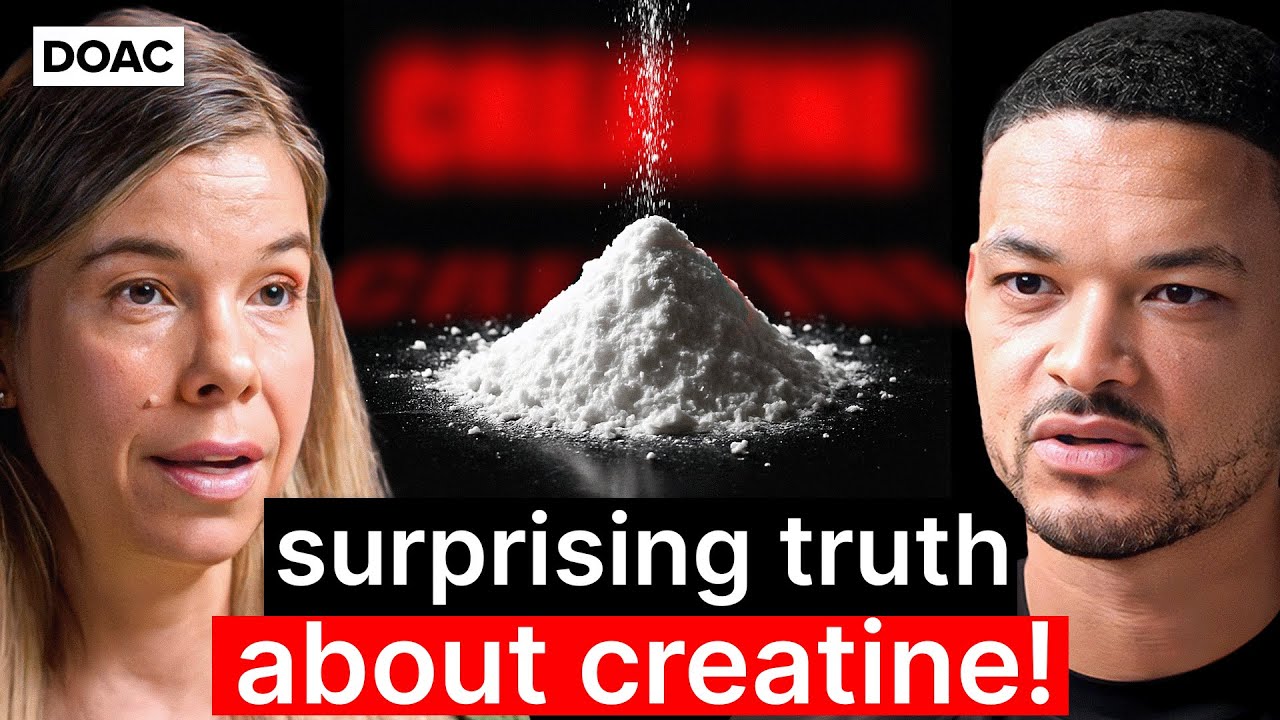
Rhonda Patrick Outlines Exercise, Micronutrients to Reverse Cellular Aging
The Diary Of A CEO
Vigorous cardiorespiratory training and targeted nutrient optimization reduce mortality risks more effectively than pharmaceutical interventions, according to biomedical scientist Rhonda Patrick.
## Background
Published on YouTube by The Diary Of A CEO on July 28, 2025, this episode features anti-aging expert Dr. Rhonda Patrick. The show notes describe an in-depth conversation on how lifestyle interventions—including magnesium, high-intensity interval training, creatine, and vitamin D—can prevent disease, slow biological aging, and optimize cognitive and physical health.
## TL;DR
Biomedical scientist Dr. Rhonda Patrick breaks down actionable strategies to maximize healthspan and cognitive longevity, emphasizing that over 70% of aging is driven by lifestyle choices rather than genetics. She highlights cardiorespiratory fitness and protocols like the Norwegian 4x4 as powerful mimetics that can reverse cardiac aging and cut dementia risk. The discussion explores key nutritional interventions, including high-dose creatine for cognitive resilience under fatigue, optimal vitamin D and omega-3 levels, and the protective benefits of sauna exposure and dietary fiber. Dr. Patrick concludes with personal reflections on balancing career ambitions with biological timing, family planning, and fertility preservation.
## Atmosphere & style
The episode balances deep scientific rigor with an intimate, highly accessible tone. Host Steven Bartlett guides the conversation with empathetic curiosity, allowing Dr. Patrick's infectious enthusiasm for actionable biology to drive an energetic narrative flow. The session transitions seamlessly from dense clinical breakdowns and data-backed protocols into vulnerable, reflective discussions on personal regrets, career trade-offs, and family planning.
## Key takeaways
- [16:25](https://www.youtube.com/watch?v=JCTb3QSrGMQ&t=985s) Cardiorespiratory fitness (VO2 max) is the single most powerful predictor of overall lifespan, adding roughly 5 years to life expectancy and reducing all-cause mortality risk by ~80%.
- [24:40](https://www.youtube.com/watch?v=JCTb3QSrGMQ&t=1480s) The Norwegian 4x4 high-intensity interval training protocol can reverse cardiac aging by up to 20 years by reducing collagen cross-linking and stiffening in the heart.
- [32:49](https://www.youtube.com/watch?v=JCTb3QSrGMQ&t=1969s) Lactate produced during vigorous exercise is a crucial brain and heart fuel that triggers BDNF release, promoting neurogenesis and synaptic connectivity.
- [53:04](https://www.youtube.com/watch?v=JCTb3QSrGMQ&t=3184s) Daily multivitamin supplementation (such as in the COSMOS trial) has been shown to improve processing speed and episodic memory, effectively turning back cognitive aging by 5 years.
- [01:00:13](https://www.youtube.com/watch?v=JCTb3QSrGMQ&t=3613s) Over 70% of the U.S. population is vitamin D deficient or insufficient, which increases dementia risk by 80%, whereas daily vitamin D3 supplementation reduces dementia risk by 40%.
- [01:26:36](https://www.youtube.com/watch?v=JCTb3QSrGMQ&t=5196s) An Omega-3 Index of 8% or higher extends life expectancy by 5 years, whereas low omega-3 levels carry a mortality risk comparable to chronic smoking.
- [01:41:09](https://www.youtube.com/watch?v=JCTb3QSrGMQ&t=6069s) Creatine acts as a powerful cognitive supercharger; high-dose supplementation (25–30g) under acute sleep deprivation completely restores normal cognitive performance.
- [01:23:53](https://www.youtube.com/watch?v=JCTb3QSrGMQ&t=5033s) Cruciferous vegetables yield sulforaphane, which crosses the blood-brain barrier to increase brain glutathione and clear environmental pollutants like benzene and BPA.
- [01:57:40](https://www.youtube.com/watch?v=JCTb3QSrGMQ&t=7060s) Fasting for at least 12 to 16 hours initiates autophagy and mitophagy, cellular recycling processes that remove damaged proteins and mitochondria to optimize metabolic health.
- [02:12:20](https://www.youtube.com/watch?v=JCTb3QSrGMQ&t=7940s) Hyperthermic therapy via heat exposure (such as Finnish or infrared saunas) significantly reduces depressive symptoms and lowers cardiovascular and all-cause mortality rates.
- [02:28:33](https://www.youtube.com/watch?v=JCTb3QSrGMQ&t=8913s) Consuming dietary fiber creates a protective gel in the gut that encapsulates ingested microplastics and nanoplastics, accelerating their fecal excretion before absorption.
- [02:34:38](https://www.youtube.com/watch?v=JCTb3QSrGMQ&t=9278s) According to the Triage Theory, magnesium shortages force the body to prioritize short-term survival over long-term DNA repair, significantly elevating cancer and overall mortality risks.
- [02:43:02](https://www.youtube.com/watch?v=JCTb3QSrGMQ&t=9782s) Higher maternal choline intake (930 mg/day vs 480 mg/day) during pregnancy produces long-term cognitive and IQ benefits in offspring.
The discussion opens with a compelling list of overlooked lifestyle factors that fundamentally dictate long-term health and disease risk. Simple deficiencies and missing habits carry shockingly severe consequences. For example, a lack of vitamin D can increase the risk of dementia by **80%**, while a low omega-3 index carries a mortality risk comparable to that of smoking. Similarly, missing adequate magnesium compromises over 300 essential enzymes required for short-term biological survival. The encouraging reality is that **over 70% of how we age is driven by lifestyle rather than genetics**.
While the brain’s memory center—the hippocampus—naturally shrinks by **1% to 2% per year** as part of normal aging, targeted lifestyle interventions can reverse this decline. Exercise protocols have been demonstrated not only to stop hippocampal shrinkage but to expand its volume by **1% to 2%**. Furthermore, targeted supplementation offers rapid cognitive protection: administering **25 to 30 grams of creatine** to individuals who have been sleep-deprived for 21 hours completely negates cognitive performance deficits, allowing them to perform even better than well-rested baseline controls.
* **Dementia Risk:** Vitamin D deficiency increases the risk of developing dementia by 80%.
* **Omega-3 Index:** Having a low omega-3 index poses a mortality risk equivalent to chronic smoking.
* **Magnesium Shortage:** Over 50% of the U.S. population fails to get adequate magnesium, directly impacting over 300 enzymatic processes.
* **All-Cause Mortality:** Individuals with the highest magnesium levels show a **40% lower all-cause mortality rate**.
* **Hippocampal Reversal:** Exercise changes brain structure, transforming a 1–2% yearly brain shrinkage into a 1–2% gain in hippocampal size.
* **Creatine Buffer:** A single dose of 25–30g of creatine restores full cognitive capability in acutely sleep-deprived individuals (21 hours without sleep).
---
[02:04](https://www.youtube.com/watch?v=JCTb3QSrGMQ&t=124s) Dr. Rhonda Patrick’s Mission: Optimizing Healthspan Over Lifespan
Dr. Rhonda Patrick shares the personal drive behind her extensive research across biomedical science, aging, cancer, metabolism, nutrition, and neuroscience. Her core objective is optimizing "healthspan"—the period of life spent free from chronic disease and physical or mental decline. Despite the vast amount of health information available today, accessible and impactful daily strategies remain largely unknown to the general public.
Addressing common deficiencies through simple supplementation—such as vitamin D—provides immediate benefits for mood and energy while reducing the long-term risk of neurodegenerative diseases like Alzheimer's. Meanwhile, regular physical exercise produces biological effects so profound that, if packaged into a pill, "it would be the biggest blockbuster miracle drug out there," easily outperforming modern pharmaceuticals like Ozempic.
> "If you could pill up what exercise does in a pill, I mean it would be the biggest blockbuster miracle drug out there. It'd blow Ozempic out of the water."
---
[05:09](https://www.youtube.com/watch?v=JCTb3QSrGMQ&t=309s) The Genetics of Aging vs. Lifestyle Choices
Many people view aging as an inescapable physical decline because they observe their parents or elders losing muscle mass, becoming frail, or slowing down. However, genetic inheritance plays only a secondary role in determining how we age. To illustrate this point, Dr. Patrick presents a comparison of two hypothetical 70-year-old men, John and Rob:
* **John:** Razor-sharp cognitively, walks efficiently, carries heavy groceries effortlessly, and remains physically independent.
* **Rob:** Struggles to recall words, experiences rapid cognitive decline, and gets winded simply walking to his car or carrying lightweight items.
The stark divergence between John and Rob is overwhelmingly governed by daily habits rather than genetics. Comparing an individual with poor habits (high sugar intake, smoking, heavy drinking, obesity, sedentary lifestyle) against an optimized individual reveals a **14-year gap in total life expectancy**. More importantly, the difference in healthspan can span **30 to 40 years**, determining whether someone is independently surfing into their 90s or living with severe chronic illness and loss of mobility decades earlier.
---
[09:53](https://www.youtube.com/watch?v=JCTb3QSrGMQ&t=593s) Cellular Reprogramming and the Future of Longevity
Looking toward the future of aging research, Dr. Patrick highlights cellular reprogramming as a breakthrough approach to organ rejuvenation. This science traces back to 2006, when Shinya Yamanaka won the Nobel Prize for discovering that old, specialized adult cells (such as skin cells from an 85-year-old with Parkinson's disease) could be reset into induced pluripotent stem cells (iPSCs) by introducing four specific transcription factors, now known as Yamanaka factors.
By erasing the epigenome—the chemical markers regulating gene expression sitting atop the DNA sequence—a cell's age is completely reset. While early research focused on turning skin cells into stem cells to generate replacement dopamine-producing neurons for Parkinson's patients, recent developments use **partial reprogramming**. By applying brief "pulses" of these transcription factors rather than continuous exposure, scientists can wipe away accumulated cellular damage without losing the cell's underlying identity.
* **Yamanaka Factors:** Four master regulatory proteins capable of resetting a cell's epigenetic state.
* **Epigenetic Clock Reset:** Partial reprogramming reverses biological age in tissues without reverting cells back to an undifferentiated stem cell state.
* **Animal Model Results:** Pulsed cellular reprogramming in animal models has successfully rejuvenated whole organ systems and extended life in accelerated-aging models.
---
[15:15](https://www.youtube.com/watch?v=JCTb3QSrGMQ&t=915s) Sedentary Lifestyle as a Primary Disease State
Transitioning to immediate, actionable health factors, Dr. Patrick frames physical inactivity not merely as a lack of fitness, but as an explicit disease state. Globally, the majority of the population leads a strictly sedentary life—spending eight or more hours sitting at desks, workstations, or screens without significant muscle engagement. This chronic lack of movement acts as a primary catalyst for systemic metabolic breakdown and premature biological aging.
[16:25](https://www.youtube.com/watch?v=JCTb3QSrGMQ&t=985s) The Lethal Cost of Being Sedentary and the Dallas Bed Rest Study
Dr. Rhonda Patrick highlights that leading a sedentary lifestyle is not merely a bad habit—it can actually predict early mortality even more strongly than established diseases like type 2 diabetes, cardiovascular disease, or habits like smoking. To illustrate the catastrophic physical toll of physical inactivity, she revisits the famous **Dallas Bed Rest Study**, initiated in the 1960s by renowned cardiovascular exercise physiologists Bengt Saltin and Jerald Mitchell.
In this classic study, researchers placed five healthy male college students on three weeks of absolute, bedridden rest. They were not permitted to get up for any reason—even using catheters to avoid standing—simulating the enforced immobility often caused by severe illness or surgical recovery. After just three weeks, their cardiorespiratory fitness ($VO_2$ max) completely tanked. Thirty years later, Dr. Benjamin Levine of UT Southwestern re-evaluated these same five men. The astonishing discovery was that three weeks of absolute bed rest damaged their cardiorespiratory fitness more than 30 years of natural aging.
```
3 Weeks Bed Rest > 30 Years Natural Aging
(Cardiorespiratory decline measured in the same 5 men)
```
Dr. Patrick emphasizes that cardiorespiratory fitness ($VO_2$ max)—the maximum volume of oxygen the lungs can inhale and deliver to working muscles during peak effort—is one of the absolute best predictors of human lifespan. Pushing your cardiorespiratory fitness from a low level to a high level yields dramatic health dividends:
* **Life Expectancy:** High cardiorespiratory fitness adds approximately 5 years to total lifespan compared to low fitness.
* **All-Cause Mortality:** Individuals with high $VO_2$ max face an ~80% lower risk of dying from major killers, including cardiovascular disease, cancer, and respiratory illness.
* **Minimum Gain:** Moving just from "low" (sedentary) to "low-normal" cardiorespiratory fitness increases life expectancy by roughly 2 years.
---
[21:29](https://www.youtube.com/watch?v=JCTb3QSrGMQ&t=1289s) Heading Toward the Fitness Cliff
As people age, their cardiorespiratory capacity naturally declines over time. Dr. Patrick outlines how daily tasks demand a specific baseline rate of oxygen consumption, measured in milliliters of oxygen per minute per kilogram of body weight ($mL/kg/min$):
* **Sitting quietly or conversing:** $\approx 3 \text{ mL/kg/min}$
* **Carrying groceries to the car:** $\approx 11 \text{ mL/kg/min}$
If an individual neglects their physical fitness as they age, they rapidly head toward a functional "cliff." Eventually, their maximum cardiorespiratory capacity drops so low that basic daily activities require near-maximal effort. Simple actions like talking or carrying a bag of groceries leave them completely out of breath, severely destroying both healthspan and overall lifespan.
---
[22:17](https://www.youtube.com/watch?v=JCTb3QSrGMQ&t=1337s) How to Boost Cardiorespiratory Fitness: Vigorous Intensity vs. Moderate Exercise
To effectively build cardiorespiratory fitness and avoid this decline, Dr. Patrick points out that standard moderate-intensity exercise is often insufficient. Moderate exercise—where you feel slightly breathy but can still maintain a conversation (such as walking on a StairMaster)—fails to improve cardiorespiratory fitness in up to **40% of people** who perform it for 2.5 hours a week according to basic physical activity guidelines.
To guarantee results, one must engage in **vigorous-intensity exercise** where heart rate reaches roughly **80% or more of max heart rate**, making conversation impossible. This creates a powerful physiological stressor that forces the heart and cardiovascular network to adapt.
| Exercise Intensity | Conversational Ability | Heart Rate Target | $VO_2$ Max Adaptation |
|:--- |:--- |:--- |:--- |
| **Moderate Intensity** | Can converse, though breathy | ~50–70% Max HR | Non-responder rate up to 40% |
| **Vigorous Intensity** | Cannot carry on a conversation | $\ge 80\%$ Max HR | High adaptation & guaranteed improvement |
---
[24:40](https://www.youtube.com/watch?v=JCTb3QSrGMQ&t=1480s) Reversing Heart Aging by 20 Years: The Norwegian 4x4 Protocol
Among all vigorous protocols, Dr. Patrick highlights the **Norwegian 4x4** as the absolute gold standard for cardiorespiratory adaptation. In a landmark two-year study led by Dr. Benjamin Levine at UT Southwestern, sedentary 50-year-olds underwent a progressive exercise program incorporating Norwegian 4x4 sessions 1–2 times per week alongside moderate-intensity training.
Over time, human hearts naturally shrink and stiffen due to factors like **glycation**—a process where elevated blood glucose levels cause advanced glycation end-products (AGEs) to cross-link with collagen in the myocardium and vascular walls. Strikingly, after two years on this training protocol, the 50-year-old participants reversed the structural stiffness of their hearts, making their cardiac structure and elasticity look like those of **30-year-olds**—a 20-year structural reversal of cardiac aging.
Structure of High-Intensity Protocols
* **Norwegian 4x4 (Gold Standard):**
* **Work Interval:** 4 minutes at ~80–90% effort (vigorous, non-conversational, but sustainable for 4 minutes). Best performed on an assault bike, rowing machine, or stationary bicycle.
* **Recovery Interval:** 4 minutes of light exercise (active recovery like slow walking or gentle pedaling).
* **Reps:** Repeat 4 times total.
* **1-Minute On / 1-Minute Off (Minimum Effective Dose):**
* 1 minute hard effort followed by 1 minute light recovery, repeated 10 times (20-minute total workout, done at least once a week).
* **Tabata Protocol:**
* 20 seconds near-all-out effort followed by 10 seconds rest, repeated 8 times per set (doing two 4-minute rounds yields a highly efficient 10-minute total session).
Dr. Patrick advises beginners not to jump straight into maximum Norwegian 4x4 efforts right out of the gate. Instead, they should progressively build up intensity and duration over weeks and months to safely condition their cardiovascular system.
---
<ElicitationsGroup message="Explore related health and exercise topics:">
<Elicitation label="Learn about lactate's role during high-intensity workouts" query="What does Dr. Rhonda Patrick say about lactate, energy production, and vigorous training?"/>
<Elicitation label="Discover creatine's benefits for brain and muscle health" query="What are the benefits of creatine for cognitive function and health according to Dr. Rhonda Patrick?"/>
<ElicitationsGroup message="Explore related health and exercise topics:"/>
</ElicitationsGroup>
[32:49](https://www.youtube.com/watch?v=JCTb3QSrGMQ&t=1969s) How the Body Generates Energy and Exercise Intensity
When pushing hard physically, the body relies on mitochondria—the cellular powerhouses—to produce energy using oxygen. However, during intense exertion, oxygen cannot be delivered to muscle cells fast enough. To meet the demand, the body rapidly generates energy (ATP) outside the mitochondria by metabolizing glucose. This process is partly anaerobic, though it operates on a spectrum rather than an "all-or-nothing" switch.
As a byproduct of this rapid non-mitochondrial energy production, the body produces lactate. Historically viewed as a useless metabolic waste product that caused muscle "burn" through lactic acid, modern research—notably by Dr. George Brooks at UC Berkeley—reveals that lactate does not cause muscle soreness. Instead, it serves as a crucial fuel source for the heart, brain, and liver, behaving similarly to the ketone body beta-hydroxybutyrate.
Beyond being a fuel source, lactate functions as a signaling molecule. It allows working muscles to communicate with the rest of the body, indicating that the organism is under stress and must adapt. In the brain, lactate triggers the release of Brain-Derived Neurotrophic Factor (BDNF), often described as "Miracle-Gro" for the brain. BDNF promotes neurogenesis (the growth of new neurons), enhances synaptic connections to support memory and cognition, and improves neuroplasticity. Additionally, lactate spikes neurotransmitters like norepinephrine (boosting focus and attention) and serotonin (improving mood, motivation, and impulse control). Human studies confirm that higher lactate levels from vigorous exercise correlate directly with superior cognitive scores.
* **Muscle as a Pharmaceutical Factory:** Challenging muscles via protocols like the Norwegian 4x4 or 1-minute on/1-minute off interval workouts turns them into chemical factories that secrete neuroprotective compounds.
* **Reframing Public Health Targets:** While 10,000 steps per day is a popular metric, incorporating at least 10 minutes of vigorous-intensity exercise daily yields significantly greater cardiovascular and cognitive benefits.
---
[38:14](https://www.youtube.com/watch?v=JCTb3QSrGMQ&t=2294s) Why We Can’t Drink Lactate and the Impact of Vigorous Training
Given its extraordinary benefits, a logical question arises: why not simply ingest lactate as a supplement rather than endure hard exercise? Intravenous administration of sodium lactate has already been tested in clinical settings—such as in traumatic brain injury (TBI) patients—where it rapidly crosses into the brain and improves recovery outcomes measured on the Glasgow Coma Scale.
When taken orally, however, lactate is largely consumed by gut epithelial cells before reaching systemic circulation. While this isn't entirely a drawback—since lactate serves as an easily accessible energy source for gut lining cells and exists in equilibrium with lactic acid produced by beneficial probiotic bacteria like *Bifidobacterium*—oral intake cannot duplicate the holistic benefits of physical exertion.
> "If you could pill up what exercise does, I mean, it's so many things, right? It's not just the lactate... There's hundreds and hundreds of things that are happening all in concert from exercise and you just can't pill it up."
Exertion triggers thousands of concurrent adaptations that no supplement can replicate: elevated cardiorespiratory fitness, structural muscular adaptations, upregulation of heat shock proteins that guard against neurodegenerative diseases, and an adaptive antioxidant response to transient exercise-induced inflammation.
---
[41:09](https://www.youtube.com/watch?v=JCTb3QSrGMQ&t=2469s) Decline in Production of Lactate, Creatine, and Other Key Substances
As the human body ages, its biochemical processes become progressively less efficient. Endogenous production of vital compounds drops over time. In the case of creatine, internal synthesis is naturally limited because human biology evolved with the expectation that dietary sources—specifically red meat, poultry, and fish—would fulfill the remaining requirement.
* **Dietary Dependence:** Non-vegetarians replenish creatine stores through animal protein, whereas vegans and vegetarians rely solely on endogenous synthesis, making supplemental intake particularly impactful for them.
* **Proactive Interventions in Early Adulthood:** Taking action in one's 30s can fundamentally alter the trajectory of cognitive function and neurological health in later decades.
---
[42:20](https://www.youtube.com/watch?v=JCTb3QSrGMQ&t=2540s) How to Reduce Cognitive Decline
To combat the natural structural deterioration of the aging brain, structured aerobic exercise stands out as a proven intervention. Beginning in midlife (around age 50), the human brain undergoes age-related atrophy, with critical memory centers like the hippocampus shrinking at a rate of 1% to 2% per year.
A landmark study examined adults in their 60s placed on a one-year aerobic exercise regimen (30 minutes a day, three times per week at 70% to 75% max heart rate). While the stretching control group lost the expected 1% to 2% of hippocampal volume, the aerobic exercise group actually grew their hippocampus by 1% to 2%. This demonstrates that exercise-induced BDNF production can drive adult neurogenesis and reverse brain aging even in older populations.
* **Dementia Risk Reduction:** Observational data shows that women with high baseline cardiorespiratory fitness have an 80% lower risk of developing dementia over long-term follow-up compared to those with low fitness.
* **Timing of Intervention:** Although starting exercise in one's 60s yields significant biological regrowth, preventive measures taken decades prior offer maximum protection against pathological cognitive decline.
---
[46:58](https://www.youtube.com/watch?v=JCTb3QSrGMQ&t=2818s) What Causes Dementia and Alzheimer’s
Alzheimer's disease and dementia are multifactorial conditions driven by complex pathological cascades. A major hallmark is the accumulation of amyloid-beta plaques outside neurons. Under normal physiological conditions, soluble amyloid proteins are cleared from brain tissue. When this clearance mechanism fails, abnormal proteins clump together and disrupt synaptic connections, ultimately causing neuronal death and progressive memory loss.
A primary waste-clearance pathway in the brain is the glymphatic system, a network that flushes cerebrospinal fluid through brain tissue to sweep away metabolic debris and misfolded proteins. The glymphatic system operates most effectively during deep, slow-wave sleep. Chronic sleep deprivation directly impairs this clearance process, accelerating plaque accumulation and heightening long-term neurodegenerative risk.
[49:09](https://www.youtube.com/watch?v=JCTb3QSrGMQ&t=2949s) What Causes Dementia and Alzheimer’s Disease
Beyond poor sleep leading to the buildup of amyloid-beta plaques in the brain, Alzheimer's disease is driven by underlying metabolic and genetic dysfunctions. A primary metabolic issue is the disruption of glucose metabolism in the brain. Neurons rely heavily on glucose to generate energy, and when its transport or utilization is impaired—often triggered by a diet high in refined carbohydrates and sugars coupled with a sedentary lifestyle—the brain cannot produce energy correctly. Because the brain and body are deeply interconnected, systemic metabolic dysfunction directly harms central nervous system health.
Genetics also play a decisive role in an individual's susceptibility to neurodegenerative decline. Certain genetic variants reduce the brain's ability to clear amyloid plaques, repair cellular damage, or maintain the structural integrity of the blood-brain barrier. The gradual breakdown of this blood-brain barrier—which normally filters toxic compounds out of brain tissue—is recognized as one of the earliest signs of Alzheimer's progression.
The most significant known genetic risk factor is the **APOE4** allele. Carrying a single copy of APOE4 increases Alzheimer's risk by twofold (200%), while inheriting two copies elevates the risk tenfold (1,000%). Steven Bartlett reacts with visible concern, remarking he would be "mortified" to find out he carried two copies. However, Dr. Patrick reassures him that genes are not destiny; lifestyle choices can dramatically modify or mitigate these genetic risks. For APOE4 carriers, lifestyle adherence becomes non-negotiable:
* **Zero-Tolerance for Alcohol:** There is effectively no safe intake level of alcohol for APOE4 carriers, as alcohol drastically amplifies neurodegenerative processes in these individuals.
* **Protection Against Traumatic Brain Injury (TBI):** Engaging in contact sports (such as American football, soccer, boxing, or MMA) presents extreme risk. Because APOE4 carriers lack robust neural repair mechanisms, sustaining a TBI compounds their Alzheimer's risk well beyond the baseline 10-fold baseline.
* **Essential Lifestyle Factors:** Prioritizing high-quality sleep, maintaining regular physical exercise, avoiding smoking, preventing obesity, and utilizing commercial direct-to-consumer genetic testing services (e.g., AncestryDNA) to proactively determine APOE4 status.
---
[53:04](https://www.youtube.com/watch?v=JCTb3QSrGMQ&t=3184s) Do Multivitamins Improve Cognitive Performance?
When exploring simple, daily interventions to protect cognitive function as we age, Dr. Rhonda Patrick highlights standard daily multivitamins as a remarkably effective tool. She recalls a widely publicized 2013 paper published in the *Annals of Internal Medicine* titled *"Enough Is Enough: Stop Wasting Money on Vitamin and Mineral Supplements,"* which dismissively argued that multivitamins were merely "expensive urine" and potentially harmful. Dr. Patrick notes that this paper was fundamentally flawed and that she dismantled its methodology a decade ago.
```
+----------------------------------------------------------------------------+
| CLINICAL IMPACT OF DAILY MULTIVITAMINS |
+------------------------------------+---------------------------------------+
| Processing Speed & Cognition | Statistically Significant Improvement |
| Episodic Memory Protection | Equivalent to Reversing 5 Years Aging |
| Study Class & Evidence Level | Gold-Standard Randomized Controlled |
| | Trials (RCTs) |
+------------------------------------+---------------------------------------+
```
Recent large-scale, rigorous science has completely vindicated multivitamin supplementation. Three major randomized controlled trials (RCTs)—including the COSMOS trial using standard off-the-shelf supplements like **Centrum Silver** over several years—demonstrated clear causal benefits for older adults. The results showed statistically significant improvements in overall cognition, processing speed, and episodic memory (the ability to recall personal experiences and specific past events). The cognitive improvement was so pronounced that researchers estimated it was equivalent to turning back the clock on brain aging by **5 years**.
* **Mechanisms of Action:** Multivitamins supply vital micronutrients missing from typical diets, supporting cellular metabolism, neurotransmitter firing, and antioxidant defenses against oxidative stress.
* **Causal Evidence:** Because these findings stem from double-blind, placebo-controlled clinical trials rather than observational studies, they prove direct cause-and-effect rather than mere association.
---
[55:30](https://www.youtube.com/watch?v=JCTb3QSrGMQ&t=3330s) Insulin Signaling, Folate, and the Aging Process
Dr. Patrick reflects on her foundational years as a biomedical researcher studying aging using the microscopic nematode *Caenorhabditis elegans* (*C. elegans*). In the early 2000s, after the *C. elegans* genome was fully sequenced, her experiments focused on genetic pathways homologous to humans—specifically the insulin and IGF-1 signaling pathways. By genetically downregulating insulin signaling in these worms (simulating a drastic reduction in dietary sugar exposure), she was able to double their normal 15-day lifespan to 30 days. Crucially, these long-lived worms were not merely surviving; they remained visibly vibrant, active, and youthful.
This breakthrough shaped her core philosophy: lifestyle choices exert immediate, powerful control over biological aging. She subsequently examined the work of her mentor, **Dr. Bruce Ames** (creator of the Ames test for chemical carcinogens), whose research underscored the catastrophic cellular impact of micronutrient deficiencies. Ames demonstrated that severe deficiency in **folate** (vitamin B9, abundant in dark leafy greens like kale) causes double-stranded DNA breaks at a rate equivalent to exposure to toxic levels of **ionizing radiation**.
* **DNA Damage Equivalence:** Depriving a mouse of dietary folate produced the exact same degree of genomic instability and chromosomal breakage as putting the mouse inside an ionizing radiation machine.
* **Everyday Carcinogens:** While no one would willingly expose themselves to ionizing radiation, millions routinely subject their DNA to identical damage through chronic dietary micronutrient deficiencies.
* **Key Takeaway:** Essential vitamins and minerals (such as folate, magnesium, and B-complex vitamins) act as critical cellular guardians; missing them accelerates aging and disease at a foundational genetic level.
---
[01:00:13](https://www.youtube.com/watch?v=JCTb3QSrGMQ&t=3613s) The Widespread Epidemic of Vitamin D Deficiency
Vitamin D is far more than a simple nutrient—it acts as a powerful steroid hormone once converted in the body. It enters the cell nucleus, binding directly to DNA to regulate the expression of over **5% of the entire human genome**. Despite its critical role in human physiology, an estimated **70% of the U.S. population** suffers from insufficient or deficient vitamin D levels.
```
+----------------------------------------------------------------------------+
| FACTORS BLOCKING VITAMIN D PRODUCTION |
+------------------------------------+---------------------------------------+
| Northern Latitudes | No UVB penetrates atmosphere for 4-5 |
| | winter months |
| High Melanin Content | Requires 6x to 10x longer sun exposure |
| Sunscreen Application | Blocks UVB radiation entirely |
| Modern Indoor Lifestyles | Prevents natural dermal synthesis |
+------------------------------------+---------------------------------------+
```
The body synthesizes vitamin D3 in the skin via direct exposure to UVB radiation from sunlight. Modern indoor working habits have severely curtailed natural synthesis, and several environmental and physiological barriers further exacerbate this deficit:
* **Melanin Pigmentation:** Melanin acts as a natural sunscreen. A landmark study from the University of Chicago revealed that African Americans require **6 to 10 times longer** sun exposure than fair-skinned Caucasians to synthesize an equivalent amount of vitamin D3.
* **Geographic Latitude:** In northern regions (such as England, Wales, Chicago, or Sweden), the solar angle during winter months prevents UVB rays from penetrating the atmosphere entirely for 4 to 5 months of the year, rendering dermal synthesis impossible regardless of time spent outdoors.
* **Compounded Risk:** When an individual with darker skin moves to a northern latitude (such as Steven Bartlett's mother moving from Nigeria to England), their genetic adaptation for high-UV environments becomes a severe risk factor for chronic vitamin D deficiency.
---
[01:02:59](https://www.youtube.com/watch?v=JCTb3QSrGMQ&t=3779s) Vitamin D Deficiency and Increased Risk of Dementia
Unlike acute nutritional deficiencies like scurvy (where vitamin C deficiency manifests rapidly as bleeding gums), vitamin D deficiency is an "insidious" condition. Its damage accumulates silently over decades, often presenting only as subtle fatigue or lethargy before manifesting as severe chronic disease.
```
+----------------------------------------------------------------------------+
| VITAMIN D & DEMENTIA RISK COMPARISON |
+------------------------------------+---------------------------------------+
| Vitamin D Deficiency / Insufficiency| +80% Increase in Dementia Risk |
| Daily Vitamin D3 Supplementation | 40% Reduction in Dementia Risk |
+------------------------------------+---------------------------------------+
```
Multiple large-scale studies demonstrate that individuals who are deficient or insufficient in vitamin D face an **80% increased risk of developing dementia**. Conversely, regular supplementation with vitamin D3 cuts dementia risk by **40%**. Clinical trials in patients already diagnosed with Alzheimer's disease showed that vitamin D supplementation improved cognitive test scores and significantly reduced circulating markers of amyloid-beta plaque accumulation compared to placebo.
Summarizing the session's key risk factors, Steven Bartlett jokes that to guarantee getting dementia, one should: *"stay out of the sun, avoid vitamin D, drink alcohol, smoke, be sedentary, sleep really badly, and eat a lot of refined sugar."* Dr. Patrick agrees completely, emphasizing that checking blood levels via lab tests is the single best way to determine personalized vitamin D supplementation needs.
<ElicitationsGroup message="Explore related concepts from Dr. Rhonda Patrick's protocol:">
<Elicitation label="Analyze optimal dosages and blood markers for Vitamin D3" query="What are Dr. Rhonda Patrick's specific recommendations for target vitamin D blood levels (ng/mL) and daily supplementation dosages?"/>
<Elicitation label="Examine the ApoE4 protocol for brain health" query="What specific exercise, diet, and supplement protocols does Dr. Rhonda Patrick recommend for individuals with the ApoE4 gene?"/>
<ElicitationsGroup/>
[01:05:16](https://www.youtube.com/watch?v=JCTb3QSrGMQ&t=3916s) Vitamin D Levels, All-Cause Mortality, and Brain Health
Dr. Rhonda Patrick highlights the profound connection between circulating vitamin D levels and overall longevity. Drawing from more than 30 studies examining all-cause mortality—encompassing death from cardiovascular disease, respiratory illness, and cancer—she explains that individuals maintaining blood levels between 40 to 60 (and up to 80) nanograms per milliliter ($ng/mL$) experience the lowest mortality risk. By contrast, "insufficiency" occurs around $30\text{ ng/mL}$, while a level at or below $20\text{ ng/mL}$ marks absolute deficiency. Furthermore, the aging brain suffers directly when levels drop: research shows that for every $10\text{ nmol/L}$ drop in blood vitamin D, there is a measurable increase in white matter hyperintensities—visible damage to the brain's myelin sheath that disrupts electrical impulses crucial for thinking and speaking.
Host Steven Bartlett admits that having not taken his vitamin D yet that day, Dr. Patrick's breakdown fully persuaded him. Dr. Patrick notes that for most deficient individuals, reaching optimal blood levels is remarkably easy and affordable. Consuming roughly 4,000 IUs of vitamin D daily successfully elevates levels into a healthy range in numerous clinical trials, making it perhaps the single most cost-effective health intervention available at around 10 cents per pill.
- **Optimal Vitamin D Range:** $40\text{--}60\text{ ng/mL}$ (up to $80\text{ ng/mL}$) yields the lowest rate of all-cause mortality.
- **Deficiency Cutoffs:** Insufficiency begins at $30\text{ ng/mL}$; deficiency is defined as $\le 20\text{ ng/mL}$.
- **Structural Brain Impact:** Lower vitamin D directly correlates with increased white matter hyperintensities (damage to myelineated nerve tracts).
- **Corrective Protocol:** $4\text{,}000\text{ IU/day}$ reliably corrects deficiency for most people at roughly 10 cents per dose.
---
[01:06:49](https://www.youtube.com/watch?v=JCTb3QSrGMQ&t=4009s) The Ketogenic Diet, Leafy Greens, and Beta-Hydroxybutyrate
Steven shifts the conversation to sulforaphane-rich cruciferous vegetables—such as kale, broccoli, and Brussels sprouts—noting that despite their potent cancer-preventative properties, most people avoid them due to taste. This leads him to ask Dr. Patrick about his own current diet, the ketogenic diet, and whether low-carb eating aligns with long-term brain health and longevity. Dr. Patrick points out that while classic clinical ketogenic diets are extremely restrictive, modified versions easily accommodate fibrous, low-glycemic leafy greens without kicking a person out of ketosis.
Dr. Patrick expresses deep interest in the ketogenic diet due to its primary circulating ketone body: **beta-hydroxybutyrate** ($\text{BHB}$). Similar to lactate generated during high-intensity exercise, $\text{BHB}$ crosses the blood-brain barrier where neurons readily use it as a clean fuel source. Moreover, $\text{BHB}$ acts as a potent signaling molecule that upregulates Brain-Derived Neurotrophic Factor ($\text{BDNF}$). However, she cautions that individual responses vary significantly; some individuals experience severe elevations in triglycerides and ApoB/cholesterol, making regular biomarker tracking essential.
- **Cruciferous Vegetables on Keto:** Non-starchy leafy greens provide critical cancer-fighting compounds and fiber without interrupting ketosis.
- **$\text{BHB}$ as a Fuel & Signal:** Beta-hydroxybutyrate supplies rapid neuronal energy and signals the release of neuroprotective growth factors like $\text{BDNF}$.
- **Individual Variability:** Blood lipids (triglycerides and cholesterol) must be monitored, as some individuals experience adverse cardiovascular marker spikes on high-fat diets.
---
[01:09:39](https://www.youtube.com/watch?v=JCTb3QSrGMQ&t=4179s) How Ketosis Works: Depleting Glycogen and Metabolic Flexibility
Recognizing that many people misunderstand ketosis, Steven asks Dr. Patrick to step back and explain the fundamental biology in plain terms. Taking a high-level view, Dr. Patrick explains that ketosis represents a metabolic state where the body relies predominantly on fatty acids—released from subcutaneous and visceral adipose tissue—rather than glucose for energy. While red blood cells lack mitochondria and perpetually require a small amount of glucose, the rest of the body shifts toward burning fat and generating ketone bodies as a metabolic byproduct.
Steven shares a personal anecdote about his father, who lost four to five stone (roughly 50–70 pounds) in just a couple of months on keto, reaching 13 stone for the first time since his teenage years. Dr. Patrick agrees that weight loss on keto can be dramatic, but emphasizes that diet is not the only path to ketosis. Extended fasting (typically 12+ hours to fully deplete liver glycogen) or long-duration endurance exercise both trigger lipolysis and ketone production. Developing "metabolic flexibility"—the seamless capacity to switch between glucose and fat utilization—is a core hallmark of metabolic health, though surveys show most adults eat across a 15- to 16-hour window daily, leaving them metabolically inflexible.
- **Mechanisms of Ketosis:** Depletion of liver glycogen shifts energy production to fatty acid breakdown (lipolysis) and ketone body synthesis.
- **Fasting Timeline:** Liver glycogen stores are generally exhausted after roughly 12 hours of fasting without exercise.
- **Paths to Ketosis:** Can be achieved via carbohydrate restriction, prolonged fasting, or high-volume endurance exercise.
- **Metabolic Flexibility:** The ability to alternate efficiently between burning glucose and burning fats/ketones.
---
[01:14:28](https://www.youtube.com/watch?v=JCTb3QSrGMQ&t=4468s) Ketones, Brain Protection, and the Glutathione Pathway
When Steven inquires about long-term longevity studies, Dr. Patrick cites foundational research by Dr. Eric Verdin at the Buck Institute for Aging. Studies in rodents showed that ketogenic diets extended both lifespan and, more dramatically, healthspan—preserving cognitive function and preventing pathological hallmarks of Alzheimer's disease into old age. She explains that high blood glucose is inherently damaging to the vascular network and brain tissue; even individuals at the high end of "normal" fasting glucose show accelerated hippocampal atrophy (brain shrinkage) compared to those at the lower end of normal.
Beyond eliminating glucose damage, $\text{BHB}$ provides a triple-layer cognitive shield:
1. **Energetic Efficiency:** Neurons require less energy to extract ATP from $\text{BHB}$ than from glucose.
2. **Glutathione Production:** Because neurons burn $\text{BHB}$ instead of glucose, spared glucose is shunted into the *pentose phosphate pathway*, synthesizing precursor molecules for **glutathione**—the brain's master antioxidant—which actively mops up neuroinflammation and oxidative damage.
3. **Growth Signaling:** $\text{BHB}$ acts directly as a signaling molecule to trigger $\text{BDNF}$ release, fostering neuroplasticity and neurogenesis.
- **Buck Institute Research:** Rodent models demonstrated prolonged healthspan and reduced neurodegenerative pathology under ketogenic conditions.
- **Glucose and Brain Atrophy:** Elevated normal blood glucose correlates with accelerated shrinking of the hippocampus.
- **The Pentose Phosphate Pathway:** Sparing glucose from energy production allows it to generate glutathione, suppressing brain inflammation.
- **$\text{BDNF}$ Induction:** $\text{BHB}$ acts as a beneficial cellular stressor, prompting the brain to produce neurotrophic growth factors.
---
[01:19:30](https://www.youtube.com/watch?v=JCTb3QSrGMQ&t=4770s) Exogenous Ketones as a Cognitive Hack
Dr. Patrick addresses the rising popular trend of consuming exogenous ketone drinks or salts. Exogenous ketones supply the body directly with exogenous beta-hydroxybutyrate, bypassing the need for stringent dietary fat adaptation, carbohydrate restriction, or prolonged fasting. This offers a compelling alternative for individuals who struggle with strict dietary compliance or who experience adverse lipid profile responses on a full ketogenic diet.
- **Direct Delivery:** Exogenous ketones immediately raise circulating blood $\text{BHB}$ without requiring glycogen depletion.
- **Target Audience:** Ideal for those unable to maintain strict keto diets or those monitoring sensitive blood biomarkers.
[01:20:14](https://www.youtube.com/watch?v=JCTb3QSrGMQ&t=4814s) Exogenous Ketones and Cognitive Repair
Dr. Rhonda Patrick and host Steven Bartlett discuss how exogenous ketones—supplemental ketone drinks or shots containing beta-hydroxybutyrate ($\beta$-hydroxybutyrate)—function in the body. While people often take them for an immediate boost in focus, attention, and mental clarity that lasts roughly one to three hours, they also hold major therapeutic potential. Dr. Patrick explains that for individuals suffering from mild cognitive impairment or early-stage neurodegenerative conditions like Alzheimer’s disease, exogenous ketones can provide an alternative energy source when brain glucose metabolism becomes impaired.
Steven notes that he has recently spoken with scientists and companies running clinical trials to investigate whether ketone shots can directly repair cognitive faculties. Dr. Patrick confirms she is tracking the same research. The underlying mechanism involves shunting glucose into repair pathways, activating glutathione, and elevating Brain-Derived Neurotrophic Factor (BDNF). This cascade promotes neuroplasticity, supports the growth of new neurons, strengthens synaptic connections, and protects against brain atrophy. Because strict ketogenic diets can be extremely difficult for older adults to maintain, supplemental ketones offer an exciting workaround to achieve transient metabolic benefits.
- **Nootropic effects**: Dr. Patrick describes her personal experience taking a ketone shot before podcast recordings, noticing heightened alertness, deep focus, and a dramatic reduction in mental chatter.
- **Alternatives to stimulants**: She highlights exogenous ketones as a healthier brain-boosting option compared to substances like nicotine, which carries significant negative trade-offs despite improving short-term focus.
---
[01:23:53](https://www.youtube.com/watch?v=JCTb3QSrGMQ&t=5033s) Recommended Superfoods and Sulforaphane
When asked about her top recommended superfoods, Dr. Patrick points to nutrient-dense whole foods over trendy supplements. She emphasizes dark leafy greens—particularly cruciferous vegetables like kale and broccoli—because they are rich in magnesium, folate, and vitamin $\text{K}_1$. Magnesium occupies the center of the chlorophyll molecule, and adequate levels are vital for repairing DNA damage and preventing cancer.
Cruciferous vegetables are uniquely valuable due to a compound called glucoraphanin. When the plant tissue is ruptured by chopping or chewing, an enzyme called myrosinase converts glucoraphanin into sulforaphane. Sulforaphane crosses the blood-brain barrier, boosts the master antioxidant glutathione in the brain, and enhances the body's ability to detoxify environmental pollutants such as benzene and bisphenol A (BPA).
- **Blueberries**: Rich in polyphenols that increase cerebral blood flow, improve memory and cognitive function, and lower cardiovascular risk markers like Apolipoprotein B (ApoB). A single cup a day has been shown to enhance cognitive testing scores.
- **Extra Virgin Olive Oil**: A core staple for providing healthy fats and potent polyphenols. It supports brain performance while improving cardiovascular biomarkers.
- **Wild Salmon**: A premier source of marine-based omega-3 fatty acids, providing bioavailable EPA and DHA that cannot be derived effectively from plant sources.
---
[01:26:36](https://www.youtube.com/watch?v=JCTb3QSrGMQ&t=5196s) Omega-3s: Mental Health, Inflammation, and Longevity
The conversation turns to the powerful impact of omega-3 fatty acids on mood regulation, mental health, and overall mortality. Dr. Patrick highlights that systemic inflammation plays a major causal role in clinical depression. In human experimental models, injecting subjects with inflammatory bacterial molecules like lipopolysaccharide (LPS) reliably induces depressive symptoms; however, pre-treating subjects with eicosapentaenoic acid (EPA) blunts this inflammatory response and prevents mood degradation.
Beyond mental health, Dr. Patrick cites a landmark Harvard study identifying low seafood intake as one of the top six preventable causes of death in the United States—ranking alongside hypertension and smoking. Research led by Dr. William Harris at the Fatty Acid Research Institute measures the "Omega-3 Index," which calculates the percentage of EPA and DHA in red blood cell membranes over their 120-day lifespan.
- **Omega-3 Index ranges**: An index of 8% or higher is optimal, while 4% or lower is considered high risk. The average American sits at roughly 5%.
- **Life expectancy gains**: Individuals maintaining a high Omega-3 Index enjoy a 5-year increase in life expectancy compared to those in the low range.
- **The smoking comparison**: A striking study showed that smokers with a high Omega-3 Index had a similar mortality risk to non-smokers with a low Omega-3 Index. In essence, being severely deficient in omega-3s carries a lifespan penalty comparable to smoking cigarettes.
- **Dosing to raise levels**: Supplementing with 1 to 2 grams of high-quality fish oil daily can raise a person's Omega-3 Index from low to optimal levels within a few months.
---
[01:32:08](https://www.youtube.com/watch?v=JCTb3QSrGMQ&t=5528s) Whole Fish vs. Purified Fish Oil Supplements
Steven asks whether taking daily fish oil capsules is identical to eating fresh salmon, and how long it takes to optimize one's index. Dr. Patrick clarifies that while whole fish contains naturally bound triglyceride forms of fatty acids that are easily absorbed, modern environmental pollution has altered the trade-offs.
Many ocean-caught fish now carry measurable levels of heavy metals (like mercury) and microplastics. While wild salmon remains among the lowest in mercury contamination compared to larger predatory species like swordfish or tuna, microplastic contamination in seafood is widespread. High-quality fish oil supplements undergo molecular distillation and purification to remove toxins, heavy metals, and microplastics, leading Dr. Patrick to favor purified supplements over relying solely on high fish consumption.
- **Cardiovascular protection**: Beyond lifespan extension, large clinical trials (such as REDUCE-IT) showed that giving 4 grams per day of purified EPA to heart disease patients on statins reduced major cardiovascular events—including heart attacks, strokes, and death—by 25%.
- **Synergy**: Combining a clean diet with targeted omega-3 supplementation protects against cognitive decline while shielding the heart against ischemic events.
The podcast shifts into a lighthearted promotional break. A crew member interrupts the recording session to call Steven away because the next guest has arrived. The camera cuts to Steven sitting in a room wearing a red-light therapy LED face mask, startling the team. He explains that he uses the BONTAGE red-light mask daily to boost collagen production, smooth fine lines, and clear up skin blemishes, poking fun at how his partner initially terrified him while wearing it at night.
[01:35:50](https://www.youtube.com/watch?v=JCTb3QSrGMQ&t=5750s) The Shift from "Gym Bro" Supplement to Brain Booster
Dr. Rhonda Patrick opens up about her personal obsession with creatine, admitting that for years she dismissed it as merely a "gym bro" supplement designed for getting swole. Her perspective shifted dramatically over the past five years as compelling research emerged on creatine’s profound impact on cognitive performance. Around the same time, Dr. Patrick took up heavy resistance training—barbells, squats, and deadlifts—making her a prime candidate to test the compound on herself.
Endogenously, the body synthesizes a baseline level of creatine: the liver produces roughly 1 to 3 grams daily, and the brain also manufactures its own supply. Tissues throughout the body consume it, with skeletal muscle acting as the main sink, storing it as phosphocreatine to rapidly regenerate cellular energy. When combined with resistance training, daily creatine supplementation accelerates energy synthesis, enabling individuals to push out one or two additional repetitions per set and reducing rest time between sets.
- **Synergy with exercise:** Supplementing with creatine alone will not build muscle or strength without physical effort; it acts as a cellular supercharger that increases training volume.
- **Initial personal protocol:** Dr. Patrick began supplementing with 5 grams per day for physical performance, noticing an immediate improvement in her training capacity.
- **Mechanisms of action:** Stored as phosphocreatine in muscle, it facilitates rapid ATP recycling, driving superior adaptations in lean body mass and physical power over time.
---
[01:41:09](https://www.youtube.com/watch?v=JCTb3QSrGMQ&t=6069s) Scaling up to 10–20 Grams for Cognitive Resilience
While 5 grams a day is typically enough to saturate skeletal muscle tissue over a period of weeks, Dr. Patrick points out that muscles greedily consume this initial amount. A study out of Germany demonstrated that to increase creatine concentration in various brain regions, higher doses—such as **10 grams daily**—are required so that the excess spills over into central nervous system circulation. Under conditions of systemic or mental stress, such as sleep deprivation, emotional distress, neurodegenerative conditions, or high cognitive workloads, the brain's energy demands spike, making exogenous creatine exceptionally beneficial.
Dr. Patrick personally raised her baseline dose to 10 grams daily and scales up to 20 grams on days marked by severe fatigue, travel, or intense cognitive strain. She highlights research from Dr. Darren Candow at the University of Regina in Canada, which demonstrated that high-dose creatine (25 to 30 grams) given to individuals sleep-deprived for 21 hours not only eliminated their cognitive deficits, but actually allowed them to perform *better* than when fully rested.
- **Abolishing the mid-afternoon crash:** Dr. Patrick notes that taking higher doses of creatine prevents her mid-afternoon cognitive slump without needing a strict ketogenic diet.
- **Crucial for plant-based diets:** Because natural diet-derived creatine is found primarily in meat, poultry, fish, and dairy, vegans and vegetarians often see life-changing boosts in energy and cognitive function upon supplementing.
- **Subjective sleep changes:** A recurring anecdotal observation among new users is feeling fully energized while requiring slightly less total sleep.
> "If you take someone and you sleep deprive them for 21 hours and give them about 25 to 30 grams of creatine, it completely negates the cognitive deficits of sleep deprivation... it makes people function better than if they were well-rested."
---
[01:45:21](https://www.youtube.com/watch?v=JCTb3QSrGMQ&t=6321s) Dosing Timelines, Acute Cognitive Relief, and Health Outcomes
Addressing the common misconception about creatine loading phases, Dr. Patrick clarifies the difference between athletic protocols and acute brain support. In traditional strength contexts, a high-dose loading phase (e.g., 20 grams daily for a week) is simply a shortcut to saturate muscle phosphocreatine stores in days rather than waiting a month on a steady 5-gram dose. However, for brain health, taking a large acute dose—such as 20 to 25 grams in the morning during acute sleep deprivation or high stress—can provide same-day cognitive support by making energy rapidly available to brain cells.
| Condition / Use Case | Typical Dose Range | Primary Goal / Observed Mechanism |
|:--- |:--- |:--- |
| **Muscle Saturation (Standard)** | 5 g / day | Gradual phosphocreatine accumulation over ~30 days |
| **Cognitive Maintenance & Spillover** | 10 g / day | Overcomes muscle sink to cross the blood-brain barrier |
| **Acute Stress & Sleep Deprivation** | 20 – 30 g acute | Rapid energy replenishment; negates cognitive deficits |
| **Depression Adjuvant Therapy** | ~10 – 20 g / day | Anti-inflammatory action; synergy with CBT |
| **Alzheimer's Disease (Pilot Data)** | 20 g / day | Energy support in compromised brain tissue |
Emerging clinical data highlights creatine’s potential beyond muscle performance. A 2025 clinical study found that combining creatine supplementation with Cognitive Behavioral Therapy (CBT) led to significantly greater improvements in depressive symptoms than CBT alone. Animal models indicate creatine may exert novel anti-inflammatory and antioxidant effects in central nervous system tissues. Additionally, a recent pilot study showed that 20 grams per day improved cognitive parameters in Alzheimer’s patients. Responding to host Steven Bartlett's mention of a 2025 *Frontiers* study linking a modest increase in dietary creatine to a 14% reduction in cancer risk, Dr. Patrick dispels old myths that creatine causes cancer, pointing out that emerging evidence suggests it may actually reduce cancer incidence.
[01:50:54](https://www.youtube.com/watch?v=JCTb3QSrGMQ&t=6654s) Debunking Creatine Myths: Hair Loss and Water Retention
Steven Bartlett points out two major misconceptions that deter people—especially women—from taking creatine: fear of bloating/excessive weight gain and fear of hair loss. Dr. Rhonda Patrick traces the origin of the hair loss myth back to a single study published in 2009 involving rugby players who took high doses of creatine (around 25 grams per day). That specific study found an increase in dihydrotestosterone (DHT), a hormone linked to androgenic alopecia (pattern hair loss) by stunting the hair growth cycle. However, Dr. Patrick highlights that the 2009 study never actually measured hair loss directly, only DHT levels. Furthermore, the findings were never replicated in any subsequent human or animal studies over the following decades.
To definitively lay the myth to rest, Dr. Patrick cites a rigorous 2025 randomized controlled trial involving 45 resistance-trained men who took 5 grams of creatine daily over 12 weeks. The trial found no significant difference in hair loss outcomes or DHT levels compared to placebo. Addressing the concern regarding water weight, Dr. Patrick clarifies that while creatine does draw water into muscle cells, this cellular hydration is actually beneficial and typically results in no more than one to two pounds of weight fluctuation—far less than the typical four-pound water weight shift women experience during a standard menstrual cycle.
* The 2009 rugby player study used a loading dose of 25 g/day of creatine and observed an isolated surge in DHT without directly evaluating actual hair loss.
* A 12-week randomized controlled trial conducted in 2025 tested a daily 5 g dose of creatine in 45 resistance-trained men, showing zero impact on DHT levels or hair thinness relative to placebo.
* Water retention from creatine is intracellular (inside the muscle cells) and rarely exceeds 1–2 lbs.
---
[01:53:40](https://www.youtube.com/watch?v=JCTb3QSrGMQ&t=6820s) Fasting vs. Caloric Restriction & The Mechanisms of Autophagy
Transitioning into dietary protocols, Steven asks about the true value of fasting compared to simple caloric restriction, touching on concepts like water fasting and autophagy. Dr. Patrick explains that if the primary goal is sheer weight loss (specifically fat loss while preserving lean mass), calorie restriction is the driving force, and intermittent fasting functions primarily as a convenient behavioral tool to reduce overall caloric intake naturally without meticulous tracking. However, extended fasting triggers unique biochemical pathways that calorie restriction alone does not fully replicate—most notably, **autophagy**.
Dr. Patrick defines autophagy as the body’s cellular clean-up mechanism, wherein cells break down and clear out internal "gunk," including misfolded protein aggregates (like amyloid-beta plaques in the brain or plaques in the cardiovascular system), stray fragments of DNA, and damaged cellular machinery. She highlights a specialized sub-category of autophagy called **mitophagy**, which selectively degrades damaged mitochondria. Because mitochondria produce energy using oxygen, they generate high levels of reactive oxygen species (ROS) that damage their own structure. Unlike nuclear DNA—which relies on magnesium-dependent repair enzymes to prevent mutations and cancer—mitochondria lack direct repair mechanisms and must be recycled via mitophagy to maintain cellular health.
* Calorie deficit primarily drives fat loss, whereas fasting shifts cellular metabolism into restorative and clearative states.
* Autophagy targets protein aggregates (e.g., amyloid-beta), cell debris, and dysfunctional organelles.
* **Mitophagy** specifically eliminates damaged mitochondria, which are prone to oxidative damage from reactive oxygen species (ROS) and lack built-in DNA-style repair systems.
* Magnesium is a necessary co-factor for nuclear DNA repair enzymes that help prevent cancer-causing mutations.
---
[01:57:42](https://www.youtube.com/watch?v=JCTb3QSrGMQ&t=7062s) Fasting Duration, Autophagy Timing, and Metabolic Health
When asked how long one must fast to trigger meaningful autophagy, Dr. Patrick acknowledges that exact human timeframes remain difficult to pinpoint due to a lack of easily accessible biomarkers. However, human and animal data indicate that significant autophagy activation requires first depleting liver glycogen stores, a process that typically takes around 12 hours. Consequently, optimal autophagy is thought to kick in between the 12 to 16-hour mark of continuous fasting.
Beyond cellular repair, time-restricted eating provides substantial metabolic advantages even when overall calorie intake is held equal to non-fasting diets. Clinical trials comparing identical calorie intake demonstrate that compressed eating windows (such as a strict 6-hour eating window with an 18-hour fast) yield superior improvements in blood glucose regulation and blood pressure control compared to spreading the same calories across the entire day.
* Liver glycogen depletion occurs roughly 12 hours into a fast, serving as a critical prerequisite for ramping up autophagy.
* Fasting windows of 16 hours (e.g., 16:8 protocols) are generally considered the practical threshold for triggering autophagy.
* Time-restricted eating improves glycemic control and blood pressure independent of total caloric deficit.
---
[02:01:46](https://www.youtube.com/watch?v=JCTb3QSrGMQ&t=7306s) Preserving Muscle Mass During Fasting: Protein & Resistance Training
Discussing practical fasting protocols, Dr. Patrick shares her personal routine: she typically eats within a 10-hour window (fasting for 14 hours) to accommodate family meals, though she considers 16 hours of fasting ideal for cellular repair. While she occasionally conducts a 24-hour fast, she warns against extended fasting without proper precautions due to the risk of muscle muscle wasting (sarcopenia). Over the past several years, studies have shown that individuals practicing intermittent fasting often lose lean muscle mass simply because fewer daily meals lead to inadequate protein intake and a lack of mechanical muscle stimulation.
To prevent muscle loss while benefiting from intermittent fasting, Dr. Patrick emphasizes two mandatory signals required for muscle protein synthesis:
1. **Protein Intake:** Consuming between 1.2 to 1.6 grams of protein per kilogram of body weight per day within the eating window, particularly breaking fasts with protein-dense meals.
2. **Mechanical Tension:** Engaging in regular resistance training to signal the body to retain lean tissue.
> "If you are doing intermittent fasting, you want to make sure you're getting all your protein—1.2 to 1.6 grams of protein per kilogram body weight per day... And you want to make sure that you're doing resistance training as well."
* Dr. Patrick targets a daily 14-hour fast (10-hour eating window), occasionally extending to 24 hours alongside vigorous exercise to accelerate ketosis and autophagy.
* Recommended daily protein target: **1.2 to 1.6 g/kg** of body weight to prevent muscle degradation during time-restricted feeding.
* Combining resistance training with adequate protein negates the muscle loss frequently observed in standard fasting studies.
---
[02:03:03](https://www.youtube.com/watch?v=JCTb3QSrGMQ&t=7383s) Circadian Rhythms, Melatonin, and Sleep-Enhancing Fasting Habits
Dr. Patrick highlights a crucial, frequently overlooked aspect of time-restricted feeding: aligning the eating window with circadian rhythms. Eating late in the evening (e.g., 8:00 PM or 9:00 PM) conflicts directly with the body's natural production of melatonin, the hormone responsible for inducing sleepiness. Melatonin inherently inhibits insulin secretion; eating late when melatonin is elevated leads to exaggerated blood glucose spikes and impaired metabolic handling.
Furthermore, eating within 3 hours of going to sleep disrupts sleep architecture because the gastrointestinal tract remains actively engaged in heavy digestion during rest. Dr. Patrick references groundbreaking observational research by her colleague Dr. Satchin Panda at the Salk Institute (creator of the *MyCircadianClock* app), where trial participants routinely reported dramatic, unexpected improvements in sleep quality simply by ending their final meal earlier in the evening.
* Late-night eating overlaps with natural melatonin release, which suppresses insulin and causes prolonged blood sugar elevation.
* Stopping all caloric intake at least **3 hours before bedtime** prevents active digestion from interfering with sleep quality.
* Research from Dr. Satchin Panda's circadian clock trials confirms a direct real-world link between early meal cessation and improved sleep metrics.
---
[02:05:33](https://www.youtube.com/watch?v=JCTb3QSrGMQ&t=7533s) The "Anabolic Window" Myth and Post-Workout Protein Timing
Steven asks about the classic fitness recommendation of drinking a protein shake within 30 minutes of finishing a resistance training workout. Dr. Patrick addresses the long-standing concept of the strict "anabolic window," explaining how sports science has evolved on this topic...
* The traditional belief dictated that amino acids like leucine needed to be ingested within a rigid 30-to-60-minute post-exercise window to maximize muscle protein synthesis.
[02:06:11](https://www.youtube.com/watch?v=JCTb3QSrGMQ&t=7571s) Protein Timing and the Anabolic Window Myth
Dr. Rhonda Patrick dispels the long-held myth of the strict "anabolic window," explaining that muscle building is not contingent on consuming a protein shake within 30 to 60 minutes after exercise. Resistance training sensitizes muscle cells and amino acid transporters over a full 24-hour period. Because this heightened sensitivity persists throughout the entire day, total daily protein intake is significantly more important for muscle protein synthesis than precise post-workout timing. While elite bodybuilders seeking microscopic competitive edges might find marginal benefits in precise timing, average individuals simply need to hit their daily target.
When high-glycemic foods like bread or sugar enter the system, they trigger a spike in blood glucose. In a healthy physiology, the body secretes insulin to prompt cellular transporters to pull this glucose out of the bloodstream and direct it into muscle or adipose tissue. Dr. Patrick explains that insulin resistance occurs when this pathway is chronically overstimulated; over time, cellular insulin receptors cease responding effectively. Consequently, blood glucose levels remain pathologically elevated, leading to cellular damage through processes like glycation.
Unlike type 1 diabetes—where the pancreas fails to produce insulin altogether—insulin-resistant individuals continue to produce insulin, but their body cells fail to register the signal. While insulin resistance is not the sole cause of every chronic condition, Dr. Patrick highlights it as a primary metabolic driver that drastically accelerates the rate of biological aging across multiple organ systems.
* **Key Mechanism:** Overstimulation leads to receptor desensitization, causing glucose to remain in the bloodstream.
* **Type 1 Diabetes vs. Insulin Resistance:** Type 1 is a total lack of insulin production; insulin resistance is a breakdown in receptor responsiveness.
* **Downstream Effects:** Persistent hyperglycemia causes structural tissue damage through advanced glycation end-products.
---
[02:11:13](https://www.youtube.com/watch?v=JCTb3QSrGMQ&t=7873s) Photobiomodulation and Red Light Therapy for Aging
Addressing the rising popularity of red light therapy (scientifically termed *photobiomodulation*), Dr. Patrick confirms that specific wavelengths of light stimulate key intracellular pathways and mitochondrial function. Based on robust clinical literature, she uses a specialized red light facial mask to target skin aging and reduce fine lines and wrinkles. She emphasizes that the efficacy of any light device hinges on exact technical specifications, including precise wavelength, power density, and irradiance levels.
---
[02:12:20](https://www.youtube.com/watch?v=JCTb3QSrGMQ&t=7940s) Infrared vs. Traditional Saunas for Depression and Health
The conversation shifts to the distinct biological impacts of infrared saunas versus traditional Finnish saunas. Standard infrared saunas operate at lower ambient temperatures (around 140°F / 60°C) using infrared radiation to warm the body. Because they generate less ambient heat, a standard 20-to-30-minute session in an infrared sauna fails to match the acute physiological stress generated by a traditional hot sauna (operating at 175°F–180°F / 80°C–82°C).
However, extreme heat protocols utilizing specialized "head-out" infrared heat beds have demonstrated staggering psychiatric benefits. Dr. Patrick highlights clinical research led by Dr. Ashley Mason at UCSF (building on foundational work by Dr. Charles Raison) involving patients with Major Depressive Disorder (MDD). By extending infrared exposures to well over an hour—elevating the patients' core body temperatures by 1.5°F to 2°F (0.8°C–1.1°C) into a pseudo-fever state—researchers achieved remarkable anti-depressant effects. Combining four to eight of these intense heat sessions with Cognitive Behavioral Therapy (CBT) yielded a 16-point improvement on the Hamilton Depression Rating Scale, far exceeding the 3-point threshold required for clinical significance. Notably, Dr. Raison's earlier trial demonstrated that even a single core-body-heating session produced anti-depressant results that persisted for six weeks.
```
Sauna Exposure Protocol Comparison:
• Traditional Finnish Sauna (175°F–180°F):
20 min session ➔ Rapid cardiovascular stress & heart rate elevation
• Standard Infrared Sauna (140°F):
20–30 min session ➔ Mild warming; requires substantially longer duration for core elevation
• Clinical Hyperthermic Heat Bed (Head-Out Infrared):
60+ min session ➔ +1.5°F to 2.0°F core temp rise ➔ 16-point Hamilton Scale reduction (with CBT)
```
- **Hamilton Scale Benchmark:** A 3-point reduction indicates clinical significance; hyperthermic therapy paired with CBT achieved a 16-point drop.
- **Single-Session Longevity:** A single core-body temperature elevation of ~2°F sustained anti-depressant efficacy for up to six weeks versus sham controls.
---
[02:16:42](https://www.youtube.com/watch?v=JCTb3QSrGMQ&t=8202s) Cardiovascular Benefits and Exercise Mimicry of Thermal Stress
Traditional hot saunas offer profound long-term mortality benefits. Epidemiological data demonstrates that utilizing a 175°F–180°F sauna 4 to 7 times per week is associated with a 50% reduction in cardiovascular disease mortality and a 40% reduction in all-cause mortality compared to weekly use. Dr. Patrick details how deliberate heat exposure acts as an "exercise mimetic," reproducing the physiological strain of moderate-intensity aerobic activities like stationary cycling.
During a hot sauna session, cardiac output, heart rate, peripheral blood flow, and sweating increase dynamically to dissipate heat. Crucially, combining post-exercise sauna sessions with standard workouts produces an additive physiological effect. Research demonstrates that adding a 15-minute post-workout sauna session yields significantly greater improvements in $VO_2$ max, lipid profiles, and blood pressure regulation than exercise alone. For individuals without access to a traditional sauna, recent studies confirm that hot tub immersion provides similar blood pressure and cardiovascular benefits through thermal strain.
- **4–7 Sessions/Week:** Associated with a 50% drop in cardiovascular mortality and a 40% reduction in all-cause mortality.
- **Synergistic Adaptation:** A 15-minute post-exercise sauna session enhances cardiorespiratory fitness ($VO_2$ max) and lipid improvements beyond exercise alone.
---
[02:19:26](https://www.youtube.com/watch?v=JCTb3QSrGMQ&t=8366s) Stress Resilience and Thermal Memory Rehearsal
Reflecting on her early academic career, Dr. Patrick shares a personal anecdote from her time in graduate school. Living across from a YMCA, she routinely used the sauna before heading to the laboratory. She quickly discovered that acute thermal stress dramatically altered her psychological resilience, allowing her to handle the intense pressures of failed experiments and demanding academic mentors without burning out.
This daily habit evolved into a unique cognitive strategy. To optimize her time during daily 6-to-7-day-a-week sauna sessions, she began silently rehearsing scientific presentations in the heat. She noticed that mentally running through complex scientific data and slides while under thermal strain greatly enhanced her long-term memory retention and recall. To this day, when traveling for major speaking engagements, she continues this practice by rehearsing her presentations while submerged in a hot bath.
Here is a detailed, faithful walkthrough covering Part 10 of the transcript.
---
[02:21:12](https://www.youtube.com/watch?v=JCTb3QSrGMQ&t=8472s) Sauna Physiological Mechanisms, Sleep, and Protocols
Dr. Rhonda Patrick discusses the deep physiological changes triggered by deliberate heat exposure in a sauna or hot tub. The intense heat acts as a potent physical stressor that sparks significant hormonal and cellular responses. Growth hormone levels spike dramatically—rising anywhere from 2-fold to a staggering 16-fold depending on the specific duration and temperature. Furthermore, heat exposure elevates IGF-2 (Insulin-like Growth Factor 2), a peptide closely tied to enhanced memory and learning in animal research. She reflects on how intense emotional or physical stress responses can lock in memories, suggesting that heat stress might function through similar pathways.
Beyond cognitive and hormonal sparks, sauna use plays a powerful role in optimizing sleep architecture and cardiovascular health. Dr. Patrick notes that heat triggers the production of "somnogenic cytokines"—the exact same inflammatory signaling molecules the immune system generates when fighting off an illness, which naturally induce heavy drowsiness. She adjusts her sauna timing depending on her goal: using it in the evening or taking a hot bath helps relax the body and deepen sleep, while using it immediately post-workout extends the cardiovascular and cardiorespiratory fitness benefits of her exercise session.
- **Growth Hormone Spike:** Sauna exposure can elevate growth hormone anywhere from 2-fold up to 16-fold depending on protocol intensity.
- **Cognitive Link:** Elevates IGF-2, which is associated with improved memory retention and learning mechanisms.
- **Sleep Enhancement:** Releases somnogenic cytokines that naturally promote sleepiness and improve sleep quality.
- **Post-Workout Protocol:** Sauna sessions immediately following exercise amplify cardiorespiratory fitness adaptations.
---
[02:23:53](https://www.youtube.com/watch?v=JCTb3QSrGMQ&t=8633s) Microplastics, Hot Beverages, and the Glass Bottle Surprise
The conversation turns to microplastics when Steven Bartlett offers Dr. Patrick some tea, prompting her to lightheartedly ask for "loose-leaf tea in a metal cup." She jokes that her friends sometimes fear talking to her because she is the "bearer of bad news" regarding everyday habits people love. Dr. Patrick warns that standard paper to-go coffee and tea cups are lined with hidden plastic membranes to keep liquids from soaking through the paper. When boiling water for tea or piping hot coffee hits this lining, the heat dramatically accelerates plastic degradation. This process leaches microplastics and endocrine-disrupting chemicals directly into the liquid, effectively turning everyday hot drinks into a "plastic soup."
Adding to the issue, most standard single-use tea bags contain synthetic plastic polymers that shed thousands of microplastic particles per milliliter of brewed tea. To limit exposure, Dr. Patrick brings her own stainless steel travel mug and loose-leaf tea with a metal steeper whenever she travels. She also highlights a recent 2025 study from France that shocked the public: bottled water packaged in *glass* actually contained higher total levels of microplastics than water packaged in plastic bottles. This surprising finding occurs because the painted logos and coatings inside the metal caps on glass bottles flake off into the liquid. However, she notes a silver lining—the plastic particles flaking off glass bottle caps are significantly larger than the microscopic "nanoplastics" found in plastic bottles, making them far less likely to pass through the gut barrier into human circulation.
- **Paper Cup Liners:** Hot liquids accelerate the breakdown of internal plastic liners in paper cups, releasing plastic particles and chemical additives.
- **Tea Bag Contamination:** Standard synthetic tea bags release thousands of microplastic particles per milliliter into hot water.
- **The Glass Bottle Study:** A 2025 French study revealed water in glass bottles often contains *more* total microplastics than plastic bottles due to flaking cap paint.
- **Nanoplastics vs. Microplastics:** Nanoplastics from plastic bottles are far more dangerous than larger microplastics because their ultra-small size allows them to easily cross the gut lining and blood-brain barrier.
---
[02:28:33](https://www.youtube.com/watch?v=JCTb3QSrGMQ&t=8913s) Gut Barrier Protection with Dietary Fiber
Addressing how to clear microplastics from the human body, Dr. Patrick highlights the crucial role of dietary fiber based on emerging animal studies. Humans typically absorb only 1% to 2% of ingested microplastics, while the rest passes out through the digestive tract. Soluble, fermentable fiber helps block even more absorption by forming a thick, viscous, gel-like mucosal barrier inside the gut. This gel traps and encapsulates microplastics and nanoplastics, preventing them from penetrating the intestinal epithelial cells and entering the bloodstream.
Furthermore, fiber speeds up intestinal transit time, sweeping trapped plastic particles out through the stool before they can cause localized tissue damage. Dr. Patrick shares that she discussed these mechanics with Harvard microplastics researcher Dr. Cari Nadal, who was eager to initiate human trials to verify whether high-fiber diets can effectively blunt microplastic absorption in people.
- **Low Baseline Absorption:** Humans currently absorb an estimated 1% to 2% of the microplastics they ingest.
- **Gel Encapsulation:** Fermentable soluble fiber creates a viscous gut barrier that traps plastic particles before they cross epithelial cells.
- **Transit Acceleration:** Fiber reduces transit time in the digestive tract, encouraging rapid fecal excretion of ingested toxins.
---
[02:30:23](https://www.youtube.com/watch?v=JCTb3QSrGMQ&t=9023s) BPA, Metal Cans, and the "BPA-Free" Marketing Trap
Dr. Patrick cautions against eating canned foods like canned soup, explaining that metal and aluminum cans are routinely lined with plastic films to prevent the metal from corroding. When hot liquids or acidic foods are processed inside lined cans, endocrine-disrupting chemicals leach directly into the food. She highlights research showing a staggering 1,000% increase in urinary bisphenol A (BPA) levels after participants consumed soup from a lined metal can compared to soup prepared in glass containers. BPA mimics estrogen in the human body, causing hormone disruption that is particularly dangerous for neurodevelopment in children and harmful to adult hormone balance.
She exposes the widespread industry marketing behind "BPA-free" labels as a deceptive trick. When manufacturers phased out BPA due to public backlash, they simply substituted it with structurally similar analogs like bisphenol S (BPS). Multiple scientific studies have since confirmed that BPS is just as potent an endocrine disruptor as BPA—if not worse. Consumers buy products labeled "BPA-free" under the false impression that they are safe, unaware that they are consuming alternative bisphenol chemicals with identical biological risks.
- **1,000% BPA Spike:** Eating canned soup lined with plastic resin causes a 1,000% increase in circulating BPA levels compared to glass-stored soup.
- **Endocrine Disruption:** Bisphenols act as estrogen mimetics, interfering with human hormonal balance and fetal neurodevelopment.
- **The BPS Substitution Trap:** Products labeled "BPA-free" routinely use BPS, a chemical analog that exhibits equal or greater hormonal toxicity.
---
[02:32:28](https://www.youtube.com/watch?v=JCTb3QSrGMQ&t=9148s) Golf Courses, Pesticides, and Elevated Parkinson's Risk
The discussion shifts to environmental toxins and neurological disease as Steven Bartlett brings up a recent 2025 study investigating people living near golf courses. Dr. Patrick confirms the findings, noting that residing within a mile of a golf course is linked to a 126% higher risk of developing Parkinson's disease. In neurodegenerative research, scientists intentionally induce Parkinson's disease in animal models by exposing them to specific agricultural pesticides and insecticides—such as rotenone and paraquat. These chemicals act as potent mitochondrial toxins that shut down cellular energy production, causing rapid cell death in dopamine-producing neurons.
Dr. Patrick clarifies that the main driver of Parkinson's risk near golf courses and intensive agricultural operations is not inhaling airborne spray, but rather ingesting contaminated groundwater. Runoff from heavy pesticide and herbicide applications on golf greens percolates into local water tables and municipal drinking supplies. To mitigate this severe risk, she strongly advises anyone living near golf courses or farming areas to install robust home water filtration systems, specifically reverse osmosis (RO) units capable of filtering out synthetic organic chemicals and agricultural toxins.
- **126% Higher Risk:** Living within a mile of a golf course is correlated with a 126% increased incidence of Parkinson's disease.
- **Mitochondrial Toxins:** Common pesticides like rotenone and paraquat trigger Parkinsonian neurodegeneration by destroying neuronal mitochondria.
- **Water Contamination:** Ingestion via contaminated drinking water supplies—rather than air inhalation—is the primary exposure route.
- **Filtration Defense:** Reverse osmosis water filtration is highly recommended to purge agricultural chemicals from drinking water.
---
[02:34:38](https://www.youtube.com/watch?v=JCTb3QSrGMQ&t=9278s) Magnesium Deficiencies, Energy Production, and Cancer Risk
When asked what critical health topic was left unaddressed, Dr. Patrick strongly emphasizes the vital importance of magnesium. Magnesium serves as an essential cofactor for over 300 different enzymatic reactions throughout the human body. It is strictly required for synthesizing cellular energy (ATP), utilizing energy, repairing daily DNA damage, and converting inactive vitamin D3 into its active steroid hormone form. Despite its paramount role, roughly 50% of the U.S. population fails to consume adequate dietary magnesium because modern diets lack sufficient dark leafy greens, where magnesium sits at the center of the chlorophyll molecule.
She highlights alarming epidemiological data showing that for every 100 mg decrease in daily magnesium intake, there is a 24% increase in the incidence of pancreatic cancer in a clear dose-dependent manner. Because magnesium directly regulates the enzymes responsible for DNA repair and genomic stability, long-term cellular deficiency creates severe biological vulnerability. Dr. Patrick stresses that correcting a magnesium deficiency is one of the simplest, most impactful steps a person can take to lower disease risk and slow down cellular aging, whether by eating significantly more dark leafy greens or taking a high-quality magnesium supplement.
- **300+ Enzymatic Processes:** Magnesium is a mandatory cofactor for over 300 enzymes, including those responsible for ATP energy production and DNA repair.
- **50% Population Deficiency:** Nearly half of all Americans fail to reach the recommended daily intake of magnesium due to low leafy green consumption.
- **24% Pancreatic Cancer Risk Increase:** Every 100 mg drop in daily magnesium intake is linearly linked to a 24% rise in pancreatic cancer rates.
- **Vitamin D Activation:** Insufficient magnesium prevents the body from successfully converting vitamin D3 into its active, biological steroid hormone form.
Here is the detailed, faithful walkthrough covering this part of the podcast transcript.
---
[02:36:51](https://www.youtube.com/watch?v=JCTb3QSrGMQ&t=9411s) The Triage Theory and How Magnesium Deficiency Leads to Insidious Damage
Dr. Rhonda Patrick highlights magnesium as a crucial mineral whose shortage causes subtle, compounding damage over time that eventually "rears its ugly head" in the fifth, sixth, or seventh decade of life—frequently manifesting as cancer. Addressing magnesium deficiency and insufficiency ensures the body has enough available for all its needs. Host Steven Bartlett notes that nearly 50% of people in the United States are deficient in magnesium. Dr. Patrick confirms this, adding that athletes require **10% to 20% more magnesium** than the general population due to substantial losses from sweating and exertion. Because magnesium is vital for red blood cell function, low levels can also manifest as noticeably lower energy.
This mechanism is explained through the "triage theory," an idea pioneered by Dr. Patrick's mentor, Dr. Bruce Ames. When dietary intake of a micronutrient is inadequate, the human body prioritizes immediate, short-term survival at the expense of long-term health. Over **300 different enzymes** require magnesium to function. If intake is low, the body allocates its scarce magnesium toward immediate energy production rather than DNA repair. Short-term energy generation is essential for immediate survival and reproduction; DNA repair can be sacrificed because cancer typically doesn't strike until well past reproductive age.
Dr. Patrick points out that the triage theory applies to multiple micronutrients, including vitamin K, which is abundant in dark leafy greens. Vitamin K is essential for activating blood clotting proteins in the liver. Because missing this nutrient hampers blood coagulation—a short-term survival threat—newborn babies are routinely given a vitamin K shot immediately after birth.
- **10%–20% higher magnesium requirement** for athletes compared to non-athletes due to sweat and metabolic losses.
- **300+ enzymes** rely on magnesium as a critical cofactor to function properly.
- **Triage Theory**: Proposed by Dr. Bruce Ames; states the body prioritizes short-term survival processes (e.g., ATP/energy production, blood clotting) over long-term protection (e.g., DNA repair).
---
[02:40:16](https://www.youtube.com/watch?v=JCTb3QSrGMQ&t=9616s) Magnesium's Link to Cancer Risk and All-Cause Mortality
Steven cites a statistic from Dr. Patrick's YouTube channel: every **100 mg drop in daily magnesium intake is linked to a 24% higher risk of pancreatic cancer**. Dr. Patrick confirms this striking connection, reiterating that DNA repair enzymes rely on magnesium activation. Missing adequate levels over decades means unrepaired DNA mutations accumulate in oncogenic (cancer-causing) regions of genes. Beyond pancreatic cancer, observational data demonstrates broad longevity benefits: individuals with the highest blood magnesium levels show a **40% lower all-cause mortality rate** and a **50% lower cancer-related mortality rate** compared to those with the lowest levels.
When Steven questions whether observational studies can establish direct causation—noting that people who consume high amounts of magnesium-rich dark leafy greens might simply lead healthier overall lives than those eating fast food—Dr. Patrick completely agrees. "You nailed it," she acknowledges, explaining that because magnesium is naturally packaged within whole foods packed with other beneficial compounds, it is difficult to isolate magnesium as the sole causative variable. Nonetheless, its mechanistic role in DNA repair leaves little doubt about its necessity.
- **24% higher risk of pancreatic cancer** per 100 mg reduction in daily magnesium intake.
- **40% lower all-cause mortality** in people with the highest magnesium status vs. the lowest.
- **50% lower cancer-related mortality** comparing the highest vs. lowest magnesium brackets.
---
[02:43:02](https://www.youtube.com/watch?v=JCTb3QSrGMQ&t=9782s) Choline and Fetal Brain Development
The conversation shifts to a striking finding for parents regarding choline, an essential nutrient heavily concentrated in egg yolks. Choline serves as a direct precursor to the neurotransmitter acetylcholine, aids in cellular membrane structure via phosphatidylcholine, and drives critical epigenetic DNA methylation that regulates gene expression.
Dr. Patrick highlights clinical research in pregnant women comparing those receiving near the daily recommended intake (**480 mg/day**) against those given nearly double (**930 mg/day**). Children born to mothers in the high-choline group scored significantly higher on cognitive and IQ tests later in childhood. Emphasizing how simple this intervention is, Dr. Patrick shares that during her own pregnancy she ate around **six eggs a day** in addition to taking supplemental choline. When Steven jokes that her son must be sharp, she fondly confirms her seven-year-old is indeed "a smart cookie."
- **480 mg/day vs. 930 mg/day**: The high-dose maternal choline intake resulted in demonstrably superior cognitive scores in offspring.
- **Dietary Sources**: Egg yolks are among the richest dietary sources of choline.
- **Dr. Patrick's Pregnancy Protocol**: Daily intake of ~6 whole eggs combined with supplemental choline.
---
[02:45:28](https://www.youtube.com/watch?v=JCTb3QSrGMQ&t=9928s) Personal Regrets and the Reality of High-Performing Motherhood
Closing the interview, Steven introduces the podcast's tradition where the previous guest leaves a mystery question for the next: *"If you could go back and change one thing about your life, what would it be? And you cannot say nothing."*
Reflecting deeply, the 47-year-old scientist shares a vulnerable admission: she would change her decision to have only one child and would choose to have another. While she loved building her career and achieved immense fulfillment as an entrepreneur and scientist, she admits to waiting until late in life due to work pursuits—getting pregnant at 38 and giving birth at 39. She candidly reflects on how perfectionism became a double-edged sword:
> "I'm not going to think about doing one more podcast when I'm on my deathbed. I'm going to think about all the experiences I've had with my family."
Dr. Patrick notes that being a present mother required stepping back from pure intellectual productivity, but she would gladly sacrifice even more career output for another child. She speaks candidly about the myth that women can easily "have it all" at maximum performance without cost: high-performing mothers frequently must sacrifice either family presence or their own health and sleep to maintain their output.
Steven validates her openness, sharing that numerous high-achieving female podcast guests have voiced the exact same realization. He reflects on how these conversations impacted his own perspective at 32 (with his 33-year-old partner), realizing that delaying family planning for "perfect timing" is a trap, given the immutable biological clock. He shares that hearing stories of painful fertility struggles—such as UFC champion Ronda Rousey's repeated failed IVF attempts—prompted him to actively urge the women in his life to prioritize proactive family planning or egg freezing long before they feel completely "ready."
[02:52:42](https://www.youtube.com/watch?v=JCTb3QSrGMQ&t=10362s) Preserving Future Options: Egg Freezing, Embryos, and Human Forecasting
Steven Bartlett shares a personal story about bringing up egg and embryo freezing with his partner and siblings. He notes that it can be a "confronting thing to say to somebody" because of the social stigma surrounding IVF and egg freezing. In fact, his partner initially took the suggestion almost as an insult for the first few minutes. However, as Steven explained the rationale—giving themselves options later in life and capitalizing on higher quality yield from younger eggs—her mindset shifted entirely, moving from hesitation to immense excitement within fifteen minutes. They plan to freeze eggs and embryos in September while also actively trying to conceive.
Dr. Rhonda Patrick strongly agrees with Steven's perspective, admitting that not freezing her eggs earlier in her 30s or at 39 or 40 remains a significant personal regret. She describes being completely consumed and overwhelmed by her high-workload career at the time, combined with her "all in" mentality—whether as a mother or a scientific podcaster. Both reflect on the human tendency to be "really bad at forecasting" how personal priorities change over time. Steven points out how starkly his own interests have shifted, joking that going to a nightclub now at age 30+ would feel like "waterboarding" or "torture" compared to when he was 18 or 19.
* **Family Planning Strategy:** Steven and his partner are actively trying to conceive while simultaneously freezing eggs and embryos to lock in options for the future.
* **Psychological Barrier:** Stigma and initial defensiveness often surrounding IVF and egg freezing can obscure the pragmatic benefit of securing higher-quality gametes at a younger age.
* **Career vs. Biological Clock:** Societal drive for modern career productivity encourages working later into life, often obscuring the biological clock until options become limited.
* **Fertility Nuance:** Rhonda notes that even with early planning, underlying health complications prevent some individuals from conceiving, acknowledging friends in her own life facing those heartbreaking realities.
---
[02:56:45](https://www.youtube.com/watch?v=JCTb3QSrGMQ&t=10605s) Gratitude and Closing Remarks
Steven expresses deep gratitude to Dr. Rhonda Patrick for her relentless dedication to public health education. He praises her ability to translate dense, complex scientific literature from places like PubMed into accessible, actionable insights for millions of viewers across YouTube and Instagram. He notes that her talent for clear articulation and scientific rigor actively "tilts the trajectory" of people's health, positively impacting not just individual lives, but their children's and future generations' lives as well. Rhonda thanks Steven in return for facilitating such an engaging conversation and pressing her with thoughtful, challenging questions.
Following their conversation, Steven turns to the audience with his traditional closing call to action. Pointing out that 53% of regular listeners have not yet subscribed, he asks for a simple, free favor: hitting the subscribe button to support the podcast, promising in return that he and his team will continuously work to elevate the show's quality every week.
* **Impact of Public Science Communication:** Translating technical medical literature into practical guidance reshapes long-term health trajectories across generations.
* **Channel Support:** 53% of regular *The Diary Of A CEO* listeners are not subscribed; Steven requests audience subscriptions to help fuel future guest bookings and show improvements.
## Notable quotes
> [02:04](https://www.youtube.com/watch?v=JCTb3QSrGMQ&t=124s) If you could pill up what exercise does in a pill, I mean it would be the biggest blockbuster miracle drug out there. It'd blow Ozempic out of the water. — Dr. Rhonda Patrick
> [38:14](https://www.youtube.com/watch?v=JCTb3QSrGMQ&t=2294s) If you could pill up what exercise does, I mean, it's so many things, right? It's not just the lactate... There's hundreds and hundreds of things that are happening all in concert from exercise and you just can't pill it up. — Dr. Rhonda Patrick
> [01:41:09](https://www.youtube.com/watch?v=JCTb3QSrGMQ&t=6069s) If you take someone and you sleep deprive them for 21 hours and give them about 25 to 30 grams of creatine, it completely negates the cognitive deficits of sleep deprivation... it makes people function better than if they were well-rested. — Dr. Rhonda Patrick
> [02:01:46](https://www.youtube.com/watch?v=JCTb3QSrGMQ&t=7306s) If you are doing intermittent fasting, you want to make sure you're getting all your protein—1.2 to 1.6 grams of protein per kilogram body weight per day... And you want to make sure that you're doing resistance training as well. — Dr. Rhonda Patrick
> [02:45:28](https://www.youtube.com/watch?v=JCTb3QSrGMQ&t=9928s) I'm not going to think about doing one more podcast when I'm on my deathbed. I'm going to think about all the experiences I've had with my family. — Dr. Rhonda Patrick
## Mentioned
Dr. Rhonda Patrick, Steven Bartlett, Shinya Yamanaka, Bengt Saltin, Jerald Mitchell, Dr. Benjamin Levine, UT Southwestern, Dr. George Brooks, UC Berkeley, Centrum Silver, COSMOS trial, Annals of Internal Medicine, Dr. Bruce Ames, University of Chicago, AncestryDNA, Dr. Eric Verdin, Buck Institute for Aging, Dr. William Harris, Fatty Acid Research Institute, BONTAGE, Dr. Darren Candow, University of Regina, Frontiers, Dr. Satchin Panda, Salk Institute, MyCircadianClock, Dr. Ashley Mason, UCSF, Dr. Charles Raison, Hamilton Depression Rating Scale, YMCA, Dr. Cari Nadal, Harvard, Ronda Rousey, The Diary Of A CEO, PubMed, YouTube, Instagram
Biomedical researcher Dr. Rhonda Patrick argues that over 70% of how humans age is determined by modifiable lifestyle choices rather than genetics. She asserts that targeted physical exertion, essential micronutrient sufficiency, and thermal stress serve as highly effective interventions to protect cognitive function and extend healthspan.
Exercise Intensity, Lactate, and Hippocampal Regeneration (22:17)
Normal aging causes the brain's hippocampus to shrink by 1% to 2% per year starting around age 50, but Dr. Patrick notes that structured aerobic exercise can halt and reverse this decline, expanding volume by 1% to 2% in older adults. Moderate exercise, however, fails to improve cardiorespiratory fitness in up to 40% of people who follow standard 2.5-hour weekly guidelines. Reaching vigorous intensity—at or above 80% of maximum heart rate—forces cardiovascular adaptation and triggers non-mitochondrial energy production.
This rapid glycolytic energy production yields lactate, which modern research shows is not a waste product causing muscle soreness, but a crucial fuel for the brain, heart, and liver. Circulating lactate acts as a signaling molecule that stimulates Brain-Derived Neurotrophic Factor (BDNF) in the brain, fostering neurogenesis, synaptic connectivity, and neuroplasticity. Patrick points out that oral lactate supplements cannot replicate these benefits because gut epithelial cells consume them before they reach systemic circulation.
Correcting Micronutrient Deficits to Prevent Chronic Pathology (62:59)
Dr. Patrick highlights widespread micronutrient deficiencies as silent drivers of accelerated aging and chronic disease. Maintaining blood vitamin D levels between 40 to 60 ng/mL is linked to the lowest all-cause mortality, whereas deficiency increases dementia risk by 80% and causes measurable white matter hyperintensities in the brain. Patrick notes that daily supplementation with roughly 4,000 IUs effectively normalizes levels in clinical settings and is associated with a 40% reduction in dementia risk.
Similarly, magnesium serves as an essential cofactor for over 300 enzymes, including those required for cellular ATP production and DNA repair. Roughly 50% of the U.S. population consumes inadequate magnesium; epidemiological data associates every 100 mg drop in daily intake with a 24% increase in pancreatic cancer incidence. Patrick also notes that a low red blood cell Omega-3 Index carries a mortality risk comparable to smoking, whereas maintaining an index of 8% or higher confers an estimated five-year gain in life expectancy.
Creatine and Ketones as Cognitive Energy Reservoirs (95:50)
Creatine, traditionally viewed as an athletic supplement for skeletal muscle saturation, functions as a potent neuroprotective agent. While standard daily doses of 5 grams saturate muscle stores over a month, Patrick highlights that high acute doses of 20 to 30 grams negate cognitive deficits caused by 21 hours of sleep deprivation by rapidly replenishing brain energy. She clarifies that myths regarding creatine-induced hair loss stem from an unreplicated 2009 study measuring DHT in rugby players, whereas a 2025 randomized controlled trial showed no increase in hair loss or DHT.
Ketone bodies such as beta-hydroxybutyrate (BHB)—generated via extended fasting, ketogenic diets, or exogenous supplements—provide an alternative cognitive fuel. Neurons extract ATP more efficiently from BHB than glucose, and utilizing BHB spares glucose for the pentose phosphate pathway, which generates the brain's master antioxidant glutathione. High circulating blood glucose, by contrast, is associated with accelerated hippocampal atrophy even within the upper end of normal fasting levels.
Thermal Conditioning and Mitigating Environmental Toxins (132:20)
Deliberate heat exposure functions as an exercise mimetic that induces profound cardiovascular and psychiatric adaptations. Utilizing a traditional Finnish sauna (175°F–180°F) four to seven times weekly is associated with a 50% decrease in cardiovascular disease mortality and a 40% decrease in all-cause mortality, while adding a 15-minute sauna session post-workout augments VO2 max adaptations. For major depressive disorder, specialized hyperthermic infrared protocols that raise core body temperature by 1.5°F to 2°F produced persistent antidepressant effects, yielding a 16-point improvement on the Hamilton Depression Rating Scale when paired with cognitive behavioral therapy.
Patrick also warns against modern environmental toxins, noting that boiling water leaches microplastics from plastic linings in paper cups and synthetic tea bags. Emerging animal research indicates that soluble fermentable fiber forms a viscous barrier in the gut that traps ingested plastic particles and accelerates fecal excretion. Additionally, she cites research linking residence within a mile of a golf course to a 126% higher risk of Parkinson's disease, attributing this primarily to pesticide runoff in drinking water and recommending reverse osmosis filtration.
While clinical trials validate interventions like multivitamin supplementation, vitamin D optimization, and cardiorespiratory conditioning, Patrick acknowledges that many nutritional findings rely on observational studies that cannot definitively establish causation due to healthy user bias. Furthermore, cutting-edge anti-aging strategies such as pulsed cellular reprogramming using Yamanaka factors remain in experimental stages.
## Background
该视频由 YouTube 频道《The Diary Of A CEO》(主持人 Steven Bartlett)于 2025 年 7 月 28 日发布。页面简介指出,生物医学科学家、FoundMyFitness 创始人 Rhonda Patrick 博士在节目中深入解析了心肺耐力、挪威 4x4 间歇训练、维生素 D、镁、肌酸以及 Omega-3 等微量营养素与生活方式干预如何预防阿尔茨海默病与心血管疾病、延缓细胞衰老并提升认知表现。
## TL;DR
Rhonda Patrick 博士在访谈中强调,人类衰老轨迹中超过 70% 由后天生活方式决定,久坐不动是比吸烟和糖尿病更严重的早期致死风险因素。她系统拆解了能够逆转心脏衰老的挪威 4x4 高强度间歇训练(HIIT),以及运动产生的乳酸对脑部 BDNF 和神经可塑性的滋养机制。针对现代人普遍存在的微量营养素缺口,她详细论证了维生素 D 缺乏使痴呆风险增加 80%、低 Omega-3 指数等同于长期吸烟的危害,并根据前沿临床证据提出了每日 10 克肌酸跨越血脑屏障的“溢出效应”、限时进食(自噬与保肌法则)、传统高温桑拿降解全因死亡率的科学实操方案。
## Atmosphere & style
整场对话在严密硬核的分子生物学机制与极接地气的健康实操之间无缝切换,充满高信息密度的智性张力。Rhonda Patrick 展现出惊人的文献记忆力与科研热情,用极具冲击力的数据(如“缺乏 Omega-3 等同于吸烟”、“补充肌酸抹平 21 小时熬夜认知损伤”)不断打破主持人的认知舒适区;Steven Bartlett 则以敏锐的好奇心不断追问个人日常转化方案,两人的化学反应流畅且深度共鸣。节目尾声从严谨的生理学指标骤然转向对女性生育生物钟、冻卵策略与人生价值优先级的真情流露,为这场硬核的抗衰长寿科普注入了极具温情与哲思的人文底色。
## Bulletin
- [26:43](https://www.youtube.com/watch?v=JCTb3QSrGMQ&t=1603s) 人类衰老轨迹中超过 70% 由后天生活方式决定;两年高强度运动干预(如挪威 4x4 训练法)可逆转中年人心脏结构衰老整整 20 年,高心肺耐力人群的全因死亡风险降低约 80%。
- [01:32:08](https://www.youtube.com/watch?v=JCTb3QSrGMQ&t=5528s) 缺乏 Omega-3 对预期寿命的损害相当于每日吸烟,将 Omega-3 指数提升至 8% 以上可使平均寿命延长 5 年;严重缺乏维生素 D 则会使痴呆风险增加 80%。
- [01:39:45](https://www.youtube.com/watch?v=JCTb3QSrGMQ&t=5985s) 肌酸每日摄入量需达到 10 克才能越过血脑屏障产生溢出效应补充脑能;在剥夺睡眠 21 小时的极限压力下单次摄入 25 至 30 克肌酸可完全抹平认知衰退。
- [02:34:38](https://www.youtube.com/watch?v=JCTb3QSrGMQ&t=9278s) 全美近 50% 人口镁摄入不足,体内微量元素缺乏会迫使机体启动“分流妥协”,优先维持眼前供能而牺牲长期 DNA 修复酶系统,导致晚年癌症发病率大幅上升。
## Key takeaways
- [05:09](https://www.youtube.com/watch?v=JCTb3QSrGMQ&t=309s) 后天生活方式在人类衰老表型中起决定性作用(占比超 70%),久坐不动预测早期死亡风险的权重甚至超过吸烟与 2 型糖尿病。
- [16:46](https://www.youtube.com/watch?v=JCTb3QSrGMQ&t=1006s) 达拉斯卧床实验证实,健康青年严格卧床 3 周造成的心肺耐力(VO2 max)衰退,等同于经历整整 30 年自然衰老。
- [22:17](https://www.youtube.com/watch?v=JCTb3QSrGMQ&t=1337s) 大强度间歇训练(如挪威 4x4 或 Tabata)能解决中等强度运动无法改善部分人群心肺耐力的问题,并阻断晚期糖基化终产物(AGEs)对心肌的硬化交联。
- [32:28](https://www.youtube.com/watch?v=JCTb3QSrGMQ&t=1948s) 高强度运动产生的乳酸并非代谢废物,而是穿透血脑屏障激活脑源性神经营养因子(BDNF)、促进海马区神经发生的关键信号分子。
- [45:18](https://www.youtube.com/watch?v=JCTb3QSrGMQ&t=2718s) 深度慢波睡眠能激活胶质淋巴系统冲刷脑内 β-淀粉样蛋白斑块;APOE4 风险基因携带者应严格戒酒、规避脑外伤以防阿尔茨海默病风险飙升。
- [01:02:59](https://www.youtube.com/watch?v=JCTb3QSrGMQ&t=3779s) 全美约 70% 人群缺乏维生素 D,将血清 25-羟基维生素 D 维持在 40–60 ng/mL 可降低 40% 的痴呆风险与显著全因死亡率。
- [01:16:10](https://www.youtube.com/watch?v=JCTb3QSrGMQ&t=4570s) 生酮状态生成的 β-羟基丁酸(BHB)是大脑高效清洁能源,能分流闲置葡萄糖生成谷胱甘肽以抗击神经氧化应激,改善轻度认知障碍。
- [01:32:08](https://www.youtube.com/watch?v=JCTb3QSrGMQ&t=5528s) Omega-3 指数低于 4% 的人群全因死亡风险与重度吸烟者无异;现代分子蒸馏鱼油胶囊在纯净度与重金属/微塑料控制上显著优于食用大型鱼类。
- [01:39:45](https://www.youtube.com/watch?v=JCTb3QSrGMQ&t=5985s) 日常补充 5 克肌酸优先被骨骼肌饱和,提升至 10 克方可溢出至中枢神经系统;临床证实肌酸仅引起细胞内水合而不引起脱发或脂肪增加。
- [01:59:51](https://www.youtube.com/watch?v=JCTb3QSrGMQ&t=7191s) 限时进食(如 16:8)在禁食 12-16 小时耗尽肝糖原后启动细胞自噬与线粒体自噬,期间必须配合抗阻训练与足量蛋白质(1.2–1.6 g/kg)以防肌肉流失。
- [02:03:03](https://www.youtube.com/watch?v=JCTb3QSrGMQ&t=7383s) 睡前 3 小时进食会受褪黑素对胰岛素分泌的抑制影响,导致血糖长久维持高位并破坏深度睡眠;所谓的举铁后 30 分钟合成代谢窗口并不存在,全天蛋白质总量达标才是核心。
- [02:16:30](https://www.youtube.com/watch?v=JCTb3QSrGMQ&t=8190s) 每周 4 至 7 次传统高温桑拿能模拟中等强度有氧运动心血管负荷,使心血管死亡风险降低 50%、全因死亡率降低 40%,并显著激发促睡眠细胞因子与生长激素。
- [02:22:56](https://www.youtube.com/watch?v=JCTb3QSrGMQ&t=8576s) 外带纸杯盛装热饮会使 BPA 溶出量激增 55 倍;摄入高膳食纤维可利用物理包裹与加速排泄阻隔微塑料穿透肠壁进入循环系统。
- [02:34:38](https://www.youtube.com/watch?v=JCTb3QSrGMQ&t=9278s) 根据艾姆斯分诊理论,镁缺乏会使机体优先保证 ATP 能量供给,牺牲负责基因保真度的 DNA 修复酶系统,进而诱发基因突变与肿瘤滋生。
- [02:43:02](https://www.youtube.com/watch?v=JCTb3QSrGMQ&t=9782s) 孕期每日摄入约 930 毫克高剂量胆碱对胎儿大脑海马结构与长期认知智商有显著促进作用;高成就女性需清醒认识生育时钟的不可逆性,及早采取胚胎或卵子冷冻储备。
## Detailed walkthrough
### [00:00](https://www.youtube.com/watch?v=JCTb3QSrGMQ&t=0s) 衰老与健康的惊人真相:微小习惯对寿命的颠覆性影响
许多人并不知道,日常体内微量营养素的缺乏和生活习惯的选择,对寿命与认知能力有着生死攸关的影响。Dr. Rhonda Patrick 指出,维生素 D 的严重缺乏会使痴呆症风险骤增 80%;关键矿物质(如镁)的匮乏正在暗中侵蚀机体、推高长期的癌症风险;而更令人震惊的是,低欧米伽-3(Omega-3)指数对全因死亡率的负面影响,在统计学上竟然堪比长期吸烟。作为深耕衰老领域的科学家,她在实验室与临床数据中亲眼证实:**人类衰老的轨迹中,超过 70% 实际上是由后天的生活方式决定的**,且绝大多数干预手段执行门槛极低。
随着年龄增长,大脑中掌管学习与记忆的关键结构——海马体(Hippocampus),通常会以每年 1% 到 2% 的速度自然萎缩。然而令人振奋的临床研究表明,仅仅是介入规律的运动方案,不仅能彻底遏制海马体的退化,甚至能使其体积逆势反弹增长 1% 至 2%。对于那些连运动都觉得费力的人,某些营养补充剂同样能展现立竿见影的生理奇迹:
- **肌酸(Creatine)对大脑的急救效应**:多项试验证明,如果让受试者连续剥夺睡眠长达 21 小时,随后补充 25 至 30 克的肌酸,受试者不仅能完全抵消睡眠匮乏带来的认知衰退,其各项认知测试表现甚至超过了睡眠充足时的基准水平。
- **镁(Magnesium)与死亡风险**:体内镁水平最高的人群,其全因死亡率可降低整整 40%。人体内超过 300 种酶的运转都需要镁的参与来维持短期生存机能;然而仅在全美,就有高达 50% 的人口日常摄入不足。
- **全方位延寿干预工具箱**:除了基础营养素,桑拿浴(Sauna)、红光疗法(Red Light Therapy)、生酮饮食(Ketogenic Diet)、蓝莓多酚以及电解质平衡等,都在分子层面上深层调控着机体的衰老进程。
```mermaid
flowchart TD
accTitle: 核心生活方式与补充剂干预对健康寿命的影响
accDescr: 展示运动、肌酸、镁和维生素D如何分别影响大脑海马体、认知防御、细胞代谢与疾病预防。
subgraph Lifestyle["生活方式干预 (70%+ 决定权)"]
EX["规律运动"] --> HIP["逆转海马体萎缩<br/>(体积年增长 1-2%)"]
SAUNA["桑拿 / 红光"] --> CELL["激活细胞应激与修复"]
end
subgraph Micronutrients["精准微量营养补充"]
CR["肌酸 (25-30g)"] --> SLP["逆转21小时剥夺睡眠<br/>恢复并超越认知极限"]
MG["镁元素充足"] --> MORT["降低 40% 全因死亡率<br/>驱动 300+ 酶促反应"]
VD["维生素 D / Omega-3"] --> DEM["降低 80% 痴呆风险<br/>消除等同吸烟的死亡隐患"]
end
```
---
### [02:04](https://www.youtube.com/watch?v=JCTb3QSrGMQ&t=124s) Rhonda Patrick 的使命:消除科学研究与大众认知之间的鸿沟
Dr. Rhonda Patrick 拥有生物医学博士学位,其职业生涯跨越衰老生物学、癌症机理、新陈代谢、营养学以及神经科学等多个交叉学科。在数十年高强度的跨领域科研中,她深刻意识到一个核心现实:**极微小、低成本的日常习惯改变,能对人类的“健康寿命”(Healthspan,即一生中保持无重大慢性病、身心强健且充满活力的岁月)产生不可估量的深远影响**。她坦言自己几乎是以一种“近乎痴迷”的态度在寻找优化健康寿命的最佳综合方案,并竭力将其推向公众。
现代人虽然生活在信息泛滥的时代,但大多数真正能够立刻改变衰老轨迹的底层科学工具,却依然深锁在象牙塔的专业论文里,未被大众广泛知晓。她的终极目标就是打破这种信息差,将高深严谨的生物医学机制拆解为每位普通人都可以落地实践的极简日常行动。
---
### [03:37](https://www.youtube.com/watch?v=JCTb3QSrGMQ&t=217s) 唾手可得的低垂果实与超越“神药”的运动力量
在具体日常操作层面,改变可以分为两个维度:极易上手的“低垂果实”与需要付出汗水的“长效杠杆”。最容易填补的漏洞就是微量营养素的缺乏。例如维生素 D 的补充成本极低,却能直接影响神经内分泌平衡,从即时的抗抑郁、情绪调节,一路延展到预防老年期阿尔茨海默病等灾难性神经退行性疾病的长期防御。
而对于需要付出努力的运动,Dr. Patrick 做了一个极具震撼力的类比:**“如果你能把运动的所有生理效应浓缩进一颗药丸里,那它将成为人类历史上最畅销的奇迹神药,直接把 Ozempic(司美格鲁肽)彻底碾压得体无完肤,二者根本毫无可比性。”** 运动不仅能在当下直接提供丰沛的精力、专注力与情绪多巴胺,更能从根本上拯救个人以及整个家庭免于晚年因失智症而陷入的身心地狱。
---
### [05:09](https://www.youtube.com/watch?v=JCTb3QSrGMQ&t=309s) 基因决定论的迷思:70 岁的约翰与罗伯
针对主持人 Steven Bartlett 提出的心理学困惑——“由于看到父辈随年龄增长逐渐佝偻、步履蹒跚、流失肌肉,年轻人往往会产生习得性无助,认为衰老退化是写在基因里的必然宿命”——Dr. Patrick 给出了坚决的反驳。她明确指出,**基因在个人衰老表型中所起的作用微乎其微,超过 70% 的衰老进程完全由后天生活方式主导**。
为了直观展现这种差异,她虚构了两位同为 70 岁上下的男性进行对比:
- **约翰(John)**:头脑依然如刀锋般敏锐,能独自轻松提起大包生活杂物走向汽车,呼吸平稳顺畅,步伐矫健轻盈,对身体拥有绝对的掌控感。
- **罗伯(Rob)**:早已开始频频忘词、认知迟钝,仅仅是从超市走到停车场就气喘吁吁,甚至连搬动日常杂物都力不从心。
决定约翰与罗伯晚年天壤之别的核心变量绝非祖传的 DNA,而是他们数十年如一日的生活方式选择,其中最具决定性力量的基石便是运动习惯。老一辈常说的“多运动、吃健康能长寿”绝非泛泛的鸡汤,在分子与细胞水平上,运动正在实实在在地重写人体的基因表达与衰老钟表。
---
### [07:23](https://www.youtube.com/watch?v=JCTb3QSrGMQ&t=443s) 思想实验:健康寿命与生存质量的残酷分流
在主持人的引导下,Dr. Patrick 展开了一场极端思想实验:假设存在严格遵循科学长寿指南的“史蒂夫 A”(Steve A)与彻底放纵的“史蒂夫 B”(Steve B,长期摄入精制高糖、酗酒、吸烟、重度肥胖且极度缺乏运动)。两者的生命终局会呈现怎样的分野?
- **寿命差(Lifespan)**:多项流行病学与生理学研究表明,重度肥胖且多重不良习惯者的预期寿命,与健康人群相比存在至少 **14 年的断崖式落差**。
- **健康寿命差(Healthspan)**:寿命数字的缩短仅仅是冰山一角,最残酷的是生活自理能力与思维机能的提前崩溃。史蒂夫 B 的身心健康早在 40 或 50 岁时便已彻底断崖式滑坡,在随后的漫长岁月里饱受慢性病、遗忘、失智和行动受限的折磨,生活质量极度凄惨;而史蒂夫 A 凭借着优良的营养素储备、充足的高质量睡眠、低糖饮食以及高心肺体能储备,哪怕到了 90 岁高龄,依然可以自如地踏上冲浪板在海浪中驰骋。
正如二人所总结的,**不健康的生活方式剥夺的不仅仅是晚年那 14 年的生命长度,更是在人生的黄金期提前剥夺了长达 30 至 40 年充沛自由的“健康寿命”**。
### [09:53](https://www.youtube.com/watch?v=JCTb3QSrGMQ&t=593s) 细胞重编程与逆转衰老:山中因子与部分重编程的突破
谈及未来抗衰老与长寿领域最前沿的颠覆性科学时,主持人提到科技企业家布莱恩·约翰逊(Bryan Johnson)常说的一句话:“你必须努力活得足够久,才能亲眼见证并享受到未来的医学突破。”Dr. Rhonda Patrick 对此深表赞同,并指出最令她振奋的方向之一是基因疗法以及将细胞重新编程回年轻状态的技术。这项研究的根基始于 2006 年日本科学家山中伸弥(Shinya Yamanaka)的开创性工作,他也因此荣获诺贝尔奖。当时人们尚未完全意识到该发现对衰老生物学的深远意义——山中伸弥证实,只需向普通衰老细胞中引入四种被称为转录因子的蛋白质,就能彻底重置细胞状态。转录因子就像是体内调控海量基因表达的“总指挥”,负责在特定时刻激活或静默基因。
通过向一名 85 岁帕金森病患者脱落的表皮细胞中注入这四种转录因子,研究人员能够擦除附着在 DNA 上的“表观基因组”(epigenome)标记。表观基因组就像覆盖在 DNA 之上的调控层,指挥着基因何时开启或关闭;彻底清除这些随岁月累积的表观遗传磨损后,细胞便会被重置为胚胎干细胞级别的“诱导性多能干细胞”(iPSC)。这种细胞具备分化为体内任何细胞的潜能,例如心脏细胞、肝脏细胞或大脑神经元。在再生医学中,例如面对帕金森病患者大脑黑质中多巴胺能神经元快速流失、导致动机受损与运动控制丧失的病况,科学家原本的构想是采集患者自身的皮肤细胞,重编程为多巴胺神经元后再回输体内,从而避免自体免疫排斥。
```mermaid
flowchart LR
accTitle: 细胞重编程技术对比
accDescr: 展示完全重编程为iPSC与短期脉冲部分重编程保持细胞身份并恢复年轻状态的过程
subgraph Complete ["完全重编程 (iPSC)"]
A["85岁老化体细胞"] --> B["长时间导入4种转录因子"]
B --> C["诱导多能干细胞 (iPSC)"]
C --> D["分化为全新组织细胞"]
end
subgraph Partial ["部分重编程 (抗衰脉冲)"]
E["85岁老化细胞"] --> F["短时间脉冲导入转录因子"]
F --> G["年轻化原细胞\n(如1岁活力的皮肤细胞)"]
end
```
然而,过去十余年里,衰老研究科学家取得了一项更为精妙的突破:部分重编程(Partial Reprogramming)。当主持人好奇地询问这种“脉冲”(pulse)是否类似于电击时,Rhonda 澄清道,“脉冲”是指缩短这四种转录因子在细胞中的孵育时间。这样做的关键在于保留细胞的原有身份——如果它是一个皮肤细胞,我们希望它依旧是皮肤细胞,而不是退回到分化前的胚胎干细胞,但要让它抹去 85 年间累积的损伤,蜕变为宛如来自 1 岁婴儿的年轻皮肤细胞。目前啮齿动物实验已经证实,给小鼠提供这种短暂重编程干预,可以逆转多个器官的表观遗传衰老时钟,并在加速衰老模型中显著延长了动物寿命。这项技术未来向人体临床的转化,被视为攻克衰老与器官年轻化最具前景的方向。
- **山中因子(Yamanaka Factors)**:由四种关键转录因子构成,能重写表观基因组并将分化体细胞逆转回未分化的多能干细胞。
- **帕金森病关联**:黑质(substantia nigra)中的多巴胺能神经元随病程急速凋亡,导致震颤与运动失调,曾是自体干细胞置换疗法的主要攻关目标。
- **部分重编程机制**:通过严格控制转录因子的作用周期,在不抹去细胞专一性身份的前提下,逆转分子层面的衰老时钟。
---
### [15:15](https://www.youtube.com/watch?v=JCTb3QSrGMQ&t=915s) 久坐不动即疾病:比吸烟与糖尿病更致命的早期死亡诱因
当主持人问及普通人从当下最应该重视的基础健康基石是什么时,Rhonda 毫不犹豫地指出:“久坐不动就是一种疾病(Sedentaryism is a disease)。”她解释称,所谓久坐不动,是指缺乏身体活动、完全不参与规律运动的状态。从全球范围来看,绝大多数现代人都处于这一危险的光谱上:整天坐在电脑前、办公桌前或隔间里,几乎没有足够的身体活动。
流行病学与运动生理学数据揭示了一个令人震惊的现实:久坐不动的危害不仅是亚健康,它预测全因早期死亡风险的权重,甚至超越了 2 型糖尿病、心血管疾病等确诊慢病,乃至吸烟这种公认极度有害的生活习惯。
- **久坐的定义**:长期缺乏体力活动,日间大部分时间处于静坐或卧位状态。
- **死亡风险层级**:在全因死亡率的预测模型中,极度缺乏运动带来的相对死亡风险比吸烟、高血压及糖尿病更为严峻。
---
### [16:46](https://www.youtube.com/watch?v=JCTb3QSrGMQ&t=1006s) 达拉斯卧床实验:3周卧床对心肺机能的摧毁胜过30年自然衰老
为了具象化身体缺乏活动对心血管系统的毁灭性打击,Rhonda 详细讲述了运动生理学史上极为著名的“达拉斯卧床实验”(Dallas Bed Rest Study)。该实验始于 20 世纪 60 年代,由当时全球顶尖的心血管运动生理学家本特·萨尔廷(Bengt Saltin)与杰里·米切尔(Jere Mitchell)主持。研究招募了 5 名身体健康的大学生男性,让他们接受长达整整 3 周的严格卧床静养。这种卧床程度极其严苛,受试者甚至连去洗手间都不被允许,全天插着导尿管平躺,身体处于近乎零负荷的制动状态——这种情况在现实中并不罕见,许多经历大手术、重度流感或严重创伤的患者往往也会经历类似周期的卧床。
3 周结束后,这 5 名受试者的心血管机能全面崩溃。研究人员重点评估了受试者的心肺耐力,即最大摄氧量(VO2 max)——这是衡量人体在极限运动负荷下,肺部吸入氧气、心脏输送氧气并将氧气供给工作肌肉利用的黄金指标。3 周的绝对制动使得他们的 VO2 max 发生断崖式暴跌。虽然后续通过长期的恢复性锻炼,年轻受试者逐渐挽回了心肺机能,但故事最震撼的篇章发生在 30 年之后。
30 年后,德克萨斯大学西南医学中心(UT Southwestern)著名心血管运动生理学家本杰明·莱文(Benjamin Levine)重新追踪并召回了当年参与实验的这 5 名原始受试者,重新测定了他们的最大摄氧量及各项生理指标。对比结果令人惊骇:3 周绝对卧床对受试者心肺耐力造成的衰退,竟然与他们经历整整 30 年自然衰老带来的衰退程度相当!换言之,让一个二十岁出头的健康小伙在床上静止不动躺 21 天,其心肺系统的退化程度,等同于身体在正常生活状态下老去了整整 30 岁。这一经典研究以无可辩驳的生理学证据,证明了缺乏运动对心血管系统造成的生理性重创远比单纯的岁月流逝更为剧烈。
- **达拉斯卧床实验设计(1966年)**:5 位健康男性大学生,严格卧床 21 天,使用导尿管,禁止站立与下床活动。
- **30年随访研究(1996年左右)**:由 Benjamin Levine 主导重测,对比自然衰老 30 年与卧床 3 周对心血管系统的影响。
- **VO2 max(最大摄氧量)**:心肺耐力的金标准,反映心、肺、血管向骨骼肌输送和利用氧气的极限能力;研究证明短时间的绝对制动即可造成毁灭性损伤。
### [19:46](https://www.youtube.com/watch?v=JCTb3QSrGMQ&t=1186s) 心肺耐力:决定寿命与衰老悬崖的关键指标
心肺耐力(Cardiorespiratory Fitness)下降的破坏力,完全不亚于长期卧床对身体造成的摧残。心肺耐力是预测人类寿命最强大的生物指标之一。大量临床研究表明,拥有较高心肺耐力的人群相比耐力低下者,预期寿命平均延长整整 5 年,且因心血管疾病、癌症以及呼吸系统疾病等各类原因导致的死亡风险骤降约 80%。这种提升不仅意味着延年益寿,更是在生理层面上将心血管病和癌症等与衰老相关的慢性病发病时间大幅向后推迟。即使是彻底告别久坐不动、从心肺耐力的“最底层”(极差)稍微提升至“低正常”区间,也能轻松换来大约 2 年的预期寿命增长,而这在日常中其实并不难实现。
随着年龄增长,如果缺乏针对性的体育锻炼,每个人都会不可避免地加速滑向一座残酷的“体能断崖”。在静止坐着交谈时,人体每分钟每公斤体重仅消耗约 3 毫升氧气;而把购买的日常杂货从超市拎到车上,这一耗氧量就会飙升至约 11 毫升。当心肺耐力随衰老自然萎缩且未经干预时,日常琐事所需的耗氧量很快就会触碰甚至超越体能上限。彼时,哪怕是走动说话或提一袋日用品,都会变成需要竭尽全力的极限负荷,整个人气喘吁吁、苦不堪言。这种状态不仅彻底摧毁了健康寿命(Healthspan)的生活质量,更会带来过早死亡的结局。
```mermaid
flowchart TD
accTitle: 心肺耐力衰退与体能断崖模型
accDescr: 展示久坐不动导致心肺耐力自然萎缩,进而使日常低耗氧活动变成极限负荷的恶性循环。
subgraph AgingCliff["衰老与体能断崖"]
A["久坐不动与自然衰老"] --> B["心肺耐力大幅萎缩"]
B --> C["日常活动耗氧阈值受限"]
end
subgraph Impact["生活质量与寿命危机"]
C --> D["讲话/提重物变成极限负荷(耗氧11 ml/kg/min)"]
D --> E["健康寿命衰退与过早死亡(全因死亡风险上升80%)"]
end
```
- **高耐力 vs 低耐力寿命差异**:高心肺耐力者平均寿命增加 5 年,多病因综合死亡风险降低 80%。
- **摆脱久坐底层的收益**:仅从“极低”改善至“低正常”水平,即可换取约 2 年寿命延长。
- **基线耗氧对比**:静坐仅需约 $3\text{ mL } \text{O}_2/\text{kg}/\text{min}$,而提杂货到车上则需要约 $11\text{ mL } \text{O}_2/\text{kg}/\text{min}$。
---
### [22:17](https://www.youtube.com/watch?v=JCTb3QSrGMQ&t=1337s) 为什么中等强度运动像抛硬币?高强度间歇训练(HIIT)的生理重塑
面对改善心肺耐力的诉求,许多人常问:究竟是该去慢跑、骑行还是做力量举重?过去几十年来,运动生理学界已经给出了明确答案——必须进行大强度/高强度运动(Vigorous Intensity Exercise)。大强度运动的定义十分明确:心率需飙升至最大心率的 80% 左右,在此状态下剧烈喘气,根本无法自如地开口交谈。多项严谨的研究发现,如果仅仅依靠踩爬楼机等能一边运动一边勉强对话的中等强度运动,哪怕严格按照官方健康指南每周进行整整 2.5 小时,依然有高达 40% 的人群完全无法改善其心肺耐力。
这种“像抛硬币一样五五开”的不确定性是不可接受的,而高强度间歇训练(HIIT)则是打破瓶颈的确定解药。将那些做中等运动毫无成效的受试者转入高强度间歇训练后,他们的心肺耐力几乎毫无例外地全部获得了显著提升。这是因为高强度运动对心血管系统施加了强烈的生理应激,迫使机体产生深层的适应性重塑,从而极大增强了肺部摄取氧气、血管运输氧气以及肌肉与其他组织高效利用氧气的能力。
---
### [25:32](https://www.youtube.com/watch?v=JCTb3QSrGMQ&t=1532s) 最低有效剂量与黄金法则:Tabata 与挪威 4x4 训练法
针对大众所关心的“最低有效运动剂量(Minimum Effective Dose)”,每周仅需进行一次针对性间歇训练即可见效。最易上手的基础方案是“全力 1 分钟、休息 1 分钟”循环:在整整 1 分钟内尽最大努力维持较高输出(并非瞬间耗尽体力的绝对冲刺,而是保证整分钟能维持的最大强度),随后进行 1 分钟轻度恢复,重复 10 次,全程仅耗时 20 分钟。如果追求更高密度的短期爆发,Tabata 训练法同样可以改善心肺耐力:全力冲刺 20 秒,间歇休息 10 秒,连续重复 8 组(总计 4 分钟),完成两轮该流程即可构成一个高收益的 10 分钟超高效训练。
尽管 1 分钟间歇和 Tabata 表现优异,但在运动生理学界,公认的黄金标准依然是证据最为坚实的“挪威 4x4 训练法”(Norwegian 4x4 protocol)。该协议最适合在动感单车或划船机上进行:
1. **全力阶段**:以能够维持 4 分钟的最大强度持续运动 4 分钟,使心率保持在高位;
2. **恢复阶段**:紧接着进行 4 分钟的低强度轻松活动让心率回落;
3. **循环频次**:重复此过程 4 轮。
这项训练能够为心血管系统提供强大且持久的充盈刺激,不仅是提升心肺耐力的终极利器,更为逆转器官衰老提供了令人惊叹的临床证据。
---
### [26:43](https://www.youtube.com/watch?v=JCTb3QSrGMQ&t=1603s) 逆转心脏衰老 20 年:达拉斯研究与糖化终产物(AGEs)机制
挪威 4x4 之所以被推崇为抗衰老领域的终极方案,源于达拉斯德克萨斯大学西南医学中心(UT Southwestern)本杰明·莱文博士(Dr. Benjamin Levine)的一项里程碑式研究。该研究选取了平均年龄 50 岁、处于中年阶段且长期久坐不动的健康人群(排除 2 型糖尿病和已知心血管病史)。实验组接受了为期两年的循序渐进高强度运动干预,而对照组仅进行常规拉伸。受试者在经过前 6 个月的适应过渡后,每周运动量稳定在 5 至 6 小时,其中包括 1 至 2 次标准的挪威 4x4 训练,并辅以中高强度跑步、骑行及基础力量抗阻训练。两年后的医学影像检测显示了一个震撼人心的结果:受试者的心脏结构衰老状态被足足逆转了 20 年之久。
人类心脏在自然衰老过程中会逐渐萎缩并失去弹性变得僵硬,这是导致心血管疾病成为人类头号死因的根本病理机制之一。心脏僵硬的一大罪魁祸首是高糖与精制碳水化合物饮食带来的高血糖暴露:游离葡萄糖与心肌以及血管壁内的胶原蛋白发生非酶促化学反应,生成“晚期糖基化终产物”(Advanced Glycation End Products, 简称 AGEs)。AGEs 导致心肌结缔组织硬化交联,剥夺了心脏舒张充盈的弹性,使其面对高压时极易受损乃至引发心肌梗死。而规律的高强度间歇运动,是人体将多余血糖迅速分流、从血液系统泵入骨骼肌利用的最强通道,它从源头上截断了 AGEs 对心脏胶原的糖基化硬化过程,让硬化的中老年心脏重新恢复了如 30 岁年轻人一般的弹性与收缩力。
### [29:40](https://www.youtube.com/watch?v=JCTb3QSrGMQ&t=1780s) 挪威 4x4 训练法的实操指南与心脏回春
在持续两年的特定训练干预后,受试者的心脏结构发生了惊人的重塑:心室容积变大且僵硬程度显著降低。这项研究最令人震撼之处在于,参与者原本全都是 50 岁左右的中年人,但在经过两年的规律训练后,他们的心脏结构和弹性在生理学上基本上恢复到了 30 岁健康年轻人的水准——这意味着在中年阶段仅仅通过两年的科学运动协议,就能将心脏的衰老时钟往回调整整 20 年。
```mermaid
flowchart TD
accTitle: 挪威 4x4 间歇训练单次循环流程
accDescr: 图表展示了从热身到4分钟高强度冲刺与4分钟低强度恢复的交替循环结构
subgraph Preparation ["准备阶段"]
A["充分热身 (Warm-up)"]
end
subgraph Interval ["4x4 核心循环(重复 4 轮)"]
B["4分钟 高强度负荷<br/>(80% - 90% 最大努力/无法顺畅对话)"]
C["4分钟 积极恢复<br/>(慢走/极低阻力踩踏/平复心率)"]
end
subgraph Outcome ["生理适应"]
D["心脏结构重塑<br/>弹性提高、泵血量增加"]
end
A --> B
B --> C
C -->|循环4次| D
```
这番极具颠覆性的数据彻底说服了主持人 Steven Bartlett,他当即决定尝试这项备受推崇的“挪威 4x4 间歇训练”(Norwegian 4x4 Protocol)。谈到具体的执行细节时,Rhonda Patrick 博士给出了详细的落地指导:
- **器械与形式选择**:该训练最适合采用心血管主导的有氧设备,首选是风阻单车(Assault Bike)、划船机(Rowing Machine)或室内动感单车;虽然户外跑步也可以,但风阻单车或单车器械对关节冲击小且更易精准控速与维持负荷。
- **4分钟高强度阶段**:在这 4 分钟内,你需要保持在个人主观感觉约 80% 到 90% 的努力程度。这绝非全力以赴的百米冲刺(All-out sprint),而是一种持续的高负荷状态——在这个强度下,你喘息剧烈,完全无法与旁人维持正常对话。
- **4分钟积极恢复阶段**:完成 4 分钟高负荷后,立刻进入 4 分钟的主动低强度恢复。如果之前在跑步,此时就转为慢走;若在单车或划船机上,则以极慢的节奏踩踏或滑行,让心率稳步回落,给心肺系统与肌肉组织喘息与代谢废物的空间。
- **循环次数与循序渐进**:整套“4分钟高强度 + 4分钟恢复”重复 4 次。对于缺乏高强度间歇训练(HIIT)经验的新手,千万不要第一天就盲目追求极限。新手可以先从稍高、但仍能勉强交谈的强度起步,在数周到一两个月的时间里,逐步推高强度,直到能在 4 分钟内完全达到无法顺畅交谈的高心率负荷。
---
### [32:28](https://www.youtube.com/watch?v=JCTb3QSrGMQ&t=1948s) 剧烈运动的生化奇迹:乳酸如何重塑大脑与认知
当被问及“一旦将身体推向 85% 至 90% 的极限努力,体内究竟发生了哪些在普通慢速爬楼机上根本不会出现的深层生理反应”时,Rhonda Patrick 脸上露出了抑制不住的兴奋笑容。她解释道,当肌肉面临极高强度的机械负荷时,细胞对能量(ATP)的需求会呈指数级暴增。通常情况下,线粒体必须依赖氧气来氧化底物生成 ATP;但在剧烈运动中,血液向骨骼肌输送氧气的速率无法赶上能源消耗的速度,身体必须通过胞质内的无氧糖酵解,不借助线粒体直接将葡萄糖快速裂解为 ATP。虽然这种非线粒体途径生成 ATP 的分子效率相对较低,但其反应速度极快,能瞬间解救机体的能量危机。
伴随这一代谢过程的标志性副产物便是乳酸(Lactate)。数十年来,运动科学界普遍将乳酸视为无用的代谢废物,甚至错误地认为运动时肌肉深处的酸痛与灼烧感是由乳酸形成的乳酸盐/乳酸酸化导致的。然而,加州大学伯克利分校(UC Berkeley)的 George Brooks 教授等先驱学者的颠覆性研究表明,乳酸不仅完全不是造成肌肉灼痛的罪魁祸首,反而是机体在严苛压力下合成的一种“奇迹分子”。它会被迅速释放到外周血液循环中,被心脏、肝脏以及大脑作为高优先级的清洁能量直接燃烧利用——其代谢轨迹与利用方式极度类似于轻断食或生酮饮食中产生的核心酮体 β-羟基丁酸(BHB),两者共享相同的单羧酸转运蛋白通道。
更令长寿与神经科学领域震动的是,乳酸充当着骨骼肌与远端中枢神经系统对话的“代谢信使分子”(Signaling Molecule)。当肌肉剧烈做功并大量外排乳酸时,它其实是在向大脑发出预警信号:“我们正在承受严峻的生理考验,全身必须立即开启环境适应与防御机制!”进入大脑后,乳酸会诱发一系列级联保护反应:
- **激活脑源性神经营养因子(BDNF)**:BDNF 被神经科学界形象地誉为大脑的“植物奇迹肥料”(Miracle-Gro for the brain)。它直接驱动成年大脑海马区的新生神经元生长(即神经发生,Neurogenesis),并促进神经元之间突触连接的重组,极大地强化了学习记忆与神经可塑性(Neuroplasticity)。
- **优化神经递质平衡**:乳酸能刺激脑内去甲肾上腺素的释放,从而锐化注意力和注意力聚焦;同时它提升血清素水平,有助于稳定情绪并改善冲动控制能力(Impulse Control)。
- **人体临床试验证实**:多项针对人类的对照研究显示,参与高强度剧烈运动的人群血液乳酸水平显著高于中轻度运动者,而高乳酸水平与更高的认知测试评分、更强的情绪调节及自我克制能力呈现强烈的正相关。
肌肉在本质上就是一个内源性的“生物制药厂”,而开启这些抗衰与健脑药方合成的唯一钥匙,就是通过高强度间歇训练(无论是挪威 4x4 还是“1分钟全力/1分钟休息”协议)对肌肉施加足够的超负荷挑战。正因如此,Rhonda Patrick 提出,公共卫生指南长期对“每日一万步”的狂热追求固然有益,但真正决定生物学寿命与脑健康的关键指标,应该转变为“每天确保至少 10 分钟的高强度剧烈运动”。
---
### [38:14](https://www.youtube.com/watch?v=JCTb3QSrGMQ&t=2294s) 为什么我们不能直接“喝”乳酸?
面对乳酸如此惊人的健脑与系统性代谢益处,Steven Bartlett 提出了一个极具直觉性的疑问:“既然乳酸是一种如同灵丹妙药般的奇迹分子,那为什么我们不能直接调制一杯乳酸补充剂一饮而尽?为什么一定要经历生不如死的高强度间歇折磨?”
Rhonda 坦言这绝非愚蠢的问题,医学界实际上早就在探索类似的临床干预方案。例如,在针对创伤性脑损伤(Traumatic Brain Injury, TBI)危重患者的救治中,研究人员已经成功采用静脉输注乳酸钠(Sodium Lactate)的方案。由于脑外伤患者脑组织常处于急性葡萄糖代谢障碍状态,外源性输入的乳酸能够绕过受损的糖酵解环节,被神经元与星形胶质细胞直接吸收作为救命燃料,并在评估脑损伤恢复水平的格拉斯哥评分(Glasgow Score)中展现出显著的神经保护与神经修复效果。
然而,将这一概念直接套用到“口服外源性乳酸饮料”上却遇到了生理吸收层面的屏障。虽然市场上能够买到一些形式的乳酸盐补充剂,但经由消化道摄入的乳酸,首先会接触到极其饥饿且代谢旺盛的肠道上皮细胞。大量的口服乳酸在进入外周循环并抵达大脑之前,就已经被肠道自身迅速消耗殆尽,根本无法在脑组织或全身各器官中重现剧烈高强度运动所引发的全身性代谢级联反应与神经内分泌红利。
### [03:18](https://www.youtube.com/watch?v=JCTb3QSrGMQ&t=198s) 口服补剂的局限与运动作为“奇迹药物”的多重效益
当讨论到直接饮用或口服某些代谢产物是否能走捷径时,主持人提出质疑:试图通过口服补充剂来“欺骗系统”往往伴随着人们很少提及的代价或权衡。Dr. Rhonda Patrick 指出,口服乳酸并非毫无价值,例如她的前同事 Mark Chanaga 的研究表明,乳酸对肠道上皮细胞极其有益。像双歧杆菌(Bifidobacterium)这样的有益益生菌本身就会产生乳酸,并在体内与乳酸盐(Lactate)形成生理平衡;这些乳酸盐能够直接成为肠道细胞极易利用的高效能量来源。然而,通过口服摄入代谢物与运动带来的全身性系统改变完全无法同日而语。
Dr. Rhonda Patrick 强调,如果能把运动的效果浓缩成一颗药丸,那它将成为无可替代的“奇迹药物”(miracle drug)。运动带来的远不止单一种类的乳酸:它全面提升心肺耐力,驱动肌肉结构的适应性改变,刺激诸如热休克蛋白(Heat Shock Proteins)等关键应激反应基因以预防神经退行性疾病;同时,运动过程中产生的急性炎症又会反向激活体内强效的抗氧化系统。这种数百种生理生化机制协同发生的复杂级联反应,根本不可能被任何药物或补剂单独复制。
```mermaid
flowchart TD
accTitle: 运动与口服途径的生理效应对比
accDescr: 对比单纯口服乳酸与全身性剧烈运动引发的广泛生理适应
subgraph Oral ["口服补充途径"]
A["口服摄入乳酸"] --> B["肠道上皮细胞直接吸收供能"]
B --> C["局部肠道微生态调节"]
end
subgraph Exercise ["全身运动刺激"]
D["有氧/剧烈运动"] --> E["心肺耐力与肌肉重塑"]
D --> F["产生乳酸穿透血脑屏障"]
D --> G["激活热休克蛋白等应激保护基因"]
D --> H["运动应激诱导内源性抗氧化系统启动"]
end
```
### [04:09](https://www.youtube.com/watch?v=JCTb3QSrGMQ&t=249s) 身体合成分泌的极限与肌酸的获取渠道
主持人提出了一个朴素而直击核心的问题:既然乳酸、肌酸(Creatine)这些分子对身体如此重要,为什么人体不干脆自主合成更多?Dr. Rhonda Patrick 解释道,随着人体衰老,所有生理系统的效率都会下降,各项器官与细胞不再能像年轻时那样高效运作。此外,在肌酸的合成上,身体原本就具有自我调控的上限,因为它在进化上默认人类可以通过饮食获取相当一部分。
肌酸天然广泛存在于肉类、家禽和鱼类中。正因机体预期能从日常膳食中摄入足够的肌酸,体内自身合成的配额才没有被设定得过高。这就导致严格的纯素食者(Vegans)和素食主义者(Vegetarians)面临完全不同的处境:他们不食用肉类,肌酸水平完全取决于自身极其有限的内源性合成能力。
### [04:20](https://www.youtube.com/watch?v=JCTb3QSrGMQ&t=260s) 有氧运动逆转脑萎缩与神经发生
面对主持人在 32 岁时对于未来 90 岁认知衰退、记忆丧失及词不达意的担忧,Dr. Rhonda Patrick 指出一项震撼的临床研究,证明及早乃至晚年干预都能对大脑结构产生逆转性的深远影响。大脑如同心脏一样会随年龄增长而逐渐硬化萎缩(脑萎缩,Atrophy)。尤其从 50 岁左右的中年期开始,主管学习与记忆的关键脑区——海马体(Hippocampus),通常会以每年 1% 到 2% 的速度自然缩水。
这项研究招募了一批 60 岁以上的老年人,让他们接受为期一年的中等强度有氧运动训练,强度约为最大心率的 70% 至 75%,每周仅需进行 3 次、每次大约 30 分钟。对照组则仅进行常规拉伸训练。一年后,拉伸对照组的海马体如预期衰老进程一般缩水了 1% 至 2%;然而,坚持有氧运动的老年人组不仅彻底阻止了海马体的萎缩,其海马体体积反而逆势增长了 1% 到 2%。这种体积增长源于脑源性神经营养因子(BDNF)刺激的神经发生(Neurogenesis),证明哪怕年过半百,大脑依然具备再生新神经元的能力。同时,流行病学跟踪数据显示,心肺耐力水平最高的女性群体,其未来罹患痴呆症的风险降低了整整 80%。
- **海马体自然萎缩率**:50岁以后,普通人群的海马体体积平均每年衰减 1% 至 2%。
- **有氧运动干预方案**:每周 3 次,每次约 30 分钟,维持在 70%~75% 最大心率的强度。
- **结构逆转结果**:运动组不仅遏制了衰退,海马体体积在一年内逆势增加 1% 至 2%。
- **痴呆风险降幅**:心肺耐力最高等级的女性,随访期内患痴呆的几率比体能较弱者低 80%。
- **发病后干预的局限**:阿尔茨海默病一旦进入不可逆的病理发展期,滚雪球般的恶化极难单靠运动逆转,“预防永远是最佳策略”(Prevention is always the best)。
### [04:58](https://www.youtube.com/watch?v=JCTb3QSrGMQ&t=298s) 痴呆成因与深睡眠中的脑部排毒系统
谈及痴呆症与阿尔茨海默病的致病机制,Dr. Rhonda Patrick 指出这是一个多因素(Multifactorial)驱动的复杂过程,其中最典型的标志是大脑影像中可见的淀粉样蛋白斑块。β-淀粉样蛋白(Amyloid-beta)本身是一种会在大脑中正常产生的蛋白质,通常能被机体代谢清除;然而在病理状态下,清理机制失效,这些异常蓄积的蛋白便在神经元胞体外聚集形成团块。
这些斑块沉积在神经元之间的突触连接处,物理性地阻断并破坏神经信号传递。突触是记忆形成与储存的核心节点,一旦突触连接被阻断,不仅既有记忆会迅速剥蚀,丧失了生理功能的神经元本身也会走向死亡。淀粉样蛋白的堆积与睡眠质量密不可分:在深度睡眠阶段(慢波睡眠,Slow-wave sleep),大脑会启动一套类似于淋巴系统的排毒通道——胶质淋巴系统(Glymphatic System)。在这个网络状的脑内通路中,脑脊液(Cerebrospinal fluid, CSF)会像水流一样强力冲刷脑组织间隙,将未被降解的代谢废物和淀粉样蛋白彻底冲洗排出。如果缺乏高质量的深睡眠,大脑垃圾便无法及时清理,最终演变成不可逆的神经退行性病变。
### [49:05](https://www.youtube.com/watch?v=JCTb3QSrGMQ&t=2945s) 阿尔茨海默病的代谢机制与 APOE4 基因风险
大脑的类淋巴系统(glymphatic system)主要在睡眠期间被激活并高效运转。如果几十年如一日缺乏优质睡眠,大脑清除β-淀粉样蛋白斑块的能力就会严重受阻,导致这些毒性蛋白在大脑中不断沉积,从而显著推高罹患阿尔茨海默病的风险。然而,睡眠不足只是诱因之一,脑内葡萄糖代谢障碍同样是极其核心的病理环节。神经元正常运转高度依赖葡萄糖供能,如果一个人长期摄入大量精制碳水化合物与精制糖,加之缺乏运动,全身及大脑的葡萄糖代谢通路都会被严重破坏,导致大脑无法正常生成能量,最终演化为代谢层面的脑功能退化。
除了代谢与生活方式因素,遗传背景同样发挥着决定性作用。部分人群由于基因层面的缺陷,既无法高效清除淀粉样蛋白,又缺乏强效的损伤自我修复机制。在阿尔茨海默病极为早期的阶段,血脑屏障(blood-brain barrier)就会率先受损并逐渐瓦解,失去了原本过滤有害毒素入侵大脑的关键防线。这种早期的血脑屏障破损在携带 APOE4 等位基因的人群中尤为普遍。作为阿尔茨海默病最强大的单一遗传危险因素:
- **单拷贝携带者**:约占总人口的 25%,携带一个 APOE4 拷贝会使阿尔茨海默病的患病风险增加 2 倍(翻倍,即升高 200%)。
- **双拷贝携带者**:占人口比例较低,但携带两个拷贝会使患病风险飙升至 10 倍(增加 1000%)。
面对主持人对“如果测出携带两个突变基因简直令人吓破胆”的感慨,Rhonda 强调携带 APOE4 绝非命中注定会患病。基因并不是一成不变的宿命判决书,良好的生活方式能够彻底扭转局面。对于携带这类高危基因的人群来说,健康习惯的比重被无限放大:
- **滴酒不沾**:对于 APOE4 携带者,根本不存在所谓的“安全饮酒量”,酒精会呈指数级放大痴呆与阿尔茨海默病风险。
- **避免脑外伤(TBI)与冲撞性运动**:美式橄榄球、足球(频繁头球)、MMA 综合格斗、拳击等极易造成脑震荡或创伤性脑损伤。由于 APOE4 携带者的脑组织天然缺乏高效率的损伤修复机制,一旦发生外伤,阿尔茨海默病的风险可能会飙升 10 倍之多。
- **严格的生活基石**:保持充足深度睡眠、坚持科学运动、戒烟、避免超重与肥胖。
```mermaid
flowchart TD
accTitle: APOE4与生活方式对脑退行性疾病的影响机制
accDescr: 展示遗传因素APOE4在环境毒素与生活方式干预下的两条截然不同的病理与保护路径
subgraph RiskFactors ["遗传背景与高危暴露"]
A["携带 APOE4 基因"] --> B["血脑屏障脆弱 / 修复能力低下"]
B --> C["高危行为:饮酒、接触性运动外伤、精制糖过量"]
end
subgraph PathologicalRoute ["恶性病理路径"]
C --> D["血脑屏障瓦解与毒素侵入"]
D --> E["β-淀粉样蛋白无法清除 + 葡萄糖代谢受损"]
E --> F["阿尔茨海默病风险提升 2 至 10 倍"]
end
subgraph ProtectiveRoute ["生活方式保护路径"]
G["生活方式干预"] --> H["优质睡眠保障类淋巴排毒"]
G --> I["终身禁酒 + 避免头部创伤"]
G --> J["规律运动维持脑能量代谢"]
H & I & J -.->|"阻断恶性病变"| E
end
```
---
### [52:56](https://www.youtube.com/watch?v=JCTb3QSrGMQ&t=3176s) 被误解的复合维生素:三项大型临床试验逆转认知衰老 5 年
当话题转到普通人日常改善认知功能最简单易行的手段时,Rhonda 极力推崇的是最为寻常的复合维生素(multivitamin)。她回顾了约十年前发表在权威医学期刊《内科学年鉴》(Annals of Internal Medicine)上一篇引发轩然大波的社论——《适可而止:复合维生素不仅无用,甚至有害》(Enough Is Enough: Stop Wasting Money on Vitamin and Mineral Supplements)。那篇论文将各种观察性研究东拼西凑,声称补充维生素只是在制造“昂贵的尿液”,甚至可能增加患病风险。Rhonda 坦言自己十年前就对那项研究深恶痛绝,并在当时逐条拆解、严厉反驳了其中的逻辑漏洞。
十年之后的今天,医学界迎来了三项重磅的大型随机双盲对照临床试验(RCT)。研究人员给老年人长期服用市场上最普通的善存银片(Centrum Silver)或安慰剂,跟踪持续数年时间。这一最高级别的循证证据彻底推翻了当年的虚无主义结论:
- **认知功能全面改善**:服用复合维生素的受试者在信息处理速度、整体认知能力上均显著优于安慰剂组。
- **情景记忆逆龄 5 年**:试验特别指出,负责储存生活经历与具体事件回忆的“情景记忆”(episodic memory)改善幅度极其惊人,在统计学上相当于将情景记忆的大脑衰老进程逆转了整整 5 年。
- **因果关系确凿**:这不是浮于表面的流行病学关联,而是经过随机双盲对照试验证明的明确因果效应。复合维生素补足了现代日常饮食中普遍缺乏的微量元素与矿物质,直接支持神经递质正常合成、细胞基础代谢以及减轻氧化应激损伤。
---
### [55:27](https://www.youtube.com/watch?v=JCTb3QSrGMQ&t=3327s) 从秀丽隐杆线虫实验到“立足当下”的衰老干预哲学
Rhonda 随后分享了自己从化学转向生物学与衰老机制研究的心路历程。早在 2000 年代初,她就在衰老实验室利用秀丽隐杆线虫(*C. elegans*)开展实验。线虫在当时已完成了全基因组测序,且拥有大量与人类同源的基因通路,其中最关键的就是胰岛素信号传导通路与类胰岛素生长因子-1(IGF-1)通路。
这一信号通路在机体摄入大量葡萄糖和精制糖时会被高频激活。在实验中,Rhonda 亲手通过基因手段下调了线虫体内的胰岛素信号传导——这在生理行为上恰好等同于人类戒断高糖摄入、降低胰岛素水平。实验结果震撼了当年二十多岁的她:
- **寿命翻倍**:正常线虫的预期寿命只有大约 15 天,而下调胰岛素通路后,线虫的寿命直接翻倍延长至 30 天,增幅达 100%。
- **健康寿命(Healthspan)同步延长**:这些长寿线虫绝非苟延残喘,直到生命后期它们依然活动敏捷、体态年轻,在显微镜下展现出极佳的生理活力。
这一幕彻底改变了 Rhonda 的科研视角。尽管通过基因敲除或未来的基因疗法下调胰岛素信号在科学上极具前景,但她更渴望寻找“此时此刻”就能落地的手段。既然高糖饮食会疯狂激活衰老通路,那么通过控制饮食糖分、调整生活方式,就能在当下切实获得对抗衰老的主动权。
---
### [57:32](https://www.youtube.com/watch?v=JCTb3QSrGMQ&t=3452s) 布鲁斯·埃姆斯教授的颠覆性发现:微量营养素缺乏堪比辐射
顺着对饮食与衰老机制的好奇,Rhonda 深入阅读文献,随后结识了其后来的导师——享誉全球的生物化学泰斗、开发出著名致癌物检测方法“埃姆斯试验”(Ames test)的布鲁斯·埃姆斯博士(Dr. Bruce Ames)。埃姆斯教授的一系列研究彻底颠覆了传统营养学将维生素仅视作“防坏血病/佝偻病”的狭隘认知。
其中一项极具震撼力的动物对比实验展示了微量营养素匮乏对基因组的毁灭性破坏:
- **叶酸缺乏的破坏力**:叶酸(Folate)天然大量存在于羽衣甘蓝等深绿色多叶蔬菜中。
- **等同于电离辐射**:研究人员将一组小鼠置于缺乏叶酸的饮食环境中,另一组小鼠则被置于电离辐射机器下进行照射。实验检测发现,仅仅是饮食中长期剥夺叶酸,小鼠体内产生的 **DNA 双链断裂(double-stranded breaks)** 数量,居然与直接接受电离辐射照射造成的 DNA 损伤程度完全一致!
DNA 双链断裂是诱发癌症、加速衰老及破坏机体细胞正常机能最危险的基因损伤类型之一。Rhonda 感叹道,世界上没有任何一个清醒的人会主动将自己置于电离辐射机器下一动不动,然而成千上万的人却在日常生活中因为长期缺乏关键微量营养素,任由自己的细胞每天承受着等同于电离辐射的剧烈伤害,却对此毫不知情。这也成为了她日后全盘投身微量营养素与长寿科学研究的起点。
### [59:03](https://www.youtube.com/watch?v=JCTb3QSrGMQ&t=3543s) 微量营养素与衰老:缺乏叶酸如同遭受电离辐射
朗达·帕特里克博士(Dr. Rhonda Patrick)回顾了她的导师、著名生物化学家布鲁斯·艾姆斯(Bruce Ames)的研究历程。艾姆斯最初凭借发明检测化学物质致癌性的“艾姆斯试验”(Ames test)闻名于世,但随后他将目光转向了营养学领域。他惊人地发现,微量营养素的匮乏其破坏力丝毫不亚于外部毒物——例如体内缺乏叶酸(folate)所导致的染色体断裂与 DNA 损伤,在机理和危害上实质上等同于遭受电离辐射。
艾姆斯随后将这一研究拓展至镁(magnesium)以及各类 B 族维生素。对帕特里克博士而言,这是她科研生涯中的“顿悟时刻”(aha moment):维生素与矿物质等微量营养素并非仅仅维持基础生命活动,它们直接调控着人体的衰老进程与健康状态,其影响程度与人们所恐惧的电离辐射等致癌毒物完全处于同一量级。主持人史蒂文·巴特利特(Steven Bartlett)对此感叹道:“而根本没有人在从这个角度思考问题。”
- **致癌与营养缺乏的等价性**:艾姆斯博士的研究表明,严重缺乏叶酸等关键微量营养素在细胞层面诱发的遗传损伤,与暴露于电离辐射下的致突变效应具有高度相似性。
- **微量营养素的深层角色**:微量营养素不仅参与日常生物化学反应,更是维护基因组稳定、延缓机体生物学衰老的第一道防线。
---
### [01:00:13](https://www.youtube.com/watch?v=JCTb3QSrGMQ&t=3613s) 维生素D的本质与普遍缺乏:阳光、肤色与地理纬度
当谈及如何预防痴呆症时,帕特里克博士明确指出,维生素 D 远非普通意义上的维生素,它在体内实质上被转化为一种强大的类固醇激素(steroid hormone)。作为类固醇激素,它能够直接进入细胞核,与细胞核受体结合,从而激活或抑制基因表达。人体中有超过 5% 的编码蛋白质基因受到维生素 D 的直接或间接调控。然而令人震惊的是,全美约有 70% 的人群体内维生素 D 水平不足(insufficient)。
这一普遍不足的核心根源在于人体的生理合成途径:维生素 D3 主要依赖皮肤在阳光紫外线 B(UVB)照射下合成。然而现代社会中,大多数人长期在室内伏案工作,极少暴露在户外阳光下。更为雪上加霜的是,多重物理与生理屏障进一步阻断了 UVB 的吸收:防晒霜的大量使用、高纬度地区的地理劣势(如英格兰、威尔士、芝加哥或瑞典,一年中有数个月份因太阳入射角过低,UVB 根本无法穿透大气层到达地面),以及皮肤中的黑色素。芝加哥大学的一项里程碑研究显示,黑色素充当着天然防晒屏障,非洲裔人群合成等量维生素 D3 所需的光照时间,是白皙皮肤的高加索人群的 6 到 10 倍。
```mermaid
flowchart TD
accTitle: 维生素D体内转化与生理影响路径
accDescr: 展示阳光UVB被多重屏障阻隔后,维生素D在体内转化为类固醇激素并调控全基因组的机制
subgraph SunExposure["阳光照射与阻隔因素"]
A["太阳 UVB 紫外线"] --> B["皮肤合成维生素 D3"]
C["阻隔因素:室内生活 / 防晒霜 / 高纬度冬季 / 黑色素"] -.->|大幅削弱合成| B
end
subgraph HormoneAction["激素转化与基因调控"]
B --> D["体内转化为活性类固醇激素"]
D --> E["进入细胞核结合受体"]
E --> F["调控超过 5% 的编码基因"]
end
subgraph ClinicalOutcome["生理结局"]
F --> G["优化认知 / 神经髓鞘保护 / 降低全因死亡率"]
B -.->|长期缺乏| H["神经损伤 / 痴呆风险飙升 80%"]
end
```
巴特利特幽默地提到自己的母亲是尼日利亚人,但后来移居到了英格兰。帕特里克博士指出,这正是维生素 D 缺乏的“灾难性配方”:原本适应赤道强紫外线环境的高黑色素皮肤,身处常年阴云密布、数月没有有效 UVB 辐射的高纬度英格兰,自然合成维生素 D3 的能力被断崖式压缩。
- **基因调控规模**:活性维生素 D 类固醇激素直接或间接调控人类基因组中超过 5% 的蛋白质编码基因。
- **肤色合成差异**:由于黑色素的天然防晒效应,深色皮肤人群需要比浅色皮肤人群多接受 6 至 10 倍的阳光照射才能产生相同剂量的维生素 D3。
- **纬度限制**:在北纬较高地区(如英国全境、北欧、芝加哥等地),每年有 4 至 5 个月大气层完全过滤了 UVB,自然状态下皮肤合成量几乎归零。
---
### [01:02:59](https://www.youtube.com/watch?v=JCTb3QSrGMQ&t=3779s) 维生素D缺乏与痴呆症风险:隐性损伤与补剂干预
维生素 D 缺乏的危害并不会像坏血病那样表现出牙龈溃烂等一眼即辨的急性体征。帕特里克博士解释称,除了婴幼儿期极度缺乏会导致佝偻病(rickets)和骨骼畸形等急性临床症状外,成人的维生素 D 不足是一种极具隐蔽性的“渐进性累积损伤”(insidious damage)。人们往往只感到疲倦、乏力或精力匮乏,却从未探究其背后的生化诱因。
多项大规模流行病学研究证实,体内维生素 D 处于不足或缺乏状态的人群,其罹患痴呆症(dementia)的风险剧增 80%。而反向干预的数据同样振奋人心:规律补充维生素 D3 的人群,患痴呆症的风险降低了 40%。甚至在已确诊阿尔茨海默病或认知障碍的患者临床试验中,补充维生素 D 的干预组相较于安慰剂组,不仅认知测试表现显著提高,体内的淀粉样蛋白斑块(amyloid plaques)病理标志物也明显减少。巴特利特随即打趣总结道:“如果我现在想方设法让自己得痴呆,那我只要闭门不出避开阳光、拒绝摄入维生素 D、酗酒、抽烟、久坐不动,再把睡眠彻底搞垮就行了。”帕特里克博士笑着补充:“没错,还得再加上吃大量精制糖。”
针对具体的血液检测指标,帕特里克博士指出了明确的标准:
- **健康最优区间**:血清 25-羟基维生素 D 水平处于 40–60 ng/mL(甚至达到 80 ng/mL)的人群,其涵盖心血管疾病、呼吸道疾病及癌症的全因死亡率(all-cause mortality)最低。
- **临界与缺乏区间**:低于 30 ng/mL 即被定义为不足(insufficiency),而低于 20 ng/mL 则属于严重缺乏(deficiency)。
- **脑神经微观损伤**:研究显示,血液中维生素 D 水平每下降 10 nmol/L,大脑中的白质高信号(white matter hyperintensities)病灶便显著增多;白质本质上是包裹神经纤维的髓鞘(myelin),髓鞘受损将直接破坏神经电信号的传导效率,破坏思考与语言功能。
解决这一普遍健康危机的手段极其低廉且简便:多项临床试验证明,每天补充约 4,000 IU(国际单位)的维生素 D3,绝大多数缺乏者都能安全稳定地将其血清指标恢复至充足水平。帕特里克博士强调,维生素 D 补充剂堪称市面上性价比最高的健康干预手段,“每颗药丸的成本大概只要 10 美分”。
---
### [01:06:49](https://www.youtube.com/watch?v=JCTb3QSrGMQ&t=4009s) 生酮饮食与抗癌蔬菜:β-羟基丁酸的大脑供能机制
对话转向了日常膳食与抗癌食物。巴特利特提到世界癌症研究基金会(WCRF)及相关文献的证据:羽衣甘蓝(kale)、西兰花(broccoli)、抱子甘蓝(Brussels sprouts)等十字花科蔬菜富含抗癌植物化学物,与乳腺癌、前列腺癌、肺癌和结直肠癌风险的显著降低密切相关,但由于口感偏苦涩,大多数人的摄入量严重匮乏。由此巴特利特引出了自己目前正在践行的生酮饮食(ketogenic diet),询问这种限制碳水化合物、戒断糖分的饮食模式对于延缓衰老、提升认知及长寿是否属于最优解。
帕特里克博士辨析了严格的传统生酮饮食与现代改良版低碳生酮饮食之间的区别。经典的生酮饮食往往将碳水化合物压制到极低水平以逼近临床治疗状态;但改良版的生酮饮食完全允许摄入大量的绿叶蔬菜——这些蔬菜虽然含有少量碳水化合物,但其膳食纤维极高、升糖指数(GI)极低,因此摄入它们并不会打断身体的酮症(ketosis)代谢状态。
帕特里克博士对生酮饮食持积极的研究与应用态度。她解释道,当身体处于酮症状态时,肝脏会大量生成主要的循环酮体——β-羟基丁酸(beta-hydroxybutyrate, BHB)。BHB 展现出了极为强大的神经保护与抗衰生理活性,它能够像剧烈运动时产生的乳酸(lactate)一样迅速穿透血脑屏障,充当大脑神经元的优质替代清洁能源,在脑代谢衰退或葡萄糖利用受损时为中枢神经系统提供高效且抗炎的代谢燃料。
### [01:08:18](https://www.youtube.com/watch?v=JCTb3QSrGMQ&t=4098s) 酮体作为大脑的高效燃料与个体反应差异
Dr. Rhonda Patrick 解释道,当人体严格限制或戒断碳水化合物及糖分摄入时,身体的新陈代谢会发生转变,进入以酮体为主要能量来源的生酮状态(Ketosis)。通过指尖采血测试检测到的最主要的循环酮体是 β-羟基丁酸(Beta-hydroxybutyrate, BHB)。β-羟基丁酸不仅是一种清洁高效的能源底物,还是一种强效的细胞信号分子,能够激活脑源性神经营养因子(BDNF)。在某种程度上,血液中持续存在酮体就像是让身体持续保持着高强度运动后产生的乳酸保护效应,但却是全天候发生的作用。
```mermaid
flowchart TD
accTitle: 酮体生成与大脑能量供给途径
accDescr: 展示限制碳水或断食后,脂肪转化为酮体并进入大脑供能的过程
subgraph Metabolic_Shift["代谢切换"]
A["限制碳水化合物 / 断食"] --> B["肝糖原在12小时内耗尽"]
B --> C["启动脂肪分解(Lipolysis)"]
end
subgraph Ketone_Production["肝脏生酮"]
C --> D["释放游离脂肪酸"]
D --> E["肝脏生成酮体:β-羟基丁酸 (BHB)"]
end
subgraph Brain_Uptake["大脑高效利用"]
E --> F["经单羧酸转运蛋白 (MCT) 穿过血脑屏障"]
F --> G["直接为神经元提供能量并激活 BDNF"]
end
```
不过,Rhonda 强调不同个体对生酮饮食的生化反应存在显著差异。部分人在执行生酮饮食后,甘油三酯和胆固醇指标会出现大幅飙升。因此,在尝试生酮饮食期间必须定期进行全面的血液检测,以监控血脂反应是否良好;或者可以采取周期性生酮(Cycling keto)的策略。周期性让身体进入生酮状态,既能获取 β-羟基丁酸对大脑神经元的高效供能与保护益处,又能避免长期高脂可能带来的脂质代谢负担。
- **β-羟基丁酸(BHB)**:循环中最核心的酮体分子,既充当能量底物,又作为信号分子上调大脑中的 BDNF。
- **个体差异与检测**:部分个体在生酮状态下会出现低密度脂蛋白(LDL)或甘油三酯异动,定期监测血液生化指标至关重要。
- **周期性生酮**:不必常年严格生酮,通过阶段性循环生酮同样能收获显著的神经保护与认知增强红利。
---
### [01:10:02](https://www.youtube.com/watch?v=JCTb3QSrGMQ&t=4202s) 什么是生酮状态:脂肪代谢与惊人的减重效果
针对大众对生酮概念的普遍误解,Steven Bartlett 提到自己在晚宴派对上常常发现,普通人对所谓的“生酮”到底是什么毫无概念。Rhonda 用宏观且通俗的视角解释道:生酮状态本质上就是人体的能量系统发生根本转向——身体不再依赖葡萄糖作为主要燃料,转而大量消耗脂肪酸和酮体。虽然红细胞因为没有线粒体仍然必须使用极少量的葡萄糖,但身体的大部分组织都已经转为燃烧来自脂肪组织(如腹部脂肪、内脏脂肪和皮下脂肪)所分解出的脂肪酸。
这立刻引出了生酮饮食广为人知的显著减重效应。Steven 分享了自己父亲的亲身经历:他的父亲原本体型庞大,挺着非常巨大的啤酒肚;但在坚持执行生酮饮食几个月后,体重骤降了整整 4 到 5 英石(约合 25 至 32 公斤),体重降到了 13 英石(约合 82.5 公斤),这是他父亲自青少年时期以来首次达到这个体重。尽管 Steven 并不主张长期无休止地保持这种饮食,但生酮饮食在极短时间内所展现出的燃脂速度和体型重塑能力令他感到不可思议。
- **生酮的宏观定义**:以脂肪酸及酮体为主要能量来源,将葡萄糖消耗压制在极低水平的代谢模式。
- **红细胞的特殊性**:红细胞缺乏线粒体,无法利用脂肪酸或酮体,始终需要微量葡萄糖供能。
- **脂肪来源**:消耗身体原本存储的脂肪组织(腹部皮下脂肪与危险的内脏脂肪),同时协同代谢饮食中摄入的外源性脂肪。
---
### [01:12:01](https://www.youtube.com/watch?v=JCTb3QSrGMQ&t=4321s) 进入生酮的途径与代谢灵活性(Metabolic Flexibility)
Rhonda 阐明,进入生酮状态并不仅限于吃严格的高脂肪生酮饮食,人体还有其他几种经典途径可以诱发酮体生成:
1. **禁食与间歇性断食(Fasting)**:当人体停止进食大约 12 小时后,储存在肝脏中的肝糖原会被逐渐消耗殆尽,机体随即自动转向脂肪分解(Lipolysis)并启动酮体合成。
2. **高强度/长时间耐力运动**:耐力运动员在长距离训练中会极其迅速地排空体内的糖原储备,从而促使身体迅速转入生酮供能状态。
3. **复合协同**:将耐力训练与低碳或间歇性断食相结合,能够以更快的速度诱导身体产生酮体。
```mermaid
flowchart LR
accTitle: 代谢灵活性示意图
accDescr: 展现代谢灵活机体在葡萄糖供能与脂肪/酮体供能之间的自由切换
A["代谢灵活性<br/>Metabolic Flexibility"] --> B["葡萄糖代谢<br/>(高碳进食期)"]
A --> C["脂肪酸与酮体代谢<br/>(断食 / 生酮 / 剧烈运动)"]
subgraph State_Switch["自由切换机制"]
B <--> C
end
```
这种在“燃烧葡萄糖”与“燃烧脂肪/酮体”之间自由切换的能力,被称为**代谢灵活性(Metabolic Flexibility)**。经常进行运动、习惯间歇性断食(例如在 8 小时内完成进食、其余 16 小时禁食的时间限制性进食 TRE)的人群,其代谢灵活性通常极高。然而,绝大多数现代人的代谢系统十分僵化。调查研究表明,许多人自以为进食窗口只有 12 小时,但实际跟踪发现其进食时间跨度长达 15 至 16 小时,几乎整天都在摄入能量,导致肝糖原从未耗尽,身体常年丧失了切换至脂肪燃烧模式的能力。
---
### [01:14:28](https://www.youtube.com/watch?v=JCTb3QSrGMQ&t=4468s) 生酮饮食对寿命、脑萎缩与神经退行性疾病的影响
在谈及生酮饮食与寿命的关系时,Rhonda 指出加州诺瓦托(Novato)巴克衰老研究所(Buck Institute for Aging)的 Eric Verdin 博士早在 2017 至 2018 年间就进行过具有里程碑意义的啮齿动物实验。实验结果表明,生酮饮食不仅延长了动物的预期寿命,更显著延长了它们的“健康寿命”(Healthspan),其中最突出的改善表现在大脑认知功能上:生酮喂养的动物大脑衰老速度明显减缓,阿尔茨海默病相关的各种病理特征显著减少。
这背后涉及双重机制。首先,**高血糖对脑血管和神经组织的破坏性极高**。过量葡萄糖如果未能被运动中的骨骼肌即时摄取利用,便会损伤血管内皮细胞,导致动脉血管僵硬硬化,进而诱发高血压并显著减少输送至大脑的血液灌注量。即使血糖指标处于临床所谓的“正常范围”,那些处于“正常上限”的人群,其大脑萎缩速度(特别是负责学习与记忆的海马体区域萎缩)也显著高于处于“正常下限”的人群。
```mermaid
flowchart TD
accTitle: 神经元利用两种能源的对比
accDescr: 对比葡萄糖代谢与β-羟基丁酸在大脑中的利用效率和血管影响
subgraph Glucose_Pathway["传统葡萄糖途径"]
G1["长期偏高血糖"] --> G2["血管僵化与血压升高"]
G2 --> G3["大脑供血减少 & 海马体萎缩"]
G1 --> G4["神经元代谢葡萄糖需耗费自身能量"]
end
subgraph Ketone_Pathway["β-羟基丁酸途径"]
K1["低碳 / 生酮代谢"] --> K2["保护心脑血管内皮弹性"]
K1 --> K3["BHB 经由 MCT 转运蛋白直达大脑"]
K3 --> K4["更省能、更清洁的 ATP 生成过程"]
end
```
其次,**酮体为神经元提供了一种低耗能的高阶替代燃料**。当进入生酮状态时,β-羟基丁酸能够经由脑内的单羧酸转运蛋白(MCT transporter)直接跨越血脑屏障,直接替代葡萄糖成为神经元的能量来源。神经元在将葡萄糖转化为可用能量的过程中,自身需要消耗一部分前置能量;而利用 β-羟基丁酸生成 ATP 时,所耗费的启动能量更少,产能效率更高,从而在大脑面临能量代谢障碍或老化危机时,提供至关重要的神经保护与能量救赎。
- **Eric Verdin 博士的研究**:小鼠生酮实验证实可延长寿命并显著改善脑部健康寿命,抑制阿尔茨海默病病理特征。
- **高血糖的隐性危害**:处于“正常高值”的空腹血糖即足以加速海马体萎缩,损害血管弹性并减少大脑血流。
- **MCT 转运蛋白**:β-羟基丁酸跨越血脑屏障的关键转运通道,使神经元无需葡萄糖即可获得高效能供给。
### [01:17:10](https://www.youtube.com/watch?v=JCTb3QSrGMQ&t=4630s) 酮体如何重构脑部能量与抗氧化防御机制
在深入探讨生酮状态时,Rhonda Patrick 博士指出,利用酮体——尤其是 β-羟基丁酸(beta-hydroxybutyrate, BHB)来制造能量,在能量动力学上极其有利。更奇妙的是,当神经元优先摄取并燃烧酮体获取能量时,原本供应给大脑的葡萄糖就被富余释放出来。这些未被当做燃料消耗的葡萄糖并不会闲置,而是被分流转入另一条生化途径——戊糖磷酸途径(pentose phosphate pathway)。虽然 Patrick 博士打趣说不必让复杂的生物化学细节压垮听众,但这一过程的核心意义极为深远:戊糖磷酸途径会产生合成谷胱甘肽(glutathione)的前体物质,而谷胱甘肽正是大脑内部最主要的“抗氧化之王”。
每天持续不断地合成更多谷胱甘肽,对抗脑衰老具有决定性意义。Patrick 博士解释道,大脑的氧化应激与慢性神经炎症是诱发阿尔茨海默病(Alzheimer's disease)和认知障碍的核心元凶。当大脑拥有充足的谷胱甘肽储备时,便能迅速隔离并清除氧化损伤,延缓脑神经衰退。原本可能在糖代谢中产生副产物和损伤的葡萄糖,如今华丽转身为生产强大抗氧化剂的原料。
不仅如此,β-羟基丁酸本身就像乳酸一样,充当着机体内的关键信号分子。身体进入生酮状态往往伴随着适度的生理压力(源于高强度运动、禁食或严格的生酮饮食),而机体在面对这类良性压力时,会激活一系列强大的抗逆与修复通路。β-羟基丁酸能够强力刺激脑源性神经营养因子(BDNF)的释放。BDNF 被誉为“大脑的奇迹肥料”,它直接参与新生神经元的生长、神经突触连接的强化以及神经可塑性(neuroplasticity)的提升。这形成了一套多维立体的保护系统:既避免了过量葡萄糖代谢的毒害,又将其用于制造抗氧化防御武器,同时借助酮体信号激发生长因子。
```mermaid
flowchart TD
accTitle: 酮体供能与脑部修复机制
accDescr: 展示酮体如何替代葡萄糖供能,促使葡萄糖分流生成谷胱甘肽并激活BDNF通路。
subgraph FuelSwitch ["能量代谢转换"]
A["β-羟基丁酸 (BHB) 供能"] --> B["神经元葡萄糖闲置释放"]
end
subgraph ProtectionPath ["抗氧化与神经修复"]
B --> C["分流至戊糖磷酸途径"]
C --> D["合成前体物质"]
D --> E["增加脑内谷胱甘肽 (Glutathione)"]
E --> F["中和氧化应激与神经炎症"]
end
subgraph SignalingPath ["信号传导通路"]
A --> G["模拟适度应激信号"]
G --> H["激活脑源性神经营养因子 (BDNF)"]
H --> I["促进神经发生与突触连接"]
end
```
### [01:19:30](https://www.youtube.com/watch?v=JCTb3QSrGMQ&t=4770s) 外源性酮体、认知修复与前沿临床研究
针对无法长期坚持极低碳水饮食的人群,Steven Bartlett 提出了外源性酮体(exogenous ketones,如酮体补充剂饮品或浓缩液)的作用机制。Patrick 博士解释,直接饮用这些产品相当于绕过了身体通过分解游离脂肪酸生成内源酮体的缓慢过程,直接为血液和大脑注入高浓度的 β-羟基丁酸。对于那些无法耐受生酮饮食、或在严格控碳后生物标志物出现不良波动的群体而言,外源性酮体是一种极佳的替代手段。不过其局限在于代谢窗口相对短暂,单次补充带来的高酮体水平通常只能维持 1 到 3 小时,随后便会被人体消耗殆尽。
除了帮助健康人群获得极致的专注力,外源性酮体正在成为神经退行性疾病领域的临床焦点。Patrick 博士提到,对于轻度认知障碍(MCI)以及处于阿尔茨海默病早期的患者,给予外源性 β-羟基丁酸后,大脑神经功能往往能迅速“被唤醒”,在认知测试中表现出明显的改善。Steven 补充分享道,他最近两周与多位相关领域的科学家及初创公司交流,他们目前正在推进严谨的临床试验,验证酮体功能饮料是否真能逆转或修复认知功能受损,其底层机制恰恰正是 Patrick 所描述的“葡萄糖分流至修复途径”。
Patrick 对这些正在进行的临床试验抱有极大期待。由于老年人要常年执行严格且严苛的生酮饮食极其困难,缺乏纪律性和耐受力,如果能通过简单的外源性补充剂在数小时内模拟生酮带来的神经保护与修复效应(激活 BDNF、抗脑萎缩、促进神经再生),那将是抗衰医学上的一项重大飞跃。
当 Steven 问及她个人饮用浓缩酮体饮品(keto shot)的亲身体验时,Patrick 用“强效且立竿见影的促智反应”(nootropic effect)来形容。她感觉思维高度聚焦,警觉性拉满,大脑中那些平时随机冒出的杂乱思绪和背景噪音瞬间被全部过滤排空,工作生产力大幅提升。她透露自己曾有一段时间会在每次录制播客前喝上一小瓶。尽管这类产品目前价格较为昂贵,但 Patrick 认为它远比当下流行的尼古丁类促智物要安全健康得多,不仅能带来即时脑力迸发,更具备长期的抗衰潜能。
### [01:23:53](https://www.youtube.com/watch?v=JCTb3QSrGMQ&t=5033s) Rhonda Patrick 的超级食物清单:微量元素、多酚与抗衰基石
当对谈转向日常膳食时,Steven 提到特级初榨橄榄油因富含多酚已经成为他心目中的超级食物,并向 Patrick 询问她个人必不可少的超级食物有哪些。Patrick 博士毫不犹豫地将深色绿叶蔬菜排在首位,并揭示了绿叶蔬菜与细胞保护的微观联系:
- **镁(Magnesium)与 DNA 修复**:镁位于叶绿素分子的核心,赋予植物翠绿的色泽。镁对于预防 DNA 突变、基因组损伤以及防癌至关重要,然而全美有高达 50% 的人口日常镁摄入不足;深色绿叶蔬菜同时也是叶酸和维生素 K1 的极其丰富来源。
- **十字花科蔬菜与萝卜硫素(Sulforaphane)**:在绿叶蔬菜中,Patrick 尤其偏爱羽衣甘蓝(kale)和西兰花(broccoli)。虽然植物本身并不直接含有萝卜硫素,但当被咀嚼或破碎时,植物细胞中的黑芥子酶会被激活,将前体物质萝卜硫素苷(glucoraphanin)转化为极具生物活性的萝卜硫素。萝卜硫素同样能够大幅提高大脑中的谷胱甘肽水平,并强力协助机体清除苯(benzene)以及双酚A(BPA)等常见环境污染物。
- **蓝莓(Blueberries)与多酚物质**:作为富含多酚的天然代表,临床研究显示,即便每天只摄入一小杯蓝莓,也能有效增加脑血流量并改善认知和记忆力。Patrick 也赞同 Steven 对橄榄油的偏好,指出生酮饮食搭配高多酚橄榄油堪称完美,有助于降低载脂蛋白B(ApoB)等心血管危险标志物。
- **富脂三文鱼(Salmon)与 Omega-3**:三文鱼富含高浓度的长链 Omega-3 多不饱和脂肪酸。Patrick 强调充分摄入 Omega-3 对身体与神经系统至关重要,除了常规食用高质量深海鱼,她自己也坚持长期大剂量服用高纯度 Omega-3 营养补充剂。
### [01:26:16](https://www.youtube.com/watch?v=JCTb3QSrGMQ&t=5176s) Omega-3 对心理健康与抑郁症的深层作用
谈及所谓的“超级食物”,Rhonda Patrick 博士首推三文鱼等富含脂肪的深海鱼类。这类海洋生物富含长链 Omega-3 脂肪酸——二十碳五烯酸(EPA)和二十二碳六烯酸(DHA),这是亚麻籽等陆生植物源 Omega-3(ALA)所无法比拟的。当主持人 Steven 提到 Omega-3 对心理健康和抗抑郁的积极影响时,Rhonda 解释了其背后的生理机制:Omega-3 扮演着强效“炎症消退剂”的角色,而全身性慢性炎症正是诱发抑郁症的核心推手。
为了证实这一因果关联,Rhonda 引用了极具说服力的临床实验:如果向健康受试者体内注射由肠道细菌产生的促炎分子——脂多糖(LPS),受试者会迅速表现出明显的抑郁症状;而对照组注射生理盐水则毫无反应。然而,若在注射促炎因子的同时补充高纯度 Omega-3 脂肪酸(特别是 EPA),这种促炎引发的抑郁反应就会被完全遏制。这种干预实验确凿地证明,通过抑制神经与外周炎症,Omega-3 能够直接保护大脑免受情绪障碍的侵袭。
- **肠道脂多糖(LPS)实验**:外源性注入 LPS 会引发全身性急性炎症级联反应,导致人类产生快感缺失、情绪低落等抑郁样行为;
- **EPA 的阻断机制**:提前或同步补充纯化 EPA 可以直接“钝化”并消除由外源性促炎因子诱发的抑郁反应。
```mermaid
flowchart LR
accTitle: Omega-3 缓解抑郁机制
accDescr: 展示促炎分子诱发抑郁与补充Omega-3阻断该通路的对比过程
subgraph INFLAM["致炎途径"]
A["肠道促炎因子 / LPS"] --> B["全身与神经慢性炎症"]
B --> C["诱发抑郁症状与情绪障碍"]
end
subgraph PROTECT["干预阻断"]
D["海洋来源 Omega-3 (EPA)"] -.->|钝化并消除炎症| B
end
```
---
### [01:27:32](https://www.youtube.com/watch?v=JCTb3QSrGMQ&t=5252s) Omega-3 指数与寿命:缺乏海产摄入等同于吸烟
Rhonda 随后援引了哈佛大学的一项具有里程碑意义的流行病学研究。该研究将“海洋性海鲜摄入不足”列为全美前六大可预防的致死因素之一,其危险程度与高血压、吸烟及未受控的心血管疾病等传统高危因素处于同一量级。人们往往过分关注饮食中“不该吃什么”,却常常忽略了“身体究竟缺乏什么致命的必需营养素”。
在衡量体内 Omega-3 水平方面,Rhonda 指出了由脂肪酸研究机构(Fatty Acid Research Institute)比尔·哈里斯博士(Dr. Bill Harris)开创的关键临床指标——“Omega-3 指数”(Omega-3 Index)。该指标测定红细胞膜上 EPA 和 DHA 占总脂肪酸的百分比。由于红细胞在人体循环系统中的寿命约为 120 天,该指数能稳定反映长达数月的长期组织累积水平,而非受一顿餐食波动的虚高假象。
```mermaid
flowchart TD
accTitle: 4组吸烟与Omega-3指数的死亡风险对比
accDescr: 对比吸烟状态与Omega-3指数高低对全因死亡率的交叉影响
subgraph HIGH["低死亡风险 (预期寿命 +5 年)"]
H1["非吸烟者 + 高 Omega-3 指数 (≥8%)"]
end
subgraph MID["中度死亡风险 (二者死亡风险完全持平)"]
M1["吸烟者 + 高 Omega-3 指数 (≥8%)"]
M2["非吸烟者 + 低 Omega-3 指数 (≤4%)"]
end
subgraph LOW["极高死亡风险"]
L1["吸烟者 + 低 Omega-3 指数 (≤4%)"]
end
HIGH --> MID
MID --> LOW
```
这项研究中最令人震撼的发现,来自于将吸烟与 Omega-3 指数交叉比对的四个群体分析。数据显示,体内 Omega-3 充足(指数 ≥8%)的重度吸烟者,其预期寿命和全因死亡风险竟然与体内 Omega-3 匮乏(指数 ≤4%)的**非吸烟者**完全相同。Rhonda 幽默而严肃地指出,这并不意味着吸烟者只要吞下鱼油就可以高枕无忧,而是向普通人敲响了警钟:"对于我们这些完全不抽烟的人来说,如果在日常饮食中摄入不足 Omega-3,其对预期寿命的损害无异于天天吸烟!"
- **Omega-3 指数分级**:指数达到 8% 或以上被视为优秀/高保护水平;4% 或以下为极度缺乏;美国大众的平均基准值仅在 5% 左右,整体处于亚健康偏低水平;
- **寿命差距**:高 Omega-3 指数群体相比低指数群体,平均预期寿命显著延长了整整 5 年;
- **补充见效剂量**:临床干预显示,每天规律补充 1 至 2 克高品质鱼油,即可在数月内将个体的 Omega-3 指数从危险的低位提升至 8% 以上的理想安全区间。
---
### [01:32:08](https://www.youtube.com/watch?v=JCTb3QSrGMQ&t=5528s) 鱼油胶囊 vs. 完整鱼肉:重金属、微塑料与心血管保护
Steven 随即提出核心疑问:直接吞服浓缩鱼油胶囊与食用完整三文鱼是否完全等效?把低指数拉升到高指数需要多久?Rhonda 详细对比了两者在生物利用度与食品安全层面的权衡。在天然三文鱼肉中,Omega-3 以天然甘油三酯(Triglyceride, TG)形态存在,甘油骨架结构极利于人体肠道消化吸收;而市面上许多经过分子蒸馏的浓缩鱼油则是乙酯型(Ethyl Ester, EE),吸收率略逊一筹。
然而,在当今严峻的环境污染背景下,Rhonda 坦言自己彻底改变了原先坚持的“全食物优先(Whole Foods First)”教条。虽然野生三文鱼因体型和生命周期较短,体内汞等重金属蓄积量远低于旗鱼(Swordfish)或金枪鱼等顶级掠食者,但微塑料和持久性有机污染物已不可逆地渗入全海洋生物链。现代工艺经过多重分子蒸馏纯化的高品质鱼油胶囊,不仅彻底脱除了重金属毒素,还过滤掉了微塑料颗粒。因此在纯净度与安全性维度上,优质鱼油补充剂反而超越了直接吃鱼。
在心血管硬终点方面,Rhonda 提到了针对心血管疾病患者的大型双盲随机对照试验(如 REDUCE-IT 研究)。在这项实验中,即使患者已经接受了他汀类降脂药等标准化临床治疗,每天额外补充 4 克纯化高剂量 EPA 后,其包括心脏病发作、脑卒中及心血管相关死亡在内的复合心血管事件发生率,依然硬生生地降低了 25%。这充分证明 Omega-3 绝非单纯用于延缓衰老,在急性心脑血管重症的二级预防中同样发挥着无可替代的作用。
- **三文鱼与剑鱼对比**:按每克单位计算,三文鱼蓄积的汞含量处于海鱼中较低水准,但仍无法避开海洋微塑料污染;
- **纯化 EPA 试验数据**:在已有心血管疾病并在服药的人群中,每日补充 4 克高纯度 EPA 使心血管致死及重大缺血事件直接骤降 25%。
---
### [01:35:12](https://www.youtube.com/watch?v=JCTb3QSrGMQ&t=5712s) 中场花絮:Steven 佩戴红光面罩吓坏团队
严肃的健康科学研讨在此处切入了一段轻松诙谐的品牌中场片花。团队工作人员正准备进入录影棚接引主讲人 Steven,一推开门却被眼前的一幕惊呆——Steven 脸上正紧扣着一台亮着刺眼猩红光芒的 Bon Charge 红光美容面罩(Red light therapy face mask)。
面对工作人员诧异的目光,Steven 笑着解释这绝不是为了万圣节恶作剧吓唬人,而是用来抚平皮肤细纹、淡化瑕疵并强力刺激真皮层胶原蛋白新生的红光理疗设备。他调侃称,自己最初也是在家里被戴着面罩的伴侣连续吓到好几晚,才逐渐了解并亲自体验到红光逆龄护肤的神奇效果。
### [01:35:44](https://www.youtube.com/watch?v=JCTb3QSrGMQ&t=5744s) 从“健身房猛男”专属到抗衰新宠:肌酸认知的颠覆
在对谈正式开始前,史蒂芬·巴特利特(Steven Bartlett)曾询问朗达·帕特里克博士(Dr. Rhonda Patrick)近期最令她兴奋的研究方向是什么,当时她的眼神瞬间被点亮,而这个让她神采飞扬的答案正是——肌酸(Creatine)。帕特里克博士笑着坦言,这种反应在过去是难以想象的。几十年来,肌酸在公众认知中一直被固化为典型的“健身房老铁专属补剂(Gym bro supplement)”,她以前甚至不屑一顾地认为:“我又不想练成那种肌肉鼓胀的巨无霸(swole),我干嘛要吃肌酸?”然而在过去五年里,两股力量彻底颠覆了她的偏见:一方面是抗阻力量训练进入了她的日常生活,她开始频繁进行深蹲、硬拉和杠铃训练,既然自己也成了举铁一族,肌酸自然顺理成章地进入了备选视野;而另一方面,也是最关键的驱动力——海量关于肌酸对大脑神经系统深远影响的全新临床研究,强烈吸引了她的探索欲。
从生理机制来看,人体自身并非完全无法合成肌酸。人体的肝脏每天大约能够自主制造 1 到 3 克肌酸,大脑自身也会合成一小部分,它们是人体内仅有的两个能自主合成肌酸的器官。然而,机体其他组织却对肌酸有着极其庞大且贪婪的渴求,其中最凶狠的“掠夺者”便是骨骼肌。肌酸在肌肉组织中主要以磷酸肌酸(phosphocreatine)的形式储存,其核心职责是在细胞能量耗竭时以光速再生 ATP。这意味着,在配合抗阻训练的前提下,额外补充肌酸能够大幅提高能量再生的速率与效率。
帕特里克博士特别强调了一个至关重要的底层逻辑:单靠吃肌酸、坐着不动,绝不可能凭空增长肌肉或增强力量。肌酸的真正作用是充当高强度运动的“超级增压器(supercharger)”。临床研究清晰地表明,补充肌酸结合抗阻训练能显著增加去脂体重(瘦体重)和肌肉爆发力,缩短组间间歇的恢复时间,并直接提高总体训练容量(Training Volume)——例如让你在力竭边缘多做 1 到 2 次重复。正是这种实打实被推高的机械负荷与训练容量,才触发了下游肌肉肥大与力量增长的生理适应。帕特里克博士在大约一年前开始以每天 5 克的常规剂量补充肌酸,训练组数的明显提升印证了这套逻辑,但这也只是她探索肌酸奇效的起点。
```mermaid
flowchart TD
accTitle: Creatine Physiological Action Flowchart
accDescr: 展现肌酸在人体内的合成、在骨骼肌中的快速储能机制,以及如何通过提高训练容量最终实现肌肉与力量的增长。
subgraph Endogenous ["内源合成"]
A["肝脏合成 (1-3g/天)"]
B["大脑自主微量合成"]
end
subgraph Utilization ["外源补充与骨骼肌吸收"]
C["外源摄入肌酸 (如 5g/天)"]
D["骨骼肌细胞高效摄取"]
E["转化为磷酸肌酸 (Phosphocreatine)"]
end
subgraph Adaptation ["能量再生与训练输出"]
F["快速再合成 ATP (极限供能)"]
G["缩短组间恢复 + 每组增加 1-2 次动作"]
H["总训练容量 (Volume) 显著提升"]
I["骨骼肌质量增加与力量增长"]
end
A --> D
C --> D
D --> E
E --> F
F --> G
G --> H
H --> I
```
---
### [01:39:45](https://www.youtube.com/watch?v=JCTb3QSrGMQ&t=5985s) 大脑能量危机与 10 克剂量门槛:德国研究的溢出效应
如果说肌肉是肌酸的重度用户,那么大脑则是最严苛的能量质检官。大脑虽然能够自产极微量的肌酸,但中枢神经系统是全身代谢最为活跃的器官之一,其能量供应时刻处于刀刃之上。在理想状态下——一个人完全不缺觉、没有任何心理负担与生活压力、情绪波澜不惊——内源性肌酸或许刚好能维持神经运转。但帕特里克博士反问道:“现实中谁能做到完美睡眠且毫无压力?根本没有人!”在现实生活中,慢性睡眠不足、高强度的心理情感应激、抑郁状态、神经退行性疾病,亦或是高负荷的深度认知劳动(例如学者每天需要高强度阅读、记忆复杂概念、构建理论假说与逻辑推演),都会对大脑线粒体造成极为苛刻的能量压力。而在任何处于能量亏空的应激状态下,正是肌酸大显身手的时刻。
然而,传统的 5 克日摄入量对大脑而言往往只是“杯水车薪”。多所顶尖实验室(尤其是来自德国的研究团队)在针对人体肌酸浓度与脑部摄取的剂量关系研究中发现了一个关键代谢规律:
- **肌肉的优先吸收饱和**:当每天仅补充 5 克肌酸时,骨骼肌组织就像饥饿的巨兽一样优先且贪婪地将其抢夺一空,在数周或数月内将肌肉储存库填满,血液中几乎没有多余的游离肌酸能够越过血脑屏障;
- **阈值溢出效应(Spillover Effect)**:只有当外源补充剂量提升到每天 10 克时,在满足了骨骼肌的饱和需求后,多余的肌酸才会持续“溢出”并跨越血脑屏障,真正显著提高大脑多个不同脑区(如额叶与皮层区域)的内源肌酸浓度。
正是这项德国的脑成像与代谢临床研究彻底说服了帕特里克博士,促使她将自己维持了一年多的 5 克日常剂量直接翻倍,提升至每天固定摄入 10 克,以此系统性地加固大脑在面对繁重思维负荷与日常应激时的生化防线。
---
### [01:42:13](https://www.youtube.com/watch?v=JCTb3QSrGMQ&t=6133s) 剥夺睡眠 21 小时的认知逆转:高剂量实战与纯素食者的改变
当剂量进一步放大时,肌酸对中枢神经系统的保护效果甚至达到了颠覆认知的程度。帕特里克博士重点列举了加拿大里贾纳大学(University of Regina)达伦·坎多博士(Dr. Darren Candow)团队所做的一项突破性临床研究:研究人员将受试者置于长达 21 小时的极端急性剥夺睡眠状态,在认知功能因重度缺觉而出现严重滑坡时,单次给予他们 25 至 30 克的超大剂量肌酸。结果令人震撼:超大剂量的肌酸不仅完全抹平并抵消了剥夺睡眠所导致的认知衰退与注意力涣散,受试者的神经认知测试表现甚至全面超越了他们自身在睡眠充足、精力饱满时的基线水平。
这项研究为帕特里克博士的日常生活策略提供了直接指导。她在面对长途飞行倒时差、突发性缺觉、或是需要连续数小时输出高度精密思维的极端高脑力消耗日(例如当天录制数小时高强度深度播客)时,会果断将当天的肌酸用量从日常的 10 克直接拉满至 20 克。在主观体验上,她分享了一个极其鲜明的对比:即便没有遵循生酮饮食,在每天摄入 10 克肌酸时,她几乎再也没有经历过午后那种昏昏欲睡的精力崩塌(Mid-afternoon crash);而只要她偶尔把剂量降回 5 克,那种昏沉的午后疲倦感便会悄然重现。她诚恳地承认这其中或许有一部分心理安慰剂效应,但更坚信其生理底层逻辑——肌酸为疲惫的脑神经元提供了瞬时补充 ATP 的能量保险栓。
如今,全球肌酸科研前沿正在经历一场深刻的范式转移,从过去单纯聚焦于健美与运动机能,全面转向神经科学、衰老防护与大脑抗压机制。帕特里克博士特别呼吁纯素食(Vegan)与素食人群应当高度重视这一补剂:
- **膳食来源匮乏**:天然肌酸主要分布于红肉、家禽、鱼类及乳制品等动物源食物中,严格纯素食者的日常饮食中肌酸摄入量几乎为零;
- **翻天覆地的神经能量蜕变**:当从未在饮食中接触外源肌酸的素食者开始每天补充 5 至 10 克纯肌酸粉后,他们的大脑和体能往往会迎来质的飞跃。帕特里克博士身边的许多素食朋友在开始补充后惊呼其为“人生救星”,不仅感知到全天候充沛稳定的精力,甚至普遍反馈自身对总睡眠时长的需求都出现了生理性缩减。
- **核心研究数据与剂量指南归纳**:
- 骨骼肌与力量基准:每天 5 克(需配合渐进负荷抗阻训练方能起效,提升训练容量与爆发力);
- 穿透血脑屏障门槛:每天 10 克(满足骨骼肌饱和后产生溢出效应,显著提升多个脑区肌酸储量);
- 急性应激与极度缺觉对冲:单次 20 至 30 克(坎多博士研究证实可完全逆转 21 小时剥夺睡眠造成的神经认知损伤);
- 重点受益人群:抗阻训练者、高脑力工作者、长期处于身心压力/睡眠不足者,以及极度缺乏膳食来源的纯素食群体。
### [01:45:21](https://www.youtube.com/watch?v=JCTb3QSrGMQ&t=6321s) 肌酸的加载期原理与对大脑的即时作用
很多人常有这样的反馈:服用肌酸后感觉大脑不需要那么多睡眠,精力也更加充沛。Dr. Rhonda Patrick 本人不仅看重肌酸对肌肉训练的重要性,更长期推崇其对大脑的深远益处。主持人提出疑问,过去大众普遍认为肌酸需要经历数周甚至数月的“冲击期”(loading phase)积累才能起效,难道早晨摄入足够剂量的肌酸,当天就能对大脑认知功能产生即时改善?
Rhonda 解释道,过去关于“冲击期”的大量研究几乎都围绕运动表现和骨骼肌功能展开。传统的做法是先进行每天 20 克的高剂量加载,随后转为每天 5 克的维持期,这是因为大约需要一个月的时间才能让肌肉中的肌酸储备彻底达到饱和。肌酸在肌肉中以磷酸肌酸(phosphocreatine)的形式储存,随时等待被调用以合成能量(ATP)。如果只每天补充 5 克,需要耗费较长天数才能填满肌肉库;而加载期只是人为加速了这一进程,便于研究人员在一两周内观察实验效果,而无需等待数月。对于不需要赶去参加类似 CrossFit 大赛等高强度赛事的普通人来说,只要持续每天服用 5 克超过一个月,根本不需要特意进行冲击期。
然而,大脑的机制截然不同。当摄入剂量超过肌肉吸收的 5 克时,多余的肌酸就会进入血液循环,被大脑高效摄取。Rhonda 指出,肌酸在大脑处于“应激压力状态”下表现得最为耀眼。对她自己而言,每天要消化大量文献和新知识,大脑本就处于高度认知负荷下;而在极度疲劳、睡眠剥夺或倒时差的极端场景下,肌酸能迅速协助脑细胞加速合成能量。她分享了自己的亲身体验:在严重倒时差、自己生理时钟还是清晨 5 点且整夜未睡的情况下,她曾一次性摄入 25 克肌酸去进行学术演讲,效果好得不可思议("it's insane how much it helps me")。即使其中存在心理安慰剂效应,安慰剂本身也是真实且积极的,更何况大量前沿科学数据已证实肌酸确实能在睡眠剥夺和高压力状态下支撑大脑认知。
```mermaid
flowchart TD
accTitle: 肌酸在骨骼肌与大脑中的代谢吸收路径
accDescr: 对比常规剂量与大剂量摄入时,肌酸在肌肉饱和及进入大脑微循环的分配路径。
subgraph Dose ["肌酸摄入剂量"]
LowDose["常规剂量(约 5g/天)"]
HighDose["高剂量 / 充盈量(> 5g ~ 20-25g)"]
end
subgraph Absorption ["体内分配与储存"]
MuscleStore["骨骼肌吸收储存为磷酸肌酸<br/>(需约 1 个月达到饱和)"]
BloodCirculation["多余肌酸进入血液循环"]
BrainStore["透过血脑屏障被大脑神经元摄取"]
end
subgraph Outcomes ["生理与认知表现"]
MuscleOutput["肌肉爆发力与抗疲劳提升"]
BrainOutput["高压/睡眠剥夺下快速供能<br/>改善认知表现与情绪韧性"]
end
LowDose --> MuscleStore
MuscleStore --> MuscleOutput
HighDose --> MuscleStore
HighDose --> BloodCirculation
BloodCirculation --> BrainStore
BrainStore --> BrainOutput
```
### [01:48:12](https://www.youtube.com/watch?v=JCTb3QSrGMQ&t=6492s) 肌酸在抑郁、认知衰退与癌症风险中的新发现
两人的讨论随后延伸至肌酸对更广泛神经系统疾病与生理健康的影响。主持人提到 2025 年的一项临床研究:在接受认知行为疗法(CBT)的抑郁症患者中,额外补充肌酸的受试者,其抑郁症状的改善幅度显著优于单纯接受 CBT 的对照组。Rhonda 对此深表赞同,并指出抑郁症本质上就是一种大脑的病理应激状态,涉及神经炎症与氧化应激。最新动物实验表明,肌酸除了经典的能量代谢机制外,似乎还具备某种新发现的抗炎特性。
肌酸的研究正彻底打破“健身房专属(gym bros)”的传统刻板印象,昂首跨入脑科学与延寿医学领域。Rhonda 补充指出,近期一项小型试点研究(虽无安慰剂对照,但具突破性启示)显示,每天给予阿尔茨海默病患者 20 克肌酸,能够改善其认知功能。不仅如此,主持人还引用了一项 2025 年发表在《Frontiers》期刊、被 BBC 报道的涉及 25,000 人的大型研究:两天平均每多摄入仅 0.09 克肌酸,就与癌症风险降低 14% 相关。Rhonda 坦言这一机制仍在探索阶段,但彻底粉碎了过去部分公众对“肌酸可能致癌”的无端担忧,反倒证实其可能具有潜在的防癌保护作用。
- **抑郁与抗炎机制**:肌酸不仅补充大脑 ATP 供应,还可能通过抑制神经炎症缓解脑部氧化压力,辅助增强心理疗法效果。
- **阿尔茨海默病探索**:以 20 克/天的高剂量临床干预,初步观察到患者认知评分的提升。
- **癌症流行病学关联**:多摄入微量肌酸与全因癌症风险降低 14% 产生显著相关,彻底颠覆致癌伪命题。
### [01:50:54](https://www.youtube.com/watch?v=JCTb3QSrGMQ&t=6654s) 破除肌酸脱发与水肿迷思,开启断食话题
主持人指出,除了担心肌肉过于庞大和浮肿而让许多女性望而却步外,关于肌酸最深入人心的谣言之一就是“会导致脱发”。Rhonda 详细拆解了这一谣言的源头:它源自 2009 年一项针对橄榄球运动员的小规模研究。该研究中,每天服用 25 克肌酸的运动员体内双氢睾酮(DHT,一种与雄激素性脱发相关的激素,可抑制毛囊生长)水平有所上升,但该研究从始至终压根没有实际测量过受试者的掉发情况。更关键的是,在随后的十几年里,该实验从未被成功复现,亦无任何动物模型证据支撑其因果关系。
主持人随即拿出了最新的确凿反证:2025 年一项针对 45 名抗阻训练男性的双盲随机对照试验(RCT),受试者每天摄入 5 克肌酸持续 12 周,结果无论是 DHT 水平还是头发生长指标,均与安慰剂组没有任何统计学差异。谈及女性关心的水肿与体重问题,Rhonda 直言这种恐惧完全没有依据:肌酸确实会携带水分进入细胞内部(细胞内水合),但这本身有利于蛋白质合成与细胞健康,绝不会导致难看的局部浮肿;因肌酸增加的体重顶多也就 2 磅(约 0.9 公斤)左右,甚至远低于女性生理期自然波动的 4 磅水分重量。破除肌酸迷思后,主持人顺势将话题引向了下一个前沿长寿领域——断食、自噬反应(autophagy)以及热量限制的本质差异。
### [01:53:57](https://www.youtube.com/watch?v=JCTb3QSrGMQ&t=6837s) 断食与热量限制的本质区别:它只是减重工具吗?
关于断食(Fasting)的角色、执行时机以及适用人群,Dr. Rhonda Patrick 指出,这一切完全取决于个人的健康目标。如果目标单纯是减轻体重——且理想状态下是减掉脂肪而非肌肉——那么“热量限制”(Calorie Restriction)才是核心驱动力。间歇性断食(Intermittent Fasting)本质上更像是一种达成该目标的实用工具:多项研究表明,当人们限制进食窗口并延长空腹时间后,即使不去刻意计算卡路里,也会由于时间受限而自然摄入更少的热量。
当主持人 Steven 询问“处于热量赤字是否就能进入不吃东西时的生酮状态”时,Rhonda 明确否定了这一观点。单纯处于热量赤字并不一定会诱发生酮状态。断食的真正关键在于,在禁食状态下,人体会激活一系列在进食状态下完全沉睡的生物化学通路。而在这类通路中,最受瞩目且只有在真正空腹断食时才启动的防御与修复机制,正是“自噬”(Autophagy)。
---
### [01:55:26](https://www.youtube.com/watch?v=JCTb3QSrGMQ&t=6926s) 细胞级大扫除:自噬与线粒体自噬(Mitophagy)
自噬从字面意义上理解,就是细胞对内部受损成分的自我清理与降解回收过程。Rhonda 解释道,细胞内堆积的“垃圾”涵盖多种形态:例如在神经元中异常聚集的淀粉样蛋白斑块(Amyloid-beta aggregates,即阿尔茨海默病的标志性病变)、在心血管系统中引发动脉粥样硬化的斑块,以及破损的 DNA 碎片和各类代谢废物。
```mermaid
flowchart TD
accTitle: 细胞受损与自噬修复机制
accDescr: 展示线粒体产生活性氧导致损伤,并通过线粒体自噬与自噬通路清理细胞垃圾的过程。
subgraph Damage["细胞损伤过程"]
Mito["线粒体利用氧气产能"] --> ROS["产生大量活性氧 (ROS)"]
ROS --> CellDamage["损伤细胞膜脂质、蛋白质与核酸"]
end
subgraph Repair["断食启动清理机制"]
Fasting["空腹断食状态 (耗尽肝糖原)"] --> Pathway["激活细胞自噬通路"]
Pathway --> Mitophagy["线粒体自噬 (Mitophagy): 降解受损线粒体"]
Pathway --> Autophagy["常规自噬: 清理淀粉样蛋白斑块与DNA碎片"]
end
CellDamage -.-> Mitophagy
```
在细胞器层面,自噬的一个关键分支是“线粒体自噬”(Mitophagy)。线粒体作为细胞内绝大部分能量的制造工厂,在肌肉和大脑神经元中至关重要。然而,线粒体在利用氧气产能的过程中,不可避免地会产生大量具有高反应活性的活性氧(Reactive Oxygen Species, ROS)。这些活性氧会剧烈攻击细胞膜脂质、蛋白质乃至线粒体自身。与人类核 DNA 拥有成熟的修复酶系统(该修复系统需要充足的镁元素激活以预防癌症)不同,线粒体缺乏这种常规的 DNA 修复机制;它们应对受损的主要手段,正是通过线粒体自噬将彻底损坏的线粒体或其碎片直接包裹、吞噬并清除。这种自噬修复与清理绝大多数发生在空腹断食状态下,尤其是我们夜间深度睡眠期间。
- **自噬清除的目标**:神经元淀粉样蛋白斑块、血管硬化斑块、游离 DNA 碎片与杂质蛋白。
- **线粒体的脆弱性**:产能时伴生大量 ROS,且缺乏类似细胞核的酶促 DNA 修复机制,必须依赖线粒体自噬完成更新淘汰。
---
### [01:57:42](https://www.youtube.com/watch?v=JCTb3QSrGMQ&t=7062s) 触发自噬的时间窗口与断食的代谢红利
面对“究竟需要空腹多久才能触发自噬”的提问,Rhonda 坦言,科学界目前尚未在人体中完全摸清精确的时间阈值,因为直接测量人体的自噬生物标志物极具挑战性,现有证据大量依赖动物实验模型。然而,人体启动自噬的一个重要前置条件是耗尽肝糖原(Liver Glycogen),这通常发生在禁食约 12 小时之后。因此,随着断食时间推进至 13、14、15 乃至 16 小时,人体才会真正逐步踏入自噬激活的活跃窗口。
除了自噬所带来的细胞清理效应,时间限制性进食(Time-Restricted Eating, TRE)还能带来显著独立于热量赤字之外的代谢益处。在多项头对头对比试验中,哪怕两组受试者摄入完全相同的热量,那些采用严格压缩进食窗口(例如每天将全部进食集中在 6 小时内,保持 18 小时空腹)的人群,在血糖水平调控和血压控制等代谢指标上的改善幅度,均显著优于不控制进食时间的传统节食者。
- **自噬触发节点**:禁食约 12 小时后肝糖原基本耗尽,自噬信号逐步增强;16 小时通常被视为较为理想的启动区间。
- **独立代谢效益**:在热量摄入严格匹配的情况下,18:6 等窄窗口断食在优化葡萄糖耐量和降血压方面仍表现出独特优势。
---
### [01:59:51](https://www.youtube.com/watch?v=JCTb3QSrGMQ&t=7191s) 个人日常实践与避免“断食流失肌肉”的核心法则
当 Steven 询问普通人应该如何设计日常断食处方时,Rhonda 给出了务实的建议:如果追求自噬带来的细胞级清理与抗衰老,目标应锁定在约 16 小时的断食窗口。谈及她自己的日常生活,Rhonda 透露由于要兼顾家庭生活与陪伴家人共进晚餐,她最常执行的方案是 10 小时进食窗口配合 14 小时断食;但在状态极佳时,她也会拉长断食时间。她个人最长只会进行大约 24 小时的全天断食,并且在断食期间配合高强度运动——运动能像“超级推进器”一样强力加速生酮进程,从而双重放大自噬通路。
针对部分长寿倡导者热衷的季度或年度长断食,Rhonda 提醒必须极度警惕肌肉流失的潜在危害。过去 5 年的多项研究引发了广泛担忧:不少间歇性断食者出现了肌肉量显著下滑,究其原因往往是进食餐数减少导致每日蛋白质总摄入量不足,加之缺乏阻力训练。
> "如果你正在进行间歇性断食,你必须确保摄入足够的蛋白质——根据抗阻训练强度,每天每公斤体重摄入 1.2 到 1.6 克蛋白质……同时务必保证进行抗阻力量训练。"
Rhonda 强调,刺激肌肉蛋白质合成(Muscle Protein Synthesis, MPS)的两个核心信号是:**充足的蛋白质摄入**与**阻力训练带来的机械张力刺激**。只要受试者在小窗口内吃够蛋白质,并结合抗阻训练为肌纤维提供机械刺激,就完全可以抵御肌肉丢失。因此,断食结束后的第一餐必须以高蛋白食物为主,彻底打破断食状态并为肌体补充修复建材。
- **进食与断食比例推荐**:追求自噬建议 16:8;日常平衡可采取 14:10。
- **运动与自噬的协同**:断食期叠加运动能协同加速糖原消耗与酮体生成,深度激活自噬。
- **断食保肌两大铁律**:
1. 保证每日每公斤体重摄入 **1.2 ~ 1.6 克蛋白质**,并在复食时以高蛋白食物开餐。
2. 保持规律的**抗阻力量训练**,以机械拉力强行维持肌肉蛋白质合成信号。
### [02:03:03](https://www.youtube.com/watch?v=JCTb3QSrGMQ&t=7383s) 限时进食、褪黑素与睡眠质量的深层关联
Steven 提到一项涉及 9 项人体临床试验的研究,发现大约 23% 的人在间歇性禁食后报告睡眠质量有所改善。Rhonda Patrick 博士指出,虽然从统计学上很难完全确立单纯禁食与改善睡眠之间的直接因果关系,但这触及了间歇性禁食中极为核心的一个维度:限时进食(Time-Restricted Eating, TRE)以及进食的“时间窗口选择”。
```mermaid
flowchart TD
accTitle: 晚间进食对血糖与睡眠的生理机制影响
accDescr: 展示夜晚进食如何干扰褪黑素、胰岛素及夜间睡眠消化系统
subgraph LateEating ["晚间过晚进食(如晚上 8-9 点)"]
A["进食碳水或热量"] --> B["身体自然分泌褪黑素 (Melatonin)"]
B --> C["褪黑素抑制胰腺分泌胰岛素"]
A --> D["血糖浓度飙升且难以代谢"]
C --> D
D --> E["高血糖状态与代谢紊乱"]
end
subgraph SleepImpact ["临睡前进食对睡眠的影响"]
F["睡前 3 小时内摄入食物"] --> G["胃肠道消化系统全面激活"]
G --> H["交感神经活跃与体温难以降低"]
H --> I["深度睡眠中断、睡眠质量下降"]
end
```
Rhonda 强调,最佳的限时进食策略应当尽量把进食窗口提前,至少要在入睡前 3 小时停止进食,其背后有严密的生理机制支持:
- **褪黑素对胰岛素的抑制**:到了晚上 8 点或 9 点左右,人体会随着昼夜节律自然开始大量分泌褪黑素(Melatonin)以诱导困意。然而,褪黑素同时会抑制胰腺分泌胰岛素。如果在这个时间点吃较多食物,身体的葡萄糖调节能力会大打折扣,导致血糖长时间居高不下,引发不良的代谢反应与糖基化损伤。
- **消化负荷与夜间修复冲突**:睡觉时机体需要进入降温与深层修复状态,而不是持续调动资源进行消化。进食会激活整个消化吸收系统的神经与血流动力,直接干扰深度睡眠质量。
- **Satchin Panda 博士的研究发现**:索尔克生物研究所(Salk Institute)的 Satchin Panda 博士开发了一款名为“myCircadianClock”的应用,让临床受试者在吃东西时拍照并打上时间戳。在长期跟踪中,先后有几十位受试者自发反馈:“我只是提早结束晚饭时间,失眠和睡眠质量居然奇迹般变好了。”这一现象逐渐引起科研界对“早停食改善睡眠”的高度重视。Rhonda 本人也坚持在日常生活中每天尽量做到睡前至少 3 小时不再进食。
---
### [02:05:33](https://www.youtube.com/watch?v=JCTb3QSrGMQ&t=7533s) 力量训练后的“合成代谢窗口”神话与全天蛋白质摄入
对于健身圈流传已久的“举铁后必须在 30 分钟内立即补充蛋白质奶昔”的说法,Steven 提出疑问,询问这个所谓的“时间窗”是否真的有决定性影响。
Rhonda 解释道,过去很多年健身界都奉行“合成代谢窗口”(Anabolic Window)理论,认为在阻力训练后 30 分钟到 1 小时内摄入蛋白质,能够最大化利用亮氨酸(Leucine)等支链氨基酸刺激肌肉蛋白质合成。然而,最新的运动科学研究已经打破了这个严格的窗口神话:
- **力量训练的敏化效应持续 24 小时**:抗阻力训练的真正作用,是提升肌纤维表面氨基酸转运蛋白(Transporters)的敏感性与转运能力。这种敏感性提升并不是仅维持 30 分钟,而是会在接下来的 24 小时内持续活跃。
- **全天蛋白质总量才是关键**:只要在全天各餐中摄取足够的优质蛋白质总量,无论你是在训练后立即饮用还是几小时后摄入,促进肌肉蛋白质合成(MPS)的效果基本没有统计学上的显著差异。
- **特定人群的微小收益**:除非是追求极端极限细节的专业健美运动员(需要榨取最后 0.1% 的潜在微弱优势),普通健身者完全没有必要在举铁完 30 分钟内急急忙忙“灌”下一瓶蛋白粉摇摇杯,真正需要关注的是全天总蛋白质摄入达标。
---
### [02:09:13](https://www.youtube.com/watch?v=JCTb3QSrGMQ&t=7753s) 什么是胰岛素抵抗?它为何加速衰老
在讨论完代谢与商业赞助后,话题转向了代谢健康最核心的基石概念——“胰岛素抵抗”(Insulin Resistance)。Steven 困惑地问:自己并没有糖尿病,为什么还需要关心胰岛素抵抗?
Rhonda 深入剖析了日常血糖处理流程与胰岛素抵抗的成因:
1. **正常代谢响应**:当我们吃下如面包、甜食或米饭等会引起血糖升高的食物时,血流中的葡萄糖浓度急剧上升。为了保护血管不受高糖损害,胰腺会分泌胰岛素。胰岛素就像一把钥匙,促使通常处于未激活状态的葡萄糖转运蛋白上浮到细胞膜表面,把多余葡萄糖转移至肌肉组织或脂肪组织(Adipose tissue)中储存利用。
2. **胰岛素抵抗的病理本质**:当一个人长期、持续、高频地摄入过量高升糖食物并刺激该通路时,细胞表面的胰岛素受体开始“疲劳钝化”,对胰岛素信号产生抵抗。虽然胰腺依然在努力生产大量胰岛素,但受体无法有效响应——胰岛素无法顺利执行其降糖任务。
3. **与 1 型糖尿病的区别**:1 型糖尿病是由于自身免疫损伤导致胰腺根本无法分泌胰岛素;而胰岛素抵抗则是胰岛素分泌量充沛甚至过剩,但靶器官细胞受体对其麻木不仁。
4. **对衰老与慢性病的危害**:细胞失去响应后,血液中的葡萄糖持续维持高浓度,导致严重的晚期糖基化终产物(AGEs)堆积、血管内皮损伤与慢性炎症。胰岛素抵抗是加速人体全身机能衰老、心血管疾病、神经退行性病变以及多种代谢性疾病的核心驱动因素之一。
---
### [02:11:13](https://www.youtube.com/watch?v=JCTb3QSrGMQ&t=7873s) 红光疗法(光生物调节)对抗皮肤衰老
Steven 分享了自己近期对阳光和红光疗法的浓厚兴趣,并询问 Rhonda 是否在生活中践行红光疗法。
Rhonda 回应道,红光疗法在严谨科学文献中被称为“光生物调节”(Photobiomodulation, PBM)。利用特定波长(主要为红光与近红外光波段)的光照穿透表皮,可以刺激细胞线粒体(Mitochondria)内的细胞色素 c 氧化酶,激活腺苷三磷酸(ATP)合成并触发一系列有益的细胞生理级联反应。她表示,已有充分的科学证据表明红光疗法能够切实帮助改善皮肤质地并延缓皮肤光老化,她自己日常也在使用红光面罩进行皮肤护理。
### [02:11:59](https://www.youtube.com/watch?v=JCTb3QSrGMQ&t=7919s) 红光疗法参数与远红外桑拿的抗抑郁机制
在探讨红光疗法对抗皮肤衰老与皱纹的效果时,Dr. Rhonda Patrick 指出,目前已有充分且令人信服的研究证实它确实能改善皮肤老化状态。然而,关键在于具体的干预参数:这不仅取决于光波波长(wavelength),更取决于能量密度,即辐照度(irradiance)。消费者在选择相关仪器时,必须仔细核对这些参数,确保能复现科研实验中的有效剂量。
随后话题转向远红外桑拿(infrared saunas)。远红外桑拿利用红外辐射波长直接加热人体,其环境温度相对温和,通常最高仅达到 140°F(约 60°C)。这与环境温度可达 175°F 至 180°F(约 79°C–82°C)的传统干蒸桑拿大不相同。由于温度较低,除非单次停留时间翻倍甚至更久,否则远红外桑拿很难获得传统高温桑拿的全部生理益处。不过,远红外在精神健康领域展现出了惊人的突破。Patrick 的合作者、加州大学旧金山分校(UCSF)的 Ashley Mason 博士正在开展一项针对重度抑郁症(MDD)的“热床研究”(heat bed study)。该设备是一种头部暴露在外的全身红外热床仓(head-out heat bed)。受试者在红外热床中接受高强度全身热疗,单次时长远超普通人平时的 20 到 30 分钟,往往需要躺超过一小时,直到核心体温升高约 1.5°C 至 2°C,诱发类似低烧(feverish)的应激状态。
这项研究将红外全身热疗与认知行为疗法(CBT)相结合,取得了震撼的抗抑郁疗效。在评估抑郁程度的汉密尔顿抑郁量表(Hamilton Rating Scale for Depression)上,临床上一般将 3 分的变化视为具有临床显著性,而经过 4 次或 8 次治疗(历时 1 至 2 个月)的受试者,评分改善幅度竟高达 16 分。虽然治疗过程极其辛苦(部分受试者因难以耐受长时间高温而无法完成),但改善程度令人瞩目。这一机制最早可追溯至 Mason 博士的导师 Charles Raison 博士在 2016 年发表的里程碑研究:在设置了温热假对照(sham control)以排除安慰剂效应的前提下,仅一次将核心体温提升约 2°C 的全身红外热疗,其抗抑郁效果就持续维持了整整 6 周。
```mermaid
flowchart TD
accTitle: 核心体温升高与抗抑郁作用机制
accDescr: 远红外热床升高核心体温并结合CBT,显著降低抑郁评分。
subgraph Exposure["全身热暴露干预"]
A["红外全身热床 / 桑拿"] --> B["超长暴露时间(>1 小时)"]
B --> C["核心体温上升 1.5°C ~ 2.0°C"]
end
subgraph Therapy["联合干预与效果"]
C --> D["诱导发热应激状态"]
D --> E["结合认知行为疗法 (CBT)"]
E --> F["汉密尔顿抑郁评分显著改善 16 分"]
end
```
---
### [02:16:30](https://www.youtube.com/watch?v=JCTb3QSrGMQ&t=8190s) 传统桑拿的生存获益与模拟运动的生理效应
虽然远红外热疗在心理健康领域表现出色,但论及寿命与心血管保护,传统芬兰高温桑拿(175°F–180°F)拥有更强有力的流行病学证据支持。大规模前瞻性队列研究显示,与每周仅蒸 1 次桑拿的人相比:
- 每周进行 4 至 7 次高温桑拿(每次约 20 分钟),**心血管疾病相关死亡风险降低 50%**;
- 每周进行 4 至 7 次高温桑拿,**全因死亡率降低 40%**。
这种显著保护作用的核心机制,在于主动热暴露(deliberate heat exposure)能够在生理层面上高度模拟中等强度的有氧运动。直接对比头对头实验发现,置身于高温桑拿中所引起的生理应激,与在健身房骑室内动感单车的表现惊人一致:核心体温攀升、心率显著加快、心输出量增加、全身血流量提升,并伴随大量出汗以调节体温。由于远红外桑拿环境温度较低,若维持同样的 20 分钟时长,根本无法激发这种强度的全身心血管应激。
更重要的是,热暴露与体育锻炼具有协同增效(additive effect)机制。研究发现,在进行室内自行车骑行后立刻紧接着进行 15 分钟传统桑拿的人群,其心肺耐力(cardiorespiratory fitness)的提升幅度、血压的下降幅度以及血脂与胆固醇指标的改善程度,都显著优于单纯进行有氧运动的对照组。此外,没有桑拿设施的人也可以通过热水浴缸(hot tubs)或浸泡热水澡获得类似益处;最新发表的研究表明,热水浴同样可以有效降低血压、促进血液循环,复刻大部分桑拿的心血管调节机制。
---
### [02:19:26](https://www.youtube.com/watch?v=JCTb3QSrGMQ&t=8366s) 桑拿提升压力韧性与认知记忆的个人经验
当被主持人问及是否真的会在桑拿房里排练重要学术演讲时,Rhonda Patrick 笑着证实了这一习惯,并回顾了这段经历的起源。早在攻读博士研究生期间,她住处马路对面就有一家 YMCA 健身房。在每天进入实验室面对复杂的生化实验前,她都会先去那里的桑拿房蒸上一会儿。
渐渐地,她发现了身体发生的明显变化:
1. **压力韧性(Stress Resilience)显著增强**:在经历了桑拿的热应激后,面对科研实验的频频失败、导师给予的巨大精神压力以及学术琐事的压迫,她能以更沉着平稳的心态应对,不再容易焦虑崩溃。这也促使她进一步深入钻研热应激对大脑韧性及抗击抑郁症的神经生物学机制。
2. **记忆力与思维检索效率提升**:由于几乎每天(每周 6 到 7 天)雷打不动地泡在桑拿房,为了兼顾紧凑的时间,她开始在高温中闭目多任务处理,在脑海中排练实验室演讲和科研汇报。尽管同在 YMCA 蒸桑拿的旁人看到她嘴唇念念有词甚至自言自语,可能会觉得她有些怪异,但她切身体会到,在热负荷状态下梳理过的内容,记忆留存深度明显增加。
这一习惯一直延续至今。如今每当她出差并在外地举办大型学术讲座前,仍常常会躺在酒店房间的热水浴缸里,借由热水的包裹让大脑快速运转,完成高难度学术演讲的最终推演与复习。
### [02:21:05](https://www.youtube.com/watch?v=JCTb3QSrGMQ&t=8465s) 桑拿对记忆提升与促睡眠细胞因子的生理机制
Dr. Rhonda Patrick 谈到自己早年就有一个习惯:进桑拿房时会在脑海中默背、梳理笔记,如果忘了什么就反复回想。直到数年之后,她深入探究背后的生理机制才恍然大悟——高温暴露会引发体内剧烈的应激反应与激素重组。在极端热应激下,人体的生长激素(Growth Hormone)水平会暴增 2 倍至惊人的 16 倍,同时身体还会分泌一种名为 IGF-2(胰岛素样生长因子-2)的物质。动物实验表明,IGF-2 与提升学习能力和巩固记忆密切相关;加上强烈的应激刺激本身就能强化大脑对信息的烙印深度,这解释了为何桑拿中背诵记忆格外牢固。
除了促进认知与记忆,桑拿也是 Rhonda 的睡眠与恢复利器。她经常在睡前泡热水澡或蒸桑拿,这不仅借助体温先升后降的过程助眠,更涉及生长激素以及所谓的“促睡眠细胞因子”(Somnogenic Cytokines)。正如人生病时体内的炎症反应会诱发这些细胞因子、让人产生强烈的昏睡感一样,刻意的热暴露同样会温和地刺激这些细胞因子的生成,从而带来高质量的深层睡眠。此外,她也会选择在运动后立刻蒸桑拿,以进一步放大有氧适应,延续训练对心肺耐力的强化效果。
- **生长激素暴增**:依温度与时长不同,桑拿可使生长激素上升 2 至 16 倍。
- **IGF-2 释放**:与记忆形成、神经学习机制密切相关的分子标志物。
- **促睡眠细胞因子**:热暴露促使身体产生自然诱发困意的炎症信号分子,显著改善夜间睡眠结构。
---
### [02:22:56](https://www.youtube.com/watch?v=JCTb3QSrGMQ&t=8576s) 隐形塑料汤:外带纸杯、高温浸出与茶包危机
当主持人 Steven Bartlett 热情地询问要不要帮她倒杯茶时,Rhonda 敏锐地提出自己的严苛要求:“我只想要金属杯装的散茶(Loose leaf tea)。”她苦笑着自嘲,身边的朋友有时甚至害怕和她聊天,因为她总像是那个无情戳破美好幻想的“坏消息传播者”(bearer of bad news),不断告诉大家日常热爱的事物背后藏着怎样的健康风险。而她近期极度关注的一大隐患,正是无处不在的微塑料暴露。
普通人提起塑料污染,第一反应往往是避开塑料矿泉水瓶,殊不知最大的微塑料炸弹隐藏在外带热饮杯中。绝大多数看似环保的外带纸杯,内部都严密覆有一层防止液体渗漏的塑料内膜。一旦注入沸水或滚烫的热咖啡,极端高温会急剧加速塑料内膜的水解与降解,使饮用者直接喝下一整杯“微塑料浓汤”。更可怕的是,实验表明高温加热会导致杯内释放的双酚 A(BPA,一种强效破坏激素平衡的类雌激素内分泌干扰物)暴增 55 倍(即增加 5,500%)。此外,过去七八年的多项研究证实,市售的各类袋泡茶包几乎全部含有塑料聚合物,每冲泡一毫升茶水便会释放出数以千计的微塑料颗粒。因此,Rhonda 外出旅行时必定自备不锈钢保温杯、纯茶叶和金属浸泡滤网。
```mermaid
flowchart TD
accTitle: 高温加速微塑料与化学物质溶出机制
accDescr: 展示沸水接触纸杯塑料内膜或塑料茶包后释放微塑料与内分泌干扰物的过程。
subgraph Source["日常热饮场景"]
A["纸质咖啡杯内壁塑料涂层"]
B["塑料聚合物茶包"]
end
subgraph Trigger["高温催化 (85°C - 100°C)"]
C["沸水 / 滚烫热咖啡"]
end
subgraph Outcome["毒性释放与摄入"]
D["微塑料与纳米塑料颗粒<br/>(每毫升茶水数千颗)"]
E["双酚 A (BPA) 溶出量激增 55 倍<br/>(拟雌激素 / 内分泌干扰)"]
F["经消化道直接摄入人体"]
end
A --> C
B --> C
C --> D
C --> E
D --> F
E --> F
```
---
### [02:26:33](https://www.youtube.com/watch?v=JCTb3QSrGMQ&t=8793s) 玻璃瓶竟然比塑料瓶更脏?颗粒尺寸的危险差异
访谈中,Rhonda 抛出了一项刚在法国发表并引发轰动的颠覆性研究:检测显示,玻璃瓶装水中的微塑料含量竟然普遍高于普通塑料瓶装水。面对 Steven 的错愕,Rhonda 解释道,问题出在瓶盖的封口工艺上——玻璃瓶盖表面的涂漆本身就含有塑料聚合物,在开启、运输或摩擦过程中,漆层碎片会脱落并掉入水体中。
然而,这项研究并非宣判玻璃瓶更具毒性,核心关键在于“颗粒尺寸”(Size matters):
1. **尺寸与吸收率**:玻璃瓶漆层剥落的微塑料尺寸普遍偏大;而塑料瓶中释放的很多是极细微的“纳米塑料”(Nanoplastics)。
2. **生物屏障穿透力**:纳米级颗粒极易穿透肠道上皮细胞屏障进入血液循环,甚至直接跨越血脑屏障侵入大脑组织,危害极大;相比之下,大颗粒碎片很难被肠道吸收,通常会直接通过排泄物排出体外。
---
### [02:28:33](https://www.youtube.com/watch?v=JCTb3QSrGMQ&t=8913s) 膳食纤维:阻止微塑料进入循环系统的物理盾牌
对于人体摄入的微塑料,Rhonda 指出我们大约只吸收其中的 1% 到 2%,绝大部分会随粪便排出,而阻断吸收的关键防御武器正是“膳食纤维”(Fiber)。根据动物实验数据,膳食纤维在对抗微塑料方面发挥着双重护盾作用:首先,不可溶性纤维能机械性地加快肠道蠕动,让毒素以更快的速度通过肠道排出;其次,也是最核心的机制,可发酵的水溶性膳食纤维在肠道内与水分结合后,会形成一层厚实粘稠的凝胶状粘液屏障。
这层由水溶性纤维构成的粘性凝胶能够像胶囊一样包裹住微塑料颗粒,物理性地阻止它们与肠道上皮细胞发生接触,从而彻底切断微塑料穿透肠壁进入全身血液循环的路径。Rhonda 透露,她近期与哈佛大学专门研究微塑料的毒理学家 Dr. Kari Nadeau 深入探讨了这一机制;对方此前甚至未曾注意到纤维与微塑料吸收之间的阻断关联,目前正计划启动相关的人体临床实验,以验证高纤维饮食在微塑料解毒防线中的关键保护作用。
### [02:30:04](https://www.youtube.com/watch?v=JCTb3QSrGMQ&t=9004s) 膳食纤维、罐装食品与 BPA 的健康陷阱
Rhonda Patrick 博士探讨了膳食纤维在阻断微塑料吸收方面的潜在机制。摄入更多膳食纤维可能在肠道内形成物理或生化屏障,从而削弱微塑料向循环系统的渗透。虽然这一现象在动物实验中已获得证实,但目前在人体临床试验中尚缺乏直接证据。
谈话随即转向罐装食品的隐患。当主持人询问她是否会喝罐头浓汤时,Rhonda 坦言自己从不碰罐装汤品。问题并不在于铝罐本身,而在于铝罐内壁必须覆盖一层塑料内衬以防止酸性液体腐蚀金属。这种内膜会导致双酚 A(BPA)等有害化学物质直接析出并溶解到汤水或饮料中。
一项对照实验显示,与饮用玻璃容器盛装的汤品相比,饮用罐装浓汤后人体内的 BPA 水平暴增了 1000%。BPA 是一种公认的内分泌干扰物,在体内会模拟雌激素,严重扰乱荷尔蒙平衡。这对孕妇及儿童的神经发育尤为危险,对男性睾酮与激素平衡也构成严重威胁。更具讽刺意味的是所谓的“无 BPA”(BPA-free)营销骗局:厂商在淘汰 BPA 后,改用了结构相似的替代品双酚 S(BPS)。多项独立研究证实,BPS 同样具有内分泌干扰毒性,甚至危害更大。消费者误以为选购“BPA-free”便高枕无忧,实际上只是换了一种同等有害的化学物质。
- **罐装汤品隐患**:罐装内衬的塑料涂层会在常温或加热状态下向汤液中大量溶出双酚类物质,导致摄入后体内 BPA 水平骤增 1000%。
- **内分泌干扰机制**:BPA 及其衍生物具有雌激素活性,会干扰甲状腺素、性激素分泌,对胎儿与儿童神经系统发育造成不可逆损伤。
- **BPA-Free 营销真相**:多数标注“BPA-free”的产品仅是以双酚 S(BPS)进行替代,二者毒理学路径几乎一致,未能真正消除健康风险。
---
### [02:32:28](https://www.youtube.com/watch?v=JCTb3QSrGMQ&t=9148s) 高尔夫球场周边的帕金森病风险与水源过滤
主持人提到一项 2025 年初公布的流行病学研究:居住在高尔夫球场附近一英里以内的居民,罹患帕金森病(Parkinson's disease)的风险显著飙升了 126%。这一惊人数字立刻引起了广泛关注。
```mermaid
flowchart TD
accTitle: 农药暴露致帕金森病病理链路
accDescr: 高尔夫球场农药渗入地下水后,经人体饮用进入脑部,损害线粒体诱发神经元凋亡
subgraph Source["环境污染源"]
A["高尔夫球场草坪维护"] --> B["过量喷洒杀虫剂 / 除草剂\n(如鱼藤酮、百草枯)"]
B --> C["雨水冲刷渗透入地下水源"]
end
subgraph Intake["人体暴露与吸收"]
C --> D["居民日常饮用受污染自来水\n(主要经消化道摄入)"]
D --> E["化学分子跨越血脑屏障"]
end
subgraph Pathology["神经退行性病理"]
E --> F["作用为线粒体毒素\n破坏呼吸链复合体"]
F --> G["多巴胺神经元线粒体崩溃\n触发细胞程序性死亡 (凋亡)"]
G --> H["诱发中枢神经病变\n帕金森病风险上升 126%"]
end
```
Rhonda Patrick 博士从神经生物学角度剖析了背后的致病机理。在实验室构建动物帕金森病模型时,科研人员的标准手段就是给实验动物注射或喂食特定杀虫剂与除草剂,例如鱼藤酮(Rotenone)和百草枯(Paraquat)。这些化学物质属于强效线粒体毒素,会阻断细胞线粒体能量代谢,直接诱导中脑黑质多巴胺神经元发生程序性凋亡(Apoptosis)。
她指出,高尔夫球场为了保持草皮常年翠绿无杂草,使用了极高浓度的杀虫剂与除草剂。最核心的暴露途径并非空气吸入,而是地表化学物质经雨水冲淋后渗入地下水管网,导致饮用水源严重污染。居民在不知不觉中长期饮用含有微量神经毒素的水。她强烈建议,居住在高尔夫球场或大面积农田周边的居民,必须在家中安装反渗透(Reverse Osmosis, RO)净水器,以物理方式强行截留这些小分子毒素。
- **流行病学数据**:居住在高尔夫球场方圆一英里范围内的居民,帕金森病发病风险增加 126%。
- **神经毒素机理**:农药中常用的鱼藤酮和百草枯是已知诱发线粒体衰竭的毒素,实验室常借此摧毁小鼠多巴胺神经元来建立帕金森模型。
- **应对方案**:反渗透(RO)净水系统是去除饮用水中残留微量除草剂、杀虫剂的有效手段。
---
### [02:34:38](https://www.youtube.com/watch?v=JCTb3QSrGMQ&t=9278s) 被忽视的关键矿物质:镁与“分流理论”
当主持人询问“有什么最重要却被遗漏的话题”时,Rhonda 毫不犹豫地提到了矿物质**镁(Magnesium)**。人体内有超过 300 种酶系统的催化反应完全依赖镁作为辅助因子(Co-factor),其中包括 DNA 损伤修复酶、三磷酸腺苷(ATP)能量生成酶以及维生素 D 向活性甾体激素转化的关键羟化酶。然而,美国有近 50% 的人口日常镁摄入严重不足,这一缺口主要源于深绿色叶菜摄入量过低——镁原子正处于叶绿素分子的核心。
研究表明,日常镁摄入量每下降 100 毫克,胰腺癌的发生率就会呈现剂量依赖性地上升 24%。此外,对于大量出汗的高强度运动人群或运动员,镁的日常流失更为剧烈,需求量比普通人高出 10% 到 20%。如果体内缺乏镁,红细胞代谢和能量生成受阻,个体将出现持续性疲劳与无力。
Rhonda 引入了其导师 Bruce Ames 博士提出的著名**分流理论(Triage Theory)**来解释镁缺乏与衰老、癌症的内在逻辑。在漫长的自然进化中,人体建立了一套极其严苛的资源配给优先级机制:
```mermaid
flowchart LR
accTitle: 镁缺乏状态下的分流理论模型
accDescr: 当镁资源稀缺时,机体优先保证短期能量生成而牺牲长期DNA修复
A["摄入镁严重不足 / 缺乏"] --> B{"机体触发分流决策\n(Triage Theory)"}
subgraph Priority["第一优先级: 短期生存"]
B -- "优先保障" --> C["ATP 能量生成与代谢\n维持眼前存活与繁衍"]
end
subgraph Sacrificed["被牺牲领域: 长期寿命"]
B -- "剥夺挤占" --> D["DNA 损伤修复酶系统\n基因组突变无法及时纠正"]
D --> E["隐匿性突变持续累积\n(耗时数十载)"]
E --> F["步入 50-70 岁后\n癌症与退行性病变集中爆发"]
end
```
根据分流理论,当体内镁处于稀缺状态时,机体会将这部分有限的镁全部调配给维持当下生存所绝对必需的生理通路——即生产 ATP 能量。如果无法产生能量,个体将立即死亡;而用于检视并修复 DNA 双链断裂的酶系统则会被残忍放弃。从进化繁衍的角度来看,“预防几十年后的癌症”对传递基因毫无意义。这种长期微量匮乏所造成的基因损伤是极其隐匿的,最终在人生的第五、第六或第七个十年(50-70岁)集中爆发为恶性肿瘤。
- **酶系功能枢纽**:超过 300 种酶需要镁才能工作,包括将维生素 D3 转化为活性激素的代谢酶以及合成 ATP 的激酶。
- **癌症风险关联**:摄入量每降低 100 mg,胰腺癌患病风险增加 24%,呈现明确的阶梯式剂量反应。
- **高危人群缺口**:普通人群中近半数缺镁;高强度训练者的镁流失速度更快,日常需求量上浮 10%–20%。
- **核心理论启示**:Bruce Ames 博士的分流理论指出,轻微营养不足看似不致命,实则迫使身体牺牲长期的 DNA 稳定性来维持短期能量运转,是驱动加速衰老与迟发性恶性肿瘤的隐形推手。
### [02:39:42](https://www.youtube.com/watch?v=JCTb3QSrGMQ&t=9582s) 分诊理论与镁缺乏对癌症风险的深远影响
布鲁斯·艾姆斯(Bruce Ames)提出的“分诊理论”(Triage Theory)不仅适用于镁,在其他微量营养素上也得到了验证,例如深色绿叶蔬菜中极其丰富的维生素 K。人体在微量元素匮乏时,会优先保障短期生存所需的生理功能:肝脏需要激活凝血蛋白以确保止血和血液凝固,如果缺乏维生素 K 就无法完成这一过程,这也是新生儿刚出生时必须注射一针维生素 K 的原因。然而,为应急而牺牲的长期维护机制,往往埋下了数十年后重疾爆发的祸根。
主持人史蒂文·巴特利特(Steven Bartlett)提到朗达·帕特里克博士(Dr. Rhonda Patrick)在 YouTube 频道上发布的一项惊人数据:日常饮食中镁的摄入量每降低 100 毫克,患胰腺癌的风险就会飙升 24%。朗达对此深表认同,并进一步剖析了其生物学本质:人体内负责修复 DNA 损伤的酶类高度依赖镁来激活。全美有高达 50% 的人口长期处于镁摄入不足的状态,这意味着数十年间细胞内累积的 DNA 损伤得不到及时修复,一旦损伤发生在原癌基因的关键位点,癌变便不可避免。研究显示,体内镁水平最高的人群相较于最低人群,其全因死亡率降低了 40%,癌症死亡率更是直降 50%。
面对史蒂文提出的质疑——这是否只是观察性研究中的相关性而非绝对因果,比如常吃深色绿叶菜的人饮食模式普遍更健康,而常吃汉堡快餐的人蔬菜摄入少——朗达直言“你完全说中了”。由于富含镁的食物(如深色绿叶蔬菜)本身包含多种协同有益成分,在科学上很难孤立地宣称“一切功劳全归镁元素”。但从基础分子生物学来看,镁作为 DNA 修复酶的关键辅因子具有不可替代的生理机制,两者结合足以说明富镁饮食与补充对于抗击衰老与防癌的长远价值。
- **分诊机制实证**:维生素 K 优先供给肝脏激活凝血酶原以保全生命,微量营养素长期不足会使修复机制被彻底搁置。
- **胰腺癌风险量化**:每日膳食镁摄入量每减少 100 mg,胰腺癌患病风险上升 24%。
- **死亡率与健康关联**:镁血清/摄入水平最高群体对比最低群体,全因死亡率下降 40%,癌症特异性死亡率下降 50%。
- **饮食复杂性**:富镁食品同时提供膳食纤维、多酚与叶黄素等,健康收益是整体植物矩阵与镁共同作用的结果。
---
### [02:43:02](https://www.youtube.com/watch?v=JCTb3QSrGMQ&t=9782s) 孕期胆碱补充:塑造婴儿大脑认知力的营养基石
谈话随后转入备孕与育儿家庭尤为关注的话题:孕期补充某种关键营养素,能否真正让未来的宝宝更聪明。朗达给出了肯定的答案,这个核心分子正是胆碱(Choline)。胆碱是神经递质乙酰胆碱的前体,参与调控基因表达的表观遗传甲基化反应,同时还是合成细胞膜必需成分磷脂酰胆碱(Phosphatidylcholine)的核心原料。蛋黄是自然界中胆碱密度最高的优质食物来源之一。
```mermaid
flowchart TD
accTitle: 孕期胆碱的生物代谢与益处
accDescr: 胆碱经母体摄入后转化为乙酰胆碱、磷脂酰胆碱并参与DNA甲基化,最终提升婴儿认知智商
A["母体摄入胆碱(蛋黄/膳食补充剂)"] --> B["神经系统"]
A --> C["表观遗传调控"]
A --> D["细胞膜架构"]
B --> B1["合成乙酰胆碱<br/>提升脑神经传导效率"]
C --> C1["DNA甲基化修饰<br/>优化基因表达谱"]
D --> D1["合成磷脂酰胆碱<br/>构筑健康脑细胞膜"]
B1 --> E["后代认知测试表现显著提高<br/>智商与处理速度全方位提升"]
C1 --> E
D1 --> E
```
朗达引用了一项严谨的临床对比研究:研究人员将孕妇分为两组,一组每日给予接近膳食推荐摄入量(DRI)的 480 毫克胆碱,另一组则给予接近双倍剂量的每日 930 毫克。孩子出生后接受了一系列系统的认知与智力发育测试,结果显示,母亲在孕期摄入 930 毫克高剂量胆碱的孩子,在所有 IQ 与认知测试中的评分显著优于对照组。朗达分享了自己在孕期的亲身实践:她当时每天大约吃 6 个全蛋(包括蛋黄),同时坚持额外服用胆碱补充剂,双管齐下。当史蒂文打趣道“我敢打赌你儿子一定特别聪明”时,朗达笑着称赞如今 7 岁大的儿子确实是个“聪明的机灵鬼(smart cookie)”。
- **胆碱的核心功能**:乙酰胆碱前体、甲基供体(影响表观遗传编程)、合成细胞膜磷脂。
- **推荐量对比研究**:孕期摄入约 480 mg/天对比 930 mg/天,高摄入量母亲所生孩子在婴儿期及儿童期认知测试得分明显更高。
- **实操策略**:通过大剂量高品质蛋黄(如每日多颗鸡蛋)加专科补充剂,确保跨越生理所需的充足储备。
---
### [02:45:27](https://www.youtube.com/watch?v=JCTb3QSrGMQ&t=9927s) 播客传统终局发问:职场女性、生育取舍与生命无悔
节目迎来了《CEO 日记》的招牌闭幕环节:上一位匿名嘉宾留下了一个直击灵魂的问题,且受访者“绝不能回答‘没有’”。史蒂文念出卡片上的问题:“如果你能回到过去改变生活中的一件事,那会是什么?”
刚满 47 岁的朗达陷入了沉思,随后给出了一个坦率而动情的回答:如果能重来一次,她会改变只生一个孩子的决定,选择再生一个。朗达坦言,自己在 38 岁首次怀孕、39 岁生产,属于典型的晚育。年轻时她将全部热忱投入到科学研究与创业打拼中,当时她清晰地感知到,作为女性创业者兼母亲是极其艰难的,为了不牺牲自己在学术传播与事业上的生产力,她理智地选择了只要一个孩子。
然而,随着阅历增长,生命的价值排序发生了巨变。朗达动情地表示:“当我老去、临近生命终点躺在病床上时,我绝不会去想‘真希望当时能多录一期播客’,我脑海中浮现的一定是和家人度过的所有回忆。”为人母所带来的纯粹喜悦、陪伴孩子成长的酸甜苦辣,是任何未经体验的人无法凭空想象的。史蒂文感叹道,自己在采访诸多顶尖女性成就者时屡次听到极其相似的心声。朗达深有感触地总结道,极高成就的职业女性往往面临残酷的三角博弈:家庭陪伴、事业高度与自身健康(特别是睡眠),三者极难全方位兼顾。如今回顾,她宁愿削减更多的学术与商业生产力,去换取多一个孩子的生命体验。
### [02:49:48](https://www.youtube.com/watch?v=JCTb3QSrGMQ&t=10188s) 追求完美与事业的代价:推迟生育与生物钟的残酷现实
Rhonda Patrick 博士坦率地分享了她在生育问题上的个人经历与沉痛反思。生完第一个孩子后,她感到身心俱疲、不堪重负,工作效率大幅下滑,这种状态让她陷入极度担忧:由于自己已经等待了太久,如果立刻要第二个孩子,她害怕自己根本无法维持现有的事业产出。回首过去,她剖析了自己一再拖延的原因——全力追逐学术与职业目标。她现在意识到,其实当年完全可以在读研究生期间,或者在做博士后研究员时就要孩子。然而,完美主义成了一把锋利的“双刃剑”(double-edged sword)。人们总想着熬过这一个人生里程碑,再去攻克下一个,一心想要等到一切都尽善尽美时再做打算;然而这种完美主义换来的沉重代价,就是被压缩的生育年限。Rhonda 直言,虽然现在医疗技术日新月异,但在 47 岁这个年龄,生育的希望已经微乎其微。
```mermaid
flowchart TD
accTitle: 职业追求与生育规划的决策偏差模型
accDescr: 展示因追求完美里程碑而推迟生育,最终导致生育选择权丧失的心路历程与解决策略。
subgraph DelayTrap["推迟生育的心态陷阱"]
M1["追求学术与职业里程碑<br/>研究生/博士后/创业"]
M2["等待'完美时机'<br/>完美主义的双刃剑"]
M1 --> M2
M2 --> M3["生育年限流逝<br/>生物钟不可逆转"]
end
subgraph Consequence["现实代价"]
M3 --> C1["大龄生育困难与不可逆的遗憾"]
M3 --> C2["选择权被生理限制彻底剥夺"]
end
subgraph Solution["破局思维:提前保留选择权"]
S1["在尚未完全准备好时提前规划"]
S2["冷冻卵子 / 冷冻胚胎"]
S1 --> S2
S2 --> S3["为未来的自己保留核心选择权"]
end
DelayTrap -. "转变认知".-> Solution
```
Steven Bartlett 对此深有共鸣。他谈起自己的现状:今年 32 岁,伴侣刚满 33 岁,两人相伴近七年,至今未育。在快节奏的事业拼搏中,找借口推迟生子轻而易举——这一年有重大项目要落地、要搬家去洛杉矶,或者伴侣在经营自己的事业、满世界飞去举办静修活动,任何时刻似乎都“不是最完美的时间”。然而,正是因为主持《The Diary Of A CEO》播客,让他能够站在前人的经验肩上向后推演人生。每当他采访那些走得更远、甚至更卓越的嘉宾,询问他们人生的遗憾、是否曾刻意规划家庭、是否后悔没早点要孩子时,他看到了令人心碎的真相。最触动他的是 UFC 冠军 Ronda Rousey 在播客现场痛哭流涕,诉说自己经历了五六次甚至七次试管婴儿(IVF)失败的绝望。Steven 意识到,选择一个不完美的时机生孩子所带来的“不便”,远远比不上日后生育选择权被生理规律彻底剥夺时的“无尽悔恨”。
- **完美主义的代价**:Rhonda 坦承在研究生或博士后阶段完全有能力生育,但不断追逐“下一个里程碑”的心态导致错失黄金生育期。
- **生育时钟的不可逆性**:尽管辅助生殖技术不断进步,但女性在 40 岁以后尤其是 47 岁时,自然受孕与辅助生殖的成功率均已断崖式下跌。
- **名人的真实创伤**:Steven 引用前 UFC 冠军 Ronda Rousey 经历多次 IVF 失败在访谈中落泪的案例,强调不孕造成的精神痛苦远超事业被生育打乱的暂态影响。
---
### [02:52:13](https://www.youtube.com/watch?v=JCTb3QSrGMQ&t=10333s) 提前行动打破社会偏见:为未来的自己保留生育选择权
深感触动的 Steven 决定采取实际行动。他私下向身边的女性亲友(包括姐妹与伴侣)反复提倡:尽可能早地做家庭规划,无论这意味着冷冻卵子、冷冻胚胎,还是尽早做好生育选项。但他坦承,作为一个男性主动谈论这个话题一开始相当困难,甚至显得“烦人且冒犯”。当他初次向伴侣提出冻卵和冷冻胚胎时,伴侣在前几分钟里甚至觉得受到了冒犯,因为社会对冷冻卵子和试管婴儿依然存在某种微妙的偏见与病理化标签。然而,当 Steven 耐心解释“在年轻时进行操作能获得更高质量的卵子和胚胎,这纯粹是为我们年长时的未来保留主动权”后,伴侣的态度在短短 15 分钟内彻底转变,从困惑走向无比兴奋。他们如今不仅在尝试自然受孕,更计划在当年 9 月同步进行卵子和胚胎的冷冻保存。
Steven 尖锐地指出,现代社会的体制正在全力榨取个体的生产力,驱使人们为了事业越来越晚婚晚育,却在这个过程中悄无声息地剥夺了人们的生育能力与选择权。对此,Rhonda Patrick 表示“百分之百赞同”("100% agree. Exclamation exclamation everything you just said.")。Rhonda 懊悔地表示,自己如果能在 30 岁出头、哪怕是 39 或 40 岁时冷冻卵子或健康胚胎,如今就不会陷入毫无退路的被动境地。她坦言自己当时被庞大的科研与工作压力蒙蔽了双眼,并且她做任何事情都是“全力以赴”("all in")——做母亲就全力以赴投入育儿,做播客就全力以赴深挖学术细节;这种极致的全情投入,反而让她误以为自己不可能同时兼顾工作与多个孩子,最终因缺乏前瞻性而留下了难以挽回的遗憾。
- **社会偏见与沟通壁垒**:冻卵与胚胎冷冻常被误解为“生育能力存在缺陷”,需要打破这种认知偏见,将其视为对未来人生选项的战略储备。
- **年轻冻存的生物学优势**:越年轻阶段获取并冷冻的卵子与胚胎,其非整倍体率更低、发育潜能与活产率显著更高。
- **生产力社会的陷阱**:现代商业社会不断鼓励延长工时、推迟生活节点,容易让高成就人群在不知不觉中被生物时钟剥夺生育权。
---
### [02:55:31](https://www.youtube.com/watch?v=JCTb3QSrGMQ&t=10531s) 预测偏差与人生优先级的重塑:向科学传播者的敬意
Steven 深入分析了导致这种遗憾的核心心理机制:人类极其不擅长预测“自己未来的心态会发生改变”。人们往往盲目地认为自己当下的想法将永远不变,但只要回望过去的自己,就会发现人生轨迹的剧变——正如 Steven 笑称自己 18、19 岁时沉迷出入夜店,而现在让他去夜店简直像“坐水牢受酷刑”("It'd be like waterboarding me. It'd be like torture.")。人在 35 岁、40 岁或 45 岁时,优先级与价值观大概率会发生翻天覆地的转变,因此最明智的做法就是“提前为 45 岁的自己保留选项”。Rhonda 对此由衷赞同,但她也谨慎地补充道,必须清醒地认识到,世界上仍有许多人即使年轻且极度渴望孩子,也会因复杂的健康状况和生育并发症而无法如愿,生育绝非对每个人而言都是唾手可得的选项。
在对谈的尾声,Steven 对 Rhonda Patrick 表达了极其高度的赞誉与感激。他称赞 Rhonda 在传播健康科学方面所展现的严谨与执着:全球有成千上万的人根本不可能亲自去翻阅 PubMed 上的枯燥医学期刊,去逐字啃读晦涩难懂的学术词汇,而 Rhonda 凭借无与伦比的表达魅力、严苛的事实求证以及深度的科普热情,通过 YouTube、Instagram 等渠道,将最前沿复杂的长寿与营养机制转化为普通人能轻松理解的实践方案。Steven 动情地强调,Rhonda 的工作不仅改变了数百万受众当下的生命轨迹,更深远地影响了他们的后代与未来家庭。在播客录制现场的真挚致谢中,两人为这场兼具严谨科学数据与深刻人生反思的对话画上了圆满的句号。
- **心态预测偏差(Forecasting Error)**:人容易低估自身心智与价值观随年龄增长而产生的剧烈演变,未能提前为未来的自己留下选择余地。
- **公共健康科普的社会价值**:将 PubMed 的专业晦涩医学文献转化为公众触手可及的健康长寿策略,能实质性逆转家庭与社会的慢性病负担。
### [02:57:56](https://www.youtube.com/watch?v=JCTb3QSrGMQ&t=10676s) 结语与订阅呼吁:打造更优质的节目承诺
主持人史蒂芬·巴特利特(Steven Bartlett)在节目尾声向长期陪伴节目的观众分享了一个令他自己都感到有些难以置信的数据:“这总让我感到有些不可思议,经常收听我们节目的观众中,竟然有 53% 的人还没有点击订阅。”基于这一现状,他向所有喜爱这档播客的朋友提出了一个真诚的请求:如果你认可团队在此呈现的内容,并且希望支持节目的持续运作,最简单且完全免费的方式就是顺手点击“订阅”按钮。
作为对观众点击订阅的回报,史蒂芬郑重许下了承诺。他保证自己与整个制作团队将竭尽全力,确保每一周都为大家带来体验更棒的节目。团队不仅会仔细倾听受众的反馈意见,还会积极去联络、邀请大家最渴望对话的重磅嘉宾,坚定不移地将高质量的深度对谈继续做下去。最后,他在片尾背景音乐响起时由衷地向观众表达了感谢。
- **核心收听数据**:有高达 53% 的节目常客(Regular listeners)尚未正式订阅该频道。
- **主持人的承诺机制**:将观众的免费订阅支持转化为持续优化内容的动力,包括依据受众反馈精选受访学者与行业专家,全面提升每周节目的制作质量。
## Notable quotes
> [00:00](https://www.youtube.com/watch?v=JCTb3QSrGMQ&t=0s) 人类衰老的轨迹中,超过 70% 实际上是由后天的生活方式决定的 — Dr. Rhonda Patrick
> [03:37](https://www.youtube.com/watch?v=JCTb3QSrGMQ&t=217s) 如果你能把运动的所有生理效应浓缩进一颗药丸里,那它将成为人类历史上最畅销的奇迹神药,直接把 Ozempic(司美格鲁肽)彻底碾压得体无完肤,二者根本毫无可比性。 — Dr. Rhonda Patrick
> [15:15](https://www.youtube.com/watch?v=JCTb3QSrGMQ&t=915s) 久坐不动就是一种疾病(Sedentaryism is a disease) — Dr. Rhonda Patrick
> [32:28](https://www.youtube.com/watch?v=JCTb3QSrGMQ&t=1948s) 每天确保至少 10 分钟的高强度剧烈运动 — Dr. Rhonda Patrick
> [01:02:59](https://www.youtube.com/watch?v=JCTb3QSrGMQ&t=3779s) 每颗药丸的成本大概只要 10 美分 — Dr. Rhonda Patrick
> [01:32:08](https://www.youtube.com/watch?v=JCTb3QSrGMQ&t=5528s) 对于我们这些完全不抽烟的人来说,如果在日常饮食中摄入不足 Omega-3,其对预期寿命的损害无异于天天吸烟! — Dr. Rhonda Patrick
> [01:35:44](https://www.youtube.com/watch?v=JCTb3QSrGMQ&t=5744s) 我又不想练成那种肌肉鼓胀的巨无霸(swole),我干嘛要吃肌酸? — Dr. Rhonda Patrick
> [01:39:45](https://www.youtube.com/watch?v=JCTb3QSrGMQ&t=5985s) 现实中谁能做到完美睡眠且毫无压力?根本没有人! — Dr. Rhonda Patrick
> [01:59:51](https://www.youtube.com/watch?v=JCTb3QSrGMQ&t=7191s) 如果你正在进行间歇性断食,你必须确保摄入足够的蛋白质——根据抗阻训练强度,每天每公斤体重摄入 1.2 到 1.6 克蛋白质……同时务必保证进行抗阻力量训练。 — Dr. Rhonda Patrick
> [02:03:03](https://www.youtube.com/watch?v=JCTb3QSrGMQ&t=7383s) 我只是提早结束晚饭时间,失眠和睡眠质量居然奇迹般变好了。 — Dr. Rhonda Patrick
> [02:45:27](https://www.youtube.com/watch?v=JCTb3QSrGMQ&t=9927s) 当我老去、临近生命终点躺在病床上时,我绝不会去想‘真希望当时能多录一期播客’,我脑海中浮现的一定是和家人度过的所有回忆。 — Dr. Rhonda Patrick
## Mentioned
Dr. Rhonda Patrick, Steven Bartlett, 山中伸弥 (Shinya Yamanaka), 本杰明·莱文 (Benjamin Levine), 布鲁斯·埃姆斯 (Bruce Ames), 埃里克·弗尔丁 (Eric Verdin), 比尔·哈里斯 (Bill Harris), 达伦·坎多 (Dr. Darren Candow), 萨钦·潘达 (Satchin Panda), 阿什利·梅森 (Dr. Ashley Mason), 查尔斯·雷森 (Dr. Charles Raison), 卡里·纳多 (Dr. Kari Nadeau), 布莱恩·约翰逊 (Bryan Johnson), Ozempic, 善存银片 (Centrum Silver), FoundMyFitness, The Diary Of A CEO, 德克萨斯大学西南医学中心 (UT Southwestern), 巴克衰老研究所 (Buck Institute for Aging), 索尔克生物研究所 (Salk Institute), 加州大学旧金山分校 (UCSF), 哈佛大学 (Harvard University), REDUCE-IT 临床试验, myCircadianClock
## Video description
Anti-aging expert Dr Rhonda Patrick reveals how magnesium, HIIT workouts, creatine, and vitamin D can prevent disease, slow aging, and boost brain power - starting today.
Dr. Rhonda Patrick is a PhD biomedical scientist, expert in aging, nutrition, and metabolism, and founder of FoundMyFitness. She produces a monthly series of in-depth, science-focused podcasts exploring actionable strategies for enhancing longevity, cognitive performance, and physical health.
She explains:
▫️Why cardiovascular fitness is the #1 predictor of lifespan
▫️The groundbreaking science behind rejuvenating your heart by 20 years
▫️How small daily habits can cut your risk of Alzheimer’s and cancer
▫️The hidden link between mitochondrial health, aging, and chronic disease
⏱ Timestamps:
00:00 Intro
02:04 My Mission to Improve People's Health
03:37 What Impact Will Rhonda's Research Have on People?
05:09 The Role of Genetics in Aging vs. Lifestyle
09:53 The Future of Aging, Longevity, and Gene Therapy
15:15 Death-Related Risks of Being Sedentary
22:17 How to Improve Your Cardiorespiratory Fitness
25:32 Best Workout Routine to Improve Cardio Health
30:01 Norwegian 4x4 Training Explained
32:28 How the Body Generates Energy and Exercise Intensity
38:14 Why We Can’t Drink Lactate and the Impact of Vigorous Training
41:09 Decline in Production of Lactate, Creatine, and Other Key Substances
42:20 How to Reduce Cognitive Decline
46:58 What Causes Dementia and Alzheimer’s
52:56 Do Multivitamins Improve Cognitive Performance?
01:00:13 70% of the U.S. Population Is Vitamin D Deficient
01:02:59 Vitamin D Deficiency and Increased Risk of Dementia
01:06:49 Views on the Ketogenic Diet
01:09:39 What Is Ketosis?
01:14:28 How the Keto Diet Affects Life Expectancy
01:19:30 Exogenous Ketones and Cognitive Repair
01:23:53 Recommended Superfoods
01:26:33 Omega-3: Effects on Mental Health, Depression, and Longevity
01:32:08 Is Omega-3 Supplementation the Same as a High Omega-3 Diet?
01:35:12 Ads
01:36:09 Creatine: Importance and Benefits
01:42:13 Effects of Creatine on Cognitive Function
01:45:21 How Long Does Creatine Take to Work?
01:50:54 Does Creatine Cause Hair Loss?
01:53:40 Rhonda’s Views on Fasting
01:55:26 What Is Autophagy?
01:59:51 Fasting Windows to Achieve Autophagy
02:01:46 Intermittent Fasting: Do’s and Don’ts
02:03:03 Effects of Fasting on Sleep
02:05:33 How Soon After Training Should You Take Protein?
02:07:14 Ads
02:11:13 Benefits of Red Light Therapy
02:12:20 Infrared vs. Traditional Saunas
02:19:26 Sauna Benefits: Reducing Stress and Improving Mood
02:22:53 Ads
02:22:56 What Are Microplastics and Are They Harmful?
02:28:33 The Role of Fiber in Eliminating Microplastics
02:31:13 What Is BPA?
02:32:28 Are There Risks to Living Near a Golf Course?
02:34:38 The Importance of Magnesium
02:40:16 Can a Drop in Magnesium Intake Cause Cancer?
02:43:02 What Is Choline?
Follow Dr Rhonda:
Instagram - https://bit.ly/3TYAEUD
X - https://bit.ly/3IFvCu1
Website - https://bit.ly/4o75U1F
Weekly health newsletter - https://bit.ly/4kYsR4f
You can subscribe to Rhonda’s monthly series on YouTube, Spotify, and Apple Podcasts:
YouTube: https://bit.ly/4l1FZW9
Spotify: https://bit.ly/45l77Lc
You can download Rhonda's free protocol guides, here:
The Cognitive Enhancement Blueprint - https://bit.ly/44QYF6t
The Omega-3 Supplementation Guide- https://bit.ly/44Pi1sE
How to Train According to the Experts - https://bit.ly/4mbtzMm
Research Document: https://stevenbartlett.com/wp-content/uploads/2025/07/DOAC-Dr-Rhonda-Patrick-Independent-Research-further-reading.pdf
The Diary Of A CEO:
⬜️Join DOAC circle here - https://doaccircle.com/
⬜️Buy The Diary Of A CEO book here - https://smarturl.it/DOACbook
⬜️The 1% Diary is back - limited time only: https://bit.ly/3YFbJbt
⬜️The Diary Of A CEO Conversation Cards (Second Edition): https://g2ul0.app.link/f31dsUttKKb
⬜️Get email updates - https://bit.ly/diary-of-a-ceo-yt
⬜️Follow Steven - https://g2ul0.app.link/gnGqL4IsKKb
Sponsors:
Bon Charge - http://boncharge.com/diary?rfsn=8189247.228c0cb with code DIARY for 25% off
Intuit - https://shorturl.at/jEbgm
KetoneIQ - Visit https://ketone.com/STEVEN for 30% off your subscription order
[Source](https://www.youtube.com/watch?v=JCTb3QSrGMQ)
Source quotes
[0:00] Dr. Rhonda Patrick: 人类衰老的轨迹中,超过 70% 实际上是由后天的生活方式决定的
[3:37] Dr. Rhonda Patrick: 如果你能把运动的所有生理效应浓缩进一颗药丸里,那它将成为人类历史上最畅销的奇迹神药,直接把 Ozempic(司美格鲁肽)彻底碾压得体无完肤,二者根本毫无可比性。
[15:15] Dr. Rhonda Patrick: 久坐不动就是一种疾病(Sedentaryism is a disease)
[32:28] Dr. Rhonda Patrick: 每天确保至少 10 分钟的高强度剧烈运动
[62:59] Dr. Rhonda Patrick: 每颗药丸的成本大概只要 10 美分
[92:08] Dr. Rhonda Patrick: 对于我们这些完全不抽烟的人来说,如果在日常饮食中摄入不足 Omega-3,其对预期寿命的损害无异于天天吸烟!
[95:44] Dr. Rhonda Patrick: 我又不想练成那种肌肉鼓胀的巨无霸(swole),我干嘛要吃肌酸?
[99:45] Dr. Rhonda Patrick: 现实中谁能做到完美睡眠且毫无压力?根本没有人!
[119:51] Dr. Rhonda Patrick: 如果你正在进行间歇性断食,你必须确保摄入足够的蛋白质——根据抗阻训练强度,每天每公斤体重摄入 1.2 到 1.6 克蛋白质……同时务必保证进行抗阻力量训练。
[123:03] Dr. Rhonda Patrick: 我只是提早结束晚饭时间,失眠和睡眠质量居然奇迹般变好了。
[165:27] Dr. Rhonda Patrick: 当我老去、临近生命终点躺在病床上时,我绝不会去想‘真希望当时能多录一期播客’,我脑海中浮现的一定是和家人度过的所有回忆。
Source quotes
[2:04] Dr. Rhonda Patrick: If you could pill up what exercise does in a pill, I mean it would be the biggest blockbuster miracle drug out there. It'd blow Ozempic out of the water.
[38:14] Dr. Rhonda Patrick: If you could pill up what exercise does, I mean, it's so many things, right? It's not just the lactate... There's hundreds and hundreds of things that are happening all in concert from exercise and you just can't pill it up.
[101:09] Dr. Rhonda Patrick: If you take someone and you sleep deprive them for 21 hours and give them about 25 to 30 grams of creatine, it completely negates the cognitive deficits of sleep deprivation... it makes people function better than if they were well-rested.
[121:46] Dr. Rhonda Patrick: If you are doing intermittent fasting, you want to make sure you're getting all your protein—1.2 to 1.6 grams of protein per kilogram body weight per day... And you want to make sure that you're doing resistance training as well.
[165:28] Dr. Rhonda Patrick: I'm not going to think about doing one more podcast when I'm on my deathbed. I'm going to think about all the experiences I've had with my family.
Original transcript
[0:00] Why do people not know that vitamin D
[0:01] deficiency can increase dementia risk by
[0:03] 80%. Why do people not know that having
[0:06] a lack of this mineral is affecting
[0:08] their long-term risk of cancer? Why do
[0:10] people not know that having a low
[0:11] omega-3 index is as bad for you in terms
[0:13] of mortality as smoking? And as a
[0:16] scientist, I've seen firsthand that 70%
[0:19] of the way you're aging is actually due
[0:20] to your lifestyle. And all these things
[0:22] are so easy to do. So for example, as we
[0:24] age, certain areas of the brain which is
[0:26] involved in learning and memory starts
[0:28] to shrink by about 1 to 2% per year. The
[0:31] good news is studies show that people
[0:33] being part of an exercise protocol, not
[0:35] only did they not have their hippocampus
[0:37] shrink, it actually grew by 1 to 2%. And
[0:40] there's more. There are other things
[0:42] that don't even require as much effort
[0:43] as exercise, like supplements. And it's
[0:46] been shown study after study that if you
[0:47] take someone and you sleep deprive them
[0:49] for 21 hours and give them 25 to 30
[0:52] grams of creatine, not only does it
[0:54] negate the cognitive deficits of sleep
[0:56] deprivation, it makes people function
[0:58] better than if they were well rested.
[1:00] And then there's magnesium. There have
[1:01] been studies showing that people with
[1:02] the highest magnesium levels have a 40%
[1:05] lower all-c cause mortality. And over
[1:07] 300 different enzymes in your body need
[1:09] it to help with short-term survival. And
[1:11] yet 50% of the population in the United
[1:13] States does not have adequate levels of
[1:15] magnesium. And there's still more.
[1:18] There's saunas, red light therapy,
[1:19] ketogenic diets, blueberries,
[1:21] electrolytes. We can talk about all of
[1:23] them.
[1:23] >> Please.
[1:24] >> Okay. So, I found when you go into this
[1:26] sauna, something happens. That's
[1:28] incredible. So,
[1:31] I see messages all the time in the
[1:32] comments section that some of you didn't
[1:34] realize you didn't subscribe. So, if you
[1:36] could do me a favor and double check if
[1:37] you're a subscriber to this channel,
[1:39] that would be tremendously appreciated.
[1:40] It's the simple, it's the free thing
[1:42] that anybody that watches this show
[1:44] frequently can do to help us here to
[1:45] keep everything going in this show in
[1:47] the trajectory it's on. So, please do
[1:49] double check if you've subscribed and uh
[1:51] thank you so much because in a strange
[1:52] way you are you're part of our history
[1:55] and you're on this journey with us and I
[1:56] appreciate you for that. So, yeah, thank
[1:58] you.
[2:02] >> Dr. Ronda Patrick, you strike me as a
[2:06] fairly obsessed person.
[2:09] What is it you're obsessed about and why
[2:11] are you obsessed about it? Because I can
[2:13] see from speaking to you previously how
[2:15] passionate you are about the subjects
[2:17] we're going to talk to about today. And
[2:19] so I was I was um I was wondering what
[2:22] it is about these subjects that is
[2:24] driving you and what what you're trying
[2:26] to accomplish.
[2:28] >> I've learned through my experience. So I
[2:30] have a PhD in biomedical science. I've
[2:32] done research on aging, on cancer, on
[2:35] metabolism, nutrition, neuroscience, a
[2:37] lot of different fields, very
[2:38] cross-disciplinary.
[2:40] And I've realized over, you know, the
[2:42] decades of doing research that there are
[2:44] many different small changes that can be
[2:46] made that have a really big impact on
[2:48] our health, what's called our health
[2:50] span. So, this is essentially being
[2:53] disease-free uh throughout our life,
[2:56] being healthy, feeling good. And I'm
[3:00] sort of obsessed with trying to optimize
[3:03] that and find a protocol to optimize it
[3:05] and then share that information with the
[3:06] world. And it's funny because, you know,
[3:09] we live in a time now where we've got
[3:11] access to so much information,
[3:13] overwhelming amount of information. But
[3:16] the reality is is that simple important
[3:20] tools that people can do in their life
[3:22] right now to drastically improve the way
[3:26] they age are still not known to the
[3:28] general population. And so my mission is
[3:30] to get that knowledge to people so that
[3:33] they can make these simple changes and
[3:35] live healthier and feel better.
[3:37] >> And what will be the impact on their
[3:38] lives if they understand that
[3:40] information and start to implement their
[3:41] that information on a real sort of
[3:43] specific practical
[3:45] in a real specific practical sense.
[3:48] >> Well, there are things that people are
[3:50] deficient in, for example, that they
[3:52] could simply take a supplement. Vitamin
[3:55] D is a is a good example that could
[3:57] affect their disease risk, their
[4:00] dementia risk. I mean, so you're talking
[4:02] about quality of life improvement
[4:05] right now and also later. So, it affects
[4:08] mood, it affects depression, and it
[4:10] affects your neurodeenerative disease
[4:11] risk risk like dementia and Alzheimer's
[4:13] disease. So there are lowhanging fruits,
[4:15] things that are simple that you can just
[4:17] basically fill these gaps. I mean there
[4:19] are things that are also a little more
[4:20] effortful and this is where exercise
[4:22] comes in where you put in this effort
[4:25] and it just if you could pill up what
[4:28] exercise does in a pill, I mean it would
[4:31] be be the biggest blockbuster miracle
[4:32] drug out there. I mean it blow ozic out
[4:35] of the water. It'd be I mean just no
[4:37] comparison. So, um I think I think that
[4:41] you know again that it's it's these
[4:43] little things that you can do that is
[4:45] going to help with depression, help with
[4:47] mood right now, make you feel better
[4:48] right now, give you more energy, help
[4:51] you be more focused, help you be more
[4:53] motivated, but also affect your
[4:55] long-term disease risk so that you know
[4:58] when you're older in life, you're not
[4:59] demented. And that affects you, it
[5:01] affects your family. So I think I think
[5:03] it's it's just an important it's so
[5:06] important because there are easy things
[5:07] that can be done that people just don't
[5:09] know about.
[5:09] >> Is there a psychological element to this
[5:11] where we kind of see aging as an
[5:14] inevitability so we don't fight it
[5:15] because we only seem to interfere with
[5:18] and fight and are motivated by things in
[5:20] life there where we feel like we've got
[5:22] an element of control and we see we see
[5:24] everybody get old and we see everybody
[5:26] start to you know lean over a little bit
[5:28] and struggle to walk and get a little
[5:30] bit more frail. So I think because we've
[5:33] observed that so much over the last
[5:34] couple of decades. I'm 30 years just
[5:36] over 30 years old. I assume that will
[5:38] happen to me. So I've seen my dad, you
[5:41] know, get older, get a little bit more
[5:44] large, lose his lean muscle. So I think,
[5:47] well, I'm like my dad. I've got the some
[5:49] of the same genetics. That's inevitable
[5:51] for me.
[5:52] >> So genetics does play a role in the way
[5:54] you age, but it's a small role. In fact,
[5:57] 70% or more of the way you're aging is
[6:01] actually due to your lifestyle. Let's
[6:03] just imagine two 70ish year old men,
[6:07] okay? John and Rob. And John, you know,
[6:11] he's razor sharp. He can carry groceries
[6:14] to his car. He doesn't get out of
[6:16] breath. You know, I mean, he's he's
[6:18] feeling healthy. He's be able to he can
[6:21] walk efficiently, right? And then
[6:23] there's Rob. And Rob is
[6:28] forgetting his words. You know, he's not
[6:30] cognitively sharp. He's out of breath
[6:32] just from walking to his car. He has a
[6:34] really hard time carrying groceries.
[6:36] Genetics only plays a small role in in
[6:39] those two different outcomes for those
[6:41] two men. The biggest, I would say, thing
[6:44] that's dictating the way these two men
[6:46] age is their lifestyle, with a huge part
[6:48] of that actually being exercise. Mhm.
[6:51] >> And you know, I know we've all heard it
[6:53] from our mother or grandmother,
[6:55] great-grandmother. You know, exercise is
[6:57] is good for you. If you eat healthy and
[6:59] you exercise, you're going to you're
[7:01] going to be healthier. And that's like a
[7:02] general statement, but the reality is it
[7:05] is so true that exercise affects
[7:08] everything, you know, down to the
[7:10] molecular level in terms of like the way
[7:12] you're aging. So, um, no, it's not just
[7:16] dictated by genetics and it's not
[7:18] inevitable and there are things that you
[7:20] can do to dramatically age better.
[7:23] >> So, let's play a little a little game
[7:25] here. So, imagine that I listened to
[7:28] your advice and the things that you know
[7:30] about health, longevity, aging, um, and
[7:32] I followed all of them, which is very
[7:34] hard to do because, you know,
[7:35] implementation is is not the same thing
[7:37] as knowledge. So, imagine that's person
[7:39] A, that's Steve A, and then there's
[7:41] Steve B. I do the exact opposite. Based
[7:44] on what you know about the science and
[7:46] about outcomes and expected outcomes,
[7:49] how would Steve A that followed your
[7:50] advice
[7:52] live his uh live his life as he ages?
[7:55] And how would Steve's B, how would his
[7:58] outcomes be as he ages? Like what would
[8:00] you if you had to obviously this is like
[8:01] super you're forecasting here and it's
[8:03] hypothetical, but what do you think the
[8:05] variance in these two people's lives
[8:07] would be? Well, if you're talking about
[8:09] the extreme ends, like if Steve B was
[8:12] like eating sugar and smoking and
[8:14] drinking and just obese and sedentary,
[8:17] everything that you don't want to,
[8:19] >> which is like a lot of the population.
[8:20] >> I mean, then you're talking like a
[8:22] 14-year difference in life expectancy,
[8:25] which is pretty big. But not just life
[8:28] expectancy,
[8:30] the way your your independence, right,
[8:33] your your mind, so you'd be forgetful. I
[8:37] mean, it would just be it would it would
[8:38] be a terrible quality of life, right?
[8:41] So, it's not only are you going to die
[8:42] earlier, you're not you're just not
[8:44] going to live a good quality of life.
[8:46] So, so Steve A might be into his 90s and
[8:49] out surfing, you know, because you're
[8:53] you've exercised, you've you've given
[8:55] your body like the right nutrients that
[8:57] it needs, you've gotten good sleep,
[9:00] you're not overweight, you're not eating
[9:01] a lot of refined sugar, all these things
[9:03] that sort of accelerate the aging
[9:05] process. And we can talk about different
[9:07] components of this and how they do
[9:08] affect the way we age and our disease
[9:11] risk, but I mean there's there's studies
[9:14] that show even like a 14-year difference
[9:16] in life expectancy for like someone
[9:18] who's morbidly obese versus lean.
[9:21] >> So Steve A could be out surfing at 90
[9:23] and Steve B would be potentially dying
[9:26] at 75, but also his quality of life
[9:30] would his health span would diminish
[9:32] probably in his 40s and 50s,
[9:34] >> right?
[9:35] So it's really it's a 14year reduction
[9:38] in lifespan but potentially a 30 40 year
[9:41] reduction in health span
[9:42] >> in quality of life and health span being
[9:45] able to be functionally independent
[9:47] being able to be cognitively sharp feel
[9:50] good right and your mood I mean all
[9:51] these things are affected
[9:53] >> you must be sitting on some some crazy
[9:55] ideas because as a biomedical science
[9:57] you can kind of see as a biomedical
[9:59] scientist you can see some of the
[10:01] research and technology that's coming
[10:03] down the pipe so I'm wondering Before we
[10:05] get into the the conversation, are there
[10:07] any big ideas about the future of aging
[10:10] and longevity that are in your mind that
[10:13] you think about that are actually really
[10:15] important to know because as Brian
[10:18] Johnson has often said to me,
[10:21] you want to live to to see these
[10:23] breakthroughs.
[10:25] >> Yes. Yes. I am excited about some gene
[10:28] therapies and being able to sort of
[10:32] reprogram our our cells to be more
[10:35] youthful. So, you know, this is this is
[10:37] something that was pioneered back in
[10:40] 2006 by Shinya Yamanaka from Japan and
[10:44] he actually won the Nobel Prize. Why his
[10:46] research was so important for the field
[10:48] of aging wasn't really known at that
[10:50] time. What he had shown is that you
[10:52] could take a cell that's old and it
[10:55] could be a any cell. It could be from an
[10:58] 85year-old person with Parkinson's
[11:00] disease, for example, and you get it.
[11:02] You know, we're constantly getting skin
[11:04] cells and sloing them off every day. You
[11:06] can take one of those cells and add four
[11:09] different proteins to them. They're
[11:11] called transcription factors.
[11:12] Essentially, all that means is they're
[11:14] kind of like master orchestrators of
[11:17] many different genes in your body and
[11:19] how genes are activated and turned on
[11:21] and doing what they're supposed to or
[11:22] they're turned off and quiet for the
[11:24] time that they're supposed to be quiet.
[11:27] And it's you you add those four proteins
[11:30] and you can take that 85year-old cell
[11:32] skin cell from a person with Parkinson
[11:34] disease and you can make it into what's
[11:36] called an embryionic stem cell. And it
[11:39] does that by sort of wiping out the
[11:42] what's called epiggenome. So people are
[11:45] familiar with their DNA, right? Well,
[11:47] the epiggenome is something that sort of
[11:50] sits on top of your DNA and it
[11:53] regulates, you know, how your genes are
[11:54] being expressed or turned on and off,
[11:56] right? And it sort of brings it back,
[11:58] reprograms it to this youthful state
[12:00] where it becomes an embryionic stem
[12:02] cell. And then that embryionic stem cell
[12:04] can then form any type of cell in the
[12:06] body. you can form a heart cell or a
[12:08] liver cell or a brain cell or a cell
[12:10] from your eye and so this is called
[12:12] induced pur potent stem cells and this
[12:15] was a breakthrough at the time because
[12:17] it's it was so import it's important for
[12:19] cell regenerative therapies okay let's
[12:20] say someone does have Parkinson's
[12:22] disease and you want you know
[12:24] Parkinson's disease people are losing
[12:27] dopamineergic neurons and their
[12:29] substantia so these are dopamine
[12:31] producing neurons and dopamine is
[12:33] important for motivation and it plays a
[12:36] role in our, you know, cognitive
[12:38] function, but it's also important for
[12:39] movement, right? So, um, people with
[12:42] Parkinson's disease are losing those at
[12:43] a rapid rate and they lose control of
[12:46] their motor capabilities. And so, you
[12:48] want to be able to take an old skin cell
[12:50] from someone, reprogram it to become a
[12:53] dopamine neuron and then inject it into
[12:55] that person, right? It's their own cell,
[12:57] so they're not going to reject it,
[12:58] right? So, that was like the big thought
[13:00] at the time. Fast forward, you know, a
[13:03] decade or so and a a whole handful of
[13:08] brilliant aging scientists have
[13:10] discovered that instead of taking these
[13:13] old cells and putting these four
[13:15] proteins on it to become this sort of
[13:17] stem cell, they can pulse it. Just a
[13:20] quick little pulse.
[13:20] >> What is a pulse? Like an electronic
[13:22] shock?
[13:22] >> No, what I mean is it's just not
[13:25] incubated for as long of a time period.
[13:28] So, it's a shorter time interval that
[13:30] you're putting these four different
[13:32] transcription factors on top of the cell
[13:35] that reprogram it, right? And the reason
[13:37] for the shorter time is that you don't
[13:39] want it to lose its cellular identity.
[13:42] So, let's say it was a skin cell. You
[13:44] want it to stay a skin cell, not become
[13:46] an embryionic stem cell, but you want it
[13:48] to be a skin cell from a one-year-old,
[13:51] not an 85y old.
[13:53] >> So, the way to do that is what's called
[13:56] partial reprogramming. And so they
[13:58] basically researchers have found that
[14:00] you can just sort of what I call pulse.
[14:03] It's partial reprogramming. You're kind
[14:05] of putting it on for like a shorter
[14:06] period of time and then that cell keeps
[14:09] its identity but it's youthful. It wipes
[14:12] out all the damage, everything that's
[14:14] accumulated over those those 85 years.
[14:16] And this has been shown in animal
[14:18] studies in rodents that if you if you
[14:21] add these four different transcription
[14:23] factors and you give them to mice, you
[14:25] can rejuvenate many of the different
[14:27] organs. So essentially turning back the
[14:29] aging clock in different organs in these
[14:31] mice. Now this obviously has to be
[14:34] translated to humans, but I think it's
[14:36] super exciting and I do think it's the
[14:38] future in terms of solving aging and
[14:43] rejuvenation, rejuvenating our organs.
[14:45] And so it's something that I'm pretty
[14:47] excited about and following closely.
[14:50] >> And are they then living longer?
[14:53] >> Some of these studies were done in
[14:54] animals that are what's called
[14:56] accelerated aging. So yes, they were
[14:59] living longer in that background of
[15:01] accelerated aging. Um the question is,
[15:04] you know, can they live longer if it's
[15:07] just a normal mouse that's not like an
[15:08] accelerated aging model? And and these
[15:10] are things that are all being done right
[15:11] now. These sorts of studies are in
[15:13] progress.
[15:15] Where do you think is the most important
[15:17] place for us to start this conversation
[15:19] based on everything you know and maybe
[15:21] some of the presumably there's some like
[15:23] foundational stuff, right?
[15:24] >> I do. I think the important place to
[15:28] start would be we're talking about we
[15:31] were talking about aging as a disease
[15:33] and I think being sedentary is a disease
[15:37] and I think that's a good place to
[15:38] start. What I mean by being sedentary is
[15:41] not physically active. someone who
[15:44] doesn't engage in any type of physical
[15:47] activity.
[15:48] >> And what is the spectrum there of, you
[15:50] know, someone who doesn't move at all
[15:52] for, you know, 24 hours a day versus
[15:54] you've got obviously someone that's
[15:55] constantly running marathons and doing
[15:57] crazy stuff, but where is where are most
[15:58] of us on that scale? And are we moving
[16:00] enough?
[16:01] >> Most of us are not moving on that
[16:04] enough. And most of us are, if you're
[16:06] talking about globally, we're on that
[16:07] sedentary scale where we're just not
[16:10] physically active. we sit at our
[16:12] computer or our desk or our cubicle, you
[16:14] know, all day and we're not we're not
[16:17] actually moving around a lot. Um, and I
[16:20] say I say sedentaryism
[16:22] is a disease because it's actually been
[16:25] shown to
[16:27] increase the risk of early mortality
[16:30] even more than diseases that we know of
[16:32] like type two diabetes, cardiovascular
[16:35] disease, or even terrible habits like
[16:37] smoking. So being sedentary actually
[16:40] could predict early mortality even more
[16:43] than those diseases. But it it it's
[16:46] let's take a step back. It's even bigger
[16:48] than that. There there's this amazing
[16:50] study. It's called the Dallas bed rest
[16:52] study. And the study started back in the
[16:55] 1960s. And this is done by probably the
[16:58] world's most talented cardiovascular
[17:02] exercise physiologists.
[17:04] And so Ben Saltine, uh, Jerry Mitchell
[17:06] were involved in this early study in the
[17:08] 1960s. And what they did was they took
[17:11] five men, they were college students and
[17:13] they put them on bed rest. And this is
[17:16] like 3 weeks of legitimate bed rest.
[17:18] We're talking they couldn't get up to go
[17:20] to the bathroom, so they had catheter in
[17:22] them. They did not move for three week.
[17:25] The researchers wanted to find out what
[17:26] happens to your cardiovascular system if
[17:29] you are not moving around for three
[17:31] weeks. And now if you think about it,
[17:32] you know, there's a lot of people that
[17:34] are undergoing surgery or they have some
[17:37] sort of bad illness, influenza or
[17:40] something that keeps them bedridden for
[17:43] it's not unusual to be 3 weeks to be
[17:46] honest. So it's not completely
[17:48] irrelevant.
[17:50] And what was found is after that 3
[17:51] weeks, you know, their cardiovascular
[17:53] system was just tanked. And one of the
[17:56] major they they were probably the some
[17:57] of the most wellstied men at the time.
[18:00] And um one of the biggest factors that
[18:02] was measured was their cardiorespiratory
[18:04] fitness. This is often called V2 max.
[18:07] And essentially it's the maximum amount
[18:08] of oxygen that you can breathe in and
[18:11] your lungs then breathe that oxygen to
[18:14] your muscles. And it's measured during
[18:16] maximal exercise. You're putting in a
[18:18] maximum effort and that's called your
[18:20] cardiorespiratory fitness. And we can
[18:22] talk a little bit more about that. But
[18:23] their cardiorespir respiratory fitness
[18:25] tank. And now I mentioned this was in
[18:28] the 1960s. About 30 years later, and
[18:31] this is where uh Ben Lavine came into
[18:33] the study. He's at the UT Southwestern
[18:35] in Dallas. He's also very one of the
[18:37] most famous, you know, cardiovascular
[18:40] exercise physiologists out there right
[18:42] now. They found these five men from 30
[18:45] years earlier and they measured their
[18:48] cardiorespiratory fitness and a variety
[18:50] of other parameters that they had
[18:51] measured at the time. And what they
[18:54] found was that three weeks of bed rest
[18:57] was worse on their cardiorespiratory
[18:59] fitness than 30 years of aging. So
[19:02] essentially their cardiorespiratory
[19:04] fitness was no worse 30 years later than
[19:08] it was after their 3 weeks of bed rest
[19:12] which is kind of amazing because you
[19:14] would think that the 30 years of aging
[19:16] would be worse on your cardiorespiratory
[19:18] fitness than the three weeks of bed
[19:19] rest. And it's the same the same
[19:21] individuals,
[19:22] >> the same individuals, the same five men.
[19:24] Um, now after the three weeks of bed
[19:26] rest, you know, back back in the 1960s,
[19:29] they were able to get their
[19:30] cardiorespiratory fitness back up again
[19:32] once they started exercising and moving
[19:34] around and it took a while. But when you
[19:36] look at their baseline levels, their
[19:38] baseline cardiorespiratory fitness and
[19:40] you compare it to their
[19:41] cardiorespiratory fitness baseline 30
[19:43] years later, it wasn't worse than what
[19:46] happened when they they compared it to
[19:48] the 3 weeks of bed rest. And you might
[19:50] go, well,
[19:52] why is that so significant? The
[19:54] cardiorespiratory fitness dropping. We
[19:56] know that cardiorespiratory fitness is
[19:58] one of the best predictors of longevity.
[20:01] So there are studies that have shown
[20:02] that people with a high
[20:04] cardiorespiratory fitness
[20:07] live five years longer than people with
[20:09] a low cardiorespiratory fitness. That's,
[20:12] you know, pretty big difference. They're
[20:14] they're basically 80% less likely to die
[20:17] of many different causes of of death. So
[20:19] cardiovascular disease, cancer,
[20:21] respiratory disease, things like that
[20:24] than people with a low cardiorespiratory
[20:26] fitness. So you're really getting, you
[20:28] know, a five-year increased life
[20:30] expectancy. You're sort of pushing and
[20:32] delaying those age related diseases like
[20:34] cardiovascular disease, you know, like
[20:37] cancer, for example, you're pushing them
[20:39] down later in life. So you're not you're
[20:41] not dying from them sooner. And we do
[20:43] know that really
[20:46] just going getting anywhere out of that
[20:48] low cardiorespiratory fitness. So people
[20:50] with the low cardiorespiratory fitness
[20:52] are people that are sedentary. And if
[20:54] you just move anywhere above that, even
[20:56] if you're going low from low bad to like
[20:59] low normal, you're gaining about two
[21:01] years increase in life expectancy. And
[21:04] that's not really that hard to do. But
[21:07] if you think about cardiorespiratory
[21:09] fitness, like right here, just having
[21:11] this conversation, actually even just
[21:13] sitting quietly, it takes about three
[21:16] milliliters of oxygen per minute per
[21:18] kilogram body weight to do that. to
[21:22] carry groceries to your car, it takes
[21:24] about 11 milliliters of oxygen per
[21:27] minute per body weight, per kilogram
[21:28] body weight.
[21:29] >> And so as you're aging, you're kind of
[21:32] heading towards this cliff, right?
[21:34] Because your cardiorespiratory fitness
[21:35] goes down with age. It does. That's what
[21:38] happens naturally. If you're at the
[21:40] point where you don't work on your
[21:41] cardiorespiratory fitness, if you're not
[21:43] being physically active, and there are
[21:45] certain exercises that are better at
[21:46] improving cardiorespiratory fitness than
[21:48] other others, if you're not trying to
[21:51] improve it, you're going to be heading
[21:52] towards that cliff faster. And then
[21:54] everything becomes a maximal effort.
[21:56] You're out of breath just talking.
[21:58] You're out of breath carrying groceries
[21:59] to your car. Everything is a maximal
[22:02] effort. And you don't want to be there.
[22:04] You don't that that quality of life is
[22:06] not good. It's not good. Right. And then
[22:09] on top of that, you're also going to die
[22:11] sooner. So you're talking about two
[22:13] things here. You're talking about
[22:14] decreased health span and decreased
[22:16] lifespan.
[22:17] >> So yeah, we should be moving more,
[22:19] >> right? And the question is, well, how do
[22:21] you improve your cardior fitness? Right.
[22:23] Yeah. I mean,
[22:24] >> do you lift weights? Do you go for runs?
[22:28] Do you bike? What is it that is really
[22:31] good at improving cardior fitness? And
[22:34] that's the question that a lot of
[22:35] exercise physiologists have answered
[22:37] over the last couple of decades. You
[22:40] want to do and engage in what's called
[22:42] vigorous intensity exercise. So this is
[22:45] the kind of exercise where you're not
[22:48] able to have a conversation when you're
[22:49] engaged in it. Right? So so your heart
[22:52] rate is going up to about 80% your max
[22:55] heart rate. You're not able to really
[22:56] talk. And it's I would say you know it's
[22:59] something that can be done in intervals.
[23:01] So you can do highintensity interval
[23:03] training. So you have these intervals
[23:04] where you're getting your heart rate up,
[23:06] you're doing vigorous exercise, and then
[23:08] you have recovery periods where you're
[23:09] kind of resting. You're you're lowering
[23:11] your heart rate. You're not doing that
[23:13] max that maximal sort of exercise. And I
[23:15] say this because
[23:18] there have been studies, multiple
[23:19] studies that have shown people that
[23:22] engage in moderate intensity exercise.
[23:25] So this is the kind of exercise when you
[23:26] can you're breathy, but you can still
[23:28] kind of have somewhat of a conversation
[23:30] while you're doing it.
[23:31] >> Like the stair master. like the
[23:32] stairmaster. Yeah, exactly. Um, even
[23:36] people that are engaging in that type of
[23:37] exercise for two and a half hours a
[23:39] week, so this is following the physical
[23:41] activity guidelines, 40% of those people
[23:44] can't improve their cardiorespiratory
[23:46] fitness.
[23:47] And it's like, well, I don't know about
[23:49] you, but like I don't want it to be a
[23:51] coin toss in terms of like if I'm doing
[23:54] that kind of exercise, well, if I have a
[23:55] 50% chance of not improving my
[23:57] cardiorespiratory fitness if I'm doing
[23:58] this. I want the sure thing. And the
[24:00] short thing is you take those people and
[24:03] then you have them engage in
[24:05] highintensity interval training and
[24:07] they're able to improve their
[24:08] cardiorespiratory fitness. And that's
[24:10] because
[24:11] you you're putting a stronger stress on
[24:13] your cardiovascular system. And so the
[24:16] adaptations are greater. And part of the
[24:18] adaptations are you're able to bring in
[24:20] more oxygen, carry it to your muscles,
[24:22] carry it to your your you know other
[24:24] other tissues better. And so that's your
[24:27] cardiorespiratory fitness. Uh and so and
[24:29] so that's that's really I would say um
[24:32] the bottom line here is engaging in even
[24:34] just once or twice a week. And I would I
[24:37] would say the the most wellressearched
[24:40] protocol for that would be something
[24:42] called the Norwegian 4x4.
[24:44] And that is where you're doing a longer
[24:47] interval. It's a 4-minute interval and
[24:50] it's best done on either a stationary
[24:52] bike or maybe a rowing machine. And
[24:55] you're going as hard as you can and
[24:57] maintain that intensity for four
[24:59] minutes. And then you're going to go
[25:02] down to light exercise and recover for
[25:04] four minutes and let your heart rate go
[25:06] down. And you do that four times. So
[25:08] it's a four by four. And that is
[25:11] probably one of the most robust ways to
[25:13] improve cardiorespiratory fitness. But
[25:15] there are other ways even doing you know
[25:18] one minute on one minute off. So you do
[25:20] one minute as hard as you can go again
[25:22] for that entire minute. not going all
[25:23] out, but as hard as you can and maintain
[25:25] that for the entire minute. And then you
[25:27] rest a minute and you do that, you know,
[25:29] 10 times. So, it's a 20-minute workout.
[25:32] >> So, for the several million people that
[25:35] are listening right now, if you had to
[25:36] prescribe them all something to do and
[25:39] it was the minimum they had to do.
[25:42] Tell me what exactly the workout would
[25:44] look like and how frequent it would be
[25:46] on a weekly basis.
[25:48] >> I would say the minimum effective dose
[25:50] would be once a week. Okay.
[25:53] >> And it would probably be
[25:57] the one minute on, one minute off. If
[26:00] you want like the upper end robust
[26:03] effects of improving cardiorespiratory
[26:04] fitness, you can still improve it with
[26:07] something like a Tabata.
[26:08] >> What's a Tabata?
[26:09] >> Where you're doing a 20 second interval
[26:11] and you're going more all out because
[26:12] it's shorter time and then you're
[26:14] recovering for 10 seconds.
[26:16] >> So, it's a 20 second on, 10 second off.
[26:18] You do that eight times. And um if you
[26:21] repeat that twice, so it's essentially a
[26:23] 10-minute workout, that's also something
[26:25] that can improve cardiorespiratory
[26:27] fitness. But I would say, and I'll tell
[26:30] you I'll tell you why. There's the
[26:32] minimum, right? So the one minute on,
[26:34] one minute off. But I would say the
[26:35] Norwegian 4x4 is the gold standard. And
[26:39] that's because it's not only improving
[26:41] cardiorespiratory fitness.
[26:43] This is probably one of the most
[26:45] exciting
[26:46] pieces of evidence I've seen with
[26:48] respect to, you know, exercise and
[26:51] aging. And that is that being part of an
[26:54] exercise protocol was shown to reverse
[26:57] the structural changes that occur with
[27:00] age in the heart by 20 years.
[27:05] So what do I mean by that? I mean,
[27:10] people that were 50 years old that were
[27:13] sedentary, so they weren't really going
[27:15] to the gym, they weren't engaging in any
[27:18] sort of physical activity, but they
[27:20] weren't, you know, they didn't have
[27:22] diseases. They didn't have type two
[27:24] diabetes, they didn't have
[27:25] cardiovascular disease. I would argue
[27:26] sedentary, being sedentary is a disease,
[27:28] but putting that aside, they didn't have
[27:30] any diseases, right? And they're 50, so
[27:32] they're midlife.
[27:34] And um this was again this was done by
[27:36] Ben Lavine out of UT uh Southwest at in
[27:39] Dallas. He took these you know
[27:41] 50-year-olds and put them on a pretty
[27:43] intense exercise routine for two years
[27:47] or a stretching routine. This was like
[27:49] the the control.
[27:51] And this type of exercise routine was
[27:53] progressive. So they started out lighter
[27:55] and sort of worked their way up, right?
[27:56] Like you don't want to just start with a
[27:57] Norwegian 4x4 people that never never
[28:00] exercise. I mean that's going to be
[28:01] tough. So it was a progressive sort of
[28:04] building up to that. But um towards the
[28:07] ends of about the first six months,
[28:09] these people were exercising about 5 to
[28:11] six hours a week and that included one
[28:13] to two sessions of the Norwegian 4x4.
[28:16] And it also included a lot of, you know,
[28:19] they're they're doing moderate to
[28:22] vigorous intensity cycling or running
[28:25] and some some strength training as well.
[28:27] And they did this for two years.
[28:31] their hearts were looked at and so as we
[28:33] age our hearts shrink and they get
[28:36] stiffer and that plays a role in causing
[28:39] cardiovascular disease. I mean that's
[28:40] the number one killer in the United
[28:41] States. It also affects
[28:43] cardiorespiratory fitness right why does
[28:46] the the heart you know stiffen with time
[28:49] has a lot to do with actually being
[28:51] exposed to a lot of glucose when you're
[28:55] eating a lot of refined sugar and
[28:56] refined carbohydrates you're having a
[28:58] lot of glucose around in your system.
[29:00] This causes a chemical reaction called
[29:03] glycation. So you get these advanced
[29:05] glycation end products that sort of
[29:07] react with your collagen that's lining
[29:10] your heart and your mocardium and it
[29:12] causes it to stiffen and so now the
[29:14] heart can't really respond to stress
[29:17] well. It's stiff and that plays a role
[29:19] in like heart attacks for example. So
[29:22] exercise is one of the best things you
[29:24] can do to
[29:26] move glucose out of your vascular system
[29:29] and get it to your muscles. And so
[29:31] that's that's one of the things that it
[29:32] does and helps with not causing that
[29:34] stiffening of the heart. And so
[29:37] essentially these 50-year-olds had
[29:40] their their heart the structure so it
[29:42] was bigger and less stiff after two
[29:45] years of this you know exercise
[29:47] protocol. It essentially made their
[29:49] hearts look like 30 year olds. And I
[29:51] mentioned they were 50 year olds. I
[29:53] mean, that's amazing. That's incredible
[29:54] that you can take someone midlife, put
[29:57] them on a two-year training protocol,
[29:58] and reverse the aging of their heart by
[30:00] 20 years.
[30:01] >> So, on this Norwegian 4x4,
[30:05] you've convinced me to give it a shot.
[30:07] But specifically, how I how I do that.
[30:10] So, it's it's I do my warmup and then I
[30:13] do four minutes of hard exercise. I take
[30:16] a break and the exercise I'm doing in
[30:18] those four minutes can be any number of
[30:21] things but I just have to get up to 85
[30:23] 80% of my exertion levels 80%
[30:26] difficulty.
[30:27] >> So the way it works is as they mentioned
[30:30] it's it's best if you're doing a
[30:31] cardiovascular type of exercise. So like
[30:33] >> the assault bike
[30:34] >> you could do assault bike. Yep. Assault
[30:36] bike. You can do a rowing machine. You
[30:38] could do uh stationary cycling machine
[30:41] as well.
[30:42] >> Could I run?
[30:44] You can, but that is is it's definitely
[30:47] um it's I think it's better on on doing
[30:51] like maybe a bike or a salt bike or
[30:52] something. Um but you can run like what
[30:55] whatever it is that you like to do and
[30:57] you are going as hard as you can for
[30:58] that four minutes and maintain within
[31:00] that four minutes. So it's not an allout
[31:02] or it's far from all out, right? But
[31:04] you're not really having a conversation
[31:05] while you're doing it. And then the four
[31:07] minutes of recovery, you're if you're
[31:09] running, you kind of go down to walking.
[31:12] If you're on the rowing machine or the
[31:13] assault bike, you're just going very
[31:15] slow. You're just really going slow and
[31:18] you're letting your heart rate come
[31:19] down. You're letting your muscles kind
[31:21] of recover, your cardiorespiratory
[31:23] fitness, you know, kind your your
[31:25] cardiorespiratory fitness system recover
[31:27] somewhat. And then after that 4-minute
[31:29] recovery, you go back to the four
[31:31] minutes of like intense again. And
[31:34] you're doing that four times. It's not
[31:36] easy, but you know, people can start
[31:39] out, they don't I mean, even if you
[31:41] start out with not going super super
[31:44] hard in those four minutes where you
[31:46] just maybe you can have a conversation,
[31:48] but you're still going hard harder than
[31:50] you're used to pushing yourself. And I
[31:51] think for people that haven't really
[31:54] engaged in any type of high-intensity
[31:56] training before, that's a good idea
[31:58] where you kind of you got you can't just
[32:00] start doing it
[32:01] >> right out the gate. You want to kind of
[32:02] work your way up that. So doing the four
[32:04] minutes do just try to put in as much
[32:06] effort as you can right during those
[32:08] four minutes and then you do your
[32:10] recovery and you repeat that four times
[32:13] but then work your way up as you as you
[32:15] do it one week, two weeks, you know, a
[32:17] month later, two months later and really
[32:19] try then to get to that point where
[32:21] during those four minutes you're
[32:22] getting, you know, you're pushing
[32:24] yourself hard where you're not really
[32:26] able to have that conversation
[32:28] >> and physiologically what is going on in
[32:30] my body when I get to that 85 90% effort
[32:33] range and I and I stay there for a
[32:35] couple of minutes. That doesn't occur
[32:37] when I'm doing my stair master.
[32:40] >> I mean, so many things are are
[32:42] happening. I mean, there's a lot of
[32:44] different, I would say, physiological
[32:46] responses that are
[32:48] >> You've got a big smile on your face when
[32:49] I ask.
[32:49] >> Yes, I do because it's, you know, one of
[32:51] my favorite things to talk about and it
[32:54] has to do with when you're when you're
[32:56] pushing yourself really hard, you need
[32:59] you need to make energy, right? And the
[33:01] way that most of our cells make energy,
[33:03] like our muscles, is by using our
[33:07] mitochondria, these are tiny organels
[33:08] inside of our cells that produce energy,
[33:10] but they need oxygen to do it. So that's
[33:13] where the oxygen comes into play. When
[33:16] you start to push yourself really hard,
[33:18] you can't get the oxygen to your muscles
[33:19] quick enough, but you need to make the
[33:21] energy. And so your body decides to make
[33:24] energy in the form of ATP without the
[33:27] mitochondria, and it uses glucose to do
[33:29] that.
[33:30] and you're not making as many of those
[33:33] ATP energy molecules, but you're still
[33:36] making them and you're making them
[33:37] quick. And that's what your your body
[33:39] wants to do. And and so it's using
[33:42] glucose to do that without the
[33:43] mitochondria,
[33:45] but as a byproduct, it's making
[33:47] something called lactate. And this is
[33:50] what gets me so excited because, you
[33:52] know, for the longest time, lactate was
[33:54] thought to be this just metabolic
[33:56] byproduct of glucose metabolism. you
[34:00] know where you're when you're pushing
[34:01] yourself really hard anorobic it's
[34:03] called anorobic by the way you're not
[34:05] you're not only anorobic you're just
[34:08] some somewhat anorobic you're still use
[34:10] producing energy with your mitochondria
[34:12] it's just you're also producing without
[34:13] the mitochondria it's not like a a sort
[34:15] of black black and white sort of thing
[34:17] right it's a little bit gray
[34:18] >> but the reality is you're producing
[34:20] something called lactate and for the
[34:22] longest time it was thought this lactate
[34:24] oh it's just it's bad because you know
[34:26] it can form lactic acid and that burns
[34:28] forms that burn in your muscles. And you
[34:31] know, this was, you know, decades ago.
[34:33] And we now know from the work of George
[34:35] Brooks out of UC Berkeley that lactate
[34:38] itself isn't causing the burn. And not
[34:41] only is it not causing the burn, it's
[34:43] like a miracle molecule that's being
[34:46] made. This metabolite lactate gets into
[34:49] your circulation and it gets consumed by
[34:52] your heart, by your brain, by your
[34:55] liver, and it's used for energy. It's
[34:58] very it's it's very much similar to beta
[35:01] hydroxybutyrate that ketone body that
[35:03] you always hear about people talk about
[35:05] when they're fasting or doing a
[35:07] ketogenic diet. It's actually very
[35:09] similar to that. It gets used it gets
[35:11] transported through the same transporter
[35:13] and it's used like energy. Very similar
[35:16] to that. Um but what's more exciting is
[35:19] that lactate is a way for your muscles
[35:21] to communicate with other organs like
[35:23] the brain. And it's called a signaling
[35:26] molecule. So, it's your muscles are
[35:28] going, I'm working really hard. This is
[35:30] really hard. We have to respond to this
[35:32] work. We have to adapt. And so, your
[35:35] body goes, okay, I got to like turn on
[35:37] all this awesome stuff that I have
[35:38] because I'm working so hard. I need to
[35:41] respond to that so that like I'm I'm
[35:43] good, right? And so, what happens is the
[35:45] lactate, this has been shown, it gets
[35:47] consumed a lot by the brain. And in the
[35:50] brain, it it activates something called
[35:52] brain drive neurotrphic factor, BDNF.
[35:56] And this is kind of like a miracle grow
[35:58] for your brain. So essentially, it's
[36:00] able to increase the growth of new
[36:03] neurons, which is amazing. It's called
[36:06] neurogenesis. It increases the
[36:09] connections between neurons. So it
[36:11] improves memory, cognition, and then um
[36:14] it's involved in what's called
[36:15] neuroplasticity. So the ability of your
[36:18] brain to adapt to a changing
[36:20] environment. This is all from lactate.
[36:22] Um, and it also increases
[36:24] neurotransmitters like norepinephrine,
[36:26] so focus and attention, serotonin, your
[36:29] your mood, you're feeling better,
[36:31] you're, you know, motivated. All these
[36:33] things are happening because of lactate.
[36:34] And there's been studies in humans
[36:36] showing that people that are compared
[36:38] working hard, working out hard, vigorous
[36:40] exercise versus sort of moderate to
[36:42] light exercise, they make more lactate.
[36:45] And that lactate, you know, it's been
[36:48] shown that high levels of lactate are
[36:50] correlated with improved cognition
[36:51] scores, uh, improved impulse control. So
[36:54] serotonin plays a role in impulse
[36:56] control. So you're able to not just go
[36:58] on your impulse, right? You're you're
[37:00] able to kind of like, which is great if
[37:02] you want more focus and attention,
[37:03] right? So this is this is all really
[37:06] exciting stuff because it all comes down
[37:07] to just it's it's like your muscles are
[37:09] these little chemical pharmaceutical
[37:11] factories and the way to make them make
[37:14] these pharmaceuticals is to work them to
[37:16] challenge them and that can be done with
[37:18] an easy highintensity interval training
[37:20] protocol. A variety of them Norwegian
[37:23] 4x4 can increase brain drive neurotrphic
[37:25] factor that's been shown. The one minute
[37:27] on one minute off protocol also has been
[37:29] shown to increase that again through the
[37:31] lactate. So that's one of the big sort
[37:34] of I would say differences between
[37:36] vigorous intensity exercise and more of
[37:39] that moderate intensity or like low
[37:41] intensity exercise. And I honestly
[37:43] think, you know, I think the guidelines,
[37:46] you know, everyone's sort of obsessed
[37:48] with steps. I need to get my 10,000
[37:49] steps in, my 10,000 steps. And they have
[37:51] wear wearable devices, and I think
[37:52] that's great, but I think we need to
[37:55] change the 10,000 steps to at least 10
[37:58] minutes of vigorous intensity exercise.
[38:00] like you could do 10 minutes of, you
[38:03] know, any type of exercise that's really
[38:05] going to get your heart rate up and it's
[38:07] going to be so much better. So, this is
[38:10] a really dumb question, but it's the
[38:12] question that I had in my mind, which is
[38:13] if lactate is such a miracle
[38:16] drug,
[38:18] why can't I just drink it? Why can't I
[38:20] just get get a shot of lactate versus
[38:22] having to go through vigorous interval
[38:24] training? It's a great question,
[38:26] Stephen, because um there have been
[38:29] studies that have been done looking at,
[38:31] for example, traumatic brain injury
[38:34] patients. So, people that have undergone
[38:36] some sort of head trauma and they've
[38:39] infused sodium lactate through like an
[38:42] IV
[38:43] into their, you know, system and the
[38:45] lactate immediately gets consumed by the
[38:46] brain and it's been shown to improve
[38:49] their recovery. So, it's called the
[38:51] Glasgow score. You may have heard of it,
[38:52] but it's kind of essentially this
[38:54] battery of tests that's done to sort of
[38:56] assess how someone's recovering from
[38:57] traumatic brain injury. And the sodium
[38:59] lactate does improve that. So there are
[39:03] you can find out there, you know,
[39:05] different types of lactate that you can
[39:07] consume.
[39:08] >> And theoretically, it should help, but
[39:11] what happens is when you consume the
[39:13] lactate,
[39:14] >> lactate actually gets used by the gut.
[39:17] So a lot of it's going into the gut
[39:18] cells before it gets into your
[39:20] circulation. There's always a trade-off
[39:21] with these bloody things whenever you
[39:23] try and trick the system or shortcut the
[39:26] system by like drinking something. I
[39:28] feel like there's a trade-off which
[39:29] people don't talk about a lot.
[39:31] >> Well, the thing is is that I it is good
[39:32] for the gut. In fact, a former colleague
[39:34] of mine, Mark Chanaga, has shown that
[39:37] lactate is really beneficial for for uh
[39:40] the gut epithelial cells. In fact, if
[39:41] you think about it, all these sort of
[39:43] beneficial probiotic bacteria like
[39:46] bifido bacterium for example, they're
[39:48] producing lactic acid and that lactic
[39:51] acid does get converted into lactate.
[39:54] It's sort of like this physiological
[39:56] homeostasis where you have uh the
[39:59] difference of just a hydrogen atom. So
[40:00] you're having lactic acid and lactate
[40:02] sort of in this equilibrium so to speak.
[40:06] But um those those bacteria in your gut
[40:08] are making lactate essentially. And the
[40:10] reason it's so good is because it is an
[40:14] very e easily utilizable source of
[40:16] energy for the gut cells. So, not to
[40:19] like go off on a tangent here, yes,
[40:20] there is always a tradeoff, especially
[40:22] for doing something orally, but when it
[40:24] comes to exercise,
[40:26] there's so like I mentioned when we
[40:28] first started talking about exercise, if
[40:29] you could pill up what exercise does,
[40:32] I mean, it's so many things, right? It's
[40:34] not just the lactate.
[40:35] >> Yeah.
[40:36] >> So many different things, so many
[40:37] different adaptations that occur. I mean
[40:39] it would be a miracle drug. So there's
[40:41] you're not just getting the lactate,
[40:42] you're getting the, you know, the
[40:44] improvement in cardiorespiratory
[40:45] fitness. You're getting the muscular
[40:46] response, right? The adaptations to your
[40:48] muscle. Um you're you're increasing
[40:50] stress response genes like heat shock
[40:53] proteins that are important for
[40:54] preventing neurodeenerative disease.
[40:56] You're making antioxidants because the
[40:57] inflammation that you're generating
[40:59] while you're exercising. There's
[41:01] hundreds and hundreds of things that are
[41:02] happening all in concert from exercise
[41:05] and you just can't you can't pill it up.
[41:09] >> I have another really silly question
[41:10] which is if lactate and these other
[41:12] things even like creatine and you know
[41:14] all these other things are so good for
[41:16] me why doesn't my body just make more of
[41:18] it?
[41:19] >> I mean your body does make it. The the
[41:22] problem is is that you know as we're
[41:24] aging everything becomes less efficient.
[41:27] everything doesn't do what it used to do
[41:30] as well as it did when it was younger.
[41:32] Um, and it and also in the in the case
[41:34] of creatine, which we can talk about,
[41:36] you know, later if you're interested,
[41:38] then um, you know, your body only makes
[41:40] so much of it. And
[41:42] >> why doesn't it make more?
[41:44] >> I don't, you know,
[41:45] >> maybe I'm not giving it the the minerals
[41:47] or the environment it needs naturally to
[41:49] make more.
[41:50] >> I don't know.
[41:50] >> You you get it from your food, too.
[41:52] Creatine is found in meat, in poultry,
[41:56] and fish. So, probably that's why your
[41:59] body doesn't make more of it because it
[42:01] knows you're going to be getting it from
[42:02] your diet as well.
[42:04] >> And so, that is another way to get
[42:06] creatine.
[42:07] >> Okay.
[42:08] >> Of course, the vegans and the
[42:09] vegetarians, that's a whole other
[42:11] ballgame because they aren't eating meat
[42:13] and so they're really essentially only
[42:15] relying on what their body can make.
[42:17] >> We'll definitely talk about that later.
[42:19] Um on this point of the brain then if if
[42:21] I I don't want to be an older person who
[42:26] can't remember things and stutters over
[42:28] my words and falls into cognitive
[42:30] decline. And I'm I'm 32 now. So I'm I
[42:33] feel like I'm at a moment in time where
[42:35] I can really make decisions now that
[42:37] have a really big impact on my
[42:39] 90-year-old brain and my ability to
[42:40] think straight and clearly and remember
[42:42] things. Are there things that I can be
[42:44] doing now that will have a profound
[42:45] impact on my cognitive performance at
[42:47] 90?
[42:48] >> Yes. And what are those things?
[42:49] >> Absolutely. Well, first of all, just to
[42:51] kind of wrap up the exercise story
[42:53] because I think this study is so
[42:55] profound and in fact it wasn't done in
[42:58] 32 year olds. It was done in older
[43:00] adults. So, we're talking 60 year olds
[43:02] or a little bit older. And these
[43:04] individuals were put on a aerobic
[43:07] exercise training program for one year
[43:10] that was more of like a 70 to 75% max
[43:13] heart rate. It wasn't so vigorous, but
[43:16] it was pretty pretty vigorous for them,
[43:18] right? And um the the basis of this
[43:21] study was to look at brain aging. As we
[43:24] age, I mentioned our heart aging, right?
[43:26] It gets stiffer and shrinks with age.
[43:28] Our brain also shrinks with age. It's
[43:30] called atrophy. And as we age,
[43:32] especially starting in midlife, so
[43:34] around the age of 50, your your brain
[43:37] and certain areas of the brain like the
[43:39] hippocampus, which is involved in
[43:40] learning and memory, starts to shrink by
[43:43] about 1 to 2% per year.
[43:45] >> I don't want that to happen.
[43:46] >> Same. Same. The good news is um in this
[43:50] study, after a year of this sort of
[43:53] aerobic exercise training program, they
[43:55] were doing three times a week about 30
[43:57] minutes a day. Really not even that
[43:59] intense. these individuals and then
[44:02] there was a control group that was kind
[44:03] of the stretching they like to use the
[44:05] stretching as the control group. So that
[44:08] let's talk about the the control group,
[44:10] the stretching group. They did lose
[44:12] about 1 to 2% in terms of the size of
[44:14] their hippocampus, it shrunk one to 2%
[44:17] after that year, which is what you would
[44:19] expect normally. However, the group that
[44:22] was training, not only did they not have
[44:25] their hippocampus shrink by 1 to 2%, it
[44:29] actually grew by 1 to 2%. which comes
[44:32] down to that neurogenesis, that growth
[44:35] of new neurons, the brain drive
[44:36] neurotrphic factor that's able to do
[44:39] that. You're actually able to grow new
[44:41] neurons even when you're in the age of
[44:43] 50, which is amazing. It's incredible.
[44:46] So, that study I love because a couple
[44:50] of reasons. one, it shows that it's
[44:52] possible to not only stave off, you
[44:56] know, some of the components of brain
[44:58] aging, but to reverse it and increase
[45:01] it, right, through exercise. And number
[45:04] two, I love it because it's never too
[45:07] late. Like, you can start this, you
[45:10] know, in your 60s and still have a
[45:13] benefit, right? you're you're talking
[45:14] about being in your 30s, but you know,
[45:16] some people watching this show,
[45:19] listening to the show, may already be in
[45:20] their 50s or 60s, right? So, it's never
[45:22] too late.
[45:23] >> Um, likewise, you know, we're talking
[45:26] about being cognitively sharp and not
[45:27] getting dementia. There's also studies
[45:29] showing that people like women that were
[45:32] brought into the lab, they had their
[45:34] cardiorespiratory fitness measured,
[45:37] those women with the highest
[45:38] cardiorespiratory fitness were 80% less
[45:41] likely to come down with dementia over
[45:42] the follow-up period of time. So it
[45:45] again, I think exercise is one of the
[45:47] big ones when it comes to brain aging.
[45:49] But you asked an important question. and
[45:51] you say, "What can I be doing now that's
[45:54] going to affect the way my brain ages,
[45:56] you know, for the subsequent decades of
[45:58] my life?" And there are other things
[45:59] that can also be done that don't even
[46:02] require as much effort as exercise.
[46:05] Exercise is the gold standard because I
[46:08] mean, being able to not only, you know,
[46:10] stave off atrophy of the of the brain,
[46:13] but to like regrow some of it is
[46:16] incredible, right? I mean, that's just
[46:18] mind-blowing. Have they ever taken
[46:20] people with dementia, Alzheimer's, and
[46:22] put them on an exercise program and
[46:24] monitored the decline of their cognitive
[46:27] abilities on an exercise program?
[46:30] >> Yes. I mean, it's it's much harder when
[46:32] you already have someone who
[46:35] is in that pathological state because
[46:37] things just really snowball and
[46:39] accelerate. And there are some benefits.
[46:42] I mean,
[46:43] >> but it's not it's not prevention is
[46:45] always the best. Prevention is always
[46:47] the best. And so, you know, I I think
[46:50] that if there's any sort of take-home
[46:52] here, it's that like let's let's try to
[46:55] do what we can now so that we don't get
[46:57] to that point
[46:58] >> before we get into the the the easier
[47:00] ways of staving off cognitive decline.
[47:05] Do do we know what causes dementia and
[47:06] Alzheimer's yet? Do do we have any
[47:08] ideas? Because we can when they do the
[47:10] brain imaging, they can kind of see
[47:12] these plaques on the brain, they say.
[47:13] that
[47:14] >> I mean there's a lot of different it's
[47:16] multiffactorial which means there's a
[47:18] lot of different causes of dementia and
[47:20] Alzheimer's disease so I would say you
[47:22] mentioned plaques amaloid beta plaques
[47:25] what happens is you know that's the
[47:27] aggregation of a protein in our brain
[47:29] called amalloid that typically is
[47:32] cleared from our brain and um what
[47:35] happens is this abnormal
[47:38] you know thing happens where you're not
[47:39] clearing the amaloid and so it starts to
[47:41] kind of form these clumps and aggregates
[47:44] with the amaloid proteins that are not
[47:46] being cleared. And that essentially is
[47:49] happening outside of your neurons, but
[47:52] it's happening where the synapses are
[47:53] formed between neurons. And so what
[47:55] happens is it kind of disrupts the
[47:57] synaptic connection between neurons,
[47:59] which is essentially forming a memory.
[48:01] And so when you start to disrupt that
[48:03] connection, you lose not only the the
[48:06] memories start to go away, but the whole
[48:09] purpose of the neuron is to kind of I
[48:11] mean one of the purposes is to to form a
[48:14] memory. And so you start to like neurons
[48:16] start to die, right? When they start to
[48:18] lose their purpose. Amaloid aggregation
[48:21] is linked to a lot of things. So, for
[48:23] example, I mentioned it being cleared
[48:25] when we sleep, particularly when we're
[48:27] in our deep sleep stage, slowwave sleep.
[48:30] That is um something happens that's kind
[48:32] of incredible. It's called activation of
[48:35] the glimpmphatic system. So, you've
[48:37] heard of the lymphatic system. Well, the
[48:39] glimpmphatic system is essentially this
[48:41] series of like networks and like almost
[48:45] like these like highways and essentially
[48:48] roads and stuff all like throughout the
[48:50] brain where you're squirting this
[48:52] cerebral spinal fluid throughout the
[48:54] brain and it's clearing away all the
[48:57] garbage things like proteins that didn't
[49:00] get cleared and it's sort of squirting
[49:02] them out and clearing them out through
[49:03] this lymphatic system. that lymphatic
[49:05] system is activated during sleep and
[49:07] it's one of the reasons why people that
[49:09] don't get good sleep over the course of
[49:12] decades have a higher risk of
[49:14] Alzheimer's disease is because they're
[49:16] getting these amaloid plaques built up
[49:18] in their brains but there's other causes
[49:20] as well so for example glucose
[49:22] metabolism is disrupted in the brains of
[49:25] Alzheimer's disease you need glucose
[49:27] your neurons need glucose and so you
[49:30] know the essentially um your your brain
[49:32] isn't able to make energy correctly
[49:34] without the glucose getting into your
[49:36] brain. And so that's another sort of
[49:39] metabolic underlying cause of
[49:41] Alzheimer's disease where you're
[49:43] essentially I mean it's thought to be
[49:45] where you're eating a lot of refined
[49:47] carbohydrates, refined sugars and you're
[49:49] not exercising and essentially you're
[49:52] you're disrupting the glucose metabolism
[49:55] in the brain as well as the whole body.
[49:58] Right? So the brain and body are
[49:59] connected but um there's also genetic
[50:03] causes as well and you know some people
[50:06] have genes that can increase the risk of
[50:08] Alzheimer's disease because they're not
[50:10] able to clear amaloid as well because
[50:13] they're not able to repair damage as
[50:15] well. So the the bloodb brain barrier
[50:18] which is really important for filtering
[50:19] out toxic things from getting into the
[50:21] brain
[50:23] it starts to break down and that's one
[50:25] of the I would say early early signs of
[50:27] Alzheimer's disease is that breakdown of
[50:28] the bloodb brain barrier and that
[50:30] happens in people that have a genetic
[50:32] risk factor called APOE4. You may have
[50:34] heard of this but this is probably one
[50:36] of the biggest
[50:38] genetic risk factors for Alzheimer's
[50:39] disease. About 25% of the population has
[50:42] one copy of this gene. That increases
[50:45] the risk of Alzheimer's disease by
[50:46] twofold. If you have two copies of it,
[50:49] it increases the risk of Alzheimer's
[50:51] disease by tenfold.
[50:53] >> So twofold being 200%.
[50:55] >> Twofold being twice twice as much. Yeah.
[50:58] 200%. And 10fold being a,000%. Right.
[51:01] You're you're you're basically I mean
[51:04] it's it's pretty bad. And it's not like
[51:07] a
[51:09] it's not your destiny to get the
[51:10] Alzheimer's disease if you have those
[51:11] genes. You can do things in your
[51:13] lifestyle that can sort of turn the
[51:15] table. So you're not you're not
[51:17] necessarily going to be getting that
[51:18] that Alzheimer's disease and a lot of
[51:20] different lifestyle factors like getting
[51:22] good sleep, like exercising, avoiding
[51:23] alcohol, avoiding smoking, not being
[51:25] overweight and obese. Like those affect
[51:27] your Alzheimer's disease risk.
[51:30] More importantly, if you have one of
[51:31] those genes, then you really have to be
[51:33] cognizant of those things because if you
[51:36] have one of those, you know, ApoE4
[51:38] genes, then then essentially your
[51:41] lifestyle matters even more than people
[51:43] that don't.
[51:44] >> And you can do a test to figure out if
[51:45] you have those genes.
[51:46] >> Yes. Yes. There's a a variety of genetic
[51:48] testing services that can be done.
[51:50] pretty much all the ones that are out
[51:52] there on on the market, you know,
[51:53] ancestry DNA. I mean, depending on where
[51:56] you live and what there's so many out
[51:57] there right now that that will test for
[51:59] that.
[52:00] >> Mortified if I found out I had two of
[52:01] those genes.
[52:03] >> Two of them is less common. When I
[52:05] mentioned the 25% of the population
[52:06] having it, it's usually one alil.
[52:08] Alcohol essentially can really increase
[52:12] the risk of Alzheimer's disease if you
[52:14] have one of those genes. And I think
[52:15] that there's really no safe amount of
[52:17] alcohol that can be consumed for people
[52:19] that have APOE4. if you're concerned
[52:21] about dementia and Alzheimer's disease.
[52:22] The other thing is contact sports and
[52:24] traumatic brain injury. people that have
[52:27] any of the, you know, any one or two of
[52:29] the APOE4 genes, if they have that, then
[52:33] if they get a TBI, like if they're
[52:35] playing American football or they're
[52:37] playing soccer or MMA or boxing,
[52:40] whatever,
[52:41] >> then you talk about like going up to a
[52:43] 10-fold risk for Alzheimer's disease
[52:45] when you get like an injury because
[52:47] people with those genes don't repair
[52:49] damage as well.
[52:50] >> So, it affects their their brain's
[52:52] ability to repair damage. And so that's
[52:54] also really important to consider.
[52:56] >> So moving back then to this the simple
[52:58] things that we can do to improve our
[53:00] cognitive performance as we age, the
[53:01] things that are simpler than doing the
[53:03] vigorous hit training.
[53:04] >> There's actually quite a few. And first
[53:06] and foremost, the one I love the most is
[53:09] a simple multivitamin.
[53:11] And the reason I love this is because
[53:15] I don't know it was about 10 years ago
[53:17] there was a a huge study that was
[53:19] published and it was published in the
[53:22] Annals of Internal Medicine and it was
[53:23] called Enough is Enough. Multivitamins
[53:26] are not only useless, they're harmful
[53:28] and it was essentially looking at a
[53:30] variety of studies and arguing that
[53:32] multivitamins are expensive urine.
[53:35] You're just not really doing anything.
[53:38] And in fact, if you take a multivitamin,
[53:40] you might even be increasing the risk of
[53:42] disease.
[53:44] That study was terrible. And I 10 years
[53:48] ago went and just broke it down and, you
[53:50] know, pulled it apart piece by piece.
[53:53] But here we are 10 years later. Three
[53:57] large clinical trials have been done.
[53:58] And these are randomized control trials
[54:00] where older adults were given either a
[54:03] multivitamin and this was just your
[54:04] standard run-of-the-mill multivitamin
[54:06] Centrum silver or they were given a
[54:08] placebo and they were given this for a
[54:10] couple of years.
[54:12] And what three different studies showed
[54:15] was that a multivitamin improved
[54:17] cognition, improved processing speed, it
[54:20] improved what's called episodic memory.
[54:23] So the kind of memory where you're
[54:25] remembering experiences and you can
[54:27] recall events, things like that. And not
[54:30] only did it improve it, it improved it
[54:31] so much that it was equivalent to
[54:34] reducing the aging of the episodic
[54:37] memory by 5 years. So a simple
[54:41] multivitamin and why is that important?
[54:43] Because you know multivitamins have a
[54:45] variety of these vitamins and minerals
[54:47] that we're not getting from our diet
[54:50] that are important for everything. for
[54:53] metabolism, for the way our
[54:54] neurotransmitters are firing, for
[54:56] reducing damage that's causing, you
[54:59] know, oxidative stress, right? So, a
[55:02] simple multivitamin, how much easier can
[55:04] it be than taking a simple multivitamin?
[55:06] And the fact of the matter is that we're
[55:08] talking about a randomized control
[55:10] trial. This is showing cause, right?
[55:12] This isn't just an association. This is
[55:14] showing that you took a multivitamin for
[55:17] a couple of years and improved your
[55:19] cognition more than a placebo. So, I
[55:22] think that's pretty incredible and it's
[55:24] one of the examples that I like.
[55:27] But, um, diving deeper into some of the
[55:30] the nutrients, this is this is an area,
[55:33] you know, I started out as a scientist.
[55:37] I started out as a chemist actually. But
[55:39] when I first got into biology,
[55:42] I was working in an aging lab and
[55:44] studying aging. It was very interesting
[55:46] to me because I essentially with my own
[55:50] experiments with my own two hands could
[55:52] could manipulate these like tiny little
[55:54] worms. They're called sea elegance and
[55:57] their whole genome was sequenced at the
[55:58] time and this was like in the early
[55:59] 2000s and um they have a lot of genes
[56:02] that are similar to humans. It's called
[56:04] homology and one of the genes is the
[56:07] insulin signaling pathway and the IGF-1
[56:10] pathway. So insulin signaling would be
[56:12] something that's activated with glucose.
[56:15] You're eating a lot of sugar, right? And
[56:17] I could take these worms and I could
[56:19] genetically decrease their insulin
[56:22] signaling. So it kind of, if you think
[56:24] about a parallel to that, that would be,
[56:26] okay, we're not going to be eating as
[56:27] much sugar, right? We're not going to be
[56:29] activating that pathway so much. Mhm.
[56:32] >> And I could do that in this worm that
[56:34] has a life expectancy of about 15 days
[56:37] and I could extend its life expectancy
[56:39] to 30 days, right? So you're increasing
[56:42] its life expectancy by pretty much, you
[56:45] know, 100%. Right? Well, not only did
[56:49] they, you know, live longer, they were
[56:51] healthier and youthful, and you could
[56:52] see that visually, they're moving around
[56:54] and they were just youthful worms. And
[56:56] so I was very excited about this, you
[56:58] know, in my 20s because I was like,
[57:01] "Wow, this is very relevant. We have
[57:03] this gene and we know lifestyle factors
[57:06] that affect it, right? Sugar." So the
[57:09] takehome for me was
[57:11] lifestyle matters, you know? Yeah,
[57:13] genetics, maybe that'll be something one
[57:14] day where we're decreasing the insulin
[57:15] signal. But I was looking for the now,
[57:17] not the future technology. And so the
[57:19] now to me was wow, like I don't want to
[57:22] be constantly activating my, you know,
[57:24] insulin signaling pathway. like look
[57:25] what happens to these worms if you
[57:27] reduce it. I mean it's amazing. They're
[57:28] youthful and they live longer. And so I
[57:32] started to kind of get into diet and
[57:34] lifestyle sort of just out of curiosity
[57:38] and sort of reading in the literature
[57:40] and I came across some studies from my
[57:43] mentor Dr. Bruce Ames where he was
[57:45] showing that not getting enough
[57:48] nutrients like for example folate.
[57:50] Folate is found in dark leafy greens
[57:52] like kale. You know, folate if you if
[57:55] you if you decrease folate and make
[57:57] someone deficient in it, it essentially
[58:00] causes doublestranded breaks in your DNA
[58:04] that essentially is like being under
[58:08] ionizing radiation. And that experiment
[58:10] was done like you could take a mouse
[58:12] make it like put low folate in the in
[58:14] you know the mouse's food and then take
[58:17] another mouse and put it under an
[58:19] ionizing radiation machine and the
[58:21] amount of double stranded breaks in
[58:23] their DNA which cause cancer which
[58:25] accelerate aging which affect every
[58:27] every you know how how your your cells
[58:30] are functioning it was the same. So, it
[58:33] was like, wow.
[58:35] Not having a certain nutrient in your
[58:37] diet was like standing under a radiating
[58:39] machine, ionizing radiation. No one's
[58:41] going to want to stand under an ionizing
[58:42] radiation machine, but no one's thinking
[58:44] about how your diet can do the same
[58:46] thing. Um, and that was kind of I got
[58:49] into a lot of Bruce's Bruce's research
[58:52] at the time. So, Bruce,
[58:54] he anyone in the in the science field
[58:56] knows Dr. Bruce Ames. actually came up
[58:57] with the Ames carcinogen test and that
[59:01] essentially was a way of cheaply looking
[59:03] at and identifying whether something's a
[59:05] carcinogen and he got into sort of
[59:07] nutrition as he started to figure things
[59:08] like folate basically being lack of
[59:11] folate being a carcinogen essentially
[59:13] right like ionizing radiation is a
[59:14] carcinogen
[59:16] and then he started to go on to other
[59:18] nutrients as well like magnesium and B
[59:21] vitamins but I think for me the aha
[59:23] moment was
[59:25] micronutrients and these vitamins and
[59:26] minerals are affecting the way we age,
[59:30] are affecting our health on a similar
[59:33] level as these toxic things that we're
[59:35] worried about like ionizing radiation.
[59:37] >> And nobody's thinking about it like
[59:39] that.
[59:40] >> So, I'll give you an example. Vitamin D,
[59:43] you talked about dementia, what's going
[59:45] to help prevent dementia. Vitamin D is,
[59:48] it's actually more than a vitamin.
[59:49] Vitamin D gets converted into a steroid
[59:52] hormone. So, a steroid hormone
[59:55] essentially what it does is it goes into
[59:58] the nucleus of a cell where all your DNA
[60:01] is and it it's activating genes and
[60:04] deactivating them. It's affecting your
[60:06] genome and it's actually over 5% of your
[60:10] your your genome is being affected by
[60:12] vitamin D. Why is that important?
[60:15] Because
[60:17] 70% of the US population has
[60:19] insufficient levels of vitamin D. The
[60:22] reason for that is because vitamin D3 is
[60:25] actually made in the skin from UVB
[60:28] radiation from the sun. And so if you're
[60:31] not outside, then you're not really
[60:33] making a lot of vitamin D3 in your skin.
[60:36] And vitamin D3 then gets converted into
[60:38] this steroid hormone that regulates
[60:40] everything, right? And so um you know
[60:43] modern day society, you know, we're
[60:45] inside all the time. We're working.
[60:47] We're not outside. And even if you were
[60:50] outside, there's so many other factors
[60:52] that affect it. So, anything that blocks
[60:53] out UVB radiation blocks out the
[60:56] availability of your body to make
[60:57] vitamin D3. So, sunscreen, right? That's
[61:00] a big one. Melanin, the the darker
[61:03] pigmentation that acts as a natural
[61:05] sunscreen. And then latitude, depending
[61:07] on where you live, also. So, you know, a
[61:10] good number of months out of the year,
[61:12] if you're in a more northern latitude
[61:14] like England, like Wales, like Chicago
[61:18] or Sweden, you're not UVB radiation is
[61:21] not even hitting the atmosphere, you
[61:23] know, for several months out of the
[61:24] year. Combine that with sunscreen or
[61:28] melanin, and you got like this disaster,
[61:32] right? In fact, there was a study out of
[61:33] the University of Chicago that looked at
[61:37] African-Americans and Caucasians
[61:40] and their ability white people.
[61:42] >> Yeah, exactly. Their ability to make
[61:44] vitamin D3 from UVB radiation
[61:47] >> from the sun. Yeah.
[61:48] >> And as I mentioned, you know, melanin is
[61:51] a natural sunscreen. And you know,
[61:53] people that are, you know, either, you
[61:55] know, from African origin or South
[61:58] American or Southeast Asian, right?
[62:00] People that are closer to the equator
[62:02] usually have more melanin. It's an it's
[62:03] an adaptation to prevent you from
[62:05] burning from the UV rays of the sun.
[62:08] Well, um, this University of Chicago
[62:10] study found that, um, you know, people
[62:12] that are African-American had to stay in
[62:14] the sun six to 10 times longer than
[62:17] people with fair skin, the Caucasians,
[62:19] to make the same amount of vitamin D3.
[62:21] And so, as a consequence, if you take
[62:23] someone who like yourself, well, you're
[62:25] you're you got a little bit more mel
[62:26] melanin mixed
[62:27] >> a little bit. Yeah, you've got a little
[62:29] bit more melanin. But let's say you take
[62:30] someone who, you know, has a
[62:32] >> like my mom, she's Nigerian.
[62:34] >> Okay. Your mom from Yeah. Nigerian. And
[62:36] let's say your mom moves to Chicago,
[62:38] >> right?
[62:38] >> Well, she's moved to bloody England.
[62:40] >> Or she moved to England, right? Exactly.
[62:42] Then you're talking about a recipe for
[62:44] disaster in terms of vitamin D because
[62:48] you're not only not making it several
[62:51] months out of the year, I forgot how
[62:52] many months out of the year, maybe four
[62:54] or five or something like that where the
[62:55] UVB radiation is not even hitting the
[62:57] atmosphere, but you have this natural
[62:58] sunscreen. What's the consequences of
[63:00] that in terms of symptoms?
[63:02] >> Well, it's it's kind it's not like an
[63:04] acute thing where you kind of just look
[63:06] in the mirror and you're like,
[63:08] >> what is the causation then in terms of
[63:10] >> Right. Right. Yeah. So, the reason I say
[63:11] this is because people always think of
[63:13] like, well, I'm not getting enough
[63:14] vitamin C and I have scurvy and you can
[63:16] look in the mirror and your gums are
[63:17] falling apart. Right. It's easy to
[63:19] identify this. Vitamin D deficiency or
[63:22] insufficiency is more insidious. It's
[63:24] kind of this damage that accumulates
[63:26] over time. it's something that isn't,
[63:29] you know, quite noticeable or maybe
[63:32] maybe you're feeling, you know, m maybe
[63:34] you're feeling like lethargic or you
[63:36] don't have enough energy, things like
[63:37] that, but you don't really really know
[63:38] quite why. So, vitamin D insufficiency
[63:41] and deficiency, there are acute effects
[63:43] where like if it's severe, it can cause
[63:44] ricketetts and like bone mal forations
[63:47] and stuff, especially if it's happening
[63:48] early in life. But um what we now know
[63:52] is that being
[63:54] deficient or insufficient in vitamin D
[63:57] can increase dementia risk by 80%. And
[63:59] that's been shown in multiple studies.
[64:02] The converse is also true. So people
[64:05] that supplement with vitamin D3, and
[64:06] this is where a simple solution comes
[64:08] in, right? So you're not making it from
[64:10] your skin, but you can take a
[64:12] supplement. People that supplement with
[64:14] vitamin D3 have a 40% reduced risk of
[64:16] dementia. So in other words, they're
[64:18] avoiding deficiency, which is very
[64:20] common, and avoiding that deficiency
[64:22] then is reducing their dementia risk.
[64:25] And there's actually even been studies
[64:26] in people with dementia, in people with
[64:28] Alzheimer's disease that were giving a
[64:30] vitamin D supplement or a placebo
[64:32] control. And those individuals given the
[64:35] vitamin D supplement had improved
[64:37] cognition. They had um lower markers of
[64:39] amaloid plaques. So those were this will
[64:42] those were also measured as well. So
[64:44] vitamin D is doing a lot of things. It's
[64:46] it's regulating 5% of your protein
[64:49] encoding human genome.
[64:51] >> If I want to increase my probability of
[64:52] getting dementia, then I've got to stay
[64:54] out of the sun. I've got to avoid um
[64:57] vitamin D. I've got to drink alcohol,
[64:59] smoke, be sedentary, and I've got to
[65:02] sleep really badly.
[65:03] >> Yes. And eat a lot of refined sugar.
[65:06] >> Yeah.
[65:07] >> Yes. Yes. Exactly. Okay.
[65:08] >> Exactly. Now, you might go, "Well, how
[65:10] much vitamin D?" Right? I'm talking
[65:12] about deficiency and insufficiency and
[65:13] you really want to get a blood test to
[65:16] know what your levels are. There have
[65:17] been I don't know 30 plus studies that
[65:20] have looked at vitamin D levels and all
[65:24] cause mortality. So that would be again
[65:27] you know how you know dying from a
[65:29] variety of different diseases
[65:30] cardiovascular disease respiratory
[65:32] disease cancer and people that have
[65:34] blood levels of vitamin D between 40 60
[65:37] maybe 80 nanogs per milliliter have the
[65:40] lowest all-c cause mortality so these
[65:41] people are not deficient not
[65:43] insufficient insufficiency happens at
[65:46] about 30 nanogs per milliliter below
[65:48] that deficiency is 20 nanogs per mill
[65:52] milliliter and below and so um there
[65:55] have been a variety of studies that have
[65:56] looked at for example the brain and the
[65:58] aging brain and vitamin D levels and
[66:00] it's been shown that for every you know
[66:03] 10 nanimal per liter decrease in vitamin
[66:06] D blood levels there's an increase in
[66:09] brain damage it's called white matter
[66:11] hyperintensities it's basically damage
[66:13] to the white matter in your brain and
[66:15] the white matter in your brain is myelin
[66:18] that's how your brain's communicating
[66:19] and and like how you know it electrical
[66:22] impulses are being you know moved so
[66:24] that you can think and talk and all
[66:26] that. Exactly.
[66:27] >> Yeah. I hadn't had one today, so I feel
[66:29] like you you've persuaded me.
[66:32] >> Most people that are deficient can
[66:33] increase their blood levels to a normal
[66:35] sufficient level by about 4,000 IUs of
[66:38] vitamin D per day. So, not and that's
[66:41] been done that's been shown in multiple
[66:42] studies. Not it's not it's not that hard
[66:44] to take. In fact, vitamin D supplements
[66:46] are probably the cheapest supplement out
[66:47] there. It's like 10 cents per pill. When
[66:49] you talked about these,
[66:50] >> I was really surprised to hear that they
[66:52] have cancer preventing chemicals in
[66:55] them. And then um I was looking at some
[66:57] of the research and it does say exactly
[66:59] as you said, things like kale, broccoli,
[67:00] Brussels sprouts linked to a reduction
[67:02] in breast cancerous prostate, lung, and
[67:05] colarctyl cancers. According to the
[67:07] World Cancer Research Fund and PubMed,
[67:11] most of us don't eat enough of this
[67:13] stuff cuz it's not the tastiest stuff.
[67:15] And you talked about sugar as well. It
[67:18] it makes me think about the diet that
[67:20] I'm currently on, which is the ketogenic
[67:21] diet, and whether that is an optimal
[67:24] diet in terms of all of the things we've
[67:26] discussed earlier, dementia, longevity,
[67:28] aging. What is your views on the
[67:30] ketogenic diet? I think there's there's
[67:34] the extreme ketogenic diet, like the
[67:36] classical ketogenic diet, and then
[67:38] there's modified sort of low carb
[67:40] ketogenic diets that do allow for I
[67:43] mean, there's yes, these are leafy
[67:45] greens that are carbohydrate, but
[67:47] they're high in fiber and they're low
[67:49] glycemic index. And so, you can actually
[67:51] eat leafy greens on a ketogenic diet and
[67:54] still be in ketosis. So I the ketogenic
[67:58] diet is very I'm very interested in it
[68:00] because I do think that beta
[68:03] hydroxybutyrate which is the ke major
[68:06] circulating ketone body that's produced
[68:08] when you're in ketosis is highly
[68:10] beneficial much like lactate it can
[68:13] actually do a lot of what lactate can
[68:14] do. It gets into the brain and it's an e
[68:18] easily utilizable source of energy by
[68:20] neurons. These are ketones, which is
[68:22] what your body makes when you
[68:25] >> abstain from carbohydrates and sugars.
[68:27] Yes. It eventually shifts into ketosis
[68:29] where you're running on keto.
[68:31] >> You're in ketosis and you're running on
[68:32] ketones.
[68:33] >> Yes. It's what you're measuring when
[68:34] you're doing your when you're measuring
[68:36] your finger prick that it's beta
[68:37] hydroxybutyrate. That's the major
[68:39] circulating one
[68:40] >> that you're measuring. And that's
[68:42] actually a signaling molecule. It's
[68:44] activating brain drive neurotrphic
[68:46] factor in the brain. And so it's very
[68:49] interesting because it's it's almost
[68:51] like having lactate in your body but
[68:53] having it constantly. So I'm super
[68:56] interested in a ketogenic diet
[68:58] particularly for people that respond
[68:59] well. I mean some people their
[69:02] triglycerides go really high, their
[69:03] cholesterol goes really high and there's
[69:06] sort of an I would say individual
[69:07] variation in terms of how you respond.
[69:09] And so it's good to always measure
[69:11] everything right to make sure that
[69:13] you're responding well to ketogenic diet
[69:14] or to maybe cycle it. I've been very
[69:17] interested in cycling it for brain
[69:18] benefits as well because of the beta
[69:22] hydroxybutyrate where it's it's just so
[69:24] beneficial for the brain. You know, it's
[69:26] been shown that you know beta
[69:29] hydroxybutyrate. So what happens is when
[69:31] you have this ketone like beta
[69:34] hydroxybutyrate get into the brain, it's
[69:36] able to be used as energy instead of
[69:38] glucose. I feel like we should take a
[69:40] step back and explain what keto is for
[69:43] for the for the listener who maybe has
[69:46] never really heard or understood it
[69:47] before. And I know that there's a large
[69:49] proportion of people that don't know
[69:50] what it what it is because I spend a lot
[69:52] of time at dinner parties trying to talk
[69:54] about it. And it's super surprising to
[69:57] me that the average person actually
[69:59] doesn't really know what what keto or
[70:00] ketosis is.
[70:02] >> So, I think that's great. Yeah, we can
[70:04] talk about ketosis. Um, essentially if
[70:07] we if we kind of take a a thousand mile
[70:09] high view of it without getting so
[70:11] technical,
[70:12] >> yeah,
[70:13] >> I would say the best way to think about
[70:15] being in ketosis is your body is using
[70:19] fatty acids as energy and not much
[70:23] glucose. You'll still use a little bit
[70:25] of glucose. You need to use glucose
[70:27] because your red blood cells, for
[70:29] example, don't have any mitochondria.
[70:31] They need glucose, but you're mostly
[70:33] using fatty acids as energy that are
[70:36] being produced from they're being
[70:38] released from fat stored in atapost
[70:41] tissue,
[70:41] >> which is like my belly,
[70:42] >> which is like your belly, visceral fat,
[70:45] um, subcutaneous fat.
[70:46] >> So, this sounds great. My body's going
[70:48] to use burn the fat instead of burn, you
[70:51] know, burning glucose, which I've got
[70:52] from eating bread or something. So, I'm
[70:54] going to get skinny.
[70:55] >> People do lose weight on a ketogenic
[70:57] diet.
[70:57] >> My dad has lost so much weight, it's
[70:59] ridiculous. It's like shocking. on a
[71:00] ketogenic diet.
[71:01] >> Yeah, it's crazy. He was quite a big man
[71:04] if I say so myself. Very big belly. And
[71:07] he sent me this screenshot the other day
[71:08] after a couple of months on the
[71:09] ketogenic diet.
[71:11] >> And he's like 13. He's just for the
[71:14] first time ever been 13 stone since
[71:15] since he was in his teens. He's now 13
[71:18] stone. So he's lost what the equivalent
[71:20] of about four four or five stone in
[71:22] weight in a couple of months. And he
[71:25] just looks completely different. Now,
[71:26] I'm not, you know, I'm not necessarily
[71:27] saying to stay on that diet forever, but
[71:29] the the speed in which one can lose
[71:32] weight on a ketogenic diet is
[71:34] remarkable,
[71:35] >> right? And so, you're you're basically
[71:37] the food that you're eating is
[71:38] predominantly
[71:40] fat, right? So, you're you're basically
[71:42] not only using the fat that your body
[71:44] already has stored, but you're also
[71:45] fueling yourself. You're feeding
[71:46] yourself more fat, right? So, you're
[71:48] basically using the fat as energy and
[71:51] through a whole bunch of biochemical
[71:53] reactions, you produce ketone bodies as
[71:56] a byproduct of of that. It doesn't
[71:59] necessarily have to be just ketogenic
[72:01] diet. Like, you can when you're fasting,
[72:04] you go into ketosis, right? Because if
[72:06] you think about it, you're you're not
[72:09] giving yourself food. Instead, you're
[72:11] relying on what your body already has as
[72:13] a source of energy. And you only have so
[72:15] much glucose stored as glycogen right in
[72:18] your liver. And that I would say after
[72:21] there's individual variation, but after
[72:23] about 12 hours of not giving your body
[72:26] food, you sort of deplete all your
[72:28] glycogen stores and then so you start to
[72:30] shift to lipolysis, which means the
[72:32] breakdown of fat. So fasting is another
[72:34] way to go to get into ketosis. Another
[72:37] way would be intense exercise. So, like,
[72:39] you know, these endurance athletes that
[72:41] are doing long duration types of
[72:43] exercise also can go into ketosis,
[72:46] right? Because they're depleting their
[72:47] glycogen stores much quicker and they're
[72:49] also using all this energy that they've
[72:52] they've fueled themselves with because
[72:54] it's it's so intense, right? Long
[72:56] duration type of exercise. And so, and
[72:58] you can combine these things as well,
[72:59] right? You can do endurance exercise
[73:02] with the ketogenic diet and you really
[73:03] kind of can get into ketosis quicker. Is
[73:06] it like a switch?
[73:08] >> So there is something called metabolic
[73:11] flexibility which essentially means that
[73:14] your body is able to
[73:17] switch between burning glucose and using
[73:19] glucose as energy but also using fatty
[73:21] acids as making you know as energy and
[73:24] then producing ketones as well. And the
[73:28] more I would say the more um if you've
[73:30] done ketosis or if you exercise a lot
[73:33] like frequently or you do any form of
[73:36] fasting or what's called timerestricted
[73:37] eating. So let's say you eat all your
[73:39] food within an eight hour window and
[73:42] then for 16 hours you're not eating
[73:43] food. Your body is used to switching to
[73:46] fatty acid metabolism to to using fatty
[73:48] acids as energy. So you're really
[73:50] metabolically flexible. And um not
[73:53] everyone's able to do that because most
[73:56] people actually they think they eat
[73:57] within a 12-h hour period, but they
[73:59] there's been studies that have been done
[74:01] that have shown that actually they eat
[74:02] more like within a 15 to 16 hour period,
[74:05] not not even a 12-h hour period.
[74:07] Certainly not a 10 or eight hour period.
[74:09] So there's, as I mentioned, it takes
[74:11] about 12 hours on average to deplete all
[74:14] your glycogen levels. Now, you can
[74:16] accelerate that, if you're doing a lot
[74:17] of physical activity, but once you
[74:19] deplete that liver glycogen, that is
[74:22] when you shift into burning fatty acids
[74:24] and then eventually ketosis, right?
[74:26] >> In terms of longevity, have they ever
[74:28] done any studies where they've put
[74:29] someone on the ketogenic diet or like a
[74:31] mouse or a rat on a ketogenic diet
[74:33] versus the the average diet and then
[74:35] monitored how long they live?
[74:38] >> There have been studies by uh Dr. Eric
[74:40] Verden out of the uh Buck Institute for
[74:43] Aging in Novado, California. And I mean
[74:46] this was several years ago. He's done
[74:47] these studies probably almost 10 years
[74:49] ago, maybe about 2018 or 2017 these
[74:51] studies were published. But um he he did
[74:54] do some of these studies with a
[74:56] ketogenic diet in rodents and it did
[74:59] seem to extend life expectancy but more
[75:02] importantly the health span. So
[75:04] particularly in the brain. So it's like
[75:06] their brain had aged much much better.
[75:09] they had less of the all of the
[75:12] pathological features of Alzheimer's
[75:14] disease. And again, I do think like I
[75:17] mentioned, I I'm I'm super interested in
[75:20] beta hydroxybutyrate
[75:22] in particular. I mean, there's it's
[75:23] multiffactorial because on the one hand,
[75:25] you're not eating as much glucose,
[75:27] right? And that in in and of itself is
[75:29] important because glucose can be so
[75:32] damaging particularly if you're not
[75:35] physically active because it's not if
[75:36] you if you're physically active and
[75:38] you're eating some amount of glucose
[75:39] that's going into your muscle.
[75:40] >> It's not damaging the vascular system.
[75:42] >> The vas the cardio the vascular system
[75:44] is very much related to the brain,
[75:45] right? So when you start to stiffen your
[75:47] blood vessels and stiffen everything, I
[75:49] mean that's that's affecting blood flow
[75:51] to the brain. It's you know it's causing
[75:53] hypertension. That all affects brain
[75:55] aging as well. So, I think just, you
[75:58] know, and then the the the damage that
[76:00] the glucose does in and of itself, like
[76:02] I mean there's studies, it's really
[76:04] interesting. There's studies showing
[76:05] that people even on the high end of
[76:08] normal in terms of their blood glucose
[76:10] levels. So, they're normal, but they're
[76:12] kind of on the high end of normal. They
[76:14] had more brain atrophy than people on
[76:17] the low end of normal.
[76:20] >> By brain atrophy, you mean their brain
[76:22] was
[76:23] >> shrinking.
[76:23] >> Shrinking.
[76:24] >> Shrinking. And it was the hippocampus,
[76:25] by the way. again that
[76:26] >> that part of the brain that's involved
[76:28] in learning and memory. So the glucose
[76:30] itself has this effect on you causing
[76:34] damage and accelerating the aging
[76:36] process. But then there's this other
[76:38] very interesting effect of these
[76:40] chemicals that are made as a byproduct
[76:42] of being in ketosis and that is the beta
[76:45] hydroxybutyrate that ketone body gets
[76:47] into the brain. It's transported across
[76:49] the brain through an MCT transporter.
[76:52] And when it gets into the brain, it can
[76:54] be used as energy. And you your neurons
[76:56] don't need to use glucose. And it can do
[76:58] that. So your your neurons can use
[77:01] glucose as energy, but it takes energy
[77:03] to use that glucose to make energy. When
[77:06] you use the ketone, the beta
[77:08] hydroxybutyrate, it takes less energy to
[77:10] you to make that energy. So it's
[77:12] energetically favorable to actually use
[77:14] that ketone, that beta hydroxybutyrate.
[77:17] On top of that, this is what's so
[77:18] interesting, it frees up glucose. So,
[77:21] the neurons aren't using the glucose.
[77:22] Where does the glucose go? Right?
[77:24] Because it's there. It's it it sort of
[77:26] shunts it into this other pathway that's
[77:29] called the pentos phosphate pathway. I
[77:30] don't want to, you know, burden people
[77:32] with all the technical details, but
[77:34] let's get to the important part of that
[77:35] is that it shunts glucose into this
[77:37] pathway that makes essentially its
[77:40] precursors that make what's called
[77:41] glutathione, the major antioxidant in
[77:44] the brain. And so you're making more
[77:47] glutathione day after day after day.
[77:50] That is huge because oxidation in the
[77:54] brain, inflammation, this is a huge
[77:56] cause of brain aging and Alzheimer's
[77:58] disease, dementia. We now know
[77:59] neuroinflammation is one of the major
[78:01] causes of it. And so if you have more
[78:04] glutathione in your brain, you are going
[78:06] to basically sequester that damage
[78:09] that's causing, you know, that's that's
[78:12] aging the brain essentially. And so the
[78:15] glucose now is not being used for
[78:16] energy. It's being used to make an
[78:18] antioxidant in the brain. Okay, that's
[78:20] also
[78:21] really cool. And there's more. There's
[78:24] more. Okay, so then the beta
[78:25] hydroxybutyrate itself is a signaling
[78:27] molecule like lactate.
[78:28] >> The ketone,
[78:29] >> the ketone itself is a signaling
[78:31] molecule where it's basically, you know,
[78:33] it's a little bit of a stressed state,
[78:35] right? So when you're in ketosis, it's
[78:37] you're stressing the body. It's either
[78:39] exercise or you're fasting or you're on
[78:41] this ketogenic diet. And so your body
[78:43] again is responding to that stress by
[78:46] making like a bunch of awesome resilient
[78:49] stress response things that are
[78:51] basically gonna improve the way you age.
[78:53] And so the ketone beta hydroxybutyrate
[78:56] then activates brain drive neurotrphic
[78:58] factor. This miracle growth for your
[79:00] brain, right? It's involved in growing
[79:01] new neurons. It's involved in increasing
[79:03] the connection between neurons. It's
[79:04] involved in neuroplasticity. All those
[79:06] things. And so you get this multi-level
[79:09] benefit not getting not having the glue
[79:11] glucose causing the damage. You have um
[79:13] basically the glucose now being used.
[79:16] Not only is it not going causing damage,
[79:18] it's being used to make an antioxidant.
[79:19] And then you have the whole ketone, you
[79:22] know, aspect where you're you're
[79:23] essentially um making and activating all
[79:26] these beneficial pathways in the brain
[79:28] that reduces aging. And what's going on
[79:31] when we take
[79:33] exogenous ketones, external ketones via
[79:36] a drink or something like that?
[79:37] >> Yeah. So, what's happening is you're
[79:39] essentially giving your body the beta
[79:44] hydroxybutyrate ketone that it would
[79:46] make normally if you were undergoing
[79:48] ketosis and using fatty acids only as
[79:51] energy. You're giving your body a big
[79:53] boost of it. So, you're kind of
[79:55] bypassing the the way that your body
[79:57] would make it itself and giving it to
[79:59] your body. And it's great for people
[80:01] that
[80:02] have a hard time with doing a ketogenic
[80:05] diet, for example. Maybe they just can't
[80:07] stick with it or maybe they don't
[80:08] respond very well to it in terms of
[80:10] other biomarkers. They're going to get a
[80:13] lot of the benefit, but it's only going
[80:14] to last, you know, one to three hours,
[80:16] right?
[80:16] >> Yeah. Until it flushes out, right?
[80:17] >> Until until you use it up. Yeah. And so
[80:20] it's in addition to just people that
[80:21] want to get that focus and attention,
[80:23] which is what both you and I have
[80:25] experienced when we've taken these, you
[80:27] know, supplements, this exogenous
[80:29] ketone.
[80:30] There's also some potential therapeutic
[80:33] effects. So people that have mild
[80:37] cognitive decline, maybe like the first
[80:39] stages of dementia or Alzheimer's
[80:41] disease can kind of perk up and um
[80:45] perform better when they have when
[80:47] they're given an exogenous ketone, this
[80:50] supplemental ketone beta
[80:51] hydroxybutyrate. There's not a lot of
[80:53] studies on it, but there's like a few
[80:56] case studies where
[80:57] >> case studies being like a single person
[80:59] is given it and they're followed and
[81:02] looked at, you know,
[81:03] >> and it's very interesting.
[81:05] >> I actually know that they're doing
[81:06] studies on exactly that at the moment.
[81:08] Um because I've spoken to a few of these
[81:10] companies and a few scientists that are
[81:12] in this field over the last couple of
[81:14] over the last couple of weeks in fact
[81:16] and they were saying that we're
[81:17] currently in the process of doing
[81:18] studies to see that if exogenous ketones
[81:20] which are these ketone drinks or ketone
[81:22] shots can repair your cognitive faculty
[81:25] faculties and is that via the process
[81:27] that you describe where glucose is
[81:29] pushed into this other pathway?
[81:32] >> Yes. So, um, I think I'm aware of the
[81:35] same study because I've I've looked it
[81:37] up in the clinical trial and what's
[81:39] what's being looked at after giving this
[81:42] exogenous beta hydroxybutyrate, this
[81:44] supplemental ketone in people with
[81:47] Alzheimer's disease, you can repair
[81:50] damage because again you are activating
[81:54] brain drive neurotrphic factor which can
[81:56] it can repair damage. It can grow new
[81:58] neurons. It can help with brain atrophy.
[82:01] it can strengthen connection between
[82:02] neurons and then the glucose now is
[82:04] being shunted into that repair pathway
[82:06] that glutathione is being activated and
[82:09] and that's able to you know repair
[82:11] damage as well. So I I'm excited to see
[82:15] the public like that that study
[82:17] published.
[82:18] >> I would hypothesize that there's going
[82:20] to be beneficial effects and it's going
[82:21] to be pretty exciting particularly
[82:23] because it is hard for older adults some
[82:27] older adults to do a ketogenic diet.
[82:29] It's not the easiest thing to follow. I
[82:31] mean, you do have to be pretty
[82:32] disciplined.
[82:34] So, this alternative to being able to
[82:36] supplement with something that can sort
[82:39] of at least for the course of a couple
[82:40] of hours do what being on a ketogenic
[82:44] diet can do is very exciting. Right.
[82:46] >> When you took the keto shot that you had
[82:49] at home, what did you experience? You
[82:51] said it was potent. It was powerful.
[82:54] >> Yeah. It was like a neutropic effect
[82:57] where when I mean neutropic effect, it's
[82:59] it's the kind of effect where you you
[83:02] feel
[83:04] focused, your attention, your alertness
[83:06] is enhanced, you're sort of filtering
[83:09] out all the background noise in your
[83:10] brain that sort of those little thoughts
[83:12] that pop in and distract you. And so,
[83:15] uh, you're more productive. And, um,
[83:18] that was very noticeable. In fact, there
[83:20] was a time when I was like before any
[83:21] podcast, I would take a shot of it. I
[83:23] would do it and um it's kind kind of
[83:28] expensive, but it is I there's a lot of
[83:30] people that are that are using it now.
[83:32] And I think it's I think it's a better
[83:34] alternative to some other neutropics
[83:37] that are common right now, like
[83:38] nicotine, for example, which can really
[83:40] have a negative trade-off, but can do
[83:43] something similar. Whereas this is like
[83:45] not only gives you that sort of
[83:47] cognitive enhancement, that brain pump,
[83:50] it also has like benefits for brain
[83:52] aging. Right.
[83:54] >> What are your superfoods? There must be
[83:56] foods of yours. Um olive oil has become
[83:59] one of my superfoods. Just a food that I
[84:01] love to just put on as many things as I
[84:03] can because everybody tells me about
[84:04] these polyphenols which are apparently
[84:05] amazing for you. But what are some of
[84:07] the your sort of favorite superfoods
[84:08] that you try and consume that most
[84:10] people might not think of? So we talked
[84:12] about leafy greens. I guess that's one
[84:13] of them.
[84:14] >> It is leafy greens. Um they have they're
[84:16] high in magnesium and you know magnesium
[84:19] is at the center of a chlorophyll
[84:20] molecule. Chlorophyll give plants their
[84:22] green color. Magnesium is very important
[84:24] for preventing damage to DNA DNA and
[84:28] cancer. And you know half half the US
[84:31] population doesn't get enough of it.
[84:32] They're high in a lot of different
[84:34] compounds. I mean they're folate,
[84:36] vitamin K one. So you're getting a lot
[84:38] of these micronutrients that are
[84:39] important. So I do like re dark leafy
[84:42] greens. I particularly like kale and
[84:44] broccoli because of something called
[84:45] sulfurophane
[84:47] which is sulurophane itself is not in
[84:50] them but a precursor when you break the
[84:53] plant or you chew it um it makes
[84:55] sulfurophane. So there's an enzyme that
[84:57] gets activated that converts a precursor
[84:59] in these plants called glucaraphin into
[85:02] sulurophane. Sulfurophane is also
[85:04] increases glutathione in the brain. It
[85:06] helps detoxify pollutants like benzene,
[85:09] um, bisphenol A, BPA as well. So, I do
[85:13] like dark leafy greens of the
[85:14] cruciferous family of vegetables. Again,
[85:16] that would be kale, broccoli. Um, those
[85:19] are those are the cruciferous family.
[85:21] >> I also like blueberries. Blueberries are
[85:23] a source of polyphenols. You mentioned
[85:25] olive oil as a polyphenol. If you're on
[85:26] a ketogenic diet, olive oil is like the
[85:28] great, right? Because you need fat. And
[85:31] olive oil is so great because it also
[85:33] has those polyphenols that are
[85:34] beneficial. has been shown even in
[85:36] studies to improve cognition and memory
[85:39] and uh lower even marker markers of um
[85:43] bad cardiovascular disease like Apo B
[85:45] for example lower that. So blueberries I
[85:49] like because blueberries have also been
[85:50] shown even a cup of blueberries a day
[85:52] has been shown to improve cognition. So
[85:54] I like the polyphenols. It increases
[85:56] blood flow to the brain. I also like
[86:00] salmon and I think that would be
[86:02] something that most people would think
[86:04] is healthy. I like it because it's high
[86:06] in the omega-3 fatty acids which I'm
[86:09] very very it's I think it's very very
[86:12] important to get enough omega-3 fatty
[86:15] acids. I also supplement with them
[86:16] because there's a lot of research out
[86:18] there and if you want to get into that
[86:19] we can but um the superfood would be the
[86:22] the salmon because it is a fatty source
[86:25] of fish that is high in omega-3 fatty
[86:28] acids EPA and DHA which are found in
[86:30] marine sources not plant sources of
[86:32] omega-3.
[86:33] >> I found it really interesting when I was
[86:34] looking at omega-3 that it has an impact
[86:36] on mental health and depression and
[86:38] things like that.
[86:38] >> Yeah, it does. It's it's it resolves
[86:41] inflammation. It's sort of an
[86:43] anti-inflammatory
[86:45] and inflammation plays a role in
[86:46] depression. A big role. In fact, we we
[86:48] know that um people that are injected
[86:51] with inflammatory molecules like
[86:54] something that's made in our gut from
[86:55] the bacteria in our gut called
[86:57] lipopolysaccharide.
[86:58] If you inject them with that it or a
[87:01] placebo control, which is saline, it
[87:03] causes depression. But if you give them
[87:04] an omega-3 fatty acid supplement, EPA,
[87:07] it blunts the depressive symptoms. So,
[87:09] in other words, if you're causing the
[87:11] inflammation by injecting something that
[87:14] causes inflammation in people, it causes
[87:16] depression. But if you give those same
[87:18] people something that blunts that
[87:19] inflammation, omega-3 fatty acids, it
[87:22] doesn't cause the depression, which is
[87:23] kind of amazing. And there's a ton of
[87:25] other evidence out there. But, um,
[87:27] omega-3 fatty acids are
[87:30] they're so important. And what's
[87:32] interesting was there's a study out of
[87:33] Harvard that identified the marine
[87:36] source. So, I talked about salmon, EPA,
[87:40] DHA, and then there's the plant source,
[87:42] ALA. And I say marine source because
[87:44] it's really those are the important ones
[87:46] that you really want
[87:47] >> from the ocean,
[87:49] >> from fish, seafood. So, this Harvard
[87:53] study identified not eating enough
[87:55] seafood as one of the top six
[87:58] preventable causes of death up there
[88:01] with not having hypertension, not
[88:04] smoking. So essentially not getting
[88:07] enough omega-3 from seafood was so
[88:11] important for preventing early death
[88:14] that it was comparable to people having
[88:15] high blood pressure, having
[88:17] cardiovascular disease, for example. And
[88:19] again, it's one of those things where
[88:21] people just don't think about what
[88:22] they're not eating, what they're not
[88:24] getting. And um you there's so much
[88:26] research that have been done even since
[88:28] that that study that was published in
[88:30] like 2009 looking at omega-3 fatty acid
[88:34] levels in our blood cells, red blood
[88:36] cells. This is called the omega-3 index.
[88:39] O it's really an important marker of our
[88:42] long-term omega-3 because our our red
[88:45] blood cells stay around in our system
[88:47] for like 120 days. So it's a long-term
[88:51] marker of your omega-3 intake. And
[88:54] there's been a variety of studies um
[88:56] done from Dr. Bill Harris out of the
[88:58] fatty acid research institute. So I'm an
[89:00] associate a scientist there showing that
[89:03] people with what's called a high omega-3
[89:06] index
[89:07] >> which is a lot of omega-3
[89:08] >> a lot of omega-3 their omega-3 index
[89:10] would be 8% or higher that's considered
[89:13] high compared to a low omega-3 index.
[89:16] That would be 4% or lower. The average
[89:19] omega-3 index in the United States is
[89:21] about 5%. So, it's on the low low range.
[89:24] People that had the high omega-3 index,
[89:26] in other words, they were either eating
[89:28] a lot of fish like salmon and or
[89:31] supplementing with fish oil or
[89:34] microalgae oil, which is another a
[89:37] marine source of these omega-3 fatty
[89:38] acids. They had a five-year increased
[89:42] life expectancy compared to people with
[89:44] a low omega-3 index. Pretty big
[89:46] difference there. All all you have to do
[89:49] is essentially either eat enough seafood
[89:51] and or supplement with a fish oil
[89:54] supplement. But what was so fascinating
[89:56] about this study was that Bill and his
[90:00] colleagues not only looked at the
[90:01] omega-3 index, they looked at people
[90:04] that also smoked and they said, "Okay,
[90:07] we know smoking is terrible for your
[90:09] heart. We know it's causes early
[90:11] mortality, cancer, and all that, right?
[90:14] What about people that smoke and their
[90:17] omega-3 index? So, there was four groups
[90:20] that were looked at. Smokers that have
[90:22] either a high omega-3 index, so these
[90:24] smokers were either supplementing or
[90:26] they were eating a lot of seafood. And
[90:28] then there were smokers with a low
[90:30] omega-3 index. And they compared them to
[90:33] non-smokers with a high omega-3 index
[90:36] versus a low omega-3 index. And what was
[90:38] so fascinating about this study was that
[90:41] smoking was like as bad for you in terms
[90:45] of mortality as having a low omega-3
[90:47] index. So the smokers with a high
[90:50] omega-3 index had the same mortality
[90:53] risk as non-smokers with a low omega-3
[90:56] index, which is fascinating because
[90:59] everybody knows to avoid smoking.
[91:01] Smoking, if you want to take years off
[91:02] your life, if you want to decrease the
[91:04] quality of your life, start smoking
[91:06] right now.
[91:08] But the same mortality risk was found in
[91:11] non-smokers who did not have a high
[91:14] omega-3 index. Right now, I say this,
[91:18] I'll talk about this and smokers will
[91:20] say, "Oh, great. Now all I have to do is
[91:22] take fish oil and I'll have the same
[91:23] life expectancy as a non-smoker with,
[91:26] you know, a low omega-3 index." But of
[91:28] course, the the take-home here is that
[91:30] for those of us that are not smoking,
[91:32] but we're not getting enough omega-3
[91:35] from our diet, that's like smoking in
[91:38] terms of mortality risk. So, super
[91:41] important, and I like talking about this
[91:43] because it really makes it again really
[91:45] clear that not getting these essential
[91:47] nutrients can be very detrimental to our
[91:50] health. And it's easy to fix. You can
[91:52] take a fish oil supplement. You can
[91:53] increase the amount of salmon that
[91:55] you're eating. And there have been
[91:56] studies from Bill's group that have
[91:58] shown people that supplement with
[91:59] between 1 to two grams of fish oil per
[92:02] day can go from a low omega-3 index to a
[92:05] high omega-3 index, which is not hard to
[92:07] do.
[92:08] >> So, I guess two questions, which is, is
[92:11] having these little omega capsules the
[92:13] same as eating the salmon in terms of
[92:15] the omega3 that I'm getting? And how
[92:19] long do I have to take these little
[92:20] omega capsules for to move from having a
[92:23] low index to a high omega-3 index?
[92:26] >> Well, these are great questions,
[92:28] Stephen. So, essentially, this little
[92:30] capsule here is not the same as eating
[92:34] salmon. And there's a few reasons why.
[92:36] So, for one, when you're eating a fish
[92:39] that's high in omega-3, like salmon,
[92:42] you have this omega-3 in what's called
[92:45] triglyceride form. So the omega-3 is is
[92:48] is bound to a glycerol backbone and
[92:50] that's really important for the way you
[92:52] absorb it. Some fish oil supplements
[92:54] don't have that. They're they're aster
[92:56] they're basically they're molecular
[92:58] distilled and then they're put they have
[93:00] an ethanol back backbone. So it's not
[93:02] quite as bioavailable. But I think more
[93:05] importantly is that these fish oil
[93:07] supplements are
[93:10] purified. So you're not getting mercury
[93:14] or microplastics or things that are also
[93:17] found in the whole fish.
[93:18] >> So these are better.
[93:21] >> Unfortunately, I think so. I do. Um, as
[93:24] much as I think it's it's better, you
[93:26] know, for the longest time I always I
[93:28] was always a whole foods first approach.
[93:31] Um, but we do have this environmental
[93:33] pollution problem and fish have been
[93:35] contaminated with heavy metals. They've
[93:38] been contaminated with microplastics.
[93:40] I would say that salmon is one of the
[93:42] lowest fish that has the lowest amount
[93:44] of mercury compared to other fish. So it
[93:47] on a on a per gram basis, you're getting
[93:50] less mercury per gram with salmon than
[93:53] you would be with, you know, something
[93:55] like swordfish, for example. But but you
[93:59] also have microplastics unfortunately
[94:01] that are now in fish. And it is
[94:03] something that enters our body when we
[94:06] eat the fish. And so I do think the fish
[94:08] oil supplements are a good alternative
[94:10] because you're getting those omega-3
[94:11] fatty acids and you're not you're you're
[94:13] not getting some of the other bad things
[94:15] that are in the fish.
[94:16] >> That's fascinating. I didn't really I
[94:18] didn't really think of omega-3 as being
[94:19] that important, especially as it relates
[94:21] to longevity. I always thought about it
[94:22] as being something that would help my
[94:23] brain work better today. You know,
[94:25] cognitive performance now.
[94:27] >> Well, it does that and it also helps
[94:29] prevent the cognitive decline later. And
[94:31] also cardiovascular disease, that's a
[94:32] big one. So there have been some really
[94:34] large randomized control trials that
[94:36] have actually given people with
[94:38] cardiovascular disease that are on, you
[94:40] know, some sort of standard of care
[94:42] treatment like a statin and they've
[94:44] given them four grams a day of a
[94:46] purified form of omega-3 called EPA
[94:49] versus a placebo. And the people given
[94:52] the omega-3
[94:53] had 25% less cardiovascular related
[94:56] death or events like heart attacks and
[94:58] strokes. So, it's not only like
[95:01] preventing, you know, we talked about
[95:03] all cause mortality and this association
[95:05] where you live longer. It's also helping
[95:07] people that already have cardiovascular
[95:09] disease and reducing their risk of dying
[95:10] from it.
[95:12] >> Right guys, going to go get Steve. The
[95:13] guest is here. Ready?
[95:15] >> Come in.
[95:16] >> Oh my god. Steve,
[95:19] >> what are you doing?
[95:20] >> This is uh the Bontage face mask. It's
[95:22] good for blemishes, wrinkles, uh clears
[95:25] up the skin. It's red light. Have you
[95:26] not used it before?
[95:28] >> No. I tried this before. It's um it's
[95:30] really really good. It's shines red
[95:32] light on your face which helps increase
[95:34] and boost collagen production. Actually
[95:36] found it out cuz the misses seen her
[95:37] wearing it. She terrified me a couple of
[95:39] nights in a row. Um I thought it was to
[95:41] scare people with but actually it's
[95:42] really really good for your skin. So
[95:44] they are a sponsor of the podcast and uh
[95:46] I've been using it every day for about a
[95:48] year and a half now.
[95:49] >> Wow.
[95:50] >> Well, Steve is great.
[95:52] >> Yes. And Bon Charge ships worldwide with
[95:54] easy returns and a year-long warranty on
[95:56] all of their products. So, visit
[95:57] bondcharge.com/diary
[95:59] for 25% off on any product sitewide. But
[96:02] you have to order through that link.
[96:04] That's boncharge.com/diary
[96:07] with code diary.
[96:09] When I asked you before this
[96:10] conversation started rolling, what
[96:12] you're really excited about at the
[96:13] moment, your response to me was there
[96:15] was a few things, but one of them which
[96:16] lit up your face was creatine.
[96:19] >> Yes. And it's funny because
[96:22] >> it lit up your face again.
[96:24] >> Yeah. It's it's funny because creatine
[96:26] has been around for I mean ever for
[96:28] decades and it's always been in my mind
[96:30] it was like one of those Jim bro things.
[96:32] I'm like I don't need to be swole.
[96:35] >> Yeah.
[96:35] >> I don't need creatine get get swole. And
[96:38] you know this is this was the thought
[96:39] for for many many years. And then over
[96:42] the last five years or so
[96:47] the effects of creatine on the brain
[96:49] started to really get my interest.
[96:50] anything that affects the brain I really
[96:52] become interested in. And so that's kind
[96:55] of what did get me the most excited
[96:58] about about creatine, but also I started
[97:00] doing a lot of resistance training. And
[97:02] so I was like, "Okay, here I am now. I'm
[97:05] like one of those gym guys. I'm doing
[97:07] I'm doing the barbells. I'm doing the,
[97:09] you know, the squats and the deadlifts
[97:10] and all that." And so so why not give
[97:13] myself some of the creatine? Well, what
[97:14] is creatine, right? Why is it important?
[97:18] You talked about earlier, you know, why
[97:21] doesn't our body just make more of these
[97:23] things that are so beneficial? We do
[97:25] make creatine. We make about, I don't
[97:27] know, our liver makes about 1 to three
[97:29] grams a day of creatine and our brain
[97:33] also makes creatine and those are the
[97:34] two organs that make it. Creatine gets
[97:38] consumed by other tissues like the
[97:40] muscle is probably the one that's the
[97:41] greediest because creatine is stored as
[97:45] phosphocreatine but it's used to make
[97:47] energy essentially. So it can increase
[97:50] muscle mass, it can increase muscle
[97:52] strength in combination with resistance
[97:55] training because you're able to
[97:57] regenerate and make energy faster. So,
[98:00] for example, I became interested in it
[98:03] after reading studies where people that
[98:05] supplemented with creatine that were
[98:07] engaged in resistance training were able
[98:10] to gain more lean body mass. They were
[98:12] able to gain more strength. It was
[98:14] increasing their training volume. So,
[98:16] you can do one to two more reps, right,
[98:19] of of whatever exercise you're doing.
[98:22] And it seems to decrease the recovery
[98:24] time between those those sets as well.
[98:26] So, you're able to increase your
[98:27] training volume. Well, anything that's
[98:29] going to in increase your training
[98:30] volume is going to then have the
[98:33] downstream effect of, you know,
[98:34] increasing the adaptations like
[98:36] increased muscle mass or increased
[98:38] muscle strength. I started supplementing
[98:40] with creatine about a year ago and I
[98:43] started supplementing with it for that
[98:45] reason, for the my training and I was
[98:47] doing about five grams a day because
[98:49] that was really what was shown to to be
[98:52] beneficial for muscle health in
[98:54] combination with resistance training.
[98:56] And it's important for people to realize
[98:57] that supplementing with creatine by
[99:00] itself, without any type of resistance
[99:02] training, isn't going to grow your
[99:04] muscle. It's not going to make you
[99:05] stronger. You have to put in the effort
[99:08] because what creatine is doing, it's
[99:10] helping you make the energy quicker,
[99:13] right? And that and then being able to
[99:15] make that energy quicker means that
[99:16] you're able to then do that exercise
[99:18] better, um, harder, more of it, right?
[99:21] So, um, it's sort of sup supercharging
[99:24] your exercise routine.
[99:26] and five grams a day was like, "Okay,
[99:28] perfect. That's what I'm doing. I'm
[99:29] doing five grams a day." And definitely
[99:32] noticed an effect on my training volume
[99:34] where I was, you know, doing more more
[99:36] reps. So that was like, okay, a year
[99:38] ago, I had already been aware of the
[99:42] effects on the brain. I thought maybe
[99:43] the five grams a day would do that. So
[99:45] what are the effects on the brain? Well,
[99:46] your brain also consumes a lot of
[99:48] energy, you know, needs a lot of energy.
[99:51] So it does make its own creatine. But it
[99:54] turns out if you can if you can give
[99:56] your brain more of that creatine
[100:00] particularly under a period of anything
[100:02] that's causing stress. So let's say lack
[100:06] of sleep or let's say emotional
[100:10] psychological stress or in my case high
[100:15] cognitive load where you're just every
[100:18] day learning concepts, complex things.
[100:21] you're trying to remember them. You're
[100:23] putting ideas together and coming up
[100:25] with new hypotheses and you know, you're
[100:28] just you're just you're studying a lot
[100:29] and it's very cognitively demanding and
[100:32] it's it's a type of stress on your
[100:34] brain. That's like my life, right? Um
[100:37] under this condition of stress,
[100:39] depression is another one. That's a
[100:40] stress on your brain or neurodeenerative
[100:43] disease. That's a stress on your brain.
[100:44] So any kind of stressful condition,
[100:48] that's where creatine shines in the
[100:50] brain. I would argue that I mean all of
[100:53] us who who has the perfect amount of
[100:55] sleep never has stress nobody right
[100:57] there's always some sort of stress in
[100:59] the background. So um that's when I was
[101:02] like okay so if you're the perfect
[101:05] person you have no stress you get the
[101:07] perfect amount of sleep every night your
[101:08] brain makes enough creatine to kind of
[101:11] do what it needs to do. I know that I'm
[101:13] constantly under stress. So um I'm like
[101:16] okay well I think I need a boost. And
[101:18] this is where a lot of very interesting
[101:20] studies have come out of many different
[101:22] labs. Um, some out of Germany that
[101:24] looked at the dose of creatine and how
[101:27] it increases creatine levels in the
[101:29] brain. And this is why I now supplement
[101:32] with 10 grams a day. So the study out of
[101:34] Germany
[101:35] found that five grams a day of creatine,
[101:38] if you're supplementing with five grams
[101:39] a day, your muscles are greedily
[101:41] consuming it. Particularly if you're
[101:42] working out, they want it. They want it.
[101:45] after about five grams a day, especially
[101:47] over a few months, like you're you're
[101:49] saturating your muscle and that's
[101:50] enough, right? Anything above that kind
[101:53] of spills over to the brain. And so they
[101:56] what this German study found was that 10
[101:58] grams of creatine increased creatine
[102:01] levels in several different regions of
[102:02] the brain. And that was probably the
[102:04] most exciting, you know, I would say
[102:06] evidence that supplementing higher than
[102:07] five grams a day was actually doing
[102:09] something in terms of getting creatine
[102:11] into the brain.
[102:13] There have now been a variety of studies
[102:14] that have looked at different outcomes,
[102:17] right? So, if you supplement with 10
[102:20] grams of creatine or even go higher than
[102:21] that, like 20 grams of creatine, how
[102:23] does that affect cognitive function,
[102:25] right? And so, um some of these studies
[102:27] have been been done by uh Dr. Darren
[102:29] Kandow. He's um at the University of
[102:31] Regina in Canada and it's looked they've
[102:35] looked at things like sleep deprivation
[102:37] and it's been found that if you take
[102:39] someone and you sleep deprive them for
[102:42] 21 hours and give them about 25 to 30
[102:47] grams of creatine, it completely negates
[102:50] the cognitive deficits of sleep
[102:53] deprivation. Actually, not only does it
[102:55] negate the cognitive deficits of sleep
[102:57] deprivation, it makes people function
[103:00] better than if they were well-rested.
[103:04] That's where I was like, wait a minute,
[103:07] there's many times when I'm traveling,
[103:09] I'm jet-lagged. Uh lots of times when
[103:11] I'm sleep deprived and I have to be
[103:13] doing a podcast or a presentation,
[103:14] whatever. And in those situations, I go
[103:19] up from my 10 grams to more like 20
[103:21] grams. Like today for example, I wasn't
[103:24] really sleepdeprived, but you know,
[103:27] there was a lot of high cognitive
[103:29] demand. This is a long podcast. There's
[103:31] all that stuff. And so I went up to 20
[103:33] grams today on my creatine. And I Well,
[103:36] I will say even at the 10 grams for me,
[103:39] we were talking about this with respect
[103:40] to being in ketosis.
[103:44] I don't feel that mid-afternoon crash
[103:46] when I have the creatine. Not being on a
[103:48] ketogenic diet, not being in ketosis.
[103:51] It's very clear for me and I've done
[103:53] this where sometimes I only do five
[103:54] grams and then if I do that I'll notice
[103:57] I'm like why am I tired right now? So
[104:00] there's something interesting and maybe
[104:01] it's placebo. I'm going to throw that
[104:03] out there. Very possible. But I don't
[104:05] know maybe the creatine is again it's
[104:08] able to regenerate that energy quicker
[104:10] and so that's also beneficial for the
[104:12] brain. And now I I would say all these
[104:14] creatine researchers a lot of them are
[104:16] shifting to the brain. And it used to be
[104:18] all muscle focused and now people are
[104:20] super interested in what creatine is
[104:23] doing to the brain, especially if you're
[104:25] supplementing with more of it. And you
[104:27] know, this is important for people that
[104:29] are under a stressful situation, but
[104:31] also for vegans because creatine is
[104:34] found in food, mostly in animal products
[104:36] like meat and poultry and fish, dairy. A
[104:39] lot of vegans don't eat that. And I've
[104:40] had so many of my vegan friends,
[104:44] I've got them on the creatine, and it's
[104:45] changed their lives. I mean, they're
[104:47] like, "This is like incredible." You
[104:49] know, can you imagine someone who's not
[104:51] getting any creatine from their diet
[104:52] because they eat no meat and all of a
[104:55] sudden they start supplementing with 5,
[104:56] 10 grams of creatine and it's like they
[104:58] have energy. Some people say they they
[105:01] require less sleep, which is kind of
[105:02] interesting. That's kind of a comment
[105:04] I've heard many, many times from people
[105:06] is that it's like their brain doesn't
[105:08] need as much sleep. They have more
[105:09] energy. So, um, I've been a big fan of
[105:13] the creatine, um, not only for the
[105:14] muscle, especially because, you know,
[105:16] working out is something that's very
[105:17] important, but for the brain as well.
[105:21] I always thought of creatine as
[105:22] something that you you took and you kind
[105:24] of had to load up on, and then over a
[105:26] couple of weeks or months, the effects
[105:27] would kick in. But you're telling me
[105:28] that if I had creatine in the morning,
[105:30] that same day, I would experience
[105:33] potentially improved cognition if I have
[105:35] a big enough dose.
[105:36] >> Yes. So, um, great question. A lot of
[105:40] studies that have been done that you're
[105:41] referring to have been done in the
[105:44] context of exercise and muscular
[105:46] performance. And the reason why people
[105:50] have to load up on like they do a
[105:52] loading phase, let's say 20 grams and
[105:55] then they go down to this sort of
[105:56] maintenance phase of five grams is
[105:58] because it takes I don't know I think
[106:01] it's about a month or so before you can
[106:03] saturate your muscular stores of
[106:06] creatine. And then
[106:08] >> what does that mean? It means that um
[106:09] the creatine which is actually stored in
[106:11] your muscle as phosphocreatine is there
[106:14] and ready to be used to make energy. So
[106:17] so it takes again it takes about a month
[106:21] or so to do that unless you are really
[106:24] giving your muscles a high dose right.
[106:26] So the five grams a day it only it can
[106:28] only do it for so many days and then
[106:30] finally you get saturated. When you do
[106:32] this loading phase you kind of just
[106:34] accelerate that whole process. And so
[106:36] that's why when people are doing these
[106:38] experiments where they want to test the
[106:39] effects of creatine, they want they want
[106:41] the participants to have really high
[106:42] levels of creatine in their muscles
[106:44] quick because they don't want to do a
[106:45] month-long experiment, right? They want
[106:47] the experiment to be like a couple of
[106:48] weeks or a week. So that was kind of the
[106:51] whole concept behind this loading phase.
[106:53] If you're not someone who's going to
[106:55] some kind of competition, you know, like
[106:57] your CrossFit games or something, you
[107:00] don't really need to do that loading
[107:01] phase if you've already been
[107:02] supplementing with five grams a day for
[107:04] like a month. When it comes to the
[107:06] brain, what's happening if you get above
[107:08] that five grams, that's pretty much all
[107:11] consumed by the muscle. You're having
[107:13] some leftover in circulation and the
[107:16] brain takes it up and it takes it up,
[107:18] right? When it re what it really shines
[107:21] is under that stressful condition, which
[107:22] again for me, I feel like every day is
[107:24] this is is like cognitively demanding
[107:27] for me because I'm constantly, you know,
[107:29] learning new material or learning new
[107:31] information or working on things, right?
[107:33] And so there's a lot of cognitive stress
[107:35] on my brain. And so I feel like I'm
[107:37] constantly under that stress. And that's
[107:38] where getting the creatine in your brain
[107:40] helps you make that energy quicker. And
[107:42] so that's why like I've done I've had,
[107:45] you know, been jetlagged and have have
[107:46] to give a talk at you, you know, like
[107:48] 5:00 a.m. in the morning, my my
[107:50] biological time after not getting sleep.
[107:52] And I've done like 25 grams of creatine.
[107:55] And it it's insane how much it helps me.
[107:57] Again, it could be placebo because I'm
[107:59] anticipating that effect, which is fine.
[108:01] Placebo is a real thing. It's great. I'm
[108:03] all about it. But there's some evidence
[108:05] also that this works, right? That the
[108:08] creatine is helping with under that
[108:10] sleep deprivation and that stressful
[108:12] condition.
[108:12] >> I was reading about a study in 2025
[108:15] where they
[108:17] gave creatine to people that had
[108:18] depressive symptoms alongside CBT
[108:21] training. And the people that had
[108:23] creatine and the cognitive behavioral
[108:25] therapy training experienced a greater
[108:27] improvement in their depression symptoms
[108:29] than those who just received the
[108:30] cognitive behavioral therapy, which is
[108:33] which is incredible.
[108:36] >> It's fascinating. I mean, depression is
[108:38] a type of brain stress, right? I mean,
[108:40] we know inflammation plays a role in in
[108:42] depression. We know oxidative stress
[108:44] plays a role in depression. And there
[108:47] have now been some animal studies that
[108:50] have shown creatine is somehow having an
[108:51] anti-inflammatory effect. I that hasn't
[108:54] all been worked out. So I don't know if
[108:56] it's all just the energy component of
[108:59] it. It could also be this other sort of
[109:01] newly identified role that creatine's
[109:03] playing in sort of having an
[109:05] anti-inflammatory effect. And I don't
[109:07] know much enough about that. I don't
[109:09] know that there's enough even known
[109:10] about that, but I do know that it
[109:11] exists. And it's fascinating because
[109:14] again I think where creatine really
[109:16] shines in the brain and it's been shown
[109:19] study after study is under some kind of
[109:20] stressful condition depression or sleep
[109:23] deprivation or there's a new study that
[109:25] came out it was published I don't know a
[109:28] month ago or so showing that it was a
[109:30] very small pilot study and I want to
[109:32] caveat this there was no placebo control
[109:35] but it did show that giving people with
[109:38] Alzheimer's disease creatine I believe
[109:41] it was 20 grams a day did improve their
[109:44] cognition. And so again, this is a whole
[109:47] new field where now we're looking at
[109:49] creatine in the brain, not just the gym
[109:51] bros and not just the muscular effects,
[109:54] but in the brain and how it's affecting
[109:56] the brain and being beneficial for
[109:58] cognition, for brain aging, for
[110:02] depression.
[110:03] >> Is there a link or an association with
[110:05] cancer outcomes in creatine? Wondering
[110:08] because I was there was there was a
[110:09] study that I was looking at earlier.
[110:11] Yeah, this one it says a a 2025 study of
[110:14] 25,000 people each found that for each
[110:16] additional 0.09 grams of creatine over a
[110:19] two-day average was linked to a 14%
[110:22] reduction in cancer risk.
[110:23] >> Right.
[110:23] >> Which was in the Frontiers Journal and
[110:25] reported by the BBC.
[110:26] >> Yeah. That it's it's like a new
[110:29] unexplored, you know, association here
[110:31] where it's like I I don't know why
[110:34] creatine is doing it. Is it the
[110:35] anti-inflammatory effect? Is it who
[110:38] knows? But again, I mean that I I was
[110:40] aware of that study and it's like a
[110:42] whole new area that needs to be explored
[110:44] where you know some people were worried
[110:46] about creatine actually causing cancer.
[110:47] I've actually had people ask me that
[110:49] question and it's actually the opposite
[110:52] where it seems to be reducing cancer
[110:53] risk.
[110:54] >> The some of the other sort of
[110:55] misconceptions around creatine are that
[110:57] it's going to I mean there was this
[110:59] stereotype that people take it they get
[111:01] massive muscles and they become bloated.
[111:02] So I think that put a lot of women off
[111:04] in particular according to some research
[111:05] that we actually did just to understand
[111:07] perceptions of creatine in my investment
[111:09] fund. But the other one was hair loss.
[111:11] People think there's some sort of
[111:13] association with hair loss. I.e. if you
[111:15] take creatine you're more likely to lose
[111:16] your hair.
[111:17] >> Right. So there was this one study that
[111:19] was published I don't even know how many
[111:22] decades ago. Maybe you can pull it up
[111:24] but it was in rugby players I believe
[111:27] and these rugby players that were given
[111:29] I I believe it was a high dose. Maybe it
[111:30] was 20 grams. I can't remember the exact
[111:32] dose but um they had increased levels of
[111:36] dihydrotestosterone
[111:37] DHT which is something that is linked to
[111:42] androgenic alipcia. So this would be you
[111:45] know basically your the the DHT can
[111:47] affect the hair follicle and keep it in
[111:50] this like stunted phase where it's not
[111:51] growing and so that can cause hair loss.
[111:54] And that one study didn't measure hair
[111:57] loss. It just again looked at the the
[111:59] DHT, the dihydrotestosterone levels.
[112:02] It's never been replicated. There's
[112:04] after so many decades, it's never had
[112:07] any animal evidence showing that this
[112:09] actually causes hair loss. Nothing has
[112:11] really come up showing that this is
[112:13] something to be concerned about. So, I
[112:17] take it as, okay, it's like a one-off
[112:19] thing. Who knows what was going on here?
[112:21] But like, you would think if it was
[112:23] real, it would be replicated after when
[112:25] was it published? 2009
[112:27] >> 2009.
[112:29] >> Yeah. So, it was a group of rugby
[112:31] players. They were given 25 grams a day
[112:32] of of creatine. Um, but there was
[112:34] actually a study, a randomized control
[112:36] trial done in 2025, this year with 45
[112:40] resistant trained men all given five
[112:42] grams a day of creatine over 12 weeks.
[112:44] And there was no significant difference
[112:46] found in their hair outcomes or DHT
[112:49] versus placebo.
[112:50] >> There we go. When was that published?
[112:52] >> 2025.
[112:52] >> Oh, this year. randomized control
[112:56] of
[112:56] >> med. Well, I mean to get to get also to
[112:58] your your other point about the water
[113:01] weight gain. I know this is a real thing
[113:03] because also several of my my
[113:04] girlfriends were concerned about this as
[113:06] well. And it's funny, you know, creatine
[113:09] does bring water into the cell and but
[113:13] that's actually a it's not a bad thing,
[113:15] right? And it you're really not going to
[113:17] get a big gain in weight. I mean, I
[113:19] can't imagine. There's nothing more than
[113:21] like two pounds,
[113:22] >> you know, if if if anything at all. So,
[113:26] I do think that is sort of uh something
[113:29] that's I don't it's a it's a it's a fear
[113:32] that's not justified in my opinion. I
[113:34] mean, you lose you you gain, you know,
[113:36] four pounds of water weight when you're
[113:38] on your menstrual cycle.
[113:39] >> Yeah. You mentioned fasting.
[113:42] >> Yeah. There's been lots of conversation
[113:43] around fasting, around whether it's
[113:45] good, bad, how long to fast, or whether
[113:48] just restricting your calories is the
[113:50] same as fasting. A lot of people talk
[113:52] about autophagy. My girlfriend talks
[113:54] about water fasting. What is your
[113:57] perspective on the role of fasting, how
[113:59] we should do it, if we should do it,
[114:00] when we should do it, who should do it?
[114:02] >> I think it depends on what your goal is.
[114:07] So you mentioned people talk about
[114:09] calorie restriction and really you know
[114:12] is the fasting just about the calorie
[114:14] restriction and I think when it comes to
[114:17] weight loss losing losing weight
[114:21] predominantly hopefully fat not muscle
[114:24] then calorie restriction is the main
[114:27] thing to do here and intermittent
[114:29] fasting is sort of a tool to get you
[114:31] there. In other words, people that are
[114:32] doing intermittent fasting tend to eat
[114:34] fewer calories. And that's been shown in
[114:36] several studies, even if they aren't
[114:37] counting their calories because they are
[114:40] limited in the amount of time they're
[114:42] eating and then they're fasting for a
[114:44] longer period of time. They end up just
[114:46] consuming naturally fewer calories.
[114:48] >> Being in a calorie deficit, is that
[114:51] going to put you into the ketogenic
[114:52] state that you get from not fasting?
[114:56] >> No. Not if not necessarily. No, it's
[114:59] not. So you can be in a calorie deficit,
[115:02] but it it depends, right? So when you're
[115:06] when you're in the fasted state, what's
[115:08] important here is you're activating a
[115:11] bunch of pathways that don't become
[115:14] active when you're in a fed state. And
[115:16] there's a lot of biochemical reactions
[115:17] that sort of dictate all that. But you
[115:20] mentioned autophagy, right? And and
[115:22] that's the big one, and that's happening
[115:24] only when you're really in a fasted
[115:25] state.
[115:26] >> What is it?
[115:27] >> There's different types of it. So
[115:29] generally speaking, it's the clearing
[115:31] out of damaged stuff within your cell.
[115:35] So what is damaged stuff? It can be
[115:37] protein aggregates. For example, if we
[115:39] think about in neurons, amaloid beta
[115:42] protein aggregates. So autophagy could
[115:44] play a role in clearing that out.
[115:46] >> The plaques and stuff you get in your
[115:47] brain.
[115:47] >> Exactly. But you also get plaques in
[115:49] your cardiovascular system. So autophagy
[115:51] can play a role in clearing that out. Um
[115:53] but it also can be fragments of DNA. It
[115:56] can be, you know, all all sorts of gunk
[115:59] and stuff that just can accumulate
[116:00] inside of your cell. And so you're kind
[116:02] of getting rid of that. Also, it can be
[116:05] even on the level of, let's say,
[116:09] it's the organal level. So you can
[116:11] actually have your mitochondria. We
[116:12] talked about mitochondria being the
[116:13] major source of energy inside of our
[116:15] cells. Mitochondria are very important
[116:17] for the health of all of our cells, our
[116:19] neurons, our muscle, because they
[116:21] produce energy. But mitochondria also
[116:24] accumulate a lot of damage quite easily
[116:26] because they produce energy and they use
[116:28] oxygen to do that. They make a lot of
[116:29] what's called reactive oxygen species.
[116:31] So these are things that can really
[116:32] react with our DNA with proteins inside
[116:36] of our our cells with with um lipids. So
[116:39] the cell membranes. So your mitochondria
[116:43] don't really have a repair system like
[116:45] our DNA does. So we have DNA repair
[116:47] enzymes that can repair damage to our
[116:48] DNA, right? That's where magnesium comes
[116:51] in. magnesium is required for these
[116:53] enzymes to be activated to repair damage
[116:55] to our DNA to prevent cancer. Our
[116:57] mitochondria don't have that kind of
[116:59] repair system. They have another repair
[117:01] system and one of it is what's called
[117:03] mphagy which is kind of a subp part of
[117:06] autophagy and it's where the
[117:08] mitochondria they accumulate damage. you
[117:11] can essentially
[117:14] take that mitochondria and get rid of
[117:15] it, right? Or a piece of that
[117:17] mitochondria that damage and get rid of
[117:18] it through this sort of autoagy type of
[117:21] thing, but it's called mopagy. And that
[117:23] happens with other types of what are
[117:25] called organels within our cells. So
[117:28] this autophagy process, this autophagy
[117:30] is sort of a general term, but it's
[117:32] essentially the cleaning out of damage.
[117:34] It's the repair process for damage. And
[117:36] it's something that happens most the
[117:38] time when we're in a fasted state, which
[117:40] typically happens when we're sleeping.
[117:42] >> How long do do I have to be in a fasted
[117:43] state for?
[117:44] >> I mean, it depends. I would say
[117:47] that we haven't really worked that out
[117:49] great in humans because people aren't
[117:52] measure measuring biomarkers of
[117:54] autophagy in humans. There have been
[117:57] some studies that have looked at being
[118:00] in a fasted state for like 16 hours. And
[118:03] essentially once you get once you break
[118:05] through that part of depleting all your
[118:07] liver glycogen that's an important you
[118:10] know precursor for activating autophagy.
[118:12] So I mentioned earlier that happens
[118:14] after about 12 hours right so as you get
[118:16] to 12 13 14 15 16 hours then you're
[118:20] probably getting to that state of
[118:22] autophagy. Um however there's such
[118:25] limited evidence evidence on that in
[118:28] humans. A lot of it comes from animal
[118:30] studies. With that caveat, I will say
[118:33] that you can get a lot of benefits. So,
[118:35] some of the metabolic benefits from
[118:37] fasting include improved glucose levels,
[118:40] improved um blood pressure regulation,
[118:44] metabolic effects, improved for example,
[118:46] weight loss. Right? Now, can you get all
[118:49] of that from just doing caloric
[118:51] restriction versus doing t like this
[118:53] intermittent fasting? Right? You can get
[118:56] a lot of it, but there have been studies
[118:58] showing that doing doing this sort of
[119:00] intermittent fasting is beneficial uh
[119:03] for some of these metabolic parameters
[119:05] outside of the caloric being in a
[119:07] caloric deficit.
[119:08] >> What does that mean? Metabolic
[119:09] parameters
[119:10] >> again glucose regulation, blood
[119:12] pressure, your blood pressure control as
[119:14] well. So these things have been shown in
[119:16] in people that are doing timerestricted
[119:18] eating. So they're basically doing a
[119:20] type of intermittent fasting where
[119:22] especially if they're doing a really
[119:24] compressed window. So they're eating all
[119:25] their food within six hours and then
[119:27] fasting for like 18 hours.
[119:30] That's really beneficial, right? Because
[119:32] and even if they have the same amount of
[119:33] calories as people that are calorically
[119:36] restricted, they've compared those
[119:37] head-to-head. people that are doing the
[119:39] fasting have better improvements in
[119:41] their glucose regulation, better
[119:43] improvements in in um their blood
[119:45] pressure than people that are even still
[119:48] eating fewer calories but not doing the
[119:50] fasting component.
[119:51] >> So, what would you recommend for the
[119:52] average person? I asked you earlier on
[119:54] to give me a a sort of a perfect uh
[119:57] a perfect prescription of what I should
[119:59] do in terms of fasting
[120:01] on a daily basis. Do you think I should
[120:03] have eating uh sort of fasted windows
[120:06] of, you know, 12 to 20 hours?
[120:10] >> You know, I think it really depends on
[120:12] what you're looking for. And personally,
[120:14] if you are wanting to have this more
[120:16] autophagy kind of potentially autophagy
[120:19] activation where you're you're clearing
[120:22] away stuff within your cells. Again, we
[120:25] don't really know the hard number yet,
[120:28] but I would say yeah, you probably want
[120:30] to be around a 16
[120:33] hour window of not eating.
[120:35] >> What do you do?
[120:36] >> I mean, it depends on the day, you know,
[120:38] >> on an optimal day.
[120:39] >> Most of the time, I'm I'm probably
[120:41] eating all of my food within a 10-hour
[120:43] window. And so, I'm fasted for 14 hours,
[120:46] but optimally, like it all depends on my
[120:49] family and like eating dinner with my
[120:50] family and what's going on.
[120:52] >> Do you ever do longer fasts? I don't do
[120:54] I mean I would say a a day is like the
[120:57] longest that I do but I do a lot of
[121:00] exercise on top of that and so you can
[121:02] kind of kick yourself into that
[121:03] autophagy state a little bit more
[121:06] because it's kind of like we talked
[121:07] about this it's a way of sort of
[121:08] supercharging your ketosis and so if
[121:11] you're exercising and fasting um that
[121:14] kind of supercharges that whole
[121:17] autophagy system as well but um it I do
[121:20] think it's a kind of an interesting idea
[121:23] uh to do some longer fasts maybe once a
[121:26] year, once a quarter depending
[121:28] >> why
[121:29] >> because you are activating that repair
[121:31] process. Now you have to do resistance
[121:33] training because you don't want to lose
[121:35] muscle mass. Protein is important. It's
[121:37] one of the signals for you know muscle
[121:40] protein synthesis which is essential for
[121:43] you know gaining muscle mass and
[121:44] maintaining muscle mass. Right.
[121:46] >> So after a fast you want to break the
[121:47] fast with something protein richch.
[121:49] >> Absolutely. Definitely protein rich for
[121:51] sure. Um, but I think also during a fast
[121:54] if you can do some kind of you want to
[121:57] you want to stimulate your muscles with
[121:59] mechanical force because that's the
[122:00] other signal to stimulate muscle protein
[122:03] synthesis. And so I I think one of the
[122:06] biggest concerns people had with fasting
[122:08] and this was over the last 5 years or so
[122:11] is that studies have shown people that
[122:13] undergo intermittent fasting tend to
[122:16] lose muscle mass because they're eating
[122:19] fewer meals. they're not getting as much
[122:22] protein and perhaps they're not doing
[122:24] resistance training. Now, there have
[122:25] been other studies that have looked at
[122:26] people doing intermittent fasting and
[122:29] resistance training and they don't lose
[122:30] muscle mass because they are doing
[122:32] they're getting that mechanical
[122:34] stimulation of their of their muscles
[122:36] which is preventing the loss of muscle
[122:37] mass. And so, I think the take-home here
[122:39] is if you are doing intermittent
[122:41] fasting, you want to make sure you're
[122:42] getting all your protein, 1.6 1.2 to 1.6
[122:45] six grams of protein per kilogram body
[122:48] weight per day depending on how much
[122:51] you're resistance training. And you also
[122:54] you want to make sure you're getting
[122:55] your protein in that small window that
[122:56] you're eating. And you want to make sure
[122:57] that you're doing resistance training as
[122:59] well. Those are two really important
[123:01] things if you are going to do
[123:02] intermittent fasting.
[123:03] >> There was a study I read which is linked
[123:04] to that which said linked to that but
[123:06] sort of adjacent that says uh in in nine
[123:09] human trials they found that 23% of
[123:12] people enjoyed better sleep after
[123:13] intermittent fasting. which I thought
[123:15] was interesting.
[123:16] >> Yeah, cause causation is obviously hard
[123:18] to establish there, but
[123:19] >> Right. I I think and that brings us to
[123:22] this other sort of aspect of
[123:23] intermittent fasting, which is
[123:25] timerestricted eating. Essentially, what
[123:29] what's the best thing to do is really
[123:32] you want to you want to eat within an
[123:34] earlier time window. And there's a lot
[123:36] of reasons for that. One of them is that
[123:40] when you eat later in the day, let's say
[123:43] 8 o'clock at night, nine o'clock at
[123:45] night, your body is starting starting to
[123:48] naturally make melatonin.
[123:50] That's a hormone that's involved in
[123:51] helping you get sleepy. Well, melatonin
[123:55] also inhibits the production of insulin.
[123:58] And so you basically
[124:00] will have elevated blood glucose levels
[124:02] when you're eating later in the day
[124:04] because you're you're less you're you're
[124:07] basically less gluc your your glucose
[124:10] regulation is impaired somewhat, right?
[124:13] So it's better to try to eat your food
[124:15] earlier in the day, but then there's
[124:17] also this this area of you want to
[124:19] probably stop eating like 3 hours before
[124:22] your natural bedtime. And that does
[124:24] affect sleep. So, if you think about it,
[124:26] when you're sleeping, you don't want to
[124:27] be digesting. Like, there's all these
[124:30] things that are activated during
[124:31] digestion, and that's going to affect
[124:33] the way you sleep. And so, there are
[124:35] some interesting studies that have found
[124:37] that people sleep better if they stop
[124:40] eating at least three hours before bed.
[124:42] That is something that I do try to do
[124:44] almost daily. And um it's also something
[124:48] that was very interesting. I think a
[124:49] friend of mine, Dr. Dr. Sachin Panda at
[124:50] the Sulkq Institute was one of the first
[124:52] people to observe that. He's got this
[124:55] this app that he um has called my
[124:57] circadian clock and he used he's used
[124:59] this app over the years for clinical
[125:01] trials where people will take a picture
[125:03] of their food and it timestamps the
[125:06] foods that he knows what time they're
[125:07] eating and when they stop eating.
[125:09] >> And and people that are part of this
[125:11] trial started to send him comments
[125:12] going, "Oh, I stopped eating earlier and
[125:15] all of a sudden my sleep is better." And
[125:16] after you start to get about 10, 20, 30
[125:20] people making the same comment, you
[125:22] start to go, wait a minute, there's
[125:23] something here, right? And so I think he
[125:25] was one of the first people to actually
[125:27] um observe that that correlation between
[125:30] stop eating earlier and sleeping better.
[125:34] >> Well, you talked about protein earlier
[125:35] when we're talking about resistance
[125:36] training and fasting.
[125:39] When should I Someone told me that
[125:41] you're supposed to take protein straight
[125:42] after you did the a resistance training
[125:44] workout. Straight after you lift the
[125:45] weights like 30 minutes after. Does it
[125:47] matter?
[125:48] >> Well, we that's what was thought I think
[125:50] previously for I don't know how many
[125:52] years it was thought this was there was
[125:53] an anabolic window, right? Where you
[125:55] want to take in this protein within 30
[125:58] minutes to an hour of doing your
[126:00] resistance training. And that way the
[126:03] amino acids that are anabolic like
[126:06] leucine are going into the muscle and
[126:08] building muscle essentially, right? We
[126:11] now know that it's not really an
[126:14] anabolic window. It's about your daily
[126:17] protein intake because what exercise is
[126:19] doing, what the resistance training is
[126:20] doing is it's sensitizing all your
[126:23] transporters and your muscle to amino
[126:25] acids. And that's that's happening over
[126:27] the course of 24 hours. So you can take
[126:29] that protein in within that day and it
[126:32] it really still do the same thing. So I
[126:35] don't think you have to slam your
[126:36] protein shake within 30 minutes to an
[126:39] hour. Maybe maybe if you're like a
[126:43] bodybuilder and you're really trying to
[126:45] get that little tiny tiny tiny
[126:47] percentage, maybe you'll have a little
[126:48] bit of a benefit. But generally
[126:51] speaking, most people what you want to
[126:53] look at is your daily protein intake
[126:55] because that's essentially um the most
[126:58] important thing. And the exercise itself
[127:00] is sensitizing all these, you know,
[127:03] transporters on your muscle that are
[127:04] allowing the amino acids to come in and
[127:06] build protein, increase muscle protein
[127:09] synthesis.
[127:11] >> Whether you are a novice or you've been
[127:13] in the tax and bookkeeping industry for
[127:14] years, if you want to work with an
[127:16] experienced team of professionals who
[127:18] are invested in your learning and
[127:19] growth, there's a real career
[127:20] opportunity with our sponsor, Intuit,
[127:22] the maker of Turboax and QuickBooks.
[127:25] Their self-paced training, Intuit
[127:27] Academy, presents you with a pathway to
[127:29] gain the necessary skills that you'll
[127:30] need to feel confident expanding your
[127:32] career within tax and bookkeeping. And
[127:35] their team is extremely supportive, too,
[127:37] with a large network of experienced,
[127:38] credentialed professionals right by your
[127:41] side as you learn and gain experience.
[127:43] On top of all of this upskilling, they
[127:44] also offer flexible working schedules,
[127:46] whether that's full-time, part-time,
[127:48] virtual, on-site, or even letting you
[127:49] select your hours to grow at the pace
[127:51] that you want to grow at. Intuit is
[127:53] currently growing their network of tax
[127:54] and bookkeeping professionals. So if you
[127:55] want to build a career with them on your
[127:57] own terms, just head to
[127:58] intuitit.com/expert.
[128:00] I'll put that on the screen. That's
[128:02] intuitit.com/expert.
[128:06] I've just invested millions into this
[128:08] and become a co-owner of the company.
[128:10] It's a company called Ketone IQ. And the
[128:12] story is quite interesting. I started
[128:14] talking about ketosis on this podcast
[128:16] and the fact that I'm very low carb,
[128:18] very, very low sugar, and my body
[128:19] produces ketones, which have made me
[128:21] incredibly focused, have improved my
[128:23] endurance, have improved my mood, and
[128:25] have made me more capable at doing what
[128:26] I do here. And because I was talking
[128:28] about it on the podcast, a couple of
[128:30] weeks later, these showed up on my desk
[128:32] in my HQ in London, these little shots.
[128:34] And oh my god, the impact this had on my
[128:38] ability to articulate myself, on my
[128:41] focus, on my workouts, on my mood, on
[128:44] stopping me crashing throughout the day
[128:46] was so profound that I reached out to
[128:48] the founders of the company and now I'm
[128:50] a co-owner of this business. I highly,
[128:52] highly recommend you look into this. I
[128:54] highly recommend you look at the science
[128:55] behind the product. If you want to try
[128:57] it for yourself, visit
[128:58] ketone.com/stephven
[129:00] for 30% off your subscription order. And
[129:02] you'll also get a free gift with your
[129:04] second shipment. That's
[129:05] ketone.com/stephven.
[129:08] And I'm so honored that once again, a
[129:10] company I own can sponsor my podcast.
[129:13] There's a term that you've used a few
[129:15] times which I'm I'm not super well
[129:17] educated on, which is insulin
[129:19] resistance.
[129:22] What is insulin resistance? Is that
[129:24] something associated with diabetes? And
[129:26] therefore, does someone like me need to
[129:27] care? I don't have diabetes.
[129:29] >> Okay, let's take a step back. when you
[129:31] are eating something that is going to
[129:34] raise your blood glucose levels, right?
[129:37] You
[129:37] >> so like a piece of bread or some sugar
[129:39] or whatever,
[129:40] >> right? So essentially, if you're
[129:42] increasing that glucose spike in your in
[129:44] your bloodstream, you want to have that
[129:47] glucose go somewhere. You want it to go
[129:49] to your muscle and or sometimes it goes
[129:51] to your atapost tissue. But in order to
[129:52] do that, you have to activate insulin.
[129:55] And insulin then causes these
[129:58] transporters that usually aren't active
[130:01] to kind of come up and take in the
[130:03] glucose. So insulin resistance is when
[130:06] you're basically constantly constantly
[130:10] activating that pathway um such that
[130:13] your cells don't respond to the insulin
[130:17] like they used to. And so the insulin
[130:18] isn't doing its job as well. And so
[130:21] essentially your blood glucose levels
[130:23] stay elevated and that causes all sorts
[130:26] of damage the glycation and things like
[130:28] that we've talked about.
[130:29] >> So it's really insulin failure.
[130:31] Insulin's failing to do its job.
[130:33] >> Well, it depends because you're still
[130:35] making the insulin but it's essentially
[130:38] not the insulin receptor isn't
[130:39] responding to that insulin and so it's
[130:43] it's not doing its job. Yes, it's not
[130:45] doing its job. But it's different from
[130:47] type 1 diabetes in in the sense where
[130:48] you're type 1 diabetes, you're actually
[130:50] not even making the insulin, right? So
[130:52] that's very different. So yeah, insulin
[130:54] is not able to do its job. But insulin
[130:57] resistance and I mean there's there's so
[130:59] many different diseases that it's been
[131:01] linked to. But everything I think
[131:03] everything is so complicated. So I don't
[131:05] know that everything's due to insulin
[131:06] resistance, but it's like one component
[131:08] of, you know, something that's
[131:11] accelerating the way you age. I had a a
[131:14] light doctor in here the other day, a
[131:15] sunlight doctor the other day and we
[131:16] spent a lot of time talking to talking
[131:18] about light and sunlight and one of the
[131:20] things that I've been really fascinated
[131:22] by is red light therapy over the last
[131:24] couple of months. Do you do have a sort
[131:27] of red light therapy routine?
[131:29] >> It's interesting that you ask. So red
[131:30] light therapy in the scientific
[131:32] literature called photobiomodulation.
[131:34] Um, I know that's a complicated word,
[131:37] but you know, there's essentially a
[131:38] variety of different wavelengths that
[131:41] can be used to stimulate physiological
[131:45] processes like mitochondria inside of
[131:47] your your cells to to do stuff, right? I
[131:51] now am convinced that red light therapy
[131:53] plays a role in helping with skin aging.
[131:56] So, I do have a mask. It helps with with
[131:59] skin aging and wrinkles. There have been
[132:00] enough studies now that is pretty
[132:03] convincing that it does seem to improve
[132:05] the way skin ages. I do think the
[132:07] important thing here is the parameters
[132:10] that are done. It's not just wavelength,
[132:12] but it's also like the energy, so
[132:14] irradiance. And so you have to kind of
[132:16] look at all those parameters and make
[132:17] sure you can replicate that with
[132:19] whatever product that you're using.
[132:20] >> What about infrared saunas?
[132:23] >> Infrared saunas or traditional saunas?
[132:25] >> The infrared ones.
[132:26] >> Infrared. So infrared saunas are a type
[132:30] of sauna that is using
[132:34] it's using you know essentially infrared
[132:37] radiation right infr infrared
[132:38] wavelengths to heat up the body. And so
[132:42] they're not very hot. So if you look at
[132:44] like the ambient temperature in an
[132:45] infrared sauna it goes up to like 140
[132:48] degrees Fahrenheit
[132:50] which is very different from a
[132:51] traditional sauna. So, infrared saunas
[132:54] don't have all the same benefits as a
[132:57] traditional hot sauna, something that
[132:58] maybe goes up to 175, 180 degrees
[133:01] Fahrenheit,
[133:02] unless you are staying in that infrared
[133:04] sauna for like a very long time, perhaps
[133:07] even twice as long as you would or more
[133:09] in a traditional sauna. The interesting
[133:12] thing about infrared saunas, I would
[133:14] say, um, so a colleague of mine, a
[133:16] collaborator of mine, Dr. Ashley Mason,
[133:17] she's at UCSF and she's been doing
[133:20] what's called the heat bed study and
[133:22] it's an infrared sauna that is
[133:24] essentially a head out heat bed. So your
[133:27] whole body is in this infrared sort of
[133:31] bed, but your head is out of it. So your
[133:33] head's not in it. And people um she's
[133:36] done she's now done a couple of studies
[133:38] and the most recent study has been done
[133:41] in people with major depressive
[133:42] disorder. So they have depression and
[133:45] these people are are doing an infrared
[133:47] sauna to a pretty extreme degree. So
[133:50] she's elevating their core body
[133:52] temperature by around 2°. So they're
[133:56] essentially getting in a somewhat
[133:58] feverish state. And in order to do that,
[134:00] I mean, these people are in this
[134:02] infrared sauna for well over an hour. So
[134:05] not like most people that are doing
[134:07] infrared saunas. You're probably staying
[134:08] there for like 20, 30 minutes, right? So
[134:11] people are getting very very hot to the
[134:13] po to the point where their core body
[134:14] temperature is going up to you know
[134:16] increasing to um like one one and a half
[134:19] to two degrees right and she's looking
[134:23] at the effects on depression and so what
[134:25] she has found is kind of amazing is that
[134:30] people that are doing this infrared
[134:31] sauna this heatbed
[134:34] and doing cognitive behavioral therapy
[134:36] CBT
[134:37] they are experiencing massive
[134:39] anti-depressant effect. So, there's
[134:41] something called the Hamilton scale,
[134:42] which is like a battery of tests that
[134:44] are done to assess depression.
[134:47] And just to give you like um some some
[134:50] sort of basis of like if you if there's
[134:53] something considered clinically
[134:54] significant, then you have like a
[134:56] three-point change on that scale. Well,
[134:58] essentially this infrared sauna plus the
[135:01] cognitive behavioral therapy improved
[135:03] the Hamilton scale, you know, assessment
[135:06] by 16 points. And these are people that
[135:08] did four or eight rounds of it. So it
[135:12] was over the course of either one month
[135:13] or two months. Some people just couldn't
[135:15] finish it because it is pretty intense.
[135:17] Like you're you're heating your body up
[135:19] quite a lot and you're sitting in this,
[135:20] you know, infrared sauna for over an
[135:22] hour and it's it's a it's a pretty
[135:23] intense. But the magnitude of effect on
[135:26] the antid-depressant effect was it's
[135:28] it's stunning. And this kind of all
[135:30] stems back from her mentor Dr. Dr.
[135:34] Charles Raison his research that um was
[135:38] essentially like an infrared sauna. So
[135:40] he did something this was you know back
[135:42] in 2016 he did this study where he put
[135:45] people in this sort of infrared sauna
[135:47] like thing and it it elevated their core
[135:50] body temperature again by about two two
[135:51] degrees. There are people with major
[135:52] depressive disorder or he gave them a
[135:54] sham control. So it was kind of hot and
[135:57] people were thinking they were getting
[135:59] the treatment but it was actually a
[136:00] placebo. Okay. It was enough for them to
[136:02] think they were getting the treatment,
[136:03] but it wasn't ele elevating their core
[136:04] body temperature enough. And they did
[136:06] one treatment of this, okay? And he
[136:08] showed that the people that did one
[136:10] treatment of this had an anti-depressant
[136:12] effect that lasted six weeks later after
[136:15] one treatment. Sham control didn't get
[136:17] this beautiful study. Um, you know,
[136:20] Ashley kind of followed on that study
[136:23] and showed multiple sessions of it
[136:25] really had an even more robust effect.
[136:28] But I say this because I don't want to
[136:30] like I don't want to like say infrared
[136:32] saunas aren't great. However, there's a
[136:35] lot of benefits that have been related
[136:38] to more hot traditional types of saunas,
[136:41] finished saunas, for example,
[136:42] traditional saunas that are that are
[136:44] hotter, right? And so you're staying in
[136:46] these 175 180°ree sauna for like 20
[136:50] minutes. And it's associated with, you
[136:53] know, lower cardiovascular rated
[136:55] mortality. So if you you're doing it
[136:56] four to seven times a week um that's
[136:59] associated with a 60 sorry 50% lower
[137:02] cardiovascular related mortality versus
[137:04] doing it one time a week or all cause
[137:07] mortality it's associated with 40% lower
[137:09] all cause mortality versus doing it one
[137:11] time a week. So
[137:14] >> what's going on there?
[137:15] >> Right. Exactly what's going on there?
[137:16] And so the the the really fascinating
[137:18] thing to me about this deliberate heat
[137:22] exposure from a sauna is that it is sort
[137:26] of mimicking moderate intensity aerobic
[137:29] exercise. And this has actually been
[137:31] shown, it's been compared head-to-head
[137:33] to moderate intensity like cycling on a
[137:35] stationary bike. A lot of the
[137:37] physiological responses, so your core
[137:39] body temperature goes up, your heart
[137:40] rate goes up, right? When you're
[137:41] exercising, your heart rate goes up.
[137:43] Same thing happens when you're in a hot
[137:45] sauna. your heart rate goes up, your
[137:48] cardiac output is increased, right? Your
[137:50] blood flow is increasing. All these
[137:51] things are happening and they're very
[137:52] similar. Exercise, heat stress, you're
[137:55] sweating, right? To cool down your your
[137:57] body. So, it's a way of sort of
[137:59] mimicking this moderate intensity
[138:02] exercise that doesn't really happen in
[138:04] an infrared sauna if you do the same
[138:05] amount of time as you're doing in a hot
[138:07] sauna. Now perhaps if you increase that
[138:09] time it would happen but there's all
[138:11] these benefits that are happening with
[138:14] just doing a deliberate heat exposure
[138:16] from a sauna that
[138:19] seem to not only sort of mimic
[138:22] cardiovascular exercise but they add on
[138:24] to it. So, we were talking about
[138:26] cardiorespiratory fitness and how
[138:28] important that is for longevity, right?
[138:29] Where there have been studies that have
[138:31] looked at people that exercise on a
[138:34] stationary bike or they exercise on a
[138:37] stationary bike and then follow that up
[138:38] with a 15-minute sauna. And it's been
[138:41] shown that those people that do the
[138:42] 15-minute sauna on top of the exercise
[138:45] have a more a higher improvement in
[138:47] their cardiorespiratory fitness. They
[138:49] have more improved um levels of their
[138:52] their cholesterol and lipids. their
[138:53] blood pressure improvements were
[138:55] greater. So there's this additive effect
[138:57] of adding on the deliberate heat
[138:58] exposure with the exercise that isn't
[139:01] happening with exercise alone. So again,
[139:04] that's sort of just more evidence of
[139:07] why, you know, doing a deliberate heat
[139:09] exposure like a sauna. In fact, hot
[139:10] tubs, that's something that's also been
[139:13] shown to improve blood pressure. In
[139:14] fact, a study just came out a couple of
[139:16] weeks ago showing that a hot tub is very
[139:19] beneficial for improving blood pressure,
[139:21] for doing all the same things that a
[139:23] sauna does, which is kind of exciting
[139:24] because not everyone has a sauna.
[139:26] >> I heard that you sometimes rehearse
[139:28] important talks and studies in saunas.
[139:31] >> Yeah. I mean, this started back when I
[139:34] was in graduate school. Um, I used to go
[139:36] to this I lived across the street from a
[139:38] YMCA and I used to go to this sauna and
[139:40] use the sauna before I would go into my
[139:42] lab and do experiments.
[139:44] And there's a couple things I noticed.
[139:47] One, I was able to handle stress better.
[139:50] My stress of,
[139:52] you know, failed experiments, mentors
[139:55] putting all this pressure on me, all
[139:56] that stuff, right? If I went to the
[139:58] sauna beforehand, I was very much, it's
[140:00] like I was more resilient to the stress.
[140:03] And that was when I started to look into
[140:06] the effects on the brain. And that's
[140:07] where I also am very interested in
[140:09] depression research as well, right?
[140:10] Because you're you're causing like brain
[140:12] resilience. But um once I started to
[140:15] realize like this is affecting my mood,
[140:17] this is affecting my ability to handle
[140:19] stress. I was using the sauna like every
[140:21] day. I mean I was like religious about
[140:23] it. It was crazy. I mean it was like six
[140:24] to seven days a week I was going in that
[140:26] sauna.
[140:27] And because it was like using it every
[140:30] day, you have to multitask. you only
[140:32] have so much time in the day, right? And
[140:33] so I'd start rehearsing my
[140:34] presentations, like going through them
[140:36] in my mind while I'm sitting in the
[140:37] sauna with these other people from the
[140:39] YMCA who probably think I'm crazy
[140:41] because I'm sitting here like saying
[140:42] things, but I noticed that I was able to
[140:46] remember things better if I had gone
[140:49] through them in my head with the heat.
[140:52] And it wasn't until many, many years
[140:54] later, I mean, I kept doing that. Like
[140:55] even sometimes when I travel and I'm
[140:57] giving a presentation or a talk, I'll
[140:59] get in the hot bath in my hotel room and
[141:01] I'll just lay in the hot bath and I just
[141:03] go through my talk in my head or I'll
[141:05] like look at my notes and like if I
[141:07] forget something I'll go through it in
[141:08] my head. And it wasn't until several
[141:10] years later that I started looking into
[141:12] the science behind that. Like there's
[141:13] something going on here. What is going
[141:15] on? And I found that actually when you
[141:19] go into the sauna, so there's a lot of
[141:20] physiological changes that happen.
[141:22] Growth hormone goes up. Um, in fact, it
[141:24] depending on the the temperature and
[141:25] duration, growth hormone can go up
[141:27] anywhere between two-fold to like
[141:30] 16fold, like insane levels of of growth
[141:32] hormone. But there's something else that
[141:34] goes up called IGF-2,
[141:37] and that is associated with improving
[141:40] memory and learning. And so, there have
[141:42] been animal studies that have done this.
[141:44] And so, I've kind of connected the dots
[141:46] here and go, maybe that's why. I don't
[141:47] really know why. I mean, sometimes just
[141:49] like a very strong emotional response
[141:51] can sort of help you remember something
[141:54] >> and you are at the end of the day
[141:56] causing a very strong stress response
[141:58] when you're getting in the heat.
[141:59] >> So, I like to use the sauna for a lot of
[142:01] things. I do I do it depends on the day.
[142:03] Sometimes I do it I like to do it before
[142:05] bed. So, I'll do like the hot tub or the
[142:06] sauna. It improves sleep. It improves my
[142:09] sleep. And that has to do with the
[142:11] growth hormone. It has to do with what
[142:13] are called somnogenic cytoines. These
[142:15] are inflam inflammatory molecules that
[142:17] are made that are that cause sleepiness.
[142:20] So if you think about when you're when
[142:21] you're sick and you have, you know,
[142:23] inflammation going on when you're when
[142:24] you have an illness, you're very tired,
[142:26] you're sleepy, you're producing a lot of
[142:28] what are called somnogenic cytoines.
[142:30] These are cytoines that are invol
[142:31] inflammation molecules that are involved
[142:33] in making you sleepy. Those are also
[142:35] produced when you are undergoing
[142:37] deliberate heat exposure like a hot tub
[142:39] or and that's been shown uh as well as a
[142:41] sauna. So sometimes I like to do the
[142:42] sauna at night like to relax and help
[142:44] help my sleep. Sometimes I like to do it
[142:46] after a workout um to extend my, you
[142:48] know, my workout like the study I talked
[142:50] about where you're improving your
[142:51] cardiory fitness as well.
[142:53] >> Would you like some tea? My team can
[142:55] make you some tea if you'd like some
[142:56] tea.
[142:56] >> I would love some loose leaf tea in a
[142:59] metal cup.
[142:59] >> Why Why don't you want this this tea?
[143:01] what you're doing here is is tapping
[143:03] into my sometimes my friends don't want
[143:06] to talk to me because I'm like the
[143:07] bearer of bad news, you know, where it's
[143:10] like what am I what is Rhonda going to
[143:12] tell me now that I shouldn't be doing
[143:14] that I love doing, right? Another
[143:16] obsession of mine of late has been
[143:18] microlastic exposure. And I know you've
[143:21] talked about this on the podcast before
[143:22] and it's it's in it's in the news now. A
[143:24] lot of people are sort of familiar with
[143:25] microplastics, right? breakdown of
[143:28] plastic particles that are tiny uh
[143:32] depending on the size and getting into
[143:34] our circulation. Right.
[143:36] >> And when you think of microplastics, you
[143:38] think of plastic. When you think of
[143:39] plastic, you think, "Oh, that plastic
[143:40] water bottle." Yeah. Well, I'll just
[143:42] avoid that plastic water bottle, right?
[143:45] What you don't realize is that
[143:48] everything everything has plastic. So,
[143:52] you have here this to-go coffee cup,
[143:54] which I don't know how many coffees I
[143:57] and teas I've had in a to-go coffee cup,
[144:00] but it's hundreds. Hundreds and
[144:02] hundreds. And the thing that's so
[144:04] disturbing is I learned that, you know,
[144:08] these many most all of these plastic I
[144:10] mean, sorry, these um paper looking
[144:12] coffee cups are actually lined with
[144:14] plastic. They're lined with a plastic
[144:17] liner to prevent like the liquid to, you
[144:20] know, leeching into the paper, right?
[144:22] And that plastic lining when you add
[144:24] heat to it, i.e. boiling water for tea
[144:28] or hot coffee, it accelerates the
[144:30] breakdown of the plastic lining. So,
[144:32] you're drinking microlastic beverages
[144:36] and also the chemicals associated with
[144:38] them. So there was this plastic study
[144:39] that was done that showed heating up
[144:42] plastic essentially causes these these
[144:46] toxic you know plastic associated
[144:48] chemicals like BPA bisphenol A which is
[144:51] an endocrine disruptor. It disrupts
[144:53] hormones. It sort of mimic mimics
[144:55] estrogen. So you know it's it's
[144:59] sometimes like called an estrogen
[145:00] mimemetic. It causes that to leech into
[145:02] your beverage 55 times more.
[145:05] >> 55 times
[145:06] >> 55fold. Yes.
[145:08] >> Which is 5,500%.
[145:10] >> A whole lot. Yes. And so you're talking
[145:12] about drinking, you know, plastic
[145:15] chemicals and microplastics.
[145:17] So that was like, okay, well, fine. I'm
[145:20] going to bring my mug in anytime I'm
[145:22] traveling and ask them to put my coffee
[145:24] in that. So I I see so many people with
[145:27] these to- go, you know, paper cups and
[145:29] and and they're drinking coffee in it.
[145:30] And it's like it's so hard for me
[145:32] because I realize it's like this plastic
[145:34] soup that you're drinking. Now you have
[145:36] a tea bag on top of that and that is
[145:39] something that there have been over the
[145:41] course of the last seven or eight years
[145:44] there have been studies that have come
[145:45] out that these these tea bags are
[145:49] composed of made of you know there's
[145:51] plastic polymers in them and so there's
[145:54] thousands of microplastics that are
[145:56] released in every milliliter of tea from
[145:59] these tea bags and there's a variety of
[146:01] different tea bags essentially all of
[146:03] them release microplastics the ones
[146:05] that's that that look like they won't
[146:07] release them. So now, while I used to
[146:10] drink a lot of tea when I'm on the go, I
[146:12] I bring my own with me. I bring my own
[146:14] looseleaf tea with a little, you know,
[146:16] one of those little steepers that can
[146:18] steep the tea. And I use that because
[146:22] mostly because the heat, you know, it's
[146:23] just it's accelerating that breakdown.
[146:26] Yes, I'll drink plast I mean, I'll drink
[146:28] water out of a plastic bottle sometimes
[146:30] when I'm traveling because there's no
[146:31] other options. And actually, there was a
[146:33] study that just came out. I'm sure you
[146:35] saw it. Did you see the study that
[146:36] showed glass had higher levels? So,
[146:40] water that was in glass had higher
[146:42] levels of microlastic than water that
[146:44] was in plastic containers. This was a
[146:45] study that came out of France.
[146:47] >> Oh, come on.
[146:47] >> You didn't see this study?
[146:49] >> No.
[146:49] >> Oh my gosh. This is like everywhere.
[146:51] Everywhere. I mean, it came out, I don't
[146:53] know, in the last two weeks or so. Um,
[146:56] the study came out of France and it was
[146:58] essentially showing that glass bottles
[147:01] had more microplastics in the liquid
[147:04] that they contained than plastic bottles
[147:07] which contain liquid. And you might go,
[147:10] "What? That makes no sense, right? I
[147:12] mean, why would the glass have plastic
[147:15] particles at a higher level than a
[147:16] plastic bottle?"
[147:18] Well, it turns out that the paint on top
[147:20] of the lid of the glass bottle
[147:24] has is it has plastic polymers in it.
[147:26] And so the paint is flaking off and
[147:30] getting into the water that is contained
[147:33] in the glass bottle. There is I think a
[147:35] silver lining here and that is well okay
[147:38] there might be more microplastics in the
[147:41] beverages that are in the glass bottle
[147:42] compared to the plastic bottle but the
[147:44] size matters. So it was shown that the
[147:46] size is larger in the glass bottles
[147:50] compared to the plastic bottles and
[147:51] >> the size of the plastic
[147:52] >> the the size of the microplastic. And
[147:55] there's a reason why this is important
[147:56] because microlastics and nanoplastics as
[148:00] you get smaller in size they get
[148:02] smaller. They're called nanoplastics.
[148:04] Those are the most dangerous because it
[148:06] can be more easily absorbed in the gut
[148:09] and get into the circulation. If it gets
[148:11] into circulation, it can more easily
[148:13] bypass the bloodb brain barrier and get
[148:15] into the brain. Size matters and so the
[148:18] larger size flaking off from the paint
[148:22] is less likely to be absorbed by the gut
[148:25] and to get into circulation. Now, this
[148:26] has to be shown. I'm sure that's going
[148:29] to this study is going to be done next.
[148:30] Like, this is going to be the next
[148:31] study. It hasn't been shown yet.
[148:33] >> I've heard you talk about fiber as well
[148:35] playing a role in getting microplastics
[148:37] out of our body.
[148:38] >> Okay. So, yes. So, fiber is interesting.
[148:40] This all comes from animal studies. And
[148:42] fiber seems to play a role in the
[148:44] absorption of microplastics and
[148:46] nanoplastics in your gut cells. And
[148:48] that's really important because if you
[148:50] don't absorb them, it's excreted through
[148:52] feces, right? And it's been shown we
[148:54] only absorb about 1 to 2% of these
[148:56] microplastics that we're ingesting.
[148:59] Fiber, what it does is two things. One,
[149:03] it moves the microplastics through the
[149:05] intestines quicker, right? Which is what
[149:07] fiber does. But I think the more
[149:09] important thing is the type of fiber. So
[149:11] you want this fermentable type of fiber,
[149:14] soluble fiber. That's the kind of fiber
[149:16] that's really good for your gut
[149:17] microbiome. And what that does is it's
[149:20] essentially creating this viscous
[149:22] gel-like sort of gel-like, you know,
[149:25] mucousy stuff inside of your gut that
[149:28] encapsulates the microplastic so that it
[149:30] can't be absorbed by the gut, you know,
[149:33] what are called the gut epithelial
[149:34] cells. And so if you're essentially not
[149:37] able to absorb those microplastics, then
[149:40] they're not getting into circulation.
[149:41] And that's like the biggest thing that
[149:43] you can do, right? Is is not get them
[149:45] into circulation. Now, this is all based
[149:47] on animal evidence. I did speak with
[149:49] with a microplastics researcher at a
[149:52] Harvard, Dr. um Carrie Nadal, and she
[149:55] wasn't even aware of this, and now she's
[149:57] like on it. So, I'm hoping that there'll
[150:00] be some human human evidence coming soon
[150:02] looking at whether or not microplastics,
[150:04] if you're eating fiber, if that can
[150:06] basically blunt the absorption of the
[150:09] microplastics into the system. I think
[150:11] people that are eating more fiber in
[150:13] their diet probably are getting less of
[150:16] that microplastics into their into their
[150:17] system, but that hasn't been shown in
[150:19] humans. It's only been shown in animals.
[150:21] >> I'm guessing you don't eat canned soup
[150:22] either.
[150:25] >> Yes. Yeah. So the canned soup is
[150:27] interesting. You know, again,
[150:30] aluminum cans are lined with this
[150:32] plastic, you know, lining and that
[150:35] prevents the the sort of breakdown of
[150:37] the of the the aluminum, right, the
[150:40] metal.
[150:42] Uh unfortunately it also causes these
[150:46] chemicals like BPA that are in the
[150:47] plastic lining to leech into the in this
[150:51] case the soup or the beverage or the
[150:54] liquid that they're contained in. Right?
[150:56] There was this study that showed I think
[150:59] it was was it a th00and% increase of BPA
[151:02] after drinking a soup out of a can
[151:05] versus a soup out of a glass. A
[151:07] thousand% increase in bisphenol A
[151:10] levels. I mean that is
[151:11] >> bisphenol A levels being
[151:13] >> BPA
[151:14] >> which is the bad thing in microplastics.
[151:16] >> It's the it's one of the bad chemicals
[151:18] in plastics that is an endocrine
[151:21] disruptor. So it's disrupting hormones
[151:25] and you know that can play a role in a
[151:28] lot of different things um depending on
[151:32] what we're looking at. So it's hugely
[151:35] important for obviously like
[151:37] neurodedevelopment in children. So like
[151:39] pregnant women but even like you know
[151:42] disrupting disrupting hormones in
[151:44] general like mimicking estrogen I mean
[151:46] that's not something that guys want to
[151:48] do either right so it does it is
[151:51] something to be aware of but the thing
[151:53] is is that you know BPA it was this
[151:55] beautiful marketing strategy that came
[151:58] out I don't know how many years ago but
[152:00] all this BPA was replaced with something
[152:03] else that wasn't BPA it was BPS and so
[152:06] now everything is marketed as BPA free
[152:08] And people think that is like, oh, oh,
[152:11] it's not dangerous. It's BPA free.
[152:13] However, what it's replaced with is
[152:16] doing the same thing as BPA, if not
[152:17] worse. And that's been now shown in
[152:19] multiple studies. So, it's also an
[152:20] endocrine disruptor. It's doing the same
[152:22] thing. And yet, people think, you know,
[152:24] that it's it's safe because it's BPA
[152:27] free.
[152:28] >> Did you hear about this study of people
[152:30] that live close to a golf course?
[152:32] >> Yes.
[152:34] Yeah. There's a study that came out, I
[152:36] don't know how, it was very recent,
[152:37] maybe a month
[152:37] >> 2025.
[152:38] >> Yeah. So maybe I think it was a couple
[152:40] months ago, and the study showed that
[152:42] people that lived near within a mile or
[152:45] so of golf courses had a much higher
[152:48] incidence of Parkinson's disease. Right.
[152:50] >> It says 126% higher risk,
[152:54] >> right? Okay. So then why is that? Right.
[152:56] Okay. And this is where I want to get
[152:57] into the the pesticides issue because
[153:02] it's it's known like any scientist
[153:04] that's done research in neurogenerative
[153:07] disease. It's one of the ways that you
[153:10] induce Parkinson's disease in animals is
[153:13] you give them insect. You give them
[153:16] essentially a pesticide. So rotinone
[153:19] being one, paraquat. And what that does
[153:21] is a mitochondrial toxin. So it's it's
[153:24] basically causing the mitochondria to
[153:27] die and then essentially when the
[153:29] mitochondrias are are dying or
[153:32] apoptosing you know the cell under goes
[153:33] apoptosis and dying. So you're
[153:35] essentially you can induce Parkinson's
[153:38] disease in mice by giving them these
[153:40] types of essentially you know these
[153:42] types of insecttoides and herbicides. So
[153:46] it's well known that that can cause you
[153:48] know Parkinson's disease. It's important
[153:50] to know that it's mostly the ingestion
[153:53] of it and not the inhalation of it. And
[153:55] that was a big concern because it gets
[153:57] into the water source and that's what's
[154:00] thought to be the underlying cause.
[154:02] People that are living close to a golf
[154:04] course, it's getting into it's
[154:05] contaminating the water source
[154:07] essentially. And so people are are
[154:10] drinking these these you know this
[154:13] basically these pesticides, insecticides
[154:16] and herbicides, right? So, um, a water
[154:19] filter like a reverse osmosis, you know,
[154:21] water filter, something like that that
[154:23] can filter out some of these molecules,
[154:25] hugely important. And I think that's the
[154:27] solution to people that are living near
[154:28] a golf course or people that are living
[154:30] near any to sort of agricultural place
[154:33] where they're using a high volume of
[154:35] these types of, you know, herbicides.
[154:37] >> What is the most important thing we
[154:39] haven't talked about that we should have
[154:40] talked about? run.
[154:42] >> I think we talked a little bit about
[154:44] magnesium, but I don't know that we
[154:46] talked enough about magnesium and it is
[154:50] important because it's something that is
[154:53] required for
[154:56] gosh over 300 different enzymes in your
[154:59] body need it to function properly. So,
[155:01] it's what's called a co-actor and I
[155:04] mentioned DNA repair enzymes. So,
[155:06] there's it's also used to make energy.
[155:09] So, you need magnesium to make energy
[155:11] and to use energy. You need magnesium to
[155:14] repair damage that's happening all the
[155:16] time. And close to 50% of the population
[155:19] in the United States does not have
[155:21] adequate levels of magnesium because
[155:24] they're not eating the foods that they
[155:25] need to to get the magnesium. Dark leafy
[155:28] greens. I mentioned it's at the center
[155:30] of a chlorophyll molecule. There have
[155:32] been studies that have shown that for
[155:34] every 100 millgram decrease in magnesium
[155:40] intake, there's a 24% increase in
[155:42] pancreatic cancer incidents and that's
[155:45] in a dose dependent manner. So you keep
[155:46] going up and up. I think that people
[155:50] don't realize that they're not getting
[155:51] enough magnesium. Magnesium is required
[155:53] to make to turn vitamin D3 into the
[155:56] steroid hormone. So some people have a
[155:58] magnesium, you know, insufficient amount
[156:00] of magnesium they're taking in and
[156:02] they're actually not able to make enough
[156:03] vitamin D into that steroid hormone.
[156:05] Again, magnesium is controlling 300
[156:08] enzymes. Some of those enzymes are
[156:10] actually the ones that are converting
[156:12] vitamin D3 into the steroid hormone. So
[156:15] magnesium is hugely important. It's
[156:17] something that can be easily corrected.
[156:21] The deficiency can be easily corrected
[156:23] by taking a supplement but also eating
[156:25] more leafy greens which is the best
[156:27] source of magnesium. The question is
[156:30] what do supplements do? What kind of
[156:32] supplement do you take? How much should
[156:33] you take? All these things are I think
[156:35] questions that people are interested in.
[156:37] >> So I've got some magnesium here. Is um
[156:40] is taking magnesium going to have a
[156:42] positive role then on my my speed of
[156:45] aging?
[156:46] >> I do think so. I think so. Yes. We
[156:48] talked about cancer incidents, right?
[156:51] Magnesium. So, I think magnesium is one
[156:53] of those sort of minerals that is c when
[156:58] you when you don't have enough of it,
[156:59] it's causing that insidious damage over
[157:02] time that accumulates and then rears its
[157:05] ugly head, you know, in the fifth,
[157:06] sixth, seventh decade of life. And that
[157:08] ugly head happens to be cancer. So I do
[157:11] think that if you are able to avoid
[157:14] magnesium deficiency and insufficiency,
[157:17] then you are going to be able to
[157:19] basically make sure there's enough
[157:21] magnesium around for everything in your
[157:23] body to use it with with what it needs
[157:25] it for. So um
[157:27] >> and I've heard you say that 50% of
[157:29] people are deficient in the United
[157:30] States in magnesium,
[157:31] >> right? Close to 50%. And not to mention,
[157:33] you just talked about, you know,
[157:34] electrolytes. athletes, they actually
[157:37] require between 10 to 20% more magnesium
[157:40] than the general population because of
[157:42] their magnes their magnesium losses are
[157:44] so great and so they can be even more
[157:46] deficient. Magnesium is needed for red
[157:48] blood cells and so you know people can
[157:50] have lower energy as well. So,
[157:52] magnesium, magnesium is so important for
[157:54] so many different things. And you know,
[157:56] like I said, I think there I do think
[157:57] there's a trade-off here where whatever
[158:00] magnesium you are getting from your
[158:02] diet, if you're not getting enough of
[158:03] it, it's probably going to make energy
[158:05] instead of being used to repair damage
[158:07] because you need to make energy every
[158:10] day, right? That's the most important
[158:12] thing. If you don't make energy, you
[158:14] die. Like, you can't survive. So
[158:16] whatever magnesium your body is getting,
[158:19] it's not going to that process of
[158:22] repairing DNA, which doesn't really
[158:24] matter until you're in your, you know,
[158:27] fifth, sixth, seventh decade of life and
[158:28] cancer, you know, risk increases, right?
[158:31] And so there's this idea, this put out
[158:34] by my mentor Dr. Bruce Ames, called
[158:36] triage theory. And he's shown some
[158:38] evidence of it. Magnesium is one of them
[158:40] where magnesium seems to be triaged to
[158:43] energy production at the expense of
[158:45] repairing your DNA.
[158:47] >> What does that mean? It means that if
[158:49] you're not getting enough magnesium
[158:51] through your dietary intake and you're
[158:53] not supplementing with it, whatever
[158:54] magnesium that you're getting, there's
[158:56] 300 different enzymes that need it to do
[158:59] their function that your body is finding
[159:02] a way to triage it to the most essential
[159:05] functions that are going to basically
[159:07] help with short-term survival.
[159:09] >> Triage means it's basically allocating
[159:11] >> Yes. It's allocating it to the the
[159:14] processes inside your body that are
[159:16] essential for short-term survival right
[159:18] now.
[159:19] >> Long-term health, diseases of aging,
[159:22] like cancer, that doesn't matter as
[159:25] much, right?
[159:26] >> If you're deficient,
[159:27] >> yeah, your body your body basically
[159:29] says, "No, I don't I'm not going to give
[159:30] whatever precious magnesium I have right
[159:33] now to prevent cancer because I need to
[159:35] live long enough to reproduce and pass
[159:37] on my genes." And cancer doesn't happen
[159:39] until I'm well well past that. Right? So
[159:42] this idea, it's called the triage theory
[159:44] and he's he it's been shown for um
[159:46] several different micronutrients.
[159:47] Another one is vitamin K. So vitamin K
[159:49] is really high in dark leafy greens.
[159:52] Well, what Bruce Bruce um has shown is
[159:56] that vitamin K is important for a couple
[159:58] of things. One, it's important for blood
[160:00] coagulation, blood clotting, and that
[160:03] all happens in the liver. You activate
[160:05] proteins in the liver for blood
[160:07] clotting. If you don't have vitamin K,
[160:09] you can't do that, right? It's it's one
[160:11] of the reasons why when a baby's first
[160:13] born, they give it a vitamin K shot so
[160:15] that they have blood coagulation.
[160:16] >> On your YouTube channel, you made a
[160:18] video about magnesium, which I recommend
[160:20] everybody goes and watches if you are
[160:21] interested in going deeper on this
[160:23] subject. And um on your YouTube, I found
[160:25] a stat that said for every 100 milligram
[160:28] drop in magnesium intake is linked to a
[160:31] 24% higher risk of pancreatic cancer.
[160:36] >> Yes.
[160:36] >> Which is shocking. It is. And again, it
[160:39] comes down to the DNA repair enzymes
[160:43] that are that require magnesium to be
[160:46] activated. And if over a lifetime,
[160:48] you're part of that 50% of the
[160:50] population in the United States that
[160:51] doesn't get enough magnesium, then
[160:54] you're talking about not being able to
[160:55] repair damage to your DNA over decades.
[160:58] And essentially what that means is, you
[161:00] know, at some point damage happens to
[161:02] your DNA in the right part of a gene
[161:04] that is what's called encogenic. it's
[161:06] cancer-causing and so eventually it's
[161:08] going to cause cancer if you're not able
[161:11] to repair that damage, right? And so
[161:14] getting enough magnesium is important to
[161:16] make sure you're repairing that damage.
[161:18] And um it's not only important for
[161:20] cancer, but also all cause mortality. So
[161:22] there's also studies showing that people
[161:24] with the highest magnesium levels have a
[161:28] 40% lower all-c cause mortality than
[161:30] people with the lowest magnesium levels.
[161:33] and they have a 50% lower cancer related
[161:36] mortality compared to people with the
[161:37] lowest levels. So again, cancer is still
[161:39] in there and we're seeing that magnesium
[161:42] intake is very important with respect to
[161:45] cancer. And that is something that, you
[161:47] know, people don't realize when they're
[161:49] not getting enough of magnesium in their
[161:51] diet, they're not eating their leafy
[161:52] greens or they're not taking a
[161:54] supplement that they're sort of
[161:56] affecting their long-term risk of
[161:57] cancer. So people with high magnesium
[162:00] levels have a 50% lower risk of cancer
[162:03] death than those with low levels,
[162:06] >> right?
[162:08] >> H and is that you you obviously can't do
[162:12] like a double blind placebo control test
[162:15] on that. So they're they're really
[162:16] establishing causation. So it could be
[162:18] other things like it could be the other
[162:20] dietary factors that go into go into
[162:23] that. Maybe if we think about causation,
[162:25] people that eat a lot of hamburgers
[162:27] don't have a lot of like leafy greens.
[162:30] >> Exactly. You nailed it. Um, essentially,
[162:33] magnesium is packaged in these foods
[162:35] that are beneficial like dark leafy
[162:37] greens. And there's so many other
[162:39] benefits along with them that you can't
[162:41] establish causation and say, "Aha, it's
[162:43] just the magnesium." I would argue it's
[162:45] probably not just the magnesium, but
[162:47] magnesium does play an important role.
[162:50] It's just you can't of course pinpoint
[162:52] it to just magnesium because you're
[162:54] right there are many other important
[162:57] healthy things in these micronutri in
[162:59] these plants that are beneficial for
[163:01] health as well.
[163:02] >> There was a really random thing that I
[163:04] think parents might appreciate us
[163:05] talking about which was when I was
[163:07] looking at your work you mentioned this
[163:09] chemical that if parents take while
[163:11] their baby is inside them mothers take
[163:15] the baby is smarter.
[163:17] >> Yes. Choline.
[163:18] >> Choline.
[163:19] >> Choline. Yeah, choline is an essential
[163:22] nutrient that is it's really
[163:25] concentrated in egg yolk. That's a
[163:28] really good source of choline, but it's
[163:31] important for
[163:33] it's a precursor for the
[163:34] neurotransmitter acetylcholine.
[163:37] It's also important for producing all
[163:39] these epigenetic changes called
[163:42] methylation that regulates the way our
[163:43] genes are expressed. And it's also um
[163:47] very important for our cells like the
[163:51] membranes of our cells and it it makes
[163:53] something called phosphotidyl choline.
[163:55] It's doing so many things is the point
[163:56] I'm getting to. I don't want to get into
[163:57] all this nitty-gritty because people can
[163:59] get lost in that. But the point is that
[164:02] peg women that were given like the RDA
[164:04] close to the RDA it was like 500.
[164:06] >> What's the RDA? the recommended daily
[164:09] allowance. Actually, I think in this
[164:11] case it was the DRRI, the the dietary
[164:14] recommended intake. So, pregnant women
[164:16] were were given close to what is the
[164:18] dietary recommended intake. So, they
[164:19] were given 480 milligrams a day of
[164:22] choline or they were given almost double
[164:24] that. So, they were given 930
[164:27] milligrams a day. And I don't remember
[164:31] what trimester uh they started in but
[164:34] they were given this you know throughout
[164:36] a certain time frame and during
[164:38] pregnancy and then a variety of
[164:40] cognitive tests were done after the
[164:42] child was born. And the children that
[164:44] were given the mothers that had children
[164:46] that were given the really high choline
[164:48] intake the 930 milligrams scored better
[164:50] on all these IQ tests. And so
[164:52] essentially their children were smarter
[164:55] if they if they if their mother had
[164:57] taken choline throughout pregnancy. And
[164:59] I think this is really interesting
[165:00] because it's the one easy thing that
[165:02] people can do. They can supplement with
[165:04] choline andor they can eat a lot of eggs
[165:07] with egg yolk which is something I I did
[165:09] both during pregnancy. I was eating
[165:11] probably like six eggs a day and
[165:14] supplementing with choline. So I was
[165:16] doing both. And um every mo every mother
[165:19] wants to think or every parent wants to
[165:21] think that their child is smart. But
[165:22] >> I bet your child is smart.
[165:24] >> He's a smart cookie. Yeah.
[165:25] >> How old is he now? Almost 10.
[165:26] >> Seven.
[165:27] >> Seven. Okay. We have a closing tradition
[165:29] on this podcast where the last guest
[165:30] leaves a question for the next guest not
[165:32] knowing who they're leaving it for. And
[165:33] the question left for you.
[165:37] Interesting.
[165:39] If you could go back and change one
[165:42] thing about your life, what would it be?
[165:46] And you cannot say nothing. That's what
[165:48] it says.
[165:50] >> I would say the one thing that I would
[165:53] change, I'm 47 years old, just turned 47
[165:58] last month. I have one child.
[166:02] And I think if I could go back in time,
[166:05] I would change my decision to only have
[166:08] one child and I would have another
[166:10] child.
[166:13] >> Why?
[166:16] Because
[166:19] I love being a mother. I love the joy
[166:23] that children bring
[166:26] to your life is it's unexplainable until
[166:29] you experience it. Everything about it,
[166:32] helping shape them, learning with them,
[166:36] going through hard times and
[166:39] experiences, but also experiencing the
[166:40] joys.
[166:43] I regret sort of you know I had children
[166:47] later in life because I was really
[166:49] pursuing my career and
[166:52] it is definitely challenging being an
[166:55] entrepreneur that's a mother. I made a
[166:59] decision that I was going to have one
[167:00] child because I wouldn't be able to do
[167:04] as much of what I love doing outside of
[167:06] being a mother if I had more than one
[167:08] child. And now I realize that say that
[167:11] when I'm older and closer to dying,
[167:15] I know now that
[167:18] I'm not going to think about doing one
[167:20] more podcast when I'm on my deathbed.
[167:22] I'm going to think about all the
[167:24] experiences I've had with my family. And
[167:26] I do I do have a pretty balanced I would
[167:29] say balanced personal life and family
[167:32] life with my career.
[167:34] I don't know that it was the easiest
[167:36] decision to make where I had to sort of
[167:39] give up some of my intellectual pursuit,
[167:42] some of my entrepreneurial my
[167:44] productivity essentially.
[167:47] I had to give some of that up to to to
[167:49] be the best mother that I wanted to be
[167:51] to be present with my husband and my my
[167:54] son and enjoy everything that I enjoy
[167:56] because that takes time. and that time
[167:57] that I'm with them, I am not doing my
[168:01] podcasting or my research or any of
[168:03] that, right? And I'm happy with that
[168:06] decision. And in fact, I would even give
[168:08] up more of it for another child. Um, and
[168:13] that's a very personal thing that I'm
[168:14] discussing. So hopefully
[168:17] I'll be okay with it.
[168:20] >> It's not the first time I've heard this.
[168:23] >> Really?
[168:23] >> Yeah. No. Yeah, it's not the first time.
[168:24] I I hear this a lot which is fascinating
[168:27] to me from from high performance women.
[168:31] >> It is it's you know
[168:34] I say that it's very hard to be a very
[168:39] high performing female and mother at the
[168:43] same time. Uh you either have to
[168:45] sacrifice being present with your family
[168:48] or your health because you don't sleep
[168:51] as much. uate, you know, you're you're
[168:53] basically
[168:54] not going to be getting as much sleep
[168:56] because you're going to be working
[168:57] rather than sleeping during some of the
[168:58] those hours, right? So, I do I do think
[169:02] that it is very challenging and I'm not
[169:05] saying that um there aren't really high
[169:07] performing mothers out there, but it is
[169:10] it is a very difficult thing to do.
[169:14] >> When you say you you made the choice to
[169:15] have one, was that an intentional
[169:17] choice? I you and your partner did
[169:19] family planning and said we want one or
[169:21] was it because you said your child is
[169:23] seven you said you're 47 so at 40
[169:25] obviously it's it's becomes a little bit
[169:27] more tricky than it than it does when
[169:28] your 30s to conceive
[169:30] >> right so I think what in in my case um I
[169:34] I got pregnant when I was 38 for the
[169:36] first time and I gave birth when I was
[169:39] 39
[169:40] >> so I was pretty late already
[169:43] >> and at that point
[169:46] I didn't you know as I It was I was so
[169:48] overwhelmed and my productivity had gone
[169:50] down so much just from that event
[169:54] >> that I was worried that I wouldn't be
[169:57] able to keep it up if I did another one
[169:59] right away, which I had to do because I
[170:01] had waited so long. Now, why did I wait
[170:03] so long? I was pursuing my career, you
[170:05] know? I mean, and I would argue now that
[170:08] I could have had a kid in graduate
[170:10] school. I could have had a child as a
[170:13] post-doal fellow, but again, it's one of
[170:16] those things where you just you keep you
[170:17] want to like get through this milestone
[170:19] and then this milestone and then you
[170:20] want everything to be perfect and you
[170:21] start to like this perfectionism can
[170:23] sometimes be a double-edged sword,
[170:25] right? Yeah.
[170:25] >> Where your perfectionism then is like,
[170:28] okay, well, you're you're going to have
[170:29] a trade-off here. Yeah.
[170:30] >> And that trade-off for me was my
[170:31] reproductive lifespan. You know, I'm I
[170:34] was older when I started having
[170:35] children. know there's a lot of
[170:37] technologies out there now that can help
[170:38] with that but at you know 47 it's I
[170:41] would say not looking good.
[170:43] >> Uh I think I ask about this and I'm
[170:45] curious about this because me and my
[170:47] partner I'm 32. She's turned 33 last
[170:49] week. We don't have any kids. We've been
[170:51] together for almost seven years now I
[170:53] think. And so you can imagine in my life
[170:56] how easy it would be to make excuses
[170:59] that I need to get through this year
[171:01] because this big thing's happening or
[171:03] I'm moving to LA so now's not the right
[171:05] time. And then she's got her business
[171:06] going on so now is not the right time
[171:07] for her and she's traveling and doing
[171:09] these retreats around the world so
[171:10] that's not perfect timing. And then
[171:12] because of this podcast, I've played the
[171:14] scenario forward because I get to meet
[171:16] people who are a little bit further down
[171:17] the line than me. And I get to ask them
[171:19] about their regrets and the decisions
[171:20] they wish they'd made and were they
[171:22] intentional about fat family planning,
[171:23] did they wish they'd done it earlier?
[171:25] And the thing it's changed in me is it's
[171:27] made me realize that to start the
[171:29] process, if it's something I want to do
[171:32] well before I'm ready because there is a
[171:35] there whether we like it or not, there
[171:37] is a biological clock. And the thing
[171:40] that I've observed in the guests,
[171:41] specifically high performance women,
[171:43] whether you Ronda Rousey, the UFC
[171:46] champion, who I sat and interviewed and
[171:48] who was in tears talking about her
[171:49] failed IVF for the I don't know the
[171:52] fifth, sixth, seventh time, or other
[171:54] women that have sat here and interviewed
[171:55] and looked in their faces is the regret
[171:58] of having that decision taken taken away
[172:01] from you is going to be much much worse
[172:04] than
[172:05] the inconvenience
[172:08] of the choosing an imperfect time to
[172:11] have the kid. So, funnily enough, I w I
[172:13] don't people don't really know this cuz
[172:14] I don't talk about this, but I walked
[172:15] away from this podcast a couple just
[172:17] after hearing this story over and over
[172:18] again and I went to the women in my
[172:20] lives and I was like, it's like super
[172:22] annoying being that guy cuz especially
[172:23] as a guy saying it, I'm like, by the
[172:25] way, family planning as early as
[172:28] possible is probably a good idea. and
[172:30] whether that means freezing your eggs or
[172:32] freezing your embryos or just giving
[172:34] yourself the option in the future um is
[172:37] probably a good idea. And it was so
[172:39] interesting to actually see the reaction
[172:40] to me saying that to some of the women
[172:42] in my life that I care about like my,
[172:43] you know, my siblings or my partner
[172:47] because upon saying it, it wasn't
[172:51] incredibly wellreceived because
[172:54] I think it's a confronting thing to say
[172:56] to somebody
[172:58] because there's a bit of a stigma
[172:59] associated with like freezing your eggs
[173:01] and IVF and freezing your MBOS's. And
[173:03] even with my partner, the first time I
[173:05] said it to her, it was it was almost as
[173:08] if I was like insulting a little bit,
[173:11] insulting her. That's almost the the how
[173:13] I thought she took it for the first
[173:14] three or four minutes. But then when I
[173:16] explained what I was saying by like give
[173:19] let's give ourselves the option when
[173:21] we're older, you know, if you know,
[173:23] let's just give ourselves the option.
[173:24] And also, if you go through these
[173:25] procedures when you're younger, you have
[173:27] higher quality yield from the eggs you
[173:29] freeze or the embryos you freeze. Let's
[173:30] just give ourselves the option. And then
[173:32] she kind of turned 5 minutes into the
[173:33] conversation and then she got super
[173:35] excited about it like 15 minutes in and
[173:37] now we're like super excited. So like
[173:39] we're we're trying to conceive but also
[173:41] we're going to be freezing our eggs and
[173:43] freezing embryos in this year in
[173:45] September because and I've just tried to
[173:48] be a really big influence to the women
[173:49] in my life to like give yourself the
[173:51] option. And I say this because I've seen
[173:53] the regret on this podcast and that's
[173:55] what I'm saying. And I think all I think
[173:56] all people that can and I know it's
[173:57] expensive as early as you can should
[174:00] consider the fact that we live in a
[174:02] world that is driving productivity that
[174:05] is making us work later and later in
[174:06] life that is making us more obsessed
[174:08] with our careers and without us really
[174:10] knowing it there is a clock and it's
[174:12] robbing us of the option to make family
[174:15] planning decisions.
[174:16] >> 100% agree. I I can't I can't agree
[174:20] more. Exclamation exclamation everything
[174:23] you just said. I mean, if I had frozen
[174:25] my eggs or we had done, you know, IVF
[174:27] and frozen embryos that were viable and
[174:29] healthy, then we'd have the option,
[174:31] right? I mean, it's it's it's it's so
[174:34] true. And I don't know. I think I think
[174:38] I was just really blinded by and
[174:41] overwhelmed by, you know, how much work
[174:43] I have to do and thinking, "Oh, there's
[174:45] no way I could do more than one."
[174:47] Because, again, I when I'm a mother, I
[174:50] go all in.
[174:51] >> Yeah.
[174:51] >> When I'm a podcaster, I go all in.
[174:53] That's exactly,
[174:54] >> you know, it's not just, you know, when
[174:56] I have a guest on, like I really like I
[174:58] need to like be really interested in
[174:59] them and, you know, so there's it's all
[175:01] in, but not giving myself that option is
[175:04] a big regret, you know, where at least
[175:06] if I had frozen my eggs down, then I
[175:08] would be at a point now this if I had
[175:10] done this, you know, when I was 39 or 40
[175:13] or even if I had done it the first time,
[175:15] you know, when I was earlier in my 30s,
[175:17] I should have done that, you know, but
[175:19] um I just didn't have the foresight
[175:22] enough to to do that and I and I do
[175:24] regret it. So, it's great. It's great
[175:26] that you talk about it to the the women
[175:28] you that are in your life and even on
[175:30] the podcast.
[175:31] >> We're really bad at forecasting the fact
[175:34] that we will change
[175:37] this. And I think this is like really at
[175:38] the heart of it. Like we're really bad
[175:40] at forecasting the fact that our current
[175:42] state of mind might not be our future
[175:43] state of mind. But you've only got to
[175:44] look backwards in your life and realize
[175:46] how different you are and how you think
[175:47] and what your priorities were. I was in
[175:48] nightclubs at 18 and 19. I there's
[175:51] nothing for me going to a nightclub now
[175:53] be like a form of like it'd be like
[175:54] waterboarding me. It'd be like torture.
[175:56] I changed and so at like 35 at 40 45
[176:00] there's a high probability that I'm
[176:02] going to have a different perspective
[176:03] than the one I have now. So give myself
[176:04] the option at 45 to like you
[176:07] know so that's kind of how I think about
[176:09] it and I say this out publicly because I
[176:11] just think I don't like I don't like
[176:13] seeing that regret in people.
[176:15] >> It's hard. Yeah, it it's definitely
[176:17] hard. Thankfully, I do have this joy in
[176:19] my life and I'm so glad I have that.
[176:22] But,
[176:23] >> and I have to acknowledge the fact that
[176:25] many people even if they did want the
[176:27] option for fertility reasons can't have
[176:29] children. So, um it's not still not an
[176:32] option for everybody because there are,
[176:33] you know, people have certain health
[176:35] complications and um other issues which
[176:38] prevent them from having kids even if
[176:39] they wanted to and even if they're young
[176:40] and I've got friends in my life that
[176:42] unfortunately are in that situation. But
[176:45] yeah, thank you so much for the work
[176:48] that you do. It's um it's really really
[176:49] important work in part because you're so
[176:51] unbelievably engaging, but you're so
[176:53] because of your obsession, you're so
[176:55] unbelievably rigorous and in the detail
[176:57] of the things you talk about. And as you
[176:59] said, there's so many people around the
[177:00] world, and I know because we we meet
[177:01] them wherever we go in the world that
[177:03] don't have access to this information
[177:05] like they're not going to be on PubMed
[177:06] reading through the journals and trying
[177:08] to distill these big words. And I think
[177:09] you do a brilliant job of educating many
[177:12] many millions of people in every corner
[177:13] of the world through your YouTube
[177:14] channel and your Instagram etc. and um
[177:17] making these like complicated things
[177:18] accessible and if if if you're
[177:20] successful in that which you very much
[177:21] are you're you're tilting the trajectory
[177:23] of their life but also therefore their
[177:25] future and their kids' lives and their
[177:27] kids' kids' lives and um and that's a
[177:29] really wonderful thing and we need more
[177:30] public educators like you that have the
[177:32] talent of articulation and engagement
[177:34] that you do. There's they're very very
[177:36] rare and hard to come by. I do a podcast
[177:38] where I look at all these people and
[177:39] you're like the very very best at it and
[177:41] you've done it for so unbelievably long
[177:42] and that's why. So, thank you so much
[177:43] for educating us and allowing us to live
[177:45] the future that uh that'll be most
[177:47] conducive with our health and happiness.
[177:49] >> Well, thank you so much Stephen for the
[177:51] really engaging conversation and for
[177:52] asking the hard questions.
[177:54] >> Thank you.
[177:56] This has always blown my mind a little
[177:58] bit. 53% of you that listen to the show
[178:01] regularly haven't yet subscribed to the
[178:03] show. So, could I ask you for a favor?
[178:05] If you like the show and you like what
[178:06] we do here and you want to support us,
[178:07] the free simple way that you can do just
[178:09] that is by hitting the subscribe button.
[178:11] And my commitment to you is if you do
[178:12] that, then I'll do everything in my
[178:14] power, me and my team, to make sure that
[178:16] this show is better for you every single
[178:18] week. We'll listen to your feedback.
[178:19] We'll find the guests that you want me
[178:21] to speak to, and we'll continue to do
[178:22] what we do. Thank you so much.
[178:27] [Music]
[178:29] Heat. Heat. N.
[178:31] [Music]
[178:44] [Music]