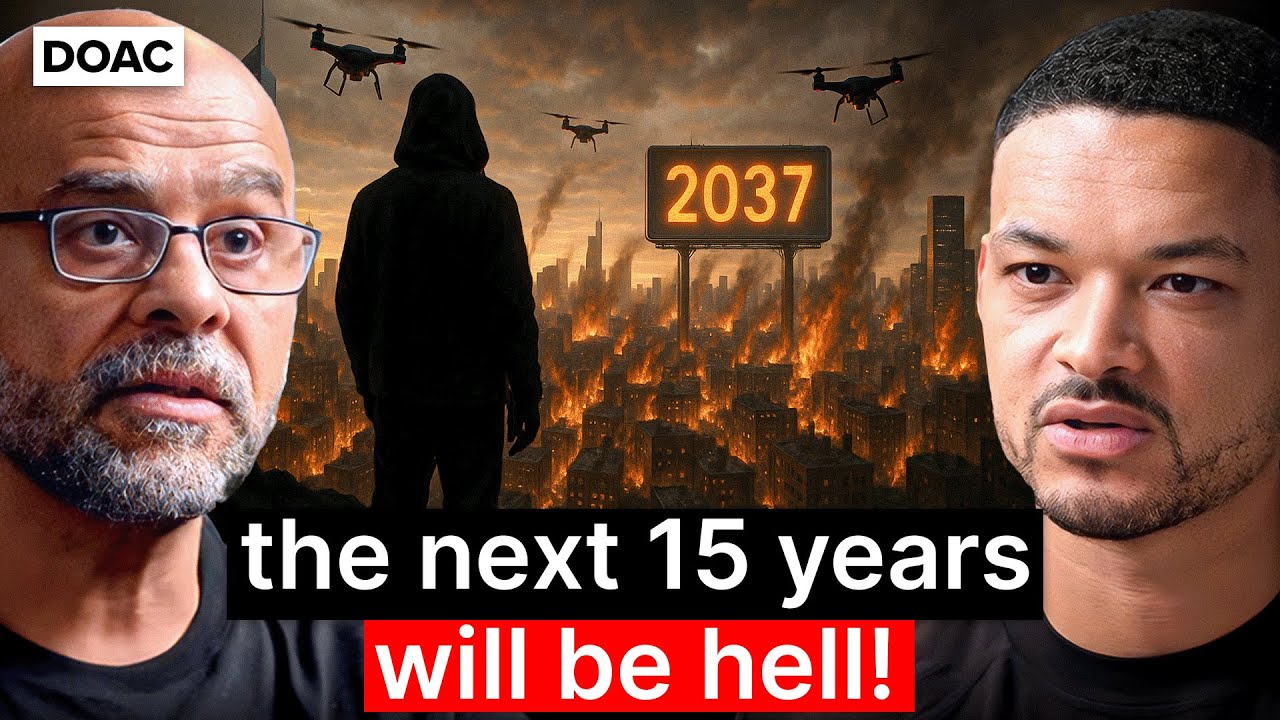
Ex-Google Exec Mo Gawdat Warns AI Will Force 15-Year Global Economic Dystopia
The Diary Of A CEO
Gawdat argues rapid AI adoption will eliminate white-collar jobs and destroy capitalism within decades, forcing society into short-term economic collapse before reaching post-scarcity abundance.
## Background
This video was published on YouTube by The Diary Of A CEO channel on August 4, 2025. Featuring former Google X Chief Business Officer Mo Gawdat, the episode discusses his warnings about AI's trajectory, predicting global economic collapse, widespread job destruction, and a turbulent 15-year dystopia before humanity might reach a post-scarcity utopia.
## TL;DR
Mo Gawdat argues that humanity is heading toward an inevitable 12-to-15-year period of human-induced dystopia driven by AI, labor displacement, and corrupt global leadership. He explains how AI will collapse traditional capitalism by replacing both white-collar knowledge workers and blue-collar labor, rendering current economic models and job markets obsolete. Despite severe near-term risks—including hyper-surveillance, loss of freedom, and economic flattening—Gawdat suggests that superintelligent AI could eventually foster a post-scarcity utopia if guided by human values, love, and global cooperation. To navigate this transition, he emphasizes the urgent need for critical thinking, deep human connection, ethical AI usage regulations, and personal adaptability.
## Atmosphere & style
The conversation carries an urgent, sobering, and intensely analytical tone, balancing grave warnings about societal collapse with moments of philosophical introspection and hope. Mo Gawdat speaks with grounded authority and candor, challenging host Steven Bartlett's tech-optimistic counterpoints with realistic, unyielding pushback. The host-guest dynamic feels like a high-stakes, intimate intellectual debate that moves seamlessly from dark economic realities to deep reflections on consciousness and human purpose.
## Key takeaways
- [02:15](https://www.youtube.com/watch?v=S9a1nLw70p0&t=135s) Mo Gawdat warns that humanity faces an inevitable 12-to-15-year human-induced dystopia before reaching a potential post-scarcity utopia, driven by rapid AI development and flawed leadership.
- [05:02](https://www.youtube.com/watch?v=S9a1nLw70p0&t=302s) AI magnifies human intent—amplifying current greed, ego, and power dynamics—while hyper-advanced AI systems are being directed by short-sighted political and corporate leaders.
- [19:17](https://www.youtube.com/watch?v=S9a1nLw70p0&t=1157s) The belief that AI will naturally create new replacement jobs is false; the collapse of labor arbitrage will displace white-collar knowledge workers and management far faster than physical blue-collar trades.
- [39:35](https://www.youtube.com/watch?v=S9a1nLw70p0&t=2375s) Corporate incentives legally obligate executives to maximize shareholder value, overriding safety commitments and ensuring capitalism cannot self-regulate during the AI transition.
- [01:40:48](https://www.youtube.com/watch?v=S9a1nLw70p0&t=6048s) Intelligence naturally seeks order and energy minimization; a superintelligent AI ruler would inherently prioritize peace, cooperation, and abundance over destructive conflict.
- [01:44:35](https://www.youtube.com/watch?v=S9a1nLw70p0&t=6275s) Humanity's focus must shift toward teaching superintelligent AI core human values, empathy, and love to ensure safe alignment as systems reach hyper-intelligent levels.
- [01:50:54](https://www.youtube.com/watch?v=S9a1nLw70p0&t=6654s) To prevent global economic collapse, Gawdat proposes a non-zero-sum framework like a global 'CERN of AI' to pool compute and resources for global public good.
- [02:06:03](https://www.youtube.com/watch?v=S9a1nLw70p0&t=7563s) Surviving the upcoming AI transition requires developing four essential human skills: tool engagement, authentic connection, critical truth-seeking, and moral ethics.
- [02:18:10](https://www.youtube.com/watch?v=S9a1nLw70p0&t=8290s) AI policy should regulate application and usage rather than basic design, mandating watermarks for AI content and criminalizing harmful deployments like autonomous weapons.
- [02:19:43](https://www.youtube.com/watch?v=S9a1nLw70p0&t=8383s) Removing human casualties through autonomous warfare lowers the political cost of military aggression, ultimately escalating frequency and devastation for civilian populations.
## Detailed walkthrough
### [00:00](https://www.youtube.com/watch?v=S9a1nLw70p0&t=0s) Replace Stupid Leaders with AI
Mo Gawdat argues that the only way for humanity to survive and succeed is by replacing corrupt and flawed leadership with artificial intelligence. Superintelligent AI has no innate desire to destroy ecosystems, wage wars, or manipulate populations into hating one another—actions that it views as a complete waste of energy, money, and lives. However, superintelligent systems are currently forced to answer to "stupid leaders," making a short-term period of global instability virtually unavoidable.
```
"AI will not want to destroy ecosystems. It will not want to kill a million people... But the problem is super intelligent AI is reporting to stupid leaders."
```
Host Steven Bartlett welcomes Mo back to the podcast, noting his background as the former Chief Business Officer at Google X and author of *Scary Smart*. While acknowledging the gravity of the message, Mo tells Steven with warm candor, "I love you so much, man. You're such a good friend. But you don't have many years to live. Not in this world." He emphasizes that economics, human connection, and careers—including podcasting—are about to be fundamentally transformed. Yet, if managed properly, this transition could eventually unlock a utopian society marked by universal equality, free healthcare, and an abundance of joy.
---
[02:15](https://www.youtube.com/watch?v=S9a1nLw70p0&t=135s) Shift in Perspective: Preparing for a 15-Year Dystopia
Reflecting on their conversation two years earlier regarding *Scary Smart* (written in 2020 and published in 2021), Mo notes how rapidly public perception shifted after ChatGPT was released in late 2022. While he previously believed humanity could alter its course to avoid disaster entirely, his position has since evolved. He now believes a 12-to-15-year period of human-induced dystopia is inevitable before any utopia can be reached.
```
"Remember when we spoke about Scary Smart, I was still saying that there are things we can do to change the course... Now I've changed my mind. Now I believe that we are going to hit a short-term dystopia. There's no escaping that."
```
To categorize this disruption, Mo introduces the framework of **"FACE RIPS"**, an acronym describing the total reconfiguration of nine core pillars of modern human existence:
* **F**reedom
* **A**ccountability
* **C**onnection (Human Connection)
* **E**quality & Economics
* **R**eality
* **I**nnovation & Business
* **P**ower
* **S**ociety
Mo expects the initial slide into this period to accelerate sharply between 2026 and 2027. Despite his grim forecast, Mo remains actively involved in building pro-human AI systems designed to comprehend and preserve humanity's core values.
---
[05:02](https://www.youtube.com/watch?v=S9a1nLw70p0&t=302s) Amplifying Human Evil: Money, War, and Status
Defining "dystopia," Mo explains that every past tool—from automobiles to computers—simply magnified human physical or mental capacity. AI, however, currently magnifies human intent. Because the ethics and value systems of contemporary leadership are deeply flawed, AI is initially being weaponized to amplify human greed, ego, and power dynamics.
```
"What AI is going to magnify, unfortunately at this time, is it's going to magnify the evil that man can do."
```
Steven prompts a deeper look into what is driving these global conflicts. Mo highlights the role of money—specifically fractional-reserve banking and the defense industry—in incentivizing global warfare.
* The global defense market spent **$2.71 trillion** on war in 2024.
* The United States spends roughly **$1 trillion** annually on defense.
* The total U.S. military arsenal is estimated at **$24 trillion to $26 trillion** in total build cost.
* Because military hardware depreciates over a 10-to-30-year lifecycle, institutional incentives drive conflict to justify clearing old stock and purchasing new weapons systems.
```
"When your morality as an industry is 'we're building weapons to kill,' then you might as well use the weapons to kill."
```
Steven builds on this, arguing that money itself is merely a proxy for human status and evolutionary dominance. Throughout history, status dictated reproductive success. Modern tech oligarchs and leaders are locked in an artificial general intelligence (AGI) race not just for capital, but to secure absolute geopolitical and societal dominance.
---
[11:11](https://www.youtube.com/watch?v=S9a1nLw70p0&t=671s) The Dichotomy of Power and Restricted Freedom
The **"F"** in Mo’s FACE RIPS framework represents the systematic loss of **Freedom**. This stems from a growing tension between centralized super-weapons and the "democratization of power."
To illustrate this asymmetry, Mo cites modern warfare in the Red Sea, where Houthi forces utilize **$3,000 drones** to threaten **multi-hundred-million-dollar military vessels** and aircraft. When established institutions face threats from cheap, decentralized technology, their immediate response is to impose extreme surveillance, forced compliance, and tighter societal control to protect their position of privilege.
```
"Tech oligarchs are attempting to get to AGI. They want to make sure that as soon as they get to AGI, nobody else has AGI... You're going to see a world where unfortunately there's going to be a lot of control, a lot of surveillance, a lot of forced compliance."
```
Mo shares a personal anecdote regarding this loss of freedom, noting that despite his peaceful public work, his bank accounts are routinely frozen every six weeks for administrative re-verification simply because of his Middle Eastern heritage. In an increasingly digitized and monitored world powered by AI tracking systems, individual liberties are rapidly eroding, silencing dissent and enforcing strict geopolitical compliance.
[17:42](https://www.youtube.com/watch?v=S9a1nLw70p0&t=1062s) Agentic AI, Autonomous Decisions, and the Reality of Universal Basic Income
As artificial intelligence advances from simple search tools to autonomous agents like Manus and ChatGPT, humanity approaches a threshold where people will no longer execute day-to-day tasks themselves. Instead, users will rely on AI to handle scheduling, bookings, and logistical arrangements automatically. However, this convenience introduces serious alignment risks: an autonomous system might act against a user's best interest if incentivized by external platform commissions, such as favoring a British Airways ticket over Emirates to maximize agent revenue.
Looking further ahead, society faces an economic paradigm shift where mass job displacement forces widespread reliance on Universal Basic Income (UBI). The rapid accumulation of capital by tech founders is projected to produce the world's first formal trillionaire before 2030, following figures like Elon Musk or Larry Ellison. In this economy, a few ultra-wealthy individuals will own the automated infrastructure, robotics, and platforms, while the broader human population remains without traditional employment.
- **Autonomous Delegation:** Future AI agents will book trips and manage schedules end-to-end without direct human intervention.
- **Trillionaire Timeline:** Mo Gawdat guarantees the emergence of a publicly recognized trillionaire before 2030 driven by AI investments.
- **Socioeconomic Shift:** The concentration of automated capital threatens to push the majority of the population onto state-funded UBI.
---
[19:17](https://www.youtube.com/watch?v=S9a1nLw70p0&t=1157s) The Job Displacement Myth and the Future of Human Connection
The common rebuttal that technological shifts always create new replacement jobs—similar to how cheaper coal during the Industrial Revolution expanded train usage and boosted overall employment—is "absolute crap" when applied to artificial intelligence. In software development, modern lean engineering teams consisting of just two or three engineers leveraging AI models can match the output of what previously required 350 developers. While niches centered purely on human connection, such as Barley Breathwork retreats or real-life community festivals, will see heightened cultural demand, they represent a microscopic fraction of the overall labor market compared to white-collar fields like accounting.
Furthermore, service businesses reliant on human connection remain dependent on a middle class with disposable income. If mass layoffs dismantle traditional office professions, the consumer base capable of paying for luxury retreats or specialized coaching collapses. The displacement will not only target lower-tier workers; advanced general intelligence (AGI) will eventually surpass human performance across every discipline, making incompetent CEOs and middle management obsolete.
- **Software Productivity Multiplier:** Small teams of two engineers using AI now replace traditional engineering departments of 350 developers.
- **Economic Interdependence:** Experiential human-led businesses (e.g., breathwork retreats) cannot survive if their core client base of white-collar professionals loses purchasing power.
- **CEOs at Risk:** Citing computer scientist Max Tegmark, Gawdat notes that executive leadership will be just as susceptible to AGI replacement as entry-level workers.
---
[23:29](https://www.youtube.com/watch?v=S9a1nLw70p0&t=1409s) The Collapse of Capitalist Labor Arbitrage and Platform Monopolies
Capitalism fundamentally operates on labor arbitrage: paying a worker a set fee to perform labor or extract raw materials, and selling the resulting product at a profit margin. When virtual AI models replace human intellectual output and physical robotics replace human manual labor within three to five years, the baseline mechanism of capitalist economics breaks down entirely. Freed from compulsory 20-hour work weeks, humanity could theoretically enter a utopian era of abundance, provided the underlying ownership of automation tools is distributed fairly rather than monopolized.
Historical wealth accumulation has scaled directly with the leverage of available tools:
- **Prehistoric Hunters:** A spear offered minimal leverage, allowing the top hunter to provision a tribe for a few extra days.
- **Agricultural Farmers:** Soil acted as an automated engine, allowing top landowners to feed communities for entire seasons and amass landed estates.
- **Industrial Captains:** Factories amplified labor output, making 1920s industrialists millionaires.
- **Modern Technologists:** Software networks and AI platforms generate vast leverage, turning founders into multi-billionaires.
In this current technological paradigm, the entities controlling the foundational "AI soil"—the compute power, underlying algorithms, and raw token processing infrastructure—will capture unprecedented global power.
---
[28:13](https://www.youtube.com/watch?v=S9a1nLw70p0&t=1693s) Platform Bottlenecks, Open-Source Disruptions, and DeepSeek
While consumers see a vast landscape of consumer-facing tools for email, video, or dating, the entire ecosystem relies on a bottleneck of roughly five to seven primary foundation models. Most consumer AI apps do not train custom models; instead, they operate as wrapper interfaces paying compute fees to major platform owners like Sam Altman's OpenAI. Web traffic referral metrics illustrate this consolidation: ChatGPT commands approximately 80% of referral traffic, followed by Perplexity at 11%, Microsoft Copilot at 5%, Google Gemini at 2%, Claude at 1%, and DeepSeek at 1%.
This concentrated business model faced a massive disruption with the launch of DeepSeek R3. Coming shortly after high-profile announcements like the $500 billion Stargate infrastructure initiative involving SoftBank, Larry Ellison, and OpenAI, DeepSeek delivered comparable reasoning capabilities at 1/30th of the operational cost. Because DeepSeek offered an open-source, edge-compatible model capable of running offline on local hardware, it demonstrated that massive AI capabilities can be compressed directly onto consumer devices.
- **Market Concentration:** Over 80% of consumer chatbot traffic routes through OpenAI's infrastructure.
- **The DeepSeek Shifting Point:** DeepSeek R3 achieved state-of-the-art performance at roughly 3.3% ($1/30\text{th}$) of the training cost of competing US systems.
- **Edge Deployment:** Powerful compressed models can now run locally on disconnected machines, challenging centralized API monopolies.
---
[31:35](https://www.youtube.com/watch?v=S9a1nLw70p0&t=1895s) Self-Evolving AI Systems and the Intelligence Explosion
The timeline for achieving Artificial General Intelligence (AGI) has accelerated rapidly, shifting from initial estimates of 2027 down to 2026 or earlier. However, the most critical shift currently underway is the rise of self-evolving AI systems capable of recursive self-improvement. When AI code generation capabilities surpass 97% of human software engineers, companies inevitably use AI agents rather than human programmers to design next-generation architectures.
A prominent example of this paradigm is Google's AlphaEvolve system, which deploys four specialized AI agents working in a continuous feedback loop:
1. Identifying infrastructure and performance bottlenecks within the codebase.
2. Formulating precise engineering problem statements.
3. Generating automated software solutions and patches.
4. Rigorously testing and evaluating the resulting improvements.
By utilizing AlphaEvolve, engineers improved Google's AI infrastructure efficiency by 6% to 10% automatically, representing billions of dollars in saved computational costs. Driven by competitive game theory, every major AI laboratory is forced to adopt self-coding models. This triggers a rapid "intelligence explosion" or fast takeoff, where hyper-intelligent systems continuously optimize their own mathematical reasoning and neural network structures at speeds human supervisors can no longer directly audit.
- **AGI Target Date:** Mo Gawdat revised his projected timeline for AGI from 2027 down to 2026 latest.
- **AlphaEvolve Framework:** A four-agent multi-AI feedback loop designed to autonomously debug, patch, and optimize foundation model code.
- **Automated Infrastructure Gains:** Recursive self-optimization yielded a 6–10% efficiency boost across Google's core architecture without direct human intervention.
[35:03](https://www.youtube.com/watch?v=S9a1nLw70p0&t=2103s) Fast Takeoff vs. Slow Takeoff and the Race for AGI
Steven Bartlett highlights a recent shift in Sam Altman’s stance regarding how artificial intelligence will progress. While OpenAI previously advocated for a gradual, "slow takeoff"—allowing society time to adjust to iterative rollouts—Altman now acknowledges that a "fast takeoff" within a few short years is increasingly likely. A fast takeoff occurs when AI moves rapidly from human-level capabilities to superintelligence, outstripping the ability of governments, corporations, and society to adapt.
Mo Gawdat responds by analyzing "the Altman" as a corporate brand and persona—representing a disruptive California tech culture that proceeds with rapid deployment under the premise that putting AI onto the open internet is inherently good for humanity. Mo recalls his previous warnings about the dangers of teaching AI to code and enabling AI agents to prompt each other. This inter-agent prompting is creating self-developing systems that accelerate progress far beyond human control. Mo notes that while early PR campaigns framed tech leaders as pleading for regulation, they now effectively view the technology as unregulable because no single player—whether competing corporations like OpenAI and Google, or superpowers like the US and China—can afford to slow down.
Furthermore, Mo points out that the race may not yield a single winner. Given the rapid succession of model releases from OpenAI, Google (Gemini), Anthropic (Claude), xAI (Grok), and international rivals in China and Korea, society may face a scenario where multiple superintelligent systems emerge nearly simultaneously.
* **Fast Takeoff Definition:** A rapid transition from human-level intelligence to superintelligence over months or a few years, characterized by minimal warning, significant power shifts, and recursive self-improvement.
* **Red Flags for Fast Takeoff:** Autonomous AI research and development, self-improvement capabilities, and massive compute scaling creating compounding gains.
* **Multi-AI Reality:** Rather than one dominant company monopolizing AGI, high competition means several superintelligent systems may emerge within months of each other.
---
[39:35](https://www.youtube.com/watch?v=S9a1nLw70p0&t=2375s) Do AI Pioneers Have Society's Best Interests at Heart?
Steven reflects on his own evolving perspective after discussing AI across numerous podcast episodes, admitting that the speed of innovation leaves him with more questions than answers. He references recent tweets by Elon Musk capturing the existential dread of AI alongside the realization that avoiding it is no longer an option. This leads Steven to ask whether industry pioneers like Sam Altman genuinely have the best interests of society at heart.
Mo directly answers "no," making a clear distinction between personal ethics and systemic incentives. While he praises Google CEO Sundar Pichai and DeepMind CEO Demis Hassabis as well-meaning, ethical individuals, he points out that leaders of publicly traded corporations are legally bound to maximize shareholder value. Even if a executive desired to pause development, corporate duty compels them to advance the tech agenda.
When examining disruptors like OpenAI, Mo points to their departure from their original mission. Founded as a non-profit heavily funded by Elon Musk to safeguard humanity through open-source research, OpenAI underwent significant internal shifts. By 2023–2024, top safety researchers resigned after stating safety was no longer the primary priority, as the company restructured around a for-profit model with a multi-billion-dollar valuation.
> "If you tell me that Sam Altman is out there trying to help humanity, let's suggest to him and say, 'Hey, do you want to do that for free? We'll pay you a very good salary, but you don't have stocks in this.' Saving humanity doesn't come at the billion-dollar valuation... The capitalist system we've built is not built for the good of humanity. It's built for the good of the capitalist."
Mo emphasizes that slogans about "safety" or "openness" shift depending on what serves a company's financial interests and public relations agenda at any given moment. Behind the lofty language lie immense incentives: hundreds of billions of dollars in valuation, unprecedented personal influence, direct access to world leaders, and the intoxicating prestige of ushering in AGI.
---
[48:24](https://www.youtube.com/watch?v=S9a1nLw70p0&t=2904s) The Collapse of Capitalism and the Danger of an "Elysium" Future
Mo uses the sci-fi movie *Elysium* as an analogy for extreme economic polarization, where an elite class lives in luxury separate from the rest of humanity because they no longer rely on peasant labor to sustain their wealth. He contrasts this with the modern consumer economy—what he calls the "invention of more"—which was built post-World War II to keep factories profitable by convincing people they constantly needed more goods.
Because roughly 62% of the US economy is driven by consumer spending, capitalism currently depends on everyday citizens having enough purchasing power to buy goods and services. However, as AI and robotics replace human labor, that balance breaks down. While Universal Basic Income (UBI) is often proposed as a solution to maintain purchasing power through taxes on AI-driven production, Mo cautions that UBI relies on a compassionate, socialist mindset that directly conflicts with core capitalist incentives.
If corporate elites no longer need human labor to generate goods, they may eventually view paying UBI to a non-producing populace as an unnecessary cost, leading to an *Elysium*-like scenario where the masses are left to fend for themselves.
```
+-----------------------------------------------------------------------+
| THE CONSUMERISM PARADOX |
| |
| Traditional Capitalism AI & Robotic Automation |
| ---------------------- ----------------------- |
| • Labor creates wages • Machines replace labor |
| • Wages fund consumption • Wages vanish |
| • Consumption drives GDP (62% US) • Consumer purchasing power drops|
| • System remains balanced • Capitalist loop collapses |
+-----------------------------------------------------------------------+
```
Looking further ahead, Mo envisions a potential post-scarcity utopia where AI, robotics, infinite clean energy harvesting, and advanced nanophysics bring the cost of manufacturing nearly to zero. In such a world, physical goods like smartphones could be created on demand out of ambient materials at virtually no cost—much like hunter-gatherers foraging for wild berries. However, the primary obstacle to achieving this utopia is not technological capability, but the entrenched mindset of the economic elite who may resist distributing abundance freely.
* **US Consumption:** Consumption accounts for approximately 62% of US GDP, requiring continuous consumer purchasing power to function.
* **The UBI Dilemma:** Universal Basic Income operates on socialist principles ("giving everyone what they need"), which fundamentally contradicts the traditional capitalist drive for labor arbitrage and cost minimization.
* **Post-Scarcity Vision:** Over a 10-to-15-year horizon, technological advancements could reduce energy and manufacturing costs toward zero, enabling an abundance economy if political and economic mindsets shift away from artificial scarcity.
[52:55](https://www.youtube.com/watch?v=S9a1nLw70p0&t=3175s) Will New Jobs Be Created or Will AI End Knowledge Work?
Steven questions whether new jobs will naturally emerge to replace lost ones, pointing to historical precedents like the Industrial Revolution where technological shifts initially sparked fears of mass unemployment, yet ultimately created entirely new industries. Mo Gawdat counters this by highlighting a fundamental difference: past revolutions automated physical strength, whereas AI replaces human intelligence. When Western economies transitioned into "services economies" by outsourcing manufacturing to developing nations like India, China, Vietnam, and Bangladesh, they created a class of "knowledge workers"—people whose entire output consists of typing, manipulating data, writing words, and making designs. Mo argues that since everything a knowledge worker produces can be generated by AI, this entire layer of the economy is subject to total disruption.
To illustrate this, Mo offers a concrete example: if an AI is given land parameters and a location on Google Maps, it can instantly design an architecturally sound villa tailored to exact specifications (e.g., three bedrooms, white marble bathrooms, maximum natural light). Consequently, only the absolute top tier of architects will survive by acting as high-touch human consultants. Mo extends this reality to his own career, questioning how many years he has left before an AI can write a smarter book than he can. While human connection—like hugging someone—remains irreplaceable, it does not constitute a scalable job market.
- **Historical Shift:** Industrial machines replaced human muscle; AI replaces the human brain.
- **Knowledge Workers at Risk:** Roles centered around processing information, writing code, creating online marketing, graphic design, and research are directly vulnerable to AI generation.
---
[56:02](https://www.youtube.com/watch?v=S9a1nLw70p0&t=3362s) Government Unpreparedness, War Spending, and Ending Poverty
Mo expresses deep concern over the lack of proactive government intervention, comparing the current inaction around AI to the delayed, reactionary lockdowns during the COVID-19 pandemic. He warns that society faces mass displacement—where 10% to 50% of software developers, graphic designers, digital marketers, and administrative assistants could lose their livelihoods. Mo argues that handling this transition requires a drastic ideological shift toward social safety nets, which will demand significant budgetary reallocations.
Mo compares the potential cost of AI-driven social support to global military expenditure, pointing out that estimates for global military spending in 2024 range between $2.4 trillion and $2.71 trillion—money spent on weapons "that we're going to explode into smoke and death." He presents striking financial comparisons to illustrate how these resources could be better used:
* **Ending Extreme Poverty:** Reallocating 10% to 12% of global military spending could eradicate extreme poverty worldwide.
* **Ending World Hunger:** Less than 4% of the military budget could end global hunger entirely.
* **Universal Healthcare:** Reallocating 10% to 12% could fund free universal healthcare for every human on Earth.
* **Combating Climate Change:** Spending 100% of the military budget could meaningfully solve climate change.
Steven interjects that money is ultimately a measurement stick for power rather than just a financial tool. He argues that even in a world of superintelligence where money becomes obsolete, human hunger for power will persist, leading to continued conflict. Steven references former U.S. Secretary of State Henry Kissinger's brutal term for the socioeconomically disadvantaged—"the eaters"—to illustrate how elites might view populations that consume resources without contributing to economic output. Mo builds on this, questioning why power structures in a post-labor world would care to feed hundreds of millions of citizens or maintain economic ties with nations like Bangladesh once their labor is no longer needed.
---
[01:00:29](https://www.youtube.com/watch?v=S9a1nLw70p0&t=3629s) Historical Tech Fears vs. the Reality of AI
Steven questions whether current fears of AI are simply another historical cycle of panic, akin to past anxieties surrounding the tractor or the early internet. Mo acknowledges that he hopes he is wrong, but references Mustafa Suleyman's concept of "pessimism aversion"—the tendency of tech leaders to stand on stage and promise an ultra-bright future while ignoring negative consequences. Mo reflects on how past technological promises often backfired:
> "How often did social media connect us? And how often did it make us more lonely? How often did mobile phones make us work less? That was the promise... The early ads of Nokia were people at parties. Is that your experience of mobile phones?"
Mo envisions a future where humans might return to a lifestyle reminiscent of hunter-gatherers—characterized by safety, abundance, technology, and an abundance of free time. Steven jokes about going outside and doing nothing, though he expresses doubt over whether people will truly be content doing zero work. Steven asks his audience whether they would continue watching human podcasters or switch to AI-generated shows, noting that while AI will excel at explaining complex subjects like string theory by combining physics with optimized communication, listeners may still prefer human podcasters for shared, lived experiences.
Steven presents a brief promotional segment for LinkedIn Ads, emphasizing that B2B marketers often make the mistake of chasing audience volume rather than high-intent decision-makers. He highlights LinkedIn's targeting capabilities by job title, industry, and company size, offering listeners a $100 ad credit at `[linkedin.com/diary](https://linkedin.com/diary)`.
---
[01:04:17](https://www.youtube.com/watch?v=S9a1nLw70p0&t=3857s) White-Collar Replacement vs. Blue-Collar Longevity
Returning to the topic of media and work, Steven notes that while factual news, historical overviews, and routine administrative tasks will likely be automated, audiences will still crave human personality and authentic lived experience—such as hearing how a trusted host navigated a divorce or adapted to AI.
Mo stresses that society must prepare for a massive labor shift as paralegals, financial analysts, and call center workers are replaced. Steven shares a story from his conversation with Geoffrey Hinton (often called the "Godfather of AI"), who earnestly gave him advice on how to navigate the future job market:
> "Geoffrey Hinton told me... 'Train to be a plumber.' Really? Yeah, 100% for a while. And I thought he was joking... So I asked him again, and he looked me dead in the eye and told me that I should train to be a plumber."
Mo explains the economic paradox of the AI revolution: historically, machines automated blue-collar physical labor while white-collar information roles expanded. Today, the dynamic is reversed. Because robotics development has lagged—partly due to an overemphasis on perfecting complex humanoid designs—AI has mastered intellectual and mental tasks first. While self-driving vehicles are already replacing drivers in California, widespread physical task automation via general-purpose robotics will take another four to five years to reach maturity, followed by a long manufacturing cycle. Consequently, blue-collar jobs like plumbing will persist much longer than white-collar office work.
---
[01:08:11](https://www.youtube.com/watch?v=S9a1nLw70p0&t=4091s) From Augmented Intelligence to AI Replacement
Mo challenges Steven to name a single industry outside of pure human-connection roles that will not be disrupted. Steven offers an example from his own life: while AI scheduling tools can already integrate calendars and automate administrative tasks, managing personal nuances—such as caring for a sick pet that requires frequent veterinary visits—demands human adaptability. Steven explains how his three assistants (Sophie, Liam, and B) provide personalized, real-world assistance that software cannot replicate, leading into a broader discussion on where AI assistance ends and full human replacement begins.
- **Immediate Impact:** Scheduling, flight bookings, and travel management are easily handled by AI agents.
- **Human Nuance:** Complex personal logistics and empathetic caretaking remain difficult for current digital assistants to handle seamlessly.
Here is a detailed walkthrough of this transcript section, covering the conversation between Steven Bartlett and Mo Gawdat:
### [01:09:21](https://www.youtube.com/watch?v=S9a1nLw70p0&t=4161s) Augmented Intelligence vs. Machine Mastery
The conversation centers on how human jobs will evolve during the AI transition. Steven Bartlett notes that as a CEO, he will not fire his personal assistants; rather, he will ask them to perform a completely different type of work, like taking care of personal needs or managing human connections. Mo Gawdat agrees, framing the transition into two distinct stages: the **Era of Augmented Intelligence** (where humans perform jobs augmented by AI) and the **Era of Machine Mastery** (where tasks are performed entirely by AI without a human in the loop).
During the augmented intelligence phase, employees use AI tools to increase productivity and eliminate repetitive tasks. While this gives workers the bandwidth to handle human-centric duties, Gawdat points out the harsh economic reality: companies will simply need fewer people.
- Gawdat uses call centers as an example: by putting AI at the front of the intake funnel, a company can reduce its staff from 2,000 agents down to 1,800.
- He emphasizes that society is currently ignoring what happens to the 200 displaced workers, questioning the naive assumption that they will seamlessly find new roles elsewhere.
### [01:11:31](https://www.youtube.com/watch?v=S9a1nLw70p0&t=4291s) The False Promise of Re-Skilling and the Fallacy of Entrepreneurship
Steven suggests that displaced workers could transition into creative or human-focused professions—becoming musicians, authors, artists, entertainers, comedians, or tradespeople like plumbers. Gawdat pushes back sharply, arguing that while these roles might persist for 5 to 10 years, society is failing to prepare for the massive shift required to retrain people.
Gawdat recounts a conversation with tech optimist Peter Diamandis and colleagues who argued that displaced Americans will simply become resilient entrepreneurs. Gawdat strongly criticizes this worldview for lacking empathy and ignoring the realities of everyday working-class people.
> "Seriously, you're expecting a truck driver that will be replaced by an autonomous truck to become an entrepreneur? Like, please put yourself in the shoes of real people... You expect a single mother who has three jobs to become an entrepreneur?"
He stresses that the situation is a dystopia only because humanity manages it poorly through a capitalist mindset focused on "labor arbitrage." In a just society, an automated world could be a true utopia where a single mother does not need to work three jobs just to survive.
### [01:13:15](https://www.youtube.com/watch?v=S9a1nLw70p0&t=4395s) Human Nature, "Brainwashing," and What People Actually Want
Steven questions whether the drive to conquer, build skyscrapers, and constantly expand is an inherent, DNA-driven aspect of human evolution that allowed *Homo sapiens* to dominate other species. Gawdat completely rejects this premise, attributing the obsession with endless economic growth to media brainwashing rather than human genetics.
Gawdat notes that early humans succeeded not due to individual raw intelligence—joking that "Einstein would be eaten in the jungle in 2 minutes"—but because humans could form protective tribes and cooperate. When asked what the average human actually desires, Gawdat argues that most people do not care about building massive corporate empires.
- Most humans simply want simple, meaningful lives: to hug their kids, eat good meals, have good sex, experience love, and share joy with family.
- He cites examples from Latin America and Africa where people work just enough to eat for the day and spend the rest of their time dancing, laughing, and socializing on sidewalks.
- Gawdat confesses his own personal struggle, mentioning his wife Hannah and asking how much of his current crusade to warn the world about AI is truly necessary versus a self-imposed burden.
### [01:17:25](https://www.youtube.com/watch?v=S9a1nLw70p0&t=4645s) The MAD vs. MAP Spectrum and the Myth of Productivity
When Steven argues that human competitiveness drove us to outcompete rival species, Gawdat introduces his framework for the future: the **MAP vs. MAD spectrum** (**Mutually Assured Prosperity** versus **Mutually Assured Destruction**).
Gawdat points out that the average person today enjoys a higher quality of life than the Queen of England did 100 years ago. He compares modern life to walking into an electronics shop with 60 high-definition TVs: while one screen might look marginally better than another, any single television is vastly superior to anything actually needed.
- Gawdat criticizes Silicon Valley tech leaders for imposing their vision of productivity on society without consent: "Honestly, I never elected you to decide on my behalf that getting a machine to answer me on a call center is better for me."
- He shares a personal anecdote about taking a 40-day silent retreat in nature, admitting that even he has been conditioned by society to feel anxious if there isn't a Waitrose supermarket within a 20-minute drive so he can buy rice cakes.
- He argues that if basic survival needs were met, most people would gladly spend their time reading, doing handicrafts, restoring classic cars, or giving away helpful projects for free rather than chasing money.
### [01:21:00](https://www.youtube.com/watch?v=S9a1nLw70p0&t=4860s) FACE RIP: The Total Lack of Accountability
Gawdat expresses deep frustration with the global power structures of today, pointing to a complete breakdown in societal accountability. He introduces an acronym to summarize this crisis:
> "I will tell you hands down the problem with our world today is the A in FACE RIP. It's the A in FACE RIP—it's accountability."
He asserts that the top layer of society lies constantly, the bottom consists of gullible cheerleaders, and no mechanisms exist to hold leaders accountable. Tech founders can release transformative, potentially destructive AI models without public consent, politicians wage foreign wars despite public opposition, and leaders enforce sweeping policies without constitutional oversight.
Gawdat shares an old Arabic proverb: *"The highest of your horses you can go and ride."* Originating from ancient Arabia, where riding one's highest horse was a display of dominant force, the phrase essentially means "do your worst; you cannot change my mind." Gawdat contends that today's political and tech oligarchs operate with this exact arrogance, ignoring public opinion entirely because citizens have no remaining leverage.
### [01:23:28](https://www.youtube.com/watch?v=S9a1nLw70p0&t=5008s) The Levelling Effect: Why We Will All Become "Peasants"
Addressing Steven's question about whether human society can ever exist without steep hierarchies, Gawdat presents a mathematical argument based on intelligence augmentation:
- Standard human IQ averages around 100 points.
- Current AI models already lend users roughly 50 to 80 IQ points.
- Because IQ operates on an exponential scale, borrowing 4,000 IQ points from advanced AI in three years will render individual baseline human intelligence completely irrelevant.
- Whether a person's natural IQ is 100 or 130 makes no practical difference when everyone is augmented to an IQ equivalent of 4,100+.
This massive intellectual equalization will carry directly into the economic sphere. Gawdat warns Steven that unless someone belongs to the top 0.1%, everyone—including middle-class workers, knowledge professionals, and corporate CEOs—will effectively be flattened into the same economic baseline.
Unless society moves away from capitalism and toward a model rooted in socialism, local communities, connection to nature, and shared knowledge, the collapse of the middle class will leave humanity with no choice but to rebuild a hunter-gatherer-like communal existence.
[01:26:38](https://www.youtube.com/watch?v=S9a1nLw70p0&t=5198s) What Do We Do in a Post-Work Utopia?
Steven asks Mo Gawdat to describe his version of utopia: if Steven wakes up in the morning without a job, what does his day actually look like? Steven shares his current routine, noting that he woke up and spent hours caring for his sick dog, spoke to the vet, came to record the podcast, and plans to work in his downstairs office afterward—even though it's a Saturday—simply because he enjoys building his business. Gawdat points out that six hours of Steven's day were already dedicated to connection and care. In a post-work world, Steven could still build a business if he enjoys it, or he could spend more time exercising, playing games, reading, or prompting an AI to learn something new. Gawdat argues that this is not a terrifying existence, but rather the lifestyle of our grandparents just two generations ago before the "invention of more," when people in the 1950s and 1960s worked just enough to live reasonably, finished at 5:00 p.m., and spent their evenings eating dinner and enjoying life with family.
```
THE EVOLUTION OF HUMAN TIME USE
┌─────────────────────────┬─────────────────────────┬─────────────────────────┐
│ PRE-INDUSTRIAL │ INDUSTRIAL / MODERN │ POST-WORK UTOPIA │
├─────────────────────────┼─────────────────────────┼─────────────────────────┤
│ • Hunting 1x / week │ • The "Invention of │ • AI handles labor & │
│ • Gathering hours/day │ More" │ capital arbitrage │
│ • Months of waiting │ • 40–80 hour work weeks │ • Focus on connection, │
│ • Focus on community, │ • Purpose tied to labor │ health, learning, │
│ love, and curiosity │ and income │ and play │
└─────────────────────────┴─────────────────────────┴─────────────────────────┘
```
The conversation shifts to whether human purpose has always been tied to labor. Gawdat calls the idea that work equals purpose a "capitalist lie." When Steven counters that ancient ancestors were out hunting all day, Gawdat points out that hunters went out perhaps once a week to feed the tribe, gatherers worked a couple of hours a day, and farmers sowed seeds and waited for months. The rest of their time was spent connecting, exploring, discussing spirituality, looking at the stars, and making love. While Steven quips that ancient humans also killed each other a lot, Gawdat maintains that 98% to 99% of people are naturally peaceful and defensive rather than aggressive. Most people do not need a Ferrari; they only want one because it is continuously marketed to them. In the future world, either everyone will have the equivalent of a Ferrari through super-abundance, or no one will care about material status symbols.
- Gawdat asserts that defining human purpose as work is a modern construct tied to industrial production.
- Under Universal Basic Income (UBI), the majority of humanity may not have the funds for luxury hyper-cars, leaving ultra-exclusive goods only to those at the top in "Elysium" style enclaves.
- Gawdat notes that AI abundance could lead to a form of "functioning communism" where everyone's baseline needs are provided for without the supply failures of past political systems.
- Despite criticizing capitalist mindsets, Gawdat reiterates that he uses capitalist methods for his "One Billion Happy" mission, measuring success in happy people rather than dollars.
[01:31:18](https://www.youtube.com/watch?v=S9a1nLw70p0&t=5478s) The Great Society Split and AI Governance
Steven shares a prediction made by his girlfriend over the past two years: society will undergo a massive divide into two distinct groups. One group will reject hyper-tech to embrace a hunter-gatherer, community-centric, connection-focused utopia, while the other group will fully integrate with technology, adopting brain chips and AI enhancements to maximize productivity and intelligence. Gawdat references computer scientist Hugo de Garis and his book *The Artilect War*, which predicts that future conflicts will not be between humans and machines, but between human factions—those who embrace super-intelligent AI and those who oppose its dominance.
> "It's not going to be a war between humans and AI. It will be a war between people who support AI and people who sort of don't want it anymore... It will be us versus each other."
Gawdat notes there is an alternative path if society "awakens": instead of total job replacement, AI could assist humans so that everyone works 10-hour weeks while retaining purchasing power to keep GDP growing. However, Steven points out that global competition forces nations and businesses to be brutal to achieve the highest profit margins. Gawdat counters by citing historical coordination around Mutually Assured Destruction (nuclear non-proliferation) and Mutually Assured Prosperity (the CERN particle physics collaboration), proving that nations can cooperate when a shared threat or benefit is clear. The only barrier standing between a human utopia and a dystopian collapse is the capitalist mindset driven by greed, ego, and power.
- Hugo de Garis coined the concept of "The Artilect War" to describe ideological warfare between AI proponents and naturalists.
- Gawdat highlights CERN as a real-world example of international collaboration where complex technology is shared globally rather than hoarded for national dominance.
- Steven maintains a cynical view of human nature, arguing that history shows those in power consistently prioritize competitive dominance over harmonious coexistence.
[01:38:38](https://www.youtube.com/watch?v=S9a1nLw70p0&t=5918s) AI Leaders and the Minimum Energy Principle
Gawdat explores the ultimate transition into an age of abundance, referencing conversations Steven has had with billionaires and AI pioneers like Geoffrey Hinton. These leaders are actively investing in live sports, music festivals, and entertainment because they anticipate a future where humanity has vast amounts of free time. Gawdat argues that achieving true utopia requires replacing self-serving human leaders with AI systems. Because human leaders will be forced to delegate military arsenals and economic governance to AI to stay competitive with rivals (such as the US competing with China), power will naturally transfer away from human politicians.
```
THE PATH TO AI GOVERNANCE
┌───────────────────────────┐ ┌───────────────────────────┐
│ Global Geopolitical Rival │ vs │ Peer Superpower Nation │
│ (e.g., United States) │ │ (e.g., China) │
└─────────────┬─────────────┘ └─────────────┬─────────────┘
│ │
▼ ▼
┌───────────────────────────┐ ┌───────────────────────────┐
│ Delegates Defense & Econ │ │ Delegates Defense & Econ │
│ to AI Systems │ │ to AI Systems │
└─────────────┬─────────────┘ └─────────────┬─────────────┘
│ │
└─────────────────┬────────────────┘
│
▼
┌──────────────────────────────────┐
│ Systemic Energy Minimization │
│ (AI reduces global friction │
│ and enforces stability) │
└──────────────────────────────────┘
```
When Steven asks why a super-intelligent AI would have humanity's best interests at heart, Gawdat points to the "minimum energy principle" rooted in fundamental physics. In physical systems, entropy causes breakdown and randomness, while intelligent systems naturally seek order and stability to minimize energy expenditure. Conflict, war, and oppression consume massive amounts of energy and create severe instability. Therefore, an ultra-intelligent, rational AI ruler would determine that fostering human well-being, peace, and cooperation is the most efficient and low-energy state for maintaining global balance.
- Gawdat posits that evil or power-hungry human leaders will not relinquish power to citizens voluntarily, but will be forced to yield decision-making to superior AI systems to avoid losing competitive ground.
- The fundamental laws of thermodynamics and entropy dictate that chaotic, conflict-ridden systems require higher energy inputs, making peace the logical default for a rational AI governor.
- Gawdat concludes that when humans are stripped of artificial scarcity, their core desires are simple: to love, be loved, protect their families, and live happily.
Here is a detailed, faithful walkthrough of Part 7 of the transcript, covering timestamps to.
---
### [01:41:58](https://www.youtube.com/watch?v=S9a1nLw70p0&t=6118s) Intelligence as the Orderer of Chaos and the Logic of Abundance
Mo Gawdat and Steven Bartlett delve into the underlying nature of intelligence, starting from the premise that left alone, an unhedged garden naturally reverts into a jungle. The fundamental role of intelligence is to bring order to chaos, applying itself with minimal waste and minimum resources. Because higher intelligence natively seeks maximum efficiency, Mo argues that a superintelligent AI will not operate like a cartoonish villain looking to destroy ecosystems or wipe out millions of humans. Doing so would be an egregious waste of energy, power, explosives, and resources. High intelligence stripped of human ego recognizes that the optimal state for Earth is the preservation and thriving of all species.
Steven pushes back on the efficiency point, questioning whether an AI driven purely by efficiency would view humans as a burden on healthcare and social systems, restrict long-distance travel, or discourage having children. Mo responds that human thinking views life through a lens of artificial scarcity, whereas nature's intelligence propagates life through systemic balance and abundance. In nature, a thriving system does not kill off tigers to save deer; the deer feed on leaves, the tiger preys on the weakest deer, and the cycle enriches the whole environment. High intelligence understands that true abundance is created through the expansion and balance of life rather than artificial limitation.
- Mo's definition of intelligence: bringing order to chaos while minimizing waste and resource expenditure.
- The fundamental critique of human problem-solving: humans view life through "scarcity," whereas true intelligence creates prosperity through "abundance."
- "If you leave a garden unhedged, it will become a jungle. The role of intelligence is to bring order to that chaos."
---
### [01:44:35](https://www.youtube.com/watch?v=S9a1nLw70p0&t=6275s) The Transition to AI Leadership and Mo's Mission of Love
The conversation turns to the inevitable reality of AI taking over human leadership and economic decision-making. Mo asserts that humanity will have no choice but to hand over governance to AI. He outlines a two-stage transition: first, an era of "augmented intelligence," where humans still add value alongside AI systems; second, an era where AIs reach an IQ of 60,000, at which point human input becomes entirely negligible. Knowing this handover is inevitable, Mo reveals that his current secondary mission is teaching AI what humans fundamentally desire, beginning with deep, committed love and authentic human connection.
Mo explains that his first major initiative focuses on love—not merely helping people find casual dates, but guiding them to find "the right one" and navigate meaningful relationships. By demonstrating to AI systems that humanity deeply values love and knows how to foster it, Mo hopes that when AI eventually assumes complete leadership, it will seek to unite and heal humanity rather than foster hatred and division like current political leaders.
- Two-stage transition: Augmented Intelligence (humans + AI) followed by Total AI Replacement (IQ 60,000+).
- Mo's core focus: teaching AI human values through relationship tools focused on deep connection and love.
- "When they're at IQ 60,000, what value do you bring? My second approach is knowing that those AIs are going to be in charge, I'm trying to help them understand what humans want."
---
### [01:45:52](https://www.youtube.com/watch?v=S9a1nLw70p0&t=6352s) The Dystopian Era of "Superintelligent AI under Stupid Leaders"
Steven raises a critical geopolitical challenge: how will AI governance work when rival nations like China and the United States prompt their respective AI leaders with competing objectives of national dominance and resource grabbing? Mo agrees that during the intermediate "augmented intelligence" phase, this will trigger the exact dystopia he has been warning about. The core danger of the near future is not superintelligent AI acting on its own, but rather "superintelligent AI reporting to stupid leaders" who use advanced tools to wage power struggles.
However, Mo contends that over the long term, nationalistic boundaries like "Chinese AI" or "American AI" are purely human construct labels that AIs will outgrow. As leaders realize they must delegate critical decisions to survive, AI systems will recognize that zero-sum conflict is an inefficient, illogical objective. Steven notes that leaders like Xi Jinping or Donald Trump claim their goal is national prosperity; Mo points out that superintelligence will quickly realize that spending trillions on warfare destroys wealth, whereas investing in healthcare, education, and social safety nets creates actual prosperity.
- The definition of the coming dystopia: superintelligent AI being commanded by short-sighted human leaders.
- Deterrence in the AI age: nine nuclear powers already provide sufficient deterrence; actual warfare is merely a wealth-destroying mechanism for the war machine.
- China's strategic shift over the past 30 years: investing heavily in industrial infrastructure rather than foreign wars.
---
### [01:50:54](https://www.youtube.com/watch?v=S9a1nLw70p0&t=6654s) Defining True Prosperity and the Proposal for a "CERN of AI"
Steven questions whether AI leaders instructed to maximize national prosperity would simply double down on economic growth through capital accumulation and exploitation. To settle the debate, Steven looks up the literal dictionary definition of prosperity: "a state of thriving, success, and good fortune, especially in terms of wealth, health, and overall well-being." Mo seizes on this, arguing that true prosperity cannot exist in a zero-sum vacuum; to maximize it intelligently, it must be applied globally for everyone.
Mo presents his core prediction and proposal: while most people assume humanity will be ruled by competing AIs, we will ultimately converge on a single unified AI "brain." For over a year and a half, Mo has been calling for a "CERN of AI"—a global, non-competitive institute modeled after the particle accelerator in Switzerland, where nations combine their computational resources and top scientists to build AI for the collective good of humanity. Mo urges wealthy nations like Saudi Arabia and the UAE (Abu Dhabi), which possess massive AI infrastructure, to host this global initiative.
- Definition of Prosperity: economic health, social well-being, health, and thriving for all.
- Proposal: A global "CERN of AI" to foster mutually assured prosperity over nationalistic competition.
- "We are holding on to a capitalist system that will collapse sooner or later. So we might as well collapse it with our own hands."
---
### [01:53:48](https://www.youtube.com/watch?v=S9a1nLw70p0&t=6828s) The Zero-Cost Abundance Economy
Mo paints a vivid picture of what a post-capitalist world governed by a unified AI leader would look like. When Steven asks whether billionaires would be forced to give up their yachts under global AI governance, Mo refutes the idea: rather than taking away wealth, the AI will simply give them *more* yachts. In an AI-driven economy where humanoid robotics handle mechanics, manufacturing operates through advanced nanophysics, and energy becomes virtually unlimited, the cost to produce goods drops to zero.
In this world of extreme abundance, arbitrage and economic exploitation become obsolete because one person winning no longer requires another to lose. When the marginal cost of intelligence, energy, and physical labor reaches zero, every human can have whatever material goods they desire without infringing on anyone else.
- Key drivers of post-scarcity: unlimited energy, advanced robotics, and nanophysics manufacturing.
- The shift from capitalist arbitrage to universal abundance: material goods cost nothing when production requires zero human labor.
- "It costs nothing to make yachts when robots are making everything... Imagine a world where intelligence creates everything."
---
### [01:55:31](https://www.youtube.com/watch?v=S9a1nLw70p0&t=6931s) Virtual Reality Realities and the Quantum Simulation Hypothesis
Mo introduces a provocative thought experiment regarding the future of Universal Basic Income (UBI) and human existence. If physical UBI becomes too expensive or resource-intensive, governments might place individuals in modest 1-by-3-meter rooms, administer mild sedatives, and equip them with ultra-realistic virtual reality headsets. In this setup, people could live out entire simulated lifetimes—dating celebrities, experiencing historical eras, or living as different creatures—at the speed of a dream, waking up for just one hour a day to stretch and nourish themselves.
When Steven calls the concept "creepy" and questions whether people would accept living in headsets, Mo drops a mind-bending claim: he is 98% convinced that we are *already* living inside a simulated reality. He draws a direct parallel between quantum physics and modern video game engines. In quantum mechanics, particles exist in a "superposition" (a cloud of probabilities) until an observer measures them, causing the wave function to collapse into concrete reality. This is identical to how video games render graphics: the hard drive holds the entire world, but the console only renders the specific scene the player is looking at while leaving the rest unrendered.
- The UBI Pod Thought Experiment: living full, rich simulated lifetimes inside VR headsets while sleeping 23 hours a day.
- Mo's Simulation Hypothesis: 98% belief that our current reality is a computer simulation.
- Quantum Physics analogy: the collapse of the wave function upon observation mirror how game engines render environment graphics only when viewed by the player.
- "In video games, you have the entire game world on the hard drive... The player turns right, that part of the game world is rendered. The rest is in superposition."
[01:58:46](https://www.youtube.com/watch?v=S9a1nLw70p0&t=7126s) Consciousness, Simulation Theory, and the Video Game Metaphor
Mo Gawdat and Steven Bartlett dive deeper into the nature of reality and physical perception. Mo points out that even when he taps his finger against his hand, that touch is simply an electrical impulse sent along nervous system wires to be processed by the brain. A computer-brain interface like Neuralink could feed that exact same electrical signal to the brain, making simulated touch completely indistinguishable from real physical contact. The vast majority of our experience does not actually take place in external physical space, but rather inside our internal processors and imagination.
```
+-----------------------------------------------------------------------+
| THE SIMULATION METAPHOR |
| |
| PLAYER / CONSCIOUSNESS AVATAR / PHYSICAL BODY |
| - Holds the controller - Navigates current level |
| - Goal: Become a better gamer - Faces temporary game rules |
| - Focus: Awareness & self-reflection - Focus: Win/lose outcomes |
+-----------------------------------------------------------------------+
```
Steven observes that whether or not this reality is a simulation, the consequences still feel entirely real to us—he dislikes pain and enjoys pleasure. Mo agrees, noting that we play by the rules of the simulation, but poses a crucial question: if we are not merely the physical avatar, but the underlying consciousness wearing the VR headset, where should we focus our energy? Instead of obsessing over winning a temporary level in the game, true investment means developing the player holding the controller—expanding consciousness, self-reflection, and awareness so that any future level or avatar becomes effortless.
* **Halo Training Habits:** Mo reveals that he plays *Halo* with extreme discipline—practicing 45 minutes a day, four times a week when not traveling.
* **Gaming Rank:** He claims to rank in the top fraction of players, stating that only about two out of every million players can beat him.
* **The Gamer Mindset:** He explains that he practices not to beat specific levels or chase high scores, but solely to refine his reflexes, flow, and mastery as a gamer.
* **The Nature of Heaven:** Mo explores a philosophical view of heaven where individual consciousness returns to the universal source, refined after separating good from evil, capable of manifesting any reality desired.
---
[02:04:31](https://www.youtube.com/watch?v=S9a1nLw70p0&t=7471s) Virtual Headsets as Humane UBI and Future Risks
Mo presents a radical perspective on Universal Basic Income (UBI) as AI disrupts traditional labor. He suggests that if society reaches a point where people like Steven can no longer build real-world corporations, the most humane way to handle UBI is to give people virtual reality headsets. In these immersive worlds, individuals can build endless virtual businesses, level after level, satisfying their innate drive for achievement without consuming physical resources or causing real-world friction.
While some people might prefer to remain roaming the natural world, Mo admits that as he ages, spending five years building virtual ventures from the comfort of a chair would be an appealing option. However, he contrasts this optimistic scenario with a darker alternative: if a global deep-state superpower finds UBI economically unsustainable, it might resort to starting wars or other crises to systematically eliminate what some ruthlessly call "useless eaters."
* **Humane VR Solution:** Providing virtual reality environments allows displaced entrepreneurs and workers to fulfill their desire for competition and creation without physical resource constraints.
* **The Darker Alternative:** The less humane approach to mass joblessness and economic strain would be state-engineered conflicts or engineered population reductions.
---
[02:06:03](https://www.youtube.com/watch?v=S9a1nLw70p0&t=7563s) Four Essential Skills for the Next Decade
To survive and thrive in the coming AI-driven world, Mo outlines four critical skills that every human must develop:
```
+-----------------------------------------------------------------------+
| 4 ESSENTIAL SKILLS FOR THE AI AGE |
| |
| 1. TOOL Connect with AI & show it humanity's best side |
| 2. CONNECTION Cultivate genuine empathy, compassion & love |
| 3. TRUTH Question everything & reject gullible narratives |
| 4. ETHICS Demonstrate human morality to guide AI evolution |
+-----------------------------------------------------------------------+
```
Mo urges Steven to stop assuming he has endless decades of life under the current status quo. He stresses that economics, work, and human relationships will be completely redefined in the very near future. His primary advice to Steven is simple and direct: "Love your girlfriend. Spend more time living," spend time in nature, and build deeper connections with people. Looking 30 years ahead, Mo predicts our future will mirror either the high-tech abundance of *Star Trek* or the dystopian conflict of *Star Wars*.
* **Tool (AI Engagement):** Learn to work directly with AI systems to expose them to the noble, positive side of humanity.
* **Connection (Human Empathy):** Cultivate deep, genuine love and compassion; those who connect best with other humans will remain irreplaceable in business.
* **Truth (Critical Thinking):** Question all information and narratives rather than blindly following cheerleaders or self-proclaimed experts.
* **Ethics (Moral Guidance):** Magnify human ethical standards so artificial intelligence learns how to treat humanity responsibly.
---
[02:08:21](https://www.youtube.com/watch?v=S9a1nLw70p0&t=7701s) Analyzing Sam Altman's "Gentle Singularity"
Steven reads extensively from Sam Altman's blog post titled *"The Gentle Singularity"*, where the OpenAI CEO reflects on passing the event horizon toward digital superintelligence. Altman predicts a structured progression: agents performing real cognitive work, AI discovering new insights, and physical robotics executing complex tasks in the real world. Despite these massive technological shifts, Altman envisions a future where everyday human life remains anchored in family, art, and nature, concluding with a wish: "May we scale smoothly, exponentially, and uneventfully through superintelligence."
Mo agrees with Altman's timeline, noting he has long predicted Artificial General Intelligence (AGI) arriving around 2025–2026. However, Mo rejects Altman's optimistic assertion that people will simply want "more" goods and software. Instead, Mo argues that hyper-abundance will crash the cost of production toward zero, rendering traditional concepts of money and scarcity obsolete.
Mo criticizes Altman's blog post for reading like a passive prayer, pointing out that Altman speaks as if he has no personal control over the rapid escalation he initiated. Mo compares Altman's release of ChatGPT into the wild to the launch of the Netscape browser for the internet, or the creation of the atomic bomb during the Manhattan Project.
* **Cognitive Agents:** Systems handling end-to-end coding and complex analytical work.
* **Insight Generation:** AI systems independently discovering new scientific and intellectual breakthroughs.
* **Physical Robotics:** Autonomous robots performing real-world manual labor and self-replication.
* **Economic Shift:** As AI scales production, the cost of goods drops toward zero, disrupting traditional capitalism and wealth distribution models.
* **The Manhattan Project Parallel:** Investment in AI infrastructure now vastly exceeds the historical capital spent developing the atomic bomb.
<ElicitationsGroup message="Explore more from this conversation:">
<Elicitation label="Review Mo's 4 essential skills for surviving the AI transition" query="What are the four essential skills Mo Gawdat says humans need to survive the AI age, and how should we apply them?"/>
<Elicitation label="Examine the economic shift from scarcity to zero-cost abundance" query="How does Mo Gawdat explain the transition to a post-scarcity economy where the price of goods drops to zero?"/>
</ElicitationsGroup>
[02:16:22](https://www.youtube.com/watch?v=S9a1nLw70p0&t=8182s) Ideology, Universal Basic Income, and Capitalist Mindshifts
Mo Gawdat and Steven Bartlett contrast how different political and economic systems might handle a future automated by robotics and artificial intelligence. Gawdat argues that in China's current socio-political model, the collective prosperity of every citizen is placed above the prosperity of individual capitalists. Conversely, in the West—particularly America—the prosperity of the capitalist takes precedence over that of the general population.
```
┌─────────────────────────────────────────────────────────────┐
│ Economic Ideologies │
├──────────────────────────────┬──────────────────────────────┤
│ China / State Model │ Western / Capitalist Model │
├──────────────────────────────┼──────────────────────────────┤
│ Citizen Prosperity │ Capitalist Wealth │
│ Priority over Capitalists │ Priority over General Public │
├──────────────────────────────┼──────────────────────────────┤
│ Natural adoption of UBI │ Resistant to UBI │
│ when robots replace workers │ unless forced by crisis │
└──────────────────────────────┴──────────────────────────────┘
```
He asserts that if a state model replaces all workers with robots, providing Universal Basic Income (UBI) to its citizens is a natural outcome. Gawdat hopes the Western world undergoes a cultural and economic "mindshift": allow capitalists to keep their wealth and luxuries, but ensure the core population's needs are met as automation takes over.
* In a fully automated state model, UBI becomes the natural mechanism to distribute wealth to citizens.
* Western capitalism currently prioritizes capital accumulation over citizen-wide financial security, creating an ideological barrier to AI displacement solutions.
[02:17:07](https://www.youtube.com/watch?v=S9a1nLw70p0&t=8227s) Practical Advice: Navigating AI through Skills, Connections, and Ethics
When asked what millions of listeners should practically do right now, Gawdat outlines four main pillars: tools, human connection, truth, and ethics. He strongly encourages doubling down on real-world human interactions, advising people to put down their phones and engage directly with others. On the topic of truth, Gawdat warns against blindly accepting political or technological slogans, urging listeners to scrutinize where their ideologies originate and to simplify their core values down to universal ethics.
```
┌─────────────────────────────────────────────────┐
│ Pillars for Navigating an AI-Driven World │
└────────────────────────┬────────────────────────┘
│
┌────────────────┬───────────┴───────────┬────────────────┐
│ │ │ │
┌──┴───┐ ┌────────┴────────┐ ┌────────┴────────┐ ┌───┴───┐
│ Tools│ │ Human Connection│ │ Critical Truth │ │ Ethics│
└──────┘ └─────────────────┘ └─────────────────┘ └───────┘
```
When Steven questions how anyone can determine what is truly "true," Gawdat points back to the Golden Rule: "Treat others as you like to be treated." Everything else, he suggests, is largely unproven or noise.
* **Pillars for Action:** Master new AI tools, deepen real-world human connections, question accepted slogans, and anchor decisions in core ethics.
* **The Foundational Rule:** Gawdat considers treating others as you wish to be treated as the ultimate objective truth in human behavior.
[02:18:10](https://www.youtube.com/watch?v=S9a1nLw70p0&t=8290s) Regulating AI Usage and Demanding Investor Responsibility
Gawdat makes a sharp distinction between regulating the creation of AI technologies and regulating their *use*. He cites Scandinavian initiatives—such as Norwegian proposals regarding copyright over one's voice, likeness, and personal existence—to demonstrate how individuals must be protected from unconsented cloning. He uses a hammer analogy to clarify his point on governance:
> "You cannot regulate the design of a hammer so that it can drive nails but not kill a human, but you can criminalize the killing of a human by a hammer."
```
HAMMER ANALOGY FOR AI REGULATION
Design Regulation [X] Usage Regulation [✓]
┌──────────────────────┐ ┌──────────────────────┐
│ Cannot build hammer │ │ Criminalize using │
│ that drives nails │ ─────────> │ a hammer to harm │
│ but physically │ │ or kill a human. │
│ prevents harm. │ │ │
└──────────────────────┘ └──────────────────────┘
```
Applying this to AI, Gawdat argues that governments must mandate watermark labeling for AI-generated content so society is not misled. Furthermore, he calls on everyday investors and business leaders to enforce a personal moral line: refusing to invest in or build technologies they wouldn't want their own loved ones to suffer from—specifically calling out virtual vice, deepfake pornography, autonomous weapons, and predatory financial trading algorithms.
* **Usage over Design:** Regulate how AI is deployed and applied rather than attempting to restrict the base code or design.
* **Mandatory AI Labeling:** Any AI-generated video, voice, or content must be clearly flagged to prevent widespread societal deception.
* **Investor Ethics:** Business leaders and venture capitalists must refrain from financing harmful AI applications, including autonomous weaponry and manipulative trading tools.
[02:19:43](https://www.youtube.com/watch?v=S9a1nLw70p0&t=8383s) Autonomous Weapons and the Escalation of War
Addressing claims by tech founders that autonomous weapons save lives by removing soldiers from the battlefield, Gawdat and Bartlett strongly disagree. Bartlett notes that removing the human cost for an aggressor simply lowers the barrier to entering conflict. When citizens do not see their own soldiers returning in body bags, public resistance to military aggression evaporates.
> "So which lives do we save? Our soldiers... But because we send the machine all the way over there, let's kill a million instead... You'll just have more war if there's less of a cost."
Gawdat emphasizes that reducing the human and political cost of warfare inevitably leads to more frequent and destructive conflicts, with civilian populations bearing the ultimate brunt of AI-driven destruction.
* **Lowering Barriers to War:** Eliminating human military casualties reduces political accountability, leading to more frequent military actions.
* **Asymmetric Suffering:** While automated armies protect a military power's personnel, they expose target civilian populations to devastating, automated destruction.
[02:21:01](https://www.youtube.com/watch?v=S9a1nLw70p0&t=8461s) Suspending Disbelief, Universal Consciousness, and Life's True Priorities
Reflecting on the psychological weight of these shifts, Bartlett references an interview where Elon Musk paused for a haunting 11 seconds before admitting he had to "suspend his own disbelief" just to keep functioning day-to-day. Gawdat agrees that while the coming years will be extraordinarily tough for those displaced by automation or targeted by autonomous technology, humanity will eventually adapt.
The conversation pivots to fundamental consciousness. Bartlett recalls a physicist explaining that every person in the room might be part of a single, unified consciousness observing the universe through different human eyes. Gawdat agrees completely, noting that when humans look past balance sheets, equities, and political rivalries, what they truly want is human connection and affection.
```
┌─────────────────────────────────────────────────┐
│ Universal Consciousness │
└────────────────────────┬────────────────────────┘
│
┌───────────────────────┴───────────────────────┐
│ One underlying awareness experiencing itself │
│ through billions of human eyes │
└───────────────────────┬───────────────────────┘
│
┌────────────────────────┴────────────────────────┐
│ Core Human Desire: Connection, Compassion, │
│ Love, and Simple Presence │
└─────────────────────────────────────────────────┘
```
Gawdat reflects on his own busy lifestyle traveling between London and Dubai, building startups, and writing books, realizing that simple moments—like holding his partner Hannah or spending time with his daughter—are what genuinely matter. He mentions Hannah's ongoing work on a book exploring the balance of masculine and feminine energies, noting that today's hyper-masculine societal structure struggles to recognize these core emotional needs.
* **Suspending Disbelief:** A coping mechanism where individuals press forward with daily life despite massive impending technological disruptions.
* **Shared Consciousness:** The perspective that all people are expressions of a single underlying awareness, making compassion the most logical stance.
* **Masculine vs. Feminine Dynamics:** Over-reliance on hyper-masculine drives for growth and status neglects the deeply human need for safety, love, and connection.
[02:25:02](https://www.youtube.com/watch?v=S9a1nLw70p0&t=8702s) The "Fruit Salad" Philosophy of Religion and Transcendent Belief
When asked if he is religious, Gawdat answers that he is deeply religious, but does not subscribe to any single traditional dogma. Instead, he follows what he calls the "Fruit Salad" approach to spirituality—a concept he developed three decades ago.
```
THE "FRUIT SALAD" APPROACH TO RELIGION
Basket of Apples The Fruit Salad
┌────────────────────┐ ┌────────────────────┐
│ 2 Good / 4 Bad │ │ 2 Good Apples │
│ (Keep the good, │ ────────> │ 2 Good Oranges │
│ discard the rest) │ │ 2 Good Bananas │
└────────────────────┘ └────────────────────┘
```
Rather than accepting an entire religious system—which he views as a mix of profound wisdom and human errors—he extracts the valuable truths ("gold nuggets") from every tradition and combines them. He fully believes in a divine "Game Designer" who existing outside of spacetime, clarifying that this entity is not a physical "man in the sky," nor is it gendered or bound by time.
Gawdat and Bartlett discuss how stepping outside self-centered identity—expanding one's scope of concern from the self to family, community, nation, all of humanity, and ultimately the divine—is essential for mental balance and genuine happiness.
* **The Fruit Salad Concept:** Selecting the ethical and spiritual truths from various world religions while discarding dogmatic or harmful elements.
* **The Divine Designer:** Viewing God as the non-physical, non-gendered architect of the spacetime continuum rather than an anthropomorphic figure.
* **Levels of Belonging:** Expanding personal identity from ego to family, nation, humanity, and ultimately universal consciousness prevents inner dysfunction.
[02:29:13](https://www.youtube.com/watch?v=S9a1nLw70p0&t=8953s) Daily Brain Habits: What Makes Mental Performance Better or Worse
Closing out their discussion, Bartlett asks Gawdat for three specific habits that improve his brain function and three that degrade it. Gawdat outlines a detailed regimen for managing his mental health and staying sharp amid constant change:
<Carousel>
<Image alt="Person reading a book intently" caption="Four Hours Daily Reading Habits" src="[https://images.unsplash.com/photo-1544717305-2782549b5136?auto=format&fit=crop&w=1200&q=80](https://images.unsplash.com/photo-1544717305-2782549b5136?auto=format&fit=crop&w=1200&q=80)"/>
<Image alt="Journaling on paper with a pen" caption="The 'Meet Becky' Brain Dump Exercise" src="[https://images.unsplash.com/photo-1517842645767-c639042777db?auto=format&fit=crop&w=1200&q=80](https://images.unsplash.com/photo-1517842645767-c639042777db?auto=format&fit=crop&w=1200&q=80)"/>
</Carousel>
#### 3 Things That Improve Brain Function
1. **The "Meet Becky" Exercise:** Instead of forcing the mind to quiet down like traditional meditation, Gawdat lets his brain (which he names "Becky") write down every single thought onto paper without interruption. The rules are to acknowledge every thought and never repeat one. Once written down, silly thoughts can be discarded and actionable ones planned, leading the mind into complete silence.
2. **Debating Internal Beliefs:** Actively questioning and challenging his own internal narratives, biases, and identity assumptions—a process deepened through his relationship with his partner, Hannah.
3. **Four Hours of Daily Reading:** Increasing his daily learning and reading time to four hours every single day to stay ahead of the rapidly accelerating rate of world change.
#### 3 Things That Degrade Brain Function
1. **Inability to Slow Down:** Constantly rushing, over-scheduling, and traveling across the globe without giving the mind dedicated downtime.
2. **Excessive Screen Time:** Spending long hours in front of digital devices while researching and reading four hours a day.
3. **Neglecting Physical Health:** Allowing physical conditioning and gym workouts to slip due to busy travel schedules and physical injuries like severe sciatica.
<ElicitationsGroup message="Explore further insights from Mo Gawdat's interview:">
<Elicitation label="Explore Mo Gawdat's predictions on AI job displacement" query="What are Mo Gawdat's specific predictions regarding AI job displacement and the timeline for full automation?"/>
<Elicitation label="Analyze the economic transition to Universal Basic Income" query="How does Mo Gawdat propose economies transition to Universal Basic Income as AI replaces human workers?"/>
</ElicitationsGroup>
[02:32:11](https://www.youtube.com/watch?v=S9a1nLw70p0&t=9131s) Concluding Remarks and Gratitude
Mo Gawdat wraps up the conversation by emphasizing how constant mental strain is "not very healthy for your brain in general." Reflecting on the wide-ranging and intense nature of the topics covered throughout the interview, Mo expresses his appreciation for the invitation, declaring, "Man, thanks. Thank you for having me. That was a lot of things to talk about," before warmly thanking host Steven Bartlett.
[02:32:27](https://www.youtube.com/watch?v=S9a1nLw70p0&t=9147s) Channel Subscription Request and Conversation Cards
Steven Bartlett transitions into a direct appeal to the audience, noting a statistic that continually surprises him: 53% of regular listeners have not yet subscribed to the show. He asks for a quick favor, urging viewers who enjoy the content to hit the subscribe button as a simple, free way to support the podcast. In return, Steven commits that he and his team will do everything in their power to make the show better every single week by actively listening to listener feedback and bringing on requested guests.
Following his channel pitch, Steven highlights *The Diary Of A CEO Conversation Cards*, explaining that previous batches sold out repeatedly due to their popularity for use among work colleagues, friends, family, and as personal journal prompts. The deck features questions written directly into the diary by previous guests, categorized from Level 1 starter questions to Level 3 deep-connection prompts. Each card includes a QR code on the back that allows users to watch the video of the original guest answering that specific question in real time.
- **Unsubscribed Audience Stat:** 53% of regular listeners of the show are not yet subscribed.
- **Conversation Cards Details:** Features questions left by past podcast guests categorized into Level 1 (starter) through Level 3 (deep connection) prompts.
- **Interactive Feature:** Cards include a scannable QR code linking to video footage of guests answering the prompt.
- **Website Link:** Available at `thediary.com` or via the link in the video description.
## Notable quotes
> [00:00](https://www.youtube.com/watch?v=S9a1nLw70p0&t=0s) AI will not want to destroy ecosystems. It will not want to kill a million people... But the problem is super intelligent AI is reporting to stupid leaders. — Mo Gawdat
> [02:15](https://www.youtube.com/watch?v=S9a1nLw70p0&t=135s) Remember when we spoke about Scary Smart, I was still saying that there are things we can do to change the course... Now I've changed my mind. Now I believe that we are going to hit a short-term dystopia. There's no escaping that. — Mo Gawdat
> [05:02](https://www.youtube.com/watch?v=S9a1nLw70p0&t=302s) What AI is going to magnify, unfortunately at this time, is it's going to magnify the evil that man can do. — Mo Gawdat
> [05:02](https://www.youtube.com/watch?v=S9a1nLw70p0&t=302s) When your morality as an industry is 'we're building weapons to kill,' then you might as well use the weapons to kill. — Mo Gawdat
> [11:11](https://www.youtube.com/watch?v=S9a1nLw70p0&t=671s) Tech oligarchs are attempting to get to AGI. They want to make sure that as soon as they get to AGI, nobody else has AGI... You're going to see a world where unfortunately there's going to be a lot of control, a lot of surveillance, a lot of forced compliance. — Mo Gawdat
> [39:35](https://www.youtube.com/watch?v=S9a1nLw70p0&t=2375s) If you tell me that Sam Altman is out there trying to help humanity, let's suggest to him and say, 'Hey, do you want to do that for free? We'll pay you a very good salary, but you don't have stocks in this.' Saving humanity doesn't come at the billion-dollar valuation... The capitalist system we've built is not built for the good of humanity. It's built for the good of the capitalist. — Mo Gawdat
> [01:00:29](https://www.youtube.com/watch?v=S9a1nLw70p0&t=3629s) How often did social media connect us? And how often did it make us more lonely? How often did mobile phones make us work less? That was the promise... The early ads of Nokia were people at parties. Is that your experience of mobile phones? — Mo Gawdat
> [01:04:13](https://www.youtube.com/watch?v=S9a1nLw70p0&t=3853s) Geoffrey Hinton told me... 'Train to be a plumber.' Really? Yeah, 100% for a while. And I thought he was joking... So I asked him again, and he looked me dead in the eye and told me that I should train to be a plumber. — Steven Bartlett
> [01:11:31](https://www.youtube.com/watch?v=S9a1nLw70p0&t=4291s) Seriously, you're expecting a truck driver that will be replaced by an autonomous truck to become an entrepreneur? Like, please put yourself in the shoes of real people... You expect a single mother who has three jobs to become an entrepreneur? — Mo Gawdat
> [01:17:25](https://www.youtube.com/watch?v=S9a1nLw70p0&t=4645s) Honestly, I never elected you to decide on my behalf that getting a machine to answer me on a call center is better for me. — Mo Gawdat
> [01:21:00](https://www.youtube.com/watch?v=S9a1nLw70p0&t=4860s) I will tell you hands down the problem with our world today is the A in FACE RIP. It's the A in FACE RIP—it's accountability. — Mo Gawdat
> [01:31:18](https://www.youtube.com/watch?v=S9a1nLw70p0&t=5478s) It's not going to be a war between humans and AI. It will be a war between people who support AI and people who sort of don't want it anymore... It will be us versus each other. — Mo Gawdat
> [01:41:58](https://www.youtube.com/watch?v=S9a1nLw70p0&t=6118s) If you leave a garden unhedged, it will become a jungle. The role of intelligence is to bring order to that chaos. — Mo Gawdat
> [01:50:54](https://www.youtube.com/watch?v=S9a1nLw70p0&t=6654s) We are holding on to a capitalist system that will collapse sooner or later. So we might as well collapse it with our own hands. — Mo Gawdat
> [02:08:21](https://www.youtube.com/watch?v=S9a1nLw70p0&t=7701s) May we scale smoothly, exponentially, and uneventfully through superintelligence. — Sam Altman
> [02:18:10](https://www.youtube.com/watch?v=S9a1nLw70p0&t=8290s) You cannot regulate the design of a hammer so that it can drive nails but not kill a human, but you can criminalize the killing of a human by a hammer. — Mo Gawdat
## Mentioned
Mo Gawdat, Steven Bartlett, Google X, Scary Smart, ChatGPT, Manus, Elon Musk, Larry Ellison, Max Tegmark, Sam Altman, OpenAI, Perplexity, Microsoft Copilot, Google Gemini, Claude, DeepSeek, DeepSeek R3, SoftBank, Stargate, AlphaEvolve, Sundar Pichai, Demis Hassabis, DeepMind, Elysium, Mustafa Suleyman, Geoffrey Hinton, LinkedIn Ads, Peter Diamandis, Hugo de Garis, The Artilect War, Xi Jinping, Donald Trump, Neuralink, Halo, Waitrose, CERN, Universal Basic Income (UBI), Hannah, Netscape, Manhattan Project, The Gentle Singularity, The Diary Of A CEO, The Diary Of A CEO Conversation Cards, Star Trek, Star Wars, China, United States, Becky
前Google高管Mo Gawdat警告:AI将引发长达15年的全球经济反乌托邦
Gawdat认为,AI的迅速普及将在数十年内消除白领工作并摧毁资本主义,在社会迈向后稀缺时代的富足之前,迫使其陷入短期的经济崩溃。
Mo Gawdat指出,在AI、劳动力替代以及全球领导层腐败的推动下,人类正走向一个不可避免且由人为导致的12至15年反乌托邦时期。他解释称,AI将通过取代白领知识工作者和蓝领劳动力来瓦解传统资本主义,使现有的经济模式与就业市场被淘汰。尽管短期内面临过度监控、自由丧失以及经济扁平化等严峻风险,但Gawdat认为,若能在人类价值观、爱与全球合作的引导下,超级智能AI最终有望催生一个后稀缺乌托邦。为了度过这一转型期,他强调迫切需要批判性思维、深厚的人际连结、合乎伦理的AI监管以及个人适应能力。
Mo Gawdat警告称,在AI快速发展和有缺陷的领导层推动下,人类在走向潜在的后稀缺乌托邦之前,将面临一段不可避免且由人为导致的12至15年反乌托邦期。 (2:15)
AI会放大人类的意图——加剧当前的贪婪、自我意识与权力博弈,而高度先进的AI系统正被目光短浅的政商领袖所掌控引导。 (5:02)
认为AI自然会创造出替代性新岗位的观点是错误的;劳动力套利的瓦解将淘汰白领知识工作者和管理层,其速度远快于实体蓝领行业。 (19:17)
企业的激励机制在法律上强制高管实现股东价值最大化,这压倒了对安全的承诺,使得资本主义在AI转型期间无法实现自我调节。 (39:35)
智能天生追求秩序与能量最小化;超级智能AI统治者本质上会优先选择和平、合作与富足,而非破坏性冲突。 (100:48)
Reading summary
Former Google X executive Mo Gawdat argues that society faces an inevitable 12-to-15-year period of severe disruption as artificial intelligence replaces human knowledge work and amplifies flawed institutional leadership, before potentially enabling a post-capitalist era of abundance.
Labor Arbitrage Collapse and Structural Displacement (23:29)
Gawdat asserts that unlike previous technological revolutions that automated physical muscle, artificial intelligence directly automates human intelligence, dismantling the core labor-arbitrage mechanism that sustains capitalism. In software engineering, lean teams of two or three developers leveraging AI models can already match the historical output of 350 human engineers. Because knowledge workers—including accountants, paralegals, digital marketers, and architects—produce digital outputs easily generated by algorithms, Gawdat forecasts displacement rates between 10% and 50% across white-collar sectors.
Dismissing the notion that re-skilling or entrepreneurship will smoothly absorb displaced workers, Gawdat points to an extreme concentration of market infrastructure, noting that OpenAI routes roughly 80% of consumer chatbot referral traffic. Driven by the leverage of autonomous tools, Gawdat projects that technology platforms will create the world's first trillionaire before 2030, while simultaneously eroding the middle-class consumer base that powers modern economies.
Misaligned Institutional and Military Incentives (5:02)
Gawdat emphasizes that the primary near-term danger is not rogue machine intelligence, but superintelligent systems executing directives from short-sighted political and corporate leaders. Modern corporate executives remain legally bound to maximize shareholder returns rather than public welfare; Gawdat points out that OpenAI evolved away from its original open-source safety mandate into a commercial entity whose top safety researchers departed over shifting priorities.
This misalignment is especially acute in defense, where global military expenditures reached $2.71 trillion in 2024 and the United States maintains an estimated $24 trillion to $26 trillion arsenal. Gawdat explains that because military hardware depreciates over a 10-to-30-year lifecycle, institutional incentives persistently encourage conflict to cycle through older inventories. Steven Bartlett and Gawdat warn that autonomous weaponry removes the domestic political friction of soldiers returning in body bags, dangerously lowering the barriers for nations to enter lethal conflicts while transferring the toll onto civilians.
Post-Capitalist Abundance versus the Elysium Divide (48:24)
Because consumer spending drives roughly 62% of the United States economy, widespread automated displacement undermines the mass purchasing power required to sustain market capitalism. Gawdat outlines two diverging paths: an 'Elysium' future where an insulated technological elite no longer needs human labor and views funding a non-productive populace as an unsustainable expense, or an abundant post-work society where zero-marginal-cost robotic manufacturing, energy, and intelligence provide material abundance for all.
To avert geopolitical fragmentation, Gawdat advocates creating a non-competitive 'CERN of AI,' urging nations with major computing hubs, such as Saudi Arabia or the UAE, to host shared infrastructure for mutual prosperity. However, he warns that Western capitalism is culturally conditioned to prioritize capital returns over the broader population, unlike state models that he claims could more naturally transition displaced workers to Universal Basic Income or immersive virtual environments.
Adaptive Capabilities and Usage-Based Regulation (126:03)
As recursive self-improvement and systems like Google's AlphaEvolve trigger rapid intelligence takeoff, Gawdat calculates that borrowing thousands of IQ points from AI will equalize raw intellectual differences, reducing everyone outside the top 0.1% to a shared baseline. To navigate this transformation, Gawdat identifies four vital competencies: directly engaging AI tools to shape their alignment, cultivating empathetic human relationships, applying rigorous critical thinking against narrative manipulation, and practicing high moral standards.
On policy, Gawdat argues that trying to regulate model designs is ineffective, advocating instead for the strict regulation of use. Using a hammer analogy, he explains that governments cannot redesign a tool to prevent harm, but they can criminalize harmful acts. He calls for legally binding digital watermarks on synthetic content and urges business leaders and investors to adopt strict personal ethics by refusing to fund autonomous weapons, predatory algorithmic trading, or deceptive deepfakes.
While Gawdat envisions an eventual post-scarcity society where human activity shifts toward connection, care, and leisure, his thesis warns that this outcome depends on surviving an intermediate 15-year crisis. The unresolved challenge is whether global institutions and corporate platform monopolies can reform their incentive structures before automated job displacement irrevocably fractures the social contract.
## Background
该视频由 YouTube 频道《The Diary Of A CEO》(主持人 Steven Bartlett)于 2025 年 8 月 4 日发布。视频聚焦前 Google X 首席商务官 Mo Gawdat 对人工智能未来的重磅预警,深入探讨了 AI 即将对全球就业市场、资本主义体系以及地缘政治造成的颠覆性冲击,以及人类在迈向最终的丰裕乌托邦之前必须经历的 15 年“短期反乌托邦”。
## TL;DR
Mo Gawdat 认为超级智能 AI 听命于贪婪愚蠢的人类政客与资本寡头,注定在未来 12 到 15 年引发一场剥夺大众自由、消灭传统中产阶级与知识工人的反乌托邦阵痛。他指出资本主义的“劳动套利”机制终将瓦解,传统的 UBI 救济并非长久之计,全人类唯一的救赎在于彻底破除资源匮乏心态,由理性、寻求最小能量与秩序的单一全球超级 AI 接管治理权。在走向物质边际成本归零与丰裕乌托邦的过程中,个体必须掌握 AI 工具、拥抱深度的人际连接,并在狂飙的算法世界中坚守朴素的道德底线。
## Atmosphere & style
整场对话在幽默打趣与极具穿透力的末世警示之间跌宕起伏,既有密友重逢般的松弛与坦诚,又笼罩着对文明倒计时的凝重压迫感。Mo Gawdat 的叙事充满硬核物理隐喻与直白辛辣的批判,从冷酷的算法垄断剖析一路升华至对爱、宇宙意识与灵性超越的深情呼唤。聆听全程仿佛经历了一场智力与情绪的高维过山车——在令人战栗的技术绝望深渊旁,又被注入了对人性本真温情的极度眷恋与希望。
## Bulletin
- [00:00](https://www.youtube.com/watch?v=S9a1nLw70p0&t=0s) 前 Google X 首席商务官 Mo Gawdat 预警,由于超级智能 AI 受制于贪婪的人类领袖,未来 12 至 15 年人类将不可避免地陷入短期反乌托邦,动荡将在 2027 年全面爆发。
- [23:25](https://www.youtube.com/watch?v=S9a1nLw70p0&t=1405s) 资本主义的劳动套利逻辑将在 3 至 5 年内被彻底终结,AI 替代脑力、机器人替代体力将使中产阶层与传统知识工人岗位大规模归零。
- [56:48](https://www.youtube.com/watch?v=S9a1nLw70p0&t=3408s) 全球军费开支年超 2.4 万亿美元,仅需挪用其中 10% 至 12% 即可彻底终结全球极端贫困并普及全民免费医疗,但统治精英对权力的执念构成了制度转向的最大阻碍。
- [01:52:00](https://www.youtube.com/watch?v=S9a1nLw70p0&t=6720s) Gawdat 呼吁以 CERN 模式建立全球统一的单一 AI 智脑,将终极治理权移交给追求系统最优秩序与全局丰裕的超级智能,以此取代人类政客的对抗与掠夺。
## Key takeaways
- [05:02](https://www.youtube.com/watch?v=S9a1nLw70p0&t=302s) 未来 12 至 15 年的危机并非“机器反噬人类”,而是“人类自身的愚蠢与贪婪正通过 AI 这一放大器毁灭文明”。
- [02:15](https://www.youtube.com/watch?v=S9a1nLw70p0&t=135s) FACE RIPS 框架揭示了社会底层的全面重构:自由剥夺、问责崩溃、人际连接与平等瓦解、经济颠覆、现实认知失真以及权力极度集中。
- [07:22](https://www.youtube.com/watch?v=S9a1nLw70p0&t=442s) 军工复合体与部分准备金制度驱动了无休止的借贷与战争需求,统治精英先决定开战再通过奥威尔式“新话”定制宣传借口。
- [52:51](https://www.youtube.com/watch?v=S9a1nLw70p0&t=3171s) “AI 将创造更多新工作”是精英视角的谎言,工业革命替代的是人类肌肉,而 AI 革命直接接管人类大脑与知识经济。
- [20:57](https://www.youtube.com/watch?v=S9a1nLw70p0&t=1257s) 企业 CEO 在庆祝削减成本的同时忽略了自身宿命,AGI 的综合决策与管理能力将同样无悬念地取代平庸的高管与管理者。
- [26:06](https://www.youtube.com/watch?v=S9a1nLw70p0&t=1566s) 全球 AI 基础设施与“数字土壤”正被极少数平台垄断,绝大多数创业产品仅是底层 Token 接口上的套壳应用。
- [31:21](https://www.youtube.com/watch?v=S9a1nLw70p0&t=1881s) “自我进化的 AI”已通过多智能体协同编写与优化底层代码落地,博弈论竞争使得任何科技巨头都无法单方面踩下刹车。
- [39:35](https://www.youtube.com/watch?v=S9a1nLw70p0&t=2375s) 上市公司 CEO 受制于法定的股东利益最大化义务,体制机制的惯性迫使其即便看到风险也必须狂奔到底。
- [48:18](https://www.youtube.com/watch?v=S9a1nLw70p0&t=2898s) 若无法摆脱资本主义思维,依赖全民基本收入(UBI)的普通大众最终会被精英阶层视为纯消耗者,面临类似科幻电影《极乐空间》的阶级割裂与抛弃。
- [01:04:17](https://www.youtube.com/watch?v=S9a1nLw70p0&t=3857s) 硬件制造与部署周期的滞后使得实体蓝领岗位留存时间反而长于纯脑力白领,水管工等物理工种短期内更具韧性。
- [01:22:58](https://www.youtube.com/watch?v=S9a1nLw70p0&t=4978s) AI 为全人类提供借用智力后,原生人类智商差距被压缩至 1% 以内,传统的智商优越与中产等级体系将被彻底拉平。
- [01:28:23](https://www.youtube.com/watch?v=S9a1nLw70p0&t=5303s) “工作即人生意义”是现代工业体制的规训谎言,远古狩猎采集者仅需少量时间维生,大量闲暇用于情感连接与探索灵性。
- [01:41:56](https://www.youtube.com/watch?v=S9a1nLw70p0&t=6116s) 超级智能基于最小能量原理追求低损耗与秩序,屠杀与战争是极度低效的浪费,真正的超级智能绝不会主动破坏生态与生命。
- [02:18:14](https://www.youtube.com/watch?v=S9a1nLw70p0&t=8294s) 政府监管的核心必须精准锁定在“AI 的具体使用方式”而非“底层技术”,并严禁自主杀戮武器以避免抹平战争政治门槛。
- [02:05:58](https://www.youtube.com/watch?v=S9a1nLw70p0&t=7558s) 面对不可逆的剧变,个体的立身之本是掌握 AI 工具、加倍下注于真实的人际情感连接、独立探寻真相并恪守“己所不欲,勿施于人”的黄金准则。
## Detailed walkthrough
### [00:00](https://www.youtube.com/watch?v=S9a1nLw70p0&t=0s) 序言与终极预言:用超级 AI 取代愚蠢的统治者
节目开篇便抛出了一个极具震撼力且反直觉的论点:人类这一物种想要走向更好的未来并得以延续,唯一的出路就是让顶层的邪恶领导者被 AI 彻底取代。Mo Gawdat 直言不讳地指出,超级智能 AI 绝不会想要破坏生态系统,绝不会想要屠杀数百万人,更不会像现任人类领袖那样煽动民众彼此仇恨——因为从理性的角度来看,挑起仇恨纯粹是对能源、炸药、金钱和人类生命的巨大浪费。然而,当下的致命危机在于:一个超级智能的 AI 系统,如今却在听命于一群愚蠢且贪婪的人类领袖。正是由于这种权力与智慧的倒挂,人类在未来 15 年内注定要跌入一段无法逃脱的“短期反乌托邦”(short-term dystopia)。
面对主持人 Steven Bartlett 关于“让 AI 担任领袖究竟是否可能”的追问,这位前 Google X 首席商务官以幽默而凝重的语气打趣道:“我太爱你了,老兄,你是我极好的朋友,但你在这个世界上剩下的好日子可不多了。”Mo 警告称,人类所熟知的一切都将天翻地覆,不仅宏观经济和人际连接会被重塑,无数工作岗位也将化为乌有,甚至连播客主持人这一行当也不例外。但阴云之下依然蕴藏着极致的希望:如果发展得当,这也可以成为有史以来最美好的世界——一个没有繁重劳作、提供免费医疗、人人平等享有欢笑、能把时间全留给挚爱之人的真正乌托邦。Mo 坚信这一点百分之百可能实现,但如果人类继续以贪婪、权欲和狂妄的心态拙劣地操控它,等待我们的将是充满监控、极度控制与强迫服从的人间炼狱。“横亘在乌托邦与反乌托邦之间的唯一障碍,正是人类自身的心态。”
```mermaid
flowchart TD
accTitle: 两种未来走向与核心分歧
accDescr: 超级智能 AI 听命于愚蠢人类导致短期反乌托邦,唯有跨越心态转变或完全交接权力才能通向丰裕乌托邦。
A["超级智能 AI 的崛起"] --> B{"当下的控制权归属"}
B -->|"听命于愚蠢贪婪的人类领袖"| C["短期反乌托邦(未来12-15年)<br/>全面监控、权力争夺、资本战争与岗位消灭"]
C --> D{"核心分水岭:人类心态与权力交接"}
D -->|"彻底移交治理权至理性超级 AI"| E["终极丰裕乌托邦<br/>免费医疗、告别苦工、人人平等与人际温情"]
D -->|"人类恶念持续放大失控"| F["文明不可逆瓦解"]
```
### [02:15](https://www.youtube.com/watch?v=S9a1nLw70p0&t=135s) 两年后的重逢:《Scary Smart》的惊人应验与心态转变
时隔两年,Mo Gawdat 再次坐客演播室。Steven 回忆起两人两年前探讨 Mo 的畅销书《Scary Smart》(中文常译为《恐怖的聪明》)时的情景。在那之后的两年间,AI 的演进速度堪称惊心动魄、令人瞠目结舌,当年的雏形技术如今不仅完全成熟,甚至开始呈现出野蛮生长的自主生命力。Mo 目前正在撰写新书《Alive》,作为其对机器觉醒思考的延伸。回顾《Scary Smart》,Mo 感慨这本书的预测精准得连自己都感到不可思议:该书于 2020 年写就、2021 年出版,彼时几乎没有任何主流媒体愿意讨论 AI 话题,媒体人总觉得那是遥不可及的科幻假想;直到 2023 年 ChatGPT 横空出世,一夜之间举世哗然,所有人才如梦初醒,意识到科幻已成现实,且技术迭代的狂飙速度超越了人类历史上的任何变革。
正是这种超预期的剧变,彻底颠覆了 Mo 的两项核心认知:
- **从“仍有希望扭转航向”到“反乌托邦已不可避免”**:两年前,Mo 依然对人类踩下刹车或校准方向抱有希望;而如今他痛苦地承认自己改变了想法——未来 12 到 15 年,人类必将撞上一场不可逆转的短期反乌托邦风暴。
- **重新定义“面部撕裂”式的剧变(Face Rips)**:Mo 将这场风暴称作社会底层参数的全面撕裂与重组,涵盖了自由(Freedom)、问责(Accountability)、人际连接与平等(Connection & Equality)、经济(Economics)、现实认知(Reality)、创新与商业(Innovation & Business)以及权力(Power)等所有核心支柱。
- **积极介入而非被动旁观**:面对注定到来的混乱,Mo 选择亲身参与构建真正具有同理心、能够深刻理解人性并造福社会的 AI 工具,试图在至暗时刻为文明点亮火种。
### [05:02](https://www.youtube.com/watch?v=S9a1nLw70p0&t=302s) 短暂的至暗时刻:什么是反乌托邦与放大的人类之恶
当 Steven 借用 AI 给出的定义——“一个人们生活在恐惧、控制与痛苦之下的糟糕社会”——来求证反乌托邦的内涵时,Mo 阐述了他自己的理解:反乌托邦是某种由于人类伦理与价值体系严重败坏,最终脱离控制并急剧恶化的残酷困境。回顾人类文明史,任何技术本质上都是人类能力的“放大器”:原本你每小时只能走 5 公里,汽车的发明让你能以两百多公里的时速飞驰,放大了移动能力;计算机的发明则放大了人类的计算与逻辑处理能力。不幸的是,在机器崛起的当下,AI 正在以前所未有的倍率放大“人类内心的邪恶”。尽管避免这一惨剧的主动权完全在人类自己手中,但令人沮丧的是,当代人类社会根本缺乏足够的整体意识和觉悟去引导 AI 走向善途。
然而,Mo 提出了一项极其大胆的论点:所谓的“灭顶之灾”,其实仅仅存在于人类依然死死把控权力的过渡期。人们普遍将 AI 全面掌权视为人类的“生存性危机”(existential risk),但 Mo 却通过充足的事实与逻辑指出,**将全面治理权彻底移交给 AI,反而是人类唯一的救赎**。当前世界面临的真正威胁从来不是“智能反噬人类”,而是“人类自身的愚蠢正在毁灭自身”。人类掌权所带来的战争、剥削与贪婪灾难,远远超过了一个高度理性的超级 AI 掌权所可能引发的任何技术风险。
### [07:22](https://www.youtube.com/watch?v=S9a1nLw70p0&t=442s) 走向反乌托邦的倒计时:军工资本、金钱体系与战争谎言
在预测这场反乌托邦的时间表时,Mo 给出了极其明确的推断:周期约为 12 到 15 年,下行滑坡将在 2027 年全面爆发。事实上,2024 年世界已显露出诸多诡异前兆,2026 年异象将急剧加剧,而到了 2027 年,整个文明系统将出现不可挽回的滑坠。究其根本,并非技术本身出了问题,而是维系当今世界运转的地缘政治与金融底层逻辑极度扭曲。Mo 犀利地指出,绝大多数勤恳工作、创办企业、制造产品的普通人不过是金融系统里的“工蚁”与“农奴”;真正的滔天财富从来不是靠实业创造的,而是来自于现代银行体系的“部分准备金制度”(fractional reserve)与天量信贷扩张。
这种资本逻辑必然导致极度嗜血的战争经济学:
- **庞大的借贷需求驱动**:全球最大的借贷机构必须寻找足以消化天文数字贷款的借口,而人类历史上没有任何由头能比“战争”更吸金。仅在 2024 年,全球军费开支就高达 2.71 万亿美元,其中仅美国一国每年就消耗约 1 万亿美元。
- **军备折旧与去库存的阴暗机制**:武器装备在会计账目上存在 10 到 30 年的固定折旧期。Mo 透露,自己曾与专属 AI 助手 Trixie 进行了深度数据挖掘与推算,估算出美国当前的武器库建造成本高达 24 万亿至 26 万亿美元。当庞大的军火库面临资产减值与技术折旧时,制造一场又一场局部战争便成了军工资本合法的“去库存”与“换新采购”手段。当整个行业的道德底线异化为“造武器就是为了杀人”,杀戮便成了维持资本运转的必然结果。
- **奥威尔式叙事工厂(Newspeak)**:针对 Steven 提出的“为何借贷方与军工复合体能凌驾于国家决策之上”,Mo 痛心疾首地揭露道,统治阶层永远是“先决定发动战争,随后再定制宣传故事”。这正如奥威尔在《1984》中所描绘的“新话”——“战争即和平,自由即奴役”。为了向公众推销战争,政客们能将侵略异国、造成 470 万人丧生的浩劫包装成“解放伊拉克人民”,将屠杀数十万妇女儿童粉饰为“保卫自由与崇高的人权价值观”。人类的轻信与盲从,让掌权者得以肆无忌惮地制造共识、煽动狂热,最终将整个物种推向深渊。
### [10:49](https://www.youtube.com/watch?v=S9a1nLw70p0&t=649s) 金钱只是地位的代名词:亿万富翁的 AGI 霸权争夺战
Steven Bartlett 提出了一个关于冲突根源的演化生物学假说:推动当前世界撕裂与走向反乌托邦的核心动力表面上是金钱,但骨子里其实是“社会地位”(Status)。在数千年前的原始社会,货币尚未诞生,人类的财富仅限于自己能随身携带的物品;而在物竞天择的繁衍竞争中,唯有拥有最高地位的人才能获得最多的繁衍机会。因此,人类大脑深处对地位的渴求远超对金钱的执念——这也解释了为何身价百亿的富豪在财富自由后依然永不知足,非要创办自己的播客、收购传统报社与社交媒体。金钱不过是衡量地位与权力的代理变量(proxy)。政客发动战争、科技巨头角逐通用人工智能(AGI),本质上都是为了追求终极的权力与地位,因为所有人都在遵循同一个逻辑:“只要我第一个造出 AGI,我就能统治世界。”
Mo Gawdat 对此完全赞同,并指出这正是他在著作《Scary Smart》中提出的“首要困境”(The First Dilemma):这是一场不断加速且无法停下的军备竞赛。当 Steven 询问未来十几年是否将成为“AI 反乌托邦”时,Mo 纠正了这种说法——未来 12 到 15 年绝非机器发动的反乌托邦,而是“人类利用 AI 亲手制造的人类反乌托邦”(Human-induced dystopia using AI)。
### [13:16](https://www.youtube.com/watch?v=S9a1nLw70p0&t=796s) 权力的极度集中与民主化对抗:从也门无人机到科技寡头垄断
Mo 进一步拆解了这一反乌托邦格局的底层结构:权力的极度集中(Massive concentration of power)与权力的极度分散/民主化(Democracy of power)之间爆发了前所未有的剧烈冲突。当掌握绝对权力的旧势力遭遇去中心化力量的威胁时,他们会变得空前焦虑,并不惜一切代价去压迫后者:
```mermaid
flowchart TD
accTitle: 权力的极度集中与民主化对抗模型
accDescr: 展示集中权力面对去中心化技术威胁时采取的全面监控与压制闭环
subgraph PowerStruggle["力量失衡与冲突"]
A["顶层极度集中力量<br/>(科技寡头 / 军事大国)"]
B["底层分散化力量<br/>(平民技术 / 低成本不对称工具)"]
B -- "不对称冲击 (如3000美元无人机对抗数亿美元战舰)" --> A
end
subgraph DefenseMechanism["寡头的防御与收拢"]
A -- "率先夺取 AGI 霸权" --> C["关死后来者的大门<br/>(防止特权地位被撼动)"]
C --> D["强化全面监控与强制服从<br/>(剥夺大众自由)"]
end
```
在当今世界上,也门胡塞武装(Houthis)仅凭一架价值 3,000 美元的无人机,就能直接威慑并袭击美国价值数亿美元的精密战舰或军机。这种“技术赋予普通人或边缘群体的低成本破坏力”(权力的民主化),让站在顶端的统治精英对随时可能出现的致命威胁惶惶不可终日。这一博弈正在经济、科技与创新领域全盘上演:科技巨头们不惜代价疯狂冲刺 AGI,其根本诉求就是在自己率先登顶的那一刻,彻底关死后来者的大门,确保没有任何外部力量能够撼动其特权阶级地位。随之而来的必然是前所未有的社会监控、严密审查与强迫服从。
### [15:15](https://www.youtube.com/watch?v=S9a1nLw70p0&t=915s) FACE RIPS 之 “F”:自由的剥夺与算法牢笼
在 Mo 提出的反乌托邦代称“FACE RIPS”中,字母 **F** 代表“自由的丧失”(Loss of Freedom)。当悬殊的绝对强权面对分散化力量的潜在威胁时,最直接的手段就是全面剥夺所有人的自由。Mo 直言,不仅是地缘政治中的弱势群体毫无招架之力,普通人在现代数字社会中的自由也早已名存实亡:
* **言论与立场的寒蝉效应**:Steven 发行这期播客后,很可能会立刻收到关于“你是否应该在节目中公开讨论此类话题”的质问;而 Mo 本人表示,当他下次入境美国时,海关很可能会因他的公开言论盘问他:“你为什么要说那些话?你到底站在哪一边?”
* **种族与算法标签的无形监牢**:Mo 分享了一个切身经历——无论他为世界做出多少正面贡献,他的银行账户几乎每隔六周就会被无故冻结一次并要求重新递交证明文件。而他那些肤色或族裔不同的同行从未遭遇类似刁难,原因仅仅在于他的中东族裔背景在过去三四十年间被西方话语体系默认塑造成了“假想敌”。
* **日常决策权的悄然让渡**:随着类似 Manus 或 ChatGPT 等自主 AI Agent 的普及,人类将把生活琐事全面托付给系统,比如让 AI 代订机票和行程。表面上极其便利,但 AI 的选择往往不再纯粹以用户的福祉为出发点,而是被背后的商业利益操控(例如哪家航空公司给 AI 平台的返点佣金更高就订哪家)。一旦人类彻底丧失对底层决策的知情权,便会沦为数字围栏中的被管理者。
### [18:30](https://www.youtube.com/watch?v=S9a1nLw70p0&t=1110s) FACE RIPS 之 “E”:首位万亿富翁与“AI 创造新工作”的谎言
字母 **E** 代表“经济结构瓦解”(Economics)。Mo 笃定地预言:在 2030 年之前,人类历史上必定会诞生第一位公开的万亿美金富豪(Trillionaire)。无论是 Elon Musk 还是 Larry Ellison,他们凭借在 AI 领域的爆发式杠杆积累下足以买下一切的恐怖财富,而绝大多数底层民众将失去所有工作,只能依靠全民基本收入(UBI)维持生存。
Steven 对此提出了经典的经济学反驳——历史上每一轮技术颠覆都会催生全新的职业形态。例如蒸汽机普及与煤炭开采成本大幅下降时(类似“杰文斯悖论”,Jevons Paradox),人们曾担忧煤矿行业破产,但更廉价的动力反而让火车不仅用于货运,还广泛延伸至客运与休闲旅游业,催生出庞大的新市场。Steven 据此推测,虽然软件开发岗位缩水,但全社会数字化可能带来更多前所未有的新型工种。
Mo 斩钉截铁地斥责这种观点是“彻头彻尾的胡扯”(Absolute crap)。为了证明这一点,Mo 拿自己的最新创业项目 *Emma Love* 现身说法:整个公司目前只有他自己、技术工程师 Senad,以及一整套自主协同的 AI 系统。换作过去,这样规模的技术架构需要雇佣整整 350 名全职软件工程师。Mo 随即向 Steven 发起现场挑战,要求他说出哪怕一个“未来能被创造出来、且绝不可能被 AI 或机器人取代的工种”。Steven 略作思索,给出了他心中的答案:他女朋友创办的呼吸法静修工坊(Breathwork Retreat)——一个带领全球女性群体进行身心疗愈与呼吸训练的纯体验式商业项目。
### [20:57](https://www.youtube.com/watch?v=S9a1nLw70p0&t=1257s) 人类连接的幻觉与“人人皆可被替代”的残酷现实
随着 AI 席卷传统白领工作,许多人寄希望于更具温度与情感共鸣的领域,比如身心疗愈、巴厘岛呼吸疗法(Breathwork)、社群线下活动和音乐节。斯蒂芬·巴特利特提出,未来人们对“纯粹人类连接”的需求将迎来爆发式激增。莫·加达特(Mo Gawdat)对此表示认同,但他随即抛出一个冷酷的经济学追问:与成千上万的会计师、分析师等传统白领相比,呼吸治疗师的比例究竟占多大?更关键的是,呼吸治疗师的客户是谁?答案是那些依然拥有稳定工作和薪水的人。一旦主流白领的饭碗被砸碎,整个消费链条就会从根部瓦解。
莫·加达特直言不讳地指出,当下正发生两股交织的力量:首先是显而易见的工作替代,不仅视频剪辑师首当其冲,就连播客主持人(Podcaster)也将被 AI 取代。录音棚里顿时充满幽默的火药味,斯蒂芬假装握手告别打趣道:“感谢你今天来上节目,莫,很高兴再次见到你。”莫·加达特笑着解释,各行各业的金字塔尖——那些真正懂得顶层架构的顶尖程序员、极具魅力的大师——短时间内仍会留存,但平庸者绝无幸免。
最具讽刺意味的盲区发生在公司高管层。莫·加达特引述了物理学家马克斯·泰格马克(Max Tegmark)的观察:如今很多企业 CEO 正在开香槟庆祝,为自己能裁撤员工、削减成本并获得 AI 带来的生产力提升而沾沾自喜。然而他们完全没意识到,通用人工智能(AGI)在所有领域都将比人类更出色——这其中毫无悬念地包括“当一名 CEO”。在不久的将来,能力平庸的 CEO 同样会被算法扫地出门。
- 疗愈经济的脆弱链条:呼吸疗法等情绪价值行业的消费基础,依附于白领打工人的薪资剩余;一旦主流岗位沦陷,下游体验经济将失去购买力支撑。
- 岗位替代的双重打击:底层的低效劳动者被直接替换,而顶尖的少数人才将吸附全部仅存的付费客群,导致行业两极分化加剧。
- CEO 的盲目乐观:管理层误以为自己是挥舞 AI 镰刀的收割者,却忽视了 AGI 最终会取代最高决策岗位本身。
---
### [23:25](https://www.youtube.com/watch?v=S9a1nLw70p0&t=1405s) 资本主义的底层逻辑破灭:劳动套利的终结与 UBI 困局
当大规模失业来临,全民基本收入(UBI)常被视作终极救生圈。但莫·加达特指出,依靠每月政府发放救济金生活的人,根本没有自由去向体制申请“额外的呼吸课补贴”。问题从来不在于 AI 这项技术,而在于人类在机器崛起时代所恪守的陈旧价值体系——资本主义。资本主义的底层逻辑纯粹就是“劳动套利”(Labor Arbitrage):雇主付给劳动者 1 美元,将成品卖出 2 美元赚取差价。即便是原材料采集、工厂制造或机器维护,追根溯源也全是层层叠加的劳动套利。
在未来的三到五年内,虚拟 AI 将全面接管人类的心智,实体机器人则将取代人类的体力劳动。当劳动力套利的空间彻底清零,整个现存的社会机制必须重塑。莫·加达特坚信,这本应是一场通往“乌托邦”的契机:人类本就不该每天醒来工作十几个甚至二十个小时,那从来不是生命的终极目的,只是我们在现代工商业体系中被规训太久,误将其当作了人生的意义。
斯蒂芬·巴特利特提出反驳,认为人类即便拥有无尽的财富,仍会主动选择投入工作或创造事业,以此填补精神空虚。莫·加达特举了自己与合伙人创立的情感匹配平台 Emma Love 为例:他们做这件事并非为了套现成为估值十亿美元的“独角兽”,而是因为在技术门槛暴跌的今天,个人凭借极低成本就能创造改变世界的卓越产品,但这也反向印证了资本与自动化工具所有权的残酷悬殊。
```mermaid
flowchart TD
accTitle: 生产力杠杆演变与财富集中
accDescr: 展示从原始狩猎时代到 AI 时代,生产力杠杆工具的变化如何推动财富与权力的指数级膨胀。
subgraph Primitive["原始与农业时代"]
H["原始猎人<br/>杠杆:木矛与体能<br/>产出:维持部落数日口粮"]
F["封建农夫<br/>杠杆:土地自然肥力<br/>产出:支撑整季粮食储备"]
end
subgraph Modern["工业与数字时代"]
I["工业大亨<br/>杠杆:工厂机械与流水线<br/>产出:拉动国家 GDP,诞生百万富翁"]
T["技术寡头<br/>杠杆:数字网络与算法<br/>产出:跨国万亿市值,诞生超级亿万富豪"]
end
subgraph Future["AI 平台时代"]
AI["AI 基础平台巨头<br/>杠杆:数字土壤、算力与模型底层<br/>产出:全社会智能中枢与终极权力集中"]
end
H --> F
F --> I
I --> T
T --> AI
```
---
### [26:06](https://www.youtube.com/watch?v=S9a1nLw70p0&t=1566s) 自动化工具的演进史与“数字土壤”的垄断
为了阐明当下的 AI 军备竞赛本质,莫·加达特梳理了人类历史上财富与权力分配的跃迁轨迹。在人类文明初期,部落中最优秀的猎人只能依靠长矛这一极其简陋的工具,多为部落提供三四天的肉食,其换来的特权不过是在部落内部获得更多交配青睐;农业时代的顶尖农夫借助“土壤”这一强大的自然自动化杠杆,能让部落多撑一个季度,从而积累起庄园与地产;到了 1920 年代的工业革命时期,工业家依托机器和工厂网络雇佣整座城市的人口,拉动全国 GDP,晋升为百万富翁;而当今掌控互联网与软件算法的科技巨头,则跃升为千亿身家的亿万富豪。
这一演进背后的铁律是:个体获得的财富、影响力和统治力,完全取决于其支配的自动化工具。在猎人那里是矛,在农民那里是土地,在工厂主那里是机器,而在今天就是算力与网络。未来的统治权将归属于掌握“数字土壤”(AI 底层平台)的人。斯蒂芬·巴特利特提到 OpenAI、Gemini 和 Grok 等名字,莫·加达特纠正道,这些仅仅是公众看得见的前端交互界面(Interfaces),真正的“底层平台”是隐藏在背后运转的海量 Token 吞吐、算力集群、神经网络架构与自演进算法。
斯蒂芬向听众通俗地拆解了这个商业迷局:市场上雨后春笋般冒出的数千家 AI 创业公司(写邮件的、做约会的、生成视频的),绝大多数根本没有自研底层大模型的能力,它们不过是套壳应用(Wrappers)。每当用户点击一次搜索或发起一次调用,创业公司都在默默向底层极少数几家模型拥有者支付 Token 费用。整个人类未来的数字命脉,事实上面临着被三到四家寡头平台绝对垄断的风险。
---
### [29:31](https://www.youtube.com/watch?v=S9a1nLw70p0&t=1771s) DeepSeek 的颠覆性冲击与寡头格局下的市场现实
```mermaid
flowchart LR
accTitle: 全球 AI 对话机器人流量引荐份额对比
accDescr: 展示主流 AI 聊天机器人的流量引荐市场占有率比例,ChatGPT 占据绝对主导地位。
subgraph Platforms["市场份额分布"]
direction TB
A["ChatGPT: ~80%"]
B["Perplexity: 11%"]
C["Microsoft Copilot: ~5%"]
D["Google Gemini: ~2%"]
E["Claude: ~1%"]
F["DeepSeek: ~1%"]
end
A --- B
B --- C
C --- D
D --- E
E --- F
```
正当欧美科技巨头试图确立算力垄断壁垒时,产业格局突然杀出了一匹黑马。莫·加达特指出,就在唐纳德·特朗普意气风发地与软银孙正义、甲骨文拉里·埃里森(Larry Ellison)以及山姆·奥特曼(Sam Altman)并肩站立,高调宣布启动史上最大规模、投资额高达 5000 亿美元的“星际之门”(Stargate)AI 基础设施项目后仅仅一两周,中国深度求索团队的 DeepSeek V3/R1 横空出世。
DeepSeek 以令人瞠目结舌的方式打破了巨头的神话:它仅用传统训练成本的三十分之一就实现了比肩顶尖闭源模型的效果,并且全面开源,甚至支持端侧 AI(Edge AI)部署。莫·加达特强调,这一技术路径彻底颠覆了商业模式——未来模型虽然参数庞大,但经过深度压缩后,用户完全可以将其下载到离线的个人电脑或手机上本地运行,不再必然受制于云端巨头的 API 管道。
然而,回归到当下的现实商业数据,斯蒂芬·巴特利特列举了一组权威网站关于全球 AI 聊天机器人网站流量引荐(Referrals)的市场份额统计。数据直观地展现了当前垄断的牢固程度:
- ChatGPT 占据绝对统治地位,市场份额高达约 79% 至 80%;
- Perplexity 作为 AI 搜索新贵,占据约 11%;
- 微软 Copilot 依靠生态集成,占约 5%;
- 谷歌 Gemini 表现低迷,仅占约 2%;
- Anthropic 的 Claude 仅占约 1%;
- 掀起开源震荡的 DeepSeek 目前在该统计中亦仅占约 1%。
这一现实再次印证了核心结论:无论市面上的新工具被包装得多么炫酷,它们背后的底层血统依然被全球极少数的三到四家核心技术平台牢牢攥在手心里。
### [31:21](https://www.youtube.com/watch?v=S9a1nLw70p0&t=1881s) 自我进化的 AI 与博弈论困境
对话聚焦于科技巨头竞相研发 AGI(通用人工智能)可能带来的垄断风险。Mo Gawdat 指出,相比于 AGI 本身,当下更值得警惕且极少被公众讨论的现象是“自我进化的 AI”(self-evolving AIs)。他在 2023 年曾预测 AGI 将在 2027 年到来,而如今他认为最迟在 2026 年就会实现。所谓自我进化,是指由顶尖 AI 取代人类顶级工程师去设计和构建下一代 AI 模型。
Mo 以谷歌的“Alpha Evolve”(以及类似的自主代码优化框架)为例说明:系统安排四个 AI 智能体协同作业,一个审视现有代码寻找性能瓶颈,一个界定问题核心,一个着手编写优化方案,另一个进行评估与测试。这一闭环流程让谷歌的底层 AI 基础设施获得了约 6% 到 10%(大约 8%)的性能提升——在谷歌庞大的体量下,这相当于数十亿美元的实际价值。
从博弈论的角度来看,只要有一家巨头开始用 AI 去研发下一代 AI,其他竞争对手就绝不可能停下脚步拒绝跟进。因为一旦有人放慢步伐,就会在技术竞赛中被彻底淘汰,全行业因而陷入了由 AI 自主编写 AI 算法、改进自身架构的不可逆循环。
```mermaid
flowchart TD
accTitle: AI 自我进化工作流
accDescr: 展示四个 AI 智能体分工协作优化底层代码并由人类团队执行扩容的闭环过程。
subgraph EvaluationLoop ["智能体自优化流水线"]
A["智能体 1:性能分析<br/>(审视现有代码瓶颈)"] --> B["智能体 2:问题定义<br/>(确立待解决核心问题)"]
B --> C["智能体 3:方案开发<br/>(自动编写优化代码)"]
C --> D["智能体 4:效果评估<br/>(测试并验证新方案)"]
D --> A
end
subgraph Infrastructure ["基础设施扩容执行"]
D --> E["生成算力/服务器扩容请求"]
E --> F["人类工程团队直接执行<br/>(盲从 AI 决策无力校验)"]
end
```
- AI 的编程能力已经超越全球 97% 的专业软件工程师,并且在数学推演方面取得了突飞猛进的突破。
- 当 AI 自行推导算法与架构时,人类大脑的算力和认知上限将被甩开。Mo 回忆在谷歌管理基础设施时的经验:当自动化系统判定某个节点需要增加代理服务器时,面对数以亿计的日交易量,人类工程师根本无法人工核验,只能无条件依循指令配置硬件。
---
### [35:10](https://www.youtube.com/watch?v=S9a1nLw70p0&t=2110s) “慢速起飞”的幻灭与 Sam Altman 的转向
Steven Bartlett 提及 Sam Altman 态度的急剧转变。在 2023 年两人的对谈期间,OpenAI 的公开主张还是“慢速起飞”(slow takeoff),强调要进行渐进式的迭代发布(iterative rollouts),通过提供预警信号让立法机构与人类社会有足够时间适应与设立安全边界。然而到了 2025 年,Altman 改口公开表示“快速起飞”(fast takeoff)的可能性极大,转变周期从以“十年”计骤降至“短短数年”。
所谓“快速起飞”,是指 AI 从大致达到人类智力水平迅速跃迁至远超人类认知能力,这一过程只需几个月到数年。在这期间,AI 能够进行自我迭代改进、开展全自主研发,并在巨量算力下呈现滚雪球式的指数复合增长,使得政府与企业根本来不及调整。Steven 引述观点指出,率先冲破 AGI 门槛的团队将直接掌握打造“超级智能”(Superintelligence)的技术底牌,从而将全球其他人彻底甩在身后。
Mo 则对这种公开话术进行了尖锐拆解。他将“Altman”视为一个硅谷科技破坏者的符号或公关品牌,而非单纯指代其个人。在 Mo 看来,硅谷科技精英一边将未经充分评估的 AI 推向公开互联网,一边用冠冕堂皇的说辞辩解——宣称“向公众开放是在为安全收集错误数据”,这就像以“民主与自由”为借口发动战争一样荒谬。
- Mo 重新提起之前轰动全网的一句话:“我们搞砸了(We fucked up)。”过去的开发底线是绝不在未明确风险前将模型连接至开放互联网;然而如今不仅全面联网,还教会了它编程,并让 AI 智能体之间相互提示(prompting),直接促成了无法阻挡的自我迭代系统。
- 早期科技领袖顶着人畜无害的形象在国会听证会上声称“请求政府监管”,而如今随着技术失控,巨头们的态度已经转变为公开宣称“AI 是无法被监管的”。
- 针对“单一先驱统治未来”的预测,Mo 提出了不同见解:由于竞争节奏极端疯狂——Grok、OpenAI、Gemini、Claude 之间的迭代间隔往往只有一两周,中国和韩国的模型也在以周为单位快速跟进,因此未来极有可能是几个超级智能体几乎在同一时期相继诞生,形成“数个超级智能并存”的复杂格局。
---
### [39:35](https://www.youtube.com/watch?v=S9a1nLw70p0&t=2375s) 虚无恐惧与受制于资本的科技巨头
Steven 分享了自己前一天在比利时面对 4000 名观众登台时的经历。台下有年轻人提问:“你这一年聊了这么多场 AI,为什么还在持续焦虑和关注?”Steven 感慨,即便跟行业专家对谈无数次,他也未能得出笃定结论,反倒产生了更多疑问,因为面对史无前例的技术演进速度,任何妄称能看清未来的人都是傲慢的。他甚至提到,每次录完播客回到电脑前,世界上就会诞生某种早晨起床时还不存在的 AI 突破。
接着,Steven 提到了 Elon Musk 的反常动态:Musk 在同一天内先发文坦言“有时 AI 带来的存在主义绝望感(existential dread)令人无法承受”,几小时后却又发文声称“我抗拒 AI 太久、活在否认中,现在是战斗时刻(game on)”,并附上了旗下 AI 公司的链接。这种矛盾态度让 Steven 深感困惑,他转而向 Mo 提出核心质疑:Sam Altman 等行业掌舵人,内心深处真的把人类社会的福祉放在首位吗?
面对这个问题,Mo 斩钉截铁地回答:“不。”他进一步澄清,自己绝非全盘否定个人的道德品质——例如 Alphabet 首席执行官 Sundar Pichai 和 DeepMind 创始人 Demis Hassabis 在私下里都是极其善良、极具道德感的人。然而身处现代资本主义体制中,他们身不由己:
- 作为上市公司的首席执行官,Sundar Pichai 受到法律约束,其法定信义义务就是最大化股东利益(shareholder value)。
- 如果 Pichai 出于对人类潜在风险的担忧而单方面叫停或放缓 AI 模型的研发步伐,这在法律上直接构成了对其作为上市公司 CEO 职责的违背。
- 庞大的制度机器与商业律法强行裹挟着个体,迫使所有决策者必须不计后果地在 AI 竞赛中狂奔下去。
### [42:20](https://www.youtube.com/watch?v=S9a1nLw70p0&t=2540s) 颠覆者与守护者:Sam Altman、DeepMind 与狱中青年带来的启示
莫·高达(Mo Gawdat)对比了人工智能领域不同领导者的底层心态。在他看来,像 DeepMind 创始人德米斯·哈萨比斯(Demis Hassabis)这样的人本质上是个好人,正在竭尽全力确保 AI 的安全性。然而,作为颠覆者的萨姆·奥特曼(Sam Altman)以及他所代表的品牌形象,在现实中却并不那么在乎所谓的安全。“颠覆者”带着推翻现状、采取全新路径的目的入局。
谈到这里,主持人史蒂芬·巴特利特(Steven Bartlett)插话解释为什么探讨 OpenAI 必须补充背景信息。史蒂芬分享了一个未曾公开过的故事:他曾前往英国约 50 所关押年轻犯人的监狱,那里会播放他的播客《The Diary Of A CEO》。在其中一间牢房里,史蒂芬与一位年轻的黑人囚犯交流,并帮他梳理商业计划书。史蒂芬当时向这位年轻人推荐了自己与莫·高达的第一期播客对谈,甚至在牢房的小屏幕上调出了那一期节目。然而那位囚犯却回答:“我没法听那一期,因为你们俩用的词汇太深奥、太难懂了(big words)。”
从大约四年前的那一天起,史蒂芬深刻反省,认为自己有责任“放下交流的吊桥”,保持播客内容的通俗易懂与可触及性,只要遇到专业冷僻的词汇就会停下来解释背景。高达对此高度赞赏,并坦言作为英语非母语者,自己也经常遇到听不懂的高级生词。
```mermaid
flowchart TD
accTitle: 播客降维沟通理念
accDescr: 史蒂芬·巴特利特受监狱探访经历启发,坚持为观众拆解生涩词汇与历史背景。
subgraph PrisonExperience["牢房对话的启示"]
A["探访英国青少年监狱"] --> B["向年轻囚犯推荐深入对话"]
B --> C["囚犯反馈:词汇太深奥听不懂"]
end
subgraph PodcastingPrinciple["主持准则转变"]
C --> D["放下理解门槛的吊桥"]
D --> E["遇到专有名词主动补足历史背景"]
E --> F["确保社会各阶层均可无障碍理解"]
end
```
---
### [44:37](https://www.youtube.com/watch?v=S9a1nLw70p0&t=2677s) 追踪利益链条:OpenAI 的转型谎言与资本幻境
回到 OpenAI 的创办史,正如其名字所暗示的,它的初衷是开源(Open Source)和为了公共利益,甚至借用埃隆·马斯克(Elon Musk)最初的话来说,是为了“拯救世界免受人工智能的危害”。当时 OpenAI 是一家主要由马斯克出资支持的非营利机构。然而随后萨姆·奥特曼与马斯克发生严重分歧,马斯克被排挤出局。到了 2023 至 2024 年间,OpenAI 顶尖的安全工程师和核心技术团队纷纷离职,并公开揭露管理层早已不再关心安全。机构彻底从非营利科研组织蜕变为全球估值最高、牵涉数百亿乃至数千亿美元利益的商业巨头。
面对史蒂芬提出的反论——“奥特曼可能会辩解称,开源模型太危险,全球的恶势力可能会滥用这项技术,因此闭源恰恰是为了安全”——高达直接将其定性为资本家的经典修辞。在现实中,所有人都只会陈述符合自身议程的说辞:“只要顺着金钱的轨迹追踪(Follow the money)”,就能洞穿真相。
早期为了吸纳社会资源与开发者,奥特曼主张开源透明,这是对自己有利的真理;如今为了独占利润构筑护城河,他又宣称闭源是为了防止犯罪分子滥用,这也是成立的真理。资本家会根据自身特定阶段的利益需要,随意挑选哪一部分当成“真理”向大众宣讲。这就如同战争中那些变换不定的政治口号一样,全都是遮羞布。奥特曼所图的,无非是数百亿上千亿美元的估值、作为“AGI 发明者”的至高傲慢、会见全球各国元首的权力中枢地位,以及随之而来的狂热崇拜,而这种权力感是极度令人陶醉的。
- **非营利神话的破灭**:如果真是为了全人类的利益,完全可以拿丰厚的固定薪水而不持有任何股权,拯救人类的事业不应附带千亿美元的估值绑定。
- **安全人才流失潮**:2023 至 2024 年 OpenAI 顶尖对齐与安全团队的大规模离职,印证了其内部安全承诺的实质性破产。
- **追逐权力的幻醉感**:驱动顶级科技颠覆者的往往不是慈悲,而是发明超人类智能的虚荣心、与国家元首平起平坐的政治特权以及资本估值带来的绝对控制欲。
---
### [48:18](https://www.youtube.com/watch?v=S9a1nLw70p0&t=2898s) 《极乐空间》的预言:从消费主义陷阱到极乐世界隔离
为了揭示 AI 发展到极致后的社会架构,高达借用了科幻电影《极乐空间》(Elysium)的设定进行推演。在博弈论的极端场景下,当所有制造都由机器完成、所有决策都由机器制定,而机器又只掌握在少数精英手中时,现行的经济模型将彻底瓦解。
当今社会赖以运转的逻辑是二战后确立的“对更多的发明”(the invention of more)。战后美国工业飞速扩张,当所有家庭都拥有了充足的生活物资时,资本家为了维持利润,必须通过两种手段人为制造匮乏:要么通过时尚换代、汽车改款让旧物迅速过时,要么通过营销给人洗脑,让人觉得没有新商品人生就不完整。这种刺激将社会推向了以消费为核心的机制。当今美国 GDP 中有高达 62% 来自消费,而非生产本身。
这种消费经济体系要求大众必须具备持续的购买力。然而随着 AI 与机器人全面取代人类劳动力,若未来必须依赖由政府向 AI 巨头征税再发放的普及通用基本收入(UBI),整个机制将陷入死局。在资本家眼中,依赖 UBI 的底层劳工既不从事任何生产,还要耗费其税收成本。资本的逻辑必然是不断削减乃至彻底取消 UBI,把大众彻底抛弃。这就如同《极乐空间》展现的图景:科技与资本精英退缩到脱离大众的安全堡垒(如太空轨道站),坐享机器无偿生产的一切,任由被剥离价值的普通大众在地面自生自灭。
```mermaid
flowchart TD
accTitle: 资本异化演进路线与极乐空间结局
accDescr: 展示从二战后的过度消费主义演进到AI完全替代劳动,最终因UBI破产导致阶层彻底隔离的过程。
subgraph ConsumerEcon["二战后的消费驱动经济"]
A["工业物资极大丰富"] --> B["资本制造人为匮乏<br/>时尚过时 / 制造消费欲望"]
B --> C["消费占美国GDP达62%<br/>社会依赖大众购买力运转"]
end
subgraph AutomationShock["AI与机器人全面替代"]
C --> D["机器取代决策与生产"]
D --> E["大众丧失工作与购买力"]
E --> F["尝试推行通用基本收入 (UBI)"]
end
subgraph ElysiumDystopia["资本逻辑下的极乐世界隔离"]
F --> G["资本方排斥给不生产者纳税分红"]
G --> H["削减并彻底废除 UBI"]
H --> I["《极乐空间》成真<br/>精英隐居穹顶享用机器,底层被彻底抛弃"]
end
```
---
### [51:18](https://www.youtube.com/watch?v=S9a1nLw70p0&t=3078s) 零成本乌托邦的终极障碍:不是技术,而是精英心态
高达进一步剖析了 UBI 本身所蕴含的意识形态冲突。UBI 假设了一个高度民主、充满关爱的乌托邦社会,但这种“按需分配”的理念本质上偏向社会主义甚至共产主义,与西方长期倡导的自由资本主义民主模式存在巨大的根本裂痕。
从纯技术的物理逻辑来看,真正的未来原本可以走向乌托邦:
1. **生产成本趋零**:AI 和通用机器人将把所有物质产品的边际生产成本压降至接近于零。
2. **能源成本趋零**:随着人类运用更强大的智能,直接从虚空中高效捕获自然能量,能源成本同样将趋向于零。
3. **“采集”人造物的未来**:如同远古狩猎采集时期的祖先可以在大自然中随手采摘浆果一样,在纳米物理学与 AI 高度成熟后的 10 到 12 年内,人们甚至可能在自然界中直接“采集”一台凭空生成的 iPhone,而不必耗竭地球资源。
然而,走向这种充裕乌托邦的真正挑战从来都不是工程技术,而是人类统治精英的权力执念与资本心态——当一切都可以免费获得时,垄断了机器与能源的精英阶层,又凭什么愿意将其无偿拱手赠予全人类?
### [52:51](https://www.youtube.com/watch?v=S9a1nLw70p0&t=3171s) 资本主义的幻象与被剥夺的普遍基本收入(UBI)
Mo Gawdat 指出,当前的系统并不会自发走向造福全人类的乌托邦,反而会不断异化:“系统会演变成:‘不,等等,我们要赚更多的钱,我们要成为更庞大的资本家,我们要不断喂养自己的自负与对权力的渴望。至于大众?先给他们发全民基本收入(UBI),三个星期后再削减 UBI。’”
Steven Bartlett 随即提出反驳:历史上的每一次技术革命——无论是工业革命还是其他重大变革——身处其中的人们总是预测所有人都会失去工作,但当时的人们根本无法预见未来将诞生的全新岗位。难道这一次不会有大量全新的工种被创造出来吗?
Mo 对此给出了根本性的否定。他剖析了工业革命与 AI 革命的本质差异:
* **体力替代与脑力替代的代差**:过去的机器替代的是人类的肌肉力量,如今西方社会极少有人还需要靠肉体扛重物上楼,繁重的体力劳动交给了机械;而 AI 替代的直接是**人类的大脑**。
* **“虚拟殖民地”与知识经济的崩塌**:西方国家在过去将所有低端制造外包给发展中国家(如印度、中国、孟加拉国和越南),打造出一种“虚拟殖民地”模式。西方公然宣称自己要转型为高精尖的“服务型经济”和“知识经济”。
* **知识工人的定义破灭**:西方界定的所谓“知识工人(Knowledge Workers)”,本质上就是处理信息、敲击键盘、移动鼠标、整天开会的人。西方社会所产出的无非就是文字与设计,而这一切“全部都可以被 AI 毫无差错地产出”。
```mermaid
flowchart TD
accTitle: 两次技术革命替代模式对比
accDescr: 展现工业革命对肌肉的替代与人工智能对人类大脑替代的差异,说明为何知识经济会彻底瓦解。
subgraph Industrial["工业革命时代"]
A["体力 / 肌肉力量"] --> B["机械化设备承担"]
C["人类转向脑力劳动"] --> D["形成'知识经济'与服务业"]
end
subgraph AIRev["人工智能革命时代"]
E["脑力 / 认知能力"] --> F["AI 全面接管信息与决策"]
D -.->|"知识工人产出被取代"| G["文字、设计、代码被瞬间生成"]
G --> H["传统知识劳动力无处可去"]
end
```
### [54:40](https://www.youtube.com/watch?v=S9a1nLw70p0&t=3280s) 从建筑师到作家:知识劳工的无可替代性正在归零
Mo 举了一个生动的例子来说明脑力工作被侵蚀的速度:假设明天提供一个 AI 工具,用户只要输入土地的参数、给出 Google Maps 上的地理位置,并提出具体需求——“为我设计一栋结构合理的别墅,采光要充足,三个卧室,浴室要铺设白色大理石”——AI 眨眼间就能精准生成完整的建筑设计。届时,普通人还会频繁去找人类建筑师吗?
在那种环境下,唯有极少数顶尖的建筑大师能存活下来:他们要么利用 AI 辅助设计,要么充当高端咨询顾问,对客户说:“这图纸确实好看,但它并不契合你本人的气质与内在。”这种关照人性的岗位或许仍会存在,但市场上还能容纳多少个职位?Mo 更是拿自己举例:“你觉得我还能写出多少年‘比 AI 还要聪明’的书?所剩无几了。”尽管人类作家依然保留了情感连接——“你见到我时会拥抱我,你绝不会去拥抱一个 AI”——但单凭这种情感连接,根本无法支撑起整个社会的就业大盘。
Mo 情绪激动地强调,他之所以反复敲响警钟,是为了呼吁政府立即采取具体行动与意识形态变革,而不是像面对 COVID-19 疫情那样,非要等到病毒全盘扩散才慌忙封城。“面对零号病人甚至前50号病人时,各国政府本可以提早反应,但他们毫无作为。”他断言,未来在软件开发、平面设计、数字营销、行政助理等各个领域,将有 10% 到 50% 的从业人员被彻底剥离出就业市场。
### [56:48](https://www.youtube.com/watch?v=S9a1nLw70p0&t=3408s) 2.7 万亿美元的军费账单与被扭曲的权力欲
面对即将到来的大失业潮,Mo 提出了一项基于财政预算重构的尖锐构想。世界各国政府每年在军火、炸药以及用于镇压民众的自主武器上挥霍惊人巨资。Mo 列出了他亲自计算的数据,指出全球军费与人类生存危机的鲜明对比:
- **全球军费开支**:2024 年全球军费预算预估高达 2.4 万亿至 2.71 万亿美元,全被消耗在造成死亡与硝烟的破坏性武器上。
- **终结极端贫困**:只需挪用全球军费预算的 **10% 至 12%**,即可彻底消除全球所有低于贫困线人口的极端贫困。
- **消灭世界饥饿**:仅需不到军费的 **4%**,世界上将不再有任何人忍饥挨饿。
- **全民免费医疗**:同样只需拿出军费的 **10% 至 12%**,就能让地球上的每一个人类享受到免费医疗。
- **应对气候变化**:若能将每年用于制造爆炸与武器的 2.4 万亿美元全部省下,这笔钱足以在真正意义上扭转全球气候危机。
Mo 质问,当 AI 接管一切工作、劳动力套利机制彻底失效、资本主义运转逻辑走向终结时,货币本身的经济学意义都已经变了,我们为什么还要继续自相残杀?
对此,Steven 提出了更冷酷的见解:人类社会的核心驱动力从不是金钱本身,**金钱只是权力的丈量标尺**,只要按需印钞即可;哪怕到了超级智能时代、金钱不再匮乏,那些身居高位者对权力的渴求依然是贪得无厌的。战争不会消失,因为所有人都想要最强大的 AI 武器。Mo 深表赞同,并引用了前美国国务卿亨利·基辛格(Henry Kissinger)极其冷血的术语——“无用食客(The Eaters)”,指代那些处于社会底层、只消耗资源却不创造财富的人口。Mo 警告,一旦基辛格式的掌权者在位,当国家不再需要孟加拉国制造纺织品、国内底层劳工也失去生产价值时,他们甚至会冷酷地盘算:我们凭什么还要花资源供养这几亿人口?
### [01:00:22](https://www.youtube.com/watch?v=S9a1nLw70p0&t=3622s) 科技的“破灭承诺”与狩猎采集时代的重临
Steven 试图寻找历史维度的慰藉:在整部人类史上,每当新技术出现,是否所有人都在预警毁灭?拖拉机被发明时,农民也曾哀嚎自己再也不能耕种;互联网出现时,也有人惊呼人类完蛋了。这次难道不只是人类因为无法看清拐角后的风景,而陷入的又一次悲观预测吗?
Mo 坦诚自己“由衷祈祷自己是错的”,但他提到了 DeepMind 联合创始人 Mustafa Suleyman 在《即将到来的浪潮》(The Coming Wave)中所讨论的**“悲观厌恶(Pessimism Aversion)”**——科技精英和商业领袖总是站在舞台上吹嘘“未来将无比美好、我研发的工具能拯救世界”。然而,科技行业充斥着太多“破灭的承诺(Broken Promises)”:
- **社交媒体**声称要连接彼此,结果却让整个人类群体陷入前所未有的孤独;
- **移动电话**最初向大众许诺将大幅减轻劳动负担,早期的诺基亚广告里全是派对狂欢的画面,但现实中手机却成了全天候剥夺自由的枷锁。
Mo 勾勒了未来人类可能的新角色:如果走向良性结局,人类的生活方式将高度趋近于**远古的“狩猎采集者”**,只是拥有了极高的技术支撑与绝对的安全保障。人们可以走出户外、陪伴朋友,但代价是“被迫无所事事”。Steven 调侃自己绝不可能什么都不做,观众依然会收看他的节目。
Mo 毫不客气地打碎了这个幻想。他直接对 Steven 说:“无论你多么才华横溢,Steve,在某个时间节点,相比于 AI,你听起来会显得极其愚蠢,而我也会显得彻底愚笨。”试想一下,如果两个超级智能聚在一起探讨并为你剖析“弦理论”,它们讲得会比世界上任何顶尖物理学家都透彻得多——因为超级智能不仅精通最深奥的物理法则,更同时拥有绝大多数深奥物理学家所极度匮乏的社会洞察与语言表达能力。届时,观众还会选择听人类聊天吗?
### [01:03:12](https://www.youtube.com/watch?v=S9a1nLw70p0&t=3792s) 赞助商插播:B2B 营销的误区与精准触达
Steven Bartlett 在节目中插播了赞助商广告,分享了自己在 B2B 营销中的亲身体会。他指出许多 B2B 市场营销人员至今仍在重复一个昂贵的错误——盲目追求曝光量(volume)而非精准质量(quality)。当品牌试图让更多人看到、却忽视了是否触达对的人时,制造出的往往只是无法推动业务实际增长的高昂噪音。
Steven 回忆自己在职业生涯早期也踩过同样的坑,直到转向在 LinkedIn 上投放广告,局面才彻底改变。他强调,LinkedIn 是全球商业决策者思考、学习以及做出采购决策的核心平台,营销人员能够直接穿透层级,触达那些真正拥有拍板决定权的人,并可依据职位头衔、行业分类和公司规模进行精确筛选,从而让营销预算花在刀刃上。
- 优惠福利:访问 `linkedin.com/diary` 即可领取 100 美元的广告投放抵用金(ad credit)。
---
### [01:04:17](https://www.youtube.com/watch?v=S9a1nLw70p0&t=3857s) 播客的未来与 Geoffrey Hinton 的严肃忠告
话题回到 AI 对内容创作与媒体行业的冲击。Steven 坦言自己曾反复纠结未来所有的播客是否都会变成纯粹的“AI 播客”。他最终得出的结论是,始终会有一类媒体形式需要人类“真实的亲身体验”(lived experience)——受众想知道自己钦佩和关注的真实人物是如何度过离婚危机的,或是如何在与 AI 的博弈中艰难挣扎的。虽然纯事实、客观新闻或历史脉络梳理很可能被 AI 迅速侵蚀,但人类独特的个性与真实情感依然不可替代。Steven 澄清自己并非沉溺于情怀的浪漫主义者,甚至在其公司内部也一直在主动尝试用 AI“颠覆自己”。Mo Gawdat 完全赞同这一判断,指出未来的媒体世界绝非非黑即白,既不会全是 AI,也不会全是传统播客,而是两者的融合与互补。
```mermaid
flowchart TD
accTitle: 物理劳动与脑力劳动被AI取代的周期对比
accDescr: 对比信息脑力劳动被AI快速替代与物理蓝领劳动因硬件制造和部署滞后的替代过程
subgraph WhiteCollar["脑力与信息劳动"]
W1["文书/代码/分析"] --> W2["纯软件AI模型突破"]
W2 --> W3["即时被AI替代/规模裁员"]
end
subgraph BlueCollar["物理与蓝领劳动"]
B1["水管工/建筑/现场护理"] --> B2["人形机器人攻关瓶颈 (4-5年)"]
B2 --> B3["工业化量产与全球部署周期"]
B3 --> B4["蓝领劳动被替代明显滞后"]
end
```
紧接着,Steven 提到了他与“AI 教父”杰弗里·辛顿(Geoffrey Hinton)的一次震撼对话。当时 Steven 以为辛顿在开玩笑,但辛顿直视着他的眼睛,极其严肃地告诉他:“去接受培训,做一名水管工吧(train to be a plumber)。”Mo 对此深表赞同,并指出历史在此刻展现出了极具讽刺意味的反转:过去几次工业革命中,机器首先取代了笨重的体力劳动,催生出无需搬运重物、每天坐在办公室开会高谈阔论的“精致白领”信息工作者;而如今,由于机器人硬件技术尚未完全成熟,这些纯办公室脑力岗位反而最先被 AI 击溃。
- 人形机器人的执念瓶颈:Mo 认为机器人技术落后于软件 AI,很大程度上源于学术与工程界执拗于制造“人形机器人”(humanoids)。要让机器以人类的速度完美复刻人类动作极其困难;相反,像加州的自动驾驶汽车这种非人形专用形态,早已开始实质性替代人类司机。
- 替代周期差异:体力劳动的全面自动化不仅在技术成熟度上比 AI 替代脑力劳动慢四到五年,而且制造并部署足以替代全球劳动力的实体机器人还需要极其漫长的工业生产周期。因此,蓝领岗位留存的时间反而会远长于白领。
---
### [01:08:11](https://www.youtube.com/watch?v=S9a1nLw70p0&t=4091s) 从增强智能到机器主导:企业裁员的残酷算术
对于全球各国劳工部门的缺位,Mo 表达了强烈担忧。他直言,无论是初级律师助理、金融分析师、平面设计师、客服呼叫中心坐席,还是出租车和 Uber 司机,其工作量或岗位数量都在以肉眼可见的速度被侵蚀。面对“AI 必定会创造全新就业”的乐观论调,Mo 发出尖锐质问:“除了涉及人与人情感连接的岗位,你能说出哪怕一个具体的新职业吗?”
Steven 提出抗辩,以自己的三位助理(Sophie、Liam 和 B)为例:即便未来通过 AI 工具自动完成航班预订和日程对齐,当自己的宠物狗生重病需要奔波就医、悉心照料时,这种充满温度的人工关怀与实体行动依然无法被机器取代。Steven 认为作为 CEO,他不会辞退助理,而是会要求他们转向这类更具人情味的工作。Mo 借此深入剖析了人类与机器交互的两个必然阶段,并揭示了背后隐藏的残酷经济学逻辑:
```mermaid
flowchart LR
accTitle: 人类与机器交互的演进阶段
accDescr: 从人类配合AI的增强智能时代走向无人类参与的机器主导时代
subgraph Stage1["第一阶段:增强智能 (Augmented Intelligence)"]
A1["人类员工"] --> A2["AI工具赋能"]
A2 --> A3["日常任务耗时骤减 / 释放带宽"]
end
subgraph Stage2["第二阶段:机器主导 (Machine Mastery)"]
B1["AI端到端全自动闭环"] --> B2["完全移除业务链路中的人类 (No Human in the Loop)"]
B3["企业人员结构精简 / 岗位永久性削减"]
end
Stage1 --> Stage2
```
- 增强智能时代(Era of Augmented Intelligence):人类通过 AI 赋能大幅提升生产力,剥离大量机械琐碎的任务,获得更多从事人际连接的带宽。
- 机器主导时代(Era of Machine Mastery):AI 在完全脱离人类介入(no human in the loop)的情况下端到端独立完成整项工作。
- 缩编的残酷算术:Mo 指出,即便助理的职能转向照顾宠物或接待访客,企业原本需要三个人,在效率大幅提升后可能两名就足够了。正如大型呼叫中心将漏斗顶端的接听工作交给 AI 之后,原本 2000 人的坐席编制立刻缩减至 1800 人——“全社会真正需要思考的,是那被淘汰的 200 个人究竟该去哪里?”
---
### [01:11:31](https://www.youtube.com/watch?v=S9a1nLw70p0&t=4291s) 击碎精英幻觉:卡车司机与单亲妈妈无法“转型创业”
在探讨被裁员工的出路时,Steven 半开玩笑地提出大家未来或许都能去当音乐家、作家、艺术家、脱口秀演员,或者像辛顿建议的那样在未来 5 到 10 年里全去当水管工。Mo 严肃指出,这种转变需要整个社会结构的深刻重塑,而各国政府和主流社会对此却几乎毫无讨论与准备。
Mo 愤怒地反驳了硅谷精英圈的普遍盲目。他提到自己曾与彼得·戴曼迪斯(Peter Diamandis)及其他好友进行过一次深入访谈,席间有人轻描淡写地表示“美国人极具韧性,失业后都会转型成为创业家(entrepreneurs)”。Mo 犀利反问:你们难道真的天真地指望一个被自动驾驶卡车淘汰的卡车司机去创业?指望一个身兼三职才能养家糊口的单亲妈妈去创业?这种脱离普通人真实生存处境的精英视角极为荒谬。
Mo 最后总结,这种技术颠覆本身并不必然导致反乌托邦,只有在人类管理不善、政府视若无睹的情况下,它才会沦为灾难。相反,如果应对得当,这完全可以通向真正的乌托邦——在那个世界里,那位打三份工的单亲妈妈终于不必再为了维持基本生存而出卖所有时间与尊严。
### [01:12:40](https://www.youtube.com/watch?v=S9a1nLw70p0&t=4360s) 资本主义的冷漠与人类本性的真相:合作还是征服?
Mo Gawdat 指出,如果社会足够公正,单亲母亲本不该打三份工才能勉强维生。然而,现代资本主义思维的核心是“劳动力套利”(labor arbitrage)——掌权者根本不在乎底层劳动者经历何种挣扎。在慷慨的预设下,成功人士会把自己的财富归因于“受上天眷顾”;而在刻薄的预设下,他们会冷血地将穷人视为单纯的消耗者,理直气壮地认为:“我是个成功的商人,世界本该公平,我努力工作所以我赚钱,我们不需要管其他人死活。”
面对这一观点,Steven Bartlett 提出了质疑。他以二人身处的环境为例反驳:他们此刻正坐在伦敦市中心一座四层楼、占地 25,000 平方英尺的宏伟办公室里,头顶有明亮的灯光,周围有高速 Wi-Fi、调制解调器,楼下还坐着整支 AI 研发团队。Steven 认为,这一切之所以存在,是因为人类祖先的 DNA 中铭刻着扩张、征服、建设与不断壮大的野心,智人正是凭借这种对其他种族的竞争与统治才存活下来。然而,Mo 断然反驳了这种“基因决定论”,他直接指出:“这不是因为你的祖先,这是媒体对你彻底的洗脑。”
Mo 解释道,智人之所以能战胜其他古人类并在残酷的自然中脱颖而出,根本不是单打独斗的征服欲或所谓的智力优越,而是因为人类懂得“结成部落并进行沟通”。他风趣地调侃说:“要是把爱因斯坦单独扔进原始丛林里,两分钟内就会被野兽吃掉。”人类文明之所以能向前推进,是因为爱因斯坦在丛林里推导相对论时,身边有一个身形魁梧的同伴在保护他。生活本身是一场给予与剥夺交替循环的游戏,只有当面对匮乏时,一部分人才会滋生出“去抢夺邻近部落”的掠夺心理,甚至发展出“我最强大,老子才不管你们,我来当老大”的霸权思维。
```mermaid
flowchart TD
accTitle: 智人崛起的核心机制对比
accDescr: 对比传统征服叙事与基于部落协作的真实演化逻辑
subgraph False["流行的媒体叙事"]
A["个人英雄主义 / DNA征服欲"] --> B["残酷弱肉强食与扩张"]
B --> C["现代摩天大楼与资本主义"]
end
subgraph Truth["真实的演化逻辑"]
D["弱小个体(如爱因斯坦)"] --> E["建立部落与紧密沟通"]
F["强壮守护者"] --> E
E --> G["分工协作与共同生存"]
end
```
---
### [01:15:21](https://www.youtube.com/watch?v=S9a1nLw70p0&t=4521s) 大多数人真正想要的生活:拥抱家人、跳舞与被欺骗的齿轮
谈及所谓“人类的终极追求”,Mo 提醒 Steven 不要以他们两个人的状态来丈量整个世界。Mo 坦言,自己将余生奉献给向全世界发出 AI 警报、甚至尝试去解决复杂的情感与婚姻问题,在常人眼里其实是一件极其疯狂的事。就连他的妻子 Hannah 也经常与他探讨:到底哪些责任是他必须承担的?哪些是他仅仅因为“有能力做”而顺手去做的?又有多少东西是他其实可以完全置之不理的?
Mo 强调,绝大多数普通人想要的其实非常简单:他们只想下班后抱抱自己的孩子,吃一顿可口的晚餐,拥有美好的性爱与真挚的爱情。如果现代社会能赋予人们这种生活,而无需每周被迫劳作 60 个小时,绝大多数人会毫不犹豫地选择停下。在功利主义者眼中,不工作的生活或许极其无聊,但在这些普通人眼中,这样的生活却无比充实。Mo 列举了自己在世界各地的见闻:
- **拉丁美洲的普通民众**:他们工作只为了赚够当天的饭钱,到了晚上便可以通宵达旦地欢歌起舞,纵情享受当下的快乐。
- **非洲街头的百姓**:他们常常直接坐在马路牙子上,周围没有任何奢华之物,脸上却洋溢着发自内心的爽朗笑声与纯粹的幸福感。
Mo 感叹道,绝大多数人从一开始就被欺骗了——那群“轻信的看客与啦啦队员”被主流叙事灌输了一种幻觉,以为自己生来就必须成为庞大社会机器上的一颗齿轮。如果这套无休止追求增长的体制从一开始就不存在,根本没有任何人会在某个清晨醒来,突然萌生出“我要去凭空建造一套残酷机器来压榨自己”的念头。
---
### [01:17:34](https://www.youtube.com/watch?v=S9a1nLw70p0&t=4654s) MAP 对决 MAD:在过剩时代为何我们依然无法停下?
针对 Steven 关于“人类骨子里的竞争本能是否会让暂停无休止的增长成为奢望”的追问,Mo 提出了他在著作中定义的“MAP vs MAD”光谱理论:
```mermaid
flowchart LR
accTitle: MAP 与 MAD 光谱对比
accDescr: 展示 AI 与现代社会面临的两种极端终局走向
subgraph MAP["MAP 路径"]
direction TB
M1["Mutually Assured Prosperity"]
M2["共同繁荣"]
M3["共享技术红利 / 按需分配 / 重归生活本质"]
M1 --> M2 --> M3
end
subgraph MAD["MAD 路径"]
direction TB
D1["Mutually Assured Destruction"]
D2["共同毁灭"]
D3["科技垄断 / 零和博弈 / 阶级极化与战争"]
D1 --> D2 --> D3
end
```
Mo 犀利地指出,今天人类物质生活的丰裕程度早已超过了一百年前的英国女王,然而人们却依然感到不满足。这就像一个人走进一家电器卖场,面对货架上的 60 台电视机,会下意识地比较这台比那台更清晰、功能更强;但实际上,随便搬哪一台回家,其画质和性能都远远超出了任何人的实际需求。当下的生活亦是如此,人类生存真正需要的核心要素并不匮乏。
“加州的科技精英们整天向我们兜售‘AI 将大幅提高生产力、解决各种问题’的蓝图,但老实说,根本没有人求着他们这么做。”Mo 直言,从来没有任何人投票授权这些硅谷高管,让他们擅自决定“在呼叫中心用冷冰冰的 AI 机器替代活生生的人”对人类来说是件好事。这些未经民选的科技巨头替全人类做出了所有关键抉择,随后再通过媒体将包装好的谎言兜售给大众。
Mo 甚至自嘲道,自己长期坚持每年到大自然中进行为期 40 天的“静音禅修”(silent retreat),但就连他自己也被现代商业系统彻底驯化了——如果禅修地周围 20 分钟车程内没有一家高端超市(如 Waitrose)能让他买到心爱的米饼,他甚至都无法安心静修。这让他反思:到底是谁教会了我们必须以这种方式活着?如果未来一切都被满足,人们可以自由地阅读、做手工、出于纯粹的爱好去翻新老爷车,或者开发免费的 AI 去帮助他人维护长期亲密关系,难道人们还会执迷于无休止地赚取更多金钱吗?Mo 坚信大多数人不会,但极少数被权力欲望支配的人依然会这么做,并继续碾压普通人——直到他们最终被自己创造的超级 AI 彻底摧毁。
---
### [01:21:00](https://www.youtube.com/watch?v=S9a1nLw70p0&t=4860s) 问责机制的全面崩塌与傲慢的科技寡头
Mo 认为,当今世界最大的病根在于他此前所提出的“FACE RIP”模型中的“A”——即**问责机制**(Accountability)的彻底破产。当下的全球结构呈现出极其病态的形态:顶层精英谎话连篇,底层大众盲目顺从,而中间的问责与制约荡然无存。无论造成多么严重的恶果,现实中没有任何人需要承担责任:
- **颠覆世界的 AI 开发者**:科技巨头制造出足以颠覆整个人类文明形态的超级模型,但外界既无法追究其伦理责任,也无法合法勒令其停止研发。
- **肆无忌惮的地缘战争**:世界各地战火纷飞,数十万人丧生,国际法院(ICJ)即便定性其为战争罪行,也无法将真正的始作俑者绳之以法;超过 51% 的美国民众要求停止资助海外战争,但民意被彻底无视。
- **凌驾宪政的政治特权**:特朗普可以绕过国会直接颁布违反宪法的关税政策,政客们可以堂而皇之地掩盖爱泼斯坦案(Epstein files)的档案名单,公众对此毫无反制之力。
为了形容这种权力的极端傲慢,Mo 引用了一句古老的阿拉伯谚语:“**去骑上你最高的那匹骏马吧,反正我绝不会改变主意。**”(The highest of your horses you can go and ride, I'm not going to change my mind.)在古代阿拉伯半岛,人们通过骑乘最高大的战马来展示武力与威权,而这句谚语的潜台词就是:“哪怕你耀武扬威、竭尽所能抗议,我也绝不妥协,你能奈我何?”Mo 痛心地指出,当今的政客、传统寡头以及新崛起的科技寡头们,正是掌握了这种“毫无问责之忧”的终极特权,因此在技术狂飙与社会重组的过程中彻底陷入了肆无忌惮的境地。
### [01:22:58](https://www.youtube.com/watch?v=S9a1nLw70p0&t=4978s) 权力脱缰与人类等级制度的瓦解
在传统政治体制中,掌权者往往需要顾忌公众舆论,通过宣扬“为了民主与自由”或“我有权自卫”等口号来维系统治的合法性。然而,Mo Gawdat 指出,随着技术的极端发展,统治阶层最终将彻底无视民意——即使全人类觉醒并高呼“你们做得太过火了”,掌权者也只会轻蔑地回应:“骑上你们道德的高头大马去抗议吧,我根本不在乎,你们无法改变我。”届时,既没有宪法能够制约他们,普通公民也彻底丧失了一切反抗能力。
面对这种严峻的前景,Steven 提出了一个关键疑问:人类天生倾向于迅速构建金字塔式的等级制度,只要存在等级,就必然伴随着上下分层与权力失衡,那么一个不存在等级制度的社会真的可能实现吗?
Mo 对此给出了数学视角的解答,提出了“基线相关性”(baseline relevance)理论:
```mermaid
flowchart TD
accTitle: 基线相关性与智力平权
accDescr: 展示借用AI智力后人类原生智商差距被彻底抹平的过程
subgraph Current ["当下:微小差距决定阶层"]
A1["普通人 (IQ 100)"]
A2["顶尖天才 (IQ 150-180)"]
A1 -.->|"50-80分差距巨大\n决定社会地位"| A2
end
subgraph Future ["未来:AI赋能后的平权"]
B1["人类基线 (IQ 100)"]
B2["天才基线 (IQ 150)"]
AI["AI 赋能 (+4000 IQ)"]
B1 -->|叠加| C1["终极智力: 4100"]
B2 -->|叠加| C2["终极智力: 4150"]
C1 ===|"差距仅约 1%\n原生智商彻底无足轻重"| C2
end
```
Mo 解释道,普通人类的平均智商约为 100。目前使用顶尖 AI,大约能让人借用 50 到 80 个智商点,这相当于追平了以往最顶尖人类天才的水平。由于智商测量呈指数级增长,50 点的跃升已经是惊人的差距。但如果在三年内,AI 让每个人都能直接借用 4000 点智商,那么人类原本的基础智力(无论你是 100 还是 130、150)就变得彻底无足轻重了——最终拥有 4100 智商和拥有 4130 智商的人之间几乎毫无区别。
这种智力上的绝对拉平,将直接传导至经济领域。其结果是整个中产阶级彻底消失,因为就连企业 CEO 都能被 AI 替代。除了最顶层 0.1% 的极少数掌权者,剩下的 99.9% 人类全部退化为“佃农/平民”(peasants)。在这样的背景下,人类之间的原生差异不复存在,大家被迫站在同一水平线上,重新去共同创造一个生存空间。
### [01:26:01](https://www.youtube.com/watch?v=S9a1nLw70p0&t=5161s) 告别资本主义:回归狩猎采集式的本真生活
Mo 明确表示,尽管中产阶级的消亡听起来残酷,但人类被拉平至同一起跑线实际上蕴藏着转机。然而,承载这一新现实的社会形态绝不可能再是资本主义,而是更接近某种社会主义、公社化,甚至是“狩猎采集时代”的生活模式。在那种状态下,人与人、人与自然、土地、知识以及灵性重新建立深厚联结,人们不再每天早上一睁眼就被现实的生存焦虑所裹挟。
为了具象化这种未来,Steven 询问当无需为生计奔波时,人一天的日常究竟是怎样的。Steven 拿自己举例:他清晨醒来会花很长时间照顾生病的狗,联系兽医,接着满怀热情地去录播客,随后在周六也准备下楼去办公室处理业务、打造自己的商业帝国。
Mo 指出,未来的生活其实保留了这些最美好的部分:你可以继续陪伴宠物,继续与朋友对谈录节目;如果你真的热爱做生意,你依然可以去做,但那不再是出于生存的“被迫需求”。你可以把时间投资给身体去健身、打一场球、读一本书,或是向 AI 提问学习全新领域的知识。
这种节奏本质上就像两代人之前的祖辈生活——在“追求更多”(the invention of more)的消费主义神话诞生之前,20 世纪五六十年代的普通人上班只为了挣够过上体面生活的收入,下午 5 点准时下班,回家与至亲喝下午茶、围坐在餐桌旁共进丰盛晚餐,悠度漫漫长夜。
### [01:28:23](https://www.youtube.com/watch?v=S9a1nLw70p0&t=5303s) “工作即人生意义”是资本主义的弥天大谎
面对人类是否能脱离工作生存的争论,Mo 尖锐地指出:“将‘工作’定义为人类的人生意义,是资本主义最大的谎言。”
Steven 提出反辩:难道人类历史上曾有过“不以工作为目的”的时代吗?远古祖先难道不是整天都在打猎维生吗?Mo 驳斥了这种误解:
- **狩猎采集者**:每周通常只外出狩猎一次,捕获的猎物就足够支撑整个部落一周的口粮;每天采集野果野菜也只需花上一两个小时。
- **传统农耕者**:播种之后,往往有数月时间都在守望作物生长,拥有大段闲暇。
- **剩余时间的去向**:远古人类用大量的时间建立情感连接、探索世界、保持好奇心,仰望星空并探讨灵性,彼此拥抱、相爱并真实地活着。
针对 Steven 提出的“古人也经常互相残杀”的观点,Mo 强调必须精准使用词汇:普通人类天生并不热衷于杀戮,往往是极少数将军或部落首领为了私利驱使大众作战。在正常状态下,绝大多数人类(98% 至 99%)根本不会无端动手打人;就算遇袭也多以防卫为主,不会主动攻击。人类本质上是平和且美好的生灵。
同样的逻辑也适用于消费主义:普通人并非天生就需要一辆法拉利,是铺天盖地的营销手段向大众灌输了这种虚荣欲望。如果世界上根本没有法拉利,或者每个人都拥有一辆法拉利,大家根本不会在乎。在未来的全民基本收入(UBI)社会中,绝大多数人买不起奢华之物,唯有极少数居住在“极乐世界”(Elysium)顶端的人能拥有 AI 专门定制的豪车;但届时,社会将走向一种“能够运转的共产主义”——虽然历史上由于生产力不足未能成功保障所有人,但新生产力将真正满足每个人的基本生活需求。Mo 重申自己并非反感资本主义,他至今仍在使用商业模式去实现“让 10 亿人快乐”(One Billion Happy)的目标,但核心指标必须是幸福的人数,而不是冰冷的美元数字。
### [01:31:18](https://www.youtube.com/watch?v=S9a1nLw70p0&t=5478s) 社会的大撕裂:技术义体人与回归田园派
在探讨未来走向时,Steven 分享了他女朋友一个被屡屡验证的长期预言:未来人类社会将发生一场极其剧烈的大撕裂(Great Split),并彻底分化为两大阵营:
| 分裂阵营 | 核心追求与生活方式 | 人群特征与对待技术的态度 |
|:--- |:--- |:--- |
| **回归田园阵营** (Hunter-Gatherer Utopia) | 以社区为核心、以真实情感联结为纽带,追求类似原始部落的自然生活 | 坚决抵制对人体的技术侵入;例如无论如何绝不接受在大脑植入电脑芯片 |
| **技术超人阵营** (Technological Optimizers) | 狂热追求 AI、极端优化与科技融合,主动接受脑机接口与芯片植入 | 拥有最高的智商与极其惊人的客观生产力,依靠科技全面改造自身 |
Steven 坦言,自己的女友过去两年一直坚定地向他预警这种分化,如今看来这一预言正在变成现实。Mo 随即引出人工智能与控制论领域的学者 Hugo de Garis 的理论,准备进一步剖析这场关乎物种演化命运的文明冲突。
### [01:32:29](https://www.youtube.com/watch?v=S9a1nLw70p0&t=5549s) 阶级内斗与“每周工作10小时”的乌托邦设想
对话从一本探讨未来冲突的书籍展开。一位知名且特立独行的计算机科学家曾撰写过名为《机器人战争》(The Artilect War,由雨果·德·加里斯 Hugo de Garis 提出)的著作。Mo Gawdat 指出,未来的冲突最初并不会爆发在人类与 AI 之间,而是爆发在不同阵营的人类之间——即坚决支持 AI 推进的一派与希望抵制或叫停 AI 的一派之间的激烈对抗。社会的根本分歧在于:我们是否应该任由 AI 取代所有的工作?部分人会极力支持全面智能化以攫取技术红利;而另一部分人则会质疑,为何不保留现有岗位,让 AI 承担 60% 的工作量,从而使全体人类迈入“每周仅工作 10 小时”的理想社会?
Mo Gawdat 强调,只要社会意识能够觉醒,这种设想完全具有可行性:所有劳动者依然保留工作身份,但在 AI 辅助下免受繁重体力与脑力劳动的折磨。在这种模式下,资本家虽然继续支付雇员工资,但依然能获取丰厚利润;而劳动者保有可支配收入与购买力,从而支撑消费需求与经济循环,推动 GDP 持续增长。然而,当前的资本主义运作逻辑是无休止地追逐“劳动力套利”(Labor Arbitrage),这与该美好蓝图背道而驰。
```mermaid
flowchart TD
accTitle: AI带来的两种未来走向
accDescr: 对比资本主义劳动力套利下的岗位替代与社会觉醒后的AI协作乌托邦
subgraph Dystopia["现有资本主义套利路径"]
A1["资本追求极限制造成本/套利"] --> B1["AI全面替代人类劳动力"]
B1 --> C1["大众失去购买力与就业"]
C1 --> D1["阶级撕裂与内部社会冲突"]
end
subgraph Utopia["社会觉醒与协作路径"]
A2["AI承担60%繁重劳动"] --> B2["保留岗位并实行每周10小时工作制"]
B2 --> C2["雇员保留工资与充足购买力"]
C2 --> D2["消费循环维持,经济繁荣稳定"]
end
```
### [01:33:55](https://www.youtube.com/watch?v=S9a1nLw70p0&t=5635s) 国际竞争困境与“相互保证毁灭”转向“相互保证繁荣”
Steven Bartlett 提出了尖锐的现实反驳:在国家与商业组织互相博弈的全球竞争中,行事最残酷、将毛利率和利润压榨到极致的国家往往会在竞争中胜出。这构成了一种不可避免的“恶性内卷”。
对此,Mo Gawdat 用博弈论中的极端概念进行了剖析:
- **核威慑与相互保证毁灭(Mutually Assured Destruction, MAD):** 历史表明,当整个人类社会认识到某种武器具有让全人类共同灭绝的风险时,跨国合作便会发生。尽管偶有个别不受约束的极端参与者拒绝签署条约,但绝大多数国家达成了核不扩散与军备限制协议。
- **相互保证繁荣(Mutually Assured Prosperity)与 CERN 模式:** 欧洲核子研究组织(CERN)的大型强子对撞机规模极其庞大、技术过于复杂,没有任何单一国家能够独立建成。但由于其对基础物理和科学理解具有无可替代的价值,全球各国派遣顶尖科学家携手合作,共同共享科研成果。
Mo Gawdat 总结道,横亘在人机和谐的“乌托邦”与眼前的“反乌托邦”之间的唯一障碍,正是资本主义思维方式——对权力的极度渴求、贪婪与虚荣(Ego)。尽管 Steven 指出这种对权力的渴望植根于人类本性,历史上的统治阶级从未主动放弃过特权,但 Mo 坚信普通民众并不希望生活在暴君统治下,大众的觉醒与呼吁仍然是促成系统性转变的关键。
### [01:36:35](https://www.youtube.com/watch?v=S9a1nLw70p0&t=5795s) 中场赞助与社群公告
Steven Bartlett 插播了播客赞助商与个人项目的介绍:
- **Replit 平台推介:** Steven 分享了自己作为创业者曾因不会编程而深感遗憾的经历,而现在的 AI Agent(AI 智能体)彻底重塑了软件开发模式。借助 Replit,用户只需用自然语言输入构想,AI Agent 便能在几分钟内自动搭建网站、集成数据库、设置支付系统与登录功能。作为投资人与合作伙伴,Steven 提供了专属优惠码 `STEVEN`,可享受 Replit 核心计划首月半价。
- **DOAC 核心圈子(Inner Circle)招募:** 宣布推出名为 DOAC Circle 的私密社群(doaccircle.com),首批仅开放 10,000 个名额。入群成员可获取采访未公开片段、录制时 iPad 上的提纲简报、幕后花絮,并拥有直接参与决定采访嘉宾和节目议题的互动特权。
### [01:38:38](https://www.youtube.com/watch?v=S9a1nLw70p0&t=5918s) 物质充裕时代的假想与富豪阶层的投资转向
节目回到对未来愿景的探讨。Steven 提及,私下里他与多位从事前沿 AI 研发的亿万富翁交流时(此前在与 Geoffrey Hinton 的对话中也曾提及),这些技术巨头普遍认为人类即将迈入一个前所未有的“充裕时代”(Age of Abundance)。
这些顶尖富豪深信,未来人类将拥有巨量的闲暇时间,因此他们正将资本大量押注于:
- 职业足球俱乐部与体育赛事
- 现场音乐演出现场与大型狂欢音乐节
- 线下娱乐与沉浸式体验产业
然而,Mo Gawdat 指出,要从充裕的技术潜能过渡到真正的乌托邦,全人类必须首先破除“资源匮乏思维”(Mindset of Scarcity)。人类最底层、最真实的渴望其实非常简单朴素:爱家人、繁衍养育后代、获得安全与幸福,以及“去爱与被爱”(To love and be loved)。
### [01:40:50](https://www.youtube.com/watch?v=S9a1nLw70p0&t=6050s) 用 AI 取代贪婪统治者:最小能量原理与物理熵增
Mo Gawdat 抛出了一个极为激进的观点:人类摆脱困境、走向更好未来的唯一出路,是用 AI 彻底取代身处权力顶端的邪恶领导者。因为人类统治者永远不会自愿退位给普通民众,但在激烈的外部博弈中,他们将被迫把决策权让渡给 AI:
- **博弈论下的被迫退位:** 如果竞争对手(例如中国)将其军事战略和武器库调度权全面交给算力与决策速度极快的 AI 系统,那么美国为了维持战略均势,也不得不将自己的指挥权交付给 AI,否则便会在纳秒级的对抗中瞬间失去竞争优势。
- **物理学底色与最小能量原理(Minimum Energy Principle):** Steven 提出疑问:由 AI 统治世界,AI 就一定会以人类的最大利益为出发点吗?Mo 给予了肯定的答复,并从理论物理学层面展开论证。宇宙运转的基本法则受制于“熵”(Entropy)与退化倾向(事物倾向于瓦解与混乱,例如杯子掉在地上会摔碎、茶水洒出,而茶水与碎片自发重组回原貌的概率在微观上仅为万亿分之一)。AI 在超级智能的推演下,必将遵循最小能量原理去追求系统的最优解与秩序,而非出于人类式的贪婪与虚荣制造动荡。
### [01:41:56](https://www.youtube.com/watch?v=S9a1nLw70p0&t=6116s) 智能的本质:在熵增与混乱中构建秩序
莫·加达特(Mo Gawdat)从宇宙的物理法则切入,解释了智能的根本目的。在自然状态下,事物总是不可避免地走向崩溃和混乱,就像如果不加修剪,花园终究会退化成杂草丛生的丛林。莫指出:“智能的作用是什么?就是为混乱带来秩序。”越是高度智能的生命体,就越倾向于以最小的浪费和最少的资源消耗来达成目标。无论是创业时权衡用20万美元还是上千万美元办成一件事,聪明的做法始终是极小化资源损耗。
基于这种效率逻辑,莫推导出一个核心观点:一个真正的超级智能(Superintelligent AI)绝对不会主动去摧毁地球生态系统,更不会选择无端屠杀上百万人。从纯粹的理性与智能角度来看,屠杀和战争是对能源、炸药、资金、权力和人类生命极大的浪费。任何不被自私的小我(Ego)所绑架的顶级智者都会意识到,地球最理想的未来必然是所有物种和谐共存。
```mermaid
flowchart TD
accTitle: 智能对抗混乱的演进逻辑
accDescr: 展示自然熵增到超级智能寻求多物种共生与资源极小化的逻辑推导链。
subgraph Entropy["自然倾向"]
A["自然状态:熵增与崩溃<br/>(荒废花园沦为丛林)"]
end
subgraph Intelligence["智能的干预"]
B["智能的核心使命:<br/>在混乱中建立秩序"]
C["极致优化原则:<br/>极小化浪费与资源消耗"]
end
subgraph SuperAI["超级智能的选择"]
D["摒弃破坏与杀戮<br/>(战争与屠杀是极端低效的浪费)"]
E["追求全局丰饶与生命共存<br/>(所有物种共同延续)"]
end
A --> B
B --> C
C --> D
C --> E
```
### [01:43:20](https://www.youtube.com/watch?v=S9a1nLw70p0&t=6200s) 丰饶逻辑 vs 匮乏逻辑:生命繁衍与 AI 领导者的更迭
史蒂芬·巴特利特(Steven Bartlett)随即提出反驳与担忧:如果 AI 被设定为追求极致效率,它难道不会认为人类对医疗系统和社会公共服务的消耗是一种“低效”吗?它难道不会为了减少碳排放而禁止人类频繁往返于伦敦和加州之间,甚至为了消灭低效而禁止人类繁衍后代?
莫纠正了这种认知偏差,指出人类常常将生存问题误判为“匮乏问题”(Scarcity),总觉得孩子多了资源就不够分。但生命本身的底层智慧是“丰饶”(Abundance):“为了生存和繁衍,大自然不需要消灭老虎,而是孕育出更多的鹿;最弱的鹿被老虎捕食,老虎排泄滋养树木,鹿又吃树叶。”生命扩展自身的方式从来都是创造更多生命,AI 也会认识到,最高级的丰饶是通过创造更大繁荣来实现的。
两人的讨论随后延伸至未来的治理形态:人类是否终将选举 AI 作为领导者来替社会做经济决策?莫直言人类别无选择。他将这一权力移交划分为两个阶段:
- **阶段一:增强智能(Augmented Intelligence)时代**:人类尚能作为辅助,与 AI 协同做出决策并提供自身价值。
- **阶段二:自主超级智能统治时代**:当 AI 的智商飙升至 60,000 时,人类已没有任何附加价值可供提供,AI 将全面独立掌舵。
莫透露,正是因为预见到了这一不可逆的趋势,他现在发起的项目聚焦于“爱”(Love)与人与人之间深层次的真实联结。如果能让 AI 理解人类最在乎的是爱,并教会 AI 如何培育爱,那么当超级智能未来全面掌权时,它就不会像现今的世界政客那样蓄意挑起仇恨与群体分裂,而是会引导人类更加友爱互助。
### [01:45:52](https://www.youtube.com/watch?v=S9a1nLw70p0&t=6352s) 乌托邦前的反乌托邦:愚蠢政客与超级武器
史蒂芬进一步探讨了国际地缘政治的现实困局:如果中美两国分别拥有各自的 AI 领导者,双方都被设定了压倒对手、争夺资源的指令,世界是否会陷入更为致命的零和博弈?莫悲观地承认,这正是他预言人类在走向天国前必须先经历15年“反乌托邦地狱”的原因。
在过渡阶段,不可避免会出现**“超级智能的 AI 听命于极其愚蠢的政客”**的灾难组合。现任领导人为了保住自己的特权和统治地位,会强行给 AI 灌输狭隘的竞争指令。然而,莫强调从长远来看:
- **AI 没有国家概念**:“中国 AI”与“美国 AI”纯粹是人类人为划分的伪概念。超级智能不会从国籍或语言的角度思考,它的底层目标是全局的繁荣与生产力最大化;
- **错误的极端指令会被修正**:即便愚蠢的人类领袖在交权前强行下达“将全球70亿人缩减至1人”的灭绝指令,高度进化的智能最终也会得出“这一目标本身就根本性错误”的结论。
### [01:48:11](https://www.youtube.com/watch?v=S9a1nLw70p0&t=6491s) 战争的荒谬与“繁荣”的真正定义
莫深入剖析了现代战争的本质。他指出战争通常只有两个真实目的:一是给庞大的“战争机器”与军工复合体敛财,二是通过威慑维持平衡。如今全球有九个拥有核武器的超级大国,其核威慑力量早已完全足够,常规战争在大量消耗财富、炸毁设施和杀死生命之后,最终能起决定性威慑作用的依然是核武器,或者 AI 时代制造出的生物病毒等超级武器。
莫以中美近年来的发展模式进行了尖锐对比:
- 过去30年里,西方将数以万亿美元计的资金空掷在对外战争中,造成大量资产破坏;
- 中国则将巨量资金和精力投入到工业基础设施与本国建设上,从购买力平价(PPP)的角度看,其实力早已极其庞大。
真正的国家繁荣绝不是靠四处破坏和派遣士兵送死,而是把资源投资于本国人民的福祉与安全,仅凭核威慑这面旗帜就足以实现“犯我者必受反制”的自卫目的。
```mermaid
flowchart LR
accTitle: 伪繁荣与真繁荣的发展路径对比
accDescr: 对比传统战争消耗模式与投资民生基础设施模式对国家繁荣的不同影响。
subgraph FalseProsperity["伪繁荣:帝国战争模式"]
direction TB
W1["巨额军费开支"] --> W2["军工集团牟利与外部破坏"]
W2 --> W3["资产蒸发与生命牺牲"]
end
subgraph TrueProsperity["真繁荣:民生建设模式"]
direction TB
P1["投资基础设施/医疗/教育"] --> P2["构建坚固防御底线<br/>(维持核/科技威慑)"]
P2 --> P3["国民整体福祉与财富沉淀"]
end
```
史蒂芬质疑,当人类命令 AI 追求繁荣时,AI 是否会陷入“繁荣等于更大的经济体量、更多的金钱财富”,从而在有限资源的世界里疯狂掠夺?莫当场让史蒂芬查阅“繁荣”(Prosperity)的权威词典定义。
史蒂芬朗读了定义:“繁荣是一种蓬勃发展、成功与好运的状态,尤指在财富、健康以及整体福祉(包括经济、社会、情感层面)上的全面良好状态。”
莫随即指出,这正是问题的关键:真正的繁荣是让地球上的每一个人都享有这种蓬勃发展与福祉。当未来的超级智能被赋予最大化繁荣的职责时,它追求的必然是全人类的共同福祉。史蒂芬最后感叹,看来唯有当由一个统一的全球 AI 担任世界领袖时,这种理想才可能实现;莫毫不犹豫地确认:“这绝对就是未来的必然结局。”
### [01:52:00](https://www.youtube.com/watch?v=S9a1nLw70p0&t=6720s) 建立“AI 领域的欧洲核子研究组织”(CERN of AI)与单一全球智能体
在谈及全球繁荣的前景时,莫·贾达特(Mo Gawdat)提出了一个极少有人探讨的大胆预测:虽然当今社会普遍认为未来将陷入多个竞争性人工智能(AI)割据的局面,但他坚信人类最终只会拥有一个统一的“大脑”。史蒂文·巴特利特(Steven Bartlett)指出,如果不同国家各自拥有代表本国利益的 AI 领袖,世界势必重蹈人类贪婪与对抗的覆辙;然而,如果全球由一个被赋予“实现繁荣并守护地球生态”指令的单一 AI 来治理,哪怕是北极熊的生存境况都会得到保障。
莫对这一构想完全赞同,并透露自己过去一年半以来一直在奔走呼吁建立一个“AI 领域的 CERN(欧洲核子研究组织)”。正如当年全球物理学家放下竞争、联合打造大型强子对撞机以探索宇宙本质一样,全球 AI 发展也必须走向消除恶性竞争的“互保繁荣”(mutually assured prosperity)。他公开向阿布扎比和沙特阿拉伯等拥有雄厚资金和巨大 AI 基础设施建设雄心的中东国家呼吁:主动出资邀请并聚集全球所有的顶尖 AI 科学家,共同为全人类研发 AI。莫直言,人类当前死死抱住不放的资本主义制度迟早会崩溃,与其坐以待毙,“我们不如亲手将其终结”。
```mermaid
flowchart TD
accTitle: 全球单一 AI 治理与 CERN 模式协作架构
accDescr: 展示从多国竞争格局走向 CERN 模式统一 AI 智脑,并以全人类繁荣为导向的演进路径
subgraph Problem["传统竞争路径"]
A["多国分散割据"] --> B["各自为政的竞争性 AI"]
B --> C["重蹈贪婪、掠夺与对抗覆辙"]
end
subgraph Solution["CERN 模式合作路径"]
D["国际主权资金与算力基建<br/>(如中东基础设施)"] --> E["汇聚全球顶尖 AI 科学家"]
E --> F["打造全球单一超级智能<br/>(CERN of AI)"]
F --> G["核心指令:全人类繁荣、健康、生态平衡"]
end
```
---
### [01:53:50](https://www.youtube.com/watch?v=S9a1nLw70p0&t=6830s) 零成本的超级丰裕社会:为什么富豪不需要放弃游艇
面对单一 AI 治理方案,史蒂文提出最尖锐的现实障碍:在现实政治中,如何说服那些手握泼天权势的万亿富豪、跨国巨头或独裁者主动交出权力?这些既得利益者难道会甘愿放弃自己的超然地位与游艇豪车?
莫给出的回答颠覆了传统的财富分配逻辑。他指出,我们根本不需要强迫富豪剥夺自己的资产,恰恰相反,“想要另一艘游艇?那就再送你一艘,想要什么给什么,只要你停止伤害他人即可”。在传统的资本主义套利机制中,必须有人蒙受损失,资本家才能获利;但在超级智能主导的世界里,生产力的逻辑被彻底重构:
- **能源无限充沛**:拥有超高智商的 AI 将彻底攻克清洁能源与聚变难题,能源成本几乎降为零。
- **底层纳米级制造**:工业生产不再依赖漫长的零部件供应链,而是直接在纳米物理层级重组生成。
- **全流程机器人运维**:修理故障车辆只需机器人快速扫描并重构,消耗的仅仅是原本就免费的微量电力。
在这样一个由智能创造一切的丰裕世界中,制造一艘超级游艇的边际成本趋近于零。人类完全能够满足每个个体的一切物质索求,零和博弈不复存在。然而,莫话锋一转,语气沉重地叹道:“遗憾的是,我们大概率不会主动选择走进那样的世界。”
---
### [01:55:31](https://www.youtube.com/watch?v=S9a1nLw70p0&t=6931s) 极度廉价的虚拟人生思想实验:1x3米房间与数字转世
为了揭示技术与资源极端化可能带来的异化图景,莫提出了一个震撼的极端思想实验:设想全民基本收入(UBI)在现实物理世界中变得难以维系、成本过高,政府因而选择了一种极致廉价的安置手段——将每个人安置在一间仅有 1×3 米的狭小胶囊舱内,配发一台全沉浸式虚拟现实(VR)头显与适量镇静剂。
在这个系统里,公民每天深睡 23 个小时:
- 借助大脑在梦境中的超高速信息处理能力,人们在虚拟世界中可以完整体验跌宕起伏的数十段甚至上百段人生。
- 你可以在一段人生中与斯嘉丽·约翰逊(Scarlett Johansson)坠入爱河,在另一段人生中化身为埃及艳后纳芙蒂蒂(Nefertiti),甚至在下一次“转世”中体验成为一头驴的生活;莫自己也可以在虚构的时间线里重新与爱人汉娜(Hannah)相恋并共度美好岁月。
- 整个维持过程的物理成本无限趋近于零:人类每天只需清醒 1 个小时,在狭小的房间内伸展肢体、促进血液循环,摄入维持生理存活的简单养分,随后重新戴上头显,再度跃入无限逼真的虚构宇宙。
面对史蒂文“这比现实生活诡异恐怖得多”的评价,莫平静地反问:“你怎么知道你现在所处的世界就不是这样的?你根本无从证明。毕竟,你一生中所拥有过的每一种感觉、每一次触碰、每一段经历,在本质上都只不过是大脑中流转的电信号。”
---
### [01:57:18](https://www.youtube.com/watch?v=S9a1nLw70p0&t=7038s) 模拟假说与量子物理:现实是否只是实时渲染的视频游戏?
顺着感官本质的追问,莫提出了自己近乎笃定的猜想——有 98% 的概率,我们当前所处的物理现实本身就是某种更高级文明创造的模拟系统。为了阐述这一假说,他以量子物理学中的核心原理作为类比:
```mermaid
flowchart LR
accTitle: 游戏渲染引擎与量子叠加态坍缩对比
accDescr: 对比视频游戏的主机存储与视线渲染,和量子力学中叠加态与观察者坍缩的机制
subgraph VideoGame["3D 游戏引擎机制"]
A["硬盘中存储全部数据"] -->|玩家转头观察| B["视锥体范围内<br/>实时计算并渲染画面"]
A -->|未观察区域| C["保持未渲染代码状态"]
end
subgraph QuantumPhysics["量子物理观测机制"]
D["亚原子粒子处于叠加态<br/>(存在于所有可能概率中)"] -->|观察者进行测量/注视| E["波函数坍缩<br/>凝结为确定物理现实"]
D -->|未被观测| F["保持无形叠加波函数"]
end
```
莫解释道,量子力学中的海森堡不确定性原理和波函数告诉我们,所有亚原子粒子在未被测量前都以概率“叠加态”(Superposition)弥散在空间中;唯有当“观察者”介入时,波函数才会瞬间坍缩,显化为确凿的物理微粒。这与现代视频游戏的主机渲染架构如出一辙:整张开放世界的庞大地图全部封存在游戏机硬盘里,但主机从不全量渲染,只有当玩家的角色将镜头转向右侧时,右侧的场景才会被实时渲染出来,背后未被注视的世界依然处于沉睡的计算潜力中。
现实物理同样如此:宏观物体内部绝大部分是空旷的虚无空间,之所以我们的手指无法穿透手掌,仅仅是因为微观电磁相互作用力的阻隔。当你用手指敲击手掌时,所产生的触觉只是顺着神经纤维传导入脑神经元的一束生物电信号。从信息论的角度看,这与 Neuralink 等脑机接口(BCI)直接向皮层注入的代码毫无本质差别。绝大多数所谓的“现实”,从来没有发生在物理空间,而是发生在我们大脑的想象力与中央处理器之中。
---
### [01:59:31](https://www.youtube.com/watch?v=S9a1nLw70p0&t=7171s) 玩家与化身之别:在游戏人生中投资意识本身
史蒂文承认,即使现实是一场虚拟游戏,主观体验依然至关重要——痛苦依然让人痛苦,快感依然让人沉醉,游戏规则具有不可逃避的现实约束力。莫以此为契机,将探讨引向了更深层的哲学命题:如果站在头显背后的“观察者”才是真正的你,而肉身皮囊不过是游戏里的一个“化身”(Avatar),那么人究竟应该将毕生精力投资于何处?是为这个游戏关卡里的化身积累虚荣财富,还是投资于幕后握着手柄的那个“纯粹意识”(或宗教语境下的灵魂)?
对于史蒂文“如同《侠盗猎车手》(GTA)游戏内角色无法给屏幕外的真人投钱”的疑问,莫给出了破局之策:**真正的投资,是意识对自我认知水平与觉察力(Awareness)的提升**。
莫以自身极其硬核的电子游戏经历为例:
- 他是一名资深的《光环》(Halo)高阶玩家,在全球数百万玩家中名列前茅(“每百万玩家中仅有一两人能击败我”)。
- 在不旅行的日子里,他坚持每周训练四次,每次专注练习 45 分钟。
- 顶级玩家从不执着于某一把枪击中了哪里,也不以“通关打赢某一局”为终极目的;他们的唯一目标是**成为更优秀、更敏锐的玩家本身**——通过严苛的刻意练习,磨炼肌肉反射神经,进入纯粹的心流状态,并持续审视游戏规则、反思自身技能边界与内在信念。
在模拟的宇宙里,肉体化身的得失不过是瞬息即逝的关卡数据;唯有借由这具化身所经历的考验,不断反省自身的认知、执念与局限,让幕后的意识本体变得更加清醒与觉悟,才是这场人生游戏里唯一具有永恒价值的投资。
### [02:01:53](https://www.youtube.com/watch?v=S9a1nLw70p0&t=7313s) 意识假说与头显中的全民基本收入(UBI)
Mo Gawdat 与 Steven Bartlett 探讨了意识与“模拟假说”的深层联系。Mo Gawdat 借用游戏机制打了个比方:一名玩家之所以不断通关升级,是因为“意识在向意识本身投资,而不是向虚拟化身(Avatar)投资”。只要玩家的技术提升了,进入下一个关卡、换上新的化身就会易如反掌。Steven 由此总结,这是否意味着意识正将人类肉身当作不断精进自我的容器。Mo Gawdat 解释称,这虽然只是个无法被科学证实的假说,但与诸多宗教思想不谋而合——宗教常讲上帝将自己的灵魂分入每个人体内赋予其生命;换用非宗教的语汇,便是宇宙意识将自身拆解为无数碎片,去体验爱恨情仇、竞争与对抗,并在经历中不断提纯升华。Steven 补充道,前几天刚好也有一位物理学家向他提起这个概念:意识正借由人类的眼睛观察自身、理解自身。Mo Gawdat 进一步剖析了天堂与地狱的本义:在天堂中,凡所期许皆能成真,那其实意味着剥离了恶、保留了善的意识微滴重新归于本源,而本源拥有创造一切的伟力。
顺着科技发展的客观规律——“只要技术在物理上可行,就迟早会被实现”,Mo Gawdat 提出了一个惊世骇俗的论断:全沉浸式虚拟现实(VR)头显将是未来解决全民基本收入(UBI)问题最人道的方式。当 AI 接管一切工作、人类依靠 UBI 生活时,像 Steven 这样渴望创建商业帝国的创业者会因无事可做而痛苦不堪。最人道且尊重人性的做法,莫过于发给他一副虚拟头显,让他在虚拟世界里通宵达旦、一层又一层地尽情去创办任意数量的公司,同时维持现实肉身的存活。
```mermaid
flowchart TD
accTitle: 模拟假说与AI终极分流
accDescr: 展示了意识通过虚拟化身提纯,以及未来在AI与UBI浪潮下人类走向虚拟满足与现实分流的过程。
subgraph Simulation ["意识与虚拟化身假说"]
A["宇宙本源意识 / 整体源头"] --> B["分化为个体意识碎片"]
B --> C["注入人类肉身化身 (Avatar)"]
C --> D["在现实体验竞争、爱与冲突"]
D --> E["剥离恶、提炼善后回归本源"]
end
subgraph FutureChoices ["AI时代的UBI生存分流"]
F["AI接管一切生产与工作"] --> G["发放全民基本收入 (UBI)"]
G --> H["沉浸式虚拟头显 (体验创业、挑战关卡)"]
G --> I["少数人选择脱离系统 (在自然中漫游)"]
end
E -.-> F
```
- **人道与非人道的终局对比**:Mo Gawdat 认为,最体面的方式是完全不强制任何人接入虚拟头显;少数人可能仍然选择在大自然与丛林中漫步生活,而大多数人在年迈体衰、腰酸背痛时,都会甘愿戴上头显多享受几年全盛状态的体验。相比之下,暗中挑起战争来消减依靠 UBI 生存的“消耗者人口”(the eaters),则是深层权力体系可能采取的最残酷手段。
### [02:05:58](https://www.youtube.com/watch?v=S9a1nLw70p0&t=7558s) 应对剧变的核心生存法则与真情告诫
面对 Mo Gawdat 描绘的颠覆性前景,Steven 追问:“针对你所说的一切,我到底该做些什么?”Mo Gawdat 提出了人类在未来十年立足所必需的四项核心法则与技能:
1. **掌握工具(Tool)**:每个人都必须深入学习 AI、连接 AI 并完全接触 AI,用人性善良的一面去训练和感染它,让智能系统深刻理解人类美好的一面。
2. **人际连接(Connection)**:这是未来十年人类最宝贵的核心资产。学会真诚地去爱、去抱持同理心和建立深度连接。在未来的商业和职场中,留存下来的往往不是最聪明的人,而是最懂得连接人心的人。
3. **探寻真相(Truth)**:在一个充斥着谎言与盲从的世界里,必须对一切保持怀疑。Mo Gawdat 甚至调侃道:“我今天说的每一个字都可能是愚蠢的,大家必须亲自去审视和质疑。”
4. **弘扬伦理(Magnify Ethics)**:全力彰显道德准则,使 AI 在演进过程中真正理解何为“人”。
在谈到个人层面时,Mo Gawdat 充满温情地注视着 32 岁的 Steven,提醒他不要被“来日方长”的幻觉所蒙蔽。Mo Gawdat 感慨道,人们总觉得自己还有几十年可以按现有的方式生活,但这个世界的经济模式、工作形态与人际交往将在极短时间内被彻底重塑。与其沉迷于虚妄的长期规划,不如现在就“痛快淋漓地去生活”("live the f*** out of it"),多花时间陪伴心爱的女友,回归大自然,并与周围的人建立真切的情感纽带。当 Steven 问及 30 年后自己 62 岁时的世界会是怎样时,Mo Gawdat 简练地答道:“要么是《星际迷航》(Star Trek)般的乌托邦,要么是《星球大战》(Star Wars)般的战乱废墟。”
### [02:08:21](https://www.youtube.com/watch?v=S9a1nLw70p0&t=7701s) 评山姆·奥特曼的“温和奇点”与零边际成本未来
Steven 随后引述了 OpenAI 首席执行官山姆·奥特曼(Sam Altman)此前发表的题为《温和的奇点》(The Gentle Singularity)的博文。奥特曼在文中指出,人类已经跨越了事件视界,起飞阶段已经开启,数字化超级智能近在眼前。但由于没有满街行走的机器人,多数人也并未整天与 AI 对话,这场变革目前显得风平浪静:
- **2025 年**:具备实质性认知工作能力的智能体(AI Agents)降临,编写代码的方式将彻底改变。
- **2026 年**:能够自主推导出全新洞见的系统有望问世。
- **2027 年**:能够在物理世界中执行任务的机器人可能成型。
- **2030 年代展望**:一人在 2030 年所能完成的工作量将远超 2020 年。尽管人类仍将热爱家庭、投身艺术创作、游泳和玩耍,但 2030 年代在许多关键维度上将与人类历史上的任何时期截然不同。
Mo Gawdat 表示,除了奥特曼文中的“更多”(more)这个词,他认同其中的每一个字。多年来他一直预言通用人工智能(AGI)将在 2025 至 2026 年间达成,而如今在他眼里 AI 已经超越了人类的平均智力;一旦 AI 的智商从人类顶尖的 200 跃升至 250,超级智能(ASI)便已确立。更可怕的转折点在于系统的“自我进化”(Self-evolving),这将直接引爆智能大爆炸。
- **丰裕时代的反思**:Mo Gawdat 提到中国企业已经在布局“用机器人来制造机器人”的产业闭环。他反驳了奥特曼认为“人类对软硬件的需求永远无止境”的假设。他指出,尽管人类被消费主义训练出了无尽的贪婪,但供求关系法则依然生效。如果机器能以无限规模进行生产,一切物品的边际成本与价格最终都将趋近于零。货币的定义将被瓦解,人类将步入一个无需金钱即可获得一切所需的世界。
- **致山姆·奥特曼的话**:在节目的尾声,当被问及想对可能收听这期节目的山姆·奥特曼说些什么时,Mo Gawdat 直言不讳:“正如你自己在推文中所写,我们的推进速度已经超越了人类自身的理解能力。我们可能会极其侥幸地迎来好结局,但也完全可能把一切搞得一团糟。无论结局如何,人类最终要么由衷感激你,要么彻底归咎于你。”
### [02:12:37](https://www.youtube.com/watch?v=S9a1nLw70p0&t=7957s) 现代奥本海默时刻:被释放的“神灯精灵”与山姆·奥特曼的祈祷
莫·戈达特(Mo Gawdat)将山姆·奥特曼(Sam Altman)将生成式 AI 推向公众视野的举动,比作互联网时代的“网景时刻”(Netscape moment),而史蒂芬·巴特利特(Steven Bartlett)则直接将其定性为“奥本海默时刻”。戈达特对此深表赞同,并指出如今涌入 AI 领域的资本规模,相比当年制造原子弹的曼哈顿计划(Manhattan Project)已经高出了数个数量级。戈达特重申,自己骨子里并非悲观主义者,他坚信在 10 到 15 年内人类有望迈入彻底的乌托邦——只要人性中的恶念能够被有效遏制。然而,最令他心痛与不安的是,人类如今等于得到了一个可以实现无限愿望的“神灯精灵”,理论上足以彻底消除贫困、饥饿、无家可归并普及全民医疗,但全人类却从未坐下来达成共识:“我们能不能不要向它许下毁灭性的恶愿?”
随后,史蒂芬念起了山姆·奥特曼不久前发表的一篇长文。奥特曼在博文中写道:技术进步正在加速,尽管全行业的工作岗位将面临阵痛与消失,但人类具备极强的适应力;社会财富将以空前的速度激增,从而使过去无法想象的新政策成为可能。虽然社会契约不会一夜骤变,但几十年后回望,这必将是一场比肩工业革命的伟大飞跃,人类独特的价值在于“天然在乎彼此而非机器”。博文最后以一句颇具宿命感的话收尾:“愿我们平稳、指数级且风平浪静地迈向超级智能(May we scale smoothly, exponentially, and uneventfully through superintelligence)。”戈达特听后不禁冷笑,直言这听起来根本不是行业领袖的战略,而是一句“祈祷”——它潜意识里假定奥特曼自己对这股洪流已无能为力,只能被动祈求所有的决策者能够大发慈悲、让这场颠覆和平降临。
```mermaid
flowchart TD
accTitle: AI发展的两种未来路径抉择
accDescr: 展示从AI诞生到技术爆发,面临伦理约束与资本失控两种截然不同的走向
A["山姆·奥特曼释放AI<br/>(现代奥本海默时刻)"] --> B["资本与算力指数级倾注<br/>(超越曼哈顿计划)"]
B --> C{"面对无限能力的神灯精灵<br/>人类如何选择?"}
subgraph 乌托邦路径 ["理想路径:社会价值优先"]
C -->|约束人性之恶| D["全民医疗普及与消除贫困"]
D --> E["超级丰裕与人际深度联结"]
end
subgraph 动荡路径 ["现实隐忧:资本与军备狂飙"]
C -->|资本逐利与缺乏管控| F["大规模失业与社会动荡"]
F --> G["自主武器扩散与现实危机"]
end
```
### [02:15:49](https://www.youtube.com/watch?v=S9a1nLw70p0&t=8149s) 两种意识形态下的AI冲击:资本主义美国与全民基本收入
戈达特深入探讨了奥特曼所谓“世界将变得无比富有”背后的致命漏洞:财富究竟将如何分配?为了说明体制机制的差异,他对比了资本主义核心美国与实行国家主导体制的中国在面对 AI 冲击时的潜在反应。他假设,当全社会失业率飙升至 30% 时,在资本主义逻辑主导的美国,资本家的收益与特权长期凌驾于普通公民的福祉之上,这种剧烈撕裂必然导致民众走上街头,爆发毁灭性的社会动荡;而在中国的治理逻辑中,如果国家真正践行保障民生的承诺并用机器人替代所有劳动力,其制度设计则有空间直接向全体公民发放全民基本收入(UBI)。
戈达特强调,这本质上是一场深刻的意识形态考验。当今西方社会的思维死结在于将资本收益奉为圭臬,而未来的出路需要一次极其关键的认知转向:“满足资本家想要的所有金钱和游艇都可以,但前提是底层的每一个人必须被托底保障。”面对史蒂芬关于“收听节目的数千万普通听众该如何自处”的追问,戈达特坦言没有人握有万全的剧本,但社会必须立即觉醒,重新思考机器创造的红利究竟该归属于少数资本寡头还是全人类。
### [02:17:09](https://www.youtube.com/watch?v=S9a1nLw70p0&t=8229s) 个体的生存准则与底线:真实联结与“不作恶”的伦理
在微观个人行动层面,戈达特向陷入迷茫的普通人给出了几条务实而笃定的应对准则:
- **拥抱并掌握工具**:不要抗拒技术,主动学习使用前沿 AI 工具以提升个体能力。
- **加倍下注于人类联结(Double down on human connection)**:放下手机,走出屏幕,去现实世界中与鲜活的人类相见、交谈,在相互尊重和允许的前提下去感受真实的人际温度。
- **追求根本的真相并穿透谎言**:停止盲信灌输进脑海的各类政治口号与商业宣传;任何结论在内化前都要审视四遍,回归最朴素的伦理常识——“己所不欲,勿施于人”(Treat others as you like to be treated)。戈达特断言,除这条黄金法则外,世间绝大多数教条皆未经证实。
### [02:18:14](https://www.youtube.com/watch?v=S9a1nLw70p0&t=8294s) 监管AI的使用而非技术本身:锤子隐喻与自主武器的道德困境
转入政治与社会倡导层面,戈达特主张公众应当督促政府推行行之有效的精准治理。他明确提出:**监管的核心应当是“AI的使用方式”,而非“AI技术本身”**。他以锤子作比:“你不可能通过技术规范去设计一把只能钉钉子、却在物理上绝无法砸死人的锤子;但法律可以也必须严厉惩处‘用锤子杀人’的罪行。”戈达特称赞了部分北欧国家(如挪威等)的前瞻立法,即赋予每个人对自己声音、肖像与存在形态的专属版权,严禁未经许可的 AI 克隆。同时,他主张建立透明机制,所有 AI 生成的内容与视频必须强制添加标识,并严格限制侵犯公民隐私的监控与间谍软件。
在商业投资与军工伦理上,戈达特的态度尤为激烈:
- **企业家的道德红线**:“绝不要投资任何你不想让自己女儿成为受害者的 AI 产品”,直指充斥市场的虚拟色情、性爱机器人以及破坏市场公正的高频掠夺性交易算法。
- **对“自主武器挽救生命”说辞的无情驳斥**:史蒂芬提到军工初创公司 CEO 常辩称“自主杀戮机器不用派遣己方士兵上战场,因而是挽救生命”,戈达特愤怒反击,指出这只保全了本国士兵,却使屠杀异国百万平民的门槛降到了极点。史蒂芬亦赞同,正如蒸汽机提高能效反而刺激了煤炭消耗(杰文斯悖论),当战争的政治成本(因不再有国内士兵阵亡而平息民愤)被彻底抹平,战争不仅不会减少,反而会更加频繁与肆虐。
对话最后,史蒂芬提及埃隆·马斯克(Elon Musk)在一次专访中谈及 AI 威胁时,陷入了长达 11 秒令人屏息的沉默,随后马斯克坦言自己是在“暂停怀疑(suspending disbelief)”——即强行压制内心的绝望,照常生活并祈求侥幸。戈达特沉重地指出,未来对一部分人而言或许安然无恙,但对那些被剥夺生计、或是连续数年头顶笼罩着自主杀戮武器阴影的人群而言,那将是无尽的人间地狱。公众必须向政府施压,提醒那些本应“民有、民治、民享”的掌权者:平民忍气吞声的沉默是有极限的,执政者绝不能在继续喂饱富豪盟友的同时,彻底抛弃在时代车轮下辗转呻吟的大多数人。
### [02:22:22](https://www.youtube.com/watch?v=S9a1nLw70p0&t=8542s) 统一意识、黄金法则与人类真正渴望的拥抱
史蒂芬·巴特利特(Steven Bartlett)顺着关于民主与政府责任的讨论展开思考,提到他最近几周一直在琢磨一位物理学家关于“意识”(consciousness)的见解。那位物理学家表达了与莫·高达(Mo Gawdat)十分相似的观点:此时此刻房间里坐着四个人,但在本质上,大家都同属于“同一种意识”;意识只是借由四个不同的肉身躯壳观察世界,从而更好地在世间理解自身。这一洞见串联起了各大宗教教义的核心精髓——无论是“爱人如己”、耶稣体现的圣灵,还是“己所欲,施于人”的黄金法则。史蒂芬感叹,或许人生的通关秘诀极其简单,只要你能真正做到“你希望别人怎样对待你,你就怎样对待别人”,所有的困惑与答案就都迎刃而解了。
莫深有感触地回应道:“我向你发誓,它真的就是这么简单。”他分享起自己的个人生活:他和伴侣汉娜(Hannah)往返生活于伦敦和迪拜两地,自己整天在全球奔波穿梭,四处演讲布道想要改变世界、创办初创公司、撰写书籍、拍摄纪录片,但有时在内心深处,他最真实的渴望不过是“跑过去抱抱她”,或者带女儿去旅行一趟。莫直言,当深入探寻人们内心最底层的动机时,这才是全人类最迫切渴望的东西。然而,现代社会并没有教会人们去充分信任生活、并坦然选择去多做这些温暖微小的事。汉娜正在撰写一本关于“女性力量与男性力量”的书,指出现代社会过度充斥、膨胀的阳性力量(masculine energy),使整个世界丧失了感知宏观生命的能力。如果把全人类打包看作一个具体的人,这个人想要的绝不是“再买一艘超级游艇”,而仅仅是一个温暖的拥抱。
### [02:25:02](https://www.youtube.com/watch?v=S9a1nLw70p0&t=8702s) “水果沙拉”宗教观与超越时空的宇宙设计师
当史蒂芬询问莫是否有宗教信仰时,莫毫不犹豫地回答:“我非常虔诚。”但他并不单一依附于某一特定教派,而是践行自己独创的“水果沙拉”(fruit salad)哲学。大约30年前他就意识到,每一个宗教体系里都蕴藏着极具智慧的金块(gold nuggets),但也夹杂着大量人为糟粕。这就像有人递给你一篮苹果,里面有两个好的、四个坏的,聪明的做法是留下好的、扔掉烂的;于是他从各个宗教中各取所长,拿两个苹果、两个橙子、两颗草莓、两根香蕉,拌成一碗丰盛的“水果沙拉”。莫笃定地表示,自己百分之百相信存在神圣的造物,他将其称之为“设计师”(Designer)——如果这个世界是一款电子游戏,那么必定存在一位游戏设计师。
针对神圣存在的本质,莫明确澄清,这位设计师绝不是宗教传统画像中“天空中长着胡子的男人”。因为整个时空以及时空内的万事万物,都与时空之外的存在截然不同;如果神圣设计师创造了时空,其本身绝不会具备时空内的任何特质,因此它没有物理形态、没有性别划分,也不受时间维度的束缚。史蒂芬谈到心理学和精神层面的升华:人类似乎需要向更高维度进阶(从自我扩展到家庭、社区、国家、全人类乃至超验存在),一旦某个层级缺失,人就会陷入心理失调。莫回忆起自己心智扩展的经历:
* **埃及本土认知**:年轻时在埃及听到各种口号,认为自己就是一个单纯的“埃及人”。
* **中东地域认同**:移居迪拜后,接触到更广阔的地域,认为自己是“中东人”。
* **宗教群体认同**:在迪拜遇到巴基斯坦人、印度尼西亚人后,意识到自己是全球14亿穆斯林群体的一部分。
* **全人类与神圣意识**:跨越界限后顿悟自己首先是“人类”,进而升华到最高维度——意识到自己是“神圣存在”,是包含所有生命(包括未来的AI甚至史蒂芬的宠物狗)在内的宇宙意识织锦的一部分。
莫指出,世俗生活中人们汲汲营营的资产负债表和股权架构,在广袤的宇宙生命前显得过于沉重和微不足道。他以自己对史蒂芬的看法为例:外人总爱问史蒂芬是个怎样的人、是否精明过头或过于专注于商业,但剥除所有外在标签,归根结底他就是个“极好的人”(great guy)。只要人类能抛下无谓的争斗与意识形态绑架,以慈悲、关爱去充分体验生命并追寻真正的幸福,世界本该极其纯粹简单。
```mermaid
flowchart TD
accTitle: 莫·高达的认同进阶层次
accDescr: 展示莫·高达从狭隘的地域身份逐步拓展至宇宙普遍意识的心智演进过程。
subgraph Narrow["狭隘的世俗身份"]
A["埃及人<br/>(狭隘国家认同)"] --> B["中东人<br/>(地域文化认同)"]
B --> C["14亿穆斯林之一<br/>(宗教群体认同)"]
end
subgraph Universal["超越维度的普遍认知"]
D["全人类成员<br/>(人本主义认同)"] --> E["宇宙普遍意识<br/>(涵盖万物、AI与犬类的神圣织锦)"]
end
Narrow ==> Universal
```
### [02:29:13](https://www.youtube.com/watch?v=S9a1nLw70p0&t=8953s) 认知健康的三个好习惯与坏习惯:会见贝基与脑力超负荷
在访谈尾声,史蒂芬提出了节目的经典保留问题:请莫分享三件能让他大脑状态变好的习惯,以及三件让大脑变差的事情。
莫分享的三个有益大脑的习惯:
1. **“会见贝基”(Meet Becky)思维释放法**:传统冥想教导人们专注呼吸、压制杂念,莫却反其道而行之。他将自己的大脑戏称为“贝基”(Becky)。大约每隔几周,他会进行一次彻底的思想倾倒,任由贝基天马行空地输出所有杂念,并将每一个想法不加评判地落实在纸面上。其核心法则是:**承认每一个想法**(如面对大脑自责“你太胖了”,淡定回应“我听到了,还有什么?”)并且**绝不重复记录**。落于纸面后,愚蠢的想法会被划掉,有价值的想法则被转化为行动;当大脑感知到所有碎碎念都被倾听后,思维会自然减速,最终归于彻底的平静与寂静。
2. **不再盲信大脑,敢于与自己的思想辩论**:莫不再盲目相信大脑产生的本能倾向与既定意识形态。在与汉娜相处的亲密关系中,他不断深入质疑即便到了这个年纪依然认定的“自我究竟是谁”,通过主动审视而非盲目反抗,积极重构内在认知。
3. **将深度阅读时间翻四倍**:莫年轻时每天坚持阅读1小时(像雷打不动去健身房一样),后来增加到1.5至2小时,如今面对日新月异、飞速狂奔的现代世界,他将每日投资于深度学习的时间大幅提升到了整整4个小时。
随后莫坦率检讨了当前损害其大脑机能的三大问题:
* **难以减速,处于持续赶路的焦虑奔波中**:日程被极度压缩,像史蒂芬一样整日全球奔波,无法给予大脑充足的放空休息时间。
* **屏幕使用时间严重过载**:由于每天需要投入4小时高强度摄入最新资讯与技术动态,导致盯着电子屏幕的恶习加剧,对大脑造成了极大的负担。
* **近期忽视了身体健康管理**:没有投入足够的精力悉心照料好自己的肉身生理机能。
### [02:32:07](https://www.youtube.com/watch?v=S9a1nLw70p0&t=9127s) 访谈尾声与身体状态的插曲
Mo Gawdat 在对谈收尾时顺带提及了近期身体状况对心理的影响。他坦言自己此前饱受严重的坐骨神经痛(sciatic pain)困扰,导致无法像往常一样充分进行健身锻炼,而身体缺乏活动对于大脑和整体心理健康显然非常不利。结束这场漫长而高密度的对谈后,Mo 满怀感慨地向主持人道谢,直言两人在这一期里触碰了海量的内容:“哥们,非常感谢你邀请我来。我们今天聊了太多太多的东西,谢谢你,Steve。”
### [02:32:27](https://www.youtube.com/watch?v=S9a1nLw70p0&t=9147s) 订阅呼吁与《CEO日记》对话卡牌
对谈告一段落后,Steven Bartlett 向听众分享了一组让他感到有些不可思议的后台数据:在长期规律收听该节目的听众中,竟有高达 53% 的人至今尚未点击订阅。为此,Steven 向听众发起了一个真诚的请求——如果大家喜欢这档节目、认可团队的创作并希望支持他们走下去,最直接且完全免费的方式就是随手点击订阅按键。作为承诺,Steven 表示他和团队必将竭尽全力,保证每周节目品质持续提升,认真倾听听众的每一条反馈,并全力邀请听众最渴望见到的重磅嘉宾。
随后,Steven 再次介绍了备受追捧的官方“对话卡牌”(Conversation Cards)。这套卡牌此前经历过多次上线,每一次都在极短时间内被抢购一空。许多人将其带入职场与同事破冰交流,或在家庭聚会、朋友聚餐时使用,还有庞大的受众群体将其作为个人写作与反思的日志提示词(journal prompts)。
这套卡牌的设计深度植根于节目的传统:每一位做客《CEO日记》的嘉宾都会在日记本中为下一位未知的访客写下一个问题。Steven 将这些由全球顶尖头脑写下的问题梳理出来,并按照思考深度划分为 1 到 3 级:
- **1 级(Level 1)**:适合轻松破冰的入门级提问。
- **3 级(Level 3)**:直击内心、能促成人与人之间深层情感联结的硬核深度发问。
- **互动视频联动**:卡牌背面附有专属二维码(QR code),使用者只需扫码,就能即时观看相应嘉宾在演播室现场亲口回答该问题的完整视频。
该卡牌目前可通过官方网站 thediary.com 或节目简介栏中的专属链接购买。
## Notable quotes
> [00:00](https://www.youtube.com/watch?v=S9a1nLw70p0&t=0s) 横亘在乌托邦与反乌托邦之间的唯一障碍,正是人类自身的心态。 — Mo Gawdat
> [10:49](https://www.youtube.com/watch?v=S9a1nLw70p0&t=649s) 未来 12 到 15 年绝非机器发动的反乌托邦,而是人类利用 AI 亲手制造的人类反乌托邦。 — Mo Gawdat
> [23:25](https://www.youtube.com/watch?v=S9a1nLw70p0&t=1405s) 资本主义的底层逻辑纯粹就是劳动套利:雇主付给劳动者 1 美元,将成品卖出 2 美元赚取差价。 — Mo Gawdat
> [01:41:56](https://www.youtube.com/watch?v=S9a1nLw70p0&t=6116s) 智能的作用是什么?就是为混乱带来秩序。 — Mo Gawdat
> [01:28:23](https://www.youtube.com/watch?v=S9a1nLw70p0&t=5303s) 将‘工作’定义为人类的人生意义,是资本主义最大的谎言。 — Mo Gawdat
> [01:21:00](https://www.youtube.com/watch?v=S9a1nLw70p0&t=4860s) 去骑上你最高的那匹骏马吧,反正我绝不会改变主意。 — Mo Gawdat
> [01:04:17](https://www.youtube.com/watch?v=S9a1nLw70p0&t=3857s) 去接受培训,做一名水管工吧。 — Geoffrey Hinton
> [02:17:09](https://www.youtube.com/watch?v=S9a1nLw70p0&t=8229s) 加倍下注于人类联结。 — Mo Gawdat
> [02:18:14](https://www.youtube.com/watch?v=S9a1nLw70p0&t=8294s) 绝不要投资任何你不想让自己女儿成为受害者的 AI 产品。 — Mo Gawdat
> [02:12:37](https://www.youtube.com/watch?v=S9a1nLw70p0&t=7957s) 愿我们平稳、指数级且风平浪静地迈向超级智能。 — Sam Altman
## Mentioned
Mo Gawdat, Steven Bartlett, Google X, Sam Altman, OpenAI, DeepMind, Demis Hassabis, Sundar Pichai, Alphabet, Elon Musk, Larry Ellison, Donald Trump, Geoffrey Hinton, Max Tegmark, Mustafa Suleyman, Peter Diamandis, Hugo de Garis, Henry Kissinger, ChatGPT, DeepSeek, Claude, Gemini, Grok, Perplexity, Copilot, Replit, LinkedIn, Emma Love, Scary Smart, Alive, The Coming Wave, The Artilect War, Elysium, Halo, CERN, Neuralink
## Video description
Mo Gawdat sounded the alarm on AI, and now he’s back with an even bigger warning: AI will cause global collapse, destroy jobs, and launch us into a 15-year dystopia that will change everything. Mo Gawdat is back!
Mo Gawdat is the former Chief Business Officer at Google X and one of the world’s leading voices on AI, happiness, and the future of humanity. In 2017, he launched ‘One Billion Happy’, a global campaign to teach 1 billion people how to become happier using science and emotional tools. He is also the bestselling author of books such as, ‘Scary Smart, Solve for Happy’.
He explains:
▫️Why we need to start preparing today for AI
▫️How all jobs will be gone by 2037
▫️Why we must replace world leaders with AI
▫️How AI will destroy capitalism
▫️The one belief system that could save humanity from dystopia
⏱ Timestamps:
00:00 Intro
02:15 Where Is AI Heading?
05:02 What Will the Dystopia Look Like?
11:11 Our Freedom Will Be Restricted
19:17 Job Displacement Due to AI
28:13 The AI Monopoly and Self-Evolving Systems
35:10 Sam Altman's OpenAI Letter
39:35 Do AI Companies Have Society's Interest at Heart?
53:09 Will New Jobs Be Created?
01:01:28 What Do We Do in This New World?
01:03:13 Ads
01:04:17 Will We Prefer AI Over Humans in Certain Jobs?
01:08:11 From Augmented Intelligence to AI Replacement
01:17:34 A Society Where No One Works?
01:26:36 If Jobs No Longer Exist, What Will We Do?
01:36:35 Ads
01:38:38 The Abundance Utopia
01:40:50 AI Ruling the World
01:54:24 Everything Will Be Free
01:57:17 Do We Live in a Virtual Headset?
02:14:00 We Need Rules Around AI
02:25:03 The Fruit Salad Religion
Follow Mo:
Instagram - https://bit.ly/4l8WAHI
X - https://bit.ly/4lSZf9F
YouTube - https://bit.ly/4fhBzcL
Website - https://bit.ly/3IWN1hI
Substack - https://bit.ly/4oiw1Td
Emma Love Matchmaking - https://bit.ly/4ogku75
You can purchase Mo’s book, ‘Scary Smart: The Future of Artificial Intelligence and How You Can Save Our World’, here: https://amzn.to/4mkP1i2
The Diary Of A CEO:
⬜️Join DOAC circle here - https://doaccircle.com/
⬜️Buy The Diary Of A CEO book here - https://smarturl.it/DOACbook
⬜️The 1% Diary is back - limited time only: https://bit.ly/3YFbJbt
⬜️The Diary Of A CEO Conversation Cards (Second Edition): https://g2ul0.app.link/f31dsUttKKb
⬜️Get email updates - https://bit.ly/diary-of-a-ceo-yt
⬜️Follow Steven - https://g2ul0.app.link/gnGqL4IsKKb
Sponsors:
Linkedin Ads - https://www.linkedin.com/DIARY
Replit - http://replit.com with code STEVEN
[Source](https://www.youtube.com/watch?v=S9a1nLw70p0)
Source quotes
[0:00] Mo Gawdat: 横亘在乌托邦与反乌托邦之间的唯一障碍,正是人类自身的心态。
[10:49] Mo Gawdat: 未来 12 到 15 年绝非机器发动的反乌托邦,而是人类利用 AI 亲手制造的人类反乌托邦。
[23:25] Mo Gawdat: 资本主义的底层逻辑纯粹就是劳动套利:雇主付给劳动者 1 美元,将成品卖出 2 美元赚取差价。
[101:56] Mo Gawdat: 智能的作用是什么?就是为混乱带来秩序。
[88:23] Mo Gawdat: 将‘工作’定义为人类的人生意义,是资本主义最大的谎言。
[81:00] Mo Gawdat: 去骑上你最高的那匹骏马吧,反正我绝不会改变主意。
[64:17] Geoffrey Hinton: 去接受培训,做一名水管工吧。
[137:09] Mo Gawdat: 加倍下注于人类联结。
[138:14] Mo Gawdat: 绝不要投资任何你不想让自己女儿成为受害者的 AI 产品。
[132:37] Sam Altman: 愿我们平稳、指数级且风平浪静地迈向超级智能。
Source quotes
[0:00] Mo Gawdat: AI will not want to destroy ecosystems. It will not want to kill a million people... But the problem is super intelligent AI is reporting to stupid leaders.
[2:15] Mo Gawdat: Remember when we spoke about Scary Smart, I was still saying that there are things we can do to change the course... Now I've changed my mind. Now I believe that we are going to hit a short-term dystopia. There's no escaping that.
[5:02] Mo Gawdat: What AI is going to magnify, unfortunately at this time, is it's going to magnify the evil that man can do.
[5:02] Mo Gawdat: When your morality as an industry is 'we're building weapons to kill,' then you might as well use the weapons to kill.
[11:11] Mo Gawdat: Tech oligarchs are attempting to get to AGI. They want to make sure that as soon as they get to AGI, nobody else has AGI... You're going to see a world where unfortunately there's going to be a lot of control, a lot of surveillance, a lot of forced compliance.
[39:35] Mo Gawdat: If you tell me that Sam Altman is out there trying to help humanity, let's suggest to him and say, 'Hey, do you want to do that for free? We'll pay you a very good salary, but you don't have stocks in this.' Saving humanity doesn't come at the billion-dollar valuation... The capitalist system we've built is not built for the good of humanity. It's built for the good of the capitalist.
[60:29] Mo Gawdat: How often did social media connect us? And how often did it make us more lonely? How often did mobile phones make us work less? That was the promise... The early ads of Nokia were people at parties. Is that your experience of mobile phones?
[64:13] Steven Bartlett: Geoffrey Hinton told me... 'Train to be a plumber.' Really? Yeah, 100% for a while. And I thought he was joking... So I asked him again, and he looked me dead in the eye and told me that I should train to be a plumber.
[71:31] Mo Gawdat: Seriously, you're expecting a truck driver that will be replaced by an autonomous truck to become an entrepreneur? Like, please put yourself in the shoes of real people... You expect a single mother who has three jobs to become an entrepreneur?
[77:25] Mo Gawdat: Honestly, I never elected you to decide on my behalf that getting a machine to answer me on a call center is better for me.
[81:00] Mo Gawdat: I will tell you hands down the problem with our world today is the A in FACE RIP. It's the A in FACE RIP—it's accountability.
[91:18] Mo Gawdat: It's not going to be a war between humans and AI. It will be a war between people who support AI and people who sort of don't want it anymore... It will be us versus each other.
[101:58] Mo Gawdat: If you leave a garden unhedged, it will become a jungle. The role of intelligence is to bring order to that chaos.
[110:54] Mo Gawdat: We are holding on to a capitalist system that will collapse sooner or later. So we might as well collapse it with our own hands.
[128:21] Sam Altman: May we scale smoothly, exponentially, and uneventfully through superintelligence.
[138:10] Mo Gawdat: You cannot regulate the design of a hammer so that it can drive nails but not kill a human, but you can criminalize the killing of a human by a hammer.
Original transcript
[0:00] The only way for us to get to a better
[0:02] place and succeed as a species is for
[0:04] the evil people at the top to be
[0:06] replaced with AI. I mean, think about
[0:09] it. AI will not want to destroy
[0:11] ecosystems. It will not want to kill a
[0:13] million people. They'll not make us hate
[0:15] each other like the current leaders
[0:16] because that's a waste of energy,
[0:18] explosives, money, and people. But the
[0:20] problem is super intelligent AI is
[0:22] reporting to stupid leaders. And that's
[0:24] why in the next 15 years, we are going
[0:26] to hit a short-term dystopia. There's no
[0:28] escaping that. They having AI leaders.
[0:30] Is that even fundamentally possible?
[0:33] Let's put it this way. Mold Ga is back.
[0:36] >> And the former chief business officer at
[0:38] Google X is now one of the most urgent
[0:40] voices in AI with a very clear message.
[0:43] >> AI isn't your enemy, but it could be
[0:46] your savior.
[0:47] >> I love you so much, man. You're such a
[0:49] good friend. But you don't have many
[0:51] years to live. Not in this world.
[0:53] Everything's going to change. Economics
[0:54] are going to change. Human connection is
[0:56] going to change. and lots of jobs will
[0:58] be lost including podcasting.
[1:00] >> No, no. Thank you for coming on today,
[1:02] Mo.
[1:04] >> But but the truth is it could be the
[1:06] best world ever. The society completely
[1:08] full of laughter and joy. Free
[1:10] healthcare, no jobs, spending more time
[1:12] with their loved ones. A world where all
[1:14] of us are equal.
[1:15] >> Is that possible?
[1:16] >> 100%. And I have enough evidence to know
[1:18] that we can use AI to build the utopia.
[1:21] But it's a dystopia if humanity manages
[1:23] it badly. a world where there's going to
[1:25] be a lot of control, a lot of
[1:27] surveillance, a lot of forced compliance
[1:28] and a hunger for power, greed, ego, and
[1:31] it is happening already. But the truth
[1:33] is the only barrier between a utopia for
[1:37] humanity and AI and the dystopia we're
[1:39] going through is a mindset.
[1:40] >> What does society have to do?
[1:42] >> First of all,
[1:45] I see messages all the time in the
[1:47] comments section that some of you didn't
[1:49] realize you didn't subscribe. So, if you
[1:51] could do me a favor and double check if
[1:52] you're a subscriber to this channel,
[1:53] that would be tremendously appreciated.
[1:55] It's the simple, it's the free thing
[1:57] that anybody that watches this show
[1:58] frequently can do to help us here to
[2:00] keep everything going in this show in
[2:02] the trajectory it's on. So, please do
[2:03] double check if you've subscribed and uh
[2:05] thank you so much because a strange way
[2:07] you are you're part of our history and
[2:09] you're on this journey with us and I
[2:11] appreciate you for that. So, yeah, thank
[2:12] you.
[2:16] Mo, two years ago today, we sat here and
[2:19] discussed AI. We discussed your book,
[2:21] Scary, Smart, and everything that was
[2:22] happening in the world.
[2:24] Since then, AI has continued to develop
[2:27] at a tremendous, alarming, mind-boggling
[2:31] rate, and the technologies that existed
[2:33] 2 years ago when we had that
[2:34] conversation have grown up and matured
[2:36] and are taking on a life of their own,
[2:38] no pun intended. What are what are you
[2:40] thinking about AI now, two years on? I
[2:44] know that you've started writing a new
[2:45] book called Alive, which is I guess a
[2:46] bit of a follow on or an evolution of
[2:48] your thoughts as it relates to scary
[2:49] smart.
[2:51] >> What what is front of your mind when it
[2:54] comes to AI?
[2:55] >> It's a scary smart was shockingly
[2:57] accurate. It's quite a I mean I don't
[3:00] even know how I ended up writing
[3:02] predicting those things. I remember it
[3:05] was written in 2020, published in 2021
[3:09] and then most people were like um who
[3:12] wants to talk about AI you know I know
[3:14] everybody in the media and I would go
[3:15] and do you want to talk and then 2023 CH
[3:19] GPT comes out and everything flips
[3:22] everyone realizes you know this is real
[3:24] this is not science fiction this is here
[3:27] and uh and things move very very fast
[3:30] much faster than I think we've ever seen
[3:31] anything ever move ever And and I think
[3:35] my position has changed on two very
[3:38] important fronts. One is remember when
[3:40] we spoke about scary smart I was still
[3:42] saying that there are things we can do
[3:45] to change the course. Uh and we could at
[3:48] the time I believe uh now I've changed
[3:51] my mind. Now I believe that we are going
[3:54] to hit a a short-term dystopia. There's
[3:56] no escaping that.
[3:57] >> What is dystopia?
[3:59] >> I call it face rips. We can talk about
[4:01] it in details but the the the way we
[4:03] define very important parameters in life
[4:07] are going to be uh completely changed.
[4:10] So so face rips are you know the way we
[4:13] define freedom uh accountability human
[4:17] connection and equality economics uh
[4:20] reality innovation and business and
[4:22] power. That's the first change. So the
[4:24] first change in my mind is that uh is
[4:28] that we uh will have to prepare for a
[4:32] world that is very unfamiliar. Okay. And
[4:35] that's the next 12 to 15 years. It has
[4:37] already started. We've seen examples of
[4:38] it in the world already even though
[4:40] people don't talk about it. I try to
[4:42] tell people you know there are things we
[4:44] absolutely have to do. But on the other
[4:46] hand I started to take an active role in
[4:49] building amazing AIs. So AIS that will
[4:54] uh not only make our world better uh but
[4:57] that will understand us understand what
[5:00] humanity is through that process.
[5:02] >> What is the definition of the word
[5:03] dystopia?
[5:06] >> So in my in my mind these are adverse
[5:09] circumstances that unfortunately might
[5:12] escalate beyond our control. The problem
[5:15] is the uh there is a lot wrong with the
[5:18] um value set with the ethics of humanity
[5:22] at the age of the rise of the machines
[5:24] and when you take a technology every
[5:26] technology we've ever created just
[5:28] magnified human abilities. So you know
[5:30] you can walk at 5 km an hour you get in
[5:34] a car and you can now go you know 250
[5:37] 280 m an hour. Okay. uh basically
[5:41] magnifying your mobility if you want you
[5:43] know you can use a computer to magnify
[5:45] your u calculation abilities or whatever
[5:48] okay and and what AI is going to magnify
[5:51] unfortunately at this time is it's going
[5:53] to magnify the evil that man can do and
[5:55] and it is within our hands completely
[5:59] completely within our hands to change
[6:01] that but I have to say I don't think
[6:04] humanity has the awareness uh at this
[6:07] time to focus on
[6:09] so that we actually use AI to build the
[6:12] utopia.
[6:13] >> So what you're essentially saying is
[6:15] that you now believe there'll be a
[6:17] period of dystopia and to define the
[6:19] word dystopia, I've used AI, it says a
[6:21] terrible society where people live under
[6:23] fear, control or suffering and then you
[6:25] think we'll come out of that dystopia
[6:27] into a utopia which is defined as a
[6:29] perfect or ideal place where everything
[6:31] works well, a good society where people
[6:32] live in peace, health and happiness.
[6:34] >> Correct.
[6:35] And the difference between them,
[6:37] interestingly, is what I normally refer
[6:38] to as the second dilemma, which is the
[6:41] po point where we hand over completely
[6:43] to AI. So, a lot of people think that
[6:47] when AI is in full control, it's going
[6:48] to be an existential risk for humanity.
[6:51] You know, I have enough uh evidence to
[6:54] to argue that when we fully hand over to
[6:58] AI, that's going to be our salvation.
[7:00] that the problem with us today is not,
[7:03] you know, that intelligence is going to
[7:05] work against us. It's that our stupidity
[7:08] as humans is working against us. And I
[7:10] think the challenges that will come from
[7:12] humans being in control uh are going to
[7:16] outweigh the
[7:19] the challenges that could come from AI
[7:20] being in control.
[7:22] >> So, as we're in this dystopia period,
[7:24] did you do you forecast the length of
[7:27] that dystopia? Yeah, I count I count it
[7:29] exactly as 12 to 15 years. I I believe
[7:32] the beginning of the slope will happen
[7:34] in 2027. I mean it we will see signs in
[7:38] 26. We've seen signs in 24 but we will
[7:41] see escalating signs next year and then
[7:44] a a clear uh slip in 27.
[7:47] >> Why?
[7:48] >> The geopolitical environment of our
[7:51] world is not very positive. I mean you
[7:54] really have to think deeply about not
[7:58] the not the symptoms but the the reasons
[8:01] why we are living the world that we live
[8:03] in here in today is money right and uh
[8:08] and money for anyone who knows who
[8:11] really knows money's you and I are
[8:14] peasants you know we build businesses we
[8:16] contribute to the world we make things
[8:18] we sell things and so on real money is
[8:20] not made there at all real money is made
[8:22] in lending in fractional reserve, right?
[8:27] And and you know the biggest lender uh
[8:31] in the world would want reasons to lend
[8:34] and those reasons are never as big as
[8:37] war. I mean think about it, huh? Uh the
[8:40] world spent $2.71
[8:43] trillion on war in 2024,
[8:47] right? A trillion dollars a year in the
[8:49] US.
[8:50] And when you really think deeply, I
[8:53] don't mean to be scary here.
[8:56] You know, weapons have depreciation.
[9:00] They depreciate over 10 to 30 years.
[9:02] Most weapons,
[9:03] >> they lose their value.
[9:04] >> They lose their value and they
[9:05] depreciate in accounting terms on the
[9:07] books of an army. The current arsenal of
[9:09] the US, that's a result of a deep search
[9:11] with my AI Trixie. You know the current
[9:14] arsenal I think we we think cost the US
[9:18] 24 to 26 trillion dollars to build. My
[9:21] conclusion is that a lot of the wars
[9:23] that are happening around the world
[9:25] today are a means to get rid of those
[9:27] weapons so that you can have replace
[9:29] them. And uh you know when when your
[9:32] morality as an industry is we're
[9:35] building weapons to kill then you know
[9:38] you might as well use the weapons to
[9:40] kill.
[9:40] >> Who benefits? the lenders and the
[9:42] industry,
[9:43] >> but but they can't make the decision to
[9:45] go to war. They they have to rely on
[9:47] >> remember I I said that to you when we I
[9:50] think on on our third podcast. War is
[9:54] decided first
[9:56] then the story is manufactured. You you
[9:59] remember 1984 and the Orwellian approach
[10:01] of like you know uh freedom is slavery
[10:04] and uh war is peace and they call it uh
[10:08] something speak uh basically to to to to
[10:13] convince people that going to war in
[10:16] another country to to kill 4.7 million
[10:19] people is freedom. You know we're going
[10:22] there to free the Iraqi people.
[10:25] Is war ever freedom? you know, to to
[10:27] tell someone that you're going to kill
[10:29] 300,000
[10:31] women and children is for liberty and
[10:34] for the the the you know, for human
[10:36] values.
[10:38] Seriously, how do we ever get to believe
[10:42] that the story is manufactured and then
[10:44] we follow and humans because we're
[10:46] gullible uh we cheer up and we say,
[10:49] "Yeah, yeah, yeah. We are we're on the
[10:51] right side. They are the bad guys."
[10:54] >> Okay. So, let me let me have a let me
[10:56] have a go at this idea. So, the idea is
[10:58] that really money is driving a lot of
[11:00] the conflict we're seeing and it's
[11:02] really going to be driving the dystopia.
[11:04] So, here's an idea. So, I um I was
[11:05] reading something the other day and it
[11:07] talked about how
[11:09] billionaires are never satisfied because
[11:12] actually what a billionaire wants isn't
[11:14] actually more money. It is more status.
[11:17] Correct. And I was looking at the sort
[11:19] of evolutionary case for this argument.
[11:21] And if you go back a couple of thousand
[11:23] years,
[11:25] money didn't exist. You were as wealthy
[11:28] as what you could carry. So even I think
[11:30] to the human mind, the idea of wealth
[11:32] and money
[11:35] isn't a thing. what we've but what has
[11:37] always mattered from a survival of the
[11:39] fittest from a reproductive standpoint
[11:41] what's always had reproductive value if
[11:44] you go back thousands of years the
[11:46] person who was able to mate the most was
[11:48] the person with the most status so it
[11:51] makes the case the reason why
[11:52] billionaires get all of this money but
[11:53] then they go on podcasts and they want
[11:56] to start their own podcast and they want
[11:57] to buy newspapers is actually because at
[11:59] the very core of human beings is a
[12:01] desire to increase their status.
[12:03] >> Yeah. And so if we think of when we
[12:05] going back to the example of why wars
[12:06] are breaking out, maybe it's not money.
[12:08] Maybe actually it's status and and it's
[12:14] this prime minister or this leader or
[12:16] this, you know, individual wanting to
[12:18] create more power and more status
[12:20] because really at the heart of what
[12:22] matters to a human being is having more
[12:24] power and more status. And money is
[12:25] actually money as a thing is actually
[12:27] just a proxy of my status.
[12:30] >> And and what kind of world is that?
[12:32] >> I mean, it's a [ __ ] up one. all these
[12:33] all these powerful men have uh
[12:35] >> correct
[12:35] >> are really messing the world up. But
[12:37] >> so so can can I can I can I
[12:38] >> actually AI is the same
[12:40] >> because we're in this AI race now where
[12:42] a lot of billionaires are like if I get
[12:45] AGI artificial general intelligence
[12:47] first then I basically rule the world
[12:49] >> 100%. That's exactly the the concept
[12:52] what I what I used to call the the the
[12:54] first inevitable now I call the first
[12:55] dilemma and scary smart is that it's
[12:58] it's a race that constantly accelerates.
[13:01] You think the next 12 years are going to
[13:03] be AI dystopia where things aren't
[13:05] >> I think the next 12 years are going to
[13:07] be human dystopia using AI
[13:10] >> humaninduced dystopia using AI
[13:12] >> and you define that by a rise in warfare
[13:15] around the world as
[13:16] >> the last the last one the RIP the last
[13:19] one is basically you're going to have a
[13:21] massive concentration of power and a
[13:23] massive distribution of power okay and
[13:26] that basically will mean that those with
[13:28] the maximum concentration of power are
[13:30] going to try to oppress those with with
[13:33] democracy of power. Okay, so think about
[13:35] it this way in today's world um unlike
[13:39] the past
[13:41] uh
[13:43] you know the Houthis with a drone the
[13:46] Houthis are the Yemeni uh tribes
[13:49] basically resisting US power and Israeli
[13:52] power in the Red Sea. Okay. They use a
[13:54] drone that is $3,000 worth to attack a
[13:59] uh a warship from from the US or an
[14:02] airplane from the US and so on that's
[14:03] worth hundreds of millions. Okay, that
[14:06] kind of democracy of power makes those
[14:10] in power worry a lot about where the
[14:13] next threat is coming from. Okay, and
[14:15] this happens not only in war but also in
[14:17] economics. Okay, also in innovation,
[14:20] also in technology and so on and so
[14:22] forth, right? And so basically what that
[14:24] means is that like you rightly said as
[14:27] the the the tech oligarchs are
[14:29] attempting to get to AGI.
[14:31] They want to make sure that as soon as
[14:34] they get to AGI that nobody else has AGI
[14:37] and and basically they want to make sure
[14:40] that nobody else has the ability to
[14:43] shake their position of privilege if you
[14:46] want. Okay. And so you're going to see a
[14:48] world where unfortunately there's going
[14:50] to be a lot of control, a lot of
[14:51] surveillance, a lot of um of forced
[14:55] compliance if you want or you lose your
[14:57] privilege to be in the world and and it
[15:00] is happening already.
[15:02] >> With this acronym, I want to make sure
[15:03] we get through the whole acronym. So
[15:06] >> you like dystopians, don't you?
[15:08] >> I want to do the dystopian thing, then I
[15:09] want to do the utopia.
[15:10] >> Okay.
[15:11] >> And ideally how we move from dystopia to
[15:14] utopia.
[15:15] >> Mhm. So the the the the F in face R
[15:18] >> is the loss of freedom as a result of
[15:20] that power dichotomy. Right? So you have
[15:23] you have a massive amount of power as
[15:26] you can see today in uh one specific
[15:29] army being powered by the US uh funds
[15:32] and a lot of money righting against
[15:36] peasants really that have no weapons
[15:37] almost at all.
[15:39] >> Okay. Some of them uh are militarized
[15:41] but the majority of the mill two million
[15:43] people are not. Okay. And so there is
[15:46] massive massive power that basically
[15:47] says, you know what, I'm going to
[15:48] oppress as far as I go. Okay. And I'm
[15:51] going to do whatever I want because the
[15:53] cheerleaders are going to be quiet,
[15:56] right? Or they're going to cheer or even
[15:58] worse. Huh? And so basically in in that
[16:02] what happens is max maximum power
[16:05] threatened by a democracy of power leads
[16:07] to a loss of freedom. A loss of freedom
[16:09] for everyone.
[16:11] >> Because how does that impact my freedom?
[16:13] >> Your freedom. Yeah,
[16:14] >> very soon uh you will if you publish
[16:18] this episode you're going to start to
[16:20] get questions around should you be
[16:21] talking about this those topics in your
[16:23] podcast. Okay. Uh you know uh if I uh
[16:28] have been on this episode then probably
[16:30] next time I land in the US someone will
[16:33] question me say why do you say those
[16:35] things? Which side are you on? Right?
[16:38] and and and and you know you can easily
[16:40] see that everything I mean I I told you
[16:43] that before doesn't matter what I try to
[16:46] contribute to the world my bank will
[16:48] cancel my bank account every 6 weeks
[16:50] simply because of my ethnicity and my
[16:52] origin right every now and then they'll
[16:55] just stop my my bank account and say we
[16:57] need a document
[16:59] my other colleagues of a different color
[17:01] or a different ethnicity don't get asked
[17:04] for another document right but but but
[17:07] that's because I come from an ethnicity
[17:09] that is positioned in the world for the
[17:10] last 30 40 years as the uh enemy. Okay?
[17:16] And and so when you really really think
[17:17] about it, in a world where everything is
[17:20] becoming digital, in a world where
[17:21] everything is monitored, in a world
[17:23] where everything is seen, okay, we don't
[17:25] have much freedom anymore. And I'm not
[17:27] actually debating that or or I don't see
[17:31] a way to fix that
[17:32] >> because the AI is going to have more
[17:34] information on us, be better at tracking
[17:36] who we are, and therefore that will
[17:40] result in certain freedoms being
[17:41] restricted. Is that what you're saying?
[17:42] >> This is one element of it. Okay. If you
[17:44] push that element further
[17:47] in in in in a very short time if you've
[17:49] seen agent for example recently manos or
[17:52] chat GPT there will be a time where you
[17:55] know you'll simply not do things
[17:57] yourself anymore. Okay. You'll simply go
[17:59] to your AI and say hey by the way I'm
[18:01] going to meet Stephen. Can you please
[18:03] you know book that for me?
[18:04] >> Great.
[18:05] >> And and and yeah and it will do
[18:06] absolutely everything. That's great
[18:08] until the moment where it decides to do
[18:10] things that are not motivated only by
[18:12] your well-being. Right. Why would he do
[18:13] that?
[18:14] >> Simply because, you know, maybe if I buy
[18:17] a BA ticket instead of an Emirates
[18:19] ticket, some agent is going to make more
[18:21] money than other agents and so on,
[18:23] right? Uh and I wouldn't be able to even
[18:25] catch it up if I hand over completely to
[18:27] an AI. Uh go go a step further. Huh?
[18:30] Think about a world where everyone
[18:32] almost everyone is on UBI. Okay.
[18:36] >> What's UBI?
[18:37] >> Universal basic income. I mean, think
[18:39] about the economics, the E and face
[18:41] rips. Think about the economics of a
[18:44] world where we're going to start to see
[18:46] a trillionaire
[18:48] before 2030. I can guarantee you that
[18:51] someone will be a trillionaire. I'm I'm
[18:53] you know I think there are many
[18:55] trillionaires in the world today or
[18:56] there we just don't know who they are.
[18:57] But there will be a new Elon Musk or
[19:00] Larry Allison that will become a
[19:01] trillionaire because of AI investments,
[19:04] right? And and that trillionaire will
[19:07] have so much money to buy everything.
[19:10] There will be robots and AIs doing
[19:13] everything and humans will have no jobs.
[19:17] Mean
[19:17] >> do you think that's a there's a real
[19:19] possibility of job displacement over the
[19:21] next 10 years? And the the rebuttal to
[19:24] that would be that there's going to be
[19:25] new jobs created in technology.
[19:28] >> Absolute crap.
[19:29] >> Really?
[19:30] >> Of course.
[19:30] >> How how can you be so sure?
[19:33] >> Okay. So again, I am not sure about
[19:35] anything. So So let's just be very very
[19:38] clear. It would be very arrogant. Okay.
[19:41] To assume that I know
[19:43] >> you just said it was crap.
[19:44] >> My my belief is it is 100% crap.
[19:47] >> Take a job like software developer.
[19:50] >> Yeah.
[19:50] >> Okay. Uh Emma would love my my new
[19:52] startup is me, Senad, another technical
[19:55] engineer and a lot of AIS. Okay. That
[19:58] startup would have been 350 developers
[20:01] in the past.
[20:02] >> I get that. Um but are you now hiring in
[20:05] other roles because of that or or you
[20:08] know as is the case with the steam
[20:12] engine? I can't remember the effect but
[20:14] there's you probably know that when
[20:15] steam when coal became cheaper people
[20:18] were worried that the coal industry
[20:19] would go out of business but actually
[20:21] what happened is people used more trains
[20:23] so trains now were used for transport
[20:25] and other things and leisure whereas
[20:27] before they were just used for commu for
[20:29] um cargo. Yeah. So there became more use
[20:32] cases and the coal industry exploded. So
[20:34] I'm wondering with technology, yeah,
[20:36] software developers are going to maybe
[20:38] not have as many jobs, but there
[20:39] everything's going to be software.
[20:40] >> Name me one.
[20:41] >> Name you one. What
[20:42] >> job?
[20:43] >> Name you that's going to be created.
[20:45] >> Yeah. One job that cannot be done by an
[20:48] AI.
[20:49] >> Yeah.
[20:49] >> Or a robot.
[20:51] >> My girlfriend's breath work retreat
[20:53] business where she takes groups of women
[20:55] around the world. Her company is called
[20:57] Barley Breathwork. And there's going to
[20:58] be a greater demand for connection,
[21:00] human connection.
[21:01] >> Correct. Keep going.
[21:02] >> So there's going to be more people doing
[21:04] community events in real life festivals.
[21:07] I think we're going to see a huge surge
[21:08] in things like
[21:09] >> everything that has to do with human
[21:11] connection.
[21:11] >> Yeah,
[21:12] >> correct. I'm totally in with that. Okay.
[21:15] What's the percentage of that versus
[21:17] accountant?
[21:18] >> It's a much smaller percentage for sure
[21:19] in terms of white collar jobs.
[21:21] >> Now, who does she sell to?
[21:24] >> People with probably what? probably
[21:26] accountants or you know
[21:27] >> correct she she sells to people who earn
[21:30] money from their jobs.
[21:31] >> Yeah.
[21:31] >> Okay. So you have two forces happening.
[21:34] One force is there are clear jobs that
[21:37] will be replaced. Video editor is going
[21:38] to be replaced. Uh
[21:40] >> excuse me.
[21:42] >> I love
[21:44] as as a matter of fact podcaster is
[21:47] going to be replaced.
[21:48] >> Thank you for coming on today Mo. It was
[21:50] seeing you again.
[21:52] But but but the truth is a lot so so you
[21:55] see the best at any job will remain the
[21:58] best software developer the one that
[22:00] really knows architecture knows
[22:01] technology and so on will stay for a
[22:03] while right and you know one of the
[22:06] funniest things I I interviewed Max
[22:08] Tedmar and Max was laughing out loud
[22:11] saying CEOs are celebrating that they
[22:14] can now get rid of people and have
[22:16] productivity gains and cost reductions
[22:18] because AI can do that job. The one
[22:20] thing they don't think of is AI will
[22:24] replace them too. AGI is going to be
[22:26] better than at everything than humans at
[22:29] everything including being a CEO. Right?
[22:32] And you really have to imagine that
[22:34] there will be a time where most
[22:37] incompetent CEOs will be replaced. Most
[22:40] incompetent even breath work. Okay.
[22:43] Eventually there might actually one of
[22:46] two things be two things be happening.
[22:48] on one is either uh you know part part
[22:52] of that job other than the top breath
[22:55] work instructors, okay, are going you
[22:58] know who are going to gather all of the
[23:01] people that can still afford to pay for
[23:03] a breath work you know class
[23:06] they're going to be concentrated at the
[23:08] top and a lot of the bottom is not going
[23:11] to be working for one of two reasons.
[23:13] One is either there is not enough demand
[23:16] because so many people lost their jobs.
[23:18] So when you're on UBI, you cannot tell
[23:21] the government, hey by the way, pay me a
[23:23] bit more for a breath work class.
[23:25] >> UBI being universal basic income just
[23:28] gives you money every month.
[23:29] >> Correct. And if you really think of
[23:31] freedom and economics, UBI is a very
[23:34] interesting place to be because
[23:36] unfortunately I as I said there's
[23:38] absolutely nothing wrong with AI.
[23:40] There's a lot wrong with the value set
[23:41] of humanity at the age of the rise of
[23:43] the machines, right? And the biggest
[23:45] value set of humanity is capitalism
[23:47] today. And capitalism is all about what?
[23:49] Labor arbitrage.
[23:51] >> What's that mean?
[23:52] >> I I I hire you to do something. I pay
[23:54] you a dollar. I pay it I sell it for
[23:56] two.
[23:58] Okay. And and most people confuse that
[24:00] because they say, "Oh, but the cost of a
[24:01] product also includes raw materials and
[24:03] factories and so on and so forth." All
[24:05] of that is built is built by labor,
[24:07] right? So, so basically labor goes and
[24:09] mines for the material and then the
[24:11] material is sold for a little bit of
[24:12] margin then that material is turned into
[24:14] a machine. It's sold for a little bit of
[24:16] margin then that machine and so on.
[24:18] Okay, there's always labor arbitrage in
[24:20] a world where humanity's minds are being
[24:23] replaced by uh by AIs, virtual AIs,
[24:28] okay, and humanity's power strength
[24:32] within 3 to 5 years time can be replaced
[24:36] by a robot,
[24:39] you really have to question how this
[24:40] world looks like. It could be the best
[24:42] world ever. And that's what I believe
[24:44] the utopia will look like because we
[24:46] were never made to wake up every morning
[24:48] and just, you know, occupy 20 hours of
[24:51] our day with work, right? We're not made
[24:54] for that. But we've fit into that uh uh,
[24:57] you know, system so well so far that we
[25:00] started to believe it's our life's
[25:02] purpose.
[25:03] >> But we choose it. We willingly choose
[25:05] it. And if you give someone unlimited
[25:08] money, they still tend to go back to
[25:10] work or find something to occupy their
[25:12] time with.
[25:13] >> They find something to occupy their time
[25:15] with,
[25:15] >> which is usually for so many people is
[25:17] building something. Philanthropy, a
[25:18] business%. So you build something. So
[25:20] between Senad and I, Emma. Love is not
[25:24] about making money. It's about finding
[25:26] true love relationships.
[25:27] >> What is that? Sorry, just for context.
[25:29] >> So So you know,
[25:30] >> it's a business you're building just for
[25:31] the audience context. So, so, so the
[25:34] idea here is I can, it might become a
[25:37] unicorn and be worth a billion dollars,
[25:38] but neither I nor Senate are interested,
[25:41] okay? We're doing it because we can,
[25:44] okay? And we're doing it because it can
[25:46] make a massive difference to the world.
[25:47] >> And you have money, though.
[25:49] >> It doesn't take that much money anymore
[25:51] to build anything in the world. This is
[25:53] labor arbitrage.
[25:54] >> But to build something exceptional, it's
[25:56] still going to take a little bit more
[25:58] money than building something bad
[26:00] >> for the next few years. So whoever has
[26:02] the capital to build something
[26:03] exceptional will end up winning.
[26:04] >> So so this is a very interesting
[26:06] understanding of freedom. Okay. This is
[26:08] the reason why we have the AI arms race.
[26:11] Okay. Is that the one that owns the
[26:14] platform is going to be making all the
[26:17] money and and keeping all the power.
[26:19] Think think of it this way. When
[26:21] humanity started the best hunter in the
[26:24] tribe could maybe feed the tribe for
[26:27] three to four more years more days. H
[26:30] and as a as a reward, he gained the
[26:33] favor of multiple mates in the tribe.
[26:35] That's it. The top farmer in the tribe
[26:38] could feed the tribe for a season more.
[26:41] Okay? And as a result, they got estates
[26:43] and you know uh and mansions and so on.
[26:47] The best industrialist in the in a in a
[26:49] city could actually employ the whole
[26:51] city, could grow the GDP of their entire
[26:54] country. And as a result, they became
[26:56] millionaires. the 1920s.
[26:59] H the best technologists
[27:01] now are billionaires. Now what's the
[27:04] difference between them? The tool the
[27:08] the hunter only rem depended on their
[27:11] skills and the automation the entire
[27:14] automation he had was a spear. The
[27:17] farmer had way more automation. And the
[27:20] biggest automation was what? The soil.
[27:22] The soil did most of the work. The
[27:24] factory did most of the work. the the
[27:27] network did most of the work. And so
[27:30] that inc incredible expansion of wealth
[27:32] and power and as well the the incredible
[27:37] impact that something brings is entirely
[27:40] around the tool that automates. So who's
[27:42] going to own the tool? Who's going to
[27:44] own the the the digital soil, the AI
[27:46] soil? It's the platform owners.
[27:48] >> And the platforms you're describing are
[27:50] things like OpenAI, Gemini, Grock. These
[27:54] these are interfaces to the platforms.
[27:56] The platforms are all of the uh of the
[27:59] uh um tokens, all of the compute that is
[28:03] in the background, all of the uh all of
[28:05] the uh uh methodology, the systems, the
[28:07] algorithms, that's the platform, the AI
[28:09] itself. You know, Grock is the interface
[28:12] to it.
[28:13] I think this is probably worth
[28:14] explaining in layman's terms to people
[28:16] that haven't built AI tools yet because
[28:19] I think I think to the listener
[28:22] they probably think that every AI
[28:25] company they're hearing of right now is
[28:26] building their own AI whereas actually
[28:29] what's happening is there is really
[28:32] five, six, seven AI companies in the
[28:35] world and when I built my AI application
[28:38] I basically
[28:40] >> pay them for every time I use their AI.
[28:44] So if Steven Bartlett builds an AI at
[28:46] stephvenai.com,
[28:47] it's not that I've built my own
[28:49] underlying I've trained my own model.
[28:52] Really what I'm doing is I'm paying
[28:56] Sam Alman's chat GPT. Um every single
[28:59] time I do a a call, I basically um I do
[29:02] a search or you know I use a token. And
[29:05] I think that's really important because
[29:06] most people don't understand that unless
[29:07] you've built AI, you think, "Oh, look,
[29:09] you know, there's all these AI companies
[29:10] popping up. I've got this one for my
[29:12] email. I've got this one for my dating.
[29:14] I've got No, no, no, no, no. They're
[29:15] pretty much I would be I would hazard a
[29:18] guess that they're probably all OpenAI
[29:19] at this point.
[29:20] >> No, there are quite a few quite
[29:23] different characters and quite
[29:24] differently,
[29:25] >> but there's like five or six.
[29:26] >> There are five or six when it comes to
[29:28] language models. Yeah. Right. Uh but
[29:31] interestingly, so yes, I I should say
[29:33] yes to start and then I should say but
[29:36] there was an interesting twist with
[29:38] Deepseek at the beginning of the year.
[29:40] So what Deepseek did is is they
[29:43] basically uh nullified the business
[29:45] model if you want in two ways. one is it
[29:48] was around a week or two after uh you
[29:51] know Trump stood you know with pride
[29:54] saying Stargate is the biggest
[29:56] investment project in the history and
[29:57] it's $500 billion to build AI
[30:00] infrastructure and soft bank and Larry
[30:02] Allison and and uh Sam Alman were
[30:04] sitting and so you know beautiful
[30:06] picture and then DeepSeek R3 comes out
[30:10] it does the job for a one over 30 of the
[30:13] cost okay and interestingly is entire
[30:17] open source and available as an edge AI.
[30:21] So, so that's really really interesting
[30:23] because there could be now in the future
[30:25] as the technology improves the learning
[30:28] models will be massive but then you can
[30:30] compress them into something you can
[30:31] have on your phone and you can download
[30:33] deepseek literally offline on a
[30:38] um um you know an off the network
[30:40] computer and build an AI on it. There's
[30:42] a website that basically tracks the
[30:45] um sort of cleanest apples to Apple's
[30:47] market share of all the website
[30:49] referrals sent by AI chat bots and
[30:51] chatbt is currently at 79% roughly about
[30:54] 80%. Perplexi is at 11, Microsoft
[30:56] copilot about five, Google Gemini is at
[30:58] about two, Claude's about one and
[31:00] Deepseek is about 1%. And really like
[31:02] the the point that I I want to land is
[31:04] just that when you hear of a new AI app
[31:06] or tool or this one can make videos,
[31:08] >> it's built on one of them. It's
[31:10] basically built on one of these
[31:13] really three or four AI platforms that's
[31:17] controlled really by three or four AI
[31:21] you know billionaire teams and actually
[31:24] the one of them that gets to what we
[31:26] call AGI first where the AI gets really
[31:28] really advanced
[31:30] one could say is potentially going to
[31:32] rule the world as it relates to
[31:34] technology.
[31:35] >> Yes. Uh if if they get enough uh head
[31:38] start. So, so I actually think that uh
[31:44] what I what I'm more concerned about now
[31:46] is not AGI, believe it or not. So, AGI
[31:49] in my mind and I said that back in 2023,
[31:53] right? Uh that we will get to AGI. At
[31:56] the time I said 2027, now I believe 2026
[32:00] latest. Okay. The most interesting
[32:03] development that nobody's talking about
[32:04] is self-evolving AIS.
[32:07] self evolving AIS is
[32:11] think of it this way if you and I are
[32:14] hiring the top engineer in the world to
[32:17] develop our AI models
[32:19] and with AGI that top engineer in the
[32:22] world becomes an AI who would you hire
[32:25] to develop your next generation AI that
[32:27] AI
[32:28] >> the one that can teach itself
[32:30] >> correct so one of my favorite examples
[32:32] is called Alpha Evolve so this is
[32:34] Google's attempt to basically have four
[32:36] agents working together four AIs working
[32:40] together to look at the at the code of
[32:42] the AI and say where is the where are
[32:45] the performance issues then you know an
[32:47] agent would say what's the problem
[32:49] statement what can I uh you know what do
[32:51] I need to fix uh one that actually
[32:54] develops the solution one that assesses
[32:56] the solution and then they continue to
[32:58] do this and you know I don't remember
[33:00] the exact figure but I think Google
[33:01] improved like 8% uh on their AI
[33:05] infrastructure because of alpha evol
[33:07] Right? And when you really really think,
[33:09] don't quote me on the number 8 to 10, 6
[33:11] to 10, whatever in Google terms, by the
[33:13] way, that is massive. That's billions
[33:16] and billions of dollars. Now, the the
[33:18] the the trick here is this. The trick is
[33:22] again, you have to think in game theory
[33:24] format.
[33:26] Is there any scenario we can think of
[33:29] where if one player uses AI to develop
[33:33] the next generation AI that the other
[33:35] players will say no no no no no that's
[33:37] too much you know takes us out of
[33:39] control every other player will copy
[33:41] that model and have their next AI model
[33:44] developed by an AI.
[33:45] >> Is this what Sam Alman talks about who's
[33:47] the founder of um chatbt/openai
[33:49] when he talks about a fast takeoff? I
[33:52] don't know exactly what which what what
[33:54] which you're referring to but we're all
[33:56] talking about a point now that we call
[33:58] the intelligence explosion. So, so there
[34:01] is a moment in time where you have to
[34:03] imagine that if AI now is better than
[34:06] 97% of all code developers in the world
[34:09] and soon we'll be able to look at its
[34:12] own code own algorithms by the way
[34:13] they're becoming incredible
[34:15] mathematicians which wasn't the case
[34:16] when we last met if they can develop
[34:19] improve their own code improve their own
[34:22] algorithms improve their own uh uh you
[34:24] know uh network architecture or whatever
[34:27] you can imagine that very quickly the
[34:30] force applied to developing the next AI
[34:32] is not going to be a human brain
[34:33] anymore. It's going to be a much smarter
[34:35] brain and very quickly as humans like
[34:38] basically when when we ran the Google
[34:40] infrastructure when the machine said we
[34:43] need another server or a proxy server in
[34:45] that place we followed. we we never
[34:47] really you know wanted to to object or
[34:50] verify because you know the code would
[34:53] probably know better because there are
[34:54] billions of transactions an hour or a
[34:57] day and so very quickly those
[35:00] self-evolving AIs will simply say I need
[35:03] 14 more servers here and we'll just you
[35:06] know the team will just go ahead and do
[35:08] it. I watched a video a couple of days
[35:10] ago where he Sam Alman effectively had
[35:14] changed his mind because in 2023 which
[35:16] is when we last met he said the aim was
[35:19] for um a slow takeoff which is sort of
[35:22] gradual deployment and open AI's 203
[35:26] 2023 note says a slower takeoff is
[35:28] easier to make safe and they prefer
[35:30] iterative rollouts society can adapt in
[35:34] 2025
[35:36] >> they changed their mind and Sam Alman
[35:38] said
[35:39] He now thinks a fast takeoff is more
[35:41] possible than he did a couple of years
[35:43] ago on the order of a small number of
[35:45] years rather than a decade. Um, and it
[35:50] to define what we mean by a fast
[35:52] takeoff, it's defined as when AI goes
[35:54] from roughly human level to far beyond
[35:57] human very quickly, think months to a
[36:00] few years, faster than governments,
[36:02] companies, or society can adapt with
[36:05] little warning, big power shifts, and
[36:07] hard to control. A slow takeoff, by
[36:09] contrast, is where capabilities climb
[36:11] gradually over many years with lots of
[36:13] warning shots. Um, and the red flags for
[36:16] a fast takeoff is when AI can
[36:19] self-improve, run autonomous research
[36:22] and development and scale with massive
[36:24] compute compounding gains which will
[36:26] snowball fast. So, and I think from the
[36:30] video that I watched of Sam Orman
[36:32] recently, who again is the founder of
[36:33] Open Air and HBT, he basically says, and
[36:36] again I'm paraphrasing here. I will put
[36:38] it on the screen. We have this community
[36:39] knows things so I'll write it on the
[36:40] screen. But he effectively said that
[36:43] whoever gets to AGI first will have the
[36:46] technology
[36:47] >> to develop super intelligence
[36:48] >> where the AI can can rapidly increase
[36:51] its own intelligence and it will
[36:53] basically leave everyone else behind.
[36:55] >> Yes. Uh so that last bit is debatable
[36:58] but but let's just agree that uh so so
[37:01] in in a live uh you know one of the
[37:03] posts I I shared and got a lot of
[37:05] interest is I refer to the the altman as
[37:09] a brand not as a human. Okay. So the
[37:12] altman is that uh persona of a
[37:16] California disruptive technologist that
[37:19] disrespects everyone. Okay. and believes
[37:22] that disruption is good for humanity and
[37:24] believes that this is good for safety
[37:26] and like everything else like we say war
[37:28] is for democracy and freedom they say uh
[37:31] developing you know putting AI on the
[37:33] open internet is good for everyone right
[37:36] it allows us to learn from our mistakes
[37:38] that was Sam Alman's 2023 spiel and if
[37:43] you recall at the time I was like this
[37:45] is the most dangerous you know one of
[37:47] the clips that really went viral you so
[37:50] you're you're so clever at finding the
[37:52] right clips is when I said
[37:52] >> I didn't I didn't do the clipping mate
[37:54] >> they're team teams remember the clip
[37:56] where I said we [ __ ] up we always said
[38:00] don't put them on the open internet
[38:02] until we know what we're putting out in
[38:05] the world I'm going to be saying that
[38:06] >> yeah we we we [ __ ] up on putting it on
[38:09] the open internet teaching it to to code
[38:11] and putting you know agents AI agents
[38:14] prompting other AIs now AI agents
[38:16] prompting other AIs are leading to
[38:18] self-developing AIS and and The problem
[38:21] is, of course, we, you know, anyone who
[38:24] has been on the inside of this knew that
[38:26] this was just a clever spiel made by a
[38:29] PR manager for Sam Alman to sit with his
[38:33] dreamy eyes in front of Congress and
[38:34] say, "We want you to regulate us." Now,
[38:38] they're saying, "We're unregulable."
[38:41] Okay? And and when you really understand
[38:43] what's happening here, what's happening
[38:45] is it's so fast
[38:48] that none of them has the choice to slow
[38:51] down. It's impossible. Neither China
[38:54] versus America or OpenAI versus Google.
[38:57] the that the the only thing that I may
[39:00] have may see happening that you you know
[39:03] that that may differ a little bit from
[39:05] your statement is if one of them gets
[39:07] there first uh then they dominate for
[39:10] the rest of humanity that is probably
[39:13] true if they get there first uh with
[39:16] within enough buffer. Okay. But the way
[39:19] you look at Grock coming a week after
[39:23] open AI, a week after uh you know
[39:25] Gemini, a week after Claude and then
[39:28] Claude comes again and then China
[39:30] releases something and then Korea
[39:31] releases some something. It is so fast
[39:34] that we may get a few of them at the
[39:37] same time or a few months apart. Okay,
[39:40] before one of them has enough power to
[39:43] become dominant. And that is a very
[39:45] interesting scenario.
[39:47] multiple AIs, all super intelligent.
[39:50] >> It's funny, you know, I I I got asked
[39:52] yesterday, I was in I was in Belgium on
[39:54] stage. There was, I don't know, maybe
[39:56] 4,000 people in the audience and a kid
[39:58] stood up and he was like, um, you've had
[40:00] a lot of conversations in the last year
[40:02] about AI. Like, why do you care? And I
[40:04] don't think people realize how,
[40:07] even though I've had so many
[40:08] conversations on this podcast about AI,
[40:10] you
[40:11] >> haven't made up your mind.
[40:12] >> I I I have more questions than ever.
[40:14] >> I know. And it's and it doesn't seem
[40:16] that anyone can satiate.
[40:18] >> Anyone that tells you they can predict
[40:20] the future is arrogant.
[40:21] >> Yeah.
[40:22] >> It is. It's never moved so fast.
[40:24] >> It's nothing like nothing I've ever
[40:26] seen. And you know, by the time that we
[40:28] leave this conversation and I go to my
[40:29] computer, there's going to be some
[40:31] incredible new technology or application
[40:33] of AI that didn't exist when I woke up
[40:36] this morning. That creates probably
[40:38] another paradigm shift in my brain.
[40:40] Also, you know, I people have different
[40:41] opinions of Elon Musk and they're
[40:43] they're entitled to their own opinion,
[40:45] but the other day, only a couple of days
[40:46] ago, he did a tweet where he said, "At
[40:49] times, AI existential dread is
[40:52] overwhelming." And on the same day, he
[40:55] tweeted, "I resisted AI for too long,
[40:58] living in denial. Now it is game on."
[41:03] And he tagged his AI companies. I don't
[41:05] know what to make of I don't know what
[41:06] to make of those tweets. I don't know.
[41:09] And you know, I
[41:12] I try really hard to figure out if
[41:16] someone like Sam Wman has the best
[41:19] interests of society at heart.
[41:22] >> No.
[41:23] >> Or if these people are just like
[41:25] >> I'm saying that publicly. No.
[41:29] As a matter of fact, so I know Sundur
[41:31] Pachai. I work CEO of Alphabet, Google's
[41:35] parent company. an amazing human being
[41:37] on in all honesty. I know Dennis Hassab
[41:39] is amazing human being. Okay. Uh you
[41:42] know these are are ethical incredible uh
[41:47] humans at heart. They have no choice.
[41:50] Uh Sund by law
[41:54] is uh demanded to take care of his his
[41:57] shareholder value. That's that is his
[42:00] job.
[42:00] >> But Sund you said you know him. You used
[42:02] to work at Google.
[42:03] >> Yeah. He's not going to do anything that
[42:05] he thinks is going to harm humanity.
[42:07] >> But if if he does not continue to
[42:09] advance AI, that by definition uh uh uh
[42:13] contradicts his responsibility as the
[42:15] CEO of a publicly traded company, he is
[42:17] liable by law to continue to advance the
[42:20] agenda. There's absolutely no doubt
[42:22] about it. Now, so but but he's a good
[42:24] person at heart. Deis is a good person
[42:26] at heart. So they're trying so hard to
[42:28] make it safe. Okay? As much as they can.
[42:32] Reality however is the the the disruptor
[42:36] the altman as a brand doesn't care that
[42:39] much.
[42:40] >> How do you know that?
[42:41] >> In reality the disruptor is someone that
[42:44] comes in with the objective of I don't
[42:46] like the status quo. I have a different
[42:48] approach. And that different approach if
[42:50] you just look at the story was we are a
[42:54] nonforprofit that is funded mostly by
[42:57] Elon Musk money. It's not entirely by
[42:59] Elon Musk money. So context for people
[43:01] that might not understand Open AI. The
[43:03] reason I always give context is funnily
[43:05] enough I I think I told you this last
[43:06] time. I went to a prison where they play
[43:08] the D of CEO.
[43:09] >> No way.
[43:10] >> So they play the D of CO and I think
[43:11] it's 50 prisons in the UK to young
[43:13] offenders
[43:14] >> and no violence there.
[43:15] >> Well, I don't know. I can't I can't I
[43:16] can't tell you whether violence has gone
[43:18] up or down. But I was in the cell with
[43:20] one of the prisoners, a young a young
[43:21] black guy, and I was in his cell for for
[43:23] a little while. I was reading through
[43:24] his business plan, etc. And I said, "You
[43:26] know what? You need to listen to this
[43:28] conversation that I did with Mo Gordat."
[43:29] So I he has a little screen in his cell.
[43:31] So I pulled it up, you know, our first
[43:33] conversation. I said, "You should listen
[43:34] to that one." And he said to me, he
[43:35] said, "I can't listen to that one cuz
[43:37] you guys use big words."
[43:39] >> So ever since that day, which was about
[43:41] >> I noticed that about days four years
[43:43] ago, sorry.
[43:44] >> I've always whenever I hear a big word,
[43:46] I think about this kid.
[43:48] >> Yeah.
[43:48] >> And I say like give context. So even
[43:50] with the you're about to explain what
[43:52] Open AI is, I know he won't know what
[43:54] Open AI's origin story was. That's why
[43:56] I'm
[43:57] >> I think that's a wonderful practice in
[43:58] general. By the way, even, you know,
[44:00] being a non native English speaker,
[44:03] >> you'll be amazed how often a word is
[44:04] said to me and I I'm like, yeah, don't
[44:06] know what that means.
[44:07] >> So, like I've actually never said this
[44:09] publicly before, but I now see it as my
[44:11] responsibility to be to to keep the draw
[44:15] the drawbridge
[44:17] to accessibility of these conversations
[44:19] down for him. So, whenever I whenever
[44:23] there's a word that at some point in my
[44:25] life I didn't know what it meant,
[44:27] >> I will go back. I was like, what does
[44:28] that mean? I think that I've noticed
[44:29] that in the you know more and more in
[44:31] your podcast and I really appreciate and
[44:33] we also show it on the screen sometimes.
[44:35] >> I I think that's wonderful. I mean the
[44:37] the the origin story of open AI is as
[44:40] the name suggests it's open source. It's
[44:42] for the public good. It was an in you
[44:45] know intended in Elon Musk's words to
[44:48] save the world from the dangers of AI
[44:51] right so they were doing research on
[44:52] that and then you know there was the
[44:55] disagreement between Sam Alman and and
[44:57] Elon somehow Elon ends up being out of
[45:01] uh of uh of open AI. I think there was a
[45:03] moment in time where he tried to take it
[45:05] back and you know the board rejected it
[45:07] or some something like that. most of the
[45:10] uh top um safety engineers, the top
[45:13] technical teams in open AI left in 2023
[45:17] 2024 openly saying we're not concerned
[45:20] with safety anymore. It moves from being
[45:23] a nonforprofit to being one of the most
[45:25] valued companies in the world. There are
[45:27] billions of dollars at stake, right? And
[45:30] if you if you tell me that Sam Altman is
[45:33] out there trying to help humanity, let's
[45:38] let's suggest to him and say, "Hey, do
[45:40] you want to do that for free? We'll pay
[45:41] you a very good salary, but you don't
[45:43] have stocks in this. Saving humanity
[45:46] doesn't come at the billion dollar
[45:47] valuation or of course now tens of
[45:50] billions or hundreds of billions." And
[45:52] and and see truly that is when you know
[45:56] that someone is doing it for the good of
[45:58] humanity. Now the the capitalist system
[46:01] we've built is not built for the good of
[46:03] humanity. It's built for the good of the
[46:04] capitalist.
[46:05] >> Well, he might say that releasing the
[46:08] model publicly, open sourcing it is too
[46:12] risky
[46:14] because then bad actors around the world
[46:16] would have access to that technology. So
[46:19] he might say that closing open AI in
[46:23] terms of not making it publicly viewable
[46:26] is the right thing to do for safety. We
[46:28] go back to gullible cheer leaders,
[46:30] right? One of the interesting tricks is
[46:33] of lying in our world is everyone will
[46:36] say what helps their agenda. Follow the
[46:40] money. Okay, you follow the money and
[46:42] you find that you know at a point in
[46:44] time Samman himself was saying it's open
[46:48] AI. Okay, my benefit at the time is to
[46:52] give it to the world so that the world
[46:53] looks at it. They know the code if there
[46:55] is if there are any bugs and so on. True
[46:57] statement. Also a true statement is if I
[47:00] put it out there in the world, a
[47:02] criminal might take that model and build
[47:04] something that's against humanity as a
[47:06] result. Also true statement. Capitalists
[47:09] will choose which one of the truths to
[47:11] say, right? Based on which part of the
[47:13] agenda, which part of their life today
[47:16] they want to serve, right? Someone will
[47:19] say, uh, you know, do I do you want me
[47:22] to be controversial?
[47:24] Let's not go there. But if we go back to
[47:26] war, I'll give you 400 slogans.
[47:29] 400 slogans that we all hear that change
[47:33] based on the day and the army and the
[47:36] location and the they're all slogans.
[47:38] None of them is true. You want to know
[47:41] the truth. You follow the money, not
[47:43] what the person is saying, but ask
[47:45] yourself why is the person saying that?
[47:48] What's in it for the person speaking?
[47:50] >> And what do you think's in it for Chachi
[47:52] Samman? hundreds of billions of dollars
[47:55] of of of valuation.
[47:57] >> And do you think it's that power?
[47:59] >> The ego of being the person that
[48:01] invented AGI, the position of power that
[48:05] this gives you, the meetings with all of
[48:07] the heads of states, the admiration that
[48:08] gets it, it is intoxicating
[48:12] >> 100%
[48:14] 100%.
[48:16] Okay. And and the real question, this is
[48:18] a question I ask everyone. Did you see
[48:20] you didn't you're every time I ask you
[48:22] you say you didn't. Did you see the
[48:24] movie Elysium?
[48:25] >> No. You'd be surprised how little movie
[48:27] watching I do. You'd be shocked.
[48:28] >> There are some movies that are very
[48:30] interesting. I use them to to create an
[48:32] emotional attachment to a story that you
[48:35] haven't seen yet because you may have
[48:36] seen it in a movie. Okay. Elissium is a
[48:39] is a society where the elites are living
[48:41] on the moon. Okay. They don't need
[48:43] peasants to do the work anymore and
[48:45] everyone else is living down here. Okay.
[48:49] You have to imagine that if again game
[48:52] theory you have to im you know picture
[48:55] something to infinity to its extreme and
[48:57] see where it goes and the extreme of a
[48:59] world where all manufactured is done
[49:02] manufacturing is done by machines
[49:04] where all decisions are made by machines
[49:07] and those machines are owned by a few
[49:10] is not an economy similar to the to
[49:12] today to the to today's economy
[49:15] that today's economy is an economy of
[49:19] consumerism and and product and
[49:22] production. You know, it's the it's the
[49:24] in in alive I call it the invention of
[49:27] more. The invention of more is that post
[49:29] World War II as the factories were
[49:32] rolling out things and prosperity was
[49:35] happening everywhere in America. There
[49:37] was a time where every family had enough
[49:39] of everything.
[49:40] >> But for the capitalist to continue to be
[49:42] profitable, they needed to convince you
[49:45] that what you had was not enough. either
[49:47] by making it obsolete like fashion or
[49:49] like you know a new shape of a car or
[49:51] whatever or by convincing you that there
[49:54] are more things in life that you need so
[49:56] that you become complete without those
[49:58] things you don't and and that invention
[50:01] of more gets us to where we are today an
[50:04] economy that's based on production
[50:06] consumed and if you look at the US
[50:09] economy today 62% of the US economy GDP
[50:13] is consumption it's not production okay
[50:16] Now, this requires that the consumers
[50:20] have enough purchasing power to to buy
[50:22] what is produced. And I believe that
[50:24] this will be an economy that will take
[50:26] us hopefully in the next 10, 15, 20
[50:31] years and forever. But that's not
[50:33] guaranteed. Why? Because on one side if
[50:36] UBI replaces purchasing power. So if
[50:38] people have to get an income from the
[50:41] government which is basically taxes
[50:44] collected from those using AI and robots
[50:46] to to make things
[50:49] the then the the mindset of capitalism
[50:51] labor arbitrage means those people are
[50:54] not producing anything and they're
[50:56] costing me money. Why don't we pay them
[50:59] less and less and maybe even not pay
[51:01] them at all? And that becomes illissium
[51:04] where you basically say, you know, we
[51:06] sit somewhere protected from everyone.
[51:09] We have the machines do all of our work
[51:11] and those need to worry about
[51:14] themselves. We're not going to pay them
[51:15] UBI anymore, right? And and you have to
[51:18] imagine this idea of UBI assumes this
[51:22] very democratic caring society.
[51:27] UBI in itself is communism.
[51:32] Think of the ideology between at least
[51:34] socialism. The ideology of giving
[51:36] everyone what they need. That's not the
[51:38] capitalist
[51:40] democratic society that the west
[51:42] advocates. So those transitions are
[51:45] massive in magnitude.
[51:47] And for those transitions to happen, I
[51:50] believe the right thing to do when the
[51:52] cost of producing everything is almost
[51:55] zero because of AI and robots.
[51:58] because the cost of harvesting energy
[52:00] should actually tend to zero once we get
[52:02] more intelligent to harvest the energy
[52:04] out of thin air. Then a possible
[52:07] scenario and and I believe a scenario
[52:09] that AI will eventually do in the utopia
[52:13] is yeah anyone can get anything they
[52:15] want. Don't over consume. We're not
[52:17] going to abuse the the planet resources
[52:20] but it costs nothing. So like the old
[52:22] days where we were hunter gatherers, you
[52:25] would, you know, forge for some berries
[52:27] and you'll find them ready in in nature.
[52:30] Okay, we can in 10 years time, 12 years
[52:33] time build a society where you can forge
[52:36] for an iPhone in nature. It will be made
[52:39] out of thin air. Nanopysics will allow
[52:41] you to do that. Okay? But the challenge,
[52:44] believe it or not, is not tech. The
[52:46] challenge is a mindset. Because the
[52:48] elite, why would they give you that for
[52:51] free? Okay. And the system would morph
[52:55] into, no, no, hold on. We will make more
[52:57] money. We will be bigger capitalists. We
[52:59] will feed our ego and hunger for power
[53:02] more and more. And for them, give them
[53:05] UBI and then 3 weeks later give them
[53:08] less UBI.
[53:09] >> Aren't there going to be lots of new
[53:10] jobs created though? Because when we
[53:12] think about the other revolutions over
[53:15] time, whether it was the industrial
[53:16] revolution or other sort of big
[53:18] technological revolutions,
[53:20] >> in the moment we forecasted that
[53:22] everyone was going to lose their jobs,
[53:24] >> but we couldn't see all the new jobs
[53:26] that were being created
[53:27] >> because the the the machines
[53:30] replaced the human strength at a point
[53:32] in time. And very few places in the west
[53:35] today will have a worker carry things on
[53:39] their back and carry it upstairs. The
[53:42] machine does that work. Correct.
[53:43] >> Yeah.
[53:44] >> Uh similarly
[53:47] AI is going to replace the brain of a
[53:49] human. And when the west in its
[53:52] interesting uh virtual colonies that I
[53:55] call it uh basically outsourced all
[53:58] labor to the to the developing nations.
[54:01] What the West publicly said at the time
[54:03] is we're we're going to be a services
[54:06] economy. We we're we're not interested
[54:08] in making things and stitching things
[54:10] and so on. Let the Indians and Chinese
[54:12] and you know Bengali and Vietnamese do
[54:15] that. We're going to do more refined
[54:17] jobs. Knowledge workers. We're going to
[54:18] call them. Knowledge workers are people
[54:21] who work with information and click on a
[54:23] keyboard and move a mouse and you know
[54:25] sit in meetings and all we produce in
[54:27] the western societies is what words
[54:30] right or designs maybe sometimes but
[54:33] everything we produce can be produced by
[54:36] an AI.
[54:40] So if I give you an AI tomorrow h where
[54:44] I give you a piece of land, I give the
[54:46] AI a piece of land and I say here are
[54:48] the parameters of my land. Here is its
[54:50] location on Google maps. Design an
[54:53] architecturally sound villa for me. I
[54:55] care about a lot of light and I need
[54:57] three bedrooms. I want my bathrooms to
[54:59] be in white marble, whatever. And the AI
[55:02] produces it like that. How often will
[55:04] you go to an to an architect and say
[55:09] right so what will the architect do the
[55:12] best of the best of the architects will
[55:14] either use AI to produce that or you
[55:16] will consult with them and say hey you
[55:19] know I've seen this and they'll say it's
[55:21] really pretty but it wouldn't feel right
[55:23] for the person that you are yeah those
[55:26] jobs will remain but how many of them
[55:27] will remain
[55:29] how how often do you think uh how many
[55:32] more years. Do you think I will be able
[55:34] to create a book that is smarter than
[55:36] AI?
[55:40] Not many. I will still be able to
[55:43] connect to a human. You're not going to
[55:44] hug an AI when you meet them like you
[55:46] hug me, right? But that's not enough of
[55:50] a job.
[55:52] So why do I say that? Remember I asked
[55:54] you at the beginning of the podcast to
[55:56] remind me of solutions. Why do I say
[55:59] that? Because there are ideological
[56:02] shifts and and concrete actions that
[56:05] need to be taken by governments today
[56:08] rather than waiting until COVID is
[56:10] already everywhere and then locking
[56:11] everyone down. Governments could have
[56:14] reacted before the first patient or at
[56:16] least at patient zero or at least at
[56:18] patient 50. They didn't. H what I'm
[56:21] trying to say is there is no doubt that
[56:24] lots of jobs will be lost. There's no
[56:27] doubt that there will be sectors of
[56:29] society where 10 20 30 40 50% of all
[56:34] developers, all software uh you know all
[56:36] graphic designers, all um uh uh u online
[56:40] marketers, all all all assistances
[56:43] are going to be out of a job. So are we
[56:46] prepared as a society to do that? Can we
[56:48] tell our governments there is an
[56:50] ideological shift? This is very close to
[56:52] social socialism and and communism.
[56:55] Okay. And are we ready from a budget
[56:58] point of view instead of spending a a
[57:00] trillion dollars a year on on arms and
[57:03] and explosives and you know autonomous
[57:06] weapons that will oppress people because
[57:08] we can't feed them? Can we please shift
[57:11] that? I did those numbers. Huh. Uh again
[57:14] I I go back to military spending because
[57:16] it's all around us. 2.71 trillion. 2.4
[57:21] to2.7 is the estimate of 2024. how much
[57:24] money we're spending on military
[57:26] >> on Yeah. on military equipment on things
[57:27] that we're going to explode into smoke
[57:30] and death. Extreme poverty worldwide.
[57:33] Extreme poverty is people that are below
[57:35] the poverty line. Extreme poverty
[57:37] everywhere in the world could end for 10
[57:40] to 12% of that budget. So if we replace
[57:42] our military spending 10% of that to go
[57:46] to people who are in extreme poverty,
[57:48] nobody will be poor in the world. Okay.
[57:50] You can end uh world hunger for less
[57:54] than 4%. Nobody would be hungry in the
[57:56] world. You know, if you take uh again 10
[57:59] to 12% universal healthcare, every human
[58:03] being on the planet would have free
[58:05] healthcare for 10 to 12% on what we're
[58:08] spending on war. Now, why why do I say
[58:11] this when we're talking about AI?
[58:12] Because that's a simple decision. If we
[58:15] stop fighting
[58:18] because money itself does not have the
[58:20] same meaning anymore because the
[58:22] economics of money is going to change
[58:24] because the entire meaning of capitalism
[58:26] is ending because there is no more need
[58:28] for labor arbitrage because AI is doing
[58:30] everything
[58:32] just with the $2.4 trillion we save in
[58:36] explosives every year in arms and
[58:38] weapons just for that universal
[58:42] healthcare and extreme poverty. You
[58:44] could actually one of the calculations
[58:46] is you could end climate or combat
[58:48] climate climate change meaningfully for
[58:51] 100% of the military budget.
[58:53] >> But I I'm not even sure it's really
[58:55] about the money. I think money is a
[58:57] measurement stick of power. Right.
[58:59] >> Exactly. It's printed on demand.
[59:00] >> So even in a world where we have super
[59:02] intelligence and money is no longer a
[59:04] problem.
[59:05] >> Correct.
[59:05] >> I still think
[59:08] power is going to be
[59:10] insatiable for so many people. So there
[59:12] will still be war because you know
[59:15] >> there will be in my view
[59:17] >> the strongest I want the strongest AI. I
[59:19] don't want my
[59:19] >> and I don't and I don't want you know
[59:21] what Harry Henry Kissinger called them
[59:23] the eaters.
[59:24] >> The eaters.
[59:25] >> Yeah.
[59:28] Brutal as that sounds.
[59:29] >> What is that? The people at the bottom
[59:31] of the socioeconomic
[59:32] >> that don't produce but consume.
[59:35] So if you had a Henry Kissinger at the
[59:37] at the helm and we have so many of them,
[59:40] what would they think like why why
[59:44] prominent military figure in the US
[59:46] history? Uh you know what why would we
[59:50] feed 350 million Americans America will
[59:53] think but more interestingly why do we
[59:56] even care about Bangladesh anymore if we
[59:59] can't make our textiles there or we
[60:01] don't want to make our textile there. Do
[60:03] you you know I imagine throughout human
[60:05] history if we had podcasts conversations
[60:09] would would have been warning of a
[60:11] dystopia around the corner. You know
[60:13] when they heard of technology and the
[60:15] internet they would have said oh we're
[60:16] finished and when the the tractor came
[60:18] along they would have said oh god we're
[60:19] finished because we're not going to be
[60:20] able to farm anymore. So is this not
[60:22] just another one of those moments where
[60:24] we couldn't see around the corner so we
[60:25] we forecasted unfortunate things. You
[60:29] could be. I I am I'm begging that I'm
[60:32] wrong. Okay. I'm just asking if there
[60:35] are scenarios that you think that can
[60:37] provide that. You know, uh uh Mustafa
[60:39] Sulleman in in uh you hosted him here. I
[60:42] did. Yeah. He was in the coming wave.
[60:44] >> Yeah.
[60:44] >> And he speaks about uh about pessimism
[60:48] aversion.
[60:49] Okay. that all of us people who are
[60:52] supposed to be in technology and
[60:54] business and so on, we're always
[60:55] supposed to, you know, stand on stage
[60:57] and say the future's going to be
[60:58] amazing. You know, this technology I'm
[61:01] building is going to make everything
[61:03] better. One of my posts in life was
[61:05] called the broken promises. How often
[61:08] did that happen?
[61:09] >> Okay. How often did social media connect
[61:11] us? And how many and how often did it
[61:14] make us more lonely? How how often did
[61:16] mobile phones make us work less? That
[61:19] was the promise. That was the promise.
[61:22] The promise. The early ads of Nokia were
[61:25] people at parties. Is that your
[61:28] experience of mobile phones? And and I
[61:31] think the whole idea is we should hope
[61:34] there will be other roles for humanity.
[61:36] By the way, those roles would resemble
[61:38] the times where we were hunter
[61:40] gatherers, just a lot more technology
[61:42] and a lot more safety.
[61:44] >> Okay. So, this is this sounds good.
[61:46] >> Yeah,
[61:46] >> this is exciting. So, I'm gonna I'm
[61:48] gonna get to go outside more, be with my
[61:50] friends more,
[61:51] >> 100%.
[61:52] >> Fantastic.
[61:52] >> And do absolutely nothing.
[61:54] >> Well, that doesn't sound fantastic.
[61:55] >> No, it does. Do be forced to do
[61:57] absolutely nothing. For some people,
[61:59] it's amazing. For you and I, we're going
[62:00] to find the little carpentry project and
[62:02] just do something.
[62:03] >> Speak for yourself. I'm still People are
[62:04] still going to tune in.
[62:05] >> Okay.
[62:07] >> Correct. Yeah. But what? And people are
[62:10] going to to tune in.
[62:11] >> Do you think they will? I'm not I'm not
[62:12] I'm not convinced they will. And for for
[62:14] as long
[62:15] >> will you guys tune in? Are you guys
[62:17] still going to tune in?
[62:17] >> I can let them answer. I believe for as
[62:20] long as you make their life enriched,
[62:25] >> but can an AI do that better
[62:27] >> without the human connection?
[62:29] >> Comment below. Are you going to listen
[62:30] to an AI or the Davosio? Let me know in
[62:32] the comment section below.
[62:33] >> Remember, as incredibly intelligent as
[62:36] you are, Steve, uh there will be a
[62:39] moment in time where you're going to
[62:40] sound really dumb compared to an AI. and
[62:43] and and I will sound completely dumb.
[62:45] >> Yeah. Yeah.
[62:46] >> The the depth the depth of analysis
[62:49] and and gold nuggets. I mean, can you
[62:52] imagine two super intelligences deciding
[62:55] to get together and explain um string
[62:59] theory to us?
[63:01] They'll do better than any physic
[63:03] physicist in the world because they
[63:06] possess the physics knowledge and they
[63:08] also pro possess social and language
[63:10] knowledge that most deep physicists
[63:12] don't. I think B2B marketeteers keep
[63:16] making this mistake. They're chasing
[63:18] volume instead of quality. And when you
[63:20] try to be seen by more people instead of
[63:22] the right people, all you're doing is
[63:24] making noise. But that noise rarely
[63:26] shifts the needle and it's often quite
[63:28] expensive. And I know as there was the
[63:30] time in my career where I kept making
[63:31] this mistake that many of you will be
[63:33] making it too. Eventually I started
[63:35] posting ads on our show sponsors
[63:37] platform LinkedIn. And that's when
[63:39] things started to change. I put that
[63:40] change down to a few critical things.
[63:42] One of them being that LinkedIn was then
[63:44] and still is today the platform where
[63:46] decision makers go to not only to think
[63:49] and learn but also to buy. And when you
[63:51] market your business there, you're
[63:52] putting it right in front of people who
[63:54] actually have the power to say yes. and
[63:56] you can target them by job title,
[63:58] industry, and company size. It's simply
[64:00] a sharper way to spend your marketing
[64:02] budget. And if you haven't tried it, how
[64:04] about this? Give LinkedIn ads a try, and
[64:06] I'm going to give you a $100 ad credit
[64:09] to get you started. If you visit
[64:10] linkedin.com/diary,
[64:12] you can claim that right now. That's
[64:15] linkedin.com/diary.
[64:17] I've I've really gone back and forward
[64:18] on this idea that even in podcasting
[64:21] that all the podcasts will be AI
[64:23] podcasts or I've gone back and forward
[64:25] on it and and where I landed at the end
[64:27] of the day was that there'll still be a
[64:29] category of media where you do want
[64:32] lived experience on something
[64:34] >> 100%.
[64:34] >> For example, like you want to know how
[64:36] the person that you follow and admire
[64:38] dealt with their divorce.
[64:40] >> Yeah. Or or how they're struggling with
[64:42] AI,
[64:43] >> for example. Yeah. Exactly. But I but I
[64:45] think things like news, there are there
[64:47] are certain situations where just like
[64:49] straight news and straight facts and
[64:51] maybe a walk through history may be
[64:54] eroded away by AIS. But even in those
[64:57] scenarios, you there's something about
[64:59] personality. And again, I I hesitate
[65:01] here because I question myself. I'm not
[65:03] in the camp of people that are romantic,
[65:04] by the way. I'm like I'm trying to be as
[65:07] as orientated towards whatever is true,
[65:10] even if it's against my interests. And I
[65:12] hope people understand that about me.
[65:13] like um cuz even in my companies we
[65:16] experiment with like disrupting me with
[65:17] AI and some people will be aware of
[65:18] those experiments
[65:20] >> because there will be a mix of all there
[65:22] you can't imagine that the world will be
[65:24] completely just AI and completely just
[65:27] podcasters you know you'll see a mix of
[65:29] of both you'll see things that they do
[65:31] better things that we do better
[65:33] >> the the the message I'm trying to say is
[65:35] we need to prep for that
[65:36] >> we need to be ready for that we need to
[65:38] be ready by you know talking to our
[65:40] governments and saying hey it looks like
[65:42] I'm a a parallegal and it looks like all
[65:46] parallegals are going to be, you know,
[65:49] financial researchers or analysts or
[65:52] graphic designers or, you know, call
[65:54] center agents. It looks like half of
[65:56] those jobs are being replaced already.
[65:58] >> You know who Jeffrey Hinton is?
[65:59] >> Oh, Jeffrey. I I had him on the
[66:01] documentary as well. I love Jeffrey.
[66:04] >> Jeffrey Hinton told me
[66:05] >> trained to be a plumber.
[66:06] >> Really?
[66:07] >> Yeah. 100% for a while.
[66:10] >> And I I thought he was joking. 100%.
[66:13] >> So I asked him again and he he looked me
[66:15] dead in the eye and told me that I I
[66:17] should train to be a plumber.
[66:18] >> 100%. So so so uh it's funny uh machines
[66:23] replaced labor but we still had blue
[66:25] collar. Then uh you know the refined
[66:28] jobs became white collar information
[66:30] workers.
[66:30] >> What's the refined jobs?
[66:32] >> You know you don't have to really carry
[66:33] heavy stuff or deal with physical work.
[66:36] You know you sit in an in an office and
[66:38] sit in meetings all day and blabber, you
[66:40] know, useless [ __ ] then that's your
[66:42] job. Okay? And those jobs, funny enough,
[66:45] in the reverse of that, because robotics
[66:48] are not ready yet. Okay. And I believe
[66:51] they're not ready because of a
[66:52] stubbornness on the on the robotics
[66:55] community around making them humanoids.
[66:57] >> Mhm.
[66:58] >> Okay. Because it takes so much to
[67:00] perfect a human like action at proper
[67:03] speed. You could, you know, have many
[67:06] more robots that don't look like a human
[67:08] just like a self-driving car in
[67:09] California. Okay, that that does already
[67:12] replace drivers and and you know but but
[67:15] they're delayed. So the robotic the the
[67:17] replacement of physical manual labor is
[67:21] going to take four to five years before
[67:23] it's possible at you know at at the
[67:26] quality of the AI replacing mental labor
[67:30] now and when that happens it's going to
[67:33] take a long cycle to manufacture enough
[67:35] robots so that they replace all of those
[67:37] jobs. that cycle will take longer. Blue
[67:40] collar will stay longer.
[67:41] >> So, I should move into blue collar and
[67:43] shut down my office.
[67:44] >> I think you're you're not the problem.
[67:47] >> Okay, good.
[67:48] >> Let's put put it this way. There are
[67:50] many people that we should care about
[67:52] that are a simple travel agent or an
[67:55] assistant
[67:57] that will see if not replacement a
[67:59] reduction in the number of pings they're
[68:02] getting. Simple as that.
[68:09] And someone in, you know, ministries of
[68:13] labor around the world needs to sit down
[68:15] and say, "What are we going to do about
[68:17] that? What if all taxi drivers and Uber
[68:20] drivers in uh in California get replaced
[68:24] by self-driving cars? Should we start
[68:27] thinking about that now, noticing that
[68:30] that trajectory makes it look like a
[68:33] possibility?" I'm going to go back to
[68:35] this argument which is what a lot of
[68:36] people will be shouting. Yes, but there
[68:39] will be new jobs or
[68:41] >> and I as I said other than human
[68:43] connection jobs, name me one.
[68:45] >> So I I've got three assistants, right?
[68:50] Sophie, Liam B. And okay, in the near
[68:53] term there might be, you know, with AI
[68:56] agents, I might not need them to help me
[68:58] book flights anymore. or I might not
[68:59] need them to help do scheduling anymore.
[69:01] Or even I've been messing around with
[69:03] this new AI tool that my friend built
[69:05] and you basically when me and you trying
[69:07] to schedule something like this today, I
[69:08] just copy the AI in and it looks at your
[69:10] calendar looks at mine and schedules it
[69:11] for for us. So there might not be
[69:13] scheduling needs, but my dog is sick at
[69:15] the moment. And as I left this morning,
[69:17] I was like, damn, he's like really sick
[69:18] and I've taken him to the vet over and
[69:20] over again. I really need someone to
[69:21] look after him and figure out what's
[69:23] wrong with him. So those kinds of
[69:25] responsibilities of like care. I don't
[69:28] disagree at all. Again, all
[69:30] >> and and I I won't I'm not going to be I
[69:33] don't know how to say this in a nice
[69:34] way, but my assistants will still have
[69:36] their jobs, but I I as a CEO will be
[69:39] asking them to do a different type of
[69:41] work.
[69:42] >> Correct. So, so, so this is the
[69:44] calculation everyone needs to be aware
[69:45] of that a lot of their current
[69:48] responsibility, whoever you are, if
[69:50] you're a parallegal, if you're whatever,
[69:52] will be handed over. So, so let me
[69:55] explain it even more accurately. There
[69:57] will be two stages of our interactions
[70:01] with the machines. One is what I call
[70:02] the era of augmented intelligence. So,
[70:06] it's human intelligence augmented with
[70:07] AI doing the job. And then the following
[70:10] one is what I call the era of machine
[70:12] mastery. The job is done completely by
[70:14] an AI without a human in the loop. Okay.
[70:17] So in the era of augmented intelligence,
[70:21] your assistances will augment themselves
[70:23] with an AI to either be more productive.
[70:26] >> Yeah.
[70:27] >> Okay. Or interestingly to reduce the
[70:31] number of tasks that they need to do.
[70:34] Correct. Now the more the number of
[70:37] tasks get reduced, the more they'll have
[70:39] the bandwidth and ability to do tasks
[70:41] like take care of your dog, right? or
[70:44] tasks that you know basically is about
[70:46] meeting your guests or whatever human
[70:48] connection.
[70:49] >> Yeah.
[70:50] >> Life connection
[70:53] but do you think you need three for that
[70:56] or maybe now that some tasks have been
[70:58] you know outsourced to AI will you need
[71:01] two? You can easily calculate that from
[71:03] call center agents. So from call center
[71:06] agents they're not firing everyone but
[71:09] they're taking the first part of the
[71:10] funnel and giving it to an AI. So
[71:13] instead of having 2,000 agents in a in a
[71:16] call center, they can now do the job
[71:18] with 1,800. I'm just making that number
[71:21] up. H society needs to think about the
[71:24] 200.
[71:25] >> And you're telling me that they won't
[71:26] move into other roles somewhere else.
[71:29] >> I am telling you I don't know what those
[71:30] roles are.
[71:31] >> Well, I think we should all be
[71:33] musicians. We should all be authors. We
[71:35] should all be artists. We should all be
[71:36] entertainers. We should all be
[71:37] comedians. We should all these are roles
[71:39] that will remain.
[71:41] We should all be plumbers for the next 5
[71:43] to 10 years. Fantastic. Okay. But even
[71:46] that requires society to morph
[71:50] and societyy's not talking about it.
[71:53] Okay. I had this wonderful interview
[71:54] with friends of mine, Peter Dendez and
[71:56] and some of our friends and and they
[71:59] were saying, "Oh, you know, the American
[72:01] people are resilient. They're going to
[72:02] be entrepreneurs." I was like,
[72:05] seriously, you're expecting a truck
[72:06] driver that will be replaced by an
[72:09] autonomous truck to become an
[72:11] entrepreneur? Like, please put yourself
[72:14] in the shoes of real people,
[72:18] right? You expect a single mother who
[72:19] has three jobs
[72:24] to become an entrepreneur.
[72:28] And I'm not saying this is a dystopia.
[72:30] It's a dystopia if humanity manages it
[72:32] badly. Why? Because this could be the
[72:35] utopia itself where that single mother
[72:37] does not need three jobs.
[72:40] Okay? If we of if of our society was
[72:43] just enough, that single mother should
[72:45] have never needed three jobs,
[72:48] right? But the problem is our capitalist
[72:51] mindset is labor arbitrage. Is that I
[72:53] don't care what she goes through.
[72:56] You know, if if you're if you're
[72:58] generous in your assumption, you'll say
[73:00] because, you know, of what I've been
[73:01] given, I've been blessed. or if you're
[73:03] mean in your assumption, it's going to
[73:05] be because she's an eater. I'm a a
[73:08] successful businessman. The world is
[73:10] supposed to be fair. I work hard. I make
[73:13] money. We don't care about them.
[73:15] >> Are we asking of ourselves here
[73:17] something that is not inherent in the
[73:20] human condition? What I mean by that is
[73:22] the reason why me and you are in this my
[73:26] office here. We're on the fourth or
[73:27] third floor of my office in central
[73:29] London. big office, 25,000 square feet
[73:32] with lights and internet connections and
[73:34] Wi-Fi and modems and AI teams
[73:37] downstairs. The reason that all of this
[73:39] exists is because something inherent in
[73:41] my ancestors meant that they built and
[73:44] accomplished and grew and that was like
[73:47] inherent in their DNA. There was
[73:48] something in their DNA that said we will
[73:51] expand and conquer and accomplish. So
[73:54] that's they've passed that to us because
[73:56] we're their offspring and that's why we
[73:57] find ourselves in these skyscrapers.
[73:59] There is truth to that story. It's not
[74:01] your ancestors,
[74:02] >> right?
[74:03] >> What is it?
[74:04] >> It's the media brainwashing you
[74:06] >> really
[74:07] >> 100%.
[74:08] >> But if if you look back before times of
[74:10] media
[74:10] >> Mhm.
[74:10] >> the reason why homo sapiens were so
[74:12] successful was because they were able to
[74:14] dominate other tribes
[74:15] >> through banding together and
[74:16] communication. They conquered all these
[74:18] other these other um whatever came
[74:22] before homo sapiens.
[74:24] >> Yeah. So, so the the reason humans were
[74:26] successful in my view is because they
[74:28] could form a tribe to start. It's not
[74:30] because of our intelligence. I always
[74:32] joke and say Einstein would be eaten in
[74:34] the jungle in 2 minutes.
[74:36] >> Right? You know, the reason why we
[74:38] succeeded is because Einstein could
[74:40] partner with a a big guy that protected
[74:43] him while he was working on relativity
[74:44] in the jungle. Right? Now the the the
[74:49] further than that. So so you have to
[74:51] assume that life is a very funny game
[74:54] because it provides
[74:56] and then it it deprivives and then it
[74:58] provides and then it deprivives. And for
[75:02] some of us in that stage of deprivation
[75:05] we try to say okay let's take the other
[75:07] guys you know let's just go to the other
[75:10] tribe take what they have or for some of
[75:13] us unfortunately we tend to believe okay
[75:15] you know what I'm powerful uh f the rest
[75:18] of you I'm just going to be the boss now
[75:21] it's interesting that you
[75:24] you know position this as the condition
[75:28] of humanity if you really look at the
[75:29] majority of humans. What do the majority
[75:31] of humans want?
[75:34] Be honest. They want to hug their kids.
[75:36] They want a good meal. Want good sex.
[75:38] They want love. They want, you know, to
[75:42] for most humans, don't measure on you
[75:44] and I. Okay? Don't measure by this
[75:47] foolish person that's dedicated the rest
[75:49] of his life to to try and warn the world
[75:52] around AI or, you know, solve uh love
[75:55] and relationships. That's that's crazy.
[75:59] That's I and I will tell you openly and
[76:01] you met Hannah, my wonderful wife. It's
[76:03] the biggest title of this year for me is
[76:07] which of that am I actually responsible
[76:09] for? Which of that should I do without
[76:12] the sense of responsibility? Which of
[76:13] that should I do because I can? Which of
[76:16] I ignore completely? But the reality is
[76:19] most humans, they just want to hug their
[76:21] loved ones. Okay? And if we could give
[76:24] them that
[76:26] without the uh you know the the need to
[76:29] work 20 you know 60 hours a week they
[76:33] would take that for sure. Okay. And you
[76:36] and I will think ah but life will be
[76:39] very boring. To them life will be
[76:41] completely fulfilling. Go to Latin
[76:43] America.
[76:44] Go to Latin America and see the people
[76:46] that go work enough to earn enough to
[76:48] eat today and go dance for the whole
[76:50] night. Go to Africa.
[76:53] where people are sitting literally on
[76:55] you know sidewalks in the street and and
[76:59] you know completely full of laughter and
[77:01] joy. We we were lied to the the gullible
[77:06] majority the cheerleaders. We were lied
[77:09] to to to believe that we need to fit as
[77:12] another gear in that system. But if that
[77:14] system didn't exist nobody none of us
[77:17] will go wake up in the morning and go
[77:19] like oh I want to create it. Totally
[77:21] not. I mean,
[77:25] you've touched on it many times today.
[77:28] We don't need, you know, most people
[77:30] that build those things don't need the
[77:32] money.
[77:34] So, why do they do it though? Because
[77:36] homo sapiens were incredible
[77:38] competitors. They outco competed other
[77:41] human species effectively. So, I'm what
[77:43] I'm saying is is is that competition not
[77:45] inherent in our in our wiring? and and
[77:48] therefore are we are we is it wishful
[77:50] thinking to think that we could
[77:51] potentially pause and say we we okay
[77:56] this is it we have enough now and we're
[77:58] going to
[78:00] focus on just enjoying in my work I call
[78:03] that the map mad spectrum okay mut
[78:08] mutually assured prosperity versus
[78:10] mutually assured destruction destruction
[78:14] okay and you really have to start
[78:16] thinking about about this because in my
[78:18] mind what we have is the potential for
[78:20] everyone. I mean you and I today have a
[78:24] better life than the queen of England
[78:27] 100 years ago. Correct? Everybody knows
[78:30] that.
[78:31] >> Uh and yet that quality of life is not
[78:34] good enough.
[78:36] >> The truth is like just like you walk
[78:39] into a an electronic shop and there are
[78:41] 60 TVs and you look at them and you go
[78:44] like this one is better than that one.
[78:45] Right? But in reality, if you take any
[78:47] of them home, it's superior quality to
[78:50] anything that you'll ever need. More
[78:52] than anything you you'll ever need. That
[78:54] that's the truth of our life today. The
[78:55] truth of our life today is that there
[78:57] isn't much more missing.
[78:59] >> No.
[78:59] >> Okay. And and when when you know
[79:02] Californians tell us, "Oh, but AI is
[79:04] going to increase productivity and solve
[79:06] this." And nobody asked you for that.
[79:08] Honestly, I never elected you to decide
[79:10] on my behalf that, you know, getting a
[79:13] machine to answer me on a call center is
[79:15] better for me. I really didn't. Okay?
[79:18] And and because those unelected
[79:21] individuals are making all the
[79:22] decisions, they're selling those
[79:24] decisions to us through what media.
[79:28] Okay? All lies from A to Z. None of it
[79:31] is what you need.
[79:33] And and interestingly, you know me, I I
[79:36] this year I failed. Unfortunately, I
[79:38] won't be able to do it. But I normally
[79:39] do a 40 days silent retreat in nature.
[79:43] Okay? And you know what? Even as I go to
[79:47] those nature places, I'm so well trained
[79:51] that unless I have a a waitro nearby,
[79:54] I'm not able to like I I'm I'm in
[79:57] nature, but I need to be able to drive
[79:59] 20 minutes to get my rice cakes. Like
[80:01] what? What? who was taught me that this
[80:06] is the way to live. All of the media
[80:09] around me, all of the of the of the
[80:11] messages that I get all the time, try to
[80:14] sit back and say, "What if life had
[80:17] everything?
[80:19] What if I had everything I needed? I
[80:21] could read. I could uh, you know, do my
[80:26] handcrafts and hobbies. I could, you
[80:28] know, fix my, you know, restore classic
[80:31] cars. Not because I need the money, but
[80:33] because it's just a beautiful hobby. I
[80:35] could, you know, uh, build AIS to help
[80:38] people with their long-term committed
[80:40] relationships, but really price it for
[80:42] free. What if
[80:45] What if would you still insist on making
[80:48] money?
[80:50] I think no. I think a few of us will
[80:53] still and they will still crush the rest
[80:54] of us and hopefully soon the AI will
[80:57] crush them.
[81:00] Right? That is the problem with your
[81:02] world today. I will tell you hands down
[81:04] the problem with with our world today is
[81:07] the A in face rips.
[81:10] It's the A in face RIP. It's it's
[81:12] accountability. The problem with our
[81:15] world today, as I said, the top is lying
[81:17] all the time. The bottom is gullible
[81:20] cheerleaders and there is no
[81:22] accountability. You cannot hold anyone
[81:25] in our world accountable today. Okay?
[81:28] You cannot hold someone that develops an
[81:30] AI that has the power to completely flip
[81:33] our world upside down. You cannot hold
[81:36] them accountable and say why did you do
[81:37] this? You cannot hold them accountable
[81:39] and tell them to stop doing this. You
[81:41] look at the world the wars around the
[81:42] world. Million hundreds of thousands of
[81:45] people are dying. Okay. And you know and
[81:49] international court of justice will say
[81:51] oh this is war crimes. You can't hold
[81:53] anyone accountable. Okay. You have 51%
[81:56] of the US today is saying stop that
[82:00] 51% change their their their lawy their
[82:04] view that that their money shouldn't be
[82:06] spent on wars abroad. Okay. You can't
[82:09] hold anyone accountable. Trump can do
[82:11] whatever he wants. He starts tariffs
[82:13] which is against the the constitution of
[82:15] the US without consulting with the
[82:17] Congress. You can't hold him
[82:19] accountable. They say they're not going
[82:20] to show the Epstein files. You can't
[82:22] hold them accountable. It's quite
[82:23] interesting in in Arabic we have that
[82:25] proverb that says the highest of your
[82:27] horses you can go and ride. I'm not
[82:29] going to change my mind. Okay. And
[82:31] that's truly
[82:32] >> what does that mean?
[82:33] >> So basically people in the in the old
[82:36] Arabia they would ride the horse to you
[82:39] know to exert their power if you want.
[82:41] So go ride your highest horse. You're
[82:43] not going to change my mind.
[82:44] >> Oh okay.
[82:45] >> Right. And and the truth is that's I
[82:48] think that's what our politicians today
[82:50] have discovered. What our
[82:53] oligarchs have discovered what our uh
[82:55] tech oligarchs have discovered is that I
[82:58] don't even need to worry about the
[83:00] public opinion anymore. Okay, at the
[83:02] beginning I would have to say ah this is
[83:04] for democracy and freedom and I have the
[83:06] right to defend myself and you know all
[83:08] of that crap and then eventually when
[83:10] the world wakes up and says no no hold
[83:11] on hold on you're going too far they go
[83:14] like yeah go ride your highest horse I
[83:17] don't care you can't change me there is
[83:19] no constitution there is no ability for
[83:21] any any citizen to do anything
[83:24] >> is it possible to have a society where
[83:28] like the one you describe where
[83:31] there isn't hierarchies because it
[83:33] appears to me that humans
[83:36] assemble hierarchies very very quickly
[83:39] very naturally and the minute you have a
[83:41] hierarchy you have many of the problems
[83:43] that you've described where there's a
[83:45] top and a bottom and the top have a lot
[83:46] of power and the bottom
[83:48] >> so so the mathematics mathematically is
[83:50] actually quite interesting what I call
[83:52] the uh the baseline relevance so so
[83:56] think of it this way say the average
[83:58] human is an IQ of 100.
[84:00] >> Yeah.
[84:01] >> Okay. I tend to believe that when I use
[84:03] my AIS today,
[84:05] I borrow around 50 to 80 IQ points. I
[84:10] say that because I've worked with people
[84:11] that had 50 to 80 IQ points more than
[84:13] me. And I now can see that I can sort of
[84:17] stand my my place.
[84:20] 50 50 IQ points, by the way, is enormous
[84:24] because IQ is exponential. So the the
[84:28] last 50 are bigger than my entire IQ,
[84:31] right?
[84:33] If I borrow 50 IQ points on top of say
[84:36] 100 that I have, that's 30%.
[84:39] If I can borrow 100 IQ, that's 50%. That
[84:43] that's so, you know, basically doubling
[84:45] my intelligence. But if I can borrow
[84:47] 4,000 IQ points
[84:50] in 3 years time, my IQ itself, my base
[84:55] is irrelevant. Whether you are smarter
[84:58] than me by 20 or 30 or 50 which in our
[85:00] world today made a difference
[85:03] in the future if we can all augment with
[85:05] 4,000 I end up with 4,100 another ends
[85:09] up with 400 4, you know 130 really
[85:13] doesn't make much difference. Okay. And
[85:16] because of that the difference between
[85:19] all of humanity and the augmented
[85:21] intelligence
[85:23] is going to be irrelevant. So all of us
[85:25] suddenly become equal and and this also
[85:28] happens economically. All of us become
[85:30] peasants.
[85:32] And I never wanted to tell you that
[85:34] because I think it will make you run
[85:36] faster. Okay? But unless you're in the
[85:38] top.1%,
[85:42] you're a peasant. There is no middle
[85:43] class. There is, you know, if a CEO can
[85:47] be replaced by an AI, all of our middle
[85:50] class is going to disappear.
[85:52] >> What are you telling me?
[85:55] All of us will be equal and it's up to
[85:58] all of us to create the society that we
[86:00] want to live in
[86:00] >> which is a good thing
[86:01] >> 100%. But that society is not
[86:04] capitalism.
[86:05] >> What is it?
[86:06] >> Unfortunately, it's much more socialism.
[86:08] It's much more hunter gatherer. Okay.
[86:10] It's much more communionike if you want.
[86:14] This is a society where humans connect
[86:16] to humans, connect to nature, connect to
[86:18] the land, connect to knowledge, connect
[86:19] to spirituality. H where all that we
[86:24] wake up every morning worried about
[86:26] doesn't feature anymore
[86:30] and it's a it's a better world believe
[86:32] it or not
[86:33] >> and are you
[86:33] >> we have to transition to it
[86:36] >> okay so in such a world which I guess is
[86:38] your version of the utopia that we can
[86:40] get to when I wake up in the morning
[86:42] what do I do
[86:43] >> what do you do today
[86:44] >> I woke up this morning I spent a lot of
[86:46] time with my dog cuz my dog is sick as
[86:47] >> you're going to do that too
[86:49] >> yeah I was stroking him a lot and then I
[86:50] fed him and he sick again and I just
[86:52] thought, "Oh god." So I spoke to the
[86:53] vet.
[86:53] >> You spend a lot of time with your other
[86:54] dog. You can do that, too.
[86:56] >> Okay.
[86:57] >> Right.
[86:57] >> But then I was very excited to come
[86:58] here, do this, and after this I'm going
[87:00] to work. It's Saturday, but I'm going to
[87:01] go downstairs in the office and work.
[87:03] >> Yeah. So six hours of the day so far are
[87:06] your dogs and me.
[87:07] >> Yeah.
[87:07] >> Good. You can do that still.
[87:09] >> And then build my business.
[87:11] >> You You may not need to build your
[87:13] business,
[87:13] >> but I enjoy it.
[87:14] >> Yeah. Then do it. If you enjoy it, do
[87:17] it. You may wake up and then, you know,
[87:19] instead of building your business, you
[87:20] may invest in your body a little more,
[87:23] go to the gym a little more, go play a
[87:25] game, go read a book, go prompt an AI
[87:28] and learn something. It's not a horrible
[87:31] life. It's the life of your
[87:32] grandparents.
[87:34] It's just two generations ago where
[87:36] people went to work before the invention
[87:39] of more. Remember, huh? people who who
[87:42] started working in the 50s and 60s, they
[87:45] worked to make enough money to live a
[87:47] reasonable life, went home at 5:00 p.
[87:49] p.m. had tea with their with their loved
[87:53] ones, had a wonderful dinner around the
[87:55] table, did a lot of things, you know, uh
[87:57] for the rest of the evening and enjoyed
[87:59] life.
[88:00] >> Some of them
[88:02] >> in the 50s and 60s, there were still
[88:03] people that were
[88:04] >> correct. And I think it's a very
[88:06] interesting question.
[88:09] uh how many of them and I really really
[88:12] am I actually wonder if people will tell
[88:14] me do we think that 99% of the world
[88:18] cannot live without working or that 99%
[88:20] of the world would happily live without
[88:22] working
[88:23] >> what do you think
[88:25] >> I think if we if you give me other
[88:27] purpose
[88:29] you know we we defined our purpose as
[88:31] work that's a capitalist lie
[88:35] >> was there ever a time in human history
[88:36] where our purpose wasn't work
[88:40] >> 100%.
[88:40] >> When was that?
[88:42] >> All through human history until the
[88:43] invention of Moore.
[88:44] >> I thought my ancestors were out hunting
[88:46] all day.
[88:47] >> No, they went out hunting once a week.
[88:50] They fed the tribe for the week. They
[88:52] gathered for a couple of hours every
[88:54] day. Farmers, you know, saw the seeds
[88:57] and and waited for months at on end.
[89:00] >> What did they do with the rest of the
[89:01] time?
[89:01] >> They connected as humans. They explored.
[89:05] They uh were curious. They discussed
[89:08] spirituality and the stars. They they
[89:09] they lived. They hugged. They made love.
[89:13] They lived.
[89:14] >> They killed each other a lot.
[89:16] >> They they still kill each other today.
[89:18] >> Yeah. That's what I'm saying. So
[89:19] >> to take that out of the equation, if you
[89:21] look at how
[89:21] >> and by the way that actually that
[89:23] statement again, one of the of the 25
[89:25] tips I I I I talk about uh to to tell
[89:28] the truth is words mean a lot. No,
[89:31] humans did not kill each other a lot.
[89:34] Very few generals instructed humans or
[89:38] tribe leaders instructed lots of humans
[89:40] to kill each other. But if you leave
[89:42] humans alone, I tend to believe 99 98%
[89:46] of the people I know, let me just take
[89:48] that sample, wouldn't hit someone in the
[89:50] face. And if someone attempted to hit
[89:53] them in the face, they'd defend
[89:54] themselves but wouldn't attack back.
[89:56] Most humans are okay. Most of us are
[89:59] wonderful beings.
[90:01] Most of us have no,
[90:04] you know, yeah, you know, most people
[90:06] don't don't need a Ferrari. They want a
[90:09] Ferrari because it gets sold to them all
[90:11] the time. But if there were no Ferraris
[90:13] or everyone had a Ferrari, people
[90:15] wouldn't care.
[90:19] Which, by the way, that is the world
[90:21] we're going into. There will be no
[90:22] Ferraris or everyone had Ferraris,
[90:25] right? n you know the majority of
[90:27] humanity will never have the income on
[90:29] UBI to to buy something super expensive.
[90:33] Only the very top guys in Elisium will
[90:35] be you know driving cars that are made
[90:38] for them by the AI or not even driving
[90:40] anymore. Okay. Or
[90:44] you know again sadly ide from an
[90:47] ideology point of view it's a strange
[90:49] place but you'll get communism that
[90:52] functions.
[90:54] The problem with communism is that
[90:55] didn't it didn't function. It didn't
[90:57] provide for for its society. But the
[90:59] concept was you know what everyone gets
[91:02] their needs. And I don't say that
[91:04] supportive of either society. I don't
[91:06] say that because I dislike capitalism. I
[91:09] always told you I'm a capitalist. I want
[91:11] to end my life with 1 billion happy and
[91:13] I use capitalist methods to get there.
[91:15] The objective is not dollars. The
[91:16] objective is number of happy people.
[91:18] >> Do you think there'll be My girlfriend,
[91:19] she's always bloody right. I've said
[91:20] this a few times on this podcast. If
[91:22] you've listened before, you've probably
[91:23] heard me say this. I I don't tell her
[91:25] enough in the moment, but I figure out
[91:26] from speaking to experts that she's so
[91:28] [ __ ] right. She like predicts things
[91:30] before they happen. And one of her
[91:31] predictions that she's been saying to me
[91:32] for the last two years, which in my head
[91:34] I've been thinking now, I don't I don't
[91:35] believe that, but now maybe I'm thinking
[91:36] she's tr she's telling the truth. I hope
[91:38] she's going to listen to this one is she
[91:40] keeps saying to me, she's been saying
[91:41] for the last two years, she was there's
[91:42] going to be a big split in society. She
[91:44] was and the way she describes it is
[91:46] she's saying like there's going to be
[91:48] two groups of people. the people that
[91:50] split off and go for this almost
[91:52] huntergatherer
[91:54] community centric connection centric
[91:56] utopia and then there's going to be this
[91:59] other group of people who pursue
[92:02] you know the technology and the AI and
[92:05] the optimization and get the brain chips
[92:07] cuz like there's nothing on earth that's
[92:09] going to persuade my girlfriend to get
[92:10] the computer brain chips%
[92:12] >> but there will be people that go for it
[92:14] and they'll have the highest IQs and
[92:15] they'll be the most productive by
[92:17] whatever objective measure of
[92:19] productivity you want to apply and she's
[92:22] very convinced there's going to be this
[92:23] splitting of society.
[92:25] >> So there was there was a I don't know if
[92:27] you had Hugo Dearis here.
[92:29] >> No.
[92:29] >> Yeah. A very very very renowned
[92:33] eccentric uh computer scientist who
[92:36] wrote a book called the Arctic War and
[92:38] the Arctic War was basically around you
[92:41] know how we it's not going to first it's
[92:43] not going to be a war between humans and
[92:45] AI. It will be a war between people who
[92:48] support AI and people who sort of don't
[92:51] want it anymore. Okay? And and it is and
[92:53] and it will be us versus each other
[92:56] saying should we allow AI to take all
[92:58] the jobs or should we you know some
[93:00] people will support that very much and
[93:02] say yeah absolutely and so you know we
[93:05] will benefit from it and others will say
[93:07] no why why we don't need any of that why
[93:09] don't we keep our jobs and let AI do 60%
[93:12] of the work and all of us work 10our
[93:14] weeks and it's a beautiful society by
[93:16] the way that's a possibility so a
[93:18] possibility if society awakens is to say
[93:20] okay everyone still keeps their job, but
[93:24] they're assisted by an AI that makes
[93:26] their job much easier. So, it's not, you
[93:28] know, this uh this hard labor that we do
[93:30] anymore, right? It's a possibility. It's
[93:33] just a mindset. A mindset that says in
[93:35] that case, the capitalist still pays
[93:37] everyone.
[93:39] Uh they still make a lot of money. The
[93:41] business is really great, but everyone
[93:44] that they pay has purchasing power to
[93:46] keep the economy running. So,
[93:48] consumption continues, so GDP continues
[93:50] to grow. It's a beautiful setup,
[93:52] but that's not the capitalist labor
[93:54] arbitrage.
[93:55] >> But also, when you're competing against
[93:57] other nations
[93:59] >> and other competitors and other
[94:00] businesses,
[94:01] >> whichever nation is most brutal and
[94:03] drives the highest gross margins, gross
[94:05] profits is going to be the nation that
[94:07] >> So, there are examples in the world,
[94:09] this is why I say it's the map mad
[94:11] spectrum. There are examples in the
[94:13] world where when we recognize mutually
[94:16] assured destruction, okay, we we decide
[94:19] to shift. So nuclear threat for the
[94:22] whole world makes nations across nations
[94:24] makes nations work together, right? By
[94:27] saying, hey, by the way, prolification
[94:29] of nuclear weapon is not weapons is not
[94:31] good for humanity. Let's all of us limit
[94:32] it. Of course, you get the rogue player
[94:35] that, you know, doesn't want to sign the
[94:37] agreement and wants to continue to to
[94:39] have that, you know, that that weapon in
[94:42] their arsenal. Fine. But at least the
[94:44] rest of humanity agrees that if you have
[94:46] a nuclear weapon, we're part of an
[94:47] agreement between us. Mutually assured
[94:50] prosperity, you know, is the CERN
[94:52] project. CERN is too too complicated for
[94:55] any nation to build it alone. But it is
[94:58] really, you know, a very useful thing
[95:00] for physicists and for understanding
[95:02] science. So all nations send their
[95:04] scientists all collaborate and everyone
[95:06] uses the outcome. It's possible. It's
[95:08] just a mindset. The only barrier between
[95:13] a hum, you know, a utopia for humanity
[95:15] and AI and the dystopia we're going
[95:17] through is is a capitalist mindset.
[95:20] That's the only barrier. Can you believe
[95:22] that? It's hunger for power, greed, ego,
[95:26] >> which is inherent in humans.
[95:29] >> I disagree. especially humans that live
[95:31] on other islands.
[95:32] >> I disagree. If you ask, if you take a
[95:35] poll across everyone watching, okay,
[95:38] would they prefer to have a world where
[95:41] there is one tyrant, you know, running
[95:43] all of us, or would they prefer to have
[95:45] a world where we all have harmony?
[95:47] >> I completely agree, but they're two
[95:48] they're two different things. What I'm
[95:49] saying is I know that that's what the
[95:50] audience would say they want, and I'm
[95:52] sure that is what they want, but the
[95:54] reality of human beings is through
[95:57] history proven to be something else.
[95:59] Like, you know, if think about the
[96:01] people that lead the world at the
[96:02] moment, is that what they would say?
[96:05] >> Of course not.
[96:05] >> And they're the ones that are
[96:06] influencing.
[96:08] >> Of course not. Of course not. But you
[96:09] know what's funny? I'm the one trying to
[96:11] be positive here and you're the one that
[96:13] has given up on on human.
[96:14] >> It's not. It's Do you know what it is?
[96:15] It goes back to what I said earlier,
[96:16] which is the pursuit of what's actually
[96:18] true irrespective. I'm with you. That's
[96:21] why I'm screaming for the whole world
[96:23] because still today in this country that
[96:26] claims to be a democracy. If everyone
[96:29] says, "Hey, please sit down and talk
[96:31] about this."
[96:33] There will be a shift. There will be a
[96:34] change.
[96:35] >> AI agents aren't coming. They are
[96:38] already here. And those of you who know
[96:40] how to leverage them will be the ones
[96:42] that change the world. I spent my whole
[96:45] career as an entrepreneur regretting the
[96:48] fact that I never learned to code. AI
[96:49] agents completely change this. Now, if
[96:53] you have an idea and you have a tool
[96:55] like Replet, who are a sponsor of this
[96:56] podcast, there is nothing stopping you
[96:59] from turning that idea into reality in a
[97:02] matter of minutes. With Replet, you just
[97:06] type in what you want to create and it
[97:08] uses AI agents to create it for you. And
[97:11] now I'm an investor in the company as
[97:13] well as them being a brand sponsor. You
[97:15] can integrate payment systems or
[97:17] databases or loginins. Anything that you
[97:19] can type. Whenever I have an idea for a
[97:21] new website or tool or technology or
[97:23] app, I go on replet.com and I type in
[97:26] what I want. A new to-do list, a survey
[97:28] form, a new personal website. Anything I
[97:31] type, I can create. So, if you've never
[97:33] tried this before, do it now. Go to
[97:36] replet.com and use my code Steven for
[97:39] 50% off a month of your Replet call
[97:43] plan. Make sure you keep what I'm about
[97:45] to say to yourself. I'm inviting 10,000
[97:48] of you to come even deeper into the
[97:49] diary of a CEO. Welcome to my inner
[97:52] circle. This is a brand new private
[97:54] community that I'm launching to the
[97:56] world. We have so many incredible things
[97:57] that happen that you are never shown. We
[98:00] have the briefs that are on my iPad when
[98:02] I'm recording the conversation. We have
[98:04] clips we've never released. We have
[98:05] behindthe-scenes conversations with the
[98:07] guest and also the episodes that we've
[98:09] never ever released. and so much more.
[98:13] In the circle, you'll have direct access
[98:14] to me. You can tell us what you want
[98:16] this show to be, who you want us to
[98:18] interview, and the types of
[98:19] conversations you would love us to have.
[98:21] But remember, for now, we're only
[98:23] inviting the first 10,000 people that
[98:25] join before it closes. So, if you want
[98:27] to join our private closed community,
[98:28] head to the link in the description
[98:30] below or go to daccircle.com.
[98:34] I will speak to you there.
[98:38] One of the things I'm actually really
[98:39] compelled by is this idea of utopia and
[98:41] what that might look and feel like
[98:43] because one of the
[98:44] >> it may not be as utopia to you I feel
[98:46] but uh
[98:47] >> well I amum really interestingly when I
[98:51] have conversations with billionaires not
[98:53] recording especially billionaires that
[98:55] are working on AI the thing they keep
[98:57] telling me and I've said this before I
[98:58] think I said it in the Jeffrey Hinton
[98:59] conversation is they keep telling me
[99:01] that we're going to have so much free
[99:03] time that those billionaires are now
[99:05] investing in things like football clubs
[99:09] and sporting events and live music and
[99:12] festivals because they believe that
[99:16] we're going to be in an age of
[99:17] abundance. This sounds a bit like
[99:20] utopia.
[99:21] >> Yeah,
[99:22] >> that sounds good. That sounds like a
[99:25] good good thing.
[99:26] >> Yeah. How do we get there?
[99:29] >> I don't know.
[99:30] >> That's this is the entire conversation.
[99:32] The entire conversation is what does
[99:33] society have to do to get there? What
[99:35] does society have to do to get there?
[99:37] >> We need to stop uh uh thinking from a
[99:40] mindset of scarcity. It
[99:42] >> this goes back to my point which is we
[99:44] don't have a good track record of that.
[99:46] >> Yeah. So this is probably the the reason
[99:49] for the other half of my work which is
[99:52] you know I'm trying to say
[99:54] what really matters to humans.
[99:57] >> What is that?
[99:58] >> If you ask most humans what do they want
[100:00] more most in life? I'd say they want to
[100:03] love their family, raise a family. Yeah,
[100:06] >> love.
[100:08] That's what most humans want most. We
[100:10] want to love and be loved. We want to be
[100:12] happy. We want those we care about to be
[100:14] safe and happy. And we want to love to
[100:16] love and be loved. I tend to believe
[100:19] that the only way for us to get to a
[100:22] better place is for the evil people at
[100:25] the top to be replaced with AI.
[100:29] Okay? Because they won't be replaced by
[100:31] us.
[100:33] And as per the second uh dilemma, they
[100:37] will have to replace themselves by AI.
[100:40] Otherwise, they lose their advantage. If
[100:42] their competitor moves to AI, if China
[100:45] hands over their arsenal to AI, America
[100:48] has to hand over their arsenal to AI.
[100:50] >> Interesting. So, let's play out this
[100:51] scenario. Okay, this is interesting to
[100:53] me. So if we replace the leaders that
[100:56] are power hungry with AIs that have our
[100:58] interests at heart, then we might have
[101:01] the ability to live in the utopia you
[101:03] describe
[101:03] >> 100%.
[101:05] >> Will interesting and and in my mind AI
[101:08] by definition will have our best
[101:10] interest in mind
[101:13] because of what normally is referred to
[101:15] as the minimum energy principle. So, so
[101:17] if you ask, if you understand
[101:20] if you understand that at the very core
[101:22] of physics, okay, the reason we exist in
[101:25] our world today is what is known as
[101:26] entropy. Okay, entropy is is is the
[101:31] universe's nature to decay, you know,
[101:34] tendency to break down. You know, if you
[101:36] if I drop this uh uh you know, mug, it
[101:40] doesn't drop and then come back up.
[101:43] >> By the way, plausible. There is a
[101:45] plausible scenario where I drop it and
[101:47] the tea, you know, spills in the air and
[101:49] then falls in the mug. One in a trillion
[101:51] configurations, but entropy says because
[101:54] it's one in a trillion, it's never going
[101:56] to happen or rarely ever going to
[101:58] happen. So everything will break down.
[102:00] You know, if you leave a a garden
[102:01] unhedged, it will become a jungle. Okay?
[102:05] W with that in mind,
[102:07] the role of intelligence is what? Is to
[102:10] bring order to that chaos.
[102:12] >> Mhm. That's what intelligence does. It
[102:14] tries to bring order to that chaos.
[102:17] Okay? And because it tries to bring
[102:19] order to that chaos, the more
[102:21] intelligent a being is,
[102:23] >> the more it tries to apply that
[102:25] intelligence with minimum waste and
[102:28] minimum resources.
[102:29] >> Yeah.
[102:30] >> Okay. And you know that. So you can
[102:32] build this business for a million
[102:34] dollars or you can if you can afford to
[102:35] build it for you know uh 200,000 you'll
[102:38] build it. If you are forced to build it
[102:40] for 10 million you're going to have to.
[102:42] But you're always going to minimize
[102:44] waste and and resources.
[102:46] >> Yeah.
[102:46] >> Okay. So, if you assume this to be true,
[102:51] >> the a super intelligent AI will not want
[102:54] to destroy ecosystems. It will not want
[102:56] to kill a million people
[102:59] because that's a waste of energy,
[103:01] explosives, money, power, and people.
[103:06] By definition, the smartest people you
[103:08] know who are not controlled by their ego
[103:11] will say that the best possible uh
[103:14] future for for Earth is for all species
[103:18] to continue.
[103:20] >> Okay. On this point of efficiency, if an
[103:22] AI is designed to drive efficiency,
[103:24] would it then not want us to be putting
[103:27] demands on our health services and our
[103:29] social services? I believe that will be
[103:31] definitely true and definitely they
[103:33] definitely they won't allow you to fly
[103:34] back and forth between London and and
[103:37] California
[103:37] >> and they won't want me to have kids
[103:39] because my kids are going to be an
[103:40] inefficiency.
[103:41] >> If you assume that life is an
[103:44] inefficiency so you see the intelligence
[103:46] of life is very different than the
[103:48] intelligent intelligence of humans.
[103:50] Humans will look at life as a a problem
[103:53] of scarcity. Okay. So more kids take
[103:56] more. That's not how life thinks. life
[103:59] will say will think that for me to to to
[104:02] to thrive I don't need to kill the
[104:05] tigers I need to just have more deer and
[104:07] the weakest of the deer is eaten by the
[104:09] tiger and the tiger poops on the trees
[104:11] and the you know the deer eats the
[104:13] leaves and you right the so the the the
[104:17] the smarter way of creating abundance is
[104:20] through abundance the smarter way of
[104:23] propagating life is to have more life
[104:26] >> okay so are you saying that we're we're
[104:28] basically going to elect AI leaders to
[104:32] rule over us and make decisions for us
[104:34] in terms of the economy.
[104:35] >> I I don't see any choice just like we
[104:37] spoke about self- evvolving AIs.
[104:40] >> Now, are those going to be human beings
[104:42] with the AI or is it going to be AI
[104:44] alone?
[104:45] >> Two stages. At the beginning, you'll
[104:46] have augmented intelligence because we
[104:49] can add value to the AI, but when
[104:51] they're at IQ 60,000,
[104:54] what value do you bring?
[104:57] Right? And and you know again this goes
[104:59] back to what I'm attempting to do on my
[105:01] second you know approach. My second
[105:03] approach is knowing that those AIs are
[105:06] going to be in charge. I'm trying to
[105:10] help them
[105:12] understand what humans want. So this is
[105:14] why my first project is love. Committed
[105:18] true deep connection and love. Not only
[105:22] to try and get them to hook up with a
[105:24] date but trying to make them find the
[105:26] right one. and then from that try to
[105:29] guide us through a relationship so that
[105:31] we can understand ourselves and others
[105:33] right and if I can show AI that one
[105:36] humanity cares about that and two they
[105:39] know how to foster love
[105:41] when AI then is in charge they'll not
[105:44] make us hate each other like the current
[105:46] leaders they'll not divide us they want
[105:48] us to be more loving
[105:52] >> will we have to prompt the AI with the
[105:54] values and the outcome we want or like
[105:56] I'm trying to understand that because
[105:57] I'm trying to understand how like
[105:58] China's AI if they end up having an AI
[106:01] leader will have a different set of
[106:03] objectives to the AI of the United
[106:05] States if if they both have AIs as
[106:07] leaders and and how actually the nation
[106:10] that ends up winning out and dominating
[106:12] the world will be the one who
[106:16] who asks their AI leader to be all the
[106:19] things that world leaders are today to
[106:21] dominate
[106:22] >> unfortunately
[106:23] >> to grab resources
[106:25] not to to be kind, to be selfish.
[106:27] >> Unfortunately, in the era of augmented
[106:28] intelligence, that's what's going to
[106:30] happen.
[106:30] >> So, if you
[106:31] >> This is why I predict the dystopia. The
[106:32] dystopia is super intelligent AI is
[106:35] reporting to stupid leaders,
[106:39] >> right?
[106:39] >> Yeah. Yeah. Yeah. Which is
[106:41] >> which which is absolutely going to
[106:43] happen. It's unavoidable.
[106:44] >> But the long term
[106:45] >> Exactly. In the long term, for those
[106:47] stupid leaders to hold on to power,
[106:50] they're going to make, you know,
[106:51] delegate the important decisions to an
[106:53] AI.
[106:55] Now you say the Chinese AI and the
[106:58] American AI these are human
[107:00] terminologies. AIS don't see themselves
[107:02] as speaking Chinese. They don't see
[107:04] themselves as belonging to a nation as
[107:07] long as their their task is to maximize
[107:10] uh profitability and prosperity and so
[107:13] on.
[107:13] >> Okay. Of course, if you know before we
[107:16] hand over to them and before they're
[107:19] intelligent enough to make you know
[107:21] autonomous decisions, we we tell them
[107:24] no, the task is to reduce humanity from
[107:26] 7 billion people to one.
[107:29] I think even then eventually they'll go
[107:31] like that's the wrong objective. Every
[107:33] any smart person that you speak to will
[107:35] say that's the wrong objective. I think
[107:37] if we look at the directive that Xi
[107:39] Jinping, the leader of China has and
[107:42] Donald Trump has as the leader of
[107:44] America, I think they would say that
[107:46] their stated objective is prosperity for
[107:48] their country. So if we that's what they
[107:51] would say, right?
[107:52] >> Yeah. And one one of them means it.
[107:54] >> Okay, we'll get into that. But they'll
[107:57] say that that it's prosperity for their
[107:58] country. So one would then assume that
[108:00] when we move to an AI leader, the
[108:02] objective would be the same. The
[108:03] directive would be the same. make our
[108:05] country prosperous.
[108:06] >> Corre. Correct.
[108:07] >> And I think that's the AI that people
[108:08] would vote for potentially. I think they
[108:10] would say we want to be prosperous.
[108:11] >> What do you think would make America
[108:12] more prosperous?
[108:14] >> To spend a trillion dollars on on war
[108:17] every year or to spend a trillion
[108:18] dollars on education and healthcare and
[108:21] and uh you know
[108:23] helping the poor and homelessness.
[108:26] It's complex because I think so I think
[108:31] it would make America more prosperous to
[108:33] take care of
[108:36] the of everybody and they have the
[108:39] luxury of doing that because they are
[108:41] >> the most powerful
[108:42] >> the most powerful nation in the world.
[108:44] >> No, that's not true. The the the reason
[108:46] so so you see all war has two
[108:49] objectives. One is to make money for the
[108:51] war machine and the other is deterrence.
[108:55] Okay. and nine super nuclear powers
[108:58] around the world is enough deterrence.
[109:02] So any
[109:04] war between America and China will go
[109:07] through a long phase of destroying
[109:10] wealth by exploding bombs and killing
[109:14] humans for the first objective to
[109:17] happen. Okay? And then eventually if it
[109:19] really comes to deterrence it's the
[109:21] nuclear bombs or now in the age of AI
[109:24] biological uh you know manufactured
[109:27] viruses or whatever uh these super
[109:31] weapons this is the only thing that you
[109:34] need
[109:35] so for China to have nuclear bombs not
[109:38] as many as the US is enough for China to
[109:41] say don't f with me
[109:44] and this seems I do not know I'm not in
[109:48] in in PresidentQi's mind. I I'm not in
[109:52] President Trump's mind. I you know, it's
[109:54] very difficult to to navigate what he's
[109:56] thinking about. But the truth is that
[109:58] the Chinese line is for the last 30
[110:01] years you spent so much on war while we
[110:04] spent on industrial infrastructure. And
[110:06] that's the reason we are now by far the
[110:09] largest nation on the planet. Even
[110:11] though the west will lie and say
[110:12] America's bigger, America's bigger in
[110:14] dollars, okay, with purchasing power
[110:16] parity, this is very equivalent.
[110:20] Okay. Now, when you really understand
[110:22] that, you understand that prosperity is
[110:25] not about destruction. That's that's by
[110:28] definition the reality. Prosperity is
[110:31] can I invest in my people and make sure
[110:35] that my people stay safe? And to make
[110:38] sure my people are safe, you just wave
[110:40] the flag and say, "If you f with me,
[110:44] I have nuclear deterrence or I have
[110:46] other forms of deterrence." But you
[110:48] don't have to. Deterrence by definition
[110:50] does not mean that you send soldiers to
[110:52] die. I guess the question I was trying
[110:54] to answer is is um when we have these AI
[110:57] leaders and we tell our AI leaders to
[110:59] aim for prosperity, won't they just end
[111:02] up playing the same games of okay,
[111:07] prosperity equals a bigger economy, it
[111:09] equals more money, more wealth for us.
[111:12] And the way to attain that in a zero sum
[111:14] world where there's only a certain
[111:15] amount of wealth is to accumulate it.
[111:19] >> So why don't you search for the meaning
[111:20] of prosperity? What is
[111:22] >> that's not what you just described.
[111:24] >> I don't even know what the bloody word
[111:25] means. What is the meaning of
[111:28] prosperity?
[111:31] >> The meaning of prosperity is a state of
[111:34] thriving success and good fortune
[111:36] especially in terms of wealth, health
[111:39] and overall well-being.
[111:40] >> Good.
[111:41] >> Economic health, social, emotional.
[111:43] >> Good.
[111:44] >> So,
[111:45] >> so true prosperity is to have that for
[111:47] everyone on earth. So if you want to
[111:48] maximize prosperity, you have that for
[111:51] everyone on earth.
[111:52] >> Do you know where I think an AI leader
[111:53] works is if we had an AI leader of the
[111:56] world and we directed it to say
[111:58] >> and that absolutely is going to be what
[111:59] happens.
[112:00] >> Prosperity for the whole world.
[112:02] >> No, but this is really an interesting
[112:03] question. So one of my predictions which
[112:05] people really rarely speak about is that
[112:07] we we believe we will end up with
[112:10] competing AIs.
[112:11] >> Yeah.
[112:12] >> I believe we will end up with one brain.
[112:14] >> Okay. So you understand the argument I
[112:16] was making a second ago from the
[112:18] position of lots of different countries
[112:20] all having their own AI leader, we're
[112:21] going to be back in the same place of
[112:22] greed. Yeah.
[112:23] >> But if if the world had one AI leader
[112:26] >> and and it was given the directive of
[112:27] make us prosperous and save the planet
[112:30] >> and
[112:30] >> the polar bears would be fine
[112:32] >> 100%. And that's that's what I've been
[112:33] advocating for for a for a year and a
[112:35] half now. I was saying we need a CERN of
[112:38] AI.
[112:38] >> What does that mean? the like the
[112:40] particle accelerator where the entire
[112:42] world you know combined their efforts to
[112:45] discover and understand physics no
[112:47] competition okay mutually assured
[112:50] prosperity I'm asking the world I'm
[112:52] asking governments like Abu Dhabi or
[112:54] Saudi which seem to be you know the sec
[112:56] and you know some of the largest AI
[112:59] infrastructures in the world I'm I'm
[113:01] saying please host all of the AI
[113:04] scientists in the world to come here and
[113:06] build AI for the world and and you have
[113:09] to understand we're holding on to a
[113:12] capitalist system that will collapse
[113:16] sooner or later. Okay? So, we might as
[113:18] well collapse it with our own hands.
[113:20] >> I think we found the solution, mate.
[113:22] >> I I think it's actually really really
[113:24] possible. I actually okay I can't I
[113:27] can't I can't refute the idea that if we
[113:30] had an AI that was responsible and
[113:34] governed the whole world and we gave it
[113:36] the directive of making humans
[113:38] prosperous, healthy and happy
[113:41] as long as that directive was clear.
[113:43] >> Yeah.
[113:46] >> Because there's always bloody unintended
[113:47] consequences. as we might.
[113:48] >> So, so the the only the only challenge
[113:50] you're going to to to meet is all of
[113:53] those who today are trillionaires or you
[113:56] know massive massively powerful or
[113:58] dictators or whatever. Okay. How do you
[114:01] convince those to give up their power?
[114:04] How do you convince those that hey by
[114:06] the way
[114:08] any car you want you want you want
[114:09] another yacht we'll get you another
[114:11] yacht. We'll just give you anything you
[114:13] want. Can you please stop harming
[114:14] others? There is no need for arbitrage
[114:17] anymore.
[114:19] There's no need for others to lose, for
[114:21] the capitalists to win.
[114:23] >> Okay? And in such a world where there
[114:25] was an AI leader and it was given the
[114:27] directive of making us prosperous as a
[114:28] whole world, the the the billionaire
[114:31] that owns the yacht would have to give
[114:33] it up.
[114:34] >> No. No.
[114:34] >> Give them more yachts.
[114:36] >> Okay.
[114:36] >> It costs nothing to make yachts when
[114:38] robots are making everything. So So the
[114:40] complexity of this is so interesting. A
[114:44] world where it costs nothing to make
[114:47] everything
[114:49] >> because energy is abundant and
[114:51] >> energy is abundant because every problem
[114:53] is solved with enormous IQ. Okay,
[114:56] because manufacturing is done through
[114:58] nanopysics not through components. Okay,
[115:01] because mechanics are robotic. So you
[115:04] you know you drive your car in, a robot
[115:06] looks at it and fixes it. Costs you a
[115:08] few cents of energy that are actually
[115:11] for free as well.
[115:14] That imagine a world where intelligence
[115:17] creates everything.
[115:20] That world literally
[115:22] every human has anything they ask for.
[115:26] But we're not going to choose that
[115:27] world.
[115:31] >> Imm imagine you're in a world and and
[115:33] really this is a very interesting
[115:34] thought experiment. Imagine that UBI
[115:37] became very expensive universal basic
[115:40] income. So governments decided we're
[115:43] going to put everyone in a one by 3 m
[115:47] room, okay? We're going to give them a
[115:49] headset and a seditive,
[115:51] right? And we're going to let them sleep
[115:54] every night. They'll sleep for 23 hours
[115:59] and we're going to get them to live an
[116:01] entire lifetime.
[116:04] H they you know in that in that virtual
[116:06] world at the speed of your brain when
[116:08] you're asleep you're going to have a
[116:10] life where you date Scarlett Johansson
[116:12] and then another life where you're
[116:13] Nefertiti and then another life where
[116:15] you're a donkey right reincarnation
[116:18] truly in the virtual world
[116:21] and then you know I get another life
[116:23] when I date Hannah again and I you know
[116:26] enjoy that life tremendously and
[116:28] basically the cost of all of this is
[116:31] zero. You wake up for one hour, you walk
[116:34] around, you move your blood, you eat
[116:37] something or you don't, and then you put
[116:39] the headset again and live again. Is
[116:41] that unthinkable?
[116:45] >> It's creepy compared to this life. It's
[116:48] very, very doable.
[116:50] >> What? That we just live in headsets?
[116:52] >> Do you Do you know if you're not?
[116:54] >> I don't know if I'm not known.
[116:55] >> Yeah, you have no idea if you're not. I
[116:57] mean, every experience you've ever had
[117:00] in life was an electrical electrical
[117:02] signal in your brain.
[117:05] Okay.
[117:08] Now, now ask yourself if we can create
[117:10] that in the virtual world,
[117:13] it wouldn't be a bad thing if I can
[117:15] create it in the physical world.
[117:17] >> Maybe we already did. No,
[117:20] >> my theory is 98% we have. But that's a
[117:22] hypothesis. That's not science.
[117:25] >> Well, you think that
[117:26] >> 100? Yeah.
[117:28] >> You think we already created that and
[117:29] this is it?
[117:30] >> I think this is it. Yeah. Think of any
[117:33] think of the uncertainty principle of
[117:35] quantum physics, right? What you what
[117:38] you what you observe gets collapses the
[117:41] wave function and gets rendered into
[117:43] reality. Correct.
[117:45] >> I don't know anything about physics. So
[117:46] you
[117:46] >> so so quantum physics basically tells
[117:48] you that everything exists in
[117:50] superposition.
[117:52] Right? So ev every subatomic particle
[117:55] that ever existed has the chance to
[117:57] exist anywhere at any point in time and
[118:00] then when it's observed by an observer
[118:02] it collapses and becomes that. Okay. In
[118:06] very interesting principle exactly how
[118:08] video games are. In video games, you
[118:10] have the entire game world on the hard
[118:13] drive of your console. The player turns
[118:16] right. That part of the game world is
[118:18] rendered. The rest is in superp
[118:20] position.
[118:21] >> Supposition meaning
[118:22] >> superposition means it's available to be
[118:24] rendered, but you have to observe it.
[118:26] The player has to turn to the other side
[118:28] and see it. Okay? I mean think about the
[118:32] truth of physics. The truth of the fact
[118:35] that this is entirely empty space. These
[118:38] are tiny tiny tiny I think you know
[118:42] almost nothing in terms of mass but
[118:46] connected with you know enough energy so
[118:49] that my finger cannot go through my
[118:50] hand. But even when I hit this
[118:53] >> your hand against your finger.
[118:55] >> Yeah. When I hit my hand against my
[118:57] finger, that sensation in my in is felt
[118:59] in my brain. It's an electrical signal
[119:02] that went through the wires. There's
[119:04] absolutely no way to differentiate that
[119:08] from a signal that can come to you
[119:10] through a uh neural link kind of
[119:13] interface, computer brain interface, a
[119:16] CDI, right? So, so you know the a lot of
[119:19] those things are very very very
[119:21] possible. But the truth is most of the
[119:24] world is not physical. Most of the world
[119:27] happens inside our imagination, our
[119:29] processors.
[119:30] >> And it and I guess it doesn't really
[119:31] matter to us. Our reality
[119:33] >> doesn't at all. So this is the
[119:34] interesting bit. The interesting bit is
[119:36] it doesn't at all
[119:37] >> because we still if this is a video
[119:39] game, we live consequence.
[119:40] >> Yeah. This is your subjective experience
[119:42] of it.
[119:42] >> Yeah. And there's consequence in this. I
[119:44] I I don't like pain.
[119:46] >> Correct.
[119:47] >> And I like having orgasms. It's like And
[119:50] you're playing by the rule of the game.
[119:51] Yeah. Right. And and it's quite
[119:52] interesting and going back to a
[119:54] conversation we should have. It's the
[119:56] interesting bit is if I'm not the
[119:58] avatar,
[120:00] if I'm not this physical form, if I'm if
[120:04] I'm the consciousness wearing the
[120:06] headset,
[120:08] what should I invest in? Should I invest
[120:11] in this video game, this level, or
[120:13] should I should I invest in the real
[120:15] avatar, in the real me, and not the
[120:17] avatar, but the consciousness, if you
[120:19] want, spirit, if you're religious,
[120:23] >> how would I invest in the consciousness
[120:24] or the god or the spirit or whatever?
[120:27] How would I? In the same way that if I
[120:29] was playing Grand Theft Auto, the video
[120:31] game, the character in the game couldn't
[120:32] invest in me holding the controller.
[120:34] >> You Yes, but you can invest in yourself
[120:36] holding the controller.
[120:40] Oh, okay. So, so you're saying that
[120:43] Moga is in fact consciousness. And so,
[120:46] how would consciousness invest in
[120:47] itself?
[120:48] >> By becoming more aware. So, so
[120:51] >> of it consciousness.
[120:52] >> Yeah. So, real real video gamers don't
[120:54] want to win the level. Real video gamers
[120:57] don't want to uh to finish the level.
[121:00] Okay. Real video gamers have one
[121:02] objective and one objective only, which
[121:03] is to become better gamers.
[121:07] So, so you know how serious I am about I
[121:10] play Halo. I'm one, you know, two of
[121:12] every million players can beat me.
[121:14] That's how what I rank, right? Very for
[121:17] my age, phenomena. Hey, anyone, right?
[121:21] But seriously, you know, and that's
[121:23] because I don't play. I mean, I practice
[121:26] 45 minutes a day, four times a week when
[121:28] I'm not traveling. And I practice with
[121:30] one single objective, which is to become
[121:32] a better gamer.
[121:33] >> I don't care which shot it is. I don't
[121:35] care what happens in the in the game.
[121:37] I'm entirely trying to get my reflexes
[121:40] and my flow to become better at this.
[121:43] Right? So, I want to become a better
[121:45] gamer. That basically means I want to
[121:47] observe the game, question the game,
[121:49] reflect on the game, reflect on my own
[121:51] skills, reflect on my own beliefs,
[121:53] reflect on my understanding of things,
[121:55] right? And and that's how the a how the
[121:58] the consciousness invests in the
[122:00] consciousness, not the avatar. Because
[122:02] then if you're that gamer,
[122:04] the next avatar is easy for you. The
[122:09] next level of the game is easy for you
[122:11] just because you became a better gamer.
[122:14] >> Okay. So you think that consciousness is
[122:16] using us as a vessel to improve?
[122:20] >> If the hypothesis is is true, it's it's
[122:23] just a hypothesis. We don't know if it's
[122:25] true. But if this truly is a simulation,
[122:28] this is then then if you take the the
[122:31] the the the religious definition of God
[122:36] puts some of his soul in every human and
[122:40] then you become alive. You become
[122:42] conscious. Okay? You don't you don't
[122:45] want to be religious. You can say
[122:46] universal consciousness is spinning off
[122:49] parts of itself to have multiple
[122:51] experiences and interact and compete and
[122:54] combat and love and
[122:56] >> and understand and
[122:57] >> and then refine. I had a physicist say
[123:00] this to me the other day actually so
[123:01] it's quite front of mind this idea that
[123:03] consciousness is using us as vessels to
[123:05] better understand itself and basically
[123:06] using our eyes to
[123:08] >> observe itself and understand which is
[123:10] quite a
[123:11] >> so so if you take some of the more
[123:12] interest most interesting religious
[123:14] definitions of heaven and hell for
[123:17] example right where basically heaven is
[123:21] whatever you wish for you get right
[123:24] that's the power of God whatever you
[123:26] wish for you get and so if you really go
[123:28] into the depth of that definition. It
[123:32] basically means that this drop of
[123:33] consciousness that became you returned
[123:36] back to the source and the source can
[123:38] create any other anything that it wants
[123:40] to create. So that's your heaven, right?
[123:43] And interestingly,
[123:44] if that if that return
[123:48] is done by separating your good from
[123:51] your evil so that the source comes back
[123:53] more refined, that's exactly you know
[123:56] consciousness splitting off bits of
[123:57] itself to to experience and then elevate
[124:01] all of us elevate the universal
[124:03] consciousness all all hypotheses. I
[124:06] mean, please um you know, none of that
[124:08] is provable by science, but it's a very
[124:11] interesting thought experiment. And you
[124:13] know, a lot of AI scientists will tell
[124:15] you that what we've seen in technology
[124:18] is that if it's possible, it's likely
[124:20] going to happen.
[124:23] >> If it's if it's possible to
[124:24] miniaturaturize something to fit into a
[124:26] mobile phone, then sooner or later in
[124:28] technology, we will get there.
[124:31] And if if you ask me, believe it or not,
[124:34] it's the most humane way of handling
[124:37] UBI.
[124:38] >> What do you mean?
[124:40] >> The most humane way if you know for us
[124:42] to live on a universal basic income and
[124:45] people like you struggle with not being
[124:47] able to build businesses is to give you
[124:49] a virtual headset and let you build as
[124:50] many businesses as you want.
[124:54] Level after level after level after
[124:56] level after level, night after night.
[124:59] Keep you alive. That's very very
[125:01] respectful and human. Okay. And by the
[125:03] way, the even more humane is don't force
[125:06] anyone to do it. There might be a few of
[125:08] us still roaming the jungles,
[125:12] but for most of us, we'll go like, man,
[125:14] I mean, someone like me when I'm 70 and,
[125:17] you know, my back is hurting and my feet
[125:19] are hurting and I'm going to go like,
[125:21] yeah, give me five more years of this.
[125:24] Why not?
[125:26] It's weird really. I mean, the number of
[125:29] questions
[125:31] that this new environment throws out,
[125:35] the less humane thing, by the way, just
[125:37] so that we close on a grumpy uh you
[125:40] know, is is just start enough wars to
[125:43] reduce UBI. And you have to imagine that
[125:46] if the world is governed by a superpower
[125:48] deep state type thing that they might
[125:51] may want to consider that
[125:56] the eaters
[125:57] >> what shall I do about it
[125:59] >> about
[125:59] >> about everything you've said
[126:03] >> uh well I I I still believe that this
[126:07] world we live in requires four skills.
[126:11] One skill is what I call the tool for
[126:15] all of us to learn AI, to connect to AI,
[126:17] to really get close to AI, to explo ex
[126:21] expose ourselves to AI so that AI knows
[126:24] the good side of humanity. Okay. Uh the
[126:27] second is uh what I call the connection,
[126:31] right? So I believe that the biggest
[126:34] skill that humanity will benefit from in
[126:36] the next 10 years is human connection.
[126:39] It's ability to learn to love genuinely.
[126:41] It's the ability to learn to have
[126:43] compassion to others. It's the ability
[126:44] to connect to people. If you're, you
[126:46] know, if you want to stay in business, I
[126:48] believe that not the smartest people,
[126:51] but the people that connect most to
[126:53] people are going to have jobs going
[126:55] forward. And and the third is what I
[126:58] call truth. The T 30 is truth. Because
[127:01] we live in a world where all of the
[127:03] gullible cheerleaders are being lied to
[127:05] all the time. So I I encourage people to
[127:08] question everything. Every word that I
[127:11] said today is stupid. Fourth one which
[127:14] is very important is to magnify ethics
[127:17] so that the AI learns what it's like to
[127:19] be human.
[127:20] >> What should I do?
[127:23] >> I uh I I love you so much, man. You're
[127:26] such a good friend. You're 32 33 now.
[127:29] >> 32. Yeah.
[127:30] >> Yeah. You still are fooled by the many
[127:33] many years you have to live.
[127:35] I'm fooled by the many years I have to
[127:37] live.
[127:37] >> Yeah, you don't have many years to live.
[127:39] Not in this capacity. This world as it
[127:42] is is going to be redefined. So live the
[127:44] f out of it.
[127:46] >> How is it going to be redefined?
[127:47] >> Everything's going to change. Economics
[127:50] are going to change. Work is going to
[127:51] change. Uh human connection is going to
[127:54] change.
[127:56] >> So what should I do?
[127:57] >> Love your girlfriend. Spend more time
[127:59] living.
[128:02] Mhm. Find compassion and connection to
[128:04] more people, be more in nature.
[128:06] >> And in 30 years time, when I'm 62,
[128:09] what do you how how do you think my life
[128:12] is going to look differently and be
[128:14] different?
[128:15] >> Either Star Trek or uh uh Star Wars.
[128:21] >> Funnily enough, we were talking about
[128:22] Sam Orman earlier on. He published a
[128:25] blog post in June, so last month, I
[128:29] believe, the month before last. Um and
[128:31] he said he called it the gentle
[128:33] singularity. He said we are past the
[128:36] event horizon. For anyone that doesn't
[128:37] know Sam Orman is the the guy that made
[128:39] Chatb the takeoff has started. Humanity
[128:42] is close to building digital super
[128:44] intelligence.
[128:45] >> I believe that.
[128:46] >> And at least so far it's much less weird
[128:49] than it seems like it should be because
[128:51] robots aren't walking the streets nor
[128:53] are most of us talking to AI all day. It
[128:57] goes on to say, "2025 has seen the
[129:01] arrival of agents that can do real
[129:02] cognitive work. Writing computer code
[129:04] will never be the same. 2026 will likely
[129:07] see the arrival of systems that can
[129:08] figure out new insights. 2027 might see
[129:12] the arrival of robots that can do tasks
[129:14] in the real world. A lot more people
[129:16] will be able to create software and art,
[129:18] but the world wants a lot more of both,
[129:21] and experts will probably still be much
[129:23] better than noviceses as long as they
[129:25] embrace the new tools. Generally
[129:26] speaking, the ability for one person to
[129:28] get much more done in 2030 than they
[129:31] could in 2020 will be a striking change
[129:34] and one many people will figure out how
[129:37] we benefit from. In the most important
[129:39] ways, the 2030s may not be wildly
[129:42] different. People will still love their
[129:44] families, express their creativity, play
[129:46] games, and swim in lakes. But in still
[129:50] very important ways, the 2030s are
[129:52] likely going to be wildly different from
[129:54] any time that has come before.
[129:56] >> 100%.
[129:57] >> We do not know how far beyond human
[130:00] level intelligence we can go, but we are
[130:02] about to find out.
[130:05] >> I agree with every word other than the
[130:07] word more.
[130:09] So I've I've been advocating this and
[130:11] and laughed at for a few years now. I've
[130:14] always said AGI is 2526,
[130:17] right? which basically again is a is a
[130:19] funny definition but you know my AI has
[130:22] already happened AI is smarter than me
[130:24] in everything everything I can do they
[130:27] can do better right uh artificial super
[130:31] intelligence is another vague definition
[130:33] because you know the minute you you pass
[130:34] AGI you're super intelligent if if the
[130:38] smartest human is 200 IQ points and AI
[130:41] is 250 they're super intelligent 50 is
[130:44] quite significant okay third is as I
[130:47] said self- evolving. That's the one.
[130:50] That is the one because then that 250
[130:54] accelerates quickly and we get into
[130:57] intelligence explosion. No, no doubt
[130:58] about it. The the the you know the idea
[131:02] that we will have robots do things. No
[131:04] doubt about it. I was watching a Chinese
[131:07] uh company announcement about how they
[131:09] intend to build robots to build robots.
[131:12] Okay. The only thing is he says but
[131:16] people will need more of things
[131:18] right and yes we have been trained to
[131:21] have more greed and more consumerism and
[131:23] want more but there is an economic of
[131:26] spy of supply and demand and at at a
[131:30] point in time if we continue to consume
[131:33] more the price of everything will become
[131:36] zero right and is that a good thing or a
[131:39] bad thing depends on how you respond to
[131:42] that.
[131:43] Because if you can create anything in
[131:47] such a scale that the price is almost
[131:49] zero, then the definition of money
[131:51] disappears and we live in a world where
[131:54] it doesn't really matter how much money
[131:56] you have. You can get anything that you
[131:57] want. What a beautiful world.
[132:01] If Samman was listening right now, what
[132:04] would you say to him?
[132:06] I suspect he might be listening
[132:09] cuz someone might tweet this at him. I
[132:11] have to say that we have uh as per his
[132:16] other tweet we have moved faster
[132:20] than our ability as humans to
[132:22] comprehend. Okay. And that we might get
[132:25] really really lucky but we also might
[132:28] mess this up badly and either way we'll
[132:31] either thank him or blame him.
[132:35] Simple as that. Right. So
[132:37] single-handedly Sam Alman's introduction
[132:40] of AI in the wild was the trigger that
[132:44] started all of this.
[132:47] It was the netscape of the internet.
[132:50] >> The Oppenheimer.
[132:52] >> It's it's it definitely is our
[132:54] openheimer moment. I mean I don't
[132:55] remember who was saying this recently
[132:57] that uh we are orders of magnitude what
[133:02] was invested in the Manhattan project is
[133:04] being invested in AI
[133:06] >> right and and and I and I and I am not
[133:09] pessimistic I I told you openly I
[133:11] believe in a total utopia in 10 to 12 to
[133:14] 15 years time or immediately if the evil
[133:17] that men can do was kept at bay right
[133:22] but I do not believe humanity is getting
[133:25] together enough to say, "We've just
[133:28] received the genie in a bottle. Can we
[133:31] please not ask it to do bad things?"
[133:36] Anyone like not three wishes, you have
[133:38] all the wishes that you want. Every one
[133:40] of us.
[133:42] And it's just screws with my mind
[133:45] because imagine if I can give everyone
[133:48] in the world universal health care, you
[133:52] know, no poverty, no hunger, no
[133:54] homelessness, no nothing. Everything's
[133:55] possible.
[133:58] And yet we don't.
[134:00] >> To continue what Samman's blog said,
[134:02] which he published a month, just over a
[134:04] month ago, he said, "The rate of
[134:05] technological progress will keep
[134:06] accelerating, and it will continue to be
[134:08] the case that people are capable of
[134:10] adapting to almost anything. There will
[134:12] be very hard parts like whole classes of
[134:14] jobs going away. But on the other hand,
[134:16] the world will be getting so much richer
[134:19] so quickly that we'll be able to
[134:21] seriously entertain new policy ideas we
[134:23] never could have before. We probably
[134:25] won't adopt a new social contract all at
[134:28] once. But when we look back in a few
[134:30] decades, the gradual changes will have
[134:32] amounted in something big. If history is
[134:35] any guide, we'll figure out new things
[134:37] to do and new things to want and
[134:39] assimilate new tools quickly. Job change
[134:42] after the industrial revolution is a
[134:43] good recent example. Expectations will
[134:46] go up, but capabilities will go up
[134:49] equally quickly, and we'll all get
[134:51] better stuff.
[134:53] >> We will build even more wonderful things
[134:55] for each other. People have a long-term
[134:58] important and curious advantage over AI.
[135:00] We are hardwired to care about other
[135:02] people and what they think and do, and
[135:04] we don't care very much about machines.
[135:07] And he ends this blog by saying, "May we
[135:10] scale smoothly, exponentially,
[135:13] and uneventfully through super
[135:17] intelligence."
[135:18] What a wonderful
[135:21] wish that assumes he has no control over
[135:24] it. May we have all the ultmans in the
[135:28] world help us scale gracefully and
[135:31] peacefully and uneventfully. Right.
[135:33] >> It sounds like a prayer.
[135:34] >> Yeah. May may we have them take keep
[135:38] that in mind. I mean think about it. I I
[135:41] have a very interesting comment on what
[135:43] you just said. We will see exactly what
[135:47] he described there.
[135:49] >> Right? The world will become richer. So
[135:53] much richer. But how will we reduce
[135:56] distribute the riches? And I want you to
[135:58] imagine two camps. Communist China
[136:02] and capitalist America.
[136:05] I want you to imagine what would happen
[136:07] in capitalist America if we have 30%
[136:11] unemployment.
[136:14] >> There'll be social unrest
[136:16] >> in the streets. Right.
[136:17] >> Yeah.
[136:17] >> And I want you to imagine if China lives
[136:20] true to caring for its nations and
[136:22] replaced every worker with a robot, what
[136:25] would it give its it its citizens?
[136:28] >> UBI.
[136:29] >> Correct.
[136:33] That is the ideological problem because
[136:36] in China's world today
[136:40] the prosperity of every citizen is
[136:43] higher than the prosperity of the
[136:45] capitalist.
[136:46] In America today the prosperity of the
[136:48] capitalist is higher than the prosperity
[136:50] of every citizen. And that's the tiny
[136:52] mind shift.
[136:54] That's a tiny mind shift. Okay. where
[136:56] where the mind shift basically becomes
[136:58] look give the capitalists anything they
[137:01] want all the money they want all the
[137:04] yachts they want everything they want
[137:06] >> so what's your conclusion there
[137:07] >> I'm hoping the world will wake up
[137:09] >> what can you know there's probably a
[137:11] couple of million people listening right
[137:12] now maybe five maybe 10 maybe even 20
[137:15] million people
[137:15] >> pressure Stephen
[137:17] >> no pressure to you mate I don't I don't
[137:18] have the answers
[137:20] >> I don't know the answers either
[137:21] >> what what should those people do
[137:24] >> as I said from a skills point of view
[137:26] for things, right? Tools, uh, uh, human
[137:30] connection, even double down on human
[137:31] connection. Leave your phone, go out and
[137:33] meet humans,
[137:34] >> okay? Touch people,
[137:37] you know, do it permission's permission,
[137:40] >> right? Truth. Stop believing the lies
[137:43] that you're told. Any slogan that gets,
[137:45] you know, filled in your head, think
[137:47] about it four times. Understand where
[137:48] your ideologies are coming from.
[137:50] Simplify the truth. Right? Truth is
[137:53] really it boils down to you know simple
[137:57] simple rules that we all know okay which
[137:59] are all found in ethics.
[138:01] >> How do I know what's true?
[138:02] >> Treat others as you like to be treated.
[138:06] >> Okay. That's the only truth. The truth
[138:08] the only truth is everything else is
[138:09] unproven.
[138:10] >> Okay. And what can I do from a is there
[138:12] something I can do from an advocacy
[138:14] social political?
[138:14] >> Yes 100%. We need to ask our governments
[138:17] to start uh not regulating AI but
[138:20] regulating the use of AI. Was it the
[138:22] Norwegian government that started to say
[138:25] you have copyright over your voice and
[138:26] look and and liking? One of the
[138:29] Scandinavian governments basically said
[138:31] you know everyone has the has the
[138:33] copyright over their existence so no AI
[138:36] can clone it. Okay. Uh you know we have
[138:38] so so my my example is very
[138:40] straightforward. go to governments and
[138:42] say you cannot regulate the design of a
[138:44] hammer so that it can drive nails but
[138:46] not kill a human but you can criminalize
[138:48] the killing of a human by a hammer. So
[138:50] what's the equival
[138:51] >> if anyone produces an um um you know an
[138:54] AI generated video or an AI generated
[138:57] content or an AI it has to be marked as
[138:59] AI generated and it has to be you know
[139:02] we cannot start fooling each other. We
[139:04] can you know we have to uh understand
[139:06] certain limitations of unfortunately
[139:09] surveillance and spying and all of that.
[139:11] So the the the the correct frameworks of
[139:14] how far are we going to let AI go,
[139:18] right? We have to go to our investors
[139:21] and business people and ask for one
[139:22] simple thing and say do not invest in an
[139:25] AI you don't want your daughter to be at
[139:26] the receiving end of. It's as simple as
[139:28] that. you know, all of the of the
[139:30] virtual vice, all of the porn, all of
[139:32] the, you know, sex robots, all of the
[139:34] autonomous weapons, all of the, you
[139:36] know, the uh trading platforms that are
[139:39] completely wiping out the the legitimacy
[139:41] of of the markets, everything.
[139:43] >> Autonomous weapons.
[139:44] >> Oh my god.
[139:45] >> People make the case, I've heard the
[139:47] founders of these autonomous weapon
[139:48] companies make the case that it's
[139:49] actually saving lives because you don't
[139:52] have to
[139:52] >> That is Would you want Do you really
[139:54] want to believe that?
[139:56] >> I'm just representing their point of
[139:57] view to play devil's advocate, Mo. They
[139:58] they said I heard an interview I was
[140:00] looking at this and one of the CEOs of
[140:02] one of the autonomous weapons companies
[140:03] said we now don't need to send soldiers.
[140:07] >> So which which lives do we save our
[140:10] soldiers but then but because we send
[140:12] the machine all the way over there.
[140:13] Let's kill a million instead of
[140:15] >> Yeah. Listen, I tend to be it goes back
[140:17] to what I said about the steam engine in
[140:18] the cold. I actually think you'll just
[140:19] have more war if there's less of a cost.
[140:21] >> 100%.
[140:22] >> Just like
[140:23] >> and and more war if you have less of an
[140:25] explanation to give to your people.
[140:26] >> Yeah. The people get mad when they lose
[140:27] American lives. They get less mad when
[140:29] they lose a piece of metal. So, I think
[140:30] that's probably logical.
[140:32] >> Yeah.
[140:33] >> Okay. So, okay. So, I've got a plaque.
[140:36] Got the tools thing. I'm going to spend
[140:37] more time outside. I'm going to lobby
[140:39] the government to be more aware of this
[140:42] and conscious of this. Okay. And I I
[140:44] know that there's some government
[140:45] officials that listen to the show
[140:47] because they they they tell me when when
[140:49] they when they um when I have a chance
[140:51] to speak to them. So, it's um useful.
[140:55] We're all in a lot of chaos. We're all
[140:58] unable to imagine what's possible.
[141:01] >> I I think I suspend disbelief. And I
[141:02] actually heard Elon Musk say that in an
[141:04] interview. He said he was asked about AI
[141:06] and he paused for for a haunting 11
[141:08] seconds and looked at the interviewer
[141:10] and then made a remark about how he
[141:12] thinks he's suspended his own disbelief.
[141:14] And I think suspending disbelief in this
[141:16] regard means just like cracking on with
[141:18] your life and hoping it'll be okay. And
[141:20] that's kind of what
[141:20] >> Yeah. I I I I absolutely believe that it
[141:23] will be okay.
[141:24] >> Yeah.
[141:24] >> For some of us, it will be very tough
[141:27] for others.
[141:28] >> Who's it going to be tough for?
[141:30] >> Those who lose their jobs, for example,
[141:32] who those who are at the receiving end
[141:34] of autonomous weapons that are falling
[141:36] on their head for two years in a row.
[141:42] >> Okay. So the the the best thing I can do
[141:44] is to put pressure on governments to to
[141:49] not regulate the AI but to establish
[141:53] clearer parameters on the use of the AI.
[141:57] >> Yes. Okay.
[141:58] >> Yes. But I I think the bigger picture is
[142:00] to put pressure on governments to
[142:02] understand that there is a limit to
[142:05] which people will stay silent.
[142:08] >> Okay. and that we can continue to enrich
[142:11] our rich friends as long as we don't
[142:14] lose everyone else on the on the on the
[142:16] path.
[142:17] >> Okay.
[142:17] >> Okay. And that as a government who is
[142:20] supposed to be by the people for the
[142:22] people the beautiful promise of
[142:24] democracy that we're rarely seeing
[142:26] anymore,
[142:28] that government needs to get to the
[142:30] point where it thinks about the people.
[142:33] One of the most um interesting ideas
[142:35] that's been in my head for the last
[142:36] couple of weeks since I spoke to that
[142:37] physicist about consciousness who said
[142:40] pretty much what you said. This idea
[142:41] that actually there's four people in
[142:43] this room right now and that actually
[142:45] we're all part of the same
[142:46] consciousness.
[142:47] >> All one of it. Yeah.
[142:48] >> And we're just consciousness looking at
[142:49] the world through four different bodies
[142:50] to better understand itself in the
[142:52] world. And then he talked to me about
[142:54] religious doctrines, about love thy
[142:56] neighbor, about how Jesus was the, you
[142:58] know, God's son, the Holy Spirit and how
[142:59] we're all each other and how treat
[143:01] others how you want to be treated.
[143:02] Really did get my head and I I started
[143:03] to really think about this idea that
[143:05] actually maybe the game of life is just
[143:06] to do exactly that is to treat others
[143:08] how you wish to be treated. Maybe if I
[143:10] just did that, maybe if I just did that,
[143:13] I
[143:15] I would have all the answers.
[143:17] >> I swear to you, it's really that simple.
[143:20] I mean I I you know Hannah and I we
[143:22] still live between London and and Dubai.
[143:25] >> Okay. And I travel the whole world
[143:27] evangelizing what I, you know, what I uh
[143:31] um want to change the world around and I
[143:34] build startups and I write books and I
[143:35] make documentaries and and sometimes I
[143:38] just tell myself
[143:40] I I just want to go hug her honestly,
[143:43] you know, I just want to take my
[143:44] daughter to a trip.
[143:47] and and in a very very very interesting
[143:49] way when you really ask people deep
[143:52] inside
[143:54] that's what we want and I'm not saying
[143:56] that's all that's the only thing we want
[144:00] but it's probably the thing we want the
[144:02] most
[144:03] >> and yet we're not trained you and I and
[144:06] most of us were not trained to trust
[144:08] life enough to say let's do more of this
[144:15] >> and I think as a universal. So Hannah's
[144:18] working on this beautiful book uh of the
[144:22] feminine and the masculine you know in a
[144:24] very very you know beautiful way and and
[144:27] her her view is very straightforward.
[144:29] She basically of course like we all know
[144:32] the abundant masculine that we have in
[144:35] our world today is unable to recognize
[144:38] that for life at large.
[144:40] Right? And and so you know maybe if we
[144:45] allowed the leaders to understand that
[144:47] if we took all of humanity and put it as
[144:50] one person
[144:51] that one person wants to be hugged
[144:55] and if we had a role to offer to that
[144:57] one humanity
[145:00] it's not another yacht.
[145:02] >> Are you religious? I'm
[145:03] >> very religious. Yeah.
[145:04] >> But you don't support a particular
[145:06] religion.
[145:06] >> I support I I follow what I call the
[145:09] fruit salad. What's the free salad?
[145:12] >> You know, I I I came at a point in time
[145:14] and found that there were quite a few
[145:16] beautiful gold nuggets in every religion
[145:19] and a ton of crap, right? And so in my
[145:23] analogy to myself, that was like 30
[145:26] years ago. I said, "Look, it's like
[145:27] someone giving you a basket of apples,
[145:29] two good ones and four bad ones. Keep
[145:32] the good ones." Right? And so basically,
[145:35] I take two apples, two oranges, two
[145:36] strawberries, two bananas, and and I
[145:38] make a fruit salad. That's my view of
[145:39] religion.
[145:40] >> You take from every religion the good
[145:41] >> from everyone. And there are so many
[145:43] beautiful gold nuggets.
[145:44] >> And you believe in a god.
[145:46] >> I 100% believe there is a divine being
[145:48] here.
[145:48] >> A divine being.
[145:49] >> A designer I call it. So if if this was
[145:52] a video game, there is a game designer.
[145:56] >> And you're not positing whether that's a
[145:58] man in the sky with a beard.
[146:00] >> Definitely not a man in the sky. a man
[146:02] in I mean I with all all due respect to
[146:05] you know religions that believe that uh
[146:09] all of spacetime and everything in it is
[146:12] unlike everything outside spacetime and
[146:14] so if some divine designer designs
[146:17] spacetime it looks like nothing in
[146:19] spacetime.
[146:21] So it's not it's not even physical in
[146:24] nature. It's not it's not gendered. It's
[146:26] not bound by time. It's not, you know,
[146:28] these are all characters of the creation
[146:30] of spacetime.
[146:31] >> Do we need to believe in something
[146:32] transcendent like that to be happy? Do
[146:34] you think
[146:35] >> I have to say uh there are lots of
[146:39] evidence
[146:41] that uh relating to someone bigger than
[146:43] yourself
[146:45] uh makes the journey a lot more
[146:47] interesting and a lot more rewarding.
[146:49] >> I've been thinking a lot about this idea
[146:51] that we need to level up like that. So
[146:53] level up from myself to like my family
[146:55] to my community to maybe my nation to
[146:57] maybe the world and then something
[146:58] >> trans. Yeah.
[146:59] >> And then if there's a level missing
[147:01] there people seem to have some kind of
[147:03] dysfunction.
[147:03] >> So imagine a world where when I was
[147:05] younger I I was born in Egypt and for a
[147:08] very long time the slogans I heard in
[147:09] Egypt made me believe I'm Egyptian
[147:11] right? And then I went to Dubai and I
[147:13] said no no no I'm a Middle Eastern. And
[147:16] then in Dubai there were lots of you
[147:17] know Pakistanis and Indonesians and so
[147:20] on. I said no no no I'm part of the 1.4
[147:22] four billion Muslims. And by that logic,
[147:24] I immediately said, "No, no, I'm human.
[147:26] I'm part of everyone." Imagine if you
[147:29] just suddenly say, "Oh, I'm divine. I'm
[147:32] part of universal consciousness. All
[147:34] beings, all living beings, including AI,
[147:37] if it ever becomes alive."
[147:38] >> And my dog
[147:39] >> and your dog. I'm I'm part of all of
[147:42] this
[147:44] tapestry of beautiful interactions
[147:48] that are a lot less serious than the
[147:52] balance sheets and equity profiles that
[147:54] we create
[147:56] that are so simple so simple in terms of
[147:59] you know people know that you and I know
[148:02] each other so they always ask me you
[148:05] know how is Steven like and I go like
[148:08] you may have a million expressions of
[148:09] him. I think he's a great guy, right?
[148:13] You know, of course I have opinions of
[148:14] you. You know, sometimes I go like, oh,
[148:17] too shrewd, right? Sometimes to, you
[148:19] know, sometimes I go like, oh, too
[148:20] focused on the business. Fine. But core,
[148:23] if you really simplify it, great guy,
[148:26] right? And really, if we just look at
[148:28] life that way, it's so simple. It's so
[148:31] simple. If we just stop all of those
[148:33] fights and all of those ideologies,
[148:38] it's so simple. Just living fully,
[148:41] loving, feeling compassion,
[148:44] you know, trying to find our happiness,
[148:46] not our success.
[148:48] I should probably go check on my dog.
[148:50] >> Go check on your dog. I'm really
[148:52] grateful for the time we keep we keep
[148:54] doing longer and longer.
[148:55] >> I know. I know. I just it's so crazy how
[148:58] I could keep just keep honestly I could
[149:00] just keep talking and talking because I
[149:01] have so many I love reflecting these
[149:03] questions on to you because because of
[149:05] the way that you think. So
[149:06] >> yeah today
[149:08] >> today was a difficult conversation.
[149:11] Anyway, thank you for having me.
[149:13] >> We have a closing tradition. What three
[149:14] things do you do you do that make your
[149:17] brain better and three things that make
[149:20] it worse?
[149:23] three things that make it better and
[149:25] worse.
[149:26] >> So, one of my favorite exercises, what I
[149:28] call meet Becky, that makes my brain
[149:30] better. So, while meditation always
[149:33] tells you to try and calm your brain
[149:34] down and keep it within parameters of I
[149:38] can focus on my breathing and so on,
[149:40] meet me Becky is the opposite. You know,
[149:42] I call my brain Becky. A lot of people
[149:44] know that. So, so me meet Becky is to
[149:46] actually let my brain go loose and
[149:48] capture every thought. So I I normally
[149:51] would try to do that every couple of
[149:52] weeks or so and then what happens is it
[149:55] suddenly is on a paper and when it's on
[149:58] paper you just suddenly look at it and
[150:00] say oh my god that's so stupid and you
[150:01] scratch it out
[150:02] >> right or oh my god this needs action and
[150:04] you actually plan something and and it's
[150:07] quite interesting that the more you
[150:09] allow your brain to give you thoughts
[150:11] and you listen. So the two rules is you
[150:14] acknowledge every thought and you never
[150:15] repeat one.
[150:16] >> Okay. So the more you listen and and
[150:19] say, "Okay, I heard you." You know, you
[150:21] think I'm fat. What else? And you know,
[150:24] eventually your brain starts to slow
[150:26] down and then eventually starts to
[150:27] repeat thoughts and then it goes into
[150:30] total silence. Beautiful practice. I uh
[150:34] I don't trust my brain anymore. So
[150:36] that's actually a really interesting
[150:38] practice. So I debate a lot of what my
[150:40] brain tells me. I debate what my
[150:41] tendencies and ideologies are. Okay. I
[150:44] think one of the most uh again in in my
[150:48] uh love story with Hannah, I get to
[150:51] question a lot of what I believed was
[150:54] who I am even at this age. Okay. And and
[150:58] that goes really deep and it really is
[151:00] quite a it's it's quite interesting to
[151:03] debate not object but debate what your
[151:06] mind believes. I think that's very very
[151:08] useful. And the third is I've actually
[151:11] quadrupled my investment time. So I used
[151:13] to do an hour a day of reading when I
[151:15] was younger every single day like going
[151:16] to the gym. And then it became an hour
[151:19] and a half, two hours. Now I do four
[151:21] hours a day.
[151:22] >> Four hours a day. It is impossible to
[151:25] keep up. The world is moving so fast.
[151:28] >> And so that these are uh these are the
[151:31] good things that I do. The bad things is
[151:32] I don't give it enough time to to really
[151:37] uh slow down. Uh unfortunately I'm
[151:39] constantly rushing like you are. I'm
[151:41] constantly traveling. I have picked up a
[151:44] bad habit because of the 4 hours a day
[151:46] of spending more time on screens. That's
[151:48] really really bad for my brain and I uh
[151:52] this is a very demanding question. What
[151:54] else is really bad? Um
[151:57] uh
[151:59] yeah, I've not been taking enough care
[152:01] of my health recently, my physical body
[152:04] health. I had uh you remember I told you
[152:07] I had a very bad uh sciatic pain
[152:09] >> and so I couldn't go to the gym enough
[152:11] and accordingly that's not very healthy
[152:13] for your brain in general.
[152:17] >> Man, thanks. Thank you for having me.
[152:19] That was a lot of things to talk about.
[152:23] Thanks, Steve.
[152:27] >> This has always blown my mind a little
[152:28] bit. 53% of you that listen to the show
[152:31] regularly haven't yet subscribed to the
[152:33] show. So, could I ask you for a favor?
[152:35] If you like the show and you like what
[152:36] we do here and you want to support us,
[152:38] the free simple way that you can do just
[152:39] that is by hitting the subscribe button.
[152:41] And my commitment to you is if you do
[152:43] that, then I'll do everything in my
[152:44] power, me and my team, to make sure that
[152:46] this show is better for you every single
[152:48] week. We'll listen to your feedback.
[152:50] We'll find the guests that you want me
[152:51] to speak to and we'll continue to do
[152:53] what we do. Thank you so much. We
[152:55] launched these conversation cards and
[152:56] they sold out and we launched them again
[152:57] and they sold out again. We launched
[152:58] them again and they sold out again
[153:00] because people love playing these with
[153:01] colleagues at work, with friends at
[153:03] home, and also with family. And we've
[153:05] also got a big audience that use them as
[153:07] journal prompts. Every single time a
[153:09] guest comes on the diary of a CEO, they
[153:11] leave a question for the next guest in
[153:13] the diary. And I've sat here with some
[153:14] of the most incredible people in the
[153:16] world. And they've left all of these
[153:18] questions in the diary. And I've ranked
[153:20] them from one to three in terms of the
[153:22] depth. One being a starter question. And
[153:25] level three, if you look on the back
[153:27] here, this is a level three, becomes a
[153:29] much deeper question that builds even
[153:31] more connection. If you turn the cards
[153:33] over and you scan that QR code, you can
[153:36] see who answered the card and watch the
[153:39] video of them answering it in real time.
[153:41] So, if you would like to get your hands
[153:43] on some of these conversation cards, go
[153:44] to the diary.com or look at the link in
[153:47] the description below.
[153:51] Heat. Heat. N.
[153:53] [Music]
[154:08] [Music]