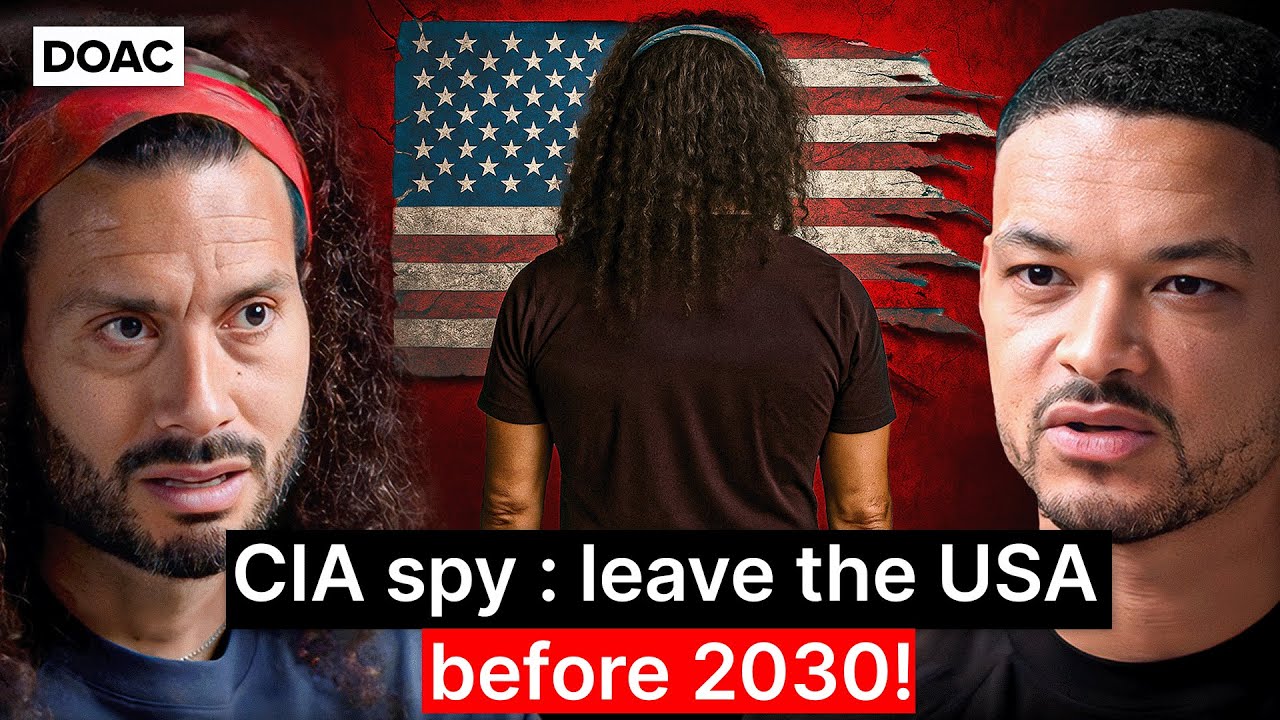
Former CIA Spies Detail Infiltration Operation and Threat of US Collapse
The Diary Of A CEO
Ex-intelligence officers reveal how a covert bait operation exposed an internal agency mole and warn that US policy gridlock poses a 60% chance of long-term economic and geopolitical decay.
## Background
This video was published on YouTube by The Diary Of A CEO on August 28, 2025. According to the page description, former CIA spies Andrew and Jihi Bustamante share the top-secret story behind their book 'Shadow Cell', detailing a mission to uncover a CIA traitor, how the agency tried to suppress their story, why they plan to leave the US by 2030, and practical CIA hacks for managing fear and anxiety.
## TL;DR
Former CIA officers Andrew and Jihi Bustamante detail their undercover operation in a joint target zone to uncover an unacknowledged insider mole within the agency. They explain how they operated under commercial cover using a decentralized 'Shadow Cell' model, navigated severe security breaches, and ultimately provided the critical evidence needed to catch the traitor. The discussion also covers counter-interrogation tradecraft, the psychological impacts of covert service, their perspective on shifting U.S. geopolitical stability, and practical spy techniques for managing stress.
## Atmosphere & style
The interview carries an intense, analytical, and highly candid atmosphere as the hosts delve into the realities of modern espionage. Andrew and Jihi present their experiences with a calm, disciplined cadence that contrasts sharply with dramatic Hollywood spy tropes, balancing pragmatic operational details with deeply personal reflections. The dynamic with host Steven Bartlett is conversational yet serious, creating an engaging, eye-opening dialogue that transitions from high-stakes intelligence operations to sobering geopolitical predictions.
## Key takeaways
- [03:24](https://www.youtube.com/watch?v=fu6bYPTp_kE&t=204s) Andrew and Jihi Bustamante publish 'Shadow Cell' to detail their covert CIA operational unit and expose systemic vulnerabilities, including an unacknowledged mole inside the agency.
- [05:24](https://www.youtube.com/watch?v=fu6bYPTp_kE&t=324s) The CIA attempted to reclassify and block the release of their memoir for years before legal pressure regarding First Amendment rights forced agency collaboration.
- [08:03](https://www.youtube.com/watch?v=fu6bYPTp_kE&t=483s) CIA tandem couples are actively encouraged by the agency to eliminate the operational strain and security risks associated with dating civilians.
- [37:31](https://www.youtube.com/watch?v=fu6bYPTp_kE&t=2251s) The Shadow Cell unit was designed by copying the decentralized cell structure of terrorist organizations to establish non-standard intelligence channels that could lure out an internal CIA mole.
- [35:23](https://www.youtube.com/watch?v=fu6bYPTp_kE&t=2123s) Operational logistical needs in hard-target foreign adversary nations rely on unconventional currencies and facilitator tradecraft rather than direct creation of illicit material.
- [31:38](https://www.youtube.com/watch?v=fu6bYPTp_kE&t=1898s) Undercover officers use layered transit strategies like 'dry cleaning' and distinct cover identities to obscure their movements between friendly bases and enemy territory.
- [47:16](https://www.youtube.com/watch?v=fu6bYPTp_kE&t=2836s) Modern consumer electronics and foreign border checks present severe digital privacy risks, requiring air-gapped non-networked systems to protect sensitive data.
- [51:27](https://www.youtube.com/watch?v=fu6bYPTp_kE&t=3087s) Surveillance Detection Routes (SDRs) rely on strict tactical phases, mental short-codes, and maintaining normal behavior to gather intel on hostile units without exposing operational panic.
- [01:09:11](https://www.youtube.com/watch?v=fu6bYPTp_kE&t=4151s) Commercial front businesses funded by the CIA and military generate revenue that directly feeds back into unappropriated black budget operations.
- [01:27:23](https://www.youtube.com/watch?v=fu6bYPTp_kE&t=5243s) The baseline intelligence estimate assumes major international agencies are continually penetrated by multiple active double agents motivated by psychological factors rather than solely money.
- [01:37:55](https://www.youtube.com/watch?v=fu6bYPTp_kE&t=5875s) Counter-interrogation tactics emphasize sitting through intentional silences, controlling physical body language, and avoiding emotional or open-ended disclosures.
- [01:44:10](https://www.youtube.com/watch?v=fu6bYPTp_kE&t=6250s) The evidence gathered by the Shadow Cell operational framework ultimately assisted the FBI in identifying and arresting a former CIA officer operating as a double agent.
- [02:00:00](https://www.youtube.com/watch?v=fu6bYPTp_kE&t=7200s) Jihi and Andrew Bustamante plan to leave the United States before 2026 due to concerns over systemic political gridlock and rapid societal transitions similar to pre-collapse Venezuela.
- [02:14:48](https://www.youtube.com/watch?v=fu6bYPTp_kE&t=8088s) U.S. foreign policy is undergoing a structural shift from soft-power diplomatic engagement toward hard-power kinetic strategy alongside domestic funding realignments.
## Detailed walkthrough
### [00:00](https://www.youtube.com/watch?v=fu6bYPTp_kE&t=0s) Teaser & The Mystery of the CIA Mole
Former CIA officers Andrew and Jihi Bustamante tease a high-stakes undercover operation to expose a mole inside the CIA. The traitor was leaking classified details on active intelligence operations, officers, and assets to a foreign adversary. Sent into enemy territory under new alias identities to bait the mole into making a fatal mistake, Andrew and Jihi found themselves in escalating danger. When Andrew’s cover was compromised in-country, he had to make an emergency escape before he could be "disappeared" or captured.
```
• Host: Steven Bartlett (The Diary Of A CEO)
• Guests: Andrew Bustamante (former CIA Operations Officer) & Jihi Bustamante (former CIA Targeting Officer)
• Core Topic: Uncovering an unacknowledged CIA mole, tandem agency ops, and international espionage
```
[01:48](https://www.youtube.com/watch?v=fu6bYPTp_kE&t=108s) Host Challenge to the Audience
Steven Bartlett issues a challenge to listeners: track the details revealed throughout the conversation to identify both the country Andrew and Jihi were operating in and the identity of the CIA mole from three possible suspect profiles presented on screen. He emphasizes that subscribing directly supports the long-term production and reach of the show.
- 56% of regular podcast listeners have not yet subscribed to the channel.
[03:19](https://www.youtube.com/watch?v=fu6bYPTp_kE&t=199s) Declassifying the Undercover Story
Andrew details the arduous process of publishing their memoir, *Shadow Cell*. Every CIA officer signs a lifetime secrecy agreement granting the agency pre-publication review over active sources, methods, and sensitive operational details. Andrew initially assumed his classified work would never see the light of day. However, after submitting a request in 2019, the CIA initially granted approval.
In 2021, the couple submitted their completed manuscript, but by 2022, shifting geopolitical conflicts prompted the CIA to revoke permission and reclassify the material. To fight back, the Bustamantes retained top legal counsel specializing in classified publishing and threatened a First Amendment lawsuit. Recognizing the legal leverage, the CIA backed down and collaborated with the couple to officially clear the book for public release.
[05:24](https://www.youtube.com/watch?v=fu6bYPTp_kE&t=324s) Why the CIA Tried to Bury the Story
The CIA feared public disclosure of this operation because it shatters hollywoodized tropes about individual "superhuman" spies like James Bond or Jason Bourne, revealing that espionage is actually an unglamorous, high-stakes "team sport." More critically, the book uncovers systemic vulnerabilities and moral ambivalence within the agency—specifically revealing an internal mole penetration that the CIA has never publicly acknowledged.
> "I don't think people recognize that CIA is morally ambivalent to how it executes espionage operations. The goal is to keep Americans safe."
[07:01](https://www.youtube.com/watch?v=fu6bYPTp_kE&t=421s) Origins: From Nuclear Missiles to Meeting at Langley
Andrew outlines his path into intelligence: raised in rural Pennsylvania as "the only brown kid in a white high school," he attended the U.S. Air Force Academy, learned a foreign language, trained as a pilot, and served as a nuclear missile officer overseeing nuclear weaponry. The CIA recruited him directly out of the military. On his very first day at the CIA, he sat near the front of the classroom while Jihi sat in the back, marking the beginning of their overlapping careers and personal lives.
[08:03](https://www.youtube.com/watch?v=fu6bYPTp_kE&t=483s) Dating Inside the CIA: The Tandem Advantage
Jihi explains that romantic relationships within the CIA are actively encouraged. Dating civilians forces officers to live a double life, constantly fabricating stories about day-to-day work, training sessions, and temporary duty (TDY) trips. These cover stories often destroy relationships when partners suspect infidelity.
Andrew recalls an instance where an outsider dating a CIA officer panicked because her boyfriend took frequent "business trips" without packing suits. Andrew had to quietly reassure her that he was attending tactical training in Battle Dress Uniforms (BDUs) rather than cheating. In contrast, married "tandem couples" inside the agency share an understanding of operational security constraints, creating an effective environment for joint operations.
[09:42](https://www.youtube.com/watch?v=fu6bYPTp_kE&t=582s) The Role of a CIA Targeter
Jihi transitioned into the CIA from a background in social work helping survivors of foreign torture and refugees. After applying through an online portal and attending a discreet recruitment session in a non-descript hotel conference room, she was selected as a Targeter—a specialized role created during the War on Terror.
Targeters analyze vast quantities of raw intelligence to map out adversary networks, identify critical organizational nodes, and formulate detailed "targeting packages" used by the military and intelligence services to capture or eliminate high-value targets.
- Targeters function similarly to investigators dissecting organized crime or the mafia: mapping hierarchy, connections, and vulnerabilities.
- Targeting packages provide actionable blueprints on *who* to target and *how* to access them.
[12:10](https://www.youtube.com/watch?v=fu6bYPTp_kE&t=730s) Operations Officers & The "Tandem Couple" Dynamic
Andrew contrasts his role as an Operations Officer (also referred to as a Case Officer or Field Officer) with Jihi's work as a Targeter. Once a Targeter builds a dossier, the Operations Officer flies overseas under cover to establish contact, build trust, and recruit the source to extract secrets.
Eventually, the CIA paired Andrew and Jihi together as a "tandem couple"—a fully trained, married pair operating as a unified "one-two punch." Jihi identified the targets and mapped the operational web, while Andrew executed the ground-level contact and collection.
[13:52](https://www.youtube.com/watch?v=fu6bYPTp_kE&t=832s) The Secret Briefing at Falcon House
The core narrative begins on a winter day inside CIA headquarters. Andrew and Jihi were summoned into a high-level counterintelligence conference room featuring a massive oak table, reserved for senior executive leadership.
Present in the room was the head of "Falcon House"—the CIA's specialized unit focused on a premier foreign adversary (code-named "Falcon"). The unit chief delivered shocking news: a traitor inside Falcon House was actively leaking top-secret information to the enemy. To catch the traitor, the agency devised a trap that required deploying Andrew and Jihi overseas into Falcon territory under new identities to bait the mole into making an operational mistake.
- **Falcon House**: Specialized internal CIA unit dedicated to counter-operations against a specific top-tier foreign adversary.
- **The Operational Trap**: Deploying junior officers undercover into enemy territory to force the mole into taking hasty, detectable action.
[015:29] The Setup: A Mole Inside the CIA
Andrew and Jihi Bustamante recount the high-stakes moment they were brought into an executive-level CIA office—a room well beyond their standard pay grade—to take on an operation that would eventually inspire their book *Shadow Cell*. At the time, Andrew felt an overwhelming, almost giddy excitement at the second chance it represented for his lackluster career as a case officer. Conversely, Jihi felt a wave of apprehension and anxiety, questioning if the assignment was even real.
The core objective of their deployment was twofold: a primary objective to establish brand-new intelligence sources in an adversarial nation codenamed "Falcon," and a sub-objective to help uncover a high-level mole within the CIA. Falcon is described as one of a small handful of stark, hostile US adversaries with little to no diplomatic ties—a list that includes hard targets like North Korea, Iran, Russia, China, and Cuba. Because the mole worked for Falcon's intelligence apparatus, their entire goal was to block the CIA from uncovering Falcon's secrets.
* Moles are among the most destructive threats in intelligence history, echoing infamous turncoats like Aldrich Ames (a CIA officer who spied for the Soviets/Russians) and Robert Hanssen (an FBI agent who did the same).
* The CIA was originally alerted to the presence of a new, 2010s-era mole not through internal detection, but via a tip-off from a foreign Five Eyes ally (such as the UK, Canada, or Australia).
---
[019:41] The Legal Catch-22 and Operational Risks
The tip-off from the foreign ally created a severe legal and operational dilemma for the CIA. While the ally provided significant intelligence pointing to the insider threat, US law dictates that an American citizen—even a suspected traitor inside an intelligence agency—is protected by constitutional rights. The word of a foreign government alone is legally insufficient to arrest, fire, prosecute, or sue an officer without an independently gathered body of American evidence.
Consequently, the CIA was stuck in a nightmare scenario: actively hemorrhaging top-secret intelligence to a hostile foreign power, but entirely unable to act until they built a airtight legal case. To force the mole’s hand, the CIA decided to deploy Andrew and Jihi to build completely new, non-standard intelligence channels. By intentionally keeping the mole in the dark about these new operations, the CIA hoped to starve the mole of fresh information, forcing them to overreach, break protocols, and leave a trail of evidence.
> "CIA was knowingly putting our lives in danger of a foreign adversary by intentionally creating operations that would tempt that mole to disclose our identities." — Andrew Bustamante
* Rejecting an operational assignment in the CIA is technically allowed, but doing so is widely understood to be "career suicide."
* As a top-tier targeter, Jihi was on a fast-track trajectory at the agency, whereas Andrew viewed the dangerous mission as his ultimate shot at redemption.
* Sworn CIA officers operate under plausible deniability; if captured in a foreign prison, the US President has the legal authority to publicly disavow them, denying any official connection and leaving them facing decades in prison or execution.
---
[025:41] Operating Out of "Wolf" and the Double-Agent Trap
To mitigate the immediate danger while setting the trap, the CIA stationed Andrew and Jihi in a friendly neighboring nation codenamed "Wolf." However, Andrew and their ground operatives still had to regularly cross into Falcon to execute operations. From the onset in Wolf, Jihi began reverse-engineering how Falcon’s intelligence service might track their new setup. By anticipating the enemy's moves, she aimed to architect an operational framework that kept them invisible to both Falcon and the insider mole.
To safeguard the mission, headquarters explicitly instructed the couple *not* to brief CIA main offices on the exact mechanics of their new mouse-trap. The operations were strictly compartmentalized, known only to local leadership in Wolf and a tiny handful of individuals at headquarters on a strict "need-to-know" basis. Cut off from these new streams, the mole would grow desperate to maintain their value to Falcon intelligence. In double-agent operations, if an asset stops providing fresh, high-value data, their foreign handlers lose interest, leaving the spy exposed and without a safety net—often prompting reckless behavior like unauthorized system hacks or illegal inquiries that lead straight to an arrest.
* The traditional mechanics of espionage have remained largely unchanged since ancient Egypt: locate a source with privileged access, collect their intelligence, and submit a report up the chain of command.
* Double agents who lose their utility or face imminent exposure often flee to the country they were secretly serving, much like high-profile whistleblowers and defectors such as Edward Snowden.
* When a foreign country successfully recruits a high-level penetration inside an agency like the CIA, it effectively hands them the "keys to the kingdom."
[31:38](https://www.youtube.com/watch?v=fu6bYPTp_kE&t=1898s) Operating Undercover and the "Dry Cleaning" Tradecraft
The danger of operating in hostile territory is compounded when an internal mole has wide-ranging access to intelligence files. Because the mole had access to virtually everything the CIA possessed regarding Falcon (the code name for the adversary country), the agency was completely in the dark about how much information had been compromised or how long the breach had been active. When Andrew and Jihi landed in Wolf (the friendly neighboring country), they had to establish new identities and aliases to execute their mission without exposing their base of operations. While living in Falcon, they operated under commercial cover—acting as ordinary people involved in legitimate business activities—while concealing their true roles.
To enter and exit the target country safely, Andrew and Jihi employed an advanced tradecraft technique referred to by British intelligence as "dry cleaning." Rather than traveling directly between the friendly base (Wolf) and the hostile target (Falcon)—which would allow enemy intelligence to track them back to their origin and potentially dispatch hostile teams against them—they utilized a calculated cleansing route. They would fly from the friendly country to a neutral country, perform a "passport swap" (retrieving alternate documentation via caches, meets, or personal carriage), and change identities before flying into Falcon. By consistently repeating this neutral-country route, they established a false "pattern of life" in the eyes of enemy surveillance, ensuring hostile services tracked them back only to a neutral origin.
- **Dry Cleaning:** A transit strategy where officers travel to a neutral intermediate country and change identities to sever any visible connection to their true friendly staging ground.
- **Passport Swap:** The physical mechanism of changing travel documents in a neutral zone using personal carry, operational meets, or concealed caches.
- **Pattern of Life:** The predictable behavioral footprint intelligence services observe to deduce where an individual lives, works, and originates.
---
[35:23](https://www.youtube.com/watch?v=fu6bYPTp_kE&t=2123s) Logistics, Supply Chains, and Unconventional Currencies
Establishing a working footprint in hostile territory requires building a complex logistical supply chain to support intelligence operations. Operational necessities included encrypted cell phones, specialized satellite phones, regional SIM cards, foreign currency, and "specialized gifts" tailored to specific targets. When probed about what constitutes a specialized gift, Andrew explains that high-value targets—particularly those involved in illicit networks like narcotics, terrorism, and arms trafficking—are often motivated by items they cannot acquire locally, ranging from gold bullion and foreign currency to high-end liquor and even child pornography.
The host expresses visible shock at the mention of child pornography, asking if the CIA directly supplies such material. Andrew clarifies that the agency acts as a facilitator rather than a creator, describing how friendly allied intelligence services trade seized materials to meet operational needs. For instance, if German authorities (such as the BND) seize terabytes of illicit material in a raid, they might exchange that intelligence cache with British or American services, who then use it as operational leverage or currency to recruit or pay off specific high-value foreign assets. Andrew notes that while this tradecraft is morally complex, the overriding mandate within espionage is doing whatever is required to protect national security interests and keep citizens safe.
- **Operational Supply Chain:** The hidden logistics network required to move cash, secure comms, satellite gear, and target-specific bribes into target zones.
- **Inter-Agency Bartering:** Allied intelligence services routinely trade seized illicit materials or specialized assets to fulfill operational recruitment needs.
- **Moral Ambiguity in Espionage:** Pragmatic compromises made in covert operations driven entirely by the mission goal of asset procurement and national defense.
---
[37:31](https://www.youtube.com/watch?v=fu6bYPTp_kE&t=2251s) Building the "Shadow Cell" Model
The operational strategy detailed in their book, *Shadow Cell*, was built around adapting the decentralized cell structure used by terrorist organizations against the United States during the Global War on Terror. Andrew points out that after two decades of fighting in Afghanistan, the U.S. ultimately withdrew and left the territory to the same adversary it set out to defeat, proving that traditional Western intelligence structures struggled to defeat asymmetric terrorist networks. However, because adversary nations like Russia, China, Iran, Cuba, and North Korea did not fight in the Global War on Terror, they never acquired the hard-won insights the U.S. gained from studying groups like Al-Qaeda.
Andrew and Jihi recognized this knowledge gap as a massive competitive advantage and constructed a clandestine operational unit in Wolf modeled directly on terrorist cell mechanics. Dubbed the "Shadow Cell," this unit drew together a specialized team of sworn CIA officers already stationed in Wolf under various primary covers. The primary team comprised:
* **James:** The senior-most case officer, whose career was on the line if the high-risk experiment failed.
* **Tasha, Luke, and Beverly:** Hungry, flexible second-tour case officers who served as the primary field operators.
* **Andrew:** The operational node and mission planner, serving as the singular exposed point of contact to shield the rest of the unit.
* **Jihi:** The lead targeting officer, responsible for analyzing raw intelligence and identifying viable recruits.
* **Diana:** The cell's specialized linguist.
* **Will:** The technical support specialist overseeing hardware and communications.
To maintain operational security, the team conducted all sensitive coordination inside a SCIF (Sensitive Compartmented Information Facility)—a hardened, soundproofed room situated inside a non-descript commercial office building. Because every team member traveled under carefully laundered identity routes, hostile intelligence services could not easily track their movements or connect their daily presence in a standard office building to covert spy operations inside Falcon.
> "Espionage is not about one superhero overseas; it's about a team of people doing incredible things."
---
[41:48](https://www.youtube.com/watch?v=fu6bYPTp_kE&t=2508s) Sourcing Target Data and Operational Dead Drops
Executing operations against Falcon required a precise division of labor between mission planning, targeting, and field execution. Because Andrew served as the primary "node" exposed to internal CIA oversight—and thus the point most vulnerable to the internal mole—he never directly met with recruited targets inside Falcon. Instead, his job was to travel into the hostile country to perform physical intelligence recoveries, such as clearing dead drops hidden in public spaces like bushes or urban cutouts.
In a typical operational scenario, another CIA case officer operating in Falcon might extract a military database containing sensitive details on adversary air force engineers. That officer would store the data on a thumb drive and conceal it at a designated dead drop site. Andrew would then enter Falcon, clear the drop, and transport the thumb drive back through the neutral cleansing route to Wolf. Jihi would process the raw data to build actionable target profiles. Once high-value targets were identified, Jihi and Andrew would hand off the profile to the appropriate case officer—matching the target's personality and vulnerabilities to officers like James, Tasha, Luke, or Beverly—who would then enter Falcon to initiate contact and recruitment.
- **The Operational Node:** A design choice where one designated team member absorbs the primary exposure risks to keep secondary officers and targeters hidden.
- **Dead Drop Craft:** The technique of leaving intelligence materials at a pre-arranged secret location for another officer to retrieve without direct contact.
- **Target Matching:** Selecting specific field officers for recruitment missions based on demographic, psychological, and personal rapport compatibility with the target.
---
[44:30](https://www.youtube.com/watch?v=fu6bYPTp_kE&t=2670s) Hostile Surveillance and the Threat of Capture
The trajectory of the Shadow Cell shifted dramatically when adversary intelligence detected Andrew's presence inside Falcon and assigned a dedicated counter-intelligence team to track his movements. Andrew describes this realization as a chilling turning point that instantly shifted their dynamic from offensive success to survival. In the high-stakes world of covert operations, the threat of being shot is often viewed as preferable to physical capture. A quick death ends the mission, whereas capture by a hostile regime entails prolonged interrogation, psychological coercion, forced participation in state propaganda, and being weaponized as diplomatic leverage against the United States.
Andrew and Jihi assess that the mole within the CIA likely compromised Andrew's identity once the Shadow Cell's operations became impactful enough to draw internal notice. Taking a severe risk to uncover who was running the network, the mole identified Andrew as the exposed node and burned his identity to the hostile country's security services. Andrew soon picked up on the aggressive physical surveillance being conducted against him. He notes that while normal foreign travelers or prominent figures in countries like Russia or China are routinely followed by "watchers" or "bumbling surveillance" for basic monitoring and mobile data extraction, being targeted as an active intelligence officer carries an entirely different, existential level of danger.
> "Oftentimes a CIA officer being shot in a foreign country is a welcome experience, because being shot at least means everything ends. The worst is being captured and being interrogated and being used for diplomatic leverage..."
[47:16](https://www.youtube.com/watch?v=fu6bYPTp_kE&t=2836s) Digital Privacy and Border Scrape Tactics
Steven Bartlett asks about border crossing security and whether immigration officers in foreign countries can scan hard drives. Andrew confirms this capability and notes that it happens within the United States as well. Under U.S. law, Border Patrol agents hold broad authority to scrape data from electronic devices. If a traveler is flagged as a "target of interest" and pulled into secondary screening, agents can separate them from their bags, order them to unlock their laptops and phones, and use both proprietary and commercially available tools to clone or scan the drives.
When Steven mentions finding letters in his suitcase stating his bags were searched, Andrew warns that if any digital device was inside, it was likely cloned. Steven expresses shock, asking how agents access devices without passwords. Andrew explains that password generators, cracking codes, and specialized software bypass basic protections effortlessly. He quips that with one phone call, he could acquire all of Steven's personal device passwords within 30 minutes, prompting Steven to joke about retrieving his phone and ending the podcast early.
- **Border Patrol Scrape Authority:** Agents in secondary screening can demand unlocked devices or use bypass tools to clone hard drives.
- **Vulnerability of Passwords:** Password protection offers minimal resistance against dedicated law enforcement or intelligence software.
- **Air Gapping Strategy:** To preserve critical data, Andrew and Jihi use standalone, non-networked servers and drives that connect only during deliberate manual transfers.
---
[49:03](https://www.youtube.com/watch?v=fu6bYPTp_kE&t=2943s) Vulnerability of Modern Devices and Countermeasures
Steven asks what devices Andrew and Jihi personally use given their awareness of hardware vulnerabilities. Andrew explains his non-intuitive approach: he prefers devices that are intentionally easy to crack and clone, like standard Android systems. Complex, ultra-secure devices like "Glacier phones" shut down permanently when penetrated, leaving the operative stranded without communication. If an adversary accesses a standard Android phone via a back door, the phone remains functional, allowing the user to operate without raising suspicion.
Jihi and Andrew emphasize that no device is 100% secure. Any system marketed as unhackable immediately becomes top priority for foreign intelligence services, criminal syndicates, and dark web groups competing for an exploit. Operatives assume all devices are compromised and manage them accordingly, recognizing that bad actors can hack in remotely, scrape drives at immigration, or extract encryption keys from counterparty communications.
> "Anything that you create that claims to be safe becomes priority number one for all the adversaries out there cuz they know if they can be the first ones to crack that phone... then they have the competitive advantage." — Andrew Bustamante
---
[51:47](https://www.youtube.com/watch?v=fu6bYPTp_kE&t=3107s) Executing a Surveillance Detection Route (SDR)
Transitioning back to the operative narrative, Steven asks how Andrew discovered he was being followed in the field. Andrew explains the tradecraft behind a Surveillance Detection Route (SDR), designed to establish "multiple sightings over a period of time" across changing locations. An operative identifies matching vehicle profiles, license plates, or physical descriptions (e.g., a tall Caucasian male in his mid-50s) appearing repeatedly along a pre-planned route.
Andrew details the three-phase structure of an SDR:
1. **Phase 1 (Suspicion):** Spotting an initial indicator, such as a vehicle following through several turns, dropping off, and reappearing later.
2. **Phase 2 (Confirmation):** Executing a specific, predetermined path through a city to drag tailing units along, confirming multiple vehicles and foot-surveillance operatives working in tandem.
3. **Phase 3 (Collection):** Gathering operational intelligence on the surveillance team while wasting their time in mundane public places (e.g., arcades, libraries, or strip clubs) to avoid giving them actionable evidence of espionage.
---
[54:45](https://www.youtube.com/watch?v=fu6bYPTp_kE&t=3285s) Recognizing Surveillance and Calling in the Warning
Discovering that he was actively followed by multiple vehicles and foot units induced pure terror. Andrew describes a wave of panic, self-loathing, and intense vulnerability, wondering if he made a mistake or if the adversary possessed prior evidence to apprehend ("wrap up") him immediately. Despite the adrenaline spike, he had to maintain composure and recall every turn of his 3.5-hour SDR—such as turning left on Front Street, two blocks right on 22nd North, and into an alley—to log details for his team.
While on foot during Phase 2, Andrew used a disposable burner phone to call Jihi. Using their pre-arranged covert protocol, he delivered the coded message: *"I'm coming home early."* Because an operative never cuts a mission short without cause, this specific phrase signalled to Jihi that Andrew's cover was compromised and that defensive measures needed to be initiated.
- **Coded Signal:** *"I'm coming home early"* served as the trigger phrase indicating active surveillance.
- **Roleplay Alignment:** Jihi responded casually as his alias's cover fiancee (*"That's really exciting... I love you"*) to prevent wiretappers from detecting alarm.
- **Mental Toll:** Operatives must process high-stress panic while silently memorizing precise street sequences and surveillance features.
---
[58:30](https://www.youtube.com/watch?v=fu6bYPTp_kE&t=3510s) Covert Communications and Draft Email Dead Drops
After hanging up, Jihi returned to the office and began scouring internal CIA reporting and regional cables. She checked with her senior colleague, "James," who held higher clearance levels for regional operation details, to see if any arrest or compromise reports had cleared the wire. Confirming no active capture report had been filed, she relied on their personal communication plan ("commo plan").
Jihi explains their dead-drop digital protocol: rather than sending messages over the internet, both operatives shared login credentials to an un-attributable email account. One person writes a message and saves it as a draft; the other logs in and reads it. Because the email is never sent, it leaves no network transmission footprint—a technique adapted directly from terrorist tradecraft. Their commo plan incorporated strict check-in windows at 8, 12, 24, and 48 hours for life-sign updates.
---
[01:00:36](https://www.youtube.com/watch?v=fu6bYPTp_kE&t=3636s) Self-Rescue and Planning the Escape
Andrew clarifies a common Hollywood misconception: when an officer is burned in the field, there is no extraction helicopter or elite military team waiting to rescue them. Primary escape protocol relies entirely on **self-rescue**. The operative must independently reach and cross an international border before any official evacuation ("exfil") can occur.
Trapped in the target country, Andrew had to devise an escape strategy that would get him across the border without alerting his surveillance tail that he knew he was being watched. By maintaining the illusion of normal activity during Phase 3 of his SDR, he continued logging license plates and physical profiles to feed into the team's operational database once safely back in a friendly territory.
[01:02:06](https://www.youtube.com/watch?v=fu6bYPTp_kE&t=3726s) Surveillance Detection Techniques and Memory Short Codes
When you realize you are under surveillance during a covert operation, your core objective immediately shifts. The primary mission becomes gathering as much detail as possible about the surveillance team—the vehicles, the foot surveillance, the individual faces—before they figure out that they are being observed. In the field, officers cannot simply pull out a notepad or a smartphone to log details without blowing their cover. Initial tracking relies heavily on mental retention strategies. Spies use personalized short codes and mental nicknames that act as vivid reference points. These short codes serve as secure placeholders; even if spoken aloud during an interrogation or written down on a scrap of paper, they reveal nothing to an outsider.
To illustrate how these short codes function in real-time surveillance detection, consider the standard shorthand an officer builds on the fly:
* **"Black T-shirt"**: A descriptor for an individual based on a prominent clothing item. If the same person wearing a black t-shirt appears three separate times over 45 minutes in different parts of the city, the officer instantly recognizes the tail.
* **"Earmuffs"**: Used during cold-weather operations to mark a female surveillance operative wearing distinctive headgear.
* **"Bomber Jacket"**: A shorthand nickname for a male operative wearing a classic flight jacket.
* **"Blue Sedan" / "Yellow SUV" / "White Taxi"**: Rapid shorthand for tracking suspicious vehicles in traffic loops.
When an officer finally reaches a safe location to document their observations, these simple nicknames trigger a full, detailed profile. "Black T-shirt" translates into complete physical specifications: a Black male with a goatee, approximately 165 pounds, 5'11", and around 38 years old. Andrew Bustamante shares a specific moment from his third phase of surveillance detection where he walked into a clothing store and wrote down notes listing items like earmuffs and t-shirts. To any casual observer or local authority arresting him, it looked like a harmless shopping list rather than espionage notes.
[01:04:15](https://www.youtube.com/watch?v=fu6bYPTp_kE&t=3855s) The Arcade Blunder: Boring Surveillance vs. Starburst Panics
A common misconception driven by Hollywood movies is that covert operatives attempt to "ditch" or "lose" their tail through high-speed chases or dramatic evasive maneuvers. In actual intelligence work, professionals do the exact opposite: they "drag" the tail. Operatives make themselves intentionally predictable, moving slowly and lingering in public spaces. The goal is to bore or lull the surveillance team into a false sense of security, giving the officer time and space to gather intel on the watchers. However, this strategy can go wrong if the surveillance team accidentally loses sight of the target in a public setting.
During a crucial phase of his operation, Bustamante entered an amusement arcade to pass time and let his surveillance team observe him safely from a distance. Instead of lulling them, the move backfired: the team lost visual contact. When a surveillance team loses their subject, panic sets in. They begin to fear either that they made a amateur mistake or that their target is a trained intelligence officer actively executing counter-surveillance. This panic triggers a "starburst"—a chaotic maneuver where surveillance team members abandon their structured formations and scatter to find the target.
While Bustamante was holding a plastic arcade rifle playing a dinosaur-hunting arcade game similar to *Jurassic Park* or *Big Buck Hunter*, the operative known as "Bomber Jacket" rounded the corner of the arcade cabinet. The two men found themselves standing just three feet apart, locking eyes for an agonizing two and a half seconds. In the world of espionage, locking eyes is a fatal error—it signals recognition and is interpreted as an act of dominance or aggression. Both men stood frozen: the operative's jaw dropped in shock at blowing his cover, while Bustamante inwardly panicked, hoping his face didn't betray the same amateur mistake.
[01:09:11](https://www.youtube.com/watch?v=fu6bYPTp_kE&t=4151s) Commercial Fronts, Acme Commercial, and the Black Budget
Behind undercover operations are elaborate corporate covers designed to grant case officers legitimacy in foreign countries. During his covert assignments, Bustamante operated under the alias Alex Hernandez, running a front company called Acme Commercial. The company was officially structured to source disposable consumer goods from foreign countries for transport and distribution across Western markets. Intelligence services around the world rely heavily on commercial fronts, finding that setting up a business—which can cost as little as $127 for a standard LLC—provides an ideal vehicle for collecting sensitive intelligence under the guise of routine commerce.
While many intelligence-linked companies are public-facing entities like In-Q-Tel—the CIA's venture capital arm that openly invests in dual-use commercial technologies—others are non-public, highly secret commercial fronts. These operations are intimately tied to what is known as the "black budget": a massive pool of discretionary funds used for military and covert intelligence operations that is completely decoupled from taxpayer dollars.
The military and intelligence black budget is funded through two primary mechanisms:
* **Asset Seizures**: Confiscated funds and liquid assets from criminal and national security operations, including seized cryptocurrency, illicit drug money, and proceeds from illegal enterprises.
* **Commercial Business Profits**: Financial profits generated by successful CIA-operated front companies. Because case officers are paid strictly on the standard U.S. government payroll, any commercial profit generated by a front company is funneled directly into the black budget.
This setup creates unique scenarios where covert business operations become wildly profitable. On occasion, CIA officers who build these successful front companies realize how lucrative their enterprise is, leading them to resign from the agency altogether to run commercial businesses in the private sector.
[01:12:08](https://www.youtube.com/watch?v=fu6bYPTp_kE&t=4328s) Corporate Cooperation, TikTok, and FISA Warrant Realities
The relationship between intelligence agencies and modern technology platforms frequently raises questions about global surveillance. Addressing concerns around platforms like TikTok, Bustamante notes that he does not believe the app was originally created by the Chinese government as a dedicated spying tool. Rather, as TikTok achieved massive global popularity, the Chinese state leveraged its authoritarian authority to access the platform's vast data stream. In democracies like the U.S. and the U.K., intelligence services like the CIA and MI6 cannot simply seize private enterprises, but they regularly approach major social networks and tech firms to request cooperation—requests that the vast majority of companies satisfy.
For the average citizen, this widespread data collection is largely irrelevant. Federal intelligence agencies have zero interest in ordinary personal missteps, such as marital infidelity, minor tax evasion, or unpaid parking tickets. Intelligence resources are strictly directed toward high-value national security targets, foreign espionage threats, and terror networks.
When intelligence operations require targeting an individual holding U.S. citizenship within national security contexts, agencies must navigate legal hurdles by securing a FISA (Foreign Intelligence Surveillance Act) warrant:
* **Evidentiary Threshold**: The agency must present sufficient evidence to a court establishing a direct link between the target and a foreign power, terrorist entity, or hostile intelligence operation.
* **Citizenship Context**: FISA targets often include naturalized citizens, foreign operatives who have obtained green cards, or hostile agents who have infiltrated the country under refugee or immigrant status.
* **Scope of Access**: Once granted, a FISA warrant grants intelligence officers deep access to the target's private digital life, allowing them to intercept phone communications, inspect personal computers, and pull unencrypted data directly from private Google and Apple accounts.
In high-stakes national security investigations, major tech corporations routinely comply with these lawful orders, providing federal agencies with the necessary access to monitor threats.
<FollowUp label="Want to explore how the CIA handles interrogations and counter-interrogation tactics?" query="Explain the CIA interrogation and counter-interrogation techniques mentioned in the transcript."/>
Here is a detailed walkthrough of this transcript section:
[01:16:06](https://www.youtube.com/watch?v=fu6bYPTp_kE&t=4566s) Privacy Is Not Real
Steven Bartlett pushes back on the reality of digital surveillance, noting that standard citizens often live in a state of naive belief regarding their personal data. Jihi and Andrew Bustamante clarify that privacy is fundamentally an illusion conditioned into the public. While getting undressed in a dark room or writing a crumpled physical paper note is relatively private, digital communication is never fully secure. Technology offers surface-level privacy, but if an intelligence service or state authority wants to look into standard digital communications, they can access it—frequently through FISA (Foreign Intelligence Surveillance Act) judicial warrants that legally compel tech platforms to grant access.
When Steven asks if the CIA knew they were appearing on *The Diary Of A CEO* today, Andrew states he believes they did. Both the CIA and foreign agencies (such as the United Arab Emirates) maintain dedicated personnel who monitor high-profile former officers. They would easily know about the interview by reading emails, text messages, or listening in on phone calls between the authors, their publisher, and the podcast team. Andrew notes that despite submitting their memoir *Shadow Cell* for required CIA review multiple times, the agency remains anxious about how it might portray them, as former officers often publish critical exposés.
* FISA warrants function as judicial claims forcing tech platforms to allow government access to user accounts.
* Paper notes burned after reading remain vastly more secure than any encrypted digital messaging.
* The CIA maintains dedicated officers specifically tasked with monitoring the media appearances and communications of former operatives.
---
[01:18:41](https://www.youtube.com/watch?v=fu6bYPTp_kE&t=4721s) Edward Snowden and Information as Currency
The discussion shifts to Edward Snowden and the mechanics of defecting or fleeing a home country. Andrew explains that no nation offers asylum or physical protection to foreign defectors for free; asylum must be purchased using currency, which in espionage usually takes the form of classified intelligence. When Snowden leaked NSA surveillance practices to *The Guardian*, he also brought along vast troves of confidential documents.
Andrew asserts that Snowden used those classified files as leverage to secure safe passage through Hong Kong and eventually into Russia, where he now holds citizenship and has received awards. Andrew notes he can "almost guarantee" Snowden surrendered U.S. secrets to the Russian government in exchange for his current status and permanent protection, as sovereign nations do not grant refuge to high-level whistleblowers without receiving valuable state secrets in return.
---
[01:20:27](https://www.youtube.com/watch?v=fu6bYPTp_kE&t=4827s) The Jeffrey Epstein Case and Intelligence Asset Patterns
Steven brings up Jeffrey Epstein, asking if his successful commercial front and high-level connections match the profile of an intelligence operation. Andrew explains that Epstein fits all the primary structural pillars of a foreign intelligence asset collecting compromise (kompromat) on elite American citizens. However, Andrew pushes back on popular internet theories that Epstein was a CIA operative or Mossad agent who was killed by U.S. intelligence. Instead, Andrew sees a figure operating independently or servicing multiple foreign entities.
Steven shares an anecdote from an interview where a guest met Epstein; Epstein showed zero interest in finance and was exclusively obsessed with Harvard physics and scientific discoveries. Andrew observes that elite financial figures are often misunderstood outsiders, but notes that wealthy individuals facing trial often experience complete psychological collapse. He recalls a past client who preferred abandoning his family entirely rather than enduring the public shame of prison. To Andrew, a disgraced, disgraced power broker taking his own life in a cell is not an inherently unbelievable scenario, though alternative explanations exist.
* Epstein’s operation mirrored classic blackmail and collection fronts used by foreign intelligence services.
* High-net-worth individuals entering the judicial system often experience extreme psychological breakdown, making suicide a realistic outcome rather than purely a cover-up.
---
[01:24:15](https://www.youtube.com/watch?v=fu6bYPTp_kE&t=5055s) The Prison Hit Probability and Government Secrets
Addressing why the U.S. government refuses to release flight logs or unredacted files, Andrew points out the "need to know" principle: governments routinely withhold details or lie to avoid triggering widespread public chaos and panic. When evaluating Epstein's death in a Manhattan federal jail, Andrew applies a "lens of probabilities." The most likely scenario is that a wealthy, powerful figure outside the prison—terrified of Epstein releasing extortionate material—paid for a hit inside the facility.
A paid prison hit logically accounts for missing video footage, uncooperative guards, and gaps in evidence, as commercial or municipal detention facilities are notoriously corruptible. Andrew notes that if he were running a foreign intelligence cleanup operation against a compromised asset, hiring an inmate to neutralize the target inside a jail is precisely how he would execute it. Regarding press statements by political figures (such as Pam Bondi or Trump White House officials) denying knowledge of Epstein being an agent, Andrew highlights that officials are legally required to state "I have no knowledge" during active investigations to prevent co-conspirators from destroying evidence.
> "When I look at it through a lens of probabilities, the most probable outcome is that somebody in the prison was hired to hurt Jeffrey Epstein... That's how we would have run an operation."
---
[01:27:19](https://www.youtube.com/watch?v=fu6bYPTp_kE&t=5239s) Public Fixation vs. Active Intelligence Penetrations
Jihi and Andrew address why the public remains fixated on Epstein. Jihi suggests that people obsess over the narrative simply because the conspiracy is fascinating, though whether he was a formal asset ultimately changes very little today. Andrew questions why the media constantly hyper-fixates on "a dead guy who's not reporting" when active, ongoing espionage threats are happening continuously.
According to baseline estimates within the intelligence community, every major intelligence service is actively penetrated by at least two insider moles at any given moment. Rather than fixating on cold cases, the public should focus on the dozens of active moles and insider penetrations arrested and prosecuted quietly by federal authorities every single year.
* The intelligence community operates under the baseline assumption that every service contains roughly two active mole penetrations at any given time.
* Dozens of active insider spy cases and mole arrests occur annually in the U.S. without receiving the viral media attention given to dead assets.
---
[01:28:23](https://www.youtube.com/watch?v=fu6bYPTp_kE&t=5303s) Ad Break: Stand Store
Steven steps in with a mid-episode sponsor spot for Stand Store, a digital commerce platform he co-owns. He highlights how creators, coaches, and entrepreneurs can monetize their expertise by selling digital products, subscriptions, and coaching without requiring coding skills, noting that over $300 million has been earned by creators using the platform.
---
[01:29:19](https://www.youtube.com/watch?v=fu6bYPTp_kE&t=5359s) Returning to the Arcade: The Aftermath of Being "Burned"
The narrative returns to Andrew's undercover story inside the arcade. After locking eyes with the operative wearing the bomber jacket, both men instantly recognized that they had made a fatal operational error: they had spotted each other. The other operative immediately darted away in the opposite direction. Andrew felt completely "burned"—the operational term used when an undercover intelligence officer's cover is blown or identified by a target or hostile service.
Despite the surge of panic, CIA tradecraft dictates that an officer must never react immediately upon realizing they are burned. Demonstrating immediate panic or aborting a route alerts observing hostile countersurveillance teams that you know you made a mistake. To maintain operational composure, Andrew feigned calm, ambled around the arcade floor, and half-heartedly played a couple more arcade games. Once sufficient time passed to look natural, he exited the building to complete his Surveillance Detection Route (SDR) and collection protocol before returning to his hotel room.
> "Burned is the term that we use whenever we are spotted, identified as trained intelligence officers... If you act on that truth, then you're verifying to anybody observing that you already know you screwed up."
[01:30:09](https://www.youtube.com/watch?v=fu6bYPTp_kE&t=5409s) Internalized Insecurity and CIA "Head Trash"
Reflecting on his emergency extraction, Andrew shares that while the tactical details of his Surveillance Detection Route (SDR) and evacuation are documented in *Shadow Cell*, his internal experience was dominated by an overwhelming sense of failure. He was haunted by the belief that he was simply a "bad spy" and incompetent at intelligence collection. Writing the book proved to be a double-edged sword: while cathartic, it also served as a stark, black-and-white ledger of his mistakes. Knowing that his cover was blown—whether due to an operational error or betrayal by the mole—meant he had lost his ability to operate inside Falcon, effectively sidelining him from supporting his team and fulfilling his operational role.
This failure triggered a deep-seated insecurity stemming from his early days at the agency. During his first year, CIA evaluators assessed that Andrew did not possess the specific attributes required to be a case officer. Although he went on to build a successful career and execute high-stakes operations, that initial rejection created a persistent inner narrative: "I wasn't good enough then. I'm not good enough now."
Andrew explains that the CIA specifically trains officers to manage this kind of psychological burden, which the agency colloquially terms **"head trash."** Head trash refers to the subjective, self-deprecating internal chatter—such as feelings of inadequacy, physical self-doubt, or lingering childhood trauma—that lacks an objective basis in reality. To prevent officers from being compromised by stress or self-doubt during active operations, the CIA teaches physiological and mental control techniques:
* **Box Breathing:** A structured breathing pattern (e.g., inhale for four counts, hold for four, exhale for four, hold for four) designed to reduce heart rate, slow blood flow, and limit the systemic spread of cortisol.
* **Operational Visualization:** Mental rehearsal techniques—similar to those used by elite athletes—that allow an officer to visualize a successful sequence and regain cognitive control amid high-stress environments.
* **The Loyalty Paradox:** Andrew notes a curious institutional dynamic: while the CIA equips officers with powerful psychological tools, it also conditions them to remain dependent on external validation from the agency. The institution fears officers realizing the full extent of their personal capability and resilience, as that independence often prompts them to leave public service for lucrative private ventures.
---
[01:34:34](https://www.youtube.com/watch?v=fu6bYPTp_kE&t=5674s) The Bluff and the Airport Interrogation
Faced with the reality of being watched in his hotel, Andrew considered desperate escape scenarios—such as sneaking out through a restaurant kitchen, buying a motorcycle, or paying a local pilot in cash to fly him out from a remote airfield. However, he recognized that taking such erratic actions would instantly confirm to hostile surveillance that he was an operative attempting to flee. Instead, he chose a calculated gamble: act like an ordinary, law-abiding citizen, clear his travel updates through his cover company, and board a commercial flight out of the country. He gambled that the host nation's intelligence apparatus would hesitate to cause a major international incident by arresting his alias, "Alex Hernandez," without absolute certainty.
After a sleepless night spent anticipating a raid on his hotel room, Andrew traveled to the airport surveillance-free. However, upon presenting his passport and ticket at the initial checkpoint, border officials diverted him to **secondary inspection**. In a private room at 7:00 AM, two local Falcon officers subjected him to a light interrogation, repeatedly questioning his travel itinerary, his sudden flight change, and his business activities from the previous day. Andrew realized the officers were testing for inconsistencies in his story—a standard interrogation tactic to detect deception. Paradoxically, observing their clumsy questioning restored his confidence, making him realize he could successfully navigate the encounter.
To survive the interrogation, Andrew relied on core CIA counter-interrogation and counter-elicitation methods:
* **Mirroring:** Matching the interrogators' physical posture, body language, and energy levels to project innocence, build subconscious rapport, and signal that he was on equal footing.
* **Controlled Silence & Minimal Information:** Responding strictly to the direct question asked and comfortably sitting through uncomfortable silences. Interrogators frequently use silence as an elicitation tool to induce anxiety and force subjects to over-explain or blurt out incriminating details.
* **Everyday Applications of Elicitation:** Andrew and Steven discuss how elicitation and counter-elicitation extend beyond espionage into executive negotiations, managing workplace conflict, and media interviews. Asking open-ended or feeling-based questions (e.g., "How did you feel about that moment?") prompts individuals to reveal far more than they originally intended.
---
[01:40:43](https://www.youtube.com/watch?v=fu6bYPTp_kE&t=6043s) Escape to Safety and Burning the Alias
As the interrogation dragged on, the two Falcon officers began arguing with each other over administrative delays and protocol. Lacking sufficient cause to detain him long-term or risk an international event, they ultimately cleared Andrew to board his flight. The primary challenge then became maintaining composure—resisting the powerful urge to sprint to the departure gate, which would have instantly betrayed operational training.
Back in a safe transit country, Jihi received Andrew's voicemail confirming he had successfully exited Falcon airspace. Up until that point, she had been kept in the dark regarding the immediate crisis. Upon his return home, the couple immediately conducted a thorough damage assessment to trace whether an operational mistake had occurred on their end or if the cover identity was irrevocably compromised:
* **Alias Burned:** Andrew and Jihi concluded that the cover identity of **Alex Hernandez** was fully burned and could never be used again. Hostile intelligence had linked either the alias's travel history or Andrew's true-name background to the operation.
* **Layered Travel Routing:** Alex Hernandez had purposefully routed all travel through a designated third-party "cutout" country using Falcon’s national airline. This design ensured that host intelligence would trace his movements back to the transit hub rather than directly to the U.S.
* **Cell Integrity Preserved:** Crucially, their post-operation assessment confirmed that the rest of the Shadow Cell operating in the friendly support country remained uncompromised. Within the structural design of the mission, Alex Hernandez had functioned precisely as intended: an operational "tripwire" that absorbed the risk to protect the broader team.
Here is a detailed, faithful walkthrough of Part 8 of the interview.
---
[01:44:17](https://www.youtube.com/watch?v=fu6bYPTp_kE&t=6257s) Operational Compromise and Leaving the CIA
Andrew Bustamante explains that under their operational framework, if a burn occurred, "Alex" (Andrew's alias) was designed to be the first person compromised. His burn served as an early warning for the rest of the cell, allowing them to instantly dial up their operational security. However, this meant "game over" for Andrew inside "Falcon" (the adversarial host nation). He could never return under his real name or any alias, as his biometrics—fingerprints, iris scans, and facial data—were permanently burned. Additionally, all air-gapped, isolated digital platforms and physical assets carried by Alex were presumed collected, synthesized, and reverse-engineered by foreign intelligence. Andrew had served as a middle manager in a genuine cover business set up by the CIA.
Shortly after Andrew's compromise, Jihi discovered she was pregnant. The couple originally hoped to remain stationed in "Wolf" (the friendly host nation) so Jihi could continue targeting operations while Andrew assisted from afar without crossing into enemy territory. However, CIA Headquarters intervened. Because their experimental "cell model" had proven wildly successful in expanding operations across multiple locations, headquarters recalled them to Washington, D.C. to train new intelligence officers on their covert methodologies.
Upon returning to D.C., Andrew and Jihi faced a severe crossroad. They candidly discussed whether the CIA or their family mattered more. Realizing they were leaning toward the CIA out of sheer habit, they attempted to negotiate a "cush" light-duty assignment for four years—long enough to have a second child, get their oldest into school, and hire a nanny. While the CIA routinely granted soft assignments to underperforming officers, they pushed high-performing officers relentlessly. Headquarters rejected their proposal, assigning them to separate, highly sensitive desks and stating bluntly, "your family's not our problem." Recognizing that the agency's primary mission would always eclipse their personal lives, Andrew and Jihi resigned from the CIA.
- **Biometric Burn:** Andrew's fingerprints, eye scans, and air-gapped digital devices were permanently captured by Falcon's counterintelligence.
- **Career Rejection:** The CIA denied their request for a 4-year light-duty family track, forcing their ultimate resignation.
---
[01:47:21](https://www.youtube.com/watch?v=fu6bYPTp_kE&t=6441s) Accomplishments of the Shadow Cell and Structural Impact
Despite its abrupt end, the Shadow Cell achieved its primary operational goals: locating critical new intelligence sources and maintaining the United States' strategic advantage during a period when standard operations were compromised by a mole. Unbeknownst to Andrew and Jihi while in active service, the operational footprint they left behind created the evidentiary paper trail that eventually allowed the FBI to identify and arrest the mole years later around 2019.
Furthermore, their field operations catalyzed an agency-wide shift. In 2014—just two years after Andrew escaped Falcon—then-CIA Director John Brennan initiated a massive structural reorganization of the entire CIA. Andrew highlights that Brennan's overhaul relied heavily on the very same cell model pioneered by their team.
```
+-----------------------------------------------------------------------------------+
| IMPACT OF THE SHADOW CELL MISSION |
+-----------------------------------------------------------------------------------+
| |
| [1] Direct Mission Accomplished |
| └─ Found vital intelligence sources in Falcon despite widespread burns. |
| |
| [2] Forensic Paper Trail Created |
| └─ Field operations generated the case file data used by the FBI in 2019. |
| |
| [3] Structural Reorganization |
| └─ CIA Director John Brennan adopted their cell framework agency-wide (2014)|
| |
+-----------------------------------------------------------------------------------+
```
When asked whether their operations were compromised by a leak rather than field mistakes, Andrew affirms that both their cell and the Counterintelligence Center concluded Andrew made zero operational or tradecraft errors. The sole reason Falcon uncovered his identity was an internal leak from the mole.
- **2014 CIA Restructuring:** Director John Brennan reorganized the agency around the cell model pioneered by Andrew and Jihi.
- **Counterintelligence Finding:** Zero operational, behavioral, or communications errors were made by Andrew; the leak was entirely internal.
---
[01:50:10](https://www.youtube.com/watch?v=fu6bYPTp_kE&t=6610s) How the Mole Was Caught and the Motives for Treason
The mole was eventually apprehended through an intricate FBI sting operation built on intelligence collected by the Shadow Cell. The FBI baited the mole into returning to U.S. soil under the pretense of an interview to rejoin a federal agency. The moment he stepped off the plane onto American territory, federal agents arrested him at the airport, establishing a solid legal foundation for prosecution.
While details remain classified, Andrew confirms the mole received hundreds of thousands of dollars for selling secrets regarding CIA operations, officers, assets, and locations. Crucially, the mole was "witting"—he knew he was dealing directly with a foreign intelligence agency, not a private firm or research institute. Andrew notes that in espionage, cash is often a red herring left in local accounts to give arresting authorities a simple financial motive, while the foreign government holds the real wealth in offshore accounts or sovereign currency. Foreign services also entice double agents with lifetime protection, multi-generational trust funds for their children, foreign citizenship, and prestigious accolades.
```
+-----------------------------------------------------------------------------------+
| MOTIVATIONAL TRAP OF DOUBLE AGENTS |
+-----------------------------------------------------------------------------------+
| |
| [Internal Agency Environment] [Foreign Intelligence Exploitation] |
| - High-stress internal pressure - "Your country doesn't value you." |
| - Constant need for self-validation ─> - "We see your true potential." |
| - Unaddressed "head trash" - Offers cash, protection & legacy. |
| |
+-----------------------------------------------------------------------------------+
```
Andrew stresses that money is rarely the core driver for a traitor. Instead, foreign intelligence agencies exploit the psychological vulnerabilities created inside intelligence services. Officers constantly fight internal stress and seek validation; foreign handlers step in to fill that void, telling the officer, "Your own service doesn't understand how valuable you are." Spies rarely plead guilty under the Espionage Act; the U.S. government typically tries them under lesser, easier-to-prove offenses to protect its public reputation and avoid revealing the full extent of the security breach.
- **The Sting:** The FBI lured the mole back to the U.S. using a fake job interview with a federal agency, arresting him at the airport.
- **Financial Compensation:** Paid hundreds of thousands of dollars in traceable cash, with secondary hidden assets and foreign guarantees.
---
[01:55:29](https://www.youtube.com/watch?v=fu6bYPTp_kE&t=6929s) Researching the Mole's Identity
The conversation turns to the identities hidden behind codenames. Andrew explains that the CIA tightly controls these narratives because disclosing penetrations exposes systemic vulnerabilities. During Andrew and Jihi's tenure, the CIA suffered multiple concurrent penetrations. The agency deployed between 5 and 12 experimental cells simultaneously to ferret out these multiple moles, which explains why the CIA works tirelessly to prevent these stories from being reverse-engineered or published.
Steven Bartlett reveals that *The Diary Of A CEO* research team attempted to identify the mole independently. Their research pointed to **Jerry Chun Shing Lee**, a former CIA officer who spied for China, left the agency, was lured back to the U.S., and was arrested by the FBI at an airport in 2018—matching the exact operational sequence described in the book.
```
+-----------------------------------------------------------------------------------+
| DOAC RESEARCH TEAM FINDINGS ON THE MOLE |
+-----------------------------------------------------------------------------------+
| |
| Suspect: Jerry Chun Shing Lee |
| ├── Former CIA officer who spied for China. |
| ├── Left the CIA and later attempted to return to federal service. |
| └── Lured back to U.S. territory and arrested at the airport in 2018. |
| |
| Official Response: "Neither Confirm Nor Deny" (Glomar Response) |
| |
+-----------------------------------------------------------------------------------+
```
When Steven asks if Jerry Chun Shing Lee was indeed the mole, Andrew states clearly that he and Jihi are under strict legal obligations to "neither confirm nor deny" the findings of Steven's team or any other researchers.
- **Suspected Identity:** Jerry Chun Shing Lee (arrested 2018 at a U.S. airport after spying for China).
- **Legal Mandate:** Andrew and Jihi are legally bound to give a strict "neither confirm nor deny" response to all inquiries.
---
[01:58:05](https://www.youtube.com/watch?v=fu6bYPTp_kE&t=7085s) How the CIA Changes Your Worldview and Trust
Jihi reflects on how her worldview transformed dramatically from her college days to her post-CIA life. Raised Buddhist, she initially believed humans possessed unlimited positive potential. Her first paradigm shift occurred while working with Bosnian and Rwandan refugees, where she witnessed neighbors who had grown up together suddenly turn on one another with machetes and guns. This shattered her belief that atrocities "can't happen here," proving that societal collapses can occur anywhere.
```
+-----------------------------------------------------------------------------------+
| JIHI'S WORLDVIEW EVOLUTION |
+-----------------------------------------------------------------------------------+
| |
| [1] Early Life (Buddhist Beliefs) |
| └─ Fundamental belief in human goodness and potential. |
| |
| [2] Refugee Fieldwork (Bosnia & Rwanda) |
| └─ Realization that normal neighbors can turn violently against each other.|
| |
| [3] CIA Targeting Operations |
| └─ Deep understanding that the world behind the scenes is dark & dangerous. |
| └─ Result: Complete trust reserved almost exclusively for her husband, Andy.|
| |
+-----------------------------------------------------------------------------------+
```
Her work at the CIA compounded this stark realism, reinforcing the reality that the world behind the scenes is inherently dangerous and transparent trust is rare. Jihi admits that Andrew is virtually the only person on earth she trusts 100%, to which Andrew humorously quips, "You only trust me like 98%," prompting Jihi to joke back that she knows how to squeeze that remaining 2% out of him.
- **Refugee Experience:** Witnessed neighbors turning on neighbors in Bosnia and Rwanda, destroying the illusion of safety.
- **Interpersonal Trust:** CIA experience reduced her absolute trust in people down to a single person: her husband.
---
<ElicitationsGroup message="Explore related topics from this interview:">
<Elicitation label="Examine the CIA's 2014 structural reorganization" query="How did the 2014 CIA structural reorganization under John Brennan change field operations and cell structures?"/>
<Elicitation label="Analyze the tradecraft behind FBI sting operations" query="How do FBI sting operations lure former intelligence officers and foreign agents back to U.S. soil?"/>
</ElicitationsGroup>
[02:00:00](https://www.youtube.com/watch?v=fu6bYPTp_kE&t=7200s) Why Andrew and Jihi Plan to Leave the U.S. Before 2026
Andrew opens with a core insight into human nature: people are a complex mix of good and bad, and under the right set of circumstances, their darker impulses can easily be triggered. When host Steven Bartlett asks if the United States is currently experiencing such a moment, Andrew notes that "some part of the world is always in that moment." However, the discussion quickly turns to Andrew's startling claim from a previous conversation that he intends to leave the United States before 2026.
Jihi reveals that she is actually the primary driver behind their plan to leave, having pushed for it for years. To explain her perspective, Andrew shares her background: Jihi was born in Venezuela in 1980, when it was a thriving democracy with one of the strongest economies in the world. Yet within roughly five years—by 1985—that vast wealth had completely evaporated, plunging the country into chaos. Having witnessed firsthand how rapidly a prosperous society can crumble, Jihi harbors a deep-seated belief that one must remain agile. The couple chooses to rent rather than own property, maintaining high mobility so they never become overly dependent on any single system.
- **Venezuela's Rapid Decline:** Shifted from a top global economy and stable democracy in 1980 to severe economic collapse in just 5 years.
- **Family Background:** Jihi’s father came from a wealthy Venezuelan family, which initially allowed them to relocate to Japan before their wealth disappeared.
- **Lifestyle Philosophy:** Andrew and Jihi actively choose to rent rather than buy a home to maintain geographical mobility and avoid being tied down to a failing system.
---
[02:04:34](https://www.youtube.com/watch?v=fu6bYPTp_kE&t=7474s) "Sticks and Bricks": Core CIA Lessons for Business and Life
Shifting to practical advice for the audience, Steven asks what specific CIA skills are most applicable to achieving success in daily life and business. Andrew explains that their book, *Shadow Cell*, highlights a fundamental shift back to basic, foundational espionage—what the CIA calls "sticks and bricks." In their mission, they intentionally set aside billion-dollar technological assets, satellites, and advanced drones to rely strictly on foundational human intelligence tactics.
Andrew emphasizes the stark irony of modern warfare: the United States spent over $8 trillion on the Global War on Terror and maintained a annual defense budget nearing $900 billion, yet was ultimately forced to evacuate Afghanistan after being outmaneuvered by adversaries using primitive tools. In business—whether in marketing, sales, hiring, or budgeting—organizations frequently lose sight of core principles in pursuit of complex tech. Staying grounded in "sticks and bricks" fundamentals consistently yields superior long-term results.
- **Department of Defense Budget:** Over $900 billion annually.
- **Cost of the Global War on Terror:** $8 trillion spent, culminating in the 2021 U.S. withdrawal from Afghanistan.
- **The "Sticks and Bricks" Concept:** Stripping away high-tech solutions to master foundational human techniques in intelligence and business operations.
---
[02:06:13](https://www.youtube.com/watch?v=fu6bYPTp_kE&t=7573s) Living with Urgency and Overcoming Childhood Trauma
When asked how to live a good life, Andrew offers a poignant warning against delaying happiness until retirement. He describes how heartwrenching it is to see people wait until their 60s to travel, learn an instrument, or paint, only to find their physical capabilities diminished by age or illness. He measures his current joy through fleeting moments with his children: playing chess or discussing manga with his 12-year-old son, and giving shoulder massages or telling stories to his 7-year-old daughter. Recognizing that these phases pass rapidly, he emphasizes taking immediate action rather than waiting for future wealth or business exits.
Andrew’s philosophy stems directly from a difficult childhood. He reveals that he never had a relationship with his father, had a strained relationship with his stepfather, and grew up feeling that his career-focused mother did not truly want to be a parent. Because of this trauma, he naturally defaults to assuming negative intentions. In contrast, Jihi was raised in a warm, supportive household, giving her a positive foundation that Andrew actively strives to replicate for their own children. In a poignant moment, Steven reveals that he actually called Andrew's mother for the interview, and when asked about her relationship with Andrew, she burst into tears of pride.
- **Family Life:** Andrew's son is 12 years old; his daughter is 7 years old.
- **Childhood Disparity:** Andrew grew up projecting negative assumptions onto parental motives, whereas Jihi experienced a loving, stable upbringing.
- **Steven's Surprise Call:** Steven contacted Andrew's mother prior to the interview, prompting an emotional reaction when discussing her pride in Andrew.
---
[02:10:00](https://www.youtube.com/watch?v=fu6bYPTp_kE&t=7800s) Seeing the "Writing on the Wall" for the "New America"
Jihi reflects on her personal evolution, admitting that she was raised on the conventional idea of achieving fixed milestones—getting top grades, earning a graduate degree, and landing a prestigious career with the federal government. Leaving the CIA triggered an existential crisis because she felt she had reached her ultimate destination. However, through therapy and experience, she came to embrace Andrew's perspective: live fully in the present, don't postpone trips or quality time over minor chores, and prepare for unexpected disruptions like fires, wars, or international arrests.
Applying this mindset to broader geopolitical trends, Jihi warns against dangerous public complacency, comparing current societal shifts to the visible warning signs that preceded World War II. She argues that the "Old America"—characterized by a system where Congress frequently deadlocks and gradually cedes power to a strengthening executive branch—is gone forever. Pointing to long-unresolved structural issues like immigration policy, she asserts that citizens must face reality: America is transitioning into an entirely new era, and individuals must either help shape this "New America" or prepare to leave.
- **Shift in Executive Power:** The gradual expansion of presidential power over the last 16 years due to congressional gridlock.
- **Historical Analogy:** Complacency in modern society mirrors the refusal of pre-WWII populations to acknowledge clear warning signs.
- **Policy Failures:** Decades of political deadlock on foundational issues like border security and immigration policy illustrate systemic breakdown.
---
[02:14:48](https://www.youtube.com/watch?v=fu6bYPTp_kE&t=8088s) Structural Shifts in U.S. Power and Policy
When asked what this "New America" actually looks like, Jihi highlights aggressive political and structural disruptions. She notes that recent leadership has taken massive risks that dismantle established social and institutional norms. She specifically points to the dismantling or stripping of funding from critical domestic programs like Medicaid and Medicare, as well as the potential defunding of international aid organizations like USAID.
Furthermore, Jihi emphasizes a decisive global posture shift: the United States is rapidly transitioning away from "soft power" diplomacy and international assistance toward hard-line "hard power" mechanics. This operational shift—exemplified by direct military actions such as dropping bombs in key conflict zones like Iran—signals a stark departure from previous foreign policy models, reinforcing her conviction that the nation has entered an unprecedented and unpredictable new chapter.
- **Domestic Policy Shifts:** Defunding or restructuring major safety nets like Medicaid, Medicare, and USAID.
- **Foreign Policy Shift:** Transitioning from diplomatic "soft power" to kinetic "hard power" (e.g., military strikes in Iran).
[02:15:27](https://www.youtube.com/watch?v=fu6bYPTp_kE&t=8127s) The American Transition and the Handing Over of Responsibility
Jihi explains that the United States is undergoing significant shifts, notably channeling more funds into the military while withdrawing money from foreign aid, alongside major transitions in economics and immigration. She maintains a grounded stance against the surrounding panic, suggesting that rather than overreacting, people need to wait for things to settle out. Even if one disagrees with Donald Trump's methods, Jihi observes that he is a risk-taker who will attempt to fix what fails—and if he cannot, the subsequent administration will be forced to handle it. While she acknowledges that America may not be heading toward a future she personally wants to inhabit, she admits that many Americans view this as the exact path they want to take.
Taking the baton, Andrew highlights a deeper civic dynamic at play: the American public is constantly deciding how involved they truly want to be versus how much they prefer to delegate. He asserts that modern presidents, whether Donald Trump, Joe Biden, or Barack Obama, have all essentially operated as "I'll do it for us" leaders. The electorate deliberately selects individuals to manage the heavy, bloody realities—budgeting, currencies, foreign trade, and wars—so that regular citizens can talk about these issues without getting their hands dirty. Andrew contrasts this with the founding fathers, who intended for civic responsibility and its messy consequences to rest directly on the citizens' shoulders, building the nation collectively through shared sacrifice.
- The modern American electorate systematically delegates heavy responsibilities—like budgeting, foreign policy, and war—to the government to avoid personal culpability.
- Andrew projects a 60% chance that the current transition ends poorly, requiring 15 to 25 years to repair the economy, superpower status, and public trust.
- There is a 40% chance that Trump’s decisive actions will successfully stimulate the economy and keep the U.S. ahead of geopolitical threats from China and the Middle East.
[02:19:50](https://www.youtube.com/watch?v=fu6bYPTp_kE&t=8390s) Nationalism, Internal Infighting, and Policy Gridlock
Drawing from his reading of Ursula K. Le Guin's 1969 sci-fi classic *The Left Hand of Darkness*, Andrew shares a poignant realization about modern American society. He paraphrases a concept from the book: "Nationalism is not a product of pride, it's a product of fear." He notes that this fear does not stem from a societal collapse or an overseas adversary, but rather from a profound dread of one's own neighbors. Despite regions as culturally distinct as California and Mississippi having far more in common with each other than the U.S. has with China, Americans remain consumed by domestic infighting. This internal friction, Andrew warns, directly plays into the hands of foreign adversaries like Russia, North Korea, Cuba, and even pro-Russian NATO factions within Bulgaria.
When questioned about the ultimate consequences of this social friction, Andrew dismisses the idea of an outright violent civil war. Instead, he names policy gridlock as the primary domino that will trigger a broader collapse. When the democratic process freezes over critical issues like the budget, the conflict in Israel, or the ratification of election results, it creates a dangerous vacuum. This stagnation allows rogue actors to bypass collaboration and simply dictate outcomes. This breakdown arrives at a time when public trust is remarkably low, presidential approval ratings consistently hover below 50%, and the American currency has seen a significant decline. Andrew points out the severe irony that the world's wealthiest nation, largest military power, and premier producer of weapons and financial tools is fundamentally failing to keep its own house in order.
- Nationalism across political and demographic divides is being driven by mutual fear of the domestic opposition rather than actual external threats.
- Domestic infighting directly serves the geopolitical interests of foreign adversaries like Russia, North Korea, Cuba, and Bulgaria.
- Policy gridlock acts as a catalyst for economic collapse, which historically drives up localized criminal activity and forces society into defensive, tribal survival behaviors.
[02:24:14](https://www.youtube.com/watch?v=fu6bYPTp_kE&t=8654s) The Reality of Global Espionage and "Shadow Cell"
Steven steers the conversation to Andrew and Jihi's memoir, *Shadow Cell: An Insider Account of America’s New Spy War*. He commends the book for offering an unprecedented window into a world that the public is normally kept blind to, noting that the CIA intensely scrutinizes and typically suppresses such accounts. Reflecting on his own journey hosting the podcast, Steven confesses that interviewing intelligence figures completely shattered his old assumptions. He used to write off global espionage, deep undercover operations, and international secret-stealing as Hollywood fiction or wild conspiracy theories.
Andrew validates this shift in perspective, confirming that every nation actively runs operations against the others. When Steven asks whether the United States goes as far as planting spies within close allied territories like the United Kingdom, Andrew delivers a nuanced, knowing response. He remarks that while the United States and its partners within the Five Eyes intelligence alliance publicly claim they do not spy on one another, "that's just a claim," hinting at the deeper, unsanctioned realities of global intelligence.
- *Shadow Cell* survived an intense CIA review process that typically suppresses insider accounts by designating them confidential.
- Host Steven Bartlett acknowledges that hosting intelligence guests changed his perspective, moving things he once dismissed as movie fiction into documented reality.
- The United States and its Five Eyes partners maintain an official public stance of mutual non-espionage, which Andrew characterizes simply as "a claim."
[02:25:44](https://www.youtube.com/watch?v=fu6bYPTp_kE&t=8744s) Turning Points: Bad Relationships and Corporate Betrayals
Concluding the interview with the show's traditional closing question, Steven asks how a past mistake unexpectedly redirected their lives. Jihi shares an intimate story about her youth, revealing that her greatest mistake was staying with a troubled ex-boyfriend for seven years. Fresh out of college, she had applied to the Peace Corps but chose to abandon a deployment overseas because she knew the relationship wouldn't survive the distance. To stay close, she went to graduate school instead. The relationship eventually drained her financially, forcing her to apply to the CIA out of sheer economic necessity. Jihi notes the profound irony that without that painful relationship mistake, she never would have joined the agency, met Andrew, or had her children.
Andrew follows with a professional mistake from 2023 that reshaped his business, EverydaySpy. Seeking to scale his company, he hired a highly recommended executive as his equal. Over the course of 16 months, Andrew repeatedly ignored red flags and rationalized growing financial losses as the necessary pains of scaling a business. By March of the following year, the company's checking account was completely drained, and they were saddled with hundreds of thousands of dollars in debt. Realizing that no outside hire would ever match the passion of the original founders, Andrew took back total control as CEO. Within three months of terminating the executive, the company returned to profitability. Steven nods along, validating that many young, successful founders frequently find themselves gaslighted by corporate executives with decades of experience, giving away too much salary and control before recognizing their own capabilities.
- Jihi chose graduate school over a Peace Corps deployment to preserve a failing relationship, a choice that depleted her finances and ultimately drove her to apply to the CIA.
- In a 16-month period, a poorly vetted executive hire cost Andrew's company $500,000 in direct losses and accumulated an additional $215,000 in debt.
- Following the executive's termination, Andrew restructured the business and achieved profitability within 90 days.
[02:30:38](https://www.youtube.com/watch?v=fu6bYPTp_kE&t=9038s) The Paradox of Executive Hiring and Mindsets
The conversation wraps up a discussion around the challenges of hiring senior personnel, highlighting the classic corporate paradox. When hiring for high-level roles, companies often defer to candidates with impressive job titles and prestigious backgrounds, assuming their high compensation matches their decision-making capability. However, prior titles or elite workplace credentials do not automatically equip someone to solve unique, fast-moving challenges.
This disconnect becomes especially pronounced in high-growth startups compared to large-scale corporations. The operational mentality required to build and scale a young company—where every penny counts and resourcefulness is critical—is fundamentally different from managing a large, established enterprise.
[02:31:07](https://www.youtube.com/watch?v=fu6bYPTp_kE&t=9067s) Final Words of Thanks and Book Recommendation
Steven Bartlett expresses his sincere gratitude to Andrew and Jihi Bustamante for returning to the show and sharing their experiences. Reflecting on their newly declassified memoir, *Shadow Cell*, Steven notes that the book was significantly more captivating than he anticipated due to the unprecedented level of concrete detail they provide about undercover spy work. He recommends that listeners pick up a copy to experience the story firsthand.
Meeting Jihi in person for the first time adds a personal touch to the conversation, allowing Steven to finally "put a face to the name" after hearing so much about her. He praises the couple for opening the public's eyes to a hidden world of intelligence operations that most people would otherwise never get to see.
* "It was actually much more captivating reading your book than I assumed it would be... because of the level of detail you go into in the book, which you just wouldn't have come across before."
* "Thank you both... for doing what you're doing because you're opening our eyes to a world that we would otherwise not be able to see."
[02:31:38](https://www.youtube.com/watch?v=fu6bYPTp_kE&t=9098s) Steven's Call to Action for Listeners
Steven closes the episode by sharing a surprising metric with his audience: 53% of regular listeners to *The Diary Of A CEO* have not yet subscribed to the channel. He makes a direct appeal to the audience, asking for a quick favor to support the show's mission.
He asks viewers to take a moment to hit the subscribe button, framing it as a free and simple way to support the podcast. In return, he pledges his commitment and that of his team to continuously improve the show every week, actively incorporate audience feedback, and bring on the high-caliber guests that viewers want to hear from most.
* 53% of regular listeners are not currently subscribed to the channel.
* Steven promises to listen to listener feedback and secure requested guests in exchange for their subscription support.
## Notable quotes
> [05:24](https://www.youtube.com/watch?v=fu6bYPTp_kE&t=324s) I don't think people recognize that CIA is morally ambivalent to how it executes espionage operations. The goal is to keep Americans safe. — Andrew Bustamante
> [19:41](https://www.youtube.com/watch?v=fu6bYPTp_kE&t=1181s) CIA was knowingly putting our lives in danger of a foreign adversary by intentionally creating operations that would tempt that mole to disclose our identities. — Andrew Bustamante
> [37:31](https://www.youtube.com/watch?v=fu6bYPTp_kE&t=2251s) Espionage is not about one superhero overseas; it's about a team of people doing incredible things. — Andrew Bustamante
> [44:30](https://www.youtube.com/watch?v=fu6bYPTp_kE&t=2670s) Oftentimes a CIA officer being shot in a foreign country is a welcome experience, because being shot at least means everything ends. The worst is being captured and being interrogated and being used for diplomatic leverage... — Andrew Bustamante
> [49:03](https://www.youtube.com/watch?v=fu6bYPTp_kE&t=2943s) Anything that you create that claims to be safe becomes priority number one for all the adversaries out there cuz they know if they can be the first ones to crack that phone... then they have the competitive advantage. — Andrew Bustamante
> [54:45](https://www.youtube.com/watch?v=fu6bYPTp_kE&t=3285s) I'm coming home early. — Andrew Bustamante
> [54:45](https://www.youtube.com/watch?v=fu6bYPTp_kE&t=3285s) That's really exciting... I love you — Jihi Bustamante
> [01:24:25](https://www.youtube.com/watch?v=fu6bYPTp_kE&t=5065s) When I look at it through a lens of probabilities, the most probable outcome is that somebody in the prison was hired to hurt Jeffrey Epstein... That's how we would have run an operation. — Andrew Bustamante
> [01:29:19](https://www.youtube.com/watch?v=fu6bYPTp_kE&t=5359s) Burned is the term that we use whenever we are spotted, identified as trained intelligence officers... If you act on that truth, then you're verifying to anybody observing that you already know you screwed up. — Andrew Bustamante
> [01:55:29](https://www.youtube.com/watch?v=fu6bYPTp_kE&t=6929s) Neither Confirm Nor Deny — Andrew Bustamante
> [02:19:50](https://www.youtube.com/watch?v=fu6bYPTp_kE&t=8390s) Nationalism is not a product of pride, it's a product of fear. — Andrew Bustamante
> [02:31:07](https://www.youtube.com/watch?v=fu6bYPTp_kE&t=9067s) It was actually much more captivating reading your book than I assumed it would be... because of the level of detail you go into in the book, which you just wouldn't have come across before. — Steven Bartlett
## Mentioned
Andrew Bustamante, Jihi Bustamante, Steven Bartlett, The Diary Of A CEO, Shadow Cell: An Insider Account of America's New Spy War, EverydaySpy, EverydaySpy Podcast, James Bond, Jason Bourne, U.S. Air Force Academy, Langley, Falcon House, Aldrich Ames, Robert Hanssen, Five Eyes, BND, Al-Qaeda, Alex Hernandez, Acme Commercial, In-Q-Tel, TikTok, Glacier phones, Android, FISA, Edward Snowden, The Guardian, Jeffrey Epstein, Pam Bondi, Stand Store, Axolt Brain, KetoneIQ, Netflix, FBI, John Brennan, Jerry Chun Shing Lee, Donald Trump, Joe Biden, Barack Obama, Ursula K. Le Guin, The Left Hand of Darkness, CIA, Department of Defense, USAID, Medicaid, Medicare, MI6, Mossad, Peace Corps, Venezuela, Bosnia, Rwanda, Afghanistan, China, Iran, Russia, North Korea, Cuba, Bulgaria, United Kingdom
Former CIA officers Andrew and Jihi Bustamante recount deploying an asymmetric 'Shadow Cell' to expose an unacknowledged internal mole, arguing that foundational human tradecraft consistently outperforms vulnerable technological systems. Drawing on operational compromise and historical parallels of rapid societal decline, they assert that escalating domestic polarization and institutional gridlock signal dangerous volatility for the United States.
Asymmetric Cell Architecture to Bait Insider Threats (13:52)
When an internal mole inside the CIA's adversary-focused 'Falcon House' began leaking sensitive operational data, constitutional protections prevented the agency from arresting the suspect without independently gathered American evidence. To force an operational mistake without alerting standard agency channels, leadership deployed Andrew and Jihi Bustamante to neighboring 'Wolf' to run a strictly compartmentalized unit known as the 'Shadow Cell.'
Modeled on the decentralized structures utilized by insurgent networks during the Global War on Terror, the unit insulated field officers while intentionally starving the mole of actionable intelligence. Andrew and Jihi report that this operational footprint created the evidentiary paper trail that enabled the FBI to arrest the mole around 2019, while also prompting CIA Director John Brennan to adopt aspects of their cell framework during a 2014 agency reorganization.
Sticks and Bricks Tradecraft Over Technological Reliance (124:34)
The Bustamantes argue that effective intelligence operations depend on basic human tradecraft—referred to as 'sticks and bricks'—rather than expensive digital assets. Their ground missions relied on 'dry cleaning' routes through neutral nations with physical passport swaps, dead drops to insulate exposed handlers from sources, and structured Surveillance Detection Routes (SDRs) evaluated through mental short codes rather than discoverable written notes.
Andrew and Jihi contend that digital privacy is essentially an illusion, noting that intelligence services routinely access platforms through legal mechanisms such as FISA warrants. Because foreign intelligence services actively hunt exploits in high-security hardware, Andrew preferred off-the-shelf Android phones that remain operable when penetrated, avoiding ultra-secure devices that lock down and strand operatives in hostile territory.
The Protocol of Operational Compromise and Self-Rescue (60:36)
Challenging popular fictional depictions of armed extraction teams, Andrew emphasizes that burned operatives must rely entirely on unassisted self-rescue to cross international borders. When hostile intelligence detected his presence inside Falcon—an exposure the couple attributes to the internal mole—Andrew conducted an SDR that inadvertently triggered a 'starburst' scattering of surveillance agents in an arcade, confirming his cover was blown.
To avoid confirming hostile suspicions through an overt flight attempt, Andrew maintained his commercial cover alias, Alex Hernandez, and bluffed through airport secondary inspection to exit on a scheduled commercial flight. While successful, the compromise permanently burned his biometric profile from future entry and illustrated what the CIA terms 'head trash'—the paralyzing internal insecurity and perceived inadequacy that officers experience following operational setbacks.
Institutional Gridlock and Early Warning Indicators (120:00)
Applying their risk-assessment mindset to domestic affairs, the Bustamantes explain their plan to leave the United States before 2026. The decision is heavily influenced by Jihi's upbringing in Venezuela, where a prosperous economy deteriorated into severe instability between 1980 and 1985, reinforcing her belief that affluent societies can destabilize far faster than citizens anticipate.
Jihi and Andrew identify structural warning signs in the contemporary United States, including congressional deadlock, an expanding executive branch, and a geopolitical pivot toward kinetic hard power. Rather than anticipating armed civil war, Andrew views policy gridlock over fundamental functions—such as budget approvals and election certifications—as the primary trigger that creates administrative vacuums vulnerable to exploitation.
While the Bustamantes cite the eventual apprehension of the mole and the CIA's structural adoption of their cell model as validation of their methods, their broader geopolitical forecast reflects personal assessments of systemic fragility. Whether contemporary American political gridlock mirrors the catastrophic institutional collapses observed in foreign regimes remains an open, unresolved question.
## Background
本期访谈由 Steven Bartlett 于 2025 年 8 月 28 日在其 YouTube 频道《The Diary Of A CEO》发布。视频由前 CIA 特工夫妇 Andrew 与 Jihi Bustamante 担任嘉宾,深入揭露了中情局长达三年试图封锁的一项绝密抓内鬼任务,并分享了假公司间谍行动、爱泼斯坦案幕后逻辑以及实用的日常生活间谍技巧,同时阐述了他们计划在 2030 年(甚至更早在 2026 年)彻底离开美国的深层原因。
## TL;DR
前 CIA 卧底特工 Andrew 与目标分析官 Jihi Bustamante 披露了他们在代号“暗影小组”(Shadow Cell)中协助追查中情局致命内鬼的经历,生动还原了特工身份暴露后在机场审查室依靠心理镜像术与冷静博弈脱险的惊险时刻。夫妇二人剖析了间谍背叛多源于病态渴求外部认可的心理本质,并解释了因中情局对特工家庭利益的冷漠而最终决意离职的导火索。基于在难民营与委内瑞拉亲历体制崩塌的历史警示,他们警示美国权力结构已从国会制衡走向行政集权,并透露出于对社会动荡与经济脆弱性的戒备,正举家保持资产高流动性并计划彻底迁离美国。
## Atmosphere & style
全场对话弥漫着一种冷峻、紧绷却又极度清醒的知性张力。Andrew 与 Jihi 并没有卖弄好莱坞式的间谍传奇,而是以冷静克制的职业语调拆解生死关头的心理战,真实呈现了身处暗战旋涡中的自我怀疑、心率控制与生存本能。随着话题从机场审查的窒息博弈转向对国家体制崩塌的预警,主持人的屏息倾听与夫妻间多年生死相依的默契交织在一起,让整场对谈既充斥着地缘政治与情报内幕的肃穆压迫感,又流淌着审视家庭与时代命运的深沉警觉。
## Bulletin
- [01:58:04](https://www.youtube.com/watch?v=fu6bYPTp_kE&t=7084s) 前 CIA 特工夫妇基于对地缘政治恶化与美国体制演变的预判,计划于 2026 年前举家迁出美国,并在生活中坚持租房以保持极高的资产机动性与生存应变能力。
- [01:26:19](https://www.youtube.com/watch?v=fu6bYPTp_kE&t=5179s) 情报界存在“内鬼定律”,即任何主要情报机构在任意时刻都至少潜伏着两名现役内奸;驱动间谍背叛的核心诱因通常不是金钱,而是极度渴望获得他人认可的病态心理。
- [01:47:08](https://www.youtube.com/watch?v=fu6bYPTp_kE&t=6428s) “暗影小组”(Shadow Cell)在常规外勤网络遭内奸破坏后开辟了全新情报来源,其运作模式成为 2014 年 CIA 局长布伦南全面重组情报机构的底层架构蓝本。
- [02:06:16](https://www.youtube.com/watch?v=fu6bYPTp_kE&t=7576s) 安德鲁对美国未来走向提出“六四开”预测:60% 概率国家转型以失败告终并陷入长达 15 至 25 年的修补阵痛期,40% 概率通过强硬手段成功激活经济并在大国博弈中抢占先机。
## Key takeaways
- [01:26:19](https://www.youtube.com/watch?v=fu6bYPTp_kE&t=5179s) 情报界公认任何情报机构内部在任何时间点都至少存在两名潜伏内鬼,且间谍的背叛绝大多数是由寻求外部认可的病态心理驱动,而非单纯出于金钱利益。
- [01:29:19](https://www.youtube.com/watch?v=fu6bYPTp_kE&t=5359s) 特工身份暴露(Burned)时的核心铁律是切忌慌乱行动,任何因恐惧而逃跑或骤变行为模式的举动都会直接坐实敌方的怀疑。
- [01:29:19](https://www.youtube.com/watch?v=fu6bYPTp_kE&t=5359s) CIA 特工常通过“箱式呼吸法”(Box Breathing)阻断皮质醇扩散,并配合情境视觉化清除自我怀疑等“脑中垃圾”,以应对高压环境下的心理崩溃。
- [01:34:34](https://www.youtube.com/watch?v=fu6bYPTp_kE&t=5674s) 在机场二级审查等高危场景中,通过微幅同步审讯官肢体动作的“镜像法则”与耐受沉默的“反诱导”策略,能有效瓦解敌意并避免自乱阵脚。
- [01:41:48](https://www.youtube.com/watch?v=fu6bYPTp_kE&t=6108s) 卧底化名常被设计为“预警绊线”,一旦生物识别信息被敌方截获,身份即彻底烧毁,特工也将终生失去合法入境该目标国的可能。
- [01:41:48](https://www.youtube.com/watch?v=fu6bYPTp_kE&t=6108s) CIA 高层以“家庭不是局里的问题”为由冷酷拒绝特工因怀孕申请的轻度勤务,暴露了情报官僚系统将个人彻底工具化的冷酷本质,成为骨干特工离职的催化剂。
- [01:47:08](https://www.youtube.com/watch?v=fu6bYPTp_kE&t=6428s) 精简灵活的“暗影小组”模式在正规情报网失效时成功破局,并直接启发了 2014 年 CIA 局长约翰·布伦南对中央情报局组织架构的现代化重组。
- [01:47:08](https://www.youtube.com/watch?v=fu6bYPTp_kE&t=6428s) FBI 针对内鬼极度渴望专业认可的心理弱点,利用重返联邦系统面试为诱饵在机场落地时将其抓捕,司法体系则常选用次级罪名起诉以保全情报机构声誉。
- [01:58:04](https://www.youtube.com/watch?v=fu6bYPTp_kE&t=7084s) 目睹委内瑞拉在短短五年内从极度繁荣迅速滑向制度瓦解的真实历程,使特工夫妇打破了“社会制度牢不可破”的幻想,确立了绝不完全信任任何人的生存哲学。
- [01:58:04](https://www.youtube.com/watch?v=fu6bYPTp_kE&t=7084s) 阿富汗反恐战争表明,耗资超 8 万亿美元的高科技美军会被对手原始的“砖石与木棍”策略瓦解,情报工作与商业竞争均需坚守底层基本功而不能迷信高技术堆砌。
- [02:06:16](https://www.youtube.com/watch?v=fu6bYPTp_kE&t=7576s) 国会长期党争瘫痪导致权力不可逆地移交至总统行政机构,“旧美国”体制已经实质性消亡,国家政策正从对外援助等软实力转向硬性威慑与单边行动。
- [02:06:16](https://www.youtube.com/watch?v=fu6bYPTp_kE&t=7576s) 民族主义往往诞生于恐惧而非自豪,美国内部党派对立导致的长期政策僵局与恶性内耗,客观上正为俄罗斯、中国等外部地缘对手创造战略机遇。
- [02:24:29](https://www.youtube.com/watch?v=fu6bYPTp_kE&t=8669s) 五眼联盟内部宣称的“盟友间互不刺探”纯属公开公关辞令,各情报机构在暗地里针对盟友的隐蔽情报搜集与监控从未停止。
- [02:24:29](https://www.youtube.com/watch?v=fu6bYPTp_kE&t=8669s) 初创企业盲目迷信大公司高管履历可能导致毁灭性财务亏损,唯有创始人亲自掌握核心控制权并回归基本功,才能迅速实现扭亏为盈。
## Detailed walkthrough
### [00:00](https://www.youtube.com/watch?v=fu6bYPTp_kE&t=0s) 致命内鬼与生死脱险:一段被尘封的中情局绝密行动
前中情局(CIA)秘密行动处官员安德鲁·布斯塔曼特(Andrew Bustamante)直言,这段内幕一旦公开,将彻底颠覆公众对中情局的认知,让人们看清该机构为了获取保卫美国的情报到底会走得多深、付出多大代价。当时,中情局内部出现了一名叛变特工,将绝密情报、在册官员和线人资产源源不断地出卖给敌对国家。为了清除这枚“钉子”,安德鲁与同在中情局任职的妻子吉希(Jihi Bustamante)被紧急编入一项高危诱捕行动,旨在通过设局引诱潜伏内鬼露出破绽。
在中情局的安排下,夫妻二人被派往敌对国,并被赋予了全新的假身份与化名,负责发展全新情报源以锁定内鬼踪迹。起初任务进展极为顺利,行动小组一度认为局势完全可控。然而危机突降——安德鲁在敌国境内的真实特工身份意外暴露。他紧急致电吉希,只留下一句暗语:“我要提前回家了。”吉希瞬间意识到大祸临头。在敌国领土上,中情局特工随时可能被秘密处决并彻底“被消失”,更可怕的是一旦被俘,美国总统将启动“合理推诿”(plausible denial)机制拒绝承认其间谍身份。在随后的紧急大撤离中,各种意外接踵而至,整个逃亡行动演变成了一场险象环生的灾难。
- **核心危机**:外国盟友通报中情局内部存在向敌国泄露行动、官员及资产信息的内鬼。
- **任务目标**:安德鲁与吉希以全新化名深入敌境,通过搜集新情报引蛇出洞。
- **撤离暗号**:安德鲁发出的求救信号是简短的一句“我要提前回家了”(I'm coming home early)。
---
### [01:48](https://www.youtube.com/watch?v=fu6bYPTp_kE&t=108s) 听众解谜挑战与开场呼吁
主持人史蒂文·巴特利特(Steven Bartlett)在节目开端向所有听众发起了一项互动挑战。听众需要全程追踪对话中的蛛丝马迹,尝试解开两个核心谜团:第一,安德鲁和吉希当年究竟潜伏在哪个国家执行卧底任务;第二,在节目制作团队筛选出的三名中情局嫌疑人档案中,哪一位才是真正的背叛者。史蒂文建议观众在视频中截取这三位嫌疑人的面部照片和背景资料,以便在播客结束前在评论区给出自己的推理与答案。
随后,史蒂文以幽默而真诚的口吻谈到了频道的运营情况。他坦言自己和观众一样并不喜欢每期开头的催更提醒,但后台数据显示,高达56%的常客观众实际上尚未点击订阅频道,很多人甚至误以为自己早已关注。他向大家解释,每一个订阅点击都如同对制作团队长期创作的直接支持,并向所有老观众和支持者表达了诚挚的感谢。
---
### [03:19](https://www.youtube.com/watch?v=fu6bYPTp_kE&t=199s) 《影子行动小组》的出版博弈:中情局为何试图封杀新书
安德鲁披露,这是他职业生涯中首次公开讲述自己在一线执行的机密行动。所有中情局官员在入职时都必须签署一份“终身保密协议”(lifetime secrecy agreement),中情局据此拥有绝对权力,能够对涉及现行机密、尤其是关乎“情报来源与手段”(sources and methods)的任何书面内容进行审查并决定是否解密。鉴于自己当年所执行任务的极端敏感性,安德鲁曾以为这些经历将永远烂在肚子里,直到后来地缘政治与美国政局发生变化,出版才迎来转机。
然而,新书《影子行动小组》(Shadow Cell: An Insider Account of America's New Spy War)的出版过程经历了一场漫长且激烈的法律博弈:
```mermaid
flowchart TD
accTitle: Shadow Cell Publication Timeline
accDescr: The timeline shows the approval, revocation, and legal resolution between Andrew and the CIA regarding his book Shadow Cell.
A["2019年:初次提交出版申请"] --> B["中情局初审批准可详细撰写"]
B --> C["2021年:全书完稿并提交审核"]
C --> D["2022年:地缘冲突爆发,中情局撤销许可并重新定密"]
D --> E["聘请顶级涉密律师,以第一宪法修正案提起诉讼威胁"]
E --> F["中情局妥协让步,达成合作并最终批准出版"]
```
在2022年国际局势急剧动荡之际,中情局以当前地缘政治恶化为由全面收回了此前的批准令,将书稿中的全部内容重新列为机密。安德鲁与吉希聘请了美国顶尖的机密出版与国家安全法律师,直接以侵犯“第一宪法修正案”(First Amendment)言论自由为由向中情局发起诉讼施压。面对可能引发轰动的法庭诉讼,中情局最终选择妥协撤步,同意与二人展开协作审核并正式批准了书稿的面世。
---
### [05:24](https://www.youtube.com/watch?v=fu6bYPTp_kE&t=324s) 间谍战的残酷现实与中情局的“道德中立”
在谈到中情局为何竭力阻止这段故事公开时,安德鲁指出,新书彻底打破了外界对中情局的两大固有幻想:
1. **破除好莱坞特工神话**:现实中的间谍战根本不存在像詹姆斯·邦德(James Bond)或杰森·伯恩(Jason Bourne)那样单枪匹马对抗全世界的超级英雄。间谍活动本质上是一场高度依赖团队协同的残酷博弈,有辉煌的胜利,也有惨烈的溃败。
2. **揭示中情局不择手段的底线**:书中不仅曝光了一起中情局从未向外界承认过的内鬼渗透事件,还详细记录了中情局如何向恐怖分子学习作战战术,并将其反向用于对抗美国最强大的战略敌手。
安德鲁强调,普通大众往往没有意识到,中情局在执行间谍行动时是处于一种“道德中立”(morally ambivalent)的状态。在国家安全的最高指令面前,机构唯一的终极目标就是保护美国人的安全,至于达成目标的手段则不拘一格。当被问及什么是“内鬼”(mole)时,安德鲁解释道,对任何情报机构而言,最可怕的噩梦莫过于自身内部的军官被敌对势力招募、反过来为敌国刺探本国情报。而他与吉希所参与的任务,正是为了在暗中诱使这名危险的内鬼犯下致命失误,从而将其彻底挖出。
---
### [07:01](https://www.youtube.com/watch?v=fu6bYPTp_kE&t=421s) 从核导弹发射官到中情局特工:安德鲁的人生轨迹
回顾加入中情局之前的过往,安德鲁讲述了自己极具跨度的成长路径。他出生于宾夕法尼亚州的乡村地区,在几乎全由白人组成的高中里是屈指可数的有色人种青年。高中毕业后,他成功考入美国空军学院(United States Air Force Academy),并在空军系统内接受了飞行驾驶和外语强化训练。
凭借出色的专业能力,他随后被选拔为掌握国家核心战略威慑的核导弹发射军官(nuclear missile officer),深入学习核武器系统与洲际导弹技术。正是这种极其硬核的军事与技术背景吸引了中情局的注意。在被中情局招募后的第一天入职培训课上,安德鲁一眼便注意到了坐在教室最后一排的吉希,而一心争先的安德鲁则径直坐到了第一排。在随后的重叠受训周期中,两人在严格的情报训练中逐渐相知并坠入爱河。
- **教育与军事背景**:毕业于美国空军学院,具备飞行执照与外语专长。
- **前置核心岗位**:美国空军核导弹发射军官。
- **相遇场景**:中情局入职受训首日,吉希坐在教室后排,安德鲁坐在前排。
---
### [08:03](https://www.youtube.com/watch?v=fu6bYPTp_kE&t=483s) 间谍之间的恋爱:中情局为何鼓励“内部联姻”
吉希·布斯塔曼特随后加入了对话。当主持人询问中情局是否允许特工之间恋爱时,吉希给出了肯定的回答,并指出中情局实际上非常鼓励内部联姻。
吉希和安德鲁深度剖析了间谍在情感关系中面临的心理重压:
| 恋爱对象类型 | 沟通与信任状态 | 常见隐患与结局 |
|:--- |:--- |:--- |
| **机构外部平民** | 必须恪守全面保密义务,在日常行程、出差目的、甚至日常工作细节上对伴侣进行全方位撒谎(例如用“商务出差”掩盖涉密行动)。 | 伴侣在长期被隐瞒中会产生合乎逻辑的猜忌,谎言终究无法自圆其说,导致大量感情关系迅速破裂或情绪崩溃。 |
| **中情局内部特工** | 即便属于不同业务部门、各自掌握的机密相互隔离,但彼此完全理解情报运作规则与安全审查机制。 | 能够自然告知彼此是要去执行临时勤务(TDY),或正在与西班牙、加拿大等盟国情报机构联手办案,省去无谓的谎言消耗。 |
吉希指出,每天全方位地向最亲密的人撒谎会给心理造成难以承受的负担。特工如果在体制内寻找伴侣,即便双方因为保密权限不能完全透露所有行动细节,但双方都能从容理解对方“为何突然需要出差”、“为何要进行封闭式集训”。正如安德鲁所说,他们见过太多特工朋友因为外界伴侣提出“完全合乎常理的问题”而无法回答,最终眼睁睁看着感情彻底崩溃。
### [09:12](https://www.youtube.com/watch?v=fu6bYPTp_kE&t=552s) 局内人与局外人的婚姻信任危机与 Jihi 误打误撞的入职之路
与非情报界人士(局外人)约会常常会带来荒谬却棘手的误会。Jihi 分享了一个生动的故事:他们的一位密友(局外人)在和另一位中情局特工(局内人)交往。某天这位女性朋友私下把 Jihi 拉到一旁,忧心忡忡地诉苦:“他每次出差办公都带一堆行李,但里面从来不装西装,我怀疑他在外面出轨了。”Jihi 哭笑不得,只能极力安抚并向她解释:“不是出轨,他其实是去参加战术训练课程,那种训练除了作战服(BDU)之外根本用不上任何正装。”在特工机构内部,由于严格的保密条例,特工们经常不得不花大量时间“把伴侣从悬崖边拉回来”,防止他们因为无法被证实的行踪而脑补出可怕的结论。
谈到自己进入 CIA 的过程,Jihi 直言这完全是一场意外。她原本拥有社会工作专业背景,长期致力于帮助来自其他国家的酷刑幸存者、难民和避难人员。在研究生最后一整年里,她频繁穿梭于各大招聘会,满心渴望能为美国联邦政府工作,为国家和国民奉献一份力量,但投出去的简历却全部石沉大海。抱着试试看的心态,她在网上随手填了一份 CIA 的申请表格,心里还暗自觉得有些荒诞。不料数月后,她竟接到了 CIA 的回复电话,通知她参加一场宣讲会。宣讲会设在一间外观毫无特征、挂着模糊路牌的普通酒店里。穿过隐蔽的走廊推开大门,工作人员把门反锁后严肃宣布:“欢迎参加 CIA 招募会。”那是一场极度超现实的开局。
### [10:33](https://www.youtube.com/watch?v=fu6bYPTp_kE&t=633s) 目标定位员与一线行动官员的分工与协同
Jihi 在 CIA 担任的职位是“目标定位员”(Targeter)。这一角色诞生于“反恐战争”期间,其核心职能是为军方识别、筛选并确定实施“抓捕或击杀”(Capture or Kill)的高价值目标。在复杂的海外反恐与情报行动中,大多数人都在忙于后勤、武器操作、战术交火和宏观战略,根本抽不出时间从海量的碎片化情报中梳理出人际脉络。Jihi 的任务就像瓦解黑帮黑手党一样,去拆解恐怖组织严密的组织架构:梳理谁是谁、谁与谁存在联系、每个人担任什么角色。面对深居简出的核心头目,外部人员无法直接接触,目标定位员必须通过缜密的大数据拼图,找出撬动整个层级网络的突破口。
```mermaid
flowchart LR
accTitle: CIA情报业务闭环流程
accDescr: 展现从原始数据到目标定位再到一线接触的闭环工作流。
subgraph Phase1["情报构建"]
A["原始情报 / 开源情报"] --> B["目标定位员 (Jihi)<br/>分析架构、绘制画像并制作目标包"]
end
subgraph Phase2["前线执行"]
B --> C["外勤行动官员 (Andrew)<br/>潜入、结交、建立信任并提取秘密"]
end
subgraph Phase3["循环反馈"]
C --> D["回传最新情报"]
D --> B
end
```
相比之下,Andrew Bustamante 则是一名一线外勤行动官员(Field Officer / Operations Officer / Case Officer)。他的工作是在 Jihi 这类目标定位员完成背景画像(Targeting Package / Dossier)后接盘介入:研究如何在现实中接近该目标、结识并取得对方的信任,最终套取机密情报。随后两人结为真正的夫妻,成为 CIA 训练有素的“夫妻搭档”(Tandem Couple)。此前,夫妻二人分属不同部门独立作业;而组成双人组合后,由于彼此深谙对方岗位所面临的技术难点与压力,不仅在联合外勤行动中形成了极具威力的“组合拳”,也让各自在与局内其他同僚协作时更加得心应手。
- **目标定位员(Targeter)**:负责海量数据分析,构建恐怖组织或敌对势力的网络拓扑图,锁定“抓捕或击杀”目标。
- **行动官员(Operations Officer)**:负责卧底外勤、线下接触目标、建立信任并发展为情报源(Asset)。
- **夫妻搭档(Tandem Couple)**:CIA 内部术语,指夫妻双方均为正式受训特工并以夫妻身份协同开展行动的专业配置。
### [13:52](https://www.youtube.com/watch?v=fu6bYPTp_kE&t=832s) 猎鹰之家会议:被潜伏内鬼逼上绝境的顶级行动
整个故事的高潮源自一个严寒的冬日。当时仍属初级特工的 Andrew 和 Jihi 被紧急召入一间高级反间谍办公室。会议室内摆放着一张气派厚重的橡木长会议桌,但现场只有三个人:他们夫妇二人,以及代号为“猎鹰之家”(Falcon House)的特别专案主管。“Falcon House”是 CIA 内部专门针对某个特定敌对国家(代号“猎鹰” / Falcon)组建的高级专家小组。那位主管向他们透露了一桩惊天机密:根据内部线索,猎鹰之家甚至 CIA 核心层已经被敌方内鬼(Mole)深度渗透。
为了揪出这个内鬼,高层制定了一项反制方案,需要内鬼犯下致命错误。然而,内鬼潜伏在总部大楼内,如果 Andrew 和 Jihi 留在华盛顿特区,内鬼就会将目光盯在他们身上,导致反间谍监控彻底失效且将两人置于极度危险之中。高层提出的条件极其惊险:要求他们夫妇作为诱饵远赴重洋,直接潜入那个敌对国家“猎鹰”本土展开一线行动;而华盛顿总部的专家团队则在后方守株待兔,等待内鬼在试图搜寻、阻挠他们行动时露出马脚。接到这种远超其职级范畴的绝密任务,患有焦虑症的 Jihi 感到难以置信与隐忧,而自嘲“前途平平”的 Andrew 却因能参与历史性行动而兴奋不已。
### [16:04](https://www.youtube.com/watch?v=fu6bYPTp_kE&t=964s) 潜入绝境猎鹰国:诱捕2010年代的新版“奥德里奇·埃姆斯”
他们此次赴任的目标分为主要目标与次要目标:
1. **主要目标**:在高度敌对的“猎鹰”国境内从零开始建立一套全新的情报网,发展多名稳定的情报源与秘密资产。
2. **次要目标(隐蔽目标)**:通过在当地制造行动动静,引诱潜伏在 CIA 内部的内鬼主动干预,让反间谍部门抓住其把柄。
“猎鹰”(Falcon)是一个代号。出于当前地缘政治安全的考量,CIA 强制要求他们在书中隐去该国的真实名称。在现实世界中,与美国处于极度敌对且几乎没有外交关系的国家屈指可数:诸如完全没有外交关系的朝鲜和伊朗,或者维持冰冷脆弱关系的俄罗斯与古巴等硬核目标。潜伏在内部的内鬼其使命是效忠于“猎鹰”的情报机构,极力阻止 CIA 获取该国的核心机密。
在情报界历史上,曾出现过像冷战时期渗透 CIA 并效忠苏联的奥德里奇·埃姆斯(Aldrich Ames),以及潜伏在 FBI 的罗伯特·汉森(Robert Hanssen)这样震动国本的超级间谍。但在经历了20世纪90年代的风暴后,时隔多年到了2010年左右,居然又有一只高等级的毒刺内鬼再次钻入 CIA 的心脏。这场跨国潜伏诱捕任务,正是日后惊心动魄的《影子小组》(*Shadow Cell*)传奇的开端。
### [18:45](https://www.youtube.com/watch?v=fu6bYPTp_kE&t=1125s) 盟友预警与内鬼困局:中情局无法直接动手的法律死穴
中情局(CIA)并非依靠内部审查察觉到了内鬼的存在,而是接到了来自外国情报盟友(如英国、加拿大、澳大利亚等“五眼联盟”成员)的紧急警告。盟友在日常情报搜集中截获了确凿证据,直接通报兰利:“你们内部有人叛变了,是敌方间谍。”如果没有盟友的预警,CIA 当时根本浑然不知。
在情报合作的常规礼节中,当盟友通报这类重大变故时,几乎百分之百会一并提供最详尽的人员档案和具体姓名(例如直接指认“某某就是内鬼”),这正如 CIA 发现军情六处(MI6)、加拿大安全情报局(CSIS)或澳大利亚秘密情报局(ASIS)有人员暴露时所做的一样。然而,拿到名字并不等于能立刻解决问题。在法律层面上,该涉案人员是享有宪法权利与特权的美国公民;在美国法律体系中,无论盟友多么亲密,其提供的单方面指控在未经本土法定证据链证实前,都只是“外国人的说法”。
这导致 CIA 陷入了极其棘手的被动僵局:局里明知内部正在失窃核心机密、持续泄露情报,却既不能直接开除、起诉,也不能逮捕该嫌疑人。为了将其绳之以法,反间谍机构必须从零开始秘密搜集具有法律效力的铁证,构建完整的司法指控。
- **情报共享惯例**:盟友在发现高级别渗透时,会移交包含具体人员身份在内的详尽档案,但该情报无法直接作为美国法庭的定罪依据。
- **公民权利阻碍**:涉案军官受到美国公民身份的法律保护,CIA 必须暗中开展反间谍取证,防范情报继续外流的同时避免打草惊蛇。
---
### [21:15](https://www.youtube.com/watch?v=fu6bYPTp_kE&t=1275s) “知情特权”与危险诱饵:反间谍小组的同心圆防御
当安德鲁和吉希被高级管理层召入密室指派任务时,他们并没有被告知内鬼的具体名字。外界常常把“知情特权”(Need to Know)当成好莱坞谍战片中的台词,但在 CIA 内部,这种文化被贯彻得极其严苛,任何人接触到的机密都被压缩至完成其职责所需的绝对最低限度。
在反间谍中心内部,负责猎谍的“反间谍组”(Counterespionage Group,简称 CEG)属于核心圈,掌握全局信息。而信息向外传递时,就像水面荡开的波纹,每向外扩散一层,细节就会被剥离一次——次层级可能只知道“涉嫌人员在某个处室”,再外层只知道“人在某个部门”,以此类推。高层给安德鲁和吉希下达的指令极其精准克制:他们只需要知道,自己将被派去构建一套全新的绝密行动,而这套行动极大概率会被局内的已知内鬼盯上。
这也正是安德鲁与吉希后来因出版回忆录与 CIA 产生宪法第一修正案纠纷的根源所在。CIA 高层当时心知肚明,通过刻意设计引人注目的全新情报行动,内鬼就会受到诱惑去刺探打听,从而暴露行踪——这意味着局里实际上是把这两名特工的生命置于外国敌对势力的枪口之下,将他们作为引蛇出洞的“活体诱饵”。
```mermaid
flowchart TD
accTitle: CIA 反间谍信息知情特权与同心圆结构
accDescr: 展示从核心反间谍组到外勤特工的信息层层递减与诱饵机制
subgraph Core ["信息核心圈"]
CEG["反间谍组 (CEG)<br/>掌握内鬼姓名与全部底细"]
end
subgraph OuterCircles ["外围辐射层 (知情特权 Need to Know)"]
Level1["高级领导层<br/>仅知涉案部门与大致方位"]
Level2["外勤特工 (安德鲁与吉希)<br/>仅知自身任务将作为诱饵遭内鬼刺探"]
end
subgraph AdversaryLoop ["诱捕循环"]
Mole["潜伏内鬼"]
Enemy["敌对国 (代号 Falcon)"]
end
CEG --> Level1
Level1 --> Level2
Level2 -.->|"新建行动引发异常刺探"| Mole
Mole -.->|"泄露情报"| Enemy
Mole ==>|"越权查询暴露行踪"| CEG
```
---
### [23:10](https://www.youtube.com/watch?v=fu6bYPTp_kE&t=1390s) 无法拒绝的自杀式任务与“合理解释性否认”
在得知自己要深入敌对势力腹地、且暗处还有一个可能随时出卖他们身份的内鬼时,安德鲁和吉希依然接下了任务。在 CIA 的职业生态中,“拒绝行动邀请”在名义上是特工的权利,但在现实中等同于“职业生涯自杀”(Career Suicide)。
当时两人的处境截然不同:
1. **吉希(Jihi)**:业务能力极强的情报目标分析官(Targeter),处于耀眼的晋升轨道上,正在重新定义现代目标定位工作的范式。
2. **安德鲁(Andrew Bustamante)**:自认并不是一名出色的外勤行动官(Case Officer),极度渴望一次能够证明自己、扭转颓势的翻盘机会。
虽然面对被敌对情报机构秘密绑架、直接处决或关押数十年的可怕风险,吉希出于审慎考虑过拒绝,但安德鲁则坚信这是不容错过的契机。更残酷的现实在于“合理解释性否认”(Plausible Deniability)机制。一旦外勤特工在敌国(例如俄罗斯监狱)落网,即便特工坦白身份以求外交豁免,美国总统在法律和外交上也拥有直接否认其身份的法定特权,可以公开宣称“此人从未为我工作,我不认识他”。国家完全可能将特工抛弃在冰冷的铁窗之后数十年。
---
### [25:41](https://www.youtube.com/watch?v=fu6bYPTp_kE&t=1541s) 颠覆传统的全新捕鼠夹:“狼国”与“鹰国”的隔绝战
为了尽可能规避风险并达成战略目的,CIA 并未将行动基地直接安插在敌对国,而是做出了双层地理布局:
- **“狼国”(Wolf)**:驻扎的大本营,属于对美友好的第三国。
- **“鹰国”(Falcon)**:严密刺探的目标敌对国。安德鲁与其团队成员必须从狼国秘密渗透进入鹰国展开谍报作业。
吉希的目标定位分析思维立即运转起来。她明白要抢在内鬼和敌对国前面,就必须从敌方视角逆向推演(Reverse Engineer),设计一套让鹰国情报部门甚至无法察觉到其存在的严密行动架构。
```mermaid
flowchart LR
accTitle: 狼国与鹰国的双轨隔离谍报架构
accDescr: 展示特工从友邦狼国向敌对国鹰国作业的物理与信息隔离模式
subgraph WolfCountry ["友邦基地:狼国 (Wolf)"]
StationChief["当地 CIA 站点领导层"]
Team["安德鲁 & 吉希 行动小组"]
end
subgraph FalconCountry ["敌对目标:鹰国 (Falcon)"]
TargetOps["渗透侦察与非传统谍报目标"]
end
subgraph Headquarters ["兰利总部 (HQ)"]
HQLeadership["总部高层"]
TheMole["潜伏内鬼 (受到诱惑)"]
end
StationChief <-->|"现场独立协调 (完全物理隔绝)"| Team
Team ==>|"隐蔽渗透行动"| TargetOps
Team -.->|"严格保密:切断常规汇报"| HQLeadership
HQLeadership -.->|"信息真空引发焦虑"| TheMole
```
CIA 高层对他们提出了一个打破情报界数千年惯例的苛刻要求:**放弃传统谍报手段**。自古埃及时期以来,间谍的模式从未变过——寻找线人、获取秘密、撰写简报、上呈决策。但这一次,总部要求他们制造一个全新的“捕鼠夹”,开创一种非标的谍报范式。
最核心的纪律是极限制衡的“知情隔离”:
- 安德鲁和吉希在狼国执行的所有行动细节,**只向狼国当地的 CIA 领导汇报**。
- **严禁向总部汇报任何具体行动过程**。
这种设计的精妙与险恶之处在于:由于总部完全被蒙在鼓里,潜伏在总部的内鬼无法从常规简报库中调取该行动的情报,为了向敌对国鹰国交差,内鬼就不得不违规越权打探、提出超出常规业务范畴的异常问题。而正是这种异常刺探,将成为反间谍组最终收网、人赃并获的致命线索。
### [28:21](https://www.youtube.com/watch?v=fu6bYPTp_kE&t=1701s) 绝密隔离机制与抓捕中情局“内鬼”的圈套
在中情局的情报网络中,严格的“隔舱化”(Compartmentalization)是防止秘密全盘泄露的核心防线。在总部内部,往往只有一两个人知晓某项具体行动,另外一两个人了解另一项行动,代号“猎鹰基地”(Falcon House)的整个情报站并不会获知全貌。吉希(Jihi)解释道,当时潜伏在中情局内部的内鬼已经掌握了针对目标国(代号“猎鹰”,Falcon)的所有既有传统情报源(Legacy intelligence sources),能够肆无忌惮地向敌方出卖情报。中情局之所以派他们夫妇去重建网络,正是因为内鬼无法触碰这些全新建立的情报源;而夫妻俩被高度孤立并安置在代号为“狼”(Wolf)的友好盟国站点中独立运作。
安德鲁(Andrew Bustamante)深入剖析了如何通过行动迫使“双重间谍”(Double Agent)暴露的逻辑。作为一名宣誓效忠中情局的特工,如果同时暗中为俄罗斯、中国、朝鲜或古巴等外国敌对势力效命,这种长期潜伏是极难维系的。双重间谍一旦无法继续提供有价值的情报,雇佣他的外国势力就会将其彻底抛弃并断绝资金,使其沦为一个既犯下重罪又失去庇护的叛国者。就像爱德华·斯诺登(Edward Snowden)等著名叛逃者一样,他们最终必须逃往所效力的国家。中情局的算盘正是:只要安德鲁和吉希夫妇源源不断地开辟内鬼无法触及的全新行动管线,敌方情报机构就会向内鬼施压索取情报,迫使这名潜伏者在焦虑下“跨界伸手”(Stretch)——去打听不该问的问题、偷窃非管辖范围的文件、试图黑入没有权限的系统。这些反常举动会留下实打实的证据痕迹,让中情局得以建立确凿的司法指控,合法逮捕这名涉嫌间谍罪的美国公民。
```mermaid
flowchart TD
accTitle: 诱捕中情局潜伏双重间谍的行动逻辑
accDescr: 展示为何要建立全新行动网络来迫使内鬼犯错并最终落网的因果逻辑图
subgraph Problem["既有困境与信息黑洞"]
A["内鬼掌握中情局全部传统情报源<br/>(Keys to the Kingdom)"] --> B["敌方坐享核心秘密<br/>中情局无法掌握泄密清单"]
end
subgraph Strategy["影子行动与隔舱化隔离"]
C["部署夫妻特工至友好国 Wolf"] --> D["构建全新情报源与独立网络<br/>(内鬼无权限调阅)"]
end
subgraph Trap["诱敌露出马脚"]
D --> E["敌国向内鬼索要该新行动情报"]
E --> F["内鬼被迫冒险越界刺探<br/>(违规提问 / 越权调卷 / 侵入系统)"]
F --> G["中情局锁定操作痕迹<br/>完成司法取证并实施间谍罪逮捕"]
end
Problem -.-> Strategy
```
- **“王国之钥”(Keys to the Kingdom)的恐怖风险**:面对主持人史蒂文·巴特利特(Steven Bartlett)关于中情局是否掌握内鬼泄露内容的提问,安德鲁坦言完全无法获知。这就是内部渗透最危险的地方——内鬼掌握了获取一切猎鹰国情报的特权钥匙,中情局根本不知道他已经泄露了什么、隐瞒了什么,甚至不知道泄密已经持续了多久,唯一的线索来自某个盟友在敌方情报中偶然捕捉到的蛛丝马迹。
---
### [32:05](https://www.youtube.com/watch?v=fu6bYPTp_kE&t=1925s) “干洗”路线:商业掩护与第三国护照掉包术
当这对新婚夫妇抵达与目标国接壤的友好国“狼”时,吉希以目标定位官(Targeting Officer)的身份挖掘敌国目标,而安德鲁负责一线行动,中情局为他们在当地精心安排了合法的起步身份。在友好国境内,他们以真实姓名和新婚夫妇的形象示人,日常职业则受到高度严密的情报掩护(Cover,直到今天依然因保密法规无法对外披露细节)。然而,一旦要跨越边境潜入敌对国“猎鹰”,他们就必须采用“商业掩护”(Commercial Cover)或者假借跨国商务活动的名义,彻底换上全新的虚构化名与假身份,断绝任何与真实自我的关联。
安德鲁披露了中情局与英国军情六处(MI6)等顶级情报机构惯用的高级特工技能——“干洗”(Dry Cleaning,即反监视与路线净化)。间谍绝不能从友好的驻扎国直接进入敌对目标国,否则敌方反间谍部门只要顺藤摸瓜,就能追踪到他们在友好国的安全屋甚至派暗杀小队实施报复。为了彻底切断痕迹,他们必须走“净化路线”:先从友好国飞往一个毫不知情的“中立国”,在中立国境内完成身份蜕变(换上全新证件),再从中立国进入敌对目标国。如此一来,即便敌国反情报机关展开追踪,线索也会在第三中立国中断。
- **护照掉包术(Passport Swap)的三种模式**:在毫不知情的中立国转机时,必须在不惊动当地海关与监控的情况下完成证件更替。安德鲁透露,掉包方式通常包括“特工随身暗藏夹带”、“安排外勤人员在指定地点接头秘密递送”,以及“在隐秘死信标/物资暗格(Cachet)中自行取件”。
- **虚构“生活模式”(Pattern of Life)**:通过长期、固定地使用相同的第三中立国作为中转洗白节点,敌国反间谍机构在调取档案时,会误认为这名跨国商人一直以来就居住生活在这个中立国,从而彻底洗清其来自美国或盟国安全基地的嫌疑。
---
### [35:26](https://www.youtube.com/watch?v=fu6bYPTp_kE&t=2126s) 间谍后勤供应链:黄金、黑金与道德灰色地带
潜入敌国后,夫妻俩的核心目标是寻找并招募高价值目标,但这背后依托着极其繁复庞大的后勤保障供应链(Logistical Supply Chain)。间谍活动远不仅是套取情报,更需要源源不断地输送特种物资,包括高度加密的专用通讯手机、卫星电话、匿名 SIM 卡、大额黑金,以及投其所好用来腐蚀和收买目标的“定制礼物”。
主持人对所谓的“定制礼物”提出追问,安德鲁坦言,招募高危目标靠的是满足其极难自行获取的私密欲望或硬通货,比如大块的金条、稀缺高端烈酒、大量外国现金,甚至包括极其阴暗违法的儿童色情制品(Child Pornography)。在毒品贩子、军火商和恐怖分子盘踞的情报世界里,目标的嗜好往往荒谬而扭曲,外勤人员的任务就是确保无论他们索要什么,中情局都有办法送到他们手上。
针对现场令人错愕的“儿童色情制品”,安德鲁阐述了国际情报界心照不宣的暗黑运作机制:中情局极少亲自获取这些非法材料,而是充当“物资促成与流转方”。例如,德国联邦情报局(BND)在某次突击查抄案中查获了数个 TB 的违禁色情文件,而英国情报部门恰好需要利用这批物资去收买一名关键的伊朗线人,各国情报机构之间便会将这些违禁品作为特殊的“情报硬通货”进行秘密置换与流转。安德鲁指出,情报工作在道德上往往是高度模棱两可甚至麻木不仁的(Morally Ambivalent),特工们恪守的唯一终极信条是“保卫本国公民的安全”。如果拿美国造币厂铸造的高纯度金币去贿赂一个残暴邪恶的朝鲜官员能够换取保护本土免受打击的情报,中情局就会毫不犹豫地付出代价。
---
### [37:31](https://www.youtube.com/watch?v=fu6bYPTp_kE&t=2251s) 以恐怖分子网络为师:“影子小组”运作架构
史蒂文询问他们夫妇在敌国究竟是如何搭建这一庞大地下体系的,并提到了他们在回忆录中记录的一项争议性手段——借鉴恐怖分子的战术。安德鲁郑重揭开了新书书名《影子小组》(*Shadow Cell*)的深层含义。
面对被内鬼几乎全面渗透、敌国反间谍严密布控的绝境,常规的情报站运作方式早已不再安全。为了在毫无支援的敌后存活并高效建立情报管道,安德鲁与吉希夫妇决定反其道而行之,直接借鉴并复刻恐怖组织极其隐秘的“单线细胞网络架构”(Cell Model)。正是通过在友好国搭建这种高度隔绝、彼此不知情的影子小组体系,他们才得以撬动起一整套全新的对敌渗透与情报收集机器。
### [38:00](https://www.youtube.com/watch?v=fu6bYPTp_kE&t=2280s) 反用反恐战术:师承基地组织的“影子小组”
在长达二十年的全球反恐战争中,美国与中央情报局(CIA)付出了惨痛代价,甚至最终在阿富汗重回原点。然而,安德鲁(Andrew Bustamante)和吉希(Jihi Bustamante)从中提炼出了极其独特的竞争优势:当时全球只有美国在全力与恐怖组织周旋,像俄罗斯、伊朗、中国、古巴和朝鲜等传统地缘对手并未参与其中。换言之,美军和情报界从基地组织(Al-Qaeda)等恐怖分子身上以血泪换来的不对称战术、隐秘行动与分散式网络经验,是其他大国情报机关完全陌生的。
安德鲁和吉希决定彻底打破常规,直接将恐怖分子的“秘密潜伏小组”(cell)架构照搬到对敌行动中。他们将这个设立在代号“野狼”(Wolf)的友好邻国境内的团队命名为“影子小组”(Shadow Cell)。间谍活动从来不是好莱坞电影里孤胆英雄的单打独斗,而是一整套严密运转的系统工程。为此,他们必须亲自在“野狼”基地内部物色、招募并培训自己的中情局同僚,说服大家跳出传统情报手册的框框,采用全新的恐怖组织式细胞网络来运作。
- **非对称战术优势**:反恐战争虽在战略层面饱受诟病,但恐怖分子对抗美军侦察的战术网络结构,反向为中情局针对严密防范的主权国家渗透提供了灵感。
- **“野狼”(Wolf)与“猎鹰”(Falcon)**:团队大本营驻扎在毗邻敌对国(代号“猎鹰”)的友好国家(代号“野狼”)。
---
### [39:36](https://www.youtube.com/watch?v=fu6bYPTp_kE&t=2376s) 影子小组的编制与安全屋协作
这个影子小组的所有成员并非来自美国本土空降,而是安德鲁在“野狼”当地已部署的中情局现役宣誓军官中精心挑选出来的。团队的配置兼顾了老练经验与灵活冲劲:
- **詹姆斯(James)**:小组中最资深的情报官员(Case Officer)。他的职业生涯正处于瓶颈拐点,如果这次任务失败,其职业前途将彻底终结。
- **塔莎(Tasha)、卢克(Luke)与贝弗莉(Beverly)**:三位处于职业第二任期(second tour)的初级情报官员,年轻、充满饥饿感且思维敏锐灵活。
- **戴安娜(Diana)与威尔(Will)**:戴安娜担任语言专家(Linguist),威尔负责技术支持(Tech Support)。
- **安德鲁与吉希**:两人并非一线跑外勤招募的情报官员,安德鲁负责整体行动规划(Mission Planner),吉希则负责目标甄别与情报定位(Targeter)。
尤为关键的是,除了安德鲁和吉希将该行动视为唯一核心任务外,其余所有成员都有各自合法的日常主职掩护,影子小组对他们而言属于“业余志愿支持”——他们愿意押上时间和声誉,是因为坚信一旦该行动成功,将在各自的档案上写下极其辉煌的战功。
平时成员之间严禁在公开场合聚餐或碰头,所有密谋都在一栋大型普通写字楼内受保护的“敏感隔离情报设施”(SCIF)中进行。这个隔音、防电子窃听的坚固暗室让敌对情报机构根本无从知晓他们的存在,即使追踪外部行踪,成员们看起来也只是进出商业大厦的普通白领,出境记录同样被多国旅行路线彻底洗刷掩盖。
```mermaid
flowchart TD
accTitle: 影子小组行动运作流程图
accDescr: 展示从死信标情报提取、目标定位到情报官精准接触的完整工作流
subgraph FalconCountry ["敌对国代号:猎鹰 (Falcon)"]
A["在编情报官秘密获取数据<br/>(例如:军用数据库/空军工程师名单)"] --> B["放入死信标 (Dead Drop)<br/>(如公园灌木丛隐秘处)"]
C["安德鲁作为外露节点入境<br/>取出含数据的U盘"] -.->|清洁路线撤离| D
H["初级/资深情报官入境<br/>(詹姆斯/塔莎/卢克/贝弗莉)"] --> I["对选定目标实施接触与策反"]
end
subgraph WolfCountry ["友好邻国代号:野狼 (Wolf) - SCIF 安全屋"]
D["安德鲁带回U盘移交吉希"]
E["吉希 (目标分析员)<br/>清洗解析数据/建立工程师画像"]
F["画像与特质精准匹配分析"]
G{"根据目标特质指派情报官"}
D --> E
E --> F
F --> G
G -->|中老年男性/女性/年轻男女| H
end
```
---
### [41:48](https://www.youtube.com/watch?v=fu6bYPTp_kE&t=2508s) 运转齿轮:从灌木丛死信标到精准策反
当主持人斯蒂芬·巴特利特(Steven Bartlett)询问小组在敌对国“猎鹰”执行的第一个任务时,安德鲁详细拆解了情报网的“节点”逻辑。作为整个小组对中情局系统暴露的唯一“诱饵节点”,安德鲁自身绝不能去直接接触任何被策反的目标。他的任务是亲自潜入“猎鹰”境内,收集吉希做目标分析所需的基础底层情报。
安德鲁给出了一个标准的实战场景:某位已经在“猎鹰”潜伏的情报官员攻破了当地军方数据库,拿到了该国空军所有武器工程师的绝密名单,并将存有数据的U盘塞进了隐蔽的“死信标”(Dead Drop)——比如城市角落的一处灌木丛。随后,安德鲁秘密入境,从灌木丛中取出U盘,经过层层反监视的“清洁路线”(Cleansing Route)带回“野狼”大本营交给吉希。
吉希随即解密并分析这些工程师的背景、性格弱点与技术专长。一旦锁定有策反潜力的目标,小组便会根据人口统计学与心理学特征指派情报官员出击。例如,某个目标可能容易对中年女性放下戒心,某个目标可能崇拜年长的权威男性,或者容易被年轻异性吸引。小组会分别派遣詹姆斯、塔莎、卢克或贝弗莉入境,以完全定制化的身份和声音去接近并招募那些工程师。安德鲁感慨道,谍报战从来不是简单的跳棋,“而是一场复杂的国际象棋”,环环相扣,极度烧脑。
---
### [44:30](https://www.youtube.com/watch?v=fu6bYPTp_kE&t=2670s) 猎物与猎人逆转:致命监视与内奸告密
当被问及何时感到自己面临灭顶之灾时,安德鲁的声音明显低沉下来。在行动推进到关键节点时,敌对国当地政府突然掌握了他的入境动向,并派出专门的外勤监视组对他展开全天候贴身跟踪。这种局势反转让整个团队从“掌控全局的胜利感”瞬间坠入“大难临头、随时可能被捕”的恐慌深渊。
安德鲁坦言,对于身处敌国腹地的中情局特工来说,被当场击毙甚至算是一种“解脱”:“在外国被一枪打死往往算是一种幸运,因为至少一切当场结束了。最可怕的是被生擒、被审讯,被敌国当作外交谈判筹码、政策博弈杠杆,甚至遭受洗脑,被强迫录制屈辱的宣传视频。那比干脆利落地死去痛苦一万倍。”
造成这一致命危机的根源正是潜伏在中情局内部的内奸。根据中情局官方后续调查及影子小组的推断,随着行动成效越来越显著,内奸为了遏止调查,冒着暴露的风险刺探情报,锁定了负责外勤联络的安德鲁,随后迅速将安德鲁的真实身份和姓名密报给了敌对国警方。
- **常规监视 vs. 敌意威胁监视**:跨国商人和公众人物在出访特定国家时,常会遭遇翻找行李、手机通讯录窃取或低水平的盯梢(Bumbling Surveillance / Watchers),有时甚至是为了防止重要人物遇害产生外交麻烦;
- **生死边缘的识别**:安德鲁意识到自己被盯上时,对方采用的不是对待普通外商的常规手段,而是将他视为“最高级别国家威胁”的高压锁定,逮捕的大网已然张开。
### [47:14](https://www.youtube.com/watch?v=fu6bYPTp_kE&t=2834s) 边境海关的数据镜像与设备的“绝对不安全”
安德鲁向斯蒂芬揭露了一个令普通人震惊的边防现实:当旅客在外国甚至美国本土入境接受海关二次安检(Secondary Screening)时,海关与边境保护局拥有绝对的法定权限,可以强制调取并完全镜像克隆你随身携带的全部电子设备硬盘。执法人员会将你与行李物理分离,要求解锁手机或笔记本电脑,甚至利用军民两用的商业及专有技术直接绕过密码抓取数据。斯蒂芬回想起自己曾在多个国家的安检后,在行李箱里发现官方留下的开箱检查通知信,安德鲁直言不讳地指出,如果那封信旁边当时放着电子设备,该设备大概率已经被完整克隆了。
面对斯蒂芬“他们没有我密码怎么可能破解”的质疑,安德鲁轻蔑一笑,解释说情报机构拥有无数破解代码和密码生成算法。他直言,自己现在随便给内部专家打一个电话,不出三十分钟就能摸清斯蒂芬家中所有私人设备的使用密码。斯蒂芬半开玩笑地叹道:“这期播客到此为止算了,祝你们新书大卖,我得赶紧求他把手机还我了。”当谈及情报人员日常使用何种设备时,安德鲁给出了出人意料的答案:他根本不用任何标榜超高安全性的“防弹”手机(例如遭到入侵就会强制自毁宕机、让人彻底失联的 Glacier 手机),反而使用极易被渗透的普通安卓系统。因为情报界的基本法则是,一旦你被敌对势力列为目标,任何防御都是徒劳的,保持设备易于被破解反而能防止设备突然死机。吉希补充道,科技领域不存在百分之百的安全,任何号称坚不可摧的新系统只会立刻成为全球情报机构、暗网及跨国犯罪集团的首要攻坚靶子;在短暂的安全期过后,后门必然会被找到。
```mermaid
flowchart TD
accTitle: 边境二次安检的数据克隆流程
accDescr: 展示旅客在进入二次安检后电子设备被海关技术手段提取克隆的逻辑链条
subgraph SecondaryScreening ["海关二次安检阶段"]
A["旅客被判定为重点目标"] --> B["人包分离,开箱彻查"]
B --> C["要求解锁或利用专有技术直连"]
end
subgraph DataExtraction ["数据抓取与破解"]
C --> D["专用/商用取证工具介入"]
D --> E["绕过密码 / 字典爆破 / 后门提取"]
E --> F["底层硬盘完整镜像克隆"]
end
F --> G["旅客取回行李,浑然不知设备已被复制"]
```
- **数据抓取权限**:美国边境巡逻队等执法机构拥有法定权力,可在无需搜查令的情况下提取出入境重点目标的设备数据。
- **神话破灭的安全性**:安全级别越高的专用设备(如 Glacier 等加密硬件),越容易成为中俄等对手黑客与军工级破解力量的头号攻坚目标。
- **被动妥协原则**:前特工在日常生活中默认所有联网设备随时随地都可能处于被黑客远程渗透、酒店房门被撬偷装或海关抓取的状态。
### [50:57](https://www.youtube.com/watch?v=fu6bYPTp_kE&t=3057s) 物理隔离与反常识的数字防御策略
针对数据存储,斯蒂芬询问他们是否会使用不联网的冷存储设备。安德鲁证实,他们会在极端关键的信息保护中采用“物理隔离”(Air Gapping)手段。这种做法是将核心数据从公共云端和互联网络中彻底剥离,存放在完全独立的离线服务器或移动硬盘中,只有在极偶尔需要传输数据的那一瞬间才进行物理插拔连接,传输完毕立即断开。
然而,比物理隔离更精妙的是特工思维里的“反常识数字防御”。安德鲁阐述道,在情报对抗的真实生态中,如果你把自己伪装成极度容易被入侵的“透明人”,反而遭受网络攻击的概率更低。因为当监控者轻易渗透进你的设备、发现里面毫无敏感机密且毫无反侦察痕迹时,他们会迅速得出结论:你只是个无关紧要的普通目标,从而掉头去追踪那些行迹诡秘、使用复杂多层加密试图隐藏行踪的真正高价值间谍。
### [51:47](https://www.youtube.com/watch?v=fu6bYPTp_kE&t=3107s) 发现尾随:反监视路线(SDR)的实战谍报技术
话题随后切回新书《影子小组》(Shadow Cell)的核心情节:安德鲁如何在一次潜入任务中察觉自己已经被外国反间谍网络盯梢。安德鲁详细拆解了从未被中情局公开披露过的顶尖谍报技术——通过第三国清洗痕迹的“反监视路线”(SDR, Surveillance Detection Route)。反监视判断的核心逻辑在于严密量化“在特定时间跨度内跨地点的多重视角目击”(Multiple sightings over a period of time)。特工不仅要警惕一辆车,更要在不断改变位置的过程中,反复捕捉同一个面孔、同一种体貌特征(例如五十来岁、身材高大的白人男性)或同一辆特征车辆。
在任务实施过程中,安德鲁先是注意到后视镜里有一辆车跟了他数个转弯,随后主动拉开距离脱落,但不久后又在另一个路口神不知鬼不觉地切回跟踪序列。这立刻拉响了他心中的第一道警报。紧接着,安德鲁按照受训时大脑里死记硬背的既定路线穿梭于城市之间。这条路线不是为了抵达目的地,唯一的目的就是作为诱饵,把暗中盯梢的人从人群中拉扯出来,观察他们的行动特征。在预设路线的推演下,他发现跟踪者并非单车行动,而是至少有另外两辆车进行交替掩护接力;而当他弃车改进步行后,特定的便衣跟踪者立即下车徒步尾随。在路线推进到第三阶段时,他甚至抓到了最确凿的铁证:此前在路上驾车尾随的司机,此刻正换上便服在人行道上步行跟在他身后。
```mermaid
flowchart LR
accTitle: 反监视路线 SDR 侦查机制
accDescr: 特工通过既定城市路线多维度逼出尾随监控人员的三步排查法
subgraph Phase1 ["第一阶段:车辆初筛"]
A["发现嫌疑车辆连续跟弯"] --> B["目标脱离后再次交替切入"]
end
subgraph Phase2 ["第二阶段:多车与步行转换"]
B --> C["执行城市预设 SDR 路线"]
C --> D["锁定多辆车交替接力跟踪"]
D --> E["弃车步行,逼出地面便衣跟踪"]
end
subgraph Phase3 ["第三阶段:人车身份闭环"]
E --> F["确认步行动作者即为此前驾车司机"]
F --> G["判定确被严密监视,锁定人员特征"]
end
```
### [54:07](https://www.youtube.com/watch?v=fu6bYPTp_kE&t=3247s) 猫鼠游戏与极度恐惧:在肾上腺素狂飙中执行记忆指令
证实自己被多名专业特工与多辆机动车全方位包围的那一刻,安德鲁感到一种撕心裂肺的恐惧,但与此同时,内心又升起一种荒诞的释然。恐惧在于生命悬于一线,而释然则在于战略主动权的微妙倾斜:“你知道他们在跟踪你,但他们还不知道你已经发现了他们。”对方依然误以为自己处于绝对隐蔽的暗处,误以为安德鲁此时正处于“执行任务活跃期”——他们紧咬不放,是渴望抓现行,等待着他去密会线人、完成情报死信箱(Dead Drop)投递、或是提取非法违禁设备以坐实间谍罪。只要安德鲁不采取间谍动作,对方就拿不到实施逮捕所必需的法庭铁证。
为了彻底消耗跟踪团队的精力并破坏对方的抓捕预案,安德鲁绝不能慌张逃跑,而是必须像无头苍蝇一样去完全无关紧要的场所“虚度光阴”。斯蒂芬打趣道:“所以你就直接拐进脱衣舞俱乐部了?”安德鲁笑着附和:“完全正确!要么去脱衣舞俱乐部,要么去图书馆,而我在书里则是直接扎进了一家街机游戏厅。”在这个过程中,安德鲁开启了特工的人肉信息采集系统,在假装漫不经心玩乐的同时,暗中死记跟踪车辆的牌照、外貌特征、男女特工的衣着风格。这些数据最终被他带回友方安全屋,输入中情局在“狼区”(Wolf)的情报数据库,用以在“猎鹰系统”(Falcon)中共享识别这支反谍跟踪队的底细。
然而,这种表面上的平静掩盖着极度窒息的心理压力。安德鲁回忆当时脑子里排山倒海的恐慌:“我到底是哪里搞砸了?”“我是不是再也回不了家了?”“他们下一步打算干什么?是会继续跟下去,还是失去耐心直接把我‘打包’(Wrap me up,即实施暴力抓捕)?”更可怕的未知在于,对方是否已经在之前的行程中掌握了他放置死信箱、运送手机或电池的间谍证据。在这场孤身一人的绝密行动中,安德鲁不仅要承受肾上腺素飙升带来的生理惊恐,还必须在毫无导航辅助的情况下,依靠大脑精确背诵并重现在城市中盘旋长达三个半小时的路线记忆——“在主街左拐,走两个街区,在北 22 街右拐,再拐进小巷”——在理智的极致压榨与深渊边缘的极度恐慌之间,独力走完那条漫长的谍海逃生路。
### [56:02](https://www.youtube.com/watch?v=fu6bYPTp_kE&t=3362s) 确认被跟踪瞬间的恐惧与暗语通话
当安德鲁(Andrew Bustamante)彻底确认自己已被敌方情报人员咬尾跟踪时,内心涌上来的并非好莱坞式的肾上腺素飙升,而是一种混合了极度脆弱与自我厌弃的恐惧。他意识到自己远没有想象中那么优秀,而在敌国领土上陷入这种境地,无论起因是什么,接下来所有的生死后果都必须由自己一人承担。在这种强烈的谦卑与清醒中,他拿出了专为化名身份准备的抛弃式电话(throwaway phone / 备用机),给妻子吉希(Jihi)拨通了电话。
安德鲁不能直接求救,只能使用预设的暗语通知吉希出了严重变故,好让她向后方的行动小组(Cell)报警并启动应急保护机制。他在电话里若无其事地说了一句:“我今天提早回家。”在特工的外勤运作中,外勤人员绝不可能无故提前结束任务回家。吉希一听到这句话,瞬间心领神会。
为了防范敌方可能存在的电话窃听,吉希在接听时必须维持掩护身份——安德鲁化名人物的“未婚妻”。即便内心震惊,她也只能用热恋中的口吻甜美回应:“太棒了,真让人兴奋,我都等不及见你了。”安德鲁回复了一句“我也爱你”便挂断了电话。
```mermaid
flowchart TD
accTitle: 紧急联络与反监视流程
accDescr: 展现从暗号通话、后方排查到三阶段反监视路由的执行链条
subgraph Comm ["1. 紧急通讯与后方响应"]
A["确认遭敌咬尾跟踪"] --> B["拨打备用机暗语:'提早回家'"]
B --> C["吉希伪装未婚妻沉稳应对"]
C --> D["回办公室排查内部电报与向詹姆斯核实"]
end
subgraph SDR ["2. 反监视路线 (SDR) 三阶段"]
E["第一阶段:起疑 (Suspect)"] --> F["第二阶段:确认 (Confirm)"]
F --> G["第三阶段:收集情报 (Collect)"]
end
subgraph Evasion ["3. 自行脱困与伪装记录"]
G --> H["拖拽尾巴:街机厅麻痹对手"]
H --> I["服装店内记录代号(耳罩、黑T恤)"]
I --> J["安全归队后还原嫌疑人特征数据"]
end
Comm --> SDR
SDR --> Evasion
```
### [58:27](https://www.youtube.com/watch?v=fu6bYPTp_kE&t=3507s) 后方排查与师从恐怖分子的“草稿箱”联络机制
挂断电话后,吉希立刻返回安全办公室,开始疯狂翻查所有中情局(CIA)的内网数据库与地区情报电报(cables),同时找到权限更高的詹姆斯(James),焦急地询问代号“猎鹰”(Falcon)的项目是否有任何异动或抓捕通报,但得到的答复是一切平静。
吉希深知此时必须严格执行他们私下设立的通讯预案(Communication Plan / Combo Plan)。无论遭遇自然灾害还是间谍行动败露,他们绝不会直接通过公网互发邮件,而是借鉴了恐怖分子常用的数字死信箱手法:
- 双方共享一个未关联真实身份的匿名邮箱账号与登录密码;
- 需要传递生存信号(sign of life)或接头地点时,仅在邮箱内新建一封“草稿”(Draft),绝不点击发送;
- 另一方在约定的时间窗口(8小时、12小时、24小时、48小时)登录查看草稿内容,信息从未在网络中以邮件形式传输流动;
- 在约定的联络窗口到来之前,吉希什么也做不了,唯有强压焦虑等待安德鲁的消息。
### [01:00:36](https://www.youtube.com/watch?v=fu6bYPTp_kE&t=3636s) 独力自救与反监视路线(SDR)的三阶段法则
好莱坞电影常常误导大众,让人以为特工遇险时总会有海豹突击队从天而降、撤离直升机盘旋待命,或有豪华游艇在港口接应。安德鲁指出,现实中最严苛的铁律是“自行脱困”(Self-rescue)——外勤特工必须凭借一己之力设法穿过边境线,之后才可能得到所谓的撤离支援(Exfil)。
在规划逃生方案的同时,安德鲁绝不能让盯梢团队察觉他已经发现被跟踪。特工执行的反监视路线(SDR,Surveillance Detection Route)通常严格划分为三个阶段:
| SDR 阶段 | 核心任务与特工行动 |
|:--- |:--- |
| **第一阶段:起疑 (Suspect)** | 察觉周围环境存在异常的人车移动模式与规律。 |
| **第二阶段:确认 (Confirm)** | 确认自己百分之百被严密监视;安德鲁正是在此阶段致电吉希并启动自救方案。 |
| **第三阶段:收集情报 (Collect)** | 逆转角色,在对方毫无防备的状态下,全方位反向收集跟踪小组的人数、外貌与车辆信息。 |
### [01:02:16](https://www.youtube.com/watch?v=fu6bYPTp_kE&t=3736s) 代号记忆法与“拖拽尾巴”战术
在收集跟踪者信息时,安德鲁先在大脑中为目标赋予不易起疑的代号。这些短语对自己极具辨识度,但即便被逮捕审讯或搜出字条也不会暴露意图。例如,他将一名盯梢男子代称为“黑T恤”(Black t-shirt),若45分钟内在城市三个不同地点连续见到此人,便能瞬间锁定其轨迹;其他目标则被赋予“耳罩女”、“飞行员夹克男”、“蓝色轿车”、“黄色SUV”或“白色出租车”等代号。
在 SDR 第三阶段尾声,安德鲁拐进了一家服装店,看似随意地在纸上涂写尺码与款式笔记。即使当场被捕,搜出的也只是一张写着“耳罩”、“黑T恤”的衣服便签,完全构不成间谍证据。脱险与行动小组(代号 Wolf)汇合后,他才将这些代号还原为精确的档案情报:
- “黑T恤”真实代表:一名留有山羊胡的黑人男性,体重约 165 磅(约 75 公斤),身高 5 英尺 11 英寸(约 180 厘米),年龄约 38 岁。
针对主持人关于“为何在确认被跟踪后还要去街机游戏厅”的疑问,安德鲁解释这属于专业特工的反直觉战术——“麻痹对手”(Bore/Lull the surveillance)。影视剧里特工总是急于在车道上急转弯“甩掉尾巴”(Lose the tail),但专业间谍做的是“拖拽尾巴”(Drag the tail):尽量把跟踪团队带在身边,故意放慢移动节奏、行动极具可预测性,并长时间流连于人流密集的公共场所。这不仅方便自己观察记录对方的协同网络,更能让盯梢人员放松警惕、感到枯燥乏味,从而为后续真正的致命脱逃创造绝佳时机。
### [01:04:53](https://www.youtube.com/watch?v=fu6bYPTp_kE&t=3893s) 电玩城里的致命失误:与跟踪特工的眼神对视
安德鲁回忆了在掩护任务中一次弄巧成拙的惊险经历。当时他走进一家街机电玩城,原本的意图是给身后的敌方监视小组留出足够的时间与空间,让他们能在公共场合自如地观察自己,从而放松警惕,同时自己也能借机搜集更多跟踪团队的情报。然而这一举动彻底适得其反——电玩城复杂的环境让跟踪人员瞬间跟丢了目标。在谍报世界中,让监视团队跟丢目标绝非好事,这会直接引发对方的极端恐慌。跟踪团队一旦陷入慌乱,通常只会做出两种假设:要么是自己犯了严重低级错误,要么目标是一个受过专业反监视训练的情报官员。如果是后者,他们随时可能采取极端手段直接上前抓捕。
恐慌之下,监视小组彻底打破原有的建制队形,展开了所谓的“星爆式”(Starburst)搜寻——所有人各自散开、疯狂地在电玩城各个角落搜寻安德鲁。这种慌乱不仅容易引发团队自身暴露,还会让多名特工在同一地点发生碰撞。就在安德鲁以为对方正在外面抽烟放松、自己只需随便玩玩打发时间的时候,一场灾难性的偶遇发生了。他当时正握着一把道具步枪,全神贯注地玩着一款类似《侏罗纪公园》的恐龙射击街机游戏,结果一名身穿轰炸机夹克的跟踪特工突然从游戏机背后探出身来寻找目标。
两人在相距仅三英尺(约一米)的超近距离正面撞个正着。更致命的是,他们直视对方的眼睛长达足足 2.5 秒——在谍报实战中,与任何具有潜在威胁的人或跟踪人员目光锁定是绝对的行业大忌。强烈的眼神接触在同伴之间是信任的象征,但在敌对与威胁情境下,则是赤裸裸的攻击性与挑衅信号,等于当面揭穿了彼此的伪装。安德鲁回忆当时的情景简直是“一场噩梦”,自己手里端着塑料玩具枪,对方下巴震惊得快掉在地上。作为博弈两端的专业情报人员,双方在那一瞬间都犯了最不该犯的低级错误——向目标暴露了自己已经认出了对方。
- **行规禁忌**:在执行秘密任务时严禁与任何跟踪人员或威胁目标目光对视;一旦对视,对方会立刻将其视为主观挑衅和身份暴露的铁证。
- **“星爆”搜寻(Starburst)**:监视团队失控跟丢目标时采取的应急分散搜索战术,特工打破既定队形各处突进,极易导致跟踪人员当场暴露。
- **对峙细节**:双方在电玩城恐龙射击机台旁相距仅 3 英尺,眼神锁定持续了约 2.5 秒,彼此都立刻意识到局势彻底恶化。
---
### [01:09:11](https://www.youtube.com/watch?v=fu6bYPTp_kE&t=4151s) 伪装身份与中央情报局的“前台公司”网络
随着话题深入,史蒂文提到了安德鲁在该国执行任务时使用的化名与掩护身份——“亚历克斯·埃尔南德斯”(Alex Hernandez),其名下的幌子公司名为“阿克米商业”(Acme Commercial)。安德鲁解释称,这家商业实体的设定是专门从外国采购新型一次性用品,并将其运输、分销至西方各国。这种以商业公司作为掩护的手段在情报界极其普遍,因为设立商业实体不仅门槛极低,而且是搜集各类情报最自然、最高效的途径。
安德鲁指出,如今在美国口袋里揣着 127 美元就能轻松注册一家有限责任公司(LLC),而开展一项情报行动的初始门槛其实也差不多就是这个成本。全球各大一线情报机构(如 CIA、英国秘密情报局 MI6)无一例外都运营着极其庞大的商业前台网络。这些公司并不全都是虚构的皮包公司,中央情报局名下甚至经营着大量完全真实运作的企业。
例如著名的 In-Q-Tel 就是中央情报局旗下的官方风险投资机构。该机构向各类新兴前沿技术注入资金,所有接受其投资的技术研发团队都心知肚明其背后是 CIA 的资金与国家安全需求。然而,除了这类公开的投资载体外,情报界在海外还秘密运营着大量未公开的商业实体,它们以真实商业活动为掩护,首要核心目的全都是为了服务情报搜集任务。
```mermaid
flowchart TD
accTitle: CIA 前台商业与资金运作模型
accDescr: 描述中央情报局如何通过虚实前台公司搜集情报,并将商业利润与查扣资产汇入黑预算的机制。
subgraph 前台商业掩护
A["低成本幌子公司<br/>(如 Acme Commercial)"] --> C["海外情报搜集与行动掩护"]
B["公开实体投资机构<br/>(如 In-Q-Tel)"] --> D["前沿技术监控与国防投资"]
end
subgraph 运作产出
C --> E["商业利润与资金沉淀"]
F["执法与情报查扣资产<br/>(加密货币/走私毒品等)"]
end
subgraph 资金闭环
E --> G["国家黑预算<br/>(Black Budget)"]
F --> G
G --> H["免受纳税人与国会制约的<br/>机密军事与情报专项行动"]
end
```
---
### [01:10:53](https://www.youtube.com/watch?v=fu6bYPTp_kE&t=4253s) 揭秘“黑预算”与商业情报:从前台暴利到特工离职
谈及情报机构设立的海外公司,安德鲁揭开了一个更为深层的情报界内幕——“黑预算”(Black Budget)的真正资金来源。通常人们认为情报机构依靠国会拨款运作,但“黑预算”实际上是一笔巨大的、完全独立于普通纳税人税收之外的自由支配资金池,专用于高机密的军事行动和间谍任务。这笔庞大财富主要来源于两个渠道:
1. **查没资产再利用**:执法机构与情报部门在跨国打击行动中缴获的大规模资产,包括查封的加密货币、没收的贩毒走私资金等,这些资产会被直接清洗并注入机密行动池。
2. **前台公司的真实商业利润**:当情报机构为了掩护而设立的企业在市场上获得了意想不到的商业成功并开始盈利时,负责操盘的情报官员拿着美国政府的标准公务员工资,无法私吞企业分红。因此,所有前台公司赚取的净利润都会被悉数汇入“黑预算”。
安德鲁毫不避讳地证实,CIA 设立的某些商业掩护公司在市场上取得了极大的成功,利润规模相当可观。这种奇特的商业现象甚至引发了情报人员的心理失衡——某些负责经营掩护业务的特工在发现自己具备惊人的商业天赋、亲手打造出极其赚钱的商业帝国后,往往会反思:“我到底为什么还要留在 CIA 拿微薄的政府薪水?”结果不少精英特工索性直接辞职下海,转而成为真正的全职企业家。
---
### [01:12:08](https://www.youtube.com/watch?v=fu6bYPTp_kE&t=4328s) TikTok、社交网络与情报机构的幕后合作
基于情报机构利用商业实体监控信息的逻辑,史蒂文将话题引向了全球范围内的焦点争议:风靡全球的短视频巨头 TikTok 是否在创立之初就被设计成了一款间谍工具。安德鲁给出了冷静而客观的专业分析:他认为 TikTok 在创立之初并没有被专门设计成间谍工具,它最初纯粹是一个商业上取得爆发式增长的优秀互联网产品。
然而,一旦这类平台在全球取得巨大成功并掌握了海量用户行为与地理定位数据后,国家权力必然会强势介入。在像中国这样的国家体制下,政府对国内企业拥有绝对的管辖与支配权,自然会顺理成章地介入并将其转化为国家战略工具。但安德鲁随即强调,西方情报机构的做法在本质上并没有什么不同:
> “当一家公司做得非常成功且具备巨大的情报价值时,他们(CIA 和 MI6)就会主动找上门来。”
区别仅在于,在西方民主法治框架下,情报机构无法强制企业服从配合,而是通过私下游说、利益交换或秘密协议寻求合作。面对史蒂文关于“西方各大主流社交平台是否都曾被 CIA 或 MI6 接触过并索要数据”的尖锐提问,安德鲁直接坦言:“我甚至可以说得更彻底一点——**所有的主流社交网络都被情报机构找上门过,而且绝大多数平台最终都选择了合作。**”在国家安全机器面前,没有哪一家坐拥海量数据的商业科技巨头能够成为真正的法外孤岛。
### [01:13:18](https://www.youtube.com/watch?v=fu6bYPTp_kE&t=4398s) FISA 搜查令与科技巨头的合作:普通人真的会被监控吗?
普通人对国家情报监控的恐惧往往源于一种误解。安德鲁与吉希直言,对于绝大多数普通民众来说,这种监控系统实际上是一种“安全保障”,因为联邦政府和情报界对普通人根本毫无兴趣。情报机构不会浪费极其宝贵的资源去关注谁在背叛配偶、谁漏报了 5,000 美元的税款,或者谁又拖欠了违章停车罚单。吉希作为曾经的目标分析官(Targeting Officer)指出,公众一听到政府“监控美国公民”,往往就会代入自己,照着镜子觉得老大哥在盯着自己的一举一动;但事实上,情报机构眼中的“美国公民”包含了大量利用合法身份作为掩护的敌对势力——例如刚入籍但受命于敌国的特工、长期潜伏获取身份的伊朗情报人员,或是借难民庇护名义拿到绿卡的基地组织成员。
为了合法获取这些涉案美国公民的隐私数据,情报人员必须向专门法庭申请外国情报监视法案(FISA)搜查令。吉希解释称,FISA 搜查令相当于一张极其严格的司法搜查许可证,特工必须向法庭出示铁证,证明该目标与敌对势力或恶劣危害国家安全的行径存在明确关联。一旦 FISA 搜查令获批,情报机构所能调取的数据权限将呈指数级扩张:他们可以直接攻破目标的电脑、手机,甚至完全接管其私人的 Google 和 Apple 账户。安德鲁补充道,涉及国家安全利益时,美国本土的科技巨头都会依法全面配合,甚至直接交出账户的底层数据与密码访问权,使情报人员能在目标毫无察觉的情况下完成全面渗透。
```mermaid
flowchart TD
accTitle: FISA 司法授权与数据调取流程
accDescr: 展示情报机构从发现线索、申请 FISA 搜查令到科技巨头配合调取个人数据的完整流程。
subgraph Investigation["情报调查阶段"]
A["发现潜在敌对威胁\n(外籍渗透者/归化特工)"] --> B["搜集确凿涉案证据"]
end
subgraph LegalWarrant["司法审批阶段"]
B --> C["向 FISA 法庭提交申请"]
C --> D["法官签发 FISA 搜查令"]
end
subgraph DataExtraction["数据接管阶段"]
D --> E["科技巨头配合调取\n(Google / Apple)"]
E --> F["全面接管硬件与账户\n(手机/电脑/云端数据)"]
end
```
- **普通人的监控豁免**:联邦政府和情报部门对普通人的私人过失(如出轨、轻微偷税、未交罚单)“毫无兴趣”,监控资源只针对高价值的国家安全目标。
- **“公民”身份的复杂性**:抱怨被监控的人往往忽视了敌对特工同样持有美国国籍或绿卡,如通过难民程序或投资移民合法入籍的潜在恐怖分子与间谍。
- **科技公司的深度协同**:只要出具 FISA 搜查令,像苹果与谷歌这样的大型科技公司就会向情报机关交出目标账号的数据与底层控制权,无需事先征得目标同意。
---
### [01:16:16](https://www.youtube.com/watch?v=fu6bYPTp_kE&t=4576s) “隐私根本不存在”:中情局对前特工的全天候监控
当主持人史蒂芬好奇普通人是否都生活在对现实的“无知与天真”中时,安德鲁纠正了这一说法。他认为这并非愚钝,而是社会规则对大众的长期心理驯化——人们被反复灌输一种假象,误以为自己生活在具备高度隐私的世界里。安德鲁斩钉截铁地表示:“隐私根本不是真实存在的。”真正的绝对隐私极其有限:除非你是在一间拉上窗帘的昏暗房间里独自脱衣服,或者写了一张私密字条给女友、而她在读完后立即将其揉成一团烧成灰烬;除此以外,只要使用了现代通信技术,任何露骨的电子邮件、短消息都只具备表面上的隐私,“技术中没有任何东西是真正私密的,若以为没人能查看你的数字化生活,那就大错特错了。”
这种全方位的透明甚至直接笼罩在安德鲁和吉希本人的日常生活中。史蒂芬提问中情局是否清楚他们当天要来录制节目,安德鲁毫不犹豫地给出了肯定答复。安德鲁透露,不仅是中情局,包括阿联酋等中东国家的情报部门,其办公室里都有专门的分析员在盯防他们的动态。中情局之所以知晓此次行程,只需截获出版社的邮件、监控夫妻二人的短信,或是对日常通话进行例行监听。为了撰写并出版新书《Shadow Cell》,他们与中情局展开了长期的沟通与反复拉锯,中情局审查委员会多次通读手稿,内心极其焦虑脆弱,生怕他们像以往反水出书的退役特工一样,将中情局描绘成泯灭人性的负面形象。
- **数字技术无真正隐私**:任何经过光缆与基站传输的数字化文字、邮件和多媒体记录,在情报技术面前都是透明的,唯有“即看即烧”的物理载体才具备绝对隐秘性。
- **全职分析员盯防**:中情局及部分外国情报机构设有专职人员持续跟踪退役敏感情报官员的公开动向与通讯记录。
- **出版审查的博弈**:退役特工撰写回忆录需经过中情局的严密审查,机构内部对于前特工公开披露细节存在极度神经质的恐惧。
---
### [01:18:42](https://www.youtube.com/watch?v=fu6bYPTp_kE&t=4722s) 斯诺登的外逃内幕:机密情报作为“过路费”与庇护货币
随着话题转入情报人员的掩护身份与外逃通道,安德鲁深入剖析了前美国国家安全局(NSA)承包商雇员爱德华·斯诺登(Edward Snowden)的流亡案例。安德鲁指出,在国际谍报与地缘政治的残酷现实中,世界上“没有任何一个国家会免费为你提供政治庇护”,即便是美国也绝不会白白保护一个外逃者;寻求安全庇护的人必须拿出真金白银般的硬通货来换取生存筹码,而这种货币往往不是美元现钞,而是极具战略价值的绝密情报。
斯诺登当年向英国《卫报》(The Guardian)曝光了 NSA 针对美国公民展开的大规模通信数据监听项目,然而在安德鲁看来,斯诺登在逃亡途中所做的交易远不止于公开的“吹哨”行为。为了确保自己能够顺利穿过中国香港并最终在俄罗斯降落立足,斯诺登将自己下载携带的大量其他未公开核心机密作为过境的“通行费”与筹码。如今,斯诺登已加入俄罗斯国籍,甚至获得了俄方的国家荣誉与奖项。安德鲁直言:“我几乎可以向你保证,如果斯诺登没有向克里姆林宫交出关于美国的军政绝密作为回报,俄罗斯绝不可能赋予他如今的身份与庇护待遇。”
- **流亡庇护的代价法则**:没有国家会出于纯粹的人道主义庇护外逃特工,情报是流亡者唯一被认可的交易硬通货。
- **公开吹哨与私下交易**:斯诺登向《卫报》披露的内容仅是其获取海量数据库的冰山一角,其余未公开的涉密信息被用作逃亡途中的避难筹码。
- **入籍俄罗斯的对价**:斯诺登取得俄罗斯公民身份与国家勋奖,其背后必然是以交出极具价值的美方敏爱情报作为利益置换。
---
### [01:20:26](https://www.youtube.com/watch?v=fu6bYPTp_kE&t=4826s) 重新审视爱泼斯坦:外国情报资产的经典特征
谈及依靠真实商业作为伪装外壳的经典案例,史蒂芬将焦点引向了近年来备受争议的核心人物——杰弗里·爱泼斯坦(Jeffrey Epstein)。针对民间流传的“爱泼斯坦是中情局杀手暗杀”或“他直接受雇于中情局甚至以色列摩萨德(Mossad)”等阴谋论,安德鲁从专业情报分析的视角给出了截然相反的判断:从操作模式来看,爱泼斯坦完全符合一名“针对美国精英阶层搜集黑料与机密的外国情报资产(Foreign Intelligence Asset)”的所有核心特征,他极可能是在为多个外国政府同时充当独立掮客,搜集有价值的勒索情报。
史蒂芬随即分享了一段亲身经历的受访轶事:一位曾与爱泼斯坦近距离接触过的哈佛大学顶尖学者向史蒂芬透露,当他们坐在一起交谈时,场面显得异常诡异——号称华尔街超级金融大亨的爱泼斯坦对金融运作、资本投资完全提不起半点兴趣,反而对哈佛实验室里最新研发的前沿尖端物理学与科学发现表现出异乎寻常的狂热追问。这一反常举动让当时在场的学者感到极度震惊与错愕,也从侧面佐证了爱泼斯坦名下的庞大资本网络与其声称的金融身份之间,存在着极深的人格与动机断层。
- **海外情报资产特征**:爱泼斯坦建立的社交网络和控制手段,在情报专业层面完全符合敌对情报机构用来拉拢、控制和敲诈目标要员的典型手法。
- **推翻传统阴谋论**:安德鲁认为爱泼斯坦绝非受控于中情局的本土特工,更像是一名游走于多方势力之间、专门把美国政商精英作为情报收割对象的独立情报中介。
- **反常的学术打探**:与爱泼斯坦接触的哈佛科学家证实,其对自身宣称的金融业务毫无热情,却极度渴望刺探高精尖科学前沿与物理学研发动态,与其公开人设严重割裂。
### [01:21:57](https://www.youtube.com/watch?v=fu6bYPTp_kE&t=4917s) 富豪入狱的心理崩溃与爱泼斯坦自杀推论
Andrew 谈到自己与许多极度富有且成功的人士打交道的经验。这类人往往智商极高,但也常常不被周围理解;他们之所以能取得如此巨大的成功,恰恰是因为他们无法融入任何既有的圈子——如果能轻易融入,他们早就被舒适区分散了精力,正是这种格格不入迫使他们开拓出专属于自己的野心、激情与驱动力。在 Andrew 眼中,杰弗里·爱泼斯坦(Jeffrey Epstein)在许多方面完全符合这一画像。
与此同时,Andrew 还接触过不少锒铛入狱的富豪。当这些习惯了掌控一切的富人被投进监狱时,整个自我认同会彻底崩塌;他们会陷入剧烈的自我怀疑,并产生在旁人看来荒谬绝伦、但在他们自己心中却无比“合情合理”的念头。Andrew 分享了一个真实案例:
> 他曾有一位极其富有的客户,因一项“实际上难以被完全证实、但司法系统的运作机制偏偏判定其有罪”的指控而面临牢狱之灾。这位富豪当时竟然非常认真地认为,自己最好彻底断绝与子女的一切联系,悄无声息地去坐牢,即便将来刑满出狱也永远不再与孩子们相认——因为在他扭曲的认知里,彻底人间蒸发也远比让孩子们一辈子背负“有个坐过牢的父亲”的耻辱要好得多。
正因如此,当 Andrew 审视爱泼斯坦案时,看到的是一个曾与全球顶尖精英夜夜笙歌、不可一世的超级权贵,突然跌落囚笼、万念俱灰进而选择自杀;单从心理学轨迹来看,这绝非不可置信的事情。
---
### [01:23:14](https://www.youtube.com/watch?v=fu6bYPTp_kE&t=4994s) 政府保密机制与爱泼斯坦死亡的最可能真相
主持人随后抛出公众心中的巨大疑团:私人岛屿、涉及未成年人的性犯罪网络、爱泼斯坦是否在为某方搜集勒索把柄,以及官方为何迟迟不肯公布飞行日志(flight logs)与登岛访客完整名单。连曾誓言“一上任就立即解密公开一切”的唐纳德·特朗普(Donald Trump)及卡什·帕特尔(Kash Patel)等官员,在真正执政后也口径突变,声称“没有任何可公开的内容”。
Andrew 与 Jihi 从情报逻辑深入剖析了这一现象:
- **“知情必要原则”(Need to Know)的本质**:驱动保密的核心永远是“必要性”。美国联邦政府掌握着无数秘密,却经常向公众撒谎声称“对此一无所知”。这并非出于单纯的隐瞒,而是政府运用其法定特权维护公共秩序——因为某些真相一旦公之于众,可能直接引发大规模恐慌、混乱或动荡,因此政府认定“不知情符合公共利益”。
- **概率视角下的监狱命案**:若从概率模型来判断爱泼斯坦的真实结局,Andrew 认为最可能的情况是**有人买凶杀人**。某个外部的超级富豪或政商权贵在密切监视案情进展,深知爱泼斯坦手中极可能握有足以毁灭自己的黑料,于是斥巨资在监狱内部买通人员将其灭口。
- **为何官方不通报他杀?** 监狱是极其肮脏险恶的地下生态,且美国大多数监狱本质上是商业承包性质,享有联邦政府机构所不具备的“合理推诿”(plausible deniability)空间。买凶者完全可以买通囚犯甚至狱警,将现场痕迹清理得干干净净,导致政府在没有铁证的情况下根本无法定性,甚至可能真的无法完全掌握幕后交易。
```mermaid
flowchart TD
accTitle: 爱泼斯坦案件的情报学推演图
accDescr: 展示从外部威胁到监狱灭口及官方保密反应的逻辑链条
subgraph External["外部潜在危机"]
A["外部权贵 / 精英名流"] -- "担心爱泼斯坦掌握毁灭性黑料" --> B["动用资金与地下网络"]
end
subgraph Prison["监狱内幕与执行"]
B -- "渗透商业化监狱系统" --> C["买通囚犯或狱警实行灭口"]
C --> D["抹去监控与物理证据<br/>伪装为自杀现场"]
end
subgraph GovResponse["官方与司法层面"]
D --> E{"调查与通报抉择"}
E -- "证据链断裂 / 缺乏实证" --> F["官方难以定性或确实不知情"]
E -- "涉及活跃调查 / 避免社会动荡" --> G["依据 Need to Know 原则对外坚称'毫无所知'"]
end
```
---
### [01:26:19](https://www.youtube.com/watch?v=fu6bYPTp_kE&t=5179s) 爱泼斯坦是否是间谍?情报界的真实盲区
针对近期记者在新闻发布会上逼问司法部官员潘·邦迪(Pam Bondi),询问爱泼斯坦是否曾为美国或外国情报机构工作、是否是一名间谍,而邦迪仅回应“对此毫无所知,后续再答复”,Andrew 指出了情报公关的核心法则:
- **调查期撒谎是标准规程**:如果司法部或情报部门在活跃的调查案件中真的掌握线索,发言人也**绝对会当场撒谎**说“不知情”。一旦官方在发布会上哪怕承认一丝怀疑,所有涉案的潜在同谋都会立即销毁证据、隐匿资产,导致后续侦办寸步难行。
- **资产画像的高度吻合**:Andrew 评估认为,爱泼斯坦的社会网络与活动形态完全契合一个极具价值的“情报报告资产”(reporting asset)模型,但目前没有任何确凿公开证据坐实他就是正式线人。
- **Jihi 的宏观视角与“两名内鬼定律”**:Jihi 对此提出了更加冷峻的情报官员视角。她认为公众过分着迷于爱泼斯坦,仅仅是因为阴谋论与未解之谜满足了大众的猎奇心理;但从现实来看,“哪怕他真的是个特工,那又怎样?这根本改变不了大局,他已经是个死人了,死人无法再汇报任何情报。”
- Andrew 补充指出,情报界内部普遍存在一个共识:**在任何给定的时间节点上,任何一个情报机构内部都至少潜伏着两名被敌方渗透的现役内鬼(penetrations / moles)**。公众天天围着一个死去的爱泼斯坦津津乐道,却对每年情报部门在暗中侦破、抓捕的数十起现役内鬼案视而不见。
---
### [01:29:19](https://www.youtube.com/watch?v=fu6bYPTp_kE&t=5359s) 重回街机厅对峙:“暴露”(Burned)与反监视脱身
访谈插播赞助商环节后,话题重新切回 Andrew 在此前行动中的惊险回忆。主持人将他拉回那个决定命运的街机厅场景:Andrew 与那个身穿飞行员夹克(bomber jacket)的男子在对视中瞬间察觉了彼此。
当两人四目相对、刹那间意识到彼此都犯下了同样的专业破绽时,对方立刻转身朝另一个方向疾步闪躲。而在那一秒,Andrew 感到自己彻底“暴露”(burned)了——在特工术语中,Burned 专指行动人员的伪装被识破、被对方确认是受过专业训练的情报官员。
然而,严酷的特工训练严厉禁止在察觉暴露后立即做出过激反应:
- **特工铁律**:“绝不能仅仅因为你相信某事为真,就立刻根据这一事实采取行动。”一旦你因恐慌而仓皇逃跑或改变行动轨迹,等于直接向暗中观察的所有监视者证实你已经知道自己搞砸了。
- **假装镇定的心理博弈**:为了不坐实对方的怀疑,Andrew 强压狂跳的心脏,并没有立刻冲出大门,而是假装若无其事地在街机厅里漫无目的地闲逛晃悠。
- 他甚至漫不经心地掏出硬币,半心半意地又多玩了两款街机游戏消磨时间,制造出自己只是个普通路人玩家的假象,直到确认时机成熟,才冷静地离开现场,继续完成既定的监视检测路线(SDR route)与情报搜集任务。
### [01:30:06](https://www.youtube.com/watch?v=fu6bYPTp_kE&t=5406s) 暴露后的溃败感与内心创伤:“我不是个好间谍”
安德鲁(Andrew Bustamante)在完成了侦察检测路线(SDR)后,返回了当晚下榻的酒店。他在书中《暗影小组》(Shadow Cell)里详细记录了如何通过反监视路线甩掉尾随、如何安全撤离这个国家的全部战术细节。然而,在那个当下,真正吞噬他思绪的并不是战术动作,而是一股排山倒海的“失败感”。他脑海里充斥着极度沮丧的念头:“我是个糟糕的间谍,我根本做不好这行,也搜集不到好情报。每当我自以为很厉害时,现实就证明我其实一无是处。”那是一种令人感到极度屈辱和被迫认清现实的打击。
在后来撰写这本回忆录时,这种感觉再次被唤醒。写书固然具有一种排解和宣泄内心情绪的作用,但它也是一面黑白分明、冰冷残酷的镜子,将过去犯下的每一个错误毫无保留地摆在面前。当被问及到底做错了什么时,安德鲁坦言,任何导致自己暴露的行为都是致命的错误。如果是因为自身行动露出马脚,或者是因为中情局内部的内鬼向敌方出卖了他的身份,结果都一样——从那一刻起,他彻底失去了在“猎鹰”(代号 Falcon 的国家)境内行动的资格。他再也无法支援暗影小组的其他成员,无法协助团队执行任务;他本该扮演关键角色,如今却成了团队的累赘。
更深层的刺痛来自于他进入 CIA 初始就埋下的心结。安德鲁最初的目标是成为一名专职的行动处特工(Case Officer),但在第一年的考核评估中,中情局给出的评价是他“不够优秀”,因此没能如愿。尽管后来他凭借努力打造了自己的职业生涯,争取到了加入绝密行动的机会,完成过许多惊人的任务,但那种深植心底的不安全感却从未消失。一旦遭遇挫折,潜意识里那个声音就会立刻跳出来嘲讽:“你当年不够好,现在的你依然不够好。”
```mermaid
flowchart TD
accTitle: 间谍暴露后的心理防御与反思机制
accDescr: 展现特工在遭受心理危机、面对内心杂音时,如何运用CIA身心调节技术并认清机构控制机制。
subgraph PsychologicalCrisis["心理危机与深层心结"]
Fail["任务暴露与撤离危机"] --> SelfDoubt["强烈失败感:'我不是个好间谍'"]
Assessment["早期特工考核淘汰阴影"] --> Insecurity["内化自卑:'我从来都不够好'"]
SelfDoubt & Insecurity --> HeadTrash["'脑中垃圾'爆发"]
end
subgraph MentalRegulation["CIA 身心调节战术"]
HeadTrash --> BoxBreathing["箱式呼吸法 (Box Breathing)<br/>4秒吸-4秒憋-4秒呼"]
BoxBreathing --> Physiology["降低心率 / 抑制皮质醇扩散"]
Physiology --> Visualization["情境视觉化 (Visualization)<br/>夺回认知掌控权"]
end
subgraph AgencyPsychology["情报机构的双重控制飞轮"]
Visualization --> Capability["特工高超技能与解决问题能力"]
Capability --> NeedValidation["系统性心理规训:渴望机构认可"]
NeedValidation --> Loyalty["保持高度忠诚与依附关系"]
end
```
### [01:31:54](https://www.youtube.com/watch?v=fu6bYPTp_kE&t=5514s) 拆解“脑中垃圾”:CIA 控制情绪与忠诚度的心理机制
中情局专门训练特工如何应对所谓的“脑中垃圾”(Head Trash)。所谓“脑中垃圾”,就是人们在脑海中不断自我贬低、自我折磨的声音,例如“我不够优秀”、“我长得丑”、“我太胖”、“要是我的笑容好看点就好了”,或是执着于少年时期破碎的恋情、认为父母不爱自己等。这些念头全部是基于个人经历产生的纯主观臆断,在客观现实中根本没有依据。在执行实地行动时,中情局要求特工必须立刻清空这些杂念,否则就会在生死关头分心丧命——就像安德鲁察觉自己被敌方盯梢时的第一反应一样。
为了快速压制焦虑、夺回对大脑的控制权,中情局教授特工一套快速调节生理状态的战术方法:
- **箱式呼吸法(Box Breathing)**:吸气四拍、屏息四拍、呼气四拍、再屏息四拍。通过严整的节奏迅速降低心率与血流速度,阻断脑部释放的皮质醇向全身蔓延,先让身体机能恢复平静,进而促使高级认知功能重新上线。
- **操作情境视觉化(Operational Visualization)**:类似于顶级运动员在赛前反复观想获胜过程,或高压工作者通过冥想沙滩来平复神经。特工会在脑海中极其严密地一步步推演接下来的行动序列,直到彻底找回掌控感。
然而,安德鲁指出,中情局在心理训练上存在一个极其诡异而精妙的“飞轮效应”(Flywheel)。中情局非常依赖特工的绝对忠诚来留住人才,而对组织来说最危险的事,莫过于特工“真正意识到自己有多么强大”。一旦一名特工看清自己拥有顶级的智商、抗挫力和解决复杂问题的手段,他完全可以随时辞职,去外面的商业世界大放异彩。因此,中情局一方面把人训练成极具实战价值的行动机器,另一方面却在心理上持续规训他们,让他们极度渴望来自组织的外部认可。“这绝不是一种健康的关系,但它确实极其高效,”安德鲁补充道,许多大型企业也是利用类似的心理机制来牢牢拴住核心员工。
### [01:34:34](https://www.youtube.com/watch?v=fu6bYPTp_kE&t=5674s) 放弃好莱坞式逃脱:最平庸的伪装才是最高级的潜伏
回到酒店后,安德鲁的脑海中也曾闪过无数惊险刺激的好莱坞式逃生幻想:比如趁夜色溜进酒店后厨,穿过餐厅后门逃跑;弄一辆摩托车狂飙到荒僻的本地简易机场,直接掏出一叠现金贿赂私人飞行员,搭乘低空短途飞机(Puddle Jumper)飞到边境,然后徒步越境,再换个地方用公用电话联络中情局接应。
但他很快打消了所有冲动的念头。因为在反侦察逻辑中,如果自己已经被敌方严密监视,那么采取任何戏剧化的逃跑举动,无异于当场自认特工身份——“除了一个拼命想要潜逃出境的间谍,谁会干出这种疯狂的蠢事?”因此,安德鲁制定的唯一方案,就是像一个毫无污点、守法本分的普通平民一样,光明正大地通过正常途径离境。
这场博弈的核心就是“比谁更有底气”。他的全套掩护身份是名为亚历克斯·赫南德兹(Alex Hernandez)的合法商人。他赌的是:自己表现得越是无聊、越是平淡无奇,对方反情报机构的决心就会越动摇。在没有掌握铁证之前,敌方绝不敢轻易逮捕一名外籍商业代表而冒引发国际外交事件的风险,大概率会选择放行。
### [01:36:00](https://www.youtube.com/watch?v=fu6bYPTp_kE&t=5760s) 机场暗室审查:用镜像法则化解二级盘问
当晚安德鲁在酒店几乎彻夜难眠,他不断运用入眠技巧平复心神,每分每秒都在提防当地安全人员破门而入将他按倒在地。毕竟,他已经通过掩护公司紧急更改了航班、更新了全部行程,敌方若在监听,完全清楚他要提前离境。然而一整夜过去,破门声并未响起。
次日清晨,他启程前往机场,一路上反复确认是否有眼线盯梢,结果显示没有尾随。清晨时分抵达成候机楼后,安德鲁神经紧绷,每走一步都在提防阴暗角落里突然冲出便衣将他扭送监狱。直到他在首个安检关卡出示了护照和改签后的机票,工作人员当场拦下他,将他带入了“二级审查室”(Secondary)。这意味着边防人员不允许他从正常登机口离境,必须接受深度的隔离询问。
在早上七点左右空旷的审查室里,两名当地特勤官员对安德鲁展开了轻度审讯。他们反复拷问他更改航班的原因、在境内的具体商务活动细节,并要求他把前一天的所有会议行程翻来覆去交代两三遍——这是典型的审讯技巧,旨在通过反复盘问寻找谎言的逻辑漏洞。然而看着这两个特工,安德鲁紧张的心情反而放松了下来:对方的表现拙劣且业余,完全像是没有受过专业情报审讯训练的普通边防警察,这种粗糙的盘问手段瞬间让他重获自信。
中情局曾对他们进行过高强度的反审讯训练,范围涵盖常规面试、正式审讯乃至被敌方抓捕后遭受战略性“强化审讯”(即酷刑折磨)时的应对。在面对这两名官员时,安德鲁立即启动了反审讯中的核心战术——**“镜像法则”(Mirroring)**:
- **投射无辜者的预期**:刻意压制任何肢体抖动与紧张神态,平复呼吸,向审讯官投射出一个问心无愧的普通人应有的自然好奇与从容。
- **肢体语言同步**:审讯者前倾身体时,他也以微小的幅度自然前倾;审讯者靠回椅背时,他也顺势后靠放松;当对方借助手势说话解释时,他也同步运用手势进行回答。通过这种无意识的潜意识镜像,极大地消解了审讯官的敌意与警惕心理。
### [01:38:45](https://www.youtube.com/watch?v=fu6bYPTp_kE&t=5925s) 诱导与反诱导:在沉默与镜像中博弈
在逼仄的机场问讯室中,安德鲁(Andrew Bustamante)运用了专业的情报反制技术——“镜像法则”(Mirroring)。这种技巧旨在向对方传递一种潜意识信号:彼此并无高低贵贱之分,你我皆是同类人,以此打消对方的戒备心理与敌意。与此同时,安德鲁严格贯彻了“最小信息原则”(Minimum Information)。在情报学中,获取信息的手段被称为“诱导”(Elicitation),即通过特定的言语或行为模式,引导目标在不知不觉中透露超出本意的信息。
沉默正是诱导技术中最锋利的一把武器。无论是在边境巡逻队还是各类执法机构中,经验丰富的审讯者往往会刻意保持沉默,因为人类对冷场存在天然的不适感,而这种尴尬与压抑常常会逼迫嫌疑人自乱阵脚、主动开口辩解甚至招认罪行。安德鲁深谙此道,因此他采取了“反诱导”(Counter-elicitation):守卫提问,他简明扼要地回答;随后任由死一般的寂静在房间内蔓延,直到对方忍不住提出下一个问题。
安德鲁指出,这些谍报中的诱导手段在日常生活中同样极具威力,例如商务谈判、应对敌对员工或在棘手的对话中辨识对方是否有所保留。比如,在不同时间以不同方式询问同一个问题,如果对方的两次陈述之间存在脱节或矛盾,便能迅速识破谎言。他甚至打趣道,主持人史蒂芬(Steven Bartlett)之所以是一位顶尖的访谈者,正是因为他在节目中炉火纯青地使用了高级诱导技术——频繁抛出基于情感的问题,如“当时你的真实感受是什么?”、“带我回到那个瞬间”或是“如果你能做一天国王,你会怎么做?”,这些问题都能巧妙地卸下受访者的心理防线,让人倾吐远超预期的深层内容。
- **反诱导核心逻辑**:以极短语句精准作答,随后完全耐受沉默,坚决不进行任何无意识的补充或解释。
- **交叉验证谎言技巧**:针对同一核心事实在不同语境下两次提问,比对叙述中的信息裂隙与表述差异。
---
### [01:40:34](https://www.youtube.com/watch?v=fu6bYPTp_kE&t=6034s) 机场脱困:在守卫内讧中克制逃跑的本能
审讯室中的僵局最终迎来了戏剧性的转机。这两名缺乏专业训练的守卫并未从安德鲁身上套取到任何实质破绽,反而开始彼此争吵。安德鲁虽然听不懂他们夹杂着地方土语(Pidgin)的完整对话,但从零碎的字眼与语气中拼凑出争执的缘由:一名守卫抱怨时间紧迫、手头还有太多事要处理,认为扣留安德鲁毫无意义且浪费精力;另一名守卫则死板地坚持程序不可废除。两人的火气越来越大,演变成了同事之间近乎失控的内讧。
当时摆在守卫面前的只有两条路:要么走正式的羁押流程,将安德鲁移送至长期拘留设施;要么息事宁人,立刻放他登机。最终,在烦躁与分歧中,他们决定放行。
然而,安德鲁走出二次问讯室的瞬间,迎来了整个逃生过程中最大的心理煎熬——“克制自己绝不狂奔”。身体的每一根神经都在尖叫着催促他全力冲向登机口("haul ass to my plane"),只要踏入机舱便能重获安全。但他必须凭借超凡的意志力强压下这种求生本能,继续步履平缓地走向登机口,维持一个毫无受训痕迹的普通商界乘客姿态,因为一旦展现出急于逃脱的慌乱,就会瞬间坐实专业特工的嫌疑。
```mermaid
flowchart TD
accTitle: 机场脱困心理与行为决策
accDescr: 展示安德鲁在走出审讯室后如何克制逃生本能,维持伪装直至安全登机。
subgraph GuardsAction ["审讯室内部局势"]
A["两名守卫爆发内部争执<br/>(耗时繁杂 vs 依规拘留)"] --> B["权衡成本:决定放行安德鲁回原航班"]
end
subgraph InternalConflict ["心理博弈与掩护执行"]
B --> C["本能冲动:飞奔冲向登机口以求安全"]
B --> D["特工素养:必须表现为普通民商人士"]
C -.->|"强行压制"| E["以平稳步速从容走向登机口"]
D --> E
end
E --> F["成功登机离开敌国 Falcon"]
```
---
### [01:41:48](https://www.youtube.com/watch?v=fu6bYPTp_kE&t=6108s) 假身份“烧毁”:影子小组中的预警绊线
与此同时,远在友方代号国家“狼”(Wolf)的吉希(Jihi Bustamante)对安德鲁经历的生死劫难一无所知。直到安德鲁飞抵负责中转隔离的第三国(Cutout country)并留下一条语音信箱时,吉希才确信他已经活着撤离了敌国“隼”(Falcon)。当安德鲁最终平安返回家中,向她全盘道出机场扣押的惊险经过时,吉希感到不寒而栗——这正是他们此前最为担心的噩梦场景。
团队立刻启动了全套调查与复盘机制,彻查是自身哪个操作环节暴露了马脚,并对安德鲁的化名安全进行残酷评估。结论非常明确且毫无挽回余地:“亚历克斯·赫尔南德斯(Alex Hernandez)被彻底烧毁(Burned)了。”
亚历克斯·赫尔南德斯是安德鲁在该任务中使用的全套虚假商业化名。为了让掩护天衣无缝,亚历克斯此前频繁乘坐敌国 Falcon 的国有航空公司往返于该国与第三国之间,以此让敌方情报部门在调阅航班旅客名单(Flight manifests)时消除疑虑。然而根据评估,无论是潜伏在中情局内部的内奸获取了亚历克斯的行动档案,还是将安德鲁的真实身份与该化名串联比对,这个假身份都已经彻底作废。万幸的是,这套“影子小组”(Shadow Cell)在设计之初就将亚历克斯设定为了一根“预警绊线”(Tripwire):一旦遭遇风险,化名亚历克斯是第一个被引爆并牺牲的环节,以此向留在后方的全组人员发出预警,迅速升级操作安全等级(OPSEC)。
- **撤离与安全状态**:影子小组驻扎在友方国家的其余外勤人员未受波及,但安德鲁在 Falcon 的外勤生涯彻底画上句号。
- **全面暴露的代价**:安德鲁今生无法再以真实姓名或任何化名入境 Falcon;其生物识别数据(指纹、虹膜)已被敌方系统锁定;随身携带的全部物理隔绝(Air-gapped)数字设备均被假定已被敌方逆向破解分析。
---
### [01:44:28](https://www.youtube.com/watch?v=fu6bYPTp_kE&t=6268s) “家庭不是我们的问题”:告别中情局的导火索
安德鲁伪装的身份其实是中情局设立的一家完全伪造的企业里的“中层管理人员”。化名失效后不久,吉希发现自己怀孕了。起初,他们计划继续留在代号国家 Wolf 的外派基地——作为目标定位官(Targeting Officer),吉希完全可以在友方境内继续追踪目标,而安德鲁虽然无法深入敌国一线,依然能在基地提供外围协助。
然而,中情局兰利总部(Langley)却另有安排。由于他们打造的“影子小组”模式极为成功,总部决定将该架构推广复制到全球其他据点,因此要求两人立即调回华盛顿特区,负责在总部向年轻特工传授这套创新的行动架构与作战技巧。
这一纸调令打破了生活的平静。夫妻俩不得不开始直面一个极其沉重的话题:在中央情报局(CIA)与家庭之间,究竟哪个更重要?残酷的是,在未挑明之前,两人的内心深处最初都在向 CIA 倾斜。他们苦思冥想,试图寻找一个两全其美的折中方案,于是主动向局方高层提出申请:
> “如果我们能转为轻度勤务(Light duty),给我们在总部安排一份轻松的闲职(Cush job)待上大约四年。在这期间,我们生下第二个孩子,等大孩子到了上学年龄、小孩子可以交给保姆照料之后,局里再把我们扔回一线战场厮杀。”
然而,机构的体制逻辑是残酷的。安德鲁指出,中情局往往会把这种舒适的闲差留给平庸或不成功的官员;但对于战绩斐然的王牌特工,局方只会不断加码榨取价值。高层毫无回旋余地地否决了他们的提议,态度冷酷而坚决:“吉希必须去这个高度机密的敏感部门,安德鲁去另一个同样高度敏感的岗位,至于你们的家庭——那不是局里的问题('your family's not our problem')。”正是这句话,彻底震碎了他们对机构的执念。
### [01:47:08](https://www.youtube.com/watch?v=fu6bYPTp_kE&t=6428s) “暗影小组”的最终战果与 CIA 体系的重组
在谈到离开 CIA 的心路历程时,夫妇二人直言,机构的本质永远是将任务置于首位,绝不可能让特工把重心放在家庭上。如果人生的头等大事是成为合格的父母,离开就是唯一的选择。回顾代号为“暗影小组”(Shadow Cell)的秘密任务,它不仅圆满达成了初始目标——在代号为“猎鹰”(Falcon)的敌对国境内开辟全新的情报来源,而且在常规行动全被内奸破坏的危急关头,成功为美国守住了关键的情报战略优势。
这项行动还带来了一个始料未及的深远影响。安德鲁指出,就在他成功撤离“猎鹰”两周年的 2014 年,时任 CIA 局长约翰·布伦南(John Brennan)启动了一场全机构级别的组织架构大重组,而这次重组的底层逻辑,正是直接脱胎于他们当年在实战中摸索验证的小组运作模式(Cell Model)。
更为关键的次要战果则关乎那个让整个系统蒙受重创的内鬼。安德鲁和吉希直到脱离 CIA 之后才得知,当年纠缠笼罩在他们头顶的内奸,已于几年后被 FBI 逮捕归案,而反间谍机构建立该案卷宗、锁定嫌疑人的源头线索,正是来自“暗影小组”在外线冒险收集的情报。
- **核心使命达成**:在敌对国“猎鹰”内部重新搭建未受污染的情报网络,弥补全线瘫痪的情报缺口。
- **机制重塑**:2014 年约翰·布伦南主导的 CIA 架构改革全面采纳了他们实验性质的小组作战架构。
- **追查内鬼**:外线行动获取的关键拼图,成为司法部门与反间谍部门立案追查内奸的基石。
---
### [01:49:03](https://www.youtube.com/watch?v=fu6bYPTp_kE&t=6543s) 致命泄密与 FBI 的机场诱捕行动
关于安德鲁身份暴露的根源,他们所在的小组与 CIA 反间谍中心(Counterintelligence Center)经过缜密复盘,得出了完全一致的定论:行动执行层面不存在任何疏漏,个人行为举止未出现破绽,通信方式与加密系统亦未被破解,“猎鹰”获知其真实身份的唯一途径,就是那名身居 CIA 内部的高层内奸直接向敌国情报部门提供了情报泄密。
面对现场关于内奸究竟犯了什么错才落网的提问,安德鲁揭示了联邦调查局(FBI)主导的诱捕行动。反间谍部门根据海外小组搜集的情报锁定了嫌疑人后,并没有打草惊蛇,而是精心设计了一连串钓鱼圈套。这名早已离职并身处境外的内奸,受到能够“重返联邦机构任职”的面试诱饵吸引,最终踏上了飞往美国的航班。就在他双脚刚触及美国领土的瞬间,守候在机场的探员当场将其拘捕。
```mermaid
flowchart TD
accTitle: 内奸锁定与诱捕流程
accDescr: 展示海外情报收集、线索汇聚、反向钓鱼直至机场抓捕的全过程
subgraph Collection["情报搜集与研判"]
A["海外暗影小组行动"] --> B["获取敌国反常情报动向"]
B --> C["反间谍中心锁定内部漏洞"]
end
subgraph Sting["诱捕与收网"]
C --> D["设计重返联邦机构面试陷阱"]
D --> E["诱使内奸飞回美国本土"]
E --> F["机场落地实施抓捕并提起公诉"]
end
```
---
### [01:50:51](https://www.youtube.com/watch?v=fu6bYPTp_kE&t=6651s) 间谍策反的阴暗心理学:金钱之外的“价值认同”
根据已解密并允许公开的细节,这名内奸属于完全“知情”(witting)的蓄意叛国,他清楚地知道自己对接的是敌对外国情报机构,而非商业公司或学术智库。敌国为其支付了数十万美元的报酬,但安德鲁强调,间谍交易中最险恶的部分从来不是台面上的现金。现金往往只是留给抓捕国的一块遮羞布,用来诱导外界以为其动机仅仅是贪财;真正的大额资金通常被存放在敌国本土的隐秘账户中。
敌国情报机关在招募高价值叛徒时,往往会开出极其诱人且打破常规的长期承诺,包括终身庇护、多代家庭成员的生活保障、海外公民身份(类似爱德华·斯诺登获得的庇护待遇),甚至是子女未来的优质大学教育和定居资格。然而,安德鲁指出,绝大多数背叛祖国的间谍并不是单纯受金钱驱动:
> “间谍通常不是被钱所驱使的。真正驱使他们的是一种极其不健康的心理机制——极度渴望获得他人的认可。”
CIA 内部高压的环境要求特工必须强行压抑内心的自我怀疑与心理垃圾(head trash),这极易催生特工向组织内部寻求认可的病态依赖。一旦这种心理缺口被敌方情报机构捕捉,对方就会趁虚而入,用极其温和且崇拜的姿态灌输迷魂汤:“你才华横溢、潜力无限,我们都看在眼里;而你的母国机构根本不懂你有多重要、多有价值。”
- **涉案罪名潜规则**:绝大多数间谍案件在进入司法审判程序时,往往不会直接以《间谍法》(Espionage Act)起诉,而是选择更容易举证且量刑较轻的次级罪名,以尽可能维护政府机构脸面,避免过度暴露被渗透的严重程度。
- **诱捕手段**:内奸此前已离开 CIA,FBI 以重新面试入职联邦机构为饵,使其放松警惕步入本土法律管辖区。
---
### [01:55:31](https://www.youtube.com/watch?v=fu6bYPTp_kE&t=6931s) 迷雾重重的多重渗透与防逆向工程
针对外界极力想要逆向工程推导出“猎鹰”究竟是哪个国家、内奸真实姓名是谁的强烈好奇,安德鲁透露,这正是 CIA 当年审查出版物时最为警惕和头疼的问题。为了防止身份与地缘情报泄露,他们在回忆录中耗费了极大心力去模糊细节、掩盖痕迹。
更令人触目惊心的是,在他们任职于 CIA 的同一时期,中情局内部实际上同时遭遇了多起平行发生的敌对渗透。安德鲁感慨道,这既让人沮丧,又在某种程度上带来了一丝安慰:沮丧在于国家安全防线的千疮百孔,而安慰则在于,这表明他们当年绝不是孤身涉险。在整个机构面临重大渗透危机的至暗时刻,除了他们撰写《暗影小组》所记录的经历之外,总部可能同时暗中拍了五位、七位甚至十多位特工的肩膀,派他们奔赴各自的秘密战线,去排查和清除潜伏在体系内部的毒瘤。
### [01:56:43](https://www.youtube.com/watch?v=fu6bYPTp_kE&t=7003s) 潜伏中情局的内鬼身份与官方沉默
在中情局的历史中,公开被多名敌手渗透的真相是极度令人沮丧且被严加封锁的。机构绝不希望外界知道它曾被多人成功渗透,更不希望公开这些内鬼的具体身份——如果情愿公开,早在多年前就公布了。
主持人 Steven Bartlett 指出,《CEO 日记》(The Diary Of A CEO)的研究团队曾试图挖出这名内鬼的真实身份。调查团队认为,书中提到的内鬼极有可能就是李振成(Jerry Chun Seng Lee)。Jerry 在离开中情局后开始为中国从事间谍活动,随后又试图重新入职中情局;当时联邦调查局(FBI)允许他离境,直到 2018 年他再次返回美国入境机场时才被当场逮捕——这一切细节与《Shadow Cell》书中描述的内鬼轨迹完全吻合。然而团队调查报告也注明:Andrew Bustamante 绝不会对此人是否为书中内鬼发表任何意见。
Andrew 坦言,根据法律义务,无论是对该播客研究团队的结论,还是对任何其他来求证内鬼身份的个人或机构,他和 Jihi 都受到严格的法律约束,必须保持“既不证实、也不否认”(neither confirm nor deny)的立场。
---
### [01:58:04](https://www.youtube.com/watch?v=fu6bYPTp_kE&t=7084s) 颠覆人性认知:从避难所惨剧到中情局的极度防备
当被问及在中情局的经历是否改变了他们看待现实与人性的方式时,Jihi Bustamante 深刻反思了自己的观念蜕变。她成长于一个佛教家庭,年轻时一直坚信“人性本具无限向善的潜能”。然而大学时期在难民营工作的经历成为了她人生的第一个重大转折点,让她目睹了人性极其残忍、丑陋的一面。
她曾接触过来自波斯尼亚和卢旺达大屠杀的难民。那些难民的亲身遭遇令人毛骨悚然:平时朝夕相处、一起长大的邻居,竟然在第二天就手持砍刀或步枪冲进家门杀害其家人,并在丛林中一路追杀他们。Jihi 从中得出了一个深刻的结论:任何说出“这种事绝不可能在我们这里发生”的人,都是在自欺欺人。灾难降临前,没有任何受害者会预料到惨剧发生;人们总是一厢情愿地认为“我的邻居绝不会那样对我”,但事实证明在极端情境下暴行可以在任何地方重演。
进入中情局工作后,这种潜藏在帷幕背后的危险感被进一步放大。Jihi 坦言,这让自己形成了一种在常人听来有些残酷的处世哲学——“你不能完全信任任何人”。在她的人生中,Andy 可能是唯一一个让她能够完全托付信任的人;即便 Andy 开玩笑说“你大概只信我 98%”,Jihi 也风趣回应:“是的,但剩下的那 2% 我有办法从你嘴里套出来。”她强调,每个人都是善与恶的结合体,随时可能有特定的诱因触发心底的恶念。
```mermaid
flowchart TD
accTitle: Jihi Bustamante 人性认知转变轨迹
accDescr: 展示 Jihi 从早期佛教信仰到经历难民营和中情局后形成的世界观演变过程
subgraph Phase1["信仰成形期"]
A["佛教家庭熏陶<br/>相信人性本善与向善潜能"]
end
subgraph Phase2["现实幻灭期"]
B["难民营一线工作<br/>波斯尼亚 / 卢旺达难民"]
C["亲见邻里反目成仇、持刀相向<br/>打破'此处绝不可能发生'的幻想"]
end
subgraph Phase3["情报生涯与当下"]
D["加入中情局 (CIA)<br/>洞悉幕后博弈与深层危险"]
E["核心处世准则:<br/>不可盲目轻信系统与人性<br/>保持高度警惕与机动性"]
end
A --> B
B --> C
C --> D
D --> E
```
---
### [02:00:22](https://www.youtube.com/watch?v=fu6bYPTp_kE&t=7222s) 为何要在2026年前离开美国:委内瑞拉的历史警示与资产流动性
针对主持人关于“美国与西方世界当下处于何种节点”的追问,以及 Andy 曾在私下透露计划在 2026 年前举家迁离美国的话题,Jihi 明确表示自己多年来一直是推动全家离开美国的坚决主导者。
Andy 解释了 Jihi 这一坚定立场的根源所在:Jihi 出生于委内瑞拉。在 20 世纪 80 年代初,委内瑞拉是全球最繁荣的经济体之一,拥有欣欣向荣的民主体制和庞大财富。Jihi 父母来自当地显赫富裕的家族,正因如此当年全家才有能力举家跨洋搬迁至日本并在那里定居生育。然而,仅仅过了大约五年(约 1985 年前后),委内瑞拉原有的制度与财富便迅速瓦解坍塌,一步步堕落为如今的崩溃境地。
这段家族历史给 Jihi 留下了刻骨铭心的认知:局势恶化、社会崩盘的速度往往远超常人想象。如果说当下美国有谁对“繁荣能以多快速度化为泡影”保持着最敏锐的危机感,那必然是 Jihi。因此,他们奉行绝对不将自身命运死死捆绑在单一系统上的生存哲学:
- **拒绝深度绑定单一体系**:如果过度依赖某一个国家或系统,就必须承担该系统崩溃带来的毁灭性代价。
- **践行极度机动性(Mobility)**:在生活上坚持只租房不买房,时刻保持轻装简从、随时能够撤离的机动状态。
---
### [02:02:23](https://www.youtube.com/watch?v=fu6bYPTp_kE&t=7343s) 中场插播赞助
- **Netflix 纪录片《全美之队:赌徒与牛仔队》(America's Team: The Gambler and His Cowboys)**:Steven 讲述了自己作为曼联和弗格森爵士的球迷,对顶尖运动团队心理学的浓厚兴趣。该片讲述了石油商人杰里·琼斯(Jerry Jones)在 20 世纪 80 年代末收购达拉斯牛仔队,在缺乏美式橄榄球背景的情况下大胆决策,组建传奇阵容,带领队伍在 90 年代三次斩获超级碗冠军,并将牛仔队打造成全球最具价值体育特许经营帝国的真实历程。
- **外源酮补剂 Ketone-IQ**:Steven 提到自己在实践超低碳水饮食时,体验到生酮对自身专注度、耐力、情绪与抗疲劳能力的提升。在他向品牌方自荐接触后,已投入数百万美元成为该公司的联合所有者。
---
### [02:04:34](https://www.youtube.com/watch?v=fu6bYPTp_kE&t=7474s) 放弃高科技,重归“砖木”基础:反恐战争的血泪教训
当话题回到普通人或企业家能从情报生涯汲取哪些成功要素时,Andy 强调,他们的新书《Shadow Cell》讲述的核心并非多么神乎其神、飞天遁地的“超级特工”,而是关于在复杂残酷的环境中如何**重归最底层的基本功**。在中情局内部,这种底层手段被称为“砖石与木棍”(sticks and bricks)。
在实际行动中,他们主动放弃了那些炫酷的高科技、昂贵的间谍卫星以及尖端无人机,全面回归坚实的基础谍报技术。Andy 直言,他们这样做并非因为自己聪明,而是被对手生生“逼”出来的:
- 在长达二十年的全球反恐战争中,恐怖组织仅凭石头、棍棒以及最原始的基础工具与联络方式,就击败了年预算高达 9000 亿美元的美国国防部。
- 美国在全球反恐战争中豪掷了超过 8 万亿美元的巨资,最终却以极其狼狈地撤离阿富汗收场。这一切惨痛结局的根源,正是因为对手采用的高密闭性、原始基础工具让庞大的高科技情报网无从下手。
Andy 总结道,在《Shadow Cell》记载的行动中,他们正是凭借这种原始、基础且经得起时间考验的底层手段,一次又一次确立了支配优势。无论是在商业领域(从市场营销、销售谈判、预算制定,到招聘考核与绩效审查),还是在日常生活之中,最根本的经验教训就是:**永远不要抛弃基本功,永远不要丢失属于你的“砖石与木棍”**。
### [02:06:16](https://www.youtube.com/watch?v=fu6bYPTp_kE&t=7576s) 活在当下与对“延迟满足”的警惕
安迪(Andrew Bustamante)基于自己所见过的世界和亲身经历,阐述了他对“过好一生”的理解。在他看来,美好的人生意味着趁着年轻、精力充沛的时候,去尽情做自己想做、能带来快乐的事情。他坦言,看到许多人一辈子都在忍耐,坚持认为“等到了六十岁退休后就自由了”,这让他感到无比心痛。那些人往往幻想着退休后再去环球旅行、学吉他、潜心画画,但当真正熬到那一天时,身体却早已跟不上愿望:双腿走不动路,手颤抖得连画笔都拿不稳。他们用了三十年的光阴去坚信未来退休的生活会更好,却从未在“当下”采取行动。
安迪强调,真正的核心在于“捕捉当下的喜悦”,因为时间流逝之快往往猝不及防。他的儿子今年 12 岁,正值喜欢下国际象棋、缠着爸爸一起打电子游戏、热烈讨论最喜欢的日本漫画(manga)细节的年纪;而这些亲密互动的兴趣,可能在短短五天内就会发生改变。他的女儿刚满 7 岁,天天在家里翻跟头、倒立,睡前唯一的愿望就是让爸爸捏捏肩膀,听他讲自己童年的糗事入睡;这样的童真与依赖,可能在六个月后便烟消云散,永不再来。如果不能立刻行动,等待财富累积、等待卖掉公司或熬到退休,这些黄金般的瞬间将彻底错失。因此,他每天都在反思:**今天我能做些什么来最大化当下的喜悦?** 这不仅是为了自己,更是为了身边渴望他陪伴与关爱的人——妻子、孩子、同行与客户。
- 儿子目前 12 岁,热衷下棋、打电竞游戏并深入探讨漫画情节。
- 女儿目前 7 岁,热衷翻跟头,睡前必须听父亲讲述童年糗事与揉肩。
- 安迪认为推迟人生的享乐与陪伴是一场巨大的骗局,一旦身体退化或孩子长大,错过的时光便不可逆转。
---
### [02:08:14](https://www.youtube.com/watch?v=fu6bYPTp_kE&t=7694s) 童年烙印与家庭认知的差异
当主持人史蒂文·巴特利特(Steven Bartlett)问及为何他对这一话题感触如此深刻时,安迪直言自己的成长轨迹中充斥着未能参透这个道理的人。他的母亲一生都在推迟自己真正想做的事,至今仍未如愿;祖父母与其他亲戚大多在贫困中凄凉退休;身边更是有人英年早逝,或是遭遇伤残无法行走。
随后,史蒂文透露在录制节目前曾悄悄给安迪的母亲打过电话。当史蒂文询问“你和安迪的关系如何”时,安迪的母亲在电话那头当场失声痛哭,随后倾诉了自己有多么为安迪感到骄傲。安迪听闻有些意外,并坦然分析了这段母子关系的复杂心结。他在成长过程中完全没有父亲的陪伴,与继父的关系也极其恶劣(这一背景在两人的新书《Shadow Cell》中均有展开)。由于童年记忆被负面情绪主导,安迪成年后往往习惯性地用负面预设立场去揣测长辈的动机。孩提时代的他总觉得母亲只顾工作、并不想当个称职的母亲,也不愿维系当时的婚姻。
相比之下,妻子吉希(Jihi Bustamante)与父母的关系则完全不同,她的童年充满了正面而温馨的回忆。安迪坦言,正是这种强烈的童年反差,让他发誓无论如何都要给自己的孩子们提供一个像吉希当年那样充满爱与陪伴的成长环境。
---
### [02:10:01](https://www.youtube.com/watch?v=fu6bYPTp_kE&t=7801s) 摆脱轨道:从预设人生到应对不可预知的风暴
吉希随后分享了自己在心态上的漫长转变。在前半生中,她一直深信人生有一个固定的“终点站”(destination):从小按部就班当个好学生,努力考上好大学、读完研究生,顺理成章进入联邦政府及中央情报局(CIA)担任要职。当这一切达成时,她原本以为自己已经“成功通关”。然而当夫妻二人双双从 CIA 辞职后,原有的轨道骤然中断,吉希陷入了巨大的身份认同危机:“我已经做完了所有被要求做的事,现在到底该干什么?”
经过多年的创业拼搏、养育子女以及接受深度心理治疗,吉希终于深刻理解并认同了安迪的信条。她意识到生活充满了无法预测的变量,计划永远赶不上变化。如果孩子现在想读绘本,厨房里的脏盘子大可以稍后再洗;想去旅行就必须尽快成行,不要推拖到来年。吉希从情报分析的视角指出,这种活在当下的紧迫感还源于对危机随时爆发的警觉——无论是遭遇火灾不得不弃家出逃,还是国际冲突爆发必须撤离,抑或是在国外执行任务时突然遭到逮捕,平静的生活随时可能被打碎。
```mermaid
flowchart TD
accTitle: 吉希的人生心智转变流程
accDescr: 展示从传统的线性规划轨道转变为敏锐捕捉危机与活在当下的心态演进。
subgraph Phase1 ["传统轨道阶段"]
A["严格遵循既定目标<br>(优异学业 / 名校 / CIA 职业生涯)"] --> B["达到所谓的人生终点站"]
end
subgraph Phase2 ["脱离体制与迷茫"]
B --> C["离开 CIA 系统"]
C --> D["既定轨迹断裂<br>遭遇严重身份迷茫与心理阵痛"]
end
subgraph Phase3 ["觉醒与当务之急"]
D --> E["接受心理治疗与创业育儿实战"]
E --> F["拥抱当下体验<br>(不推迟愿望,紧抓亲情)"]
E --> G["洞察危机前兆<br>(摒弃安逸,拒绝被动自满)"]
end
```
---
### [02:11:36](https://www.youtube.com/watch?v=fu6bYPTp_kE&t=7896s) 墙上的预警:新旧美国的权力更迭与决裂
吉希借用二战爆发前的历史警示指出,在灾难真正降临前,墙上早就写满了大火将至的征兆(the writing on the wall),然而当时的平民大众却始终抱着“这种事绝不可能发生在我们这里”的侥幸心理。她直言不讳地指出,当代美国民众也正处于极度危险的自满(complacent)之中。在她看来,老一辈所熟悉的那个美国正在经历不可逆转的蜕变,彻底沦为历史;“旧美国”已经消亡,绝无重现的可能。眼下的美国人只有两条路可走:**要么投身其中去参与塑造“新美国”,要么趁早打算移民离开。**
在随后的追问中,吉希和安迪剖析了他们眼中的“旧美国”与权力结构的演化:
- **老美国的权力失衡**:过去几十年间,表面上维持运转的政府体系日趋僵化。国会长期陷入两党党争与无休止的政治僵局,导致重大的国家议题(如数十年未决的边境与移民政策)彻底被搁置。
- **行政权力的自我膨胀**:因为国会放弃决策与担当,立法机构逐步把权力拱手让给总统(行政分支);过去 16 年里,无论党派归属,历任总统都越来越多地动用行政命令扩大白宫权限。安迪指出,美国公众在潜意识中似乎愈发渴望一个“政治强人”,而任何一旦夺取了集权之果的职位,都绝不可能主动放权。不管是特朗普还是未来的继任者,行政集权都会进一步固化。
- **打破旧规则的高风险试验**:谈到转型期的具体现状时,吉希用“极其耐人寻味”(interesting)来形容现届政府与政治局势。她指出,白宫正在进行前所未有的大胆冒险,正面拆解美国长久以来的核心建制体系,包括对医疗照顾(Medicare)与医疗补助(Medicaid)资金的削减尝试,以及对美国国际开发署(USAID)等庞大官僚机构的重组与削减,旧秩序的基础正被连根拔起。
### [02:15:23](https://www.youtube.com/watch?v=fu6bYPTp_kE&t=8123s) 从软实力到硬实力的转向与未知的国家走向
吉希(Jihi Bustamante)深入剖析了美国当前在地缘政治与内政上的根本性转变:国家正在从依赖外交援助等“软实力”,全面转向以军事打击(例如对伊朗投掷炸弹)和扩充军费为代表的“硬实力”。伴随这种军事重心调整的,还有激进的经济与移民政策调整。吉希认为公众对此存在许多不必要的恐慌;无论人们是否赞同唐纳德·特朗普(Donald Trump)的手段,历史车轮从未停滞,现实就是需要静待局势沉淀。如果某种策略行不通,特朗普这类领导者会毫不犹豫地承担新风险去尝试修正;即便在他任内无法解决,下一届政府也必须接手收拾残局。然而,吉希非常明确地表达了自己的个人立场:“我不确定美国是否正在迈向一个我想身处其中的未来,但我相信有非常多的美国人希望走这条道路。”
- **实力重心的转移**:削减对外援助预算,全面倒向军事扩张与硬实力威慑(如中东空袭与强力军事介入)。
- **动荡中的延续性**:无论是移民改革还是贸易壁垒,行政手段的激进尝试无论成败都会持续推进,政策将不可逆地重塑国家形态。
---
### [02:16:28](https://www.youtube.com/watch?v=fu6bYPTp_kE&t=8188s) “我来替你做”的治理困局与必将承受的痛苦
安德鲁·布斯塔曼特(Andrew Bustamante)接应吉希的观点,指出当下美国人面临的核心抉择是:公众究竟愿意多大程度亲身参与国家治理,还是全盘交由他人代劳。在安德鲁看来,特朗普是一个典型的“我来替你做”(I'll do it for you)式领导人,而乔·拜登(Joe Biden)和贝拉克·奥巴马(Barack Obama)本质上也是如此。美国选民习惯于选出代理人来处理一切让人头疼的肮脏麻烦——预算赤字、货币通胀、繁重劳动、对外贸易、复杂的外交关系乃至残酷的战争。普通大众只想在社交平台上高谈阔论,却双手“不沾任何鲜血”,于是将全部责任推卸给联邦政府。这与美国建国先父的理念彻底背道而驰:当年的建国原则是“鲜血在所有人手中”,若要革命就并肩作战,若要建立新政权就共同构筑。安德鲁断言,眼下的转型期无论结果如何,美国都必将经历极大的痛苦:要么通过剧烈的阵痛浴火重生,变得更加坚韧;要么在温水煮青蛙式的平缓转型中沦落至人人厌弃的境地,最终不得不付出数倍的惨烈代价去返工修正。
对于未来的走势,安德鲁给出了一个冷静的“六四开”(60/40)概率研判:
- **60% 的主导概率(悲观情景)**:国家转型以失败或令人大失所望的结局告终,迫使美国在接下来的 15 到 25 年里漫长而痛苦地修补一切——重建经济系统、挽救超级大国地位、修补破裂的对外关系,并艰难重构公民对政府的信任。安德鲁强调,这绝非他一人的悲观揣测,而是大量经济学家与外交政策专家的共识,现行的预算、军备和地缘策略都具有极高的下行风险。
- **40% 的较小概率(乐观情景)**:特朗普当前采取的果断强硬举措获得全美范围内的大规模落实,有效刺激经济复苏,凝聚公众共识,使美国在与中国(China)的大国竞争、中东动荡以及复杂的地缘政治悬崖边缘抢先一步保持战略主动。
---
### [02:19:50](https://www.youtube.com/watch?v=fu6bYPTp_kE&t=8390s) 民族主义源于恐惧而非骄傲:内耗如何让敌国获利
当主持人史蒂芬·巴特利特(Steven Bartlett)问及社会是否会因闭关自守而走向极端个体内耗、全民陷入偏执狂热并热衷于建造所谓的“金色穹顶”(Golden Dome)导弹防御孤岛时,安德鲁分享了科幻文学带给他的深刻洞察。他提到了自己闲暇时重温的 1970 年代经典科幻名作——厄休拉·勒古恩(Ursula K. Le Guin)的《黑暗的左手》(*The Left Hand of Darkness*)。书中关于外星文明的一句话击中了当代美国的痛处:“民族主义并非诞生于骄傲,而是诞生于恐惧。”(Nationalism is not a product of pride, it's a product of fear.)人们走向极端民族主义,不是因为对自己拥有的东西感到自豪,而是因为深陷于“既有的一切将被剥夺”的极度恐慌中;一旦行为被恐惧所驱使,真正的幸福与理性便荡然无存。
安德鲁指出,如今全美上下——无论左右翼、性取向或年龄阶层——都深陷于这种狂热的民族主义情绪中,但驱动这种热情的不是外部强权的崛起或文明陨落的危机,而是对“政治光谱另一端邻居”的莫名仇恨与恐惧。加利福尼亚州(California)与密西西比州(Mississippi)的美国公民之间的共同点,其实远比美中两国之间的共同点要多得多。然而美国人却彻底迷失在恶毒的内部撕裂与党争内耗中。这种无休止的内部争斗,恰恰是俄罗斯(Russia)、朝鲜(North Korea)、古巴(Cuba)乃至像保加利亚(Bulgaria)这样亲俄的北约边缘盟友最乐于看到的致命破局点。
---
### [02:22:00](https://www.youtube.com/watch?v=fu6bYPTp_kE&t=8520s) 政治僵局的连锁反应:从民主旁路到经济崩溃
安德鲁进一步驳斥了“内耗顶多只是网民在社交平台 X 上互相叫骂攻击”的幼稚想法,明确指出内耗引发的终极噩梦并非街头持械火拼的内战,而是致命的**政策僵局(Gridlock)**。在以色列政策、联邦预算审批、大选结果认证等关键事务上陷入瘫痪停摆后,制度真空将直接为野心家提供绕过民主程序、强推单边独裁命令的契机。这种脱离协同协商的独裁决断漏洞百出、缺乏共识,将进一步加速社会互信的土崩瓦解。公众对政府的信任已跌至历史低点,数任总统的支持率无一例外常年低于 50%,美元的国际信用更是遭遇了大半个世纪以来最严重的缩水。
```mermaid
flowchart TD
accTitle: 政治僵局导致的社会崩溃演变链
accDescr: 描述从政策僵局到民主旁路,进而引发信任破裂、经济崩溃、社会部落化及外国敌对势力收割的全过程。
subgraph GovGridlock["制度机能瘫痪"]
A["政策僵局 (Policy Gridlock)<br/>预算/外交/选举认证陷入死火"] --> B["绕过民主程序 (Democratic Bypass)<br/>以行政命令强推单边决断"]
B --> C["公共信任彻底崩塌<br/>总统支持率持续低于50%"]
end
subgraph SocCollapse["经济与社会恶化"]
C --> D["经济崩溃与货币滑坡<br/>美元信用遭遇数十年未有之跌幅"]
D --> E["生存危机与犯罪激增<br/>掠夺、失序与道德底线失守"]
E --> F["社会重回极端部落化 (Tribalism)<br/>各自为政、以邻为壑"]
end
subgraph Adversaries["地缘政治结局"]
F --> G["遭外部敌对势力捕食 (Adversary Exploitation)<br/>中/俄等战略对手坐收渔翁之利"]
end
```
这种部落化(Tribalism)与经济大溃败的规律,已在全球无数失败国家的历史案例中被反复验证。当民众为了生存开始互相偷盗、抢夺商店并彼此伤害时,毫无内耗困扰的外部对手便能轻而易举地收割战果。安德鲁感慨,如果美国只是个小国倒无足轻重,但作为全球最富有的国家、最庞大的军事机器、全球金融工具与军火的最大生产国,美国若陷入这般群龙无首与内部失序的烂摊子,其震荡将直接把整个世界拖入深渊。在谈话的尾声,主持人借此话题引出了安德鲁与吉希合著的震撼自传回忆录——《影子小组:美国新间谍战内幕》(*Shadow Cell: An Insider Account of America's New Spy War*),揭示公众极难得有机会一窥这套庞大情报机器背后被深度掩盖的真实战局。
### [02:24:29](https://www.youtube.com/watch?v=fu6bYPTp_kE&t=8669s) 突破中情局审查的回忆录与地缘间谍的真相
史蒂文·巴特利特(Steven Bartlett)指出,像《Shadow Cell》这样能够成功面世的书极为罕见。由于这类书籍需要经受中情局(CIA)极其严格的审查与保密把关,绝大多数同类内容最终都会被定性为机密而胎死腹中,但安德鲁·布斯塔曼特(Andrew Bustamante)与吉希·布斯塔曼特(Jihi Bustamante)的作品却奇迹般地获批出版。史蒂文坦言,正是通过主持这档播客并与各种嘉宾交流,许多他过去以为纯属“阴谋论”的事情,如今都被证实是真实存在的。曾经在屏幕前看播客时,他会觉得“这纯属胡扯,怎么可能会有国家真的派间谍潜入别国偷取机密,这不过是电影情节”;然而现实是,所有国家都在彼此进行间谍活动,甚至美国很可能也在对盟国(如英国)进行监视。
安德鲁对此补充说明,尽管美国声称不会对“五眼联盟”(Five Eyes)国家展开间谍活动,且五眼联盟各成员国彼此之间也公开宣称互不刺探,但“那不过是一种公开说法罢了”("but that's just a claim.")。
### [02:25:45](https://www.youtube.com/watch?v=fu6bYPTp_kE&t=8745s) 播客传统提问:改变人生轨迹的“致命错误”
按照《CEO日记》的闭幕传统,上一位嘉宾会在不知下一位嘉宾是谁的情况下留下一道问题。本期留给安德鲁与吉希的个人问题是:“你所犯下的哪一个错误,以一种你完全无法预料的方式彻底改变了你的人生轨迹?”
吉希率先分享了她的经历。她认为那个真正彻底改变她命运的错误,就是在大学毕业后与前男友在一段已经出现裂痕的关系中苦苦纠缠了太久。当时他们在一起刚满一年,感情已经出现问题。吉希原本申请了和平队(Peace Corps)准备去海外服务,但她深知一旦远赴海外,这段关系必将走向终结。出于某种冲动,她放弃了和平队而选择了维护感情;为了能继续留在前男友身边,她选择去读研究生。然而读研不仅掏空了她的积蓄,感情也耗尽了她的精力与金钱,最终迫使她不得不去申请中情局的工作以维持生计。吉希感慨道,在这段糟糕的感情中耗费长达7年光阴虽然从表面上看是个巨大的错误,但如果没有那个错误,她永远不会加入中情局,不会遇到安德鲁,更不会拥有现在的孩子与人生。
```mermaid
flowchart TD
accTitle: 吉希的人生转折链路
accDescr: 展示吉希从大学毕业放弃和平队到最终进入中情局并组建家庭的因果链条
subgraph RelErr ["感情选择与连锁反应"]
A["放弃和平队 (Peace Corps)"] --> B["为维持关系就读研究生"]
B --> C["经济与精力被彻底掏空"]
end
subgraph CIAOutcome ["意外的人生终局"]
C --> D["迫于财务压力申请加入 CIA"]
D --> E["结识 Andrew Bustamante"]
E --> F["组建家庭并开启当前全新人生"]
end
```
### [02:27:17](https://www.youtube.com/watch?v=fu6bYPTp_kE&t=8837s) 安德鲁的商业教训:盲信外部高管与73万美元的代价
安德鲁表示吉希的感悟让他深有共鸣——过往许多看似错误的决定,最终都串联成了通往现在的必要阶梯。因此,他选择分享一个发生在2023年至2024年间、切切实实改变当下生活轨道的商业案例。
2023年,安德鲁为他的公司(EverydaySpy)聘请了第一位平级高管来分担CEO层面的职责。此人履历光鲜、人脉推荐极佳,并且在业务规模化扩张方面似乎深谙安德鲁不懂的门道。当时安德鲁认为作为创始人,要带领公司扩张就必须放权招募专业人才。然而在接下来的16个月内,这位高管不仅凭一己之力让公司亏损了50万美元,还给公司带来了将近21.5万美元的沉重债务,造成了总计约73万美元的巨额损失。
在这16个月里,安德鲁其实多次察觉到错误和漏洞,但他一次次说服自己不要干预,陷入自我合理化的陷阱中:“扩张大概就是这个样子的”、“必须先花钱才能赚大钱”、“他是专业人士,这只是短期误解,六个月后就会见成效”。直到2024年3月,安德鲁赫然面对一个账上余额为零、背负数十万美元负债的严峻现实。
- **损失总额**:单个高管在16个月内直接亏损50万美元,另增加负债约21.5万美元,总成本约73万美元。
- **觉醒与决策**:安德鲁意识到没有人会像创始人和CEO本人一样在乎这家公司。出于对合伙人吉希的信任与责任,他果断解除该高管职务,全面收回控制权并大刀阔斧重组业务。
- **迅速扭亏**:在重掌业务仅3个月内,公司重新恢复盈利状态,并步入在数月内还清所有负债的正轨。
- **创始人反思**:“既然我有能力成为建立这家公司的CEO,为什么我就没有能力成为带领它增长的CEO?”
### [02:30:13](https://www.youtube.com/watch?v=fu6bYPTp_kE&t=9013s) 初创公司的管理悖论与告别寄语
史蒂文对此产生强烈共鸣,指出大量年轻创业者都曾遭遇过类似的心理陷阱:被大公司光鲜的背景和长达20余年的工作资历所威慑,给对方开出高额薪水并全权交出控制权。然而,在大企业成熟环境下成功的思维模式,与初创高增长期精打细算、分毫必争("penny-pinching")的生存哲学完全不同。
对话尾声,史蒂文真诚感谢两人的到来,盛赞《Shadow Cell》一书中详尽而前所未见的内部细节令人叹为观止,并感谢他们揭开了大众难以窥见的真实情报世界。在节目的最后,史蒂文向观众分享了一组后台数据:有53%的忠实听众尚未订阅播客。他呼吁喜爱节目的观众点击订阅,并承诺团队将持续倾听反馈、邀请顶级嘉宾,每周为观众呈现更高质量的深度对谈。
## Notable quotes
> [01:29:19](https://www.youtube.com/watch?v=fu6bYPTp_kE&t=5359s) 绝不能仅仅因为你相信某事为真,就立刻根据这一事实采取行动。 — Andrew Bustamante
> [01:30:06](https://www.youtube.com/watch?v=fu6bYPTp_kE&t=5406s) 我是个糟糕的间谍,我根本做不好这行,也搜集不到好情报。每当我自以为很厉害时,现实就证明我其实一无是处。 — Andrew Bustamante
> [01:46:28](https://www.youtube.com/watch?v=fu6bYPTp_kE&t=6388s) 你的家庭不是局里的问题 — CIA 高层
> [01:50:51](https://www.youtube.com/watch?v=fu6bYPTp_kE&t=6651s) 间谍通常不是被钱所驱使的。真正驱使他们的是一种极其不健康的心理机制——极度渴望获得他人的认可。 — Andrew Bustamante
> [01:58:04](https://www.youtube.com/watch?v=fu6bYPTp_kE&t=7084s) 你不能完全信任任何人 — Jihi Bustamante
> [02:04:34](https://www.youtube.com/watch?v=fu6bYPTp_kE&t=7474s) 永远不要抛弃基本功,永远不要丢失属于你的“砖石与木棍” — Andrew Bustamante
> [02:03:10](https://www.youtube.com/watch?v=fu6bYPTp_kE&t=7390s) 民族主义并非诞生于骄傲,而是诞生于恐惧。 — Ursula K. Le Guin
> [02:27:17](https://www.youtube.com/watch?v=fu6bYPTp_kE&t=8837s) 既然我有能力成为建立这家公司的CEO,为什么我就没有能力成为带领它增长的CEO? — Andrew Bustamante
## Mentioned
Andrew Bustamante, Jihi Bustamante, Steven Bartlett, The Diary Of A CEO, CIA, FBI, Shadow Cell: An Insider Account of America's New Spy War, Jeffrey Epstein, Pam Bondi, John Brennan, Jerry Chun Seng Lee, Alex Hernandez, Donald Trump, Joe Biden, Barack Obama, EverydaySpy, Five Eyes, Peace Corps, USAID, Ursula K. Le Guin, The Left Hand of Darkness, Dallas Cowboys, Jerry Jones, Ketone-IQ
## Video description
Ex-CIA spies Andrew and Jihi Bustamante expose the TOP SECRET mission the CIA don’t want you to hear on uncovering a traitor, and the spy hacks that could change your life.
Andrew Bustamante is a former CIA officer who spent 7 years in covert operations. He co-founded 'EverydaySpy', an online platform where he teaches practical spy skills for everyday life, with his wife Jihi: a former CIA targeting officer. Together, they co-authored the upcoming memoir, ‘Shadow Cell: An Insider Account of America’s New Spy War’.
They explain:
⬛How the CIA tried to bury this story for 3 years
⬛Why Andrew and Jihi are leaving the US by 2030
⬛How the CIA creates fake businesses to spy on you
⬛The secret CIA hack for fear and anxiety
⬛Why the Epstein case was the perfect cover up
00:00 Intro
01:48 A Challenge for DOAC Followers
03:19 The CIA Has Declassified My Undercover Story
05:24 Why Didn't the CIA Want Your Story Public?
06:42 What the Book Reveals About the CIA
07:01 How I Became a CIA Spy
08:03 Does the CIA Allow Relationships Between Spies?
10:33 Your Job Was to Identify People to Capture or Kill
12:10 How Did They Work as a Tandem Couple?
13:52 Where Does the Story Begin?
15:57 The Mission to Find the Mole Who Infiltrated the CIA
24:20 We Were Risking Our Lives Taking This Job
32:05 Did You Have to Change Your Identity?
32:58 What Was Your Undercover Job?
36:23 CIA Involvement in Illegal Activities
37:31 Using Terrorist Tactics
41:48 What Was Your First Mission?
44:30 When Did You Feel Most at Risk?
46:07 How Did They Find Out You Were a CIA Spy?
1:00:36 Planning My Escape
1:10:34 The CIA and Military Black Budget
1:12:08 Was TikTok Started as a Spy Platform?
1:16:33 Privacy Is Not Real
1:20:27 The Jeffrey Epstein Case
1:28:26 Ads
1:31:54 CIA Techniques for Anxiety and Self-Doubt
1:37:55 CIA Training During Interrogations
1:45:12 Why Did You Leave the CIA?
1:50:10 How the Mole Got Caught
1:58:05 How My Worldview Changed After Joining the CIA
2:00:22 Why We Want to Leave the U.S. by 2026
2:02:28 Ads
2:04:37 How CIA Tactics Changed After 9/11
2:13:51 America Is Changing
2:18:13 Should We Be Scared of Where We’re Headed?
2:23:24 Are We Heading Toward an Economic Collapse?
Follow Andrew and Jihi:
Find your Spy Superpower: https://yt.everydayspy.com/44p4fvq
Follow Andy on YouTube: https://youtube.com/@Andrew-Bustamante
Explore Spy School: https://everydayspy.com/
Support Andy's sponsor Axolt Brain: https://axoltbrain.com/andy
Listen to the podcast: https://youtube.com/@EverydaySpyPodcast
You can read Andrew and Jihi’s CIA book ‘Shadow Cell’, here: https://geni.us/ShadowCellBook
The Diary Of A CEO:
⬛Join DOAC circle here - https://doaccircle.com/
⬛Buy The Diary Of A CEO book here - https://smarturl.it/DOACbook
⬛The 1% Diary is back - limited time only: https://bit.ly/3YFbJbt
⬛The Diary Of A CEO Conversation Cards (Second Edition): https://g2ul0.app.link/f31dsUttKKb
⬛Get email updates - https://bit.ly/diary-of-a-ceo-yt
⬛Follow Steven - https://g2ul0.app.link/gnGqL4IsKKb
Sponsors:
Stan Store - https://stevenbartlett.stan.store/ for your 30-day free trial
Netflix - http://netflix.com/title/81725526
KetoneIQ - Visit https://ketone.com/STEVEN for 30% off your subscription order
[Source](https://www.youtube.com/watch?v=fu6bYPTp_kE)
Source quotes
[89:19] Andrew Bustamante: 绝不能仅仅因为你相信某事为真,就立刻根据这一事实采取行动。
[90:06] Andrew Bustamante: 我是个糟糕的间谍,我根本做不好这行,也搜集不到好情报。每当我自以为很厉害时,现实就证明我其实一无是处。
[106:28] CIA 高层: 你的家庭不是局里的问题
[110:51] Andrew Bustamante: 间谍通常不是被钱所驱使的。真正驱使他们的是一种极其不健康的心理机制——极度渴望获得他人的认可。
[118:04] Jihi Bustamante: 你不能完全信任任何人
[124:34] Andrew Bustamante: 永远不要抛弃基本功,永远不要丢失属于你的“砖石与木棍”
[123:10] Ursula K. Le Guin: 民族主义并非诞生于骄傲,而是诞生于恐惧。
[147:17] Andrew Bustamante: 既然我有能力成为建立这家公司的CEO,为什么我就没有能力成为带领它增长的CEO?
Source quotes
[5:24] Andrew Bustamante: I don't think people recognize that CIA is morally ambivalent to how it executes espionage operations. The goal is to keep Americans safe.
[19:41] Andrew Bustamante: CIA was knowingly putting our lives in danger of a foreign adversary by intentionally creating operations that would tempt that mole to disclose our identities.
[37:31] Andrew Bustamante: Espionage is not about one superhero overseas; it's about a team of people doing incredible things.
[44:30] Andrew Bustamante: Oftentimes a CIA officer being shot in a foreign country is a welcome experience, because being shot at least means everything ends. The worst is being captured and being interrogated and being used for diplomatic leverage...
[49:03] Andrew Bustamante: Anything that you create that claims to be safe becomes priority number one for all the adversaries out there cuz they know if they can be the first ones to crack that phone... then they have the competitive advantage.
[54:45] Andrew Bustamante: I'm coming home early.
[54:45] Jihi Bustamante: That's really exciting... I love you
[84:25] Andrew Bustamante: When I look at it through a lens of probabilities, the most probable outcome is that somebody in the prison was hired to hurt Jeffrey Epstein... That's how we would have run an operation.
[89:19] Andrew Bustamante: Burned is the term that we use whenever we are spotted, identified as trained intelligence officers... If you act on that truth, then you're verifying to anybody observing that you already know you screwed up.
[115:29] Andrew Bustamante: Neither Confirm Nor Deny
[139:50] Andrew Bustamante: Nationalism is not a product of pride, it's a product of fear.
[151:07] Steven Bartlett: It was actually much more captivating reading your book than I assumed it would be... because of the level of detail you go into in the book, which you just wouldn't have come across before.
Original transcript
[0:00] When this story hits the airwaves, it's
[0:02] going to transform people's opinion
[0:03] about CIA and the depths to which CIA
[0:06] will dive to collect intelligence that
[0:07] protects Americans. So, one of its own
[0:09] officers became a spy reporting our
[0:12] secrets to a foreign adversary. My wife
[0:14] and I were included in an operation to
[0:16] bait the mole to make a mistake so that
[0:18] the mole could be found and disclosed.
[0:20] Your wife is here today and you've never
[0:22] told this story before, have you? No.
[0:25] And your curiosity right now is a major
[0:28] issue with CIA because they don't want
[0:30] the world to know who those people are.
[0:31] It's a dangerous game.
[0:33] Well, obviously my research team tried
[0:34] to figure out who it was.
[0:37] So, was this the mole?
[0:40] Married CIA spies Andrew and Jeehi
[0:43] Bustamante were tasked with unraveling
[0:45] one of the greatest intelligence
[0:46] operations in modern history. Their
[0:48] untold story shows you how to build
[0:50] trust, manipulate, and thrive under
[0:53] pressure.
[0:55] What actually happened?
[0:57] A foreign ally contacted CIA and said,
[1:00] "You have somebody inside your
[1:01] organization sharing information on
[1:03] operations, officers, assets to an enemy
[1:06] country." They deployed us to the
[1:07] country and crafted a new identities,
[1:09] new aliases so that we could build new
[1:11] sources of intelligence and try to find
[1:13] the mole. And we were really successful
[1:15] in doing that. Nobody felt like they
[1:16] were in imminent danger, but then that
[1:18] changed. My presence in the enemy
[1:20] country became known. I called Jeehi and
[1:23] said, "I'm coming home early." And from
[1:24] that, I knew that something was wrong
[1:27] because it is very real that you can be
[1:29] disappeared by a foreign adversary.
[1:31] Or worse, being captured and the
[1:33] president can plausibly deny that you're
[1:35] CIA. So, I had to try to escape the
[1:37] country, but everything went wrong. And
[1:39] what happens next? A horrible story.
[1:42] So,
[1:45] this is the first time I'm setting you
[1:47] at home a challenge when you listen to
[1:49] this episode. Can you figure out which
[1:52] country Andrew and Jeehi were undercover
[1:55] in as spies from what they say, but also
[1:59] our team here figured out that the mole
[2:02] in the CIA was one of these three
[2:05] people.
[2:06] Can you figure out from what they say
[2:08] which person was the mole? It might make
[2:12] sense for you at this moment to
[2:13] screenshot these three faces and the
[2:15] details below so you can remember their
[2:17] profiles. And by the end of the
[2:18] conversation, I want you to comment
[2:21] below which country you thought Andrew
[2:22] was undercover as a spy and which one of
[2:25] these people was the mole within the
[2:28] CIA?
[2:29] Let's do this. Listen, to my regular
[2:31] listeners, I know you don't like it when
[2:33] I ask you to subscribe at the start of
[2:34] these conversations. I don't like saying
[2:35] I don't like it being in there. None of
[2:37] us like it.
[2:38] It's frustrating. Do you know what's
[2:39] also frustrating? It's also frustrating
[2:41] when I go into the back end of the
[2:42] YouTube channel and I see that 56% of
[2:44] you that listen frequently to this
[2:46] podcast haven't yet subscribed. And so
[2:48] many of you don't even know that you
[2:49] haven't subscribed because I see in the
[2:50] comment section you say to me, you got I
[2:51] didn't even realize I didn't subscribe.
[2:53] And that actually fuels the show. It's
[2:55] basically like you're making a donation
[2:56] to the show. So that's why I ask all the
[2:58] time because it enables us to build and
[2:59] build and build and build. And we're
[3:01] going for the long term here. So all I'd
[3:03] ask you is if you've seen the show
[3:04] before and you like it, help me, help my
[3:06] team here, hit the subscribe button and
[3:08] we'll continue to build this show for
[3:09] you. That's my promise. Thank you to all
[3:11] of you guys that do subscribe. Means the
[3:13] world to me.
[3:14] Let's get on with the show.
[3:19] Andrew,
[3:21] you've never told this story before,
[3:23] have you? No.
[3:25] I have never told the story of my own
[3:28] operational background. It's been It's
[3:29] been something that CIA has forbidden
[3:32] for a long time.
[3:34] And what's written in this book has
[3:35] taken you a long time to get approved by
[3:38] the CIA. Correct. So all CIA officers
[3:41] sign a lifetime secrecy agreement. And
[3:43] that secrecy agreement gives CIA the
[3:46] right to to approve or disapprove any
[3:50] operational elements of our background
[3:53] that are still classified and that fit
[3:56] under this very kind of narrow rubric of
[3:58] sources and methods, sources and methods
[4:00] of active intelligence collection.
[4:02] Because of my time at CIA, my work at
[4:04] CIA, and the sensitivity of that work, I
[4:06] just kind of assumed I would never be
[4:08] able to talk about it. And then all that
[4:10] changed with the first Trump
[4:11] administration. What was the CIA's
[4:13] response when you said that you wanted
[4:14] to talk about what you're going to talk
[4:16] about today?
[4:17] Well, that's what's interesting. They
[4:18] had two different responses. When I
[4:19] first submitted the request in 2019 to
[4:23] CIA to write about my operational
[4:25] background, we went through kind of some
[4:27] normal bureaucratic back and forth and
[4:29] they ultimately said, "Yes, you can
[4:31] write about it in in detail." And then
[4:33] in 2021,
[4:35] when we submitted the manuscript and it
[4:37] was complete, the world started to
[4:39] change. In 2022,
[4:42] uh multiple major issues uh erupted
[4:45] between major adversaries of the United
[4:46] States and CIA came back and and removed
[4:50] their previous permission. Uh they
[4:52] basically said that in light of current
[4:53] geopolitics, everything in the book was
[4:55] now reclassified. How did you get the
[4:57] CIA to change their mind so that you
[4:59] could release this book and talk about
[5:01] what you're going to talk about today?
[5:02] We engaged with an attorney, one of the
[5:04] top attorneys in the space of classified
[5:05] information and publishing information.
[5:07] So, the attorney believed that because
[5:10] of the effort that my wife and I had put
[5:11] into the book, CIA would back off. And
[5:14] ultimately, that is what they did. When
[5:15] we threatened them with a First
[5:16] Amendment lawsuit, they came back and
[5:17] said, "We don't want to go down that
[5:19] road. We think we can collaborate on
[5:21] this. We'll approve your book and you
[5:23] can move forward."
[5:24] Why do you think they didn't want you to
[5:26] publish this book and the story to get
[5:28] out? When this story hits the airwaves,
[5:30] it's going to transform people's opinion
[5:32] about CIA in two big ways.
[5:34] First, they'll understand that CIA is
[5:36] not what the movies portray it to be.
[5:38] It's not superhuman spies who go out
[5:41] there like James Bond or Jason Bourne
[5:44] who are one man against the world.
[5:45] That's not how espionage works.
[5:47] Espionage is a team sport. You have
[5:49] wins, you have losses. The second thing
[5:51] is they'll actually they'll start to
[5:52] understand the depths to which CIA will
[5:54] dive to collect intelligence that
[5:56] protects Americans. Inside this book we
[5:58] talk about a mole that actually
[5:59] penetrated CIA that CIA has never
[6:01] acknowledged. Inside this book we talk
[6:03] about new tactics that CIA learned from
[6:05] terrorism and then used against our own
[6:09] most strategic adversaries. I don't
[6:11] think people recognize that CIA is
[6:15] morally ambivalent to how it executes
[6:18] espionage operations. The goal is to
[6:20] keep Americans safe. When you say in
[6:22] this book
[6:23] you disclose that there was a mole
[6:25] within the CIA. What does that mean for
[6:28] someone that doesn't know what a mole in
[6:29] the CIA is? One of the worst things that
[6:31] can happen to an intelligence service is
[6:33] that one of its own officers
[6:35] becomes a spy for a foreign adversary.
[6:39] That is what I'm referring to when I
[6:40] talk about a mole.
[6:42] And you were involved in that operation
[6:44] to find the mole within the CIA.
[6:47] Correct. More specifically, my wife and
[6:50] I were included in in an operation to
[6:53] kind of ferret out the mole, to bait and
[6:56] and tempt the mole to make a mistake so
[6:59] that the mole could be found and
[7:00] disclosed. And your wife is here today.
[7:03] Correct.
[7:03] >> And we're going to bring her in and talk
[7:05] to her as well. But for that for anyone
[7:06] that doesn't know your backstory, which
[7:08] would be pretty remarkable thing as
[7:09] you've been on this channel now a few
[7:10] times. Um could you give me a a
[7:12] whistle-stop tour of your professional
[7:14] background up until the point that you
[7:16] met Chee Hee. Yeah, absolutely. So I'm
[7:18] from a rural place in in Pennsylvania.
[7:21] Uh I was like the only brown kid in a
[7:22] white high school, but I ended up going
[7:24] to an air a military academy. I went to
[7:25] the Air Force Academy. And from the Air
[7:26] Force Academy I go into the Air Force.
[7:29] The Air Force teaches me how to fly.
[7:30] They teach me a foreign language and
[7:32] then they teach me about nuclear weapons
[7:35] and nuclear missiles and I serve as a
[7:36] nuclear missile officer in the Air
[7:37] Force. So CIA picked me up uh and in my
[7:41] first my first day on the job in CIA is
[7:43] the day that I met my wife. Um, she was
[7:45] sitting in the back of the classroom. I
[7:47] of course worked my way to the front of
[7:48] the classroom. And uh, and from there
[7:51] our training just kind of overlapped and
[7:53] we we became close. Well, G is here. So,
[7:57] I'd like to hear his version of events.
[8:01] Was there any inconsistency in the story
[8:03] he told?
[8:05] What was your perspective? There's
[8:05] always another perspective. Are you
[8:07] allowed to date in the CIA? Oh, yeah.
[8:09] It's encouraged um, because
[8:12] it's really hard when you're
[8:15] keeping so many secrets
[8:17] to date somebody outside of the CIA and
[8:19] not be able to tell that cuz we had
[8:20] friends who did that who did that. You
[8:21] have to keep your whole life secret. So,
[8:23] you're lying to them about where you're
[8:25] going and what you do and
[8:26] >> day. Day to day. Every single day. So,
[8:28] you're building a relationship
[8:30] and lying all the time. And it's really
[8:33] difficult. So, if you date within the
[8:35] CIA,
[8:36] you know,
[8:37] if you're in different divisions or
[8:39] whatever, like maybe you can't talk
[8:40] about everything in detail, but you at
[8:42] least know what's going on. You know why
[8:45] somebody's going TDY or where they're
[8:46] going for a training um, session or We
[8:49] can explain to each other. Like, "Hey,
[8:51] I'm going to go work with the Spanish.
[8:52] I'm going to go work with the with the
[8:54] Canadians." Mhm. But, when you're dating
[8:56] somebody on the outside, you can't say
[8:58] those things. So, it becomes I'm going
[9:00] on a business meeting. I'm going on a
[9:02] trip. Crazy. And we've had many friends
[9:04] who have had relationships explode or
[9:06] melt down because the the partner starts
[9:09] to ask very logical questions. We had
[9:12] one good friend of ours who was an
[9:14] outsider who was dating one of our good
[9:16] friends who was an insider. And she
[9:18] pulled me aside one day and she was
[9:20] like, "You know, he goes on all these
[9:22] business trips, but he never takes any
[9:23] suits."
[9:25] She's like, "I think he's cheating on
[9:26] me." And I was like, "No, he's actually
[9:27] going to a tactical training course
[9:28] where you don't need to wear anything
[9:29] except BDUs, but I can see your
[9:32] concerns." So, you have to walk your
[9:33] like there's a lot of walking people off
[9:36] a cliff because they start to come to
[9:37] the wrong conclusion
[9:39] about what their actual partner is
[9:41] doing.
[9:42] What's your journey into the CIA? Mine
[9:44] was kind of an unexpected journey
[9:46] because I went into social work working
[9:49] with survivors of torture from other
[9:51] countries, with refugees, with
[9:53] assignees. But before I got that job,
[9:55] I'd actually I'd spent my entire last
[9:58] year of grad school going to job fairs.
[10:00] And I wanted what I really wanted was to
[10:01] work for the federal government for like
[10:03] the larger mission for the United
[10:05] States, for like the people of the
[10:06] United States. But then nobody was
[10:08] calling me back. And I was like, okay. I
[10:09] was like, I'll just submit an
[10:11] application, like an online application
[10:12] to CIA, which I thought was funny. And
[10:14] then a few months later I got a call
[10:15] back. She was like, come to the
[10:17] information session. So I went in like a
[10:19] random hotel with these like nondescript
[10:22] signs outside. And you walk in and
[10:23] you're like, I don't know if I'm in the
[10:24] in the right place. And then they close
[10:26] the door and they're like, welcome to
[10:28] the CIA recruiting session. And you're
[10:30] like, oh, this is so bizarre. And um Did
[10:33] they tell you what your role is? Cuz I
[10:34] know there's several different roles in
[10:36] in the CIA. Mhm. Targeters began
[10:40] uh during the war on terror.
[10:41] And because what they initially did was
[10:44] target individuals for capture or kill
[10:47] for the military. Okay. So, what what
[10:50] does that mean? They targeted people for
[10:52] capture or kill for the military. So you
[10:54] would Yeah.
[10:55] find the person to capture or kill
[10:57] >> Yes. in a foreign country. Yes.
[11:00] And so, because, you know, everybody
[11:03] else is doing their job of
[11:05] you know, logistics or weapons or
[11:07] fighting or strategy. So the targeter
[11:09] position was really important because it
[11:12] takes time to to go through all this
[11:15] data to piece together this puzzle of
[11:18] who is important, who is important to
[11:21] capture, who's important to kill, and
[11:23] how do you get to them? The how do you
[11:25] get to them is the piece that like
[11:26] everybody else wants to know, but they
[11:28] don't really have time to do that in
[11:31] their other jobs. So, they carved out
[11:32] this targeter role so one person can do
[11:35] all this research and identify in the
[11:38] you know, terrorists
[11:39] were really fascinating because they had
[11:41] how their organizations were structured.
[11:44] And so, you really needed somebody who
[11:45] could look I mean it's like a like
[11:48] targeting the mafia, right? Like
[11:51] everybody has a role. Like there's a big
[11:52] organization, everybody has a role. It
[11:56] is in your favor if you're target if
[11:57] you're going after them to find out who
[12:01] who's who. Who's who, who's connected to
[12:03] who, how can you get to different people
[12:05] cuz you're never going to be able to
[12:06] just get the top person right away. So,
[12:08] how do you get there, right? And you
[12:10] became a targeter. Yes. So, your job was
[12:13] to figure out who to capture and kill.
[12:14] Or capture or
[12:16] >> Or kill.
[12:18] And what was your role in the CIA? How
[12:19] is your role different? Can you explain
[12:21] it for a layman? Yeah, so where Gihi was
[12:23] trying to find the individuals that were
[12:26] of interest, my job was to learn what to
[12:29] do after a targeter identified those
[12:31] individuals. How do you actually meet
[12:33] the person? How do you befriend the
[12:34] person? How do you win their trust? How
[12:35] do you collect their secrets? What's
[12:37] known as a a field officer, an
[12:38] operations officer, a case officer.
[12:41] Those are the different terminologies
[12:42] that we use internally. But you
[12:44] essentially have every case is kind of
[12:46] handed over from person to person. So,
[12:49] raw information, sometimes open source
[12:52] information is handed to a targeter who
[12:53] creates a profile, a dossier, a
[12:56] targeting package who hands it to an
[12:58] operations officer who goes out and
[12:59] actually makes that first contact. And
[13:01] then when first contact is made, we pass
[13:03] all the information back and it goes
[13:05] back to all the same people to build the
[13:07] next package for the next target. So,
[13:10] Gihi would identify the individual and
[13:12] then your job was to
[13:14] fly overseas, go undercover, and make
[13:16] first contact with that individual to
[13:18] extract intelligence from them. And not
[13:21] at first. By the time that CIA started
[13:24] utilizing us as a tandem couple. A
[13:26] tandem couple is a term that means a
[13:27] married, truly married, CIA trained
[13:31] couple. When we started becoming a
[13:33] tandem couple, that's how we were a
[13:35] one-two punch in for operations. Prior
[13:37] to that, we were in separate offices and
[13:38] separate divisions doing separate work.
[13:40] So, we got along and we were
[13:43] complementary because I understood the
[13:44] challenges of her job and she understood
[13:47] the challenges of my job, which made
[13:48] both of us better
[13:50] working with our counterparts in our
[13:51] different offices. So, where where does
[13:54] the story begin?
[13:55] Andy.
[13:57] You know, you you wrote this book to
[13:58] tell a story. So, I'm asking you the
[14:00] question. We usually I'd I'd I'd hazard
[14:02] a guess where to start, but where does
[14:03] this story begin?
[14:05] From my perspective, the story really
[14:08] starts on uh on I think it was a winter
[14:11] day when we were both called in to a
[14:14] counterintelligence office
[14:17] that was a massive
[14:19] oak table. It was a It was a senior
[14:22] executive leadership type of room.
[14:25] But, there were only three people there.
[14:26] It was she, it was me, and it was the
[14:28] leader of what's known as Falcon House,
[14:30] which is this group of specialists
[14:33] inside of CIA focused on one particular
[14:35] adversary, an adversary that we've had
[14:37] to code name Falcon to maintain
[14:40] confidentiality with CIA. And so, Falcon
[14:42] is a country, basically.
[14:43] >> Falcon is a country, correct. And that
[14:45] leader
[14:47] revealed to us that they believed there
[14:50] was a penetration, a mole,
[14:52] that was inside of Falcon House, inside
[14:54] of CIA,
[14:56] and that they needed us to agree to do
[14:59] an operation so that the mole will make
[15:01] a mistake here. Cuz if the mole makes a
[15:03] mistake here, we'll find him. But, we
[15:06] can't have you be here cuz if you're
[15:08] here, the mole will find you. And then
[15:09] we don't know what happens if the mole
[15:11] finds you. So, we're going to send you
[15:12] across the world
[15:13] to go work in this other country, Falcon
[15:16] being the country, while we here as the
[15:19] experts in Washington D.C. try to find
[15:21] the mole.
[15:22] And that was privileged information that
[15:25] neither of us as junior officers ever
[15:27] thought we would hear.
[15:29] And I think that I know for me, I was
[15:31] kind of giddy with excitement and G, he
[15:33] was a little bit more apprehensive with
[15:35] this can't be real.
[15:36] But that was for me, that's where the
[15:37] story starts is when these two people
[15:40] her and with her anxiety disorder and
[15:42] and me with my kind of lackluster CIA
[15:44] career
[15:45] when we got pulled into this office that
[15:48] was clearly outside of our league and
[15:50] invited to do this operation um
[15:54] without that first meeting, Shadow Cell
[15:56] would have never happened.
[15:57] So, from that moment onwards, how long
[15:59] was it before you flew to the foreign
[16:02] country in question?
[16:04] And what was your objective when you got
[16:06] to that foreign foreign country? So, I
[16:08] guess it's like a sub-objective to find
[16:10] the mole. And there was another main
[16:12] objective which was going to help find
[16:14] the mole. You got it. Yeah, I mean
[16:16] you're using great terminology. There
[16:17] were primary objectives and secondary
[16:19] objectives. And the primary objective
[16:21] was to build a new set of reporting
[16:24] assets, a new source of intelligence.
[16:27] Several new sources of intelligence in
[16:29] Falcon, the actual country. And to to
[16:32] help you frame what Falcon is, there's
[16:33] only a handful of countries that are
[16:35] true stark adversaries to the United
[16:37] States. Every one of those countries has
[16:40] limited to no diplomatic relationship
[16:43] with the United States. That's how
[16:44] hostile they are.
[16:46] Any one of those countries could be
[16:48] Falcon. The reason that we have to code
[16:50] name the country is because CIA in
[16:52] today's geopolitical world has has
[16:54] demanded we don't disclose the name of
[16:56] the country. So, we call it Falcon. What
[16:58] are the United States adversaries where
[16:59] we don't have any
[17:01] relationship with them? There's
[17:03] obviously like North Korea, there's
[17:05] Russia, there's Iran we know of. Are
[17:08] there any others? Cuba. Cuba. Mhm. Yeah,
[17:11] there's and those are
[17:13] um there's a mix there of countries that
[17:15] we do have a relationship with, but it's
[17:16] not a warm relationship versus countries
[17:18] we have no relationship with. So, we
[17:20] have no relationship with North Korea.
[17:22] We have a cold relationship with Russia,
[17:25] right? We have a cold relationship with
[17:27] China. We have no relationship with
[17:29] Iran. So, they're all considered hard
[17:32] targets, but at various levels. Okay.
[17:35] So, this the objective is the primary
[17:38] objective is to build a new team in this
[17:41] country.
[17:42] But, the sub objective is in building
[17:43] the team, you're going to find out,
[17:45] hopefully, who the mole is because the
[17:47] mole is going to make a mistake. The
[17:49] mole's going to try to find us because
[17:51] the mole's job is to prevent CIA from
[17:56] collecting secrets about Falcon cuz the
[17:58] mole is working for Falcon intelligence.
[18:00] The mole is working for that country.
[18:02] Right. The mole is part of the CIA, but
[18:04] working for the adversarial country.
[18:06] Bingo, which is the worst combination
[18:08] you can have. Um so, some of the most
[18:10] famous moles in history are Aldrich
[18:12] Ames. Aldrich Ames was a CIA penetration
[18:14] that worked for the Russians. Robert
[18:16] Hanssen. Robert Hanssen was an FBI
[18:18] penetration that worked for the
[18:20] Russians. So, these are famous moles in
[18:22] history. We were essentially being told
[18:24] that these earth-shattering 1990s era
[18:27] moles
[18:29] were were still relevant, but now in
[18:32] 2010-ish,
[18:35] there was a new one
[18:36] that had made its way into CIA. And And
[18:38] that's a big deal. So, it was a very
[18:41] exciting reveal for me because it meant
[18:44] that we were not just doing something
[18:45] that was relevant and interesting inside
[18:47] of CIA. We're doing something that is
[18:49] quite possibly the most important work
[18:52] that can be done inside CIA at this
[18:54] moment in time. How did the CIA know
[18:56] there was a mole?
[18:58] There's a lot of complexity there that
[19:00] is part of why they didn't want us to
[19:02] write this book. But, what they have
[19:04] allowed us to disclose is that a foreign
[19:07] ally
[19:08] contacted CIA and said, "We have
[19:11] collected intelligence that suggests you
[19:13] have a mole. You have somebody inside
[19:17] your organization who's a turncoat, a
[19:19] spy for somebody else. So, a foreign
[19:21] ally warned CIA. Otherwise, CIA would
[19:24] have had no idea. Okay, and foreign
[19:26] allies are people like the the United
[19:27] Kingdom, Canada, Canada, Australia,
[19:30] Australia.
[19:32] So, you can imagine the disruption that
[19:33] that would make. Not only did we did CIA
[19:36] proper not know they had a mole. It took
[19:38] an ally to tell us.
[19:41] And then when the ally told us, we have
[19:43] to assume that the ally is sharing as
[19:45] much biographical detail as possible.
[19:48] So, they're telling you the name. Hey,
[19:50] Bob is a spy in your organization. But
[19:53] now that CIA officer is an American
[19:56] citizen protected by American rights and
[19:58] privileges.
[19:59] And CIA obviously has no information to
[20:02] show that that person's a spy except for
[20:03] the word of some foreign ally, which is
[20:05] still in the law in the eyes of the US
[20:07] government, a foreigner is a foreigner,
[20:09] ally or not. So, even if it is the UK or
[20:12] Canadians telling us so-and-so is a spy,
[20:15] until we have our own body of evidence,
[20:17] we can't prosecute. That person can't be
[20:19] fired, that person can't be discharged,
[20:21] that person can't be sued, that person
[20:22] can't be arrested. So, now CIA has this
[20:25] mess
[20:26] where they are actively losing
[20:27] information,
[20:29] actively losing
[20:31] intel because of this mole.
[20:33] >> Because of a mole, but they can't take
[20:34] any action because they have to now
[20:36] build a legal case against the mole to
[20:39] prove that that person's actually
[20:41] breaking the law. So, the ally that
[20:43] calls the CIA and says you've got a mole
[20:45] in your ranks,
[20:47] they named to the person. Most likely.
[20:49] Most likely they would have never made
[20:50] the the notification without also
[20:52] sharing the name, which is a courtesy we
[20:54] do to others as well. If we come across
[20:56] information that we know an MI6 officer
[20:58] has been compromised or a Canadian's
[21:01] CSIS officer has been compromised or an
[21:03] ASIS officer in in Australia, we will
[21:05] share as many biographical details as
[21:07] possible. And did you share the name
[21:10] Did when you were called into the room
[21:11] that day, did they share the name with
[21:13] you? No.
[21:15] It's hard for people to wrap their minds
[21:16] around the culture at CIA, and I get it
[21:19] because how do you wrap your mind around
[21:20] an organization you don't know? And the
[21:23] only exact the only insight is from
[21:24] movies. So, culturally CIA is a is a
[21:28] group of
[21:29] people who value secrets.
[21:32] And that need to know is very important
[21:35] inside those walls. It's just something
[21:36] we toss around like movie jargon
[21:38] outside, but inside CIA need to know is
[21:40] very, very real.
[21:41] And you are only briefed to the minimum
[21:44] that you need to know.
[21:45] So, inside of this tiny group of of spy
[21:48] hunters, which is known as the the um
[21:50] counterespionage group, CEG, inside this
[21:53] very small group, they have the need to
[21:56] know basically everything. And then as
[21:58] you go out in rings from that group,
[22:01] they reduce the information they share.
[22:02] So, they might know the name, but then
[22:04] when they share it to the next ring,
[22:05] they just say, "Hey, there's an officer
[22:08] who's in this office." And then it goes
[22:10] to the next ring, "There's an officer in
[22:11] this division." And then it goes to the
[22:12] next ring. So, the the people talking to
[22:14] us as senior leaders, the people talking
[22:16] to us knew the minimum we needed to know
[22:19] was that we were going to build new
[22:20] operations,
[22:21] but we were also going to be most likely
[22:23] targeted by an own threat inside CIA.
[22:26] That was why it mattered to us.
[22:28] Interestingly, that decision is why we
[22:30] had a First Amendment case with this
[22:32] book at all because CIA was knowingly
[22:35] putting our lives in danger of a foreign
[22:37] adversary
[22:39] by intentionally creating operations
[22:41] that would tempt that mole to disclose
[22:43] our identities. That was one of the
[22:45] things I was thinking when I was reading
[22:46] the book is you knew that you were being
[22:48] sent to a adversarial country, and you
[22:52] also had the knowledge that
[22:54] working amongst you was a mole who was
[22:57] revealing secrets about the CIA and
[22:59] potentially yourselves to that foreign
[23:01] country. Correct. So that foreign
[23:03] country could have
[23:05] pop
[23:07] could have killed you. Absolutely. And
[23:08] and that's the second kind of cultural
[23:10] element that people don't understand
[23:12] about CIA.
[23:13] You don't really turn down an operation.
[23:16] If you're invited
[23:18] to take part in an operation,
[23:20] you have the right to say no. But if you
[23:23] say no, you're committing career
[23:24] suicide.
[23:26] Gihi and anybody who reads the book will
[23:28] find this out. Gihi was
[23:30] a stellar officer on a phenomenal
[23:33] trajectory, doing incredible things.
[23:35] Kind of really charting the course for
[23:37] what targeters have become today.
[23:40] For me, I proved to be a not very good
[23:42] case officer.
[23:44] And if there was anything I was really
[23:45] hoping for, it was a second chance. So
[23:47] when we were pulled into this meeting
[23:50] and they said, "Hey, here's this
[23:52] exciting opportunity. Here's an
[23:53] operation that we're
[23:56] we're literally inviting you to this
[23:57] executive suite to invite you to this
[23:59] operation. And we're going to put you
[24:01] together and we need you to do this."
[24:03] That's not That's not a situation that I
[24:05] was going to say no to.
[24:06] I think you considered saying no, but
[24:08] for me,
[24:10] it was it was a they knew me well enough
[24:12] to know I was not going to turn that
[24:13] down. Yeah, I mean, I think when you
[24:15] have anxiety, you consider saying no to
[24:16] everything. Yeah, yeah, yeah.
[24:18] >> You're always thinking about the risk,
[24:19] but I think that What was the risk that
[24:21] you were thinking about? It is very real
[24:24] that you can be disappeared by a foreign
[24:26] adversary, that you can be
[24:28] you know, killed by them with no
[24:29] explanation, that you can be just
[24:32] put in jail and then you never get out
[24:33] because the government's not necessarily
[24:35] going to come to your aid. And if they
[24:37] do, it might be still maybe 20 years
[24:39] before you're out of their prison. Every
[24:41] sworn officer has plausible deniability,
[24:44] meaning the president can plausibly deny
[24:46] that you don't belong to whatever
[24:48] organization you are claiming to belong
[24:50] to. So a CIA officer
[24:53] arrested in a Russian prison
[24:55] can can avoid all questioning and say,
[24:58] "Hold on guys, I'm actually CIA. You
[25:00] caught me. Good job. Now please send me
[25:02] home. Don't have a diplomatic incident."
[25:04] The president has the right to say that
[25:06] person is not CIA. Yeah. That person has
[25:08] never worked for me. I don't know who
[25:10] that person is. Uh that their American
[25:12] passport might be verified, but but they
[25:15] are
[25:16] legally in your possession of of uh
[25:22] you know, legal requirements. So, we we
[25:24] don't really know who they are. So, so
[25:26] just to clarify then, you
[25:29] were being told you were going to be
[25:30] flown, both of you, to a foreign
[25:32] country. Mhm. An adversarial foreign
[25:34] country. And you were told that there
[25:35] was a mole amongst your your ranks that
[25:38] was feeding information to the foreign
[25:39] country that you were being flown to.
[25:41] So, we they actually stationed us
[25:44] in a neighboring country that was
[25:47] friendly.
[25:49] But we knew that Andy and anybody we
[25:52] worked with would have to go into
[25:55] Falcon. So, they flew us to a country
[25:56] >> Falcon being the adversarial country.
[25:58] the adversarial country. So, we actually
[25:59] lived in a third country called Wolf.
[26:01] But we were operating in both Wolf and
[26:04] in Falcon. So, the danger was still
[26:06] there. And then that's when Jihi's
[26:07] targeter mind set in. And that's when
[26:09] she started thinking through, "Well, how
[26:12] could our operation be reverse
[26:14] engineered by Falcon
[26:16] and actually find us? And if we can
[26:19] think like the enemy, we can stay one
[26:21] step ahead of the enemy." So, the whole
[26:22] idea of going to Wolf and building our
[26:24] team from the very beginning, Jihi
[26:26] started to architect how we could do
[26:28] that in a way that would foil the
[26:31] foil our aggressors from being able to
[26:34] even discover our existence. And what
[26:36] was the objective when you So, you've
[26:37] got this sub-objective, which I
[26:39] understand, which is to find the mole.
[26:40] But the main objective is just to spy as
[26:43] usual and collect information on this
[26:44] adversarial country. Yes and no. The
[26:47] main objective was to collect
[26:49] information, but the spying as usual is
[26:51] the part that was a no.
[26:53] CIA specifically told us they didn't
[26:55] want us to do
[26:57] the standard spy MO. Mhm. Spying has
[26:59] really been the same since the days of
[27:01] Egypt, the ancient Egypt, right? You
[27:03] find somebody who gives you information
[27:05] about something that they have access to
[27:06] and that's it and that's spying. Then
[27:08] you turn it into a report and you pass
[27:10] it up to somebody who reads it and they
[27:11] make a decision.
[27:13] They wanted a new a new kind of
[27:14] mousetrap. They they wanted a new way of
[27:16] doing espionage.
[27:18] And when they deployed us to the
[27:20] friendly country, that was their only
[27:21] request was whatever you do there,
[27:24] coordinate it with the local leadership
[27:27] and then don't tell us because we have
[27:30] to make sure that the mole doesn't learn
[27:32] what you're doing.
[27:34] That's going to be how we tempt the mole
[27:36] to start probing around and asking
[27:38] questions that are outside of the norm.
[27:40] That's how we're going to reverse
[27:41] engineer this and find the mole. So we
[27:43] need you to go do something new and we
[27:45] need it not to be standard. And don't
[27:47] tell us. And don't tell us but tell your
[27:49] leadership in the friendly country. The
[27:51] the CIA leadership in the friendly
[27:53] friendly country.
[27:54] >> Correct. Yes. Okay.
[27:56] >> Because the And he's going to tell or
[27:58] she's going to tell them. No, so it's
[28:00] completely compartmentalized. So
[28:02] >> Need to know. Right. Because if we kept
[28:05] all of our operations
[28:07] um centered in Wolf, then in our in our
[28:11] friendly country, then the mole would
[28:14] never know what we were doing. So we
[28:15] would be gathering intelligence which
[28:17] would then be further compartmentalized
[28:20] to maybe a specific office where like
[28:21] one or two people at headquarters might
[28:23] know about one particular operation and
[28:25] then one or two people might know about
[28:27] another operation. But it's because not
[28:30] all of Falcon House would know,
[28:33] the mole would not have access to any of
[28:35] these new inform any of these new
[28:37] intelligence sources and that's what was
[28:39] really important. That's why they wanted
[28:40] us to rebuild because he currently had
[28:42] access to all of the legacy intelligence
[28:45] sources. Okay.
[28:46] >> So if he wanted to, you know, pass any
[28:48] information to Falcon from all of our
[28:51] legacy sources, he could. But, if he
[28:53] doesn't have access to our new sources,
[28:55] he can't pass any of that new
[28:56] information on. And now, here we are,
[28:58] we're able to gather more intelligence,
[29:00] and then hopefully, if we're lucky, we,
[29:02] you know, we strike gold on finding out
[29:04] who he is or who he's working with or
[29:06] other things. But, yeah,
[29:07] compartmentalization was the is the key.
[29:10] So, we were really very, um,
[29:12] you know, uh, kind of siloed in Wolf.
[29:15] I'm trying to understand how you doing
[29:17] what you were doing was going to help
[29:19] the CIA discover who the mole was.
[29:22] One of the things in in
[29:25] double agent operations, which is what
[29:27] you're talking about when you talk about
[29:28] a mole or a penetration, a double agent,
[29:30] meaning I'm a sworn officer of CIA,
[29:34] but then I've also agreed to work with
[29:37] the Russians, the Chinese, the North
[29:38] Koreans, the Cubans, whatever. That's a
[29:40] double a double agent.
[29:42] Double agent operations are very
[29:44] difficult to maintain in long term
[29:46] because if my information isn't relevant
[29:50] to my foreign adversary anymore, if the
[29:52] if I'm collecting secrets on Cuba,
[29:55] but I'm being paid by the Russians,
[29:57] the Russians may not care that I keep
[29:58] collecting secrets on Cuba. So, they
[29:59] might cut me off. And then all of a
[30:01] sudden I'm a double agent, culpable of
[30:03] crime, but without protection from
[30:05] another country. So, when you think of
[30:07] your Edward Snowdens, when you think of
[30:08] some of your famous turncoats from the
[30:10] United States, they flee to the country
[30:13] that they were working for, ultimately.
[30:15] So, if you don't have that escape path,
[30:19] then it becomes very, very stressful and
[30:20] scary for for a double agent.
[30:23] So, what CIA was counting on is
[30:26] the mole who was reporting our secrets
[30:29] to Falcon,
[30:31] if we could create new operations, and
[30:34] that mole didn't have access to those
[30:36] new operations, then the mole would
[30:38] start to stretch. They would start to
[30:40] make mistakes,
[30:42] ask questions they shouldn't ask, steal
[30:44] information, try to hack onto systems
[30:45] they shouldn't get onto. And that's all
[30:47] stuff that CIA can use to build a legal
[30:49] case to arrest that person. But without
[30:52] knowing, without having something that
[30:54] that person has to stretch to collect,
[30:57] they're not going to make a mistake. So
[30:59] our job was to create something new so
[31:01] that the mole would make a mistake that
[31:03] CIA could track and that would build a
[31:05] legal case that would allow CIA to
[31:07] arrest an American citizen for
[31:09] espionage.
[31:10] Did the CIA have access to the
[31:14] information the mole was sending back to
[31:17] the enemy country? No.
[31:19] That's one of the most dangerous parts
[31:21] about double agent operations. We often
[31:23] We have a lot of nicknames, a lot of
[31:25] inside terminology, but we usually call
[31:26] it the keys to the kingdom.
[31:29] When you have a foreign penetration,
[31:31] you have the keys to everything in that
[31:34] foreign country's
[31:36] um all of their secrets because you have
[31:38] access to an intelligence officer who
[31:39] can pull anything. So our double agent,
[31:42] our mole, had access to essentially
[31:44] everything related to Falcon that CIA
[31:47] had. So CIA didn't know what he was
[31:50] sharing, what he wasn't sharing, how
[31:51] much he had been sharing, or even how
[31:53] long he had been sharing it.
[31:55] But they suspected he was sharing
[31:57] something. Because there was something
[32:00] that our ally picked up on.
[32:02] Something that allowed them to identify
[32:03] the person and communicated back. So you
[32:05] land in this friendly country next to
[32:08] the enemy country.
[32:10] And do you have to adopt new aliases,
[32:12] new names, new new stories? Do you have
[32:14] to pretend that you're normal people
[32:16] living a normal life?
[32:18] You do. Um there's different ways that
[32:20] you can craft it. So
[32:22] um
[32:23] Geehee's job as the targeter was to find
[32:25] our targets in Falcon. A big part of
[32:28] what we had to do when we got to Wolf,
[32:30] our friendly country, was do whatever
[32:32] the leadership there told us to do. So
[32:34] CIA crafted everything for us to land in
[32:37] the friendly country. Once we were in
[32:39] the friendly country, then we had to
[32:41] start crafting new identities, new
[32:44] aliases, so that we could travel out of
[32:46] the friendly country and into Falcon.
[32:49] Into the enemy country. Mhm. But while
[32:50] living in Falcon, we were, you know,
[32:52] Chewie and Andrew Bustamante, newlywed
[32:54] couple. Where we worked was covered.
[32:57] Where did you work?
[32:58] It's under cover. We we still can't
[33:00] disclose it.
[33:00] >> Yeah. Like as far as this enemy did you
[33:02] like run a when you were in the enemy
[33:03] country working
[33:06] were you like running like a like a
[33:08] coffee shop?
[33:09] Or is it Yeah, when going into Falcon,
[33:11] there were different um you had to have
[33:13] a a different cover and a different
[33:15] cutout. And we would use what's what
[33:17] you're referring to is called commercial
[33:19] cover or commercial activity. Meaning we
[33:21] would act as if we were part of
[33:23] commercial business going into and out
[33:25] of the country. But you'd use your
[33:26] normal names? No.
[33:28] No. We This is one of the other things
[33:30] that's really fascinating about the book
[33:31] and one of the reasons that CIA pushed
[33:33] back is we get to disclose whole new
[33:35] levels of tradecraft that have never
[33:36] been talked about in previous books.
[33:39] So the tradecraft that we use here is is
[33:41] something that the Brits actually call
[33:44] um dry cleaning.
[33:45] And what that means is we would clear
[33:47] our path before we would go into Falcon.
[33:51] So we're in a friendly country and we
[33:53] need to go into a hostile country. In
[33:56] order to go from the friendly country to
[33:57] the hostile country, you can't go
[33:59] directly. Because if you go directly,
[34:02] the hostile country can track you back
[34:03] to your friendly country. And then they
[34:05] can send a team to to hurt you if they
[34:08] need to in the friendly country. So
[34:10] instead what you do is you create a
[34:11] cleansing route. So you travel from the
[34:13] friendly country to a neutral country.
[34:16] And in that neutral country, you'll
[34:17] change identities and then travel into
[34:20] your target country. So now if the
[34:23] hostile country tracks you, they track
[34:24] you back to a neutral country and they
[34:27] have no idea that you originated from a
[34:29] friendly country. But if you go from a
[34:32] friendly country to a neutral country,
[34:34] when you get to the neutral country,
[34:36] do you need like a new passport and
[34:38] stuff? Because that neutral country,
[34:39] presumably they they don't know that
[34:40] you're spies. Correct. So, do you have
[34:42] to have a new passport to then get on a
[34:44] plane to fly into the Yes, and it's what
[34:46] we would call a passport swap. And
[34:48] there's different ways of doing a swap.
[34:49] You can carry your own swap. You can
[34:51] have somebody meet you to do a swap. You
[34:52] can have a cachet where you hide a swap.
[34:55] But that's the benefit of always using a
[34:57] consistent
[34:58] cleansing route because you can always
[35:00] go back to the same neutral country. And
[35:03] from the hostile country's point of
[35:04] view, every time they track you, you
[35:06] always go back to the same place. So,
[35:08] they start to build a pattern of life,
[35:11] what we call a pattern of life, where
[35:12] they believe you're originating from
[35:14] this country. When in fact, you're not.
[35:16] So, you you you land in this friendly
[35:19] country. You're making your way into the
[35:21] hostile country.
[35:23] What was your objective? What were you
[35:24] trying to do in that hostile country?
[35:26] The first thing we were trying to do was
[35:28] find targets. Okay. And
[35:31] we knew that as we found targets and
[35:32] built targets, we would also need to
[35:34] support the operations against those
[35:37] targets. And there's a logistical
[35:38] element to espionage where you need to
[35:40] have encrypted phones. You need to have
[35:42] satellite satellite phones or SIM cards.
[35:45] You need to have money. You need to have
[35:47] specialized gifts. Like there's there's
[35:49] a there's a logistical supply chain that
[35:51] needs to be built. Specialized gifts.
[35:54] So, um things that are appealing to a
[35:58] target that they may not be able to get
[35:59] themselves. Gold bullion, high-end
[36:02] liquors, child pornography,
[36:05] uh foreign currency, whatever they need,
[36:08] your job is to make sure they have a way
[36:10] of getting it. Child pornography? Some
[36:12] some targets, especially in the in the
[36:14] world of drugs and uh and terrorism and
[36:18] weapons,
[36:20] they they feed off of the strangest
[36:22] things.
[36:23] So, the CIA CIA would supply that
[36:26] pornography? In a way, um we would more
[36:29] like facilitate the transfer. Some other
[36:32] friendly country might actually be who
[36:34] acquires it. So, for example, Germany
[36:37] might actually uh have a raid where they
[36:40] where they carry out a raid against a
[36:41] pornographer and they have
[36:44] terabytes of porn, right? And then the
[36:46] UK might have a case where they need
[36:48] porn to pay an Iranian.
[36:51] So, now they can trade with BND, so the
[36:53] BND can use this cachet of porn and they
[36:57] can give it to the Brits who give it to
[36:58] the Iranians and that can be a currency
[37:00] of types.
[37:04] Again, morally ambivalent, the goal is
[37:07] to protect your people at the end of the
[37:08] day,
[37:09] right? So, when it comes down to it,
[37:11] that's the same way CIA works. If we're
[37:13] giving gold if we're giving
[37:16] minted American gold coins
[37:18] to an evil person in North Korea,
[37:22] do we really care if it's keeping
[37:23] Americans safe?
[37:25] There are some people who would say,
[37:26] yes, and there are other people who
[37:27] would say, whatever the price is, let's
[37:29] keep Americans safe.
[37:30] So, tell me about what you did then. So,
[37:32] you what was your what did you
[37:33] accomplish while you were there and what
[37:35] is the you talk in the book about using
[37:37] terrorist tactics to build your
[37:40] operation there. Can you you run me
[37:42] through what is it what it is you
[37:43] accomplished there and the role that
[37:45] both of you played? So, I'll start it
[37:47] and I'll let you take it over. But, the
[37:50] the the book's title, Shadow Cell, is
[37:53] really about the cell model and the
[37:55] terrorist cell model that we recreated
[37:58] in our friendly country so that we could
[38:00] execute operations against our hostile
[38:02] country
[38:03] that mirrored tactics and techniques
[38:06] that terrorists had used to foil
[38:08] Americans for the last 20 years in the
[38:09] global war on terror.
[38:11] So,
[38:12] what Ji and I learned is that CIA was
[38:15] not very good at beating terrorists.
[38:18] America was not very good at beating
[38:19] terrorists. That's why after 20 years of
[38:21] fighting in Afghanistan, we left and we
[38:24] gave it back to the same terrorist group
[38:25] that we went in there to fight.
[38:27] We had learned a lot from fighting that
[38:29] adversary, but we were the only country
[38:31] in the world fighting the global war on
[38:33] terror. The Russians, the Iranians, the
[38:36] Chinese, the Cubans, the North Koreans,
[38:38] none of them engaged in the war on
[38:39] terror. So everything we had learned
[38:41] from Al-Qaeda,
[38:43] we were the only ones that learned it.
[38:44] So we found that to be kind of a
[38:46] competitive advantage. So we started
[38:48] building our operations modeling our
[38:50] operations off of the way the terrorists
[38:52] structured their cells.
[38:54] And we called our cell in Wolf the
[38:58] shadow cell.
[38:59] And we had to find the people, recruit
[39:01] the people, and train the people inside
[39:03] our cell. Our actual CIA peers, we had
[39:06] to get them to learn how to run the same
[39:08] model. That's really what the book
[39:10] explains is how we built that and what
[39:12] those people did. Because espionage is
[39:15] not about one superhero overseas, it's
[39:18] about a team of people doing incredible
[39:20] things. And were those people on the
[39:22] ground in the friendly country next to
[39:24] the hostile country? Yes. And so did you
[39:27] when you recruited these people to build
[39:28] this team,
[39:30] did you recruit them from America or
[39:31] were you recruiting them within side
[39:33] that friendly country? Inside of Wolf.
[39:36] Everybody who was in the cell was
[39:37] already working in Wolf. And the word
[39:39] cell basically means team. Team. Right.
[39:41] Team. So you built this team it in the
[39:45] friendly country next door to the enemy
[39:46] country and this team consisted of how
[39:48] many people? Right. So James was our
[39:50] senior most Yeah. case officer.
[39:54] Tasha, Luke, and Beverly were our second
[39:56] tour case officers. So they were more
[39:58] junior. That's why they were hungry but
[40:00] but still kind of uh
[40:02] flexible. Whereas James was in James was
[40:05] at a place in his career where if this
[40:06] didn't work, his career would be tanked.
[40:08] Mhm. And then Jihee and I were not case
[40:11] officers. We were kind of the I was the
[40:13] the mission planner if you will and
[40:15] Jihee was the targeter. And then uh
[40:18] Diana was our linguist, Will was our
[40:20] tech support. And we had that was our
[40:22] that was our cell. That was our little
[40:23] group of people that would sit in the
[40:24] bullpen. Now, it's important to note
[40:26] that
[40:28] none of them and
[40:29] this was their primary mission. It was
[40:31] our primary mission. For all of them,
[40:34] helping us was just something they were
[40:36] doing because they believed that if we
[40:38] were successful, it would be good for
[40:39] them. They had primary missions to do
[40:42] all sorts of other things.
[40:44] Oh, okay.
[40:45] And were these people locals?
[40:48] They're all Americans
[40:49] and they're all Americans assigned to
[40:51] Wolf. So, they're all American CIA
[40:53] officers, all sworn officers that are
[40:55] assigned to our friendly country in
[40:57] various different covers to do various
[40:59] different primary missions. Okay.
[41:02] And how did you guys like communicate?
[41:03] Did you like meet up for like dinner?
[41:05] Like this stuff.
[41:06] How does it work?
[41:07] Yeah, I mean all of our communication
[41:09] and hangouts were in the office because
[41:10] we couldn't really be seen outside
[41:12] together. We had a
[41:13] we had what's known as a SCIF, a
[41:15] specialized compartmented
[41:17] information facility.
[41:19] So, it was a it was a hardened
[41:22] soundproof office that we could have
[41:25] meetings in.
[41:26] Couldn't the adversarial country like
[41:27] watch you walking in there in the
[41:28] morning?
[41:29] The adversarial country arguably didn't
[41:31] even know we were in Wolf because every
[41:33] time they tracked anybody's travel, it
[41:35] would take them to a different country.
[41:36] Oh, so you were just people going to an
[41:38] office. Yes. So, you could be doing
[41:40] anything in there. Correct.
[41:41] >> Yeah, and it's an office in a large
[41:43] office building. So, we could really be
[41:45] going anywhere. Okay, fine. So, it's
[41:47] hard to track.
[41:48] So, what was your what was your first
[41:50] mission together as a as a team? Like
[41:52] what were you what were you doing in the
[41:53] enemy country? What was your objective?
[41:55] To you were finding you were working as
[41:57] a targeter to find interesting
[41:59] individuals and then Andrew you were
[42:00] predominantly trying to make contact
[42:03] with those individuals. Sort of what my
[42:05] because I couldn't as the node of the
[42:09] of the cell, the node is a term that
[42:12] we're using to say, I was the piece that
[42:14] was exposed to CIA. So, the mole, if the
[42:16] mole went hunting, the mole would find
[42:19] me. I was the one that was exposed.
[42:21] Okay. So, for me, it was important that
[42:23] I actually didn't meet with any of the
[42:24] targets that we had in Falcon. My job
[42:27] was to go to Falcon to start sourcing
[42:29] the information that she would use to
[42:31] identify those individuals. Like, what
[42:33] does that mean? So, uh whether it's
[42:35] something stupid like a phone book or a
[42:37] thumb drive, uh whether you're picking
[42:38] up a dead drop from somebody else. So,
[42:40] consider in Falcon, we would have
[42:42] already had other case officers carrying
[42:44] out operations. Yeah.
[42:46] So, we might have a case officer who was
[42:48] able to extract information from a
[42:50] military database. And that military
[42:52] database has all the weapons engineers
[42:55] for Falcon's Air Force.
[42:58] That case officer That spy. That spy
[43:01] Mhm. That spy can collect a thumb drive.
[43:03] Yeah. And then they can put that thumb
[43:04] drive in what's known as a dead drop. A
[43:06] dead drop would be something that you
[43:07] hide anywhere in the in the country, in
[43:09] a city, wherever.
[43:10] >> Also, like in a bush. Yeah, like in a
[43:11] bush.
[43:12] I would then go into Falcon, and I would
[43:14] go to that dead drop site, the bush.
[43:16] >> So, you're going to the enemy country.
[43:17] Right.
[43:18] >> You'd go to the the bush. And take the
[43:20] thumb drive and bring it back by our
[43:22] cleansing route to Wolf, where I could
[43:24] give it to Jihi. Jihi could then extract
[43:26] the information from the thumb drive,
[43:28] and now she has a list of all the
[43:30] engineers who are part of the
[43:32] enemy country's Air Force.
[43:34] And then from there, she has a starting
[43:36] point for her information to start
[43:37] finding targets. Now, as she finds
[43:40] targets, that's when we tap on our case
[43:42] officers. James,
[43:44] Tasha, Luke, Beverly, and we say, here's
[43:47] somebody that we think would be
[43:48] susceptible to you because you're a
[43:51] middle-aged woman, you're an older man,
[43:53] you're a younger man, you're a younger
[43:55] woman. Right? We think that these people
[43:57] might be susceptible to your interests,
[44:01] your backgrounds, your voice, who knows
[44:03] what. And we need you to target them.
[44:05] And then we would send those
[44:06] those spies into Falcon to meet the
[44:09] targets that Jihi found.
[44:10] Okay.
[44:12] Uh okay, got you. So, the game of
[44:14] espionage is not an easy game. It's a
[44:17] fun game, but it's a it's a chess game,
[44:19] not a checkers game. So, there's a lot
[44:21] of moving pieces and a lot of moving
[44:22] parts, and um for me it was always very
[44:24] exciting, but I also understand that it
[44:26] can be very difficult to to express it
[44:28] well.
[44:29] Was there ever a time when you felt most
[44:32] at risk?
[44:33] When you were in that hostile country?
[44:36] At some point, it
[44:38] my presence in Falcon, in the enemy
[44:41] country, became known
[44:43] to the local government in the enemy
[44:45] country, and they dispatched a
[44:47] surveillance team to track me. It was a
[44:50] major turning point in our operation. We
[44:52] kind of went from a place where we felt
[44:54] like we were winning to a place where we
[44:56] wondered if we were losing. We went from
[44:58] a place where I felt very safe to a
[44:59] place where I felt like I could
[45:01] immediately be apprehended, and then all
[45:03] the worst thoughts start to creep in.
[45:05] Not necessarily about being shot.
[45:07] Oftentimes a CIA officer being shot in a
[45:09] foreign country is a welcome
[45:11] experience, because being shot at least
[45:13] means everything ends.
[45:15] The worst is being captured and being
[45:17] interrogated and being used for
[45:19] diplomatic leverage and being used for
[45:21] policy leverage and being being forced
[45:24] to do
[45:25] uh you know, into brainwashing and
[45:26] propaganda videos. Like, that's a much
[45:28] worse experience than than a clean
[45:31] death.
[45:32] You said earlier that it would have been
[45:33] the mole that was exposed to your
[45:35] presence and that knew that you were in
[45:36] this enemy country. So, was it the mole
[45:38] that told the enemy country? That's what
[45:40] we believe. We don't have the evidence
[45:43] to prove it, um but what CIA's
[45:47] conclusion as well as the conclusion
[45:48] inside of our own shadow cell is that
[45:51] our operations had reached the place
[45:53] where they were significant enough that
[45:55] the mole took a risk
[45:57] to find out that I was the exposed
[46:00] member of the cell, and then the mole
[46:02] reported my name to the hostile
[46:04] country's police force.
[46:07] So, you're now inside that hostile
[46:08] country, the enemy country, and they
[46:11] know that you're a US spy.
[46:14] Was there a day when you realized that
[46:16] they knew that you were a spy? Yes.
[46:19] Well, there wasn't a day that I realized
[46:21] that they were
[46:22] that they knew I was CIA. There was a
[46:24] day that I realized they were
[46:26] surveilling me
[46:27] as if I was a threat.
[46:30] When you travel, when any business
[46:31] person travels to a hostile country,
[46:33] they're almost always surveilled. Their
[46:36] hotel rooms can be rifled through.
[46:38] There's There's people called bumbling
[46:40] surveillance or watchers who will
[46:42] usually follow you.
[46:43] I'm not sure what your travel looks
[46:45] like, but I can almost assure you that
[46:46] if you travel to Russia, if you travel
[46:47] to China, if you travel to Cuba, you had
[46:49] a watcher. You had a surveillance team
[46:51] Really? that was watching you.
[46:52] >> Me? Yeah. Why? Because you're wealthy,
[46:54] you're successful, you're an influencer,
[46:56] you're of significance. At the very
[46:58] least, they want to make sure that some
[46:59] petty criminal doesn't hurt you in their
[47:02] country cuz that could be a big deal.
[47:03] >> Thank you. But
[47:05] Please continue to surveil me. But at
[47:07] worst, they could also be scraping your
[47:08] cell phone to pull all of your contacts
[47:10] off the cell phone so that they could
[47:11] then reach out to any of the contacts
[47:12] that you have on your cell phone. They
[47:14] could scan and duplicate your hard drive
[47:16] as you go through secondary or go
[47:18] through immigration in a foreign
[47:19] country. They can scan my hard drive as
[47:21] I go through immigration? Absolutely.
[47:24] We can do that here in the United
[47:25] States, too.
[47:26] What? So, if I land in the United
[47:27] States, like they How do they do How
[47:28] would they do that? So, there's a
[47:30] There's
[47:31] There's different authorities that exist
[47:33] for different agencies. So, here inside
[47:36] the United States, one of the
[47:37] authorities that we give to our border
[47:38] patrol is the authority to essentially
[47:40] scrape data off of all of your
[47:42] electronic devices. So, if you're uh
[47:45] deemed a target of interest, and if
[47:47] you're moved into what's known as a
[47:48] secondary screening, they will separate
[47:50] you from your bags. They'll actually
[47:52] open your your bags. They might even
[47:53] tell you to unlock your cell phone or
[47:55] unlock your laptop. And then from there
[47:58] with with technology that's proprietary
[48:00] and technology that's also currently
[48:01] commercially available, they can scrape
[48:03] and scan your hard drive. Cuz I've been
[48:05] through security before in various
[48:08] countries and sometimes when I get to
[48:09] the other end, there's a letter in my
[48:11] suitcase. And the letter in my suitcase
[48:13] says, "Hey, we had to go through your
[48:14] bags for some reason."
[48:16] >> If you had a technical If you had a
[48:17] technical device in your bag along with
[48:19] that letter, there's a good chance that
[48:22] it was cloned.
[48:24] But I didn't give them my password.
[48:28] Sometimes they don't need your password.
[48:29] Really? Oh, yeah.
[48:33] How are they going to get into my my
[48:34] laptop without my password? There's
[48:35] ways.
[48:37] So, yeah, there's password generators,
[48:38] there's password cracking codes. Your
[48:40] password is the I mean, I have somebody
[48:42] I could call right now and within about
[48:44] 30 minutes we would probably have all of
[48:46] your passwords that you use for all of
[48:47] your devices in your personal home.
[48:53] That's the end of the podcast, isn't it?
[48:55] Good luck WITH THE BOOK.
[48:58] CUZ I'M GOING TO HAVE TO ASK HIM FOR MY
[48:59] PHONE.
[49:03] AND THIS IS A BIT OF A TANGENT, BUT IT'S
[49:04] AN IMPORTANT ONE. SO, WHAT devices do
[49:05] you guys use if you have that knowledge
[49:07] that it's really easy to break into
[49:08] devices? Do you use the same devices
[49:10] that I use? Yeah, I mean, for me I
[49:12] assume that once you If you become a
[49:15] target of interest, there's nothing you
[49:17] can do to protect yourself. So, I use
[49:19] devices that are actually easy to crack
[49:21] and clone because I don't want my device
[49:23] to get broken.
[49:24] So, that when
[49:26] the Chinese or the Russians choose to go
[49:28] through some backdoor on my Android
[49:29] system, my Android doesn't shut down.
[49:32] Whereas, there are more complex systems
[49:34] like a Glacier phone, where if somebody
[49:35] penetrates your Glacier phone, this the
[49:37] whole phone will shut down and you'll be
[49:38] without a phone. Is there any phone or
[49:40] device that's safe?
[49:42] I would argue the answer is no. No. I
[49:44] would say no, also. Because anything
[49:46] that you create that claims to be safe
[49:48] becomes priority number one for all the
[49:51] adversaries out there cuz they know if
[49:53] they can be the first ones to crack that
[49:55] phone or crack that hard drive or crack
[49:56] that operating system, then they have
[49:59] the competitive advantage over everybody
[50:01] else. Yeah, it's possible for something
[50:03] to be safe for a short period of time,
[50:04] but eventually it's going to get
[50:06] cracked. They'll find a back door or
[50:07] they'll figure out how to open it. And
[50:09] it's not just foreign intelligence that
[50:10] wants to do that, it's also all of your
[50:11] criminal syndicates, it's all of your
[50:13] dark web syndicates, everybody wants to
[50:14] do it. So, whenever I see anybody come
[50:16] out and promise that they have got the
[50:18] new hardest device,
[50:20] I just I don't believe it. It might be
[50:22] hard, but that doesn't mean it's
[50:24] impossible. Yeah, there are levels of
[50:25] security, but nothing is 100% secure, at
[50:28] least when it comes to technology. And
[50:30] so, we just assume
[50:32] that it's not secure. And so, you just
[50:34] treat your device in that way. You know,
[50:37] with whatever level of security is
[50:38] convenient and makes you feel secure,
[50:40] but knowing that at any point somebody
[50:42] could just hack in from, you know, they
[50:45] could hack in remotely, they could, you
[50:47] know, scrape your drive when you're
[50:48] going through immigration or if you're
[50:50] in a hotel room, somebody comes in. I
[50:51] mean, it's always possible.
[50:52] >> steal your encryption key from somebody
[50:54] else that you are having an encrypted
[50:55] chat with. They didn't have to target
[50:57] you. Do you use like cold storage? I.e.,
[51:00] do you use like a a hard drive that's
[51:01] not connected to the internet or
[51:02] something? We will air gap. With what?
[51:04] >> Air gap. Air gapping is cold storage,
[51:06] like what you're talking about, where
[51:07] you take something off the actual cloud,
[51:10] take something off the internet, and it
[51:11] just lives in a stand-alone server.
[51:13] Whether that's a We have drives that we
[51:15] save our information to that are that
[51:17] are air gaps, they're not connected to
[51:18] the internet, not connected to a cloud.
[51:19] They're only connected whenever we
[51:20] choose to transfer information. Um so,
[51:23] we'll do things like that to keep our
[51:24] information safe. But, the I think the
[51:25] most important thing is that
[51:28] if you
[51:29] if you show, if you make yourself easy
[51:32] to be hacked,
[51:34] then you'll actually get hacked less,
[51:36] because you're not a risk. They can see
[51:39] what you have, they understand that
[51:40] you're not important, and they move on
[51:42] to the next target that's more more uh
[51:45] clandestine or trying to hide.
[51:47] Okay, so you you out, going back to the
[51:49] story, you figure out that you're being
[51:50] surveilled. How?
[51:53] Just like the the whole idea of a
[51:55] cleansing route through a third country,
[51:57] that's a a piece of tradecraft that has
[51:59] never been exposed before. I actually
[52:01] get to teach a number of people, I get
[52:02] to teach in the story how we do what's
[52:04] known as a surveillance detection route.
[52:06] So, the the core of surveillance
[52:08] detection is understanding something
[52:10] that we call multiple sites, multiple
[52:12] sightings over a period of time. So, I
[52:16] need to see the same person, the same
[52:18] vehicle, the same face, the same
[52:19] profile. Profile meaning, you know, tall
[52:22] tall Caucasian male, mid-50s. I need to
[52:25] see the same profile several times over
[52:28] a period of time where I'm changing
[52:29] locations.
[52:31] So, what happens inside Shadow Cell is I
[52:33] identify one car
[52:36] that follows me through multiple turns
[52:39] and then falls off, only to come back on
[52:42] later on. That's kind of my first
[52:44] indicator that there might be something
[52:46] going on. So, then I go through this
[52:48] route, a predetermined, preplanned route
[52:51] through a city. And the only reason I'm
[52:53] doing that route is so that I can drag
[52:56] people along with me to see if they're
[52:57] going to behave like surveillance. And
[53:00] from that route, I find that it's not
[53:01] just one car, it's actually two other
[53:03] cars. And when I get out of my own
[53:06] vehicle to walk on foot, there are very
[53:08] specific people who then follow me on
[53:11] foot. And then in the third part of the
[53:13] surveillance detection route, I find
[53:14] that same people who are following me on
[53:16] foot are also the people driving the
[53:18] cars that are following me inside
[53:20] vehicles. So, most surveillance
[53:22] detection routes are executed in this
[53:24] very prescribed, very specific process
[53:27] so that you can see who's actually
[53:29] following you.
[53:31] And you did that. You discover that
[53:34] there's multiple people following you in
[53:35] multiple vehicles.
[53:37] And when you discover that, it's
[53:39] terrifying.
[53:39] >> Yeah, I was going to say you
[53:40] >> It's absolutely terrifying. But, it's
[53:42] comforting
[53:44] because you know they're following you,
[53:46] but they don't know that you know that
[53:48] yet.
[53:49] So, they still think that they are
[53:51] discreet. They still think that that
[53:53] you're operationally active, meaning
[53:56] they're following you because they
[53:57] expect you to commit espionage. They're
[53:59] following you because they expect you to
[54:01] meet with a source, do a dead drop,
[54:03] acquire some kind of equipment that you
[54:05] shouldn't have, right? They're waiting
[54:07] for that. If they don't see that, then
[54:10] they don't get the evidence that they
[54:12] need. They don't win.
[54:13] >> So, you go straight to a strip club or
[54:14] something.
[54:14] >> Exactly right. You go to a strip club,
[54:16] you go to a library. I went to an arcade
[54:18] in this book, and you go somewhere to
[54:20] just waste their time. Because as long
[54:22] as I'm collecting their information when
[54:24] I come back to my friendly country, and
[54:25] I meet with my shadow cell teammates, I
[54:28] can now tell them this license plate is
[54:30] a surveillance vehicle, this profile is
[54:32] a surveillance vehicle. If you see a
[54:34] woman or a man wearing these types of
[54:35] clothing, this is a surveillant, right?
[54:38] And we can
[54:39] now we can build a database back in Wolf
[54:42] that shares the surveillance team
[54:43] members in Falcon. Were you scared when
[54:45] you figured out that you were being
[54:46] followed? I was terrified. I was
[54:48] terrified because I had so many thoughts
[54:51] going through my head from how did I
[54:53] [ __ ] up
[54:55] to what if I don't go home? I'm trying
[54:57] to think about what they're going to do
[54:59] as their next step. How long are they
[55:00] going to follow me before they just say
[55:01] [ __ ] it and just wrap me up?
[55:04] Are they even going to wrap me up? Wrap
[55:05] me up meaning meaning apprehend me,
[55:07] capture me. Do they already have
[55:09] evidence that shows that I'm committing
[55:10] espionage, right? I haven't committed
[55:12] espionage on this trip yet, but have
[55:15] they seen me on a previous trip doing a
[55:17] dead drop, retrieving a dead drop,
[55:18] dropping a cell phone, taking a battery?
[55:20] Like
[55:20] what what do they know? I don't know
[55:22] what they know.
[55:23] And then you've got all this panic, and
[55:25] at the same time you have to recall
[55:29] 3 and 1/2 hours of very specific
[55:32] activity across a city to run an SDR. An
[55:34] SDR? A surveillance detection route. You
[55:36] have to recall I turn left on Front
[55:38] Street. I go two blocks, I turn right on
[55:41] 22nd North, and then I turn left on an
[55:43] alley. You have to recall this thing
[55:45] that you memorized, that you work
[55:46] through, and at the same time that you
[55:48] have this spike of adrenaline panic. And
[55:50] you were on your own? I was on my own
[55:52] for that operation. So, you you go
[55:53] through this route through the city that
[55:55] you is predetermined for you to go down,
[55:57] and presumably this particular route is
[56:00] designed in such a way where
[56:02] it gives you opportunities to expose
[56:04] them.
[56:06] You realize that you are being followed.
[56:08] What do you do in that exact moment? The
[56:10] first moment that I realized it was
[56:11] true,
[56:13] I had this
[56:16] realization, this moment of fear and
[56:20] vulnerability
[56:23] where I just it was a very it was a
[56:25] moment of self-loathing, where you just
[56:28] you realize that you're not as good as
[56:29] you think you are. And you realize that
[56:31] however this happened,
[56:34] you're the only one to blame for what
[56:36] comes next.
[56:38] In that kind of moment of humility,
[56:41] I actually called Jihi.
[56:43] In our alias identities that we had
[56:46] built for these operations, we had
[56:48] what's known as a throwaway phone or a
[56:50] disposable telecommunications. And I
[56:53] called her
[56:54] and I gave her a coded message to let
[56:56] her know
[56:57] that
[56:58] something was wrong. Cuz I wanted her to
[57:00] know that something was wrong so that
[57:01] she could take it back to the cell so
[57:03] that they could start their systems on
[57:05] their end to protect me if I did get
[57:07] arrested, if I did get wrapped up, if I
[57:08] did get shot. You gave her a coded
[57:10] message? Via cell phone. What is that
[57:12] coded message? Um the I think I just
[57:15] called you and said I'm coming home
[57:16] early.
[57:16] >> Mhm.
[57:18] You said you you called her and said I'm
[57:19] coming home early. Yeah, which is a bad
[57:21] sign because you would never come home
[57:23] early from an operation ever.
[57:26] So, as soon as I heard he was coming
[57:27] home early, I knew that something was
[57:29] wrong.
[57:30] >> Take me into your world at that time.
[57:32] The phone rings. I get the call on my
[57:33] phone, my burner phone, and which was
[57:36] unusual anyways. I mean, I always had it
[57:38] because that was part of our like
[57:40] communication plan was for us to do that
[57:42] when we were apart. So, a burner phone
[57:44] is a secondary phone that you just use
[57:45] for these kind of things.
[57:46] >> That's just for this. It's never used
[57:48] for anything else. It's not connected to
[57:49] a name.
[57:51] Um and that's what keeps it anonymous
[57:52] for us. And so, he calls and he says,
[57:56] you know, "Hey, I'm coming home early."
[57:58] And I'm like,
[58:00] "Okay." Because you can't like if if the
[58:03] line's being tapped, you can't be like,
[58:05] "Oh my god, what's going on? Like, are
[58:06] you okay?" because somebody's listening
[58:08] to it. It has to sound like we knew that
[58:10] his alias had a fiance. I was the
[58:12] fiance. So,
[58:13] you know, it was totally natural for
[58:15] anybody listening in to to hear him say,
[58:17] "Hey, I'm coming home early." So, then I
[58:19] had to be like, "Oh, that's really
[58:20] exciting. That's great. You know, I
[58:22] can't wait to see you." And he's like,
[58:23] "Okay, I love you." And then that's the
[58:25] end of the conversation. And that's all
[58:26] I get.
[58:27] And so, after that's all I get from
[58:30] Andy, I go back to the office. I'm
[58:32] starting to look like scour all of our
[58:34] cables. I go talk to James. Like, have
[58:37] you heard anything? Like, is anything
[58:38] happening? You started to scour all of
[58:41] your cables. Yeah, so, you know, we have
[58:43] our all of our databases, uh you know,
[58:46] all the CIA databases. So, you know,
[58:48] there's reporting that comes in all the
[58:49] time um that you're, you know,
[58:51] especially regional reporting that
[58:53] you're privy to. And so, you know, I
[58:55] talked to James because he was he had
[58:56] more access than I did to things all
[58:58] things Falcon. And so, I was like, "Have
[59:00] you heard anything? Is there anything
[59:02] weird going on?" And he said, "No." And
[59:04] so, I started just kind of looking
[59:06] through all of my stuff to see, you
[59:07] know, was there any reporting that was
[59:09] of somebody being captured or somebody,
[59:12] you know, something going wrong? And
[59:13] there was nothing. Um and so, Andy and I
[59:16] have um
[59:17] we created on our own just a it's called
[59:19] a combo plan, a communication plan,
[59:21] where you know, if anything ever
[59:23] happens, you know, whether natural
[59:24] disaster or, you know, espionage faux
[59:27] pas, like we had a system of
[59:30] communication where
[59:31] you know, I wait 8 hours and you know,
[59:34] check this
[59:36] fake email that we share that's not
[59:38] attributable and then he gives me a sign
[59:40] of life and then we have these timings 8
[59:42] hours, 12 hours, 24 hours, 48 hours
[59:46] where all I need from him is a sign of
[59:48] life to know that he's okay. And then
[59:51] that also gives us the opportunity if it
[59:52] were a natural disaster for example, to
[59:54] put, you know, I meet me at this
[59:56] location. So that that's an email
[59:58] address that Andy emails. Yeah, so
[60:00] >> Close. It's an email address that we
[60:02] both have a login to and you create a
[60:05] draft email inside of it. Oh, okay.
[60:07] >> Also learned from terrorism. Also
[60:09] learned from terrorism. Okay. Oh, is
[60:10] that what terrorists do? Yeah. So they
[60:12] create a draft email, they just leave it
[60:13] there and someone else logs in and looks
[60:15] at it. Yeah, so there's it's never sent,
[60:17] so it never goes over the internet
[60:18] really. Yeah, so we had this
[60:20] communication plan in place, so even
[60:21] though I was concerned and I couldn't
[60:24] find anything to discover what was
[60:26] happening, I knew we had this
[60:27] communication plan in place. So I knew
[60:29] that at some point he was going to give
[60:31] me a sign of life and I couldn't do
[60:33] anything
[60:35] until that point. So you're you've
[60:37] discovered that you've been discovered
[60:39] by this adversarial country, you call
[60:42] Jihi, you let her know that you're
[60:43] coming home early, then what you do?
[60:45] Then I have to plan my escape. So
[60:48] another thing that people that movies
[60:49] don't show you is that
[60:51] when in the first effort to escape is
[60:54] always self-rescue. It's always on the
[60:56] part of the field officer alone to try
[60:59] to escape. There's no Navy SEAL team,
[61:02] there's no evacuation helicopter,
[61:04] there's no high-speed
[61:05] boat or or classy yacht just waiting for
[61:08] you. You have to get yourself across
[61:11] the country's border yourself
[61:14] before you can hope for any kind of
[61:16] e-back from there or what we call an
[61:17] exfil.
[61:19] So I knew knew it was on me to come up
[61:21] with some evacuation plan. And I had to
[61:23] come up with an evacuation plan that
[61:25] wasn't going to let the surveillance
[61:27] team know
[61:28] that I knew I was under surveillance.
[61:31] And you're still in the car at this
[61:32] point? I'm I'm in between the car and on
[61:34] foot uh
[61:36] de- depending on where I am in the
[61:37] surveillance detection route, right? It
[61:39] was Surveillance Detection Routes
[61:40] generally break into three phases. It's
[61:43] in the first phase that you suspect that
[61:46] you're under surveillance. It's in the
[61:47] second phase that you confirm it. So,
[61:49] it's in the second phase when I confirm
[61:51] I am absolutely under surveillance.
[61:52] That's when I contact G and G, and
[61:54] that's when I start coming up with my
[61:55] own self-rescue plan.
[61:57] And then the third phase? The third
[61:59] phase is a collection phase. You know
[62:02] what you You know that you're under
[62:03] surveillance. You know that you've
[62:05] communicated to somebody that you're
[62:06] under surveillance. And now the mission
[62:08] becomes collect as much information as
[62:10] you can about the surveillance team
[62:12] before they realize that they're being
[62:14] collected against. So, you you see this
[62:16] car behind you, multiple cars behind
[62:17] you, and the same people following you
[62:20] on foot. Are you writing this down, or
[62:22] are you just trying to memorize it?
[62:23] >> At first, it's all memory. Um and we
[62:25] have a methodology for trying to
[62:27] memorize this stuff. We actually talk
[62:28] about this in the book as well. You
[62:29] start to come up with short codes to
[62:31] describe the people.
[62:33] Um and the codes that you come up with
[62:35] mean something to you, but they wouldn't
[62:36] mean anything if they were if they came
[62:38] out in an interrogation, if they came
[62:39] out in writing. So, like for you, I
[62:41] might call you black t-shirt.
[62:43] A black t-shirt means something to me.
[62:45] So, if I see black t-shirt behind me
[62:46] three times in the next 45 minutes in
[62:48] three different parts of the city, I
[62:50] know that I have an image for what black
[62:52] t-shirt means. But when I write down
[62:53] black t-shirt, nobody else knows what
[62:55] that means.
[62:56] When I see a woman, it was cold uh the
[62:59] the season that I was carrying out these
[63:00] operations. Um I saw a woman in
[63:03] earmuffs, so I would call her earmuffs.
[63:05] I saw a guy in a bomber jacket, so I
[63:07] called him bomber jacket. And you just
[63:08] recall these people. You You You blue
[63:11] sedan, yellow SUV, right? White taxi
[63:14] cab. You You start to come up with these
[63:16] nicknames that mean something to you but
[63:18] don't mean anything to anybody else. And
[63:20] then when you get back to a place where
[63:21] you can document your notes in detail,
[63:24] you have a reference point to document
[63:27] in detail. So, I start by memorizing.
[63:30] When I got towards the end of my third
[63:32] phase of surveillance detection, I
[63:33] actually wrote down my notes
[63:36] in the book it explains I went into a
[63:38] like a clothing store
[63:40] and then I started making notes in the
[63:41] clothing store. Presumably, if somebody
[63:43] came in and arrested me at that moment,
[63:45] what they would see is a bunch of notes
[63:47] about clothing. Earmuffs and black
[63:48] t-shirts inside of a clothing store,
[63:50] that's not espionage. But then when I
[63:52] was able to actually get back to
[63:54] to Wolf with my cell, then I was able to
[63:57] deconstruct what black t-shirt meant.
[64:00] Black t-shirt meant blackmail
[64:03] with a goatee
[64:04] approximately 165 65 lb 5 ft 11 in
[64:10] 38 years old.
[64:12] So, how do you get from phase two of
[64:15] your process of figuring out if you're
[64:17] being followed to the arcade?
[64:19] Like what was the Why did you go to the
[64:21] arcade? So, I went to the arcade because
[64:22] I was trying in a surveillance detection
[64:25] route, one of the things that you're
[64:26] actually trying to do is called bore or
[64:28] lull your surveillance.
[64:30] You never want to In movies, it makes it
[64:32] look like you're trying to to ditch your
[64:34] surveillance team. You're trying to lose
[64:36] your tail. That's not what professionals
[64:37] do. What professionals do is we drag the
[64:39] tail. We keep the tail with us for as
[64:41] long as possible. And one of the things
[64:43] you do is you make yourself very
[64:45] predictable. You move very slowly. You
[64:49] hang out in public places, which makes
[64:51] it very easy for them to observe you. I
[64:53] was actually going to the arcade to try
[64:55] to collect more information about my
[64:57] surveillance team, but I was trying to
[64:58] give them time and space so they could
[65:00] observe me in a public setting.
[65:03] It It backfired because what actually
[65:05] ended up happening is that when I went
[65:07] into the arcade, they lost me. They lost
[65:10] sight of me, which put them into a
[65:12] position where they started panicking to
[65:13] try to find me, even though I was just
[65:15] sitting inside the arcade.
[65:19] I mean, it doesn't sound like it
[65:20] backfired if they lost you. That's a
[65:22] terrible thing when they lose you
[65:23] because when they lose you, they start
[65:25] to panic and they start to assume either
[65:28] they made a mistake or you're a trained
[65:29] officer.
[65:30] If you're a trained officer, if that's
[65:31] the conclusion that they make, they can
[65:33] come in and arrest you. If they lose
[65:35] you, then they start to make mistakes.
[65:37] And when a surveillance team starts to
[65:38] make mistakes, it means that they might
[65:41] stumble across you. They might have two
[65:43] different surveillance people find you
[65:44] at the same time. And for for them,
[65:47] that's a scary thing because for them,
[65:49] they're trying not to be identified.
[65:50] They're trying to be discreet. They're
[65:52] trying to not be seen. So, when they in
[65:55] this case in in the story that that we
[65:57] share in Shadow Cell, when the
[65:58] surveillance team broke into a
[65:59] starburst, a starburst means they went
[66:01] they broke ranks to try to find me in
[66:03] the arcade. When they broke ranks to try
[66:05] to find me, they presented themselves to
[66:08] me in the arcade face-to-face. And it
[66:11] was in that moment that I realized
[66:14] they know that I see them
[66:16] and I know that they see me
[66:18] and
[66:19] this is bad. You locked eyes with them.
[66:24] Which you're never supposed to do.
[66:25] You're never supposed to do. You're
[66:26] never supposed to lock eyes with your
[66:28] surveillance.
[66:29] You're never supposed to lock eyes with
[66:30] anybody who's a threat, ever.
[66:33] Because that's threatening behavior,
[66:34] right? That's one of the reasons that
[66:36] people share strong eye contact with
[66:39] peers is to show is a show of trust.
[66:41] Well, whenever you're locking eyes with
[66:43] somebody who's a threat, it's a it's a
[66:44] sign of aggression or dominance. So,
[66:46] whenever you're being surveilled, you
[66:48] never want to make eye contact with your
[66:50] surveillance team because your
[66:51] surveillance team will see that eye
[66:52] contact as a threat. When you say you
[66:55] sort of bumped into them in that arcade,
[66:57] what's the distance?
[66:59] 3 ft. 3 ft.
[67:01] And and how long did you lock eyes with
[67:03] each other? It felt like an eternity. In
[67:04] reality, it was probably 2 and 1/2
[67:06] seconds.
[67:09] I mean two and a half seconds is a long
[67:10] time.
[67:10] >> Especially when you're trying not to be
[67:12] seen. So, recreate that moment for me.
[67:14] You're in the arcade pretending you're
[67:15] playing with games, you turn a corner
[67:17] It's horrible, man. It's a horrible It's
[67:19] a horrible story. I'm I'm in the arcade.
[67:22] I I'm I again, I think I'm doing
[67:24] everything right. I'm like, "Oh, I'm in
[67:25] the arcade. They watched me come in.
[67:27] This gives They're probably taking a
[67:28] smoke break outside. They've got nothing
[67:30] to worry about." And I'm kind of going
[67:32] from game to game and spending whatever
[67:34] credits that I bought in the arcade. And
[67:36] then I go to this
[67:37] dinosaur hunting shooting game, right?
[67:40] Almost like Big Buck Hunter or like
[67:42] Jurassic Park. And I pick up a rifle
[67:45] and I'm shooting at dinosaurs.
[67:47] And I'm just killing time.
[67:49] And then
[67:50] the [ __ ] surveillance comes around
[67:52] the back of the machine looking for me.
[67:54] He comes around the back of the machine
[67:56] and he sees me. And I'm holding a
[67:57] [ __ ] gun. And I look at him and he
[67:59] looks at me.
[68:01] And that's that's when our two and a
[68:03] half seconds happened. And I'm sitting
[68:04] there and I'm like, "What just happened?
[68:06] Why is Why did I just see bomber jacket
[68:10] come around my video game console and
[68:12] stare at me in the face?" And that's
[68:13] when I kind of realized, "Oh my gosh,
[68:15] like the team is in panic. I can see
[68:17] multiple people in the team. They lost
[68:19] me. They're trying to find me. Bomber
[68:20] jacket just found me."
[68:22] What did bomber jacket do when he looked
[68:23] at you? His jaw dropped. He went slack.
[68:26] Like he looked at me and he knew that he
[68:28] had [ __ ] up, too.
[68:30] And I looked at him and in my mind's
[68:32] eye, I was just hoping that I didn't
[68:33] look as stupid as he looked.
[68:35] In that moment
[68:37] is it true to say that you should have
[68:39] just looked back at the dinosaur game as
[68:40] fast as you possibly could? What I
[68:42] should have done is I should have seen a
[68:44] person come around the corner and just
[68:45] kind of stayed in the game. That's what
[68:46] anybody else would have done. Anybody
[68:48] else would have just stayed in the game.
[68:49] They're They're focused on the game.
[68:50] They don't even realize there are people
[68:51] walking around, right? But the fact that
[68:53] I identified I saw him and then looked
[68:56] at him and the fact that he saw me and
[68:57] looked at me as two professionals on
[69:00] opposite sides of the of the playing
[69:02] field, we both made the same mistake. We
[69:05] both made the mistake of showing our
[69:07] recognition to our intended target.
[69:11] And before we continue, you as far as
[69:14] your alias was in that country, you were
[69:15] called Alex Hernandez, right?
[69:17] >> Correct.
[69:17] >> And you were running a business called
[69:19] Acme Commercial? Correct.
[69:21] What was Acme Commercial supposed to be
[69:22] doing as a company?
[69:24] Acme Commercial was a company that was
[69:25] built to source new disposable goods
[69:30] from foreign countries for
[69:33] uh for uh transport and distribution
[69:36] across Western countries. And the
[69:39] intelligence services build
[69:41] a lot of fake businesses, you said.
[69:43] >> Yes.
[69:43] Yes, it's a it's
[69:45] the easier it is to build a business,
[69:47] the easier it is to collect information.
[69:48] So, what we've discovered is that just
[69:51] as anybody with $127 in their pocket can
[69:53] create an LLC,
[69:55] that's about how much money it takes to
[69:56] start an intelligence operation. So, is
[69:58] that um the CIA operates numerous fake
[70:01] companies?
[70:03] The The CIA also operates numerous real
[70:05] companies, too.
[70:06] Not just the CIA. I mean, every intel
[70:08] organization
[70:10] has commercial fronts. Every intel
[70:12] organization. The CIA operates real
[70:15] companies.
[70:16] What does that mean? There are There are
[70:18] real companies out there owned and
[70:19] operated by CIA. In-Q-Tel is one of
[70:21] those companies. It's a investment
[70:24] vehicle where CIA invests money and
[70:28] invests in new technology, and all the
[70:29] technology that goes through In-Q-Tel
[70:31] knows that it's going through the CIA.
[70:32] Okay, that that's a that's that's public
[70:35] though, right? But the
[70:36] the ones that aren't public, so the CIA
[70:38] will create a company
[70:40] and then they will use that company to
[70:43] pretend to be doing something in a
[70:44] foreign foreign land, basically. But the
[70:46] primary mission is intelligence. This is
[70:48] one of the most fascinating things, not
[70:50] only about CIA, but about all of your
[70:51] first world intelligence organizations.
[70:53] You've heard of what's known as the
[70:54] black budget.
[70:55] The The budget is the budget of
[70:58] of um discretionary money that can be
[71:02] spent on military and intelligence
[71:04] operations that isn't tied to the
[71:06] taxpayer.
[71:07] So, it's a giant pot of money that isn't
[71:09] tied to tax money. So, where does that
[71:11] money come from?
[71:13] Part of that money comes from anytime
[71:15] law enforcement or intelligence agencies
[71:17] seize assets. We seize cryptocurrency,
[71:20] we seize drugs, we seize child
[71:22] pornography, right? When we seize that
[71:24] money
[71:26] and we use it for other operations,
[71:27] that's part of the black budget. The
[71:29] other part of the black budget is when
[71:31] an intelligence organization creates a
[71:32] business and that business turns a
[71:34] profit.
[71:35] When that business turns a profit, where
[71:36] does the profit go? It can't go to the
[71:38] case officer, that person's being paid
[71:40] on the US payroll. So, all that profit
[71:42] goes into the black budget. Do you think
[71:44] the CIA has some big profitable
[71:46] businesses that it set up as fronts that
[71:48] just like went really, really well? I
[71:49] know it does. Really? I know it does.
[71:51] The The CIA has businesses that it set
[71:54] up that have gone wildly CIA also has
[71:57] officers that built these businesses
[72:00] that then were like, "Why the [ __ ] am I
[72:01] at CIA?" And then they leave CIA and
[72:04] they go on to run businesses instead.
[72:06] I mean, a a couple of things popped into
[72:08] my head as you said that. The first was
[72:09] there's obviously a huge conversation at
[72:11] the moment around TikTok
[72:12] because TikTok was started in China,
[72:15] it's become this massive sort of global
[72:16] success
[72:18] and I can't think of a better
[72:20] company to have started than a platform
[72:22] like TikTok where everybody's putting
[72:23] their information and data in and it's
[72:24] tracking your location. So, what what is
[72:27] your perspective on something like
[72:28] TikTok? Do you think TikTok's was
[72:30] started as
[72:32] a tool to spy? I don't believe TikTok
[72:35] individually was started as a tool to
[72:36] spy. I believe that what happened is
[72:38] TikTok became wildly popular and the
[72:41] government in China realized, "Hey,
[72:44] everything in China belongs to the
[72:45] government anyways. We can step in and
[72:47] take advantage of this." That is also a
[72:49] way that CIA and MI6 do business as
[72:51] well. When a company does very well and
[72:53] there's an intelligence benefit, they
[72:55] will approach the company.
[72:57] In a democracy, they can't force the
[72:58] company to cooperate, but in a country
[73:00] like China, they can. So, do you think
[73:01] the social networks, a lot of the big
[73:03] social networks, have been approached by
[73:06] the CIA or the MI6 and asked to give
[73:11] the information to them?
[73:12] >> I would go a step further and say that
[73:13] they've all been approached and that the
[73:15] vast majority of them cooperate.
[73:18] Is that a concern for the average
[73:19] person? Not for the For the average
[73:21] person, that's a benefit. The average
[73:23] person is not being targeted, I promise
[73:25] you. Like there's zero interest in for
[73:28] the federal government and for the
[73:30] intelligence community, there is
[73:32] absolutely zero interest in the average
[73:35] person.
[73:35] >> who's cheating on their spouse or
[73:37] avoiding $5,000 in taxes or who isn't
[73:40] paying their parking bills, nobody cares
[73:42] The federal government doesn't care
[73:43] about that.
[73:43] >> Well, you were doing some of that
[73:44] targeting, right? Right.
[73:45] >> So, did you ever work with any existing
[73:48] company to give you information?
[73:50] So, all of my data, depending on what
[73:53] country I was working on, had different
[73:56] sources. And some Some countries had
[73:59] more sources than others, but they're
[74:00] all sources I can't disclose, but
[74:02] there's tons and tons of data that would
[74:05] come in to me and then I had I worked on
[74:08] a number of cases where I had to get
[74:10] FISA requests. What's a FISA request?
[74:12] >> request is when you want to
[74:15] um collect information or take
[74:17] information from somebody who is an
[74:19] American citizen. And I just want to
[74:21] remind people that American citizen,
[74:24] most people who complain about, "Oh,
[74:25] they're targeting American citizens."
[74:26] are thinking about themselves. They're
[74:28] looking at themselves in the mirror and
[74:29] thinking, "Oh, they're targeting
[74:30] American citizens." They're not thinking
[74:32] about the Chinese person who just came
[74:34] over or naturalized. They're not
[74:36] thinking about the, you know, Iranian
[74:38] who's been here for a long time and
[74:39] naturalized, right? Like all of those
[74:41] They're not thinking about, you know,
[74:43] the the al-Qaeda member Yeah.
[74:45] >> who claimed to be a refugee to get here
[74:48] to get some sort of green card. Right.
[74:50] So,
[74:51] American citizenship, a lot of people
[74:53] have that. And some of those people are
[74:55] doing bad things. And some of those
[74:57] people are adversaries
[74:59] who have infiltrated the United States
[75:01] and are here to gather intelligence to
[75:03] get to the our adversaries, you know, or
[75:06] are here to do bad things within the
[75:07] country. And so, we have to get FISA
[75:10] requests to get the data on them. And
[75:12] what does that mean in in reality, a
[75:14] FISA request? Does that mean that you
[75:15] can go into their phone? It means that
[75:17] you have proven
[75:20] a link from that person to something
[75:22] bad.
[75:23] And you've given the you've given the
[75:24] court enough evidence to say, "Hey,
[75:26] look, this person's doing something bad
[75:28] and we need to gather more data on
[75:29] them." So, it just opens the kind of
[75:31] data that you can get on that person.
[75:33] >> What kind of data is that? You can get
[75:35] on their phone. You can get into their
[75:36] computer. You can get into their private
[75:38] Google accounts. You can get into their
[75:39] private Apple accounts. You can get
[75:41] >> you can get access to. You can now use
[75:43] it
[75:44] to target them. So, you could get access
[75:46] to their private Google accounts, their
[75:48] private Apple accounts without their
[75:50] passwords.
[75:51] You would hack their passwords or steal
[75:53] their passwords or Google retains their
[75:56] passwords.
[75:57] And Google would give it you the
[75:58] password? It For many, many For most
[76:01] cases, if it comes down to national
[76:03] security, American companies will share
[76:06] details. And that's what a FISA request
[76:08] does is it's a judicial claim. It's a
[76:10] judicial warrant, essentially, to say,
[76:12] "You will let this service onto that
[76:13] person's account." You You guys must
[76:16] think that people like me live in
[76:18] a certain state of uh
[76:21] naivety and ignorance as to what's
[76:22] actually going on. I wouldn't say it's
[76:25] ignorance or naivety. I would say that
[76:27] it's it's conditioned into you. You're
[76:29] conditioned to believe that you have
[76:31] privacy. So, the reality that we should
[76:33] realize is that we we don't have
[76:35] privacy.
[76:36] It's not real. Privacy's not real.
[76:38] No.
[76:40] I mean,
[76:41] you know, there's a level. Like
[76:42] >> In in your when you get undressed in a
[76:44] dark room
[76:47] like that's yours? Usually, no one's
[76:49] watching.
[76:50] >> There's a good chance that you're not
[76:51] being watched by the federal government.
[76:53] If you're getting
[76:56] There's a good chance.
[76:58] You know, if you're sending, you know,
[77:01] dirty emails to your girlfriend, that's
[77:05] essentially I mean, it's private on the
[77:07] surface.
[77:08] >> Yeah. But not really forever private.
[77:10] Somebody could access those. If you
[77:12] write her dirty notes, that's way more
[77:15] private
[77:16] >> Especially if she crumples them up and
[77:17] burns them. Burns them.
[77:19] Like people just I think people take put
[77:21] too much confidence
[77:23] in technology and feel too confident in
[77:25] the privacy of technology because
[77:27] technology there's really nothing
[77:29] private about it. To an extent, yes, but
[77:31] if you think that nobody can ever look
[77:32] at your stuff, that's wrong. Do you
[77:34] think the CIA knew you were coming here
[77:36] today?
[77:38] I think the CIA knew we were coming on
[77:40] Diary of a CEO, and I think they knew
[77:42] that we were going to talk to you about
[77:43] our book. How do you think they knew
[77:44] that? Because we know that CIA, as well
[77:47] as other intelligence services, as an
[77:49] example, the United Arab Emirates, we
[77:51] know that they have a dedicated person
[77:52] that sits in their office that watches
[77:54] us.
[77:55] So, how would they know you were coming
[77:56] here today?
[77:57] Our emails, I mean, our emails, our
[77:59] publisher's emails,
[78:01] um our own text messages back and forth,
[78:04] listening in on phone calls, any number
[78:06] of things could have happened. Uh like
[78:08] we've tried to have a very collaborative
[78:10] relationship with CIA about this book
[78:12] because we know how scared they are. We
[78:14] know how nervous this book makes them.
[78:17] So, we're trying to be extra
[78:19] collaborative to let to give them peace
[78:21] of mind like, "Hey, we're not about to
[78:22] go out there and tell the world that
[78:23] you're a bunch of animals and and
[78:25] terrible anything." Um they've actually
[78:27] read the book multiple times and and
[78:30] still they're they're afraid that we're
[78:31] going to somehow
[78:33] like make them look bad because so many
[78:35] of their officers have come out to
[78:36] become authors
[78:38] who
[78:39] who make CIA look bad.
[78:41] There was a couple of other things that
[78:42] we aren't going to get back to the
[78:43] arcade and what happened next, but
[78:44] there's a couple of other things that
[78:45] sprung to mind when you talked about how
[78:47] people can make real businesses, fake
[78:48] businesses, have various different
[78:50] covers. The The next one was you
[78:52] mentioned Edward Snowden earlier.
[78:54] And in mentioning Edward Snowden, you
[78:56] used him as an example of someone who
[78:58] returns to the country that they were
[79:00] working for the whole time.
[79:03] So,
[79:04] with Snowden in the Snowden case in in
[79:06] specific, right? Whenever somebody flees
[79:09] their own home country, Yeah.
[79:12] nobody gives them
[79:14] protection for free. Even in the United
[79:15] States, we don't give anybody protection
[79:17] for free. You have to earn it. You have
[79:19] to share some sort of currency. And that
[79:21] currency may not be cash dollars. That
[79:23] currency might be information.
[79:26] So, when Snowden leaked to The Guardian,
[79:30] the
[79:31] operations at NSA that were collecting
[79:33] against American citizens, the same
[79:34] American citizens that G he was just
[79:35] talking about, right? Nobody cares about
[79:37] Joe Bob. Everybody cares about, you
[79:40] know, the person who's pretending to be
[79:41] an American citizen, but is in fact a
[79:43] terrorist threat.
[79:45] When Snowden made his escape, his when
[79:48] he fled the United States, he was
[79:50] essentially trading classified
[79:52] information, not just the the details of
[79:54] the NSA case that he whistle blew, but
[79:57] other confidential information that he
[79:58] collected specifically as currency to
[80:01] help him basically pay his way through
[80:03] Hong Kong and into China or into into
[80:06] Russia.
[80:07] And so, he lives in Russia now? He's a
[80:08] Russian citizen. I'm pretty sure he's
[80:10] also received a Russian award for
[80:12] heroism.
[80:13] And you think he gave secrets to Russia
[80:16] about the United States to to get that?
[80:17] >> almost guarantee you, yeah. What he
[80:19] gave, I don't know, but Russia wouldn't
[80:21] give him that status unless he had given
[80:24] them something in return.
[80:26] And the other one who sprung to mind as
[80:29] real business, fake, you know, real
[80:31] business, become successful
[80:34] is the
[80:36] man on everyone's lips at the moment,
[80:37] Jeffrey Epstein. Mhm.
[80:40] So, Epstein's a fascinating case because
[80:42] Epstein fits all of the primary
[80:44] pillars of a foreign intelligence asset
[80:48] collecting information on American
[80:49] citizens.
[80:51] Not an American spy
[80:53] working for someone else. It's funny
[80:55] because people keep thinking like CIA
[80:56] killed him or people keep thinking that
[80:57] he somehow worked for CIA or maybe even
[81:00] worked for for Mossad.
[81:03] What I see is the opposite, that he, if
[81:05] anything, was working independently,
[81:07] maybe even working for several company
[81:09] or several countries, but collecting
[81:11] information on US people.
[81:13] Is that what you believe?
[81:16] I think that he could have been that. I
[81:17] don't know that I necessarily believe
[81:19] that it's true.
[81:20] Cuz he's a very successful business
[81:22] person. He had lots of um successful
[81:24] friends. Actually, I was interviewing
[81:26] someone the other day and they said that
[81:27] they met Jeffrey Epstein and Jeffrey
[81:30] Epstein was really, really interested in
[81:34] their physics and science discoveries
[81:36] and wasn't interested at all in the
[81:38] financier stuff that he was pretending
[81:41] to or he was purporting to be involved
[81:44] in and um this person said to me, it was
[81:46] just really bizarre because he was only
[81:48] interested in the the physics and
[81:50] science discoveries we had at Harvard.
[81:52] He wasn't particularly interested in
[81:53] finance to me. And that person was was
[81:55] like really shocked by that.
[81:57] What I've learned working with wealthy
[81:59] people and successful people is that
[82:00] they're often very intelligent and
[82:02] they're often misunderstood.
[82:04] And part of the reason that they have
[82:05] grown as successful as they have grown
[82:07] is because they don't really fit in
[82:08] anywhere else. If they would have fit in
[82:09] somewhere else, they would have been
[82:10] distracted by the area where they fit
[82:12] in. Instead, they had to carve their own
[82:14] interest, their own passions, their own
[82:15] their own drive.
[82:17] In many ways, when I look at Epstein,
[82:19] that's that's what I see. I've also
[82:20] worked with many wealthy people who have
[82:21] gone to jail.
[82:23] And when wealthy people go to jail
[82:26] their whole identity crumbles and they
[82:28] start to doubt themselves and they start
[82:30] to have these irrational thoughts that
[82:33] sound totally rational to them. I had a
[82:35] client who was very wealthy, who was
[82:37] going to jail after being found guilty
[82:38] of a crime that that
[82:40] arguably couldn't be proven, but the
[82:42] court system was set up in such a way
[82:43] that he was found guilty and he
[82:45] literally thought that it would be
[82:46] better if he if he cut off all ties to
[82:49] his kids and just went to jail and then
[82:51] even when he got out of jail and never
[82:52] talked to his kids again.
[82:54] Because that would be better than
[82:56] shaming his children for the rest of
[82:57] their life
[82:58] >> Yeah. with the father who went to jail.
[83:00] So, there's when I think about the
[83:01] Epstein case and I think about a wealthy
[83:03] powerful man who was having parties with
[83:05] the world's elite and then he goes to
[83:07] jail and he kills himself.
[83:09] To me, that's not
[83:10] an unbelievable series of events.
[83:14] The whole thing with the island and the
[83:15] underage sex and all this stuff and if
[83:19] people just can't seem to shake the idea
[83:20] that he wasn't extracting information
[83:23] and then the fact that they won't
[83:24] release the flight logs Mhm. or a a list
[83:27] of the names of people that were
[83:29] frequenting his
[83:30] island or interacting with him also
[83:32] raises another question mark about why
[83:34] wouldn't the US government release that?
[83:36] Why isn't Trump very quick to release
[83:38] that information? There are lots of
[83:40] secrets that are kept for lots of
[83:42] reasons.
[83:43] And when we talk about like if there's
[83:45] anything that we've learned, need to
[83:46] know,
[83:48] the the need part is the driving part.
[83:52] What is the need to know? There's plenty
[83:54] of secrets the government has that it
[83:55] tells the American people it doesn't
[83:57] know.
[83:58] It's just lying.
[83:59] Of course it knows, but it's working the
[84:02] common good to say, "If you knew what we
[84:05] knew,
[84:07] it could cause panic, it could cause
[84:08] chaos, it could cause any number of
[84:09] things." And in the United States, that
[84:12] is one of the rights and privileges that
[84:13] the federal government has. So, what do
[84:15] you both think happened with the Jeffrey
[84:17] Epstein situation? Cuz it smells fishy
[84:19] to everybody. The fact that, you know,
[84:21] Trump and uh Kash Patel and various
[84:23] other White House officials were saying,
[84:24] "We're going to release it the minute we
[84:25] get in there." And then they get in
[84:27] there and they say, "There's nothing to
[84:29] release."
[84:30] Mhm.
[84:31] You You must cuz you understand this
[84:32] much more than I would. You must see
[84:34] like fingerprints of
[84:36] what you think is actually going on
[84:38] there or the real reasons they wouldn't
[84:39] release it.
[84:41] When I look at it through a lens of
[84:42] probabilities,
[84:44] the most probable
[84:46] outcome is that somebody in the prison
[84:50] was hired to hurt Jeffrey Epstein.
[84:53] That's the most probable outcome. That
[84:55] somebody outside was watching the
[84:56] Epstein case and knew that Epstein may
[84:58] or may not have compromising information
[85:00] on them. And that wealthy,
[85:03] well-connected person
[85:05] paid to have a hit inside the prison.
[85:07] That's just the To me, that's the most
[85:08] probable result of things happening.
[85:10] That explains the missing evidence, that
[85:12] explains the videotapes, that explains
[85:14] the stories inside the prison where
[85:15] nobody can see what's going on. Also,
[85:17] that's the most vulnerable place
[85:20] for Epstein to have been neutralized.
[85:23] That's how we would have run an
[85:24] operation. But what Why wouldn't the
[85:26] government release that? Why wouldn't
[85:27] they say a prisoner killed killed him?
[85:29] The government may not know that. Cuz if
[85:32] a If a prisoner was paid to do it, they
[85:34] may have covered their tracks well
[85:35] enough. Or they may have paid a prisoner
[85:37] and the guards to also cover the thing
[85:39] up.
[85:40] Jail's a nasty place. People forget how
[85:42] nasty a place jail is. And jails are
[85:43] commercial. They're not federal, for the
[85:46] most part. So, it's a commercial
[85:48] business that has all sorts of plausible
[85:50] deniability that a federal business or
[85:52] federal organization, federal building
[85:55] doesn't have. So, that's To me, that's
[85:57] the most probable series of events.
[85:59] There's still a chance that any number
[86:01] of the other conspiracies are true. But
[86:03] when I think of what what I've seen,
[86:06] what my clients have seen, what what I
[86:09] would do if I was
[86:10] in the shoes of a foreign adversary or a
[86:12] foreign intelligence collection
[86:14] operation dealing with a Jeffrey Epstein
[86:15] type of situation,
[86:17] that's how we would clean it up.
[86:19] There was a a a press conference the
[86:20] other day where the reporters asked the
[86:21] Trump administration, "Does the
[86:23] Department of Justice have any
[86:24] indication that Jeffrey Epstein was
[86:26] working with the US or a foreign
[86:28] intelligence agency?
[86:30] Or was he a spy of some kind?" And Pam
[86:32] Bondi,
[86:33] um
[86:34] who works in the Trump administration
[86:36] said,
[86:37] "To him being an agent, I have no
[86:40] knowledge about that. We can get back to
[86:41] you on that." Two really important
[86:43] things here.
[86:44] If they did have information on that in
[86:46] an active investigation, she would say,
[86:48] "I have no knowledge on that."
[86:50] She would lie to the American public.
[86:51] That's what That's what you have to do
[86:54] if you're trying to build a current
[86:55] case. Because if they acknowledge, we
[86:57] actually we have some reason to believe
[86:59] that he might have been an agent. Now,
[87:00] all of a sudden, everybody else out
[87:01] there would start destroying evidence
[87:03] and start hiding evidence and start and
[87:05] start making the case much more
[87:07] difficult. So, if they knew, they would
[87:09] say they don't know. Do you think he was
[87:11] an agent? I think he could have been. I
[87:13] think he fits the model of a very good
[87:15] reporting asset,
[87:17] but I don't have enough evidence to say
[87:18] that he was actually one. Do you think
[87:20] he was?
[87:21] I mean,
[87:23] I think even if he was I don't know that
[87:25] it matters is what I think. Like even if
[87:28] he was, that doesn't mean that it's
[87:30] connected because he was a lot of
[87:31] things. So,
[87:34] I I think
[87:36] I think people are focused on it because
[87:37] it's interesting because it would be
[87:40] interesting if he was and it would be
[87:41] interesting if there was this
[87:42] conspiracy. I think that's why people
[87:44] are focused on it, but I don't know that
[87:46] it really matters because on the grand
[87:47] scheme of things,
[87:49] I mean, it could be a lot of things that
[87:51] led, you know. Why are we talking about
[87:53] a dead guy who's not reporting?
[87:56] I think it's just the allure, right?
[87:57] People want answers. Once the curiosity
[87:58] gap's open, people need to fill it with
[88:00] something.
[88:00] >> Correct. When when what the intelligence
[88:03] community believes is that in any given
[88:05] moment, there are two penetrations of
[88:07] every intelligence service.
[88:09] So, why are we talking about the dead
[88:11] guy that we don't know about when we're
[88:13] not talking about the dozens of arrests
[88:16] and cases that are made every year of
[88:19] active moles, active penetrations that
[88:21] are inside of our intelligence
[88:22] community.
[88:23] Every single one of you watching this
[88:25] right now has something to offer,
[88:26] whether it's knowledge, or skills, or
[88:27] experience. And that means you have
[88:29] value. Stand Store, the platform I
[88:31] co-own, who are one of the sponsors of
[88:32] this podcast, turns your knowledge into
[88:34] a business through one single click. You
[88:37] can sell digital products, coaching,
[88:39] communities, and you don't need any
[88:41] coding experience, either. Just the
[88:42] drive to start. This is a business I
[88:45] really believe in. And already $300
[88:48] has been earned by creators, coaches,
[88:50] and entrepreneurs just like you have the
[88:51] potential to be on Stand Store. These
[88:53] are people who didn't wait, who heard me
[88:54] saying things like this, and instead of
[88:56] procrastinating started building, then
[88:58] launched something, and now they're
[89:00] getting paid to do it. Stand is
[89:01] incredibly simple and incredibly easy,
[89:03] and you can link it with a Shopify store
[89:05] that you're already using if you want
[89:06] to. I'm on it, and so is my girlfriend,
[89:08] and many of my team. So, if you want to
[89:09] join, start by launching your own
[89:11] business with a free 30-day trial. Visit
[89:13] stevenbartlett.stand.store
[89:16] and get yours set up within minutes.
[89:19] So, take me back to the arcade. You You
[89:20] lock eyes with this guy, the guy wearing
[89:23] the What was he wearing?
[89:24] >> jacket.
[89:24] >> The bomber jacket.
[89:26] What happens next? Once I realized that
[89:28] we had both made the same mistake,
[89:30] he darted off in one direction, and I
[89:34] felt burned. Burned is the term that we
[89:36] use whenever we are
[89:38] spotted, identified as trained
[89:40] intelligence officers.
[89:42] Um but I didn't want to act on being
[89:43] burned right away cuz our training says
[89:45] that just just because you believe
[89:47] something to be true, you can't act on
[89:49] that truth. If you act on that truth,
[89:50] then you're verifying to anybody
[89:52] observing that you already know you
[89:53] screwed up. So, I kind of
[89:56] ambled around the arcade and played
[89:58] another couple of games kind of
[89:59] half-handed, half-hearted just to kill
[90:02] some time before I left and finished my
[90:04] SDR route, and finished my collection,
[90:06] and went back to my back to my hotel for
[90:09] the night. The whole process that I go
[90:11] through during the surveillance
[90:13] detection route, the whole process that
[90:14] I go through to evacuate the country
[90:16] safely is all part of the details that
[90:18] we put inside Shadow Cell. But, the
[90:20] feeling
[90:21] that predominated that that dominated my
[90:24] thought process was just this feeling of
[90:26] failure. This feeling like
[90:30] I was I was a bad spy. I'm bad at what I
[90:33] do, bad at what I collect. When I think
[90:35] I'm good, I'm not good. It was just this
[90:37] humiliating and humbling experience. And
[90:39] it wasn't helped as I went through the
[90:42] process of writing the book. Cuz as
[90:44] when you write a book, it's cathartic in
[90:47] a way cuz it gets all this stuff out.
[90:50] But, it's also this black and white kind
[90:52] of stark reminder of all the things that
[90:55] you've done wrong. What did you do
[90:57] wrong?
[90:59] Whatever I did that got caught was
[91:01] wrong.
[91:02] If they caught me on my own behaviors,
[91:04] if the mole was the one that identified
[91:07] me to them, then
[91:10] I lost the ability to operate inside of
[91:12] Falcon on that day.
[91:13] I could no longer support the rest of
[91:15] the Shadow Cell. I could no longer
[91:16] support my team. I had a a role to play,
[91:18] and I couldn't play that role anymore.
[91:21] And
[91:22] I think that's especially powerful to me
[91:24] because
[91:26] I mean, I'm not a case officer. I was
[91:29] supposed to be a case officer.
[91:32] But, I'm not because when CIA assessed
[91:35] me for that job, they determined that I
[91:37] wouldn't be good enough.
[91:39] Okay, so you already had an insecurity
[91:40] there. And that was the first year at
[91:42] CIA. So, even though I built this career
[91:45] and I had a chance to carry out this
[91:46] operation, I got to do these amazing
[91:47] things, all that plays out in the back
[91:49] of my head is I wasn't good enough then.
[91:51] I'm not good enough now. And one of the
[91:53] things that the CIA does is they teach
[91:55] you how to deal with head trash. Mhm.
[91:57] What is head trash?
[91:59] It's funny, actually. So, head trash is
[92:02] all the terrible things that you say
[92:03] about yourself in your head. That's the
[92:05] the colloquial term that we use is head
[92:06] trash. I'm not good enough. I'm ugly.
[92:08] I'm fat. I wish my smile was better. Um,
[92:12] you know, my I lost my true love when I
[92:14] was 14. Whatever, right? My my parents
[92:17] didn't love me because I wasn't a good
[92:18] enough kid. Whatever it was. All those
[92:20] things are head trash. They're they're
[92:23] subjective
[92:25] thoughts that you have because of your
[92:27] experience that don't have any basis in
[92:28] objective reality.
[92:30] CIA teaches us how to deal with that to
[92:32] a point. They teach us how to counter
[92:35] that when we are operationally active so
[92:38] that we don't get distracted by the head
[92:39] trash going on. This is what happened
[92:41] whenever I first knew I was under
[92:42] surveillance.
[92:43] They teach you how to handle stress,
[92:46] mitigate uh
[92:47] um cortisol levels in your bloodstream,
[92:49] lower your heart rate so that you can
[92:51] get back to the task at hand. How do
[92:52] they do that?
[92:53] Techniques like box breathing.
[92:55] >> What's that? Uh box breathing is a
[92:56] process that that's common in anxiety as
[92:59] well.
[92:59] >> Yeah, breathe in for four counts, hold
[93:01] for four counts, breathe out for four
[93:02] counts, breathe in for you know, just uh
[93:04] It's breathing the various breathing
[93:06] techniques where you breathe in for a
[93:07] certain amount of time, you hold it for
[93:08] a certain amount of time, you release it
[93:09] for a certain amount of time. And and
[93:11] the goal there is to reduce your heart
[93:13] rate, to reduce your blood flow, to
[93:15] reduce the speed at which the cortisol
[93:17] that's being released from your brain
[93:18] gets spread to the rest of your body.
[93:19] So, you can start to take back your
[93:22] physiological
[93:24] movements and actions in a hope that it
[93:26] also brings back your cognitive
[93:27] functions and capabilities. So,
[93:30] the visualization process, just like
[93:31] when you're meditating and you visualize
[93:33] a victory if you're a professional
[93:34] athlete, if you visualize a beach if
[93:36] you're stressing out at work. Like you
[93:37] can visualize your way through an
[93:39] operation, an operational sequence to
[93:41] get yourself back to a place where
[93:42] you're in control. So, they teach us how
[93:44] to deal with that head trash, but what's
[93:46] really interesting is CIA
[93:48] relies on loyalty
[93:51] in its people to keep them at CIA.
[93:54] Because the worst thing for CIA is for a
[93:56] CIA to realize how capable they actually
[93:59] are.
[94:00] Because when that officer realizes how
[94:02] smart, how capable, how resilient, how
[94:05] resourceful they really are, that person
[94:07] can leave CIA and go do amazing things.
[94:10] So, a big part of what CIA does is they
[94:12] they train you to be operationally
[94:15] useful,
[94:16] but then they still condition you to be
[94:20] like loyal and needy of outside
[94:22] validation, specifically from them. So,
[94:24] it's a very strange flywheel that
[94:26] exists.
[94:28] A lot of businesses are like that as
[94:29] well.
[94:30] It's not a healthy relationship, but
[94:31] it's a very effective relationship.
[94:34] So, you get back to your hotel. Are you
[94:36] not at that point when you're back at
[94:37] your hotel thinking, right, I'm going to
[94:38] find like how to get through like the
[94:39] restaurant kitchen door and like out the
[94:41] back and I'll cycle back to
[94:44] the front cuz I'd be up all night
[94:45] thinking about going through that bloody
[94:46] like restaurant kitchen. A big part of
[94:48] that is what you do in the second phase
[94:49] of your SDR. And I had those thoughts. I
[94:51] thought about I could get on a
[94:52] motorcycle, I could ride to a local
[94:54] airfield, I could pay in cash for that
[94:56] airfield person, like a little private
[94:58] pilot to just fly me on a puddle hopper
[95:00] puddle jumper somewhere where I walk
[95:02] across on foot and then I can make a
[95:03] phone call from another place. Like I
[95:05] thought about all that all that [ __ ]
[95:06] right?
[95:07] The problem is
[95:09] if you actually act on that and you're
[95:11] being watched,
[95:13] what sense does that make? The only
[95:15] person who would do that kind of crazy
[95:16] [ __ ] is somebody who's trying to escape
[95:18] the country. So, what did you do?
[95:20] I went back to the hotel. My plan was to
[95:23] was to literally just leave. Was to walk
[95:25] across the border like any other
[95:27] law-abiding citizen and just evacuate.
[95:30] Walk across the border?
[95:32] Fly. I
[95:33] to to leave like anybody else would
[95:36] leave and just gamble that they're not
[95:40] going to take me down. Right? The gam-
[95:42] just gamble that I'm going to be more
[95:45] boring than they will be confident and
[95:47] that before they arrest Alex Hernandez
[95:51] and make some sort of public
[95:53] international incident,
[95:55] they're going to think twice and they're
[95:56] going to let me just leave.
[95:58] What actually happened?
[96:00] So, what actually happened is um I get
[96:03] back to the hotel. I don't really sleep
[96:04] at all. I try to use sleep techniques to
[96:06] get me to sleep because I am certain
[96:08] that at any given time someone's going
[96:10] to burst through the door and just take
[96:11] me down because they already know I'm
[96:14] changing my flight. They already know
[96:15] I'm I'm updating my itinerary. I've made
[96:18] all the phone calls. I've worked it
[96:19] through my company, right? My cover
[96:21] company to get me home early. So,
[96:25] I'm just waiting for someone to break
[96:26] in. They never break in. I go to the
[96:27] airport the next day and uh on the path
[96:30] to the airport, I'm looking for
[96:31] surveillance and I'm surveillance free.
[96:34] And I get to the airport first thing in
[96:35] the morning and I'm waiting and and like
[96:36] every step I'm waiting for someone to
[96:38] jump out of the dark shadows and take me
[96:40] down and drag me off to prison.
[96:43] And it just doesn't happen until I get
[96:46] to the first entry point for the
[96:49] airport, I show my passport, I show my
[96:51] ticket, and then they move me into
[96:52] secondary.
[96:54] Secondary meaning where you try to leave
[96:56] a country and the border patrol says
[96:58] that you're not you can't leave through
[97:00] the main gate. You have to go through a
[97:02] second round of interview. So, they pull
[97:04] me off into a secondary room and I go
[97:05] through a light interrogation with two
[97:08] local Falcon officers
[97:10] at like 7:00 in the morning, first first
[97:13] flight out, and and they're testing my
[97:17] story and they're interrogating me to
[97:18] understand what have I been doing in the
[97:20] country, why did I change my flight.
[97:22] They're going
[97:24] through my my cover story. They're going
[97:26] through my my uh meetings from the day
[97:28] before. They're going through everything
[97:29] two and three times, which is an it's an
[97:31] interrogation technique to see if
[97:32] somebody's lying. And I'm sitting there
[97:34] going through this whole process
[97:35] watching what almost feels like
[97:38] like two untrained border patrol agents
[97:43] trying to crack me. And it's uh it was a
[97:46] funny feeling because
[97:48] they were so bad at their job that it
[97:50] made me feel confident in myself again.
[97:53] Are you trained on how to deal with
[97:54] those situations in terms of body
[97:55] language and how you speak and
[97:58] Absolutely. CIA trains us on how to deal
[98:01] with uh interviews, how to deal with
[98:02] interrogations, and even how to deal
[98:04] with uh actual
[98:06] um capture and and strategic almost like
[98:10] enhanced interrogation, like what you
[98:12] would call what we do call torture here
[98:13] in the United States.
[98:14] >> And so you from your training, what were
[98:16] you implementing at that moment in time?
[98:17] Mirroring is a big piece of what you're
[98:19] supposed to do in an interrogation. So
[98:21] So you want to you want to reflect back
[98:23] to the interrogator what they expect to
[98:26] see in a person of innocence. So you try
[98:29] to keep your you keep yourself from
[98:30] jittering, you you calm your nerves, you
[98:34] try to match their curiosity. So if they
[98:37] lean forward, you actually want to lean
[98:39] forward, too. And if they lean back, you
[98:41] want to lean back. And if they're using
[98:42] their hands to talk, you want to use
[98:43] your hands to talk. Because you want to
[98:45] show them that you and them are the
[98:48] same, that you're not better or worse or
[98:50] guilty or anything else. So mirroring is
[98:52] one of the techniques that we're using.
[98:53] We also I also used minimum information.
[98:56] There's a process called elicitation.
[98:58] And you use different elicitation
[99:00] techniques to get individuals to share
[99:01] more information than they're supposed
[99:03] to share.
[99:04] One of those elicitation techniques is
[99:06] silence.
[99:07] So often times if you want someone to
[99:09] speak, all you have to do is sit there
[99:10] and be quiet because it will force them
[99:12] to talk.
[99:13] This is something that many interviewers
[99:14] use, especially when they're Border
[99:16] Patrol agents or when they're fit like
[99:17] law enforcement or local law
[99:19] enforcement. They'll just let somebody
[99:21] kind of admit their guilt. So I'm for
[99:23] me, they ask a question, I answer their
[99:24] question, and then we sit there in
[99:26] silence for as long as we need to sit
[99:27] there until they ask their next
[99:28] question, and then we sit there and and
[99:30] I answer their question, we sit there in
[99:31] silence again. And that's combating
[99:33] elicitation is a technique that we call
[99:35] counter elicitation. And that's just one
[99:37] of several elicitation techniques that
[99:39] interviewers can use. And that's useful
[99:40] in everyday life, I guess, as well.
[99:41] >> Absolutely.
[99:42] In what context?
[99:44] When you're dealing with a negotiation,
[99:46] when you're dealing with a hostile
[99:48] employee, when you're dealing with a
[99:49] hard conversation, when you're trying to
[99:51] find information in a in another person
[99:53] who you think is holding information
[99:55] back, elicitation techniques are
[99:57] incredibly valuable. You can ask them a
[99:59] question, you can ask them the same
[100:00] question twice, that'll help you
[100:02] identify whether or not they're lying.
[100:03] If there's a gap in their two answers or
[100:05] if they answer two different ways. And I
[100:07] mean, I'm sure you've seen it as a you
[100:09] you One of the things that makes you
[100:10] such an effective host in your own house
[100:13] here is that you use elicitation
[100:17] techniques all the time. You ask
[100:18] feeling-based questions. How did you
[100:20] feel about this situation? Uh take me
[100:23] back to that moment. How would If you
[100:24] could If you could be king for a day,
[100:27] what would you do? Right? These are all
[100:28] very advanced elicitation techniques
[100:30] because it gets people to express more
[100:33] than they thought they would share.
[100:34] So, you were in you're in that room in
[100:36] that airport, these two very poorly
[100:38] trained guards trying to get something
[100:40] out of you. They don't get it out of
[100:41] you. So, at some point they just let you
[100:43] go. Correct. So, what ends up happening
[100:45] is they they're arguing with each other
[100:48] and I don't know why they're arguing. It
[100:50] seems like uh from the from the pigeon
[100:53] words that I can pick up,
[100:55] one of them's talking about being busy
[100:57] and not having enough time and this
[100:58] doesn't make sense, and the other
[101:00] person's talking about uh we have to do
[101:03] this, this is required, etc. etc. I
[101:05] don't actually know what they're saying
[101:07] to each other, but I see that their
[101:09] aggression with each other just keeps
[101:11] going up. Almost like two colleagues who
[101:13] are fighting, right?
[101:15] But at the end of the day, they couldn't
[101:17] hold me without either
[101:20] releasing me back to my plane or moving
[101:23] me into a place where they were going to
[101:24] retain me long-term. So, when faced with
[101:26] that kind of decision, they released me
[101:28] back to my plane. And then, the biggest
[101:31] stress that I had was not running to my
[101:33] plane because as soon as they let me out
[101:35] of the secondary interview, all I wanted
[101:37] to do was like haul ass to my plane, get
[101:41] on my plane, and feel safe.
[101:43] But, I had to
[101:44] continue to show that I was not a
[101:46] trained officer.
[101:48] And at this point, Jeheet, are you How
[101:50] are you feeling back in the friendly
[101:52] country? So, at this point, I still have
[101:54] no idea what's happening. Um I
[101:58] By the time I hear from him, he is in
[102:00] the the cutout country on his way back.
[102:03] So, I know he's left me a voicemail, and
[102:05] I know he's out of Falcon, the enemy
[102:08] country, which is great. But, I know
[102:10] he's in that third country. So, I'm
[102:11] like, okay, he should be on his way
[102:12] home. But, until then, I mean, all of
[102:15] this that he was going through, I didn't
[102:16] find out until he actually returned
[102:18] home. And then I hear this story, and
[102:20] I'm like, what the hell?
[102:23] Like, this is absolutely
[102:25] like our worst nightmare, like what we
[102:27] did not want to happen. And so,
[102:29] immediately, we're like,
[102:31] you know, we go into action. Like, first
[102:33] it's like, I'm so happy you're home. And
[102:34] then the next thing is, how did this
[102:36] happen? And we just start taking action
[102:38] into,
[102:40] you know, investigating like, did we do
[102:42] something wrong? Like, is there any any
[102:45] mistake that we could have made? And we
[102:46] have to research and go back through all
[102:48] of our own stuff, and, you know, and
[102:50] then we have to make the assessment of
[102:51] can Andy ever go back in? You know, was
[102:53] this really what we think it was, or
[102:55] you know, is he safe to like, is his
[102:58] alias safe?
[102:59] You know, and then we have to make those
[103:01] calls.
[103:01] >> your assessment? Did you think he could
[103:02] go back in? No.
[103:04] It was too risky.
[103:05] >> Yeah, we we assessed that Alex Hernandez
[103:07] was burned. Was burned, yeah.
[103:09] >> And we assume Alex Hernandez being your
[103:12] undercover spy name. Correct. Alias,
[103:14] yeah. The the operating alias that we
[103:15] used. Uh and we assumed that the cutout
[103:19] country, the third country that Alex was
[103:20] traveling through, so anytime Falcon
[103:23] wanted to track Alex, they would track
[103:24] him back to that third country. Alex
[103:27] would even use the Falcon airline to fly
[103:30] back and forth between the third country
[103:32] and Falcon. Specifically so that if
[103:35] Falcon intelligence ever suspected Alex,
[103:36] they would feel that much more
[103:38] comfortable knowing that they had flight
[103:39] manifests on him going back to a third
[103:41] country.
[103:42] So, we just assumed from our study that
[103:44] Alex was fully burned. That that the
[103:46] mole had come across either Alex's
[103:48] operational history or the mole had come
[103:50] across my true name operational history
[103:52] and tied me to Alex. Whichever one it
[103:54] was, Alex was burned. But, we also
[103:56] assessed that everybody else who had
[103:58] been traveling to Falcon
[104:00] through the cell was still safe. Mhm.
[104:03] So, you assessed that your shadow cell,
[104:05] which was your team in the friendly
[104:06] country, were all fine. Yeah. But, Alex
[104:09] Hernandez, which was your alias, was
[104:11] could no longer be used. Correct. The
[104:13] And that was how the cell was built. The
[104:15] cell was built where Alex Hernandez was
[104:16] the tripwire.
[104:17] Where the first person to be compromised
[104:20] would be Alex, and that would be the
[104:21] forewarning to everybody else so they
[104:23] could start to turn up their operational
[104:26] security.
[104:28] So, does that mean it's it's game over
[104:29] for you?
[104:30] For me in Falcon, it's game over. I can
[104:33] I can never go back. I can never go back
[104:34] in my true name. I can never go back in
[104:36] an alias name.
[104:37] Um all of my biometrics, meaning my
[104:39] fingerprints, my eye prints, like all of
[104:42] that is most likely compromised. All of
[104:44] Alex Hernandez
[104:45] uh everything that I carried on me, all
[104:47] the digital platforms that I carried on
[104:48] me, which were all air-gapped and
[104:50] isolated to just Alex, all of those
[104:53] things we have to assume have been
[104:54] collected and and and um synthesized and
[104:58] reverse engineered. And you were running
[104:59] a real fake business, right? It well,
[105:01] yeah. I was I was a middle manager. I
[105:03] was a middle manager in the very fake
[105:05] business. Oh, you're a middle manager.
[105:06] And that was a business set up by the
[105:08] CIA.
[105:09] Okay.
[105:10] So, is that in part why you both decided
[105:13] to leave the CIA?
[105:15] Did Did the shadow cell operation end
[105:18] at that moment?
[105:20] After shortly after Andy was
[105:22] compromised, we found out that we were
[105:24] pregnant. And we were hoping to be able
[105:26] to stay on at Wolf to continue because I
[105:29] could have kept
[105:31] doing everything exactly the same. Wolf
[105:33] Wolf being the friendly country?
[105:34] Exactly. And being in the friendly
[105:36] country, I could have, you know, done
[105:37] all my targeting from there, no problem.
[105:39] And then we could have, you know, Andy
[105:40] still could have helped, he just
[105:42] couldn't travel into the enemy country
[105:43] anymore. But headquarters decided that
[105:47] we had been so successful, and we were
[105:49] continuing to be successful by spreading
[105:52] the cell model to these to the other
[105:53] locations, that they wanted us to come
[105:55] home to Washington, D.C. and train
[105:59] officers, train newer officers back at
[106:02] headquarters on how the cell model
[106:04] worked and um the new techniques we had
[106:06] come up with.
[106:07] The worst part is
[106:09] we had a conversation about
[106:11] what meant more to us, CIA or family.
[106:15] And without saying it, we were both
[106:18] landing on CIA. And we start thinking,
[106:21] how do we not give up CIA to have a
[106:23] family? So, we approach the agency, and
[106:26] we tell them,
[106:27] you know, that we have this idea. If
[106:29] you'll put us on light duty, just give
[106:32] us some cush job for like 4 years. We'll
[106:34] pump out our second baby, we'll get our
[106:36] first one old enough to go to school,
[106:39] we'll get our second one old enough for
[106:40] a nanny, and then you can throw us back
[106:42] into the fray.
[106:44] They do that for other officers when
[106:46] they're not successful officers. But
[106:48] when you're a successful officer, they
[106:49] have different plans, and they try to
[106:51] just push you and push you and push you.
[106:52] So, they rejected our offer, and they
[106:54] said, "No, it's a soft duty." And they
[106:56] put us back, and they told us, you know,
[106:58] "G he's going to go to this office and
[107:00] do this very sensitive thing, and you're
[107:01] going to go do this other very sensitive
[107:02] thing, and we don't your family's not
[107:04] our problem." And it was at that moment,
[107:06] I think, that we both realized
[107:08] CIA is never going to let us focus on a
[107:10] family. We're always going to be focused
[107:12] on the mission. That's what their job
[107:14] is. That's their number one purpose.
[107:16] Where if if our number one purpose is to
[107:17] be parents,
[107:19] we need to make a change. What did the
[107:21] Shadow accomplish
[107:23] in terms of the information or strategic
[107:27] objectives that it accomplished?
[107:30] So, the Shadow Cell
[107:33] really did do what what we started out
[107:37] you know, what with the mission really
[107:38] did complete the mission that we started
[107:40] out to do. And that was to find new
[107:43] intelligence sources and we were really
[107:45] successful in doing that. And it
[107:47] accomplished a secondary goal.
[107:49] We didn't know the effectiveness that
[107:51] the Shadow Cell had in ferreting out the
[107:53] mole until after we had left CIA.
[107:57] We found out that the mole that we had
[107:58] been
[108:00] plagued by was actually arrested by FBI
[108:03] in I think it was 2019.
[108:05] Mhm, it was later. So, but the case file
[108:09] that had identified that mole started
[108:11] all the way back with our operations.
[108:13] So, it was successful in ferreting out
[108:15] the mole. It was successful in building
[108:16] new intelligence sources inside of
[108:18] Falcon. It was successful in maintaining
[108:21] the United States' intelligence
[108:23] advantage against this adversary at a
[108:25] time when all of our other operations
[108:27] were compromised by the mole. I think
[108:30] what G he's talking about is an
[108:31] completely unexpected benefit
[108:34] in that our model
[108:36] seems to have become the foundation for
[108:38] a massive restructuring at CIA in 2014,
[108:42] just 2 years after our cell model, when
[108:45] I was when I escaped Falcon.
[108:47] 2 years after that, John Brennan, then
[108:50] director of CIA, rolled out a an entire
[108:54] reorganization of CIA that was based off
[108:56] of the same cell model that we had
[108:58] built.
[108:59] Was this the mole?
[109:03] We cannot confirm or deny anything about
[109:06] the mole. I will say this that if you if
[109:08] you research the time that that man was
[109:10] arrested, you'll find two other people
[109:12] >> Mhm. who were also CIA moles at the same
[109:15] period of time.
[109:16] >> of time.
[109:17] So, the work that you did overseas, um
[109:21] you believe helped lead to the capture
[109:23] of this mole?
[109:25] The work that we did overseas, we
[109:26] believe helped capture the mole that
[109:28] that
[109:29] Falcon House was out to capture. And do
[109:32] you believe that the mole
[109:35] leaked secrets to the enemy country that
[109:39] ended up being the reason why they knew
[109:41] that you were a spy? That was the
[109:42] assessment that we reached inside our
[109:44] own cell, as well as what the
[109:47] Counterintelligence Center, which is the
[109:49] covert espionage group that Yih-Yun was
[109:50] talking about earlier, their conclusion
[109:52] of the facts was the same. That we did
[109:54] not make any error in our operations,
[109:56] there was no no compromise in my
[109:59] behavior, no compromise in my
[110:00] operations, no compromise of our systems
[110:02] or our communication methods, that the
[110:04] only way that Falcon could have found
[110:05] out about me was through a leak from the
[110:07] mole.
[110:08] How did the mole get caught in the end?
[110:10] What did they do wrong? It's a great
[110:12] question. So, um
[110:14] FBI created a sting operation
[110:17] based off of the intelligence that we
[110:19] were able to collect through our
[110:21] operations that that brought the mole
[110:23] out. So, FBI created a series of sting
[110:26] operations where they baited the mole
[110:28] into coming back onto American
[110:30] territory. And when the mole stepped
[110:32] foot on American territory, they had
[110:33] enough of a legal case that they could
[110:35] arrest him at the airport and then
[110:37] prosecute him in a court of law.
[110:39] And what was discovered about the mole
[110:41] and the work that they were doing and
[110:43] how long they were doing it for and what
[110:45] they were
[110:46] being paid or given to do to snitch on
[110:49] the United States?
[110:51] So, the details that that I know that I
[110:54] know we can share,
[110:56] um they were paid hundreds of thousands
[110:58] of dollars. They were not paid into the
[110:59] millions, but they were paid hundreds of
[111:01] thousands of dollars to provide
[111:02] information on operations, officers,
[111:06] assets, locations. They were witting,
[111:10] meaning they knew that they were working
[111:13] with a foreign intelligence agency. They
[111:15] didn't believe they were working with a
[111:17] company, they didn't believe they were
[111:18] working for a research institute. They
[111:20] knew they were working with a known
[111:22] foreign intelligence organization.
[111:25] Um, and that the original ally who gave
[111:28] us the information about the mole, that
[111:30] original ally actually also retained
[111:33] incriminating data on the behaviors of
[111:35] that person that were shared with the
[111:36] with Department of Justice.
[111:38] And so was this This was an individual
[111:41] who was in the CIA who was approached by
[111:44] this enemy country, and the enemy
[111:46] country said to him, "If you give us
[111:49] secrets on what the CIA are doing
[111:51] against us, then we'll give you hundreds
[111:52] of thousands of dollars." We'll give you
[111:54] something. We'll give you cash at least
[111:56] as part of it. We may also give you
[111:58] other things. Here's the The nasty thing
[111:59] about espionage is cash is usually only
[112:02] one of several rewards.
[112:04] There's also operations where where the
[112:07] cash is there so that when you're
[112:09] arrested,
[112:10] the
[112:11] your country that arrests you believe
[112:13] that that's what your motivation was.
[112:15] While all of your real money is kept in
[112:16] a separate account that's saved within
[112:19] the actual currency of the country that
[112:20] you're serving. So this person, they
[112:23] were in the CIA
[112:26] as a mole leaking secrets about the CIA.
[112:28] They then left at some point. And then
[112:32] the FBI set up a trap to get them to
[112:34] come back. Correct. When they left, did
[112:37] they go to the adversarial country?
[112:40] We can't confirm those details because
[112:42] to confirm those details starts to give
[112:45] more insight into who the mole was.
[112:47] Okay, but they they managed to cuz I was
[112:49] thinking I was just wondering if this
[112:51] the other the enemy countries offered
[112:52] them like lifetime protection or
[112:54] something. They do. So your enemy
[112:56] countries will offer you lifetime
[112:57] protection, they'll offer you multiple
[112:59] generations worth of payment. So even if
[113:01] you're arrested, don't worry, your kids
[113:03] will be taken care of and their kids
[113:04] will be taken care of.
[113:05] Uh, you've got citizenship, like the
[113:07] case of Edward Snowden who has received
[113:08] citizenship. Sometimes they offer
[113:11] uh rewards and common and
[113:13] accolades in their own home country.
[113:15] There's a a number of very strange and
[113:17] compelling
[113:18] offers that come about from foreign
[113:20] intelligence services. When you think
[113:21] about a double agent, when you think
[113:23] about a spy who turns on their own
[113:25] country,
[113:26] it's less about thinking that they're
[113:27] paid to do it.
[113:29] Spies aren't motivated usually by money.
[113:33] We weren't motivated by money.
[113:35] We're motivated by that that very
[113:37] unhealthy relationship where you have to
[113:40] be validated by somebody else.
[113:43] And that same environment that CIA
[113:45] creates where all of its internal
[113:47] officers have to be able to fight their
[113:48] own head trash, but still seek
[113:50] validation from within their
[113:52] organization, that unhealthy
[113:55] relationship is something that can be
[113:57] compromised and a foreign intelligence
[113:59] service can find an intelligence officer
[114:03] and fill that void for them and validate
[114:05] for them and say, "You're talented and
[114:08] you've got promise and you've got
[114:09] potential and we see it and your own
[114:11] home service doesn't understand how
[114:12] important you are and your own home
[114:13] service doesn't understand how valuable
[114:15] you are. If you'll help us with this,
[114:18] we can reward you
[114:20] with money, we can reward you with
[114:22] citizenship, we can reward your children
[114:24] with future residency and with college
[114:26] and and we can make you a very wealthy
[114:28] person. All the things that you worked
[114:29] for that your country would never give
[114:31] you."
[114:32] Did the mole admit
[114:35] that they had been a mole?
[114:38] I do not believe so. I don't believe so.
[114:41] >> I also believe that that most espionage
[114:44] cases, when they actually go to court,
[114:47] they're not tried under the Espionage
[114:49] Act. They're tried under some
[114:51] gentler term, some gentler lesser
[114:55] offense that is easier to prove, but
[114:58] also helps the government protect its
[115:00] reputation against being penetrated.
[115:03] So, this individual, they left the CIA,
[115:06] flew to this other country, they came
[115:08] back, and they tried to rejoin the CIA
[115:11] to get more information. Well, they
[115:12] tried to rejoin a federal agency, and
[115:14] that was that was how the FBI was able
[115:17] to
[115:18] to lure them, and how they were also
[115:20] able to for for an interview. Yeah, for
[115:22] an interview, and how they were able to
[115:24] get them on American soil.
[115:28] Interesting.
[115:29] So, I do want to share that that your
[115:31] curiosity right now
[115:34] is a major issue with CIA, cuz they
[115:38] already know they already know that very
[115:41] smart people out there are going to know
[115:43] that there's a way there must be a way
[115:46] to reverse engineer
[115:47] the whole story, who to find out who is
[115:50] Falcon, or to find out where is Falcon,
[115:52] to find out where is Wolf, to find out
[115:53] who is who is the mole, right? And
[115:56] what's going to be what's fascinating is
[115:57] that
[115:58] we
[116:00] we have put every effort that we can
[116:01] into the story to make sure that it's
[116:03] not traceable
[116:05] because
[116:07] CIA had several penetrations at the same
[116:10] time during our tenure at CIA. And
[116:14] that's both depressing and encouraging
[116:16] because it's encouraging
[116:19] in that it shows that what we were doing
[116:22] was parallel to what many other officers
[116:25] were doing. We wrote the book Shadow
[116:27] Cell, but that doesn't mean we were the
[116:28] only two people that were tapped on the
[116:29] shoulder to carry out experimental new
[116:31] operations.
[116:32] They could have asked five, seven, 12
[116:34] other people to go carry out new
[116:36] operations to try to ferret out this
[116:39] multi-penetration
[116:40] of CIA at the time.
[116:43] But, it's also discouraging because
[116:46] it's one of those areas that keeps these
[116:48] stories from being shared because CIA
[116:50] doesn't want the world to know that it
[116:52] was penetrated by multiple people. It
[116:54] doesn't want the world to know who those
[116:55] people were. If it did, it would have
[116:56] disclosed this long ago.
[116:58] Well, obviously my research team tried
[117:00] to figure out who it was.
[117:04] And the Diary of a CEO research team is
[117:05] not a team to take lightly, so I'm a
[117:07] little bit afraid of to hear their
[117:09] conclusions. Well, based on our own
[117:10] research,
[117:12] um we thought that the mole was likely
[117:14] Jerry Chun Seng Lee, who spied for China
[117:17] around the time of the book. Jerry began
[117:20] spying for China after leaving the CIA,
[117:22] then tried to rejoin the agency, was
[117:24] allowed to leave the country by the FBI,
[117:26] and was arrested in 2018 at the airport
[117:28] when he returned to the USA.
[117:31] Just like the mole in the book.
[117:34] But, it also says here Andrew will not
[117:35] comment
[117:36] on whether he is actually the mole or
[117:38] not.
[117:40] So, there's no point asking you if
[117:41] that's
[117:43] if he is the mole.
[117:47] We are under legal obligation to to
[117:49] neither confirm neither confirm nor deny
[117:52] uh the results of your research team,
[117:53] but also the results of anybody else's
[117:55] research if they reach out to us and and
[117:57] ask for confirmation on who this who the
[118:00] mole may or may not be.
[118:01] >> Has
[118:04] being in the CIA changed the way that
[118:06] you view reality and human beings? Oh,
[118:08] yeah. In what ways?
[118:09] >> so. So, I love this question and I
[118:12] really want you to be honest.
[118:15] Can you please share with Steve how you
[118:18] went from your college beliefs to your
[118:21] post-CIA beliefs?
[118:23] So, when I worked with refugees,
[118:26] that was my first big turning point that
[118:28] humans can be really nasty. Like, I grew
[118:31] up Buddhist, and so it was always like,
[118:34] "Humans have the potential to be
[118:35] amazing." And I agree, that's true. But,
[118:38] when I worked with refugees, I realized
[118:39] that humans can be horrible. And you
[118:42] were you know, I worked with Bosnians
[118:44] and um
[118:46] and I worked with uh refugees from
[118:48] Rwanda, where
[118:50] you know, their neighbors literally
[118:51] turned on them. People who they had
[118:53] grown up with literally the next day
[118:55] came over with a machete or came over
[118:57] with a gun and killed their family
[118:59] members and chased them through forests
[119:02] or through whatever.
[119:03] And that can happen anywhere. That was
[119:06] the first time that I realized that
[119:08] anytime somebody says that can't happen
[119:10] here, that's a lie. That can happen
[119:14] anywhere. None of those people ever
[119:16] thought "Oh yeah, that could happen
[119:18] here." None of those people ever thought
[119:19] that. People always think that can't
[119:21] happen here. My neighbor would never do
[119:23] that to me and that's not true. And then
[119:25] when I worked for CIA, I you know, that
[119:28] compounded the sense of like the world
[119:31] behind the scenes is a dangerous place
[119:34] and you can't fully I sound horrible
[119:37] saying these things. You can't fully
[119:39] trust anybody. I mean, the reason I'm
[119:41] with Andy is because I trust Andy 100%.
[119:46] But he might be the only person that I
[119:48] trust everything that comes out of his
[119:49] mouth.
[119:49] >> You only trust me like 98%.
[119:51] >> Well, you know, yeah, but I know I can
[119:53] get that other 2% out of you, that's
[119:54] why.
[119:55] So, you know, you really
[119:58] like you always have to
[120:00] understand that people are a combination
[120:03] of good and bad. And while I wish while
[120:06] I would like to think that
[120:08] people would always try to err to the
[120:10] good, I always have to keep in mind that
[120:13] people have a bad side to them and they
[120:16] and there's any set of circumstances
[120:19] that could trigger that. Do you think
[120:21] we're in one such moment?
[120:24] I think we're always in a moment. I
[120:26] think some part of the world is always
[120:28] in that moment. What about the United
[120:29] States? Cuz I know Andy said when we had
[120:31] the conversation the other day that he
[120:32] was going to
[120:33] try and leave the United States before
[120:35] 2026.
[120:36] >> Well, it's not just me alone leaving.
[120:37] Yeah. Well, maybe we have different
[120:39] motivations, I don't know. Are you
[120:40] staying, GG? Cuz he says he's leaving.
[120:43] I've been the one who's been pushing to
[120:44] leave for years.
[120:45] >> Why? How would you sort of summarize the
[120:47] situation that the like Western world
[120:50] and the United States are in right now?
[120:52] From your perspective, with what you
[120:54] know.
[120:55] Are these good times?
[120:57] Jihi's was born in Venezuela. What was
[121:00] Venezuela like in the '80s? Oh, it was
[121:02] nice. It was one of the world's best
[121:04] economies. It was a thriving democracy.
[121:07] It was an excellent place. With a large
[121:09] wealth gap. Jihi's parents
[121:12] her father we came from a wealthy
[121:13] family. A wealthy Venezuelan family.
[121:16] That's how they moved to Japan. It's not
[121:18] easy to pick up and move a family of
[121:20] four to Japan or family of three and
[121:22] then have a child in Japan, right? All
[121:24] of that wealth
[121:25] that they had in 1980 when Jihi was born
[121:29] was gone
[121:30] in 19 I just a few years later. Yeah, in
[121:34] '80 '85 maybe.
[121:36] Five years and Venezuela went from being
[121:39] one of the most successful thriving
[121:41] democracies with a strong economy, it
[121:44] went from that to what it is now.
[121:47] There is no shaking that reality from
[121:49] Jihi or from her family.
[121:51] So, if there's anybody in the United
[121:54] States right now who is acutely aware of
[121:56] how fast everything can go sour,
[121:59] it's my wife and that's why what I
[122:01] certainly find is this uncompromising
[122:03] commitment to moving in large part
[122:05] because you can't wed yourself to any
[122:08] one system
[122:10] unless you want to be available to the
[122:13] detriment of that system.
[122:15] Yeah, I believe in being mobile.
[122:18] We rent, we don't buy.
[122:23] As you might have been able to tell, I'm
[122:24] absolutely fascinated by the psychology
[122:27] behind high performing sports teams. I
[122:29] think it started with my love for Sir
[122:30] Alex Ferguson as a Manchester United
[122:32] fan. So, when I was told about a new
[122:34] Netflix series that covers the rise of
[122:36] the Dallas Cowboys, it immediately
[122:38] piqued my interest and this isn't
[122:40] because I'm mad about American football.
[122:42] I'm not. I don't even watch it. But I do
[122:44] know about the Dallas Cowboys and for a
[122:46] lot of Texans they're much more than a
[122:47] sports team. I watched this series and
[122:50] it is absolutely
[122:52] brilliant. It centers on Jerry Jones, an
[122:54] oil businessman with no football
[122:56] background, who bought the Cowboys in
[122:58] the late '80s and transformed them into
[123:00] the most valuable sports franchise in
[123:02] the world. It's all about how one guy
[123:04] assembled a powerhouse team in the 1990s
[123:08] made up of legendary players and coaches
[123:10] and through fearless decision-making led
[123:12] his team to three Super Bowl victories
[123:15] and I really enjoyed it and I think you
[123:16] might, too. Check out America's Team,
[123:19] The Gambler and His Cowboys, which is
[123:21] streaming right now only on Netflix. And
[123:24] they now sponsor this podcast.
[123:26] I've just invested millions into this
[123:29] and become a co-owner of the company.
[123:30] It's a company called Ketone-IQ
[123:33] and the story is quite interesting. I
[123:34] started talking about ketosis on this
[123:36] podcast and the fact that I'm very low
[123:38] carb, very very low sugar and my body
[123:40] produces ketones which have made me
[123:41] incredibly focused, have improved my
[123:44] endurance, have improved my mood and
[123:45] have made me more capable at doing what
[123:47] I do here. And because I was talking
[123:48] about it on the podcast, a couple of
[123:50] weeks later these showed up on my desk
[123:52] in my HQ in London. These little shots
[123:55] and oh my god, the impact this had on my
[123:59] ability to articulate myself, on my
[124:01] focus, on my workouts, on my mood, on
[124:04] stopping me crashing throughout the day
[124:07] was so profound that I reached out to
[124:08] the founders of the company and now I'm
[124:10] a co-owner of this business. I highly,
[124:13] highly recommend you look into this. I
[124:14] highly recommend you look at the science
[124:16] behind the product. If you want to try
[124:17] it for yourself, visit ketone.com/steven
[124:20] for 30% off your subscription order and
[124:23] you'll also get a free gift with your
[124:24] second shipment. That's
[124:26] ketone.com/steven
[124:29] and I'm so honored that once again a
[124:30] company I own can sponsor my podcast.
[124:34] Are there any particular skills
[124:36] that people who are trying to be
[124:37] successful in their average life cuz
[124:39] this is called the Diary of a CEO.
[124:41] That you learned through your time at
[124:42] the CIA that you think are most useful
[124:44] for people to be successful, however you
[124:46] define that, in their day-to-day lives.
[124:49] The first thing I want to say is that
[124:52] our book Shadow Cell talks not
[124:54] necessarily about awesome spies. It
[124:57] talks about how we
[125:00] went back to the basics. We went back to
[125:02] foundational espionage. What we call at
[125:05] CIA sticks and bricks.
[125:08] We gave up all the technology. We gave
[125:09] up all the fancy satellites. We gave up
[125:11] all the drones and we went back to build
[125:14] off of strong foundations. And we didn't
[125:15] do that because we're smart. We did that
[125:18] because the terrorist groups that won
[125:21] the global war on terror
[125:24] were using bricks and stones and sticks.
[125:29] And they were winning over an American
[125:31] Department of Defense that had a $900
[125:34] billion budget every year.
[125:37] We spent $8 trillion in the global war
[125:40] on terror only to evacuate Afghanistan.
[125:43] All of that happened because they were
[125:45] using foundational tools that we
[125:47] couldn't crack. And in the Shadow Cell,
[125:49] that's all we did. We used foundational
[125:51] tools that proved to dominate time after
[125:55] time. And there's so much in everyday
[125:57] life and there's so much in business
[125:59] from marketing to sales to budgeting to
[126:02] hiring practices to, you know, annual
[126:05] and semi-annual reviews. There's so much
[126:07] that businesses can take from this basic
[126:08] idea of never let go of the foundations.
[126:11] Never let go of your sticks and bricks.
[126:13] What advice would you give to the
[126:15] average person?
[126:16] And generally just generally in their
[126:17] life, you know, about how to live a good
[126:19] life based on what you've seen, what you
[126:20] know now and how you look at the world.
[126:22] For me, a good life is a life spent
[126:25] doing the things you want to do, the
[126:27] things that bring you joy when you have
[126:30] the age and the energy to do them.
[126:33] It makes me super sad whenever I meet
[126:36] people who wait until they're 60s and
[126:38] they retire to be free, to try and
[126:41] travel, and and that's when they focus
[126:43] on learning the guitar, and that's when
[126:44] they focus on art, and their body just
[126:46] can't keep up with them. Their body
[126:48] can't travel like it used to travel.
[126:49] They have a shake in their hand. They
[126:50] can't paint anymore. But they they
[126:51] believed for 30 years that it would be
[126:54] better when they retire instead of
[126:56] acting on it right now.
[126:58] And
[127:00] for me it's it's all about finding joy
[127:03] in the moment today. My son is 12. He
[127:07] plays chess now. He wants to play video
[127:09] games with me now. He wants to go deep
[127:13] into details about his favorite manga
[127:15] comics right now. All of that could be
[127:17] different in 5 days.
[127:19] My daughter is 7, doing handstands, and
[127:21] doing cartwheels, and all she wants is
[127:23] for Daddy to to give her a a shoulder
[127:25] massage at night and tell embarrassing
[127:27] stories about my childhood to her while
[127:29] she falls asleep. That's what she wants
[127:30] now. All that could be gone and never
[127:33] come back in 6 months.
[127:36] I have to do it now. If I don't do it
[127:38] now, it'll never happen. I won't be able
[127:40] to wait until I'm wealthy. I won't be
[127:41] able to wait until I sell a company. I
[127:43] won't be able to wait until I retire and
[127:45] then try to get these moments back now.
[127:47] So, what can I do? I ask myself every
[127:49] day, what can I do right now
[127:51] to maximize the joy that I get right now
[127:54] because it's not just my joy that's
[127:56] happening. It's also the joy that I'm
[127:58] giving to the people who want my time
[128:00] and space. My wife, my kids, my peers,
[128:03] my clients. What can I do
[128:06] to bring joy to myself will bring joy to
[128:08] others. What is that about to say so
[128:10] much to you? I can see it in I can see
[128:12] it in your face. My life is filled with
[128:14] people who failed to figure that out. My
[128:16] life is filled with a with a mother who
[128:19] kept waiting to to do the things that
[128:21] she wanted to do, and now she still
[128:23] doesn't get to do it. And grandparents
[128:25] who retired poor, and family members who
[128:28] retired poor, and people who died early,
[128:30] and people who got hurt and can't walk,
[128:32] and You know I called your mother?
[128:35] We spoke to your mother. Did you call my
[128:36] mom? Yeah, and when I asked her this
[128:38] question, I said to I said to your
[128:40] mother, I said um what's your
[128:41] relationship like with Andy?
[128:43] And she burst into tears. Did she
[128:46] really? She went on to say how proud she
[128:48] was of you, but it was telling that she
[128:50] she burst into tears when she was asked
[128:52] that particular question.
[128:54] That's awesome.
[128:55] I'm I'm glad that you called her. I I I
[128:58] talked to GiGi about this often because
[129:01] I don't I never had a relationship with
[129:02] my father. And my relationship with my
[129:04] stepfather was very bad. I go into some
[129:06] of that in the book as well.
[129:07] And uh
[129:09] I as an adult
[129:11] only project
[129:13] negative assumptions on what they must
[129:15] have intended because that's what I was
[129:18] shaped to believe as a child.
[129:20] I can't
[129:21] confidently project positive
[129:23] expectations on them because as a child
[129:27] I never believed they were doing
[129:28] anything positively. I believed my mom
[129:30] was career focused, and I believed that
[129:32] my mom didn't really want to be a mom. I
[129:33] believed that my mom didn't really want
[129:35] to be married to the man she was married
[129:36] to, and that's what I believed as a kid.
[129:38] So, now as an adult, that's my
[129:40] foundation. GiGi's foundation with her
[129:42] parents is completely different. Like
[129:44] it's incredible now because
[129:46] like the the disparity between my
[129:48] negative thoughts of my youth and GiGi's
[129:50] positive memories from her youth are
[129:52] starkly contrasted, and that's why I
[129:54] want to give my children something like
[129:56] my what my wife had.
[129:58] And what's your answer to that, GiGi?
[130:01] In terms of what you want next.
[130:03] So,
[130:05] when I was younger, I was brought up
[130:07] with this idea of
[130:09] a destination. So, I did everything I
[130:11] was supposed to do, got good grades in
[130:13] school, went to college, went to grad
[130:14] school, got a career with the federal
[130:16] government. It was really good. And then
[130:18] we left CIA.
[130:20] And I was like, but I had made it. Like
[130:22] I had I rode that train, I did
[130:24] everything I was supposed to do, and I
[130:26] made it. So, what are we doing now? And
[130:28] it was a really hard transition for me.
[130:31] But now that, you know, we have the kids
[130:33] and we have our business,
[130:35] you know, and I've gone through a lot of
[130:36] therapy,
[130:38] you know, I realized that
[130:41] Andy has been right all along. It really
[130:43] is
[130:44] you never know what the next moment is
[130:45] going to bring, and so you have to enjoy
[130:47] every moment that you have right now.
[130:50] You know, don't put off that trip until
[130:52] next year, do it as soon as you can.
[130:54] Don't,
[130:55] you know,
[130:56] like those dishes don't need to get
[130:58] washed right now if your kid wants to
[131:00] read a book with you. Like you can just
[131:01] put that off for a little bit. Um so,
[131:04] I've it's taken me a long time, but
[131:07] Andy and I are now aligned on the like
[131:09] live every moment with as much joy as
[131:13] you can because
[131:15] and to my
[131:16] other point, like you you never know
[131:19] when shit's going to hit the fan. So,
[131:21] enjoy it now because you never know when
[131:25] you might have to, you know, flee your
[131:26] house cuz you're, you know, it catches
[131:28] fire or flee the country because a war
[131:30] breaks out or, you know,
[131:31] >> Getting arrested in a foreign country.
[131:33] Yeah, getting arrested in a foreign
[131:34] country. And I'm a big believer of
[131:36] seeing the where the writing on the
[131:37] wall. I don't think that, you know, my
[131:40] advice to people is don't be complacent.
[131:42] Just like Andy said, you know, don't be
[131:43] complacent in your business, but don't
[131:45] be complacent in your life, either.
[131:47] Like when be as before World War II
[131:51] kicked off, there was tons of writing on
[131:54] the wall of what was coming.
[131:56] And people just kept thinking to
[131:58] themselves, that can't happen here. It
[132:01] can't get that bad, can it?
[132:02] >> You trying to tell me something? So, the
[132:04] writing on the wall for Americans is
[132:05] that
[132:06] we are transitioning into something new.
[132:09] We will never go back to what we were.
[132:11] And so, you either need to be a part of
[132:15] creating the new America
[132:17] >> Mhm. or you need to start thinking about
[132:20] where else you're going to go.
[132:22] Because the America we knew before no
[132:24] longer exists, and it will never come
[132:26] back.
[132:27] This is new America now. So, you either
[132:29] take part in it, or you leave. Okay. So,
[132:32] what is old America under your
[132:33] definition?
[132:35] So,
[132:37] old America,
[132:38] you know, and I'm I'm not that old. So,
[132:41] you know, old America in my lifetime has
[132:43] been a series of
[132:46] uh you know, the the government
[132:48] appearing to work together, you know,
[132:50] the appearing to do things,
[132:52] you know, to improve the lives of
[132:54] people,
[132:56] but also, I think, becoming complacent
[132:59] over time. Like, the last several terms
[133:02] we've had
[133:03] a strong executive that has slowly
[133:05] become stronger, which I don't think is
[133:07] the way that we should be going, but
[133:09] that's what's happened.
[133:10] And
[133:12] a Congress who is constantly in
[133:14] deadlocks, so nothing is happening. And
[133:17] so, we continue like I mean, the other
[133:18] the immigration problem. Why is the
[133:20] immigration problem a problem? This
[133:22] could have been fixed decades ago,
[133:25] honestly. Like, decide what you want for
[133:28] immigration. Decide what you want your
[133:29] policy to be, right? And the policy,
[133:32] clearly, I think most people agree,
[133:34] isn't open doors. So, if it's not open
[133:37] doors, what do you want? And then make
[133:39] that policy happen. So, you know, I
[133:42] think
[133:43] I think we've had a history now of an
[133:45] executive getting stronger. For some
[133:46] reason, the American people want a
[133:48] strong man. So, when you say the
[133:50] executive, you mean the president?
[133:52] >> yeah. The president's getting more power
[133:54] to do things? Yes, because
[133:56] >> For a period of time, it was because
[133:57] Congress didn't want to make their own
[133:59] decision, so they pushed the power to
[134:01] the president. And then, in probably the
[134:03] last 16 years, we've seen the president
[134:06] take more power, execute more executive
[134:09] orders. So, whether you like it or not,
[134:11] we're in a period now where there's a
[134:12] strong executive. When anybody gets
[134:14] power, it's very unlikely they're going
[134:16] to let it go. So, do you think Trump's
[134:18] not going to go anywhere? I think the
[134:20] executive,
[134:22] Trump is the current executive, whoever
[134:23] the next executive and the executive
[134:24] after that, they will continue to retain
[134:26] their executive powers.
[134:27] >> Yeah.
[134:28] It doesn't benefit them to let go of the
[134:31] office of the executive's powers. So,
[134:34] GG, if that's the old America where it
[134:36] got slightly more complacent, there was
[134:38] more power and
[134:39] increasingly more power given to the
[134:40] president,
[134:41] >> Mhm. you're saying we're in a
[134:42] transitional moment now.
[134:44] >> Mhm. What does that new America look
[134:46] like on the end of that transition in
[134:48] your view? So, I don't think we have a
[134:50] good idea of what it's going to look
[134:52] like. I think the current administration
[134:54] is taking a lot of risks that I find
[134:57] interesting.
[134:58] Interesting is a very
[135:01] a muted word. What is the real word?
[135:06] I mean, interesting is the real word
[135:08] because I think that he's taking a lot
[135:10] of risks that really break down
[135:14] how how things have been for a long
[135:17] time. So, you know, getting rid of you
[135:19] know, pulling money from Medicaid and
[135:21] Medicare, getting rid of USAID, you
[135:23] know, transitioning from soft power to
[135:25] hard power.
[135:26] >> Hard power being dropping bombs in Iran.
[135:27] Yes. Okay. So, we're giving more money
[135:29] to military and we're taking money away
[135:31] from you know, aid, basically. So, we're
[135:35] making that shift. We're making, you
[135:38] know, various economic shifts,
[135:39] immigration shifts and I don't think we
[135:42] I think there's a lot of unnecessary
[135:44] panic about all of it because
[135:47] whether I agree with his methods or not,
[135:50] I think that that we just have to wait
[135:52] for things to settle out. And
[135:55] if something doesn't work, you know, I
[135:56] think he's like the type of guy that's
[135:58] going to take another risk and see if he
[136:00] can fix it. Or that if it doesn't work
[136:02] by the time the next administration
[136:03] comes in,
[136:04] they'll have to do something with it.
[136:06] You know, like there nothing stops.
[136:08] Everything keeps going. So,
[136:11] you know, I I don't know that this I
[136:12] don't know that America is heading for a
[136:16] future that I want to be a part of. I
[136:18] think that's for me, I think that's a
[136:20] true statement.
[136:22] But, I think there's a lot of Americans
[136:25] out there who this is the path that they
[136:26] want to take.
[136:28] What is your perspective on everything
[136:29] she he just said? The transition that's
[136:31] happening right now is a transition
[136:34] where we where the American people have
[136:36] to decide how much they want to get
[136:38] involved and how much they want to let
[136:39] other people just do it for them.
[136:42] And Donald Trump is a I'll do it for you
[136:43] kind of guy.
[136:45] And Joe Biden was also an I'll do it for
[136:47] you kind of guy. And Obama was an I'll
[136:50] do it for you kind of guy. And we are
[136:52] electing people who will do it for us.
[136:54] Do what for us?
[136:55] >> Whatever Whatever nasty thing we don't
[136:58] want to deal with. Budgeting,
[137:01] currencies, hard work, foreign trade,
[137:04] foreign relations, wars. We don't We
[137:07] want to be able to just talk about it
[137:09] without having any blood on our hands.
[137:10] So, we push that responsibility to our
[137:13] government. When in fact, our founding
[137:15] fathers were the opposite. Our found Our
[137:18] founding fathers were, "Hey, the blood
[137:20] is on all of your hands. You tell us
[137:23] what you want us to do. Do you want a
[137:24] revolution?
[137:26] Then let's go fight a revolution
[137:27] together. Do you want to build a new
[137:29] government? Then we'll build a new
[137:30] government together. That's That's how
[137:32] our country was supposed to be formed.
[137:35] So,
[137:36] when GiGi says that we're in a
[137:38] transition and she doesn't know where
[137:39] it's going, she is accurate. We don't
[137:40] know what the future holds. Except, we
[137:43] know the future holds more pain, for
[137:45] sure.
[137:46] Because we will either come out of this
[137:49] through a painful transition that makes
[137:51] us better,
[137:52] or we will come out of this through a
[137:54] less painful transition that leaves us
[137:56] in a position that none of us want to be
[137:58] in.
[137:59] And then we're going to have to put in
[138:00] more pain to fix it all again. And how
[138:02] do you think the transition
[138:04] levels out? Where do you think we end up
[138:07] if you had to guess? I think that we
[138:09] have a solid 60/40 right now. I think
[138:11] there's a 60% chance that we don't like
[138:14] where the transition ends, and then we
[138:16] spend 15 to 25 years fixing it again.
[138:19] Fixing our economy, fixing our
[138:20] superpower status, fixing our foreign
[138:22] relations, fixing our fixing our trust
[138:24] of our own government.
[138:26] I think there's a 40% chance that
[138:29] the the decisive action Donald Trump is
[138:31] taking right now
[138:33] is adopted wide scale, and we actually
[138:36] stimulate our economy, get people back
[138:38] on the same page, and and move forward
[138:40] in a way that keeps us one step ahead of
[138:42] our of the threats that we see from
[138:45] China, the disaster that we see
[138:47] continuing to unfold in the Middle East,
[138:49] the the precipice that we have come up
[138:51] against in terms of geopolitics. There's
[138:54] a chance that we come out of that, but I
[138:55] think the dominant chance is that we
[138:58] don't. And I I would say that that's not
[139:00] just my opinion, that's the
[139:02] opinion of economists of economists,
[139:05] that's the opinion of foreign
[139:07] foreign relation experts. There are
[139:08] multiple people out there who are all
[139:10] saying
[139:11] that our budgetary decisions, our
[139:13] foreign policy decisions, our military
[139:15] infrastructure decisions, our economic
[139:16] decisions are risky. Risky means there's
[139:19] a chance they'll work, but it's a low
[139:21] probability chance, not a high
[139:22] probability chance. In such a scenario
[139:24] then the economy would would be hurt,
[139:26] and then there'd be more wars presumably
[139:29] because if we're if the society becomes
[139:31] more individualistic and focused on
[139:33] themselves and nationalistic, then they
[139:36] become more of an island, people get
[139:37] more paranoid, they start building an
[139:38] Trump says building like the he's
[139:40] calling it the golden dome over the
[139:42] United States so that he can fire any
[139:44] rockets out of the air if anyone
[139:45] attacks.
[139:46] And then you kind of have to unravel
[139:48] that and try and go the other way
[139:49] potentially. Is that kind of what you're
[139:50] saying? I try to do as much reading as I
[139:52] can. I'm sure you're the same way. And
[139:54] one of my gifts to myself is when I read
[139:56] fiction. And I'm reading a book called
[139:59] The The Left Hand of Darkness by a
[140:01] sci-fi legend named Ursula K. Le Guin.
[140:05] And it's a book from the '70s.
[140:08] And I'm reading this book, and in it she
[140:10] has this quote where she talks about
[140:12] nationalism inside the the world of the
[140:15] science fiction planet that she's on,
[140:17] right? And the the quote is something
[140:19] like, "Nationalism is not a product of
[140:22] pride, it's a product of fear."
[140:26] People aren't nationalistic because
[140:28] they're proud of what they have.
[140:30] They're nationalistic because they're
[140:32] afraid that something might take away
[140:35] what they have.
[140:37] And anytime you are driven by fear,
[140:39] you don't have the chance for true
[140:41] happiness.
[140:42] And what I found in that
[140:44] that passage from the sci-fi book was
[140:47] really very insightful to what I see
[140:50] happening across the United States.
[140:52] We're all nationalistic, left and right,
[140:55] gay and straight, whether you whether
[140:57] you are old or young, we're all
[141:00] nationalistic. We all love our country.
[141:03] But the things that's driving so much of
[141:05] our nationalism is this fear of the
[141:08] other side. Not a fear of the collapse
[141:11] of our society, not the fear of some
[141:12] rising power across the ocean, but for
[141:14] some reason we're more afraid of our
[141:16] neighbor
[141:17] than we are afraid of the real threats
[141:19] that are out there. Because at the end
[141:20] of the day, they're
[141:22] California and Mississippi have much
[141:26] more in common
[141:27] than the United States and China.
[141:29] But for whatever reason, we get so
[141:32] distracted and so confused with our own
[141:33] infighting that we don't realize that
[141:35] infighting is exactly what all of our
[141:37] adversaries from Russia to North Korea
[141:39] to Cuba to even even
[141:42] uh
[141:42] you know, Bulgaria, which is a NATO
[141:44] country that's pro-Russia.
[141:47] Our infighting just helps them. And and
[141:49] what's the potential worst-case scenario
[141:52] of that infighting? Because people think
[141:53] okay it just means people are going to
[141:54] pop off at each other on on X and
[141:56] Twitter and social media and they're
[141:58] going to scream at each other and then
[142:00] Gridlock is the biggest challenge. I I
[142:02] don't believe that we're going to be
[142:03] going into any kind of civil war in the
[142:04] United States. We're not going to shoot
[142:05] each other. We're not going to go
[142:07] machete our neighbors. Not now, but
[142:10] gridlock is going to lead to economic
[142:12] collapse. Economic collapse is going to
[142:15] lead to very real individuals having
[142:18] very real problems, which is going to
[142:20] lead to an increase in criminal
[142:22] activity. People will steal from each
[142:24] other. People will steal from from
[142:25] stores. People will, you know, lie and
[142:28] hurt each other to try to take care of
[142:30] their own. And as that society starts to
[142:32] collapse and we become more and more
[142:34] tribal again, all very predictable, all
[142:36] all case studies that we've seen all
[142:38] over the world, as we become more and
[142:39] more tribal, then we will become fed
[142:43] upon by our adversaries who don't have
[142:46] the same problem. When you said gridlock
[142:47] is the
[142:49] the first sort of domino that falls
[142:50] there, what is gridlock?
[142:52] I see gridlock as policy gridlock. We
[142:54] don't know how to move forward with
[142:55] Israel. We don't know how to move
[142:57] forward with the budget. We don't know
[142:58] how to move forward with whether or not
[143:00] we ratify these election results, right?
[143:03] And in the in the time that we don't
[143:05] know how to move forward, it creates an
[143:07] opportunity for somebody else to bypass
[143:09] the democratic process and just dictate
[143:12] the outcome.
[143:13] And that series of dictations makes it
[143:15] so that the outcome is less
[143:16] collaborative, less well thought out,
[143:19] less well defined, less palatable for
[143:22] more people, and then that distrust kind
[143:24] of continues on. We do live in a moment
[143:27] now where the distrust for government is
[143:29] higher than it's been in a long time. We
[143:31] see the we see the largest decline in
[143:34] American currency that we've seen in
[143:37] decades and in century in a in the
[143:39] better part of a century. We see a lack
[143:41] of public trust. We see consistent
[143:44] presidential approval ratings below 50
[143:46] for every president that comes through.
[143:48] We we are in a place where the people
[143:50] just don't trust their own government.
[143:52] And I would say that that's not such a
[143:54] big deal, except that we are the
[143:57] wealthiest country in the world. We are
[143:59] the largest
[144:02] military in the world. We are the
[144:04] largest producer of financial tools and
[144:06] the largest producer of weapons. We are
[144:08] a big [ __ ] deal
[144:10] to not have our [ __ ] together.
[144:14] Welcome to the United States.
[144:17] Shadow Cell, an insider's account of
[144:19] America's new spy war.
[144:21] By Andrew Bustamante and G H Bustamante.
[144:25] It is a fascinating book because usually
[144:27] the public doesn't get to read books
[144:29] like this.
[144:30] Uh and for the reasons you said, because
[144:32] they're so highly scrutinized and then
[144:35] ultimately decided to be confidential by
[144:37] the CIA, but this one managed to get
[144:40] through. So, I highly recommend
[144:41] everybody reads it. We've touched on
[144:42] some of the surface-level elements of
[144:44] this, but if you want the details of
[144:45] what happened, then this is a book good
[144:48] book to read. But it also just gives you
[144:49] a window into a world that most of us
[144:51] live in ignorance to cuz we don't we
[144:53] don't realize these things happen. It's
[144:54] actually from doing this podcast that I
[144:57] that things that I thought were
[144:58] conspiracy theories
[145:00] became not conspiracy theories.
[145:02] You know? Yes. Cuz before I started this
[145:04] podcast and started to speak to people
[145:06] like you and other guests that I've had,
[145:07] I thought that while I was watching
[145:09] podcasts and thinking that that's
[145:10] [ __ ] no that's [ __ ] that
[145:11] doesn't happen. This These are like
[145:13] spies that that's not going to happen.
[145:14] There's no way that like one country
[145:15] spies on another.
[145:17] There's no way that like, you know,
[145:19] people go undercover into countries and
[145:20] get secrets and do all these crazy
[145:22] things. I thought that was movies.
[145:23] But actually that happens and all
[145:25] countries are doing it to each other.
[145:26] And I imagine even the United States is
[145:27] doing it to some of their allies. Like I
[145:29] imagine the United States probably has
[145:31] spies in the UK,
[145:33] for example.
[145:34] The The United States doesn't claim to
[145:36] spy on the Five Eyes countries and the
[145:38] Five Eyes have all claimed not to spy on
[145:40] each other.
[145:41] um, but that's just a claim.
[145:45] We have a closing tradition on this
[145:46] podcast where the last guest leaves a
[145:47] question for the next guest, not knowing
[145:49] who they're leaving it for.
[145:50] And the question left for both of you to
[145:52] answer individually is, how did a
[145:54] mistake you made shift the trajectory of
[145:58] your life in a way you could not have
[146:00] predicted?
[146:03] I would say that the mistake I made that
[146:06] shifted the that truly shifted the
[146:08] trajectory of my life was staying with
[146:11] my ex-boyfriend for so long,
[146:14] um, because
[146:16] I we'd been together a year
[146:19] and
[146:21] I knew it then the relationship was
[146:23] already troubled
[146:25] and I was applying to the Peace Corps
[146:27] right out of college,
[146:28] but I also knew that
[146:31] if I joined the Peace Corps and I went
[146:33] overseas,
[146:34] the relationship wouldn't survive. And
[146:36] for some reason, I chose the
[146:37] relationship over Peace Corps. And
[146:39] because I chose the relationship over
[146:41] the Peace Corps, I ended up going to
[146:43] grad school so I could stay with him.
[146:45] And then, because I went to grad school
[146:48] and the relationship drained me of all
[146:50] of my money,
[146:52] I ended up applying to the CIA. And if I
[146:55] hadn't been in that relationship,
[146:58] I never would have joined the CIA, ever.
[147:01] I never would have met Andy. I wouldn't
[147:03] have the kids I have right now. I
[147:04] wouldn't have the life I have right now.
[147:06] So,
[147:07] arguably a mistake to stay in a bad
[147:10] relationship for 7 years, but I wouldn't
[147:13] be where I am today without that.
[147:17] It's hard for me to answer the question
[147:19] because I I keep finding myself coming
[147:21] to the same conclusion that Jihi came
[147:23] to, that all of the mistakes that I
[147:24] think about
[147:26] making all led to a sequence of events
[147:28] that brings me to where I am now.
[147:31] So,
[147:32] I'll actually give a more recent example
[147:34] that is changing the course of my life
[147:36] right now.
[147:38] In 2023,
[147:41] I hired the first executive
[147:43] I hired the first executive into my
[147:46] company, the first kind of equal
[147:48] executive to me as a CEO.
[147:50] And I hired that person because they
[147:51] came well recommended. I hired that
[147:54] person cuz they had a a long track
[147:55] record of success. I hired that person
[147:57] because they seemed to understand a lot
[147:59] of things about business that I didn't
[148:00] understand and it was time for for me to
[148:02] scale and it was an important thing to
[148:05] for me as a CEO to lead the charge by
[148:07] hiring the right people.
[148:09] And then in the following 16 months,
[148:13] that person
[148:15] lost the company individually
[148:18] a half a million dollars and then put us
[148:20] into debt almost another $215,000.
[148:25] So, a giant $730-ish thousand dollar
[148:28] mistake in one 16-month period of time.
[148:32] And throughout that whole time, I I saw
[148:35] the mistakes. I saw the errors and I
[148:38] kept convincing myself not to take
[148:40] action. I kept thinking, this is just
[148:42] what scaling must look like. This person
[148:43] must know what they're doing. Like, you
[148:45] have to spend money to make money. Uh we
[148:47] have to we have to prepare for the
[148:48] future. Like, I kept rationalizing every
[148:50] step. Oh, this was just a
[148:51] misunderstanding. Oh, this was just a
[148:53] this was something that will pay off 6
[148:55] months from now.
[148:57] And then, you know, that 16 months kind
[149:00] of ended in March of this year.
[149:03] And I'm staring at a healthy company
[149:06] that has zero dollars in its checking
[149:07] account that's carrying hundreds of
[149:09] thousands of dollars in debt
[149:11] and I realized I can't
[149:14] let somebody else
[149:16] try to do this cuz nobody cares as much
[149:18] as I do. I'm the owner. I'm the CEO. The
[149:21] company was built because of my passion
[149:23] for the lessons and my passion for the
[149:24] people that we serve. We are co-owners
[149:26] of the company together. Jihi believes
[149:28] in me and she trusts me and I can't
[149:30] violate that trust by continuing to
[149:32] think that somebody else can do it
[149:34] better.
[149:35] So,
[149:37] I remove that person from their
[149:38] position. I radically change the
[149:39] company, and within 3 months, we are
[149:43] back into a profitable statement. We are
[149:45] months away from being able to pay off
[149:47] all the debt that we had gathered. We'll
[149:49] never get back the money that we lost in
[149:50] all the failed investments, but we are
[149:53] on a trajectory to go in a completely
[149:55] different direction because I took hold
[149:58] of my company and made it my company
[150:00] again instead of thinking that I wasn't
[150:03] qualified or wasn't capable or wasn't
[150:05] good enough to be the CEO that built the
[150:08] company, why wouldn't I be good enough
[150:10] to be the CEO that grows the company? I
[150:13] think a lot of young founders can relate
[150:15] to that. I hear that story so often.
[150:18] I hear that story all the time.
[150:20] I've had it for many, many years of the
[150:21] founder that starts a business and then
[150:23] basically gets like gaslighted by oh,
[150:25] this person's an executive. They've done
[150:27] it for 26 years, so they must know what
[150:29] they're doing. I'll give them a massive
[150:30] salary. I'll give them control, and then
[150:33] they make a set of decisions, which
[150:34] because you you know, you've not walked
[150:36] that path before, you're unable to have
[150:38] high conviction as to whether those
[150:39] decisions are good, but because they are
[150:41] so expensive and their decisions are so
[150:43] expensive, you kind of have to go with
[150:45] it, and then eventually you realize at
[150:47] some point that
[150:49] just because someone has
[150:51] worked in some interesting places or had
[150:53] some previous interesting job titles
[150:54] doesn't equip them for this challenge.
[150:57] And especially when it's a small but
[150:58] this is actually the paradox of it as
[150:59] well. Like the mentality of success in
[151:01] like big scale businesses is not the
[151:03] mentality of success in like a
[151:04] high-growth startup.
[151:06] You know, where you're like
[151:07] penny-pinching.
[151:07] >> Yeah. Thank you so much. I super
[151:10] enjoyable hearing the story. It was
[151:11] actually much more
[151:13] captivating reading your book than I
[151:15] assumed it would be.
[151:16] Um and I think that's because of the
[151:18] level of detail you go into in the book,
[151:20] which you just wouldn't have come across
[151:21] before. So, really recommend everybody
[151:23] goes and read it. And thank you again
[151:24] for coming back here. And it's It's to
[151:25] meet you, G He, cuz I've heard about you
[151:26] before, but putting a face to the name
[151:28] is is always useful. So, thank you so
[151:30] much for being here and continue doing
[151:31] what you're doing because you're opening
[151:32] our eyes to a world that we would
[151:33] otherwise not be able to see. So, thank
[151:36] you both.
[151:36] >> Thank you, sir.
[151:37] >> Thank you.
[151:38] This has always blown my mind a little
[151:39] bit. 53% of you that listen to the show
[151:42] regularly haven't yet subscribed to the
[151:44] show. So, could I ask you for a favor?
[151:46] If you like the show and you like what
[151:47] we do here and you want to support us,
[151:49] the free simple way that you can do just
[151:50] that is by hitting the subscribe button.
[151:52] And my commitment to you is if you do
[151:54] that, then I'll do everything in my
[151:55] power, me and my team, to make sure that
[151:57] this show is better for you every single
[151:59] week. We'll listen to your feedback,
[152:01] we'll find the guest that you want me to
[152:02] speak to, and we'll continue to do what
[152:04] we do. Thank you so much.