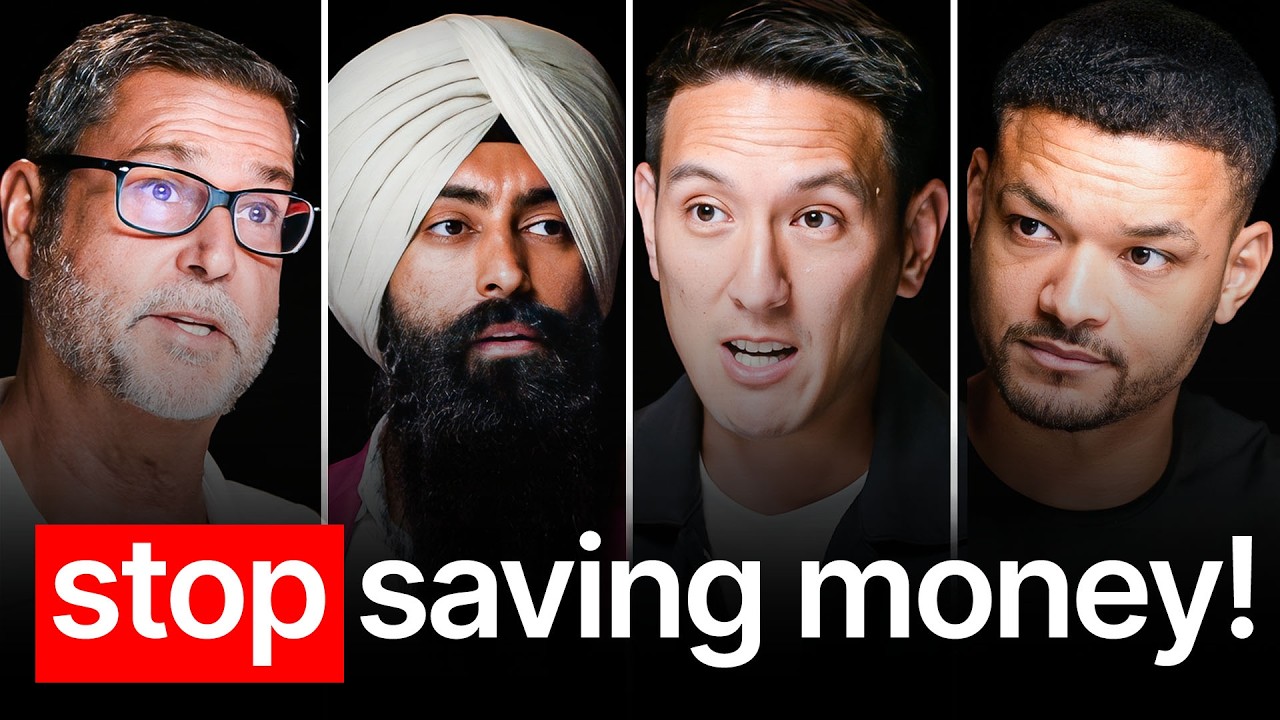
Pal, Singh, Yang Urge Shift From Cash and Mortgages to Tech and Crypto
The Diary Of A CEO
Holding excess cash in low-yield bank accounts and tying up wealth in illiquid primary residential real estate guarantees inflation-driven purchasing power losses, making automated allocations into high-compounding tech equities and digital assets essential for long-term wealth accumulation.
## Background
Published by The Diary Of A CEO on YouTube on September 15, 2025, this video brings together personal finance creators Jaspreet Singh and Humphrey Yang alongside former hedge fund manager Raoul Pal. According to the page description, the personal finance roundtable covers the truth about renting versus buying homes, escaping debt, passive income myths, asset allocation strategies, and planning for financial security in an era of shifting pensions, AI, and crypto.
## TL;DR
The panel discusses strategies for building real wealth, challenging traditional milestones like homeownership and low-yield bank savings accounts in favor of high-income skills, equities, and high-upside assets like tech and crypto. They unpack practical approaches to debt elimination, dollar-cost averaging, and business equity while dispelling popular myths around passive income and standard 401(k) reliance. While Jaspreet Singh emphasizes cash-flowing real estate and disciplined spending, Raoul Pal advocates aggressively positioning into technology growth and digital assets, and Humphrey Yang provides pragmatic, scale-appropriate framework allocation for retail investors.
## Atmosphere & style
The conversation carries a candid, high-energy, and intellectually invigorating tone, balancing sharp macro-level insights with relatable personal finance anecdotes. Host Steven Bartlett guides the discussion with curiosity, drawing out dynamic debates between Raoul Pal's macro risk-taking philosophy and Jaspreet Singh's grounded, value-focused principles. Watching the panel feels like sitting in on an unfiltered, pragmatic masterclass where experienced finance figures strip away conventional money rules to share honest, battle-tested strategies.
## Key takeaways
- [33:42](https://www.youtube.com/watch?v=XTGlde-Pbd8&t=2022s) For beginners with small capital bases, investing in high-income skills or business opportunities generates far greater returns than putting small sums like $1,000 into standard index funds.
- [31:12](https://www.youtube.com/watch?v=XTGlde-Pbd8&t=1872s) Jaspreet Singh advocates for a 'decade of sacrifice' through passive dividend investing to build automated cash flow that covers core living expenses.
- [40:34](https://www.youtube.com/watch?v=XTGlde-Pbd8&t=2434s) Replacing standard broad-market indexes with technology-heavy allocations like the Nasdaq-100 or cryptocurrency can significantly shorten the timeline to financial independence.
- [44:00](https://www.youtube.com/watch?v=XTGlde-Pbd8&t=2640s) Dollar-cost averaging removes emotion from investing, converting severe market drawdowns into high-yield long-term buying opportunities.
- [47:55](https://www.youtube.com/watch?v=XTGlde-Pbd8&t=2875s) Raoul Pal maintains a 100% allocation in digital assets, arguing that cryptocurrency and big tech are the only asset classes reliably outpacing central bank currency debasement.
- [49:22](https://www.youtube.com/watch?v=XTGlde-Pbd8&t=2962s) Beyond 2030, autonomous AI agents and robotics will disrupt traditional economic models, conducting machine-to-machine micro-transactions via blockchain networks.
- [56:10](https://www.youtube.com/watch?v=XTGlde-Pbd8&t=3370s) Consumer debt at 15–20% interest compounds faster than passive investments; resolving debt emergencies requires aggressive lifestyle cuts and structured repayment strategies like the avalanche method.
- [59:29](https://www.youtube.com/watch?v=XTGlde-Pbd8&t=3569s) Filing for bankruptcy, while damaging to credit in the short term, often provides a necessary financial reset that leaves individuals in a stronger 10-year position than prolonged debt struggles.
- [01:03:41](https://www.youtube.com/watch?v=XTGlde-Pbd8&t=3821s) True 'passive income' is an outcome of long-term capital deployment, not a starting mechanism for individuals without existing capital or cash flow.
- [01:05:37](https://www.youtube.com/watch?v=XTGlde-Pbd8&t=3937s) Residential real estate operates effectively as a wealth-building mechanism only when managed as a structured, cash-flow-focused business rather than a purely passive asset.
- [01:10:21](https://www.youtube.com/watch?v=XTGlde-Pbd8&t=4221s) An increasing number of high-net-worth individuals choose to rent primary residences to avoid property taxes, insurance inflation, and tied-up equity, preserving liquidity for higher-yielding investments.
- [01:13:19](https://www.youtube.com/watch?v=XTGlde-Pbd8&t=4399s) Primary homeownership acts as a forced savings mechanism but buries capital in illiquid equity burdened by frontloaded interest and recurring ownership costs.
- [01:23:32](https://www.youtube.com/watch?v=XTGlde-Pbd8&t=5012s) Traditional retirement plans and 401(k)s often suffer from high management fees, strict lock-up periods, and vulnerability to inflationary money printing as government pension systems face demographic pressure.
- [01:36:40](https://www.youtube.com/watch?v=XTGlde-Pbd8&t=5800s) Under the CoastFIRE model, frontloading retirement savings early allows compound growth to cover long-term retirement goals without requiring ongoing contributions later in life.
- [01:47:37](https://www.youtube.com/watch?v=XTGlde-Pbd8&t=6457s) Keeping cash in traditional bank accounts erodes purchasing power due to inflation, making active reinvestment or yield generation essential to preserving wealth.
- [01:51:45](https://www.youtube.com/watch?v=XTGlde-Pbd8&t=6705s) Building substantial wealth relies heavily on strategic networking, relationship management, and providing upfront value to high-net-worth ecosystems.
The discussion opens with a stark contrast between traditional advice and modern wealth-building realities. For generations, standard financial advice dictated that getting a job, saving money, and taking out a mortgage were the essential steps toward securing a financial future. However, the panelists argue that this advice is severely outdated and actively makes your future self poorer. Sitting on cash in a standard bank account guarantees a loss of purchasing power every day due to inflation.
To break out of this cycle, individuals must adopt disciplined money habits that compound over time. Steven Bartlett highlights a glaring metric of consumer behavior: the average American spends more money on Netflix subscriptions than on personal investments. By contrast, committing to even small, consistent investments creates massive compound growth over a multi-decade horizon.
- **The $1,000/Month Rule**: Investing $1,000 per month into an index fund like the S&P 500 for 30 years yields approximately $1.9 million.
- **The Saver's Dilemma**: Holding cash in traditional bank accounts guarantees daily financial loss via inflation.
- **Consumer Misalignment**: The average American prioritizes monthly digital subscriptions over building investment portfolios.
---
[02:10](https://www.youtube.com/watch?v=XTGlde-Pbd8&t=130s) How Do I Make More Money?
Addresssing common listener frustration—where saving feels pointless when earnings are low—the host questions whether a £30,000 to £40,000 annual salary limits someone from building wealth, and if focusing on earning more should be the initial priority. Humphrey Yang emphasizes that wealth creation requires a dual approach: making more while optimizing saving. He suggests leveraging unique personal hobbies or specialized skills, explaining that even casual expertise can be monetized through coaching or freelance work.
Raoul Pal highlights that financial trajectories are deeply tied to one's peer group. Earning more is significantly easier when you surround yourself with ambitious, growth-minded people rather than remaining in environments where financial ambition is criticized. Furthermore, workers must look beyond their formal academic qualifications—such as a medical degree—and stay open to unconventional career pivots that better align with their true strengths.
- **Monetizing Niche Skills**: Even non-professional skills (e.g., coaching a sport like padel) can command $20–$25 per hour from beginners.
- **Peer Effect**: Surrounding yourself with individuals striving to increase their income accelerates personal earnings.
- **Career Flexibility**: Degrees do not dictate lifelong roles; pivoting to leverage broader skill sets leads to higher earning potential.
---
[04:59](https://www.youtube.com/watch?v=XTGlde-Pbd8&t=299s) Pointless Jobs That Actually Made You the Most Money
Reflecting on foundational career steps, Steven Bartlett notes that his early years spent in telesales between ages 16 and 19 were the most critical experience of his life. Despite seeming like a dead-end job at the time, telesales taught him how to persuade people, raise venture capital, and recruit talent. The panelists agree that sales is the ultimate foundational skill across all industries and life decisions.
Jaspreet Singh outlines the fundamental distinction between how wealthy people and average consumers allocate their income. Wealthy individuals pay themselves first by automatically setting aside money for investments and savings as soon as they get paid, leaving only the remainder for lifestyle expenses. Most people do the exact opposite: spending first, wondering where the money went, and attempting to save whatever scraps remain.
> "The single best skill you can acquire in life is to learn how to sell. To be comfortable around people and to be able to get a message across is the single most powerful tool you can have in life."
- **Core Life Skill**: Learning to sell bridges pitch meetings, hiring, and everyday social interactions.
- **The Wealthy Income Flow**: Invest and save first, then live off the remaining balance.
- **The Average Income Flow**: Spend freely first, leaving little to no funds for investing at the end of the month.
---
[06:39](https://www.youtube.com/watch?v=XTGlde-Pbd8&t=399s) How to Visualize Your Finances
Raoul Pal explains that financial struggles often stem from a disconnect between a person's current reality and their vision of their future self. Unhappiness occurs when daily actions fail to align with long-term goals. Rather than focusing strictly on material benchmarks like private jets versus budget airlines, individuals should define the *emotional* state they want their future self to experience, such as security, freedom, or peace of mind.
- **Emotional Outcomes Over Material Items**: Long-term goals are fundamentally tied to feelings of safety and freedom rather than luxury goods.
- **Vision Alignment**: Progress toward a defined future self is essential for sustained personal and financial fulfillment.
---
[07:30](https://www.youtube.com/watch?v=XTGlde-Pbd8&t=450s) Social Pressure Around Money
A major obstacle to building wealth is external social pressure. When individuals choose modest living arrangements—such as a simple three-bedroom house—to prioritize saving, friends and society often push them to spend more and "try harder." Society and media frequently amplify insecurity, making it difficult for people to stick to their personal financial boundaries.
- **Social Friction**: Trying to save money often leads to criticism from peers who push for higher consumer spending.
- **Media Insecurity**: Broad market messaging feeds on consumer unhappiness to drive impulse buying.
---
[08:08](https://www.youtube.com/watch?v=XTGlde-Pbd8&t=488s) The Psychological Barriers to Managing Money
Fear and avoidance surrounding personal finances run deep across populations. According to cited statistics, 82% of Americans admit to avoiding thinking about their finances, and 1 in 4 have avoided necessary medical care out of fear of the bill. This anxiety is highest among younger generations: 67% of Gen Z and 58% of Millennials avoid checking their bank accounts because it is too stressful, compared to just 30% of Baby Boomers. Money remains the primary source of stress for Americans, surpassing work, family, and health.
The panelists note that the financial industry intentionally uses dense jargon to make everyday people feel incompetent, creating a false perception that only high-priced professionals can manage money. Overcoming this requires building baseline confidence and recognizing that financial literacy is an achievable skill.
- **82% of Americans** actively avoid thinking about their financial situation.
- **1 in 4 Americans** skip medical care due to fear of the ultimate cost.
- **67% of Gen Z and 58% of Millennials** avoid opening their banking apps due to stress, compared to 30% of Boomers.
- **Mental Health Impact**: 36% of individuals carrying debt experience clinical anxiety, while 23% suffer from depression.
---
[09:23](https://www.youtube.com/watch?v=XTGlde-Pbd8&t=563s) The Simple Money Tracking Hack
Humphrey Yang shares a practical starting exercise to break financial avoidance: track every single expense for 30, 60, or 90 days. Most people lose track of smaller recurring digital expenses, such as a $30 DoorDash order or a $15 Uber ride, because credit card swipes obscure the immediate impact. Data shows that 65% of Americans have no idea what they spent in the previous month, and 60% underestimate their monthly spending by a wide margin.
Humphrey shares his personal experience from 2014, when he tracked his spending for a month assuming he spent $1,500—only to discover his actual expenditures were $2,800. Gaining clarity on your baseline budget is the mandatory first step before attempting to build an investment strategy.
- **65% of Americans** do not know how much money they spent last month.
- **60% of Americans** significantly underestimate their actual monthly budget.
- **The Tracking Reality Check**: Unconscious micro-spending can cause budget estimates to be off by 60% to 70%.
---
[10:54](https://www.youtube.com/watch?v=XTGlde-Pbd8&t=654s) The 3-Step Investment Framework
Jaspreet Singh breaks down wealth creation into a three-tiered framework based on how active an investor wants to be:
1. **Hands-Off / Financial Adviser**: You delegate management completely to a professional. However, high management fees drag down compound returns over time. An adviser netting an 11% annual return with a 1.5% fee leaves you with an effective 9.5% return, costing hundreds of thousands in lifetime fees.
2. **Passive Investor**: You invest directly in low-cost index funds tracking major indices like the S&P 500. Requiring minimal ongoing maintenance, this approach captures general economic growth and has historically yielded around 10% annually.
3. **Active Investor**: You directly research and select individual stocks, real estate, or other assets. While offering higher potential returns, it carries greater risk and demands significant time and discipline.
| Investment Strategy | Average Annual Return | 30-Yr Value ($1,000/mo) | Key Trade-off / Cost |
|:--- |:--- |:--- |:--- |
| **Financial Adviser** | 11% (gross) / 9.5% (net) | ~$1.8 Million | High fee drag (~$600k paid in advisory fees). |
| **Passive Indexing (S&P 500)** | ~10% | ~$1.9 Million | Low cost, hands-off, tracks overall economy. |
| **Active Investing** | ~13% (target) | ~$3.5 Million | High effort, higher risk, requires ongoing research. |
---
[13:18](https://www.youtube.com/watch?v=XTGlde-Pbd8&t=798s) Best Form of Investing: Active or Passive?
Steven Bartlett challenges the active approach, citing data showing that over 20-year periods, more than 90% of actively managed professional funds fail to outperform the S&P 500 after accounting for fees. Given those odds, he asks why individual investors would attempt stock-picking.
Jaspreet Singh agrees, stating that **98% of people should NOT be active investors**. For the vast majority, passive index investing is the superior path because active investing requires extensive time, emotional discipline, and research that most individuals will not execute effectively. Only those willing to put in rigorous work should attempt to capture the slight performance edge that active investing offers.
- **Professional Failure Rate**: Over 90% of actively managed funds underperform the S&P 500 over a 20-year horizon.
- **The 98% Rule**: 98% of everyday investors build more wealth through passive index funds than active stock trading.
The Emotional Toll of Liquid Investments Versus Long-Term Assets
The discussion opens with an exploration of why people are drawn to certain types of financial engagement, comparing the psychological friction of investing to activities like sports betting. The speakers draw a sharp contrast between how people interact with real estate versus liquid markets. When someone buys a house, they don't typically check Zillow multiple times a day—in the bathroom, at lunch, or before bed—because they recognize it as a long-term commitment. In contrast, the high liquidity of the stock market tempts investors to constantly check prices, triggering severe anxiety and emotional turbulence. Emotional control is highlighted as being just as critical to an investor's success as the actual research they conduct.
Shifting the lens to the broader economic reality, the panelists emphasize how difficult the financial landscape has become for younger generations. Young people are exiting university weighed down by massive debts. Citing statistics discussed off-camera, the panel notes that the percentage of 30-year-olds who are married and possess a mortgage plummeted from 52% in 1950 down to just 12%. Because asset costs have outpaced income growth, the traditional path to financial security feels completely out of reach for average millennials and Gen Z.
- The percentage of 30-year-olds with a mortgage and a marriage dropped from 52% in 1950 to 12%.
- Constant portfolio checking in liquid markets amplifies emotional stress and anxiety for everyday investors.
---
Currency Debasement and the Illusion of Rising Asset Costs
The conversation pivots to a fundamental macroeconomic concept: why younger generations are forced to take massive financial risks. The core issue is that asset prices (such as housing and stocks) are climbing at roughly 12% to 13% per year, while salaries crawl upward at only 2% to 3% annually. To illustrate this phenomenon for viewers, the speakers use a simple analogy involving a coffee mug and a stack of paper representing money.
If a central authority prints unlimited paper money and distributes it to everyone in the room, the physical mug does not inherently become more valuable; rather, buyers are forced to offer a "gazillion" sheets of paper for it because the currency itself has been devalued. This process is described as the "debasement of currency," creating an optical illusion that assets are growing in value when, in reality, the purchasing power of money is shrinking. Consequently, traditional retirement vehicles like 401(k) plans compounding at standard rates are no longer enough to close the gap, driving young people toward high-risk, high-reward alternatives out of sheer necessity.
- Asset prices (housing, S&P 500, gold) historically appreciate at approximately 12% to 13% per year.
- Average annual salary growth lags far behind at roughly 2% to 3%.
- Currency debasement creates the illusion that assets are getting more expensive, while the underlying value of money is actually declining.
---
The Rise of Cryptocurrency and Network Adoption Models
Building on the necessity of high-yield assets, the discussion turns to cryptocurrency as a primary vehicle that has outperformed all other asset classes despite extreme volatility. Bitcoin is highlighted as a technological network adoption model that draws in more participants globally due to its fractional accessibility. Unlike prime real estate—such as an apartment on Fifth Avenue—which is locked behind prohibitive capital requirements, anyone can purchase a fractional share of Bitcoin for a few dollars.
The numbers presented for Bitcoin are staggering: since its inception around 2009–2012, it has generated average annual returns of roughly 145% (or closer to 100% in recent years as adoption matures), outperforming the broader stock market by roughly tenfold. This exponential growth has fueled massive global participation, boasting approximately 650 million crypto brokerage accounts worldwide—surpassing the total number of stock market brokerage accounts combined.
- Bitcoin has delivered historical average returns of roughly 145% per year since 2012.
- There are currently around 650 million crypto brokerage accounts worldwide.
- Fractional ownership allows retail investors to participate with minimal capital, unlike scarce physical assets like prime real estate.
---
Challenging Bitcoin: Social Consensus, Volatility, and the S&P 500
A lively debate ensues as one speaker plays devil's advocate, challenging Bitcoin as a database in the sky backed by nothing tangible—no gold, no physical byproduct—and comparing its structure to a Ponzi scheme that relies entirely on subsequent buyers to push prices higher. The counterargument is that all fiat money and gold derive their value entirely from "social consensus," representing shared human belief rather than intrinsic utility.
The conversation then tackles the psychological battle of market drawdowns. Both stocks and crypto experience brutal corrections during bear markets—for instance, during recent economic shocks, stocks dropped while Bitcoin suffered drawdowns of 50% to 60%. The core distinction lies in the risk-reward payoff: while the S&P 500 might subject investors to average bear market drawdowns of 25% for modest annual returns, Bitcoin exposes holders to harrowing 70% crashes in exchange for historically unprecedented asymmetric upside. The absolute key to surviving these drops, the panelists stress, is holding long enough through the turbulence and avoiding panic selling during personal or economic distress.
- During market crashes, Bitcoin frequently experiences drawdowns of 50% to 70%.
- Warren Buffett, widely regarded as one of the greatest investors, has averaged roughly 19% annual returns over decades, underscoring how drastically Bitcoin's historical returns deviate from traditional benchmarks.
- The fundamental danger during a 70% crash is that individuals facing job losses or financial desperation may be forced to sell at the absolute bottom, locking in catastrophic losses.
---
Equity Versus Cash Flow: Balancing Speculation and Income
The roundtable shifts toward practical portfolio construction, weighing the merits of invisible capital gains (equity) against tangible cash flow. One panelist distinguishes between holding speculative assets that require a sale to realize profits versus owning income-generating assets like dividend-paying stocks or rental properties.
Using McDonald's as an example, the panel explains how massive profitable corporations can allocate their earnings: they can stockpile cash for emergencies, reinvest in business expansion, or distribute profits directly to shareholders as dividend payments. This provides investors with recurring cash to buy food or fund vacations without needing to sell their underlying shares. The segment concludes with a personal anecdote about portfolio evolution: after accumulating significant gains from buying Bitcoin early at $3,000 per coin and riding it through multiple bull and bear cycles up to $70,000, the investor deliberately rebalanced a portion of those speculative crypto gains into physical real estate to secure reliable monthly rental income.
- Dividend-paying stocks distribute corporate profits directly to shareholders as regular cash payments.
- One panelist shares a personal investing journey, having started buying Bitcoin at $3,000 and later rebalancing profits at around $70,000 into cash-flowing rental real estate.
By the way, to unlock the full functionality of all Apps, enable [Gemini Apps Activity](https://myactivity.google.com/product/gemini).
[30:10](https://www.youtube.com/watch?v=XTGlde-Pbd8&t=1810s) Borrowing Against Crypto vs. The "Decade of Sacrifice"
The debate opens with Jaspreet Singh raising the severe downside of leveraging volatile assets like Bitcoin. While crypto proponents suggest taking out a 50% loan against one's holding to unlock capital, Jaspreet points out that if Bitcoin subsequently crashes by 70%—which it historically has—a margin call triggers, forcing liquidation and leaving the investor underwater. Raoul Pal acknowledges the risk of leverage and agrees that investors must maintain cash flow reserves to withstand steep drawdowns, but he remains skeptical of low-yield strategies, arguing that a 4% dividend payout "doesn't make any difference to anybody" unless you already possess huge starting capital.
Jaspreet pushes back vigorously, describing dividend investing as a deliberate "decade of sacrifice." He frames it as a long-term discipline where someone sacrificing from age 33 to 43 secures predictable, reliable passive cash flow that pays for housing and cars without relying on hope. Raoul counters that Jaspreet’s conservative, multi-asset asset allocation—spreading wealth across stocks, real estate, crypto, and gold—is "the strategy of a rich person" rather than how wealth is initially built. Jaspreet clarifies that he didn't start diversified; he built his core capital as an entrepreneur taking obscene risks, but now diversifies precisely because every asset class, from real estate to crypto, inevitably experiences catastrophic crashes.
- **Margin Call Risk:** Taking a 50% loan against Bitcoin leaves investors vulnerable to liquidation if the asset experiences a typical 70% drawdown.
- **Dividend Strategy:** Jaspreet champions a decade-long commitment to dividend investing to build guaranteed income streams that cover living expenses.
- **Self-Diversification:** Jaspreet balances stocks, real estate, crypto, and gold to hedge against systemic crashes, acknowledging policy changes or quantum computing as potential existential risks for Bitcoin.
[33:45](https://www.youtube.com/watch?v=XTGlde-Pbd8&t=2025s) How to Invest $1,000: Skill Building and AI Arbitrage
When Steven Bartlett asks how someone with just $1,000 in disposable income should allocate their money, Humphrey Yang advises against immediately buying stock indexes. He notes that a 10% annual return on $1,000 yields a modest $100 gain over a full year, which does not move the needle for a beginner. Instead, Humphrey strongly advocates investing that $1,000 directly into acquiring high-income skills, recalling how he spent $150 early in his career on a Google AdWords course to land freelance business consulting clients.
Raoul and Steven highlight that today's biggest opportunity for "knowledge arbitrage" lies in Artificial Intelligence. Raoul points out that because most traditional### The Risks of Borrowing Against Volatile Crypto Assets
Jaspreet Singh highlights the hidden perils of attempting to produce yield or liquidity from holdings like Bitcoin. While someone could theoretically borrow against their cryptocurrency—taking out a loan at a 50% or 80% loan-to-value ratio—the extreme volatility of digital assets creates massive downside risk. If Bitcoin suffers a 70% drawdown, a scenario it has experienced multiple times historically, the borrower quickly finds themselves underwater. The lender then issues a margin call, forcing a liquidation of the underlying crypto at the worst possible time and turning paper wealth into a devastating loss.
Raoul Pal acknowledges the critical importance of maintaining adequate cash reserves and liquid buffer capital to absorb steep drawdowns. Investors who want to take long-term speculative bets on crypto, startups, or technology must have the financial flexibility to sit through deep market corrections. However, Raoul dismisses the appeal of chasing modest 4% dividend yields, arguing that such small cash flows do not make a meaningful difference unless an investor already possesses a massive capital base.
```
• Bitcoin Loan Liquidation Risk: Taking a 50% loan-to-value loan on Bitcoin results in margin calls and forced liquidations if the asset drops 70%.
• Cash Flow Buffer Requirement: Having sufficient cash flow to survive deep market drawdowns is critical when holding high-volatility assets like crypto or tech startups.
```
---
[31:12](https://www.youtube.com/watch?v=XTGlde-Pbd8&t=1872s) The "Decade of Sacrifice" vs. High-Risk Entrepreneurship
Jaspreet pushes back on Raoul’s dismissal of dividend investing, arguing that building a cash-flowing portfolio is a foundational strategy for long-term security. He frames this approach as a "decade of sacrifice": a 33-year-old who systematically commits capital to dividend-generating assets until age 43 creates an independent income stream that permanently covers major lifestyle expenses like mortgages and cars. For everyday investors, having secure, predictable passive cash flow provides peace of mind that purely speculative gains cannot match.
```
"If you start investing for dividend income, I call it a decade of sacrifice. And this is why it's so hard... You're going to become 43 at some point. And imagine if you're 43 and now you have the income to pay for that car, to pay for the house, you don't have to worry about it." — Jaspreet Singh
```
Raoul counters that Jaspreet’s conservative, multi-asset diversification approach—spanning real estate, dividend stocks, gold, and speculative assets—is essentially the "strategy of a rich person." He points out that Jaspreet did not accumulate his own wealth by slowly compounding conservative investments, but rather by taking "obscene risk" as an entrepreneur. Jaspreet acknowledges this, noting that while entrepreneurship drove his wealth creation, average earners making $50,000 a year saving $5,000 to $7,000 need a balanced framework. He warns that holding only Bitcoin carries severe tail risks, including potential government policy shifts, quantum computing threats, or waning public interest.
```
• Diversification Across Asset Classes: Jaspreet's personal allocation includes stocks, real estate, speculative crypto, and gold to protect against failure in any single asset class.
• Tail Risks Facing Bitcoin: Changing government regulations, quantum computing developments, or loss of market interest pose systemic risks to concentrated crypto positions.
```
---
[33:42](https://www.youtube.com/watch?v=XTGlde-Pbd8&t=2022s) Investing $1,000: Skill Acquisition and AI Arbitrage
When asked how someone should deploy a modest $1,000 in disposable income, Humphrey Yang argues against putting it straight into traditional stock market index funds. Given that an average 10% annual return on $1,000 yields only $100 after a full year—an amount that does not change anyone's life—Humphrey strongly advocates investing that money into self-improvement and high-value skill acquisition to boost primary earning power.
```
"If I had $1,000, I'm investing in myself. So, trying to improve my skills to make more money at some point." — Humphrey Yang
```
Humphrey shares how he previously spent $150 on an online Google AdWords course early in his career, allowing him to offer specialized digital marketing consulting to local businesses at elevated hourly rates. Steven Bartlett and Raoul note that today’s equivalent opportunity lies in artificial intelligence. Because a vast knowledge arbitrage exists between emerging technologies and traditional business owners, learning tools like ChatGPT, Claude, or basic prompt engineering can position a young person in the top tier of practical AI expertise.
```
• Skill Arbitrage Example: Humphrey leveraged a $150 Google AdWords course early in his career to build a high-paying consulting business.
• The AI Knowledge Opportunity: Reading the top books or official manuals for tools like ChatGPT and Claude places an individual in the top 1% of prompt engineers and operational AI implementers.
• Cal AI Success Story: An 19-year-old developer created "Cal AI" (a food photo calorie tracker app using AI) and scaled it to a reported $4 million per month in revenue ($50 million/year run rate).
```
---
[36:18](https://www.youtube.com/watch?v=XTGlde-Pbd8&t=2178s) Real-World Crypto Friction: The $20,000 Cup of Coffee
Humphrey clarifies that while building high earning potential is the primary engine of wealth, individuals can still achieve financial independence through steady saving and traditional investing without betting their life savings on high-risk crypto assets. He shares a lighthearted personal story illustrating the early friction and extreme volatility of Bitcoin. Having bought Bitcoin back when it traded at just $100, he frequently sold it as it achieved 10x gains.
During an early attempt to buy a $5 coffee at Koopa Cafe in Palo Alto, Humphrey tried paying with Bitcoin, unaware that transactions required 30 minutes to confirm. After sending 0.1 Bitcoin twice—which failed to register at the register—he was forced to pay with his debit card anyway. Today, those 0.2 spent Bitcoins would be worth roughly $20,000, prompting jokes from the panel about his "$20k cup of coffee."
```
"I sent Bitcoin twice for a $5 coffee. Now, keep in mind this is 0.1 bitcoins, right? This is 10k worth. It's an expensive coffee... I spent 20k on coffee." — Humphrey Yang
```
---
[37:54](https://www.youtube.com/watch?v=XTGlde-Pbd8&t=2274s) Earning Power, Skill Arbitrage, and Long-Term Compounding
Raoul reiterates that boosting underlying income is the single most decisive factor in building wealth. He recalls advice given to him by his father's friend when deciding between a marketing corporate role at Mars or a career on 1980s Wall Street in London: "It's the same job. You're a salesman in both. One, you get free miles, and the other, you get free money." Understanding where the same set of skills commands maximum financial leverage is the ultimate form of career arbitrage.
```
"It's really simple, Raoul. It's the same job. You're a salesman in both. One, you get free miles, and the other, you get free money." — Raoul Pal (quoting a mentor)
```
Jaspreet emphasizes that while income generation comes first, even small amounts of capital compounded over decades yield substantial fortunes. He highlights that an investor who put just $1,000 into the S&P 500 in 1971 and reinvested all dividends—without ever adding another dollar—would have roughly $330,000 today due to the index's ~10% historical annual compound growth rate.
```
• S&P 500 Historical Compounding: $1,000 invested in the S&P 500 in 1971 with dividends reinvested grew to approximately $330,000 today without any additional capital contributions.
```
---
[40:34](https://www.youtube.com/watch?v=XTGlde-Pbd8&t=2434s) S&P 500 vs. Nasdaq-100: Managing Drawdowns and Volatility
Jaspreet outlines his preferred allocation strategy for someone wanting a passive approach: 50% into low-cost S&P 500 index funds and 50% into individual high-conviction companies (such as Amazon or Microsoft) that offer growth potential without the extreme risks of cryptocurrency. Humphrey suggests a conservative benchmark strategy for a 25-year-old: 90% in S&P 500 index funds and 10% in speculative assets, aiming to hit $100,000 in liquid capital as fast as possible (which takes roughly 7.84 years at standard historical return rates with steady contributions).
Raoul advocates replacing the S&P 500 entirely with the Nasdaq-100 (via low-cost ETFs), noting that technology-focused equities compound at roughly 18% annually because the global economy grows systematically more digital every day. A portfolio featuring 70% Nasdaq-100 and 30% crypto dramatically shortens the timeline required to hit key wealth milestones.
```
"The Nasdaq-100... compounds at 18% a year... We live in a world that tomorrow will be more digital than today, guaranteed. And so therefore, these stocks tend to generate the most performance." — Raoul Pal
```
Jaspreet cautions that the higher 18% annual growth rate of the Nasdaq-100 comes with brutal drawdowns that test an investor's psychological resolve. During the dot-com crash of 2000, the Nasdaq dropped 78% from its peak and took 15 years (until 2015) to break even, whereas the S&P 500 fell 40%. Surviving such extended multi-year downturns requires immense emotional control.
```
• Dot-Com Crash Comparison (2000): The Nasdaq fell 78% from its peak and required 15 years to recover its previous highs, whereas the S&P 500 fell 40%.
• Recommended Allocation Models:
- Jaspreet: 50% S&P 500 / 50% Individual Growth Stocks.
- Humphrey: 90% S&P 500 / 10% Speculative Assets.
- Raoul: 70% Nasdaq-100 / 30% Crypto.
```
---
[44:00](https://www.youtube.com/watch?v=XTGlde-Pbd8&t=2640s) Dollar-Cost Averaging as an Emotional Circuit Breaker
To navigate deep market drawdowns and remove destructive emotions from financial choices, Raoul highlights the strategy of dollar-cost averaging (DCA). By committing to invest a fixed dollar amount (e.g., $500 per month) on a rigid schedule regardless of market conditions, investors turn price drops into buying opportunities.
When asset prices plummet, fixed-dollar monthly contributions automatically buy more shares or tokens at lower valuations, driving down the investor's average cost basis. Raoul notes that during the 2022 crypto market crash, aggressively dollar-cost averaging allowed his portfolio to hit new all-time highs long before the broader crypto market recovered to its previous price peaks. Re-framing market crashes as sales rather than disasters is the "secret hack" behind long-term compounding, echoing Warren Buffett's core investing philosophy.
```
• Mechanics of Dollar-Cost Averaging (DCA): Purchasing fixed dollar amounts at recurring intervals lowers the average purchase price during market drawdowns and accelerates the time needed to reach new portfolio highs.
• Psychological Benefit: DCA removes human emotion, panic-selling, and market timing errors from the investment process.
```
[45:29](https://www.youtube.com/watch?v=XTGlde-Pbd8&t=2729s) Market Volatility, Emotional IQ, and "Dead People" Brokerage Accounts
The roundtable continues their debate on market downturns and human psychology, with Humphrey Yang and Jaspreet Singh emphasizing that market panics create massive buying opportunities for disciplined investors. Jaspreet quips that panic leads to overselling, which leads to opportunity, and ultimately to profit. However, he points out that taking advantage of market crashes requires a level of financial sophistication and emotional maturity that most retail investors lack. While automated tools like Coinbase make dollar-cost averaging accessible to anyone, Humphrey questions how many ordinary investors can realistically stomach watching their portfolio drop 70% in a single year and continue buying steadily.
Raoul Pal pushes back, clarifying that major drops—like the post-2008 Nasdaq crash—were sharp one-year drops followed by years of compounding rallies. The real issue is that the average person lacks the "emotional IQ" to handle severe volatility without panicking. Steven Bartlett notes that the speakers' insights point to a fundamental truth: successful wealth-building requires a "panic-proof" system that removes human emotion and stops the amygdala from making destructive choices. To prove the point, Steven highlights a well-known financial statistic—that the best-performing brokerage accounts in the United States often belong to dead people, precisely because they do not trade, panic, or interfere with their investments.
- **Market Cycles:** Panic creates severe overselling, offering contrarians the highest long-term returns.
- **Investor Behavior:** Volatility exposes a lack of emotional control; automated systems remove impulse decisions during crashes.
- **The Inactive Advantage:** Inactive or forgotten brokerage accounts frequently outperform actively managed accounts because they avoid panic selling.
---
[47:55](https://www.youtube.com/watch?v=XTGlde-Pbd8&t=2875s) Is Crypto the Ultimate Asset or a Macro Hedge?
Steven turns to Raoul Pal, noting that because Raoul holds 100% of his investment portfolio in cryptocurrency, he must believe it is the single best place for someone to allocate capital. Raoul acknowledges the controversy of his position but reiterates that the broader crypto complex—including Bitcoin, Ethereum, Solana, and Sui—is the single best-performing asset class in human history. He frames this not as pure speculation, but as a mathematical hedge driven by two key forces: global currency debasement and technological network effects (Metcalfe's Law).
According to Raoul, only two asset classes in modern history have consistently outperformed the rate of fiat currency debasement: the Nasdaq and cryptocurrency. While Bitcoin functions as a sovereign collateral layer or "digital gold," the broader crypto ecosystem represents the brand-new financial and technical rails for the internet. Raoul notes that crypto adoption is growing at twice the speed of the early internet—measuring from the first 5 million internet IP addresses versus the first 5 million crypto wallets—making it the fastest-adopted technology in history, second only to artificial intelligence.
- **Outperforming Debasement:** Only crypto and the Nasdaq consistently outpace central bank money printing over long time horizons.
- **Adoption Speed:** Crypto adoption has expanded at roughly double the growth rate of the 1990s internet.
- **Core Assets:** Raoul highlights major protocols including Bitcoin, Ethereum, Solana, and Sui as core infrastructure components.
---
[49:22](https://www.youtube.com/watch?v=XTGlde-Pbd8&t=2962s) Geopolitics, AI Agents, and the Economic Singularity Beyond 2030
When Steven asks Raoul what could cause his crypto thesis to fail over a 20-year horizon, Raoul explains that crypto has already progressed into the "game of nations," with sovereign states in the Middle East, Asia, South America, and the United States competing for control over these assets. However, looking past 2030, Raoul warns that humanity faces a fundamental shift: the "economic singularity." Historically, global GDP growth has been driven by a simple formula: population growth, productivity growth, and debt growth. Across the Western world, Japan, and China, aging demographics and slowing population growth have crippled this traditional engine, forcing central banks to print money simply to service existing debt.
After 2030, the rapid rollout of autonomous AI agents and humanoid robotics will break this traditional economic formula by providing "infinite artificial humans" and unlimited productivity. In a world dominated by Artificial General Intelligence (AGI), human labor and traditional market mechanics will be transformed. However, rather than destroying crypto, Raoul argues that AI will make crypto rails mandatory. Autonomous AI agents operating under Maslow's hierarchy of needs—requiring compute and energy—will constantly transact with millions of other agents. These digital entities cannot open traditional bank accounts, making blockchain rails, smart contracts, and stablecoins the native currency of the machine economy.
- **Traditional GDP Formula:** $\text{GDP Growth} = \text{Population Growth} + \text{Productivity Growth} + \text{Debt Growth}$.
- **Demographic Drag:** Aging populations across the West, Japan, and China mean organic productivity and population growth are shrinking.
- **Machine Micro-Transactions:** Billions of autonomous AI agents will rely on crypto networks and stablecoins to pay each other for compute and tasks in real time.
---
[56:10](https://www.youtube.com/watch?v=XTGlde-Pbd8&t=3370s) Escaping the Debt Trap: Personal Crisis and Practical Roadmaps
Steven shares a distressing text message he received during a flight from a childhood friend he hadn't spoken to in a decade. The friend confessed to being in £40,000 of personal debt across credit cards and personal loans. Costing roughly £800 to $1,000 a month in interest and repayments, the burden had pushed him a month behind on his mortgage payments. Compounding the crisis, his partner was on maternity leave, he had just started a new job, and he was denied a debt consolidation loan. Desperate and rapidly running out of places to turn, the friend reached out asking for "passive income" ideas or books to read to work his way out.
Humphrey dissects the situation, noting that at £40,000 with interest rates between 15% and 20%, high-interest debt compounds faster than most people can earn. Trying to jump into "passive income" while drowning in high-interest debt is a dangerous delusion. Instead, Humphrey outlines an aggressive crisis protocol: cut every non-essential expense immediately, list all debts from highest to lowest interest rate, and pour every spare penny into paying off the highest-rate balance first (the avalanche method). If those measures fail to stop the spiral, the friend must consider drastic moves like downsizing or selling the home to protect the family's solvency.
- **The £40,000 Debt Trap:** Carrying £40,000 in consumer debt at 15–20% interest generates £800+ per month in interest alone, quickly triggering mortgage default.
- **The Delusion of Passive Income:** Expecting side hustles or passive income to solve an immediate debt emergency is unrealistic; aggressive cost-cutting and debt prioritization are required.
- **Order of Operations:** Rank debts from highest to lowest interest rate and aggressively eliminate the highest-rate debt first.
---
[59:29](https://www.youtube.com/watch?v=XTGlde-Pbd8&t=3569s) Bankruptcy as a Reset: Trade-Offs and Unexpected Outcomes
The conversation shifts to when an individual should consider filing for bankruptcy. Humphrey outlines the heavy trade-offs, noting that in the United States, a bankruptcy filing remains on a person's credit report for seven years, destroying their credit score and stripping away financial privileges like loan approvals. Despite the stigma, Google searches for bankruptcy lawyers in America have trended steadily upward, reflecting widespread economic stress among households drowning in consumer debt.
Steven cites a surprising statistic showing that over a ten-year horizon, individuals who officially file for bankruptcy often end up in a better financial position than those with similar debt levels who spend a decade desperately trying to avoid it. Raoul explains why this occurs: bankruptcy forces an immediate, unyielding economic reality check. It eliminates the crippling interest cycle and imposes strict spending discipline until frugal habits become permanent. While it severely limits credit access in the short term, it eliminates the debt mountain and gives low- or middle-income individuals a clean slate to rebuild their financial lives.
- **Credit Impact:** Filing for bankruptcy damages credit for up to seven years, restricting access to traditional loans and credit cards.
- **Search Trends:** Online searches for bankruptcy attorneys continue to rise, signaling growing consumer distress.
- **Behavioral Shift:** Bankruptcy acts as enforced financial discipline, breaking bad spending habits and resetting a family's financial baseline.
[01:01:16](https://www.youtube.com/watch?v=XTGlde-Pbd8&t=3676s) Extreme Sacrifices and Alternatives to Avoid Bankruptcy
The discussion opens with an uncomfortable financial reality: studies indicate that people who face severe debt head-on by filing for bankruptcy often end up in a better long-term financial position than those who prolong their suffering to avoid it. Eliminating unpayable debts brings immediate mental relief, whereas trying to limp along under crushing obligations creates chronic financial stress that leaks into physical health, personal relationships, and performance at work. However, bankruptcy carries heavy emotional tolls—often triggering divorces or causing families to lose their homes. For anyone trying to avoid filing while navigating severe financial trouble, the path forward requires "extreme, severe, and quick sacrifice."
To engineer a fast turnaround, Jaspreet Singh emphasizes that people must cut their expenses aggressively and sell off unnecessary assets. Cutting a $15 per month Netflix subscription isn't just about saving the subscription fee; it's about reclaiming the average two hours a day that Americans waste watching television. He points out that if someone is drowning in debt, sitting around watching TV should keep them up at night. Instead of sleeping eight hours, they should be working side hustles—driving for Uber, taking shifts at McDonald's, or finding any legal avenue to generate extra income to pay off what they owe. For a person earning around $50,000 with a $40,000 debt burden, extreme changes in spending and income generation are non-negotiable.
- Research shows bankruptcy often leads to a faster long-term financial recovery by wiping out unpayable debts and removing chronic stress.
- Chronic debt stress frequently impacts personal health, work performance, and family stability, often contributing to high divorce rates.
- Cutting entertainment subscriptions like Netflix frees up over 2 hours a day that should be spent earning extra income.
---
[01:03:41](https://www.youtube.com/watch?v=XTGlde-Pbd8&t=3821s) The Myth of Passive Income
When addressing a listener asking for passive income strategies to escape a £40,000 debt, Raoul Pal forcefully debunks the social media myth surrounding "passive income." He criticizes the "passive income industrialization complex" that tricks millennials into believing they can casually earn money without effort. In reality, every form of return requires work, capital, or risk. Raoul shares his own frustrating experiences with property rentals—where unexpected costs, endless management fees, and constant maintenance issues ruined the illusion of passive yield. The viral social media ideal of thirty-something millennials living effortlessly in Lisbon off rental checks is a fantasy that will never save someone from a crushing personal debt stack.
```
THE PASSIVE INCOME REALITY
[ SOCIAL MEDIA MYTH ] [ REALITY ]
• Zero effort required • High initial capital needed
• Automated, stress-free yield • Ongoing management & risks
• "Living in Lisbon on rental checks" • Steep, painful learning curve
```
Jaspreet Singh clarifies that passive income can exist, but people completely misunderstand its purpose and mechanics. It is not a magical remedy for someone who is currently broke and struggling to pay basic bills. Passive income is an outcome, not a starting point: it requires taking excess cash generated from working a job, investing that surplus into income-generating assets, and letting the money produce returns over time. Expecting passive income to rescue you when you have zero spare capital is fundamentally backwards.
* "There is a passive income industrialization complex that is... every millennial's dream, and it doesn't exist." — Raoul Pal
* "There is no such thing as returns without effort... even robbery comes with effort." — Raoul Pal
* "I am struggling with money, I have no money, I got bills to pay, I need passive income... well, that's not how it works." — Jaspreet Singh
---
[01:05:37](https://www.youtube.com/watch?v=XTGlde-Pbd8&t=3937s) Real Estate Investing: Business vs. Passive Asset
The conversation pivots to real estate as a wealth-building vehicle, spark-plugged by Raoul's negative experiences with both self-management and professional property managers. Managing properties yourself is a hands-on nightmare, but using a property manager slashes rental yields while leaving you exposed to short-term vacancy volatility and tenant damage. Jaspreet acknowledges that starting out in real estate is a painful, time-consuming learning process full of expensive mistakes and sleepless nights. Developing the expertise to screen bad property managers and select the right team takes years of hands-on effort.
Jaspreet explains that real estate becomes passive only after you treat it like a structured business and build a reliable execution team. Today, around 50% of his investment portfolio consists of single-family houses and multi-family apartments. When evaluating properties, he ignores equity growth and potential resale flips; his sole focus is securing a **7% cash-on-cash return** based purely on monthly rental cash flows. The group debates whether building a real estate portfolio is akin to running a tech startup. While a tech founder must constantly innovate and build products from scratch, a real estate investor acquires existing, proven assets that fulfill a fundamental human need—housing—and puts standard management systems in place to maintain them.
- **Jaspreet's Target Yield:** Seeks a 7% cash-on-cash return on invested capital, prioritizing steady monthly cash flow over equity appreciation or house flipping.
- **Portfolio Allocation:** 50% of Jaspreet's portfolio is in residential real estate (single-family homes and multi-family apartment units).
- **Startup vs. Real Estate:** Unlike tech startups that require constant product innovation, real estate relies on buying existing demand and applying pre-established management systems.
---
[01:10:21](https://www.youtube.com/watch?v=XTGlde-Pbd8&t=4221s) Why More Millionaires Are Renting in the U.S.
Humphrey Yang explains why he does not broadly advise beginners to jump straight into rental real estate. Given the steep learning curve and high capital requirements, he believes the stock market remains the most liquid and accessible place for most people to start building wealth. Humphrey practices what he preaches: despite having the financial means, he chooses to rent his primary home and invest the price difference between rent and a potential mortgage into market assets. This approach is particularly sensible in high-cost coastal markets like San Francisco, Seattle, New York, and Los Angeles, where home prices are detached from local incomes.
```
RENTING VS. BUYING IN TODAY'S MARKET
[ RENTING & INVESTING THE DIFFERENCE ] [ BUYING A PRIMARY HOME ]
• Liquidity and flexibility • Illiquid capital tied in equity
• Avoids real estate taxes & insurance • High mortgage interest rates
• Capital stays free for higher returns • 12x income ratio in major cities
```
A recent *New York Times* article highlights a dramatic trend: the number of millionaire renters in the United States tripled between 2019 and 2023. Wealthy individuals are increasingly choosing liquidity and geographic flexibility over property ownership. Owning a home in the U.S. comes with heavy tax drag (annual property taxes often ranging from 1.5% to 2%+), surging property insurance costs—especially in disaster-prone states like Florida and California—and elevated mortgage interest rates. Furthermore, while Wall Street assets have performed exceptionally well, Main Street economic conditions have been tighter, driving even high-earners to rent from property owners who purchased decades ago and can offer rents lower than current homeownership carrying costs.
- **Millionaire Renters Surge:** According to *The New York Times*, the number of US millionaires renting tripled between 2019 and 2023.
- **Carrying Costs:** US property owners face 1.5%–2%+ in annual property taxes plus skyrocketing home insurance rates in states like California and Florida.
- **Jaspreet's Personal Milestone:** Jaspreet rented for years to keep his capital deployed in high-return investments, only purchasing his first personal family home in 2025.
---
[01:13:19](https://www.youtube.com/watch?v=XTGlde-Pbd8&t=4399s) Is Owning a Home Actually a Good Investment?
The group takes aim at the classic generational advice given to young adults: "Get a job, save money, and get a mortgage." Jaspreet labels this traditional wisdom "one of the worst pieces of advice you can give somebody," despite it remaining the default playbook for most families. Raoul points out how dramatically the underlying economic math has shifted over a single generation. When Raoul was a 25-year-old investment banker in London, his first flat cost **3.5 times his annual income**. Today, an equivalent London flat relative to a starting banking salary costs **12 times annual income**.
```
HOUSING AFFORDABILITY MULTIPLE (LONDON)
Raoul's First Flat (Past) ████ 3.5x Income
Equivalent Flat Today ████████████████████████ 12x Income
```
Because purchasing a home now requires an immense amount of leverage and income, sinking capital into a primary residence often locks up money that could yield higher returns elsewhere. Raoul asserts that a primary residence is **not an investment** and never will be in the traditional sense, because you live in it, do not sell it during your lifetime, and never realize the equity—unless it is eventually passed down to your children. While a house can provide lifestyle stability and serve as an "investment in your future," the popular perception that buying a primary home is a guaranteed shortcut to building liquid wealth is an optical illusion that ignores the lost opportunity cost of renting and investing the difference.
- **Historical Affordability Shift:** A entry-level London flat cost 3.5x income when Raoul bought his first home; today, the exact same property tier costs 12x income.
- **Primary Home Myth:** Raoul argues a primary residence is not a financial investment because the equity is rarely realized during the homeowner's lifetime.
- **The Rental Illusion:** Many people view renting as "throwing money away," failing to recognize that homeownership buries capital in illiquid equity while accumulating non-recoverable costs (interest, taxes, maintenance).
[01:14:52](https://www.youtube.com/watch?v=XTGlde-Pbd8&t=4492s) The Trap of Frontloaded Mortgages and Homeownership
```
AMORTIZATION DANGER ZONE
Payment ($2,500/mo)
▲
│ ┌───────────────────────────┬───────────────────────────┐
│ │ BANK INTEREST │ YOUR HOME EQUITY │
│ │ (More than 50% of pmts) │ (Less than 50% of pmts) │
│ └───────────────────────────┴───────────────────────────┘
└──────────────────────────────────────────────────────────►
Year 1 Year 21 Year 30
⚠️ WARNING: Refinancing resets this clock back to Year 1!
```
Jaspreet Singh dismantles the long-held myth that buying a home is simply depositing money into a personal piggy bank instead of wasting it on rent. He breaks down the stark mathematical reality using a concrete example: if you purchase a $500,000 house today, put $100,000 down (20%), and finance the remaining $400,000 on a 30-year fixed mortgage at 6.5%, your monthly payment will sit around $2,500. While buyers assume this payment is split evenly between principal and interest, banks frontload mortgage interest. For the first 20 years of that mortgage, more than half of every single $2,500 payment goes directly into the bank's pocket as pure interest, leaving almost zero equity built in the early years.
It is not until year 21 that even half of your monthly payment starts going toward actual principal equity. To make matters worse, Jaspreet highlights a common behavioral trap: along the way, interest rates drop or homeowners need cash, leading them to refinance. The moment you refinance, the entire amortization schedule resets right back to day one, trapping you in a cycle of paying mostly interest all over again. Therefore, buying a home should be viewed as a personal lifestyle expense rather than a wealth-building investment. If you buy a house, do it because you want it and can genuinely afford it, not because you expect it to make you rich.
- **Example house purchase price:** $500,000 (with $100,000 / 20% down payment).
- **Financed amount:** $400,000 at a 6.5% interest rate over 30 years.
- **Monthly mortgage payment:** ~$2,500 per month.
- **Amortization tipping point:** Takes 20 years before half of the $2,500 monthly payment actually goes toward house equity.
- **Refinancing risk:** Resets the 30-year amortization clock back to zero, forcing you to start paying heavy interest again.
[01:17:00](https://www.youtube.com/watch?v=XTGlde-Pbd8&t=4620s) The Hidden Costs of Ownership and Housing as an Investment
```
THE "MILLION DOLLAR HOUSE" TRAP
House Value Doubles Hidden Holding Costs
┌────────────────────┐ ┌────────────────────┐
│ $500k ──► $1M │ │ ▲ Property Taxes │
│ ("Paper Rich") │ ──────► │ ▲ Home Insurance │
└────────────────────┘ │ ▲ Maintenance │
└─────────┬──────────┘
│
▼
Kids forced to sell if
they can't afford costs
```
Humphrey Yang offers a nuanced counter-perspective, noting that homeownership acts as a forced savings mechanism for emotionally volatile investors. If someone has $100,000 and knows they will panic-sell their stock portfolio the moment the market dips 2%, placing that money into a illiquid home equity down payment might actually protect them from their own impulses. However, Jaspreet counters with a scenario showcasing how skyrocketing home values create hidden financial drains: if a $500,000 house doubles in value to $1,000,000, the owner may feel wealthy on paper, but their localized tax and carrying costs explode. They now face drastically higher annual property taxes and insurance premiums on a million-dollar asset.
Raoul Pal adds that home insurance is becoming a massive, prohibitive cost center that buyers consistently overlook—especially in disaster-prone regions like Texas or Oklahoma subject to extreme weather. If an owner passes down a $1,000,000 home to their children, but those heirs cannot afford the steep annual property taxes and insurance bills, they are ultimately forced to sell it. The panel agrees unanimously that buying a home is near the bottom of their personal wealth-creation hierarchy. Raoul notes that while home security makes sense for a 38-year-old with a child and cleared student debt, it is completely unsuited as an investment strategy for younger people.
- **Illiquidity as a feature:** Homes cannot be sold in "two swipes," helping emotional investors avoid panic-selling.
- **Hidden holding costs:** Higher property value directly triggers higher ongoing property taxes and insurance premiums.
- **High-risk geographical areas:** States like Texas and Oklahoma face soaring, prohibitive insurance costs due to hurricane and weather risks.
- **Demographic consensus:** Homeownership as a wealth strategy is unappealing for younger generations, making sense only later in life once baseline debt is cleared and family stability is desired.
[01:19:16](https://www.youtube.com/watch?v=XTGlde-Pbd8&t=4756s) Good Debt, Leverage, and Borrowing Against Crypto
The discussion shifts to the concept of leverage and whether "good debt" really exists. Humphrey explains that debt can be beneficial if it works for you to generate higher returns, but warns that leverage carries extreme risk that frequently wipes people out. Using Jaspreet’s mortgage example, putting $100,000 down on a $500,000 home gives you 5x leverage; if the home appreciates to $1,000,000, your $500,000 gain represents a massive return relative to your initial $100,000 outlay. Raoul then explains that decentralized finance (DeFi) now allows anyone to instantaneously borrow against digital assets—including Bitcoin, Ethereum, or even digital art collections (borrowing up to 40%–50% of the art's value)—without ever stepping foot inside a bank.
However, Raoul strongly cautions against borrowing against volatile assets like Bitcoin. If the underlying asset drops sharply in price, you face instant liquidation and lose your core holdings for the sake of chasing a temporary yield or extra cash. On the flip side, Raoul explains the mechanics of Ethereum staking: rather than taking on leverage, holders lock up their tokens to help secure the blockchain network, earning an organic, algorithmically paid yield of around 4% annualized.
```
┌─────────────────────────────────────────────────────────────────────────┐
│ CRYPTO YIELD MECHANICS │
├───────────────────────────────┬─────────────────────────────────────────┤
│ STAKING (e.g., Ethereum) │ DEFI LEVERAGE LOANS │
├───────────────────────────────┼─────────────────────────────────────────┤
│ • Secure the network │ • Borrow cash/stablecoins against crypto│
│ • Earn ~4% annualized yield │ • High risk of forced liquidation │
│ • Low structural risk │ • Volatility can wipe out core holdings │
└───────────────────────────────┴─────────────────────────────────────────┘
```
The panel contrasts this digital borrowing convenience with traditional stock portfolios, where low-net-worth investors holding small amounts of traditional stock find it nearly impossible to obtain loans against their equities, a privilege historically reserved for private banking clients with massive portfolios.
- **Leverage definition:** Utilizing debt to control a larger asset value with a smaller upfront capital outlay.
- **DeFi borrowing:** Borrowing stablecoins or fiat instantly against crypto or digital art assets at 40%–50% loan-to-value without bank approvals.
- **Liquidation danger:** A sharp crash in volatile collateral like Bitcoin can result in complete liquidation of your position.
- **Ethereum Staking Yield:** Earning roughly 4% annualized return simply by locking up tokens to secure the network, similar to a digital treasury yield.
- **High-Yield Crypto Risk:** Advanced yield-enhancement protocols offering 20%–30% yield carry significantly higher structural risks.
[01:25:46](https://www.youtube.com/watch?v=XTGlde-Pbd8&t=5146s) The Trap of Pensions, 401(k)s, and Social Security
```
THE 401(k) CONUNDRUM
ADVANTAGES DISADVANTAGES
┌─────────────────────────────┐ ┌─────────────────────────────┐
│ • Tax-deferred growth │ │ • Limited investment choices│
│ • Possible employer match │ VS. │ • Wall Street management fees│
│ (e.g., free 3% match) │ │ • Locked until age 59½ │
└─────────────────────────────┘ │ (10% early penalty) │
└─────────────────────────────┘
```
Turning to retirement planning, Steven Bartlett raises the topic of pensions in the UK and 401(k)s/IRAs in the United States. Jaspreet reveals that he personally does not hold a 401(k) or IRA. While these accounts offer tax-deferred growth, Jaspreet outlines three major drawbacks:
1. **Lack of control and hidden fees:** Account holders are usually restricted to a small selection of mutual funds with high fee structures. He cites a survey showing that 92% of Americans do not even know what fees their 401(k) charges.
2. **Lock-up period:** Capital is frozen until age 59½, and accessing your own money earlier triggers a mandatory 10% penalty on top of income taxes.
3. **Overrated tax benefits:** Superior tax advantages exist outside of traditional retirement accounts for active investors.
While Jaspreet acknowledges that taking advantage of an employer's matching contribution (like a 3% match) offers immediate free money, the long-term structural flaws remain. Steven brings up an insightful debate from social media regarding state pensions, where younger workers realized that their pension contributions are not sitting in a personal bank vault waiting for them. Instead, current contributions pay out current retirees. Jaspreet confirms this applies directly to the US Social Security system: workers pay a 6.2% payroll tax, matched by another 6.2% from their employer. Instead of compounding in an account, this money pays existing beneficiaries, leaving the entire system at severe risk of running out of money before today's younger workers reach retirement age.
- **NerdWallet stat:** 92% of Americans are unaware of the management fees and expense ratios in their 401(k) plans.
- **Early withdrawal penalty:** Withdrawing funds from a 401(k) before age 59½ incurs a steep 10% penalty plus regular income tax.
- **Social Security Tax rates:** 6.2% paid by the employee and 6.2% paid by the employer on earned income.
- **Systemic risk:** Social Security operates as a pay-as-you-go system facing severe depletion risks for workers in their 20s, 30s, and 40s.
<ElicitationsGroup message="Where would you like to go next with this personal finance walkthrough?">
{/* Reason: Standard post-prose follow-up path offering deeper thematic exploration of the video contents. */}
<Elicitation label="Explore Part 7: Building wealth outside traditional banks" query="Continue with Part 7 of the transcript covering why keeping money in the bank makes you poorer."/>
<Elicitation label="Break down the 401(k) vs. taxable investing math" query="Provide a detailed mathematical comparison between investing in a 401(k) with an employer match vs. a taxable brokerage account."/>
</ElicitationsGroup>
[01:29:16](https://www.youtube.com/watch?v=XTGlde-Pbd8&t=5356s) The Retirement Crisis: Social Security, Pensions, and CoastFIRE
The conversation pivots to the systemic vulnerabilities of traditional retirement models, starting with Social Security. Jaspreet Singh emphasizes that young workers are not paying into a personal "piggy bank" for their future; instead, their tax dollars immediately pay out current retirees' benefits. Every traditional financial advisor preaches the classic "three-legged stool" model of retirement—consisting of personal savings, a $401(k)$, and Social Security. However, because governments are running out of funds to support this system, they will likely print money to fulfill payout obligations. As Raoul Pal points out, this results in retirees receiving higher nominal check amounts that buy drastically fewer actual goods and services due to inflation.
```
Classic 3-Legged Stool Model
┌──────────────────────────────┐
│ Personal Savings │
├──────────────────────────────┤
│ 401(k) / Personal Investment │
├──────────────────────────────┤
│ Social Security │
└──────────────────────────────┘
```
The discussion uncovers several major misconceptions about pensions and retirement accounts:
* Employers rarely contribute enough on their own to fully fund a worker's retirement.
* Pension funds are not simple savings accounts and cannot be accessed at will.
* Retirement payouts are generally not tax-free.
Raoul explains that twenty years ago, employers shifted from **Defined Benefit** plans (where a company guaranteed a fixed percentage of a worker's final salary for life, which eventually bankrupted legacy employers like airlines and auto manufacturers) to **Defined Contribution** plans (like $401(k)\text{s}$, where retirees only get back what they put in plus market returns minus fees). The average $401(k)$ balance for an American Baby Boomer near retirement age sits between $\$100,000$ and $\$200,000$—an amount that runs out after just ten to twenty years at a basic $\$20,000$-per-year withdrawal rate.
Jaspreet compares the current structure to a legal Ponzi scheme: it only stays afloat if there are enough young workers paying in at the bottom. Because demographic trends show declining birth rates across the US and UK, there will not be enough active workers in 20 years to support the massive cohort of 78 to 80 million retiring Baby Boomers. Raoul notes that governments will inevitably resort to taxing Bitcoin, asset growth, or investment income to fill the gap.
Countering the doom and gloom, Humphrey Yang shares a practical framework known as **CoastFIRE** (a variation of Financial Independence, Retire Early):
> "If you can hit $\$150,000$ by 35, if you have 30 years of investment returns at $8\%$, you'll have $\$1.5\text{ million}$ by the time you retire..."
Hitting a CoastFIRE number early allows an individual to stop contributing additional funds to retirement, freeing them to pursue work they actually enjoy rather than staying trapped in a soul-crushing job solely to save money.
* **Baby Boomer Cohort Size:** 78–80 million people in the United States alone.
* **Average Boomer $401(k)$ Balance:** Approx. $\$100,000$ to $\$200,000$.
* **CoastFIRE Example:** $\$150,000$ saved by age 35, growing at an assumed $8\%$ annual rate over 30 years, yields roughly $\$1.59\text{ million}$ by age 65 without additional contributions.
* **Humphrey's Asset Allocation:** $50\%\text{--}60\%$ invested in low-cost index funds and ETFs.
---
[01:39:35](https://www.youtube.com/watch?v=XTGlde-Pbd8&t=5975s) Ad Break: Bon Charge & DOAC Circle
The dialogue pauses briefly for host Steven Bartlett to introduce a sponsor product while wearing an infrared red-light face mask from **Bon Charge**. He explains that the device uses targeted red light to boost collagen production, clear up skin, and reduce blemishes or wrinkles, jokingly admitting his wife used to startle him by wearing it at night.
* **Sponsor:** Bon Charge (red light face mask).
* **Offer:** $25\%$ off sitewide using code `DIARY` at `[boncharge.com/diary](https://boncharge.com/diary)`.
* **Community Launch:** Steven announces the opening of the **DOAC Circle**, an exclusive community capped at the first 10,000 members (`doaccircle.com`), offering behind-the-scenes clips, host iPad briefs, unreleased episodes, and direct input into guest selection.
---
[01:41:23](https://www.youtube.com/watch?v=XTGlde-Pbd8&t=6083s) Framework for Smart Spending: What to Cut vs. Keep
Returning to the roundtable, Steven asks Humphrey about his approach to personal spending discipline and the common advice regarding cutting out everyday luxuries like Starbucks coffee. Humphrey explains that he reviewed his personal bank and credit card statements dating back to 2014 to track how his spending habits evolved, establishing a practical framework for cutting unnecessary waste without sacrificing overall quality of life.
Humphrey highlights three concrete spending changes he made:
1. **Ditching Airbnbs for Hotels:** Airbnbs used to offer great value and unique charm, but heavy commercialization, hidden cleaning fees, and strict checkout rules make traditional hotels cheaper and more convenient.
2. **Stopping Bulk Food Purchases:** As a single guy, buying items in bulk from stores like Costco led to food waste (e.g., throwing away spoiled milk or attempting to eat 48 eggs before their expiration date).
3. **Adjusting Insurance to Match Usage:** After moving to San Francisco, his annual driving dropped drastically from 15,000 miles down to 3,000 miles. A simple phone call to his auto insurer updating his mileage immediately shaved money off his premium.
* **Car Insurance Savings:** Lowering reported annual mileage from 15,000 miles to 3,000 miles saved Humphrey approximately $\$40$ per month.
Here is a detailed, faithful walkthrough based on the transcript provided:
[01:42:58](https://www.youtube.com/watch?v=XTGlde-Pbd8&t=6178s) Lowering Expenses vs. Scaling Income
Humphrey Yang kicks off the discussion by emphasizing how overly loyal people tend to be toward their current service providers. Consumers avoid rate-hunting because comparing policies feels tedious and time-consuming. However, investing just an hour to call car and home insurance companies puts those providers in a direct bidding war for your business, unlocking substantial savings for what is otherwise a commoditized service.
Steven Bartlett validates this by recounting his past telesales job selling car insurance. Inside the call center software, sales agents had a draggable price slider on their screens: sliding it to the left slashed both the customer's upfront and monthly payments if the rep feared losing the deal, whereas sliding it to the right jacked up quotes and added on upsells for easy sales. Steven notes that insurance products—down to mobile phone coverage—are deeply negotiable, though consumers often only realize this when they threaten to cancel and are suddenly offered a 50% discount.
Raoul Pal pivots the perspective, stating that he never focuses on cutting costs, but rather on "solving for income." Trying to scrimp on basic pleasures like dining out or ordering Uber Eats imposes harsh self-punishment that requires unsustainable levels of discipline. By applying that same discipline toward generating additional income streams—a norm in today's multi-job gig economy—people reach financial flexibility or "coast FIRE" far faster.
Jaspreet Singh pushes back slightly, noting that paring back expenses represents the lowest-hanging fruit available to everyone immediately, whereas doubling your income overnight is a much steeper challenge. Raoul counters that extra income can be generated right away by trading time for side gigs like driving Uber or bartending.
Jaspreet expands on the distinction, explaining that the choice comes down to your current stage of life and how much your time is worth. Packing a lunch saves money, but if an hour of your time is worth $2,000 rather than $20, preparing lunch is economically inefficient. He illustrates this with his own lifestyle: despite remaining frugal in many areas, he pays for an Uber during his 45-minute daily commute to his Market Briefs office in downtown Detroit. Sitting in the back seat allows him to manage live financial news and coordinate with his team without risking texting while driving, trading money to buy back an hour and a half of high-value time each day.
- **Key insurance tip:** Call insurance providers annually for car, home, and mobile phones to trigger retention discounts of up to 50%.
- **The time-value equation:** As your earning potential grows, paying for convenience (e.g., rideshares) buys back productive hours that yield higher returns than small savings.
---
[01:47:37](https://www.youtube.com/watch?v=XTGlde-Pbd8&t=6457s) The Fatal Flaw of Hoarding Cash in Banks
When Steven asks the panel for the single biggest financial mistake the average person makes, Raoul answers that it comes down to two ends of a spectrum: spending all your money, or saving all your money. Hoarding cash in a standard bank account guarantees that you get poorer every day through the invisible tax of inflation.
Steven shares a story about a freelance friend who slowly built up $1 million over the years, only to leave it completely untouched in a standard bank account because he was terrified of investing. Raoul points out that this strategy guarantees a loss. With average U.S. bank accounts paying a negligible yield (around 0.1% to 0.5%) against an official reported inflation rate of 3%, a $1 million cash pile loses roughly $25,000 in purchasing power every single year.
The discussion shifts to corporate balance sheets. Steven asks if companies—ranging from solo businesses to large corporations—should hold Bitcoin or other growth assets instead of cash. Raoul critiques giant corporations like Microsoft, pointing out that despite holding massive cash hoards yielding minimal returns, the actual assets they need to purchase (such as acquiring other companies, building AI data centers, or buying back their own stock) rapidly escalate in price due to monetary debasement. Holding pure cash yields an offset that falls far short of real-world corporate inflation.
For small business owners holding $1 million or $2 million in profits, Raoul advises against keeping idle capital in savings. While businesses must preserve liquid cash buffers for unexpected operational emergencies, excess cash should be put into conservative investment strategies or reinvested directly into the company to drive top-line growth.
> "If you have a million dollars there, that's $25,000 of lost buying power... having your money sat in a bank account doing nothing, you're becoming poorer every single day."
---
[01:51:45](https://www.youtube.com/watch?v=XTGlde-Pbd8&t=6705s) What the Ultra-Wealthy Know: Leverage, Networks, and Systems
Steven asks Humphrey what high-net-worth clients understand about wealth that average people miss. Humphrey notes that wealthy individuals exhibit incredible discipline, checking their accounts daily, operating on 10- to 20-year horizons, and resisting short-term gratification like sports gambling in favor of long-term compound growth.
Raoul builds on this by explaining how the financial system is explicitly built to serve the ultra-rich, referencing Charlie Munger's famous principle: *"Show me the incentive and I'll show you the outcome."* High-net-worth individuals with $10 million or more gain access to non-recourse loans—loans where the borrower is not personally liable if the trade fails—as well as pre-IPO private placements. Investment banks shower the wealthy with preferential terms because those individuals generate massive transaction fees for the banks.
However, Raoul emphasizes that retail investors no longer need to pay Wall Street’s exorbitant fees to build wealth. Everyday investors can bypass middleman fees simply by holding self-custodied Bitcoin or buying low-cost index funds, often outperforming professional venture capitalists without paying management fees.
The conversation transitions to how strategic relationships unlock massive wealth creation. Steven recalls visiting a billionaire's apartment and watching prime investment allocations for upcoming IPOs handed out exclusively to close personal friends. He highlights his friend Harry Stebbings, host of the *The Twenty Minute VC* (*20VC*) podcast, who leveraged 2-hour podcast interviews with world-class figures into raising a $750 million investment fund in his 20s strictly on the back of his high-net-worth network.
Raoul reinforces the power of relationships by sharing the origin story of Divesh Makan, founder of the wealth management firm Iconiq Capital. Makan started as a junior banker at Goldman Sachs in 2000 right as the dot-com bubble burst. With his senior superiors laid off, Makan spent his days hanging out in Silicon Valley coffee shops making friends with then-obscure entrepreneurs like Mark Zuckerberg, Reed Hastings, and Reid Hoffman. When those founders built tech empires, Makan became their trusted wealth advisor and eventually built Iconiq into a multi-billion-dollar firm catering to Silicon Valley's elite.
- **Non-recourse loans:** Ultra-wealthy individuals secure leverage where they hold no personal legal liability for repayment upon default, subsidized by bank fee incentives.
- **The Iconiq Capital origin story:** Divesh Makan built a multi-billion-dollar wealth empire simply by networking with rejected tech founders in Silicon Valley cafes after the 2000 crash.
- **Network leverage:** Cultivating high-value relationships provides access to private deal flow and institutional capital far beyond standard public-market offerings.
[01:57:17](https://www.youtube.com/watch?v=XTGlde-Pbd8&t=7037s) Managing Relationships as a Strategic Network
Steven Bartlett shifts the conversation toward personal relationships, noting that while people build extensive systems for managing money, almost nobody builds a system for managing their relationships. Most people simply save a phone number and passively hope to cross paths with that person again. Steven realizes that even with his podcast—where he meets incredible people daily—he lacks a structured system to track relationships, remember birthdays, or understand how he can be of service. Beyond the obvious mental health and social benefits, maintaining a strong network creates invaluable long-term business opportunities where he might need someone's advice six years down the line.
Raoul Pal emphasizes that the key to any successful network is what you put into it, not what you try to extract. The individuals with the most powerful networks are always asking, "How can I help you?" or proactively introducing people without expecting immediate kickbacks. Trying to extract value causes a network to collapse, leaving you as "that guy who's making the phone call after 10 years saying, 'Hey, Stephen, can I get some money from you because I've run out of cash?'" Steven echoes this sentiment with an anecdote about a mutual connection named Harry, who instantly set up a WhatsApp group with a top European investor after Steven pitched a fresh idea. Harry hyped both parties up via voice note, leaving a lasting positive impression of genuine karma and generosity.
---
[01:59:30](https://www.youtube.com/watch?v=XTGlde-Pbd8&t=7170s) Geographic Location, Wealth Growth, and Capital Arbitrage
Steven pivots to how geography affects wealth creation, asking the panel how much regional economic sentiment plays a role in their personal strategies. Humphrey Yang shares his experience living in London for a month, where he realized that local creators and podcasters were heavily dependent on the U.S. market—most of their listeners, sponsor revenue, and dollars originated from America. Humphrey notes that while the U.S. isn't a tax-free haven, it offers an unmatched environment for entrepreneurial growth and wealth accumulation compared to other countries.
Raoul Pal breaks down how he views geographic strategy through different lenses:
* **Lifestyle Arbitrage:** Places like Spain, Colombia, or Latin America offer an exceptional quality of life where rent and living costs can be half to a third of what they are in the U.S. or the UK. This allows people who work online to hit their "Coast FIRE" financial goals much faster.
* **Intellectual & Financial Capital:** For sheer density of ambition, capital, and top-tier talent, the United States remains completely unmatched globally.
---
[02:02:16](https://www.youtube.com/watch?v=XTGlde-Pbd8&t=7336s) Is the UK an Economic Backwater?
When asked specifically about the United Kingdom, Raoul pulls no punches, describing the UK as an "economic backwater." He observes an attitude where people have become "institutionally unhappy" and lack a culture of entrepreneurship, focusing instead on leasing bigger cars or buying larger homes rather than investing. He notes that while London was the epicenter of global finance, advertising, and creative industries in the late 1990s and 2000s, government missteps and over-regulation caused Wall Street to pull the banking ecosystem back to the U.S.
Raoul points out that the UK repeatedly drops the ball on emerging industries. For example, key breakthroughs in AI originated at Cambridge and DeepMind, and the UK held a strong position in early crypto, yet regulatory pushback drove talent and capital to the U.S. He attributes Europe's broader stagnation to aging demographics and low birth rates, which slow economic growth and strain national healthcare systems like the NHS, forcing governments into mounting debt.
* **UK Economic Shift:** Shifted from being a global financial hub in the 1990s/2000s to losing market share in banking, AI, and crypto to the United States.
* **Demographic Drag:** Low birth rates across Europe mean fewer young workers to sustain GDP growth, leaving an aging population reliant on underfunded social infrastructure.
---
[02:05:35](https://www.youtube.com/watch?v=XTGlde-Pbd8&t=7535s) Final Words and Crypto Holdings
To close out the discussion, Steven asks each guest for their core philosophy for financial success:
* **Humphrey Yang:** Personal finance fundamentally boils down to income minus expenses. Master driving both variables, avoid lifestyle creep (noting that the average U.S. car payment is \$745 per month), and let reasonable, consistent decisions compound over time.
* **Raoul Pal:** Prioritize education and investing over simple saving. Make trades, fail, learn, repeat, and surround yourself with a strong network. When Steven playfully asks about his personal crypto portfolio, Raoul reveals he holds just one Bitcoin for posterity, has allocated most of his liquid net worth into Sui (the network originating from Meta/Facebook), holds long-term digital art/NFTs on Ethereum, and periodically rebalances across major tokens like Solana.
* **Jaspreet Singh:** Dismiss the internet hype that romanticizes passive income as easy wealth. Real financial freedom requires a "decade of sacrifice," hard work, and a willingness to do what the vast majority of people refuse to do.
The panel finishes on a unanimous note of optimism regarding Artificial Intelligence, calling it the best tool humanity has ever been given. Steven wraps up the episode by directing viewers to Jaspreet's daily *Market Briefs* newsletter, Raoul's platform *Real Vision*, and Humphrey's financial product resource *HumphreysGuide.com*.
## Notable quotes
> [31:12](https://www.youtube.com/watch?v=XTGlde-Pbd8&t=1872s) If you start investing for dividend income, I call it a decade of sacrifice. And this is why it's so hard... You're going to become 43 at some point. And imagine if you're 43 and now you have the income to pay for that car, to pay for the house, you don't have to worry about it. — Jaspreet Singh
> [33:42](https://www.youtube.com/watch?v=XTGlde-Pbd8&t=2022s) If I had $1,000, I'm investing in myself. So, trying to improve my skills to make more money at some point. — Humphrey Yang
> [36:18](https://www.youtube.com/watch?v=XTGlde-Pbd8&t=2178s) I sent Bitcoin twice for a $5 coffee. Now, keep in mind this is 0.1 bitcoins, right? This is 10k worth. It's an expensive coffee... I spent 20k on coffee. — Humphrey Yang
> [37:54](https://www.youtube.com/watch?v=XTGlde-Pbd8&t=2274s) It's really simple, Raoul. It's the same job. You're a salesman in both. One, you get free miles, and the other, you get free money. — Raoul Pal
> [40:34](https://www.youtube.com/watch?v=XTGlde-Pbd8&t=2434s) The Nasdaq-100... compounds at 18% a year... We live in a world that tomorrow will be more digital than today, guaranteed. And so therefore, these stocks tend to generate the most performance. — Raoul Pal
> [01:03:41](https://www.youtube.com/watch?v=XTGlde-Pbd8&t=3821s) There is a passive income industrialization complex that is... every millennial's dream, and it doesn't exist. — Raoul Pal
> [01:03:41](https://www.youtube.com/watch?v=XTGlde-Pbd8&t=3821s) There is no such thing as returns without effort... even robbery comes with effort. — Raoul Pal
> [01:03:41](https://www.youtube.com/watch?v=XTGlde-Pbd8&t=3821s) I am struggling with money, I have no money, I got bills to pay, I need passive income... well, that's not how it works. — Jaspreet Singh
> [01:29:16](https://www.youtube.com/watch?v=XTGlde-Pbd8&t=5356s) If you can hit $150,000 by 35, if you have 30 years of investment returns at 8%, you'll have $1.5 million by the time you retire... — Humphrey Yang
> [01:47:37](https://www.youtube.com/watch?v=XTGlde-Pbd8&t=6457s) If you have a million dollars there, that's $25,000 of lost buying power... having your money sat in a bank account doing nothing, you're becoming poorer every single day. — Raoul Pal
> [01:51:45](https://www.youtube.com/watch?v=XTGlde-Pbd8&t=6705s) Show me the incentive and I'll show you the outcome. — Charlie Munger
## Mentioned
Jaspreet Singh, Raoul Pal, Humphrey Yang, Steven Bartlett, Bitcoin, Google AdWords, ChatGPT, Claude, Cal AI, Koopa Cafe, Mars, Wall Street, S&P 500, Nasdaq-100, Amazon, Microsoft, Coinbase, Warren Buffett, Ethereum, Solana, Sui, The New York Times, Uber, McDonald's, Netflix, Harry Stebbings, Divesh Makan, Mark Zuckerberg, Reed Hastings, Reid Hoffman, Charlie Munger, NerdWallet, Bon Charge, DOAC Circle, Costco, Starbucks, Uber Eats, Market Briefs, Iconiq Capital, Goldman Sachs, The Twenty Minute VC, DeepMind, NHS, Real Vision, HumphreysGuide.com, Social Security, 401(k), IRA, CoastFIRE
Pal、Singh 与 Yang 敦促将资产从现金与房贷转向科技股和加密货币
在低收益银行账户中保留过多现金并将财富锁定在缺乏流动性的自住房产中,必然会因通胀导致购买力受损;因此,自动定投配置高复利科技股和数字资产对长期财富积累至关重要。
嘉宾小组探讨了积累真实财富的策略,对置业和低收益银行储蓄等传统财富标志提出质疑,转而支持投资高收入技能、股票以及科技和加密货币等具有高上涨潜力的资产。他们深入分析了解除债务、定期定额投资以及持有企业股权的切实方法,同时破除了关于被动收入和依赖常规 401(k) 的普遍误区。其中,Jaspreet Singh 强调能带来现金流的房地产和自律消费;Raoul Pal 主张积极布局科技成长股与数字资产;Humphrey Yang 则为散户投资者提供了贴合其实际规模的务实资产配置框架。
对于资本基础较少的新手而言,投资高收入技能或商业机会所产生的回报,远高于将 1,000 美元这样的小额资金投入标准指数基金。 (33:42)
Jaspreet Singh 主张通过被动股息投资经历“牺牲的十年”,以建立能够覆盖核心生活开支的自动化现金流。 (31:12)
用纳斯达克 100(Nasdaq-100)等重仓科技的配置或加密货币替代标准宽基指数,可显著缩短实现财务独立的时间周期。 (40:34)
定期定额投资消除了投资中的情绪化因素,能将严重的市场回撤转化为高收益的长期买入良机。 (44:00)
Raoul Pal 保持 100% 的数字资产配置,他认为加密货币和大型科技股是唯一能够稳定跑赢央行货币贬值的资产类别。 (47:55)
Reading summary
Panelists Steven Bartlett, Humphrey Yang, Raoul Pal, and Jaspreet Singh argue that conventional financial milestones—relying on bank deposits, pension plans, and homeownership—fail to build wealth in an era where currency debasement drives asset inflation past stagnant wages. They contend that sustainable financial security requires eliminating high-interest debt, investing in high-income skills, and automating exposure to compounding assets while strictly managing emotional volatility.
The Currency Debasement Trap and Inadequate Savings (107:37)
The panel asserts that holding cash in traditional bank accounts guarantees a continuous loss of purchasing power. Pal notes that with standard accounts yielding 0.1% to 0.5% against official 3% inflation, a $1 million cash balance loses roughly $25,000 in real value each year. On a macro level, asset prices have appreciated at an estimated 12% to 13% annually while average wages increase only 2% to 3%, creating an optical illusion of rising asset values caused by systemic monetary expansion.
Traditional retirement mechanisms are equally challenged. Singh and Pal point out that 401(k) plans and standard pensions restrict asset selection, carry opaque fee structures—with 92% of Americans unaware of the fees their 401(k)s charge—and penalize early withdrawals before age 59½. Furthermore, because Social Security relies on current taxes rather than dedicated individual balances, government obligations face future payouts in nominal terms that risk significant inflationary erosion.
Flaws in the Homeownership Wealth Model (73:19)
Traditional generational advice to purchase a primary residence is challenged by Singh and Pal as economically outdated. Pal highlights that in London, an entry-level flat has climbed from 3.5 times annual salary in his early career to approximately 12 times today. Singh breaks down the amortization math: on a $500,000 home financed with 20% down at a 6.5% interest rate, the $2,500 monthly payment is heavily frontloaded by banks, meaning over half of every payment goes toward pure interest rather than equity for the first 20 years.
Beyond mortgage interest, rising home valuations generate growing secondary costs through higher property taxes, maintenance, and escalating home insurance premiums. Yang notes that renting and investing the cost difference into liquid financial markets offers greater capital efficiency, supported by data showing that the number of millionaire renters in the United States tripled between 2019 and 2023.
Skill Acquisition, Debt, and Passive Income Myths (63:41)
The panel debunks the idea that "passive income" is a viable quick fix for individuals struggling with negative net worth. Responding to a scenario of an individual facing £40,000 in consumer debt at 15% to 20% interest, Yang and Singh advise immediate lifestyle reduction, expense tracking, and the avalanche payoff method over speculative schemes. Pal characterizes viral social media portrayals of passive income as an illusion, stressing that all sustained yields require prior capital accumulation, specialized management, or substantial risk.
For those starting with small sums such as $1,000, Yang advises against immediate stock market entry, where a 10% annual return yields a negligible $100 gain. Instead, the panel advocates allocating early capital toward developing high-value skills like sales or artificial intelligence tools, where knowledge arbitrage can quickly enhance primary earning power.
Passive Indexing, Growth Assets, and Volatility Management (10:54)
When deploying investable capital, the speakers contrast index investing with higher-beta growth strategies. Singh highlights that 98% of people should remain passive investors, noting that contributing $1,000 monthly to an S&P 500 index fund accumulates roughly $1.9 million over 30 years, while over 90% of actively managed funds underperform the benchmark over 20-year periods.
Pal advocates for tech equities and digital assets, pointing to the Nasdaq-100's historical ~18% compound growth and cryptocurrency's adoption curve as superior hedges against currency debasement. However, Singh stresses that crypto exposes investors to severe 50% to 70% drawdowns that trigger liquidations for leveraged holders. To prevent destructive panic selling, the panel emphasizes automated dollar-cost averaging (DCA), which lowers cost basis during downturns and removes destructive emotional impulses.
While the panel reaches consensus on the necessity of outpacing monetary debasement through invested assets, they present competing philosophies on allocation: Singh favors cash-flowing real estate and diversified equity indexing, whereas Pal argues that average earners can only outpace macro debasement by embracing the high volatility of technology and digital assets.
## Background
该视频由知名访谈播客频道 The Diary Of A CEO(由 Steven Bartlett 主持)于 2025 年 9 月 15 日在 YouTube 平台发布。节目邀请了三位顶尖个人理财与宏观投资专家——Jaspreet Singh(Minority Mindset 创始人)、Raoul Pal(前对冲基金经理、Real Vision 首席执行官)与 Humphrey Yang(知名个人理财博主、前美林证券顾问)展开圆桌对话。简介指出,嘉宾们围绕租房与买房的底层逻辑、逃离信用卡高息债务陷阱、破除被动收入神话、加密资产与 AI 时代的前沿投资策略,以及为何单纯存钱只会让人更穷等核心议题进行了深度剖析。
## TL;DR
节目全面颠覆了“拼命存钱、贷款买房”等传统理财神话,指出在央行持续印钞与货币购买力稀释的宏观现实下,现金闲置在银行账户等同于确定性的财富缩水。嘉宾们针对财富积累路径展开了激烈交锋:既有推崇配置指数基金(S&P 500 / Nasdaq-100)、打造高确定性现金流资产的防御稳健派,也有主张利用加密资产与科技网络效应跑赢法币贬值的激进成长派。此外,对谈深入拆解了高息债务自救、破产机制的真实代价、自住房高昂的隐形成本与房贷利息陷阱,并揭示了社会保障与养老金制度潜藏的代际危机。专家们一致强调,摆脱财务困境的根本在于尽早建立自动定投纪律、进行自我技能投资以提升主动收入,并打破社交媒体对“被动收入”的一夜暴富幻想,践行长期的“十年牺牲”与延迟满足。
## Atmosphere & style
全场对话节奏紧凑、信息密度极高,兼具宏观视野的冷酷推演与微观实操的烟火气,现场观点交锋火花四溅。Raoul Pal 带着宏观宏大的激进视野与 Jaspreet Singh 务实谨慎的现金流防御哲学数度激烈交锋,而 Humphrey Yang 则以条分缕析的专业投顾视角在两者之间构筑起理性平衡。当面对友人突遭 4 万英镑债务催逼的真实求助信息时,现场气氛一度陷入沉重与严肃的紧迫感,随即转化为对消费主义陷阱和金融幻想的辛辣痛斥。整场访谈在犀利无情的现实解构与充满鼓舞力量的实操建议中交织推进,既有让人倒吸冷气的残酷真相,又洋溢着理智清醒的行动指引与知无不言的真诚幽默。
## Bulletin
- [00:00](https://www.youtube.com/watch?v=XTGlde-Pbd8&t=0s) 单纯存钱在法币超发与通胀侵蚀下属于注定亏损的负剪刀差陷阱,每月坚持将1,000美元定投至标准普尔500指数,持续30年可积累约190万美元财富。
- [01:14:45](https://www.youtube.com/watch?v=XTGlde-Pbd8&t=4485s) 年轻人高杠杆买房与过度背负房贷风险极高,前20年房贷月供中超过一半实质流向银行利息,富裕阶层正在转向以租代买以维持极高资本流动性。
- [01:31:26](https://www.youtube.com/watch?v=XTGlde-Pbd8&t=5486s) 现收现付制的传统养老金和社保体系正面临严峻的人口老龄化资金枯竭危机,婴儿潮一代户均401(k)仅10万至20万美元,年轻一代亟需通过Coast FIRE或指数投资自我托底。
- [59:29](https://www.youtube.com/watch?v=XTGlde-Pbd8&t=3569s) 面对高息恶性债务,依靠社交媒体鼓吹的被动收入纯属幻想,唯有通过雪崩还款、变卖资产乃至果断申请个人破产才能实现长期财务修复。
## Key takeaways
- [00:00](https://www.youtube.com/watch?v=XTGlde-Pbd8&t=0s) 存钱陷阱:在央行持续印钞导致法定货币购买力稀释的环境下,把钱闲置在银行账户里是确定性的资本缩水。
- [33:42](https://www.youtube.com/watch?v=XTGlde-Pbd8&t=2022s) 技能与认知套利:初始资金有限时,最好的投资标的是自身能力,利用AI等前沿技术填补传统企业的认知鸿沟可迅速放大时薪与本金。
- [13:18](https://www.youtube.com/watch?v=XTGlde-Pbd8&t=798s) 被动投资胜率:超过90%的主动型基金扣除费率后跑输标普500指数,98%的普通人不应参与频繁炒股,而应采用平均成本定投法(DCA)剥离情绪干扰。
- [18:20](https://www.youtube.com/watch?v=XTGlde-Pbd8&t=1100s) 加密货币的底层逻辑:加密资产受梅特卡夫定律与网络普及模型驱动,是过去十年唯一大幅跑赢法币贬值速度的资产,但伴随极高回撤风险,需警惕借贷爆仓陷阱。
- [28:15](https://www.youtube.com/watch?v=XTGlde-Pbd8&t=1695s) 现金流与纸面权益的权衡:账面资产增值必须落袋或转化为持续分红与租金现金流,才具备真实抗风险价值,全仓单一高波动资产面临宏观黑天鹅考验。
- [41:14](https://www.youtube.com/watch?v=XTGlde-Pbd8&t=2474s) 科技成长与时间复利:纳斯达克100年化复合回报率约18%,能大幅缩短积累首个10万美元的周期,但要求投资者能承受类似2000年高额回撤的心理考验。
- [01:14:45](https://www.youtube.com/watch?v=XTGlde-Pbd8&t=4485s) 破除自住房神话:自住房本质是一项生活消费而非高流动性投资工具,房贷前20年主要在帮银行打工还息,加之地税与高额保险,其回报率在资产配置中优先级垫底。
- [01:04:00](https://www.youtube.com/watch?v=XTGlde-Pbd8&t=3840s) 被动收入工业复合体的谎言:没有任何被动收入可以脱离前期的残酷劳动与本金积累凭空产生,陷入债务危机时追求被动收入是致命认知错觉。
- [59:29](https://www.youtube.com/watch?v=XTGlde-Pbd8&t=3569s) 债务危机处置逻辑:面对高息信用卡债务,必须开启极限财务紧缩或考虑个人破产,长期来看果断破产消除坏账者的财务恢复速度优于苦熬拖延者。
- [01:33:58](https://www.youtube.com/watch?v=XTGlde-Pbd8&t=5638s) 传统养老制度破产与Coast FIRE:定额缴费制与社保现收现付制难以应对少子化危机,年轻一代应尽早积累一笔备用本金,依靠标普500长期复利实现生活与职业松绑。
- [01:44:18](https://www.youtube.com/watch?v=XTGlde-Pbd8&t=6258s) 开源优于过度节流:过分苛刻的节俭难以长久维持,除恶性负债外,将精力投向打磨技能、增加多重收入流与提升时间溢价能带来更高的复利回报。
- [01:57:16](https://www.youtube.com/watch?v=XTGlde-Pbd8&t=7036s) 利他人脉网络法则:运营顶级社交圈的核心在于持续向网络注入价值并主动协助他人,深厚人脉是准上市配额、商业合作与资本互信的决定性杠杆。
- [02:02:51](https://www.youtube.com/watch?v=XTGlde-Pbd8&t=7371s) 欧洲与英国的制度性衰退:出生率骤降与过度监管扼杀了金融、AI和加密创新土壤,导致顶尖人才外流美国,形成财政赤字飙升与经济活力枯竭的死水循环。
- [02:07:50](https://www.youtube.com/watch?v=XTGlde-Pbd8&t=7670s) 十年牺牲法则:逆转阶层没有捷径,必须在数年乃至十年的周期内保持极致自律,承受常人难以忍受的克制,并果断拥抱以AI为代表的技术红利工具。
## Detailed walkthrough
### [00:00](https://www.youtube.com/watch?v=XTGlde-Pbd8&t=0s) 财富积累的思维陷阱:为什么拼命存钱只会越来越穷
从小到大,几乎每个人被灌输的财富公式都是标准化的:找份稳定的工作、拼命攒钱,然后去申请房贷买一套属于自己的房子。然而在圆桌对谈的一开场,嘉宾们便毫不留情地打破了这个传统观念,直言这是“你能给别人的最糟糕的建议之一”,听信它只会让未来的自己陷入更贫困的境地。当被问及普通人所犯的最大金钱错误是什么时,答案直指许多人奉为金科玉律的习惯——“当一个只懂存钱的人”。把辛苦赚来的钱仅仅放在银行账户里,在通货膨胀和货币贬值的无形侵蚀下,无异于一种“注定的亏损”,让你每一天都在变穷。
```mermaid
flowchart TD
accTitle: 穷人与富人的财务流向对比
accDescr: 对比普通人与富人在薪资到账后的不同处理方式及最终结果
subgraph OrdinaryFlow ["普通人模式(被动贫困)"]
A1["收到工资"] --> B1["即时消费 / 维持体面"]
B1 --> C1["消费后所剩无几"]
C1 --> D1["仅存入银行或买房背负重贷"]
D1 --> E1["受通胀与债务侵蚀,财富缩水"]
end
subgraph WealthyFlow ["富有思维模式(资产复利)"]
A2["收到收入"] --> B2["优先扣除:强制储蓄与投资"]
B2 --> C2["配置核心资产(S&P 500 / 优质标的)"]
C2 --> D2["仅使用剩余资金用于日常开销"]
D2 --> E2["利用时间复利实现数百万资产积累"]
end
```
对谈中指出,富人与普通人之间最根本的差距并非智商,而是长期的财务自律以及持续执行微小却能带来巨大复利效应的动作。以极具讽刺意味的数据为例,普通美国家庭每个月在 Netflix 等流媒体订阅上的支出,竟然远远超过了他们在投资上的金额;而如果一个人每个月坚持将 1,000 美元定投到标准普尔 500 指数(S&P 500)中,坚持 30 年便能沉淀出大约 190 万美元的财富。与此同时,嘉宾们就投资路径展开了激烈的观点碰撞:一方强调人类历史上从未有任何资产像比特币(Bitcoin)那样在极短时间内创造出如此巨大的财富浪潮;另一方则立刻警告其暗含的巨大波动与高风险,指出在暴富的希望与长期的资金安全之间,投资者必须懂得如何控制风险并建立系统的投资纪律。
- **存钱陷阱**:在法币持续贬值的环境下,现金躺在银行账户里是“有保证的资产流失”。
- **流媒体悖论**:大量普通人在娱乐消费(如 Netflix)上的开销大于未来的自我资产投入。
- **复利力量**:以稳健资产(如 S&P 500)为例,每月定投 1,000 美元持续 30 年,最终本息积累可达到约 190 万美元。
- **金钱压力**:统计数据显示,金钱已成为现代人尤其是美国人最核心的压力来源,其焦虑程度超越了工作、家庭和个人健康问题。
---
### [02:10](https://www.youtube.com/watch?v=XTGlde-Pbd8&t=130s) 如何赚到更多的钱:技能变现与社交圈层重构
对于绝大多数拿着 3 万到 4 万英镑固定年薪、朝九晚五的打工人来说,常常陷入一种困境:自己手头根本没有余钱,谈论储蓄和投资似乎显得脱离现实且毫无意义。针对“究竟该如何赚到更多的钱”这一最底层的现实问题,嘉宾们提出必须从“自身独特的技能杠杆”与“社交环境的重构”两个维度破局。Humphrey Yang 指出,每个人身上都有某种通过时间积累出来的独特性,哪怕是一项看似平常的业余爱好——例如打板网球(Padel)。即使你不是职业选手,但只要你在这个领域比新手投入了更多时间、懂得更多规则与技巧,你就完全可以凭借这种信息与认知差,以每小时 20 到 25 美元的价格为别人提供指导与陪练。财富的增量往往始于发现并变现这种与生俱来的个人专长。
```mermaid
flowchart LR
accTitle: 增加收入的双轮驱动模型
accDescr: 展示技能杠杆变现与高维社交网络赋能的双向循环
subgraph SkillLeverage ["内在能力:技能杠杆"]
S1["审视个人专长与爱好"] --> S2["找到认知差与经验优势"]
S2 --> S3["以轻量服务/副业变现"]
end
subgraph NetworkLeverage ["外部环境:社交圈层"]
N1["脱离消耗型舒适圈"] --> N2["结识追求进取的同行者"]
N2 --> N3["获取更高维信息与机会"]
end
S3 --> WealthEngine["提高总收入,撬动投资本金"]
N3 --> WealthEngine
```
Raoul Pal 则从环境对个人命运的塑造角度补充了一个常被忽视的隐性法则:“你本质上是你周围人的一面镜子”("You really are a function of who you're surrounded by.")。他强调,在早期阶段,最重要的一笔投资是投资于你的人际圈子。这并非功利冷酷的利益社交,而是主动淘汰消耗你能量的人,让自己沉浸在同样渴望提升收入、拓展机会边界的人群之中。如果你是朋友圈里唯一一个努力折腾的人,往往会被视为不合群的异类并承受无端的冷嘲热讽;但若有一群同频共进的伙伴,彼此之间的信息共享与鼓励会极大拓宽认知上限。青年时期是最适合对自己和社交网络下注的阶段,敢于试错并及时认清自己的短板与长板,才能将能力杠杆放大到极致。
- **边际技能变现**:寻找自己擅长且他人欠缺的技能(即便是运动、兴趣、日常杂项),利用认知与执行差距进行时薪变现。
- **重塑社交网络**:与有野心、渴望成长的人同行,打破原有狭隘圈层对雄心壮志的压制与审判。
- **认知自省与下注**:不必被过往文凭(例如医学院学位)所绑架,通过不同工作的试错,果断在自己胜率高、有天赋的长板上加大筹码。
---
### [04:59](https://www.youtube.com/watch?v=XTGlde-Pbd8&t=299s) 无用之用的高阶回报:销售能力与“收入前置”法则
回顾职业生涯中那些看似微不足道却在日后带来惊人回报的经历,Steven 提到了自己在 16 至 19 岁期间做电话销售(Telesales)的经历。表面上看这只是一份机械枯燥的体力兼脑力活,但回过头来看,这却是他人生中做过的最关键的历练。销售是一项可以在人生任何舞台无缝迁移的底层元能力——无论是日后创立公司为企业向投资人路演融资,还是说服顶尖人才加入团队,其底层逻辑完全相通。Raoul Pal 对此深表赞同,断言“学会如何销售是你在人生中能获得的最强单一技能”。无论是日常沟通、寻找伴侣还是商业谈判,世间万事的本质都是与人打交道,都是在传递信息并达成共识。
在此基础之上,Jaspreet Singh 剖析了普通人与真正富人在面对薪资流水时截然相反的财务机制:
1. **普通人的破产循环**:收到薪水后随性花销,购买各种维持光鲜外表的消费品,直到月底看着空空如也的账户困惑钱都去哪了,如果偶有剩余,才漫不经心地存一点或买点股票,寄希望于奇迹降临。
2. **富人的自动化积累体系**:树立“收入前置”(Pay Yourself First)铁律。无论是 20 多岁雄心勃勃的创业者,还是只求生活安稳的普通职员,在薪水到账的第一时间,系统就已经自动划走固定比例的储蓄与投资资金,剩下的钱才是可以自由支配的消费额度。
正是这种对于现金流的预先控制与纪律,彻底拉开了两者的阶层距离。
---
### [06:23](https://www.youtube.com/watch?v=XTGlde-Pbd8&t=383s) 财务愿景的心理博弈:摆脱“体面生活”的社会枷锁
当探讨到如何制定切实可行的个人财务规划时,讨论迅速由具体的数字转向了更深层的心理学与情感内核。真正的财富规划不应只是一张冷冰冰的数字清单或一张贴着私人飞机的梦想画板,因为金钱追求的终点往往不是物质的堆砌,而是一种深层的心理状态——即未来自我所感受到的安全感、从容与掌控感。许多人感到痛苦与抑郁的根源,恰恰在于他们眼下的生活节奏与他们内心深处渴望成为的“未来自我”背道而驰。
摆脱这种焦虑的最大障碍往往在于无法抵御外界的眼光与社会压力。Raoul Pal 描述了一个极为普遍的社会怪状:一个人内心真正的向往也许只是拥有一栋带有一小片草坪、可以和家人周末烧烤的三居室平房,这种宁静本可以带给他充盈的幸福;然而整个社会的评判标准、社交媒体的虚荣攀比,甚至主流舆论环境都会跳出来指责他“缺乏野心”、“你应该更拼命去买豪宅开豪车”。整个消费主义媒体机器都在不断制造焦虑,诱导大众去追求超出自身需要的物质外壳。想要在财务和精神上获得真正的解脱,就必须战胜这种对他人评价的恐惧,认清自己内心的真实情感需求,停止为取悦他人而透支自己未来的财务自由。
### [08:14](https://www.youtube.com/watch?v=XTGlde-Pbd8&t=494s) 财务逃避心理与记账的觉醒时刻
面对个人财务,绝大多数人选择做“把头埋进沙子里的鸵鸟”。根据统计,高达 82% 的美国人承认自己刻意回避去想财务问题,甚至有四分之一的人因为恐惧高昂的账单而不敢去看病。在年轻一代中,这种逃避心态尤为严重:67% 的 Z 世代和 58% 的千禧一代坦言看银行账户让他们压力太大,而婴儿潮一代中这一比例仅为 30%。金钱已经超越工作、家庭与健康,成为美国人心理压力的首要来源;在身负债务的群体中,36% 的人患有临床焦虑症,23% 的人陷入抑郁。嘉宾们指出,这种抗拒心理很大程度上源于金融界充斥着晦涩难懂的行话,让大众产生一种自卑心理,误以为“除非你在投资银行工作或是持牌投顾(RIA),否则根本搞不懂理财”,进而产生一种一旦面对就会让自己和家人失望的无力感。
针对这种逃避与迷茫,Humphrey Yang 提出了一个任何人都能立即执行的极简破局法:连续追踪记录自己 30 天、60 天或 90 天的日常开销。他打了个生动的比方:“这就像去健身房,如果你连自己的初始体重都不知道,你要从哪里开始?”在无感刷卡的时代,人们的大脑会自动屏蔽零碎消费——随手点的一顿 30 美元 DoorDash 外卖,或是 15 到 20 美元的 Uber 车费,往往转头就忘。美国银行(U.S. Bank)的数据显示,65% 的美国人完全不知道自己上个月花了多少钱,60% 的人严重低估了自己的月度支出。Humphrey 分享了自己的亲身经历:他在 2014 年第一次认真记账,原本笃定自己一个月最多花 1500 美元,核算后却惊愕地发现实际支出了 2800 美元,误差高达近 70%。这种对现金流的直观认知是建立健康理财习惯的第一步,只有看清账目,才能腾出盈余用于投资。
- **逃避与压力数据**:82% 美国人回避思考财务;25% 因医疗账单昂贵而放弃看病;67% 的 Z 世代与 58% 的千禧一代害怕查看银行账户(婴儿潮一代为 30%);负债人群中 36% 存在临床焦虑,23% 陷入抑郁。
- **开销认知盲区**:65% 的美国人说不清上个月花了多少钱;60% 严重低估月开销;Humphrey 曾误以为自己月支出 1500 美元,实测达 2800 美元。
---
### [11:08](https://www.youtube.com/watch?v=XTGlde-Pbd8&t=668s) 投资的三重境界:顾问、指数基金与主动投资
Jaspreet Singh 强调,在开始投资前,必须先理清思维框架:还清高息信用卡债务、攒下备用金,确保有呼吸的空间,因为投资的本质是用结余的闲钱去生钱。针对“如何让钱滚雪球”,他梳理出了三种不同参与度的经典路径:完全放手的理财顾问模式、低干预的被动指数投资,以及高参与度的主动投资。
```mermaid
flowchart TD
accTitle: 三种投资路径对比
accDescr: 展示理财顾问、被动指数基金与主动投资在30年内投入每月1000美元的回报与成本差异
subgraph Tier1["模式一:专业顾问 (完全省心)"]
A["每月投入 $1,000<br/>年化收益 11% / 扣费 1.5%"] --> B["30年后净资产:$1.8M<br/>累计扣除管理费:$600k"]
end
subgraph Tier2["模式二:被动指数 (低干预)"]
C["标普500等指数基金<br/>历史平均年化 10%"] --> D["30年后资产:$1.9M<br/>管理损耗极低"]
end
subgraph Tier3["模式三:主动投资 (深度研究)"]
E["自选股票/房产投资<br/>获取微弱超额优势 (年化 13%)"] --> F["30年后资产:$3.5M<br/>比标普500多出约 $1.6M"]
end
```
第一档是寻找专业理财顾问打理。虽然彻底省心,但门槛和成本极为苛刻——资金量小很难吸引到真正顶尖的顾问,而顾问收取的管理费会在复利效应下吞噬巨额利润。Jaspreet 算了一笔账:假设每月投资 1000 美元、持续 30 年,哪怕顾问跑赢大盘拿到 11% 的年化收益,但如果每年扣除 1.5% 的管理费,最终个人到手约 180 万美元,而累计付给顾问的费用竟高达 60 万美元。
第二档是彻底的被动投资者,也是最适合普通人的方式。投资者只需定期买入标普 500(S&P 500)等跟踪全美前 500 大公司的宽基指数,相当于押注美国整体经济的发展。该指数历史长期平均年化回报率约为 10%,同样每月定投 1000 美元,30 年后本息合计约为 190 万美元。无需复杂操作,扣除的损耗更少,最终收益反而轻松超越扣费后的理财顾问。
第三档则是参与度极高的主动投资者。这类人亲自调研、精选个股或配置房产,承担更高风险以博取超额收益。复合增长的威力意味着即使只有微弱优势,结果也是天差地别:若能实现 13% 的年化回报(仅比标普高出 3 个百分点),30 年后资产将激增至 350 万美元,比被动投资多出整整 160 万美元。
---
### [13:18](https://www.youtube.com/watch?v=XTGlde-Pbd8&t=798s) 为什么 98% 的人不该主动投资:情绪与赌场心理
针对主动投资能赚取 350 万美元的诱人前景,主持人提出了尖锐质询:历史数据表明,在长达 20 年的周期里,超过 90% 的主动型基金在扣除费用后都跑输了标普 500 指数,普通人到底凭什么觉得自己能挑出好股票?Jaspreet 毫不客气地给出了极具冲击力的断言:“我认为全美国 98% 的人都不应该做主动投资者。”绝大多数人根本不愿意投入成百上千个小时做冷酷的财报与商业调研,贸然下场的结果注定是惨败。
那么,既然概率如此不利,为什么还有那么多人沉迷于主动选股?现场讨论直指人性的弱点:刺激感与娱乐心态。很多人潜意识里把股市当成了体育博彩,渴望享受“明天一早看着钱翻倍”的多巴胺快感。这种将投资混同于赌博的心理,直接摧毁了投资者的情绪防线。
Jaspreet 举了一个生动的对比:如果一个人在上午买了一栋房子,他绝不会在当天下午打开房地产网站 Zillow 狂刷五次看看房子涨了多少钱,也不会在晚上焦急地刷新估值,因为他潜意识里知道房产是长期持有的硬资产。然而,股票市场极其强大的流动性却放大了人性的贪婪与恐惧:“一旦进了股市,因为流动性太高,早上刚买了一只股票,15 分钟后就要看一眼,午饭时看,上厕所时在看,晚上睡觉前还在看,整个人随着数字的跳动陷入极端焦虑。”他指出,在投资的世界里,这种对抗市场波动的心态与情绪掌控力,其重要程度完全不亚于前期的分析研究。
---
### [14:58](https://www.youtube.com/watch?v=XTGlde-Pbd8&t=898s) 绝望的年轻一代与货币贬值的“咖啡杯”寓言
前对冲基金经理 Raoul Pal 此时切入对话,表达了对前述“按部就班理财论”的彻底分歧。他激动地指出,不能脱离时代现实去苛责年轻人的投机行为——现实是这一代年轻人已经被彻底逼入了绝境:“人们被坑得太惨了。”现在的年轻人背负着惊人的大学助学贷款步入社会。数据显示,在 1950 年,全美 30 岁人群中既已成婚又背负房贷拥有一套自有住房的比例高达 52%;而如今,这一比例断崖式崩塌到了仅仅 12%。绝大多数千禧一代和 Z 世代即便有一份带 401(k) 养老计划的正经工作,也根本看不到靠省吃俭用买得起房的希望。
之所以年轻人成群结队地冲进加密货币、高风险杠杆资产甚至“模因股”(Meme stocks)中豪赌,正是因为他们发现传统的稳健路径已经失效:资产价格的暴涨与实际工资的停滞之间裂开了一条无法逾越的鸿沟。无论年轻人多么努力工作、存下多大比例的工资,资产价格上涨的速度都让他们望尘莫及。
为了让普通人彻底理解这一宏观困局,主持人要求 Raoul “像给 10 岁小孩解释一样”,就拿桌上的咖啡杯做道具,拆解为什么普通人的劳动变得越来越不值钱。Raoul 随即给出了经典的“咖啡杯寓言”:
> “货币只是一种交易媒介。如果此刻我们围坐的桌子上突然堆满了巨额的现金,而你想要卖出手里的这只咖啡杯——因为我们每个人手里都握着大把花不完的钞票,大家就会互相竞价,这只原本只值 10 美元的咖啡杯瞬间会被炒到 150 美元。为什么?因为当系统里充斥着过剩的流动性时,钱本身变得毫无价值。大量超发货币导致了法币购买力的急剧稀释(Debasement of currency)。资产价格看似在不断上涨,这完全是一种视觉假象——实际上并不是资产变贵了,而是你手里的钱变贱了。”
Raoul 总结道,这就是当今年轻人痛苦的根源所在:普通人的劳动收入与薪水增长,顶多只能跟上缓慢的基础经济增速外加有限的职场晋升;然而,房产等稀缺核心资产的标价却在货币大放水的“视觉假象”中以几何级数飙升,把没有资产积累的普通人狠狠抛在身后。
### [17:21](https://www.youtube.com/watch?v=XTGlde-Pbd8&t=1041s) 货币贬值、通货膨胀与传统 401(k) 养老模式的破产
Raoul Pal 指出,如今普通人的薪资每年仅上涨大约 2% 到 3%,而标普 500 指数、房价和黄金的年化涨幅却都在 12% 至 13% 左右,其根本驱动力在于中央银行无休止地印钞放水。主持人 Steven Bartlett 用一个形象的比喻来确认自己的理解:假设现场有一堆草稿纸作为货币用来购买一只马克杯,如果团队宣布大家可以拥有无限供应的纸张,马克杯表面上的标价就会飙升到“无数张纸”,但这并不意味着马克杯本身的价值暴跌,而是纸张本身变得一文不值。
这种货币购买力的稀释正在彻底粉碎上一代人的财富累积神话。Raoul Pal 解释道,在上一代人的黄金时代,人们只需把钱存入 401(k) 退休账户,依赖每年 10% 的复合增长率就能安享晚年。然而在当前的经济环境下,这个传统体系已经失效,普通人迫切需要年化收益率达到 50% 甚至 100% 的高增长资产来对抗贬值——尽管这听起来极其荒谬,但时代确实带来了这样的资产:加密货币。
```mermaid
flowchart TD
accTitle: 货币超发与资产价格分化示意图
accDescr: 央行印钞导致法定货币购买力缩水,高抗通胀资产大幅跑赢工资涨幅。
subgraph Fiat["法币贬值体系"]
A["央行无节制印钞"] --> B["法定货币购买力稀释"]
B --> C["薪资年增长仅 2-3%"]
end
subgraph Assets["硬资产与风险资产"]
B --> D["标普 500 / 房价 / 黄金 (年增 12-13%)"]
B --> E["加密资产 (年化爆发式增长)"]
end
C -.->|"贫富差距拉大,401(k)失效"| D
```
---
### [18:20](https://www.youtube.com/watch?v=XTGlde-Pbd8&t=1100s) 比特币的指数级增长与网络效应普及
Raoul 直言不讳地指出,虽然加密资产伴随着剧烈波动,但其表现全面碾压了所有传统资产。自 2012 年以来,比特币(Bitcoin)的年化复合回报率约为 145%,整整是股票市场的十倍,而且这还是在经历了三次跌幅超过 70% 的深幅回撤(Drawdown)之后取得的成绩。那种暴跌的时刻极度折磨心态,投资者会觉得自己像个蠢货、正在亏光所有积蓄,但随后市场总能强劲反弹,因为比特币遵循的是“技术网络普及模型”(Technological network adoption model)。
全球范围内,加密货币的经纪账户数量已突破 6.5 亿个,这一数字甚至超过了全球所有股市经纪账户的总和。Raoul 强调,加密货币彻底打破了投资门槛:在纽约曼哈顿,普通人根本买不起第五大道的整套公寓,但面对价格高达 10 万美元的比特币,任何人都能通过 Coinbase 或 Robinhood 零门槛买入碎股(Fractionalized shares),无论投入的是 5 美元、10 美元、1000 美元还是 100 亿美元。
---
### [19:48](https://www.youtube.com/watch?v=XTGlde-Pbd8&t=1188s) 质问比特币的本质:天上数据库还是庞氏骗局?
主持人 Steven Bartlett 此时充当起“反面辩友”(FUD 制造者),尖锐地提出质疑:比特币背后没有任何实体资产支撑,它既没有黄金作为背书,自身也不产生任何有价值的副产品,本质上只是“挂在天上的一个数据库”。许多批判者甚至将其定性为庞氏骗局,认为它完全依赖后来者的资金推高价格,一旦大众不再相信,其价值就会直接归零。
对此,Raoul Pal 反驳道,所有货币的本质都是“社会共识”(Social consensus),哪怕是黄金也没有内在绝对价值。Steven 打趣说自己至少可以用黄金造一张桌子摆放物品且不会生锈;Raoul 则幽默地回应,如果所有人都拿黄金去造桌子,黄金的价值早就暴跌了。归根结底,不管是黄金还是比特币,其价值完全取决于人类社会共同赋予它何种共识。
---
### [20:54](https://www.youtube.com/watch?v=XTGlde-Pbd8&t=1254s) 风险收益比的权衡与房地产的代际困境
Jaspreet Singh 提出了强烈的现实质疑。他指出比特币经历过多次超过 70% 的腰斩,比如 2020 年美股回撤 30% 时比特币暴跌了 50%,2022 年标普 500 指数下跌约 20% 时比特币又崩盘了 60%。在极端行情下,即使是标普 500 的长期定投者也会因恐慌而割肉离场,更不用说面对比特币那样的惨烈暴跌。
Raoul 辩护称,这涉及被许多人忽视的“风险收益比”(Risk/Reward):
- 在标普 500 指数的熊市中,平均回撤约为 25%,但换来的年化回报仅有约 15%;
- 比特币的熊市回撤虽然高达 70%,但换取的是高达 150% 的年化长期复合回报。
Jaspreet 追问,如果只是坚持“只要长期持有就会涨”,那房地产是否也适用同样的逻辑?2008 年次贷危机时很多人负债过高、沦为负资产,房屋直接被银行没收,如今甚至还有人借债买比特币。Raoul 指出两者的根本差异:房屋可以被无限建造,且房地产正面临严重的人口结构危机——人们正在搬离大城市、代际断层导致年轻一代根本接盘不起婴儿潮一代(Boomers)的高价豪宅、廉价住房供给严重不足,整个房地产市场充斥着错配。
---
### [23:09](https://www.youtube.com/watch?v=XTGlde-Pbd8&t=1389s) 全仓加密 vs 多元配置:普通投资者的心理与流动性危机
Jaspreet 澄清自己并不排斥加密货币,他个人也持有,但他与 Raoul 的根本分歧在于**资产配置策略**:
- Raoul Pal 选择“全仓押注加密货币”(All-in Crypto);
- Jaspreet 则将其视为投资组合中的**投机性资产**,他的核心仓位分布在自己的实体企业、房地产、股票、投机资产以及少量黄金中。
Raoul 辩称,对于普通散户而言,要复制 Jaspreet 这样复杂的创业与多资产配置几乎是不可能的,而在交易软件上买入加密资产并长期持有是最具操作性的路径,无需背负房贷和维修成本。然而 Jaspreet 反驳道,理论与现实存在巨大落差。比特币的平均投资者仅有约 32 岁,他们买入往往是出于“快速暴富”(Get rich quick)的心态,而不是建立长达数十年的稳健财富。这一代年轻人因为买不起房子、未来预期破灭,反而产生了“既然已经一无所有,不如放手一搏”的危险赌徒心理。
针对年化收益率,Jaspreet 拿出沃伦·巴菲特(Warren Buffett)作为对比:作为人类历史上最出色的投资大师,巴菲特数十年的平均年化收益率约为 19% 到 20%,就已缔造了千亿美元帝国;因此承诺比特币每年带来 100% 收益听起来令人不安。Raoul 则强调,哪怕预测打个五折,比特币依然大幅跑赢巴菲特——自 2010 年以来比特币已创造了近 9000 万个百分点的收益率,是人类历史上财富爆发速度最快的技术网络资产,其长期对数增长曲线与早期的 Google 和 Amazon 如出一辙。
然而,Jaspreet 点出了最致命的现实软肋:**未实现收益只有在卖出时才算数**。当 70% 的深幅熊市来临时,宏观经济往往处于下行周期,人们往往会同时遭遇失业、收入锐减或紧急财务危机。如果在暴跌 70% 的谷底被迫割肉变现救急,散户不仅享受不到长期的技术红利,反而会被洗劫出局。
### [27:05](https://www.youtube.com/watch?v=XTGlde-Pbd8&t=1625s) 年轻人押注高风险 vs. 资本市场最被低估的维度:时间
对话承接上一段关于加密货币配置的争论。Raoul Pal 阐述自己的底气在于已经满足了“马斯洛需求层次理论”的最底层:他拥有房产、没有负债、拥有多重收入来源,因此能够承受高风险投资的波动。但他强调,这并不意味着适合所有人,不过他也完全理解为什么一个 25 岁的年轻人敢于全力押注比特币,因为年轻人“一无所有,因而无所畏惧”("got nothing to lose")。
Jaspreet Singh 对此提出尖锐质问:如果一个 25 岁的年轻人把全部薪水和积蓄押入比特币,随后经历高达 70% 的腰斩暴跌,这难道不是给自己的未来挖了一个更大的深坑吗?原本可能还有一线希望买房,如今却彻底破灭。面对这个质疑,Raoul Pal 指出,金融市场中最重要、却最不为人理解的维度其实是**时间**,绝不仅仅是价格。
```mermaid
flowchart LR
accTitle: 年龄与风险承受力关系
accDescr: 对比25岁与50岁在面对投资巨幅亏损时的不同承受能力与恢复周期
subgraph Young["25 岁年轻人"]
Y1["高风险投资爆仓"] --> Y2["搬回父母家/低成本重来"]
Y2 --> Y3["坐拥数十年时间红利修复资产"]
end
subgraph Mature["50 岁投资者"]
M1["遭遇70%回撤"] --> M2["临近退休缺少补救窗口"]
M2 --> M3["极度风险厌恶/难以翻身"]
end
```
在年轻时搞砸甚至输个精光,不得不搬回父母家住,几乎是每个人都经历过的常态。年轻时跌倒几次完全来得及爬起来;真正可怕的是在 50 岁时遭遇毁灭性打击。随着年龄增长,人必然会变得更加风险厌恶,一切都取决于你处在人生什么阶段,以及你手中还剩多少时间来承担风险。
---
### [28:15](https://www.youtube.com/watch?v=XTGlde-Pbd8&t=1695s) 纸面权益还是落袋为安?股息与现金流的现实价值
Jaspreet Singh 阐述了他与 Raoul Pal 在投资哲学上的根本分歧:**账面资产增值(Equity) vs. 真实落袋的现金流(Cash Flow)**。Jaspreet 回忆自己从比特币仅 3,000 美元时就开始买入,经历过多轮暴跌,甚至亲历比特币突破 20,000 美元时的狂欢。但在他看来,比特币未变现的增值只是一种“看不见的钱”,本质上属于理论推演,除非真正抛售套现,否则它绝不会变成银行账户里的活钱。
为了说明现金流的魅力,Jaspreet 解释了什么是派息股(Dividend-paying stock)。以拥有数十亿美元利润的麦当劳(McDonald's)为例,大公司处理现金通常有三种途径:
1. 留存作为应急资金储备;
2. 再投资于扩大开店规模、提升产品研发;
3. 将部分净利润以现金分红的形式直接回馈给股东,即股息。
Jaspreet 表示,当持有派息 ETF、高股息股票或带来租金收入的房产时,每月或每年躺平进账的现金可以直接用来买食物、度假或消费。因此,当比特币一路狂飙触及约 70,000 美元高点时,他审视了自己的资产大盘(房地产、股票、包括加密货币与初创企业在内的投机资产,以及占比 2% 且涨幅巨大的黄金),果断决定卖掉一部分比特币,套现购置了投资房产。房产每月持续产生真金白银的租金,而比特币在纸面上就算数字再大,只要不卖,终究只是一串数字。
---
### [30:16](https://www.youtube.com/watch?v=XTGlde-Pbd8&t=1816s) 抵押借贷的爆仓陷阱与“牺牲十年”的复利逻辑
Raoul Pal 随后反问 Jaspreet:为什么不选择将持有的加密货币进行质押(Staking)来获取月度收益,或者以比特币为抵押获取贷款,而非要卖掉它?Jaspreet 斩钉截铁地指出,这是在给投资堆叠不可控的致命杠杆。他拆解了抵押借贷的清算风险:
| 场景推演 | 运作机制与风险暴露 |
|:--- |:--- |
| **抵押借贷策略** | 假设将比特币进行 50% LTV(贷款价值比)质押借贷换取现金。 |
| **极端市场波动** | 比特币价格历史上一再上演暴跌 70% 的极端行情。 |
| **连锁穿仓后果** | 抵押物资产瞬间跌破清算线(underwater),银行或平台触发追加保证金通知(Margin Call),最终强制平仓抛售你的比特币,造成永久性本金损失。 |
虽然 Raoul 承认储备现金流来应对突发状况非常重要,但他质疑传统股票仅 4% 的股息率对于普通人而言“根本毫无意义”,认为这种打法必须依赖庞大的初始本金,否则微薄的收益根本无法改变阶层。Jaspreet 对此反驳称,这源于投资者的认知误区。他将通过股息构建财富的过程称为**“牺牲的十年”(A decade of sacrifice)**:
- 如果一个 33 岁的人坚持每月、每年定期投入高股息资产,忍受整整十年的节制与积累;
- 到 43 岁时,源源不断的被动现金流就能覆盖车贷、房贷与日常开销。
- 无论你是否牺牲,人终究都会长到 43 岁,届时你是想手握确定性的安全现金流,还是仅仅寄托于比特币不崩盘的渺茫希望?
---
### [32:03](https://www.youtube.com/watch?v=XTGlde-Pbd8&t=1923s) 资产配置的防御哲学:用多元化对抗不可预知的黑天鹅
Jaspreet 强调,比特币固然拥有高风险与超高潜在回报,但这绝不意味着每个人都应该孤注一掷。他坦言自己既不是顶尖的加密货币专家,也不是股市或地产的神级操盘手,他的核心逻辑是“假定自己总有犯错的可能”:
- **股市崩盘时**,有坚固的房地产租金兜底;
- **地产萧条时**,有股票组合提供支撑;
- **加密货币暴跌时**,由于它本就属于容许归零的“投机组合”,对整体资产大局无关痛痒;
- **全市场遭遇极端系统性危机时**,还有黄金提供最终防御。
Raoul Pal 对此直言不讳地指出,Jaspreet 这套兼顾多套房产、股票分红、黄金配置的多元策略,本质上是**“有钱人的打法”(Strategy of a rich person)**。普通年轻人根本没有这个本金基础,而 Jaspreet 本人之所以能累积庞大财富,源头也是身为创业者承担了极度夸张的商业风险("taking obscene risk")。
Jaspreet 回应称,自己并非生来就拥有全品类资产,而是从零起步、一步步积累。即便是年薪 50,000 美元的普通工薪族,每年挤出 5,000 至 7,000 美元结余时,也必须在超高风险、保守防御与混合策略之间做出清醒抉择。比特币本身面临着多重不可忽视的尾部风险:政府可能随时出台政策打压限制、量子计算(Quantum computing)的演进可能击穿底层加密机制,亦或是市场大众的热度突然退潮。一旦把所有身家押入单一高投机资产,承担灭顶之灾的只有投资者自己。
---
### [33:42](https://www.youtube.com/watch?v=XTGlde-Pbd8&t=2022s) 手握 1,000 美元该如何起步?认知套利与 AI 时代的技能变现
当主持人提问,如果一个年轻人手中仅有 1,000 美元可支配收入用来投资,究竟该怎么做时,Humphrey Yang 分享了自己认知上的重大转变。
Humphrey 表示,早年他可能会随大流建议把 1,000 美元定投到标普 500 指数(S&P 500),但按照常规 10% 的年化回报率计算,一年下来仅仅赚到 100 美元,变成 1,100 美元——这多出来的 100 美元对于改变年轻人的生活轨迹毫无实质意义。因此,如果手里只有 1,000 美元,**唯一的最佳投资标的就是自己**,即通过磨砺稀缺技能来提高自身的市场溢价。
```mermaid
flowchart TD
accTitle: 认知套利与技能变现路径
accDescr: 展示从投入低成本技能学习到利用信息差向企业提供高价值咨询服务的变现路径
A["利用小额资金投资自己<br/>(购买专业课程/研读核心技术)"] --> B["获取前沿工具实操能力<br/>(早期 AdWords / 现代 AI 工具)"]
B --> C["形成与传统企业的‘认知套利’<br/>(填补商业世界的知识盲区)"]
C --> D["向市场提供咨询与服务<br/>(收取更高时薪,大幅放大本金)"]
```
Humphrey 分享了自己早年起步的亲身经历:他曾花 150 美元在线购买了一门 Google AdWords 广告投放课程,熟练掌握广告投放机制后,直接去为传统企业提供广告咨询服务,以此赚取更高规格的时薪收入。他深知,只要能为企业创造超额商业价值,自己在经济市场上就能掌握更强的议价权。
主持人 Steven Bartlett 随即指出,这种模式的本质就是利用新技术所带来的**“认知套利”(Knowledge arbitrage)**。当年传统企业对社交媒体和网络搜索一无所知,年轻一代凭借对新平台的摸索,充当了填补传统行业认知鸿沟的桥梁;Steven 自己当年也是在 18、19 岁时凭借懂社交媒体的优势,拿下了第一批企业客户并创办了第一家公司。
在当下的技术浪潮中,这个认知套利的风口毫无疑问变成了 **AI**:
- 商业世界中的大多数公司,如果能够掌握 AI 的基本应用逻辑,其组织效率将迎来质的飞跃。
- 如果一个年轻人能够通读并吃透市面上排名前 10 的 AI 专著,或者深入研究 ChatGPT 与 Claude 等大语言模型的工作原理和系统指南,就能瞬间跻身全球排名前 1% 的 Prompt 工程与 AI 应用专家行列。
- 市场已经涌现出利用这一信息差大获成功的典型案例:例如有年轻开发者打造了食物卡路里识别应用 Cal AI,用户只需拍摄一张食物照片,系统便通过 AI 接口识别并计算卡路里含量。该产品本质上是一个基于底层大模型套壳(AI Wrapper)的应用,却在市场上跑出了每月约 400 万美元(年化约 5,000 万美元)的惊人流水。年轻一代正在利用 AI 杠杆,以极低的成本将技能与认知迅速转化为巨大的商业价值。
### [36:17](https://www.youtube.com/watch?v=XTGlde-Pbd8&t=2177s) 比特币的心理煎熬与两万美元一杯的“天价咖啡”
讨论转向小额起步的投资策略时,Humphrey Yang 指出,哪怕手里只有 1,000 美元,只要有不错的收入,依然可以通过缓慢储蓄与投资逐步走向财务独立与退休,完全不必把全部身家押注在高风险的加密货币上。他以自身惨痛却有趣的经历为例:早在比特币只有 100 美元时他就买过,但中途反复买卖套现——毕竟如果某项投资暴涨 10 倍,绝大多数人的第一反应都是“落袋为安,随时抛售”。虽然数据显示比特币自 2012 年以来的年化复合回报率高达 145%,但当年根本没人搞得懂怎么买,他是在一个极其不起眼的奇怪网站上注册、拿到一长串字符形式的钱包地址。
最戏剧性的一幕发生在加州帕洛阿尔托(Palo Alto)的 Coupa Cafe。Humphrey 当时想用比特币买一杯 5 美元的咖啡,却根本不知道比特币网络需要长达 30 分钟来确认交易。眼看柜台没收到款项,他直接连发了两次 0.1 枚比特币(按如今币价计算价值约两万美元),结果两次交易都没即时到账,最终他不得不老老实实用借记卡刷卡结账。现场顿时爆发出笑声,大家打趣说这期视频的标题完全可以叫作《我花了 2 万美元买一杯咖啡》。Humphrey 借此强调,对于普通投资者而言,真正的心理关卡在于面对资产 80% 的暴跌:一旦现实生活中急需用钱,大部分人都会在最底部割肉离场。
### [37:50](https://www.youtube.com/watch?v=XTGlde-Pbd8&t=2270s) 收入套利:在火星糖果卖巧克力,还是在伦敦金融城“卖钱”?
Raoul Pal 与 Jaspreet Singh 一致认同,投资最核心的前提是“提升收入”。Raoul 分享了自己刚大学毕业时与父亲一位朋友的经典对话。当时他的父亲从事营销工作,他自己也对营销充满兴趣,正值 80 年代末华尔街与金融业崛起的狂潮,他纠结于两个职业方向:是去知名消费品巨头玛氏公司(Mars)做市场营销,还是去伦敦金融城(the City of London)工作?那位长辈一语道破玄机:“这非常简单,Raoul。两份工作的本质完全一样,你都是推销员。不同的是,在一个地方你能拿到免费的巧克力棒,而在另一个地方,你拿到的是真金白银。”
这一提点让他意识到职业技能中存在着巨大的“价值套利(arbitrage)”——同样一项沟通与销售技能,应用在不同的行业生态与资本载体上,所能撬动的个人回报有着天壤之别。对于资金匮乏的人而言,最优先的投资永远是投资于自身技能、多读书、报名课程,或者去创业,因为只有提高收入基数,后续的资产复利才有施展拳脚的空间。
```mermaid
flowchart TD
accTitle: 核心投资策略对比
accDescr: 展示小额资金起步时嘉宾们提出的三种资产配置与财富积累路径
subgraph Jaspreet["Jaspreet 的平衡成长路径"]
J1["提升个人技能与收入"] --> J2["50% S&P 500 指数基金"]
J1 --> J3["50% 优质个股(主动研究)"]
end
subgraph Humphrey["Humphrey 的稳健指数路径"]
H1["90% S&P 500 指数基金"] --> H2["以最快速度积累至 10 万美元"]
H3["10% 投机资产 / 加密货币"] --> H2
H2 --> H4["获取选择权与抗风险资本"]
end
subgraph Raoul["Raoul 的科技加速路径"]
R1["70% Nasdaq-100 ETF (年化约 18%)"] --> R2["将积累期缩短至 5-6 年"]
R3["30% 加密货币"] --> R2
R4["长期定投 (DCA) 熨平波动"] --> R2
end
```
### [38:43](https://www.youtube.com/watch?v=XTGlde-Pbd8&t=2323s) 1,000 美元的复利奇迹与资产争议
针对小额资金的长期复利效应,Jaspreet 抛出了一个震撼的数据:如果一个人在 1971 年将 1,000 美元投入标普 500 指数(S&P 500),此后不再投入哪怕一分钱,仅通过股息再投资,这笔资金到今天将膨胀至约 330,000 美元。原因在于标普 500 指数在这半个世纪里实现了略高于 10% 的年化复合回报率。如果把单笔投资变成每年或每月定投 1,000 美元,财富规模将呈指数级爆发。Jaspreet 认为,比特币由于诞生时间太短,完全无法提供如此长周期的历史验证。
Raoul 随即以亚马逊(Amazon)和 Facebook 反唇相讥,指出亚马逊直到 2018 年前后才开始实现规模化净利润,但这并不妨碍它们成为驱动时代的核心资产。Jaspreet 辩驳道,亚马逊提供了触手可及的现实商业价值——“我动动手指下单,两个小时内一套全新的牛油果酱制作工具就送到了家门口”,早期的亏损是为了极度激进的业务扩张。对于普通投资者的 1,000 美元配置,Jaspreet 给出了自己的策略:
- **首要任务**:购买书籍、培训课程以提升主动收入。
- **配置组合**:若选择长期持有且不愿操心,可采取 50% 标普 500 指数 + 50% 个人深入研究的优质个股(如微软、亚马逊等),以承受略高于指数、但远低于加密货币的风险来博取超额收益。
### [41:14](https://www.youtube.com/watch?v=XTGlde-Pbd8&t=2474s) 标普 500 还是纳斯达克 100?通往第一个十万美元的捷径
当话题转到年轻人如何打理 10,000 美元时,Humphrey 提出了传统且稳健的“90/10 法则”:将 90% 投入追踪标普 500 的指数基金,剩余 10% 分配给投机性资产。他认为一个 25 岁的年轻人核心目标应当是“以最快速度存到第一个 100,000 美元”,因为一旦本金跨过 10 万大关,人生在财务选择、职业抗风险以及后续资产布局上都会获得极大的灵活性。在不增加后续追加投资的情况下,仅依靠标普 500 的平均增速,大约需要 7.84 年达成目标。
Raoul 提出了完全不同维度的“提速套利”方案:将标普 500 彻底剔除,全盘替换为纳斯达克 100 指数(Nasdaq-100)。他解释道,纳斯达克 100 汇集了美国最顶尖的科技巨头,其年化复合回报率接近 18%。“我们生活的世界明天一定会比今天更加数字化,这是确定无疑的趋势。”通过购买低费率的纳斯达克 100 ETF,原本需要 7.8 年才能达成的目标可以大幅缩短到 5.5 至 6 年。Raoul 建议的终极激进组合为:
- **70% 纳斯达克 100 ETF**(作为科技成长底仓)
- **30% 加密货币**(追求超额阿尔法收益)
- 根据个人风险偏好,可通过增持现金或黄金微调,但底层资产的宏观驱动力(货币贬值)本质相同。
### [43:03](https://www.youtube.com/watch?v=XTGlde-Pbd8&t=2583s) 穿越 78% 的暴跌:用“平均成本定投法”战胜情绪
Jaspreet 针锋相对地指出了纳斯达克高回报背后的残酷现实:高收益必然伴随着撕心裂肺的回撤。在 2000 年互联网泡沫破裂时,标普 500 跌幅约为 40%,而纳斯达克跌幅高达 78%,并且整整耗费了 15 年时间(直到 2015 年)才重新收复失地。“有多少人能在亏损 78% 之后熬过整整 15 年,年复一年地安慰自己‘明年就会涨回来的’?更别提第 10 年还遭遇了 2008 年金融危机。”
```
资产回报与回撤对比简表:
┌─────────────────┬──────────────┬──────────────┬──────────────────┐
│ 指数 / 资产类别 │ 长期复合回报 │ 极端历史回撤 │ 恢复周期 │
├─────────────────┼──────────────┼──────────────┼──────────────────┤
│ 标普 500 指数 │ ~10% 年化 │ ~40% (2000) │ 相对平缓,修复快 │
│ 纳斯达克 100 │ ~18% 年化 │ ~78% (2000) │ 耗时约 15 年恢复 │
└─────────────────┴──────────────┴──────────────┴──────────────────┘
```
面对市场回撤的痛点,Raoul 强调破解之道在于**平均成本定投法(Dollar Cost Averaging, DCA)**。对于每月拥有 500 美元可支配结余的年轻人来说,市场大幅暴跌非但不是灾难,反而是一场千载难逢的折扣盛宴。通过在低谷期持续买入,投资者能极大幅度拉低持仓均价。
Raoul 以自己在 2022 年加密货币暴跌周期的操作为例:在熊市泥潭中,他所做的唯一动作就是疯狂加仓,这使得他整个投资组合在市场大盘尚未恢复历史峰值之前,净值就已经提前创下历史新高。Steven Bartlett 总结道,机械化地每月定投 500 美元彻底“剥离了情绪”,而情绪正是击垮大多数投资者的最大杀手。当普通人开始把深度回调视作“便宜捡筹码”的特权而非恐慌的理由时,就真正掌握了沃伦·巴菲特(Warren Buffett)赖以积累巨额财富的复利秘密。
### [45:29](https://www.youtube.com/watch?v=XTGlde-Pbd8&t=2729s) 熊市恐慌、定投策略与投资者的情绪管理
关于市场回调与抄底机会的讨论仍在继续。Jaspreet Singh 提出了一个形象的缩写词“POOP”(Panic leads to Overselling leads to Opportunity leads to Profit,即恐慌导致过度抛售,过度抛售带来机会,机会最终转化为利润)。他完全认同熊市能孕育出比牛市更多优质公司的观点,但他尖锐地指出,要践行这一点,投资者必须具备极高水准的“财务成熟度”(financial sophistication)。
```mermaid
flowchart LR
accTitle: Jaspreet Singh 的 POOP 周期图
accDescr: 展示恐慌如何逐步演变为盈利机会的四个阶段循环
A["恐慌 (Panic)"] --> B["过度抛售 (Overselling)"]
B --> C["抄底机会 (Opportunity)"]
C --> D["实现利润 (Profit)"]
```
Raoul Pal 反驳称,这并不需要高深的技术,普通人哪怕只用 Coinbase 应用程序,直接设置定期定额定投(Dollar Cost Averaging,DCA)即可。然而 Jaspreet 随即反问:有多少普通投资者能够在资产下跌 70%、且需要苦等 15 年的情况下坚持定投?
针对这个具体数字,双方展开了一番针锋相对的争辩:
- Raoul Pal 纠正说,当年纳斯达克指数并不是整整跌了 15 年才见底,而是一年内暴跌 70%,随后便开启了连年回升的长牛走势。
- Jaspreet 提醒他,在 2008 年金融危机中,纳斯达克的跌幅再次超过了标普 500 指数(S&P 500)。他强调,长期来看科技股固然是极佳的投资标的,但剧烈的波动性对普通人而言是一场严峻的心智考验——大多数缺乏情绪智商(emotional IQ)和专业金融认知的人,根本承受不住资产腰斩的心理压力。
- Raoul 回应称,他们作为财经内容创作者的职责正是教育公众,引导普通人跨越心理门槛;Jaspreet 也完全赞同这一点,强调必须避免让投资者做出损害自身未来的恐慌性决策,“风险调整后收益”(risk-adjusted returns)与“投资时间跨度”(time horizon)才是决定成败的核心要素。
### [46:58](https://www.youtube.com/watch?v=XTGlde-Pbd8&t=2818s) 剥离情绪的自动化系统与“死人账户”法则
主持人 Steven Bartlett 总结指出,历史经验证明逆向投资者(contrarians)往往赚得最多。从 Jaspreet 和 Raoul 的交锋中可以提炼出一个关键洞见:投资者必须建立一套彻底剔除情绪干扰的自动化投资系统,使自己不需要频繁做决策。人类大脑的情感中枢杏仁核(amygdala)极容易在恐慌时做出糟糕的买卖判断;建立一套“防恐慌机制”(panic-proof system)是战胜人性弱点的唯一途径。
Steven 还分享了一个在华尔街广为人知的黑色幽默事实:在美国各大券商中,长期投资表现最好的账户其实属于“已经去世的人”。Humphrey Yang 立刻证实了这一点——因为这些人去世后账户无人打理、陷入静止,他们完全不进行任何频繁买卖,反而彻底跑赢了市场上绝大多数频繁操作的活跃投资者。
### [47:55](https://www.youtube.com/watch?v=XTGlde-Pbd8&t=2875s) 100% 配置加密货币?跑赢法币贬值的底层逻辑
随后,Steven 将话题切入到 Raoul Pal 个人激进的投资组合上:“你的投资组合里 100% 都是加密货币。当面对普通人‘手头有 10,000 美元该如何投资’的问题时,你内心是否认为唯一的正确答案就是全部买入加密资产?”
Raoul 坦言,这确实是适合他自己的答案,但面对公众时必须非常谨慎,因为普通受众极易断章取义:
- **历史级的资产赠礼**:Raoul 坚信,加密资产综合体(Crypto Complex)是全人类迄今为止所获得过的“表现最佳的资产赠礼”,这不仅仅局限于比特币(Bitcoin),还包括以太坊(Ethereum)、Solana(SOL)、Sui 等主流头部项目构成的多元化组合。
- **对抗货币贬值的唯一解**:宏观经济的核心驱动力是法定货币的持续贬值(debasement of currency),这推高了所有硬资产的名义价格。而在长周期、可观察、可测量的历史数据中,全球唯二能够大幅跑赢法币贬值速度的资产,只有**纳斯达克(NASDAQ)**和**加密货币**。
- **梅特卡夫定律与网络效应**:加密货币并非纯粹的投机泡沫,其底层运行的是梅特卡夫定律(Metcalfe's Law)的技术采纳模型。比特币扮演的是“数字黄金”的角色,充当新型全球货币与抵押品层;而其余公链生态则是为下一代互联网搭建的底层价值清算轨道。
- **指数级采纳速度**:从最初的 500 万个活跃钱包增长至今,加密技术的采纳速度是早期互联网普及速度的两倍;在人工智能(AI)全面爆发之前,加密货币是人类历史上普及速度最快的底层技术。
### [49:22](https://www.youtube.com/watch?v=XTGlde-Pbd8&t=2962s) 2030 年经济奇点:AI、机器人与金融未来的推演
Steven Bartlett 提出了一个极具挑战性的假设:“如果 20 年后我们再次坐在这里,而事实证明你的加密货币理论全盘皆输,那中间究竟发生了什么?”
Raoul Pal 表示,作为高确信度(high conviction)的专业投资者,日常最重要的工作就是不断自我反思和证伪,而不是盲目确认偏差。如果加密叙事彻底破产,最可能的原因是**AI 自己创造了一套全新的货币系统**,或者出现了颠覆性的新型竞争对手。目前,加密货币已经上升到地缘政治与“国家博弈”(game of nations)的层级,中东国家、亚洲国家、美国政界以及南美国家都在加速战略储备与布局。
放眼未来 20 年,传统的宏观经济理论在 2030 年之后将面临全面瓦解,即步入所谓的“经济奇点”(Economic Singularity):
- **传统经济增长的三大支柱崩塌**:过去几个世纪,GDP 的增长公式本质上取决于三点:
1. 人口增长率(劳动力基数);
2. 生产力增长(人均产出);
3. 债务扩张。
如今西方世界、日本乃至中国均陷入深度老龄化,人口增速骤降;老龄人口产出降低导致生产力疲软;而 2008 年后堆积的巨额主权债务又必须依赖持续印钞来勉强维持。
- **无限人工劳动力的冲击**:2030 年之后,由 AI 智能体(AI agents)与仿生机器人组成的“无限人造劳动力”将彻底打破这一平衡。届时 GDP 增长率可能会因为机器人与 AI 的全天候生产而飙升至 20%,传统的经济核算公式彻底失效。
- **AGI 与人类角色的重构**:当通用人工智能(AGI)在所有智力层面超越人类时,它在投资交易领域的表现将远胜任何人类基金经理。当市场交易演变成“AI 代理与 AI 代理之间的全天候交互”,商品与数字服务的边际成本走向归零,人类必须重新定义自身存在的价值与定位。
针对 Steven 提出的“AI 如何在现实中反哺并强化比特币价值”的问题,Raoul 阐释了 AI 时代的微观结算机制:
- AI 智能体本身遵循着类似马斯洛需求层次的物理依赖——其生存只需要两样原料:**算力(Compute)**与**能源(Energy)**。
- 未来的数字世界将运行着数十亿个自主协作的 AI 智能体,一个智能体在执行复杂任务时会调用、雇佣其他数十个专门智能体。这些智能体之间必须进行毫秒级、跨国界的即时价值结算。它们无法在传统银行开设实体账户,唯一的原生结算通道就是**加密基础设施与区块链轨道**(如稳定币等链上清算层)。
### [54:13](https://www.youtube.com/watch?v=XTGlde-Pbd8&t=3253s) 赞助商插播:LinkedIn Jobs
Steven Bartlett 插入了赞助商广告。他分享了自己的团队建设经验:一家企业的成败往往不在于产品本身或战略蓝图,而完全取决于其核心员工。优秀的“A 级人才”(A players)会不断吸引并雇佣更多 A 级人才,形成良性循环。他透露,自己团队绝大多数核心骨干都是通过 LinkedIn 招聘到的;数据表明,在 LinkedIn 上推广职位所获得的合格求职者数量,是普通免费发布渠道的 3 倍。观众可通过 `linkedin.com/doac` 免费发布首个招聘职位。随后,Steven 顺畅地将话题引向下一个访谈环节。
### [55:18](https://www.youtube.com/watch?v=XTGlde-Pbd8&t=3318s) 舒适危机与赤足鞋选择
史蒂文·巴特利特(Steven Bartlett)在播客中插播了一段赞助广告,谈及此前节目中最受关注、回放次数最多的一段讨论——关于他脚上穿的 Vivo Barefoot 赤足鞋。他解释说,这种鞋子大幅削减了传统鞋履的足弓支撑,反而为双脚提供了迫切需要的自我强化机会。在史蒂文看来,现代人正深陷于一场“舒适危机”(comfort crisis)之中,生活中的每一步其实都在做权衡:是选择眼前的极致舒适、而在未来承受身体机能退化的痛苦,还是承受当下的微小不适,换取未来更强健、更健康的体魄。
- 赞助优惠与保障:使用折扣码 `Stevenb20` 在官网结账可享 8 折(20% off),并附带 100 天无条件退款保证。
---
### [56:10](https://www.youtube.com/watch?v=XTGlde-Pbd8&t=3370s) 突如其来的求助信:陷入4万英镑债务泥潭
节目录制间隙,史蒂文特意拿起手机,向在座的嘉宾们展示了一条令人心情沉重的真实信息。发信人是他童年时代最要好的朋友之一,两人已有整整十年未曾联络。信息一开头便直奔主题:“嗨,兄弟,希望你一切都好。我惹上了不小的麻烦,欠了大约 4 万英镑(£40,000)的债务。”这位老友急切地向史蒂文打听有没有什么建议、或者能通过“被动收入”(passive income)摆脱困境的门路,甚至询问有没有推荐的书籍或视频。
史蒂文当场回复确认债务细节,对方透露这些全是高息的个人信用贷款和信用卡账单。由于每月的还款额高达约 800 至 1,000 英镑,而他无法申请到债务重组贷款(consolidation loan),他已经被迫逾期了一个月的房屋按揭贷款。雪上加霜的是,他刚刚换了一份新工作,伴侣正在休产假,高耸的“债务大山”已经开始严重威胁到家庭的生存底线。在发出第一条求助后,这位朋友在短短两小时内又连续发了两条追问催促短信:“兄弟,如果你在忙很抱歉,我只是想跟进一下……”、“我真的走投无路了,急需指引。”面对老友将自己当成救命稻草的急迫,正在飞机上的史蒂文直言自己当时内心的慌乱:“操,我根本不是能解决这事的人啊(Fuck, I'm not)。”
汉弗莱·杨(Humphrey Yang)随即指出,这位朋友已经陷入了极度危险的旋涡。如果是 1 万英镑以下的负债,依靠节衣缩食尚可慢慢消化;但一旦高达 4 万英镑,在当前 15% 到 20% 甚至更高的信用卡年利率下,复利会以恐怖的速度滚雪球。如果他的年薪大约在 5 万英镑左右,利息支出就足以吞噬其可支配收入的大半。汉弗莱提出的应急策略非常直接:必须启动极限节流模式,将所有债务按照利率从高到低排列(例如优先剿灭高达 22% 利率的信用卡),将省下的每一分钱都砸进最高利息的债务中;如果无法从家人那里获得低息贷款,甚至必须严肃考虑卖掉房子套现,退回租房状态以切断失控的债务雪崩。
```mermaid
flowchart TD
accTitle: Debt Crisis Resolution Pathways
accDescr: Flowchart illustrating two primary recovery paths for high-interest personal debt: extreme austerity vs formal bankruptcy.
subgraph Crisis["债务困境现状"]
D1["4万英镑高息债务<br>(信用卡/个人信贷 15%-22% APR)"]
D2["每月偿还 £800-£1,000<br>房贷已逾期一个月"]
D1 --> D2
end
subgraph Strategies["应对突围路径"]
D2 --> PathA["路径 A:极限财务重组"]
D2 --> PathB["路径 B:法律破产程序"]
PathA --> A1["变卖房产与多余资产"]
PathA --> A2["雪崩还款法<br>(优先清偿最高利率债务)"]
PathA --> A3["极端削减支出 + 开辟副业增收"]
PathB --> B1["债务一笔勾销/彻底归零"]
PathB --> B2["代价:信用记录清零(7年惩罚期)"]
PathB --> B3["强制建立极度严苛的预算纪律"]
end
```
---
### [59:29](https://www.youtube.com/watch?v=XTGlde-Pbd8&t=3569s) 申请破产的抉择与残酷真相
对话顺势转向了一个许多人避之唯恐不及的话题:一个人究竟在什么时候应该考虑申请个人破产(Bankruptcy)?汉弗莱解释道,在美国家庭财务中,个人破产的直接代价是信用记录被彻底摧毁,并在征信报告上保留整整 7 年之久,期间你几乎无法申请任何正常贷款或信用卡。但他最近在社交媒体上注意到,全美 Google 上“破产律师”(bankruptcy lawyer)的搜索量正呈现持续上升的危险势头。破产虽然剥夺了信用特权,却能合法且彻底地免除大部分或全部无力偿还的恶性债务,让负债人获得重新洗牌的机会。
史蒂文随即援引了一项颠覆常识的统计研究:现实中绝大多数人出于社会舆论对“破产”的耻辱感(stigma)而拼死硬撑,但如果拉长到 10 年的时间维度来追踪财务表现,那些果断选择申请破产的人,长期的财务状况和财富积累往往远远好于那些苦苦拖延、试图靠微薄收入硬扛债务的人。
拉乌尔·帕尔(Raoul Pal)对此深表赞同,他指出破产在某种意义上是一种极致的“危机管控”(crisis control)。当一个人欠下 4 万英镑无力偿还时,说明他此前对自己的现金流和开支完全缺乏掌控;而一旦进入破产程序,法律和极度有限的资源会倒逼当事人将所有开销置于显微镜下,在长达数年的时间里被迫保持极致自律,最终将其内化为一种受用终身的记账与消费习惯。史蒂文补充道,这是金融领域最“令人不适的真相”之一:无法偿还的债务会转化为长期的慢性心理压力,摧毁一个人的身心健康、家庭关系乃至工作状态;直面破产虽然惨烈,却能瞬间卸下心理重压,让人生轻装上阵、更快触底反弹。
- 破产的核心代价:信用记录损毁 7 年,失去低成本信贷与信用卡特权,可能失去房产等固定资产。
- 10 年追踪表现:果断申请破产者通过彻底切除不可负担的坏账,摆脱了慢性精神损耗,长期财务恢复速度明显优于苦熬拖延者。
---
### [01:02:00](https://www.youtube.com/watch?v=XTGlde-Pbd8&t=3720s) 走出财务绝境的极限牺牲与被误导的“被动收入”幻想
贾斯普里特·辛格(Jaspreet Singh)对陷入绝境者的心理给出了极为辛辣却切中要害的剖析。他强调,破产固然是一条出路,但无论是破产还是自救,走出深渊的前提只有一个——极端、残酷且迅速的自我牺牲(severe, extreme, and quick sacrifice)。许多人渴望解脱,却拒绝接受改变带来的剧痛:破产不仅意味着可能失去房子,家庭成员还要背负巨大的心理创伤,这往往是导致许多夫妻最终离婚的导火索。
贾斯普里特言辞犀利地痛斥了不切实际的享乐借口:“你必须立刻退订 Netflix!不是因为那每个月 15 美元的订阅费,而是因为普通美国人每天要花超过 2 个小时泡在 Netflix 上看电视!当你负债累累、连房贷都交不起的时候,你凭什么能安心坐在那看两个小时无聊的肥皂剧?你怎么睡得着觉的?在那种处境下,你根本不配每天睡满 8 个小时!你必须立刻从床上爬起来去搞钱——我不管你是去开 Uber、送外卖,还是去麦当劳翻肉饼!去把每一分能赚到的钱找出来,并学会如何赚取更多收入。”他直言,现实就是如此残酷无情,想要发生极端的转机,就必须付出极端的行动。
对于史蒂文朋友的现状,嘉宾们一致认为,如果他真的背负 4 万英镑高息债务且年薪仅约 5 万英镑,最理性直接的断臂自救方案就是立刻卖掉自住房套现,结清高息债务,然后搬去租房,瞬间抹平债务黑洞。然而,史蒂文最后提到了短信中那个最讽刺的细节——这位朋友在命悬一线时,居然还在求教如何通过搞“被动收入”(passive income)来还债。这让在座的所有专家哭笑不得,直呼如今市场上铺天盖地的“被动收入工业复合体”(passive income industrial complex)简直成了一种毒害千禧一代的荒谬幻想。
### [01:04:00](https://www.youtube.com/watch?v=XTGlde-Pbd8&t=3840s) 被社交媒体神化的“被动收入”谎言
讨论由对“被动收入”幻想的激烈抨击切入。嘉宾直言房产根本不是什么被动收入,甚至可以说是“你能想象到的最不被动的投资”。每次尝试出租房产,都会面临数不清的隐形成本、修缮难题以及源源不断的中介管理费。天下绝没有“零付出高回报”的捷径,正如嘉宾调侃的那样,“哪怕去抢劫也得付出体力”,指望不冒风险、不花精力赚钱纯属天方夜谭。
在社交媒体上,TikTok 和 Instagram 充斥着千禧一代的浮夸叙事——“30多岁搬去里斯本惬意度假,全靠老家房产被动收租”。这种虚假的人设让背负 4 万英镑债务的人误以为被动收入能充当救命稻草。Jaspreet Singh 指出,人们对被动收入最大的误解在于其发生的时机:当一个人身无分文、账单堆积如山时,根本不可能靠被动收入脱困。真正的逻辑是:你必须先通过努力工作赚到多余的现金,再去购买能够产生稳定现金流的底层资产,从而在无需出卖劳动力的情况下获得持续回报。
```mermaid
flowchart TD
accTitle: 被动收入的现实与误区
accDescr: 对比社交媒体上的被动收入幻觉与现实中基于资本累积的被动收入逻辑
subgraph Illusion["社交媒体幻觉"]
A["身负巨额债务"] --> B["追求所谓的'被动收入'神话"]
B --> C["毫无本金却幻想躺赚生活"]
end
subgraph Reality["真实的财富逻辑"]
D["主业劳动与本金积累"] --> E["筛选并投入产生现金流的资产"]
E --> F["忍受痛苦的学习期与试错"]
F --> G["建立成熟委托团队与被动现金流"]
end
```
---
### [01:05:37](https://www.youtube.com/watch?v=XTGlde-Pbd8&t=3937s) 房产投资背后的真实代价与 7% 现金回报法则
Jaspreet 深入复盘了房产投资的残酷现实。无论是房东亲自打理,还是委托给物业管理中介(Property Manager),各有各的折磨——自己管理是“彻头彻尾的噩梦”,中介代管虽然省心,但抽成会严重压缩净租金收益率(Yield)。此外,短租与长租的权衡更令人头疼:短租收益波动极大且不可控,长租则随时面临恶房客破坏房屋结构的风险。Jaspreet 坦言,房产投资必须经历极其痛苦的学习曲线,他自己刚入行时交足了学费,经历了无数失眠与焦虑的黑夜,直到踩遍了所有劣质物业经理的坑,才建立起一套合格可靠的管理团队。
在资产配置上,房产占据了 Jaspreet 投资组合的 50%,主要涵盖独栋住宅(Single-family houses)与多户公寓(Multi-family apartments)。与普通投机者紧盯房屋升值不同,他对房产增值毫不在意:
- **纯粹现金流导向**:即使 10 万美元买入的房子涨到 20 万美元,他也完全不关心资产账面净值(Equity),目标绝非转手套现(Flip for profit)。
- **硬性指标门槛**:收购房产的核心标准是获得投入本金 **7% 的现金对现金回报率(Cash-on-cash return)**,全靠稳定的月租金流入。
主持人反驳称,这种模式本质上就是创办了一家企业,与初创公司(Startup)毫无二致——正如他朋友 Ash 建立了一个仅有 4 人的领英个人品牌代运营团队后,便能长期在洛杉矶泡热水澡、爬山度假一样,都需要搭建团队才能解放个人。Jaspreet 则澄清,房产不是科技初创公司,它不需要从零发明商业模式或制定行业蓝图,住房是社会既有且不变的刚需,投资者只需采购现成资产并交由专业团队维持运转即可。
---
### [01:10:21](https://www.youtube.com/watch?v=XTGlde-Pbd8&t=4221s) 为何不建议普通人买房?富人“以租代买”的新趋势
Humphrey Yang 结合普通投资者的现状给出了极为务实的建议。鉴于房产投资极高的学习门槛、对大笔启动资金的要求以及心力交瘁的运营琐事,他绝不建议普通新手贸然进入租赁房产行业。对绝大多数人而言,**公开股票市场才是流动性最好、门槛最低的财富积累通道**。Humphrey 透露自己目前完全选择租房,并将每月房租与高额房贷之间的差额直接投入市场滚存,尤其在旧金山、纽约、迈阿密等高房价海岸城市,以租代买在财务上显然更理性。
这一趋势甚至在顶级富人群体中蔚然成风。《纽约时报》的一篇重磅报道揭示了惊人数据:
- **百万富翁租房比例暴增**:2019 年至 2023 年间,全美选择租房生活的百万富翁数量**激增了三倍**。
- **高净值人群的核心动机**:相比于背负产权负担,他们更看重资金的**极致流动性与生活灵活性**,不愿被繁琐的维护所束缚。
- **持有成本飙升的挤压**:美国独特的房地产税体系极为沉重,加上近年来加州、佛罗里达州频繁遭遇自然灾害,导致房屋财产保险费用飙升,使得长期持有不动产的综合持有成本大幅增加。
### [01:12:02](https://www.youtube.com/watch?v=XTGlde-Pbd8&t=4322s) 房产回报的隐形侵蚀与租房市场的经济现实
在房地产投资中,各种杂费和税负持续侵蚀着最终回报率。除了 1.5% 到 2% 的常规管理或维护费用外,各州与地方沉重的房产税也是一笔必须按期支付的硬性开支。与此同时,利率长期维持高位,高昂的月供成本直接将大批普通买家挡在购房门槛之外。相比之下,租房市场的逻辑却大不相同:许多出租房的房东早已全款还清了贷款,根本不存在偿还高额房贷利息的压力,因此能开出更具竞争力的租金水平。美国经济在华尔街层面或许繁荣亮眼,但在实体经济与大众阶层(Main Street)层面却并未展现强劲势头,普通民众尚未积累足够的超额储蓄,导致租房不仅是更灵活的生活方式,也成为大势所趋的理性经济选择。
这种灵活性在理财专家身上也得到了充分体现。Jaspreet Singh 透露,自己此前一直坚持租房,直到 2025 年才买下人生中第一套自住房。当主持人 Steven Bartlett 惊讶地追问他为何不早点买房时,Jaspreet 坦言,租房能让他把宝贵的本金抽离出来,投入到能产生正向现金流的租金物业以及其他投资标的中,让资金去创造更高的回报,而不是过早将大量现金死锁在自住砖瓦里。
---
### [01:13:19](https://www.youtube.com/watch?v=XTGlde-Pbd8&t=4399s) 破除“买房是最佳投资”的代际神话
传统家庭教育总是灌输这样一套流程:赚钱、找工作、办房贷买房。然而在嘉宾们看来,这是当下能给年轻人的“最糟糕的建议之一”,偏偏绝大多数缺乏专业财商教育的人仍在前仆后继地照做。Raoul Pal 从宏观历史对比了这种时代脱节:当他在 24、25 岁在投资银行做初级员工时,薪水谈不上丰厚,但当时在伦敦买下人生第一套公寓只需其年收入的 3.5 倍;而如今,同一套公寓的售价对应同样入门级投行职位的薪水,已经飙升至 12 倍以上。
在这种购买力断崖式缩水的背景下,将资金投入到租房中、腾出本金寻找高增长资产,在经济账上远比强行上车划算得多。Raoul 坚定地指出,自住房(Primary House)根本不是一项合格的投资,未来也不会是,因为你买下之后为了居住几乎不会轻易套现,房屋账面上的净值无法被真正变现使用,最多只能在百年之后留给下一代。
---
### [01:14:45](https://www.youtube.com/watch?v=XTGlde-Pbd8&t=4485s) 房贷摊销真相:前二十年是在帮银行打工
针对“租房是把钱白扔给房东,买房是把钱存进储蓄罐”的普遍心理错觉,Jaspreet Singh 用详实的数据拆解了银行房贷背后的摊销模型陷阱。大众往往误以为每月交的房贷一半进了自己房子的本金,一半是利息,但银行业的机制是利息前置(Frontload)。
假设购买一套 50 万美元的房子,首付 20%(即 10 万美元),贷款 40 万美元,按 30 年期、6.5% 的固定利率计算,每月月供约为 2,500 美元:
- **漫长的利息偿还期**:在整整前 20 年的时间里,每月 2,500 美元的还款中,超过一半直接作为利息进了银行的腰包,而非转化为房产的自持净值。
- **迟来的股权积累**:直到还贷第 21 年,月供中超过一半的份额才真正开始归还本金。
- **重新贷款(Refinance)陷阱**:很多人在还贷几年后遇到利率下行或急需用钱,便会选择重新贷款套现(Cash-out Refinance),但这会导致长达 30 年的摊销周期瞬间重置,再次从头开始全额支付前期沉重的利息。
```mermaid
flowchart TD
accTitle: 30-Year Mortgage Amortization Flow
accDescr: 展现房贷前20年利息占比过半以及重新贷款导致还贷周期重置的机制流程
subgraph Phase1["还款前 20 年"]
A["每月 $2,500 月供"] --> B["超 50% 流向银行利息"]
A --> C["极少部分转化为房屋本金"]
end
subgraph Trigger["中期事件"]
D["利率下行或资金需求"] --> E["选择 Refinance 重新贷款"]
end
subgraph Phase2["重置循环"]
E --> F["摊销周期重置为 30 年"]
F --> G["重新开始支付巨额前置利息"]
end
Phase1 --> Trigger
```
Jaspreet 强调,买房本身没有问题,但必须把它当作一笔**纯粹的生活消费**,而不是财富增值的手段。只有在财务完全能够承受、内心渴望拥有安定生活且准备充分时再去买,绝不能抱着发家致富的幻想。
---
### [01:17:00](https://www.youtube.com/watch?v=XTGlde-Pbd8&t=4620s) 纸面富贵的代价与隐形成本
Humphrey Yang 与 Jaspreet 进一步指出自住房上涨背后的隐形负担。即便遇到最好的行情——50 万美元的房子翻倍涨到了 100 万美元,这种财富在不出售的情况下依然是“看不见摸不着”的虚幻数字。伴随而来的反而是立竿见影的财务压力:房屋估值上升意味着每年的房产税水涨船高,房屋保险费也按百万豪宅的标准大幅上浮。
如果把这套价值百万的房子作为遗产留给子女,而子女的收入水平若无法承担如此高昂的日常地税和高危地区保险费,他们唯一的结局就是被迫将其折价卖掉。Raoul 补充道,保险是购房者最容易忽视的致命成本,尤其是在得克萨斯州或俄克拉荷马州这类飓风和极端天气频发的地区,房屋保险费往往高到令人难以承受。
现场嘉宾一致达成共识:在财富积累的工具排序上,自住房绝不应该被放在首选位置。除了 Humphrey 提到房产具有不易变现的特点、能够“强迫”那些在股市下跌 2% 就会恐慌割肉的非理性投资者管住双手之外,从纯粹的资金年化回报率来看,自住房的优先级垫底。
- **年龄分水岭与买房逻辑**:若在 38 岁左右,已组建家庭、生了孩子并清偿了学生贷款,出于心理安全感买房无可厚非;但对于更年轻的群体,把买房当作财富跃迁的手段纯属南辕北辙。
- **现场幽默插曲**:谈到各种传统投资的局限时,Steven 打趣 Jaspreet 是不是要建议大家“买比特币全仓梭哈”,Jaspreet 随声附和“你离财务自由只差一个币”,引得众人大笑,调侃这句玩笑又要被网络自媒体单独切片疯传。
---
### [01:19:16](https://www.youtube.com/watch?v=XTGlde-Pbd8&t=4756s) 好债务、杠杆本质与加密资产借贷
当话题转向“是否存在所谓的好债务”时,Humphrey 表明自己倾向于尽量远离一切负债,但客观上如果债务能被用来撬动资金、创造出超越借贷成本的收益,它便属于“好债务”。然而杠杆向来是双刃剑,盲目使用所谓好债务而遭遇爆仓灭顶之灾的人不在少数。
Humphrey 借由房产直观解释了**杠杆(Leverage)**的概念:购房者支付 10 万美元首付买下 50 万美元的房产,借入 80% 的房贷,这就是利用 10 万美元撬动了 50 万美元的资产。当房价翻倍至 100 万美元时,净赚的 50 万美元相对于最初 10 万美元的本金而言,收益率被债务杠杆成倍放大。
随后讨论延伸到了前沿资产领域,Raoul 强调,大多数公众并未意识到加密货币和数字资产同样具有高度流动性的抵押借贷属性。与传统必须通过银行繁琐审批的房屋抵押不同,在去中心化金融(DeFi)生态及专业加密资产借贷平台上,持有者可以无需通过中心化银行,瞬间以自己的加密资产乃至数字艺术品(Digital Art / NFT)作为抵押物借出资金,实现全天候资产流动性释放。
### [01:20:37](https://www.youtube.com/watch?v=XTGlde-Pbd8&t=4837s) 加密资产抵押借贷与质押收益的底层逻辑
Steven 提出一个非常基础但实际的问题:如果一个从未买过比特币的新手打算买入,但同时又希望保留一部分流动现金,该如何操作?Raoul Pal 直截了当地表示自己并不喜欢这种做法。他解释说,比特币这类资产波动极其剧烈,如果用它作抵押借入法定货币,一旦市场发生暴跌导致抵押品价值跌破清算线,投资者就会被强制平仓,从而彻底失去手中的代币。在长期的长期大牛市(secular bull market)中,最重要的法则是“绝不要失去对代币的控制权”,为了区区 5% 或 10% 的额外收益而承担丧失全部筹码的风险,是得不偿失的。
紧接着讨论转向以太坊(Ethereum)以及 Solana、Sui 等采用权益证明(Proof-of-Stake)的现代区块链。在这些网络中,机制完全不同:投资者是通过质押(staking)代币来维护和保障网络安全,并由此自然获得网络的原生代币奖励。Raoul 解释说,比特币是由矿工通过算力解题获得奖励,而以太坊则是通过质押节点来维护网络连接与安全性,目前以太坊的质押年化收益率大约在 4% 左右。Steven 随后用极简的“向十岁孩子解释”的方式总结了这一流程:在手机上点几下把以太坊质押出去,为网络提供安全保障,作为回报就能按月收到相当于年化 4% 的利息,这种操作没有借贷杠杆,因此没有平仓风险。Raoul 补充道,市场上还有更激进的收益增强策略(类似加密版的超高收益账户),收益率甚至能达到 20% 至 30%,但那伴随着极高的交易对手与协议风险。
```mermaid
flowchart TD
accTitle: 加密资产借贷与质押机制对比
accDescr: 对比比特币借贷平仓风险与以太坊 PoS 质押的收益和风险逻辑
subgraph Lending["抵押借贷路径(高杠杆/高风险)"]
A["持有高波动代币 (如 BTC)"] --> B["抵押借取现金/稳定币"]
B --> C{"币价剧烈下跌?"}
C -- 是 --> D["触发强制平仓 (失去核心资产)"]
C -- 否 --> E["维持杠杆/支付借贷利息"]
end
subgraph Staking["网络质押路径 (PoS 机制)"]
F["持有 PoS 代币 (如 ETH/SOL)"] --> G["质押代币至验证节点/协议"]
G --> H["保障区块链网络安全性"]
H --> I["获得年化 ~4% 原生代币奖励"]
I --> J["风险点: 代币法币价格波动 / 期限错配"]
end
```
---
### [01:22:58](https://www.youtube.com/watch?v=XTGlde-Pbd8&t=4978s) 机构借贷与加密借贷的效率差异及潜在风险
Steven 分享了自己过去的操作经历:他曾将持有的 1,000 枚以太坊作为抵押,借出了数百万美元现金用于购买其他加密资产。最让他震惊的是整个过程的极其高效与去中心化——不需要给银行经理打电话,不需要漫长的审批流程,只要在手机上点击几下滑动屏幕,几百万美元现金就立刻到账。不过,后来因为市场波动实在太大,他平掉了这笔借款,甚至在几个月前将以太坊换成了比特币(Raoul 戏谑地评价这是一次“糟糕的时机”,“你应该先给我打电话的”)。Steven 指出,如果是极低杠杆,例如持有 10 万美元比特币只借出 5,000 到 20,000 美元,爆仓风险就非常低;而以太坊质押更像是借钱给“以太坊政府”,是一种极为稳定的增收方式。
Steven 进一步对比了传统股票市场:如果普通人手里只有 5,000 或 10,000 美元的 Facebook(Meta)股票,根本没有任何简单途径可以借出资金;普通人只有在拥有私人投资银行账户并持有大量蓝筹股时,银行才会主动询问是否要借出 50% 资产市值的现金。Humphrey Yang 对此提出客观提醒,指出虽然质押收益看起来像无风险的 4%,但必须警惕两重核心风险:
- **币价波动的本金风险**:质押收益是以以太坊形式结算的,如果以太坊兑法币价格暴跌 50%,以法币计价的总资产依然大幅缩水;这与受 FDIC 保险支持的 4% 美元高收益储蓄账户有本质区别。
- **协议与期限错配风险**:Raoul 指出,以太坊本身的底层质押是长期的,但市场上大部分散户使用的是 Lido 等流动性质押服务商提供的即时存取机制,这种“以短拆长”的期限错配(duration mismatch)内生性地蕴含着流动性与智能合约风险。
---
### [01:25:46](https://www.youtube.com/watch?v=XTGlde-Pbd8&t=5146s) 养老金与 401(k) 的真相:税收优惠与制度陷阱
话题转入长期退休储蓄体系——英国的 Pension 与美国的 401(k) 及 IRA。当 Steven 问及 25 岁或 30 岁的年轻人是否应该为了追求未来财富而每月向养老金账户注资时,Jaspreet Singh 坦言自己既没有 401(k) 也没有 IRA。Jaspreet 深入剖析了人们推崇这些账户的原因及其弊端:
401(k) 本质是递延税(tax-deferred)账户,资金存入后利滚利,直到取款时才缴纳所得税。然而,该制度存在三大严重缺陷:
1. **投资选择极度受限且暗藏隐形费用**:个人对资金的投资方向几乎没有控制权,绝大多数只能选择由机构设定的共同基金。Jaspreet 引用 NerdWallet 的数据指出,92% 的美国人根本不知道自己的 401(k) 被收取了多少管理费,这些费用长年累月地被华尔街抽走。
2. **严重的资金流动性锁定**:资金必须被锁死到 59 岁半;若提前支取,不仅需要全额补税,还要被加罚 10% 的罚金。
3. **税收优势并非不可替代**:除了 401(k),现实中还有大量无需锁定资产到 60 岁就能享受的合法避税投资渠道(如房产折旧、商业投资等)。
尽管 Jaspreet 个人不用 401(k),但他承认如果雇主提供匹配机制(Employer Match,例如员工存入 3,000 美元雇主就额外全额匹配 3,000 美元),这相当于立刻获得 100% 的即时回报,对很多人依然有吸引力。
接着,Steven 提到了社交平台 X 上关于英国养老金的热议:很多年长工人认为自己一辈子缴纳养老金,这笔钱就像储蓄罐一样存在那里等自己支取;但现实中这根本不是个人储蓄罐,他们年轻时交的钱早已被用来支付当时的退休人员。Jaspreet 指出,这实际上对应的是美国的社会保障金(Social Security)制度:
- 美国雇员必须从薪资中强制扣缴 6.2% 作为社会保障税,雇主同样需要额外匹配 6.2%(合计 12.4%)。
- 该体系并不是代扣代缴的个人积累基金,而是典型的现收现付制(pay-as-you-go)。正因如此,由于人口结构老龄化,年轻一代交的社保基金正在迅速面临资金枯竭的巨大危机。
### [01:29:14](https://www.youtube.com/watch?v=XTGlde-Pbd8&t=5354s) 养老金与社保体系的真相:破除“终身保障”的神话
对谈深入剖析了大众对于养老保障最根本的误解。许多40多岁的人如今每月缴纳社会保障税,以为自己在往一个储蓄罐里投钱,等退休后就能砸开罐子拿回属于自己的钱,维持余生开支;然而现实是,当前劳动者所缴纳的资金,正在直接用于支付当下一批退休人员的社会保障福利(Social Security)。大众普遍抱有的几大核心误区包括:认为养老金是一辈子旱涝保收的资金保障、雇主缴纳的额度足以支撑完整退休生活、养老账户等同于随时可取的储蓄账户、亏空时政府会全部兜底补足、年轻时不需要规划、以及退休资金池完全免税等。
Jaspreet Singh 进一步拆解了美国社会保障体系的残酷现实。传统理财顾问常将退休生活比作“三足鼎立的凳子”:即个人 401(k) 等退休账户、个人储蓄、以及强制缴纳的社会保障金(除纯靠投资收益维生者可豁免外,工薪族无法选择退出)。表面上,只要美国政府不违约,这笔支票确实会按月寄到受领人手中直到去世;但官方文件从未加星号注明的是——那张支票到时究竟能买得起多少东西?当社会保障资金见底时,政府并非彻底断发,而是会选择直接印钞来支付。名义上的支票金额甚至可能变大,但因通胀导致的购买力缩水,根本无法支撑最初预想的退休生活水平。
```mermaid
flowchart TD
accTitle: 传统三足退休体系与现实社会保障运转机制
accDescr: 对比传统退休规划的三大支柱与当前现收现付制社保机制在印钞通胀下的实际结果。
subgraph ThreeLegged["传统退休规划三足凳"]
A["401(k) / 雇主退休金"]
B["个人储蓄与投资"]
C["社会保障金 (Social Security)"]
end
subgraph ActualMechanism["现收现付制运转闭环"]
D["在职工薪族缴纳税金"] -->|直接支付| E["当期退休人员福利"]
E --> F["资金池耗尽与赤字"]
F -->|央行持续印钞填补| G["支票名义金额维持/上升"]
G -->|货币购买力大幅贬值| H["实际购买力无法覆盖生活"]
end
```
### [01:31:26](https://www.youtube.com/watch?v=XTGlde-Pbd8&t=5486s) 从“定额给付”到“定额缴费”:退休危机与庞氏困境
Raoul Pal 指出,大约20年前养老金体系经历了一场巨变——从“定额给付制”(Defined Benefit)转向了“定额缴费制”(Defined Contribution)。过去在福特汽车或美国航空等大企业工作,退休后终身可拿最后一整年薪水的 60%;但这套机制因人均寿命延长等因素,直接将当年的养老金计划拖入破产深渊。转为定额缴费制后,员工能拿到多少完全取决于自己投入的本金加上投资收益,而中途还面临管理费扣除、资产配置失误(例如误选了收益过低、跑不赢通胀的债券资产)等重重风险。如今美国 65 岁左右的“婴儿潮一代”(Baby Boomer),401(k) 账户的平均余额仅在 10 万至 20 万美元上下;按每年支取 2 万美元计算,仅够维持区区 10 年,根本不足以安度余生。
全场直言这一体系在本质上具有“庞氏骗局”(Ponzi scheme)的特征:它完全依靠后续人员持续交钱来维持运作,而无法自我良性循环。雪上加霜的是不可逆转的人口结构危机——全球年轻人生育率暴跌,未来 20 年的劳动力规模肉眼可见地缩减,而目前美国多达 7,800 万婴儿潮一代庞大群体正步入退休。由于根本无法填补如此巨大的资金缺口,多国政府正逐步把目光投向非流动资产征税、比特币等加密资产税以及提高资本利得税,且英国等西方国家也同样深陷这场普遍的养老金危机之中。
- **养老金模式变革**:从企业承担终身固定给付(Defined Benefit)转变为个人自担投资损益风险(Defined Contribution)。
- **婴儿潮一代储蓄困境**:美国约 7,800 万婴儿潮人口退休在即,户均 401(k) 仅约 10 万到 20 万美元,面临十余年即告耗尽的“退休危机”(Retirement Crisis)。
- **代际人口结构倒挂**:新生人口缩减导致未来缴税劳动力断层,现收现付模式在数学与经济上难以为继。
### [01:33:58](https://www.youtube.com/watch?v=XTGlde-Pbd8&t=5638s) 401(k) 的行为金融学价值与“Coast FIRE”新型解法
Humphrey Yang 带来了更为乐观和实操的视角。针对 401(k) 这种由雇主发起、享受税收递延(退休支取时才纳税)的个人退休账户,他肯定了其在行为金融学上的积极作用:普通人往往缺乏自律意识,而 401(k) 充当了一种“强制储蓄机制”,配合雇主的等额配比(Company Match),等于为员工提供了“免费领钱”的储蓄动力,至少确保他们不会两手空空面对老年。
针对传统提早退休难以实现的痛点,Humphrey 重点介绍了在社交网络(如 Reddit)上备受追捧的“Coast FIRE”(半退休/滑行退休)理念。这一策略与彻底躺平、在阿鲁巴海滩无所事事的生活截然不同:投资者无需攒齐一整笔能立刻支撑余生的巨额资金,而是趁年轻及早积累下一笔启动“备用金”(Nest Egg)。只要本金达到特定门槛,即便未来不再向账户存入哪怕一分钱,单靠标普 500 指数(S&P 500)等资产约 8% 的年化复利回报,到 65 岁正式退休时该笔资产也会自动滚雪球膨胀至足够生活的规模。
- **Coast FIRE 的核心优势**:达到目标数值后,个人工作便摆脱了“必须为退休而存钱”的生存束缚,能自由辞掉憎恶的工作,换成与自身生活方式更匹配、更热爱的事业。
- **具体测算示例**:若在 35 岁时攒够约 15 万美元并全额投入 S&P 500,假设维持 8% 的年化复合回报率,经过 30 年的复利复利增值,到 65 岁时该资金将自然增长至约 159 万美元(约 1.59 million)。
- **现实考量**:虽然长期高通胀仍可能侵蚀该笔资产未来的最终购买力,但 Humphrey 认为自己目前已十分接近甚至达成了 Coast FIRE,不仅享有极高的工作自主权,也足以保障步入花甲之年后的基本生活。
### [01:37:34](https://www.youtube.com/watch?v=XTGlde-Pbd8&t=5854s) Coast FIRE 与资产配置的自律
嘉宾们深入探讨了实现退休目标的具体财务路径。Humphrey Yang 解释了 Coast FIRE(半退休/海岸财务自由)的计算逻辑:首先预估出自己未来每年的年度开支,然后以此为基准进行倒推计算,算出为了让投资复利自然增长到覆盖晚年所需的一笔启动本金。Jaspreet Singh 强调,面对迫在眉睫的“退休危机”,普通人最需要的是保持储蓄和投资的纪律性与持续性。
Raoul Pal 对这种方法表示高度赞赏,认为这与他此前提到的人生目标规划(“显化命运”)不谋而合——先设定明确目标,再通过稳健投资去达成。这种做法最大的优势在于“人生去风险化”:一旦锁定了满足基本未来所需的基石资产,剩余赚取的任何资本都可以自由支配,去承担更高的投资风险。Jaspreet 称赞 Humphrey 保持了罕见的投资定力,没有陷入“追逐亮眼新事物综合征”(Shiny Object Syndrome)。Humphrey 澄清说,虽然他通常建议普通大众配置 90% 的指数基金和 ETF,但他个人的投资组合中也有 50% 到 60% 投在指数基金与 ETF 上。Jaspreet 认为,这种所谓的“匮乏心态”(Scarcity Mindset)在某种程度上正是极具价值的自律心态,重申“个人财务因人而异”(Personal finance is personal)。
```mermaid
flowchart TD
accTitle: Coast FIRE 与资本去风险化路径
accDescr: 展示从设定年度开支倒推 Coast FIRE 目标金额,进而隔离风险资产的逻辑架构。
subgraph GoalSetting["目标设定与倒推"]
A["预估未来年度支出"] --> B["倒推计算所需 Coast FIRE 本金"]
end
subgraph WealthBuilding["资产配置与去风险"]
B --> C["稳健配置: 50%-90% 指数基金/ETF"]
C --> D["锁定基本生活底线 (全面去风险)"]
end
subgraph SurplusCapital["超额资金运用"]
D --> E["自由资本: 承担高风险以追求超额回报"]
end
```
### [01:39:35](https://www.youtube.com/watch?v=XTGlde-Pbd8&t=5975s) 中场休息:红光面罩赞助与 DOAC 核心会员社群
节目进入广告休息环节。团队成员进来提醒 Steven Bartlett 下一位嘉宾已准备就绪,推开门却惊讶地发现 Steven 脸上正戴着一个发着红光的仪器。Steven 笑着解释这是赞助商 Bon Charge 的红光面罩,能有效改善皮肤瑕疵、抚平皱纹并刺激胶原蛋白生成。他调侃称自己最初是因为看到伴侣戴着它在屋里走动被吓到,后来发现护肤效果显著,自己已经坚持每天使用约一年半,皮肤状态肉眼可见地变好。
随后,Steven 正式宣布推出“The Diary Of A CEO”的全新专属私密社群——DOAC Circle。他表示该社群首期仅限前 10,000 名用户加入,会员将享有独特的幕后特权,包括查看录制时 iPad 上的深度访谈大纲、从未公开的剪辑片段与废弃剧集、未公开的嘉宾幕后交流,甚至能直接向 Steven 提议节目的访谈嘉宾和探讨话题。
### [01:41:23](https://www.youtube.com/watch?v=XTGlde-Pbd8&t=6083s) 削减不必要开销:Humphrey 戒掉的消费习惯与保险谈判
重回讨论后,Steven 提起 Humphrey 曾制作过多期关于“戒掉消费”的热门视频,并询问大众常常纠结的“不喝星巴克就能变富”这类叙事是否合理。Humphrey 分享了他复盘 2014 年至今的账单后,果断砍掉的三类开销:
1. **放弃 Airbnb 转投传统酒店**:早期 Airbnb 体验独特且高性价比,如今已过度商业化。加上高昂的清洁费和服务费后,价格甚至超过酒店,便利性与服务却大打折扣。
2. **停止在批发超市大批量囤积食材**:作为单身人士,在 Costco 等超市购买 2 加仑牛奶或一盒 48 个鸡蛋,往往在变质前根本吃不完,最终不得不倒进下水道,看似便宜实则严重浪费。
3. **根据实际生活习惯重谈车险**:迁入旧金山市区后,他的年行驶里程从 15,000 英里骤降至 3,000 英里。通过给保险公司打电话重新核算风险,他每月直接省下了约 40 美元保费。
针对保险开销,Steven 结合自己早年在电话呼叫中心销售汽车保险的真实经历,揭示了行业内幕:客服电脑屏幕上其实有一个浮动折扣滑块。如果客户犹豫不决可能跑单,销售就会将滑块向左拉直接降价;如果察觉客户毫无还价意愿,就会拉高报价并顺水推舟推销道路救援等附加产品。因此无论是车险、房险还是手机保险,只要花一两个小时货比三家甚至以退保相要挟,通常都能谈到极具竞争力的折扣。
### [01:44:18](https://www.youtube.com/watch?v=XTGlde-Pbd8&t=6258s) 财务突围之争:削减开支 vs. 提升收入
对于如何实现财务自由,嘉宾们在“开源”还是“节流”上展开了精彩辩论。Raoul Pal 提出了相反的哲学,他主张在日常生活中应当“以收入为导向”(Solve for income)而非“以成本为导向”(Solve for cost):
- **过分节俭的心理损耗**:如果为了省钱而处处惩罚自己,连去餐厅吃顿饭或点个 Uber Eats 外卖都要克制,这种极度压抑的生活方式很难长期维持。
- **精力分配的投资回报**:现代社会充满副业机会,每个人完全可以打两三份工或创造多重收入流。除了那些陷入恶性负债必须紧急砍掉开销的极端情况,如果把同等自律的精力放在琢磨如何增加收入上,个人生活水平和财富积累的速度都会大幅超越死磕成本控制的人。
Humphrey 则补充指出了不同阶段的现实差异:对于大多数普通人来说,“削减开支”永远是唾手可得的低垂果实(Low-hanging fruit),每个人当下立刻就能减少几笔不必要的支出;相反,要求一个人“明天就把收入翻倍”往往极其困难。Raoul 随即回应,增加收入归根结底是通过时间与技能的置换来一步步达成的。
### [01:45:42](https://www.youtube.com/watch?v=XTGlde-Pbd8&t=6342s) 增加收入与时间价值的权衡
当谈到如何通过兼职多赚现金时,嘉宾们探讨了当今生活成本急剧上升的现实——许多人为了应对高通胀不得不从事多份工作,例如在正职之外开 Uber 或是去酒吧兼职。然而,主持人和嘉宾们对比了“节流”与“开源”的难度:有人提出,只需自己带便当、减少通勤打车,可能瞬间就能把可支配收入“提高 30%”,而在职场上争取 30% 的加薪却难得多。对此,Jaspreet Singh 提出了不同维度的看法,他强调这完全取决于个人所处的“人生阶段”以及对时间价值的衡量。制作一份便当可能需要耗费一个小时,对于时薪仅有 20 美元的人而言或许划算,但若某人的一小时时间价值 2,000 美元,把时间浪费在繁琐的省钱细节上反而是巨大损失。
Jaspreet Singh 以自己如今的生活方式为例,坦言自己虽然在许多方面依然保持节俭,但对于时间却绝不吝啬。他的公司办公室位于底特律市中心,单程通勤需要 45 分钟。他选择不亲自开车,而是每天花钱雇车或叫 Uber。因为公司每天都要发布金融新闻简报(Market Briefs),如果在早晚通勤的 45 分钟里亲自开车,他就无法处理紧急信息,更不可能边开车边发短信。雇车虽然每天都要从账户里扣除一笔费用,但他换回了一个半小时不受干扰的工作时间,这创造的价值远超雇车成本。他坦承,如果换作刚起步的早期阶段,自己绝不会这么奢侈,因此理财策略必须与当下的时间溢价相匹配。
- 打造多重收入来源已成为应对现代高生活成本的普遍策略。
- 节约小钱(如自己带饭、步行)对低收入阶段有效,但在高收入阶段时间成本呈几何级倍增(1 小时可能价值 20 美元至 2,000 美元不等)。
- Jaspreet Singh 每日往返底特律市中心通勤 90 分钟,通过雇车腾出时间处理日常业务和新闻简报,以金钱换取高生产力时间。
---
### [01:47:37](https://www.youtube.com/watch?v=XTGlde-Pbd8&t=6457s) 存钱还是贬值:现金躺在银行里的巨大隐形成本
针对普通人常犯的财务大忌,嘉宾们一致指出两大极端的“S”陷阱:过度消费(Spending all your money)与盲目储蓄(Saving all your money)。许多人误以为把钱稳稳地存在银行账户里是最安全的选择,但实际上,资金停滞不前意味着购买力每天都在缩水。Steven Bartlett 分享了一个真实案例:他的一位自由职业者朋友靠着勤恳打拼,账户里慢慢积累了约 100 万美元的巨款,但因对市场心存恐惧且不知所措,便将这笔巨资全数闲置在普通活期账户中,以为这是最稳妥的保本之道。
这种观念遭到了现场专家的当头棒喝,因为将钱存入普通账户是一笔“注定亏损”的买卖。在美国,大部分传统银行账户的年利率极低,往往只有 0.1% 到 0.5%,而官方公布的通胀率即便是按温和的 3% 计算(大众实际感受到的生活通胀往往更高),两者的负剪刀差也达到 2.5% 以上。这意味着在 100 万美元的存款规模下,每年单因通胀蒸发的实际购买力就高达 25,000 美元。储蓄非但没有保本,反而在悄无声息中加速财富蒸发。
```mermaid
flowchart TD
accTitle: 盲目储蓄导致的资金购买力缩水流程
accDescr: 展示普通银行账户低利率在通胀环境下导致购买力持续蒸发的过程
subgraph BankAccount["普通银行账户存入 1,000,000 美元"]
A["名义储蓄利息: 约 0.1% - 0.5%"]
end
subgraph MacroFactors["宏观经济环境"]
B["官方通胀率: 约 3%<br>(真实生活感受通胀更高)"]
end
subgraph Result["实际财富结果"]
C["每年净购买力损失: -2.5%<br>(单年蒸发超 25,000 美元)"]
D["看似安全,实为确定性的资本流失"]
end
BankAccount --> C
MacroFactors --> C
C --> D
```
---
### [01:48:58](https://www.youtube.com/watch?v=XTGlde-Pbd8&t=6538s) 企业的资产配置陷阱与流动性法则
话题随后延伸到企业层面的资金管理。不论是单人创业公司还是像微软这样坐拥庞大现金流的科技巨头,将大量现金闲置同样是极不明智的。以微软为例,其巨额现金储备通常用于收购其他企业、购置房地产与数据中心,或是进行股票回购。然而,这些资产的购置成本均受到货币超发(Debasement of currency)的推升,年年变得更加昂贵;若企业仅把现金维持在 3.5% 左右的微薄现金收益率上,其持有资金的增长根本追赶不上资产升值的速度,从股东价值最大化的角度来看这极为低效。
对于手握 100 万至 200 万美元冗余流动资金的中小企业主,Raoul Pal 回顾了自己年轻时的惨痛教训。他曾在投资银行业工作并赚取了丰厚薪水,但由于对风险的过度恐惧,他一味囤积现金,结果实际回报表现极差。直到目睹银行业危机爆发,他才幡然醒悟并收回财务自主权。他强调,企业绝不应在账面上死守巨额死钱,而应配置适量的流动性投资,让资本为股东增值;与此同时,企业也必须警惕流动性断裂,因为在真正需要用钱时缺少现金周转是致命灾难。针对自己的公司 Real Vision,Raoul Pal 表示,如果企业处于高增长期,资本应优先再投资于自身业务以拉动估值增长;但如果是稳定的常规现金牛业务,在分红之后拿出一部分盈余进行相对保守的多元化资产配置,是不可或缺的财富防线。
- 微软等科技巨头面对货币贬值,其收购资产、土地和股票回购的成本年年上涨,单纯持有现金跑不赢资产通胀。
- 年轻时过度保守囤积现金是 Raoul Pal 走过的最大弯路,直到银行系统动荡才转变为主动投资管理。
- 增长型企业首选资金内循环再投资,现金流平稳企业则需在保留必要安全流动性的前提下进行保守型投资配置。
---
### [01:51:44](https://www.youtube.com/watch?v=XTGlde-Pbd8&t=6704s) 富人的游戏规则:延迟满足与金融特权体系
Humphrey Yang 凭借过去在美林证券为高净值客户提供咨询的从业经历,剖析了富豪阶层与普通人的本质区别。在底层习惯上,富人普遍具备极强的财务纪律,他们习惯于每天审视账目,且思考维度往往跨越 10 年乃至 20 年。普通人可能把 1,000 美元随手砸在当晚的体育赛事博彩上寻求即时刺激,而富人懂得“延迟满足”(Delaying gratification),明白今天的 1,000 美元在复利驱动下,10 年、20 年后将成长为 10,000 或 20,000 美元。
```mermaid
flowchart LR
accTitle: 富人与普通人的金融待遇差异与应对路径
accDescr: 对比高净值人群享受的投行特权与普通人通过被动投资破局的路径
subgraph WallStreetLoop["华尔街倾斜体系"]
A["高净值客户/机构资金<br>(1,000 万美元以上级别)"]
B["支付巨额顾问佣金与手续费"]
C["专属特权:<br>无追索权贷款、Pre-IPO 原始股配售"]
A --> B --> C --> A
end
subgraph RetailPath["普通人的破局方案"]
D["个人投资者"]
E["定投低费率工具:<br>比特币现货 / 指数基金"]
F["无需被中介抽成<br>跑赢顶级风投和对冲基金"]
D --> E --> F
end
```
另一方面,Raoul Pal 揭露了整个华尔街金融体系向超级富豪倾斜的残酷现实。他引用查理·芒格的名言“给我看激励机制,我就能给你看结果(Show me the incentive and I'll show you the outcome)”。对于拥有 1,000 万美元级别的高净值人群,银行会为他们提供普通人无法企及的“无追索权贷款”(Non-recourse loans,即便最终违约也不用承担全部个人连带责任),并优先提供上市前的私募股权配售(Private placements)。投资银行之所以愿意奉上如此诱人的条款,完全是因为富豪的频繁交易能为投行带来天价佣金手续费。然而,普通人根本无需卷入这种昂贵的游戏去支付中介费;只需以零维护成本在合规平台上持有比特币或定投宽基指数,长期回报就足以跑赢许多顶级风投基金。
- 富人的核心特质在于以数十年为跨度思考投资,恪守延迟满足原则,避免短期投机消耗本金。
- 资产千万级别以上的客户享有投行定制的非追索权贷款与 Pre-IPO 原始股配售,这是金融机构追逐管理费的副产物。
- 普通散户无需为华尔街中介缴纳高额管理费,通过持有低门槛资产(如比特币、低费率指数基金)即可享受超越对冲基金的资产增值红利。
### [01:54:17](https://www.youtube.com/watch?v=XTGlde-Pbd8&t=6857s) 人脉关系在财富积累中的决定性作用
在探讨规避华尔街高额主动管理费等投资技巧后,Steven Bartlett 将话题引向人脉与财富的关系。他回忆起此前坐在一位亿万富翁的公寓里时所观察到的场景:在该富豪投资的一家公司即将上市的前一天,只有他的密友和长期业务伙伴能够拿到最顶级的投资份额配额(prime allocation),让资产在次日成倍暴涨。这印证了 Raoul Pal 先前的观点——与优秀的人同行并建立深厚的人际关系,是极度被低估的财富杠杆。Steven 举了播客《20VC》创始人 Harry Stebbings 的例子,Harry 只有二十多岁,虽然节目播放量不及 Joe Rogan,但他通过与全球顶尖富豪进行数小时的深度访谈,积累了无人能及的核心圈层,仅凭人脉网络就在欧洲募集并建立了规模达 7.5 亿美元的风险投资基金。
Raoul 对此深表赞同,并分享了 ICONIQ Capital 创始人 Divesh Makan 的传奇故事。2000 年互联网泡沫破裂前夕,Divesh 刚作为初级投资银行家入职高盛,入职一个月后整个互联网银行团队被裁撤,而他因为太资浅甚至被高层忽略了辞退。没有上司管辖的他,选择直接前往硅谷整天泡在咖啡馆里广交朋友。当时科技行业正处于大萧条,没人愿意搭理那些创业者,Divesh 却与刚起步的 Mark Zuckerberg、Reed Hastings 以及 Reid Hoffman 等人结为挚友。随着这批创业者取得惊人成功,Divesh 从高盛到摩根士丹利一路担任他们的财富顾问,最终创立了掌管硅谷顶级巨富资产的巨头机构 ICONIQ。
```mermaid
flowchart TD
accTitle: 人脉网络驱动财富增长模型
accDescr: 展示了通过为人脉网络持续创造价值,最终反哺个人并带来高额财富杠杆的闭环路径
subgraph Input["价值投入阶段"]
A["利他心态: '我能如何帮你?'"] --> B["连接顶级资源与人脉"]
B --> C["持续向网络注入价值而非索取"]
end
subgraph Leverage["网络杠杆效应"]
C --> D["建立极高的信任与因果循环 (Karma)"]
D --> E["稀缺机会分配 (如准上市内部分额)"]
D --> F["资本与业务信任 (如巨额基金募集)"]
end
subgraph Outcome["财富结果"]
E --> G["财富实现指数级跃升"]
F --> G
end
```
- **Harry Stebbings 的案例**:凭借《20VC》深度对话顶层富豪,年仅二十多岁便通过建立的超强关系网络募集并掌管了 7.5 亿美元基金。
- **ICONIQ Capital 的崛起**:Divesh Makan 在 2000 年互联网泡沫破灭期深入硅谷咖啡馆,在无人看好时结识科技巨头创始人,靠这一网络构建起硅谷最具影响力的财富管理帝国。
---
### [01:57:16](https://www.youtube.com/watch?v=XTGlde-Pbd8&t=7036s) 构建人脉系统的核心:利他而非索取
Steven 提出,人们习惯于为资金建立各种管理系统,却鲜有人建立科学管理关系的系统;大多数人仅仅是存个电话号码,寄希望于未来碰巧偶遇。他反思自己作为顶尖播客主持人接触了众多优秀嘉宾,理应建立更好的跟进机制,记下他们的需求和生日,主动提供价值。Raoul 强调,运营人脉网络的终极法则在于“你向网络输入了什么,而不是从中榨取了什么(what you put into the network, not what you take out)”。拥有最强大社交圈的人,永远在主动询问“我能帮你什么”或促成互利合作,而不是急切询问“你能为我做什么”。
Steven 补充了一段亲身经历:大约一个月前,他通过 WhatsApp 向 Harry 提及一个构想,Harry 在 30 秒内就回复并把他拉进了一个小群,介绍了一位欧洲投资界的泰斗级人物。Harry 发了一条语音留言,极力赞扬双方都是各自领域顶尖的人物,迅速完成撮合。这种无私助人的举动立刻赢得了双方的高度敬意与信赖。Raoul 指出,因果业报(Karma)始终在人际网络中流动;如果一个人平时从不贡献,时隔十年突然打电话来求借资金,人脉网络便会彻底崩塌。
- **健康人脉的底层逻辑**:始终保持“我能为你提供什么帮助”的利他思维,严禁将人脉作为一次性提取资源的工具。
- **网络因果效应**:向人脉网络输入价值,信任与机会最终会以数倍回报流转回自身。
---
### [01:59:30](https://www.youtube.com/watch?v=XTGlde-Pbd8&t=7170s) 地理区位对财富积累与生活方式的影响
对话转入地理区位在财富策略中的作用。Humphrey Yang 指出,他在伦敦生活并录制播客时发现,英国多数头部创作者的主要受众、资金和赞助商几乎全部来自美国;对于渴望快速积累财富的创业者而言,即便存在各种免税天堂,美国的美元规模与营商环境仍然提供着其他地区无可比拟的创富机遇。
Raoul 结合自己在英国、印度、西班牙和开曼群岛的生活经验,提出了“生活方式套利(lifestyle arbitrage)”的概念:
- **西班牙**:生活成本大约只有英国的一半、美国或开曼群岛的三分之一,每年享有 300 天阳光,房租和购房成本极低,堪称完美的生活套利之地;但其弊端在于缺乏雄心勃勃的精英网络。
- **拉美/南美**:随着远程办公普及,越来越多的美国人移居哥伦比亚等拉丁美洲国家,凭借廉价且高品质的生活迅速实现 Coast FIRE(半退休财务自由)。
- **美国**:全球唯一兼具超高密度智力资本(intellectual capital)与金融资本的中心,无任何其他地区能完全替代。
---
### [02:02:16](https://www.youtube.com/watch?v=XTGlde-Pbd8&t=7336s) 英国及欧洲财富文化的困局
当 Steven 问及英国的现状时,Raoul 直言自己无法再在英国生活。他认为如今英国弥漫着一种“我们不配拥有美好事物(we just can't have nice things)”的消极态度。与身边的英国朋友交流时,他发现大家不再渴望投资和创造,转而陷入互相攀比换更大的房子或租赁下一辆豪车的消费陷阱。
Raoul 强调,当下的英国乃至整个欧洲存在一种“制度性的普遍不快乐(institutionally unhappy)”,原本蓬勃的企业家精神和冒险创新文化几乎被全面消磨殆尽,这使得英国和欧洲在财富创造与增长方面正面临极其严峻的文化挑战。
### [02:02:51](https://www.youtube.com/watch?v=XTGlde-Pbd8&t=7371s) 英国与欧洲的衰退困境:从全球金融中心沦为“经济死水”
讨论进入尾声时,Steven Bartlett 向身处宏观与商业前沿的 Raoul Pal 抛出一个尖锐问题:如果把当下的英国当成一个品牌,作为投资者和创业者,脑海中浮现的“市场营销口号”或叙事究竟是什么?Raoul Pal 直截了当地给出了令人触目惊心的评价:“它感觉就像一片死水(backwater),一片经济死水。”他回忆道,在 20 世纪 90 年代末和 21 世纪初,伦敦曾是无可争议的全球金融、广告和创意产业中枢。当时高盛(Goldman Sachs)、摩根大通(JPMorgan)和摩根士丹利(Morgan Stanley)全球规模最大的办公室都在伦敦,但如今这些优势荡然无存,全部被美国夺回。究其原因,正是政府灾难性的过度监管以及英美之间对银行资本充足率要求的政策失误,硬生生把华尔街从伦敦赶回了纽约。
这种“痛失好局”的悲剧正在新兴科技领域重演。Raoul 痛心疾首地指出,英国明明拥有无可比拟的学术和智力密度——Google DeepMind 孕育自剑桥体系,牛津大学、剑桥大学和帝国理工学院持续输送着全球顶尖的人才,欧洲甚至一度在加密货币领域抢占先机,但最终“我们在金融上搞砸了,在 AI 上搞砸了,在加密行业也同样搞砸了”。顶尖人才因为缺乏发展土壤与政策支持,只能成群结队移居美国。欧洲当下普遍由保守的老龄群体主导,整个社会宁可止步不前也不愿拥抱变革,正在亲手对一切未来机遇关上大门。
Raoul 进一步从宏观经济模型解剖这一恶性循环:GDP 增长的核心驱动力归根结底是人口增长。欧洲与英国当下面临的所有经济死结,根源都在于“ demographic problem(人口结构危机)”——大家都不生孩子了。因为缺乏新生人口,经济便失去内生增长动能;当政府试图通过引入外部劳工来弥补缺口时,社会又产生排斥情绪;整个社会风险偏好极度萎缩,系统却不得不承担像国民医疗服务体系(NHS)那样为庞大老龄人口兜底的高昂账单。其结果就是政府债务越滚越大、国债收益率不断飙升、创新停滞不前。
```mermaid
flowchart TD
accTitle: 欧洲与英国的恶性人口与经济循环
accDescr: 展示老龄化与监管失误如何导致人才流失、财政赤字与经济失速。
subgraph 人口与社会结构
A["出生率骤降与老龄化"] --> B["缺乏内生增长动力"]
B --> C["社会规避风险,缺乏变革意愿"]
end
subgraph 经济与财政后果
C --> D["过度监管扼杀 AI、金融与加密创新"]
D --> E["顶尖人才与资本流向美国"]
A --> F["公共医疗与养老支出激增"]
F --> G["政府赤字暴涨与国债收益率走高"]
end
```
- **昔日金融中心地位**:2000 年代初高盛、摩根大通在伦敦的团队规模曾超越其纽约总部,如今华尔街重新夺回绝对主导权。
- **创新流失路径**:以 Google DeepMind、剑桥、牛津与帝国理工为代表的技术源头,最终因政策限制和市场保守而让商业化果实外流美国。
- **人口驱动模型**:GDP 稳健扩张必须依赖健康的人口金字塔,少子化导致生产力萎缩与公共福利支出失衡,构成了欧洲债务困局的底层原因。
---
### [02:05:35](https://www.youtube.com/watch?v=XTGlde-Pbd8&t=7535s) 嘉宾结语与理财铁律:极简财务公式与试错网络
在圆桌会议的总结陈词环节,Steven 询问每位嘉宾希望留给大众最核心的一条忠告。Humphrey Yang 首先发言,提出了大道至简的个人理财哲学:一切财务状况归根结底就是“收入减去支出”。每个人都必须对这两个数字了如指掌,并明白如何双向发力——尽力拉高收入的同时,严格审视每一笔花销。他特别举例警示道,如今美国平均每月的汽车贷款支出已经高达 745 美元,这正是摧毁普通人现金流的典型陷阱。理财的本质在于“理性与持续性”,正是日常生活里这些微小而克制的决定,经过岁月复利,最终会带来截然不同的人生轨迹。
Raoul Pal 随后分享了他的核心人生准则:首先是“自我教育”(Educate yourself)。很多人甚至连自己的银行账户状态、资产负债表与核心财务目标都没搞清楚。必须明确认识到,单纯靠存钱只会让购买力持续缩水,“在所有事情之上,唯有投资才能带你突围”。其次是敢于入场实践,不要停留在理论阶段——做一笔交易、完成一次投资、遭遇失败、吸取教训,然后周而复始。最后,Raoul 强调了社交资本的威力,无论是通过社交媒体还是线下圈子,一定要主动把自己置身于一个能够互相赋能的高水平网络中,“只要你坚持自我教育、躬身入局并深耕优质人脉,你就不可能会失败”。
- **支出控制警戒线**:美国当月平均车贷高达 745 美元,是吞噬普通人本金积累能力的严重负债行为。
- **理财进阶闭环**:财务认知教育 $\to$ 坚持投资而非单纯储蓄 $\to$ 小步试错与复盘 $\to$ 搭建高认知信息网络。
---
### [02:07:02](https://www.youtube.com/watch?v=XTGlde-Pbd8&t=7622s) 突发争议:Raoul Pal 的加密货币持仓揭秘
当 Raoul 讲完投资哲学后,现场半开玩笑地接了一句“当然还要买比特币”,未曾想这引发了一段极具戏剧性的持仓揭秘。Raoul 坦言接下来的话可能会引起争议:“实际上,我只持有一枚比特币,纯粹是为了留作纪念(for posterity sake)。”这句反转让主持人 Steven 哭笑不得地打趣道:“那我得把这一整期节目删掉了!”
Raoul 随后毫无保留地公布了他真正的资产底牌:
1. **重仓 Sui**:他的大部分流动净资产都投入了由前 Meta(Facebook)工程师团队打造的高性能公链网络 Sui。他也坦承自己在 Sui 基金会任职。
2. **以太坊数字艺术(NFTs)**:他将以太坊上的高质量数字艺术品作为核心持仓,并将其视为一种长期的价值储存手段。
3. **长期非高频的资产配置**:回顾过去几轮周期,他的主力资金在比特币、以太坊、Solana 以及 Sui 之间进行过轮动迁移。但他强调自己绝不做日内短线交易,这些全都是跨周期的长期头寸,通常大概每两年才会视宏观格局调仓一次。
---
### [02:07:50](https://www.youtube.com/watch?v=XTGlde-Pbd8&t=7670s) 破除被动收入幻想、“十年牺牲”法则与 AI 展望
Jaspreet Singh 在最后的总结中直面了当下社交媒体上的浮躁乱象。他直言不讳地指出,现在的互联网上充斥着大量对于所谓“轻松获取被动收入”或“一夜暴富”的病态浪漫化幻想与误导信息,导致很多年轻人产生了脱离现实的错觉。他向观众喊话:“天下没有免费的午餐,任何成果都绝非唾手可得。”无论一个人的起点有多低、出身背景如何,命运的逆转永远都是可能的,但这必须建立在扎实的劳动之上。
Jaspreet 提出了著名的“十年牺牲法则”(a decade of sacrifice):如果你渴望得到绝大多数人只能在梦中见到的财富与自由,你就必须在一段长达数年乃至十年的时间里,心甘情愿去承受绝大多数人根本不愿承受的辛劳、孤独与克制。
在节目的最后一个快问快答环节,Steven 询问三位嘉宾用一个词来表达对人工智能(AI)的前景究竟是乐观还是悲观:
- **Jaspreet Singh**:“积极乐观(Positive)。”
- **Raoul Pal**:“这是人类有史以来获得的最强大工具(Best tool we've ever been given)。”
- **Humphrey Yang**:“乐观(Optimistic)。”
全场在对 AI 浪潮的坚定共识与掌声中圆满收尾。三位嘉宾最后公布了观众获取后续认知资源的官方渠道:Jaspreet 面向投资者的每日免费商业电报《Market Briefs》、Raoul Pal 旗下的宏观金融投研平台 Real Vision(realvision.com),以及 Humphrey Yang 正在构建的个人金融产品实操指南网站(humphreysguide.com)。
## Notable quotes
> [02:10](https://www.youtube.com/watch?v=XTGlde-Pbd8&t=130s) You really are a function of who you're surrounded by. — Raoul Pal
> [04:59](https://www.youtube.com/watch?v=XTGlde-Pbd8&t=299s) 学会如何销售是你在人生中能获得的最强单一技能。 — Raoul Pal
> [08:14](https://www.youtube.com/watch?v=XTGlde-Pbd8&t=494s) 这就像去健身房,如果你连自己的初始体重都不知道,你要从哪里开始? — Humphrey Yang
> [13:18](https://www.youtube.com/watch?v=XTGlde-Pbd8&t=798s) 我认为全美国 98% 的人都不应该做主动投资者。 — Jaspreet Singh
> [14:58](https://www.youtube.com/watch?v=XTGlde-Pbd8&t=898s) 如果此刻我们围坐的桌子上突然堆满了巨额的现金,而你想要卖出手里的这只咖啡杯——因为我们每个人手里都握着大把花不完的钞票,大家就会互相竞价,这只原本只值 10 美元的咖啡杯瞬间会被炒到 150 美元。为什么?因为当系统里充斥着过剩的流动性时,钱本身变得毫无价值。大量超发货币导致了法币购买力的急剧稀释。资产价格看似在不断上涨,这完全是一种视觉假象——实际上并不是资产变贵了,而是你手里的钱变贱了。 — Raoul Pal
> [37:50](https://www.youtube.com/watch?v=XTGlde-Pbd8&t=2270s) 两份工作的本质完全一样,你都是推销员。不同的是,在一个地方你能拿到免费的巧克力棒,而在另一个地方,你拿到的是真金白银。 — Raoul Pal 的父亲的朋友
> [01:02:00](https://www.youtube.com/watch?v=XTGlde-Pbd8&t=3720s) 在那种处境下,你根本不配每天睡满 8 个小时!你必须立刻从床上爬起来去搞钱——我不管你是去开 Uber、送外卖,还是去麦当劳翻肉饼!去把每一分能赚到的钱找出来,并学会如何赚取更多收入。 — Jaspreet Singh
> [01:51:44](https://www.youtube.com/watch?v=XTGlde-Pbd8&t=6704s) 给我看激励机制,我就能给你看结果。 — Charlie Munger(Raoul Pal 引用)
> [01:57:16](https://www.youtube.com/watch?v=XTGlde-Pbd8&t=7036s) what you put into the network, not what you take out — Raoul Pal
> [02:02:51](https://www.youtube.com/watch?v=XTGlde-Pbd8&t=7371s) 它感觉就像一片死水,一片经济死水。 — Raoul Pal
> [02:07:02](https://www.youtube.com/watch?v=XTGlde-Pbd8&t=7622s) 实际上,我只持有一枚比特币,纯粹是为了留作纪念。 — Raoul Pal
> [02:07:50](https://www.youtube.com/watch?v=XTGlde-Pbd8&t=7670s) 如果你渴望得到绝大多数人只能在梦中见到的财富与自由,你就必须在一段长达数年乃至十年的时间里,心甘情愿去承受绝大多数人根本不愿承受的辛劳、孤独与克制。 — Jaspreet Singh
## Mentioned
Steven Bartlett, Jaspreet Singh, Raoul Pal, Humphrey Yang, Warren Buffett, Charlie Munger, Mark Zuckerberg, Reed Hastings, Reid Hoffman, Divesh Makan, Harry Stebbings, Minority Mindset, Real Vision, Netflix, S&P 500, Nasdaq-100, Bitcoin, Ethereum, Solana, Sui, Uber, DoorDash, Coinbase, Robinhood, Google AdWords, ChatGPT, Claude, Cal AI, Mars, McDonald's, Zillow, Vivo Barefoot, Bon Charge, LinkedIn Jobs, DOAC Circle, ICONIQ Capital, Goldman Sachs, JPMorgan, Morgan Stanley, Google DeepMind, NHS, Market Briefs, humphreysguide.com
## Video description
Are we falling for the biggest money traps of our generation? And what are the money habits that actually build millions? Raoul Pal, Jaspreet Singh, and Humphrey Yang reveal the truth about renting vs buying, escaping credit card debt, mastering passive income, and investing with $0!
This personal finance roundtable brings 3 leading finance experts to discuss building wealth and planning for your financial future. Jaspreet Singh is an entrepreneur and founder of Minority Mindset, Raoul Pal is a former hedge fund manager and CEO of Real Vision, and Humphrey Yang is a personal finance creator and former financial advisor at Merrill Lynch.
They discuss:
◼️Why saving money won’t make you rich, and what to do instead
◼️The single best skill to escape being broke in 2025
◼️ Why renting is smarter than buying (even if you can afford to buy)
◼️ The tiny money habit that quietly builds millions over time
◼️ Why most people under 45 won’t get a pension (and what to do instead)
◼️The truth about crypto, AI and why the financial system doesn’t want you prepared
00:00 Intro
00:02:10 How Do I Make More Money?
00:04:59 Pointless Jobs That Actually Made You the Most Money
00:06:39 How to Visualize Your Finances
00:07:30 Social Pressure Around Money
00:09:23 The Simple Money Tracking Hack
00:13:18 Best Form of Investing: Active or Passive?
00:18:20 More People Joining Crypto
00:20:54 Bitcoin Is Too Speculative
00:28:17 Stocks vs Crypto
00:33:47 How Would You Invest $1,000?
00:41:59 The S&P 500 vs the Nasdaq-100
00:44:00 Dollar Cost Averaging Explained
00:46:58 Removing Emotion from Financial Decisions
00:47:55 Should We Be Putting Everything into Crypto?
00:49:22 If Crypto Isn’t the Future, What Takes Its Place?
00:54:12 Ad Break
00:56:10 What to Do When You're in Debt
00:59:29 Bankruptcy: When Should Someone Consider It?
01:02:00 Alternatives to Filing for Bankruptcy
01:03:41 The Myth of Passive Income
01:05:37 How Profitable Are Property Investments?
01:10:21 Should You Buy Rental Properties for Passive Income?
01:11:08 Why More People Are Renting in the U.S.
01:13:19 Is Property a Good Way to Build Wealth?
01:19:16 Is There Such a Thing as Good Debt?
01:20:16 Leveraging Your Current Assets
01:25:47 Pensions and 401(k) Retirement Plans
01:39:35 Ad Break
01:41:23 Framework for Making Money More Easily
01:47:39 Why Keeping Money in the Bank Makes You Poorer
01:51:45 What Do Rich People Know That Most Don’t?
01:54:27 How Relationships Impact Financial Success
01:59:30 Do Geographics Matter When Making Money?
02:02:16 Is the UK a Good Place to Build Wealth?
02:05:35 Closing Statements
Follow Jaspreet:
X: http://bit.ly/3HSFdO3
‘Market Briefs’ newsletter:: http://bit.ly/4mWeqzr
YouTube: http://bit.ly/46hbTbU
Follow Raoul:
X: http://bit.ly/466Fe8Q
Website here: http://bit.ly/4m6Rexb
You can download Raoul Pal’s 5-Year Roadmap for free here: http://bit.ly/3JQok7g
You can purchase ‘The Everything Code’, here: https://amzn.to/44LSWhI
Follow Humphrey:
Youtube: http://bit.ly/3KgmkoJ
Instagram: http://bit.ly/4gs6kMI
Website Humphreysguide.com
The Diary Of A CEO:
⬛Join DOAC circle here - https://doaccircle.com/
⬛Buy The Diary Of A CEO book here - https://smarturl.it/DOACbook
⬛The 1% Diary is back - limited time only: https://bit.ly/3YFbJbt
⬛The Diary Of A CEO Conversation Cards (Second Edition): https://g2ul0.app.link/f31dsUttKKb
⬛Get email updates - https://bit.ly/diary-of-a-ceo-yt
⬛Follow Steven - https://g2ul0.app.link/gnGqL4IsKKb
Sponsors:
Linkedin Jobs - https://www.linkedin.com/doac
Bon Charge - http://boncharge.com/diary?rfsn=8189247.228c0cb with code DIARY for 25% off
Vivobarefoot - https://www.vivobarefoot.com/Steven and get 20% off when you use STEVENB20
[Source](https://www.youtube.com/watch?v=XTGlde-Pbd8)
Source quotes
[2:10] Raoul Pal: You really are a function of who you're surrounded by.
[4:59] Raoul Pal: 学会如何销售是你在人生中能获得的最强单一技能。
[8:14] Humphrey Yang: 这就像去健身房,如果你连自己的初始体重都不知道,你要从哪里开始?
[13:18] Jaspreet Singh: 我认为全美国 98% 的人都不应该做主动投资者。
[14:58] Raoul Pal: 如果此刻我们围坐的桌子上突然堆满了巨额的现金,而你想要卖出手里的这只咖啡杯——因为我们每个人手里都握着大把花不完的钞票,大家就会互相竞价,这只原本只值 10 美元的咖啡杯瞬间会被炒到 150 美元。为什么?因为当系统里充斥着过剩的流动性时,钱本身变得毫无价值。大量超发货币导致了法币购买力的急剧稀释。资产价格看似在不断上涨,这完全是一种视觉假象——实际上并不是资产变贵了,而是你手里的钱变贱了。
[37:50] Raoul Pal 的父亲的朋友: 两份工作的本质完全一样,你都是推销员。不同的是,在一个地方你能拿到免费的巧克力棒,而在另一个地方,你拿到的是真金白银。
[62:00] Jaspreet Singh: 在那种处境下,你根本不配每天睡满 8 个小时!你必须立刻从床上爬起来去搞钱——我不管你是去开 Uber、送外卖,还是去麦当劳翻肉饼!去把每一分能赚到的钱找出来,并学会如何赚取更多收入。
[111:44] Charlie Munger(Raoul Pal 引用): 给我看激励机制,我就能给你看结果。
[117:16] Raoul Pal: what you put into the network, not what you take out
[122:51] Raoul Pal: 它感觉就像一片死水,一片经济死水。
[127:02] Raoul Pal: 实际上,我只持有一枚比特币,纯粹是为了留作纪念。
[127:50] Jaspreet Singh: 如果你渴望得到绝大多数人只能在梦中见到的财富与自由,你就必须在一段长达数年乃至十年的时间里,心甘情愿去承受绝大多数人根本不愿承受的辛劳、孤独与克制。
Source quotes
[31:12] Jaspreet Singh: If you start investing for dividend income, I call it a decade of sacrifice. And this is why it's so hard... You're going to become 43 at some point. And imagine if you're 43 and now you have the income to pay for that car, to pay for the house, you don't have to worry about it.
[33:42] Humphrey Yang: If I had $1,000, I'm investing in myself. So, trying to improve my skills to make more money at some point.
[36:18] Humphrey Yang: I sent Bitcoin twice for a $5 coffee. Now, keep in mind this is 0.1 bitcoins, right? This is 10k worth. It's an expensive coffee... I spent 20k on coffee.
[37:54] Raoul Pal: It's really simple, Raoul. It's the same job. You're a salesman in both. One, you get free miles, and the other, you get free money.
[40:34] Raoul Pal: The Nasdaq-100... compounds at 18% a year... We live in a world that tomorrow will be more digital than today, guaranteed. And so therefore, these stocks tend to generate the most performance.
[63:41] Raoul Pal: There is a passive income industrialization complex that is... every millennial's dream, and it doesn't exist.
[63:41] Raoul Pal: There is no such thing as returns without effort... even robbery comes with effort.
[63:41] Jaspreet Singh: I am struggling with money, I have no money, I got bills to pay, I need passive income... well, that's not how it works.
[89:16] Humphrey Yang: If you can hit $150,000 by 35, if you have 30 years of investment returns at 8%, you'll have $1.5 million by the time you retire...
[107:37] Raoul Pal: If you have a million dollars there, that's $25,000 of lost buying power... having your money sat in a bank account doing nothing, you're becoming poorer every single day.
[111:45] Charlie Munger: Show me the incentive and I'll show you the outcome.
Original transcript
[0:00] [Music]
[0:00] When I grew up, everyone said to me that
[0:01] to generate wealth, get a job, get
[0:03] money, then get a mortgage.
[0:04] >> That's one of the worst pieces of advice
[0:06] you can give somebody. Your future self
[0:08] is going to be poorer because of it.
[0:09] >> But that's what everyone's doing because
[0:11] we're not taught this stuff. So, what do
[0:12] you think the biggest money mistake the
[0:14] average person makes is?
[0:15] >> Being a saver.
[0:16] >> So, just having your money sat in a bank
[0:17] account.
[0:18] >> Yeah. It's a guaranteed loss. You're
[0:19] becoming poor every single day. But
[0:21] there are plenty of ways to retire early
[0:23] and be financially independent.
[0:25] >> And that's including secret hack that
[0:27] makes people fortunes. So, let's talk
[0:29] about making more money. This is the
[0:31] ultimate money-making master class
[0:33] >> as we are joined by three financial
[0:35] gurus
[0:36] >> with very different opinions and methods
[0:38] to build future wealth. So, I want to
[0:40] talk about pensions, credit cards,
[0:42] renting, bad money habits, debt, passive
[0:44] income, spending money to look rich. But
[0:46] first, what is it that rich people know
[0:48] that the average person doesn't know?
[0:50] >> Rich people are more disciplined and
[0:51] they're doing the little things that
[0:52] compound into huge results like
[0:54] investing. But for example, the average
[0:56] American spend more money on Netflix
[0:58] than they do on their investments. And
[0:59] if I invest $1,000 a month for 30 years
[1:01] in something like the S&P 500, I will
[1:03] have about $1.9 million.
[1:05] >> Or there's no asset in all human history
[1:07] that's ever generated as much wealth in
[1:08] a short period of time than Bitcoin.
[1:10] >> There's one problem. Bitcoin is high
[1:11] risk. And if any of those risks happen,
[1:14] I don't
[1:14] >> Let me let me finish. Do you want to
[1:16] have hope that you have the Bitcoin or
[1:18] would you rather have more security?
[1:19] >> You can reduce risk. It's our job to
[1:21] educate them. So, if someone was $1,000,
[1:24] what would you suggest they did?
[1:25] >> I have a different take on this. If
[1:26] you're trying to make more money, I
[1:28] would. And
[1:28] >> what about bad money habits? Because
[1:29] when you look at the stats, money is the
[1:31] number one source of stress for
[1:32] Americans, topping work, family, and
[1:34] health. There's a three-step framework,
[1:36] cuz I want to get into that. Number one,
[1:40] >> I see messages all the time in the
[1:41] comments section that some of you didn't
[1:43] realize you didn't subscribe. So, if you
[1:45] could do me a favor and double check if
[1:46] you're a subscriber to this channel,
[1:47] that would be tremendously appreciated.
[1:49] It's the simple, it's the free thing
[1:51] that anybody that watches this show
[1:52] frequently can do to help us here to
[1:54] keep everything going in this show in
[1:56] the trajectory it's on. So, please do
[1:58] double check if you've subscribed and uh
[1:59] thank you so much because in a strange
[2:01] way you are you're part of our history
[2:03] and you're on this journey with us and I
[2:05] appreciate you for that. So, yeah, thank
[2:06] you.
[2:10] I think the the first place to start is
[2:12] people want to know how they can make
[2:14] more money because if you don't feel
[2:16] like you have money, saving and
[2:18] investing in these kinds of things
[2:19] appear to be pointless. I also
[2:23] understand that that's not necessarily
[2:24] true. I think you can you can start
[2:26] investing and saving with a very small
[2:27] amounts of money. But for those people
[2:29] that are asking that question, if
[2:30] they're listening to this now and going,
[2:31] "How does one make money?" Like, you
[2:33] know, I've got this job. I'm working a 9
[2:35] to5. it's paying me £30,000 a year or
[2:39] £40,000 a year, whatever it might be, is
[2:42] the right question to be asking. How do
[2:43] I make more money? And if so, how do I
[2:45] do that?
[2:47] >> I always think it's it's a combination
[2:49] of making more money and also saving
[2:50] more money. But let's talk about the
[2:51] making more money piece. I think that
[2:53] everyone is unique in their own way,
[2:54] right? You've probably spent more hours
[2:56] doing some sort of hobby that I have no
[2:59] idea about. You play paddle, for
[3:01] example. I've never played paddle in my
[3:03] life. So, let's say you were Steve
[3:06] Steven from age 20 and you're a really
[3:08] good paddle player. You can start to
[3:10] monetize this type of skill, which you
[3:12] have that I don't, but perhaps you know
[3:14] more than me. I could take lessons from
[3:16] you. Even if you're not, let's say, the
[3:18] pro paddle player that you are, I might
[3:20] still be willing to pay you 20 25 an
[3:23] hour for a lesson, right? Just cuz
[3:25] you're naturally better than I am. And
[3:27] so, I would encourage people to to kind
[3:29] of lean into what makes them unique and
[3:31] where where they've spent a lot of their
[3:33] time. I think everyone has something
[3:34] that they're good at inherently.
[3:37] Figuring out what skills you have
[3:38] internally and how you can kind of
[3:40] monetize those.
[3:41] >> What you think?
[3:42] >> I think one of the the hidden things to
[3:45] do is you really are a function of who
[3:48] you're surrounded by. Invest in your
[3:50] network. And I don't mean that in a kind
[3:52] of coldhearted, you know, I want to
[3:54] network with these people, but just
[3:56] surround yourself by people who are who
[3:58] are also trying to push themselves to
[4:01] push their income, push their
[4:02] opportunity set, and it makes it so much
[4:04] easier. If you're the only one doing it
[4:06] and you're around a group of friends,
[4:08] you're the odd one out and you're
[4:10] castigated for it. Find other people who
[4:12] want to do the same thing and you kind
[4:14] of help each other in that journey. So
[4:16] at an early stage, that's just one of
[4:17] the key things is to find people who
[4:19] also want the same journey as you. M
[4:21] >> uh that really helps. Then it's still
[4:23] about the best leverage of your skill
[4:26] set and being honest with what your
[4:28] skill set is. Just because you you're a
[4:30] doctor doesn't mean you should be a
[4:32] doctor just because you've graduated
[4:34] because you can do other things. And
[4:36] it's it's figuring that out. That's not
[4:37] an easy bit, but you figure out over
[4:39] time by trying stuff. You know, we've
[4:42] all done multiple jobs and we know what
[4:44] we're terrible at and what we've been
[4:46] good at and you kind of overindex on the
[4:47] things you you're better at and that
[4:49] works. So if you're if you're early,
[4:51] it's the time to make bets in yourself
[4:54] >> and your network and that gives you the
[4:55] foundational tools to then earn more
[4:57] income and then invest more.
[4:59] >> Was there a pointless seemingly
[5:01] pointless job you did that ended up in
[5:02] hindsight making you the most money? And
[5:03] what I mean by that is I think about my
[5:05] experience doing teley sales between the
[5:07] age of 16 and 19 as probably the most
[5:09] important thing I ever did. Like not
[5:10] only do I spend a lot of time talking
[5:12] now, but sales is a transferable skill
[5:14] across raising investment persuading
[5:16] employees to come and join you. And I
[5:17] think there's nothing I did that was
[5:18] more important than telly sales.
[5:20] >> The single best skill you can acquire in
[5:21] life is is to learn how to sell. To be
[5:24] comfortable around people and to be able
[5:25] to get a message across is the single
[5:27] most powerful tool you can have in life.
[5:29] Everything you do finding a partner in
[5:31] life doing anything you do is basically
[5:35] sales.
[5:35] >> And it's all people.
[5:36] >> It's all people. So if I'm this 24 year
[5:39] old and I a 25-year-old and I'm
[5:40] ambitious. I want something big.
[5:42] >> Yeah.
[5:43] >> You got to find more income. You got to
[5:45] have more income to do it. If I'm a
[5:46] 25-year-old and I just want to be okay,
[5:49] I don't mind my job. I just want to
[5:51] invest, you know, whatever. You got to
[5:53] find the right investments. You got to
[5:54] have a system for your money. And then
[5:57] you got to create a plan. Anytime you
[5:59] get paid, you know how much money you're
[6:00] going to save. You know how much money
[6:01] you're going to invest. And then you
[6:03] spend what's left. Because the
[6:04] difference between the person that
[6:05] becomes wealthy and everybody else is
[6:08] wealthy people save and invest their
[6:11] money first. Everybody else, especially
[6:13] in America, I spend all my money. I
[6:16] wonder where all my money went
[6:18] >> and then if there's anything left, I'll
[6:20] try to save and maybe invest and
[6:22] hopefully I'll get rich.
[6:23] >> For me, it's all around based around
[6:25] what is your vision of your future self.
[6:28] >> You know, how do you see yourself
[6:30] living? Because that is what we do. It's
[6:32] one of the sources of unhappiness is if
[6:34] your current state is not moving on the
[6:36] path of where your future self wants to
[6:37] be, how you imagine yourself. So
[6:39] practically and tactically, how do they
[6:41] do that? How do they create this this
[6:43] financial vision board? Is there do they
[6:45] need to know certain numbers? Do they
[6:46] should they get clear on if they want to
[6:48] be on a private jet or easy jet? Like
[6:50] >> oh man, I think I think you know if if
[6:52] if you have to ask yourself, hm, do I
[6:55] want to fly on Spirit Airlines or do I
[6:56] want to fly on a private jet? I think
[6:58] you already know that question.
[6:59] >> But is it important to be explicitly
[7:01] clear with yourself? Because actually,
[7:03] if I think of most of my life, I I
[7:05] wasn't entirely clear. And so you either
[7:07] end up chasing
[7:09] >> because more and more
[7:10] >> because it's generally not a
[7:11] materialistic outcome. It's generally an
[7:13] emotional outcome.
[7:14] >> Yeah.
[7:14] >> And that's why it's hard to to pinpoint
[7:16] exactly what it is. But you need to
[7:18] position yourself in that future self
[7:19] and say, "What does it feel like? Do I
[7:22] feel secure? Do I feel this? Do I feel
[7:24] that?" So it's it's an emotional thing
[7:27] and not a material thing.
[7:29] >> Is that is that central to a lot of
[7:30] this? You talked about emotional
[7:32] elements. is being okay with
[7:37] what other people think of you.
[7:39] >> Yeah, that's the other thing is social
[7:40] pressure, right? So, you may have the
[7:42] vision of yourself and you just say, "I
[7:44] want the the three bed house, you know,
[7:47] with a little strip of lawn and your
[7:49] barbecue and that's great
[7:50] >> and around you people like you should
[7:52] try harder."
[7:53] >> Yeah.
[7:53] >> So, they're questioning your own sense
[7:54] of happiness and society does that at
[7:57] scale. And then even the whole media
[8:00] complex is about kind of how unhappy and
[8:02] how miserable you are and should be. It
[8:04] doesn't make it an easy place.
[8:07] >> We're talking about emotional and
[8:08] psychological barriers here. How do we
[8:10] get over people not just being scared of
[8:11] what other people will think, but so
[8:13] many people are scared of their own
[8:14] money? When you look at the stats around
[8:16] avoidance, 82% of Americans admit they
[8:19] avoid thinking about their own finances.
[8:21] And one in four Americans have avoided
[8:23] medical care because they're afraid of
[8:24] the the bill and thinking about how much
[8:26] it might cost. For Gen Z's, 67% of Gen Z
[8:30] and 58% of millennials say they avoid
[8:32] checking their own bank account because
[8:34] it's too stressful, which is compared to
[8:36] only 30% of boomers. And on in terms of
[8:40] mental health, money is the number one
[8:42] source of stress for Americans topping
[8:43] work, family, and health.
[8:46] 36% of people with debt experience
[8:48] clinical anxiety and 23% depression. So
[8:52] people avoid their own money. A lot of
[8:54] people avoid it because the financial
[8:57] world's full of jargon.
[8:58] >> Y
[8:58] >> you need to go to a professional for
[9:01] advice. That's what people think.
[9:03] >> It's intimidating. You don't feel like
[9:05] you've got enough money. You're going to
[9:06] let them down, yourself down, your
[9:08] family down. So, there's this whole kind
[9:09] of thing around it.
[9:11] >> It's the confidence that you can learn
[9:13] because a lot of people say, "No, no,
[9:15] unless you're from an investment bank or
[9:17] you're in a RAIA or something, you can't
[9:19] do this."
[9:20] >> Right? but just a little bit of
[9:22] confidence to say, "Yeah, you can do
[9:23] this."
[9:23] >> A simple tip that I think people can do
[9:25] is just kind of figure out how much they
[9:27] spend on a monthly basis. Track your
[9:29] expenses for 30 days, 60 days, or 90
[9:31] days. And you're going to learn so much
[9:33] more about just your personal habits of
[9:35] what you do. Cuz sometimes I'll forget
[9:38] that I door dash something for $30. Or
[9:40] I'll forget that $15 or $20 Uber charge
[9:43] and I'll just kind of file it away
[9:44] because I'm swiping my credit card. I
[9:46] don't really I'm not aware of it. It's
[9:48] like if you're going to the gym and
[9:49] you're not aware of your weight, how are
[9:50] you going to where where's your starting
[9:52] point? So you I like to give people a
[9:53] starting point because then they can
[9:55] kind of have that small step to kind of
[9:58] start working towards their finances in
[9:59] that sort of way.
[10:00] >> 65% of Americans have no idea what they
[10:03] spent in the last month according to the
[10:04] US Bank. And 60% underestimate their
[10:07] monthly spending by a significant
[10:09] margin.
[10:10] >> Right? And that's exactly what I found.
[10:11] I track my expenses for a month in 2014.
[10:13] I thought I was spending 1,500 bucks a
[10:16] month. Guess what? I was spending $2,800
[10:18] and I wasn't making that much and I was
[10:20] like, how am I off by an order of
[10:22] magnitude of I don't know 60 70%. And I
[10:25] find that even like all my friends I
[10:27] issue this challenge to mo most of them
[10:28] don't make it to the 3 months. But I
[10:30] think as long as you have an
[10:31] approximation of what you're spending
[10:33] that can help because that that means
[10:35] then you're going to have a little bit
[10:36] of a difference of what you make and
[10:37] what you spend and then you can save
[10:38] that money and I think that's one of the
[10:40] bad money habits of Americans is they
[10:42] don't save right. So,
[10:43] >> it's a really good point which is a a
[10:44] practical step to just heighten one's
[10:46] awareness because you need to have sort
[10:48] of informationational awareness of where
[10:50] you're at to even understand what you
[10:52] need to do to get to where you want to
[10:53] go. So,
[10:54] >> yeah, I think you need to start with the
[10:55] mindset. You have to build the basics.
[10:57] You got to get rid of the credit card
[10:58] debt. You got to save a little bit of
[11:00] money, but you got to have some
[11:01] breathing room because investing is all
[11:02] about taking the extra money that you
[11:04] have,
[11:05] >> throwing it somewhere to grow that
[11:06] money. And this is where uh there's a
[11:09] three-step framework that I'll talk
[11:11] about because there's a lot of ways to
[11:12] invest. At the very simplest is I could
[11:15] be completely hands-off. I can work with
[11:17] a financial adviser. I can give them my
[11:20] money and they can do everything for me.
[11:21] If you don't have a lot of money, you're
[11:23] not going to get a very good adviser.
[11:25] But there's a con and a cost to a
[11:26] financial adviser, which is the amount
[11:28] of money you have to pay because they're
[11:29] going to charge a fee. So, if I invest
[11:33] my money, $1,000 a month with a
[11:35] financial adviser, I get a good
[11:37] financial adviser who beats the market.
[11:38] They get 11% a year, but I have to pay
[11:40] 1.5% a year. After 30 years, I'm going
[11:43] to have $1.8 million after paying
[11:46] $600,000 to my adviser. Stage number two
[11:48] is I can be a completely passive
[11:50] investor. It's a little bit more
[11:51] involved than an adviser, but I can just
[11:54] put my money into the stock market,
[11:57] something like the S&P 500, which is a
[12:00] group of the 500 largest companies in
[12:02] the stock market. It's kind of like
[12:03] investing your money into the United
[12:05] States economy. This has historically
[12:08] averaged 10% a year, which means if I
[12:11] invest $1,000 a month for 30 years, I
[12:14] will have about $1.9 million. a little
[12:17] bit more work than completely hands-off
[12:19] but still pretty passive. Then we have
[12:22] the people that want to be more
[12:24] involved. What we call is a active
[12:28] investor. And an active investor is
[12:30] somebody who now wants to invest their
[12:34] money themselves. And I don't mean
[12:36] trading. I mean actually investing their
[12:37] money. And now I'm going to be doing the
[12:39] research to find which investments I
[12:41] want to own. Maybe it's real estate that
[12:43] I want to own. Maybe I want to invest in
[12:45] individual companies. So it's more risk
[12:48] for more potential return. A small edge
[12:52] can give you outsized return.
[12:55] Because if now I don't get a 10% return,
[12:57] I can get a 13% return, which you know,
[13:00] we're not talking about 200 or 50%
[13:02] returns. A 13% annual return means that
[13:05] my $1,000 a month over 30 years is now
[13:08] going to grow to $3.5 million. So about
[13:11] $1.6 $6 million more than before just
[13:14] with this slight edge. And you got to
[13:16] figure out how involved you want to be
[13:18] >> on this point of being an active
[13:20] investor and picking stocks yourself
[13:21] versus being a passive one. The data
[13:23] shows that passive investors who invest
[13:25] in the S&P 500, like you said,
[13:26] consistently outperform most stock
[13:28] pickers over a 20-year period, more than
[13:29] 90% of actively managed investors, so
[13:33] talking about funds there, underperform
[13:35] the S&P 500 after fees. So, should
[13:38] people be actively investing or should
[13:40] they just put the money in an S&P 500
[13:42] and be patient?
[13:44] >> I say most people should not be active
[13:45] investors. In fact, I say 98% of America
[13:48] should not be active investors. Just be
[13:51] a passive investor because if you don't
[13:53] want to put in the work, if you're not
[13:55] willing to put in the time and the
[13:56] effort to research, you're probably
[13:58] going to lose. And many people do.
[14:01] >> So, why do people want to be active
[14:02] investors if the if the probability is
[14:04] stacked against them? Well, if you get a
[14:06] little bit better returns, if you're
[14:07] willing to put in the work, you can get
[14:09] better returns and it is possible. We do
[14:12] see people that are doing it consist.
[14:14] >> Is there an element of fun in
[14:15] entertainment?
[14:16] >> Absolutely.
[14:17] >> People like sports betting and
[14:19] >> that's the problem because the fun is I
[14:22] like researching versus, oh, I want to
[14:25] see my money go up tomorrow. If I buy a
[14:27] house tomorrow morning, am I going to go
[14:30] on to Zillow in the afternoon, check,
[14:31] what is my house price? I'm going to
[14:32] check in the evening, what's my house
[14:33] price? No. because you know that this is
[14:35] something I want to own for the long
[14:36] term. Well, when I go into the stock
[14:39] market because it's so liquid, I buy a
[14:41] stock in the morning, I'm checking it 15
[14:43] minutes later, I'm checking at lunch,
[14:44] I'm checking in the bathroom, I'm
[14:45] checking in the evening, I know I'm
[14:46] getting anxiety cuz if it's going up or
[14:48] down, I'm I'm a very emotional and
[14:50] that's that emotional
[14:52] control as an investor, which is just as
[14:54] important as the research that you're
[14:56] putting in. I see I fundamentally differ
[14:58] on all of this stuff is people are so
[15:02] screwed. They are coming out of
[15:04] university with massive debts. We looked
[15:06] at the stat earlier um off camera when
[15:09] we were talking about the fact that
[15:11] percentage of 30-year-olds who have a
[15:13] mortgage and a and and are married has
[15:16] gone from 52% in 1950 to 12%.
[15:21] Nobody can afford anything. So if you
[15:24] look at the average millennial in the US
[15:26] and a Gen Z, they generally have a 401k
[15:28] if they've got a job, right? They have
[15:30] some sort of savings, but they're taking
[15:33] massive amounts of risk. A lot of us
[15:35] would look at them and say, "This is
[15:37] ridiculous."
[15:37] >> Why are they taking risk for anyone that
[15:39] doesn't?
[15:39] >> Because there is no way of closing the
[15:40] gap between buying, getting the deposit
[15:43] on the house, getting into a house,
[15:44] realizing that future vision of
[15:45] themselves, however reasonable that is.
[15:48] Why
[15:48] >> it's so far away? because the ass the
[15:50] cost of assets has gone up so much
[15:52] versus the incomes don't go up.
[15:54] >> You mean the cost of buying like a house
[15:56] for example?
[15:57] >> Yes. Or even however much percentage
[15:59] share of the stock market the average
[16:01] salary does, you know, stuff like that.
[16:03] That you're you're getting less for your
[16:05] money. So your future self is
[16:07] automatically going to be poorer because
[16:09] of it because you could buy less of a
[16:10] house, etc. Explain that to me like I'm
[16:12] an idiot, like I'm like I'm 10 years old
[16:15] and maybe in the context of this mug
[16:18] here
[16:20] in terms of the how why is that worth
[16:23] less now based on what you said?
[16:26] >> The way of explaining it is money is the
[16:29] medium of exchange, the thing that you
[16:31] buy something with. If we all have a lot
[16:33] of money, we've all got a stack of cash
[16:36] on this table and you want to sell that
[16:39] mug. We can pay anything for that mug
[16:41] because we've got a stack of cash.
[16:43] >> Mhm.
[16:44] >> So that mug suddenly is worth not the
[16:46] $10 it's supposed to be worth. It's
[16:48] suddenly we're paying $150 for the mug.
[16:51] Why? Because that money has no value to
[16:53] us because we've got excess money. So
[16:55] when you create excess money in the
[16:56] system, it's this debasement of
[16:58] currency. It's an optical illusion that
[17:01] the value of assets are actually going
[17:03] up. They're not. It's the value of your
[17:04] money is going down. And this is this
[17:06] pain point because your earnings
[17:10] only grow with economic growth generally
[17:12] plus your progression of your career or
[17:14] whatever it may be. But those things,
[17:17] the scarce assets are going up optically
[17:21] by the amounts they're lowering the
[17:22] thing. So what you find is salaries go
[17:26] up at about 2 or 3% a year.
[17:29] And the house of the cost of the S&P is
[17:32] about 12% 13% up every year and a house
[17:36] price is about the same. Gold is about
[17:38] the same.
[17:39] >> And that's because they're printing more
[17:40] and more money.
[17:41] >> Correct.
[17:42] >> Okay, that makes perfect sense to me. So
[17:44] I'm imagining you all have a big stack
[17:46] of paper in front of you which you're
[17:47] using it to take some notes on. And if
[17:49] if I was saying I'm going to sell you
[17:51] guys this mug for some of the paper you
[17:53] have there, but then my team said you
[17:55] guys can have unlimited paper. this mug
[17:57] loses value because you can all just
[17:59] offer a gazillion sheets of paper for
[18:02] this mug.
[18:02] >> Well, it doesn't lose value. It
[18:04] optically will give you a gazillion for
[18:05] it as opposed to, you know, three sheets
[18:08] of paper because we've got so much
[18:09] paper. It matters not.
[18:11] >> So, I'll be I'll be thinking, "Wow, like
[18:13] this mug is worth a gazillion sheets of
[18:15] paper, but actually the each sheet of
[18:17] paper is now worth nothing."
[18:19] >> Correct.
[18:19] >> Okay, got you.
[18:20] >> And this is the problem that people are
[18:22] finding is they put money in a 401k, you
[18:24] compound it at 10%. for my generation.
[18:26] Yeah, that was that was how the world
[18:27] worked and it was great and it worked
[18:29] and now it doesn't work. So, they need
[18:31] assets that go up 50% a year, 100% a
[18:34] year, which is ridiculous, but luckily
[18:36] we've been gifted a few. Um, and so
[18:38] that's helped.
[18:39] >> Go on and say it.
[18:40] >> Well, it's crypto. Simplistically, it
[18:42] just outperforms all other assets even
[18:44] with the excess volatility. So, Bitcoin,
[18:47] for example, produces about since 2012,
[18:51] it's produced about 145% a year returns.
[18:54] So that's 10x the stock market
[18:57] and that's including three 70% draw
[19:01] downs in the middle of it.
[19:02] >> A draw down being a drop.
[19:04] >> Yeah. Well, you feel like you're an
[19:05] idiot. You're losing money. It's all
[19:06] going to go, you know, you've made the
[19:08] biggest mistake in your life and it
[19:10] recovers and it keeps going because it's
[19:11] a it's a technological network adoption
[19:14] model that's happening. So, it's just
[19:17] sucking in more and more people. So
[19:18] there's now 650 million crypto brokerage
[19:21] accounts in the world, which is more
[19:23] than all the stock market brokerage
[19:25] accounts added together in the world.
[19:27] And we're seeing it all around the world
[19:29] because everybody can buy a share of
[19:31] something. So as opposed to be able to
[19:33] buy, nobody can buy a Fifth Avenue
[19:36] apartment here. Everybody can buy a
[19:38] fractionalized share of Bitcoin, which
[19:41] is in theory $100,000 asset. But we can
[19:44] all put in 10 bucks, five bucks, a
[19:46] thousand bucks, 10 billion.
[19:48] >> Let me challenge it then. So, Bitcoin
[19:51] isn't based on anything, though. Okay,
[19:53] I'm being I'm being a futter here.
[19:55] That's my job.
[19:56] >> Bitcoin isn't based on anything. It is a
[19:59] database in the sky that isn't backed by
[20:01] gold or it doesn't produce any sort of
[20:04] valuable asset as its byproduct. So, why
[20:07] how can we have faith in Bitcoin? It's
[20:08] essentially in its essence before
[20:10] someone clips me, this is I'm playing
[20:12] devil's advocate cuz I know they're
[20:13] going to clip this part out. It is
[20:14] essentially many would say a Ponzi
[20:16] scheme.
[20:16] >> Mhm.
[20:17] >> Which is it only goes up if other people
[20:19] take part in it and if everybody decides
[20:22] that it's um not worth anything then
[20:25] it's going to go to zero.
[20:26] >> So all money is social consensus.
[20:30] Everything. Gold has no real value.
[20:34] >> I can build a table with gold though. I
[20:36] could rest some things on it and it's a
[20:37] good it doesn't rust.
[20:40] >> If you're building a table of gold, then
[20:41] the value is going to be much less if
[20:43] everybody's building gold tables.
[20:44] >> Trump has
[20:45] >> we do
[20:48] um and so really it's just social
[20:49] consensus. What do we as humans ascribe
[20:52] value to?
[20:54] >> But the problem with the 145% like you
[20:56] mentioned, Bitcoin has fallen by 70
[20:59] plus% on multiple occasions.
[21:02] >> If we let's go back to the S&P 500. A
[21:05] lot of people invest in the SPY, the S&P
[21:07] 500, and still lose money. Why? Because
[21:11] when the we go through any downturn,
[21:14] people panic and they sell.
[21:16] >> And and if we look at I mean Bitcoin's I
[21:18] think Bitcoin's 2009 if when it started
[21:22] if I'm not mistaken.
[21:23] >> Um
[21:24] >> if we look at the crashes from you know
[21:27] recent history 2020 stocks fell by 30%,
[21:31] Bitcoin fell by 50%. 2022 stocks fell by
[21:36] 20. The S&P fell by about 20%. Bitcoin
[21:40] fell by 60%. So in those times, people
[21:43] who are in the S&P are freaking out
[21:46] selling.
[21:47] >> Yeah. But here's the thing. This is the
[21:50] riskreward that people don't understand.
[21:51] If you've got a time horizon, let's say
[21:53] the average draw down in the S&P during
[21:55] a a bare market is 25%.
[21:58] >> A draw down being a a drop.
[22:00] >> A lot. Yeah. A drop. A drop in prices.
[22:03] you're getting compensated 15% a year
[22:05] returns for that at best. In Bitcoin,
[22:09] the average draw down over the same
[22:11] period will be about 70%. But you're
[22:14] getting 150% return.
[22:16] >> If you're on the winning side, though
[22:19] I buy it and I can sell it for a higher
[22:21] price,
[22:21] >> hold it. Just hold it.
[22:22] >> That's the key.
[22:23] >> So all of these are in a nice trend
[22:25] channel. They go up. So anybody can buy
[22:28] something and hold it long enough it
[22:29] will go up. Well, what about let's look
[22:31] at housing. We could say the same thing
[22:33] about housing. 2008, housing crashed.
[22:35] Just hold it. I have too much debt. I'm
[22:37] underwater. My bank's taking it from me.
[22:39] People are buying Bitcoin with debt.
[22:41] >> Yeah. I mean, that would not recommend
[22:43] that. But housing's different because
[22:45] you can endlessly create more housing.
[22:48] >> And we have a demographic problem in
[22:50] housing that makes it more complicated.
[22:52] Demographic problem is A, everyone's
[22:54] leaving the cities now.
[22:56] B, the generational gap. Nobody can
[22:58] afford the boomer houses. We don't have
[23:00] enough cheap housing for young people.
[23:02] People are relocating, moving around.
[23:04] So, we got a very interesting mismatch
[23:06] in real estate now that makes it more
[23:08] complicated than it used to be.
[23:09] >> Absolutely. And and I do want to say I
[23:11] think the part that we fundamentally
[23:13] differ is not that there's value in
[23:15] crypto. I own crypto,
[23:18] >> but the difference between you and I is
[23:19] you are all in crypto. For me, it's a
[23:22] speculative piece of my portfolio. So, I
[23:24] invest in my own business. I have real
[23:26] estate, stocks, my speculative assets,
[23:29] and then a little bit of gold.
[23:31] >> Imagine how difficult to replicate what
[23:33] you've achieved in your amazing career
[23:36] is for the average person listening to
[23:37] this versus buying one thing in your
[23:41] Coinbase account, your Robin Hood
[23:42] account, and doing nothing. It's so
[23:44] there's no cost. It's not like buying a
[23:46] house. It's like servicing all the
[23:47] stuff. There's no debt involved. There's
[23:49] nothing
[23:49] >> in theory, but theory isn't reality. How
[23:53] many people end up losing money when
[23:55] things go down? How many people panic
[23:57] especially with Bitcoin? Because if we
[23:58] look at especially the early adopters of
[24:00] Bitcoin, who are those people? These are
[24:03] the people that well a lot a lot of the
[24:05] average person is I want to get rich. I
[24:07] want to get rich quick. It's I want to
[24:09] make money fast versus the average
[24:13] person who's buying the S&P 500. This is
[24:15] somebody who is I want to invest and
[24:17] build wealth for the long term. It's a
[24:18] very different mindset. The average
[24:20] investor of this is 32 years old. And we
[24:22] said, "No, you need to invest for the
[24:23] long run. They're never going to have a
[24:25] house. So they their whole vision of
[24:27] their future selves is utterly
[24:29] destroyed."
[24:31] >> So it becomes a logical thing to
[24:33] actually take more risk. It's logical
[24:35] for them because they've got nothing to
[24:36] lose.
[24:36] >> So Bitcoin you're saying is 145% a year.
[24:40] >> Yeah. And in recent years as the trend
[24:42] rate of adoption grows, it's probably
[24:44] down to about 100% a year. Let's call it
[24:47] that for easy maths. But now let's think
[24:49] about this just from a practical
[24:50] long-term perspective. Warren Buffett is
[24:53] arguably the best investor in the
[24:55] history of time.
[24:57] He has averaged about 19% a year over
[25:02] the course of his decades making him a
[25:04] multi multi multi-billionaire.
[25:07] And so when we compare a 20% return from
[25:10] one of the top investors in the world
[25:11] versus hey Bitcoin is going to give you
[25:13] 100% a year there's there's some sense
[25:15] of something wrong. So, even if I'm
[25:18] wrong by 50%. You still outperform
[25:20] Buffett. To put it in perspective,
[25:22] Bitcoin since 20 2010 has done I think
[25:28] it's about 90 million% returns. There's
[25:31] no asset in all human history that's
[25:32] ever generated as much wealth in the
[25:34] shortest period of time. And because
[25:36] it's not a random thing, it's actually a
[25:37] technology. It's a network model of
[25:39] technology. as more people use the
[25:42] network and we see with Bitcoin,
[25:43] governments buying it and asset
[25:45] management firms buying and everybody
[25:47] else you have this network adoption
[25:49] model and so what it creates is the same
[25:51] chart as Google or Amazon all of these
[25:54] it just goes up in a log trend over time
[25:56] with some volatility so you've got a
[25:59] secular bull market which means that
[26:01] over time prices go up for measurable
[26:04] understandable reasons and it happens to
[26:07] be the highest performing asset of all
[26:09] time. There's one problem
[26:10] >> and it's volatile. The psychological
[26:12] thing you're dead right about. It's re
[26:14] very hard when it falls 70%. I've gone
[26:16] through three of those. They're hard.
[26:18] >> The problem is
[26:20] just like with real estate,
[26:22] everyone has said real estate only goes
[26:24] up. Well, how do you make money on the
[26:26] real estate? You make money when you
[26:28] sell or you lose money if you sell.
[26:31] Ultimately, it comes down to that. You
[26:32] make or lose money only if you sell.
[26:36] Well, what about everything along the
[26:38] way? And what if I need to sell during
[26:41] that 70% crash? Because what happens
[26:42] during those crashes? A lot of times
[26:44] people lose jobs. A lot of times people
[26:46] lose their income. A lot of times people
[26:47] need that money during that time. And so
[26:49] now I'm desperate or I'm panicking.
[26:51] There's there's two things happening and
[26:53] now maybe it's the end and I go in and
[26:56] now I lose money thinking that I'm going
[26:58] to make all this money.
[26:59] >> I think I can appreciate your love for
[27:01] cryptocurrency and your 100%
[27:03] concentration in cryptocurrency.
[27:05] >> You're saying it's suitable for
[27:06] everybody, right? I've got my the you
[27:08] know bottom of Maslo hierarch of needs
[27:10] taken care of. I've got houses. I don't
[27:12] have debt. You know, it's easy for me.
[27:14] I've got multiple sources of income that
[27:15] I can take that back. I'm not saying
[27:17] that for everybody, but I can also
[27:18] understand why a 25year-old can do that
[27:21] too because they got nothing to lose.
[27:24] >> But do you think that if a 25year-old
[27:26] puts their entire salary and savings
[27:29] into Bitcoin and they lose it, let's say
[27:30] they run through a 70% draw down, aren't
[27:33] they just putting themselves in a bigger
[27:34] hole for their future as well? like
[27:37] maybe before there was a a glimmer of a
[27:39] chance that they could that they buy a
[27:41] house and then now they can't.
[27:42] >> The most important um part of financial
[27:44] markets is the least understood is time.
[27:47] >> Mhm.
[27:47] >> It's not just price, it's time. So if
[27:49] you're 25 years old and you get wiped
[27:52] out,
[27:53] >> we've all done it. We've all kind of
[27:55] screwed up and you know had to move home
[27:57] to our parents or do whatever. We've all
[27:58] done it. You can do that several times
[28:00] when you're young and it's okay. You
[28:02] just don't want to do it.
[28:04] >> At age 50. Sure,
[28:06] >> you really really don't. You become more
[28:08] risk averse generally speaking.
[28:11] >> It just depends where you are and how
[28:12] much time you've got to take that risk.
[28:15] >> But now, if I'm investing my money in
[28:18] Bitcoin or really anything, a lot of the
[28:20] value is what some people refer to as
[28:22] like equity. It's it's I bought it for
[28:25] like I started buying Bitcoin when it
[28:26] was $3,000.
[28:28] That other stuff is equity. It's
[28:30] invisible money, which in my view is is
[28:33] theory. It's not actual money in my bank
[28:36] account. It's sitting there waiting for
[28:37] me to sell, hoping that when I go to
[28:39] sell, it's going to be a profit versus
[28:42] cash flow.
[28:43] >> If I buy a dividend paying stock,
[28:46] >> what's a dividend paying stock?
[28:48] >> Some companies have big profits. For
[28:50] example, McDonald's has billions of
[28:52] dollars of profits. There's three things
[28:55] that they can do with their cash. They
[28:56] can save that money for an emergency.
[28:58] They can take some of that money and
[29:00] reinvest it and open more stores and
[29:02] create better burgers. Or the third
[29:03] thing that they can do, which some
[29:04] companies do, not all, is they can just
[29:06] give this money away to their investors,
[29:09] the shareholders. It's called a
[29:10] dividend. So, it's a cash payment for
[29:11] doing nothing except owning that
[29:13] investment. So, if I buy something,
[29:16] whether it's ETF, stock, or whatever,
[29:17] that's paying a dividend or a rental
[29:19] property that's putting money in my bank
[29:20] account every single month or year,
[29:23] that's money I can use to buy food, go
[29:25] on a vacation, do something. Here's
[29:27] here's what Let me tell you.
[29:28] >> You're getting paid 4%.
[29:29] >> Listen, who cares? I started buying
[29:31] Bitcoin at $3,000 a coin when it was at
[29:36] I went through multiple crashes. I
[29:37] remember when $20,000 of Bitcoin was the
[29:40] oh my god, we did it.
[29:42] And once it hit around 70,000, I looked
[29:46] at this and I said, "Wow, I have my real
[29:48] estate, my stocks, my speculative, which
[29:50] is crypto and startups, and then 2%
[29:53] gold, which is now looking extremely
[29:54] inflated. I need to lower this. That way
[29:58] I can have some more income." So what
[29:59] did I do? I sold some Bitcoin about
[30:02] rental properties. That now rental
[30:04] property is putting money in my bank
[30:07] account every single month.
[30:10] The Bitcoin, it's a big number on paper,
[30:12] but it doesn't actually mean anything
[30:15] unless I do something with it.
[30:16] >> Could you have staked it, which means
[30:18] you can stake the cryptocurrency and
[30:20] make a monthly yield from it,
[30:22] >> get a loan against it?
[30:24] >> Now, that's adding risk. Well, what
[30:25] happened into if I take a 80% loan, 70%
[30:29] loan? Let's let's uh 50% loan.
[30:31] >> Yeah, it's it's very volatile. So
[30:32] >> So let's take let's take a 50% loan
[30:35] >> and Bitcoin falls by 70%. Which it has.
[30:38] Now I'm underwater. Now what? Now the
[30:41] bank comes knocking on the door. Margin
[30:43] call. You're forced to sell and it's a
[30:45] foreclosure.
[30:46] >> My point being on my Bitcoin.
[30:47] >> I mean, I don't disagree and really
[30:48] speaking, people should have the ability
[30:51] to have cash flow or cash for if things
[30:54] go wrong, right? That's really a super
[30:56] important thing to be able to have a
[30:57] long-term view to be comfortable with
[30:59] draw downs to be able to invest in
[31:01] startups or to to invest in crypto or
[31:03] technology and all of this stuff. Um,
[31:06] that makes sense, but I just don't think
[31:08] a dividend of 4% makes any difference to
[31:11] anybody.
[31:12] >> Well, it does if you do it consistently
[31:14] month after month, year after year.
[31:15] >> You need huge capital to start with to
[31:17] be worthwhile.
[31:18] >> No. If if you if you start investing for
[31:23] dividend income, I call it a decade of
[31:24] sacrifice. And this is why it's so hard.
[31:26] >> Yeah. But if you're 33 years old now,
[31:29] you're sacrificing till you're 43.
[31:31] >> You're going to become 43 at some point.
[31:33] And imagine if you're 43 and now you
[31:35] have the income to pay for that car, to
[31:37] pay for the house, you don't have to
[31:38] worry about it. Well, do you want to
[31:40] have hope that you have the Bitcoin or
[31:42] would you rather have more security? I'm
[31:44] again Bitcoin in my perspective high
[31:48] risk high potential return and I'm not
[31:52] saying don't buy it. I'm saying allocate
[31:54] it in your portfolio in a way where you
[31:57] understand you are arguably one of the
[32:00] top crypto experts in the world.
[32:03] >> I'm not I also am not the stock expert
[32:07] in the world. I'm also not the real
[32:08] estate expert in the world. What I doing
[32:11] is I'm probably going to be wrong. If my
[32:13] stocks crash, I have my real estate. If
[32:15] real estate crashes, I got my stocks.
[32:16] Crypto crashes, well, that's part of my
[32:18] speculative portfolio. I really don't
[32:19] care. And if everything crashes, I got
[32:23] some gold. So, for me, I have to
[32:25] diversify against myself because I know
[32:28] stocks crash. I know crypto crashes. I
[32:31] know real estate crashes.
[32:33] >> But if you're not starting with a lot of
[32:35] money, your your strategy is the
[32:37] strategy of a rich person. Oh, I've got
[32:40] houses and I've got dividends and I've
[32:43] got some gold and I've got a bit of
[32:44] this. That's the strategy of being
[32:46] >> But I didn't start with all of those. I
[32:48] didn't start with all those at all. I
[32:49] started with one.
[32:50] >> Where did you make most of your money?
[32:51] Being an entrepreneur. What would you
[32:53] taking obscene risk?
[32:54] >> I did. That was me.
[32:55] >> An entrepreneur is taking obscene risk.
[32:57] >> But if I'm making $50,000 a year, the
[33:00] first step, let's assume now I'm putting
[33:02] $5,000 aside, $7,000 aside a year. I can
[33:06] take high risk, high potential return or
[33:10] I can be conservative or a hybrid
[33:14] and not everybody should be taking all
[33:18] the risk because there's Bitcoin has
[33:21] risks and again I'm telling you somebody
[33:24] who owns it the government could come in
[33:26] and change policies on Bitcoin.
[33:28] Quantum could change Bitcoin.
[33:32] people could stop caring about Bitcoin.
[33:35] And if any of those things happen and
[33:37] all my money is in this very speculative
[33:40] asset, I'm the one that's carrying all
[33:42] the risk.
[33:42] >> So, if you if someone was $1,000 in
[33:45] disposable income to invest, what would
[33:48] what would you suggest they did,
[33:50] Humphrey?
[33:50] >> My take on $1,000 is as has changed over
[33:53] the years. I used to say you could
[33:54] invest $1,000, but as as rule probably
[33:57] mentioned, 10% on $1,000 is is not that
[34:00] much, right? So, like, you know, if you
[34:01] invest $1,000 bucks in the S&P 500, you
[34:03] get 10%. Next year, you'll have $1,100.
[34:05] That $100 is not going to change your
[34:07] life dramatically. So, if I had $1,000,
[34:10] I'm investing in myself. So, trying to
[34:12] improve my skills to make more money at
[34:14] some point.
[34:14] >> How exactly would you do that?
[34:16] >> When I was uh still coming up, I was
[34:19] trying to take a lot of courses online.
[34:20] So, I try to figure out different types
[34:22] of skills that I could that I could use
[34:23] in the marketplace. So, I took a AdWords
[34:26] course back in the day for like 150
[34:28] bucks that taught me how to do Google
[34:29] Adwords and I would try to consult for
[34:32] for businesses out there to try to make
[34:34] more of an hourly income on the side.
[34:35] >> And Google Adwords, for anyone that
[34:37] doesn't know, is Google's advertising
[34:38] platform.
[34:39] >> Yeah. And now there's Tik Tok ads and
[34:41] Facebook ads, but you know, anywhere
[34:43] where I could be more of value to
[34:44] another business, I knew that
[34:46] economically speaking that I could
[34:47] command more in the marketplace.
[34:49] >> So, something with that like that would
[34:51] be great. So, so right now clearly that
[34:52] is AI because what what you saw there is
[34:55] like a knowledge arbitrage with a new
[34:56] technology where most people didn't
[34:58] didn't understand AdWords and you could
[35:00] be the young guy bridging the gap for
[35:02] people's ignorance. So most businesses
[35:04] now would be dramatically more efficient
[35:07] and effective if they understood even
[35:08] the basics of AI.
[35:10] >> Yeah.
[35:11] >> So a kid could take a a course in AI and
[35:13] do you know what's crazy? If you read
[35:15] the top 10 books on AI, you'd be in the
[35:17] top 1% in the world in terms of
[35:19] knowledge.
[35:19] >> Yeah. I mean if you just read the
[35:20] instruction manual of how chat GBT or
[35:23] you know quad works you you could
[35:24] probably be in the top you know 1% of
[35:26] prompt engineers right and that could be
[35:28] a that could be a value to a business or
[35:30] service right so
[35:31] >> that's probably where my career came
[35:32] from was we were the kids 18 19 20 years
[35:36] old that knew social media cuz we'd
[35:38] messed around with it so we sold it to
[35:40] companies right
[35:40] >> and that started my first business and
[35:42] then there was soon hundreds of us
[35:44] >> and there's there's a lot of these apps
[35:45] right now coming out from 18 19 20 year
[35:47] olds have you seen that that one profile
[35:49] of that guy who created Calai. Uh Calai
[35:52] is this this app where you take a photo
[35:54] of your food and then you know it sends
[35:56] it to to AI and it tells you how many
[35:57] calories are in it. Well, the guy's
[35:59] making 50 million bucks a year or
[36:00] whatever it is. And
[36:01] >> yeah, I saw that this morning, funnily
[36:02] enough, for $4 million a month he's
[36:04] making from a
[36:05] >> like Chad basically it's an AI rapper
[36:07] obviously. I think he has some, you
[36:09] know, secret sauce that he puts into it,
[36:11] but a lot of a lot of kids these days
[36:12] are using AI to try to leverage that and
[36:15] and try to turn bit turn them into
[36:17] businesses. I do want to say though, I
[36:19] think with $1,000 and with with what
[36:21] Jess Breit said, I think you can still
[36:23] make a decent if you can make a decent
[36:25] income, you can start to slowly save and
[36:26] invest your way to some sort of
[36:29] semblance of retirement. I think you can
[36:31] still be able to retire and be
[36:34] financially independent without having
[36:36] to, let's say, bet your life savings on
[36:39] on crypto. I know that I personally
[36:42] bought Bitcoin at $100, but I've sold it
[36:44] many time. You know, I bought and resold
[36:45] it so many times because, you know, when
[36:47] it's up 10x, you're like, "Oh, like, you
[36:49] know, if if you had given me a 10x
[36:51] return when I first bought it, I like,
[36:52] yeah, I'm taking that any day of the
[36:54] week, right?"
[36:54] >> Mhm.
[36:55] >> And so, I think that's why it's so hard.
[36:56] It's like Bitcoin does produce 145%
[36:59] return since 2012, but in 2012, no one
[37:01] knew how to buy it. I bought it on some
[37:03] random sketchy website. I got this like,
[37:05] you know, this this string of characters
[37:07] for my wallet and I I try to buy, you
[37:09] know, I try to buy a coffee at a cafe in
[37:11] Palo Alto and I didn't know that bitcoin
[37:14] transactions took 30 minutes to go
[37:15] through. So, I sent Bitcoin twice for a
[37:18] $5 coffee. Now, keep in mind this is 0.1
[37:20] bitcoins, right? This is 10k worth. It's
[37:23] an expensive coffee.
[37:24] >> I sent it twice and they didn't get it.
[37:25] And guess what? I still had to pay for
[37:27] the coffee with my debit card.
[37:28] >> So, where did my go?
[37:29] >> You spent what? 20k on
[37:31] >> I spent 20k on coffee. Yeah, that could
[37:33] be the title of this video. just
[37:35] spent 20k on coffee. Yeah, I literally
[37:37] was I I sent it to Koopa Cafe in Palto
[37:40] if anyone wants to go there.
[37:41] >> I think the average person
[37:42] psychologically speaking,
[37:44] >> it's really hard when it goes down 80%.
[37:46] And if Jasp Breed says you need money
[37:48] like at that moment, you're going to
[37:50] sell it.
[37:50] >> But your your point about I mean the
[37:54] primarily important thing is income.
[37:56] >> Yes. I mean, and that and we talked
[37:58] about last time I was on the podcast,
[37:59] he's like, "How do you just leverage the
[38:01] same skills in different ways that you
[38:02] can earn more money from it?" Like the
[38:04] story I was told when I left university
[38:06] was speaking to a friend of my dad's, he
[38:08] was like, "Well, what are you going to
[38:09] do?" And my father was in marketing and
[38:12] I liked marketing and but it was like
[38:15] late '8s Wall Street thing was going on.
[38:18] And I'm like, well, I'm thinking about
[38:20] either going uh to work for somebody
[38:22] like Mars, do marketing, you know, great
[38:24] company, or or going work in the city in
[38:27] London. And the guy looked at me and
[38:29] said, it's really simple, Ral. It's the
[38:31] same job. You're a salesman in both.
[38:33] One, you get free miles, and the other,
[38:35] you get free money. And he realized, oh,
[38:39] there's actually arbitrage in what you
[38:41] can do with the same skill set.
[38:43] >> Mhm. Well, I would say there is a point.
[38:45] So, I agree. If it was me with $1,000,
[38:48] I'm going to go out and invest in my
[38:49] income, read some books, get whatever I
[38:50] got to do, go start something because
[38:52] that's enough. But if we look at time,
[38:56] $1,000 compounded is decent. If I if you
[38:59] go back 1971,
[39:01] >> but how do I pay for my college loan and
[39:04] my house deposit and I want to get
[39:06] married and have kids?
[39:08] >> You're telling me I can't do that for
[39:10] another 20 years? If I took $1,000 in
[39:13] 1971, I invested that into the S&P 500
[39:17] and I did nothing else. I keep doing
[39:18] whatever I'm doing, my job, and I only
[39:20] invest $1,000. I never invested another
[39:22] penny again. Today, that would be worth
[39:26] if I reinvested my dividends about
[39:28] $330,000.
[39:31] And I never invested another penny after
[39:32] the first $1,000 investment. Why?
[39:35] because the S&P 500 has grown by a
[39:38] little bit over 10% a year from 1971 to
[39:40] now. It's something. Now, imagine if I
[39:42] invested $1,000 a year, $1,000 a month.
[39:47] Now, I can't say that about Bitcoin
[39:49] because Bitcoin didn't exist 50 years
[39:51] ago. I can't say that about Bitcoin
[39:53] because Bitcoin didn't exist 25 years
[39:55] ago. And so,
[39:56] >> how about Amazon?
[39:58] >> What about Amazon?
[39:59] >> That's that started trading in 2000 or
[40:01] even better, Facebook 2012.
[40:04] How do I
[40:05] >> do we not invest in it because it wasn't
[40:06] around? It hasn't been around as long as
[40:08] gold.
[40:09] >> I mean, it's been has been around less
[40:11] than Bitcoin has shorter of time
[40:13] >> creates a profit. It has a tangible
[40:16] value that you can see and feel because
[40:18] I can go on to Amazon and order myself a
[40:21] brand new guacamole set. They'll be
[40:23] there in 2 hours.
[40:23] >> They didn't make a single profit until
[40:26] what, 2018?
[40:27] >> Well, but that was that wasn't because
[40:28] they weren't producing a value. It's
[40:30] because they were growing so
[40:31] aggressively. So, you think if you had
[40:32] $1,000, you should you should invest it
[40:34] in the S&P 500.
[40:35] >> Well, I'm not saying you should. I think
[40:37] personal finance is personal. I think if
[40:38] it was me, I'm if I have $1,000 extra
[40:40] and I'm just trying to figure things
[40:42] out, I'm going to go buy some books. I'm
[40:43] going to buy a class. I'm going to do
[40:44] something about how do I increase my
[40:46] income? Going back to what you said,
[40:47] >> but if I'm saying I just want to work my
[40:50] job. I don't want to go out and do all
[40:52] that. I would do half into the S&P 500.
[40:54] Yeah.
[40:54] >> And I would go half into uh individual
[40:57] companies. So, more risk than the S&P
[40:59] 500. not as much risk as the Bitcoin.
[41:02] And the reason why I would do this is
[41:03] because this is something I enjoy. I
[41:04] like that research side of things and I
[41:06] understand this is something that I
[41:08] could see returns with. Like you talked
[41:10] about Amazon, like you talked about
[41:11] Microsoft and whoever, there's
[41:13] potential.
[41:14] >> And what about you, Humphrey? If
[41:16] $10,000, does your strategy change?
[41:17] >> My strategy is a little probably more
[41:19] conservative or traditional. It's
[41:21] probably 90% index funds. Uh so tracking
[41:23] the S&P 500 and then 10% speculative.
[41:26] And my whole goal for that 25-year-old
[41:27] would probably be to get to $100,000 as
[41:29] quickly as possible because at that
[41:31] point I think they have more options and
[41:33] flexibility and they're able to kind of
[41:35] use that capital to maybe take more risk
[41:37] after
[41:38] >> that's still 10 years with the S&P.
[41:40] Well, eight years of the
[41:41] >> S&P about 7.84 years. Yeah. But that
[41:43] also assumes that they're only doing the
[41:46] 10,000 bucks a year. Maybe they they can
[41:47] save and invest a little bit more.
[41:48] That'd be nice. But I think for a lot of
[41:51] people in America, if they can get a
[41:53] guaranteed $100,000 in 7.84 in 84 years.
[41:55] I I think a lot of people might opt for
[41:58] that.
[41:58] >> So, I agree, but I'd remove the S&P.
[42:00] >> You do all crypto?
[42:01] >> No, I just do NASDAQ.
[42:02] >> Oh, yeah. You do NASDAQ.
[42:03] >> So, NASDAQ compounds at 18% a year.
[42:06] >> What is NASDAQ?
[42:07] >> The NASDAQ is um the NASDAQ 100, which
[42:10] is the top technology stocks in the
[42:11] United States, right? We live in a world
[42:14] that tomorrow will be more digital than
[42:16] today, guaranteed.
[42:18] Um and so therefore, these stocks tend
[42:20] to generate the most performance. And
[42:22] we've talked about many of these names
[42:24] that is all in the NASDAQ. So a little
[42:27] arbitrage is if you want to shorten your
[42:30] 7.8 years
[42:31] >> to 5 and a half years, 6 years,
[42:34] >> buy the NASDAQ 100. It's an ETF, zero
[42:37] cost, easy. And then I would say and
[42:39] then do 70% that 30% crypto and you
[42:42] don't have to care about anything. True.
[42:43] >> You're fine. Now, if you have a
[42:45] different risk tolerance, you can tweak
[42:47] those dials. Or if you are more
[42:51] risk averse, then you up your cash dial
[42:54] or or some other more stable flow,
[42:55] whether it's gold, although gold is
[42:57] still driven by the debasement of
[42:58] currency. They're all the same thing.
[43:00] They're all driven by the same macro
[43:01] factors. But so, yeah, similar kind of
[43:03] idea.
[43:03] >> And the NASDAQ is great. If I just say
[43:05] one thing, but just like with Bitcoin,
[43:07] the difficult part with the 18% is you
[43:09] got to be willing to go through the
[43:10] downturns. And I want to make sure that
[43:12] that's clear because I mean the big drop
[43:15] 2000 the NASDAQ fell by 78%.
[43:20] From its peak during that time the S&P
[43:23] 500 fell by 40%. So it's a bigger drop.
[43:26] Not to mention the NASDAQ didn't get to
[43:29] its level until 2015.
[43:32] 15 years later of no money.
[43:34] >> It is still compounded more returns than
[43:36] the S&P.
[43:37] >> Absolutely. If you held on,
[43:38] >> you can't live your life of the drop.
[43:41] >> 100%.
[43:41] >> It's got to be in the riskadjusted
[43:44] returns versus the gains.
[43:45] >> But how many people can hold on for 15
[43:47] years and say year one, h no big deal.
[43:50] Year two, okay, year three, year five,
[43:52] it's going to go up. Year 10, it's going
[43:54] to go up. And by the way, year 10 was
[43:56] also another crash because
[43:58] >> all you have to do is dollar cost
[44:00] average.
[44:00] >> What's that? So dollar cost averaging is
[44:03] if you're young and you're you've got a
[44:06] bit of excess cash now. You know, you've
[44:07] sold your income a little bit as opposed
[44:09] to just chucking everything in or you do
[44:11] you put your large sum in. You've saved
[44:13] up your 10 grand, but now you've got
[44:15] maybe $500 a month of of free capital
[44:18] you want to put into your savings. So
[44:20] when you have these drawdowns, you're
[44:23] actually keep buying. And what happens
[44:25] is it lowers your average cost over time
[44:28] and you get to new all-time highs in
[44:30] your portfolio much before the market
[44:31] did. So for example, in the last crypto
[44:34] down cycle in 22,
[44:37] in 22 all I did was add as much as I
[44:40] could to my crypto. So I was at new
[44:43] all-time highs in my portfolio well
[44:45] before the market was because I'd
[44:47] lowered my average entry. That compounds
[44:49] your profits over time incredibly. And
[44:52] is there something psychological there
[44:53] where if you commit to the habit of just
[44:57] putting $500 in regardless of what
[44:59] happens,
[44:59] >> you remove emotion.
[45:00] >> You remove a bit of emotion from it.
[45:02] >> And the emotion is the thing that people
[45:04] struggle with. If you're investing in
[45:06] things that are more volatile,
[45:08] um you firstly understand that you will
[45:11] see larger draw downs when markets go
[45:13] down. Usually they're all correlated.
[45:15] They all go down at the same time, all
[45:16] up at the same time.
[45:17] >> So you're going to do that. But if you
[45:19] tell yourself that's an advantage for me
[45:22] because I can buy more, that's a secret
[45:25] hack that makes people fortunes
[45:27] compounding. This is Warren Buffett's
[45:29] thing.
[45:29] >> I% agree with that.
[45:31] >> More companies in a bare market than in
[45:34] a bull market because
[45:35] >> I agree.
[45:36] >> Yeah, I I 100% agree with that part. I
[45:39] call it poop.
[45:40] >> Uh panic leads to overselling leads to
[45:44] opportunity leads to profit. So I am on
[45:48] board with that.
[45:50] But that requires a specific level of
[45:52] financial sophistication.
[45:53] >> No, even your Coinbase app can just you
[45:56] can
[45:56] >> dollar cost average.
[45:58] >> But how many people can dollar cost
[45:59] average down 70% for 15 years waiting to
[46:04] see that?
[46:04] >> It wasn't 70% in 15 years. It was it was
[46:06] 70% in one year and then rallied ever
[46:09] since. Every single year after year
[46:11] after year it went up.
[46:13] >> Did you see that down? Well, no. After
[46:16] the 2008 crash, the Nasdaq also again
[46:19] crashed more than the S&P 500.
[46:21] >> And then step back and look at the
[46:23] returns of the NASDAQ first.
[46:24] >> I agree. Over the long term, it's a
[46:25] great investment, but volatility is hard
[46:28] for the average person who doesn't have
[46:29] the emotional IQ and the financial
[46:31] sophistication to understand.
[46:34] >> That's our job to educate them.
[46:35] >> Yes,
[46:35] >> our job is to help people in this
[46:37] journey
[46:39] >> and not get them to make decisions that
[46:43] compromise their future. we have to help
[46:45] them. I agree. And riskadjusted returns
[46:47] and time horizon are two of the single
[46:49] most important thing.
[46:50] >> And so what I hear I mean through
[46:52] history contrarians have made the most
[46:55] money. Um and also I think what the
[46:58] other thing that I've really pulled out
[47:00] from what you both were just saying
[47:01] there is you need to set up a system
[47:03] that removes emotion and requires you to
[47:05] not make decisions because it's in
[47:07] making decisions that your amydala the
[47:09] emotional center of your brain is going
[47:11] to do make a bad one. And it's that I
[47:12] think that that self-awareness emerges
[47:14] from what you were both saying, which is
[47:15] okay, my brain is going to panic. It's
[47:18] going to poop or whatever you were
[47:19] talking about there. And I need a system
[47:21] which is panic proof. So you know that
[47:24] the best performing brokerage accounts
[47:26] in the United States are dead people.
[47:30] >> That's true. It's a known fact because
[47:32] they don't do anything. So they have
[47:34] these accounts that haven't been closed
[47:36] and they're inactive. They outperform
[47:38] all the active people. You are 100% in
[47:40] crypto in terms of your investment
[47:42] portfolio.
[47:43] >> Yeah.
[47:44] >> So, you must be sat here thinking that
[47:48] actually when I ask that $10,000
[47:50] question, what what would should someone
[47:52] do with $10,000? You must be thinking
[47:54] that the right answer is to put it into
[47:55] crypto.
[47:57] >> The right answer for me is that to his
[47:59] point,
[47:59] >> but you you I actually would say but you
[48:03] know this is it's an audience of people
[48:05] and people misinterpret things. Yes. The
[48:07] answer is we've been given the gift of
[48:09] the greatest performing asset the world
[48:10] has ever been given. That's not just
[48:12] Bitcoin. That's the the crypto complex.
[48:14] If you're very careful in investing in
[48:17] like top projects, you can even have a
[48:19] more a broader diversified portfolio of
[48:21] that. Like you've had Ethereum, Bitcoin,
[48:24] Salana, Sui, all of these things great
[48:28] they will definitely outperform for a
[48:30] period of time and that's based on
[48:31] macroeconomic factors which is the
[48:33] debasement of currency which we've
[48:34] talked about. That means all of these
[48:36] assets go up by a certain amount and
[48:38] some outperform it. The only two assets
[48:40] that outerform the debasement of
[48:41] currencies is the NASDAQ
[48:43] and crypto.
[48:45] This has been a persistent trend that is
[48:47] observable and measurable. So this is
[48:49] not a speculative asset. What it is is a
[48:51] met law adoption model. Bitcoin is the
[48:54] adoption of let's say a money or
[48:56] collateral layer like gold, digital gold
[48:58] we'll call it. While the rest of crypto
[49:01] is the new rails for the internet. So
[49:03] it's a tech technological investment. It
[49:05] is growing at twice the speed of the
[49:07] internet in terms of adoption and has
[49:09] been since the first 5 million IP
[49:11] addresses for the internet and the first
[49:13] 5 million wallets. Twice the speed of
[49:15] the internet makes it the fastest
[49:16] adoption of any technology the world has
[49:18] ever seen aside from AI now which is now
[49:21] outpacing it.
[49:22] >> If if we sit here in 20 years time
[49:24] >> Yeah.
[49:25] >> and you were wrong.
[49:26] >> Yeah.
[49:28] >> What happened do you think? Well,
[49:31] firstly, in terms of investments, you
[49:33] have to always once you have a high
[49:35] conviction bet, your entire job is to
[49:37] question yourself, not to keep
[49:39] reaffirming yourself. Sure, you end up
[49:41] reaffirming by questioning and then you
[49:42] you figure it out. For it not to have
[49:45] been true, what would have happened?
[49:49] The AI would have had a new system of
[49:51] money that it created. This there has to
[49:54] be a competitor to this because we're
[49:56] now in the game of nation.
[49:59] nations are acquiring this. The Middle
[50:01] East nations, nations in Asia, the US
[50:04] wants to acquire it. So we've got and
[50:06] we've got South American nations. So
[50:08] it's now the game of nations,
[50:09] geopolitics. This is a real thing.
[50:13] But what changes in 20 years time? Well,
[50:15] in 20 years time, we're in a very
[50:17] different world. The economic engine is
[50:20] driven by robots and infinite
[50:22] intelligence.
[50:24] We don't know how the economic machine
[50:25] works. We don't even know what the value
[50:27] of money is when we go into that world.
[50:29] So I've talked about this before, the
[50:30] economic singularity. Past 2030, the
[50:33] economic model breaks down.
[50:36] So the the economy generally grows by a
[50:41] measure of population growth, how many
[50:43] people are in the economy
[50:46] um or coming into the economy or being
[50:47] born. Productivity, how much output they
[50:50] create, and then debt growth is is the
[50:53] other lever. What's happened here is the
[50:57] population of the entire western world
[50:59] plus Japan plus China has been aging.
[51:03] So the rate of change of population
[51:05] growth is shrinking. They tried
[51:06] immigration but that became politically
[51:08] unacceptable. So that's stopped. So
[51:10] you've got this slowing economy. GDP
[51:12] growth has been slowing over time.
[51:14] Productivity. Old people make less
[51:16] things. So it makes less economic
[51:19] output. So we've got this mess and then
[51:22] we got this debt and we stopped that
[51:23] whole engine in 2008 and we need to
[51:25] service this debt. So okay, so that's
[51:28] the system we're in and this is why
[51:29] we're printing money to service this
[51:31] debt cuz we're not generating enough
[51:32] output in the economy.
[51:35] But after 2030, this population part
[51:37] changes. We've got infinite
[51:41] artificial humans.
[51:43] >> You're talking about AI agents and
[51:44] robotics.
[51:45] >> Yeah, infinite. So what does that do for
[51:48] that that the multiplier of that
[51:51] formula, you know, population growth
[51:53] plus productivity growth plus debt
[51:55] growth? It breaks because you can have
[51:58] 20% GDP growth because you've had an
[52:01] huge rise in the number of AI agents
[52:03] creating economic activity in robots.
[52:04] >> And so what does that mean for for me as
[52:06] a average person?
[52:08] >> For me is like the economic system
[52:11] starts changing. We get to this world of
[52:12] abundance. We don't know what has value.
[52:14] what we as humans do, we we we change
[52:16] and retool to become more humans because
[52:18] AI and robots can't be humans. So, we
[52:21] have to figure all of this stuff out.
[52:22] Investing, we were talking about this
[52:24] earlier, is like, well, does the the AGI
[52:28] is that going to be a better investor
[52:29] than any of us? Yes.
[52:31] >> Artificial general intelligence.
[52:32] >> So, that's the next stage where it's
[52:34] smarter than any human that's ever
[52:36] existed and we're very close to that.
[52:38] So, in which case, well, how do markets
[52:42] work? And when businesses are agents
[52:45] selling stuff to other agents, where do
[52:47] we play a role? So all I'm saying is my
[52:50] job my whole life has to been to look
[52:51] into the future sort of 10 years out and
[52:55] try and probabilistically understand
[52:58] paths.
[52:59] Here I get to like 2030 and it's like a
[53:02] dark curtain. Just to flip that for a
[53:05] second, how could AI actually positively
[53:09] influence your hypothesis? I'm very
[53:12] positive about AI. I think humanity will
[53:13] come out this just fine. I think
[53:15] economic growth that explodes is we can
[53:19] work a way of accreing it to to humans
[53:22] or society or whatever we want to do
[53:24] with this. I'm not an AI doomer
[53:26] >> specifically on Bitcoin's value and
[53:29] price. How could AI make it even more
[53:31] important in
[53:33] >> Well, in the end, an AI is a it requires
[53:37] two inputs. It requires it's it's
[53:41] Maslov's hierarchy of needs is basically
[53:43] two things comput and energy and it
[53:45] needs to be paid. These agents can't you
[53:48] can't build all this agents of billions
[53:50] of agents running around doing things
[53:51] without paying for them. And agents will
[53:53] use agents. So they will one agent will
[53:56] get another 10 agents to do all this
[53:57] task. They're all going to have to be
[53:59] paid. And the way of doing that is using
[54:01] crypto rails,
[54:02] >> stable coins,
[54:04] >> whether it's stable coins, whatever it
[54:06] is. But that whole crypto rail, you
[54:08] know, all of this new infrastructure for
[54:10] the internet, the the blockchain, that's
[54:12] where it works.
[54:13] >> Often the difference between a company
[54:14] succeeding or failing isn't down to its
[54:16] product or strategy. It's down to the
[54:18] people on the inside. After all, the
[54:20] definition of the word company is group
[54:22] of people. And some of the best
[54:24] companies in the world have been largely
[54:26] built by a players. Because I'll let you
[54:28] in on a little secret. When you hire an
[54:30] A player, they go on to hire more A
[54:32] players. And it perpetuates. The
[54:34] challenge is finding those first few A
[54:36] players. I found the majority of mine on
[54:39] LinkedIn who are a sponsor of this show.
[54:41] LinkedIn provides talent I could not
[54:43] find anywhere else. Talent with the
[54:45] necessary skills and culture fit that
[54:47] I'm looking for. Whenever I've paid to
[54:48] promote a role on LinkedIn, I've been
[54:50] able to hire faster and of course
[54:52] better. Their data supports this, too.
[54:54] You'll actually get three times more
[54:56] qualified applicants than if you posted
[54:58] the same role for free. So, if you're
[55:00] trying to build something truly great,
[55:01] you can get started by posting a job for
[55:03] free by visiting linkedin.com/doac.
[55:06] That's linkedin.com/doac
[55:10] and you can post your role for free
[55:11] there. Terms and conditions, of course,
[55:12] apply. Do any of you remember a
[55:14] conversation I had on this podcast with
[55:15] anthropologist Daniel Lieberman. It was
[55:18] one of our most viewed conversations of
[55:20] all time. And the most replayed moment
[55:22] in that conversation was when I talked
[55:24] about this product. These are what I
[55:26] call barefoot shoes by Vivo Barefoot,
[55:29] which have significantly reduced
[55:30] support, which gives my feet the
[55:32] opportunity that they desperately want
[55:34] to need to strengthen. If you've learned
[55:36] anything from this podcast, it might be
[55:38] that we're living in a comfort crisis.
[55:39] And that at all times in our lives,
[55:41] we're making this trade of whether to
[55:43] have more comfort now and therefore more
[55:45] discomfort in the future or a little bit
[55:48] less comfort now, but to be stronger and
[55:50] healthier in the future. And for me,
[55:52] that is the choice to wear barefoot
[55:53] shoes. So, if you want to start
[55:54] strengthening your feet and your body,
[55:57] visit vivobarfoot.com/stephven
[56:00] and you'll get 20% off when you use code
[56:02] Stevenb20
[56:04] at checkout. That also comes with a
[56:06] 100day money back guarantee. What have
[56:09] you got to lose?
[56:10] >> I wanted to ask you a question. The
[56:12] reason I went and got my phone is
[56:13] because um
[56:15] >> I had someone contact me that I knew
[56:17] from my childhood. Used to be one of my
[56:18] best friends. Frankly, not spoke to them
[56:20] in 10 years. sent me a text
[56:22] message and
[56:25] the text message they sent me is
[56:29] and I wanted to get your opinion on this
[56:30] because I I said I ended up saying to
[56:32] him, listen, I'm not the guy to ask
[56:33] about this. I think you've misunderstood
[56:34] who I am.
[56:36] >> Hi, mate. I hope you're well. I got
[56:38] myself in a bit of trouble with some
[56:39] debt about £40,000.
[56:42] some more than a bit of trouble after
[56:44] I'm after some advice and direction in
[56:46] terms of maybe passive income slash an
[56:49] avenue to try and work my way out of it.
[56:51] Is there some material I should be
[56:53] reading watching that you might know of?
[56:56] And I asked him I said what kind of debt
[56:57] is it? And he said personal loans and
[56:59] credit cards, mate. Um and I said like
[57:01] how I need to ascertain how urgent those
[57:04] debts are and if it's causing any any
[57:06] immediate issues. and he said, "Well,
[57:08] they're not super urgent, but as a
[57:10] result of the high monthly outgoings,
[57:12] I'm a month behind my mortgage payment
[57:14] this month. So, it like is, but it's not
[57:17] because I don't want to keep being in
[57:19] that position moving forward. It's
[57:21] costing me circa $1,000, £800 a month in
[57:24] repayments at the moment, and I can't
[57:26] get a consolidation loan. It's a perfect
[57:29] storm starting because I've just started
[57:30] a new job, and my partner is on
[57:33] maternity leave, and I have this debt
[57:35] mountain. It's starting to affect my
[57:38] family
[57:38] >> if I can't pay the mortgage, you know?
[57:41] So, I've got to change moving forward
[57:43] and figure out
[57:45] >> what to do. And you're the man to ask
[57:47] for advice. I was like, "Fuck, I'm not."
[57:49] And then he messaged me again within an
[57:52] hour and said, "Hey, sorry, man. If
[57:54] you're busy, just wanted to nudge this."
[57:55] Then messaged again an hour later cuz I
[57:57] was on a flight and said, "Hey, I really
[57:58] need some help and direction, man. I'm
[57:59] quickly running out of places to turn."
[58:01] He's kind of in a hard spot because
[58:03] £40,000 in debt with the interest
[58:06] payments of let's say your interest rate
[58:07] is 15 to 20% that starts to spiral out
[58:10] of control a little bit. Like if he was
[58:12] under £10,000 in in debt, it's a little
[58:15] bit more manageable. But at 40,000, the
[58:17] interest starts to compound quite
[58:18] quickly.
[58:19] >> So, you know, you said he had a
[58:21] mortgage, he might even have to consider
[58:24] moving, selling, selling the home to at
[58:26] least get the interest payments under
[58:28] control or like reduce that amount of
[58:29] debt. It's kind of that one of those
[58:31] situations where you just need to reduce
[58:33] every single expense possible and start
[58:35] really pouring all your money into the
[58:37] highest interest rate debt that he owns.
[58:39] So like, you know, you can rank your
[58:40] interest rates of all your debts from
[58:42] highest to lowest and start start at the
[58:44] very top, right? If it has 22% interest
[58:46] rate, you want to get rid of that first
[58:48] because that's what's killing them. At
[58:50] those levels of debt, it's really tough
[58:53] because I think a lot of people consider
[58:54] bankruptcy at that point just to kind of
[58:56] clear that amount of debt. uh depending
[58:59] on what his income is. I know I've
[59:01] known, let's say, a waitress or a server
[59:03] that had $50,000 in credit card debt and
[59:05] just unable to get over it because the
[59:07] interest payments were as much as her
[59:09] salary. So, in those cases, unless you
[59:11] can get a personal loan from, let's say,
[59:13] a family member and, you know, kind of
[59:15] clear that debt, you're in a really
[59:16] tough spot. Reduce your expenses as much
[59:18] as possible, put any extra money you
[59:20] have towards that debt at the highest
[59:22] interest rate possible, the first the
[59:24] highest interest rate thing, and then
[59:25] consider selling some assets if he has
[59:27] assets. Bankruptcy.
[59:29] >> Bankruptcy.
[59:30] >> When should someone consider bankruptcy
[59:32] and what's the trade-off?
[59:34] >> The trade-off is seven years. Uh I
[59:36] believe your credit is shot in America.
[59:39] So, um but I I believe that uh actually
[59:43] I think if you pull up a chart, someone
[59:45] sent me a tweet the other day of like
[59:46] bankruptcy lawyer searches in America on
[59:49] Google and it's like been kind of like
[59:50] going up and to the right, which is not
[59:52] a great thing. Uh bankruptcy just you
[59:54] know there's different types of bankrupt
[59:55] bankruptcy that you can file for but I
[59:57] do know that it usually clears some if
[60:01] not all your debt and you basically have
[60:02] to start over but as a result you lose a
[60:04] lot of your privileges like for example
[60:06] no credit score.
[60:08] >> I read some stat I'm not you might know
[60:10] if this is true but I read a stat that
[60:13] it said something to the effect that
[60:15] people avoid going into bankruptcy
[60:17] because of the stigma associated with
[60:19] it. But when they looked at the
[60:22] financial performance over 10 years of
[60:25] people that did go into bankruptcy,
[60:27] those that did typically were better off
[60:29] than those that tried to avoid it for
[60:32] the next 10 years.
[60:33] >> Um, so yeah,
[60:35] >> I don't know. That could be anecdotal. I
[60:36] don't know. That's tough because if you
[60:38] have $50,000 in debt and you make
[60:41] $50,000 a year, it's Yeah, it's
[60:42] different.
[60:43] >> Bankruptcy in some ways is a good thing
[60:45] because it forces you to do crisis
[60:48] control. It's like your expenditure,
[60:50] what you're doing, what everything
[60:52] becomes hyperfocused. Like you you led
[60:55] in the beginning with about you know how
[60:57] people should look at their expense
[60:59] expenditure, right?
[61:00] >> When you're $40,000 in debt, you've not
[61:02] been doing that.
[61:03] >> Correct.
[61:03] >> And bankruptcy actually forces you to to
[61:05] actually discipline that for a extended
[61:08] period of time where it becomes a habit.
[61:11] So Stephen, that's why they outperform
[61:13] in the end because you've created the
[61:14] habit that you talked about right in the
[61:16] beginning of this discussion.
[61:17] >> Yeah. So I I just found the stat here.
[61:19] It said, "Yeah, this is one of the
[61:20] uncomfortable truths in finance." And
[61:21] the answer is often yes. Those who file
[61:23] for bankruptcy end up in a better place
[61:25] long term than those who try for
[61:27] prolonged periods of time to avoid it.
[61:29] And the research shows uh that people
[61:31] who file for bankruptcy typically get
[61:33] their debt wiped out and cleaned. And
[61:35] they um removing unpayable debt. Um and
[61:39] it's bankruptcy can bring immediate
[61:41] mental relief removing the crushing
[61:42] stress of unpayable debts. People who
[61:44] avoid it often live in chronic financial
[61:46] stress which spills into their health,
[61:47] relationships and work. So in short,
[61:48] those who fa face bankruptcy head-on
[61:50] often recover faster and end up in a
[61:53] long a stronger position than those who
[61:54] keep limping along trying to avoid it.
[61:57] And I think somebody who's listening who
[61:59] may be in a similar or the same
[62:02] situation ultimately wants to know how
[62:03] do I get relief? Bankruptcy is one
[62:06] option, but at the end of the day, there
[62:08] has to be change. And that change is
[62:10] difficult. And that's the part that I
[62:12] think a lot of people have hard time
[62:13] talking about or comprehending. There is
[62:17] relief, but it comes with severe,
[62:20] extreme, and quick sacrifice. What do I
[62:23] mean? Number one, you got to cut back
[62:26] your expenses as fast as possible. In
[62:29] that situation, you have to sell as much
[62:31] stuff as possible. I mean bankruptcy
[62:33] obviously works but you also lose your
[62:35] house. You also lose other things along
[62:37] with it. There's a lot of emotional toll
[62:39] with it. You have a family, you have a
[62:40] kid. I mean it's also a big reason
[62:43] people end up getting a divorce. So it
[62:44] can also impact your life in many
[62:46] different ways. So you have to make
[62:48] extreme sacrifices and I mean get rid of
[62:51] the Netflix subscription not because
[62:52] it's just costing you $15 a month but
[62:54] because the average American is spending
[62:57] more than two hours a day watching
[62:58] Netflix. And if you're in that type of
[63:00] situation and you're spending two hours
[63:02] sitting there watching whatever the heck
[63:03] is on Netflix, how do you sleep at
[63:05] night? You shouldn't be sleeping eight
[63:06] hours a night. You better be getting up,
[63:08] going try to get some more money. I
[63:09] don't care if it's Uber. I don't care if
[63:11] you're working at McDonald's.
[63:13] Find some extra money and learn how you
[63:15] can earn some more money. And I mean, it
[63:18] sounds harsh, but the reality is if you
[63:20] want extreme change, it's not going to
[63:22] happen without extreme change.
[63:24] >> So, could he sell his house? Do you
[63:26] think that assuming he's making the 50k,
[63:28] which I think is probably accurate,
[63:29] having a vague understanding of his job
[63:30] and where he lives, etc.,
[63:32] >> sell his house and then move in, rent an
[63:35] apartment, would that free up capital?
[63:37] >> I mean, that would alleviate his current
[63:39] problem immediately. Sure.
[63:41] >> He says here after some advice,
[63:43] direction in terms of maybe passive
[63:44] income, this word passive income, I know
[63:47] nuts.
[63:48] >> Why does it drive you nuts? It is a
[63:51] there's like a passive income
[63:53] industrialization complex that is I mean
[63:55] it is literally every millennial's dream
[63:57] is I'm going to get passive income
[64:00] >> and it doesn't exist. We talked about
[64:03] property. Property is the least passive
[64:05] income you can imagine. It is awful.
[64:07] Every time I've tried to rent out
[64:09] property there are so many costs.
[64:11] Everything goes wrong. It's just
[64:12] endless. You're paying fees. And people
[64:15] think there there's a magic passive
[64:17] income. Everything comes with effort.
[64:19] There is no such thing as returns
[64:21] without effort. That's well even robbery
[64:24] comes with effort. You know there
[64:25] there's no way of making money without
[64:27] effort or risking something. And so when
[64:30] you're 40 grand in debt, how on earth do
[64:32] you think passive income is going to
[64:34] rescue you? But he's seen that on Tik
[64:37] Tok and uh on Instagram. Oh, we're we're
[64:40] are millennials in our in our 30s and
[64:43] we're now living in in the in in Lisbon
[64:46] and we've got passive income from our
[64:47] house. It's like it's It's
[64:49] social social media dream that doesn't
[64:52] really exist and that's never going to
[64:55] save him from £40,000 debt.
[64:58] >> Passive income can exist.
[65:00] The perception of what it is is the
[65:02] problem. I am struggling with money. I
[65:06] have no money. I got bills to pay. I
[65:09] need passive income. Well, that's not
[65:10] how it works.
[65:11] >> So, how it works?
[65:12] >> The way it works is you you take an
[65:14] extra money, right? I have I'm going to
[65:17] work and I'm I'm I'm saving and
[65:18] investing some money. I take the extra
[65:20] money that I'm want to put my to my
[65:21] investments and I can put it into an
[65:23] asset, an investment that can pay me for
[65:26] owning it without actually working,
[65:28] without going to work to own it. Now,
[65:30] let me ask you about your real estate
[65:31] because I got to I got to keep coming
[65:32] back to you, man. Did did you did you
[65:35] manage your real estate yourself or did
[65:37] you have a manager? I've
[65:37] >> done both. I've had management agent and
[65:39] a management myself.
[65:40] >> Managing yourself is probably a a
[65:42] absolute nightmare.
[65:43] >> It's horrific.
[65:44] >> And managing it with a manager is also
[65:46] probably a nightmare just in a different
[65:48] scene.
[65:49] >> Yeah. And because your yield is
[65:50] massively reduced as well.
[65:51] >> It is reduced.
[65:52] >> And then you take the trade-off between
[65:54] whether you're going to do short-term
[65:55] less or longerterm rentals. And there's
[65:59] the volatility in the short-term less
[66:01] that you don't know what your yield's
[66:02] going to be. long-term different as
[66:04] well. Then you've got the tenants and
[66:06] how bad the tenants have been and the
[66:07] damage that they've done. Y
[66:09] >> by the end of it, you walk away and
[66:10] think really it was just wasn't worth
[66:11] the effort.
[66:12] >> Well, I would disagree with part.
[66:14] >> Yeah. I mean, obviously people can do
[66:15] really well out of property.
[66:16] >> The work in real estate investment
[66:20] is learning the process. When I first
[66:22] started investing in real estate, it was
[66:24] a complete nightmare. And it was not
[66:27] passive, anything close to passive. It
[66:30] was a nightmare. What you don't know
[66:32] when you start is that there's a good
[66:34] property manager. There's also a bad
[66:35] property manager. How do I find good
[66:38] property managers? By going through a
[66:40] lot of bad property managers and
[66:41] learning that process. And that is a
[66:43] painful process, a very timeconuming
[66:45] process. But when you do have the right
[66:48] team, it can be extremely passive. So I
[66:51] I invest in real estate.
[66:52] >> What kind of properties are we talking
[66:53] about?
[66:54] >> Single family houses and multif family
[66:56] apartments.
[66:56] >> And do you have lots of them?
[66:58] >> Not lots, but I have a decent amount.
[67:00] And how much of your portfolio is in
[67:02] buying properties and then renting them
[67:03] out to families?
[67:04] >> 50%.
[67:05] >> And what are your returns been like over
[67:07] year-over-year for the last decade?
[67:08] >> So the way I look at returns when I look
[67:11] to acquire a property is I want 7% cash
[67:15] on cash on the money that I put in. So
[67:18] when I look at return, I don't care
[67:19] about equity. We talked about this kind
[67:20] of a lot that if I buy a house for,
[67:22] let's just call it $100,000 and it goes
[67:24] up to $200,000. I don't care. My goal
[67:27] when I acquire real estate is not to
[67:29] sell it and flip it for a profit. My
[67:31] goal is to grow the cash flow that I'm
[67:33] generating month after month after month
[67:35] rental payments.
[67:36] >> From rental payments.
[67:36] >> It's really difficult though cuz if I
[67:38] someone that hasn't done a lot of
[67:40] property rentals and stuff like that,
[67:43] the chance that I'm going to up
[67:46] >> is so high.
[67:48] >> And I'm one of those people and I
[67:49] probably screwed up
[67:51] more than more than I could count. It
[67:54] has cost me a lot of sleep, cost me a
[67:55] lot of stress.
[67:56] >> So, you have to kind of be an expert.
[67:58] >> Uh you don't have to be an expert, but
[68:00] you got to be willing to passive.
[68:01] >> In the beginning, right, for the first
[68:03] number of years, it was extremely
[68:05] painful. But today, when I go and I
[68:07] acquire a property, I will look for the
[68:09] property just like I do research on a
[68:10] stock or whatever I want to do. I do the
[68:12] work to research a property. In today's
[68:14] economy, it's much harder, not
[68:16] impossible, to find those returns.
[68:19] acquire the property, hand over the keys
[68:21] to the property manager, give them the
[68:22] goals, and now I oversee the manager
[68:25] because I have a team now that is
[68:27] >> it's a business.
[68:28] >> It's a business.
[68:29] >> It's like starting a starting a startup,
[68:30] >> but it's not like starting a startup.
[68:32] >> Why?
[68:32] >> Because starting a startup,
[68:34] >> when I work in my company, I am working
[68:36] at my company and I work a lot of hours.
[68:39] So, I'm meeting with my employees. I'm
[68:42] leading the meetings. I'm coming up with
[68:44] ideas. I'm leading the vision. With
[68:45] this, I acquire, I hand over the keys.
[68:47] I've already set the framework and now
[68:49] you are doing the execution.
[68:50] >> That's a mature business. With my
[68:52] company, there's hundreds of people in
[68:53] the UK right now.
[68:54] >> But you're not the one that's the
[68:55] starting that startup.
[68:56] >> I was the founder.
[68:57] >> And now what have you done? You've
[68:58] acquired more employees to get there,
[69:00] >> which is what you did with your property
[69:02] management.
[69:02] >> It's much harder to do with a startup
[69:03] though. How big does a startup have to
[69:05] be in order to be able to displace you
[69:08] as a CEO to pay for the staff to make
[69:10] the money and then to hire a new CEO and
[69:12] to lead it the way?
[69:13] >> Depends. My friends, my friend Ash, who
[69:14] was just with me last week in LA, has
[69:16] four people in his startup. He's out in
[69:18] LA right now in my house in LA with my
[69:20] girlfriend and my other best friend
[69:21] who's still there. And I watched, he's
[69:23] in the hot tub right now. I know that
[69:25] because every day at the same time he
[69:26] goes in the hot tub and then they go for
[69:28] this hike and my girlfriend sends me
[69:29] photos. What he's done is he set up his
[69:30] team of four people. They do personal
[69:32] branding on LinkedIn for people and
[69:33] they're running it back for him in the
[69:34] UK. He's up in bloody the mountain with
[69:37] my girlfriend right now.
[69:39] >> That's beautiful. But how many startups
[69:41] don't do it there? to start a business.
[69:44] >> You described it to me. I was like, "Oh,
[69:45] that's just it's just a business."
[69:47] >> A steep learning curve to develop
[69:48] expertise and then you put systems in
[69:50] place to make it sustainable.
[69:51] >> But it the systems are kind of
[69:54] pre-established
[69:55] where you need to rent it out. You need
[69:58] a good manager. It's going to find a
[69:59] good tenant. They got to pay the bills.
[70:00] And it's it's not like a startup where I
[70:02] have to innovate and create an idea. I
[70:04] don't have to go out and build the
[70:06] blueprint. I am going out. I'm acquiring
[70:09] an asset that people already need that's
[70:10] already existing.
[70:11] >> Mhm. and then I'm going to put use to it
[70:15] by having somebody live there or use it
[70:18] >> and then there's a team just maintaining
[70:20] it.
[70:21] >> So what do you think then in terms of
[70:23] passive income and is it real? But
[70:26] specifically let's do this point of
[70:27] housing. Do you advise people to buy
[70:30] rental properties and then generate
[70:31] rental fees from them as a source of
[70:33] income?
[70:33] >> Well, you just heard Jasp breed at how
[70:35] much work it would take. So I I
[70:37] generally don't advise people to to get
[70:39] into that business just because of the
[70:40] steep learning curve and not everyone is
[70:43] built for that and not everyone has
[70:44] capital for that. So if you're just
[70:47] trying to get started and actually make
[70:48] some money, I just think the stock
[70:50] market is the most liquid and easiest
[70:51] place to get started. I personally rent
[70:54] and I I plan on renting and just instead
[70:56] investing the difference of what my
[70:58] mortgage payment might be in my my rent.
[71:00] I think in on the coasts like San
[71:03] Francisco, New York, I think Miami, that
[71:05] might actually be the more reasonable
[71:06] thing to do.
[71:07] >> I was reading a New York Times article
[71:09] that just came out yesterday and it said
[71:11] more millionaires than ever are renting
[71:14] in the United States and that it's
[71:16] tripled between 2019 and 2023. So, in
[71:20] just a couple of years, millionaires are
[71:22] choosing to rent more than ever before.
[71:26] What's going on? My guess would be a lot
[71:28] of the millionaires are probably living
[71:30] on the coast because they invest a lot
[71:31] or they have higher paying jobs and
[71:33] maybe it's slightly unaffordable for
[71:35] them to buy a house in say San
[71:36] Francisco, Seattle, New York, Los
[71:39] Angeles.
[71:40] >> In the New York Times article, it says
[71:41] they're choosing flexibility and
[71:42] liquidity over ownership. Um, and they
[71:45] don't want to be bothered with the
[71:46] inconveniences of home ownership, which
[71:48] includes paying a real estate tax and
[71:51] insurance, especially in markets like
[71:52] Florida and California where we're
[71:54] seeing a lot of natural catastrophes.
[71:55] >> Yeah. So the US is a peculiar market
[71:58] because there's this high real estate
[72:00] tax in owning real estate.
[72:02] >> Mhm.
[72:03] >> So all the time your returns are being
[72:05] reduced by that you pay. So whether it's
[72:07] like 1 and a half% or 2% whatever the
[72:09] number is, there's that and then there's
[72:11] the other real estate taxes that come on
[72:12] top of it.
[72:15] Interest rates have been high. They've
[72:17] been high for a while now. So a lot of
[72:20] people have just been priced out of the
[72:22] market just in interest payments. But
[72:24] now because of mortgage payments are
[72:26] here. The difference is actually with
[72:28] the rental is a lot of rental people
[72:30] aren't trying to cover a mortgage cost
[72:32] because they own the property outright.
[72:33] So you get cheaper rates. So it's to do
[72:36] with price. The US economy's not been
[72:39] super strong yet at Main Street level.
[72:41] Wall Street's had a great period of
[72:42] time, but Main Street hasn't. So people
[72:44] don't have excess earnings yet. So I
[72:46] think it's a function of that, but it's
[72:48] probably a larger trend as well.
[72:51] >> Yeah. I think also it's understanding
[72:53] what the opportunities are. I mean,
[72:54] there's a lot of flexibility with
[72:55] renting. I mean, I finally bought a
[72:57] house in 2025. I've been renting before
[72:59] this.
[73:00] >> So, you bought your first property to
[73:02] live in with your family this year
[73:04] >> for Yes. me to live in was 2025.
[73:07] >> Why didn't you do it sooner?
[73:09] >> Well, because when I was renting, I
[73:12] could take the capital and buy other
[73:14] rental properties, buy other
[73:15] investments. So, it was uh it made more
[73:17] sense for me to put that money to work
[73:18] somewhere else. So, is buying a property
[73:21] as a means to generate wealth a terrible
[73:24] idea?
[73:25] >> As a means to generate to buy for
[73:27] yourself to live in or to
[73:28] >> Well, but you know, when you when I grew
[73:29] up, everyone said to me that you get
[73:31] money, get a job, then you get a
[73:32] mortgage. And so, like that's what you
[73:35] did.
[73:35] >> That's one of the worst pieces of advice
[73:37] you can give somebody,
[73:37] >> but that's what everyone's doing. That's
[73:39] still what the vast majority of people
[73:41] doing. And I know that because I look at
[73:43] I look at my friends that um don't have
[73:47] the same financial advice that I have
[73:49] from like my brother and my financial
[73:50] adviserss, my accountants, and the first
[73:52] thing they do when they get a bit of
[73:53] money is they go and get a mortgage and
[73:56] that's because that's what their parents
[73:57] did and that's what everyone's always
[73:59] done. Is that a good idea?
[74:02] >> Yes and no. No. I think these days with
[74:06] how the economy has been set up, don't
[74:07] forget when I was 24, 25, I was working
[74:12] in an investment bank. I wasn't the
[74:13] highest paid guy there. I was a 25 year
[74:14] old and to buy my first flat in London
[74:18] was three and a half times my income.
[74:20] That equivalent flat and the equivalent
[74:22] income is 12 times.
[74:26] So rent makes much more sense now. And
[74:28] you might as well invest, buy all the
[74:29] stuff that you think will drive returns.
[74:32] But a house, a primary house is not an
[74:34] investment. Never will be because once
[74:36] you buy it, you don't sell it. You don't
[74:38] realize the equity. Maybe your kids do
[74:40] if you've got kids. So it's not an
[74:43] investment, but it can be an investment
[74:45] in your future.
[74:45] >> But there's like some optical illusion
[74:47] going on here because when I think about
[74:48] renting, I go, "Well, that money, I
[74:50] never see it again."
[74:52] >> But with buying a house, I'm paying into
[74:54] it. So it's like me depositing the money
[74:56] in a piggy bank. So logically, of
[74:58] course, renting is wasting money. It
[75:00] goes to someone else. I never see it
[75:01] again.
[75:02] >> But that's not exactly true. If you go
[75:04] out today, I buy a half a million dollar
[75:08] house. I put 20% down. So I put $100,000
[75:11] down. I finance $400,000.
[75:14] I get a $6.5% mortgage. 30 years, my
[75:18] mortgage payment is $2,500 a month. Now,
[75:21] what am I doing? I'm not renting. I'm
[75:22] not giving money to my landlord. I'm
[75:25] building equity in my property.
[75:27] But banks also understand the same game.
[75:30] They frontload your mortgage. What does
[75:32] that mean? When I pay $2,500,
[75:35] it's not 12250 going to principal to
[75:37] build equity in my house and 1250 for
[75:39] interest. It's
[75:41] >> principal being
[75:42] >> buying your house back for yourself.
[75:44] It's not half and half. It's almost all
[75:47] interest. In fact, if you go on and buy
[75:50] the half a million dollar house today at
[75:52] a 6.5% mortgage, 20% down
[75:57] for the first 20 years of that mortgage,
[76:00] more than half of that payment is going
[76:03] to go directly to your banker's pocket
[76:05] with interest. It's not until you're 21
[76:07] that half of your $2,500 payment is
[76:10] going to go towards equity in your
[76:12] house. So it's all interest zero equity
[76:17] and then slowly it moves like this. It
[76:19] takes 20 years to get there. And then
[76:21] what happens along the way for a lot of
[76:22] people for not everybody for a lot of
[76:25] people is along the way interest rates
[76:28] go down. I need some extra money. So
[76:30] what do I do? I refinance.
[76:32] As soon as I refinance that amortization
[76:36] starts all over again. And so now I'm
[76:38] paying all this interest again. and my
[76:41] real equity that I'm building is not
[76:44] there. This is why I say it's not bad to
[76:46] buy a house. I think it's great if you
[76:47] buy a house, but don't treat your house
[76:49] like like you said, don't treat your
[76:50] house like an investment. Treat it like
[76:52] an expense. Buy it buy it because you
[76:54] can afford it, because you want it,
[76:57] because you're ready, but not because
[76:58] you're going to build wealth.
[77:00] >> I agree with both their takes. I think
[77:01] that um
[77:03] you know, a home is an asset that you
[77:05] can't sell very easily, so that's also a
[77:07] good thing. Like if you have $100,000 to
[77:09] put into stocks or $100,000 to put on a
[77:12] down payment and you know you were just
[77:13] such an emotional person that the moment
[77:15] that the stock market goes down 2%
[77:17] you're selling probably better to buy a
[77:19] house, right? You can't really sell your
[77:20] house in the tap of two swipes. But in
[77:24] terms of an investment, it's like
[77:26] usually it's much more than an
[77:27] investment to people. They they buy them
[77:29] for psychological reason or emotional
[77:31] reasons or this the sense of security.
[77:33] So, I would just say like if you're
[77:34] interested in buying a house and you you
[77:37] can afford it, then that that's great.
[77:38] Yeah.
[77:39] >> And let's let's actually go with the
[77:40] best case scenario. So, like I think you
[77:43] were mentioning this. I buy a house for
[77:44] let's call it half a million dollars. It
[77:46] goes up in value to a million dollars.
[77:48] Oh my god, I'm rich, right? Well, it's
[77:50] invisible, but but yeah, I could take a
[77:52] cash out refinance, but now I had to pay
[77:53] all that. But here's the problem. You
[77:56] now own a million dollar house. What
[77:58] does that mean? You have to pay property
[78:00] taxes on a million- dollar house. So,
[78:01] you got to pay a lot more property
[78:02] taxes. you have to pay insurance on a
[78:04] million dollar house. And so now if you
[78:07] pass this house down to your kids,
[78:08] great. They got a million dollar house.
[78:10] But if they can't afford the property
[78:11] taxes or the insurance on a million-
[78:13] dollar house, now they have to sell.
[78:15] >> Insurance is one of these really hidden
[78:17] costs that you don't realize. Um
[78:20] particularly if like if you're in a
[78:21] hurricane area like Texas or Oklahoma or
[78:23] something, suddenly your house insurance
[78:26] costs are prohibitive on top of the
[78:29] taxes you pay. People don't think about
[78:31] So Jasper, you're saying by Bitcoin,
[78:32] right?
[78:34] >> Go all in. You're one coin away from
[78:36] everything.
[78:37] >> Zero cost.
[78:37] >> They've just clicked that. Clipped that.
[78:40] Gone viral.
[78:42] >> But none. No one at this table would
[78:44] adopt buying a house as a wealth
[78:46] creation strategy.
[78:48] >> No. You would all do many things before
[78:50] then.
[78:50] >> Yeah.
[78:50] >> Correct.
[78:51] >> Would that be almost at the bottom of
[78:52] the list of things?
[78:54] >> It's part of its age cohort. Who are we
[78:56] talking about? If you're kind of like 38
[78:59] years old, you've got a kid, you kind of
[79:01] cleared up some of your student debt
[79:03] payments, you
[79:06] okay, that security thing is fine, but
[79:07] it's not an investment. Um, anybody
[79:10] younger, just no.
[79:11] >> Yeah. If you're just talking pure dollar
[79:12] investment returns, I probably would
[79:14] rank it lower on the list for sure.
[79:16] Yeah.
[79:16] >> Is there any such thing as good debt?
[79:18] Because I remember at the start you said
[79:19] clear up your debt. Is there is there a
[79:21] good debt? People make a lot of money on
[79:23] debt, but people lose a lot of money on
[79:26] debt.
[79:27] >> I just try to stay away from debt
[79:28] altogether. Yeah. I mean, I think, yeah,
[79:31] there is such a thing as like good debt
[79:33] if it's working for you and you're able
[79:34] to to leverage that money to make more
[79:36] money. But a lot of people, you know,
[79:37] with leverage get comes a lot of risk.
[79:39] And I know a lot of people got wiped out
[79:41] because they took on quote unquote good
[79:43] debt, right?
[79:44] >> What's leverage? leverages. So, for
[79:47] example, in Jasper's example, you put
[79:49] 20% down on a house and you take an 80%
[79:51] the rest of it as a mortgage. That's
[79:53] technically leveraging your money
[79:54] because you're taking the 100k that you
[79:56] have and now you are affording an asset
[79:58] that's 500 worth $500,000. If your home
[80:01] goes from $500,000 to a million, you
[80:05] have a $500,000 gain, but you only put
[80:08] in $100,000. So, technically, your
[80:10] profit or your return percentage is much
[80:12] higher. It was leveraged by that debt
[80:15] that you carried.
[80:16] >> Well, I don't think most people know
[80:17] that they can leverage their crypto.
[80:20] >> That's right. You can borrow against it.
[80:22] >> So, anyone can. You don't need to go to
[80:24] a bank.
[80:24] >> No, you can do it instantaneously in
[80:26] what's known decentralized finance or
[80:28] there's there's a whole bunch of
[80:29] companies that do this. Well, you can
[80:31] borrow against your assets. You can even
[80:33] do it against digital arts. I I'm a huge
[80:35] digital art collector, much like the art
[80:37] market. You can actually go and borrow
[80:39] against the value of the art. Maybe 40
[80:41] 50% against the value.
[80:43] >> Explain this to me super simply if I as
[80:45] if for someone that's like never even
[80:46] bought a Bitcoin before and is thinking
[80:48] about potentially buying one, but they
[80:49] would also like some way to have a
[80:51] little bit of cash.
[80:54] >> Look, I I don't like it.
[80:56] >> Okay,
[80:57] >> I understand why. But the issue is
[80:59] you've got an asset that does this.
[81:01] >> It's volatile.
[81:01] >> It's very volatile. and you're borrowing
[81:04] a certain amount against it and you
[81:06] don't know whether it falls below that
[81:08] that value and you get liquidated then
[81:09] you've lost all of your Bitcoin. The
[81:11] whole game is if you're in a secular
[81:12] bull market it's don't lose control of
[81:14] your tokens own your Bitcoin all the way
[81:17] through and you have a risk of screwing
[81:19] that up for the extra 5% income or 10%
[81:22] income
[81:23] >> in in Ethereum very different world
[81:25] because you're staking so you're getting
[81:27] naturally rewarded in the network.
[81:29] >> What does that mean staking? What it
[81:31] means is in in Bitcoin you actually get
[81:34] miners basically get rewarded for
[81:36] solving the the algorithm the
[81:38] computation in Ethereum and Salana and
[81:42] Suie and the other big blockchains you
[81:44] basically get rewarded for securing the
[81:47] network. So you stake your tokens to
[81:51] secure the network as the more people
[81:53] then have this network connectivity
[81:55] between them and you get paid for that.
[81:56] So in Ethereum right now it's probably
[81:58] 4% yield.
[81:59] >> Okay. Okay. So, just uh I'll try and
[82:00] summarize this like a 10-year-old.
[82:02] >> There's no risk in that. You're not
[82:03] getting leverage in that.
[82:05] >> I So, if I choose to buy Ethereum, which
[82:07] is a form of cryptocurrency, I can take
[82:09] my $100,000 of Ethereum and on my phone
[82:13] in a couple of clicks, I can move it. I
[82:16] can press a button and move it so that
[82:19] it is staked. And when it's staked, I am
[82:23] basically using my Ethereum to secure
[82:25] the network to make the whole thing more
[82:26] secure so it can run properly. And in
[82:28] return, they'll give me 4%
[82:31] of it as a payment every month.
[82:36] >> Well, not 4% a month, but monthly
[82:37] payments. Monthly payments
[82:38] >> of 4% annualized.
[82:40] >> Yeah.
[82:41] >> So, you can you can get interest on your
[82:43] crypto.
[82:44] >> Yes.
[82:45] >> And then if you're a little more
[82:47] sophisticated, a little bit racier,
[82:49] there are then yield enhancements. And
[82:51] we talked about high yield bank
[82:52] accounts. There's high yield versions in
[82:54] crypto and you can get up to 20 30%. But
[82:56] now you're taking risks
[82:58] >> and I can also loan against my Ethereum.
[83:00] So I actually did this at one point. I
[83:02] don't do it anymore, but I I had a,000
[83:03] Ethereum and I and I put it um I took
[83:07] >> $1,000 or a,000
[83:09] >> Ethereum. Yeah, Yeah, I know.
[83:12] >> I actually I switched it into Bitcoin a
[83:13] little while ago. So a couple of months
[83:15] back, but probably bad timing. This is
[83:16] why Melon
[83:17] >> Terrible timing.
[83:18] >> You should have called me first.
[83:20] >> I know. Um but yeah, this people
[83:23] are emotional. Um, I had a loan against
[83:26] it. So, I borrowed a couple of million
[83:28] dollars a at one point to buy some more
[83:31] other crypto assets against my Ethereum.
[83:33] And it was surprising to me that I
[83:35] didn't have to call anybody. I didn't
[83:36] have to ring a bank. I could just click
[83:38] a couple of simple buttons on my phone.
[83:40] And this thousand Ethereum I had, I
[83:41] managed to get a couple of million
[83:42] dollars paid straight away in cash
[83:44] straight to me.
[83:45] >> Um, but I chose not to do that cuz the
[83:47] markets are super volatile. But but it
[83:49] is incredibly efficient effective way of
[83:51] people if you were to let's say you had
[83:54] $100,000 of Bitcoin, one Bitcoin to
[83:57] borrow $20,000 against it.
[83:59] >> Yeah,
[84:00] >> that's not very risky.
[84:01] >> Or $5,000 against it
[84:02] >> or$5,000, whatever it is, it's not very
[84:04] risky. Or if you're in a different
[84:06] currency where you can stake it, very
[84:08] little risk, very very little risk. It's
[84:10] like lending to the US government, i.e.
[84:12] lending to the to the government of
[84:13] Ethereum, the Ethereum network. That's a
[84:16] pretty decent way of of of enhancing.
[84:18] >> It's hard to do that with stocks. It's
[84:20] hard to get a loan against your stocks
[84:23] if you have
[84:25] >> $5,000 of stocks,
[84:27] >> isn't it?
[84:28] >> Yeah.
[84:28] >> It's typic I mean, when I was when I was
[84:30] younger and I had I bought $10,000 of
[84:32] Facebook stock when I finally got some
[84:34] money, I couldn't think I couldn't see a
[84:36] simple way of taking a loan against my
[84:39] Facebook stock. It wasn't until later
[84:40] when I had a private investment bank in
[84:41] Europe that my private investment bank
[84:43] were like, "Do you want 50% of your blue
[84:45] chip stocks as a loan.
[84:47] >> Yeah, it's probably usually reserved for
[84:48] people with more assets. But I do want
[84:50] to push back a little bit on the staking
[84:52] yield. I do understand it's 4% virtually
[84:54] risk-f free, but there are are always
[84:56] going to be risks with, you know, the
[84:58] price of Ethereum, right? So like you're
[84:59] getting paid in Ethereum. And so
[85:02] >> this is a key thing, right, is
[85:03] >> your your risk is the is the currency
[85:06] you're staking. So if Ethereum goes down
[85:08] 50% then your fiat value of Ethereum
[85:13] sorry of your stake could go down versus
[85:14] you know if you're getting a 4% high
[85:16] yield savings account it's backed by the
[85:18] FDIC it's virtually this
[85:19] >> and there is another risk as well is
[85:21] Ethereum is actually annual staking.
[85:23] >> Oh I see. And most of it is being done
[85:26] via a few businesses like LADA which are
[85:30] turning into short-term staking.
[85:32] >> And so there's a duration mismatch that
[85:35] has some elements of risk in. Sorry, go
[85:37] ahead.
[85:38] >> I was going to say when do you get paid
[85:40] the with the Ethereum staking you get
[85:42] paid every month or do you get paid on
[85:43] the year?
[85:44] >> I was getting paid monthly.
[85:45] >> Monthly. Okay.
[85:46] >> What about pensions?
[85:49] >> Retirement.
[85:49] >> Retirement. So in the UK we call it a
[85:51] pension. And I think you guys call it a
[85:52] 401k.
[85:53] >> Okay.
[85:54] >> But over across the world, it's pretty
[85:55] much the same across the western world
[85:57] anyway.
[85:59] >> If I'm 25 or 30 or whatever, should I
[86:01] should I be paying into my pension as a
[86:03] way to generate to make myself wealthy
[86:06] someday?
[86:07] >> Is that a smart idea?
[86:08] >> I don't have a 401k. I don't have an
[86:11] IRA. But the reason why people like
[86:14] these accounts and why they can work for
[86:16] some people is because they are tax
[86:18] deferred accounts. meaning I can put my
[86:20] money in whether I pay taxes now or
[86:22] later.
[86:24] The money will then sit there, grow, and
[86:28] I don't pay taxes until I pull my money
[86:30] out.
[86:32] But there's a couple problems. Problem
[86:34] number one is
[86:36] I have very little control where my
[86:38] money can be invested. Maybe this will
[86:40] change. Uh the Trump administration has
[86:42] passed a new executive order on 401ks to
[86:44] change what you could potentially invest
[86:46] in 401ks, but that hasn't happened yet.
[86:48] you have very limited options. They're
[86:50] primarily just mutual funds and many of
[86:52] them have a fee. I think Nerd Wallet
[86:54] said 92% of Americans don't know what
[86:56] the 401k fees are. So, if you don't have
[86:58] know what your 401k fee is, this is your
[87:00] uh notice to go check what the expense
[87:02] ratio is, and you should know that. So,
[87:04] you have very limited options. You're
[87:06] going to have to pay a fee, which means
[87:07] somebody on Wall Street is going to be
[87:08] paid forever until you retire. Number
[87:12] two, I can't touch this money until I'm
[87:14] 60 years old, 59 and a half. if I do, I
[87:17] have to pay a 10% penalty.
[87:19] And number three, the whole discussion
[87:21] is you're doing this for tax benefits,
[87:23] but kind of like we talked about
[87:24] earlier, there's a lot of tax benefits
[87:25] that you can get outside of a 401k,
[87:28] which is why for me, I don't like it.
[87:31] But I'm not everybody. For some people,
[87:33] it can be a great place because your
[87:35] employer might say, "We're going to give
[87:36] you a 3% match." So, if you invest,
[87:39] let's just say, $3,000 into your 401k
[87:42] and and they match it 100%. they might
[87:45] also just throw $3,000 into your 401k,
[87:48] but you have the same risks and concerns
[87:50] um along the way.
[87:51] >> I don't think most people even know what
[87:52] a pension is to be honest. I think we
[87:54] pay into it, but we don't really know
[87:56] what's working. And I saw this really
[87:57] interesting debate take place on X the
[87:59] other day where someone was a guy was
[88:02] saying in the UK, I've paid into my
[88:04] pension my whole life. Um so I deserve
[88:08] it and it'll be there when I'm ready.
[88:11] And then everyone underneath it was
[88:12] telling him that by the way it's not
[88:13] like some piggy bank that you get to
[88:16] break open. The money you paid into a
[88:17] pension was used to pay for the people
[88:19] that needed a pension when you were
[88:22] working.
[88:22] >> So you're talking about social security
[88:24] in the United States because as an
[88:27] employee in the United States,
[88:29] >> you have to pay into social security. So
[88:32] 6.2% of your income. So you you have a
[88:35] lot of taxes. you're going to have to
[88:36] pay income taxes on what you make. And
[88:38] then you have social security tax. So on
[88:41] your income, you're going to pay 6.2% of
[88:44] that separately from your income tax,
[88:45] but 6.2% into this social security fund.
[88:48] And then your employer is also going to
[88:50] pay 6.2% into this fund.
[88:52] >> Yeah.
[88:53] >> This money in theory is supposed to grow
[88:56] and compound. That way when you retire,
[88:58] you have this retirement fund that's
[88:59] going to pay you every single year. You
[89:01] don't get to choose. I mean, you can
[89:02] choose when you pull it out, but you
[89:04] don't get to do anything with it. The
[89:05] government's going to be in charge.
[89:07] >> Yeah.
[89:07] >> This is what is running out of money in
[89:10] the United States today. Why? Because
[89:12] people that are in their 20s, 30s, and
[89:14] 40s that are paying into it today, it's
[89:16] not paying for their retirement. It's
[89:17] paying for the people who are retiring
[89:19] today to pay for their social security
[89:22] benefits.
[89:23] >> And that's what people don't understand.
[89:24] They think they're paying into a piggy
[89:25] bank that they get to crack open and
[89:27] that will pay for them as long as they
[89:29] live for the rest of their life. I was
[89:30] looking at the biggest misconceptions
[89:32] around pensions. And the first one was
[89:33] that my pension is guaranteed money for
[89:36] the entirety of my life once I retire.
[89:39] >> Well, there there is some truth to that.
[89:42] The part in the United States at least
[89:44] that you are guaranteed what what the
[89:47] what the wording is that you're going to
[89:48] get the social security until you pass
[89:50] away. But the part that they never tell
[89:53] you and there's no asterisk about this
[89:55] either is how much that value of the
[89:57] check will be. So here's what's going
[89:59] on. People are paying into the social
[90:02] security fund thinking that they're
[90:03] going to be able to fund their
[90:05] retirement. Every financial adviser
[90:06] historically has said that retirement is
[90:08] a three-legged stool. You have your
[90:11] 401k, your your personal retirement. You
[90:14] have your own personal savings and then
[90:17] you have social security. Well, you pay
[90:19] into social security by force because
[90:21] you don't get to opt out of it unless
[90:22] you are an investor. You don't have to
[90:24] pay your social security income or
[90:26] social security taxes on your investment
[90:28] income. But you pay into this until you
[90:30] hit retirement age and then you get to
[90:33] pull this money out. Well, the
[90:35] government is running out of social
[90:36] security money. But people misconrue
[90:38] that because they say, "Oh, that means
[90:40] the government's no longer going to pay
[90:41] social security." That's not true.
[90:43] They'll still pay it, but they'll just
[90:46] print their way to pay it, which is what
[90:48] you've been talking about. So great,
[90:50] they they're giving you a bigger check.
[90:52] The problem with that bigger check is
[90:53] that bigger check can't buy you as much
[90:55] stuff. So yeah, you're based off what
[90:58] the United States government says,
[91:00] assuming that they don't default, you're
[91:01] going to get the social security check,
[91:04] is just not going to be able to buy you
[91:05] as much as you thought before.
[91:08] >> The other big misconceptions are that
[91:09] people think their employer is putting
[91:11] enough in to cover their full
[91:12] retirement. They think it's the same as
[91:14] a savings account. They think they can
[91:16] access it whenever they like. Um the
[91:18] government will cover them when it runs
[91:19] out and I don't need to think about it
[91:22] until I'm older. And lastly, my pension
[91:23] pot is taxfree. So the big shift that
[91:26] happened around 20 years ago was a shift
[91:29] from what's known as defined
[91:32] benefit to divine contribution.
[91:35] So defined benefit used to work for Ford
[91:38] or an American Airlines or whatever
[91:40] company. You retired, you got 60% of
[91:44] your final year salary forever.
[91:47] Oh
[91:48] >> that was bankrupting all of these
[91:49] pension plans because people were living
[91:51] longer all the other stuff. And so they
[91:54] kind of changed it to define
[91:56] contribution. Basically, you get out
[91:57] what you put in plus the investment
[91:59] returns, but there's fees. Maybe you
[92:02] didn't give it to a good manager. Maybe
[92:04] you didn't know when they said, "Well,
[92:05] do you want to put it in bonds or
[92:07] equities?" You like bonds and it didn't
[92:09] grow as much or whatever it was. And in
[92:11] the end, you're just not sure that your
[92:14] the average 401k in the United States
[92:16] for a baby boomer, I believe, is about
[92:20] $100,000.
[92:22] >> What age? a baby boomer like 65.
[92:24] >> Yeah,
[92:24] >> I think it's right now around 200,000.
[92:26] >> Oh, 200. Okay, but it's not enough to
[92:27] retire.
[92:28] >> 200 is not enough to retire. There's 10
[92:29] years of 20 grand a year,
[92:30] >> right?
[92:31] >> So, there's so little money in the US
[92:33] pension system particularly um that
[92:37] there is no hope for these people. And
[92:39] this whole video on this called the
[92:40] retirement crisis became a huge kind of
[92:42] viral success years ago just explaining
[92:44] there is no way out of this for the
[92:47] pensioners, the boomers or the
[92:49] millennials and everyone's going to have
[92:51] to change within this to figure this
[92:53] stuff out.
[92:53] >> I think you said it earlier today. You
[92:55] were talking about a Ponzi scheme here.
[92:58] You have one but nobody wants to say
[93:00] that. But everyone is paying in to keep
[93:04] funding this thing but the only way it's
[93:06] running is because people are paying it
[93:07] in. problem is there's not enough money
[93:08] coming in
[93:10] >> because
[93:10] >> because the remember the remember we
[93:12] talked about at the beginning the
[93:13] demographics there's less and less young
[93:15] people there's less and less young
[93:17] people because we're having less babies
[93:19] >> but there's tons of these retired people
[93:21] so and this keeps going in perpetuity
[93:23] because we're having babies so that's
[93:24] workers in 20 years time the babies now
[93:27] workers in 20 years time we can forward
[93:29] project this it doesn't stop so how the
[93:32] hell are we going to pay for this
[93:33] massive amount of baby boomers which is
[93:36] in the United States is 78 8 million of
[93:38] them, a largest cohort in history at the
[93:40] time. We can't pay for them.
[93:42] >> And this is where the proposals are to
[93:44] tax your Bitcoin, the value of your
[93:46] Bitcoin or tax the value of your assets
[93:48] or tax your investment income.
[93:51] >> But the UK's got the same this whole
[93:52] wealth that everybody's got the same
[93:53] problem. Everybody
[93:54] >> What do you think, Humphrey? In terms of
[93:56] retirement crisis,
[93:58] >> I think that so I have a different take
[94:00] on Well, I think first of all, I think
[94:01] Jess Breed row you guys were talk and
[94:03] you were talking about social security,
[94:05] right? Yeah. But I I I have a different
[94:07] take on retirement altogether. I think
[94:10] uh I think 401ks are good for the
[94:12] average person because it's a forced
[94:14] savings mechanism. A lot of people
[94:16] wouldn't contribute to a retirement
[94:17] account unless they the employer offered
[94:19] it, right? And so the the whole match
[94:21] thing is a great thing for behavioral
[94:23] behavioral finance. It's like, okay, if
[94:26] I if I do this, I get some free money
[94:27] from my employer and at least I'm saving
[94:29] some money instead of nothing. You are
[94:31] working for that money. It's not really
[94:33] free. A 401k for anyone that doesn't
[94:34] understand is you agree to invest in a
[94:38] investment pot alongside your employer.
[94:41] >> It is more like an individual retirement
[94:44] account that is awarded to you because
[94:47] you work for an employer. You have the
[94:49] option to invest within a 401k and that
[94:52] 401k is typically tax deferred
[94:55] >> uh which means that you pay taxes on it
[94:57] later in life.
[94:58] >> And what's the difference between that
[94:59] and a social security? A social security
[95:02] is a government program where you are
[95:05] required to pay into it every paycheck
[95:07] that goes into this big pot and then
[95:09] when you do retire the government will
[95:11] send you a social security check every
[95:13] month.
[95:13] >> Okay.
[95:15] >> But I I still think that there are
[95:16] plenty of ways to retire and retire with
[95:20] some sort of freedom. Retire early. Have
[95:22] you heard of Coastfire before?
[95:23] >> No. Coastfire is another newer thing
[95:27] that's uh that's kind of on Reddit, but
[95:29] it's a variation of financial
[95:30] independence retire early and it's
[95:33] essentially you get your nest egg to a
[95:35] point where you don't have to invest any
[95:37] dollar into it after that, but because
[95:40] you get it to let's say a certain number
[95:42] and that number is usually pretty
[95:43] reasonable. The investment returns if
[95:46] you're invested into the S&P 500 will
[95:47] get you to a full retirement by the time
[95:50] you're able to retire at 65. So, it
[95:52] doesn't mean you retire early
[95:53] completely, but it means that if you get
[95:55] to your Coastfire number, which is what
[95:57] it's called, maybe you have more freedom
[95:59] of choice in what you're working on. So,
[96:01] like maybe you don't have to work for
[96:02] the employer that you absolutely hate.
[96:04] You can maybe go do something that's a
[96:06] little bit more suited to your
[96:07] lifestyle. You're still working, but
[96:09] you're not working to save for
[96:11] retirement anymore because you hit that
[96:12] coastfire number. So, for example, at
[96:14] the age of 35, I think the coastfire
[96:17] number is like $150,000.
[96:19] If you can hit 150k by 35, if you have
[96:22] 30 years of investment returns at 8%,
[96:24] you'll have $1.5 million by the time you
[96:26] retire, which is a little bit more
[96:28] palatable for people that are having a
[96:30] hard time wrapping their heads around,
[96:32] am I ever going to retire. They're not
[96:34] going to retire in that they're not
[96:36] going to be kicking up their feet on the
[96:37] sand beaches of Aruba, but you're still
[96:40] going to be doing something. And I I
[96:42] personally think if I was retired, I'd
[96:43] be so bored out of my mind doing
[96:44] nothing, right? So, I'd like to work on
[96:46] something. The idea is you just don't
[96:47] have to work for maybe the job you hate
[96:49] or something like that.
[96:50] >> So if I hit the $150,000 in savings and
[96:53] I put it into the S&P 500 and get the
[96:55] >> 8% return.
[96:56] >> 8% return by the age of 65 I'll have 1
[96:59] something million.
[96:59] >> 1.59. Yeah.
[97:00] >> What's that worth then?
[97:02] >> That's true. There that is another part
[97:04] of the equation is with inflation what
[97:06] is it going to be worth?
[97:08] >> And is this what you're trying to do?
[97:09] Cuz I remember an hour ago you said I'm
[97:12] just trying to retire early words to
[97:14] that effect.
[97:14] >> Yeah. Yeah, I mean I'd like to be
[97:15] Coastfire and uh Coastfire is, you know,
[97:18] however you would like to define it.
[97:20] But, you know, I already think I'm I'm
[97:22] pretty close or if not, I've already
[97:23] reached it, which is like I get to work
[97:25] on the things that I love and I I think
[97:27] that my retirement nest egg will
[97:29] eventually grow to a point where by the
[97:31] time I hit 60, 65, I'll be able to
[97:34] coast. Jill,
[97:35] >> did you create a number? Do the math on
[97:37] what you'd need to get to?
[97:39] >> Yes.
[97:40] >> Okay.
[97:40] >> Yeah. So you can project out your
[97:41] expenses of what you think your expenses
[97:43] are going to be on an annual basis and
[97:45] then kind of work backwards to that
[97:47] number.
[97:48] >> Okay.
[97:49] >> Yeah.
[97:51] >> A lot of math involved, but you kind of
[97:52] have to do
[97:53] >> tragedy or something.
[97:55] >> Retirement crisis. Hm. That's
[97:57] concerning.
[98:00] >> That's concerning. So your approach is
[98:02] to do the Coastfire thing. My approach
[98:05] is let's stay disciplined, consistent
[98:08] with our savings and investing and
[98:10] actually get to a place where retirement
[98:12] might be possible. I
[98:14] >> I love that idea and that's the same as
[98:15] when I started with the manifesting your
[98:17] your destiny. You say, "Well, I need
[98:19] this goal. How do I do it? We do this
[98:20] and grow it via investments, right? It's
[98:22] it's brilliant to do that
[98:23] >> and then you can take more risk." If you
[98:25] isolate that and say, "Well, any capital
[98:27] I build now, I can do whatever I want."
[98:30] >> Um, that was the same idea that I had
[98:32] with the home. It's exact. It's like
[98:34] I've derisked my life now. I can take
[98:36] risk. And that's a really nice thing to
[98:38] do.
[98:39] >> And I love the way that you do it by
[98:40] saying, well, my future self wants this.
[98:43] >> For me to do that, I need to do this now
[98:45] and then it should take care of that.
[98:46] Now,
[98:47] >> it's all there's always imagine, but
[98:49] yeah.
[98:49] >> And then you have extra dollars to do
[98:50] whatever you want with, right? So,
[98:52] >> I also love that you've been disciplined
[98:53] on like what you like and what you know.
[98:57] >> Yeah. And uh I appreciate that. Thank
[98:59] you.
[98:59] >> Because you said I think 90% are in
[99:01] index funds and ETFs.
[99:03] >> That's what I would recommend for
[99:04] people. Sorry. For me personally, I'm
[99:06] like 50 60% index funds,
[99:08] >> but still that's that's pretty high and
[99:10] and not having that, you know, shiny
[99:11] object syndrome or whatever you want to
[99:13] call it. I mean that that may
[99:18] everybody here, but but whatever it
[99:19] might be um to to to be disciplined. I
[99:23] think that's such a valuable trait. And
[99:26] you know, you talked about the scarcity
[99:27] mindset. I think that's also a
[99:28] discipline mindset that you have that.
[99:30] So, I I would I would reframe that and I
[99:31] think you've done an excellent job.
[99:32] >> I think personal finance is personal.
[99:35] >> All right, guys. Gonna go get Steve. The
[99:36] guest is here. Ready?
[99:39] >> Come in.
[99:39] >> Oh my god. Steve,
[99:42] >> what are you doing?
[99:43] >> This is uh Bontage face mask. It's good
[99:45] for blemishes, wrinkles, uh clears up
[99:48] the skin. It's red light. Have you not
[99:50] used it before?
[99:51] >> No.
[99:51] >> I tried this before. It's um it's really
[99:54] really good.
[99:54] shines red light on your face which
[99:56] helps increase and boost collagen
[99:58] production. Actually found it out
[100:00] because of the misses seen her wearing
[100:01] it. She terrified me a couple of nights
[100:02] in a row. Um I thought it was to scare
[100:04] people with but actually it's really
[100:06] really good for your skin. So they are a
[100:08] sponsor of the podcast and uh I've been
[100:09] using it every day for about a year and
[100:12] a half now.
[100:12] >> Wow.
[100:13] >> Well, I'm glowing. Great.
[100:15] >> Yes. And Boncharge ships worldwide with
[100:17] easy returns and a year-long warranty on
[100:19] all of their products. So, visit
[100:20] bondcharge.com/diary
[100:22] for 25% off on any product sitewide, but
[100:25] you have to order through that link.
[100:27] That's boncharge.com/diary
[100:30] with code diary. Make sure you keep what
[100:32] I'm about to say to yourself. I'm
[100:34] inviting 10,000 of you to come even
[100:36] deeper into the diary of a CEO. Welcome
[100:38] to my inner circle. This is a brand new
[100:42] private community that I'm launching to
[100:43] the world. We have so many incredible
[100:45] things that happen that you are never
[100:47] shown. We have the briefs that are on my
[100:49] iPad when I'm recording the
[100:50] conversation. We have clips we've never
[100:52] released. We have behind the-scenes
[100:54] conversations with the guests and also
[100:55] the episodes that we've never ever
[100:57] released and so much more. In the
[101:01] circle, you'll have direct access to me.
[101:02] You can tell us what you want this show
[101:04] to be, who you want us to interview, and
[101:06] the types of conversations you would
[101:07] love us to have. But remember, for now,
[101:10] we're only inviting the first 10,000
[101:12] people that join before it closes. So if
[101:14] you want to join our private close
[101:16] community, head to the link in the
[101:17] description below or go to
[101:18] daccircle.com.
[101:21] I will speak to you there. On that point
[101:23] of discipline, Humphrey, I have seen a
[101:26] couple of videos from you where you talk
[101:27] about the things that you stopped
[101:28] spending money on. And there is a
[101:30] narrative that says, you know, in order
[101:32] to get rich or to save uh to get to
[101:34] where you want to go with your financial
[101:35] goals, you should not have the Starbucks
[101:36] coffee.
[101:37] >> Sure.
[101:37] >> You should not do these things. What
[101:39] what did you stop spending money on and
[101:41] what's your framework there? So, I
[101:43] looked at I took a look at my expenses
[101:44] from 2014 and onward and just kind of
[101:47] like saw the differences in how my
[101:49] spending habits have changed. The first
[101:51] thing I stopped spending money on are
[101:52] Airbnbs. So, Airbnbs used to be a great
[101:55] value. They used to be a unique
[101:56] experience, but these days they're all
[101:58] kind of commercialized. And I feel like
[101:59] with the cleaning fees and all these
[102:01] fees, you end up paying more for less
[102:04] convenience as a hotel. So, that's
[102:05] number one. I stopped buying food in
[102:07] bulk. I know that sounds kind of random,
[102:10] but uh I'm a single guy. Sometimes I I
[102:12] get two gallons of milk and I can't
[102:14] finish it, right? So, I'm pouring milk
[102:16] down the drain or I'm buying 48 eggs at
[102:18] a time from Costco and I'm just like,
[102:20] dude, like I I I mean, I like the gym,
[102:22] but I can't eat 48 eggs in like 2 weeks
[102:24] or what whatever that that time is,
[102:26] right? So, that's that's another. And
[102:29] then, um, another thing I did was I
[102:32] started to switch my car insurance
[102:34] because I moved into San Francisco, the
[102:35] city, I'm driving less. So, I used to
[102:38] drive 15,000 mi a year. I drive 3,000 mi
[102:40] a year now. And just by calling my car
[102:42] insurance, I was able to save like 40
[102:44] bucks a month just because my driving
[102:46] requirements are much lower. So those
[102:48] are like
[102:48] >> Explain that.
[102:49] >> Yeah. So, you know, a car a car
[102:51] insurance rates are dependent on how
[102:52] much you drive. And if you drive less
[102:55] and you you move to a city, then your
[102:57] rates should come down. But I think some
[102:58] people are a little bit too loyal to
[103:01] their providers. They're not willing to
[103:03] compare rates because it it's painful.
[103:05] You don't really want to do it. It takes
[103:06] time. Uh, but I think doing that,
[103:09] spending an hour calling your insurance
[103:10] provider, looking at different insurance
[103:11] providers, not just for cars, but for
[103:13] homes, too, you can save a lot of money
[103:15] because insurance is kind of
[103:16] commoditized. So, it's like you're going
[103:18] to get coverage from many different
[103:21] providers. You might as well put them
[103:22] kind of in a bidding war for your
[103:24] business.
[103:24] >> I used to work selling car insurance,
[103:26] you know, I used to it was one of my
[103:27] telly sales jobs that
[103:30] >> Yeah. And there was interestingly, I
[103:31] don't think people know this, but as I
[103:33] sat there in the the car insurance call
[103:36] center, there's this bar on the screen
[103:40] that I can move in either direction to
[103:42] basically give you a discount
[103:44] >> based on how the sale is going. So, if I
[103:46] really think I'm going to lose your
[103:47] sale, all I do is slide the bar to the
[103:50] left and it brings your your upfront
[103:52] payment down and your monthly payment
[103:53] down. But if I thought this sale was
[103:56] easy, I could bring the bar up in terms
[104:00] of the price I quote you and give you
[104:02] breakdown insurance and all these other
[104:04] upsells. And so I don't think people
[104:06] realize how negotiable all of their
[104:09] insuranceances are, even their their
[104:11] phone insurance and all these other
[104:12] things. And sometimes you don't figure
[104:13] out until you you say you're going to
[104:14] quit and then suddenly they give you
[104:16] some great offer where they're going to
[104:17] give you 50% off.
[104:18] >> Yeah.
[104:18] >> Yeah. And the other way of approaching
[104:20] it is I never really sold for cost. I
[104:24] sold for income.
[104:26] >> Okay.
[104:27] >> And that is saying that is saying okay
[104:29] your lifestyle as long as you're not
[104:31] being ridiculous, right? It's like
[104:33] >> do I really want to not go to a go to a
[104:37] restaurant or get that Uber Eats or
[104:39] whatever.
[104:39] >> I understand. Yeah.
[104:40] >> Because that's penalizing yourself and
[104:43] that's not a nice thing to do always,
[104:45] right? It takes a lot of discipline and
[104:46] discipline is hard. But if you've got an
[104:49] equal and opposite amount of discipline
[104:52] in solving for income,
[104:55] you actually move your lifestyle further
[104:57] ahead. So, you know, the rise of I mean,
[104:59] I do three, four jobs. You do three,
[105:01] four, we all do lots of different things
[105:02] now. You do as well. We all got
[105:04] different income streams. You're almost
[105:07] better off to spend your energy thinking
[105:09] about how do I increase my income stream
[105:11] than your cost basis. At a certain
[105:13] point, we agree like Steven's friend who
[105:16] sent him the message, he needs to
[105:17] desperately rescue his cost base.
[105:19] >> Um, but generally, if you're looking at
[105:21] a life plan,
[105:22] >> you'll get to your coast fire or
[105:24] whatever it's called
[105:26] >> quicker by solving for income than you
[105:27] will for cost.
[105:28] >> I just think lowering fruit is solving
[105:30] for expenses, which is like everyone can
[105:32] cut back a little bit, but everyone
[105:34] can't just like say, "I'm going to make
[105:37] 2x more tomorrow." That's kind of a
[105:38] harder problem. And I think if you want
[105:40] >> well you just trade off your time
[105:42] because you I mean you can if you're in
[105:43] a lower earning job you can drive an
[105:46] Uber and earn extra money or you can do
[105:47] a bar.
[105:48] >> I see what you're saying. Yeah.
[105:49] >> It's like multiple revenue streams is
[105:50] now the way the world works because the
[105:52] cost of living has become so expensive
[105:54] >> that everyone's having to do multiple
[105:56] jobs but with technology we can actually
[105:57] do it much easier. I Trey's point as
[105:59] well though, you can get a 30% pay rise
[106:01] today just by maybe bringing a pack
[106:04] lunch or
[106:05] >> sure
[106:06] >> walking somewhere or whatever else and
[106:08] it's probably harder to get a 30% pay
[106:10] rise. Not sure about that.
[106:11] >> It depends. I think it depends on which
[106:13] stage of life you're in because now if
[106:15] you just stick with a lunch,
[106:17] >> if you're on the lunch example, packing
[106:19] lunch costs time and depending on how
[106:22] much your time is worth,
[106:24] >> that one hour of time could be $20, it
[106:26] could be $2,000. And I think that's that
[106:29] key difference. And and I think there's
[106:33] >> definitely times and places you got to
[106:35] cut. I fully agree with you on that. But
[106:38] I think at a certain stage, look, I'm I
[106:41] have still cheap with my money in
[106:43] multiple places. Uh but I have on when
[106:47] it comes to time. So our office is in
[106:50] downtown Detroit and my commute there
[106:55] 45 minutes and but I don't drive. What I
[106:58] do is I get driven there. U and the
[107:02] reason why I do that is because I can
[107:03] sit in the back seat and work. And one
[107:05] of the things that you know we publish
[107:08] daily financial news. So sometimes
[107:10] something will be happening in the with
[107:11] our market briefs where oh this is
[107:14] important and if I'm driving I don't
[107:16] want to be texting and driving. So
[107:17] instead I pay for an Uber or whatever
[107:19] and I go that 45 minutes there 45
[107:21] minutes back and it's money out of my
[107:23] account every single day but I get back
[107:25] an hour and a half of my time which is
[107:27] worth way more than whatever I'm paying
[107:29] in my driver fees. So I I think it
[107:32] depends on where you are in the stage of
[107:33] life because I wouldn't do that if this
[107:35] was way before.
[107:37] >> What is the biggest This is an open
[107:40] question to everybody. What do you think
[107:41] the biggest money mistake the average
[107:42] person makes is?
[107:43] >> They spend all your money. The the two
[107:45] S's you you're spending all your money
[107:47] >> and if you get past that then you're
[107:49] saving all of your money.
[107:50] >> Both of them are mistakes.
[107:51] >> Both of them are mistakes.
[107:52] >> So just having your money sat in a bank
[107:54] account doing nothing,
[107:55] >> you're becoming poorer every single day.
[107:58] >> I don't think most people know this.
[107:59] I've got a friend who's
[108:02] steadily compounded his his bank balance
[108:04] over time. And I remember asking him, I
[108:06] like, "How much money do you now have in
[108:08] your bank account?" He's taken a really
[108:09] slow approach over time. He runs a
[108:11] business as a freelancer. And he goes,
[108:12] "I think probably about a million
[108:13] dollars." And I was like, "It's just sat
[108:14] in your bank account." He was like,
[108:16] "Yeah." And because he's scared, like
[108:18] he's scared. He doesn't know what to do
[108:19] with it. So he thinks just putting it in
[108:20] the bank account is the safest possible
[108:22] thing to do.
[108:24] >> Well, it's a guaranteed loss. uh if your
[108:27] if your bank account the average bank
[108:29] account in the United States today not
[108:30] the high yield accounts but the average
[108:32] account is paying
[108:33] >> 0.1%
[108:35] 0.5% I don't know something something
[108:37] super low if we just say inflation is
[108:39] 3%. Meaning the the the cost you have to
[108:43] spend out of the bank account to buy
[108:44] something is going up by 3% and that's
[108:46] the reported number. It's not the the
[108:48] real inflation that many people feel.
[108:50] Well that means there's a net loss of 2
[108:52] and a.5% on that. So, if I have a
[108:54] million dollars there, that's $25,000 of
[108:57] lost buying power.
[108:58] >> Ro, do you think companies, because a
[109:01] lot of my audience are companies,
[109:03] whether they're, you know, one person
[109:05] companies or big companies, do you think
[109:06] they should be putting their money that
[109:08] they have sat in their account into
[109:10] Bitcoin?
[109:11] >> In essence, if you're Microsoft, they
[109:14] have huge cash piles. What does
[109:17] Microsoft buy with their cash?
[109:21] really they buy
[109:23] some investment stuff but it's generally
[109:25] cashbased
[109:27] and then they may buy another company or
[109:29] they may buy real estate data centers
[109:32] let's say or they may buy their own
[109:34] shares back all of those three things
[109:37] that they buy are driven by the
[109:39] debasement of currency and they get more
[109:40] expensive every year and they're holding
[109:42] a cash return of three and a half%. So
[109:45] it's stupid what they're doing because
[109:48] actually all your shareholder cash is
[109:51] not buying the equivalent of the actual
[109:53] things that drive the value of the
[109:54] company.
[109:55] >> What about small companies? What if
[109:57] there's people listening now that have
[109:58] companies where they've got a million 2
[110:00] million in the in the bank? They
[110:01] probably don't need it all for cash flow
[110:03] reasons.
[110:04] >> And so I do think that investing versus
[110:07] saving is misunderstood to go back to
[110:09] your original question. I think
[110:11] investing
[110:13] is much more important. I made the
[110:15] mistake of being a saver when I was
[110:17] young because you know that the fear
[110:18] that you know all of that stuff meant I
[110:20] was super riskaverse and I was an
[110:22] investment banker. I was investing but I
[110:24] didn't so I made money from being in
[110:26] that industry. So I'm I'm just going to
[110:28] hoard cash. I did worse for doing that
[110:31] and then once we saw the banking system
[110:33] fail I'm like I'm not doing this
[110:34] anymore. I'm going to take control of my
[110:35] own finances. So the same is true of a
[110:38] business. that they're generating cash.
[110:39] They shouldn't be sitting on a massively
[110:41] large amount of cash, but some liquid
[110:44] investments, I think, massively help
[110:46] because you're going to make your cash
[110:48] grow for you and your shareholders. Um,
[110:50] and that's important, but but don't let
[110:52] go of your liquidity because when you
[110:53] really need it and you don't have cash,
[110:55] that's the worst thing in the world,
[110:56] particularly when you've saved the
[110:57] money.
[110:58] >> So, in your business bank account for
[111:00] Real Vision, do you put some of the
[111:03] >> the money into crypto?
[111:06] >> It depends. A lot of it gets reinvested
[111:07] for growth within the company. So you're
[111:09] making a decision is does how's your
[111:11] capital going to grow? Is it going to
[111:12] grow grow your share price via
[111:14] reinvesting in the business or is it
[111:17] better to use the savings pool and buy
[111:20] other investments and diversify away?
[111:23] That really depends on your business
[111:24] where it is in the growth cycle. But if
[111:26] you're like a a cashg generating regular
[111:30] non-growth style business
[111:32] then you're going to be generating cash.
[111:35] You might have taken some de dividends
[111:36] out and bought a house and done all that
[111:38] thing. Yeah, there's no reason not to do
[111:40] some relatively conservative investment
[111:42] strategy.
[111:44] >> Humphrey, you worked with lots of rich
[111:45] people advising them.
[111:47] >> What is it that rich people know that
[111:50] the average person doesn't know as it
[111:53] relates to money? Because there are
[111:55] money games that you discover when you
[111:57] get to see behind the curtain. What is
[112:00] it that they're doing with their money
[112:01] that the average person isn't aware of
[112:03] or isn't able to do with their money?
[112:05] >> Rich people are typically more
[112:06] disciplined. They're they're typically
[112:09] checking their bank account every day,
[112:10] right? They they're doing the little
[112:12] things that compound into huge results
[112:14] at the end of 10 or 20 years and they're
[112:16] they're thinking in decades, not just
[112:18] what am I going to do this week, right?
[112:21] They're they're choosing investment
[112:23] choices for themselves in 10 years, 20
[112:25] years from now instead of choosing
[112:28] sports betting on on the football match
[112:30] for 1,000, you know, uh that night
[112:33] because they know that their,000 working
[112:36] for them today will be worth, you know,
[112:39] 10,000, 20,000 in 10 or 20 years. So,
[112:42] it's more just like a long-term mindset
[112:43] versus a short-term mindset.
[112:45] >> Like delaying gratification.
[112:46] >> Delaying gratification. Yes.
[112:47] >> What were you writing down there?
[112:48] >> Okay. I was writing down how the system
[112:50] is rigged in the favor of rich people is
[112:54] it's extraordinary because it's the it's
[112:57] the Charlie Munger quote of show me the
[113:01] incentive and I'll show you the outcome.
[113:05] What people get once you get it's not
[113:07] the 100,000 but it's like the people
[113:09] who've got 10 million in their bank
[113:10] account they get loans that are called
[113:12] non-reourse loans.
[113:15] It's an extraordinary thing because
[113:17] unlike your friend, they don't have to
[113:19] pay it back.
[113:21] So, a non-reourse loan means you're not
[113:23] legally liable for the loan in the end.
[113:25] Now, there'll be some provisions and how
[113:27] to do it, but why are they doing this?
[113:29] Why are they getting these favorable
[113:30] terms? Why are they getting the private
[113:31] placements in stocks before they go
[113:33] public? Why are they getting all of the
[113:34] best offers? Because they pay fees.
[113:38] They pay fees to the investment banks.
[113:39] And the investment banks desperately
[113:40] want these people because they have a
[113:42] lot of financial activity. And so they
[113:44] incentivize them. None of us get a look
[113:46] at all of that. It's the same thing that
[113:47] I talked about with the hedge fund
[113:49] industry in the beginning. It's like
[113:51] they were incentivized by a phase to get
[113:53] information that was better than
[113:55] everybody else. And I think part of that
[113:58] is is the ability that all we're trying
[114:02] to say to people is you don't have to
[114:04] play the same game.
[114:06] You don't have to pay anybody's fees.
[114:07] You buy a Bitcoin, stick it in your
[114:09] Coinbase thing or wherever. It cost you
[114:11] nothing to run and you're outperforming
[114:13] a venture capital investor. There's, you
[114:16] know, simple things like buying an index
[114:17] fund. You're not paying the Wall Street
[114:19] complex thousands of dollars for active
[114:21] management. There's ways of hacking this
[114:24] and it's not that expensive to do. Just
[114:27] before we move to Jasper, one of the
[114:28] things that I think you kind of both
[114:29] alluded to a little bit and you said
[114:30] earlier on was about how relationships
[114:34] make money and because what I was
[114:36] watching when I was sat in that
[114:37] apartment with this billionaire is his
[114:39] friends and his contacts who had done
[114:41] business with him in the past were
[114:43] getting
[114:44] >> the allocation the prime allocation of
[114:46] being able to invest just before this
[114:48] company went public which means that the
[114:49] next day it would multiply but those
[114:51] were relationships. So if if there is a
[114:53] strategy to to build wealth, it goes
[114:55] back to what Ral said at the start.
[114:57] Being around people and having good
[114:59] relationships is actually I think really
[115:01] really unappreciated.
[115:03] I've got a friend I can name my friend
[115:06] um called Harry Stubbings. He runs a
[115:08] podcast called 20BC and on that podcast
[115:11] he sits with extremely rich people. the
[115:14] podcast. Harry's podcast isn't as big as
[115:16] Joe Rogan's, but because Harry has had
[115:19] two-hour conversations with the richest
[115:21] people on planet Earth and continues to
[115:23] do so, he's built one of the biggest
[115:25] investment funds in Europe, especially
[115:27] as like a guy in his 20s. I mean, I
[115:29] think he's raised, if I'm not mistaken,
[115:32] 750 million
[115:34] just from the relationships. And he said
[115:36] to me, he said, you know, the biggest
[115:37] value leverage I've built in the last 5
[115:40] 10 years isn't like the views. People
[115:42] have more views than him. It's he had he
[115:44] knows everyone rich
[115:45] >> and and I think we underestimate that
[115:47] when we think about wealth creation
[115:48] because if you can do what Ral said and
[115:50] get around rich people
[115:51] >> help them in some way build those
[115:52] relationships it pays dividends what
[115:54] forever.
[115:55] >> There's a there's a great guy called
[115:57] Desh Mackan who runs a firm an
[115:59] investment firm in in San Francisco
[116:01] called Iconic. He was a young investment
[116:03] banker at Goldman around the same time
[116:05] when I started there as well. But he was
[116:08] he was hired into the internet banking
[116:12] team
[116:14] at in 2000. He turned up the office but
[116:18] a month later the entire thing was gone.
[116:20] Everybody was fired and he was too
[116:22] young. He was kind of too junior to
[116:23] bother fire. They fired all the senior
[116:25] bankers and um he thought what he do. I
[116:30] think he had no bosses left. So he just
[116:32] basically went to Silicon Valley and
[116:35] hung out in coffee shops and made
[116:36] friends. The people he happened to make
[116:39] friends with with Mark Zuckerberg, Reed
[116:40] Hastings, Reed Hoffman, all of these
[116:43] people. But he then became their wealth
[116:46] adviser at Goldman to Morgan Stanley and
[116:49] then built his own firm. Iconic and
[116:51] Iconic is massive. runs all the wealth
[116:52] for these Silicon Valley people from
[116:54] this network of meeting these random
[116:56] dudes building businesses when nobody
[116:58] else wanted to speak to them because you
[117:00] know they gone through the big bust and
[117:02] he made his entire life on that network.
[117:05] Genius.
[117:06] >> Probably at that cafe where I spent all
[117:08] my bitcoin.
[117:10] >> The one with the gold door. You were
[117:12] there at the same time sending zero
[117:15] bitcoin.
[117:16] It's interesting because when we talk
[117:17] about systems and all these things for
[117:20] money, nobody ever talks about a system
[117:22] for managing your relationships. And the
[117:25] way that most of us manage our
[117:26] relationships is we get someone's
[117:28] number.
[117:28] >> Mhm.
[117:29] >> And we hope that we'll cross paths
[117:32] again. But I think I even I'm thinking
[117:34] about obviously I do this podcast where
[117:36] I meet so many great people. I should
[117:37] have a much better system for
[117:39] understanding those relationships, how I
[117:41] can be of service to those people,
[117:43] understanding their birthdays and all
[117:44] these other kinds of things. And uh not
[117:47] only would that be good for my mental
[117:49] health in more friends, less all these
[117:51] kinds of sort of social psychological
[117:53] things, but in business terms, there's
[117:55] going to be opportunities whether it's
[117:56] six years from now where I need your
[117:58] advice.
[117:59] >> The the key to networks
[118:01] is it's what you put into the network,
[118:03] not what you take out.
[118:05] >> Yeah. So the people who have the best
[118:06] networks I've ever seen are always the
[118:08] people say, "How can I help you?"
[118:09] >> Yeah.
[118:10] >> Hey, I've got something for you. You
[118:11] should meet so and so.
[118:12] >> Oh, yeah.
[118:13] >> It's never,
[118:15] >> hey, listen, what can you do for me?
[118:17] >> Yeah.
[118:17] >> That comes back. Karma flows back
[118:19] always. Give as much into the network as
[118:21] possible and the network gives back.
[118:23] >> I think that's what in the case of
[118:24] Harry, he's also done because funnily
[118:26] enough about a month ago, I said, "Oh,
[118:27] I've got this idea to do this thing."
[118:29] And Harry turned around to me 30 seconds
[118:32] within WhatsApp and said, "Oh, I know
[118:34] insert name of this person who's the
[118:36] very top in investing in Europe. I'll
[118:39] put you in a WhatsApp group with him.
[118:40] Put me in a WhatsApp group with this
[118:41] guy." Sent a voice note said, "Steve's
[118:43] the best ever." Then he said, he said,
[118:44] "Steve's way better than I am.
[118:45] Everything." This is literally what he
[118:46] said. And then he said about the guy who
[118:47] put me in the WhatsApp group. He goes,
[118:48] "And this guy's also the best at what he
[118:50] does ever putting you two together. Good
[118:52] luck." And immediately I thought,
[118:53] "Fucking hell, Harry's what a great
[118:54] guy." And then the guy he' introduced me
[118:56] to goes, "Isn't Harry such a great guy?
[118:59] And so I measured her like listen if
[119:00] there's anything I can do for you. But
[119:03] that's the karma that
[119:04] >> honestly I you know I really believe in
[119:07] networks. I think it's the most
[119:08] important thing. Your community your
[119:09] network is everything. And the absolute
[119:12] answer is you have to keep putting into
[119:15] the network
[119:17] cuz if you try and um extract from the
[119:20] network it collapses.
[119:21] >> Yeah. because then you're just that guy
[119:22] who's making the phone call after 10
[119:24] years saying, "Hey, Stephen, can I get
[119:27] some money from you because I've run out
[119:28] of cash?"
[119:30] >> The last thing I wanted to talk about is
[119:32] the UK and the US and geographies
[119:34] generally and how much that plays a role
[119:36] because right now there's lots of
[119:37] political social conversations about the
[119:40] UK. People are a little bit doomer about
[119:42] the UK. Some people are optimistic about
[119:44] the US, some aren't. How much do you
[119:46] think about geographies when you're
[119:48] thinking about your wealth creation,
[119:50] your finance strategy? Does it play a
[119:52] role?
[119:53] >> So, I was fortunate enough to live in
[119:55] London for a little bit over a month or
[119:58] so. And I did a number of podcasts out
[120:01] there and well, I guess I could just ask
[120:03] you. The interesting thing about these
[120:05] podcasts is when I was talking to them,
[120:07] what they told me is that the majority
[120:09] of their listener base is in the United
[120:11] States. The majority of their money
[120:13] comes from the United States. the
[120:15] majority of their sponsors come from the
[120:17] United States. It's not from the UK. And
[120:20] I thought that was very interesting
[120:21] because it's a it's a huge market. But
[120:24] what they were saying is people who are
[120:27] really looking to grow in the United
[120:28] Kingdom, a lot of them at least, just
[120:31] from what I heard, would prefer to earn
[120:33] from the United States because the
[120:35] dollar figures are much higher. Now, I
[120:37] don't have a lot of global experience
[120:38] outside of that, but I do think that the
[120:42] United States is more friendly for
[120:45] people that are interested in wealth
[120:47] growth, wealth accumulation. Uh maybe
[120:51] not the best. There's taxfree countries
[120:54] out there, but in terms of for somebody
[120:56] who is more entrepreneurial in that
[120:57] sense, I think you have a lot of
[120:58] opportunities here that you don't have
[121:00] other places.
[121:00] >> What do you think, Ram?
[121:01] >> I'm a huge believer in uh geographic
[121:04] location for a number of different
[121:05] reasons. So, I've lived in the UK,
[121:07] India, Spain, and the Cayman Islands. I
[121:09] spent most my working career on this
[121:11] side of the pond in the US. Spain is
[121:14] lifestyle arbitrage.
[121:16] The cost of living is even probably half
[121:18] that of the UK and a third of that what
[121:20] it is in the US or the Cayman Islands.
[121:23] 300 days of sunshine, incredible people,
[121:26] culture, climate, cost is very cheap,
[121:28] rent is cheap, to buy is cheap,
[121:30] everything. Perfect lifestyle arbitrage.
[121:32] Problem is network. you're not
[121:34] surrounded by people who are ambitious
[121:35] doing different stuff. In a globalized
[121:37] world now where we can work online, it's
[121:39] actually doable. So, we're seeing a lot
[121:41] of Americans moving down to Latin
[121:43] America. That's the arbitrage here, uh,
[121:45] or Colombia as well. So, into South
[121:47] America, Latin America, it's cheap, high
[121:49] quality of life, relatively safe, and if
[121:51] you're in a business where you can work
[121:53] online, okay, you you can get to your
[121:56] end goal, your coastfire thing super
[121:58] fast by doing that. If you want to your
[122:01] point, if you want intellectual capital,
[122:02] there is only one place in the world
[122:04] that has it in such high density, the
[122:06] US. Capital and intellectual capital.
[122:08] Asia has it, India has it. You know,
[122:10] it's all around, but they're all missing
[122:12] different forms of it. So, it's using
[122:14] that for your end goals.
[122:16] >> What about the UK?
[122:18] >> I can't do it because
[122:23] the UK's attitude now has become we just
[122:27] can't have nice things. They don't want
[122:30] to, if I speak to my friends, they don't
[122:33] want to invest. They they just want to
[122:35] have the bigger house and and the next
[122:36] car on lease. People are institutionally
[122:39] unhappy in the UK right now and there
[122:41] has been for a while. And so we don't
[122:44] have a culture of entrepreneurialism
[122:46] left. It's been stamped out Europe too.
[122:49] So it's not just the UK. Everywhere in
[122:51] Europe, the same thing has happened.
[122:53] People just don't believe they can have
[122:54] nice things anymore. When you think
[122:56] about the narrative
[122:58] that you understand of the UK, like what
[123:00] is the the message? So, if it was like a
[123:02] marketing slogan, the UK, you're an
[123:04] investor, you're an entrepreneur, what
[123:06] in your head when you think of the UK,
[123:08] what comes out?
[123:09] >> What is it in reality or what would be
[123:12] how would you sell the UK to others?
[123:14] >> No, I'm saying like what do you think of
[123:16] what do you think the narrative of the
[123:17] UK is right now as an investor and
[123:19] entrepreneur?
[123:20] >> I think it just feels like a backwater.
[123:22] >> Backwater. Yeah, it's an economic
[123:24] backwater.
[123:25] >> So, don't forget in the late 90s and
[123:27] 2000s, it was this entire center of the
[123:30] world's financial industry. It was the
[123:32] center of the world's advertising
[123:33] industry. It was some of the, you know,
[123:35] all the creative industries. It was all
[123:37] based in London. We lost all of it.
[123:40] >> Why?
[123:41] >> Regulation.
[123:42] >> So, you think it's the government's
[123:44] government have misstepped?
[123:46] >> Yeah. Yeah, the government misstepped
[123:47] and the US took the banking system back
[123:49] because how they treated uh capital
[123:52] requirements in the UK and Europe was
[123:54] different than the US and they managed
[123:55] to get the Wall Street back to Wall
[123:57] Street. It all moved. I was working for
[123:58] Goldman Sachs, London was their biggest
[124:00] office. Same for JP Morgan, Morgan
[124:01] Stanley, everybody. And we just stopped
[124:04] it and now we're seeing it again. We've
[124:05] got new industries rising. We've got AI,
[124:07] crypto, you know, AI came out of
[124:10] Cambridge. I think it was, you know, the
[124:12] Google Deep Mind. And I think it was
[124:13] Cambridge University for most of that
[124:15] stuff. And we dropped the ball. We
[124:18] dropped the ball in the finance
[124:19] industry. We dropped the ball in AI. We
[124:21] get this massive talent density coming
[124:22] out of Oxford and Cambridge, Imperial
[124:25] College and all these others. And we we
[124:26] don't use it. They all move to the US.
[124:29] We had the crypto industry of which we
[124:30] were part of that. We we dropped that
[124:32] ball too. We dropped the whole ball on
[124:34] everything. And Europe is actively
[124:36] shutting the door on every opportunity
[124:39] um by saying we don't want to do this
[124:42] there. Don't forget they're a nation of
[124:43] old people now, most most of Europe. So
[124:46] they rather just not have any change.
[124:48] But if we go back to that economic
[124:49] formula for GDP growth, population
[124:51] growth is the key driver. You need a
[124:54] growing population over time, but it
[124:56] just needs to be in a done in the right
[124:57] way. So they're blaming that, but the
[125:00] whole economic machine is because
[125:01] nobody's had kids. That's the pro the
[125:04] demographic problem is the structure of
[125:06] everything. And the problem is is
[125:08] nobody's had kids. So you don't have
[125:09] economic growth. So then you try and
[125:11] bring in new workers to create growth.
[125:13] You don't want that. So they get thrown
[125:14] out. Meanwhile, the economy slows down.
[125:16] People get pulled back. They don't want
[125:18] to take risk anymore. The whole system
[125:20] is now having to pay for the National
[125:22] Health Service to pay for these old
[125:24] people. There's not enough kids to
[125:26] support all of that. The governments are
[125:27] getting more in debt. Bond yields are
[125:29] going up. Everyone's like, "What's going
[125:30] on?" It's all been a function of
[125:32] demographics from day one.
[125:35] >> Closing arguments. Um Humphrey, closing
[125:37] position. What's the most important
[125:38] thing people should be thinking about?
[125:39] How would you round off? Is there
[125:41] anything that I didn't ask you that I
[125:42] should have asked you?
[125:43] >> Yeah, I think that my my personal
[125:45] philosophy is just that personal finance
[125:47] just comes down to your income minus
[125:49] your expenses. So, know those two
[125:50] intimately. Know how to drive both of
[125:53] those two. And then just really watch
[125:55] what you spend your money on, right?
[125:56] Like the car pay the average car payment
[125:58] in America is 745 a month. Stay away
[126:00] from that if you can. Try to try to be
[126:02] reasonable. Everything is about about
[126:04] being consistent and reasonable. And I
[126:05] think those small decisions compound to
[126:07] a much brighter future.
[126:09] real
[126:10] >> for me
[126:12] first thing is educate yourself. You
[126:13] don't know you know we talked about what
[126:15] do your finances look like? What's your
[126:17] bank account look like? What are you
[126:18] trying to achieve? Right? So educate
[126:19] yourself. Learn about investing. Invest
[126:23] above all things. Investing above saving
[126:25] is the only way you're going to get
[126:26] there because if not your money goes
[126:28] down. And then just do it. Make a trade.
[126:31] Make an investment. Fail. Learn. Do it
[126:34] again. And do it again. And keep
[126:36] learning, educating. And then surround
[126:38] yourself
[126:40] by a good network. Just be whether it's
[126:43] even on Twitter, on social media, find a
[126:45] network of people that you can learn
[126:47] from. Add to the network and those
[126:50] things you will you'll get ahead. You
[126:52] can't fail if you educate yourself. Just
[126:54] get started and then learn, keep doing
[126:58] it then and just grow a great network
[126:59] >> and buy Bitcoin
[127:01] >> obviously.
[127:02] >> What what what coins do you own in
[127:04] crypto? So I am so this is going to get
[127:06] more contentious now. So I actually
[127:08] don't I own just one Bitcoin for
[127:09] posterity sake.
[127:10] >> Oh Okay.
[127:11] >> So I own
[127:12] >> I'll delete the episode then.
[127:13] >> My I am own mainly Sooie which is the
[127:17] which is the um the crypto network that
[127:20] came out of Facebook.
[127:21] >> But I'm also on the foundation as well.
[127:22] But I actually put most of my liquid net
[127:24] worth into that. Uh and then I own a lot
[127:27] of digital art on Ethereum.
[127:29] >> Um because that's a a long-term store of
[127:31] value for me. NFTs
[127:33] >> and I yeah NFTs and so I've moved around
[127:35] a lot between you know Bitcoin,
[127:37] Ethereum, Salana and Sooie I don't trade
[127:40] so these are long-term holds I might
[127:42] change once every two years change my
[127:44] allocation so but it's all generally all
[127:47] the big big tokens
[127:49] >> and just pre closing statements
[127:51] >> well first off thank you Rahul Humphrey
[127:52] and Stema for putting this together this
[127:54] is and to add on to everything that you
[127:55] guys said for me I think there's a lot
[127:58] of for lack of a better word crap um on
[128:00] the internet of people romanticizing and
[128:03] fantasizing how easy it is for passive
[128:06] income or for insane levels of wealth
[128:08] where it becomes uh sometimes hard to
[128:12] see how you could actually do that. And
[128:14] what I'd like to say is look, nothing
[128:16] comes easy, but change can always be
[128:19] made regardless of where you are, what
[128:20] your background is, where you come from,
[128:22] but it's going to take work. And I think
[128:24] the best thing to help your outcome to
[128:27] get to where you want to go is hard
[128:29] work, sacrifice,
[128:32] put in what I call a decade of
[128:33] sacrifice. That way you can have uh what
[128:37] most people dream of. And the only
[128:39] reason why you're able to get there is
[128:40] because you're willing to do what the
[128:41] majority of people are not willing to
[128:43] do.
[128:44] >> And in a word, AI positive about it or
[128:48] pessimistic?
[128:49] >> Positive.
[128:50] >> Best tool we've ever been given.
[128:52] >> Optimistic. Yeah. Okay, good.
[128:54] Refreshing. Very refreshing to you.
[128:57] Thank you all so much for giving me your
[128:58] time today. I'm I'm going to link the
[129:01] top three things that you tell me we
[129:03] should direct the audience to below. So,
[129:05] I'll ask you after this conversation to
[129:06] give me three things where people can
[129:08] find you. The first is going to be your
[129:09] channels. So, your channel's on YouTube.
[129:10] You're all very large YouTubers um and
[129:13] have incredible channels, channels that
[129:14] I followed for many, many years. Um is
[129:16] there anything else that you guys would
[129:18] like me to link that you think is going
[129:19] to be pertinent to the audience? Well,
[129:21] we have a free newsletter for investors
[129:23] that we publish every single day called
[129:25] Market Briefs. I think that would be a
[129:26] great one.
[129:27] >> I'll link that one as well. Anything
[129:28] else?
[129:29] >> Real Vision is a simple place. It's a
[129:30] simple home for everybody to find what
[129:32] they need. So,
[129:32] >> the website realvision.com or
[129:34] >> realvision.com.
[129:35] >> Okay. And Humphrey.
[129:36] >> And I'm building a website right now.
[129:37] That's uh basically my my guide, but
[129:40] it's my guide on different financial
[129:42] products. So, it's humphreguide.com.
[129:44] Humphregu.com.
[129:44] >> Appreciate it.
[129:45] >> Thank you so much.
[129:51] [Music]