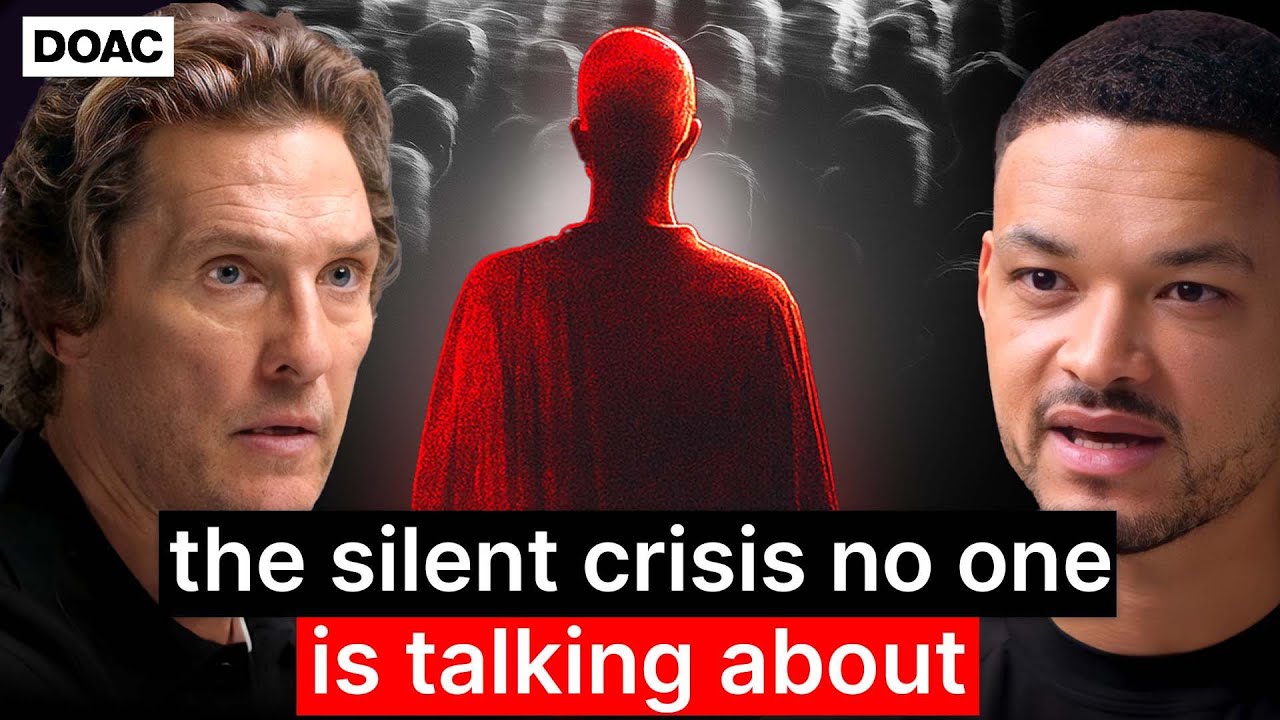
McConaughey Rejects $14.5M Rom-Com Offer to Force Dramatic Career Pivot
The Diary Of A CEO
Matthew McConaughey argues that rejecting short-term financial security and embracing severe resistance is essential for building enduring professional authenticity and long-term purpose.
## Background
This interview was published by The Diary Of A CEO with Steven Bartlett on YouTube on September 18, 2025. According to the page description, the episode features Academy Award–winning actor and bestselling author Matthew McConaughey discussing the dark side of fame, turning down millions to save his career, fatherhood, the crisis facing young men, and his book Poems & Prayers.
## TL;DR
Matthew McConaughey reflects on the fundamental principles that shaped his life and career, from the strict discipline and values instilled by his parents to his pivotal decision to reject lucrative romantic comedy roles to redefine his acting career. He discusses the necessity of facing resistance and friction, the importance of faith and responsibility, and his views on fatherhood as his ultimate measure of success. McConaughey also highlights the modern existential crisis affecting young men, emphasizing the need for duty, structure, and immortal challenges over short-term convenience.
## Atmosphere & style
The conversation carries an intimate, philosophical, and intensely grounded atmosphere, balancing deeply personal storytelling with raw, pragmatic life wisdom. McConaughey speaks with a characteristic rhythmic cadence and unvarnished candor, moving fluidly from humorous childhood memories to profound reflections on grief, faith, and artistic integrity. Steven Bartlett provides an empathetic, attentive sounding board, allowing the dialogue to evolve into a rich, reflective exploration of character, vulnerability, and self-worth.
## Key takeaways
- [00:00](https://www.youtube.com/watch?v=QMzxNfX-uAg&t=0s) True long-term success requires rejecting early exits, staying through resistance, and combining innate ability, hardcore hustle, endurance, and authenticity.
- [02:40](https://www.youtube.com/watch?v=QMzxNfX-uAg&t=160s) McConaughey's upbringing taught him self-reliance, emotional accountability, and confidence without arrogance, encapsulated by strict family boundaries and his mother's advice to 'walk in like you own the place'.
- [13:49](https://www.youtube.com/watch?v=QMzxNfX-uAg&t=829s) Fatherhood became McConaughey's ultimate baseline for success at age eight, overriding fame and financial achievements.
- [17:29](https://www.youtube.com/watch?v=QMzxNfX-uAg&t=1049s) A difficult exchange year in Warnervale, Australia taught him resilience, self-examination through Socratic writing, and the importance of honoring commitments.
- [30:39](https://www.youtube.com/watch?v=QMzxNfX-uAg&t=1839s) Adopting an 'owner's mindset' rather than a 'renter's mindset' prevents taking premature escape hatches or 'parachutes' during tough situations.
- [36:36](https://www.youtube.com/watch?v=QMzxNfX-uAg&t=2196s) Young men face a crisis of purpose, needing structure, responsibility, and the feeling of being relied on to avoid aimlessness and despair.
- [42:29](https://www.youtube.com/watch?v=QMzxNfX-uAg&t=2549s) The death of his father in 1992 forced full personal accountability and inspired his core life mantra: 'Be less impressed and more involved.'
- [01:01:03](https://www.youtube.com/watch?v=QMzxNfX-uAg&t=3663s) Relying on extreme convenience and shortcuts weakens personal mastery, distinct human voice, and information retention.
- [01:07:31](https://www.youtube.com/watch?v=QMzxNfX-uAg&t=4051s) The gap between internal vision and reality drives continuous creative striving rather than complacency.
- [01:09:39](https://www.youtube.com/watch?v=QMzxNfX-uAg&t=4179s) Participating in a traditional wrestling match in Mali showed that true status comes from stepping up to face a challenge rather than winning or losing.
- [01:21:56](https://www.youtube.com/watch?v=QMzxNfX-uAg&t=4916s) Science and faith are complementary pursuits, with active faith providing hope and purpose grounded in principles and ethics.
- [01:40:00](https://www.youtube.com/watch?v=QMzxNfX-uAg&t=6000s) Turning down a $14.5 million offer for a romantic comedy and enduring an 18-to-20-month hiatus forced Hollywood to recognize his transition into dramatic acting.
- [01:46:18](https://www.youtube.com/watch?v=QMzxNfX-uAg&t=6378s) Knowing who you are *not* is often the first necessary step toward making meaningful life transitions when full certainty is missing.
- [01:55:05](https://www.youtube.com/watch?v=QMzxNfX-uAg&t=6905s) Shifting into a 'fall' phase of life involves deepening existing projects, taking calculated risks for family, and seeking mentorship from figures like Admiral William H. McRaven.
## Detailed walkthrough
### [00:00](https://www.youtube.com/watch?v=QMzxNfX-uAg&t=0s) Endurance, Resistance, and the Four Keys to Success
Reflecting on what allows someone to repeatedly reach the top of their field, Matthew McConaughey outlines a core philosophy centered on endurance and refusing to take early exits. He observes that too many people pull their proverbial parachutes prematurely when facing a rocky ride—whether in work, self-help, or relationships. While taking the safe route down to the ground provides immediate security, it often destroys what was being built, whereas staying the course through inevitable resistance can lead to ultimate success.
When asked whether his achievements stem from natural talent or transferable principles, McConaughey identifies four distinct elements required for meaningful accomplishment:
1. **DNA and Innate Ability:** Understanding your natural aptitudes and limitations. McConaughey notes that despite his passion for basketball, he was neither the fastest nor the tallest player.
2. **Hardcore Hustle:** A relentless willingness to work hard. McConaughey recalls growing up in a household where sleep was treated as a sin and watching TV was discouraged in favor of active experience.
3. **Endurance:** Staying committed to a path through extended periods of uncertainty. He references turning down progressive multi-million dollar offers to redirect his career away from romantic comedies.
4. **Authenticity:** Living and acting in a way that is uniquely true to oneself.
- Offered escalating sums of **$8 million**, **$12 million**, and ultimately **$14.5 million** for a romantic comedy script before turning them all down to pursue dramatic roles.
- Experienced an **18 to 20 month** dry spell with zero job offers from Hollywood after refusing to conform to his established rom-com niche.
- Received guidance from **Admiral William H. McRaven** when actively seeking out male mentors later in his life and career.
---
[02:40](https://www.youtube.com/watch?v=QMzxNfX-uAg&t=160s) "Walk in Like You Own It": Lessons from a High-Stakes Childhood
McConaughey describes his upbringing as a paradoxical combination of fierce self-confidence and strict, immediate humbling. His mother instilled an unwavering sense of entitlement to space, telling her sons whenever they entered a new or intimidating environment: *"Don't walk in there like you want to buy the place. Walk in like you own it."* Yet, the household operated on a strict principle that prevented anyone from getting too proud. Victories on the athletic field or early career achievements were met with immediate grounding to ensure no one walked around on their "proverbial toes."
```
┌─────────────────────────────────────────┐
│ FAMILY DYNAMICS │
├────────────────────┬────────────────────┤
│ Ego Boost │ Humility │
├────────────────────┼────────────────────┤
│ "Walk in like you │ Immediate humbling │
│ own the place" │ after any victory │
└────────────────────┴────────────────────┘
```
This dynamic forced a strong sense of internal identity, teaching McConaughey that external successes or failures should never define a person's worth. His mother frequently "oversold" her children to themselves, maintaining for 36 years that Matthew had won a childhood pageant, only for him to discover the actual trophy stated he was merely the runner-up. Despite these exaggerated endorsements, the family maintained an unyielding work ethic where sitting idle was unacceptable and being inside during daylight hours was strictly forbidden.
> "Why are you going to watch someone doing something when you can go out in the world and do it yourself? Turn that damn thing off. Get outside."
- Spent **36 years** believing he had won the "Little Mr. Texas" title, only to look closely at the trophy decades later and see he was actually the runner-up.
- Submitted a poem to a **7th-grade** poetry contest that his mother encouraged him to hand in, despite knowing he had not written it himself, and went on to win.
- Allowed a maximum of **30 minutes to 1 hour** of television viewing per night, with instructions to always be outdoors until dark.
- Witnessed his father sleep past early morning only **once** in his entire life; his father passed away **two and a half months** after that incident.
---
[06:40](https://www.youtube.com/watch?v=QMzxNfX-uAg&t=400s) Tough Love, Family Drama, and Unconditional Bonds
Love in the McConaughey household was deeply felt, intensely physical, and unapologetically expressive. Breakups and heartbreaks were met with a strict single-day mourning period: his mother would offer a sympathetic ear for 24 hours before blasting AC/DC music, commanding her sons to get out of bed, lift their heads, and realize it was the other person's loss. Physical affection was constant—hugging and kissing goodnight occurred hundreds of times more often than any physical punishment—yet the household dynamic featured intense volatile episodes between his parents.
McConaughey recounts a famous story involving his parents, who were married three times and divorced twice to each other. During one notable kitchen argument, his mother broke his father's nose with a landline telephone handset, pulled out a middle-sized chef's knife, and engaged in a standoff while his father dodged the blade and used a ketchup bottle like a matador to squirt her. The fight ended with both parents crying on the linoleum floor, embracing, and making love right where they stood.
Discipline in the family was direct and physical rather than psychological. Grounding was considered an inefficient punishment because it wasted valuable time; instead, discipline was delivered through direct belt licks, with strict instructions never to cry out or risk adding more hits. Three specific violations carried severe consequences: lying, saying *"I can't"*, or saying *"I hate you"*.
> "See, son, you were just having trouble."
- His parents were **divorced twice** and **married three times** to each other over the course of their relationship.
- Used the word "hate" at his own birthday party in front of **40 kids** at age **9**, prompting his mother to stop the entire event immediately, discipline him around the side of the house, and instruct him to dry his tears before returning.
- Learned that the antonyms of his family's forbidden words—telling the truth, offering love, and maintaining belief in capability—were the ultimate sources of strength and long-term satisfaction.
---
[13:49](https://www.youtube.com/watch?v=QMzxNfX-uAg&t=829s) Seeing True Success: The 8-Year-Old's Realization
At eight years old, McConaughey experienced a defining shift in his understanding of success and manhood. While in the parking lot of the Oak Forest Country Club, he was introduced to two older men wearing sunglasses who were debt collectors working with his father. As he shook their hands and politely addressed them as "sir," he observed that every man his father insisted he show deep respect to shared a single common trait: they were all fathers.
```
┌──────────────────────────────┐
│ Oak Forest Country Club │
│ Parking Lot │
└──────────────┬───────────────┘
│
▼
┌──────────────────────────────┐
│ Respect paid to older men │
│ ("Yes sir, hello sir") │
└──────────────┬───────────────┘
│
▼
┌──────────────────────────────┐
│ Common Denominator Realized: │
│ THEY ARE ALL FATHERS │
└──────────────┬───────────────┘
│
▼
┌──────────────────────────────┐
│ Ultimate Definition of Life │
│ SUCCESS = FATHERHOOD │
└──────────────────────────────┘
```
That moment established a baseline metric for his life goals that bypassed fame, money, or professional career accolades. Becoming a father became his highest ambition, far exceeding any aspirations in the entertainment industry. Decades later, raising his three children with his wife Camila remains the absolute priority of his life, representing time that can never be surpassed by any professional achievement.
- Formed his core metric of life success at age **8** while at the Oak Forest Country Club parking lot.
- Shares **3 children** (currently ages **17**, **15**, and **12**) with his wife Camila Alves McConaughey.
---
[15:18](https://www.youtube.com/watch?v=QMzxNfX-uAg&t=918s) High School Highs and the Path Toward Law
By age 15 and 16, McConaughey realized that his football ambitions—specifically playing running back for the Washington Redskins—were limited by his physical size and speed. Instead, he shifted his focus toward debate, where he excelled at framing arguments, delivering persuasive presentations, and outlasting opponents through endurance. His family routinely gave him the floor during discussions, eventually pushing him toward law school as the natural next step for his talents.
By the end of high school in Longview, Texas, McConaughey had built what felt like an ideal lifestyle. At 18, his family granted him complete freedom with no curfew, operating under the principle that any essential values not learned by that age would never be acquired. He was achieving straight A's, driving a paid-off car, working a job that gave him daily pocket cash, excelling at golf, and dating popular girls across local schools.
- Set an early adolescent dream of becoming a running back for the **Washington Redskins**.
- Raised in **Longview, Texas**, where he completed high school with straight A's and held a **4 handicap** in golf, including **two holes-in-one**.
- Earned **$45 cash per day** working weekends and after-school hours while maintaining a completely open curfew once turning **18**.
[17:29](https://www.youtube.com/watch?v=QMzxNfX-uAg&t=1049s) Youth Exchange in Australia: Isolation and Resistance
Matthew McConaughey recalls choosing to go to Australia as an 18-year-old exchange student over Sweden simply because "they speak English and maybe Elle Macpherson's over there." Expecting an exciting stay on the outskirts of Sydney, he was instead sent three and a half hours away to Warnervale, a tiny rural town of just 305 people. The culture shock was immediate. Suddenly stripped of his car, his girlfriend, his golf clubs, and spending money, he was put back into high school with a strict 10:00 p.m. curfew—even on weekends. Feeling as though he was moving backward socially, he struggled to connect with peers, faced academic failure, and began skipping class to sit in the library.
```
┌──────────────────────────────────────────┐
│ THE WARNERVALE ISOLATION │
├──────────────────────────────────────────┤
│ • Population: 305 │
│ • Social Life: 10 PM curfew, no car │
│ • Academics: Failing grades, skipping │
│ • Solitude: Library, Lord Byron, Walkman │
└──────────────────────────────────────────┘
```
Isolated in this small Australian town, McConaughey immersed himself in poetry by Lord Byron and listened continuously to a rotation of three cassettes on his Walkman: U2's *Rattle and Hum*, Maxi Priest (specifically his Cat Stevens cover), and INXS. Listening to Bono sing about social justice, oppression, and the pitfalls of material wealth allowed him to reflect objectively on his life back in Texas. He realized he had previously been a "good-time rolling Charlie" living without any real resistance.
The situation with his host family grew increasingly bizarre and tense, culminating six months into his stay when they requested that he address them as "Mum and Pup." This moment provided him with crucial clarity: for the first time, he firmly drew a line and refused. To fill his time, school administrators placed him in unpaid work experience—taking jobs at ANZ Bank, a barrister's office, and doing carpentry. At home, his daily routine became intensely regimented:
* **Strict Schedule:** Dinner at 5:00 p.m., washing dishes, and retreating immediately to his room.
* **Evening Rituals:** Bathing while reading Lord Byron, listening to his three cassettes, and running six miles a day.
* **Extreme Diet:** Becoming a strict vegetarian eating heads of lettuce topped with ketchup, dropping his weight down to 135 pounds.
* **Existential Writing:** Writing 16-page Socratic letters to himself, grappling with existential questions and trying to stay grounded while convinced his life path was to move to South Africa to become a monk.
Reflecting on why he never gave up, McConaughey recalls the initial condition set before leaving the United States: the American ambassador asked him to sign a contract agreeing to stay the full year unless there was a family fatality or severe illness. McConaughey declined to sign paper, instead offering a handshake—a gesture his father had taught him was an unshakeable bond between men. Because breaking his word would mean dishonoring his father, returning early was never an option. Denying himself an exit strategy forced him to find internal strength, transform his perspective, and start finding power and identity through the struggle.
> "The harder this gets, the greater the reward there's going to be on the other side once I get out of here."
---
[24:03](https://www.youtube.com/watch?v=QMzxNfX-uAg&t=1443s) Studying Law in Texas and Wanting a Change
After returning to the United States, McConaughey enrolled at the University of Texas to study law. As an end-of-semester sophomore who consistently earned straight A's through rigorous studying, he experienced an unprecedented moment right before his finals: he felt so prepared that he closed his textbooks two hours early. Looking for something to read, he bypassed a stack of sports and adult magazines and found Og Mandino's book, *The Greatest Salesman in the World*.
Opening the book, a passage about forming good habits and becoming their slave sparked a profound realization. He realized that pursuing a law degree simply because he was good at it, expected to do it, and thought he *should* was actually submitting to a bad habit. With a friend already encouraging his storytelling abilities, he realized his true desire was to attend film school rather than pursue a career in law.
> "I will form good habits and become their slave... If I go to law school, that's making me a slave to a bad habit."
---
[26:36](https://www.youtube.com/watch?v=QMzxNfX-uAg&t=1596s) Telling His Dad He Wants to Go to Film School
Knowing his father was paying for his college tuition, McConaughey carefully strategized when to ask for permission to switch majors. He ruled out calling during work hours or on a stressful Monday night. Instead, he waited until Tuesday at 7:36 p.m., knowing his father would be relaxed on the couch with a beer after dinner. When he finally voiced his decision, sweating with anxiety over an expected lecture about movie-making being just a hobby, his father paused for five seconds before asking if he was entirely sure.
| Decision Call Strategy | Execution Details |
|:--- |:--- |
| **Day & Time** | Tuesday evening at 7:36 p.m. |
| **Father's State** | Relaxed on the couch after dinner with a beer |
| **McConaughey's Pitch** | Clear, direct statement with no hesitation or stuttering |
| **Father's Response** | "Well, don't half-ass it." |
Hearing his son speak with absolute conviction, his father gave his full blessing with those four words. McConaughey reflects that as a parent now himself, he understands why his father responded that way: while parents lay down structural guidelines for safety, their ultimate wish is for their children to gain enough confidence to forge their own path. His direct tone proved he was taking full responsibility for his own destiny.
---
[30:39](https://www.youtube.com/watch?v=QMzxNfX-uAg&t=1839s) The Philosophy of "Don't Half-Ass It" and "Own, Don't Rent"
The command "don't half-ass it" developed into a core principle guiding McConaughey's approach to marriage, fatherhood, career, and faith. He frames this approach as an **"owner's mindset" versus a "renter's mindset"** across all life commitments:
* **Owner's Mindset:** Entering a relationship, job, or endeavor with the intent that it is a long-term commitment. Even if it eventually ends, this mindset gives both parties the dignity, dedication, and effort required to realize its fullest potential.
* **Renter's Mindset:** Approaching situations casually with a short-term, throwaway attitude. At the first sign of friction or challenge, a renter abandons ship rather than working through the messiness.
```
APPROACH TO COMMITMENTS
┌───────────────────────────────┐
│ DO YOU OWN OR RENT IT? │
└───────────────┬───────────────┘
│
┌───────────────────────┴───────────────────────┐
▼ ▼
┌─────────────────────────┐ ┌─────────────────────────┐
│ OWNER'S MINDSET │ │ RENTER'S MINDSET │
├─────────────────────────┤ ├─────────────────────────┤
│ • Full commitment │ │ • Casual, short-term │
│ • Long-term perspective │ │ • Quick to abandon ship │
│ • Works through friction│ │ • Seeks path of least │
│ • Builds true depth │ │ resistance │
└─────────────────────────┘ └─────────────────────────┘
```
The discussion highlights how an abundance of options and constant fallback plans can make people timid or non-committal. While some divorces and career changes are necessary, McConaughey contends that too many people quit meaningful pursuits prematurely simply because they maintain a "renter's" outlook that defaults to the path of least resistance at the first sign of smoke.
> "Too many options can make a tyrant of any of us."
[34:29](https://www.youtube.com/watch?v=QMzxNfX-uAg&t=2069s) The Pitfall of Cynicism and the Danger of the Parachute
Matthew McConaughey and host Steven Bartlett explore the psychological trap of staying in "certain misery" rather than confronting the risk of the unknown. McConaughey breaks down the trajectory of human perspective—moving from initial innocence to naivety, progressing into healthy skepticism (where one is discerning, uses judgment, and discriminates between options), and finally falling off the cliff into cynicism. He argues that cynicism is an easy way out: a defensive cop-out where a person decides that because something is difficult or requires effort, it isn't worth pursuing. This mindset infects relationships and career choices alike, driving people to live in self-doubt, rent rather than commit, or sign prenups with one foot already out the door.
He warns against giving ourselves "parachutes" in too many areas of life. Pulling the ripcord early may feel like a safe maneuver to land back on solid ground, but it prematurely terminates relationships, projects, and ambitions that could have survived a rocky flight if people had simply chosen to hang in there.
- **The Spectrum of Awareness:** Innocence → Naivety → Skepticism (Discernment & Judgment) → Cynicism.
- **The Cynic's Cop-Out:** Cynicism allows individuals to avoid sweating, risk, or being vulnerable by adopting an "I told you so" attitude before even trying.
- **The "Parachute" Problem:** Giving oneself an escape hatch in relationships or life goals leads to pulling out at the first sign of turbulence rather than weathering the storm.
> "The misery of cynicism is a hell of a lot easier than the optimism and belief of skepticism."
---
[36:36](https://www.youtube.com/watch?v=QMzxNfX-uAg&t=2196s) The Crisis of Young Men: Independence vs. Being Needed
Bartlett brings up a trend among modern young men: an obsession with absolute independence that frequently ends in isolation and a loss of meaning. He shares a story of a 38-year-old friend living a textbook life of independence—a single freelancer in a skyrise apartment with no team and no kids—who collapsed into a monthslong depression because his life lacked purpose, ultimately leading him to get baptized in America. McConaughey responds by zooming in on the core drive of young men, emphasizing that men fundamentally *want and need to be relied on and depended on*.
When an individual strips away all communal, relational, and collective responsibilities—leaving no "gardens to tend"—the sheer weight of self-absorption crumbles. McConaughey discusses how his own top value of self-reliance intersects with his faith. Rather than relying passively on fate or expecting God to steer, he believes that free will and faith work together: God provides the path, but expects men to put their hands on the wheel and take responsibility for their choices.
- **The Core Male Need:** Young men require duty, responsibility, and people counting on them to feel grounded.
- **The Trap of Total Independence:** Living strictly for oneself without external obligations or dependents correlates with high rates of loneliness and aimlessness.
- **Self-Reliance and Faith:** McConaughey defines sin in its original archery context—"to miss the mark." True accountability means taking control of the wheel rather than repeatedly sinning and relying on easy forgiveness as a parachute.
> "We want and need to be relied on. We want and need to be depended on."
> "As a believer, I believe that it's all been written. And at the same time, I believe God's going, 'I need your hands on the wheel, man. You're steering this, okay? Don't just rely on fate.'"
---
[41:08](https://www.youtube.com/watch?v=QMzxNfX-uAg&t=2468s) Penthouses, Leather Pants, and the Search for Resistance
Recalling his late 20s, McConaughey reflects on a period of his life where, after experiencing his initial breakout success as an actor, he drifted into total independence. Flushed with cash, he checked into the Chateau Marmont in Los Angeles, dropped a $120,000 tab upfront, bought a pair of leather pants and a motorcycle, and lived a completely unanchored existence alongside his dog. He made a rule for himself for two years: whenever he felt he had had too many drinks, he'd order another; whenever he thought of ordering a single, he'd get a double.
While he enjoyed the transient freedom, he eventually realized that living where "every day is a Saturday and every night's a Saturday night" lacks substance. Without struggle, friction, or something to sweat over, life becomes hollow. He found himself desperately seeking a "Monday morning"—a source of structure, accountability, and resistance to restore balance to his life.
- **The Chateau Marmont Era:** Checked in with a $120,000 tab to live without limits alongside his dog.
- **The "Double Order" Rule:** Spent two years indulging every whim without hesitation.
- **The Need for "Monday Morning":** Realized that absolute freedom without structure or friction leads to aimlessness.
> "When every day is a Saturday and every night's a Saturday night, I started looking for a little... where's the resistance? I need my Monday morning."
---
[42:29](https://www.youtube.com/watch?v=QMzxNfX-uAg&t=2549s) "Be Less Impressed and More Involved": Loss of a Father and Leveling the World
When asked if the death of his father in 1992 contributed to his period of drifting, McConaughey clarifies that it actually had the opposite effect—it dropped his anchor deeper. His father died of a heart attack on a Monday morning while making love to Matthew's mother, fulfilling a prediction he had often made to his sons. Passing away five days into the filming of *Dazed and Confused*, his father's death shattered the belief that his dad would always be there as the ultimate safety net above religion or government.
Waking up to the reality that he was now accountable for his own life, McConaughey carved the phrase *"Be less impressed and more involved"* into a tree in the middle of the night. His father's death flattened his world: mortal things and people he revered dropped down to eye level, while things he had looked down upon rose up. He realized that passive gratitude or awe keeps a person from truly engaging. He illustrates this by recalling a dinner with his favorite directors, the Coen brothers, where he was so starstruck ("impressed") that he fumbled his words and failed to connect ("involved"), resulting in them never casting him. Bartlett notes how this principle applies directly to job interviews and life: candidates who challenge ideas and bring real substance add far more value than those who simply compliment and agree.
- **Passing of James Donald McConaughey (1992):** Died 5 days into shooting *Dazed and Confused*.
- **The Origin of the Motto:** Carved *"Be less impressed and more involved"* into a tree during a late-night revelation following his father's death.
- **Meeting the Coen Brothers:** McConaughey fumbled a dinner with Joel and Ethan Coen because he was too reverent to hold a genuine, grounded conversation.
- **Interview Application:** Bartlett shares a story of a job candidate named Jonah who earned respect by boldly telling Bartlett that his company's branding needed to be completely overhauled.
> "Be less impressed and more involved."
> "When we're involved, we're more honest and have more courage to do what we're fashioned to do how we're fashioned to do it. But if we're only impressed... we can't be present."
---
[48:26](https://www.youtube.com/watch?v=QMzxNfX-uAg&t=2906s) Remembering Pop: Art, Brotherhood, and Unspoken Pride
Looking at an old photograph, McConaughey walks through a memory of his family gathered around the bar at their home in Quail Valley, Houston, Texas. The photo shows his dad holding court after a round of golf, alongside his older brothers—Rooster (who was adopted ten years before Matthew as a birthday present) and Pat. In the photo, a young Matthew looks up at his father with visible reverence, wishing he was old enough to be part of the grown-up stories—a privilege he eventually unlocked when he turned 18. He notes that during one summer he spent alone with his dad, he believed his mother was on an extended vacation in Florida, only to learn years later it was actually his parents' second divorce.
McConaughey shares how much he misses his father, particularly from a creative standpoint. Years after his death, the family discovered hidden paintings, charcoal sketches, and pottery in the garage—revealing a secret artistic side to his father that Matthew never knew existed. When evaluating scripts or developing characters—many of which are modeled after his brother Pat, his brother Rooster, or men he met through his dad—he longs to ask his father for input. He reflects emotionally on the premiere of his film *The Lost Bus* at the Toronto International Film Festival, featuring his 93-year-old mother and his son, knowing his father would have quietly sat in the front row with pride, letting his son take center stage.
- **Family Structure:**
- **Rooster McConaughey:** Oldest brother, adopted 10 years prior to Matthew's birth.
- **Pat McConaughey:** Middle brother, Matthew's childhood hero.
- **James Donald McConaughey:** Father, business owner, and secret visual artist.
- **The Secret Artist:** The family discovered charcoal drawings, pencil sketches, and pottery in the garage long after his passing.
- **Family Roles in Acting:** While his mother thrives on attention and stage light ("I see where you get it from"), his father would have quietly cheered from the front row ("There you go, buddy").
- **Projects Highlighted:** *The Lost Bus* premiere at the Toronto International Film Festival featuring his 93-year-old mother and his son.
[51:59](https://www.youtube.com/watch?v=QMzxNfX-uAg&t=3119s) Remembering His Father and the 1992 Goals
Matthew McConaughey reflects on missing his late father, not only as a parent, but as a potential creative partner and debate companion. Looking back, he imagines how their dynamic would have evolved into a genuine friendship as he aged into adulthood. He fondly recalls his father's "healing hands" and notes that by age 18—the traditional passage into manhood—his father's approach shifted to recognizing that a young man has absorbed what he is going to learn, paving the way for mutual respect rather than discipline. Interestingly, McConaughey shares that his family is rarely awestruck by his Hollywood fame or success; his brothers often make excuses to skip his movie premieres, grounded in the reality that he will always simply be their little brother.
The conversation transitions as host Steven Bartlett brings out a list of 10 life goals that McConaughey penned in 1992. Upon reflecting on the original targets—which included becoming a father, maintaining his relationship with God, staying close to family, winning an Oscar for Best Actor, and simply "just keep living"—McConaughey confirms he wouldn't change a single item on that list.
- **The 1992 List of 10 Life Goals:**
1. Become a father.
2. Find and keep a woman for me.
3. Keep my relationship with God.
4. Chase my best self.
5. Be an egotistical utilitarian.
6. Take more risks.
7. Stay close to mom and family.
8. Win an Oscar for Best Actor.
9. Look back and enjoy the view.
10. Just keep living.
---
[54:54](https://www.youtube.com/watch?v=QMzxNfX-uAg&t=3294s) The Necessity of Resistance and the Poem "Tips Included"
McConaughey explores the core concept of resistance, emphasizing that friction, boundaries, and even a healthy sense of guilt are required to give form and direction to human existence. Without gravity or resistance to push off of, life lacks leverage, dissolving into "more anarchy than art." Quoting an artist who noted that "limitations reveal style," McConaughey warns that a path made up entirely of green lights leads to running out of gas or going in circles. He admits to being clumsy with resistance early in his career—sometimes intentionally sabotaging himself or "tripping running downhill" just to feel his heels on the ground after experiencing unearned luxury and success. Bartlett contrasts this with modern society's "comfort crisis," where avoiding discomfort leads to widespread physical and mental ailments.
To illustrate the dangers of entitlement and over-convenience, McConaughey recites an original poem titled *"Tips Included"*. The poem serves as a critique of participation trophies, inflationary mindsets, and the loss of merit, arguing that when extra credit and easy outs are guaranteed, human effort and service inevitably suffer. He links this directly to modern technological reliance, questioning what the rise of artificial intelligence will do to human capacity.
> "When extra credit's included, credit doesn't get its due... When participation is the trophy for every cow in the pen... When the tips included, the service will suffer."
---
[01:01:03](https://www.youtube.com/watch?v=QMzxNfX-uAg&t=3663s) Sweat Equity, AI, and Choosing the Harder Path
Bartlett and McConaughey debate the hidden costs of extreme convenience, particularly regarding AI tools like ChatGPT. Bartlett cites emerging research showing that when individuals rely on AI to generate work, they struggle to retain the information and gradually lose their distinct voice. He references physicist Richard Feynman’s philosophy that true learning requires the "pain of writing" and distilling concepts into simple truths. Both agree that while AI can organize thoughts, bypassing the "sweat equity" of original thought robs people of genuine intellectual growth. Bartlett notes that choosing the easy road today inherently creates a harder tomorrow, sharing a personal anecdote about his father avoiding difficult conflicts, which ultimately compounded over decades.
McConaughey agrees with the necessity of choosing constructive resistance, though he admits he still struggles with knowing how to rest when things are going smoothly. He introduces a personal theory on ambition: it is far better to "shoot for an A and make a C" than to "shoot for a C and make an F." While reality inevitably falls short of perfection, striving for the absolute highest ideal yields a far greater outcome than aiming for mediocrity.
- **Key Insights on Effort & Convenience:**
- AI tools can act as helpful signposts or organizers, but relying on them eliminates the cognitive benefits of manual effort.
- Avoiding uncomfortable conversations or hard tasks in the short term creates compounded hardship in the long term.
- Striving for an unattainable high standard elevates the final result beyond what low expectations could ever yield.
---
[01:07:31](https://www.youtube.com/watch?v=QMzxNfX-uAg&t=4051s) The Expectation Gap and Pursuing the Divine
McConaughey discusses the creative "expectation gap"—the permanent friction between an artist's vision of perfection and the finished product. He confesses that he has never made a movie or delivered a performance that fully lived up to his internal vision, because his baseline expectation aims for something fundamentally "divine." While a project may turn out inspiring or magical, it inevitably lands in the realm of earthly reality. Bartlett points out that this unclosed gap is precisely what drives great creators to move on to the next project, ensuring they never become complacent or feel they have fully "arrived."
They connect this mindset back to the core values instilled by McConaughey's mother: balancing deep humility with an unshakeable inner confidence. The true art of living, McConaughey concludes, lies in shooting for ultimate perfection while possessing the grace to quickly embrace and appreciate reality when the final result comes in just beneath the stars.
[01:09:39](https://www.youtube.com/watch?v=QMzxNfX-uAg&t=4179s) Acceptance of Challenge: The Dogon Wrestling Match
Matthew McConaughey reflects on whether achieving total perfection would actually bring happiness or fear, leading into a striking story about his time in Mali, Africa. Traveling incognito in the Bandiagara Escarpment among the Dogon people under the alias "David" (which locals pronounced "Dota"), he claimed to be a writer and a wrestler. While nobody cared about the writing, the village boys loved wrestling, which served as a form of local entertainment. Upon reaching the village of Benji Matu after a 14-mile hike, two 18-year-old boys speaking Bambara began taunting him, challenging him to a match. Just as he wondered if they were all talk, the crowd erupted as the undisputed village champion arrived: Michelle, a 5'9" wrestler with tree-trunk legs, weighing 220 pounds, wearing a burlap bag tied with rope.
Michelle silently pointed at McConaughey and then toward a dirty wrestling pit. Heart racing, McConaughey hesitated with fear, but a inner voice warned him: *"If you don't, you will regret this for the rest of your life. You've got to go do it. This will at least be a great story to tell."* Over 80 villagers gathered as the chief placed his hands on their heads, signaling the start of the match. What followed was a brutal, intense bout. They wrestled, flipped each other, and McConaughey barely shimmed out of a suffocating leg lock. Covered in sweat and bleeding from his knees and ankles with talismans torn out of his beard, McConaughey was hyperventilating, while Michelle barely had a glisten of sweat. They fought a second intense round before the chief declared a draw, raising both their hands to the roaring crowd.
- After the match was called, Michelle immediately ran off, while the villagers hoisted McConaughey onto their shoulders as a celebrated guest.
- Being the "big man in the village" earned McConaughey the best chair, the biggest plucked chicken for dinner, and a trip to the cleanest bathing spot in the river.
- Resting on a hut roof under the glowing Southern Cross, McConaughey saw 29 shooting stars in 30 minutes, feeling like the "chosen one"—until he sat up to spit and accidentally landed a loogie right on his own mosquito net, humbling him instantly.
- The next morning at the village border, Michelle emerged from behind a tree, bowed, held McConaughey's hand, and silently walked him the entire 14 miles to the next village border before turning back.
- Six years later, McConaughey returned unannounced; despite having broken his hip and fathered five children, Michelle greeted him, and once again silently walked him 14 miles to the border.
- McConaughey's guide, Issa, explained that status in the village wasn't about winning or losing, but stepping up: *"When you accept the challenge, that is when you were big men in this tribe... whole village think Michelle going to have strong white men named Da on back in 10 seconds over. But you handle Michelle."*
---
[01:20:01](https://www.youtube.com/watch?v=QMzxNfX-uAg&t=4801s) The Need for Immortal Challenges and Meaning
The conversation shifts to the modern crisis facing young men, particularly high rates of suicide. Steven Bartlett references research on suicide letters indicating that the prevailing driver is not merely sadness, but feeling unneeded or believing others would be better off without them. McConaughey agrees, noting that modern life, technology, and social media are systematically stripping away real physical friction and meaningful responsibilities. He argues that when modern life removes immediate physical struggle, humans urgently require an "immortal challenge"—a continuous pursuit grounded in personal character, dignity, relationships, and belief in a higher power or one's better self.
- Male suicide rates highlight a desperate lack of perceived responsibility, duty, and purpose among young men.
- Convenience and social media eliminate natural struggle, leaving people without qualitative life payoffs that local, mortal metrics cannot provide.
- McConaughey emphasizes that pursuing long-term, qualitative values—like character, fatherhood, and spiritual grounding—gives life lasting purpose when daily routines fail to deliver meaning.
---
[01:21:56](https://www.youtube.com/watch?v=QMzxNfX-uAg&t=4916s) Science, Faith, and the Purpose of Hope
Addressing common skepticism around faith, Bartlett asks McConaughey how he reconciles religious belief with scientific proof and evidence. McConaughey describes science as "the practical pursuit of God," asserting that God loves scientists for their relentless, hands-on drive to uncover truth, even if human understanding can never reach absolute perfection. He distinguishes between scientific facts—which rely on static nouns and proof—and faith, which is an active verb (`believe`, `faith`). He explains that a scientific commitment to proving reality does not inherently contradict a deeply held belief in God or human potential.
McConaughey offers a practical view on faith for those in deep suffering or misery: whether or not an afterlife exists, having faith provides the essential hope needed to endure present pain. Hope gives people something to look forward to and chase, making life better here on Earth regardless of what happens next. While he distances himself from dogmatic, exclusionary religious claims—such as believing non-Christians are condemned to hell—he advocates for pursuing divine principles, morality, and ethics that pull people out of personal ruts and foster genuine human connection.
> "Believe is a verb. Faith is a verb in God or any of those other things that we were talking about... To pursue that divinity, even if you don't believe in the author, find principles and ways of living and approaching life, yourself, others, your neighbor, and self."
- McConaughey views science and faith as complementary pursuits rather than opposing forces.
- Studies consistently show that individuals with faith or a strong spiritual framework report higher levels of happiness and resilience.
- McConaughey rejects rigid religious dogmatism that excludes good people around the world, pointing to his respectful relationships with diverse communities globally.
[01:27:07](https://www.youtube.com/watch?v=QMzxNfX-uAg&t=5227s) Restoring the Original Meaning of Faith and Ethics
Matthew McConaughey re-examines the root meaning of "religion," pointing out that it derives from the Latin root *religare*—which means to bind together again or to restore. While many of his spiritual friends claim they are not religious, McConaughey suggests that what they are actually seeking is unity, which is precisely what religion was originally designed to provide. Over time, humanity has "bastardized" religion by turning it into an institutionalized business, straying far from its foundational origins. McConaughey poses a fundamental question: perhaps people aren't truly mad at religion itself, but rather need to restore its original, unifying meaning and live by those core truths.
```
Latin Root: Religare -> "to bind together again" -> Restoration and Unity
```
This realization prompted him to write *Poems & Prayers*, written during a period when he caught himself becoming increasingly cynical and "default objectifying" people—looking down his nose at strangers upon first meeting them. He observed a broader cultural shift where leaders and society began praising pure success regardless of how it was achieved, rewarding those who lie, cheat, and steal to get the gold medal. In this modern mindset, anyone who follows the rules is viewed as a "sucker." McConaughey refused to wave the white flag and accept that this is simply "how it is."
When Steven Bartlett brings up how society trains people to chase quantity over quality, McConaughey highlights the difference between winning "mortal games" versus pursuing something deeper. However, McConaughey grounds the conversation with self-awareness, acknowledging his own privileged position. It is easy for a wealthy actor to talk about sacrificing short-term gains for long-term values, whereas someone struggling to pay rent or put food on the table does not have the luxury to think about tomorrow.
* **Etymology of Religion:** Derived from Latin *religare* ("to bind together again"), signifying restoration rather than rigid institution.
* **Motivation for *Poems & Prayers*:** Written to combat personal cynicism, superficiality, and a culture that normalizes cheating to win.
* **The Expectation Gap:** McConaughey warns against prioritizing sheer quantity over quality or sacrificing core values to achieve "mortal" success.
---
[01:32:08](https://www.youtube.com/watch?v=QMzxNfX-uAg&t=5528s) The Paradox of Independence and the Transcendent
Steven Bartlett shares a central theme from his own upcoming book, *I Can't Find God*, observing how the modern cultural obsession with total independence may be backfiring. Society sells the ideal of being your own boss and standing completely autonomous, yet loneliness is at an all-time high and fewer people are starting families. Bartlett notes a striking trend among his own social circle: the friends who are happiest are those with the most dependents, while those going through existential crises often have absolute independence—depending on no one and having no one depend on them.
McConaughey agrees, explaining that when individuals set their "North Star" toward God or the pursuit of the divine, life aligns naturally down below. Having faith in something transcendent gives people the humility, courage, and peace of mind to realize that "this isn't all there is." By playing the "immortal game," individuals become far more courageous in their daily lives because, while they may not look forward to death, they no longer fear it. In that spiritual space, seemingly opposite traits—selfishness and selflessness, or humility and confidence—cease to conflict and instead merge together.
* **The Independence Trap:** Total autonomy often leads to isolation and existential drift, whereas taking on responsibility and dependents fosters genuine fulfillment.
* **Laddering Up:** Structuring life outward—from the self to family, community, the planet, and ultimately the transcendent—provides an anchor for human purpose.
* **The Immortal Game:** Reorienting life around higher values eliminates fear, allowing humility and confidence to co-exist naturally.
---
[01:36:07](https://www.youtube.com/watch?v=QMzxNfX-uAg&t=5767s) Finding the Alignment of Innate Talent, Craft, and Demand
When asked what advice he gives his children about achieving high-level success, McConaughey breaks down a pragmatic framework based on self-awareness and hard work. He shares a personal, humorous example: for years, his dream was to dunk a basketball or play running back for the Washington Redskins (now the Washington Commanders). However, no matter how hard he trained, he simply did not possess the physical genetics or innate DNA for it.
He advises young people to systematically evaluate three distinct pillars:
1. **Innate Ability:** What natural predispositions and genetic strengths do you actually possess?
2. **Craft and Education:** What skills are you willing to work, hustle, and educate yourself on to sharpen that raw ability into true talent?
3. **World Demand:** Is there an actual market demand for that talent?
McConaughey notes that true fulfillment occurs at the intersection of these three elements. Relying solely on raw talent without putting in the work leaves a person in the middle of the pack. Conversely, hustling at a brand-new skill can actually spark a deep passion over time as mastery develops.
* **Personal Misalignments:** McConaughey's childhood dreams of playing in the NFL or dunking a basketball were thwarted by physical realities, teaching him the importance of honoring innate limits.
* **Developing Craft:** Innate ability is merely the starting point; turning it into a viable livelihood requires relentless discipline and skill refinement.
* **Supply and Demand:** High-level career trajectory relies on supplying a capability that the world genuinely values and demands.
---
[01:40:00](https://www.youtube.com/watch?v=QMzxNfX-uAg&t=6000s) Breaking the Rom-Com Mold and the $14.5 Million Refusal
Despite reaching the absolute top of Hollywood as the undisputed king of romantic comedies—taking the baton from Hugh Grant—McConaughey found himself feeling spiritually unfulfilled. While romantic comedies paid extraordinarily well, were fun to shoot, and offered effortless success, he was getting "quantity, but not quality." The work no longer challenged or scared him. Around this same time, his personal life expanded dramatically: he fell in love with Camila Alves, she became pregnant with their first child, and he finally achieved his lifelong dream of becoming a father. His emotional bandwidth exploded, making him want to tackle deep dramatic roles.
However, Hollywood refused to offer him serious dramas, regardless of how drastically he offered to cut his fee. Recognizing that he could not get the roles he wanted, McConaughey made a radical choice: "If I can't do what I want to do, I'm going to quit doing what I've been doing." He moved his family to his ranch in Texas, instructed his agent to stop sending romantic comedy scripts, and stepped completely away from Hollywood. Months went by with zero offers, leading him to wonder if he would need to abandon acting entirely to become a high school teacher or attend law school.
Then came the ultimate test of his resolve. An offer arrived for an action-comedy:
* **Initial Offer:** $8 million — *McConaughey says no.*
* **Second Offer:** $10 million — *McConaughey refuses to re-read it.*
* **Third Offer:** $12 million — *McConaughey reiterates his refusal.*
* **Final Offer:** $14.5 million — *McConaughey reads it again.*
> "It was the same words that were in the $8 million offer that I said no to, but it was better written. It was funnier, man... I could see myself in it."
Ultimately, McConaughey stood firm and turned down the $14.5 million. Turning down that massive payday sent a shockwave through Hollywood. It signaled that he was not bluffing, was not simply "for rent," and had completely removed himself from the market—an act of conviction that ultimately transformed his industry reputation and kicked off the dramatic career resurgence known as the "McConaughey-ssance."
* **Catalyst for Change:** Becoming a father expanded his emotional depth, rendering lighthearted romantic comedies insufficient for his artistic needs.
* **The Texas Retreat:** Relocated to his Texas ranch and instituted a strict "non-negotiable" ban on accepting romantic comedy scripts.
* **The $14.5 Million Standoff:** Steadfastly rejected escalating offers from $8M up to $14.5M for a single action-comedy script, proving to Hollywood that his career pivot was absolute.
Here is a detailed, faithful walkthrough of part 7 of the transcript, capturing the full depth, context, and nuance of the conversation.
---
[01:43:50](https://www.youtube.com/watch?v=QMzxNfX-uAg&t=6230s) The "McConaughey-ssance" and the Power of Endurance
Matthew McConaughey reflects on the dramatic career shift that occurred after his 20-month hiatus from Hollywood. Once he made the firm decision to stop taking romantic comedies, a brand-new wave of offers began rolling in for intense dramatic roles: *The Lincoln Lawyer*, *Killer Joe*, *Mud*, *Dallas Buyers Club*, *Magic Mike*, and *True Detective*. Taking hold of these offers with both hands, he realized in hindsight that this golden era—often dubbed the "McConaughey-ssance"—would never have happened had he not taken the terrifying leap to step away entirely. Host Steven Bartlett notes how success can easily become a "slow marginal prison," requiring drastic action to realign.
When McConaughey famously turned down a $14.5 million offer for a single romantic comedy script, his brothers thought he had lost his mind. However, McConaughey stood by the covenant he had made in prayer alongside his wife, Camila Alves McConaughey. He draws a direct link between this period and his teenage year in Australia as an exchange student: both were defining endurance tests where he could have pulled the parachute at any moment. While his agents warned him that his name hadn't been mentioned in months and urged him to take the safe path back to rom-coms, McConaughey held out.
- McConaughey spent 20 months completely out of the Hollywood spotlight before dramatic scripts started coming in.
- Turning down $14.5 million was backed by a strict agreement and prayer with his wife, Camila.
- His agents told him at one point: "I haven't even heard your name in four months."
---
[01:46:18](https://www.youtube.com/watch?v=QMzxNfX-uAg&t=6378s) Knowing Who You Are Not and the Myth of Certainty
Addressing Steven's observation that turning down massive deals requires knowing who you are, McConaughey offers a subtle correction. He explains that back then, he did not necessarily know who he *was*—instead, he simply knew who he *was not*. He did not have a master script written out or a clear roadmap for his next chapter; he just knew he could no longer participate in stereotypical roles that lacked vitality. Similarly, during his tough year in Australia, he knew he couldn't be the person who broke his word and walked away from a handshake deal.
This leads into a discussion about living with uncertainty. Steven points out that most people remain stuck in unfulfilling situations because they wait for 100% certainty before making an escape plan. McConaughey admits that certainty itself can be deceptive. Over his career, he has been part of projects with "the best laid plans" that flopped into mediocrity, as well as under-financed films with shaky foundations that turned into monumental successes through sheer grit.
---
[01:48:44](https://www.youtube.com/watch?v=QMzxNfX-uAg&t=6524s) Making *Dallas Buyers Club* and the Power of Unwavering Intent
McConaughey shares a vivid story about how *Dallas Buyers Club* came to life. Shot on a meager budget of $4.9 million in just 25 days, the film had no real financial backing at first. McConaughey, director Jean-Marc Vallée, and the producers simply sat in a room and decided, "We're doing this in October." From that moment on, McConaughey repeated it as an absolute truth to everyone in the industry.
When his agent pushed back, warning him that there was no budget, no set start date, and no real movie—begging him to read other scripts for that time slot—McConaughey flatly refused. He explains that they didn't "manifest" the movie in a mystical sense; they simply didn't flinch or stutter. By remaining completely aligned and resolute, the rest of the world eventually believed them and fell into line.
[01:50:19](https://www.youtube.com/watch?v=QMzxNfX-uAg&t=6619s) Words, Intent, and the Culture of Misunderstanding
Expanding on the principle of not flinching, McConaughey notes that while words are momentary, true "intent is momentous." He uses this idea to push back against modern "woke cancel culture," which he believes overcompensates by punishing people for an offensive word while ignoring their underlying intent. He argues that society needs to grant amnesty and grace to people who make mistakes out of genuine ignorance rather than malice, lamenting that modern litigious culture and social media incentives have destroyed the simple art of saying "my bad, I stuck my foot in my mouth."
However, McConaughey stresses that true forgiveness carries a heavy responsibility for the offender. Once someone is forgiven, their immediate priority must be to course-correct their behavior so they never have to apologize for the same mistake again. Steven adds that digital culture now financially and socially incentivizes people to intentionally misunderstand others for likes, retweets, and outrage. McConaughey agrees, calling on people to "double down" on affirmations and talk about past negatives in the past tense to block their "path to prophecy."
---
[01:55:05](https://www.youtube.com/watch?v=QMzxNfX-uAg&t=6905s) Entering the "Fall" Season of Life
When asked what season of life he feels he is currently in, McConaughey shares that while he spent most of his life as an energetic "summer guy"—extroverted, barefoot, and shirt-free—he has grown to love "fall" over the last eight years. Rather than taking on new projects or starting more "campfires," he wants to focus his energy on feeding logs into the fires he has already built.
He describes enjoying a lower ceiling on his ambitions—favoring an 8-to-10-foot ceiling over a 30-foot vault—where he can look laterally at the world rather than constantly pushing outward in every direction. He appreciates a bit of shade and quiet focus as he works to turn his dreams, poems, and prayers into tangible reality.
---
[01:56:27](https://www.youtube.com/watch?v=QMzxNfX-uAg&t=6987s) The Diary of a CEO Closing Question: Strengths, Weaknesses, and Risk
Answering the traditional closing question left by the previous guest—"What is your greatest weakness, and what is your greatest strength?"—McConaughey remarks that they are often the exact same thing. Surprisingly, he reveals that despite his current stability and success, he feels he needs to take *more* risks. While his natural instinct as a father and husband is to secure his home, maintain his guard, and protect his family, he realizes that his children need to see him engage actively with the world, step out into new frontiers, and take risks to keep learning.
He cites a memorable quote from director Mark Waters on the set of *Ghosts of Girlfriends Past*: "MC, you're never wrong... but there's more than one way to be right." McConaughey acknowledges that while his ironclad conviction is his greatest strength, it can also leave "unnecessary shrapnel" with the people he loves. When he gets hyper-focused on his own truth, he can accidentally block out valid alternative perspectives out of a fear of losing his momentum—something he actively continues to work on.
---
[01:59:02](https://www.youtube.com/watch?v=QMzxNfX-uAg&t=7142s) Mentorship, Admiral Bill McRaven, and *Poems & Prayers*
Steven praises McConaughey's new book *Poems & Prayers*, as well as his massive bestseller *Greenlights*, sharing how deeply the poetry touched him over recent days. McConaughey then discusses his close friendship with Admiral William H. McRaven, whom he sought out as a male mentor after his father passed away.
McConaughey speaks with immense respect for Admiral McRaven, noting that McRaven always took his calls and offered grounded wisdom without judgment. Their conversations touched on fatherhood, being a good husband, navigating different seasons of life, and keeping a sharp sense of humor.
- **Mentor:** Admiral William H. McRaven (former U.S. Navy SEAL officer and commander).
- **Key Focus of Guidance:** Male mentorship, fatherhood, husbandry, and life balance following the passing of McConaughey's father.
[02:01:08](https://www.youtube.com/watch?v=QMzxNfX-uAg&t=7268s) A Letter from Admiral William H. McRaven
Steven Bartlett surprises Matthew McConaughey by reading a personal letter written by Admiral William H. McRaven (retired U.S. Navy Admiral and former University of Texas System Chancellor). In the letter, McRaven recalls first meeting McConaughey a decade prior, admitting that while he was a fan of his movies, he wondered what the man behind the movie star was truly like. McRaven writes that McConaughey exceeded every expectation, describing him as completely free of pretense, Hollywood ego, or "airs." He highlights McConaughey’s genuine nature, noting how he never fails to shake a hand, give a hug, or take a picture with fans, and praises his infectious enthusiasm when supporting his beloved Longhorns in victory or defeat.
The letter goes on to commend McConaughey's multi-faceted contributions to Texas and beyond. McRaven references his work teaching film and poetry at the University of Texas, his role as Austin's "Minister of Culture," and his devotion to his wife, Camila, and their children. Most poignantly, McRaven touches upon the aftermath of the tragic school shooting in McConaughey's hometown of Uvalde, noting how McConaughey headed straight to Washington, D.C. to bring Democrats and Republicans together to plead for sanity and pass meaningful reform. McRaven closes by thanking McConaughey for his friendship, his unwavering support, and for making Austin a special place to live.
- **Key Figure Mentioned:** Admiral William H. McRaven.
- **Key References:** The Texas Longhorns ("burnt orange nation"), Uvalde school shooting, Minister of Culture title, and McConaughey's wife, Camila.
- **Key Quote from McRaven:** "There are no airs about you. There is no pretense. There is no Hollywood ego. There is just McConaughey."
---
[02:03:31](https://www.youtube.com/watch?v=QMzxNfX-uAg&t=7411s) Reflecting on Leadership and Wisdom
Visible emotionally moved by the letter, McConaughey pauses before thanking McRaven, calling the tribute "something else." He shares a brief insight into his relationship with the Admiral, mentioning that he had actually reached out to McRaven for advice before heading to Washington after the Uvalde tragedy. He speaks respectfully of McRaven's immense wisdom in navigating complex contexts like political settings while staying grounded. McConaughey notes that he had no idea McRaven held him in such high regard and looks forward to sharing their next cup of coffee or sip of tequila together.
Steven echoes McRaven’s sentiments, adding that every mutual contact he spoke with offered the exact same view of McConaughey's character. Steven expresses deep gratitude to McConaughey for serving as a grounded role model for young men navigating a modern world full of distractions, where core values like family, faith, resistance, empathy, and respect are too easily lost. He thanks him for his example and recommends his book, *Poems & Prayers*, as a transformative read that helps readers reconnect with where they need to be.
- **Core Character Traits Highlighted:** Humility, civic responsibility, and remaining grounded despite massive fame.
- **McConaughey's Quote:** "I did not know that he thought all those things about me, and that makes me feel good. But I look forward to giving him a hug over our next cup of coffee or sip of tequila..."
## Notable quotes
> [02:40](https://www.youtube.com/watch?v=QMzxNfX-uAg&t=160s) Don't walk in there like you want to buy the place. Walk in like you own it. — Matthew McConaughey's mother
> [02:40](https://www.youtube.com/watch?v=QMzxNfX-uAg&t=160s) Why are you going to watch someone doing something when you can go out in the world and do it yourself? Turn that damn thing off. Get outside. — Matthew McConaughey's mother
> [06:40](https://www.youtube.com/watch?v=QMzxNfX-uAg&t=400s) See, son, you were just having trouble. — Matthew McConaughey's father
> [17:29](https://www.youtube.com/watch?v=QMzxNfX-uAg&t=1049s) The harder this gets, the greater the reward there's going to be on the other side once I get out of here. — Matthew McConaughey
> [26:36](https://www.youtube.com/watch?v=QMzxNfX-uAg&t=1596s) Well, don't half-ass it. — Matthew McConaughey's father
> [30:39](https://www.youtube.com/watch?v=QMzxNfX-uAg&t=1839s) Too many options can make a tyrant of any of us. — Matthew McConaughey
> [34:29](https://www.youtube.com/watch?v=QMzxNfX-uAg&t=2069s) The misery of cynicism is a hell of a lot easier than the optimism and belief of skepticism. — Matthew McConaughey
> [36:36](https://www.youtube.com/watch?v=QMzxNfX-uAg&t=2196s) We want and need to be relied on. We want and need to be depended on. — Matthew McConaughey
> [42:29](https://www.youtube.com/watch?v=QMzxNfX-uAg&t=2549s) Be less impressed and more involved. — Matthew McConaughey
> [01:01:03](https://www.youtube.com/watch?v=QMzxNfX-uAg&t=3663s) When extra credit's included, credit doesn't get its due... When participation is the trophy for every cow in the pen... When the tips included, the service will suffer. — Matthew McConaughey
> [01:21:56](https://www.youtube.com/watch?v=QMzxNfX-uAg&t=4916s) Believe is a verb. Faith is a verb in God or any of those other things that we were talking about... — Matthew McConaughey
> [01:56:27](https://www.youtube.com/watch?v=QMzxNfX-uAg&t=6987s) MC, you're never wrong... but there's more than one way to be right. — Mark Waters
> [02:01:08](https://www.youtube.com/watch?v=QMzxNfX-uAg&t=7268s) There are no airs about you. There is no pretense. There is no Hollywood ego. There is just McConaughey. — Admiral William H. McRaven
## Mentioned
Matthew McConaughey, Steven Bartlett, Admiral William H. McRaven, Camila Alves McConaughey, James Donald McConaughey, Rooster McConaughey, Pat McConaughey, Elle Macpherson, Lord Byron, U2, Maxi Priest, INXS, Og Mandino, Coen brothers, Joel Coen, Ethan Coen, Oak Forest Country Club, ANZ Bank, Chateau Marmont, University of Texas, Dallas Buyers Club, Interstellar, True Detective, The Gentlemen, How to Lose a Guy in 10 Days, The Lost Bus, Greenlights, Poems & Prayers, The Greatest Salesman in the World, Rattle and Hum, Dazed and Confused, Richard Feynman, ChatGPT, Michelle, Issa, Dogon people, Hugh Grant, Jean-Marc Vallée, Mark Waters, The Lincoln Lawyer, Killer Joe, Mud, Magic Mike, Ghosts of Girlfriends Past, Washington Redskins, Washington Commanders, Paradise Valley, Uvalde
Actor Matthew McConaughey argues that sustained fulfillment and accomplishment require embracing resistance, rejecting premature escape hatches, and anchoring individual identity in duty and dependable commitments rather than unchecked autonomy.
Endurance, Resistance, and the Owner's Mindset (30:39)
McConaughey identifies four pillars of achievement—innate ability, intense hustle, endurance, and authenticity—arguing that true depth requires an 'owner's mindset' rather than a disposable 'renter's mindset.' While an owner commits for the long term and navigates friction, renters seek early exits at the first sign of difficulty. McConaughey warns that cynicism and excessive fallback options serve as defensive cop-outs, allowing people to evade the vulnerability and sweat equity essential for authentic mastery.
Critiquing modern culture's pursuit of friction-free convenience, McConaughey points to the erosion of effort when outcomes and participation trophies are guaranteed. Whether using artificial intelligence to bypass the cognitive struggle of writing or settling into comfortable complacency, avoiding immediate difficulty compounds hardship over time. For McConaughey, meaningful leverage requires boundaries, effort, and striving for high standards even when the final outcome inevitably falls short of divine perfection.
Strategic Sacrifice: The Rom-Com Pivot and Conviction (100:00)
To escape the creative confines of Hollywood romantic comedies, McConaughey implemented a complete career freeze by retreating to his Texas ranch and instructing his team to turn down all lighthearted roles. The test of this resolve culminated in escalating offers of $8 million, $10 million, $12 million, and ultimately $14.5 million for a single script, all of which he declined. This stance led to a 20-month industry drought where his name stopped circulating entirely, forcing him to confront the possibility of leaving acting for teaching or law.
McConaughey emphasizes that this pivot did not stem from absolute certainty about his next steps, but from knowing precisely who he was not willing to be. The resulting industry reset enabled the dramatic resurgence known as the 'McConaughey-ssance.' When producing Dallas Buyers Club—completed on a meager $4.9 million budget in 25 days—he and director Jean-Marc Vallée secured production by refusing to flinch or stutter about their start date, demonstrating that unwavering conviction can compel external circumstances to align.
The Limits of Independence and Demand for Duty (36:36)
Reflecting on modern mental health challenges, McConaughey and host Steven Bartlett identify total autonomy as an isolation trap, particularly for young men who require responsibility and dependents to feel grounded. Bartlett cites evidence that deep existential distress often tracks with an absence of external obligations. McConaughey maintains that healthy purpose requires 'gardens to tend,' noting that men fundamentally need to be depended upon rather than living purely unanchored lives of self-indulgence.
This principle traces back to McConaughey's childhood realization at age eight, when observing his father's associates led him to adopt fatherhood—rather than celebrity or wealth—as his ultimate baseline metric for success. Grounding human purpose in family, community, and the transcendent aligns personal priorities. Highlighting the etymology of religion (from the Latin religare, 'to bind together'), McConaughey advocates for an active, verb-based faith that demands personal accountability at the steering wheel rather than passive reliance on fate.
Leveling Reverence: Being Less Impressed and More Involved (42:29)
Raised under a family philosophy that paired radical self-assurance ('walk in like you own it') with immediate humbling, McConaughey developed an ethic where external status never dictates internal worth. The sudden death of his father in 1992 dismantled his lifelong safety net and produced his core operating motto: 'Be less impressed and more involved.' He observed that holding heroes or institutions in excessive awe creates paralysis—as when he once fumbled a meeting with the Coen brothers—whereas bringing people down to eye level invites genuine engagement and creative courage.
Now entering what he terms the 'fall' season of life, McConaughey focuses on nurturing established commitments rather than starting new ventures. He acknowledges that his greatest strength—ironclad conviction—can also act as a weakness, sometimes leaving 'unnecessary shrapnel' when his focus blinds him to alternative viewpoints. True maturity, he notes, balances firm conviction with the recognition that multiple valid ways exist to solve a problem.
McConaughey acknowledges that pivoting away from lucrative work is a privilege of wealth, noting that individuals struggling for basic survival do not have the luxury to trade short-term income for long-term alignment. The unresolved challenge remains how individuals lacking strong social safety nets or familial mentorship can construct viable boundaries and find purpose in an increasingly atomized society.
精炼阅读摘要
Matthew McConaughey 提出,无论在职业发展还是个人生活中,真正的持久成就与内在充实并非源自追逐绝对自由或规避困难,而在于主动拥抱阻力、拒绝保留逃跑后路的“降落伞心理”,并以深度负责的“所有者心态”承担家庭、信仰与自我责任。
阻力哲学:摒弃降落伞与所有者心态 (30:39)
McConaughey 认为,许多人在面对生活与事业的颠簸时往往过早拉开逃生的“降落伞”,这种防卫性的犬儒主义与逃避虽然提供了短暂的安全感,却往往在无意间毁掉了长期积累的成果。他将处事态度划分为“所有者心态”与“租客心态”:租客带着临时应付的态度,一遇摩擦便选择阻力最小的路径撤退;而所有者则将关系或工作视为长期托付,愿意在纷乱与摩擦中深耕。正如其父亲当年给出的忠告“别三心二意”(Don't half-ass it),缺乏对阻力的承受力会让人陷入浮躁。他在18岁赴澳大利亚为期一年的交流经历中,因信守对父亲的握手承诺而坚决不提前回国,在严苛孤独的环境中完成了心智淬炼。
McConaughey 进一步指出,阻力和规矩是赋予生命方向与重力的必要条件。过度便利的生活与“人人有奖”的泛滥宽纵(如其诗作《包含小费》中所讽刺的现象),以及过度依赖人工智能替代原创性思考,正在剥夺人们通过“汗水资本”(sweat equity)获得的认知提升。他强调,人生宁可“瞄准A而得到C”,也不应因规避风险而“瞄准C却换来F”。
拒绝千万片酬的自我阻击与事业复兴 (100:00)
在凭借浪漫喜剧登顶好莱坞后,McConaughey 感到轻车熟路的表演已无法满足自身艺术追求;加之结婚生子后情感世界的极大拓展,他迫切渴望接拍深度戏剧角色。面对好莱坞的固有标签,他做出了极具风险的职业决断:举家迁回德克萨斯州牧场,全面切断与浪漫喜剧的联系。面对片方先后开出的800万美元、1000万美元、1200万美元直至1450万美元的高额片酬,他顶住经纪团队的压力全数回绝,并经历了长达18至20个月完全没有好莱坞工作邀约的事业真空期。
这一自我放逐向行业传递了他退出原有赛道的绝对决心。McConaughey 解释称,自己当时并不一定确知自己“是谁”,但清晰地知道“自己不能成为谁”。这种对立场的坚守最终打破僵局,促成了以《林肯律师》《达拉斯买家俱乐部》《真探》为代表的“麦康纳复兴”(McConaughey-ssance)。在拍摄低预算(490万美元、耗时25天)的《达拉斯买家俱乐部》时,团队正是凭借毫不动摇的坚定意图促成了影片的最终落地。
年轻男性的意义危机:被需要感与超越性 (36:36)
针对当代年轻男性普遍面临的高孤独感与精神危机,McConaughey 与主持人 Steven Bartlett 探讨指出,对绝对独立和“只为自己而活”的盲目崇拜,往往导致个体切断所有外部连接而陷入虚无。Bartlett 分享了独居自由职业朋友因缺乏人生托付而陷入重度抑郁的案例;McConaughey 则主张,男性的核心心理诉求在于“被他人依赖与需要”。当一个人卸下所有集体、家庭与社区责任、不再照料任何“花园”时,纯粹以自我为中心的脆弱生活极易崩塌。
McConaughey 分享道,自己在8岁时于橡树林乡村俱乐部停车场意识到,父亲所极度敬重的年长男性全部具备一个共同特征——他们都是父亲。这使“成为父亲”成为他一生中最崇高的指标,其重要性远超演艺圈名利。他倡导将人生的价值排序从自我向外扩展至家庭、社区乃至超越性的存在,将科学视为“对上帝的务实追求”,用信仰这一主动的“动词”对抗绝望,在追求神性与道德原则的过程中确立持久的人生意义。
直面人生的较量:少点崇拜,多点参与 (42:29)
1992年,McConaughey 的父亲在电影《年少轻狂》拍摄第五天时突发心脏病离世。失去家庭最高安全网的沉痛打击促使他在树上刻下了人生格言:“少点崇拜,多点参与”(Be less impressed and more involved)。他意识到,对人和事物的过度敬畏与神化会让人丧失真诚介入与表达的勇气,唯有将世间万物拉回到平等的平视视角,人才能真正展现自身实力并担当起生活的全责。
这种面对挑战的意志在其非洲马里多贡部落的经历中体现得尤为明显:面对从未落败、体格悬殊的村庄摔跤冠军 Michelle,面对内心的恐惧,他毅然走入摔跤坑全力搏斗,最终被全村视为勇士。这一经历印证了他的信条:尊严与地位并非取决于胜负,而取决于是否敢于在关键时刻直面挑战。步入人生“秋季”的他,致力于巩固已有成果,并以退役海军上将 William H. McRaven 为导师,在坚定信念的同时持续反思盲点,追求谦逊与勇气的平衡。
McConaughey 的核心观点在于批判现代社会对极端便利、无摩擦与过度个人主义的崇拜,主张唯有通过主动承担责任、接纳甚至自找阻力,个体才能确立不可撼动的精神根基。不过,他也清醒地承认,能够从容放弃短期巨额利益以追求长期精神价值的前提,建立在极高的名望与物质积累之上;对于身处生存边缘、面临日常经济压力的普通群体而言,这种策略在现实中面临显著的执行门槛。
Detailed notes — zh
## Background
该内容由 YouTube 播客频道《The Diary Of A CEO》(主持人为史蒂文·巴特利特 / Steven Bartlett)于 2025 年 9 月 18 日发布。视频简介指出,奥斯卡影帝马修·麦康纳(Matthew McConaughey)在对话中坦诚剖析了名望背后的代价,分享了他在职业巅峰期毅然拒领 1450 万美元片酬以挽救自我价值的关键转折,并深入探讨了阻力而非天赋如何成就人生、父亲角色的崇高天职以及当下年轻男性所面临的精神危机。
## TL;DR
马修·麦康纳系统拆解了由基因潜能、极致拼搏、坚韧耐力与真实自我构成的成功底层逻辑,并回顾了充满严苛规矩与烈性之爱的原生家庭如何塑造了他对责任与尊严的敬畏。从澳大利亚交换期间在绝境中锁死退路的男子汉誓约,到放弃法学院、父亲一句“别三心二意”给予的豁免与托举,再到成名后父亲猝逝带来的精神断乳,他阐述了人生如何从纯粹崇拜转向平视参与。访谈深入剖析了他在好莱坞巅峰期毅然推掉 1450 万美元天价片酬、历经 20 个月彻底沉寂重塑职业生涯并促成“麦康纳复兴”的豪赌,进而结合自己的新书《诗与祈祷》,犀利批判了当今社会的过度便利与犬儒主义,呼吁迷茫的年轻一代主动拥抱阻力、承担被他人依赖的责任并在动态信仰中找寻生命锚点。
## Atmosphere & style
整场对话洋溢着粗粝、真诚且极具南方哲思意蕴的叙事质感,兼具顶级电影人的世俗洞察与行吟诗人般的通透超然。麦康纳以充满磁性的沉稳嗓音和绘声绘色的肢体语言,将父母厨房里的飞刀激战、马里悬崖下的尘土角力以及好莱坞的资本诱惑还原得鲜活淋漓,史蒂文·巴特利特则以敬畏而敏锐的倾听搭建起深刻的心灵回音壁。当节目现场意外宣读威廉·麦克雷文海军上将写来的亲笔信时,铁汉柔情与导师羁绊将情感浓度推向巅峰,令整场对谈既有直面现代精神虚无的严厉棒喝,又散发着如深秋壁炉篝火般温热坚实的从容力量。
## Bulletin
- [01:41:59](https://www.youtube.com/watch?v=QMzxNfX-uAg&t=6119s) 马修·麦康纳透露,在事业巅峰期为摆脱浪漫喜剧类型化,他曾果断回绝高达 1450 万美元的巨额片酬,并经历长达 20 个月的彻底沉寂,最终迎来了《达拉斯买家俱乐部》等严肃正剧的戏剧性爆发。
- [36:36](https://www.youtube.com/watch?v=QMzxNfX-uAg&t=2196s) 麦康纳认为年轻男性的精神危机源于现代文化对‘绝对独立’的过度宣扬,人类必须拥有被他人、家庭或社群依赖的责任感,彻底脱离外界牵挂的绝对自由反倒会带来空虚与抑郁。
- [31:22](https://www.youtube.com/watch?v=QMzxNfX-uAg&t=1882s) 在人际关系与职业承诺中,麦康纳提出‘拥有者心态’与‘租客心态’的差异,强调过多退路和便利性会让人在稍遇阻力时过早拉开降落伞,从而毁掉原本可以长期建立的事业或婚姻。
- [01:00:52](https://www.youtube.com/watch?v=QMzxNfX-uAg&t=3652s) 针对当下 AI 与舒适危机,麦康纳在其新作《诗与祈祷》中批判即时便利与参与奖文化,指出唯有亲自承受思考与学习的摩擦力,所建立的‘出汗资产’才具备不可替代的真实价值。
## Key takeaways
- [00:00](https://www.youtube.com/watch?v=QMzxNfX-uAg&t=0s) 成功的四大底层支柱包括:认清先天基因潜能、极致拼搏、坚韧耐力以及塑造无法替代的真实自我。
- [13:35](https://www.youtube.com/watch?v=QMzxNfX-uAg&t=815s) 八岁时与年长男士握手的经历让麦康纳坚信‘成为父亲才是终极成功’,该目标在其 1992 年的人生十大目标中始终位列第一。
- [21:00](https://www.youtube.com/watch?v=QMzxNfX-uAg&t=1260s) 18 岁在澳大利亚偏僻小镇的严酷交换生活,逼迫他恪守男子汉握手契约封死退路,在极度孤立与逆境中开启了深刻的哲学反思与诗歌创作。
- [24:44](https://www.youtube.com/watch?v=QMzxNfX-uAg&t=1484s) 大二翻阅《世界上最伟大的推销员》后幡然醒悟,拒绝沦为顺从惯性的奴隶,父亲一句‘别三心二意,干就全力以赴’成为其改读电影学院的人生发射台。
- [31:22](https://www.youtube.com/watch?v=QMzxNfX-uAg&t=1882s) 带着‘拥有者心态’而非‘租客心态’全情投入人际关系,正视摩擦与混乱,能避免一见火苗就放弃逃跑的犬儒主义防御机制。
- [36:36](https://www.youtube.com/watch?v=QMzxNfX-uAg&t=2196s) 年轻男性的心理空虚源于缺乏‘被需要’的责任重负,自力更生与信仰并不冲突,自由意志要求人在上帝蓝图下牢牢握紧方向盘掌舵。
- [42:29](https://www.youtube.com/watch?v=QMzxNfX-uAg&t=2549s) 父亲的骤然离世彻底拿掉了麦康纳人生中最大的兜底降落伞,促使其立下‘少些崇拜,多些参与’的原则,学会与世界平视并勇敢担责。
- [55:03](https://www.youtube.com/watch?v=QMzxNfX-uAg&t=3303s) 生命需要边界与重力才能形成风格与艺术,过度舒适与即时便利会抽空生活的支点,导致人在四维虚空中打转迷失。
- [01:04:43](https://www.youtube.com/watch?v=QMzxNfX-uAg&t=3883s) 追求极致完美必然导致‘期望鸿沟’,瞄准神圣境界虽注定会有现实落差,却构成了持续饥饿与创造力前行的原动力。
- [01:16:12](https://www.youtube.com/watch?v=QMzxNfX-uAg&t=4572s) 在西非马里与村庄摔跤冠军米歇尔的角力,让他领悟到男人的尊严不在于输赢,而在于挺身接受阻力与考验的无畏勇气。
- [01:23:22](https://www.youtube.com/watch?v=QMzxNfX-uAg&t=5002s) 科学是对上帝的务实探索,而真正的宗教本质源于拉丁词根的‘重新联结与合一’,不应被狭隘的排他教条与商业化所绑架。
- [01:46:19](https://www.youtube.com/watch?v=QMzxNfX-uAg&t=6379s) 在迷茫时即便不知道自己‘是谁’,也至少要清楚‘自己不是谁’,拒绝 1450 万美元向好莱坞证明了自己不可收买的底线。
- [01:47:38](https://www.youtube.com/watch?v=QMzxNfX-uAg&t=6458s) 《达拉斯买家俱乐部》在无预算、仅 25 天拍摄周期的绝境中突围,证明了团队口径一致、绝不畏缩的笃定意图往往能打破现实阻碍。
- [01:54:13](https://www.youtube.com/watch?v=QMzxNfX-uAg&t=6853s) 通过语言时态控制心理认知:把负面经历封存在‘过去时’阻断消极成为预言,把真理与积极面转化为‘现在与未来时’的行动推力。
- [01:56:27](https://www.youtube.com/watch?v=QMzxNfX-uAg&t=6987s) 人生的最大优势与最大弱点往往一体两面:极度坚定的行动力推进全局,但也容易封死替代路径而在亲近之人身边留下情绪弹片。
## Detailed walkthrough
### [00:00](https://www.youtube.com/watch?v=QMzxNfX-uAg&t=0s) 成功的底层逻辑:天赋、拼搏、耐力与拒领 1450 万美元的魄力
很多人在人生道路上放弃得太早。无论是在亲密关系、职业规划还是自我提升中,人们总是习惯性地给自己留好退路、备好“降落伞”,稍遇颠簸就草草拉伞落地。这种做法看似安全,却亲手摔碎了本可以建立起来的长久事业。马修·麦康纳指出,任何心怀抱负的人都必须认清一个现实:阻力必然会到来,你必须全盘接纳并承受它。
```mermaid
flowchart TD
accTitle: 成功四大支柱
accDescr: 马修·麦康纳总结的成功要素路径图,从基因天赋到拼搏、耐力与自我内核。
subgraph P1["基石"]
A["基因天赋 (DNA)<br/>认清先天局限与长板"]
B["极致拼搏 (Hustle)<br/>拒绝怠惰,行动至上"]
end
subgraph P2["进阶与突破"]
C["极限制动与耐力 (Endurance)<br/>抵制诱惑,承担出局风险"]
D["成为真实的自我<br/>确立不可替代的内核"]
end
A --> B
B --> C
C --> D
```
针对“屡次登顶究竟是天赋还是可复制的方法”这一问题,马修将其拆解为四大核心支柱:
- **审视基因(DNA)**:弄清自己的先天潜能所在。他曾梦想打职业篮球,但无论怎么苦练,自己既不是最高的也不是最快的,必须清醒区分幻想与天赋。
- **极致拼搏(Hustle)**:很多人空有天赋却不肯流汗。在他的原生家庭里,“睡觉即是罪恶”,电视更被严控,母亲始终灌输“与其看别人做事,不如自己出门去干”。
- **坚韧耐力(Endurance)**:为了彻底告别浪漫喜剧、转型严肃剧情片,他曾面临片方层层加码的巨额诱惑。片酬从 800 万美元一路抬升至 1200 万美元,他坚决回绝;当报价飙升至 1450 万美元时,他虽承认“让我把剧本再看一遍”,但最终依然选择了拒绝。这一决定等于买了一张暂时被好莱坞放逐的“单程票”。经过整整 20 个月的彻底沉寂与坚守,属于严肃戏剧的橄榄枝才真正降临。
- **做独一无二的自己**:当拥有了前面的一切,最终决定你能否立足的,就是你真实而不可替代的个人内核。此外,在寻求男性精神导师的过程中,威廉·麦克雷文海军上将(Admiral Bill McRaven)也曾为他指点迷津,并在节目中为他写下亲笔信。
---
### [01:55](https://www.youtube.com/watch?v=QMzxNfX-uAg&t=115s) 主持人开场:打破矛盾特质的复合体
在对谈正式展开前,主持人史蒂文·巴特利特(Steven Bartlett)坦承向观众呼吁订阅频道是一件令人无奈却必要的事。后台数据显示,高达 56% 的常客甚至并未意识到自己尚未点击订阅,而正是这股支持力量支撑着团队进行长期、深度的内容创作。
重回对话,史蒂文对麦康纳的个人特质表达了强烈的震撼与好奇。在好莱坞与公众视野中,一个人兼具极其深邃的艺术修养、哲思智慧与巨大的商业世俗成功,实属罕见的“异类”。这两种往往互相排斥的特质为何能完美共存于一身?要理解如今的马修·麦康纳,就必须追溯到他最早的成长环境、家庭价值体系以及塑造其世界观的人生起点。
---
### [03:25](https://www.youtube.com/watch?v=QMzxNfX-uAg&t=205s) 麦康纳家的家风:极度自信与无情挫败并存的“法外逻辑”
麦康纳将自己的底层性格归功于家庭灌输的质朴价值观:“尊重自己,尊重他人;善待自己,在乎他人。”他的母亲带有一种悍勇的处世哲学,每当孩子们因踏入未知环境而胆怯时,母亲总会厉声告诫:“走进那个房间时,不要表现得像是你想买下这里;你要表现得就像你本来就拥有这里!”这种教育赋予了他巨大的自信心乃至膨胀的自我,但家庭规则又绝不允许任何人“翘尾巴做人”。
这种教育呈现出一种极致的张力:
- **赢了也必须被敲打**:哪怕哥哥在田径比赛中夺冠、趾高气昂地走进展厅,或者自己在演艺事业拿下票房冠军,父母都不会放任他们得意忘形,而是会立刻毫不留情地予以打击,将其拉回现实。可一旦孩子被打回地面、学会低头,父母又会立刻给予托举。
- **严酷的抗挫力与感恩底线**:当马修抱怨想要新球鞋时,母亲给出的回应极其冷峻而警醒:“别再跟我要新鞋了,要不要我带你去见见那个连脚都没有的孩子?”
- **“善意的谎言”与外在身份的剥离**:整整 36 年间,马修都坚信自己当年赢得了“德克萨斯小先生”(Little Mr. Texas)的桂冠,直到 36 年后他偶然查看奖杯刻字,才发现上面清清楚楚写着自己只是个亚军。此外,初一诗歌大赛时,母亲甚至塞给他一首并非他写的优秀诗作让他参赛并一举夺奖。母亲用这种近乎“法外狂徒”般的强悍逻辑告诉他:任何外在的标签与荣耀都不能赋予你真正的身份,真正的尊严与力量只能来自于内心。
---
### [05:44](https://www.youtube.com/watch?v=QMzxNfX-uAg&t=344s) “睡眠即罪恶”:严苛的独立生活与行动法则
在麦康纳的童年记忆中,父亲与母亲对勤奋的追求达到了近乎狂热的程度。“打拼、流汗、再拼搏”(Hustle, hustle, hustle)是整个家庭的运转轴心,在他们家,白天睡觉被视为一种不可饶恕的罪恶。
在马修的记忆里,他一生中只见过父亲睡懒觉一次:
- 那是一个周六清晨 8 点,年幼的马修起床经过厨房,惊恐地瞥见父亲居然还在卧房里睡觉。他吓得赶紧跑去摇醒哥哥:“老兄,天哪,爸爸居然还在睡觉!”
- 这个反常的场景给他们留下了极大的心理震撼,而令人心痛的是,两个半月后父亲便溘然长辞。在兄弟俩的世界观里,如果连父亲这样铁打的人都在大白天赖床,那只能说明他的身体早已被极其严重的病痛侵蚀。
- 家规严厉规定:只要外面天光大亮,任何人都不准待在屋子里;每晚看电视的时间最多只有半小时到一小时。母亲总会严厉地掐断电视:“你为什么要在屏幕前看别人做事情?自己滚到外面的世界去干!关掉那该死的东西,出去!”他们必须靠自己在现实世界中闯荡、打拼、解决问题,唯一的底线规则只有一条:天黑之前必须回家。
---
### [06:40](https://www.youtube.com/watch?v=QMzxNfX-uAg&t=400s) 轰轰烈烈的父母之爱:三次结婚两次离婚与厨房里的对峙
在如此强悍、粗粝的环境中,家庭的爱意却从未缺席。父母深爱着彼此与孩子们,但这种表达方式极其烈性且充满戏剧性。当孩子们遭遇失恋、心碎痛苦时,母亲是一个极佳的倾听者,会温和细腻地陪伴孩子疗伤,但她的宽容仅限一天。整整 24 小时过去后,母亲就会在家里把 AC/DC 摇滚乐的音量拧到最大,猛拍床铺大喊:“起床了!你值得更好的!那是她的损失!别再垂头丧气了,抬起头来,我们走着瞧!”
父母之间的爱情更是一场惊心动魄的风暴:
- 他们夫妻二人一生中**结了三次婚、离了两次婚**,彼此纠缠深爱了一辈子。
- 在马修的自传《绿灯》(Greenlights)中,曾详细记录过父母在厨房里爆发的一场恶斗:母亲在盛怒之下抄起老式电话听筒砸断了父亲的鼻梁;父亲满脸鲜血、怒火中烧,母亲则顺势拔出了一把锋利的主厨大刀;父亲像斗牛士一样敏捷地闪避着刀刃,反手抓起一瓶番茄酱作为武器,一边叫阵一边将番茄酱喷溅在母亲身上。
- 绝望、愤怒与激情在刀光与酱汁中交织。最终,母亲崩溃地将刀扔在地上,两人相拥痛哭,随即双双倒在厨房冰冷的油毡地板上激情相拥、翻云覆雨。事后两人从不记仇,家庭里也没有冷暴力。
---
### [08:38](https://www.youtube.com/watch?v=QMzxNfX-uAg&t=518s) 麦康纳家的三条红线:皮带家法与“你只是遇到了困难”
麦康纳家的家教中没有“禁足”(Grounding)这一说。父母的逻辑非常直接:禁足是在剥夺孩子的时间,而时间是生命中最宝贵的东西,因此犯了错就要当场接受体罚——用皮带结结实实地抽。挨打必须受着,不准大喊大叫,因为叫一声就得多挨一下,受完罚事情就算翻篇,绝不拖泥带水。
在这个家里,有三句话是绝对不可触碰的死穴,只要沾上必然招致严惩:**“我做不到”(I can't)**、**“我恨……”(I hate)**以及**说谎**。
- **不能说“我做不到”**:马修回忆起一个周六早晨,自己负责修剪草坪,但除草机怎么也发动不起来。他进屋向父亲求助,随口说了句:“爸,你能帮帮我吗?我搞不定(I can't get it started)这台除草机。”父亲闻言立刻咬紧后槽牙,脸色沉了下来:“你说什么?你确定你不是‘只是遇到了困难’(having trouble)?”随后父亲默默起身领他走到院子里,花了大约 10 分钟拆卸摆弄零件。伴随着引擎轰然发动,父亲在震耳欲聋的马达声中弯下腰,盯着马修的眼睛严肃地纠正道:“看到了吗,儿子?你刚才只是遇到了困难。”
- **严禁说“恨”**:9 岁那年,马修在学校里学到了“我恨你”这个词,以为这是一种很酷、很像肥皂剧青少年的表达方式。在自己的 9 岁生日派对上,后院聚集了整整 40 名同龄小朋友,马修却冲着自己的哥哥甩出了这句“我恨你”。母亲听到后当场按下了暂停键,毫不留情地彻底叫停了整场生日宴会,当着所有人的面把他一把拽到了房子侧面施以严惩。
### [10:31](https://www.youtube.com/watch?v=QMzxNfX-uAg&t=631s) 严厉的爱与刻入骨髓的家庭价值观
在马修·麦康纳(Matthew McConaughey)的童年里,父亲对言语的管教极为严苛。一旦说出“我不能”(can't)、撒谎,或是对兄弟说“我恨你”,等待他的必然是一顿痛揍。在那场被拉到房子边上挨打的生日聚会插曲中,父亲严厉告诫他:“永远不要用那个词,尤其是对你的家人。”随后便命令他擦干眼泪,立刻回去继续派对。从这些肉体惩罚中,马修悟出了深刻的对立哲理:说“我不能”、撒谎以及表达仇恨会带来痛苦,那么它们的同义反义词——“说实话、去爱、坚信你能做到”——必然会带来愉悦。即使一件事你无法独自完成,你也能够寻求帮助,那仅仅代表你“遇到了困难”,绝不等于“不能”。
这些严苛的规矩最终化作了他灵魂的一部分,如今他也试图以不同于父辈的方式传承给自己的孩子。麦康纳解释道,家里的爱虽然强硬,但充盈着无尽的温情:拥抱与抚慰的手远比带来皮肉之苦的手多出上千倍(“999比1”),每晚入睡前必定伴随着亲吻与一句“我爱你”。即便每周日去教堂做礼拜如同例行公事,甚至没有认真听传教士讲话,那种潜意识的熏陶依然植入了他的心智——每周必须抽出一整天,让自己甘居“次席”(number two),在至高力量面前保持谦卑,为生命中所拥有的人与事物心怀感激。
针对外界听闻他父母持刀打斗、番茄酱横飞的往事后泛滥的同情与“童年虐待”质疑,麦康纳给予了断然拒绝。他直言这种先入为主的怜悯是对他家庭的冒犯:“我没有受到虐待,也从未感到缺乏爱。”相反,挨打时他感到的只是辜负了父母的自责。他确实畏惧父母,也因为惧怕后果而克制住了许多年少轻狂的越轨行为,但家中的爱炽热而纯粹——正如父母离异两次、结婚三次的经历一样,那是“既无法忍受与你共处,又无法失去你”的激烈深情。
### [13:35](https://www.youtube.com/watch?v=QMzxNfX-uAg&t=815s) 八岁时的顿悟:成为父亲才是真正的成功
八岁那年,麦康纳在橡树林乡村俱乐部(Oak Forest Country Club)的停车场经历了一个奠定其一生追求的转折时刻。夕阳刺眼,马修走向两位戴着墨镜的年长男人并与他们握手致意,礼貌地道出“先生,幸会”(多年后他才得知这两人其实是他父亲的催收员)。在八岁孩童的心智运转中,他敏锐地捕捉到了一个共同点:父亲要求他尊称为“先生”的那些男人,除了上了年纪之外,唯一的共同特质在于——他们全都是“父亲”。那一刻,他在心里完成了自己的人生公式:“原来这就是成功;只要成为一名父亲,你就成功了。”
这个八岁时认定的目标贯穿了他往后的整个人生,甚至超越了世俗赋予的任何职业光环。在步入成年、遇见妻子卡米拉·阿尔维斯(Camila Alves)并相继迎来三个孩子(目前分别为17岁、15岁和12岁)后,麦康纳视父亲这一角色为至高无上的天职。他坦言,没有任何一项事业或荣耀能够凌驾于父亲的身份之上,“我陪伴孩子成长的每一分每一秒,都让我确信这是我生命中最值得投入的最佳时光”。
- **人生最高追求**:从8岁起便将“成为父亲”等同于人生的终极成功(“longed for that. I thought that was when you made it”)。
- **家庭成员现状**:与妻子卡米拉育有三个子女,当前年龄分别为 17 岁、15 岁和 12 岁。
### [14:56](https://www.youtube.com/watch?v=QMzxNfX-uAg&t=896s) 从美式橄榄球梦转向法学辩论
谈及青少年时期的职业幻想,麦康纳回忆道,自己在15岁左右时的梦想曾是成为华盛顿美式橄榄球队的跑卫(running back)。然而到了16岁,他在球场上认清了现实——自己既不是跑得最快的,也不是体格最强壮的。与此同时,他在语言交锋上的天赋逐渐显露出来。每当家庭讨论去哪儿度假或争取外出许可时,他总能组织起逻辑严密、无懈可击的长篇陈述,以至于父母经常不得不向他让步,把发言权交给他:“请便,场地归你了,让我们听听你的高论。”
这种过人的辩才以及在争论中凭借耐力“耗死对手”的毅力,让周围人纷纷劝他:“兄弟,你必须去读法学院,成为我们家族里的大律师。”麦康纳逐渐享受这种唇枪舌战的快感,并将攻读法律预科定为了自己高中毕业后的明确轨道。
```mermaid
flowchart TD
accTitle: 麦康纳早期志向转变历程
accDescr: 展示马修·麦康纳从童年橄榄球梦转向法学预科的成长轨迹
subgraph DreamShift ["职业目标转变"]
A["15岁:华盛顿跑卫梦"] --> B["16岁:认清体能局限<br/>(速度与体型不占优)"]
B --> C["展现辩论与演讲耐力<br/>(家庭辩论屡屡胜出)"]
C --> D["锁定法学方向<br/>(立志成为家族律师)"]
end
```
### [16:18](https://www.youtube.com/watch?v=QMzxNfX-uAg&t=978s) 赴澳交换的幻灭与灵魂觉醒
高中毕业、年满18岁时,生活对麦康纳而言是一路顺遂的“绿灯”。在他们家,18岁意味着绝对的自由与信任,父母不再设门禁;他拿着全A的优异成绩,课后与周末打工使得钱包里每天揣着45美元现金,开着全款买下的汽车,打高尔夫差点仅为4杆且打出过两次一杆进洞,还周旋在两个学校最漂亮的女生之间。在进入法学院之前,母亲提议他参加一年的海外青年交换生项目。在瑞典和澳大利亚之间,18岁躁动的麦康纳为了“说英语的国家”以及偶遇名模埃尔·麦克弗森(Elle Macpherson)的幻想,毫不犹豫地选择了澳大利亚。
然而,原本被告知位于“悉尼郊区”的安置点,实际上是距悉尼长达三个半小时车程、人口仅有305人的偏远小镇沃纳维尔(Warnervale)。当寄宿家庭的车子驶上碎石车道停下并对他说“欢迎来到澳大利亚,伙计”时,麦康纳的惬意生活彻底崩塌。汽车、高尔夫球杆、零用钱以及自由全都化为乌有,他不仅要面对晚上10点的严格门禁,还因为学制衔接问题在社交上“倒退”回高二(Junior year)。与当地同学格格不入、所有科目统统挂科拿“F”的困境,迫使他开始逃课躲进图书馆。
在小镇图书馆中,他戴着随身听(Walkman),循环播放着U2乐队充满社会批判与政治反抗的磁带《Rattle and Hum》、马克西·普里斯特(Maxi Priest)翻唱的猫·史蒂文斯歌曲以及澳洲本土摇滚乐队INXS的专辑。拜伦勋爵(Lord Byron)的诗篇与U2关于反对压迫、反思资本弊病与曼德拉自由的歌词猛烈撞击着他。麦康纳平生第一次跳出自己原本顺风顺水的特权圈子,客观审视那个曾经一帆风顺、毫无阻力的自己。当严苛而怪异的寄宿家庭在某一晚正式命令他“从今往后,你必须改口称呼我们为爸爸(Pup)和妈妈(Mum)”时,这场异国旅程的心理阻力被推向了临界点。
- **小镇落差**:以为前往大都会悉尼郊区,实际被安置在偏僻的沃纳维尔(Warnervale),全镇仅 305 人。
- **随身听核心歌单**:U2 的《Rattle and Hum》(深刻触动其对反抗压迫、社会正义与反思金钱的认知)、Maxi Priest(翻唱 Cat Stevens 作品)、INXS(主唱迈克尔·钦斯 / Michael Hutchence)。
- **心理转折**:从毫无阻力(“good time rolling Charlie”)跌入全方位充满阻力与孤立的逆境,促使他开启了深刻的哲学与自我反思。
### [21:00](https://www.youtube.com/watch?v=QMzxNfX-uAg&t=1260s) 澳大利亚交换时期的精神深渊与一把锁死退路的“握手契约”
在澳大利亚做交换生的第六个月,马修·麦康纳迎来了某种关键的精神转折点。此前他在当地的学校和家庭中感到彻底的迷失与格格不入。校长见他在学校难以适应,便提议让他去参加无薪的社会实践工作体验,于是他先后在澳新银行(ANZ Bank)、律师事务所打工,还做过木匠等各种零工。然而,寄宿家庭的生活依然让他感到窒息:每天下午五点准时吃晚饭,五点半吃完,他洗好碗筷后便立刻钻回自己的房间。
随之而来的是一套近乎自虐般严苛的日常仪式:他泡在浴缸里,翻来覆去听着手头仅有的三盒磁带专辑,就着水汽读拜伦勋爵(Lord Byron)的浪漫主义诗篇,在浴缸里排解欲望。他每周有六个晚上雷打不动地坚持跑六英里,甚至彻底转向极端素食——每顿饭只吃淋了番茄酱的生卷心菜叶,体重骤降到只有135磅(约61公斤)。在极度的精神漂泊中,他甚至一度坚信自己的天职是去南非当一名隐修僧人。马修回溯道,正是这些严苛的自律成为了他衡量自我的标尺,因为现实生活已经彻底失控。为了支撑摇摇欲坠的精神世界,他在房间里给自己写长达16页的长信,随后又写出17页的“苏格拉底式长信”回敬自己,在那些宏大的存在主义拷问中艰难地鼓励自己挺住。
很多人事后都会问他:“既然这么痛苦,当时为什么不提早回家?”马修坦言,他在出发前面对美方交换生事务负责人时,对方曾要求他签署一份合约,规定除非直系亲属亡故或身患重病,否则整整一年绝对不准回国。年轻气盛的马修拒绝签字,而是伸出手坚定地对负责人说:“我不会签字,但我跟你握手为誓,我说去一年就绝不提前拉开降落伞逃跑。”在马修心中,这记握手承载着父亲从小教给他的铁律——两个男人之间的握手就是最高效力的契约,根本无需纸墨。如果中途当了逃兵,就等于在道义上背叛了父亲。既然回家的退路在脑海中被彻底锁死,这种别无选择的绝境反倒逼出了力量;他意识到,眼前经历的痛苦越深重,熬过去后的奖赏就越大。一旦精神停止在退缩中内耗,生活反而松弛下来,他开始学会苦中作乐,并在这段时期写下了人生中的最初几首诗。
```mermaid
flowchart TD
accTitle: 澳大利亚时期的心理转变轨迹
accDescr: 展示马修在澳大利亚面临崩溃时通过恪守承诺完成心理蜕变的过程
subgraph Crisis ["现实迷惘与极端自律"]
A["寄宿生活隔阂 & 零工打拼"] --> B["严苛生活:极端素食、长跑与苏格拉底式长信"]
B --> C["精神极度内耗与孤独"]
end
subgraph MoralContract ["不留退路的男子汉承诺"]
C --> D["拒绝逃跑:恪守行前的'男子汉握手契约'"]
D --> E["彻底移出'提前回家'选项"]
end
subgraph Breakthrough ["精神复苏与自我重塑"]
E --> F["在痛苦中寻找抗击的宿命感与力量"]
F --> G["学会调侃困境,开启创作诗歌与心灵释怀"]
end
```
---
### [24:44](https://www.youtube.com/watch?v=QMzxNfX-uAg&t=1484s) 考前翻出的旧书:从法学优等生到打破“预期奴隶”的觉醒
结束交换回国后,马修进入得克萨斯大学,顺理成章地走上了攻读法学院的预科轨道。大二学年临近尾声时,他一直是个名列前茅的“书呆子”,各门功课几乎全拿A。然而在一次关键期末考试的前两小时,此前从未在考前松懈过的他突然生出一种前所未有的自信:“哥们,你已经全掌握了,不需要再看了。”他毅然合上课本,看着桌旁厚厚一叠闲置的杂志——《体育画报》、《花花公子》、《阁楼》等,打算翻一翻打发时间。
连翻了大约七本杂志后,他在杂志堆深处意外翻出了一本被压在底下的小书——奥格·曼狄诺的《世界上最伟大的推销员》(*The Greatest Salesman in the World*)。马修大声念出书名,心生好奇地翻开阅读。书的开篇阐述了一个核心观点:“我将养成良好习惯,并成为这些习惯的奴隶。”
这段话如同一道惊雷击中了他。马修在内心反推:如果自己只是因为擅长读书、因为家人期望、因为大家都觉得“理所应当”就硬着头皮去读法学院,那么这种顺从本身并不是好习惯,反而会让自己沦为不良惯性的奴隶。他长期以来一直备受内心真正渴望的折磨——他喜欢写短篇故事,朋友也夸奖他具备出色的叙事才华,影视制作的念头早已在他心头萦绕多时。这一刻,他彻底下定了决心:“我不想去读法学院了,我要去电影学院。”
---
### [27:00](https://www.youtube.com/watch?v=QMzxNfX-uAg&t=1620s) 决定命运的周二晚电通:“别三心二意,干就全力以赴”
决定放弃法学院转向电影学院并非易事,因为马修大学的学费全由父亲资助,他必须先征得父亲的许可。为了这场谈话,马修进行了精密的情境谋划:
- **排除周一白天**:父亲正在上班忙于钢管销售业务,突如其来的消息会让他措手不及,根本没有心理空间去消化。
- **排除周一晚上**:刚开始一周的工作,整个人处于疲惫与高压状态。
- **选定周二晚上7:36**:此时父亲已平稳进入工作周节奏,刚吃完晚饭,正坐在沙发上和母亲喝着啤酒,情绪最放松。
电话接通后,父亲一如既往地用昵称打招呼:“嘿,猴子男孩(monkey man),怎么了?”马修深吸一口气,直截了当地摊牌:“爸,我不想去法学院了,我想去电影学院。”
话音落下,一滴冷汗顺着马修的后颈滑落。他屏住呼吸,甚至已经预想到父亲会大发雷霆,痛斥他荒唐,告诫他电影只能当爱好、根本不是正经工作。电话那头陷入了整整五秒钟令人窒息的死寂。随后,父亲沉稳的声音传来:“你确定那是你真正想做的吗?”
马修毫不迟疑地回答:“是的,先生。”
又是一阵漫长的沉默。接着,父亲平静却有力地说出了一句改变他一生的格言:
> “那好,别三心二意,干就给我全力以赴(Well, don't half-ass it)。”
这句简短有力的回答瞬间成了马修人生的强力发射台。父亲不仅接纳了他的决定,更是以纯粹男人的方式将主导权与责任交给了他——既然认准了方向,就必须拿出全部的底气与马力,百分之百为自己的选择买单。
多年后马修为人父母,才彻底读懂了父亲当年的反应。他意识到,在那通电话里他没有任何吞吞吐吐和犹豫结巴,而是以不容置疑的坚定传达了自己的志向。作为父母,最欣慰的时刻莫过于此:你为孩子搭建规矩与攀登的梯子,希望他们循规蹈矩走向成功;但内心深处,你真正期盼的是有朝一日他们离开家后能够挺起胸膛宣告“我要走自己的路”。那句“别三心二意”(Don't half-ass it)由此深深烙印在马修的灵魂中,成为贯穿他日后职业选择、亲密关系、婚姻、育儿以及精神信仰的至高准则。
### [31:22](https://www.youtube.com/watch?v=QMzxNfX-uAg&t=1882s) 拥有者心态与租客心态:别给自己留后路
马修·麦康纳提出了一个关于人际关系的核心理论:“拥有而非租用”(Own don’t rent)。他认为,无论是在职场中雇佣一名助理,还是进入一段恋爱关系,人们最理想的心态都是将对方视为“终身伴侣”(a lifer)去全情投入。虽然现实中绝大多数关系并不会维系一辈子,但带着“拥有者心态”进入关系,能赋予彼此最大的尊严与能量,让双方都有动力去挖掘这段关系能达到的最佳可能;即便最后走不下去,也能坦然承认已经尽力。相反,若抱着“租客心态”——想着“我先试几个星期”、“随时不行就换掉”,你永远无法从对方身上激发最好的品质,关系从一开始就注定浅尝辄止。
```mermaid
flowchart LR
accTitle: Mindset in Relationships Comparison
accDescr: Flowchart comparing the Owner Mindset which leads to commitment and depth versus the Renter Mindset which defaults to early exit and superficiality.
subgraph Owner["拥有者心态 (Owner)"]
A["视作终身承诺"] --> B["正视混乱与摩擦"]
B --> C["共同修复与成长"]
end
subgraph Renter["租客心态 (Renter)"]
D["预留备用退路"] --> E["见烟即认定起火"]
E --> F["过早放弃/拉降落伞"]
end
```
史蒂文由此联想到麦康纳当年在澳大利亚做交换生时,坚持待满一年绝不提前离开的毅力。很多已婚人士常被问及“为什么非要那一纸婚书?”,答案正是契约所带来的不可撤销的承诺。在任何有价值的关系中,摩擦与挑战是不可避免的(正如麦康纳父母那段跌宕起伏的婚姻)。如果抱着租客心态,一出现警报就会被当作“未来彻底恶化”的预兆而立刻出逃;但在婚姻的拥有者心态下,警报不会演变成恐慌,因为双方会共同面对:若是偶发事件就互相包容,若成为坏习惯就一起纠正。麦康纳还给出了一个独特的包容度衡量标准:判断伴侣做那件事的快乐程度,是否超过了自己对此的不喜欢程度。
- **拥有者心态**:即便知道很多人际关系无法持续终生,依然以“永远维系”的态度全力投入,激发彼此最大的潜力。
- **过多选择成为暴君**:过多的退路(Plan B、C、D、E)和便利性让人变得专横,遇到任何阻力就倾向于选择阻力最小的逃跑路径。
- **离婚的本质思考**:不可否认有些离婚是必要且积极的解脱,但现实中更多人离婚,仅仅是因为一开始就留了退路、抱着租客心态,“看到一点烟就断定着火了”,放弃得太早。
---
### [34:46](https://www.youtube.com/watch?v=QMzxNfX-uAg&t=2086s) 从怀疑论走向犬儒主义:容易的逃避与过早拉开的降落伞
史蒂文指出,许多人之所以困在不合适的关系或糟糕的现状中,是因为“确定的痛苦”往往比“未知的改变”更让人感觉安全。麦康纳顺着这个话题,剖析了自己曾经历的精神退化过程:从怀疑论(skepticism)滑落到了犬儒主义(cynicism)。他勾勒出人的认知发展阶段:从出生时的“纯真”(innocence),走向少不更事的“天真”(naivety),接着学会审慎权衡、运用判断力的“怀疑论”。而在怀疑论之后,如果一不小心跌下悬崖,就会掉入“犬儒主义”。
麦康纳深刻地指出,犬儒主义的痛苦其实比保持怀疑与乐观要**容易得多**。“那太难了?算了,我不干了;需要流汗付出?那就别碰。”犬儒主义者靠在派对上冷嘲热讽博人一笑,看似洒脱,实则骨子里充满了对自己的怀疑——不敢再全心全意去努力,不敢再给别人信任的权利,因为害怕对方搞砸后让自己失望。为了防备痛苦,人们给自己准备了太多的安全降落伞:
> “我们在太多地方给自己预留了降落伞。哪怕飞机只是遭遇气流颠簸、本可以继续高飞,我们却因为害怕而过早地拉开伞包。是的,你安全落回地面了,但你原本正在建立的大厦,却彻底随之坍塌了。”
- **认知四阶段**:纯真(Innocence) $\rightarrow$ 天真(Naive) $\rightarrow$ 怀疑审慎(Skepticism,具有健康的判断力) $\rightarrow$ 犬儒主义(Cynicism,因逃避困难而陷入虚无与刻薄)。
- **犬儒的虚伪防御**:宁可放弃投入,预先下断言“反正最后也会搞砸”,也不愿承担可能受挫的情感风险。
---
### [36:36](https://www.youtube.com/watch?v=QMzxNfX-uAg&t=2196s) 年轻男性的精神危机:极度独立带来的虚无与被需要的渴望
史蒂文分享了两人在录制前讨论过的一个社会痛点:现代文化不断鼓吹“做自己的老板”、“绝对的个人独立”,但现实中高度自由的年轻人却比以往任何时候都更加孤独、没有伴侣和孩子。他提到自己一位 38 岁的朋友,住着高层公寓,单身无孩,作为自由职业者无需团队协作,堪称“彻底独立的典范”。然而仅仅六个月后,这位朋友经历了长达三四个月无法起床的严重抑郁与意义丧失,最终特地飞往美国受洗,皈依了基督教。这种年轻男性集体转向宗教或精神归宿的现象正在大幅增加。
麦康纳敏锐地指出了年轻男性最深层的心理危机:**人类渴望且需要被他人依赖**。
一种纯粹个人主义、完全独立的生活,如果除了满足自身基本生理需求之外,没有任何需要你承担责任的外界花园去照看,没有任何人对你说一句“谢谢你,我真的需要你”,生命就会陷入彻底的空虚。
> “我们需要被别人依靠,我们需要承担责任。纯粹的独立生活、没有任何超出自身的外部牵挂,会抽干生存的所有分量。”
谈及信仰与自主的关系,麦康纳表示“自力更生”(self-reliance)一直是他的最高价值观之一,但这与宗教信仰绝不冲突。他并不认同完全消极等待命运的宿命论。在他看来,自由意志与信仰是并存的:
上帝确实绘就了蓝图,但上帝同时也在对你说:“嘿,把你的手牢牢放在方向盘上!由你来掌舵,别把什么都甩给命运。”
- **被依赖的意义**:年轻男性心理健康的核心支柱之一,是拥有被社群、家庭或事业需要的责任感。
- **关于“罪”(Sin)的本质拆解**:麦康纳从语源学解释,“罪”(Sin)在古希腊语与射箭术中原本的意思是“偏离目标”(to miss the mark)。
- **拒绝廉价的原谅**:麦康纳回忆自己曾有一段不可知论时期,试图戒掉自己的坏习惯。他不愿周日祈求上帝赦免,周一到周五却继续重蹈覆辙:“原谅我吧天父,我知道自己在干坏事但我停不下来——必须斩断这种自欺欺人,逼自己看着镜子承担责任。”
---
### [41:08](https://www.youtube.com/watch?v=QMzxNfX-uAg&t=2468s) 漫无边际的放纵:在马尔蒙庄园豪掷 12 万美元的迷茫期
当史蒂文问及他在 20 多岁后期、也就是凭借电影初尝成名滋味时为何会陷入人生的漂泊期时,麦康纳坦率承认,当时的他正是陷入了那种“极度独立”的虚无陷阱中。
一夜成名并赚到大笔财富后,他给了自己彻底挥霍独立的“特权”。他住进了洛杉矶标志性的马尔蒙庄园酒店(Chateau Marmont),在前台直接拍下了一张 **120,000 美元**的账单支票,嚣张地告诉服务生:“等这笔钱刷光了再来叫我。”在那两年的浪荡岁月中,他买了一条皮裤、一辆大马力摩托车,带着自己养的狗到处游荡,并给自己定下了一条荒诞放纵的生活信条:“在接下来的两年里,只要你觉得自己喝得差不多了,立刻再叫一杯。”这种拥有绝对金钱与自由、却毫无外部锚点的生活,成为了他人生中一段漫无目的的荒唐漂泊。
- **马尔蒙庄园放浪记**:预付 12 万美元酒店账单,任由花销扣除,与爱犬长住数年。
- **标志性装束与行头**:购置皮裤与摩托车,沉迷于毫无节制的浪子派头。
- **放纵的座右铭**:“如果你感觉自己喝得够多了,那就再点一杯”,反映了初尝名利巅峰后缺乏精神重心的迷失。
### [41:52](https://www.youtube.com/watch?v=QMzxNfX-uAg&t=2512s) 寻找“周一早晨”:在自由放任中渴望阻力
马修·麦康纳谈到自己年轻时经历的一段漂泊状态。当时他过得极其独立、随性,日子过得像是在无边无际的水中漫游,固然充满乐趣,但当“每一天都变成了周六,每一个夜晚都是周六狂欢夜”时,一种空虚感便油然而生。他开始渴望挑战和约束,意识到自己必须出一身汗、寻找阻力,重新迎来生活中的“周一早晨”——不仅是日常生活上的规律,更是心理与信仰层面的定盘星。
---
### [42:29](https://www.youtube.com/watch?v=QMzxNfX-uAg&t=2549s) 父亲骤逝的剧震:失去最后的安全网
当主持人斯蒂芬·巴特利特询问二十多岁时父亲的离世是否让他彻底失去了人生的锚点时,马修给出了完全相反的答案:父亲的离去没有让他随波逐流,反而把人生的锚扎得更深、更牢固。那是 1992 年,马修刚进组拍摄处女作《年少轻狂》(*Dazed and Confused*)仅仅五天。在此之前,他从未想过父亲也会死去,父亲在他心中像神一样不可战胜。然而父亲真的走了,而且死法正如他生前对几个儿子的预言一样——周一早晨和母亲温存时突发心脏病离世。
度过最初的震惊与悲痛后,马修猛然惊醒。他意识到人生中最大的那顶“降落伞”彻底消失了。曾经在他心中地位超越政府、超越宗教的那个无论惹出什么大祸都能替自己兜底的男人,不在了。马修对自己说,过去从父亲那里学到的原则,自己以前只是在“表演”,而现在必须真正承担起来,拿自己的真本事去闯世界,成为一个顶天立地的男人。
---
### [43:53](https://www.youtube.com/watch?v=QMzxNfX-uAg&t=2633s) “少些崇拜,多些参与”:拉平与世界的视线
父亲去世后不久的一个深夜,马修在半夜醒来,脑海中强烈地回荡着一句话。他随即起身,把这行字刻在了一棵树上:“少些崇拜,多些参与”(Be less impressed and more involved)。父亲的离去让马修的世界骤然“变平”了:曾经顶礼膜拜、高高在上的人与事落到了与他平视的水平线;而他过去居高临下、嗤之以鼻的事物也上升到了平视的位置。他意识到不能再借故拖延,必须挺起胸膛,用余光看清周围,勇敢地做真实的自己。
```mermaid
flowchart TD
accTitle: 崇拜与参与的心理状态对比
accDescr: 对比单纯感到崇拜导致的被动、讨好心态与深度参与带来的坦率、勇气与自我价值展现。
subgraph Impressed["仅止于崇拜(Be Impressed)"]
A["高山仰止 / 心存畏惧"] --> B["过度讨好 / 局促不安"]
B --> C["失去在场感与价值"]
end
subgraph Involved["深入参与(Be Involved)"]
D["视线拉平 / 不亢不卑"] --> E["真诚交流 / 敢于挑战"]
E --> F["展现独特价值与自信"]
end
```
马修进一步阐述道,常怀感恩固然重要,但若止步于“我很荣幸能来这里”这种纯粹的崇拜心理,人就无法真正沉浸在当下,无法发挥出应有的水平。他坦言自己曾因为过于崇拜科恩兄弟(Coen brothers),在与他们共进晚餐时全程紧张局促、语无伦次,只顾着崇拜而未能展开有深度的对话,最终搞砸了那次机会,导致对方此后再也没找他拍戏。斯蒂芬深有同感,提到自己在做播客和招聘时最看重的也是能平等交流、敢于提出犀利见解的人,而非单纯逢迎拍马之徒。
- **科恩兄弟之约的遗憾**:马修因为过度崇拜而搞砸了与最喜欢的导演科恩兄弟的晚宴,他笑着隔空喊话希望能有一次“重新来过的机会”。
- **招聘中的价值法则**:真正有价值的人不是一味附和老板的人,而是像斯蒂芬面试的年轻人乔纳(Jonah)那样,敢于直言公司品牌需要彻底重塑、用独立思考去挑战权威的人。
---
### [48:21](https://www.youtube.com/watch?v=QMzxNfX-uAg&t=2901s) 一张家庭旧照背后的回忆
节目现场展示了一张麦康纳一家的珍贵老照片。画面中,大哥鲁斯特(Rooster)站在右侧;领养的二哥帕特(Pat,当年送给鲁斯特的十岁生日礼物)站在一旁;而年轻的马修穿着一件 T 恤,满眼崇拜地看着刚打完高尔夫球、在德克萨斯州休斯顿鹌鹑谷(Quail Valley)家中的吧台前高谈阔论的父亲。
马修回忆道,父亲是个天生的讲故事高手和焦点人物,跟大哥鲁斯特是最好的铁哥们。马修 18 岁去澳大利亚之前,曾与父亲单独度过了一个难忘的夏天,经历了许多被他写进回忆录《绿灯》(*Greenlights*)的人生仪式,比如那次在酒吧替父出头“教训保镖”的成年礼。直到很多年后他才得知,那个他们父子俩相依相伴的夏天,实际上是父母经历的第二次秘密离婚,当时他一直以为母亲只是去佛罗里达度个长假。
---
### [50:11](https://www.youtube.com/watch?v=QMzxNfX-uAg&t=3011s) 迟到的了解与未能分享的对话:对父亲的思念
当被问及是否思念父亲时,马修坦承,自己在创作层面上最想念父亲。父亲离世多年后,家人们在车库里翻出了许多旧画作和陶器,马修这才震惊地发现,父亲生前竟然热爱收集艺术品,还非常擅长炭笔素描和黑白铅笔画,而这些才华生前从未向孩子们透露过。
如今每当拿到精彩的剧本或准备接拍新电影时,马修总会情不自禁地想把剧本寄给父亲,问问他的想法:“你认识像这样的男人吗?你觉得这个角色怎么样?”他在银幕上塑造的许多经典硬汉形象,灵感都源于父亲以及父亲圈子里的各色人物。谈及最近在多伦多电影节首映的新片《失控大巴》(*The Lost Bus*),93 岁的母亲和马修的小儿子都在片中客串出镜,马修感慨父亲要是活着一定会陪着母亲去圣菲(Santa Fe)片场。与热衷走上舞台、每次看完演出都夸耀“你演得太棒了,这天赋遗传自谁一目了然”的母亲不同,父亲并不想抢夺舞台,他会坐在观众席第一排,看着儿子大放异彩,欣慰地赞许一句:“干得漂亮,好儿子。”
### [51:59](https://www.youtube.com/watch?v=QMzxNfX-uAg&t=3119s) 缺席的创意伙伴与不以为然的家人
马修·麦康纳(Matthew McConaughey)动情地回忆起父亲詹姆斯(James Donald McConaughey)。他坦言,自己不仅想念父亲这个人,更想念他作为一个“创意伙伴”的存在——比如在红毯亮相时分享彼此的观点,或者坐在一起看电影。遗憾的是,父子俩生前从未一起看过电影。马修尤其怀念父亲那双仿佛带有治愈力量的双手。他感慨道,如果父亲活到现在,两人早就是无话不谈的哥们儿了;无论他们在哲学观念上存在多少分歧,父亲现在一定会乐于同他辩论,而不是像他十六岁时那样瞪着眼怒斥:“你以为你是谁,敢这么顶嘴?”正是当年那场顶嘴,让父亲看到了他的辩论才华,并曾期望他能成为家族里的律师。
在马修的家族传统中,十八岁是一场真正的成人礼与自由分水岭。父亲曾在十八岁时对他说:“要是你现在还没学会,你就永远学不会了。”在此之后,父子间的隔阂彻底消融。马修曾有整整一年时间与父亲并肩经历生活,创造了属于他们共同的故事,这段时光对他而言弥足珍贵。当主持人史蒂文·巴特利特(Steven Bartlett)询问父亲是否会对他后来波澜壮阔的人生感到惊讶时,马修斩钉截铁地回答:“不会。”马修笑着透露,他的家人们有一种近乎怪异的特质——他们对任何事情都见怪不怪,尤其是他的成功。他的哥哥们甚至都没看过他演的所有电影;即便邀请他们去多伦多的电影首映礼,哥哥们也会找尽借口推脱不来。这不是不尊重或缺乏爱意,而是纯粹的一句:“算了吧,小老弟,我们太了解你了。”这种毫不迎合世俗名利的家庭态度,反而带着一种质朴而纯粹的美感。
---
### [54:01](https://www.youtube.com/watch?v=QMzxNfX-uAg&t=3241s) 1992年的“人生十大目标”
史蒂文拿出了马修在1992年写下的一份泛黄的人生目标清单。巧合的是,这份清单写下的时间与史蒂文出生的年份几乎完全重合,日期也仅相隔几天。回顾这份三十多年前写下的目标,马修表示自己没有任何一条想要删改,也没有任何需要增补的内容。
这份写于1992年的“人生十大目标”(10 Goals in Life)完整构筑了马修一生的精神支柱与行动指南:
- **成为一名父亲(Become a father)**:始终排在第一位的人生终极追求。
- **寻找并留住一个属于我的女人(Find and keep a woman for me)**。
- **保持我与上帝的关系(Keep my relationship with God)**。
- **追寻最好的自己(Chase my best self)**。
- **做一个利己的功利主义者(Be an egotistical utilitarian)**:追求对自身有益的同时利他。
- **承担更多风险(Take more risks)**。
- **与母亲和家人保持紧密联系(Stay close to mom and family)**。
- **赢得奥斯卡最佳男主角奖(Win an Oscar for best actor)**。
- **回头看并享受沿途的风景(Look back and enjoy the view)**。
- **继续活下去 / 顺其自然(Just keep living)**。
---
### [55:03](https://www.youtube.com/watch?v=QMzxNfX-uAg&t=3303s) 阻力即形式:为什么生命不能全是“绿灯”
```mermaid
flowchart LR
accTitle: 阻力塑造人生成长路径
accDescr: 展示从无重力虚无到阻力赋予生命形式与风格的演变过程
subgraph Void["缺乏阻力的虚无状态"]
A["纯粹的舒适与便利<br/>(无羞耻/无愧疚/无重力)"] --> B["失去立足点与方向<br/>(混乱失序与虚浮漂泊)"]
end
subgraph Resistance["阻力的塑造力量"]
C["边界、规则与重力"] --> D["借力起跳的支点"]
D --> E["风格与形式诞生<br/>(Limitations reveal style)"]
end
B -.->|"需要重力抗衡"| C
E --> F["真正的成长与进化"]
```
史蒂文敏锐地指出,马修在访谈中屡次提及“需要阻力”(needing resistance),并将其视为塑造健全、成熟男性的基石。马修深入阐释道,适度的内疚感、羞耻感和尴尬并不是坏事,它们构成了人生的边界。如果没有任何负面情绪与阻力,生活就会变成没有实体的“四维虚空”——没有重力,就无法形成形式;没有阻力,就缺少借力前行的支点。人在完全失重、毫无阻力的状态下,根本无法真正奔向心中的北极星,因为你没有任何杠杆可以发力,最终沦为无序的混乱而非艺术。
马修引用了一位杰出艺术家的话:“局限造就风格(Limitations reveal style)。”他指出,生命的本质不可能全是通行无阻的绿灯;如果没有黄灯的警示、红灯的叫停与危机带来的阻力,人只会在原地打转,直到耗尽燃油、头晕目眩。然而,学会选择“正确的阻力”本身是一门艺术。马修坦言,自己年轻时在这方面表现得非常笨拙:当成名、荣誉、鲜花与香槟扑面而来时,他陷入了强烈的配得感危机,甚至故意在下坡奔跑时绊倒自己,摔得鼻青脸肿,只为了对自己说一句:“啊,现在我终于能感受到痛了,我的双脚终于落回地面了。”如今他明白,这种自我毁灭式的阻力是愚蠢的;只要一个人怀揣野心并坚持前行,真正的现实阻力自然会迎面而来,无需刻意自我伤害。
---
### [58:04](https://www.youtube.com/watch?v=QMzxNfX-uAg&t=3484s) 舒适危机与诗歌《包含小费》(Tips Included)
史蒂文延伸指出,现代人正处于一场严重的“舒适危机”(comfort crisis)之中。无论是精神上的孤独疏离,还是身体上的慢性病痛(例如80%的美国人饱受背痛折磨,而非洲传统狩猎采集部落哈扎人却极少患病),本质上都是人类不断选择即时舒适所付出的长期代价值。舒适在短期是朋友,长期却是敌人,现代社会正让人们越来越容易主动放弃面对阻力。
对此,马修朗诵了他收录于新书《诗与祈祷》(Poems & Prayers)中的一首讽刺现实的原创诗作——《包含小费》(Tips Included)。该诗通过押韵而辛辣的文字,抨击了当今社会的“参与奖”文化、特权心态以及过度便利对人性的侵蚀:
> 当额外学分唾手可得,真正的信用便不再受人敬重。
> 当索取更多反而收获更少,价值的汇率早已彻底失衡。
> 犯罪前若早已承诺特赦,人们定会肆无忌惮,因为毫无罚金之忧。
> 当圈栏里的每头牛都能领到参与奖,所有人便只求平局,不再渴望胜利。
>
> 若你替我承担了所有脏活,我便只能蜷缩在门廊,当你回头顾盼时,我根本无力成为你的后盾。
> 若夜间不再设立宵禁,人们必将彻夜狂欢;酒吧若免去账单,人们定会醉酒斗殴。
> 所有的长焦镜头,反倒让我们彻底失明;你若一味替我负重,我终将丧失所有力气。
>
> 四星级的付出却妄想六星级的待遇,我们索性松开方向盘,全凭命运摆布。
> 在无限畅吃的大众自助餐里胡吃海塞,换来的不过是虚浮的3.8分教育与4.2的GPA绩点。
> 我们窃取属于自己的潜能,却对这场骗局暗自窃喜;当无人再愿全心投入,功绩的衡量标准又算得了什么?
>
> 无限的选项彻底让我陷入迷茫,所有的便利正如同润滑剂般将我彻底麻痹。
> 在这通货膨胀肆虐的红灯区,投资回报率的算术题根本支付不起度假的花销。
> 坦白承认吧,这廉价的额外学分不过是个虚张声势的吹捧者——
> 因为当账单里早已包含了小费,服务品质必将一落千丈。
---
### [01:00:52](https://www.youtube.com/watch?v=QMzxNfX-uAg&t=3652s) AI时代的便利陷阱与“出汗资产”的价值
由《包含小费》中对过剩便利的批判,马修将目光投向了正在重塑世界的人工智能(AI)。他质疑道,人类是否正在被过度便利反噬?在创作过程中,一个人提出想法,随后经历反思、推翻、重写、反复推敲的痛苦折磨,最终才将一个干瘪的脑中概念淬炼为真正深刻的作品。马修强调,这种亲身投入的“出汗资产”(sweat equity,即通过流汗与辛劳建立的实质价值)绝非直接向AI索取一个表面惊艳的答案所能替代。尽管AI可以作为帮人理清思路、梳理框架的路标,但真正的认知必须在历经阻力的学习过程中才能扎根。
史蒂文完全赞同这一观点,并引用了针对 ChatGPT 等工具的最新科研成果:研究表明,当人们过度依赖 AI 生成成果时,不仅很快会遗忘自己创造的内容,甚至在日常表达中也会逐渐退化成类似 AI 的行话风格,从而彻底丧失自己的独特声音。史蒂文提到著名物理学家理查德·费曼(Richard Feynman)的学习哲学——掌握知识的最佳路径,是亲自经历理解的剧痛,将其浓缩为最纯粹的真理(正如马修在诗集《诗与祈祷》中所做的那样),再分享给全世界并接受反馈;当外界能准确理解你的表达时,才证明你真正领悟了它。史蒂文总结道,AI或许能够代替你对别人发表演说,但绝无法代替你自己去学习;在全人类都在追逐 AI 便利而“集体向右走”的时代,敢于选择“向左走”、坚持直面思考痛苦与创造力阻力的人,反而掌握着前所未有的时代机遇。
### [01:02:53](https://www.youtube.com/watch?v=QMzxNfX-uAg&t=3773s) 今日迎难而上,明日方得从容
对话从选择阻力与短期激励的代价切入。斯蒂芬·巴特利特(Steven Bartlett)与马修·麦康纳探讨了选择“轻松道路”所带来的意料之外的恶果。AI 正是一个绝佳的例证——人们为了图眼前的便利,往往会埋下日后不可挽回的隐患。巴特利特提到自己最近刚做过一期视频,专门提醒观众:“看似是短期朋友的东西,往往是长期宿敌。”今天贪图安逸,明天就要咽下苦果;两者之间永远存在着无法回避的权衡(trade-off)。
面对巴特利特提出的问题——“如果你今天选择迎难而上,明天是不是就会变得轻松?”,巴特利特以自己的父亲为例给出了肯定的回答。他的父亲一生都在竭力回避冲突,永远躲开艰难的对话,但拉长时间线、审视其数十年的人生与婚姻后就会发现,这种回避让他付出了极大的代价;而巴特利特在自己的生活中反其道而行之,选择正面迎击艰难的问题,收获的则是完全相反的积极结果。
接着,巴特利特提到了麦康纳年轻时听从内心的声音、毅然给父亲打电话说“法律可能不适合我”的那一幕。巴特利特指出,那通电话是麦康纳对自己人生的一次关键校准;如果当时麦康纳退缩了、继续放任妥协的坏习惯,到了40岁很可能就会陷入彻底的迷失,困惑于身边的伴侣、家庭和工作到底是什么。正是由于敢在当下承担痛苦,才换来了人生轨道的前期修正。
### [01:04:43](https://www.youtube.com/watch?v=QMzxNfX-uAg&t=3883s) 追求神圣与不可逾越的“期望鸿沟”
麦康纳对这一观点表示赞同,强调这正是人主动选择阻力的价值所在。但他同时也坦言自己仍在学习如何放松与度假——当顺风顺水、生活处于平坦大道时,人往往需要提醒自己:这绝非人生的常态,前路总会有新的陡坡在等待。紧接着,麦康纳抛出了一个核心理论:宁可目标定为 A 最终拿到 C,也绝不要把目标定为 C 最终落得个 F。
向着极致的完美(divine,神圣境界)去冲刺,现实的落点必然会低于最初的设想。麦康纳直言,他演过的所有电影、做过的所有表演,从来没有任何一部真正达到过他起初预想的高度,因为他追求的是“神圣无瑕”,而最终成品或许震撼人心、或许引发广泛共鸣,却始终称不上绝对的神圣。这种现实与预期间的落差构成了一种无法闭合的“期望鸿沟”(expectation gap)。巴特利特指出,世上所有伟大的艺术创作与宏大成就,无不诞生自这种巨大的期望鸿沟,正因为上一次未能抵达神圣,创作者才会保持饥饿感,转而扑向下一个目标。
```mermaid
flowchart LR
accTitle: 期望鸿沟与创作动力循环
accDescr: 展示追求完美与现实落差如何驱动持续创作的闭环机制
subgraph 追求阶段
A["设定极致目标<br/>(追求 Divine)"] --> B["付诸行动全力冲刺"]
end
subgraph 现实落差
B --> C["产出卓越成果<br/>(引发共鸣/备受启发)"]
C --> D["未能达到预想完美<br/>(期望鸿沟形成)"]
end
subgraph 驱动下一轮
D --> E["拒绝停滞不前<br/>(永无止境的追寻)"]
E --> A
end
```
麦康纳强调,人生的至高艺术之一,在于当底牌亮出、现实无可避免地低于期待时,能否在片刻的失落之后迅速释怀,欣然接纳现实,并意识到自己正是因为瞄准了完美,才挖掘出了角色、艺术以及自我当中远超及格线的光彩。正如他母亲自幼给他的教诲一样:保持谦逊,同时坚信自己出类拔萃,在追求完美与深知完美不可及的认知失调中找到平衡。
- **追求完美的落差管理**:麦康纳坦言自己有时需要花费一周的时间,才能从“未能达到完美”的落差情绪中平复下来,重新看清现实已然交出了一份精彩答卷。
- **赞助商插播(Pipedrive)**:巴特利特在访谈间歇介绍了销售 CRM 工具 Pipedrive,指出许多企业将销售业绩问题误判为能力问题,而核心往往在于销售管道的可见度。该工具帮助超过10万家企业理清销售全流程,使用团队的成单率平均提升3倍。
### [01:10:05](https://www.youtube.com/watch?v=QMzxNfX-uAg&t=4205s) 马里悬崖下的无声决斗挑战
巴特利特追问麦康纳:如果真的有一天,事情完全按照预想的那样达到了毫无瑕疵的完美,他会感到快乐还是害怕?麦康纳坦言可能会二者兼具,并分享了一段自己在非洲马里的非凡经历来说明这种直面恐惧的时刻。
麦康纳为了找回隐姓埋名的自在,化名“大卫”(David)前往非洲马里多贡地区(Dogon Country)。在向导兼好友伊萨(Issa)的陪同下,两人沿着邦贾加拉悬崖(Bandiagara Escarpment)在各个村落间徒步,每个村落之间相隔10到15英里。麦康纳向当地人宣称自己是一名作家兼拳击手,村民们把他的名字念成“达”(Da)。当地人对写作毫无兴趣,但对摔跤却格外狂热,摔跤是他们重要的传统娱乐方式。
一天夜晚,麦康纳在完成了一段长达14英里的徒步后,疲惫地躺在贝尼马图(Benimatou)村的空地上拉伸。这时村里的两个约莫18岁的年轻摔跤手跳出来,用班巴拉语(Bambara)气势汹汹地冲他叫板,自称是全村最强的摔跤手并向他发起挑战。麦康纳正跟伊萨打趣说“这俩小子话太多,通常话多的人底气不足”,现场人群突然爆发出一阵尖叫,两名年轻人吓得拔腿就跑。
来者是村里真正的摔跤冠军米歇尔(Michelle)。麦康纳描述对方身高约5英尺9英寸(约175厘米),双腿粗壮得犹如树桩,体重足有220磅(约100公斤),腰间仅围着一块用麻绳绑紧的粗麻布袋。米歇尔一言不发,浑身散发着压迫感,只是居高临下地盯着麦康纳,伸出手指了指麦康纳,指了指自己,然后指向一旁的巨大泥坑摔跤场。麦康纳的心跳瞬间狂飙,一只耳朵在恐惧地尖叫“千万别去”,另一只耳朵却在坚定地提醒他:“如果你现在退缩,你将后悔终生。”他深吸一口气,开始从地上站起身来迎接挑战。
### [01:12:52](https://www.youtube.com/watch?v=QMzxNfX-uAg&t=4372s) 非洲丛林角力与“蚊帐上的浓痰”:上帝的幽默提醒
面对挑战,马修·麦康纳告诉自己:“如果今天退缩,余生都会为之后悔;至少去试一试,这无论如何都会成为一个精彩的故事。”随着他毅然站起身,整个村庄瞬间沸腾,大约八十名村民迅速围拢在土坑周围。村落首领走入场中央,将双手分别按在马修和村庄摔跤冠军米歇尔(Michelle)的头顶。米歇尔一把搂住马修的腰示意,马修也顺势环抱住对方;两人如同两头公牛一般,把前额死死抵在对方的锁骨之间。首领抬起手高喊一声“Tot”,人群彻底陷入狂欢,摔跤随即爆发。
马修试图寻找借力点,却发现米歇尔的双腿粗壮得犹如树干,根本无法从下盘撼动。两人激烈缠斗、翻滚撕扯,马修奋力将对方掀翻背摔,米歇尔又瞬间反制并施展出一记近乎让人窒息的致命腿锁。在马修拼命扭动挣脱的一瞬间,首领迅速入场将两人强行分开。此时的马修已是大汗淋漓、剧烈喘息,编在胡须上的护身符被硬生生扯掉了两个,下巴、膝盖和脚踝全在渗血。然而当他抬头看向对面的米歇尔时,对方竟面不改色、冷冷地注视着他,身上甚至连一丝汗珠的反光都看不到。首领再度发令,第二轮鏖战随即打响,双方势均力敌、全力相搏。最终首领再次介入,同时举起了两人的手臂判定平局。米歇尔在裁判松手的一刹那转身狂奔离去,而激动的村民们则蜂拥而上,将马修高高举过头顶。
那一晚,马修赢得了全村的尊崇,享受着部落中“大人物”的最高礼遇:坐上用破损最少的稻草编织的椅子,享用村中少年特意捕获并拔毛烤制的最大公鸡,还在河水最清澈的河段沐浴净身。夜深后,马修爬上茅草屋顶仰卧,仰望着夜空中如霓虹灯般璀璨夺目的南十字座。在短短三十分钟内,他亲眼目睹了整整二十九颗流星划过天际。巨大的神圣感与膨胀的自我让他不禁心想:“难道我与上帝接通了专线?难道我就是那个天选之子?”就在他沉浸在近乎超凡的顿悟中、准备合眼入睡时,喉咙突然感到一阵发痒。他顺势坐起,冲着屋顶边缘用力吐出一口痰——啪的一声,浓痰结结实实地糊在了他自己的脸上,因为他完全忘记了自己头上正罩着防蚊网。这个滑稽至极的瞬间彻底击碎了他的傲慢,马修幽默地感慨,这正是上帝在拍拍他的肩膀提醒他:“‘你干得不错,老兄,但你绝没自己想的那么神。’”
```mermaid
flowchart TD
accTitle: 荒野角力到顿悟谦卑的心路历程
accDescr: 展示马修从接受角力挑战、赢得部落尊重,到产生傲慢天选幻觉并被蚊帐浓痰瞬间击碎的心路流转
subgraph Challenge ["接受阻力与考验"]
A["面对部落冠军米歇尔"] --> B["放弃胜负执念,全力肉搏对抗"]
B --> C["战成平局,赢得部落无上敬意"]
end
subgraph Epiphany ["天选幻觉与宇宙凝视"]
C --> D["独卧茅草屋顶"]
D --> E["目睹南十字座与29颗流星"]
E --> F["滋生膨胀幻觉:我或许是天选之子"]
end
subgraph Humility ["神圣幽默与谦卑归位"]
F --> G["一口浓痰吐在防蚊网上反弹糊脸"]
G --> H["神圣降维:你做得不错,但别自以为是"]
end
```
---
### [01:16:27](https://www.youtube.com/watch?v=QMzxNfX-uAg&t=4587s) 牵手走过的十四英里:接受挑战才是成为男人的时刻
次日清晨,马修准备启程徒步十四英里前往下一个村庄。当他刚刚走出村落的边界、经过第一棵树时,前一晚比赛后跑开的米歇尔突然从树后闪现。米歇尔一言不发,向马修深深鞠躬,随后伸手牵住马修的手,就这样一路默默牵着他穿行了整整十四英里,直到抵达与邻近部落交界的哨所,米歇尔才松开手转身踏上归途。六年之后(马修于1999年首访,六年后再度重游),马修在毫无提前通知的情况下重返这个名为本吉马图(Benji Matu)的村落。岁月流转,当年的孩童已经长大,而米歇尔已经成了五个孩子的父亲,且因为摔断过髋骨而走起路来一瘸一拐。
重逢的那一晚,两人心照不宣地免去了再度角力的仪式,围坐在篝火旁共进晚餐。米歇尔讲着当地的班巴拉语(Bambara),马修说着英语,两人全靠手势和比划畅聊往事。第二天早晨马修离开时,在当年那棵熟悉的树后,米歇尔再次悄然现身;他拖着骨折残疾的伤腿,依然默默握住马修的手,再次一步一步陪他走完了通往下一个村庄的整整十四英里。
马修回想起1999年第一次比赛结束后,向导伊萨(Isa)对自己所说的一番话。马修当时好奇自己表现究竟如何,伊萨认真地对他说:“‘当你挺身接受挑战的那一秒,你在这个部落里就已经是顶天立地的真正男人(Big Man)了。这与输赢毫无关系。全村人都以为米歇尔会在十秒钟内把白人按翻在地,但你成功招架(Handled)住了他。’”米歇尔不仅是本村无可争议的霸主,更是周边数个村落的摔跤冠军,而马修敢于直面强大阻力的勇气,换来了对手毕生不渝的敬重。伊萨当年甚至开玩笑说:“‘你下次再回来,我们可以靠摔跤巡回赛大赚一笔。’”这个故事深刻诠释了马修一贯的信条:生活的重量不在于胜败的结果,而在于你是否敢于迎难而上。
---
### [01:20:01](https://www.youtube.com/watch?v=QMzxNfX-uAg&t=4801s) 年轻男性的无意义危机与“信仰作为动词”的科学追求
斯蒂芬·巴特利特将话题引申至当下年轻男性所遭遇的严峻心理危机。统计数据显示,自杀已经成为四十五岁以下男性群体中最致命的杀手。斯蒂芬引用一项针对遗书的心理学研究指出,自杀者留下的普遍核心绝望并非仅仅是“感到无人需要自己”,甚至往往是更残酷的“认为没有自己,身边的人会过得更好”。这与马修此前谈到的“年轻男性必须感受到被他人依赖”的观点产生了深切共鸣。当现代生活充斥着社交媒体和短视频虚拟反馈时,现实生活中的真实阻力与考验被彻底剥离,导致年轻一代在没有摩擦力的真空里丧失了目标感。
马修对此指出,人类必须拥有一种“不朽的挑战”,而不是被局限于那些用现世有限货币(如点赞、金钱或即时名利)衡量的短暂刺激。这种挑战包括对至高存在或上帝的追求、对自身品格与尊严的锻造、对后代与家庭的承诺。当斯蒂芬谈及马修在新书《诗歌与祈祷》(Poems & Prayers)中如何回应年轻人对宗教信仰与科学证据之间的对立冲突时,马修给出了独特的哲学解读:
- **科学是对上帝的务实追求**:马修认为“科学是对上帝的务实探索”(Science is the practical pursuit of God),上帝必然深爱科学家,因为他们手握方向盘,以极其严苛的实证精神不断逼近终极真理,哪怕穷尽人类智力也永远无法完全穷尽神圣的奥秘。
- **名词与动词的本质差异**:“结论”、“科学定律”或“不可知论”往往停留在名词阶段,试图给事物贴上确定性的标签;但真正的“相信”(Belief)与“信仰”(Faith)在本质上是一个动词。
- **科学家的职责与信仰的跃迁**:科学家并不是生来怀疑一切,而是其职业规范要求“未经证明的事物便无法宣称相信”;然而信仰则是一种主动前行的动态体验,是对那些尚未被完全实证的至善、品格以及彼此羁绊的坚定践行。
### [01:23:13](https://www.youtube.com/watch?v=QMzxNfX-uAg&t=4993s) 科学理性与实用主义信仰:即便没有天堂,希望也是摆脱困境的唯一出路
从科学家的视角来看,无法被证实的事物理应受到怀疑,但这并不妨碍一个人在拥有科学职业或人生哲学的同时,依然心存对上帝的信仰。正如马修·麦康纳(Matthew McConaughey)所言,他认识大量既是科学家又怀抱虔诚信仰的人。抛开神学上的争鸣,从最现实、最功利的层面来看,信仰与宗教的存在有着极其实际的功能:当人在世间遭遇极度深重的痛苦与折磨时,“深谋远虑”本身就是一种不可多得的特权;此时明天根本无法作为衡量今天的尺度。宗教能够给身处苦难中的人们兜售一份在现世极难兑现、却寄托于来世的希望。
即便退一万步讲,假设死后根本空无一物、没有来世与天堂,在现实的苦海中丧失一切希望与信仰,也只会让人永生永世被困在原地。相反,只要能抓住哪怕微不足道的一线希望并为之坚守追逐,人在现世的生活就会比眼下好得多——“不管最终有没有天堂”。麦康纳强调,这并不是在进行神学布道,而是在阐明一条真理:即便你抗拒宗教所定义的那个具体“造物主”,只要去追寻某种崇高与神圣性,确立对待自我、邻人与社会的道德法则和生活范式,就能帮助自己走出泥潭。科学和多项研究也早已证明,拥有信仰的人往往更加幸福和健康。
### [01:26:22](https://www.youtube.com/watch?v=QMzxNfX-uAg&t=5182s) 被篡改的“宗教”:从连接合一到排他工具与商业化
麦康纳明确表示,自己绝非试图强行劝人皈依,他同样理解并厌恶宗教中那些将一部分人排除在外的狭隘教条。比如某些信徒坚称“唯有坚信耶稣是上帝的独生子,否则必下地狱”,麦康纳对此完全无法苟同。他在西非马里等地以及世界各地结交了无数挚友,他绝不接受“他们全都得下地狱”的荒谬说法。在他看来,这种排他性是对宗教本质的严重扭曲与玷污。
```mermaid
flowchart TD
accTitle: 宗教词源演变与本质回归
accDescr: 展示拉丁词根 relier/religare 到重新联结与合一的演进,以及现代扭曲与重塑。
subgraph Etymology["词源本质"]
A["拉丁词根: religare / ligare<br/>('捆绑 / 连接在一起')"] --> B["前缀: re-<br/>('重新')"]
B --> C["本质定义: 恢复连接与合一 (Restoration & Unity)"]
end
subgraph Distortion["人类异化"]
C -.-> D["狭隘排他 / 判定异教徒下地狱"]
C -.-> E["异化为商业变现工具"]
end
subgraph Reclamation["回归真谛"]
D & E ==> F["拒绝因噎废食 (Don't throw baby out with bathwater)"]
F ==> G["重塑生活方式与精神追求"]
end
```
宗教一词源自拉丁语词根 *religare*(或 *relier*),其中 *ligare* 意为“捆绑、联结”,*re-* 代表“重新”,因此“宗教”在最初指的就是“重新连接、恢复与合一(Restoration)”。麦康纳提到,他有许多自称“有灵性但无宗教信仰”的朋友,其实他们口中所渴望的正是这种联结。可人类在漫长的历史中将宗教彻底商业化、教条化。正如《圣经》中耶稣怒斥圣殿商贩的故事一样,造物主与先知绝不会认可这种异化。人们不应“把婴儿和洗澡水一起倒掉”,而是应当审视自己反感的究竟是宗教本身,还是被扭曲后的产物,从而找回其本真含义并付诸生活。
### [01:28:16](https://www.youtube.com/watch?v=QMzxNfX-uAg&t=5296s) 对平庸恶意的警惕:写下《诗与祈祷》抵御冷漠与虚无
麦康纳创作新书《诗与祈祷》(*Poems & Prayers*)的契机,源于他察觉到自己内心悄然滋生的犬儒主义。他发现自己在与人打招呼的瞬间,就会下意识地将对方“客体化”、傲慢地俯视他人,并在没有任何依据的情况下预判对方在专业上“肯定成不了气候”。更令他警醒的是社会舆论与领导层传递出的危险信号:整个世界仿佛都在鼓吹“只要能赢,哪怕靠撒谎、欺骗、偷窃也在所不惜,照样能站上领奖台戴上金牌”。
当规则被视作“傻瓜才遵守的枷锁”,社会各层面的掌权者都在纵容“不择手段只求胜利”时,麦康纳意识到自己绝不能妥协认输,决不能对这种扭曲的现实“挥舞白旗”。当放眼望去找不到值得相信的人与事,连自己都开始动摇信仰时,他选择拿起笔,通过写作对抗虚无与冷酷,重新厘清底线。
### [01:30:08](https://www.youtube.com/watch?v=QMzxNfX-uAg&t=5408s) 重新定义成功:金牌的虚妄与超脱生存的“特权反思”
主持人史蒂芬·巴特利特(Steven Bartlett)对此深有共鸣。他指出,无论是在《诗与祈祷》还是在自传《绿灯》(*Greenlights*)中,麦康纳最重要的洞见之一就是重塑了“成功”的定义。尤其是对那些争先恐后想爬到金字塔顶端的年轻男性而言,即便费尽心机挤到了队伍最前面、拿到了金牌,那块奖牌也可能根本无法带来预期的满足。现代人疯狂追逐“相关性”(Relevance)与名利,却很少停下来思考:“你究竟为了什么而重要?赢了又怎样,若在此过程中丧失了真正的品质与价值,你到底赢了什么?”
麦康纳坦言,这充其量只是赢了一场“凡俗的游戏”(mortal game)。同时他也清醒地反思,自己能够坐在这里探讨“牺牲今天以换取更有价值的明天”,本身就建立在一种极大的特权之上。对于那些眼下正为了交房租、为了糊口而苦苦挣扎的人来说,根本没有奢侈的余地去规划长远的未来。麦康纳表示自己并未动摇观点,但深知必须保持谦逊,持续向那些在生存边缘挣扎的人学习,理解他们无法远瞻明天的现实困境。
### [01:32:08](https://www.youtube.com/watch?v=QMzxNfX-uAg&t=5528s) 独立性的谎言与超越性之梯:玩一场“永恒的游戏”
史蒂芬·巴特利特分享了自己近几个月正在构思的新书《我找不到上帝》(*I Can't Find God*),并深入探讨了现代社会被过度兜售的“独立”谎言:
- **独立的陷阱**:现代文化大肆宣扬“做自己的老板”、追求绝对独立,但结果却是空前的孤独感与生育率暴跌。史蒂芬观察到,身边最快乐的朋友往往承担着最多的“被依赖”,拥有深厚的家庭与人际羁绊;而那些深陷心理危机、频繁出入心理咨询室的朋友,反倒拥有极致的自由与独立——“无人依赖他们,他们也不依赖任何人”。
- **层层递进的超越之梯**:人类的心灵必须向上攀附某种更高的维度,从“自我”延伸到“家庭”,再到“社区”、“地球”,最终归宿于某种“超越性的存在”(Transcendent)。缺乏这种梯级追寻的人,极易在虚无中迷失。
麦康纳对此极为赞同。他总结道,如果一个人能将上帝或“趋向神圣与崇高”确立为自己的人生北极星,那么谦逊、勇气与内心的安宁便会自然而然地生发出来。因为在那一刻,你不再局限于凡尘俗世的得失,而是在参与一场“永恒的游戏”(the immortal game)。当深知此生并非一切的终点,人在世间反倒会变得无比勇敢,更容易去承担风险——“我虽然不急着去死,但我也绝不再畏惧死亡”,这正是信仰所赋予生命最坚韧、最笃定的力量。
### [01:33:44](https://www.youtube.com/watch?v=QMzxNfX-uAg&t=5624s) 自私与无私的交汇与神圣追求
马修·麦康纳探讨了一种微妙的精神境界:当人们追求更神圣、更崇高的自我或是与上帝建立连结时,“自私与无私便同榻而眠”,而“谦逊与自信也在此时融为一体”。这并非彼此对立或妥协的中庸状态,而是一种高维度的统一与融合,蕴含着巨大的内在力量。
随后节目切入商业赞助环节,主持人史蒂芬·巴特利特(Steven Bartlett)介绍了两项助力创业者的工具:
- **Vanta**:针对初创企业面临严苛合规门槛(如 SOC 2 安全审计)的 AI 与自动化合规监控平台。
- **Stan Store**:帮助创作者与创业者快速上线知识变现、数字产品及社群运营的一站式平台。
---
### [01:36:07](https://www.youtube.com/watch?v=QMzxNfX-uAg&t=5767s) 成功的底层逻辑:天赋、手艺与市场需求
当史蒂芬问及马修如何向自己的孩子们传授成功之道,以及他在职业生涯顶峰屡创奇迹是否源于某种不可复制的 DNA 天赋时,马修给出了一个极为务实的三维成功法则。他坦言,指导年轻人规划未来时,第一步必须诚实面对自己的“先天基因”。
```mermaid
flowchart TD
accTitle: 麦康纳的职业成功三角模型
accDescr: 由先天基因、刻意雕琢的手艺与市场真实需求构成的职业闭环模型
subgraph Ability["第一步:基因与先天能力"]
A["明确先天禀赋与基因限制<br/>(认识到自己不可能成为扣篮手或橄榄球跑卫)"]
end
subgraph Craft["第二步:教育与刻意打磨"]
B["投入时间、接受教育、全力拼搏<br/>(将原始潜能打磨为真正的手艺)"]
end
subgraph Market["第三步:市场供需法则"]
C["与世界真实需求对齐<br/>(创造出世界迫切需要的供给)"]
end
A --> B
B --> C
C --> D["实现可持续的顶尖职业成就"]
```
马修用自己年轻时的梦想作为反面教材:他曾疯狂渴望在篮球场上飞身扣篮,或者成为华盛顿红人队(现华盛顿指挥官队)的明星跑卫,但现实是“那根本不在我的 DNA 里,兄弟”。无论多么努力训练,他永远无法扣篮,身体素质也无法承受职业橄榄球的对抗。因此,真正的第一步是精准定位自己的先天优势;第二步则是审视自己是否愿意为了这项天赋去接受教育、付出汗水、日夜雕琢成手艺;第三步则是回归商业现实——市场供求关系,世界是否真正需要你的输出。
- **依赖天赋的陷阱**:有些人拥有极高的天赋,却不愿打磨技能,最终沦落至平庸的中游梯队。
- **由技入爱的反转**:有时人们最初并未发现某项技能的魅力,但通过刻苦钻研与反复练习,一旦成为该领域的行家里手,反而会在这项重复精进的工作中找到真正的热爱。
---
### [01:38:56](https://www.youtube.com/watch?v=QMzxNfX-uAg&t=5936s) 告别浪漫喜剧:当生活需要阻力与深度
在谈及自己为何在事业巅峰期毅然放弃好莱坞“浪漫喜剧一哥”的地位时,马修剖析了艺术表达与内心真实的脱节。他表示,当自己的作品无法精准传递给观众,或者所做的事情在灵魂深处感到不对劲时,就必须停下脚步。彼时他顺理成章地从休·格兰特(Hugh Grant)手中接过了浪漫喜剧的接力棒,成为片场绝对的“头牌”,片约不断且片酬极其丰厚,但他却陷入了“只重数量、没有质量”的空虚感。
这一切来得太容易,以至于他“闭着眼睛明天就能演”。但马修骨子里渴望阻力,渴望能让自己感到敬畏甚至害怕的挑战。与此同时,他的个人生活发生了翻天覆地的变化——他与卡米拉·阿尔维斯(Camila Alves)坠入爱河,妻子怀上了他们的第一个孩子。马修一生最大的梦想就是成为一名父亲。现实生活的情感维度被彻底拉伸,“屋顶被掀开,地下室被凿深,格局变得无限宽广”;他哭得更多、笑得更响、感受到了更深沉的痛楚与生机。然而,好莱坞却依然只把他当作浪漫喜剧的摇钱树,无论他提出降多少片酬,都没有人愿意给他严肃正剧的机会。
面对这一困局,马修做出了破釜沉舟的决断:**“如果我做不了我想做的事,我就停止做我一直在做的事。”** 他与怀孕的妻子卡米拉坐下来郑重商议,达成了犹如当年在澳大利亚交换生时期一样不可动摇的契约(non-negotiable):举家迁回德克萨斯州的农场,通知经纪人全面拒接任何浪漫喜剧邀约,无论面临多久的失业也绝不回头。
---
### [01:41:59](https://www.youtube.com/watch?v=QMzxNfX-uAg&t=6119s) 拒绝1450万美元:向好莱坞证明“不可收买”
退出好莱坞后,演艺事业陷入了漫长死寂。数月没有任何正剧邀约找上门,马修甚至开始认真考虑转行去当中学老师,或者回法学院继续深造,以为自己亲手撕碎了在好莱坞的前程。就在此时,一部动作喜剧的片约递到了他的面前:
| 邀约轮次 | 片方报价 | 马修的回应与内心动态 |
|:--- |:--- |:--- |
| **第一轮** | **800 万美元** | 读完剧本后果断拒绝:“谢谢,但这类戏我已经不接了。” |
| **第二轮** | **1,000 万美元** | 甚至懒得再读一遍,直接拒绝。 |
| **第三轮** | **1,200 万美元** | 再次通知团队转告对方:“不用了,谢谢。” |
| **第四轮** | **1,450 万美元** | 停顿沉思,决定“把剧本再看一遍”。 |
面对 1,450 万美元的天价数字,马修重新捧起剧本。他幽默地回忆道,虽然上面的文字与 800 万美元时一模一样,但“由于金钱的魔力,字里行间突然显得写得更好、更幽默了,我甚至开始脑补自己演出的画面”。然而经过激烈的内心挣扎,他最终依然坚定地说了“不”。
马修总结道,这笔 1,450 万美元的拒信成为了整个职业生涯的分水岭。在息影整整一年后,这一断然拒绝如同一记响亮的警钟传遍了好莱坞高层——圈内人猛然意识到“麦康纳不是在虚张声势,他根本不可收买(He's not for rent)”。他并非消极隐退,而是在按照自己的意志重构人生。正是这种置之死地而后生的定力与神秘感,让他瞬间摆脱了商业快餐符号的标签,反而在严肃导演与优质正剧项目面前变得极具吸引力。
### [01:43:50](https://www.youtube.com/watch?v=QMzxNfX-uAg&t=6230s) 二十个月的等待与好莱坞的戏剧性逆转
在彻底退出浪漫喜剧圈长达 20 个月之后,行业对马修·麦康纳的认知终于发生了不可思议的转变。当初连一部严肃剧情片剧本都拿不到的他,突然迎来了潮水般的优质邀约:《林肯律师》(*The Lincoln Lawyer*)、《杀手乔》(*Killer Joe*)、《污泥》(*Mud*)、《达拉斯买家俱乐部》(*Dallas Buyers Club*)、《魔力麦克》(*Magic Mike*)以及《真探》(*True Detective*)。好莱坞业内甚至为此发明了一个专有名词——“麦康纳复兴”(McConaissance)。麦康纳坦言,如果自己当初没有毅然抽身离开舒适圈,这些角色绝不可能主动找上门来,“哪怕说‘也许会来’都不可能,答案是绝对不会”。
史蒂文·巴特利特指出,成功往往会成为一种无形的牢笼,人们在微小而舒适的惯性中被困住,必须采取极其决绝的手段才能重新校准方向。麦康纳当时拒绝了高达 1450 万美元的浪漫喜剧片酬,连他的亲兄弟们都惊愕地质问他:“小弟,你脑子到底出什么毛病了?”然而麦康纳没有动摇,他在做决定的那一夜与妻子卡米拉(Camila)达成了庄严的盟誓并一同祈祷,无论这场职业停滞持续多久,都绝不反悔。这段经历与他 18 岁时在澳大利亚做交换生的严酷岁月如出一辙——当时他在前三个月后任何时刻都能合情合理地“拉开降落伞”逃跑,但他硬是扛了下来。在好莱坞停摆整整一年、经纪人告诉他“已经四个月没人提过你的名字”时,他依然顶住了回去吃老本的诱惑。
```mermaid
flowchart TD
accTitle: 麦康纳职业生涯重塑路径图
accDescr: 展示从陷入浪漫喜剧舒适圈到坚守盟誓并最终迎来高质量严肃剧情片逆转的全过程。
subgraph Trap["舒适圈与僵局"]
A["深陷浪漫喜剧类型化"] --> B["成功沦为无形牢笼"]
B --> C["果断拒绝 1450 万美元片酬"]
end
subgraph Endurance["漫长煎熬与信念"]
C --> D["与卡米拉立誓:绝不回头"]
D --> E["停业 20 个月/经纪人 4 个月未闻其名"]
E --> F["坚信苦修越长,彼岸赏赐越厚"]
end
subgraph Resurgence["戏剧性爆发(麦康纳复兴)"]
F --> G["《林肯律师》/《杀手乔》/《污泥》"]
G --> H["《达拉斯买家俱乐部》& 斩获奥斯卡"]
H --> I["《真探》及全球口碑重塑"]
end
```
- **停滞时长**:整整 20 个月没有任何新戏开拍,且不知道尽头在哪里。
- **拒绝金额**:顶住诱惑推掉了 1450 万美元的浪漫喜剧片酬。
- **关键作品群**:《林肯律师》《杀手乔》《污泥》《达拉斯买家俱乐部》《魔力麦克》《真探》。
---
### [01:46:19](https://www.youtube.com/watch?v=QMzxNfX-uAg&t=6379s) 从“知道自己不是谁”开始
史蒂文认为麦康纳的过人之处在于他在关键时刻极其清楚自己“是谁”和“不是谁”。麦康纳纠正并退后了一步,表示自己当时其实并没有弄清楚自己到底“是谁”,但普通人更切实际的起点是——“清楚知道自己不是谁”。他当时并不知道自己未来的角色究竟会长成什么样,手里也没有现成的好剧本,但他明确知道自己不能再继续扮演轻佻的浪漫喜剧男主角;同样,在澳大利亚的困境中,他也清楚自己绝不能成为那个半途违背承诺落荒而逃的懦夫。
麦康纳透露,他在煎熬中一直有一种隐秘的直觉:“这场苦修(penance)持续的时间越长,彼岸迎来的赏赐就会越丰厚。”他承认自己或许是在用这种信念欺骗自己,也曾把这句话写在无形的冰箱贴上当作每日默念的咒语,但时间一长,这种心理暗示最终沉淀为了他骨子里坚不可摧的笃信。
---
### [01:47:38](https://www.youtube.com/watch?v=QMzxNfX-uAg&t=6458s) 拥抱不确定性与《达拉斯买家俱乐部》的不眨眼法则
面对史蒂文关于“对不确定性拥有良好掌控力”的称赞,麦康纳幽默地调侃说,如果台下的妻子听到了,一定会吐槽他私底下其实同样需要继续磨练与不确定性相处的能力。但他指出,大多数人之所以陷入停滞,是因为总在等待一个拥有 100% 确定性的完美脱身计划。而在麦康纳的拍戏生涯中,每一次他自以为百分之百会成功的项目,最终成果有时却一塌糊涂;反倒是那些资金匮乏、基础摇摇欲坠的项目,最终被硬生生拼成了传世之作。
最为典型的例子就是《达拉斯买家俱乐部》。整部影片仅以 490 万美元的极低预算,在短短 25 天内拍摄完成。当时的剧组没有任何正规资金注入,甚至连开机时间都纯属虚构。导演让-马克·瓦雷(Jean-Marc Vallée)、制片人和麦康纳聚在房间里,索性对外宣称“我们将在 10 月开机”。当经纪人一次次焦急地催促他接其他已获资金的项目、直言“你根本不可能在 10 月拍这部戏,连一分钱都没有”时,麦康纳始终坚决回复:“不看别的剧本,我 10 月就要拍这部。”他们没有所谓的玄学“显化”,核心就在于全员立场绝对统一,“绝不畏缩(didn't flinch)、绝不结巴”。当他们展现出毫无破绽的坚定信念时,整个行业和投资方反倒开始相信这真的会发生。
- **预算与周期**:仅耗资 490 万美元,拍摄周期仅有 25 天。
- **导演团队**:已故导演让-马克·瓦雷与主创人员高度协同。
- **成事关键**:不找借口、不摇摆不定,全员保持口径一致并展现出毫不退让的坚定意图。
---
### [01:50:14](https://www.youtube.com/watch?v=QMzxNfX-uAg&t=6614s) 言语易逝,意图重若千钧
不畏缩的笃定感直接源于内在真实的意图。麦康纳引用了自己新书中的诗句强调:“言辞是短暂的,意图才是重若千钧的”(Words are momentary. Intent is momentous)。他批评当下愈演愈烈的取消文化(cancel culture)陷入了一种过度补偿的盲目——人们往往死死咬住某个人说错的某个词猛烈抨击,却剥夺了当事人解释自身真实意图的权利。麦康纳指出,因无知而犯错的人本应得到宽恕和沟通的空间;真正可怕的是明知善恶却刻意为恶的恶徒,而不是那些由于缺乏认知而不小心说错话的人。
现在的社会似乎逐渐遗忘了真诚认错的艺术。人们不再敢坦诚地说:“抱歉兄弟,我真不知道那句话会这样刺痛你,这绝不是我的本意。”取而代之的是律师介入和法庭诉讼。麦康纳强调,真正的道歉绝不是一句轻浮的“对不起”然后就万事大吉、转头重犯。被冒犯者给予宽恕的前提,是相信冒犯者真的感到抱歉;而冒犯者在获得宽恕后的第一要务,是彻底修正自己的行为,避免让自己再度陷入需要登门道歉的境地,否则就丧失了被信任的资格。
---
### [01:53:22](https://www.youtube.com/watch?v=QMzxNfX-uAg&t=6802s) 算法时代下“刻意误解他人”的病态激励
谈话最后深入到了当今公共舆论场最恶劣的痛点:社交网络中普遍存在的“刻意误解他人”。史蒂文与麦康纳剖析道,当代的互联网充斥着点赞、关注、转发和算法推荐机制,所有人类行为的背后都受制于底层激励。当人们故意曲解别人的话、借此掀起争议并站在道德高地进行批判时,他们能立刻获得巨大的流量和自我重要感(significance)。
这种机制催生了一种把“试图曲解他人”作为默认选项的病态文化。在麦康纳看来,这根本不是什么值得尊敬的生命抗阻(resistance),而是一种廉价的精神占有欲——通过歪曲并凌驾于他人的善意之举,来换取自己在聚光灯下的虚妄地位。
### [01:54:13](https://www.youtube.com/watch?v=QMzxNfX-uAg&t=6853s) 语言的时态与阻止消极成为预言
对话接着探讨如何通过思维框架与语言模式来对抗生活中的消极因素。Matthew McConaughey 指出,人在表达时应该学会“先比较,再对照”,并在他人的肯定上加倍下注。他提出一种极具实践意味的语言策略:将积极的事情复数化,而将消极的事情单数化;将过去经历的糟糕烂事用“过去时”来谈论,以此阻断负面情绪与恶念蔓延至未来,彻底“切断消极通往预言的路径”(block evil and the negative's path to prophecy)。
他强调这并非盲目乐观,去天真地假装世上没有痛苦或恶念,而是承认它们的存在,但做出主动的选择:把过去的负面经历封存在过去;相反,对于过去被验证行之有效的真理与积极力量,则必须在“现在时”和“未来时”中谈论,让它们变成一种持续行动的“动词”,推动人生列车不断前行。
```mermaid
flowchart LR
accTitle: 语言时态与积极心理模型
accDescr: 展示如何通过语言时态控制消极与积极因素对未来的影响
subgraph PastBlock["过去经历"]
Bad["负面与痛苦经历"]
Good["验证过的真理与积极面"]
end
subgraph LanguageStrategy["语言表达策略"]
PastTense["使用【过去时】封存<br/>(单数化处理)"]
PresentFuture["使用【现在时/未来时】激活<br/>(复数化、动词化)"]
end
subgraph Outcome["生活轨迹与心理结果"]
BlockPath["阻断消极通往预言的路径"]
PropelLife["形成持续推力,转化为行动"]
end
Bad --> PastTense --> BlockPath
Good --> PresentFuture --> PropelLife
```
---
### [01:55:05](https://www.youtube.com/watch?v=QMzxNfX-uAg&t=6905s) 人生的季节:从夏日的开阔到秋日的克制
当 Steven Bartlett 问及目前处于人生的哪一个季节时,McConaughey 沉思后表示,在过去的八年里,他真正爱上了“秋天”。年轻成长时,他是一个典型的“夏日男孩”:光着膀子、不穿鞋子、处于聚光灯下、极度外向,信奉着“一切都好”的哲学,甚至会说“别抱怨没鞋穿,世上还有人没有脚”。
然而步入中年,他更偏爱秋天带来的收敛与阴凉。他解释道,自己对太多事情抱有好奇与兴趣,但如今内心的直觉不是再去点燃更多的营火,而是专心向现有的火堆里添柴("keep putting logs on the fires that I've built")。秋天伴随而来的云层恰好能稍稍压抑住野心的萌芽,仿佛给空间加上了一层屋顶。他坦言自己不再迷恋三十英尺高的挑高天顶,反而更喜欢八到十英尺那种有遮蔽感的空间,将目光转向横向的深耕,去让内心的诗歌、梦想与祈祷真正落地变为现实。
---
### [01:56:27](https://www.youtube.com/watch?v=QMzxNfX-uAg&t=6987s) 最大优势与最大弱点:坚定的执念与身后的“弹片”
按照《The Diary Of A CEO》的收尾传统,上一位嘉宾留下了一个匿名问题:“你最大的弱点是什么?你最大的优势又是什么?”McConaughey 笑着直言,在很多时候,最大的优势与最大的弱点往往是同一件事。许多人认为他的最大资本是“敢于冒险”,但他反而觉得自己必须在冒险上更加努力,甚至需要去冒更多的险。
面对 Steven 的惊讶,McConaughey 解释了其中的现实背景:自己如今事业成功,有带大门和保安的住宅,有妻子 Camila 和三个孩子,很容易陷入一种“守成”的心态——只要把现有的火堆看好、给壁炉添柴就是最好的生活。但他警惕这种过度的安逸,认为人绝不能退化成一个只待在家里的“全职住家父亲”。孩子们需要看着父亲去工作、跟着父亲体验工作,需要看到父母两人抛下孩子单独外出;人必须不断走向未知的物理疆界与精神疆界去承担风险、学习新知。
随后他谈到了性格中最锋利的双刃剑:
- 导演 Mark Waters(曾执导 McConaughey 主演的电影《前女友们的幽灵》Ghosts of Girlfriends Past)曾对他说过一句意味深长的话:“MC,你从不会犯错,但正确的方式绝不止一种。”
- McConaughey 最大的资本在于,一旦对某件事确信无疑,他就能彻底投入并爆发惊人的行动力与惯性推进全局。
- 但其副作用同样巨大:由于极度执着于自己所认定的真理,且内心深处缺乏放手观望的绝对自信(担心一旦接受别人的视角就会削弱自己的立场),他往往会无情地将其他替代路径彻底封死,甚至在自己深爱的人身边留下不必要的“情绪弹片”(unnecessary shrapnel)。这正是他目前依然在努力修正的功课。
---
### [01:59:02](https://www.youtube.com/watch?v=QMzxNfX-uAg&t=7142s) 《Greenlights》背后的导师:海豹突击队上将 Bill McRaven 的来信
话题转向了 McConaughey 的新书《Poems & Prayers》与现象级自传《Greenlights》。Steven 提到自己读这些诗歌时感受到了心境的沉静与共鸣,并谈及书中提及的关键人物——美军退役四星上将、前海军海豹突击队指挥官 Bill McRaven(威廉·麦克雷文)。McConaughey 满怀敬意地称其为“海军上将”(Admiral),并透露在过去五至七年间,随着自己父亲去世,他在寻找男性导师的过程中与 McRaven 建立了深厚的友谊。麦克雷文上将无论何时都会接听他的电话,不带任何评判地与他探讨做父亲、做丈夫的责任,交流人生不同季节的规划,给予了他极为透彻的智慧。
出乎 McConaughey 意料的是,节目组悄悄联系了 McRaven 上将,Steven 当场宣读了麦克雷文为 McConaughey 亲笔写下的一封信:
- **初见与为人**:麦克雷文回忆十年前两人初见时,虽然早是影迷,但他更关注电影明星背后的“这个人”。认识十年后,McConaughey 超出了他的所有预期:毫无明星架子、虚荣心或好莱坞式的傲慢,永远真诚,永远尊重身边的每一个人;哪怕面对成群的粉丝,也从不吝啬握手、拥抱、合影与道谢。
- **德克萨斯情怀与社会责任**:麦克雷文称赞 McConaughey 在母校德克萨斯大学橄榄球队(Texas Longhorns)场边的激情,在胜利时带来极具感染力的狂欢,在失败时展现优雅与尊重;赞扬他回校指导下一代演员、作家和诗人,并担任“文化总监”(Minister of Culture)。
- **尤瓦尔迪枪击案的担当**:麦克雷文特别提及 2022 年尤瓦尔迪(Uvalde)校园枪击惨案。在众人旁观无措之际,深感心碎的 McConaughey 毅然奔赴华盛顿特区,凭借真诚与同理心打破党派壁垒,将民主党与共和党联合起来,在全美面前为理智发声,挽救并影响了无数生命。
- **家庭与友谊**:麦克雷文称赞他是自己见过最出色的父亲与丈夫,Camila 和孩子们有他是最大的幸运,他的母亲也必然为之无比骄傲。最后,麦克雷文感谢 McConaughey 的坚定支持,以及让故乡奥斯汀变成一个如此美好的地方。
听完来信,McConaughey 难掩感动,轻声感叹“这太不寻常了”("That's something else")。他回忆起在尤瓦尔迪惨案后前往华盛顿之前,确实曾向 McRaven 寻求建议。这位老将赋予了他看清华盛顿复杂政治语境的深刻视野,同时也坚定地告诫他:看清大局,但必须“走你自己的路线,坚持你自己的准则”("Go your line, man")。McConaughey 动情地表示,自己完全不知道麦克雷文对自己有如此崇高的评价,并期待下次一起喝杯咖啡或龙舌兰时给老朋友一个大大的拥抱。
### [02:04:54](https://www.youtube.com/watch?v=QMzxNfX-uAg&t=7494s) 成为迷茫时代的榜样与《诗与祷词》的寄语
斯蒂芬·巴特利特在节目的最后向马修·麦康纳致以由衷的敬意与感谢。他提到,通过彼此共同的朋友和切身接触,马修展现出的真实与力量令人信服。在这个充斥着各种现代诱惑、无数分岔路径以及前所未有多样选择的时代,年轻人往往拥有最多的选项,却对人生的方向感最为模糊;人们越来越难以理解为什么要去主动拥抱阻力、为什么要去坚守家庭与信仰。而马修以身作则,生动展现了同理心、恩慈、善意与对他人尊重的真正价值,证明了为何这些特质才是生命中最不可动摇的核心支柱。
斯蒂芬不仅代表自己,也代表无数在迷茫中摸索方向的年轻一代向马修表达谢意,感谢他树立了一个坚韧且有温度的榜样。最后,斯蒂芬隆重推荐了马修的新书《诗与祷词》(*Poems & Prayers*)。他感慨道,正如自己阅读时的体会一样,这本书拥有一种独特的魔力,能够将读者带往心之向往、且灵魂真正需要抵达的彼岸。马修对此报以温和而真挚的回应,用一句“太美好了”("Beautiful")为整场充满智慧与省思的长谈画上了句号。
- **核心价值的坚守**:在诱惑与选择过载的当下,主动迎击阻力(resistance)、回归家庭(family)、坚守信仰(faith)以及心怀善意与同理心(grace, empathy, and kindness),依然是安身立命最重要的基石。
- **新作寄语**:马修·麦康纳的新作《诗与祷词》(*Poems & Prayers*)现已上市,斯蒂芬盛赞该书能为读者带来直击心灵、指引方向的心灵指引。
## Notable quotes
> [03:25](https://www.youtube.com/watch?v=QMzxNfX-uAg&t=205s) 走进那个房间时,不要表现得像是你想买下这里;你要表现得就像你本来就拥有这里! — 马修·麦康纳的母亲
> [08:38](https://www.youtube.com/watch?v=QMzxNfX-uAg&t=518s) 看到了吗,儿子?你刚才只是遇到了困难。 — 马修·麦康纳的父亲
> [27:00](https://www.youtube.com/watch?v=QMzxNfX-uAg&t=1620s) 那好,别三心二意,干就给我全力以赴。 — 马修·麦康纳的父亲
> [34:46](https://www.youtube.com/watch?v=QMzxNfX-uAg&t=2086s) 我们在太多地方给自己预留了降落伞。哪怕飞机只是遭遇气流颠簸、本可以继续高飞,我们却因为害怕而过早地拉开伞包。是的,你安全落回地面了,但你原本正在建立的大厦,却彻底随之坍塌了。 — 马修·麦康纳
> [36:36](https://www.youtube.com/watch?v=QMzxNfX-uAg&t=2196s) 我们需要被别人依靠,我们需要承担责任。纯粹的独立生活、没有任何超出自身的外部牵挂,会抽干生存的所有分量。 — 马修·麦康纳
> [43:53](https://www.youtube.com/watch?v=QMzxNfX-uAg&t=2633s) 少些崇拜,多些参与。 — 马修·麦康纳
> [01:20:01](https://www.youtube.com/watch?v=QMzxNfX-uAg&t=4801s) 科学是对上帝的务实探索。 — 马修·麦康纳
> [01:38:56](https://www.youtube.com/watch?v=QMzxNfX-uAg&t=5936s) 如果我做不了我想做的事,我就停止做我一直在做的事。 — 马修·麦康纳
> [01:50:14](https://www.youtube.com/watch?v=QMzxNfX-uAg&t=6614s) 言辞是短暂的,意图才是重若千钧的。 — 马修·麦康纳
> [01:56:27](https://www.youtube.com/watch?v=QMzxNfX-uAg&t=6987s) MC,你从不会犯错,但正确的方式绝不止一种。 — 马克·沃特斯
## Mentioned
马修·麦康纳 (Matthew McConaughey), 史蒂文·巴特利特 (Steven Bartlett), 威廉·麦克雷文海军上将 (Admiral Bill McRaven), 卡米拉·阿尔维斯 (Camila Alves), 让-马克·瓦雷 (Jean-Marc Vallée), 马克·沃特斯 (Mark Waters), 科恩兄弟 (Coen brothers), 奥格·曼狄诺 (Og Mandino), 拜伦勋爵 (Lord Byron), U2 乐队, INXS 乐队, 理查德·费曼 (Richard Feynman), 《绿灯》 (Greenlights), 《诗与祈祷》 (Poems & Prayers), 《达拉斯买家俱乐部》 (Dallas Buyers Club), 《真探》 (True Detective), 《星际穿越》 (Interstellar), 《十日拍拖手册》 (How to Lose a Guy in 10 Days), 《绅士们》 (The Gentlemen), 《年少轻狂》 (Dazed and Confused), 《林肯律师》 (The Lincoln Lawyer), 《杀手乔》 (Killer Joe), 《污泥》 (Mud), 《失控大巴》 (The Lost Bus), 《包含小费》 (Tips Included), 《世界上最伟大的推销员》 (The Greatest Salesman in the World), Pipedrive, Vanta, Stan Store, 德克萨斯大学 (University of Texas at Austin), 马尔蒙庄园酒店 (Chateau Marmont), Apple TV+
## Video description
54 films. Global fame. But what price did he pay?
In this powerful conversation, Matthew McConaughey opens up about the dark side of fame, the one decision that changed his life, and why resistance not talent was the real key to his success.
Matthew McConaughey is an Academy Award–winning actor and Hollywood icon, best known for roles in Dallas Buyers Club, Interstellar, True Detective, The Gentlemen, and How to Lose a Guy in 10 Days. Beyond acting, he is a bestselling author, with his memoir Greenlights becoming a global phenomenon, and his new book Poems & Prayers continuing to inspire readers worldwide.
If you’ve ever wondered what it really takes to survive Hollywood, why fame comes at a cost, or how Matthew McConaughey found meaning beyond the big screen, this is the conversation you don’t want to miss.
He explains:
◼️How living in Australia at 18 changed the direction of his life
◼️How turning down $14.5 million helped him save his career and self-worth
◼️Why becoming a father was the 1 goal that always mattered most to him
◼️How young men are more lost than ever, and what they truly need
◼️Why a life without struggle is a dangerous life
00:00 Intro
02:40 What Makes You the Person You Are Today?
06:40 Love and Values Instilled in Childhood
14:49 Childhood Dreams and Career Aspirations
16:18 Youth Exchange in Australia
24:03 Studying Law in Texas and Wanting a Change
26:36 Telling His Dad He Wants to Go to Film School
36:36 What’s Going On With Young Men
41:08 What Made You Drift?
42:29 The Loss of Your Father
50:11 Do You Miss Your Dad?
54:01 Matthew’s 10 Goals in Life
01:01:49 Doing the Hard Thing Today
01:07:31 The Expectation Gap and Pursuing the Divine
01:21:56 The Power of Faith
01:26:22 Why People With Faith Are Happier
01:36:07 How Did You Become the Best?
01:41:59 Why I Refused $14.5 Million
01:47:59 Why People End Up Stuck
01:56:27 What Is Your Greatest Weakness?
02:13:44 What Makes You the Person You Are Today?
Follow Matthew:
Instagram - https://bit.ly/467Alhh
Facebook - https://bit.ly/46oVFh0
X - https://bit.ly/46h48nT
YouTube - https://bit.ly/46oBe3K
You can purchase ‘Poems & Prayers’, here: https://amzn.to/3YOhfIo
Look out for his new film ‘The Lost Bus’ on Apple TV+.
Based on a true story, Matthew plays a bus driver who saves 22 children from the 2018 Paradise Valley fires in California.
The Diary Of A CEO:
◼️Join DOAC circle here - https://doaccircle.com/
◼️Buy The Diary Of A CEO book here - https://smarturl.it/DOACbook
◼️The 1% Diary is back - limited time only: https://bit.ly/3YFbJbt
◼️The Diary Of A CEO Conversation Cards (Second Edition): https://g2ul0.app.link/f31dsUttKKb
◼️Get email updates - https://bit.ly/diary-of-a-ceo-yt
◼️Follow Steven - https://g2ul0.app.link/gnGqL4IsKKb
Sponsors:
Pipedrive - http://pipedrive.com/CEO
Vanta - https://vanta.com/steven
Stan Store - https://stevenbartlett.stan.store for your 14-Day free trial
[Source](https://www.youtube.com/watch?v=QMzxNfX-uAg)
[2:40] Matthew McConaughey's mother: Don't walk in there like you want to buy the place. Walk in like you own it.
[2:40] Matthew McConaughey's mother: Why are you going to watch someone doing something when you can go out in the world and do it yourself? Turn that damn thing off. Get outside.
[6:40] Matthew McConaughey's father: See, son, you were just having trouble.
[17:29] Matthew McConaughey: The harder this gets, the greater the reward there's going to be on the other side once I get out of here.
[26:36] Matthew McConaughey's father: Well, don't half-ass it.
[30:39] Matthew McConaughey: Too many options can make a tyrant of any of us.
[34:29] Matthew McConaughey: The misery of cynicism is a hell of a lot easier than the optimism and belief of skepticism.
[36:36] Matthew McConaughey: We want and need to be relied on. We want and need to be depended on.
[42:29] Matthew McConaughey: Be less impressed and more involved.
[61:03] Matthew McConaughey: When extra credit's included, credit doesn't get its due... When participation is the trophy for every cow in the pen... When the tips included, the service will suffer.
[81:56] Matthew McConaughey: Believe is a verb. Faith is a verb in God or any of those other things that we were talking about...
[116:27] Mark Waters: MC, you're never wrong... but there's more than one way to be right.
[121:08] Admiral William H. McRaven: There are no airs about you. There is no pretense. There is no Hollywood ego. There is just McConaughey.
Original transcript
[0:00] I think too many people quit too early
[0:01] and we give oursel the options in the
[0:03] parachutes and things like relationships
[0:05] and work self-help and we pull at some
[0:08] when we could still be flying even
[0:09] though maybe rocky flight we pull it
[0:11] early and okay it's a safe move got down
[0:13] to the ground what I was building didn't
[0:15] last but most of the time it could if
[0:18] you'd hung in there but if you have any
[0:19] ambition resistance is going to come and
[0:22] so own that
[0:23] >> Matthew
[0:24] >> Matthew
[0:24] >> Matthew Mah
[0:26] >> you've been able to climb to the very
[0:27] top of the mountain again and again and
[0:30] again. Is this natural talent or is
[0:32] there anything transferable?
[0:33] >> First to look at what's in your DNA.
[0:34] Like I wanted to play basketball, but no
[0:36] matter how hard I worked, I was not the
[0:38] fastest nor the biggest. To look at what
[0:40] do you have an innate ability for? Then
[0:42] what are you willing to hustle for? And
[0:44] this is very important because some of
[0:45] us have innate ability, but we don't
[0:47] work for it. We grew up hardcore on
[0:49] hustle, hustle, hustle. Sleep was sin in
[0:52] my household and no TV. Mom would always
[0:54] say, "Why are you going to watch someone
[0:56] doing something when you can go out in
[0:57] the world and do it yourself?" And then
[0:58] number three, endurance. I remember this
[1:00] one time when I told my agent, "What I
[1:02] want to do is dramas, no more romcoms."
[1:04] And this $8 million offer comes in,
[1:05] comedy. I read it. I said, "No, thank
[1:07] you." I come back with a $12 million
[1:09] offer. No thanks. $14.5 million offer. I
[1:13] said, "Let me read that again."
[1:16] Ultimately said, "No, I just bought
[1:18] myself a one-way ticket out of
[1:19] Hollywood." About 20 months after offers
[1:21] came in, would those have come if id
[1:23] have never stepped out? No.
[1:24] >> No. Number four. If you do this, you're
[1:27] most likely going to have some success
[1:28] in life and that is you.
[1:30] >> And what about Admiral Bill McRaven?
[1:32] >> So he shared great wisdom with me when I
[1:36] was seeking out male mentors.
[1:38] >> We reached out to Bill and he wrote this
[1:41] letter for you. He said, "Dear Matthew,
[1:45] wow.
[1:47] Are you able to share what you were
[1:48] seeking guidance from him about?
[1:52] [Music]
[1:55] To my regular listeners, I know you
[1:57] don't like it when I ask you to
[1:58] subscribe at the start of these
[1:59] conversations. I don't like saying I
[2:01] don't like it being in there. None of us
[2:02] like it. It's frustrating. Do you know
[2:04] what's also frustrating? It's also
[2:06] frustrating when I go into the back end
[2:07] of a YouTube channel and I see that 56%
[2:09] of you that listen frequently to this
[2:11] podcast haven't yet subscribed. And so
[2:13] many of you don't even know that you
[2:14] haven't subscribed because I see in the
[2:15] comment section you say to me, "You go,
[2:16] I didn't even realize I didn't
[2:17] subscribe." And that actually fuels the
[2:19] show. It's basically like you're making
[2:20] a donation to the show. So that's why I
[2:22] ask all the time because it enables us
[2:24] to build and build and build and build
[2:25] and we're going for the long term here.
[2:27] So all I'd ask you is if you've seen
[2:29] this show before and you like it, help
[2:31] me, help my team here, hit the subscribe
[2:33] button and we'll continue to build this
[2:34] show for you. That's my promise. Thank
[2:36] you to all of you guys that do
[2:37] subscribe. Means the world to me. Let's
[2:39] get on with the show.
[2:41] [Music]
[2:44] Matthew,
[2:45] you're a
[2:47] particularly surprisingly
[2:50] artistic, creative,
[2:54] wise,
[2:55] yet materially successful individual.
[2:58] And it wasn't until I dove deeper into
[3:00] your story that I started to understand
[3:02] why that was why you are to me in my
[3:04] mind such an anomaly because you are you
[3:08] seem to be several things that don't
[3:10] often appear in the same place. So my
[3:13] first question to you is what do I need
[3:16] to understand about your earliest
[3:17] context to understand
[3:20] who you are, the values you have and the
[3:22] perspective that you view the world
[3:23] with?
[3:25] >> Fun question.
[3:27] earliest on
[3:31] basic values
[3:33] of respect yourself, respect others,
[3:36] give a damn about yourself, give a damn
[3:38] about others. Combined with a mother
[3:41] that wherever we went
[3:45] in the world that we might have been a
[3:47] little nervous to take a risk at, she
[3:49] was like, "Don't walk in there like you
[3:50] want to buy the place. Walk in like you
[3:52] own it." So a a sort of boosting up of
[3:57] what you could say is massive ego but
[3:59] also you were not allowed to walk on
[4:03] your proverbial toes in our family. you
[4:06] were brought down. And if anyone
[4:09] in our family, if anything, I would say
[4:11] going back, I think mom, mom and dad
[4:13] maybe could have been a little more
[4:14] lenient with the successes that we had
[4:17] and let when we did parade, when my
[4:19] brother did win the the track meet and
[4:22] walk through the house like this to
[4:24] allow him to do that and and and you
[4:26] weren't allowed to. You weren't allowed
[4:27] to do that. You were immediately
[4:29] humbled. No matter if you were coming
[4:30] right off a victory or a win or a box
[4:32] office hit, you weren't allowed to. At
[4:35] the same time, you were raised up once
[4:37] you were humbled. Um,
[4:40] that balance. We were taught resilience.
[4:42] Heavy heavy duty resilience. Baseline
[4:46] gratitude.
[4:48] Quit asking me for new shoes. I'm going
[4:50] to introduce you to the kid with no
[4:51] feet. Well, okay. Like sobering. These
[4:55] were were these apherisms from my
[4:57] mother. Yeah, but they were pounded into
[4:59] us. All right. At the same time,
[5:03] I was spent 36 years thinking I was
[5:05] little Mr. Texas cuz my mom told me I
[5:08] was until 36 years later I look at the
[5:11] trophy and it says I was runner up and I
[5:13] go, "Oh, mom was like overselling us to
[5:16] ourselves at the same time. You better
[5:19] be humble." So, it was almost like that
[5:21] the out anything exterior
[5:24] should not give you your identity. Even
[5:27] though my mom's maliprop and fibbing to
[5:29] us going, "You're little Mr. Texas." Or,
[5:31] "Here, write this poem. I know you
[5:33] didn't write it, but it's really good.
[5:34] So, turn that in for the seventh grade
[5:36] poetry contest." Okay. And I win.
[5:40] It's true story.
[5:42] Um, so this outlaw logic of my mom and
[5:45] my dad also with work ethic. Hustle,
[5:49] hustle, hustle. Sleep was sin in my
[5:53] household.
[5:55] Sin. I saw my dad asleep one time in my
[5:58] life. I got up at 8:00 on a Saturday
[6:01] morning and looked pee went through the
[6:02] kitchen and peaked and I saw him
[6:04] sleeping. I went and woke up my
[6:04] brother's like, "Dude, what dad's still
[6:06] asleep?"
[6:08] He actually died 2 and a half months
[6:09] later.
[6:12] And connected that idea that, oh, if he
[6:14] slept in that late, he must have not
[6:15] been feeling well. If it was daylight,
[6:17] you couldn't be inside.
[6:20] There's a fierce sense of independence.
[6:23] Hour, 30 minutes TV a night max. Mom
[6:25] would always say, "Why are you going to
[6:27] watch someone doing something when you
[6:28] can go out in the world and do it
[6:29] yourself? Turn that damn thing off. Get
[6:30] outside." You had to be outside. Like,
[6:33] go get out in the world. Go hustle.
[6:35] Figure it out. Be home in the dark. That
[6:37] was just the understood rule.
[6:40] >> What about love?
[6:42] >> We always knew we were loved. There's
[6:44] never a question that we were loved as
[6:46] as loving our each other, loving mom and
[6:50] dad, being loved by mom and dad, and
[6:53] make and mom would always keep on to
[6:54] make sure you're loving yourself.
[6:57] I remember breakups, heartbroken. She'd
[7:00] let she'd let us mourn. She was a great
[7:03] ear, very sensitive ear to that kind of
[7:05] to pains like that, broken hearts.
[7:09] But only for a day.
[7:12] After a day, she'd crank up the AC/DC,
[7:15] man, and go like, "Now, get up. You're
[7:19] worth it." Her loss. Come on. Get out of
[7:22] bed. Uh-uh. Come on. Uhuh. Quit moping.
[7:24] Lift your head up. Come on. Come on,
[7:25] buddy. We got this. Uh-uh. Her loss. To
[7:28] give you the day. No more than that.
[7:31] Our love in the family was physical.
[7:35] My mom and dad
[7:39] married three times, divorced twice to
[7:43] each other.
[7:46] They
[7:47] fought. I got a great story in green
[7:49] lights of them fighting and my mom
[7:52] bashing and breaking my dad's nose with
[7:54] the phone, him getting angry, her
[7:57] pulling a chef's knife out, him dancing
[8:01] around, dodging these blades and then
[8:04] grabbing a ketchup bottle and
[8:07] like a matador going touche
[8:11] and splattering over with it and she's
[8:13] getting it out of us just getting so
[8:14] damn I'll cut you from your pocket.
[8:18] touch. And finally her getting so
[8:20] frustrated, throwing the knife down,
[8:22] crying, both of them crying, coming
[8:23] together, embracing, going to the floor
[8:25] on the lolium kitchen floor and making
[8:27] love,
[8:32] no grudges,
[8:36] no grounding.
[8:38] You get in trouble, which we did.
[8:42] one, we were always guilty when we got
[8:44] in trouble,
[8:46] but it was corporal. It was take your
[8:48] licks. Get it over with. Take your
[8:50] licks. We're not going to ground you
[8:51] because that'd be taking away your time
[8:53] and your time is the most valuable thing
[8:54] you got. So, take it. Take your licks.
[8:56] You're not going to get injured. It's
[8:57] going to hurt. And don't yell cuz if you
[8:58] yell more than licks, you're going to
[9:01] get another one.
[9:02] >> Licks.
[9:03] >> Licks with a belt.
[9:05] I can't, I hate, and lying were three
[9:09] things that you got in trouble for.
[9:13] If I said I can't, my dad's teeth would
[9:16] just start to go,
[9:18] "Excuse me? You sure you're not just
[9:21] having trouble?"
[9:24] I remember this one time I was going out
[9:26] to do my chores Saturday morning to mow
[9:28] the lawn and I I couldn't get the damn
[9:30] lawn mower to start. Checked everything,
[9:32] couldn't get it to start. I'm going
[9:33] inside. I said, "Dad, can you help me
[9:34] out? I I can't get the lawn mower
[9:36] started." And he turned around, saw his
[9:37] molders. What?
[9:39] And he got up, walked with me through
[9:42] the kitchen, through the garage, out the
[9:44] backyard, went to the lawnmower, messed
[9:45] around, pulled a couple things out.
[9:48] After about 10 minutes, boom, cranked
[9:50] it. And while the lawnmower was running
[9:54] right there,
[9:56] he came over to me and bent down and
[9:57] looked me. He goes, "See, son,
[10:01] you were just having trouble."
[10:04] I said, "I hate you to my brother." cuz
[10:06] I heard the word at school and I thought
[10:07] it could make me feel like I was older.
[10:10] I thought it was like a a teenage soap
[10:12] opera thing and I was only nine. So I
[10:14] threw it out there one day at my own
[10:16] birthday party. My own birthday party. I
[10:18] said to her, "I hate you." And my mom
[10:20] stopped the entire party. 40 kids my age
[10:25] in the backyard. Stopped it. My birthday
[10:29] stopped it. Pulled me around the side of
[10:31] the house and he said, "What did you
[10:33] say?" You don't ever use that word
[10:34] especially to someone in your family.
[10:36] Gave me licks on the side of the house
[10:39] and then went around dry your tears
[10:41] resume birthday party's back on. Don't
[10:43] ever use that word especially to someone
[10:45] in your family. So what did I learn from
[10:49] don't say can't that
[10:53] unable to do something you can even if
[10:55] you can't pull it off you can go find
[10:57] help which means you were just having
[10:59] trouble. What I learned from getting a
[11:01] butt whoop him for saying I hate you to
[11:02] my brother. Well, what I was learning is
[11:04] the antonyms to those words because
[11:07] saying I can't, lying, and saying I hate
[11:10] you were bringing me pain. So, the
[11:13] opposite must bring pleasure, right?
[11:15] Tell the truth, love, and believe that
[11:18] you can. Those were the values, how I
[11:21] remember them getting instilled in me.
[11:24] And to this day,
[11:26] I still have them. Trying to transfer to
[11:29] my kids as well in a different way than
[11:31] my parents did. But I still not even
[11:34] intellectually have them. I have they're
[11:35] in my they're in my being now. So the
[11:38] the the the love was tough. The love was
[11:40] phys. We hugged
[11:43] 999 times more than we more than the the
[11:47] the hands soothed much more than they
[11:49] hurt. 999 times out of a thousand. But
[11:52] it was a we were a physical hugging
[11:55] loving family. You always went to bed
[11:58] with an I love you and a kiss. Even if
[12:00] it was ritual, which it was,
[12:04] like a Sunday service, gotta wake up.
[12:07] Even if I'm not listening to the damn
[12:08] preacher, I'm being subconsciously
[12:11] reminded that you should take a day out
[12:12] of the week to be at the most number
[12:15] two. That you should go get humbled and
[12:18] say thank you to a higher power and
[12:20] thank you for the things that you have
[12:22] in your life and thank you for the
[12:23] people you have in your life and helping
[12:25] those people double down on those great
[12:26] attributes that they have.
[12:29] So the the love was all there that I'm
[12:31] happy to say that all the I have people,
[12:33] you know, after that story I told about
[12:35] my mom and dad with the knife and the
[12:36] ketchup. People come, "Oh my god, I'm so
[12:38] sorry about your childhood. Oh my god,
[12:40] have you had therapy?" I'm like, "No,
[12:41] and before you please, if you don't
[12:43] mind,
[12:46] don't you feel I feel like you're
[12:47] trespassing a little bit by giving by
[12:49] coming out of the gate saying, "Oh my
[12:50] god, you were abused." No, I wasn't
[12:52] abused.
[12:53] And I never felt like I wasn't loved
[12:56] again. I felt like I let my parents down
[12:59] those times.
[13:01] I did I fear my parents? Yep.
[13:04] Are there a lot of things I did not do
[13:07] as a kid that I should not have done for
[13:09] fear of the consequences? Yep.
[13:17] We knew we were loved. I knew I was
[13:20] loved. My brothers knew they were loved.
[13:22] My second brother's adopted. He knew he
[13:23] was loved. And it was hard love. And it
[13:25] was tough love. And my mom and dad's
[13:27] love was passionate love. Um, I mean,
[13:30] divorced twice, married three times is a
[13:32] pretty good example of can't live with
[13:33] you, can't live without you. The one
[13:35] thing I remember being crystal clear to
[13:38] me when I was 8 years old,
[13:41] shaking hands with these two guys that
[13:43] turned out now later in life, I know
[13:44] they were actually dad's collectors.
[13:47] I shook their hand. Oak Forest Country
[13:49] Club parking lot. Sun was down in my
[13:50] eyes. They had shades on. I asked her,
[13:52] "Nice to meet you, sir. Nice to meet
[13:54] you, sir." I remember my eight-year-old
[13:55] mind going, you know, everyone that my
[13:58] dad's making me say sir to. The one
[14:01] common denominator besides being older
[14:03] men is they're all fathers. And in my
[14:05] head, I went like, "Oh, that's what
[14:08] success is.
[14:10] If you become a father, you've
[14:11] succeeded." And that was in my
[14:13] 8-year-old, that was the math I did in
[14:15] my 8-year-old mind, and it stuck with
[14:16] me. So, the one thing I always knew was
[14:20] I wanted to be was a dad. I meet Camila,
[14:25] fall in love,
[14:27] we make three children. I got to 17, 15,
[14:32] 12.
[14:34] There's nothing
[14:38] that I can put ahead of. There's there's
[14:41] let me put it this way. There's no time
[14:43] that I spend being a father that I do
[14:46] not feel like that is the absolute best
[14:47] time I could be spending.
[14:49] >> You've had that since you were eight.
[14:51] Yeah,
[14:52] >> I've never heard that before.
[14:53] >> I longed for that. I thought that was
[14:54] when you made it.
[14:56] >> Outside of wanting to be a father at 8
[14:58] years old, which is fascinating to me
[14:59] and something I want I do want to talk
[15:01] more about because I think that's a lost
[15:04] uh goal in society unfortunately is at
[15:07] that age when you sort of in your
[15:09] adolescent years if ID asked you at the
[15:11] time what you want to be when you're
[15:12] older in a professional context, what
[15:14] what would your answer have been? 15 16
[15:16] years old.
[15:17] >> Washington [ __ ] running back.
[15:21] But coming about 16, as I started to
[15:23] find out playing football that I was not
[15:25] the fastest nor the biggest, um, it then
[15:28] became probably
[15:31] I don't know if I really want to be
[15:32] this, but I sure am told I'm a I'm a I'm
[15:34] really good at debate. I'm a really good
[15:36] debater.
[15:38] I would win over arguments with the
[15:40] family when it would be like where to go
[15:42] or, you know, if I could go out and why.
[15:45] I would have a great presentation.
[15:46] Parents were like, "Geez." And they'd
[15:47] give us the floor. Go ahead. take the
[15:50] floor. Let's hear let's let's hear your
[15:51] argument. And I they'd be like, "Damn."
[15:54] And so the the word around 15 16 was
[15:57] like, "You got to go to law school,
[15:59] buddy. Go to go be a lawyer. Be be the
[16:02] family of lawyer, man. God dang, man.
[16:04] You're really good argue. You make great
[16:06] arguments." And if it's not a great
[16:08] argument, damn, you got endurance.
[16:09] You'll just outlast people. And that
[16:11] became the thing. So I started to enjoy
[16:14] that. And that's where I was headed
[16:16] toward towards law school. And I was um
[16:19] I was reading about your youth exchange
[16:21] in Australia
[16:23] and that you'd struggled a little bit in
[16:25] in class and you were skipping class to
[16:27] read poems.
[16:28] >> Yeah.
[16:29] >> By Lord Byron.
[16:31] >> Yeah.
[16:33] >> So I just I I had graduated high school
[16:38] at home in Long View in America. And at
[16:41] 18 I just turned 18. 18 in my family was
[16:45] freedom. If if you hadn't remember this,
[16:48] if you hadn't learned it yet, you ain't
[16:49] going to learn it. 18 was now
[16:54] no curfew.
[16:57] You've got it. You've got it. Come on
[16:58] when you want. Do what you want. D. And
[17:00] I was rolling. I I straight A's. Mom and
[17:03] dad are happy. I got a job on the
[17:05] weekends and after school. I got 45
[17:07] bucks cash in my pocket every day. I got
[17:09] a car. It's paid for. I'm dating the
[17:12] best looking girl at my school. Seeing
[17:13] the girl at the other school. Oh, I got
[17:15] to playing golf. I got a four handicap.
[17:17] I've had two holes and ones. I got no
[17:20] curfew. Talk about green lights. I'm
[17:22] rolling.
[17:24] I don't know what I want to do when I
[17:26] get out of high school exactly, but law
[17:28] school's coming up. But you know what?
[17:29] My mom goes, "What about Shane student?"
[17:32] Sweden and Australia were the two. And I
[17:33] chose Australia cuz said speak English
[17:37] and maybe El McFersonson's over there.
[17:41] 18-year-old mind, right? Thinking,
[17:42] right? So boom, I go to Australia.
[17:46] I was told I was going to be living on
[17:47] the outskirts of Sydney, which sounded
[17:49] exciting to me. It was not the it was
[17:51] the outskirts, but it was three and a
[17:52] half hours from there. And it was in a
[17:54] very small town of population 305 people
[17:56] of Warner Bale. And I remember pulling
[17:58] up that gravel driveway with that host
[18:01] family.
[18:03] And when the breaks, they're like,
[18:04] "Welcome to Australia, mate." I was
[18:06] like,
[18:07] "All right, not what I thought, but I
[18:10] can make this work." All of a sudden, I
[18:13] don't have my car. I ain't got my
[18:15] girlfriend. I want to go see on the
[18:17] other side of town. I don't have my golf
[18:19] clubs. I ain't got money in my pocket.
[18:22] And I got a 10 p.m. curfew even on
[18:24] Friday and Saturday night.
[18:27] I'm going to school again. So, I feel
[18:29] like I'm going in reverse socially. None
[18:31] of the friends at the school. They put
[18:32] me in my junior year over there because
[18:34] I went mid- semester and they wanted me
[18:36] to go first half of the year with the
[18:38] juniors so I could carry on the second
[18:40] half of my year with what would become
[18:41] seniors. So, I'm going I feel like I'm
[18:44] going backwards socially. No one's got a
[18:46] no one's got a car.
[18:49] Their interests seem to be different.
[18:52] The teachers are
[18:54] not they're I'm I'm failing. They're
[18:57] giving me Fs and everything. So I start
[18:59] skipping this class, going to the
[19:00] library and I find Lord Byron
[19:03] and I got my Walkman and I remember I
[19:06] had YouTube's Rattle and Hum on
[19:08] cassette. I had Maxi Priest. Maxi
[19:12] Priest, he's got a great Cat Stevens
[19:13] cover
[19:15] and
[19:16] an NXS album which was an Aussie band.
[19:21] Hutchinson as lead singer and those are
[19:24] my rotation
[19:26] especially Rattle and Hum. Rattle and
[19:28] hum very socially conscious album about
[19:32] oppression and and and silver and gold
[19:35] man that's what we're all after. Oh
[19:37] yeah. You think that's going to get you
[19:38] to the higher ground? Oh, the evils of
[19:41] of of you know, capitalism gone wrong
[19:44] and things like that and freeing Nelson
[19:46] Mandela and all and I'm worldly things
[19:49] that Bono and you two were talking
[19:50] about. We're like, "Oo, making sense to
[19:52] me. I'm outside of my home. I'm in a
[19:55] formal little island." You learn, you
[19:58] know, to have an object first objective
[19:59] look back at your own life. When you
[20:01] leave what you know, you find out a lot
[20:03] about what you actually know. And all of
[20:05] a sudden, I'm seeing what my life was
[20:08] as that kid who got the money and I'm
[20:11] flowing. And I'm start look back going,
[20:12] I miss that. But I'm also going like,
[20:15] you're kind of good time rolling,
[20:16] Charlie. You're you're you're popular.
[20:18] Everything's going great for you. I
[20:20] didn't have any resistance in front of
[20:22] me, which was fine. But boy, now I got a
[20:25] lot of resistance in front of me. I
[20:26] don't have my friends to talk to. I got
[20:28] questions coming up. This family's very
[20:31] have very awkward relationship with the
[20:33] family. They even wanted me to call him
[20:35] uh one night said, "From now on, you'll
[20:37] uh address us as mum and pup."
[20:41] Which
[20:44] was a siminal moment because many things
[20:47] had happened up until that point that
[20:49] were odd that I was going,
[20:52] "Okay, that's just a a cultural
[20:54] difference. That that's you, MCA. Hey,
[20:57] stay open here. That's a cultural
[20:58] difference." But I remember the night
[21:00] they said that and it was the first time
[21:01] and I needed it. It was 6 months into my
[21:03] trip. It's the first time I went.
[21:07] No, no, no, no, no, no, no, no, no, no.
[21:11] I'm not doing that. It was clear. It's
[21:13] the first time I had clarity. Remember,
[21:15] at this time, I'm reading Lord Byron in
[21:17] the in the in the the the the library.
[21:20] The principles come to now see me and
[21:22] go, "Look, doesn't look like school's
[21:23] going good for you. We have this thing
[21:24] called work experience. Let's get you a
[21:26] job. You won't get paid." So, I worked
[21:28] at the A&Z Bank. I worked at the
[21:30] barristers's office. I'm taking these
[21:31] odd jobs as a carpenter and all these
[21:33] different things. And my home life is
[21:36] this over in Australia. I am getting
[21:40] home. We have dinner at 5. We eat from
[21:43] 5:00 to 5:30. I clean the dishes. I am
[21:46] immediately going back to my room. Take
[21:50] a bath.
[21:52] Listen to one of those three album and
[21:54] cassettes. Read Lord Byron in the
[21:56] bathtub.
[21:59] Work one out.
[22:01] Six nights a week this I'm running six
[22:05] miles a day I've become vegetarian. I'm
[22:08] eating lettuce freaking lettuce head
[22:10] with ketchup on it. I'm down to 135
[22:12] pounds. I'm pretty dog on sure that I my
[22:15] job is to go to South Africa and I'm
[22:18] supposed to I'm going to be a monk and
[22:21] that's that's that's where I'm going.
[22:22] Now I look back now and I see, oh, I
[22:26] needed these disciplines to give me a
[22:29] sense of measurement each day of, oh,
[22:30] I've got my own thing going here because
[22:32] my home life, I was lost, man. I'm lost.
[22:36] I don't have any. I'm writing 16page
[22:38] letters to myself and I'm returning them
[22:42] with a 17-page letter.
[22:44] Socratic letters to myself
[22:47] about what? existential huge existential
[22:50] questions mixed in with oh everything is
[22:53] going great trying to talk myself into
[22:55] keeping my head up you know what I mean
[22:58] but I chose in hindsight I was like why
[23:01] didn't you come home early
[23:04] and I remember it very clearly when I
[23:06] said yes I'll go become an exchange
[23:08] student the ambassador the American
[23:10] ambassador said sign this contract that
[23:12] says you won't return till a full year
[23:16] unless there's a fatal ality in your
[23:19] family or you're majorly sick. And I
[23:20] said, I'm not signing that. I'll give
[23:22] you a handshake on it, man, cuz I'm
[23:24] going over there for the year. I'm not
[23:25] pulling the parachute.
[23:28] And I remember
[23:30] that handshake. And I remember what my
[23:33] dad told me about what it happens when
[23:35] two men shake a hand, that you don't
[23:38] need a contract, that that is the
[23:40] contract. And I had a certain honor with
[23:41] that. There was no way I was coming
[23:43] home. If I had come home, I'd have felt
[23:45] like I did my dad wrong. So, while I'm
[23:48] over in Australia going inside out,
[23:50] imploding,
[23:53] I start to find a little power in the
[23:57] fact that, oh man, the harder this gets,
[24:01] the greater the reward there's going to
[24:02] be on the other side once I get out of
[24:04] here. Cuz because it was non-negotiable.
[24:05] I was staying the year. So, I never gave
[24:08] my mind the the chance to go, well, you
[24:10] could go home. Uh-uh. That was never on
[24:11] my my proverbial mental table as a
[24:13] choice. So I start to get identity off
[24:17] the strength of making that choice. The
[24:19] rest of the year became much easier. At
[24:22] least some of the troubles I was having,
[24:25] I was laughing at. I wasn't going to the
[24:27] bathtub at 5:30 doing what I was doing
[24:29] many years near many times a week, if at
[24:31] all. All of a sudden, I'm kind of
[24:33] starting to live a little life and
[24:35] dancing with it going, "Yeah, man. It's
[24:37] just not easy." But this is how it is.
[24:38] We got it. got I'm writing
[24:41] writing first poems in there that I
[24:43] wrote.
[24:44] >> And then life brings you back to Texas
[24:46] to study law.
[24:47] >> Yeah.
[24:48] >> Which um
[24:50] doesn't end up working out for you
[24:52] because in your sophomore year you start
[24:54] questioning yourself. I think based on
[24:56] this little book.
[24:57] >> Yep. That book right there is a gift.
[25:01] >> So you're studying law and you start
[25:03] questioning yourself because of
[25:04] something you read in this book.
[25:07] So, this book between my was the end of
[25:10] my sophomore year. I'm headed towards
[25:12] law school going to take my finals.
[25:16] I was a study bug. I made A's across the
[25:19] board.
[25:21] And all of a sudden, for the first time
[25:22] in my life, I go, "Dude, you got this.
[25:25] You don't need to study this anymore."
[25:27] And I shut my books. Had never done that
[25:29] before. And now I got two hours before
[25:31] my first exam. I look over and there's a
[25:33] stack of magazines over here. Sports
[25:35] Illustrated, Playboys, Penthouse. I'm
[25:38] like, I don't like sports. I like women,
[25:40] too. Let's check these out. I get them.
[25:42] I flip through. Nothing. Nothing.
[25:44] Nothing. After about the seventh
[25:46] magazine deep, I look down
[25:49] and this
[25:51] book is laying there. And this is what's
[25:52] facing me in this. It was in the middle
[25:55] of the stack of the magazines. And I
[25:57] look at I go, "The greatest salesman in
[25:59] the world." And I said loud. I go,
[26:01] "Who's that?"
[26:03] I pick it up.
[26:05] And I start reading first chapters about
[26:07] forming good habits and becoming their
[26:09] slave. And I remember thinking, well, if
[26:11] you're going to go against yourself and
[26:12] go to law school, you're just going to
[26:14] say, "Yeah, I think I'll do it." That's
[26:15] not that's not a good habit, man. Hey,
[26:17] that's not a good habit for you. You
[26:19] might be missing out on something. You
[26:20] better create a new habit of just doing
[26:22] what you think you were expected to do.
[26:25] That was the thinking in my mind. And I
[26:27] said, "All right, well, I'm going to
[26:30] I want to go to film school.
[26:32] I don't want to go to law school. I want
[26:33] to go to film school
[26:37] >> simply because the book mentioned that
[26:39] having the habit of doing something just
[26:41] because you think you should or can is
[26:43] >> I even that part I I verbalized that
[26:46] doesn't even say that directly just
[26:47] saying I will form good habits and
[26:49] become their slave and I was like if I
[26:53] go to law school that's making me a
[26:55] slave to a bad habit
[26:57] >> and the bad habit being
[26:58] >> bad habit being
[27:01] you be good at it it's kind of what
[27:03] you're supposed to do. It's all you've
[27:04] ever kind of thought you were doing.
[27:05] It's what everyone expects you to do in
[27:06] the family. But remember, I'm stay
[27:10] keeping me up at night. Ah, long 20s. I
[27:13] don't know. I've also got this other
[27:15] thing. I've got a friend telling me your
[27:16] short stories are good, man. You can
[27:17] tell a good story. We film making. You
[27:19] could tell that sounds fun. Then I go,
[27:23] my dad's paying for school.
[27:26] I got to get permission from him first.
[27:28] So I go, okay, what's a good time to
[27:31] call him? I remember I planned it out. I
[27:33] said it was Monday and I said, "I'll
[27:35] call him now." I said, "No, no, no. He's
[27:37] at work. Don't call him now at work.
[27:38] He's he doesn't won't be able to
[27:40] compartmentalize. This is going to come
[27:41] out of left field for him. He's in the
[27:42] middle of pipe sales, right?" I said,
[27:44] "I'll call him tonight." And said, "No,
[27:45] no, no. Monday back from work. It's a
[27:47] stressful day.
[27:49] Tuesday night, 7:30, second day of the
[27:52] week, he's into the work week. He'll
[27:54] have eaten dinner. He's on the couch
[27:55] having a beer with mom."
[27:58] Called him at 7:36 p.m. I remember the
[28:00] number.
[28:02] Hey Pop. Hey, what's up monkey man?
[28:04] Listen, can I talk about something?
[28:05] Sure. I said, ' Dad,
[28:08] I don't want to go to law school
[28:09] anymore. I want to go to film school.
[28:15] And I'm like, little beat of sweat
[28:17] starts to go down the back of my neck.
[28:18] I'm like, here it comes. You want to
[28:20] what? I thought he was going to go into
[28:22] all this stuff about my ass. You think
[28:25] I'm with that? You know, that can be a
[28:26] hobby, but know that's not a drill job.
[28:28] I thought all this was coming. And after
[28:30] about a 5-second pause, he goes, I hear
[28:32] this. Are you sure that's what you want
[28:34] to do?
[28:36] Yes, sir.
[28:38] Another long pause.
[28:42] Then I hear, "Well,
[28:46] don't halfass it."
[28:49] And I remember just beaming, hopping up
[28:52] just like,
[28:55] "Yes, launchpad, man." And my dad not
[28:58] only said okay in the way he said don't
[29:01] half ass. It was also okay. Let's go big
[29:05] boy. Own that [ __ ] Get some leverage.
[29:08] Get some horsepower behind where you're
[29:09] going. Go do it. And I remember to this
[29:12] day and I've learned this later I think
[29:15] from becoming a father. Part of what I
[29:17] believe happened to him and why he said
[29:19] that to me that way on that call
[29:23] was the way that I asked him how I just
[29:26] I wasn't really asking was I don't want
[29:29] to go to law school dad I want to go to
[29:30] film school. I didn't stutter. He heard
[29:33] his son saying this is what I want to
[29:35] do. And what I think happened to him in
[29:37] that moment is what I think any father,
[29:39] any parent loves is you you raise your
[29:42] kids in a certain way. And you give them
[29:44] a guideline, a ladder to climb, and
[29:45] here's the guidelines, and if you do it
[29:47] this way, you're most likely going to
[29:48] have some success in life, and it'll
[29:50] work out for you. And then when we do it
[29:53] that way, we can be proud parents. But
[29:55] what do we really want to happen when
[29:58] our parents when our kids are out of the
[29:59] house and they're on their own? We kind
[30:01] of want him to call one day and go, "I'm
[30:04] breaking out. I'm going my own way. I'm
[30:07] going my own way." And as a parent, we
[30:10] go, as much as it may scare us, we're
[30:13] going, "Yes."
[30:15] I gave my kid the confidence and the
[30:17] courage and the foundation to say
[30:18] they're going to go their own way. And
[30:20] in a way, I think every parent honors
[30:22] and loves that moment. And I heard my
[30:24] dad when he didn't hear me stutter, when
[30:26] he heard me directly say what I said.
[30:28] than that. I wasn't really asking him
[30:30] even though uh I was out of respect
[30:32] asking him the way I said it. I wasn't
[30:34] asking him and I think he felt that. And
[30:38] don't halfass it.
[30:39] >> Don't halfass it. As a philosophy for
[30:43] life, how important has that proven to
[30:46] be since then? Because you've remembered
[30:48] it and I've heard you
[30:50] >> reference it as being important. Look,
[30:52] I've it be it's become quite and again
[30:54] not it's become more than intellectually
[30:56] important or more than something I don't
[30:58] you know I don't need to put it on my
[30:59] fridge to remind me. Um it has become
[31:04] important in relationships. It has
[31:06] become important in work. It has become
[31:09] important in self-help. It has become
[31:12] important for my own spirituality. It's
[31:14] become important for me as a father, as
[31:16] a husband.
[31:18] Relationship wise don't have asset.
[31:20] What's that's turned into me is another
[31:22] sort of theory I have and I call it own
[31:24] don't rent. Going with an owner's
[31:27] mindset into relationships.
[31:30] Most relationships that we make, hire an
[31:32] assistant or girlfriend, boyfriend, most
[31:35] of them don't last the whole life.
[31:38] But I believe that if you go into those
[31:42] with the idea that I want it to be a
[31:44] lifer, if this works out, hopefully this
[31:47] is forever. Usually they don't end up
[31:49] being that. But the owner's mentality
[31:51] will give you that per you and that
[31:53] person the dignity and the power to go
[31:56] they we can be everything we can be in
[31:58] this relationship. And if it doesn't
[31:59] work out, we say it didn't work out. But
[32:01] if I'm going with the renters's
[32:02] mentality, I'll flip it. Yeah, I'll do
[32:06] this for a few weeks. Yeah. All right.
[32:07] this. I don't know if this kid's going
[32:08] to make it. Maybe maybe a couple months.
[32:11] You're not going to get the most out of
[32:12] that person.
[32:13] >> Well, it was like you in Australia, you
[32:14] went in committed to owning that full
[32:17] experience and not leaving. And there's
[32:19] something really people tell me all the
[32:20] time, especially married people, cuz I
[32:21] ask them, I say, "What's why do people
[32:23] get married? Why don't you just, you
[32:24] know,
[32:25] >> why do you need the contract?" And they
[32:26] talked to me about how going in with
[32:28] comm commitment itself
[32:31] changes how you deal with the
[32:32] inevitability of the messiness. The
[32:34] messiness that you saw in your parents'
[32:35] relationships and the and and challenge
[32:37] itself like challenge as you saw in
[32:39] Australia but also in your parents'
[32:41] marriage is like inbuilt into all things
[32:44] meaningful. And if you go with that
[32:45] renter mentality the first red light
[32:48] you're out you know what you do
[32:49] something happen you're like oh this is
[32:51] a sign of things to come.
[32:53] >> Oh this is only going to get wor. No,
[32:54] when you get married, you're like,
[32:56] "We're owning this." Oh, my alarms, the
[32:58] spider sense, my alarms didn't start
[33:00] going off because we're going to work
[33:02] through this. And if it does become a
[33:04] habit, we'll work through it. Or it's a
[33:06] one-off and I just got to put up with it
[33:07] because they like to do what they're
[33:11] doing more than I don't like them doing
[33:13] that, which is another good measurement.
[33:15] You know,
[33:17] >> I guess it begs the question about the
[33:19] the role or the benefit of having plan B
[33:21] is because we're increasingly told to
[33:22] have plan B in a relationship or plan C,
[33:25] D, and E. And and in work, a plan C, D,
[33:27] and E. And
[33:28] >> options,
[33:29] >> Yeah.
[33:29] >> can make us a tyrant. Too many options
[33:32] can make a tyrant of any of us, man.
[33:35] >> You know what I mean? So can
[33:36] conveniences, you know what I mean?
[33:38] >> Yeah. And you when you don't give
[33:41] yourself that option and mind you
[33:42] there's plenty of divorces out there
[33:43] that were necessary and were good for
[33:44] both of them
[33:47] problem. But I think there's more
[33:51] divorces
[33:53] because
[33:55] someone had a little gave themsel the
[33:57] out had the renters mentality.
[34:01] First son of smoke I'm going to say
[34:02] there's fire be easier to get out of
[34:05] here. Path lease resistance. Sorry. I
[34:08] think too many people quit. I think
[34:09] that's that that's more of a problem
[34:11] than the divorces that are ones that
[34:14] turned out to be good.
[34:17] So many people are at that stage in
[34:18] their life where they're they might have
[34:21] that bad habit that you described. They
[34:24] might know that they're in a situation
[34:25] which isn't for them. Maybe their
[34:27] parents gave them this idea. Society
[34:29] pushed them into that position. And uh I
[34:32] think it's the uncertainty that keeps
[34:35] them trapped. like the certain misery is
[34:37] often much more appealing than the
[34:40] uncertainty.
[34:41] >> Yay.
[34:42] >> And I I just want you you managed to to
[34:44] make that change which is quite rare.
[34:46] >> Well, what that reminds me of is I
[34:50] started to become a little cynical which
[34:52] is different than being skeptical. I
[34:54] believe it we go from innocence when
[34:55] we're born to naive to skepticism where
[34:58] we're discerning and discriminate on
[35:01] choices. We have judgment.
[35:03] And then the next one is off the cliff.
[35:05] what I think is cynicism.
[35:07] The misery of cynicism is a hell of a
[35:09] lot easier
[35:11] than the optimism and belief of
[35:14] skepticism.
[35:17] Hell of a lot easier. It's a ah easy.
[35:19] Bam. Put it down. Oh, that's hard. Bam.
[35:22] I'm out. The individuality.
[35:24] Bam. No, man. If it's hard, if I sweat,
[35:26] don't do it. Uh-uh. Bam. Easier to put
[35:29] him down. Hey, everyone just laughed at
[35:31] my joke. See, it was easy. I was a life
[35:33] of the party.
[35:36] I think less respected once you leave
[35:38] that situation, but you you you now
[35:40] you're living in in in doubt and you're
[35:42] let you're also doubting yourself that I
[35:45] don't want to work that hard. I don't
[35:46] want to see if I can make that work
[35:47] anymore. I don't want to give that
[35:49] person the benefit of the doubt because
[35:51] it can be a lot of work and they're
[35:52] going to [ __ ] screw up and I'm going
[35:54] to go told you so. Nah. So, let's not
[35:56] even try it. Or if I do try it, let's
[35:59] just rent.
[36:02] Let's do more than just sign that
[36:03] prenup.
[36:07] You know what I mean? Uh there there's
[36:09] there's parachute we give oursel the
[36:11] options in the parachutes in too many
[36:12] places. We pull it early when we could
[36:16] still be flying even though maybe rocky
[36:18] flight. Pull that some [ __ ] Okay. It
[36:22] was a safe move.
[36:24] Got down to the ground.
[36:26] What I was building didn't last.
[36:29] Sometimes maybe it shouldn't. I think
[36:32] most of the time it could if you'd have
[36:34] hung in there, both of you.
[36:36] >> Before we started recording, we were
[36:38] having a little bit of a chat about a
[36:39] thought that's been on my mind recently
[36:40] about um how independence and I guess an
[36:43] abundance of choice kind of links to
[36:45] that might be leading people astray
[36:47] because the most it appears to me the
[36:49] most fulfilled people that I know
[36:50] generally have a lot of dependence. The
[36:52] culture we live in tells us to like be
[36:54] our own boss, stand on your own two
[36:56] feet, more people are lonely than ever,
[36:57] less friends than ever, less likely to
[36:59] have kids, less likely to get married.
[37:01] And it feels like independence. Uh, and
[37:03] those people often I I think are
[37:05] struggling.
[37:06] I think of so many of my friends, one in
[37:08] particular that I've mentioned a few
[37:09] times, who
[37:10] >> 38 years old, living the life of
[37:12] independence, like a picture of
[37:14] independence.
[37:15] >> Skyrise apartment, single, no kids,
[37:18] freelancer, so not going to a team,
[37:20] working from his home. And then, you
[37:22] know, one of my best friends, 6 months
[37:24] later, I see him in person, and he's
[37:27] flown to America, been baptized, and
[37:30] tells me that for 3 or 4 months, he just
[37:31] couldn't get out of bed. There was no
[37:33] meaning in his life. And so now he's a
[37:35] >> interesting,
[37:36] >> you know, strongly Christian man. And
[37:38] we're seeing this, especially with young
[37:40] men in particular, we're seeing more and
[37:41] more of them turn to religion.
[37:43] >> Um, and I'm wondering what's going on
[37:45] there.
[37:45] >> Yeah.
[37:47] Let's stay on young men for a while. And
[37:50] this does not exclude young women, but
[37:53] for the sake of this conversation, I'm
[37:55] going to block it over here and say
[37:57] young men.
[38:01] We want and need
[38:05] to be relied on.
[38:08] We want and need to be depended on.
[38:13] and a sheer independent individual
[38:16] lifestyle with nothing that you're
[38:18] responsible for outside of what you only
[38:21] need. Nothing. No other gardens you have
[38:23] to tend to career relationally. No other
[38:26] collective communal.
[38:29] Oh, thank you. I needed that.
[38:33] Who who relies on us?
[38:37] How much do we need to rely on others?
[38:41] There's another question and I don't
[38:43] know that answer. It'd be fun to discuss
[38:44] it. How much do we need to be how much
[38:48] do we need to depend on others? I I one
[38:52] of my self-reliance is at the top of my
[38:56] value system and I don't think it is
[38:59] contradictory to faith. I actually think
[39:02] that free will and faith again are here.
[39:07] As a believer, I believe that it's all
[39:09] been written. And at the same time, I
[39:10] believe God's going, I need your hands
[39:12] on the wheel, man.
[39:15] Hey, you're steering this, okay? Don't
[39:18] just rely on fate. Too many people doing
[39:21] that, man. I've had my agnostic years
[39:23] where I was not believer at all fully in
[39:27] self-reliance. It's on me, everything.
[39:30] And
[39:32] I think it was such a valuable few years
[39:36] because I did need to call myself on
[39:39] some [ __ ] I did need to say the buck
[39:42] stops here with you McConn. I did need
[39:43] to become a quit becoming such a repeat
[39:46] offender.
[39:48] You know, I was sinning which means to
[39:51] miss the mark. Miss have bad aim
[39:53] literally where it comes from an archery
[39:55] term. To sin means to miss the mark.
[39:58] When you think about it like that
[39:59] becomes more practical, especially for
[40:00] us agnostics and stuff. I was missing
[40:04] the mark and it was time for me. I
[40:07] didn't want to keep forgiving myself on
[40:10] Sunday and then repeat and do the same
[40:12] [ __ ] again Monday, Tuesday, Friday and
[40:14] then go, "Oh, now I can be forgiven." I
[40:15] was like, "No, man. Forgive me, father.
[40:18] I know what I'm doing and I'm keep doing
[40:20] it.
[40:22] Cut the [ __ ] MCA.
[40:25] Quit giving yourself that out. that
[40:26] parachute even though you may have it.
[40:29] Even though word says grace of God will
[40:31] forgive you.
[40:33] Yeah, you need to I needed to strongarm
[40:36] myself, put my damn hands on the wheel,
[40:37] look in the mirror and go, it's on you.
[40:39] Cuz it is. At the same time, when I came
[40:42] out of that, I was like, "Oh, those two
[40:44] aren't mutually exclusive." The
[40:45] self-reliance and belief, I heard God
[40:48] applauding going, "Thank you. I need
[40:51] more more like you that go, yes, I'm
[40:54] responsible. The choices I make today
[40:56] have to do with where I'll be tomorrow.
[40:57] Yes, they have consequences. My choices
[41:00] matter. Thank you. That's what I heard.
[41:03] But it wasn't exclusive of having faith
[41:05] and belief again.
[41:08] >> What caused that period of your life in
[41:10] your late 20s where you you started to
[41:12] drift? Because at that time you'd had
[41:14] your first success.
[41:15] >> Yeah.
[41:16] >> As an actor. Um,
[41:19] >> I think I was living I was g I gave
[41:22] myself the luxury of living that fully
[41:25] independent top of the penthouse.
[41:28] I got money. I decided to go check in at
[41:30] the Chateau Marmo. I laid down $120,000
[41:34] tab and said, "Let me know when that's
[41:35] out."
[41:37] Me and my dog
[41:40] couple years bought a pair of leather
[41:42] pants and a motorcycle. I told myself
[41:45] for the next two years, if you ever
[41:47] think you've had too many, order another
[41:50] one.
[41:52] Next two years, you ever go, "Oh, maybe
[41:53] I should have a single, order double."
[41:59] I exercised it in as healthy way as I
[42:02] could, but I was sheerely independent.
[42:05] And I did not I was swimming. I was
[42:07] transient. It was fun. But when every
[42:10] day is a Saturday and every night's a
[42:13] Saturday night, started looking for a
[42:16] little
[42:18] I need to break a sweat here. I need
[42:20] where's the resistance? Where's my I
[42:21] need my Monday morning
[42:24] literally and I need it here and I need
[42:27] it faith faith-wise.
[42:29] >> Did the loss of your father around um in
[42:33] your 20s have a big impact on this sort
[42:35] of unanchoring?
[42:37] >> No. The loss of the father
[42:40] dropped the anchor deeper and got more
[42:42] secure.
[42:44] That was 92. That was 5 days into
[42:46] shooting my first film, Days Confused.
[42:47] The loss of him
[42:50] one, which was I didn't think he could
[42:52] die. Obviously, he could and he did.
[42:56] And it was uh took my mother to kill him
[42:59] as you know from the story. They made
[43:02] love on a Monday morning. He had a heart
[43:03] attack.
[43:04] >> That's not a bad way to go. I mean,
[43:05] >> he called it. He called it. He told me
[43:07] my brothers, "Boys, when I'm going to
[43:09] go, when I go, I'm going be making love
[43:10] to your mother." And damn it if he
[43:12] didn't do it. But him passing away
[43:17] after the shock in the morning
[43:21] really woke me up
[43:24] to go, "Oh, you don't have that."
[43:27] Talking about parachutes again. You
[43:29] don't have that one
[43:32] being in your life that has your back.
[43:34] That in my mind was above government,
[43:36] above religion, everything. Oh, if I'm
[43:38] really in a pinch, dad's got my back.
[43:43] You don't have that anymore, Matthew.
[43:44] So, all the things he taught you that
[43:46] you kind of been acting like, it's time
[43:49] to become those and put your ass on the
[43:53] line. Me. I remember that's around the
[43:55] time I carved into a tree. In the middle
[43:57] of the night, I woke up and these words
[43:59] were just stuck. And I went and I was
[44:00] like, I be less impressed and more
[44:03] involved.
[44:04] And my father passing on, the world got
[44:08] flat.
[44:10] Things that I revered. Wow. Mortal
[44:13] things that I revered, people, places,
[44:15] all of a sudden my eye got level. Things
[44:18] that I was patronizing and condescending
[44:20] and looking down my nose at rose up to
[44:23] eye level and I was like, "Time to
[44:25] become a man.
[44:27] Walk forward. Peripheral vision. Get it.
[44:32] Own yourself. Walk forward with more
[44:34] courage and start becoming the man you
[44:36] want to be instead of acting like it and
[44:38] putting it off.
[44:39] >> Be less impressed and more involved.
[44:40] >> More involved. Yeah.
[44:41] >> What What did you mean by that and where
[44:43] did that come from?
[44:44] >> It came from we grew up hardcore on
[44:46] gratitude. I'm I'm a very thankful guy
[44:49] and and being thankful and having
[44:51] gratitude is very important. But you
[44:53] can't stop there because too much just
[44:57] oh I'm so happy to be here. You're so
[45:00] impressed to be here. Thank you for
[45:02] having me, which we should have. But if
[45:04] you live only there, I can't even we
[45:07] can't be present and be involved in
[45:09] whatever we're doing and do it as well
[45:11] as we want to do it. You got to go. No,
[45:13] thank you for letting me be here and I'm
[45:14] supposed to be here. Now let's go. If
[45:16] I'm even talking to you, if I'm here
[45:18] going, "Man, I'm so happy to be here."
[45:20] If I'm just happy to be here
[45:23] and go no further than that, I can't
[45:25] have we can't have this conversation.
[45:27] I'm I'm not I'm not I won't be there
[45:29] yet. I can't be grounded enough to have
[45:31] have it right here. I'd be like, I'd
[45:33] anticipate my thoughts. I', you know,
[45:35] say something that may is only the
[45:37] pretty stuff and not the ugly stuff or
[45:39] oh, don't want to be mean. So, to be
[45:41] involved allowed me to be more honest
[45:43] and have more courage. When we're
[45:44] involved, we're more honest and have
[45:46] more courage to do what we're fashioned
[45:48] to do how we're fashioned to do it. But
[45:50] if we're only impressed,
[45:52] you know, and I've had these moments
[45:53] when I met the Cohen brothers, they're
[45:55] my favorite directors.
[45:58] I revered them. Had dinner with them. I
[46:01] blew it and I fumbled over my wife. Oh,
[46:05] damn it. Get back because I was nervous.
[46:08] I was so happy to be there. I was so
[46:09] impressed to be sitting down with the
[46:10] Cohen brothers and not involved enough
[46:13] to sit there and have a conversation and
[46:15] I look back that night and I go that's
[46:16] why they never cast me in anything. I
[46:18] blew it that night and I've since seen
[46:19] him and I was like that night we met I
[46:21] want to do over going brothers if you're
[46:23] out there I want to do
[46:25] >> this is really transferable advice to
[46:26] both me as a podcaster because I get to
[46:28] meet so many of the people that I've
[46:29] admired for so long especially being a
[46:30] kid from the UK but also generally for
[46:33] people just going to to job interviews
[46:35] and trying out for things that you
[46:37] really can inadvertently like lower your
[46:38] perceived value just by being impressed
[46:41] and not involved.
[46:43] >> Probably won't get hired that way
[46:44] either.
[46:44] >> Yeah.
[46:45] >> What's what's the hiring person want to
[46:47] see?
[46:48] someone who's respectful, but if you
[46:51] hold them re in reverence, they're like,
[46:56] you know, there's so many ways to say
[46:58] it.
[46:58] >> I don't need my ass kissed, man. I want
[46:59] to hear I want to meet you. I want I
[47:01] don't agree with me on everything. You
[47:02] know, I want to hear you. Ah ah buck
[47:05] back. And they had a reason behind it.
[47:07] They weren't, you know, being negative
[47:09] for or cynical or they weren't just
[47:11] trying to be contrarian for contrary
[47:13] reason. They actually had thought about
[47:14] that and it was challenging. Huh. Think
[47:16] that in relationships, girls, guys, what
[47:19] do we like? Not the one that's like,
[47:21] "Yeah, whatever you want to do." Want
[47:22] someone goes like, "Oh, how about this?
[47:24] I got this other idea." Oh.
[47:27] Oh, interesting. He just reminded me of
[47:30] a guy interviewed the other day called
[47:32] Jonah. And Jonah, at the very end of the
[47:34] call, young guy turned around to me and
[47:35] said, "You know, by the way, I think you
[47:37] should completely change this particular
[47:39] company he was going to be joining of
[47:40] mine. Completely changed the branding. I
[47:41] don't think it's good enough." And I
[47:43] paused and I said to him, I'll never
[47:45] forget what I said. I said, I want to
[47:47] say two things to you, Jonah. First, I
[47:49] jokingly went, how dare you? And
[47:51] secondly, that is the best thing you
[47:53] have said in the last hour. Because for
[47:56] me, he he did exactly what you did. He
[47:58] wasn't impressed. He was involved. And
[48:00] he challenged he told me to that
[48:01] basically our entire brand for this
[48:03] particular company needed to be changed
[48:04] and redone. So like, how dare you? And
[48:07] that is the best thing you have said
[48:10] >> cuz it did exactly what you said. It
[48:11] made me think, oh, okay, interesting.
[48:12] This is who he is and he's of value.
[48:14] >> Yay. Because people that are impressed
[48:16] are much less value than those that are
[48:18] able to, you know,
[48:21] >> picture here. I mean, this picture said
[48:23] a lot to me. Maybe it's just the the way
[48:24] that you're all gathered around.
[48:26] >> Oh, yeah.
[48:27] >> And this picture. So, that's my oldest
[48:29] brother, Rooster on the right. That's
[48:31] Pat Rooster's 10-year-old birthday
[48:33] present, adopted. Went to go meet his
[48:36] parents one time when he was 17. Check
[48:38] his dad's hairline.
[48:41] Um, that's me.
[48:44] reverentially looking down on my father
[48:46] who's holding court at the bar in the
[48:50] house, Quail Valley, Houston, Texas.
[48:53] Looks like he just got off the golf
[48:55] course. Uh I have a t-shirt on. They
[48:59] have golf shirts on. Looks like I didn't
[49:00] play with them at that time, but there
[49:02] were stories probably going on right
[49:03] there about something that they had just
[49:05] experienced. And I'm probably a little
[49:09] I'm trying to, you know, I'm I'm
[49:11] probably this conversation is probably
[49:12] more between those two. And I'm going
[49:14] like, "Oh, I wish I was there in the
[49:15] stories." Which only happened for me
[49:17] once I turned 18. I had some stories
[49:20] before then, but that's what that look
[49:21] at the reverence with which I'm
[49:24] >> looking on
[49:26] to my dad and he was old he was holding
[49:27] court. He was a ham man. Him and him and
[49:30] Rooster were were best friends. Um Pat
[49:34] worked for him. I've got to have a
[49:36] couple years with him before I went to
[49:40] uh um
[49:42] Australia,
[49:44] a year with him. I know I had I remember
[49:47] I had more than a full had a full summer
[49:48] with him, which later on I found out
[49:52] was their second divorce. I didn't know
[49:55] it was I thought mom was on an extended
[49:57] vacation in Florida.
[50:00] So, he and I had a summer where we got
[50:02] to hang out. And I got a story in green
[50:05] lights about a night when I jumped the
[50:06] bouncer.
[50:08] A big right of passage to me.
[50:11] >> Do you miss him?
[50:13] >> Yeah, I miss him
[50:17] creatively the most because he he I
[50:20] found out later and I didn't know he was
[50:22] doing this. Like I found out later in
[50:25] life, years after he passed away, we
[50:28] found all these old paintings in the
[50:30] garage and we found this pottery that he
[50:31] made and he loved he had collected art
[50:34] and he loved charcoal paintings in
[50:36] pencil black and white. I had no idea
[50:40] he practiced art or or liked it. And so
[50:46] when I'm reading a script or I'm
[50:48] interested in doing a film, I still
[50:49] think ah I would love to sh I would love
[50:52] to have sent this to dad and go, "What
[50:53] do you think?" and talked about, "Hey,
[50:55] you know anybody like this? What do you
[50:57] think of this character? What do you
[50:58] think of the scenario? Hey, you know any
[50:59] men like this?" Cuz I base a lot of my
[51:01] characters off of people that I met
[51:03] through him. I a whole lot There's been
[51:06] many characters that are based on parts
[51:07] of my brother Pat who was my hero
[51:08] growing up. And there's a lot of
[51:10] characters I've met through my older
[51:11] brother Rooster, but all those came
[51:12] through dad.
[51:14] And I would love I miss having those. I
[51:16] wish I could have those conversations
[51:19] with him. I He would have loved the
[51:22] other night we're at Toronto Film
[51:23] Festival Premier and Lost Bus. My mom
[51:26] was in it. She's 93. My little my son's
[51:28] in it.
[51:30] That could have been
[51:32] He would have come to Santa Fe with mom,
[51:36] you know. He didn't. Mom wanted Mom
[51:39] wants to be on the stage. Mom, every
[51:42] performance I've ever done, she's like,
[51:44] "You did great, Matthew. I see where you
[51:47] get it from." Right. Dad didn't want to
[51:49] be on the stage. He could take the
[51:50] stage, but he would have he would have
[51:52] seen from the beginning me doing my
[51:54] thing from the front row and been like,
[51:57] "There you go, buddy."
[51:59] So I miss him as a creative partner and
[52:03] in sharing the declarations when you
[52:05] have a red carpet and and hearing what's
[52:07] your opinion on that. Hey watching
[52:09] movies with me we never watched movies.
[52:14] I miss that.
[52:17] um
[52:21] in his hands, man. He had these healing
[52:24] hands and we would have been buddies by
[52:27] now, right? I would have
[52:30] philosophically wherever we had our
[52:32] differences, he would have enjoyed the
[52:34] debates instead of looking at me at 16
[52:36] going, "Who the hell do you think you
[52:38] are
[52:39] talking
[52:41] bucking like that?" Which is what led
[52:43] him to go, "You're a great debater. I
[52:44] want to be the family lawyer." But we'd
[52:46] have been buddies because at 18 was the
[52:48] freedom right of passage. That's when he
[52:50] goes, "You ain't learned it by now, you
[52:52] ain't gonna learn it." So we would have
[52:54] I wouldn't have had to hear. This is a
[52:56] time when I'm still hearing about the
[52:58] experiences of yesterday and last night,
[53:02] yearning to one day be able to be there
[53:04] and be part of the stories. And we did
[53:06] get a year together where we got to be
[53:09] part of the same stories, which meant so
[53:10] much to me. But I would have had years
[53:12] of that. Do you think he would have been
[53:14] surprised by the life you've lived
[53:16] subsequently?
[53:21] >> No.
[53:24] My family's got a got an odd thing.
[53:28] They aren't surprised by [ __ ] man.
[53:32] Especially any of my success.
[53:38] I mean, my brothers hadn't even
[53:41] seen all my movies.
[53:45] If I invited them to the premiere in
[53:46] Toronto the other night, they'd have
[53:47] found every excuse they could not to go
[53:49] and wouldn't have come.
[53:52] They don't disrespect or love me any
[53:54] less for it's just like, man, we know
[53:56] you little brother.
[53:57] >> There's something beautiful in that.
[54:01] >> Do you remember these?
[54:03] >> Yes.
[54:03] >> You wrote this roughly around the same
[54:04] time in '92. Roughly actually when I was
[54:06] born, funnily enough, I saw the date on
[54:07] the top and thought, "Oh, that's a few
[54:09] days off after my birthday."
[54:10] >> Ah. And again, you put fatherhood number
[54:12] one, but there's a a series of other
[54:14] things on this list of your 10 goals in
[54:16] life. Yeah. Which you wrote in 1992.
[54:19] >> As you reflect on those goals, do you
[54:20] wish you hadn't written any of them? And
[54:22] is there anything else you wish you had
[54:24] written?
[54:26] >> No. That that that I wouldn't change a
[54:28] thing about it.
[54:29] >> 10 goals in life. Become a father. Find
[54:30] and keep a woman for me. Keep my
[54:32] relationship with God. Chase my best
[54:34] self. Be an egotistical utilitarian.
[54:38] >> Take more risks. Stay close to mom and
[54:40] family. Win an Oscar for best actor.
[54:42] Look back and enjoy the view. Just keep
[54:45] living.
[54:47] >> I don't know what I'd add to that.
[54:49] >> One of the things that you talk you've
[54:51] talked a few times about is this idea of
[54:53] like you needing resistance.
[54:54] >> Yeah.
[54:55] >> You've said it two or three times and
[54:56] going back to what it is to be a man and
[54:59] what it is to be a well orientated,
[55:01] stable man.
[55:03] >> Needing resistance.
[55:05] Is that a goal to aim for? is that
[55:08] >> I think it's just a necessary necessity
[55:12] for
[55:16] having more than just an individual
[55:21] life
[55:22] the top of the high-rise with money if
[55:25] that's if you're successful to do that.
[55:27] I mean I'm supposing that in whether
[55:30] it's different words your friend went to
[55:32] Christianity for this for a very similar
[55:34] reason.
[55:36] >> Yeah. It's like certain amount of guilt
[55:38] is very healthy. It helps us keeps us.
[55:42] It's boundaries.
[55:44] >> Boundaries
[55:45] >> without any shame, without any
[55:47] embarrassment, without any guilt. Tell
[55:50] me it's all just four-dimensional.
[55:51] Where's the form?
[55:53] Where's the Where's the art? It's It's
[55:55] four-dimensional. It has no form. You
[55:57] got to have gravity to have form. You
[55:59] got to have some resistance to have some
[56:01] form. You got to push off of something
[56:04] to go somewhere. You got to be It's very
[56:07] hard when you're just floating and no
[56:09] gravity and no resistance to actually
[56:11] pursue a north star. You have no
[56:13] leverage.
[56:15] >> You're floating. Where's the art?
[56:20] Probably more anarchy than art. So
[56:23] resistance gives form.
[56:26] Heard a great artist say this.
[56:28] Limitations
[56:32] reveal style.
[56:39] resistance, something to go or else it's
[56:43] like green lights. If life's just
[56:45] nothing but green lights, if you got no
[56:46] yellows and reds, no reasons to pause or
[56:48] crisises that stop you, resistance,
[56:53] what do you just go in circles? Do you
[56:55] run out of gas, get dizzy?
[57:00] I don't see that. How do we evolve
[57:03] or devolve
[57:05] without resistance? Now, picking the
[57:07] right resistance
[57:10] is is an art in itself. It's
[57:11] challenging. I've been clumsy with it in
[57:14] my life. When especially when I got
[57:17] famous and got success and enough people
[57:21] telling me I love you and the caviar and
[57:23] the champagne, I was like, "What the
[57:26] [ __ ] Why me? I don't deserve any of
[57:27] this. What? I I' I'd [ __ ] things up on
[57:30] purpose just to say like I'd trip myself
[57:34] running downhill so I could bloody my
[57:35] own nose and go, "Ah, now I can feel."
[57:38] Okay. Okay, now my heels are on the
[57:40] ground. I need It's clumsy.
[57:43] So, I don't think we need the kind of
[57:45] resistance that we create that
[57:48] can harm us or get in our way for
[57:51] getting in our way sake because I've
[57:52] come to learn and I think we all are.
[57:54] No, when things are going really well,
[57:56] resistance is gonna come. If you stay if
[57:59] you stay with if you're if you have any
[58:00] ambition, resistance is going to come.
[58:04] We often see resistance as a form of
[58:06] failure and something that we should
[58:08] endeavor to avoid. You think about the
[58:09] avoidance of like people building
[58:11] families or even,
[58:14] you know, many people consider that
[58:15] we're living in a bit of a comfort
[58:16] crisis. This is slightly a different
[58:18] sort of analogy but most of the diseases
[58:20] that we have today whether they're
[58:22] diseases of I don't know the mind like
[58:25] you know people feeling lonely and
[58:26] isolated or physical diseases 80% of
[58:28] Americans getting back pain but no one
[58:29] in the had a tribe in Africa getting
[58:31] back pain they're all a consequence of
[58:33] us continually choosing comfort
[58:34] >> y
[58:35] >> which is a short-term friend but
[58:36] long-term enemy and resistance I think
[58:38] is um
[58:41] is something increasingly we can choose
[58:43] opt out of
[58:45] >> it's a choice too I Can I hit a little
[58:47] point that's on this subject?
[58:50] >> It's called tips included. And I wrote
[58:52] this based on participation trophies. Uh
[58:56] um entitlement. How too much of
[58:59] something can be just as harmful is not
[59:01] enough. Uh how we all need good fortune,
[59:04] good fate, and charity sometimes. But we
[59:08] shouldn't rely on that.
[59:11] Okay. Called tips included. All right.
[59:14] When extra credit's included, credit
[59:16] doesn't get as due. When more gives us
[59:19] less, the exchange rates gone a skew.
[59:22] When amnesty is offered going into the
[59:25] crime, we're more bound to commit it
[59:28] because there is no fine. We start
[59:30] playing to tie instead of going for the
[59:33] win. When participation is the trophy
[59:35] for every cow in the pin.
[59:38] If I stay on the porch because you
[59:40] picked up the slack. When you look over
[59:42] your shoulder, I I can't have your back.
[59:45] If there is no curfew, we're going to
[59:47] stay out all night. No tab at our bar.
[59:49] We're going to get drunk and start a
[59:50] fight. All these long lenses got us
[59:54] losing our sight. You keep lifting it
[59:56] for me, I'm going to lose all my might.
[59:59] When a four-star duty suits a six-star
[60:02] rate, we take our hands off the wheel
[60:05] and rely on fate. Eating all we can at
[60:09] the all we can eat buffet gives us a 3.8
[60:12] education and a 4.2 GPA.
[60:16] We steal from ourselves and get away
[60:18] with the scam. What's the measure of
[60:20] merit with less give a damn? Hm. These
[60:24] unlimited options sure have me confused.
[60:28] While all the conveniences are keeping
[60:30] me properly lubed
[60:32] in this red light district with the
[60:34] [ __ ] of inflation, the ROI's math don't
[60:38] pay for vacation. So, let's just admit
[60:41] it. This extra credit is quite a fluffer
[60:44] because when the tips included, the
[60:47] service will suffer.
[60:50] >> That's so good.
[60:52] But it's about that the conveniences,
[60:54] the long lenses, everything's like, "Oh,
[60:57] and and we we've outconvenienced
[60:59] oursel." What's AI going to do to us?
[61:03] Talk about convenience. How much, and I
[61:05] want to keep hearing studies. I wonder
[61:06] if you have an opinion on this. How much
[61:10] of you coming up with an idea and then
[61:12] writing and rewriting it, thinking about
[61:15] it, no, no, no, no. That's not ex Oh,
[61:17] no. This is what I really mean and how
[61:18] to get. How much of that is really
[61:20] valuable to get it beyond just an
[61:22] intellectual idea? More valuable than
[61:25] just going,
[61:27] "Ah, there it is." Cuz what comes out of
[61:30] it? Incredibly impressive.
[61:34] My hunch is that yeah, we can use it for
[61:36] like uh signpost to help us. Oh, that's
[61:39] good or that help. Thank you for helping
[61:41] me organize. But there's a value to us
[61:44] going through the sweat equity of
[61:45] learning something.
[61:48] How you how do you feel about it?
[61:49] >> I mean ex exactly what you've said but
[61:51] the the studies have just that have just
[61:53] come out using different things like
[61:55] chatbt have actually proven what you've
[61:56] just said to be true that when people
[61:58] use AI to produce a piece of work not
[62:01] only can't they recall what they've made
[62:04] but they also start speaking in language
[62:06] more like the AI. So they start to lose
[62:09] their own voice. But I mean yeah I mean
[62:11] for through history people like Richard
[62:13] Fryman the physicist has said the best
[62:15] way to learn something is to learn it
[62:18] and then to go through the pain of
[62:19] writing it condensing it down to a
[62:21] simple truth like you do so often in
[62:23] your new book poems and prayers and then
[62:26] sharing it with the world
[62:27] >> and then getting the feedback and if if
[62:29] the world understood it like you meant
[62:30] it like that poem you just shared you
[62:32] you you understand it that's evidence
[62:34] that you get it
[62:35] >> right. So I think AI is going to be
[62:36] great for me saying something to you but
[62:39] not learning something myself. And I
[62:41] think if you know if you want to defend
[62:42] creativity and innovation and the
[62:44] ability to think, you actually have a
[62:47] huge opportunity which is to go left
[62:49] when everyone's going right.
[62:50] >> Right.
[62:50] >> And it goes to what you were saying
[62:51] there. You were talking about be careful
[62:53] when you mess mess with incentives. Like
[62:57] be careful when you choose the easier
[62:59] road. Be careful of the unintended
[63:00] consequences. And AI is a prime example
[63:03] of an unintended consequence of you
[63:05] taking the easier road today.
[63:07] >> Yeah.
[63:08] >> And you know, I just actually made a
[63:09] video about this, funnily enough, just
[63:10] just warning my audience about
[63:13] >> when something appears to be like a
[63:15] short-term friend, it's usually a
[63:17] long-term enemy.
[63:19] >> Like when you know, when you choose easy
[63:21] today, you choose hard tomorrow. And
[63:24] >> there's always a trade-off,
[63:25] >> right?
[63:27] Do you think if you choose hard today,
[63:31] you usually get easy tomorrow?
[63:35] >> I mean, there's a there's obviously a
[63:37] ton of nuance to this, but um
[63:42] in many contexts, yes. So, for example,
[63:45] my think of I was thinking of my father.
[63:47] My father would never have he would
[63:49] avoid conflict at all costs. He would
[63:51] avoid the difficult conversation.
[63:54] And when I zoom out over the the decades
[63:56] of his life and marriage, I go, "Man,
[63:58] that cost you big time."
[63:59] >> You caught up with him.
[64:00] >> Oh my god.
[64:02] >> And me inverting that in my own life and
[64:04] continually just confronting it head on
[64:06] has had the complete opposite effect.
[64:08] You never,
[64:10] >> you know, like when you were talking
[64:12] about being a young man and making that
[64:14] decision cuz you had that voice in your
[64:15] head saying, "Law might not be my thing
[64:17] and you made that phone call to your
[64:19] father."
[64:19] >> Yeah. Like what what I hear you did is
[64:21] like you realigned yourself to you. Now
[64:24] if you hadn't made that call and you let
[64:26] a couple more of those bad habits, you
[64:29] would have got to 40 and been like, "Who
[64:30] the [ __ ] is this guy? What is this
[64:32] life?" You would have looked around and
[64:33] said, "Who is she? Who are they? What is
[64:35] this job?"
[64:35] >> Right?
[64:36] >> And that's that course correction
[64:38] >> that I think requires you to do this the
[64:40] slightly harder thing today. What do you
[64:42] think?
[64:43] >> I agree with you. That's the That's the
[64:46] resistance that you're choosing. You
[64:48] know, look,
[64:52] I still got to learn how to take a
[64:53] vacation
[64:55] because, you know, we there's sometimes
[64:58] when the wind's at our back
[65:02] and we've earned it.
[65:03] >> Mhm.
[65:04] >> There's sometimes when it's easy street
[65:05] and it's like, "Yeah, don't interrupt
[65:09] this, man. This is a sweet ass song.
[65:13] Trust that the hill's coming again.
[65:16] Don't be so impressed with this and
[65:19] don't what I have to do is don't fall
[65:21] into when things are going really well.
[65:23] I go, "Ah, there it is. That's the
[65:25] main."
[65:28] No, it's not. Not with any ambition.
[65:31] It's not. Or not with life happening.
[65:34] It's not. But my hunch, I want to see
[65:37] what you think about this theory is
[65:42] rather you shoot for an A and make a C.
[65:45] It's rather better than shooting for a C
[65:47] and making an F
[65:50] now. So go for perfection.
[65:54] Reality always comes in under it.
[66:00] But in that moment when you see the
[66:02] inevitable reality, the outcome, the
[66:04] result, how quickly can we go,
[66:08] okay, but
[66:11] I got so much more out of it, the job,
[66:14] the person, myself, because I went per
[66:16] for perfection
[66:19] than if I'd have just gone for no dude,
[66:21] just I mean, you know, just pass class.
[66:26] It's again that little that owner's
[66:28] renters mentality. Mhm.
[66:30] >> And but what can be hard for me
[66:32] sometimes is
[66:34] >> it takes can take me too long to to to
[66:37] come down from when oh it didn't hit
[66:38] perfection and maybe it takes me a week
[66:41] to go dude now do you finally realize
[66:43] that of course you weren't going to get
[66:45] perfection but you got so much more out
[66:47] of it because you went for perfection.
[66:49] >> Yeah.
[66:50] >> So be pleased with reality because you
[66:53] got a you got a good grade on it man.
[66:55] That war that was that was good. that
[66:56] piece of art was wouldn't have been that
[66:58] true if you wouldn't have been I don't
[67:00] like I say this all the time and I never
[67:01] mean this in a in a in a in a
[67:03] disrespectful way. I've never done a
[67:05] movie or a performance that lived up to
[67:07] what I thought it could be cuz I'm
[67:11] thinking it can be divine
[67:17] comes out maybe majorly inspiring may
[67:19] speak to masses
[67:24] even have some magic to it but only it's
[67:28] divine
[67:31] >> that's resist that's tension
[67:33] that
[67:34] >> yeah unclosed gap. And I think I think
[67:37] everything that's ever been built that's
[67:39] great or creatively brilliant has come
[67:41] from someone who has a big a big
[67:43] expectation gap. And of course the very
[67:45] definition of that, you're never going
[67:46] to close it. And actually the probably
[67:48] the reason you then are motivated to
[67:49] move to the next thing and pursue divine
[67:51] again is because it wasn't divine last
[67:53] time. Maybe there's still something left
[67:55] on the table and that's
[67:57] >> means you never arrive,
[67:59] >> right?
[68:00] >> You talk about arrival a lot in the
[68:02] poems and prayers as well.
[68:04] I I also was reflecting on your mother's
[68:07] words where she at a very young age to
[68:10] you positioned life as a dichotomy of
[68:12] being humble but like know that you're
[68:15] the [ __ ] and all those things you went
[68:17] through and it's the same thing. It's
[68:18] like strive for protect protection
[68:20] perfection but also know that nothing
[68:22] will ever get there and can you can you
[68:24] be okay with that dissonance
[68:26] >> right and that and there's a moment and
[68:30] it's I think it's where the one of the
[68:31] arts of living is if you if you are
[68:33] going to prescribe to go shoot for
[68:35] perfection there's that moment when
[68:36] reality comes in when you had to declare
[68:39] and the cards speak for themselves and
[68:41] it's under
[68:44] but you because you oversaw It
[68:48] theory I got called oversee because you
[68:50] oversee and expect the best this this
[68:54] divinity out of people and and art and
[68:56] of yourself and then it always comes in
[68:57] under. How quickly can you go ah
[69:01] nice reality?
[69:03] I've watched so many entrepreneurs treat
[69:05] sales like a performance problem when
[69:07] it's often down to visibility. Because
[69:09] when you can't see what's happening in
[69:11] your pipeline, what stage each
[69:12] conversation is at, what's stalled,
[69:14] what's moving, you can't improve
[69:16] anything, and you can't close the deal.
[69:19] Our sponsor, Pipe Drive, is the number
[69:21] one CRM tool for small to medium
[69:23] businesses. Not just a contact list, but
[69:25] an actual system that shows your entire
[69:28] sales process, end to end, everything
[69:30] that's live, what's lagging, and the
[69:32] steps you need to take next. All of your
[69:34] teams can move smarter and faster. Teams
[69:37] using Pipe Drive are on average closing
[69:39] three times more deals than those that
[69:41] aren't. It's the first CRM made by
[69:43] salespeople for salespeople that over
[69:46] 100,000 companies around the world rely
[69:49] on, including my team who absolutely
[69:51] love it. Give Piperive a try today by
[69:53] visiting piperive.com/ceo.
[69:57] And you can get up and running in a
[69:58] couple of minutes with no payment
[70:00] needed. And if you use this link, you'll
[70:02] get a 30-day free trial.
[70:05] Can I ask you a question about that
[70:06] then? If you had aimed for something to
[70:09] be perfect and then it delivered itself
[70:11] as perfect exactly how you had imagined
[70:13] if if if at all possible,
[70:16] would that have made you happy? Would
[70:18] you have been
[70:19] >> I don't know.
[70:21] >> You're right. Um
[70:24] would it have made you scared?
[70:25] >> Both probably because look, I've had
[70:30] moments. Let me let me let me tell you
[70:32] one. uh in in in Africa. I'm in Mali,
[70:36] Africa,
[70:40] dogone country. Me and my guy who's a
[70:42] buddy now, Issa. We're hiking from
[70:43] village to village in the Banjiagara.
[70:45] Each village is 10 to 15 miles away. I
[70:48] went over there needing my anonymity
[70:51] under the name of David. And I said I
[70:53] was a writer and a boxer. Well, they
[70:56] called me Da. Anyway, I uh um they
[70:59] didn't give a damn about the writing
[71:00] part, but they were very interested in
[71:01] the wrestling part. So each village I
[71:03] would go to start to catch up to me.
[71:05] Strong white men named Dota. You want
[71:08] to? And they love to wrestle over there.
[71:09] They love to wrestle. It's kind of a
[71:10] form of entertainment. The boys just
[71:12] walk up and start wrestling. I get to
[71:14] this one uh village one night. Benji
[71:16] Matu
[71:18] and uh I'm laying there. It's 14 mile
[71:20] hike to get there. I'm laying on the
[71:21] ground stretch and the village is all
[71:23] kind of come up around and they're
[71:25] talking and chattering. And all of a
[71:26] sudden I hear this chatter and that's
[71:28] sort of at me. I can just hear it. And I
[71:29] look up and it's these two boys. They're
[71:30] about 18 and they're boom boom boom
[71:32] popping at me and I can be like and I
[71:34] know enough in the tone I don't know
[71:36] what they're saying because they're
[71:36] speaking in bombat. I'm like are they
[71:39] talking to me? And he goes yes. He goes
[71:43] they uh uh
[71:46] they are the wrestlers of the village.
[71:47] They say they are the best wrestlers in
[71:49] the village and they are challenging you
[71:51] to wrestling match. I was like oh they
[71:53] are. I was like
[71:56] well they sure are talking a lot. I go I
[71:59] don't know if they mean it. Do y do
[72:00] y'all have this thing over here? We have
[72:01] a thing in America where if someone
[72:02] talks too much, they really don't. Man,
[72:04] he goes, "Yes, we have this. We have
[72:05] this." And just as that happens, you
[72:07] hear the crowd scream. And I look up and
[72:10] the two boys bam run off. Why?
[72:14] Because the real champion wrestler of
[72:16] the village, Michelle,
[72:19] 5' n, tree trunk legs, about 220, burlap
[72:24] bag wrapped with a rope around his
[72:25] waist. He showed up. He doesn't say a
[72:29] word. He just stands over me, points to
[72:32] me, points to himself, and points over
[72:34] here. I look over where he's pointing,
[72:35] and there's a big dirt pit.
[72:38] My heart starts racing. There's the
[72:40] challenge. As my heart's beating going,
[72:43] "Oh no." I start to get up because as
[72:47] this ear saying, "Oh no," I'm hearing in
[72:49] this ear, "If you don't, you will regret
[72:52] this for the rest of your life. You've
[72:54] got to go do it. This will at least be a
[72:55] great story to tell."
[72:57] So, I get up. Village goes crazy. About
[73:00] 80 people have gathered now. The chief
[73:02] comes out. I'm standing in the middle of
[73:03] the pit going, "I'm not sure how this is
[73:04] supposed to go. What are the rules?"
[73:07] Chief puts his hands on our heads.
[73:09] Michelle grabs me by the waist, mimics
[73:11] to me. I grab him by the waist. Then he
[73:12] burrows his forehead down into my
[73:14] clavicle here, and I burrow mine into
[73:16] his. So, now we're like two bulls like
[73:18] this. And the chief puts his hands on
[73:20] our head and then raises him and goes,
[73:22] "Tot." And the crowd goes wild.
[73:25] Ding ding is what? stop men. So, we
[73:28] start going around, man. And I'm
[73:30] thinking, okay, I got I get some
[73:32] leverage on this guy. Legs are like tree
[73:34] trunks. I'm like, "Oh, I ain't getting
[73:36] him down low." So, we're scrappling,
[73:37] grab him. Boom. I get him over. Bam.
[73:39] Flip him on his back. He flips me back
[73:41] over. I backflip him off my back at
[73:44] some. He comes in, gets me in a freaking
[73:46] leg lock that I can barely breathe. I'm
[73:47] almost got to tap out from. I shimmy out
[73:49] of that thing. All of a sudden, Chief
[73:51] comes in, separates us.
[73:53] I'm hyperventilating, man. Crowd's going
[73:56] crazy. He's got a split. Michelle on
[73:58] this side, me on this side. I had these
[74:00] talismans that were in my beard. They
[74:02] got two of them got torn out during the
[74:04] wrestle match. I got blood running down
[74:06] me here. My knees are bleeding. My
[74:07] ankles are bleeding. I'm
[74:08] hyperventilating and covered in sweat.
[74:12] I look over at Michelle who's just
[74:15] staring at me going
[74:18] barely a glisten on him. And that's when
[74:21] the chief goes and I go, "Oh [ __ ] here
[74:24] we go." Boom, boom, boom. Grabs my
[74:26] waist. Bop bop. Burls his head. I burl
[74:28] my head. We're off. Goes around again.
[74:31] Pretty damn good match. Strong. I
[74:33] flipped him. Me, pin me. I We got up,
[74:35] got moving. All of a sudden, Chief comes
[74:36] in, separates us. Raises both our hands.
[74:40] The crowd goes crazy. As soon as he
[74:42] loses our hands, Michelle runs off.
[74:45] Everyone sees him go. And they come in
[74:47] and grab me and put Finny on their
[74:48] shoulders. Da da d d d d d d d d d d d d
[74:50] d d d d d d d d d d d d d d d d d d d d
[74:51] d d d d d d d d d d d d d d d d d d d d
[74:51] d d d d d d d d d
[74:53] I go over now I'm a big man in the
[74:56] village which means they give me the
[74:59] best chair that has the least broken
[75:01] sort of you know uh uh um straw on the
[75:03] seat which means the village boy finds
[75:06] me the biggest chicken and plucks it and
[75:08] they cook it for dinner for me which
[75:09] means they take me to the cleanest spot
[75:11] in the river and I come back that night
[75:13] we eat I get on the roof of the hut what
[75:16] a magical day
[75:18] I lay back.
[75:22] I see the Southern Cross for the first
[75:24] time in the sky. Like it was in neon
[75:26] lights on a black backdrop. It was you
[75:28] couldn't not see it. It was so bright.
[75:30] Stare me right in the face. I laid there
[75:33] 30 minutes saw 29 shooting stars.
[75:37] I'm going,
[75:39] I might have a direct line.
[75:42] I might be the chosen one.
[75:46] Wow.
[75:49] Just as I'm about to shut my eyes, I got
[75:52] a little in my throat. So, I sit up,
[75:58] go to spit out over the off into the off
[76:01] the top of the roof.
[76:06] Lugie plastered to my face. I forgot I
[76:08] had put my mosquito net on.
[76:18] And I was like, "Oh, perfect." Just when
[76:20] I was thinking, "I might have the direct
[76:22] line." I just spit a lugie in my own
[76:24] face. And there became the humor. Now,
[76:27] to finish off that story, the next
[76:29] morning when I left the village,
[76:32] remember Michelle, who ran away.
[76:33] >> Mhm.
[76:34] >> I got to the edge of the village about
[76:35] to make the 14-mi walk to the next
[76:37] village. And there, behind the first
[76:39] tree, passed off the property, popped
[76:42] out Michelle.
[76:44] Not a word. looked at me, bowed, grabbed
[76:46] my hand. He walked me the 14 miles to
[76:49] the next village, got to the village
[76:51] border, the next tribe, and walked home.
[76:55] I went back unannounced six years later,
[76:59] did the same trip, ran into the same
[77:01] people, the kids had grown six years
[77:03] old, everybody. We get to Benji Matu.
[77:05] There's Michelle. He's had five kids and
[77:08] he broke his hip, so he's got a limp,
[77:12] right?
[77:14] So, we all agree not another wrestling
[77:16] match.
[77:18] We have a great dinner that night. We
[77:20] talk. We tell stories. They're speaking
[77:22] bombat. I'm speaking English, but we're
[77:23] just understanding each other's sort of
[77:25] charades now.
[77:27] Get up the next morning. We go to leave.
[77:31] Find that same tree.
[77:33] Out pops Michelle,
[77:35] bows, reaches out his hand, holds my
[77:37] hand, and 14 miles
[77:43] to the next village.
[77:45] Stop house. Turn around.
[77:54] I asked Isa back then the first time in
[77:58] 99 after that night when I wrestled
[78:01] Michelle and he walked me the first time
[78:02] and I got there. I was like, "What? Tell
[78:04] me about what happened last night. I do
[78:06] all right." He goes, "Oh, no, no, no.
[78:08] You do very well." He said,
[78:12] When you accept the challenge, that is
[78:14] when you were big men in this tribe. It
[78:17] was not about the win or the lose.
[78:21] You accept the challenge and then you
[78:24] wrestle Michelle who's not only champion
[78:26] of this village but of this village and
[78:28] tree village back and you handle
[78:30] Michelle. Handled was the word. No one
[78:33] wants handled. He goes,
[78:36] "You come back,
[78:39] we make money."
[78:45] Yeah. That's what he told me. Then I
[78:47] went back six years later and had that
[78:49] experience. And that experience
[78:52] with Michelle, the respect we had for
[78:53] each other. He walked me broken hip and
[78:56] all the 14 miles to the next village.
[79:00] >> You accept the challenge.
[79:02] >> You accept the challenge. That is when
[79:04] you were a big man in this village cuz I
[79:07] was like they put me on the shoulders
[79:08] man. What was it? He was like oh you
[79:10] were a big man when you accept the
[79:12] challenge. He said he said whole village
[79:14] think Michelle going to have strong
[79:16] white men named Da on back in 10 seconds
[79:18] over.
[79:21] But you handle Michelle not win or lose
[79:24] handled.
[79:26] But you were big man when you accepted
[79:27] challenge.
[79:30] Beautiful.
[79:32] And then he's there six years later and
[79:35] walks me the same way. I mean, I think
[79:38] your question was on, you know, when we
[79:42] when we know or how confident when we're
[79:46] feeling like we're on the right path,
[79:49] which that was a time when I thought I
[79:51] was so much I was I think I might be the
[79:53] you know, Lugie in my face for that to
[79:56] me was God going, you're doing good, but
[79:59] not that good, bud.
[80:01] There's so many young men that are
[80:02] struggling. When I looked at this the
[80:03] stats around suicidal ideation and
[80:04] suicidality, the the biggest killer of
[80:07] men under I think the age of 45 is
[80:08] themselves. And it's funny you said
[80:10] earlier on about um to to be a young
[80:14] man, you have to feel like someone
[80:16] depends on you. And it reminded me of
[80:18] someone on the show that told me when
[80:20] they analyzed suicide letters, the the
[80:23] prevailing sentiment across all of these
[80:25] suicide letters, I think it was an
[80:26] Australian study, was feeling like
[80:30] people didn't need you or even worse,
[80:33] they were better off without you
[80:35] in in suicide letters from
[80:37] >> Japanese almost
[80:39] >> and it goes it was when so when you said
[80:40] earlier that this you know we need
[80:42] someone to depend upon us. It made me
[80:44] think about that. And then you talked
[80:45] about challenge. We need a resistance
[80:48] and challenge to to aim for
[80:50] >> and life is removing that that
[80:52] challenge. It's it's removing the uh
[80:55] >> Yeah. What are the new challenges
[80:57] >> being on the internet, Tik Tok, social
[81:00] like social social media. So if those
[81:02] challenges though for now and I'm just
[81:06] paraphrase this if those challenges may
[81:09] not be the ones that and we hopefully we
[81:10] find ways that they can actually pay us
[81:12] back in a qualitative way.
[81:15] Don't we need a challenge that's a
[81:17] that's immortal
[81:20] like
[81:21] belief in God or belief in our better
[81:24] self and how we are as a human and our
[81:25] own character and our own dignity and
[81:27] our relationships
[81:28] in tomorrow in our past and our kids
[81:32] that are not measured and paid for with
[81:35] a local mortal currency
[81:38] but are a pursuit that
[81:42] keep us having qualitative and valuable
[81:44] experiences that mean something to us
[81:46] and give our life meaning while we're
[81:49] doing whatever it else we're doing in
[81:52] life that may not be giving us the
[81:54] meaning or making us feel
[81:56] >> I want to ask you something because as I
[81:57] started to read poems and prayers you
[81:58] sort of confront a lot of my previous
[82:01] rebuttals to faith which I imagine a lot
[82:03] of young people have which is around
[82:04] like the science of it like what what
[82:07] about the science what about proof and
[82:08] evidence and you confront this head on
[82:11] >> and how do you think about that because
[82:12] you're you're someone that understands
[82:13] the science and the studies and all
[82:15] those kinds of things. But
[82:16] >> I think one I think science is the
[82:18] practical pursuit of God and like we're
[82:21] talking about perfection. It ain't never
[82:22] going to get there. But bravo for it.
[82:25] Believe God loves a scientist. I believe
[82:26] he does. Going thank you again like
[82:28] hands on the wheel. Thank you for being
[82:30] agnostic and going you can only believe
[82:32] in your science. Thank you. You're
[82:34] turning your way towards me. Not going
[82:36] to get here but thank you for that
[82:37] pursuit, that independence. To bring up
[82:40] the word again.
[82:42] It's
[82:44] I don't know. That's the point. I can't
[82:46] got conclude.
[82:50] Those are nouns.
[82:52] Believe is a verb.
[82:55] Faith is a verb
[82:57] in God or any of those other things that
[82:59] we were talking about. Our better
[83:00] selves, each other. Those are
[83:04] a scientist doesn't necessarily doubt. A
[83:07] scientist just says I can't believe in
[83:09] something that until it's proven. And if
[83:11] it's unproven, my craft says I cannot
[83:13] believe. I believe that's what a
[83:15] scientist looks at it. So I cannot
[83:17] believe in
[83:20] or maybe is I must doubt that which
[83:22] cannot be proven. I understand that
[83:27] that does not again contradict a
[83:29] scientist or if that's your vocation. If
[83:32] that is your philosophy and your life
[83:35] creed of how you behave and believe that
[83:38] does not contradict
[83:41] belief
[83:43] in God even though you can't conclude
[83:47] that God exists.
[83:49] I know plenty of scientists that are
[83:50] also believers.
[83:55] I don't know.
[83:57] You know, it's it's it's I got a point
[84:01] here and this is this is not a lowest
[84:03] common denominator but also just a
[84:07] another practical way
[84:10] of
[84:12] thinking about it. If you're like, man,
[84:13] I don't I'm not I'm not I'm not for it.
[84:15] Let's just go practical for a second.
[84:18] Heaven or not. All right, tomorrow is
[84:20] not today's measurement when the misery
[84:23] is bad enough to the suffering.
[84:26] Consideration is a privilege.
[84:29] And that's part of what faith and
[84:30] religion are for. To help those in
[84:33] misery hang on to a hope that will most
[84:35] likely not be served them in this life.
[84:38] to sell them belief and faith that they
[84:41] will be served in the next.
[84:44] And what if there's nothing there, man?
[84:46] What if there's nothing to hope for? No
[84:49] next.
[84:52] I don't know.
[84:55] Either way, in misery here or without a
[85:00] heaven there, not having any hope or
[85:03] faith in anything is a certain way to
[85:06] remain where you are forever.
[85:10] But if you can find something that can
[85:12] keep you going, something no matter how
[85:15] small to look forward to and continually
[85:18] have faith in and chase,
[85:21] well then your life here will be better
[85:25] than it is now,
[85:28] heaven or not.
[85:35] It's not an argument for faith. It's it
[85:37] is saying though what I think is true,
[85:40] what I believe is true is that to
[85:43] pursue
[85:44] that divinity even if you don't believe
[85:46] in the author
[85:49] it's not anonymous
[85:53] but if you say no when you say that's
[85:55] that's God I don't believe in that
[85:56] author fine okay
[85:59] find principles and ways of living and
[86:01] approaching life yourself others
[86:05] your neighbor and self. There's call
[86:08] them ethics, whatever, morals, whatever
[86:10] you want to call them, paradigms and
[86:12] sort of law markers out there that's
[86:14] going to helps in this life. Now,
[86:20] >> you know,
[86:21] >> get you out of the rut.
[86:22] >> That's what this the science and the
[86:23] studies show that people that are do
[86:25] have a faith are happier, healthier, and
[86:28] people can argue as to why that is.
[86:30] name.
[86:30] >> Hey, that's what I'm I try to be clear
[86:34] in this that I'm not I'm not trying to
[86:36] convert people to go, "No, you should
[86:38] believe in God." There's plenty of left
[86:40] to go. I get it with religion that
[86:41] excludes a certain amount of people that
[86:43] I cannot go there. I cannot go with I I
[86:46] cannot purchase the belief that some
[86:48] people of faith have, which is, well, if
[86:50] you don't believe Jesus is the only son
[86:52] of God and that's it, then you're going
[86:54] to hell. I got too many friends, a lot
[86:55] of them over there in Mali and around
[86:56] the whole world. I'm like going, I can't
[86:58] go as far to believe that they're all
[86:59] going to hell. Uh-uh. If there even is
[87:01] one. But it's when religion has become
[87:04] exclusionary along the way that let's
[87:07] remember we bastardized it. You know,
[87:10] religion comes from the word, you know,
[87:13] I love like I talk about sin earlier to
[87:15] miss the mark. Religion is from the
[87:17] Latin root relear.
[87:21] Legar means to bind together.
[87:26] re means again
[87:30] religion is about restoration.
[87:32] Got a bunch of spiritual friends who say
[87:34] they're not religious and know what
[87:35] they're telling me is they want unity.
[87:39] That's what religion means. We
[87:41] bastardized it along the way. We made it
[87:44] a business. I don't believe that the
[87:46] original creators of religion and
[87:48] Muhammad and Jesus and God are going,
[87:51] "Yeah, yeah, that's fine." No. There's
[87:52] even stories in the Bible about going,
[87:54] "No, that ain't fine.
[87:56] But so we don't throw the baby out with
[87:58] the bathwater. I just pose the question
[88:00] to us to say
[88:02] maybe it's not religion we're mad at.
[88:05] Maybe we need to restore what that
[88:06] means. Restore its original meaning and
[88:09] live that way instead of just accepting
[88:10] what it's become in so many places in so
[88:13] many ways. Poems and prayers comes to me
[88:16] because I started getting um
[88:20] a little cynical myself. I started to,
[88:25] you know, default objectify,
[88:28] found myself objectifying people, kind
[88:31] of looking down my nose at them upon on
[88:34] hello, thinking, "Ah, they're probably
[88:37] not going to make the cut at what they
[88:38] do
[88:40] without any reason to be thinking that
[88:42] way." Um, I started looking listening to
[88:46] the news and leadership and I'm going
[88:51] wait a minute now. So, we're saying
[88:54] if success
[88:57] is the key, if success is the
[88:59] measurement and you can get it by lying,
[89:02] cheating, and stealing and still be
[89:05] rewarded the gold medal.
[89:08] We That's what's happening. Are we Are
[89:09] we Are we ready to say that's okay? Are
[89:11] we ready to say that's just how it is?
[89:14] We have leaders in positions now that
[89:15] are saying, "Yeah, just win.
[89:19] Well, ju just just win. Just succeed."
[89:21] But yeah, I don't care how you get
[89:23] there, but you did it. Congratulations.
[89:25] Come to the front of the line.
[89:28] So, what are the ethics? I don't know.
[89:29] What' the winner do? Well, but they
[89:32] Wait, what about What about rules? Oh,
[89:34] yeah. By the way, the rules, if you
[89:35] follow them, you're a sucker.
[89:38] Uh, I started to find myself going,
[89:41] "Wait a minute.
[89:44] I'm not ready to say.
[89:47] That's just how it is.
[89:49] I'm not ready to wave that white flag."
[89:52] Are we
[89:54] ready to wave that white flag and go,
[89:56] "We can see that's what it is." Because
[89:58] there's many reasons to do so. And so
[90:00] I'm looking around at people and going,
[90:02] I'm not finding things people to believe
[90:04] in and I'm finding it harder to believe
[90:07] myself.
[90:08] One of the things that I I learned
[90:10] through your writing in poems and
[90:12] prayers, but also in greenlights is that
[90:14] although those people might get to the
[90:16] front of the queue and be awarded the
[90:18] medal,
[90:19] the medal it that you're awarded or the
[90:21] queue that you get to the front of might
[90:23] not actually give you what you want. And
[90:26] you you start by sort of reframing
[90:27] success which I think is a really
[90:29] important thing especially for a young
[90:30] generation especially for men who are
[90:32] you know the first to want to get to the
[90:34] top of the pyramid in certain pursuits
[90:36] in life and actually from thinking about
[90:38] what your your goal was of being a
[90:39] father and how that's a lost pursuit if
[90:42] you look at you know the amount of
[90:44] people that are having children and um I
[90:47] think that's a big question and actually
[90:48] that's what your writing does for me.
[90:49] really confronts me in a way to go,
[90:52] okay, you can get to the top of the the
[90:54] pile or you can get the gold medal, but
[90:56] be careful what that medal represents
[90:57] and a medal in what,
[90:59] >> right?
[90:59] >> What's relevant for what? We all want to
[91:01] be relevant. Okay. Like relevant for
[91:03] what? We want to succeed,
[91:05] >> but when we succeed, do we act is it
[91:07] worth it if we don't profit?
[91:08] >> Yeah. You said, yeah,
[91:09] >> you know what I mean?
[91:10] >> If more we we're we're trained to go the
[91:14] quantity
[91:15] >> is the is the is the goal. That's it.
[91:18] Well, then if that's sacrificing quality
[91:21] >> Yeah.
[91:21] >> or value, what we actually value
[91:25] >> what are you really winning? You're
[91:27] winning one of the mortal games,
[91:30] you know. And mind you, I also think
[91:33] it's worth talking about, and I don't
[91:35] know the answers, is I'm sitting over
[91:38] here in a privileged place to be able to
[91:40] say that
[91:42] >> someone's in misery. You want to talk to
[91:44] them about projecting and sacrificing
[91:46] today so you can have more tomorrow.
[91:48] Those people are looking at you going,
[91:50] I'm trying to pay my rent, put food on
[91:52] the table. Well, lucky you, Matthew, you
[91:54] get to talk about that. I'm not saying
[91:56] I'm not saying that I changing my mind,
[91:59] but I am conscious and I still need I
[92:02] still have more to learn from talking
[92:04] with people that are going like, man,
[92:05] I'm don't I don't have the luxury to
[92:06] think about tomorrow. The the other
[92:08] thing that I is particularly front of
[92:10] mind for me and has been for about three
[92:11] to six months now is just this idea of
[92:14] independence which has increasingly been
[92:16] sold to people whether it's be your own
[92:18] boss. More people are lonely than ever
[92:19] before. Less people are choosing to have
[92:21] families than ever before. This idea of
[92:23] independence might have failed us. And
[92:25] like all of my friends that are most
[92:26] happy have the most dependence. And my
[92:29] friends that are struggling now are in
[92:30] therapy are having what I would describe
[92:32] as an existential crisis have the most
[92:34] independence. No one depends upon them
[92:36] and they depend upon no one. And the
[92:38] other sort of adjacent idea to this is
[92:40] I'm writing this book at the moment
[92:41] called I can't find God which is kind of
[92:43] a reflection of my own religious
[92:46] curiosity that maybe we do need to
[92:48] ladder up to something. So me, my
[92:51] family, my community, maybe the planet,
[92:54] then something transcendent, something
[92:56] higher. And people that don't ladder up
[92:58] seem to be lost.
[93:00] >> Yeah. If you go
[93:03] from who we are
[93:07] and make the North Star
[93:10] God or the proclivity to imitate and be
[93:12] more divine,
[93:15] those things happen
[93:18] naturally through the humility, through
[93:20] the courage, through the
[93:24] sort of peace of mind, wrong or right,
[93:27] that oh, this isn't all there is. Let's
[93:31] play the immortal game. So therefore,
[93:34] risks are much easier to take. You're
[93:35] much more courageous down here because
[93:37] you're like, I'm not looking forward to
[93:38] dying, but I ain't that afraid of it.
[93:40] that you know that's that's a very
[93:42] lifeaffffirming
[93:44] feeling to have where I think
[93:47] selfishness and selflessness are
[93:50] are in bed together in that place
[93:54] >> you know or humility and confidence
[93:57] >> are hooking up you know they're not this
[94:02] they're not even this I think they're
[94:04] they're that when
[94:06] the idea of God or God literally for
[94:10] that pursuit of just being our more
[94:12] sacred and divine selves. Well, there's
[94:14] a lot of power I think that comes. If
[94:18] you've ever worked in a startup, you
[94:20] already know it's chaos. It's speed and
[94:22] it is survival. And now with AI
[94:24] accelerating everything, that speed has
[94:25] only increased. Startups are landing
[94:27] enterprise deals even earlier than
[94:29] before. But what comes with those deals
[94:31] is regulatory requirements, something a
[94:33] lot of earlystage businesses aren't
[94:35] equipped to handle. And a sock too, if
[94:37] you know what that means, isn't always
[94:39] enough. When having the right kind of
[94:41] security is the difference between
[94:43] making a deal or breaking a deal, you
[94:45] need to have a plan in place. Vanta, who
[94:47] are a sponsor of this podcast, have an
[94:49] AI and automation system that makes it
[94:51] easier to meet buyer expectations in
[94:53] just days. And they continuously monitor
[94:55] your compliance so any future deals are
[94:57] never blocked. With AI changing
[94:59] regulations, their team knows exactly
[95:00] what's needed and when it's needed. And
[95:03] they've built the fastest and easiest
[95:04] path to get you there. If you're running
[95:06] a startup and this appeals to you, you
[95:08] can visit vanta.com/ceo
[95:10] and get $1,000 off. That's vanta.com/ceo
[95:14] for $1,000 off. Just give me 15 seconds
[95:18] to explain how you can build a viable
[95:20] business online. The people I see
[95:22] winning in life don't have a perfect
[95:23] plan. They just take the first step and
[95:25] then the next and then they keep going.
[95:26] They stay obsessed and they stay
[95:28] consistent. And Standstore, a platform I
[95:30] co-own and one of our sponsors, is the
[95:33] best first step to help turn your
[95:34] knowledge into income. It only takes a
[95:37] couple of minutes to launch your
[95:38] business and start selling digital
[95:39] products, coaching, memberships, or
[95:41] communities online without any tech
[95:44] headaches or endless setup. Thousands of
[95:46] entrepreneurs, creators, and risktakers
[95:48] use Stan to take control of their
[95:49] future. Because Stan is for
[95:51] entrepreneurs, for those willing to put
[95:53] in the work and bet on themselves. If
[95:56] you're ready to start building, join us.
[95:58] Launch your business today with a free
[96:00] 14-day trial at
[96:02] stevenbartlet.stan.store.
[96:07] When your children come to you, Matthew,
[96:09] and ask you, they say, "Dad, you know, I
[96:11] want to be as a success in my life
[96:13] defined in whatever way I define it."
[96:16] You've been able to climb to the very
[96:18] top of the mountain that you aim to
[96:19] climb in terms of your professional
[96:21] achievements.
[96:22] Is there anything transferable? you
[96:24] talked about hard work earlier that
[96:26] people might miss
[96:28] >> um when they see such a remarkable
[96:30] career because I I look at your career
[96:31] journey on paper and I go you've you you
[96:34] did it but then you did it again and
[96:37] again and again and again and again and
[96:40] again and again at the very very highest
[96:42] level and I'm like is this was this
[96:44] natural talent was were you given
[96:45] something in your DNA
[96:47] >> and I know it's hard to sometimes self
[96:48] analyze but what is it
[96:50] >> what is that.
[97:00] So I think that
[97:02] and what what I do try to say some
[97:04] version of this to my kids when we talk
[97:06] about their futures is look and I talked
[97:08] to a lot of young people about this if
[97:11] you
[97:13] first if start with what do you have an
[97:16] innate ability to what's in your DNA you
[97:18] know I wanted to play basketball for
[97:21] years I wanted to dunk
[97:24] it ain't my DNA bro I was I'm never
[97:26] going to dunk no matter how hard I
[97:28] worked at I was never going to dunk
[97:29] That's what I wanted to do. So look at
[97:31] what do you have an innate ability for?
[97:34] I wanted to be Washington Redk running
[97:35] back. No, it's too slow and not and not
[97:38] powerful enough. Well, I didn't have the
[97:41] innate ability. So what do you have the
[97:42] innate ability for?
[97:45] Then what then are you willing to pursue
[97:48] an education for, work for, hustle for
[97:53] that for which you have an inability
[97:56] for? And if we're going to talk about
[97:59] making a living,
[98:01] is that which you have an innate ability
[98:03] for and now have educated yourself, your
[98:05] talent to have a talent for is that and
[98:07] how can that be something that the world
[98:10] demands
[98:12] cuz it's supply and demand?
[98:16] Boy, if you can end up doing something
[98:18] you got an innate ability for, plus you
[98:20] you become really good at it and you
[98:21] learn the craft and the world demands it
[98:23] and you can sply it. There you go. But
[98:28] we don't always
[98:30] some of us have innate ability but we're
[98:32] not willing to we don't work for it. We
[98:35] don't improve our skills. We kind of
[98:36] rely on what we got and it kind of come
[98:37] middle of the field and it
[98:40] sometimes I don't have the ability for
[98:42] it but I'm going to learn a new craft
[98:44] and I'm going to hustle at it and then
[98:46] actually when we get good at something
[98:48] we kind of can start to go oh I didn't
[98:50] know I loved it. I didn't like this
[98:51] anymore but I like it now. It starts to
[98:53] feel good to do over and over.
[98:56] and you aimed at becoming a you know it
[98:59] it says it in here it says uh winning an
[99:02] Oscar for best actor etc etc you
[99:05] accomplish so many of these goals that
[99:07] you had and then there comes this point
[99:08] in your life where you seem to step back
[99:10] from being this romcom
[99:12] >> star and it's almost as if a dream you
[99:15] once had failed you and you reorientate
[99:17] yourself once again to something
[99:20] >> of more substance
[99:22] >> so
[99:25] the decision to make to maybe to answer
[99:27] a little more the last question. I
[99:32] I've when something's not feeling like
[99:36] I'm completely
[99:39] in the pocket on it on this getting it
[99:41] on the screws if it and also maybe I am
[99:44] but it's not translating. We talked
[99:45] about earlier art that translates and
[99:47] you hear the same thing back you're like
[99:48] ah that's it. That's the communication
[99:51] of good art. Maybe I'm feeling like I'm
[99:54] busting my tail at something, but I put
[99:56] it out there and it just goes, "Huh?" I
[99:59] don't know. Sometimes it's bad timing.
[100:01] Sometimes just I was chasing the wrong
[100:04] was chasing up the wrong tree there. At
[100:06] least maybe I chased it for me, but no
[100:07] one else gave a damn. That can that can
[100:09] happen.
[100:12] I've been
[100:14] fortunate to if something's not sitting
[100:16] well in my
[100:18] soul,
[100:20] even if I'm pulling it off and I'm like,
[100:22] "Dude, you're the romcom guy. You are
[100:24] the You're the go-to guy, man. You're
[100:26] number one on the call. You're the you
[100:28] took the baton from Hugh Grant and ran
[100:31] there. You love doing They're fun. Geez,
[100:33] they pay great, too. I can line them up.
[100:39] I was getting quantity, but I wasn't
[100:40] getting the quality. I was like going
[100:43] kind of feel like I could do it
[100:44] tomorrow. And I was like, "Oh, nothing
[100:45] wrong with that. You've worked to get to
[100:47] that point to where you feel like you
[100:49] could do it tomorrow." I was like,
[100:50] "Yeah, but I don't I need some
[100:52] resistance. I need I want to find
[100:54] something that scares me.
[100:56] Mind you, at that time,
[100:59] I've fallen in love with Camila and
[101:00] she's pregnant with her first child.
[101:02] What's the thing I always want to be in
[101:03] life? Father. So my life is like, "Oh
[101:08] yeah,
[101:10] the roof is raised and the basement is
[101:13] lowered and the width is wider, man. I'm
[101:16] feeling more, crying more, laughing
[101:18] louder, feeling more painful, all of it.
[101:20] My emotions are life is vital."
[101:24] And I said, "Okay, what I want to do is
[101:27] dramas, but Hollywood won't offer me one
[101:29] no matter how big of a pay cut I take."
[101:31] So I said, "All right, if I can't do
[101:32] what I want to do, I'm going to quit
[101:34] doing what I've been doing." So chose to
[101:36] boom go to the ranch in Texas. Camila's
[101:39] pregnant. Told my agent no more romcoms.
[101:41] Blah blah blah blah blah. Don't know how
[101:43] long that's going to last.
[101:45] Made that decision with Camila. And we
[101:47] said, "Look, you know, going to make
[101:49] this decision. There's no telling how
[101:50] long we're going to go without work.
[101:53] But if we're making the decision like
[101:56] Australia, it's non-negotiable. We're
[101:58] not going back on it."
[101:59] >> And you get offered a lot of money in
[102:00] that time.
[102:01] >> Yeah. There's a great story.
[102:03] So nothing comes in for months and I'm
[102:06] starting to think like, "Oh my gosh, I
[102:08] might need to find become a teacher.
[102:10] Might need to go back to law school.
[102:13] Got to find a new vocation. I just wrote
[102:14] myself a one-way ticket out of
[102:16] Hollywood." This offer comes in for this
[102:19] action comedy.
[102:21] $8 million offer. I read it and I said,
[102:25] "No, thank you. That's the stuff I'm not
[102:26] doing." I come back with a $10 million
[102:28] offer. I I'm not reading that again. No
[102:31] thank you. come back at a $12 million
[102:33] offer. Guys, tell him I said no thanks.
[102:36] I come back at a $14.5 million offer.
[102:40] I said,
[102:44] Let me read that again.
[102:47] I'd read it again. It's the same words
[102:49] that were in the $8 million offer that I
[102:51] said no to, but it was better written.
[102:54] It was funnier, man. I could see myself
[102:56] in it. This is could be I could make
[102:58] this work. Yeah. Anyway, I ultimately
[103:01] said no. And I think
[103:05] in my theory, I don't have any proof of
[103:06] it, but I think that me saying no to
[103:08] that $14.5 million offer
[103:11] a year into me leaving and saying no
[103:16] more romcoms. I think me doing that sent
[103:19] the message got around kind of through
[103:20] Hollywood. Oh, McConn is not bluffing.
[103:23] What the [ __ ] he up to? Something
[103:26] about that was like, oh, he didn't just
[103:28] recede.
[103:30] He's got a plan, but he's just he
[103:33] stepped out of Hollywood. He's turned
[103:34] out 145.
[103:38] Oh, he's not rent. He's not for rent,
[103:41] >> which
[103:44] interesting.
[103:47] Oh, maybe a little more attractive.
[103:50] Well, you know what would be a who might
[103:52] be a novel? Great idea for this drama.
[103:57] Lincoln lawyer for this killer killer
[104:01] Joe for Mud for Dallas Buyers Club Magic
[104:06] Mike True Detective
[104:10] MC.
[104:16] 20 months after I stepped out. I didn't
[104:21] know how long it would go. That's how
[104:23] long it went,
[104:25] all of a sudden those offers came in
[104:29] and I was off and I grabbed a hold of
[104:32] all of them I could and did them and
[104:34] love doing them and and uh yeah. Would I
[104:40] would those have come if id have never
[104:41] stepped out? I can not even kind of say
[104:44] maybe. No. No, they wouldn't have.
[104:49] >> So interesting how success can become a
[104:51] prison. It goes back to that sort of
[104:52] marginal
[104:53] >> slow.
[104:55] [Music]
[104:57] >> Yeah.
[104:57] >> And then you had to do something drastic
[104:59] to realign.
[105:00] >> Yeah.
[105:01] >> Turn down $14.5 million which and trust
[105:04] me my brothers were like most people
[105:05] going what is your major malfunction
[105:07] little brother? You know, but
[105:11] I remembered how I felt that night when
[105:12] I had when it came to me and it settled
[105:14] and it came up and I made the covenant
[105:16] and and and I prayed and swore on it
[105:19] with Camila and we said that's the
[105:20] decisions made. No matter how long this
[105:22] goes, we're not going to go back on the
[105:24] decision. So, a lot of these stories I
[105:26] think come out about endurance
[105:31] in a way. The Australian story, this
[105:34] story are two that remind me of like I
[105:35] could have pulled the parachute at
[105:38] sensibly
[105:40] at any time after the first three months
[105:42] in Australia. If I tell you the details
[105:44] of that, you'd be like, "Dude, why
[105:46] didn't you come home after a year out of
[105:49] the business maybe
[105:52] and my agents tell me, I haven't even
[105:54] heard your name in four months."
[105:57] [ __ ]
[105:59] why go start a new job? Just go back.
[106:00] Those jobs are waiting for you. the
[106:02] romcom jobs. You were doing the waiting.
[106:03] >> The through line for me as well is just
[106:05] you in these moments you knew who you
[106:08] were and were not, which a lot of people
[106:11] don't. And you have to kind of know who
[106:13] you are and are not in order to turn
[106:15] things down or to accept things that are
[106:17] for you, right?
[106:19] I'm going to go one step
[106:22] previous to that.
[106:24] I don't know if I could say
[106:28] I knew who I was.
[106:34] An easier place for us all to begin and
[106:36] I think where what's more true for me is
[106:38] that these were times when I go
[106:43] I knew who I was not
[106:45] and I don't know what the I kind of know
[106:47] what I want to do roles that can
[106:50] challenge the vitality of my life. you
[106:51] know, stereotype. We could say we call
[106:53] those a drama. But
[106:56] >> wasn't like I had the script written.
[106:58] >> This is the one I want to do and no one
[106:59] let me do it. You know what I mean? So
[107:01] it said no to that. In Australia, I knew
[107:04] that I couldn't be the guy who goes,
[107:08] I'm out of here, man. Because I shook on
[107:10] it
[107:12] and was having a sneaky suspicion that
[107:15] the longer this penance went on, the
[107:16] greater the gift would be on the other
[107:18] side. Did I trick myself on that?
[107:20] probably.
[107:22] Did I was I telling myself that here as
[107:25] a was I posting that on my proverbial
[107:28] fridge and repeating it like a mantra?
[107:31] Yes. It took a while to get down into
[107:35] No, I actually believe that to be true.
[107:38] >> You have a good relationship with
[107:39] uncertainty with not having the branch
[107:41] to swing to perfectly.
[107:45] >> I hope so. My wife's out there. If
[107:47] you're seeing this, she's probably like
[107:48] he needs to work on his relationship
[107:50] with uncertainty,
[107:51] [Laughter]
[107:56] >> at least in a professional context. I
[107:58] mean,
[108:00] >> most people end up stuck because they
[108:01] just wait for 100% certainty about the
[108:03] escape plan or the the next
[108:05] >> Well, may maybe that's because
[108:07] there are every role I've ever done, I
[108:10] went into it at some point and felt like
[108:12] I was 100% certain that this is going to
[108:14] be great. And not all of them were
[108:17] great.
[108:18] So I've had been a part of things that
[108:20] had the best laid plans
[108:22] >> and turned out to be like, "Oh [ __ ]
[108:25] that's all we did to that." I've been
[108:27] part of things that had the best laid
[108:29] plans and turned out to be like, "Damn,
[108:32] all right."
[108:35] I've been a part of things that were
[108:37] under financed and didn't seem to have
[108:40] the foundation, but boy, we turned him
[108:42] into something.
[108:44] Dallas Buyers Club. $4.9 million in 25
[108:47] days.
[108:48] Shot that movie.
[108:53] Quality on the screen for that much
[108:55] money
[108:56] in that many days.
[108:59] Jean Mark and all director, we turned it
[109:02] into that. We turned it into that.
[109:05] We went into it. But even that, that's
[109:07] another fun story. That was never real.
[109:12] I just we just said the producers and
[109:14] myself once John Mark came on the
[109:16] director and the producers and my we got
[109:18] in a room and said we ought to just say
[109:20] we're doing this in October and so we
[109:22] left out of there and started telling me
[109:24] yep doing it in October. There was no
[109:26] money. My agent was like you keep saying
[109:28] you're doing it in October. You're not
[109:30] doing it in October. I was like yes we
[109:31] are yes we are dude there's no money.
[109:34] You're not buying it. Yes we are. She
[109:36] kept saying it. Other scripts were
[109:38] coming in. He's like can you read this?
[109:39] It's going. When's it going? October.
[109:40] I'm not why I read it. I'm not doing I'm
[109:41] doing Dallas. Dude, you're not doing
[109:43] Dallas Spires Club. There's no time.
[109:44] There's not a date set. There's no
[109:46] movie. Would you please read something
[109:47] for that time slot? No, cuz we're doing
[109:49] Dallas Spires Club.
[109:49] >> Why were you so
[109:50] >> We just
[109:52] we just kind of I'm not going to what's
[109:54] the word? We didn't manifest it. We just
[109:55] didn't flinch.
[109:56] >> Don't have
[109:57] >> we didn't stutter and we were all in
[109:58] alliance and saying the same thing. So
[110:00] all of a sudden people started to
[110:01] believe it.
[110:02] >> Has that proven to be really important
[110:04] to believe what you say and to say it
[110:06] with a conviction? Because it goes back
[110:07] to what you the phone call with your
[110:08] father.
[110:09] >> Yeah.
[110:09] >> You didn't flinch.
[110:12] Something seems to happen when you don't
[110:13] flinch.
[110:14] >> Yeah. I mean,
[110:19] it's different than fake it till you
[110:20] make it.
[110:23] You know,
[110:24] words are momentary. Intent is
[110:26] momentous. Amen on that.
[110:30] Yeah.
[110:31] >> Intent is momentous.
[110:32] >> Yeah. There's a poem there on that same
[110:36] thing. And I think it's it's where I I I
[110:39] I write that in response pushing off of
[110:41] where I think sort of a woke cancel
[110:44] culture overcompensated
[110:47] where we bam hammered you for the word
[110:51] and didn't give the people to go. Wait,
[110:53] do you understand my intent?
[110:55] >> Intent is such a lust.
[110:57] >> Especially
[110:58] Especially
[111:01] with people who are ignorant.
[111:03] >> Mhm.
[111:03] >> And didn't know better. They're right in
[111:05] here. I wish more not I don't want more
[111:07] crimes but I wish more of the crimes
[111:08] were about from ignorance because it's
[111:11] the ones it's it's it's it's the bad
[111:13] agents that are going oh I know good
[111:16] from evil and I'm going to do the evil
[111:18] well that son of a [ __ ] I'm sorry maybe
[111:19] we do need to go in an alley and work it
[111:21] out but the ones go I didn't I didn't
[111:23] know that person needs some amnesty go
[111:26] well okay or given the a chance to talk
[111:30] about it
[111:32] when we forgotten
[111:35] how to say
[111:39] sorry dude I didn't that's what I me I
[111:43] did not know that's how you were going
[111:44] to I didn't mean for it to land on you
[111:45] like that's not how I how I meant it
[111:48] have we forgotten to do that
[111:51] and aren't we getting toolled by the
[111:54] lawyers in the world to say just
[111:55] litigate it dude sue him whoa what
[111:58] happened to hey man my bad stuck my foot
[112:01] in my mouth man I bogeied
[112:04] Sorry. Now,
[112:07] if I come back and do it to you next
[112:09] week and the next week after, shame on
[112:11] me. Repeat offender, man. You can
[112:14] forgive me, but don't trust me. Go. I
[112:17] need some I need some reparations. I got
[112:18] some work. I need some rehab. All right.
[112:21] But my first job on talking about
[112:24] forgiveness and the words and intent, my
[112:28] first job, if I've done you wrong and
[112:29] I've come asking for forgiveness, you've
[112:31] open if you're going to if you're going
[112:33] to forgive me, you've opened it up
[112:35] first. And if you forgive me
[112:39] and you believe that I mean I I I'm
[112:42] truly sorry,
[112:45] I'm do my best not to ever do that
[112:48] again. If you believe that and then you
[112:49] forgive me, first order of business is
[112:52] for me to change the behavior that I
[112:56] have so I don't have to come say sorry
[112:58] to you again.
[113:01] >> That I think we miss sometimes that
[113:04] sometimes people go, I'm sorry,
[113:05] forgiven. Oh, cool. We're even. All
[113:07] right, back to it. And all of a sudden
[113:08] you're like, you did it again, dude.
[113:12] Have a little reward. I thought you were
[113:13] going to course correct. You know, I've
[113:15] got to course correct the offender for
[113:17] the first order of business for the
[113:18] offender to go, I'm going to do what I
[113:20] can not to have say I'm sorry to you
[113:21] again.
[113:22] >> I think there's a more obvious incentive
[113:24] to misunderstand people now, especially
[113:27] when you there's likes and follows and
[113:28] retweets and play. Misunderstanding
[113:30] someone, there's huge incentive in that.
[113:32] And I think maybe that's created a
[113:34] culture of that being the default is to
[113:36] mis trying to misunderstand you because
[113:38] >> trying to misunderstand. That's
[113:39] interesting
[113:40] >> because there's an incentive. I think
[113:41] all human behavior can be tracked to
[113:42] incentives
[113:43] >> that and that's not the resistance we're
[113:45] talking about.
[113:45] >> No no you know that's
[113:49] come on
[113:51] trying to misunderstand people
[113:57] a real want and need. Yeah I think
[113:59] you're right. I'm asking this out to the
[114:01] world and myself trying to misunder to
[114:04] be controversial. What? To be
[114:06] >> it makes me significant,
[114:08] >> right? Because you own something and you
[114:12] >> Yeah. So you trumped my gesture.
[114:13] >> Yes. What about What about
[114:16] >> Yeah.
[114:17] >> It proves, you know, I'm almost
[114:18] piggybacking. You talked about
[114:19] structure. I'm pushing off your
[114:21] >> Right. Right. Right. Right. Right. Dude,
[114:23] comp. We We've got to compare before we
[114:26] contrast. Double down on somebody's
[114:28] affirmation. Make a point there about
[114:30] make the point make the positives plural
[114:32] and the singular's negative. Block then
[114:34] you can block evil and the negative's
[114:36] path to prophecy. If we can double down,
[114:39] I'm not saying be foolish and say
[114:41] there's no negatives in the world.
[114:42] There's no pain. There's no evil. No,
[114:44] let's admit it's all out there and then
[114:45] choose to go. I'm going to talk about
[114:48] bad [ __ ] in my past in the past hence
[114:52] because that's going to block its path
[114:54] to prophecy and the positive things that
[114:57] are working the truths in my past. I'm
[114:58] going to talk about them in the present
[114:59] and the future tense because we're going
[115:01] to keep that ball going. That's going to
[115:03] be a verb. Let's make those a verb.
[115:05] >> What season of life are you in now,
[115:08] Matthew?
[115:10] >> Season of life.
[115:14] Well, the last eight years, I've really
[115:16] come to love fall.
[115:18] I grew up, I was a summer guy.
[115:21] No shirt, no shoes, bright lights,
[115:24] extrovert. It's all good. Everything.
[115:28] Don't [ __ ] about no shoes cuz there's
[115:29] somebody out there with no feet.
[115:32] I've come to like fall because
[115:36] I think I need I I I
[115:40] don't I'm interested in so many things
[115:44] that my hunch is to not take on more
[115:46] campfires, but to keep putting logs on
[115:48] the fires that I've built.
[115:51] And to do that, the clouds that come
[115:54] with fall
[115:56] just nip ambition in the bud just a
[115:59] little bit. They put a little bit of a
[116:01] roof. I kind of like I'm not as big of a
[116:04] fan of the 30- foot vault ceiling right
[116:05] now. I I like that 10-footer, that
[116:08] 8-footer. I feel ambitious looking
[116:11] laterally instead of my god the four
[116:14] dimensionally. I'm
[116:18] looking for the dreams and the poems and
[116:20] the prayers
[116:22] to become the reality and I'm I like a
[116:25] little bit of shade.
[116:27] >> Matthew, we have a closing tradition on
[116:29] this podcast where the last guest leaves
[116:30] a question for the next guest not
[116:31] knowing who they're going to be leaving
[116:32] it for. And the question that has been
[116:35] left for you is, "What is your greatest
[116:39] weakness? What is your greatest
[116:41] strength?"
[116:43] Well, let me talk on this wall cuz a lot
[116:46] of times they seem to be the same damn
[116:47] thing. A lot of times people are like,
[116:49] "Dude, your greatest asset is risk."
[116:53] And I'm like, I think that's why I got
[116:56] to work all more. I think I need to be
[116:57] taking a lot more risks.
[116:59] >> You think you need to be taking a lot
[117:00] more risks?
[117:01] >> Yeah,
[117:02] >> that'll surprise a lot of people. Give
[117:04] me the context though and the color.
[117:08] >> I'm successful.
[117:12] I got a home.
[117:14] It's got a gate. I got a security guard.
[117:17] I got three kids. Got a wife.
[117:23] All right. Secure this. Keep that log on
[117:27] those fires going. That's the main
[117:28] thing, man. If you do that, if you do
[117:31] that, there's nothing better you can do.
[117:36] Well, hang on a minute. You can do that,
[117:39] but you still need to engage. What are
[117:41] you going to become a live-in father?
[117:43] No. Kids need to see you go to work.
[117:45] Need to come with you go to work. Need
[117:46] to see you and your mom going places
[117:48] without them.
[117:51] Engage
[117:52] in the world. Go find out some new
[117:54] things. Learn some new things.
[117:57] Whether that's the physical frontier or
[118:01] the mental frontier.
[118:05] take more risk there to learn. As Mark
[118:09] Waters, director of Ghost Girlfriend's
[118:11] Past, told me one time, "Oh, MC, you're
[118:13] never wrong." I was like, "Thank you."
[118:14] He goes, "But there's more than one way
[118:16] to be right."
[118:19] My
[118:21] my greatest one of my greatest assets is
[118:23] that when I am certain on something,
[118:27] I can commit to it. It can be an engine
[118:28] and a momentum to take me a long way. At
[118:32] the same time,
[118:34] I can leave unnecessary shrapnel
[118:37] with people I care about from my own
[118:40] certainty
[118:42] because I'm so committed and obsessed
[118:45] with this truth that I've crossed that I
[118:47] can block out an alter alternative
[118:50] approach to it because I don't have the
[118:52] confidence to go, "Oh, yeah, let me see
[118:55] that." Because I still think, "Oh, if I
[118:56] see that, I'm going to lose some of
[118:57] this." And I'm still working on that.
[119:02] It was so beautiful to read poems and
[119:05] prayers. It was surprising and beautiful
[119:07] at the same time. And uh I said to you
[119:09] before we started recording, it's one of
[119:10] the first times that I felt like I went
[119:12] somewhere else in a while. And I It's
[119:14] funny cuz it was three or four days ago
[119:16] that I read the first um couple of poems
[119:18] and then I went back a couple of days
[119:20] later. And I think in part because
[119:22] things had changed in my life in those
[119:24] couple of days.
[119:26] The meaning of the poems were different.
[119:27] The meanings of the prayers seemed to be
[119:29] entirely different. You also have this
[119:30] incredible book which has been one of
[119:31] those smash hit bestsellers of the last
[119:34] decade, Greenlights. And I know that one
[119:36] of your good friends, Bill McRaven.
[119:38] >> Yeah, Admiral Bill.
[119:40] >> Admiral Bill McRaven.
[119:41] >> I always make you call him Bill, but I
[119:43] always go Admiral. Yeah, Bill McRaven.
[119:45] >> And he was somewhat part of the
[119:46] inspiration or he inspired or was a
[119:48] catalyst moment you seeing him speak.
[119:51] It's a friendship
[119:53] that he and I have started to build and
[119:56] as
[119:58] is at a at a time when I was seeking out
[120:02] male mentors
[120:04] >> after your dad had passed.
[120:06] >> Well, this is more in the last five
[120:08] years, six years, seven years. I think I
[120:11] wrote that four years ago, something
[120:12] like that. And he always took my call,
[120:16] always took time with me, always
[120:19] just without judgment shared great
[120:21] wisdom with me. And without even knowing
[120:24] he shared it, I think just if you ever
[120:26] get a chance to speak with him and spend
[120:28] time, he's a he's really got it going
[120:31] on. He's got it he's he's he's really
[120:34] got a wonderful perspective. Um,
[120:36] >> are you able to share what you were
[120:37] seeking guidance from him about?
[120:41] No, the main thing I would keep private,
[120:44] but then it was also we we we talked
[120:45] about, you know,
[120:48] fatherhood,
[120:50] husbandry,
[120:52] you know, um he's and he's got a great
[120:54] sense of humor and all that stuff, too.
[120:57] And and how, you know, making plans and
[121:00] seasons of our life and how much to rely
[121:01] on those and how much are they just
[121:03] like, "No, that's just an old parable,
[121:04] man. Doesn't really go like that." You
[121:06] know what I mean? Um, and I'd give
[121:08] details, but I wouldn't I feel like I
[121:10] might be speaking out of school if I
[121:11] did.
[121:11] >> I actually, um, we reached out to Bill
[121:14] McRaven.
[121:14] >> Oh, you did?
[121:16] >> And he wrote this wonderful letter for
[121:18] you.
[121:19] He said, "Dear Matthew, I remember
[121:21] clearly the first time we met. I'd been
[121:23] told that Matthew McConnA was going to
[121:25] be in the audience at my talk. I'd long
[121:28] been a fan of your movies, but candidly,
[121:30] I wondered more about the man than the
[121:32] movie star. The man I met that day, the
[121:34] person I've come to know over the past
[121:36] 10 years, has exceeded all my
[121:39] expectations. You are as genuine as any
[121:42] person I know. There are no heirs about
[121:44] you. There is no pretense. There is no
[121:46] Hollywood ego. There is just McConnA.
[121:49] You treat everyone with respect. I have
[121:52] watched you with your league of fans and
[121:55] never once have you failed to shake a
[121:56] hand, give a hug, take a picture, and
[121:59] thank them for their kindness. I have
[122:01] watched you on the sidelines with your
[122:03] beloved look horns. When you are there,
[122:06] the entire burnt orange nation feels
[122:08] better than the game. In victory, your
[122:11] enthusiasm is infectious. And in defeat,
[122:13] you are gracious and respectful,
[122:16] representing all that is good about the
[122:18] university and about Texas. I've watched
[122:21] you give back to your school, teaching
[122:22] the next generation of actors, writers,
[122:24] and poets. I've seen your work as the
[122:26] minister of culture, bringing fun and a
[122:30] Texas flare to everything you touch.
[122:32] I've watched you after the tragedy in
[122:34] Yaldi. It tore your heart out. And while
[122:37] others stood on the sidelines wondering
[122:39] how to deal with those unspeakable
[122:40] horrors, you headed straight to
[122:42] Washington. Few people I know could have
[122:44] brought both Democrats and Republicans
[122:46] together to make a difference. But you
[122:48] did. And then you stood in front of the
[122:50] entire nation and pleaded for s sanity.
[122:53] Through your compassion, your
[122:55] determination, and your love, you have
[122:57] truly made a difference in so, so many
[123:00] lives. I have watched you with Camila
[123:03] and your children. You're as fine a
[123:05] father and a husband as any man I know.
[123:10] Every child should be as lucky as your
[123:12] kids. I know your mother is exceedingly
[123:15] proud of the man you have become.
[123:17] Finally, I want to thank you for your
[123:19] friendship, your unwavering support, and
[123:21] for making my hometown of Austin some
[123:24] place special to live.
[123:27] Take care, Bill McRaven.
[123:31] Wow.
[123:36] Thank you, Bill.
[123:39] A that's that's that's something else.
[123:43] You know,
[123:45] I did speak to him
[123:48] before I went to DC after Ualdi
[123:52] and just the wisdom with
[124:00] the context, the setting,
[124:04] do you see politics,
[124:07] but also
[124:10] in that
[124:13] being aware aware and understand those
[124:14] things.
[124:19] Go your line, man.
[124:22] Go your line.
[124:24] And um
[124:27] that's that's that's beautiful to hear.
[124:31] You know, I did not know
[124:34] that he that he uh thought all those
[124:37] things about me, and that makes me feel
[124:39] good. But I look forward to giving him a
[124:41] a hug over our next cup of coffee or sip
[124:43] of tequila, whatever it is.
[124:46] Good man. Good, good, good, good man.
[124:49] Bill McCraven, thank you. And everything
[124:51] he says in that letter is what I've had
[124:53] reflected to me by everybody you've met
[124:54] and know. We've got some mutual contacts
[124:56] and those words ring true. And this is
[124:58] why I think you're a great um role model
[125:01] for for me, but also for young men like
[125:03] me who are aspiring to figure out all
[125:04] this stuff with all the modern
[125:06] temptations and you know different paths
[125:08] we can pursue and all the options more
[125:10] options than ever
[125:12] >> and a
[125:14] less clear clarity on why we should
[125:16] pursue resistance and family and faith
[125:19] and all the things described in this
[125:21] letter of the the empathy, the grace and
[125:23] the kindness and the respect of others.
[125:25] But you stand forth as an example for
[125:27] why all those things are the most
[125:28] important things. And thank you for
[125:30] that, Matthew. Thank you for being a
[125:32] role model to me and so many young men
[125:33] like me and so many people, not just men
[125:35] like me. And thank you for writing a
[125:37] brilliant book, poems and prayers, which
[125:38] everybody can go and get now. Um, and
[125:40] just like me when I read it, it might
[125:42] just take you to somewhere else.
[125:43] Somewhere else you might rather be and
[125:45] somewhere else you need to go. Thank
[125:48] you. Beautiful.
[125:51] [Music]
[126:10] [Music]