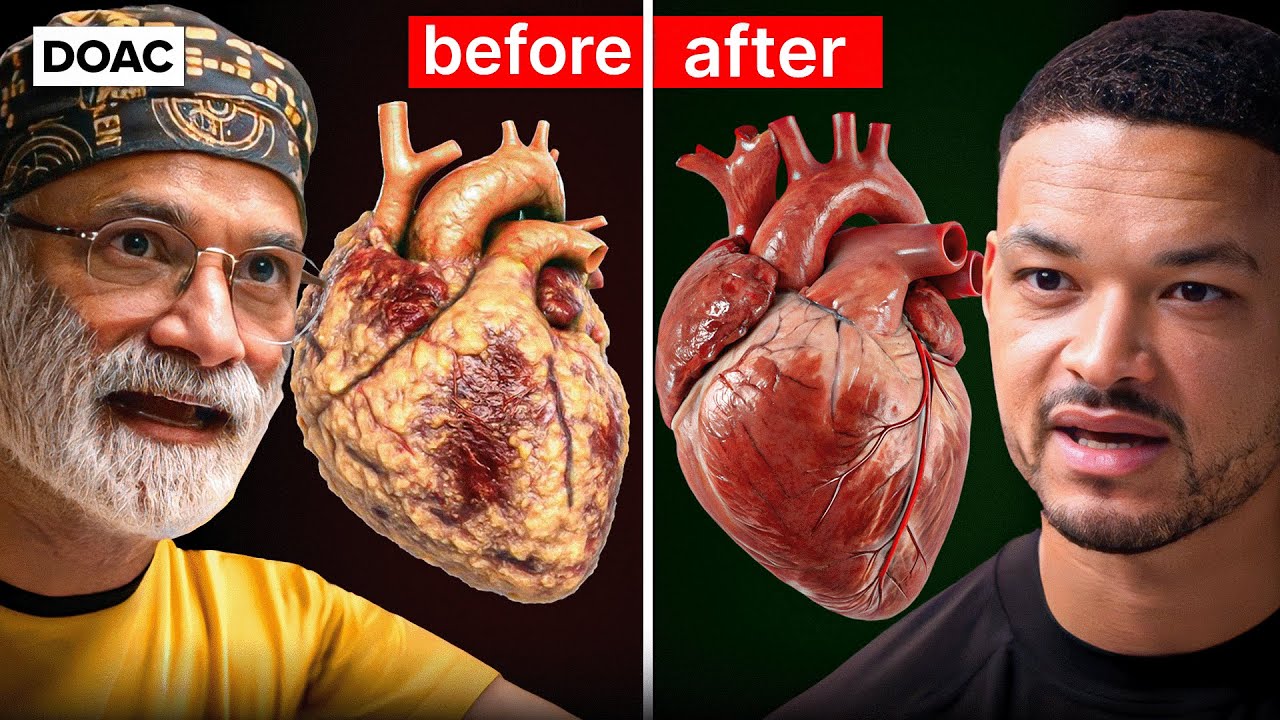
Cardiologist Pradip Jamnadas Urges Intermittent Fasting and Gut Care
The Diary Of A CEO
Cardiovascular disease is primarily driven by systemic gut inflammation and hyperinsulinemia rather than elevated cholesterol, requiring dietary interventions like intermittent fasting and seed oil elimination.
## Background
Published by Steven Bartlett on The Diary Of A CEO YouTube channel on September 22, 2025, this episode features interventional cardiologist Dr. Pradip Jamnadas. The page description frames the discussion around exposing truths about heart disease, challenging conventional medical advice on cardio, sugar, and statins, and presenting fasting, gut health, and metabolic longevity as key solutions.
## TL;DR
Dr. Pradip Jamnadas argues that systemic inflammation, hyperinsulinemia, and gut permeability are the root causes of cardiovascular disease rather than high cholesterol alone. He advocates for fasting routines, short-duration high-intensity exercise, and eliminating ultra-processed foods, seed oils, and high-fructose diets to protect the heart. The discussion highlights the critical role of the gut microbiome, vagus nerve health, and specific diagnostic testing like Coronary Artery Calcium (CAC) scores and inflammatory panels. Additionally, Dr. Jamnadas outlines targeted supplementation and lifestyle interventions to reduce arterial calcification and optimize overall health.
## Atmosphere & style
The conversation carries an urgent, eye-opening, and candid tone as Dr. Jamnadas forcefully challenges long-held medical paradigms. Steven Bartlett guides the dialogue with engaging curiosity, allowing the doctor's energetic delivery and clinical anecdotes to build an informative, high-stakes atmosphere. It feels like an authoritative yet passionate masterclass that balances radical medical critiques with deeply empathetic, actionable advice.
## Key takeaways
- [34:09](https://www.youtube.com/watch?v=gryta3KZKU4&t=2049s) Aerobic endurance exercise in a fasted state can cause muscle breakdown in women due to glucose depletion, whereas resistance training and HIIT work effectively without causing the same muscle breakdown.
- [35:45](https://www.youtube.com/watch?v=gryta3KZKU4&t=2145s) Continuous long-term ketosis is not advised; individuals should cycle in and out of a ketogenic diet, while intermittent fasting triggers autophagy and selective mitophagy to clear damaged mitochondria.
- [38:52](https://www.youtube.com/watch?v=gryta3KZKU4&t=2332s) Excessive steady-state cardio increases systemic inflammation and coronary artery disease compared to short sprints, resistance training, and HIIT protocols with adequate rest intervals.
- [41:40](https://www.youtube.com/watch?v=gryta3KZKU4&t=2500s) A patient with a high Coronary Artery Calcium (CAC) score despite no traditional risk factors traced severe arterial calcification to lifelong chronic gastrointestinal issues and constipation.
- [44:56](https://www.youtube.com/watch?v=gryta3KZKU4&t=2696s) Disruption of the gut microbiome causes leaky gut, allowing lipopolysaccharides (LPS) from dead bacterial walls to leak into the liver and drive conditions like non-alcoholic fatty liver disease.
- [49:18](https://www.youtube.com/watch?v=gryta3KZKU4&t=2958s) High-dose oral calcium supplements increase the risk of cardiovascular events by contributing to soft-tissue calcification, whereas Vitamin D3 enhances gut absorption and Vitamin K2 directs calcium away from blood vessels.
- [55:34](https://www.youtube.com/watch?v=gryta3KZKU4&t=3334s) Synthetic endocrine disruptors and widespread environmental mold colonization in modern homes drive chronic inflammation and elevated inflammatory markers.
- [01:04:20](https://www.youtube.com/watch?v=gryta3KZKU4&t=3860s) Ultra-processed foods, rapid blood sugar spikes from orange juice, and high-fructose fruit consumption place heavy stress on the liver and drive cardiovascular and metabolic dysfunction.
- [01:08:00](https://www.youtube.com/watch?v=gryta3KZKU4&t=4080s) Cooking rice and refrigerating it overnight creates resistant starch, which lowers glycemic and insulin responses and feeds beneficial gut bacteria upon reheating.
- [01:11:32](https://www.youtube.com/watch?v=gryta3KZKU4&t=4292s) Industrial seed oils high in pro-inflammatory omega-6 fatty acids should be replaced with extra-virgin olive oil, grass-fed butter, ghee, or coconut oil.
- [01:15:06](https://www.youtube.com/watch?v=gryta3KZKU4&t=4506s) Pathogenic oral bacteria, poor dental hygiene, and chronic fungal sinusitis maintain low-grade inflammation that accelerates arterial disease and aortic valve calcification.
- [01:16:52](https://www.youtube.com/watch?v=gryta3KZKU4&t=4612s) Moderate coffee and 85% dark cacao provide polyphenols that nourish gut bacteria, but excessive caffeine overstimulates the sympathetic nervous system.
- [01:19:52](https://www.youtube.com/watch?v=gryta3KZKU4&t=4792s) Postural Orthostatic Tachycardia Syndrome (POTS) and heart palpitations in young people are frequently linked to leaky gut and vagus nerve damage caused by gut ischemia or lifestyle factors.
- [01:22:18](https://www.youtube.com/watch?v=gryta3KZKU4&t=4938s) Vagal tone can be supported through omega-3 supplementation, breathing exercises, cold application, humming, or socialization, helping to reduce sympathetic dominance and heart rate.
- [01:31:38](https://www.youtube.com/watch?v=gryta3KZKU4&t=5498s) Small dense LDL particles oxidize, penetrate arterial walls, and form plaque, driven by excess glucose, omega-6 seed oils, AGEs, environmental toxins, and leaky gut.
- [01:38:32](https://www.youtube.com/watch?v=gryta3KZKU4&t=5912s) Elevated insulin levels inhibit endothelial vasodilation and directly drive high blood pressure, proving hypertension is rarely without an underlying cause.
- [01:43:20](https://www.youtube.com/watch?v=gryta3KZKU4&t=6200s) Daily supplement and health routines incorporating Nattokinase, spore-based probiotics, Vitamin D3/K2, and an 18:6 fasting schedule help support cardiovascular and gut health.
- [01:45:14](https://www.youtube.com/watch?v=gryta3KZKU4&t=6314s) Adults over 30 should consider essential screening evaluations including a Coronary Artery Calcium (CAC) score and a comprehensive inflammatory and lipoprotein panel to detect subclinical atherosclerosis early.
## Detailed walkthrough
### [00:00](https://www.youtube.com/watch?v=gryta3KZKU4&t=0s) The Epidemic of Visceral Fat and Heart Disease
Dr. Pradip Jamnadas emphasizes that having a protruding belly is a clear indicator of a serious underlying issue. This internal belly fat, known as visceral fat, is exceptionally detrimental to health and drives the modern chronic disease epidemic. While traditional medical advice often fails to address it effectively, specific lifestyle techniques can target and reverse this problem rapidly. Specifically, fasting triggers the mobilization of stored fat after roughly 12 hours, and the very first place the body pulls this fat from is the dangerous visceral fat deposits around the organs. Unfortunately, modern living has caused us to lose this natural fasting physiology.
The conversation shifts to common lifestyle habits that are widely believed to be healthy but actually damage cardiovascular health. Dr. Jamnadas notes that people who engage in excessive, long-duration aerobic activity frequently develop more coronary artery disease compared to individuals who focus on short sprints and resistance exercises. Furthermore, modern environmental toxins play a hidden role; roughly 70% of modern homes contain some form of mold toxicity. Other surprising daily triggers that destroy metabolic and heart health include suffering through just one night of poor sleep—which instantly causes insulin resistance the next day—overconsuming calcium supplements, eating excessive fruit, and consuming white rice. When the host, Steven Bartlett, reacts with surprise to white rice, noting he watches true crime where people use arsenic to kill each other, Dr. Jamnadas affirms that the high levels of arsenic found in modern rice will indeed slowly kill you over time.
---
[02:23](https://www.youtube.com/watch?v=gryta3KZKU4&t=143s) The No. 1 Killer and Changing Demographics
As an interventional cardiologist who has spent 35 years operating on people's hearts and treating over 30,000 patients, Dr. Jamnadas has dedicated the latter decades of his career to the prevention of heart disease. He stresses that heart disease remains the absolute number one cause of death worldwide. The heart itself is a complex organ with multiple failure points: it is a muscular pump susceptible to cardiomyopathy (weakness of the muscle); it is fed by surface arteries susceptible to clogging from coronary artery disease; it relies on valves that can become severely damaged via conditions like aortic stenosis; and it depends on a vast peripheral circulation supplying the carotids, brain, legs, and other organs. Furthermore, it involves microvascular disease, which occurs when the tiny, branching capillaries fail, subsequently causing the organs they supply to become completely dysfunctional.
Over his decades in practice, Dr. Jamnadas has witnessed a staggering demographic shift. While his cardiovascular patients used to be predominantly older individuals over the age of 65, today the patient distribution is split exactly 50/50, with half of all patients now under the age of 65. Heart disease is aggressively moving into younger populations. The youngest patient Dr. Jamnadas ever treated for a full-blown heart attack was just 28 years old. This young man arrived at the hospital with a completely clogged coronary artery caused by an acute blood clot, experiencing severe chest pain, sweating, and dangerously low blood pressure. Dr. Jamnadas rushed him into the cardiac catheterization lab (cath lab) to perform an emergency angioplasty, utilizing a tiny wire, a balloon to squash the clot, and a permanent spring-like stent to restore immediate blood flow to the dying heart muscle.
---
[04:36](https://www.youtube.com/watch?v=gryta3KZKU4&t=276s) Anatomy of a Heart Attack: The Role of Inflammation
Explaining the exact mechanics of a heart attack, Dr. Jamnadas clarifies a widespread misunderstanding: a heart attack is not caused by the gradual buildup of plaque closing up an artery. A stable plaque buildup that narrows the arterial lumen restricts blood flow and causes angina (chest discomfort), though only about 20% of patients with such blockages actually experience chest pain. The remaining 80% are completely asymptomatic and can only be diagnosed through diagnostic modalities like a stress test or a coronary calcium score.
Instead, a heart attack occurs when a minor, non-obstructive plaque—which wasn't causing any significant blood flow disturbance—suddenly cracks or ruptures. Dr. Jamnadas compares this plaque to a pimple on the inside of the arterial wall. When systemic inflammation in the body is high, this internal "pimple" bursts open. The passing bloodstream senses the rupture and immediately attempts to repair the wound by forming a localized blood clot. It is this sudden, acute blood clot at the site of the rupture that completely seals off the artery and causes a heart attack, not the plaque itself.
- **Plaques vs. Clots:** A heart attack is caused by a blood clot forming over a ruptured plaque, not by the steady growth of the plaque itself.
- **Asymptomatic Narrowing:** 80% of patients with significant arterial plaque blockages feel no chest pain at all.
- **The Perfect Storm:** Modern lifestyles cause a triad of plaque formation, plaque instability (rupture driven by inflammation), and hypercoagulability (blood that is highly prone to clotting due to chronic inflammation).
---
[06:19](https://www.youtube.com/watch?v=gryta3KZKU4&t=379s) The Underlying Causes of Plaque and Coagulation
Addressing the global epidemic of heart disease requires looking beyond acute interventions like placing a stent. Dr. Jamnadas argues that the medical establishment fails to investigate *why* a patient formed a plaque, *why* it ruptured, and *why* their blood was so highly prone to clotting in the first place. Systemic inflammation is a defense mechanism—a reaction to something foreign or an abnormal internal physiology. Today, human blood is significantly more coagulable than it was in the past because chronic, systemic inflammation keeps the clotting cascade on high alert.
To illustrate how an angioplasty works, Dr. Jamnadas describes the procedure. Rather than an open-heart surgery, it is a minimally invasive intervention where a physician inserts a long, hollow tube called a catheter through an access point in the patient’s wrist or groin. The catheter is threaded all the way into the coronary arteries, where a contrast dye is injected to pinpoint the exact location of the blockage under X-ray imaging. A micro-wire is guided across the obstruction, a balloon is inflated to compress the clot against the arterial wall, and a metallic stent is deployed to act as a structural scaffold, permanently keeping the vessel open to allow blood to reach the heart muscle.
---
[10:04](https://www.youtube.com/watch?v=gryta3KZKU4&t=604s) The Profile of a 28-Year-Old Heart Attack Patient
Returning to the case of the 28-year-old heart attack patient, Dr. Jamnadas details the specific metabolic profile that led to the event. The young man was overweight, but crucially, his weight gain was heavily concentrated in his abdomen as visceral fat, accompanied by a fatty liver. Standard clinical testing would have entirely missed his impending cardiovascular crisis; his glucose levels were normal and his hemoglobin A1C (the standard blood test used to screen for diabetes) was completely fine, leading a standard family doctor to declare him perfectly healthy.
However, the patient was profoundly prediabetic because his fasting and postprandial insulin levels were astronomically high. Dr. Jamnadas explains that insulin is a highly atherogenic molecule. When it remains chronically elevated in the bloodstream, it actively drives the proliferation of smooth muscle cells within arterial walls, induces vasoconstriction, promotes a hypercoagulable state, and triggers widespread inflammation.
Years prior, Dr. Jamnadas began performing random glucose tolerance tests on his non-diabetic cardiac patients and discovered that at least half of them had severe glucose intolerance—their blood sugar spiked abnormally high after a glucose drink, even though their fasting numbers looked acceptable. A decade later, he purchased a specialized machine to measure blood insulin levels directly in his clinic. This completely transformed his practice, revealing that the true driver of underlying metabolic derangement and cardiovascular destruction is chronically elevated insulin, which forces the body to store fat inside the liver and around the abdominal organs.
---
[12:27](https://www.youtube.com/watch?v=gryta3KZKU4&t=747s) The Toxic Nature of Sugar and the Mechanism of Insulin Resistance
"Everybody needs to understand the relationship between sugar, which is glucose, and insulin." Dr. Jamnadas warns that glucose is highly toxic when it lingers inside the bloodstream. Even though cells utilize glucose for energy, an excess of it in circulation causes widespread glycation. Glycation is a destructive process where glucose molecules permanently bond to blood vessels, hemoglobin, structural proteins, hormones, and essential enzymes. Once a molecule becomes glycated, its structural integrity is compromised, and it can no longer function normally, causing individuals to age prematurely and suffer systemic metabolic breakdown.
To defend against this toxicity, the pancreas secretes insulin to rapidly clear glucose out of the bloodstream and shove it into the liver, muscle tissue, and every other cell in the body. The fundamental problem arises from modern eating frequencies. When a person constantly consumes carbohydrates, sugars, and processed foods every two to three hours, they continuously spike their insulin. While blood glucose can be cleared and brought back down to baseline within two to three hours, insulin molecules persist in the bloodstream for roughly four hours.
Because insulin never has a chance to drop, the body is exposed to a continuous hormonal bath. Over a period of years, the cellular receptors become entirely immune to the hormone, establishing a state of insulin resistance. Consequently, the pancreas is forced to pump out progressively massive, astronomical amounts of insulin just to clear the exact same amount of carbohydrates. Even if a patient's hemoglobin A1C remains normal and they are told they are not diabetic, this hidden, high background insulin destroys their metabolism by forcing calories directly into the liver—creating a fatty liver—and driving the intensive production of dangerous visceral fat inside the belly.
- **Glycation:** The chemical binding of sugar to proteins and hormones, which deactivates their function and accelerates systemic cellular aging.
- **Hormonal Half-Life:** Glucose drops within 2–3 hours, but insulin takes roughly 4 hours to clear, meaning frequent snacks keep insulin permanently elevated.
- **Visceral Fat Genesis:** Abdominal fat is biochemically unique; unlike general weight gain from a mixed over-caloric diet, abdominal visceral fat is specifically driven by excessive glucose and chronic insulin stimulation.
Here is a detailed, faithful walkthrough of the transcript segment.
[16:46](https://www.youtube.com/watch?v=gryta3KZKU4&t=1006s) Visceral Fat, Hyperinsulinemia, and Early Screening
Dr. Pradip Jamnadas explains that fat protruding from the stomach is known as visceral fat. Unlike subcutaneous fat, which can be pinched, visceral fat settles deep inside around internal organs. This toxic fat accumulates as a direct consequence of consuming starchy, glucose-heavy carbohydrates combined with eating too frequently. When meals and snacks are eaten constantly without giving the pancreas a break, insulin levels never have a chance to fall. Over time, this chronic exposure forces the body to produce massive amounts of insulin just to clear sugar from the blood, ultimately leading to insulin resistance.
```
High Starch/Glucose + Frequent Eating ➔ Constant High Insulin ➔ Insulin Resistance ➔ Uncontrolled Blood Sugar ➔ Type 2 Diabetes Diagnosis
```
A patient may go 10 years with hyperinsulinemia before blood sugar surges high enough for a doctor to diagnose diabetes. By the time that official diagnosis occurs, the opportunity for early prevention has already been missed. Dr. Jamnadas notes that by the time patients receive a diabetes diagnosis and present to his cardiac clinic, they almost always already have underlying coronary artery disease, much like the 28-year-old patient referenced earlier. He urges that screening for fasting insulin levels should begin around age 30, though most doctors currently lack the training or clinical habit to order these tests. From a visual standpoint, Dr. Jamnadas can spot this phenotype immediately: a patient walking into his office with a belly sticking out—looking terrible from the side but fine from behind—is showing the hallmark physical sign of hyperinsulinemia, where insulin acts as an aggressive storage hormone packing away calories.
* Visceral fat sits around internal organs and cannot be pinched like surface fat.
* Hyperinsulinemia typically operates under the radar for roughly 10 years before full-blown diabetes develops.
* Metabolic damage and vascular risk begin compounding around age 30.
* Insulin acts as a storage molecule; high levels make weight loss nearly impossible without lowering the hormone.
[19:45](https://www.youtube.com/watch?v=gryta3KZKU4&t=1185s) Fasting vs. Calorie Restriction and Ectopic Fat
When asked whether fasting and calorie restriction are equivalent, Dr. Jamnadas emphatically clarifies that they trigger completely different physiological processes. Simply cutting calories signals a state of starvation to the body, which slows down the metabolic rate and breaks down muscle alongside fat. In contrast, fasting drops baseline insulin levels by removing pancreatic stimulation, allowing the body to tap into its internal fat reserves.
During the first 12 hours of a fast, the body burns through stored glucose in the form of glycogen located in the liver and muscles. Beyond 12 hours, the body transitions to burning fat, specifically targeting inflammatory visceral fat first. Dr. Jamnadas explains that visceral fat is biologically distinct from subcutaneous fat (such as buttock fat): it actively secretes damaging inflammatory cytokines, including interleukin 6 (IL-6) and tumor necrosis factor (TNF). In addition to visceral fat, the body accumulates ectopic fat around the liver, pancreas, and coronary arteries. This pericoronary fat directly drives arterial plaque formation and local vascular inflammation, which modern CT scans can now quantify.
* **First 12 hours of fasting:** Depletes stored glycogen from the liver and muscles.
* **After 12 hours:** Mobilizes fat stores, prioritizing highly inflammatory visceral fat.
* **Visceral fat secretions:** Releases pro-inflammatory molecules like Interleukin 6 (IL-6), Tumor Necrosis Factor (TNF), and drives elevated C-reactive protein (CRP).
* **Ectopic fat locations:** Accumulates in non-fat tissues, including around the liver, pancreas, and directly surrounding coronary arteries.
[23:21](https://www.youtube.com/watch?v=gryta3KZKU4&t=1401s) Fasting Protocols and Clinical Supervision
To help patients eliminate visceral fat, Dr. Jamnadas outlines a step-by-step progression of fasting protocols tailored to individual clinical needs:
1. **12:12 Protocol:** The patient spends 12 hours consuming zero-calorie liquids and has a 12-hour eating window. This is maintained for 2 to 3 weeks.
2. **18:6 Protocol:** The daily window tightens to 18 hours of fasting—permitting only water, black tea, black coffee, or green tea—and a 6-hour eating window.
3. **Severe Protocols (for reversal of severe diabetes or massive weight loss):** Protocols include a weekly 48-hour fast, or 9 consecutive days of One Meal A Day (OMAD) followed by a 3-day water fast.
When host Steven Bartlett asks about differences in female physiology, Dr. Jamnadas observes that most women handle fasting protocols very well, with the main exceptions being women who are pregnant or actively trying to conceive. He stresses that extreme prolonged fasts require strict medical supervision. As a dramatic example, he shares the case of a female patient with severe obesity, diabetes, hypertension, hyperlipidemia, joint issues, and skin problems who completed a 72-day medically supervised fast consuming only water, black tea, black coffee, daily electrolytes (such as LMNT or half a teaspoon of Celtic salt), and occasional MCT oil for severe cravings.
The woman reversed her diabetes, normalized her blood pressure, and lost 55 to 60 pounds. Crucially, Dr. Jamnadas points out that fasting causes the skin to retract naturally during weight loss through cellular cleanup mechanisms, avoiding the sagging skin common with simple calorie restriction. He mentions another supervised patient who fasted for 183 days, dropping from 400 lbs to 210 lbs without requiring cosmetic skin-removal surgery.
* **Fasting liquids permitted:** Water, black tea, black coffee, green tea (zero calories).
* **Electrolyte supplementation:** 1/2 tsp Celtic salt or targeted electrolyte mixtures (e.g., LMNT) daily during extended fasts.
* **Craving management:** 1 tsp of MCT oil in water as needed.
* **Patient Case 1:** 72-day supervised fast resulting in 55–60 lbs weight loss and complete reversal of diabetes and hypertension.
* **Patient Case 2:** 183-day supervised fast reducing body weight from 400 lbs down to 210 lbs.
[28:36](https://www.youtube.com/watch?v=gryta3KZKU4&t=1716s) Ketones, Stem Cells, and Exercise Timing
Human evolutionary biology is built around cycles of "fasting and feasting," yet modern industrialized life keeps people in a perpetual state of feasting. When fasting extends past 12 hours, low insulin levels trigger the release of free fatty acids into the bloodstream. The liver takes up these fatty acids and converts them into ketones, an alternative and cleaner fuel source than glucose. Ketone metabolism generates fewer damaging reactive oxygen species (ROS) in the mitochondria and acts as a powerful signaling pathway.
Ketosis stimulates the production of Brain-Derived Neurotrophic Factor (BDNF), enhancing cognitive function, mental sharpness, reflexes, and visual acuity. However, Dr. Jamnadas cautions against remaining in perpetual ketosis; optimal human physiology relies on metabolic flexibility—the ability to switch smoothly between checking account energy (glucose) and savings account energy (ketones/fat). Breaking a fast triggers a surge of pluripotent stem cells from the bone marrow, boosting immune function and mobilizing endothelial progenitor cells that actively repair damaged blood vessel linings. Furthermore, fasting elevates natural growth hormone levels. To maximize muscle retention and growth, Dr. Jamnadas advises exercising at the peak of a fast (for example, hitting the gym at 4:00 PM if breaking the fast at 6:00 PM), leveraging the heightened growth hormone spike.
* **Ketone production:** Fatty acids are mobilized by low insulin and processed by the liver into ketones.
* **Mitochondrial health:** Ketones generate fewer reactive oxygen species (ROS) than glucose combustion.
* **BDNF release:** Ketogenisis induces Brain-Derived Neurotrophic Factor, improving focus, vision, and cognitive speed.
* **Endothelial Progenitor Cells:** Stem cells mobilized during fasting repair daily micro-damage inside arterial walls.
* **Exercise timing:** Training at the peak of a fast takes advantage of elevated endogenous growth hormone to preserve and build muscle.
<FollowUp label="Want to go deeper into the next transcript section on cardio, exercise, and heart health?" query="Please continue with the next section of the transcript walkthrough covering Dr. Jamnadas's insights on cardio, exercise, and heart health."/>
[34:09](https://www.youtube.com/watch?v=gryta3KZKU4&t=2049s) Exercise and Fasting for Women vs. Men
Steven Bartlett raises a common claim that women need to consume carbohydrates before a workout to avoid losing muscle mass and triggering stress responses, unlike men, whose evolutionary history as hunters makes them more adapted to exercising fasted. Dr. Pradip Jamnadas addresses this distinction by categorizing exercise into aerobic endurance work versus resistance training and High-Intensity Interval Training (HIIT).
Dr. Jamnadas explains that while a woman running on a treadmill for 40 minutes in a fasted state might indeed deplete her glucose reserves and risk muscle breakdown, resistance training and HIIT work exceptionally well for both men and women when fasted. During HIIT, short bursts of intense effort followed by complete rest do not cause the same muscle breakdown.
* **Aerobic vs. Resistance:** Extended steady-state cardio (e.g., 40 minutes on a treadmill) when fasted can lead to glucose depletion and muscle breakdown in women, whereas resistance training and HIIT yield great results without these issues.
* **HIIT Protocol:** High-Intensity Interval Training works by intensely stressing muscles for short durations combined with rest, proving equally effective for women and men in a fasted state.
---
[35:45](https://www.youtube.com/watch?v=gryta3KZKU4&t=2145s) Ketosis, Autophagy, and Mitochondrial Health
Dr. Jamnadas emphasizes that individuals should not remain in continuous ketosis. Instead, he advises cycling in and out of a ketogenic diet (defined as eating fewer than 50 grams of carbohydrates per day). Once patients reach their weight loss goals—such as losing 70 pounds—they should transition to a time-restricted feeding schedule like 18:6 (an 18-hour fast with a 6-hour eating window), supplemented by an occasional 36-hour fast roughly once a month.
The rationale behind cycling out of constant ketosis is tied to autophagy—the process by which cells break down and recycle degraded organelles to optimize cellular efficiency. Fasting triggers both general autophagy and selective mitophagy (the recycling of damaged mitochondria). Mitochondria are far more than mere cellular powerhouses producing ATP; they also produce reactive oxygen species (ROS) and emit signaling molecules to nuclear chromosomes that influence protein production and metabolic balance. Reviving mitochondrial function through mitophagy reduces fatigue, enhances energy production, and minimizes toxic cellular waste.
* **Ketogenic Diet Definition:** A diet limiting carbohydrate intake to under 50 g daily.
* **18:6 Intermittent Fasting:** An 18-hour fasting period paired with a 6-hour eating window to maintain low-level ketone production without continuous strict ketosis.
* **36-Hour Monthly Fast:** Recommended once a month for healthy individuals to promote deeper cellular cleanup.
* **Mitophagy and ROS:** Mitophagy clears out old, inefficient mitochondria, resulting in cleaner ATP production and lower levels of cellular-damaging reactive oxygen species (ROS).
---
[38:52](https://www.youtube.com/watch?v=gryta3KZKU4&t=2332s) Best Exercise for Heart Health
When Steven asks about the single best form of exercise to prevent heart disease—referencing his own family history of heart attacks—Dr. Jamnadas delivers an unexpected answer: excessive aerobic cardio can actually increase internal inflammation and worsen coronary artery disease. He observes that patients who log extreme aerobic mileage (cycling 100 miles a day or running on a treadmill for two hours daily) frequently display more coronary plaque than those focusing on brief sprints, bodyweight resistance exercises, and structured HIIT.
To build basic stamina without causing systemic damage, Dr. Jamnadas advises capping steady-state cardio at 15 to 20 minutes before transitioning to resistance training or interval work. HIIT protocols should feature 30 to 45 seconds of maximal exertion followed by 30 to 45 seconds of absolute rest. This built-in rest period is critical: it gives the body time to synthesize rate-limiting antioxidant enzymes, such as glutathione and superoxide dismutase, which clear the metabolic waste and reactive oxygen species created during intense physical exertion.
> "I see that people who overly do aerobic activity... actually end up with more inflammation in the body, and they end up with more coronary artery disease than patients who do short sprints, and patients who do resistance exercises, and patients who do HIITs."
* **Cardio Cap:** Limit steady-state aerobic exercises (running, cycling) to 15–20 minutes per session to prevent excess systemic inflammation.
* **Interval Timing:** Work for 30–45 seconds at high intensity, followed immediately by 30–45 seconds of full rest.
* **Endogenous Antioxidants:** Resting during interval training allows the body to utilize rate-limiting enzymes like **glutathione** and **superoxide dismutase** to neutralize metabolic waste.
---
[41:40](https://www.youtube.com/watch?v=gryta3KZKU4&t=2500s) The Emotional Toll and a Case Study in Heart Disease
Having treated well over 250,000 patients across his career, Dr. Jamnadas touches on the emotional burden of losing patients, noting that human life remains finite regardless of medical interventions. His ultimate clinical objective is maximizing healthspan and quality of life so patients can stay vibrant until their final moments.
Steven asks if seemingly healthy people—who eat well and exercise—can still succumb to severe heart disease. Dr. Jamnadas recalls a typical patient in his 60s who presented with a dangerously elevated Coronary Artery Calcium (CAC) score exceeding 1,000. Despite having no history of diabetes, hypertension, smoking, or alcohol use, and maintaining a regular gym routine, the patient suffered from severe arterial calcification. Investigation revealed that the man had suffered from chronic, unmanaged gastrointestinal issues and severe constipation since childhood, pointing to a long-standing gut microbiome breakdown as the root source of his systemic vascular inflammation.
* **Patient Volume:** Over 250,000 patients treated over a 35+ year medical career.
* **CAC Score Case Study:** A patient in his 60s with a CAC score over 1,000 (>400 indicates severe plaque burden) who led a outwardly healthy lifestyle but suffered chronic lifelong bowel issues.
---
[44:56](https://www.youtube.com/watch?v=gryta3KZKU4&t=2696s) The Gut-Heart Connection and Leaky Gut
Dr. Jamnadas explains that the primary barrier separating an individual from the outside environment is not the skin, but the gastrointestinal tract, which harbors approximately 100 trillion bacteria and 400 trillion viruses. This dense ecosystem produces vital micronutrients, including short-chain fatty acids (SCFAs), and maintains the structural integrity of the gut lining.
When the microbiome is disrupted, the tight junctions of the gut lining fail—a condition known as "leaky gut." This breakdown allows toxic bacterial wall components, specifically lipopolysaccharides (LPS), to escape the intestines and travel directly through the portal vein into the liver. This triggers hepatic inflammation and fatty liver disease, an epidemic currently affecting at least 25% of the general population. Dr. Jamnadas notes that addressable root causes of fatty liver include alcohol consumption, elevated insulin levels (which convert excess glucose to fat), and leaky gut driven by ultra-processed foods.
By removing processed foods, increasing dietary fiber, and supporting gut barrier recovery, Dr. Jamnadas has successfully flatlined the progression of arterial calcification in his cardiac patients.
* **Gut Microflora:** Home to ~100 trillion bacteria and ~400 trillion viruses in a symbiotic relationship.
* **Lipopolysaccharides (LPS):** Toxins from dead bacterial walls that pass through a compromised ("leaky") gut barrier into the portal vein.
* **Fatty Liver Prevalence:** Affects at least 25% of the population, driven by sugar, ultra-processed food, insulin resistance, and leaky gut.
* **Coronary Calcium Monitoring:** A zero CAC score is ideal; effective lifestyle interventions aim to stop CAC progression in its tracks.
---
[49:18](https://www.youtube.com/watch?v=gryta3KZKU4&t=2958s) The Danger of Calcium Supplements vs. Vitamin D3 & K2
The conversation turns to the critical distinction between arterial calcium deposits and dietary supplements. Dr. Jamnadas strongly warns against taking oral calcium supplements, explaining that high-dose calcium pills do not strengthen bones properly and instead increase the risk of cardiovascular events, such as heart attacks and strokes. He routinely removes all cardiac patients from calcium supplements.
Rather than flooding the body with elemental calcium—which is already abundant in diets and fortified foods—the real culprit behind bone loss conditions like osteopenia and osteoporosis is a deficiency in Vitamins D3 and K2. Vitamin D3 facilitates proper calcium absorption in the gut, while Vitamin K2 directs that calcium into the bone matrix and away from arterial walls. Dr. Jamnadas also highlights that blood thinners like Warfarin (Coumadin) deplete Vitamin K1 and K2 levels, which directly contributes to accelerated coronary artery calcification in patients taking those medications.
* **Calcium Supplementation Risk:** High-dose calcium supplements (>1,000 mg/day) are linked to higher rates of cardiovascular events and soft-tissue calcification.
* **Synergistic Nutrients:** **Vitamin D3** increases intestinal absorption of calcium; **Vitamin K2** directs calcium into bones rather than blood vessel walls.
* **Coumadin/Warfarin Effect:** Inhibits Vitamin K (both K1 and K2), inadvertently increasing the rate of arterial calcification in cardiac patients.
[51:13](https://www.youtube.com/watch?v=gryta3KZKU4&t=3073s) Recommendations for Gut Health, Fiber, and Supplements
Dr. Pradip Jamnadas emphasizes that diet alone is often insufficient to provide critical nutrients like vitamin K2, which is naturally found in fermented foods. Because modern diets lack a sufficient variety of these foods and processed soil yields less nutrient-dense crops, he routinely supplements vitamin K2 for all his patients. To maintain a healthy gut and prevent leaky gut, his first line of advice is to consume ample amounts of fiber. Fiber acts as essential food for good gut bacteria, whereas high sugar intake breeds harmful bacterial overgrowths like Small Intestinal Bacterial Overgrowth (SIBO). To counteract the modern diet's fiber deficiency, he advises his patients to take a daily scoop of soluble inulin with fructooligosaccharides (FOS) powder mixed into water or any liquid.
His second core recommendation is the daily inclusion of fermented foods like kefir, which supply a vast array of live beneficial bacteria alongside critical "postbiotics"—the health-promoting compounds produced by microbes, such as vitamin K2 and short-chain fatty acids. Research shows that populations in the US and the UK are significantly fiber-deficient (women in the US and UK are roughly 40% deficient, while US men are about 50% deficient). Dr. Jamnadas explains that fiber is removed from processed foods during manufacturing to extend shelf life. To fix this, individuals must eat real, whole foods—specifically targeting 30 to 40 different types of plant foods a week (including various vegetables and spices, which each count as a unique source) to cultivate a diverse gut microbiome.
Beyond nutrition, lifestyle factors play a crucial role in gut and cardiovascular health. Getting at least 7 hours of sleep per night is vital; even a single night of poor sleep can induce immediate insulin resistance, alter the gut microbiome, disrupt vagal nerve tone, and impair delta sleep repair processes. Frequent time zone changes similarly trigger liver dysfunction and microbiome imbalance. Additionally, incorporating adequate omega-3 fatty acids is essential for overall cellular and heart health.
- **Vitamin K2:** Best obtained from fermented foods or direct supplementation to ensure adequate intake.
- **Inulin with FOS:** A recommended daily soluble fiber powder to feed gut microbes.
- **Fermented Foods:** Foods like kefir provide probiotic strains and key postbiotics (e.g., short-chain fatty acids).
- **Fiber Deficiencies:** ~40% for US women and UK adults; ~50% for US men.
- **Target Plant Diversity:** 30–40 distinct whole plant sources (vegetables, spices) per week.
- **Sleep Impact:** 7 hours minimum required; 1 bad night causes measurable next-day insulin resistance.
Steven Bartlett shares his personal experience as a founder when starting *The Diary Of A CEO*, noting how he unexpectedly had to take on dozens of roles—from production to marketing—without formal training. He highlights sponsor Shopify, which powers 10% of all US e-commerce for major brands like Gymshark and Mattel, as well as first-time entrepreneurs. Shopify functions like an all-in-one design studio and marketing team, managing product creation, inventory, international shipping, and returns.
- **Promotion:** $1/month trial available at `[shopify.com/bartlett](https://shopify.com/bartlett)`.
[56:37](https://www.youtube.com/watch?v=gryta3KZKU4&t=3397s) The Threat of Modern Toxins and Environmental Mold
Transitioning back to physiology, Dr. Jamnadas defines a toxin as any molecule that should not naturally exist within the human body. Modern environments expose humans to synthetic chemicals—pesticides, herbicides, plastics, heavy metals, and "forever chemicals" like PFAS and BPA—which act as endocrine and estrogen-receptor disruptors that fuel systemic inflammation. A healthy gut microbiome and liver normally detoxify and filter out these substances through stool. However, modern diet and environmental overload frequently overwhelm the liver's capacity. Through comprehensive blood, urine, and stool testing, Dr. Jamnadas routinely discovers strikingly high levels of heavy metals, pesticides, herbicides, and mold in his patients suffering from gut issues and coronary artery disease.
Over the past year, Dr. Jamnadas has focused extensively on mold toxicity, pointing out that nearly 70% of modern homes harbor mold toxicity due to hidden water damage. Mold acts as a pervasive environmental hazard that continuously triggers the innate immune system, causing chronic, low-grade systemic inflammation. When mold enters the body, it can colonize the gut microbiome or sinuses (causing chronic sinusitis), constantly re-inoculating the individual and driving up inflammatory markers such as C-reactive protein (CRP) and complement levels. Removing environmental mold and treating internal colonization frequently flattens the progression of coronary artery disease in his patients.
Steven shares a personal story about discovering a strong, earthy smell coming from behind unsealed bench cracks in his home steam room. After querying ChatGPT and confirming it was mold, he brought in a professional crew to remediate and clean the space, realizing how easily someone could unknowingly inhale harmful spores daily. Dr. Jamnadas stresses that when seemingly healthy patients without classic risk factors (like smoking, high cholesterol, obesity, or diabetes) develop severe arterial clogging, hidden sources of inflammation—such as mold toxicity, leaky gut, or undiagnosed food sensitivities like celiac disease—are almost always the root cause.
> "There's always a reason why you get hardening of the arteries... It's all about inflammation. We need to get rid of inflammation in order to get rid of coronary artery disease."
- **Common Environmental Toxins:** Pesticides, herbicides, microplastics, PFAS, BPA, heavy metals, and mold mycotoxins.
- **Prevalence of Home Mold:** Up to 70% of homes have some form of mold toxicity from past water damage.
- **Diagnostic Markers:** Mold toxicity manifests in blood work via elevated CRP and high complement levels.
- **Hidden Cardiovascular Risks:** Celiac disease, leaky gut, food sensitivities, and hidden mold exposures drive "unexplained" arterial plaque build-up.
[01:04:20](https://www.youtube.com/watch?v=gryta3KZKU4&t=3860s) Toxic Diet Choices and Common Food Misconceptions
When Steven asks what someone should eat if their goal was to end up on Dr. Jamnadas's cardiac surgical table, Dr. Jamnadas responds with sharp sarcasm: eat nutrient-deficient, ultra-processed foods every single day. A heart-disease-inducing diet consists of refined wheat products, biscuits, cookies, cakes, white bread, fast food, boxed meals, high-protein snack bars laden with additives, artificial colorings, artificial sweeteners, diet drinks, and processed fruit juices. He singles out orange juice as particularly harmful because it delivers a massive spike in blood glucose and a subsequent surge in insulin, leaving the consumer ravenously hungry just three to four hours later. Combined with alcohol, smoking, and a total absence of dietary fiber, this eating pattern guarantees severe metabolic and cardiovascular dysfunction.
Moving to daily foods commonly mistaken for healthy, Dr. Jamnadas addresses bread and white rice. While white bread is essentially empty calories—acting on blood sugar much like eating spoonfuls of sugar—he makes a minor exception for traditional sourdough bread. Sourdough fermentation breaks down anti-nutrients and lectins present in the flour, making a slice consumed once or twice a week acceptable, though still primarily a calorie-dense "survival food."
Regarding white rice, a staple for billions worldwide, Dr. Jamnadas highlights a grave modern problem: heavy metal contamination. Due to polluted irrigation water and soil, paddy fields are frequently contaminated with high levels of arsenic—a potent toxic heavy metal that causes chronic cellular damage. To reduce arsenic exposure, Dr. Jamnadas advises his patients on specific culinary preparation methods.
- **Arsenic in Rice:** Heavy metal contamination from soil/water; requires specific soaking protocols to reduce toxicity.
- **Orange Juice:** Triggers severe blood glucose spikes and secondary insulin crashes, increasing appetite hours later.
- **Sourdough vs. White Bread:** Traditional fermentation reduces lectin content in sourdough, whereas white bread acts as rapid, fiber-depleted simple sugar.
[01:08:12](https://www.youtube.com/watch?v=gryta3KZKU4&t=4092s) Preparing Rice to Create Resistant Starch
Dr. Pradip Jamnadas explains that how you prepare food can drastically alter its impact on your metabolism. For instance, cooking rice with plenty of water, draining the excess water, and then refrigerating the rice overnight creates **resistant starch**. When the rice cools, its starch molecules bind tightly together, resisting breakdown and absorption in the upper digestive tract.
When you reheat and consume this prepared rice the next day, it no longer triggers a sharp spike in insulin or contributes to weight gain in the same way fresh rice does. Instead of rapidly absorbing as simple sugars, the resistant starch passes into the colon intact, where it serves as essential food for your beneficial gut microbiome.
- **Cooking Method:** Cook rice with extra water, drain, refrigerate overnight, and reheat before eating.
- **Mechanism:** Cooling rebinds starch molecules so they resist digestion until reaching the large intestine.
- **Metabolic Benefit:** Significantly lowers the glycemic and insulin response while nourishing beneficial gut bacteria.
---
[01:09:07](https://www.youtube.com/watch?v=gryta3KZKU4&t=4147s) Advanced Glycation End Products (AGEs) and Scorched Foods
Cooking methods that expose proteins, fats, and carbohydrates to extreme heat generate harmful compounds known as **Advanced Glycation End Products (AGEs)**. Dr. Jamnadas notes that while nature never combines sugars, fats, and proteins at high heat, appliances like air fryers or high-heat grilling frequently create this reaction—such as when fish or meat is severely blackened or fried.
Consuming high levels of AGEs triggers widespread systemic inflammation. While the body possesses specialized cell receptors called **RAGEs** (Receptors for Advanced Glycation End Products) designed to clear these molecules, overconsuming charred or overcooked food overwhelms this natural defense mechanism, driving inflammatory stress throughout the body.
- **Definition of AGEs:** Harmful chemical compounds formed when fats, proteins, and sugars are combined at high temperatures.
- **Body's Defense:** Receptors called RAGEs attempt to filter out AGEs, but heavy dietary exposure overloads the system.
- **Health Impact:** Overcooked, heavily charred, or deep-fried foods dramatically increase systemic inflammation.
---
[01:10:13](https://www.youtube.com/watch?v=gryta3KZKU4&t=4213s) The Hidden Dangers of Excess Fruit and Fructose
Dr. Jamnadas cautions against the modern practice of consuming large amounts of fruit year-round. Because fruit contains high levels of **fructose**, overconsumption places a heavy burden on the liver, contributing directly to fatty liver disease, insulin resistance, coronary artery disease, and type 2 diabetes.
Historically, humans ate fruit sparingly and only when seasonally available in the autumn to prepare for winter. Dr. Jamnadas shares a clinical case of a patient suffering from both cardiovascular disease and severe cognitive issues whose primary diet consisted of fruit for breakfast, lunch, and dinner. Once the patient eliminated excess fruit from his diet, his physical and mental health improved dramatically.
- **Biological Function:** Fructose is processed primarily by the liver, converting excess amounts into liver fat.
- **Optimal Intake:** Fruit should be eaten strictly in season, in small amounts, rather than as a year-round staple.
- **Associated Risks:** High fructose consumption drives fatty liver disease, metabolic dysfunction, and arterial disease.
Industrial vegetable seed oils are a major source of dietary toxicity that Dr. Jamnadas urges all of his patients to remove completely from their kitchens. Oils such as canola, corn, soybean, and sunflower are highly processed and contain exceptionally high concentrations of **omega-6 fatty acids**.
Modern diets are severely imbalanced, providing excessive omega-6 fats and insufficient omega-3 fats, which creates a chronic pro-inflammatory environment in the cardiovascular system. To protect vascular health, Dr. Jamnadas advises replacing seed oils with stable, traditional fats:
- **Salads & Unheated Dressings:** Extra-virgin olive oil.
- **High-Heat Cooking:** Small amounts of grass-fed butter, ghee, or coconut oil.
- **Core Mechanism:** Restoring a healthy omega-6 to omega-3 ratio reduces systemic inflammation and vascular damage.
---
[01:12:29](https://www.youtube.com/watch?v=gryta3KZKU4&t=4349s) Physical Indicators of Cardiovascular Health and Inflammation
When assessing a patient's cardiovascular risk from a visual standpoint, body weight and fat distribution offer immediate clues. While Dr. Jamnadas acknowledges that the standard **Body Mass Index (BMI)** is a crude metric—often misclassifying muscular individuals with a BMI of 28 as unhealthy—the accumulation of **visceral fat** around the abdomen is a direct indicator of poor metabolic health.
Beyond abdominal fat, persistent joint pain and autoimmune flare-ups (such as rheumatoid arthritis or psoriasis) are key outward symptoms of underlying vascular and systemic inflammation. Dr. Jamnadas reports that when patients resolve gut inflammation through intermittent fasting, dietary shifts, improved sleep, stress management, and targeted supplementation, their joint and skin conditions clear up consistently alongside their cardiovascular markers.
> "In my experience, what I have seen, it's all inflammation. Because when I change the diet, when I fix the gut issues, when I fix the inflammation in the body, they all come back and say the joints got better... Psoriasis gets better, cuz the fundamental underlying part is all inflammation."
- **Visceral Fat:** Belly protrusion is a primary visual signal of dangerous internal organ fat and metabolic disease.
- **Inflammatory Link:** Joint pain is rarely just "wear and tear"; it frequently stems from systemic inflammatory drivers.
- **Holistic Resolution:** Addressing gut health and metabolic stress routinely reverses systemic inflammatory symptoms across the entire body.
---
[01:15:06](https://www.youtube.com/watch?v=gryta3KZKU4&t=4506s) The Oral Microbiome, Chronic Sinusitis, and Heart Disease
Cardiovascular health is deeply linked to the microbial communities residing throughout the entire digestive tract, from the nose and mouth to the colon. Dr. Jamnadas highlights clear clinical data showing that poor dental hygiene and harmful oral bacteria directly contribute to structural heart conditions, including premature calcification of the aortic valve (**aortic stenosis**) and coronary artery calcification.
Similarly, chronic upper respiratory conditions like **chronic sinusitis** or fungal sinus infections maintain a state of low-grade, persistent inflammation in the head and neck. Fungal exposure and mold toxicity within the sinuses frequently seed systemic inflammation, accelerating coronary artery disease.
- **Oral-Vascular Connection:** Pathogenic mouth bacteria travel into the circulatory system, promoting arterial and valvular calcification.
- **Fungal Sinusitis:** Recurrent sinus infections and mold toxicity maintain low-grade inflammation that damages blood vessels.
- **Expanded Paradigm:** Heart disease is not merely a localized issue of cholesterol, but a systemic response to overall lifestyle, microbial health, and environmental exposure.
---
[01:16:52](https://www.youtube.com/watch?v=gryta3KZKU4&t=4612s) Coffee, Polyphenols, and the Vagus Nerve
Dr. Jamnadas clarifies that while heavy caffeine intake can be harmful, moderate coffee consumption offers real cardiovascular benefits—not because of the caffeine, but because of its rich **soluble fiber** and **polyphenol** content. Consuming 85% dark cacao or a daily cup of coffee provides essential prebiotics that feed beneficial gut bacteria. These microbes then synthesize **postbiotics**, which reinforce the gut barrier, prevent leaky gut, and protect the **vagus nerve** from chronic inflammatory damage.
However, excessive caffeine intake (exceeding 600 mg daily or drinking six or more cups of coffee) overstimulates the sympathetic nervous system. Because caffeine mimics adrenaline, heavy consumption keeps the body in a constant state of "fight or flight," suppressing the parasympathetic offset. Furthermore, caffeine acts as a diuretic, leading to intravascular volume depletion, dehydration, and elevated blood pressure.
- **Gut Health Benefits:** Coffee and high-percentage dark cacao supply soluble fiber and polyphenols that nourish gut microbes to produce protective postbiotics.
- **Sympathetic Overdrive:** Excessive caffeine overstimulates adrenaline receptors, locking the body in chronic stress mode.
- **Diuretic Effect:** High caffeine doses reduce blood volume through fluid loss, triggering stress-hormone feedback loops.
---
[01:19:52](https://www.youtube.com/watch?v=gryta3KZKU4&t=4792s) Understanding Heart Palpitations and POTS
When evaluating heart palpitations, Dr. Jamnadas divides patients into two distinct categories. For individuals with underlying structural heart disease (such as blocked coronary arteries, cardiomyopathy, or valvular defects), palpitations signal a potentially life-threatening arrhythmia that requires immediate clinical monitoring.
For otherwise healthy young individuals, palpitations usually stem from an autonomic imbalance: excessive sympathetic tone combined with deficient parasympathetic tone. Dr. Jamnadas frequently treats young women presenting with **Postural Orthostatic Tachycardia Syndrome (POTS)**—a rapid spike in heart rate upon standing. In many of these cases, the root cause is a damaged gut that has impaired vagus nerve function. Restoring the gut microbiome heals the vagus nerve, rebalancing autonomic tone and resolving the tachycardia.
> "If you've knocked your vagus nerve off because you have a leaky gut or because of your lifestyle... you will have this imbalance... By fixing the gut, I'm fixing the vagus nerve. By fixing the vagus nerve, the heart rates come down."
- **Structural vs. Functional:** Palpitations in diseased hearts require urgent care, whereas in healthy young hearts, they typically reflect autonomic nervous system imbalance.
- **Vagus Nerve Dysfunction:** Leaky gut weakens vagal tone, disrupting the parasympathetic brake on heart rate.
- **POTS Mechanism:** Fixing gut permeability often resolves postural tachycardia by restoring healthy vagal nerve signaling.
---
[01:21:27](https://www.youtube.com/watch?v=gryta3KZKU4&t=4887s) Sponsor Breakdown: JustWorks and Ketone-IQ
The transcript transitions into promotional host-read messages regarding podcast sponsors:
- **JustWorks:** Steven Bartlett discusses how early-stage founders often overlook HR infrastructure while focused on product development and growth. JustWorks automates payroll, health insurance benefits, and compliance, providing full-service HR support for growing small businesses and remote international teams.
- **Ketone-IQ:** Steven shares his personal experience adopting a low-carbohydrate, low-sugar lifestyle to boost ketone production for mental clarity and focus, leading to his direct multi-million dollar investment in Ketone-IQ.
[01:22:52](https://www.youtube.com/watch?v=gryta3KZKU4&t=4972s) Ketones and the Aftermath of Extreme Exercise
Steven shares a personal story about a high-intensity fitness rivalry with his team member, Jemima. After Jemima cycled 100 kilometers over four hours to take the lead in their office competition, Steven decided to beat her by cycling slightly over 100 kilometers on his home Peloton. Though he achieved his 4-hour victory and earned a gold medal emoji, he was left with persistent heart palpitations that lasted for weeks. He asks Dr. Jamnadas whether over-exercising disrupted his parasympathetic vagus nerve and triggered these heart issues.
Dr. Jamnadas validates Steven's experience, explaining that intense, unaccustomed over-exercise diverts large volumes of blood away from the gut to fuel the working muscles. This creates a state of relative ischemia—a lack of adequate circulation—in the gastrointestinal tract. While not severe enough to cause gangrene, this localized lack of blood flow impacts the enteric nervous system and the vagus nerve endings embedded in the gut lining. When vagal tone is suppressed, the sympathetic nervous system takes over unchecked, resulting in elevated heart rates, arrhythmias, and palpitations.
- **Jemima's Workout:** Cycled 100 km in 4 hours.
- **Steven's Counter-Workout:** Cycled >100 km in ~4 hours on a Peloton.
- **Consequences:** Weeks of lingering heart palpitations due to blood diversion, gut ischemia, and vagus nerve dysfunction.
---
[01:25:38](https://www.youtube.com/watch?v=gryta3KZKU4&t=5138s) Understanding and Hacking the Vagus Nerve
Dr. Jamnadas breaks down the crucial anatomy and function of the vagus nerve, noting that it is the body's largest nerve. While its fibers reach the face, lungs, and heart, its massive primary distribution lies within the gut. This structural layout reveals an evolutionary priority: the brain treats the gut as the body's most sensitive and treacherous border zone. The vagus nerve acts as a two-way superhighway, constantly sending operational updates back and forth between the central nervous system, heart, and digestive system. Under normal conditions, human biology relies on alternating cycles of sympathetic activation ("fight or flight") followed by parasympathetic recovery ("rest, relaxation, and repair"). However, modern lifestyles keep people trapped in continuous sympathetic overload, denying the body necessary repair time.
Repairing gut health naturally restores vagal function, which can be tracked through improved Heart Rate Variability (HRV)—the subtle variation in time between heartbeats during inhalation and exhalation. Beyond treating the gut, Dr. Jamnadas outlines several practical physical and mechanical "hacks" to directly stimulate the vagus nerve and induce a parasympathetic state:
- **Nutritional Support:** Consuming Omega-3 fatty acids (specifically DHA) to support nerve structure, addressing a deficiency present in roughly 50% of the population.
- **Targeted Breathing Exercises:** Inhaling to a count of four and executing a prolonged exhalation to a count of eight for 10 minutes daily.
- **Ocular and Facial Techniques:** Moving the eyes in specific directional patterns, applying cold water or gentle pressure to the eyeballs, or placing ice packs on the front of the neck near the carotid sheath.
- **Vocalizations and Diaphragmatic Movement:** Humming or singing for 10 minutes to transmit physical sound vibrations directly to the nerve, or engaging in spontaneous laughter (as seen in "laughing clubs") to activate the diaphragm.
- **Electronic Stimulation:** Using non-invasive neck-worn devices that send light electrical signals to induce immediate systemic relaxation.
> "Your gut health is so important that the body has dedicated a huge nerve called the vagus nerve just to take care of your gut... because your gut is that important."
---
[01:31:40](https://www.youtube.com/watch?v=gryta3KZKU4&t=5500s) The Valsalva Maneuver, Cholesterol, and Small Dense LDL
The conversation transitions to the Valsalva maneuver—a breath-holding and straining technique that compresses the thoracic and abdominal cavities to powerfully stimulate the vagus nerve. When the vagus nerve functions optimally, it produces broad downstream health benefits, including accelerated tissue healing, reduced blood pressure, decreased risk of coronary artery disease, lower blood viscosity, and reductions in key inflammatory markers like Interleukin-6 (IL-6), Tumor Necrosis Factor (TNF), C-reactive protein (CRP), and small dense LDL particles.
Dr. Jamnadas addresses common misconceptions surrounding cholesterol, clarifying that cholesterol itself is a vital molecule produced by every cell in the body (and predominantly by the liver) that is essential for survival. Rather than viewing Low-Density Lipoprotein (LDL) as universally bad, doctors must look at its particle size and state of oxidation. Standard cholesterol panels measure total LDL, HDL, and triglycerides, but fail to evaluate whether LDL is benign or dangerous. Large, fluffy LDL particles circulate harmlessly without contributing to arterial disease. However, when LDL becomes damaged, it shrinks into small dense LDL particles that oxidize in the lungs and enter the coronary arteries. These damaged particles break down the protective glycocalyx lining of the artery walls, activate the underlying endothelium, and invite white blood cells (macrophages) to consume them. Once filled with damaged fat, these macrophages transform into foam cells, embed in the vessel wall, and initiate arterial plaque formation.
Dr. Jamnadas explains that in his practice, he uses LDL subfractionation testing—a diagnostic panel widely available in the United States—to distinguish harmless, fluffy LDL from destructive, small dense LDL. Eliminating meat (including chicken) can lower total cholesterol levels, but Dr. Jamnadas points out that recent data shows elderly individuals with the highest total LDL levels often live longer, healthier lives. Rather than attempting to suppress overall cholesterol, treatment should focus on preventing particle damage by eliminating the primary drivers of small dense LDL:
* **Excess Glucose:** Drives damaging glycation throughout the vascular system.
* **Omega-6 Seed Oils:** Promote systemic inflammation and particle oxidation.
* **Advanced Glycation End-Products (AGEs):** Compound dietary vascular toxicity.
* **Environmental Toxins:** Directly impair endothelial integrity.
* **Leaky Gut (Lipopolysaccharides):** Enables bacterial endotoxins to seep into circulation and trigger systemic vascular inflammation.
---
[01:38:07](https://www.youtube.com/watch?v=gryta3KZKU4&t=5887s) Dietary Misconceptions, Eggs, and the Side Effects of Statins
Addressing long-standing dietary fears, Dr. Jamnadas reassures Steven that eating whole eggs poses absolutely no health risk or elevated cardiac threat regarding cholesterol. Turning to pharmaceutical interventions, Steven asks about the safety and efficacy of statin medications commonly prescribed for heart health.
While acknowledging that statins are generally tolerable for many patients, Dr. Jamnadas highlights serious long-term side effects that affect a significant portion of users. Between 20% to 30% of patients on statin therapy experience sarcopenia—a progressive muscle loss that manifests as physical weakness, chronic muscle aches, and persistent pain. Furthermore, statins impair metabolic control, frequently triggering the onset of new-onset diabetes in vulnerable individuals.
- **Egg Consumption:** Confirmed completely safe for cardiovascular health.
- **Statin Side Effects:** 20–30% incidence rate of sarcopenia (muscle loss, weakness, aches) alongside an increased risk of developing diabetes.
[01:38:32](https://www.youtube.com/watch?v=gryta3KZKU4&t=5912s) Statins, Mitochondrial Dysfunction, and Hyperinsulinemia
Dr. Pradip Jamnadas addresses the safety and efficacy of statins, noting that they are not universally safe and require careful monitoring. He warns that statins can induce mitochondrial dysfunction, leading to sugar regulation issues and cognitive decline. Patients often report becoming forgetful or experiencing brain fog, which clears up rapidly once he discontinues the statin medication. Additionally, statins carry a risk of liver dysfunction. When evaluating efficacy, Dr. Jamnadas emphasizes that lowering total LDL cholesterol does not automatically correlate with a reduction in cardiovascular events. The true clinical goal should be reducing damaged, oxidized, small dense LDL particles rather than focusing solely on overall LDL numbers.
The conversation transitions to high blood pressure, where host Steven Bartlett asks if hypertension stems from narrowed blood vessels restricting blood flow like a squeezed hose pipe. Dr. Jamnadas clarifies that elevated insulin levels inhibit proper endothelial vasodilation. When hyperinsulinemia is resolved through fasting programs and dietary interventions, blood pressure standardizes. He rejects the traditional diagnosis of "essential hypertension"—the idea that high blood pressure exists without a discernible cause—stating that hypertension is virtually always driven by root causes such as hyperinsulinemia or sleep apnea, meaning patients are not necessarily bound to lifetime blood pressure medications.
- Statins can trigger mitochondrial dysfunction, sugar issues, cognitive impairment, and liver dysfunction.
- Lowering overall LDL does not necessarily lower cardiovascular event rates; the priority is reducing oxidized, small dense LDL.
- High insulin levels impair capillary vasodilation, directly driving elevated blood pressure.
- Sleep apnea and hyperinsulinemia are primary root drivers behind hypertension.
[01:40:28](https://www.youtube.com/watch?v=gryta3KZKU4&t=6028s) Optimal Fasting Schedules and the "Grass-Finished" Meat Reality
Addressing breakfast, Dr. Jamnadas offers pragmatic advice for individuals who feel compelled to eat morning meals. For non-vegetarians, a couple of eggs is ideal. For vegetarians, he suggests a bowl of kefir paired with a handful of berries—specifically two to three blackberries and four blueberries—mixed with inulin powder. However, his strong clinical preference is for adults to skip breakfast entirely and adopt an 18:6 intermittent fasting schedule with lunch and dinner. Alternatively, patients can eat breakfast and lunch while skipping dinner to achieve that same 18-hour fasting window. He notes that practicing One Meal A Day (OMAD) three to four times a week by dining at 6:00 PM yields significantly higher energy levels in the evening than in the morning.
When describing his personal diet, Dr. Jamnadas explains that he consumes small portions of meat—including beef, fish, chicken, and turkey—alongside vegetables and Indian curries with lentils. He avoids carbohydrate-heavy chapatis, though he occasionally enjoys naan. He highlights a crucial distinction in meat quality, urging consumers to buy strictly "grass-finished" rather than merely "grass-fed" meat. The label "grass-fed" can be deceptive, as livestock might spend only a single day in a pasture before returning to grain feed. True grass-finished meat ensures the animal consumed grass throughout its entire lifecycle, resulting in higher levels of omega-3 fatty acids and vitamin K2, fewer toxins, and a lower concentration of inflammatory omega-6 fatty acids caused by corn consumption.
- Ideal light breakfast options: 2 eggs OR kefir with 2-3 blackberries, 4 blueberries, and inulin powder.
- Optimal daily fasting model: 18:6 window (or 3–4 days of OMAD with a single meal at 6:00 PM).
- Grass-finished meat contains superior nutrient density (higher omega-3s and K2, lower omega-6s) compared to misleading "grass-fed" options.
- Dr. Jamnadas relies on low-carb Indian curry dishes while avoiding high-carb chapatis.
[01:43:14](https://www.youtube.com/watch?v=gryta3KZKU4&t=6194s) Dr. Jamnadas' Supplement Protocol: Nattokinase and Spore Probiotics
Dr. Jamnadas details his daily supplement regimen, which includes Vitamin D3, Vitamin K2, two capsules of omega-3 fish oil, 1 gram of Vitamin C, daily kefir, inulin, and magnesium. A standout component of his routine is **nattokinase**, which he takes at a dose of 8,000 units per day. Nattokinase naturally thins the blood to prevent clot formation without causing adverse bleeding risks. He notes that metabolic syndrome creates a hypercoagulable state with elevated fibrinogen levels; because his own fibrinogen sat at the upper limit of normal, nattokinase serves as a key preventive agent.
To protect his gut microbiome, Dr. Jamnadas relies on a spore-based probiotic (specifically MegaSporeBiotic) rather than standard live bacterial probiotics. Standard live bacteria are predominantly destroyed by harsh gastric acid in the stomach. Spore-forming *Bacillus* species derived from soil survive the acidic stomach environment in their dormant spore state. Once they reach the lower intestines, they germinate into active bacteria and colonize the gut effectively.
- Daily Supplement Stack: Vitamin D3, Vitamin K2, Omega-3 (2 capsules), Vitamin C (1 g), Magnesium, Inulin, Kefir, Nattokinase, and Spore Probiotics.
- Nattokinase dosage: 8,000 units daily to counter high fibrinogen levels and prevent hypercoagulability.
- Spore probiotics (soil-based *Bacillus* species) bypass stomach acid unharmed before germinating in the intestinal tract.
[01:45:14](https://www.youtube.com/watch?v=gryta3KZKU4&t=6314s) Essential Screening Tests and the Inflammatory Roots of Depression
When asked about the most vital screening tools every adult over 30 should obtain, Dr. Jamnadas highlights two essential diagnostic evaluations:
1. **Coronary Artery Calcium (CAC) Score:** A scan measuring calcified plaque in coronary arteries. A score of zero indicates safety, whereas any positive score reveals existing subclinical atherosclerosis requiring proactive cardiology intervention.
2. **Comprehensive Inflammatory & Lipoprotein Panel:** Specifically referencing the Cleveland HeartLab panel, which checks hs-CRP, Interleukin-6 (IL-6), Tumor Necrosis Factor (TNF), Hemoglobin A1c, and advanced lipid particle sizing to evaluate small dense, oxidized LDL.
Dr. Jamnadas connects system-wide systemic inflammation directly to neurological and psychological symptoms. Brain fog, memory degradation, sleep disturbances, and clinical depression are direct physical manifestations of neuroinflammation rather than purely psychological states. When patients adopt his structured anti-inflammatory dietary protocol, their clinical depression frequently resolves completely.
- All adults over 30 should get a Coronary Calcium Score and a Cleveland HeartLab inflammatory panel.
- Key panel markers include hs-CRP, IL-6, TNF, HbA1c, and oxidized small dense LDL particle count.
- Clinical depression, memory loss, and brain fog are physical symptoms of underlying brain inflammation that respond to anti-inflammatory diet intervention.
[01:48:30](https://www.youtube.com/watch?v=gryta3KZKU4&t=6510s) Living in the Present Moment and Closing Thoughts
Answering the traditional final podcast question—"What was the most difficult day of your life and how did you overcome it?"—Dr. Jamnadas shares a deeply emotional personal memory regarding the passing of his father. His father had undergone cardiac bypass surgery decades earlier and was told he had only a few years to live. However, after Dr. Jamnadas helped him transform his lifestyle—losing 50 pounds (dropping from 185 lbs to 135 lbs), quitting alcohol, and adopting a clean diet—his father lived another 30 vibrant years, taking six world tours. He eventually passed away at age 89 after a sudden, severe gastrointestinal infection caused a massive toxin overload.
The grief and self-doubt following his father's sudden death taught Dr. Jamnadas profound humility and reinforced the critical importance of present-moment awareness. In both surgical operations and patient consultations, he focuses entirely on the individual in front of him, letting go of past regrets and future anxiety.
Host Steven Bartlett concludes the episode by praising Dr. Jamnadas for making opaque cardiovascular science accessible to millions across his YouTube channel, thanking him for his life-saving public education work, and urging listeners to subscribe to support the show.
- Dr. Jamnadas' father extended his life by 30 years (living to 89) through diet, weight loss (185 lbs to 135 lbs), and alcohol elimination after bypass surgery.
- Grief over losing his father reinforced Dr. Jamnadas' practice of absolute present-moment awareness in medical practice and life.
- Steven Bartlett highlights Dr. Jamnadas' YouTube channel (nearing 1 million subscribers) as an invaluable public resource for preventive cardiovascular health.
## Notable quotes
> [38:52](https://www.youtube.com/watch?v=gryta3KZKU4&t=2332s) I see that people who overly do aerobic activity... actually end up with more inflammation in the body, and they end up with more coronary artery disease than patients who do short sprints, and patients who do resistance exercises, and patients who do HIITs. — Dr. Pradip Jamnadas
> [55:34](https://www.youtube.com/watch?v=gryta3KZKU4&t=3334s) There's always a reason why you get hardening of the arteries... It's all about inflammation. We need to get rid of inflammation in order to get rid of coronary artery disease. — Dr. Pradip Jamnadas
> [01:12:29](https://www.youtube.com/watch?v=gryta3KZKU4&t=4349s) In my experience, what I have seen, it's all inflammation. Because when I change the diet, when I fix the gut issues, when I fix the inflammation in the body, they all come back and say the joints got better... Psoriasis gets better, cuz the fundamental underlying part is all inflammation. — Dr. Pradip Jamnadas
> [01:19:52](https://www.youtube.com/watch?v=gryta3KZKU4&t=4792s) If you've knocked your vagus nerve off because you have a leaky gut or because of your lifestyle... you will have this imbalance... By fixing the gut, I'm fixing the vagus nerve. By fixing the vagus nerve, the heart rates come down. — Dr. Pradip Jamnadas
> [01:25:38](https://www.youtube.com/watch?v=gryta3KZKU4&t=5138s) Your gut health is so important that the body has dedicated a huge nerve called the vagus nerve just to take care of your gut... because your gut is that important. — Dr. Pradip Jamnadas
## Mentioned
Dr. Pradip Jamnadas, Steven Bartlett, The Diary Of A CEO, Coronary Artery Calcium (CAC) score, Lipopolysaccharides (LPS), Vitamin D3, Vitamin K2, Warfarin, Coumadin, Glutathione, Superoxide dismutase, Jemima, Shopify, Gymshark, Mattel, JustWorks, Ketone-IQ, Peloton, ChatGPT, MegaSporeBiotic, Cleveland HeartLab, Bacillus
Dr. Pradip Jamnadas argues that cardiovascular disease is driven by hyperinsulinemia, visceral fat, systemic inflammation, and gut barrier breakdown rather than simple gradual plaque occlusion or total cholesterol levels. He asserts that standard medical screening misses early metabolic dysfunction, which can be rapidly reversed through fasting protocols, gut restoration, and targeted lifestyle modifications.
Plaque Rupture, Visceral Fat, and Hyperinsulinemia (4:36)
Drawing on 35 years as an interventional cardiologist treating over 30,000 patients, Dr. Jamnadas observes a sharp demographic transition: half of his cardiac patients are now under age 65, with heart attacks occurring in patients as young as 28. He explains that heart attacks are rarely caused by the gradual narrowing of an artery—a condition that is asymptomatic in roughly 80% of cases. Instead, a heart attack occurs when a non-obstructive plaque ruptures like an internal pimple under the pressure of systemic inflammation, prompting the bloodstream to form an acute, occlusive blood clot.
Standard clinical diagnostics such as fasting blood glucose and hemoglobin A1C frequently fail to catch this trajectory. Jamnadas notes that patients often live with hyperinsulinemia for a decade before blood sugar elevations trigger a diabetes diagnosis. Chronically high insulin is atherogenic: it promotes smooth muscle proliferation in vessel walls, induces vasoconstriction, and maintains a hypercoagulable state. This environment fuels the accumulation of inflammatory visceral and pericoronary fat, which continuously secretes damaging cytokines such as interleukin-6 (IL-6) and tumor necrosis factor (TNF).
Fasting Physiology and Metabolic Flexibility (19:45)
Jamnadas stresses that fasting is biologically distinct from calorie restriction. While simply cutting calories signals starvation, lowers metabolic rate, and causes muscle loss, fasting lowers baseline insulin, enabling the body to tap internal fat reserves. During the first 12 hours of a fast, the body burns through glycogen stored in the liver and muscles. Beyond 12 hours, the body transitions to burning fat, prioritizing inflammatory visceral deposits first.
Fasting prompts the liver to convert fatty acids into ketones, which produce fewer reactive oxygen species and stimulate brain-derived neurotrophic factor (BDNF). Jamnadas recommends progressive protocols: beginning with a 12:12 window, progressing to an 18:6 schedule, and occasionally utilizing 36-hour fasts. Rather than remaining in perpetual ketosis, he advocates cycling to build metabolic flexibility. Breaking a fast triggers a surge of stem cells and endothelial progenitor cells that repair blood vessel linings, while fasting-induced growth hormone spikes can be harnessed by scheduling resistance training or High-Intensity Interval Training (HIIT) near the end of the fasting window.
The Gut-Vascular Axis and Environmental Triggers (44:56)
Cardiovascular health is intimately tied to the gastrointestinal tract, which houses approximately 100 trillion bacteria and 400 trillion viruses. When ultra-processed foods disrupt the microbiome, the gut barrier becomes permeable. This "leaky gut" allows bacterial lipopolysaccharides (LPS) into the portal vein, driving hepatic inflammation and contributing to fatty liver disease, an epidemic Jamnadas states affects at least 25% of the population. Furthermore, gut degradation impairs the vagus nerve, diminishing parasympathetic tone and triggering functional issues like Postural Orthostatic Tachycardia Syndrome (POTS) and heart palpitations.
Environmental and dietary factors compound this vascular stress. Jamnadas highlights that roughly 70% of modern homes harbor mold toxicity, which colonizes sinuses and gut tissue to maintain chronic inflammation. In the diet, industrial seed oils (high in omega-6 fatty acids), advanced glycation end products (AGEs) from scorched or air-fried foods, and excessive year-round fructose overwhelm the liver and blood vessels. To restore gut and vascular integrity, he prescribes soluble fiber (inulin with FOS), fermented foods like kefir, spore-based probiotics that survive stomach acid, and refrigerating cooked rice overnight to generate gut-nourishing resistant starch.
Exercise Nuance, Statins, and Proactive Screening (38:52)
Jamnadas cautions against excessive steady-state aerobic cardio, noting that patients logging extreme endurance mileage often exhibit more coronary plaque due to sustained inflammation and transient gut ischemia. He advises capping steady-state cardio at 15 to 20 minutes in favor of resistance training and HIIT. HIIT intervals should pair 30 to 45 seconds of exertion with equal rest, providing the recovery required to synthesize antioxidant enzymes such as glutathione and superoxide dismutase.
Addressing pharmacotherapy and lipids, Jamnadas argues that total LDL cholesterol is an inadequate metric; small dense, oxidized LDL is the true driver of vascular injury. He warns that statin medications cause sarcopenia—muscle weakness and loss—in 20% to 30% of users, alongside heightened risks of mitochondrial dysfunction and diabetes. He also advises against oral calcium supplements, which raise soft-tissue calcification risks, favoring vitamins D3 and K2. For proactive detection, he urges all adults over 30 to obtain a Coronary Artery Calcium (CAC) scan and an advanced inflammatory and lipid particle panel checking hs-CRP, IL-6, and oxidized LDL.
Dr. Jamnadas concludes that cardiovascular disease is largely preventable and reversible when treated as a systemic metabolic and inflammatory disorder rather than an inevitable consequence of aging or isolated cholesterol levels. While he presents lifestyle interventions as transformative, he notes that extreme regimens—such as multi-day prolonged fasts—require rigorous medical supervision.
## Background
本期内容由知名播客频道 The Diary Of A CEO 于 2025 年 9 月 22 日发布在 YouTube 平台。节目专访了拥有超过 35 年心血管介入临床经验的著名心脏病专家 Pradip Jamnadas 医生,深入探讨了主流医学对心脏病的常见认知误区,并揭示了如何通过断食、肠道微生态调节以及代谢重塑来清除危险的内脏脂肪与逆转慢性疾病。
## TL;DR
Jamnadas 医生指出,心血管疾病年轻化的根源不在于单纯的胆固醇高低,而在于高胰岛素血症、内脏及异位脂肪蓄积与全身性慢性低度炎症。他详细对比了断食与节食在代谢层面的本质差异,阐明断食能有效压低背景胰岛素、启动自噬并动员内脏脂肪与干细胞修复血管内皮。此外,他还深入剖析了肠漏症与环境霉菌毒素对心血管的隐匿破坏,纠正了盲目补钙与过量有氧耐力运动的误区,并提出了利用 18:6/OMAD 断食节奏、优化肠道微生态、刺激迷走神经以及监测 CAC 钙化积分来全方位维护心脏与代谢健康的科学策略。
## Atmosphere & style
整场对话兼具震撼力与深刻的启发感,Jamnadas 医生凭借数十载一线临床的抢救经验,以极具感染力且通俗生动的比喻打破了诸多传统健康神话。主持人 Steven Bartlett 的提问层层递进、紧扣痛点,两人之间的互动既有严谨的病理生理剖析,又充满对现代生活方式的敏锐审视。节目的情绪弧线在触及患者生死与医生父亲离世的真情回忆时达到深沉的高潮,让观众不仅能感受到医学科普的清醒与力量,更体会到一种唤醒当下觉察、重掌身体自主权的生命温度。
## Bulletin
- [02:23](https://www.youtube.com/watch?v=gryta3KZKU4&t=143s) 心血管疾病正加速年轻化,且发病根源并非单纯的胆固醇升高,而是全身性慢性炎症、高胰岛素血症和内脏脂肪积聚引发的不稳定斑块破裂及急性血栓闭塞。
- [19:45](https://www.youtube.com/watch?v=gryta3KZKU4&t=1185s) 断食与单纯卡路里缺口有本质不同,断食超过12小时后胰岛素大幅回落,身体会优先动员并溶解包裹在脏器与冠状动脉周围的高毒性内脏脂肪,同时诱导细胞自噬与内皮祖细胞再生。
- [44:56](https://www.youtube.com/watch?v=gryta3KZKU4&t=2696s) 肠漏症与霉菌毒素是心血管疾病被严重低估的源头,高达70%的现代住宅存在不同程度的霉菌污染,肠道内毒素渗漏直达肝脏,催化脂肪肝与严重的冠状动脉钙化。
- [01:32:58](https://www.youtube.com/watch?v=gryta3KZKU4&t=5578s) 单纯降低血液中的总LDL数值无法切实预防心梗,致病核心是被氧化的小而密低密度脂蛋白(sdLDL),而过度依赖他汀类药物可能诱发肌少症与认知退化。
## Key takeaways
- [04:02](https://www.youtube.com/watch?v=gryta3KZKU4&t=242s) 心脏病发作的真正机制不是斑块缓慢填死管腔,而是脆弱的血管内壁“粉刺”在慢性炎症冲击下突然破裂,并在高凝血液中瞬间形成封死血管的急性血凝块。
- [12:27](https://www.youtube.com/watch?v=gryta3KZKU4&t=747s) 游离葡萄糖在血液中具有血管毒性,促发不可逆的“糖化反应”破坏酶与激素;高频进食和超加工食品导致胰岛素常年居高不下,引发胰岛素抵抗并将热量定向锁死为腹部内脏脂肪。
- [17:01](https://www.youtube.com/watch?v=gryta3KZKU4&t=1021s) 常规空腹血糖和糖化血红蛋白常在代谢崩溃晚期才显现异常,许多患者在确诊2型糖尿病之前,冠状动脉早已默默经历超过10年的隐性高胰岛素血管损害。
- [20:01](https://www.youtube.com/watch?v=gryta3KZKU4&t=1201s) 单纯节食会导致基础代谢率下降并损耗宝贵肌肉,而断食在12小时后清空糖原并特异性燃烧内脏和异位脂肪,同时借助深度自噬机制让皮肤结缔组织紧致回缩。
- [28:03](https://www.youtube.com/watch?v=gryta3KZKU4&t=1683s) 生酮状态下生成的酮体是比葡萄糖更清洁的高效燃料,线粒体氧化损伤更小,并能上调BDNF促进神经元再生;然而人体应保持代谢灵活性,宜采用周期性生酮而非永久酮症。
- [32:46](https://www.youtube.com/watch?v=gryta3KZKU4&t=1966s) 在断食即将结束、生长激素(HGH)分泌处于高峰时进行抗阻力量训练,最有利于肌群合成与锁住瘦体重;相比过度长跑等耐力有氧,HIIT与自重阻力训练对心血管内皮更为安全友好。
- [01:23:42](https://www.youtube.com/watch?v=gryta3KZKU4&t=5022s) 长期过度耐力运动(如单日骑行上百公里)会使肠道发生相对缺血,损伤深植于肠壁的迷走神经末梢,导致副交感神经受抑、心率变异性(HRV)暴跌并诱发持续性心悸。
- [44:56](https://www.youtube.com/watch?v=gryta3KZKU4&t=2696s) 肠道菌群失衡与肠漏症导致细菌内毒素(LPS)穿透黏膜侵入门静脉,引发非酒精性脂肪肝并激发全身慢性低度炎症,成为许多生活方式健康人群冠状动脉严重钙化的幕后推手。
- [49:18](https://www.youtube.com/watch?v=gryta3KZKU4&t=2958s) 口服钙片不仅无法有效强化骨骼,日服超1000毫克反而大幅增加心梗与中风风险;骨骼与血管的钙沉积平衡依赖维生素D3的高效吸收与维生素K2的靶向定向引导。
- [54:36](https://www.youtube.com/watch?v=gryta3KZKU4&t=3276s) 仅经历一晚糟糕的睡眠剥夺,人体次日就会陷入显著的急性胰岛素抵抗状态;维护肠道与心血管需要每晚至少7小时深度睡眠以及每周摄入30至40种不同植物的多样化膳食纤维。
- [01:06:08](https://www.youtube.com/watch?v=gryta3KZKU4&t=3968s) 精细白面包对血糖的冲击堪比直接摄入纯糖,而将煮熟的米饭冷藏过夜能重组分子链生成抗性淀粉,抵抗小肠消化并直达结肠滋养产生短链脂肪酸的益生菌。
- [01:09:07](https://www.youtube.com/watch?v=gryta3KZKU4&t=4147s) 空气炸锅与高温煎烤焦黑食物会大量生成晚期糖基化终产物(AGEs),击垮人体的RAGE受体清理系统;高度驯化的现代高果糖水果则由肝脏单向时代谢,极易诱发脂肪肝。
- [01:11:17](https://www.youtube.com/watch?v=gryta3KZKU4&t=4277s) 植物种子油中过量的Omega-6打破了体内的脂肪酸平衡,是血管内皮慢性低度炎症的主要推手;日常烹饪宜选用特级初榨橄榄油凉拌,或选用黄油、酥油、椰子油进行中高温煎炒。
- [01:29:01](https://www.youtube.com/watch?v=gryta3KZKU4&t=5341s) 迷走神经连接肠道与大脑,可通过吸气4秒呼气8秒的长呼气法、前颈部冷敷激活潜水反射、哼鸣歌唱振动声带或瓦尔萨尔瓦动作屏气用力得到有效激活并平抑全身炎症指标。
- [01:32:58](https://www.youtube.com/watch?v=gryta3KZKU4&t=5578s) 蓬松的大颗粒LDL对血管无害,但变性受损的小而密LDL(sdLDL)易在肺部被氧化并破坏冠状动脉内皮糖萼,被巨噬细胞吞噬为泡沫细胞后融入血管壁演变为动脉粥样硬化斑块。
- [01:39:24](https://www.youtube.com/watch?v=gryta3KZKU4&t=5964s) 现代医学所谓的“原发性高血压”多由持续高胰岛素血症导致全身毛细血管与血管舒张功能丧失所致,通过低碳饮食与断食降低背景胰岛素水平,血压往往能够实现根本性逆转。
- [01:45:14](https://www.youtube.com/watch?v=gryta3KZKU4&t=6314s) 评估心血管风险的黄金标准是冠状动脉钙化积分(CAC CT扫描)以及克利夫兰心脏实验室炎症全套检查,后者能深层评估sdLDL氧化程度、高敏CRP、IL-6与TNF-α等隐性炎症指标。
## Detailed walkthrough
### [00:00](https://www.youtube.com/watch?v=gryta3KZKU4&t=0s) 序幕:心血管疾病的隐形杀手与代谢危机
对话伊始,Pradip Jamnadas 医生直指核心:如果你挺着一个大肚子,你就已经遇到大麻烦了。堆积在腹腔器官深处的并非普通脂肪,而是具有极高毒性与代谢活性的“内脏脂肪”(visceral fat)。这是当今全球性流行病的核心根源,而能够极其迅速清除这种危险脂肪的最有效手段,正是断食(fasting)。
Jamnadas 医生拥有超过 35 年的心血管介入临床经验,曾治疗过数以万计的心血管重症患者。他解释了日常饮食如何一步步推高心血管风险:摄入过量的糖分与精制碳水会导致血液中的葡萄糖无法被正常代谢并积聚,机体被迫大量分泌胰岛素以强行压制血糖;然而长期高频摄入糖和超加工食品会让胰岛素水平常年居高不下,最终发展为胰岛素抵抗,使个体沦为全球头号死因——心脏病的高危受敏人群。断食在 12 小时后开始启动脂肪动员机制,而身体最先消耗掉的恰恰是危害最大的内脏脂肪。
此外,Jamnadas 医生打破了许多大众常以为健康的迷思:
- **过量有氧运动的隐患**:过度沉迷长跑等长时间有氧运动的人,其冠状动脉疾病的发生率往往高于做短程冲刺跑和抗阻力量训练的人群。
- **环境霉菌毒素**:如今约 70% 的现代住宅中存在不同程度的霉菌毒素暴露。
- **单晚睡眠剥夺**:哪怕仅仅经历一晚糟糕的睡眠,人体在次日就会出现显著的急性胰岛素抵抗。
- **看似健康的饮食陷阱**:不当的钙片补充剂、过量的水果以及含有大量砷(arsenic)的大米等。
---
### [02:23](https://www.youtube.com/watch?v=gryta3KZKU4&t=143s) 心脏结构的全景认知与患者年轻化危机
Jamnadas 医生在过去数十年的职业生涯中,将焦点从单纯的晚期病变抢救转向了心血管疾病的源头预防。他详细拆解了心脏这台复杂“生物泵”的受损机制:
```mermaid
flowchart TD
accTitle: 心脏疾病的结构分类
accDescr: 展示心脏主要病变区域,包括心肌、冠状动脉、瓣膜、外周血管及微循环系统。
Heart["心脏整体架构"] --> Muscle["心肌 (泵) - 心肌病、肌肉无力"]
Heart --> Arteries["冠状动脉 - 冠心病、血管堵塞"]
Heart --> Valves["心脏瓣膜 - 瓣膜损伤、主动脉瓣狭窄"]
Heart --> Peripheral["外周循环 - 颈动脉、大脑、下肢血管"]
Heart --> Micro["微血管系统 - 毛细血管功能障碍"]
```
心脏病并不仅指狭义的冠状动脉堵塞,还涵盖:
1. **心肌层**:充当机械泵的心肌本身可能发生病变,导致心肌病(cardiomyopathy)和泵血机能衰竭;
2. **冠状动脉**:覆盖在心脏表面负责供血的血管网络,发生硬化狭窄即为冠心病;
3. **心脏瓣膜**:控制血流方向的单向阀门,易发生钙化或退行性狭窄(如主动脉瓣狭窄);
4. **外周血管与脑血管**:通往颈动脉、下肢及全身内脏的动脉血流受阻;
5. **微循环毛细血管**:动脉不断细分出的细小毛细血管网络,一旦微循环失调,对应器官便会整体陷入功能衰竭。
行医 35 年来,Jamnadas 医生处理过的病例已超过 30,000 例。令人震惊的是患者年龄结构发生的颠覆性剧变:过去患者绝大多数是 65 岁以上的老人,而如今 65 岁以下与 65 岁以上的患者比例各占 50%,心血管疾病正以极快的速度年轻化。
---
### [04:02](https://www.youtube.com/watch?v=gryta3KZKU4&t=242s) 心脏病发作的真相:破裂的“动脉粉刺”与血栓形成
在谈及自己救治过的最年轻心梗病例时,Jamnadas 医生回忆起一位年仅 28 岁的年轻小伙。患者入院时表现为典型的心肌梗死:胸部剧烈疼痛、大汗淋漓、血压严重下跌。由于冠状动脉完全闭塞导致心肌失去血流灌注,团队立即将其送往导管室(cath lab),紧急开通闭塞血管并植入支架才挽回性命。
这位 28 岁的年轻人为何会在如此年纪突发严重心梗?Jamnadas 医生用通俗生动的比喻打破了公众对“心脏病发作就是血管被斑块慢慢填满堵死”的刻板误区:
| 阶段 / 状态 | 病理表现 | 临床特征与危害 |
|:--- |:--- |:--- |
| **稳定斑块狭窄** (Angina) | 血管内壁纤维化脂肪组织积聚,管腔机械性缩窄 | 导致心绞痛或组织缺血;**仅约 20% 的狭窄患者有胸痛感觉**,80% 的患者毫无症状,需通过钙化积分(CAC)或负荷试验筛查发现 |
| **不稳定斑块破裂** (Plaque Rupture) | 斑块类似血管壁上的“小粉刺”(pimple),在体内全身性慢性炎症冲击下突然破裂 | 往往发生在轻度或中度、此前并未严重阻碍血流的斑块上 |
| **急性血栓闭塞** (Thrombosis) | 破裂暴露内部物质,血液误以为管壁创伤并启动修复凝血机制 | **真正瞬间封死血管的是破裂处形成的急性血凝块(blood clot)**,而非原本的斑块本身 |
---
### [06:33](https://www.youtube.com/watch?v=gryta3KZKU4&t=393s) 炎症“完美风暴”与心血管介入治疗的局限
为什么现代人血管里的“粉刺”越来越多,且极易破裂?Jamnadas 医生指出,心血管致死率长期居高不下的根本原因,在于现代医学往往只处理结果,而忽略了背后的病理驱动机制。如今大部分人身体中正酝酿着一场导致心肌梗死的“完美风暴”三联征:
1. **斑块快速生成(Plaque Formation)**:血管内壁长期受损,机体试图修补并持续形成病理性脂质与纤维斑块;
2. **斑块高度脆弱与破裂(Plaque Instability)**:全身性慢性炎症肆虐,使得脆弱的血管内壁“粉刺”极易在应激或炎症高峰时发生破溃;
3. **全身血液高凝状态(Hypercoagulability)**:由于机体长期处于免疫炎症应激状态,凝血级联反应异常敏感活跃,一旦斑块破裂,几秒钟内便会迅速拉网形成致命的大血栓。
在常规临床路径中,当 28 岁的心梗患者被送来,医生执行的是经皮冠状动脉介入术(PCI):通过手腕桡动脉或腹股沟股动脉插入空心导管(catheter),造影剂显影定位靶血管后,穿入微细导丝穿过堵塞段,再送入球囊加压将血栓和斑块压挤开以恢复血流,最后置入合金支架撑开管壁。
然而 Jamnadas 医生指出,手术成功并不代表治愈:“我们确实放了支架挽救了生命,但这解决了根本问题吗?为什么他年仅 28 岁就会长出斑块?为什么这个斑块会破裂?又为什么他的血液凝固倾向如此之高?”他强调,炎症是身体对“异物”或“异常生理环境”的防御性反应。只有深挖体内慢性炎症与异常代谢的诱发源头,才能从根源上阻止血管病变的死灰复燃,而这正是现代功能性心血管预防医学的核心使命。
### [10:04](https://www.youtube.com/watch?v=gryta3KZKU4&t=604s) 28岁心梗患者背后的隐形杀手:高胰岛素血症与内脏脂肪
当那根拯救生命的支架稳稳留在动脉血管内、其余器械全部撤出时,患者原本闭塞的冠状动脉重新恢复了血流。然而,面对这位年仅28岁就不得不躺上手术台的年轻患者,主持人 Steven Bartlett 提出了一个核心疑问:究竟是怎样的生活方式和身体异变,将一个二十多岁的年轻人推向了心肌梗死的边缘?Jamnadas 医生指出,这名年轻人体型超重,但脂肪并非均匀分布,而是完全集中在腹部——他不仅有严重的脂肪肝,还蓄积了大量极其危险的“内脏脂肪”(visceral fat)。最具欺骗性的是,他在常规医疗标准下根本不属于糖尿病患者,甚至在去家庭医生那里检查糖化血红蛋白(HbA1c)时,指标完全显示正常。
常规体检的“合格”掩盖了致命的危机:这位年轻人体内的胰岛素水平早已彻底失控。Jamnadas 医生强调,胰岛素本身就是一种极具“致动脉粥样硬化性”(atherogenic)的分子。它不仅会刺激血管壁平滑肌异常增生、导致血管持续收缩,还会使血液处于高凝状态、极易形成血栓,并引发全身性慢性炎症。数十年前,当 Jamnadas 医生在门诊回顾心梗与动脉硬化患者的病历时,惊讶地发现许多人表面上根本没有糖尿病。凭借诊所里偶然备有的约120份血糖测试工具,他对这些患者进行了口服葡萄糖耐量试验,结果发现至少半数人存在糖耐量异常——饮用糖水后血糖会飙升到 160 至 250 mg/dL,但并未达到传统糖尿病的诊断阈值。大约10年后,诊所购置了第一台胰岛素检测仪,检测结果彻底颠覆了他的认知:“从那一刻起,一切都变了。”患者的血糖看似还能被压制住,但其背后的胰岛素水平早已“爆表(off the roof)”。
- **动脉病变推手**:高胰岛素直接促进动脉壁平滑肌增生、诱发血管异常收缩、增加血液粘稠度与血栓风险,并持续催化血管内皮炎症。
- **常规检测盲区**:常规空腹血糖和糖化血红蛋白(HbA1c)往往在代谢崩溃的晚期才显现异常,无法反映体内胰岛素过度分泌的代偿状态。
```mermaid
flowchart TD
accTitle: 高胰岛素血症导致动脉病变的病理机制
accDescr: 展示高碳水饮食与频繁进食如何诱发高胰岛素血症,进而直接损伤血管并引发心血管疾病的过程。
subgraph Metabolic["代谢异常起点"]
A["频繁摄入精制碳水/加工食品"] --> B["胰岛素持续超量分泌"]
B --> C["机体产生胰岛素抵抗"]
end
subgraph VascularDamage["血管损伤机制"]
C --> D["慢性高胰岛素血症"]
D --> E["动脉平滑肌过度增生"]
D --> F["血管内皮收缩与慢性炎症"]
D --> G["血液高凝状态与血栓形成"]
end
subgraph Outcome["临床后果"]
E & F & G --> H["隐匿性冠状动脉硬化"]
H --> I["年轻化突发心肌梗死"]
end
```
---
### [12:27](https://www.youtube.com/watch?v=gryta3KZKU4&t=747s) 血液中的糖分之毒:为什么高胰岛素是身体的应急消防队
为了让毫无医学背景的听众彻底理解这一机制,Steven Bartlett 请求医生用最通俗易懂的语言阐明葡萄糖与胰岛素的关系。Jamnadas 医生指出,理解两者的纽带至关重要:虽然人体各组织细胞将葡萄糖作为能量货币,但一旦游离葡萄糖滞留在血管中,它在本质上就等同于一种强烈的“毒素”。因此,身体有一套最高优先级的生理防御机制,必须以极快速度将葡萄糖从血液循环中彻底清除。
高血糖之所以致命,核心在于不可逆的“糖化反应”(glycation)。当游离葡萄糖与血液中的血红蛋白、血管内皮细胞、关键酶以及各类激素分子直接结合时,这些蛋白质分子就会发生变性与功能丧失。一旦体内关键化学物质被糖化,酶系统无法正常催化,激素无法有效传递信号,机体各系统机能全线溃败,直接导致细胞与血管的未老先衰。为了阻断这一灾难性过程,大脑和消化系统会向胰腺拉响警报,胰腺随即像“消防队喷水”一样向血液中倾倒大量胰岛素。胰岛素充当细胞大门的钥匙,强行将具有破坏性的葡萄糖泵入肌肉、肝脏以及全身每一个细胞内储存或利用。
- **糖化反应的危害**:葡萄糖随机结合血管壁蛋白、酶和激素,使其丧失生物活性,是血管硬化与人体早衰的核心根源。
- **胰岛素的清道夫职责**:胰腺分泌胰岛素的首要任务不是平衡能量,而是将具有血管毒性的游离葡萄糖紧急转移出血液循环。
---
### [14:06](https://www.youtube.com/watch?v=gryta3KZKU4&t=846s) 进食频率与超加工食品的恶性循环:胰岛素抵抗与内脏脂肪的诞生
问题的关键不在于单次胰岛素的分泌,而在于现代人进食的“频率”与“食物构成”。现代生活方式鼓励人们每隔两到三小时就吃点零食或加餐,且大量摄入缺乏天然膳食纤维的精制淀粉和超加工食品。纤维缺失导致食物中的糖分瞬间涌入血液,逼迫胰腺以爆发式状态超负荷分泌胰岛素。更致命的是代谢动力学上的时间差:一顿高碳水餐食过后,血液中的葡萄糖通常在2到3小时内被强行降下,但胰岛素在血液中的半衰期更长,往往需要维持大约4小时的高浓度。
如果一个人每隔两三个小时就吃一次东西,在前一波胰岛素尚未回落到基线前,新一轮食物刺激又迫使胰腺再度开闸。长年累月浸泡在高浓度胰岛素环境中,人体组织对这种激素逐渐产生脱敏与耐受——正如身体对任何长期过量存在的激素都会建立免疫防御一样,这就是“胰岛素抵抗”(insulin resistance)。为了压制同样的血糖水平,胰腺不得不制造更多胰岛素;而背景高胰岛素血症会将过剩的葡萄糖转化为脂肪,强行塞进肝脏形成脂肪肝,并疯狂堆积在腹腔器官深处、包裹胰腺与肠道。Jamnadas 医生明确指出,全热量过剩可能会导致全身均匀发胖,但“由过量葡萄糖与胰岛素催生出来的脂肪,几乎全部定向堆积在腹部内脏深处”,形成了无法用手捏起、却时刻释放炎性因子的致命内脏脂肪。
- **激素清除时间差**:血糖通常在进食后2至3小时恢复,但血清胰岛素需要至少4小时才能回落基线;高频进食彻底剥夺了胰岛素归零的机会。
- **脂肪类型的特异性**:高葡萄糖与高胰岛素组合特异性催生内脏脂肪(visceral fat),深藏于腹壁之下紧裹器官,具有极强的代谢破坏力。
---
### [17:01](https://www.youtube.com/watch?v=gryta3KZKU4&t=1021s) 错失的十年预防窗口与“高胰岛素体型”的警示
这种病理状态最可怕之处在于长达十余年的临床隐匿期。患者可能持续高频进食高碳水食品长达十几年,在此期间,家庭医生每次化验都认为“糖化血红蛋白完全正常、不是糖尿病”,殊不知患者体内正依赖极其庞大的胰岛素总量在苦苦支撑。直到有一天,胰腺彻底衰竭,再庞大的胰岛素也压制不住血糖,医生才会正式下达“2型糖尿病”的诊断。Jamnadas 医生痛心地表示:“当你拿到糖尿病确诊单并走进我的心血管诊室时,你实际上已经患有冠心病了;我们错失了整整十年的黄金预防期。”
33岁的 Steven 追问这种器质性血管损伤究竟从何时开始,Jamnadas 医生的回答斩钉截铁:“就是从现在开始,大约30岁左右就已经在悄然发生。”在门诊中,医生甚至无需复杂的化验单,仅凭病人的体态步态就能一眼识破高胰岛素血症:这类患者往往四肢并不粗壮,从背后看甚至身材匀称,但侧面看却挺着一个无法捏起赘肉的滚圆大肚子。“他们去一趟游轮度假,短短几天体重就能暴涨5到10磅,因为胰岛素本质上就是一个强力的‘储存分子’,把所有热量死死锁在体内不让燃烧。”由于基础胰岛素常年居高不下,这类人群单纯依靠传统意志力减脂往往极其艰难。
- **失落的十年诊断盲区**:在正式确诊为2型糖尿病之前,患者平均已经历了至少10年的隐性高胰岛素血症阶段,期间冠状动脉损伤已不可逆地发生。
- **高胰岛素外貌表型(Phenotype)**:四肢相对纤细、背影正常、腹壁深层向外显著突出(内脏脂肪充盈),伴随极易发胖、极难减脂的储存代谢特征。
---
### [19:45](https://www.youtube.com/watch?v=gryta3KZKU4&t=1185s) 禁食与热量缺口的本质区别:打破胰岛素锁死状态
面对这种被胰岛素彻底锁死的储存代谢状态,患者必须通过降低背景胰岛素水平来打开脂肪氧化的阀门。当 Jamnadas 医生提出逆转内脏脂肪最迅速有效的方法是调整膳食并引入“禁食”(fasting)时,Steven 提出了一个大众最常混淆的核心问题:“你所说的禁食,是指单纯制造‘热量缺口’(calorie deficit),还是说这两者在机制上根本不是一回事?”
Jamnadas 医生斩钉截铁地澄清:“它们绝对不是一回事(No, they are not the same thing)。”在热量缺口模式下,如果患者依然维持少吃多餐的高碳水进食模式,胰腺依然会不断受到刺激而分泌胰岛素,导致体内燃烧脂肪的生化开关始终处于关闭状态。而真正的禁食核心在于“停止一切对胰腺的代谢刺激”,当肠胃没有任何外源性糖分需要紧急清除时,飙升了数年甚至数十年的血液胰岛素水平才会真正实现断崖式回落,从而迫使机体从储存模式强行切换为调动内脏脂肪分解的消耗模式。
### [20:01](https://www.youtube.com/watch?v=gryta3KZKU4&t=1201s) 断食与节食的本质区别:内脏脂肪与异位脂肪的致命危害
单纯的热量限制(节食)与真正的断食在人体内部会引发截然不同的生理反应。当一个人只是单纯少吃、制造卡路里缺口时,身体会敏锐地感知到能量匮乏,进而拉响警报:基础代谢率随之减缓,身体开始不分青红皂白地分解一切可用资源,包括宝贵的肌肉组织,导致减脂的同时往往伴随着肌肉的大量流失。断食的生理机制则完全相反。断食就像是打开人体长期封闭的“脂肪银行”金库,在胰岛素降下来后,身体终于被允许提取储存的能量。在断食的前12小时内,身体会优先调动并清空肌肉和肝脏中储存的糖原;一旦跨过12小时门槛,身体便正式开始大量燃烧脂肪,而首当其冲被动用的,正是危害最大、极具炎症性的内脏脂肪。
```mermaid
flowchart TD
accTitle: 断食与卡路里限制的代谢分流对比
accDescr: 对比单纯减少热量摄入与完全断食在激素水平、组织消耗及内脏脂肪动员上的不同生理路径
subgraph CalorieCut["单纯热量限制 (节食)"]
A["热量摄入减少"] --> B["代谢率代偿性下降"]
B --> C["同时消耗脂肪与肌肉"]
end
subgraph FastingState["断食机制 (0-12小时+)"]
D["断食 0-12 小时"] --> E["消耗肝糖原与肌糖原"]
E --> F["断食 12 小时以上"]
F --> G["胰岛素降至低谷"]
G --> H["优先溶解内脏及异位脂肪"]
end
```
这种优先被燃烧的内脏脂肪与人体其他部位的脂肪有着本质差异。如果对一名患者的内脏脂肪和臀部皮下脂肪分别进行活检病理分析,会发现这是截然不同的两种组织:臀部脂肪相对稳定惰性,而内脏脂肪则浸润着大量炎性分子,持续向血液中泵入白介素-6(IL-6)和肿瘤坏死因子(TNF-α)。当体检报告显示超敏C-反应蛋白(CRP)、IL-6 和 TNF-α 飙升时,除了肠漏症等问题外,罪魁祸首往往是广泛存在的“异位脂肪”。医学界如今认识到,异位脂肪绝不仅局限于重度脂肪肝或胰腺周围,它们甚至会紧密包裹着心脏表面的冠状动脉。现代先进的冠状动脉 CT 血管造影已经能够直接检测这些冠脉周围黄色脂肪组织的炎症浸润程度——正是这些高度炎性的脂肪,直接诱发并加速了动脉粥样硬化斑块的形成与破裂。
- 单纯节食会导致代谢率变慢并损耗肌肉,而断食则能保全瘦体重并针对性动员脂肪。
- 断食超过12小时后,体内糖原耗竭,内脏脂肪成为首选能量消耗来源。
- 内脏脂肪属于内分泌活跃型有害脂肪,大量分泌 IL-6、TNF-α 并推高全身 CRP 水平。
- 异位脂肪大量积聚在肝脏、胰腺以及冠状动脉周围,直接刺激血管内壁形成动脉粥样硬化斑块。
---
### [23:28](https://www.youtube.com/watch?v=gryta3KZKU4&t=1408s) 循序渐进的断食方案:从轻度间歇到临床深度断食
面对腹部明显凸起、深陷代谢综合征困扰的患者,应当根据具体的健康目标量身定制断食方案,而非盲目推行极端做法。对于以初步消除内脏脂肪为目标的普通患者,最稳妥的起步方式是 12:12 模式,即在连续12小时内完全禁食、仅饮用无热量液体,其余12小时作为进食窗口。在适应2至3周后,方案迅速升级至经典的 18:6 间歇性断食(18小时禁食,6小时进食窗口)。在这18小时的禁食期内,患者只允许摄入清水、黑咖啡、红茶或绿茶等绝不产生热量的饮品,绝不刺激胰岛素分泌。
而对于极度肥胖、确诊2型糖尿病、亟需减去50至60磅体重的重症患者,温和的间歇性断食已不足以逆转病情。这类患者需要更密集的治疗性断食干预:例如每周固定进行一次48小时完全断食;或者采用“9天 OMAD(一日一餐)配合3天全水断食”的循环周期——即在连续9天内每天仅进食一顿营养均衡的正餐,随后紧接着进行整整72小时的严格水断食,以强行重置机体的胰岛素敏感度并迅速拔除深层内脏毒性脂肪。
- 基础调理方案:12:12 禁食(持续2-3周过渡),用于身体初步适应脂肪供能。
- 进阶减脂方案:18:6 间歇性断食,18小时内仅允许饮用纯水、红茶、绿茶或黑咖啡。
- 代谢逆转方案:每周一次48小时断食,或连续9天一日一餐(OMAD)后接3天严格水断食。
---
### [24:55](https://www.youtube.com/watch?v=gryta3KZKU4&t=1495s) 极限断食的临床奇迹:72天与183天的身体重塑
在谈及断食时,人们普遍担忧女性是否能承受如此强烈的生理压力。除正在备孕或已怀孕的女性外,绝大多数女性在生理耐受性上与男性并无显著差异。一位在诊所接受治疗的重度肥胖女性患者,不仅身患2型糖尿病、顽固性高血压和严重高脂血症,还因为巨大体重负荷导致髋关节和膝关节损毁、不得不接受关节置换手术,同时伴有长期的顽固性皮肤病变。在严密的医疗监护下,她成功完成了长达 **72天** 的全水断食。
在这72天的断食历程中,她的饮品被严格控制在水、黑咖啡与黑茶之内;为维持血流动力学与电解质平衡,她每天会在水中添加一份电解质粉(如 LMNT),或者加入半茶匙优质凯尔特海盐(Celtic Salt);在断食初期饥饿感与食欲强烈反扑的时刻,处方允许她在饮水中滴入一茶匙中链甘油三酯油(MCT oil)以平抑神经中枢的饥饿冲动。当这名女性在72天后走出疗程时,临床成果令人震撼:糖尿病完全逆转,降压药彻底停用,体重暴减了55至60磅。更不可思议的是,与传统节食瘦身导致的腹部、面部、手臂下方皮肤松弛下垂完全不同,她的皮肤随着脂肪的消退呈现出紧致的自然回缩。
```mermaid
flowchart LR
accTitle: 医疗监护下的深度断食支持流程
accDescr: 展示长程断食期间液体摄入、电解质补充以及自噬机制带来的皮肤回缩效应
subgraph Intake["长程断食液体支持"]
A["核心液体: 清水 / 黑咖啡 / 红茶"]
B["电解质支持: LMNT 或 凯尔特海盐"]
C["食欲阻断: 1茶匙 MCT 油 (按需)"]
A --- B
B --- C
end
subgraph Adaptation["生理重塑机制"]
D["胰岛素降至最低"] --> E["细胞自噬激活"]
E --> F["过剩蛋白质与皮肤结缔组织回收"]
F --> G["紧致回缩 (无大面积垂坠皮褶)"]
end
Intake --> Adaptation
```
这一现象在另一名超重患者身上体现得更为淋漓尽致:该患者在医生全程监控下整整断食了 **183天**,体重从400磅直接腰斩至210磅。当他步入诊室时,外表完全看不出是一个经历过断崖式减重200磅的人,他身上没有出现那种必须通过整形外科手术才能切除的巨大松垮皮褶。这是因为断食启动了极其深度的细胞自噬(Autophagy)机制,人体在饥饿状态下会主动分解回收多余的胶原蛋白和衰老结缔组织,从而让皮肤紧致贴合骨骼。但必须强调,如此长周期的断食属于高度特异的医疗干预,**“绝不能在没有专业医疗监护的情况下在家擅自尝试”**。
- 长期水断食必须每日补充电解质(LMNT 或半茶匙优质海盐)以维持心律与渗透压稳定。
- 一茶匙 MCT 油可在不破坏深度禁食代谢通路的前提下,有效缓解中枢性饥饿感与强烈食欲。
- 断食减重与节食减重的根本不同在于断食能诱导皮肤紧致回缩,避免产生大量需要手术切除的皮赘。
- 极端长程断食(如72天、183天)必须在严格的心血管与生化指标监护下进行。
---
### [28:03](https://www.youtube.com/watch?v=gryta3KZKU4&t=1683s) 酮体作为“超级燃料”:重拾人类遗失的演化生理学
现代人类面临的诸多慢性代谢疾病,本质上源于文明生活方式与古老基因机制的严重错配。在人类漫长的演化史中,生理系统一直是在“断食”与“盛宴”(Fasting and Feasting)的交替节律中被塑造的。然而,在整个人类历史尺度不过相当于“一毫秒”的现代工业文明中,人类抛弃了断食,陷入了无休止的“永久盛宴”。现代生活方式早已天翻地覆,但人类的基因和基础生理机能却远远滞后,这种遗失的断食生理学正是当下代谢灾难的核心根源。
当人体断食超过12小时、胰岛素降至极低水平时,体内的游离脂肪酸得以从脂肪库中解离进入血液,流经肝脏并被转化为酮体(Ketones)。酮体是葡萄糖之外的第二套生命供能系统:人体的能量代谢要么依赖葡萄糖,要么依赖酮体。与葡萄糖相比,酮体是一种“更清洁的高效燃料”——线粒体在燃烧酮体产生能量时,所生成的具有破坏性的活性氧自由基(ROS)明显少于葡萄糖代谢,极大地减轻了细胞内的氧化应激损伤。
更为关键的是,酮体不仅是能量载体,更是极其强大的信号分子。在生酮状态下,大脑会加速分泌脑源性神经营养因子(BDNF)。BDNF 能够刺激大脑生长出全新的神经元细胞,显著提升反射弧速度、思维敏捷度与视觉敏锐度。这完全契合演化逻辑:当远古人类处于饥饿断食状态时,大自然绝不会让他们变得虚弱迟钝,而是通过酮体和 BDNF 将其打造成更加机警、强悍的生命体,以便他们能更精准地搜寻并捕杀下一个猎物。面对如此强大的生理跃升,一个顺理成章的疑问随即浮现:“如果生酮状态如此神效,我们为什么不干脆永远保持在酮症状态中呢?”
- 酮体是由肝脏将游离脂肪酸转化而成的超级能量分子,仅在极低胰岛素水平下大量生成。
- 相比葡萄糖,酮体在线粒体氧化时代谢产物更清洁,生成的破坏性活性氧(ROS)显著减少。
- 酮体能直接上调脑源性神经营养因子(BDNF),促进神经元再生,提升认知与视神经敏锐度。
- 断食与生酮是人类演化内建的保护机制,旨在空腹状态下让捕猎者身体素质达到巅峰状态。
### [30:47](https://www.youtube.com/watch?v=gryta3KZKU4&t=1847s) 酮症状态与干细胞激活:血管自我修复的生理秘密
Dr. Pradip Jamnadas 明确指出,人体并不适合长期处于持续的生酮状态(Ketosis)。从生理演化的角度看,身体设计了两种供能模式,犹如银行里的“活期账户”与“定期储蓄账户”,健康的机体应当在两种能量来源之间自由切换,而不是无休止地燃烧脂肪。断食带来的深层健康收益,远不止脑源性神经营养因子(BDNF)的提升,更在于诱发骨髓中干细胞(Stem cells)的激增。
当一个人结束断食并复食(Break fast)时,骨髓会释放出大量多能干细胞(Pluripotent stem cells)。这些原始细胞随血液循环游走,能按需分化为肌肉细胞、视网膜细胞、皮肤细胞,或是免疫细胞(Immunocytes)。这也是断食人群更少遭遇咽喉痛、咳嗽、感冒及常见病毒感染的核心原因。作为一名血管外科与介入心脏病专家,Jamnadas 尤其关注其中的**内皮祖细胞(Endothelial progenitor cells, EPCs)**。人体的血管内皮在日常生活中时刻都在承受微小损伤,而间歇性断食(Intermittent Fasting)与限时进食(Time-Restricted Feeding)已被多项研究所证实,能显著刺激内皮祖细胞新生,自动前往破损部位修补血管内壁,从而在源头上抵御血管老化与动脉损伤。
```mermaid
flowchart TD
accTitle: 断食与复食对干细胞动员及血管修复的机制
accDescr: 展示断食激活生长激素与复食促成干细胞释放并修复内皮细胞的生理过程
subgraph FASTING["断食期高峰"]
A["代谢切换 (酮体供能)"] --> B["生长激素 (HGH) 激增"]
B --> C["BDNF 升高与自噬激活"]
end
subgraph REFEEDING["复食阶段 (Break Fast)"]
D["骨髓多能干细胞大量动员"]
D --> E["免疫细胞分化 (免疫力提升)"]
D --> F["内皮祖细胞 (EPCs) 激增"]
F --> G["主动修复受损血管内皮"]
end
FASTING --> REFEEDING
```
- **供能双轨制**:人体应当在葡萄糖(活期账户)与体内脂肪(定期存款)之间保持代谢灵活性,长期单向燃脂并非最理想的生理常态。
- **内皮修复核心**:内皮祖细胞负责血管内壁内皮的日常翻新修复,断食正是唤醒这一内源性修复机制的天然催化剂。
- **生长激素峰值**:断食期间人体会大量合成分泌生长激素(HGH),不仅防止肌肉流失,更为组织修复打下基础。
---
### [32:46](https://www.youtube.com/watch?v=gryta3KZKU4&t=1966s) 断食期力量训练:打破女性代谢与掉肌迷思
针对运动时间的安排,Jamnadas 给出了颠覆直觉的临床建议:**在断食即将结束的最高峰进行力量训练**。若计划在傍晚 6:00 复食,最佳的前往健身房时间正是下午 4:00。许多患者会惊呼“饿着肚子怎么练”,但得益于断食引发的超高浓度生长激素,此时进行抗阻训练反而最能刺激增肌并锁住肌肉质量。
对此,主持人 Steven Bartlett 提出了运动生理学家 Stacy Sims 博士的观点:女性的下丘脑对血糖与能量赤字极其敏锐,若空腹高强度训练,机体为了保全生育功能与下丘脑稳态,可能会触发闭经并分解肌肉供能;相比之下,男性因天生的捕猎基因对空腹耐受度更强。Jamnadas 赞同这种生理差异的存在,但他指出核心在于**运动类型的选择**:
- **耐力有氧的隐患**:如果让处于空腹状态的女性在跑步机上持续慢跑 40 分钟,确实会耗尽血糖储备,引发皮质醇飙升并造成肌肉流失。
- **抗阻与高强度间歇的优势**:若采用抗阻力量训练(Resistance Training)或高强度间歇训练(HIIT),女性完全能获得与男性相同甚至更优的代谢成效。HIIT 专注于短时间的肌群爆发与充分间歇,既不耗竭系统血糖,又能借由生长激素与自噬机制重塑肌肉结构。
---
### [35:45](https://www.youtube.com/watch?v=gryta3KZKU4&t=2145s) 周期性生酮、细胞自噬与线粒体翻新
谈及生酮饮食(通常将碳水化合物摄入压制在每日 50 克以下),Jamnadas 明确主张应采取“周期性循环”,反对永久维持深酮状态。减重 70 磅等具有特定代谢改善需求的人群,可以在达成目标后转回日常的 18:6 限时进食;而普通健康人群,则建议至少维持**每月一次 36 小时断食**的节奏。
周期性生酮的核心价值在于激发**细胞自噬(Autophagy)**与**线粒体自噬(Mitophagy)**:
1. **细胞清运**:当细胞感知外部营养供给中断,会主动把胞内老化、受损、冗余的细胞器降解打包并排出细胞,使全体细胞的运转效率大幅跃升,同时清除细胞内毒素。
2. **线粒体更新**:线粒体远非单纯的“ATP 发电厂”。老化低效的线粒体会产生过量有害的活性氧(ROS),向染色体错误传递应激信号,引发全身慢性疲劳与代谢紊乱。
3. **精力恢复**:通过线粒体自噬,老旧线粒体被优质的新生线粒体所替换,不仅能以更高的效能生成 ATP,还能显著压低氧化应激水平,这正是完成断食后人体常感到头脑澄澈、精力充沛的深层机制。
---
### [38:52](https://www.youtube.com/watch?v=gryta3KZKU4&t=2332s) 护心运动真相:为什么过度长跑反而损伤心血管?
关于心血管健康的“最佳运动方式”,临床观察结果与大众刻板印象大相径庭。许多人直觉认为心脏需要大量有氧耐力运动,但 Jamnadas 在几十年的心血管门诊中目睹了截然相反的现实:
> “那些过度进行有氧运动的人——比如每天骑行 100 英里、每天在跑步机上跑两小时,或者长期进行马拉松极限训练的人,体内往往积聚了更多的全身性炎症,最终患上冠状动脉疾病(Coronary Artery Disease)的概率,反而高于那些做短距离冲刺、做抗阻力量训练和做 HIIT 的患者。”
为了保障基本生活耐力(如追赶公交车时不至于呼吸困难),人体确实需要一定量的有氧训练,但其安全且高效的阈值非常克制:**每次在跑步机或动感单车上维持 15 到 20 分钟即已足够**。完成这短暂的有氧后,应将训练重点完全转向简单实用的抗阻训练与爆发性间歇,既能维持肌肉量、改善胰岛素敏感性,又能规避过度耐力运动对心血管内皮带来的持续微撕裂与炎性斑块沉积。
### [40:43](https://www.youtube.com/watch?v=gryta3KZKU4&t=2443s) 正确的高强度间歇运动与体内氧化应激清理机制
针对运动方式,Dr. Pradip Jamnadas 推荐利用自重做地面阻力训练,比如平板支撑、抬腿等动作。如果选择高强度间歇训练(HIIT),必须遵循极其严格的时间节奏:全力高强度运动 30 到 45 秒,随后必须进行 30 到 45 秒的彻底休息。这种“动静交替”的节奏并非为了偷懒,而是给身体留出清理高强度运动所产生的大量活性氧簇(Reactive Oxygen Species, ROS)的缓冲窗口。
在处理剧烈运动引发的代谢产物堆积时,人体的解毒清理能力存在“限速步骤”(Rate-limiting step)。体内谷胱甘肽(Glutathione)和超氧化物歧化酶(Superoxide Dismutase, SOD)等关键抗氧化物质的生成速度是有限的。如果不给身体充足的停顿和休息,氧化代谢副产物就会迅速堆积并损伤血管;而练一阵、停一阵的间歇模式,能让生理机能保持在一个干净、平衡的健康状态。
- 推荐训练:自重地面阻力训练(平板支撑、抬腿)以及有严格间歇的 HIIT。
- 运动节奏:30 至 45 秒极高强度冲刺,搭配 30 至 45 秒完全放松休息。
- 限速清理抗氧化剂:谷胱甘肽(Glutathione)与超氧化物歧化酶(SOD)。
---
### [41:41](https://www.youtube.com/watch?v=gryta3KZKU4&t=2501s) 医治 25 万患者的心路历程与“健康寿命”的真正意义
当 Steven Bartlett 问及他职业生涯中看诊过的患者总数时,Jamnadas 医生粗略估算,至少在 25 万人(quarter million)以上。Steven 随即追问,目睹如此多的生命逝去、家庭支离破碎,如何面对这种撕心裂肺的心碎感?Jamnadas 坦言这极其艰难,尤其是当医疗团队竭尽全力后,悲剧依然无法避免之时。甚至有许多次,患者就是在医院里握着他的手咽气的。
这种经历让他认清了一个现实:人终有一死,医学无法让人长生不老,但医学可以彻底改变人们离开世界之前的生命质量。他的核心追求是提升患者的“健康寿命”(Healthspan),而不仅仅是数字上的“寿命”(Lifespan)。健康教育的终极目的,是让人在生命的大部分岁月里保持最佳的机能和高品质生活,最终平静而没有痛苦地安详离世。
---
### [43:12](https://www.youtube.com/watch?v=gryta3KZKU4&t=2592s) 健康生活方式背后的隐形杀手:钙化积分 1000 的典型病例
Steven 提出一个困惑:是否有人生活习惯极其自律健康,却依然突发心脏疾病倒在医院手术台上?Jamnadas 斩钉截铁地回答:“有。”他举了一个非常典型的病例:一位 60 多岁的男士,在体检中冠状动脉钙化积分(Coronary Artery Calcium Score, CAC)竟然超过了 1000。钙化积分是通过 CT 扫描测量动脉血管壁斑块中的钙质含量,得分越高,血管硬化和斑块负荷越严重。
这位患者毫无常见的危险因素:没有糖尿病、没有高血压、从不饮酒、不抽烟、常年在健身房规律锻炼。当 Jamnadas 深入询问其病史时,患者震惊地得知病根竟然在于肠道菌群失调。该患者从小就受严重便秘困扰,三四天才排便一次,由于几十年来一直如此,他误以为这就是自己的“正常生理状态”。正是这种长期被忽视的肠道微生态异常,在体内引发了持续数十年的慢性炎症,最终一步步演变成严重的冠状动脉钙化。
```mermaid
flowchart TD
accTitle: Gut Dysbiosis to Heart Disease Path
accDescr: Flowchart illustrating how poor gut microbiome leads to endotoxemia, fatty liver, and eventual coronary calcium plaque.
subgraph Gut["肠道微生态失调"]
A["慢性便秘与菌群失衡"] --> B["肠道屏障受损(肠漏症)"]
end
subgraph Liver["肝脏应激反应"]
B --> C["细菌内毒素 LPS 渗漏入门静脉"]
C --> D["肝脏慢性炎症与脂肪肝形成"]
end
subgraph Artery["心血管病变"]
D --> E["全身慢性低度炎症"]
E --> F["冠状动脉斑块加速堆积<br/>(CAC 积分 > 1000)"]
end
```
---
### [44:56](https://www.youtube.com/watch?v=gryta3KZKU4&t=2696s) 肠漏症、内毒素与脂肪肝:心血管疾病的上游源头
人体与外部世界最大的接触界面其实并不是外表皮肤,而是肠道。肠道内栖息着约 100 万亿个细菌以及可能高达 400 万亿个病毒,它们与宿主维系着至关重要的共生关系。肠道微生物负责制造人体必需的微量营养素(如短链脂肪酸),并维护肠道内壁黏膜屏障的物理完整性。
一旦肠道微生物群落紊乱,肠道屏障发生破损,就会形成“肠漏症”(Leaky Gut)。原本应当留在肠道内的死亡细菌细胞壁碎片——脂多糖(Lipopolysaccharides, LPS,即内毒素)就会穿透肠壁黏膜渗入血液,经由门静脉直达肝脏,引发非酒精性脂肪肝。Jamnadas 强调,目前全人群中至少有 25% 的人患有脂肪肝,而造成脂肪肝的三大主要推手包括:
1. 过量饮酒(最大的外源性毒素);
2. 肠漏症(内毒素 LPS 侵入);
3. 胰岛素过高(高糖饮食促使葡萄糖转化为脂肪储存)。
脂肪肝是全身代谢与炎症的中枢。当患者调整饮食结构、戒除超加工食品和添加糖、摄入充足膳食纤维喂养有益菌,并辅以特定营养补剂后,受损的肠道得到修复,冠状动脉钙化积分的进展往往能够实现“平台期停滞”(Flatline),阻止斑块继续恶化。
- 健康基准:理想的冠状动脉钙化积分为 0(Jamnadas 本人即为 0 分)。
- 追踪指标:监测治疗效果并非指望钙化斑块完全消失,而是阻止分数从 500 向 800、2000 失控飙升。
---
### [49:18](https://www.youtube.com/watch?v=gryta3KZKU4&t=2958s) 补钙补品的致命隐患与维生素 D3/K2 的骨骼-血管重定向机制
Jamnadas 严正警告,公众必须将“口服钙片补品”与“血管壁上的钙化斑块”严格区分开来。口服钙片不仅无法有效强化骨骼,反而会大幅增加心血管疾病事件的风险。他在临床上对其所有心脏病患者采取的第一项措施,就是**立刻停用所有口服钙片**。流行病学研究显示,每日服用剂量超过 1000 毫克的钙剂补充剂,会显著推高心脏病发作和中风的风险。
许多更年期或年轻女性(甚至在阳光充沛的佛罗里达州,三十多岁的年轻女性便普发骨量减少症 Osteopenia)盲目通过钙片、强化牛奶、添加钙的橙汁来补钙,这种做法完全走错了方向。骨骼问题不是缺乏元素钙,而是缺乏调节钙走向的激素性维生素:
- **维生素 D3**:促进肠道对食物中钙的高效吸收。
- **维生素 K2**:作为体内钙离子的“交通警察”,激活骨钙素等蛋白,将血钙准确引导并沉积到骨骼和牙齿中,防止游离钙错误地沉积在血管壁等软组织,避免诱发严重的血管钙化。
针对使用抗凝血药(血液稀释剂)的患者,Jamnadas 补充指出了一个长久被忽视的并发症:服用香豆素类抗凝药(如华法林 Coumadin / Warfarin)在降低凝血因子所依赖的维生素 K1 的同时,也会直接拉低体内的维生素 K2 水平。这正是医学界广泛观察到长期服用华法林的患者冠状动脉钙化急剧加剧的内在机理。因此,维持足够的活性维生素 K2 对维护动脉壁弹性与健康具有不可替代的核心价值。
### [51:13](https://www.youtube.com/watch?v=gryta3KZKU4&t=3073s) 维生素 K2 与打造健康肠道的两大基石:纤维与发酵食品
谈到维生素 K2,普拉迪普·贾姆纳达斯医生(Dr. Pradip Jamnadas)明确表示,他会建议所有患者直接补充膳食补充剂。虽然理论上维生素 K2 可以来自发酵食品,但现代人的饮食结构中极少摄入足量的发酵物。更深层的问题在于,现代土壤与农业生产方式导致今天的食材营养密度远不如过去,人们既缺乏食物种类的多样性,也无法通过常规膳食获取充足的维生素 K2。当主持人斯蒂芬·巴特利特(Steven Bartlett)问及如何构建一个“完美的肠道”以彻底杜绝肠漏症及其引发的下游连锁反应时,贾姆纳达斯医生给出了两大核心法则:
第一大基石是大量的膳食纤维。纤维是肠道有益菌赖以生存的养料,摄入丰富纤维能够培养出高度多样化的有益菌群;相反,高糖饮食滋生有害菌,极易诱发小肠细菌过度生长(SIBO)等顽疾。鉴于现代日常饮食中纤维普遍严重匮乏,贾姆纳达斯医生建议患者每天直接补充一勺含有低聚果糖的菊粉粉末(Inulin with FOS),这是一种优质的水溶性膳食纤维,可以直接混入日常饮用水或任何饮品中饮用。第二大基石是发酵食品。发酵物不仅富含大量活性益生菌(例如开菲尔酸奶/Kefir 含有极多菌株),还提供了关键的后生元(Postbiotics)——即益生菌在发酵代谢过程中产生的有益物质,典型的就包括维生素 K2 以及短链脂肪酸(SCFAs)。这些后生元与有益菌协同作用,能重新迎回肠道内的“基石物种”(Keystone species),稳固整体微生态平衡。
```mermaid
flowchart TD
accTitle: 肠道微生态与心血管健康维护路径
accDescr: 展现纤维与发酵食品如何通过肠道菌群生成后生元并保护心血管健康
subgraph INTAKE ["外源营养摄入"]
FIBER["可溶性纤维 (菊粉 + FOS)"]
FERM["发酵食品 (如 Kefir)"]
end
subgraph GUT ["肠道微生态作用"]
PROB["益生菌群壮大<br/>抑制有害菌 (防止 SIBO)"]
POST["生成后生元<br/>(短链脂肪酸 SCFAs / 维生素 K2)"]
end
subgraph OUTCOME ["全身与心血管保护"]
BARRIER["修复肠壁屏障 (阻止肠漏)"]
HEART["减轻慢性炎症<br/>稳定动脉血管内皮"]
end
FIBER --> PROB
FERM --> PROB
PROB --> POST
POST --> BARRIER
BARRIER --> HEART
```
---
### [53:16](https://www.youtube.com/watch?v=gryta3KZKU4&t=3196s) 全民膳食纤维危机与现代加工食品的陷阱
斯蒂芬·巴特利特援引研究数据指出,现代社会的纤维缺乏已演变成隐形流行病:在美国,女性纤维摄入不足率达 40%,男性甚至高达约 50%;英国人群的纤维缺口也达到近 40%。面对这一普遍盲区,贾姆纳达斯医生直指问题根源:加工食品的工业制造逻辑本身就是纤维的“灭顶之灾”。食品工业为了延长产品保质期、便于运输并提升适口性,在加工制造流水线上做的第一件事就是把天然纤维彻底剥离。
要重新获取足量纤维,唯一的出路是回归真正的纯天然食物(Real food)。贾姆纳达斯医生强调,人体每周应当摄入 30 到 40 种不同品类的蔬菜与植物性食物。很多人误以为这难以达成,但实际上哪怕是厨房里的各类天然香辛料(Spices),每一种都可以单独计入一种植物品类。多样化至关重要,因为不同类型的膳食纤维在肠道内会精准喂养不同种属的有益细菌,只有通过极其丰富的植物来源,才能在体内培育出一座繁茂稳健的微生态丛林。
- **纤维摄入缺口**:美国男性约 50% 纤维缺乏,美国女性与英国人群约 40% 纤维缺乏。
- **加工食品本质**:工业食品为了追求超长货架期,普遍剔除可降解的纤维组织。
- **植物多样性目标**:建议每周摄入 30 至 40 种不同的蔬菜与天然香料,以最大化菌群丰度。
---
### [54:36](https://www.youtube.com/watch?v=gryta3KZKU4&t=3276s) 睡眠、节律与肠道健康:一晚缺眠即可引发胰岛素抵抗
除了饮食,生活方式在肠道微生态与心血管健康中扮演着决定性角色,其中首当其冲的是睡眠与压力控制。贾姆纳达斯医生警告,每晚保证 7 小时的高质量睡眠是一道绝对底线。睡眠剥夺会全面扰乱身体修复机制,抑制负责机体深层恢复的迷走神经张力,破坏慢波睡眠(Delta sleep),并急剧恶化肠道菌群结构。
睡眠对代谢的打击是立竿见影的:“只要熬夜或经历一晚糟糕的睡眠,第二天你的身体就会直接陷入胰岛素抵抗状态。”此外,现代人频繁跨时区飞行或作息不规律,会导致机体昼夜节律紊乱,进而直接造成肝脏代谢功能障碍与肠道菌群失调。在重塑作息节律的同时,贾姆纳达斯医生还建议必须在饮食中补充充足的 Omega-3 脂肪酸,以协同对抗因节律失调造成的全身系统性炎症。
---
### [56:37](https://www.youtube.com/watch?v=gryta3KZKU4&t=3397s) 隐形毒素的包围:农药、塑料与不堪重负的肝肠解毒系统
当谈到现代社会的“毒素”(Toxins)时,贾姆纳达斯医生将其定义为:“任何本不该出现在人体内、人体本不应接触到的外来分子。”这类有害化学物质充斥于现代生活:未经充分长期安全测试便广泛喷洒的农药(Pesticides)和除草剂(Herbicides)、塑料制品中的双酚 A(BPA)、被称为“永久化学品”的全氟和多氟烷基物质(PFAS)、重金属以及环境霉菌毒素。许多人造化学分子具有强烈的雌激素受体干扰作用,会在体内点燃持续的炎症反应。
在正常的生理机制下,健康的肠道有益菌群能够吸附并固化大量毒素,随后通过粪便将其排出体外;而肝脏则是第二道关键的解毒防线。然而在当今环境下,由于劣质饮食、污染水源与浑浊空气的夹击,人体摄入的毒素负荷已远远超出肝脏的代谢上限,导致“这个可怜的器官陷入彻底的超负荷运转”。在临床实践中,贾姆纳达斯医生通过血液、尿液和粪便的综合生化检测发现,几乎所有存在肠道紊乱与肝脏问题的患者,体内均蓄积着超标的重金属、农残除草剂以及大量的霉菌毒素,这些外来毒性分子正是驱动心血管慢性低度炎症的幕后黑手。
- **主要环境毒素**:农药、除草剂、塑料添加剂(BPA)、永久化学品(PFAS)、重金属及霉菌毒素。
- **内分泌干扰机制**:多种人造化合物作为外源性雌激素受体干扰物,持续诱发内皮细胞炎性病变。
- **双重排毒屏障**:肠道健康菌群负责结合毒素排泄,肝脏负责化学转化;两者超负荷即引发全身蓄积。
---
### [59:03](https://www.youtube.com/watch?v=gryta3KZKU4&t=3543s) 霉菌危机:潜伏在70%家庭中的心血管慢性炎症元凶
在所有环境毒素中,霉菌毒素是贾姆纳达斯医生近年来重点深入研究的领域。他披露了一个惊人的事实:现代社会中接近 70% 的住宅内部都存在不同程度的霉菌污染,这通常源于建筑物隐蔽处的管道渗漏或潮气残留。霉菌及其孢子几乎无处不在,当人处于这种密闭环境中时,每一次呼吸都在对自身进行“重复接种”(Re-inoculation)。外来的霉菌抗原持续激活人体的先天免疫系统(Innate immune system),引发难以察觉却破坏力极强的全身低度慢性炎症。贾姆纳达斯医生观察到,当在临床上帮助患者成功清除体内霉菌毒素并脱离污染环境后,患者不仅整体体感显著改善,其冠状动脉粥样硬化(Coronary artery disease)的进展速度也出现了断崖式的停滞与平缓。
斯蒂芬·巴特利特随即分享了自己遭遇霉菌的惊险经历。他在自家住宅的蒸汽房内闻到了一股反常的刺鼻泥土味,起初并不确定来源,甚至通过 ChatGPT 辅助排查。AI 建议他检查接缝处的裂纹,当他贴近座椅与墙体脱开的缝隙嗅闻时,闻到了极其浓烈的发霉气味。由于防水层失效、高温高湿长期渗透,内部已滋生了严重的霉菌。巴特利特惊呼:“如果我当时没有警惕并查明原因,我可能每天都会在那个密闭空间里静坐 30 分钟,把那些高浓度的霉菌孢子全部吸进肺里。”他随后立刻雇佣专业消杀修缮团队进行了全面翻新。
贾姆纳达斯医生对巴特利特的果断行动深表赞同,并补充了更隐蔽的医学危险机制:吸入或摄入体内的霉菌可能定殖并演变为人体自身微生态的一部分。即使离开了受污染的物理建筑,残留在肠道或鼻窦深处的真菌依然会导致慢性鼻窦炎,并在患者体内源源不断地进行自我再接种。医生感叹,尽管医学界早就了解真菌毒素的生物毒性,但主流医学界至今仍未将其作为心血管与代谢疾病的核心筛查指标,这一严重被低估的领域亟需引起全社会的警醒。
### [01:01:36](https://www.youtube.com/watch?v=gryta3KZKU4&t=3696s) 隐匿的炎症根源:霉菌毒素、肠漏与未察觉的乳糜泻
临床实践中,霉菌毒素(Mold Toxicity)的普遍程度远超传统医学的想象。霉菌在人体内会引发严重的全身性系统性炎症反应,这一点在血液生化检查中表现得极为明显:C反应蛋白(CRP)显著飙升、补体水平异常升高,多种炎症因子的比例彻底失衡。医生通常必须同时清除肠道与鼻窦深处的霉菌毒素来源。当贾姆纳达斯医生向患者指出鼻窦或肠道的霉菌感染正在损害其心血管系统时,大多数人都感到不可思议。传统观念常常陷入困惑:为什么许多不吸烟、胆固醇正常、坚持运动、不超重且没有糖尿病的“健康人”,最终依然会出现严重的动脉硬化和血管堵塞?医生强调,只要深入挖掘,就一定会发现此前未被察觉的炎症源头——霉菌感染、肠漏综合征(Leaky Gut)以及食物不耐受正是最主要的隐形元凶。
食物对肠道黏膜的破坏是诱发慢性炎症的另一大推手。某些食物成分会在物理意义上“穿透”肠道壁,引发肠漏。贾姆纳达斯医生分享了一个典型案例:在最近六周内,一位患有早发性冠心病(Premature Coronary Artery Disease)的年轻患者前来就诊。该患者平时没有任何腹泻或便秘等典型的消化道异常表现,但经过深度筛查,最终被确诊为无症状的乳糜泻(Celiac Disease)。在医疗团队勒令其彻底戒断所有小麦面食后,持续损伤血管的全身性炎症反应才得以彻底终止。医生直言,要想消除冠心病,核心就在于连根拔除体内的所有炎症源头——无论是高残留的农药与除草剂(例如长期生活在高尔夫球场周围吸入化学药剂,或在自家庭院滥用杀虫剂),还是霉菌毒素。全面评估肠道微生物群、排查体内毒素蓄积并重建优质营养,才是逆转此类心血管病理变化的基础。
- **炎症血液指标**:霉菌中毒会导致超敏 C 反应蛋白(hs-CRP)升高、免疫补体水平异常及促炎分子比例失衡。
- **无症状肠漏案例**:部分乳糜泻患者完全没有肠道消化症状,却直接表现为早发性冠状动脉硬化。
- **环境毒素风险**:高尔夫球场草坪维护喷洒的大量农药、除草剂以及庭院杀虫剂,是现代人极易忽视的外源性慢性毒素与炎症来源。
---
### [01:04:20](https://www.youtube.com/watch?v=gryta3KZKU4&t=3860s) 通往手术台的“捷径”:超加工食品与血糖过山车
当被主持人史蒂芬问及“如果我立志最快躺上你的心脏手术台,我应该吃什么”时,贾姆纳达斯医生幽默而尖锐地给出了“自杀式食谱”:坚持每天食用缺乏微量营养素的超加工食品(Ultra-Processed Foods)。具体清单包括精制小麦制品、饼干、曲奇、蛋糕、大量精白面包、快餐,以及所有装在纸盒、塑料袋中带有长串配料表标签的即食工业化包装食品。即便许多人标榜为健康补剂的高蛋白能量棒,背后也充斥着大量工业化学添加剂、人工色素以及人造甜味剂。
在这份“危险食物清单”中,贾姆纳达斯医生格外点名了看似健康的纯橙汁。橙汁去除了天然膳食纤维,进入体内会诱发剧烈的血糖峰值,紧接着导致胰岛素发生报复性暴增(Insulin Spike)。随着血液中的糖分被胰岛素强行压制并转化为脂肪,患者在饮用后三到四个小时便会遭遇剧烈的低血糖反弹,陷入极度的饥饿感并不可遏制地疯狂进食。加上缺乏天然纤维、过量饮酒与吸烟,这种饮食结构会全方位破坏内皮细胞与肠道屏障,将人体以最快速度推向心血管重症监护室。
- **危险的加工品类**:精制小麦点心、开袋即食包装食品、含大量化学添加剂的蛋白棒、人工色素与合成代糖饮品。
- **果汁的生理陷阱**:橙汁缺乏纤维缓冲,会导致血糖急剧飙升并诱导过量胰岛素分泌,引发餐后数小时的“虚假饥饿”与暴食循环。
- **纤维归零危害**:几乎所有超加工食品都彻底剥离了天然膳食纤维,剥夺了肠道益生菌赖以生存的发酵基质。
---
### [01:06:08](https://www.youtube.com/watch?v=gryta3KZKU4&t=3968s) 被误读的主食:白面包的纯糖本质、大米除砷与抗性淀粉
谈及大众日常认为不可或缺的传统主食,贾姆纳达斯医生打破了诸多健康神话。大多数市售面包本质上是“纯粹的空热量生存食品”,完全没有任何营养价值。其中最糟糕的是精细白面包,单片大约包含70卡路里纯热量,其在体内的升糖效应与直接吃下10茶匙纯白糖无异。相对而言,经过传统天然发酵的酸酵头面包(Sourdough)稍微可以接受,因为发酵过程降解了面粉中原有的部分植物凝集素(Lectins),但这依然只能作为偶尔为之的调节(每周一到两片),绝不能大量放纵食用。
对于视白米饭为生命线的大量亚裔及全球受众,贾姆纳达斯医生提出了极为专业且具有实操性的烹饪改良法。现代水稻种植由于土壤与灌溉水污染,稻米中蓄积了惊人浓度的重金属砷(Arsenic,一种强效慢性剧毒物)。心脏病专家不得不亲自指导患者如何煮饭:首先将大米冷水浸泡过夜,随后将浸泡水完全倒掉;接着加入大量清水大火煮沸焯水,再将煮饭的水彻底沥干倒掉以洗净游离砷;最后将米饭放入冰箱彻底冷藏过夜。冷藏会促使淀粉分子重新排列结晶,形成“抗性淀粉”(Resistant Starch)。次日再次加热食用时,这些抗性淀粉在小肠内无法被消化吸收,不会引起血糖与胰岛素暴涨,而是直达结肠成为肠道益生菌的绝佳肥料。
```mermaid
flowchart TD
accTitle: 科学烹煮大米与转化抗性淀粉流程
accDescr: 展示去除大米中重金属砷并通过冷藏重组淀粉分子生成抗性淀粉的四个关键步骤
subgraph Step1 ["第一阶段:重金属脱毒"]
A["大米冷水浸泡过夜"] --> B["倒掉浸泡水<br/>(排出重金属与砷残留)"]
end
subgraph Step2 ["第二阶段:高温焯滤"]
B --> C["注入大量清水烹煮"]
C --> D["沥干并倒掉煮米水<br/>(二次清除游离砷)"]
end
subgraph Step3 ["第三阶段:分子重组"]
D --> E["放入冰箱冷藏降温过夜<br/>(淀粉分子紧密交联结晶)"]
end
subgraph Step4 ["第四阶段:肠道获益"]
E --> F["次日重新加热食用"]
F --> G["生成抗性淀粉:小肠免于吸收<br/>平抑血糖峰值并滋养结肠益生菌"]
end
```
- **白面包的代谢等效**:单片普通精制白面包进入血液后引起的血糖剧颤,在生理层面上堪比服下整整10茶匙白糖。
- **水稻砷污染**:水田土壤及水源受重金属砷严重污染,浸泡焯水倒掉米汤是目前最有效的家庭物理除砷途径。
- **抗性淀粉机制**:冷藏诱导淀粉回生交联,抵抗小肠酶解,转化为结肠菌群产生短链脂肪酸的高质量益生元。
---
### [01:09:07](https://www.youtube.com/watch?v=gryta3KZKU4&t=4147s) 烹饪致毒与果糖陷阱:晚期糖基化终产物(AGEs)与过度食用水果
不仅食物原料至关重要,日常的烹饪手法同样在暗中诱发严重的心血管病变。大自然本身不具备将葡萄糖、蛋白质与脂肪在超高温环境下深度结合的能力,但现代人类的空气炸锅(Air Fryer)、明火烧烤以及将食物表面过度煎炸烧焦的做法却做到了这一点。当一块优质鱼肉或肉类被烤得焦黑焦脆时,表面会大量滋生“晚期糖基化终产物”(Advanced Glycation End Products,即 AGEs)。人体内部虽有专门清除这些变性分子的 RAGE 受体,但一旦摄入过量,受体系统瞬间被击溃瘫痪,进而激发出强烈的内皮细胞炎症与血管损伤。
另一个最令大众大跌眼镜的忠告是对水果的限制。贾姆纳达斯医生坚决反对现代人全天候、反季节狂热食用水果的习惯。现代驯化后的水果糖分极高,富含大量果糖(Fructose)。果糖只能由肝脏进行单向时代谢,极易转化为脂肪并引发非酒精性脂肪肝、严重的代谢紊乱、糖尿病以及冠状动脉病变。在人类演化史上,水果属于秋季成熟时少量摄取的季节性生存能量,现代人一年四季毫无节制地大量进食,正在亲手摧毁自己的代谢防御。医生在门诊中曾接诊过因长期超量食用水果而同时并发严重心血管疾病与心理精神障碍的典型患者。
- **高温美拉德与 AGEs**:空气炸锅高温过度焦化产生的晚期糖基化终产物会彻底饱和体内的 RAGE 清除受体,导致全身炎性反应激增。
- **果糖的肝脏代谢独占性**:果糖不经过胰岛素直接在肝脏合成脂肪,是诱发脂肪肝与早发性冠状动脉疾病的关键驱动力。
- **水果的食用哲学**:主张将水果回归其原始生态定位——仅在应季的秋季少量品尝,切忌将其当作无害的日常健康食品大量暴食。
### [01:11:17](https://www.youtube.com/watch?v=gryta3KZKU4&t=4277s) 饮食雷区:过量水果、种子油与油脂选择
贾姆纳达斯医生(Dr. Pradip Jamnadas)分享了一个引人深思的临床案例:曾有一位患者早、中、晚三餐几乎全靠水果度日,认为这是极致的健康饮食;然而,当医生果断叫停这种吃法后,患者的身体状况瞬间迎来了翻天覆地的改善。贾姆纳达斯医生强调,即便是天然水果,过量摄入同样有害。此外,过度烹饪的熟食、高度加工食品、精制食品,以及日常最常见的“植物种子油”(Vegetable seed oils),都是健康的大敌。
在贾姆纳达斯医生看来,任何含有植物种子油的食品都应当坚决规避。他解释道,种子油属于高度工业化的产物,其欧米伽-6(Omega-6)脂肪酸含量极高,彻底打破了人体内部欧米伽-6与欧米伽-3的平衡比例。现代人普遍面临欧米伽-6严重超标、而欧米伽-3严重匮乏的健康危机,而这种慢性失衡正是引发全身低度炎症的核心推手。他总是叮嘱每一位患者:“立刻把你家里的植物种子油扔掉。”
对于健康的油脂替代方案,贾姆纳达斯医生给出了明确建议:
- **凉拌与沙拉**:优先选择特级初榨橄榄油(Extra-virgin olive oil)。
- **高温烹饪/煎炒**:建议使用少量黄油(Butter)、酥油(Ghee)或者椰子油(Coconut oil),这些油脂在高温下更为稳定。
---
### [01:12:29](https://www.youtube.com/watch?v=gryta3KZKU4&t=4349s) 身体警讯:从腹部内脏脂肪到关节疼痛
史蒂文·巴特利特(Steven Bartlett)顺着话题提出疑问:普通人在家中如何初步评估自己的心血管健康状况?贾姆纳达斯医生指出,最直观的指标就是体重和体型分布。虽然身体质量指数(BMI)是一个参考维度,但它过于粗糙,无法区分肌肉与脂肪——例如肌肉发达的人即便 BMI 达到 28 也是健康的。医生最关注的是身体构成中的“内脏脂肪”(Visceral fat)。他直言不讳地告诫:“只要你有啤酒肚或小腹凸出,你就遇上麻烦了。”
针对身体的酸痛症状,贾姆纳达斯医生破除了传统认知的误区。多数人以为关节疼痛只是衰老引起的“退行性关节病”,但在临床实践中,关节问题几乎全由全身性慢性炎症引发。当医生通过调整膳食结构、修复肠道菌群、引入间歇性禁食、补充肝脏营养素、改善睡眠与压力管理后,患者的关节疼痛几乎无一例外地获得显著缓解。
```mermaid
flowchart TD
accTitle: 慢性炎症诱发系统性病症机制图
accDescr: 展示肠道失调与不良饮食如何通过系统性炎症引发关节炎、心血管钙化及皮肤病变。
subgraph Trigger["诱发源头"]
A["种子油 / 过量果糖 / 精制加工品"]
B["肠道屏障受损 / 菌群失衡"]
end
subgraph Pathways["中介机制"]
C["全身性低度慢性炎症"]
end
subgraph Manifestations["临床表现"]
D["关节病变(类风湿性关节炎、关节痛)"]
E["皮肤免疫疾病(牛皮癣 / 银屑病)"]
F["心血管病变(动脉粥样硬化、瓣膜钙化)"]
end
A --> C
B --> C
C --> D
C --> E
C --> F
```
- **自体免疫与皮肤问题**:不仅类风湿性关节炎会随着抗炎生活方式的介入而好转,牛皮癣(银屑病)等顽固皮肤疾病也会明显退去,因为它们的病理底层完全共享了“全身性炎症”这一根源。
- **体型评估金标准**:外观上腹部是否明显隆起,是判断内脏脂肪过量与代谢综合征的最快视诊信号。
---
### [01:15:06](https://www.youtube.com/watch?v=gryta3KZKU4&t=4506s) 隐匿的炎症链条:口腔菌群、鼻窦炎与心血管损伤
史蒂文联想到以往嘉宾的分享,好奇口臭和口腔微生态是否与心脏健康直接相关。贾姆纳达斯医生给出了极其肯定的回答:“从鼻腔、口腔一路向下延伸至肛门,整个消化道由一整套微生态系统覆盖。”医学上已有确凿无疑的数据证实,糟糕的牙齿状况、恶劣的口腔卫生和口腔有害细菌,会直接导致严重的心脏病变,例如主动脉瓣狭窄(Aortic stenosis)、主动脉瓣过早钙化以及冠状动脉钙化。
不仅是口腔,反复发作的慢性鼻窦炎(包括上颌窦炎和额窦炎)同样不是无关痛痒的小毛病。频繁鼻塞、头痛和黏膜感染是全身炎症的警报器,尤其是真菌性鼻窦炎(Fungal sinusitis),它通常与环境中的霉菌毒素密切相关,并在体内激发持续不断的低度炎症。贾姆纳达斯医生感慨,现代医学过去对冠心病病因的界定过于狭隘短视;实际上,心理状态、身体机能、饮食结构与生活环境,一切都在全方位重塑着冠状动脉的健康。
---
### [01:16:52](https://www.youtube.com/watch?v=gryta3KZKU4&t=4612s) 咖啡因的毒性与咖啡、可可的护心真相
谈及过度刺激对心脏的影响时,史蒂文提到自己有时在喝了高剂量咖啡或氮泵(Pre-workout)后会出现剧烈心悸,甚至产生濒死感。贾姆纳达斯医生解释,咖啡因在分子结构和生理作用上与肾上腺素极为相似。过量摄入咖啡因会迫使机体长期处于应激与“生存威胁”状态,让交感神经系统持续亢奋(即“战斗或逃跑”反应),同时彻底剥夺了副交感神经系统的修复机制。此外,咖啡因具有利尿作用,会导致血管内容量耗竭(脱水),进一步激活神经内分泌系统,形成恶性循环。
然而,贾姆纳达斯医生话锋一转指出:每天喝一到两杯优质黑咖啡对身体确实大有裨益,但“这绝不是因为咖啡因的功劳”。咖啡真正的健康价值在于其富含的“可溶性膳食纤维”和“多酚抗氧化物”(Polyphenols)。这些物质是肠道益生菌的关键食粮;肠道菌群发酵消耗可溶性纤维后,会分泌出保护肠壁的后生元(Postbiotics),从而抵御肠漏症,降低全身炎症水平,并保护迷走神经免受破坏。
- **高剂量警示**:每日咖啡因摄入量一旦超过 600 毫克,便会显著推高血压、诱发心律失常(Arrhythmias)并增加心脏负荷;一天饮用六杯咖啡属于毒性过量。
- **黑巧克力的心血管价值**:85% 浓度的黑巧克力/生可可(Cacao)在民间常被称为“心脏的良药”,其底层逻辑完全相同——它富含高密度抗氧化剂与可溶性纤维,能促进益生菌代谢、维护迷走神经功能。
---
### [01:19:52](https://www.youtube.com/watch?v=gryta3KZKU4&t=4792s) 心悸的临床意义与潜在器质性病变
在节目的后半段,史蒂文询问了许多人常有的恐慌体验:当感知到心脏剧烈扑通跳动(心悸,Palpitations)时,究竟何种情况属于身体的无害警讯,何种情况代表存在严重的潜在危机?贾姆纳达斯医生随即点出核心分水岭:最需要警惕的是患者是否存在潜在的“器质性心脏病”(Structural heart disease),例如已经形成狭窄阻塞的冠状动脉硬化病变。两人的讨论就此切入心悸背后的心脏结构风险与诊断要点。
### [01:20:09](https://www.youtube.com/watch?v=gryta3KZKU4&t=4809s) 心悸的成因:严重心血管疾病 vs. 自主神经失调与肠道问题
Dr. Pradip 明确指出了心悸(心律失常)在临床上的两种截然不同的危险层级。如果患者本身患有心肌病(cardiomyopathy)或心脏瓣膜病(valvular disease),此时出现心律失常和心悸绝对是危及生命的紧急情况("definitely life-threatening"),必须立即前往医院进行心电监护并排查根本原因。然而,如果是没有任何心脏病史的健康年轻人突然频繁出现心悸,背后的推手通常不是器质性心脏病,而是交感神经与副交感神经系统的平衡被打破。
这种自主神经系统的失衡往往不是因为交感神经(sympathetic)绝对水平过高,而是由于副交感神经(parasympathetic)活性过低所导致的相对失衡。Dr. Pradip 强调,现代人因肠漏(leaky gut)或不良生活方式,极易损害迷走神经(vagus nerve)的功能,导致副交感神经无法正常发挥制动作用。他在门诊中接触过大量二三十岁的年轻女性,她们常伴有持续性心动过速,尤其是站立时心率会陡然飙升——即体位性心动过速综合征(POTS, postural orthostatic tachycardia syndrome)。经过排查,其根源往往出在肠道。一旦治愈了患者的肠道,迷走神经功能得以修复,心率便自然恢复平稳。
```mermaid
flowchart TD
accTitle: 肠道健康影响心率调节机制
accDescr: 展示肠道受损如何通过迷走神经导致自主神经失调并引发心律失常
subgraph GutPathology["肠道受损与神经反馈"]
A["肠漏 / 肠道菌群失调 / 缺血"] --> B["肠神经系统受损"]
B --> C["迷走神经活性下降\n(副交感输入不足)"]
end
subgraph AutonomicImbalance["自主神经失衡"]
C --> D["相对交感神经过度兴奋"]
end
subgraph ClinicalSymptoms["临床表现"]
D --> E["体位性心动过速 (POTS)"]
D --> F["不明原因心悸与心律失常"]
end
```
### [01:21:26](https://www.youtube.com/watch?v=gryta3KZKU4&t=4886s) 商业中场:Justworks 人力资源服务与 Ketone-IQ 外源酮
在节目赞助环节,Steven Bartlett 首先分享了自己作为初创企业创始人的经历与感悟。他指出,早期创业者往往把全部心力放在打磨产品、获取用户和带领团队生存上,极容易忽视人力资源(HR)管理。直到公司发展遇到制度或合规瓶颈时,创始人不得不面对意想不到的棘手对话,才意识到 HR 其实是企业不可或缺的基础设施。赞助商 Justworks 正是为此设计的平台,能够自动化处理薪酬发放、健康福利并提供全天候人工支持,帮助初创团队在国内外扩展业务时消除后顾之忧。
随后,Steven 讲述了他作为联合创始人投资 Ketone-IQ 的故事。在他践行极低碳水化合物、极低糖饮食的过程中,自身产生的内源酮显著提升了他的专注力、耐力与情绪稳定性。在播客中提及这一话题后不久,他收到了 Ketone-IQ 的便携饮剂。试用之后,他发现在表达连贯度、训练状态以及抗疲劳防崩溃方面效果极为显著,于是主动联络创始人并斥资数百万美元入股该企业,向观众推荐其背后的科学依据并提供专属订购折扣。
- **Justworks 核心功能**:自动化薪资结算、健康保险与福利管理、全天候真人客服支持、跨国雇佣合规支持。
- **Ketone-IQ 体验反馈**:Steven Bartlett 称其在提升语言表达能力、运动耐力、维持日间精力平稳不崩溃(preventing crashes)方面效果显著。
### [01:23:42](https://www.youtube.com/watch?v=gryta3KZKU4&t=5022s) 过度运动诱发心悸的生理机制:肠道相对缺血
Steven 分享了自己近期的一次亲身经历:团队成员 Jemima 在内部健身打卡竞赛中,单日骑行了 100 公里(耗时约 4 小时)以在积分榜上超越他。不甘示弱的 Steven 第二天在自家的 Peloton 动感单车上也狂骑了 100 多公里,同样骑了整整 4 个小时。虽然他如愿赢得了内部竞赛的“金牌 Emoji”勋章,但随后却伴随了长达数周的不明心悸。Steven 困惑这是否与剧烈运动影响了副交感神经和迷走神经有关。
Dr. Pradip 明确证实了他的猜想:这就是典型的过度运动(over-exercise)造成的后果。在进行远超日常负荷的高强度长时间运动时,人体为了满足四肢骨骼肌庞大的氧气与养分需求,会强行将原本供应给内脏的大量血流调拨至肌肉,导致肠道陷入相对缺血(relative ischemia)状态。这种血流不足虽不至于引发肠坏死或坏疽,但足以严重扰乱肠道及其内部的肠神经系统(enteric nervous system)。由于迷走神经的终末纤维深植于肠道黏膜内,肠道缺血损伤了迷走神经的正常传感功能,副交感神经被严重抑制,相对亢奋的交感神经便引发了持续数周的心动过速与心悸。
- **血液分流效应**:剧烈耐力运动将肠道血液重新分配至骨骼肌。
- **相对缺血(Relative Ischemia)**:肠黏膜供血不足,损伤肠道神经元与迷走神经末梢。
- **神经后遗症**:迷走神经功能受抑,导致静息心率代偿性升高、频发心律失常与心跳漏拍感。
### [01:25:38](https://www.youtube.com/watch?v=gryta3KZKU4&t=5138s) 迷走神经解析:身体最长神经、心率变异性(HRV)与修复途径
Dr. Pradip 深入剖析了迷走神经的生理构造与进化意义。迷走神经是人体内最长、分布最广的脑神经,负责在大脑与各内脏器官之间双向传递信号。令人惊叹的是,迷走神经最大比例的神经纤维分支并不是分布在心肺,而是密集分布在肠道中。这清晰地表明:大脑最关心的防御防线就是肠道黏膜这一极易渗透病原与毒素的“危险边境”。当然,迷走神经也同时支配着心脏、肺部和面部肌肉,充当着整个身心系统的中枢通讯网络。
健康的自主神经系统必须在“战斗或逃跑”(交感神经兴奋,如遭遇猛兽追赶)与“休息、消化与修复”(副交感神经激活,如躲入岩石后放松)之间动态平衡。然而现代人的生活方式让身体永远处于无休止的“战斗”应激状态,几乎没有留出足够的“修复”时间。修复迷走神经的核心指标之一是心率变异性(HRV, Heart Rate Variability),即每次吸气和呼气之间心跳间期的微小波动。失去 HRV 意味着迷走神经调节能力衰退;而在临床上,只要改善了肠道健康,患者的 HRV 就会同步提高。Dr. Pradip 指出,修复迷走神经可以通过三种途径协同进行:
1. **修复肠道屏障**:从源头上改善肠道微生态,减轻黏膜炎症,让迷走神经能够高效运行。
2. **靶向营养补充**:神经鞘的维护与信号传导高度依赖 Omega-3 脂肪酸(尤其是 DHA),而目前全社会约有 50% 的人口处于严重的 Omega-3 缺乏状态。
3. **神经生物黑客技巧(Hacks)**:通过特定的呼吸调控训练(breathing exercises)主动刺激和强化迷走神经张力。
### [01:29:01](https://www.youtube.com/watch?v=gryta3KZKU4&t=5341s) 刺激迷走神经的实用技巧:长呼气、冷水敷眼与哼唱
深长的呼气能够有效刺激副交感神经末梢,从而直接促使心率下降、血压降低。贾姆纳达斯医生(Dr. Pradip Jamnadas)向患者推荐了一套极其简单易行的日常呼吸法:吸气数到 4,呼气延长数到 8。这种刻意延长的呼气过程每天持续约 10 分钟,就能频繁激活迷走神经;如同任何经常受刺激的神经一样,它的传导效率会随着规律练习而显著提升。
除了呼吸,人体的神经分布还藏着许多意想不到的“神经开关”。例如眼球转动(向右看、向左看、向上看、向下看)即可刺激迷走神经,耳部、颈部以及面神经的分支也与其紧密相连。贾姆纳达斯医生提到,他常为患者佩戴一种小巧的颈部电刺激仪器,仪器向前颈部释放微弱电信号后,患者当场便惊叹:“我的天,我立刻感觉整个人无比放松舒服。”此外,将冷水泼在眼周或极其轻柔地按压眼球,能够触发人类进化保留的潜水反射(Dive reflex),使心率迅速下降;而在前颈部敷冰袋(紧贴颈动脉鞘,距离迷走神经更近)同样效果拔群。
声带与膈肌的振动则是另一项强效刺激手段。每天持续哼鸣(Humming)10 分钟,声音震动直接传导至迷走神经并产生电冲动,如同在“物理震动”这条神经;放声唱歌或开怀大笑也具有同等奇效。贾姆纳达斯医生打趣建议大家不妨加入或创办“大笑俱乐部”——即便毫无缘由地坐在那里大笑,横膈膜的持续剧烈运动也能强力激活迷走神经。
- **4-8 呼吸法**:吸气 4 秒,缓慢呼气 8 秒,每日练习约 10 分钟以强化副交感神经反射。
- **冷刺激技巧**:将冰袋优先敷于前颈部(靠近颈动脉鞘及迷走神经干),或使用冷水轻拍眼眶激活潜水反射。
- **声音与振动**:通过哼鸣、大声歌唱或膈肌参与的自发性大笑,向迷走神经持续传递机械电信号。
---
### [01:31:40](https://www.youtube.com/watch?v=gryta3KZKU4&t=5500s) 瓦尔萨尔瓦动作与迷走神经健康的深远益处
谈到物理刺激迷走神经,贾姆纳达斯医生详细解释了著名的“瓦尔萨尔瓦动作”(Valsalva Maneuver)。该动作的操作核心在于:深吸一口气后闭紧声门屏住呼吸,随后像用力排便或克服高压一样向外屏气用力(straining)。这种用力闭气状态会显著增加胸腔和腹腔内部的压力,通过机械性压迫强力刺激迷走神经,迅速重置自主神经系统的张力。
当一个人拥有健康、平静且高活性的迷走神经时,它所带来的全身性“下游效益”是全方位的。迷走神经张力良好不仅意味着机体组织的修复与愈合速度更快,还会直接带来冠状动脉疾病风险的降低与血压平稳。更关键的是,血液不再容易处于高凝、黏稠的状态,血栓形成的风险骤降。
迷走神经的兴奋还能全面平息体内的慢性炎症风暴。临床血液检测中的关键炎症指标——包括白细胞介素-6(IL-6)、肿瘤坏死因子(TNF)以及 C 反应蛋白(CRP)水平都会显著下降;甚至连最凶险的“坏胆固醇”亚型——小而密低密度脂蛋白(sdLDL)也会同步得到改善。
```mermaid
flowchart TD
accTitle: 迷走神经激活与全身下游益处示意图
accDescr: 展示迷走神经受到呼吸、振动或物理动作刺激后,对心血管、免疫炎症及血液系统的多重保护作用。
subgraph Stimulation["迷走神经刺激途径"]
A1["延长呼气 / 4-8呼吸法"]
A2["前颈冷敷 / 潜水反射"]
A3["哼唱 / 歌唱 / 大笑振动"]
A4["瓦尔萨尔瓦动作闭气压迫"]
end
subgraph Activation["中枢与副交感效应"]
B["迷走神经张力提升 (Vagal Tone)"]
end
subgraph Downstream["下游全身保护效应"]
C1["心血管系统<br/>心率血压平稳<br/>冠脉疾病风险降低"]
C2["血液状态<br/>血液黏稠度降低<br/>血栓风险大幅下降"]
C3["免疫与抗炎<br/>IL-6、TNF、CRP 显著下降<br/>机体自我愈合加速"]
end
Stimulation --> B
B --> Downstream
```
---
### [01:32:58](https://www.youtube.com/watch?v=gryta3KZKU4&t=5578s) 胆固醇的真相:大颗粒 LDL 与致病性小而密 LDL(sdLDL)
公众往往谈“胆固醇”色变,并将 LDL 笼统归为快餐和加工食品带来的“坏胆固醇”。贾姆纳达斯医生澄清道,常规血脂检测通常只测四项:总胆固醇、高密度脂蛋白(HDL)、低密度脂蛋白(LDL)和甘油三酯。然而,胆固醇本身是人体不可或缺的正常分子,全身几乎每一个细胞都能合成胆固醇,其中大部分由肝脏合成,若人体没有胆固醇则根本无法存活。
问题的症结在于:并非所有 LDL 都会引发动脉硬化,致病的真正元凶是**受损后变性的小而密 LDL(Small Dense LDL, sdLDL)**。普通的、蓬松的大颗粒 LDL(Large Fluffy LDL)对血管并无害处;但当 LDL 颗粒因受损而变小变密后,巨噬细胞等白细胞就会将其识别为异物并试图吞噬。更为致命的是,这些小颗粒在肺部极易被氧化,而脱离肺部后它们流入的第一站正是冠状动脉。氧化的 sdLDL 会破坏保护冠状动脉内壁的“内皮糖萼”(Glycocalyx),激活血管内皮细胞,引发局部炎症,最终诱发动脉粥样硬化。
在日常临床接诊中,贾姆纳达斯医生经常遇到不耐受或不愿服用他汀类降脂药的患者。他并不会因为患者的 LDL 指标偏高(例如达到 150 mg/dL)就贸然要求服药,而是会进行“LDL 亚组分分析”(LDL Subfractionation)。如果检测显示该患者体内的 LDL 全部由良性、大颗粒、蓬松的分子组成,则完全不会诱发血管炎症或冠心病,他会选择不予干预;但如果小而密 LDL 比例过高,则说明体内存在严重的系统性炎症。促成正常 LDL 恶变为损伤性 sdLDL 的主要根源包括五大核心推手:
1. **高糖与过量葡萄糖(Glucose)**
2. **过量的 Omega-6 脂肪酸(植物油、种子油)**
3. **晚期糖化终产物(Advanced Glycation End Products, AGEs)**
4. **环境与化学毒素(Toxins)**
5. **肠漏症引发的肠道内毒素入血(脂多糖 LPS)**
当巨噬细胞疯狂吞噬这些变性受损的 sdLDL 后,会转化为充满劣质脂肪的“泡沫细胞”(Foam Cells)。此时已被炎性激活的血管内皮允许这些充满脂肪的白细胞黏附并逐渐融入血管壁(即内皮化),最终演变为导致血管狭窄和堵塞的动脉硬化斑块。
---
### [01:36:46](https://www.youtube.com/watch?v=gryta3KZKU4&t=5806s) 胆固醇与降脂误区:植物饮食、鸡蛋与他汀类药物的副作用
针对“如何不吃药自然降低 LDL”的疑问,贾姆纳达斯医生指出,彻底杜绝所有肉类(无论是红肉还是鸡肉)并转为纯素食确实能降低总 LDL 读数,因为动物肉类本身普遍含有胆固醇。然而他发出了直击要害的反问:“但你真的有必要去降低它吗?”最新出炉的医学队列数据揭示了一个令人震惊的现象:**血液中总 LDL 水平最高的人群,往往更有可能健康长寿地活到 90 岁以上**。现代医学界正面临重大的认知重构:决定心血管生死的根本不是总 LDL 的绝对数值,而是你体内是否存在被氧化受损的 sdLDL。
关于饮食胆固醇的常见恐慌,很多人担心吃鸡蛋会推高血脂,贾姆纳达斯医生明确表态:“完全没有任何需要担忧的(Absolutely no concerns whatsoever)。”只要避免摄入前述的五大促炎元凶(果糖与精制糖、Omega-6 油脂、深度煎烤产生的 AGEs 毒素以及肠漏),体内的胆固醇就会保持大而蓬松的安全形态。
谈及临床最常用的处方降脂药——他汀类药物(Statins),贾姆纳达斯医生对其长期安全性与利弊做出了客观剖析。尽管他汀在绝大多数情况下被认定为安全有效,但其肌肉毒性极不容忽视:临床上至少有 **20% 至 30%** 的患者在服用他汀后会出现“肌少症”(Sarcopenia,即肌肉质量流失),表现为全身乏力、肌肉酸痛与行动衰退。盲目为了降低一个本身可能并不致病的胆固醇读数,而承担丧失骨骼肌与运动机能的代价,显然需要临床医生与患者更加审慎地权衡。
### [01:38:29](https://www.youtube.com/watch?v=gryta3KZKU4&t=5909s) 他汀类药物的真实隐患与 LDL 指标陷阱
贾姆纳达斯医生对接连开具他汀类药物(Statins)的普遍医疗操作提出了强烈质疑。他直言并非所有他汀类药物都是绝对安全的,它们会诱发线粒体功能障碍,从而导致部分患者出现血糖代谢失常,甚至患上糖尿病。不仅如此,在临床实践中,他频繁目睹患者在服用他汀类药物后出现认知功能退化与精神状态异常,"他们变得丢三落四、无法清晰思考,而一旦我让他们停用他汀类药物,一切突然好转了"。此外,他汀类药物对肝功能的潜在损害也必须被严密监控。
更深层的问题在于疗效的定义标准。如果治疗终点仅仅是将血液化验单上的低密度脂蛋白(LDL)数值压低,他汀确实有效;但这是否能切实转化为心血管不良事件发生率的降低,则是完全不同的另一回事。单纯以降低总 LDL 为目标是本末倒置的,真正致命的危险分子是那些受损、被氧化且颗粒微小致密的低密度脂蛋白(Oxidized Small Dense LDL),这才是心脏病防治应当紧盯的核心目标。
- **线粒体损伤与代谢疾病**:他汀类药物干扰线粒体能量工厂,直接增加罹患糖尿病与糖代谢紊乱的风险。
- **脑雾与认知减退**:诸多患者服药后出现健忘、思维迟钝等神经精神症状,停药后多可自行缓解。
- **肝脏毒性监测**:服用期间必须定期检查肝酶水平,防范肝功能受损。
- **核心防治靶点**:降脂的盲目追求无法等同于心血管保护,重点在于清除氧化型小颗粒致密 LDL,而非无差别打压所有胆固醇。
---
### [01:39:24](https://www.youtube.com/watch?v=gryta3KZKU4&t=5964s) 破解高血压迷思:高胰岛素血症与原发性假象
针对主持人提出高血压是否只是血管变窄、如同水管被捏住导致水流飞溅的直观疑问,贾姆纳达斯医生给出了更本质的病理生理学解释。血压升高的根源往往在于体内处于高水平的胰岛素——持续的高胰岛素血症会导致全身血管与毛细血管丧失正常的舒张功能(Vasodilation),血管无法适时扩张放松,阻力骤增,血压自然居高不下。在他的临床干预中,通过断食方案与低碳饮食将患者的胰岛素降下来后,高血压往往随之不药而愈。
医生坚决否定了医学界所谓的“原发性高血压”(Essential Hypertension,即查不出明确原因的高血压)概念。他指出任何高血压必然有因可循,临床上绝大多数病例不是源于高胰岛素血症,就是源于睡眠呼吸暂停(Sleep Apnea),而后者同样会引发交感神经过度激活导致血管痉挛。因此,被诊断为高血压绝不意味着患者必须终身依赖降压药,只要找到并根除驱动血管功能障碍的内在诱因,血压完全有希望重回正常。
```mermaid
flowchart TD
accTitle: 高血压发生的根本病理机制
accDescr: 展示高胰岛素血症及睡眠呼吸暂停如何导致血管舒张障碍并引发高血压的流程图。
subgraph Causes["核心诱因"]
A["高胰岛素血症"]
B["睡眠呼吸暂停"]
end
subgraph Pathology["病理变化"]
C["内皮细胞功能受损"]
D["全身毛细血管与血管无法正常舒张"]
end
subgraph Outcome["临床表现与解决方案"]
E["外周血管阻力剧增<br/>形成顽固性高血压"]
F["断食干预 + 饮食控糖<br/>胰岛素回落,血压逆转"]
end
A --> C
B --> C
C --> D
D --> E
E -.->|针对根本原因干预| F
```
---
### [01:40:28](https://www.youtube.com/watch?v=gryta3KZKU4&t=6028s) 早餐的误区与 18:6 / OMAD 断食节奏
在谈及开启一天的早餐选择时,贾姆纳达斯医生坦言对大多数现代成年人而言,最好的早餐建议其实是“不吃早餐”。现代人的生活方式完全支持跳过早餐,将进食窗口压缩在午餐和晚餐之间,以便自然实现 18:6 的间歇性断食(断食 18 小时,进食窗口 6 小时)。如果某人习惯吃早餐,也可以选择吃早午两餐而彻底略过晚餐,核心目标是确保留出连续 18 小时的空腹期,让机体开启深层自噬与代谢重置。
如果某些人早晨实在非吃不可,医生建议将摄入严格限制为低升糖、高营养密度的轻度食物:普通人吃一两枚鸡蛋即可;若是素食者,可以饮用适量开菲尔酸奶(Kefir),里面点缀两三颗黑莓、三四颗蓝莓,并拌入一勺菊粉(Inulin)益生元纤维粉,这就足够了,绝不能吃高碳水的高热量大餐。医生还分享了自己的亲身经历:他每周会进行三到四次一日一餐(OMAD),通常在傍晚 6 点吃这一顿饭,令人惊讶的是,在全天处于断食状态的傍晚,他的精力与专注度反而远胜于刚醒来的清晨。
---
### [01:41:52](https://www.youtube.com/watch?v=gryta3KZKU4&t=6112s) 医生的个人食单与补剂方案:草饲终身与芽孢益生菌
谈到日常饮食与营养补充,贾姆纳达斯医生的个人习惯极其严苛且自律。他食用肉类、鱼肉、鸡肉和火鸡肉,但强调食材源头至关重要。他特别厘清了商业宣传中“草饲”(Grass-fed)与“草饲终身”(Grass-finished)的巨大差距:许多标榜草饲的牛只是在成长过程中曾去草场放牧过几天,随后依然被关进育肥场喂食玉米,这类肉质充斥着促炎的 Omega-6 脂肪酸;只有自始至终纯吃草长大的“草饲终身”肉类,才富含抗炎的 Omega-3、维生素 K2 和丰富微量元素,且毒素残留最少。受祖辈印第安裔传统影响,他偶尔会吃一些扁豆与咖喱炖肉,但由于全麦煎饼(Chapatis)与馕(Naan)碳水极高,他极少碰触。
在补剂方面,他建立了一套高度针对血管内皮保护、抗凝与肠道微生态的组合策略:
- **脂溶性维生素与脂肪酸**:每日摄入维生素 D3、维生素 K2,以及两粒优质高纯度 Omega-3 鱼油胶囊。
- **抗氧化与肠道支持**:每日补充 1 克维生素 C,日常规律摄入菊粉纤维与发酵开菲尔酸奶。
- **基础矿物质**:每日补充镁元素(Magnesium),放松血管平滑肌与神经。
- **纳豆激酶(Nattokinase)**:每日摄入约 8000 单位。代谢综合征往往伴随高纤维蛋白原与高血栓倾向,由于其自身纤维蛋白原水平处于正常上限,他通过纳豆激酶来温和抗凝、降低血液黏稠度,且不会像处方抗凝药那样引起自发性出血。
- **MegaSpore 芽孢益生菌**:选用源于土壤芽孢杆菌(Bacillus species)的孢子型益生菌。常规益生菌制剂中的活菌极易被胃酸杀死,而芽孢结构处于高度休眠状态,能完全耐受胃部强酸,顺利抵达肠道深处后再行萌发生长,高效建立健康菌群。
---
### [01:45:14](https://www.youtube.com/watch?v=gryta3KZKU4&t=6314s) 筛查心脏病的两大金标准:CAC 与克利夫兰炎症全套
对于大众如何在早期评估自身心血管与炎症状况,贾姆纳达斯医生呼吁,所有年满 30 岁或有心血管顾虑的人群都应当主动完成两项核心筛查,因为冠心病是全球人类的第一大死因,而其底层驱动力正是隐匿的慢性炎症:
1. **冠状动脉钙化积分(Coronary Artery Calcium Score, CAC)**:
通过无创低剂量 CT 扫描检测冠状动脉壁上的钙化斑块。如果钙化积分为 0,说明冠脉内没有钙化沉着,心血管处于极佳状态;一旦积分大于 0,则意味着动脉粥样硬化与斑块硬化已经实际发生,必须立即寻求专业预防心脏病专家的介入干预。
2. **克利夫兰心脏实验室炎症全套检查(Cleveland HeartLab Inflammatory Panel)**:
超越基础胆固醇的深层血液化验。它不仅分析 HDL 和 LDL 的总水平,更重点解析脂蛋白微粒的颗粒大小与性状——评估小颗粒致密 LDL(Small Dense LDL)及其氧化程度。此外,该检查还全面涵盖高敏 C 反应蛋白(hs-CRP)、白细胞介素-6(IL-6)、肿瘤坏死因子-α(TNF-α)、糖化血红蛋白(HbA1c)以及空腹血糖。
医生严肃强调,全身性低度慢性炎症不会像皮肤长脓包那样带来刺痛感,但身体与大脑会通过其他信号发出警报,例如持续的脑雾(Mental Fog)、注意力涣散和记忆力退步。更为关键的是,医学界往往忽视了心理症状与身体病理的联结:"抑郁症的本质就是大脑内部的神经炎症,它绝非单纯的心理纠结或情绪波动。"面对生活中诸如汽车抛锚等烦心事的沮丧与病理层面的抑郁有着云泥之别。贾姆纳达斯医生指出,大量抑郁患者在执行了他的抗炎饮食干预、重构机体代谢之后,长期的抑郁症状彻底烟消云散;因此,评估自身健康时,绝不能将精神层面的灰暗与生理维度的炎症割裂开来。
### [01:48:17](https://www.youtube.com/watch?v=gryta3KZKU4&t=6497s) 传统终极提问:生命中最艰难的一天与父亲的离世
在探讨身体慢性症状的尾声,贾姆纳达斯医生(Dr. Pradip Jamnadas)指出,如果一个人经常感到健忘、情绪抑郁、遭受睡眠障碍困扰,甚至人际关系与身体形态都发生了负面改变,这在本质上都是身体处于慢性炎症状态的明确信号。随后,主持人史蒂芬·巴特利特(Steven Bartlett)进入了节目固定的闭幕传统环节:由上一位嘉宾在不知道下一位是谁的情况下留下一个问题。这次留给贾姆纳达斯医生的问题是:“你生命中最艰难的一天是什么?你是如何度过那段时期的?”
贾姆纳达斯医生坦言,那一天对他而言是一段极为私密且刺痛的回忆——他的父亲去世的那天。当时他的父亲身体抱恙,却坚持不愿去医院,最终在睡梦中平静离世。作为一名享誉业界的著名心脏科专家("And I'm Dr. J"),贾姆纳达斯医生陷入了剧烈的自我怀疑与自责中,反复在心底质问自己:“我当时是不是能做些不一样的应对?”这种事后推演和自我苛责不仅发生在他面对至亲离去时,也是许多临床医生面对重症患者时最难以释怀的痛苦。然而,正是这场经历让他深刻认识到了自己的局限性——无论是作为一名医生、一个儿子、一名科学家还是学者,人类的能力终究有其边界。这份痛苦最终转化为他持续科普的巨大动力,激励他不遗余力地向公众传播健康教育。
谈及父亲的健康历程,贾姆纳达斯医生分享了一个令人动容的转折:他的父亲本就是一名严重的心脏病患者,在多年前完成心脏搭桥手术(Bypass Surgery)后,曾被医生判定仅剩几年寿命。但贾姆纳达斯医生运用自己倡导的代谢疗法全面介入父亲的生活,彻底改变了父亲的命运。父亲坚决戒掉了所有酒精,严格执行干净饮食并减重,体重从185磅骤降并稳定在135磅。凭借这些生活方式的根本逆转,父亲奇迹般地多活了整整30年,不仅见证了无数家庭岁月,还完成了6次环球旅行,享受了极高品质的晚年。直到89岁高龄的那晚,父亲突发急性严重腹泻与感染,肠道毒素瞬间彻底击垮了身体机能才不幸离世。这再次印证了肠道健康的关键影响,也证明了简单的代谢干预足以逆转宿命。
- **父亲的健康转变数据**:搭桥手术后原本被预言仅剩数年寿命,经代谢与饮食干预后延长寿命30年,享年89岁。
- **体重与生活方式改变**:体重从 185 磅(约 83.9 公斤)降至 135 磅(约 61.2 公斤),彻底戒酒并践行极度纯净的饮食模式。
- **病逝诱因**:突发急性胃肠感染引发剧烈腹泻,肠道屏障崩溃后毒素迅速压垮身体机能。
---
### [01:51:01](https://www.youtube.com/watch?v=gryta3KZKU4&t=6661s) 活在当下:从医学中领悟的临在觉察
从失去父亲的悲痛与自我怀疑中走出来后,贾姆纳达斯医生领悟到人绝不能永远生活在对过去的后悔中,也不该被对未来的焦虑所吞噬。生命唯一的真实表达只存在于此时此刻("Life is only expressed in this moment. Right now.")。医学实践是一场极其严酷的修行,如果一名外科医生在上一台手术发生意外后,依然沉溺于悔恨并在下一台手术中心不在焉,后果将是灾难性的。因此,他强迫自己磨砺出一种强大的心理技能——绝对的“临在觉察”(Present Moment Awareness)。
贾姆纳达斯医生强调,这种专注力意味着完全投入眼前所做的一切:“当我和你坐在一起时,我的整个世界就只有你;如果我正在为你做手术,我脑子里就只有你的这台手术。”他将这种认知视为行医多年带给自己的最宝贵谦卑,并极力倡导病患和普通大众学习这种心态。绝大多数人的痛苦源于将精神能量耗散在既成事实的过去或未曾发生的未来,唯有重返当下,人才能凝聚起足够的意志力与勇气去付诸行动、改善生活,并给身边的世界带来积极的改变。
```mermaid
flowchart TD
accTitle: 心理觉察与行动力转换路径
accDescr: 展示从困于过去与焦虑未来,转向活在当下并获得改变力量的认知转变过程。
subgraph Trap["常见认知陷阱"]
Past["沉溺过去<br/>(内疚、自责、事后推演)"]
Future["焦虑未来<br/>(恐惧、不确定性)"]
end
subgraph Shift["心智转换:临在觉察"]
Presence["活在当下<br/>(完全聚焦于眼前之人与事)"]
end
subgraph Action["生命行动力"]
Energy["摆脱精神内耗"]
Empowerment["获取勇气与意志力<br/>落地健康干预与人生改变"]
end
Past --> Presence
Future --> Presence
Presence --> Energy
Energy --> Empowerment
```
- **当下专注原则**:“当我和你交谈时,你和我就是当下唯一重要的人”;行医时绝不把上一个病例的遗憾带入下一个患者的诊室。
- **觉察与行动力的关联**:沉溺过去削弱意志,唯有处于当下,人们才能拥有重塑代谢与生活轨迹的勇气。
---
### [01:52:31](https://www.youtube.com/watch?v=gryta3KZKU4&t=6751s) 结语与致谢:医学科普与生命的更高使命
史蒂芬·巴特利特代表广大观众向贾姆纳达斯医生致以由衷的敬意与感谢。史蒂芬提到,长期以来,心血管疾病与代谢健康的医学机制对大众而言如同一团迷雾,充斥着晦涩难懂的专业术语与认知壁垒。然而,贾姆纳达斯医生凭借其近百万订阅的 YouTube 频道以及极具感染力、通俗易懂的表达方式,将高深的医学知识普及给了数以千万计的普通人。
史蒂芬盛赞贾姆纳达斯医生将严谨的临床智慧与平易近人的科普能力融为一体,日复一日地挽救生命,践行着世间最崇高的职业召唤。贾姆纳达斯医生对此谦逊致谢,表示能为大众启蒙健康是自己莫大的荣幸。
在节目的最后,史蒂芬向听众分享了一组数据:长期收听节目的受众中,仍有高达 53% 的人尚未点击订阅。他真诚地呼吁喜爱节目的听众通过点击订阅来支持团队,并承诺他和团队将继续倾听受众反馈,全力邀请世界顶尖的嘉宾,持续带来更多改变生命的深度对谈。
## Notable quotes
> [00:00](https://www.youtube.com/watch?v=gryta3KZKU4&t=0s) 如果你挺着一个大肚子,你就已经遇到大麻烦了。 — Pradip Jamnadas
> [06:33](https://www.youtube.com/watch?v=gryta3KZKU4&t=393s) 我们确实放了支架挽救了生命,但这解决了根本问题吗?为什么他年仅 28 岁就会长出斑块?为什么这个斑块会破裂?又为什么他的血液凝固倾向如此之高? — Pradip Jamnadas
> [17:01](https://www.youtube.com/watch?v=gryta3KZKU4&t=1021s) 当你拿到糖尿病确诊单并走进我的心血管诊室时,你实际上已经患有冠心病了;我们错失了整整十年的黄金预防期。 — Pradip Jamnadas
> [19:45](https://www.youtube.com/watch?v=gryta3KZKU4&t=1185s) No, they are not the same thing. — Pradip Jamnadas
> [24:55](https://www.youtube.com/watch?v=gryta3KZKU4&t=1495s) 绝不能在没有专业医疗监护的情况下在家擅自尝试。 — Pradip Jamnadas
> [38:52](https://www.youtube.com/watch?v=gryta3KZKU4&t=2332s) 那些过度进行有氧运动的人——比如每天骑行 100 英里、每天在跑步机上跑两小时,或者长期进行马拉松极限训练的人,体内往往积聚了更多的全身性炎症,最终患上冠状动脉疾病的概率,反而高于那些做短距离冲刺、做抗阻力量训练和做 HIIT 的患者。 — Pradip Jamnadas
> [54:36](https://www.youtube.com/watch?v=gryta3KZKU4&t=3276s) 只要熬夜或经历一晚糟糕的睡眠,第二天你的身体就会直接陷入胰岛素抵抗状态。 — Pradip Jamnadas
> [56:37](https://www.youtube.com/watch?v=gryta3KZKU4&t=3397s) 任何本不该出现在人体内、人体本不应接触到的外来分子。 — Pradip Jamnadas
> [01:11:17](https://www.youtube.com/watch?v=gryta3KZKU4&t=4277s) 立刻把你家里的植物种子油扔掉。 — Pradip Jamnadas
> [01:15:06](https://www.youtube.com/watch?v=gryta3KZKU4&t=4506s) 从鼻腔、口腔一路向下延伸至肛门,整个消化道由一整套微生态系统覆盖。 — Pradip Jamnadas
> [01:38:29](https://www.youtube.com/watch?v=gryta3KZKU4&t=5909s) 他们变得丢三落四、无法清晰思考,而一旦我让他们停用他汀类药物,一切突然好转了。 — Pradip Jamnadas
> [01:45:14](https://www.youtube.com/watch?v=gryta3KZKU4&t=6314s) 抑郁症的本质就是大脑内部的神经炎症,它绝非单纯的心理纠结或情绪波动。 — Pradip Jamnadas
> [01:51:01](https://www.youtube.com/watch?v=gryta3KZKU4&t=6661s) Life is only expressed in this moment. Right now. — Pradip Jamnadas
> [01:51:01](https://www.youtube.com/watch?v=gryta3KZKU4&t=6661s) 当我和你坐在一起时,我的整个世界就只有你;如果我正在为你做手术,我脑子里就只有你的这台手术。 — Pradip Jamnadas
## Mentioned
Pradip Jamnadas, Steven Bartlett, Stacy Sims, The Diary Of A CEO, Heart and Vascular Institute of Central Florida, Aristotle Education, Shopify, Justworks, Ketone-IQ, LMNT, Celtic Salt, MegaSpore, ChatGPT, Peloton, Cleveland HeartLab
## Video description
What if EVERYTHING your doctor told you about heart disease is completely WRONG?
World-renowned cardiologist Dr. Pradip Jamnadas drops BOMBSHELLS that will make you question decades of medical advice. With over 35 years of experience and 250,000+ patients saved, he's ready to expose the TRUTH the medical establishment doesn't want you to know, and what you can do to protect your heart, reverse chronic illness, and live longer.
He is an interventional cardiologist and founder of the Heart and Vascular Institute of Central Florida and of Aristotle Education, a prevention clinic focused on fasting, gut health, and metabolic longevity.
Dr Pradip explains:
◼️The truth about cardio, and why too much can damage your heart
◼️How sugar turns toxic the second it hits your bloodstream
◼️The hidden link between breakfast and insulin resistance
◼️Why poor sleep destroys your gut microbiome and heart health
◼️How fasting flushes toxic fat from your organs and arteries
00:00 Intro
02:23 The No. 1 Killer Worldwide
03:37 Young People Are Developing Heart Disease
04:36 Why Do Young People Get Heart Attacks
06:19 What Leads to Heart Disease
10:04 What Causes Heart Problems in Young People
12:27 The Link Between Sugar and Insulin
17:01 The Importance of Checking Insulin Levels
19:45 Fasting vs. Calorie Deficit: Fat and Muscle Changes
22:57 Fasting for Women vs. Men: Key Differences
25:54 The Power of Fasting and Allowed Liquids
29:02 The Benefits of Ketones and Should We Always Be in Ketosis
32:46 Building Muscle While Fasting
38:52 Best Exercise for Heart Health
41:40 What's the Solution to Heart Problems?
43:12 Do Healthy People End Up With Heart Problems?
44:56 The Link Between Gut Microbiome and Heart Health
49:18 Could Calcium Supplements Hurt You?
51:41 How to Improve Gut Problems That Affect Heart Health
53:16 Are We Fiber Deficient?
55:34 Ads
56:37 Modern Toxins Living in Our Bodies
01:04:20 The Harmful Foods We're Consuming
01:06:08 Daily Foods You Thought Were Healthy
01:15:06 Is Our Oral Microbiome Linked to Heart Health?
01:16:52 Is Coffee Good or Bad?
01:19:52 When Are Heart Palpitations a Sign of Concern?
01:21:27 Ads
01:25:38 The Power of the Vagus Nerve
01:31:40 The Valsalva Maneuver
01:38:07 Are Statins Safe to Use?
01:40:28 The Perfect Diet for a Healthy Heart
01:45:14 What Tests Should I Get Done?
Follow Dr Pradip:
YouTube - https://bit.ly/4grAcZj
Aristotle Education - https://bit.ly/3JYlJbs
Instagram - https://bit.ly/3VgNVIX
Research document: https://stevenbartlett.com/wp-content/uploads/2025/09/DOAC-Dr-Pradip-Independent-Research-further-reading.pdf
The Diary Of A CEO:
◼️Join DOAC circle here - https://doaccircle.com/
◼️Buy The Diary Of A CEO book here - https://smarturl.it/DOACbook
◼️The 1% Diary is back - limited time only: https://bit.ly/3YFbJbt
◼️The Diary Of A CEO Conversation Cards (Second Edition): https://g2ul0.app.link/f31dsUttKKb
◼️Get email updates - https://bit.ly/diary-of-a-ceo-yt
◼️Follow Steven - https://g2ul0.app.link/gnGqL4IsKKb
Sponsors:
Shopify - https://shopify.com/bartlett for your $1 /month trial
Justworks - http://Justworks.com
KetoneIQ - Visit https://ketone.com/STEVEN for 30% off your subscription order
[Source](https://www.youtube.com/watch?v=gryta3KZKU4)
Source quotes
[0:00] Pradip Jamnadas: 如果你挺着一个大肚子,你就已经遇到大麻烦了。
[6:33] Pradip Jamnadas: 我们确实放了支架挽救了生命,但这解决了根本问题吗?为什么他年仅 28 岁就会长出斑块?为什么这个斑块会破裂?又为什么他的血液凝固倾向如此之高?
[17:01] Pradip Jamnadas: 当你拿到糖尿病确诊单并走进我的心血管诊室时,你实际上已经患有冠心病了;我们错失了整整十年的黄金预防期。
[19:45] Pradip Jamnadas: No, they are not the same thing.
[24:55] Pradip Jamnadas: 绝不能在没有专业医疗监护的情况下在家擅自尝试。
[38:52] Pradip Jamnadas: 那些过度进行有氧运动的人——比如每天骑行 100 英里、每天在跑步机上跑两小时,或者长期进行马拉松极限训练的人,体内往往积聚了更多的全身性炎症,最终患上冠状动脉疾病的概率,反而高于那些做短距离冲刺、做抗阻力量训练和做 HIIT 的患者。
[54:36] Pradip Jamnadas: 只要熬夜或经历一晚糟糕的睡眠,第二天你的身体就会直接陷入胰岛素抵抗状态。
[56:37] Pradip Jamnadas: 任何本不该出现在人体内、人体本不应接触到的外来分子。
[71:17] Pradip Jamnadas: 立刻把你家里的植物种子油扔掉。
[75:06] Pradip Jamnadas: 从鼻腔、口腔一路向下延伸至肛门,整个消化道由一整套微生态系统覆盖。
[98:29] Pradip Jamnadas: 他们变得丢三落四、无法清晰思考,而一旦我让他们停用他汀类药物,一切突然好转了。
[105:14] Pradip Jamnadas: 抑郁症的本质就是大脑内部的神经炎症,它绝非单纯的心理纠结或情绪波动。
[111:01] Pradip Jamnadas: Life is only expressed in this moment. Right now.
[111:01] Pradip Jamnadas: 当我和你坐在一起时,我的整个世界就只有你;如果我正在为你做手术,我脑子里就只有你的这台手术。
Source quotes
[38:52] Dr. Pradip Jamnadas: I see that people who overly do aerobic activity... actually end up with more inflammation in the body, and they end up with more coronary artery disease than patients who do short sprints, and patients who do resistance exercises, and patients who do HIITs.
[55:34] Dr. Pradip Jamnadas: There's always a reason why you get hardening of the arteries... It's all about inflammation. We need to get rid of inflammation in order to get rid of coronary artery disease.
[72:29] Dr. Pradip Jamnadas: In my experience, what I have seen, it's all inflammation. Because when I change the diet, when I fix the gut issues, when I fix the inflammation in the body, they all come back and say the joints got better... Psoriasis gets better, cuz the fundamental underlying part is all inflammation.
[79:52] Dr. Pradip Jamnadas: If you've knocked your vagus nerve off because you have a leaky gut or because of your lifestyle... you will have this imbalance... By fixing the gut, I'm fixing the vagus nerve. By fixing the vagus nerve, the heart rates come down.
[85:38] Dr. Pradip Jamnadas: Your gut health is so important that the body has dedicated a huge nerve called the vagus nerve just to take care of your gut... because your gut is that important.
Original transcript
[0:00] If you have a belly, sticking out, you
[0:01] have a problem. Because the fat that's
[0:04] in the stomach, that's called visceral
[0:05] fat. This is very detrimental fat. And
[0:08] that's the epidemic that we have today.
[0:10] But the only thing that will make you
[0:12] lose that fat very quickly is Dr.
[0:14] Pradeep Jamnadas is a world-leading
[0:16] cardiologist who has treated more than a
[0:18] quarter of a million patients with
[0:20] chronic heart disease. Now, he's using
[0:22] his voice to help millions more prevent
[0:24] ending up on the operating table through
[0:25] simple lifestyle techniques.
[0:27] >> This is crucial. Glucose actually stops
[0:30] sticking inside the bloodstream. And the
[0:31] body pours insulin into the bloodstream
[0:33] to push glucose out. But frequent
[0:35] consumption of carbs, sugar, processed
[0:38] foods is causing insulin to stay up,
[0:40] which can lead to insulin resistance.
[0:42] And you're going to be more prone to
[0:43] heart disease, which is the number one
[0:45] cause of death all over the world right
[0:47] now. But this is where fasting comes in.
[0:49] Because after 12 hours, you start
[0:51] pulling the fat out. And the first place
[0:53] the fat comes out of is going to be
[0:55] visceral fat. But with modern living, we
[0:57] have lost this physiology of fasting. So
[1:00] we'll go into that.
[1:01] >> And there must be certain things which
[1:03] people aren't aware aren't healthy as it
[1:05] relates to my cardiovascular health.
[1:06] >> Yes. So I see that people who overly do
[1:09] aerobic activity, they end up with more
[1:11] coronary artery disease than patients
[1:14] who do short sprints and resistance
[1:16] exercises. Then there's mold. And almost
[1:20] 70% of homes these days have some form
[1:22] of mold toxicity in them. But also, one
[1:25] night of bad sleep, you become insulin
[1:27] resistant the next day. And there's
[1:29] calcium supplements, excessive fruit,
[1:31] white rice.
[1:32] >> White rice? You'd be surprised how much
[1:34] arsenic there is in rice these days. I
[1:36] watch a lot of true crime. People kill
[1:37] each other with arsenic.
[1:38] >> Yes. And it will slowly kill you. And
[1:40] lastly, this is going to surprise you.
[1:43] I see messages all the time in the
[1:44] comment section that some of you didn't
[1:46] realize you didn't subscribe. So if you
[1:48] could do me a favor and double-check if
[1:49] you're a subscriber to this channel,
[1:50] that would be tremendously appreciated.
[1:52] It's the simple, it's the free thing
[1:54] that anybody that watches this show
[1:55] frequently can do to help us here to
[1:57] keep everything going in this show in
[1:59] the trajectory it's on. So, please do
[2:01] double check if you subscribed and thank
[2:03] you so much because in a strange way you
[2:04] are you're part of our history and
[2:07] you're on this journey with us and I
[2:08] appreciate you for that. So, yeah, thank
[2:10] you.
[2:14] Dr. Pradeep Jamnadas,
[2:16] what is it you've spent the entirety of
[2:18] your career,
[2:19] especially the last few decades of your
[2:21] career, focusing on?
[2:23] Prevention of heart disease,
[2:25] which is the number one cause of death
[2:27] all over the world right now.
[2:30] You see, the heart is made up of many
[2:31] parts. So, this is important. It's a
[2:33] pump, so it's a muscle.
[2:36] So, you have diseases of the muscle and
[2:38] it's rampant these days, cardiomyopathy,
[2:40] weakness of the muscle. Then you have
[2:42] the arteries on top of the heart and
[2:44] that's called coronary artery disease,
[2:47] diseases of the arteries, they block up.
[2:49] Then you have the valves, the valves
[2:51] tend to get damaged as well. For
[2:53] example, aortic stenosis.
[2:55] And then you have the peripheral
[2:56] circulation, all the blood vessels that
[2:58] go to your carotids, your brain, your
[3:00] legs, and to all the organs of your
[3:02] body. And then you have microvascular
[3:05] disease, which is the tiny capillaries,
[3:10] that they become dysfunctional as well.
[3:12] >> What's a capillary? Capillary is the
[3:13] branch of the branch of the branch.
[3:15] >> Okay, so like the tiny little veins.
[3:17] >> Tiny ones, yeah. So, when they become
[3:19] dysfunctional, that organ becomes
[3:22] dysfunctional as well. So, cardiology
[3:26] affects all these aspects.
[3:29] And how long have you been operating on
[3:30] people's hearts? About 35 years now. And
[3:33] how many hearts do you think you've
[3:35] treated?
[3:37] In excess of 30,000.
[3:39] And what what's the age range of those
[3:41] patients?
[3:43] They we used to be mostly older people,
[3:45] over 65. Now, I'd say 50% of them are
[3:49] under 65 and 50% are over 65. So, the
[3:54] demographics is changing. The younger
[3:55] people are developing heart disease. So,
[3:58] the youngest patient you've ever
[3:59] treated?
[4:01] 28.
[4:02] And what what was the predicament in
[4:04] that case? He was having a full-blown
[4:06] heart attack. So, that means that one of
[4:09] his arteries was completely clogged up.
[4:11] It had a blood clot in it. There was no
[4:13] circulation past that artery, and
[4:15] therefore he was having acute chest
[4:17] pain, sweating, blood pressure was low.
[4:21] He comes straight to the hospital. I
[4:22] rushed to the hospital, take him
[4:24] straight into the cath lab, and try to
[4:26] open up that blockage. And we did open
[4:28] up that blockage, and we put a stent in
[4:30] it, and got rid of that blockage
[4:31] immediately to restore that blood flow
[4:34] to the heart muscle.
[4:36] And at 28, how does one get a heart
[4:37] attack? You said it was blocked up.
[4:39] There's a lot of nuance in that.
[4:42] Most people don't understand what a
[4:44] heart attack is. So, in a nutshell, I'm
[4:46] going to tell you what it is.
[4:48] When you have a plaque, a plaque is a
[4:50] build-up of a little
[4:53] fibrous material inside the artery,
[4:57] and that doesn't cause a heart attack. A
[4:59] heart attack is caused when one of those
[5:01] plaques
[5:03] cracks. Now, in this diagram, for
[5:05] example, it's showing that the plaque is
[5:07] closing up the artery, and this will
[5:09] cause angina. That means a lack of blood
[5:12] supply over here. So, this patient may
[5:14] complain of chest discomfort, or he may
[5:16] not complain of chest discomfort.
[5:18] Because remember, when you have a
[5:19] blockage like this, only 20% of the
[5:22] patients actually get chest pain.
[5:25] That means that you could have a
[5:26] blockage like this in a patient, and he
[5:29] may not have any chest discomfort.
[5:31] And the only way you're going to pick
[5:32] that up is by doing a stress test, or a
[5:35] coronary calcium score, or some other
[5:38] modality to see whether he has blockage
[5:41] or not. A heart attack is when a minor
[5:44] blockage, which is not causing much flow
[5:46] disturbance, suddenly cracks. And what
[5:49] happens to the the plaque that that
[5:51] cracks off? And when it cracks open, the
[5:54] blood that's going past it sees the
[5:57] crack and wants to repair it
[5:59] and forms a blood clot on it. So, the
[6:01] final thing that shuts down that artery
[6:03] is a blood clot. It's not the plaque
[6:07] that shuts it off. It's a blood clot.
[6:09] So, a heart attack is caused by a blood
[6:12] clot at the site of a rupture. And what
[6:16] causes rupture is inflammation. Okay.
[6:19] So, when people say that heart disease
[6:22] is the number one
[6:24] killer of people generally that are that
[6:26] are diseased, is it that process that's
[6:28] causing it alone or is there a multitude
[6:30] of processes that lead to heart disease?
[6:33] There's a multitude of things that lead
[6:35] to heart disease.
[6:36] Look, they are That was a heart attack.
[6:38] That's right. Okay. So,
[6:40] one, you're making plaque. You shouldn't
[6:43] be making plaque.
[6:45] A plaque is an inflammatory
[6:48] area inside your arteries. It's reacting
[6:51] to something. And I can go into the
[6:53] nuance of what's actually What's the
[6:55] body reacting to? What's inflammation?
[6:57] Inflammation is reacting to something.
[6:58] What is that something? And I think it's
[7:00] important for your audience and
[7:01] everybody to know what that something
[7:02] is.
[7:04] Now, you've got this pimple.
[7:06] Think of it as a pimple on the inside of
[7:08] the artery.
[7:09] Now, one day when there's enough
[7:11] inflammation in your body systemically,
[7:13] that pimple is going to crack open, just
[7:15] like a pimple on the skin breaks open.
[7:19] Now, that artery has this little pimple
[7:21] on the inside and it cracks open and a
[7:23] blood clot forms on it, and that's a
[7:25] heart attack. So, you don't want plaque
[7:28] formation. You don't want plaque
[7:30] instability, which is rupture of that
[7:33] plaque, and you don't want a blood clot
[7:34] to form on it. There are factors that
[7:37] affect each of these processes, and all
[7:40] three processes are going wrong today.
[7:42] And that's why we have so much plaque
[7:44] formation and instability of the plaque,
[7:48] which then leads, of course, to heart
[7:49] attacks.
[7:50] And our blood, in general, we have more
[7:54] coagulation issues today than we ever
[7:56] did before, which means our blood,
[7:58] because of inflammation, is more ready
[8:00] to clot more easily. So, we having the
[8:03] perfect triad.
[8:05] It's a perfect storm. That's why we're
[8:07] seeing an epidemic of this, and that's
[8:09] why we're not making a dent in it. Yes,
[8:11] you can have a plaque rupture and have a
[8:13] heart attack and we'll put a stent in
[8:14] you. Okay, that's fine. But what did we
[8:17] do
[8:18] to look at the underlying reason as to
[8:20] why you formed that plaque, and why did
[8:22] you rupture it, and why was your blood
[8:24] so clotty in the first place that made
[8:27] you actually seal off the artery?
[8:30] Is this an increasing problem?
[8:32] Yes, it's a it's a huge problem, because
[8:36] those factors have been identified now.
[8:38] And that's what we go for in my
[8:40] practice. We look for the factors. Why
[8:43] did you make this plaque?
[8:45] Why is there so much inflammation in
[8:47] your body?
[8:48] Inflammation is a reaction to something
[8:50] foreign. What is that foreign stuff?
[8:53] What is that abnormal physiology in you
[8:55] that your body is reacting against?
[8:57] Because that's what inflammation is.
[8:59] And inflammation, of course, whenever
[9:01] there's going to be inflammation,
[9:02] there's going to be increased tendency
[9:03] to make blood clots. So, we go in, we
[9:05] chase all these things in patients to
[9:08] find out. And that's the real
[9:10] prevention.
[9:12] That 28-year-old that came in
[9:15] um and you treated him, was it was that
[9:18] a a surgery you did? We call it a
[9:20] surgery, but it's not. It's a it's a
[9:22] angioplasty. So, we go in from the wrist
[9:25] Yeah. or we go in from the groin with a
[9:28] catheter, and we go into the coronary
[9:30] artery. A catheter being like a tube
[9:33] >> It's a hollow tube, and we put it into
[9:35] the coronary artery. We shoot the dye
[9:36] inside, we see where the blockage is,
[9:39] and then we thread a tiny wire
[9:42] into that artery through the blockage,
[9:44] and then bring in a balloon, and squash
[9:47] the blood clot out of the way, restore
[9:50] the circulation,
[9:51] and then bring in a stent. A stent is
[9:54] like a spring that opens the artery up.
[9:56] We leave the stent inside there, we
[9:58] remove everything else, and now you have
[10:00] an open artery, and you have blood flow
[10:02] going down that artery.
[10:04] >> And what had that 28-year-old done to
[10:06] end up in your surgery? What were the
[10:08] decisions that they had made that
[10:10] brought them there?
[10:11] So, he was number one, he was
[10:14] overweight. But, he wasn't just
[10:15] overweight. The overweight was all in
[10:17] his belly.
[10:19] And he had a fatty liver, and he had
[10:20] what is known as visceral fat.
[10:23] He was not a diabetic, but he was a
[10:25] prediabetic.
[10:28] That means he had a lot of insulin in
[10:31] his body, and his glucose levels were
[10:33] good. So, if you went to his family
[10:34] doctor, they'd say, "Oh, you're not a
[10:36] diabetic. Your hemoglobin A1C, which is
[10:38] a blood test that you do for diabetes,
[10:40] is actually okay." But, actually that
[10:42] patient had a very high insulin blood
[10:45] level.
[10:46] Now, insulin
[10:48] is a very atherogenic molecule. It
[10:51] causes smooth muscle proliferation.
[10:53] Smooth muscle is in the walls of the
[10:55] arteries. It causes vasoconstriction.
[10:58] It makes your blood more clotty,
[11:00] and it causes inflammation.
[11:03] So, this patient was a prediabetic.
[11:05] And this is very important. This is what
[11:08] caught my attention.
[11:09] Because when I looked at my patients
[11:11] that were coming in with heart attacks
[11:13] and hardening of the arteries, and when
[11:15] I tried to identify why they're doing
[11:18] this,
[11:19] none of them were diabetics.
[11:21] But, then I did a glucose tolerance test
[11:24] on them.
[11:25] And what happened, it was just by chance
[11:28] that I happened to have these tests in
[11:29] my office where you can measure the
[11:30] blood glucose. So, I had about 120 of
[11:33] them. So, I said, "Look, let's just do
[11:35] some random testing on these patients."
[11:37] And I found that at least half of them
[11:40] had no diabetes, but they glucose
[11:42] intolerance. That means that their
[11:44] sugars went up, but not enough to make
[11:47] them a diabetic. But, it did go above
[11:49] the normal range. We did not have
[11:51] insulin testing at that time.
[11:53] About 10 years later, we started testing
[11:56] insulin in the office, and I bought a
[11:57] machine for this purpose
[12:00] in my office to measure insulin levels.
[12:02] And life was never the same again. Why?
[12:06] Because it's all about insulin when it
[12:08] comes to the metabolic derangement. So,
[12:10] I found that these patients, their
[12:12] sugars were going up 250, 160 after
[12:16] giving them a glucose drink. Mhm.
[12:18] So, you say, "Okay,
[12:19] he's not a diabetic. Look, the sugar
[12:21] didn't really go high." But, when you
[12:23] measure the insulin level,
[12:25] the insulin was off the roof. So, when
[12:28] you say this is an insulin problem, can
[12:29] you explain this to me like I have no
[12:31] idea what glucose and insulin are for
[12:33] for any of my listeners out there that
[12:34] have a inexperienced understanding of
[12:36] these these these terms and what they
[12:38] what they do and mean? It's crucial.
[12:41] Everybody needs to understand the
[12:42] relationship between sugar, which is
[12:45] glucose,
[12:46] and insulin. When you consume sugar or
[12:49] glucose, the body has to get rid of that
[12:52] glucose very quickly from the
[12:54] bloodstream because glucose actually is
[12:56] toxic inside the bloodstream. Even
[12:58] though it is what the body uses for
[13:00] energy,
[13:01] in the bloodstream, it glycates all the
[13:04] blood vessels and the walls and the
[13:06] components in blood and the hemoglobin
[13:08] as well. Glycates it. That means the
[13:10] glucose attaches itself to that
[13:11] molecule.
[13:13] So, now that molecule can't work
[13:14] properly. That is why the higher your
[13:17] blood glucose,
[13:19] all your chemicals don't work well. Your
[13:21] enzymes don't work well. Your hormones
[13:23] don't work well. Nothing works well, and
[13:26] you age prematurely because you're
[13:28] getting glycation. Glyca- A glycated
[13:31] molecule can't work normally. It doesn't
[13:33] function normally.
[13:35] So,
[13:36] when you consume the glucose, the
[13:38] glucose has to come out of the
[13:40] bloodstream. And how does the body do
[13:41] it?
[13:42] It sends a message to the pancreas. The
[13:44] pancreas says, "Aha, I'll make some
[13:46] insulin." It pours insulin into the
[13:48] bloodstream. Insulin comes into the
[13:50] bloodstream, pushes the glucose into the
[13:52] cells. And where does it push in it?
[13:54] Into the liver, into the muscles, into
[13:57] every cell in the body. Insulin will
[14:00] push glucose out. Now, how much insulin
[14:03] is the question.
[14:06] If I'm eating every 3 hours,
[14:09] and I'm consuming glucose, or I'm
[14:11] consuming starchy foods, or I'm
[14:13] consuming carbohydrates. Now, watch
[14:15] where I'm going with this because you're
[14:16] already beginning to know where I'm
[14:17] going with this.
[14:19] I'm consuming glucose and carbs every 2
[14:22] 3 hours. I'm stimulating my pancreas.
[14:24] I'm stimulating my insulin. My insulin
[14:27] goes up, it comes down. But before it
[14:29] even gets a chance to come down, it goes
[14:31] up again.
[14:33] So, the repeated consumption of and
[14:36] frequent consumption of glucose is
[14:39] causing my insulin to stay up because
[14:40] insulin stays a little bit longer in the
[14:43] bloodstream than the glucose. The
[14:44] glucose will come down in about 2 to 3
[14:46] hours, but the insulin stays higher for
[14:48] about 4 hours. Now, what happens is that
[14:51] you continue this lifestyle for a few
[14:53] years.
[14:55] Now, the body, because these are all
[14:57] hormones,
[14:59] will say, "Well, you know, it's I'm
[15:01] going to need to make more insulin."
[15:03] Now, you become insulin resistant. Any
[15:05] hormone that stays in your body for a
[15:07] long time, the body becomes immune to
[15:09] it.
[15:10] So, the next time I eat the sugar, I'm
[15:12] going to have to make more insulin to
[15:14] produce the same effect.
[15:16] That is called insulin resistance. So,
[15:19] now you got this patient who's been
[15:21] eating carbs,
[15:24] sugar,
[15:26] processed foods.
[15:28] What does that mean, processed food?
[15:29] That means foods that are quickly
[15:30] absorbed into the bloodstream. Processed
[15:33] foods.
[15:34] These are products
[15:35] without fiber.
[15:37] So, the absorption is very quick. So,
[15:40] the poor pancreas has to react just like
[15:42] that. Produces a whole bunch of insulin.
[15:46] And then the frequent eating and the
[15:48] frequent consumption makes you insulin
[15:50] resistant. So, now you produce a whole
[15:52] bunch of insulin in order to bring that
[15:54] sugar level down. So, then you say,
[15:56] "Okay, well, it doesn't matter because
[15:58] the insulin the insulin is bringing the
[15:59] sugar level down. So, what's the harm
[16:01] done?" Because your A1C is still good.
[16:03] You're not diabetic. No, but it's that
[16:05] background high insulin that is
[16:08] destroying your metabolism.
[16:10] It's that high insulin level in the
[16:12] background. So, insulin
[16:14] pushes glucose
[16:16] into the liver and you develop a fatty
[16:18] liver.
[16:19] It pushes the calories into production
[16:22] of new fats around your viscera. The
[16:24] viscera means in your belly.
[16:27] Around your pancreas.
[16:29] You get visceral fat. Now, this fat is
[16:31] produced from glucose. It's a different
[16:34] kind of fat. Look, if I gave you a high
[16:36] calorie diet right now of all sorts of
[16:38] foods, you'd put on weight everywhere,
[16:40] okay?
[16:42] But, if I give you glucose, you put it
[16:44] on mostly in your stomach. And your
[16:46] stomach will protrude. And that's called
[16:48] visceral fat. It's on the inside. You
[16:50] can't pinch it. It's on the inside.
[16:53] >> Around your organs. Around the organs.
[16:55] This
[16:56] is very detrimental fat. And that's the
[16:59] epidemic that we have today. And that's
[17:01] a direct result of eating, you know,
[17:03] starchy glucose carbohydrates, which
[17:06] creates insulin, which creates this
[17:07] downstream effect on
[17:09] >> Wrong foods and eating too frequently.
[17:12] Too frequently, okay. Because remember,
[17:13] it's also the frequency of eating.
[17:15] Because before that insulin level gets a
[17:16] chance to down, you're already popping
[17:18] yourself with more food. And hence you
[17:20] develop insulin resistance. You get a
[17:22] very high insulin. It takes this much
[17:25] insulin now just to bring that sugar
[17:27] level down. And then the one day
[17:29] when you cannot control that sugar, now
[17:33] that sugar will go out and now your
[17:35] doctor will say you're a diabetic. But
[17:37] by that time, you've already had 10
[17:39] years of hyperinsulinemia.
[17:41] So, what happens if by the time you make
[17:43] a diagnosis of diabetes to say Well, now
[17:45] your sugar is really high. It is high
[17:48] because your body has not had the
[17:49] ability to keep it down. Why? Because
[17:52] even that high insulin could not keep
[17:54] your sugar level down. You became a
[17:56] diabetic. You lost that whole
[17:58] opportunity of prevention. It's those 10
[18:00] years. Look, by the time you're a
[18:01] diabetic and you come and see Dr. J in
[18:04] his cardiac clinic, you already have
[18:06] coronary artery disease. Like that
[18:08] 28-year-old. The 28-year-old didn't have
[18:11] diabetes. He already has coronary artery
[18:12] disease.
[18:14] By the time you are diagnosed as having
[18:16] diabetes, you already have coronary
[18:18] artery disease. We have a great
[18:19] opportunity here to actually start
[18:22] screening these patients with insulin
[18:24] levels very early on. But most doctors
[18:27] don't have the ability or knowledge to
[18:29] do the insulin level testing.
[18:32] But it should be done.
[18:33] And someone like me, I'm 33 years old
[18:36] now.
[18:37] When does the damage begin?
[18:41] It starts right now.
[18:43] It starts right now. As soon as you
[18:45] around 30, you're already starting to
[18:47] have trouble. You have to But you know,
[18:50] this is what I do. I look at that
[18:52] patient walking into my room.
[18:54] And if I see that he's got a belly
[18:56] sticking out,
[18:57] I already know he's probably got insulin
[18:59] resistance.
[19:01] Because all the fat is in here.
[19:03] Because the fat that's in the stomach,
[19:06] sideways he looks terrible, from the
[19:08] back he looks great. His waist is
[19:10] increased. Mhm. Mhm. He doesn't have all
[19:14] the fat everywhere else in his body.
[19:16] That's the phenotype of somebody who has
[19:18] hyperinsulinemia.
[19:20] That same person goes on a cruise, he'll
[19:22] come back 5 to 10 lb more because he's
[19:25] got so much insulin in his body. Insulin
[19:27] is a storage molecule. Puts everything
[19:29] away.
[19:30] And it's very hard for him to lose
[19:31] weight. Why is it harder? You The only
[19:35] thing that will make you lose that fat
[19:36] very quickly is to change your diet, of
[19:38] course, but you have to do fasting.
[19:40] Because fasting brings your insulin
[19:42] level See, this is where fasting comes
[19:43] in.
[19:44] So, what does fasting do? Do you mean
[19:46] fasting or a calorie deficit? Is it Or
[19:48] is it the same thing in your view?
[19:49] >> No, they're not the same thing.
[19:51] They are not the same thing.
[19:53] You see, when you don't eat, your
[19:55] insulin levels come down because you're
[19:57] not stimulating your pancreas anymore.
[20:00] So, you want to bring your insulin
[20:01] levels down. The best thing you can do
[20:03] in the world is to do fasting.
[20:05] Because there's no Look, if I just
[20:07] simply cut down on my calories,
[20:12] then there's a different physiology
[20:14] that's going to take place in the body.
[20:16] And when you fast, there's a totally
[20:19] different physiology. When you cut down
[20:21] on calories, the body senses that
[20:23] there's caloric deficit. Your metabolic
[20:26] rate changes. It actually slows down.
[20:28] And the body will start breaking down
[20:30] everything, muscles included. So, you
[20:34] lose fat and you also lose muscles.
[20:36] On the other hand, when you're fasting,
[20:38] it's a different physiology.
[20:40] Fasting is I've put on fat, now I'm
[20:43] going to take it out of the bank. Now,
[20:45] the bank is going to be available for me
[20:47] to pull out my calories and use it now,
[20:49] and you start burning the fat. So, in
[20:51] the first 12 hours of a fast, you take
[20:54] out all the glucose in the form of
[20:56] glycogen from your muscles and your
[20:57] liver.
[20:58] After 12 hours, you start pulling the
[21:00] fat out. And the first place the fat
[21:03] comes out of is going going visceral
[21:05] fat. That is why fasting benefits you so
[21:09] much cuz it gets rid of that worst fat,
[21:11] the fat that is very inflammatory. You
[21:13] see, if I did a biopsy of your visceral
[21:15] fat
[21:16] versus a biopsy of, let's say, a fat
[21:18] from on your buttock, Mhm. two different
[21:20] types of fat. One is full of
[21:22] inflammatory molecules,
[21:24] the other one is not full of
[21:25] inflammatory molecules.
[21:27] One is producing interleukin 6 and tumor
[21:30] necrosis factor,
[21:32] and this other fat is not. These are two
[21:34] different fat storages.
[21:37] Visceral fat is very toxic. It's very
[21:39] inflammatory.
[21:41] And that is why patients who have
[21:42] visceral fat make all these molecules.
[21:45] So, when I do the blood test, I see
[21:47] that, "Oh, you've got so much
[21:48] inflammation. You've got interleukin 6
[21:50] is high, tumor necrosis factor is high,
[21:52] your CRP is running high." And one of
[21:55] the reasons for this
[21:56] is not just leaky gut and other things
[21:58] that I look at, but in your case, it is
[22:00] also because you have a lot of ectopic
[22:03] fat. Ectopic fat. Ectopic fat is now
[22:07] we're realizing is not just only around
[22:09] the liver and around your pancreas, it's
[22:11] also around your heart.
[22:13] So, when we look at the coronary
[22:14] arteries and we see all those fat around
[22:17] the coronary arteries, we had a very
[22:19] nice diagram right there, and you can
[22:21] see that around each artery,
[22:26] there's that yellowness.
[22:28] That yellow is all plaque.
[22:32] Fat. That's fat around that, and it's
[22:34] plaque forming. It's plaque forming. It
[22:37] stimulates plaque. It's inflammatory.
[22:40] And now we can do CT scans that will
[22:43] actually detect how much inflammation is
[22:45] in the fat around the arteries as well.
[22:49] Ectopic fat is in the
[22:52] around the coronary arteries, it's in
[22:54] your liver, and in your pancreas, and it
[22:56] is very inflammatory. On this point of
[22:58] fasting, so if you have someone come to
[23:00] you and they're, you know, they have
[23:02] that physique where there's a bit more
[23:03] of that protruding belly fat, you said
[23:05] that fasting is a much better approach
[23:07] than just sort of a calorie restriction.
[23:09] I was looking at some studies that said
[23:11] research shows that calorie deficits of
[23:13] any kind can reduce visceral fat, but
[23:14] fasting will give it an edge because of
[23:17] the insulin sensitivity stuff that you
[23:18] talked about as well. What kind of fast
[23:21] should one be doing? Because there's so
[23:23] many different names for these fasts.
[23:24] People do these 40-day water fasts and
[23:26] they do intermittent fasting. It's a
[23:28] great question. There are many, many
[23:30] different types of fasting.
[23:32] Depending on your goal on
[23:35] what do you want for that particular
[23:37] patient? So, if a patient is just simply
[23:40] looking to reduce his visceral fat, then
[23:43] I start with 12 12, which means 12 hours
[23:47] you don't eat anything, you just drink
[23:49] liquids with no calories in it, and then
[23:52] 12 hours is your feeding period. We
[23:54] start with that.
[23:56] And we do that for about 2 to 3 weeks,
[23:58] then we quickly move to 18 6.
[24:01] 18 6 means 6 hours you get to eat. 18
[24:05] hours it's only
[24:08] water, black tea, black coffee, green
[24:12] tea, no calories. 18 6. 18 6. And then
[24:18] that's one type of fasting. Now, if a
[24:20] patient is very overweight, a patient
[24:23] has diabetes, and your goal is to
[24:24] reverse the diabetes, the patient needs
[24:27] to lose 60 lb, then those patients have
[24:30] a special type of need. For them, I will
[24:33] take them to a 48-hour fast once a week.
[24:39] Sometimes I'll go to a 3-day water fast
[24:42] every 9 days.
[24:44] Every 9 days you will do OMAD. OMAD
[24:48] means one meal a day only every day for
[24:50] 9 days.
[24:52] And then you're going to give me a 3-day
[24:53] water fast.
[24:55] Is the same advice applicable to women?
[24:58] Because obviously they're contending
[24:59] with
[25:00] a variety of hormone fluctuations and
[25:02] estrogen and I know that the the the
[25:05] female body responds differently to
[25:06] these kinds of stresses like fasts.
[25:09] I've been asked that question so many
[25:11] times from patients as well. Most of the
[25:13] women can actually handle it.
[25:16] The only women that cannot are those who
[25:18] are trying to become pregnant or or they
[25:20] have um
[25:22] or they're already pregnant. I I think
[25:24] that women are not that different when
[25:26] it comes to the fasting programs. So in
[25:28] my experience, I've been able to get
[25:30] women to fast. I just finished a fast on
[25:32] one lady just now for a 72 days. 72
[25:37] days. She was terribly overweight. She
[25:40] had diabetes. She had hypertension. She
[25:43] had hyperlipidemia.
[25:45] She was having hip replacements, knee
[25:48] replacements, joint problems. She had
[25:49] skin problems. And we fasted her for 72
[25:53] days. What did she have in those 72 days
[25:55] in terms of drinks, electrolytes,
[25:57] coffee? What was she Great question. So
[25:59] she would have black tea, black coffee,
[26:02] water.
[26:04] And in the water once a day, I tell her
[26:06] to put some electrolytes in there. So
[26:08] there's an electrolyte called Element T
[26:10] or sometimes I just tell them to go buy
[26:12] some Celtic salt and put half a teaspoon
[26:14] in there. And once a day you take that.
[26:17] If you get cravings
[26:19] and you feel really really hungry,
[26:21] take some MCT oil, a teaspoon, and put
[26:24] it in your water and you can drink that
[26:26] as well. I think it's worth saying that
[26:28] probably shouldn't try this at home,
[26:30] ladies and gentlemen, because obviously
[26:32] medical supervision is critical here.
[26:33] But in the case of that lady, what was
[26:35] the before and after of that 72-day
[26:38] fast?
[26:39] So
[26:40] diabetes gone.
[26:42] Blood pressure
[26:43] normalized.
[26:45] Weight loss, tremendous weight loss. I
[26:47] mean, I think she lost about 55 60 lb.
[26:50] Wow. Okay. And not only did she lose all
[26:52] that weight, yes, all that weight from
[26:54] her belly was gone, but even her face,
[26:57] under the arms. So, when you lose weight
[27:00] in a fasting program, it's very
[27:01] different from losing weight when you
[27:05] are restricting calories. You actually
[27:07] retract your
[27:09] your skin. So, you get real changes in
[27:13] your entire body. These people I had one
[27:15] patient that fasted for 183 days
[27:19] under supervision.
[27:21] Okay. So, he went from 400 lb to 210 lb.
[27:26] And when he walked into the office, you
[27:27] would not recognize that he's just lost
[27:29] all this weight because he did not look
[27:32] like skin on top of the bones and then
[27:35] having to have surgery to remove all
[27:37] that excess skin.
[27:38] Fasting is a totally different
[27:40] physiology.
[27:41] In fasting, you you you you you the body
[27:45] is doing a whole lot of things that are
[27:47] very different and we can go into the
[27:49] physiology of fasting because that's
[27:51] fascinating. It's a physiology that has
[27:53] not been used by us. We've lost it. So,
[27:56] one of the things about modern living,
[27:58] modern living, we have lost this
[28:01] physiology of fasting. First of all, why
[28:03] do we still have that physiology in us?
[28:05] It's because it's supposed to serve a
[28:07] purpose
[28:08] because we're supposed to be fasting and
[28:09] feasting.
[28:11] But now we're only feasting all the time
[28:13] and we're not fasting.
[28:15] In order to go back to normal,
[28:18] you should be fasting. Fasting is
[28:20] supposed to be a normal part of your
[28:22] existence. That's the way you were
[28:24] designed, not this modern industrialized
[28:27] living that we've been doing in the last
[28:30] fraction of a millisecond in the total
[28:33] existence of the human race.
[28:36] We've changed our lifestyles so much,
[28:39] modern man has, but our genetics and our
[28:41] physiology has lagged behind. We are
[28:44] supposed to use fasting and feasting as
[28:47] part of our normal program, as our
[28:49] normal physiology. That's why we still
[28:52] have it. That is why after 12 hours, you
[28:55] start making some more ketones in your
[28:57] body. And the ketones come from fat.
[29:00] You're moving that fat out of storage.
[29:02] >> What is a ketone?
[29:03] Ah, ketones. So, ketones are a energy
[29:06] molecule produced by the liver. How does
[29:09] it make it? It makes it from fat. So,
[29:11] the fat gets liberalized and by the way,
[29:13] the fats only start moving when your
[29:15] insulin levels are down. So, because of
[29:16] fasting, your insulin levels are really
[29:18] low now, okay? Because you've been
[29:20] fasting, right? So, now the fats start
[29:23] dissolving. So, you get free fatty
[29:25] acids. The free fatty acids float into
[29:27] the bloodstream. Free fatty acids are
[29:29] fat products. They float into the
[29:31] bloodstream. They go to your liver. Your
[29:33] liver converts those into ketones. Now,
[29:36] ketones are an energy source of the
[29:37] body.
[29:39] An alternative source to glucose. So, in
[29:42] general terms, you are either going to
[29:44] be running on glucose and glucose
[29:46] metabolism
[29:47] or you're running on ketones.
[29:49] Okay? And so, ketones basically show up
[29:52] in the when glucose isn't around. That's
[29:55] absolutely right. So, ketones and
[29:57] ketones are actually a cleaner fuel for
[29:59] the body.
[30:01] And in terms of producing reactive
[30:03] oxygen species in the metabolism, the
[30:05] way your mitochondria work, you actually
[30:08] produce less reactive oxygen species,
[30:10] which is damaging to your physiology,
[30:13] when you're in ketones. And ketones are
[30:15] signaling molecules that also change
[30:17] your physiology in a number of ways.
[30:20] Number one, it causes the production of
[30:23] brain-derived neurotrophic factor.
[30:26] That occurs under ketogenesis.
[30:28] Brain-derived neurotrophic factor, which
[30:30] means that you become smarter.
[30:33] You're growing new cells. Your reflexes
[30:35] are better. Your visual acuity is
[30:36] better. Why? Because nature wants you to
[30:39] become a better specimen so you can go
[30:41] out and get your next kill. So, why
[30:43] don't we all just stay in a state of
[30:44] ketosis then if it's so miraculous?
[30:47] Well, that's a great question.
[30:49] You don't want to be in ketosis all the
[30:51] time cuz that's not what ketosis what
[30:53] what our physiology was made for because
[30:56] then you'll just be burning fats,
[30:57] burning fats, burning fats all the time
[30:59] and that's not a good state to be in
[31:01] constantly either. So, you want to be
[31:04] able to do both. You're supposed to get
[31:06] your current account and your deposit
[31:09] account. You're supposed to go work with
[31:10] both of them. That's the normal
[31:12] physiology. So, not only brain derived
[31:15] neurotrophic factor increases, but also
[31:17] stem cells. Stem cells are amazing.
[31:21] And in my patients, of course, I see
[31:24] that What What is a stem cell? Ah, stem
[31:27] cells. So, stem cells are We all have
[31:30] stem cells.
[31:31] And we all still make stem cells.
[31:34] And they're produced by the bone marrow.
[31:36] These are pluripotent cells. Cells made
[31:39] that will then go out and become
[31:41] whatever they need to become.
[31:44] So, they can go out into your
[31:45] circulation, become a muscle cell, they
[31:47] can become a retinal cell, a skin cell.
[31:49] They can transform into anything. So,
[31:51] what happens then when you break your
[31:53] fast? Mhm.
[31:55] You get a surge of stem cells coming out
[31:57] of your bone marrow. Some of them become
[31:59] immunocytes. That is why we know that
[32:01] fasting also boosts your immunity.
[32:04] People who fast get less infections, get
[32:06] less sore throats and coughs and colds
[32:08] and the viruses that are going around.
[32:11] The immunity is better. The stem cells
[32:13] are not I'm particularly interested in
[32:15] the stem cells because of a thing called
[32:19] the progenitor cells, endothelial
[32:21] progenitor cells. Progenitor cells are
[32:24] You see, you're always hurting your
[32:25] blood vessels, the lining of the blood
[32:27] vessels and the lining of your blood
[32:29] vessels have to be constantly repaired
[32:31] and they
[32:31] they are repaired by the progenitor
[32:33] cells. When you do intermittent fasting
[32:36] and time restricted feeding,
[32:38] you will produce more, and this has been
[32:41] shown in numerous studies, more
[32:43] progenitor cells. And these progenitor
[32:46] cells go and repair your blood vessels.
[32:48] So, I would do what Why am I interested
[32:50] in this? Because I'm a vascular doctor.
[32:52] I want my blood vessels to constantly be
[32:54] repairing themselves from the damage
[32:56] that we do in day-to-day life. So, stem
[33:00] cell mobilization, brain-derived
[33:02] neurotrophic factor,
[33:04] growth hormone. You make more growth
[33:06] hormone in fasting.
[33:08] So, when should you exercise when you're
[33:10] fasting?
[33:12] At the peak of your fast. So, if I'm
[33:14] going to break my fast at 6:00 p.m.,
[33:17] I tell patients to go out to the gym at
[33:19] 4:00 in the afternoon.
[33:22] But they say, "But doc, how can I do
[33:23] that?"
[33:24] You will find that you will put on more
[33:26] muscle, and you will retain more muscle
[33:28] as well, cuz you have higher growth
[33:30] hormone. The fastest way and the best
[33:32] way to actually increase your growth
[33:33] hormone production is to do intermittent
[33:36] fasting. When I start with um Dr. Stacy
[33:39] Sims, who does a lot a lot of um
[33:41] work on women's physiology and women's
[33:44] performance, one of the things she said
[33:45] to me is that if a woman in particular
[33:50] tries to do a workout fasted, the body
[33:54] will break down the muscle
[33:56] in a woman because she said a woman's
[33:58] body is much more the hip- hypothalamus
[34:00] is much more sensitive to changes in a
[34:03] woman's glucose levels cuz it's trying
[34:05] to defend against, you know, pregnancy
[34:06] and you know, all these kinds of things.
[34:07] So, it shuts down the menstrual cycle if
[34:09] there's not enough glucose in the blood.
[34:11] And
[34:11] and so, she said for women in
[34:12] particular, you do you do want to have
[34:14] eat something before you work out or it
[34:16] will
[34:17] your body will
[34:18] take from the muscle. And it will
[34:19] definitely won't The body is very
[34:21] sensitive. It won't want to to help you
[34:23] build muscle if there's not enough
[34:24] glucose energy in the body. She said for
[34:26] men, it's slightly different because
[34:27] we're a little bit more robust, and we
[34:29] were meant to hunt. So, if we were
[34:31] fasted, our body is, you know, designed
[34:33] to
[34:34] kind of keep up its normal processes to
[34:36] help us complete a hunt, per se. So, I
[34:39] guess I throw this question out to you
[34:40] about about women, exercise, and
[34:42] fasting.
[34:42] >> Yeah. I I think that's a great
[34:44] observation. So, again, it's what kind
[34:46] of exercise is the woman doing? You see?
[34:49] Now, there's two kinds of basic
[34:50] exercises. One is aerobic activity,
[34:53] and one is uh resistance exercises. And
[34:55] you can also throw into that
[34:57] high-intensity interval training. Mhm.
[35:00] So,
[35:01] when it comes to the training that I'm
[35:03] talking about in a fasting state, I like
[35:06] resistance training.
[35:07] So, in resistance training, that glucose
[35:10] issue is not going to become a problem.
[35:11] Now, if you're going to put that female
[35:12] patient on a treadmill and make her run
[35:14] for a long period of time, let's say
[35:15] you're going to make her run for 40
[35:17] minutes on the treadmill, I think that
[35:18] yes, you are absolutely right. You are
[35:20] going to deplete her glucose, and you
[35:21] may cause some problems, and then the
[35:23] muscle will start breaking down. But I
[35:25] do believe, from all the experience that
[35:27] I've had with my patients, that when I
[35:28] tell them to do a hit, which is
[35:30] high-intensity
[35:32] interval training,
[35:34] all the women do just as well as the
[35:35] men. Because all you're doing is you're
[35:37] intensely working the muscles, and
[35:39] you're doing some resistance exercise,
[35:40] and then you're totally resting as well.
[35:43] And I see fantastic results with that.
[35:45] In terms of ketosis,
[35:47] do you
[35:49] cycle in and out of a ketogenic diet?
[35:51] And just for anyone that doesn't know
[35:52] what know a ketogenic diet is a diet
[35:53] that's very, very low in carbohydrates.
[35:55] So,
[35:56] less than 50 g of carbohydrates a day,
[35:58] typically.
[35:59] Do you cycle in and out of that diet?
[36:01] Yes.
[36:02] Yes, you have to. Because I don't want
[36:04] them to stay in a ketogenic state all
[36:07] the time. So, I do. I do. I do. I tell
[36:10] them, "Look Look, what is your goal
[36:12] here? What is your goal? If your goal is
[36:15] that, okay, I need to lose 70 lb, then
[36:17] you're going to do this till you get to
[36:18] your goal. Once you get to your goal,
[36:19] then you're going to go back to
[36:20] time-restricted feeding, which means
[36:22] 18:6. So, you'll still make some
[36:24] ketones, and then intermittently, you
[36:27] can still do a 36-hour fast.
[36:30] That means
[36:31] normal healthy people, you and me, we
[36:34] should still be doing one 36-hour fast
[36:37] at least once a month. So, we'll go to
[36:39] that. We'll go to that.
[36:41] Fasting must still become part of your
[36:43] pro- But, you don't need to stay in
[36:44] ketogenesis all the time.
[36:46] Remember also that when you are in
[36:48] ketogenesis, you are
[36:50] you are also in autophagy.
[36:54] How much autophagy can you do? That
[36:56] means you're recycling all your your
[36:59] particle all your organelles inside your
[37:01] cells. What does that mean in simple
[37:03] terms for someone that doesn't know the
[37:05] term autophagy?
[37:06] >> So, bottom line is the cell senses
[37:10] that
[37:12] there is no new parts coming in here.
[37:15] So, it takes the redundant
[37:17] organelles inside the cells
[37:20] and breaks them down.
[37:23] Packages them up into these little
[37:25] packets and exports them out of the
[37:27] cells. So, these cells, all your cells
[37:30] in the body, now are functioning at a
[37:34] much more efficient level.
[37:36] So, mitochondria
[37:38] also have autophagy. So, you're getting
[37:40] new mitochondria, you're repairing your
[37:43] mitochondria, and you know it's all
[37:44] about mitochondria, right? Your energy
[37:46] Mitochondria are those organs
[37:48] organelles inside each cell.
[37:51] And we just think of them as only an
[37:53] energy source. That only are my
[37:55] mitochondria, they make ATP.
[37:57] That's not the whole story.
[38:00] Yes, they produce ATP.
[38:02] But,
[38:03] they also produce this thing called
[38:05] reactive oxygen species.
[38:07] And thereby, they influence
[38:11] the metabolism of your of your cell as
[38:14] well. They send signals. They send
[38:16] signals to your to your chromosomes. So,
[38:19] you start producing new proteins. You
[38:21] start producing
[38:22] molecules. So, your mitochondria are
[38:26] very important. If you have old
[38:27] mitochondria, you're going to have
[38:28] fatigue, tiredness. But, when you get
[38:31] mitophagy, one reason why you feel so
[38:34] good after a fast, because you have new
[38:36] mitochondria. They are much more
[38:37] efficient in producing ATP and less
[38:39] reactive oxygen species. So, you have
[38:42] mitophagy,
[38:43] recycling of your parts, cellular
[38:45] function improves.
[38:47] Toxins get out of your cells as well.
[38:50] Toxins.
[38:52] Do you think there's a
[38:54] preferable or a best exercise for heart
[38:57] health? Like, if you were going to say,
[38:58] "Steven, to make, you know, my my I
[39:00] think my family has a history of
[39:02] heart-related issues. One of my my uncle
[39:04] died from a heart attack. So, I'm very
[39:06] aware of
[39:08] my own susceptibility to heart-related
[39:10] illnesses. I think there's other people
[39:11] in my family um that have heart-related
[39:13] issues, as well.
[39:15] Is there a particular exercise that is
[39:17] best for the heart? Cuz I'm guessing
[39:19] resistance training, i.e. training,
[39:22] might not be the
[39:23] the number one recommendation for good
[39:25] heart health.
[39:27] You mentioned hit. I'm wondering if
[39:28] that's
[39:30] Yes.
[39:31] So, I'm just going to tell you, broadly
[39:33] speaking, what I see in my practice.
[39:35] I see that people who do a overly do a
[39:39] aerobic activity, that means they cycle
[39:42] 100 miles a day, or they're running on
[39:44] the treadmill for 2 hours at a time
[39:46] every day, or they're doing a lot a lot
[39:48] of marathon training all the time, they
[39:50] actually end up with more inflammation
[39:52] in the body, and they end up with more
[39:54] coronary artery disease than patients
[39:56] who do short sprints, and patients who
[39:59] do resistance exercises, and patients
[40:02] who do hits.
[40:04] So,
[40:05] in terms of cardiology, you Look, you
[40:07] need some aerobic training. Why? Because
[40:10] you want to develop some endurance,
[40:12] right? You don't want to be running
[40:13] behind the bus and and get short of
[40:14] breath just, you know, a few hundred
[40:16] feet. So, for some endurance you do
[40:19] aerobic activity. How much aerobic
[40:21] activity, which is running on the
[40:22] treadmill, for example, or just
[40:24] sprinting?
[40:25] Only about 15 to 20 minutes. That's it.
[40:29] So, I tell patients, you want to run on
[40:31] that treadmill, you want to bicycle, 15
[40:33] to 20 minutes. And then you got to go
[40:35] into resistance exercises. The
[40:37] resistance exercises that I have seen
[40:39] work best in my patients is simple
[40:41] things. You don't have to go crazy. You
[40:43] do floor exercises. You use your own
[40:45] body weight
[40:47] as resistance. So, you can do the planks
[40:49] and leg lifts and all these other
[40:51] exercises. And you can do hit. But they
[40:54] have to be very specific. So, you
[40:56] exercise really hard for about 30
[40:59] seconds to 45 seconds and then you
[41:00] completely rest for another 30 to 45
[41:04] seconds.
[41:05] Okay. And that's allowing your body
[41:09] to clean up the reactive oxygen species
[41:11] you just created through that exercise.
[41:13] Because your rate limiting step in
[41:16] cleaning up the metabolic mess that you
[41:18] get when you get too much exercise. It's
[41:20] a rate limiting step. Your glutathione
[41:22] production, your superoxide dismutase
[41:24] production.
[41:25] These are chemicals that clean up the
[41:28] metabolic mess that you get when you get
[41:30] too much activity. That's a rate
[41:31] limiting step.
[41:33] So, when you rest, you exercise and you
[41:36] rest, you exercise, you rest, you are
[41:38] going to get a cleaner physiology.
[41:41] With your patients, how many patients do
[41:43] you think you've treated or worked with
[41:44] in your career?
[41:46] Ooh.
[41:48] That's a
[41:48] >> to guess into the nearest thousand in
[41:50] your
[41:50] >> have to be at least
[41:52] nothing less than
[41:54] nothing less than quarter million. How
[41:57] do you deal with the heartbreak? That's
[42:01] no pun intended, but I'm saying like how
[42:03] do you deal with the heartbreak of
[42:05] watching people's lives
[42:08] either them losing their life or their
[42:11] their lives being changed permanently
[42:12] forever or dealing with the families of
[42:14] of people who lose their husband or wife
[42:17] or or son or daughter.
[42:21] It it is very difficult. Especially when
[42:23] we've been trying everything and still
[42:25] things can go wrong.
[42:27] Based on that, I realized that sometimes
[42:29] you can do everything to try to extend
[42:31] life, but you cannot life is still
[42:33] finite.
[42:34] We will pass, yes, but we want
[42:37] better health span and we want a longer
[42:40] life span. I want to give the patients a
[42:43] better quality of life also. I can't
[42:46] make you live forever.
[42:48] I will see people die. Sometimes they
[42:50] die in front of me while I'm even
[42:52] holding their hands. They'll pass away
[42:54] in the hospital right there.
[42:56] But what I do want to do
[42:59] is to give them a quality of life until
[43:01] then that's going to change. And in all
[43:03] this education,
[43:05] it's all so that you can live an optimal
[43:08] life
[43:10] and then pass away just like that. Have
[43:13] you seen many people that made all the
[43:14] right decisions? They were healthy, they
[43:18] had a good diet, they were doing
[43:19] exercise, and they still end up
[43:23] passing away on your hospital table
[43:25] because of heart-related illnesses? Yes.
[43:28] Can you give me give me one such
[43:29] example?
[43:30] Typical example, a fellow in the 60s.
[43:33] His coronary calcium score was over
[43:35] 1,000. So, you know that's a CT scan
[43:37] that we do
[43:39] and it looks at calcium on the arteries
[43:40] of the of the wall. So, all this plaque
[43:42] that you you you you you showed the the
[43:45] this yellow stuff here, all that has
[43:46] calcium in it. So, the more calcium you
[43:49] have, the more plaque you have.
[43:52] So, he had a calcium score of over
[43:53] 1,000.
[43:54] So, sit down and talk with him and say,
[43:56] "Okay, so tell me, why do you have all
[43:58] this calcium? No diabetes, no high blood
[44:01] pressure. Doc, I don't even drink. I
[44:03] don't do anything. I don't smoke. I
[44:07] exercise regularly. I go to the gym. And
[44:09] then the question is, why do you have
[44:11] all this coronary calcium in your
[44:12] coronary arteries now?
[44:14] And
[44:15] it turned out that ever since he was a
[44:18] kid, he had a bad microbiome.
[44:21] And in him I found that that was the
[44:23] reason why he got it. So he was shocked.
[44:25] When he left the office, he was totally
[44:28] shocked cuz he thought that being
[44:30] constipated and having a bowel movement
[44:32] every 3 or 4 days
[44:35] is just normal cuz it was always like
[44:37] that for him.
[44:39] Until I dug into it and found out that
[44:42] he's actually got a lot of GI problems.
[44:45] And that's what probably caused him to
[44:47] have inflammation. And that's what's
[44:49] probably caused him to have coronary
[44:51] artery disease. That's why he's got all
[44:53] this coronary calcification.
[44:56] Yeah. So let's talk about the gut
[44:57] microbiome then.
[44:59] You you mentioned earlier that that's
[45:00] really pertinent in
[45:02] cardiovascular issues. Can you explain
[45:04] to me exactly why and how that happens?
[45:08] The biggest difference between you and
[45:10] your outer environment is actually your
[45:13] gut.
[45:15] Not outside your skin.
[45:17] It's actually the gut. There's a hundred
[45:19] trillion bacteria sitting in there. And
[45:21] there's probably 400 trillion viruses
[45:23] sitting in your gut.
[45:25] And they're not just hitching a ride for
[45:26] you. They are there doing something.
[45:29] There's a symbiotic relationship between
[45:31] the gut
[45:33] and you. They produce micronutrients
[45:36] which get absorbed into your
[45:37] bloodstream. If the right microbiome is
[45:39] not present, you are being deprived of
[45:41] those micronutrients. For example,
[45:43] short-chain fatty acids which are a
[45:45] special kind of uh thing. But also, they
[45:48] maintain the integrity of the lining of
[45:50] the intestines.
[45:52] If the lining of the intestines is
[45:54] breached,
[45:55] then bacterial wall products get into
[45:58] the bloodstream. And the first place
[46:00] they'll get to is the liver.
[46:02] Hence, you get a fatty liver.
[46:05] There are basically three reasons for
[46:07] fatty liver. Either you're drinking too
[46:09] much alcohol,
[46:10] or you get a leaky gut,
[46:12] or you have too much insulin, cuz
[46:14] insulin causes the conversion of glucose
[46:17] into fat, right? So, you get a fatty
[46:19] liver. When you say leaky gut, So,
[46:21] that's a leaky gut.
[46:22] >> Ah, okay. So, leaky gut is when
[46:24] the microbiome is dysfunctional. The
[46:26] microbiome that is dysfunctional causes
[46:29] the integrity of your intestinal lining
[46:32] to be compromised.
[46:33] >> Ah, okay.
[46:34] >> Yeah. So, now molecules that are
[46:37] supposed to stay in the gut,
[46:39] dead bacterial wall products, they're
[46:41] called lipopolysaccharides,
[46:44] they're supposed to stay in the gut, but
[46:46] now they get into the bloodstream, they
[46:48] go up the portal vein,
[46:50] and up the portal vein, they'll end up
[46:52] going straight to the liver.
[46:54] And when they end up in the liver, they
[46:55] cause that fatty liver. Now, you get
[46:58] this big fatty liver, which causes a lot
[47:00] of inflammation. A fatty liver
[47:03] is an epidemic of this going on today.
[47:06] At least 25% of the population now have
[47:08] a fatty liver. And what is upstream from
[47:11] that? Is it Is it alcohol and all these
[47:14] processed foods and things like that?
[47:16] It's basically processed foods,
[47:18] sugar,
[47:20] and leaky gut. And of course, toxins,
[47:22] alcohol being the biggest toxin. Okay.
[47:26] This is the seat of metabolism.
[47:28] So, as a cardiologist, I became
[47:29] interested in this because I found that
[47:32] if you have a fatty liver, you're going
[47:34] to be more prone to inflammation,
[47:37] and you're going to be more prone to
[47:38] coronary artery disease. When we fix the
[47:41] fatty liver, we change the diet through
[47:43] fatty by by changing your diet, and now
[47:46] you start eating real food and not
[47:48] processed foods and products, when we
[47:50] increase the fiber intake so that the
[47:52] good bacteria start coming back into
[47:54] your gut, mhm? And when I give you
[47:57] certain supplements to restore all your
[48:00] nutrition in your body, then all of a
[48:02] sudden the progression of coronary
[48:04] calcium flatlines out. You see, let's
[48:07] say you came to me for test and I did a
[48:09] coronary calcium score and it's 500.
[48:12] And 2 years from now it's 800.
[48:15] That means, wait a second, something's
[48:17] not right here, right? Your coronary
[48:19] calcium should not be going up.
[48:22] Now, I can't get rid of the coronary
[48:23] calcium because that's plaque in the
[48:25] walls of your arteries, but it shouldn't
[48:27] keep going up because one day it's going
[48:29] to be 2,000. So, how do I follow how
[48:32] well my treatment for you is is I follow
[48:35] the coronary calcium score. And again,
[48:37] the coronary calcium score is a marker
[48:39] of the amount of plaques Correct. around
[48:43] the heart and in the vessels of the
[48:45] blood. Yeah, in the wall.
[48:47] >> Okay, so you want low
[48:49] coronary calcium. Like my calcium score
[48:50] is zero. You shouldn't have any coronary
[48:53] calcium in the walls of the arteries.
[48:55] So, we have the yardsticks now We should
[48:58] probably We should probably
[48:59] differentiate between calcium
[49:01] supplements and the calcium that you're
[49:03] talking about. So pertinent. Calcium
[49:06] supplements actually increase the risk
[49:08] of cardiovascular events. Calcium
[49:11] supplements should not be taken. The
[49:12] problem is not calcium supplements. The
[49:14] problem is lack of D3 and lack of K2.
[49:18] So, we shouldn't be taking calcium
[49:19] supplements.
[49:20] >> Absolutely not. Absolutely. I stop all
[49:22] calcium supplements on all my cardiac
[49:24] patients.
[49:25] And I tell them, you should take vitamin
[49:27] D3 so you'll absorb calcium better into
[49:30] your gut and you take vitamin K2 because
[49:34] vitamin K2 is going to make sure that
[49:37] you don't get the calcium build up in
[49:39] the wrong places, in your vasculature
[49:40] for example. Just to give some context
[49:42] on the research. Some Some large
[49:44] observational studies suggest that
[49:45] high-dose calcium supplements,
[49:47] which is especially, um, above 1,000 mg
[49:50] a day from pills, may increase the risk
[49:52] of heart attack and stroke, while others
[49:54] find no clear link.
[49:55] Yeah. Okay.
[49:57] Yeah, no. I Look, also they advise high
[50:00] calcium supplements in women to prevent
[50:03] osteoporosis, for example, right? And
[50:05] osteopenia. Now, I live in Florida, and
[50:07] all these young women, they come to me
[50:09] in their 30s, they all have osteopenia.
[50:11] And the question is that they've got
[50:13] calcium supplements put inside the milk,
[50:15] in the orange juice has calcium in it,
[50:18] and they're taking calcium supplements,
[50:20] and why would they And they have
[50:21] sunshine, and why would they have
[50:23] osteopenia? And the reason is D3.
[50:26] You need D3 and K2. That's what you
[50:28] need. It's a hormonal thing. It's not
[50:30] the elemental thing.
[50:33] So, when people are on blood thinners,
[50:35] do they typically have low vitamin K1?
[50:40] If you're taking Coumadin, Coumadin is a
[50:42] type of blood thinner Yeah. that lowers
[50:44] your your vitamin K1 levels. And it will
[50:47] also lower K2. So, Coumadin will lower
[50:50] K2 as well.
[50:52] So, you will get increased coronary
[50:54] calcification, and that's been
[50:56] documented. So, patients who have
[50:58] who are taking Warfarin, for example, or
[51:00] Coumadin, have been shown to have
[51:02] increased coronary calcification because
[51:05] of the fact that the K2 levels come down
[51:08] as well as the K1 levels. Both come
[51:10] down. Both So, you need vitamin K2. And
[51:13] do you just do supplement that, or would
[51:15] you get it from dietary? I supplement it
[51:17] on all my patients because diet comes
[51:19] from fermented foods. And we don't eat
[51:21] enough fermented foods to contain enough
[51:24] vitamin K2.
[51:26] One of the reasons why I do like my
[51:28] supplements is because today's food is
[51:30] not as rich
[51:32] as it was in the past.
[51:35] So, we're not eating the variety of
[51:36] foods, but also we're not getting enough
[51:38] vitamin K2 in our regular diet. So, if
[51:41] you want to give me advice then on
[51:42] having a great gut so that I don't end
[51:43] up with leaky gut, which will cause all
[51:45] of these downstream effects, what is
[51:47] What is the advice you'd give me to have
[51:49] a perfect gut?
[51:50] Number one,
[51:52] lots of fiber.
[51:54] Because the fiber is going to be eaten
[51:56] by your bacteria, and you're going to
[51:58] get a wide variety of good bacteria
[52:01] eating fiber. If you eat a lot of sugar,
[52:04] you will get bacteria, too, but they are
[52:05] the bad ones, the ones that you don't
[52:07] want. So, you're going to get a
[52:09] condition called SIBO, for example.
[52:11] But you want to eat lots of fiber, so
[52:14] because our diets today don't give us
[52:17] enough fiber,
[52:19] I do advise all my patients to take
[52:20] inulin with FOS. It's called inulin with
[52:24] FOS. It's a powder, it's a soluble
[52:26] fiber, and I just tell them to take one
[52:28] scoop in your water every day, or put it
[52:31] in your whatever you're going to have,
[52:33] whatever liquid you're going to have.
[52:35] Number two,
[52:36] fermented foods.
[52:38] The fermented foods will give you not
[52:41] only the bacteria themselves, because
[52:43] they are For example, called kefir has
[52:46] so many different strains of good
[52:47] bacteria, but they also have the
[52:49] postbiotics.
[52:51] What is a postbiotic? A postbiotic, for
[52:53] example, vitamin K2. It's a product that
[52:56] the bacteria make.
[52:59] Short-chain fatty acids. That's a
[53:01] product that the bacteria make. So, you
[53:03] want bacteria, you want good bacteria in
[53:06] your gut, and they will stabilize the
[53:09] ratio of all the other bacteria in your
[53:11] gut. So, the keystone species have to
[53:14] come back into your gut. I was reading
[53:16] some
[53:17] research around fiber,
[53:19] and it says that in the United States,
[53:22] women are 40% fiber deficient, and men
[53:25] are roughly 50% fiber deficient. And in
[53:29] the UK,
[53:30] we're about 40% fiber deficient.
[53:33] I don't think people know that. Where do
[53:35] I find fiber? What What What do I need
[53:37] to be eating to increase my fiber?
[53:40] Fiber is found in anything that's
[53:41] non-processed
[53:43] because the very act of a processed food
[53:46] is to take out the fiber so that you can
[53:48] increase the shelf life of it. So, any
[53:50] processed food, anything that's
[53:52] manufactured in a factory, for example,
[53:54] anything that already comes ready-made,
[53:56] they've taken the fiber right out of it.
[53:58] So, you got to eat real food. So, you're
[54:01] going to eat real vegetables. And that
[54:03] too, a variety of vegetables. You see,
[54:05] you're supposed to eat 30 to 40
[54:06] different types of vegetables a week and
[54:09] we don't tend to do that. So, you want
[54:10] fiber from a variety of sources. So, we
[54:13] got to eat a little bit of all these
[54:15] different different type of vegetables,
[54:16] including spices. They all count as one
[54:19] vegetable. So, that's something I I
[54:21] stressed to everybody that you got to
[54:22] have variety. You got to have all these
[54:24] different fibers because they will
[54:25] foster the growth of different types of
[54:27] bacterial species in your gut. What
[54:29] about lifestyle recommendations for
[54:32] improving my gut? Things like, I don't
[54:34] know, stress, uh sleep, exercise.
[54:36] Anything
[54:36] >> Sleep is absolutely important. So, the
[54:39] the the next thing is actually actually
[54:41] sleep and stress because lack of sleep
[54:44] causes a change in your gut microbiome.
[54:46] You got to sleep 7 hours a night. And
[54:51] cutting down on sleep is going to affect
[54:53] your entire physiology in your body and
[54:56] your repair processes and your vagus
[54:57] nerve and your delta sleep and but also
[55:01] your gut microbiome. One night you'll
[55:03] get insulin resistance. One night of bad
[55:05] sleep, you become insulin resistant the
[55:07] next day.
[55:09] If you're changing
[55:12] If you're changing time zones very
[55:14] frequently,
[55:15] the
[55:16] liver dysfunctions
[55:19] and the gut microbiome also
[55:21] dysfunctions.
[55:23] So, we got to be more cognizant of that.
[55:26] That lifestyle is very important.
[55:29] And we have to have plenty omega-3 in
[55:33] the diet.
[55:35] If you're starting a business, that
[55:36] means you're one person doing the
[55:38] workload of probably about 50 people.
[55:41] When I first founded this podcast, I had
[55:42] no idea that I was about to step into
[55:45] 100 different roles that I'd never
[55:46] trained for. Things like researching and
[55:48] production and scheduling and branding,
[55:49] all of it all at once. And this
[55:51] experience isn't unique to me. But for
[55:53] millions of founders around the world,
[55:55] the tool that changes all of that is our
[55:57] sponsor, Shopify. Shopify now powers 10%
[56:01] of all US e-commerce, from names like
[56:03] Gymshark and Mattel, to first-time
[56:05] founders just getting started. It's like
[56:07] having your very own design studio,
[56:09] content creator, and marketing team in
[56:11] one, with hundreds of online store
[56:13] templates, AI tools to create product
[56:15] pages, and easy-to-launch email and
[56:17] social media plugins. Behind the scenes,
[56:19] Shopify manages your inventory,
[56:21] international shipping, and even your
[56:22] returns.
[56:24] So, if you're ready to sell, sign up for
[56:26] your $1 a month trial at
[56:28] shopify.com/bartlett.
[56:31] That's shopify.com/bartlett.
[56:33] $1 a month.
[56:35] No way.
[56:37] You talked you talked earlier on about
[56:38] toxins. Yeah. What do you mean by
[56:41] toxins, and how what role is toxins
[56:42] playing in my physiology, in my heart
[56:44] health, in my gut health?
[56:46] Yeah. So, and what is a toxin?
[56:49] A toxin is a molecule
[56:52] that should not be in your body. You
[56:54] should not have been exposed to it.
[56:57] So, let's take a pesticide or a
[57:00] herbicide. These are chemicals
[57:03] which man has made
[57:05] and not perhaps adequately tested it in
[57:08] in um
[57:10] in rigorous studies, and yet these
[57:12] chemicals get into the body. And we know
[57:14] that many of them are estrogen receptor
[57:16] disruptors, and that causes inflammation
[57:19] as well.
[57:20] So, if you look at pesticides and
[57:23] herbicides,
[57:25] we look at plastics,
[57:27] forever chemicals, for example, PFAS and
[57:31] other chemical BPA.
[57:34] These chemicals all disrupt our
[57:36] metabolism in our body.
[57:38] And then, of course, mold is a toxin.
[57:42] And lastly, heavy metals are toxins.
[57:46] When the gut is not working properly,
[57:49] you're going to be more prone
[57:51] to toxicity because the gut bacteria
[57:53] normally grab a lot of those things and
[57:55] take them out in your stools. So, when
[57:57] we look at toxicity, we look at gut
[58:00] health and the liver health. The liver
[58:02] is supposed to get rid of a lot of
[58:04] toxins, but
[58:06] in today's day and age, because of the
[58:08] foods that we're eating, the environment
[58:10] that we breathe, the environment that we
[58:12] walk out into, we're getting too many
[58:15] toxins and this poor organ here is
[58:17] getting overwhelmed and cannot detoxify
[58:20] adequately. So, when I do a blood test,
[58:24] urine sample, and a stool sample, I get
[58:26] a very good bird's-eye view of what's
[58:29] going on with their ability to detoxify
[58:32] and which levels are high. And I'm
[58:34] finding
[58:36] that many of my patients who have gut
[58:38] issues and liver issues are very, very
[58:40] high with not only heavy metals, but
[58:43] they also have a lot of
[58:46] pesticides, herbicides, and mold in the
[58:50] body.
[58:51] And mold, I'm finding a lot of mold. And
[58:54] mold and all these extraneous toxicities
[58:58] cause inflammation. Inflammation is a
[58:59] reaction to something that your body
[59:01] shouldn't have. Where is the mold coming
[59:03] from?
[59:04] Mold is very interesting. I've only
[59:06] started researching it in the last 1
[59:08] year.
[59:09] Basically,
[59:11] almost 70% of homes these days have some
[59:14] form of mold toxicity in them, either
[59:17] from previous water damage or exposure.
[59:21] And mold is ubiquitous. It's It's just
[59:24] about everywhere. And it can reinoculate
[59:27] you every time you're in that
[59:28] environment and it causes your innate
[59:32] immune system
[59:33] to start reacting to it and causes
[59:36] low-grade inflammation
[59:39] in your body.
[59:40] And when I get rid of the mold, all of a
[59:42] sudden I'm noticing that the patients
[59:43] are not only feeling better but the rate
[59:46] of progression of coronary artery
[59:47] disease flattens off. I have this uh
[59:50] steam room in one of my houses and uh I
[59:52] went in there the other day and I
[59:53] smelled I could smell it smelled a bit
[59:55] funny.
[59:56] And I recognize that smell from when I
[59:58] was younger as being mold. So I like I
[60:01] Googled it. I said what what is that
[60:02] like earthy strong pungent smell in my
[60:05] steam room? I think what's happened is
[60:08] part of the like seat has come away from
[60:09] the wall so it's not sealed anymore and
[60:12] I think the moisture has got in there
[60:14] with the water and I think it's moldy
[60:16] and ChatGPT said to me when I was asking
[60:18] ChatGPT, said it smell near the like
[60:20] cracks. Yes. And if you smell it if it
[60:22] smells really strong near the cracks
[60:24] then that's mold and I smelled near the
[60:25] crack and it was really really strong. I
[60:27] remember thinking oh like so I had I not
[60:29] known that would have been sitting in
[60:32] there 30 minutes a day inhaling all of
[60:35] that strong mold smell.
[60:39] And from doing this show I've I've
[60:40] learned that the downstream impacts that
[60:42] can have on your body and your
[60:44] cardiovascular health and everything in
[60:45] between is really really bad. So I
[60:47] I had a team come over and just uh fix
[60:49] everything, repair it and do a deep
[60:50] clean but I don't think people are very
[60:52] aware of
[60:53] how mold which is the kind of thing you
[60:55] think of as like oh the the the bread
[60:57] has gone green whatever can have a
[60:59] chronic downstream impact.
[61:01] >> And also this mold can come in and then
[61:04] become part of your microbiome. So it
[61:06] can actually come into your So let's say
[61:08] you get out of this place
[61:09] but if the mold is still in your gut or
[61:11] if it's in your sinuses for example and
[61:14] you get chronic sinusitis, you're
[61:16] re-inoculating yourself over and over
[61:18] again with this mold. And this is an
[61:20] area of great interest and a lot of
[61:23] research needs to be done. It is real
[61:26] and we've known about it for a long
[61:27] time, but the medical profession as a
[61:29] general has not really taken this and
[61:31] run with it, but it is very important.
[61:33] And we certainly
[61:36] looking at mold toxicity in our practice
[61:38] because we find that it is actually more
[61:40] prevalent than we ever ever imagined
[61:41] before and we know the chemistry. We
[61:44] know that it causes a a systemic
[61:46] inflammatory reaction in the body and
[61:48] it's reflected in the blood work. We see
[61:50] that the CRP is up. We see that the
[61:52] complement levels are high. We see that
[61:55] the certain ratios of certain
[61:56] inflammatory molecules are off. So, we
[61:58] will do want to treat mold.
[62:00] We want to treat sources of mold
[62:02] toxicity both in the gut as well as in
[62:04] the sinuses. And yes, people are
[62:07] surprised when I tell them that that
[62:09] affects the cardiovascular health. When
[62:11] we talk about the clogging of arteries,
[62:14] why is it that healthy people still end
[62:17] up sometimes with these clogged
[62:18] arteries? I think it's because they have
[62:21] sources of inflammation that we have not
[62:23] identified. For example, we say, "Oh,
[62:26] you have no cholesterol, you have no
[62:28] smoking, you have you you're exercising,
[62:30] you're not overweight, you don't have
[62:31] diabetes. Well, then I don't know why
[62:33] you got all these odds." Well, there's
[62:35] always if you dig deeper inside, there's
[62:37] always something. And we'll find the
[62:39] source of the inflammation. There's
[62:41] always a reason why you get hardening of
[62:43] the arteries. What's in that list? In
[62:45] that list is mold. Mold, yeah.
[62:48] Leaky gut. Yeah. Huge. Food
[62:51] sensitivities. Oh, let me tell you about
[62:53] food sensitivities. So,
[62:55] another reason for the leaky gut
[62:58] is that certain foods punch holes into
[63:02] your intestines in a in a in a sense and
[63:04] causes a leaky gut. And I've had at
[63:06] least one patient in the last 6 weeks
[63:09] that I can remember
[63:10] who
[63:11] actually has celiac disease.
[63:14] And he didn't even realize he had celiac
[63:15] disease because he had no constipation
[63:17] diarrhea and he had premature coronary
[63:20] artery disease and we identified that he
[63:23] had celiac disease. We cut out all wheat
[63:25] from his diet and that's going to stop
[63:28] this inflammatory process from
[63:30] occurring. See, it's all about
[63:31] inflammation. We need to get rid of
[63:32] inflammation in order to get rid of
[63:34] coronary artery disease. Any source of
[63:36] inflammation.
[63:37] Get rid of the source. So, if the
[63:41] pesticide levels are high, herbicide
[63:43] levels are really high, get off
[63:45] that source. Maybe you may maybe you're
[63:48] living on a golf course and you smell
[63:49] those chemicals every day. Maybe you
[63:51] using it yourself in your yard. Maybe
[63:53] you have toxicity coming from mold as
[63:55] you mentioned, but we got to find the
[63:57] source of it. So, a thorough evaluation
[64:01] of the gut microbiome, a thorough
[64:03] evaluation
[64:05] of toxins in your body and a nutritional
[64:08] status.
[64:10] Your body is able to work and get rid of
[64:14] this type of pathology if you have good
[64:17] nutrition.
[64:18] We don't have good nutrition today.
[64:20] Let's talk about nutrition then. So, if
[64:21] I wanted to end up on your surgical
[64:24] table, if I if that was my goal,
[64:28] what would you recommend
[64:30] that I ate
[64:32] and yeah, consumed? You should eat
[64:35] nutrient
[64:37] deficient
[64:39] processed
[64:40] foods
[64:41] every day.
[64:43] Give me some examples of of things.
[64:45] Pringles and
[64:47] Correct. So, it'll be things made out of
[64:50] wheat, refined wheat, biscuits, cookies,
[64:56] cakes,
[64:57] lots of bread,
[64:59] basically
[65:01] fast foods,
[65:03] foods that come in a box, ready-made
[65:06] food with labels,
[65:09] anything that comes in a packet that
[65:11] you're open up.
[65:13] Including some of these
[65:16] that are
[65:18] high protein bars or some of these
[65:20] because they have all sorts of other
[65:21] chemicals in them.
[65:23] And I would have
[65:25] lots and lots of um
[65:27] artificial colorings in my food in all
[65:30] those processed foods.
[65:32] Um artificial sweeteners
[65:35] lots and lots of diet drinks and sugary
[65:37] drinks. Orange juice? Orange juice is is
[65:41] on my list because that produces such a
[65:43] profound increase in my glucose level
[65:45] and then my insulin spike that I'm going
[65:47] to get afterwards will cause me to
[65:49] become very hungry 3 to 4 hours later.
[65:52] So, yeah. I would not eat real food.
[65:57] And you'll end up on my table.
[65:59] Also, alcohol, smoking
[66:01] >> Alcohol
[66:03] No fiber because none of those foods
[66:04] will have fiber in them. None of those
[66:06] processed foods have fiber in them. Your
[66:08] patients must
[66:11] come to you at times and tell you what
[66:12] they're doing
[66:13] uh in terms of what they're eating and
[66:15] lifestyle choices. And there must be
[66:17] certain things which
[66:18] very people aren't aware aren't healthy.
[66:22] You actually mentioned bread.
[66:24] Yeah.
[66:25] Is all bread bad? No, not all bread is
[66:28] bad. Most bread is bad. I don't mind
[66:31] some sourdough because it's fermented.
[66:33] So, it's going to get rid of some of
[66:35] those lectins that are already in the
[66:36] flour. So, those lectins are gone out
[66:38] because they've been fermented. So, it's
[66:40] probably a little bit okay. But again,
[66:43] not large amounts of it, you know, a
[66:44] slice once or twice a week is fine.
[66:48] But really, it's a survival food. Bread
[66:50] is a survival food, just empty calories.
[66:52] That's all it's going to do.
[66:53] >> Is there like a worse bread? Is there
[66:55] like one bread which is
[66:56] Yeah, pure white bread, simple white
[66:58] bread. The simple light white bread is
[67:00] pure calories, 70 calories right there.
[67:03] You're talking about just eat 10
[67:05] teaspoons of sugar instead in one slice.
[67:08] I mean, it just doesn't make any sense
[67:09] whatsoever. White rice?
[67:11] White rice. I
[67:13] White rice is a staple food of many
[67:15] people and they cannot live without it.
[67:17] So, I run into this problem all the
[67:18] time. So, I tell them that this is what
[67:20] you're going to do. You're going to
[67:21] first and foremost soak your rice in
[67:23] water and then discard the water after
[67:26] an overnight soak because it contains
[67:28] arsenic in it and other heavy metals.
[67:31] You'd be surprised how much arsenic
[67:32] there is in rice these days.
[67:34] You see? See the problem we have? Our
[67:36] sourcing of our foods.
[67:38] I mean, here is a cardiologist has to
[67:40] talk to his patients about how to cook
[67:41] rice.
[67:43] What is arsenic for people that don't
[67:44] know?
[67:45] It's a heavy metal that is found in the
[67:48] soil and the water. It's in contaminated
[67:51] soil and water and in this paddy fields
[67:54] are now full of arsenic. It's a poison,
[67:56] isn't it? People I watch a lot of true
[67:58] crime. People kill each other with
[67:59] arsenic.
[68:00] It's a very, very strong poison and
[68:03] it'll slowly kill you.
[68:05] Is there anything else on that list of
[68:07] thing misconceptions? Cuz
[68:09] >> So, so, so the rice has to be soaked,
[68:11] then you'd get rid of the water, then
[68:12] you cook it
[68:14] with lots of water, throw away the rice
[68:15] again. I mean, the I throw away the
[68:17] water, not the rice. And then, you cool
[68:20] the rice in the refrigerator.
[68:23] And then, you eat the rice the next day
[68:25] by reheating it. Now, what you've done
[68:26] is you've created resistant starch.
[68:30] Now, what's going to happen is that that
[68:31] rice is not going to have the same
[68:34] insulin effect in your body and weight
[68:36] gain effect and changes in your
[68:38] metabolism because it's now got
[68:39] resistant starch. Resistant starch means
[68:42] that those
[68:43] molecules have all bound to each other.
[68:45] They don't They resist absorption and
[68:47] digestion until they get to your colon.
[68:49] And then, who's going to eat it? Your
[68:50] bacteria. So, you're basically feeding
[68:53] the bacteria with your rice. So, if
[68:55] you're going to have rice, this is the
[68:57] way you're going to do it. So. Is there
[68:59] anything else on that list that
[69:02] people should be thinking about that
[69:04] they probably consider to be healthy
[69:05] right now. Yeah, yeah, yeah, yeah, yeah,
[69:07] yeah. So, it's also what you do to your
[69:09] food. Look, you take a nice piece of
[69:12] fish, for example, and if you burn it
[69:16] and you blacken it really bad,
[69:18] you're creating what is known as
[69:20] advanced glycation end products.
[69:22] You fry something, you're creating
[69:24] advanced glycation end products. So, let
[69:26] me define that for you.
[69:28] If nature does not have the ability on
[69:31] its own
[69:33] to take
[69:35] glucose,
[69:36] protein, and fat and combine them at
[69:38] very high temperature.
[69:41] But you can do it in your air fryer
[69:44] and you can do it outside in in in you
[69:46] when you're blackening your food and
[69:48] over blackening your food, it's called
[69:49] advanced glycation end products. So,
[69:51] when you over burn your food, when you
[69:53] overcook your food, you're creating
[69:55] these molecules. Now, you're consuming
[69:57] these molecules and they've been shown
[69:59] to cause a radical increase in the
[70:01] inflammation in your body cuz your body
[70:03] reacts to those products. There's
[70:05] receptors to get rid of those, they're
[70:06] called RAGEs, and they get rid of these
[70:09] products, but you overwhelm them and now
[70:11] you get inflammation.
[70:13] And is there any other watch out foods
[70:15] that
[70:16] you know, people think are healthy but
[70:18] maybe if if I was trying to have an
[70:19] optimally healthy heart, I should avoid?
[70:22] This is going to surprise you.
[70:25] Excess of fruit.
[70:27] Cuz I'm not a very big
[70:29] follower of fruit. Fruit should be eaten
[70:31] only in season cuz it has too much
[70:32] fructose in it. Fructose being the
[70:35] sugars. Fructose is a sugar and fructose
[70:37] causes fatty liver.
[70:39] So, our over consumption of fruit is
[70:41] another factor
[70:44] that is contributing to coronary artery
[70:46] disease and diabetes and fatty liver.
[70:48] And we think of fruit as being a healthy
[70:50] thing.
[70:52] You see? But fruit should only be
[70:53] consumed really in the fall and in
[70:56] season and in small amounts. Cuz that
[70:58] high fructose level really causes major
[71:02] changes in your metabolism.
[71:04] So, I'm not too fond of fruit. You can
[71:05] eat fruit in season, small amounts of
[71:07] it. But, you know, people go crazy about
[71:10] fruit.
[71:11] I mean, I had a patient who was having
[71:13] mental problems, as well as
[71:15] cardiovascular disease, and he That's
[71:17] all he lived on, is fruit. Morning,
[71:19] lunch, and dinner. And the moment we
[71:21] stopped that, his health changed
[71:22] completely. He got so much better.
[71:25] So, excess of fruit is also no good.
[71:28] Excessively cooked foods, processed
[71:30] foods, refined products. And another
[71:32] one, vegetable seed oils.
[71:35] So, any food that you prepare or you buy
[71:38] that contains vegetable seed oils is a
[71:41] no-no.
[71:42] Cuz vegetable seed oils are a product.
[71:45] And if you look at all of them, they're
[71:48] exceedingly high in omega-6. And the
[71:51] ratio of omega-6 to omega-3
[71:54] is what the problem we have today.
[71:57] We have far too much omega-6, very
[72:00] little omega-3. So, anything that
[72:02] contains vegetable seed oils So, I
[72:05] always tell my patients, get rid of that
[72:07] vegetable seed oil bottle from your
[72:08] home.
[72:10] So, what oil should I use instead? The
[72:12] oil at home, if you're going to use any
[72:14] oil, is going to be olive oil,
[72:16] extra-virgin olive oil for your
[72:19] for your salad.
[72:20] And if you're going to do high
[72:21] temperature, put a small little pat of
[72:23] butter. Or use a little bit of ghee.
[72:26] Or you can use a little bit of coconut
[72:28] oil.
[72:29] This is a bit more of a different
[72:30] question, but you said earlier on that
[72:32] when a patient walks into your office,
[72:33] you can kind of look at them
[72:35] and generally see if their
[72:36] cardiovascular health is intact. And
[72:39] yeah, we're generalizing here. But, if
[72:41] I'm sat at home right now,
[72:43] and I'm trying to figure out if I'm
[72:45] healthy
[72:46] as it relates to my cardiovascular
[72:48] health, what are the symptoms of
[72:51] cardiovascular poor health. Like what
[72:54] throughout the whole body? What what
[72:55] should I can I sort of obviously don't
[72:57] want to anyone to self diagnose at home,
[72:59] but what kind of symptoms should I be
[73:00] looking at when I just you even when you
[73:02] look at me. Let's do this on me to make
[73:04] it easier.
[73:04] >> Yeah. So number one, look at your
[73:06] weight. Okay. If you are overweight,
[73:09] that's a that's a
[73:11] that's one strike against you already.
[73:12] Number two, if you overweight, where is
[73:14] it? It's mostly on the belly? I'm
[73:15] overweight according to the BMI.
[73:19] But again, you got to look at
[73:21] BMI, you know, is a little crude. It's
[73:23] not a very accurate way of actually
[73:25] looking at it because some people are
[73:26] very muscular and the BMI of 28 is
[73:28] actually perfectly okay for them. It's
[73:30] the constitution I look at and it's
[73:32] visceral fat. Now I can't measure your
[73:34] visceral fat by looking at you, but I
[73:36] can tell if your belly is protruded. Now
[73:38] in my office, I do visceral fat
[73:40] analysis. So what else I I I don't have
[73:43] a protruding belly per se.
[73:45] Um
[73:46] what else should I be looking for to
[73:48] understand if my cardiovascular health
[73:50] is intact. Is there I know
[73:52] Just by looking at you physically? Yeah.
[73:54] No, I think that's it basically is your
[73:55] BMI and your overall weight and must not
[73:58] have a belly. Just don't have a belly.
[74:00] If you have a belly, you have a problem.
[74:03] And what about my joints and stuff like
[74:05] that? Is that an indicator of Yes. If
[74:08] you have joint now symptoms, if you
[74:09] having joint pains, look, if you having
[74:12] joint pains, people think oh it's just
[74:14] degenerative joint disease.
[74:16] In my experience, what I have seen, it's
[74:18] all inflammation. Because when I change
[74:20] the diet, when I fix the gut issues,
[74:23] when I fix
[74:24] the inflammation in the body, they all
[74:26] come back and say the joints got better.
[74:28] All of them uniformly. Especially
[74:30] patients who have autoimmune disease.
[74:32] For example, many patients have
[74:34] rheumatoid.
[74:35] And the moment we change the diet, the
[74:37] lifestyle, the frequencies of eating,
[74:40] introduce a little bit of fasting. So we
[74:41] do everything, right? Right? We've
[74:43] changed the gut microbiome. We've we've
[74:45] made the liver better by by by giving
[74:48] them some supplements. We do
[74:49] intermittent fasting. We do some
[74:51] exercises. We give them some stress
[74:53] management. We improve their sleep. All
[74:55] of a sudden,
[74:57] the joint pains get better. Rheumatoid
[74:58] gets better. Skin diseases get better.
[75:00] Psoriasis gets better. Cuz it's the
[75:02] fundamental underlying part is all
[75:05] inflammation. This is a random one, but
[75:08] I'm just connecting dots from different
[75:09] podcast guests I've had on the show.
[75:10] What about bad breath?
[75:13] Bad breath?
[75:14] Bad breath is real.
[75:16] But what is it is my oral microbiome
[75:18] linked to my heart health? Yes. There's
[75:21] a There's a microbiome that goes all the
[75:23] way from your nose, mouth, all the way
[75:25] down to the anus. And each one is
[75:27] specific and can predict whether you're
[75:30] going to get cardiovascular disease or
[75:31] not. There's
[75:32] unequivocal data to show that if you
[75:34] have bad teeth, bad dental hygiene, bad
[75:36] bacteria in your mouth, you're going to
[75:39] get valvular disease such as aortic
[75:41] stenosis, premature calcification of
[75:42] your aortic valve, and you're going to
[75:44] get coronary calcification. That's been
[75:46] proven unequivocally. Patients who have
[75:48] chronic sinusitis in your So, you think
[75:50] that that's benign? If you have chronic
[75:52] sinusitis, What's chronic sinusitis?
[75:55] Chronic sinusitis, infections inside
[75:57] your maxillary sinuses, frontal sinuses,
[75:59] constantly, and you get these headaches,
[76:02] and you get the cold, and your blocked
[76:04] nose, and you you constantly clogged up
[76:06] inside here.
[76:07] That's inflammation. And oftentimes,
[76:10] that's also linked to premature coronary
[76:13] arteries and inflammation in your body,
[76:14] especially when it's fungal. There's a
[76:16] condition called fungal sinusitis.
[76:19] Again, it comes down to mold. And this
[76:22] mold, it causes that low-grade
[76:23] inflammation in your body. And this has
[76:26] been linked to coronary artery disease.
[76:27] You see, what's happening is we're
[76:28] transforming the whole definition of the
[76:31] causes of coronary artery disease.
[76:34] We have been so myopic
[76:37] in our definition of what causes
[76:38] coronary artery disease.
[76:40] It's everything. entire lifestyle.
[76:45] Mental, physical, eating, everything
[76:48] will affect your coronary arteries.
[76:50] Everything. Everything con- Do you think
[76:52] much about
[76:54] overstimulation? So, I mean really mean
[76:56] like too much caffeine.
[76:58] Does does too much caffeine play a role?
[77:00] And I say this in part because I think
[77:01] there's been a few times where I've had
[77:03] like a pre-workout or
[77:05] too many glasses of coffee and I've got
[77:07] like heart palpitations and you almost
[77:08] like feel like you're dying. Yes. Yes,
[77:11] yes. Caffeine Caffeine is very similar
[77:13] to the adrenaline molecule.
[77:15] Now, why would you want to have too much
[77:17] adrenaline in your body? Because then
[77:19] you're living in a state of existential
[77:21] threat
[77:22] constantly.
[77:24] And then what happens? You don't get the
[77:26] offset either, so you don't get the
[77:28] parasympathetic. You're only in
[77:29] sympathetic all the time. That's fight
[77:31] or flight. All the time. So, caffeine
[77:33] generates that and the physiology it'll
[77:36] do Look, caffeine is not as benign as we
[77:39] think it is. Now, there's nothing wrong
[77:40] with having one or two coffees a day.
[77:42] That's fine, okay? But I know people who
[77:44] drink about six glasses or six cups of
[77:46] coffee a day and and I think that that's
[77:48] just That's toxicity. You see? That's
[77:51] toxicity. Too much caffeine. And it's a
[77:53] diuretic. And a diuretic will cause
[77:56] intravascular volume depletion and that
[77:58] also turns on your neurohormonal
[78:00] activation. So, you become more
[78:01] sympathetic. You see? So, it's a vicious
[78:04] cycle. Makes you dehydrated. I was
[78:07] reading about this earlier because I did
[78:08] have heart palpitations one day because
[78:09] I think I drank too much coffee um
[78:11] and
[78:13] what I what I see here in the research
[78:14] says that moderate caffeine
[78:16] is safe and even heart protective for
[78:17] most people, but excessive caffeine when
[78:19] you get, you know, above 600 mg a day
[78:23] um can
[78:24] raise blood pressure, trigger
[78:27] arrhythmias
[78:28] >> Arrhythmias, yeah.
[78:29] and stress the heart.
[78:30] >> Yes. Now, I want to tell you why coffee
[78:32] is good. It's not good because of the
[78:33] caffeine. And so, it's not good at all,
[78:35] "Yeah, I'm getting that caffeine, so
[78:37] it's good for me. No. Cuz believe it or
[78:39] not, coffee has a lot of soluble fiber
[78:41] in it. So, there is some soluble fiber
[78:43] in it.
[78:44] And it has polyphenols.
[78:46] So, coffee has polyphenols, just like
[78:49] how cocoa has. You know, cocoa, cacao,
[78:51] 85% cacao chocolate. It's fantastic.
[78:53] It's got soluble fiber. Cuz who's going
[78:55] to consume the soluble fiber? It's
[78:57] actually the bacteria. So, a coffee a
[78:59] day is actually good for you for a
[79:01] different reason. It's good because it's
[79:02] good for your bacteria.
[79:04] Cuz it's getting soluble fiber and it's
[79:06] getting polyphenols. And all those
[79:07] polyphenols are consumed by your
[79:09] bacteria. They They call cacao, don't
[79:11] they, the something of the heart? My My
[79:14] girlfriend's quite spiritual and
[79:16] in her practice, they call it like the
[79:17] heart medicine, cacao. Cacao, it is.
[79:20] Because it has a lot of antioxidants and
[79:23] it has a lot of soluble fiber. So, wait
[79:25] a second. Is it soluble fiber? Yes,
[79:28] because that's fostering the growth of
[79:29] the good microbiome. The good microbiome
[79:31] is then going to produce postbiotics.
[79:34] And the postbiotics
[79:36] are going to give you all the benefits
[79:37] that you're going to need. So, it's
[79:38] going to cause less leaky gut, less
[79:40] inflammation,
[79:42] and your enteric nervous system, your
[79:43] vagus nerve Your vagus nerve.
[79:47] is going to be protected cuz we're
[79:48] destroying our vagus nerve right now
[79:50] with the leaky gut. When people get
[79:52] heart palpitations, I imagine a lot of
[79:54] them message you because it's quite
[79:56] scary, isn't it, when you feel your
[79:57] heart beating?
[79:59] What is typically going on and when is
[80:01] it cause for concern if you've got heart
[80:03] palpitations? Yeah. If you have
[80:05] underlying structural heart disease
[80:07] Let's say you have blocked arteries.
[80:09] Let's say you have a cardiomyopathy, a
[80:11] valvular disease, and you're having an
[80:12] arrhythmia, which is palpitations, that
[80:14] is definitely life-threatening. They
[80:15] need to come straight to the office and
[80:17] we need to monitor you and find out
[80:18] what's going on. But let's say you're
[80:19] otherwise perfectly healthy, young
[80:21] person, perfectly healthy, no heart
[80:24] disease whatsoever, and you're having
[80:25] palpitations, then it's usually an
[80:27] imbalance of your sympathetic and
[80:29] parasympathetic nervous system. You're
[80:31] too stressed.
[80:32] It's basically either too much
[80:34] sympathetic or
[80:36] not too much sympathetic, but you have
[80:37] too little parasympathetic. And that is
[80:40] one thing that I want people to realize
[80:41] that
[80:42] if you've knocked your vagus nerve off
[80:45] because you have a leaky gut or because
[80:48] of your lifestyle and your vagus nerve
[80:50] is not working very well,
[80:51] you will have this imbalance cuz the
[80:53] imbalance is not with absolute levels.
[80:55] It's the relative levels of sympathetic
[80:56] versus parasympathetic. So, for example,
[80:58] I see a lot of young women in their 30s
[81:00] and 20s who come to me with tachycardia.
[81:03] They have a rapid heartbeat all the time
[81:05] and especially when they stand up, they
[81:06] get a rapid heartbeat. This is called
[81:08] postural orthostatic tachycardia. And
[81:11] when they come to me,
[81:13] I find out that it's actually the gut. I
[81:15] fix their gut and the tachycardia gets
[81:17] better because by fixing the gut, I'm
[81:20] fixing the vagus nerve. By fixing the
[81:22] vagus nerve, the heart rates come down.
[81:26] I've built companies from scratch and
[81:28] backed many more. And there's a blind
[81:30] spot that I keep seeing in early-stage
[81:32] founders. They spend very little time
[81:34] thinking about HR. And it's not because
[81:36] they're reckless or they don't care,
[81:38] it's because they're obsessed with
[81:39] building their companies and I can't
[81:41] fault them for that. At that stage,
[81:42] you're thinking about the product, how
[81:44] to attract new customers, how to grow
[81:45] your team, really how to survive. And HR
[81:48] slips down the list because it doesn't
[81:49] feel urgent. But sooner or later, it is.
[81:52] And when things get messy, tools like
[81:54] our sponsor today, JustWorks, go from
[81:56] being a nice to have to being a
[81:58] necessity. Something goes sideways and
[82:00] you find yourself having conversations
[82:01] you did not see coming. This is when you
[82:03] learn that HR really is the
[82:04] infrastructure of your company and
[82:06] without it, things wobble. And JustWorks
[82:08] stops you learning this the hard way. It
[82:10] takes care of the stuff that would
[82:11] otherwise drain your energy and your
[82:13] time, automating payroll, health
[82:15] insurance benefits, and it gives your
[82:17] team human support at any hour. It grows
[82:20] with your small business from startup
[82:21] through the growth, even when you start
[82:23] hiring team members abroad. So, So, you
[82:25] want HR support that's there through the
[82:27] exciting times and the challenging
[82:29] times, head to justworks.com now. That's
[82:31] justworks.com.
[82:35] I've just invested millions into this
[82:37] and become a co-owner of the company.
[82:39] It's a company called Ketone IQ, and the
[82:41] story is quite interesting. I start
[82:43] talking about ketosis on this podcast
[82:45] and the fact that I'm very low carb,
[82:46] very very low sugar, and my body
[82:48] produces ketones, which have made me
[82:50] incredibly focused, have improved my
[82:52] endurance, have improved my mood, and
[82:54] have made me more capable at doing what
[82:55] I do here. And because I was talking
[82:57] about it on the podcast, a couple of
[82:58] weeks later, these showed up on my desk
[83:01] in my HQ in London, these little shots.
[83:03] And oh my god, the impact this had on my
[83:07] ability to articulate myself, on my
[83:10] focus, on my workouts, on my mood, on
[83:13] stopping me crashing throughout the day
[83:15] was so profound that I reached out to
[83:17] the founders of the company, and now I'm
[83:19] a co-owner of this business. I highly,
[83:21] highly recommend you look into this. I
[83:23] highly recommend you look at the science
[83:24] behind the product. If you want to try
[83:26] it for yourself, visit ketone.com/steven
[83:29] for 30% off your subscription order, and
[83:31] you'll also get a free gift with your
[83:32] second shipment. That's
[83:34] ketone.com/steven.
[83:37] And I'm so honored that once again a
[83:39] company I own can sponsor my podcast.
[83:42] Let's talk about the vagus nerve then.
[83:44] Um, before we do that, I had a little a
[83:47] little incident actually caused by
[83:49] Jemima, who's out there.
[83:51] Jemima,
[83:52] we are in this little fitness
[83:53] competition, and Jemima decided that she
[83:55] wanted to beat me. And so, she cycled
[83:57] 100 km one day. She cycled for 4 hours,
[84:00] which meant that she had more minutes in
[84:02] this fitness competition than I did. So,
[84:04] my rebuttal
[84:06] was to do the same, but more. So, the
[84:08] next day I cycled just over 100 km on my
[84:11] Peloton at home. Funnily enough, it took
[84:13] me like 4 hours to do it. And then I
[84:15] came off the Peloton, I was celebrating,
[84:16] whatever, you know, won this
[84:19] gold medal emoji as my reward that
[84:21] month.
[84:22] But also I won heart palpitations that
[84:25] stayed with me for a little while. And I
[84:26] was wondering like why that happened. So
[84:28] I did this big vigorous exercise which
[84:30] was kind of outside of my usual exercise
[84:31] regime. And then for a a couple of weeks
[84:35] I could like feel these heart
[84:36] palpitations.
[84:38] And is that because of what you were
[84:39] saying about my parasympathetic vagus
[84:42] nerve What do you think happened there?
[84:43] Yes. Yes. Yes. Yes. Over exercise.
[84:48] This has been shown. When you do what
[84:50] you just did,
[84:52] you're diverting blood from your gut to
[84:54] your muscles. Because your muscles at
[84:57] that point really need all that blood
[84:58] supply. And this has been well
[85:00] documented. So what happens when you
[85:02] overly exercise like that, you're
[85:04] causing relative ischemia to your gut.
[85:07] Ischemia Ischemia, what does ischemia
[85:08] mean? Lack of circulation to your gut.
[85:11] So your poor gut at that point had lack
[85:13] of circulation. Relative. Not to the
[85:15] point where it's going to go in
[85:16] gangrenous. No. Don't Don't Don't get me
[85:18] wrong. But it affects your gut. And in
[85:21] the gut is the enteric nervous system.
[85:23] The vagus nerve ends in your gut lining.
[85:27] And the vagus nerve got affected. So
[85:29] your vagus nerve didn't work very well.
[85:30] When you get vagus nerve not working
[85:33] well, you get too much sympathetic
[85:34] you're going to get tachycardia. You're
[85:35] going to get arrhythmias. Palpitations.
[85:38] So tell me what the vagus nerve is and
[85:41] what I can do to get my vagus nerve in
[85:43] check. By the way, Jemima, it was
[85:45] totally worth it. But just tell me what
[85:47] I what I can do to get my vagus nerve in
[85:48] check and like what role my vagus nerve
[85:50] plays. I've got this photo here of the
[85:51] vagus nerve.
[85:53] Um Yeah. You know, the vagus nerve is
[85:55] fascinating.
[85:57] It is the largest nerve in the body.
[86:00] And it it can it basically is sending
[86:04] messages from the brain
[86:06] to the whole body and receiving messages
[86:09] back to say what is the state of
[86:11] affairs. And the largest distribution,
[86:13] believe it or not, is all in in gut.
[86:16] Now that tells you something right there
[86:18] that
[86:20] what is the brain most concerned about?
[86:23] It's most concerned about the most
[86:26] treacherous border in your body, which
[86:28] is your gut.
[86:30] Your gut health is so important that the
[86:34] body has dedicated a huge nerve called
[86:37] the vagus nerve just to take care of
[86:40] your gut.
[86:41] Because your gut is that important. That
[86:43] is why By the way, it also has endings
[86:47] on the heart, in your lungs, in your
[86:49] face. So, there's lots of endings of the
[86:52] vagus nerve. And what is it doing? Is it
[86:53] telling Is it basically the
[86:55] communication channel between all your
[86:57] gut, your heart, your brain?
[86:58] >> affairs. What is going on in the gut?
[87:01] What should I be doing? Back and forth
[87:03] traffic information going back and
[87:04] forth. So, when you when you
[87:08] the body is supposed to be in a state of
[87:10] sympathetic followed by parasympathetic.
[87:13] What does that mean? You run away from
[87:15] the tiger.
[87:16] You hide behind the rock. The tiger is
[87:18] gone now. And now you're supposed to be
[87:20] parasympathetic.
[87:22] >> So, sympathetic is the fight.
[87:24] Parasympathetic is the the relaxation.
[87:26] >> Rest, relaxation, repair.
[87:29] Guess what? We're not getting enough
[87:30] repair these days because we're
[87:32] constantly in the fight fight fight
[87:33] fight fight. We never give our chance to
[87:35] go into repair. That's what the problem
[87:38] with the vagus nerve that we have today
[87:40] is. So, we don't get a chance. So, that
[87:42] is why why don't we do that? Well, one
[87:45] is our lifestyle. Two, our gut is not
[87:49] right because it has just made our vagus
[87:52] nerve dysfunctional. When I fix the gut,
[87:54] one of the things I notice is heart rate
[87:57] variability gets better. What does that
[87:59] mean? Heart rate variability. That means
[88:01] your pulse
[88:03] with each breath in
[88:05] and each breath out, there's a little
[88:06] variation in your heartbeat. Mhm? That's
[88:09] called heart rate variability. Now,
[88:12] when you lost your heart rate
[88:13] variability, it means that your vagus
[88:14] nerve is not working very well. When all
[88:16] patients when I fix their gut, their
[88:18] heart rate variability gets better as
[88:20] well.
[88:21] When you fix the gut, your vagus nerve
[88:23] will be able to work more efficiently
[88:25] and you'll be able to repair yourself
[88:27] after the sympathetic drive. So, you get
[88:30] the yin and then you get the yang as
[88:32] well. And the nice thing about the vagus
[88:33] nerve that I find is that you can repair
[88:35] it through the gut, but you can also
[88:37] hack it and you can give it some
[88:39] nutritional supplements.
[88:41] The nutritional supplements are omega-3,
[88:44] which right now 50% of the population is
[88:46] very low in omega-3, and you need DHA
[88:49] and omega-3 to to to make your vagus
[88:52] nerve work optimally. You need to fix
[88:53] the gut. And thirdly, you can hack the
[88:57] vagus nerve. So, how do you do that? You
[88:59] do the breathing exercises. So, when you
[89:01] do the deep expiration, you stimulate
[89:05] all those parasympathetic nerve endings
[89:08] and your heart rate goes down, blood
[89:11] pressure goes down. What kind of
[89:12] breathing exercises?
[89:14] So, breathe in to the count of four,
[89:16] breathe out to the count of eight. Very
[89:19] simple. I tell it to all my patients.
[89:20] Breathe in to the count of four, breathe
[89:22] out to the count of eight. It's a
[89:24] deliberately long expiration. You do
[89:26] that for about 10 minutes a day.
[89:28] And when you do that, your vagus nerve
[89:30] is getting stimulated and any nerve that
[89:33] is stimulated frequently enough will
[89:35] work more efficiently. What about this
[89:37] eyeball thing that I've heard you talk
[89:39] about where you
[89:40] Eyeball does affect the vagus nerve
[89:42] function, too. So, when you look to the
[89:44] right, look to the left at the top, look
[89:45] down, look left, it stimulates the vagus
[89:48] nerve. There is a nerve on the ear.
[89:50] There's also the vagus nerve that can be
[89:52] stimulated here in the neck, that can be
[89:55] stimulated the facial nerve also
[89:58] has branches that go to the vagus nerve.
[90:01] So, there are a few hacks that people
[90:03] can use. I even have a small contraption
[90:05] that I give patients that wear on the
[90:07] neck and it it it it releases little
[90:10] signals onto the vagus nerve over here
[90:12] and I've placed it on patients and they
[90:15] in front of me and they say, "Oh my god,
[90:18] I already feel so relaxed and nice." And
[90:20] it's
[90:22] I was shocked when they did that.
[90:23] >> I heard you talk about massaging the
[90:25] eyeball.
[90:26] Yes. And cold water on the eyeballs. So,
[90:29] I don't advise massaging too often, but
[90:31] cold water and gentle massage on your
[90:34] eyeballs to release the vagus nerve and
[90:36] you can do it yourself. You'll notice
[90:37] that if you're on a monitor and you do
[90:38] that, your pulse rate goes down. It's
[90:40] the deep dive reflex that we have in all
[90:44] of us dive into water. What about
[90:46] putting an ice pack on the back of your
[90:48] neck? I think that's fantastic. Back of
[90:50] the neck, but I would prefer the front
[90:52] of the neck. Okay. Cuz the front of the
[90:54] neck is close to the vagus nerve. It's
[90:55] very close to the karate chief over here
[90:58] and when you put ice packs on it, the
[91:00] vagus nerve is stimulated. Humming for
[91:02] 10 minutes? 10 minutes, both sides. What
[91:05] do you mean by humming? Can you give me
[91:06] an example?
[91:06] >> Oh, humming. Oh, humming. Oh, yeah. That
[91:09] sound is transmitted
[91:12] to the vagus nerve. So, it's like
[91:14] shaking that vagus nerve and it creates
[91:15] electrical impulses
[91:17] in the vagus nerve. That's been shown.
[91:19] Singing singing
[91:21] singing, humming
[91:23] >> Laughing? You know that there are
[91:24] laughing clubs?
[91:27] Maybe you should start a laughing club.
[91:28] But laughing clubs Yeah, laugh for no
[91:31] reason. Just sit there and laugh. So,
[91:32] that diaphragmatic movement that
[91:35] constant diaphragmatic movement in
[91:37] laughing stimulates the vagus nerve.
[91:39] I've heard you talk about this Valsalva
[91:41] maneuver. Yeah. What's that?
[91:43] >> The Valsalva is when you breathe in
[91:46] and then you breathe out, but don't let
[91:48] the air out and you're straining.
[91:51] And that straining compresses the
[91:53] thoracic cavity, but also the abdominal
[91:54] cavity and stimulates the vagus nerve.
[91:57] And that is also found to be very, very
[92:00] very
[92:00] And remind me again, if I have a healthy
[92:02] vagus nerve, if I have a
[92:04] calm, healthy vagus nerve, what is the
[92:06] downstream impact going to be across my
[92:08] life?
[92:09] Downstream impact is going to be faster
[92:11] healing,
[92:12] less coronary disease, less high blood
[92:14] pressure.
[92:15] Your blood will not be so sticky
[92:18] and make blood clots, less inflammatory
[92:21] markers.
[92:23] The blood test that we do, the
[92:24] interleukin-6, the tumor necrosis
[92:25] factor, the CRP levels, small dense LDL.
[92:30] We didn't even talk about LDL, but LDL,
[92:32] the bad cholesterol,
[92:34] all those get better. And what is the
[92:36] the the role of LDL as it relates to
[92:38] heart disease? Cuz I've heard this word
[92:40] cholesterol, I really don't really
[92:42] understand what it is or I know there's
[92:44] good cholesterol, there's bad
[92:45] cholesterol. I know I guess the bad
[92:46] cholesterol comes from fast food and
[92:48] processed foods and stuff. But simply,
[92:51] what do I need to understand about the
[92:53] role cholesterol plays in heart disease
[92:54] and how to not have bad cholesterol?
[92:58] The LDL carries more so of the
[93:00] cholesterol in the body. It's not
[93:02] complicated. LDL is what? Is
[93:05] LDL is a lipoprotein. Yeah. Right? And
[93:08] you have HDL, which is good cholesterol,
[93:11] LDL, bad cholesterol, total cholesterol,
[93:13] and triglycerides. Okay, these are the
[93:14] four tests.
[93:15] So, the LDL is a reflection of your
[93:17] cholesterol. Now,
[93:20] cholesterol is a normal molecule in your
[93:22] body.
[93:23] And you should have cholesterol because
[93:26] if you don't have cholesterol, I don't
[93:27] think you'll live too long.
[93:29] And you need to move this cholesterol
[93:31] around your body. Every cell in the body
[93:33] makes cholesterol. Your liver makes most
[93:34] of the cholesterol, actually.
[93:36] Now, what happens is that when that LDL
[93:38] molecule becomes damaged, it becomes a
[93:41] small dense LDL particle.
[93:44] A damaged LDL causes inflammation
[93:48] because now you have a molecule that's
[93:50] floating around your body. It's been
[93:51] damaged.
[93:52] It's small, it's dense.
[93:55] Now, your white cells, your macrophages,
[93:57] see that and want to gobble it up.
[94:00] That's number one. Number two, these
[94:02] molecules get oxidized in the lungs and
[94:05] then they the first place they come out
[94:07] from after the lungs is the coronary
[94:08] arteries. So, it's the small dense LDL
[94:11] particles, which are now oxidized. They
[94:16] destroy the glycocalyx, which is the
[94:18] lining of the coronary arteries, and
[94:19] they activate the endothelium.
[94:22] When they activate the endothelium,
[94:24] which is the lining of your coronary
[94:26] arteries, that's when you're going to
[94:28] start getting atherosclerosis. So,
[94:30] atherosclerosis and LDL are related, but
[94:33] it's not the the total cholesterol. It's
[94:36] when you have small dense damaged LDL.
[94:40] So, let me explain the impact in my
[94:43] practice.
[94:44] Patients come to me because
[94:46] they either cannot tolerate cholesterol
[94:48] medications, or they don't want to take
[94:50] cholesterol medications. What I do then
[94:53] is I look and say, "Okay, your LDL
[94:55] is it high or low? Is it Is that what
[94:58] I'm really concerned about, or is it
[94:59] that it's small dense LDL? So, I do a
[95:02] subfractionation." And this is important
[95:04] for you to understand because they don't
[95:07] do it in every country in the world, and
[95:08] it's very difficult to get some of these
[95:09] blood tests abroad. But in the United
[95:11] States, it's easy to do it. It's called
[95:13] subfractionation of your LDL. So, it
[95:15] tells you whether you have small dense
[95:17] LDL or not. So, let's say you came to me
[95:19] and your LDL is 150.
[95:22] But if it's all made up of large,
[95:25] fluffy, good, normal LDL,
[95:29] it's not going to be implicated in your
[95:31] inflammation or in your coronary artery
[95:33] disease. I leave that alone.
[95:36] But if you have small dense LDL, that
[95:39] also is a problem because it's pointing
[95:42] me towards inflammation, cuz what causes
[95:44] small dense damaged LDL are glucose,
[95:48] omega-6,
[95:50] advanced glycation end products,
[95:52] toxins,
[95:54] and lipopolysaccharides that come from
[95:56] the gut, leaky gut.
[95:58] So, now I just gave you the primer
[96:02] for treating coronary artery disease.
[96:05] These five things
[96:07] promote coronary artery disease, and
[96:10] it's small dense LDL. Those macrophages,
[96:14] they engulf small dense LDL, and those
[96:17] macrophages become foam cells. The
[96:19] endothelium has been
[96:21] already activated, so they uh
[96:24] uh bind to the endothelial lining.
[96:27] >> what is the endothelium
[96:28] >> The endothelium is the lining of the
[96:29] artery in your coronary artery. So,
[96:31] these white cells that are full of fat,
[96:34] the bad fat, attach themselves to it,
[96:37] and then become endothelialized. That
[96:38] means they become part of the wall. So,
[96:40] they become a plaque.
[96:41] >> That's Now you got it. That's making the
[96:43] plaque. You just hit it right on the
[96:45] head.
[96:46] So, how would I naturally lower my LDL
[96:49] without taking statins or any of these
[96:51] other medications? Is there a way to to
[96:53] do it naturally?
[96:55] You You stay away from from meat, yes.
[96:57] You've gone a vegetarian diet, yes.
[96:59] It'll come down. But there's no need to.
[97:01] All meat? All meat, because they all
[97:03] have cholesterol. Even chicken? Even
[97:04] chicken. Yeah, if you want to bring it
[97:06] down. But the question is, do you really
[97:08] want to bring it down? Do you really
[97:09] want to bring it down? Later, the most
[97:11] recent data is very scary. It shows that
[97:14] patients who have the highest LDLs
[97:16] actually make it into the 90s
[97:18] and live a healthier life.
[97:20] It's not the LDL, it's the damaged LDL
[97:23] that's the problem. So, this
[97:26] the medical profession as a whole and
[97:28] all of us are having a problem grappling
[97:30] with this. It's Is it the total LDL that
[97:32] we should be concerned about?
[97:34] Point to your question. What is a normal
[97:36] cholesterol?
[97:38] And should we be lowering cholesterol?
[97:40] And the answer really is not that
[97:41] simple. What we should be doing is not
[97:45] to have small dense LDL. So, the
[97:47] question is that's the issue. And small
[97:49] dense LDL are five things. Sugar causes
[97:52] it, omega-6,
[97:54] advanced glycation end products, toxins,
[97:56] and leaky gut. They make your
[97:58] cholesterol become small dense
[98:00] particles. A lot of people are concerned
[98:01] about eating eggs because they think it
[98:03] might raise their cholesterol levels.
[98:05] Absolutely no concerns whatsoever. And
[98:07] what about statins? So, a lot of people
[98:09] are prescribed statins when they have
[98:10] heart-related issues. Are they
[98:12] safe in the long run? Are they
[98:14] effective? Okay. First part, are they
[98:17] safe? For the most part, they are. But
[98:20] at least 20 to 30% of patients will
[98:22] suffer from sarcopenia, which is loss of
[98:24] muscles. So, they'll get weakness,
[98:27] aches, pains.
[98:29] They'll get diabetes because it causes
[98:32] mitochondrial dysfunction. So, they'll
[98:34] they'll do a sugar problems. And many of
[98:37] them also do develop mental diseases.
[98:40] So, I've seen that they become forgetful
[98:42] and they just can't think right and I
[98:43] stop the statins and all of a sudden
[98:45] they start feeling better. So, no. Not
[98:48] all statins are safe.
[98:50] You need to monitor statins. Also, they
[98:52] can cause liver dysfunction. So, you
[98:53] need to watch that. Number two is that
[98:57] the statins
[98:58] are they effective? Effective in what?
[99:01] If the end point is to reduce your LDL,
[99:05] yeah. Statins will bring your LDL down.
[99:08] But does that translate to a decrease in
[99:10] cardiovascular event rates? That's a
[99:12] totally different question. You see? So,
[99:15] is your goal just to reduce the LDL or
[99:18] is your goal to reduce the damaged
[99:20] oxidized small dense LDL levels?
[99:24] And when people say they have high blood
[99:26] pressure,
[99:27] that's because there's potentially a
[99:30] narrowing of their blood vessels. So,
[99:32] the
[99:33] the the blood has less space to go
[99:35] through. So, it's kind of like squeezing
[99:36] a hose pipe that it gets it gets shoots
[99:38] out faster.
[99:39] Is that typically what it means by high
[99:40] blood pressure? Sort of. Let me explain.
[99:43] When your insulin levels are running
[99:45] high, all your blood vessels and your
[99:48] capillaries all don't vasodilate
[99:50] properly. Oh, okay. And by vasodilation
[99:52] is the expansion and shrinking.
[99:54] >> Yeah. So, they don't vasodilate
[99:55] properly. So, you will get high blood
[99:57] pressure. So, one of the biggest things
[99:59] I've noticed with diabetes patients is
[100:00] when I bring their insulin levels down
[100:02] through my fasting program and dietary
[100:04] changes, the blood pressures go away.
[100:06] See, that's another thing. There's no
[100:08] such thing as essential hypertension.
[100:11] Essential hypertension meaning that
[100:14] you just have high blood pressure.
[100:15] There's always a cause. Either you have
[100:17] sleep apnea or you have
[100:18] hyperinsulinemia.
[100:19] Cuz sleep apnea also causes
[100:21] hypertension. So, hypertension does not
[100:23] always necessarily mean that you're
[100:25] going to be committed to blood pressure
[100:26] medications for the rest of your life.
[100:29] I've heard you talk quite a lot about
[100:30] breakfast. People ask you about what
[100:31] they should have for breakfast cuz
[100:33] everybody wants to know
[100:35] um how they should be starting their
[100:36] day.
[100:37] What is your advice on what we should be
[100:38] eating for breakfast to have a healthy
[100:40] heart and cardiovascular system?
[100:44] Breakfast is a tough one.
[100:46] I tell most of my patients that if you
[100:47] absolutely have to have a breakfast,
[100:49] have a couple of eggs. And if you are a
[100:52] vegetarian, it makes it a little bit
[100:54] more tough.
[100:55] Um but you can have some kefir with two
[100:59] to three blueberries, two to three
[101:00] blackberries, and about four blueberries
[101:03] in it. And then you put your inulin
[101:06] powder in it, and that's your breakfast.
[101:08] That's all you should have. But a heavy
[101:10] breakfast and also breakfast
[101:13] in my opinion, breakfast should be
[101:16] should pass breakfast for most adults
[101:18] and just go for lunch and dinner only.
[101:21] Cuz then you can do your 18:6. If you
[101:23] absolutely going to have breakfast, then
[101:25] you have breakfast and lunch and then no
[101:27] dinner.
[101:28] But you got to plan 18 hours. 18 hours
[101:31] is optimal and we can do it. A lot of
[101:33] people say they can't do it, but most of
[101:35] us can do it.
[101:36] You will notice how much more energy you
[101:38] have. You know, when I do my OMAD, which
[101:41] I do at least three to four times a
[101:43] week, which I only have one meal a day,
[101:46] at 6:00 in the evening, I actually have
[101:48] more energy than I do in the morning.
[101:50] What does your diet look like, doctor?
[101:52] My diet? Yeah.
[101:54] I do eat meat, and I do eat fish,
[101:57] chicken, and turkey. And but I'll have
[101:59] Yeah, source it right. Always make sure
[102:02] that it's grass-finished. Always make
[102:03] sure it's organic. And I have small
[102:05] amounts of it. Grass-finished,
[102:06] grass-fed?
[102:08] Grass-finished. What does that mean?
[102:10] Grass-fed just means they took it out
[102:12] one day and put it out in the field.
[102:15] And they fed it some grass.
[102:17] So, this advertising that industry does
[102:19] is a little deceiving.
[102:21] And I had to investigate this to find
[102:23] out.
[102:24] It's a lie. It has to be grass-finished
[102:26] from beginning to end. So, then it's
[102:28] going to have more omega-3 in it. It'll
[102:30] have more K2 in it. It'll have more
[102:32] nutrition and it'll have less toxins
[102:33] also in it.
[102:35] So,
[102:36] less omega-6. Because if your cows are
[102:38] eating corn,
[102:41] then you're going to get all that
[102:41] omega-6. And the cow is not supposed to
[102:44] be eating corn.
[102:46] Cow is supposed to be eating grass.
[102:48] So, I do eat some meats and I eat some
[102:50] vegetables with it.
[102:52] Coming from a background, my
[102:54] great-grandfather's from India, we do
[102:56] eat uh Indian food as well. So, we have
[102:58] some lentils
[103:00] and some curries, of course. So, we can
[103:02] cook the meats in a in a curry form as
[103:04] well. I don't eat much chapatis, because
[103:07] those are very full of carbs.
[103:10] I love the taste of it. I love naan once
[103:12] in a while. And what do you supplement
[103:14] with? What's your supplements diet look
[103:15] like?
[103:16] >> I take D3,
[103:18] K2,
[103:19] omega-3, fish oil. So, I take two two
[103:21] capsules every day. Vitamin C, 1 g,
[103:25] inulin,
[103:27] kefir, I drink that every day. And I
[103:29] count it. Magnesium,
[103:32] and I take nattokinase.
[103:35] Nattokinase. Nattokinase, I take about
[103:39] 8,000 units a day. What it is is that
[103:43] it does thin the blood a little bit, so
[103:46] that you're less likely to make blood
[103:48] clots. Part of metabolic syndrome is a
[103:50] tendency to make blood clots and have a
[103:52] high fibrinogen level. My fibrinogen
[103:54] level was at the upper limits of normal,
[103:56] so I just take nattokinase. It doesn't
[103:58] cause any bleeding or any problems like
[104:00] that. And then I also take
[104:03] a probiotic.
[104:05] And I it's it's basically is called Mega
[104:08] Spores
[104:10] probiotic.
[104:12] So, this is spores.
[104:14] There's no real bacteria in there. It's
[104:16] all spores. What's a spore? A spore, a
[104:19] bacteria
[104:21] can survive
[104:23] by sporulating. So, it becomes a spore,
[104:25] so it's no longer bacteria, it's a
[104:26] spore, but it'll germinate under the
[104:29] right circumstances. So, these little
[104:31] things, they have they are the spores of
[104:35] the bacteria that are in soil.
[104:38] So, soil has certain species of
[104:40] bacteria, the bacillus species.
[104:43] The spores
[104:45] I consume, they go in my gut because
[104:48] remember, if I take a probiotic,
[104:51] the acidity in my stomach is going to
[104:53] kill most of the bacteria.
[104:56] So, what does the spore do, sorry? Do
[104:57] you So, the spore passes through the
[104:59] stomach, goes all the way down to your
[105:01] intestines, and then it germinates
[105:04] there. It grows there. So, now the spore
[105:06] becomes a bacteria. Okay. So, it gets
[105:09] past that acidity of your stomach. So, I
[105:12] do take that as a supplement as well.
[105:14] Dr. J, what is the most important thing
[105:15] we didn't talk about that we should have
[105:17] talked about?
[105:19] For the people at home that have clicked
[105:20] on this episode. And you know, I guess
[105:22] one way that you might tackle this
[105:24] question is just by thinking about the
[105:26] most popular questions you get asked
[105:28] from your audience on a daily basis
[105:30] that we might not have covered today.
[105:33] How can I screen myself right now? What
[105:36] test should I do right now to see
[105:41] at what stage of inflammation and
[105:43] coronary artery disease am I in? Because
[105:45] coronary artery disease is the number
[105:46] one cause of death, and inflammation is
[105:48] the underlying cause. So, what test
[105:50] should I be doing right now?
[105:52] That is an important question. If you
[105:54] over the age of 30
[105:56] and you have concerns,
[105:58] one, get a coronary calcium score.
[106:02] If your coronary calcium score is zero,
[106:05] you have no calcium,
[106:07] then you are in a good place. If you
[106:09] have coronary calcium,
[106:12] you need to go see a good cardiologist
[106:14] that's going to do a prevention program
[106:15] because it means you already have
[106:16] atherosclerosis.
[106:18] Atherosclerosis meaning plaque Hardening
[106:20] of the arteries.
[106:21] Number two, you need a good blood test
[106:25] to look for inflammation. The blood test
[106:27] that I order is called a Cleveland Heart
[106:30] Labs.
[106:32] In it, you get your HDL, LDL,
[106:35] cholesterol, but you look at particle
[106:37] sizes.
[106:39] Is my LDL small dense? If it is small
[106:42] dense particles, is it oxidized? Yes, I
[106:45] have a problem.
[106:46] My CRP level,
[106:49] other inflammatory interleukin-6,
[106:51] tumor necrosis factor,
[106:53] hemoglobin A1C,
[106:56] sugar level.
[106:58] All these are part of that panel of
[107:00] tests. So, you should get a good
[107:02] inflammatory panel, which is the
[107:05] Cleveland Heart Labs. So, those are the
[107:07] two things that everyone must do. Get a
[107:09] coronary calcium score, all adults,
[107:11] and do an inflammatory panel.
[107:14] Inflammation. You got to know whether
[107:16] you Look, you know
[107:17] you may not feel inflammation. It's not
[107:19] like you get a big pimple and it's going
[107:21] to hurt you. But if you have
[107:23] inflammation in the body, yeah, you
[107:24] could know about it. How? You have
[107:26] mental fog.
[107:28] I'm not optimal, doc. My memory is going
[107:31] down. I'm depressed. Depression is
[107:34] inflammation. Depression is not
[107:36] something psychological, okay?
[107:38] Now, this I have to stress to you and I
[107:39] tell all my patients, you come in and
[107:41] you say I'm depressed.
[107:42] You're depressed because
[107:45] that very symptom of depression is a
[107:47] symptom of your inflammation.
[107:50] You can be depressed about something
[107:52] that oh my car's not working very well.
[107:55] That's a difference from depression.
[107:58] Depression is
[107:59] inflammation in the brain.
[108:01] So, you'd be surprised how many patients
[108:03] go on my anti-inflammatory diet, which
[108:05] is I change their diet, fix them all up,
[108:07] and the depression goes away.
[108:09] So, ask yourself not just questions
[108:12] about physically how you're feeling, but
[108:14] mentally also.
[108:17] And if the answer is that doc, I'm not
[108:19] optimal, I'm forgetful, I'm depressed,
[108:21] I'm having sleep disturbance, I'm
[108:23] relation things, man. I've changed. My
[108:26] body's also changed.
[108:28] You have inflammation.
[108:30] We
[108:31] have a closing tradition on this podcast
[108:33] where the last guest leaves a question
[108:34] for the next guest not knowing who
[108:35] they're leaving it for. And the question
[108:37] that's been left for you is what was the
[108:39] most difficult day of your life and how
[108:41] did you overcome it?
[108:43] The most difficult day of my life
[108:46] was a very personal one for me.
[108:49] You know, when when when
[108:50] my when my dad passed away and you know,
[108:54] and I'm Dr. J.
[108:57] And uh
[108:59] and when he he was sick and he didn't
[109:02] want to go to the hospital
[109:05] and then he passed away in his sleep.
[109:08] And then you always ask yourself, could
[109:09] I have done something differently, you
[109:11] know?
[109:12] You second-guess yourself. And that
[109:14] second-guessing happened with him, of
[109:16] course. It was very very painful.
[109:19] But it happens with patients as well.
[109:21] But
[109:22] how did I overcome it? It taught me a
[109:25] lot about my own limitations as well, as
[109:28] a physician, as a son,
[109:30] as a scientist, as a reader.
[109:33] And that's why I'm motivated to do what
[109:36] we are doing here also is to
[109:38] do the best you can to educate people.
[109:41] What was he sick with? What was his
[109:42] predicament?
[109:44] He was a cardiac patient already. And
[109:46] he's he's got a very interesting story,
[109:48] actually. He was told that he only had a
[109:50] few years to live after he had bypass
[109:52] surgery. But then I put him through all
[109:55] the things we talked about today.
[109:57] He lost a lot of weight. He went from
[109:58] 185 lbs to 135 lbs. He changed his diet,
[110:01] and he lived another 30 years. And he
[110:03] did another six world tours, and
[110:05] traveled, and he had a wonderful life.
[110:08] Okay?
[110:09] The impact of simple things that we can
[110:11] do to change his life. So, he stopped
[110:13] drinking all alcohol as well, and he he
[110:15] really had a very clean diet and
[110:17] everything else. But that night, he came
[110:19] down with some sort of infection. He had
[110:22] massive diarrhea and massive massive
[110:25] explosion. And I think that what really
[110:27] happened is he got overwhelmed. It's
[110:29] it's the gut.
[110:30] He got overwhelmed with a
[110:32] toxin from his gut.
[110:34] And then he passed away.
[110:37] But But here's a man who who lived to
[110:39] 89, was supposed to have passed away in
[110:42] his 60s.
[110:43] And the impact But But thing is that,
[110:46] you know, we
[110:47] we we shouldn't second-guess ourselves.
[110:49] We don't want to live in the past.
[110:52] I want to live in the present moment,
[110:54] not even in the future.
[110:56] So,
[110:57] all these things have taught me to live
[110:59] in the moment.
[111:01] And one of the skills I've developed is
[111:03] just that.
[111:04] That when I'm with you, I'm only with
[111:06] you.
[111:08] If I'm doing your surgery, I'm only
[111:09] doing your surgery. If I'm having a
[111:11] conversation with you, you and I are the
[111:14] only people that matter right now.
[111:16] And this, being in the moment,
[111:19] that ability to be that is something I
[111:22] learned over time. Because before, you
[111:24] know, something bad happens, your next
[111:26] case is still reminiscing about that and
[111:28] you're regretting that. You can't do
[111:31] that. Life is only expressed in this
[111:33] moment.
[111:34] Right now. So, learning how to live in
[111:37] the moment applies not only to me, but
[111:39] to everybody.
[111:40] We all living in the past otherwise.
[111:43] And or we worried about the future.
[111:46] So, how do you learn present moment
[111:49] awareness and live in this moment so
[111:51] that we will be happier, we can do what
[111:55] we want to do, make the changes we need
[111:57] to make, get the courage and make the
[111:59] and have the willpower to go out and
[112:01] make a difference to yourself and to
[112:03] everyone around you, starts with you
[112:06] being here. Are you here?
[112:09] Or are you in your past?
[112:11] Or have you gone off into the future?
[112:13] That's a skill
[112:15] that medicine has taught me and I've
[112:17] become humbled by it.
[112:19] And this is something
[112:21] that I have learned.
[112:23] And I want to pass on to all my patients
[112:25] to as well. That they okay, you've got
[112:26] all these things going on, but
[112:28] learn to live in the moment.
[112:31] Dr. J, thank you so much. Thank you so
[112:32] much for the wisdom that you've shared
[112:34] with so many people. If people aren't
[112:35] familiar with you, you're extremely
[112:37] prolific and well-loved across the
[112:39] internet the
[112:41] the public education work you've done
[112:42] and the the heightening of awareness of
[112:45] people's heart and their cardiovascular
[112:46] health more broadly and until really
[112:48] before you started making videos online,
[112:50] a lot of this stuff was
[112:52] opaque. It was a mystery to a lot of
[112:54] people and your YouTube channel has
[112:56] almost a million subscribers now and you
[112:58] you go through some of these subjects
[113:00] that we've talked about today in even
[113:01] greater detail. So, I'd highly recommend
[113:03] people go and check you out there, but
[113:04] also just thank you for saving so many
[113:06] people's lives cuz
[113:07] you know, that's what you do day in and
[113:08] day out and that's an incredibly I mean,
[113:10] there's probably not a higher calling
[113:12] one can answer. So thank you for doing
[113:14] what you do and I can see now why people
[113:16] love you so much on online and on
[113:18] YouTube because you're so incredibly
[113:20] engaging, I guess is the word. Engaging,
[113:23] wise and you make the information
[113:25] accessible in a way that
[113:27] I don't think it's been done before. So
[113:28] thank you so much. It's a pleasure to
[113:29] meet you and to have this conversation
[113:30] with you and thank you for enlightening
[113:32] my audience. The pleasure was mine.
[113:34] Thank you.
[113:35] This has always blown my mind a little
[113:36] bit. 53% of you that listen to this show
[113:39] regularly haven't yet subscribed to this
[113:41] show. So could I ask you for a favor? If
[113:43] you like this show and you like what we
[113:44] do here and you want to support us, the
[113:46] free simple way that you can do just
[113:47] that is by hitting the subscribe button.
[113:49] And my commitment to you is if you do
[113:51] that, then I'll do everything in my
[113:52] power, me and my team, to make sure that
[113:54] this show is better for you every single
[113:56] week. We'll listen to your feedback,
[113:57] we'll find the guests that you want me
[113:59] to speak to and we'll continue to do
[114:01] what we do. Thank you so much.