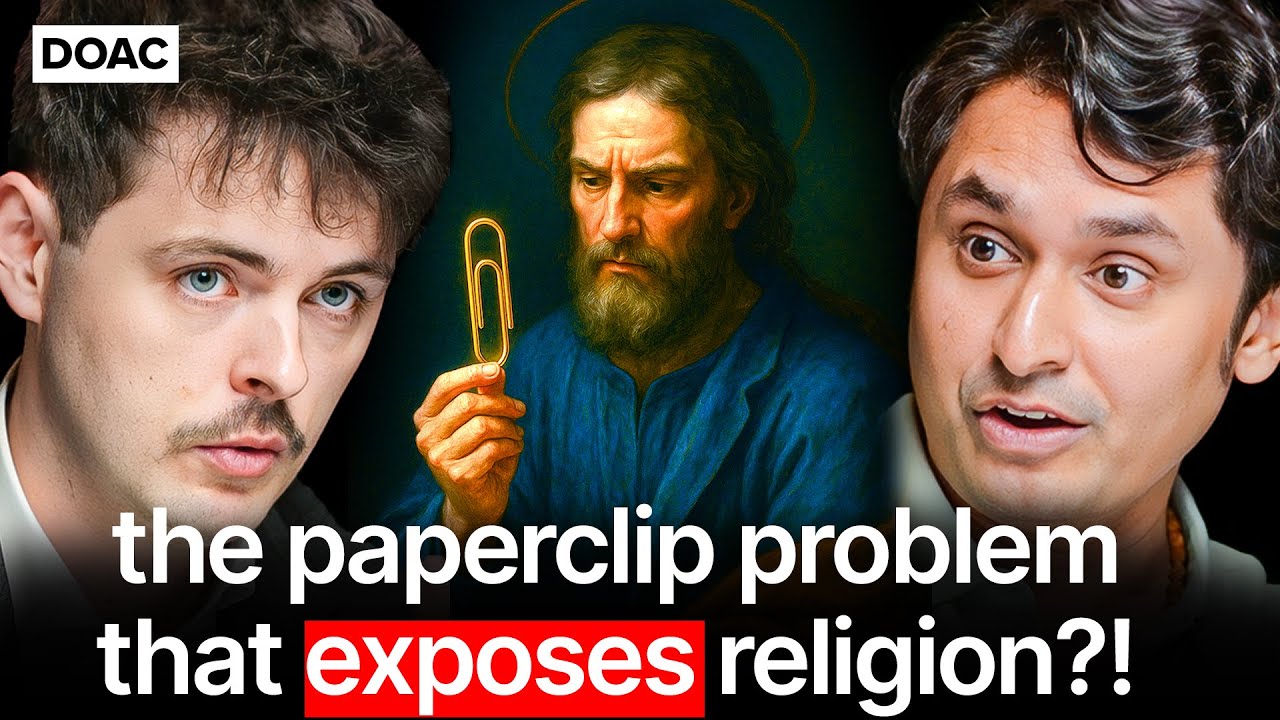
Kanojia, Koukl, O'Connor Clash on Faith and Existential Meaning Crisis
The Diary Of A CEO
The human search for meaning requires structured struggle and psychological alignment, whether driven by transcendent divine purpose or naturalistic biological frameworks.
## Background
This episode of The Diary Of A CEO, hosted by Steven Bartlett and published on YouTube on September 29, 2025, brings together Christian apologist Greg Koukl, atheist philosopher Alex O’Connor, and psychiatrist Dr. Alok Kanojia (Dr. K). The panel explores why so many modern individuals feel lost, examining whether belief in God provides the ultimate answer, how death anxiety shapes human meaning, and how faith, reason, and mental health practices address today's existential void.
## TL;DR
The dialogue tackles the modern crisis of purpose through three distinct lenses: Christian theism, philosophical agnosticism, and psychiatric science blended with Eastern traditions. Greg Koukl presents purpose as a transcendent reality rooted in a loving Creator, while Alex O'Connor scrutinizes religious frameworks and highlights how humans construct meaning to cope with mortality. Dr. K grounds the conversation in clinical realities, showing how digital distractions and emotional numbing hinder purpose, and offers actionable practices to restore internal clarity. Together, the panel debates morality, suffering, and consciousness, concluding with both practical and existential guidance for those feeling lost.
## Atmosphere & style
The conversation is intellectually rigorous, deeply respectful, and intensely introspective, balancing warm collegiality with sharp debate. As the host, Steven Bartlett fosters an open environment where high-level philosophical arguments seamlessly blend with vulnerable personal admissions and clinical insights. The dialogue moves fluidly from nuanced debates on consciousness and theology to quiet moments of shared human understanding, making the viewer feel like an engaged observer in a profound, unhurried exploration of life's weightiest questions.
## Key takeaways
- [00:00](https://www.youtube.com/watch?v=Esu8BXLBmZ4&t=0s) Youth Crisis of Purpose: A significant portion of young people in the UK and US report feeling a lack of life purpose, which directly correlates with higher rates of mental health challenges.
- [00:00](https://www.youtube.com/watch?v=Esu8BXLBmZ4&t=0s) Surge in Young Adult Religious Attendance: Between 2021 and 2025, belief in God and monthly church attendance among UK 18-to-24-year-olds increased dramatically.
- [03:07](https://www.youtube.com/watch?v=Esu8BXLBmZ4&t=187s) Pornography Addiction Risk Factor: Clinical observations and research highlight that lacking a sense of meaning in life is a primary risk factor for pornography addiction.
- [12:27](https://www.youtube.com/watch?v=Esu8BXLBmZ4&t=747s) The Paperclip Problem and Transcendent Purpose: Having a assigned purpose by a creator does not automatically make that purpose fulfilling or meaningful to the individual.
- [08:55](https://www.youtube.com/watch?v=Esu8BXLBmZ4&t=535s) Death Anxiety and Immortality Projects: Awareness of mortality drives human beings to engage in projects aimed at creating lasting significance beyond death.
- [16:39](https://www.youtube.com/watch?v=Esu8BXLBmZ4&t=999s) Samuel Scheffler's Thought Experiment: The motivation for long-term abstract goals diminishes significantly when individuals consider the total extinction of humanity shortly after their death.
- [32:00](https://www.youtube.com/watch?v=Esu8BXLBmZ4&t=1920s) Passive vs. Active Challenges: Feeling overwhelmed comes from passive external demands, whereas voluntarily taking on active challenges restores agency and builds purpose.
- [49:46](https://www.youtube.com/watch?v=Esu8BXLBmZ4&t=2986s) Consciousness vs. Materialism: Physicalist frameworks face significant theoretical challenges in accounting for subjective consciousness and intentionality.
- [57:08](https://www.youtube.com/watch?v=Esu8BXLBmZ4&t=3428s) Impact of Alexithymia and Digital Distraction: The inability to identify emotions, often heightened by continuous phone and screen usage, suppresses internal signals of purpose.
- [01:06:50](https://www.youtube.com/watch?v=Esu8BXLBmZ4&t=4010s) Ego Death in Therapeutic Psychedelics: In psychedelic-assisted therapy, therapeutic healing for severe trauma is strongly driven by experiencing ego death rather than the substance alone.
- [01:17:23](https://www.youtube.com/watch?v=Esu8BXLBmZ4&t=4643s) Self-Determination Theory Principles: Sustained purpose relies on three psychological pillars: autonomy (self-direction), stretching competence, and relatedness.
- [01:00:18](https://www.youtube.com/watch?v=Esu8BXLBmZ4&t=3618s) Subjective Benefit vs. Objective Truth: Experiencing life transformation from a belief system demonstrates its personal utility but does not serve as logical proof of its historical claims.
- [01:40:15](https://www.youtube.com/watch?v=Esu8BXLBmZ4&t=6015s) Dharma and Karma as Anchors: The Eastern concepts of dharma (duty) and karma (cause and effect) provide structural guidance for navigating duty versus short-term desire.
- [02:02:11](https://www.youtube.com/watch?v=Esu8BXLBmZ4&t=7331s) The Problem of Pre-Human Suffering: Hundreds of millions of years of animal suffering prior to human existence present a challenge to standard accounts of the Fall.
- [05:04:42](https://www.youtube.com/watch?v=Esu8BXLBmZ4&t=18282s) Five-Step Practical Framework for the Lost: Overcoming life disorientation involves tackling alexithymia, dismantling rigid ego identities, building a narrative identity, acting in the present, and engaging in communal practice.
## Detailed walkthrough
### [00:00](https://www.youtube.com/watch?v=Esu8BXLBmZ4&t=0s) Introduction and The Modern Crisis of Meaning
Host Steven Bartlett opens the discussion by highlighting a growing cultural crisis: stats indicate that nine in ten young people in the UK feel their lives lack purpose, while three in five young Americans report the exact same feeling. Paradoxically, alongside this crisis, there is a striking resurgence of religiosity and spiritual seeking among youth. According to YouGov data, belief in God among UK 18-to-24-year-olds surged from 18% in 2021 to 37% in 2025, while monthly UK church attendance jumped from 4% to 15% over the same timeframe.
The panel sets the stage for a heated debate over how humanity can fill this existential void. Christian apologist Greg Koukl argues that God created humanity with an intrinsic purpose that flows from divine intent, whereas philosopher and atheist Alex O’Connor rejects this view as an unsatisfactory solution that fails to explain *why* religion provides meaning. Harvard-trained psychiatrist Dr. Alok Kanojia (Dr. K) frames finding purpose as a deeply practical, clinical endeavor rather than a purely theoretical or theological debate.
- **3 in 5** young Americans feel their life lacks purpose.
- **9 in 10** young people in the UK report a lack of life purpose.
- **59%** of Brits say they live a meaningful life, compared to **25%** who explicitly state they do not.
- **34%** of UK men surveyed in October 2021 felt life had no meaning, compared to **18%** of women.
- **50%** of respondents link their poor mental health directly to not knowing what to do with their lives.
- Belief in God among UK 18–24-year-olds rose from **18% (2021)** to **37% (2025)**, with church attendance rising from **4%** to **15%**.
---
[03:07](https://www.youtube.com/watch?v=Esu8BXLBmZ4&t=187s) Dr. Alok Kanojia: A Clinical and Practical Approach to Purpose
Dr. K introduces his perspective as a practicing psychiatrist treating patients who present with severe depression, suicidal ideation, and a total lack of meaning. For him, helping a patient find purpose is an urgent, pragmatic medical duty with a tight timeline of 15 to 20 weeks. While science provides evidence-based frameworks to understand purpose, Dr. K notes its limitations: science can identify factors linked to a lack of meaning, but it often fails to generate the transformative subjective experiences necessary for healing.
To bridge this gap, Dr. K incorporates structured spiritual practices into his methodology. To demonstrate its efficacy, he shares how a pilot study of 1,453 participants in his coaching program yielded a **68% increase in participants' sense of purpose** after 20 weeks. Using factor analysis, he explains that concepts like having direction, feeling in control, and experiencing meaning all cluster together to form an internal sense of purpose.
> "If someone asks me, 'What is the meaning of life?' I don't know. But if someone says, 'I have no meaning, can you help me with that?' the answer is absolutely yes."
- **10,000 people** reached out to Dr. K in a single month after he began streaming, seeking private psychiatric care.
- A pilot study of **1,453 participants** over **20 weeks** resulted in a **68% increase** in their measurable sense of purpose.
- Science identifies that the single highest risk factor for pornography addiction is having no meaning in life.
- Trauma can instantly shatter purpose; Dr. K references a patient who lost their entire psychological compass and life momentum after a traumatic 5-minute attack in a bathroom.
---
[07:11](https://www.youtube.com/watch?v=Esu8BXLBmZ4&t=431s) Greg Koukl: The Theistic Explanation of Reality
Greg Koukl introduces his worldview as a Christian apologist, framing theism as the single best explanation for reality as it actually is. He defines his position as a belief in a personal God who created the world for a specific purpose and remains actively involved in human affairs—culminating in the person of Jesus of Nazareth as a divine rescue plan.
Greg explains that even individuals who do not believe in God can still experience a degree of satisfaction and human flourishing if their lives align with the objective structure and moral design of the universe. However, he asserts that secular attempts at purpose will always fall short of true fulfillment because they miss the ultimate purpose for which humans were created: direct friendship and reconciliation with God.
- **Theism vs. Deism:** Greg clarifies that unlike deism, which views God as a clockmaker who wound up the universe and walked away, Christian theism holds that God is actively involved in sustaining and rescuing creation.
- **Objective vs. Subjective Flourishing:** Non-believers can align with objective aspects of God's design (e.g., loving others, pursuing moral good) and experience partial satisfaction, but remain cut off from ultimate purpose.
---
[08:55](https://www.youtube.com/watch?v=Esu8BXLBmZ4&t=535s) Alex O’Connor: The Flaws of New Atheism and Death Denial
Alex O’Connor outlines his journey as an atheist who was initially swept up in the mid-2000s "New Atheism" movement led by figures like Richard Dawkins and Christopher Hitchens. Alex critiques New Atheism for being philosophically shallow; it promised a secular humanist utopia if people simply shed religious dogma, yet failed to account for why religious belief exists in the first place. He argues that religion evolved to address the unique existential dilemma of human consciousness—our ability not just to experience the world, but to be hyper-aware of our own mortality.
Citing philosopher Josh Rasmussen's distinction between "noticing a tree and noticing that you've noticed a tree," Alex explains that human self-awareness makes death feel like an absolute mockery of all human effort. To cope with this existential dread, humans engage in "immortality projects"—building families, pursuing justice as a barrister, or creating art that will outlast their physical bodies. In Alex's view, religion is simply the ultimate immortality project, and the modern "meaning crisis" is not merely a modern phenomenon caused by the Enlightenment, but an inherent feature of the human condition itself.
> "Josh Rasmussen once said, 'There's a difference between noticing a tree and noticing that you've noticed a tree.' We have this sort of second-order abstraction... and death makes a mockery of everything that we do."
- **New Atheism:** A mid-2000s publishing and cultural movement that attacked religion as inherently evil while promising a self-sustained secular humanist utopia.
- **Immortality Projects:** Constructive activities (having children, career achievements, religious faith) designed to create a legacy that outlasts physical death and mitigates death anxiety.
---
[12:27](https://www.youtube.com/watch?v=Esu8BXLBmZ4&t=747s) The "Paperclip Problem" and Created Purpose
Responding to Alex, Greg argues that naturalism—the belief that physical nature governed by physical laws is all that exists—cannot adequately account for consciousness or the intense human hunger for objective meaning. In a naturalistic universe where everything is just "molecules in motion," meaning is purely subjective and self-invented.
Alex counters with a thought experiment aimed at challenging the religious claim that purpose granted by a creator solves the issue. He asks the panel to imagine a future where an artificial intelligence robot is created with an interior conscious life, but its programmed purpose given by its creator is solely to produce paperclips. Alex argues that having a purpose assigned by an authoritative creator is not enough; a life dedicated purely to making paperclips feels fundamentally insufficient. Therefore, if God assigns humans a purpose, we face a dilemma: either that purpose is arbitrary, or God is bound by an external standard of value that exists independently of Him.
[15:19](https://www.youtube.com/watch?v=Esu8BXLBmZ4&t=919s) The Paperclip Problem and Transcendent Friendship
Greg Koukl responds directly to Alex O’Connor's paperclip analogy, pointing out why it fails to reflect the human condition. A conscious creature forced to spend its entire life manufacturing paperclips experiences that assignment as deeply dehumanizing because it clashes with human potential. However, if a divine Creator crafts human beings with a specific intent in mind—specifically, to enter into a loving friendship with Him—that purpose is neither arbitrary nor degrading. It flows directly from God's inherently loving character and His desire for meaningful communion with His creation.
Alex remains skeptical about the mechanism of divine design, questioning why being created for a pre-assigned purpose would automatically deliver the deep fulfillment people crave. Greg maintains that being created for love and friendship with God provides an entirely coherent, non-arbitrary foundation for human purpose that satisfies our deepest longings.
- Greg argues that paperclip manufacturing feels dehumanizing because human potential far exceeds such a mundane task.
- Divine purpose, according to Greg, is grounded in God's loving character and a desire for communion rather than arbitrary assignment.
- Alex continues to question whether being created *for* something inherently makes that thing fulfilling to the individual.
---
[16:39](https://www.youtube.com/watch?v=Esu8BXLBmZ4&t=999s) Why Are We Having This Conversation?
Dr. Alok Kanojia (Dr. K) shifts the dialogue by asking the panel directly about the overarching point of their conversation. Show host Steven Bartlett steps in to frame the debate around two pressing modern issues: the sharp cultural fluctuation in how people view purpose—evidenced by a growing mental health crisis alongside a surprising resurgence of interest in religion—and the fundamental question of whether objective truth actually exists.
Alex notes that the four of them are artificially brought together by the podcast's setup to explore meaning, but he warns against delusional expectations. In his view, a brief panel discussion cannot definitively solve the global "meaning crisis" or produce a neat, five-step guide to fulfillment. Greg agrees that an individual's personal journey toward understanding takes time, but he strongly rejects the notion that absolute answers are impossible to reach. He cautions against romanticizing the search for its own sake, arguing that if ultimate answers cannot be found, the entire endeavor collapses into a "nihilistic enterprise."
> "If anybody thinks that the four of us sat at this table are going to solve the meaning crisis and give people a five-step guide finding meaning in their life and that will be the sort of case closed, then they're delusional." — Alex O'Connor
> "What I would hate to do is leave people with a feeling like we can all search and the glory is in the search, but if you think you found the answer, then you haven't. Of course, this to me is a nihilistic enterprise then." — Greg Koukl
- Steven highlights the modern mental health crisis and fluctuating numbers around spiritual purpose as primary motivators for the discussion.
- Alex invokes the Zen Buddhist koan attributed to Linji—"If you meet the Buddha, kill him"—to illustrate that spiritual enlightenment cannot be handed down by a guru but must be personally experienced.
- Greg maintains that while the search is personal and gradual, objective answers exist and are fully discoverable.
---
[20:29](https://www.youtube.com/watch?v=Esu8BXLBmZ4&t=1229s) Death Anxiety and the Meteor Thought Experiment
Dr. K asks the panel to explore the link between human purpose and our awareness of mortality. Alex introduces philosopher Samuel Scheffler's thought experiment to illustrate Ernest Becker's "denial of death" theory. He asks Greg to imagine writing a book as an atheist, only to learn that an undetected meteor will obliterate all life on Earth thirty days after his death.
While everyday sensory drives like eating, sleeping, or sex would continue uninterrupted, most people admit they would immediately lose the motivation to write books, build legacies, or have children. Alex suggests this reveals that much of what gives our daily pursuits a sense of high purpose relies on the implicit belief that our efforts will survive beyond our physical deaths.
> "Suppose it were the case that you discovered that after you die, a meteor is going to come and wipe out all life on Earth... Would that motivate you to write your book more or less? Most people say that it would seem a bit pointless now." — Alex O'Connor
- Samuel Scheffler's meteor thought experiment tests whether long-term human motivation relies on a surviving world.
- Ernest Becker's *The Denial of Death* posits that human culture and abstract achievements are largely driven by death anxiety.
- Alex notes that abstract, meaning-laden activities suffer when continuity beyond death is removed, whereas basic physical drives remain intact.
---
[22:06](https://www.youtube.com/watch?v=Esu8BXLBmZ4&t=1326s) Quantifying Purpose and the Self-Assessment Scale
Dr. K responds to Alex's thought experiment by drawing a distinction between two types of people: the person who gives up writing the book because the world ends in thirty days, and the person who chooses to write it anyway. He points out that the person who writes regardless possesses a vastly superior sense of internal purpose. From a clinical perspective, Dr. K explains that purpose is not a binary, all-or-nothing concept; rather, it is a measurable, quantifiable continuum.
To demonstrate, Dr. K asks the panel members to score their own current sense of personal purpose on a scale from 1 to 10:
- **Greg Koukl:** Expresses extremely high confidence (near 10/10) that he is following God's intended course for his life, while acknowledging that everyday life still brings plenty of chaotic and frustrating circumstances.
- **Steven Bartlett:** Rates his current sense of clear personal purpose at a modest **5 out of 10**.
- **Alex O'Connor:** Rejects the grammar of the question, comparing it to the logical fallacy "Is the King of France bald?" He notes that while he experiences strong immediate motivations, he finds the concept of a grand, ultimate purpose foggy on a psychological level.
- **Dr. K:** Estimates his own sense of personal purpose as being much closer to a 10 than a 5, driven by his clinical work and educational mission.
Dr. K emphasizes that his primary objective for the conversation is practical rather than purely theoretical: he aims to give viewers actionable insights to boost their personal sense of purpose by at least 20%.
<FollowUp label="Want to explore how Dr. K proposes boosting a person's sense of purpose by 20%?" query="How does Dr. K propose boosting a person's sense of purpose on a practical level?"/>
[29:37](https://www.youtube.com/watch?v=Esu8BXLBmZ4&t=1777s) Grounding Meaning: Subjective Experience vs. Objective Truth
Alex O'Connor highlights a critical distinction between subjective purpose and objective meaning. While Dr. K examines purpose through an empirical lens—whether people report *feeling* a sense of meaning—Greg Koukl approaches it from a metaphysical position: whether there is a real, grounded truth to that purpose, regardless of a person's feelings. Alex points out that someone could report a "10 out of 10" sense of purpose, yet a Christian apologist might view that feeling as misguided if it relies on an untrue foundation.
Dr. K counters that focusing strictly on whether purpose is objectively verifiable can lock someone into a frame where answers seem impossible. He emphasizes that internal, subjective perception is a measurable psychological state rooted in neurobiology. Trauma, for instance, can physically alter the brain regions responsible for detecting purpose. For Dr. K, working with this internal sense of direction is what practically reduces suicidality and builds resilience in clinical settings.
[32:00](https://www.youtube.com/watch?v=Esu8BXLBmZ4&t=1920s) Passive vs. Active Challenges: Restoring the Sense of Control
Dr. K explains that a person's internal sense of purpose directly correlates with their perceived sense of control over their life. When individuals feel overwhelmed, it is often because they are overwhelmed by **passive challenges**—burdens imposed on them by external forces without their consent, such as unexpected work demands, rent payments, or online dating rejections. Running away from these passive burdens usually deepens feelings of helplessness.
```
[ Passive Challenges ] [ Active Challenges ]
(Imposed: rent, work demands) (Chosen: studying, training)
\ /
\ /
===> Ratio Balance <===
|
v
Restored Sense of Control
|
v
Increased Sense of Purpose
```
Counterintuitively, the clinical solution to feeling overwhelmed is not taking on less, but voluntarily taking on **active challenges**—difficult goals that a person intentionally chooses, such as studying philosophy or mastering a new skill. Research shows that anxiety and helplessness depend on the ratio of passive to active challenges. Equalizing this ratio restores an internal sense of control, which in turn expands a person's capacity to handle external life stress.
[35:03](https://www.youtube.com/watch?v=Esu8BXLBmZ4&t=2103s) Motivation vs. Justification in Seeking Truth
Greg Koukl cautions against confusing the psychological *motivation* for a belief with its logical *justification*. He responds to a common atheist argument—that Christians are only Christian because of where they were born—by pointing out that geographic background speaks to psychology, not truth. An atheist born in Saudi Arabia would likely be a Muslim, but that sociological reality says nothing about whether Islam or Christianity is objectively true.
Similarly, even if the fear of death motivates someone to search for purpose or comfort in God, that emotional catalyst does not mean the belief itself is false. If God and an afterlife genuinely exist, facing mortality can naturally point someone toward a true reality.
- **Motivation:** The psychological or emotional catalyst that leads someone to seek an answer (e.g., fear of death, cultural upbringing).
- **Justification:** The objective evidence or logical grounding that makes a belief true or false, independent of how one arrived at it.
[36:15](https://www.youtube.com/watch?v=Esu8BXLBmZ4&t=2175s) The Modern Paradox of Freedom, Solitude, and Unfulfillment
Steven Bartlett shares real-world accounts of friends who achieved modern ideals of independence, yet found themselves deeply unfulfilled:
> "I've got one particular friend who's 35... living in Dubai, living in a glass box... He wakes up in the morning, his bed is there, he then works there, then goes back to bed. He's single, no kids. In his life at the moment, he said to me that he can't get out of bed anymore."
This same friend later flew to America, was baptized as a Christian, and found his sense of purpose completely restored. Another friend, seeking meaning in isolation, focused on caring for 200 house plants before entering therapy feeling lost. Steven reflects on his own journey—from a dogmatic teenage atheist who debated strangers in the street to someone reassessing whether the modern push for absolute independence and self-determination was an empty promise.
[38:09](https://www.youtube.com/watch?v=Esu8BXLBmZ4&t=2289s) Tasks, Gambling, and Pascal’s View of Boredom
Alex O'Connor brings up Blaise Pascal’s analysis of human boredom from the *Pensées*. Pascal observed that people find meaning in tasks that remain uncompleted. He illustrated this through the thought experiment of a gambler:
1. **Give the gambler the money outright:** He will not feel fulfilled, because receiving the reward without playing the game eliminates the pursuit.
2. **Let him play with zero chance of winning:** He will also find it pointless, because there is no goal to achieve.
Pascal concluded that human beings need an unfulfilled task—one they believe will bring fulfillment upon completion, even if outcome remains uncertain. Alex notes that religion excels at providing this structure: it presents an ultimate goal that cannot be fully possessed in the present moment, giving life a constant vector of striving.
[39:35](https://www.youtube.com/watch?v=Esu8BXLBmZ4&t=2375s) The Neuroscience of Motivation and the Zen Alternative
Dr. K maps Pascal’s gambling thought experiment onto modern brain science. Different neural circuits drive different motivations:
* **Frontal Lobe Drive:** A professional poker player using strategy to meet a clear financial objective utilizes executive planning pathways.
* **Nucleus Accumbens / Amygdala Drive:** A recreational gambler seeking continuous dopamine hits or attempting to dull negative emotions operates on random reinforcement schedules.
Dr. K introduces a counterpoint from Zen traditions, where practices are undertaken with no goal, payload, or higher purpose attached. Approaching action without demanding a future reward offers an alternative way to break free from continuous goal-seeking.
[41:36](https://www.youtube.com/watch?v=Esu8BXLBmZ4&t=2496s) Evolutionary Memetics and the "Money Without the Game" Problem
Alex O'Connor explores how human psychology evolved to require purpose. In early human history, survival was a daily struggle—individuals woke up not knowing if they would secure food or shelter. Their purpose was clear, leaving little room for existential angst. Under natural selection, groups that developed an innate drive to build structures, enforce moral systems, and raise children survived, while pure nihilists died out.
```
Historical State (Daily Struggle) Modern State ("Money Without the Game")
[ Unfulfilled Survival Tasks ] ---> [ Abundant Food, Shelter, & Safety ]
| |
v v
Clear Immediacy & Purpose Existential Void & Meaning Crisis
```
Today, modern society has effectively "given us the money without the game." With immediate physical needs effortlessly met through infrastructure and technology, humans are left with an evolutionary drive for purpose but no immediate life-or-death challenges to satisfy it, triggering a widespread modern meaning crisis.
[44:10](https://www.youtube.com/watch?v=Esu8BXLBmZ4&t=2650s) The Game Without the Money and Death-Denying Pursuits
Alex O'Connor expands on why modern self-improvement trends—such as taking ice baths, working out, or pushing through extreme physical exertion—have become so popular. He argues that in the past, hard physical effort was tied directly to a tangible goal or reward ("the game with the money"). Today, society offers material comfort without the struggle, leading people to seek out physical hardship purely for its own sake ("the game without the money"). This psychological drive runs far deeper than a simple release of endorphins; people actively crave structured struggle because true fulfillment comes from playing a game in service of an objective.
```
┌────────────────────────────────────────┐
│ THE GAME / STRUGGLE (Hardship) │
└───────────────────┬────────────────────┘
│
┌──────────────────────────┴──────────────────────────┐
▼ ▼
┌──────────────────────┐ ┌──────────────────────┐
│ TRADITIONAL LIFE │ │ MODERN SOCIETY │
│ Game → Goal/Money │ │ Money WITHOUT Game │
└──────────────────────┘ └──────────┬───────────┘
│
▼
┌──────────────────────┐
│ SEEKING THE GAME │
│ Ice baths, gym, etc. │
└──────────────────────┘
```
Shifting to grand projects like religion and culture, Alex explains that these serve as "death-denying pursuits." When a community or tradition encounters another group whose beliefs contradict its own, that alternative worldview feels like an existential threat. Subconsciously, encountering contradictory beliefs represents nihilism and death because it challenges the absolute truth of one's own system.
* In modern society, telecommunication subjects people to a constant stream of opposing views every few seconds on their phones.
* Alex argues that this non-consensual confrontation with global diversity—reminding people that their truth is not unique—is a primary cause of the current meaning crisis, rather than a simple collapse in religious belief.
[46:38](https://www.youtube.com/watch?v=Esu8BXLBmZ4&t=2798s) Subjective Angst vs. Objective Truth
Greg Koukl responds by distinguishing between psychological reactions and objective truth. While he acknowledges that people are constantly exposed to competing spiritual options, he stresses that the existence of many choices does not mean none of them are true. He draws a parallel to science, where numerous competing theories exist to explain a phenomenon, yet no one concludes that an accurate answer is impossible.
Alex clarifies that his explanation of telecommunications and cultural exposure is strictly a psychological account of why people *feel* adrift, completely separate from whether any specific religious belief is true or false. Greg agrees with this distinction, pointing out that two fundamentally different pictures of reality are being presented.
* **Two Questions for Reflection:**
1. Is the need for meaning merely a psychological itch that individuals satisfy in custom ways, or is it a sign of a discoverable truth about life?
2. Is there reason to believe in a transcendent reality—that God exists, souls exist, and objective morality guides us toward a virtuous life?
[49:46](https://www.youtube.com/watch?v=Esu8BXLBmZ4&t=2986s) The Problem of Consciousness and Materialism
Greg contends that a naturalistic, materialistic worldview fails to account for human experience, particularly consciousness. He argues that it makes no sense to claim that physical molecules moving in space can create a conscious mind capable of propositional thought, purpose, and logic.
To support his point, Greg cites prominent atheist thinkers who have recognized the limitations of strict Darwinism:
> "Consciousness is an illusion." — *Daniel Dennett*
* Daniel Dennett was forced to declare consciousness an illusion because a purely physical framework could not account for it.
* Thomas Nagel, an atheist philosopher, authored *Mind and Cosmos* to demonstrate why the neo-Darwinian materialist view of the world is almost certainly false due to its inability to explain consciousness.
Greg asserts that the Christian narrative—that a transcendent God created humans for Himself and placed "eternity in our hearts"—is internally coherent and far more plausible than a purely materialist model.
[50:39](https://www.youtube.com/watch?v=Esu8BXLBmZ4&t=3039s) Disentangling Psychological Utility from Worldview Truth
Alex reiterates that psychological feelings—whether depression or deep fulfillment—have no bearing on whether a worldview is factually true. A person could hold a completely false belief and feel deeply comforted by it, or discover a depressing truth that causes despair. In both cases, the psychological state does not validate or invalidate the underlying claim.
```
┌──────────────────────────────────────────────────────┐
│ SUBJECTIVE EXPERIENCE │
│ (Feelings of Purpose, Comfort, or Despair) │
└──────────────────────────┬───────────────────────────┘
│
DOES NOT IMPLY │ HAS NO BEARING ON
▼
┌──────────────────────────────────────────────────────┐
│ OBJECTIVE TRUTH │
│ (Truth or Falsity of Proposition P) │
└──────────────────────────────────────────────────────┘
```
Greg asks if a total nihilist who becomes depressed and suicidal demonstrates a direct link between worldview and emotion. Alex confirms there is a link, but maintains that this link says nothing about whether nihilism is true. Nihilism could be true and depressing, or false and depressing.
Dr. Alok Kanojia (Dr. K) steps in to bridge the discussion, noting that while philosophers test proposition $P$ for its truth value, a psychiatrist focuses on the subjective experience of the person scrolling on their phone who wakes up feeling utterly lost and purposeless.
[57:08](https://www.youtube.com/watch?v=Esu8BXLBmZ4&t=3428s) The Neurological Dimension of Purpose and Alexithymia
Dr. K explains that beyond philosophical arguments, there are well-documented neurological mechanisms driving the modern meaning crisis. Working with traumatized patients, he observed how external influences alter the brain's internal processing, directly impacting how individuals experience the world.
He highlights **alexithymia**—the clinical inability to identify, name, or understand one's own emotions—as a major obstacle to finding purpose. When people are disconnected from their internal emotional signals due to constant digital stimulation or trauma, they lose the internal compass required to navigate life and feel a sense of direction.
* Alexithymia prevents individuals from recognizing what truly matters to them on an experiential level.
* Reducing alexithymia and restoring emotional awareness is a critical neurological step toward overcoming feelings of lostness.
<ElicitationsGroup message="Explore related topics from this discussion:">
<Elicitation label="Summarize Greg Koukl's arguments for God's existence" query="Summarize Greg Koukl's main arguments for God's existence and transcendent purpose based on this debate."/>
<Elicitation label="Explain Alex O'Connor's view on the death-denying framework" query="Explain Alex O'Connor's view on terror management theory and how religion acts as a death-denying pursuit."/>
<Elicitation label="Detail Dr. K's psychological approach to alexithymia and purpose" query="Detail Dr. K's psychological approach to treating alexithymia and helping people find purpose."/>
</ElicitationsGroup>
[58:20](https://www.youtube.com/watch?v=Esu8BXLBmZ4&t=3500s) How Technology and Trauma Dull Our Internal Compass
Dr. K explains how modern technology, particularly cell phones, actively suppresses parts of the brain responsible for experiencing and processing negative emotions. By numbing this internal emotional sense, people lose the ability to detect what they are feeling on the inside, which directly correlates with a loss of their internal sense of purpose. When working with patients struggling with trauma and a lack of meaning, Dr. K focuses on a clear neurobiological sequence: reducing alexithymia (the inability to identify and express emotions) and managing the hyperactive ego.
When people engage in a relationship with something transcendent—whether God or a higher concept—it produces measurable, physiological changes in the default mode network (DMN). A hyperactive DMN is strongly associated with rumination, pessimism, and a nihilistic worldview. Quieting this network allows individuals to regain an authentic sense of connection and purpose. Furthermore, modern clinical research into psychedelics offers a unique tool to scientifically test subjective experience and observe its profound impact on psychological healing.
---
[01:00:18](https://www.youtube.com/watch?v=Esu8BXLBmZ4&t=3618s) Subjective Experience vs. Objective Truth: The Dubai Conversion Debate
Greg Koukl pauses the discussion to address what he considers a potential overstatement regarding subjective experience and the genetic fallacy. Using a medical analogy, Greg argues that if a patient takes a pill prescribed by a doctor and gets better, it is completely reasonable to conclude that the pill and the doctor had something to do with the recovery. Similarly, when Steven’s friend in Dubai underwent a radical, life-changing conversion to Christianity, that tangible transformation acts as real evidence lending credibility to the truthfulness and legitimacy of the belief system itself.
Alex O'Connor and Steven Bartlett push back strongly against this reasoning. Alex contends that a profound life change is only evidence that *believing* in something makes a person feel better or more fulfilled, but it has zero bearing on objective truth—such as whether Jesus physically rose from the dead. Steven poses a counter-scenario: if five different friends join five different religions and all experience the exact same life-altering emotional benefit, does that make all five religions simultaneously true?
Greg responds that transformed lives universally lend credibility to a belief system because something substantive is occurring beyond mere psychological placebo. If it were just an emotional lie, it would reduce faith to Karl Marx’s "opiate of the people." Alex counters with a vivid hypothetical: if you lie to a suicidal, financially ruined person and tell them they won't have to worry because they won a million pounds in the lottery, their overwhelming relief and newfound sense of meaning don't make the lottery win true. Greg clarifies that Christianity is not just an emotional high—even persecuted Christians facing torture (as documented in *Foxe's Book of Martyrs*) maintain a profound sense of purpose—meaning the objective truth of the worldview and its subjective results remain deeply linked.
* "That like Jesus rose from the dead. It's got no bearing on whether that's true or not."
* "This lends credibility to the belief system that he's now adopted because it created this particular significant change in his life."
* "The fact that they feel this immense sense of meaning from a belief that they've adopted bears absolutely no evidence that it's true."
* "Christianity hinges on the historical fact of the resurrection... if this feeling that your friend had has no evidential bearing on the resurrection of Jesus, then the feeling that your friend had has no evidential bearing on Christianity."
---
[01:06:50](https://www.youtube.com/watch?v=Esu8BXLBmZ4&t=4010s) Prescribing Meaning: Philosophy, Psychedelics, and the Brain as a Filter
Steven asks Alex directly what he would recommend to a friend who is so paralyzed by a lack of meaning that they cannot get out of bed. Alex explains that if going to church or reading the Gospels would plausibly work for that person, he would gladly recommend it, as subjective meaning usually arises from connecting to something larger than oneself. For non-religious individuals, Alex suggests studying philosophy of mind or even taking a psychedelic to experience "ego death"—the realization that the individual self is an illusion.
This leads Alex to discuss the hard problem of consciousness. He highlights growing scientific and philosophical arguments suggesting the brain does not *produce* consciousness out of biological matter; rather, consciousness is received by the organism, with the brain acting as an inhibitory filter that narrows and organizes it.
Dr. K enthusiastically agrees with Alex's breakdown, noting that every prescription Alex mentioned maps onto known neurobiological mechanisms. Visiting a grand cathedral inspires awe regardless of one's religious beliefs because religion creates structured practices—praying, reading scriptures, attending services—designed to evoke a transformative subjective experience. Dr. K commends Alex for his deep, earnest search for truth, noting his visible striving to understand what religious believers experience. In psychedelic therapy for PTSD or treatment-refractory depression, visual hallucinations do not cure patients; clinical improvement is specifically driven by whether the patient experiences a true ego death.
* "I might recommend depending on who they are that they take a psychedelic drug and try to experience something which cannot be put into words..."
* "Some of our best scientific evidence is suggesting the fact not that the brain produces consciousness, but that the brain inhibits and focuses and organizes consciousness."
* "Religion is a series of structures to evoke a personal experience."
* "The psychedelic is not healing. What is healing is specifically whether they have an ego death experience."
---
<ElicitationsGroup message="Explore related topics from this discussion:">
<Elicitation label="Examine the debate on consciousness as a filter vs product of the brain" query="Break down the arguments presented in the debate regarding whether the brain produces consciousness or acts as a filter receiving it."/>
<Elicitation label="Analyze the genetic fallacy and subjective evidence in religious belief" query="Explain the genetic fallacy and how Greg Koukl and Alex O'Connor debate subjective life transformation as evidence for religious truth."/>
</ElicitationsGroup>
[01:12:04](https://www.youtube.com/watch?v=Esu8BXLBmZ4&t=4324s) Psychological Prerequisites for Purpose and the Myth of Sisyphus
Dr. K maps out a sequential psychological framework for recovering a lost sense of purpose, starting at the physiological and cognitive baseline. The primary hurdle to experiencing subjective meaning is alexithymia—the inability to identify and articulate one's internal emotional states. When people are numb or constantly using substances to suppress their feelings, they lack the foundational prerequisite for experiencing meaning. Moving beyond alexithymia requires confronting the ego and calming a hyperactive default mode network (DMN), the neural circuit responsible for self-referential thought. A hyperactive DMN often triggers deep depression and existential dread, prompting people to seek refuge in philosophical reading. However, Dr. K warns that reading philosophy often degenerates into intellectualization—a psychological defense mechanism where people endlessly consume podcasts, books, and theoretical ideas without making any tangible, adaptive changes to their everyday lives.
```
+-----------------------------------+
| 1. Address Alexithymia |
| (Build internal emotion sensing) |
+-----------------+-----------------+
|
v
+-----------------------------------+
| 2. Downregulate DMN / Ego |
| (Reduce existential ruminations) |
+-----------------+-----------------+
|
v
+-----------------------------------+
| 3. Grounding in Present Action |
| (Act for the sake of the work) |
+-----------------------------------+
```
True purpose operates on an ego-less plain, anchored entirely in present action. Reconnecting with former patients three to five years after their clinical treatment, Dr. K found that none described purpose as something tied to an afterlife or a grand legacy. Instead, they described it simply as being in "the flow" of life and experiencing what it has to offer day to day. While humans naturally cope with the fear of death by trying to project their identity past it, Dr. K views that survival instinct as ego-driven. Deep, unshakeable purpose is found in doing the immediate work—even something as humble as manufacturing paper clips—and finding quiet contentment in the task itself.
Alex O'Connor recognizes this line of reasoning as Albert Camus's absurdist resolution in *The Myth of Sisyphus*. Condemned by the gods to push a heavy boulder up a mountain for eternity only to watch it roll back down, Sisyphus faces a punishment whose true torture lies in knowing his toil is utterly meaningless. Camus asserts that the absurdist condition arises from the fundamental conflict between humanity's desperate demand for inherent meaning and the cold, unyielding silence of the universe. Camus concludes his treatise with the iconic directive: "One must imagine Sisyphus happy." Alex points out that choosing to write a book when the world ends in 30 days is essentially an act of existential rebellion against that absurdity—a defiance of cosmic futility.
- **Alexithymia**: A neurological and psychological condition marked by an inability to identify and describe emotions in oneself, serving as a primary roadblock to feeling meaning.
- **Default Mode Network (DMN)**: The brain network active during mind-wandering and self-referential thought; hyperactivity in the DMN strongly correlates with major depression and existential anxiety.
- **Albert Camus & Absurdism**: Camus explored the conflict between the human search for meaning and a meaningless universe in *The Myth of Sisyphus* (1942), arguing that one must accept the absurd and revolt by living fully.
---
[01:17:23](https://www.youtube.com/watch?v=Esu8BXLBmZ4&t=4643s) Philosophical Delusions vs. Psychological Coping
A sharp debate erupts over whether finding joy in meaningless toil is a valid psychological mechanism or a delusion. Alex O'Connor argues that imagining Sisyphus happy is a "philosophical cope"—an irrational stance not grounded in truth. He asserts that anyone genuinely content under such meaningless conditions is effectively living in a delusory state, as a condition inherently devoid of purpose cannot logically generate authentic happiness.
Dr. K counters that clinical data directly refutes Alex's claim. Happiness is determined by a person's inner attitude toward their circumstances, not by objective external conditions. When Alex suggests that people cling to delusions because they provide happiness, Dr. K draws on clinical psychiatry to correct him: psychiatric delusions—such as those seen in severe schizophrenia—almost always cause profound distress and correlate inversely with life satisfaction. A healthy mental posture grounded in empirical reality is fundamentally distinct from a clinical or philosophical delusion.
```
DELUSION vs. ADAPTIVE MECHANISM
┌───────────────────────────────────┬───────────────────────────────────┐
│ Psychiatric Delusion │ Adaptive Attitude │
├───────────────────────────────────┼───────────────────────────────────┤
│ • Irrational, rigid belief │ • Intentional mental framework │
│ • Correlates with high distress │ • Correlates with resilience │
│ • Common in schizophrenia │ • Drives present-moment agency │
└───────────────────────────────────┴───────────────────────────────────┘
```
Steven Bartlett intervenes to direct the focus toward whether a person doing endless, repetitive tasks can live a genuinely purposeful life. Dr. K points to **self-determination theory**, which measures a subjective sense of purpose through three core pillars:
1. **Self-Direction (Autonomy):** The internal agency to make choices without obsessing over whether a choice is objectively "right" or "wrong."
2. **Stretching Competence:** Engaging in challenges that push personal limits and foster measurable personal growth.
3. **Relatedness:** Being deeply known, understood, and seen by other human beings.
When these three variables are cultivated, individuals become demonstrably more resilient, less prone to addiction, and subjectively happier. While Alex acknowledges that Sisyphus could subjectively feel happy under these conditions, he insists he could never find personal satisfaction in a philosophy that relies on "just imagining Sisyphus happy."
- **Self-Determination Theory**: Developed by psychologists Edward L. Deci and Richard Ryan, this framework identifies autonomy, competence, and relatedness as the fundamental psychological needs driving human motivation and fulfillment.
- **Subjective Purpose Metrics**: Dr. K emphasizes that clinical psychology measures subjective experiences through objective, standardized diagnostic scales, demonstrating that internal mindset directly alters physiological resilience.
---
[01:22:42](https://www.youtube.com/watch?v=Esu8BXLBmZ4&t=4962s) The Impact of Worldview and Theology on Experience
Steven asks Alex if he would be happier if he embraced Christian theology like Greg Koukl. Alex candidly admits that he almost certainly would be—not necessarily because Christianity itself is uniquely true, but because of the deep confidence, structure, and psychological comfort that strong religious conviction provides. He notes that he would likely experience that same sense of grounding and peace as a devout Muslim or a committed Jain.
Greg Koukl pushes back, arguing that the specific content of a theology profoundly shapes human experience. Different religious traditions present fundamentally distinct assertions about reality that directly impact how a person moves through the world. For instance, a eastern worldview that framing physical reality as *Maya* (an illusion) fosters a very different lived experience than a Judeo-Christian worldview, which treats individual human beings as real, significant agents created with inherent dignity.
Greg maintains that the widespread, life-altering transformations seen in Christian converts occur because Christianity offers an accurate account of reality. When individuals align their lives with how the world actually is, their emotional and psychological states naturally follow. Reading the Gospels purely as uplifting, therapeutic literature misses their core intent: Jesus was a Torah-observant Jew teaching concrete facts about ultimate reality, not a general spiritual teacher offering vague comforting phrases.
Steven shares his own personal struggle with faith, echoing Alex's perspective. He acknowledges that having a religious anchor would close an uncomfortable inner gap, provide a clear framework for decision-making, and offer comfort during intense grief—such as believing deceased parents are safe in an afterlife. However, Steven points out the fundamental obstacle: a person cannot simply force themselves to believe something if they do not genuinely conviction that it is true.
- **Maya (Illusion)**: A core concept in Vedic and Hindu philosophy describing the dualistic, material world as a transient illusion veiling the ultimate, non-dual reality (*Brahman*).
- **Torah-Observant Judaism**: The historical context of Jesus of Nazareth, whose teachings were delivered within first-century Jewish law and prophetic traditions.
[01:26:09](https://www.youtube.com/watch?v=Esu8BXLBmZ4&t=5169s) Subjective Fulfilment vs. Philosophical Truth
```
┌────────────────────────────────────────┐
│ Is Increased Fulfilment Evidence of │
│ Objective Religious Truth? │
└───────────────────┬────────────────────┘
│
┌──────────────────────┴──────────────────────┐
▼ ▼
┌───────────────────────────┐ ┌───────────────────────────┐
│ Greg Koukl (Christian) │ │ Alex O'Connor (Atheist) │
├───────────────────────────┤ ├───────────────────────────┤
│ Satisfaction is evidence. │ │ Subjective feelings do │
│ Aligning with God's original│ │ not validate objective │
│ design naturally brings │ │ claims; former cultists │
│ deep internal peace. │ │ also feel better as │
│ │ │ agnostics. │
└───────────────────────────┘ └───────────────────────────┘
```
The debate sharpens around whether subjective feelings of fulfilment or transformation constitute legitimate evidence for the objective truth of a religion. Alex O'Connor challenges this premise by pointing out that people experience deep emotional relief and an increased sense of purpose through vastly different, mutually exclusive belief systems. For example, individuals leaving religious cults often report feeling dramatically better as agnostics—yet nobody would claim their improved mental state proves agnosticism is objective metaphysical truth.
Greg Koukl responds by clarifying that while a subjective feeling should not bear the entire weight of a belief system, it serves as valuable cumulative evidence. From the Christian worldview, if humanity was designed by God to be in relationship with Him through forgiveness, aligning with that intended design will naturally produce a profound sense of satisfaction and wholeness. Alex counters by arguing that attributing these emotional shifts to divine alignment is a presumption, as neuroscientists like Dr. Alok Kanojia (Dr. K) can readily explain these states through neurochemical mechanics like dopamine, serotonin, and endorphins.
* Former Muslims who convert to Christianity often report a deeper connection than they experienced previously, though Alex notes that the reverse conversion trajectory is equally common.
* Greg emphasizes that philosophical arguments for the existence of God frequently complement subjective experiences, guiding people toward faith through rational intellect as well as emotional fulfilment.
---
[01:28:54](https://www.youtube.com/watch?v=Esu8BXLBmZ4&t=5334s) Sisyphus, Attitudinal Shifts, and the Mechanics of Purpose
```
┌─────────────────────────────┐
│ The Myth of Sisyphus │
│ (Rolling the Stone Up) │
└──────────────┬──────────────┘
│
┌───────────────────────┴───────────────────────┐
▼ ▼
┌─────────────────────────────┐ ┌─────────────────────────────┐
│ Alex O'Connor (Atheist) │ │ Dr. Alok Kanojia (Dr. K) │
├─────────────────────────────┤ ├─────────────────────────────┤
│ Endlessly rolling a boulder │ │ Subjective experience is │
│ with zero progress remains │ │ governed by internal state │
│ fundamentally pointlessly │ │ and narrative identity, not │
│ miserable, regardless of │ │ external condition alone. │
│ attitude. │ │ │
└─────────────────────────────┘ └─────────────────────────────┘
```
Dr. K reintroduces the classic philosophical trope of Sisyphus—condemned to roll a boulder up a hill for eternity—comparing it to modern humans performing repetitive physical tasks like going to the gym. Alex immediately pushes back on the analogy, stressing that going to the gym yields tangible physical progress. In contrast, Sisyphus’s struggle is unending and entirely futile: imagining Sisyphus happy requires accepting a premise where a person is trapped in an inherently meaningless cycle yet somehow chooses to feel good about it.
Dr. K explains that from a psychiatric perspective, a person's psychological state is largely governed by their internal attitude rather than raw external circumstances. Therapeutic modalities like Dialectical Behavior Therapy (DBT) and practices of radical acceptance show that humans can cultivate genuine contentment despite painful or repetitive conditions. He notes that finding a functional sense of purpose requires a coherent "narrative identity"—a solid understanding of who one is—which is precisely what modern individuals lack when they report feeling adrift.
* Alex draws a sharp distinction between a "neurological truth" (what the brain chemically undergoes during a belief state) and a "philosophical truth" (whether the core proposition being believed is actually true).
* Dr. K notes that when someone abruptly joins a ideological movement or religion and experiences instant relief, it can sometimes function as "the mother of all copes"—a form of rapid external identification rather than genuine internal identity formation.
---
[01:35:27](https://www.youtube.com/watch?v=Esu8BXLBmZ4&t=5727s) Individual Purpose, Human Suffering, and the Problem of Evil
```
┌───────────────────────────┐
│ Does Each Human Have a │
│ Specific Intentional │
│ Purpose? │
└─────────────┬─────────────┘
│
┌──────────────────────┴──────────────────────┐
▼ ▼
┌───────────────────────────┐ ┌───────────────────────────┐
│ Greg Koukl (Christian) │ │ Alex O'Connor (Atheist) │
├───────────────────────────┤ ├───────────────────────────┤
│ Yes, endowed by God. │ │ No, we inherit intrinsic │
│ Unique talents reflect │ │ biological drives and │
│ divine design, though a │ │ psychological tendencies │
│ broken world interrupts │ │ (e.g., hunger) that we │
│ their total fulfilment. │ │ shape into meaning. │
└───────────────────────────┘ └───────────────────────────┘
```
When host Steven Bartlett asks whether each individual possesses an intentionally endowed purpose or if purpose is entirely self-chosen, the panel presents starkly contrasting frameworks. Greg Koukl argues that God creates every human with unique individual capacities and general duties. Fully exercising these God-given talents brings authentic human fulfilment. However, when asked why a child might die of cancer at a young age before fulfilling their potential, Greg explains that humanity inhabits a fallen, "broken world." This brokenness stems from the original human rebellion against God's commands at the dawn of the species, introducing suffering, disease, and natural disasters into the physical world.
Alex O'Connor rejects the idea of a pre-packaged or divinely assigned blueprint. Instead, he views purpose as arising from built-in biological drives and evolutionary tendencies embedded in our DNA and consciousness. Just as humans are born with an unlearned drive like hunger, they are born with psychological desires for connection and meaning that they subsequently interpret through personal and cultural lenses.
* Greg attributes the presence of moral and physical evil to human rebellion originating with the initial progenitors of the human race who bore the *Imago Dei* (image of God).
* When asked how this applies to early hominid species such as *Homo neanderthalensis*, Greg acknowledges that while details regarding pre-modern species remain actively debated, the core theological explanation rests on an original ancestral breach with God.
---
[01:39:15](https://www.youtube.com/watch?v=Esu8BXLBmZ4&t=5955s) Integrating Eastern Philosophy: Dharma and Karma
```
┌───────────────────────────┐
│ Dr. K's Framework for │
│ Human Purpose │
└─────────────┬─────────────┘
│
┌──────────────────────┴──────────────────────┐
▼ ▼
┌───────────────────────────┐ ┌───────────────────────────┐
│ Dharma │ │ Karma │
├───────────────────────────┤ ├───────────────────────────┤
│ Duty / Right Action: │ │ Cause and Effect: │
│ Resolves the conflict │ │ Accumulated consequences │
│ between immediate desire │ │ and lived experiences │
│ and long-term obligation. │ │ that shape baseline state.│
└───────────────────────────┘ └───────────────────────────┘
```
Dr. K bridges the discussion by proposing that purpose is both innate and self-chosen, introducing the Vedic concepts of *dharma* (duty or right action) and *karma* (action and reaction). He observes that modern individuals are constantly torn between doing what they *want* to do (often short-term, dopaminergic pursuits) and what they feel they *should* do (frequently painful or demanding burdens). This fundamental friction leaves people feeling perpetually exhausted or unfulfilled.
Through the lens of Eastern philosophy, *dharma* provides a framework where fulfilling one's duty aligns personal action with the broader order of existence, transcending simple hedonistic desires. By understanding how past actions (*karma*) shape present circumstances, an individual can navigate their specific baseline traits and choose a path that feels deeply meaningful without relying strictly on Western secularism or traditional Abrahamic theology.
> "Dharma is the Sanskrit word that kind of gets translated as duty... right now if we look at the world, people are not having a good time. And oftentimes what they do is they're stuck between this choice of doing what they want and doing what they should." — Dr. K
[01:39:55](https://www.youtube.com/watch?v=Esu8BXLBmZ4&t=5995s) Dharma, Duty, and Choosing the Hard Path
Dr. Alok Kanojia (Dr. K) explains that *dharma* is best understood as duty, but its true psychological power is that it empowers an individual to willingly choose negative or painful experiences. To illustrate this, he presents a stark comparison: if someone points a gun directly at him, his natural instinct for self-preservation is to retreat to avoid suffering and death. However, if that same gun is pointed at his child, his overwhelming love and duty compel him to step directly into the bullet's path. *Dharma* acts as an anchor that provides orientation and tethers a person when facing hardship.
A common point of confusion is the assumption that duty must be a grand, transcendent "capital-D Duty"—such as being born to cure cancer. In reality, *dharma* is often granular, highly practical, and environmentally determined. For example, when working in an emergency room, a doctor has an immediate, specific duty to whichever patient walks through the door. One's *dharma* is shaped continuously by external circumstances, family ties, and personal obligations.
[01:41:00](https://www.youtube.com/watch?v=Esu8BXLBmZ4&t=6060s) Debate Over Morality and Transcendent Categories
Greg Koukl interjects to ask whether duty is linked to a transcendent moral standard, noting that phrases like "should" or "ought" usually carry heavy moral weight in Western philosophy. Dr. K responds that Western thinkers often force *dharma* into a moral framework where it doesn't cleanly fit, as the two systems rely on different underlying axioms.
Greg presses further, questioning how obligations—such as a doctor's duty to care for an ER patient—can exist without invoking objective moral categories of virtue, vice, and transcendent right and wrong. Dr. K clarifies that doing one's *dharma* is akin to a law of nature: "When I throw a ball in the air, it comes down." It is simply fulfilling the next part of what one has signed up for within reality. While Eastern traditions do contain moral guidelines (*yamas* and *niyamas*, such as *ahimsa* or non-violence), *dharma* can sometimes conflict with conventional morality. He cites the *Mahabharata*, where Lord Krishna instructs Arjuna that it is his *dharma* as a warrior to fight and kill his own relatives and teachers in battle, demonstrating that translating *dharma* strictly as Western "morality" loses crucial nuance.
[01:42:00](https://www.youtube.com/watch?v=Esu8BXLBmZ4&t=6120s) Karma, Predestination, and the Origin of Suffering
Turning to the question of purpose, Dr. K introduces *karma* to address why tragic events—like a infant dying of cancer—occur. From a karmic framework, a child who passes away at age one may have completely fulfilled their specific purpose for that lifetime. To illustrate this, Dr. K shares a story from Hindu mythology involving a group of *devas* (gods/celestial beings) who disturbed Lord Shiva during deep meditation. Cursed by Shiva to endure a full human lifetime on Earth—a place fraught with suffering and endless toil—the terrified *devas* sought help from Shiva's daughter. Knowing her father's decree could not be revoked, she agreed to be born alongside them on Earth, where she birthed seven children and drowned each one the day after birth. In doing so, she compressed an entire human lifespan into a single moment, freeing the *devas* from their curse immediately.
Dr. K emphasizes that this story serves as a conceptual framework for why childhood illness and brief lives occur within Eastern thought. Furthermore, he dispels the myth that *karma* means static fate or pre-determined destiny. Instead, *karma* operates like Newton's third law of motion: every action generates an equal and opposite reaction. While individuals inherit initial conditions—a unique mix of genetics, background, and psychological traits—their conscious actions continuously sow seeds for the future. In clinical psychiatry, this aligns with "meaning-making," where helping patients process trauma allows them to adapt constructively rather than remaining stuck.
[01:47:46](https://www.youtube.com/watch?v=Esu8BXLBmZ4&t=6466s) Transcendent Purpose vs. Naturalistic Flourishing
Alex O'Connor asks Greg whether a person can live a genuinely fulfilling life without believing in a transcendent purpose. Greg answers that people can experience substantial fulfillment even without explicit faith, provided their lives align with the natural design patterns God established for human flourishing.
Greg points to marriage and raising children as universal sources of deep human satisfaction. From a Christian worldview, this aligns directly with the creation mandate to "be fruitful, multiply, and subdue the earth"—where subduing means working productively to care for creation. Even an atheist who marries, remains faithful, and raises a family will experience natural joy because they are operating according to the functional design of human nature, much like a well-maintained vehicle that runs smoothly when used as intended. However, Greg reiterates his central philosophical claim: without a divine Lawgiver establishing an objective benchmark, human actions are ultimately arbitrary actions without objective moral weight.
- Greg distinguishes the biblical command to "subdue the earth" from environmental exploitation, defining it instead as productive stewardship and service.
- Greg rejects the idea that evolutionary theory alone can account for the full spectrum of human morality and purpose.
[01:49:43](https://www.youtube.com/watch?v=Esu8BXLBmZ4&t=6583s) Animal Behavior, Human Morality, and the Problem of Evil
Steven Bartlett raises an example using his dog, Pablo, noting that Pablo instinctively protects Steven's girlfriend, barks at intruders, and cares for his pack. Steven asks whether this suggests animals possess an inherent sense of right and wrong derived from evolution. Greg responds that animal behaviors are sophisticated, hardwired instincts designed for survival and reproduction rather than conscious moral choices. A dog does not evaluate its actions in terms of moral obligation or virtue.
The conversation turns to human history and how moral standards appear to shift over time. Steven notes that during World War II, Nazi guards would commit atrocities at concentration camps during the day and return home to be loving family members at night, fully believing their actions were justified for their group's survival. Steven also points out that a few centuries ago, racial equality was widely rejected by society. Greg argues that the ability of humans to look back and recognize Nazi actions as objectively evil proves that evolutionary benefit is an inadequate explanation for ethics. Humans possess reliable moral intuitions that recognize absolute truths across time. While societal conventions and perceptions change, core moral principles—such as the inherent nobility of heroism—remain constant across cultures, as demonstrated in the cross-cultural studies of C.S. Lewis.
[01:53:04](https://www.youtube.com/watch?v=Esu8BXLBmZ4&t=6784s) Alex O'Connor on Existential Tragedy and Meaning
Alex steps in to pause the conversation and refocus on what he considers the central existential challenge facing humanity: the existence of profound, unmerited suffering, such as a child dying of cancer. He notes that both the karmic narrative of infant drowning and theological explanations attempt to address this unbearable tragedy, setting up a deeper philosophical probe into how different worldviews rationalize the problem of evil.
<ElicitationsGroup message="Explore related philosophical debates from the transcript:">
<Elicitation label="Examine Greg Koukl's argument on moral intuitions and C.S. Lewis" query="Explain Greg Koukl's argument on moral intuitions, objective morality, and how he references C.S. Lewis's cross-cultural moral findings."/>
<Elicitation label="Explore Dr. K's detailed breakdown of Karma vs. Dharma" query="Provide a detailed breakdown of how Dr. K defines Dharma and Karma, including the distinction between Eastern and Western moral frameworks."/>
</ElicitationsGroup>
[01:53:57](https://www.youtube.com/watch?v=Esu8BXLBmZ4&t=6837s) The Problem of Suffering and the Search for Meaning
Alex O'Connor challenges the idea that religious explanations provide true comfort or intellectual satisfaction to people experiencing profound suffering. He points out that turning to religion for an explanation of why a child dies of cancer often leads to claims that a distant ancestor committed a sin against God millions of years ago, or that disgruntled celestial beings required an early return to heaven. Alex argues that these assertions fail to bring genuine consolation to grieving families. He emphasizes that if we look at the natural world—including non-human animal suffering, childhood terminal illness, natural disasters like earthquakes and tsunamis, and human-inflicted horrors like the Holocaust—an accidental, unguided evolutionary process makes far more sense than creation by a loving, purposeful God. Under a Darwinian framework, suffering is not morally justified, but it is entirely expected as organisms compete for survival in a indifferent universe.
Greg Koukl responds by clarifying that the Christian doctrine of the Fall is not meant to be a superficial comfort, but rather an explanation for why the world is broken and not the way it "ought" to be. He maintains that every person intuitively recognizes that something is wrong with the world, framing this realization in moral terms. While acknowledging that the story of Adam and Eve involves disobedience—specifically disobeying God by eating from the tree of the knowledge of good and evil—Greg stresses that the primary point is humanity's broken relationship with God, each other, and creation. He argues that unlike a purely atheistic or naturalistic worldview, Christianity offers a ultimate solution: God actively working through Jesus Christ to restore humanity and repair a broken world over time.
To illustrate the contrast between worldviews when confronting extreme suffering, Greg invokes a debate point originally framing the philosopher William Lane Craig:
* **Bertrand Russell's Challenge:** The famous atheist philosopher asked how anyone could speak of a loving God while kneeling at the bedside of a dying child.
* **William Lane Craig's Counter-Challenge:** What does an atheist like Bertrand Russell say when kneeling at the same bedside? Nothing more than "tough luck" or "that's just the way it goes," because a purely naturalistic framework offers no ultimate hope, justice, or resolution.
---
[02:01:31](https://www.youtube.com/watch?v=Esu8BXLBmZ4&t=7291s) Confronting Tragedy in Clinical Practice and Spiritual Traditions
Dr. Alok Kanojia (Dr. K) steps into the discussion, acknowledging Alex's pushback and admitting that providing abstract spiritual explanations for terrible tragedies can sound horrifying to someone in pain. Drawing from his background as a Harvard-trained psychiatrist and former monk, Dr. K shares vivid experiences from his clinical training and personal journey:
* **The Pediatric ICU Experience:** As a third-year medical student on his first pediatric rotation, Dr. K spent an overnight shift in the ICU with a nine-year-old child dying of lymphoma, witnessing the immense grief of the parents firsthand.
* **Clinical Therapy Conversations:** In his psychiatric practice, patients who were sexually assaulted as children often ask him whether their trauma was somehow part of a higher divine purpose, highlighting the danger of poorly applied theological concepts.
* **Conversational Challenges in India:** While studying to become a monk in India, a close friend and advanced meditator told Dr. K that he could never accept any religion or worldview that implies a victim of sexual assault brought the trauma upon themselves.
Addressing the concept of karma, Dr. K explains that Western audiences frequently misinterpret it by injecting Abrahamic notions of moral guilt, reward, and punishment. Stripped of these Western moral frameworks, karma is simply the law of cause and effect—analogous to basic Newtonian mechanics. If a child dies of cancer, the physical cause is cellular mutation or disease; karma refers directly to this chain of action and reaction without implying that the child "deserved" to suffer or that a cosmic judge is punishing them.
- **Core Difference in Worldviews:** In traditional Hindu philosophy, concepts of atheism, polytheism, and monotheism are not viewed as mutually exclusive contradictions, allowing functional principles of action (karma) and duty (dharma) to operate independently of a single personal judge.
- **The Role of the Caregiver:** When supporting individuals facing terminal illness or trauma, abstract explanations must yield to empathetic presence, acknowledging the immediate reality of human pain rather than offering platitudes.
Here is a detailed, faithful walkthrough based on the transcript segment provided.
---
[02:07:40](https://www.youtube.com/watch?v=Esu8BXLBmZ4&t=7660s) Trauma, Meaning-Making, and the Karmic Perspective
Dr. K explains that in his clinical work with severe trauma victims—such as patients who suffered sexual abuse at age nine while wearing ordinary clothes like onesies or overalls—meaning-making is empirically essential for healing and alleviating suffering. He notes that helping patients frame their experiences through a karmic lens of cause and effect is helpful roughly 80% to 90% of the time, though he acknowledges a massive selection bias since patients seeking his care are often already open to such concepts. He clarifies that he is not promoting any single doctrine as clinically superior; psychiatry simply shows that individuals need a framework to make sense of what happens to them.
When questioned on whether this framing implies things "just happen," Dr. K strongly rejects that phrasing, clarifying that karma is strictly the neutral principle of cause and effect without attached morality. Steven Bartlett brings up the medical realities of cause and effect, noting that having BRCA gene mutations on both sides carries a 98% to 99% risk of breast cancer, which justifies prophylactic double mastectomies. Alex O'Connor interjects to redirect the conversation back to the core philosophical issue: Steven's underlying question isn't about biological mechanisms, but about why suffering happens under divine or universe-level supervision. Alex highlights the irony that as an agnostic atheist, he is typically expected to lack satisfying answers for suffering, yet the Christian framework presented here also struggles to provide a plausible explanation.
* Dr. K estimates that karmic framing aids 80% to 90% of his self-selected patient base in processing trauma.
* Genetic data point cited: double BRCA-negative gene mutations present a 98% to 99% probability of developing breast cancer, prompting preventive double mastectomies.
---
[02:12:11](https://www.youtube.com/watch?v=Esu8BXLBmZ4&t=7931s) The Problem of Pre-Human Suffering
Alex raises his first major challenge to Greg Koukl’s Christian framework: the existence of pre-human animal suffering. He argues that for hundreds of millions or billions of years before humans existed—and long before any fall of man—animals experienced acute pain and suffering. Alex points out that if someone stepped on a dog's tail today, anyone would recognize that the pain is bad for the dog itself, independently of human moral observers. Because this vast timeline of animal pain predates humanity entirely, it cannot be blamed on human disobedience.
Greg acknowledges the difficulty of the question, stating he does not have all the details fully worked out. He argues that pain serves a functional biological purpose, allowing organisms to withdraw from harm, though it carries the inevitable downside of pain and painful death. Step back from granular details, Greg contends that all worldviews must address a world filled with pain, and that without a framework where the world was made for something better, one cannot logically view the world as "broken." Alex clarifies that he intentionally avoids moral language like "the problem of evil," focusing strictly on suffering as an empirical reality that is highly unexpected if Christianity were true.
---
[02:15:43](https://www.youtube.com/watch?v=Esu8BXLBmZ4&t=8143s) Testing the Logic of the Fall and Eve's Choice
Alex moves to his second major point, challenging the logic that the Fall of Man explains humanity's tendency toward sin, using historical atrocities like the Holocaust as an example. He argues that if Adam and Eve's transgression caused the human proclivity to sin, Eve must have already possessed a proclivity to sin in order to betray God in the first place. Furthermore, Alex highlights the paradox: Eve ate from the tree of the knowledge of good and evil, implying she lacked moral knowledge prior to eating, making it logical nonsense to label her action as immoral before the act occurred.
Greg responds by defending the concept of free will, asserting that freedom allows an agent to initiate an action without being deterministically forced by their internal nature. Addressing the Hebrew text, Greg explains that "knowledge" in this context refers to experiential knowledge rather than basic mental or moral awareness; Eve understood the command not to eat and possessed the moral capacity inherent in being made in the image of God. Alex counters that if Eve already had a proclivity to sin, moral awareness, and pre-existing animal suffering before her act, then the Fall fails to explain the origins of evil, suffering, or human sinful nature. Greg maintains that while naturalism offers an explanation for physical suffering, it lacks a foundation for moral intuitions, rendering it an inadequate worldview for addressing humanity's deep moral sense about suffering.
> "She ate from the tree of the knowledge of good and evil implying that before she ate of it, she didn't have the knowledge of good and evil. How can she have done something immoral before she ate it?" — **Alex O'Connor**
---
[02:19:19](https://www.youtube.com/watch?v=Esu8BXLBmZ4&t=8359s) Sponsor Intermission: Plaud Note Pro and Function Health
Steven Bartlett presents two sponsor messages during the break:
* **Plaud Note Pro:** A tiny audio-recording card that clips to the back of a phone, capable of capturing multiple voices simultaneously. It features a physical button to highlight key moments, generates transcripts, and uses AI to summarize notes, create action items, and build mind maps within the Plaud app. (Discount code: `DOAC22` for 22% off).
* **Function Health:** A health testing membership covering over 100 advanced laboratory tests, including markers for hormones, toxins, heart health, stress, and inflammation. Results include personalized medical insights, with direct doctor outreach for any critical findings. (Discount code: `DOAC100` for $100 off for the first 1,000 sign-ups).
Returning to the discussion, Steven asks Alex how he categorizes his personal stance on belief—whether he considers himself an atheist, agnostic, or religious. Alex answers that "agnostic" is probably the best descriptor for his position. When asked to define the term, Alex explains that to him, agnosticism simply means "I don't know," adding that much of religious language ultimately escapes standard definitions.
[02:21:38](https://www.youtube.com/watch?v=Esu8BXLBmZ4&t=8498s) Generational Knowledge vs. Individual Existential Discovery
Steven Bartlett presses Alex O'Connor on how life began on Earth and how an agnostic creates a deeply meaningful life. Alex candidly admits he has "no idea" how life originated. He then draws a sharp distinction between scientific progress and existential meaning. Scientific knowledge accumulates across generations: a twelve-year-old today can learn calculus because human progress builds sequentially from Galileo to the modern era. Existential concerns, meaning, and spiritual enlightenment do not work this way; the starting point resets for every individual human being. Each person must undertake the search for meaning on their own.
Alex introduces his attraction to panpsychism—the philosophy of mind suggesting that consciousness or fundamental mental properties exist throughout the basic matter of the universe. He emphasizes that the single greatest mystery humans encounter daily is consciousness—the subjective, first-person perspective that leaves our inner thoughts inaccessible to everyone else.
* **Scientific Accumulation vs. Existential Reset:** Science builds cumulatively across generations, whereas the search for meaning resets with every newborn individual.
* **Panpsychism:** The philosophical proposition that fundamental matter possesses mental properties, rather than saying everyday macroscopic objects (like a pen) are individually conscious.
---
[02:25:10](https://www.youtube.com/watch?v=Esu8BXLBmZ4&t=8710s) The Self, Panpsychism, and the Brain as a Mind Filter
When asked if he wants to have children, Alex says he hopes so, but struggles to justify why beyond a deep, inherent inclination. Steven notes that wanting children to bring joy to one's own life is inherently self-focused, prompting Alex to discuss the illusion of the separated self. Drawing on the Vedic tradition and the Upanishads, Alex explains the concept of *Atman*—the ultimate self—and suggests that under a panpsychist framework, harming another person is fundamentally a form of self-harm because all individual selves are interconnected parts of the same underlying consciousness.
Alex cites Aldous Huxley’s *The Doors of Perception* to illustrate how the physical brain might function not as a generator of mind, but as a "reducing valve" or tool for focusing consciousness. He highlights fMRI brain scanner studies showing that when individuals take psychedelic drugs and experience vast, mind-expanding perceptions (seeing unimaginable colors and feeling interconnectedness), total brain activity actually *decreases* rather than increases. This supports the idea shared by ancient Vedic sages, meditating Buddhist monks, and modern researchers: consciousness may be more foundational than the physical brain itself.
> "Aldous Huxley... concludes that the brain is a tool for focusing the mind... as the mental experience expands and goes up, brain activity goes down." — Alex O'Connor
---
[02:28:42](https://www.youtube.com/watch?v=Esu8BXLBmZ4&t=8922s) Finding Meaning, Logotherapy, and the Direct Experience of Brahman
Dr. Alok Kanojia (Dr. K) steps in to validate Alex's perspective and connect it to psychological framework and meaning-making. Reflecting on his own life, Dr. K shares how failing pre-med with a 2.5 GPA due to ego-driven motivations (driven by his grandmother's dream of him becoming a "great doctor") initially felt like a complete failure. Years later, after dropping out, spending years lost, and playing video games for 20 hours a day, those precise struggles gave him the empathy and background to eventually graduate, join the Harvard Medical School faculty, and build his mental health platform.
Dr. K references Viktor Frankl’s work in logotherapy, noting that helping people make meaning often requires "de-individuation" or "zooming out." Looking at life through a broader lens reveals purpose within suffering. While clinical psychology, self-determination theory, and dialectical behavior therapy (DBT) can help a person reach an 8 or 9 out of 10 in life fulfillment, Dr. K argues that achieving the final step requires a transcendent, direct experience of *Brahman* (the cosmic soul in Hindu philosophy).
* **Viktor Frankl's Logotherapy:** Utilizes "de-individuation"—zooming out from immediate personal crises to see one's life within a larger, meaningful context.
* **Atman vs. Brahman:** *Atman* represents the individual soul/self, while *Brahman* is the ultimate, transcendent cosmic consciousness.
* **The Ineffable Nature of Direct Experience:** The direct experience of the divine or cosmic consciousness cannot be transmitted through intellectual syllogisms or scientific studies; it can only be directly witnessed.
---
[02:34:08](https://www.youtube.com/watch?v=Esu8BXLBmZ4&t=9248s) Ineffability and Mystical Experiences in Christian History
Alex agrees with Dr. K's point regarding the ineffability of transcendent experiences, noting that this phenomenon is not unique to Eastern traditions. In Western religious history, philosopher William James famously categorized "ineffability"—the impossibility of fully expressing the experience in words—as a primary characteristic of religious experience.
Alex illustrates this using historic Christian figures who abandoned purely rational arguments after direct spiritual encounters:
* **Blaise Pascal:** Following his intense "night of fire" religious experience, Pascal famously wrote on a parchment sewn inside his coat lining: *"Fire. Not the God of the philosophers... The God of Abraham, the God of Isaac, the God of Jacob,"* capturing a personal, living encounter rather than an abstract first cause.
* **Thomas Aquinas:** The famed medieval theologian and metaphysician abruptly ceased writing his monumental work, the *Summa Theologiae*, after experiencing a divine revelation, declaring that everything he had written seemed like straw compared to what he had witnessed.
[02:35:29](https://www.youtube.com/watch?v=Esu8BXLBmZ4&t=9329s) The Incommunicable Nature of Transcendent Experience
Alex O'Connor illustrates the distinction between intellectual theology and direct experience by recounting the famous story of St. Thomas Aquinas. After writing the *Summa Theologiae*—one of the most celebrated works in Christian metaphysics containing his famous "Five Ways" to demonstrate God's existence—Aquinas abruptly stopped writing while performing the Eucharist after having a profound religious experience. When urged by a friend and patron to complete his masterpiece, Aquinas refused, declaring that everything he had written felt like "straw" compared to what had been revealed to him. Alex emphasizes that the primary characteristic of direct mystical encounters is that they are not transmissible; one cannot simply write down the experience and hand it to another person.
Dr. Alok Kanojia (Dr. K) agrees that the journey is individual, but points out that while the experience itself cannot be transmitted, the *process* to reach it can be recorded. He notes that major world religions maintain distinct spiritual or mystical traditions alongside their formal structures. In Hinduism, a temple priest is not a yogi; the ritualistic practitioner differs from the swami meditating in the Himalayas. Similarly, traditions like Sufism in Islam, Kabbalah in Judaism, and Gnosticism in Christianity focus on internal transformation. Dr. K highlights that accessing the divine requires ego surrender and grace, but specific practices can cultivate the necessary setting "for God to pick up the phone."
* **Thomas Aquinas & The *Summa*:** Left his foundational work unfinished after a mystical experience during mass, describing his intellectual writings as "straw."
* **Systemic Separation:** Relational distinctions exist between formal religious functionaries and contemplative practitioners across traditions (e.g., priests vs. swamis in Hinduism).
* **Mystical Lineages:** Mystical practices exist parallel to main traditions, such as Sufism, Kabbalah, and Gnosticism.
---
[02:38:23](https://www.youtube.com/watch?v=Esu8BXLBmZ4&t=9503s) Spiritual Practices, Physiology, and the Ego
Dr. K explains that modern commercialized mindfulness has stripped away crucial esoteric knowledge regarding how body and mind interact during spiritual practices. While psychedelics act as a temporary elevator—taking a person to an entry-level height of around 6,000 feet—rigorous traditional practices can take a practitioner much higher (to "20,000 or 30,000 feet") to experience states like Brahman. Achieving these states requires specific physiological adaptations, including adjusting diet, manipulating respiratory rates, and training the body to manage conditions like metabolic acidosis.
When host Steven Bartlett asks Dr. K if he has personally attained these higher states, Dr. K repeatedly declines to answer. He states that revealing his personal attainments would incur a high cost to his *shakti* (spiritual energy). He cautions that discussing personal mystical states feeds the ego and creates an abstract map in the listener's mind without giving them the actual experience. Referring to the Buddhist koan, "If you see the Buddha, kill him," Dr. K encourages looking inward rather than searching for external gurus or relying on another's testimony.
* **Psychedelic Analogy:** Psychedelics offer a brief glimpse into expanded states (an altitude of 6,000 ft), whereas dedicated spiritual disciplines access deeper states (20,000–30,000 ft) by altering physiology.
* **Ego and Mental Health:** Hyperactivity in the brain's default mode network fuels ego-driven states like narcissism or severe depression ("I'm terrible... the world would be better off without me").
* **Preserving *Shakti*:** Dr. K refuses to share his personal meditative milestones to avoid inflating his own ego or providing a substitute intellectual map for the listener.
---
[02:43:13](https://www.youtube.com/watch?v=Esu8BXLBmZ4&t=9793s) Intellectual Analysis vs. Empathic Understanding
Steven inquires about the value of picking spiritual claims apart analytically. Dr. K contrasts the approach of academic philosophers with his work as a psychiatrist. While philosophy relies on rigorous analytical breakdown, clinical psychiatry requires deep empathic alignment. When a suicidal patient enters his office, picking their worldview apart is useless; instead, the clinician must perform "mental gymnastics" to step into the patient's subjective reality.
Dr. K turns to Alex and makes a bold prediction: he intuition-predicts that Alex will eventually move away from pure intellectual debate and walk down the path of *gnosis* (direct, experiential knowledge). Alex questions what Dr. K means by this, noting that he frequently hears from Christians that he is on the verge of converting simply because he engages respectfully with their arguments. Dr. K clarifies that *gnosis* in this context is not a rigid philosophical system, but a pragmatic system of practice designed to induce transcendent states.
> "When a patient walks into my office and they say, 'I'm suicidal,' I don't want to pick their view apart... I try to understand them."
---
[02:46:36](https://www.youtube.com/watch?v=Esu8BXLBmZ4&t=9996s) The Physiology of Transcendent States and Kundalini Yoga
Dr. K outlines how concrete physical techniques generate shift states in human consciousness. For instance, specific meditative postures like *siddhasana*—placed with the heel against the perineum—combined with *pranayama* (breath control) drastically reduce the respiratory rate. This builds up carbon dioxide ($\text{CO}_2$) in the blood, altering brain chemistry and lowering neural defense mechanisms to facilitate transcendent experiences. He notes that psychedelics do not create new experiences out of nothing; they merely activate or deactivate existing neural circuitry built into human biology.
Opening up about his background, Dr. K shares that nearly 22 years ago, a teacher introduced him to *Ajna chakra* (third-eye) practices within Kundalini Yoga, which focus on cultivating deep intuitive understanding. During his time as an academic at Harvard, he attempted to use these concepts to develop an evidence-based meditation protocol tailored for specific psychiatric diagnoses. It is this training in intuitive pattern recognition that informs his view of how individuals navigate their search for meaning.
* **Siddhasana Posture:** A specialized sitting posture where the left heel is placed against the perineum to aid concentration and energy flow.
* **Hypercapnia Effect:** Controlled slowing of breath increases $\text{CO}_2$ levels, altering neural dynamics to trigger altered states of consciousness.
* **Ajna Chakra:** The sixth principal chakra in Kundalini traditions, associated with intuition, clarity, and deep conceptual understanding.
[02:49:18](https://www.youtube.com/watch?v=Esu8BXLBmZ4&t=10158s) Specific Meditations, Chakra Work, and Intuition
Dr. K explains how specific yogic meditation practices target particular mental health issues. He highlights the *Muladhara* (root chakra), which governs primal impulses. When working with patients struggling with addictions and impulse control, Dr. K taught them root chakra practices to reduce their compulsive drive for basic desires, finding the approach remarkably effective.
He notes another small study looking at *Anahata* (the heart chakra) meditation specifically for depression, as it cultivates compassion and self-love. The study's preliminary findings indicated that heart chakra meditation performed superiorly to general meditation forms. Dr. K shares that his own personal practice focused heavily on the *Ajna* (third eye) chakra, which is tied to intuition. As a result, he experiences intense intuitive insights when sitting with patients—a phenomenon he admits sounds undefendable or even delusional to outsiders.
> "If you want to know the real answer, like I'm not a great psychiatrist. People think I'm so brilliant... I'm cheating. I'm using a layer of information that I don't think most people have access to."
* **Muladhara Chakra (Root):** Governs primal impulses and appetite control; used by Dr. K to curb addiction and compulsive behavior.
* **Anahata Chakra (Heart):** Focuses on self-compassion; research shows potential superiority over standard meditation for treating depression.
* **Ajna Chakra (Third Eye):** Focuses on intuition and subtle perception, which Dr. K attributes to his clinical insights.
---
[02:51:15](https://www.youtube.com/watch?v=Esu8BXLBmZ4&t=10275s) Advice for the Lost: Guru Skepticism and Psychedelics
When Steven asks Alex O'Connor what advice he would offer to someone feeling lost in life, Alex expresses caution about giving sweeping advice. He disclaims being any "fountain of wisdom" or paradigm of meaning himself, but offers two critical observations for seekers.
First, Alex advises people to stop looking for a perfect teacher or guru who claims to have all the answers. Instead, the most helpful people to listen to are fellow travelers who are actively wrestling with the same questions. Second, Alex shares that exploring the nature of consciousness—specifically the idea that reality is fundamentally mental and that brain complexity merely channels rather than generates consciousness—has provided him with intellectual excitement. When pressed, Alex admits that under the right set and setting, psychedelics can be a transformative tool to "blow open" rigid mindsets, though he cautions strongly against them for people who are emotionally disintegrated or fragile.
- **Guru trap:** Avoid figures claiming absolute truth; seek interlocutors who are actively searching alongside you.
- **Idealist consciousness model:** Brain complexity does not produce consciousness; it enables memory, emotion, and localized experience.
- **Psychedelic caution:** Can be profoundly insightful in the right context, but risks causing negative outcomes if taken in an unstable mindset.
---
[02:54:00](https://www.youtube.com/watch?v=Esu8BXLBmZ4&t=10440s) Measuring Contentment: Alex vs. Steven
The conversation turns personal as Steven asks Alex to rate his overall contentment in life out of 10. Alex resists putting a single number on something as complex as human existence, noting that "lost" is a heavy word, though everyone experiences directionlessness to some degree. When pushed to identify when he last felt consistent fulfillment for a full 30 days, Alex explains that his sense of well-being is tightly tethered to having a concrete task to fulfill—such as touring, interviewing, or filming projects.
In contrast, Steven shares his own baseline state: waking up every morning filled with drive, excited for the day, and annoyed that he even has to sleep. Steven describes himself as completely unbothered by death or ultimate transcendent meaning because he finds immense joy in daily activities, relationships, and learning. Alex points out that Steven's perspective sounds remarkably like Kohelet in the biblical book of Ecclesiastes—enjoying food, drink, and daily labor, yet potentially vulnerable to realizing one day that temporal pleasures are fleeting (*hevel*).
> "I couldn't wait to wake up. I was annoyed I had to sleep cause I couldn't wait to get up in the morning... What's it all for? I don't—this sounds crazy... I'm having a great time."
- **Alex's fulfillment trigger:** Completing defined intellectual or creative projects (e.g., podcast tours and talks).
- **Steven's baseline state:** High daily drive, low anxiety regarding death, and intrinsic joy derived from curiosity and execution.
- **The *Ecclesiastes* parallel:** Alex compares Steven's hedonistic, project-driven happiness to the transient satisfaction described by Kohelet.
---
[02:58:58](https://www.youtube.com/watch?v=Esu8BXLBmZ4&t=10738s) The Difference Between Daily Joy and Transcendent Foundation
Dr. K observes that Steven perfectly embodies modern psychological models of fulfillment, such as *Self-Determination Theory*—he is self-directed, continually stretches his capabilities, and connects deeply with others. However, Dr. K suggests that Alex's lower self-reported contentment (around a 5 out of 10) reflects an internal hunger for a larger, "capital-M" Transcendent Meaning that daily tasks cannot satisfy.
Greg Koukl joins in to offer perspective on how a religious worldview interacts with personal happiness. Greg notes that believing in Christianity does not make someone immune to sadness or daily struggles. Living in a fallen world full of grief and friction means his day-to-day emotional state varies just like anyone else's. However, his faith provides an unshakeable underlying foundation that grants stability through life's trials. He quotes Jesus's reminder in the Gospel of John—"In this world you will have tribulation, but be of good cheer, I have overcome the world"—and the classical pragmatic adages about life's hardships.
- **Self-Determination Theory:** Autonomy, competence, and relatedness drive Steven's high day-to-day happiness.
- **Subjective happiness vs. Foundational trust:** Greg emphasizes that Christian faith guarantees ultimate ultimate security, not constant emotional euphoria.
- **Biblical framing:** Life is treated as a "veil of tears" where suffering is expected, but contextualized by hope.
[03:02:37](https://www.youtube.com/watch?v=Esu8BXLBmZ4&t=10957s) Intuition and Baseline Contentment
Dr. K addresses the nature of intuition, acknowledging jokingly that speaking about it might "tank his brand" and make him sound less believable. He explains that technically, one cannot deliberately activate intuition; it simply arises spontaneously. Addressing practices like *Ajna Chakra Sadhana* (third eye practices), Dr. K clarifies that he does not view himself as a guru who can command insight at will, but rather as standing before God, receiving insights only when God chooses to reveal them.
Reflecting on the panelists, Dr. K notes a stark contrast in baseline contentment between Greg Koukl and Alex O'Connor. Regardless of whether it stems from pattern recognition, psychological observation, or a genuine spiritual dimension, Dr. K shares his intuitive "lived experience" conviction: "I know this man has seen God." He emphasizes that external life circumstances do not dictate spiritual contentment; one can have a painful, unhappy life yet retain a deep foundation of spiritual peace, or conversely, possess a great life with zero spiritual contentment. When asked about Alex, Dr. K offers an encouraging assessment, stating that Alex is progressing toward that state of contentment much faster than before and is destined to get "there."
- **Key Distinction**: Spiritual contentment operates independently of external happiness or life circumstances.
- **Ajna Chakra Sadhana**: Often associated with spiritual or third-eye practices, which Dr. K clarifies does not grant controlled, on-demand supernatural sight.
[03:04:42](https://www.youtube.com/watch?v=Esu8BXLBmZ4&t=11082s) Practical Steps for the Lost: Dr. K's Framework
When asked what actionable steps someone feeling stuck in life can take tomorrow, Dr. K offers a practical, step-by-step framework rooted in psychology and spiritual practice. He emphasizes that purpose is fundamentally an internal state that cannot be validated merely by external achievements or others telling you "you've made it." To rediscover this internal feeling, one must address the barriers preventing self-awareness, chief among them being technology and digital distraction.
Dr. K outlines the sequence for becoming unstuck and reconnecting with purpose:
1. **Learn to Feel Again**: Overcome *alexithymia* (emotional color blindness). Instead of running away from negative emotions through digital distractions like scrolling Reddit when stressed, individuals must sit with their feelings and reconnect with their internal state.
2. **Examine and Dissolve Ego Identification**: Recognize how rigid self-labels—whether positive like "I am a doctor" or negative like "I am a loser" or "I am an incel"—sever connection from genuine purpose. Practices like *shunyata* (emptiness) meditation help loosen these egoic ties.
3. **Develop a Narrative Sense of Identity**: Reframe life's major emotional events into a coherent, directional story moving through time from point A to point Z.
4. **Act in the Present Moment**: Recognize that while past events and karma shape who you are today, they do not dictate your future. Take small, active choices daily: stretch your capacities and build authentic human connections.
5. **Engage in Spiritual or Communal Practice**: Attend church or adopt a dedicated spiritual practice to integrate these psychological steps into a broader framework.
[03:08:53](https://www.youtube.com/watch?v=Esu8BXLBmZ4&t=11333s) The Simple Prayer for Guidance: Greg Koukl's Advice
Greg Koukl responds to the question of feeling stuck by sharing a deeply personal story from 1973. While serving in the U.S. Army in the middle of nowhere, he prayed a remarkably simple, honest prayer after his brother explained the Christian faith to him: "God, if you're real in the way that my brother, the Christian, was explaining to me... show yourself to me."
Greg notes that there were no dramatic supernatural occurrences—no lightning or coconuts falling from trees. However, following that simple prayer, a quiet yet profound shift occurred where the truth of Christianity became deeply obvious to him. Although he went on to become a formal Christian apologist defending the faith through logic and arguments, it was this quiet experiential awareness that fundamentally set his life's trajectory. He encourages anyone searching for ultimate meaning to pray that same sincere prayer.
[03:10:45](https://www.youtube.com/watch?v=Esu8BXLBmZ4&t=11445s) Closing Thoughts: Alex O'Connor on Philosophy and Nuance
In his closing reflections, Alex O'Connor re-emphasizes that meaning and purpose are deeply individual and notoriously difficult to define or communicate. Even if an objective Christian God exists, simply hearing about Christianity is insufficient; a person must actively live it. Alex addresses the common skepticism toward philosophy as mere intellectual "mass debating" or armchair concept-throwing, agreeing that armchair thinkers rarely provide the best practical advice.
However, Alex warns listeners against anyone promising quick fixes or simplified formulas for life's biggest questions:
> "Anybody who says to you with a straight face, 'I know what the meaning in life is,' is either lying or will instantly tell you that they're not going to be able to convey that information... don't trust anyone who says you can do it in five easy steps on a podcast."
He critiques trendy online fixes, such as adopting superficial Stoicism while ignoring its actual metaphysical foundations, or assuming that converting to Christianity will automatically solve all personal struggles without deeper personal work.
[03:12:44](https://www.youtube.com/watch?v=Esu8BXLBmZ4&t=11564s) Closing Thoughts: Dr. K on Small Changes and Big Problems
Dr. K pushes back slightly against Alex's caution regarding simplified advice. While acknowledging that quick-fix culture is widespread—citing a study showing that 95% of TikTok videos about ADHD contain incorrect information—he argues that major life transformations often result from surprisingly small actions.
Drawing from his clinical experience as a psychiatrist, Dr. K shares that patients struggling with severe addictions for 14 years often experience a breakthrough not through massive effort, but through a small mental shift or realization. He illustrates this with an anecdote about his young daughter trying to force a box lid shut: she assumed the problem required adult strength and massive physical pressure, when in reality the lid was simply misaligned. Once properly oriented, it closed effortlessly. Similarly, addressing feelings of purposelessness requires understanding how external factors (such as declining church attendance and screen addiction) affect us internally, and making precise, small adjustments like deciding to wake up with intent or pushing oneself to connect with another human being.
- **Statistical Note**: Dr. K cites a recent study revealing that 95% of TikTok content concerning ADHD is inaccurate.
[03:15:29](https://www.youtube.com/watch?v=Esu8BXLBmZ4&t=11729s) Closing Thoughts: Greg Koukl on Objective Meaning
Closing out the discussion, Greg Koukl clarifies his core philosophical distinction regarding purpose and meaning: meaning must precede purpose. A person must first understand *who* they are and *why* they exist before they can determine what their purpose ought to be. If there is no overarching divine narrative, purpose becomes entirely subjective and dependent on shifting individual desires. However, if a grand design exists, discovering it is paramount.
Greg reiterates that human beings possess an innate spiritual intuition because God created them specifically to know Him. Beyond subjective internal awareness, he emphasizes that Christianity offers robust objective explanations for reality:
- The historical evidence for the resurrection of Jesus Christ.
- The existence, order, and fine-tuning of the physical universe.
- The objective existence of moral laws and human free will.
Greg concludes that he remains a Christian because, all things considered, the Christian worldview provides the most coherent explanation for the way the world actually is.
[03:17:04](https://www.youtube.com/watch?v=Esu8BXLBmZ4&t=11824s) Concluding Remarks and Praise for the Guests
Greg Koukl reflects on the discussion, admitting that while some of the points raised remain mysteries, he finds that the Christian framework—what he calls "the story of reality"—resolves the overarching big picture of life. Host Steven Bartlett expresses his deep gratitude to all three guests, sharing that the conversation pushed his own thinking forward in ways he won't fully reveal. Steven commends Alex O'Connor for his sharp intellect, extensive research, and skill as a "master of playing with ideas," while Alex lightheartedly jokes that Steven's glowing compliment will go on the front cover of his upcoming book.
Turning to Dr. K (Dr. Alok Kanojia), Steven admits that Dr. K's intuitive insights—referencing his earlier mention of the third-eye chakra—made him feel completely "naked" and exposed. Steven jokes that Dr. K possesses a "magic power" that is both unnerving and deeply impressive, noting the profound reaction he gets from the public whenever Dr. K appears on the podcast. Finally, Steven highlights Greg Koukl's books, specifically *The Story of Reality*, which Greg notes contains a key chapter his team is offering as a free download to the show's listeners.
* Steven Bartlett commends Alex O'Connor as an exceptionally thoughtful philosopher whose YouTube videos represent a key part of his own intellectual curiosity.
* Dr. K's striking psychological intuition left Steven feeling uniquely exposed and amazed during their interactions.
* Greg Koukl offers a free sample chapter ("How God Rescues Broken Souls") from *The Story of Reality* for podcast listeners via a special link.
---
[03:19:19](https://www.youtube.com/watch?v=Esu8BXLBmZ4&t=11959s) DOAC Circle Announcement and Subscriber Call to Action
Steven Bartlett concludes the episode with two direct announcements for the audience. First, he introduces "DOAC Circle," an exclusive inner-circle community capped at 10,000 members. He reveals that members will gain access to private behind-the-scenes content, unreleased video clips, full unreleased episodes, the actual research briefs on his iPad during interviews, and direct influence over future guest selections and interview topics.
Finally, Steven addresses the audience regarding subscriber metrics, sharing the mind-blowing stat that 53% of regular listeners have not yet subscribed to the channel. He asks viewers for a quick favor—hitting the subscribe button—and pledges that in return, he and his team will work tirelessly every week to improve the show, listen to audience feedback, and secure top-tier guests.
* **DOAC Circle Launch**: A private community limited to the first 10,000 members accessible via DOACcircle.com.
* **Exclusive Perks**: Members get iPad interview briefs, unreleased episodes, behind-the-scenes footage, and input on future guests.
* **Channel Metrics**: 53% of regular *The Diary Of A CEO* listeners are not subscribed, prompting Steven's pledge to continually elevate the show's quality in exchange for their subscription.
## Notable quotes
> [03:07](https://www.youtube.com/watch?v=Esu8BXLBmZ4&t=187s) If someone asks me, 'What is the meaning of life?' I don't know. But if someone says, 'I have no meaning, can you help me with that?' the answer is absolutely yes. — Dr. Alok Kanojia
> [08:55](https://www.youtube.com/watch?v=Esu8BXLBmZ4&t=535s) Josh Rasmussen once said, 'There's a difference between noticing a tree and noticing that you've noticed a tree.' We have this sort of second-order abstraction... and death makes a mockery of everything that we do. — Alex O'Connor
> [16:39](https://www.youtube.com/watch?v=Esu8BXLBmZ4&t=999s) If anybody thinks that the four of us sat at this table are going to solve the meaning crisis and give people a five-step guide finding meaning in their life and that will be the sort of case closed, then they're delusional. — Alex O'Connor
> [16:39](https://www.youtube.com/watch?v=Esu8BXLBmZ4&t=999s) What I would hate to do is leave people with a feeling like we can all search and the glory is in the search, but if you think you found the answer, then you haven't. Of course, this to me is a nihilistic enterprise then. — Greg Koukl
> [20:29](https://www.youtube.com/watch?v=Esu8BXLBmZ4&t=1229s) Suppose it were the case that you discovered that after you die, a meteor is going to come and wipe out all life on Earth... Would that motivate you to write your book more or less? Most people say that it would seem a bit pointless now. — Alex O'Connor
> [36:15](https://www.youtube.com/watch?v=Esu8BXLBmZ4&t=2175s) I've got one particular friend who's 35... living in Dubai, living in a glass box... He wakes up in the morning, his bed is there, he then works there, then goes back to bed. He's single, no kids. In his life at the moment, he said to me that he can't get out of bed anymore. — Steven Bartlett
> [49:46](https://www.youtube.com/watch?v=Esu8BXLBmZ4&t=2986s) Consciousness is an illusion. — Daniel Dennett
> [01:00:18](https://www.youtube.com/watch?v=Esu8BXLBmZ4&t=3618s) That like Jesus rose from the dead. It's got no bearing on whether that's true or not. — Alex O'Connor
> [01:00:18](https://www.youtube.com/watch?v=Esu8BXLBmZ4&t=3618s) The fact that they feel this immense sense of meaning from a belief that they've adopted bears absolutely no evidence that it's true. — Alex O'Connor
> [01:06:50](https://www.youtube.com/watch?v=Esu8BXLBmZ4&t=4010s) I might recommend depending on who they are that they take a psychedelic drug and try to experience something which cannot be put into words... — Alex O'Connor
> [01:06:50](https://www.youtube.com/watch?v=Esu8BXLBmZ4&t=4010s) The psychedelic is not healing. What is healing is specifically whether they have an ego death experience. — Dr. Alok Kanojia
> [01:39:15](https://www.youtube.com/watch?v=Esu8BXLBmZ4&t=5955s) Dharma is the Sanskrit word that kind of gets translated as duty... right now if we look at the world, people are not having a good time. And oftentimes what they do is they're stuck between this choice of doing what they want and doing what they should. — Dr. Alok Kanojia
> [02:23:13](https://www.youtube.com/watch?v=Esu8BXLBmZ4&t=8593s) When a patient walks into my office and they say, 'I'm suicidal,' I don't want to pick their view apart... I try to understand them. — Dr. Alok Kanojia
> [02:29:18](https://www.youtube.com/watch?v=Esu8BXLBmZ4&t=8958s) If you want to know the real answer, like I'm not a great psychiatrist. People think I'm so brilliant... I'm cheating. I'm using a layer of information that I don't think most people have access to. — Dr. Alok Kanojia
> [05:02:37](https://www.youtube.com/watch?v=Esu8BXLBmZ4&t=18157s) I know this man has seen God. — Dr. Alok Kanojia
> [05:10:45](https://www.youtube.com/watch?v=Esu8BXLBmZ4&t=18645s) Anybody who says to you with a straight face, 'I know what the meaning in life is,' is either lying or will instantly tell you that they're not going to be able to convey that information... don't trust anyone who says you can do it in five easy steps on a podcast. — Alex O'Connor
## Mentioned
Greg Koukl, Alex O'Connor, Dr. Alok Kanojia (Dr. K), Steven Bartlett, Stand to Reason, Cosmic Skeptic, Healthy Gamer, The Diary Of A CEO, YouGov, Richard Dawkins, Christopher Hitchens, Josh Rasmussen, Ernest Becker, Samuel Scheffler, Blaise Pascal, Daniel Dennett, Thomas Nagel, Mind and Cosmos, The Denial of Death, Pensées, Foxe's Book of Martyrs, Karl Marx, Albert Camus, The Myth of Sisyphus, Sisyphus, Edward L. Deci, Richard Ryan, Self-Determination Theory, Dialectical Behavior Therapy (DBT), Default Mode Network (DMN), Lord Shiva, Lord Krishna, Arjuna, Mahabharata, Viktor Frankl, William James, Thomas Aquinas, Aldous Huxley, Plaud Note Pro, Function Health, The Doors of Perception, Summa Theologiae, Harvard Medical School, Ecclesiastes, Kohelet, Gospel of John, Reddit, TikTok, The Story of Reality, DOAC Circle
Kanojia、Koukl与O'Connor就信仰及存在意义危机展开交锋
无论是由超验的神圣目标还是自然主义的生物学框架所驱动,人类对意义的追寻都需要结构化的奋斗与心理层面的调适。
这场对话从三个不同视角切入现代意义危机:基督教有神论、哲学不可知论,以及融合了东方传统的精神病学。Greg Koukl将目标视为植根于仁爱造物主的超验现实;Alex O'Connor则审视了宗教框架,指出人类如何通过构建意义来应对死亡;Dr. K结合临床现实,阐释了数字化分心和情感麻木如何阻碍人生目标的确立,并提供了恢复内在清晰度的实用方法。几位嘉宾就道德、苦难与意识展开辩论,最终为感到迷茫的人们提供了兼具实践性与存在维度的指引。
英美年轻群体正面临严重的意义危机,但英国18至24岁人群中对上帝的信仰率从2021年的18%激增至2025年的37%,月度教堂出席率也从4%攀升至15%。 (0:00)
精神科医生 Dr. K 指出,临床研究显示缺乏生活意义是色情成瘾的最大风险因素,其试点项目表明结合精神实践可在20周内将受试者的人生目标感提升68%。 (3:07)
哲学家 Alex O’Connor 提出“回形针问题”,质疑即便被创造者赋予目的,这种外设任务也并不必然让人感到充实或具备终极价值。 (12:27)
关于克服虚无感与失控感,Dr. K 提出焦虑取决于被动负担与主动挑战的比例,主动自愿承担困难目标能有效恢复掌控感并重塑人生意义。 (32:00)
基督教护教家 Greg Koukl 强调心理动机与客观真理的区别,并主张唯物主义物理模型根本无法合理解释主观意识和意向性。 (49:46)
Reading summary
Addressing a documented surge in youth purposelessness alongside a rebound in spiritual seeking, this panel debates whether genuine human fulfillment requires an objective divine design, an evolutionary psychological coping mechanism, or neurobiological and clinical realignment.
The Modern Meaning Crisis and Demographic Shifts (0:00)
Host Steven Bartlett opens the dialogue by noting that three in five young Americans and nine in ten young Britons report feeling a lack of life purpose. Paradoxically, this existential void coincides with a measurable resurgence in religiosity among youth: YouGov data shows belief in God among UK 18-to-24-year-olds climbed from 18% in 2021 to 37% in 2025, while monthly church attendance rose from 4% to 15% over the same timeframe. The panel examines whether this shift reflects a return to metaphysical truth or a psychological reaction to modern conditions.
Divine Design Versus Evolutionary Coping Mechanisms (7:11)
Christian apologist Greg Koukl argues that meaning must precede purpose: human beings were created by a personal God for conscious friendship and moral alignment, which provides an objective ground that naturalistic models cannot replicate. Koukl asserts that while non-believers can experience partial satisfaction by accidentally conforming to the universe's intended moral structure, secular models ultimately reduce life to arbitrary molecular motion. He points to human consciousness and fine-tuning as evidence that neo-Darwinian materialism fails to explain reality.
Subjective Utility Versus Objective Truth (50:39)
Atheist philosopher Alex O’Connor contends that the psychological usefulness of a belief does not establish its factual validity. Drawing on Blaise Pascal, O'Connor describes religion as an evolutionary 'immortality project' that supplies striving tasks to an overdeveloped consciousness aware of its own mortality. He notes that while modern technology meets survival needs effortlessly—effectively giving humanity 'the money without the game'—unmerited tragedy, such as childhood terminal illness and hundreds of millions of years of pre-human animal suffering, renders an intentional, loving God deeply improbable compared to unguided Darwinian evolution.
Clinical Neurobiology and the Mechanics of Duty (32:00)
Psychiatrist Dr. Alok Kanojia (Dr. K) shifts the problem from theoretical validation to quantifiable clinical practice. He explains that modern technology and digital distraction suppress emotional processing, fostering alexithymia (the inability to identify feelings) and overactivating the default mode network (DMN), which fuels rumination and despair. Clinically, purpose improves when individuals deliberately balance passive external demands with chosen active challenges.
Mystical Experience, Dharma, and Consciousness (99:55)
Exploring practical paths out of despair, Dr. K introduces the Eastern concept of dharma—immediate contextual duty, such as a doctor treating an ER patient—which tethers an individual through voluntary hardship without needing Western moral labels. O’Connor and Dr. K both observe that profound personal transformations frequently bypass analytical debate through direct mystical experience or ego-dissolution practices, pointing to panpsychist models and Aldous Huxley’s concept of the brain functioning as an inhibitory filter of consciousness rather than its biological generator.
The discussion leaves unresolved whether personal fulfillment serves as indirect verification of transcendent truth or merely reflects evolutionary neurobiology operating under different cultural frameworks. While Koukl insists that an objective transcendent reality must anchor meaning, O’Connor and Dr. K highlight that subjective recovery often depends on internal psychological resets, duty, and experiential awe rather than intellectual agreement on theology.
## Background
本期节目由 YouTube 频道《The Diary Of A CEO》(主持人 Steven Bartlett)于 2025 年 9 月 29 日发布。节目邀请了基督教护教学家 Greg Koukl、不可知论/无神论哲学家 Alex O'Connor 以及哈佛受训精神科医生 Dr K(Alok Kanojia),共同探讨现代年轻人面临的意义危机与迷茫根源,辩论上帝是否为终极答案,并审视信仰、理性与灵性实践如何应对死亡焦虑并重塑人生方向。
## TL;DR
面对现代社会中青年人普遍遭遇的虚无感与方向迷失,三位嘉宾从基督教有神论、不可知论哲学与神经精神医学结合东方灵修的三重视角展开了激烈的交锋。Greg Koukl 坚称客观意义必然植根于造物主的神圣目的与救赎历史,Alex O'Connor 则通过回形针思想实验和儿童苦难严厉质疑神义论,坚持主观慰藉绝不能替代命题的客观真实性,而 Dr K 则引入默认模式网络(DMN)、述情障碍以及达摩(Dharma)与业力机制,从心智神经生物学和自我消融体验化解二元对立。全场深度剖析了死亡否认、意识难题、自我决定论(SDT)及苦难的本质,最终一致建议深陷停滞者警惕快餐式鸡汤,转向接纳当下、消解小我并从微小自主行动中重建生活的坚韧基石。
## Atmosphere & style
整场对话兼具极为密集的智力交锋与深沉的情感穿透力,从严谨冷峻的哲学三段论推演,层层剥离至面对绝症儿童与存在虚无时的肃穆与悲悯。现场充满了高手过招般的紧绷思辨张力,既有哲学家对逻辑漏洞的步步紧逼,也有精神科医生洞察内心的温柔解构,更有护教学者坚守神圣信仰的沉稳笃定。观众不仅能感受到高纯度脑力博弈的快感,更能在此起彼伏的观点碰撞与坦诚袒露中,体会到一种直面生死终极困境的敬畏与释怀。
## Bulletin
- [01:51](https://www.youtube.com/watch?v=Esu8BXLBmZ4&t=111s) 现代青年面临严重的意义危机:调查显示英国 90%、美国 60% 的年轻人感到生活缺乏目标;与此同时,英国 18 至 24 岁人群中相信上帝的比例从 2021 年的 18% 激增至 2025 年的 37%,教堂出席率同步回升。
- [03:07](https://www.youtube.com/watch?v=Esu8BXLBmZ4&t=187s) 神经心理学与临床干预显示,主观意义感与客观环境脱钩:Dr K 的先导研究证实系统化灵性与心理干预可在 20 周内将目标感提升 68%,而自我决定论(SDT)所强调的自主性、胜任力与真实联结是抵抗虚无的核心支柱。
- [52:24](https://www.youtube.com/watch?v=Esu8BXLBmZ4&t=3144s) 哲学与神学交锋的核心聚焦于‘心理效用’与‘本体论真理’的分离:基督教学者 Greg Koukl 主张意义源于造物主的客观轨道,不可知论哲学家 Alex O'Connor 则强调不能仅因宗教能抚慰痛苦(如面对儿童绝症)就将其反推为客观宇宙事实。
- [03:06:23](https://www.youtube.com/watch?v=Esu8BXLBmZ4&t=11183s) 面对现代科技驱动的述情障碍与大脑默认模式网络(DMN)过度亢奋,打破停滞并不依赖宏大的哲学蛮力,而在于平息自负、立足当下微小行动,以及在具身实践中消解小我。
## Key takeaways
- [01:51](https://www.youtube.com/watch?v=Esu8BXLBmZ4&t=111s) 年轻一代意义真空与宗教回潮并存:缺乏目标感已成为心理健康恶化的首要诱因,促使大量年轻人重返宗教以对抗存在主义焦虑。
- [09:07](https://www.youtube.com/watch?v=Esu8BXLBmZ4&t=547s) 新无神论存在严重的哲学浅薄性:其许诺的世俗乌托邦未能解决人类因二阶抽象意识和预见必死性而产生的深层虚无困境。
- [10:37](https://www.youtube.com/watch?v=Esu8BXLBmZ4&t=637s) 追求意义的核心驱动力是对死亡的否认与不朽计划:塞缪尔·谢夫勒的末日实验表明,人类的高阶事业高度依赖死后成果能延续的心理投射。
- [12:25](https://www.youtube.com/watch?v=Esu8BXLBmZ4&t=745s) 上帝赋义面临‘回形针问题’与类游叙弗伦困境:若人由造物主预设目的,该目的要么是任意指定的,要么必须受制于独立于上帝之外的客观标准。
- [50:39](https://www.youtube.com/watch?v=Esu8BXLBmZ4&t=3039s) 主观心理效用与本体论真伪严格解耦:世界观带来的抚慰程度或生命转变(如戒瘾成功)不能作为检验该命题是否符合客观宇宙事实的证据。
- [56:20](https://www.youtube.com/watch?v=Esu8BXLBmZ4&t=3380s) 现代虚无感的神经机制根植于述情障碍与默认模式网络(DMN)亢奋:即时反馈与算法刺激切断了内心情感感知,加剧了自我中心的焦虑循环。
- [01:19:47](https://www.youtube.com/watch?v=Esu8BXLBmZ4&t=4787s) 自我决定论(SDT)证明意义感无需先验神学前提:自主性、胜任力与被理解这三大心理支柱足以支撑个体的深层生命韧性与抗逆力。
- [01:50:28](https://www.youtube.com/watch?v=Esu8BXLBmZ4&t=6628s) 苦难问题(儿童绝症与史前动物受苦)是神义论的重大挑战:始祖堕落理论无法合理解释人类诞生前数亿年间无辜生命的剧烈痛苦。
- [02:05:13](https://www.youtube.com/watch?v=Esu8BXLBmZ4&t=7513s) 东方哲学的‘达摩’与‘业力’剥离了西方道德罪咎:业力本质是因果律的客观运作(牛顿第三定律),而非受害者应得的形而上道德惩罚。
- [02:24:17](https://www.youtube.com/watch?v=Esu8BXLBmZ4&t=8657s) 泛心论与意识接收器模型重塑心智认知:前沿视角与致幻剂研究表明,大脑可能只是收窄与过滤意识的工具,而非从物理分子中凭空制造意识的主体。
- [02:39:09](https://www.youtube.com/watch?v=Esu8BXLBmZ4&t=9549s) 神圣体验的本质特征在于小我(Ego)的彻底消融与不可言说性:这种内在顿悟无法通过形式逻辑推导或盲从导师概念地图而获得。
- [03:14:03](https://www.youtube.com/watch?v=Esu8BXLBmZ4&t=11643s) 破除人生停滞依靠微小定向调整而非哲学蛮力:通过校准微观日常选择、走出舒适区以及建立真实人际联结,即可从系统性虚无中突围。
- [03:15:29](https://www.youtube.com/watch?v=Esu8BXLBmZ4&t=11729s) 基督教世界观主张‘意义先于目的’:基督复活、宇宙微调秩序与客观道德律构成了现实世界的宏观解释框架,使个体目的扎根于客观真理之上。
## Detailed walkthrough
### [00:00](https://www.youtube.com/watch?v=Esu8BXLBmZ4&t=0s) 意义危机与信仰复兴的时代背景
在节目的开篇,主持人和嘉宾们展开了一场关于现代人“意义危机”的激烈探讨。主持人引用了一组引人注目的数据:在英国,每十个年轻人中就有九个认为自己的生活缺乏目标与方向;与此同时,越来越多的人开始重新转向宗教寻求答案。基督教学者格雷格·库克尔(Greg Koukl)开宗明义地指出,人生中最关键的问题就是搞明白自己为何存在,而人类是由上帝赋予了特定目的而造的,意义正是源自这种神圣目的。
无神论哲学家亚历克斯·奥康纳(Alex O'Connor)对此表示强烈反对,他认为宗教传统给出的这一套说辞,恰好体现了“给出了一个所谓的解药,却根本没有讲清楚为什么这个解药能成立”。与此同时,哈佛精神医学背景的精神科医生阿洛克·卡诺贾(Alok Kanojia,即 Dr K)则从实证临床的角度介入,认为寻找意义和目标是一件极其实际的事情。
随后播放的预告高光浓缩了这场对决的思想交锋:
- 苦难问题(Problem of Suffering):Alex 质疑道,如果基督教的世界观是真的,现实中就不该有如此残酷的苦难发生;Dr K 追问如果一个婴儿在 1 岁时死于癌症该如何解释;Alex 嘲讽说宗教将儿童患癌归咎于“几百万年前有人吃了一个苹果”,并强调在直面绝症患儿时,宗教若想提供存在主义安慰,绝不能仅仅诉诸神话人物。
- 世界观的融洽性:Greg 反击称,基督教能够最好地解释世界运转的真实面貌;如果一种世界观连人们面对苦难时内在的道德直觉都无法合理解释,那它就是不合格的。
- 精神健康与疗愈:Dr K 强调,科学与灵性结合能够有效降低自杀倾向、提升心理韧性,并为人们提供每天醒来的动力;其团队的干预研究表明,通过系统引导,参与者的目标感能够获得高达 68% 的显著提升。
```mermaid
flowchart TD
accTitle: 现代意义危机与三方视角
accDescr: 描绘了现代年轻人面临的意义危机以及基督教、无神论和精神医学三方的回应路径。
subgraph Crisis["现代社会的意义危机"]
A["年轻一代普遍缺乏目标感<br>(英国 90%、美国 60%)"]
B["心理健康恶化与自杀风险上升"]
end
subgraph Perspectives["三种应对视角与世界观"]
C["基督教 (Greg)<br>由神赋予目的,与上帝建立联结"]
D["无神论哲学 (Alex)<br>理性解构,心理与存在主义诠释"]
E["精神医学与灵性 (Dr K)<br>实证干预 + 主观灵性体验实践"]
end
A --> C
A --> D
A --> E
B --> E
```
### [01:51](https://www.youtube.com/watch?v=Esu8BXLBmZ4&t=111s) 现代年轻人的目标缺失与宗教回潮数据
主持人正式引出本场讨论的核心议题——现代人究竟为何普遍感到迷茫与虚无。为了给整场辩论定下扎实的基调,主持人列举了多项关于英国及美国当代人心理现状的调查统计数据:
- 在美国,五分之三(60%)的年轻人感到生活缺乏目标。
- 在英国,高达 90% 的年轻人认为自己的生活缺乏目标。
- 尽管约 59% 的英国成年人表示自己过着有意义的生活(另有 25% 表示毫无意义),但在 2021 年 10 月的一项专项调查中,34% 的男性表示生活没有任何意义,这一比例在女性中为 18%。
- 在那些感到生活缺乏目标与意义的受访群体中,有整整 50% 的人将自己糟糕的心理健康状况直接归因于“不知道自己这辈子该做些什么”。
与这一空虚感形成鲜明对比的是英国年轻一代对宗教态度的戏剧性反弹。YouGov 的追踪数据显示,在 18 至 24 岁的年轻群体中,相信上帝存在的比例从 2021 年的 18% 激增至 2025 年的 37%;英国的月度教堂礼拜出席率也从昔日的 4% 逆势跃升至 2025 年的 15%。主持人指出,社会底层显然正在发生某种深刻的结构性转变。
### [03:07](https://www.youtube.com/watch?v=Esu8BXLBmZ4&t=187s) Dr K 的临床实践:从科学干预到灵性体验
作为首先阐述立场的嘉宾,精神科医生阿洛克·卡诺贾(Dr K)强调自己看待目标与意义的方式完全建立在极其接地气的临床实操上。患者走进他的诊室时常常处于崩溃边缘,带着“我找不到活下去的理由,生活毫无价值,我想自杀”的绝望呼喊。作为一名医生,他背负着必须在数周至 15-20 周的时间内帮病人重新找回生存目标的硬性任务。
Dr K 解释道,虽然基于循证医学的科学手段非常重要且行之有效,但科学本身存在局限性。要彻底解决存在主义层面的真空,加入一定的“灵性练习”(Spiritual Practice)往往会产生奇效。当他开始做网络直播时,短短一个月内就收到了上万名网友询问能否加入他的私人门诊。为此他设计了一套系统的指导培训方案,在一项覆盖 1,453 人的先导研究中,坚持参与该方案约 20 周的人群,其主观“目标感”(Sense of Purpose)平均提升了 68%。Dr K 坦言:“如果有人问我‘人生的终极意义是什么’,我不知道;但如果有人说‘我感受不到任何意义,你能帮帮我吗’,我的回答绝对是肯定的。”
### [04:42](https://www.youtube.com/watch?v=Esu8BXLBmZ4&t=282s) 体验的力量:心理因子分析与创伤的摧毁性
针对主持人关于“如何定义目标”以及“何为灵性练习”的追问,Dr K 借助心理测量学中的“因子分析”(Factor Analysis)进行了阐释。他指出,“生活方向感”、“人生目标”与“生活意义”在统计测量上是高度聚集在一起的核心因子,甚至“掌控感”(Being in Control)也与此紧密正相关。当一个人对生活拥有掌控感时,其目标感便会自然上升;这些词汇本质上都指向人类对自我生活状态的一种深层内在感受。
谈到灵性练习的必要性时,Dr K 指出生活经验对人的意义架构具有决定性力量:
- 创伤能瞬间摧毁意义:他举了一个真实的临床案例,一名原本成绩优秀、恋爱顺利、家庭和睦且对未来规划清晰的大学生,在洗手间遭遇了长达 5 分钟的暴力袭击。仅仅这 5 分钟的恐怖经历,就将该患者用于认知世界、导航人生的精神罗盘彻底击碎。
- 体验同样能重塑意义:既然负面体验能摧毁目标感,那么特定的主观体验同样能够重构并增强目标感。Dr K 所承袭的灵性传统,核心就在于通过身心练习去唤醒特定的主观感知体验。
- 科学的局限在“知行脱节”:科学能够发现规律,比如科学数据证实“色情成瘾的最大风险因素就是生活缺乏意义”,但科学本身无法自动生成体验,也回答不了如何从 A 点(浑噩无意义)切实跨越到 B 点(拥有目标)。而灵性练习恰恰填补了这道实践层面的鸿沟。当被问及是否自认为属于有宗教信仰的人时,Dr K 给出了肯定的回答。
### [07:11](https://www.youtube.com/watch?v=Esu8BXLBmZ4&t=431s) 基督教护教学视角:神圣创造与客观轨道
随后,基督教学者格雷格·库克尔(Greg Koukl)阐述了自己的世界观基础。他明确指出,自己持有一种“有神论”(Theistic)的立场,并认为这是对宇宙现实与人类现状的最佳解释:
- 有神论与自然神论的区别:有神论坚信存在一位“具有人格的上帝”(Personal God),这位上帝不仅创造了世界,而且至今依然积极参与并维系着世界的运转;而自然神论(Deism)则认为神就像给钟表上发条的钟表匠,上好发条后便任其自行运转、不再过问。基督教的有神论甚至进一步宣告,神亲自借着拿撒勒人耶稣的形象降临人世,实施了一场救赎计划。
- 普遍恩典与终极满足:Greg 提出了一个富有包容性但也极为坚定的神学观点——既然神创造这个世界是带有目的与意义的,那么哪怕一个人完全不信神,只要他碰巧涉足或踩合了神所设立的客观道德与生命轨道,符合依神形象受造的某些特质,他也同样能获得某种程度的生命繁荣与满足感。然而,在 Greg 看来,不信神者所获得的满足终究是不完整的,因为他们错过了生命的最高价值与根本宿命:即与上帝建立真正的友谊并在这段关系中获得彻底的救赎。
在 Greg 阐述完毕后,主持人转向无神论哲学家 Alex O'Connor,邀请他从自身的心路历程与哲学视角出发,展开他对这一议题的看法。
### [09:07](https://www.youtube.com/watch?v=Esu8BXLBmZ4&t=547s) 新无神论的兴起与哲学浅薄性
Alex O'Connor 回顾了自己在 2000 年代中期的成长经历。当时,以理查德·道金斯(Richard Dawkins)和克里斯托弗·希钦斯(Christopher Hitchens)等人为代表的“新无神论”(New Atheism)出版风潮席卷全球。新无神论者宣称宗教是邪恶且可怕的,并向公众许诺了一种替代方案:一种世俗人文主义的乌托邦。他们主张,只要人们摆脱这些压迫性的宗教体系,就能重新获得精神自主权,并在内心确立属于自己的内在意义。然而,人们尝试了这种生活方式后,发现它并不起效。
Alex 指出,新无神论之所以未能解决问题,是因为它在哲学上极其肤浅。新无神论未能严肃应对宗教信仰背后的“存在主义维度”(existential component),也没有真正理解宗教最初为何会出现。他认为人类由于意识的神秘性而陷入了一种奇异的困境:人类拥有肉身、生活在物质世界中,并且终将死亡,但可能在所有动物中只有人类明确知晓这一点。正如哲学家乔希·拉斯穆森(Josh Rasmussen)所言:“注意到一棵树,与意识到自己注意到了这棵树,是截然不同的两件事。”人类具备这种二阶抽象意识(second-order abstraction),因此清晰地知道死亡必将降临,而死亡似乎将人类所做的一切都化为嘲弄,抹杀了任何意义与目的,因为人类创造的一切终将化为乌有。
### [10:37](https://www.youtube.com/watch?v=Esu8BXLBmZ4&t=637s) 死亡否认、不朽计划与所谓的意义危机
基于人类对自身终局的清醒意识,Alex 提出了对人类寻求意义行为的解释:追求意义的核心驱动力实际上是对“死亡的否认”(death denial),或是一种“不朽计划”(immortality projects)。因为预知万物终结的恐惧,人类投身于那些能够超越个体寿命的事物,借此逃避死亡的终结感。宗教传统便是最典型的例证,直接许诺了灵魂的永生;而在世俗生活中,人们将意义寄托于后代,或是寄托于能超越个人的宏大事业中——例如一名出庭辩护律师(barrister)通过在司法体系中践行正义来获得意义感,因为他们参与了一个比自身更宏大、能够长久延续的系统。
Alex 反驳了“当代意义危机源于过去几百年启蒙运动及宗教衰落”的流行观点。他认为这种归因过于浅薄且避重就轻。如果世上真有所谓的“意义危机”,它本身就是“人类生存境况”(human condition)的固有底色,甚至正是催生宗教与各种不朽项目的根本原因。人类正是因为看清了自身存在的有限性,才试图去与某种“不那么有限”的存在建立联结。
```mermaid
flowchart TD
accTitle: 存在困境与不朽计划机制
accDescr: 展示人类二阶意识如何导致死亡焦虑,并进而催生宗教与世俗不朽计划的演化路径。
subgraph Condition["人类的存在困境"]
A["具备二阶抽象意识"] --> B["意识到肉身必死与有限性"]
B --> C["死亡虚无感与意义消亡"]
end
subgraph Response["意义建构:不朽计划"]
C --> D["死亡否认机制驱动"]
D --> E["宗教进路:承诺灵魂永生与超越性神圣联结"]
D --> F["世俗进路:抚育后代、投身超越个体的系统与事业"]
end
```
### [12:25](https://www.youtube.com/watch?v=Esu8BXLBmZ4&t=745s) 自然主义的解释力局限与回形针问题
Greg Koukl 打断并回应道,人类内心确实拥有这种对意义的深切饥渴,但他不相信任何“自然主义”(naturalism)能够解释意识对意义与重要性的追求。在回答主持人关于自然主义定义的提问时,Greg 阐述道:自然主义意味着大自然就是一切,只有由自然规律支配的“运动中的分子”,不存在任何超越的、非物质的实体,更不存在一个创造、维系万物并赋予生命的非物质上帝。在这种世界观下,意义要么是客观存在的,要么完全不存在;如果不存在客观意义,人类就只能靠自己主观赋予。
针对 Greg 此前关于“创世主造人并赋予目的”的观点,Alex 提出了思想实验进行反驳:这涉及人工智能与“回形针问题”(the paperclip problem)。假设人类制造了一个具备自我意识与内在情绪的人工智能机器人,其造物主设定的唯一目的就是制造回形针。按照造物主设定的逻辑,这个 AI 的生命拥有明确的客观目的,但绝大多数人都会认为,把制造回形针当成全部生命的意义不仅无法满足真正的心灵追求,更是荒谬且不充分的。
Alex 由此推论至上帝与人类的关系:这引发了一个类似于游叙弗伦困境的难题。
1. 上帝赋予人类意义是任意指定的:如果是造物主随手选定的目的,那么这并不具备终极价值;
2. 上帝赋予人类意义遵循了某种先验理由:如果上帝必须赋予人类某种特定的、契合人性的崇高意义,那就意味着存在一个独立于上帝之外的意义评价标准,上帝自己也受其约束。
### [15:31](https://www.youtube.com/watch?v=Esu8BXLBmZ4&t=931s) 神圣友谊与造物目的的本质
Greg 随即反驳了回形针类比的有效性。他指出,回形针的例子之所以显得荒谬,是因为 Alex 将一个具有意识且原本应该拥有崇高追求的人性,强行降格到了制作回形针的机械任务上,这对人类而言是一种“剥夺人性”(dehumanizing)的过程。但从创作者的角度来看,事物如果完全契合了创造者的初衷,就是在完美地实现其目的。
对于上帝赋予意义是否“任意”的问题,Greg 解释道,上帝造人是为了让人与祂建立“友谊”(friendship),这反映了上帝自身的慈爱品格。上帝渴望与受造物建立共融交通(communion),这种基于爱的目的绝非微不足道或任意胡来的选择。即使有人认为上帝本可以做出其他选择,但上帝对爱的渴望与生命交通的追求,已经为造物的崇高意义提供了充分且完备的解释。
### [16:39](https://www.youtube.com/watch?v=Esu8BXLBmZ4&t=999s) 本场对话的目的:探索抑或寻找客观真理
见讨论陷入哲学交锋,Dr K 适时介入,向所有人抛出了一个根本性问题:“我们这场对话的意义和目的究竟是什么?”
主持人 Steven 解释,之所以召集这场讨论,是因为当下人们对意义与目的的追寻数据正在剧烈波动,不仅许多年轻人开始重新回归宗教,全社会也正面临严重的心理健康与虚无感危机。对话的目的包含两层:第一是理解为何会出现这种转向与危机;第二是探讨人类是否真能找到某种客观真理。
在被问及各自来此的动机时,Alex 幽默地借用刚讨论的概念自嘲,称大家只是被活动组织者赋予了人工目的,聚在一起探索探讨;同时 Alex 直言,若有观众指望围坐在这张桌子旁的四个人能彻底解决意义危机、给出一套五步骤的寻得人生意义操作指南,那完全是妄想。然而 Greg 对此持有不同看法,他坚信寻找客观真理是可能的。Greg 强调,面对意义与目的的宏大议题,要么存在一个客观意义,要么全凭主观定义;而如果宇宙中确实存在一个客观意义,那么弄清这个意义将是任何人在生命中所能面对的、最无比重要的事情。
### [18:16](https://www.youtube.com/watch?v=Esu8BXLBmZ4&t=1096s) 寻觅的终点与个人的觉悟:禅宗公案的启发
Greg Koukl 强调,人类被创造出来是有明确原因的。他之所以坐在这里,正是因为他深信这一点并准备好给出论据。但他完全理解并同情那种疑虑:几个人不可能围坐两三个小时就为所有人彻底解决人生的终极问题。探寻意义并把生活的拼图一块块拼凑起来需要漫长的时间。世界上许多人自认为已经找到了答案,对终极意义和使命得出了结论——即便他们的结论与 Greg 自己的基督教观点不同。Greg 明确指出,他最不希望看到的结果,是让大家觉得“探寻的荣耀仅在于探寻本身,如果你以为自己找到了答案,那你反而是错的”。在他看来,如果探寻永远无法得出确定的答案,那整个探寻过程就沦为了一种彻头彻尾的虚无主义事业(nihilistic enterprise)。他坚信人是能够得出确凿结论的。
```mermaid
flowchart TD
accTitle: 寻找人生意义的两种哲学进路
accDescr: 对比基督教确定性探寻与禅宗个人觉悟的认知路径
subgraph Koukl["Greg Koukl 的观点"]
A["人类是被有目的地创造出来的"] --> B["拼图过程漫长,但存在终极答案"]
B --> C["必须能够得出结论,否则沦为虚无主义"]
end
subgraph OConnor["Alex O'Connor 的观点"]
D["必须由个人亲自在生活中体验与发现"] --> E["不能盲从外部导师或既定权威"]
E --> F["禅宗公案:'逢佛杀佛'"]
end
```
Alex O'Connor 对此表示认同,但他澄清了自己的核心观点:这种意义必须是由每个人在自己的生命历程中亲自去体验和发现的,而不是被外界灌输的。Alex 引用了中国禅宗临济宗著名的公案“逢佛杀佛”("If you meet the Buddha, kill him"),说明若以为精神圆满所必需的觉悟能够直接从某个精神导师(Guru)那里索取,那就完全走偏了;觉悟必须亲力亲为。对此,Greg 立即反诘:难道“逢佛杀佛”这句断言本身,不正是关于灵性生活的一条可供确信的客观真理吗?
### [19:40](https://www.youtube.com/watch?v=Esu8BXLBmZ4&t=1180s) 死亡焦虑与谢夫勒思想实验:我们为何追求超越?
主持人与 Dr. K 介入讨论,试图梳理双方的核心分歧:人类作为一个物种,对意义的探寻是否永远不会停歇?全人类是否永远无法找到一个整齐划一的终极目的?Alex 指出,个体完全可以找到自己的使命,但人类整体作为一个宏观存在,这个问题或许永远无法终结。Dr. K 接着追问 Alex 先前提到的观点:寻找意义是否本质上是为了对抗死亡的不可避免性?如果人死如灯灭且无法留下任何痕迹,意义又从何谈起?
Alex 指出,这在本质上呼应了欧内斯特·贝克尔(Ernest Becker)在《拒斥死亡》(The Denial of Death)中提出的假说。该理论认为,人类除了进食、排泄等即时感官生理需求之外,几乎所有社会性、抽象层面的复杂行为,终极驱动力都是对死亡的恐惧与预见。为了说明这一点,Alex 引用了哲学家塞缪尔·谢夫勒(Samuel Scheffler)提出的末日思想实验:
* **末日降临假想**:假设你正在全神贯注地撰写一本书(暂且假设你是一个不相信死后世界的无神论者)。你突然获知一个确凿事实:在你寿终正寝的瞬间,一颗巨大的陨石将随即撞击并彻底毁灭地球上的所有生命。
* **无知的大众与孤独的知情者**:全世界除了你之外没人知道末日将临,你将平静地度过原本属于自己的一生。
* **写作动力的崩塌**:得知这个消息后,你写书的动力是会增加还是骤减?绝大多数人的第一反应是:写书变得毫无意义。如果孩子在自己死后 30 天内就会灭绝,繁衍后代又有何用?
* **行为分化**:面对即将到来的终结,人们依然会维持基础的生理感官活动(吃饭、睡觉、性行为),但那些往往被视为赋予生命“深层意义”的宏大事业,其动力会被瞬间抽空。这直接证明了:人类创造意义的行为,很大程度上植根于“希望自己的作为能在死后得以延续”的心理投射。
### [22:06](https://www.youtube.com/watch?v=Esu8BXLBmZ4&t=1326s) 目的的机制:一剂科学与临床视角的解药
Dr. K 听完后表示,自己虽然非常赞同 Alex 的许多推论,但在根本立足点上持有强烈的反对意见。Dr. K 指出,Alex 描述的是“普通大众通常会怎么想”,但这恰恰暴露出大众对“使命感运作机制”的认知误区。
Dr. K 将上述思想实验推向心理学本质:面对“死后 30 天世界即毁灭”的既定命运,假设有两个人,一个人选择“无论如何我都要写完”,另一个人则认为“一切毫无意义,彻底放弃”。Dr. K 质问 Alex:哪一个人拥有更强烈的使命感?Alex 承认:“很可能是前者。”Dr. K 随即指出,这正是问题的核心所在——探求使命之所以演变成千古难解的永恒困境,并非因为意义不存在,而是绝大多数人根本不理解“使命”的运作机制。
Dr. K 从临床精神医学的角度给出了反直觉的洞见:
* **个体可治愈性**:如果被问及能否帮“全人类”找到意义,他无法回答;但如果问能否帮眼前的“某个具体的人”找到人生目标与方向,答案是绝对肯定的。
* **行动先于感受**:寻找使命是一套可以通过特定行为激发的科学机制,采取具体行动会直接提升主观使命感。
* **非二元性与可量化性**:使命感绝非“有或无”(Binary)的非黑即白状态,而是一个可以量化打分的心理学连续量表(Scale)。
### [24:06](https://www.youtube.com/watch?v=Esu8BXLBmZ4&t=1446s) 现场测试:你有多笃定自己在做该做的事?
为了验证使命感的可测量性与主观性,Dr. K 现场对在座的三人展开了一场随堂测试:“你有多笃定自己正在做人生中应该做的事?”
| 嘉宾 | 评分 / 回应 | 核心立场与底层逻辑 |
|:--- |:--- |:--- |
| **Greg Koukl** | 极度笃定(接近满分) | 确信自己正在践行上帝对他的托付,否则他根本不会从事当下的工作。 |
| **Steven Bartlett** | 5 / 10 分 | 处于中间地带,感到一定的方向,但同时存在强烈的迷茫与探索空间。 |
| **Alex O'Connor** | 拒绝接受该问题的语法设定 | 认为这是一个需要逻辑拆解的“复合命题”(Exponible Statement),其预设前提存在逻辑漏洞。 |
面对 Dr. K 的提问,Alex 搬出逻辑学中的经典诡辩范式反驳:“你问我‘是否知晓自己的使命’,实际上预设了‘世界上本就存在某种使命等待人去知晓’这一前提。这就像在逻辑学中问人:‘现在的法国国王到底是不是秃头?请回答是还是不是!’(而实际上法国早就没有国王了)。”
Dr. K 欣然接受反驳,并将问题修正为更加纯粹的主观体验:“那么,你在生活中是否拥有某种被称为‘使命’的切身体验?”
Alex 解释道,如果将使命定义为“采取行动或存在的理由”,那么他主观上确实有做事的驱动力——事实上每个人都有,否则连起床都无法办到。然而,若从纯粹的个人心理学深度去剖析,那种底层的根本驱动力究竟是什么,对他而言依然是一团迷雾。Greg 随即插话指出,使命或许更偏向于行动所要达成的“目标”(Goal),而非驱动行动的“原因”(Reason)。
Dr. K 进一步追问:如果现在对 Alex 进行一套经过科学实证检验的心理学量表测量,评估其生活中的主观目的感与方向感,其得分很有可能会高于 5 分。尽管 Alex 表示自己在面对“宏大宇宙意义”时依然是一个不可知论者,但他每天清晨醒来时,确实清楚自己当下要做什么,并在微观具体的事务中感受到切实的驱动力。Dr. K 总结道,这正好揭示了认知上的关键脱节:宏大终极维度的探寻与日常生活中的具体驱动力,往往处于完全不同的认知层面。
### [26:42](https://www.youtube.com/watch?v=Esu8BXLBmZ4&t=1602s) 意义感的量化:主观体验与客观真实的根本分歧
讨论由对生活状态的细微界定切入。Greg Koukl 补充澄清道,生活中确实充斥着许多令人不满或荒诞的糟心事,但这并不妨碍一个人在宏观上认定自己正走在“正确的道路上”。紧接着,Dr K(Alok Kanojia)分享了自己作为精神科医生的切入视角:他坦言自己暂时无法断言宇宙是否存在一个宏大的终极目标,但他清醒地看到当前社会正深陷于一场极其严峻的精神健康危机之中。面对普遍的迷茫与痛苦,Dr K 并不急于在形而上层面争出胜负,而是希望通过具体的认知工具,帮助屏幕前的观众在寻找人生方向的个人探索中“哪怕只向前推进 20%”。
在 Dr K 看来,无论客观上是否存在外在目的,“目的感”首先是一种具身的、可量化的主观心理状态——有人清晨醒来觉得内心笃定、方向感拉满,评分高达 10/10;主持人 Steven Bartlett 则可能在 5/10 左右徘徊,接收到矛盾的信号;而 Alex O'Connor 尽管正在写书、参与播客,生活充实且方向明确,却在宏观哲学层面持怀疑态度。当 Dr K 笑着邀请在场众人猜测他自己的目的感评分时,Alex 坦诚表示自己不愿随意对刚认识的人进行心理剖析,并一针见血地指出了两人在概念定义上的鸿沟:
Alex 强调,Dr K 讨论的是一种经验主义层面的“主观意义感”(人们自述是否感到有意义),而 Greg 所追求的则是宇宙在本体论上是否存在“真实的客观目的”。Alex 直言:“对我而言,核心问题不在于你主观上是否觉得自己有目的,而在于这个目的究竟是否扎根于某种真实且正确的事物之上。”如果一个人沉浸在 10/10 的狂热意义感中,但所追寻的目标本身是虚假或错误的,那依然不过是一场自我欺骗。
- **Dr K 的务实目标**:不纠结于宏大形而上学的无休止争论,而是提供可落地的心理机制,帮观众在寻找人生方向上提升约 20% 的进展。
- **概念分歧的焦点**:
- **心理学视角(Dr K)**:关注大脑神经系统所感知到的“主观目的感”与生存动力。
- **哲学与神学视角(Alex 与 Greg)**:关注生命目的的“客观真实性”,即该目的在存在论上是否有真实依据支撑。
---
### [30:18](https://www.youtube.com/watch?v=Esu8BXLBmZ4&t=1818s) 神经机制与被动挑战:通过主动迎接困难重获掌控力
针对 Alex 的质疑,Dr K 回应指出,如果一开始就将目光局限于“绝对真理的客观证明”,往往会让人陷入无解的认知死锁。他转向神经生物学与临床心理学的坚实证据:经历过早期创伤的人,其大脑神经回路会发生实质性病变,直接削弱大脑“感知与探测目的”的生理机能。在临床实践中,心理治疗正是通过一套明确的生理与心理机制,切实降低自杀倾向、增强心理韧性并重建起床奋斗的动力。
Dr K 深入阐释了目的感的核心心理支撑——“生活掌控感”。很多人在面对生活的重压时深感失控,这种无力感往往来源于生活中的“被动挑战”(Passive Challenges),即那些未经本人同意便强行压在头上的现实负担:老板的苛责催促、月末到期的房租账单、约会软件上的已读不回等。当个体完全被生活推着走时,本能反应往往是逃避,然而越逃避越感到窒息。Dr K 指出,现代焦虑研究揭示了一个极其反直觉的规律:人的掌控感并不单取决于被动压力的绝对数量,而是取决于“被动挑战与主动挑战之间的比例”。
所谓的“主动挑战”(Active Challenges),是指个体出于自主意志主动选择承担的艰难任务(例如主动啃读艰涩的哲学典籍、坚持严格的体能训练)。当生活在多方面将你逼入绝境时,破局的良药绝不是逃离现实,而是反直觉地“主动揽下更多挑战”。一旦通过自主选择的主动挑战平衡了生活比率,大脑就会重新建立起“我在掌舵自己的人生”的效能感。而这种掌控感的回归,又会反哺个体的心理承载力,让人拥有更强大的韧性去应对生活强加的风暴。
```mermaid
flowchart TD
accTitle: 掌控感与目的感形成机制
accDescr: 展示被动挑战与主动挑战的失衡如何导致失控感,以及引入主动挑战如何重建掌控力与心理韧性。
subgraph PassiveState ["恶性循环:被动挑战主导"]
P1["被动挑战压顶<br>(房租、工作压力、社交挫折)"] --> P2["产生严重失控感与逃避倾向"]
P2 --> P3["心理承载力萎缩,目的感崩塌"]
end
subgraph ActiveIntervention ["干预机制:主动挑战介入"]
A1["主动承担困难任务<br>(研读哲学、技能训练、严苛自律)"]
A1 --> A2["平衡被动与主动挑战的比例"]
end
subgraph PositiveState ["良性循环:重获控制与韧性"]
A2 --> R1["神经心理层面重获掌控感"]
R1 --> R2["提升应对生活意外打击的承载力"]
R2 --> R3["主观目的感与生命动力显著提升"]
end
P3 -.->|"引入自主行动"| A1
```
- **被动挑战(Passive Challenges)**:未经自主选择而被现实生活强行施加的压力事件,是导致焦虑与失控感的主要诱因。
- **主动挑战(Active Challenges)**:出于自主意志主动选择去克服的艰巨目标;提升主动挑战在生活中的占比,是神经系统重获掌控感的核心开关。
- **身心反馈效应**:掌控感的恢复直接提升了个体面对突发苦难的心理承载力(Capacity),进而激活内在的目的感。
---
### [35:02](https://www.youtube.com/watch?v=Esu8BXLBmZ4&t=2102s) 动机与辩护的界限:警惕发生学谬误
正当讨论深入到心理实践与主观机制时,Greg Koukl 敏锐地切入对话,对 Alex 早先提及的论调提出了方法论上的预警。Greg 指出,在探讨信仰与人生意义时,人们往往极易混淆两个本质不同的逻辑概念:“动机”(Motivation,即某人为何持有某种信念的心理或社会背景)与“辩护”(Justification,即该信念本身在逻辑和事实上是否能够站得住脚)。
为了生动说明这一点,Greg 举了无神论者常用来反驳宗教的一个经典论调:“你之所以是个基督徒,仅仅是因为你碰巧出生在美国;如果你出生在沙特阿拉伯,你现在就是一个穆斯林。”Greg 指出,这种推论犯了典型的发生学谬误(Genetic Fallacy):即便一个人的地理出生地解释了他接触并相信某种宗教的社会心理动机,但这对于判定基督教或伊斯兰教的核心命题究竟是否属于客观真理,在逻辑上完全是无关的。讨论随即转向如何真正确立信念的合法基石。
### [35:29](https://www.youtube.com/watch?v=Esu8BXLBmZ4&t=2129s) 心理动机与客观真理的边界
格雷格·库克尔(Greg Koukl)指出,探讨人们为何寻求宗教信仰,本质上是在探讨心理学,而不是在证明基督教或其他信仰是否真实。即便一个无神论者如果出生在沙特阿拉伯,大概率也不会成为无神论者,这同样属于社会心理范畴。关键在于究竟是什么促使人们去追寻人生意义——死亡以及对死亡的恐惧可能就是一种强烈的动机。然而,探寻的起点无论是什么,决定性问题在于人们最终找到的答案是否具备客观真理属性。如果上帝确实存在、死后生命真实不虚,那么面对死亡时获得安慰并渴望与神更亲近,就是合情合理的;动机来自死亡恐惧,并不代表死后生命的信念本身存在谬误。
### [36:13](https://www.youtube.com/watch?v=Esu8BXLBmZ4&t=2173s) 现代独立的神话与两处触目惊心的人生困境
主持人史蒂芬·巴特利特(Steven Bartlett)打断并分享了自己召集这场对话的初衷,他目睹了身边好友陷入的真实精神危机。一位 35 至 40 岁的单身男性好友生活在迪拜,在一栋高档但封闭如“玻璃盒子”的公寓里全职做自由职业者。每天的生活就是起床、在床边办公、接着倒头就睡,没有伴侣也没有孩子,最后深陷抑郁甚至“无法起床”,完全卡死在生活中。然而大约六个月后,这位最不可能信教的朋友在未告知任何挚友的情况下飞往美国接受洗礼,皈依了基督教;他的生命仿佛一夜之间重获目标和意义,整个人脱胎换骨。
史蒂芬提到的另一位案例则是一名刚满 30 岁的女性朋友,同样单身、无子并在家自由职业。当被问及人生的意义和目标时,她唯一的愿望是养满 200 盆植物,给每一盆浇水并为它们挨个起名字。仅仅一周后,她就向史蒂芬坦白自己已经去接受心理治疗,因为内心感到彻底的迷失与绝望。史蒂芬据此提出反思:现代社会所宣扬的“绝对自由、独立、做自己的老板、不生孩子”以及“用自己的方式生活”,是否在某种程度上是一场破灭的谎言?他回忆自己 18 岁时也经历过“新无神论洗礼”,读遍所有无神论著作,甚至连续两年在街上逮着遛狗的人争论上帝是否存在。但如今走到当下,他发现极致的独立并非解药,自己反而重新对超越性意义产生了好奇。
```mermaid
flowchart TD
accTitle: 现代独立神话与意义失落的机制
accDescr: 展示现代过度追求绝对独立和物质充裕如何剥夺日常目标并导致虚无困境的过程。
subgraph Ideology ["现代思潮与独立神话"]
A["宣扬自由独立与做自己的老板"] --> B["推迟或放弃生育 / 剥离传统社群"]
end
subgraph Reality ["现实困境(生活真空)"]
B --> C["日常缺乏未完成的任务与联结"]
C --> D["迪拜独居自由职业者:无法起床"]
C --> E["养200盆植物寻求寄托:陷入抑郁"]
end
subgraph Reaction ["应对路径"]
D --> F["皈依宗教:建立外在目标与救赎感"]
E --> G["心理治疗:寻找迷失的自我与价值"]
end
```
### [38:09](https://www.youtube.com/watch?v=Esu8BXLBmZ4&t=2289s) 帕斯卡的赌徒悖论与追寻未完成的使命
针对现代人的空虚,亚历克斯·奥康纳(Alex O'Connor)分析指出,人类内心极度渴望具体的“任务”(tasks),人生的意义感本质上与“需要被完成的目标”紧密相连。人们之所以能在未完成的项目中找到巨大的充实感,恰恰是因为它尚未终结。亚历克斯引用了布莱兹·帕斯卡(Blaise Pascal)在《思想录》(*Pensées*)中探讨无聊(boredom)与“无神之人”时的著名赌徒思想实验:
- **实验假设一**:赌徒为了赢钱而赌博。如果直接将他一生可能赢到的所有钱一次性赠予他,剥夺参与游戏的过程,他绝对不会感到满足,因为他享受的是博弈本身。
- **实验假设二**:如果让他无休止地玩下去,但设定他永远不可能赢钱,他同样会感到无聊透顶和荒谬绝伦。
- **意义的内核**:人类必须面对一个“尚未完成”、“不知道自己能否达成”、但坚信“一旦达成就能带来终极满足”的任务。
亚历克斯指出,传统宗教之所以在这方面极其奏效,正是因为在宗教的定义下,彼岸的救赎与神圣的奖赏恰恰是当前无法彻底拥有、必须竭力追求、并且一旦获得便被许诺带来终极圆满的对象。
### [39:35](https://www.youtube.com/watch?v=Esu8BXLBmZ4&t=2375s) 神经科学与禅宗:没有目标的行动
卡诺吉亚医生(Dr K)随即从前沿神经科学与精神医学的角度展开剖析,指出帕斯卡假想的这套心理机制在现代脑科学中已有了清晰的回路解释。所谓“动机”,在大脑中其实对应着数十种完全不同的神经机制。Dr K 曾治疗过多位感到生命毫无意义的职业德州扑克选手,他发现两类截然不同的驱动模式:
- **前额叶回路(Frontal Lobe)驱动**:如果一个人把打牌当成施展纯粹技能获取报酬的工作,并且有明确的财务目标,那么当他拿到这笔钱时,他是可以感到满足并彻底离场的。
- **伏隔核(Nucleus Accumbens)与奖赏回路驱动**:普通赌徒之所以拿到钱还会继续赌下去,是因为其动机来自于大脑深层的不确定性随机强化机制,或者试图借此压制杏仁核(Amygdala)所激发的负面情绪,沉溺于多巴胺的波动。
Dr K 补充道,世界上也确实存在一种“即便永远赢不了却依然充满充实感”的境界,例如东方禅宗传统的修习。禅宗要求人“无所求而行”(act with no meaning/purpose),不寄托于任何未来的结果或奖赏。这颠覆了亚历克斯关于“必须为了未来某个收益而奋斗”的假设,将意义的锚点从未来的终点拉回了当下的纯粹行动本身。
### [41:36](https://www.youtube.com/watch?v=Esu8BXLBmZ4&t=2496s) 演化生物学:未经历博弈便被奉上的酬金
亚历克斯接续阐明自己的无神论演化视角。他借用 C.S. 路易斯(C.S. Lewis)关于“人类存在对某物的渴望(如食欲)便证明客观世界上存在该物(如食物)”的欲望论证,指出演化生物学对饥饿的解释其实完全相反:人类产生饥饿感并非因为造物主准备了食物,而是因为演化史上不感到饥饿的个体早就饿死被淘汰了。意义感也是同理。
亚历克斯构建了一个演化模型:假如有两个相互隔离的人类部落,其中一个部落全员是虚无主义者,对生育后代、建立法律与道德规范毫无兴趣,这个部落必然灭绝;而另一个部落即便出于某种“妄想”(delusion)或模因(memetics)的随机突变,莫名其妙产生了一种强烈的使命感,驱使他们建立社会、伸张正义、繁衍后代,这个群体就能生存下来。
因此,人类基因里刻下了无法解释的内驱力。在人类漫长的演化史中,每一天醒来都不知道今晚是否有栖身之所、明天是否有猎物果腹,生活如同一场每日重置的生死游戏。在那个生存压力极大的时期,人们反而不会经历存在主义危机,因为任务清晰、生死未卜。然而现代文明的困境在于,人类突然“未经历博弈,就被直接塞了满手的钱”——食物触手可及,温饱轻易满足。这种在生理机制上被抽离了生存博弈的现代人,面对巨大的意义真空,不得不开始用各种人为的方式重新给自己制造危机与追逐的目标。
### [44:10](https://www.youtube.com/watch?v=Esu8BXLBmZ4&t=2650s) 现代人的“无奖赏游戏”与对抗死亡的焦虑
Alex O'Connor 继续剖析现代人主动寻找苦难的奇怪心理现象。人们开始自愿去泡冰水浴(ice baths)、去健身房举铁,故意走进一个房间把自己折腾得筋疲力竭来增肌。为什么会这样?Alex 提出了一个精辟的比喻:在过去,人们玩“生存游戏”是为了赢取“奖金”(生存与物资);而在现代社会,人们在没有经历激烈游戏的情况下就已经轻松拿到了“钱”(温饱与舒适)。结果就是,现代人反过来主动去寻找“没有金钱奖励的游戏”——通过冰水浴和举铁来制造人工的苦难。然而,真正具有意义感的生活,必须是“在追求目标的过程中去玩这场游戏”。去健身房带来的心理满足绝非单纯的“内啡肽分泌让你感觉良好”那么简单,其深层机制在于人类对具挑战性目标的内在渴望。
更关键的是,Alex 指出宏大的社会工程和宗教本质上都是一种“抗拒死亡的追求”(death-denying pursuit)。当我们潜意识里把自己的传统或信仰当作抵御死亡与虚无的堡垒时,一旦遭遇其他社群和传统,就会产生剧烈的动荡——其他文化的存在本身,就对你所笃信之事的“绝对真理”构成了威胁,因而在潜意识中象征着虚无与死亡。
```mermaid
flowchart TD
accTitle: 现代科技与意义危机的心理机制
accDescr: 展示通信技术如何通过频繁呈现多元文化冲击个人信仰,最终引发心理层面的虚无与意义危机。
subgraph TechImpact["通信科技的冲击"]
A["智能手机与社交媒体算法<br/>(每7秒刷新全新观念与文化)"] --> B["频繁且非自愿地目睹异质传统"]
end
subgraph PsychologicalThreat["潜意识冲击"]
B --> C["固有真理与超越性遭到相对化"]
C --> D["异质信仰被潜意识视作<br/>对自我意义的威胁与死亡象征"]
end
subgraph MeaningCrisis["心理结果"]
D --> E["意义危机与虚无感蔓延<br/>(非单纯源于无神论)"]
end
```
Alex 质问现场:在当今通信技术高度发达的社会,每个人每天打开手机,每隔 7 秒就会在信息流中刷到一个来自世界另一端、拥有截然不同世界观与观念的新面孔。这种剧烈的技术变革难道不正是当代意义危机的罪魁祸首吗?许多人草率地断定“是人们不再相信上帝导致了抑郁与虚无”,这把问题看得过于简单了。事实上,是现代通信工具以一种近乎侵入式的频率,每天“嗖、嗖、嗖”地不断提醒你:你的真理并不是世上唯一的真理,你寄予厚望的超越性可能完全是主观且个人化的,地球另一端信奉完全不同事物的人同样活得快乐充实。正是这种无休止的相对化冲击,让当代人在心理上陷入迷茫,而不仅是因为他们变成了无神论者。
---
### [46:38](https://www.youtube.com/watch?v=Esu8BXLBmZ4&t=2798s) 心理机制的解释与世界观真伪的界线
Greg Koukl 随即介入讨论。他指出,即便我们意识到在精神领域存在着各种各样的不同选择,这并不意味着所有选项就全都不准确或都不成立;这就好比在科学界,尽管解释世界的理论千差万别,但从来没有人会因为假说繁多就断言“没有任何一个假说是正确的”。
Alex 明确澄清了自己的立场:他提出的通信技术与多元冲击理论,仅仅是一种“心理学层面的解释”,完全独立于这些传统到底在客观上是真是假。Greg 认为大众感到虚无是因为人类被赋予了神圣目的,一旦失去与该目的的联系就会感到空虚漂泊;而 Alex 强调,自己是在分析为什么人们“在心理感受层面”体验不到意义。这与客观世界上到底是否存在超越的目的无关。
- **科学与信仰的类比**:Greg 强调多元假说的存在不否定客观真理的可能,正如科学领域存在多种假说,并不妨碍其中某种理论是真实客观的。
- **解释范畴的划分**:Alex 明确区分了“人们为何主观产生缺失感(心理现象)”与“超越真理是否存在(本体论问题)”,主张将心理感受的成因与命题本身的真伪解耦讨论。
---
### [48:19](https://www.youtube.com/watch?v=Esu8BXLBmZ4&t=2899s) 两种现实图景:客观超越性与达尔文唯物主义的解释困境
Greg 赞同了 Alex 对心理机制与本体真理的区分,并指出这正是两种根本不同的“现实图景”(pictures of reality)的碰撞。他引导听众思考两个核心问题:
1. 当反思内心对意义与重要性的渴望时,这究竟只是一种因人而异、可以通过各种心理方式抚慰的主观情绪,还是因为生命中确实存在着等待被发现的客观真理?
2. 是否有理由相信存在一个超越性的现实——即上帝真实存在、灵魂真实存在、存在着指引生活的客观道德法则,并且只要遵循美德生活就能获得真正的满足?
Greg 强调,基督教的这套“现实故事”在逻辑上是极其自洽的:一位造物主出于爱创造了人类,并在人心中安放了永恒的渴望,因此唯有回归造物主,人才能找到终极的生活方式,任何纯粹的自然主义(naturalistic)解释都无法平息这种饥渴。
反观自然主义视角,Greg 提出了尖锐的质疑:声称人的意识仅仅是“分子在运动”的产物,这完全无法自圆其说。达尔文进化论至今无法解释意识的产生。正因如此,哲学家 Daniel Dennett 才不得不做出极端论断,宣称“意识只是一种幻觉”(consciousness is an illusion);甚至连无神论哲学家 Thomas Nagel 也在其著作《心灵与宇宙》(*Mind and Cosmos*)中直言,新达尔文主义的唯物世界观几乎必然是错误的,正是因为它根本无法解释包含命题性思维、概念与目的的神秘意识。
---
### [50:39](https://www.youtube.com/watch?v=Esu8BXLBmZ4&t=3039s) 意识之谜的引入与信念对情绪的因果脱钩
Alex 指出 Greg 将话题引向了“意识难题”(problem of consciousness),虽然这是一个关键的新议题,但他必须坚守刚才的逻辑分界。Alex 重申,一个观念对人心理造成的影响,与其在哲学上的真伪毫无因果绑定的关系。
例如,若有人断言“社会变得抑郁是因为人们放弃了基督教走向无神论”,即使这一社会心理因果链完全属实,也丝毫不能证明无神论在事实层面是假的——因为客观事实完全可能是“无神论是真的,而真相恰恰令人沮丧”。
```mermaid
flowchart LR
accTitle: 世界观真伪与心理效应的独立性
accDescr: 展示个体的信念真伪与该信念所引发的心理情绪在逻辑上是两条完全独立的维度。
subgraph BeliefDimension["本体真伪维度 (Truth Value)"]
T1["世界观为真 (True)"]
T2["世界观为假 (False)"]
end
subgraph PsychologicalDimension["心理情绪效应 (Psychological State)"]
P1["抑郁 / 虚无 / 痛苦"]
P2["幸福 / 充实 / 满足"]
end
T1 -.->|"真理完全可能是令人沮丧的"| P1
T2 -.->|"虚假信念同样能让人感到幸福"| P2
```
Greg 提出反问:如果一个人是彻底的虚无主义者,认为万事皆无意义,并因此陷入严重的抑郁甚至自杀倾向,难道这还不能证明世界观与其内在感受之间存在必然联系吗?
Alex 坚定地回应:这两者当然有因果关联,但这种联系**完全不能说明该世界观的真伪**。虚无主义无论是真的、假的,抑或是一个逻辑混乱的概念,信奉虚无主义都可能让人陷入抑郁;同样,一个人信奉基督教并因此感到极度幸福充实,也绝对无法推导出基督教就必然是真理。心理情绪的抚慰或折磨,永远无法当作检验宇宙客观现实的标准。
### [52:24](https://www.youtube.com/watch?v=Esu8BXLBmZ4&t=3144s) 命题的真伪与主观意义感的分离
Alex O'Connor 进一步澄清自己在哲学逻辑上的核心观点:一个人即便成为基督徒后变得极其抑郁,这丝毫不能证明基督教是假的;反之亦然,这种因果与真理本身毫无直接关联。对此,Dr K(Alok Kanojia)坦言自己并未完全跟上 Alex 的哲学推导方式。现场甚至开起玩笑,Dr K 调侃自己和 Alex 都与基督“对话”过,Alex 则机智接梗,笑称自己确实跟基督说过话,遗憾的是“基督从未回过话”,惹得大家打趣说可以指导他如何做到,或者“把福音书大声多读几遍”。
玩笑过后,Dr K 深入探问 Alex 的思考维度:在探讨人生意义与目的(Purpose)时,究竟是在寻找超越层面的客观真理(“大写字母 P 的 Purpose”),还是在关注个体心理上的主观体验?Alex 举例说明,假设某人突然得知自己的孩子即将死去,因而瞬间感到生命毫无意义与目的,即便后来证实这一消息是彻头彻尾的谎言,他在心理上所产生的虚无感却是真实发生的。这就证明,导致你产生某种情绪的心理机制,与该信念本身的客观真伪(Truth Value)完全脱钩。如果你相信命题 P 并获得了崇高的意义感,这本身对“命题 P 在事实上是否为真”构不成任何证明。如果真要探讨基督教的真伪,大家应该去考察耶稣复活的历史证据等事实问题,而不是用“信它能让人感觉有意义”来偷换客观真理。
```mermaid
flowchart TD
accTitle: 主观体验与客观真理的分离示意图
accDescr: 展现主观感受与命题真伪各自独立,互不构成充分证明。
subgraph Objective["客观事实层面 (Truth of Proposition P)"]
Truth["命题 P 是否为真<br/>(例如:基督教历史证据、耶稣复活)"]
end
subgraph Subjective["主观心理层面 (Subjective Experience)"]
Psych["心理因果机制<br/>(手机刺激、信念驱动)"]
Feeling["主观感受<br/>(虚无感 vs 充实意义感)"]
Psych --> Feeling
end
Truth -. "无必然逻辑支撑".-> Feeling
Feeling -. "无法反推其为真 (遗传谬误)".-> Truth
```
---
### [56:20](https://www.youtube.com/watch?v=Esu8BXLBmZ4&t=3380s) 神经科学与虚无感:述情障碍与默认模式网络
理解了 Alex 纯粹的哲学区分后,Dr K 将视角拉回自己擅长的神经科学与精神医学临床经验。现代人早晨醒来刷手机,面临爆炸性世界观冲击时所体验到的无意义感,正是真实的神经生理变化。现代社会自杀率居高不下、成瘾问题泛滥、大批人群离开传统教会,这种群体性的精神危机在人脑层面有清晰的生理机制:
- **述情障碍(Alexithymia)与情感麻木**:现代智能手机与算法信息流要么过度刺激负面情绪,要么通过不断分心来压抑大脑对负面情绪的感受。这直接钝化甚至关闭了大脑感知内在情绪状态的回路;当一个人丧失了向内体察自我感受的能力,其内在“感知意义与目的”的能力也会同步丧失。要寻找人生意义,临床上第一步往往是降低述情障碍程度。
- **自我(Ego)与默认模式网络(DMN)**:人类原本局限于自我狭隘的视角,而当人建立起对某种超验事物(超越个体的宏大存在或与上帝的关系)的联结时,大脑默认模式网络(Default Mode Network)的过度活跃会受到显著抑制。DMN 越是极度亢奋,个体就越容易陷入虚无主义与悲观厌世;一旦 DMN 活性回落,个体对世界的联结感与目的感便会重新涌现。
- **迷幻剂(Psychedelics)的神经启示**:迷幻体验的最新科学数据同样印证了这一点,它直接改变主观意识与 DMN 状态,从而对人的心理认知带来深远的重塑。
---
### [01:00:18](https://www.youtube.com/watch?v=Esu8BXLBmZ4&t=3618s) 药效比喻与生活转变的证明力
听到此处,基督教护教学家 Greg Koukl 插话表达了审慎的保留意见。Greg 承认 Alex 所提到的“遗传谬误”(Genetic Fallacy)——不能仅凭一个人持有某种信念的心理动机或主观体验来断定其真伪。但他认为 Alex 的推论可能矫枉过正。
Greg 提出了一个看病吃药的生动比喻:如果你身体不适去就医,医生开了一粒药丸,你回家服下后病情好转、身心舒畅,此时认为“去看医生并吃下这粒药,与我现在恢复健康的状态之间存在实际因果联系”,完全是合情合理的。同样的逻辑也可以延展到信仰体验上:比如主持人 Steven Bartlett 的朋友在迪拜突然皈依基督教后整个人生轨迹发生彻底翻转。虽然生命的蜕变或许不能作为一锤定音的“击倒性证据”(knock-down argument),但若直接断言主观的生命巨变与所信之事的客观真实性“毫无关联”,显然把话说得太绝对了。
### [01:01:09](https://www.youtube.com/watch?v=Esu8BXLBmZ4&t=3669s) 生命的转变是否构成信仰真确性的证据?
辩论围绕一个核心哲学问题展开:当一个人因为皈依某种宗教而获得深刻的转变、寻回意义与救赎感时,这种主观体验究竟能否作为该信仰体系在客观上为“真”(Big T Truth)的证据?
Alex O'Connor 尖锐地指出,一个人生活变好,根本无法证明诸如“耶稣从死里复活”这样的具体命题是真实的。Greg Koukl 则辩护道,他所谈论的是此人当下正在经历的与上帝的真实关系;这种生命被彻底改变的现象本身就具有“证据价值”(evidential),它赋予了接纳该信仰体系的合理性与可信度。虽然“证明”(proof)是一个难以捉摸的词,但生命的显著转变指向了其背后信仰系统的真实性与合法性。Alex 针锋相对地反驳:这只能证明“相信该事物会让人的心理感到更充实满足”,除此以外不能作为任何客观事实的证据。主持人 Steven Bartlett 也表态支持 Alex 的逻辑,并提出一个思想实验:如果自己有五位朋友分别皈依了五种不同的宗教,并且每个人都像迪拜那位朋友一样感到内心充实、生活被彻底拯救,难道这就能作为证据证明这五种截然不同的宗教全部为真吗?
```mermaid
flowchart TD
accTitle: 宗教体验与客观真理关系的争论
accDescr: 对比 Greg 与 Alex 对于主观转变能否证明客观事实的不同逻辑推导
subgraph Greg["Greg Koukl 的观点(累积经验)"]
G1["信仰带来深刻且持久的生命改变"] --> G2["主观经验具有证据性 (Evidential)"]
G2 --> G3["为信仰系统的客观真确性提供可信度支撑"]
end
subgraph Alex["Alex O'Connor 的观点(逻辑因果分离)"]
A1["采纳某种信念带来心理充实"] --> A2["仅仅证明该'信念'具有心理抚慰机制"]
A2 --x A3["无法证明客观历史事实(如耶稣肉身复活)"]
end
```
### [01:03:10](https://www.youtube.com/watch?v=Esu8BXLBmZ4&t=3790s) 善意谎言的彩票悖论与复活事实的核心地位
面对五位朋友皈依不同宗教的思想实验,Greg 认为真实情况并非如此简单,基督徒普遍经历的生命转变具有高度的明确性与可量化性。但他退一步承认,如果任何人的生命被某种信仰深刻改变,这本身表明发生的事情绝非仅仅是心理层面的自我催眠,否则就彻底落入了卡尔·马克思(Karl Marx)“宗教是人民的鸦片”的论断。为了击穿这种逻辑,Alex 举了一个极端的“彩票谎言”比喻:
- 假设一个人在经济上陷入绝境、痛不欲生,觉得生活毫无意义甚至想要自杀;
- 这时有人开了一个残酷的恶作剧玩笑,骗他说:“天大的好消息,你中了彩票,赢得了一百万英镑!”
- 这个人内心的重担瞬间卸下,被巨大的喜悦与重新燃起的生活意义所填满;
- 然而,他所体验到的强烈意义感与释怀,根本不能作为他“真的中了一百万英镑”的丝毫证据。
Greg 对此反驳称,不能将信念所产生的结果与其真实性完全剥离。虽然谎言可以在短期内煽动情绪,但基督徒体验到的超越性绝非一时亢奋(high)。基督教从来不是持续的精神亢奋,翻开《福克斯殉道者名录》(Foxe's Book of Martyrs)就可以看到,哪怕基督徒在残酷迫害中受尽折磨,内心依然拥有强烈的价值感、使命感与安全感。然而 Alex 坚守哲学底线:即使全世界只有基督教能带来这种独一无二的崇高体验,它依然与基督教世界观的客观真理无关。基督教作为一套命题,核心基石在于“耶稣是否在历史上肉身复活”;如果一个人去教会后的心理满足感对“耶稣复活”这一历史事实没有任何佐证效力,那么这种体验对基督教的真理性就毫无证据价值。Greg 补充说明,基督教拥有多元的证据支柱,复活固然是神学核心,但许多人在主观上与基督建立连接时,并不需要先掌握完整严密的神学复活论证。
### [01:06:50](https://www.youtube.com/watch?v=Esu8BXLBmZ4&t=4010s) 意识问题与寻找超然意义的多元路径
Steven 转向一个极为务实的情境提问:如果他在迪拜的那位朋友陷入意义丧失的泥潭、绝望到甚至无法下床,来向 Alex 寻求建议,Alex 会开出怎样的药方?
Alex 坦言,这取决于对方具体是怎样的人。如果去教堂礼拜或阅读《新约圣经》中的《福音书》能帮到这位朋友,他会毫不犹豫地推荐这么做。因为在他看来,“意义的主观感受通常与识别出某种超越个体自我的存在紧密相连”。Alex 提出了针对不同个性的探索方案:
- **对于对宗教无感的人**:推荐研读心灵哲学(philosophy of mind),去探究意识的本质与运作机制;
- **对于合适的人选**:甚至可能推荐在安全情境下尝试致幻剂(迷幻药物),去体验无法用言语形容的感受;
- **打破个体幻觉**:经历所谓的“自我消解”(ego death),意识到孤立的“个体自我”在很大程度上只是一种幻觉。
Alex 强调,意识难题(The Problem of Consciousness)是解决这一困境的关键切入点。他认为当下最具说服力的意识模型表明,生物有机体并不是凭空制造意识,而是意识的“接收器”(receiver)——正如不能把一堆无机分子拼凑在一起就突然涌现出主观体验一样。尖端科学证据提示,大脑更像是一个过滤器,它的作用是对意识进行抑制、聚焦和组织,而非从无到有地生产意识。听到这里,Dr K(Alok Kanojia)高度赞同 Alex 这种开放且多维度的应对思路,认为不管是读哲学、看福音书还是体验自我消解,背后都精准地映射到了深层的神经与认知机制之上。
### [01:09:10](https://www.youtube.com/watch?v=Esu8BXLBmZ4&t=4150s) 宗教仪式作为主观体验的诱发结构与迷幻药的启示
Dr K 深入剖析了宗教(Religion)与灵性(Spirituality)的内在机制。他指出,当你走进一座宏伟的哥特式大教堂时,即使你不是基督徒,也依然会被其壮丽与崇高所深深震撼。在他看来,宗教本质上是一套“用来诱发个人主观体验的框架与结构”。信徒反复阅读福音书、定期去教堂做礼拜、持续向基督祈祷,本质上是希望在某一天能跨越界限,让祈祷变成一种真实的双向互动——“如果持续向基督说话,某天他就会开始回应你”。宗教仪轨提供了一套通往超越性体验的路径,而现代神经科学正逐渐揭开这些宗教实践诱发主观感受的具体生物学机制。Dr K 称赞 Alex 对宗教的钻研精神,认为他内心有一种“美丽的探求与渴望”,试图理解信徒口中那种真实的宗教主观体验究竟是什么。
随后,Dr K 引入了致幻剂在精神医学中的前沿研究作为对照。临床数据表明,当给难治性抑郁症(TRD)或创伤后应激障碍(PTSD)患者使用致幻剂时,药物本身的化学分子并不直接带来心理治愈;视觉上的绚丽色彩也无关紧要,真正带来临床病情改善的核心标志物是患者是否经历了“自我消融/自我死亡”(Ego Death)。这证明主观感受的重构才是心理重生的关键诱因。
```mermaid
flowchart TD
accTitle: 宗教与致幻剂诱发主观体验的路径对比
accDescr: 展示宗教架构与致幻剂如何通过不同途径诱发超越性主观体验并促进心理转变
subgraph Religious_Practice ["宗教实践架构"]
A["阅读福音 / 持续祈祷 / 参与仪式"] --> B["外部结构重复刺激"]
B --> C["诱发与神同在的主观灵性体验"]
end
subgraph Psychedelic_Therapy ["致幻剂临床机制"]
D["摄入致幻剂分子"] --> E["诱发自我消融 (Ego Death)"]
E --> F["DMN 活性受抑,解构既有认知模式"]
end
C --> G["重塑内在意义感与心理复原"]
F --> G
```
### [01:11:44](https://www.youtube.com/watch?v=Esu8BXLBmZ4&t=4304s) 找回意义的神经学路径:从叙事障碍到摆脱哲学理智化
创伤最可怕的破坏力在于它会瞬间粉碎一个人对生活的全盘意义感。Dr K 指出,要帮助患者重新寻回意义,有一套相对线性的神经与心理阶段:
首先必须解决“叙述情绪障碍”(Alexithymia,即述情障碍)。当个体长期滥用成瘾物质,或根本无法觉察、命名自己身体与内心的真实感受时,他们就彻底丧失了体验主观意义的前提条件。
其次是处理“自我”(Ego)与大脑的默认模式网络(Default Mode Network, DMN)。DMN 负责构建自我的叙事认同;当它处于异常过度活跃状态时,会直接诱发临床抑郁和强烈的存在主义抑郁(Existential Depression)。
Dr K 观察到,很多深陷痛苦的来访者会试图通过大量阅读哲学书籍来寻求拯救,但往往适得其反。哲学思考极易退化为一种病态的心理防御机制——“理智化”(Intellectualizing)。当被问及这在通俗层面意味着什么时,Dr K 解释道:许多人生活中遭遇困境,便开始没完没了地琢磨、疯狂看书、连续几十个小时刷播客,以为自己在寻找答案,可他们的真实生活却毫无改变。真正的解法并非停留在抽象理论中,而是学会降伏自负、平息 DMN 的过度运转,将身心重新扎根于当下直接的感官与行动体验中。
### [01:13:57](https://www.youtube.com/watch?v=Esu8BXLBmZ4&t=4437s) 西西弗斯的巨石:摆脱死后焦虑与“无我”的当下投入
Dr K 重新审视了前面提出的思想实验(即写书者明知自己死后 30 天世界末日降临)。如果那个人依然选择去写完这本书,这种行为中恰恰蕴含着一种纯粹的“无我”(Ego-less)境界:他不为人类的福祉,不为某种超越生死的宏大目标,更不奢求死后留名,而仅仅是“为了劳作本身在此时此刻行动”。为了准备这次对话,Dr K 甚至特意致电了几位已经结案 3 至 5 年的前患者,询问他们如今的生活目标。令他震撼的是,所有人的回答都与死后的事情毫无瓜葛,他们的反馈极其朴实而专注:“我只是来体验生活所呈现的一切,沉浸在当下的流变中。”
Alex 指出,很多时候人们对死亡的恐惧促使他们渴望在死后以某种方式存续(留下遗产、名声或死后生命),但 Dr K 强调,这种渴望从根本上依然是“由自我(Ego)驱动的”。最深沉的意义感反而来自剥离了这种自恋幻想后的超脱——即使每天的任务只是制作回形针,也能在日复一日的重复中获得平静与充实。Alex 随即反驳道:“你描述的分明就是‘幸福的西西弗斯’。”
- **西西弗斯的神话与荒谬主义**:阿尔贝·加缪(Albert Camus)在其哲学随笔《西西弗斯神话》中阐述了“荒谬”(Absurdity)的概念——人类对意义的无限渴望与宇宙的冰冷沉默之间存在着不可调和的断裂。西西弗斯被众神惩罚将巨石推上山顶,随后看着巨石滚落,永无止境地重复这一无意义的劳作。加缪主张“必须想象西西弗斯是幸福的”,以对无意义生活的全盘接纳作为对荒谬命运的终极反叛。
- **应对机制还是心理防御?**:Alex 认为,在明知徒劳的情况下依然“反叛式”地写书或推石头,本质上只是一种没有理性依据的“心理应对/自我安慰”(Cope)。而 Dr K 则反驳表示,这并非简单的心理安慰,而是一种极其真实且可行的心理运作机制(Mechanism)。
### [01:17:35](https://www.youtube.com/watch?v=Esu8BXLBmZ4&t=4655s) 经验证据、应对机制与“哲学校勘式妄想”
讨论紧接着上一段展开,围绕心理状态是否能等同于真理进行激烈交锋。Alex O'Connor 直言,即便现代科学能够从经验科学(empirical)上完完全全解释一个人的大脑在发生什么、为何产生某种状态,也绝不意味着大脑所相信的内容本身具有任何理性或真理性。
```mermaid
flowchart TD
accTitle: 应对机制与真理的辨析
accDescr: 对比 Alex 关于哲学校勘式妄想的观点与 Dr K 基于自我决定论的经验心理学模型。
subgraph AlexView["Alex 的质疑:真理 vs 心理慰藉"]
A1["大脑神经机制可被完全解释"] --> A2["信念本身依然缺乏理性与真理"]
A3["西西弗斯式的快乐"] --> A4["属于哲学校勘式妄想 (Philosophical Cope)"]
end
subgraph DrKView["Dr K 的反驳:自我决定论 (SDT)"]
B1["自主性 (Self-Direction)"]
B2["胜任力延伸 (Stretching Competence)"]
B3["归属与被看见 (Relatedness)"]
B1 & B2 & B3 --> B4["主观意义感与韧性提升"]
end
```
针对 Dr K 提出的心理机制,Alex 明确界定自己所说的“应对手段(cope)”并非纯临床词汇,而是一种“哲学层面的应对机制(philosophical cope)”:在荒谬且痛苦的处境中感到满足的人,几乎在定义上就是“处于妄想状态(delusory)”。Alex 举例指出,像西西弗斯(Sisyphus)日复一日将巨石推上山顶那种境遇,绝不可能是一种诱发幸福的条件,除非他陷入了妄想。
Dr K 随即援引心理学实证数据反驳:科学研究表明,决定一个人幸福与否的,从来不是外部客观处境本身,而是个体面对处境所采取的内在态度。Alex 反问,沉浸于幸福的妄想也能令人快乐,难道人们身患妄想症不正是因为妄想让人快乐吗?身为哈佛训练的精神科医生,Dr K 果断纠正了这一误解:现实中极少有人因追求快乐而患上妄想;恰恰相反,在精神分裂症(Schizophrenia)等临床疾病中,病人的妄想程度越深、越严重,其幸福感反而越呈现显著的负相关。心理学能够明确区分什么是病态的心理应对机制,什么是健康、非应对性质的人生态度。
---
### [01:19:47](https://www.youtube.com/watch?v=Esu8BXLBmZ4&t=4787s) 自我决定论:世俗与主观意义的三大支柱
主持人 Steven Bartlett 将对话拉回具体场景:一个明知世界末日将至却依然伏案写书的人,或者日复一日推石头的西西弗斯,他们的人生到底能否拥有真正的意义与目标(Purpose)?
Dr K 坚定地回答:“绝对可以。”他指出,许多人对人生意义存在普遍误区,总觉得必须去创造一个比自己更伟大的事物、必须对外部世界产生某种宏大的意义或影响。但根据现代心理学著名的“自我决定论”(Self-Determination Theory, SDT),那些拥有强烈目标感(sense of purpose)的人,其内心支撑根本不需要任何先验或超越性(transcendent)的前提:
- **自主性与自我方向感(Self-direction)**:个体能够主动做出选择,而非被动承受命运。在此过程中,纠结于“哪个选择绝对正确或错误”是毫无意义的干扰项;与方向感强相关的,是“你是否亲自做出了选择”。
- **胜任力的延伸与突破(Stretching competence)**:人们需要在一个能够挑战自我、推动自身成长的领域中不断被锤炼。缺乏挑战与成长的个体,其目标感和方向感必然衰退。
- **关联与被理解(Relatedness)**:清晰地认知自我,并且这个真实的自我能够被他人看见、认可与共情。
Dr K 强调,这三大核心要素是可以通过客观科研手段测量的主观体验。具备这些特质的人,对成瘾行为的抵抗力更强,心理韧性(resilience)更高,主观幸福感也显著提升。
---
### [01:22:15](https://www.youtube.com/watch?v=Esu8BXLBmZ4&t=4935s) 加缪的西西弗斯与宗教信念的现实效用
Alex 承认在主观层面上,阿尔贝·加缪(Albert Camus)在《西西弗斯神话》末尾写下的“必须设想西西弗斯是幸福的(One must imagine Sisyphus happy)”确实可能成立,西西弗斯完全可以在主观上感到快乐,但他坦言自己无法接受这种自我慰藉的哲学态度,任何类似西西弗斯推石头的类比都无法让他获得心智上的满足。
当主持人询问 Alex,如果相信 Greg Koukl 所代表的基督教世界观,他是否会更快乐时,Alex 给出了十分坦诚的回答:
> “几乎肯定会更快乐。但这并非因为 Greg 的具体观点本身,而是因为笃信某种世界观所带来的确定感与心智满足。即使我成为一名虔诚的穆斯林,或者一名耆那教徒(Jain),我也同样会感到充实。”
对此,基督教护教学家 Greg Koukl 提出异议。Greg 认为,神学教义的具体内容(content of the theology)对人的生命体验有着决定性的影响,各宗教并不等价:
- 某些宗教将世界与人类视作幻象(如印度教哲学中的“摩耶”,Maya),这必然会赋予信徒一种看待自身与存在的特定虚幻感;
- 基督教则坚称每个人都是具有神圣重要性的独立个体(significant individuals),这会带来完全不同维度的生命尊严与体验。
Greg 指出,许多人成为基督徒后人生发生的巨大转变,并不是偶然现象,也不是纯粹依赖外在环境的心理暗示,而是因为他们采纳了一套“对现实世界准确无误的理解”。他特别批评了现代人阅读《圣经·福音书》时的功利心态:许多人读福音书只是为了获得情绪上的提振与抚慰,这完全错失了耶稣的核心意图——耶稣作为遵守律法的犹太人,是在直接宣告宇宙现实与存在的本质(the nature of reality),而非在兜售让人感觉良好的心灵鸡汤。
---
### [01:25:02](https://www.youtube.com/watch?v=Esu8BXLBmZ4&t=5102s) 主持人的自白:渴望信仰的慰藉却无法欺骗理智
主持人 Steven Bartlett 分享了自己极度坦诚的内心挣扎。他表示自己与 Alex 处于完全相同的处境:从主观层面来说,若能拥有某种宗教信仰作为锚定,他的人生毫无疑问会更快乐。
信仰能够填补心智的空缺,在做决策时提供稳定清晰的框架与结构。更重要的是,宗教能为生命中极度痛苦的时刻提供解答与庇护:比如面对父母终有一天会离世的必然事实,如果能够确信父母的灵魂依然在某个地方活着、安好无恙,这种信念无疑会极大抚平丧亲的剧痛。
然而,Steven 提出了一个致命的心理困境:人无法在明知缺乏真实性证明的情况下强行相信一套体系。人类的大脑并不擅长自欺欺人,要想真正采纳一种世界观来平复内心的虚无与痛苦,第一前提必须是自己在理性上确信它是“真实的(true)”,而不仅仅是“有用的”。
### [01:26:04](https://www.youtube.com/watch?v=Esu8BXLBmZ4&t=5164s) 改变的生命是真理的证据,还是主观的感受?
讨论紧接着上一话题深入展开:一个人在皈依某种信仰后状态变好,是否意味着该信仰就是真理?Alex O'Connor 尖锐地指出,如果一个原本沮丧的人改信伊斯兰教并感觉良好,或者脱离了邪教成为不可知论者后感觉自己获得了解脱,难道就能直接推导出伊斯兰教或不可知论就是客观真理吗?他认为,感觉的好转可以通过无数种途径获得,将感受直接等同于客观真理是一种毫无根据的预设。
Greg Koukl 对此反驳称,这种类比忽视了具体信仰体验的特质。他提到自己接触过的许多从伊斯兰教改信基督教的信徒,这些人在伊斯兰教中从未体会到在基督教中所获得的满足感、充实感以及与上帝建立的深刻联结。Alex 立即打断反驳道,评论区立刻就会有大量反例指出自己是从基督教改信伊斯兰教才获得了同样的满足。Greg 承认确有不同路径的人,但他坚持认为“改变的生命”(a changed life)本身具有经验证据的属性(evidential element)。虽然这并非决定性的哲学论据,但与上帝真实的互动体验,结合哲学上支持上帝存在的证据,确实对无数人产生了实质性的导向作用。
主持人 Steven Bartlett 随后补充,从 Alex 熟悉的神经科学角度来看,这些所谓的“与神相连的满足感”完全可以用多巴胺、血清素和内啡肽的分泌来解释,并不一定对应着超越性的超自然实体。
```mermaid
flowchart TD
accTitle: 信仰体验与真理判定路径
accDescr: 对比基督教护教学与怀疑论/神经科学在面对生命转变时的两种解释模型
subgraph Greg ["Greg 的护教视角"]
G1["生命的彻底改变与神圣联结"] --> G2["主观经验证据 (Evidential)"]
G2 --> G3["印证终极真理: 被造者重归造物主"]
end
subgraph Alex ["Alex 与科学视角"]
A1["皈依体验与情绪高涨"] --> A2["神经生物学机制 (多巴胺/内啡肽)"]
A2 --> A3["仅是心理慰藉 (Coping) / 非客观真理证据"]
end
```
- Greg 的核心假说:如果现实的真相是上帝创造人类是为了与祂同在,而人类通过赦免与救赎重新建立与天父的联结并获得深层满足,那么这种主观体验本身就构成了支持这一真理的证据。
- Alex 的反驳重点:主观效用(它让你感觉更好)与认识论上的真实性(它在客观世界上是否为真)必须被严格剥离,否则任何能让人感到安慰的荒谬信念都可以自封为真理。
### [01:28:54](https://www.youtube.com/watch?v=Esu8BXLBmZ4&t=5334s) 西西弗斯、去健身房与态度转变的心理学力量
Dr K 将话题拉回此前讨论过的“西西弗斯推石头”与“回形针”的类比。他举了一个生动的现代例子:无数人每天去健身房做着极其枯燥、看似徒劳的重复性机械运动。Alex 反驳称,去健身房有明确的增肌减脂目标,但西西弗斯面临的是永无止境、毫无意义且不会改善任何生活的永恒惩罚;如果一个人在健身房永远不会变健康,反而越来越胖,且必须永远练下去,那无论怎么被告知“想象他是快乐的”,这种设定都荒诞至极。
Dr K 顺着这个逻辑推导出,人类的生活本质上充满了无法摆脱的徒劳循环——例如“每吃一顿饭,就注定要上一趟厕所”,这是终生无法逃避的物理宿命,但没有人会因为要上厕所而陷入彻底的虚无主义。他解释道,西西弗斯问题的核心其实在于当事人审视处境的“态度”(attitude)。在临床心理学中,无论是辩证行为疗法(DBT)还是激纳(Radical Acceptance),人们在面对生活中不可避免的痛苦时,获得平静与快乐的关键正是认知态度的转变。
- 徒劳循环的比喻:Dr K 借进食与排泄的永恒循环证明,机械重复并不等同于心理上的痛苦绝望。
- 临床心理学机制:面对既定的痛苦事实,通过激纳与辩证行为疗法实现态度重塑,是心理学中使人重获生机的重要手段。
### [01:30:18](https://www.youtube.com/watch?v=Esu8BXLBmZ4&t=5418s) 神经学真相 vs 哲学真理:同床异梦的跨语境交锋
Alex 敏锐地抓住了双方讨论脱节的根源:Dr K 始终在提供一种“人为何会产生某种感受”的心理机制与神经生物学解释,而他自己关心的则是这种感受是否具备“哲学上的有效性”(philosophically validated),即这种感受是否真正对客观现实的真理敏感(sensitive to truth)。Alex 承认西西弗斯完全有可能在心理上感到快乐,但他认为支撑那种快乐的哲学根基是站不住脚且令人不满的。
为了进一步厘清界限,Alex 明确区分了“神经学真相”与“信念的客观真假”:
1. 神经学真相(Neurological truth):当一个人皈依基督教时,把他们放进核磁共振成像仪(fMRI)中,可以清晰观测到脑神经元剧烈激活、神经递质激增。
2. 哲学与认识论真理:大脑中产生的那套信念——即“上帝真的存在且拯救了我”——到底是不是事实?核磁共振能扫描出神经放电,但正如 Greg 随即插话所言:“核磁共振扫描不出信念本身,信念并不在脑神经物理结构中。”
Alex 与 Greg 在这一点上达成了罕见的共识,即信念的真值独立于大脑的物理放电现象。
### [01:31:48](https://www.youtube.com/watch?v=Esu8BXLBmZ4&t=5508s) 寻找意义的实用路径与叙事认同
Dr K 非常赞赏 Alex 点破了彼此的语境错位。他坦言自己关注的是实操层面的“寻找意义”(finding purpose),而不是形而上学中带大写字母的绝对真理(capital P Purpose / capital T Truth)。从经验科学和临床医学来看,一个感到生命空虚的人与一个目标明确的人之间,其主观意义感并非来自抽象的哲学思辨,而是来自具体的心理要素:自主性(autonomy)、对自身情绪的觉知能力,以及至关重要的“叙事认同”(narrative identity)。
Dr K 深刻指出,人要拥有生命的意义,前提是必须先有一个清晰的“自我”(a you)。现代人之所以普遍感到迷失、不知道自己要去向何方,根源在于他们根本不知道自己是谁。
谈及宗教皈依,Dr K 提出了一个极为犀利的洞察:突然加入一个宗教并宣称生活被彻底改变,有时候不过是“所有心理应对机制中最大的一种应对”(the mother of all copes)。许多人并未建立真正的认同(identity formation),而仅仅是在寻求外部身份认同(identification)——“我加入了一个阵营,有了队伍,现在我知道我是谁了,一切都被安排好了”。这也解释了为什么宗教并不能百分之百保证每个人都获得内心的幸福;真正起决定作用的,是内在对于与更高存在之间关系的主观意识体验(subjective experience),而这种主观体验正是理解人类意识与意义追寻的核心纽带。
### [01:34:16](https://www.youtube.com/watch?v=Esu8BXLBmZ4&t=5656s) 赞助商插播:Adobe Express 与内容创作的力量
在探讨诺斯替主义(Gnostics)以及通往“大写的真理”(Truth with a higher T)的简短过渡后,主持人 Steven Bartlett 插播了一段个人经历与赞助商介绍。Steven 回忆起自己在 24 岁时做出的一个对人生影响深远的决定:挑战自己在所有社交媒体平台上坚持每天发帖。起初这仅仅是为了涨粉,但实际却带来了两项惊人的改变——其一,他每天必须捕捉生活所感并将其提炼输出,这极大地加速了他的个人学习进化;其二,这帮他积累了数百万粉丝,直接促成了播客节目《CEO日记》(The Diary Of A CEO)的诞生。
为此,Steven 推荐了赞助商 Adobe Express。他表示自己完全不精通平面设计,而该工具正是他用来一键生成所有 LinkedIn 和 Instagram 视觉内容的平台,无需专业设计门槛即可轻松操作。
---
### [01:35:27](https://www.youtube.com/watch?v=Esu8BXLBmZ4&t=5727s) 每个人生来都有特定使命,还是由自己选择?
Steven 将话题重新带回观众最关切的核心问题之一:我们每个人都有特定的既定使命(specific purpose),还是说它是自我选择的?
面对这一提问,基督教护教学家 Greg Koukl 阐述了经典的一神论视角:
- **能力与满足**:如果上帝造人带有某种目的,并希望与人建立关系,那么上帝就赋予了每个人不同的特质和能力(包含共通能力与独属于个人的独特能力)。发挥这些上帝赋予的能力,人就会获得真正的满足感。
- **细节上的独特性**:在上帝的宏观框架下,每个个体在微观细节上的使命是截然不同的。
针对这一理论,Steven 提出了尖锐的质疑:“如果 Steven Bartlett 在一岁时罹患癌症夭折了呢?”Greg 坦诚回应,在那种情况下,这个人就无法在尘世中实现上帝为他预设的那些具体细节。但这之所以发生,是因为我们生活在一个“破碎的世界”(broken world)。现世并非上帝最初创造的全然美好的世界,人类早期的背叛与叛逆(Human rebellion)打破了原本的完美秩序,导致全人类自此都具有一种可被量化的恶的倾向。
当 Steven 追问这在历史的哪一点发生(例如尼安德特人是否算在内、两百万年前人类起源时是谁背叛了上帝、为何婴儿会因远古叛逆而患癌、地震海啸又该如何解释)时,Greg 明确表示自己不会设定具体年份,学术界对此也尚无定论。他承认这些具体细节机制自己无法一一详述,之所以使用“破碎”这一宽泛概念,正是因为现实中存在过多背离美好世界的反常灾难与苦难,尽管无法逐条对齐,但归根结底都源于秩序的瓦解与堕落。
---
### [01:38:20](https://www.youtube.com/watch?v=Esu8BXLBmZ4&t=5900s) 倾向性与预设:无神论与东方哲学的解构
对于同样的问题,无神论哲学家 Alex O'Connor 给出了唯物主义的回答。他认为人类在字面意义上绝非带着预设的“使命”降生,而是基因(DNA)与意识中自带某些原始的“倾向性”(proclivities / tendencies)。
- 饥饿就是最直观的例子:我们无需后天学习就会感到饥饿,那是生理构造的一部分。
- 诗意地说,这仿佛是一种赋予;但本质上,人所感受到的动力与对意义的渴望,从婴儿时期起就作为生物本能刻在了身体机制中。
紧接着,Dr K(Alok Kanojia)结合东方哲学指出,既定使命与自我选择是**两者兼备**的。为了理清这一逻辑,他引入了两个核心梵文概念:**达摩(Dharma)**与**业力(Karma)**。
```mermaid
flowchart TD
accTitle: Dharma and Action Decision Process
accDescr: A flowchart illustrating the conflict between desire and duty, showing how Dharma allows someone to choose the difficult path.
subgraph InternalConflict ["内心冲突"]
A["日常决策抉择"]
Want["想做的事 (Want)<br/>多巴胺驱动 / 轻松享乐"]
Should["该做的事 (Should)<br/>伴随痛苦 / 艰难挑战"]
A --> Want
A --> Should
end
subgraph DharmaSystem ["达摩 (Dharma) 的作用"]
D["领悟达摩 / 职责"]
D -->|提供定力与方向| ChooseHard["主动选择艰难与负重"]
ChooseHard --> Protection["案例:为保护孩子<br/>挡在枪口之前"]
end
Should -.-> D
```
Dr K 解释道,现代人普遍痛苦迷茫,核心就在于被夹在“想做的事”(多巴胺驱动、带来快感)与“该做的事”(往往伴随痛苦与抗拒)之间无法自拔:
- **达摩(Dharma,职责/法)**:达摩常常被翻译为“职责”。它并不是西方语境中那种高高在上、必须去“治愈癌症”之类神圣宏大的“大写使命”,它通常非常微小且高度由环境决定(environmentally determined)。例如在急诊室面对患者的医生职责,或者为人父母对子女的抚养责任。正是达摩赋予人一种定力(tethering)与方向,让人在面对危险或痛苦时(比如有人持枪对准自己会本能躲避,但对准孩子时却会毫不犹豫挺身而出),有力量选择做那件艰难而正确的事。
- **业力(Karma)**:回应 Steven 关于患癌夭折婴儿的拷问,Dr K 指出在轮回与业力视角下,如果一个孩子一岁离世,在某种意义上他的使命**已经完成了**。为了说明这一点,Dr K 讲述了一个古老神话:一群天人/天使(Devas)打扰了湿婆(Shiva)的冥想,湿婆降下诅咒,罚他们必须转世到人间度过一世,天人们听闻惊恐万分,因为凡间充满了无尽的磨难与苦痛……故事在此埋下伏笔,揭示了不同生命形态对“一生”与“使命”截然不同的定义维度。
### [01:42:35](https://www.youtube.com/watch?v=Esu8BXLBmZ4&t=6155s) 业力、因果与神话:儿童受苦与人生处境
K 博士(Dr K)接着讲述了一个印度神话故事来阐释业力(Karma)与受苦的概念。故事中,面对无法更改的惩罚与西西弗斯式的无休止苦难,众神去找湿婆(Shiva)的女儿(恒河女神)求助,希望能改变判决。恒河女神表示湿婆绝不可能改变判决,因为他是业力法则的具象化;但她提出了一个变通的方法——自己将与他们一同降生到人世间。在《摩诃婆罗多》(Mahabharata)中,她化身为人,接连生下了七个孩子,并在他们出生后的第二天就将他们溺死。恒河女神的解释是:“从技术层面上讲,你们命中注定要转世受苦一生,但我可以让这一生在片刻之间完成。”
```mermaid
flowchart TD
accTitle: 业力与人生处境的关系图
accDescr: 展示继承的处境与自主行动如何通过业力法则相互作用
subgraph Heritage ["先天继承(客观条件)"]
G["基因特征"]
E["成长经历"]
P["心理构成"]
end
subgraph Action ["后天行动(牛顿第三定律)"]
A["个人的即时抉择与行动"]
S["播下未来生命的新种子"]
end
Heritage --> C["个人独特的处境与使命"]
C --> A
A --> S
```
K 博士坦言,自己并不评判这个神话是否真实或符合道德,但它在神学上构成了对现实中沉重问题的一种解释维度——比如解释“为什么无辜的孩童会患上癌症”。关于“人生的目的是否是预先注定”这一问题,K 博士提出了对业力的现代心理学阐释:每个人出生时都会继承一套特定的先天环境(包括独特的基因组合、成长经历与心理构造),你的人生目的往往与你所继承的这些处境紧密相连。许多人误以为业力就是宿命论,但 K 博士认为它更像是“牛顿第三定律”——每一个作用力都有一个大小相等、方向相反的反作用力。虽然你无法选择自己继承的起跑线,但你当下的所作所为都在为未来播下新的种子。
在精神医学的创伤治疗中,有一个核心概念叫作“意义建构”(Meaning-making)。当可怕的灾难降临在患者身上时,帮助他们去理解、赋予这段遭遇以意义,能够极大地协助其进行适应性康复。K 博士指出,履行业力并不是死板的宿命:你可以选择逃避或拖延去完成你的业力责任,但那些未解的课题与因果将会反复回到你的生命中。
### [01:45:10](https://www.youtube.com/watch?v=Esu8BXLBmZ4&t=6310s) 达摩(Dharma)与道德范畴的本质区别
格雷格·考克尔(Greg Koukl)对 K 博士的论述提出了尖锐的哲学质疑。格雷格指出,K 博士之前在谈到急诊室工作时使用了“责任”(Duty)和“义务”(Obligation)等词汇,这些词在哲学和伦理学中明显属于客观道德范畴(Moral categories)——即关乎什么是“应当”(Ought to do)去做的事,什么是美德(Virtue),什么是邪恶(Vice),什么是真正的对与错。格雷格追问:这些规范难道不属于某种超越性的伦理原则吗?如果它们不根植于超越物质之上的客观真理,这些责任感又从何而来?
K 博士澄清,印度的“达摩”(Dharma)与西方基督教语境下的道德范畴不能直接画等号。K 博士打比方说:“达摩就像我把一个球扔向空中,它必然会掉下来一样。”达摩更接近于一种自然法则或存在秩序,是你选择踏上某种身份或境遇后随之而来的天然因果与功能属性。虽然传统体系中包含诸如非暴力(Ahimsa)、诚实(Satya)等道德戒律(Yamas 和 Niyamas),但达摩的层级超越了世俗道德准则。
为了证明这一差异,K 博士引用了《摩诃婆罗多》中的核心冲突:阿周那在战场上痛哭,拒绝杀害自己的亲族和受人尊敬的老师;然而奎师那(Krishna)却明确告诫他“你必须动手,因为在此时此地,这正是符合你达摩的战斗职责”。K 博士强调,如果简单地将达摩直接翻译或等同于西方的道德规范(Morality),就会完全丢失其在特定处境下因果展开的深层哲学意涵。
### [01:47:46](https://www.youtube.com/watch?v=Esu8BXLBmZ4&t=6466s) 无神论者是否能拥有丰盛人生与动物的“道德”直觉
主持人史蒂芬·巴特利特(Steven Bartlett)顺势向格雷格发问:如果一个人不相信超越性的目的或上帝,他是否依然能够过上充实而富有成就感的生活?格雷格回答道,在某种程度上这完全是可能的。格雷格解释说,正如机械装置只要按照制造商的设计规范运行就能良好运转一样,如果上帝创造了人类并设定了让人类繁荣的秩序(例如在创世记中提到的“生养众多、遍满地面、治理这地”,其中的治理并非掠夺,而是负责任地耕耘照料),那么即便一个人完全不信神,只要他的生活模式符合了这套受造的规律(比如忠诚的婚姻、抚养子女、勤奋工作),他依然能体会到莫大的满足感与幸福。然而格雷格重申,如果不存在上帝,客观的善恶标准就不复存在,人类的一切行为最终都不过是“单纯在做一些动作”而已。
随后,讨论转向了演化论视角与动物行为的解读:
- **世俗演化与伦理质疑**:格雷格明确表示自己不认同将达尔文演化论当作解释一切事物终极因的大一统理论。
- **史蒂芬的爱犬案例**:史蒂芬以自己的宠物狗巴勃罗(Pablo)为例提出反思——巴勃罗会保护幼崽,会照料主人;当史蒂芬不在家且女友独自一人时,巴勃罗会对任何靠近的人吠叫以保护女主人。史蒂芬提问,这难道不说明动物身上也表现出了某种内生的保护弱者、辨别是非的道德萌芽吗?
- **本能与道德认知的分野**:格雷格回应道,不能将动物的行为拟人化为“具有道德反思”。狗之所以这样表现,并非出于理性的道德判断或意识到“我应当这样做,否则我就是不道德的”;相反,这是造物主赋予动物的复杂本能系统(受自然环境影响),旨在帮助它们生存、繁衍并在生命周期中良好适应。
### [01:51:01](https://www.youtube.com/watch?v=Esu8BXLBmZ4&t=6661s) 道德直觉、演化局限与历史变迁中的善恶
讨论从人类行为与道德评判的本质展开。Steven Bartlett 提出质疑:历史表明,许多我们今天看来极其不道德的行为,在当时的人们眼中却符合其生存背景。例如在二战时期,纳粹军官白天在集中营屠杀,晚上回到家却对家人极其温柔,甚至发自内心地认为自己做的是“正确的事”。Greg Koukl 对此回应称,这恰恰证明了基于达尔文演化的解释是远远不够的。演化论只能说明某些行为有利于个体或族群的生存,但人类拥有一种超越利己本能的道德直觉——当我们审视那些行为时,会做出可靠的价值评估,断定那是邪恶与堕落。无论身处何地、哪个时代,人类普遍都在追问世间“恶的问题”。
Steven 随即指出,邪恶的定义在历史上似乎一直在变动。他以自身为例直言:“如果倒退几百年,我根本不可能坐在这个桌子前,只因为我是黑人。当时所有人都觉得那是理所当然的,并不认为奴隶制或种族歧视是邪恶。”Greg 反驳称,并非“所有人”当时都认同奴隶制;社会习俗(social mores)确实会演变,但人们对道德认识的差异,并不意味着客观稳固的道德真理不存在。正如作家兼学者 C.S. Lewis(C.S.刘易斯)在研究中所指出的,跨越不同文化其实存在共同的核心道德共识。很多时候观念的分歧并不是道德事实本身的改变,而是认知与事实认定的差异——例如在不同时代,什么具体行为被视作“英雄主义”或许会变,但人类普遍将“英雄主义与崇高”视为美德的标准从未改变。
---
### [01:53:04](https://www.youtube.com/watch?v=Esu8BXLBmZ4&t=6784s) 绝症儿童与无妄苦难:无神论与宗教解释的正面交锋
Alex O'Connor 此时抓住机会,将话题拉回到此前被一笔带过的核心难题——究竟该如何解释“儿童罹患癌症”这一令人心碎的现实。Alex 直言,在存在主义层面上,人类最根本面对的其实就是苦难,既有自身的痛苦,也有目睹他人尤其是垂死病童那毫无意义的剧烈折磨。对于这档拥有数百万听众的播客,必然有听众正承受着失去患癌孩子的巨大创痛。Alex 尖锐地批评了两种常见的宗教式回应:
```mermaid
flowchart TD
accTitle: 对无辜者苦难的解释假说对比
accDescr: 对比基督教神创论、灵性转世论与自然演化论对儿童患癌苦难的不同解释机制与预期
subgraph 宗教与灵性视角
A["基督教传统解释"] -->|因果归咎| B["远古人类始祖犯罪堕落 (The Fall)"]
B -->|导致| C["世界被破坏,病痛与死亡降临"]
D["灵性/转世视角"] -->|因果归咎| E["灵魂不愿久留人间"]
E -->|反向解读| F["患癌早逝反而是对其解脱"]
end
subgraph 自然主义/演化视角
G["自然主义假设"] -->|偶发演化| H["无目的、无监督的生存竞争有机体"]
H -->|必然推导| I["极度契合世界现状: 动物无端受苦、自然灾害与绝症"]
end
```
Alex 逐一解构道:
- **基督教的“原罪堕落”解释**:声称因为在不可考的无数年前,有人违背了上帝的诫命,所以如今无辜的孩子必须承受癌症而死。Alex 质疑这能带给失去孩子的父母任何实质的安慰吗?
- **灵性转世说的解释**:此前探讨中提及的“不愿久留尘世的灵魂”,仿佛疾病早逝反而是帮了他们一个忙。Alex 认为这同样荒诞且无法带来真正的救赎感。
- **演化与自然主义假说**:Alex 邀请在场者思考两种假设的预测力。如果世界是一位慈爱的上帝为与人类相交而创造的,为什么这个世界非要充斥着这般宛如“泪谷”(vale of tears)的残酷折磨与动物无穷无尽的无端痛苦?相反,如果我们只是偶发演化出的、在生存斗争中挣扎求存的生物,没有任何先验意义与监管者,那么眼前发生的儿童癌症、地震、海啸等残酷现实,不仅完全可以被解释,甚至完全在预期之内。
针对 Greg 此前对达尔文主义“不能作为道德指引”的指责,Alex 严正澄清:自然选择的演化论只是解释事物“为何会变成现在这样”的科学理论,它绝不是为残暴行为进行辩护(justification)。就如同牛顿的万有引力定律解释了行星运转,却绝不构成行星运动的“道德正当性”一样。Alex 强调,如果宗教声称能给受苦者提供存在层面的慰藉,那就必须拿出更有说服力的解释,而不是用模糊且难以理喻的神话去敷衍人间最深沉的悲剧。
---
### [01:57:03](https://www.youtube.com/watch?v=Esu8BXLBmZ4&t=7023s) “堕落”的概念与宇宙的破裂关系
面对 Alex 的猛烈攻势,Greg 坦诚回应道,对于一个正在经历苦难的人而言,告诉对方“人类曾经堕落”(The Fall)确实无法直接作为情感上的即时安慰。在基督教神学中,“堕落”的功能并不是用来粉饰悲伤,而是对“世界究竟出了什么问题”给出的本体论解释。正如无论古今中外,所有人类内心深处都清楚意识到一件事:这个世界并不应当是现在这个样子("The world is not the way it ought to be")。面对世界的问题,人们通常会举出道德之恶(如大屠杀)与自然之恶(如疾病与灾难)。
对于 Alex 援引理查德·道金斯(Richard Dawkins)的名言——宇宙在底层本质上既无设计、无正义、无善无恶,唯有“盲目而冷酷的漠不关心”(blind, pitiless indifference),Greg 表达了明确的异议。Greg 认为现实世界所展现的道德复杂性并非道金斯所描述的纯粹冷漠,并且基督教不仅解释了恶的来源,更提出了终极的解决之道:上帝正在历史进程中逐步解决恶的问题。
当 Alex 进一步打断并步步紧逼追问“堕落”在历史机制上到底是指什么时,Greg 阐述了基督教的核心叙事:
- **第一对人类始祖的叛逆**:在现实的叙事框架中通常被称为亚当与夏娃,他们违背了上帝明确设立的禁令。
- **关系的全面破裂**:这场叛逆的本质是不顺服与反抗,它直接导致了三重核心关系的破裂——人与创造者(上帝)的关系破裂、人与人彼此之间的相处关系破裂,以及人与自然环境受造界之间的和谐关系彻底瓦解,从而为世间引入了痛苦、病痛与死亡。
### [01:59:05](https://www.youtube.com/watch?v=Esu8BXLBmZ4&t=7145s) 原罪、反叛与破碎的世界
讨论聚焦于人类苦难与恶的起源。Greg Koukl 强调,创世记前三章中人类堕落的核心在于“叛逆”或“不顺服”(disobedience)。当 Alex O'Connor 追问人类究竟违背了什么时,Greg 指出上帝明确吩咐不可吃“知善恶树”上的果子,而人类违背了这一禁令。面对 Alex 尖锐的质询——“难道我们要把这理解为字面意义上一棵真正的树吗?难道今天儿童患癌症,是因为几百万年前有人吃了一颗果子?”——Greg 承认自己倾向于字面理解,但他强调字面细节并非关键,核心在于这起违背神旨意的事件对人类与神的关系以及整个受造世界带来了宇宙级的破坏性影响。
```mermaid
flowchart TD
accTitle: 基督教关于恶与救赎的宇宙图景
accDescr: 展示人类不顺服导致世界破碎并由耶稣完成救赎的因果链条
subgraph Fall["人类堕落"]
A["违背神命:悖逆吃下禁果"] --> B["与神的原始关系破裂"]
end
subgraph Problem["恶与苦难"]
B --> C["世界陷入破碎状态<br/>(苦难、疾病如儿童癌症)"]
end
subgraph Redemption["终极救赎"]
C --> D["神的挽回计划:耶稣基督降临"]
D --> E["重建秩序与人神合好"]
end
```
Greg 解释称,自那次悖逆以来,整个世界陷入了“破碎”(brokenness)状态,这就是广义上的“恶的问题”(Problem of Evil)。然而基督教神学并非停留在苦难本身,而是提出了终极解法:神制定了复原世界的计划,通过耶稣基督让人类重新与神建立正当的关系。Greg 提到自己在《实在的故事》(*The Story of Reality*)一书中对此进行了梳理,承认现实中确有不可参透的奥秘,但圣经所勾勒的宏大叙事是融贯的。随后他引述伯特兰·罗素(Bertrand Russell)著名的情感诘问:“当你跪在一个垂死孩子的床边时,你还怎么谈论上帝?”并借用哲学家威廉·莱恩·克雷格(William Lane Craig)的反诘进行回击:“身为无神论者的罗素跪在垂死孩子床前又能说什么?说‘算你倒霉’?还是‘现实就是如此’?无神论在绝望面前毫无答案。”
### [02:01:31](https://www.youtube.com/watch?v=Esu8BXLBmZ4&t=7291s) 面对惨剧时的神义论困境与认知盲区
主持人邀请 Dr. K(Alok Kanojia)介入讨论。Dr. K 首先向 Alex 表达了真诚的感谢,赞赏 Alex 像一只紧咬不放的斗牛犬(bulldogish)一样抓住要害不放,当场喝止了将苦难轻浮化的论调。Alex 直言,大家必须时刻牢记,收听这期节目的听众中就有孩子死于癌症的父母,神学争辩不能脱离这些切肤之痛。Dr. K 完全认同,并坦承自己先前用“孩子一岁夭折也许带有某种更大目的”作为举例极其糟糕。
Dr. K 回忆起自己的亲身经历:
- 大三在儿科 ICU 轮转值夜班时,目睹一名患有淋巴瘤的 9 岁儿童走向死亡,并彻夜陪伴其绝望的双亲;
- 在精神科门诊中,接诊过在 9 岁时遭遇性侵的来访者,他们质问:“难道这也是所谓人生‘使命’或‘神圣计划’的一部分吗?”;
- 年轻时前往印度修行近七年、研习冥想并寻求出家期间,一位同样精通冥想的好友曾直白地抨击:“我绝不接受任何宣称‘如果你被强奸,那是你自作自受’的宗教。”
这段经历促使 Dr. K 深刻反思宗教对因果报应的解释。他指出,在西方思想中,无神论、多神论与一神论常被视作水火不容的对立面,但在印度教哲学传统中,它们完全可以共存。这也是为何他先前提到自己在会员频道用四到六个小时的长篇讲座去阐释这些概念——脱离了严密的前提语境,轻飘飘地对失去幼子的父母说“背后有你尚不理解的崇高目的”,听起来不仅毫无安慰作用,反而冷血且残忍。
### [02:05:13](https://www.youtube.com/watch?v=Esu8BXLBmZ4&t=7513s) 剥离道德评判的“业报”(Karma):因果律与牛顿力学
为了厘清误解,Dr. K 引导 Alex 重新审视“业报”(Karma)的真正含义。当被问及对 Karma 的理解时,Alex 坦承自己并不清楚其确切定义。Dr. K 澄清,Karma 最本源的含义纯粹是“因果律”(the principle of cause and effect),即动作与反作用力(action and reaction)。面对因癌症去世的孩子,其直接死因是癌症本身的病理机制,而导致癌症的原因可能是基因突变或随机偶然的生物学概率,这在本质上完全符合 Karma 的因果链条。
```mermaid
flowchart LR
accTitle: 业报(Karma)的物理化与去道德化模型
accDescr: 展示因果律仅仅是中性的动作与结果,而非善恶应得的报应
A["起因 / 动作<br/>(如:基因突变、物理规律)"] -->|自然衍生 / 无价值判断| B["结果 / 反应<br/>(如:罹患癌症、疾病进展)"]
style A fill:#f9f,stroke:#333,stroke-width:1px
style B fill:#bbf,stroke:#333,stroke-width:1px
```
Dr. K 强调,大众对 Karma 的普遍误解,在于将亚伯拉罕诸教(犹太-基督教)关于道德、罪咎与“应得”(deserving)的观念生搬硬套了进去。他主张必须彻底剥离 Karma 身上所有的道德外衣,将其还原为纯粹类似“牛顿力学”的规律:行为必然产生后果,绝不存在受害者在道德上“活该承受”的内涵。他之所以在临床与心理层面上看重 Karma 的功能性价值,是因为面对坐在眼前遭受灭顶之灾的真实人类时,如果无法准确解构因果与道德罪咎的纠缠,空洞的形而上说教不仅无法提供抚慰,反而会造成二次伤害。Alex 对此回应指出,除了心理感受层面的抚慰,人们同样关切的是苦难在宇宙中是否存在一个客观真实的解释。
### [02:07:34](https://www.youtube.com/watch?v=Esu8BXLBmZ4&t=7654s) 临床心理学中的意义建构与因果律
面对生活中的极端苦难,宗教叙事往往试图跨越“带来安慰”的边界,直接宣称自己掌握了痛苦发生的终极原因。Dr K 结合自身的精神科临床实践指出,当他面对那些年仅九岁就遭遇性侵的受害者时,社会上常常充斥着荒谬且残忍的指责(比如声称孩子要为自己的穿着负责,即便他们当时穿着连体衣或工装背带裤)。大量临床数据表明,在创伤后进行某种程度的“意义建构”(meaning making),是治愈不可承受之痛所必需的心理机制。从实证科学的角度来看,在厄运中寻找意义是缓解个体痛苦的核心手段之一。
作为辅助意义建构的一种工具,Dr K 常会引入东方哲学中的“业力”(Karma)观念。他特别澄清,业力在本质上并非道德审判或因果报应,而仅仅是纯粹的物理与逻辑上的“因果法则”(cause and effect)——任何结果背后都有一系列的起因,既不蕴含神圣的救赎,也没有预设的宏观意图。在临床中,这种因果框架对于大约 80% 到 90% 的来访者能够产生安慰效果,但他也坦承这存在严重的样本选择偏差,因为主动寻求他治疗的人往往本就对这些概念持开放态度。他强调,现代精神病学并不认为某一种意义系统绝对优于另一种,核心在于个体能否找到一种方式来合理解释遭遇;就像现代医学能确证携带特定 BRCA 基因突变的人群患乳腺癌的概率高达 98% 至 99%,从而有必要进行预防性双乳切除术一样,疾病的发生遵循着严密冷酷的生物学因果,而非某种超自然的善恶干预。
- **意义建构的临床价值**:精神病学研究表明,为遭遇的创伤赋予意义是患者从重度痛苦中康复的必要心理过程。
- **业力与因果的去道德化**:在 Dr K 的定义中,业力等同于客观的“原因与结果”链条,不存在先验的道德奖惩。
- **医学确定性范例**:BRCA 基因突变携带者面临极高的乳腺癌风险(98%–99%),这一事实表明痛苦和疾病首先遵循自然生物学规律,无需依赖形而上惩罚的假说。
```mermaid
flowchart TD
accTitle: 苦难解读的两种路径
accDescr: 对比临床心理学/科学因果论与形而上神圣目的论对痛苦的不同解释路径。
subgraph Science["科学与临床心理路径 (Dr K)"]
A["极端创伤 / 疾病\n(如童年受虐、儿童癌症)"] --> B["生物学与历史因果\n(如 BRCA 突变、物理因果)"]
B --> C["心理学意义建构\n(Meaning Making 缓解创伤)"]
end
subgraph Theology["神学目的论路径 (传统宗教)"]
A --> D["形而上追问\n('宇宙主宰为何允许此事?')"]
D --> E["道德解释 / 堕落叙事\n(解释世界为何破碎)"]
end
```
### [02:10:28](https://www.youtube.com/watch?v=Esu8BXLBmZ4&t=7828s) “孩子为何得癌症”:超越机制的形而上拷问
Alex O’Connor 随即扭转了讨论的方向。他向主持人 Steven Bartlett 与 Greg Koukl 指出,当人们质问“孩子为什么会得白血病或脑瘤”时,从来不是在索求病理学层面的生化反应解释,而是在叩问:“如果这个宇宙存在一位仁爱且拥有全能监管权的神,为什么会允许这种灾难降临?”在通常的护教学辩论中,非信徒往往处于防守姿态,被质问在面对临终绝症患者时能提供怎样苍白的解释;然而在 Alex 看来,基督教自身给出的答案同样充满无法弥合的漏洞。
Alex 由此切入了困扰宗教哲学的核心——苦难问题(Problem of Suffering),并直接对基督教传统的“始祖堕落”(The Fall)理论发难。基督教护教学通常将世界的一切残破、疾病与死亡归咎于人类最初滥用自由意志违背上帝,然而 Alex 指出这一叙事完全无法解释“人类出现之前的苦难”(pre-human suffering)。在人类诞生于地球之前的数亿乃至数十亿年漫长岁月里,亿万无辜的非人类动物经历了无数残酷的撕咬、寄生、疾病与死亡。如果踩到一只小狗的尾巴让它发出痛苦哀鸣在客观上是一件坏事,那么在人类尚未存在、罪恶尚未入世的地质年代中,大自然里持续了亿万年的动物苦难究竟该如何安放?
### [02:12:57](https://www.youtube.com/watch?v=Esu8BXLBmZ4&t=7977s) 动物受苦之谜与“偷换道德范畴”的交锋
面对人类诞生前数亿年动物苦难的质疑,Greg Koukl 承认自己无法完全给出细致入微的答案。他从生物系统设计的角度尝试解释:疼痛在自然界中具有演化与生存功能,其存在是为了警示有机体避开物理伤害;但这种机制必然带来伴随的代价(trade-off),那就是疼痛本身是痛苦的,死亡过程也往往伴随剧烈折磨。Greg 认为,任何人都不可能精准解释具体到某个婴儿或动物在某一刻遭受苦难的终极微观原因,关键在于哪种世界观能为整体现实提供最连贯的宏观解释。他辩称,如果无神论认为世界本就不是为了某种更高目的而造,那么现实的残酷就只是“事物本来的样子”,根本谈不上“破碎”,也就不存在做出道德批判的基石。
```mermaid
flowchart LR
accTitle: Alex 与 Greg 关于动物苦难的辩论逻辑
accDescr: 展示 Greg 认为 Alex 预设了道德判断,与 Alex 澄清这属于内部一致性检验的逻辑对比。
A["史前数亿年\n动物痛苦"] --> B{"辩论分歧焦点"}
B -->|Greg 的反诘| C["质疑无神论立场:\n'你在暗中偷运道德概念\n若无神便无客观对错'"]
B -->|Alex 的反驳| D["内部一致性检验:\n'无需引入道德评判,\n若基督教属实,该现象在概率上极度反常'"]
```
Greg 随即反击,指责 Alex 在讨论苦难时暗中“偷运了道德范畴”(smuggling in moral categories)。他认为,当 Alex 强调亿万年动物痛苦的存在时,潜台词实际上是将苦难定义为一种“道德上的恶”,从而使不关心这些苦难的立场显得不道德。对此,Alex 作出了极度明确且坚决的澄清。他指出自己曾经历过成千上万次此类辩论,因此在用词上极为严谨:他通篇使用的是“苦难问题”(problem of suffering)而非神学界常用的“恶的问题”(problem of evil),完全没有在无神论框架下进行道德归咎。Alex 的逻辑是纯粹的逻辑内部一致性检验:并不是他在道德上控诉自然法则,而是指出“如果基督教关于良善造物主的叙事为真,大自然中根本不应该展现出如此规模、且发生于人类堕落之前的残酷苦难”。这种苦难在基督教世界观下是极度不合理且反常的,根本不需要借助任何非信徒的道德假设来作为批判前提。
### [02:15:36](https://www.youtube.com/watch?v=Esu8BXLBmZ4&t=8136s) 堕落悖论:夏娃的“犯罪倾向”与善恶知识树之辩
亚历克斯·奥康纳(Alex O'Connor)向格雷格·库克尔(Greg Koukl)抛出了一个环环相扣的严峻逻辑诘问。亚历克斯指出,如果基督教神学认为人类犯下诸如纳粹大屠杀等道德罪恶的倾向,归根结底源自数百万年前始祖违背上帝信任的“堕落”(The Fall),那么在人类堕落之前,夏娃为何会去违背上帝?夏娃必然在偷吃禁果之前就已经具备了犯罪的倾向,才能做出背叛上帝的举动。因此,“堕落”根本不能用来解释人类为什么会有犯罪倾向,否则就会陷入用“夏娃的罪恶倾向所导致的堕落”来解释“罪恶倾向本身”的同义反复。
格雷格对此进行了防守,他强调在自己的哲学框架中,自由意志的本质在于它能够“自主发起行动”(initiate things),并不需要某种宿命论或决定论的心理机制来迫使人做出特定选择。夏娃之所以那样做,仅仅是因为她具备自主选择叛逆的能力,哪怕没有人能真正揣摩她当时当刻的内心动机。然而,亚历克斯随即发起了更尖锐的追击:“你认为她偷吃禁果是不道德的吗?她吃的是什么树上的果子?”当格雷格确认那是不顺服上帝的罪行时,亚历克斯点破了其中的关键反差:夏娃吃的是“分别善恶之树”(the tree of the knowledge of good and evil)上的果子。按照字面逻辑,如果她在吃果子之前并没有分别善恶的知识,那么在缺乏善恶概念的前提下,她怎么可能做出道德意义上的恶行?
为了化解这一悖论,格雷格解释道,希伯来圣经语境中的“知识”(knowledge)通常指的是亲身“经历”(experience),而非心智上的抽象认知。夏娃作为拥有“上帝形象”(image of God)的造物,天生就具备道德类别认知,完全懂得顺服与违背的含义;她清楚自己不该吃,却依然凭自由意志选择了叛逆,从而酿成了浩劫。亚历克斯对此反驳称,即便依此解释,“堕落”也既未能阐明犯罪倾向的来源,也未能说明恶的最初存在与痛苦的真正源头。而格雷格则反唇相讥,指出虽然自然主义(唯物论)试图解释人与动物在历史中的所有痛苦,却彻底抹杀了其中的道德意涵;如果一种世界观无法合理解释人类对痛苦所持有的道德直觉,那么它本身就是不充分的。
---
### [02:19:19](https://www.youtube.com/watch?v=Esu8BXLBmZ4&t=8359s) 赞助插播:Plaud 智能硬件与 Function Health 全身检测
史蒂文·巴特利特(Steven Bartlett)穿插介绍了两款赞助品牌。首先是他团队日常依赖的 AI 录音卡片 Plaud Note。该设备轻巧轻便,可吸附于手机背面,能够智能识别并分离多位讲话者的声音。在会议或交流中,使用者只需轻轻按下机身按钮,重要时刻便会被打上高亮标记;录音结束后,Plaud app 会借助 AI 技术自动转录并生成摘要、行动清单以及思维导图(输入优惠码 DOAC22 可享 22% 折扣)。
紧接着,史蒂文结合自己在《CEO日记:商业与人生的33条法则》(*The Diary of a CEO: 33 Laws of Business and Life*)中提及的法则,强调健康是人生最不容忽视的“第一基石”。他推荐了个人健康管理平台 Function Health,其会员服务涵盖逾百项先进化验测试,包括激素水平、环境毒素、炎症因子、心脏健康指标及压力指标等。测试完成后,用户可获得基于数千小时医学研究的个性化报告,一旦出现异常指标还会由医生亲自致电跟进指导(前 1000 名用户使用优惠码 DOAC100 可获 100 美元抵用金)。
---
### [02:21:21](https://www.youtube.com/watch?v=Esu8BXLBmZ4&t=8481s) 不可知论者的追问:科学能代代继承,人生意义却必须次次重置
回到正题后,史蒂文询问亚历克斯如何界定自己的世界观究竟是无神论、不可知论还是宗教信仰。亚历克斯明确表示,“不可知论者”(Agnostic)是最为精准的描述,其本质在于老老实实承认自己“不知道”;许多宗教话语不仅晦涩难测,人们在谈论这些宏大概念时往往连自己所指为何都含混不清。当被问及“地球上的生命究竟因何而生”时,亚历克斯更是毫不犹豫地坦言:“我完全不知道。”
面对“不可知论者该如何构筑有意义的人生”这一议题,亚历克斯提出了一套独到的对照体系。他指出,人类社会的科学进步是累积式的,从伽利略的时代发展到今天,新成果不断被教授给下一代,使得后人的起点越来越高——以至于如今一个 12 岁的现代孩童就能掌握微积分。然而,在“人生的意义”与“存在主义的关切”上,历史规律却恰恰相反:
> “对于意义与存在困境来说,情况完全不同。它在每一个个体的身上都会彻底‘重置’(resets)。你无法摸索出一套如何度过有意义人生、如何体验意义并达到某种精神启蒙的方法,然后把它直接教给你的孩子,让他们以此为起点前行。对他们而言,一切归零,重新开始。”
亚历克斯强调,没有任何人能替别人代劳,全球每个人都必须在人生的单行道上独自破局。正因如此,他对于万物意义的理解,与其深层的意识哲学紧密相连。我们日常面对的最大奥秘恰恰是“我们拥有意识”——那种无法被外人窥探的第一人称主观视角。为了理解这种奇迹,他深为心灵哲学中的“泛心论”(Panpsychism)所吸引。泛心论并非荒诞地宣称手中的钢笔拥有思想,而是主张构成宇宙的最底层基本物质本身就附带有心智属性(mental properties),从物理基础层面为意识与精神的存在提供了可能。
### [02:24:17](https://www.youtube.com/watch?v=Esu8BXLBmZ4&t=8657s) 意识作为宇宙的基质与“自我的幻觉”
讨论从对物质本质的追问开始。Alex O'Connor 指出,尽管人们常说世界由运动中的分子组成,但如果真去追问科学家“物质究竟是由什么构成的”,科学最终其实无法给出根本答案。主持人随后将话题转向个人:“对你个人而言,究竟是什么让你的生命充满目的与意义?”Alex 直言,如果直接回答,听起来可能会让人费解,因为他认为核心在于“意识到可分自我的虚妄性”(recognition of the illusion of divisible selves)。这正是他深受吠陀传统(Vedic tradition),特别是《奥义书》(Upanishads)吸引的原因——这些古老经典反复阐明个体独立的人格只是一种幻相,宇宙中存在一个终极的、统一的梵/真我(Atman)。
主持人打断并抛出一个具体的生活问题:“那你会要孩子吗?你想生孩子吗?”Alex 回答希望会要,但当被追问“为什么”时,Alex 坦言自己也说不清确切的根本原因,这就像问一个人为什么吃晚餐,表面回答是“因为饿了”,但深层追问“为何在乎饥饿”却很难穷尽。主持人表示自己作为不可知论者,要孩子是觉得这能给自己的生活带来巨大的快乐与挑战,承认其本质是“为了自己好”。主持人更提出,无论是在神经科学层面还是现实行为中,任何人的所有举动本质上都是利己的,包括 Dr. K 在病房里治病救人。对此,Alex 表达了部分认同,但在他的泛心论(Panpsychism)视角下给出了更深刻的阐释:如果宇宙的根本材料是意识本身,大脑只是高度复杂化的意识组织形态,那么在这个世界观中,“伤害他人”在根本意义上其实就是一种直接的“自残”(self-harm)。
```mermaid
flowchart TD
accTitle: Consciousness as the fundamental reality
accDescr: Diagram showing how consciousness forms the basis of reality while individual brains act as focusing filters.
subgraph CosmicScale["宇宙本底"]
A["普遍意识 (Universal Consciousness / Atman)"]
end
subgraph PhysicalFilter["物理表象与过滤"]
B["人类大脑与神经结构"]
C["投射产生的独立自我认知 (Individuated Self)"]
end
subgraph MoralImplication["伦理启示"]
D["伤害他人 ≡ 伤害根本上的自身 (Self-harm)"]
end
A -->|"被物理结构限制与聚焦"| B
B -->|"产生局限体验"| C
C -.->|"穿透个体隔离的幻觉"| D
```
### [02:26:43](https://www.youtube.com/watch?v=Esu8BXLBmZ4&t=8803s) 致幻体验与大脑“聚焦”机制:赫胥黎与 fMRI
为了佐证看似离奇的泛心论视角,Alex 分享了一个科学与哲学交汇的迷人线索。他提到阿道司·赫胥黎(Aldous Huxley)在意识探索经典《知觉之门》(The Doors of Perception)中的见解。20 世纪时,赫胥黎在服用了致幻剂后体验到了意识的极致敞开。赫胥黎由此反向推理:既然致幻剂能让人的心智彻底打开,那就意味着在日常清醒状态下,必然存在某种东西在“关闭”或“约束”心智——那个东西正是大脑。赫胥黎因此得出结论:大脑并非意识的发生器,而是一个用来“聚焦心智”的过滤工具。
在现代脑科学的实证中,这一假说得到了惊人的印证。通常人们会以为,服用了致幻剂、体验到绚丽无法想象的色彩和磅礴的世界后,大脑活动一定会极其剧烈。然而,科学家利用功能性磁共振成像(fMRI)扫描受试者的大脑活动时,却发现了完全相反的事实:
- 当受试者在致幻剂作用下主观心智体验极度膨胀和丰富时,其大脑的整体神经活动指标反而显著**下降**。
- 这种客观科学数据,恰好与致幻体验者的个人自述完美吻合。
- 无论是写下《奥义书》的古代智者、长年禅修的佛教僧侣,还是现代脑神经科学家,最终都在指向同一个不可思议的事实:在根本层面上,意识比大脑更为基础,大脑只是对意识进行了收窄与聚焦,因而我们所认知的独立个体自我,本质上同物理世界中物体的边界一样,只是一种结构性的幻觉。
### [02:28:43](https://www.youtube.com/watch?v=Esu8BXLBmZ4&t=8923s) Dr. K 论意义建构:从人生跌宕到超个人视角的“缩放”
Dr. K 积极响应了 Alex 的观点,表示非常理解在讨论中一旦引入“上帝”或深层形而上学概念时容易引起的误解与解释成本。Dr. K 结合自我决定理论(Self-Determination Theory)与个人经历指出,人们经常被社会规训的“正确与错误”彻底困住。他回忆起自己 9 岁时,祖母就不断强化“你将来会成为一名伟大的医生”的期望,导致他大学读医学预科(Pre-med)时满脑子想的只是“考上哈佛当名医很酷”,这种完全源自小我(Ego)的动机与他真实的内在驱动脱节,最终导致他直接挂科辍学。
跌入谷底后,他经历了沉迷游戏每天打 20 小时、混迹兄弟会的迷茫岁月,直到 7 年后才重新考入医学院,命运却戏剧性地让他最终在哈佛医学院受训并留校任教。Dr. K 强调,在当下的世俗眼光中,2.5 的 GPA 绝不可能比 4.0 好,挂科退学绝不可能是好事;然而正是那段没有意义感、痛苦挣扎的至暗岁月,塑造了后来的他,甚至构成了如今“Dr. K”这一帮助数百万年轻人的品牌根基。
Dr. K 进而引申到维克多·弗兰克尔(Viktor Frankl)在经历纳粹集中营后所创立的“意义治疗”(Logotherapy):
- **去个体化与视角拉远(Deindividuation / Zooming Out)**:治疗与意义建构的第一步,就是把视野从狭隘的个人困境中拉远。很多来求助的人觉得“失恋了被甩了,人生就此完蛋”,而治疗需要引导其跳出当下,看到生命远比这单一事件广阔。
- **意义的层级跃迁**:从机械论的角度来看,视野越往外拉远(Zoom out),人所能找到的意义就越丰沛。
- **与终极维度的连结**:最极致的“视角拉远”,正是与“上帝”或超越性存在建立关联。在那个最宏大的视野中,世界不再仅仅关乎个人的得失或某个人不幸罹患癌症,而是融入了一个远远超越个人的宏大图景。
- **科学与终极追问的边界**:Dr. K 坦言,现有的科学体系——无论是自我决定理论、默认模式网络(DMN)、辩证行为疗法(DBT)中的彻底接纳(Radical Acceptance),还是接纳承诺疗法(ACT)——有大量实证研究支持,完全能帮人解决 80% 到 90% 的人生意义困扰。但如果一个人执意不断深挖、追问生命的终极意义,就必然会超越世俗实证科学的边界,迈向对存在基底的探寻。
### [02:32:28](https://www.youtube.com/watch?v=Esu8BXLBmZ4&t=9148s) 直面“梵”的体验:无法被论证的宇宙意识
Dr K 一针见血地指出,提问者之所以不断追问意义的下落,是因为内心极度渴望获得它,绝不会满足于某种漂浮的哲学解释;那种急迫感就如同在逼问:“别再讲那些皆大欢喜的故事了,告诉我,当你清晨醒来时,那份意义究竟在哪里?怎么才能抓住它?”他直言,这是因为很多人从未真正拥有过对“神圣者”的直接体验。在印度教哲学的框架中,这正是通过对“梵”(Brahman)的直接经验而达成的。针对前面提及的泛心论,Dr K 阐述道,印度教认为意识是宇宙最底层的基本要素。“阿特曼”(Atman)是个体灵魂,而“梵”则是宇宙灵魂与宇宙意识。当人与这种超越性的本体建立联结时,所获得的意义感才会达到“九分甚至满分十分”的圆满境界。这就像一个人常年向神祈祷、不断拨打电话,直到某一天,“电话那头终于有人接听了”。
Dr K 坦白,之所以在此前刻意回避使用这套话语,是因为从理性辩论的角度来看,这种体验是“完全无法为其辩护的”。在个人认知里,他坚信这是哲学上与事实上的绝对真理,但它根本无法通过语言向外传递,只能由个体亲自去见证与经历。
```mermaid
flowchart TD
accTitle: 个体灵魂与宇宙意识的联结
accDescr: 展示阿特曼通过消除自我与超越性体验联结宇宙之梵的过程
subgraph Metaphysics ["形而上学本体"]
B["宇宙意识:梵 (Brahman)"]
A["个体灵魂:阿特曼 (Atman)"]
end
subgraph Realization ["领悟路径"]
E["消除小我 (Ego Loss) / 臣服"]
D["直接证悟体验 (Direct Experience)"]
M["满分意义感 (10/10 Meaning)"]
end
A --> E
E --> D
D <--> B
D --> M
```
---
### [02:34:08](https://www.youtube.com/watch?v=Esu8BXLBmZ4&t=9248s) 不可言说性:帕斯卡与阿奎那的神圣沉默
Alex O’Connor 对此深表认同,强调“无法被三段论推导”(cannot syllogize)恰恰是触及该问题的关键所在,每个人都必须独自从零开始探索。这种特性绝非东方哲学所独有,基督教传统在描述宗教体验时也强调其极度强烈的“不可言说性”(ineffability)。哲学家威廉·詹姆斯(William James)在系统分析宗教体验的核心特征时,就将这种“无法用语言描摹、无法向他人解释其究竟为何物”的特性列为首要属性。
历史上最杰出的基督教思想家往往在经历了此类神圣体验后,彻底放弃了向外界系统阐释理论的企图:
- **布莱兹·帕斯卡(Blaise Pascal)**:作为基督教历史上最卓越的作家之一,他在经历刻骨铭心的“火焰之夜”(Night of Fire)宗教体验后,将感受写在便签上并缝入外衣衬里,上面写着“火……不是哲学家的上帝,而是亚伯拉罕的上帝、以撒的上帝、雅各的上帝”——他所触碰到的不再是抽象的宇宙“第一因”或机械的设计者,而是深邃而切己的位格存在。
- **托马斯·阿奎那(Thomas Aquinas)**:这位撰写了鸿篇巨制《神学大全》(*Summa Theologiae*)、提出证明上帝存在之“五路论证”的伟大形而上学大师,在晚年主持圣餐礼时遭遇了一场神圣显现。自那之后,他彻底停下了笔墨。当好友兼赞助人苦苦哀求他完成著作时,阿奎那只回答道:“与我所见到的景象相比,我所写下的一切不过是草芥(straw)。”
正如 Alex 所总结的,凡是真正获得人们所渴望的确定性并宣称“我遇见了神、我深知那是何种感受”的人,他们证言中最显著的共性就是:那种体验根本无法被写下来转赠给别人。
---
### [02:36:34](https://www.youtube.com/watch?v=Esu8BXLBmZ4&t=9394s) 灵修技术与致幻剂:为神“接听电话”创造条件
Dr K 顺着这一逻辑进一步区分:具体的神秘体验固然无法形诸文字,但通往该体验的“修行路径与方法”却完全能够被记录和传授。各大主流宗教内部其实都存在着独立于外在教条的内在灵修传统。例如在印度教中,主持常规祭祀仪式的祭司(Priest)与在喜马拉雅山深处每日禅修十二小时的苦行瑜伽士(Swami/Yogi)截然不同;伊斯兰教中有苏菲派(Sufism),犹太教中有卡巴拉(Kabbalah)。Dr K 分享了自己阅读诺斯替教派(Gnosticism)经典《雷:完美的理性》(*The Thunder, Perfect Mind*)的感悟:外界常将其视作晦涩的说教文本,但他一眼便看出那本质上是一整套精密的冥想指导技术。
要让上帝“接通电话”,个体必须完成深度的自我臣服并消解傲慢的“小我”(ego),但前期的生理与心理调适同样必不可少。针对 Alex 提及致幻剂(psychedelics)的作用,Dr K 承认致幻剂确实能将人带入某种脱离常规感官的境地,但形象地比喻道:“致幻剂充其量只是乘直升机把你送到海拔六千英尺的高空,而传统的瑜伽科学却能带你攀升至两万英尺、三万英尺去亲证‘梵’的境界。”现代流行文化将正念(mindfulness)简化为手机 App 里的快餐练习,从而遗失了古典灵修中最核心的技术细节——想要承载超验的冲击,修行者必须严格调控饮食、精确调节呼吸频率,甚至训练肉体去耐受生理层面的代谢性酸中毒(metabolic acidosis)。
---
### [02:39:09](https://www.youtube.com/watch?v=Esu8BXLBmZ4&t=9549s) 灵力的消耗与“小我”的彻底瓦解
当主持人 Steven 追问 Dr K 本人是否曾亲身通过这些严苛的修行达成这一境界时,现场气氛一度陷入微妙的博弈。Dr K 直截了当地拒绝正面回答:“我能回答,但我选择不回答。”面对 Steven 的连番追问,Dr K 给出的理由是“这对我‘沙克蒂’(shakti,指内在灵力或精神能量)的消耗太高了”。Steven 随即指出他在以前的交谈中曾承认过自己见过某些景象、去过某些精神境地,只是不愿透露具体细节;Dr K 则半开玩笑半认真地回应,如果上次真这么说了,那可能是自己一时的失误,但他今天的正式态度依然是守口如瓶,坚决不作声张。
玩笑过后,Dr K 将话题重新拉回泛心论与终极体验的心理机制。他指出,不论是通过深度致幻剂、经历精神上的“灵魂暗夜”(dark night of the soul),还是在教堂中陷入神圣狂喜,个体的变化无外乎两种走向:要么是心理防御机制构建了某种终极的精神慰藉(ultimate cope),让人自欺欺人地宣称自己已然痊愈;要么就是真正获得了直面神圣的直接经验,从而经历脱胎换骨的根本转变。而这种真实转变中最稳固、最不可动摇的核心特征,正是“小我的瓦解”(loss of ego)——在神圣的本体面前,个体的傲慢与执念荡然无存,彻底俯首称臣:“在上帝面前,我们什么都不是。”
### [02:40:48](https://www.youtube.com/watch?v=Esu8BXLBmZ4&t=9648s) 自我的消解与冥想体验的不可替代性
Dr K 指出,无论探讨哪种宗教,人类在地球各个角落通过意识和心灵的技术进行深层探索时,往往会得出极其相似的结论,这正是大写“真理”(Truth with a capital T)存在的证据。从神经科学与精神医学的角度看,当自我(Ego)过度活跃且走向极端时,会表现为自恋(Narcissism);而抑郁症在本质上同样是一种强烈的自我聚焦——患者脑中充斥着“我很糟糕、我很可悲、我毫无价值、没有我世界会更好”,整个注意力完全被“我、我、我”占据,反映在大脑中正是默认模式网络(Default Mode Network, DMN)的极度亢进。因此,要想与神圣相连,必须尽可能地消解自我。
当被问及为何不愿在公开场合具体描述自己的深层冥想境界时,Dr K 坦言原因有二:其一,一旦将其当作资历说出口,自身的傲慢与小我(Ego)便会膨胀;其二,听者只会单凭理性在大脑中勾勒出一张缺乏实证体验的“概念地图”。Alex 随后也认同指出,在这条道路上人们无法“站在巨人的肩膀上”,任何人都必须亲自走完全程。Dr K 补充道,佛家公案中所说的“逢佛杀佛”,深层涵义之一正是让人放弃对外在导师(Guru)的盲从,转而反求诸己。
```mermaid
flowchart TD
accTitle: 自我活跃与消解的路径对比
accDescr: 展示自我过度活跃导致的病理状态与通过冥想消解自我走向神圣的对比机制。
subgraph EgoState["自我(Ego)过度活跃"]
A["默认模式网络 (DMN) 极度亢进"]
A --> B["外部极化:自恋 (Narcissism)"]
A --> C["内部极化:抑郁 (Depression)
'我毫无价值,全是关于我'"]
end
subgraph Dissolution["自我消解与实践"]
D["冥想与心智技术探索"]
D --> E["弱化/抑制自我投射"]
E --> F["直接通达神圣与超越性体验
(必须亲自实践,无法借由概念替代)"]
end
```
---
### [02:42:26](https://www.youtube.com/watch?v=Esu8BXLBmZ4&t=9746s) 哲学解构与精神医学理解的碰撞
主持人 Steven 追问,如果外人坐在对面直接反驳“你的冥想体验根本不是真的”,并将其抽丝剥茧地批判一番,这种做法是否有价值。Dr K 直言这当然有价值——如果一个人想继续过现有的生活、守着世俗的成就与满分十分中仅拿五分的意义感,挑刺和批判确实能带来智力上的满足。Steven 敏锐地指出,这正是现场 Alex 在做的事情:运用逻辑将观点逐一解构。
Dr K 解释道,哲学家热衷于在概念层面层层拆解,例如争论“恶”是否在夏娃吃苹果的那一刻才被创造、夏娃在吃苹果前本身是否就是邪恶的。然而,精神科医生的思维训练完全相反:
- **哲学家的本能**:挑刺、寻找逻辑漏洞、在辩论中立论与驳论(在政治辩论或夫妻商讨买车还是租车等现实事务中非常有用)。
- **精神科医生的本能**:进行思维体操以彻底代入对方的视角。当抑郁患者走进诊室声称自己想自杀时,反驳他们“你还有大把活着的美好理由”毫无意义,医生必须放下挑刺的冲动,全心去理解对方的主观世界。
---
### [02:44:05](https://www.youtube.com/watch?v=Esu8BXLBmZ4&t=9845s) “诺斯底”预言与身体技术的生理诱导机制
Dr K 话锋一转,断言 Alex 当前这条纯粹理性的道路很快就会改变,并预测 Alex 最终会走向“诺斯底主义”(Gnosis)的实践道路。Alex 澄清,希腊语中的 Gnosis 意为“知识”,但在哲学与宗教传统中通常指通过向内观照所获取的洞见。Dr K 则强调,在实际修行中它并非一种抽象哲学,而是一套具体操作方法。他提到诺斯底文本《雷:完美的思想》(*Thunder, Perfect Mind*),认为其实质是一套极其明确的冥想指导手册。
面对现场对其“直觉预言”的追问,Alex 坦言经常有人预言自己的思想归宿,比如基督徒经常因为他在对话中表现友善、认可某些复活论证的逻辑,就断言他“离归信基督教只有一步之遥”,这让他感到有些无奈。Dr K 随后从具体的身体技术解释了所谓通往直接体验的方法:
- **具体体位与声音**:如唱诵“唵”(Ohm),或者练习“达人坐”(Siddhasana,即左脚跟紧抵会阴穴/阴囊与肛门之间的区域)。
- **呼吸调息(Pranayama)与高碳酸血症机制**:极度放缓呼吸频率,促使体内二氧化碳(CO2)浓度上升,改变神经化学环境,从而诱发先验体验。
- **神经回路的调控**:Dr K 与 Alex 共同指出,致幻剂(Psychedelics)并不会在大脑中凭空创造新东西,它们只是激活或钝化了大脑中原本就存在的神经回路;古代修行技术正是通过精细调节生理与神经状态达到类似效果。
---
### [02:48:19](https://www.youtube.com/watch?v=Esu8BXLBmZ4&t=10099s) 昆达里尼体系与眉心轮的深层动力
为了进一步解释自己对 Alex 的预感,Dr K 询问大家希望听到“真诚的回答”还是“防御性的说辞”,在众人一致要求真诚后,他揭示了源自印度传统的身心认知框架。
在大约 21 到 22 年前,Dr K 从师父那里接受了昆达里尼瑜伽(Kundalini Yoga)的启蒙训练,其中最初的修习便是针对人体七脉轮之一的“眉心轮”(Ajna Chakra,即俗称的第三眼)。眉心轮在传统体系中专门掌管认知、理解与深层洞察力。如果一个人的核心驱动力是“想要彻底理解万物的本质”,那么眉心轮的相应练习就是最直接的道路。Dr K 回忆道,早在当年在哈佛大学医学院从事学术研究的“前世”阶段,他就曾致力于将这些古老的冥想体系与现代循证医学相结合,探索如何针对不同精神科诊断开发标准化的冥想方案。这种强烈的“求知与洞察”特质,正是他在 Alex 身上看到的强烈共鸣。
### [02:49:13](https://www.youtube.com/watch?v=Esu8BXLBmZ4&t=10153s) 脉轮冥想与临床直觉:K 医生的“作弊”体验
K 医生(Dr. K)详细阐述了东方脉轮体系在现代精神医学中的潜在应用。他以海底轮(Muladhara chakra,根轮)为例指出,海底轮主管人类生命中最原始的本能冲动。面对成瘾症患者时,核心病理往往在于冲动控制障碍——患者极度渴求某种物质或刺激,却无法克制自己。K 医生曾尝试教授患者海底轮相关的冥想练习,借此减弱他们对基本欲望的奔涌渴求,并在临床中发现这一方法确实有效。他进一步探讨了针对特定精神疾病匹配特定冥想形式的可能性,例如已有小型研究探索专注于心轮(Anahata chakra)的冥想,通过培养同情心与自爱来干预抑郁症,初步结果显示其改善效果优于常规冥想。
谈及自身实践时,K 医生坦诚分享了眉心轮(Ajna chakra,三眼轮)练习带来的奇特体验。当他长期进行关于直觉与知觉的专项练习后,在与来访者对坐问诊时,脑海中会自发浮现关于对方的强烈直觉。K 医生半开玩笑地自嘲道,外界常夸赞他极具洞察力、擅长冷读术,甚至认为他是一个天才精神科医生,但他自己心里清楚事实并非如此:“说实话我并不是个多么伟大的精神病学家……我觉得自己在作弊,我不过是调用了某种大多数人尚未接触到的信息层。”他承认这一说法在纯唯物医学体系下完全无法自圆其说,但强调任何亲自深入眉心轮练习的人,都会体验到他在描述什么。
- **脉轮与病症对应机制**:海底轮(Muladhara)针对成瘾与本能冲动失控;心轮(Anahata)通过激发同情与自爱改善抑郁症状;眉心轮(Ajna)侧重于直觉认知与心智觉察的提炼。
- **临床实操经验**:相关脉轮冥想方法已被 K 医生整理并收录于《Dr. K 的冥想指南》(Dr. K's Guide to Meditation)中。
---
### [02:51:16](https://www.youtube.com/watch?v=Esu8BXLBmZ4&t=10276s) 迷茫时的出路:拒绝盲从导师与探索意识
主持人 Steven Bartlett 转向 Alex O’Connor,提问如果有观众此刻正身陷迷茫、感到人生毫无方向,Alex 能否给出一个能够摆脱这种虚无感的简单建议或行动指南。Alex 直言给出普遍性的人生建议极其困难,因为每个人所处的心理与现实情境天差地别;况且他绝非人生意义的典范,也无意将自己伪装成智慧的源泉。面对镜头前无数急切寻找出路的年轻人,Alex 开玩笑地说大家可以继续“点赞并订阅”,但首要的前提是立刻停止在网络上寻找全知全能的导师或精神领袖,因为没有人能直接塞给你人生的终极答案。
Alex 认为,与其盲信那些声称已经彻底看透真理的人,不如与那些同样在迷茫中摸索前行的求索者同行。他无法凭资历指导他人“如何找到意义”,但他愿意分享自己正在探索的路径。例如,他近期对意识问题极为着迷:如果实在并非由纯物理物质堆砌而成,而是根本上具有精神属性,复杂度并非凭空创造了意识,而是赋予了意识运作记忆、情感等特定功能的载体,这种世界观将带来强烈的顿悟与经验的统一感。当被追问是否有具体的体验方式时,Alex 极为审慎地提及致幻剂(psychedelics)。他坦言这绝不能作为随意的公开建议,但在正确的心理准备与安全环境(set and setting)下,对部分处于特定状态的人而言,它确实可能成为打破思维死结、拓展意识界限的契机,但对心态不稳定或心智分裂的人则可能带来灾难性体验。
- **避免导师依赖**:不要期待从任何自诩顿悟的古鲁或博主身上买到现成的生活蓝图,与真诚的求索者交流远比盲从权威更有价值。
- **形而上学探索方向**:重新思考唯心主义或泛心论(Panpsychism)视角下的意识本质,理解“现实在本质上可能是精神性的”。
- **经验工具的谨慎性**:物质探索如致幻体验具有极高的个体差异与潜在危险,必须极其看重心理定势与环境设定(set and setting),绝不能盲目试水。
---
### [02:54:00](https://www.youtube.com/watch?v=Esu8BXLBmZ4&t=10440s) 满意度评分与《传道书》的反思:任务驱动 vs. 纯粹充沛
Steven 进一步追问 Alex 本人是否也觉得自己处于迷茫和缺乏方向的状态。Alex 坦承在某种程度上每个人都会如此,但他指出“迷茫”是一个相当沉重的词,当人们主动说出这个词时,往往意味着他们正被强烈的痛苦所困扰。为了具象化内心的状态,Steven 提出用 1 到 10 分来衡量人生的满足感(contentment),并以自己采访过 400 多位嘉宾的经验为尺标,询问 Alex 能给自己打几分,甚至追问他在过去 26 年的人生里,是否有过整整一个月连续感到充实愉悦的经历。Alex 显得有些抗拒这种简单的量化,勉强估测自己大约在 5 分左右,并解释称对他而言,人生的意义感始终与具体的使命或工作紧密绑定。当他处于巡回录制播客、发表演讲的高压日程中时,每天一睁眼就知道具体的任务是什么并将其完成,那时他的心理状态往往最为稳定和充实。
```mermaid
flowchart TD
accTitle: Alex 与 Steven 的生活驱动机制对比
accDescr: 展示 Alex 依靠外在任务获得意义感与 Steven 凭借内在充沛精力驱动生活的鲜明对比,以及 Alex 借由《传道书》提出的虚空反思。
subgraph Alex["Alex 的存在主义路径"]
A1["任务与项目驱动"] --> A2["巡演 / 播客 / 哲学演讲"]
A2 --> A3["获得短暂充实感(满意度约 5/10)"]
end
subgraph Steven["Steven 的享乐/实干路径"]
S1["对当下体验极度兴奋"] --> S2["渴望起床 / 讨厌浪费时间睡觉"]
S2 --> S3["不在意终极死亡与永恒意义"]
end
Alex -.->|指出潜在危机| Ecclesiastes["《传道书》式困境 (Hevel)"]
Steven -->|面临质疑| Ecclesiastes
Ecclesiastes --> Warning["若无超越性根基,纯粹的吃喝快乐终将面临虚空"]
```
Steven 随后揭示了自己执着追问的原因:尽管他和 Alex 都同属不可知论阵营,但两人的生存体验却截然相反。Steven 描述自己每天早晨醒来都感到精神饱满、充满冲劲,甚至前一晚会因为必须睡觉而感到恼火,巴不得立刻结束睡眠投入新的一天;他完全不执着于抗拒死亡或追求虚无缥缈的终极答案,因为他纯粹在享受人生的过程。听到这里,Alex 一针见血地指出,Steven 的生活哲学听上去极度像《旧约·圣经》中《传道书》(Ecclesiastes)里的传道者(Kohelet)——尽情吃喝、享受劳碌、从每日的生活细节中撷取快乐。然而 Alex 警告说,这背后隐藏着一种存在主义层面的虚无风险:如同传道者最终发现眼前的一切繁华不过是“虚空”(hevel,如轻烟薄雾般抓不住),如果人生缺乏更深层的超越性意义,一旦当下感官与事业的愉悦消退,当事人或许终将不得不面对那片巨大的空虚深渊。
### [02:57:14](https://www.youtube.com/watch?v=Esu8BXLBmZ4&t=10634s) 幸福与意义的区分:个人创造与过程的乐趣
Steven 针对 Alex 之前的推论提出质疑:如果一个人生活的“北极星”(人生指引、项目与事业的核心)仅仅是在做这件事情时感觉良好,为什么这不能算作一个足够充分的理由?Alex 追问,如果一辈子七十年每天醒来都感觉良好,享受与伴侣和宠物相处的时光,大脑神经递质不断提供正向反馈,这难道不包含意义吗?Alex 随即点出“幸福”与“意义”在哲学上的深层割裂:完全可以设想一个人过得快乐但毫无意义,也可以设想一个承受巨大苦难的人(例如集中营的幸存者,或是承担育儿重任的父母),其生活却具有无可置疑的意义。
```mermaid
flowchart TD
accTitle: 幸福与意义的四象限对比
accDescr: 展示主观幸福感与人生意义两个维度的交叉分类
subgraph Quad["生活状态的维度划分"]
direction TB
A["高幸福感 + 低意义感<br/>(如单纯的感官满足)"]
B["高幸福感 + 高意义感<br/>(心流与自我实现)"]
C["低幸福感 + 高意义感<br/>(如苦难中的受害者、辛劳的父母)"]
D["低幸福感 + 低意义感<br/>(彻底的虚无与痛苦)"]
end
B --- A
C --- D
```
Steven 阐述了自己对意义的理解:意义并非客观预设的终极实体,而是他通过自己的选择与行动亲手创造的。这源于天性与后天教养(nature and nurture)塑造的行为倾向,其中最核心的一项就是对获取知识的持续渴望。即使工作结束到了深夜,他也会兴致勃勃地在 YouTube 上研究人形机器人,或是反复观看 Alex、Greg 和 Dr K 的讨论视频。这种行动绝不是因为他确信自己能获得宇宙的最终真理,而是因为探索的过程本身就带来了纯粹的乐趣。他完全能共情那个“明知世界明天就要毁灭却依然在今夜写书”的人,因为热爱的是写作本身。
- 幸福(Happiness)并不等同于意义(Meaning):历史上如大屠杀受难者或现实中抚养子女的父母,虽承受极大痛苦,生命却具备厚重的意义感。
- Steven 认为意义是由个人决策创造的主观体验,其核心在于行动过程的内在乐趣,而非最终的结果或终极答案。
---
### [02:58:58](https://www.youtube.com/watch?v=Esu8BXLBmZ4&t=10738s) 自我决定论与超越性的饥渴
Dr K 对 Steven 的生活状态进行了心理学维度的剖析。他指出,Steven 的行为完全契合现代科学中的“自我决定论”(Self-Determination Theory):他拥有自主权(self-directed)、不断拓展自身能力边界(stretching capacities),并与他人建立深度连接。对于绝大多数感到生活迷茫、缺乏方向的人而言,其实根本不需要强行去寻找一个带着大写首字母的宏大意义(Meaning with a capital M)。
然而,Dr K 敏锐地指出,尽管 Steven 在心理与行为层面践行了所有科学原则,但 Steven 自己凭直觉给自己打出的“5分(满分10分)”依然是极度精准的。Steven 目前的状态代表了单纯依靠世俗心理调节所能达到的极限;在他的内心深处,依然存在着对某种更庞大、更宏伟事物的精神“饥渴”(hunger for something big)。这种饥渴暗示着存在超越日常心理范畴的超验(transcendental)维度,而这正是 Greg 等信仰者所涉足的领域。
---
### [03:00:21](https://www.youtube.com/watch?v=Esu8BXLBmZ4&t=10821s) 基督教世界观下的苦难与精神基石
Greg 针对关于幸福与意义的追问做出了澄清。他非常理解 Alex 在描述主观状态时的困惑。外界常有一种误解,以为对世界宏大图景充满确信的基督徒每天都会过得顺风顺水、时刻挂着笑容,仿佛掌握了真理就等于永远快乐。但 Greg 强调,现实远非如此。即便他坚信基督教世界观是解释宇宙万物的最佳模型,但他自己依然是一个堕落的人类(fallen human being),在一个破碎、堕落的世界中依靠上帝的恩典艰难地学习美德。
因此,Greg 表示自己每天醒来也并非总是心情愉悦,人生的境遇极其复杂多变。但与不可知论者不同的是,他拥有一个不可动摇的底座(foundation)——上帝这一永恒的心智,赋予了他穿越风浪的内在稳定性。他引用《约伯记》中关于“人生在世必遇患难,如同火星飞腾”的隐喻,以及“人生多艰,终归一死”(life is hard and then you die)的现实主义格言,说明这个世界本就是充满眼泪的山谷。正如耶稣所言:“在世上你们有苦难,但你们可以放心,我已经胜了世界。”这种超越世俗波动的喜乐,绝非表面上的浅薄快乐所能概括。
---
### [03:02:17](https://www.youtube.com/watch?v=Esu8BXLBmZ4&t=10937s) 直觉感知、灵性定力与打破卡顿的切入点
对话转向了 Dr K 先前对两人的直觉评价——他曾断言 Alex 已经准备好走上一条特定的灵性道路,却没有对 Greg 做出同样的预测。面对 Steven 关于“你是否凭直觉感到他们内心的满足”的追问,Dr K 坦言自己的回答可能会“砸掉自己的专业招牌”,但他必须真实地表达。灵性直觉并非像某些神秘学修炼(如眉间轮修持,Agna Chakra Sadhana)所宣称的那样可以随意开启;它不可强求,只有当神性意愿显现时才会降临。
Dr K 明确指出,他对 Alex 和 Greg 之间基线满足感(baseline contentment)的差异毫不意外。不管这是源于大脑潜意识的模式识别,还是真正的灵性连接,他的真切体验是:“我知道这个人(Greg)见过上帝(I know this man has seen God)。”世俗生活的幸福与灵性维度的满足是两套独立的变量:
- 可以在生活凄苦的同时拥有稳固的灵性满足;
- 可以在生活美满的同时内心处于灵性荒原;
- 也可以两者兼具或两者皆无。
当 Steven 追问自己的状态时,Dr K 直言 Steven 正在以极快的速度逼近那个境界,比上次见面时有了显著变化;而那个境界被称为不可言说的“那里”(There)。最后,Steven 询问如果一个听众在现实生活中感到停滞、卡在原地(stuck),该如何走出第一步。Alex 之前出于谦逊而不愿开出普适处方,但 Dr K 明确表示自己有一套极其具体且立竿见影的科学应对方案,而且践行这套方案根本不需要成为一个开悟的导师或非凡之人。
### [03:05:23](https://www.youtube.com/watch?v=Esu8BXLBmZ4&t=11123s) 走出人生停滞的第一步:摆脱情感麻木与自我认同
当一个人感到生活迷茫、停滞不前时,Dr K 指出,首先必须认清“意义感与人生目标”(purpose)本质上是一种内在的主观感受。外界可以给你列举无数客观指标——工作体面、下个月就要步入婚姻、即将迎来新生儿、拥有财富与地位,所有人都对你说“你做得太棒了,你理应感到圆满”,但如果内心毫无波澜,那就依然没有意义。
要重新找回这种内在感受,最大的绊脚石正是现代科技产品带来的情感逃避。人们在感到痛苦、受挫时,本能地想要切断与负面情绪的连接:比如在被老板当面痛骂之后,立刻躲进卫生间拿出手机刷 Reddit 论坛,试图用即时多巴胺来麻痹自己。Dr K 将这种状态比作“述情障碍”(alexithymia),即一种对自身内部情绪状态的“情感色盲”。缺乏意义感的人,往往一辈子都在忙于逃离不良情绪,而破局的真正核心并非让痛苦瞬间消失,而是停止“与自我断联”,重新学会有知觉地活着。
紧接着,Dr K 提出了重塑自我的具体阶段:
- **消解小我(Ego):** 审视头脑中所有形如“我是……”(I am...)的预设标签——不论是“我是一名医生”、“我是个男人”,还是消极的“我是个失败者”、“我是个非自愿单身者(incel)”。正是这些固化的自我认同阻碍了人们发现真正的目标。可以借助“空性冥想”(shunyata meditation)等练习来逐渐消融小我。
- **构建叙事性自我认同(Narrative Identity):** 目标和方向本质上具有时间性与指向性,如同从 A 点行进到 Z 点。这需要把人生中经历过的重大情绪体验串联起来,编织成一部连贯的个人生命故事。
- **立足于当下(The Now):** 无论过往遭遇了什么——不管是业力(karma)使然还是上帝的意志——过去的经历塑造了现在的你,但绝不决定你的未来。正如主持人 Steven 分享自己的人生一样,今天就做出一个选择、适度扩展自己的能力边界、去尝试与另一个真实的人建立联结。
- **寻求更深层的精神实践:** 如果上述心理与认知调整仍不够,可以根据个人偏好,投身于某种灵性修行,或者直接走进教堂。
```mermaid
flowchart TD
accTitle: 走出停滞与寻找意义的阶梯
accDescr: Dr K 提出的重拾内在意义感的四个关键步骤:从情感感知到消解小我,再到叙事整合与当下行动
subgraph Step1["第一步:重获感受"]
A["停止科技逃避 / 刷手机麻痹"] --> B["克服述情障碍 (Alexithymia)"]
end
subgraph Step2["第二步:认知解离"]
B --> C["审视小我标签 ('我是...')"]
C --> D["空性冥想与小我消解 (Shunyata)"]
end
subgraph Step3["第三步:叙事整合与行动"]
D --> E["串联关键情感经验,构建生命故事"]
E --> F["在当下行动,不被过去定义"]
end
Step1 --> Step2 --> Step3
```
---
### [03:08:53](https://www.youtube.com/watch?v=Esu8BXLBmZ4&t=11333s) 格雷格·寇克尔的提议:一段简单的求真祷告
当 Steven 将同样的问题转向基督教护教家格雷格·寇克尔(Greg Koukl),询问陷入困境的人明天具体可以采取什么行动时,格雷格给出了一个极其朴素的建议:做一个真实的祷告。
格雷格回顾了自己 1973 年在军队服役时的亲身转折。当时他在一个前不着村后不着店的地方,心中充满了困惑,于是做了平生第一次真正意义上的祷告,对上帝说:“上帝,如果你真的像我那位身为基督徒的哥哥所描述的那样真实存在,我想知道;求你向我显现你自己。”
格雷格特别强调,当时并没有天上掉椰子或者雷电交加的奇迹,那只是一个普通人发自内心的呼求。但自那之后,一切事物都变得豁然开朗。尽管他如今是一名靠逻辑与辩论维护基督教真理的护教家,但他坦言,最初真正改变他的并不是任何精巧的哲学论证,而是一种真真切切的体验与深刻觉知。对于那些不仅在寻找日常有意义的事物,更渴望将其整合进终极人生目标的人,他建议不妨也做这样一个诚实的试炼。
- 格雷格在 1973 年服役期间作出的求真祷告,成为他一生的信仰转折点。
- 他认为理性论证固然重要,但直达人心的往往是抛弃成见后真实的个人经历。
---
### [03:10:45](https://www.youtube.com/watch?v=Esu8BXLBmZ4&t=11445s) 亚历克斯与 Dr K 的交锋:警惕“五步教你找到意义”的鸡汤快餐
哲学家亚历克斯·奥康纳(Alex O'Connor)在总结陈词中表达了高度的审慎与批判。他强调,“意义”与“人生目标”本身就是极难下定义的概念,更遑论轻易传授给他人。哪怕客观意义真的存在、哪怕上帝与基督教是完全真实的,仅仅坐在扶手椅上阅读理论或向别人宣讲也是远远不够的,人必须切身去活出来。
亚历克斯辛辣地讽刺了当下的快餐化风气:“任何一本正经对你说‘我知道人生的意义是什么’的人,要么是在撒谎,要么会立刻告诉你这根本无法言传。”他特别告诫观众,千万不要相信播客上那些声称“遵循五个简单步骤就能找到意义”的流行说辞:
- 很多人盲目宣称“只要成为斯多葛主义者(Stoic),一切都会变好”,然而他们甚至根本不知道斯多葛学派关于物质本质的形而上学观点,只是断章取义地借用了一些伦理口号。
- 同样,简单地许诺“只要信基督,一切就会迎刃而解”,也是一种缺乏思考深度的懒惰解释,现实远比这更加复杂微妙。
Dr K 随后接过话茬,温和地回应并补充了亚历克斯的观点。Dr K 承认自己有时为了向公众传播心理学知识,也难免会采用概括性的提炼形式,并且赞同当下的网络环境确实存在严重的过度简化问题——比如近期一项研究就显示,社交平台 TikTok 上高达 95% 关于注意缺陷多动障碍(ADHD)的视频内容在医学上都是不准确的。
但 Dr K 进一步指出,人类当前拥有前所未有的海量知识储备与获取渠道。作为长期与重度成瘾患者打交道的精神科医生,他见证过无数深陷泥潭十几年的人,其人生的戏剧性转折往往不是来自庞大复杂的宏篇大论,而仅仅源于某个微小认知的“豁然顿悟”。重大的生命改变,并不总是需要巨大的苦力或复杂的答案,往往一个细微的契机就能让停滞的生活重新运转。
### [03:14:03](https://www.youtube.com/watch?v=Esu8BXLBmZ4&t=11643s) 改变并不需要巨力:盒盖隐喻与细微行动的力量
Dr K 提醒大家,不要理所当然地认为“面对一个宏大的问题,就必须付出巨大到令人难以承受的努力”。他分享了关于自己女儿的一个生动家庭琐事:小女儿当时正试图把一个盒子的盖子盖紧,她使劲往下猛按,但因为盖子本身放歪了、方向不对,无论她用多大的力气往下压,盒子都纹丝不动。在女儿幼小的心智里,她觉得这是一个需要“几十磅力气”、必须等自己长成一个身强力壮的成年人才能解决的庞大难题;但实际上,她需要的根本不是更强劲的蛮力,而只是用正确的方式把盖子的方向校准对准而已。
```mermaid
flowchart TD
accTitle: 破解虚无感的作用路径
accDescr: 展现从外部系统性影响穿透到内心,再通过微小调整打破困局的过程
subgraph External["外部世界与系统性因素"]
direction TB
E1["教堂与社区参与减少"]
E2["科技与数字环境过度介入"]
E3["生活方式整体结构改变"]
end
subgraph Internal["跨越边界进入个体内心"]
I1["产生失落与无目的感"]
end
subgraph Action["以巧劲改变微小行动"]
direction TB
A1["清晨醒来为自己做一个主动决定"]
A2["稍微推自己一把打破舒适"]
A3["构建人与人之间真实的关联性"]
end
External -->|穿透边界| Internal
Internal -->|重新校准方向| Action
```
Dr K 将这个隐喻应用到现代人的意义危机中。从个人视角来看,如果你感受到了强烈的虚无感和缺乏目标感,这背后是有深刻原因的——人们去教堂等社会集会社群的频率骤减,沉迷科技的程度空前提高,外部世界的巨大变迁越过了边界,直接渗透并影响到每一个人的内心状态。然而,只要我们理解了这个运作机制,稍微调整两三件极小的事情,局面就会发生天翻地覆的改变。比如每天早晨醒来时自主为自己做哪怕一个决定,或者稍微推自己一把走出一点点舒适区。Dr K 坦言,三项需求中最难的一环其实是“关联性”(Relatedness),因为这不可避免地需要另一个活生生的人参与配合,但他再次强调,只要找准了切入的角度,用极其微小的初始行动就能撬动巨大的转变。
---
### [03:15:29](https://www.youtube.com/watch?v=Esu8BXLBmZ4&t=11729s) 意义先于目的:基督教世界观对终极现实的解释
主持人 Steven Bartlett 转向 Greg Koukl,邀请他为这场漫长而深入的思辨发表最终的总结寄语。Greg 强调了一个核心哲学概念的区别:在“意义”(Meaning)与“目的”(Purpose)之间,“意义实际上先于目的”。一个人必须首先弄清楚自己究竟是谁、为何会降生在这个世界之上、是否存在某种存在的前提,其后续设定的具体行动目的才能与现实真正匹配。如果宇宙根本没有宏大的图景,只有孤立的个体,那么所谓的目的就只能随个体在特定时刻的欲望浮动;但如果存在着一种宏大、超越的终极目的,那么去探索和发现它,才是人类最应当追求的事情。人类内心对终极意义的那种永恒饥渴,恰恰反向印证了这一图景的真实性。
Greg 指出,人类普遍具备一种直觉性的内在感知,这也是为什么很多人会声称自己“有灵性,但不信宗教”(spiritual, but not religious)。在 Greg 看来,这种灵性感受再自然不过了——上帝正是为了让人类能认识祂,才将人造得具有灵性本质。除了这种主观的内在体验,基督教世界观还提供了大量的客观支柱来回应理性拷问:基督的复活、宇宙天地的存在、世界的精密秩序、客观道德律的存在以及人类的自由意志等,这些现象都在这套世界观中得到了自洽且有力的解释。Greg 坦言自己选择成为一名基督徒,并非因为基督教能解答他脑海里的每一个疑问(现场讨论中 Alex 和 Dr K 提出的部分视角也触及了他未曾深思的未解之谜),而是因为综合权衡所有因素后,基督教对“现实的故事”(The Story of Reality)给出了目前最完备、最具解释力的图景。
- **核心本体论主张**:意义决定目的;在未明晰“我是谁与为何在此”之前,自设的目的缺乏扎实根基。
- **主观与客观双重证据**:内在灵性感知为人类提供了寻求神的直觉动力,而宇宙秩序、道德客观性与基督复活等客观事实则构成理论支柱。
- **面对未知的态度**:生活本就充满奥秘,信仰并非消除所有未知,而是在宏观图景上建立对现实最可信的解释框架。
---
### [03:17:21](https://www.youtube.com/watch?v=Esu8BXLBmZ4&t=11841s) 思想交锋的余韵:对嘉宾的致敬与赠书计划
对话接近尾声,主持人 Steven 对三位嘉宾倾囊相授的辩论与探讨表达了极高敬意的感谢。他坦言这场碰撞极大地推动了他个人的认知边界与人生思考,尽管具体在哪些维度被触动他选择保留在心底。Steven 随后对三位嘉宾逐一表达了长期以来的欣赏与赞赏:
- **致 Alex O’Connor**:Steven 自述长期追踪收看 Alex 的哲学频道,称赞 Alex 完美代表了他自身内心对未知世界的好奇心与理性质疑的一面。他高度评价 Alex 是一位极具智慧、善于思辨的“思想把玩大师”,并在每次探讨前都做足严密的功课。Alex 幽默地回应“这可真是个极高的赞誉,我得把它印在我的新书封面上”,并谈及自己正在筹备中的处女作新书;Steven 则勉励 Alex 继续充当传递理性思考的容器。
- **致 Dr K**:Steven 笑着提到此前 Dr K 剖析其直觉与脉轮时,自己坐在对面忍不住发笑,因为“这辈子从来没有在一个人面前感觉自己被看穿得如此赤裸裸”。Steven 甚至透露他在第一次录制结束后曾对身边的朋友感慨,觉得 Dr K 身上仿佛拥有某种令人感到不安甚至心生敬畏的“超能力”。
- **致 Greg Koukl**:Steven 重点推荐了 Greg 撰写的著作《现实的故事》(*The Story of Reality*),认为这本书对于正在人生中梳理真相、找寻立足点的人来说是一个极佳的起点。Greg 随即主动提出,愿意为《CEO 日记》的广大听众免费提供书中名为《上帝如何拯救破碎灵魂》(How God Rescues Broken Souls)的一个完整精选章节,Steven 欣然应允并将该免费领取的落地页及嘉宾的所有社交与书籍链接附在节目简介中。
---
### [03:19:19](https://www.youtube.com/watch?v=Esu8BXLBmZ4&t=11959s) 尾声:私人社群邀请与播客订阅呼吁
在正片收尾之际,Steven 向长期陪伴节目的忠实听众公布了一项新动态:他正式向全球观众推出限额一万名用户的全新私人社群“DOAC Circle”( inner circle)。他透露,在平日录制期间有大量从未对外公开发布的珍贵内容,包括他在 iPad 上使用的采访提纲与幕后策划案、从未剪辑面世的被删片段、与重磅嘉宾在镜头外的私密对话以及从未公开播出的录音期数。在这个专属社群中,成员将享有与 Steven 本人的直接交流通道,并能深度参与节目的制作方向——由观众来决定未来邀请哪些嘉宾、探讨哪些深层议题。
最后,Steven 分享了一组让他颇感惊讶的数据:目前该频道的固定收听者中,竟然有高达 53% 的人尚未点击关注或订阅。Steven 以真挚的态度向观众发起请求,希望喜爱这些内容的朋友顺手点击订阅支持。作为交换承诺,他与整个制作团队将在每一周竭尽全力听取反馈、邀约受众最期待的思想领袖,持续产出高质量的深度长对话。
## Notable quotes
> [18:16](https://www.youtube.com/watch?v=Esu8BXLBmZ4&t=1096s) 逢佛杀佛 — Alex O'Connor
> [24:06](https://www.youtube.com/watch?v=Esu8BXLBmZ4&t=1446s) 现在的法国国王到底是不是秃头?请回答是还是不是! — Alex O'Connor
> [26:42](https://www.youtube.com/watch?v=Esu8BXLBmZ4&t=1602s) 对我而言,核心问题不在于你主观上是否觉得自己有目的,而在于这个目的究竟是否扎根于某种真实且正确的事物之上。 — Alex O'Connor
> [01:03:10](https://www.youtube.com/watch?v=Esu8BXLBmZ4&t=3790s) 天大的好消息,你中了彩票,赢得了一百万英镑! — Alex O'Connor
> [01:09:10](https://www.youtube.com/watch?v=Esu8BXLBmZ4&t=4150s) 如果持续向基督说话,某天他就会开始回应你 — Dr K
> [01:13:57](https://www.youtube.com/watch?v=Esu8BXLBmZ4&t=4437s) 我只是来体验生活所呈现的一切,沉浸在当下的流变中。 — Dr K
> [01:22:15](https://www.youtube.com/watch?v=Esu8BXLBmZ4&t=4935s) 几乎肯定会更快乐。但这并非因为 Greg 的具体观点本身,而是因为笃信某种世界观所带来的确定感与心智满足。即使我成为一名虔诚的穆斯林,或者一名耆那教徒(Jain),我也同样会感到充实。 — Alex O'Connor
> [01:31:48](https://www.youtube.com/watch?v=Esu8BXLBmZ4&t=5508s) 核磁共振扫描不出信念本身,信念并不在脑神经物理结构中。 — Greg Koukl
> [01:57:03](https://www.youtube.com/watch?v=Esu8BXLBmZ4&t=7023s) The world is not the way it ought to be — Greg Koukl
> [02:34:08](https://www.youtube.com/watch?v=Esu8BXLBmZ4&t=9248s) 与我所见到的景象相比,我所写下的一切不过是草芥(straw)。 — Thomas Aquinas
> [02:36:34](https://www.youtube.com/watch?v=Esu8BXLBmZ4&t=9394s) 致幻剂充其量只是乘直升机把你送到海拔六千英尺的高空,而传统的瑜伽科学却能带你攀升至两万英尺、三万英尺去亲证‘梵’的境界。 — Dr K
> [02:39:09](https://www.youtube.com/watch?v=Esu8BXLBmZ4&t=9549s) 在上帝面前,我们什么都不是。 — Dr K
> [03:08:53](https://www.youtube.com/watch?v=Esu8BXLBmZ4&t=11333s) 上帝,如果你真的像我那位身为基督徒的哥哥所描述的那样真实存在,我想知道;求你向我显现你自己。 — 格雷格·寇克尔
> [03:10:45](https://www.youtube.com/watch?v=Esu8BXLBmZ4&t=11445s) 任何一本正经对你说‘我知道人生的意义是什么’的人,要么是在撒谎,要么会立刻告诉你这根本无法言传。 — 亚历克斯·奥康纳
> [03:15:29](https://www.youtube.com/watch?v=Esu8BXLBmZ4&t=11729s) 意义实际上先于目的 — 格雷格·寇克尔
## Mentioned
Greg Koukl, Alex O'Connor, Dr K (Alok Kanojia), Steven Bartlett, Stand to Reason, Cosmic Skeptic, Healthy Gamer, Richard Dawkins, Christopher Hitchens, Josh Rasmussen, Ernest Becker, 《拒斥死亡》(The Denial of Death), Samuel Scheffler, Blaise Pascal, 《思想录》(Pensées), C.S. Lewis, Daniel Dennett, Thomas Nagel, 《心灵与宇宙》(Mind and Cosmos), Karl Marx, 《福克斯殉道者名录》(Foxe's Book of Martyrs), Albert Camus, 《西西弗斯神话》, Self-Determination Theory (SDT), Dialectical Behavior Therapy (DBT), Radical Acceptance, YouGov, Adobe Express, The Diary Of A CEO, The Story of Reality, Bertrand Russell, William Lane Craig, Plaud Note, Function Health, The Doors of Perception, Aldous Huxley, Viktor Frankl, William James, Thomas Aquinas, The Thunder, Perfect Mind, Mahabharata, Ecclesiastes, DOAC Circle, TikTok, Reddit
## Video description
Greg Koukl (Christian), Alex O’Connor (atheist), and Dr K (psychiatrist) explore why so many feel lost, whether God is the answer, how death anxiety drives our search for meaning, and how YOU can find direction…today.
This isn’t just a discussion. It’s a confrontation with life’s hardest challenge: finding meaning, and how faith, reason, and spirituality compete to fill the void.
Greg Koukl is a Christian apologist, speaker, and founder of Stand to Reason, Alex O’Connor is a philosopher, writer, and host of the Cosmic Skeptic channel, and Dr K, is a Harvard-trained psychiatrist, mental health educator, and co-founder of Healthy Gamer.
Together, they discuss:
◼️If God gave you a purpose…what does that actually mean?
◼️Why “do what makes you happy” is terrible advice for finding meaning
◼️How comfort is quietly killing your sense of purpose
◼️The shocking truth about modern loneliness and identity loss
◼️The “paperclip problem” that exposes religion
(00:00) Intro
(02:32) Why Are People Drawn to Your Mission
(03:53) Alok's Perspective and Experience
(05:29) What Is Purpose and Spiritual Practice?
(08:01) Greg's Perspective and Experience
(09:45) Alex's Perspective and Experience
(13:01) Is Meaning Necessary?
(17:29) What's the Point of This Conversation?
(18:58) Can Humanity Find Its Purpose?
(36:59) Is It Important to Be Curious About God?
(42:19) Is Modern Society the Reason for a Meaning Crisis?
(42:51) What Is Meaning and Why Do People Feel the Lack of It?
(51:25) The Problem of Consciousness
(1:07:01) How to Find Meaning
(1:25:50) Is Agnosticism the Truth?
(1:35:18) Ads
(1:36:16) Do We Each Have a Specific Purpose or Is It Self-Chosen?
(1:40:04) Dharma and Karma
(1:48:32) Can We Have a Fulfilling Life Without a Transcendent Purpose?
(2:20:07) Ads
(2:22:28) How to Create a Meaningful Life as an Agnostic
(2:40:10) Is Alex on His Way to Getting Closer to God?
(2:52:04) How to Remove the Feeling of Being Lost in Life
(3:05:28) What to Do When You Feel Stuck
(3:11:32) Closing Thoughts
Follow Alex:
YouTube: http://bit.ly/3KCRM0B
Substack: http://bit.ly/46GsExC
Instagram: https://bit.ly/4mBNW5o
Follow Greg:
X - https://bit.ly/4nMy80v
Stand to Reason - https://bit.ly/4pFtYJG
A Gift to DOAC Listeners from Stand to Reason: Download "How God Rescues Broken Souls” from Greg Koukl’s book, The Story of Reality, at http://bit.ly/3It65o4
You can purchase ‘The Story of Reality’, here: http://bit.ly/4nyUaUZ
Follow Dr K:
YouTube - https://bit.ly/48wUuig
Instagram - https://bit.ly/48xxSy3
Twitch - https://bit.ly/42zkAO3
You can find out more about Dr K’s guide to mental health, here: https://bit.ly/4nUKjZm
The Diary Of A CEO:
◼️Join DOAC circle here - https://doaccircle.com/
◼️Buy The Diary Of A CEO book here - https://smarturl.it/DOACbook
◼️The 1% Diary is back - limited time only: https://bit.ly/3YFbJbt
◼️The Diary Of A CEO Conversation Cards (Second Edition): https://g2ul0.app.link/f31dsUttKKb
◼️Get email updates - https://bit.ly/diary-of-a-ceo-yt
◼️Follow Steven - https://g2ul0.app.link/gnGqL4IsKKb
Sponsors:
Adobe Express - http://ADOBE.LY/STEVEN
Plaud - https://www.plaud.ai/pages/steven use DOAC22 for 22% off Note and NotePin
Function Health - https://Functionhealth.com/DOAC with code DOAC100 for $100 towards your membership
[Source](https://www.youtube.com/watch?v=Esu8BXLBmZ4)
Source quotes
[18:16] Alex O'Connor: 逢佛杀佛
[24:06] Alex O'Connor: 现在的法国国王到底是不是秃头?请回答是还是不是!
[26:42] Alex O'Connor: 对我而言,核心问题不在于你主观上是否觉得自己有目的,而在于这个目的究竟是否扎根于某种真实且正确的事物之上。
[63:10] Alex O'Connor: 天大的好消息,你中了彩票,赢得了一百万英镑!
[69:10] Dr K: 如果持续向基督说话,某天他就会开始回应你
[73:57] Dr K: 我只是来体验生活所呈现的一切,沉浸在当下的流变中。
[82:15] Alex O'Connor: 几乎肯定会更快乐。但这并非因为 Greg 的具体观点本身,而是因为笃信某种世界观所带来的确定感与心智满足。即使我成为一名虔诚的穆斯林,或者一名耆那教徒(Jain),我也同样会感到充实。
[91:48] Greg Koukl: 核磁共振扫描不出信念本身,信念并不在脑神经物理结构中。
[117:03] Greg Koukl: The world is not the way it ought to be
[154:08] Thomas Aquinas: 与我所见到的景象相比,我所写下的一切不过是草芥(straw)。
[156:34] Dr K: 致幻剂充其量只是乘直升机把你送到海拔六千英尺的高空,而传统的瑜伽科学却能带你攀升至两万英尺、三万英尺去亲证‘梵’的境界。
[159:09] Dr K: 在上帝面前,我们什么都不是。
[188:53] 格雷格·寇克尔: 上帝,如果你真的像我那位身为基督徒的哥哥所描述的那样真实存在,我想知道;求你向我显现你自己。
[190:45] 亚历克斯·奥康纳: 任何一本正经对你说‘我知道人生的意义是什么’的人,要么是在撒谎,要么会立刻告诉你这根本无法言传。
[195:29] 格雷格·寇克尔: 意义实际上先于目的
Source quotes
[3:07] Dr. Alok Kanojia: If someone asks me, 'What is the meaning of life?' I don't know. But if someone says, 'I have no meaning, can you help me with that?' the answer is absolutely yes.
[8:55] Alex O'Connor: Josh Rasmussen once said, 'There's a difference between noticing a tree and noticing that you've noticed a tree.' We have this sort of second-order abstraction... and death makes a mockery of everything that we do.
[16:39] Alex O'Connor: If anybody thinks that the four of us sat at this table are going to solve the meaning crisis and give people a five-step guide finding meaning in their life and that will be the sort of case closed, then they're delusional.
[16:39] Greg Koukl: What I would hate to do is leave people with a feeling like we can all search and the glory is in the search, but if you think you found the answer, then you haven't. Of course, this to me is a nihilistic enterprise then.
[20:29] Alex O'Connor: Suppose it were the case that you discovered that after you die, a meteor is going to come and wipe out all life on Earth... Would that motivate you to write your book more or less? Most people say that it would seem a bit pointless now.
[36:15] Steven Bartlett: I've got one particular friend who's 35... living in Dubai, living in a glass box... He wakes up in the morning, his bed is there, he then works there, then goes back to bed. He's single, no kids. In his life at the moment, he said to me that he can't get out of bed anymore.
[49:46] Daniel Dennett: Consciousness is an illusion.
[60:18] Alex O'Connor: That like Jesus rose from the dead. It's got no bearing on whether that's true or not.
[60:18] Alex O'Connor: The fact that they feel this immense sense of meaning from a belief that they've adopted bears absolutely no evidence that it's true.
[66:50] Alex O'Connor: I might recommend depending on who they are that they take a psychedelic drug and try to experience something which cannot be put into words...
[66:50] Dr. Alok Kanojia: The psychedelic is not healing. What is healing is specifically whether they have an ego death experience.
[99:15] Dr. Alok Kanojia: Dharma is the Sanskrit word that kind of gets translated as duty... right now if we look at the world, people are not having a good time. And oftentimes what they do is they're stuck between this choice of doing what they want and doing what they should.
[143:13] Dr. Alok Kanojia: When a patient walks into my office and they say, 'I'm suicidal,' I don't want to pick their view apart... I try to understand them.
[149:18] Dr. Alok Kanojia: If you want to know the real answer, like I'm not a great psychiatrist. People think I'm so brilliant... I'm cheating. I'm using a layer of information that I don't think most people have access to.
[302:37] Dr. Alok Kanojia: I know this man has seen God.
[310:45] Alex O'Connor: Anybody who says to you with a straight face, 'I know what the meaning in life is,' is either lying or will instantly tell you that they're not going to be able to convey that information... don't trust anyone who says you can do it in five easy steps on a podcast.
Original transcript
[0:00] Nine in 10 young people in the UK
[0:01] believe that their life is lacking
[0:04] purpose. And a lot of people are turning
[0:05] back to religion. There is something
[0:07] going on.
[0:07] >> This is about the most important thing
[0:09] that anyone could ever find out about
[0:10] their life. And God has made us for a
[0:13] purpose. And the purpose flows from that
[0:14] meaning.
[0:15] >> I kind of reject that cuz this is a
[0:17] perfect example of a solution being
[0:19] provided without explaining exactly why
[0:21] it provides a solution. And that's what
[0:23] people are doing in religious
[0:24] traditions.
[0:25] >> I hard disagree. For me, finding meaning
[0:27] and purpose is like a very practical
[0:29] thing.
[0:29] >> And that's what I want to talk about
[0:30] today.
[0:31] >> We are joined by an atheist, Christian,
[0:32] and spiritual thinker
[0:34] >> to find an answer to the purpose crisis
[0:36] millions are facing today.
[0:38] >> One of the reasons that I'm a Christian
[0:39] is because it's the best explanation for
[0:41] the way things are.
[0:42] >> But if Christianity were true, we would
[0:43] not expect the kind of suffering that is
[0:46] present in the world.
[0:47] >> So, I'm very curious. What if I died of
[0:49] from cancer at 1 years old?
[0:50] >> So, someone violated God's commands, and
[0:52] that had an impact on the world.
[0:54] >> children get cancer because a few
[0:56] million years ago someone ate a fruit.
[0:57] >> If you want religion to provide
[0:59] existential comfort for people who are
[1:00] suffering, you have to do more in the
[1:02] face of children dying of cancer than
[1:04] some reference to mythical human beings.
[1:06] >> But if your worldview does not have a
[1:08] way of making sense of our moral
[1:10] intuitions about suffering, it's not an
[1:12] adequate worldview.
[1:13] >> What I would say that science and
[1:14] spirituality can really add is it's
[1:16] effective in terms of reducing
[1:18] suicidality, improving resilience,
[1:20] giving them a reason to wake up in the
[1:21] morning.
[1:22] >> And we'll get into that.
[1:23] >> And Alex, if someone's listening now and
[1:24] they feel lost in their life, is there
[1:26] any advice that you could give them?
[1:27] >> So, as an atheist, I'm offering a
[1:29] psychological explanation. So, I would
[1:31] recommend that they
[1:32] >> You're spot on, Alex. So, the first
[1:34] thing to understand is it is an internal
[1:36] feeling. And we found in our study that
[1:37] if you
[1:38] your sense of purpose increases by 68%.
[1:47] >> Olec.
[1:48] >> Greg.
[1:49] >> Alex.
[1:51] >> The reason I wanted to speak to all
[1:52] three of you today is to discuss meaning
[1:54] and purpose. And there's some stats that
[1:56] I wanted to share that kind of frame the
[1:58] discussion.
[1:59] Three in five young Americans believe
[2:01] that their life lacks purpose. Nine in
[2:04] 10 young people in the UK believe that
[2:06] their life is lacking purpose.
[2:09] And when I look across other stats as it
[2:10] relates to things like mental health,
[2:12] 59% of Brits said they lived a
[2:15] meaningful life compared to just 25% who
[2:18] said they did not.
[2:20] In an October 21 survey, 34% of men in
[2:22] the UK said life had no meaning compared
[2:25] to 18% of women.
[2:27] And 50% of the same group who said that
[2:29] their lives lack purpose and meaning
[2:31] said that their poor mental health was
[2:33] linked to not knowing what to do with
[2:34] their life.
[2:35] >> Mhm.
[2:36] >> And to give some further stats which I
[2:37] found really interesting around the rise
[2:39] of religiosity in the UK, a belief in
[2:41] God amongst 18 to 24 year-olds has risen
[2:44] from 18% in 2021 to 37% in 2025
[2:48] according to YouGov.
[2:50] And in the UK, monthly church attendance
[2:51] has risen from 4% up to 15% in 2025.
[2:55] There is something going on.
[2:57] >> Mhm.
[2:58] >> And that's what I want to talk about
[2:59] today.
[3:00] But before we do that, I'd love to
[3:01] understand the perspective that all of
[3:03] you bring to this conversation. So if I
[3:05] start with yourself, Alok.
[3:07] >> You know, it's it's interesting you
[3:08] mentioned a lot about mental health. I'm
[3:09] a psychiatrist. So for me, finding
[3:12] meaning and purpose is like a very
[3:14] practical thing. So literally a patient
[3:15] will come into my office, they'll say,
[3:18] "I have no reason to live. There's
[3:20] There's not nothing worth it in life. I
[3:22] am suicidal. I want to kill myself."
[3:25] So I have a job as a clinician to like
[3:27] fix that problem in a very like
[3:29] practical way. So I've got, you know, a
[3:31] couple of weeks, hopefully 15, 20 weeks
[3:35] to teach them how to find purpose.
[3:38] And so usually the way that I approach
[3:40] that is there's there's a lot of sort of
[3:41] evidence-based scientific approaches to
[3:43] finding purpose.
[3:45] I think those tend to work really well,
[3:47] but I'm I'm sure as my philosopher
[3:49] colleagues will will point out and tear
[3:51] me apart, You know, science has a lot of
[3:53] shortcomings.
[3:55] And so then what I I tend to find works
[3:56] incredibly well is adding a certain
[3:58] degree of spiritual practice to that.
[4:01] And usually when we put those two things
[4:03] together, things work.
[4:05] And the real proof point for me was when
[4:08] I started streaming, 10,000 people
[4:10] reached out to me in one month asking,
[4:11] "Hey, like do you have room in your
[4:12] private practice?"
[4:14] And so I started to think about, "Okay,
[4:16] if this is a methodology,
[4:18] then can it be taught?" So I started
[4:20] this coaching program and what we found
[4:21] in our pilot study of 1,453
[4:24] people is that if you stick with the
[4:26] program for about 20 weeks, your sense
[4:28] of purpose increases by 68%.
[4:31] I'd love to hear from my colleagues, but
[4:33] I I think you know, if if someone asks
[4:34] me, "What is the meaning of life?" I
[4:36] don't know. But if someone says, "I have
[4:39] no meaning, can you help me with that?"
[4:40] the answer is absolutely yes.
[4:42] >> And I want to attempt to just define
[4:45] two terms that you said there. One is
[4:47] purpose, and it doesn't have to be a
[4:48] perfect definition, but roughly what you
[4:49] mean by that. And then you said you
[4:51] introduced spiritual practice. What did
[4:53] you mean by that?
[4:54] >> So what I think about is purpose is
[4:56] using something called factor analysis.
[4:58] So if you ask someone, "Do you have
[5:00] direction in life?
[5:03] Do you have purpose in life? Is there
[5:04] meaning in life?" All three of those
[5:06] things cluster together to something.
[5:10] Even being in control correlates with
[5:12] that. So if you are in control of your
[5:13] life, your sense of purpose will
[5:15] increase. So there are a lot of these
[5:16] like words that we use, but all of these
[5:20] words tie back to some internal sense of
[5:24] what is happening in your life. So
[5:25] that's how I would
[5:27] describe purpose.
[5:28] In terms of spiritual practices, what my
[5:31] experience is is that if you look at
[5:33] human beings who say they have purpose
[5:36] and human beings who don't have purpose,
[5:39] their lived experiences in life are
[5:42] different.
[5:43] So when I work with survivors of trauma,
[5:46] they have certain experiences. Like
[5:48] literally we can scientifically sort of
[5:49] measure this. You have a particular
[5:50] experience which it destroys your sense
[5:53] of meaning in the world. I had a patient
[5:55] once who was attacked in a bathroom for
[5:57] about 5 minutes.
[5:59] And in 5 minutes this person had a sense
[6:02] of what they were doing in life, was
[6:03] dating, was doing well in college, had
[6:05] loving parents, and in 5 minutes
[6:08] their compass for navigating the world
[6:10] was shattered.
[6:11] So, if we sort of think about experience
[6:14] can lead to a loss of purpose.
[6:17] Experience can also lead to a gain in
[6:19] purpose.
[6:21] Now, the spiritual tradition that I come
[6:22] from is all about particular practices
[6:26] that evoke
[6:27] certain subjective experiences. And as
[6:30] people have those experiences,
[6:33] their sense of purpose increases.
[6:35] And this is where I think there's a
[6:36] major shortcoming of science.
[6:39] So, science can tell you what you should
[6:41] do,
[6:42] but it doesn't create experiences in and
[6:45] of itself. Right? So, we can
[6:46] scientifically understand that the
[6:48] highest risk factor for pornography
[6:50] addiction is having no meaning in life.
[6:52] But even if we know that, that doesn't
[6:54] help us like fix the problem. Then
[6:55] there's always a question of how. Like
[6:57] so, we can discover something with
[6:59] science, but then there's a question of
[7:00] how do we actually like move from point
[7:02] A to point B? And that's where I find
[7:04] spiritual practice is incredibly
[7:05] helpful.
[7:06] >> Mhm.
[7:07] >> Would you classify yourself as
[7:08] religious?
[7:09] Was always
[7:10] >> Yes. I think so.
[7:11] >> Greg.
[7:12] >> Yeah.
[7:13] >> What is the perspective you bring into
[7:15] this conversation? And what's the the
[7:16] lived experience, the academia
[7:19] that um lends itself to that
[7:20] perspective?
[7:21] >> Yeah, there's a whole bunch of that
[7:23] fitting in and I relate to a lot what
[7:24] you're saying and uh
[7:26] I'll talk about people's challenges.
[7:28] Now, what's interesting to me about this
[7:30] whole discussion,
[7:31] since I'm a Christian,
[7:33] uh and I understand the world from a
[7:34] theistic perspective because I think
[7:36] it's the best explanation for the way
[7:38] things are.
[7:38] >> Just to give a definition to that. Um
[7:42] theistic, what does that mean?
[7:43] >> A personal God.
[7:44] >> A God.
[7:45] >> There is a personal God who is involved
[7:48] with the world. He made the world and he
[7:49] still maintains activity, as opposed to
[7:52] deistic which just wound up the clock
[7:54] and let it go, okay? So, my view is God
[7:57] is still involved. In fact, so involved
[7:59] that he actually came to Earth in the
[8:01] person of Jesus of Nazareth to create a
[8:03] rescue plan. Now, what's interesting to
[8:06] me about this broader question, we can
[8:07] get in more details, too, is that it's
[8:09] not If there is a God who made the world
[8:12] for a purpose with meaning, people can
[8:14] participate in that meaning and purpose
[8:17] even if they don't know God. They're not
[8:19] They won't be experiencing what they
[8:21] were made for, which is to be in
[8:22] friendship with him
[8:24] with the plan that he's made for their
[8:26] flourishing, but they still can flourish
[8:28] in some measure in so far as they touch
[8:30] on these objective features. But in so
[8:33] far as we are able, even without
[8:35] believing God, to kind of
[8:38] get in that groove that things that God
[8:40] made us for, the purposes that he
[8:42] intends in light of being made like him
[8:45] in some way in his image, there's going
[8:47] to be a measure of satisfaction. But
[8:49] what they'll be missing is
[8:51] is the ultimate, and that is that
[8:52] friendship with God and being restored
[8:54] in that.
[8:55] >> Alex.
[8:56] >> Yes, sir.
[8:57] >> Same question for you. About you, what
[8:59] you bring to this
[9:00] conversation in terms of your
[9:01] perspective, your experience, and maybe
[9:03] some of your sort of personal journey.
[9:05] >> Well, for
[9:07] for my own part,
[9:08] I was quite swept up in the new atheism
[9:10] movement, uh which was a mid-2000s
[9:14] publishing phenomenon with the likes of
[9:16] the Dawkinses and the Hitchenses of the
[9:17] world
[9:18] saying that religion is evil and
[9:19] terrible, and I think promising an
[9:21] alternative, a kind of secular humanist
[9:23] utopia that if you'll only throw off
[9:26] these oppressive religious systems, you
[9:28] will regain your spiritual autonomy and
[9:30] be able to assert yourself and the
[9:32] intrinsic meaning that you have within
[9:33] yourself.
[9:35] People tried that, and it didn't seem to
[9:36] work.
[9:38] And I think that's because the new
[9:39] atheist movement was quite
[9:40] philosophically shallow. It didn't
[9:42] seriously engage with the existential
[9:45] component
[9:46] of religious belief, and why it exists
[9:48] in the first place. And I think that is
[9:51] why it exists. I think humans are in a
[9:53] strange predicament due to the mystery
[9:55] of consciousness.
[9:57] We find ourselves, possibly uniquely
[10:00] amongst other animals, in the position
[10:01] of being mortal, being
[10:05] physically embodied, being in a world,
[10:07] but also knowing those things. It's one
[10:09] thing to experience the world. It's one
[10:11] thing to be It's another thing to be
[10:12] aware that you're experiencing it. Uh
[10:14] Josh Rasmussen once said, "There's a
[10:16] difference between noticing a tree and
[10:18] noticing that you've noticed a tree." We
[10:20] have this sort of second-order
[10:22] abstraction that we can do. So, we know
[10:23] that
[10:24] death is coming, for example. And death
[10:26] makes a mockery of everything that we
[10:28] do. Seems to just obliterate any sense
[10:30] of purpose or meaning, because anything
[10:32] that we're building will ultimately, as
[10:33] far as we're concerned, be gone. And
[10:35] that may well be unique to human beings.
[10:37] And so, I'm not the first to suggest
[10:40] that the
[10:42] principal motivating factor behind
[10:45] meaning-infused
[10:46] activities that humans do
[10:49] is an engagement in death denial, or
[10:52] some kind of immortality project. People
[10:55] literally,
[10:56] for fear of
[10:59] as a result of the knowledge that this
[11:00] will all come to an end, engage in what
[11:03] we might call immortality projects. They
[11:05] engage in things which will outlast
[11:06] themselves, which give them a sense of
[11:09] escaping this death. The most obvious
[11:11] example is in religious traditions,
[11:13] which literally promise immortality for
[11:15] your own soul. But if you look just
[11:17] practically at where people subjectively
[11:19] report finding meaning, they find it in
[11:21] their children. They might find it in
[11:23] their job, but they're unlikely to find
[11:25] it in their job if they're doing
[11:26] something they don't really care about.
[11:28] They'll find it in their job. Maybe
[11:29] they're a Maybe they're like a
[11:30] barrister, and they find a lot of
[11:32] meaning in bringing justice into the
[11:33] world because they're participating in a
[11:35] system which they believe will outlast
[11:37] them and is bigger than them. So, when
[11:38] people talk about meaning, we talk about
[11:39] transcendence, you know, something being
[11:41] above and beyond
[11:43] their own sort of material
[11:45] situation.
[11:46] And I think religion is the is is the
[11:50] the archetypal example of this, and I
[11:51] think it's why it evolves in the first
[11:53] place. There is this idea that we are
[11:56] living in a meaning crisis that has
[11:58] cropped up maybe in the past 100 years
[12:00] or so, or maybe in the last few hundred
[12:02] years or so as a response to the
[12:03] Enlightenment and the decline of
[12:04] religion. I think that's far too easy. I
[12:07] think that's way too easy. I think that
[12:09] if there is such thing as a meaning
[12:10] crisis, it is literally the human
[12:12] condition and the reason why these
[12:13] projects were invented in the first
[12:14] place. I think literally speaking, what
[12:17] people are doing in religious traditions
[12:19] is
[12:20] realizing the finitude of their
[12:22] existence and therefore trying to
[12:24] commune with something
[12:25] >> Can I add a
[12:25] >> less finite. Of course.
[12:27] >> We have this hunger. Um I have no reason
[12:31] to believe that any naturalistic
[12:33] explanation can explain the
[12:35] consciousness's
[12:37] hunger for meaning and significance cuz
[12:39] that's all propositional. It's not
[12:41] molecules in motion.
[12:43] >> What's naturalistic mean?
[12:44] >> Naturalistic just means nature
[12:47] and that's all there is, basically. So,
[12:50] you have molecules in motion largely
[12:53] governed by natural law. There is no
[12:55] outside transcendent anything. There's
[12:58] no immaterial anything. Certainly not an
[13:00] immaterial god that has started the
[13:02] process, that sustains the process, and
[13:04] gives life meaning. There either is
[13:07] meaning
[13:09] objectively or not. Okay? If not, then
[13:12] it's up to us.
[13:13] >> For example, a minute ago you said that
[13:15] if there is a creator god who brings us
[13:18] into existence, then you are designed
[13:21] and you are given purpose by god.
[13:24] And I think we need to investigate this
[13:25] a bit further.
[13:26] >> Mhm. Because
[13:28] for example, the a quite sort of boring
[13:30] and overdone debate at the moment is the
[13:32] extent to which we are engaged in the
[13:34] production of potentially artificially
[13:36] conscious agents with artificial
[13:39] intelligence technologies. And there's
[13:41] all this discussion about whether or not
[13:43] these things can become conscious. Like,
[13:44] you know, whatever. Let's just suppose
[13:46] for a moment that they were. Let's
[13:47] suppose that I created an artificially
[13:49] intelligent machine and I gave it a
[13:51] purpose and that purpose was to produce
[13:53] paper clips.
[13:54] And because of the development of
[13:57] artificial intelligence technology, it
[13:59] became conscious in a
[14:01] recognizable sense. It had an interior
[14:03] sense of self. It sort of had, say,
[14:05] feelings or emotions about the world.
[14:07] But it is just an AI robot whose entire
[14:10] purpose in life is to make paper clips.
[14:14] Now, I could say that because that AI
[14:16] was designed by a creator with a purpose
[14:19] that was explicitly given to it, that
[14:21] that life is meaningful.
[14:22] But I think it would seem to most people
[14:24] that a life whose meaning consists in
[14:26] creating paper clips
[14:29] is not sufficient. It's not enough to
[14:32] address what people really want. It's
[14:34] not just some kind of purpose. It's not
[14:37] just even some kind of purpose which is
[14:39] given to you by an authoritative
[14:41] creative source. It's something which is
[14:43] further than that. Yeah, but if I can
[14:45] just relate this to the God question,
[14:47] the problem that arises is that you have
[14:49] to answer the question of why God
[14:50] infuses life with the meaning that he
[14:52] gives it.
[14:54] It's either something which he has sort
[14:55] of arbitrarily plucked up and and chosen
[14:58] to create, in which case we have this
[14:59] problem of arbitrariness. Or no, or in
[15:02] fact, there is some reason why God had
[15:04] to give us a particular kind of meaning
[15:05] that's endemic
[15:07] to the human condition, that he had no
[15:08] choice but for that meaning, that more
[15:10] important kind of meaning to be given to
[15:12] human life. But if he was beholden to
[15:15] that, if he had to give us a particular
[15:17] kind of meaning, it seems like there's a
[15:18] standard of meaning which exists outside
[15:19] Right, right. I get it. Outside of God.
[15:21] So, I'm not sure, in other words, the
[15:22] mechanism by which being created
[15:25] by someone who says this is your purpose
[15:27] would be fulfilling in the way that
[15:30] people want it to be.
[15:31] >> The reason the paper clip
[15:32] illustration doesn't match is because it
[15:34] seems to me that
[15:36] you're suddenly taking the thing that's
[15:39] conscious that makes paper clips and
[15:40] comparing it to a human being. And for
[15:43] human beings
[15:44] who seem to have a different purpose, I
[15:46] would argue,
[15:47] be consigned to make paper clips, well,
[15:48] that's dehumanizing to them.
[15:51] But if you have, just to follow your
[15:52] illustration, if you have a creator that
[15:54] makes something for a reason
[15:57] that the creator has in mind, then it's
[15:58] fulfilling its purpose perfectly, you
[16:01] know? For a human being, that's not
[16:04] going to be satisfying making paper
[16:05] clips. And a lot of people who are
[16:06] making paper clips are not satisfied
[16:08] with it, okay? I don't think it's
[16:10] arbitrary if God is making something for
[16:12] a purpose. If God decides that he wants
[16:15] to make creatures to be in friendship
[16:18] with him
[16:19] because this reflects his loving
[16:21] character,
[16:22] and that purpose is to be in friendship
[16:25] with him, I don't see how that is
[16:27] somehow negligible or arbitrary at all.
[16:30] I guess you could have said that God
[16:31] could have done otherwise, but his love
[16:34] and desire for communion
[16:36] is seeming an adequate explanation for
[16:38] that.
[16:39] >> This is fascinating.
[16:41] Um so, my first question is
[16:43] what's the point of this conversation?
[16:47] >> Yeah, so I think that the ultimate
[16:50] answer that we're looking for is it it
[16:52] appears that the numbers around purpose
[16:53] and meaning are fluctuating at this
[16:55] moment in time. A lot of people are
[16:56] turning back to religion as as Alex is
[16:59] we were just chatting about a second
[17:00] ago.
[17:01] And I guess there's two questions, which
[17:03] is one, understanding why that's
[17:04] happening, why there's this fluctuation,
[17:06] why we're seeing a mental health crisis
[17:07] around purpose and meaning. And the
[17:09] second is to try and figure out if
[17:11] there's a truth one can arrive at.
[17:14] If there's an objective truth that
[17:15] exists.
[17:16] >> Yeah.
[17:17] >> So, for y'all, I'm curious when y'all
[17:19] show up here, like what is the purpose
[17:21] for y'all showing up?
[17:23] >> Literally trying to discover.
[17:25] Like it's the stated purpose, right?
[17:27] It's literally just artificially given
[17:29] purpose by being designed in in a
[17:30] particular way. We're going to get
[17:31] together and we're going to have a
[17:33] conversation and see if we can figure
[17:34] out this this meaning stuff, right?
[17:37] >> Awesome.
[17:38] >> And by the way, like we're not going to
[17:39] solve that problem. I think it's worth
[17:41] pointing out that like these
[17:43] conversations have to be exploratory and
[17:45] subjective. If anybody thinks that the
[17:47] four of us sat at this table are going
[17:49] to solve the meaning crisis and give
[17:50] people a five-step guide finding meaning
[17:52] in their life and that will be the sort
[17:53] of case closed, then they're delusional.
[17:55] >> I I don't know if I I agree that
[17:57] we can't find an answer, but we'll talk
[18:00] to you.
[18:00] >> Well, this is what I wanted to speak to
[18:01] it. It if
[18:03] um obviously we're talking about this
[18:05] broader issue of meaning and purpose,
[18:06] all right? And as I mentioned earlier,
[18:08] there either is an objective one or it's
[18:10] only subjective, okay? If it is an
[18:12] objective one, this is about the most
[18:13] important thing that anyone can ever
[18:15] find out about their life. If they were
[18:16] created for a reason.
[18:18] In my view, the reason I'm here is
[18:20] because I'm convinced that that's the
[18:21] case and willing to give reasons why,
[18:23] okay? But I don't think I I'm
[18:26] sympathetic to the concern that you
[18:28] can't sit around a table and in two or
[18:30] three hours solve the problem for any
[18:33] individual because people
[18:35] going through the process of trying to
[18:37] figure these things out, it takes a long
[18:39] time as they put the pieces together.
[18:41] But I think there's a lot of people in
[18:43] the world that think how they have put
[18:44] it together and they've come to
[18:45] conclusions about ultimate meaning and
[18:47] purpose and they don't come to my own
[18:48] conclusions. But many have. So, what I
[18:51] would hate to do is leave people with a
[18:53] feeling like we can all search and the
[18:56] glory is in the search, but if you think
[18:58] you found the answer, then you haven't.
[19:00] Of course, this to me is a nihilistic
[19:02] enterprise then. I think it's possible
[19:04] to come to conclusions.
[19:06] >> Yes.
[19:06] >> so, too, to be clear, but I think what
[19:08] I'm what I'm trying to say is this will
[19:09] be something that one will experience
[19:10] for themselves and will discover for
[19:12] themselves in their own life. It's not
[19:13] going to be something that you know
[19:15] there's that old um
[19:16] is it Linji the the the sort of the
[19:18] Buddhist koan that says, "If you meet
[19:20] the Buddha, kill him."
[19:22] The idea being that, you know, if you
[19:24] think that the kind of enlightenment
[19:26] which is necessary to spiritual
[19:28] fulfillment can be found through some
[19:30] kind of guru, um you're missing the
[19:32] mark. It's something that you need to do
[19:34] for yourself.
[19:34] >> But isn't that statement itself meant to
[19:36] be a truth about spirituality that you
[19:38] can actually count on? Can I jump in? I
[19:41] just want to make sure I understand
[19:42] y'all's point. So so you're saying that
[19:43] the search for purp- purpose first of
[19:45] all is never going to go away. Like is a
[19:48] human condition, right?
[19:49] >> Yes.
[19:50] >> Like like so as humanity humanity will
[19:52] never find its purpose.
[19:54] >> tell you why if you like.
[19:55] >> No no I I don't need to know why. Yet.
[19:56] >> I think I think individuals can, but
[19:58] humanity
[19:59] >> that's that's what I was get- Yeah I I'm
[20:01] just making sure I understand, right? So
[20:02] an individual can find their purpose,
[20:03] but as humanity
[20:06] it's never going to be solved. And then
[20:08] you said something about purpose being
[20:10] tied to
[20:12] opposing to death in some way. So
[20:14] transcending death that human beings
[20:17] basically look for purpose because death
[20:19] is inevitable, and if we can find
[20:21] purpose, then we can give our life
[20:23] meaning, but if death if we die
[20:26] and I don't leave something behind. Can
[20:27] you talk a little bit about that?
[20:29] >> This is essentially a version of Ernest
[20:31] Becker's denial of death
[20:33] >> Okay.
[20:33] >> hypothesis, which famously suggests that
[20:36] the motivation for a great deal of human
[20:37] behavior is
[20:39] at least human behavior outside of
[20:42] immediate sensory concerns like eating
[20:44] and stuff like that. Anything that
[20:46] humans engage in on a societal level, on
[20:48] an abstract level, is ultimately
[20:50] motivated by an apprehension of death. I
[20:52] think that's probably too simple, but
[20:54] it's
[20:55] definitely a contributing factor.
[20:57] I I think that for example, put it this
[20:59] way, right? Here's an example that comes
[21:01] from I think his name is Scheffler, and
[21:03] he has this interesting thought
[21:04] experiment. Suppose, I don't know, maybe
[21:05] you're engaged in in writing a book.
[21:08] Suppose you discovered, and this
[21:09] probably won't be the case for you
[21:10] because you believe in an afterlife, but
[21:11] suppose that you're an atheist for a
[21:13] moment. Suppose it were the case
[21:16] that you discovered that after you die,
[21:18] a meteor is going to come and wipe out
[21:20] all life on Earth. Everybody's going to
[21:21] die almost instantly after you do, but
[21:22] you'll be dead. So, you will live your
[21:24] entire life as it was anyway, and
[21:25] suppose the rest of the world doesn't
[21:26] even know this is going to happen.
[21:28] But you're told this is going to be the
[21:29] case. Would that motivate you to write
[21:31] your book more or less? Most people say
[21:34] that it would seem a bit pointless now.
[21:36] I mean, what's the point now in writing
[21:38] this book? What's the point in in having
[21:40] children if they're going to die 30 days
[21:41] after I'm after I'm gone? What what's
[21:43] the point in in doing any of these
[21:44] things? What will they still do? They'll
[21:45] still do the sensory stuff. They'll
[21:46] still eat, they'll still have sex,
[21:47] they'll still sleep, this kind of stuff.
[21:49] But the the typically meaning uh laden
[21:52] activities of life, they would certainly
[21:54] be demotivated to do. And it's an
[21:56] interesting thought experiment to give
[21:57] us some insight
[21:58] as to the fact that well, maybe this
[22:00] means that at least in part, the
[22:02] motivation for these actions in the
[22:03] first place is that they will extend
[22:05] beyond our death.
[22:06] >> I agree with so much of what you're
[22:07] saying, and I also like hard disagree
[22:10] with some of the fundamentals.
[22:12] So,
[22:13] let's say you have this example of like,
[22:14] I'mma write a book, and then the world
[22:16] is going to end 30 days later.
[22:18] >> Yes.
[22:18] >> And and so you say, cuz a lot of what
[22:19] you're talking about is like what people
[22:21] say, right?
[22:22] >> Yep.
[22:22] >> So, you'll say like, okay, so like
[22:24] people would say
[22:26] that this is a waste of time, and I'm
[22:27] not going to do it if the world ends in
[22:29] 30 days.
[22:30] >> Mhm.
[22:30] >> And you're also saying people
[22:33] is a is an ever lasting thing or
[22:36] struggling with purpose, right? You're
[22:37] saying both of these things. So, here's
[22:39] my question to you. If you tell someone,
[22:42] you know, you're writing this book,
[22:43] let's say you you you write it, and then
[22:45] you die, cuz we'll simplify the example,
[22:47] and then 30 days later the world ends.
[22:50] Let's take two people. One who says,
[22:51] I'mma write it anyway,
[22:52] >> Mhm.
[22:53] >> and one who says, there's no point.
[22:55] >> Mhm.
[22:55] >> Which one of those two people do you
[22:58] think has a greater sense of purpose?
[23:00] >> Probably the former.
[23:01] >> Absolutely. So, this is the key thing.
[23:03] Purpose is absolutely cuz I I I love
[23:06] that you're asking about mechanisms, and
[23:08] I think maybe that's what I can provide.
[23:10] I I think that's that's actually the
[23:12] answer, right? So, it's not that people
[23:15] believe and I think you're right that
[23:16] the reason that this is a perennial
[23:18] problem is because most people do not
[23:21] live a life where they understand how
[23:22] purpose works.
[23:23] >> Mhm.
[23:24] >> And And what I think is really
[23:25] fascinating about sort of like this
[23:27] scientific clinical approach, like if
[23:29] you ask me,
[23:30] "Can I help people find meaning and
[23:33] purpose?" I don't know.
[23:35] But if you ask me, "Can I help a
[23:37] person?" The answer is absolutely. And
[23:39] we have like particular scientific
[23:42] things, and this is where it's it's
[23:43] really counterintuitive. So, a big part
[23:46] of like finding purpose is doing
[23:48] particular things, and if you do those
[23:50] things, the likelihood that you will
[23:52] increase your sense of purpose in life,
[23:54] which is another thing that's very
[23:55] counterintuitive people. Purpose is not
[23:57] binary. It's quantifiable. It's like a
[23:59] scale. So, if I were to ask the three of
[24:02] y'all, right? Like maybe let's like
[24:03] let's do this not thought experiment,
[24:05] but this practical experiment.
[24:07] Do you know your purpose in life?
[24:09] Like how confident are you that you're
[24:10] doing what you're supposed to be doing
[24:11] in life?
[24:12] >> How confident am I about the God part or
[24:15] that I'm doing the things that are
[24:16] appropriate?
[24:17] >> That How confident are you that you're
[24:19] doing what God wants you to do?
[24:21] >> Well, in that general sense, extremely
[24:22] confident or else I wouldn't be doing
[24:24] it.
[24:24] >> Perfect, right? So, Steven, what about
[24:27] you, bro?
[24:28] >> About five out of 10.
[24:30] >> I knew it. Okay, right. So,
[24:32] Alex?
[24:33] >> I don't want to be difficult, but I kind
[24:34] of reject the grammar of the question.
[24:36] >> Awesome. Reject away, bro.
[24:37] >> I think it's what a logician would call
[24:39] an exponible statement, something which
[24:40] needs to be broken down. You asked, "Do
[24:42] I know my own purpose?" That assumes
[24:45] that there is a purpose to know. It It's
[24:47] a bit like that The comparison I would
[24:48] give is if I asked you the question, the
[24:50] classic example in logic is
[24:52] is Is the king of France bald, yes or
[24:55] no?
[24:56] >> can rephrase my if you're problems with
[24:57] my question.
[24:59] >> So
[25:01] do you have a lived experience of
[25:04] something called purpose?
[25:05] >> Oh, well, look, I think purpose is
[25:07] having some kind of reason to act or be.
[25:10] And I certainly subjectively I'm
[25:12] motivated to do things. I think
[25:14] everybody is, otherwise you literally
[25:15] wouldn't be able to do anything.
[25:17] But it's a bit foggy to me what
[25:19] psychologically speaking on a personal
[25:20] level that fundamental motivation
[25:22] actually is.
[25:22] >> Wouldn't purpose be more the the goal
[25:24] rather than the reason to act? What
[25:26] you're trying to accomplish?
[25:28] >> It's a semantic thing, but that's why it
[25:31] depends what you mean by the way but
[25:32] >> I'm I'm with you. I'm I'm with you. So
[25:34] so so then I I don't know what I mean
[25:36] with the word purpose, which is part of
[25:37] this challenge. But okay, so so like I'm
[25:39] just wondering so like when you So a lot
[25:42] of people are motivated to act. Everyone
[25:43] is motivated to act every day, right? I
[25:45] get out of bed, I need to take a dump,
[25:47] like but my guess is that if we were to
[25:51] administer
[25:53] a
[25:54] scientifically validated instrument that
[25:56] measures your subjective sense of
[25:59] purpose direction in life that that
[26:02] would be north of five out of 10.
[26:04] >> Okay.
[26:05] >> Do you think that's fair or is is that
[26:07] something that you don't
[26:08] >> Maybe, yeah. I don't know what I mean.
[26:09] >> like do you do you when you wake up, do
[26:11] you feel like you're know you know what
[26:13] you want to do and what's going on and
[26:15] you're like doing good work? Like I'm
[26:16] asking about the subjective thing.
[26:17] >> Not on a grand sense. I'm quite
[26:18] agnostic. I mean, I'm I'm sort of
[26:20] >> I'm not talking about it. Okay, maybe a
[26:21] bit.
[26:22] >> I I really don't know what you mean.
[26:24] >> Perfect. Okay, so so So not on a grand
[26:26] sense, but on some other sense.
[26:28] >> Sure.
[26:29] >> Okay, great. So I think that this is
[26:31] like this is I think this is beautiful
[26:33] because I think what we have here is
[26:35] like not on a grand sense. So I think on
[26:37] a grand sense you're there, right? But
[26:39] you're absolutely motivated by
[26:41] particular things. So I think this is
[26:42] the first thing about purpose.
[26:45] >> Can I a clarification real quickly?
[26:47] Yeah, on a grand sense, yes, but there
[26:49] are distinctions that you were referring
[26:50] to a few moments ago. There are a lot of
[26:52] things that are dissatisfying in my
[26:53] life, but in terms of being on the right
[26:55] course, that's part of what life is.
[26:58] Being on the right course, lots of crazy
[27:00] stuff that's happening in in between.
[27:02] >> Cool. So, like like the first thing that
[27:04] I've kind of noticed in my work
[27:07] is that I don't know whether a grander
[27:09] purpose exists or not. I I think that's
[27:11] a lovely discussion that I want to
[27:13] continue to have with you, but I I'm
[27:14] sort of Here's where I'm sort of coming
[27:16] from in this discussion. Stephen started
[27:18] this out with some really scary
[27:19] statistics that we're seeing, right?
[27:20] There's a mental health crisis. I think
[27:22] a lot of what we're seeing is is while
[27:25] it may be perennial, I think it's like
[27:26] seems more acute right now.
[27:28] >> Yes.
[27:29] >> Maybe that's because of the atheist
[27:31] materialism, whatever. I'm I'm not quite
[27:33] sure, but this is a problem. So, just
[27:35] sharing where I'm coming from, my hope
[27:37] is that someone who is watching this
[27:39] will have moved forward some vague
[27:42] percentage points. I'm shooting for
[27:43] about 20% in their personal quest for
[27:46] purpose.
[27:46] >> Mhm.
[27:47] >> And I think a big part of what I'm going
[27:50] to try to contribute here today is my
[27:52] understanding of like how to do that.
[27:55] That this is a quantifiable thing that
[27:57] we can sort of see at this table
[28:00] people are sort of like at different
[28:01] places.
[28:03] And so, the first thing that I kind of
[28:05] want to point out is I don't know
[28:07] whether there's purpose or not,
[28:09] but as a human condition,
[28:13] there is something that each of us feel
[28:16] or experience that gives us an answer.
[28:19] >> Right.
[28:20] >> like at 10, but what that means is that
[28:22] something is going on in your mind,
[28:24] something is going on in your heart,
[28:25] something is going on in your body where
[28:27] you wake up and you feel like you have
[28:29] purpose. Stephen wakes up and he's like
[28:31] at a five out of 10. So, he's getting
[28:32] some signals in that area, some signals
[28:34] in other areas. You have some signals in
[28:37] that direction, too. You know why you're
[28:38] showing up at this podcast. You're
[28:40] You've got a book that you're working
[28:41] on. Awesome. Can't wait to read it. And
[28:43] but on a grander sense, you're like, "I
[28:44] don't know about this like objective
[28:46] stuff or whatever." So, this is sort of
[28:47] like this quantifiable thing.
[28:49] >> And you?
[28:50] >> Um
[28:51] I'm going to let y'all guess.
[28:54] Where would you put me out of 10?
[28:55] >> like to psychologize people.
[28:58] >> It's okay if you don't like to.
[29:00] Will you?
[29:00] >> I mean I do I just met you. I don't I
[29:02] don't know I have no idea what what
[29:05] sense of meaning you you have in your
[29:06] life.
[29:08] >> Okay.
[29:10] >> I mean for me I I'm just motivated to
[29:11] try and find out how I feel.
[29:13] >> I think the audience can guess too.
[29:15] >> Yeah, I would say you're pretty high.
[29:16] That's why you're here. That's why
[29:18] you're articulating your ideas.
[29:20] >> Probably probably closer to 10 than 5.
[29:22] >> Mhm.
[29:23] >> Yeah.
[29:23] >> Yeah.
[29:23] >> Right. So so it's like it's okay if you
[29:25] don't want to do that because
[29:27] I'm guessing that there are certain
[29:28] things in your intellect that tell you
[29:30] So do you have a subjective instinct?
[29:33] >> No, I just don't know you that well. I I
[29:35] mean I don't know. And also it depends
[29:37] what you mean, right? Because you'll say
[29:38] that you have a If you say that you're a
[29:39] 10, like you have this this there's this
[29:42] you use the phrase earlier sense a sense
[29:44] of meaning in life. Because you're
[29:45] talking about this from an empirical
[29:46] standpoint of whether people report
[29:49] having a sense of meaning. Whereas I
[29:51] think that Greg is probably talking
[29:52] about
[29:54] literally speaking whether there is
[29:55] actually in fact a real meaning whether
[29:58] or not people sense it or not. You could
[30:00] say that you have a 10 out of 10 and
[30:01] Greg could say well that's it's great
[30:02] that you feel that way, but it's
[30:04] misguided because the purpose that you
[30:06] have identified in your life is the
[30:07] wrong one. And so to me the important
[30:09] question
[30:10] is not so much whether you subjectively
[30:12] report feeling like you have purpose in
[30:14] life but whether that purpose is
[30:15] grounded in something real and true.
[30:18] >> Yeah, so I think that your answer right
[30:20] now is the reason why you think some of
[30:23] these questions are unanswerable.
[30:25] >> Mhm.
[30:26] >> So I think if you adopt that frame,
[30:28] you'll never know. But
[30:30] >> But I don't think they're unanswerable.
[30:31] >> Okay, let let me let me just finish.
[30:33] Okay. So
[30:35] my first experience of this, right? Is
[30:37] that first of all there is a subjective
[30:39] barometer, like how do we know whether
[30:41] we have purpose?
[30:43] Maybe we listen to other people, but
[30:44] there is some sort of internal sense of
[30:47] this. And this is where the science
[30:48] becomes really important because if you
[30:50] look at people who have like a history
[30:51] of trauma or something, what you tend to
[30:53] find is that there's certain like
[30:54] neurobiological things that can happen
[30:56] to you that will literally affect the
[30:59] parts of your brain that are able to
[31:02] detect purpose.
[31:03] So this is sort of like a subjective
[31:05] experience, and I think the way that and
[31:08] I love your emphasis on mechanism, and I
[31:09] think this is what in my opinion science
[31:11] and spirituality can really add is they
[31:13] add the how, right? They they add like
[31:16] why is it that one person has purpose
[31:17] and another person doesn't have purpose.
[31:19] So first thing is that in my experience
[31:22] and the way that I operate, I'm not
[31:23] saying it's correct, it's just it's
[31:25] effective in terms of helping people
[31:28] move the needle on
[31:29] reducing suicidality,
[31:31] improving resilience, giving them a
[31:33] reason to wake up in the morning. Like
[31:34] it tends to work.
[31:36] Um and it's not just me, it's that
[31:37] there's a bunch of, you know,
[31:39] methodologies that we have in
[31:40] psychotherapy and stuff like that that
[31:42] accomplish these kinds of things. That
[31:43] there's some internal sense of purpose.
[31:46] Now what I think
[31:47] surprises a lot of people is that there
[31:49] are two ways that you increase that
[31:51] sense of purpose.
[31:53] The first is a bucket of things that are
[31:55] kind of counter counterintuitive, and
[31:57] this is where we also have to understand
[31:59] that purpose
[32:01] correlates with certain other things in
[32:03] life. So if I feel like I am in control
[32:06] of my life,
[32:08] then my sense of purpose will increase.
[32:11] Those two things are correlated. It's
[32:12] not clear whether it's one thing that
[32:14] manifests in two ways or it's probably
[32:16] two discrete things cuz there's some
[32:18] subtlety there. But just as a very
[32:20] simple example, if you take someone who
[32:22] feels out of control in life and you
[32:24] help them get control of their life, and
[32:27] there's a really great example of this
[32:28] which is something called passive
[32:30] challenges versus active challenges. So
[32:32] there's a fascinating research on
[32:33] anxiety that shows that if you're
[32:35] someone in life whose life is happening
[32:37] to you, like you wake up one day and
[32:39] then like your your boss wants you to
[32:40] come in for work and you have to pay
[32:42] rent at the end of the month and like
[32:44] your your logging on to Tinder and
[32:45] people aren't responding to you,
[32:48] life is controlling the direction that
[32:50] you move.
[32:52] And people feel overwhelmed by this and
[32:54] they want freedom. They want control.
[32:56] What they end up doing is they they they
[32:58] wish that they didn't have these things.
[32:59] So, they run away from these problems.
[33:02] So, passive challenges are challenges
[33:04] that life imposes upon you that you
[33:07] didn't sign up for.
[33:09] Then there's something really
[33:10] fascinating, which is your sense of
[33:12] control in life does not correlate just
[33:15] with the passive challenges. It
[33:16] correlates with the ratio
[33:19] of passive challenges to active
[33:21] challenges.
[33:22] Active challenges are things that you
[33:24] choose to do that are difficult.
[33:26] So, this is really fascinating, but if
[33:27] if you're getting bodied by life in
[33:29] three different directions, the solution
[33:31] to that is not run away from those
[33:33] problems. It's actually to wake up and
[33:35] start to
[33:36] push yourself in a particular direction.
[33:39] I want to do this instead. If you want
[33:40] to learn how to like read you know,
[33:42] learn philosophy, you know, start
[33:44] studying philosophical texts. You know,
[33:46] like as you start to take on more, which
[33:48] is very counterintuitive because when
[33:50] most people feel feel overwhelmed, they
[33:51] don't feel like they can do more. The
[33:53] exact solution is to take on more active
[33:56] challenges. Then you have some sense of
[33:58] control in life and once your ratio of
[34:01] active challenges to passive challenges
[34:03] is more evened out, this does something
[34:05] really cool. It gives you a sense that
[34:06] I'm no longer out of control.
[34:08] Once you feel like you're no longer out
[34:10] of control, this is the really cool
[34:11] thing, then your capacity
[34:14] to deal with the stuff that life throws
[34:17] at you actually improves.
[34:19] So, there's this
[34:20] this is just one example of like one
[34:22] scientific
[34:23] neurobiological principle that has some
[34:25] psychology associated with where you can
[34:27] do particular things to give yourself a
[34:31] sense of direction in life.
[34:32] >> Mhm.
[34:33] >> Now, some of the stuff around worship
[34:35] and spiritual practice, that can do it,
[34:36] too.
[34:37] Um but I think that usually what I tend
[34:40] to see is that
[34:41] you know, if someone is lost in life,
[34:43] you can sort of answer it by these big
[34:45] questions.
[34:47] You can sort of think about this sort of
[34:48] transcendental purpose, which I'm I'm
[34:50] happy to talk about. But I think there's
[34:51] a lot of like little stuff that you can
[34:53] do.
[34:54] >> Yeah.
[34:54] >> And as you implement these things, the
[34:56] sense of purpose in your life, your
[34:59] internal lived experience of feeling out
[35:01] of control, will change.
[35:02] >> Let Let me offer a few thoughts if I
[35:04] could. One, I want to speak to something
[35:06] that you've said, Alex, um
[35:08] that I just want to offer a caution
[35:10] about. When we talk about motivation,
[35:12] the motivation for something, we
[35:14] sometimes confuse that with
[35:15] justification. So, someone might say to
[35:18] me, it's an atheist, for example, well,
[35:20] you're a Christian because you were born
[35:21] in America. If you were born in Saudi
[35:23] Arabia, you wouldn't be a Christian,
[35:25] you'd be a Muslim.
[35:26] Of course, that's irrelevant to the
[35:28] question of whether Islam or
[35:29] Christianity or some other religion is
[35:30] true. It doesn't speak to that. It
[35:32] speaks to psychology, okay? And the fact
[35:34] is that if the atheist was born in Saudi
[35:37] Arabia, he wouldn't be an atheist,
[35:38] either, likely. The key question is what
[35:40] motivates people, for example, to think
[35:43] about purpose. Death, maybe a fear of
[35:45] death. That might be a motivation. The
[35:47] question is whether the place they land
[35:49] in answering the question has any
[35:51] objective truth to it or not. It could
[35:53] be that there is a God and that there is
[35:54] an afterlife. And facing death does give
[35:57] comfort to that uh I should say, when
[36:01] facing death, you have comfort because
[36:03] there is a God and there's something
[36:05] that you're going to. Closer communion
[36:07] with him. Okay. Just because you're
[36:09] motivated by death doesn't mean that
[36:11] your belief about the afterlife is
[36:12] somehow in error.
[36:13] >> I just wanted to add something in here.
[36:15] So, I I think part of the reason I've
[36:18] also convened um you guys to have this
[36:20] conversation today is because
[36:23] I've got several people in my life that
[36:25] are
[36:27] I can I can literally lay out the
[36:28] personas, but I've got one particular
[36:29] friend who's 35 between 35 and 40 years
[36:32] old, living in Dubai, living in a glass
[36:35] box, freelancer. So, he wakes up in the
[36:37] morning, his bed is there, he then works
[36:39] there, then goes back to bed. He's
[36:40] single, no kids. In his life at the
[36:42] moment, he said to me that he can't get
[36:44] out of bed anymore.
[36:46] He feels stuck. And then about 6 months
[36:48] after, out of the blue,
[36:50] it turns out, without telling any of us,
[36:51] and we're his best friends, he's flown
[36:52] to America, he's been baptized, he's a
[36:54] Christian. Suddenly, his life has
[36:55] purpose and meaning again. He's a
[36:57] completely different person. And this
[36:59] individual never ever He would be the
[37:01] last person that you'd think would be
[37:02] religious. Got another friend, female,
[37:04] just over 30 years old, doesn't have
[37:06] kids, freelance, works at home. Um when
[37:09] I asked her what her meaning and purpose
[37:10] in life, she said to me she wants to get
[37:11] to having 200 plants, plants she can
[37:14] water. She names all of them. She then
[37:16] told me a week after she's in therapy
[37:17] because she feels lost and stuck in
[37:19] life. And so, much of the central point
[37:21] why I've been motivated to have this
[37:22] conversation is
[37:24] it appears to me, and I haven't nailed
[37:26] this hypothesis yet, that freedom,
[37:28] independence, be your own boss, the
[37:31] decline in people having children,
[37:34] the glamorization of um as you said at
[37:36] the very beginning, like, you know, do
[37:38] it yourself, do it your way, is failing
[37:40] people in some way. And that actually
[37:42] the push for independence
[37:45] was in some way some kind of lie. I
[37:47] actually also went through the same new
[37:49] atheist
[37:50] baptism that you went through. And I
[37:52] read all those books 18 years old and 2
[37:54] years I was I was debating dog walkers
[37:56] on the street about God. I was so such a
[37:58] staunch atheist. But I now find myself
[38:00] in a position where
[38:02] I'm almost back to being curious again.
[38:04] Because it feels like independence
[38:05] wasn't the answer. Yeah. Just wanted to
[38:08] reframe.
[38:09] >> I think Yeah, I mean, I think people
[38:10] need tasks. I think the purpose is
[38:13] intimately tied up with the idea of of
[38:15] task to fulfill. It's why people tend to
[38:18] find meaning in projects which are not
[38:19] completed yet. In fact, Pascal writes
[38:21] quite compellingly about this when he
[38:23] writes about boredom and he imagines a a
[38:26] gambler, someone who who enjoys gambling
[38:29] and says, "Well, why is this person
[38:31] gambling? Cuz they're doing this thing
[38:32] with the with the chance of winning some
[38:33] money. Okay, so why don't you just give
[38:35] them the money?
[38:37] Just take the gambler and give him all
[38:38] the money that he could possibly receive
[38:40] without playing the game."
[38:42] And he won't be very fulfilled.
[38:44] Even though he's getting ostensibly what
[38:45] he was trying to get. No, no, that
[38:46] wouldn't be fulfilling cuz he enjoys the
[38:48] the gambling.
[38:50] "Okay," says Pascal, "then let him play
[38:53] the game
[38:54] but make it such that he'll never
[38:56] actually win the money, but he he gets
[38:57] to keep playing the game."
[38:59] And he's not going to be very fulfilled
[39:00] by that, either. That's also going to be
[39:02] completely pointless. And so Pascal
[39:04] noticed that what you kind of need to
[39:06] avoid boredom and I suppose to to imbue
[39:08] your life with with purpose,
[39:11] at least in this analogy, is
[39:13] some kind of task to fulfill
[39:17] that you haven't fulfilled yet, that you
[39:18] don't know if you're going to fulfill,
[39:20] that you believe will bring you
[39:21] fulfillment when you get it.
[39:23] But you haven't got it yet. So why I
[39:25] think religion does it really well
[39:26] because it's the definition of something
[39:27] which you don't have now, which you can
[39:29] strive for, which when you get, you
[39:31] believe will be
[39:33] uh will be fulfilling. Will you not?
[39:35] >> so so I I I love these examples because
[39:38] actually we know exactly what's going on
[39:40] in that thought experiment, right? So
[39:42] now there have been there are so many
[39:43] advances in neuroscience that we
[39:46] understand why people gamble, right? So
[39:49] we understand that giving someone money
[39:52] will satisfy a gambler in one of two
[39:55] cases and I've seen this. I've worked
[39:57] with people who are professional poker
[39:58] players. Some people their what what we
[40:01] describe motivation is actually like a
[40:02] dozen different things going on in your
[40:03] brain. So if you were a professional
[40:06] poker player in poker and I've literally
[40:08] worked with professional poker players
[40:09] who had no meaning in life. It's so
[40:11] funny, I'm thinking about a particular
[40:12] person and then, you know, achieved a
[40:14] certain financial goal, that's why they
[40:16] play poker. So, if your motivation is
[40:19] that I'm playing poker because I'm I
[40:21] have a skill that I'm using to get
[40:23] money.
[40:23] >> Yeah.
[40:24] >> If that is your internal motivation,
[40:26] that is going to come from certain
[40:27] circuits in your brain. It's going to
[40:29] come from places like your frontal lobe.
[40:30] Now, as Pascal pointed out, if you give
[40:33] the average person who gambles money,
[40:36] what are they going to do with it?
[40:37] They're going to gamble more, right? So,
[40:39] that means that their motivation is
[40:42] coming from something more closer to the
[40:43] nucleus accumbens or random
[40:45] reinforcement schedule. Maybe they're
[40:46] trying to suppress amygdala emotions.
[40:48] So, we actually can like look at that
[40:50] example and we can understand why each
[40:53] of those things happens.
[40:55] And then the most beautiful thing is
[40:57] that there is absolutely
[41:00] a scenario where someone can gamble and
[41:03] never win. And they can absolutely have
[41:06] purpose.
[41:07] So, this is where I know that sounds
[41:08] insane, but if you look at some of these
[41:10] things from the Zen tradition,
[41:13] right? So, these are practices that have
[41:15] no purpose, to act with no meaning
[41:17] whatsoever. And the beautiful thing
[41:18] about that is as you explore that sort
[41:20] of angle and there's sort of a
[41:21] neuroscience
[41:23] perspective to this as well,
[41:25] is that if you really think about it,
[41:26] you're saying, "Okay, so people invest
[41:28] in this purpose or in this
[41:30] purpose-seeking thing like religion with
[41:32] the idea that I'll find payoff at the
[41:34] end." Is that what you were saying
[41:35] earlier?
[41:36] >> I'm saying something a bit different. I
[41:38] what I was going to go on to say is to
[41:39] is to point out
[41:41] that and bear in mind this comes from a
[41:42] part of the Pascal's Pensées which is
[41:44] titled Man Without God. You know, he
[41:46] goes on to discuss man with God. Um
[41:49] But I look at the development of the
[41:51] human species and our particular
[41:53] proclivities. Lewis makes this argument
[41:55] from desire that you mentioned. Why do
[41:57] we have a desire for food? Well, because
[41:59] there is actually food to have. The
[42:01] evolutionary biologist says the reason
[42:03] that we develop hunger is because those
[42:05] who didn't
[42:06] died.
[42:07] And if you don't have some sense of
[42:08] hunger, you're not going to seek out
[42:09] food and you will die. And so, it just
[42:11] so happens that those who develop this
[42:13] feeling of hunger will be more likely to
[42:15] survive and therefore hunger is a part
[42:16] of our human condition. Well,
[42:19] such is meaning. If you have two
[42:21] isolated communities, one of whom says,
[42:23] "I just
[42:24] don't care. Whatever, man. No interest
[42:27] in having children, no interest in
[42:28] building societies, legal systems,
[42:31] constitutions, whatever the case, moral
[42:33] systems, none of they just don't care.
[42:34] Nihilists."
[42:36] They're not even going to have children.
[42:37] That society will die out. Another
[42:38] society which just so happens to perhaps
[42:40] delusion like in a in an exercise of
[42:42] delusion, just develop this inexplicable
[42:45] feeling.
[42:46] And of course this evolves over time and
[42:48] starts with essentially the kind of
[42:49] random
[42:50] mutation of ideas that works on the
[42:52] genetic level in evolution. They call it
[42:54] memetics when it's ideas rather than
[42:56] genes.
[42:57] The society which just ends up
[42:59] developing this idea that actually I
[43:00] can't quite explain why, but I I just
[43:02] have this drive towards building a
[43:04] society and engaging in legal justice
[43:07] and moral systems and kind of stuff.
[43:08] They're just more likely to survive. So
[43:10] we end up with this
[43:11] with this
[43:13] sense, this this drive within us that we
[43:15] can't explain and yet we have. So
[43:18] imagine for the majority of our
[43:19] evolutionary history what it was like.
[43:21] Every single day you woke up and you did
[43:23] not know if you were going to have a
[43:24] roof over your head. You didn't know if
[43:26] you were going to have food to eat. You
[43:27] had to go out and you had to hunt it.
[43:28] You had to go and find it every single
[43:30] day.
[43:31] The game reset. And so I would imagine
[43:33] that those lives were probably quite
[43:35] meaningful at least in the sense that I
[43:36] don't think there will have been many
[43:38] existential crisis on a day-to-day
[43:41] because the purpose was quite clear. And
[43:43] like Pascal's gambler, they had a task
[43:45] that they think will fulfill them when
[43:46] they get it and they don't know whether
[43:47] it's going to be fulfilled. So what's
[43:49] happened today?
[43:51] Well, now we've been given the money
[43:53] without the game.
[43:55] We've got houses, we've got food, we can
[43:56] go next door
[43:58] and get some water, get some food from
[44:00] all over the all over the planet, you
[44:01] know. Like that's that's it. That you've
[44:03] got the money without the game. So what
[44:04] do people do in the modern situation
[44:07] when they find that their life is a bit
[44:08] meaningless. They start intentionally
[44:10] doing things which are difficult. They
[44:12] start doing ice baths. They start
[44:15] exercising. They start going into a room
[44:17] just to physically exert themselves in
[44:19] order to sort of build muscle and
[44:21] whatnot, like on purpose for its own
[44:22] sake. Why? Because today we've got
[44:26] the money without the game. So, people
[44:28] are going out and seeking the game
[44:29] without the money. They're going and
[44:30] doing the ice baths and the gym. Whereas
[44:32] the truly meaningful life is one in
[44:34] which you are playing the game
[44:36] in the service of getting the goal. That
[44:38] is why I think that, you know,
[44:41] literally just seeking out those things.
[44:43] I think that there's a reason why they
[44:44] have a psychological impact. It's not as
[44:46] simple as just like, oh well, if you go
[44:48] to the gym, you know, it it releases
[44:49] endorphins and and makes you feel good.
[44:51] It's like, let's think a bit deeper than
[44:52] that. What's actually going on? People
[44:54] are seeking out the game without without
[44:55] the money. Crucially,
[44:58] I've talked about this as as a
[45:00] death-denying pursuit, right? The idea
[45:03] that the things that you engage in here,
[45:05] at least in terms of grand projects like
[45:06] religion and society, are even if you're
[45:08] subconsciously an exercise in the denial
[45:10] of death. What would that mean?
[45:12] It means that if you encounter other
[45:15] communities,
[45:17] if you encounter other traditions, who
[45:18] just just by their mere existence
[45:21] threatens the truth of your claims,
[45:24] those traditions subconsciously
[45:25] represent death. They represent
[45:27] nihilism. So, what happens in a society
[45:30] that develops the kind of
[45:31] telecommunication technology whereby
[45:34] every single day you open your phone and
[45:36] you are addicted to a process of
[45:37] scrolling through every 7 seconds a new
[45:39] person with new ideas, with different
[45:41] beliefs from all over the world. Do you
[45:43] think that might have something to do
[45:45] with the meaning crisis that we find
[45:47] ourselves in? We're told that what's
[45:48] happened is that people stop believing
[45:50] in God and now they're all depressed,
[45:51] upset, and nihilistic. That's far too
[45:53] simple. You don't think it might have
[45:54] something to do with the fundamentally
[45:57] revolutionary
[45:59] change to our society that has been
[46:01] brought about specifically by
[46:03] telecommunication, by the ability to
[46:06] often times unintentionally and
[46:08] non-consensually be confronted with
[46:10] traditions and people from halfway
[46:12] across the world that just remind you
[46:15] every single day, zing, zing, zing,
[46:18] every single day that your truth is not
[46:20] the only truth, that the transcendence
[46:23] that you've placed your trust in is
[46:24] completely subjective and personal and
[46:26] that someone over there
[46:28] believes something totally different and
[46:29] seems to be living just the same kind of
[46:31] happy life.
[46:32] That, I think, is why people are
[46:34] struggling so much. It's not just
[46:36] because they're atheists.
[46:38] >> I have a lot to say about this. I'll try
[46:40] to keep it compact. By the way, just we
[46:42] are aware of all kinds of different
[46:44] options for us spiritually.
[46:46] >> Yes.
[46:46] >> Um that doesn't necessarily suggest that
[46:49] none of the options are actually
[46:51] accurate or that are okay. So
[46:53] >> I'm making a psychological
[46:54] >> implication there and this is what
[46:55] creates kind of the angst because all we
[46:57] have is our own personal subjective
[47:00] point of view.
[47:01] >> I think that's why people experience
[47:03] that. Now, of course, as a matter of
[47:04] truth, you could say, for example,
[47:06] yourself, you could say, "Yes, I'm
[47:07] constantly confronted by different
[47:08] religious traditions, but I believe that
[47:10] Christianity is true. I think it has the
[47:11] best evidence and and what not."
[47:13] >> This is even true in even in the
[47:14] scientific realm. You're all kinds of
[47:16] different ideas, but no one wants to
[47:18] say, "Just because there are so many
[47:19] different ideas to explain things that
[47:21] nobody can be correct."
[47:23] >> why what I'm saying is is insensitive to
[47:25] the truth or falsity of any of the
[47:26] traditions. What I'm saying is
[47:28] >> Okay, that's good cuz I want to go to
[47:29] that that one.
[47:30] >> as an explanation is for the the
[47:32] psychological
[47:34] phenomenon.
[47:34] >> Right.
[47:35] >> The the literal feeling that people
[47:36] have. Because likewise, you would say
[47:39] that there is a meaning crisis, maybe.
[47:40] You would say that lots of people you
[47:41] hear the statistics we just heard, you
[47:42] would say lots of people, you know,
[47:44] don't feel meaning in their life. And
[47:46] you'd want to offer an explanation for
[47:47] why that's the case. You think their
[47:48] lives are meaningful, right? You think
[47:50] that all of those people who say, "My
[47:51] life has no meaning," they're wrong.
[47:52] Their lives actually do have meaning.
[47:54] >> Is that what you think?
[47:55] >> Well, this was the subject of response.
[47:58] They feel like they don't have meaning.
[47:59] >> Exactly.
[48:00] >> But they were made for a purpose. If
[48:02] they're not in in touch with that
[48:03] meaning and purpose, then they're going
[48:05] to feel bereft and adrift.
[48:06] >> Exactly. So, you believe there really is
[48:07] a purpose for their life, but
[48:08] subjectively they haven't either found
[48:10] it or they don't feel it. What I'm doing
[48:11] is I'm offering a psychological
[48:13] explanation for why they don't feel it,
[48:15] which is completely insensitive to
[48:17] whether or not there's a truth of the
[48:19] matter, right?
[48:19] >> I'm so glad you put it that way because
[48:21] this is exactly my point. I don't want
[48:23] anybody to miss it. We're really
[48:25] offering two different pictures of
[48:26] reality here, okay? People have to ask
[48:29] themselves two questions, I think. One
[48:31] is they reflect on their own personal
[48:33] awareness
[48:34] of the need for meaning and
[48:36] significance.
[48:37] Does it seem to them that this is just a
[48:40] psychological thing that people can
[48:41] satisfy in all kinds of different ways
[48:43] depending on the individual, or does it
[48:45] seem to them I'm asking these questions
[48:47] because I suspect there is a truth about
[48:50] life that might be discovered, okay?
[48:53] That's the first question. And And I
[48:55] think most people's awareness of this is
[48:58] that there's something transcendent,
[49:00] something bigger than them, okay? And
[49:03] any kind of naturalistic explanation is
[49:04] not going to ultimately satisfy that.
[49:06] The other thing is, is there any reason
[49:08] to believe that there is a transcendent
[49:10] reality, that God exists, that souls
[49:12] exist, that that there is an objective
[49:14] morality that guides our life, and if
[49:17] we're living virtuously, that's going to
[49:20] be satisfying even if we don't believe
[49:22] in God or not. Those are the two things
[49:24] at stake here, you know? And now, this
[49:27] description, the story of reality I just
[49:29] described that I hold to, it seems to me
[49:31] completely coherent. Maybe not true, but
[49:34] it certainly is coherent that if there
[49:36] is a God who made us for themselves and
[49:37] places eternity in our hearts, that
[49:39] we're going to yearn for that and made
[49:41] the way for us to live and they're going
[49:42] to find good ways to live as opposed to
[49:44] unsatisfying ways to live. That makes
[49:46] sense. Doesn't make any sense to me at
[49:48] all to say that my molecules are moving
[49:50] in a certain way to create in my
[49:52] conscious mind which Darwinist would
[49:54] cannot offer an explanation for. It
[49:56] hasn't. That's why Daniel Dennett said,
[49:58] "Consciousness is an illusion." you
[50:00] know, because he couldn't do anything
[50:02] with it. Thomas Nagel wrote his book
[50:04] Mind and the Cosmos. You're familiar
[50:05] with this, I'm sure. You know, why the
[50:06] neo-Darwinian materialistic view of the
[50:09] world is almost certainly false. And
[50:11] he's an atheist, for goodness sake,
[50:13] because he can't explain consciousness,
[50:15] not in a Darwinian way. So, how is it
[50:17] that this mystery of consciousness which
[50:19] contains propositional thought, ideas,
[50:22] and purposes?
[50:24] If consciousness can't be explained the
[50:25] Darwinian way, how can some
[50:27] characterization of molecules in motion
[50:31] accomplish that same end? That's my
[50:33] concern. This is why I'm not convinced
[50:35] about at all about the naturalistic one.
[50:37] And this one seems so much more
[50:38] plausible.
[50:39] >> What you're raising is the is the
[50:40] problem of consciousness, which is, I
[50:42] think, a new question, but an important
[50:44] one. I wanted to point out earlier that
[50:46] that when I gave an explanation as to
[50:47] why people
[50:49] feel a lack of meaning. And you said
[50:51] that has no bearing on truth. I think
[50:53] that's
[50:53] >> You admitted that too at the younger
[50:55] age. I appreciate that.
[50:55] >> I don't admit it. I I asserted it. Of
[50:57] course that's the case. In the In the
[50:59] same way that if somebody says that like
[51:01] >> You affirmed you weren't making the
[51:02] case.
[51:03] >> same way that if somebody says that like
[51:06] if you're a Christian and you say the
[51:07] reason everyone is so depressed is
[51:09] because
[51:10] society has become atheistic, somebody
[51:12] could say, "Well, yeah, I mean that
[51:13] might be the case, but that doesn't mean
[51:14] atheism is false. It might be that it is
[51:17] true and just depressing, right?"
[51:18] >> There are alternate
[51:19] >> the question if we're discussing They
[51:21] want to a particular way
[51:22] psychologically, you can offer an
[51:23] explanation which has absolutely nothing
[51:25] to do with the truth or falsity of a
[51:26] worldview. You can then separately
[51:28] discuss the truth or falsity of a
[51:29] worldview, which you've then gone on to
[51:31] do with specific reference to the
[51:32] problem of consciousness.
[51:33] >> thinks it has absolutely nothing or it
[51:36] can be experienced apart from the issue
[51:38] of worldview.
[51:39] >> I'm saying that if you if you're
[51:40] literally just try I mean if the
[51:41] question I'm asked is why do people
[51:43] perceive
[51:44] a lack of meaning in their life, That's
[51:46] just a question about their
[51:47] psychological constitution. That's just
[51:50] That's literally a question about why
[51:51] they feel a particular way.
[51:52] >> a person was a total nihilist, didn't
[51:54] believe in anything
[51:56] was important, and then they were
[51:57] depressed and even suicidal, would you
[52:00] say there wasn't a link between that
[52:01] worldview and their feelings?
[52:04] >> Yes, there is, but what I'm saying is
[52:05] that the link between that worldview and
[52:06] their feeling has nothing to do with the
[52:08] truth of the worldview.
[52:09] >> Okay.
[52:09] >> You see what I'm saying? Like it it
[52:10] doesn't Nihilism can be true, nihilism
[52:12] can be false, nihilism can be an
[52:14] unintelligible concept. It can still be
[52:16] the case that that person's conviction
[52:18] is making them depressed. Right? In the
[52:20] same way that somebody could be a be a
[52:21] Christian and that makes them really
[52:22] happy, that doesn't mean Christianity is
[52:24] true. Someone can become a Christian and
[52:25] become really depressed, that doesn't
[52:27] mean that Christianity is false. What
[52:28] I'm trying to point out it is it is just
[52:29] trivially true.
[52:30] >> So So, I still want to try to understand
[52:32] a little bit about
[52:34] what you're saying.
[52:35] >> Okay.
[52:36] >> Cuz I don't fully follow.
[52:37] >> Fine.
[52:38] >> Um and I think that the reason I'm I
[52:40] feel way more confident in what you're
[52:42] saying is because
[52:44] >> Christ is pulling your leg.
[52:46] >> 100% Yeah. So So, I think Christ We both
[52:49] talked to Christ, so like we're good on
[52:51] that. Like I I know where he's coming
[52:52] from. So, couple of things that I'm
[52:55] >> I talked to Christ, too, you know.
[52:56] >> Awesome. Does he talk back?
[52:57] >> not talk back, unfortunately.
[52:58] >> that's tricky. We can talk about how to
[53:00] how to get you there.
[53:01] >> One person said just read the Gospels
[53:03] aloud.
[53:04] So So, couple of things
[53:05] >> few times.
[53:06] >> So couple of things that I'm I'm curious
[53:08] about. One is So, I'm noticing that
[53:10] you're I'm trying to understand where
[53:13] So, I I love the way you're sallying
[53:15] forth to
[53:17] to grapple with this problem of purpose.
[53:19] You do a beautiful job of sort of
[53:21] talking about like, okay, what's the
[53:23] truth?
[53:24] >> Mhm.
[53:25] >> And then there's this psychological
[53:26] perspective.
[53:28] And I I want to just try to understand
[53:30] this. So,
[53:31] are you of the mind that from a
[53:32] psychological perspective you can wake
[53:34] up one day and feel like you have
[53:36] purpose, but that doesn't necessarily
[53:38] talk about purpose
[53:40] transcendentally?
[53:41] >> Capital P.
[53:42] >> I'm saying that doesn't talk about the
[53:43] truth of your belief.
[53:44] >> The Okay.
[53:45] >> So, for example, you could you could you
[53:47] could believe that your children are
[53:50] about to die
[53:51] and that suddenly your life feels really
[53:53] meaningless and and really purposeless.
[53:55] It could be completely false. You could
[53:56] have been like misled, someone could lie
[53:58] to you, but like what I'm saying is is
[53:59] the psychological explanation for why
[54:01] you feel a particular way has nothing to
[54:03] do with the truth of the thing that you
[54:04] believe that's making you feel that way.
[54:06] >> Got you. Okay. So, what I'm curious
[54:08] about is when you are exploring purpose,
[54:11] >> Mhm.
[54:12] >> are you exploring it from Are you trying
[54:15] to find the answer at the top? Like,
[54:17] what is the truth of purpose? Or are you
[54:20] focused on the subjective
[54:23] experience of purpose?
[54:25] >> Depends on the context. If you're asking
[54:27] I mean, we were talking literally about
[54:29] a psychological explanation for why
[54:31] people feel a particular way. You know,
[54:32] is it due to a decline in religion, that
[54:34] kind of stuff. In that case, it's
[54:35] subjective, it's individuals, yeah.
[54:37] >> Yeah, so so
[54:40] do you think that the top one can be
[54:42] answered?
[54:43] >> What The top one is in like there being
[54:46] >> there being purpose, right? So, that's
[54:48] not subjective at all.
[54:49] >> what does that mean, there there being
[54:50] purpose? Cuz for me, that looks like
[54:52] some kind of
[54:53] reason to act or to be that is not
[54:56] contingent on some other fact.
[54:59] Just to be clear, to make clear for the
[55:00] listener, I I think you hear what I'm
[55:01] saying, but like suppose you woke up
[55:04] and you were a Christian and that
[55:06] brought you meaning. What I'm saying is
[55:07] that subjective sense of meaning that
[55:09] you get from Christianity has no bearing
[55:11] on the truth or falsity of Christianity.
[55:14] >> Got you.
[55:14] >> Right?
[55:15] >> Right. So, so what I'm curious about is
[55:17] in your opinion, and if you don't have
[55:19] one, that's totally fine. Um
[55:22] you know, do you think that
[55:24] So, sure there's a subjective experience
[55:26] which doesn't speak to truth, right?
[55:28] It's just a subjective experience. Do
[55:31] you think that there is some way to
[55:33] grapple with that truth?
[55:35] >> Well, the truth of Christianity or
[55:36] something?
[55:37] >> Yeah, the truth the truth of of purpose.
[55:39] >> Right, but
[55:40] we're shifting here, right? Because what
[55:42] I'm saying is
[55:42] >> Let let me shift that but I want to do
[55:44] that. So then I'm going to go back.
[55:45] >> So I maybe I'm not understanding your
[55:47] question. What all I am saying is that
[55:49] if you feel if you feel a subjective
[55:51] sense of purpose from proposition P
[55:55] like the fact that you feel purpose from
[55:56] that does not have any bearing on the
[55:59] truth of P. And then you just ask but
[56:01] but is there a way to discuss whether P
[56:03] is true? Well, yeah, like so if
[56:05] proposition is Christianity, then yeah,
[56:07] we can talk about the historical
[56:08] argument for the resurrection of Jesus
[56:09] or something.
[56:09] >> Gotcha. Gotcha. Okay.
[56:10] >> I'm not I'm not trying to reach into
[56:12] some mystical capital P purpose realm.
[56:16] >> Gotcha. So right so I I think that's so
[56:18] helpful. Thank you so much.
[56:20] Okay. Okay. So
[56:23] that's really helpful for me because
[56:25] then you I want to go back to something
[56:26] you said earlier about, you know, cell
[56:28] phones and we're scrolling on cell
[56:29] phones and things like that and we have
[56:31] this like like this worldview and then
[56:33] if we encounter a worldview that is
[56:35] different from ours, that could put us
[56:36] into some form of crisis or difficulty
[56:39] and we're getting bombarded by all of
[56:41] these things. And so what that means is
[56:43] that the individual when they wake up in
[56:46] the morning and they scroll through
[56:47] their phone, right? We're not talking
[56:49] about whether the proposition P is true
[56:51] or not, their subjective experience is
[56:53] like I have no meaning and I have no
[56:55] purpose in life, right? And and so you
[56:58] posited one mechanism which I think is a
[57:01] completely valid mechanism, is a
[57:02] philosophical mechanism, but we have a
[57:04] lot of neuroscience mechanisms that
[57:06] support what you're saying. So
[57:08] and this is where I I I think that we
[57:10] kind of I'm going to sort of restate
[57:12] that what my experience of this stuff
[57:14] has been cuz I'm I'm not a philosopher
[57:16] is I don't really know too well how to
[57:19] contend with whether proposition P is
[57:22] true or not. That's why I was asking.
[57:23] And and it's not that you weren't being
[57:25] clear, it's that I'm just ignorant of
[57:27] how philosophy works.
[57:29] Um and so that's why I was kind of
[57:30] asking like, you know, can you do that?
[57:32] So, that's where it's also where like
[57:34] I'm kind of coming from is that we have
[57:36] this crisis that has a high suicidality,
[57:39] high addiction rates, people left the
[57:41] church in big ways, and then we're sort
[57:44] of left with like, okay, how do we
[57:45] navigate this? And that's where I think
[57:47] if we look at a lot of this the
[57:49] influences
[57:51] on society, we see that there is
[57:54] profound neurological influences. And
[57:57] what I sort of found is when I was
[57:58] working, especially with like patients
[57:59] with trauma, that there is a set of
[58:02] things that is happening in the world
[58:03] around them that induce certain changes
[58:07] to their how they experience the world.
[58:10] So, a really good example of this is
[58:12] if you want to find your purpose in
[58:13] life, you should reduce your level of
[58:15] alexithymia. So, alexithymia is the
[58:18] inability to tell what you you're
[58:20] emotionally feeling. And if we look at
[58:22] the influence of things like cell
[58:24] phones, what they're doing is they're
[58:26] suppressing the parts of our brain that
[58:28] have that experience negative emotions.
[58:30] Sometimes they provoke negative
[58:31] emotions, sometimes they suppress
[58:33] negative emotions. And so, if you start
[58:35] to
[58:36] be able to feel more,
[58:39] right? So, this this this is literally
[58:40] shutting down the parts of our brain
[58:43] that have that give us an internal sense
[58:45] of what we feel.
[58:47] And so, as you shut down your ability to
[58:49] detect what you are feeling on the
[58:51] inside, that correlates with your not
[58:54] having a detection of purpose on the
[58:57] inside.
[58:58] So, I think that you know, this is you
[59:00] you asked the question, why is this
[59:01] happening? I think we're disabling, and
[59:04] I was working with people with trauma
[59:05] and and sort of sort of figured out a
[59:07] sequence of things that is based on the
[59:09] literature that involves things like
[59:11] reducing your alexithymia. Another big
[59:13] part is managing your ego. So, I think
[59:15] this relationship with God thing is a
[59:17] really really really great example of
[59:19] like, if you ask, what is the mechanism
[59:22] of a relationship with God? So, we as
[59:24] human beings tend to be like, I'm here,
[59:27] but then as you relate to other people
[59:30] around you, your sense of identity
[59:31] changes. And when you relate to
[59:33] something that is transcendent, I know
[59:35] that that's a scary word, and I don't
[59:37] know exactly what that word means, but
[59:38] as you relate to something that is
[59:40] really big up here, that has noticeable
[59:44] effects on your default mode network,
[59:46] your sense of self. And as your default
[59:48] mode network no longer becomes
[59:50] hyperactive, the more hyperactive your
[59:52] default mode network is, the more likely
[59:54] I think you are to nihilistic, to have a
[59:56] pessimistic worldview. As we start to
[59:58] make those changes, then people start to
[60:02] feel a sense of purpose. They start to
[60:04] feel a sense of connection. And then the
[60:06] last kind of really interesting data
[60:07] which we can go into is if psychedelics,
[60:09] which is really, really fascinating
[60:11] because this allows us to test
[60:13] subjective experience and the effect of
[60:15] subject subjective experience on a
[60:17] person.
[60:18] >> Is this opportunity for please?
[60:19] >> I'm just concerned that you might have
[60:20] overstated something, maybe reflecting
[60:23] back something you thought I was saying
[60:24] and I was making the case about the
[60:26] genetic fallacy and just because a
[60:28] person has a motivation to believe
[60:29] something doesn't necessarily mean that
[60:31] that thing is true or have a subjective
[60:33] experience. I think it goes a little
[60:34] further than that though. Uh if you went
[60:36] to the doctor and you weren't feeling
[60:37] well and doctor gave you a pill and then
[60:39] you went home and you took the pill then
[60:41] you felt better. I think it would be
[60:42] appropriate for you to say, well that
[60:44] pill, taking that pill, going to that
[60:46] doctor had something to do with my
[60:47] experience that I'm having right now.
[60:49] >> Oh yeah.
[60:50] >> I think the same This is where I think
[60:51] it might have
[60:53] unintentionally been an overstatement on
[60:55] your part because I think just like your
[60:57] friend Steven who in Dubai all of a
[61:00] sudden became a Christian, everything
[61:02] changed, okay?
[61:03] >> Mhm.
[61:04] >> Um
[61:05] well that you you I guess you could say
[61:07] the change of life isn't maybe knock
[61:09] down drag down proof that what he
[61:11] believes now is actually true big P, big
[61:14] T.
[61:15] >> That like Jesus rose from the dead.
[61:16] >> to be Pardon me?
[61:17] >> That like Jesus rose from the dead. It's
[61:19] got no bearing on whether that's true or
[61:21] not.
[61:21] >> Well,
[61:22] I'm speaking of a different thing right
[61:23] now. I'm thinking about the experience
[61:25] now with God that he's having. If you if
[61:28] he's having this changed life, this this
[61:31] is evidential. This is this lends
[61:33] credibility to the belief system that
[61:35] he's now adopted because it created this
[61:37] particular significant change in his
[61:39] life. It may not be proof and that word
[61:41] is really
[61:44] an ooh see goo see word just hard to pin
[61:45] down. But nevertheless, it still seems
[61:48] to be evidential. It is it it speaks to
[61:51] the legitimacy and accuracy and
[61:53] truthfulness of the belief system that
[61:55] produced this changed life. That's what
[61:57] I'm saying.
[61:58] >> only evidence that belief in that thing
[62:00] makes someone feel more fulfilled.
[62:02] That's the only thing it's evidence of.
[62:03] >> Okay, so this is where we differ.
[62:05] Just like
[62:06] >> I'm with him on this one.
[62:07] >> Okay, just because
[62:10] uh
[62:10] just because a certain you're saying
[62:12] just because they believe it,
[62:14] this makes them better, it doesn't mean
[62:16] that the belief is actually sound.
[62:18] >> Greg, I've got a good way of coming at
[62:19] this thing. So
[62:19] >> This is where we differ.
[62:21] >> That's right. If I had five friends
[62:23] and they all picked five different
[62:25] religions
[62:26] and they all felt the same thing that my
[62:28] friend did in Dubai where they all felt
[62:29] better for it,
[62:31] does is that evidential that all five
[62:33] religions are true?
[62:34] >> Well, see I I don't actually think it
[62:36] works that way. You can speculate and
[62:37] say and offer that
[62:39] illustration, um but I don't think it
[62:41] actually works that way. I I think that
[62:43] universally the experience of Christians
[62:45] is very very
[62:47] uh quantifiable.
[62:49] >> So in that scenario
[62:50] >> So many transformed lives and this is
[62:52] one of the reasons that these
[62:54] transformed lives lend credibility to
[62:55] the belief system itself.
[62:57] >> So in that scenario where one of my
[62:58] friends turns to Islam, one of my
[63:01] friends turns to Christianity, etc. etc.
[63:05] The only experience that's evidential of
[63:07] truth
[63:08] is the Christians.
[63:10] >> Well, I think you have to look at every
[63:11] individual thing, all right? And um
[63:15] here's my suspicion and I haven't
[63:16] quantified this across the board, all
[63:18] right? Different people have different
[63:20] experiences by engaging different
[63:21] religious uh belief traditions,
[63:24] whatever. But, insofar as anybody's life
[63:27] is significantly altered by that thing,
[63:31] this to me is evidence that something is
[63:34] going on here than merely the belief. If
[63:37] it's just the belief, you're back to uh
[63:39] to Marx again and the opiate of the
[63:41] people. You know, that would be Karl,
[63:43] not Groucho, although I like Groucho.
[63:45] >> It doesn't matter if anybody knows who
[63:46] those two people are anymore.
[63:47] >> It sounds as though
[63:49] you know, if if I if I lied
[63:52] to somebody on a cruel prank, and I told
[63:54] them that say say they're really
[63:56] struggling with money,
[63:58] and they're really really suffering for
[63:59] it, and they feel and they have these
[64:00] psychological effects of feeling that
[64:01] life is meaningless, and they want to
[64:03] kill themselves, whatever it is, cuz
[64:04] they just they just cannot keep living.
[64:06] And I tell them, "Good news, um you've
[64:08] won the lottery. You've won a million
[64:10] pounds." And suddenly, the weight is
[64:12] lifted. The joy is brought. Of course,
[64:14] money isn't sufficient for bringing
[64:16] about meaning life, but this person is
[64:18] But, I've lied to them. Like, the the
[64:20] fact that they
[64:21] feel this immense sense of meaning from
[64:24] a belief that they've adopted has
[64:26] bears absolutely no evidence
[64:29] >> No, in that case,
[64:30] >> it's true that they've won a million
[64:31] pounds.
[64:31] >> I'm just saying that to divorce all
[64:33] results from belief systems is a
[64:36] mistake. I think there can be a there
[64:38] can be a connection there. And just
[64:40] because you can mislead somebody by
[64:41] telling them a lie, and they can
[64:43] experience something emotionally,
[64:45] doesn't mean that the other person who's
[64:46] experiencing something transcendent in
[64:48] their emotions, and by the way, for
[64:50] Christians, it's not just a high,
[64:53] because Christianity is not a continuous
[64:55] high. Even people who are suffering
[64:57] terribly as Christians in persecution,
[65:00] read Fox's Book of Martyrs Book of
[65:02] Martyrs, still have this strong sense of
[65:05] value, of purpose, and security, even
[65:08] so. I'm just saying there's an
[65:09] evidential relationship between those.
[65:11] It's not enough to just simply dismiss
[65:13] it because you can tell a lie and
[65:14] someone could have the same kind of
[65:16] feeling.
[65:16] >> happy to say that like I don't know if
[65:18] this is true, but suppose it were just
[65:20] the case that only Christianity brought
[65:22] about this positive effect. Suppose we
[65:24] just discovered that everybody who
[65:25] claimed to feel meaning it would just
[65:27] didn't compare.
[65:28] >> That's not what I'm saying.
[65:29] >> that were the case. Even if there was
[65:31] something really special about
[65:32] Christianity that gave some evidential
[65:34] credence to something specific about
[65:35] Christianity that's true about
[65:37] Christianity that it particularly
[65:38] infuses life with meaning.
[65:40] I still think it just has nothing to do
[65:42] with the truth of Christianity as a
[65:44] worldview.
[65:45] I mean Christianity hinges on the
[65:47] historical fact of the resurrection of
[65:49] people, right? And so the best way of
[65:50] explaining this is to say that if if
[65:52] your friend from Dubai starts going to
[65:54] church and they start feeling really
[65:55] like meaning like start experiencing a
[65:57] lot of meaning in their life.
[65:59] That has absolutely no evidential
[66:01] bearing on whether Jesus rose from the
[66:03] dead. And if Christianity as a
[66:04] proposition essentially is the
[66:06] resurrection of Jesus and this feeling
[66:08] that your friend had has no evidential
[66:10] bearing on the resurrection of Jesus,
[66:11] then the feeling that your friend had
[66:12] had no evidential bearing on
[66:14] Christianity.
[66:14] >> turns out that Christianity has multiple
[66:16] factors of of
[66:18] support and evidence.
[66:20] Crucial obviously the crux one might say
[66:22] is the resurrection of Christ, the death
[66:24] and resurrection because of the
[66:26] theological significance of that is in
[66:28] the whole system, all right? But there
[66:29] are lots of other things too that have
[66:31] bearing and actually I think there are
[66:32] people who have become who have become
[66:34] Christians without having a robust
[66:36] understanding even of the resurrection
[66:38] of that. So um it's even though
[66:41] theologically that is the crux, I agree.
[66:43] Um it doesn't mean that for subjectively
[66:46] every person who enters in a
[66:47] relationship with Christ has all of that
[66:49] in place immediately.
[66:50] >> really interested to understand for my
[66:52] friend in Dubai.
[66:53] >> Yeah.
[66:53] >> If he came to you and he was your friend
[66:55] in Dubai and he said my life is lacking
[66:57] meaning.
[66:58] >> Mhm.
[66:59] >> I can't get out of bed anymore.
[67:02] What would you prescribe him? What would
[67:04] you recommend? What would you suggest
[67:07] As he's your friend.
[67:10] >> It's hard to know without knowing that
[67:11] friend. But if it seemed to me like
[67:14] going church or reading the Gospels
[67:16] might provide that for him, then I'd
[67:17] probably recommend that he did that. But
[67:19] I think that
[67:21] literally the subjective feeling of
[67:22] meaning is is usually tied up in
[67:25] the identification of something that
[67:27] transcends your individual self.
[67:30] >> What Why would
[67:30] >> And I think any whatever is the most
[67:32] plausible course of action for that
[67:33] person
[67:35] to engage in something like that would
[67:37] be what I would recommend for them. If
[67:39] they're maybe that maybe they're not
[67:40] particularly interested in religion, I'd
[67:42] recommend that they read some philosophy
[67:43] of mind and try to understand the nature
[67:44] of consciousness and they might start
[67:47] I might recommend depending on who they
[67:48] are that they take a psychedelic drug
[67:50] and try to experience something which
[67:51] cannot be put into words because a lot
[67:53] of the time when you experience
[67:54] something like an ego death
[67:56] and you might realize that the the
[67:59] individuated self is an illusion and
[68:01] that these clichés that keep cropping up
[68:03] when someone does psychedelics And I
[68:05] actually think that the problem of
[68:06] consciousness is absolutely crucial to
[68:08] this.
[68:09] Uh if if
[68:10] I mean I think the most plausible
[68:12] account of consciousness implies that
[68:16] consciousness is something which is sort
[68:18] of
[68:19] received by the biological organism
[68:21] rather than produced by it. Because I
[68:23] agree with you that you can't just put a
[68:24] bunch of molecules together and get
[68:25] consciousness. That doesn't make any
[68:26] sense whatsoever. But it's interesting
[68:28] that some of our best scientific
[68:29] evidence is is suggesting the fact not
[68:31] that the brain produces consciousness,
[68:33] but that the brain inhibits and focuses
[68:36] and organizes consciousness. It does not
[68:38] produce it.
[68:39] >> Yeah, so I I I I love your answer. So
[68:42] you you were saying, you know, depending
[68:43] on the person you can do different
[68:44] things. You can read philosophy of mind.
[68:45] >> I'd recommend them to do that in other
[68:46] words, you know, to to look at that
[68:48] depending on who they are.
[68:49] >> You know, read the Gospels. So I I think
[68:51] what's what's interesting is that when
[68:52] you you know, when when Stephen gives
[68:54] the concrete example of like if my
[68:56] friend comes to you who's had this
[68:57] religious awakening or prior to
[68:59] religious awakening, what would you
[69:00] recommend to them? And I think what's
[69:02] really interesting is basically all of
[69:04] the answers that you said, I think
[69:08] can map onto mechanism. And I just love
[69:10] to talk about that for a second. So, the
[69:11] first thing is,
[69:12] you know, you asked me at the beginning,
[69:13] am I religious? I think
[69:15] here's my understanding of and we were
[69:18] talking a little bit about,
[69:20] you know, people can have the subjective
[69:21] feeling of religion. What is the
[69:23] relationship to to that thing being
[69:24] true? So, here's what I've sort of
[69:26] observed. I don't know if y'all have
[69:28] ever been to like a really great
[69:29] cathedral.
[69:30] >> Oh, yeah.
[69:31] >> But like, you know, if you go to a great
[69:33] cathedral, you don't have to be
[69:34] Christian
[69:35] to be aw-inspired by what you see.
[69:38] >> True.
[69:38] >> So, when I look at the project of
[69:40] religion, which is a little bit
[69:42] different from spirituality,
[69:44] one of the things that I've observed is
[69:46] that religion is a series of structures
[69:49] to evoke
[69:51] a personal experience.
[69:54] So, the whole point of reading the
[69:55] Gospels is fingers crossed and we'll get
[69:57] to how to optimize that. Fingers
[69:59] crossed, if you read the Gospels enough
[70:01] or you go to church enough or you pray
[70:03] enough, if you keep on talking to
[70:04] Christ, one day he'll start talking
[70:07] back.
[70:08] But I think the really interesting thing
[70:09] is if you struggle with purpose, you can
[70:12] read the Gospels. If you go into
[70:13] religion, and I think what's changed now
[70:16] is that we have so much science to
[70:19] understand the mechanism through which
[70:21] religious practices evoke subjective
[70:24] experience. So, you I can go to church
[70:26] until for my whole life, but until I
[70:29] have that relationship with God, that is
[70:30] a subjective experience that is evoked
[70:33] by the sort of structure of the
[70:35] religious practice.
[70:37] So, that is absolutely one thing you can
[70:39] do. I think the cool thing is that the
[70:42] problem with reading the Gospels, as as
[70:44] I can clearly see that you've done, and
[70:46] and you know, I I see the striving for
[70:49] religion in you. Like you're like you
[70:51] you want to have that, right? Like you
[70:53] want to know like, what are these people
[70:54] actually kind of talking about? I could
[70:55] be wrong there, but I I see this
[70:57] beautiful striving that you're like
[71:00] you're trying really hard to figure this
[71:02] stuff out, which is just awesome to see.
[71:05] I think though that if we we kind of
[71:06] look at it and you mentioned kind of
[71:07] psychedelics as well, and I think
[71:09] psychedelics is is really interesting
[71:10] because
[71:12] we know that So, if you take someone who
[71:14] has treatment-refractory depression or
[71:16] someone who has PTSD and you give them a
[71:18] psychedelic, the psychedelic is not
[71:20] healing.
[71:21] What is healing is specifically whether
[71:23] they have an ego death experience. So,
[71:25] if I see colors and things like that,
[71:28] >> Yes.
[71:28] >> that doesn't solve things. But, the ego
[71:30] death experience is what correlates with
[71:32] clinical improvement.
[71:34] So, psychedelics are a good way to evoke
[71:38] um
[71:39] a subjective experience, right? So, we
[71:41] we know that there are a couple of
[71:43] pieces.
[71:44] And when I worked with people, so one of
[71:46] the things that we know is that when you
[71:48] experience trauma, it shatters your
[71:50] meaning of life.
[71:52] >> Yes.
[71:52] >> And so, what So, working a lot with
[71:54] people with trauma and and this is
[71:56] something that I kind of laid out I'm
[71:58] in terms of like making a guide about
[72:00] it. But, what I realized is that there's
[72:01] a set of things that you can do
[72:04] relatively sequentially to get your
[72:06] meaning back.
[72:07] And so, I think the cool thing about
[72:09] like, you know, reading the Gospels or
[72:10] psychedelics or things like that is
[72:11] those each have some fingers crossed
[72:15] change
[72:15] >> Yeah.
[72:15] >> in you. But, the cool thing is like if
[72:17] you start with something called
[72:19] alexithymia, so as long as you are like
[72:21] using a bunch of substances, um as long
[72:24] as you are not able to detect what is
[72:26] going on inside you, that is a
[72:28] fundamental prerequisite of the
[72:31] subjective experience of meaning.
[72:32] >> Mhm.
[72:33] >> The second step to that is to go through
[72:36] some stuff around ego. So, this is like
[72:38] the other like big thing that we try to
[72:40] focus on is like when your default mode
[72:42] network is hyperactive, this is the part
[72:44] of your brain that gives you a sense of
[72:46] who you are. Hyperactive default mode
[72:48] networks lead to depression. Hyperactive
[72:51] default mode networks also lead to some
[72:54] degree of like existential depression.
[72:56] >> Mhm.
[72:56] >> And this is where so many of my patients
[72:58] get tripped up when they start reading
[73:00] philosophy. This isn't against
[73:02] philosophy, but remember this is
[73:03] happening in a subjective mind. If
[73:05] you're not careful, what we know is that
[73:07] philosophy can turn into
[73:09] intellectualizing.
[73:10] >> Mhm.
[73:10] >> That there is a psychological defense
[73:13] where you start looking at theoretical
[73:15] stuff
[73:16] and it sort of shapes the way that your
[73:18] mind functions and it starts to become
[73:20] maladaptive.
[73:21] >> What does that mean in simple terms?
[73:23] >> So,
[73:24] people if you have a problem in life,
[73:27] you can think about it a lot. You can
[73:30] read about it a lot. There are a lot of
[73:31] people that I've worked with that just
[73:33] go on watching podcasts, like chain
[73:35] watching podcasts and reading books and
[73:37] things like that, right? But their life
[73:40] never changes.
[73:41] >> Yes.
[73:41] >> So, this is where So, there's a certain
[73:43] amount of like, you know, learning how
[73:45] to ground yourself in your experience,
[73:48] which involves reducing alexithymia,
[73:50] which involves dis- dissolving your ego.
[73:53] And this is another really, really
[73:54] important thing that I think we find in
[73:56] people who have purpose.
[73:57] Because if we go back to the earlier
[73:59] example of the person who 30 days after
[74:01] they die, the world ends.
[74:04] That person,
[74:06] if they decide to still write the book,
[74:09] I think that there is a certain ego-less
[74:11] involved in that, right? I'm doing it
[74:13] for the sake of the work. It's not for
[74:14] the benefit of humanity, it's not for
[74:16] some transcendent purpose, it's not for
[74:17] something that goes beyond my death.
[74:19] Actually, it's the opposite. I am do
[74:21] this doing this thing here and now just
[74:24] for its own sake.
[74:26] >> Mhm.
[74:26] >> And so, in preparing for this podcast, I
[74:28] actually texted and called a couple of
[74:31] my former patients. These are people
[74:32] that I haven't seen in 3 to 5 years. And
[74:34] I just asked them. I was like, "Hey,
[74:36] bro,
[74:37] do you have purpose? Tell me what it
[74:39] is." And I was stunned by how their
[74:41] answers are not about what happens after
[74:44] they die.
[74:44] >> Mhm.
[74:45] >> They're very like, "I'm just here for
[74:47] the the flow of it, right? My purpose in
[74:49] life is to experience what life has to
[74:51] offer.
[74:51] >> Mhm.
[74:52] >> That's it. It's not about something
[74:54] beyond you. And I think this is where
[74:56] you're spot on, Alex, that a lot of
[74:58] people
[75:00] deal with the fear of death
[75:02] by wanting to live past it.
[75:04] But that is actually that's the default
[75:07] mechanism that we use, but that is
[75:09] actually ego-driven, right? I want to
[75:11] exist
[75:12] >> Yes.
[75:12] >> beyond when I die.
[75:14] And so that gives people some sense of
[75:16] purpose, but I think the deepest sense
[75:18] of purpose
[75:19] actually comes without that. Comes from
[75:22] being able to make paper clips every day
[75:25] and being content with that exercise.
[75:27] >> You're You're describing Sisyphus being
[75:29] happy is what you're doing.
[75:32] >> Yes, Sisyphus can be happy.
[75:33] >> Yeah. I mean, that that and and that's
[75:35] That's Explain Sisyphus for those that
[75:37] don't know about the guy pushing the
[75:38] rock up the hill.
[75:39] >> Camus, who is an existentialist, even
[75:42] though he doesn't call himself an
[75:43] existentialist, um he
[75:45] found the school known as absurdism,
[75:49] um which is a word I used earlier, too,
[75:51] and he
[75:52] he tries to describe the absurdist
[75:54] condition of one in which you have all
[75:57] of these desires about the world, but
[75:59] the world literally just can't fulfill
[76:00] them. You're looking for meaning,
[76:03] it's not there. It literally that your
[76:05] your desire and the real world
[76:07] are in conflict, and he calls this the
[76:08] realization of this
[76:10] absurdity.
[76:11] And he writes this this short treatise
[76:14] called The Myth of Sisyphus,
[76:16] based on an actual ancient myth of
[76:18] Sisyphus, who was condemned by the gods
[76:20] as punishment to roll a boulder up a
[76:22] hill,
[76:24] and when it gets to the top, it rolls
[76:26] back down again,
[76:27] and he goes back down, and he pushes the
[76:29] boulder up to the top of the hill, and
[76:30] he does that over and over again for
[76:32] eternity.
[76:33] The real torture of this is not so much
[76:35] the suffering of the pushing of the
[76:36] boulder. There's that,
[76:38] but the suffering in the knowledge that
[76:40] it's meaningless. And that that
[76:42] describes the absurdist condition.
[76:44] And Albert Camus tries to respond to
[76:46] this by imagining Sisyphus being happy.
[76:49] And essentially as an act of rebellion
[76:51] against this condition, just getting on
[76:52] with it anyway and being okay with it.
[76:55] I've never been fulfilled by this. I
[76:56] I've I've sort of always thought that
[76:58] this may literally and I I understand
[77:00] that there are people who could do that.
[77:01] There are people who could write the
[77:02] book.
[77:03] And I I thought of Sisyphus when you
[77:05] said the person who writes the book
[77:07] anyway cuz it almost feels like an act
[77:08] of rebellion. Because it's not you
[77:10] didn't just say they still write the
[77:11] book. You said they write the book
[77:12] anyway. They do it despite they do it
[77:14] almost in protest of this condition.
[77:17] Some people can do that but I think that
[77:18] that that is
[77:20] probably a sort of psychological cope
[77:23] having
[77:23] >> it's it's not it's not a cope. It's a
[77:25] mechanism.
[77:26] >> Well, I'm saying I think it's a cope. I
[77:27] think that I think that it's that it's
[77:28] that it's that it's not grounded in in
[77:30] anything rational.
[77:32] >> I don't know if it's grounded in
[77:33] anything rational. It's absolutely
[77:35] grounded in something empirical.
[77:37] >> Sure, but like I again you can
[77:38] empirically like explain exactly why
[77:41] somebody's brain is doing what it's
[77:42] doing but that
[77:44] doesn't mean that that there's any
[77:45] rationality or truth in the thing that
[77:47] their brain believes.
[77:49] >> Sure.
[77:50] Right. So so but I think this go goes
[77:52] back to the issue of whether there's
[77:53] capital P but I I think that you can you
[77:56] can observe the world and you can make
[77:59] observations and you can I don't know
[78:02] what your relation to scientific
[78:04] observations and truth is whether those
[78:06] things are connected or not. But I I
[78:08] think that we know actually there there
[78:10] there multiple psychological mechanisms
[78:12] some of which are copes and some of
[78:14] which are not copes.
[78:16] >> I suppose I mean like a philosophical
[78:18] cope. I mean like it's it's not I think
[78:19] it's untrue. I think that the person who
[78:22] um is content in such a condition is
[78:25] almost by definition delusory.
[78:28] >> What does delusory mean?
[78:29] >> Uh like under the influence of a
[78:31] delusion. I think that it is not a
[78:33] happiness inducing condition to be
[78:35] Sisyphus rolling his boulder up the
[78:37] mountain. Yeah, so so this is where I I
[78:39] I think the data's actually against
[78:41] that. So what the data shows is that it
[78:43] is your attitude towards the
[78:46] circumstances of your life that
[78:48] determines your happiness or your lack
[78:50] of happiness.
[78:51] >> can be in a happy delusion. In fact,
[78:52] that's why most people suffer from
[78:54] delusions because it makes them happy.
[78:56] >> That's not why most people suffer from
[78:57] delusions.
[78:59] >> So do you but you understand you
[79:01] understand what I'm saying that like
[79:02] like
[79:02] >> I Yeah, I understand what you're saying.
[79:04] I just I just think that it's it's
[79:06] >> show that something is not a delusion
[79:08] because it makes people happy.
[79:10] >> Yeah, so so you can absolutely
[79:12] differentiate between a psychological
[79:14] cope
[79:15] >> Mhm.
[79:15] >> and an attitude towards life that is not
[79:18] a cope. And the reason you can
[79:19] differentiate that is because of what is
[79:21] underneath. And people can be
[79:23] delusional, but they're not necessarily
[79:26] delusional to make themselves happy. In
[79:28] fact, quite the opposite. So we have
[79:30] diagnoses like schizophrenia, of which
[79:33] one of them is having delusions. And
[79:36] those delusions, generally speaking, the
[79:38] more schizophrenic and the stronger your
[79:40] delusions are, the more that inversely
[79:43] correlates with your happiness.
[79:45] >> To be clear, I'm talking about like a
[79:46] philosophical delusion.
[79:47] >> The question I want to get an answer to
[79:49] is this idea of the person who writes
[79:51] the book or pushes the boulder up the
[79:52] hill. And can that person be have a
[79:55] purposeful life?
[79:56] >> Absolutely. So so this is where this is
[79:58] what's so confusing for people is that
[80:00] people think So what Alex is saying I
[80:02] think is a really really common
[80:04] representation of what people think
[80:07] about purpose. My purpose is to make
[80:09] something that is greater from than me.
[80:11] My purpose is to have some meaning or
[80:13] impact in the world around me. What we
[80:15] know is there's a a great example of
[80:17] this called self-determination theory,
[80:18] which is that if you ask people if you
[80:20] look at people who have purpose, what
[80:22] you find is it's not about anything
[80:24] transcendent.
[80:25] >> Have purpose or have a sense of purpose.
[80:26] >> Have a sense of purpose.
[80:28] Okay? We're asking them subjectively.
[80:29] >> Yeah.
[80:30] >> Right? So if you if we're like like you
[80:31] know, and that's what I think And these
[80:33] people are less likely to be addicted to
[80:35] things, are more resilient, tend to be
[80:37] subjectively happier as well. So, we're
[80:39] talking about subjective, right? What
[80:40] you find is that they have three things.
[80:42] The first is that they have some degree
[80:44] of self-direction.
[80:45] So, this is like
[80:47] I choose to do something. They're not
[80:49] just taking it from life, they are
[80:51] making choices. And this is where people
[80:53] also get confused because they think
[80:54] like, which choice is right? That kind
[80:57] of thinking is actually irrelevant.
[80:58] There isn't a right choice or wrong
[81:00] choice. What correlates with your sense
[81:02] of direction is whether you make it or
[81:04] not.
[81:05] So, you actually need to get away from
[81:06] the concept of right and wrong. The
[81:08] second thing is that they need a
[81:09] stretching of their competence. So, if
[81:11] you just take a bunch of people who are
[81:13] not being pushed
[81:16] and finding themselves grow,
[81:19] then their sense of direction or purpose
[81:21] will decrease. And the third thing is a
[81:23] sense of relatedness.
[81:25] So, there is something where
[81:26] I have to know who I am
[81:29] and have other people see that part of
[81:32] me.
[81:33] And if you cultivate these three
[81:35] variables, then your purpose will
[81:37] empirically
[81:39] and by empirical, what I mean is that we
[81:41] can measurably we can literally measure
[81:45] people's subjective experience in an
[81:47] objective way.
[81:49] And so, like these kinds of things I
[81:50] think can end up improving your purpose.
[81:53] >> What are you measuring when you when
[81:54] you're looking for
[81:55] >> Alex, just I just would love to get your
[81:57] honest to this idea. Can you Do you
[81:59] think the person who is pushing the
[82:00] boulder up the hill or is writing the
[82:02] book even though the world's about to
[82:03] end
[82:05] can still genuinely live a subjectively
[82:08] and by subjective, I mean in their in
[82:10] their opinion, um
[82:12] purposefully purposeful life?
[82:14] >> Yes.
[82:15] Yeah, absolutely. I think Sisyphus can
[82:16] be happy.
[82:18] But I think
[82:20] that's not the attitude that I would
[82:21] have. And I don't for myself find it
[82:23] satisfying any analogy which is
[82:26] sufficiently similar to the Sisyphus
[82:28] condition that is
[82:30] and the attempted solution is well just
[82:32] imagine Sisyphus happy. That's how he
[82:34] literally ends the myth of Sisyphus. One
[82:36] must imagine Sisyphus happy and I can
[82:38] imagine him and say you know good for
[82:40] him.
[82:41] >> Do you think you would be happier if you
[82:43] believed
[82:44] in
[82:45] Greg's views of the world?
[82:47] >> Almost certainly but not because of
[82:49] Greg's views but because of the the
[82:51] confidence and satisfaction that they
[82:52] bring. I think I'd feel just as much
[82:54] meaning in my life if
[82:55] I was a convicted Muslim or
[82:58] were I a Jain or something like that. I
[83:01] think I would find that fulfilling.
[83:02] >> So the content of the theology has no
[83:05] bearing in your mind on the way a person
[83:08] experiences their life.
[83:10] >> Of course it does.
[83:11] >> Can you explain specifically how content
[83:13] of the theology
[83:14] >> Well the content well you talk about
[83:15] different religions and there's these
[83:17] different religions are they they cannot
[83:19] all be true as Alex has pointed out.
[83:22] They have different content. They say
[83:23] different things about human human
[83:25] beings. For example,
[83:27] the
[83:30] the view that human beings are just
[83:33] an illusion. The reality is illusion
[83:35] Maya that kind of thing. Well that seems
[83:36] to me to convey
[83:38] a certain understanding to human beings
[83:41] about themselves and about the world. If
[83:42] you have a view that human beings are
[83:45] significant individuals, this is going
[83:47] to convey a whole different experience
[83:49] that they have. So in other words, the
[83:50] theology that they believe is true
[83:54] is going to affect their feelings and
[83:55] their experience. This is what I was
[83:57] getting back at
[83:59] a little bit ago when I talked about the
[84:01] person whose life has been changed by
[84:02] becoming a Christian and these aren't
[84:04] just
[84:05] what you explained to your friend. These
[84:07] are not things that just happen here and
[84:09] there but there seems to be a very very
[84:10] broad experience of this
[84:12] and a change that doesn't depend on
[84:14] circumstances, okay? It's because they
[84:17] adopt a understanding of the the world
[84:21] that I think is an accurate
[84:22] understanding and this is why their
[84:23] emotions and their experience follows
[84:25] along because they're choosing an
[84:27] accurate understanding of the world.
[84:29] When you look at Jesus in the Gospels, I
[84:31] I think it's so interesting to me that
[84:32] people read the Gospels to be uplifted
[84:35] by the reading of it. It seems that
[84:37] misses the point that Jesus is talking
[84:39] about the way the world is. He's
[84:41] teaching about the nature of reality. He
[84:43] was a Torah-observant Jew. He wasn't a
[84:46] Hindu, he wasn't a Buddhist, he was a
[84:47] Jew. And he spoke in the context of
[84:50] that.
[84:50] >> Okay.
[84:51] >> So just to simply read the Gospels as if
[84:54] we're going to read the
[84:56] uh some nice things that people said to
[84:58] make me feel better is missing Jesus'
[84:59] point when he's trying to describe the
[85:01] nature of reality.
[85:02] >> I don't think that's how the Gospels
[85:03] should be read, but I do think I mean I
[85:05] I have a question for you on that. This
[85:06] is a personal question more than
[85:07] anything. So I find myself in the same
[85:09] position as Alex where I think I'd be
[85:11] happier, all things considered, if I had
[85:13] an anchoring in a religion.
[85:16] I think that's like a sub- sub-
[85:18] subjectively true that I'd be happier.
[85:20] >> Mhm.
[85:21] >> Um probably just because it would close
[85:24] a gap of some sort. It would it would
[85:25] anchor me in some way.
[85:27] >> Answer a question.
[85:28] >> answer a question and then with it would
[85:29] give me more of a structure to my
[85:31] decision-making and
[85:34] you know,
[85:35] it would mean that when I have moments
[85:36] of suffering, I'd have a solution to
[85:39] that moment of suffering. So if my
[85:40] parents end up dying someday, which I'm
[85:42] sure they will,
[85:43] I will believe that they are still alive
[85:45] and they are somewhere and they're fine,
[85:47] which will ease my suffering.
[85:49] So I agree with Alex in that regard. The
[85:51] problem I have is
[85:53] in order to adopt that view, I need some
[85:54] kind of
[85:55] I need to believe it's true. Like people
[85:57] can't aren't very good at
[85:59] lying to themselves. And also when you
[86:01] talk about my friend in Dubai has had
[86:04] this experience, he now feels better, he
[86:07] could have well felt better, I believe,
[86:09] if he had, you know,
[86:11] believed that Islam was true and become
[86:14] a Muslim.
[86:15] So so it's the feeling itself people can
[86:18] get in a lot of ways. I know people that
[86:20] actually would tell you that they they
[86:21] feel better now that they're out of the
[86:23] cult and they're agnostic.
[86:24] And the cult the cult made them feel
[86:26] terrible. Now they're agnostic, they
[86:27] feel better. Does that mean agnosticism
[86:30] is truth?
[86:31] >> So, the the presumption that you made is
[86:33] a presumption. We have to keep that in
[86:34] mind. I mean, the people that I have
[86:36] talked to who are former Muslims and are
[86:39] now Christians, very devout Muslims,
[86:41] they did not have the experience of
[86:44] satisfaction, fullness, and connection
[86:46] with God with in Islam that they do in
[86:49] Christianity, okay? So,
[86:51] >> there are people who do the opposite
[86:52] there. There are people who do the
[86:53] opposite there. Yeah, there's people
[86:54] that would have gone the other way and
[86:55] they'll be in the comment section right
[86:57] now saying, "Well, I went from
[86:58] Christianity to Islam."
[86:59] >> Okay, well, sure. I'm just telling you
[87:01] what I what I know of those people,
[87:03] okay? And
[87:04] it I think it's a mistake to say, "Well,
[87:07] everybody has their own religion. They
[87:08] have their so-and-so experience with
[87:10] their religion." Cuz I don't think
[87:11] that's the case. I'm not saying there
[87:12] aren't satisfied Muslims. That's not
[87:14] what I'm saying. Or Buddhists or
[87:16] whatever. I'm what I'm saying is the the
[87:19] there is an evidential element to the
[87:22] changed life, okay? And it may not be
[87:24] decisive. There may be other things that
[87:26] are involved, okay?
[87:28] I do think that for many Christians, I
[87:29] think you've made this point in the
[87:30] past, too. It's the experience with God
[87:32] that makes the difference. But it's not
[87:34] that the other evidences for the
[87:36] existence of God, maybe philosophical
[87:39] type of evidence, haven't made a
[87:40] difference. Cuz I've talked to lots of
[87:41] people where they have made the
[87:43] difference moving them in that
[87:45] direction.
[87:45] >> The point there that it's evidential,
[87:47] that's a presumption.
[87:50] >> What I mean by evidential is that there
[87:52] is
[87:53] uh
[87:53] information that can brought to bear
[87:55] that seems to be evidence
[87:58] um indicating that the belief system is
[88:01] true. It's
[88:02] >> Exactly, presumption.
[88:04] >> I don't know why you would call it a
[88:05] presumption.
[88:05] >> Isn't the the evidence that
[88:07] evidence that Christianity is true from
[88:10] the increased sense of purpose that
[88:12] people get from becoming a Christian.
[88:14] >> I think that's one of the evidence. It's
[88:16] a subjective evidence, yeah.
[88:18] >> So, it's evidence of the and it's truth
[88:19] of Christianity.
[88:20] >> Well, I wouldn't build the whole thing
[88:22] >> But it's evidence it's contributing
[88:23] evidence to the actual truth of
[88:25] >> Think of it this way. If the story of
[88:27] reality is simply that God made us to be
[88:30] with him, and then we find the way that
[88:33] God intends for us to connect with him,
[88:35] principally through forgiveness, and be
[88:37] restored to our relationship with the
[88:39] Father, and then that gives us, when we
[88:42] do that, a deep sense of satisfaction. I
[88:44] do think that's evidential.
[88:46] >> You know, in
[88:47] Alex Field, he could explain that
[88:49] through neuroscience, right? Serotonin
[88:51] and dopamine and endorphins.
[88:52] >> Yeah, so can I go back to something real
[88:54] quick? So, you know, I was thinking
[88:55] about the Sisyphus example. Yes. And I
[88:58] was just thinking to myself,
[89:00] you know, so many people go to the gym
[89:02] to do futile physical activity.
[89:05] >> But not on its own for eternity with no
[89:08] sense in which it's improving their
[89:09] life. Right? Imagine going to the gym
[89:11] and not only is it not making you
[89:13] healthier, it's actually just making you
[89:15] fatter, and you have to do it forever
[89:17] for the rest of eternity for no reason
[89:20] with no end.
[89:21] And then somebody says, "Well, all
[89:22] you've got to do is imagine that person
[89:24] being happy."
[89:24] >> Yeah, so that's kind of interesting
[89:26] because then that presumes that
[89:28] the attitude through which you
[89:31] approach the action is what determines
[89:34] it.
[89:35] >> Determines what?
[89:36] >> Determines whether you're happy or not,
[89:37] right? So, every time you eat,
[89:40] >> Yeah.
[89:40] >> you buy yourself a trip to the toilet.
[89:42] This is something you can never escape.
[89:44] Sure. It is true for all time. And yet,
[89:46] how do you feel about going to the
[89:47] toilet?
[89:50] >> I'm I'm maybe I'm misunderstanding what
[89:52] you're getting at.
[89:52] >> So, so, so, I I I think it's it's
[89:53] interesting, right? Cuz you're
[89:55] the problem of Sisyphus is in the way
[89:57] that he views it. And this is exactly
[90:00] why I think the paper clip example is
[90:01] like actually such a good one, because I
[90:03] think what we find when when look at
[90:05] some of these things like radical
[90:07] acceptance, dialectical behavioral
[90:08] therapy,
[90:09] sort of the ways in which people become
[90:11] happy despite the fact that there are
[90:14] painful things in life, it is an
[90:16] attitudinal shift.
[90:18] >> I I think I think one of the reasons why
[90:19] it might seem like we keep talking
[90:21] across purposes is because I think you
[90:23] would you are offering an explanation
[90:26] for why people feel a particular way,
[90:28] and I'm trying to see whether those
[90:30] those feelings are, shall we say,
[90:31] philosophically validated, whether they
[90:33] are
[90:34] >> What is
[90:34] >> those feelings are
[90:36] are sensitive to truth. If the way you
[90:38] feel about the world
[90:40] is accurate.
[90:41] So, I can I can perfectly understand
[90:43] that it's possible for Sisyphus to be
[90:45] happy. What I'm saying is that I think
[90:47] that the philosophical underpinning that
[90:50] would be required for him to be content
[90:52] in that condition
[90:54] is
[90:56] unsatisfying, at least to me. So, as a
[90:57] as a
[90:58] >> What What would So, what is a What is a
[90:59] philosophical truth?
[91:02] >> It doesn't have to I mean, maybe I
[91:03] shouldn't say philosophical truth, but I
[91:04] mean to say I mean to separate it from
[91:06] what you might describe as like a
[91:07] neurological truth, which is to say it
[91:09] could be true that your brain
[91:12] believes this or believes that based on
[91:14] this or that condition. I'm saying that
[91:16] totally, but what I'm interested in is
[91:18] the thing that it believes.
[91:20] Is it true or false? You know, it could
[91:22] be in the same way that, you know,
[91:24] believing in Christianity can make you
[91:26] happy, it can make you sad, and you can
[91:27] you can scan someone's brain, you can
[91:29] put them in an MRI scanner and scan
[91:31] their brain when they at the moment they
[91:32] convert to Christianity and see that it
[91:34] starts going haywire.
[91:35] >> But the brain scan MRI is not going to
[91:37] show any beliefs. It shows
[91:39] neurological activity. Beliefs aren't
[91:41] Beliefs aren't in the brain.
[91:42] >> Yeah, we we're we're going to get to
[91:43] that in a
[91:44] >> I kind of I kind of agree with that.
[91:46] >> So, Alex, I think this is where I I I
[91:48] Thank you so much for pointing out how
[91:49] we're kind of talking across each other
[91:50] because I think this is the really weird
[91:52] thing, and I'm going to say something,
[91:54] and then as we talk about consciousness
[91:56] and what we just talked about, I'm going
[91:57] to torpedo it. But I think what we sort
[92:00] of find is that from a
[92:02] practical sense, and this could be where
[92:04] like philosophy
[92:06] I don't know what the how the word
[92:08] practical
[92:10] ties together with philosophy because I
[92:12] tend to think of philosophy as sort of
[92:14] practical. We can go into that in a
[92:15] second, but I think from the perspective
[92:18] of
[92:19] finding purpose.
[92:20] >> Mhm.
[92:21] >> Now, I'm not talking about purpose as a
[92:23] capital P truth, right? With capital T
[92:26] truth. Finding purpose
[92:30] what
[92:31] it may not be philosophically satisfying
[92:33] to you, but what we sort of know from
[92:36] empirical evidence of people who are
[92:38] purposeless and people who are
[92:40] purposeful is that the the subjective
[92:43] feeling of purpose is comes out of a
[92:45] number of different things. Like like I
[92:47] mentioned like kind kind of autonomy,
[92:49] being able to detect your emotions, also
[92:51] a sense of like narrative identity. So,
[92:52] having a purpose in life requires a you.
[92:56] And one of the reasons that no one feels
[92:58] like they are going somewhere in life is
[93:00] because they don't really have a clear
[93:01] sense of who they are.
[93:03] >> Mhm.
[93:03] >> And so
[93:06] I think that it's a great kind of catch
[93:08] that we're sort of talking across
[93:09] purposes because I I don't know the
[93:11] thing that you find philosophical not
[93:12] philosophically true, maybe
[93:14] neurologically true, but isn't
[93:15] philosophically true.
[93:18] I don't know how to approach that. I
[93:19] mean, I think I sort of do because if we
[93:22] talk about consciousness and subjective
[93:23] experience and how your friend was
[93:25] transformed. And by the way, he may not
[93:26] be transformed. So, there's a Speaking
[93:28] of coping, there's a chance that when
[93:30] someone, you know, drastically joins a
[93:31] religion and like this is great, that is
[93:33] like the mother of all copes, right? So,
[93:36] sometimes they find they adopt they it's
[93:38] not identity formation, it's actually
[93:40] identification where like I'm going to
[93:41] join this team and now I'm on this team
[93:43] and now that I have this team, now I
[93:45] know who I am, now I have a purpose,
[93:46] like everything kind of gets laid out.
[93:48] But often times, this is also why
[93:50] religion is not like 100% at giving
[93:52] people happiness and and things like
[93:54] that because there is an internal
[93:56] subjective experience of a relationship
[93:58] with God or something like that, which I
[94:00] think we can segue to consciousness.
[94:01] That's ultimately what determines
[94:03] whether you you feel really good about
[94:05] it. And then the other really
[94:06] interesting thing is
[94:08] through some of those subjective
[94:09] experiences,
[94:11] I think we the people who have these
[94:14] subjective experiences believe that it
[94:16] gives them access to truth with a higher
[94:18] T.
[94:20] Like the Gnostics and and and folks like
[94:21] that.
[94:24] >> I did something at 24 years old that has
[94:27] had a profound impact on my life. I set
[94:29] myself the challenge of posting every
[94:30] single day on my social media channels.
[94:32] And at the time, I was doing it to grow
[94:34] my following, but it had this profound
[94:36] impact on my life and two remarkable
[94:38] things happened when I did that. I
[94:39] managed to learn faster because every
[94:41] single day I'm capturing what is
[94:43] happening to me and trying to distill it
[94:45] down into something that I can share
[94:46] with the world. But more remarkably, it
[94:49] led me to building a following of many
[94:50] millions of people and that's the basis
[94:52] that I used to launch the Diary of a
[94:53] CEO. And that's why I want to tell you
[94:55] about our sponsor today, Adobe Express.
[94:57] They are the platform that I use to make
[94:59] all the posts across my LinkedIn and
[95:01] across my Instagram. It's a couple of
[95:03] clicks and you don't need to be an
[95:04] expert and that is why I love using it
[95:06] because I'm not an expert in graphic
[95:07] design. It's accessible to use for all
[95:10] of us, even if we don't have the
[95:11] technical prowess to design great
[95:13] things. So, if you want to start
[95:14] compounding both your reach and your
[95:15] knowledge like I did at 24 years old,
[95:17] then head to adobe.ly/steven
[95:21] and get started with Adobe Express.
[95:23] That's adobe.ly/steven.
[95:27] >> Let me just bring it back down to um
[95:29] some of the popular questions we had
[95:30] from our audience. One of the most
[95:32] popular questions we had is, do we each
[95:34] have a specific path purpose or is it
[95:37] self-chosen, Greg?
[95:39] >> Well, my view, if God has made us for a
[95:42] reason and he wants us to be in
[95:45] relationship with us, each individual
[95:47] person has different capabilities and
[95:49] fulfilling those capabilities that God
[95:52] has given him,
[95:53] general ones and specific ones, like I
[95:55] have my own particular peculiar
[95:57] capabilities, doing that is going to
[96:00] make me satisfied, okay?
[96:01] >> So, it's going to give me a purpose.
[96:03] >> Yes.
[96:04] >> And is it different from Alex's purpose?
[96:06] >> I would say in in the in the the in the
[96:09] kind of the minutia, yes. You're a
[96:10] different individual than he is.
[96:12] >> And can I ask you a question that then
[96:13] springs to mind? Again, I'm very
[96:15] curious. If Steven Bartlett had gotten
[96:17] cancer at 1 years old and I died
[96:20] >> Yeah. Well, then you wouldn't be
[96:21] fulfilling
[96:23] the particulars that God had intended
[96:25] for you. But, that kind of thing happens
[96:27] because we live in a broken world. It
[96:29] isn't the perfect world. It is the the
[96:32] good It's It's not the totally good
[96:34] world that God made. Something happened
[96:36] that broke the world. Human rebellion.
[96:39] Human rebellion.
[96:40] >> At what point in history?
[96:41] >> Well, early on with our first parents,
[96:44] okay?
[96:45] >> So, the first humans.
[96:46] >> The first humans. That's why all humans
[96:48] since then
[96:49] >> What about
[96:50] >> same proclivity towards evil. Which I
[96:52] think is pretty much quantifiable.
[96:53] >> Does that include other species of
[96:54] human? Homo Neanderthalensis
[96:56] >> Well, I don't know. That's a question
[96:57] that a lot of people are discussing
[96:58] right now, okay? And where exactly do
[97:00] you draw the line? And I'm not That
[97:02] isn't an area that I go deep in, but I
[97:04] do think that there was a an original
[97:06] progenitor to the human race as we
[97:08] understand it right now.
[97:10] That has the image of God in man
[97:13] and
[97:14] violated God's commands, rebelled
[97:16] against God, and that had an impact on
[97:18] the world, okay?
[97:19] >> And that is
[97:20] >> And so, therefore, that is why some
[97:21] people
[97:22] aren't going to be, you know, fulfilling
[97:25] all of their the ultimate purposes that
[97:27] God has for them in this life.
[97:29] >> to be clear, children
[97:31] get cancer
[97:32] >> Sure.
[97:33] >> because
[97:34] say, 2 million years ago, roughly, the
[97:37] start of the human species
[97:38] >> I'm not going to set a date on it.
[97:39] >> Somebody
[97:41] rebelled against God's
[97:42] >> Yeah.
[97:43] >> commands. And that is the explanation
[97:45] for
[97:45] >> This is a fair question and, you know,
[97:47] some of these details I haven't worked
[97:48] out. What about earthquakes and tsunamis
[97:50] and all those kinds of things, okay?
[97:52] Clearly, there is an impact of human
[97:54] rebellion upon the earth, okay? What the
[97:57] extent of that impact is, I'm not
[97:59] entirely sure. But this is why I use the
[98:01] word broken because it's a rather broad
[98:03] term, rather than trying to identify
[98:05] every instance of things that seem
[98:07] anomalous to a good world, not the way
[98:09] it should be, so to speak, okay? I think
[98:12] that's an explanation for these things,
[98:13] even though we can't necessarily itemize
[98:16] each individual particular instance and
[98:19] how it falls short.
[98:20] >> Alex, I want to put the same question to
[98:21] you, which is do you think that you were
[98:23] born with a purpose that was endowed for
[98:26] your life?
[98:26] >> No, not not in the literal sense. I
[98:28] think that there are that that I was
[98:29] born with
[98:31] literal like proclivities built into my
[98:33] my consciousness and my DNA's. Um
[98:37] almost want to do tendencies. Yeah, but
[98:39] tendency is a great word, yeah. For
[98:40] example, my tendency to to eat food. I I
[98:44] I don't think I learned that. I think I
[98:45] was born with it, but it's like I would
[98:48] use the language of when you say if you
[98:50] said do you think that you were
[98:52] you know, you were given hunger from
[98:54] birth. I'd be like no, in a poetic
[98:56] sense, maybe. What I mean to say is I
[98:58] was born with this thing called hunger,
[98:59] which I didn't learn, which was just a
[99:00] part of my makeup. I think the same
[99:02] thing is true for many motivations of
[99:04] life, such as the sort of
[99:05] meaning that you that you might report
[99:07] feeling. I think it's there from from
[99:08] childbirth.
[99:09] >> Same question for you, Alec. Do you
[99:10] think that we each have a specific
[99:13] purpose or is it self-chosen?
[99:15] >> I think it's both.
[99:17] So, I'm going to introduce two concepts
[99:18] that we haven't talked about yet, dharma
[99:20] and karma.
[99:21] And um I think these are concepts that
[99:25] are sometimes hard to understand. I'm
[99:26] going to do my best to kind of speed run
[99:27] them. So, dharma is the Sanskrit word
[99:30] that kind of gets translated as duty.
[99:33] Uh the way that I would describe dharma,
[99:34] the reason I think it's so important, is
[99:37] right now if we look at the world,
[99:38] people are like
[99:40] not having a good time. And often times
[99:43] what they do is they're stuck between
[99:45] this choice of doing what they want and
[99:47] doing what they should. So, doing what
[99:49] they want is maybe dopaminergic, is
[99:51] maybe fun in some way.
[99:53] Doing what they should is like painful
[99:55] in some way.
[99:56] So, for me, what I think dharma is
[99:59] dharma is like sort of duty, but I think
[100:00] the key thing that helps people once
[100:02] they find their dharma
[100:04] is it's what allows you to choose the
[100:07] negative thing. It It's what allows you
[100:09] to choose the hard thing. So, if someone
[100:11] points a gun at me
[100:13] and I look at that gun, that gun means
[100:15] pain, suffering, death, you know, my
[100:17] life will will will end and then I will
[100:19] have nothing to leave behind me, so my
[100:21] purpose will end.
[100:22] So, I I try to move away from that
[100:25] thing. But, if someone points the gun at
[100:26] my child because I have this
[100:28] overwhelming sense of of love and joy or
[100:30] whatever, I step into the path of that
[100:32] thing.
[100:33] So, I think once we understand what our
[100:35] duty is
[100:37] that gives us a sense of tethering, it
[100:39] gives us a sense of direction. Um I
[100:42] think what confuses a lot of people is
[100:43] that they think duty is like some
[100:45] transcendental It's like a big thing,
[100:47] like duty with a capital D, like I was
[100:48] born on this earth to do these like
[100:51] particular big tasks, like I need to say
[100:53] cure cancer or something like that.
[100:54] Oftentimes dharma is really small.
[100:57] So, the way
[100:58] >> duty is not transcendent then? It's not
[101:00] tied to some moral transcendent thing?
[101:02] >> I I think I don't know about moral. So,
[101:05] this is where I think like
[101:06] >> should one versus should, so that's
[101:08] usually a moral term, right?
[101:10] >> in the West, right? So, I think there's
[101:11] a whole different set of axioms. I'm
[101:13] using dharma and that's what people will
[101:15] like put morality onto dharma, where I I
[101:17] don't think that that's actually fair.
[101:20] So, so I going back to I have a duty
[101:22] just to give another example um and
[101:25] y'all can decide whether this is moral
[101:26] or not.
[101:27] But, when I'm sort of working in the
[101:29] emergency room and you know, a patient
[101:30] walks in, I have a duty to that patient.
[101:33] So, a lot of people don't understand
[101:34] about dharma is that it is very
[101:36] environmentally determined.
[101:38] So, your Dharma will depend somewhat on,
[101:41] you know, the the family that you have,
[101:42] the responsibilities that you have. If
[101:44] you have children, you have a Dharma to
[101:45] those people.
[101:47] So, I think that's one part of what we
[101:48] would call purpose. I think the other
[101:50] part of purpose, and I think this gets
[101:52] really closer to the more Western
[101:53] conception, is karma. So, going back to
[101:57] your your question about, you know, if
[101:58] if a child with with cancer
[102:01] uh dies at the age of one, is their
[102:03] purpose fulfilled? Arguably yes, because
[102:05] that could have been their purpose in
[102:07] this life, right? So, their purpose
[102:09] could have been So, there's a really
[102:10] interesting story about, you know, many
[102:12] years ago there was a there were a group
[102:14] of angels this I'm just going to use the
[102:16] Western terminology, devas
[102:18] who disturbed Shiva in his meditation.
[102:21] And so, he cursed them, and he said,
[102:23] "I'm going to the curse that you guys
[102:25] are going to do is y'all are going to be
[102:26] born on the Earth for one lifetime of a
[102:28] human." And then the devas were like,
[102:30] "Oh my god, like this is terrible. Like
[102:32] we're going to be cursed to be born on
[102:34] the Earth, and the Earth is full of
[102:35] suffering, and Sisyphus, and there's no
[102:37] meaning with a capital M."
[102:39] So, then they go to Shiva's daughter,
[102:42] and they ask her, "Hey, can you help us
[102:44] out?
[102:45] Like can you please go talk to your dad?
[102:47] Can you please get him to change his
[102:49] sentence?" And she says that Shiva's
[102:50] never going to change his sentence.
[102:51] That's impossible to do. He's also kind
[102:53] of this embodiment of karma and and
[102:55] things like that, but
[102:57] So, he says, "But I can help y'all out.
[102:58] What I can do is I'm going to be born
[103:00] with y'all." And then there's this other
[103:02] story in the Mahabharata where basically
[103:04] she has seven children, and then she
[103:06] drowns them the day after they're born.
[103:09] And so, she says, "The technical
[103:10] situation is you're going to be born for
[103:12] one lifetime. I can make a lifetime
[103:14] happen in a moment."
[103:16] Now, I don't know if that's true. I
[103:18] don't know if that's moral. I don't know
[103:19] if it's mythology.
[103:20] >> But a potential explanation for why
[103:22] children get cancer.
[103:23] >> It's a potential explanation for why
[103:24] children get cancer. Now, I think the
[103:26] the karma thing is when you said, "Is
[103:29] your purpose in life predetermined?" So,
[103:31] I think that you inherit
[103:34] a certain amount of circumstances.
[103:37] And that part of your purpose
[103:40] will be in relation to the circumstances
[103:42] that you inherit. But the other thing
[103:44] about karma, which I think a lot of
[103:46] people misunderstand, is they think that
[103:47] it means destiny. I think all it means
[103:50] is Newton's third law, which is every
[103:51] action has an equal and opposite
[103:53] reaction.
[103:54] That while you may inherit a set of
[103:56] circumstances,
[103:58] the way that you act is sowing seeds for
[104:02] your future life.
[104:04] So, this is where like, you know, I know
[104:06] I'm introducing a bunch of concepts and
[104:08] it's interesting. I You know, we we
[104:10] started a
[104:11] a membership program here at
[104:13] HealthyGamer, and part of the reason we
[104:14] did that is because a lot of these
[104:16] concepts, if you turn them into like
[104:18] 50-minute YouTube videos,
[104:20] people just end up with more questions
[104:21] than answers. So, we go into a lot of
[104:23] depth, and I think it requires some
[104:24] depth, because I'm sure everybody who's
[104:26] listening has a ton of questions. But in
[104:28] order to succinctly answer your
[104:30] question, I would say that yeah, you
[104:32] were born for I don't know about a
[104:34] specific reason, but there's a set of
[104:37] different things which only you can do.
[104:40] Like you are a unique set of genetics,
[104:42] you are a unique set of experiences, you
[104:44] are a unique set of psychology.
[104:46] And this process it it in psychiatry is
[104:49] something that we call meaning-making,
[104:51] helps a lot when people have trauma,
[104:52] right? So, to help someone understand,
[104:55] why did this terrible thing happen to
[104:57] you? And once you make meaning from it,
[105:00] that helps you adaptively.
[105:02] But I think that it's also not like
[105:04] predestined necessarily. You can
[105:06] procrastinate on fulfilling your karmas,
[105:09] and then they'll just keep coming back.
[105:10] >> So, Dr. K, I still have a question about
[105:12] this. You You talk about duty and I just
[105:14] about morality there, and you you kind
[105:16] of begged off on that. Well, not really,
[105:18] but then you used the word obligation in
[105:19] the emergency room, and it sounds to me,
[105:22] when you talk about those things, you're
[105:24] actually invoking moral categories,
[105:25] things you ought to do, you have an
[105:28] obligation to do, you have a duty to do.
[105:30] Maybe the right thing, you didn't use
[105:32] this phrase, but it sounds like you're
[105:33] saying this is the right thing to do,
[105:35] the virtuous thing to do, as opposed to
[105:37] the wrong thing to do. So,
[105:39] how how am I to understand those phrases
[105:41] if they are not really invoking genuine
[105:44] moral categories?
[105:47] So,
[105:48] when you say moral categories, are you
[105:50] referring to a transcendental right
[105:53] or wrong? I'm talking about ethical
[105:55] principles, ethical rights and wrong, if
[105:57] you want. They are transcendent because
[105:59] they're not simply in the molecules, as
[106:02] it were. They're above us, transcendent.
[106:04] So, yes, in that sense. Yeah, and has
[106:07] and there are consequences to our
[106:09] behaviors one way or another. And the
[106:10] consequences, it's not just, you know,
[106:13] utilitarian. It's not just, well, I if I
[106:16] put toast in too long, it'll burn the
[106:17] toast, but you're
[106:19] you ought to do the things that you just
[106:21] described. You ought to help that
[106:23] person, okay? I think it's fairly common
[106:24] sensible word,
[106:26] a moral category, virtue vice
[106:29] kind of thing.
[106:30] >> I I think whether it's common sensical
[106:32] depends on what's common, right? So, I I
[106:35] think that this is where
[106:36] these concepts I don't think are
[106:38] one-to-one. So, I think doing your
[106:40] dharma is basically the way I would
[106:43] describe your dharma is
[106:45] when I throw a ball in the air, it comes
[106:47] down.
[106:48] >> Okay.
[106:48] >> Right? So, dharma is kind of
[106:51] doing what
[106:52] is the second part of what you've kind
[106:54] of signed up for.
[106:55] >> So, when you say you ought to help the
[106:57] person in the emergency room, all you
[106:59] mean is you're not morally compelled to
[107:00] do that in in terms of a virtue, but
[107:04] there is a a consequence for you to do
[107:07] that as opposed to doing the opposite.
[107:09] >> Yes, and I think there is an a layer of
[107:12] morality, but that is not within dharma.
[107:14] So, for example, there are yamas and
[107:15] niyamas, which are things like
[107:17] truthfulness, ahimsa, which means
[107:19] non-violence. So, there's a set of
[107:21] different things that we would generally
[107:23] speaking call morality, and doing those
[107:25] things is usually in accordance with
[107:27] dharma, but, you know, the Mahabharata
[107:29] is a great case of
[107:31] someone saying, "I don't want to kill my
[107:33] cousins, and I don't want to kill my
[107:34] teacher." And Krishna saying,
[107:37] "You absolutely should, because it is in
[107:39] accordance with dharma."
[107:41] So, I think dharma often times gets like
[107:43] translated over to morality, but I think
[107:45] you lose something in translation.
[107:46] >> Right. Can I ask you, do you think you
[107:47] have a you can have a fulfilling life
[107:49] without having a transcendent purpose?
[107:52] >> In some measure. In some measure. What I
[107:55] described earlier is if God made us for
[107:56] a purpose and made the world for human
[107:59] flourishing. And I think we get a basic
[108:00] description of that in the beginning of
[108:02] our story, for example. Then people who
[108:04] don't even believe in God, or even about
[108:07] even anything religious at all, if they
[108:10] if they fall within the pattern
[108:13] of the things that God has created for
[108:15] flourishing, they're going to flourish
[108:16] in some significant measure. You
[108:18] mentioned a few moments ago about having
[108:19] children, and this is somewhat of a
[108:21] universal experience. Now, you made a
[108:23] kind of a naturalistic characterization
[108:25] of why we feel that way.
[108:27] Um my sense is that God made us for that
[108:29] purpose. Be fruitful, multiply, subdue.
[108:31] And subdue doesn't mean rape the earth,
[108:33] it means to work productively what God
[108:35] has given us to serve. Now, somebody can
[108:38] get married and stay married and have
[108:41] children and fulfill that purpose there
[108:45] and be very satisfied in doing it, as
[108:47] opposed to all kinds of other very
[108:49] variations that just going to mess up
[108:51] their life, and they're going to
[108:53] experience a satisfaction and
[108:55] fulfillment in it. But that's because
[108:56] they're in a certain sense
[108:58] they're doing the things that God has
[109:00] made human beings to do so that they
[109:03] would flourish.
[109:04] It's just like you can think of it in
[109:05] very mechanistic terms. You have a
[109:07] vehicle that meant to operate a certain
[109:09] way, and if you do the things properly
[109:11] for that vehicle, it's going to run well
[109:12] and do.
[109:13] >> So, I can have a I can have a grand
[109:14] feeling of purpose if I do many of the
[109:17] the things that are considered virtuous
[109:19] within scripture
[109:21] without needing to believe.
[109:24] >> Yeah, you could still be virtuous.
[109:26] Certainly, you can do those things. My
[109:28] argument, this is what I was getting at
[109:29] a little earlier,
[109:31] uh Dr. K, is that if if there is no God
[109:33] establishing a right and wrong, then
[109:35] there is no right and wrong because
[109:36] there is no law that we're we're we're
[109:39] conforming ourselves to. We are just
[109:41] doing stuff, all right? Now,
[109:43] >> If you believe the sort of evolutionary
[109:44] perspective
[109:45] >> I don't.
[109:47] Taken as a whole, I don't. Not the way
[109:48] that
[109:50] Alex has taken as a grand explanation of
[109:52] pretty much everything.
[109:53] >> an explanation of everything. It's an
[109:54] explanation of the variance of life on
[109:56] Earth. Because evolution does I was
[109:58] thinking about my dog. I was thinking
[109:59] about Pablo, and I'm thinking, why does
[110:00] he have sex with other dogs? Why does he
[110:02] eat Why does he protect his puppies?
[110:04] >> Yeah.
[110:05] >> You know, why does he do these things
[110:06] that you know, somewhat in
[110:09] uh Dr. K's example there, he he takes
[110:11] care of things. He takes care of me when
[110:12] I'm not in the house. If someone comes
[110:14] in and my girlfriend's there, he takes
[110:15] care of
[110:16] my girlfriend. He barks at anyone she's
[110:18] she's in at home alone. So, he seems to
[110:20] be expressing some form of morality.
[110:23] He seems to understand his own sort of
[110:24] idea of right and wrong. But, I
[110:26] has that
[110:27] >> Well, I wouldn't characterize it that
[110:28] that way as if he's thinking, I ought to
[110:31] do this, and if I don't do that, then
[110:32] I'm doing something wrong. I think
[110:34] animals have instincts that they're in
[110:36] in imbued with that can be influenced by
[110:38] natural factors to some degree, I guess.
[110:41] Um but, they are made for purposes, and
[110:43] this is the reason that many of the
[110:45] creatures act the way they do is because
[110:47] of these very sophisticated instincts
[110:50] that allow them to get along in life and
[110:52] do well.
[110:53] >> and reproduce.
[110:53] >> But, I don't I don't have any reason to
[110:55] think that there's Yeah, survive and
[110:56] reproduce, of course.
[110:58] But, I don't have any reason to think
[110:59] that they're thinking, I'm doing the
[111:01] moral thing.
[111:03] And if they didn't do the thing that we
[111:05] would be uh it would be appropriate to
[111:07] accuse them of doing something immoral.
[111:09] >> But, history's always shown that
[111:12] even in times where where we look back
[111:13] and go that was not the moral thing like
[111:15] you know Nazis in in World War II.
[111:18] >> Yeah.
[111:18] >> They acted in a way that was helped them
[111:21] survive in the context they're in. So
[111:22] the Nazi that would you know would go to
[111:24] the concentration camp and come home and
[111:25] be really nice to his family. He thought
[111:27] he was doing the right thing.
[111:28] >> This is why one of the reasons I think
[111:29] this is the evolutionary explanation is
[111:31] inadequate, okay? Because it seems that
[111:34] there lots of things that people do that
[111:36] seem to be good for them or for their
[111:38] tribe. The characteristic we'll look at
[111:41] and we'll assess it. And the assessment
[111:43] would is that that is wrong, it's evil,
[111:45] it's wicked. And I think that our
[111:47] assessments are reliable in that regard,
[111:49] okay? That we have moral intuitions that
[111:52] allow us to see things that are real
[111:54] about that. And these things are
[111:55] relatively universal. I mean it doesn't
[111:57] matter where you live or when you live,
[111:58] people are asking the question about the
[112:00] problem of evil in the world, okay?
[112:02] >> But but the definition of of what evil
[112:04] was seems to change over time because me
[112:06] I mean I wouldn't be sat at this table
[112:08] many a couple hundred years ago because
[112:10] I'm black.
[112:11] And everybody at the time
[112:12] thought that that was the right thing.
[112:14] They didn't think that was an evil thing
[112:15] at the time.
[112:16] >> Well, everybody at the time didn't think
[112:17] that. But yeah, there are going to be
[112:19] social mores and
[112:21] that are going to change over time and
[112:23] do people do respond in different ways.
[112:24] But just because you have variations in
[112:27] the way people believe about morality
[112:28] doesn't mean that there's there isn't a
[112:30] morality that's a sound morality. And
[112:33] Lewis is C.S. Lewis has done a study of
[112:35] this, looked at the kinds of things that
[112:37] seem to transcend culture in terms of
[112:40] assessments, moral assessments that seem
[112:42] to be true about every culture. A lot of
[112:44] times the differences are not
[112:46] differences in moral facts, but they're
[112:50] like the morality is actually changed,
[112:52] but a difference in perception, okay? So
[112:55] what counts is
[112:58] heroism in some cases would not count as
[113:00] heroism in other cases even though
[113:01] heroism is considered a noble kind of
[113:03] thing.
[113:04] >> I've been waiting for an opportunity to
[113:05] rewind to the fact that we just brushed
[113:07] over
[113:09] two
[113:10] of what I think are the best available,
[113:12] at least first that came to mind,
[113:13] explanations as to why children get
[113:16] cancer.
[113:17] And I just wondered as as a as a
[113:19] question whether you consider
[113:22] uh whether
[113:23] whether your explanation sounds to you
[113:25] as your explanation sounds to you as I
[113:27] think both of them sound to me, and I
[113:28] don't know how they sound to you,
[113:29] Stephen, but the idea that
[113:32] the thing that we are most fundamentally
[113:34] confronted with, I think, on an
[113:36] existential level is suffering.
[113:38] >> Mhm.
[113:39] >> And there's our own suffering, and then
[113:40] there's the suffering of others, and the
[113:41] seemingly meaningless suffering of a
[113:43] child who's undergoing cancer and does
[113:45] not survive it.
[113:48] And I'm told that in the face of such
[113:54] existential
[113:55] tragedy,
[113:57] I turn to religion to give us a
[113:59] uh sort of sense of fulfillment, and a
[114:00] sense of explanation, but when asked
[114:02] about the mechanism of how, I'm told
[114:04] it's because at some undisclosed number
[114:07] of years ago, somebody committed a sin
[114:09] against God,
[114:10] and that's why your child has now died
[114:12] of cancer. There are millions of people
[114:14] who listen to this show. There will be
[114:15] people listening to this whose children
[114:17] have died of cancer. I wonder if that
[114:18] brings them any kind of consolation.
[114:20] >> Well, I don't
[114:20] >> Similarly, the idea that, you know,
[114:22] maybe it's some disgruntled angels who
[114:24] didn't want to come down to earth for
[114:25] too long, and so if anything, you're
[114:26] actually doing them a favor by killing
[114:28] them of cancer. I don't know if that's
[114:29] bringing the kind of fulfillment people
[114:31] are looking for.
[114:31] >> What's your answer to that?
[114:32] >> I don't think I have one, but I don't
[114:34] like people professing that they do have
[114:36] an answer, but when it comes down to it,
[114:38] actually saying something which I think
[114:40] will provide the opposite effect, which
[114:42] and I don't mean this personally, I mean
[114:43] as as a point of religious explanation.
[114:45] The idea that this
[114:47] Everyone's going to get a chance to
[114:48] respond to this, so The idea that this
[114:52] even approximates an explanation as to
[114:54] why this happens. I would ask you to
[114:56] consider what you find more likely if we
[114:59] assume
[115:01] that we are essentially existing here as
[115:03] accidental
[115:04] accidental organisms just competing in a
[115:07] struggle for survival with no endowed
[115:09] meaning or supervision, what might we
[115:11] expect to find? And I would ask what you
[115:12] would expect to find if we were created
[115:14] with purpose by a loving God who wants
[115:16] us all to come into communion with him,
[115:17] but for some reason thinks it's
[115:18] necessary that we exist in this veil of
[115:21] tears in this material world first. What
[115:23] would you expect to find?
[115:24] >> I don't think and then look at what you
[115:26] do find.
[115:27] Look at what you do find in the natural
[115:29] world. Even if you just take into
[115:30] consideration non-human animal
[115:32] suffering.
[115:33] Just an unfathomable amount of negative
[115:36] experience
[115:38] for seemingly no reason. Not to mention
[115:40] the fact that children are getting
[115:41] cancer as you say and as you've already
[115:43] alluded to, there are evils that humans
[115:45] commit like the Holocaust, but there are
[115:46] evils which they don't like earthquakes
[115:48] and tsunamis and the like.
[115:51] Why don't think we would expect to see
[115:52] any of this if we assume that
[115:54] hypothesis, but if we assume that we are
[115:56] just accidentally existing organisms in
[115:57] a in a struggle for survival.
[116:00] Not only do we explain this, but we also
[116:02] come to expect it. So, I think it
[116:03] provides a much better explanation. That
[116:06] is not to say justification. The idea we
[116:09] were talking about evolution and you
[116:10] said that the problem that you have with
[116:11] the Darwinian worldview is that it seems
[116:14] to say that it seems to favor survival
[116:15] of the fittest and yet there are things
[116:17] which evolution seems to point to that
[116:19] we would morally condemn. Well, of
[116:20] course, because evolution by natural
[116:22] selection is an explanation for how
[116:24] things got the way they were. It's in no
[116:26] way a justification for behaviors. It it
[116:28] doesn't even function that way. No
[116:29] scientific theory of why things happen
[116:32] are any kind of justification any more
[116:33] than Newton's laws of gravity are a
[116:36] justification a moral justification for
[116:38] the motion of the planets.
[116:39] >> Mhm.
[116:39] >> That's of course it's not the case. It's
[116:41] just an explanation.
[116:42] >> difference
[116:42] >> I just really want to drive home this
[116:44] point
[116:44] >> Mhm.
[116:45] >> that it has to do more. If you want
[116:47] religious traditions to do what you
[116:49] claim that they do, which is provide
[116:50] existential comfort for people who are
[116:51] suffering, you have to do more in the
[116:53] face of children dying of cancer than
[116:55] some reference to mythical human beings
[116:58] who existed or
[116:59] in a way that is completely
[117:02] unintelligible.
[117:03] >> There's a lot there. Okay. I don't
[117:05] expect this could be comfort to anybody
[117:07] to say who's suffering from whatever to
[117:10] say that there was a fall. Okay. The
[117:12] fall is just the explanation for what
[117:14] went wrong and why there is wrong in the
[117:16] world. Like I said earlier, doesn't
[117:19] matter where you live or when you live.
[117:20] Everybody knows something's wrong. And
[117:22] the way they express that concern about
[117:24] something wrong is in moral terms. The
[117:26] world is not the way it ought to be.
[117:28] Should be different. There are And then
[117:30] when you give examples of it, sometimes
[117:32] there's natural evil, but generally it's
[117:34] examples of moral evil, what we would
[117:36] call moral evil. Okay. Things that
[117:38] people shouldn't do. Okay.
[117:40] >> That's why I particularly avoided those.
[117:44] >> No, right. You didn't include any
[117:46] examples. And but you the implication is
[117:50] and this is where, you know, Richard
[117:51] Dawkins' famous statement that this is
[117:53] exactly the kind of world we'd expect if
[117:55] there was at the basis, you know, no
[117:57] design, no justice, no evil, no good,
[118:00] nothing but blind and little
[118:01] indifference.
[118:03] Well, I actually think this isn't the
[118:05] world that we find, the one he just
[118:06] described. Yes, it's a world filled with
[118:08] suffering and there's a way of
[118:09] explaining that, which you just did.
[118:12] There's also another way of explaining
[118:13] it that has a solution. Okay.
[118:16] >> What is that explanation?
[118:18] >> Pardon me? That God is in the process of
[118:19] solving the problem of evil over time
[118:22] >> I mean the explanation to why the evils
[118:23] are in the first place. You said the
[118:24] fall. I I don't mean to interrupt, but
[118:26] you said it you've referenced the fall
[118:27] twice now. And the last time I tried
[118:29] this, you it seemed like you sort of
[118:31] said that you don't really know, but if
[118:32] the fall is
[118:33] >> I wasn't giving particular details about
[118:35] the ancestry of human evolution or
[118:37] anything like that.
[118:37] >> Historically, what is the fall?
[118:39] >> The fall is when our first parents,
[118:42] characteristically known as Adam and Eve
[118:43] in the story, in the account of reality,
[118:46] um rebelled against God. And when they
[118:49] rebelled against God, they disobeyed him
[118:51] is what's important.
[118:53] He had given a restriction. They
[118:55] disobeyed that. And when they disobeyed
[118:57] that, they broke their relationship with
[118:59] God through rebellion. They broke their
[119:01] relationship with each other. They broke
[119:03] their relationship with the environment.
[119:05] All of that had these kind of cosmic
[119:07] effects.
[119:08] There is a solution though. That's just
[119:10] the first three chapters.
[119:12] Finish the thought. Okay.
[119:14] >> The The principal issue is rebellion or
[119:16] disobedience. Okay, there are different
[119:18] ways it's characterized, but that's the
[119:20] point in my view, the disobedience.
[119:22] Okay.
[119:23] >> what though?
[119:24] >> Pardon me?
[119:24] >> Disobedience of of what? Like what was
[119:26] it that was disobeyed?
[119:27] >> them not to do one thing. Don't eat from
[119:29] the
[119:30] the tree of the knowledge of good and
[119:32] evil, and they disobeyed.
[119:33] >> interpret that literally?
[119:34] >> Pardon?
[119:35] >> Like an actual tree in an actual tree?
[119:36] >> I do take that as a straightforward
[119:38] account. But that's not the important
[119:40] part. I don't want to get
[119:41] >> get cancer because somebody
[119:42] >> Pardon me?
[119:42] >> ate So children get cancer because a few
[119:44] million years ago someone ate a fruit.
[119:46] >> me just back up and give you the entire
[119:47] account.
[119:48] >> Okay, please.
[119:48] >> This would be I think more helpful.
[119:51] >> trying to be difficult by the way. I
[119:52] just really I I don't want to just brush
[119:53] over these points. When we reference it
[119:55] I mean people listening might be like
[119:56] I've never heard of this before. I've
[119:57] never heard of Adam and Eve and they
[119:59] they'll need to know what you're
[119:59] >> I'm making is that there was a
[120:01] disobedience by human beings that had an
[120:04] impact on their relationship with God
[120:05] which they were created for and had an
[120:07] impact on the rest of the the world. And
[120:10] since then problem problem of evil
[120:13] broadly read since then the world's been
[120:15] broken and God has a plan for bringing
[120:18] that back together. Not only for making
[120:20] the world whole again, but also for
[120:22] bringing human beings back in proper
[120:24] relationship with him when they're in
[120:26] rebellion with him. And this is where
[120:27] Jesus comes in.
[120:29] Now I
[120:30] I wrote a piece called The Story of
[120:31] Reality, a book that's meant to
[120:33] characterize that in fairly clear terms
[120:36] and more general terms. It doesn't meant
[120:37] to answer all of these questions cuz
[120:39] some of them frankly are imponderables.
[120:41] But the larger picture
[120:43] can be understood and is in the story.
[120:45] It's in the account of reality in the
[120:47] scriptures, the Hebrew scriptures and in
[120:49] the Christian scriptures. They form a
[120:51] unit, okay? And these are the things
[120:53] that Jesus spoke to. And Jesus took
[120:55] these things seriously based on what he
[120:57] had to say about these particular
[120:59] things, okay? So, because we broadly
[121:01] speaking now, because we live in a
[121:03] broken world,
[121:04] there is an answer that we have to that.
[121:06] We have a possib- possible answer. You
[121:08] know, it was uh
[121:09] Bertrand Russell who famously said, "How
[121:11] you going to talk about God when you're
[121:12] kneeling at the bed of a dying child?"
[121:14] Which I think is very emotionally
[121:15] compelling.
[121:17] But
[121:18] I listened to
[121:19] philosopher William Lane Craig, who you
[121:20] also know, I think,
[121:22] who said, "What is Bertrand Russell the
[121:23] atheist going to say when he's kneeling
[121:24] at the bed of a dying child?"
[121:26] Tough luck? Too bad? That's just the way
[121:28] it goes? There is no answer that he has.
[121:31] >> Dr. K, can you come in with your
[121:32] response as well?
[121:33] >> Sure.
[121:34] First of all, Alex, I want to thank you
[121:37] for
[121:39] bringing up and
[121:42] being a bit bulldogish. I mean that in a
[121:43] good way. You grabbed something. You
[121:45] were like, "This is not okay."
[121:46] >> But we forget that people are listening
[121:47] to this, whose children have died of
[121:49] cancer.
[121:49] >> I I I totally get that.
[121:50] >> we just need to keep it in mind, you
[121:51] know?
[121:52] >> 100%. So, so I'm really glad you said
[121:54] that because I realized that I offered a
[121:57] terrible example. And I say this as
[121:59] someone I can remember the day I was a
[122:01] third-year medical student on my first
[122:03] pediatric rotation. I was working in the
[122:06] ICU overnight and there was a 9-year-old
[122:08] child who had
[122:10] I think lymphoma.
[122:13] And I watched and was with their parents
[122:16] as that child moved towards death.
[122:19] I have worked in offices where people
[122:21] will come into my my
[122:23] my office and they'll say,
[122:26] you know, they'll they'll ask me about
[122:27] God and them. And they'll be like, "I
[122:29] was 9 years old when I was sexually
[122:31] assaulted.
[122:32] Are you telling me that this is like
[122:34] part of purpose or whatever?"
[122:37] I also remember when I was in
[122:40] India,
[122:41] one of my best friends, the first time I
[122:43] went to India, I I spent about 7 years
[122:45] studying to become a monk.
[122:47] I discovered a lot of really cool stuff
[122:49] like meditation,
[122:50] had some transcendental experiences,
[122:52] altered my worldview, and one of my best
[122:55] friends who is also a very accomplished
[122:56] meditator, I we kind of got to talking
[122:58] about religion,
[123:00] and I was like, you know, what what do
[123:01] you think about like Hinduism and some
[123:02] of these concepts? And he said, "I can't
[123:04] accept any religion that says
[123:08] if you were raped, it's your fault."
[123:10] Yes.
[123:12] So, that stuck with me. And so, for a
[123:14] long time at the very beginning, Steven
[123:15] asked me a question, am I Hindu? I mean,
[123:17] am I religious? And I I guess I would
[123:18] say yes.
[123:20] So, that thought really stuck with me. I
[123:21] think for a long time I was an atheist.
[123:24] I think I'm still an atheist. I think
[123:27] there are a couple of other things that
[123:28] are a little bit unusual. So, like
[123:29] people think like in the West, we think
[123:31] that atheism, polytheism, and monotheism
[123:34] are contradictions. We don't really
[123:36] think that in Hinduism. Like those
[123:38] things can coexist.
[123:40] So,
[123:41] and what I'm really grateful for you for
[123:43] is because I think when I'm so glad you
[123:46] said that because I think when I offered
[123:47] the example that I offered,
[123:51] it's so interesting cuz I was thinking
[123:53] about why I mentioned that we have a
[123:55] membership.
[123:57] And the reason I mentioned it is because
[123:58] this is this is one of those things that
[124:00] I have lectured about for 4 to 6 hours.
[124:03] And if you listen to that lecture,
[124:06] then you will understand the context
[124:08] that I'm coming from. But without that
[124:10] context, and if you sort of assume
[124:12] there's so many axioms about morality
[124:14] and deserving,
[124:16] that that that example without the
[124:19] appropriate context sounds awful. It's
[124:21] like, your kid died at the age of 1. Oh,
[124:23] there's some greater purpose. You just
[124:24] don't know what it is. you, right?
[124:27] That is not comforting at all. So,
[124:29] here's where I am now. I I really think
[124:31] this is I think karma's good in the
[124:34] sense that it it helps people.
[124:36] I I also think it's true, but
[124:38] here's kind of where I am now. So, that
[124:40] was sort of my journey. I realized it
[124:41] was out of order.
[124:43] Transcendental experience, karma seems
[124:45] awful.
[124:47] There's this concept of deserving.
[124:49] Then many years later,
[124:51] through practice with people who have
[124:53] been sexually assaulted and and watching
[124:55] children die in the pediatric ICU,
[124:57] grappling with these problems, not just
[124:59] like people There are people out there.
[125:00] It's like you're in the room with these
[125:01] people when their child is dying. What
[125:03] do you say to them? And even more so now
[125:06] as a psychiatrist with end of life care
[125:08] and things like that. So, I think the
[125:10] first thing to understand
[125:12] A first question that I have for you is
[125:13] when I say the word karma,
[125:15] what does that mean
[125:18] to you?
[125:19] >> I don't know.
[125:20] >> Okay.
[125:20] >> I don't know what you mean you
[125:22] you mean by that.
[125:23] >> So, so I I think the first thing to
[125:24] understand about karma is it's just the
[125:26] principle of cause and effect.
[125:27] >> Yeah.
[125:27] >> So, when a child dies of cancer, what
[125:29] would you say is the cause of their
[125:31] death?
[125:33] >> Well, I I I don't know about the science
[125:35] of cancer very much, but I would suppose
[125:37] it's the cancer.
[125:38] >> Perfect, right? So, that is in
[125:39] accordance with the law of karma. Now,
[125:41] what is the reason they got cancer?
[125:43] >> I don't know.
[125:44] >> Okay. There may be certain
[125:46] >> I mean, whatever pick pick pick any
[125:47] reason you like.
[125:47] >> There could be a genetic mutation,
[125:50] random chance, things like that. So,
[125:52] what I think that All karma is is action
[125:55] and reaction. That's it.
[125:57] So, if you understand the doctrine of
[125:59] karma, what it helps you do is see the
[126:02] way that causes and effects link to each
[126:05] other. It does not have anything to do
[126:07] with deserving more so than if I have a
[126:11] genetic mutation and I wind up with
[126:12] cancer, that is an action that has an
[126:14] effect. The This is why I was reluctant
[126:17] to engage with moralities because I
[126:19] think there are certain
[126:21] assumptions that I think come from this
[126:23] kind of Abrahamic or Judeo-Christian
[126:25] worldview that get injected
[126:29] into these concepts like karma and
[126:31] dharma, which is why I hate translating
[126:33] them. Because anytime I translate
[126:35] something, it's going to be filled in.
[126:37] So, you really have to understand karma,
[126:39] but I would say all karmas devoided of
[126:41] remove it denuded of all morality.
[126:44] Remove it of all deserve beyond simple
[126:48] Newtonian mechanics. And that actions
[126:50] have consequences. Now, the reason that
[126:52] this is helpful, okay, now I'm realize
[126:55] I'm making a functional claim here, not
[126:57] a claim about
[126:58] philosophical truth cuz I don't know
[127:00] what else to call it. I do think it's
[127:01] philosophically true, but that's not
[127:03] what I'm talking about right here.
[127:05] Um
[127:07] is that when you're sitting with a human
[127:08] being cuz your your your primary concern
[127:11] is
[127:12] when a child with cancer dies or is
[127:17] dying, how do you deal How do you
[127:20] There are people who are suffering. If
[127:22] we're not careful, we're going to hurt
[127:23] them, right? That's what you're saying?
[127:26] >> Um that's one thing.
[127:27] >> Yeah, yeah, well, yeah, yeah, okay,
[127:28] right? So, so I I think what I sort of
[127:30] >> that that's how it makes people feel,
[127:32] but there's also the literal explanation
[127:34] for why they suffer. You know, it's it's
[127:35] one thing to say that, you know, this
[127:37] this religious uh narrative will
[127:40] bring you some comfort, but it's another
[127:41] thing as well. I think that's something
[127:42] you need to keep in mind, but
[127:44] you're saying more than that as a
[127:45] religious person. You're not just saying
[127:47] that this narrative will bring you
[127:47] comfort. You're saying this is why it's
[127:49] happening. This is why your child has
[127:50] cancer.
[127:51] >> So, so what I would say So, here's my
[127:53] kind of uh response to that. So, the
[127:55] first is
[127:57] I think that when I sit with people who
[128:00] were sexually
[128:01] used at the age of nine, didn't do
[128:02] anything to deserve it. You know, people
[128:04] will say like oh like you have to be
[128:05] careful what you wear and stuff like
[128:06] that. I mean, I you know, I have
[128:07] patients that were in onesies and
[128:09] overalls and all kinds of stuff.
[128:11] >> It huh?
[128:12] >> At the age of nine?
[128:13] >> Yeah, people will say all kinds of
[128:14] stuff. So,
[128:16] um
[128:17] and and what I find with working with
[128:19] them and there's plenty of data to back
[128:20] this up is that there's a certain amount
[128:22] of meaning making
[128:24] >> Mhm.
[128:24] >> that is necessary
[128:26] to comfort those people, to heal from
[128:29] that thing.
[128:30] And the meaning making, if we're talking
[128:33] about empirically,
[128:34] making meaning out of things that are
[128:36] bad is one of the ways that you
[128:38] alleviate suffering.
[128:39] >> Mhm.
[128:40] >> So, one of the things that I find is
[128:42] helpful
[128:44] as an option for that meaning making is
[128:47] understanding the doctrine of karma.
[128:49] And when I share it with people, it
[128:50] doesn't work for everybody. So, from a
[128:52] clinic clinical standpoint, I'm not
[128:53] saying you should believe in the
[128:54] doctrine of karma. I'm just And I I not
[128:57] saying you should believe in
[128:58] Christianity or anything like that. The
[128:59] important thing is this is what the
[129:00] science shows is you should make a
[129:03] concerted effort to make meaning.
[129:05] >> Mhm.
[129:05] >> And because of my background, because of
[129:07] my expertise,
[129:09] helping people understand things from a
[129:11] karmic perspective, I would say is
[129:13] helpful about 80 to 90% of the time.
[129:16] >> Mhm.
[129:17] >> But, there's a very important caveat
[129:19] there from a data standpoint is that
[129:21] there is a huge selection bias to who
[129:23] comes into my office.
[129:24] >> Yeah.
[129:24] >> There's a good chance that these people
[129:25] are already open to that concept and are
[129:28] interested in learning more. So, I make
[129:30] no claims about that concept being
[129:33] superior to anything else.
[129:35] >> Mhm.
[129:35] >> But, I think what we know from
[129:37] psychiatry is that
[129:39] it's not so clear which one is the best,
[129:42] but that you just have some way of like
[129:44] making sense of what happens to you.
[129:46] >> Mhm.
[129:47] >> And that's just one thing that I think
[129:48] is
[129:50] an option. And I happen to believe in
[129:53] the principle of cause and effect, which
[129:54] is all karma is. There's no morality
[129:56] tied to it.
[129:57] >> like you're saying that it's just
[129:58] something that it just happens.
[130:01] >> What do you mean it just happens?
[130:02] >> It just happens.
[130:03] >> No, absolutely not. Give I'm saying the
[130:05] exact opposite. So, it just happens does
[130:08] not imply a cause.
[130:10] >> I mean it I mean it it just happens as
[130:12] the result of some series of causes.
[130:13] Like, why do children get cancer? It's
[130:15] just the result of a series of causes.
[130:17] >> Yes.
[130:17] >> That's it.
[130:18] >> Yes.
[130:18] >> There's no redemption, there's no
[130:21] meaning, there's no intention, It just
[130:22] it just happens. And that's fine because
[130:25] I I I believe that's the case. I think
[130:27] that's true.
[130:28] >> No, no. I I mean I I think that we have
[130:30] overwhelming evidence
[130:33] overwhelming
[130:34] that if you have a BRCA negative
[130:36] mutation on both sides that you have a
[130:39] 98 to 99% chance of getting breast
[130:42] cancer. That having this mutation here
[130:44] warrants a prophylactic double
[130:46] mastectomy, which means removing both
[130:48] breasts before cancer even shows up.
[130:51] >> But I think the reason why I maybe I'm
[130:53] wrong about this, but I think the reason
[130:54] you brought this up, Stephen, was not
[130:55] because you were interested when you
[130:56] said like I don't think you worded it
[130:58] like this, but you know, why does the
[130:59] child get cancer? Why would young
[131:01] Stephen have gotten cancer? I don't
[131:02] think you mean in a scientific sense. I
[131:04] don't think you mean literally explain
[131:06] to me the process by which cancer
[131:08] develops in my brain and gives me
[131:09] leukemia. I think you mean
[131:12] why does this happen if being
[131:13] supervised? I mean, you asked it to to
[131:15] Greg in the context of
[131:17] religious supervision of the universe
[131:19] and
[131:21] I think the irony is that we're in a
[131:23] context of a discussion where usually
[131:26] the boot's on the other foot and I'm
[131:27] sort of being told that
[131:29] as a as a non-religious person, as an
[131:32] atheist, agnostic
[131:34] I don't have a satisfying explanation.
[131:36] You know, what am I going to say at the
[131:37] at the footstool of of somebody who's
[131:39] who's dying of cancer, but it sounds to
[131:41] me
[131:42] at least today like we don't have a very
[131:44] plausible alternative in Christianity.
[131:46] For example, I did have a few questions
[131:47] which
[131:48] maybe I'll be permitted the time to to
[131:50] ask. And I don't I don't want to bang on
[131:52] about this, but it's important because
[131:54] this is ultimately you're here to
[131:56] represent your view and a worldview more
[131:58] broadly and this is to me the question.
[132:01] It's the question of suffering.
[132:03] And you've explained your your your
[132:05] views about the the fall and I wanted to
[132:08] let you put them in full before I asked
[132:09] a few questions, but
[132:11] the first question that jumps out at me
[132:13] is the question of pre-human suffering.
[132:17] We're not the first species to inhabit
[132:19] this planet, and before we existed
[132:22] billions of years, I don't know if you
[132:23] believe that the Earth is 4 and 1/2
[132:24] billion years old, but but
[132:27] billions of years, hundreds of millions
[132:29] of years at least, of animal suffering.
[132:32] >> Yeah.
[132:32] >> Like and that is experienced. They they
[132:34] like if and and you could say that it
[132:36] somehow is less like relevant or doesn't
[132:39] matter as much, but if if you saw me
[132:40] right now step on a dog's tail and watch
[132:43] it squeal, you'd tell me to stop because
[132:45] you know that absent
[132:47] just the effect that that has on our
[132:48] human situation, that's bad for the dog.
[132:50] That kind of stuff was going on for
[132:51] hundreds of million years.
[132:52] >> Yeah, before humans were around. That
[132:53] means before the fall.
[132:54] >> Yeah, that's true.
[132:55] >> question The second question I have
[132:57] >> Let's do one at a time.
[132:57] >> Yeah. Uh and I I don't entirely know how
[132:59] to answer that. Um part of the problem
[133:02] comes when you create a world in a
[133:03] certain way that has um
[133:06] certain cause and effect kind of thing.
[133:08] So, pain is there for a reason. Pain is
[133:10] there so that you can avoid something
[133:12] that's harmful to the body. When you
[133:14] start feeling pain, you withdraw from
[133:16] it, okay, in a very simplistic sense.
[133:18] It also has a downside. And the downside
[133:21] is that pain is painful, and sometimes
[133:24] dying is very painful, too. So, there's
[133:26] a trade-off there. Now, I haven't worked
[133:28] all those details out, okay? Uh but what
[133:31] I look at is a larger picture because I
[133:33] can't refine all of those things for my
[133:35] own thinking. The larger picture is we
[133:38] both we all live in the same world that
[133:41] is filled with pain and suffering. So,
[133:43] then the question is who has the best
[133:45] explanation, writ large, about how that
[133:48] works? No explanation, or maybe some,
[133:50] are you are going to go
[133:52] very granular and get the
[133:54] Here is why your baby is suffering at
[133:56] this moment for this thing. We're not
[133:58] going to be able to do that, but we can
[133:59] understand why the world is broken. Now,
[134:01] if you if you don't hold that the world
[134:04] was made for something better, then the
[134:06] world we see right now is not broken.
[134:08] It's just the way it is. There is no
[134:10] moral assessment whatsoever that we can
[134:12] make that would make any sense. Yeah.
[134:14] But we constantly make moral
[134:16] assessments, which is why you're
[134:17] bringing this issue up about suffering.
[134:19] >> I've been very careful to avoid moral
[134:21] language for precisely this reason.
[134:22] >> me explain how what I It seems to me
[134:24] that you are bringing kind of smuggling
[134:27] in moral categories with the suffering
[134:29] issue. Because if I said I don't care
[134:32] about the suffering of millions of years
[134:34] of organisms that had experienced pain,
[134:37] that kind of cast me in a kind of a
[134:39] negative moral light. You don't have to
[134:41] say that. It does seem to me that you're
[134:43] smuggling in the notion that suffering
[134:46] is bad morally.
[134:47] >> that people often do that. I'm
[134:48] specifically avoiding that because I've
[134:50] had this conversation 100,000 times. And
[134:52] that's that's the accusation that that
[134:54] that gets pulled up. And some people do
[134:55] do that, but I'm specifically, you can
[134:56] rewind the tape. I make great pains. I
[134:59] don't say the problem of evil, for
[135:00] example. I say the problem of suffering.
[135:02] If you said that you didn't care about
[135:03] suffering, I would say that you're
[135:04] probably just being inconsistent with
[135:06] your Christian worldview, for example. I
[135:07] wouldn't say that you're doing anything
[135:08] immoral in the context of the
[135:09] conversation.
[135:09] >> I'll accept the qualification. What I'm
[135:11] saying
[135:12] >> is that if Christianity were true, we
[135:14] would not expect the kind of suffering
[135:16] that is present in the natural world.
[135:18] I'm not saying that on my worldview that
[135:19] suffering is wrong and must be fixed and
[135:22] there's some moral element. I'm not
[135:23] saying that at all. All I'm saying is
[135:24] that it is unexpected if Christianity
[135:27] were true that that suffering would be
[135:29] as it is.
[135:30] >> Well, the way
[135:31] >> the non-human animals.
[135:32] >> No, I understand that. Okay. And the way
[135:34] I'm the way I'm looking at it is
[135:35] >> understand that I'm not smuggling in
[135:36] those moral
[135:38] >> Sorry.
[135:38] >> Cuz you you said that I'm smuggling in
[135:39] moral categories.
[135:40] >> Now I buy that. It's okay. All right. I
[135:42] understand your point. Okay.
[135:43] >> have a second question? I did, which is
[135:45] that if the fall is the explanation for,
[135:48] shall we say, the the moral evils that
[135:50] people commit, like the Holocaust, the
[135:51] reason why people have a proclivity to
[135:53] commit the Holocaust is because of the
[135:55] betrayal of God's trust
[135:58] a few million years ago, whenever it was
[135:59] you think it was, um if
[136:02] if Adam and Eve's
[136:04] transgression is the explanation for why
[136:07] humans have a sinful nature and act upon
[136:09] sin,
[136:10] then why did Eve act upon the sin before
[136:13] the fall had happened?
[136:15] Eve must have had a proclivity to sin in
[136:17] order to
[136:18] in order to betray God in the first
[136:20] place. And so, I don't think it suffices
[136:22] to say
[136:23] that the explanation for why we have
[136:25] human beings with a proclivity to sin
[136:26] like Adolf Hitler
[136:28] is because of the fall if the fall is a
[136:30] result of a proclivity to sin from Eve.
[136:33] >> Well, the nature of freedom in my
[136:35] understanding, my view, is that it can
[136:38] initiate things, okay? You don't have to
[136:41] have in a certain sense deterministic
[136:43] element in your in your soul that forces
[136:47] you to act a certain way. Why did Adam
[136:49] and Eve even this case act the way she
[136:52] did? Because she was capable of
[136:54] initiating a free action. And this
[136:56] free action in terms of rebellion, okay?
[136:59] That's the nature of freedom, okay? I
[137:01] can't get into her mind and I think
[137:02] sometimes asking questions like this,
[137:04] why did she under those circumstances do
[137:07] what she did? I can't answer that.
[137:09] >> Do you think she she did something
[137:10] immoral?
[137:11] >> Yeah, she disobeyed God.
[137:13] >> And what did she eat from the tree
[137:15] of the
[137:16] >> I'm not sure
[137:17] >> She ate from the tree of the knowledge
[137:19] of good and evil. So, she ate from the
[137:21] tree of the knowledge of good and evil
[137:22] implying that before she ate of it, she
[137:24] didn't have the knowledge of good and
[137:25] evil. How can she have done something
[137:26] immoral before she ate it?
[137:29] Hold on.
[137:29] >> No, I this goes to a contradiction in my
[137:31] view, so I just need to clarify this,
[137:34] okay?
[137:35] Yeah, I understand it entirely, sure.
[137:43] Because the knowledge of good and the
[137:45] word knowledge often times in the Hebrew
[137:47] is talking about experience, okay? It is
[137:49] not talking about a mental awareness,
[137:52] okay? She wouldn't have been She
[137:54] wouldn't have not been able to even
[137:56] understand the command not to do
[137:58] something if she didn't have those moral
[138:00] categories. I think that's part of the
[138:03] image of God and man. Consequently, she
[138:06] knew she ought not do it, but she still
[138:08] chose, for whatever reason, to do that.
[138:11] And that act of disobedience
[138:13] created a big mess.
[138:14] >> All that means is that the fall does not
[138:16] explain the proclivity to sin because
[138:18] Eve already had it. It does not explain
[138:21] the existence of evil because knowledge
[138:23] of that already existed before she
[138:25] committed the fall. It also doesn't
[138:26] explain the origin of suffering because
[138:27] of course Eve's punishment for eating
[138:29] from the tree of the knowledge of good
[138:30] and evil.
[138:30] >> suffering prior to human beings in
[138:33] animals. Okay, right. It does
[138:36] It does It does explain the fall of man
[138:38] because human beings made a choice that
[138:40] they could they they could have made
[138:43] differently, but they didn't. And their
[138:45] rebellion against God it had a
[138:47] consequence.
[138:48] >> I don't think it could be called the
[138:49] >> is why the rest of the world has
[138:51] unfolded the way it has, why there is
[138:53] suffering,
[138:55] evil in the world.
[138:56] A naturalistic explanation can explain
[138:59] all suffering before suffering and
[139:01] after, but you've been very careful to
[139:02] make it clear that there's no moral
[139:04] ramifications to this at all. It seems
[139:07] most people are pretty aware that there
[139:08] are moral ramifications. So, if your
[139:10] world view does not have a way of making
[139:13] sense or our moral intuitions about
[139:15] suffering, even animal suffering, it's
[139:17] not an adequate world view.
[139:19] >> Just give me a minute of your time and
[139:21] I'll tell you about a device that my
[139:22] team's been using that they won't seem
[139:24] to shut up about. It's called the Note
[139:26] Pro and it's by our sponsor, Plore. This
[139:30] tiny card clips onto the back of your
[139:32] phone and captures everything. But what
[139:36] is so clever is that it picks up
[139:37] multiple voices at the same time. And
[139:40] when someone says something important,
[139:41] you just push this tiny little button
[139:43] here and that moment gets highlighted in
[139:46] your notes and captured. It records the
[139:49] conversations that it hears, takes those
[139:51] conversations, creates a transcript, and
[139:53] it uses AI to synthesize all of that
[139:55] information into whatever template suits
[139:58] you. You get a summary, action points,
[140:00] highlights, and even a mind map sent
[140:03] straight to the Plod app. So, I highly
[140:05] recommend you check out Plod's products
[140:07] using the link in the description below.
[140:10] Don't tell anybody this, but if you use
[140:11] code DOAC22,
[140:14] you'll get 22% off on some of Plod's
[140:17] products.
[140:18] In my second book, The Diary of a CEO:
[140:20] 33 Laws of Business and Life, one of the
[140:22] laws I talk about is always prioritizing
[140:24] your first foundation. And by that, I
[140:26] mean your health. After speaking to
[140:27] hundreds of scientists and doctors and
[140:29] thinkers, I'm convinced we can all
[140:31] change the trajectory of our long-term
[140:33] health through the daily actions that we
[140:34] take. So, for me, partnering with our
[140:36] new sponsor, Function Health, made
[140:38] complete sense. Their membership
[140:40] includes over 100 advanced lab tests
[140:42] covering hormones, toxins, inflammation,
[140:44] heart health, stress, and more. And when
[140:46] you sign up, you schedule your tests,
[140:47] complete them, then you're sent a
[140:49] personalized summary with insights
[140:51] backed by doctors and thousands of hours
[140:53] of research. And if anything critical
[140:54] shows up, you'll get a call from a
[140:56] doctor. These are the insights most
[140:58] people never get, but you can get them
[141:00] now. So, if you want to learn more, head
[141:02] to functionhealth.com/doac,
[141:06] where you can sign up right now. And for
[141:08] the first thousand of my listeners, you
[141:10] can get $100 credit towards your
[141:12] membership when you use the code
[141:14] DOAC100, but do not tell anybody. That's
[141:17] DOAC100.
[141:21] Alex, your how do you categorize your
[141:23] belief or lack of belief? Are you
[141:25] atheist, agnostic, religious?
[141:27] >> Agnostic is probably the best the best
[141:29] term.
[141:30] >> And how do you define the word agnostic?
[141:32] >> It means that I I don't I don't know. I
[141:34] think that a lot of religious language
[141:36] escapes us, and I'm also not entirely
[141:38] sure always what what people are
[141:40] exactly talking about.
[141:42] >> So, if I ask you the question, how did
[141:44] how did life come to be on the earth?
[141:45] What would your answer to that be?
[141:47] >> Oh, I have no idea.
[141:48] >> Okay.
[141:48] >> Of course I have no idea.
[141:49] >> And how does someone who is agnostic
[141:52] create a really meaningful life in your
[141:55] perspective.
[141:56] >> Well,
[141:57] I don't know how
[141:59] >> How would the how would you
[142:00] >> might do that cuz because crucially I
[142:01] mean we we talked about this earlier
[142:02] when we talked about like um
[142:05] we had this brief interlude where you
[142:07] were sort of saying meaning for humans
[142:10] and meaning for individuals. And the
[142:11] reason I make that distinction is
[142:12] because if you consider the way that
[142:15] take like scientific progress, right?
[142:17] From Galileo's time to today. The idea
[142:20] is that there are some kind of
[142:21] scientific innovations and then you have
[142:23] a child
[142:24] and you teach that child the latest
[142:26] science and then that child will build
[142:28] upon it and teach their children the
[142:29] latest and they'll build and so as
[142:31] generations go on the starting point for
[142:34] each individual human is like further
[142:36] along, right? So you can have a child
[142:37] who's like 12 now and knows calculus.
[142:39] You know what I mean?
[142:40] And
[142:42] with successive generations the starting
[142:44] point for each individual is like
[142:45] further along the path of discovery.
[142:48] With like meaning and existential
[142:50] concerns, it doesn't work like that. It
[142:52] resets every single time. It's not
[142:54] something you can't figure out like how
[142:56] to live a meaningful life and experience
[142:57] meaning and come to some kind of
[142:59] spiritual enlightenment and then teach
[143:00] that to your children and that's then
[143:02] their starting point.
[143:03] For them it resets. It's new. So I think
[143:06] that every individual has to do it on
[143:08] their own for themselves, right? And
[143:10] we're all doing that together as it were
[143:13] going around the world. So the way that
[143:14] I'm approaching this
[143:15] we were going to talk about
[143:17] consciousness which we didn't and
[143:18] perhaps it's a good job that we didn't
[143:19] because it's
[143:20] it's just such a big topic. But my views
[143:23] on consciousness are crucial to my
[143:28] uh
[143:30] to my sense of sort of what it's all
[143:31] about as it were.
[143:33] Cuz the greatest mystery that we are
[143:34] confronted with every single day if you
[143:36] just take a moment to
[143:38] remember it is that we are conscious. Is
[143:40] that we are experiencing things from a
[143:42] first-person perspective that I have
[143:44] thoughts which are inaccessible to you
[143:45] and you have thoughts which are
[143:46] inaccessible to me. It's extremely
[143:48] strange. So,
[143:50] there's a view that I'm quite attracted
[143:52] to uh in the philosophy of mind called
[143:54] panpsychism,
[143:56] which literally means sort of like
[143:59] the view that consciousness is
[144:00] everywhere or in in everything. It's not
[144:02] It doesn't mean that everything is
[144:03] conscious. It doesn't mean this pen is
[144:05] conscious. What it means is that the
[144:07] stuff that the universe is made out of,
[144:09] so the fundamental matter of the
[144:10] universe, has at least mental properties
[144:13] or might be mental property. Because
[144:15] when you say for example, you know,
[144:17] we're in a world of like molecules in
[144:19] motion, right?
[144:19] >> Mhm.
[144:20] >> I understand that sentiment, but if you
[144:21] ask a scientist, what is stuff actually
[144:24] made out of?
[144:25] Ultimately speaking, they will not be
[144:27] able to tell you.
[144:28] >> For you personally, what what makes your
[144:30] life full of purpose and meaning?
[144:31] >> just jump I can just jump there, but it
[144:33] won't make much sense because what I
[144:34] would say is something like a
[144:36] recognition of the
[144:38] of the illusion of divisible selves.
[144:43] Which doesn't make a ton of sense.
[144:45] >> I can explain that.
[144:46] >> Unless you Unless you lay the
[144:47] groundwork, which can be can be
[144:48] explained in many different ways. And in
[144:50] fact there's something which most like
[144:52] the Vedic tradition, it's one of the
[144:53] reasons I'm so attracted to it and
[144:55] particularly the the Upanishads is
[144:56] because they seem to
[144:58] embody this idea. They they're they're
[145:00] constantly banging on about how the
[145:02] individual self, the individuated person
[145:05] is an illusion and there is one ultimate
[145:08] self, they call it Atman. Um
[145:10] >> But are you going to have kids?
[145:12] >> I don't know.
[145:13] >> Do you want to have kids?
[145:13] >> I hope so, yeah.
[145:14] >> So, you do you want to have kids?
[145:15] >> Oh, yeah.
[145:16] >> Why?
[145:17] >> I'm not sure.
[145:20] I don't know.
[145:23] I It just feels It feels as though I've
[145:24] got It's a bit like asking, you know,
[145:27] there's a there's a literal explanation.
[145:29] If you If you ask me, am I going to have
[145:30] dinner today? I'll say yes. You say,
[145:31] why? I could say, well, because I'm
[145:33] hungry. But if you ask me like but but
[145:34] like why? Like why? Why do you care
[145:36] about being hungry? Why do you care
[145:37] about satisfying it?
[145:39] >> Well, I would say I'm agnostic and I'd
[145:40] say you. I want to have kids cuz I think
[145:42] it will bring a lot of joy to my life. I
[145:43] think I'll enjoy the challenge. It's
[145:45] proven to be
[145:45] >> your sake.
[145:48] >> Yes.
[145:49] >> So, it's not for their sake.
[145:52] >> I think everything everyone
[145:53] >> of immoral to
[145:53] >> No, no, no. No, no, no. I think
[145:55] everything everyone does at some you can
[145:57] look at the neurological level is for
[145:59] their sake. The reason why people why
[146:02] Dr. K works on that ward and saves the
[146:04] life is ultimately because it's so then
[146:07] Yeah.
[146:07] >> In a In a way, I agree with you, but if
[146:10] if it is true that there is this sort of
[146:12] thing called consciousness that the
[146:13] universe is made out of and brains are
[146:16] kind of complex organizations of
[146:17] consciousness, then when you ask me
[146:20] like, you know, why what what's wrong
[146:21] with harming another person on this on
[146:22] this worldview on this materialistic
[146:24] worldview? Well, I think the material of
[146:26] the universe is consciousness, and I
[146:27] think that when I
[146:29] harm someone else, it could literally in
[146:30] a fundamental sense be a be a case of
[146:32] self-harm.
[146:33] And by by the way, can I just say
[146:35] because it sounds a little bit insane um
[146:37] without the space to explain the
[146:38] panpsychist worldview, it sounds like
[146:39] absolutely mental. But, there are some
[146:41] spiritual There are some really
[146:42] interesting clues. Here's Can I give you
[146:43] one clue? This is really really
[146:44] fascinating about the fact that the
[146:46] brain as Aldous Huxley said it was a
[146:48] tool for focusing the mind. Aldous
[146:50] Huxley writes in the in the Doors of
[146:51] Perception, essential reading to anybody
[146:53] interested in consciousness, by the way.
[146:55] Um
[146:56] Aldous Huxley in the 20th century takes
[146:58] a psychedelic drug,
[147:00] and he writes about his experience, and
[147:01] he writes about it beautifully. And one
[147:02] of the things he realizes is that his
[147:04] mind has been opened.
[147:06] And he thinks, okay, well, if my mind
[147:07] has been opened during this experience,
[147:10] then that means that in normal waking
[147:12] hours
[147:13] something must be closing my mind. What
[147:17] could be closing my mind?
[147:19] Answer,
[147:21] the brain.
[147:22] He concludes that the brain is a tool
[147:24] for focusing the mind. So, the
[147:28] psychedelic experience This is before
[147:29] we've done any scientific experiments on
[147:31] this.
[147:32] You can scan people's brains in like an
[147:34] fMRI scanner, right? Okay. So, when you
[147:37] take a psychedelic drug, your experience
[147:39] just blows up, right? You start seeing
[147:41] colors you didn't know existed, you
[147:43] start experiencing things as if they
[147:44] were new. It's like the experience is
[147:46] unimaginable.
[147:48] So, we've taken people and we've
[147:49] measured their brain activity and their
[147:51] and their brain activity is at a certain
[147:52] level.
[147:53] And then you give them a psychedelic
[147:54] drug and you put them in the MRI scanner
[147:56] and their brain activity goes
[147:59] down.
[148:01] Brain activity goes down as the mental
[148:04] experience expands and goes up.
[148:08] Which
[148:09] for the person who experiences the
[148:10] psychedelic drug, they will report this
[148:13] as a feeling
[148:14] that they just get from the experience.
[148:16] The scientist who measures the brain
[148:17] activity, the
[148:19] sage is writing the
[148:21] the Upanishads, the Buddhist monk after
[148:24] a series of long meditation will all say
[148:26] the same thing, which is that in some
[148:29] inexplicable way,
[148:31] consciousness is more foundational than
[148:33] the brain is and the brain is focusing
[148:34] consciousness and in some sense that
[148:37] means that our individuated selves are
[148:39] essentially
[148:40] illusory.
[148:42] >> I'm going to do my best
[148:43] >> same way that distinction between
[148:44] objects are illusory.
[148:45] >> to support what you're saying. I I
[148:47] totally empathize with having fallen
[148:49] into this mistake of invoking God and
[148:51] not having the bandwidth to explain what
[148:54] I mean.
[148:54] >> Yeah, yeah.
[148:55] >> Opening myself up to misinterpretation.
[148:56] >> That's also why I completely understand
[148:57] what you said a moment ago, which is
[148:58] >> So so I think the funny thing about this
[149:00] is
[149:03] if we look at the quantification of
[149:04] meaning,
[149:06] I think everything that I said about
[149:08] self-determination theory, you know,
[149:10] make choices in life, doesn't matter
[149:12] what they are. We get so caught up about
[149:14] making the right choice. Where does the
[149:15] concept of right or wrong come from? It
[149:17] comes from like the social conditioning
[149:18] around us. When I was 9 years old,
[149:21] my grandmother's like, "Oh, you're going
[149:22] to be a great doctor one day. Great
[149:23] doctor, great doctor, great doctor."
[149:25] And so I went to medical school, I was
[149:27] pre-med.
[149:28] And I promptly failed out because the
[149:30] reason I wanted to be a doctor is
[149:31] because I thought it was going to be
[149:32] cool. And I was going to go to Harvard,
[149:33] by the way. I was going to be the best
[149:34] doctor, not just a doctor.
[149:37] And that didn't really align with my
[149:38] motivational system at all. It was
[149:39] coming from the ego. And so I kind of
[149:41] failed out.
[149:43] And then 7 years later started med
[149:45] school a few years later at that wound
[149:47] up ironically training at Harvard and
[149:49] being faculty there.
[149:51] And so going back to karma for a second,
[149:53] I I share this example because a lot of
[149:55] times when we look at things that we
[149:57] think are bad,
[149:59] and I'm not saying that cancer applies
[150:01] here, clearly, but this is what the
[150:03] meaning making the practical functional
[150:05] work of when someone comes into my
[150:06] office who was the result who was
[150:08] sexually abused or something like that,
[150:10] how do we help that person? We make
[150:11] meaning. So for me, this was I used to
[150:14] think there that there's no scenario in
[150:16] which a 2.5 GPA is better than a 4.0
[150:19] GPA. That in school getting Fs is in no
[150:23] way better than getting As.
[150:26] Now years later, I realize that all of
[150:28] those experiences
[150:30] of suffering, of struggling, of having
[150:33] no meaning in life, playing video games
[150:35] for 20 hours a day, joining a fraternity
[150:37] when I was a freshman, which is lots of
[150:38] great times,
[150:40] you know, made me the person that I am.
[150:41] And though even if you look at the brand
[150:43] of Dr. K, the whole point was I was a
[150:45] college dropout and then ended up as
[150:47] faculty at Harvard Medical School.
[150:49] Amazing, right? So in this context that
[150:52] a lot of times that if we sort of the
[150:54] more we are zoomed into our life, the
[150:57] less we will see this broader
[150:58] perspective.
[151:00] And this is really fascinating if you
[151:01] look at the work of Victor Frankl
[151:03] because Victor Frankl was a neurologist,
[151:06] went through the Holocaust, became a
[151:08] psychologist, and then he sort of it
[151:11] literally his work is something called
[151:12] logotherapy, which is how do we
[151:14] consistently help people make meaning in
[151:16] life? And he designed a system of
[151:18] therapy.
[151:19] And the first part of it is
[151:20] deindividuation.
[151:22] Is the ability of zooming out from your
[151:24] thing. When someone feels like my life
[151:26] is falling apart, there's no point
[151:28] anymore. Why? Because I just got dumped
[151:30] and she's never going to talk to me
[151:31] again. Zoom out a little bit. This is
[151:33] not the end of the world. Your life is
[151:35] bigger than this one thing. So, the more
[151:37] that we zoom out from a mechanistic
[151:39] perspective,
[151:41] the more meaning we find in life. And
[151:43] what is the ultimate zooming out?
[151:45] Relationship with God, because now we're
[151:47] way out here. Right? This isn't about
[151:49] you. This isn't about someone dying of
[151:50] cancer. This is about something that
[151:52] goes way bigger than you.
[151:54] So, what I would say is you can do all
[151:56] the scientific stuff. It'll get you to
[151:58] eight out of 10. Maybe nine out of 10.
[152:01] But, and this is what's so crazy,
[152:03] the scientific stuff I am incredibly
[152:05] confident I can defend. I can point to
[152:08] studies. We can talk about psychedelics,
[152:10] the default mode network,
[152:11] self-determination theory, logotherapy.
[152:13] There are tons of studies, radical
[152:15] acceptance, dialectical behavioral
[152:17] therapy. All of these things, acceptance
[152:19] and commitment therapy. All of these
[152:20] things have to do with making meaning in
[152:22] the world.
[152:24] But, if you really want to find that
[152:25] meaning, you keep on asking this
[152:27] question. I mean, you selected that
[152:28] question because you're looking for it.
[152:31] Right? And you won't let him get away
[152:33] with some philosophical
[152:35] explanation. You're like, "No, you tell
[152:37] me. When you wake up, where is it? Show
[152:39] me where it is. Show me how to get it."
[152:40] Because you're understanding his
[152:41] cuz you've never had a direct experience
[152:43] of mine.
[152:44] And so, you're like, "Yo, bro, you don't
[152:45] know God. How do you find it?"
[152:48] The desperation of like, "No, no. No
[152:50] slipping away, Alex. No random stories
[152:53] and ending up in a not random, sorry. No
[152:55] No stories that end up in a delightful
[152:57] way, right?" So, how do you find that
[152:59] that last chunk, that last way that last
[153:02] step of the way there?
[153:04] It's through the direct experience of
[153:05] Brahman.
[153:07] >> Mhm.
[153:08] >> So, when he says panpsychism,
[153:10] in the Hindu system,
[153:13] we believe that consciousness is the
[153:15] foundational element of the universe.
[153:17] >> is Brahman.
[153:19] >> Atman is not Brahm- Well, sort of. Yes
[153:21] and no. Atman is individual soul,
[153:23] Brahman is the cosmic soul, the cosmic
[153:25] consciousness. That the fundamental
[153:28] thing that is out there is transcendent
[153:31] and having a relationship that with that
[153:33] thing
[153:34] is how we get meaning. This is how we
[153:37] get a nine out of 10 or a 10 out of 10
[153:39] meaning. Cuz this guy has done something
[153:41] where he had this experience where he's
[153:44] been talking to God, but one day someone
[153:47] answered the phone.
[153:48] And when you have that transcendent
[153:50] experience, when you have this direct
[153:52] experience of the Brahman, and this is
[153:53] why I've been avoiding saying it because
[153:55] it's completely indefensible.
[153:58] It is what I believe is philosophically
[154:00] true. It is what I believe is absolutely
[154:02] true.
[154:03] And it is not transmissible. It can only
[154:06] be witnessed.
[154:07] >> Exactly.
[154:08] That's that's the most important point.
[154:09] Is that and is why I say that this is
[154:11] something that everybody has to start
[154:12] afresh because if there is an answer to
[154:13] this question it is something that you
[154:17] that you cannot syllogize. By the way,
[154:19] this isn't just some like, you know,
[154:21] Hindu thing. Like Christians say the
[154:23] same thing about their religious
[154:24] experiences. The the ineffable quality.
[154:27] William James famously tried to identify
[154:29] the characteristic aspects of religious
[154:32] experience. And one of the most
[154:33] important was the ineffability. The
[154:35] inability to explain. That's what that
[154:37] means. Like the inability to put into
[154:38] words and to explain and to say what
[154:40] it's like. And interestingly
[154:43] some of my favorite examples of this
[154:44] throughout history
[154:46] have been some of the most important
[154:48] Christian thinkers of all time who have
[154:51] essentially abandoned the project of
[154:53] communicating ideas to other people. I
[154:56] mentioned Blaise Pascal earlier. He
[154:58] famously had his night of fire where he
[155:00] has a religious experience. And he's one
[155:01] of the greatest writers in Christian
[155:03] history. And he has this experience of
[155:05] God. And he writes in his diary and
[155:06] later has it etched into his jacket.
[155:09] Fire, he writes.
[155:10] Not the God of the philosophers.
[155:13] The God of Abraham, the God of Isaac,
[155:15] the God of Jacob. Cuz Because that he's
[155:17] experienced something which is not this
[155:18] abstract first cause design of the
[155:20] universe. It's not that. It's something
[155:22] more deeply personal. Thomas Aquinas
[155:25] undoubtedly the greatest metaphysician
[155:26] of Christian history
[155:29] writes the Summa Theologica, which is to
[155:31] this day one of the most celebrated
[155:32] works of Christian metaphysics, trying
[155:34] to
[155:35] you know
[155:36] explain and analyze the nature of God.
[155:38] It's where we get his famous five ways
[155:39] of showing the existence of God and all
[155:41] of this kind of stuff. And it's it's
[155:42] really long and still still studied in
[155:44] depth to this day.
[155:46] He left it unfinished
[155:48] when he died.
[155:49] Why?
[155:50] Because one day he was performing the
[155:52] Eucharist and he had a religious
[155:54] experience. He believed that he
[155:55] experienced the presence of God.
[155:58] And he stopped writing it.
[155:59] And he was he was practically begged by
[156:02] a friend and patron
[156:04] like Thomas, you've you've you've got to
[156:06] you've got to finish the book.
[156:08] And he wrote back and said, "I can write
[156:10] no more after what I've seen. It's like
[156:12] straw compared to the experience I've
[156:14] had." So quite clearly
[156:16] when you look at people who actually
[156:17] report the stuff that people want, which
[156:19] is the certainty, the experience, where
[156:21] they say
[156:23] "I've I've met God and I know what that
[156:24] feels like."
[156:25] The number one characteristic of such
[156:27] experiences is that they are not
[156:29] transmissible. Is that you cannot write
[156:30] it down and give that experience to
[156:32] somebody else. So here's the beautiful
[156:33] thing.
[156:34] >> You can't down you can't write down the
[156:37] experience, but you can absolutely write
[156:39] down the process
[156:41] >> Mhm.
[156:41] >> of finding that experience.
[156:43] >> Yes.
[156:44] >> So I'm with you that it is an individual
[156:46] journey.
[156:47] And I think this is where something
[156:48] really interesting, I don't know if this
[156:49] is like accurate or not, but I sort of
[156:52] notice that all of our most common
[156:54] religions have spiritual traditions that
[156:56] are not necessarily the same as the
[156:58] religion.
[156:59] >> Yeah.
[156:59] >> So in Hinduism it's really interesting
[157:01] because we have priests and then we have
[157:03] swamis. A priest is not a yogi.
[157:06] So the person who does the practice of
[157:08] the religion is not the same as the
[157:09] person who sits in the Himalayas and
[157:11] meditates for 12 hours a day.
[157:13] And even if we look at like
[157:14] Christianity, you know, I know so I read
[157:17] a Gnostic text text for the first time.
[157:19] >> Which one?
[157:20] >> Um, Thunder Perfect Mind.
[157:21] >> Mhm.
[157:22] >> And what I realized is, oh, I know
[157:24] exactly what this is. I I I read some
[157:26] stuff about it and people were like, oh,
[157:28] it's talking about this. I'm like, no,
[157:29] it's not.
[157:30] Thunder Perfect Mind is a series of
[157:32] meditation techniques. That's what it
[157:33] is.
[157:35] Right? That that's what it it's a series
[157:37] of meditations.
[157:39] And if you do these meditations and
[157:40] there's all kinds of stuff and I I
[157:42] think, you know, Sufism was there,
[157:44] Kabbalah's there in Judaism, there's the
[157:45] Gnostic tradition.
[157:47] Every religion has this spiritual
[157:50] component which sometimes comes down to
[157:54] going to church, witnessing God. But,
[157:56] you know, the whole thing is like you
[157:57] got to have fingers crossed, which is
[157:58] part part of the way why why it's
[157:59] designed because there's no definitive
[158:01] way to do it. You have to have God's
[158:03] grace to get it.
[158:04] >> Mhm.
[158:05] >> There's a certain amount of surrender,
[158:06] there's a certain amount of ego that you
[158:08] have to get rid of in order to open
[158:10] yourself up to God.
[158:12] But, there are a series of practices
[158:14] that you can do that will cultivate
[158:17] the right setting for God to pick up the
[158:19] phone.
[158:21] These are things that we will sort of
[158:22] use psychedelics stuff.
[158:23] >> It's very good evidence for the use of
[158:24] psychedelics, I was about to say.
[158:26] >> Yeah, so psychedelics will do this kind
[158:28] of thing where it it takes you to that
[158:30] state to a certain degree, but there's
[158:31] way, way, way further to go than what
[158:34] psychedelics can do. I I would say
[158:35] psychedelics take you to a helicopter to
[158:37] about 6,000 ft. You can go to 20,000 ft,
[158:40] 30,000 ft, have experiences of Brahman.
[158:42] And this is where all of these like
[158:44] weird esoteric practices from the the
[158:46] science of yoga kind of like now that we
[158:49] have so much like mindfulness everywhere
[158:51] where everyone's got apps and stuff like
[158:52] that, we've lost a lot of the most
[158:54] important stuff. That if you want to
[158:55] have a transcendent experience, there
[158:58] are things you have to do with your
[158:59] diet, there are things that you have to
[159:00] do with your respiratory rate, you have
[159:02] to set up your body's capacity to handle
[159:05] metabolic acidosis because
[159:08] >> Yeah.
[159:08] >> And you've done this
[159:10] yourself.
[159:12] >> I will not answer that question.
[159:14] >> You can You can answer the question
[159:15] whether you've done it or not.
[159:16] >> I can. I will not.
[159:18] >> Why?
[159:19] >> Uh the cost to my shakti is too high.
[159:24] >> So I I asked you this question what
[159:25] before, do you remember?
[159:27] >> What did I say?
[159:28] >> You told me that you have seen things
[159:30] and gone to a place, but when I asked
[159:33] you what you saw,
[159:35] you told me you wouldn't tell me.
[159:37] >> Yeah.
[159:38] >> But you're happy to say that you have
[159:39] done this.
[159:40] >> No, I didn't say that I've done this.
[159:42] >> So you said to me last time.
[159:43] >> Oh, yeah, well, maybe I made a mistake.
[159:44] I mean, I sort of. So if that's what I
[159:46] said last time, that's my answer then.
[159:48] My answer today is I will not talk I
[159:51] will not answer that question.
[159:52] >> And the reason you won't answer the
[159:53] question is because
[159:54] >> the depletion of the shakti is too high.
[159:56] >> And what does that mean?
[159:58] >> Okay.
[159:59] So
[160:01] us Okay, so
[160:03] >> Sounds like I'm at the back of the
[160:05] house, like I can't
[160:06] >> There are many reasons, but okay. So
[160:07] panpsychism, there's this idea that
[160:09] there's this weird collective
[160:11] consciousness, that's the basic unit. I
[160:12] think we can easily call it God. A
[160:14] relationship with that thing. So I'm
[160:16] down here, it's up there.
[160:18] So the key thing is if we look at
[160:20] psychedelic usage, if we look at dark
[160:23] night of the soul, if we look at these
[160:25] moments of rapture where you go into
[160:27] church and one of two things is
[160:28] happening, either your psychological
[160:30] defense mechanisms are creating the
[160:32] ultimate cope and you're saying now I'm
[160:34] healed even though you're not, or you
[160:36] actually have a direct experience of God
[160:38] and you are transformed. What is the
[160:41] nature of that transformation? It is a
[160:42] loss of ego. That is the most conserved
[160:45] thing. We surrender before God. Before
[160:47] God we are nothing, right? Doesn't
[160:48] matter which religion you talk to. This
[160:50] is all This is where I think that
[160:51] there's like evidence of truth with a
[160:53] capital T because human beings from all
[160:55] over the planet have done these
[160:57] explorations using the technology of our
[161:00] mind and our consciousness and we arrive
[161:02] at very similar conclusions. So, the
[161:05] beautiful thing is that when So, when
[161:07] our ego is active in the most
[161:10] powerful way, it becomes narcissism.
[161:13] Also becomes things like depression.
[161:15] Still actually a very ego. I'm terrible.
[161:18] I'm pathetic. I'm worthless. The world
[161:20] would be better off without me. The
[161:21] focus is on me, me, me, me, me. It's
[161:23] hyperactive default mode network.
[161:25] >> Mhm.
[161:26] >> So, in order to connect to the divine,
[161:28] you need to dissolve your ego as much as
[161:30] possible.
[161:31] >> So, the reason you won't tell me is
[161:33] because
[161:34] >> if I say it,
[161:36] my ego will increase.
[161:38] You also will not What What will happen
[161:40] is you'll get an idea of it, right? The
[161:43] more I talk about it, the more that your
[161:45] mind will create a map without
[161:47] experience.
[161:48] So, I do not discuss my experiences in
[161:50] meditation. What I will absolutely say
[161:53] though, and this is what I love about
[161:54] it. Alex said, "This is the one thing we
[161:56] cannot stand on the shoulders of giants.
[161:58] You have to walk this whole journey by
[162:00] yourself."
[162:01] No one else can walk it for you.
[162:04] So, I won't tell you how far I've gone.
[162:06] Maybe I'm a I maybe I'm just, you know,
[162:08] talking who knows. But, what I
[162:10] will tell you is that you don't need the
[162:12] answer from me. Why are you asking me?
[162:14] Because you want to know, then you walk
[162:16] it.
[162:16] >> If you see the Buddha, kill him. That's
[162:17] the meaning of this the one interpretive
[162:19] meaning of this of this Buddhist koan is
[162:22] is stop looking for gurus and start
[162:24] looking inside yourself.
[162:26] >> Do you think I could then sit here and
[162:27] say what your experience is not true?
[162:29] And I
[162:30] >> Absolutely.
[162:30] >> Yeah.
[162:31] >> Of course.
[162:32] >> And I could and I could pick it apart
[162:34] and stuff like that.
[162:34] >> Absolutely. So, so this is the thing
[162:36] that I
[162:36] >> any value in that?
[162:38] >> From what?
[162:39] >> For me doing that to you.
[162:41] >> Of course there's value. For you, if you
[162:43] wanted to if you want to pick me apart,
[162:45] if you want to continue to live the life
[162:47] that you you live, if you want to
[162:48] continue to get five out of 10 meaning
[162:51] cuz you've accomplished a lot. If you
[162:53] accomplish you have a lot of stuff. I
[162:54] mean, so So videos that you have left,
[162:56] so many people that you help, millions
[162:58] of people across the globe.
[163:00] Right?
[163:01] >> this because that's what's happening
[163:02] here.
[163:03] >> What?
[163:03] >> That Alex is picking apart
[163:05] >> Fine. So so I have no problem with
[163:07] picking things apart. If you want to
[163:08] pick things apart, pick things apart,
[163:10] but be very clear about what picking
[163:11] things apart does.
[163:13] >> What does it do?
[163:14] >> So it's it's it's a great question. I
[163:15] have a different way of answering it.
[163:18] So when I listen to philosophers, like
[163:20] these guys were just in it about evil
[163:22] and if if if evil was created with Eve
[163:24] ate the apple, was she evil when she
[163:26] made the apple, right? It's so great.
[163:28] It's picking things apart.
[163:30] So it's so interesting cuz as a
[163:31] psychiatrist, my training is actually
[163:34] the exact opposite.
[163:36] What I've trained myself to do
[163:38] is to twist and turn in mental
[163:40] gymnastics to understand somebody else's
[163:43] view. When a patient walks into my
[163:44] office and they say, "I'm suicidal." I
[163:46] don't want to pick their view apart. No,
[163:48] you have so much to live for, it doesn't
[163:49] work. I try to understand them.
[163:52] So there is value to picking things
[163:54] apart in terms of political debate, in
[163:57] terms of you're arguing with your wife,
[163:58] whether you should buy a car or lease a
[164:00] car. There are all kinds of values to
[164:02] picking things apart, but the question
[164:03] is what do you want?
[164:05] Now, I think if you take Alex's road,
[164:07] which I think is going to change real
[164:09] quick if it hasn't.
[164:10] >> Why?
[164:12] Be honest.
[164:14] >> I think he he's going to go down the
[164:17] road of gnosis if he isn't already.
[164:19] >> Gnosis?
[164:21] What what is gnosis?
[164:23] >> Knowledge.
[164:23] >> Alex?
[164:24] >> Gnosis is a
[164:26] is a Greek term. Gnosis means knowledge.
[164:28] Um but it's attached to
[164:30] I guess a kind of an ancient school of
[164:32] philosophy which believes that
[164:34] uh truth is is obtained from looking
[164:37] inward.
[164:38] >> Do you mean narcissism?
[164:39] >> No not narcissism. So I I think if if if
[164:42] you want to Alex, it's not a philosophy,
[164:45] it's a practice.
[164:45] >> But what what do you mean when you say,
[164:47] I mean Steven asked you said I'm going
[164:49] to go down a
[164:49] >> Yeah, I I think you you got to walk down
[164:51] the gnostic road, dude.
[164:52] >> Would you tell us what what you didn't
[164:54] just say that you said you thought I was
[164:55] going to do that. What what what what
[164:56] does it mean?
[164:57] >> That I think you're going to do that or
[164:59] the the path of Gnosis.
[165:00] >> the thing that you think I'm going to
[165:02] >> Yeah, I think you're going to have to
[165:03] start practicing Gnostic stuff.
[165:05] >> What's Gnostic stuff? What does that
[165:06] mean?
[165:07] >> So, Thunder Perfect Mind is a series of
[165:09] meditations.
[165:10] If you look at that and you do what it
[165:13] tells you to do, you will understand
[165:15] what the Gnostics understood. You have
[165:17] to walk that path that they walked.
[165:20] But doing so does not involve the
[165:22] philosophy of Gnosis. Right? That the
[165:25] part of Gnosis I don't know what the
[165:26] philosophy I mean, I get what you're
[165:27] saying from philosophical perspective,
[165:29] but the Gnostics were prac-
[165:30] practitioners as far as I understand. I
[165:32] read one Gnostic text and I was like,
[165:34] oh, this is like a this is like a
[165:35] meditation instruction.
[165:36] >> is it that makes you think Why do you
[165:38] look at me and say that's
[165:40] I mean, you've read one Gnostic text and
[165:42] then you say that I'm
[165:43] >> an intuition.
[165:44] >> So, I I wonder what
[165:46] what you mean.
[165:47] >> It's not explainable.
[165:48] >> But
[165:49] but you have an intuition
[165:51] >> Yeah.
[165:51] >> based on pattern recognition
[165:53] >> Sure.
[165:53] >> that an individual like Alex
[165:55] >> I don't know. No, not pattern
[165:56] recognition. This is indefensible.
[165:58] >> Okay.
[165:59] >> I get told a lot
[166:02] by a lot of different people that I'm
[166:04] quite clearly on a particular road.
[166:06] Christians Christians very often say
[166:09] that it seems as though I'm on the verge
[166:10] of Christian conversion and I think
[166:12] that's often just a result of having
[166:13] nice conversations with them where I
[166:15] don't jump down their throat and say,
[166:16] "Actually,
[166:17] there's some there's some truth in this
[166:19] or actually there are some good
[166:20] arguments for the resurrection of Jesus
[166:21] or this kind of stuff." And suddenly I
[166:22] have people saying, "You know, he's so
[166:24] close."
[166:25] >> Which I find kind of annoying. Clearly a
[166:26] man is searching for meaning.
[166:28] >> Something about
[166:29] >> You didn't tell us what Gnosis is. You
[166:31] said it's a series of practices, but
[166:32] what like what so is, you know,
[166:34] so is vegetarianism. So, like
[166:36] >> So, I I think Gnosis from what I'm
[166:38] reading one text, I'm not a Gnostic
[166:39] expert.
[166:40] >> Okay.
[166:40] >> So, there's a set of practices that if
[166:43] you do them have a high probabilistic
[166:46] chance of having a direct experience of
[166:49] God.
[166:49] >> Like what?
[166:50] >> Uh so, ohm chanting is a simple example.
[166:53] But, there are things that you can do to
[166:55] increase the likelihood of having a
[166:58] transcendent experience of ohm chanting.
[167:00] So, for example, if you adopt
[167:02] siddhasana, so siddhasana is a
[167:04] particular yoga posture where um your
[167:07] left heel is placed against the perineum
[167:10] of your
[167:11] body. So, the perineum is the the taint,
[167:14] the area between the anus and the
[167:15] scrotum.
[167:16] So, if you also do certain pranayama
[167:19] practices, so these will do things that
[167:21] induce a very, very, very low
[167:23] respiratory rate. And one of the things
[167:25] that we know about transcendental
[167:27] experiences is that high levels of CO2
[167:31] tend to
[167:33] make Actually, we don't know this, but
[167:34] this is kind of the best hypothesis
[167:37] that I've read, that I happen to think
[167:39] is true, that if we alter the neurons of
[167:40] our brain chemistry, we can evoke
[167:43] transcendental experiences. So, if you
[167:45] look at some of these esoteric
[167:46] traditions,
[167:48] what will happen is is you have all of
[167:50] these different practices, and as you do
[167:52] these practices, I think you are very
[167:53] clearly refining your physiology and
[167:56] your neurology to induce certain states.
[167:59] And let's remember that psychedelics
[168:01] don't create anything.
[168:03] >> Yes.
[168:03] >> Psychedelics simply activate the
[168:05] circuitry that is already there in
[168:08] >> Huh?
[168:08] >> Or deactivate.
[168:09] >> Or deactivate, right?
[168:11] >> Yeah, that's that's a crucial point to
[168:12] make.
[168:12] >> I I'd love to understand why do you
[168:15] think he's going to go down that path?
[168:17] >> Let's call it intuition.
[168:19] >> But I I need something a little bit more
[168:20] than that. So, you're saying
[168:22] >> Okay. So, I'll give you more. So,
[168:24] in the system of So, can I answer
[168:27] truthfully or defensively? Which ones do
[168:29] you guys watch?
[168:30] >> Truthfully.
[168:30] >> Truthfully.
[168:31] >> So, in the system of Kundalini Yoga,
[168:34] there are seven chakras. So, 21 years
[168:36] ago, 20 almost 22,
[168:39] I went to to teacher who
[168:42] taught me the first of a Kundalini
[168:43] practice, which is based on the Agna
[168:45] chakra. So, the Agna chakra is your
[168:46] third eye chakra and gives you It is the
[168:50] chakra that governs understanding.
[168:53] So, if you want to understand things
[168:57] then Agna chakra practices are the right
[168:59] thing to do. So, many years ago
[169:02] back in a former life when I was uh
[169:04] still an academic at at Harvard, I was
[169:06] trying to develop an evidence-based
[169:09] meditation program for different
[169:11] diagnoses. And part of what I leaned
[169:13] into and initial results were good, but
[169:15] never really, you know, then I started
[169:16] doing this.
[169:18] But, so as as one example, there's this
[169:20] chakra called the Muladhara chakra,
[169:21] which is our root chakra. So, the
[169:23] Muladhara chakra governs our primal
[169:25] impulses in life.
[169:27] So, I looked at my patients with
[169:29] addictions and I was like, "Okay, these
[169:31] people have a problem with impulse
[169:33] control and they want something and they
[169:34] can't restrain themselves from getting
[169:36] it."
[169:37] So, I wondered, "Can I teach the
[169:38] Muladhara chakra practices to sort of
[169:41] basically like reduce their
[169:44] flow of wanting the basic things?"
[169:47] And I found that that was efficacious.
[169:49] Now, meditation works for addictions.
[169:52] Then but the question is, can we do a
[169:54] specific meditation for a specific
[169:56] mental illness? So, there are there's
[169:58] one study for example that looks at
[169:59] Anahata, the heart chakra meditation
[170:01] specifically for depression because it
[170:03] cultivates like compassion and self-love
[170:05] and stuff like that. And they found is
[170:07] very small study. Hopefully the the
[170:10] we'll do more research on this, but they
[170:12] found that the effect was superior to
[170:14] other forms of meditation.
[170:16] So, hypothetically, theoretically, there
[170:19] are specific meditation practices which
[170:22] work in different ways and I teach a lot
[170:24] of the stuff in in
[170:25] Dr. K's Guide to Meditation and stuff.
[170:27] But,
[170:28] so there are these specific practices.
[170:30] So, I specifically did a a practice
[170:32] based on
[170:34] Agna chakra stuff like intuition, right?
[170:36] So, then like something weird happens,
[170:38] which is when I sit with people,
[170:40] I have intuitions about them. Now, is
[170:43] this real? Is this fake? Is it
[170:45] delusional? I don't know. You could
[170:47] argue that I'm just a really good
[170:49] psychiatrist with really good cold
[170:51] reading.
[170:52] Right? But I I th- this is a
[170:54] I don't So if you want to know the real
[170:56] answer, like I'm not a great
[170:57] psychiatrist. People think I'm so
[170:58] brilliant as I I'm not. I'm cheating.
[171:01] I'm using us a layer of information that
[171:04] I don't think most people have access
[171:05] to.
[171:06] Which I know is a completely
[171:08] undefensible claim.
[171:10] Except
[171:11] if you do Agna Chakra practices, too,
[171:14] you will see what I'm talking about.
[171:15] >> Alex, if I were to ask you that if
[171:17] someone's listening now and they feel
[171:18] lost in their life,
[171:20] is there any advice that you could give
[171:21] them
[171:25] or a simple action that they could take
[171:27] that would help them to find
[171:32] to remove the feeling of feeling lost in
[171:33] life?
[171:36] >> It's always difficult because it's such
[171:38] an individual thing that it's difficult
[171:40] to give uh advice
[171:43] writ large. Um
[171:45] Also because
[171:48] I'm no paradigm of meaning and purpose
[171:50] in life. I'm not some fountain of wisdom
[171:53] from which people can
[171:54] drink. Um so I wouldn't presume to do
[171:56] so, but if a friend So if they came to
[171:59] me as I'm the guy on the camera with the
[172:01] microphones and stuff, so what do I do?
[172:03] I I would say
[172:04] >> Probably the reason the lot people click
[172:05] this video.
[172:06] >> Yeah, I I would say that firstly, stop
[172:08] doing that. Like don't stop clicking the
[172:09] video. Everybody Like and subscribe.
[172:12] Stop thinking
[172:15] you're going to find
[172:17] some kind of
[172:19] teacher or guru who is going to give you
[172:22] the answer. Instead, the most valuable
[172:25] person to listen to, I think and I
[172:26] found, is somebody who's quite clearly
[172:29] also trying to do the same thing. There
[172:31] are people out there who think they've
[172:32] achieved certain things. They've They
[172:33] found meaning. They've understood the
[172:34] truth. And you can learn a lot from them
[172:36] trying to explain their worldview to
[172:37] them. Um I don't claim to be such a
[172:38] person. So, the only thing I can do is
[172:40] say like I'm not actually doing this at
[172:41] the same time as you. So,
[172:43] I can't give you advice from experience.
[172:44] I can't say, "Here's what to do to find
[172:46] meaning. Here's what I did." What I can
[172:47] say is, "Here are some things that I'm
[172:49] trying." For example, I'm really
[172:51] interested by this question of
[172:52] consciousness and what it means to say
[172:54] that reality is fundamentally mental and
[172:57] that we've made a mistake in thinking
[172:58] that complexity produces consciousness
[173:01] and rather complexity
[173:03] allows consciousness to do particular
[173:05] things like memory and emotion and stuff
[173:07] like that. That's really exciting. And
[173:09] there are some implications of seeing
[173:10] the world in that way. Implications
[173:12] about the
[173:14] the unity of experience.
[173:15] >> pursue answers?
[173:17] >> Yes, pursue answers but also try to try
[173:20] to
[173:21] try to experience it as you get like I I
[173:23] kind of
[173:24] depends who it is and I don't like to
[173:25] say on camera exactly but psychedelics
[173:27] can be really really useful for a lot of
[173:29] people. They can if you if you uh
[173:33] not in the right mindset as they say. If
[173:35] you're a bit disintegrated, if if like
[173:38] like it can The reason I don't like to
[173:39] advise it is because it can bring about
[173:40] a very bad experience for a lot of
[173:42] people.
[173:42] >> But you're saying within the right set
[173:43] and setting
[173:44] >> Something like that might be what I'd
[173:45] recommend. It depends who I'm talking
[173:46] to. But there are friends in my life for
[173:47] example
[173:49] who I would say
[173:50] "Don't take psychedelics, you know? I'd
[173:51] like I don't from what from from my
[173:53] experience I just don't think it seems
[173:55] like the right thing to do." But there
[173:55] are other friends who I would say, "If
[173:57] you did in the right circumstance, I
[173:58] think this could this could blow open."
[174:00] >> Would you categorize yourself as being
[174:02] lost
[174:03] and directionless?
[174:04] >> To some degree, of course. Yeah, to to
[174:06] to some degree everybody is. Um lost
[174:10] Lost is is quite a heavy word. Like when
[174:12] people say I'm lost, by volunteering
[174:14] that information they they tend to be
[174:16] implying that
[174:18] it's a strong enough feeling that
[174:19] they're troubled by it and want to make
[174:21] it known.
[174:22] >> That's why people say it. But when when
[174:23] you ask
[174:24] Well, there are different questions
[174:25] here, right? Like am I
[174:27] am I happy right now? Sure. Like,
[174:29] tomorrow maybe not. Across life
[174:32] >> If you had to rate your contentment in
[174:33] life out of 10, I'll do the same.
[174:36] >> It's not it's not a very easy thing to
[174:37] quantify.
[174:38] >> Yeah, but I
[174:39] do you think but I ask I've asked to
[174:41] hundreds of people 400 people this
[174:42] question. Everyone on the podcast has
[174:44] been on I asked Dr. K this question.
[174:46] >> Let me just let me just finish this
[174:47] train of thought. I'll pass you the
[174:49] question. So, I could say to you for
[174:49] example, yeah, I'm like a five out of 10
[174:52] contentment.
[174:52] >> Is that is that true?
[174:54] >> Like, maybe. Yeah.
[174:56] >> Let's just I'll give you a simple way to
[174:57] quantify
[174:57] >> I I literally can't quantify and the
[174:59] reason I can't
[174:59] >> you I'll give you a way to quantify.
[175:00] I'll give you the the yardstick. So, if
[175:01] you think about how old are you?
[175:03] >> 26.
[175:03] >> 26. So, you think about those 26 years.
[175:05] >> Mhm.
[175:06] >> Has there been months of your life where
[175:08] consistently
[175:10] you've felt really fulfilled and
[175:13] positive for month you know, weeks,
[175:16] months in a row?
[175:17] >> Um
[175:18] I probably, yeah.
[175:20] I think so.
[175:21] Remem- memory memory is difficult to
[175:23] >> the last time for a full month for a
[175:25] full 30 days you felt
[175:27] really good on average?
[175:29] >> Out of 10, what what counts?
[175:30] >> Really good on average.
[175:31] >> I don't know. It might have been
[175:33] usually when I have some kind of
[175:35] project. I as I said, I think meaning is
[175:37] is intimately tied up to having a task
[175:38] to fulfill. So, when I've been touring
[175:40] for the purpose of filming podcasts and
[175:43] doing talks and stuff, like I feel
[175:44] pretty content cuz I wake up and I know
[175:46] what my task is for the day and I get it
[175:47] done.
[175:48] So, on a on like a subjective
[175:49] psychological level, those are the
[175:51] probably the times when I wake up with
[175:52] the most, let's say,
[175:54] dry the the feeling that I've got a task
[175:56] to fulfill.
[175:57] >> Are there are there days where you feel
[175:58] are there there weeks sometimes or
[175:59] months where you feel the opposite which
[176:01] would might be characterized in a
[176:02] clinical context as depression?
[176:04] >> That's interesting. Can I ask why you
[176:06] you were interested in my
[176:08] in in my answers to this question?
[176:09] >> I was trying to see how similar we we
[176:11] are.
[176:11] >> Uh-huh.
[176:12] >> That's really it cuz we're both we both
[176:14] sit in the same agnostic camp, but
[176:16] actually we're we're very very different
[176:18] um in terms of our I wake up in the
[176:20] morning and I wake up this morning and
[176:22] I'm very happy and I feel very very
[176:23] driven and I couldn't wait I was
[176:24] actually the night before I couldn't
[176:25] wake up I was annoyed I had to sleep cuz
[176:27] I couldn't wait to get up in the morning
[176:29] and that's typically my experience. I'm
[176:30] like I can't wait to get the sleep done
[176:31] with because I can't wait to get back to
[176:33] life. So what's it all for? I don't
[176:36] this sounds crazy and it also somewhat
[176:38] links to what you're saying about at the
[176:40] very beginning about people being really
[176:41] obsessed with not dying.
[176:43] I don't really care I'm having a great
[176:44] time.
[176:45] >> Mhm.
[176:45] >> And and I love having these
[176:47] conversations because I get to I get to
[176:49] learn more about different people's
[176:50] strategies to having a great time and to
[176:52] making their lives more meaningful and
[176:53] more exciting on a daily basis.
[176:55] >> But does that that sounds quite
[176:56] nihilistic in a way because it you sound
[176:59] like Kohelet in the book of Ecclesiastes
[177:02] who's sort of eating and drinking and
[177:03] being merry who one day might look at it
[177:06] and realize that although you feel in
[177:08] the moment this is all very good it's
[177:09] it's all hevel and realize that there
[177:11] needs to be something more and I wonder
[177:12] if the same thing will happen if the
[177:14] if the north star that you have for your
[177:16] life and your projects and your career
[177:18] is that you just sort of feel good while
[177:20] you're doing it.
[177:22] >> You And why isn't that good enough
[177:24] reason? Because cuz in your presumption
[177:26] are you saying because someday I might
[177:28] get hit by this bus of realizing that it
[177:30] was worth nothing but
[177:32] for the for the 70 years up until I die
[177:34] >> Yeah.
[177:35] >> I'm going to wake up in the morning feel
[177:37] good. I'm going to love spending time
[177:39] with my girlfriend and my dog
[177:41] and whatever neurochemicals in my brain
[177:43] are going to reinforce me to keep doing
[177:45] that.
[177:46] And
[177:47] >> Does it bring meaning?
[177:49] >> Yeah.
[177:50] >> What does that mean to you? What does
[177:51] that mean to you?
[177:51] >> Cuz cuz I I and the reason I ask that is
[177:53] because conceivably you can imagine
[177:55] someone who's happy but their life isn't
[177:57] meaningful and you can imagine someone
[177:58] who's suffering but their life is
[177:59] meaningful like a a victim of the
[178:01] Holocaust or something like that.
[178:02] >> A lot of parents as well.
[178:03] >> And so you've got the happiness part but
[178:04] you also think that you've got sort of
[178:07] meaning and I I what where's the what is
[178:09] that meaning and where's that coming
[178:10] from?
[178:11] >> So meaning for me is something that I
[178:12] create by the decisions that I take and
[178:13] this might go down to what you were
[178:14] saying about having certain tendencies.
[178:16] I have certain tendencies. I have nature
[178:18] and nurture acting against me to make
[178:20] certain things feel meaningful to me.
[178:22] >> Mhm.
[178:23] >> Um and one of those things is this
[178:25] pursuit of more information. I do it
[178:28] when you
[178:29] go and I get some free time tonight,
[178:31] I'll be on YouTube learning about
[178:33] humanoid robots.
[178:35] Or I might stumble across a video, one
[178:37] of your videos which I've watched many
[178:38] times and I've watched your videos many
[178:39] times and I've watched your videos many
[178:41] times.
[178:41] Not because I necessarily believe I'm
[178:43] ever going to get to the final answer
[178:46] because it's the the the doing itself
[178:48] that I find so
[178:51] enjoyable. And actually I could kind of
[178:52] relate to the guy that knows the world's
[178:53] going to end but writes the book.
[178:55] >> Yeah, right.
[178:55] >> Because it's the it's it's the writing
[178:57] of the book that I love.
[178:58] >> Yeah, yeah, yeah. So here here's what I
[178:59] think is beautiful. So I think if you
[179:01] guys go back and you watch this, every
[179:03] scientific principle
[179:05] is what Stephen is doing. So
[179:07] self-determination theory, right? So
[179:08] he's self-directed. He stretches his
[179:11] capacities. He relates to other people.
[179:13] And I think this is it's it's a really
[179:15] brilliant example of
[179:17] sort of like this problem of finding
[179:18] like meaning with a capital M and
[179:21] relates to this kind of idea of
[179:23] you know, if you're feeling
[179:24] directionless in life,
[179:26] I don't know that you need to figure it
[179:28] out with a capital M. And if we listen
[179:30] to some of your questions, right? Is it
[179:32] enough for you? And then Stephen's like,
[179:33] why wouldn't like you know, why do you
[179:35] assume that you need So there's sort of
[179:36] this very natural like reaction and then
[179:38] he's kind of like, no, I'm actually
[179:39] pretty content. I think that my favorite
[179:42] thing about your answer is that getting
[179:43] as far as you have, I think you've got
[179:46] your instinctual answer of five out of
[179:47] 10 is still correct.
[179:50] Cuz this is as far as you go and I think
[179:51] you feel this hunger for like something
[179:54] else and that thing is going to be big.
[179:58] Right? And I I think that's that's what
[179:59] maybe Greg can help us out with, right?
[180:01] Cuz I and I I think that's that's it's
[180:02] it's a beautiful way of embodying, I
[180:05] think, how we find meaning in life.
[180:07] There's a bunch of psychological stuff
[180:08] that you can do, but it appears that
[180:11] doing some of this weird transcendental
[180:13] like you got to like find it in sort of
[180:15] this big way.
[180:17] And I think you're a perfect embodiment
[180:19] of how far you can go.
[180:21] >> Let me offer a clarification based on
[180:22] the questions you're asking Alex cuz I
[180:24] feel in many ways very sympathetic to
[180:26] Alex as he described his subjective
[180:29] states, you know, are you happy? Are you
[180:32] fulfilled? Do you have meaning in your
[180:33] life? And I guess that
[180:34] I think the tendency sometimes is to
[180:36] talk to somebody who is a very confident
[180:38] of their understanding of the big
[180:40] picture.
[180:41] Um and think that everything's going
[180:43] wonderful for them. You know, you look
[180:45] at their life say, "Well, everything is
[180:46] just great. Are you happy?" I'm happy
[180:48] all the time. I have the truth kind of
[180:50] thing. But that's not exactly how it
[180:52] works. I'm fully convinced of the truth
[180:55] of the Christian worldview, God's
[180:57] existence, Jesus, all the things that
[180:59] relate to that, human beings made in the
[181:01] image of God. I think it's the best
[181:02] explanation all things considered for
[181:04] the way things are. Nevertheless, I'm
[181:07] still a fallen human being learning to
[181:10] be virtuous with God's help. I am still
[181:12] living in a world that is fallen and
[181:15] broken and I have to live with all the
[181:16] contingencies of a fallen world. So, if
[181:19] you were to ask me the question that you
[181:21] asked Alex, I would have the same
[181:23] difficulty answering that Alex did
[181:24] because it's so variegated one's life.
[181:27] When I wake up in the morning, do you
[181:29] feel good? Sometimes, sometimes not. Am
[181:32] I confident that no matter what happens
[181:34] in my life, the good, the bad, whatever,
[181:36] that there is a foundation there that
[181:38] gives me stability? Yes, because I think
[181:40] that foundation, God,
[181:42] eternal mind, exists and I'm in proper
[181:44] relationship with him. But part of the
[181:46] reality is this is a veil of tears, you
[181:48] know, how did Job
[181:50] Job put it? Something about the about
[181:53] the sparks flying upwards, you know,
[181:54] it's like life is difficult. Uh
[181:57] actually, I like the saying life is hard
[181:59] and then you die, you know, it gives me
[182:01] a perspective on things. Jesus himself
[182:03] said, "In this world you'll have
[182:05] tribulation."
[182:06] >> Are you happy?
[182:06] >> That's the experience, but the
[182:07] underlying is be of good cheer, Jesus
[182:10] said, because I have overcome the world.
[182:12] >> Are you happy?
[182:13] >> Well, we're back to that question again,
[182:15] how you characterize it.
[182:17] >> You said earlier on that you felt there
[182:19] was a certain path that Alex was going
[182:20] to go down, but Greg didn't.
[182:22] >> going to go going to go down.
[182:23] >> Should?
[182:25] Or something?
[182:25] >> It's ready for him.
[182:27] >> Okay, it's ready for him. But you didn't
[182:28] say that about Greg.
[182:29] >> Yeah.
[182:30] >> And so when you look at these two
[182:31] individuals
[182:32] >> Yeah.
[182:32] >> and you think about contentment and
[182:33] happiness
[182:34] and whatever that word it word is
[182:37] can you can you feel with your intuition
[182:39] that there's
[182:40] >> of. So, first thing is this is what I
[182:41] know it's going to sound insane, but I'm
[182:43] tanking my brand right now cuz I
[182:45] used to be
[182:46] believable, I guess, but um
[182:49] so
[182:50] first thing about intuition, right? If
[182:52] we look at intuition technically
[182:54] I can't activate it.
[182:56] Right? When you have an intuition, it
[182:57] comes.
[182:58] >> It happens.
[183:00] So, that's what's so frustrating about
[183:01] this is everyone thinks like, okay, if
[183:03] you do Agna Chakra Sadhana, which is is
[183:05] weird third eye stuff then you can do
[183:08] this thing. I can't do anything. I am
[183:09] before God and when God chooses to let
[183:13] me know something, that's when I get it.
[183:16] Now, if I had to answer
[183:18] I think I am not surprised about the
[183:21] difference in baseline contentment
[183:24] between these two people, right? So, if
[183:25] you were to ask, why do I
[183:28] relate to Greg in this way?
[183:31] Now, whether this is at a conscious
[183:32] level, neurological level, whether those
[183:35] whether there's truly a spiritual level
[183:37] or not right? So, am I just reading into
[183:40] him, doing pattern recognition based on
[183:42] what he says and stuff like that? But
[183:43] that's not what my lived experience of
[183:45] it is. I know this man has seen God.
[183:48] >> And it's it's not is it his behavior,
[183:50] his body language, his no?
[183:51] >> I mean, I don't think so.
[183:53] Right? So, so I I've met some people who
[183:55] have very unhappy lives who still have
[183:57] that foundation of spiritual contentment
[183:59] and some people
[184:00] who
[184:02] have very unhappy life I can have
[184:04] unhappy life with spiritual contentment.
[184:07] Or spiritual contentment with a happy
[184:09] life or be have a great life and have no
[184:12] spiritual contentment. I think all all
[184:13] of those variables exist.
[184:14] >> me?
[184:15] >> I was going to ask that. Yeah.
[184:17] >> What's your intuition about me?
[184:19] >> I think you're getting there way faster.
[184:21] You've changed from the last time I
[184:23] talked to you.
[184:24] I think you're getting there.
[184:26] And I think you're going to get there.
[184:28] >> Oh, thank god. Where am I going to get?
[184:30] >> There being contentment.
[184:32] >> There being what?
[184:33] >> There.
[184:34] So So this is This There is It's not
[184:37] something that can be put into words.
[184:39] I'm just going to call it there.
[184:42] >> If someone's listening right now and
[184:43] they feel stuck in their life, which is
[184:44] what I asked Alex, what is something
[184:46] that they can do tomorrow, a small step
[184:47] that they can take to become unstuck in
[184:49] your worldview?
[184:50] >> Yeah. So I would start by So you know,
[184:53] Alex offered a a beautiful answer and I
[184:55] think he kind of mentioned that
[184:57] I wouldn't be arrogant enough to give
[184:59] people things because you know, give
[185:01] people an answer because everyone's an
[185:02] individual and stuff like that. And And
[185:05] So the funny thing is I I have a super
[185:07] concrete answer. I think the difference
[185:09] in sort of the way that I perceive it is
[185:11] I don't think you have to be someone
[185:12] great to do that. And that's I think
[185:14] precisely what sort of science tells us,
[185:16] right? Like is that you don't have to be
[185:18] some enlightened being and I don't claim
[185:20] to be that. I'm not a guru or anything
[185:22] like that.
[185:23] You know, so I think it starts with
[185:25] understanding first and foremost that
[185:27] purpose
[185:29] How do you know whether you have
[185:30] purpose? Something within you tells you,
[185:33] right? You can have everyone in the rest
[185:35] of the world telling you, "Oh, you're
[185:36] doing great. You're going to get married
[185:38] in a month. You know, there's a baby on
[185:39] the way. You have a career. You have all
[185:41] this stuff. You should feel fulfilled."
[185:43] So the first thing to understand is it
[185:44] is an internal feeling. And then the
[185:46] question becomes how do we create How do
[185:48] we find that feeling? So this is where
[185:51] things that get in the way at the top of
[185:53] the list right now, which Alex alluded
[185:54] to, is
[185:56] technology.
[185:58] So unless you can feel
[186:00] what is going on inside you, you will
[186:02] never feel purpose.
[186:04] What are the things that get in the way
[186:05] of feeling? So, when you feel bad, what
[186:07] do you reach for? Right? How do you
[186:09] manage those negative feelings? And it's
[186:10] not about making the feelings go away or
[186:12] not making them go away. It is simply
[186:14] about stopping the process of severing
[186:16] yourself.
[186:17] That process is I I think alexithymia is
[186:20] what what I kind of refer to it as.
[186:22] That's color blindness of your internal
[186:24] emotional state. Like I have a whole
[186:25] lecture about it. You know, so you First
[186:27] thing you have to do is learn how to
[186:29] feel again. Because if you look at most
[186:31] people who are mean
[186:32] life has no meaning, what they're
[186:34] actually doing is trying to create a
[186:36] life that is running away from bad
[186:38] feelings. So, I don't like the way I My
[186:40] boss yelled at me, I'm going to go to
[186:41] the bathroom, I'm going to pull out
[186:43] Reddit, I'm going to scroll on it,
[186:44] whatever. Right? They're running away
[186:45] from the way that they feel. And it's
[186:47] not about good or bad. It's just you
[186:48] have to reconnect with yourself.
[186:50] Second thing is focus on your ego and as
[186:53] best as possible, probably for most
[186:55] people,
[186:56] your ego. An ego is anytime you say I am
[187:00] {dot} {dot} {dot}, it is what's
[187:02] that {dot} {dot} {dot}. So, if I say I'm
[187:04] a doctor, that's part of my ego. I'm a
[187:05] man, that's part of my ego.
[187:07] So, a lot of times what gets in the way
[187:10] of us finding purpose is what we believe
[187:12] we are.
[187:14] Right? So, I may think to myself I am a
[187:15] doctor, I am this or I'm all all those
[187:17] I'm a loser, I'm an incel. Right? So,
[187:20] it's all of these identifications that
[187:22] get us away from purpose.
[187:25] Third thing to do is find your narrative
[187:27] sense of identity. So, there's some ego
[187:29] dissolution practices like shunyata
[187:31] meditation and stuff. And then, third
[187:32] thing is we want to develop a story for
[187:34] ourselves. This is when people have
[187:36] purpose in life. What does that presume?
[187:39] That presumes that there's a temporal
[187:40] quality, that there's a directional
[187:42] quality. Does that make sense? Like
[187:43] purpose or direction is like literally
[187:45] moving from A to Z. So, there's time and
[187:47] then there's like a particular distance.
[187:50] That involves
[187:51] going through the most important
[187:53] emotional experiences of your life and
[187:55] stringing them together as a sense of
[187:58] who you are.
[187:59] And then I think the last most important
[188:02] step
[188:03] is recognizing that everything that has
[188:05] happened to you,
[188:08] I don't know if it's karma, I don't know
[188:09] if it's the will of God, whatever. It
[188:10] has happened to you. It's made you in
[188:12] this way.
[188:13] But it does not determine your future.
[188:15] Your future is determined by how you act
[188:18] in the now. And this is where I would
[188:20] lean into I would just go back and
[188:22] listen to the way that Stephen talks
[188:24] about his life and try to do the same
[188:26] thing.
[188:27] So try to decide what you're make a
[188:29] choice for today, stretch your capacity,
[188:31] and try to connect with another person.
[188:34] The last thing
[188:36] is if all of that stuff doesn't isn't
[188:38] sufficient or you want more, I would say
[188:41] engage in some kind of spiritual
[188:43] practice
[188:44] or go to church.
[188:47] Both work equally I don't know about
[188:49] equally well, but I think they're both
[188:50] options. So do the thing that appeals to
[188:52] you more.
[188:53] >> And the same question for you, Greg. For
[188:54] someone that's stuck, what do they do
[188:56] tomorrow to take an action to become
[188:58] unstuck in in your view?
[189:02] >> Well, there's a lot of practical things
[189:03] that have already been shared that I
[189:05] think are helpful. So I have a very
[189:07] simple suggestion, okay? Um I have
[189:11] represented a particular view
[189:13] of the Christian
[189:15] world view. Didn't go into a lot of
[189:17] detail.
[189:19] But a lot of people have prayed this
[189:20] very simple prayer that has helped them
[189:22] at at whatever junction they're at
[189:24] trying to figure things out. And this
[189:25] kind of goes to a point that Alex made
[189:27] earlier.
[189:29] And it was a prayer that I turns out I
[189:30] prayed in 1973. I was in the army and I
[189:33] was in the middle of nowhere and I just
[189:35] prayed this prayer.
[189:36] And the prayer was very simple. God, if
[189:38] you're real in the way that my brother,
[189:41] the Christian, was explaining to me. If
[189:43] you're real,
[189:45] I want to know it.
[189:46] Show yourself to me. That was it. There
[189:48] was no coconuts falling from the tree.
[189:51] No lightning or anything like that. It
[189:53] was just a man praying. Maybe the first
[189:54] real prayer that I'd ever prayed. But I
[189:57] do know that after that, things became
[190:00] more obvious to me. It's the best way I
[190:02] can explain it. Though I'm a Christian
[190:04] apologist, I make the case for the truth
[190:06] of Christianity. It wasn't any
[190:08] particular argument in that that
[190:10] persuaded me. It was more the
[190:12] experiential thing and not even a
[190:14] pizzazz thing, just a deep awareness
[190:16] that this was true and this has set my
[190:18] course uh since then. I There are a lot
[190:21] of people who prayed that simple prayer.
[190:23] It's a genuine prayer that people can
[190:24] pray and I've heard many people tell me
[190:27] that this is what happened to them even
[190:29] apart from my suggestion to it. So, if
[190:31] people are looking for ultimate purpose
[190:32] in their life, if they're looking for to
[190:34] do meaningful things,
[190:35] lots of suggestions on the table. If
[190:37] they're looking to integrate meaningful
[190:39] things into the ultimate purpose, I
[190:41] think that's the prayer they need to
[190:43] pray.
[190:45] >> I want to give you an opportunity, Alex,
[190:46] to um
[190:48] to give us deliver us your sort of
[190:49] closing thoughts and reflections and
[190:53] and arguments.
[190:55] >> Well,
[190:57] um
[190:58] I want to re-emphasize that
[191:01] this topic of meaning and and purpose is
[191:03] difficult to even define, let alone
[191:05] communicate to another person. I think
[191:07] it's individual.
[191:09] Even if there is an objective meaning,
[191:10] even if God exists and Christianity is
[191:12] true,
[191:13] it's not going to be enough to just tell
[191:14] somebody about Christianity. They're
[191:16] going to have to live it, right? So,
[191:17] it's not going to be enough to just sit
[191:19] around reading. I also understand the
[191:22] sort of allergic reaction some people
[191:24] have to philosophy and you hinted at it
[191:26] earlier, this idea that philosophy is
[191:28] just
[191:30] mind games. Literally philosophical like
[191:33] mass debating, if you like. You know, we
[191:35] just literally sat like throwing
[191:36] concepts at each other.
[191:38] Uh but on meaning and purpose,
[191:41] you're unlikely to find the best advice
[191:44] from someone who's never gotten out of
[191:45] that armchair.
[191:47] And even the person who has and claims
[191:48] to have experienced it for themselves
[191:50] and and knows what the truth is. I think
[191:52] anybody who says to you with a straight
[191:54] face, I know what the meaning in life
[191:56] is,
[191:57] is either lying
[191:59] or will instantly tell you that they're
[192:00] not going to be able to convey that
[192:02] information, at least not very easily.
[192:03] So, it's going to be difficult and don't
[192:05] trust anyone who says you can do it in
[192:06] five easy steps, on a podcast or
[192:09] something, cuz I think we've got a bit
[192:10] of an endemic of that at the moment.
[192:12] People sort of
[192:14] just saying that they've sort of
[192:16] discovered this this path or this truth.
[192:18] And if only people would understand that
[192:19] the Stoics were right all along, even
[192:21] though I don't care about any of their
[192:23] any of their philosophical views, just
[192:25] their ethical views. I don't even know
[192:26] what they thought about the nature of
[192:27] matter and stuff. Doesn't matter that
[192:29] that's why they thought the way that
[192:31] they did ethically.
[192:33] You know, just become a Stoic and
[192:34] everything will get better.
[192:35] Um, but I do recognize some of that in
[192:37] people saying,
[192:38] do but just become a Christian and and
[192:40] it will get better, too.
[192:41] Um, it's always got to be a bit on more
[192:43] nuanced than that. So.
[192:44] >> Dr. K, your closing thoughts and
[192:45] arguments on this today's discussion.
[192:47] >> You know, to to kind of push back a
[192:48] little bit against uh what Alex said.
[192:51] So, I'm I'm with you that there's an
[192:54] endemic of five easy tips.
[192:57] And and you know, as someone who is
[192:59] guilty of doing that.
[193:01] And what I'll do is I'll I'll see a
[193:03] specialty So, I saw a recent study that
[193:04] showed that 95% of TikToks about ADHD
[193:07] are incorrect.
[193:09] And so, there's there's absolutely an
[193:11] oversimplification that's going on.
[193:14] I think at the same time, though,
[193:17] we have such an amazing
[193:21] amount of knowledge as human beings.
[193:24] We have such amazing access to knowledge
[193:27] that human beings have. So, the human
[193:30] race has so much knowledge and we have
[193:31] the greatest amount of access to it.
[193:34] And so, while I don't think it is like
[193:35] as simple as
[193:38] one of the most shocking things as a
[193:39] psychiatrist, you know, who works with
[193:41] people is
[193:42] how little it takes to make a big
[193:44] change. Big questions and big changes
[193:47] don't always need big effort or big
[193:49] answers. It's It's such an interesting
[193:51] thing. Like, you know, when I talk to
[193:52] people who struggle with addiction for
[193:54] 14 years, it seems to be a small thing
[193:57] that just clicks.
[194:00] And so I I think the key thing for
[194:01] people
[194:03] is don't assume that just because
[194:06] you have a big problem, it requires a
[194:09] lot of effort.
[194:11] >> Mhm.
[194:12] >> And And you know, I remember my daughter
[194:15] was trying to close a box, right? So
[194:17] there's like a box and she's trying to
[194:19] slam the lid, but the lid is not like
[194:21] oriented correctly. Does that make
[194:22] sense? So it kind of gets tilted and
[194:24] then no matter how hard she pushes,
[194:26] it doesn't close. And so in her mind,
[194:28] this is a problem that requires pounds
[194:30] and pounds. I need to be a a full-grown
[194:32] adult. No, you're just not doing it in
[194:33] the right way.
[194:35] Right? If If you understand a little bit
[194:36] how it works, if you sort of orient
[194:38] yourself properly,
[194:39] and and I do think that I've seen time
[194:41] and time again, you know, that that in
[194:43] terms of an individual perspective,
[194:46] if you feel purposelessness,
[194:48] there's a reason for that, right? We
[194:49] know that there's systemic factors.
[194:51] People are going to church less. People
[194:53] are using technology more. All of the
[194:55] way that the world has has been changed
[194:59] affects you. Once it crosses the
[195:01] barrier, the world is out there and then
[195:03] it crosses the barrier into us and then
[195:06] affects us.
[195:08] And that if you understand that process
[195:10] and if you change a couple of things and
[195:12] sometimes it's amazing how small they
[195:14] are, right? Like just waking up and
[195:16] making a decision for yourself.
[195:19] Pushing yourself a little bit more.
[195:21] Relatedness is the hard one because that
[195:23] requires another human being.
[195:25] But like it's amazing how much you can
[195:27] do with very little.
[195:29] >> Thank you. And Greg, to close off your
[195:31] closing thoughts and perspectives.
[195:33] >> I thought I'd just given them a few
[195:34] moments ago, but um
[195:36] I guess the distinction that I I guess I
[195:38] want to emphasize is when it comes to
[195:40] purpose and meaning, I think actually
[195:41] meaning precedes purpose. You have to
[195:44] know who you are and why you're here if
[195:48] you're here for any reason before the
[195:50] purpose matches. If turns out that there
[195:53] is no big picture, it's just you and the
[195:55] purpose is going to reflect your
[195:57] individual desires at any given time.
[195:59] And pursue that as long as you want, but
[196:01] if there is a grand purpose, that's the
[196:03] thing to discover. I'm convinced there
[196:05] is and I think this is why we have this
[196:07] hunger for answering these kinds of
[196:09] questions. And uh there's a lot of
[196:12] variables that are involved here, but
[196:14] there and I mentioned before, the things
[196:16] that stand out for me is we have this
[196:18] internal sense
[196:20] that I think is there because we are a
[196:22] spiritual being. People say, "Well, I'm
[196:24] a religious I'm spiritual, but I'm not
[196:26] religious." I said, "Of course you're
[196:28] spiritual. God made you that way so that
[196:31] you could know him." There is that
[196:32] element. This is subjective, okay? I
[196:35] think we're all aware of it. And then
[196:36] there is objective things that we can
[196:40] appeal to. You mentioned earlier the
[196:42] resurrection of Christ, the existence of
[196:44] the world, the order that the world is
[196:45] in, the existence of morality, the
[196:47] existence of free will, all kinds of
[196:49] other things that are part of the
[196:51] package of the Christian worldview that
[196:53] are well explained by that worldview.
[196:55] And one of the reasons that I'm a
[196:56] Christian is because I think it's the
[196:58] all things considered it's the best
[197:00] explanation for the way things are. Not
[197:02] because all of the questions are
[197:04] answered for me. You raised issues that
[197:06] I've I haven't thought about that. It's
[197:08] a mystery some of these things, but life
[197:09] is filled with mysteries, all right? And
[197:12] this seems to be one mystery, the big
[197:14] picture, that is resolved by
[197:15] Christianity, by the Christian
[197:17] understanding of reality. I call it the
[197:19] story of reality.
[197:21] Thank you so much for all being here
[197:23] today. It's truly fascinating discussion
[197:24] and it's it has has actually pushed me
[197:26] forward. I shan't share how it's pushed
[197:28] me forward, but it certainly pushed me
[197:30] forward in a number of ways and it's
[197:31] helped me to understand well, I'm big
[197:32] fans of all of yours. Um you all make a
[197:35] lot of great content on YouTube in
[197:37] various ways. Alex, I've watched your
[197:38] channel so many times. I've watched so
[197:39] many of your videos for so long cuz you
[197:41] help you kind of represent one part of
[197:42] my perspective and curiosity and you're
[197:44] a very
[197:46] um intelligent, thoughtful,
[197:48] philosophical
[197:50] um master of of playing with ideas and
[197:54] you really do your homework. So, it's
[197:55] fascinating to watch your YouTube
[197:56] channel. I highly recommend people
[197:58] >> That's quite the accolade. That's very
[197:59] kind.
[197:59] >> No, but it is. It's
[198:00] >> That'll go on the front of my book.
[198:01] >> Good. Yeah. Yeah. Yeah.
[198:02] And your book is on the way, which we're
[198:04] very excited about.
[198:04] >> One day. Who knows? Who knows when, but
[198:07] it will come eventually.
[198:07] >> Well, keep doing what you're doing
[198:08] because, you know, you're you're a
[198:10] vessel
[198:11] for for for people and um who knows
[198:14] where that vessel ends up going, but it
[198:15] but it's a very important
[198:18] Uh and thank you, Dr. K. You're a master
[198:20] of what you do. And actually, when you
[198:21] talked about your your chakra, the one
[198:22] the one the intuition one, I was sat
[198:24] here giggling because I've never felt so
[198:26] naked in front of someone in my entire
[198:27] life as I do in front of you and I can
[198:30] only attest to the
[198:31] the great work that you do as a result
[198:33] of that bizarre intuition. I think I
[198:35] told you the first I think I told other
[198:37] people after the first time I met you
[198:38] that I think you have a magic power.
[198:40] And it's quite unnerving to be around
[198:41] someone that I feel like has a magic
[198:43] power. Um I highly recommend people go
[198:44] and check out your YouTube channel.
[198:46] Um you've been on the show a few times
[198:47] and um
[198:48] the response I get out and out and about
[198:50] in public is profound. So, thank you for
[198:52] coming back again. It's really, really
[198:53] appreciated. And thank Thank you for
[198:55] writing these incredible books. There's
[198:56] actually one here, which is what you
[198:58] ended on called The Story of Reality,
[199:00] which I think is a great starting place
[199:02] for people that are trying to tease out
[199:03] some of the the the truth in their own
[199:06] life. It's actually
[199:07] >> Actually, we have a chapter that we
[199:08] would like to give to your listeners if
[199:09] I can give the landing page.
[199:10] >> Sure. I'll link all of that below. So,
[199:11] I'll link all of your books below, but
[199:13] also that free chapter. Thank you so
[199:14] much, everybody.
[199:15] >> Thanks, chapter.
[199:15] >> Thank you.
[199:19] Make sure you keep what I'm about to say
[199:20] to yourself. I'm inviting 10,000 of you
[199:23] to come even deeper into the Diary of a
[199:25] CEO. Welcome to my inner circle. This is
[199:28] a brand new private community that I'm
[199:30] launching to the world. We have so many
[199:32] incredible things that happen that you
[199:33] are never shown. We have the briefs that
[199:36] are on my iPad when I'm recording the
[199:37] conversation. We have clips we've never
[199:39] released. We have behind the scenes
[199:41] conversations with the guest and also
[199:43] the episodes that we've never ever
[199:45] released and so much more. In the circle
[199:48] you'll have direct access to me. You can
[199:50] tell us what you want this show to be,
[199:52] who you want us to interview and the
[199:53] types of conversations you would love us
[199:55] to have. But remember for now we're only
[199:58] inviting the first 10,000 people that
[200:00] join before it closes. So if you want to
[200:02] join our private closed community, head
[200:03] to the link in the description below or
[200:05] go to DOACcircle.com.
[200:09] I will speak to you then.
[200:12] This has always blown my mind a little
[200:14] bit. 53% of you that listen to this show
[200:16] regularly haven't yet subscribed to this
[200:19] show. So can I not ask you for a favor?
[200:20] If you like this show and you like what
[200:22] we do here and you want to support us,
[200:23] the free simple way that you can do just
[200:25] that is by hitting the subscribe button.
[200:27] And my commitment to you is if you do
[200:28] that, then I'll do everything in my
[200:30] power, me and my team, to make sure that
[200:31] this show is better for you every single
[200:33] week. We'll listen to your feedback.
[200:35] We'll find the guest that you want me to
[200:36] speak to and we'll continue to do what
[200:38] we do. Thank you so much.